RU2746810C2 - Emulsifiable concentrate containing triazolic fungicides, fatty acid amides and aromatic hydrocarbons - Google Patents
Emulsifiable concentrate containing triazolic fungicides, fatty acid amides and aromatic hydrocarbons Download PDFInfo
- Publication number
- RU2746810C2 RU2746810C2 RU2018106935A RU2018106935A RU2746810C2 RU 2746810 C2 RU2746810 C2 RU 2746810C2 RU 2018106935 A RU2018106935 A RU 2018106935A RU 2018106935 A RU2018106935 A RU 2018106935A RU 2746810 C2 RU2746810 C2 RU 2746810C2
- Authority
- RU
- Russia
- Prior art keywords
- concentrate
- mass
- formula
- amide
- emulsifiable concentrate
- Prior art date
Links
- 239000004495 emulsifiable concentrate Substances 0.000 title claims abstract description 62
- 150000004945 aromatic hydrocarbons Chemical class 0.000 title claims abstract description 28
- 239000000417 fungicide Substances 0.000 title claims abstract description 26
- 235000014113 dietary fatty acids Nutrition 0.000 title description 25
- 239000000194 fatty acid Substances 0.000 title description 25
- 229930195729 fatty acid Natural products 0.000 title description 25
- 150000004665 fatty acids Chemical class 0.000 title description 15
- 239000012141 concentrate Substances 0.000 claims abstract description 50
- 150000001408 amides Chemical class 0.000 claims abstract description 28
- 125000000217 alkyl group Chemical group 0.000 claims abstract description 23
- 150000003852 triazoles Chemical class 0.000 claims abstract description 22
- 125000004432 carbon atom Chemical group C* 0.000 claims abstract description 16
- 239000003995 emulsifying agent Substances 0.000 claims abstract description 16
- 230000000855 fungicidal effect Effects 0.000 claims abstract description 16
- 125000002496 methyl group Chemical group [H]C([H])([H])* 0.000 claims abstract description 7
- 230000000694 effects Effects 0.000 claims abstract description 4
- 239000000839 emulsion Substances 0.000 claims description 30
- 239000000203 mixture Substances 0.000 claims description 29
- XLYOFNOQVPJJNP-UHFFFAOYSA-N water Substances O XLYOFNOQVPJJNP-UHFFFAOYSA-N 0.000 claims description 29
- 239000002736 nonionic surfactant Substances 0.000 claims description 16
- 239000003945 anionic surfactant Substances 0.000 claims description 12
- 241000233866 Fungi Species 0.000 claims description 10
- 230000003032 phytopathogenic effect Effects 0.000 claims description 10
- 238000000034 method Methods 0.000 claims description 7
- PXMNMQRDXWABCY-UHFFFAOYSA-N 1-(4-chlorophenyl)-4,4-dimethyl-3-(1H-1,2,4-triazol-1-ylmethyl)pentan-3-ol Chemical group C1=NC=NN1CC(O)(C(C)(C)C)CCC1=CC=C(Cl)C=C1 PXMNMQRDXWABCY-UHFFFAOYSA-N 0.000 claims description 6
- 239000005839 Tebuconazole Substances 0.000 claims description 6
- 238000009835 boiling Methods 0.000 claims description 6
- 239000002689 soil Substances 0.000 claims description 3
- 239000000126 substance Substances 0.000 abstract description 2
- -1 vinyl lactam Chemical class 0.000 description 25
- IAYPIBMASNFSPL-UHFFFAOYSA-N Ethylene oxide Chemical compound C1CO1 IAYPIBMASNFSPL-UHFFFAOYSA-N 0.000 description 13
- 239000000575 pesticide Substances 0.000 description 11
- 239000004094 surface-active agent Substances 0.000 description 11
- 150000003871 sulfonates Chemical class 0.000 description 9
- 239000002904 solvent Substances 0.000 description 8
- 239000013543 active substance Substances 0.000 description 7
- 239000002671 adjuvant Substances 0.000 description 7
- 239000004359 castor oil Substances 0.000 description 7
- 235000019438 castor oil Nutrition 0.000 description 7
- ZEMPKEQAKRGZGQ-XOQCFJPHSA-N glycerol triricinoleate Natural products CCCCCC[C@@H](O)CC=CCCCCCCCC(=O)OC[C@@H](COC(=O)CCCCCCCC=CC[C@@H](O)CCCCCC)OC(=O)CCCCCCCC=CC[C@H](O)CCCCCC ZEMPKEQAKRGZGQ-XOQCFJPHSA-N 0.000 description 7
- 235000019198 oils Nutrition 0.000 description 7
- 150000001298 alcohols Chemical class 0.000 description 6
- 150000001875 compounds Chemical class 0.000 description 5
- 239000000463 material Substances 0.000 description 5
- 239000003921 oil Substances 0.000 description 5
- 150000003467 sulfuric acid derivatives Chemical class 0.000 description 5
- LFQSCWFLJHTTHZ-UHFFFAOYSA-N Ethanol Chemical compound CCO LFQSCWFLJHTTHZ-UHFFFAOYSA-N 0.000 description 4
- GOOHAUXETOMSMM-UHFFFAOYSA-N Propylene oxide Chemical compound CC1CO1 GOOHAUXETOMSMM-UHFFFAOYSA-N 0.000 description 4
- 229910052799 carbon Inorganic materials 0.000 description 4
- 238000004945 emulsification Methods 0.000 description 4
- 150000002148 esters Chemical class 0.000 description 4
- 239000007788 liquid Substances 0.000 description 4
- 239000007921 spray Substances 0.000 description 4
- UHOVQNZJYSORNB-UHFFFAOYSA-N Benzene Chemical compound C1=CC=CC=C1 UHOVQNZJYSORNB-UHFFFAOYSA-N 0.000 description 3
- 239000004215 Carbon black (E152) Substances 0.000 description 3
- LYCAIKOWRPUZTN-UHFFFAOYSA-N Ethylene glycol Chemical compound OCCO LYCAIKOWRPUZTN-UHFFFAOYSA-N 0.000 description 3
- DNIAPMSPPWPWGF-UHFFFAOYSA-N Propylene glycol Chemical compound CC(O)CO DNIAPMSPPWPWGF-UHFFFAOYSA-N 0.000 description 3
- YXFVVABEGXRONW-UHFFFAOYSA-N Toluene Chemical compound CC1=CC=CC=C1 YXFVVABEGXRONW-UHFFFAOYSA-N 0.000 description 3
- 150000001412 amines Chemical class 0.000 description 3
- 125000003118 aryl group Chemical group 0.000 description 3
- 229920001400 block copolymer Polymers 0.000 description 3
- 239000003086 colorant Substances 0.000 description 3
- ZUOUZKKEUPVFJK-UHFFFAOYSA-N diphenyl Chemical compound C1=CC=CC=C1C1=CC=CC=C1 ZUOUZKKEUPVFJK-UHFFFAOYSA-N 0.000 description 3
- 239000003630 growth substance Substances 0.000 description 3
- 239000004009 herbicide Substances 0.000 description 3
- 229930195733 hydrocarbon Natural products 0.000 description 3
- 239000002917 insecticide Substances 0.000 description 3
- 238000013112 stability test Methods 0.000 description 3
- 238000003860 storage Methods 0.000 description 3
- 239000000080 wetting agent Substances 0.000 description 3
- GDBCGGFNFKMPAE-UHFFFAOYSA-N 1-decylnaphthalene Chemical compound C1=CC=C2C(CCCCCCCCCC)=CC=CC2=C1 GDBCGGFNFKMPAE-UHFFFAOYSA-N 0.000 description 2
- QPUYECUOLPXSFR-UHFFFAOYSA-N 1-methylnaphthalene Chemical compound C1=CC=C2C(C)=CC=CC2=C1 QPUYECUOLPXSFR-UHFFFAOYSA-N 0.000 description 2
- YEJRWHAVMIAJKC-UHFFFAOYSA-N 4-Butyrolactone Chemical compound O=C1CCCO1 YEJRWHAVMIAJKC-UHFFFAOYSA-N 0.000 description 2
- OKTJSMMVPCPJKN-UHFFFAOYSA-N Carbon Chemical compound [C] OKTJSMMVPCPJKN-UHFFFAOYSA-N 0.000 description 2
- YNQLUTRBYVCPMQ-UHFFFAOYSA-N Ethylbenzene Chemical compound CCC1=CC=CC=C1 YNQLUTRBYVCPMQ-UHFFFAOYSA-N 0.000 description 2
- PEDCQBHIVMGVHV-UHFFFAOYSA-N Glycerine Chemical compound OCC(O)CO PEDCQBHIVMGVHV-UHFFFAOYSA-N 0.000 description 2
- UQSXHKLRYXJYBZ-UHFFFAOYSA-N Iron oxide Chemical compound [Fe]=O UQSXHKLRYXJYBZ-UHFFFAOYSA-N 0.000 description 2
- LRHPLDYGYMQRHN-UHFFFAOYSA-N N-Butanol Chemical compound CCCCO LRHPLDYGYMQRHN-UHFFFAOYSA-N 0.000 description 2
- UFWIBTONFRDIAS-UHFFFAOYSA-N Naphthalene Chemical compound C1=CC=CC2=CC=CC=C21 UFWIBTONFRDIAS-UHFFFAOYSA-N 0.000 description 2
- 229910019142 PO4 Inorganic materials 0.000 description 2
- 229920003171 Poly (ethylene oxide) Polymers 0.000 description 2
- XSQUKJJJFZCRTK-UHFFFAOYSA-N Urea Chemical compound NC(N)=O XSQUKJJJFZCRTK-UHFFFAOYSA-N 0.000 description 2
- 239000004480 active ingredient Substances 0.000 description 2
- 239000012872 agrochemical composition Substances 0.000 description 2
- 239000002280 amphoteric surfactant Substances 0.000 description 2
- 230000000844 anti-bacterial effect Effects 0.000 description 2
- 239000002518 antifoaming agent Substances 0.000 description 2
- 239000007798 antifreeze agent Substances 0.000 description 2
- 239000003899 bactericide agent Substances 0.000 description 2
- 235000010290 biphenyl Nutrition 0.000 description 2
- 239000004305 biphenyl Substances 0.000 description 2
- 239000011575 calcium Substances 0.000 description 2
- 150000001721 carbon Chemical group 0.000 description 2
- 150000007942 carboxylates Chemical class 0.000 description 2
- 239000000969 carrier Substances 0.000 description 2
- 239000003093 cationic surfactant Substances 0.000 description 2
- 239000003795 chemical substances by application Substances 0.000 description 2
- 239000000084 colloidal system Substances 0.000 description 2
- 229920001577 copolymer Polymers 0.000 description 2
- 244000038559 crop plants Species 0.000 description 2
- JHIVVAPYMSGYDF-UHFFFAOYSA-N cyclohexanone Chemical compound O=C1CCCCC1 JHIVVAPYMSGYDF-UHFFFAOYSA-N 0.000 description 2
- FBOUIAKEJMZPQG-BLXFFLACSA-N diniconazole-M Chemical compound C1=NC=NN1/C([C@H](O)C(C)(C)C)=C/C1=CC=C(Cl)C=C1Cl FBOUIAKEJMZPQG-BLXFFLACSA-N 0.000 description 2
- 239000002270 dispersing agent Substances 0.000 description 2
- 239000000975 dye Substances 0.000 description 2
- 239000010685 fatty oil Substances 0.000 description 2
- 150000002430 hydrocarbons Chemical class 0.000 description 2
- 239000002480 mineral oil Substances 0.000 description 2
- 239000007764 o/w emulsion Substances 0.000 description 2
- 239000003960 organic solvent Substances 0.000 description 2
- 235000021317 phosphate Nutrition 0.000 description 2
- 150000003013 phosphoric acid derivatives Chemical class 0.000 description 2
- 229920000867 polyelectrolyte Polymers 0.000 description 2
- 229920000642 polymer Polymers 0.000 description 2
- 229920001451 polypropylene glycol Polymers 0.000 description 2
- 230000001681 protective effect Effects 0.000 description 2
- 239000004546 suspension concentrate Substances 0.000 description 2
- UFTFJSFQGQCHQW-UHFFFAOYSA-N triformin Chemical compound O=COCC(OC=O)COC=O UFTFJSFQGQCHQW-UHFFFAOYSA-N 0.000 description 2
- 239000008158 vegetable oil Substances 0.000 description 2
- 229920002554 vinyl polymer Polymers 0.000 description 2
- 239000004562 water dispersible granule Substances 0.000 description 2
- YNWVFADWVLCOPU-MDWZMJQESA-N (1E)-1-(4-chlorophenyl)-4,4-dimethyl-2-(1H-1,2,4-triazol-1-yl)pent-1-en-3-ol Chemical compound C1=NC=NN1/C(C(O)C(C)(C)C)=C/C1=CC=C(Cl)C=C1 YNWVFADWVLCOPU-MDWZMJQESA-N 0.000 description 1
- ZMYFCFLJBGAQRS-IRXDYDNUSA-N (2R,3S)-epoxiconazole Chemical compound C1=CC(F)=CC=C1[C@@]1(CN2N=CN=C2)[C@H](C=2C(=CC=CC=2)Cl)O1 ZMYFCFLJBGAQRS-IRXDYDNUSA-N 0.000 description 1
- PPDBOQMNKNNODG-NTEUORMPSA-N (5E)-5-(4-chlorobenzylidene)-2,2-dimethyl-1-(1,2,4-triazol-1-ylmethyl)cyclopentanol Chemical compound C1=NC=NN1CC1(O)C(C)(C)CC\C1=C/C1=CC=C(Cl)C=C1 PPDBOQMNKNNODG-NTEUORMPSA-N 0.000 description 1
- KANAPVJGZDNSCZ-UHFFFAOYSA-N 1,2-benzothiazole 1-oxide Chemical class C1=CC=C2S(=O)N=CC2=C1 KANAPVJGZDNSCZ-UHFFFAOYSA-N 0.000 description 1
- IAUKWGFWINVWKS-UHFFFAOYSA-N 1,2-di(propan-2-yl)naphthalene Chemical compound C1=CC=CC2=C(C(C)C)C(C(C)C)=CC=C21 IAUKWGFWINVWKS-UHFFFAOYSA-N 0.000 description 1
- VUWCWMOCWKCZTA-UHFFFAOYSA-N 1,2-thiazol-4-one Chemical class O=C1CSN=C1 VUWCWMOCWKCZTA-UHFFFAOYSA-N 0.000 description 1
- WURBVZBTWMNKQT-UHFFFAOYSA-N 1-(4-chlorophenoxy)-3,3-dimethyl-1-(1,2,4-triazol-1-yl)butan-2-one Chemical compound C1=NC=NN1C(C(=O)C(C)(C)C)OC1=CC=C(Cl)C=C1 WURBVZBTWMNKQT-UHFFFAOYSA-N 0.000 description 1
- RMOGWMIKYWRTKW-UHFFFAOYSA-N 1-(4-chlorophenyl)-4,4-dimethyl-2-(1H-1,2,4-triazol-1-yl)pentan-3-ol Chemical compound C1=NC=NN1C(C(O)C(C)(C)C)CC1=CC=C(Cl)C=C1 RMOGWMIKYWRTKW-UHFFFAOYSA-N 0.000 description 1
- VGPIBGGRCVEHQZ-UHFFFAOYSA-N 1-(biphenyl-4-yloxy)-3,3-dimethyl-1-(1,2,4-triazol-1-yl)butan-2-ol Chemical compound C1=NC=NN1C(C(O)C(C)(C)C)OC(C=C1)=CC=C1C1=CC=CC=C1 VGPIBGGRCVEHQZ-UHFFFAOYSA-N 0.000 description 1
- LQDARGUHUSPFNL-UHFFFAOYSA-N 1-[2-(2,4-dichlorophenyl)-3-(1,1,2,2-tetrafluoroethoxy)propyl]1,2,4-triazole Chemical compound C=1C=C(Cl)C=C(Cl)C=1C(COC(F)(F)C(F)F)CN1C=NC=N1 LQDARGUHUSPFNL-UHFFFAOYSA-N 0.000 description 1
- WKBPZYKAUNRMKP-UHFFFAOYSA-N 1-[2-(2,4-dichlorophenyl)pentyl]1,2,4-triazole Chemical compound C=1C=C(Cl)C=C(Cl)C=1C(CCC)CN1C=NC=N1 WKBPZYKAUNRMKP-UHFFFAOYSA-N 0.000 description 1
- XRJWGFXUIIXRNM-UHFFFAOYSA-N 1-hexylnaphthalene Chemical compound C1=CC=C2C(CCCCCC)=CC=CC2=C1 XRJWGFXUIIXRNM-UHFFFAOYSA-N 0.000 description 1
- UFNOUKDBUJZYDE-UHFFFAOYSA-N 2-(4-chlorophenyl)-3-cyclopropyl-1-(1H-1,2,4-triazol-1-yl)butan-2-ol Chemical compound C1=NC=NN1CC(O)(C=1C=CC(Cl)=CC=1)C(C)C1CC1 UFNOUKDBUJZYDE-UHFFFAOYSA-N 0.000 description 1
- YABFPHSQTSFWQB-UHFFFAOYSA-N 2-(4-fluorophenyl)-1-(1,2,4-triazol-1-yl)-3-(trimethylsilyl)propan-2-ol Chemical compound C=1C=C(F)C=CC=1C(O)(C[Si](C)(C)C)CN1C=NC=N1 YABFPHSQTSFWQB-UHFFFAOYSA-N 0.000 description 1
- MNHVNIJQQRJYDH-UHFFFAOYSA-N 2-[2-(1-chlorocyclopropyl)-3-(2-chlorophenyl)-2-hydroxypropyl]-1,2-dihydro-1,2,4-triazole-3-thione Chemical compound N1=CNC(=S)N1CC(C1(Cl)CC1)(O)CC1=CC=CC=C1Cl MNHVNIJQQRJYDH-UHFFFAOYSA-N 0.000 description 1
- RQDJADAKIFFEKQ-UHFFFAOYSA-N 4-(4-chlorophenyl)-2-phenyl-2-(1,2,4-triazol-1-ylmethyl)butanenitrile Chemical compound C1=CC(Cl)=CC=C1CCC(C=1C=CC=CC=1)(C#N)CN1N=CN=C1 RQDJADAKIFFEKQ-UHFFFAOYSA-N 0.000 description 1
- NIXOWILDQLNWCW-UHFFFAOYSA-M Acrylate Chemical compound [O-]C(=O)C=C NIXOWILDQLNWCW-UHFFFAOYSA-M 0.000 description 1
- RGCKGOZRHPZPFP-UHFFFAOYSA-N Alizarin Natural products C1=CC=C2C(=O)C3=C(O)C(O)=CC=C3C(=O)C2=C1 RGCKGOZRHPZPFP-UHFFFAOYSA-N 0.000 description 1
- 239000005741 Bromuconazole Substances 0.000 description 1
- LVDKZNITIUWNER-UHFFFAOYSA-N Bronopol Chemical compound OCC(Br)(CO)[N+]([O-])=O LVDKZNITIUWNER-UHFFFAOYSA-N 0.000 description 1
- BVKZGUZCCUSVTD-UHFFFAOYSA-L Carbonate Chemical compound [O-]C([O-])=O BVKZGUZCCUSVTD-UHFFFAOYSA-L 0.000 description 1
- 239000005757 Cyproconazole Substances 0.000 description 1
- 239000005760 Difenoconazole Substances 0.000 description 1
- SNRUBQQJIBEYMU-UHFFFAOYSA-N Dodecane Natural products CCCCCCCCCCCC SNRUBQQJIBEYMU-UHFFFAOYSA-N 0.000 description 1
- 239000005767 Epoxiconazole Substances 0.000 description 1
- 239000005775 Fenbuconazole Substances 0.000 description 1
- UFHFLCQGNIYNRP-UHFFFAOYSA-N Hydrogen Chemical compound [H][H] UFHFLCQGNIYNRP-UHFFFAOYSA-N 0.000 description 1
- 229920001732 Lignosulfonate Polymers 0.000 description 1
- 241001465754 Metazoa Species 0.000 description 1
- SECXISVLQFMRJM-UHFFFAOYSA-N N-Methylpyrrolidone Chemical compound CN1CCCC1=O SECXISVLQFMRJM-UHFFFAOYSA-N 0.000 description 1
- WHNWPMSKXPGLAX-UHFFFAOYSA-N N-Vinyl-2-pyrrolidone Chemical compound C=CN1CCCC1=O WHNWPMSKXPGLAX-UHFFFAOYSA-N 0.000 description 1
- 239000005813 Penconazole Substances 0.000 description 1
- ABLZXFCXXLZCGV-UHFFFAOYSA-N Phosphorous acid Chemical class OP(O)=O ABLZXFCXXLZCGV-UHFFFAOYSA-N 0.000 description 1
- 229920002873 Polyethylenimine Polymers 0.000 description 1
- 239000005822 Propiconazole Substances 0.000 description 1
- 239000005825 Prothioconazole Substances 0.000 description 1
- 229920002125 Sokalan® Polymers 0.000 description 1
- 229930006000 Sucrose Natural products 0.000 description 1
- 239000005840 Tetraconazole Substances 0.000 description 1
- GWEVSGVZZGPLCZ-UHFFFAOYSA-N Titan oxide Chemical compound O=[Ti]=O GWEVSGVZZGPLCZ-UHFFFAOYSA-N 0.000 description 1
- 239000005846 Triadimenol Substances 0.000 description 1
- 239000005859 Triticonazole Substances 0.000 description 1
- XTXRWKRVRITETP-UHFFFAOYSA-N Vinyl acetate Chemical compound CC(=O)OC=C XTXRWKRVRITETP-UHFFFAOYSA-N 0.000 description 1
- 239000000654 additive Substances 0.000 description 1
- 239000000853 adhesive Substances 0.000 description 1
- 230000001070 adhesive effect Effects 0.000 description 1
- 125000001931 aliphatic group Chemical group 0.000 description 1
- HFVAFDPGUJEFBQ-UHFFFAOYSA-M alizarin red S Chemical compound [Na+].O=C1C2=CC=CC=C2C(=O)C2=C1C=C(S([O-])(=O)=O)C(O)=C2O HFVAFDPGUJEFBQ-UHFFFAOYSA-M 0.000 description 1
- 239000003513 alkali Substances 0.000 description 1
- 150000001447 alkali salts Chemical class 0.000 description 1
- 150000008055 alkyl aryl sulfonates Chemical class 0.000 description 1
- 150000004996 alkyl benzenes Chemical class 0.000 description 1
- 125000005599 alkyl carboxylate group Chemical group 0.000 description 1
- 150000003863 ammonium salts Chemical class 0.000 description 1
- 239000010775 animal oil Substances 0.000 description 1
- 125000000129 anionic group Chemical group 0.000 description 1
- AKNQMEBLVAMSNZ-UHFFFAOYSA-N azaconazole Chemical compound ClC1=CC(Cl)=CC=C1C1(CN2N=CN=C2)OCCO1 AKNQMEBLVAMSNZ-UHFFFAOYSA-N 0.000 description 1
- 229950000294 azaconazole Drugs 0.000 description 1
- 239000000987 azo dye Substances 0.000 description 1
- 125000000751 azo group Chemical group [*]N=N[*] 0.000 description 1
- OGBUMNBNEWYMNJ-UHFFFAOYSA-N batilol Chemical class CCCCCCCCCCCCCCCCCCOCC(O)CO OGBUMNBNEWYMNJ-UHFFFAOYSA-N 0.000 description 1
- 229940077388 benzenesulfonate Drugs 0.000 description 1
- 239000011230 binding agent Substances 0.000 description 1
- HJJVPARKXDDIQD-UHFFFAOYSA-N bromuconazole Chemical compound ClC1=CC(Cl)=CC=C1C1(CN2N=CN=C2)OCC(Br)C1 HJJVPARKXDDIQD-UHFFFAOYSA-N 0.000 description 1
- 229960003168 bronopol Drugs 0.000 description 1
- 239000007853 buffer solution Substances 0.000 description 1
- 239000004202 carbamide Substances 0.000 description 1
- 150000004649 carbonic acid derivatives Chemical class 0.000 description 1
- 125000002091 cationic group Chemical group 0.000 description 1
- 239000011248 coating agent Substances 0.000 description 1
- 238000000576 coating method Methods 0.000 description 1
- 125000000753 cycloalkyl group Chemical group 0.000 description 1
- HPXRVTGHNJAIIH-UHFFFAOYSA-N cyclohexanol Chemical compound OC1CCCCC1 HPXRVTGHNJAIIH-UHFFFAOYSA-N 0.000 description 1
- 125000002704 decyl group Chemical group [H]C([H])([H])C([H])([H])C([H])([H])C([H])([H])C([H])([H])C([H])([H])C([H])([H])C([H])([H])C([H])([H])C([H])([H])* 0.000 description 1
- 239000003599 detergent Substances 0.000 description 1
- BQYJATMQXGBDHF-UHFFFAOYSA-N difenoconazole Chemical compound O1C(C)COC1(C=1C(=CC(OC=2C=CC(Cl)=CC=2)=CC=1)Cl)CN1N=CN=C1 BQYJATMQXGBDHF-UHFFFAOYSA-N 0.000 description 1
- QKIUAMUSENSFQQ-UHFFFAOYSA-N dimethylazanide Chemical compound C[N-]C QKIUAMUSENSFQQ-UHFFFAOYSA-N 0.000 description 1
- 238000004090 dissolution Methods 0.000 description 1
- DLAHAXOYRFRPFQ-UHFFFAOYSA-N dodecyl benzoate Chemical compound CCCCCCCCCCCCOC(=O)C1=CC=CC=C1 DLAHAXOYRFRPFQ-UHFFFAOYSA-N 0.000 description 1
- 125000003438 dodecyl group Chemical group [H]C([H])([H])C([H])([H])C([H])([H])C([H])([H])C([H])([H])C([H])([H])C([H])([H])C([H])([H])C([H])([H])C([H])([H])C([H])([H])C([H])([H])* 0.000 description 1
- KWKXNDCHNDYVRT-UHFFFAOYSA-N dodecylbenzene Chemical compound CCCCCCCCCCCCC1=CC=CC=C1 KWKXNDCHNDYVRT-UHFFFAOYSA-N 0.000 description 1
- 238000011156 evaluation Methods 0.000 description 1
- 238000002474 experimental method Methods 0.000 description 1
- 150000002193 fatty amides Chemical class 0.000 description 1
- 239000003337 fertilizer Substances 0.000 description 1
- 235000011187 glycerol Nutrition 0.000 description 1
- 150000002314 glycerols Chemical class 0.000 description 1
- 150000002334 glycols Chemical class 0.000 description 1
- DEQLTFPCJRGSHW-UHFFFAOYSA-N hexadecylbenzene Chemical compound CCCCCCCCCCCCCCCCC1=CC=CC=C1 DEQLTFPCJRGSHW-UHFFFAOYSA-N 0.000 description 1
- 239000012456 homogeneous solution Substances 0.000 description 1
- 239000001257 hydrogen Substances 0.000 description 1
- 229910052739 hydrogen Inorganic materials 0.000 description 1
- 230000002209 hydrophobic effect Effects 0.000 description 1
- 125000001165 hydrophobic group Chemical group 0.000 description 1
- 150000002462 imidazolines Chemical class 0.000 description 1
- 229910052500 inorganic mineral Inorganic materials 0.000 description 1
- VRWKTAYJTKRVCU-UHFFFAOYSA-N iron(6+);hexacyanide Chemical compound [Fe+6].N#[C-].N#[C-].N#[C-].N#[C-].N#[C-].N#[C-] VRWKTAYJTKRVCU-UHFFFAOYSA-N 0.000 description 1
- 239000003350 kerosene Substances 0.000 description 1
- 150000002576 ketones Chemical class 0.000 description 1
- 150000001582 m-terphenyls Chemical class 0.000 description 1
- 238000004519 manufacturing process Methods 0.000 description 1
- 235000010755 mineral Nutrition 0.000 description 1
- 235000010446 mineral oil Nutrition 0.000 description 1
- PSZYNBSKGUBXEH-UHFFFAOYSA-N naphthalene-1-sulfonic acid Chemical class C1=CC=C2C(S(=O)(=O)O)=CC=CC2=C1 PSZYNBSKGUBXEH-UHFFFAOYSA-N 0.000 description 1
- 239000005645 nematicide Substances 0.000 description 1
- 125000002347 octyl group Chemical group [H]C([*])([H])C([H])([H])C([H])([H])C([H])([H])C([H])([H])C([H])([H])C([H])([H])C([H])([H])[H] 0.000 description 1
- 125000003854 p-chlorophenyl group Chemical group [H]C1=C([H])C(*)=C([H])C([H])=C1Cl 0.000 description 1
- 239000002245 particle Substances 0.000 description 1
- 230000000361 pesticidal effect Effects 0.000 description 1
- 150000003014 phosphoric acid esters Chemical class 0.000 description 1
- 239000001007 phthalocyanine dye Substances 0.000 description 1
- 239000000049 pigment Substances 0.000 description 1
- 239000004476 plant protection product Substances 0.000 description 1
- 239000004584 polyacrylic acid Substances 0.000 description 1
- 229920001296 polysiloxane Polymers 0.000 description 1
- 238000002360 preparation method Methods 0.000 description 1
- 150000003141 primary amines Chemical class 0.000 description 1
- BDERNNFJNOPAEC-UHFFFAOYSA-N propan-1-ol Chemical compound CCCO BDERNNFJNOPAEC-UHFFFAOYSA-N 0.000 description 1
- STJLVHWMYQXCPB-UHFFFAOYSA-N propiconazole Chemical compound O1C(CCC)COC1(C=1C(=CC(Cl)=CC=1)Cl)CN1N=CN=C1 STJLVHWMYQXCPB-UHFFFAOYSA-N 0.000 description 1
- 239000003223 protective agent Substances 0.000 description 1
- 150000003856 quaternary ammonium compounds Chemical class 0.000 description 1
- 150000003839 salts Chemical class 0.000 description 1
- 230000002269 spontaneous effect Effects 0.000 description 1
- 238000005507 spraying Methods 0.000 description 1
- 239000005720 sucrose Substances 0.000 description 1
- JZALLXAUNPOCEU-UHFFFAOYSA-N tetradecylbenzene Chemical compound CCCCCCCCCCCCCCC1=CC=CC=C1 JZALLXAUNPOCEU-UHFFFAOYSA-N 0.000 description 1
- 230000001225 therapeutic effect Effects 0.000 description 1
- 239000002562 thickening agent Substances 0.000 description 1
- OGIDPMRJRNCKJF-UHFFFAOYSA-N titanium oxide Inorganic materials [Ti]=O OGIDPMRJRNCKJF-UHFFFAOYSA-N 0.000 description 1
- 239000011573 trace mineral Substances 0.000 description 1
- 235000013619 trace mineral Nutrition 0.000 description 1
- 150000003626 triacylglycerols Chemical class 0.000 description 1
- BAZVSMNPJJMILC-UHFFFAOYSA-N triadimenol Chemical compound C1=NC=NN1C(C(O)C(C)(C)C)OC1=CC=C(Cl)C=C1 BAZVSMNPJJMILC-UHFFFAOYSA-N 0.000 description 1
- 235000015112 vegetable and seed oil Nutrition 0.000 description 1
- 235000013311 vegetables Nutrition 0.000 description 1
- 239000008096 xylene Substances 0.000 description 1
- 239000004711 α-olefin Substances 0.000 description 1
Classifications
-
- A—HUMAN NECESSITIES
- A01—AGRICULTURE; FORESTRY; ANIMAL HUSBANDRY; HUNTING; TRAPPING; FISHING
- A01N—PRESERVATION OF BODIES OF HUMANS OR ANIMALS OR PLANTS OR PARTS THEREOF; BIOCIDES, e.g. AS DISINFECTANTS, AS PESTICIDES OR AS HERBICIDES; PEST REPELLANTS OR ATTRACTANTS; PLANT GROWTH REGULATORS
- A01N25/00—Biocides, pest repellants or attractants, or plant growth regulators, characterised by their forms, or by their non-active ingredients or by their methods of application, e.g. seed treatment or sequential application; Substances for reducing the noxious effect of the active ingredients to organisms other than pests
- A01N25/02—Biocides, pest repellants or attractants, or plant growth regulators, characterised by their forms, or by their non-active ingredients or by their methods of application, e.g. seed treatment or sequential application; Substances for reducing the noxious effect of the active ingredients to organisms other than pests containing liquids as carriers, diluents or solvents
-
- A—HUMAN NECESSITIES
- A01—AGRICULTURE; FORESTRY; ANIMAL HUSBANDRY; HUNTING; TRAPPING; FISHING
- A01N—PRESERVATION OF BODIES OF HUMANS OR ANIMALS OR PLANTS OR PARTS THEREOF; BIOCIDES, e.g. AS DISINFECTANTS, AS PESTICIDES OR AS HERBICIDES; PEST REPELLANTS OR ATTRACTANTS; PLANT GROWTH REGULATORS
- A01N25/00—Biocides, pest repellants or attractants, or plant growth regulators, characterised by their forms, or by their non-active ingredients or by their methods of application, e.g. seed treatment or sequential application; Substances for reducing the noxious effect of the active ingredients to organisms other than pests
- A01N25/02—Biocides, pest repellants or attractants, or plant growth regulators, characterised by their forms, or by their non-active ingredients or by their methods of application, e.g. seed treatment or sequential application; Substances for reducing the noxious effect of the active ingredients to organisms other than pests containing liquids as carriers, diluents or solvents
- A01N25/04—Dispersions, emulsions, suspoemulsions, suspension concentrates or gels
-
- A—HUMAN NECESSITIES
- A01—AGRICULTURE; FORESTRY; ANIMAL HUSBANDRY; HUNTING; TRAPPING; FISHING
- A01N—PRESERVATION OF BODIES OF HUMANS OR ANIMALS OR PLANTS OR PARTS THEREOF; BIOCIDES, e.g. AS DISINFECTANTS, AS PESTICIDES OR AS HERBICIDES; PEST REPELLANTS OR ATTRACTANTS; PLANT GROWTH REGULATORS
- A01N25/00—Biocides, pest repellants or attractants, or plant growth regulators, characterised by their forms, or by their non-active ingredients or by their methods of application, e.g. seed treatment or sequential application; Substances for reducing the noxious effect of the active ingredients to organisms other than pests
- A01N25/30—Biocides, pest repellants or attractants, or plant growth regulators, characterised by their forms, or by their non-active ingredients or by their methods of application, e.g. seed treatment or sequential application; Substances for reducing the noxious effect of the active ingredients to organisms other than pests characterised by the surfactants
-
- A—HUMAN NECESSITIES
- A01—AGRICULTURE; FORESTRY; ANIMAL HUSBANDRY; HUNTING; TRAPPING; FISHING
- A01N—PRESERVATION OF BODIES OF HUMANS OR ANIMALS OR PLANTS OR PARTS THEREOF; BIOCIDES, e.g. AS DISINFECTANTS, AS PESTICIDES OR AS HERBICIDES; PEST REPELLANTS OR ATTRACTANTS; PLANT GROWTH REGULATORS
- A01N43/00—Biocides, pest repellants or attractants, or plant growth regulators containing heterocyclic compounds
- A01N43/64—Biocides, pest repellants or attractants, or plant growth regulators containing heterocyclic compounds having rings with three nitrogen atoms as the only ring hetero atoms
- A01N43/647—Triazoles; Hydrogenated triazoles
- A01N43/653—1,2,4-Triazoles; Hydrogenated 1,2,4-triazoles
Landscapes
- Life Sciences & Earth Sciences (AREA)
- General Health & Medical Sciences (AREA)
- Health & Medical Sciences (AREA)
- Pest Control & Pesticides (AREA)
- Agronomy & Crop Science (AREA)
- Plant Pathology (AREA)
- Engineering & Computer Science (AREA)
- Dentistry (AREA)
- Wood Science & Technology (AREA)
- Zoology (AREA)
- Environmental Sciences (AREA)
- Toxicology (AREA)
- Dispersion Chemistry (AREA)
- Chemical & Material Sciences (AREA)
- Agricultural Chemicals And Associated Chemicals (AREA)
Abstract

Description
Настоящее изобретение относится к эмульгирующемуся концентрату, содержащему триазольный фунгицид, ароматический углеводород и амид формулы (I), как определено в данном документе. Изобретение, кроме того, относится к способу получения указанного концентрата; эмульсии, получаемой путем смешивания воды, триазольного фунгицида, ароматического углеводорода и амида формулы (I); и к способу борьбы с фитопатогенными грибами, где обеспечивают воздействие концентрата или эмульсии на фитопатогенные грибы, их среду обитания, на культурные растения, которые следует защитить от этих фитопатогенных грибов, или на почву.The present invention relates to an emulsifiable concentrate containing a triazole fungicide, an aromatic hydrocarbon and an amide of formula (I) as defined herein. The invention also relates to a method for producing said concentrate; an emulsion obtained by mixing water, a triazole fungicide, an aromatic hydrocarbon and an amide of formula (I); and to a method for controlling phytopathogenic fungi, where the concentrate or emulsion is provided to affect phytopathogenic fungi, their habitat, crop plants to be protected from these phytopathogenic fungi, or soil.
Эмульгирующиеся концентраты (также называемые ЭК) являются широко используемыми композициями при защите растений. ЭК, как правило, имеют в основе гидрофобные растворители с высокой растворяющей способностью. Благодаря их гидрофобности при разбавлении водой они обычно приводят к стабильным эмульсиям.Emulsifiable concentrates (also called EC) are widely used plant protection compositions. EC, as a rule, are based on hydrophobic solvents with high dissolving power. Due to their hydrophobicity, when diluted with water, they usually lead to stable emulsions.
Амиды жирных кислот являются мощными растворителями. Однако они часто приводят к нестабильным эмульсиям, когда для достижения высоких концентраций активного вещества необходима их полная сила растворения. В этих случаях соответствующее активное вещество должно быть составлено в композицию как СК (суспензионный концентрат) или ВДГ (вододиспергируемые гранулы). Международная заявка WO 2013/149925 касается композиций для сельского хозяйства, содержащих сополимер виниллактама, н-алкилакриламида и алкил(мет)акрилата. Международная заявка WO 2014/139805 описывает эмульгирующиеся концентраты, содержащие пестицид, алкилбензоат и амид жирной кислоты. Международная заявка WO 2014/154447 касается эмульгирующихся концентратов, содержащих пестицид, алкиллактат и жирный амид.Fatty acid amides are powerful solvents. However, they often lead to unstable emulsions where their full strength of dissolution is required to achieve high concentrations of active substance. In these cases, the corresponding active substance must be formulated as SC (suspension concentrate) or WDG (water dispersible granules). International application WO 2013/149925 concerns compositions for agriculture containing a copolymer of vinyl lactam, n-alkyl acrylamide and alkyl (meth) acrylate. International application WO 2014/139805 describes emulsifiable concentrates containing pesticide, alkyl benzoate and fatty acid amide. International application WO 2014/154447 relates to emulsifiable concentrates containing a pesticide, an alkyl lactate and a fatty amide.
Патентная заявка США US 2014/371075 описывает эмульгирующиеся концентраты, содержащие пестицид, амид, карбонат и углеводород.US patent application US 2014/371075 describes emulsifiable concentrates containing pesticide, amide, carbonate and hydrocarbon.
Патентная заявка США US 2013/065759 касается предварительно образованных концентратов для доставки нерастворимых в воде пленкообразующих полимеров. В настоящее время в продаже отсутствуют ЭК с высокими концентрациями активного вещества.US patent application US 2013/065759 relates to preformed concentrates for the delivery of water-insoluble film-forming polymers. Currently, ECs with high concentrations of the active substance are not commercially available.
Следовательно, задачей настоящего изобретения являлось предоставление эмульгирующихся концентратов с высокими концентрациями активного вещества, которые приводят к стабильным эмульсиям, которые являются стабильными в течение более чем 24 часов.Therefore, it was an object of the present invention to provide emulsifiable concentrates with high active agent concentrations that result in stable emulsions that are stable for more than 24 hours.
Эта задача была решена с помощью эмульгирующегося концентрата, содержащего триазольный фунгицид, ароматический углеводород и амид формулы (I),This problem was solved by using an emulsifiable concentrate containing a triazole fungicide, an aromatic hydrocarbon and an amide of formula (I),

где R1 представляет собой алкил с 5-19 атомами углерода, a R2 представляет собой алкил с 1-4 атомами углерода, и необязательно эмульгирующее средство.where R 1 is alkyl with 5-19 carbon atoms, and R 2 is alkyl with 1-4 carbon atoms, and optionally an emulsifying agent.
Обычно под эмульгирующимся концентратом понимают композиции, которые при смешивании с водой образуют эмульсию типа масло-в-воде (например, в массовом соотношении 1 часть концентрата на 99 частей воды). Концентрат предпочтительно представляет собой гомогенный раствор. Обычно он практически не содержит диспергированных частиц.Typically, an emulsifiable concentrate is understood to mean compositions which, when mixed with water, form an oil-in-water emulsion (for example, in a weight ratio of 1 part concentrate to 99 parts water). The concentrate is preferably a homogeneous solution. It usually contains practically no dispersed particles.
Ароматические углеводороды (а) представляют собой соединения, которые состоят из углерода и водорода и которые содержат ароматические группы. Предпочтительными являются ароматические углеводороды или их смеси с начальной температурой кипения по меньшей мере 140°С, предпочтительно по меньшей мере 180°С. Примерами ароматических углеводородов являются бензол, толуол, о-, м- или л-ксилолы, нафталин, бифенил, о- или м-терфенилы, ароматические углеводороды, которые являются моно- или полизамещенными алкилом с 1-20 атомами углерода, такие как этилбензол, додецилбензол, тетрадецилбензол, гексадецил бензол, метил нафталин, диизопропилнафталин, гексилнафталин или децилнафталин. Другими, которые являются подходящими, являются смеси ароматических углеводородов с начальной температурой кипения по меньшей мере 140°С. Такие соединения являются коммерчески доступными, например, у фирмы ExxonMobil или BP под следующими торговыми названиями: Solvesso® 100, Solvesso® 150, Solvesso® 200, Solvesso® 150ND, Solvesso® 200ND, Aromatic® 150, Aromatic® 200, Hydrosol® A 200, Hydrosol® A 230/270, Caromax® 20, Caromax® 28, Aromat® K 150, Aromat® K 200, Shellsol® A 150, Shellsol® A 100, Fin® FAS-TX 150, Fin® FAS-TX 200. Предпочтительные ароматические углеводороды представляют собой смеси ароматических углеводородов с начальной температурой кипения по меньшей мере 140°С, предпочтительно по меньшей мере 180°С, более предпочтительно от 140°С до 310°С. Возможны также смеси указанных выше ароматических углеводородов. Предпочтительно, эмульсия согласно изобретению содержит от 0,5 до 20% масс., предпочтительно от 1 до 15 % масс., особенно предпочтительно от 1 до 10% масс. ароматического углеводорода, в каждом случае в пересчете на общую массу эмульгирующегося концентрата.Aromatic hydrocarbons (a) are compounds that are composed of carbon and hydrogen and that contain aromatic groups. Preferred are aromatic hydrocarbons or mixtures thereof with an initial boiling point of at least 140 ° C, preferably at least 180 ° C. Examples of aromatic hydrocarbons are benzene, toluene, o-, m- or l-xylenes, naphthalene, biphenyl, o- or m-terphenyls, aromatic hydrocarbons that are mono- or polysubstituted by alkyl of 1-20 carbon atoms, such as ethylbenzene, dodecyl benzene, tetradecyl benzene, hexadecyl benzene, methyl naphthalene, diisopropyl naphthalene, hexyl naphthalene, or decyl naphthalene. Others that are suitable are mixtures of aromatic hydrocarbons with an initial boiling point of at least 140 ° C. Such compounds are commercially available, for example from ExxonMobil or BP under the following trade names: Solvesso® 100, Solvesso® 150, Solvesso® 200, Solvesso® 150ND, Solvesso® 200ND, Aromatic® 150, Aromatic® 200, Hydrosol® A 200 , Hydrosol® A 230/270, Caromax® 20, Caromax® 28, Aromat® K 150, Aromat® K 200, Shellsol® A 150, Shellsol® A 100, Fin® FAS-TX 150, Fin® FAS-TX 200. Preferred aromatic hydrocarbons are mixtures of aromatic hydrocarbons with an initial boiling point of at least 140 ° C, preferably at least 180 ° C, more preferably 140 ° C to 310 ° C. Mixtures of the above aromatic hydrocarbons are also possible. Preferably, the emulsion according to the invention contains from 0.5 to 20% by weight, preferably from 1 to 15% by weight, particularly preferably from 1 to 10% by weight. aromatic hydrocarbon, in each case based on the total weight of the emulsifiable concentrate.
Предпочтительными амидами (b) формулы (I) являются такие, в которых R1 представляет собой алкил с 6-12 атомами углерода, предпочтительно линейный, a R2 представляет собой метил. Особенно предпочтительными амидами формулы (I) являются такие, в которых R1 представляет собой алкил с 6-12 атомами углерода, a R2 представляет собой метил. Еще более предпочтительными являются те, где R1 представляет собой октил и/или децил и/или додецил, a R2 представляет собой метил. Предпочтительно, эмульсия согласно изобретению содержит от 30 до 80% масс., предпочтительно от 40 до 70% масс., особенно предпочтительно от 42 до 60% масс. амида формулы (I), в каждом случае в пересчете на общую массу эмульгирующегося концентрата.Preferred amides (b) of formula (I) are those in which R 1 is C 6-12 alkyl, preferably linear, and R 2 is methyl. Particularly preferred amides of formula (I) are those in which R 1 is C 6-12 alkyl and R 2 is methyl. Even more preferred are those where R 1 is octyl and / or decyl and / or dodecyl and R 2 is methyl. Preferably, the emulsion according to the invention contains from 30 to 80% by weight, preferably from 40 to 70% by weight, particularly preferably from 42 to 60% by weight. amide of formula (I), in each case based on the total weight of the emulsifiable concentrate.
Смеси амидов формулы (I) также возможны, например, смеси, где R1 представляет собой алкил с 6-12 атомами углерода, a R2 представляет собой метил, предпочтительно, где R1 представляет собой алкил с 8-10 атомами углерода или алкил с 12 атомами углерода, a R2 представляет собой метил. Смеси амидов формулы (I) в большинстве случаев содержат два амида формулы (I) в количестве, в каждом случае составляющем по меньшей мере 30% масс. (предпочтительно по меньшей мере 40% масс.), в пересчете на общее количество амидов формулы (I).Mixtures of amides of formula (I) are also possible, for example mixtures where R 1 is alkyl of 6-12 carbon atoms and R 2 is methyl, preferably where R 1 is alkyl of 8-10 carbon atoms or alkyl with 12 carbon atoms, and R 2 is methyl. Mixtures of amides of formula (I) in most cases contain two amides of formula (I) in an amount, in each case constituting at least 30 wt%. (preferably at least 40% by weight), based on the total amount of amides of formula (I).
Массовое соотношение ароматического углеводорода и амида формулы (I) может находиться между 1:200 и 1:4, предпочтительно между 1:20 и 1:5.The weight ratio of aromatic hydrocarbon to amide of formula (I) can be between 1: 200 and 1: 4, preferably between 1:20 and 1: 5.
Концентрат может содержать не более 80% масс., предпочтительно не более 65% масс. и, в частности, не более 60% масс. амидов формулы (I), в каждом случае в пересчете на общую массу эмульсии. Концентрат может содержать по меньшей мере 30% масс., предпочтительно по меньшей мере 40% масс. и, в частности, по меньшей мере 42% масс. амидов формулы (I), в каждом случае в пересчете на общую массу эмульгирующегося концентрата.The concentrate may contain no more than 80 wt%, preferably no more than 65 wt%. and, in particular, not more than 60% of the mass. amides of formula (I), in each case based on the total weight of the emulsion. The concentrate may contain at least 30% by weight, preferably at least 40% by weight. and, in particular, at least 42% of the mass. amides of formula (I), in each case based on the total weight of the emulsifiable concentrate.
Концентрат может, кроме того, содержать дополнительные растворители (например, органические растворители, перечисленные ниже) в дополнение к ароматическому углеводороду и амиду формулы (I). Концентрат может содержать не более 30% масс., предпочтительно не более 12% масс. и, в частности, не более 7% масс. дополнительных растворителей, в каждом случае в пересчете на общую массу эмульгирующегося концентрата.The concentrate may further contain additional solvents (eg organic solvents listed below) in addition to the aromatic hydrocarbon and amide of formula (I). The concentrate may contain no more than 30 wt%, preferably no more than 12 wt%. and, in particular, not more than 7% of the mass. additional solvents, in each case based on the total weight of the emulsifiable concentrate.
Предпочтительно концентрат не содержит воды. В другой форме концентрат в основном свободен от воды. «В основном свободен от воды» означает, что он может содержать не более 3% масс., предпочтительно не более 1% масс. и, в частности, не более 0,5% масс. воды, в каждом случае в пересчете на общую массу эмульгирующегося концентрата. В конкретной форме концентрат может содержать не более 0,3% масс. и, в частности, не более 0,1% масс. воды, в каждом случае в пересчете на общую массу эмульгирующегося концентрата.Preferably, the concentrate does not contain water. In another form, the concentrate is substantially free of water. "Substantially free of water" means that it may contain not more than 3% by weight, preferably not more than 1% by weight. and, in particular, not more than 0.5% of the mass. water, in each case, based on the total weight of the emulsifiable concentrate. In a specific form, the concentrate may contain no more than 0.3% of the mass. and, in particular, not more than 0.1% of the mass. water, in each case, based on the total weight of the emulsifiable concentrate.
В соответствии с настоящим изобретением триазольный фунгицид может быть выбран из группы, состоящей из азаконазола, битертанола, бромуконазола, ципроконазола, дифеноконазола, диниконазола, диниконазола-М, эпоксиконазола, фенбуконазола, флуквинконазола, флюсилазола, флутриафола, гексаконазола, имибенконазола, ипконазола, метконазола, миклобутанила, оксоконазола, паклобутразола, пенконазола, пропиконазола, протиоконазола, симеконазола, тебуконазола, тетраконазола, триадимефона, триадименола, тритиконазола, униконазола, 1-(4-хлорфенил)-2-([1,2,4]триазол-1-ил)циклогептанола. В предпочтительном варианте исполнения триазольный фунгицид в эмульгирующемся концентрате согласно настоящему изобретению представляет собой тебуконазол.In accordance with the present invention, the triazole fungicide can be selected from the group consisting of azaconazole, bitertanol, bromuconazole, cyproconazole, difenoconazole, diniconazole, diniconazole-M, epoxiconazole, fenbuconazole, flucvinconazole, fluusilazilazole, imiconafanipanol , oxoconazole, paclobutrazole, penconazole, propiconazole, prothioconazole, simeconazole, tebuconazole, tetraconazole, triadimefon, triadimenol, triticonazole, uniconazole, 1- (4-chlorophenyl) -2 - ([1,2,4] triazol-1-yl ... In a preferred embodiment, the triazole fungicide in the emulsifiable concentrate of the present invention is tebuconazole.
Концентрат согласно настоящему изобретению содержит по меньшей мере 25% масс., предпочтительно от 25% до 40% масс. и, в частности, от 30% до 37% масс. триазольного фунгицида, предпочтительно тебуконазола, в каждом случае в пересчете на общую массу эмульгирующегося концентрата.The concentrate according to the present invention contains at least 25% by weight, preferably from 25% to 40% by weight. and, in particular, from 30% to 37% of the mass. a triazole fungicide, preferably tebuconazole, in each case based on the total weight of the emulsifiable concentrate.
В дополнение к триазольному фунгициду, концентрат может содержать один или несколько дополнительных пестицидов. Термин «пестициды» относится по меньшей мере к одному активному веществу, выбранному из группы фунгицидов, отличающихся от триазольных фунгицидов, инсектицидов, нематицидов, гербицидов, защитных веществ и/или регуляторов роста. Предпочтительными пестицидами являются фунгициды, отличающиеся от триазольных фунгицидов, инсектицидов, гербицидов и регуляторов роста.In addition to the triazole fungicide, the concentrate may contain one or more additional pesticides. The term "pesticides" refers to at least one active substance selected from the group of fungicides other than triazole fungicides, insecticides, nematicides, herbicides, safeners and / or growth regulators. Preferred pesticides are fungicides other than triazole fungicides, insecticides, herbicides, and growth regulators.
Дополнительный пестицид предпочтительно является нерастворимым в воде. Обычно он растворим в воде не более чем на 1 г/л, предпочтительно не более чем на 200 мг/л и, в частности, не более чем на 50 мг/л при 25°С. Используя простые предварительные эксперименты, квалифицированный работник может выбрать пестицид с подходящей растворимостью в воде. В особенно предпочтительной форме концентрат не содержит никаких дополнительных пестицидов.The additional pesticide is preferably water insoluble. It is generally soluble in water by no more than 1 g / l, preferably no more than 200 mg / l and in particular no more than 50 mg / l at 25 ° C. Using simple preliminary experiments, the skilled worker can select a pesticide with a suitable water solubility. In a particularly preferred form, the concentrate contains no additional pesticides.
Концентрат может содержать от 0,1 до 60% масс., предпочтительно от 25 до 50% масс., в частности от 30 до 45% масс., триазольного фунгицида, причем в пересчете на общее количество всех триазольных фунгицидов и пестицидов, присутствующих в этом концентрате.The concentrate may contain from 0.1 to 60% by weight, preferably from 25 to 50% by weight, in particular from 30 to 45% by weight, of a triazole fungicide, based on the total amount of all triazole fungicides and pesticides present in this concentrate.
Эмульгирующийся концентрат может, кроме того, содержать вспомогательные вещества, обычно используемые для продуктов для защиты растений. Подходящими вспомогательными веществами являются растворители, жидкие носители, поверхностно-активные вещества, диспергаторы, эмульгирующие средства, смачиватели, адъюванты, солюбилизаторы, проникающие вещества, защитные коллоиды, вещества для повышения клейкости, загустители, бактерициды, агенты, предохраняющие от замерзания, антивспениватели, красители, адгезивы и связующие вещества.The emulsifiable concentrate may also contain auxiliary substances commonly used for plant protection products. Suitable adjuvants are solvents, liquid carriers, surfactants, dispersants, emulsifiers, wetting agents, adjuvants, solubilizers, penetrants, protective colloids, tackifiers, thickeners, bactericides, anti-freeze agents, antifoam agents, colorants, adhesives and binders.
Подходящие растворители и жидкие носители представляют собой органические растворители, такие как фракции минерального масла с температурой кипения от средней до высокой, например, керосин, дизельное топливо; масла растительного или животного происхождения; алифатические или циклические углеводороды; спирты, например, этанол, пропанол, бутанол, циклогексанол; гликоли; кетоны, например, циклогексанон; сложные эфиры, например, карбонаты, эфиры жирных кислот, гамма-бутиролактон; жирные кислоты; фосфонаты; амины; амиды, например, N-метилпирролидон; и их смеси.Suitable solvents and liquid carriers are organic solvents such as medium to high boiling point mineral oil fractions, eg kerosene, diesel; vegetable or animal oils; aliphatic or cyclic hydrocarbons; alcohols such as ethanol, propanol, butanol, cyclohexanol; glycols; ketones, for example cyclohexanone; esters such as carbonates, fatty acid esters, gamma-butyrolactone; fatty acid; phosphonates; amines; amides, for example N-methylpyrrolidone; and mixtures thereof.
Эмульгирующее средство в соответствии с настоящим изобретением может представлять собой анионное поверхностно-активное вещество, неионогенное поверхностно-активное вещество или их смесь.The emulsifying agent in accordance with the present invention can be an anionic surfactant, a nonionic surfactant, or a mixture thereof.
Подходящие поверхностно-активные вещества представляют собой поверхностно-активные соединения, такие как анионные, катионные, неионогенные и амфотерные поверхностно-активные вещества, блоксополимеры, полиэлектролиты и их смеси. Такие поверхностно-активные вещества могут быть использованы в качестве эмульгирующего средства, диспергатора, солюбилизатора, смачивающего вещества, проникающего вещества, защитного коллоида или вспомогательного вещества. Примеры поверхностно-активных веществ перечислены в публикации McCutcheon's, Vol. 1: Emulsifiers & Detergents, McCutcheon's Directories, Glen Rock, USA, 2008 (International Ed. or North American Ed.).Suitable surfactants are surfactants such as anionic, cationic, nonionic and amphoteric surfactants, block copolymers, polyelectrolytes, and mixtures thereof. Such surfactants can be used as an emulsifying agent, dispersant, solubilizer, wetting agent, penetrant, protective colloid, or auxiliary. Examples of surfactants are listed in McCutcheon's Vol. 1: Emulsifiers & Detergents, McCutcheon's Directories, Glen Rock, USA, 2008 (International Ed. Or North American Ed.).
В предпочтительном варианте исполнения эмульгатор представляет собой неионогенное поверхностно-активное вещество. Подходящие неионогенные поверхностно-активные вещества представляют собой алкоксилаты, N-замещенные амиды жирных кислот, оксиды аминов, сложные эфиры, поверхностно-активные вещества на основе Сахаров, полимерные поверхностно-активные вещества и их смеси. Примерами алкоксилатов являются такие соединения, как спирты, ал кил фенолы, амины, амиды, арилфенолы, жирные кислоты или сложные эфиры жирных кислот, которые были подвергнуты алкоксилированию 1-50 эквивалентами. Для алкоксилирования можно использовать этиленоксид и/или пропиленоксид, предпочтительно этиленоксид. Примерами N-замещенных амидов жирных кислот являются глюкамиды жирных кислот или алканоламиды жирных кислот. Примерами сложных эфиров являются сложные эфиры жирных кислот, сложные эфиры глицерина или моноглицериды. Примерами поверхностно-активных веществ на основе Сахаров являются сорбитаны, этоксилированные сорбитаны, сложные эфиры сахарозы и глюкозы или алкилполиглюкозиды. Примерами полимерных поверхностно-активных веществ являются гомо- или сополимеры винилпирролидона, виниловых спиртов или винилацетата. Предпочтительными неионогенными поверхностно-активными веществами являются алкоксилаты. Неионогенные поверхностно-активные вещества, такие как алкоксилаты, также могут быть использованы в качестве адъювантов.In a preferred embodiment, the emulsifier is a nonionic surfactant. Suitable nonionic surfactants are alkoxylates, N-substituted fatty acid amides, amine oxides, esters, sugar surfactants, polymeric surfactants, and mixtures thereof. Examples of alkoxylates are compounds such as alcohols, alkyl phenols, amines, amides, aryl phenols, fatty acids or fatty acid esters that have been alkoxylated with 1-50 equivalents. For the alkoxylation, ethylene oxide and / or propylene oxide, preferably ethylene oxide, can be used. Examples of N-substituted fatty acid amides are fatty acid glucamides or fatty acid alkanolamides. Examples of esters are fatty acid esters, glycerol esters or monoglycerides. Examples of sugar-based surfactants are sorbitans, ethoxylated sorbitans, sucrose glucose esters or alkyl polyglucosides. Examples of polymeric surfactants are homo- or copolymers of vinyl pyrrolidone, vinyl alcohols or vinyl acetate. The preferred nonionic surfactants are alkoxylates. Nonionic surfactants such as alkoxylates can also be used as adjuvants.
Концентрат предпочтительно содержит в качестве эмульгирующего средства по меньшей мере одно неионогенное поверхностно-активное вещество. Концентрат обычно содержит по меньшей мере 1% масс. неионогенных поверхностно-активных веществ, предпочтительно по меньшей мере 5% масс. и, в частности, по меньшей мере 10% масс., в каждом случае в пересчете на общую массу эмульгирующегося концентрата. Композиция может содержать от 1% до 65% масс. неионогенных поверхностно-активных веществ, предпочтительно от 5% до 45% масс. и, в частности, не более чем от 10% до 35% масс., в каждом случае в пересчете на общую массу эмульгирующегося концентрата.The concentrate preferably contains at least one nonionic surfactant as emulsifying agent. The concentrate usually contains at least 1% of the mass. nonionic surfactants, preferably at least 5% of the mass. and in particular at least 10% by weight, in each case based on the total weight of the emulsifiable concentrate. The composition may contain from 1% to 65% of the mass. nonionic surfactants, preferably from 5% to 45% of the mass. and in particular not more than 10% to 35% by weight, in each case based on the total weight of the emulsifiable concentrate.
В предпочтительной форме концентрат предпочтительно содержит по меньшей мере один алкоксилат, в частности жирные кислоты или сложные эфиры жирных кислот, которые были алкоксилированы с помощью от 1 до 50 этиленоксидных и/или пропиленоксидных структурных единиц. Для алкоксилирования можно использовать этиленоксид и/или пропиленоксид, предпочтительно этиленоксид. В предпочтительной форме концентрат предпочтительно содержит по меньшей мере один алкоксилированный (этоксилированный) триглицерид. В более предпочтительном варианте исполнения алкоксилированный сложный эфир жирной кислоты представляет собой этоксилированное касторовое масло с 30-45 структурными единицами этиленоксида. Концентрат обычно содержит по меньшей мере 2% массовых алкоксилатов, в частности, алкоксилированных сложных эфиров жирных кислот, таких как определено выше, этоксилированного касторового масла с 30-45 структурными единицами этиленоксида, предпочтительно по меньшей мере 7% масс. и, в частности, по меньшей мере 10% масс., в каждом случае в пересчете на общую массу эмульгирующегося концентрата. Предпочтительно концентрат содержит от 2 до 65% масс. алкоксилатов, в частности, сложного эфира жирной кислоты, например, триглицерида, как определено выше, предпочтительно этоксилированного касторового масла с 30-45 структурными единицами этиленоксида, предпочтительно от 7% до 45% масс. и, в частности, не более чем от 10% до 35% масс., в каждом случае в пересчете на общую массу эмульгирующегося концентрата.In a preferred form, the concentrate preferably contains at least one alkoxylate, in particular fatty acids or fatty acid esters, which have been alkoxylated with 1 to 50 ethylene oxide and / or propylene oxide units. For the alkoxylation, ethylene oxide and / or propylene oxide, preferably ethylene oxide, can be used. In a preferred form, the concentrate preferably contains at least one alkoxylated (ethoxylated) triglyceride. In a more preferred embodiment, the alkoxylated fatty acid ester is ethoxylated castor oil with 30-45 ethylene oxide units. The concentrate usually contains at least 2% by weight alkoxylates, in particular alkoxylated fatty acid esters as defined above, ethoxylated castor oil with 30-45 ethylene oxide units, preferably at least 7% by weight. and in particular at least 10% by weight, in each case based on the total weight of the emulsifiable concentrate. Preferably, the concentrate contains from 2 to 65% of the mass. alkoxylates, in particular an ester of a fatty acid, for example, a triglyceride as defined above, preferably ethoxylated castor oil with 30-45 structural units of ethylene oxide, preferably from 7% to 45% of the mass. and in particular not more than 10% to 35% by weight, in each case based on the total weight of the emulsifiable concentrate.
Подходящими анионными поверхностно-активными веществами являются щелочные, щелочноземельные или аммониевые соли сульфонатов, сульфатов, фосфатов, карбоксилатов и их смеси. Примерами сульфонатов являются алкиларилсульфонаты, дифенилсульфонаты, альфа-олефинсульфонаты, лигнинсульфонаты, сульфонаты жирных кислот и масел, сульфонаты этоксилированных алкилфенолов, сульфонаты алкоксилированных арилфенолов, сульфонаты конденсированных нафталинов, сульфонаты додецил- и тридецилбензолов, сульфонаты нафталинов и алкилафталинов, сульфосукцинаты или сульфосукцинаматы. Примерами сульфатов являются сульфаты жирных кислот и масел, этоксилированных алкилфенолов, спиртов, этоксилированных спиртов или сложных эфиров жирных кислот. Примерами фосфатов являются сложные эфиры фосфатов. Примерами карбоксилатов являются алкилкарбоксилаты и карбоксилированные спирты или алкилфенолэтоксилаты. Предпочтительными анионными поверхностно-активными веществами являются сульфаты и сульфонаты.Suitable anionic surfactants are alkali, alkaline earth or ammonium salts of sulfonates, sulfates, phosphates, carboxylates, and mixtures thereof. Examples of sulfonates are alkylaryl sulfonates, diphenyl sulfonates, alpha-olefin sulfonates, ligninsulfonates, fatty acid and oil sulfonates, ethoxylated alkylphenol sulfonates, alkoxylated arylphenol sulfonates, condensed naphthalene sulfonates, dodecyliucine sulfonate sulfonates, sulfonate sulfonates and dodecyliucine sulfonates. Examples of sulfates are sulfates of fatty acids and oils, ethoxylated alkyl phenols, alcohols, ethoxylated alcohols or fatty acid esters. Examples of phosphates are phosphate esters. Examples of carboxylates are alkyl carboxylates and carboxylated alcohols or alkyl phenol ethoxylates. The preferred anionic surfactants are sulfates and sulfonates.
Концентрат предпочтительно содержит в качестве эмульгирующего средства по меньшей мере одно анионное поверхностно-активное вещество, как определено выше, предпочтительно алкилбензолсульфонат. Концентрат обычно содержит по меньшей мере 0,5% масс. анионных поверхностно-активных веществ, предпочтительно по меньшей мере 2% масс., в каждом случае в пересчете на общую массу эмульгирующегося концентрата. Композиция может содержать от 0,5% до 30% масс. анионных поверхностно-активных веществ, предпочтительно от 2% до 15% масс. и, в частности, от 2% до 10% масс., в каждом случае в пересчете на общую массу эмульгирующегося концентрата.The concentrate preferably contains as emulsifying agent at least one anionic surfactant as defined above, preferably an alkyl benzene sulfonate. The concentrate usually contains at least 0.5% of the mass. anionic surfactants, preferably at least 2% by weight, in each case based on the total weight of the emulsifiable concentrate. The composition may contain from 0.5% to 30% of the mass. anionic surfactants, preferably from 2% to 15% of the mass. and in particular from 2% to 10% by weight, in each case based on the total weight of the emulsifiable concentrate.
Предпочтительно, концентрат в качестве эмульгирующего средства содержит неионогенное поверхностно-активное вещество (такое как алкоксилаты, как определено выше) и анионное поверхностно-активное вещество (такое как сульфаты или сульфонаты, как определено выше). В более предпочтительном варианте исполнения концентрат в качестве эмульгирующих средств содержит неионогенное поверхностно-активное вещество, выбранное из алкоксилированных (этоксилированных) триглицеридов, еще более предпочтительно алкоксилированный сложный эфир жирной кислоты представляет собой этоксилированное касторовое масло с 30-45 структурными единицами этиленоксида, и анионное поверхностно-активное вещество, предпочтительно алкилбензолсульфонат.Preferably, the concentrate contains a nonionic surfactant (such as alkoxylates as defined above) and an anionic surfactant (such as sulfates or sulfonates as defined above) as an emulsifying agent. In a more preferred embodiment, the concentrate contains, as emulsifying agents, a nonionic surfactant selected from alkoxylated (ethoxylated) triglycerides, even more preferably the alkoxylated fatty acid ester is ethoxylated castor oil with 30-45 ethylene oxide structural units, and anionic surfactant an active substance, preferably an alkylbenzenesulfonate.
Подходящими катионными поверхностно-активными веществами являются четвертичные поверхностно-активные вещества, например четвертичные аммониевые соединения с одной или двумя гидрофобными группами, или соли длинноцепочечных первичных аминов. Подходящими амфотерными поверхностно-активными веществами являются алкилбетаины и имидазолины. Подходящими блоксосополимерами являются блоксополимеры типа А-В или А-В-А, содержащие блоки из полиэтиленоксида и полипропиленоксида, или типа А-В-С, содержащие алканол, полиэтилен-оксид и полипропиленоксид. Подходящими полиэлектролитами являются поликислоты или полиоснования. Примерами поликислот являются щелочные соли полиакриловой кислоты или гребенчатых полимеров поликислот. Примерами полиоснований являются поливиниламины или полиэтиленамины.Suitable cationic surfactants are quaternary surfactants, for example quaternary ammonium compounds with one or two hydrophobic groups, or salts of long chain primary amines. Suitable amphoteric surfactants are alkyl betaines and imidazolines. Suitable block copolymers are type AB or ABA block copolymers containing blocks of polyethylene oxide and polypropylene oxide, or type ABC containing alkanol, polyethylene oxide and polypropylene oxide. Suitable polyelectrolytes are polyacids or polybases. Examples of polyacids are alkali salts of polyacrylic acid or comb polymers of polyacids. Examples of polybases are polyvinylamines or polyethyleneamines.
Подходящими адъювантами являются соединения, которые сами имеют незначительную или даже не имеют активности пестицидов и которые улучшают биологические характеристики соединения I на мишени. Примерами являются поверхностно-активные вещества, минеральные или растительные масла и другие вспомогательные вещества.Suitable adjuvants are compounds which themselves have little or no pesticidal activity and which improve the biological characteristics of compound I on the target. Examples are surfactants, mineral or vegetable oils, and other auxiliaries.
Дополнительные примеры перечислены в публикации Knowles, Adjuvants and Additives, Agrow Reports DS256, T&F Informa UK, 2006, chapter 5.Additional examples are listed in Knowles, Adjuvants and Additives, Agrow Reports DS256, T&F Informa UK, 2006, chapter 5.
Подходящими бактерицидами являются производные бронопола и изотиазолинона, такие как алкилизотиазолиноны и бензизотиазолиноны. Подходящими агентами, предохраняющими от замерзания, являются этиленгликоль, пропиленгликоль, мочевина и глицерин. Подходящими антивспенивающими агентами являются силиконы, длинноцепочечные спирты и соли жирных кислот. Подходящими окрашивающими веществами (например, в красный, синий или зеленый) являются пигменты, которые обладают умеренной растворимостью в воде, и водорастворимые красители. Примерами являются неорганические красители (например, оксид железа, оксид титана, гексацианоферрат железа) и органические красители (например, ализарин, азо- и фталоцианиновые красители).Suitable bactericides are bronopol and isothiazolinone derivatives such as alkyl isothiazolinones and benzisothiazolinones. Suitable anti-freeze agents are ethylene glycol, propylene glycol, urea and glycerin. Suitable anti-foaming agents are silicones, long chain alcohols and fatty acid salts. Suitable colorants (eg, red, blue or green) are pigments that are moderately soluble in water and water-soluble colorants. Examples are inorganic dyes (eg iron oxide, titanium oxide, iron hexacyanoferrate) and organic dyes (eg alizarin, azo and phthalocyanine dyes).
В предпочтительном варианте исполнения изобретение относится к эмульгирующемуся концентрату, содержащему от 30 до 40% масс. триазольного фунгицида, предпочтительно тебуконазола, от 2 до 10% масс. ароматического углеводорода, предпочтительно и от 40 до 60% масс. амида формулы (I),In a preferred embodiment, the invention relates to an emulsifiable concentrate containing from 30 to 40% of the mass. triazole fungicide, preferably tebuconazole, from 2 to 10% of the mass. aromatic hydrocarbon, preferably from 40 to 60% of the mass. an amide of formula (I),

где R1 представляет собой алкил с 5-19 атомами углерода, a R2 представляет собой алкил с 1-4 атомами углерода, предпочтительно R1 представляет собой алкил с 8-10 атомами углерода или алкил с 12 атомами углерода, a R2 представляет собой алкил с 1 атомом углерода, и при желании от 1 до 12% массовых эмульгирующего средства, в пересчете на общую массу эмульгирующегося концентрата.where R 1 is alkyl with 5-19 carbon atoms, and R 2 is alkyl with 1-4 carbon atoms, preferably R 1 is alkyl with 8-10 carbon atoms or alkyl with 12 carbon atoms, and R 2 is alkyl with 1 carbon atom, and, if desired, from 1 to 12% by weight of the emulsifying agent, based on the total weight of the emulsifiable concentrate.
В другом предпочтительном варианте исполнения изобретение относится к эмульгирующемуся концентрату, содержащему от 30 до 40% масс. триазольного фунгицида, предпочтительно тебуконазола, от 2 до 10% масс. ароматического углеводорода, от 10 до 16% масс. неионогенного поверхностно-активного вещества, жирных кислот и/или сложных эфиров жирных кислот, которые были алкоксилированы от 1 до 50 структурными единицами этиленоксида и/или пропиленоксида (более предпочтительно этоксилированного касторового масла с 30-45 структурными единицами этиленоксида) и от 45 до 58% масс. амида формулы (I),In another preferred embodiment, the invention relates to an emulsifiable concentrate containing from 30 to 40% of the mass. triazole fungicide, preferably tebuconazole, from 2 to 10% of the mass. aromatic hydrocarbon, from 10 to 16% of the mass. nonionic surfactant, fatty acids and / or fatty acid esters that have been alkoxylated with 1 to 50 ethylene oxide and / or propylene oxide units (more preferably ethoxylated castor oil with 30-45 ethylene oxide units) and 45 to 58% masses. an amide of formula (I),
где R1 представляет собой алкил с 5-19 атомами углерода, a R2 представляет собой алкил с 1-4 атомами углерода, предпочтительно R1 представляет собой алкил с 8-10 атомами углерода или алкил с 12 атомами углерода, a R2 представляет собой алкил с 1 атомом углерода, и необязательно от 1 до 5% масс. анионного поверхностно-активного вещества, в пересчете на общую массу эмульгирующегося концентрата.where R 1 is alkyl with 5-19 carbon atoms, and R 2 is alkyl with 1-4 carbon atoms, preferably R 1 is alkyl with 8-10 carbon atoms or alkyl with 12 carbon atoms, and R 2 is alkyl with 1 carbon atom, and optionally from 1 to 5% of the mass. anionic surfactant, based on the total weight of the emulsifiable concentrate.
Кроме того, изобретение относится к способу получения эмульгирующегося концентрата в соответствии с изобретением путем смешивания триазольного фунгицида, как определено выше, ароматического углеводорода, как определено выше, и амида формулы (I), как определено выше, и необязательно эмульгирующего средства.In addition, the invention relates to a method for preparing an emulsifiable concentrate according to the invention by mixing a triazole fungicide as defined above, an aromatic hydrocarbon as defined above and an amide of formula (I) as defined above, and optionally an emulsifying agent.
Кроме того, изобретение относится к эмульсии, получаемой (предпочтительно полученной) путем смешивания концентрата согласно изобретению с водой. Эмульсия обычно возникает спонтанно в результате смешивания. В большинстве случаев эта эмульсия представляет собой эмульсию типа масло-в-воде. Эмульсия содержит предпочтительно от 0,1 до 10% концентрата в воде, еще более предпочтительно от 0,5 до 5% концентрата в воде.In addition, the invention relates to an emulsion obtained (preferably obtained) by mixing the concentrate according to the invention with water. The emulsion usually occurs spontaneously as a result of mixing. In most cases, this emulsion is an oil-in-water emulsion. The emulsion contains preferably 0.1 to 10% concentrate in water, even more preferably 0.5 to 5% concentrate in water.
Кроме того, изобретение относится к способу борьбы с фитопатогенными грибами, где обеспечивают воздействие концентрата согласно изобретению или эмульсии согласно изобретению на фитопатогенные грибы, их среду обитания, на культурные растения, которые должны быть защищены от фитопатогенных грибов, или на почву. Терапевтическое лечение людей и животных исключено из этого способа борьбы с фитопатогенными грибами.In addition, the invention relates to a method for controlling phytopathogenic fungi, whereby the concentrate according to the invention or the emulsion according to the invention is provided to affect phytopathogenic fungi, their habitat, crop plants to be protected from phytopathogenic fungi or soil. Therapeutic treatment of humans and animals is excluded from this method of combating phytopathogenic fungi.
При использовании в защите растений нормы применения триазольных фунгицидов составляют от 0,001 до 2 кг на га, предпочтительно от 0,005 до 2 кг на гектар, особенно предпочтительно от 0,05 до 0,9 кг на га и, в частности, от 0,1 до 0,75 кг на га, в зависимости от характера желаемого эффекта. При обработке материалов для размножения растений, таких как семена, например, путем распыления, нанесения покрытия или пропитывания семян, как правило, требуются количества активного вещества от 0,1 до 1000 г, предпочтительно от 1 до 1000 г, более предпочтительно от 1 до 100 г и наиболее предпочтительно от 5 до 100 г на каждые 100 кг материала для размножения растений (предпочтительно семян). При использовании в защите материалов или хранящихся продуктов количество применяемого активного вещества зависит от типа области применения и от желаемого эффекта. Количества, обычно применяемые при защите материалов, составляют от 0,001 г до 2 кг, предпочтительно от 0,005 до 1 кг активного вещества на кубический метр обрабатываемого материала.When used in plant protection, the application rates of triazole fungicides are from 0.001 to 2 kg per hectare, preferably from 0.005 to 2 kg per hectare, particularly preferably from 0.05 to 0.9 kg per hectare and in particular from 0.1 to 0.75 kg per hectare, depending on the nature of the desired effect. When treating plant propagation materials such as seeds, for example by spraying, coating or impregnating the seeds, amounts of active ingredient are generally required from 0.1 to 1000 g, preferably from 1 to 1000 g, more preferably from 1 to 100 g, and most preferably 5 to 100 g for every 100 kg of plant propagation material (preferably seeds). When used to protect materials or stored products, the amount of active ingredient used depends on the type of application and the desired effect. The amounts usually used in the protection of materials are from 0.001 g to 2 kg, preferably from 0.005 to 1 kg of active substance per cubic meter of material to be treated.
К эмульсии могут быть добавлены различные виды масел, смачивателей, адъювантов, удобрений или микроэлементов и дополнительные пестициды (например, гербициды, инсектициды, фунгициды, регуляторы роста, защитные средства) в форме предварительной смеси или при желании лишь незадолго до использования (баковая смесь). Эти агенты могут быть смешаны с композициями согласно изобретению при массовом соотношении от 1:100 до 100:1, предпочтительно от 1:10 до 10:1.Various types of oils, wetting agents, adjuvants, fertilizers or trace elements and additional pesticides (eg herbicides, insecticides, fungicides, growth regulators, protective agents) can be added to the emulsion in the form of a premix or, if desired, only shortly before use (tank mix). These agents can be mixed with the compositions according to the invention in a weight ratio of 1: 100 to 100: 1, preferably 1:10 to 10: 1.
Пользователь обычно использует композицию в соответствии с изобретением из устройства для предварительного дозирования, ранцевого опрыскивателя, резервуара для распыления, аэроопрыскивателя или системы орошения. Обычно агрохимическую композицию доводят до желаемой концентрации применения с помощью воды, буферного раствора и/или дополнительных вспомогательных веществ, и таким образом получают готовую к применению распыляемую смесь или агрохимическую композицию согласно изобретению. Обычно на один гектар сельскохозяйственной полезной площади применяют от 20 до 2000 литров, предпочтительно от 50 до 400 литров, готовой к применению распыляемой смеси.The user typically uses the composition in accordance with the invention from a pre-dispenser, knapsack sprayer, spray tank, aerial spray, or sprinkler system. Typically, the agrochemical composition is adjusted to the desired application concentration with water, buffer solution and / or additional auxiliaries, and thus a ready-to-use spray mixture or agrochemical composition according to the invention is obtained. Typically, 20 to 2000 liters, preferably 50 to 400 liters, of ready-to-use spray mixture are used per hectare of agricultural usable area.
Преимуществами настоящего изобретения является, среди прочего, то, что в концентрате могут быть использованы высокие концентрации растворенных триазольных фунгицидов; что эмульсия образуется спонтанно при разбавлении концентрата водой; что концентрат не требует наличия воды; что концентрат образует стабильную эмульсию при разбавлении водой; что эмульгирующиеся концентраты демонстрируют устойчивость при хранении на холоду; что в композиции концентрата могут быть включены адъюванты (такие как алкоксилаты спиртов).The advantages of the present invention are, inter alia, that high concentrations of dissolved triazole fungicides can be used in the concentrate; that the emulsion forms spontaneously when the concentrate is diluted with water; that the concentrate does not require water; that the concentrate forms a stable emulsion when diluted with water; that emulsifiable concentrates show stability when stored cold; that adjuvants (such as alcohol alkoxylates) may be included in the concentrate compositions.
Приведенные ниже примеры иллюстрируют изобретение без наложения каких-либо ограничений.The examples below illustrate the invention without imposing any limitation.
ПримерыExamples of
Амид 1: диметиламид жирной кислоты с 8/10 атомами углеродаAmide 1: 8/10 carbon fatty acid dimethylamide
NS1: неионогенное поверхностно-активное вещество, жидкое этоксилированное касторовое масло, 35 структурных единиц этиленоксидаNS1: Non-ionic surfactant, liquid ethoxylated castor oil, 35 ethylene oxide units
NS2: неионогенное поверхностно-активное вещество, жидкое этоксилированное касторовое масло, 40 структурных единиц этиленоксидаNS2: Non-ionic surfactant, liquid ethoxylated castor oil, 40 ethylene oxide units
AS: анионное поверхностно-активное вещество, алкилбензолсульфонат, кальциевая соль Углеводород 1: техническая смесь ароматических углеводородов, диапазон кипения 235-305°СAS: anionic surfactant, alkylbenzenesulfonate, calcium salt Hydrocarbon 1: technical mixture of aromatic hydrocarbons, boiling range 235-305 ° C
Пример 1 Получение эмульгирующихся концентратов (ЭК) и испытания на стабильностьExample 1 Preparation of emulsifiable concentrates (EC) and stability tests
Эмульгирующиеся концентраты получали путем смешивания компонентов, как описано в Таблицах 1А и 1В. Стабильность оценивали при комнатной температуре в соответствии с методом CIPAC МТ 36. Примерами в соответствии с изобретением являются ЭК 1-10. ЭК С1-С5 представляют собой композиции без углеводорода 1.Emulsifiable concentrates were prepared by mixing the components as described in Tables 1A and 1B. Stability was evaluated at room temperature according to the CIPAC method MT 36. Examples according to the invention are EC 1-10. EC C1-C5 are compositions without hydrocarbon 1.
Таблица 1А: Композиция (все данные в % масс.)Table 1A: Composition (all data in% wt.)

Таблица 1 В: Композиция (все данные в % масс.)Table 1 B: Composition (all data in% wt.)

Каждую ЭК из Таблиц 1А и 1В разбавляли водой CIPAC D (5% масс./масс. ЭК в воде CIPAC D).Each EC from Tables 1A and 1B was diluted with CIPAC D water (5% w / w EC in CIPAC D water).
Полученные эмульсии оценивали в соответствии с их спонтанной эмульсификацией, когда концентрат добавляется к воде (известной в данной области как «помутнение», англ. «blooming»), их исходной эмульсификацией (один раз переворачивая измерительный цилиндр вверх дном, оценка спустя 30 секунд) и стабильностью их эмульсии в течение времени. Результаты показаны в Таблице 2А для ЭК 1 - ЭК 6 и ЭК С1-С3 и Таблице 2В для ЭК 7 - ЭК 10 и ЭК С4-С5.The resulting emulsions were evaluated according to their spontaneous emulsification when the concentrate is added to water (known in the art as "blooming"), their initial emulsification (by turning the measuring cylinder upside down once, evaluation after 30 seconds) and the stability of their emulsion over time. The results are shown in Table 2A for EC 1 - EC 6 and EC C1-C3 and Table 2B for EC 7 - EC 10 and EC C4-C5.
Таблица 2А: Испытание на стабильность эмульсии (5% ЭК в воде CIPAC D)Table 2A: Emulsion stability test (5% EC in water CIPAC D)
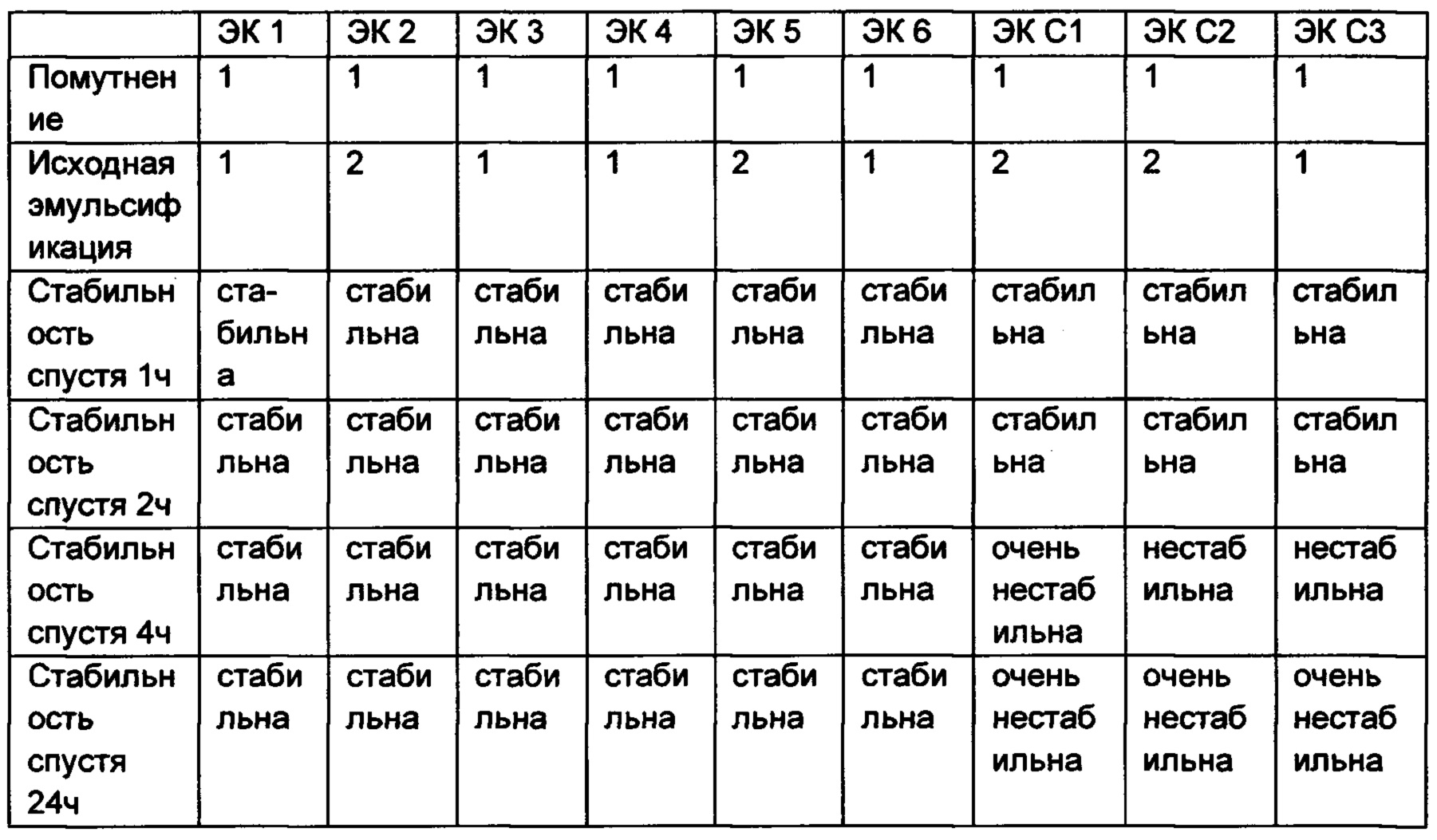
Cipac D: вода жесткостью 432 части на млн (Са:Mg=4:1)Cipac D: 432 ppm water (Ca: Mg = 4: 1)
Помутнение, исходная эмульсификация:Turbidity, initial emulsification:
1 означает очень хорошо; 2 означает хорошо1 means very good; 2 means good
Стабильность эмульсии в течение времени:Stability of the emulsion over time:
Стабильна: максимально 0,5 мл разрушенной эмульсииStable: maximum 0.5 ml of broken emulsion
Нестабильна: означает от >0,5 до 1 мл разрушенной эмульсии или максимально 0,5 мл маслаUnstable: means> 0.5 to 1 ml of broken emulsion or maximum 0.5 ml of oil
Очень нестабильна: означает >1 мл разрушенной эмульсии или >0,5 мл маслаVery unstable: means> 1 ml of broken emulsion or> 0.5 ml of oil
Таблица 2В: Испытание на стабильность эмульсии (5% ЭК в воде CIPAC D)Table 2B: Emulsion stability test (5% EC in water CIPAC D)

Cipac D: вода жесткостью 432 части на млн (Са:Mg=4:1)Cipac D: 432 ppm water (Ca: Mg = 4: 1)
Помутнение, исходная эмульсификация:Turbidity, initial emulsification:
1 означает очень хорошо; 2 означает хорошо1 means very good; 2 means good
Стабильность эмульсии в течение времени:Stability of the emulsion over time:
Стабильна: максимально 0,5 мл разрушенной эмульсииStable: maximum 0.5 ml of broken emulsion
Нестабильна: означает от >0,5 до 1 мл разрушенной эмульсии или максимально 0,5 мл маслаUnstable: means> 0.5 to 1 ml of broken emulsion or maximum 0.5 ml of oil
Очень нестабильна: означает >1 мл разрушенной эмульсии или >0,5 мл маслаVery unstable: means> 1 ml of broken emulsion or> 0.5 ml of oil
Пример 2 Стабильность при хранении на холоду для эмульгирующихся концентратов (ЭК)Example 2 Cold storage stability for emulsifiable concentrates (EC)
Эмульгирующиеся концентраты ЭК 1 - 6, как раскрыты в примере 1 в Таблице 1А, выдерживали при -5°С на протяжении 7 дней. Контролировали их внешний вид. Результаты показаны в таблице 3А.Emulsifiable concentrates EC 1-6, as disclosed in Example 1 in Table 1A, were kept at -5 ° C for 7 days. We controlled their appearance. The results are shown in Table 3A.
Таблица 3А: Стабильность при хранении на холоду для эмульгирующихся концентратов (ЭК)Table 3A: Cold storage stability for emulsifiable concentrates (EC)

Эмульгирующиеся концентраты ЭК 7 - 10 выдерживали при -5°С на протяжении 7 дней. Контролировали их внешний вид. Результаты показаны в Таблице 3В.Emulsifiable concentrates EK 7 - 10 were kept at -5 ° C for 7 days. We controlled their appearance. The results are shown in Table 3B.
Таблица 3В: Стабильность при хранении на холоду для эмульгирующихся концентратов (ЭК)Table 3B: Cold Storage Stability for Emulsifiable Concentrates (EC)

Claims (19)

Applications Claiming Priority (3)
| Application Number | Priority Date | Filing Date | Title |
|---|---|---|---|
| EP15178490 | 2015-07-27 | ||
| EP15178490.7 | 2015-07-27 | ||
| PCT/EP2016/067646 WO2017017055A1 (en) | 2015-07-27 | 2016-07-25 | Emulsifiable concentrate comprising triazole fungicide, fatty acid amide and aromatic hydrocarbon |
Publications (3)
| Publication Number | Publication Date |
|---|---|
| RU2018106935A RU2018106935A (en) | 2019-08-27 |
| RU2018106935A3 RU2018106935A3 (en) | 2020-08-06 |
| RU2746810C2 true RU2746810C2 (en) | 2021-04-21 |
Family
ID=53785476
Family Applications (1)
| Application Number | Title | Priority Date | Filing Date |
|---|---|---|---|
| RU2018106935A RU2746810C2 (en) | 2015-07-27 | 2016-07-25 | Emulsifiable concentrate containing triazolic fungicides, fatty acid amides and aromatic hydrocarbons |
Country Status (11)
| Country | Link |
|---|---|
| US (1) | US10874105B2 (en) |
| EP (1) | EP3328200B1 (en) |
| JP (1) | JP6790063B6 (en) |
| CN (1) | CN107920525B (en) |
| AU (1) | AU2016299332B2 (en) |
| BR (1) | BR112018001593B1 (en) |
| CA (1) | CA2993486C (en) |
| ES (1) | ES2851452T3 (en) |
| IL (1) | IL256929B (en) |
| RU (1) | RU2746810C2 (en) |
| WO (1) | WO2017017055A1 (en) |
Families Citing this family (3)
| Publication number | Priority date | Publication date | Assignee | Title |
|---|---|---|---|---|
| US10820589B2 (en) | 2017-02-01 | 2020-11-03 | Basf Se | Emulsifiable concentrate |
| PE20212103A1 (en) | 2018-11-05 | 2021-11-04 | Adama Makhteshim Ltd | MIXTURES AND COMPOSITIONS COMPRISING 5-FLUORO-4-IMINO-3-METHYL-1-TOSYL-3,4-DIHYDROPYRIMIDIN-2-ONE, AND METHODS OF USE THEREOF |
| EP4346404A1 (en) * | 2021-05-26 | 2024-04-10 | Basf Se | New method for controlling pests |
Citations (3)
| Publication number | Priority date | Publication date | Assignee | Title |
|---|---|---|---|---|
| EA017661B1 (en) * | 2008-04-08 | 2013-02-28 | Басф Се | Emulsifiable concentrate |
| WO2013149925A1 (en) * | 2012-04-04 | 2013-10-10 | Basf Se | Agroformulation comprising copolymer of vinyllactam, n-alkyl acrylamide, and alkyl (meth)acrylate |
| WO2014139805A1 (en) * | 2013-03-13 | 2014-09-18 | Basf Se | Emulsifiable concentrate comprising pesticide, alkyl benzoate and fatty acid amide |
Family Cites Families (4)
| Publication number | Priority date | Publication date | Assignee | Title |
|---|---|---|---|---|
| CN101069501A (en) * | 2007-05-28 | 2007-11-14 | 江苏龙灯化学有限公司 | Use of double substituted long-chain alkylamido sulfonates as crystallization inhibitor in azoles farm chemicals |
| JP5939992B2 (en) * | 2010-03-10 | 2016-06-29 | アイエスピー・インヴェストメンツ・インコーポレイテッド | Pre-formed concentrate for delivery of water-insoluble film-forming polymer |
| US20140371075A1 (en) * | 2011-12-14 | 2014-12-18 | Basf Se | Emulsifiable concentrate comprising pesticide, amide, carbonate and hydrocarbon |
| UA118758C2 (en) * | 2013-03-27 | 2019-03-11 | Басф Се | Emulsifiable concentrate comprising pesticide, alkyl lactate and fatty amide |
-
2016
- 2016-07-25 CA CA2993486A patent/CA2993486C/en active Active
- 2016-07-25 RU RU2018106935A patent/RU2746810C2/en active
- 2016-07-25 CN CN201680044014.0A patent/CN107920525B/en active Active
- 2016-07-25 BR BR112018001593-8A patent/BR112018001593B1/en active IP Right Grant
- 2016-07-25 US US15/747,544 patent/US10874105B2/en active Active
- 2016-07-25 ES ES16741645T patent/ES2851452T3/en active Active
- 2016-07-25 AU AU2016299332A patent/AU2016299332B2/en not_active Ceased
- 2016-07-25 WO PCT/EP2016/067646 patent/WO2017017055A1/en not_active Ceased
- 2016-07-25 EP EP16741645.2A patent/EP3328200B1/en active Active
- 2016-07-25 JP JP2018503743A patent/JP6790063B6/en not_active Expired - Fee Related
-
2018
- 2018-01-15 IL IL256929A patent/IL256929B/en active IP Right Grant
Patent Citations (3)
| Publication number | Priority date | Publication date | Assignee | Title |
|---|---|---|---|---|
| EA017661B1 (en) * | 2008-04-08 | 2013-02-28 | Басф Се | Emulsifiable concentrate |
| WO2013149925A1 (en) * | 2012-04-04 | 2013-10-10 | Basf Se | Agroformulation comprising copolymer of vinyllactam, n-alkyl acrylamide, and alkyl (meth)acrylate |
| WO2014139805A1 (en) * | 2013-03-13 | 2014-09-18 | Basf Se | Emulsifiable concentrate comprising pesticide, alkyl benzoate and fatty acid amide |
Also Published As
| Publication number | Publication date |
|---|---|
| CA2993486C (en) | 2023-12-12 |
| US10874105B2 (en) | 2020-12-29 |
| AU2016299332A1 (en) | 2018-02-08 |
| RU2018106935A3 (en) | 2020-08-06 |
| US20180368405A1 (en) | 2018-12-27 |
| ES2851452T3 (en) | 2021-09-07 |
| WO2017017055A1 (en) | 2017-02-02 |
| CN107920525B (en) | 2021-02-12 |
| CA2993486A1 (en) | 2017-02-02 |
| JP6790063B6 (en) | 2020-12-16 |
| BR112018001593B1 (en) | 2022-03-15 |
| JP6790063B2 (en) | 2020-11-25 |
| JP2018525364A (en) | 2018-09-06 |
| CN107920525A (en) | 2018-04-17 |
| RU2018106935A (en) | 2019-08-27 |
| EP3328200A1 (en) | 2018-06-06 |
| IL256929A (en) | 2018-03-29 |
| IL256929B (en) | 2020-05-31 |
| AU2016299332B2 (en) | 2020-07-09 |
| BR112018001593A2 (en) | 2018-09-18 |
| EP3328200B1 (en) | 2020-11-11 |
Similar Documents
| Publication | Publication Date | Title |
|---|---|---|
| CA2972430C (en) | Fungicidal compositions | |
| RU2571051C2 (en) | Surfactant mixtures for auxin activity herbicides | |
| CN103874410B (en) | Composition and preparation method thereof and the plant quarantine preparation containing said composition | |
| EP3809845B1 (en) | Stable co-formulation of benzoylurea with pyrethroids | |
| CN105338811A (en) | Agrochemical formulation of the oil dispersion type, use of the agrochemical formulations of the oil dispersion type, and method for producing an agrochemical formulation of the oil dispersion type | |
| EP2978308B1 (en) | Emulsifiable concentrate comprising pesticide, alkyl lactate, fatty acid dialkylamide and diester | |
| JP2013504527A (en) | Pesticide composition containing alkyl polypropylene glycol polyethylene glycol | |
| JP2022515139A (en) | Agricultural oil dispersion preparation | |
| BR112018068705B1 (en) | METHOD TO CONTROL PHYTOPATOGENIC FUNGI | |
| CA3153394A1 (en) | Oil liquid fungicidal compositions | |
| JP2020536074A (en) | Aqueous herbicide composition and how to use it | |
| RU2746810C2 (en) | Emulsifiable concentrate containing triazolic fungicides, fatty acid amides and aromatic hydrocarbons | |
| KR20140099926A (en) | Emulsifiable concentrate comprising pesticide, dimethyl sulfoxide, benzyl alcohol, alkyl lactate | |
| UA125295C2 (en) | Use of tetrazolinones for combating resistant phytopathogenic fungi on cereals as a seed treatment | |
| WO2011034444A1 (en) | Herbicidal surfactant formulations | |
| WO2006094371A2 (en) | Carbosulfane-based pesticidal compositions, process for preparing same, process for controlling insects/mites/nematodes, and use of said compositions | |
| RU2829578C1 (en) | Oil liquid fungicidal composition | |
| JP2014533712A (en) | Agrochemical formulations using amides and acylmorpholines | |
| JP2015501805A (en) | Agricultural formulation using aromatic solvent and acylmorpholine | |
| BG61896B1 (en) | HERBICIDAL COMPOSITION | |
| WO2026003012A1 (en) | Concentrated plant-protection formulation |