RU2542545C1 - Method of producing element containing mineral fibre and element produced thereof - Google Patents
Method of producing element containing mineral fibre and element produced thereof Download PDFInfo
- Publication number
- RU2542545C1 RU2542545C1 RU2013140473/12A RU2013140473A RU2542545C1 RU 2542545 C1 RU2542545 C1 RU 2542545C1 RU 2013140473/12 A RU2013140473/12 A RU 2013140473/12A RU 2013140473 A RU2013140473 A RU 2013140473A RU 2542545 C1 RU2542545 C1 RU 2542545C1
- Authority
- RU
- Russia
- Prior art keywords
- binder
- fibers
- mineral
- air flow
- rpm
- Prior art date
Links
Images
Classifications
-
- C—CHEMISTRY; METALLURGY
- C08—ORGANIC MACROMOLECULAR COMPOUNDS; THEIR PREPARATION OR CHEMICAL WORKING-UP; COMPOSITIONS BASED THEREON
- C08L—COMPOSITIONS OF MACROMOLECULAR COMPOUNDS
- C08L23/00—Compositions of homopolymers or copolymers of unsaturated aliphatic hydrocarbons having only one carbon-to-carbon double bond; Compositions of derivatives of such polymers
- C08L23/02—Compositions of homopolymers or copolymers of unsaturated aliphatic hydrocarbons having only one carbon-to-carbon double bond; Compositions of derivatives of such polymers not modified by chemical after-treatment
- C08L23/04—Homopolymers or copolymers of ethene
- C08L23/06—Polyethylene
-
- B—PERFORMING OPERATIONS; TRANSPORTING
- B29—WORKING OF PLASTICS; WORKING OF SUBSTANCES IN A PLASTIC STATE IN GENERAL
- B29C—SHAPING OR JOINING OF PLASTICS; SHAPING OF MATERIAL IN A PLASTIC STATE, NOT OTHERWISE PROVIDED FOR; AFTER-TREATMENT OF THE SHAPED PRODUCTS, e.g. REPAIRING
- B29C43/00—Compression moulding, i.e. applying external pressure to flow the moulding material; Apparatus therefor
-
- B—PERFORMING OPERATIONS; TRANSPORTING
- B29—WORKING OF PLASTICS; WORKING OF SUBSTANCES IN A PLASTIC STATE IN GENERAL
- B29C—SHAPING OR JOINING OF PLASTICS; SHAPING OF MATERIAL IN A PLASTIC STATE, NOT OTHERWISE PROVIDED FOR; AFTER-TREATMENT OF THE SHAPED PRODUCTS, e.g. REPAIRING
- B29C67/00—Shaping techniques not covered by groups B29C39/00 - B29C65/00, B29C70/00 or B29C73/00
- B29C67/24—Shaping techniques not covered by groups B29C39/00 - B29C65/00, B29C70/00 or B29C73/00 characterised by the choice of material
- B29C67/248—Moulding mineral fibres or particles bonded with resin, e.g. for insulating or roofing board
-
- B—PERFORMING OPERATIONS; TRANSPORTING
- B29—WORKING OF PLASTICS; WORKING OF SUBSTANCES IN A PLASTIC STATE IN GENERAL
- B29C—SHAPING OR JOINING OF PLASTICS; SHAPING OF MATERIAL IN A PLASTIC STATE, NOT OTHERWISE PROVIDED FOR; AFTER-TREATMENT OF THE SHAPED PRODUCTS, e.g. REPAIRING
- B29C67/00—Shaping techniques not covered by groups B29C39/00 - B29C65/00, B29C70/00 or B29C73/00
- B29C67/24—Shaping techniques not covered by groups B29C39/00 - B29C65/00, B29C70/00 or B29C73/00 characterised by the choice of material
- B29C67/248—Moulding mineral fibres or particles bonded with resin, e.g. for insulating or roofing board
- B29C67/249—Moulding mineral fibres or particles bonded with resin, e.g. for insulating or roofing board for making articles of indefinite length
-
- C—CHEMISTRY; METALLURGY
- C03—GLASS; MINERAL OR SLAG WOOL
- C03C—CHEMICAL COMPOSITION OF GLASSES, GLAZES OR VITREOUS ENAMELS; SURFACE TREATMENT OF GLASS; SURFACE TREATMENT OF FIBRES OR FILAMENTS MADE FROM GLASS, MINERALS OR SLAGS; JOINING GLASS TO GLASS OR OTHER MATERIALS
- C03C13/00—Fibre or filament compositions
- C03C13/06—Mineral fibres, e.g. slag wool, mineral wool, rock wool
-
- C—CHEMISTRY; METALLURGY
- C03—GLASS; MINERAL OR SLAG WOOL
- C03C—CHEMICAL COMPOSITION OF GLASSES, GLAZES OR VITREOUS ENAMELS; SURFACE TREATMENT OF GLASS; SURFACE TREATMENT OF FIBRES OR FILAMENTS MADE FROM GLASS, MINERALS OR SLAGS; JOINING GLASS TO GLASS OR OTHER MATERIALS
- C03C25/00—Surface treatment of fibres or filaments made from glass, minerals or slags
- C03C25/10—Coating
- C03C25/24—Coatings containing organic materials
-
- C—CHEMISTRY; METALLURGY
- C08—ORGANIC MACROMOLECULAR COMPOUNDS; THEIR PREPARATION OR CHEMICAL WORKING-UP; COMPOSITIONS BASED THEREON
- C08L—COMPOSITIONS OF MACROMOLECULAR COMPOUNDS
- C08L23/00—Compositions of homopolymers or copolymers of unsaturated aliphatic hydrocarbons having only one carbon-to-carbon double bond; Compositions of derivatives of such polymers
- C08L23/02—Compositions of homopolymers or copolymers of unsaturated aliphatic hydrocarbons having only one carbon-to-carbon double bond; Compositions of derivatives of such polymers not modified by chemical after-treatment
- C08L23/10—Homopolymers or copolymers of propene
- C08L23/12—Polypropene
-
- C—CHEMISTRY; METALLURGY
- C08—ORGANIC MACROMOLECULAR COMPOUNDS; THEIR PREPARATION OR CHEMICAL WORKING-UP; COMPOSITIONS BASED THEREON
- C08L—COMPOSITIONS OF MACROMOLECULAR COMPOUNDS
- C08L27/00—Compositions of homopolymers or copolymers of compounds having one or more unsaturated aliphatic radicals, each having only one carbon-to-carbon double bond, and at least one being terminated by a halogen; Compositions of derivatives of such polymers
- C08L27/02—Compositions of homopolymers or copolymers of compounds having one or more unsaturated aliphatic radicals, each having only one carbon-to-carbon double bond, and at least one being terminated by a halogen; Compositions of derivatives of such polymers not modified by chemical after-treatment
- C08L27/12—Compositions of homopolymers or copolymers of compounds having one or more unsaturated aliphatic radicals, each having only one carbon-to-carbon double bond, and at least one being terminated by a halogen; Compositions of derivatives of such polymers not modified by chemical after-treatment containing fluorine atoms
- C08L27/18—Homopolymers or copolymers or tetrafluoroethene
-
- C—CHEMISTRY; METALLURGY
- C08—ORGANIC MACROMOLECULAR COMPOUNDS; THEIR PREPARATION OR CHEMICAL WORKING-UP; COMPOSITIONS BASED THEREON
- C08L—COMPOSITIONS OF MACROMOLECULAR COMPOUNDS
- C08L33/00—Compositions of homopolymers or copolymers of compounds having one or more unsaturated aliphatic radicals, each having only one carbon-to-carbon double bond, and only one being terminated by only one carboxyl radical, or of salts, anhydrides, esters, amides, imides or nitriles thereof; Compositions of derivatives of such polymers
- C08L33/04—Homopolymers or copolymers of esters
- C08L33/06—Homopolymers or copolymers of esters of esters containing only carbon, hydrogen and oxygen, which oxygen atoms are present only as part of the carboxyl radical
- C08L33/08—Homopolymers or copolymers of acrylic acid esters
-
- C—CHEMISTRY; METALLURGY
- C08—ORGANIC MACROMOLECULAR COMPOUNDS; THEIR PREPARATION OR CHEMICAL WORKING-UP; COMPOSITIONS BASED THEREON
- C08L—COMPOSITIONS OF MACROMOLECULAR COMPOUNDS
- C08L61/00—Compositions of condensation polymers of aldehydes or ketones; Compositions of derivatives of such polymers
- C08L61/04—Condensation polymers of aldehydes or ketones with phenols only
- C08L61/06—Condensation polymers of aldehydes or ketones with phenols only of aldehydes with phenols
-
- C—CHEMISTRY; METALLURGY
- C08—ORGANIC MACROMOLECULAR COMPOUNDS; THEIR PREPARATION OR CHEMICAL WORKING-UP; COMPOSITIONS BASED THEREON
- C08L—COMPOSITIONS OF MACROMOLECULAR COMPOUNDS
- C08L63/00—Compositions of epoxy resins; Compositions of derivatives of epoxy resins
-
- C—CHEMISTRY; METALLURGY
- C08—ORGANIC MACROMOLECULAR COMPOUNDS; THEIR PREPARATION OR CHEMICAL WORKING-UP; COMPOSITIONS BASED THEREON
- C08L—COMPOSITIONS OF MACROMOLECULAR COMPOUNDS
- C08L75/00—Compositions of polyureas or polyurethanes; Compositions of derivatives of such polymers
- C08L75/02—Polyureas
-
- C—CHEMISTRY; METALLURGY
- C08—ORGANIC MACROMOLECULAR COMPOUNDS; THEIR PREPARATION OR CHEMICAL WORKING-UP; COMPOSITIONS BASED THEREON
- C08L—COMPOSITIONS OF MACROMOLECULAR COMPOUNDS
- C08L75/00—Compositions of polyureas or polyurethanes; Compositions of derivatives of such polymers
- C08L75/04—Polyurethanes
-
- C—CHEMISTRY; METALLURGY
- C08—ORGANIC MACROMOLECULAR COMPOUNDS; THEIR PREPARATION OR CHEMICAL WORKING-UP; COMPOSITIONS BASED THEREON
- C08L—COMPOSITIONS OF MACROMOLECULAR COMPOUNDS
- C08L79/00—Compositions of macromolecular compounds obtained by reactions forming in the main chain of the macromolecule a linkage containing nitrogen with or without oxygen or carbon only, not provided for in groups C08L61/00 - C08L77/00
- C08L79/04—Polycondensates having nitrogen-containing heterocyclic rings in the main chain; Polyhydrazides; Polyamide acids or similar polyimide precursors
-
- D—TEXTILES; PAPER
- D01—NATURAL OR MAN-MADE THREADS OR FIBRES; SPINNING
- D01G—PRELIMINARY TREATMENT OF FIBRES, e.g. FOR SPINNING
- D01G23/00—Feeding fibres to machines; Conveying fibres between machines
- D01G23/02—Hoppers; Delivery shoots
-
- D—TEXTILES; PAPER
- D01—NATURAL OR MAN-MADE THREADS OR FIBRES; SPINNING
- D01G—PRELIMINARY TREATMENT OF FIBRES, e.g. FOR SPINNING
- D01G23/00—Feeding fibres to machines; Conveying fibres between machines
- D01G23/08—Air draught or like pneumatic arrangements
-
- D—TEXTILES; PAPER
- D01—NATURAL OR MAN-MADE THREADS OR FIBRES; SPINNING
- D01G—PRELIMINARY TREATMENT OF FIBRES, e.g. FOR SPINNING
- D01G9/00—Opening or cleaning fibres, e.g. scutching cotton
- D01G9/06—Opening or cleaning fibres, e.g. scutching cotton by means of toothed members
-
- D—TEXTILES; PAPER
- D01—NATURAL OR MAN-MADE THREADS OR FIBRES; SPINNING
- D01G—PRELIMINARY TREATMENT OF FIBRES, e.g. FOR SPINNING
- D01G9/00—Opening or cleaning fibres, e.g. scutching cotton
- D01G9/14—Details of machines or apparatus
- D01G9/16—Feeding arrangements
-
- D—TEXTILES; PAPER
- D04—BRAIDING; LACE-MAKING; KNITTING; TRIMMINGS; NON-WOVEN FABRICS
- D04H—MAKING TEXTILE FABRICS, e.g. FROM FIBRES OR FILAMENTARY MATERIAL; FABRICS MADE BY SUCH PROCESSES OR APPARATUS, e.g. FELTS, NON-WOVEN FABRICS; COTTON-WOOL; WADDING ; NON-WOVEN FABRICS FROM STAPLE FIBRES, FILAMENTS OR YARNS, BONDED WITH AT LEAST ONE WEB-LIKE MATERIAL DURING THEIR CONSOLIDATION
- D04H1/00—Non-woven fabrics formed wholly or mainly of staple fibres or like relatively short fibres
- D04H1/40—Non-woven fabrics formed wholly or mainly of staple fibres or like relatively short fibres from fleeces or layers composed of fibres without existing or potential cohesive properties
- D04H1/42—Non-woven fabrics formed wholly or mainly of staple fibres or like relatively short fibres from fleeces or layers composed of fibres without existing or potential cohesive properties characterised by the use of certain kinds of fibres insofar as this use has no preponderant influence on the consolidation of the fleece
- D04H1/4209—Inorganic fibres
-
- D—TEXTILES; PAPER
- D04—BRAIDING; LACE-MAKING; KNITTING; TRIMMINGS; NON-WOVEN FABRICS
- D04H—MAKING TEXTILE FABRICS, e.g. FROM FIBRES OR FILAMENTARY MATERIAL; FABRICS MADE BY SUCH PROCESSES OR APPARATUS, e.g. FELTS, NON-WOVEN FABRICS; COTTON-WOOL; WADDING ; NON-WOVEN FABRICS FROM STAPLE FIBRES, FILAMENTS OR YARNS, BONDED WITH AT LEAST ONE WEB-LIKE MATERIAL DURING THEIR CONSOLIDATION
- D04H1/00—Non-woven fabrics formed wholly or mainly of staple fibres or like relatively short fibres
- D04H1/40—Non-woven fabrics formed wholly or mainly of staple fibres or like relatively short fibres from fleeces or layers composed of fibres without existing or potential cohesive properties
- D04H1/42—Non-woven fabrics formed wholly or mainly of staple fibres or like relatively short fibres from fleeces or layers composed of fibres without existing or potential cohesive properties characterised by the use of certain kinds of fibres insofar as this use has no preponderant influence on the consolidation of the fleece
- D04H1/4209—Inorganic fibres
- D04H1/4218—Glass fibres
-
- D—TEXTILES; PAPER
- D04—BRAIDING; LACE-MAKING; KNITTING; TRIMMINGS; NON-WOVEN FABRICS
- D04H—MAKING TEXTILE FABRICS, e.g. FROM FIBRES OR FILAMENTARY MATERIAL; FABRICS MADE BY SUCH PROCESSES OR APPARATUS, e.g. FELTS, NON-WOVEN FABRICS; COTTON-WOOL; WADDING ; NON-WOVEN FABRICS FROM STAPLE FIBRES, FILAMENTS OR YARNS, BONDED WITH AT LEAST ONE WEB-LIKE MATERIAL DURING THEIR CONSOLIDATION
- D04H1/00—Non-woven fabrics formed wholly or mainly of staple fibres or like relatively short fibres
- D04H1/40—Non-woven fabrics formed wholly or mainly of staple fibres or like relatively short fibres from fleeces or layers composed of fibres without existing or potential cohesive properties
- D04H1/42—Non-woven fabrics formed wholly or mainly of staple fibres or like relatively short fibres from fleeces or layers composed of fibres without existing or potential cohesive properties characterised by the use of certain kinds of fibres insofar as this use has no preponderant influence on the consolidation of the fleece
- D04H1/4209—Inorganic fibres
- D04H1/4218—Glass fibres
- D04H1/4226—Glass fibres characterised by the apparatus for manufacturing the glass fleece
-
- D—TEXTILES; PAPER
- D04—BRAIDING; LACE-MAKING; KNITTING; TRIMMINGS; NON-WOVEN FABRICS
- D04H—MAKING TEXTILE FABRICS, e.g. FROM FIBRES OR FILAMENTARY MATERIAL; FABRICS MADE BY SUCH PROCESSES OR APPARATUS, e.g. FELTS, NON-WOVEN FABRICS; COTTON-WOOL; WADDING ; NON-WOVEN FABRICS FROM STAPLE FIBRES, FILAMENTS OR YARNS, BONDED WITH AT LEAST ONE WEB-LIKE MATERIAL DURING THEIR CONSOLIDATION
- D04H1/00—Non-woven fabrics formed wholly or mainly of staple fibres or like relatively short fibres
- D04H1/40—Non-woven fabrics formed wholly or mainly of staple fibres or like relatively short fibres from fleeces or layers composed of fibres without existing or potential cohesive properties
- D04H1/54—Non-woven fabrics formed wholly or mainly of staple fibres or like relatively short fibres from fleeces or layers composed of fibres without existing or potential cohesive properties by welding together the fibres, e.g. by partially melting or dissolving
-
- D—TEXTILES; PAPER
- D04—BRAIDING; LACE-MAKING; KNITTING; TRIMMINGS; NON-WOVEN FABRICS
- D04H—MAKING TEXTILE FABRICS, e.g. FROM FIBRES OR FILAMENTARY MATERIAL; FABRICS MADE BY SUCH PROCESSES OR APPARATUS, e.g. FELTS, NON-WOVEN FABRICS; COTTON-WOOL; WADDING ; NON-WOVEN FABRICS FROM STAPLE FIBRES, FILAMENTS OR YARNS, BONDED WITH AT LEAST ONE WEB-LIKE MATERIAL DURING THEIR CONSOLIDATION
- D04H1/00—Non-woven fabrics formed wholly or mainly of staple fibres or like relatively short fibres
- D04H1/40—Non-woven fabrics formed wholly or mainly of staple fibres or like relatively short fibres from fleeces or layers composed of fibres without existing or potential cohesive properties
- D04H1/58—Non-woven fabrics formed wholly or mainly of staple fibres or like relatively short fibres from fleeces or layers composed of fibres without existing or potential cohesive properties by applying, incorporating or activating chemical or thermoplastic bonding agents, e.g. adhesives
- D04H1/587—Non-woven fabrics formed wholly or mainly of staple fibres or like relatively short fibres from fleeces or layers composed of fibres without existing or potential cohesive properties by applying, incorporating or activating chemical or thermoplastic bonding agents, e.g. adhesives characterised by the bonding agents used
-
- D—TEXTILES; PAPER
- D04—BRAIDING; LACE-MAKING; KNITTING; TRIMMINGS; NON-WOVEN FABRICS
- D04H—MAKING TEXTILE FABRICS, e.g. FROM FIBRES OR FILAMENTARY MATERIAL; FABRICS MADE BY SUCH PROCESSES OR APPARATUS, e.g. FELTS, NON-WOVEN FABRICS; COTTON-WOOL; WADDING ; NON-WOVEN FABRICS FROM STAPLE FIBRES, FILAMENTS OR YARNS, BONDED WITH AT LEAST ONE WEB-LIKE MATERIAL DURING THEIR CONSOLIDATION
- D04H1/00—Non-woven fabrics formed wholly or mainly of staple fibres or like relatively short fibres
- D04H1/40—Non-woven fabrics formed wholly or mainly of staple fibres or like relatively short fibres from fleeces or layers composed of fibres without existing or potential cohesive properties
- D04H1/58—Non-woven fabrics formed wholly or mainly of staple fibres or like relatively short fibres from fleeces or layers composed of fibres without existing or potential cohesive properties by applying, incorporating or activating chemical or thermoplastic bonding agents, e.g. adhesives
- D04H1/60—Non-woven fabrics formed wholly or mainly of staple fibres or like relatively short fibres from fleeces or layers composed of fibres without existing or potential cohesive properties by applying, incorporating or activating chemical or thermoplastic bonding agents, e.g. adhesives the bonding agent being applied in dry state, e.g. thermo-activatable agents in solid or molten state, and heat being applied subsequently
-
- D—TEXTILES; PAPER
- D04—BRAIDING; LACE-MAKING; KNITTING; TRIMMINGS; NON-WOVEN FABRICS
- D04H—MAKING TEXTILE FABRICS, e.g. FROM FIBRES OR FILAMENTARY MATERIAL; FABRICS MADE BY SUCH PROCESSES OR APPARATUS, e.g. FELTS, NON-WOVEN FABRICS; COTTON-WOOL; WADDING ; NON-WOVEN FABRICS FROM STAPLE FIBRES, FILAMENTS OR YARNS, BONDED WITH AT LEAST ONE WEB-LIKE MATERIAL DURING THEIR CONSOLIDATION
- D04H1/00—Non-woven fabrics formed wholly or mainly of staple fibres or like relatively short fibres
- D04H1/40—Non-woven fabrics formed wholly or mainly of staple fibres or like relatively short fibres from fleeces or layers composed of fibres without existing or potential cohesive properties
- D04H1/58—Non-woven fabrics formed wholly or mainly of staple fibres or like relatively short fibres from fleeces or layers composed of fibres without existing or potential cohesive properties by applying, incorporating or activating chemical or thermoplastic bonding agents, e.g. adhesives
- D04H1/64—Non-woven fabrics formed wholly or mainly of staple fibres or like relatively short fibres from fleeces or layers composed of fibres without existing or potential cohesive properties by applying, incorporating or activating chemical or thermoplastic bonding agents, e.g. adhesives the bonding agent being applied in wet state, e.g. chemical agents in dispersions or solutions
-
- D—TEXTILES; PAPER
- D04—BRAIDING; LACE-MAKING; KNITTING; TRIMMINGS; NON-WOVEN FABRICS
- D04H—MAKING TEXTILE FABRICS, e.g. FROM FIBRES OR FILAMENTARY MATERIAL; FABRICS MADE BY SUCH PROCESSES OR APPARATUS, e.g. FELTS, NON-WOVEN FABRICS; COTTON-WOOL; WADDING ; NON-WOVEN FABRICS FROM STAPLE FIBRES, FILAMENTS OR YARNS, BONDED WITH AT LEAST ONE WEB-LIKE MATERIAL DURING THEIR CONSOLIDATION
- D04H1/00—Non-woven fabrics formed wholly or mainly of staple fibres or like relatively short fibres
- D04H1/70—Non-woven fabrics formed wholly or mainly of staple fibres or like relatively short fibres characterised by the method of forming fleeces or layers, e.g. reorientation of fibres
- D04H1/72—Non-woven fabrics formed wholly or mainly of staple fibres or like relatively short fibres characterised by the method of forming fleeces or layers, e.g. reorientation of fibres the fibres being randomly arranged
-
- D—TEXTILES; PAPER
- D04—BRAIDING; LACE-MAKING; KNITTING; TRIMMINGS; NON-WOVEN FABRICS
- D04H—MAKING TEXTILE FABRICS, e.g. FROM FIBRES OR FILAMENTARY MATERIAL; FABRICS MADE BY SUCH PROCESSES OR APPARATUS, e.g. FELTS, NON-WOVEN FABRICS; COTTON-WOOL; WADDING ; NON-WOVEN FABRICS FROM STAPLE FIBRES, FILAMENTS OR YARNS, BONDED WITH AT LEAST ONE WEB-LIKE MATERIAL DURING THEIR CONSOLIDATION
- D04H1/00—Non-woven fabrics formed wholly or mainly of staple fibres or like relatively short fibres
- D04H1/70—Non-woven fabrics formed wholly or mainly of staple fibres or like relatively short fibres characterised by the method of forming fleeces or layers, e.g. reorientation of fibres
- D04H1/72—Non-woven fabrics formed wholly or mainly of staple fibres or like relatively short fibres characterised by the method of forming fleeces or layers, e.g. reorientation of fibres the fibres being randomly arranged
- D04H1/732—Non-woven fabrics formed wholly or mainly of staple fibres or like relatively short fibres characterised by the method of forming fleeces or layers, e.g. reorientation of fibres the fibres being randomly arranged by fluid current, e.g. air-lay
-
- D—TEXTILES; PAPER
- D04—BRAIDING; LACE-MAKING; KNITTING; TRIMMINGS; NON-WOVEN FABRICS
- D04H—MAKING TEXTILE FABRICS, e.g. FROM FIBRES OR FILAMENTARY MATERIAL; FABRICS MADE BY SUCH PROCESSES OR APPARATUS, e.g. FELTS, NON-WOVEN FABRICS; COTTON-WOOL; WADDING ; NON-WOVEN FABRICS FROM STAPLE FIBRES, FILAMENTS OR YARNS, BONDED WITH AT LEAST ONE WEB-LIKE MATERIAL DURING THEIR CONSOLIDATION
- D04H1/00—Non-woven fabrics formed wholly or mainly of staple fibres or like relatively short fibres
- D04H1/70—Non-woven fabrics formed wholly or mainly of staple fibres or like relatively short fibres characterised by the method of forming fleeces or layers, e.g. reorientation of fibres
- D04H1/72—Non-woven fabrics formed wholly or mainly of staple fibres or like relatively short fibres characterised by the method of forming fleeces or layers, e.g. reorientation of fibres the fibres being randomly arranged
- D04H1/736—Non-woven fabrics formed wholly or mainly of staple fibres or like relatively short fibres characterised by the method of forming fleeces or layers, e.g. reorientation of fibres the fibres being randomly arranged characterised by the apparatus for arranging fibres
-
- Y—GENERAL TAGGING OF NEW TECHNOLOGICAL DEVELOPMENTS; GENERAL TAGGING OF CROSS-SECTIONAL TECHNOLOGIES SPANNING OVER SEVERAL SECTIONS OF THE IPC; TECHNICAL SUBJECTS COVERED BY FORMER USPC CROSS-REFERENCE ART COLLECTIONS [XRACs] AND DIGESTS
- Y02—TECHNOLOGIES OR APPLICATIONS FOR MITIGATION OR ADAPTATION AGAINST CLIMATE CHANGE
- Y02P—CLIMATE CHANGE MITIGATION TECHNOLOGIES IN THE PRODUCTION OR PROCESSING OF GOODS
- Y02P20/00—Technologies relating to chemical industry
- Y02P20/50—Improvements relating to the production of bulk chemicals
- Y02P20/582—Recycling of unreacted starting or intermediate materials
Landscapes
- Chemical & Material Sciences (AREA)
- Engineering & Computer Science (AREA)
- Textile Engineering (AREA)
- Chemical Kinetics & Catalysis (AREA)
- Organic Chemistry (AREA)
- Polymers & Plastics (AREA)
- Medicinal Chemistry (AREA)
- Health & Medical Sciences (AREA)
- Life Sciences & Earth Sciences (AREA)
- General Chemical & Material Sciences (AREA)
- Materials Engineering (AREA)
- Geochemistry & Mineralogy (AREA)
- General Life Sciences & Earth Sciences (AREA)
- Mechanical Engineering (AREA)
- Inorganic Chemistry (AREA)
- Dispersion Chemistry (AREA)
- Manufacturing & Machinery (AREA)
- Nonwoven Fabrics (AREA)
- Coloring Foods And Improving Nutritive Qualities (AREA)
- Paper (AREA)
Abstract
Description
Изобретение относится к способу изготовления композитного материала, содержащего минеральное волокно, и новому элементу, содержащему минеральное волокно, изготовленному этим способом. Изобретение также относится к устройству, пригодному для осуществления способа изобретения.The invention relates to a method for manufacturing a composite material containing mineral fiber, and a new element containing mineral fiber made in this way. The invention also relates to a device suitable for implementing the method of the invention.
Настоящее изобретение особенно относится к элементам, содержащим минеральное волокно, которые изготавливаются прессованием и отверждением смеси минеральных волокон и связующего вещества для изготовления прессованной панели, часто имеющей толщину от 4 мм до 25 мм. Эти панели в общем имеют плотность от 120 кг/м3 до 1000 кг/м3, например в пределах 170-1000 кг/м3, и могут использоваться в качестве защитной облицовки снаружи зданий или в качестве акустически изолирующих/поглощающих потолочных или стеновых панелей.The present invention particularly relates to mineral fiber containing elements that are made by pressing and curing a mixture of mineral fibers and a binder to make a pressed panel, often having a thickness of 4 mm to 25 mm. These panels generally have a density of 120 kg / m 3 to 1000 kg / m 3 , for example in the range of 170-1000 kg / m 3 , and can be used as a protective cladding outside buildings or as acoustically insulating / absorbing ceiling or wall panels .
Предварительно, эти изделия были произведены, подвергая совокупность минеральной ваты и связующего вещества процессу смешивания и формования и в дальнейшем прессованию и отверждению образовавшейся смеси до требуемой плотности. Связующее вещество в общем либо добавляется к минеральной вате в виде сухого связующего вещества, либо неотвержденная минеральная вата используется, где включено связующее вещество, во время процесса сбора и формования волокна.Previously, these products were manufactured by subjecting a combination of mineral wool and a binder to the process of mixing and molding, and subsequently pressing and curing the resulting mixture to the required density. The binder is generally either added to the mineral wool as a dry binder, or uncured mineral wool is used, where the binder is included, during the fiber collection and spinning process.
Такие изделия технически и коммерчески успешны, но мы находим, что имеется возможность для усовершенствования. Конкретно, мы находим, что одна проблема со способами известного уровня техники заключается в том, что используемые процессы смешивания и формования имеют тенденцию производить некоторые компактные шарики минеральной ваты в смеси, или по меньшей мере не разрыхлять уплотненную минеральную вату. Более того, способы, используемые в известном уровне техники, не содержат каких-либо средств для удаления уплотненной минеральной ваты из смеси, таким образом в конечном изделии осуществляется неравномерное распределение.Such products are technically and commercially successful, but we find that there is room for improvement. Specifically, we find that one problem with prior art methods is that the mixing and molding processes used tend to produce some compact mineral wool balls in the mixture, or at least not loosen the compacted mineral wool. Moreover, the methods used in the prior art do not contain any means for removing compacted mineral wool from the mixture, so that an uneven distribution is achieved in the final product.
Когда некоторые области изделия имеют более высокую плотность минеральных волокон, это также может привести к более высокой концентрации связующего вещества в этой области. Наличие неравномерного распределения минеральной ваты и связующего вещества в изделии может быть проблематичным по ряду причин.When some areas of the product have a higher density of mineral fibers, this can also lead to a higher concentration of binder in this area. The uneven distribution of mineral wool and binder in the product can be problematic for a number of reasons.
Во-первых, могут иметься области изделия, где связующее вещество не отверждено полностью. Это уменьшит общую прочность и жесткость панели.First, there may be areas of the product where the binder is not fully cured. This will reduce the overall strength and rigidity of the panel.
Во-вторых, когда имеется неравномерное распределение компонентов, это, вероятнее всего, снижает акустические свойства акустической потолочной или стеновой панели.Secondly, when there is an uneven distribution of components, this most likely reduces the acoustic properties of an acoustic ceiling or wall panel.
В-третьих, так как этот тип панели в общем используется в случаях, когда поверхность панели видна, важно, чтобы панели являлись эстетически приятными. Неравномерное распределение внутри панели может приводить к нежелательным неоднородностям на поверхностях. Когда высокое содержание связующего вещества сконцентрировано на небольшой области, это может приводить к возникновению пятна на поверхности изделия.Thirdly, since this type of panel is generally used in cases where the surface of the panel is visible, it is important that the panels are aesthetically pleasing. Uneven distribution within the panel can lead to undesirable inhomogeneities on the surfaces. When a high binder content is concentrated in a small area, this can lead to stains on the surface of the product.
В некоторых случаях поверхность панели будет окрашена и неравномерное распределение компонентов или области, где связующее вещество не полностью отверждено, могут приводить к тому, что краска не принимается равномерным образом по всей поверхности.In some cases, the surface of the panel will be painted and an uneven distribution of components or areas where the binder is not fully cured can cause paint to not be uniformly applied over the entire surface.
Более того, в некоторых изделиях, в особенности тех, которые используются в качестве облицовки для наружной стороны зданий, до сих пор было необходимого использовать относительно высокое содержание связующего вещества для того, чтобы обеспечивать изделие достаточной прочности и жесткости. Высокое содержание требуемого связующего вещества присутствует частично из-за некоторого количества связующего вещества, потраченного впустую, так как оно присутствует в излишне высокой концентрации в областях панели там, где была уплотнена минеральная вата в смеси до прессования. Как отмечено выше, полное преимущество от этого связующего вещества не передается изделию, частично потому что оно имеет тенденцию к неполному отверждению.Moreover, in some products, especially those used as cladding for the outside of buildings, it has so far been necessary to use a relatively high binder content in order to provide the product with sufficient strength and stiffness. The high content of the required binder is partly due to the amount of binder wasted, as it is present in an excessively high concentration in the areas of the panel where the mineral wool in the mixture was compacted before pressing. As noted above, the full benefit of this binder is not transferred to the product, in part because it tends to be incompletely cured.
Наличие высокого содержания связующего вещества в изделии является дорогостоящим и может уменьшать огнестойкие характеристики изделия. В связи с этим, было бы желательно использовать меньше связующего вещества, чтобы обеспечивать панели, имеющие сопоставимые прочность и жесткость.Having a high binder content in the product is expensive and can reduce the fire resistance of the product. In this regard, it would be desirable to use less binder to provide panels having comparable strength and stiffness.
В связи с этим, задачей изобретения является обеспечение способа образования элемента, содержащего минеральное волокно, относящегося к типу, описанному выше, имеющему улучшенные прочность и жесткость или пониженное содержание связующего вещества, или и то, и то.In this regard, the object of the invention is to provide a method of forming an element containing a mineral fiber of the type described above, having improved strength and stiffness or a reduced content of a binder, or both.
Дополнительная задача изобретения заключается в обеспечении способа образования элемента, содержащего минеральное волокно, относящегося к типу, описанному выше, который является гомогенным, имеющим более равномерное распределение компонентов. Также задачей изобретения является обеспечение способа изготовления элемента, содержащего минеральное волокно, имеющего поверхность с более однородным и равномерным внешним видом.An additional object of the invention is to provide a method of forming an element containing a mineral fiber of the type described above, which is homogeneous, having a more uniform distribution of components. It is also an object of the invention to provide a method for manufacturing an element containing a mineral fiber having a surface with a more uniform and uniform appearance.
Патент США №2,682,085 раскрывает устройство для очистки и рыхления хрупких волокон, например волокон из минеральной ваты. Это достаточно старый уровень техники (с заявкой, поданной в 1949 г.), предполагает относительно сложный способ и устройство для рыхления и очистки волокон для удаления частиц и грязи из них. Волокна подают в устройство в виде пучков или масс волокон. После рыхления и очистки волокна собирают в форме легкого, рыхлого, имеющего низкую плотность войлочного слоя или полотна.US patent No. 2,682,085 discloses a device for cleaning and loosening fragile fibers, such as mineral wool fibers. This is a fairly old level of technology (with an application filed in 1949), involves a relatively complex method and device for loosening and cleaning fibers to remove particles and dirt from them. The fibers are fed into the device in the form of bundles or masses of fibers. After loosening and cleaning, the fibers are collected in the form of a light, loose, low density felt layer or fabric.
Задача патента США №2,682,085 заключается в очистке и рыхлении волокон для формирования легкого, рыхлого, имеющего низкую плотность полотна. В этом документе не обсуждается формирование жестких панелей, и не дается никакого указания на преимущества распутывания волокон и их суспендирования в потоке воздуха применительно к прочности, жесткости или любому другому свойству прессованной и отвержденной панели, относящейся к типу, используемому в качестве облицовки для зданий или в качестве потолочных или стеновых панелей.The objective of US patent No. 2,682,085 is to clean and loosen the fibers to form a light, loose, low-density fabric. This document does not discuss the formation of rigid panels, and does not provide any indication of the benefits of untangling the fibers and suspending them in the air stream in relation to strength, stiffness, or any other property of a pressed and cured panel of the type used as cladding for buildings or in quality of ceiling or wall panels.
Согласно изобретению задачи, обсужденные выше, решаются способом изготовления элемента, содержащего минеральное волокно, причем указанный способ содержит этапы, на которых:According to the invention, the problems discussed above are solved by a method for manufacturing an element containing mineral fiber, said method comprising the steps of:
обеспечивают минеральные волокна в количестве от 70 до менее 90 весовых % от общего веса исходных материалов в форме собранного полотна,provide mineral fibers in an amount of from 70 to less than 90 weight% of the total weight of the starting materials in the form of an assembled web,
обеспечивают связующее вещество в количестве от более чем 10 до 30 весовых % от общего веса исходных материалов,provide a binder in an amount of more than 10 to 30 weight% of the total weight of the starting materials,
подвергают собранное полотно из волокон процессу распутывания,subjecting the assembled fiber web to an unraveling process,
суспендируют волокна в первичном потоке воздуха,suspend the fibers in the primary air stream,
смешивают связующее вещество с минеральными волокнами до, во время или после процесса распутывания для образования смеси минеральных волокон и связующего вещества,mixing the binder with mineral fibers before, during or after the unraveling process to form a mixture of mineral fibers and a binder,
собирают смесь минеральных волокон и связующего вещества и прессуют, и отверждают смесь для обеспечения упрочненного композитного материала с плотностью от 120 кг/м3 до 1000 кг/м3, например 170-1000 кг/м3.a mixture of mineral fibers and a binder is collected and pressed, and the mixture is cured to provide a hardened composite material with a density of 120 kg / m 3 to 1000 kg / m 3 , for example 170-1000 kg / m 3 .
Этот способ может использоваться для изготовления нового элемента, содержащего минеральное волокно.This method can be used to make a new element containing mineral fiber.
Упомянутые проценты основаны в расчете на сухой вес исходных материалов.The percentages mentioned are based on the dry weight of the starting materials.
С помощью способа согласно изобретению, как определено выше, достигается универсальный и экономически эффективный способ изготовления композитного материала, содержащего минеральное волокно. Регулируя плотность, до которой прессуется элемент, может быть изготовлено множество различных композиционных материалов, которые специально изготавливаются для конкретных целей.Using the method according to the invention, as defined above, a universal and cost-effective method of manufacturing a composite material containing mineral fiber is achieved. By adjusting the density to which the element is pressed, many different composite materials can be made that are specially made for specific purposes.
Более того, было обнаружено, что, подвергая минеральные волокна процессу распутывания волокна, уплотненные минеральные волокна разрыхляются, и минеральные волокна и связующее вещество более равномерно распределяются в изготовленном элементе. Эта увеличенная гомогенность в элементе приводит в общем к увеличенному уровню механической прочности относительно элементов известного уровня техники.Moreover, it was found that by subjecting the mineral fibers to the process of unraveling the fibers, the compacted mineral fibers are loosened, and the mineral fibers and the binder are more evenly distributed in the fabricated element. This increased homogeneity in the element generally leads to an increased level of mechanical strength relative to elements of the prior art.
Равномерное распределение волокон и связующего вещества в элементе также оказывает желаемый эффект на звукоизоляционные свойства элемента.The uniform distribution of fibers and binder in the element also has the desired effect on the soundproofing properties of the element.
Более того, элементы, изготавливаемые способом настоящего изобретения, имеют преимущества с точки зрения эстетической привлекательности и однородности свойств на протяжении одного элемента.Moreover, the elements manufactured by the method of the present invention have advantages in terms of aesthetic appeal and uniformity of properties over a single element.
Также было обнаружено, что композитные материалы настоящего изобретения в результате их гомогенности могут быть обрабатываемы таким же образом, как дерево. Под "обрабатываемы" следует понимать, что композитный материал может быть обработан на обычном деревообрабатывающем оборудовании, таком как пилы и машины для профилирования, например шпунтовочные машины, горизонтально-фрезерные станки и т.д.It was also found that the composite materials of the present invention, as a result of their homogeneity, can be processed in the same way as wood. By "machinable" it is understood that the composite material can be machined on conventional woodworking equipment, such as saws and profiling machines, such as sheet piling machines, horizontal milling machines, etc.
Элементы, изготавливаемые способом изобретения, имеют множество применений, преимущественно в качестве строительных элементов. В частности, изделия могут иметь форму панелей. В общем, изделия используются в случаях, когда важны механическая устойчивость и равномерная обработка поверхности, а также изолирующие свойства. В некоторых случаях применения панели могут использоваться в качестве звукопоглощающих потолочных или стеновых панелей. В других случаях применения, панели могут использоваться в качестве изолирующей наружной облицовки для зданий.Elements manufactured by the method of the invention have many uses, mainly as building elements. In particular, the products may be in the form of panels. In general, products are used in cases where mechanical stability and uniform surface treatment, as well as insulating properties are important. In some applications, the panels can be used as sound absorbing ceiling or wall panels. In other applications, the panels can be used as an insulating exterior cladding for buildings.
Предпочтительно, композитный материал находится в форме панели. Предпочтительно толщина панели составляет от 4 до 25 мм. В некоторых вариантах выполнения, в особенности когда панель используется в качестве облицовки на здании, толщина панели составляет предпочтительно от 4 до 12 мм, более предпочтительно от 5 до 10 мм и наиболее предпочтительно от 6 до 8 мм. В альтернативных вариантах выполнения, в особенности, когда панель используется в качестве изоляционной панели для поверхности потолка, толщина панели составляет предпочтительно от 12 до 25 мм, более предпочтительно от 15 до 23 мм и наиболее предпочтительно от 18 до 21 мм.Preferably, the composite material is in the form of a panel. Preferably, the panel thickness is from 4 to 25 mm. In some embodiments, especially when the panel is used as a cladding on a building, the panel thickness is preferably from 4 to 12 mm, more preferably from 5 to 10 mm and most preferably from 6 to 8 mm. In alternative embodiments, especially when the panel is used as an insulating panel for a ceiling surface, the panel thickness is preferably from 12 to 25 mm, more preferably from 15 to 23 mm, and most preferably from 18 to 21 mm.
Точное количество минеральных волокон, используемых в способе изобретения, выбирают так, чтобы поддерживать соответствующие свойства огнестойкости и соответствующий уровень тепло- и/или звукоизоляции и предельную стоимость, поддерживая при этом соответствующий уровень когезии в зависимости от соответствующего применения. Большое количество волокон увеличивает огнестойкость элемента, увеличивает его звуко- и теплоизоляционные свойства и ограничивает стоимость, но уменьшает когезию в элементе. Это значит, что нижний предел 70 весовых % приводит к элементу, имеющему отличную когезию и прочность. Если изоляционные свойства и огнестойкость особенно важны, количество волокон может быть увеличено до верхнего предела менее чем 90 весовых %, но это приведет к когезионным свойствам, которые меньше тех, которые достигаются при нижнем пределе. Для большинства применений подходящий состав будет включать количество волокна от 70 до 89 весовых %, или 80-89 весовых %, или от 83 до 89 весовых %. Чаще всего подходящее количество волокон будет от 85 до 88 весовых %.The exact amount of mineral fibers used in the method of the invention is chosen so as to maintain appropriate fire resistance properties and an appropriate level of heat and / or sound insulation and marginal cost, while maintaining an appropriate level of cohesion depending on the respective application. A large number of fibers increases the fire resistance of the element, increases its sound and heat insulation properties and limits the cost, but reduces cohesion in the element. This means that a lower limit of 70 weight% leads to an element having excellent cohesion and strength. If the insulating properties and fire resistance are especially important, the number of fibers can be increased to the upper limit of less than 90 weight%, but this will lead to cohesive properties that are less than those achieved at the lower limit. For most applications, a suitable formulation will include an amount of fiber from 70 to 89% by weight, or 80-89% by weight, or from 83 to 89% by weight. Most often, a suitable amount of fibers will be from 85 to 88 weight%.
Количество связующего вещества также выбирают исходя из требуемой когезии, прочности и стоимости, а также свойств, таких как противодействие огню и уровень теплоизоляции. Было обнаружено, что содержание связующего вещества большее 10% приводит к улучшенной "обрабатываемости", как описано выше. Нижний предел больший 10 весовых % приводит к композитному материалу с более низкой прочностью и когезией, но который достаточен для многих применений и является все же соответствующим образом "обрабатываемым", как обсуждается выше. Он также имеет преимущество относительно низкой стоимости и потенциал для хороших тепло- и звукоизоляционных свойств. В применениях, когда необходима более высокая механическая прочность, должно быть использовано большее количество связующего вещества, например, до верхнего предела 30 весовых %. Это будет увеличивать стоимость конечного изделия, и противодействие огню часто будет менее подходящим в зависимости от выбора связующего вещества. Для большинства применений подходящий состав будет включать количество связующего вещества по меньшей мере 10,1 весовых %, и предпочтительно уровень составляет по меньшей мере 10,6 весовых %, в частности, от 11 до 30 весовых %, или от 11 до 20 весовых %, или от 11 до 17 весовых %. Чаще всего подходящее количество связующего вещества будет от 12 до 15 весовых %.The amount of binder is also selected based on the required cohesion, strength and cost, as well as properties such as fire resistance and level of thermal insulation. It was found that a binder content of greater than 10% leads to improved "workability" as described above. A lower limit of greater than 10 weight% results in a composite material with lower strength and cohesion, but which is sufficient for many applications and is nevertheless suitably “processed”, as discussed above. It also has the advantage of relatively low cost and the potential for good heat and sound insulation properties. In applications where higher mechanical strength is needed, a greater amount of binder should be used, for example, up to an upper limit of 30 weight%. This will increase the cost of the final product, and fire resistance will often be less suitable depending on the choice of binder. For most applications, a suitable composition will include an amount of a binder of at least 10.1 weight%, and preferably the level is at least 10.6 weight%, in particular 11 to 30 weight%, or 11 to 20 weight%, or from 11 to 17 weight%. Most often, a suitable amount of binder will be from 12 to 15 weight%.
Минеральные волокна (также известные как искусственно полученные стеклянные волокна или MMVF), используемые согласно настоящему изобретению, могут быть любыми минеральными волокнами, включая стеклянные волокна, керамические волокна или каменные волокна, но предпочтительно используются каменные волокна. Волокна каменной ваты в общем имеют содержание оксида железа по меньшей мере 3% и щелочноземельных металлов (оксида кальция и оксида магния) от 10 до 40% вместе с другими обычными оксидными составляющими минеральной ваты. Такими являются диоксид кремния; оксид алюминия; щелочные металлы (оксид натрия и оксид калия), которые обычно представлены в низких количествах; и также могут включать диоксид титана и другие неосновные оксиды. Диаметр волокна часто находится в диапазоне 3-20 мкм, в частности 5-10 мкм, в качестве стандартного.The mineral fibers (also known as artificially made glass fibers or MMVF) used according to the present invention can be any mineral fibers, including glass fibers, ceramic fibers or stone fibers, but stone fibers are preferably used. Rockwool fibers generally have an iron oxide content of at least 3% and alkaline earth metals (calcium oxide and magnesium oxide) from 10 to 40%, together with other conventional oxide components of mineral wool. These are silicon dioxide; aluminium oxide; alkali metals (sodium oxide and potassium oxide), which are usually present in low amounts; and may also include titanium dioxide and other minor oxides. The fiber diameter is often in the range of 3-20 microns, in particular 5-10 microns, as standard.
Предпочтительно, минеральные волокна и связующее вещество вместе образуют по меньшей мере 96%, более предпочтительно по меньшей мере 98% и наиболее предпочтительно по существу все от общего веса исходных материалов.Preferably, the mineral fibers and the binder together form at least 96%, more preferably at least 98%, and most preferably substantially all of the total weight of the starting materials.
Наличие органических волокон в элементе, содержащем минеральное волокно, будет уменьшать сопротивление элемента огню и уменьшать изоляционные свойства элемента. В связи с этим, предпочтительно, когда исходные материалы содержат менее 5% органических волокон. Более предпочтительно, исходные материалы по существу не содержат органические волокна.The presence of organic fibers in an element containing mineral fiber will reduce the resistance of the element to fire and reduce the insulating properties of the element. In this regard, it is preferable when the starting materials contain less than 5% organic fibers. More preferably, the starting materials are substantially free of organic fibers.
Как используется здесь, выражение "собранное полотно" предназначено для включения любых минеральных волокон, которые были собраны вместе на поверхности, т.е. они больше не вовлекаются в воздухе, например, гранулята, пучков или переработанных отходов полотна.As used here, the expression “assembled web” is intended to include any mineral fibers that have been assembled together on the surface, i.e. they are no longer involved in the air, for example, granulate, bunches or recycled web waste.
Собранное полотно может быть первичным полотном, которое образовано путем сбора волокна на конвейерной ленте и обеспечено в качестве исходного материала без перекрывания или упрочнения иным образом. Альтернативно, собранное полотно может быть вторичным полотном, которое образовано перекрыванием или иным способом упрочнения первичного полотна. Предпочтительно, собранное полотно представляет собой первичное полотно.The assembled web may be a primary web, which is formed by collecting fiber on a conveyor belt and provided as starting material without overlapping or otherwise hardening. Alternatively, the assembled web may be a secondary web that is formed by overlapping or otherwise hardening the primary web. Preferably, the assembled web is a primary web.
В одном варианте выполнения, процесс распутывания содержит подачу полотна минеральных волокон из трубопровода с более низким относительным потоком воздуха в трубопровод с более высоким относительным потоком воздуха. В этом варианте выполнения происходит распутывание, как полагают, так как волокна, которые входят в трубопровод с более высоким относительным потоком воздуха, сначала вытягивают из последующих волокон в полотне. Этот тип распутывания особенно эффективен для изготовления разрыхленных пучков волокон, а не уплотненных комков, которые могут привести к неравномерному распределению материалов в изделии.In one embodiment, the unraveling process comprises supplying a web of mineral fibers from a pipeline with a lower relative air flow to a pipeline with a higher relative air flow. In this embodiment, unraveling occurs, as it is believed, since the fibers that enter the conduit with a higher relative air flow are first drawn from subsequent fibers in the web. This type of unraveling is especially effective for making loose fiber bundles rather than compacted lumps, which can lead to uneven distribution of materials in the product.
Предпочтительно, скорость более высокого относительного потока воздуха составляет от 20 м/с до 150 м/с или от 30 м/с до 120 м/с. Более предпочтительно она составляет от 40 м/с до 80 м/с и наиболее предпочтительно от 50 м/с 70 м/с. Более высокий относительный поток воздуха может быть отделен от первичного потока воздуха, но чаще всего он будет подаваться в первичный поток воздуха.Preferably, the speed of the higher relative air flow is from 20 m / s to 150 m / s or from 30 m / s to 120 m / s. More preferably, it is from 40 m / s to 80 m / s, and most preferably from 50 m / s to 70 m / s. A higher relative air flow may be separated from the primary air flow, but more often it will be supplied to the primary air flow.
Предпочтительно, разница в скорости между более низким относительным потоком воздуха и более высоким относительным потоком воздуха составляет по меньшей мере 20 м/с, более предпочтительно по меньшей мере 40 м/с и наиболее предпочтительно по меньшей мере 50 м/с.Preferably, the speed difference between the lower relative air flow and the higher relative air flow is at least 20 m / s, more preferably at least 40 m / s and most preferably at least 50 m / s.
Как используется здесь, выражение "поток воздуха" следует понимать в широком смысле, чтобы включать не только поток воздуха, содержащий газы в пропорциях, представленных в атмосфере Земли, но также поток любого подходящего газа или газов в любых подходящих пропорциях.As used here, the term “air stream” should be understood in a broad sense to include not only the air stream containing gases in the proportions represented in the Earth’s atmosphere, but also the flow of any suitable gas or gases in any suitable proportions.
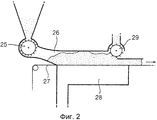
Согласно особенно предпочтительному варианту выполнения, процесс распутывания содержит подачу собранного полотна на по меньшей мере один ролик, который вращается вокруг его продольной оси и имеет шипы, выступающие из его периферийной поверхности. В этом варианте выполнения, вращающийся ролик будет обычно также способствовать по меньшей мере частично более высокому относительному потоку воздуха. Часто вращение ролика является единственным источником более высокого относительного потока воздуха.According to a particularly preferred embodiment, the unraveling process comprises feeding the assembled web to at least one roller that rotates around its longitudinal axis and has spikes protruding from its peripheral surface. In this embodiment, the rotating roller will usually also contribute at least partially to a higher relative air flow. Often, roller rotation is the only source of higher relative airflow.
В некоторых вариантах выполнения имеются по меньшей мере два ролика. Эти ролики могут работать совместно или последовательно.In some embodiments, there are at least two rollers. These videos can work together or sequentially.
Ролик может иметь любой подходящий размер, но в предпочтительном варианте выполнения ролик имеет диаметр, основанный на самых наружных точках шипов, от 20 см до 80 см или более предпочтительно от 30 см до 70 см. Даже более предпочтительный диаметр составляет от 40 см до 60 см и наиболее предпочтительный от 45 см до 55 см.The roller may be of any suitable size, but in a preferred embodiment, the roller has a diameter based on the outermost points of the studs, from 20 cm to 80 cm or more preferably from 30 cm to 70 cm. An even more preferred diameter is from 40 cm to 60 cm and most preferred from 45 cm to 55 cm.
Ролик может вращаться с любой подходящей скоростью. Для наиболее предпочтительных вариантов выполнения подходящая скорость вращения для ролика составляет от 500 об/мин до 5000 об/мин, предпочтительно от 1000 об/мин до 4000 об/мин, более предпочтительно от 1500 об/мин до 3500 об/мин, наиболее предпочтительно от 2000 об/мин до 3000 об/мин.The roller can rotate at any suitable speed. For the most preferred embodiments, a suitable rotation speed for the roller is from 500 rpm to 5000 rpm, preferably from 1000 rpm to 4000 rpm, more preferably from 1500 rpm to 3500 rpm, most preferably from 2000 rpm to 3000 rpm
Размеры и скорость вращения ролика могут быть выбраны для обеспечения заданной скорости на периферии ролика. В общем, высокая скорость будет приводить к более эффективному процессу распутывания, хотя это будет зависеть от типа используемого полотна минеральных волокон и точной формы ролика. В наиболее предпочтительных вариантах выполнения это будет подходящим для самых наружных точек шипов ролика для перемещения со скоростью от 20 м/с 150 м/с, предпочтительно от 30 м/с до 120 м/с, более предпочтительно от 40 м/с до 80 м/с и наиболее предпочтительно от 50 м/с до 70 м/с.The dimensions and speed of rotation of the roller can be selected to provide a given speed on the periphery of the roller. In general, high speed will lead to a more efficient unraveling process, although this will depend on the type of mineral fiber web used and the exact shape of the roller. In the most preferred embodiments, this will be suitable for the outermost points of the roller studs to travel at a speed of 20 m / s 150 m / s, preferably 30 m / s to 120 m / s, more preferably 40 m / s to 80 m / s and most preferably from 50 m / s to 70 m / s.
Ролик предпочтительно размещен внутри по существу цилиндрической камеры. Камера будет иметь впуск, через который минеральные волокна и возможно связующее вещество подаются на ролик. Камера также будет иметь выпуск, через который распутанные минеральные волокна и возможно связующее вещество выпускаются. Предпочтительно, они выпускаются в первичном потоке воздуха через выпуск.The roller is preferably placed inside a substantially cylindrical chamber. The chamber will have an inlet through which mineral fibers and possibly a binder are fed to the roller. The chamber will also have an outlet through which untangled mineral fibers and possibly a binder are discharged. Preferably, they are discharged in the primary air stream through the outlet.
В предпочтительных вариантах выполнения минеральные волокна и возможно связующее вещество подаются на ролик сверху, также предпочтительно для распутанных минеральных волокон и возможно связующего вещества быть отброшенными от ролика латерально от нижней части его периферии. В наиболее предпочтительном варианте выполнения, минеральные волокна переносятся приблизительно на 180 градусов роликом прежде, чем быть отброшенными.In preferred embodiments, the mineral fibers and possibly the binder are fed to the roller from above, it is also preferable for the untangled mineral fibers and possibly the binder to be thrown laterally from the roller from the bottom of its periphery. In the most preferred embodiment, the mineral fibers are transported approximately 180 degrees by the roller before being discarded.
Ролик предпочтительно занимает большую часть камеры. Предпочтительно, кончики шипов составляют менее 10 см, более предпочтительно менее 7 см и наиболее предпочтительно менее 4 см от изогнутой стенки по существу цилиндрической камеры. Это приводит к нарастающему потоку воздуха, создаваемому роликом, и более тщательному распутыванию волокон потоком воздуха и самими шипами.The roller preferably occupies most of the chamber. Preferably, the tips of the spikes are less than 10 cm, more preferably less than 7 cm and most preferably less than 4 cm from the curved wall of the substantially cylindrical chamber. This leads to an increasing air flow created by the roller and more thorough unraveling of the fibers by the air flow and the spikes themselves.
Предпочтительно, минеральные волокна подают на ролик сверху.Preferably, the mineral fibers are fed to the roller from above.
Распутанные волокна в общем отбрасываются от ролика в первичном потоке воздуха. В некоторых вариантах выполнения ролик будет способствовать первичному потоку воздуха. В других вариантах выполнения ролик будет единственным источником первичного потока воздуха.Untangled fibers are generally discarded from the roller in the primary air stream. In some embodiments, the roller will facilitate primary airflow. In other embodiments, the roller will be the sole source of primary air flow.
Согласно изобретению волокна суспендируют в первичном потоке воздуха. Преимущество суспендирования в потоке воздуха заключается в том, что нежелательные частицы или скопления могут быть просеяны. Такими частицами являются, например, зерна волокон и скопления, например, в числе прочего, тяжелых кусков ваты, которые не были должным образом разрыхлены до волокон, например, так называемой жевательной резинки.According to the invention, the fibers are suspended in a primary stream of air. The advantage of suspending in an air stream is that unwanted particles or accumulations can be sieved. Such particles are, for example, grain grains and clusters, for example, among other things, heavy pieces of cotton wool that have not been properly loosened to fibers, for example, the so-called chewing gum.
Первичный поток воздуха в общем не свободен от турбулентности. В предпочтительных вариантах выполнения имеется значительная турбулентность в пределах первичного потока воздуха, так как это повышает разрыхление пучков волокон и может улучшать просеивание нежелательных частиц и скоплений. Согласно настоящему изобретению, скорость первичного потока воздуха в его источнике составляет предпочтительно от 20 м/с до 150 м/с, более предпочтительно от 30 м/с до 120 м/с, даже более предпочтительно от 40 м/с до 80 м/с и наиболее предпочтительно от 50 м/с до 70 м/с.The primary air flow is generally not free of turbulence. In preferred embodiments, there is significant turbulence within the primary air flow, as this increases the loosening of the fiber bundles and can improve the screening of unwanted particles and clusters. According to the present invention, the speed of the primary air flow in its source is preferably from 20 m / s to 150 m / s, more preferably from 30 m / s to 120 m / s, even more preferably from 40 m / s to 80 m / s and most preferably from 50 m / s to 70 m / s.
Первичный поток воздуха предпочтительно входит в просеивающую камеру. В просеивающей камере турбулентность в пределах первичного потока воздуха обеспечивает более плотные просеиваемые частицы на дне камеры и повышает разрыхление пучков волокон.The primary air stream preferably enters the sieving chamber. In a sifting chamber, turbulence within the primary air stream provides denser sifting particles at the bottom of the chamber and increases the loosening of the fiber bundles.
Для того, чтобы добиться тщательного просеивания волокон, предпочтительно выполнять устройство так, что среднее время пребывания волокон внутри просеивающей камеры составляет по меньшей мере 0,5 с, более предпочтительно по меньшей мере 2 с, или даже по меньшей мере 3 с.In order to achieve a thorough sieving of the fibers, it is preferable to design the device so that the average residence time of the fibers inside the sieving chamber is at least 0.5 s, more preferably at least 2 s, or even at least 3 s.
Однако, обычно необязательно, чтобы среднее время пребывания волокон внутри просеивающей камеры было больше 10 с. Еще чаще среднее время пребывания менее 7 с и чаще всего среднее время пребывания менее 5 с.However, it is usually not necessary that the average residence time of the fibers within the sieving chamber is greater than 10 s. Even more often, the average residence time is less than 7 s and most often the average residence time is less than 5 s.
Температура внешней среды внутри просеивающей камеры при использовании часто составляет от 20°C до 100°C, еще чаще от 30°C до 70°C. Температура может находиться в зависимости от температуры наружного воздуха, т.е. холодной зимой и горячей летом. Повышенные температуры до 100°C могут использоваться для обеспечения предварительного отверждения связующего вещества в просеивающей камере.The ambient temperature inside the sieving chamber when used is often from 20 ° C to 100 ° C, more often from 30 ° C to 70 ° C. The temperature may depend on the outdoor temperature, i.e. cold winters and hot summers. Elevated temperatures up to 100 ° C can be used to provide preliminary curing of the binder in the sieving chamber.
В определенных вариантах выполнения связующее вещество представляет собой материал, который при определенных условиях сохнет, твердеет и становится отвержденным. Для удобства эти и подобные им такие процессы называются здесь "отверждением". Предпочтительно, эти процессы "отверждения" необратимы и приводят к связному композитному материалу.In certain embodiments, the binder is a material that, under certain conditions, dries, hardens and becomes cured. For convenience, these and similar processes are referred to herein as “curing." Preferably, these “cure” processes are irreversible and result in a cohesive composite material.
Могут быть применены неорганические, а также органические связующие вещества. Органические связующие вещества предпочтительны. Дополнительно, могут быть использованы сухие связующие материалы, а также жидкие связующие вещества. Конкретные примеры материалов связующего вещества включают, но не ограничиваются ими, фенолформальдегидное связующее вещество, мочевиноформальдегидное связующее вещество, фенольно-мочевино-формальдегидное связующее вещество, меламинформальдегидное связующее вещество, конденсационные смолы акрилаты и другие латексные композиции, эпоксидные полимеры, силикат натрия, расплавы полиуретана, полиэтилен, полипропилен и полимеры политетрафторэтилена и т.д.Inorganic as well as organic binders can be used. Organic binders are preferred. Additionally, dry binder materials as well as liquid binders can be used. Specific examples of binder materials include, but are not limited to, phenol-formaldehyde binder, urea-formaldehyde binder, phenol-urea-formaldehyde binder, melamine-formaldehyde binder, condensation resins acrylates and other latex compositions, epoxy polymers, sodium silicate, polyurethane melts, polyurethane , polypropylene and polytetrafluoroethylene polymers, etc.
В варианте выполнения используется сухое связующее вещество. Любое подходящее сухое связующее вещество может быть использовано, но предпочтительно использовать фенолформальдегидное связующее вещество, так как этот тип связующего вещества легко доступен и доказал свою эффективность. Может быть преимуществом использование сухого связующего вещества, так как в некоторых случаях смешивание может быть легким, и, дополнительно, необходимость для обслуживания оборудования низка. Дополнительно, связующее вещество относительно стабильно и сохраняемо.In an embodiment, a dry binder is used. Any suitable dry binder may be used, but it is preferable to use a phenol-formaldehyde binder, as this type of binder is readily available and has been shown to be effective. The use of a dry binder may be an advantage, since in some cases mixing can be easy, and, additionally, the need for maintenance of the equipment is low. Additionally, the binder is relatively stable and retained.
Согласно альтернативному варианту выполнения используется жидкое связующее вещество. Жидкие связующие вещества имеют преимущество низкой стоимости по сравнению с сухими связующими веществами, и часто возможно уменьшать количество связующего вещества, используя жидкие связующие вещества по сравнению с сухими связующими веществами. Уменьшение количества связующего вещества дополнительно приводит к лучшему противодействию композитного материала огню. Любое подходящее жидкое связующее вещество может быть использовано, но предпочтительно использовать фенолформальдегидное связующее вещество, так как этот тип связующего вещества легко доступен и доказал свою эффективность.According to an alternative embodiment, a liquid binder is used. Liquid binders have the advantage of low cost compared to dry binders, and it is often possible to reduce the amount of binder using liquid binders compared to dry binders. Reducing the amount of binder additionally leads to a better reaction of the composite material to fire. Any suitable liquid binder may be used, but it is preferable to use a phenol-formaldehyde binder, as this type of binder is readily available and has been shown to be effective.
Связующее вещество может быть смешано с минеральными волокнами до, во время или после процесса распутывания. В некоторых вариантах выполнения, в особенности, когда связующее вещество является жидким, предпочтительно смешивать связующее вещество с волокнами до процесса распутывания. В частности, волокна могут иметь вид неотвержденного собранного полотна, содержащего жидкое связующее вещество.The binder can be mixed with mineral fibers before, during or after the unraveling process. In some embodiments, especially when the binder is liquid, it is preferable to mix the binder with the fibers prior to the unraveling process. In particular, the fibers may take the form of an uncured assembled web containing a liquid binder.
Когда используется сухое связующее вещество, оно может, например, быть предварительно смешано с собранным полотном минеральных волокон до процесса распутывания. Дополнительно, смешивание может происходить во время и после процесса распутывания. Альтернативно оно может быть подано в первичный поток воздуха отдельно и смешано в первичном потоке воздуха.When a dry binder is used, it can, for example, be premixed with the assembled mineral fiber web prior to the unraveling process. Additionally, mixing may occur during and after the unraveling process. Alternatively, it may be separately fed into the primary air stream and mixed in the primary air stream.
Минеральные волокна и связующее вещество при суспендировании в первичном потоке воздуха в некоторых вариантах выполнения подвергаются воздействию дополнительного потока воздуха в другом направлении к первичному потоку воздуха. Это помогает создавать дополнительную турбулентность в первичном потоке воздуха, которая содействует смешиванию, просеиванию и разрыхлению пучков волокон. Обычно первичный поток воздуха в общем является латеральным, и дополнительный поток воздуха в общем является восходящим. В некоторых вариантах выполнения обеспечено множество дополнительных потоков воздуха.Mineral fibers and a binder, when suspended in the primary air stream in some embodiments, are exposed to an additional air stream in the other direction to the primary air stream. This helps create additional turbulence in the primary air stream, which helps to mix, sift and loosen the fiber bundles. Typically, the primary air flow is generally lateral, and the additional air flow is generally upward. In some embodiments, many additional air flows are provided.
Предпочтительно дополнительный поток воздуха имеет скорость 0,1-20 м/с, более предпочтительно от 0,1 до 10 м/с, все же более предпочтительно от 0,2 до 7 м/с, наиболее предпочтительно от 1 до 3 м/с.Preferably, the additional air flow has a speed of 0.1-20 m / s, more preferably 0.1 to 10 m / s, yet more preferably 0.2 to 7 m / s, most preferably 1 to 3 m / s .
Смесь минеральных волокон и связующего вещества собирается из первичного потока воздуха любыми подходящими средствами. В одном варианте выполнения первичный поток воздуха направляется в верхнюю часть циклонной камеры, которая открыта на ее нижнем конце, и смесь собирается с нижнего конца циклонной камеры.A mixture of mineral fibers and a binder is collected from the primary air stream by any suitable means. In one embodiment, the primary air flow is directed to the top of the cyclone chamber, which is open at its lower end, and the mixture is collected from the lower end of the cyclone chamber.
В альтернативном варианте выполнения первичный поток воздуха направляется через перфорированную поверхность, которая улавливает смесь, так как поток воздуха проходит насквозь.In an alternative embodiment, the primary air stream is directed through a perforated surface that traps the mixture, as the air stream passes through.
Предпочтительно, смесь минеральных волокон и связующего вещества подвергается дополнительному процессу распутывания волокна после того, как смесь суспендирована в первичном потоке воздуха, но до того, как смесь сжимается и отверждается.Preferably, the mixture of mineral fibers and a binder is subjected to an additional process of unraveling the fiber after the mixture is suspended in the primary stream of air, but before the mixture is compressed and cured.
Дополнительный процесс распутывания может иметь любой из предпочтительных признаков процесса распутывания, описанного ранее.The additional unraveling process may have any of the preferred features of the unraveling process described previously.
В особенно предпочтительном способе смесь минеральных волокон и связующего вещества удаляют из первичного потока воздуха, предпочтительно в циклонную камеру, и подают на вращающийся ролик, имеющий шипы, выступающие из его периферийной поверхности. Ролик дополнительных средств распутывания может иметь любой из признаков, описанных выше, относительно ролика, к которому собранное полотно может быть подано первоначально.In a particularly preferred method, the mixture of mineral fibers and a binder is removed from the primary air stream, preferably into a cyclone chamber, and fed to a rotating roller having spikes protruding from its peripheral surface. The roll of additional disentangling means may have any of the features described above with respect to the roll to which the assembled web may be fed initially.
Смесь минеральных волокон и связующего вещества предпочтительно отбрасывают из дополнительного процесса распутывания в камеру формования.The mixture of mineral fibers and a binder is preferably discarded from the further unraveling process into the molding chamber.
Подвергнувшись дополнительному процессу распутывания, смесь минеральных волокон и связующего вещества собирают, прессуют и отверждают. Предпочтительно, смесь собирают на перфорированной конвейерной ленте, имеющей средства всасывания, размещенные под ней.Having undergone an additional process of unraveling, a mixture of mineral fibers and a binder is collected, pressed and cured. Preferably, the mixture is collected on a perforated conveyor belt having suction means disposed beneath it.
В предпочтительном способе согласно изобретению смесь связующего вещества и минеральных волокон, будучи собранной, просеивают до отверждения и прессования.In a preferred method according to the invention, the mixture of the binder and the mineral fibers, when collected, is sieved before curing and pressing.
Способ может быть выполнен как периодический процесс, однако согласно варианту выполнения способ выполняется на линии по производству минеральной ваты, подающей первичное или вторичное полотно минеральной ваты в процесс отделения волокна, который обеспечивает особенно экономически эффективный и универсальный способ обеспечения композитных материалов, имеющих подходящие механические свойства и теплоизоляционные свойства в широком диапазоне плотностей.The method can be performed as a batch process, however, according to an embodiment, the method is performed on a mineral wool production line supplying a primary or secondary mineral wool web to a fiber separation process, which provides a particularly cost-effective and universal way of providing composite materials having suitable mechanical properties and thermal insulation properties in a wide range of densities.
Согласно специальному варианту выполнения способ выполняется как непрерывный процесс на линии по производству минеральной ваты.According to a special embodiment, the method is performed as a continuous process on a mineral wool production line.
Как только смесь минеральных волокон и связующего вещества собрана, она сжимается и отверждается для производства элемента требуемой плотности.Once a mixture of mineral fibers and a binder is assembled, it is compressed and cured to produce an element of the required density.
Давление, температура и время удержания для отверждения и прессования зависят, в числе прочего, от типа используемого связующего вещества.The pressure, temperature and retention time for curing and pressing depend, inter alia, on the type of binder used.
Аспект изобретения относится к элементу, содержащему минеральное волокно, получаемое способом изобретения.An aspect of the invention relates to an element containing mineral fiber obtained by the method of the invention.
Элемент предпочтительно является по существу гомогенным.The element is preferably substantially homogeneous.
Под формулировкой "по существу гомогенный" следует понимать, что композитный материал является гомогенным в миллиметровом масштабе, т.е. в микроскопе площадь, например, 1 мм2 (по существу) идентична другим образцам смеси.By the phrase “substantially homogeneous” it should be understood that the composite material is homogeneous on a millimeter scale, i.e. under a microscope, an area of, for example, 1 mm 2 is (essentially) identical to other samples of the mixture.
Устройство, подходящее для осуществления способа изобретения, содержит:A device suitable for implementing the method of the invention comprises:
устройство формования минерального волокна для осуществления подачи волокон, вовлеченных в воздухе,mineral fiber forming apparatus for feeding fibers involved in air,
устройство подачи связующего вещества для подачи связующего вещества к волокнам,a binder supply device for supplying a binder to the fibers,
первый коллектор, выполненный с возможностью приема волокон от устройства формования волокна,a first collector configured to receive fibers from a fiber forming apparatus,
устройство всасывания для применения всасывания через коллектор и тем самым сбора волокон на коллекторе в виде полотна,a suction device for applying suction through the collector and thereby collecting fibers on the collector in the form of a web,
устройство распутывания для распутывания полотна для обеспечения распутанных волокон,unraveling device for unraveling the web to provide untangled fibers,
устройство подачи полотна для подачи полотна в устройство распутывания,web feeder for feeding the web into an unraveling device,
устройство подачи воздуха для подачи первичного потока воздуха, в котором суспендируют распутанные минеральные волокна,an air supply device for supplying a primary air stream in which untangled mineral fibers are suspended,
второй коллектор для сбора распутанных минеральных волокон и связующего вещества,a second collector for collecting untangled mineral fibers and a binder,
и пресс для прессования собранных распутанных минеральных волокон и связующего вещества.and a press for compressing the collected untangled mineral fibers and a binder.
Устройство формования минерального волокна может быть любым устройством, подходящим для этого, например, каскадной прядильной машиной или прядильной чашкой. В предпочтительных вариантах выполнения устройства устройство формования минерального волокна представляет собой каскадную прядильную машину. В каждом случае подают минеральный расплав, и волокна изготавливают под действием центробежной силы устройства.The mineral fiber spinning device may be any device suitable for this, for example, a cascade spinning machine or spinning cup. In preferred embodiments of the apparatus, the mineral fiber forming apparatus is a cascade spinning machine. In each case, a mineral melt is supplied, and the fibers are made by the centrifugal force of the device.
Устройства подачи связующего вещества подают связующее вещество к минеральным волокнам. Они могут быть размещены в любой точке до второго коллектора, но предпочтительно размещены между устройством формования волокна и первым коллектором. В другом варианте выполнения устройства подачи связующего вещества размещены между первым коллектором и вторым коллектором. В другом предпочтительном варианте выполнения устройства подачи связующего вещества размещены между первым коллектором и средствами распутывания.Binder feeders supply the binder to the mineral fibers. They can be placed at any point up to the second collector, but are preferably placed between the fiber splicer and the first collector. In another embodiment, a binder supply device is disposed between the first collector and the second collector. In another preferred embodiment, binder feeders are placed between the first collector and the disentangling means.
Устройства подачи связующего вещества могут быть выполнены с возможностью подачи жидкого связующего вещества или подачи сухого связующего вещества.Binder supply devices may be configured to supply a liquid binder or to supply a dry binder.
Первый коллектор находится предпочтительно в форме первой конвейерной ленты, работающей в непрерывном режиме. Лента пропускает воздух. Волокна образуют первичное полотно на ленте. Средства всасывания размещены сзади первого коллектора, для обеспечения потока воздуха через коллектор.The first collector is preferably in the form of a first continuous conveyor belt. The tape passes air. The fibers form the primary web on the tape. Suction means are located at the rear of the first collector to allow air to flow through the collector.
Устройство возможно может содержать средства для очистки первичного полотна любым способом, известным специалисту в области техники. Например, устройство может содержат маятниковую ленту для перекрывания первичного полотна на дополнительной конвейерной ленте, работающей в непрерывном режиме, для образования вторичного полотна минерального волокна.The device may possibly contain means for cleaning the primary web in any way known to a person skilled in the art. For example, the device may comprise a pendulum belt for covering the primary web on an additional continuous conveyor belt to form a secondary mineral fiber web.
Предпочтительно, что первый коллектор находится в форме конвейерной ленты, ведущей к впускному трубопроводу. Впускной трубопровод может иметь конвейерные ролики на его верхнем крае, чтобы содействовать перемещению минеральных волокон через впускной трубопровод.Preferably, the first manifold is in the form of a conveyor belt leading to the inlet pipe. The inlet pipe may have conveyor rollers at its upper edge to facilitate the movement of mineral fibers through the inlet pipe.
Между первым коллектором и устройством распутывания может иметься по существу вертикальный трубопровод. Часто по существу вертикальный трубопровод будет находиться уже не на его нижнем конце, а на его верхнем конце.A substantially vertical conduit may be provided between the first collector and the unraveling device. Often, a substantially vertical pipeline will no longer be at its lower end, but at its upper end.
Устройство содержит средства распутывания для распутывания первичного или вторичного полотна для образования распутанных волокон. Устройство распутывания может иметь первый трубопровод для переноса первичного или вторичного полотна и второй трубопровод, примкнутый к первому трубопроводу. В этом случае устройство распутывания содержит средства для подачи потока воздуха во второй трубопровод с более высокой скоростью, чем представлена в первом трубопроводе.The device comprises unraveling means for unraveling the primary or secondary web to form entangled fibers. The unraveling device may have a first pipe for transferring the primary or secondary web and a second pipe adjacent to the first pipe. In this case, the unraveling device comprises means for supplying an air stream to the second pipe at a higher speed than that presented in the first pipe.
В частности, средства распутывания могут иметь форму ролика, как описано относительно способа изобретения.In particular, the disentangling means may be in the form of a roller, as described with respect to the method of the invention.
Более того, устройство может содержать цилиндрическую камеру, которая вмещает ролик, как описано относительно способа изобретения.Moreover, the device may comprise a cylindrical chamber that accommodates a roller, as described with respect to the method of the invention.
Устройство также требует средства подачи воздуха для подачи первичного потока воздуха. Эти средства подачи воздуха могут быть образованы как часть устройства распутывания. Например, средствами подачи потока воздуха во второй трубопровод с более высокой скоростью, чем представлена в первом трубопроводе, также может быть устройство подачи первичного потока воздуха.The device also requires air supply means for supplying a primary air stream. These air supply means may be formed as part of an unraveling device. For example, means for supplying an air stream to the second pipe at a higher rate than that presented in the first pipe may also be a primary air stream supply device.
Также возможно для ролика действовать в качестве средств создания самого первичного потока воздуха, когда он создает поток распутанных минеральных волокон, суспендированных в потоке воздуха.It is also possible for the roller to act as a means of creating the primary air stream itself when it creates a stream of untangled mineral fibers suspended in the air stream.
В устройстве дополнительные средства подачи потока воздуха могут быть представлены для подачи дополнительного потока воздуха в первичный поток воздуха.In the device, additional means of supplying an air stream may be provided for supplying an additional air stream to the primary air stream.
Устройство может содержать просеивающую камеру, как описано относительно способа изобретения. Дополнительные средства подачи потока воздуха, когда представлены, предпочтительно размещены на нижнем конце просеивающей камеры и выполнены для подачи восходящего потока воздуха внутри просеивающей камеры. Средства подачи первичного потока воздуха предпочтительно размещены на стороне просеивающей камеры и выполнены с возможностью подачи потока воздуха латерально поперечно камере.The device may comprise a screening chamber as described with respect to the method of the invention. Additional air supply means, when present, are preferably located at the lower end of the screening chamber and are configured to supply an upward flow of air within the screening chamber. The primary air supply means are preferably arranged on the side of the screening chamber and are configured to supply an air stream laterally transverse to the chamber.
Когда представлены, дополнительные средства подачи потока воздуха могут иметь сетку, расположенную поперечно его отверстию для предотвращения попадания твердых материалов.When presented, additional means of supplying air flow may have a grid located transverse to its opening to prevent the ingress of solid materials.
На нижнем конце просеивающей камеры имеется предпочтительно разгрузочное отверстие, в которое падают тяжелые пеллеты или уплотненные волокна.At the lower end of the screening chamber, there is preferably a discharge opening into which heavy pellets or compacted fibers fall.
Предпочтительно, что минеральные волокна и связующее вещество входят в просеивающую камеру вместе на одной стороне, суспендированными в первичном потоке воздуха. Смесь далее выдувают кверху и затем смешивают дополнительными средствами подачи воздуха, размещенными на нижнем конце камеры. Смесь далее покидает просеивающую камеру с помощью трубопровода удаления на верхнем конце просеивающей камеры.Preferably, the mineral fibers and the binder enter the screening chamber together on one side, suspended in the primary air stream. The mixture is further blown up and then mixed with additional air supply means located at the lower end of the chamber. The mixture then leaves the sieving chamber using a removal line at the upper end of the sieving chamber.
Трубопровод удаления приводит в итоге во второй коллектор. Этот коллектор может иметь форму перфорированной ленты, сзади которой размещены средства всасывания.The removal pipeline results in a second collector. This collector may be in the form of a perforated tape, on the back of which there are suction means.
Альтернативно, средства сбора могут содержать циклонную камеру, способную к отделению смеси минеральных волокон от первичного потока воздуха. В этом варианте выполнения циклонная камера имеет отверстие на его нижнем конце, через которое смесь извлекают, при этом поток воздуха удаляют через трубопровод на верхнем конце. Циклонная камера имеет больший диаметр на ее верхнем конце, чем на ее нижнем конце.Alternatively, the collection means may comprise a cyclone chamber capable of separating the mixture of mineral fibers from the primary air stream. In this embodiment, the cyclone chamber has an opening at its lower end, through which the mixture is removed, while the air flow is removed through a pipe at the upper end. The cyclone chamber has a larger diameter at its upper end than at its lower end.
В одном варианте выполнения смесь извлекают из циклонной камеры на конвейерную ленту.In one embodiment, the mixture is removed from the cyclone chamber onto a conveyor belt.
Предпочтительно имеется дополнительное устройство распутывания, выполненное с возможностью приема смеси минеральных волокон и связующего вещества. Дополнительное устройство распутывания может иметь любой из предпочтительных признаков, описанных относительно устройства распутывания для распутывания собранного полотна минеральных волокон.Preferably there is an additional disentangling device configured to receive a mixture of mineral fibers and a binder. The additional unraveling device may have any of the preferred features described with respect to the unraveling device for unraveling the assembled mineral fiber web.
Предпочтительно, дополнительное устройство распутывания выполнено с возможностью приема смеси минеральных волокон и связующего вещества из отверстия на нижнем конце циклонной камеры.Preferably, the additional disentanglement device is adapted to receive a mixture of mineral fibers and a binder from an opening at the lower end of the cyclone chamber.
Предпочтительно, имеется камера формования, выполненная с возможностью приема волокон и связующего вещества из дополнительного устройства распутывания. Предпочтительно, камера формования содержит перфорированную конвейерную ленту для сбора смеси минеральных волокон и связующего вещества.Preferably, there is a forming chamber configured to receive fibers and a binder from an additional disentangling device. Preferably, the molding chamber comprises a perforated conveyor belt for collecting a mixture of mineral fibers and a binder.
Предпочтительно обеспечивать средства обдирания до пресса. Устройство может быть выполнено с возможностью переработки ободранного материала.It is preferable to provide peeling means to the press. The device can be arranged to process peeled material.
Устройство, подходящее для осуществления способа изобретения, содержит пресс для прессования и отверждения собранной смеси минеральных волокон и связующего вещества. Пресс пригоден для прессования элемента до плотности от 120 кг/м3 до 1000 кг/м3, например 170-1000 кг/м3. В общем, пресс выполнен с возможностью нагревания элемента для того, чтобы отверждать связующее вещество.A device suitable for carrying out the method of the invention comprises a press for pressing and curing the collected mixture of mineral fibers and a binder. The press is suitable for pressing an element to a density of 120 kg / m 3 to 1000 kg / m 3 , for example 170-1000 kg / m 3 . In general, the press is configured to heat the element in order to cure the binder.
Изобретение будет описано далее путем примера и со ссылкой на чертежи, на которых:The invention will be described further by way of example and with reference to the drawings, in which:
Фиг. 1 представляет собой схематический чертеж устройства для отделения волокна и смешивания исходных материалов.FIG. 1 is a schematic drawing of a device for separating fiber and mixing raw materials.
Фиг. 2 представляет собой схематический чертеж дополнительного устройства распутывания, как описано выше.FIG. 2 is a schematic drawing of an additional disentangling device as described above.
Устройство, подходящее для использования в способе настоящего изобретения, можно увидеть на Фиг. 1, где устройство формования волокна и коллектор выполнены с возможностью переноса полотна минерального волокна в впускной трубопровод 1, причем устройства подачи связующего вещества выполнены с возможностью подачи связующего вещества к минеральным волокнам в впускной трубопровод.A device suitable for use in the method of the present invention can be seen in FIG. 1, where the fiber forming apparatus and the collector are configured to transfer a mineral fiber web to the inlet pipe 1, the binder supply devices being configured to feed the binder to the mineral fibers in the inlet pipe.
Устройство содержит впускной трубопровод 1 для исходных материалов, например, связующего вещества и минеральных волокон, и для определенных исходных материалов устройство может содержать измельчитель (не показан) в впускном трубопроводе 1 для по меньшей мере частичной разрезки объемного материала. На нижнем краю впускного трубопровода имеется конвейер 2, который переносит исходные материалы через впускной трубопровод 1. На верхнем краю впускного трубопровода конвейерные ролики 3 содействуют подаче исходных материалов через впускной трубопровод 1. На конце впускного трубопровода 1 первый набор взаимно разнесенных вытянутых элементов 4 продолжается поперечно концу впускного трубопровода 1. Это используется для того, чтобы измельчать большие куски исходных материалов, например, полотна минерального волокна. В некоторых вариантах выполнения вытянутые элементы 4 имеют форму вращательных щеток, которые протягивают исходные материалы между ними, когда они вращаются.The device comprises an inlet pipe 1 for raw materials, for example, a binder and mineral fibers, and for certain starting materials, the device may include a shredder (not shown) in the inlet pipe 1 for at least partially cutting the bulk material. On the lower edge of the inlet pipe there is a conveyor 2, which transfers the raw materials through the inlet pipe 1. At the upper edge of the inlet pipe, the conveyor rollers 3 facilitate the supply of raw materials through the inlet pipe 1. At the end of the inlet pipe 1, the first set of mutually spaced elongated elements 4 extends laterally to the end inlet pipe 1. This is used to grind large pieces of raw materials, such as mineral fiber web. In some embodiments, elongated elements 4 are in the form of rotational brushes that stretch the raw materials between them when they rotate.
Исходные материалы, которые проходят через конец впускного трубопровода далее падают вниз в по существу вертикальный трубопровод 5. В показанном варианте выполнения второй набор взаимно разнесенных вытянутых элементов 6 продолжается поперечно верхнему концу трубопровода. Второй набор вытянутых элементов обычно более близко разнесен, чем первый. В показанном варианте выполнения второй набор вытянутых элементов вращается так, чтобы позволять проходить достаточно небольшим кускам полотна минерального волокна, но уносить большие куски с помощью трубопровод 7 переработки исходного материала.Raw materials that pass through the end of the inlet pipe then fall downward into the substantially vertical pipe 5. In the shown embodiment, the second set of mutually spaced elongated elements 6 extends transversely to the upper end of the pipe. The second set of elongated elements is usually more closely spaced than the first. In the shown embodiment, the second set of elongated elements is rotated so as to allow sufficiently small pieces of the mineral fiber web to pass through, but to carry away large pieces using the feed processing pipe 7.
Вертикальный трубопровод 5 в общем становится уже на его нижнем конце. В показанном варианте выполнения нижний конец вертикального трубопровода образует впуск 8 в по существу цилиндрическую камеру 9. Как показано, впуск 8 находится на верхней части по существу цилиндрической камеры 9. При использовании исходные материалы проходят через вертикальный трубопровод 5 и через впуск 8 в цилиндрическую камеру 9.The vertical pipe 5 generally becomes narrower at its lower end. In the shown embodiment, the lower end of the vertical pipe forms an inlet 8 into the substantially cylindrical chamber 9. As shown, the inlet 8 is located on the upper part of the essentially cylindrical chamber 9. In use, the starting materials pass through the vertical pipe 5 and through the inlet 8 into the cylindrical chamber 9 .
В альтернативном варианте выполнения вертикальный трубопровод 5 исключается. Вместо этого подающий механизм обеспечен с возможностью подачи полотна волокон непосредственно в цилиндрическую камеру 9. Подающий механизм может, например, содержать конвейерную ленту и возможно один или более роликов подачи, расположенных для управляемого продвижения и направления полотна в цилиндрическую камеру 9.In an alternative embodiment, the vertical pipe 5 is excluded. Instead, the feed mechanism is provided with the ability to feed the fiber web directly into the cylindrical chamber 9. The feed mechanism may, for example, comprise a conveyor belt and possibly one or more feed rollers arranged to steer the web and guide the web into the cylindrical chamber 9.
Цилиндрическая камера 9 вмещает ролик 10, имеющий шипы 11, выступающие из его периферийной поверхности 12. Ролик 10, показанный на Фиг. 1, вращается против часовой стрелки, как показано на чертеже, так, что исходные материалы переносятся от впуска 8 вокруг левой стороны ролика 10, как показано, и отбрасываются латерально в первичном потоке воздуха в просеивающую камеру 14. Цилиндрическая камера 9 и ролик 10 вместе образуют средства распутывания.The cylindrical chamber 9 accommodates a roller 10 having spikes 11 protruding from its peripheral surface 12. The roller 10 shown in FIG. 1 rotates counterclockwise, as shown in the drawing, so that the starting materials are transferred from the inlet 8 around the left side of the roller 10, as shown, and are discarded laterally in the primary air stream into the sieving chamber 14. The cylindrical chamber 9 and the roller 10 together form unraveling agents.
Шипы могут быть постоянно прикреплены к ролику для оптимального сопротивления износу. Например, шипы могут быть прикреплены приклеиванием или привариванием шипов в глухих отверстиях, расположенных на внешней периферии ролика. Альтернативно шипы могут быть заменяемыми. Это может, например, быть достигнуто роликами, являющимися полыми цилиндрами со сквозными отверстиями в цилиндрической стенке. Далее шипы могут, например, иметь головку и вставляться через отверстия изнутри. Тем самым шипы могут быть заменены, если они сломаны или изношены. Дополнительно, при наличии заменяемых шипов возможно изменение образца шипов. Тем самым возможно оптимизировать образец для различных типов распутываемого материала, например свободных волокон из минеральной ваты, или собранного полотна из волокон минеральной ваты, пропитанного жидким связующим веществом.The studs can be permanently attached to the roller for optimal wear resistance. For example, the spikes can be attached by gluing or welding the spikes in blind holes located on the outer periphery of the roller. Alternative spikes may be interchangeable. This can, for example, be achieved by rollers being hollow cylinders with through holes in the cylindrical wall. Further, the spikes may, for example, have a head and are inserted through openings from the inside. Thus, the spikes can be replaced if they are broken or worn. Additionally, if there are replaceable studs, a change in the pattern of studs is possible. In this way, it is possible to optimize the sample for various types of entangled material, for example loose mineral wool fibers or assembled mineral wool fibers impregnated with a liquid binder.
В показанном варианте выполнения первичный поток воздуха создают вращением ролика 10 внутри цилиндрической камеры 9 и, в частности, перемещением шипов 11 и исходного материала через пространство между периферийной поверхностью ролика и изогнутой стенкой 13 цилиндрической камеры 9.In the shown embodiment, the primary air flow is created by rotating the roller 10 inside the cylindrical chamber 9 and, in particular, by moving the spikes 11 and the source material through the space between the peripheral surface of the roller and the curved wall 13 of the cylindrical chamber 9.
Просеивающая камера 14, показанная на Фиг. 1, содержит разгрузочное отверстие 16 и дополнительные средства 15 подачи потока воздуха. Дополнительные средства 15 подачи потока воздуха содержат отверстия, через которые подают дополнительный поток воздуха. Сетки 17 расположены поперечно отверстиям дополнительных средств 15 подачи потока воздуха. Эти сетки позволяют дополнительному потоку воздуха проходить в просеивающую камеру 14, но предназначены для предотвращения попадания материалов в средства подачи. Показанные дополнительные средства 15 подачи потока воздуха направляют дополнительный поток воздуха вверх в просеивающую камеру 14.The sieving chamber 14 shown in FIG. 1, contains a discharge opening 16 and additional means 15 for supplying an air stream. Additional means 15 for supplying an air stream contain openings through which an additional air stream is supplied. The mesh 17 is located transverse to the holes of the additional means 15 for supplying air flow. These grids allow an additional stream of air to pass into the screening chamber 14, but are designed to prevent materials from entering the supply means. The additional air flow means 15 shown are used to direct the additional air flow up into the sieving chamber 14.
Дополнительный поток воздуха встречает первичный поток воздуха, содержащий распутанные волокна в просеивающей камере. Дополнительный поток воздуха обладает эффектом переноса смеси распутанных волокон и связующего вещества вверх внутри просеивающей камеры 14. Некоторые более уплотненные волокна и зерна минерального материала не будут переноситься вверх внутри просеивающей камеры, но будут падать на нижний конец и через разгрузочное отверстие 16.An additional air stream meets the primary air stream containing the untangled fibers in the screening chamber. The additional air flow has the effect of transferring the mixture of untangled fibers and binder upward inside the sifting chamber 14. Some more densified fibers and grains of mineral material will not be transported upward inside the sifting chamber, but will fall on the lower end and through the discharge opening 16.
Требуемая смесь распутанных волокон и связующего вещества передается на верхнюю часть просеивающей камеры 14, где трубопровод 18 удаления выполнен с возможностью переноса смеси из просеивающей камеры 14. Первый трубопровод 19 переработки воздуха примыкает к трубопроводу 18 удаления и возвращает некоторое количество воздуха из трубопровода 18 удаления обратно в дополнительные средства 15 подачи воздуха.The desired mixture of untangled fibers and a binder is transferred to the top of the sieving chamber 14, where the removal pipe 18 is adapted to transfer the mixture from the sieving camera 14. The first air processing pipe 19 is adjacent to the removal pipe 18 and returns some air from the removal pipe 18 back to additional funds 15 air supply.
Трубопровод удаления ведет в циклонную камеру 20. Циклонная камера 20 имеет второй трубопровод 22 возврата воздуха, ведущий от его верхнего конца в дополнительные средства 15 подачи воздуха. Фильтр 21 примыкает ко второму трубопроводу возврата воздуха. При использовании фильтр 21 удаляет любые отдельные минеральные волокна и связующее вещество из второго трубопровода 22 возврата воздуха. Так как воздух удаляется из верхнего конца циклонной камеры 20, смесь распутанных волокон и связующего вещества падает через выпуск 23 циклонной камеры на нижнем конце циклонной камеры 20.The removal pipeline leads to the cyclone chamber 20. The cyclone chamber 20 has a second air return pipe 22 leading from its upper end to additional air supply means 15. The filter 21 is adjacent to the second air return line. In use, the filter 21 removes any individual mineral fibers and binder from the second air return duct 22. As air is removed from the upper end of the cyclone chamber 20, a mixture of untangled fibers and a binder falls through the outlet 23 of the cyclone chamber at the lower end of the cyclone chamber 20.
Коллектор 24 размещен ниже выпуска 23 циклонной камеры. В показанном варианте выполнения коллектор 24 находится в форме конвейера, который удерживает собранные волокна и связующее вещество для устройства прессования и отверждения (не показано).The collector 24 is located below the outlet 23 of the cyclone chamber. In the shown embodiment, the collector 24 is in the form of a conveyor that holds the collected fibers and a binder for a pressing and curing device (not shown).
Фиг. 2 показывает вариант выполнения дополнительного устройства распутывания, которое возможно может использоваться в способе. Дополнительное устройство распутывания может быть размещено на месте коллектора 24, как показано на Фиг. 1. Показанное дополнительное устройство распутывания содержит ролик 25, который является таким же как ролик 10 в конструкции. Смесь компонентов подают на ролик 25 сверху и отбрасывают в камеру 26 формования. На его нижнем конце камера 26 формования содержит перфорированную конвейерную ленту 27, ниже которой размещены средства 28 всасывания. Устройство 29 обдирания выполнено с возможностью обдирания верхней части смеси для обеспечения равномерной поверхности. Ободранный материал далее может быть возвращен.FIG. 2 shows an embodiment of an additional disentangling device, which may possibly be used in the method. An additional disentangling device may be placed in place of the manifold 24, as shown in FIG. 1. The optional unraveling device shown comprises a
Перфорированная конвейерная лента 27 переносит смесь к прессу (не показан).A
Claims (19)
обеспечивают минеральные волокна в количестве от 70 до менее 90 весовых % от общего веса исходных материалов в виде собранного полотна,
обеспечивают связующее вещество в количестве от более чем 10 до 30 весовых % от общего веса исходных материалов,
подвергают собранное полотно из волокон процессу распутывания,
суспендируют волокна в первичном потоке воздуха,
смешивают связующее вещество с минеральными волокнами до, во время или после процесса распутывания для образования смеси минеральных волокон и связующего вещества,
собирают смесь минеральных волокон и связующего вещества и прессуют, и отверждают смесь для обеспечения затвердевшего композитного материала с плотностью от 120 кг/м3 до 1000 кг/м3, например 170-1000 кг/м3.1. A method of manufacturing an element containing mineral fiber, comprising the steps of:
provide mineral fibers in an amount of from 70 to less than 90 weight% of the total weight of the starting materials in the form of a collected web,
provide a binder in an amount of more than 10 to 30 weight% of the total weight of the starting materials,
subjecting the assembled fiber web to an unraveling process,
suspend the fibers in the primary air stream,
mixing the binder with mineral fibers before, during or after the unraveling process to form a mixture of mineral fibers and a binder,
a mixture of mineral fibers and a binder is collected and pressed, and the mixture is cured to provide a hardened composite material with a density of 120 kg / m 3 to 1000 kg / m 3 , for example 170-1000 kg / m 3 .
связующее вещество вместе составляют по меньшей мере 96%, предпочтительно по меньшей мере 98% и более предпочтительно по существу все от общего веса исходных материалов.18. The method according to 17, in which the mineral fibers and
the binder together comprise at least 96%, preferably at least 98%, and more preferably substantially all of the total weight of the starting materials.
Applications Claiming Priority (3)
| Application Number | Priority Date | Filing Date | Title |
|---|---|---|---|
| EP11152672 | 2011-01-31 | ||
| EP11152672.9 | 2011-01-31 | ||
| PCT/EP2011/069777 WO2012103966A1 (en) | 2011-01-31 | 2011-11-09 | Method for manufacturing a mineral fibre-containing element and element produced by that method |
Publications (2)
| Publication Number | Publication Date |
|---|---|
| RU2542545C1 true RU2542545C1 (en) | 2015-02-20 |
| RU2013140473A RU2013140473A (en) | 2015-03-10 |
Family
ID=44152822
Family Applications (1)
| Application Number | Title | Priority Date | Filing Date |
|---|---|---|---|
| RU2013140473/12A RU2542545C1 (en) | 2011-01-31 | 2011-11-09 | Method of producing element containing mineral fibre and element produced thereof |
Country Status (10)
| Country | Link |
|---|---|
| US (1) | US9221965B2 (en) |
| EP (1) | EP2670901B1 (en) |
| DK (1) | DK2670901T3 (en) |
| ES (1) | ES2748001T3 (en) |
| HR (1) | HRP20191661T1 (en) |
| LT (1) | LT2670901T (en) |
| PL (1) | PL2670901T3 (en) |
| RU (1) | RU2542545C1 (en) |
| SI (1) | SI2670901T1 (en) |
| WO (1) | WO2012103966A1 (en) |
Cited By (1)
| Publication number | Priority date | Publication date | Assignee | Title |
|---|---|---|---|---|
| RU2772558C2 (en) * | 2017-05-11 | 2022-05-23 | Роквул Интернэшнл А/С | Binder for mineral wool |
Families Citing this family (4)
| Publication number | Priority date | Publication date | Assignee | Title |
|---|---|---|---|---|
| EP2941512A4 (en) * | 2012-12-31 | 2016-09-21 | Rockwool Int | Rigid insulating panel |
| CN105061979B (en) * | 2015-07-28 | 2017-04-12 | 苏州卫生职业技术学院 | Flexural anti-compression high polymer material and preparation method thereof |
| EP3135647A1 (en) * | 2015-08-28 | 2017-03-01 | Rockwool International A/S | Solid state binder |
| DE102020102541A1 (en) | 2020-01-31 | 2021-08-19 | Dieffenbacher GmbH Maschinen- und Anlagenbau | Mixing device for producing a mixture of mineral fibers and binding agents, installation for producing a mineral fiber mat and method for producing a mixture of mineral fibers and binding agents |
Citations (4)
| Publication number | Priority date | Publication date | Assignee | Title |
|---|---|---|---|---|
| US3792943A (en) * | 1970-10-14 | 1974-02-19 | Ingenjorsfa Ab | Dry fiber distribution |
| SU1006397A1 (en) * | 1981-10-19 | 1983-03-23 | Всесоюзный Научно-Исследовательский И Проектный Институт "Теплопроект" | Method and apparatus for cleaning mineral wool from beads |
| EP0371847A1 (en) * | 1988-12-01 | 1990-06-06 | Isover Saint-Gobain | Composite material based on mineral fibres, apparatus for making it and use of the composite material |
| EP1300511A2 (en) * | 2001-09-20 | 2003-04-09 | Armstrong World Industries, Inc. | Thermo formable acoustical panel |
Family Cites Families (15)
| Publication number | Priority date | Publication date | Assignee | Title |
|---|---|---|---|---|
| US2682085A (en) | 1949-09-24 | 1954-06-29 | Johns Manville | Apparatus for cleaning and opening fragile fibers |
| US3150025A (en) * | 1957-05-23 | 1964-09-22 | Owens Corning Fiberglass Corp | Apparatus for processing fibers |
| US3308945A (en) * | 1964-01-13 | 1967-03-14 | Wood Conversion Co | Method and apparatus for de-shotting and separating mineral fiber |
| US3422920A (en) * | 1965-07-01 | 1969-01-21 | Owens Corning Fiberglass Corp | Acoustical panels |
| US4024014A (en) * | 1975-12-15 | 1977-05-17 | Conwed Corporation | Non-combustible hardboard sheet |
| US4507197A (en) * | 1982-08-09 | 1985-03-26 | Jim Walter Corporation | Apparatus and method for producing shot-free mineral wool |
| FI83888C (en) * | 1988-02-17 | 1991-09-10 | Pargro Oy Ab | Process and apparatus for producing a fiber product |
| US5149920A (en) * | 1989-11-09 | 1992-09-22 | Fiber-Lite Corporation | Acoustical panel and method of making same |
| US5458960A (en) * | 1993-02-09 | 1995-10-17 | Roctex Oy Ab | Flexible base web for a construction covering |
| US6305920B1 (en) * | 1998-01-18 | 2001-10-23 | Boricel Corporation | Nonwoven fibrous product forming apparatus |
| US20070060005A1 (en) | 2001-09-06 | 2007-03-15 | Certainteed Corporation | Insulation product from rotary and textile inorganic fibers with improved binder component and method of making same |
| US20090252941A1 (en) | 2008-04-03 | 2009-10-08 | Usg Interiors, Inc. | Non-woven material and method of making such material |
| UA102327C2 (en) * | 2009-07-31 | 2013-06-25 | Роквул Интернешнл А/С | Method for manufacturing a mineral fiber-containing element, element produced by that method and apparatus for the production of element |
| AU2010277551B2 (en) * | 2009-07-31 | 2013-08-29 | Rockwool International A/S | Method for manufacturing an aerogel-containing composite and composite produced by that method |
| GB201012860D0 (en) * | 2010-07-30 | 2010-09-15 | Rockwool Int | Method for manufacturing a fibre-containing element and element produced by that method |
-
2011
- 2011-11-09 RU RU2013140473/12A patent/RU2542545C1/en active
- 2011-11-09 SI SI201131786T patent/SI2670901T1/en unknown
- 2011-11-09 DK DK11790735.2T patent/DK2670901T3/en active
- 2011-11-09 EP EP11790735.2A patent/EP2670901B1/en active Active
- 2011-11-09 PL PL11790735T patent/PL2670901T3/en unknown
- 2011-11-09 HR HRP20191661 patent/HRP20191661T1/en unknown
- 2011-11-09 LT LTEP11790735.2T patent/LT2670901T/en unknown
- 2011-11-09 ES ES11790735T patent/ES2748001T3/en active Active
- 2011-11-09 WO PCT/EP2011/069777 patent/WO2012103966A1/en not_active Ceased
- 2011-11-09 US US13/978,648 patent/US9221965B2/en active Active
Patent Citations (4)
| Publication number | Priority date | Publication date | Assignee | Title |
|---|---|---|---|---|
| US3792943A (en) * | 1970-10-14 | 1974-02-19 | Ingenjorsfa Ab | Dry fiber distribution |
| SU1006397A1 (en) * | 1981-10-19 | 1983-03-23 | Всесоюзный Научно-Исследовательский И Проектный Институт "Теплопроект" | Method and apparatus for cleaning mineral wool from beads |
| EP0371847A1 (en) * | 1988-12-01 | 1990-06-06 | Isover Saint-Gobain | Composite material based on mineral fibres, apparatus for making it and use of the composite material |
| EP1300511A2 (en) * | 2001-09-20 | 2003-04-09 | Armstrong World Industries, Inc. | Thermo formable acoustical panel |
Cited By (1)
| Publication number | Priority date | Publication date | Assignee | Title |
|---|---|---|---|---|
| RU2772558C2 (en) * | 2017-05-11 | 2022-05-23 | Роквул Интернэшнл А/С | Binder for mineral wool |
Also Published As
| Publication number | Publication date |
|---|---|
| LT2670901T (en) | 2019-09-25 |
| PL2670901T3 (en) | 2020-02-28 |
| US9221965B2 (en) | 2015-12-29 |
| US20140001676A1 (en) | 2014-01-02 |
| EP2670901B1 (en) | 2019-07-10 |
| DK2670901T3 (en) | 2019-09-30 |
| RU2013140473A (en) | 2015-03-10 |
| SI2670901T1 (en) | 2019-11-29 |
| ES2748001T3 (en) | 2020-03-12 |
| HRP20191661T1 (en) | 2019-12-13 |
| EP2670901A1 (en) | 2013-12-11 |
| WO2012103966A1 (en) | 2012-08-09 |
Similar Documents
| Publication | Publication Date | Title |
|---|---|---|
| CA2769370C (en) | Method for manufacturing a mineral fibre-containing element and element produced by that method | |
| US9238333B2 (en) | Method for manufacturing a fibre-containing element and element produced by that method | |
| CA2769352C (en) | Method for manufacturing an aerogel-containing composite and composite produced by that method | |
| RU2542545C1 (en) | Method of producing element containing mineral fibre and element produced thereof | |
| EP2598459B1 (en) | Method for manufacturing an aerogel-containing composite | |
| US9975270B2 (en) | Method for manufacturing an aerogel-containing composite and composite produced by that method | |
| RU2413677C1 (en) | System and method for producing mineral fibres | |
| EP0891307B1 (en) | Man-made vitrious fibre products and their production | |
| RU2554960C2 (en) | Method and device for removal of red-pulp from mineral fibrous material | |
| HUP9903346A2 (en) | Man-made vitreous fibre products and their production |