RU2440382C1 - Comb-like polymethylsiloxanes and synthesis method thereof - Google Patents
Comb-like polymethylsiloxanes and synthesis method thereof Download PDFInfo
- Publication number
- RU2440382C1 RU2440382C1 RU2010121535/04A RU2010121535A RU2440382C1 RU 2440382 C1 RU2440382 C1 RU 2440382C1 RU 2010121535/04 A RU2010121535/04 A RU 2010121535/04A RU 2010121535 A RU2010121535 A RU 2010121535A RU 2440382 C1 RU2440382 C1 RU 2440382C1
- Authority
- RU
- Russia
- Prior art keywords
- ppm
- polymethylsiloxanes
- comb
- nmr
- shaped
- Prior art date
Links
- -1 polymethylsiloxanes Polymers 0.000 title claims abstract description 46
- 238000001308 synthesis method Methods 0.000 title 1
- 238000000034 method Methods 0.000 claims abstract description 17
- KPUWHANPEXNPJT-UHFFFAOYSA-N disiloxane Chemical class [SiH3]O[SiH3] KPUWHANPEXNPJT-UHFFFAOYSA-N 0.000 claims abstract description 8
- 239000003960 organic solvent Substances 0.000 claims abstract description 5
- VLKZOEOYAKHREP-UHFFFAOYSA-N n-Hexane Chemical compound CCCCCC VLKZOEOYAKHREP-UHFFFAOYSA-N 0.000 claims description 30
- YXFVVABEGXRONW-UHFFFAOYSA-N Toluene Chemical compound CC1=CC=CC=C1 YXFVVABEGXRONW-UHFFFAOYSA-N 0.000 claims description 18
- 239000002904 solvent Substances 0.000 claims description 11
- IAZDPXIOMUYVGZ-UHFFFAOYSA-N Dimethylsulphoxide Chemical compound CS(C)=O IAZDPXIOMUYVGZ-UHFFFAOYSA-N 0.000 claims description 8
- 230000003993 interaction Effects 0.000 claims description 6
- 210000001520 comb Anatomy 0.000 claims 1
- 238000006243 chemical reaction Methods 0.000 abstract description 11
- 125000002496 methyl group Chemical group [H]C([H])([H])* 0.000 abstract description 3
- 239000000126 substance Substances 0.000 abstract description 3
- 229910007161 Si(CH3)3 Inorganic materials 0.000 abstract 1
- 229910052708 sodium Inorganic materials 0.000 abstract 1
- 239000011734 sodium Substances 0.000 abstract 1
- 125000000391 vinyl group Chemical group [H]C([*])=C([H])[H] 0.000 abstract 1
- 229920000642 polymer Polymers 0.000 description 36
- 238000005481 NMR spectroscopy Methods 0.000 description 27
- 229910052710 silicon Inorganic materials 0.000 description 17
- 239000000047 product Substances 0.000 description 11
- 239000002244 precipitate Substances 0.000 description 9
- 238000004519 manufacturing process Methods 0.000 description 8
- 238000002360 preparation method Methods 0.000 description 7
- VMHLLURERBWHNL-UHFFFAOYSA-M Sodium acetate Chemical compound [Na+].CC([O-])=O VMHLLURERBWHNL-UHFFFAOYSA-M 0.000 description 6
- 239000007788 liquid Substances 0.000 description 6
- 235000017281 sodium acetate Nutrition 0.000 description 6
- 239000001632 sodium acetate Substances 0.000 description 6
- XUIMIQQOPSSXEZ-UHFFFAOYSA-N Silicon Chemical group [Si] XUIMIQQOPSSXEZ-UHFFFAOYSA-N 0.000 description 5
- 238000004821 distillation Methods 0.000 description 5
- 239000000706 filtrate Substances 0.000 description 5
- 239000003054 catalyst Substances 0.000 description 4
- 239000004205 dimethyl polysiloxane Substances 0.000 description 4
- 235000013870 dimethyl polysiloxane Nutrition 0.000 description 4
- 229920000435 poly(dimethylsiloxane) Polymers 0.000 description 4
- 229910004298 SiO 2 Inorganic materials 0.000 description 3
- 229910020175 SiOH Inorganic materials 0.000 description 3
- 230000015572 biosynthetic process Effects 0.000 description 3
- XSDCTSITJJJDPY-UHFFFAOYSA-N chloro-ethenyl-dimethylsilane Chemical compound C[Si](C)(Cl)C=C XSDCTSITJJJDPY-UHFFFAOYSA-N 0.000 description 3
- 150000001875 compounds Chemical class 0.000 description 3
- 238000002329 infrared spectrum Methods 0.000 description 3
- 229920002521 macromolecule Polymers 0.000 description 3
- 239000011159 matrix material Substances 0.000 description 3
- 239000000203 mixture Substances 0.000 description 3
- 238000000655 nuclear magnetic resonance spectrum Methods 0.000 description 3
- 239000000725 suspension Substances 0.000 description 3
- JSPBWOFMSLYJGK-UHFFFAOYSA-N chloro-[[[[dimethyl(trimethylsilyloxy)silyl]oxy-dimethylsilyl]oxy-dimethylsilyl]oxy-dimethylsilyl]oxy-dimethylsilane Chemical compound C[Si](C)(C)O[Si](C)(C)O[Si](C)(C)O[Si](C)(C)O[Si](C)(C)O[Si](C)(C)Cl JSPBWOFMSLYJGK-UHFFFAOYSA-N 0.000 description 2
- 125000000524 functional group Chemical group 0.000 description 2
- CERQOIWHTDAKMF-UHFFFAOYSA-M methacrylate group Chemical group C(C(=C)C)(=O)[O-] CERQOIWHTDAKMF-UHFFFAOYSA-M 0.000 description 2
- CXQXSVUQTKDNFP-UHFFFAOYSA-N octamethyltrisiloxane Chemical compound C[Si](C)(C)O[Si](C)(C)O[Si](C)(C)C CXQXSVUQTKDNFP-UHFFFAOYSA-N 0.000 description 2
- 125000000962 organic group Chemical group 0.000 description 2
- 238000004987 plasma desorption mass spectroscopy Methods 0.000 description 2
- BASFCYQUMIYNBI-UHFFFAOYSA-N platinum Chemical compound [Pt] BASFCYQUMIYNBI-UHFFFAOYSA-N 0.000 description 2
- 125000001424 substituent group Chemical group 0.000 description 2
- 238000003786 synthesis reaction Methods 0.000 description 2
- 238000005160 1H NMR spectroscopy Methods 0.000 description 1
- 229940126062 Compound A Drugs 0.000 description 1
- NLDMNSXOCDLTTB-UHFFFAOYSA-N Heterophylliin A Natural products O1C2COC(=O)C3=CC(O)=C(O)C(O)=C3C3=C(O)C(O)=C(O)C=C3C(=O)OC2C(OC(=O)C=2C=C(O)C(O)=C(O)C=2)C(O)C1OC(=O)C1=CC(O)=C(O)C(O)=C1 NLDMNSXOCDLTTB-UHFFFAOYSA-N 0.000 description 1
- 238000004566 IR spectroscopy Methods 0.000 description 1
- 102100024110 LHFPL tetraspan subfamily member 5 protein Human genes 0.000 description 1
- 101150050795 LHFPL5 gene Proteins 0.000 description 1
- 229920002319 Poly(methyl acrylate) Polymers 0.000 description 1
- PMZURENOXWZQFD-UHFFFAOYSA-L Sodium Sulfate Chemical compound [Na+].[Na+].[O-]S([O-])(=O)=O PMZURENOXWZQFD-UHFFFAOYSA-L 0.000 description 1
- 239000002253 acid Substances 0.000 description 1
- 150000007513 acids Chemical class 0.000 description 1
- 238000010539 anionic addition polymerization reaction Methods 0.000 description 1
- 125000004429 atom Chemical group 0.000 description 1
- 230000000903 blocking effect Effects 0.000 description 1
- 238000010538 cationic polymerization reaction Methods 0.000 description 1
- SQLMALXXJBXOJP-UHFFFAOYSA-N chloro-[[dimethyl(trimethylsilyloxy)silyl]oxy-dimethylsilyl]oxy-dimethylsilane Chemical compound C[Si](C)(C)O[Si](C)(C)O[Si](C)(C)O[Si](C)(C)Cl SQLMALXXJBXOJP-UHFFFAOYSA-N 0.000 description 1
- LFOBOFBSSXPQGD-UHFFFAOYSA-N chloro-dimethyl-trimethylsilyloxysilane Chemical compound C[Si](C)(C)O[Si](C)(C)Cl LFOBOFBSSXPQGD-UHFFFAOYSA-N 0.000 description 1
- 239000002131 composite material Substances 0.000 description 1
- 229920001577 copolymer Polymers 0.000 description 1
- JJRDHFIVAPVZJN-UHFFFAOYSA-N cyclotrisiloxane Chemical compound O1[SiH2]O[SiH2]O[SiH2]1 JJRDHFIVAPVZJN-UHFFFAOYSA-N 0.000 description 1
- 238000009826 distribution Methods 0.000 description 1
- 229920001971 elastomer Polymers 0.000 description 1
- 239000000806 elastomer Substances 0.000 description 1
- 125000005842 heteroatom Chemical group 0.000 description 1
- 150000004678 hydrides Chemical class 0.000 description 1
- 230000003301 hydrolyzing effect Effects 0.000 description 1
- 238000006459 hydrosilylation reaction Methods 0.000 description 1
- 239000000314 lubricant Substances 0.000 description 1
- 239000000463 material Substances 0.000 description 1
- 239000012528 membrane Substances 0.000 description 1
- UIUXUFNYAYAMOE-UHFFFAOYSA-N methylsilane Chemical class [SiH3]C UIUXUFNYAYAMOE-UHFFFAOYSA-N 0.000 description 1
- 230000007935 neutral effect Effects 0.000 description 1
- 150000003961 organosilicon compounds Chemical class 0.000 description 1
- 229910052697 platinum Inorganic materials 0.000 description 1
- 238000006068 polycondensation reaction Methods 0.000 description 1
- 238000000746 purification Methods 0.000 description 1
- 238000010526 radical polymerization reaction Methods 0.000 description 1
- 238000007142 ring opening reaction Methods 0.000 description 1
- 238000000926 separation method Methods 0.000 description 1
- 125000005373 siloxane group Chemical group [SiH2](O*)* 0.000 description 1
- 229910052938 sodium sulfate Inorganic materials 0.000 description 1
- 235000011152 sodium sulphate Nutrition 0.000 description 1
- 238000001228 spectrum Methods 0.000 description 1
- 238000003756 stirring Methods 0.000 description 1
- 238000006467 substitution reaction Methods 0.000 description 1
- 230000009466 transformation Effects 0.000 description 1
- 238000000844 transformation Methods 0.000 description 1
- QHUNJMXHQHHWQP-UHFFFAOYSA-N trimethylsilyl acetate Chemical compound CC(=O)O[Si](C)(C)C QHUNJMXHQHHWQP-UHFFFAOYSA-N 0.000 description 1
Images


Landscapes
- Silicon Polymers (AREA)
Abstract

Description
Изобретение относится к области химической технологии кремнийорганических соединений, которые могут найти применение в химической промышленности для получения компонентов новых композиционных смазок и жидкостей, а также в качестве новых материалов для получения газоразделительных мембран. Более конкретно данное изобретение относится к новым полидиметилсилоксановым полимерам, имеющим гребнеобразное строение, т.е. полимерам, состоящим из основной линейной цепи и регулярно расположенных у каждого атома кремния основной цепи боковых лучей определенной длины. Заявляемое изобретение также относится к способу их получения. Отличительной чертой заявляемых соединений является их чисто силоксановая природа как основной цепи, так и боковых лучей и строгая регулярность структуры. Кроме того, возможность наличия функциональных групп в готовом полимере как у атомов кремния основной цепи, так и на концах боковых лучей, позволяет осуществлять дальнейшие полимераналогичные преобразования с целью получения сополимерных продуктов.The invention relates to the field of chemical technology of organosilicon compounds that can be used in the chemical industry to obtain components of new composite lubricants and liquids, as well as new materials for producing gas separation membranes. More specifically, this invention relates to new polydimethylsiloxane polymers having a comb-like structure, i.e. polymers consisting of a main linear chain and side rays of a certain length regularly located at each silicon atom of the main chain. The claimed invention also relates to a method for their preparation. A distinctive feature of the claimed compounds is their purely siloxane nature as the main chain and side rays and the strict regularity of the structure. In addition, the possibility of the presence of functional groups in the finished polymer both at the silicon atoms of the main chain and at the ends of the side beams allows further polymer-like transformations to be carried out in order to obtain copolymer products.
Известны гребнеобразные молекулярные щетки с полидиметилсилоксановыми боковыми цепями и органической основной цепью [D.Neugebauer, Y.Zhang, Т.Pakula, K.Matyjaszewski. Macromolecules. 2005. V.38. №21. P.8687-8693]. Их получают через макромономерный способ, радикальной полимеризацией с переносом атома макромономера с метакрилатной концевой группой. Синтезированные полимеры были достаточно высокомолекулярными и имели высокую плотность прививки лучей. Однако конверсия макромономера даже при введении больших количеств катализатора оставалась невысокой и была равна 70%. К тому же полученный продукт содержал концевые метакрилатные группы, что могло привести при определенных условиях к дальнейшим незапланированным реакциям с их участием. Кроме того, основная цепь была представлена полиметилакрилатом, что является причиной потери ряда ценных свойств диметилсилоксановых полимеров.Known comb-like molecular brushes with polydimethylsiloxane side chains and an organic main chain [D.Neugebauer, Y. Zhang, T. Pakula, K. Matyjaszewski. Macromolecules 2005. V.38. No. 21. P.8687-8693]. They are obtained through the macromonomer method, by radical polymerization with atom transfer of a macromonomer with a methacrylate end group. The synthesized polymers were quite high molecular weight and had a high density of grafting rays. However, the conversion of macromonomer even with the introduction of large amounts of catalyst remained low and was equal to 70%. In addition, the resulting product contained terminal methacrylate groups, which could lead, under certain conditions, to further unplanned reactions with their participation. In addition, the main chain was represented by polymethylacrylate, which caused the loss of a number of valuable properties of dimethylsiloxane polymers.
Известен чисто силоксановый полиметилсилоксан гребнеобразного строения, полученный катионной полимеризацией циклосилоксана в присутствии полифункциональных протонных кислот [Q.Wang, Н.Zhang, G.K.S.Prakash, T.E.Hogen-Esch, G.A.Olah. Macromolecules. 1996. V.29. №21. Р.6691-6694]. Для синтеза ПДМС полимера гребнеобразного строения провели полимеризацию октаметилциклотрисилоксана, инициируемую комплексом полиметилсилоксана с Ph3C+B(C6F5)4. Недостатком процесса является неоднородность получаемого полимера по длине боковых лучей и его неустойчивость к действию атмосферной влаги, в течение двух дней происходило образование нерастворимого эластомера.Known pure siloxane polymethylsiloxane comb-like structure obtained by cationic polymerization of cyclosiloxane in the presence of polyfunctional protic acids [Q. Wang, N. Zhang, GKSPrakash, TEHogen-Esch, GAOlah. Macromolecules. 1996. V.29. No. 21. P.6691-6694]. To synthesize the PDMS of a comb-shaped polymer, octamethylcyclotrisiloxane was polymerized, initiated by a complex of polymethylsiloxane with Ph 3 C + B (C 6 F 5 ) 4 . The disadvantage of this process is the heterogeneity of the obtained polymer along the length of the lateral rays and its instability to atmospheric moisture, the formation of insoluble elastomer within two days.
Известен полиметил(триметилсилокси)силоксан, который можно рассматривать как гребнеобразный полиметилсилоксан с короткими ответвлениями [G.P.Cai, W.P.Weber. Macromolecules. 2000. V.33. №17. Р.6310-6314]. Полимер получали анионной полимеризацией с раскрытием цикла 1,3,5-триметил-1,3,5-(триметилсилокси)циклотрисилоксана. Однако способ не имеет серьезной перспективы широкого практического использования, так как он включает в себя достаточно сложный способ получения исходного циклотрисилоксана, и не применим для получения гребнеобразных полиметилсилоксанов с более длинными боковыми лучами. Наиболее близким к заявляемым полимерам по структуре являются гребнеобразные метилсилоксановые полимеры, полученные методом гидролитической поликонденсации винилдихлорсилильных концевых групп ПДМС макромономеров (Василенко Н.Г., Черникова Е.А., Мякушев В.Д., Moeller M., Музафаров А.М. // ДАН. 2003. Т.388. №5. С.1-5. Е.А.Черникова, Н.Г.Василенко, В.Д.Мякушев, А.Моuran, M.Moeller, А.М.Музафаров. // Высокомол. соед. A. 2004. Т.46. №4. С.682). Однако недостатками полученных полимеров являлись достаточно невысокие величины длин основной цепи и полидисперсность по длине лучей. Использованный способ их получения не позволял преодолеть эти ограничения.Known polymethyl (trimethylsiloxy) siloxane, which can be considered as comb-shaped polymethylsiloxane with short branches [G.P. Cai, W.P. Weber. Macromolecules. 2000. V.33. Number 17. P.6310-6314]. The polymer was prepared by anionic polymerization with a ring opening of 1,3,5-trimethyl-1,3,5- (trimethylsiloxy) cyclotrisiloxane. However, the method does not have a serious prospect for wide practical use, since it includes a rather complicated method for producing the initial cyclotrisiloxane, and is not applicable for producing comb-shaped polymethylsiloxanes with longer lateral rays. The closest to the claimed polymers in structure are comb-shaped methylsiloxane polymers obtained by hydrolytic polycondensation of vinyl dichlorosilyl end groups of PDMS macromonomers (Vasilenko N.G., Chernikova E.A., Myakushev V.D., Moeller M., Muzafarov A.M. / / DAN. 2003. V.388. No. 5. P.1-5. E.A. Chernikova, N.G. Vasilenko, V.D. Myakushev, A.Mouran, M.Moeller, A.M. Muzafarov. // High molecular compound A. 2004. V. 46. No. 4. P.682). However, the disadvantages of the obtained polymers were rather low values of the lengths of the main chain and polydispersity along the length of the rays. The method used for their preparation did not allow one to overcome these limitations.
Наиболее близким к заявляемому способу получения является способ получения разветленных полимеров, включающий прививку боковых органических групп к полифункциональной кремнийорганической матрице [G.Ping, C.Chien. J.Polym. Sci. Part A: Polym. Chem. 1998. V.36. №16. Р.2849-2863]. В качестве полифункциональной матрицы используют гидридфункциональные метилсилоксановые полимеры. Однако этот подход обусловливает получение полимеров, не обладающих регулярностью структуры. Недостатком является также невозможность получения чисто силоксановых соединений.Closest to the claimed production method is a method for producing branched polymers, including grafting lateral organic groups to a polyfunctional organosilicon matrix [G. Ping, C. Chien. J. Polym. Sci. Part A: Polym. Chem. 1998. V.36. No. 16. P.2849-2863]. As a multifunctional matrix, hydride functional methylsiloxane polymers are used. However, this approach leads to the production of polymers that do not have regular structure. The disadvantage is the inability to obtain pure siloxane compounds.
Задачей заявляемого изобретения являлось получение нового технического результата, заключающегося в создании гребнеобразных полиметилсилоксанов, содержащих в качестве бокового заместителя монодисперсные силоксановые соединения с 1-12 атомами кремния в составе, расположенные строго у каждого атома кремния основной цепи.The objective of the invention was to obtain a new technical result, which consists in creating comb-shaped polymethylsiloxanes containing, as a side substituent, monodispersed siloxane compounds with 1-12 silicon atoms in the composition, located strictly at each silicon atom of the main chain.
Кроме того, задачей изобретения являлась разработка нового способа получения заявленных полиметилсилоксанов гребнеобразного строения, обеспечивающего высокий выход продукта с требующимися характеристиками: отсутствие распределения по длине лучей и 100% замещение функциональных групп исходного полимера силоксановыми группировками.In addition, the objective of the invention was to develop a new method for producing the claimed polymethylsiloxanes of comb-like structure, providing a high yield of the product with the required characteristics: lack of distribution along the length of the rays and 100% substitution of the functional groups of the original polymer with siloxane groups.
Задача решается тем, что получены гребнеобразные полиметилсилоксаны общей формулы (I):The problem is solved in that comb-shaped polymethylsiloxanes of the general formula (I) are obtained:
где X означает один и тот же радикал, выбранный из ряда: -Si(CH3)2CH=CH2, -Si(CH3)3, -Si(CH3)2H;where X is the same radical selected from the series: —Si (CH 3 ) 2 CH = CH 2 , —Si (CH 3 ) 3 , —Si (CH 3 ) 2 H;
Y означает один и тот же радикал, выбранный из ряда -СН3, -СН=СН2;Y is the same radical selected from the series —CH 3 , —CH = CH 2 ;
n - целое число из ряда чисел от 12 до 600;n is an integer from a series of numbers from 12 to 600;
m - 0 или целое число из ряда чисел от 1 до 11.m - 0 or an integer from a series of numbers from 1 to 11.
В частности, гребнеобразный полиметилсилоксан при m равно 0, X означает -Si(CH3)2CH=CH2 и Y означает -СН3, имеет следующую структуру:In particular, the comb-shaped polymethylsiloxane at m is 0, X is —Si (CH 3 ) 2 CH = CH 2, and Y is —CH 3 , has the following structure:

В частности, гребнеобразный полиметилсилоксан, при m равном 1, X означает -Si(CH3)3 и Y означает -СН=СН2, имеет следующую структуру:In particular, comb-shaped polymethylsiloxane, when m is 1, X means —Si (CH 3 ) 3 and Y means —CH = CH 2 , has the following structure:

В частности, гребнеобразный полиметилсилоксан, при m равном 2, X означает -Si(CH3)2CH=CH2 и Y означает -СН=СН2, имеет следующую структуру:In particular, comb-shaped polymethylsiloxane, when m is 2, X means —Si (CH 3 ) 2 CH = CH 2 and Y means —CH = CH 2 , has the following structure:

В частности, гребнеобразный полиметилсилоксан, при m равном 11, X означает -Si(CH3)2H и Y означает -СН3, имеет следующую структуру:In particular, comb-shaped polymethylsiloxane, when m is 11, X is —Si (CH 3 ) 2 H and Y is —CH 3 , has the following structure:

В общем виде схема процесса получения новых соединений приведена ниже.In general, the scheme of the process for producing new compounds is given below.
В отличие от известных гребнеобразных полиметилсилоксанов (Василенко Н.Г., Черникова Е.А., Мякушев В.Д., Moeller M., Музафаров А.М. // ДАН. 2003. Т.388. №5. С.1-5. Е.А.Черникова, Н.Г.Василенко, В.Д.Мякушев, A.Mourran, M.Moeller, А.М.Музафаров. // Высокомол. соед. A. 2004. Т.46. №4. С.682) соединения согласно изобретению не обладают полидисперсностью по числу лучей и имеют достаточно большие молекулярные массы. В этом заключается достижение нового технического результата.In contrast to the known comb-shaped polymethylsiloxanes (Vasilenko N.G., Chernikova E.A., Myakushev V.D., Moeller M., Muzafarov A.M. // DAN. 2003. V.388. No. 5. P.1 -5. E.A. Chernikova, N.G. Vasilenko, V.D. Myakushev, A.Mourran, M.Moeller, A.M. Muzafarov // High-molecular compound A. 2004. V. 46. No. 4. P.682) the compounds according to the invention do not have polydispersity in the number of rays and have sufficiently large molecular weights. This is the achievement of a new technical result.
Задача решается также тем, что разработан способ получения гребнеобразного полиметилсилоксана, заключающийся в том, что проводят взаимодействие между поли(натрийокси)метилсилоксаном и силоксановым олигомером, выбранным из ряда олигомеров общей формулы (II):The problem is also solved by the fact that a method for producing comb-shaped polymethylsiloxane has been developed, which consists in the interaction between the poly (natriyoxy) methylsiloxane and a siloxane oligomer selected from a number of oligomers of the general formula (II):

где X и m имеют вышеуказанные значения;where X and m have the above meanings;
Z означает -Cl или -OC(O)СН3.Z is —Cl or —OC (O) CH 3 .
Взаимодействие осуществляют преимущественно при температуре от 0 до 50°C и в среде органического растворителя. Органическим растворителем является растворитель из ряда: толуол, диметилсульфоксид, гексан.The interaction is carried out mainly at a temperature of from 0 to 50 ° C and in an environment of an organic solvent. An organic solvent is a solvent from the series: toluene, dimethyl sulfoxide, hexane.
В общем виде процесс может быть отображен следующей схемой:In general, the process can be displayed as follows:

где X означает -Si(CH3)3, -Si(CH3)2CH=CH2 или -Si(CH3)2H;where X is —Si (CH 3 ) 3 , —Si (CH 3 ) 2 CH = CH 2 or —Si (CH 3 ) 2 H;
Y означает -CH3, -CH=CH2;Y is —CH 3 , —CH = CH 2 ;
Z означает -Cl или -OC(O)CH3.Z is —Cl or —OC (O) CH 3 .
В отличие от известного способа получения гребнеобразных полиметилсилоксанов, включающего прививку боковых органических групп к полифункциональной кремнийорганической матрице через реакцию гидросилилирования в присутствии платинового катализатора, заявляемый способ заключается во взаимодействии поли(натрийокси)метилсилоксана и силоксанового олигомера, выбранного из ряда олигомеров общей формулы X(OSi(CH3)2)mZ (II), где X и m имеют вышеуказанные значения и Z=-Cl или -OC(O)CH3 без использования катализатора. Это позволяет исключить стадию очистки от катализатора и обеспечить получение продукта с требующимися характеристиками: 100-% плотность прививки лучей и получение чисто силоксановых полимеров. Для иллюстрации ниже приведен синтез гребнеобразного полимера, содержащего 4 атома кремния в боковом заместителе:In contrast to the known method for producing comb-shaped polymethylsiloxanes, including grafting lateral organic groups to a multifunctional organosilicon matrix through a hydrosilylation reaction in the presence of a platinum catalyst, the claimed method involves the interaction of a poly (natrioxy) methylsiloxane and a siloxane oligomer selected from a series of oligomers of the general formula X (OSi ( CH 3 ) 2 ) m Z (II), where X and m have the above meanings and Z = —Cl or —OC (O) CH 3 without using a catalyst. This eliminates the stage of purification from the catalyst and ensures the receipt of a product with the required characteristics: 100% density of grafting rays and the production of pure siloxane polymers. To illustrate, the synthesis of a comb-like polymer containing 4 silicon atoms in a side substituent is given below:

Получение исходного поли(натрийокси)метилсилсесквиоксана, с использованием которого получали гребнеобразные полиметилсилоксаны, осуществляли по методике, описанной в патенте РФ RU 2293743. Монофункциональные диметилсилоксановые олигомеры получали с использованием последовательностей известных реакций функциональных метилсиланов (E.A.Rebrov, A.M.Muzafarov. Heteroatom Chem. 2006. V.17. №6. Р.514-541; P.L.Brown, J.F.Hyde. US Patent. №3235579, 1966. Авт. свид. СССР №369131, 1973). Описания синтезов приведены в примерах 1-5. Обработку поли(натрийокси)метилсилсесквиоксана кремнийорганическими олигомерами проводили в среде растворителей, таких как гексан, толуол и диметилсульфоксид.The preparation of the starting poly (natriyoxy) methylsilsesesquioxane, using which crested polymethylsiloxanes were obtained, was carried out according to the procedure described in RF patent RU 2293743. Monofunctional dimethylsiloxane oligomers were prepared using sequences of known functional methylsilanes reactions (EARebrov, AMMuzafarov. 2006. Heteroatom Chem. .17. No. 6. R.514-541; PLBrown, JF Hyde. US Patent. No. 3235579, 1966. Auth. Certificate of the USSR No. 369131, 1973). Synthesis descriptions are given in examples 1-5. The treatment of poly (natrioxy) methylsilsesquioxoxane with organosilicon oligomers was carried out in solvents such as hexane, toluene and dimethyl sulfoxide.
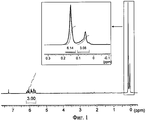
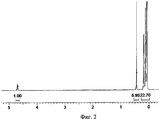
Строение синтезированных гребнеобразных полиметилсилоксанов охарактеризовано ИК-спектроскопией и спектроскопией ЯМР на ядрах 1H, 29Si и 13С. Контроль за структурой полученных полимеров осуществляли в случае, когда m=0 и X=-Si(CH3)2CH=CH2 и когда m=3 и X=-Si(CH3)2H, методом спектроскопии ЯМР на ядрах 1H (фиг.1, 2). В этом случае из спектров с точностью в пределах ошибки метода можно определить состав образующегося полимера по соотношению сигналов протонов различных органических радикалов в блокирующей группе и в основной цепи, а именно по соотношению сигналов протонов -Si(CH3)2CH=CH2 или -Si(CH3)2H групп и сигналов протонов метильного заместителя в основной цепи. В случае гребнеобразных полиметилсилоксанов, где m равно от 0 до 11 и X=-Si(CH3)3, наиболее информативным методом оказалась спектроскопия ЯМР на ядрах 29Si (фиг.3). Молекулярные массы полученных полимеров были определены методом ГПХ (фиг.4). Поскольку величины ММ плотных глобулярных структур, определенные методом ГПХ с использованием линейных стандартов, не соответствуют действительности, реальные величины были параллельно вычислены с использованием известной MM основной цепи. Свойства синтезированных полимеров приведены в таблице. Из приведенных данных видно значительное отличие от свойств их линейного аналога по молекулярной массе, что позволяет говорить об их перспективности с точки зрения расширения областей применения полидиметилсилоксановых полимеров.The structure of the synthesized comb-shaped polymethylsiloxanes was characterized by IR spectroscopy and NMR spectroscopy on 1 H, 29 Si, and 13 C nuclei. The structure of the obtained polymers was monitored when m = 0 and X = -Si (CH 3 ) 2 CH = CH 2 and when m = 3 and X = —Si (CH 3 ) 2 H, by 1 H NMR spectroscopy on nuclei (FIGS. 1, 2). In this case, from the spectra, to within the error of the method, one can determine the composition of the formed polymer by the ratio of the proton signals of various organic radicals in the blocking group and in the main chain, namely, by the ratio of proton signals -Si (CH 3 ) 2 CH = CH 2 or - Si (CH 3 ) 2 H groups and proton signals of a methyl substituent in the main chain. In the case of comb-shaped polymethylsiloxanes, where m is from 0 to 11 and X = -Si (CH 3 ) 3 , the most informative method was NMR spectroscopy on 29 Si nuclei (Fig. 3). The molecular weights of the obtained polymers were determined by GPC (Fig. 4). Since the MM values of dense globular structures determined by GPC using linear standards do not correspond to reality, real values were calculated in parallel using the well-known MM backbone. The properties of the synthesized polymers are given in the table. The above data show a significant difference from the properties of their linear counterpart in molecular weight, which suggests their promise in terms of expanding the areas of application of polydimethylsiloxane polymers.
На фиг.1 приведен спектр ЯМР на ядрах 1H гребнеобразного полиметилсилоксана по примеру 7, где m равно 0, X равен - Si(CH3)2CH=CH2 и Y обозначает СН3.Figure 1 shows the NMR spectrum on the 1 H nuclei of comb-shaped polymethylsiloxane in example 7, where m is 0, X is - Si (CH 3 ) 2 CH = CH 2 and Y is CH 3 .
На фиг.2 приведен спектр ЯМР на ядрах 1H гребнеобразного полиметилсилоксана по примеру 15, где m равно 0, X равен -Si(CH3)2H и Y обозначает СН3.Figure 2 shows the NMR spectrum on the nuclei of 1 H comb-shaped polymethylsiloxane in example 15, where m is 0, X is-Si (CH 3 ) 2 H and Y is CH 3 .
На фиг.3 приведен спектр ЯМР на ядрах 29Si гребнеобразного полиметилсилоксана по примеру 12, где m равно 3, X равен -Si(CH3)3 и Y обозначает СН3.Figure 3 shows the NMR spectrum on the nuclei of 29 Si comb-like polymethylsiloxane in example 12, where m is 3, X is -Si (CH 3 ) 3 and Y is CH 3 .
На фиг.4 приведены кривые ГПХ заявляемых гребнеобразных полиметилсилоксанов по примерам 10-13, где m равно 0, 1, 3, 5, X равен -Si(CH3)3 и Y обозначает СН3.Figure 4 shows the GPC curves of the inventive comb-shaped polymethylsiloxanes according to examples 10-13, where m is 0, 1, 3, 5, X is -Si (CH 3 ) 3 and Y is CH 3 .
В таблице приведены структурные параметры полимеров по примерам 10-13 и их характеристики.The table shows the structural parameters of the polymers of examples 10-13 and their characteristics.
Изобретение может быть проиллюстрировано следующими примерами.The invention can be illustrated by the following examples.
Примеры получения исходных олигомеров, где m равно от 0 до 11.Examples of the preparation of starting oligomers, where m is from 0 to 11.
Пример 1. Получение олигомера, где m равно 0, Х равен -Si(СН3)3 и Z означает -ОС(O)СН3.Example 1. Obtaining an oligomer, where m is 0, X is —Si (CH 3 ) 3, and Z is —OC (O) CH 3 .
К 8.25 г (0.101 моль) ацетата натрия в гексане добавляют 10.76 г (0.099 моль) ТМХС. Выпавший осадок отфильтровывают. Фильтрат перегоняют. Целевая фракция: Ткип=102-104°С, m=12.85 г, содержание продукта по ГЖХ 98.33%, выход от теории 97%. ЯМР 1H (CDCl3): δ=2.05 м.д. (с 3Н, ОС(О)СН3); δ=0,12 м.д. (с 9Н, Si(СН3)3).To 8.25 g (0.101 mol) of sodium acetate in hexane was added 10.76 g (0.099 mol) of TMHS. The precipitate formed is filtered off. The filtrate is distilled. Target fraction: T bale = 102-104 ° C, m = 12.85 g, the content of the product by GLC 98.33%, the yield from theory is 97%. 1 H NMR (CDCl 3 ): δ = 2.05 ppm. (s 3H, OS (O) CH 3 ); δ = 0.12 ppm (c 9H, Si (CH 3 ) 3 ).
Пример 2. Получение олигомера, где m равно 1, Х означает -Si(СН3)3 и Z означает -ОС(O)СН3.Example 2. Obtaining an oligomer, where m is 1, X is —Si (CH 3 ) 3 and Z is —OC (O) CH 3 .
К 8.26 г (0.101 моль) ацетата натрия в гексане добавляют 18.19 г (0.0997 моль) 1-хлорпентаметилдисилоксана. Реакцию ведут при комнатной температуре. Выпавший осадок отфильтровывают. Фильтрат подвергают перегонке. Целевая фракция: Ткип=144-146°С, m=16.45 г, содержание продукта по ГЖХ 96.03%, выход от теории количественный. ЯМР 1Н (СDСl3): δ=2.05 м.д. (с 3Н, ОС(О)СН3); δ=0.35 м.д. (с 6Н, Si(СН3)2OС(O)СН3); δ=0,12 м.д. (с 9Н, Si(СН3)3).To 8.26 g (0.101 mol) of sodium acetate in hexane was added 18.19 g (0.0997 mol) of 1-chloropentamethyldisiloxane. The reaction is carried out at room temperature. The precipitate formed is filtered off. The filtrate is subjected to distillation. Target fraction: Т bale = 144-146 ° С, m = 16.45 g, the content of the product by GLC 96.03%, quantitative theory yield. NMR 1 H (CDCl 3 ): δ = 2.05 ppm. (s 3H, OS (O) CH 3 ); δ = 0.35 ppm (c 6H, Si (CH 3 ) 2 OC (O) CH 3 ); δ = 0.12 ppm (c 9H, Si (CH 3 ) 3 ).
Пример 3. Получение олигомера, где m равно 3, Х означает -Si(СН3)3 и Z означает -ОС(O)СН3.Example 3. Obtaining an oligomer, where m is 3, X is —Si (CH 3 ) 3, and Z is —OC (O) CH 3 .
К 7.72 г (0.094 моль) ацетата натрия в гексане добавляют 30.86 г (0.093 моль) 1-хлорнонаметилтетрасилоксана. Реакцию ведут при комнатной температуре. Продукт подвергают перегонке. Целевая фракция: Ткип=223-226°С, m=25.3 г, содержание продукта по ГЖХ 94.73%. Выход от теории 97.8%. ЯМР 1H (CDCl3): δ=2,01 м.д. (с 3H, OC(O)СН3); δ=0.21 м.д. (с 6Н, Si(CH3)2OC(O)CH3); δ=0.01 м.д. (м 21Н, SiCH3).To 7.72 g (0.094 mol) of sodium acetate in hexane was added 30.86 g (0.093 mol) of 1-chlorononamethyltetrasiloxane. The reaction is carried out at room temperature. The product is subjected to distillation. Target fraction: T bale = 223-226 ° C, m = 25.3 g, the content of the product by GLC 94.73%. The output from the theory is 97.8%. 1 H NMR (CDCl 3 ): δ = 2.01 ppm. (c 3H, OC (O) CH 3 ); δ = 0.21 ppm (c 6H, Si (CH 3 ) 2 OC (O) CH 3 ); δ = 0.01 ppm (m 21H, SiCH 3 ).
Пример 4. Получение олигомера, где m равно 5, X означает -Si(CH3)3 и Z означает -OC(O)СН3.Example 4. Obtaining an oligomer, where m is 5, X is —Si (CH 3 ) 3 and Z is —OC (O) CH 3 .
К 1.55 г (0.0189 моль) ацетата натрия в гексане добавляют 8.65 г (0.0186 моль) 1-хлортридекаметилгексасилоксана. Выпавший осадок отфильтровывают. Фильтрат подвергают перегонке. Целевая фракция: m=6.88 г, содержание продукта по ГЖХ 89.07%. Выход 76.19%. ЯМР 1H (CDCl3): δ=1.72 м.д. (с 3H, OC(O)СН3); δ=0.47 (с 6Н, Si(CH3)2); δ=0.37-0.027 (м 33H, SiCH3).To 1.55 g (0.0189 mol) of sodium acetate in hexane was added 8.65 g (0.0186 mol) of 1-chlorotridecamethylhexasiloxane. The precipitate formed is filtered off. The filtrate is subjected to distillation. Target fraction: m = 6.88 g, product content by GLC 89.07%. Yield 76.19%. 1 H NMR (CDCl 3 ): δ = 1.72 ppm (c 3H, OC (O) CH 3 ); δ = 0.47 (c 6H, Si (CH 3 ) 2 ); δ = 0.37-0.027 (m 33H, SiCH 3 ).
Пример 5. Получение олигомера, где m равно 11, X означает -Si(CH3)3 и Z означает -OC(O)СН3.Example 5. Obtaining an oligomer, where m is 11, X is —Si (CH 3 ) 3 and Z is —OC (O) CH 3 .
К 1.05 г (0.0128 моль) ацетата натрия в гексане добавляют 11.53 г (0.0125 моль) 1-хлортридекаметилгексасилоксана. Выпавший осадок отфильтровывают. Фильтрат подвергают перегонке. Целевая фракция: m=9.46 г, содержание продукта по ГЖХ 93.05%. Выход 78.12%. ЯМР 1H (CDCl3): δ=1.72 м.д. (с 3H, OC(O)CH3); δ=0.47 (с 6Н, Si(CH3)2); δ=0.37-0.027 (м 69Н, SiCH3).To 1.05 g (0.0128 mol) of sodium acetate in hexane was added 11.53 g (0.0125 mol) of 1-chlorotridecamethylhexasiloxane. The precipitate formed is filtered off. The filtrate is subjected to distillation. Target fraction: m = 9.46 g, product content by GLC 93.05%. Yield 78.12%. 1 H NMR (CDCl 3 ): δ = 1.72 ppm (c 3H, OC (O) CH 3 ); δ = 0.47 (c 6H, Si (CH 3 ) 2 ); δ = 0.37-0.027 (m 69H, SiCH 3 ).
Пример 6. Получение олигомера, где m равно 3, X означает -Si(CH3)2H и Z означает -OC(O)СН3.Example 6. Obtaining an oligomer, where m is 3, X is —Si (CH 3 ) 2 H and Z is —OC (O) CH 3 .
К 9.84 г (0.120 моль) ацетата натрия в гексане добавляют 36.3 г (0.115 моль) 1-хлор-7-гидро-октаметилтетрасилоксана. Выпавший осадок отфильтровывают. Фильтрат подвергают перегонке. Целевая фракция: m=29 г, содержание продукта по ГЖХ 88.5%. Выход 74%. ЯМР 1H (CDCl3): δ=4.72-4.66 м.д. (м 1Н, SiH); δ=2.05 м.д. (с 3H, OC(O)СН3); δ=0.28 м.д. (с 6Н, Si(CH3)OC(O)CH3); δ=0.18-0.17 м.д. (д 6Н, Si(CH3)2H); δ=0.09 м.д. (с 6Н, SiCH3); δ=0.06 м.д. (с 6Н, SiCH3).To 9.84 g (0.120 mol) of sodium acetate in hexane was added 36.3 g (0.115 mol) of 1-chloro-7-hydro-octamethyltetrasiloxane. The precipitate formed is filtered off. The filtrate is subjected to distillation. Target fraction: m = 29 g, product content by GLC 88.5%. Yield 74%. 1 H NMR (CDCl 3 ): δ = 4.72-4.66 ppm (m 1H, SiH); δ = 2.05 ppm (c 3H, OC (O) CH 3 ); δ = 0.28 ppm (c 6H, Si (CH 3 ) OC (O) CH 3 ); δ = 0.18-0.17 ppm (d 6H, Si (CH 3 ) 2 H); δ = 0.09 ppm (c 6H, SiCH 3 ); δ = 0.06 ppm (c 6H, SiCH 3 ).
Примеры получения гребнеобразных полиметилсилоксанов.Examples of the preparation of comb polymethylsiloxanes.
Пример 7. Получение полимера, где m равно 0, X означает -Si(CH3)2CH=CH2 и Y означает -СН3.Example 7. The preparation of the polymer, where m is 0, X is —Si (CH 3 ) 2 CH = CH 2 and Y is —CH 3 .
К раствору 12.7 г (0.105 моль) винилдиметилхлорсилана в толуоле добавляют суспензию 9.8 г (0.1 моль) поли(натрийокси)метилсилсесквиоксана в том же растворителе. Реакцию проводят при температуре от 0°C до 25°C. Выпавший осадок отфильтровывают.Растворитель удаляют в вакууме. Получают прозрачную бесцветную вязкую жидкость. ГПХ (ПС-стандарт): ММР полимодально, Мпика ~ 10000, Мmах > 75000 а.е.м. ЯМР 1H (CDCl3): δ=5.7-6.3 м.д. (м 3H; SiCH=CH2); δ=0.01-0.018 м.д. (м 9Н; SiCH3).To a solution of 12.7 g (0.105 mol) of vinyl dimethylchlorosilane in toluene was added a suspension of 9.8 g (0.1 mol) of poly (natrioxy) methylsilsesquioxoxane in the same solvent. The reaction is carried out at a temperature of from 0 ° C to 25 ° C. The precipitate formed is filtered off. The solvent is removed in vacuo. A clear, colorless, viscous liquid is obtained. GPC (PS-standard): MMR multimodal, Mpika ~ 10000, Mmax> 75000 amu 1 H NMR (CDCl 3): δ = 5.7-6.3 ppm. (m 3H; SiCH = CH 2 ); δ = 0.01-0.018 ppm (m 9H; SiCH 3 ).
Пример 8. Получение полимера, где m равно 0, X означает - Si(CH3)2CH=CH2 и Y означает -СН=СН2.Example 8. The preparation of the polymer, where m is 0, X means - Si (CH 3 ) 2 CH = CH 2 and Y means —CH = CH 2 .
К раствору 12.7 г (0.105 моль) винилдиметилхлорсилана в толуоле добавляют суспензию 11 г (0.1 моль) поли(натрийокси)винилсилсесквиоксана в том же растворителе. Реакцию проводят при температуре от 0°C до 25°C. Выпавший осадок отфильтровывают. Растворитель удаляют в вакууме. Получают прозрачную бесцветную вязкую жидкость. ГПХ (ПС-стандарт): ММР полимодально, М пика ~ 3300, M max ~ 75000 а.е.м. ЯМР 1H (CDCl3): δ=5.61-6.23 м.д. (м 6Н; SiCH=CH2); δ=0.05-0.27 м.д. (м 6Н; SiCH3).To a solution of 12.7 g (0.105 mol) of vinyl dimethylchlorosilane in toluene was added a suspension of 11 g (0.1 mol) of poly (sodium-oxy) vinylsilsesquioxoxane in the same solvent. The reaction is carried out at a temperature of from 0 ° C to 25 ° C. The precipitate formed is filtered off. The solvent is removed in vacuo. A clear, colorless, viscous liquid is obtained. GPC (PS-standard): MMP multimodal, M peak ~ 3300, M max ~ 75000 amu 1 H NMR (CDCl 3 ): δ = 5.61-6.23 ppm. (m 6H; SiCH = CH 2 ); δ = 0.05-0.27 ppm (m 6H; SiCH 3 ).
Пример 9. Получение полимера, где m равно 0, X означает - Si(CH3)3 и Y означает -СН=СН2.Example 9. Obtaining a polymer, where m is 0, X means - Si (CH 3 ) 3 and Y means —CH = CH 2 .
К раствору 12.7 г (0.105 моль) винилдиметилхлорсилана в толуоле добавляют суспензию 11 г (0.1 моль) поли(натрийокси)винилсилсесквиоксана в том же растворителе. Реакцию проводят при температуре от 0°C до 25°C. Выпавший осадок отфильтровывают. Растворитель удаляют в вакууме. Получают прозрачную бесцветную вязкую жидкость. ГПХ (ПС-стандарт): ММР полимодально, М пика ~2000, Mmax ~ 35000 а.е.м. ЯМР 1H (CDCl3): δ=5.7-6.3 м.д. (м 3H; SiCH=CH2); δ=0.01-0.018 м.д. (м 9Н; SiCH3).To a solution of 12.7 g (0.105 mol) of vinyl dimethylchlorosilane in toluene was added a suspension of 11 g (0.1 mol) of poly (sodium-oxy) vinylsilsesquioxoxane in the same solvent. The reaction is carried out at a temperature of from 0 ° C to 25 ° C. The precipitate formed is filtered off. The solvent is removed in vacuo. A clear, colorless, viscous liquid is obtained. GPC (PS-standard): MMP multimodal, M peak ~ 2000, Mmax ~ 35000 amu 1 H NMR (CDCl 3 ): δ = 5.7-6.3 ppm. (m 3H; SiCH = CH 2 ); δ = 0.01-0.018 ppm (m 9H; SiCH 3 ).
Пример 10. Получение полимера, где m равно 0, X означает - Si(CH3)3 и Y означает -СН3.Example 10. Obtaining a polymer, where m is 0, X is — Si (CH 3 ) 3 and Y is —CH 3 .
К 12.85 г (0.097 моль) 1-ацетокситриметилсилана при температуре 0°C и перемешивании добавляют 8.67 г (0.088 моль) поли(натрийокси)метилсилсесквиоксана в диметилсульфоксиде. Реакцию проводят при температуре от 0°C до 50°C. Полученную смесь отмывают до нейтральной реакции. Полученный раствор сушат над сульфатом натрия, фильтруют, растворитель удаляют в вакууме. Получают прозрачную бесцветную вязкую жидкость. ГПХ (ПС-стандарт): ММР полимодально, М пика ~ 1600, М mах ~75000 а.е.м. ЯМР 1H (CDCl3): δ=0.01-0.018 м.д. (м 9Н; SiCH3). ЯМР 29Si (CDCl3): δ=8 м.д. (с Si, Si(CH3)3)); δ=-(65-68) м.д. (с Si, SiO1.5). ЯМР 13С (CDCl3): δ=1.67 м.д. (с С, Si(CH3)3)); δ=-(2.09-4.06) м.д. (с С, H3CSiO1.5). ИК (CCl4): в области 3500-3700 см-1 сигналы (SiOH) отсутствуют.To 12.85 g (0.097 mol) of 1-acetoxytrimethylsilane at 0 ° C with stirring, 8.67 g (0.088 mol) of poly (sodiumoxy) methylsilsesquioxane in dimethyl sulfoxide is added. The reaction is carried out at a temperature of from 0 ° C to 50 ° C. The resulting mixture was washed until neutral. The resulting solution was dried over sodium sulfate, filtered, and the solvent was removed in vacuo. A clear, colorless, viscous liquid is obtained. GPC (PS-standard): MMR multimodal, M peak ~ 1600, M max ~ 75000 amu 1 H NMR (CDCl 3 ): δ = 0.01-0.018 ppm. (m 9H; SiCH 3 ). NMR 29 Si (CDCl 3 ): δ = 8 ppm (with Si, Si (CH 3 ) 3 )); δ = - (65-68) ppm (with Si, SiO 1.5 ). 13 C NMR (CDCl 3 ): δ = 1.67 ppm (c, Si (CH 3 ) 3 )); δ = - (2.09-4.06) ppm (c, H 3 CSiO 1.5 ). IR (CCl 4 ): in the region of 3500-3700 cm -1 signals (SiOH) are absent.
Пример 11. Получение полимера, где m равно 1, X означает - Si(CH3)3 и Y означает -СН3.Example 11. Obtaining a polymer, where m is 1, X is — Si (CH 3 ) 3 and Y is —CH 3 .
Полимер получают аналогично примеру 10. ГПХ (ПС-стандарт) ММР полимодально, М пика ~ 700, M max ~ 63000 а.е.м. ЯМР 1H (CDCl3): δ=0-0.12 м.д. (м 18Н, SiCH3). ЯМР 29Si (CDCl3): δ=8 м.д. (с Si, Si(CH3)3); δ=19-22 м.д. (с Si, Si(CH3)2); δ=(65-68) м.д. (с Si, SiO1.5). ЯМР 13С (CDCl3): δ=1.23 м.д. (с С, Si(CH3)3); δ=0.48 м.д. (с С, Si(CH3)2); δ=-(2.49-4.11) м.д. (с С, H3CSiO1.5). ИК-спектр (CCl4): в области 3500-3700 см-1 сигналы (SiOH) отсутствуют.The polymer is obtained analogously to example 10. GPC (PS-standard) MMP polymodal, M peak ~ 700, M max ~ 63000 amu 1 H NMR (CDCl 3 ): δ = 0-0.12 ppm. (m 18H, SiCH 3 ). NMR 29 Si (CDCl 3 ): δ = 8 ppm (with Si, Si (CH 3 ) 3 ); δ = 19-22 ppm (with Si, Si (CH 3 ) 2 ); δ = (65-68) ppm (with Si, SiO 1.5 ). 13 C NMR (CDCl 3 ): δ = 1.23 ppm. (c, Si (CH 3 ) 3 ); δ = 0.48 ppm (c, Si (CH 3 ) 2 ); δ = - (2.49-4.11) ppm (c, H 3 CSiO 1.5 ). IR spectrum (CCl 4 ): in the region of 3500-3700 cm -1 signals (SiOH) are absent.
Пример 12. Получение полимера, где m равно 3, X означает - Si(CH3)3 и Y означает -СН3.Example 12. Obtaining a polymer, where m is 3, X is — Si (CH 3 ) 3 and Y is —CH 3 .
Полимер получают аналогично примеру 10. ГПХ (ПС-стандарт): полимодально, М пика, ~ 9000, M max ~ 75000 а.е.м. ЯМР 1H (CDCl3): δ=0-0,014 м.д. (м 30H, SiCH3). ЯМР 29Si (CDCl3): δ=7.18 м.д. (с Si, (CH3)3SiO); δ=-(19-22) (с Si, (CH3)2SiO2/2); δ=-(65-68) (с Si, CH3SiO1.5). ЯМР 13C (CDCl3): δ=1.75 м.д. (с С, Si(CH3)3); δ=1.02 м.д. (с С, Si(CH3)2); δ=-(2.09-3.21) м.д. (с С, H3CSiO1.5). ИК-спектр (CCl4): сигналы в области 3500-3700 см-1 (SiOH) отсутствуют.The polymer is obtained analogously to example 10. GPC (PS-standard): multimodal, M peak, ~ 9000, M max ~ 75000 amu 1 H NMR (CDCl 3 ): δ = 0-0.014 ppm. (m 30H, SiCH 3 ). NMR 29 Si (CDCl 3 ): δ = 7.18 ppm. (with Si, (CH 3 ) 3 SiO); δ = - (19-22) (with Si, (CH 3 ) 2 SiO 2/2 ); δ = - (65-68) (with Si, CH 3 SiO 1.5 ). 13 C NMR (CDCl 3 ): δ = 1.75 ppm. (c, Si (CH 3 ) 3 ); δ = 1.02 ppm (c, Si (CH 3 ) 2 ); δ = - (2.09-3.21) ppm (c, H 3 CSiO 1.5 ). IR spectrum (CCl 4 ): no signals in the region of 3500-3700 cm -1 (SiOH).
Пример 13. Получение полимера, где m равно 5, X означает - Si(CH3)3 и Y означает -СН3.Example 13. Obtaining a polymer, where m is 5, X is — Si (CH 3 ) 3 and Y is —CH 3 .
Полимер получают аналогично примеру 10. ГПХ (ПС-стандарт): полимодально, М пика, ~ 4000, M max ~ 25000 а.е.м. ЯМР 1H (CDCl3): δ=0-0,016 м.д. (м 39Н, SiCH3). ЯМР 29Si (CDCl3): δ=7.21 м.д. (с (CH3)3SiO); δ=-(20-22.5) (с (CH3)2SiO2/2); δ=-(65-68) (с CH3SiO1.5). ЯМР 13С (CDCl3): δ=1.74 м.д. (с С, Si(CH3)3); δ=1.00 м.д (с С, Si(CH3)2); δ=(2.15-2.89) м.д. (с С, H3CSiO1.5). ИК-спектр (CCl4): сигналы в области 3500-3700 см-1 отсутствуют.The polymer is obtained analogously to example 10. GPC (PS-standard): multimodal, M peak, ~ 4000, M max ~ 25000 amu 1 H NMR (CDCl 3 ): δ = 0-0.016 ppm. (m 39H, SiCH 3 ). NMR 29 Si (CDCl 3 ): δ = 7.21 ppm (c (CH 3 ) 3 SiO); δ = - (20-22.5) (s (CH 3 ) 2 SiO 2/2 ); δ = - (65-68) (with CH 3 SiO 1.5 ). 13 C NMR (CDCl 3 ): δ = 1.74 ppm. (c, Si (CH 3 ) 3 ); δ = 1.00 ppm (with C, Si (CH 3 ) 2 ); δ = (2.15-2.89) ppm (c, H 3 CSiO 1.5 ). IR spectrum (CCl 4 ): there are no signals in the region of 3500-3700 cm -1 .
Пример 14. Получение полимера, где m равно 11, X означает -Si(CH3)3 и Y означает -СН3.Example 14. Obtaining a polymer where m is 11, X is —Si (CH 3 ) 3 and Y is —CH 3 .
Полимер получают аналогично примеру 10. ГПХ (ПС-стандарт): полимодально. ЯМР 1H (CDCl3): δ=0-0,016 м.д. (м 75Н, SiCH3). ЯМР 29Si (CDCl3): δ=7.21 м.д. (с (CH3)3SiO); δ=-(20-22.5) (с (CH3)2SiO2/2); δ=-(65-68) (с CH3SiO1/5). ЯМР 13С (CDCl3): δ=1.74 м.д. (с С, Si(CH3)3); δ=1.00 м.д. (с С, Si(CH3)2); δ=-(2.15-2.89) м.д. (с С, H3CSiO1.5). ИК-спектр (CCL4): сигналы в области 35Q0-3700 см-1 отсутствуют.The polymer is obtained analogously to example 10. GPC (PS-standard): polymodal. 1 H NMR (CDCl 3 ): δ = 0-0.016 ppm. (m 75H, SiCH 3 ). NMR 29Si (CDCl 3 ): δ = 7.21 ppm (c (CH 3 ) 3 SiO); δ = - (20-22.5) (s (CH 3 ) 2 SiO 2/2 ); δ = - (65-68) (with CH 3 SiO 1/5 ). 13 C NMR (CDCl 3 ): δ = 1.74 ppm. (c, Si (CH 3 ) 3 ); δ = 1.00 ppm (c, Si (CH 3 ) 2 ); δ = - (2.15-2.89) ppm (c, H 3 CSiO 1.5 ). IR (CCL 4 ): no signals in the region of 35Q0-3700 cm -1 .
Пример 15. Получение полимера, где m равно 0, X означает - Si(CH3)2H и Y означает -CH3.Example 15. Obtaining a polymer, where m is 0, X is — Si (CH 3 ) 2 H and Y is —CH 3 .
К 7.5 г (0.022 моль) 1-ацетокси-7-гидро-октаметилтетрасилоксана при температуре 0°C и перемешивании добавляют 1.96 г (0.020 моль) поли(натрийокси)метилсилсесквиоксана, растворенного в гексане. Реакцию проводят при температуре от 0°C до 50°C. Выпавший осадок отфильтровывают, растворитель удаляют в вакууме. Получают прозрачную бесцветную вязкую жидкость. ГПХ: (ПС-стандарт): ММР мономодально. ЯМР 1H (CDCl3): δ=4.72-4.66 м.д. (м 1H, SiH); δ=0.18-0.17 м.д. (д 6Н, Si(CH3)2H); δ=0.09-0.06 м.д. (м 21Н, SiCH3).To 7.5 g (0.022 mol) of 1-acetoxy-7-hydro-octamethyltetrasiloxane, at a temperature of 0 ° C, 1.96 g (0.020 mol) of poly (sodiumoxy) methylsilsesquioxoxane dissolved in hexane are added. The reaction is carried out at a temperature of from 0 ° C to 50 ° C. The precipitate formed is filtered off and the solvent is removed in vacuo. A clear, colorless, viscous liquid is obtained. GPC: (PS standard): MMR is monomodal. 1 H NMR (CDCl 3 ): δ = 4.72-4.66 ppm (m 1H, SiH); δ = 0.18-0.17 ppm (d 6H, Si (CH 3 ) 2 H); δ = 0.09-0.06 ppm (m 21H, SiCH 3 ).
Claims (9)

где Х означает один и тот же радикал из ряда: -Si(СН3)2СН=СН2, -Si(СН3)3, -Si(СН3)2Н;
Y означает один и тот же радикал из ряда: -СН3, -СН=СН2;
n равно целое число из ряда чисел от 12 до 600;
m равно 0 или целое число из ряда чисел от 1 до 11.1. Combs polymethylsiloxanes of General formula (I)
where X is the same radical from the series: —Si (CH 3 ) 2 CH = CH 2 , —Si (CH 3 ) 3 , —Si (CH 3 ) 2 N;
Y means the same radical from the series: —CH 3 , —CH = CH 2 ;
n is an integer from a series of numbers from 12 to 600;
m is 0 or an integer from a series of numbers from 1 to 11.

где Х и m имеют вышеуказанные значения;
Z означает -Сl или -ОС(O)СН3.6. The method of producing comb-shaped polymethylsiloxanes according to claims 1-5, which consists in the interaction between the poly (natriyoxy) methylsiloxane and a siloxane oligomer selected from a number of oligomers of the general formula (II)
where X and m have the above meanings;
Z is —Cl or —OC (O) CH 3 .
Priority Applications (1)
| Application Number | Priority Date | Filing Date | Title |
|---|---|---|---|
| RU2010121535/04A RU2440382C1 (en) | 2010-05-28 | 2010-05-28 | Comb-like polymethylsiloxanes and synthesis method thereof |
Applications Claiming Priority (1)
| Application Number | Priority Date | Filing Date | Title |
|---|---|---|---|
| RU2010121535/04A RU2440382C1 (en) | 2010-05-28 | 2010-05-28 | Comb-like polymethylsiloxanes and synthesis method thereof |
Publications (2)
| Publication Number | Publication Date |
|---|---|
| RU2010121535A RU2010121535A (en) | 2011-12-10 |
| RU2440382C1 true RU2440382C1 (en) | 2012-01-20 |
Family
ID=45404987
Family Applications (1)
| Application Number | Title | Priority Date | Filing Date |
|---|---|---|---|
| RU2010121535/04A RU2440382C1 (en) | 2010-05-28 | 2010-05-28 | Comb-like polymethylsiloxanes and synthesis method thereof |
Country Status (1)
| Country | Link |
|---|---|
| RU (1) | RU2440382C1 (en) |
Cited By (1)
| Publication number | Priority date | Publication date | Assignee | Title |
|---|---|---|---|---|
| RU2783679C1 (en) * | 2021-12-29 | 2022-11-15 | Федеральное государственное бюджетное учреждение науки Институт элементоорганических соединений им. А.Н. Несмеянова Российской академии наук (ИНЭОС РАН) | Method for producing polyorganosiloxane molecular brushes |
Citations (3)
| Publication number | Priority date | Publication date | Assignee | Title |
|---|---|---|---|---|
| RU2184529C2 (en) * | 1996-09-06 | 2002-07-10 | Колгейт-Палмолив Компани | Composition with thickeners having groups capable of forming hydrogen bonds |
| WO2004062634A1 (en) * | 2003-01-14 | 2004-07-29 | Unilever Plc | Home and personal care compositions comprising silicon-based lubricants |
| RU2293743C1 (en) * | 2006-02-27 | 2007-02-20 | Институт синтетических полимерных материалов им. Н.С. Ениколопова РАН (ИСПМ им. Н.С. Ениколопова РАН) | Polysodiumoxyorganosilanes and a method for preparation thereof |
-
2010
- 2010-05-28 RU RU2010121535/04A patent/RU2440382C1/en not_active IP Right Cessation
Patent Citations (3)
| Publication number | Priority date | Publication date | Assignee | Title |
|---|---|---|---|---|
| RU2184529C2 (en) * | 1996-09-06 | 2002-07-10 | Колгейт-Палмолив Компани | Composition with thickeners having groups capable of forming hydrogen bonds |
| WO2004062634A1 (en) * | 2003-01-14 | 2004-07-29 | Unilever Plc | Home and personal care compositions comprising silicon-based lubricants |
| RU2293743C1 (en) * | 2006-02-27 | 2007-02-20 | Институт синтетических полимерных материалов им. Н.С. Ениколопова РАН (ИСПМ им. Н.С. Ениколопова РАН) | Polysodiumoxyorganosilanes and a method for preparation thereof |
Non-Patent Citations (1)
| Title |
|---|
| Guo-Ping Chang-Chien. New Hydrocarbon Side Chain Liquid Crystalline Polysiloxane Polymers: Synthesis, Characterization, and Thermotropic Behavior. Journal of Polymer Science: Part A: Polymer Chemistry, 1998, vol.36, p.2849-2863. Черникова Е.А. и др. Синтез функциональных полимакромономеров с силоксановой основной цепью. Высокомолекулярные соединения, Серия А, 2004, т.46, №4, с.682-691. Guo Ping Cai, William P. Weber. Synthesis of Polymethyl-(trimethylsiloxy)siloxane by Anionic Ring-Opening Polymerization of 1,3,5-Trymethyl-1,3,5-tris(trimethylsiloxy)cyclotrisiloxane. Macromolecules, 2000, vol.33, p.6310-6314. Qunjie Wang et al. Cationic Ring-Opening Polymerization of Cyclosiloxanes Initiated by Electron-Deficient Organosilicon Reagents. Macromolecules, 1996, vol.29, p.6691-6694. * |
Cited By (1)
| Publication number | Priority date | Publication date | Assignee | Title |
|---|---|---|---|---|
| RU2783679C1 (en) * | 2021-12-29 | 2022-11-15 | Федеральное государственное бюджетное учреждение науки Институт элементоорганических соединений им. А.Н. Несмеянова Российской академии наук (ИНЭОС РАН) | Method for producing polyorganosiloxane molecular brushes |
Also Published As
| Publication number | Publication date |
|---|---|
| RU2010121535A (en) | 2011-12-10 |
Similar Documents
| Publication | Publication Date | Title |
|---|---|---|
| Whitmarsh et al. | Synthesis and structure of a highly branched polycarbosilane derived from (chloromethyl) trichlorosilane | |
| JPS62195389A (en) | Hydroxyl group-containing siloxane compound | |
| Turrin et al. | Organic− inorganic hybrid materials incorporating phosphorus-containing dendrimers | |
| Rubinsztajn | Synthesis and characterization of new poly (siloxysilanes) | |
| US6737495B2 (en) | Method for preparing polyorganosiloxanes by polymerization catalyzed by a catalytic system based on triflic acid or triflic acid derivatives | |
| RU2440382C1 (en) | Comb-like polymethylsiloxanes and synthesis method thereof | |
| Obrezkova et al. | Comb-Like Polymethylsiloxanes. Synthesis, Structure and Properties | |
| US5369206A (en) | Method for the preparation of an organopolysiloxane polymerizable at a single molecular chain end | |
| Wada et al. | Synthesis of novel starburst and dendritic polyhedral oligosilsesquioxanes | |
| RU2277106C1 (en) | Hydride functional polycyclic organosilicon polymers and a method for preparation thereof | |
| Fortuniak et al. | Controlled Synthesis of Siloxane Polymers and Siloxane‐Siloxane Block Copolymers with 3‐Chloropropyl Groups Pendant to the Siloxane Chain | |
| RU2783679C1 (en) | Method for producing polyorganosiloxane molecular brushes | |
| RU2692259C1 (en) | Ethoxy-containing linear polycarbosilane siloxanes and a method for production thereof | |
| Obrezkova et al. | Synthesis of polymethylsiloxane molecular brushes | |
| CA2021014C (en) | Silethynyl-siloxane copolymers and method of making them | |
| JPH111560A (en) | Organocyclosiloxane and its production | |
| RU2422473C1 (en) | Carbosilane-siloxane dendrimers | |
| KR101672794B1 (en) | Novel silicone compound and its preparation method, and surfactant and cosmetics comprising the same | |
| Buschbeck et al. | 1, 2-branched 1st to 4th generation carbosiloxane dendrimers with a Me2SiO2 or MeSiO3 core | |
| Brüning et al. | Linear and branched carbosiloxane dendrimers by repetitive hydrosilylation-alcoholysis cycles | |
| JP2541060B2 (en) | Method for producing organosilicon compound | |
| Kireev et al. | Oligo-and polysiloxanephosphazenes based on eugenol cyclotriphosphazene derivatives | |
| RU2697476C1 (en) | Method of producing hydroxyl-containing polymethylsiloxanes | |
| JP4276805B2 (en) | Novel silazane compound and method for producing the same, and novel silazane compound polymer and method for producing the same | |
| Kim et al. | Synthesis of hyperbranched carbosiloxane macromolecule with triallyloxysilane and applications to the dendritic core |
Legal Events
| Date | Code | Title | Description |
|---|---|---|---|
| MM4A | The patent is invalid due to non-payment of fees |
Effective date: 20160529 |