RU2234382C2 - Method of applying wear-proof covering - Google Patents
Method of applying wear-proof covering Download PDFInfo
- Publication number
- RU2234382C2 RU2234382C2 RU2002128900/12A RU2002128900A RU2234382C2 RU 2234382 C2 RU2234382 C2 RU 2234382C2 RU 2002128900/12 A RU2002128900/12 A RU 2002128900/12A RU 2002128900 A RU2002128900 A RU 2002128900A RU 2234382 C2 RU2234382 C2 RU 2234382C2
- Authority
- RU
- Russia
- Prior art keywords
- wire
- filler
- layer
- powder
- particles
- Prior art date
Links
- 238000000034 method Methods 0.000 title claims abstract description 21
- 239000000945 filler Substances 0.000 claims abstract description 34
- 239000002245 particle Substances 0.000 claims abstract description 32
- 239000000843 powder Substances 0.000 claims abstract description 19
- 238000005507 spraying Methods 0.000 claims abstract description 16
- 229910045601 alloy Inorganic materials 0.000 claims abstract description 13
- 239000000956 alloy Substances 0.000 claims abstract description 13
- 229910052782 aluminium Inorganic materials 0.000 claims abstract description 11
- XAGFODPZIPBFFR-UHFFFAOYSA-N aluminium Chemical compound [Al] XAGFODPZIPBFFR-UHFFFAOYSA-N 0.000 claims abstract description 11
- 238000002844 melting Methods 0.000 claims abstract description 8
- 230000008018 melting Effects 0.000 claims abstract description 8
- 238000010438 heat treatment Methods 0.000 claims abstract description 7
- 229910052751 metal Inorganic materials 0.000 claims abstract description 7
- 239000002184 metal Substances 0.000 claims abstract description 7
- 238000000576 coating method Methods 0.000 claims description 44
- 239000011248 coating agent Substances 0.000 claims description 22
- 239000000463 material Substances 0.000 claims description 12
- 239000010959 steel Substances 0.000 claims description 9
- PXHVJJICTQNCMI-UHFFFAOYSA-N Nickel Chemical compound [Ni] PXHVJJICTQNCMI-UHFFFAOYSA-N 0.000 claims description 8
- 229910000831 Steel Inorganic materials 0.000 claims description 8
- 239000004020 conductor Substances 0.000 claims description 7
- 238000007745 plasma electrolytic oxidation reaction Methods 0.000 claims description 6
- 238000003754 machining Methods 0.000 claims description 5
- RYGMFSIKBFXOCR-UHFFFAOYSA-N Copper Chemical compound [Cu] RYGMFSIKBFXOCR-UHFFFAOYSA-N 0.000 claims description 4
- 229910052802 copper Inorganic materials 0.000 claims description 4
- 239000010949 copper Substances 0.000 claims description 4
- 229910052759 nickel Inorganic materials 0.000 claims description 4
- 238000002360 preparation method Methods 0.000 claims description 4
- 230000005484 gravity Effects 0.000 claims description 3
- 238000000151 deposition Methods 0.000 claims 1
- 239000007921 spray Substances 0.000 abstract description 4
- 230000000694 effects Effects 0.000 abstract description 2
- 238000011089 mechanical engineering Methods 0.000 abstract description 2
- 239000000126 substance Substances 0.000 abstract description 2
- 239000007789 gas Substances 0.000 description 11
- 238000012360 testing method Methods 0.000 description 7
- KWYUFKZDYYNOTN-UHFFFAOYSA-M Potassium hydroxide Chemical compound [OH-].[K+] KWYUFKZDYYNOTN-UHFFFAOYSA-M 0.000 description 6
- 238000004458 analytical method Methods 0.000 description 4
- 230000015572 biosynthetic process Effects 0.000 description 3
- 238000010285 flame spraying Methods 0.000 description 3
- 238000009434 installation Methods 0.000 description 3
- 239000007787 solid Substances 0.000 description 3
- 230000003068 static effect Effects 0.000 description 3
- 239000000758 substrate Substances 0.000 description 3
- 238000007751 thermal spraying Methods 0.000 description 3
- 229910001018 Cast iron Inorganic materials 0.000 description 2
- HOWJQLVNDUGZBI-UHFFFAOYSA-N butane;propane Chemical compound CCC.CCCC HOWJQLVNDUGZBI-UHFFFAOYSA-N 0.000 description 2
- 230000021615 conjugation Effects 0.000 description 2
- 238000002788 crimping Methods 0.000 description 2
- 210000003298 dental enamel Anatomy 0.000 description 2
- 229910003460 diamond Inorganic materials 0.000 description 2
- 239000010432 diamond Substances 0.000 description 2
- 239000012153 distilled water Substances 0.000 description 2
- 230000005611 electricity Effects 0.000 description 2
- 238000005516 engineering process Methods 0.000 description 2
- 239000011521 glass Substances 0.000 description 2
- 239000000314 lubricant Substances 0.000 description 2
- 238000004519 manufacturing process Methods 0.000 description 2
- 238000005259 measurement Methods 0.000 description 2
- 239000000203 mixture Substances 0.000 description 2
- 229920000642 polymer Polymers 0.000 description 2
- 235000019353 potassium silicate Nutrition 0.000 description 2
- 238000012545 processing Methods 0.000 description 2
- 239000000047 product Substances 0.000 description 2
- 230000001681 protective effect Effects 0.000 description 2
- 239000003870 refractory metal Substances 0.000 description 2
- NTHWMYGWWRZVTN-UHFFFAOYSA-N sodium silicate Chemical compound [Na+].[Na+].[O-][Si]([O-])=O NTHWMYGWWRZVTN-UHFFFAOYSA-N 0.000 description 2
- UONOETXJSWQNOL-UHFFFAOYSA-N tungsten carbide Chemical compound [W+]#[C-] UONOETXJSWQNOL-UHFFFAOYSA-N 0.000 description 2
- XLYOFNOQVPJJNP-UHFFFAOYSA-N water Chemical compound O XLYOFNOQVPJJNP-UHFFFAOYSA-N 0.000 description 2
- 229910018072 Al 2 O 3 Inorganic materials 0.000 description 1
- 229910000851 Alloy steel Inorganic materials 0.000 description 1
- OKTJSMMVPCPJKN-UHFFFAOYSA-N Carbon Chemical compound [C] OKTJSMMVPCPJKN-UHFFFAOYSA-N 0.000 description 1
- BPQQTUXANYXVAA-UHFFFAOYSA-N Orthosilicate Chemical compound [O-][Si]([O-])([O-])[O-] BPQQTUXANYXVAA-UHFFFAOYSA-N 0.000 description 1
- ATJFFYVFTNAWJD-UHFFFAOYSA-N Tin Chemical compound [Sn] ATJFFYVFTNAWJD-UHFFFAOYSA-N 0.000 description 1
- 239000000654 additive Substances 0.000 description 1
- QVGXLLKOCUKJST-UHFFFAOYSA-N atomic oxygen Chemical compound [O] QVGXLLKOCUKJST-UHFFFAOYSA-N 0.000 description 1
- 239000011449 brick Substances 0.000 description 1
- WUKWITHWXAAZEY-UHFFFAOYSA-L calcium difluoride Chemical compound [F-].[F-].[Ca+2] WUKWITHWXAAZEY-UHFFFAOYSA-L 0.000 description 1
- 229910001634 calcium fluoride Inorganic materials 0.000 description 1
- 238000002485 combustion reaction Methods 0.000 description 1
- 230000007797 corrosion Effects 0.000 description 1
- 238000005260 corrosion Methods 0.000 description 1
- 239000010431 corundum Substances 0.000 description 1
- 229910052593 corundum Inorganic materials 0.000 description 1
- 239000006185 dispersion Substances 0.000 description 1
- 238000009826 distribution Methods 0.000 description 1
- 239000000428 dust Substances 0.000 description 1
- 230000007613 environmental effect Effects 0.000 description 1
- 238000002474 experimental method Methods 0.000 description 1
- 239000000835 fiber Substances 0.000 description 1
- -1 for example Substances 0.000 description 1
- 229910002804 graphite Inorganic materials 0.000 description 1
- 239000010439 graphite Substances 0.000 description 1
- 230000004941 influx Effects 0.000 description 1
- 150000002739 metals Chemical class 0.000 description 1
- 150000004767 nitrides Chemical class 0.000 description 1
- 239000012811 non-conductive material Substances 0.000 description 1
- 229910021652 non-ferrous alloy Inorganic materials 0.000 description 1
- 230000003647 oxidation Effects 0.000 description 1
- 238000007254 oxidation reaction Methods 0.000 description 1
- TWNQGVIAIRXVLR-UHFFFAOYSA-N oxo(oxoalumanyloxy)alumane Chemical compound O=[Al]O[Al]=O TWNQGVIAIRXVLR-UHFFFAOYSA-N 0.000 description 1
- 239000001301 oxygen Substances 0.000 description 1
- 229910052760 oxygen Inorganic materials 0.000 description 1
- 239000002994 raw material Substances 0.000 description 1
- 238000011160 research Methods 0.000 description 1
- 230000035939 shock Effects 0.000 description 1
- 229910021332 silicide Inorganic materials 0.000 description 1
- HBMJWWWQQXIZIP-UHFFFAOYSA-N silicon carbide Chemical compound [Si+]#[C-] HBMJWWWQQXIZIP-UHFFFAOYSA-N 0.000 description 1
- 229910010271 silicon carbide Inorganic materials 0.000 description 1
- 239000013589 supplement Substances 0.000 description 1
- 239000012209 synthetic fiber Substances 0.000 description 1
- 229920002994 synthetic fiber Polymers 0.000 description 1
- 238000012546 transfer Methods 0.000 description 1
- 238000009827 uniform distribution Methods 0.000 description 1
Landscapes
- Coating By Spraying Or Casting (AREA)
Abstract
Description
Изобретение относится к технологии восстановления-упрочнения быстроизнашивающихся деталей машин. Оно может быть использовано для нанесения износостойких, антифрикционных и коррозионностойких покрытий на рабочую поверхность элементов трибосопряжений, для повышения срока службы деталей, контактирующих с абразивосодержащими средами.The invention relates to the technology of restoration-hardening of wearing parts of machines. It can be used for applying wear-resistant, anti-friction and corrosion-resistant coatings to the working surface of tribological conjugation elements, to increase the service life of parts in contact with abrasive-containing media.
Известен способ формирования защитного, износостойкого покрытия газотермическим распылением проволочных материалов (см. Хасуи А., Моригаки О. Наплавка и напыление. - М.: Машиностроение, 1985. С.135-139), заключающийся в нагреве до расплавления и распылении проволоки, подаваемой вдоль оси высокотемпературного факела, окруженного обжимающим потоком газа, например воздухом, сходящимся в направлении напыления. Недостатком известного способа являются низкие значения физико-механических свойств напыляемых покрытий, обусловленные неравномерным гранулометрическим составом распыленных частиц и большим количеством частиц крупных фракций. Кроме того, данные покрытия нельзя использовать для защиты деталей, работающих в контакте с абразивосодержащими средами, поскольку их износостойкость не превышает износостойкость распыленной проволоки, изготовленной из деформируемых сталей или цветных сплавов.A known method of forming a protective, wear-resistant coating by thermal spraying of wire materials (see Hasui A., Morigaki O. Surfacing and spraying. - M .: Mechanical Engineering, 1985. S.135-139), which consists in heating to melt and spray the wire supplied along the axis of a high-temperature plume surrounded by a compressing stream of gas, for example, air converging in the direction of spraying. The disadvantage of this method is the low physico-mechanical properties of the sprayed coatings, due to the uneven particle size distribution of the sprayed particles and a large number of particles of large fractions. In addition, these coatings cannot be used to protect parts working in contact with abrasive media, since their wear resistance does not exceed the wear resistance of sprayed wire made from wrought steel or non-ferrous alloys.
Известен способ формирования износостойких покрытий газотермическим напылением проволочных материалов (см. Антонов И.А. Газопламенная обработка металлов. - М.: Машиностроение, 1976. С.203), заключающийся в предварительном нагреве проволоки в высокотемпературном факеле, обжатом основным газовым потоком, ее расплавлении и последующем распылении дополнительным газовым потоком. Несмотря на введение второго газового потока для улучшения диспергирования расплавленной проволоки, механизм процесса не изменился, поскольку распыление осуществляется только одним потоком (дополнительным), а основной поток служит для лучшего теплообмена проволоки с пламенем. Конус плавящегося участка проволоки находится (в зависимости от распыляемого материала) на расстоянии 5... 15 мм от среза дополнительной воздушной головки, т.е. в зоне, где основной и дополнительный потоки взаимодействуют друг с другом и представляют практически один поток. Кольцевая воздушная струя, которая дополнительно прижимает продукты сгорания к проволоке на большем участке длины, создает зону предварительного нагрева металла перед его расплавлением и распылением. Термический к.п.д. нагрева проволоки распылительной головкой с дополнительным обжимным воздушным соплом значительно повышается. Необходимо отметить, что данный способ позволил несколько повысить производительность распыления проволок из тугоплавких металлов и сплавов, однако качество наносимых покрытий при этом осталось на прежнем низком уровне: пористость не менее 18%, прочность сцепления с основой не выше 30 МПа. Объясняется это тем, что покрытие формируется в основном из крупных частиц (50... 200 мкм), имеющих скорость полета на 40... 60% ниже, чем частицы размером 10... 50 мкм. Снижение скорости распыляемых частиц приводит к уменьшению их кинетической энергии, что в свою очередь понижает значения ударного и напорного давлений в зонах контакта с подложкой.A known method of forming wear-resistant coatings by thermal spraying of wire materials (see Antonov IA Gas-flame treatment of metals. - M .: Mashinostroenie, 1976. P.203), which consists in preheating the wire in a high-temperature torch, crimped by the main gas stream, its melting and subsequent spraying with an additional gas stream. Despite the introduction of a second gas stream to improve the dispersion of the molten wire, the process mechanism has not changed, since the spraying is carried out only by one stream (additional), and the main stream serves for better heat transfer of the wire with the flame. The cone of the melting section of the wire is (depending on the sprayed material) at a distance of 5 ... 15 mm from the cut of the additional air head, i.e. in the zone where the main and secondary streams interact with each other and represent almost the same stream. An annular air stream, which additionally presses the combustion products to the wire over a larger length section, creates a zone of preliminary heating of the metal before its melting and spraying. Thermal efficiency heating the wire with a spray head with an additional crimping air nozzle is significantly increased. It should be noted that this method allowed to slightly increase the performance of spraying wires from refractory metals and alloys, however, the quality of the applied coatings remained at the same low level: porosity of at least 18%, adhesion to the base of not more than 30 MPa. This is explained by the fact that the coating is formed mainly from large particles (50 ... 200 microns) having a flight speed of 40 ... 60% lower than particles with a size of 10 ... 50 microns. A decrease in the velocity of the sprayed particles leads to a decrease in their kinetic energy, which in turn lowers the values of the shock and pressure pressures in the zones of contact with the substrate.
Наиболее близким по технической сущности к заявляемому является способ нанесения износостойких покрытий из проволочных материалов (Белоцерковский М.А., Сухоцкий П.Г. Расширение возможностей процесса газопламенного проволочного напыления покрытий // Тез. докл. межд. конф. “Ресурсосберегающие экотехнологии: возобновление и экономия энергии, сырья и материалов”. - Гродно, 2000 г. - С.50-51.), заключающийся в нагреве до плавления и распылении металлической проволоки, подаваемой по оси высокотемпературного факела, окруженного основным и дополнительным обжимающими газовыми потоками, сходящимися в направлении распыления, в которых генерируют ультразвуковые колебания, причем основной обжимающий газовый поток взаимодействует с плавящимся участком проволоки, дополнительный взаимодействует с потоком распыленных частиц, и в него подают порошок наполнителя.Closest to the technical nature of the claimed is a method of applying wear-resistant coatings of wire materials (Belotserkovsky M.A., Suhotsky P.G. Expanding the capabilities of the process of gas-flame wire spraying coatings // Abstract of international conference “Resource-saving environmental technologies: renewal and saving energy, raw materials and materials. ”- Grodno, 2000 - S.50-51.), which consists in heating to melting and spraying the metal wire supplied along the axis of the high-temperature torch, surrounded by the main and supplement nym crimping gas streams converge in the spray direction in which the ultrasonic vibration is generated, wherein the main gas stream of shingled reacted with consumable wire portion, is reacted with an additional stream of sputtered particles and is supplied with a powder filler.
Недостатком данного способа является относительно низкая твердость и износостойкость формируемых покрытий по сравнению с покрытиями, полученными, например, напылением порошков самофлюсующихся сплавов на никелевой основе (твердость до 65 HRC), порошков оксидов или плакированных карбидов (твердость выше 70 HRC). Несмотря на возможность введения твердых и износостойких наполнителей, твердость основы покрытий, полученных по прототипу, не превышает 43 HRC, и их нельзя использовать для упрочнения-восстановления деталей, работающих в контакте с абразивом или с агрессивными абразивосодержащими средами, при сухом трении и высоких скоростях скольжения (например, в контакте с нитями и химическими волокнами, полимерами, эмалями).The disadvantage of this method is the relatively low hardness and wear resistance of the formed coatings compared to coatings obtained, for example, by spraying powders of self-fluxing nickel-based alloys (hardness up to 65 HRC), oxide or clad carbide powders (hardness above 70 HRC). Despite the possibility of introducing solid and wear-resistant fillers, the hardness of the base coatings of the prototype does not exceed 43 HRC, and they cannot be used for hardening-restoration of parts working in contact with an abrasive or with aggressive abrasive media, with dry friction and high sliding speeds (for example, in contact with threads and chemical fibers, polymers, enamels).
Задачей изобретения является повышение твердости покрытий и их износостойкости при работе в трибосопряжениях в условиях сухого трения и в абразивосодержащих агрессивных средах.The objective of the invention is to increase the hardness of the coatings and their wear resistance when working in tribological conjugation in dry friction and in abrasive-containing aggressive environments.
Для решения поставленной задачи в способе формирования износостойкого покрытия, включающем предварительную подготовку поверхности детали, нагрев до плавления металлической проволоки, ее распыление основным газовым потоком с образованием струи расплавленных частиц, введение в струю порошка наполнителя дополнительным газовым потоком, осаждение частиц в виде слоя требуемых размеров на поверхность детали, механическую обработку слоя, согласно изобретению в качестве материала распыляемой проволоки выбирают алюминий или его сплавы, после механической обработки осуществляют микродуговое оксидирование напыленного слоя, причем размер частиц порошка наполнителя составляет 0,1... 0,3 от размера расплавленных частиц распыленной проволоки, и его количество определяют из соотношенияTo solve the problem in a method of forming a wear-resistant coating, including preliminary preparation of the surface of the part, heating to melting the metal wire, spraying it with the main gas stream to form a jet of molten particles, introducing the filler powder into the stream with an additional gas stream, settling the particles in the form of a layer of the required size on the surface of the part, the machining of the layer, according to the invention, aluminum or its alloys is chosen as the material of the sprayed wire, after After machining, microarc oxidation of the sprayed layer is carried out, and the particle size of the filler powder is 0.1 ... 0.3 of the size of the molten particles of the sprayed wire, and its amount is determined from the ratio
Q=(0,024...0,22)VD2ρ Q = (0,024 ... 0,22) VD 2 ρ
где Q - расход порошка наполнителя, кг/мин; V - скорость подачи проволоки, м/мин, D - диаметр проволоки, м, ρ - удельная масса материала наполнителя, кг/м3. Помимо того, при формировании покрытия на деталях из электропроводных материалов, в процессе предварительной подготовки равномерно по всей площади детали и перпендикулярно ей заделывают штифты из электропроводящего материала, выбранного из группы сталей, сплавов на основе меди, сплавов на основе никеля, причем высота выступающей над поверхностью детали части штифта больше или равна толщине напыляемого слоя, а суммарная площадь поперечного сечения штифтов составляет 2... 5% от площади покрытия.where Q is the flow rate of the filler powder, kg / min; V - wire feed speed, m / min, D - wire diameter, m, ρ - specific gravity of the filler material, kg / m 3 . In addition, when forming a coating on parts of electrically conductive materials, during the preliminary preparation, pins of an electrically conductive material selected from the group of steels, copper-based alloys, nickel-based alloys are closed evenly over the entire area of the part and perpendicular to it, with the height protruding above the surface details of the pin part are greater than or equal to the thickness of the sprayed layer, and the total cross-sectional area of the pins is 2 ... 5% of the coating area.
Газотермическое напыление алюминиевых абразивосодержащих (или содержащих твердые смазки) слоев с последующим микродуговым оксидированием (МДО) позволяет формировать защитные, износостойкие и (или) антифрикционные покрытия на деталях из практически любых материалов. Поверхность напыленного алюминиевого слоя после микроплазменного воздействия интенсивно окисляется и модифицируется в оксид алюминия. Причем высокая твердость и износостойкость оксида обусловлена количеством α -фазы Аl2O3 (корунда). Повысить износостойкость сформированного покрытия, полностью состоящего из α -фазы и γ -фазы, можно за счет введения в его состав износостойких наполнителей - карбидов, силицидов, боридов и нитридов. Изменить коэффициент трения при трении скольжения можно за счет введения твердосмазочных наполнителей - дихалькогенидов тугоплавких металлов, фтористого кальция, графита - или за счет введения различных фрикционных добавок.Thermal spraying of aluminum abrasive-containing (or containing solid lubricants) layers followed by microarc oxidation (MAO) allows the formation of protective, wear-resistant and (or) anti-friction coatings on parts from virtually any material. The surface of the sprayed aluminum layer after microplasma exposure is intensively oxidized and modified into aluminum oxide. Moreover, the high hardness and wear resistance of the oxide is due to the amount of α-phase Al 2 O 3 (corundum). It is possible to increase the wear resistance of the formed coating, which completely consists of the α-phase and γ-phase, by introducing wear-resistant fillers - carbides, silicides, borides and nitrides into its composition. The coefficient of friction during sliding friction can be changed by introducing solid lubricant fillers — dichalcogenides of refractory metals, calcium fluoride, graphite — or by introducing various friction additives.
Размер частицы и количество вводимого в состав напыляемого слоя наполнителя оказывает существенное влияние не только на износостойкость оксидированного покрытия, но и в первую очередь на его механические свойства, обусловленные плотностью (пористостью), наличием или отсутствием трещин, равномерностью распределения наполнителя и т.п. Для определения наиболее оптимального размера частиц наполнителя были выполнены испытания оксидированных газопламенных алюминиевых покрытий, в состав которых были введены частицы карбида кремния. Испытания осуществлялись на модернизированной машине “Ала-Тоо” при комнатной температуре путем наблюдения под микроскопом за областью, в которую вдавливали сферический индентор с постоянно увеличивающейся нагрузкой. Результаты представлены в табл.1.The particle size and the amount of filler introduced into the composition of the sprayed layer have a significant effect not only on the wear resistance of the oxidized coating, but primarily on its mechanical properties, due to the density (porosity), the presence or absence of cracks, uniform distribution of the filler, etc. To determine the most optimal particle size of the filler, tests were performed on oxidized gas-flame aluminum coatings, in which silicon carbide particles were introduced. The tests were carried out on a modernized Ala-Too machine at room temperature by observing under a microscope the region into which a spherical indenter was pressed with a constantly increasing load. The results are presented in table 1.
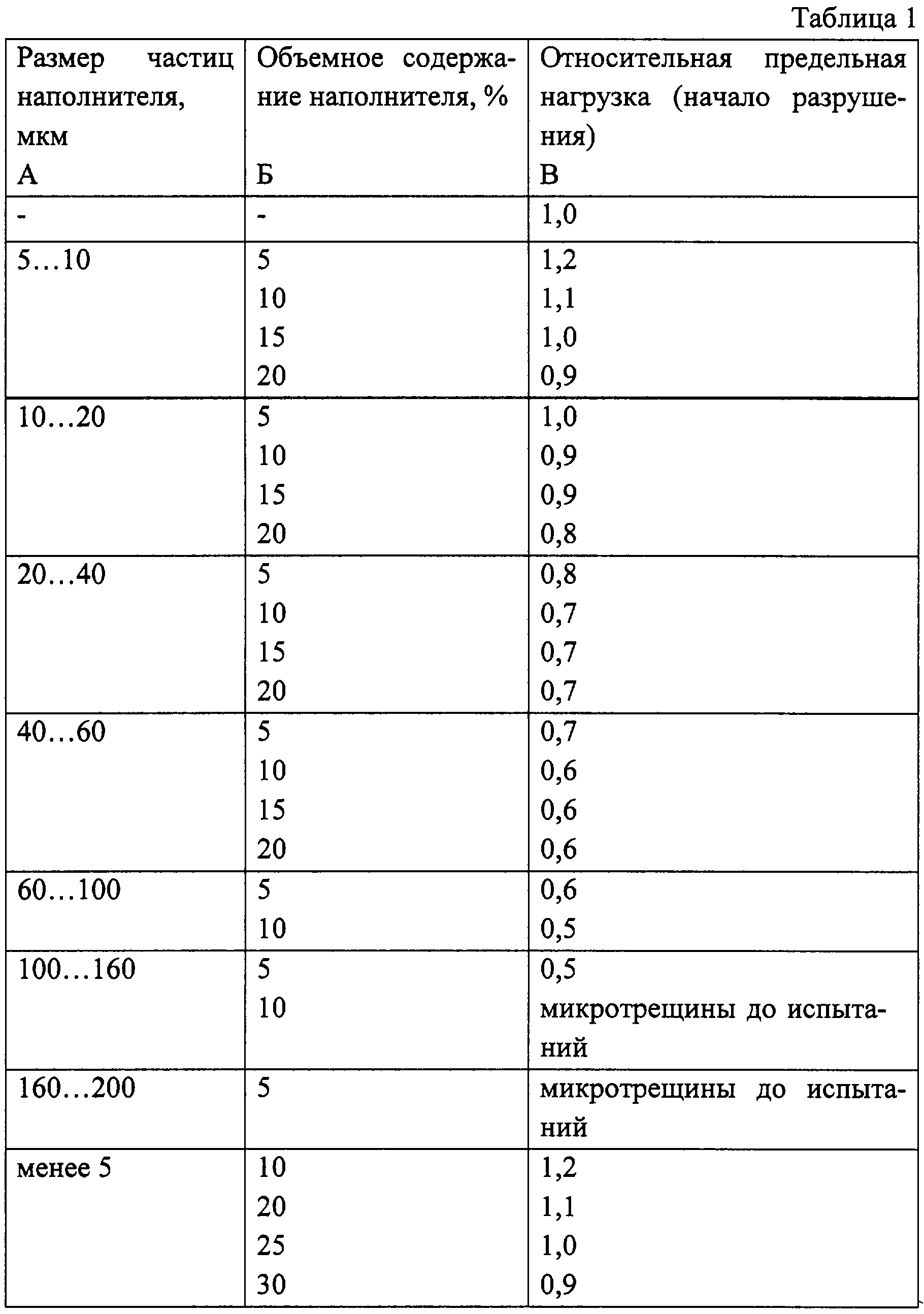
Анализ полученных результатов показывает, что увеличение размера частиц наполнителя более чем размер (высота) деформированных частиц распыленной алюминиевой проволоки приводит к резкому снижению механических свойств оксидированного покрытия. При использовании наполнителя относительно крупных фракций (более 100 мкм) трещины образуются вокруг частиц даже без приложения нагрузки извне, очевидно, за счет резкого повышения внутренних напряжений в этой области. Учитывая тот факт, что частицы распыленного металла проволок деформируются при ударе о подложку с увеличением своего диаметра от 3 до 10 раз (уменьшением высоты от 3 до 10 раз), размер частиц наполнителя должен лежать в пределах от 0,1 до 0,3 от диаметра распыленной частицы проволоки.An analysis of the results shows that an increase in the particle size of the filler is more than the size (height) of the deformed particles of the atomized aluminum wire leads to a sharp decrease in the mechanical properties of the oxidized coating. When using a filler of relatively large fractions (more than 100 μm), cracks form around the particles even without an external load, obviously due to a sharp increase in internal stresses in this area. Considering the fact that the particles of atomized metal wires deform upon impact on the substrate with an increase in its diameter from 3 to 10 times (a decrease in height from 3 to 10 times), the size of the filler particles should be in the range from 0.1 to 0.3 of the diameter atomized wire particles.
Для того чтобы повысить износостойкость оксидированного покрытия, необходимо по правилу Шарпи ввести в покрытие наполнитель с твердостью, большей чем твердость основы. Исследование износостойкости оксидированных газопламенных алюминиевых покрытий с различными наполнителями осуществляли на машине торцового трения типа АЕ-5 при сухом трении в паре с чугуном СЧ20. В качестве наполнителей использовали порошки фирмы “Штарк” (ФРГ) с размером частиц 3... 10 мкм. Износостойкость сравнивалась с оксидированным газопламенным покрытием из технически чистого алюминия. Результаты исследований представлены в табл.2.In order to increase the wear resistance of an oxidized coating, it is necessary according to Charpy's rule to introduce a filler into the coating with a hardness greater than the hardness of the substrate. The study of the wear resistance of oxidized gas-flame aluminum coatings with various fillers was carried out on an AE-5 type mechanical friction machine with dry friction paired with SCh20 cast iron. As fillers used powders company "Stark" (Germany) with a particle size of 3 ... 10 microns. Wear resistance was compared with an oxidized flame coating of technically pure aluminum. The research results are presented in table.2.
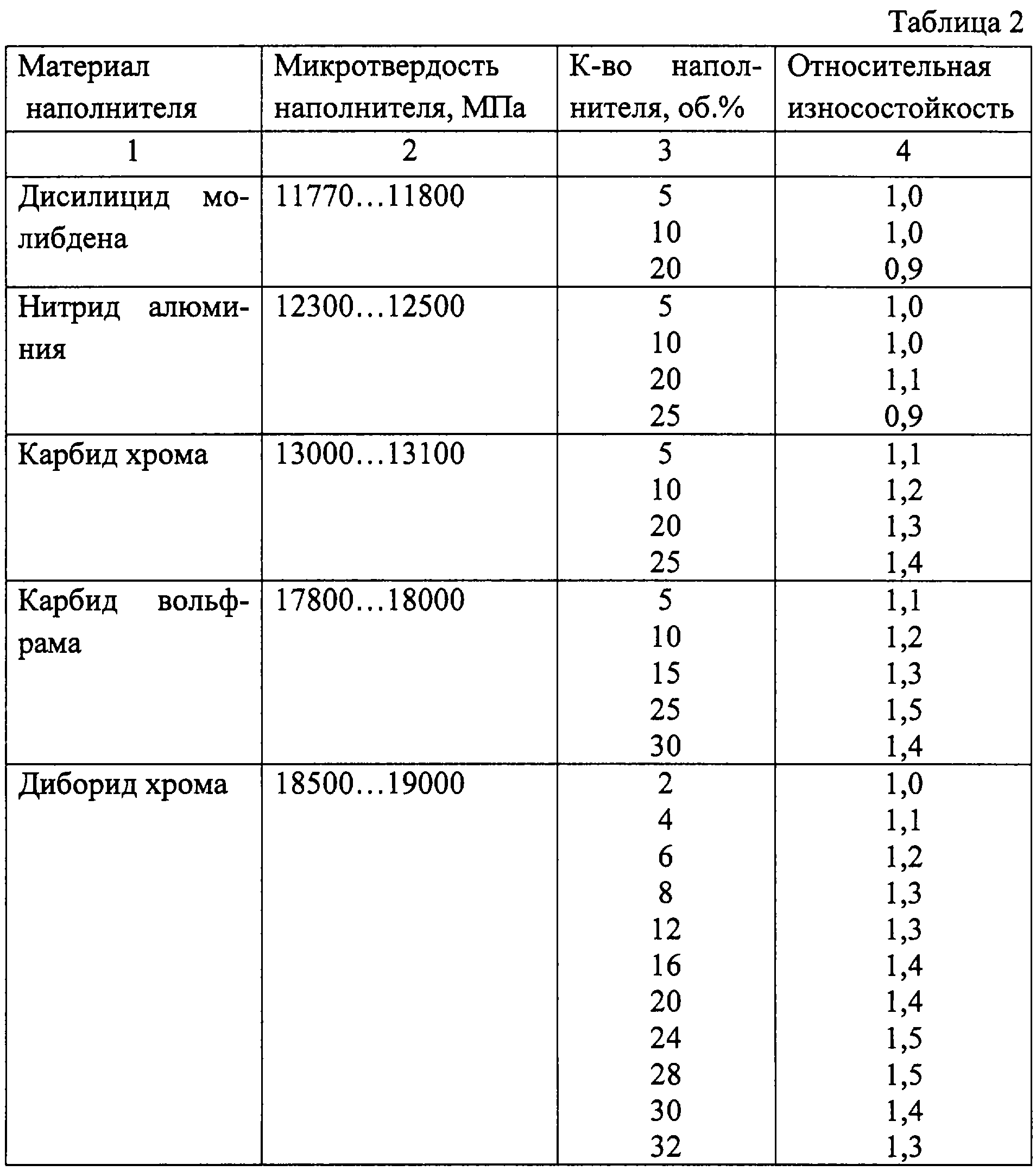
Анализ полученных результатов показывает, что наполнитель в количестве менее 3 об.% не оказывает влияния на износостойкость, а более 28 об.% приводит к повышению интенсивности изнашивания, вероятно, за счет выкрашивания частиц наполнителя, которые в свою очередь начинают интенсивно изнашивать покрытие и контртело. Переведя объемное содержание в весовое, получаем следующее выражение для определения расхода наполнителя:An analysis of the results shows that the filler in an amount of less than 3 vol.% Does not affect the wear resistance, and more than 28 vol.% Leads to an increase in the wear rate, probably due to chipping of the filler particles, which in turn begin to intensively wear the coating and counterbody . Transferring the volumetric content to the weight, we obtain the following expression for determining the filler consumption:

где Q - расход порошка наполнителя, кг/мин; V - скорость подачи проволоки, м/мин, D - диаметр проволоки, м, ρ - удельная масса материала наполнителя, кг/м3.where Q is the flow rate of the filler powder, kg / min; V - wire feed speed, m / min, D - wire diameter, m, ρ - specific gravity of the filler material, kg / m 3 .
При сухом трении в паре с неэлектропроводными материалами (натуральными и синтетическими волокнами, стеклами и ситаллами, полимерами, эмалями) на оксидированных покрытиях происходит накопление огромного по величине заряда статического электричества, вызывающего нарушение работы не только данного узла трения, но и всего механизма в целом за счет постоянного притока пыли и продуктов износа, электроразрядов. Для устранения этого недостатка в заявляемом способе предлагается отводить статическое электричество в массу детали (если деталь выполнена из электропроводного материала) по штифтам из электропроводного материала, которые равномерно закрепляют на поверхности детали перед напылением алюминиевого слоя. Для изготовления штифтов используют стали, сплавы на основе меди, сплавы на основе никеля, т.е. электропроводные материалы, которые по механическим свойствам будут отвечать поставленной задаче. Использование сплавов на основе алюминия невозможно, поскольку они в процессе МДО также покроются слоем окислов.When dry friction is paired with non-conductive materials (natural and synthetic fibers, glasses and glass, polymers, enamels) on oxidized coatings, an enormous amount of static electricity accumulates, causing disruption of not only this friction unit, but the whole mechanism as a whole due to the constant influx of dust and wear products, electrical discharges. To eliminate this drawback, the claimed method proposes to discharge static electricity into the mass of the part (if the part is made of electrically conductive material) through pins of electrically conductive material, which are evenly fixed to the surface of the part before spraying the aluminum layer. For the manufacture of pins, steel, alloys based on copper, alloys based on nickel, i.e. electrically conductive materials that according to their mechanical properties will meet the task. The use of aluminum-based alloys is impossible, since they are also coated with a layer of oxides in the MAO process.
Для определения необходимого количества штифтов, а точнее для нахождения необходимой и достаточной величины площади поверхности штифтов были проведены эксперименты по сухому трению оксидированных газопламенных покрытий с непрерывным замером скапливающегося заряда на поверхности трения с помощью электроскопа. Штифты диаметром 2,6 мм были выполнены из меди марки M1. Относительная величина накапливаемого заряда определялась по величине угла расхождения лепестков электроскопа. Результаты приведены в табл.3.To determine the required number of pins, or rather to find the necessary and sufficient value of the surface area of the pins, experiments were carried out on dry friction of oxidized gas-flame coatings with continuous measurement of the accumulated charge on the friction surface using an electroscope. The pins with a diameter of 2.6 mm were made of copper grade M1. The relative value of the accumulated charge was determined by the magnitude of the divergence angle of the petals of the electroscope. The results are shown in table.3.

Анализ результатов показывает, что оптимальная величина суммарной площади штифтов составляет 2-5% от площади покрытия (более 5% приводит к снижению износостойкости покрытия). Для того чтобы штифты эффективно отводили статический заряд, их высота должна быть не меньше высоты напыленного покрытия. После механической обработки перед оксидированием торцовая поверхность штифтов и поверхность напыленного слоя лежат в одной плоскости.An analysis of the results shows that the optimal value of the total area of the pins is 2-5% of the coating area (more than 5% leads to a decrease in the wear resistance of the coating). In order for the pins to effectively discharge static charge, their height should be no less than the height of the sprayed coating. After machining before oxidation, the end surface of the pins and the surface of the sprayed layer lie in the same plane.
Примеры осуществления способа.Examples of the method.
1. Покрытия наносили на поверхность основы из стали 45 с использованием установки газопламенного проволочного напыления “ТЕРКО” с модернизированным распылительным узлом, обеспечивающим формирование дополнительного газового потока (осушенного воздуха). В качестве горючего газа применяли пропан-бутан. Материал распыляемой проволоки - СВА-95 (ГОСТ 11069-74), диаметр 2 мм. Расходы рабочих газов: пропан-бутан 1 м3/ч, кислород 3,5 м3/ч, воздух 24 м3/ч. Скорость подачи проволоки 95 мм/с.1. Coatings were applied to the surface of a 45 steel base using a TERKO flame-spraying wire spraying unit with a modernized spraying unit, which provided the formation of an additional gas flow (dried air). Propane-butane was used as combustible gas. The material of the sprayed wire is CBA-95 (GOST 11069-74), diameter 2 mm. The consumption of working gases: propane-butane 1 m 3 / h, oxygen 3.5 m 3 / h, air 24 m 3 / h. Wire feed speed 95 mm / s.
Микродуговое оксидирование осуществлялось на промышленной частоте 50 Гц при напряжении 420 В и плотности тока 20 А/дм2 в растворе жидкого стекла в дистиллированной воде с добавлением гидрооксида калия марки “ч” в количестве 3 г/л. Время обработки 140 мин.Microarc oxidation was carried out at an industrial frequency of 50 Hz at a voltage of 420 V and a current density of 20 A / dm 2 in a solution of water glass in distilled water with the addition of potassium hydroxide grade “h” in an amount of 3 g / l. Processing time 140 min.
В качестве наполнителя использовались порошки фирмы “Штарк” (ФРГ) марок “Амперит-502” (карбид вольфрама), “Амперит TiN”, “Амперит ZrC”.Powders of the company “Stark” (Germany) of the brands “Amperit-502” (tungsten carbide), “Amperit TiN”, “Amperit ZrC” were used as filler.
Износостойкость оценивалась на машине торцового трения типа АЕ-5 при сухом трении в паре с чугуном СЧ20; нагрузка на образцы 20 Н, скорость скольжения 0,4 м/с. Износ образцов определялся методом искусственных баз, для чего перед испытаниями на покрытие наносили отпечатки алмазной пирамидой (на твердомере Виккерса) и измеряли диаметр отпечатков до и после испытаний. Критерием износостойкости служила величина интенсивности износа, определяемая как уменьшение толщины покрытия в мкм за путь трения в 1 км.Wear resistance was evaluated on an AE-5 type mechanical friction machine with dry friction paired with SCh20 cast iron; the load on the samples is 20 N, the sliding speed is 0.4 m / s. The wear of the samples was determined by the method of artificial bases, for which, before testing, the prints were coated with a diamond pyramid (on a Vickers hardness tester) and the diameter of the prints was measured before and after the tests. The wear resistance criterion was the value of the wear rate, defined as the decrease in coating thickness in microns over a friction path of 1 km.
Уменьшение толщины покрытия определялось по формулеThe decrease in coating thickness was determined by the formula

где b1, b2 - диагонали отпечатков до и после этапа испытаний соответственно; а - угол при вершине алмазной пирамиды (≈ 136° ); Δ h - уменьшение толщины покрытия.where b1, b2 are the diagonals of the prints before and after the test stage, respectively; a - angle at the top of the diamond pyramid (≈ 136 °); Δ h - decrease in coating thickness.
Результаты испытаний приведены в табл.4.The test results are shown in table 4.

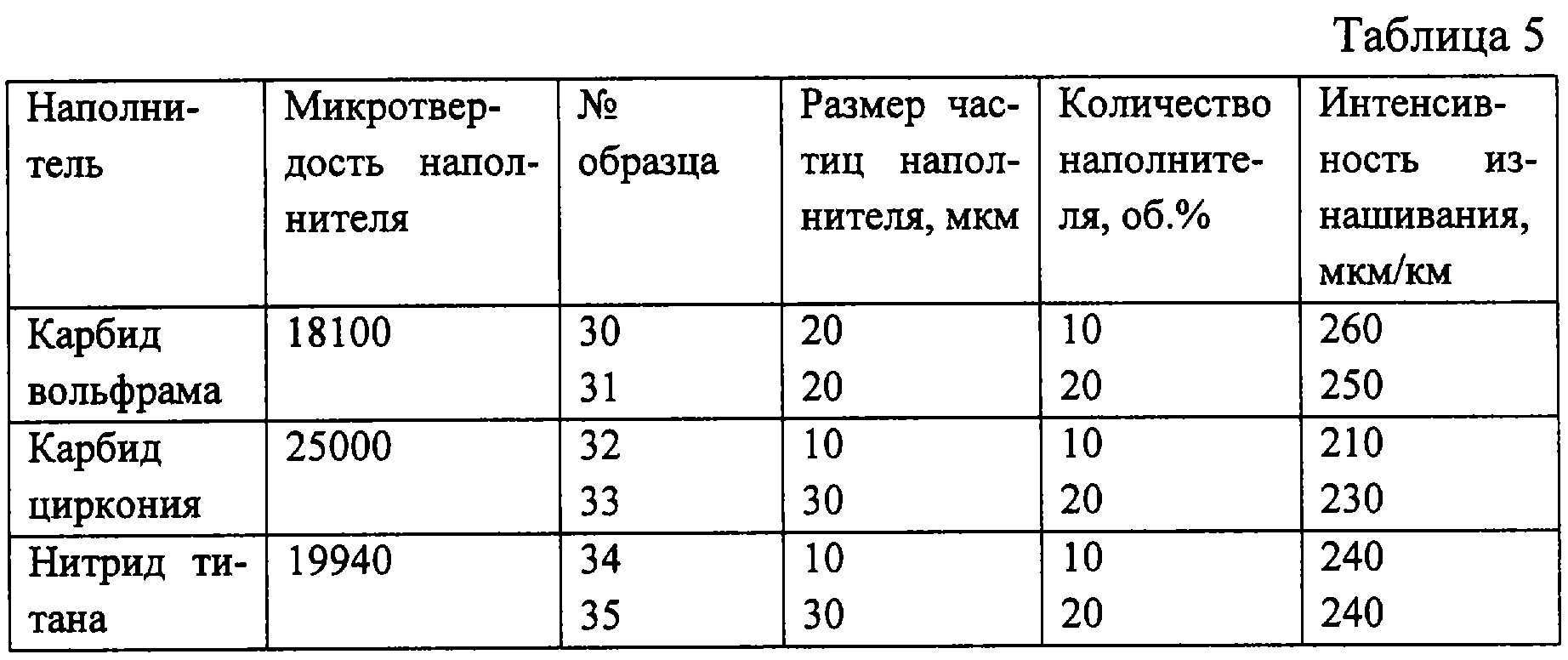
Аналогичным испытаниям подвергались образцы, напыленные сталью 65Г с теми же наполнителями (формирование покрытия по способу-прототипу). Результаты приведены в табл.5.Samples sprayed with 65G steel with the same fillers were subjected to similar tests (coating formation by the prototype method). The results are shown in table.5.
Анализ приведенных в табл.4 и 5 данных свидетельствует о том, что наибольшую износостойкость показали образцы №1, 2, 14, 15, 16, 21, 22, 23, покрытия на которых были получены по заявляемому способу.Analysis of the data in tables 4 and 5 indicates that the greatest wear resistance showed samples No. 1, 2, 14, 15, 16, 21, 22, 23, the coatings on which were obtained by the present method.
2. Стальные стенки форм №1, 2, 3 для изготовления силикатных кирпичей упрочняли с использованием газопламенного напыления на модернизированной установке “ТЕРКО”. В упрочняемую поверхность предварительно были заделаны штифты из стали ХВГ диаметром 1,6 мм; общая площадь поперечного сечения штифтов составляла 2,5%. Распыляемая проволока - СВА-95 (ГОСТ 11069-74) диаметром 2 мм, наполнитель - порошок карбида вольфрама (размер частиц около 5 мкм, объемное содержание 20%). Напыленные слои затем оксидировали на промышленной частоте 50 Гц при напряжении 420 В и плотности тока 20 А/дм2 в растворе жидкого стекла в дистиллированной воде с добавлением гидрооксида калия марки “ч” в количестве 3 г/л. Время обработки 160 мин.2. Steel walls of molds No. 1, 2, 3 for the manufacture of silicate bricks were strengthened using flame spraying at the modernized TERKO installation. Pins made of HVG steel with a diameter of 1.6 mm were previously embedded in the hardened surface; the total cross-sectional area of the pins was 2.5%. Sprayed wire - CBA-95 (GOST 11069-74) with a diameter of 2 mm, filler - tungsten carbide powder (particle size of about 5 microns, volumetric content of 20%). The deposited layers were then oxidized at an industrial frequency of 50 Hz at a voltage of 420 V and a current density of 20 A / dm 2 in a solution of water glass in distilled water with the addition of potassium hydroxide grade “h” in an amount of 3 g / l. Processing time 160 min.
На стенки форм №4, 5 газопламенным напылением на установке УПТР-1-90 с последующим оплавлением наносили покрытия из порошка хромоникелевого самофлюсующегося порошка марки ПГ-10Н-01 (стоимость около 26 $/кг).On the walls of molds No. 4, 5, by flame spraying at the UPTR-1-90 installation with subsequent melting, coatings were made of powder of chromonickel self-fluxing powder of the PG-10N-01 brand (cost about $ 26 / kg).
На стенки форм №6, 7 на модернизированной установке “ТЕРКО” наносили покрытия распылением проволоки 40Х13 при внесении в слой наполнителя - карбида вольфрама (размер частиц около 5 мкм, объемное содержание 20%).On the walls of molds No. 6, 7 on the modernized TERKO installation, coatings were sprayed with 40X13 wire when tungsten carbide was introduced into the filler layer (particle size about 5 microns, volume content 20%).
Стенки форм №8, 9 оставались неупрочненными и были выполнены из стали 45, закаленной и отпущенной до 44 НКСэ.The walls of forms No. 8, 9 remained unstrengthened and were made of steel 45, hardened and tempered to 44 NKS e .
После 12 рабочих смен эксплуатации форм были выполнены замеры с целью определения износа упрочненных стенок. Результаты приведены в табл. 6.After 12 working shifts in the operation of the molds, measurements were taken to determine the wear of the hardened walls. The results are shown in table. 6.
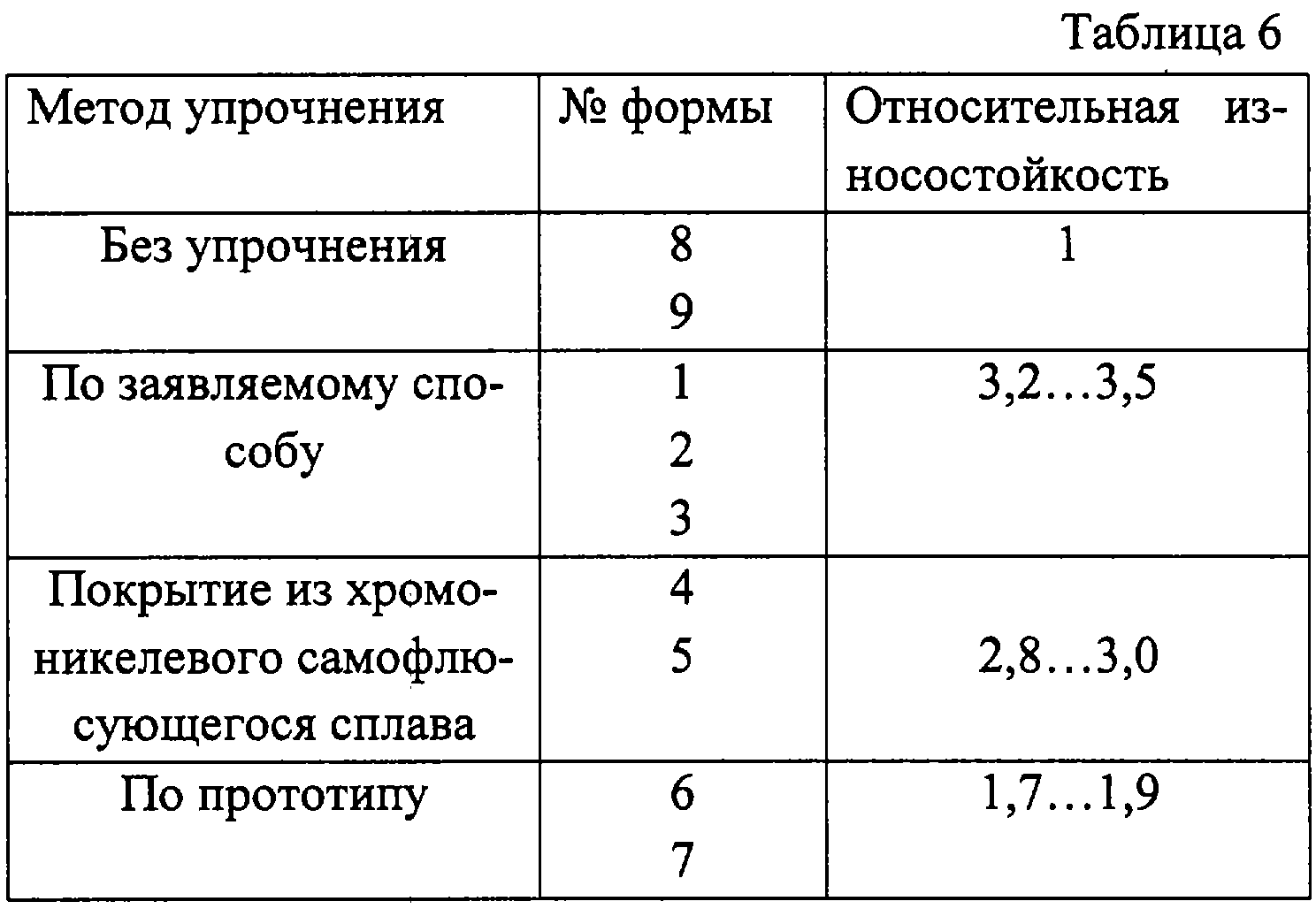
Полученные данные свидетельствуют о том, что покрытия, полученные согласно заявляемому способу, имеют более высокую износостойкость, чем полученные по прототипу, и могут успешно конкурировать с покрытиями из дорогостоящих самофлюсующихся сплавов.The data obtained indicate that the coatings obtained according to the claimed method have higher wear resistance than those obtained according to the prototype, and can successfully compete with coatings from expensive self-fluxing alloys.
Claims (2)
Priority Applications (1)
| Application Number | Priority Date | Filing Date | Title |
|---|---|---|---|
| RU2002128900/12A RU2234382C2 (en) | 2002-10-28 | 2002-10-28 | Method of applying wear-proof covering |
Applications Claiming Priority (1)
| Application Number | Priority Date | Filing Date | Title |
|---|---|---|---|
| RU2002128900/12A RU2234382C2 (en) | 2002-10-28 | 2002-10-28 | Method of applying wear-proof covering |
Publications (2)
| Publication Number | Publication Date |
|---|---|
| RU2002128900A RU2002128900A (en) | 2004-05-10 |
| RU2234382C2 true RU2234382C2 (en) | 2004-08-20 |
Family
ID=33413125
Family Applications (1)
| Application Number | Title | Priority Date | Filing Date |
|---|---|---|---|
| RU2002128900/12A RU2234382C2 (en) | 2002-10-28 | 2002-10-28 | Method of applying wear-proof covering |
Country Status (1)
| Country | Link |
|---|---|
| RU (1) | RU2234382C2 (en) |
Cited By (2)
| Publication number | Priority date | Publication date | Assignee | Title |
|---|---|---|---|---|
| RU2381077C1 (en) * | 2008-10-21 | 2010-02-10 | Общество с ограниченной ответственностью "СтройМашКомплект" | Method to make wear resistant coat |
| RU2435653C2 (en) * | 2005-12-14 | 2011-12-10 | Е.И.Дюпон Де Немур Энд Компани | Antistick composition containing diamond particles and substrate on which composition is applied |
Citations (1)
| Publication number | Priority date | Publication date | Assignee | Title |
|---|---|---|---|---|
| US4849264A (en) * | 1986-01-02 | 1989-07-18 | Texo Corporation | Friction reducing coating for metal surfaces |
-
2002
- 2002-10-28 RU RU2002128900/12A patent/RU2234382C2/en not_active IP Right Cessation
Patent Citations (1)
| Publication number | Priority date | Publication date | Assignee | Title |
|---|---|---|---|---|
| US4849264A (en) * | 1986-01-02 | 1989-07-18 | Texo Corporation | Friction reducing coating for metal surfaces |
Cited By (2)
| Publication number | Priority date | Publication date | Assignee | Title |
|---|---|---|---|---|
| RU2435653C2 (en) * | 2005-12-14 | 2011-12-10 | Е.И.Дюпон Де Немур Энд Компани | Antistick composition containing diamond particles and substrate on which composition is applied |
| RU2381077C1 (en) * | 2008-10-21 | 2010-02-10 | Общество с ограниченной ответственностью "СтройМашКомплект" | Method to make wear resistant coat |
Similar Documents
| Publication | Publication Date | Title |
|---|---|---|
| Paredes et al. | The effect of roughness and pre-heating of the substrate on the morphology of aluminium coatings deposited by thermal spraying | |
| Mohanty et al. | Sliding wear behavior of thermally sprayed 75/25 Cr3C2/NiCr wear resistant coatings | |
| Zhao et al. | Influence of doping graphite on microstructure and tribological properties of plasma sprayed 3Al2O3–2SiO2 coating | |
| Singh et al. | Tribological behavior of plasma sprayed Cr2O3–3% TiO2 coatings | |
| EP1064414B1 (en) | Forming a plain bearing lining | |
| JPH09202957A (en) | Composite material power forming self-lubricity composite film, method therefor and parts having self-lubricity film | |
| Wood et al. | Tribology of thermal-sprayed coatings | |
| Umanskyi et al. | Effect of TiB2 additives on wear behavior of NiCrBSi-based plasma-sprayed coatings | |
| Dubovoy et al. | ELECTRIC ARC SPRAYING OF CEMENT COATINGS OF STEEL 65G-TIC SYSTEM. | |
| Venugopal et al. | Evaluation of arc sprayed coatings for erosion protection of tubes in atmospheric fluidised bed combustion (AFBC) boilers | |
| Trice et al. | Role of Lamellae Morphology on the Microstructural Development and Mechanical Properties of Small‐Particle Plasma‐Sprayed Alumina | |
| RU2234382C2 (en) | Method of applying wear-proof covering | |
| Idir et al. | Microstructure and tribological behaviour of NiWCrBSi coating produced by flame spraying | |
| Modi et al. | A study of high-velocity combustion wire molybdenum coatings | |
| Vats et al. | An I nvestigation into the Erosion Wear Behavior of Fe Inter-layered Ceramic Coatings on Boron Carbide Reinforced Al Alloy Composites by High Velocity Oxygen Fuel Technique | |
| Nurisna et al. | Physical and mechanical properties of twin-wire arc spray and wire flame spray coating on carbon steel surface | |
| Erickson et al. | Alumina coatings by plasma spraying of monosize sapphire particles | |
| Bobzin et al. | Thermal spraying of cylinder bores with the PTWA internal coating system | |
| Mohanty et al. | Thermal sprayed WC-Co coatings for tribological application | |
| Pandey et al. | Effect of NiCr on dry sliding wear of high carbon iron-molybdenum composite plasma spray coating | |
| Girisha et al. | Experimental investigation on erosive wear behaviour of plasma spray coated stainless steel | |
| Saravanan et al. | Effect of SiC Coating on Fuel Consumption and Emission Control in IC Engines | |
| KR100427975B1 (en) | Aluminum alloys with improved wear-resistance, and manufacturing method therefor | |
| Tailor et al. | An Investigation on Splat and Flattening Behavior of Thermally Sprayed Copper on A Rough Surface: A New Approach | |
| Kandeva et al. | Tribology Study of High-Technological Composite Coatings Applied Using High Velocity Oxy-Fuel |
Legal Events
| Date | Code | Title | Description |
|---|---|---|---|
| MM4A | The patent is invalid due to non-payment of fees |
Effective date: 20051029 |