RU2185865C1 - Pyrotechnic aerosol-forming fire-extinguishing composite material and method of preparation thereof - Google Patents
Pyrotechnic aerosol-forming fire-extinguishing composite material and method of preparation thereof Download PDFInfo
- Publication number
- RU2185865C1 RU2185865C1 RU2000131491/12A RU2000131491A RU2185865C1 RU 2185865 C1 RU2185865 C1 RU 2185865C1 RU 2000131491/12 A RU2000131491/12 A RU 2000131491/12A RU 2000131491 A RU2000131491 A RU 2000131491A RU 2185865 C1 RU2185865 C1 RU 2185865C1
- Authority
- RU
- Russia
- Prior art keywords
- composite material
- fire extinguishing
- extinguishing composite
- dicarboxylic acid
- pyrotechnic aerosol
- Prior art date
Links
Images


Classifications
-
- A—HUMAN NECESSITIES
- A62—LIFE-SAVING; FIRE-FIGHTING
- A62D—CHEMICAL MEANS FOR EXTINGUISHING FIRES OR FOR COMBATING OR PROTECTING AGAINST HARMFUL CHEMICAL AGENTS; CHEMICAL MATERIALS FOR USE IN BREATHING APPARATUS
- A62D1/00—Fire-extinguishing compositions; Use of chemical substances in extinguishing fires
- A62D1/06—Fire-extinguishing compositions; Use of chemical substances in extinguishing fires containing gas-producing, chemically-reactive components
Landscapes
- Chemical & Material Sciences (AREA)
- Chemical Kinetics & Catalysis (AREA)
- General Chemical & Material Sciences (AREA)
- Business, Economics & Management (AREA)
- Emergency Management (AREA)
- Compositions Of Macromolecular Compounds (AREA)
- Fire-Extinguishing Compositions (AREA)
- Feeding, Discharge, Calcimining, Fusing, And Gas-Generation Devices (AREA)
- Agricultural Chemicals And Associated Chemicals (AREA)
- Fire-Extinguishing By Fire Departments, And Fire-Extinguishing Equipment And Control Thereof (AREA)
Abstract
Description
Изобретение относится к области противопожарной техники, в частности средствам тушения пожаров огнетушащим аэрозолем, образующимся при горении изделий из пиротехнических составов. The invention relates to the field of fire fighting equipment, in particular fire extinguishing means with a fire extinguishing aerosol formed during the combustion of products from pyrotechnic compositions.
Изделия из аэрозолеобразующих составов используются в устройствах для тушения пожаров преимущественно в замкнутых объемах, таких как склады и гаражи, цеховые помещения, отсеки транспортных средств. Products from aerosol-forming compositions are used in fire extinguishing devices mainly in confined spaces, such as warehouses and garages, workshop rooms, vehicle compartments.
Эффективность аэрозолеобразующих огнетушащих составов и изделий на их основе оценивают по способности удовлетворять целому комплексу предъявляемых требований. В первую очередь к таким требованиям относятся:
- высокая огнетушащая способность при минимальной огнетушащей концентрации;
- низкая токсичность и взрывоопасность продуктов сгорания за счет минимального содержания в них недоокисленных (NO, CO) и взрывоопасных (H2);
- низкая температура сгорания;
- высокий уровень деформационно-прочностных характеристик, что позволяет устранить отрицательное влияние различных факторов (вибрация, удары, перепады температур) при транспортировке и хранении, а также получать и использовать изделия с минимальной толщиной горящего свода;
- широкий диапазон варьирования скорости горения состава при атмосферном давлении предпочтительно без применения специальных катализаторов горения и без предъявления специальных высоких требований по дисперсности и фракционному составу исходных компонентов;
- низкое удельное давление формования, обеспечивающее возможность получения изделий по безопасной, малоэнергоемкой и высокопроизводительной технологии.The effectiveness of aerosol-forming extinguishing compositions and products based on them is evaluated by their ability to satisfy a whole range of requirements. First of all, such requirements include:
- high fire extinguishing ability with a minimum fire extinguishing concentration;
- low toxicity and explosiveness of combustion products due to the minimum content of under-oxidized (NO, CO) and explosive (H 2 ) in them;
- low combustion temperature;
- a high level of deformation-strength characteristics, which allows to eliminate the negative impact of various factors (vibration, shock, temperature changes) during transportation and storage, as well as to receive and use products with a minimum thickness of the burning arch;
- a wide range of variation of the burning rate of the composition at atmospheric pressure, preferably without the use of special combustion catalysts and without special high requirements for the dispersion and fractional composition of the starting components;
- low specific molding pressure, which provides the opportunity to obtain products using safe, low-energy and high-performance technology.
Известные пиротехнические составы для тушения пожаров в основном содержат:
- окислитель (преимущественно нитраты или перхлораты щелочных металлов, также их смеси);
- горюче-связующее, выбранное из ряда эпоксидных или полиэфирных смол, синтетических или натуральных каучуков, термопластов, а также их смеси;
- технологические и функциональные добавки.Known pyrotechnic compositions for extinguishing fires mainly contain:
- oxidizing agent (mainly nitrates or perchlorates of alkali metals, also mixtures thereof);
- a combustible binder selected from a number of epoxy or polyester resins, synthetic or natural rubbers, thermoplastics, as well as mixtures thereof;
- technological and functional additives.
Известен состав для тушения пожаров (Пат. RU 2095104, A, 10.11.97), содержащий, мас. %: 1,5-1,8 горючего связующего; 5,0-20,0 охладителя и остальное - окислитель. В качестве горючего связующего используют 4-оксибензойную кислоту или смесь 4-оксибензойной кислоты и фенолформальдегидной смолы, или смесь 4-оксибензойной кислоты и эпоксидной смолы, или смесь фенолформальдегидной и эпоксидной смол, или смесь 4-оксибензойной кислоты, фенолформальдегидной и эпоксидной смол. В качестве окислителя можно использовать нитрат калия или нитрат натрия, или перхлорат калия, или перхлораи натрия, или их смеси. В качестве охладителя используют дициандиамид или мелем, или меламин, или мочевину, или уротропин, или азобисформамид или их смеси. Состав дополнительно может содержать технологические добавки и катализаторы горения в количестве 0,1-5,0 мас.%. A known composition for extinguishing fires (Pat. RU 2095104, A, 10.11.97), containing, by weight. %: 1.5-1.8 combustible binder; 5.0-20.0 coolers and the rest is an oxidizing agent. As a combustible binder, 4-hydroxybenzoic acid or a mixture of 4-hydroxybenzoic acid and phenol-formaldehyde resin, or a mixture of 4-hydroxybenzoic acid and epoxy resin, or a mixture of phenol-formaldehyde and epoxy resins, or a mixture of 4-hydroxybenzoic acid, phenol-formaldehyde and epoxy resins are used. As the oxidizing agent, potassium nitrate or sodium nitrate, or potassium perchlorate, or sodium perchlorae, or mixtures thereof can be used. Dicyandiamide or melem, or melamine, or urea, or urotropin, or azobisformamide, or mixtures thereof, are used as a cooler. The composition may additionally contain processing aids and combustion catalysts in an amount of 0.1-5.0 wt.%.
Способ получения данного состава включает смешение в течение одного часа в смесителе окислителей, горючего связующего, технологических добавок и катализаторов горения. Так согласно примеру 3 состав, включающий, мас.%: нитрат калия - 60, нитрат натрия - 8,4-оксибензойная кислота - 9, фенолформальдегидная смола - 8, дициандиамид (ДЦЦА) - 12, CuO - 2, политетрафторэтилен (фторопласт-4; Ф-4) - 1, перемешивают в смесителе в течение одного часа. Из полученной массы методом глухого прессования при удельном давлении 1500 кг/см2 (150 МПа) формуют изделие необходимой геометрической формы.A method of obtaining this composition includes mixing for one hour in a mixer of oxidizing agents, a combustible binder, processing aids and combustion catalysts. So according to example 3, the composition, including, wt.%: Potassium nitrate - 60, sodium nitrate - 8,4-hydroxybenzoic acid - 9, phenol-formaldehyde resin - 8, dicyandiamide (DCCA) - 12, CuO - 2, polytetrafluoroethylene (fluoroplast-4 ; F-4) - 1, stirred in the mixer for one hour. From the obtained mass by the method of press pressing at a specific pressure of 1500 kg / cm 2 (150 MPa), a product of the required geometric shape is formed.
Данный состав и способ его получения имеют существенный недостаток, заключающийся в том, что с целью практического применения состава необходимо формовать заряды при высоком удельном давлении 1000-1500 кг/см2 (100-150 МПа). Это обстоятельство, с одной стороны, приводит к повышению опасности при переработке состава, а с другой стороны, высокий уровень удельных давлений переработки не позволяет применять более высокопроизводительную, безопасную и малоэнергоемкую технологию формования методом проходного прессования на шнек-прессе.This composition and the method of its production have a significant drawback, namely, for the practical use of the composition, it is necessary to form charges at a high specific pressure of 1000-1500 kg / cm 2 (100-150 MPa). This circumstance, on the one hand, leads to an increase in the hazard in the processing of the composition, and on the other hand, the high level of specific pressure of the processing does not allow the use of a more high-performance, safe and low-energy technology of molding by continuous pressing on a screw press.
Составы, изготовленные методом глухого прессования, характеризуются повышенной хрупкостью даже при комнатной температуре. Величина относительной деформации при их разрушении не превышает 2%. Compounds made by the method of dull pressing are characterized by increased fragility even at room temperature. The value of relative deformation during their destruction does not exceed 2%.
Наиболее близким аналогом является состав и способ его получения (Пат. RU 2005517, А, 15.01.94). Согласно примеру 1 состав включает, мас.%: KClO4 39,5; KNO3 38,5; ПВА (поливинилацетат) 8,8; дибутилфталат 3,5; идитол 5,0; вазелиновое масло 1,0; KCl 1,0; углерод 0,2; фторопласт 4-1,5; стеарат 1,0.The closest analogue is the composition and method of its production (Pat. RU 2005517, A, 01/15/94). According to example 1, the composition includes, wt.%: KClO 4 39.5; KNO 3 38.5; PVA (polyvinyl acetate) 8.8; dibutyl phthalate 3.5; iditol 5.0; Vaseline oil 1.0; KCl 1.0; carbon 0.2; fluoroplast 4-1.5; stearate 1.0.
Способ получения данного состава включает смешение ПВА в чистом виде (и тогда в смеситель вводят до 10% воды) или в виде 30-35% водной дисперсии с KClO4, KNO3, KCl, которые вводят в два-три приема. Смесь перемешивают 20-30 мин, после чего вводят все добавки. После этого проводят перемешивание под вакуумом в течение 1 ч. Готовый полуфабрикат выгружают и передают на стадию вальцевания. 12-20 вальцовок полуфабриката при температуре 70-90oС позволяют получить готовый полуфабрикат в виде полотна. Свернутое полотно передается на стадию формования на гидропресс при температуре 60-90oС и давлении не менее 1000 кгс/см2. Получают круглые заготовки диаметром до 70 мм как с каналом, так и без него.A method of obtaining this composition involves mixing PVA in pure form (and then up to 10% water is introduced into the mixer) or in the form of a 30-35% aqueous dispersion with KClO 4 , KNO 3 , KCl, which are introduced in two to three doses. The mixture is stirred for 20-30 minutes, after which all additives are introduced. After this, stirring is carried out under vacuum for 1 hour. The finished semi-finished product is unloaded and transferred to the rolling stage. 12-20 rolling of the semi-finished product at a temperature of 70-90 o With allow you to get the finished semi-finished product in the form of a cloth. The rolled web is transferred to the molding stage for hydropress at a temperature of 60-90 o C and a pressure of at least 1000 kgf / cm 2 . Get round billets with a diameter of up to 70 mm with or without a channel.
Данный состав и способ его получения имеют ряд существенных недостатков:
- высокая огнетушащая концентрация состава - 27 г/м3;
- высокое удельное давление формования изделий из состава - не менее 1000 кгс/см2 (100 МПа);
- неустойчивое горение состава (при давлении 2-20 атмосфер требуется введение специальных модификаторов горения, таких как углерод);
- неустойчивое воспламенение из-за остаточной влажности основных аэрозолеобразующих ингредиентов (KClO4, КNО3). Влажность частиц КСlO4 и КNО3 приводит к нарушению адгезии их поверхности к полимерному связующему, что в свою очередь приводит к существенному уменьшению прочностных характеристик готового изделия.This composition and method of its production have a number of significant disadvantages:
- high fire extinguishing concentration of the composition - 27 g / m 3 ;
- high specific pressure molding products from the composition is not less than 1000 kgf / cm 2 (100 MPa);
- unstable combustion of the composition (at a pressure of 2-20 atmospheres, the introduction of special combustion modifiers, such as carbon) is required;
- unstable ignition due to residual moisture of the main aerosol forming ingredients (KClO 4 , KNO 3 ). The moisture content of KClO 4 and KNO 3 particles leads to a violation of the adhesion of their surface to the polymer binder, which in turn leads to a significant decrease in the strength characteristics of the finished product.
Указанные недостатки обусловлены химической природой используемых компонентов и их массовым соотношением. Высокое и несбалансированное содержание в составе горючих веществ приводит при горении состава к неполному окислению продуктов разложения основного (ПВА) и дополнительного (идитол) горючего связующего вследствие недостаточного количества кислорода окислителя. Отсюда высокое содержание в продуктах сгорания токсичных недоокисленных и взрывоопасных газов, неустойчивое воспламенение и горение состава. Выбор пары горючего связующего: основного (ПВА) и дополнительного (идитол) из-за технологических трудностей переработки состава приводит к необходимости применения водной дисперсии ПВА. Это приводит к увлажнению KClO4, КNО3 и, как следствие, к неустойчивости при воспламенении и горении состава и невозможности достижения высокого уровня деформационно-прочностных характеристик состава, и к необходимости использовать высокое удельное давление формования.These disadvantages are due to the chemical nature of the components used and their mass ratio. The high and unbalanced content of combustible substances during combustion of the composition leads to incomplete oxidation of the decomposition products of the main (PVA) and additional (iditol) combustible binder due to the insufficient amount of oxidizing oxygen. Hence the high content in the combustion products of toxic unoxidized and explosive gases, unstable ignition and combustion of the composition. The choice of a pair of combustible binder: basic (PVA) and additional (iditol) due to technological difficulties in processing the composition, necessitates the use of an aqueous dispersion of PVA. This leads to wetting of KClO 4 , KNO 3 and, as a result, to instability during ignition and combustion of the composition and the inability to achieve a high level of deformation-strength characteristics of the composition, and to the necessity of using high specific molding pressure.
Настоящим изобретением решаются следующие технические задачи: обеспечение устойчивого горения и повышение скорости горения, соответственно увеличение скорости газоаэрозолеобразования; повышение уровня деформационно-прочностных характеристик; снижение огнетушащей концентрации; снижение уровня токсичности и взрывоопасности продуктов сгорания за счет уменьшения содержания доли недоокисленных и взрывоопасных газов; снижение удельного давления формования и, как следствие, понижение уровня опасности, а также получение возможности использования высокопроизводительной, менее энергоемкой технологии проходного прессования. The present invention solves the following technical problems: ensuring stable combustion and increasing the burning rate, respectively, increasing the rate of gas aerosol formation; increasing the level of deformation and strength characteristics; decrease in fire extinguishing concentration; a decrease in the level of toxicity and explosiveness of combustion products by reducing the content of the fraction of unoxidized and explosive gases; reduction of specific molding pressure and, as a consequence, lowering the level of danger, as well as obtaining the possibility of using high-performance, less energy-intensive technology of continuous pressing.
Решение поставленных технических задач достигается заявляемым новым композиционным материалом и способом его получения. The solution of the technical problems is achieved by the claimed new composite material and the method of its production.
Пиротехнический аэрозолеобразующий огнетушащий композиционный материал объемной структуры содержит окислитель, технологическую добавку и горючее связующее, сформированное термопластичным поликонденсатом формальдегида и фенола, который пластифицирован эфиром дикарбоновой кислоты, и объемно-структурирован фторопластом-4. The pyrotechnic aerosol-forming fire extinguishing volumetric composite material contains an oxidizing agent, a processing aid, and a combustible binder formed by a thermoplastic polycondensate of formaldehyde and phenol, which is plasticized with dicarboxylic acid ester, and volume-structured with fluoroplast-4.
В заявляемом пиротехническом аэрозолеобразущем огнетушащем композиционном материале объемная структура представляет собой пространственное образование из твердых частиц окислителей (КNО3, КСlO4) и прослоек между твердыми частицами горюче-связующего, сформированного термопластичным поликонденсатом формальдегида и фенола пластифицированным эфиром дикарбоновой кислоты и фторопластом-4 (Ф-4). При этом в объеме термопластичного поликонденсата формальдегида и фенола, пластифицированного эфиром дикарбоновой кислоты, частицы Ф-4 образуют упорядоченную структуру. Упорядоченная структура выполняет структурирующую функцию и представляет собой протяженные цепи с поперечным сечением 0,1-2,0 мкм из частиц Ф-4.In the inventive pyrotechnic aerosol-forming fire-extinguishing composite material, the volumetric structure is a spatial formation of solid particles of oxidizing agents (KNO 3 , KClO 4 ) and interlayers between solid particles of a combustible binder formed by a thermoplastic polycondensate of formaldehyde and phenol plasticized with dicarboxylic acid-4 fluorophenol ether and fluorine (4-fluorophenol 4). Moreover, in the volume of the thermoplastic polycondensate of formaldehyde and phenol, plasticized with dicarboxylic acid ester, F-4 particles form an ordered structure. The ordered structure performs a structuring function and is an extended chain with a cross section of 0.1-2.0 microns from particles F-4.
В качестве горюче-связующего используют поликонденсат формальдегида и фенола - фенолформальдегидную смолу (идитол); в качестве эфира дикарбоновой кислоты используют дибутилфталат (ДБФ), диоктилсебацинат (ДОС) или их смесь; в качестве технологической добавки используют стеарат, выбранный из ряда стеаратов металлов, например стеарат натрия, стеарат калия, стеарат кальция или их смесь; в качестве окислителя используют нитрат, перхлорат щелочных металлов или их смесь. As a combustible binder, polycondensate of formaldehyde and phenol is used - phenol-formaldehyde resin (iditol); dibutyl phthalate (DBP), dioctyl sebacinate (DOS) or a mixture thereof are used as the dicarboxylic acid ester; as a processing aid, stearate is selected from a number of metal stearates, for example sodium stearate, potassium stearate, calcium stearate or a mixture thereof; as an oxidizing agent, nitrate, alkali metal perchlorate or a mixture thereof is used.
Композиционный материал содержит компоненты в следующем соотношении, мас. %: фторопласт-4 - 1-5; термопластичный поликонденсат формальдегида и фенола - 8-11; эфир дикарбоновой кислоты - 2-6; технологическая добавка - 0,2-0,5; окислитель - остальное. The composite material contains components in the following ratio, wt. %: fluoroplast-4 - 1-5; thermoplastic polycondensate of formaldehyde and phenol - 8-11; dicarboxylic acid ester - 2-6; technological additive - 0.2-0.5; oxidizing agent - the rest.
Для получения заявляемого композиционного материала готовят суспензию поликонденсата формальдегида и фенола в органическом растворителе. Для этого берут 10-15% хлористого метилена или четыреххлористого углерода или их смесь, что обеспечивает безопасное смешение и исключает пыление порошкообразных компонентов. К полученной суспензии добавляют при перемешивании дисперсию Ф-4 в эфире дикарбоновой кислоты. Затем полученную смесь смешивают с окислителем и компонентами. К полученной суспензии добавляют при перемешивании дисперсию Ф-4 в эфире дикарбоновой кислоты. Затем полученную смесь смешивают с окислителем и одновременно дозируют технологическую добавку. Технологическая добавка, выбранная из ряда стеаратов металлов, обладает поверхностно-активными свойствами. В процессе смешения происходит модификация поверхности окислителя за счет адсорбции на его полярную поверхность дифильной молекулы стеарата, что обеспечивает на стадии формования (при температуре 70-90oC снижение внешнего трения композиции. Концентрация технологической добавки менее 0,2% незначительно снижает внешнее трение. Концентрация технологической добавки более 0,5% обеспечивает существенное снижение внешнего трения, но при этом снижает уровень адгезии окислителя к горюче-связующему и в результате существенно снижает прочностные свойства композиционного материала.To obtain the inventive composite material, a suspension of polycondensate of formaldehyde and phenol in an organic solvent is prepared. To do this, take 10-15% of methylene chloride or carbon tetrachloride or a mixture thereof, which ensures safe mixing and eliminates dusting of powdered components. To the resulting suspension, a dispersion of F-4 in dicarboxylic acid ester is added with stirring. Then the resulting mixture is mixed with an oxidizing agent and components. To the resulting suspension, a dispersion of F-4 in dicarboxylic acid ester is added with stirring. Then the resulting mixture is mixed with an oxidizing agent and at the same time the technological additive is dosed. A technological additive selected from a number of metal stearates has surface-active properties. During mixing, the oxidizer surface is modified by adsorption of a diphilic stearate molecule onto its polar surface, which ensures at the molding stage (at a temperature of 70-90 o C a decrease in the external friction of the composition. A concentration of the processing aid of less than 0.2% slightly reduces external friction. Concentration a technological additive of more than 0.5% provides a significant reduction in external friction, but at the same time reduces the level of adhesion of the oxidizing agent to a combustible binder and, as a result, significantly reduces the strength properties of the composite material.
При этом не предъявляют жестких требований по дисперсности и фракционному составу окислителя. Используют нитраты калия и/или перхлораты калия с удельной поверхностью 1000-1500 см2/г с влажностью не более 0,5%.However, they do not impose strict requirements on the dispersion and fractional composition of the oxidizing agent. Potassium nitrates and / or potassium perchlorates with a specific surface of 1000-1500 cm 2 / g with a moisture content of not more than 0.5% are used.
Полученную смесь подвергают термомеханическому воздействию при вальцевании при 70-90oС. При этом происходят следующие процессы;
- измельчение окислителя и равномерное распределение его в объеме горюче-связующего;
- пластификация поликонденсата формальдегида и фенола эфиром дикарбоновой кислоты, что обеспечивает оптимальные вязко-текучие характеристики горюче-связующего и всего композиционного материала в целом;
- совместное течение пластифицированного поликонденсата формальдегида и фенола и Ф-4. Вследствие своей термодинамической несовместимости с поликонденсатом формальдегида и фенола в обычных условиях не может равномерно распределяться в его объеме. Однако в условиях режима термопластичной деформации при заданной температуре, интенсивности и длительности сдвигового деформирования создаются условия их одновременного течения, в результате чего происходит миграция частиц Ф-4 между слоями пластифицированного поликонденсата формальдегида и фенола. При этом частицы Ф-4 выстраиваются в протяженные цепи, объемно-структурирующие горюче-связующее.The resulting mixture is subjected to thermomechanical effects when rolling at 70-90 o C. In this case, the following processes occur;
- grinding of the oxidizing agent and its uniform distribution in the volume of the combustible-binder;
- plasticization of the polycondensate of formaldehyde and phenol with dicarboxylic acid ester, which provides optimal visco-flowing characteristics of the combustible binder and the entire composite material as a whole;
- the joint flow of plasticized polycondensate formaldehyde and phenol and F-4. Due to its thermodynamic incompatibility with the polycondensate of formaldehyde and phenol under normal conditions, it cannot be evenly distributed in its volume. However, under the conditions of the thermoplastic deformation mode at a given temperature, intensity and duration of shear deformation, conditions for their simultaneous flow are created, as a result of which the F-4 particles migrate between the layers of plasticized polycondensate of formaldehyde and phenol. In this case, the F-4 particles line up in extended chains that bulk-structure the combustible-binder.
Интенсивность и длительность термомеханического воздействия при вальцевании задают из условия: 1000<js<3000, где js - безразмерный параметр, определяющий суммарную деформацию. Применительно к процессу вальцевания величина js при заданной температуре 70-90oС равна
js=j•t, [с-1•с]/ (1)
Скорость сдвига j в этом случае равна

где δ - межвалковый зазор;
V - линейная скорость движения композиционного материала.The intensity and duration of the thermomechanical action during rolling is set from the condition: 1000 <j s <3000, where j s is the dimensionless parameter that determines the total deformation. In relation to the rolling process, the value of j s at a given temperature of 70-90 o With equal
j s = j • t, [s -1 • s] / (1)
The shear rate j in this case is
where δ is the roll gap;
V is the linear velocity of the composite material.
В свою очередь V = π•D•n, (3)
где n - скорость вращения валков,
D - диаметр валков.In turn, V = π • D • n, (3)
where n is the speed of rotation of the rolls,
D is the diameter of the rolls.
Выражая время t через путь L, можно записать
t=L/V (4)
За один пропуск через межвалковый зазор проходит слой композиционного материала длиной, равной длине окружности валка
L = π•D. (5)
За m пропусков, соответственно
L = m•π•D (6)
Тогда время воздействия t составит
t = L/V = m•π•D/π•D•n = m/n, [сек] (7)
Подставляя уравнения 2 и 7 в уравнение 1, получим

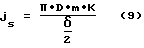
С учетом той части композиционного материала, которая циркулирует над межвалковым зазором и подвергается смешению, вводим установленный опытным путем коэффициент К, значения которого в зависимости от компонентного состава и размеров валков составляют от 0,133 до 0,222.Expressing time t through the path L, we can write
t = L / V (4)
For one pass, a layer of composite material with a length equal to the circumference of the roll passes through the roll gap
L = π • D. (5)
For m passes, respectively
L = m • π • D (6)
Then the exposure time t will be
t = L / V = m • π • D / π • D • n = m / n, [sec] (7)
Substituting
Taking into account that part of the composite material that circulates over the roll gap and is mixed, we introduce an experimentally established coefficient K, the values of which, depending on the component composition and dimensions of the rolls, are from 0.133 to 0.222.
Окончательно получаем
Пример 1. Для приготовления 1 кг пиротехнического аэрозолеобразующего огнетушащего композиционного материала в лопастной смеситель загружают 111 г поликонденсата формальдегида и фенола с удельной поверхностью 1500 см2/г и 19,59 г хлористого метилена для получения 85% суспензии. Суспензию готовят в реакторе с водяной рубашкой при температуре 20...25oС и мешалкой, вращающейся со скоростью 85 об/мин. Время смешения 15 минут.We finally get
Example 1. To prepare 1 kg of pyrotechnic aerosol-forming fire extinguishing composite material, 111 g of polycondensate of formaldehyde and phenol with a specific surface of 1,500 cm 2 / g and 19.59 g of methylene chloride are loaded into a paddle mixer to obtain an 85% suspension. The suspension is prepared in a reactor with a water jacket at a temperature of 20 ... 25 o With a stirrer rotating at a speed of 85
К указанной суспензии добавляют 45 г дисперсии Ф-4 в дибутилфталате при их соотношении 20: 25. Дисперсию готовят в реакторе с водяной рубашкой при температуре 20...25oС и мешалкой, вращающейся со скоростью 85 об/мин. Время приготовления дисперсии 10 минут.To this suspension, 45 g of dispersion F-4 in dibutyl phthalate are added at a ratio of 20: 25. The dispersion is prepared in a reactor with a water jacket at a temperature of 20 ... 25 o C and a stirrer rotating at a speed of 85 rpm. The time for preparing the dispersion is 10 minutes.
В полученную смесь суспензии поликонденсата формальдегида и фенола в хлористом метилене и дисперсии Ф-4 в дибутилфталате добавляют порциями (за два приема) 640 г нитрата калия с удельной поверхностью 1500 см2/г, а затем 200 г перхлората калия с удельной поверхностью 1500 см2/г. В полученную смесь добавляют 4 г стеарата кальция, после чего перемешивают в течение 10 минут. Готовую массу переносят на вальцы с диаметром валков D=100 мм и скоростью их вращения n=10 мин-1 при зазоре между валками δ=1 мм при температуре 80oС массу вальцуют в течение 15 минут. Затем полученное полотно еще 20 раз пропускают через межвалковый зазор при температуре 80oС. Суммарная деформация js при вальцевании в данном случае составила: js=2094.640 g of potassium nitrate with a specific surface of 1,500 cm 2 / g and then 200 g of potassium perchlorate with a specific surface of 1,500 cm 2 are added in portions (in two doses) to the mixture of a suspension of a formaldehyde-phenol polycondensate and phenol suspension in methylene chloride and a dispersion of F-4 in dibutyl phthalate. / g 4 g of calcium stearate are added to the resulting mixture, followed by stirring for 10 minutes. The finished mass is transferred to rollers with a roll diameter of D = 100 mm and a rotation speed of n = 10 min −1 with a gap between the rolls of δ = 1 mm at a temperature of 80 ° C. The mass is rolled for 15 minutes. Then, the resulting web is passed another 20 times through the roll gap at a temperature of 80 o C. The total deformation j s during rolling in this case amounted to: j s = 2094.
Готовое полотно помещают в формующий пресс и получают изделия заданной геометрии методом проходного формования при температуре 80oС и давлении 50 МПа.The finished web is placed in a forming press and receive products of a given geometry by continuous molding at a temperature of 80 o C and a pressure of 50 MPa.
Композиционный материал подвергают испытаниям по стандартным методикам. Путем сжигания при атмосферном давлении определяют линейную скорость горения (U0,1) и огнетушащую концентрацию (ОТК) в боксе объемом 80 дм3. Деформационные (εp) и прочностные (σp) характеристики определяют при одноосном растяжении материала в виде двухсторонних лопаток при скорости 0,21 мм/с и 20oС или при срезе цилиндрических образцов (σср) при 40-80oС и скорости 0,21 мм/с.The composite material is tested according to standard methods. By burning at atmospheric pressure, the linear burning rate (U 0.1 ) and the fire extinguishing concentration (OTK) in a box of 80 dm 3 are determined. The deformation (ε p ) and strength (σ p ) characteristics are determined by uniaxial tension of the material in the form of double-sided blades at a speed of 0.21 mm / s and 20 o C or when cutting cylindrical samples (σ cf ) at 40-80 o C and speed 0.21 mm / s.
В таблице 1 представлена зависимость эксплуатационных характеристик заявляемого пиротехнического аэрозолеобразующего огнетушащего композиционного материала следующего состава: 20% KClO4; КNО3 64%; 2% Ф-4; 0,4% стеарата кальция; 11,1% идитола; 2,5% ДБФ (примеры 1-4 и пример 5 без Ф-4) от режимов способа его получения.Table 1 presents the dependence of the operational characteristics of the claimed pyrotechnic aerosol-forming extinguishing composite material of the following composition: 20% KClO 4 ;
Из представленных в таблице 1 данных видно, что наилучшей совокупностью эксплуатационных характеристик обладает композиционный материал по примеру 4, полученный при термомеханическом воздействии вальцеванием, интенсивность и длительность которого отвечает условию равенства суммарной деформации js= 2094.From the data presented in table 1, it can be seen that the composite material of Example 4, obtained by thermomechanical action by rolling, the intensity and duration of which corresponds to the condition of equality of the total deformation j s = 2094, has the best set of operational characteristics.
Композиционные материалы, полученные по примерам 1 и 2 без операции вальцевания (без пластической деформации), демонстрируют низкие эксплуатационные характеристики. Composite materials obtained in examples 1 and 2 without rolling operations (without plastic deformation), demonstrate low performance.
При сравнении примеров 3 и 4 видно, что проведение вальцевания (пластической деформации), суммарная деформация js которого превышает 1000, обеспечивает наилучшие эксплуатационные характеристики.When comparing examples 3 and 4, it is seen that rolling (plastic deformation), the total deformation of which j s exceeds 1000, provides the best performance.
В таблице 2 представлена зависимость эксплуатационных характеристик и термодинамических параметров пиротехнических аэрозолеобразующих огнетушащих композиционных материалов от рецептуры исходных компонентов и величины суммарной деформации js при вальцевании.Table 2 shows the dependence of the operational characteristics and thermodynamic parameters of the pyrotechnic aerosol-forming fire extinguishing composite materials on the formulation of the starting components and the total strain j s during rolling.
Из представленных в таблице 2 данных видно, что наилучшей совокупностью эксплуатационных характеристик и наименьшей концентрацией токсичных (СО) и взрывоопасных (H2) газов в продуктах горения обладают композиционные материалы в заявленном диапазоне соотношений компонентов и суммарной деформации js при вальцевании, отвечающей условию 1000<js<3000.From the data presented in table 2, it can be seen that composite materials in the claimed range of component ratios and total deformation j s during rolling meeting the
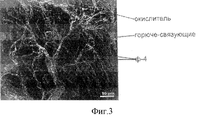
По описанному выше способу получены композиционные материалы, электронные фото которых, сделанные на растровом микроскопе, представлены на фиг.1-3. According to the method described above, composite materials are obtained whose electronic photos taken with a scanning microscope are shown in FIGS. 1-3.
На фиг. 1 представлен композиционный материал объемной структуры следующего состава: 20% KClO4, 64% КNО3; 0,4% стеарата кальция; 11,1% идитола; 2,5% дибутилфталата (ДБФ) без объемного структурирования Ф-4.In FIG. 1 shows a composite material of a three-dimensional structure of the following composition: 20% KClO 4 , 64% KNO 3 ; 0.4% calcium stearate; 11.1% iditol; 2.5% dibutyl phthalate (DBP) without bulk structuring of F-4.
На фиг.2 представлен композиционный материал объемной структуры с горюче-связующим, структурированный Ф-4, следующего состава: 20% KClO4; КNО3 64%; 2% Ф-4; 0,4% стеарата кальция; 11,1% идитола; 2,5% ДБФ.Figure 2 presents a composite material of a three-dimensional structure with a combustible binder, structured F-4, the following composition: 20% KClO 4 ;
На фиг.3 представлен композиционный материал объемной структуры с горюче-связующим, структурированным Ф-4, следующего состава: 80% КNО3; 2,5% Ф-4; 0,4% стеарата кальция; 11,65% идитола; 5,45% диоктилсебацината (ДОС).Figure 3 presents a composite material of a three-dimensional structure with a fuel-binding, structured F-4, the following composition: 80% KNO 3 ; 2.5% F-4; 0.4% calcium stearate; 11.65% iditol; 5.45% dioctyl sebacinate (DOS).
Из сравнения композиционных материалов, представленных на фиг.1,2,3, видно, что на фиг. 2 и фиг.3 частицы Ф-4 выстроены в протяженные объемно-структурирующие цепи. From a comparison of the composite materials shown in FIGS. 1,2,3, it can be seen that in FIG. 2 and 3, particles of F-4 are arranged in extended volumetric-structural chains.
Ранее не были известны пиротехнические аэрозолеобразующие огнетушащие композиционные материалы объемной структуры с объемно-структурированным горюче-связующим, а именно сформированным термопластичным поликонденсатом формальдегида и фенола, пластифицированным эфиром дикарбоновой кислоты, и объемно-структурированны Ф-4. Полученные технические результаты невозможно было прогнозировать или рассчитать заранее, используя известные методы расчета. В композиции использовано, по крайней мере, пять компонентов, различных по своей физико-химической природе, которые оказывают сложные взаимные влияния друг на друга как при получении композиционного материала, так и при его использовании во время тушения пожара. Previously, pyrotechnic aerosol-forming fire extinguishing composite materials with a volume structure with a volume-structured combustible binder, namely, formed by a thermoplastic polycondensate of formaldehyde and phenol, plasticized with a dicarboxylic acid ester, and volume-structured F-4 were not known. The obtained technical results could not be predicted or calculated in advance using known calculation methods. The composition used at least five components, different in their physicochemical nature, which have complex mutual influences on each other both during the preparation of the composite material and during its use during fire fighting.
Новизна способа получения заявляемого композиционного материала заключается в использовании термомеханического воздействия путем вальцевания при заданной температуре 70-90oС и величине суммарной деформации (js), отвечающей условию: 1000<js<3000, и формовании при температуре 70-90oС.The novelty of the method of obtaining the inventive composite material is the use of thermomechanical effects by rolling at a given temperature of 70-90 o C and the total strain (j s ) corresponding to the condition: 1000 <j s <3000, and molding at a temperature of 70-90 o C.
Предложенный пиротехнический аэрозолеобразующий огнетушащий композиционный материал, полученный по заявляемому способу, позволяет проводить эффективное тушение пожара различных горючих веществ в сооружениях и устройствах, таких как:
- склады, гаражи, цеховые помещения;
- офисы, помещения для содержания животных и птиц;
- двигательные и багажные отсеки транспортных средств;
- вентиляционные системы промышленных предприятий, гостиниц и т.п.The proposed pyrotechnic aerosol-forming fire extinguishing composite material obtained by the present method allows for effective fire fighting of various combustible substances in structures and devices, such as:
- warehouses, garages, workshop premises;
- Offices, rooms for keeping animals and birds;
- engine and luggage compartments of vehicles;
- ventilation systems of industrial enterprises, hotels, etc.
Преимуществами предложенного композиционного материала являются широкая сырьевая база компонентов и комплекс высоких эксплуатационных характеристик, таких как низкая огнетушащая концентрация, высокий уровень деформационно-прочностных характеристик, долговечность и надежность при использовании, возможность регулирования скорости горения без применения специальных катализаторов. При этом огнетушащая газоаэрозольная смесь не оказывает губительного воздействия на человека и окружающие его живые организмы, природу, высокоточные аппараты и устройства. The advantages of the proposed composite material are a wide raw material base of components and a set of high performance characteristics, such as low fire extinguishing concentration, high level of deformation and strength characteristics, durability and reliability in use, the ability to control the burning rate without the use of special catalysts. At the same time, a fire extinguishing gas-aerosol mixture does not have a detrimental effect on a person and surrounding living organisms, nature, high-precision apparatuses and devices.
Преимуществами способа его получения являются возможность использования широко распространенных комплектующих для его реализации и низкое давление формования, а также простота и безопасность производства. The advantages of the method for its production are the ability to use widespread components for its implementation and low molding pressure, as well as the simplicity and safety of production.
Claims (6)
Фторопласт-4 - 1 - 5
Термопластичный полимер - 8 - 11
Эфир дикарбоновой кислоты - 2 - 6
Технологическая добавка - 0,2 - 0,5
Окислитель - Остальное
2. Пиротехнический аэрозолеобразующий огнетушащий композиционный материал по п. 1, где в качестве термопластичного полимера используют поликонденсат формальдегида и фенола.1. Pyrotechnic aerosol-forming fire extinguishing composite material containing an oxidizing agent, a technological additive, volumetric-structured with fluoroplast-4 combustible-binder based on a thermoplastic polymer plasticized with dicarboxylic acid ester, in the following ratio of starting components, wt. %:
Ftoroplast-4 - 1 - 5
Thermoplastic polymer - 8 - 11
Dicarboxylic acid ester - 2 - 6
Technological additive - 0.2 - 0.5
Oxidant - Else
2. Pyrotechnic aerosol-forming fire extinguishing composite material according to claim 1, wherein polycondensate of formaldehyde and phenol is used as a thermoplastic polymer.
Priority Applications (15)
| Application Number | Priority Date | Filing Date | Title |
|---|---|---|---|
| RU2000131491/12A RU2185865C1 (en) | 2000-12-15 | 2000-12-15 | Pyrotechnic aerosol-forming fire-extinguishing composite material and method of preparation thereof |
| CN01820626.3A CN1268408C (en) | 2000-12-15 | 2001-12-14 | Pyrotechnical aerosol-forming fire-extinguishing composite and method of its prodn |
| EP01995826A EP1341587B1 (en) | 2000-12-15 | 2001-12-14 | Pyrotechnical aerosol-forming fire-extinguishing composite and a method of its production |
| AU2002226820A AU2002226820B2 (en) | 2000-12-15 | 2001-12-14 | Pyrotechnical aerosol-forming fire-extinguishing composite and a method of its production |
| US10/014,931 US6689285B2 (en) | 2000-12-15 | 2001-12-14 | Pyrotechnical aerosol-forming fire-extinguishing composite and a method of its production |
| IL15634601A IL156346A0 (en) | 2000-12-15 | 2001-12-14 | Pyrotechnical aerosol-forming fire-extinguishing composite and a method of its production |
| MXPA03005376A MXPA03005376A (en) | 2000-12-15 | 2001-12-14 | Pyrotechnical aerosol-forming fire-extinguishing composite and a method of its production. |
| AU2682002A AU2682002A (en) | 2000-12-15 | 2001-12-14 | Pyrotechnical aerosol-forming fire-extinguishing composite and a method of its production |
| DE60126644T DE60126644T2 (en) | 2000-12-15 | 2001-12-14 | PYROTECHNICAL AEROSOLIZING FIRE-EXTINGUISHING MIXTURE AND METHOD FOR THE PRODUCTION THEREOF |
| HK04105664.0A HK1062816B (en) | 2000-12-15 | 2001-12-14 | Pyrotechnical aerosol-forming fire-extinguishing composite and a method of its production |
| BRPI0116225-0A BR0116225B1 (en) | 2000-12-15 | 2001-12-14 | fire-extinguishing composite pyrotechnic aerosol former. |
| AT01995826T ATE353697T1 (en) | 2000-12-15 | 2001-12-14 | PYROTECHNICAL AEROSOL-FORMING FIRE-EXTINGUISHING MIXTURE AND METHOD FOR THE PRODUCTION THEREOF |
| PCT/RU2001/000546 WO2002047767A2 (en) | 2000-12-15 | 2001-12-14 | Pyrotechnical aerosol-forming fire-extinguishing composite and a method of its production |
| CA2431816A CA2431816C (en) | 2000-12-15 | 2001-12-14 | Pyrotechnical aerosol-forming fire-extinguishing composite and a method of its production |
| IL156346A IL156346A (en) | 2000-12-15 | 2003-06-08 | Pyrotechnical aerosol-forming fire-extinguishing composite and a method of its production |
Applications Claiming Priority (1)
| Application Number | Priority Date | Filing Date | Title |
|---|---|---|---|
| RU2000131491/12A RU2185865C1 (en) | 2000-12-15 | 2000-12-15 | Pyrotechnic aerosol-forming fire-extinguishing composite material and method of preparation thereof |
Publications (1)
| Publication Number | Publication Date |
|---|---|
| RU2185865C1 true RU2185865C1 (en) | 2002-07-27 |
Family
ID=20243461
Family Applications (1)
| Application Number | Title | Priority Date | Filing Date |
|---|---|---|---|
| RU2000131491/12A RU2185865C1 (en) | 2000-12-15 | 2000-12-15 | Pyrotechnic aerosol-forming fire-extinguishing composite material and method of preparation thereof |
Country Status (12)
| Country | Link |
|---|---|
| US (1) | US6689285B2 (en) |
| EP (1) | EP1341587B1 (en) |
| CN (1) | CN1268408C (en) |
| AT (1) | ATE353697T1 (en) |
| AU (2) | AU2682002A (en) |
| BR (1) | BR0116225B1 (en) |
| CA (1) | CA2431816C (en) |
| DE (1) | DE60126644T2 (en) |
| IL (2) | IL156346A0 (en) |
| MX (1) | MXPA03005376A (en) |
| RU (1) | RU2185865C1 (en) |
| WO (1) | WO2002047767A2 (en) |
Cited By (4)
| Publication number | Priority date | Publication date | Assignee | Title |
|---|---|---|---|---|
| RU2477162C2 (en) * | 2008-10-06 | 2013-03-10 | Владимир Викторович Куцель | Aerosol-forming composition (afc) and total saturation agent |
| RU2554638C2 (en) * | 2010-09-16 | 2015-06-27 | Сянь Джей энд Ар Файер Файтинг Эквипмент Ко., Лтд., | Composition forming fire-extinguishing agent due to chemical reaction of ingredients at high temperature |
| RU2691353C1 (en) * | 2018-06-25 | 2019-06-11 | ЗАО "Техно-ТМ" | Aerosol-forming fuel |
| RU2761938C1 (en) * | 2021-03-23 | 2021-12-15 | Закрытое акционерное общество "Техно-ТМ" | Aerosol-forming fuel for volumetric fire fighting |
Families Citing this family (28)
| Publication number | Priority date | Publication date | Assignee | Title |
|---|---|---|---|---|
| RU2248233C1 (en) * | 2003-09-05 | 2005-03-20 | Закрытое акционерное общество "Техно-ТМ" | Composition for cooling and simultaneously filtering fire- extinguishing gas/air sol mixture |
| US7461701B2 (en) | 2006-04-10 | 2008-12-09 | Fireaway Llc | Aerosol fire-retarding delivery device |
| US7614458B2 (en) * | 2006-04-10 | 2009-11-10 | Fireaway Llc | Ignition unit for aerosol fire-retarding delivery device |
| US7832493B2 (en) * | 2006-05-04 | 2010-11-16 | Fireaway Llc | Portable fire extinguishing apparatus and method |
| CN100435892C (en) | 2007-07-10 | 2008-11-26 | 陕西坚瑞化工有限责任公司 | Fire extinguishing aerosol composition suitable for use for common electric equipment |
| CN100435891C (en) | 2007-07-10 | 2008-11-26 | 陕西坚瑞化工有限责任公司 | Fire extinguishing aerosol composition suitable for use for electric power equipment |
| CN100435890C (en) | 2007-07-10 | 2008-11-26 | 陕西坚瑞化工有限责任公司 | Fire extinguishing aerosol composition suitable for use for precise electric equipment |
| US20110226492A1 (en) | 2010-03-18 | 2011-09-22 | Tagliareni Russell V | Fire Suppression System Including an Integral Time Delay and Output Starter with Attach and Detach Firing Pin Assesmbly |
| WO2010137933A1 (en) * | 2009-05-26 | 2010-12-02 | Boris Jankovski | Gas generating charges for aerosol fire suppression devices and their production technology |
| CN101745195B (en) * | 2010-01-19 | 2012-09-05 | 陕西坚瑞消防股份有限公司 | Novel anti-aging aerogel generating agent and preparation process thereof |
| CN101822883A (en) * | 2010-04-12 | 2010-09-08 | 南京理工大学 | Pyrotechnical hot-gas sol fire extinguishing agent and preparation method thereof |
| US20120034482A1 (en) * | 2010-08-06 | 2012-02-09 | Atoz Design Labs Co., Limited | Fire extinguishing material and fabrication method thereof |
| CN102179026B (en) * | 2010-09-16 | 2012-06-27 | 陕西坚瑞消防股份有限公司 | Fire extinguishing composition generating extinguishant by pyrolysis |
| CN102179025B (en) | 2010-09-16 | 2012-06-27 | 陕西坚瑞消防股份有限公司 | Fire extinguishing composition generating extinguishant by high-temperature sublimation |
| CN102179027B (en) * | 2010-09-16 | 2012-06-27 | 陕西坚瑞消防股份有限公司 | Ferrocene extinguishing composition |
| CN102179023B (en) * | 2010-09-16 | 2012-06-27 | 陕西坚瑞消防股份有限公司 | Novel fire extinguishing method |
| NL2006236C2 (en) * | 2011-02-17 | 2012-08-20 | Af X Systems B V | Fire-extinguishing composition. |
| CN102225228B (en) * | 2011-04-26 | 2013-01-09 | 杭州华神消防科技有限公司 | Hot aerosol fire extinguishing agent |
| CN103170084B (en) * | 2011-12-20 | 2016-04-06 | 西安坚瑞安全应急设备有限责任公司 | A kind of metal-carbonyl fire-extinguishing composite |
| GB201200829D0 (en) * | 2012-01-18 | 2012-02-29 | Albertelli Aldino | Fire suppression system |
| CN103111035B (en) * | 2013-01-25 | 2016-03-23 | 北京理工天广消防科技有限公司 | A kind of BC powder extinguishing agent |
| CN103143139B (en) * | 2013-03-12 | 2016-02-17 | 北京理工大学 | A kind of fire extinguishing synergist |
| JP6231876B2 (en) * | 2013-12-27 | 2017-11-15 | 日本工機株式会社 | Aerosol fire extinguishing device for moving body and aerosol fire extinguishing agent used therefor |
| US10864395B2 (en) | 2017-08-07 | 2020-12-15 | Fireaway Inc. | Wet-dry fire extinguishing agent |
| CN107670215B (en) * | 2017-09-29 | 2020-09-29 | 邓筱鲁 | Hot aerosol fire extinguishing agent and preparation method thereof |
| WO2019143865A1 (en) * | 2018-01-18 | 2019-07-25 | Armtec Defense Products Co. | Method for making pyrotechnic material and related technology |
| EP4094809A4 (en) * | 2020-01-22 | 2024-02-28 | Yamato Protec Corporation | FIRE EXTINGUISHING SHEET |
| CN112521916A (en) * | 2020-12-14 | 2021-03-19 | 北京星日消防技术有限公司 | Chemical compound type coolant for aerosol fire extinguishing product and preparation method thereof |
Citations (4)
| Publication number | Priority date | Publication date | Assignee | Title |
|---|---|---|---|---|
| RU2005517C1 (en) * | 1992-01-30 | 1994-01-15 | Люберецкое научно-производственное объединение "Союз" | Extinguishant |
| RU2022589C1 (en) * | 1992-12-15 | 1994-11-15 | Центр-технология энергетических конденсированных систем | Aerosol fire-extinguishing composition |
| RU2091105C1 (en) * | 1991-04-15 | 1997-09-27 | Специальное конструкторско-технологическое бюро "Технолог" ЛТИ им.Ленсовета | Fire-extinguishing compound |
| RU2091106C1 (en) * | 1996-04-26 | 1997-09-27 | Федеральный центр двойных технологий "Союз" | Aerosol forming fire-extinguishing compound |
Family Cites Families (10)
| Publication number | Priority date | Publication date | Assignee | Title |
|---|---|---|---|---|
| RU2022952C1 (en) * | 1991-03-21 | 1994-11-15 | Специальное конструкторско-технологическое бюро "Технолог" Ленинградского технологического института им.Ленсовета | Elastic explosive composition |
| DE69206399T2 (en) * | 1992-03-19 | 1996-07-04 | Spectronix Ltd | Fire extinguishing process. |
| RU2095104C1 (en) * | 1996-03-15 | 1997-11-10 | Специальное конструкторско-технологическое бюро "Технолог" | Composition for extinguishing fires |
| DE19636725C2 (en) * | 1996-04-30 | 1998-07-09 | Amtech R Int Inc | Method and device for extinguishing room fires |
| RU2101054C1 (en) * | 1996-04-30 | 1998-01-10 | Закрытое акционерное общество "Техно-ТМ" | Aerosol-forming composition for fire extinguishing and a method of its making |
| KR100656304B1 (en) * | 1998-06-10 | 2006-12-12 | 아틀랜틱 리서치 코퍼레이션 | Fatigue Technique Gas Generator Compositions Containing High Oxygen Balanced Fuels |
| US6116348A (en) * | 1998-07-17 | 2000-09-12 | R-Amtech International, Inc. | Method and apparatus for fire extinguishing |
| US6045637A (en) * | 1998-07-28 | 2000-04-04 | Mainstream Engineering Corporation | Solid-solid hybrid gas generator compositions for fire suppression |
| RU2147903C1 (en) * | 1998-07-30 | 2000-04-27 | Общество с ограниченной ответственностью "Артех-2000" | Composition for pyrotechnic aerosol-forming fire-extinguishing formulation and method for preparing aerosol-forming fire- extinguishing formulation |
| DE19909083C2 (en) * | 1998-07-30 | 2002-03-14 | Amtech R Int Inc | Fire extinguishing method and apparatus |
-
2000
- 2000-12-15 RU RU2000131491/12A patent/RU2185865C1/en active
-
2001
- 2001-12-14 US US10/014,931 patent/US6689285B2/en not_active Expired - Lifetime
- 2001-12-14 MX MXPA03005376A patent/MXPA03005376A/en active IP Right Grant
- 2001-12-14 AU AU2682002A patent/AU2682002A/en active Pending
- 2001-12-14 AT AT01995826T patent/ATE353697T1/en not_active IP Right Cessation
- 2001-12-14 IL IL15634601A patent/IL156346A0/en active IP Right Grant
- 2001-12-14 CN CN01820626.3A patent/CN1268408C/en not_active Expired - Fee Related
- 2001-12-14 EP EP01995826A patent/EP1341587B1/en not_active Expired - Lifetime
- 2001-12-14 AU AU2002226820A patent/AU2002226820B2/en not_active Ceased
- 2001-12-14 BR BRPI0116225-0A patent/BR0116225B1/en not_active IP Right Cessation
- 2001-12-14 CA CA2431816A patent/CA2431816C/en not_active Expired - Fee Related
- 2001-12-14 DE DE60126644T patent/DE60126644T2/en not_active Expired - Lifetime
- 2001-12-14 WO PCT/RU2001/000546 patent/WO2002047767A2/en not_active Ceased
-
2003
- 2003-06-08 IL IL156346A patent/IL156346A/en not_active IP Right Cessation
Patent Citations (4)
| Publication number | Priority date | Publication date | Assignee | Title |
|---|---|---|---|---|
| RU2091105C1 (en) * | 1991-04-15 | 1997-09-27 | Специальное конструкторско-технологическое бюро "Технолог" ЛТИ им.Ленсовета | Fire-extinguishing compound |
| RU2005517C1 (en) * | 1992-01-30 | 1994-01-15 | Люберецкое научно-производственное объединение "Союз" | Extinguishant |
| RU2022589C1 (en) * | 1992-12-15 | 1994-11-15 | Центр-технология энергетических конденсированных систем | Aerosol fire-extinguishing composition |
| RU2091106C1 (en) * | 1996-04-26 | 1997-09-27 | Федеральный центр двойных технологий "Союз" | Aerosol forming fire-extinguishing compound |
Cited By (4)
| Publication number | Priority date | Publication date | Assignee | Title |
|---|---|---|---|---|
| RU2477162C2 (en) * | 2008-10-06 | 2013-03-10 | Владимир Викторович Куцель | Aerosol-forming composition (afc) and total saturation agent |
| RU2554638C2 (en) * | 2010-09-16 | 2015-06-27 | Сянь Джей энд Ар Файер Файтинг Эквипмент Ко., Лтд., | Composition forming fire-extinguishing agent due to chemical reaction of ingredients at high temperature |
| RU2691353C1 (en) * | 2018-06-25 | 2019-06-11 | ЗАО "Техно-ТМ" | Aerosol-forming fuel |
| RU2761938C1 (en) * | 2021-03-23 | 2021-12-15 | Закрытое акционерное общество "Техно-ТМ" | Aerosol-forming fuel for volumetric fire fighting |
Also Published As
| Publication number | Publication date |
|---|---|
| IL156346A (en) | 2007-03-08 |
| WO2002047767A2 (en) | 2002-06-20 |
| WO2002047767A3 (en) | 2002-12-27 |
| MXPA03005376A (en) | 2004-12-03 |
| CA2431816A1 (en) | 2002-06-20 |
| CA2431816C (en) | 2010-05-04 |
| US6689285B2 (en) | 2004-02-10 |
| DE60126644D1 (en) | 2007-03-29 |
| EP1341587A2 (en) | 2003-09-10 |
| CN1268408C (en) | 2006-08-09 |
| DE60126644T2 (en) | 2007-06-21 |
| BR0116225A (en) | 2003-10-14 |
| BR0116225B1 (en) | 2010-11-03 |
| AU2682002A (en) | 2002-06-24 |
| HK1062816A1 (en) | 2004-11-26 |
| US20020121622A1 (en) | 2002-09-05 |
| ATE353697T1 (en) | 2007-03-15 |
| IL156346A0 (en) | 2004-01-04 |
| CN1481266A (en) | 2004-03-10 |
| AU2002226820B2 (en) | 2007-03-01 |
| EP1341587B1 (en) | 2007-02-14 |
Similar Documents
| Publication | Publication Date | Title |
|---|---|---|
| RU2185865C1 (en) | Pyrotechnic aerosol-forming fire-extinguishing composite material and method of preparation thereof | |
| AU2002226820A1 (en) | Pyrotechnical aerosol-forming fire-extinguishing composite and a method of its production | |
| RU2005517C1 (en) | Extinguishant | |
| US5831209A (en) | Aerosol-forming composition for the purpose of extinguishing fires | |
| RU2095104C1 (en) | Composition for extinguishing fires | |
| Li et al. | Surface fluorination of n-Al particles with improved combustion performance and adjustable reaction kinetics | |
| US3455749A (en) | Particulate explosive coated with discrete particles of polytetrafluoroethylene | |
| EP0976424A1 (en) | Pyrotechnical, aerosol-forming composition for extinguishing fires and process for its preparation | |
| US5547527A (en) | Process for the production of desensitized explosives | |
| US3326731A (en) | Detonating explosive in polytetrafluoroethylene matrix and preparation | |
| EP0560095B1 (en) | Gas-forming fire extinguishing agent | |
| US3788906A (en) | Solid propellant compositions containing lithium passivated by a coating of polyethylene | |
| RU2341504C1 (en) | Method of manufacturing of pyrotechnic elements for firework and signal charges | |
| US3909324A (en) | Pyrotechnic disseminating formulation | |
| FR2508896A1 (en) | Cellular pyrotechnic material with controlled porosity - comprising binder, oxidn.-redn. couple and micro-cavities, useful smoke producing, incendiary, heat vaporising or fuel compsns. | |
| US20230085760A1 (en) | Gas-producing material | |
| US3335040A (en) | Pyrotechnic disseminating composition containing a nitramine fuel | |
| FR2719578A1 (en) | Gas generation compsn. for use in inflatable safety devices | |
| US3704187A (en) | Pyrotechnic disseminating composition | |
| RU2691353C1 (en) | Aerosol-forming fuel | |
| US3335039A (en) | Pyrotechinic disseminating composition containing an aminoguanidinium azide salt or autocondensation product thereof | |
| RU2272803C1 (en) | Solid rocket fuel for national economy-destined articles | |
| PL183882B1 (en) | Red phosphorus based aerosol-forming mixtures, their granules and method of obtaining them | |
| JP2001199786A (en) | Decomposition of emulsion explosives |
Legal Events
| Date | Code | Title | Description |
|---|---|---|---|
| PC4A | Invention patent assignment |
Effective date: 20070209 |
|
| PC4A | Invention patent assignment |
Effective date: 20080422 |