RU2126978C1 - Omnidirectional radio direction finder - Google Patents
Omnidirectional radio direction finder Download PDFInfo
- Publication number
- RU2126978C1 RU2126978C1 RU96109545A RU96109545A RU2126978C1 RU 2126978 C1 RU2126978 C1 RU 2126978C1 RU 96109545 A RU96109545 A RU 96109545A RU 96109545 A RU96109545 A RU 96109545A RU 2126978 C1 RU2126978 C1 RU 2126978C1
- Authority
- RU
- Russia
- Prior art keywords
- inputs
- input
- output
- phase
- frequency
- Prior art date
Links
- 238000010606 normalization Methods 0.000 claims description 3
- 230000005855 radiation Effects 0.000 abstract description 12
- 238000012545 processing Methods 0.000 abstract description 3
- 239000000126 substance Substances 0.000 abstract 1
- 230000014509 gene expression Effects 0.000 description 8
- 238000005259 measurement Methods 0.000 description 7
- 238000004364 calculation method Methods 0.000 description 6
- 230000003321 amplification Effects 0.000 description 2
- 230000005540 biological transmission Effects 0.000 description 2
- 230000015572 biosynthetic process Effects 0.000 description 2
- 244000309464 bull Species 0.000 description 2
- 238000004891 communication Methods 0.000 description 2
- 238000010586 diagram Methods 0.000 description 2
- 238000005516 engineering process Methods 0.000 description 2
- 238000000034 method Methods 0.000 description 2
- 238000003199 nucleic acid amplification method Methods 0.000 description 2
- JBRZTFJDHDCESZ-UHFFFAOYSA-N AsGa Chemical compound [As]#[Ga] JBRZTFJDHDCESZ-UHFFFAOYSA-N 0.000 description 1
- 229910001218 Gallium arsenide Inorganic materials 0.000 description 1
- 238000004458 analytical method Methods 0.000 description 1
- 238000010835 comparative analysis Methods 0.000 description 1
- 230000005669 field effect Effects 0.000 description 1
- 230000036039 immunity Effects 0.000 description 1
- 238000004377 microelectronic Methods 0.000 description 1
- 238000012544 monitoring process Methods 0.000 description 1
- 230000010363 phase shift Effects 0.000 description 1
- 238000005070 sampling Methods 0.000 description 1
- 230000008054 signal transmission Effects 0.000 description 1
- 230000001052 transient effect Effects 0.000 description 1
Images


Landscapes
- Radar Systems Or Details Thereof (AREA)
Abstract
Description
Изобретение относится к радиотехнике и может быть использовано в средствах радиотехнического контроля, а также в моноимпульсных радиолокационных станциях для определения азимута воздушных и надводных (наземных) объектов. The invention relates to radio engineering and can be used in radio monitoring tools, as well as in monopulse radar stations to determine the azimuth of air and surface (ground) objects.
Известны радиопеленгаторы, обеспечивающие измерение направления прихода сигналов в круговом азимутальном секторе фазовым способом с использованием в качестве угловых датчиков не менее трех антенн [1, 2]. Known direction finders, providing a measurement of the direction of arrival of signals in the circular azimuthal sector by a phase method using at least three antennas as angular sensors [1, 2].
Известный радиопеленгатор [1] содержит решетку из "n" всенаправленных антенн, расположенных в вершинах правильного "n" - стороннего многоугольника и направленных перпендикулярно плоскости многоугольника, с подключенными к ним через линии передачи усилителями с электронной регулировкой усиления, выходы усилителей соединены со схемой суммирования. Регулировка усиления усилителей осуществляется подачей управляющих сигналов с формирователя управляющих сигналов отдельно на каждый усилитель. The known direction finder [1] contains a grating of "n" omnidirectional antennas located at the vertices of a regular "n" - third-sided polygon and directed perpendicular to the plane of the polygon, with amplifiers with electronic gain control connected to them via transmission lines, the outputs of the amplifiers are connected to the summation circuit. The amplification of the amplifiers is carried out by supplying control signals from the shaper of control signals separately to each amplifier.
Данный радиопеленгатор обладает низким быстродействием, так как ограничение сигналов по амплитуде осуществляется регулировкой усиления усилителей; недостаточной помехозащищенностью, так как измерение разностей фаз сигналов, принимаемых антеннами, осуществляется во всем частотном диапазоне; низкую точность пеленгования по азимуту при отсутствии априорных данных о положении источника излучений в угломестной плоскости и частоте его излучений. This direction finder has a low speed, since the amplitude of the signals is limited by adjusting the amplification of the amplifiers; insufficient noise immunity, since the phase difference of the signals received by the antennas is measured in the entire frequency range; low azimuth direction finding accuracy in the absence of a priori data on the position of the radiation source in the elevation plane and its radiation frequency.
Из известных устройств наиболее близким по технической сущности к заявляемому изобретению является выбранный в качестве прототипа радиопеленгатор [2], содержащий несколько антенн, которые установлены по окружности на заданных интервалах друг от друга, коммутатор, последовательно переключающей антенны, два приемника, которые соединены с выходами коммутатора, два ограничителя, фазовый детектор, определяющий разность фаз выходных сигналов ограничителей. Кроме того, прототип содержит генератор, который вырабатывает синусный и косинусный сигналы, две схемы умножения выходного сигнала детектора на синусный и косинусный сигнал соответственно, два фильтра для устранения составляющих частоты вращения коммутатора, генератор низкочастотного сигнала для индикации, две схемы для умножения выходного сигнала генератора на выходные сигналы фильтров, индикатор азимута прихода радиоволны. Of the known devices, the closest in technical essence to the claimed invention is a radio direction finder [2] selected as a prototype, comprising several antennas that are mounted around the circumference at predetermined intervals from each other, a switch, a series switching antenna, two receivers that are connected to the outputs of the switch , two limiters, a phase detector that determines the phase difference of the output signals of the limiters. In addition, the prototype contains a generator that generates sine and cosine signals, two circuits for multiplying the detector output signal by a sine and cosine signal, respectively, two filters for eliminating the components of the rotational speed of the switch, a low-frequency signal generator for indicating, two circuits for multiplying the generator output signal by filter output signals, radio wave arrival azimuth indicator.
Этот радиопеленгатор имеет следующие недостатки: осуществляет последовательно попарную коммутацию антенн, что исключает работу по одиночным импульсным сигналам; измеренные значения пеленга содержат ошибки, обусловленные флуктуациями частот сигналов принимаемых источников излучений и направлением их прихода в угломестной плоскости. This direction finder has the following disadvantages: sequentially paired switching antennas, which eliminates the work on a single pulse signals; the measured values of the bearing contain errors due to fluctuations in the frequencies of the signals of the received radiation sources and the direction of their arrival in the elevation plane.
Эти недостатки не позволяют использовать прототип для пеленгования источников излучения в азимутальном секторе 0 - 360o по одиночным импульсам, а также исключить ошибки пеленгования, обусловленные углом места источников и флуктуациями их несущей частоты.These shortcomings do not allow the use of the prototype for direction finding of radiation sources in the azimuthal sector 0 - 360 o single pulses, as well as to eliminate direction finding errors due to elevation of sources and fluctuations in their carrier frequency.
Измерение и учет ошибки, обусловленной углом места источника излучений, предусматривает применение в качестве угловых датчиков антенн с диаграммами направленности в азимутальной и угломестной плоскостях, ведет к усложнению структуры пеленгатора [3]. Measurement and accounting of errors due to the elevation angle of the radiation source, involves the use of antennas with directional patterns in the azimuthal and elevation planes as angular sensors, leading to a more complicated direction finder structure [3].
Техническая задача предлагаемого всенаправленного радиопеленгатора заключается в повышении быстродействия, обеспечении пеленгования источников по одиночным импульсным сигналам и увеличении точности измерения направления прихода сигналов в азимутальном секторе 0 - 360o за счет использования трех всенаправленных антенн, подключаемых к супергетеродинным радиоприемникам, по выходным сигналам промежуточной частоты которых измеряется разность фаз сигналов, принимаемых каждыми двумя соседними антеннами, а также фазовые отклонения, обусловленные флуктуациями частоты сигналов в пределах ширины полосы пропускания каждого радиоприемного тракта и применения алгоритма цифровой обработки измерений инвариантного к направлению прихода сигналов в угломестной плоскости и их несущей частоте.The technical task of the proposed omnidirectional direction finder is to increase speed, ensure direction finding of sources using single pulse signals and increase the accuracy of measuring the direction of arrival of signals in the azimuth sector 0 - 360 o through the use of three omnidirectional antennas connected to superheterodyne radio receivers whose output signals of intermediate frequency are measured the phase difference of the signals received by each two adjacent antennas, as well as phase deviations, copulating fluctuations signal frequencies within the bandwidth of the transmission path of each radio receiving and applying digital measurement processing algorithm is invariant to direction of arrival of the signals in the elevation plane and their carrier frequency.
Указанная задача достигается тем, что в известное устройство, содержащее три антенны, установленные по окружности на равном расстоянии друг от друга, коммутатор, два приемника, с подключенными к ним ограничителями напряжений, фазовый детектор, соединенный с выходами ограничителей напряжений согласно изобретению введены второй и третий коммутаторы, первые входы каждого из трех коммутаторов соединены с антеннами, третий приемник, имеющий общий гетеродин с первыми двумя, генератор сигналов постоянной частоты, преобразователь частоты, выход которого соединен с объединенными между собой вторыми выходами коммутаторов, первый вход с гетеродином и гетеродинными входами приемников, а второй - с генератором сигналов постоянной частоты, вход каждого приемника соединен с выходом одного из трех коммутаторов соответственно, третий ограничитель напряжений, соединенный с выходом тракта промежуточной частоты третьего приемника, блок формирования строба, три фазовращателя на 90o, восемь фазовых детекторов, девять аналого-цифровых преобразователей, входы которых соединены с выходами соответствующих фазовых детекторов, а управляющие входы АЦП объединены между собой и соединены с выходом блока формирования строба, первый, второй и третий входы которого соединены с выходами видеосигналов соответствующих приемников, вход первого фазовращателя соединен с выходом первого ограничителя напряжений, первым входом третьего и вторыми входами седьмого и восьмого фазовых детекторов, а выход - с первым входом второго и вторым входом третьего фазовых детекторов, вход второго фазовращателя соединен с выходом второго соединителя напряжений, первыми входами четвертого и шестого и вторым входом второго фазовых детекторов, а выход - с первых входом пятого и вторым входом шестого фазовых детекторов, вход третьего фазовращателя соединен с выходом третьего ограничителя напряжений, первыми входами седьмого и девятого и вторыми входами четвертого и пятого фазовых детекторов, а выход - с первым входом восьмого и вторым входом девятого фазовых детекторов, цифровое вычислительное устройство, каждый из девяти входов которого соединен с выходами аналого-цифровых преобразователей, вход управления - с объединенными между собой управляющими входами коммутаторов и входом управления устройства, выход цифрового вычислительного устройства является выходом всенаправленного радиопеленгатора.This task is achieved by the fact that in the known device containing three antennas installed around the circumference at an equal distance from each other, a switch, two receivers, connected to them voltage limiters, a phase detector connected to the outputs of the voltage limiters according to the invention introduced the second and third switches, the first inputs of each of the three switches are connected to antennas, a third receiver having a common local oscillator with the first two, a constant frequency signal generator, a frequency converter, output One of which is connected to the combined second outputs of the switches, the first input with a local oscillator and heterodyne inputs of the receivers, and the second with a constant-frequency signal generator, the input of each receiver is connected to the output of one of the three switches, respectively, the third voltage limiter connected to the output of the intermediate path the third receiver frequency, a strobe forming unit, three 90 o phase shifters, eight phase detectors, nine analog-to-digital converters, the inputs of which are connected to the outputs and corresponding phase detectors, and the control inputs of the ADC are interconnected and connected to the output of the strobe forming unit, the first, second and third inputs of which are connected to the video outputs of the respective receivers, the input of the first phase shifter is connected to the output of the first voltage limiter, the first input of the third and second inputs seventh and eighth phase detectors, and the output with the first input of the second and second input of the third phase detectors, the input of the second phase shifter is connected to the output of the second connector I voltage, the first inputs of the fourth and sixth and second input of the second phase detectors, and the output is from the first input of the fifth and second input of the sixth phase detectors, the input of the third phase shifter is connected to the output of the third voltage limiter, the first inputs of the seventh and ninth and the second inputs of the fourth and fifth phase detectors, and the output with the first input of the eighth and second input of the ninth phase detectors, a digital computing device, each of the nine inputs of which are connected to the outputs of analog-to-digital converters ers, the control input - with a joint between the control inputs of switches and one control input, the output of the digital computing device is the output of the omnidirectional finder.
Во всенаправленном радиопеленгаторе блок формирования строба содержит три компаратора напряжений, входы которого являются входами блока, последовательно соединенные элементы И и одновибратор, каждый из трех входов элемента И соединен с выходом соответствующего компаратора напряжений, а выход одновибратора является выходом блока. In the omnidirectional direction finder, the strobe forming unit contains three voltage comparators, the inputs of which are the unit inputs, series elements And and a one-shot, each of the three inputs of the element And is connected to the output of the corresponding voltage comparator, and the output of the one-shot is the output of the block.
Сравнительный анализ с прототипом показывает, что заявленное устройство отличается наличием новых элементов с соответствующими связями и не известно из уровня техники. Таким образом, изобретение соответствует критерию "Новизна". A comparative analysis with the prototype shows that the claimed device is distinguished by the presence of new elements with appropriate connections and is not known from the prior art. Thus, the invention meets the criterion of "Novelty."
Анализ известных технических решений (аналогов) в исследуемых и смежных областях позволяет сделать вывод, что введенные функциональные узлы известны. Однако введение их в всенаправленный радиопеленгатор с указанными связями придает этому устройству новые свойства. Введенные функциональные узлы взаимодействует таким образом, что после настройки всенаправленного радиопеленгатора на требуемую частоту осуществляется поимпульсное определение азимута всех источников, частота излучения которых находится в пределах полосы пропускания приемников. При этом сразу после настройки устройства на частоту приема, подачей импульсного сигнала на его управляющий вход в нем устанавливается режим калибровки. На входы приемников через коммутаторы от встроенного генератора сигналов постоянной частоты начинают поступать синфазно сигналы, расстроенные по частоте относительно центра полосы пропускания приемников fопч на некоторую величину Δf. По известным значениям Δf и fопч определяется в цифровом виде рассогласование между сигналами типа sinX, cosX, формируемых с помощью фазовращателей в каждом приемном канале устройства. Измеренные значения запоминаются в цифровом вычислительном устройстве. Через время, равное длительности управляющего импульса, всенаправленный радиопеленгатор переводится в рабочий режим. По измеренным разностям фаз сигналов, принимаемых антеннами, и величине фазового рассогласования между сигналами типа sinX, cosX с учетом значений, полученных в режиме калибровки, поимпульсно определяется азимут источников излучения. Для расчета используется алгоритм инвариантный к частоте и углу места пеленгуемых источников.Analysis of known technical solutions (analogues) in the studied and related fields allows us to conclude that the introduced functional units are known. However, their introduction into an omnidirectional direction finder with the indicated connections gives this device new properties. The introduced functional units interact in such a way that after tuning the omnidirectional direction finder to the required frequency, the azimuth of all sources whose radiation frequency is within the receiver bandwidth is determined pulse by pulse. In this case, immediately after tuning the device to the reception frequency, by applying a pulse signal to its control input, the calibration mode is set in it. At the inputs of the receivers through the switches from the built-in signal generator of constant frequency, in-phase signals begin to arrive, which are upset in frequency relative to the center of the bandwidth of the receivers f och by a certain value Δf. Using the known values of Δf and f, the mismatch is determined in digital form for the mismatch between signals of the sinX, cosX type generated using phase shifters in each receiving channel of the device. The measured values are stored in a digital computing device. After a time equal to the duration of the control pulse, the omnidirectional direction finder is put into operation. From the measured phase differences of the signals received by the antennas and the magnitude of the phase mismatch between signals of the sinX, cosX type, taking into account the values obtained in the calibration mode, the azimuth of the radiation sources is determined on a pulse-by-pulse basis. For the calculation, the algorithm is invariant to the frequency and elevation of the direction finding sources.
Таким образом, изобретение соответствует критерию "Изобретательский уровень"
Изобретение может использоваться в различных отраслях народного хозяйства и соответствует критерию "Промышленная применимость".Thus, the invention meets the criterion of "Inventive step"
The invention can be used in various sectors of the economy and meets the criterion of "Industrial applicability".
На фиг. 1 представлена структурная электрическая схема всенаправленного радиопеленгатора; на фиг. 2 - чертеж, поясняющий зависимость значений пеленга от направления прихода сигналов в пространстве; на фиг. 3 - чертеж зависимостей разностей фаз сигналов на выходах двух соседних антенн от направлений их прихода в азимутальной плоскости; на фиг. 4 - временная диаграмма работы блока формирования строба. In FIG. 1 is a structural electrical diagram of an omnidirectional direction finder; in FIG. 2 is a drawing explaining the dependence of the bearing values on the direction of arrival of signals in space; in FIG. 3 is a drawing of the dependences of the phase differences of the signals at the outputs of two adjacent antennas on the directions of their arrival in the azimuthal plane; in FIG. 4 is a timing diagram of the operation of the strobe forming unit.
Устройство фиг. 1 содержит три всенаправленные антенны 1 - 3, устанавливаемые по окружности, на равном расстоянии друг от друга, три коммутатора 4 - 6, три приемника 7 - 9 с вынесенным общим гетеродином 10, генератор сигналов постоянной частоты 11, преобразователь частоты 12, первые входы каждого из коммутаторов 4 - 6 соединены с антеннами 1 - 3 соответственно, вторые входы объединены между собой и соединены с выходом преобразователя частоты 12, первый вход которого соединен с гетеродином 10, и гетеродинными входами приемников, а второй - с выходом генератора сигналов постоянной частоты 11, три ограничителя напряжений 13 - 15, входы которых соединены с выходами сигналов промежуточной частоты приемников 7 - 9 соответственно, блок формирования строба 16, три фазовращателя на 90o 17 - 19, девять фазовых детекторов 20 - 28, девять аналого-цифровых преобразователей 29 - 37, входы которых соединены с выходами фазовых детекторов 20 - 28 соответственно, а управляющие входы объединены между собой и соединены с выходом блока формирования строба 16, первый, второй и третий входы которого соединены с выходами видеосигналов приемников 7 - 9 соответственно, выход ограничения напряжения 13 соединен с первыми входами первого 20 и третьего 22 и вторыми входами восьмого 26 и девятого 27 фазовых детекторов входов фазовращателя 17, выход которого соединен с первым входом второго 21 и вторым входом третьего 22 фазовых детекторов, выход второго ограничителя напряжений 14 соединен с первыми входами четвертого 23 и шестого 25 и вторыми входами первого 20 и второго 21 фазовых детекторов, входом второго фазовращателя 18, выход которого соединен с первых входом пятого 24 и вторым входом шестого 25 фазовых детектора, выход третьего ограничителя напряжений 15 соединен с первым входом седьмого 26 и девятого 28 и вторым входом четвертого 23 и пятого 24 фазовых детекторов, входом третьего фазовращателя 19, выход которого соединен с первым входом восьмого 27 и вторым входом девятого 28 фазовых детекторов, цифровое вычислительное устройство 38, каждый из девяти входов которого соединен с выходами аналого-цифровых преобразователей 29 - 37 соответственно, вход управления - с объединенными между собой управляющими входами коммутаторов 4 - 6 и входом управляющего устройства 38 является выходом всенаправленного радиопеленгатора.The device of FIG. 1 contains three
Блок формирования строба (фиг. 1) содержит три компаратора напряжений 39 - 41, входы которых являются входами блока, последовательно соединенные элементы И 42 и одновибратор 43, каждый из трех входов элемента И соединен с выходами компараторов напряжений 39 - 41 соответственно, а выход одновибратора 43 является выходом блока формирования строба. The strobe forming unit (Fig. 1) contains three voltage comparators 39 - 41, the inputs of which are the block inputs, series elements And 42 and a single-shot 43, each of the three inputs of the element And is connected to the outputs of the voltage comparators 39 - 41, respectively, and the output of a single-vibrator 43 is the output of the strobe forming unit.
В качестве антенн могут быть использованы четвертьволновые или полуволновые вибраторы, рассчитанные на максимальную частоту приема fmax[4]. Электронно-управляемые коммутаторы представляют собой ключи, выполненные на диодах 2А516, 2А530 и др. (см. например, [5]). Приемники являются известными устройствами и могут быть разработаны и изготовлены согласно рекомендациям [6] , высокочастотную их часть целесообразно выполнять на арсенидгаллиевых полевых транзисторах. В качестве гетеродина и преобразователя частоты могут быть использованы устройства, согласно [7, 8]. Ограничители напряжений и генератор сигналов постоянной частоты могут быть выполнены на интегральных микросхемах 171УВ3, δ КО 347, 198-04ТУ и 174ГФ2 δ КО, 374, 175-14ТУ соответственно. В качестве фазовращателей используется RC-цепочки. Фазовые детекторы выполняются на умножителях напряжений - интегральных микросхемах 525 ПС3, 525 ПС4, аналого-цифровые преобразователи - на элементах 1107-ПВ1, 1107 ПВ2, согласно рекомендациям [9]; компараторы напряжений - на интегральных микросхемах 521 СА1-СА3 [9], элемент И - на микросхеме ЛИ6 серии 530, 533; одновибратор - на микросхеме АГ1 серий 155, 530; цифровое вычислительное устройство - на программируемых логических элементах типа 573 РФ4 и др. или на элементах микропроцессорной техники серии 1810. Рекомендации по использованию логических интегральных микросхем и элементов микропроцессорной техники даны в [10, 11].As antennas can be used quarter-wave or half-wave vibrators, designed for a maximum frequency of reception f max [4]. Electronically-controlled switches are keys made on diodes 2A516, 2A530 and others (see, for example, [5]). The receivers are known devices and can be designed and manufactured according to the recommendations [6], their high-frequency part is expediently performed on gallium arsenide field-effect transistors. As a local oscillator and a frequency converter, devices can be used according to [7, 8]. Voltage limiters and a constant frequency signal generator can be performed on integrated circuits 171UV3, δ KO 347, 198-04TU and 174GF2 δ KO, 374, 175-14TU, respectively. As phase shifters, RC chains are used. Phase detectors are run on voltage multipliers - integrated circuits 525 PS3, 525 PS4, analog-to-digital converters - on elements 1107-PV1, 1107 PV2, according to the recommendations [9]; voltage comparators - on integrated circuits 521 CA1-CA3 [9], the element And - on the chip LI6 series 530, 533; one-shot - on the AG1 chip of series 155, 530; digital computing device - on programmable logic elements such as 573 RF4 and others or on elements of microprocessor technology of the 1810 series. Recommendations on the use of logical integrated circuits and elements of microprocessor technology are given in [10, 11].
Всенаправленный радиопеленгатор работает следующим образом. Omnidirectional direction finder operates as follows.
Определение направления прихода сигналов осуществляется в диапазоне частот от fmin до fmax = 3fmin в азимутальной плоскости а секторе 0 - 360o по измеренным разностям фаз сигналов, принимаемых антеннами 1 - 3. Изменением частоты гетеродина 10 осуществляется настройка приемников 7 - 9 на требуемую частоту. Далее пеленгуются источники, частота излучений которых находится в пределах полосы пропускания усилителей промежуточной частоты приемников. Разность фаз φij сигналов, поступающих на входы приемников 7 - 9, зависит в общем случае от азимута β и угла места γ источника излучения, геометрии расположения антенн и расстояния между ними d (фиг. 2). Разность фаз сигналов, принимаемых антеннами φ12,φ23,φ31, с учетом значений их несущей частоты можно записать в виде:

где β - угол между перпендикуляром, восстановленным к базе антенн 1 и 2 и направлением прихода сигналов в горизонтальной плоскости;
λ - длина волны принимаемых сигналов,
Значение d, входящее в выражение 1, задается из условия d ≤ 0,5λmin.
После преобразования сигналов по частоте в приемниках 7 - 9, нормировки по амплитуде элементами 13 - 15 и смещении по фазе на 90o элементами 22, 25, 28 они перемножаются в фазовых детекторах 20 - 28. При этом на выходе фазовых детекторов формируются низкочастотные напряжения вида:

где U1, U2, U3 - амплитуда напряжений с выходов ограничителей напряжений 13 - 15 соответственно;
K1, K2 - коэффициенты пропорциональности, имеющие размерность 1/β;
ΔФ12,ΔФ23,ΔФ31 - разность набегов фаз сигналов с выходов ограничителей 13 - 14, 14 - 15, 15 - 13 соответственно;
Фs1, Фs2, Фs3 - фазовые ошибки, возникающие на выходах фазовращателей 17 - 19 за счет расстройки частоты принимаемого сигнала относительно середины полосы пропускания радиоприемных трактов.The direction of arrival of signals is determined in the frequency range from f min to f max = 3f min in the azimuthal plane and sector 0 - 360 o from the measured phase differences of the signals received by antennas 1 - 3. By changing the frequency of the local oscillator 10, the receivers 7 - 9 are tuned to the desired frequency. Next, direction-finding sources whose radiation frequency is within the bandwidth of the amplifiers of the intermediate frequency of the receivers. The phase difference φ ij of the signals arriving at the inputs of the receivers 7 - 9 depends in the general case on the azimuth β and the elevation angle γ of the radiation source, the geometry of the antenna location and the distance d between them (Fig. 2). The phase difference of the signals received by the antennas φ 12 , φ 23 , φ 31 , taking into account the values of their carrier frequency, can be written as:
where β is the angle between the perpendicular restored to the base of
λ is the wavelength of the received signals,
The value of d included in
After the frequency signals are converted in receivers 7–9, the amplitudes are normalized by elements 13–15, and the phase shift is 90 ° by elements 22, 25, 28, they are multiplied in phase detectors 20–28. In this case, low-frequency voltages of the form are formed at the output of phase detectors :
where U 1 , U 2 , U 3 - the amplitude of the voltages from the outputs of the voltage limiters 13 - 15, respectively;
K 1 , K 2 - proportionality coefficients having a dimension of 1 / β;
Δ Ф 12 , Δ Ф 23 , Δ Ф 31 - the difference of the phase incursions of the signals from the outputs of the limiters 13 - 14, 14 - 15, 15 - 13, respectively;
Ф s1 , Ф s2 , Ф s3 - phase errors that occur at the outputs of the phase shifters 17 - 19 due to the detuning of the frequency of the received signal relative to the middle of the passband of the radio channels.
В аналогично-цифровых преобразователях 29 - 37 напряжения преобразуются в значения двоичных кодов и фиксируются в моменты времени, задаваемые отрицательным перепадом импульса отбора, поступающего с блока формирования 16. По измеренным значениям U20 - U26 можно рассчитать разность фаз φij, воспользовавшись выражениями

Значения φuij не будут зависеть от значений Ui, Ki (см. выражения 2), однако сохраняются ошибки, обусловленные составляющими ΔФij, Фs1 - Фs3. Чтобы учесть их значения, во всенаправленном радиопеленгаторе предусмотрен режим калибровки.In analog-to-digital converters 29 - 37, the voltages are converted to binary codes and recorded at time points specified by the negative edge of the sampling pulse coming from the forming unit 16. From the measured values of U 20 - U 26 , the phase difference φ ij can be calculated using the expressions
The values of φ uij will not depend on the values of U i , K i (see expression 2), however, errors due to the components ΔФ ij , Ф s1 - Ф s3 remain. To take into account their values, the omnidirectional direction finder provides a calibration mode.
Режим калибровки устанавливается после настройки всенаправленного радиопеленгатора на несущую частоту, для чего на управляющие входы коммутаторов 4 - 6 подается напряжение Uупр, по которому через коммутаторы на входы приемников поступают синфазные сигналы с выхода преобразователя частоты 12, значение частоты fк которых равно
fk = f2 + fG
где f2 - значение частоты гетеродина 10;
fG - значение частоты генератора 11, равное
fG= fопч+Δf
где fопч - центральная частота настройки трактов промежуточной частоты приемников;
Δf - - частота расстройки калибровочного сигнала относительно fопч.The calibration mode is set after setting omnidirectional radio bearer to the carrier frequency, which switches to control inputs 4 - 6 is energized U exercise on which switches through to the inputs of receivers receives signals output from the in-
f k = f 2 + f G
where f 2 is the frequency of the local oscillator 10;
f G - the value of the frequency of the generator 11, equal to
f G = f oph + Δf
where f opch is the central frequency of tuning the paths of the intermediate frequency of the receivers;
Δf - is the frequency of mismatch of the calibration signal relative to f opch .
Значения напряжений U20k - U27k в режиме калибровки (с учетом выражения 2) можно записать в виде:

Значения фазовых ошибок Фs1k - Фs3k не зависят от частоты настройки пеленгатора и линейно зависят от величины Δf

где Ksi - коэффициент пропорциональности.The voltage values U 20k - U 27k in the calibration mode (taking into account expression 2) can be written as:
The values of phase errors Ф s1k - Ф s3k do not depend on the frequency of the direction finder settings and linearly depend on the value Δf
where K si is the coefficient of proportionality.
При выборе величины Δf соблюдают условия
Δf < 0,1fопч,

где Δfпч - ширина полосы пропускания трактов промежуточной частоты приемников.When choosing Δf, the conditions
Δf <0.1f oph ,
where Δf pch is the bandwidth of the paths of the intermediate frequency of the receivers.
При этом выражения U22k, U25k, U28k можно записать в виде


По известным значениям Δf, fопч и измеренным напряжениям U20k - U28k в цифровом вычислительном устройстве производится:
1) расчет нормировочных коэффициентов L1, L2, L3

2. Расчет фразовых ошибок ΔФ12к,ΔФ23к,ΔФ31к

Выражение (5) получены путем решения уравнений

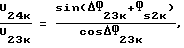

Поскольку фазочастотная характеристика радиоприемных трактатов в пределах полосы пропускания линейна, то можно считать
ΔФ12к≈ ΔФ12; ΔФ23к≈ ΔФ23; ΔФ31к≈ ΔФ31.
3. Расчет разностей фаз φij с учетом составляющих ΔФ12, ΔФ23, ΔФ31,Фs1-Фs3

Зависимость значений φij от β для 
According to the known values of Δf, f oph and the measured voltages U 20k - U 28k in a digital computing device,
1) calculation of normalization coefficients L 1 , L 2 , L 3
2. Calculation of phrasal error ΔF 12K, 23K ΔF, ΔF 31K
Expression (5) is obtained by solving the equations
Since the phase-frequency characteristic of the radio receiving tracts within the bandwidth is linear, we can assume
ΔF ΔF 12k ≈ 12; ΔF ΔF 23K ≈ 23; ΔF ΔF 31K ≈ 31.
3. Calculation of phase differences φ ij taking into account the components ΔF 12 , ΔF 23 , ΔF 31 , F s1 -F s3
The dependence of the values of φ ij from β for
4. Расчет значений β по значениям φij в следующем порядке:
выбираются два значения из трех, принадлежащие зависимостям, имеющим наибольшую крутизну в выбранном поддиапазоне измерений D (условия выбора поддиапазона и расчетные выражения представлены в таблице).4. The calculation of the values of β from the values of φ ij in the following order:
two values are selected out of three, belonging to the dependencies having the greatest steepness in the selected measurement sub-range D (the conditions for choosing the sub-range and the calculated expressions are presented in the table).
Расчет значений β по отношению двух значений φij, принадлежащих зависимостям, имеющим максимальную крутизну на участке измерения, обеспечивает по сравнению с известными устройствами такого типа высокую точность измерения при слабых сигналах (не хуже 0,7o при отношениях сигнал/шум 13 - 14 дБ).The calculation of the values of β with respect to two values of φ ij belonging to the dependences having the maximum steepness in the measurement area provides, in comparison with known devices of this type, high measurement accuracy with weak signals (no worse than 0.7 o with a signal-to-noise ratio of 13 - 14 dB )
Не требует данных о значениях несущей частоты сигналов и положения источников излучения в угломестной плоскости (см. выражения 1). It does not require data on the values of the carrier frequency of the signals and the position of the radiation sources in the elevation plane (see expressions 1).
Блок формирования строба 16 работает следующим образом. По поступающим на его входы видеоимпульсам (фиг. 4а - 4в) компараторы 39 - 41 формируют импульсы длительностью, равной длительности импульсов, отсчитанным относительно порога срабатывания компараторов (фиг. 4г - 4е). Block formation of the gate 16 operates as follows. According to the video pulses arriving at its inputs (Fig. 4a - 4c), the comparators 39 - 41 form pulses of a duration equal to the pulse duration counted relative to the threshold of operation of the comparators (Figs. 4g - 4e).
Порог срабатывания компараторов выбирается таким образом, чтобы обеспечивалось достаточное отношение сигнал/шум (13 дБ и более) в момент измерения. Для этого элементом И формируется импульс, когда сработают все три компаратора (фиг. 4ж). По отрицательному перепаду напряжения, который формируется в момент времени, когда переходные процессы в радиотрактах всенаправленного радиопеленгатора завершается, одновибратором 43 осуществляется запоминание кодовых значений в элементах 29 - 37 устройства (фиг. 4з). The response threshold of the comparators is selected so that a sufficient signal-to-noise ratio (13 dB or more) is provided at the time of measurement. For this, an And element forms an impulse when all three comparators work (Fig. 4g). According to the negative voltage drop, which is formed at the time when the transient processes in the radio paths of the omnidirectional direction finder are completed, the one-shot 43 stores the code values in the elements 29 - 37 of the device (Fig. 4h).
Таким образом, сформулированная задача повышения быстродействия всенаправленного радиопеленгатора, обеспечение пеленгования источников одиночных импульсных сигналов и повышение точности определения азимута источников излучения решается с помощью предлагаемого устройства. Thus, the formulated task of increasing the speed of an omnidirectional direction finder, ensuring direction finding of sources of single pulse signals and improving the accuracy of determining the azimuth of radiation sources is solved using the proposed device.
Источники информации
1. Радиопеленгатор, патент N 4551 727, кл. G 01 S 3/54, США, опубл. 5.11.85, т. 1060 N 1.Sources of information
1. The direction finder, patent N 4551 727, class. G 01
2. Радиопеленгатор, заявка N 3-15991, МКИ G 01 S 3/54, Япония, опубл. 4.03.91, N 6-400. 2. Direction finder, application N 3-15991, MKI G 01
3. А. И. Леонов, К.И. Фомичев. Моноимпульсная радиолокация, М., радио и связь, 1984, с. 77 - 78. 3. A.I. Leonov, K.I. Fomichev. Monopulse radar, M., radio and communication, 1984, p. 77 - 78.
4. В. В. Овсянников. Вибраторные антенны с реактивными нагрузками. М., Радио и связь, 1985, с. 29 - 41. 4. V.V. Ovsyannikov. Vibrating reactive antenna. M., Radio and Communications, 1985, p. 29 - 41.
5. Двухканальный СВЧ-переключатель, а. с. N 12220031 A, МКИ H 01 P 1/15, опубл. 23.03.86, бюл. N 11. 5. Two-channel microwave switch, a. with. N 12220031 A, MKI H 01
6. Радиоприемные устройства, под. ред. А.Г. Барулина. М., Радио и связь, 1984, с. 26 - 23, 36 - 44. 6. Radio receivers, under. ed. A.G. Barulina. M., Radio and Communications, 1984, p. 26 - 23, 36 - 44.
7. Высокостабильный перестраиваемый по частоте СВЧ-генератор. A.c. N 42663, МКИ 4 H 03 B 9/14, 7/14, 5/18, опубл. 15.01.88, N 1. 7. Highly stable frequency tunable microwave generator. A.c. N 42663, MKI 4 H 03
8. Балансный смеситель, а. с. N 964967, МКИ H 03 D 7/14, опубл. 01.10.82, бюл. N 37. 8. Balanced mixer, a. with. N 964967, MKI H 03 D 7/14, publ. 10/01/08, bull. N 37.
9. Б. Г. Федорков и др. Микроэлектронные цифро-аналоговые и аналого-цифровые преобразователи. М., Радио и связь, 1984, с. 15 - 17, 77 - 83. 9. B. G. Fedorkov et al. Microelectronic digital-to-analog and analog-to-digital converters. M., Radio and Communications, 1984, p. 15 - 17, 77 - 83.
10. М.И. Богданович и др. Цифровые интегральные микросхемы, справочник. Минск, Беларусь, 1991. с. 47, 118 - 121. 10. M.I. Bogdanovich et al. Digital integrated circuits, reference book. Minsk, Belarus, 1991. 47, 118 - 121.
11. Б.А. Калабеков. Микропроцессы и их применение в системах передачи и обработки сигналов. Учебное пособие для ВУЗов. М., Радио и связь, 1988, с. 71 - 74, 175 - 181. 11. B.A. Kalabekov. Microprocesses and their application in signal transmission and processing systems. Textbook for high schools. M., Radio and Communications, 1988, p. 71 - 74, 175 - 181.
Claims (2)
Priority Applications (1)
| Application Number | Priority Date | Filing Date | Title |
|---|---|---|---|
| RU96109545A RU2126978C1 (en) | 1996-05-12 | 1996-05-12 | Omnidirectional radio direction finder |
Applications Claiming Priority (1)
| Application Number | Priority Date | Filing Date | Title |
|---|---|---|---|
| RU96109545A RU2126978C1 (en) | 1996-05-12 | 1996-05-12 | Omnidirectional radio direction finder |
Publications (2)
| Publication Number | Publication Date |
|---|---|
| RU96109545A RU96109545A (en) | 1998-08-10 |
| RU2126978C1 true RU2126978C1 (en) | 1999-02-27 |
Family
ID=20180500
Family Applications (1)
| Application Number | Title | Priority Date | Filing Date |
|---|---|---|---|
| RU96109545A RU2126978C1 (en) | 1996-05-12 | 1996-05-12 | Omnidirectional radio direction finder |
Country Status (1)
| Country | Link |
|---|---|
| RU (1) | RU2126978C1 (en) |
Cited By (4)
| Publication number | Priority date | Publication date | Assignee | Title |
|---|---|---|---|---|
| RU2196342C2 (en) * | 2001-02-05 | 2003-01-10 | Войсковая часть 25714 | Procedure determining coordinates of objects in process of passive bistatic radiolocation |
| RU2208808C2 (en) * | 2001-10-04 | 2003-07-20 | Войсковая часть 25714 | Omnidirectional radio direction finder |
| RU2290658C1 (en) * | 2005-05-20 | 2006-12-27 | Виктор Иванович Дикарев | Phase mode of direction finding and phase direction finder for its execution |
| RU2631668C1 (en) * | 2016-06-08 | 2017-09-26 | Акционерное общество "Концерн "Созвездие" | Device for measuring phase difference of radio signals |
-
1996
- 1996-05-12 RU RU96109545A patent/RU2126978C1/en active
Cited By (4)
| Publication number | Priority date | Publication date | Assignee | Title |
|---|---|---|---|---|
| RU2196342C2 (en) * | 2001-02-05 | 2003-01-10 | Войсковая часть 25714 | Procedure determining coordinates of objects in process of passive bistatic radiolocation |
| RU2208808C2 (en) * | 2001-10-04 | 2003-07-20 | Войсковая часть 25714 | Omnidirectional radio direction finder |
| RU2290658C1 (en) * | 2005-05-20 | 2006-12-27 | Виктор Иванович Дикарев | Phase mode of direction finding and phase direction finder for its execution |
| RU2631668C1 (en) * | 2016-06-08 | 2017-09-26 | Акционерное общество "Концерн "Созвездие" | Device for measuring phase difference of radio signals |
Similar Documents
| Publication | Publication Date | Title |
|---|---|---|
| CN110824444B (en) | MIMO radar decoding for resolving velocity ambiguities | |
| US6911937B1 (en) | Digital polarimetric system | |
| US5477230A (en) | AOA application of digital channelized IFM receiver | |
| US6700536B1 (en) | System and method for determining a direction of incident electromagnetic signals | |
| US7466262B2 (en) | Positioning system with a sparse antenna array | |
| US20040160364A1 (en) | Digital instantaneous direction finding system | |
| US3973262A (en) | Radio direction finder with means for reducing sensitivity to multipath propogation errors | |
| US4067014A (en) | Correlation receiver for doppler microwave landing system | |
| US5499391A (en) | Digital channelized IFM receiver | |
| US4387376A (en) | Phase linear interferometer system and method | |
| JP3808431B2 (en) | Direction finding device | |
| RU2126978C1 (en) | Omnidirectional radio direction finder | |
| GB2064257A (en) | Radio direction finders | |
| CA1159934A (en) | Cancellation of group delay error by dual speed of rotation | |
| US5812091A (en) | Radio interferometric antenna for angle coding | |
| RU2208808C2 (en) | Omnidirectional radio direction finder | |
| Bain | The theoretical design of direction-finding systems for high frequencies | |
| RU2321015C1 (en) | Mode of direction finding and direction finder for its realization | |
| RU2278397C2 (en) | Method and device for selection of signals from above-water target in mono-impulse radiolocation station | |
| RU2013786C1 (en) | Goniometer of low-altitude radar station | |
| RU2108595C1 (en) | Single-channel monopulse radar system determining bearing to target | |
| RU2319168C1 (en) | Device for compensating signals received through side directional lobes | |
| Egorova et al. | Study of SDR-Based Direction Finder Threshold Sensitivity Depending on Signal-To-Noise Ratio | |
| Wannberg et al. | The EISCAT meteor code | |
| Lim et al. | A Novel Technology of Microwave Direction Finding With a Combination of Amplitude-measurement and Phase-Measurement. |