NL9400919A - Novel organometallic compounds and method for polymerizing alkenes with the use of these organometallic compounds as catalysts - Google Patents
Novel organometallic compounds and method for polymerizing alkenes with the use of these organometallic compounds as catalysts Download PDFInfo
- Publication number
- NL9400919A NL9400919A NL9400919A NL9400919A NL9400919A NL 9400919 A NL9400919 A NL 9400919A NL 9400919 A NL9400919 A NL 9400919A NL 9400919 A NL9400919 A NL 9400919A NL 9400919 A NL9400919 A NL 9400919A
- Authority
- NL
- Netherlands
- Prior art keywords
- group
- compound
- formula
- organometallic compounds
- catalysts
- Prior art date
Links
Classifications
-
- C—CHEMISTRY; METALLURGY
- C08—ORGANIC MACROMOLECULAR COMPOUNDS; THEIR PREPARATION OR CHEMICAL WORKING-UP; COMPOSITIONS BASED THEREON
- C08F—MACROMOLECULAR COMPOUNDS OBTAINED BY REACTIONS ONLY INVOLVING CARBON-TO-CARBON UNSATURATED BONDS
- C08F10/00—Homopolymers and copolymers of unsaturated aliphatic hydrocarbons having only one carbon-to-carbon double bond
-
- C—CHEMISTRY; METALLURGY
- C07—ORGANIC CHEMISTRY
- C07F—ACYCLIC, CARBOCYCLIC OR HETEROCYCLIC COMPOUNDS CONTAINING ELEMENTS OTHER THAN CARBON, HYDROGEN, HALOGEN, OXYGEN, NITROGEN, SULFUR, SELENIUM OR TELLURIUM
- C07F17/00—Metallocenes
-
- C—CHEMISTRY; METALLURGY
- C07—ORGANIC CHEMISTRY
- C07F—ACYCLIC, CARBOCYCLIC OR HETEROCYCLIC COMPOUNDS CONTAINING ELEMENTS OTHER THAN CARBON, HYDROGEN, HALOGEN, OXYGEN, NITROGEN, SULFUR, SELENIUM OR TELLURIUM
- C07F7/00—Compounds containing elements of Groups 4 or 14 of the Periodic Table
-
- C—CHEMISTRY; METALLURGY
- C07—ORGANIC CHEMISTRY
- C07F—ACYCLIC, CARBOCYCLIC OR HETEROCYCLIC COMPOUNDS CONTAINING ELEMENTS OTHER THAN CARBON, HYDROGEN, HALOGEN, OXYGEN, NITROGEN, SULFUR, SELENIUM OR TELLURIUM
- C07F7/00—Compounds containing elements of Groups 4 or 14 of the Periodic Table
- C07F7/02—Silicon compounds
- C07F7/08—Compounds having one or more C—Si linkages
- C07F7/10—Compounds having one or more C—Si linkages containing nitrogen having a Si-N linkage
-
- C—CHEMISTRY; METALLURGY
- C07—ORGANIC CHEMISTRY
- C07F—ACYCLIC, CARBOCYCLIC OR HETEROCYCLIC COMPOUNDS CONTAINING ELEMENTS OTHER THAN CARBON, HYDROGEN, HALOGEN, OXYGEN, NITROGEN, SULFUR, SELENIUM OR TELLURIUM
- C07F7/00—Compounds containing elements of Groups 4 or 14 of the Periodic Table
- C07F7/28—Titanium compounds
Landscapes
- Chemical & Material Sciences (AREA)
- Organic Chemistry (AREA)
- Health & Medical Sciences (AREA)
- Chemical Kinetics & Catalysis (AREA)
- Medicinal Chemistry (AREA)
- Polymers & Plastics (AREA)
- Transition And Organic Metals Composition Catalysts For Addition Polymerization (AREA)
Abstract
Description
NIEUWE ORGANOMETAALVERBINDINGEN EN WERKWIJZE VOOR HET POLYMERISEREN VAN ALKENEN ONDER TOEPASSING VAN DEZE ORGANOMETAALVERBINDINGEN ALS KATALYSATOREN.NEW ORGANOMETAL COMPOUNDS AND METHOD FOR POLYMERIZING OLEFINS USING THESE ORGANOMETAL COMPOUNDS AS CATALYSTS.
De uitvinding verschaft organoroetaalverbindingen volgens de formule (1), waarin Q -N-Si(CH3)3 of -C(H)-Si(CH3)3 voorstelt; R een alkyleengroep of een aryleengroep voorstelt; R' een t.butylgroep of een t.pentylgroep voorstelt; M Zr, Ti of Hf voorstelt; en A een goed af te splitsen groep voorstelt.The invention provides organo-oral compounds of the formula (1), wherein Q represents -N-Si (CH 3) 3 or -C (H) -Si (CH 3) 3; R represents an alkylene group or an arylene group; R 'represents a t-butyl group or a t-pentyl group; M represents Zr, Ti or Hf; and A represents a group that can be easily split off.
Bij voorkeur is Q -N-Si(CH3)3; R een ethyleengroep of een al dan niet gesubstitueerde o-fenyleengroep, waarbij de eventuele substituent aan de o-fenyleengroep zich bij voorkeur op plaats 3 of plaats 4 bevindt; R' een t.butylgroep; M Zr; en A een halogeenatoom.Preferably Q is -N-Si (CH 3) 3; R is an ethylene group or an unsubstituted or substituted o-phenylene group, wherein the optional substituent on the o-phenylene group is preferably in position 3 or position 4; R 'a t-butyl group; M Zr; and A is a halogen atom.
In het bijzonder verschaft de uitvinding een verbinding met de formule (2), waarvan de molecuulformule ZrHNfRJCiBu^CH^Cg^ - 1,2]C12 is. (Bufc · tert.butyl)In particular, the invention provides a compound of the formula (2), the molecular formula of which is ZrHNfRJCiBu ^ CH ^ Cg ^ - 1,2] Cl2. (Bufctert.butyl)
De bovengenoemde verbindingen zijn geschikt als katalysatoren voor de polymerisatie (zowel homo- als copolymerisatie) van alkenen, bijvoorbeeld etheen of propeen.The above compounds are suitable as catalysts for the polymerization (both homo- and copolymerization) of olefins, for example ethylene or propylene.
Er bestaan talrijke katalysatoren voor de polymerisatie van alkenen. Een belangrijke groep wordt gevormd door de metallocenen, zoals die welke worden genoemd in Chemistry in Britain, februari 1994, namelijk Cp2ZrCl2 (waarin Cp * cyclopentadienyl) en die volgens de formules (3),(4) en (5). De metallocenen hebben talrijke voordelen: ze kunnen worden toegepast voor het beheersen van de stereoregulariteit en de verdeling van het molecuulgewicht onder verkrijging van polymeren die zijn "toegesneden" op bepaalde toepassingen, en ze zijn oplosbaar in koolwaterstoffen waarbij ze homogene katalytische systemen vormen.Numerous catalysts exist for the polymerization of olefins. An important group is formed by the metallocenes, such as those mentioned in Chemistry in Britain, February 1994, namely Cp2ZrCl2 (in which Cp * cyclopentadienyl) and those according to formulas (3), (4) and (5). The metallocenes have numerous advantages: they can be used to control stereoregularity and molecular weight distribution to obtain polymers "tailored" for certain applications, and they are soluble in hydrocarbons to form homogeneous catalytic systems.
De onderhavige nieuwe, cyclopentadienyl-vrije polymerisatiekatalysatoren bezitten een bruikbare en onderscheidende katalytische activiteit en kunnen op zeer eenvoudige wijze bereid worden.The present new cyclopentadienyl-free polymerization catalysts have a useful and distinctive catalytic activity and can be prepared in a very simple manner.
Bereiding van de Zr-verbindina volgens formule 12}.Preparation of the Zr compound according to formula 12}.
Het uitgangsmateriaal voor deze synthese was Li2(TMEDA)2{1,2-C6H4(CHSi(CH3)3)2>, waarin TMEDA-tetramethylethyleendiamine, Me2NCH2CH2NMe2. Deze verbinding werd bereid als beschreven in een artikel van M.F. Lappert c.s., Inorg. Syth., 1989, 26, 144. Deze verbinding werd omgezet met BufcCN onder verschaffing van [Li2(TMEDA)2{l,2-C6H4(CHCButNSi(CH3)3)2>] , welke laatste verbinding op zijn beurt werd omgezet met kalium t.butoxide tot het overeenkomstige kaliumderivaat; door reactie van de kaliumverbinding met ZrCl4 verkreeg men de verbinding met de formule (2), Zr [ {N (Si (CH3) 3) C(But) CH}2C6H4-1,2 ]Cl2.The starting material for this synthesis was Li2 (TMEDA) 2 {1,2-C6H4 (CHSi (CH3) 3) 2>, in which TMEDA-tetramethyl ethylene diamine, Me2NCH2CH2NMe2. This compound was prepared as described in an article by M.F. Lappert et al., Inorg. Syth., 1989, 26, 144. This compound was reacted with BufcCN to give [Li2 (TMEDA) 2 {1,2-C6H4 (CHCButNSi (CH3) 3) 2>], the latter compound being reacted with potassium t-butoxide to the corresponding potassium derivative; reaction of the potassium compound with ZrCl4 gave the compound of the formula (2), Zr [{N (Si (CH3) 3) C (But) CH} 2C6H4-1,2] Cl2.
Bereiding van Li2 (TMEDA) 2^o»C£H1CHCButNSi(CH3)3>Preparation of Li2 (TMEDA) 2 ^ o »C £ H1CHCButNSi (CH3) 3>
ButCN (1,39 ml, 12,6 mmol) werd druppelsgewijs aan een oplossing van (Li2(TMEDA)2{l,2-C6H4(CHSi(CH3)3)2}] (3,lg, 6,28 mmol) in Et20 (circa 40 ml) bij circa 25°C onder roeren toegevoegd. De verkregen oranje oplossing werd gedurende 12 uren geroerd. Men verwijderde vluchtig materiaal bij 90oC/10-2 Torr en het residu werd door extractie opgenomen in hexaan (circa 50 ml). Het gefiltreerde extract werd geconcentreerd onder verschaffing van gele kristallen van de titelverbinding (3,1 g, 75%).ButCN (1.39ml, 12.6mmol) was added dropwise to a solution of (Li2 (TMEDA) 2 {1,2-C6H4 (CHSi (CH3) 3) 2}] (3.1g, 6.28mmol) in Et 2 O (about 40 ml) at about 25 ° C with stirring The resulting orange solution was stirred for 12 hours Volatiles were removed at 90 ° C / 10-2 Torr and the residue was taken up in hexane (about 50 ml) The filtered extract was concentrated to give yellow crystals of the title compound (3.1 g, 75%).
Bereiding van K2 (TMEDA) 211.2-C6H4 (CHCBu^Si (Preparation of K2 (TMEDA) 211.2-C6H4 (CHCBu ^ Si (
Hexaan (circa 30 ml) werd aan een mengsel van de hierboven verkregen lithiumverbinding (1,86 g, 2,82 mmol) en KOBu* (0,80 g, 6,55 mmol) bij 25°C onder roeren toegevoegd. Het mengsel werd gedurende een half uur op 60°C verwarmd en vervolgens gedurende 12 uren bij 25°C geroerd, hetgeen leidde tot de vorming van een helder geel neerslag, dat werd afgefiltreerd en in vacuo gedroogd. Het residu was de gewenste kaliumverbinding (1,60 g, 93%).Hexane (about 30 ml) was added to a mixture of the above-obtained lithium compound (1.86 g, 2.82 mmol) and KOBu * (0.80 g, 6.55 mmol) at 25 ° C with stirring. The mixture was heated at 60 ° C for half an hour and then stirred at 25 ° C for 12 hours, resulting in the formation of a bright yellow precipitate, which was filtered off and dried in vacuo. The residue was the desired potassium compound (1.60 g, 93%).
Bereiding van ZriiNfSifCH^^CiBu^CHKCeHj-l^Cl·;.Preparation of SiNFSifCH2 ^ CiBu ^ CHKCeHj-1 ^ Cl2.
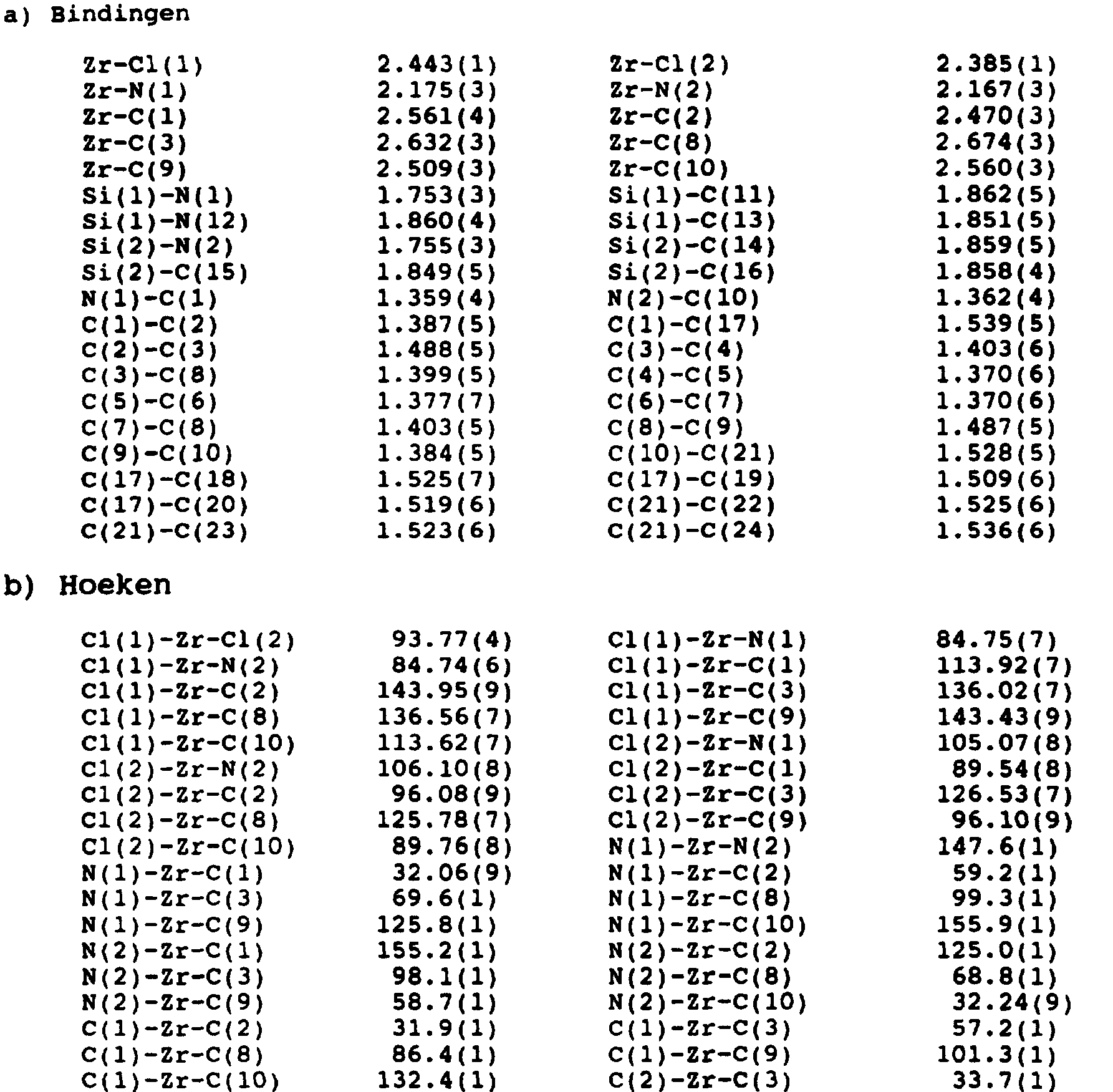
Zirkonium(IV)chloride (0,37 g, 1,59 mmol) werd onder roeren en afkoelen (-78°C) toegevoegd aan een oplossing van de hierboven bereide kaliumverbinding (0,86 g, 1,42 mmol) in tolueen (circa 25 ml). Het mengsel werd langzaam tot kamertemperatuur opgewarmd, gedurende 2 uur op 70°C verwarmd en gedurende nog 12 uur geroerd. Het verkregen witte neerslag werd afgefiltreerd. Concentratie van het filtraat gaf licht-gele kristallen van de uiteindelijke zirkoniumverbinding Ζγ{Ν(Κ)0(Β^)0Η>206Η4-1,2)012 (0,76 g, 93%). De molecuulstructuur bleek uit het röntgendiffractiepatroon van een éénkristal, zie de onderstaande tabel 1 en structuurformule (6).Zirconium (IV) chloride (0.37g, 1.59mmol) was added to a solution of the potassium compound prepared above (0.86g, 1.42mmol) in toluene with stirring and cooling (-78 ° C) ( about 25 ml). The mixture was warmed slowly to room temperature, heated to 70 ° C for 2 hours and stirred for an additional 12 hours. The white precipitate obtained was filtered off. Concentration of the filtrate gave light yellow crystals of the final zirconium compound Ζγ {Ν (Κ) 0 (Β ^) 0Η> 206Η4-1.2) 012 (0.76 g, 93%). The molecular structure was evident from the X-ray diffraction pattern of a single crystal, see Table 1 below and structural formula (6).
Tabel 1. Intramoleculaire afstanden (A) en hoeken (°); geschatte standaarddeviaties tussen haakjes vermeld.Table 1. Intramolecular distances (A) and angles (°); Estimated standard deviations in parentheses.
Etheen werd gepolymeriseerd onder toepassing van de hierboven bereide zirkoniumverbinding in een hoeveelheid van 15 mg en methylaluminoxan (MAO) als co-katalysator in een hoeveelheid 400 mg. De reactie werd begonnen bij kamertemperatuur en de door de exotherme reactie veroorzaakte maximumtemperatuur bedroeg 70°C. Er werd eveneens een proef uitgevoerd met ZrCp2Cl2 als vergelijkingskatalysator. De proefomstandigheden en de resultaten zijn in de onderstaande tabel 2 vermeld.Ethylene was polymerized using the zirconium compound prepared above in an amount of 15 mg and methylaluminoxane (MAO) as a co-catalyst in an amount of 400 mg. The reaction was started at room temperature and the maximum temperature caused by the exothermic reaction was 70 ° C. An experiment was also conducted with ZrCp2Cl2 as a comparative catalyst. The test conditions and results are shown in Table 2 below.
Tabel 2Table 2

de hoeveelheid Al is geoptimaliseerd.the amount of Al is optimized.
Beide proeven duurden 1 uur en werden begonnen bij kamertemperatuur.Both runs lasted 1 hour and were started at room temperature.
Uit de bovenstaande tabel blijkt dat met de katalysator overeenkomstig formule (2) volgens de uitvinding een beter polymeerresultaat dan met de vergelijkingskatalysator [ZrCp2Cl2] werd verkregen.The above table shows that a better polymer result was obtained with the catalyst according to formula (2) according to the invention than with the comparative catalyst [ZrCp2Cl2].
Claims (8)
Priority Applications (3)
| Application Number | Priority Date | Filing Date | Title |
|---|---|---|---|
| NL9400919A NL9400919A (en) | 1994-06-07 | 1994-06-07 | Novel organometallic compounds and method for polymerizing alkenes with the use of these organometallic compounds as catalysts |
| AU25798/95A AU2579895A (en) | 1994-06-07 | 1995-06-07 | Novel organo-metallic compounds, methods for preparing same, and a method for the polymerization of unsaturated hydrocarbons using said organo-metallic compounds as catalysts, as well as novel semi-products and catalyst preparations |
| PCT/NL1995/000202 WO1995033776A1 (en) | 1994-06-07 | 1995-06-07 | Novel organo-metallic compounds, methods for preparing same, and a method for the polymerization of unsaturated hydrocarbons using said organo-metallic compounds as catalysts, as well as novel semi-products and catalyst preparations |
Applications Claiming Priority (2)
| Application Number | Priority Date | Filing Date | Title |
|---|---|---|---|
| NL9400919A NL9400919A (en) | 1994-06-07 | 1994-06-07 | Novel organometallic compounds and method for polymerizing alkenes with the use of these organometallic compounds as catalysts |
| NL9400919 | 1994-06-07 |
Publications (1)
| Publication Number | Publication Date |
|---|---|
| NL9400919A true NL9400919A (en) | 1996-01-02 |
Family
ID=19864275
Family Applications (1)
| Application Number | Title | Priority Date | Filing Date |
|---|---|---|---|
| NL9400919A NL9400919A (en) | 1994-06-07 | 1994-06-07 | Novel organometallic compounds and method for polymerizing alkenes with the use of these organometallic compounds as catalysts |
Country Status (1)
| Country | Link |
|---|---|
| NL (1) | NL9400919A (en) |
Cited By (1)
| Publication number | Priority date | Publication date | Assignee | Title |
|---|---|---|---|---|
| US7612009B2 (en) | 2003-02-21 | 2009-11-03 | Dow Global Technologies, Inc. | Process for homo-or copolymerization of conjugated olefines |
Citations (1)
| Publication number | Priority date | Publication date | Assignee | Title |
|---|---|---|---|---|
| WO1992012162A1 (en) * | 1990-12-27 | 1992-07-23 | Exxon Chemical Patents Inc. | An amido transition metal compound and a catalyst system for the production of isotactic polypropylene |
-
1994
- 1994-06-07 NL NL9400919A patent/NL9400919A/en not_active Application Discontinuation
Patent Citations (1)
| Publication number | Priority date | Publication date | Assignee | Title |
|---|---|---|---|---|
| WO1992012162A1 (en) * | 1990-12-27 | 1992-07-23 | Exxon Chemical Patents Inc. | An amido transition metal compound and a catalyst system for the production of isotactic polypropylene |
Non-Patent Citations (1)
| Title |
|---|
| L.RESCONI ET AL.: "1-Olefin polymerization at bis (pentamethylcyclopentadienyl) zirconium and -hafnium centers: enantioface selectivity", MACROMOLECULES., vol. 25, no. 25, 7 December 1992 (1992-12-07), EASTON US, pages 6814 - 6817 * |
Cited By (2)
| Publication number | Priority date | Publication date | Assignee | Title |
|---|---|---|---|---|
| US7612009B2 (en) | 2003-02-21 | 2009-11-03 | Dow Global Technologies, Inc. | Process for homo-or copolymerization of conjugated olefines |
| US8153545B2 (en) | 2003-02-21 | 2012-04-10 | Styron Europe Gmbh | Process for homo—or copolymerization of conjugated olefins |
Similar Documents
| Publication | Publication Date | Title |
|---|---|---|
| RU2169152C2 (en) | Metallocenes with fluorenyl type ligands, method of preparing thereof, intermediate compound for preparation thereof, olefin polymerization catalyst comprising these metallogenes, and method of polymerization of olefins | |
| AU664896B2 (en) | Process for the preparation of bridged, chiral metallocene catalysts of the bisindenyl type | |
| JP3686081B2 (en) | Catalyst composition | |
| EP0741739B1 (en) | Synthesis of cyclopentadienyl metal coordination complexes from metal hydrocarbyloxides | |
| US5308815A (en) | Heterogeneous methylaluminoxane catalyst system | |
| US6316562B1 (en) | Catalyst systems for (co-)polymerization reactions, metallocene amide halogenides, the production and use thereof | |
| JPH06122718A (en) | Method and catalyst for production of isotactic polyolefin | |
| JP2001122886A (en) | Biscyclopentadienyl compound bridged with single carbon and its metallocene complex | |
| US5708101A (en) | Stereospecific olefin polymerization catalysts | |
| US5504224A (en) | Preparation of monocyclopentadienyl metal complexes by nucleophilic substitution of bis(cyclopentadienyl) metal complexes | |
| KR100404780B1 (en) | Metallocene compounds, metallocene catalysts prepared from the compounds and method of polymerizing olefins with the catalysts | |
| WO1995033776A1 (en) | Novel organo-metallic compounds, methods for preparing same, and a method for the polymerization of unsaturated hydrocarbons using said organo-metallic compounds as catalysts, as well as novel semi-products and catalyst preparations | |
| FR2849654A1 (en) | METALLOCENES BRIDGES OF GROUP III BASED ON CYCLOPENTADIENYL-FLUORENYL LIGANDS | |
| NL9400919A (en) | Novel organometallic compounds and method for polymerizing alkenes with the use of these organometallic compounds as catalysts | |
| EP0540108B1 (en) | Catalyst composition | |
| US6153777A (en) | Synthesis of ansa-metallocene catalysts | |
| US5821310A (en) | Organometallic compounds and catalyst compositions | |
| US5527868A (en) | Catalyst systems for the polymerization of C2 -C10 -alk-1-enes | |
| KR19990076684A (en) | Transition metal compounds | |
| JP2000502678A (en) | Transition metal compounds, their preparation and their use as catalyst components | |
| FR2850386A1 (en) | New metallocene catalyst component, useful for polymerization of polar or non-polar monomers, comprises a Group III metal complex with fluorene-substituted cyclopentadienyl and allyl ligands | |
| US5883277A (en) | Metallocene complexes with cationic bridges | |
| MXPA96002890A (en) | Synthesis of ciclopentadienilo metal coordination complexes from oxides dehidrocarbilo de me | |
| JPH09227614A (en) | Method for producing organic transition metal complex |
Legal Events
| Date | Code | Title | Description |
|---|---|---|---|
| A1B | A search report has been drawn up | ||
| BV | The patent application has lapsed |