KR960000872B1 - Optically active 1,3-dioxolane-4-carboxylate, its use as a dope in liquid crystal mixtures and liquid crystal mixtures containing the same - Google Patents
Optically active 1,3-dioxolane-4-carboxylate, its use as a dope in liquid crystal mixtures and liquid crystal mixtures containing the same Download PDFInfo
- Publication number
- KR960000872B1 KR960000872B1 KR1019880004380A KR880004380A KR960000872B1 KR 960000872 B1 KR960000872 B1 KR 960000872B1 KR 1019880004380 A KR1019880004380 A KR 1019880004380A KR 880004380 A KR880004380 A KR 880004380A KR 960000872 B1 KR960000872 B1 KR 960000872B1
- Authority
- KR
- South Korea
- Prior art keywords
- dioxolane
- carboxylate
- liquid crystal
- optically active
- mesogenic
- Prior art date
- Legal status (The legal status is an assumption and is not a legal conclusion. Google has not performed a legal analysis and makes no representation as to the accuracy of the status listed.)
- Expired - Fee Related
Links
- 0 CC1CNC*C1 Chemical compound CC1CNC*C1 0.000 description 9
- UAEPNZWRGJTJPN-UHFFFAOYSA-N CC1CCCCC1 Chemical compound CC1CCCCC1 UAEPNZWRGJTJPN-UHFFFAOYSA-N 0.000 description 3
- XDTMQSROBMDMFD-UHFFFAOYSA-N C1CCCCC1 Chemical compound C1CCCCC1 XDTMQSROBMDMFD-UHFFFAOYSA-N 0.000 description 1
- TXKNJAQGLVLQIV-UHFFFAOYSA-N CC(CC1)CNC1C1N=CCCC1 Chemical compound CC(CC1)CNC1C1N=CCCC1 TXKNJAQGLVLQIV-UHFFFAOYSA-N 0.000 description 1
- SYEDHHHNAJORPL-UHFFFAOYSA-N CC(NC1)NCC1c1ccccc1 Chemical compound CC(NC1)NCC1c1ccccc1 SYEDHHHNAJORPL-UHFFFAOYSA-N 0.000 description 1
- WOYLVAQCBVBBDO-UHFFFAOYSA-N CC1=CN(C)C(c(cc2)ccc2[O]=C)NC1 Chemical compound CC1=CN(C)C(c(cc2)ccc2[O]=C)NC1 WOYLVAQCBVBBDO-UHFFFAOYSA-N 0.000 description 1
- SQTIRNIXKPEPJT-UHFFFAOYSA-N CC1C(N2NCCCC2C)OCOC1 Chemical compound CC1C(N2NCCCC2C)OCOC1 SQTIRNIXKPEPJT-UHFFFAOYSA-N 0.000 description 1
- QOIUCBCWOSYYIL-UHFFFAOYSA-N CC1CNCNC1 Chemical compound CC1CNCNC1 QOIUCBCWOSYYIL-UHFFFAOYSA-N 0.000 description 1
- CQMZYAFVTNOAST-UHFFFAOYSA-N CC1NCCCN1 Chemical compound CC1NCCCN1 CQMZYAFVTNOAST-UHFFFAOYSA-N 0.000 description 1
- JOMNTHCQHJPVAZ-UHFFFAOYSA-N CC1NCCNC1 Chemical compound CC1NCCNC1 JOMNTHCQHJPVAZ-UHFFFAOYSA-N 0.000 description 1
Classifications
-
- C—CHEMISTRY; METALLURGY
- C09—DYES; PAINTS; POLISHES; NATURAL RESINS; ADHESIVES; COMPOSITIONS NOT OTHERWISE PROVIDED FOR; APPLICATIONS OF MATERIALS NOT OTHERWISE PROVIDED FOR
- C09K—MATERIALS FOR MISCELLANEOUS APPLICATIONS, NOT PROVIDED FOR ELSEWHERE
- C09K19/00—Liquid crystal materials
- C09K19/52—Liquid crystal materials characterised by components which are not liquid crystals, e.g. additives with special physical aspect: solvents, solid particles
- C09K19/54—Additives having no specific mesophase characterised by their chemical composition
-
- C—CHEMISTRY; METALLURGY
- C07—ORGANIC CHEMISTRY
- C07D—HETEROCYCLIC COMPOUNDS
- C07D405/00—Heterocyclic compounds containing both one or more hetero rings having oxygen atoms as the only ring hetero atoms, and one or more rings having nitrogen as the only ring hetero atom
- C07D405/02—Heterocyclic compounds containing both one or more hetero rings having oxygen atoms as the only ring hetero atoms, and one or more rings having nitrogen as the only ring hetero atom containing two hetero rings
- C07D405/12—Heterocyclic compounds containing both one or more hetero rings having oxygen atoms as the only ring hetero atoms, and one or more rings having nitrogen as the only ring hetero atom containing two hetero rings linked by a chain containing hetero atoms as chain links
-
- C—CHEMISTRY; METALLURGY
- C07—ORGANIC CHEMISTRY
- C07D—HETEROCYCLIC COMPOUNDS
- C07D317/00—Heterocyclic compounds containing five-membered rings having two oxygen atoms as the only ring hetero atoms
- C07D317/08—Heterocyclic compounds containing five-membered rings having two oxygen atoms as the only ring hetero atoms having the hetero atoms in positions 1 and 3
- C07D317/10—Heterocyclic compounds containing five-membered rings having two oxygen atoms as the only ring hetero atoms having the hetero atoms in positions 1 and 3 not condensed with other rings
- C07D317/32—Heterocyclic compounds containing five-membered rings having two oxygen atoms as the only ring hetero atoms having the hetero atoms in positions 1 and 3 not condensed with other rings with hetero atoms or with carbon atoms having three bonds to hetero atoms with at the most one bond to halogen, e.g. ester or nitrile radicals, directly attached to ring carbon atoms
-
- C—CHEMISTRY; METALLURGY
- C07—ORGANIC CHEMISTRY
- C07D—HETEROCYCLIC COMPOUNDS
- C07D407/00—Heterocyclic compounds containing two or more hetero rings, at least one ring having oxygen atoms as the only ring hetero atoms, not provided for by group C07D405/00
- C07D407/02—Heterocyclic compounds containing two or more hetero rings, at least one ring having oxygen atoms as the only ring hetero atoms, not provided for by group C07D405/00 containing two hetero rings
- C07D407/12—Heterocyclic compounds containing two or more hetero rings, at least one ring having oxygen atoms as the only ring hetero atoms, not provided for by group C07D405/00 containing two hetero rings linked by a chain containing hetero atoms as chain links
-
- C—CHEMISTRY; METALLURGY
- C07—ORGANIC CHEMISTRY
- C07D—HETEROCYCLIC COMPOUNDS
- C07D409/00—Heterocyclic compounds containing two or more hetero rings, at least one ring having sulfur atoms as the only ring hetero atoms
- C07D409/02—Heterocyclic compounds containing two or more hetero rings, at least one ring having sulfur atoms as the only ring hetero atoms containing two hetero rings
- C07D409/12—Heterocyclic compounds containing two or more hetero rings, at least one ring having sulfur atoms as the only ring hetero atoms containing two hetero rings linked by a chain containing hetero atoms as chain links
-
- C—CHEMISTRY; METALLURGY
- C09—DYES; PAINTS; POLISHES; NATURAL RESINS; ADHESIVES; COMPOSITIONS NOT OTHERWISE PROVIDED FOR; APPLICATIONS OF MATERIALS NOT OTHERWISE PROVIDED FOR
- C09K—MATERIALS FOR MISCELLANEOUS APPLICATIONS, NOT PROVIDED FOR ELSEWHERE
- C09K19/00—Liquid crystal materials
- C09K19/02—Liquid crystal materials characterised by optical, electrical or physical properties of the components, in general
- C09K19/0225—Ferroelectric
-
- C—CHEMISTRY; METALLURGY
- C09—DYES; PAINTS; POLISHES; NATURAL RESINS; ADHESIVES; COMPOSITIONS NOT OTHERWISE PROVIDED FOR; APPLICATIONS OF MATERIALS NOT OTHERWISE PROVIDED FOR
- C09K—MATERIALS FOR MISCELLANEOUS APPLICATIONS, NOT PROVIDED FOR ELSEWHERE
- C09K19/00—Liquid crystal materials
- C09K19/02—Liquid crystal materials characterised by optical, electrical or physical properties of the components, in general
- C09K19/0233—Electroclinic
-
- C—CHEMISTRY; METALLURGY
- C09—DYES; PAINTS; POLISHES; NATURAL RESINS; ADHESIVES; COMPOSITIONS NOT OTHERWISE PROVIDED FOR; APPLICATIONS OF MATERIALS NOT OTHERWISE PROVIDED FOR
- C09K—MATERIALS FOR MISCELLANEOUS APPLICATIONS, NOT PROVIDED FOR ELSEWHERE
- C09K19/00—Liquid crystal materials
- C09K19/52—Liquid crystal materials characterised by components which are not liquid crystals, e.g. additives with special physical aspect: solvents, solid particles
- C09K19/58—Dopants or charge transfer agents
-
- C—CHEMISTRY; METALLURGY
- C09—DYES; PAINTS; POLISHES; NATURAL RESINS; ADHESIVES; COMPOSITIONS NOT OTHERWISE PROVIDED FOR; APPLICATIONS OF MATERIALS NOT OTHERWISE PROVIDED FOR
- C09K—MATERIALS FOR MISCELLANEOUS APPLICATIONS, NOT PROVIDED FOR ELSEWHERE
- C09K19/00—Liquid crystal materials
- C09K19/52—Liquid crystal materials characterised by components which are not liquid crystals, e.g. additives with special physical aspect: solvents, solid particles
- C09K19/58—Dopants or charge transfer agents
- C09K19/586—Optically active dopants; chiral dopants
- C09K19/588—Heterocyclic compounds
Landscapes
- Chemical & Material Sciences (AREA)
- Organic Chemistry (AREA)
- Crystallography & Structural Chemistry (AREA)
- Engineering & Computer Science (AREA)
- Materials Engineering (AREA)
- Liquid Crystal Substances (AREA)
- Plural Heterocyclic Compounds (AREA)
- Liquid Crystal (AREA)
- Heterocyclic Compounds That Contain Two Or More Ring Oxygen Atoms (AREA)
- Preparation Of Compounds By Using Micro-Organisms (AREA)
Abstract
내용 없음.No content.
Description
본 발명은 액정 혼합물에서 광학적 활성 1,3-디옥솔린-4-카복실레이트의 도프(dope)로서의 용도, 이러한 화합물을 함유하는 액정 혼합물 및 신규한 광학적 활성 1,3-디옥솔란-4-카복실레이트에 관한 것이다.The present invention relates to the use of optically active 1,3-dioxoline-4-carboxylates as dope in liquid crystal mixtures, liquid crystal mixtures containing such compounds and novel optically active 1,3-dioxolane-4-carboxylates It is about.
특히 지난 십년 동안, 액정은 전기광학 특성(electooptical property)과 표시장치 특성을 필요로 하는 아주 다양한 산업분야(예, 시계, 휴대용 계산기 및 타지기용 표시)에 도입되어져 왔다. 이러한 표시장치는 액정 화합물의 네마틱, 콜레스테릭 및 스멕틱 상에서 유전 배열효과(dielectric alignmet effect)에 근거하며, 여기서 유전 이방성에 의하여 야기되는 화합물의 횡분자 축은 적용된 전기장내에서 바람직한 배열을 갖는다. 이러한 표시장치에서의 통상적인 스윗칭 시간(switching time)은 액정 응용이 가능한 많은 다른 분야에 이용하기에는 너무 느리지만, 액정 그 자체는 이들의 독특한 특성 때문에 산업용으로 유망한 화학적 화합물이다. 이러한 단점은 측히 다수의 영상점(image point)을 어드레싱(addressing)시켜야 할 경우 현저해지며, 이는 비교적 규모가 큰 장치(예:비디오 장치, 오실로그래프 또는 TV, 레이다, ED 또는 워드 프로세스 스크린)의 생산 비용이 매우 높음을 의미한다.In particular, over the last decade, liquid crystals have been introduced in a wide variety of industries (e.g. watches, portable calculators and display for displays) that require electrooptical and display characteristics. Such displays are based on the dielectric alignmet effects on the nematic, cholesteric and smectic of liquid crystal compounds, wherein the transverse molecular axes of the compounds caused by the dielectric anisotropy have a preferred arrangement in the applied electric field. Conventional switching times in such displays are too slow for many other applications where liquid crystal applications are possible, but the liquid crystals themselves are promising chemical compounds for industrial use because of their unique properties. This drawback is especially noticeable when addressing a large number of image points, which is the production of relatively large devices (eg video devices, oscillograms or TVs, radars, ED or word processing screens). It means that the cost is very high.
네마틱 및 콜레스테릭 액정 이외에도, 광학적 활성 스멕틱 액정 상이 지난 몇년동안 점차적으로 중요시되어 왔다.In addition to nematic and cholesteric liquid crystals, optically active smectic liquid crystal phases have become increasingly important over the years.
크락과 라게웰(Clark and Lagerwall)에 의하면 강유전성 액정 시스템은 매우 얇은 셀(cell)에 사용함으로써 광학전기적 스윗칭 부재 또는 표시부재의 스윗칭 시간이 통상적인 TN(twisted nematic)셀을 사용하는 경우와 비교할 때 인자에 의해 1000배 이하로 빨라진다는 사실이 밝혀졌다.[참조:Laferwall et al., “Ferroele tric Liquid Crystals for Displays”, SID Symposium, October Meeting 1985, San Diego Ca., USA]. 이러한 특성 및 기타의 유용한 특성(예:쌍안정성 스위치의 가능성 및 콘트라스트가 사실상 시각과 무관하다는 사실)의 결과, 강유전성 액정 (ferroeletric liquid crystal)은 원칙적으로 위에서 언급한 응용분야, 예를 들면, 매트릭스 어드레싱(matrix addressing)에 매우 적합하다.According to Clark and Lagerwall, ferroelectric liquid crystal systems are used in very thin cells, where the switching time of an optically or electrically conductive switching member or a display member is not the same as using conventional twisted nematic cells. In comparison, it was found to be up to 1000 times faster by factor (Laferwall et al., “Ferroele tric Liquid Crystals for Displays”, SID Symposium, October Meeting 1985, San Diego Ca., USA). As a result of these and other useful properties (e.g. the possibility and contrast of bistable switches are virtually vision independent), ferroeletric liquid crystals are in principle used in the above mentioned applications, e.g. matrix addressing. Very suitable for matrix addressing.
전자임상효과(electroclinic effeet)로 알려진 또 다른 전기광학 효과는 직교, 키랄, 스멕틱 상, 예를 들면, SA*, SB* SE*에 의해 나타난다. 이러한 효과[참조:S. Garoff and R. B. Meyer, Phys. Rev. Lett. 38, 848(1977)]는 분자의 경사각(1 )을 적용된 전기장에 비례하여 변화시키는 이의 전기장-유도 성향을 특징으로 한다. 따라서, 직교 상에서 분자는 연속적으로 전기장으로 변화시킬 수 있으며, 특히 전기장을 한계 주파수(fG)까지 변화시킬 수 있는 반면, 강유전성 시스템은 매회 특정 전기장 강도에 도달하며, 이들의 경사각은 상응하는 역전기장이 적용될때(쌍안정성 스윗칭)까지 불연속적으로 변화되어 보유된다.Another electro-optic effect, known as the electroclinic effeet, is represented by orthogonal, chiral, smectic phases such as SA *, SB * SE *. These effects [S. Garoff and R. B. Meyer, Phys. Rev. Lett. 38, 848 (1977), is characterized by its field-induced propensity to change the tilt angle 1 of the molecule in proportion to the applied electric field. Thus, in the orthogonal phase, molecules can be continuously changed into electric fields, in particular, electric fields can be changed up to the limit frequency (fG), while ferroelectric systems reach a specific electric field strength each time, and their inclination angles change accordingly. It remains discontinuously changed until it is applied (bi-stable switching).
강유전성 효과 및 전자임상효과 모두 이들의 특성에 따라 전기광학 스윗칭 부재와 표시부재의 제조에 사용할 수 있다. 이러한 목적을 위하여, 경사진 스멕틱 상 또는 직교 스멕틱 상을 형성하면서 자체적으로 광학적 활성인 화합물이 필요하거나, 키랄의 경사진 스멕틱 상 또는 직교 스멕틱 상을 형성하지만 자체적으로는 광학적 활성이 아닌 화합물을 광합적 활성인 화합물로 도핑시킴으로써 이러한 스멕틱 상을 유도할 수 있다. 본원에서 목적하는 상온 가능한 최대 온도 범위에 걸쳐 안정해야만 한다.Both ferroelectric effects and electron clinical effects can be used in the manufacture of electro-optic switching members and display members according to their characteristics. For this purpose, a compound which is optically active on its own while forming a sloped or orthogonal smectic phase is needed, or forms a tilted smectic or orthogonal smectic phase of chiral but is not optically active on its own This smectic phase can be induced by doping the compound with a compound that is photosynthetically active. The ambient temperature desired herein should be stable over the maximum possible temperature range.
전기광학 부재에서 양호한 콘트라스트 비율을 수득하기 위하여, 액정의 균일한 평면배향이 필요하다. SA* 및 SA* 상중 양호한 배향은 온도가 감소함에 따라 액정 혼합물에 대한 상 순서가 다름과 같은 경우에 수득될 수 있다 :In order to obtain a good contrast ratio in the electro-optic member, uniform planar orientation of the liquid crystal is required. Good orientation in the SA * and SA * phases can be obtained when the phase sequence for the liquid crystal mixture is different as the temperature decreases:
등방성 N*SA*SC*Isotropic N * SA * SC *
선행조건으로는 N*상중 나선형 피치(pitch)가 매우 크거나(101m이상), 더욱 유용하게는 완전히 보정되어야 한다(참조:T.Matsumoto et al., pp. 468-470, Proc. of the 6th Int. Display Research Conf., Japan Display, Sept, 30-Oct. 2, 1986, Tokyo, Japan ; M. Murakami et al., ibid. p. 344-p.347]는 점이다. 이러한 선행 조건은, 예를 들면, N*상중에 반시계 방향의 나선을 갖는 키랄 액정 혼합물에 시계방향의 나선을 유도하는 추가적인 광학적 활성 도프를 나선이 바로 보정될 수 있는 양으로 부가함으로써 성취된다.As a prerequisite, the spiral pitch of N * phase is very large (more than 101 m), or more usefully, it must be fully compensated (T. Matsumoto et al., Pp. 468-470, Proc. Of the 6th). Int. Display Research Conf., Japan Display, Sept, 30-Oct. 2, 1986, Tokyo, Japan; M. Murakami et al., Ibid.p. 344-p.347. For example, it is achieved by adding an additional optically active dope inducing a clockwise helix to the chiral liquid crystal mixture having a counterclockwise helix in the N * phase in an amount that the helix can be immediately corrected.
본 발명자들에 의해 도프로서 광학적으로 활성인 메소제닉 1,3-디옥솔란-4-카복실레이트는 소량으로 혼합시키는 경우에라도 경사진 스멕틱 액정상에서는 스윗칭 시간을 단축시키고, 직교 스멕틱 액정 상에서는 전자임상계수를 증가시키는 것으로 최근 밝혀졌다. 특히 본 발명에서 도핑시킴으로써 유도되는 나선형 피치가 불필요한 추가의 도프에 의해 보상될 수 있도록 충분히 크다는 사실은 놀라운 일이다.The optically active mesogenic 1,3-dioxolane-4-carboxylate as dope by the present inventors shortens the switching time on the inclined smectic liquid crystal even when mixed in small amounts, and on the orthogonal smectic liquid crystal It has recently been found to increase the clinical count. In particular, it is surprising that the helical pitch induced by doping in the present invention is large enough to be compensated for by unnecessary additional dope.
따라서 본 발명은 광학적으로 활성인 메소제닉 1,3-디옥솔란-4-카복시레이트의 액정 시스템의 도프로서의 용도에 관한 것이다. 더우기 본 발명은 이러한 1,3-디옥솔란-4-카복실레이트를 함유하는 액정 시스템 및 신규한 광학적 활성 1,3-디옥솔란-4-카복실레이트에 관한 것이다. 본 발명에 따라 액정 혼합물에 도프로서 사용되는 1,3-디옥솔란-카복실레이트는 하기 일반식(Ⅰ)과 같다.The present invention therefore relates to the use of optically active mesogenic 1,3-dioxolane-4-carboxylates as dope of liquid crystal systems. Moreover, the present invention relates to liquid crystal systems containing such 1,3-dioxolane-4-carboxylates and novel optically active 1,3-dioxolane-4-carboxylates. The 1,3-dioxolane-carboxylate used as a dope in the liquid crystal mixture according to the present invention is represented by the following general formula (I).

상기식에서, R1은


-M1 및 -M2는
바람직한 양태에 있어서, 일반식(Ⅰ)의 부호는 하기의 의미를 갖는다:In a preferred embodiment, the sign of general formula (I) has the following meaning:
R1은 C4 내지 C14의 직쇄 또는 알킬 라디칼이거나 알케닐 라디칼(여기서, 이들 라디칼은 비대칭 탄소원자를 함유할 수 있으며, 하나의 -CH2- 그룹이 -O-,

보다 바람직한 양태에 있어서는 하기 일반식(Ⅳ)의 1,3-디옥솔란-4-카복실레이트를 사용한다.In a more preferable embodiment, 1,3-dioxolane-4-carboxylate of the following general formula (IV) is used.

상기식에서, R5는 비대칭 탄소원자를 함유할 수도 있는 C6 내지 C12의 직쇄 또는 측쇄 알킬 라디칼 또는 알케닐 라디칼이며, -M3는
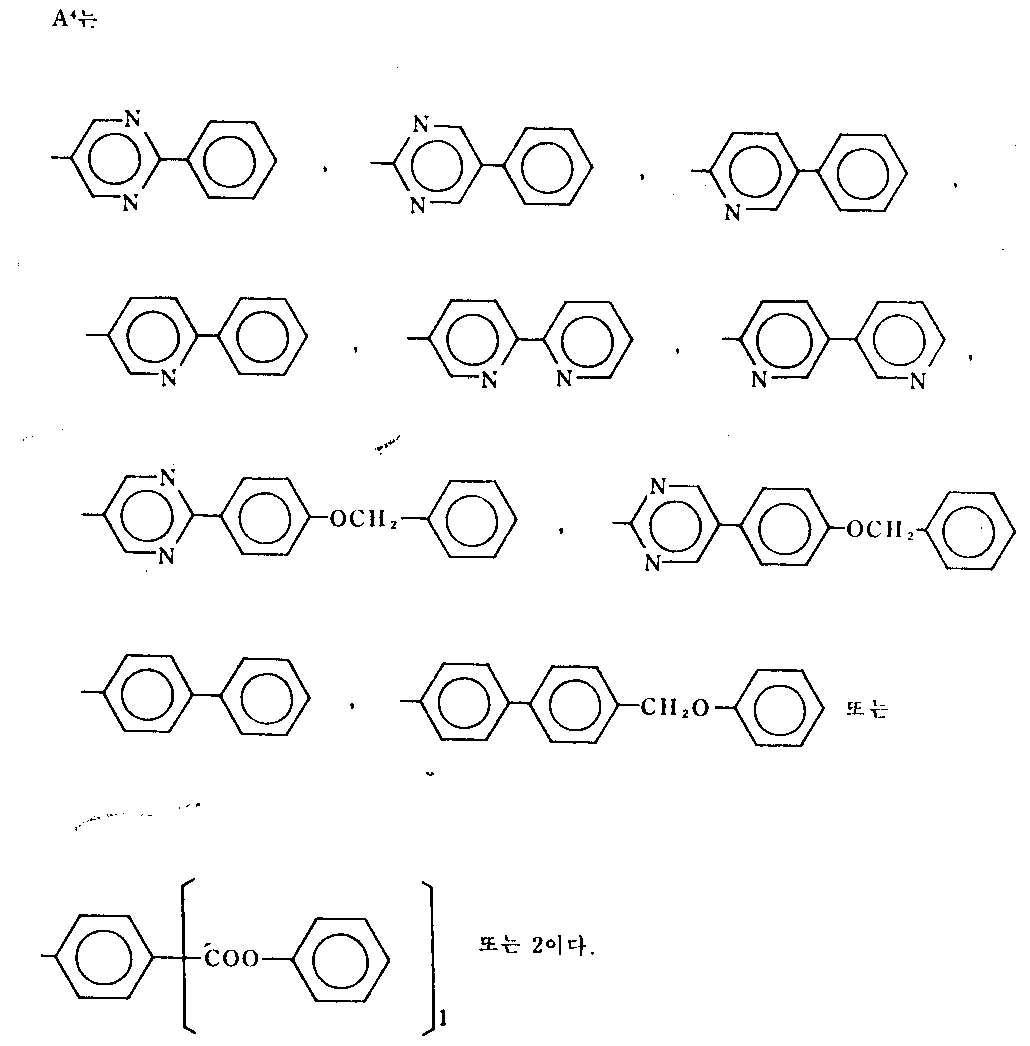
특히 바람직한 일반식(Ⅰ), 특히 일반식(Ⅳ)의 신규 화합물에는 실시예에서 명명한 화합물들이 포함된다.Particularly preferred novel compounds of formula (I), in particular of formula (IV), include the compounds named in the examples.
일반식(Ⅰ)의 화합물을 제조하기 위하여, 일반식(Ⅱ)의 메조제닉 페놀 또는 테오페놀을 등량 또는 과량의 유기 또는 무기 염기의 존재하에 적합한 용매 속에서, 필요한 경우 아실화 촉매의 존재하에 1,3-디옥솔란-4-카복실산(Ⅲ)의 적합한 유도체, 바람직하게는 아실 클로라이드[일반식(Ⅲ)에서 Y=C1인 경우]와 반응시키고, 반응 생성물을 적합한 방법(예:결정화, 여과 또는 크로마토그래피 분리방법)으로 분리하고 정제한다.To prepare the compounds of formula (I), the mesogenic phenols or theophenols of formula (II) are reacted in the presence of an equivalent or excess of organic or inorganic base in a suitable solvent, if necessary in the presence of an acylation catalyst. A suitable derivative of, 3-dioxolane-4-carboxylic acid (III), preferably acyl chloride [if Y = C1 in formula (III)] and the reaction product is subjected to a suitable method (e.g. crystallization, filtration or Chromatographic separation method) and purification.
R1(-A1)j(-M1)k(-A2)l(-M2)m(-A3)n-X-H (Ⅱ)R1 (-A1) j (-M1) k (-A2) l (-M2) m (-A3) n-X-H (II)

일반식(Ⅲ)의 Y는 Cl, Br, ONa 또는 상당 그룹과 같은 적합한 이탈 그룹이다. 사용되는 페놀은 문헌에 공지되어 잇따. 또한 상술한 바와 같이 적합한 1,3-디옥솔란-4-카복실산 유도체의 제조방법도 문헌[참조:M. Angrick et al., Monatsheft fChemie 116,337(1985) : R. Dunont et al., Helv. Chem. Acta 66, 814(1983), T. Sugiyama et al., Agric. Biol. Chem. 48, 1841(1984) or J. Jurczak et al., Tetrahedron 42, 447(1986)]에 기술되어 있다. 두 화합물(Ⅱ)및 (Ⅲ)이 결합하여 상술한 바와 같이 문헌[J. -M. Beau e tal., Tetraheron Lettes 26, 6193(1985)]에서 공지된 방법에 따라 화합물(Ⅰ)이 형성될 수 있다.Y in general formula (III) is a suitable leaving group such as Cl, Br, ONa or equivalent group. The phenols used are well known in the literature. Also described above are methods for the preparation of suitable 1,3-dioxolane-4-carboxylic acid derivatives. Angrick et al., Monatsheft f Chemie 116,337 (1985): R. Dunont et al., Helv. Chem. Acta 66, 814 (1983), T. Sugiyama et al., Agric. Biol. Chem. 48, 1841 (1984) or J. Jurczak et al., Tetrahedron 42, 447 (1986). Both compounds (II) and (III) combine and are described in detail in J. -M. Beau e tal., Tetraheron Lettes 26, 6193 (1985), may be formed according to a method known in the art.
본 발명에 따른 액정 홉합물은 액정 상을 형성하며 일반식(Ⅰ)의 광학적 활서 화합물 하나 이상을 함유한다.The liquid crystal blend according to the invention forms a liquid crystal phase and contains at least one optically active compound of general formula (I).
용어“액정상은” 네마틱, 코레스테릭, 직교 스멕틱 또는 경사진 스멕틱 상, 특히 SA*, S4* 및 SD* 상을 의미한다. 액정 혼함물은 본 발명에서 청구하는 키랄 화합물 하나 이상을 포함하면서 2 내지 20개, 바람직하게는 2 내지 15개의 성분들을 함유한다.The term “liquid crystalline phase” means a nematic, cholesteric, orthogonal smectic or inclined smectic phase, in particular SA *, S4 * and SD * phases. The liquid crystal mixture contains 2 to 20, preferably 2 to 15 components, including at least one chiral compound claimed in the present invention.
기타 성분들은 네마틱, 코레스테릭 및/또는 스멕틱 상(예:SA상) 및/또는 경사진 스멕틱 상을 갖는 공지된 화합물로부터 선택하는 것이 바람직한다 ; 이허한 화합물들은, 예를 예를들면, 쉬프(Schiff) 염기, 비페닐, 테페닐, 페닐 사이클로헥산, 사이크로헥실비페닐, N-, S-, 또는 O-함유 헤테로사이클릭 화합물(예:피리미딘, 신나메이트, 콜레스테롤 에스테르) 및 극성 말단 그룹과 다양하게 가교결합된 다해 P-알킬벤조에이트이다.The other components are preferably selected from known compounds having nematic, cholesteric and / or smectic phases (eg SA phases) and / or inclined smectic phases; These compounds include, for example, Schiff bases, biphenyls, tephenyls, phenyl cyclohexanes, cyclohexylbiphenyls, N-, S-, or O-containing heterocyclic compounds (e.g., Pyrimidines, cinnamates, cholesterol esters) and P-alkylbenzoates with various crosslinks with polar terminal groups.
일반적으로, 시판용 액정 혼합물은, 광학적 화성 화합물(들)의 부가 전에, 이미 매우 다양한 성분들의 홉합물로서 존재하며 이들 성분의 하나 이상이 메소제닉이다. 즉, 유도된 형태 또는 공성분과 혼합된 화합물로서 하나 이상의 상호변화 (enantiotropic; 투명점>융점) 또는 단일변화(monotropic; 투명점<융점) 메조상 (mesophase) 형성을 예기하는 액정 상을 나타낸다. 본 발명에서 청구되는 광학적으로 활성인 화합물 하나 이상 이외에 액정 혼합물은 특히 SC상을 갖는 하나의 에스테르 화합물(예:페닐 알콕시벤조에이트) 또는 질소-함유 헤테로사이클릭 환을 갖는 이중방향족 화합물(예:알킬피리미딘 알콕시벤젠)을 함유한다.In general, commercially available liquid crystal mixtures already exist as a mixture of a wide variety of components before the addition of the optically chemical compound (s) and at least one of these components is mesogenic. That is, as a compound mixed with a derived form or co-component, one or more enantiotropic (melting point > melting point) or monotropic (clear point < melting point) mesophases are expected. In addition to the at least one optically active compound claimed in the present invention, the liquid crystal mixture is in particular a single ester compound having an SC phase (eg phenyl alkoxybenzoate) or a biaromatic compound having a nitrogen-containing heterocyclic ring (eg alkyl Pyrimidine alkoxybenzene).
일반적으로, 액정 혼합물은 본 발명에 따른 화합물(들) 0.05 내지 70중량%, 특히 0.1 내지 50중량%을 함유한다. 본 발명에 따른 화합물은 경사진 스멕틱 액정 상용의 도프로서 적합한데, 이는 이들 화합물이 후자 물질을 강유전성 액정 상으로 전화시키기 때문이다: 25℃에서 자발분극(PS) 값은 10몰%의 도핑 농도에서 약 8 내지 14nC/cm2이며 순수한 화합물까지 선형적으로 외삽하면 약 80 내지 140nC/cm2이다. 신규 시스템에 대한 스윗칭 시간은 25℃, 10몰%의 도핑 농도 및 ±10V/1m의 스윗칭 전압에서 대체로 중요한 501S 이하이다.In general, the liquid crystal mixture contains from 0.05 to 70% by weight, in particular from 0.1 to 50% by weight, of the compound (s) according to the invention. The compounds according to the invention are suitable as doped commercially inclined smectic liquid crystals because these compounds convert the latter into ferroelectric liquid crystal phases: at 25 ° C., the spontaneous polarization (PS) value is 10 mole percent doping concentration. At about 8 to 14 nC / cm2 and linearly extrapolated to the pure compound is about 80 to 140 nC / cm2. Switching times for the new system are generally below 501S, which is significant at 25 ° C, 10 mole percent doping concentration and ± 10V / 1m switching voltage.
또한 직교 스멕틱 상(SA*, SB*, 및 SE*)중의 전자임상 효과를 수득하기 위하여 본 발명에 따른 화합물을 사용할 수도 있다.It is also possible to use the compounds according to the invention in order to obtain the electroclinical effect in orthogonal smectic phases (SA *, SB *, and SE *).
실시예 1Example 1
(R)-4-(2-n-옥틸피디미딘-5-일)-페닐-2,2-디메틸-1,3-디옥솔란-4-카복실레이트(R) -4- (2-n-octylpydimidin-5-yl) -phenyl-2,2-dimethyl-1,3-dioxolane-4-carboxylate

1.86g(11,3mmol)의 2,2-디메틸-1,3-디옥솔란-4-카보닐 크로라이드를 0℃에서 10분에 걸쳐 30ml의 테트라히이디로푸란중 3.2g(11.3mmol)의 4-(2-n-옥틸피리미딘-5-일)페놀, 1.24g(12.3mmol)의 트리에틸아민 및 10mg의 4-디메틸아미노피리딘의 용액을 가한다. 혼합물은 0℃에서 3시간 동안 교반한 후, 트리에틸 암모늄 하이드로클로라이드를 여과제거하고 여액을 진공하에 건조시킨다.1.86 g (11,3 mmol) of 2,2-dimethyl-1,3-dioxolane-4-carbonyl chloride was added to 3.2 g (11.3 mmol) in 30 ml of tetrahydrodifuran over 10 minutes at 0 ° C. A solution of 4- (2-n-octylpyrimidin-5-yl) phenol, 1.24 g (12.3 mmol) triethylamine and 10 mg 4-dimethylaminopyridine is added. The mixture is stirred at 0 ° C. for 3 hours, after which triethyl ammonium hydrochloride is filtered off and the filtrate is dried under vacuum.
n-헥산으로부터 크로마토그래피로 정제하고 재결정후, 융점이 88℃인 무색 결정 1.6g(이론치의 34.3%)을 수득한다;
다음 화합물들을 유사하게 수득한다.The following compounds are similarly obtained.
실시예 2Example 2
(R)-4-(2-n-옥틸옥시피리미딘-5-일)-페닐-2,2-디메틸-1,3-디옥솔란-4-카복실레이트(R) -4- (2-n-octyloxypyrimidin-5-yl) -phenyl-2,2-dimethyl-1,3-dioxolane-4-carboxylate

실시예 3Example 3
(R)-4-(2-n-옥틸옥시피리미딘-5-일)-페닐-2,2-디메틸-1,3-디옥솔란-4-카복실레이트(R) -4- (2-n-octyloxypyrimidin-5-yl) -phenyl-2,2-dimethyl-1,3-dioxolane-4-carboxylate

실시예 4Example 4
(R)-4-(2-n-옥틸옥시피리미딘-2-일)-페닐-2,2-디메틸-1,3-디옥솔란-4-카복실레이트(R) -4- (2-n-octyloxypyrimidin-2-yl) -phenyl-2,2-dimethyl-1,3-dioxolane-4-carboxylate

실시예 5Example 5
(R)-4-(2-n-옥틸옥시피리미딘-2-일)-페닐-2,2-디메틸-1,3-디옥솔란-4-카복실레이트(R) -4- (2-n-octyloxypyrimidin-2-yl) -phenyl-2,2-dimethyl-1,3-dioxolane-4-carboxylate

실시예 6Example 6
(R)-(4′-옥틸옥시피리미딘-4-일)-2,2-디메틸-1,3-디옥솔란-4-카복실레이트(R)-(4′-octyloxypyrimidin-4-yl) -2,2-dimethyl-1,3-dioxolane-4-carboxylate

실시예 7Example 7
(R),(R)-4.4′-디하이드록시페닐 비스(2,2-디메틸-1,3-디옥솔란-4-카복실레이트(R), (R) -4.4'-dihydroxyphenyl bis (2,2-dimethyl-1,3-dioxolane-4-carboxylate

실시예 8Example 8
(R)-[4-(4-데실옥시벤조일옥시)페닐]-2,2-디메틸-1,3-디옥솔란-4-카복실레이트(R)-[4- (4-decyloxybenzoyloxy) phenyl] -2,2-dimethyl-1,3-dioxolane-4-carboxylate


실시예 9Example 9
(R)-4-(2-n-옥틸옥시피리미딘-5-일)-페닐-2,2-디메틸-1,3-디옥솔란-4-카복실레이트(R) -4- (2-n-octyloxypyrimidin-5-yl) -phenyl-2,2-dimethyl-1,3-dioxolane-4-carboxylate

실시예 10Example 10
(R)-4-(2-n-옥틸옥시피리미딘-5-일)-페닐-2,2-디메틸-1,3-디옥솔란-4-카복실레이트(R) -4- (2-n-octyloxypyrimidin-5-yl) -phenyl-2,2-dimethyl-1,3-dioxolane-4-carboxylate

실시예 11Example 11
(R)-4-(5-n-옥틸옥시피리미딘-2-일)-페닐-2,2-디메틸-1,3-디옥솔란-4-카복실레이트(R) -4- (5-n-octyloxypyrimidin-2-yl) -phenyl-2,2-dimethyl-1,3-dioxolane-4-carboxylate

실시예 12Example 12
(R)-4-[2-((S)-7-메틸 노시옥시)피리미딘-5-일]-페닐 2,2-디메틸-1,3-디옥솔란-4-카복실레이트(R) -4- [2-((S) -7-methyl nosoxy) pyrimidin-5-yl] -phenyl 2,2-dimethyl-1,3-dioxolane-4-carboxylate


실시예 13Example 13
(R)-4-(5-n-옥틸옥시피리미딘-5-일)-페닐2,2-펜타메틸렌-1,3-디옥솔란-4-카복실레이트(R) -4- (5-n-octyloxypyrimidin-5-yl) -phenyl2,2-pentamethylene-1,3-dioxolane-4-carboxylate

실시예 14Example 14
(R)-4-(2-n-옥틸옥시피리미딘-5-일)-페닐2,2-디메틸-1,3-디옥솔란-4-카복실레이트(R) -4- (2-n-octyloxypyrimidin-5-yl) -phenyl2,2-dimethyl-1,3-dioxolane-4-carboxylate

실시예 15Example 15
(R)-4-(5-n-노닐피리미딘-2-일)-페닐2,2-디메틸-1,3-디옥솔란-4-카복실레이트(R) -4- (5-n-nonylpyrimidin-2-yl) -phenyl2,2-dimethyl-1,3-dioxolane-4-carboxylate

실시예 16Example 16
(R)-4-(5-n-데실피리미딘-2-일)-페닐2,2-디메틸-1,3-디옥솔란-4-카복실레이트(R) -4- (5-n-decylpyrimidin-2-yl) -phenyl2,2-dimethyl-1,3-dioxolane-4-carboxylate


실시예 17Example 17
(R)-4-(5-n-운데실피리미딘-5-일)-페닐2,2-디메틸-1,3-디옥솔란-4-카복실레이트(R) -4- (5-n-undecylpyrimidin-5-yl) -phenyl2,2-dimethyl-1,3-dioxolane-4-carboxylate

실시예 18Example 18
(R-4-[2-(4-헥실페닐)피리미딘-5-일]-페닐2,2-디메틸-1,3-디옥솔란-4-카복실레이트(R-4- [2- (4-hexylphenyl) pyrimidin-5-yl] -phenyl2,2-dimethyl-1,3-dioxolane-4-carboxylate
[(Ⅰ) 여기서 R1=H13C6, j=1, j=ℓ=n=1, k=m=0,[(I) where R1 = H13C6, j = 1, j = ℓ = n = 1, k = m = 0,

R2=R3=CH3 및 R4=H].R 2 = R 3 = CH 3 and R 4 = H].
상순서 C159° S3 173° SC 190° SA 196°ⅠFirst Order C159 ° S3 173 ° SC 190 ° SA 196 ° Ⅰ

실시예 19Example 19
(R)-4-[5-(4-헥실페닐)피리미딘-2-일]-페닐2,2-디메틸-1,3-디옥솔란-4-카복실레이트(R) -4- [5- (4-hexylphenyl) pyrimidin-2-yl] -phenyl2,2-dimethyl-1,3-dioxolane-4-carboxylate
[(Ⅰ) 여기서 R1=H13C6, j=ℓ=n=1, k=m=0, l,[(I) where R1 = H13C6, j = ℓ = n = 1, k = m = 0, l,

X=O, R2=R3=CH3 및 R4=H].X = O, R2 = R3 = CH3 and R4 = H].
상순서 157° S3 162° SC 178° SA 195°ⅠFirst Order 157 ° S3 162 ° SC 178 ° SA 195 ° Ⅰ

실시예 20Example 20
(R)-[2-(4-도데실옥시페닐]피리미딘-5-일)-페닐 2,2-디메틸-1,3-디옥솔란-4-카르복실레이트(R)-[2- (4-dodecyloxyphenyl] pyrimidin-5-yl) -phenyl 2,2-dimethyl-1,3-dioxolane-4-carboxylate

실시예 21Example 21
(R)-[2-<4-(5-옥소헥실)옥시페닐>]피리미딘-5-일 2,2-디메틸-1,3-디옥솔란-4-카복실레이트(R)-[2- <4- (5-oxohexyl) oxyphenyl>] pyrimidin-5-yl 2,2-dimethyl-1,3-dioxolane-4-carboxylate

실시예 22Example 22
(R)-[2-<4-(4-트랜스-펜틸사이클로헥실)카르보닐옥시페닐>]피리미딘-5-일 2,2-디메틸-1,3-디옥솔란-4-카복실레이트(R)-[2- <4- (4-trans-pentylcyclohexyl) carbonyloxyphenyl>] pyrimidin-5-yl 2,2-dimethyl-1,3-dioxolane-4-carboxylate

실시예 23Example 23
(R)-[2-4펜틸카보닐옥시페닐)]피리미딘-5-일 2,2-디메틸-1,3-디옥솔란-4-카복실레이트(R)-[2-4pentylcarbonyloxyphenyl)] pyrimidin-5-yl 2,2-dimethyl-1,3-dioxolane-4-carboxylate

실시예 24Example 24
(R)-[4-<2-(4-데실옥시페닐-5-일>]페닐2,2-디메틸-1,3-디옥솔란-4-카복실레이트(R)-[4- <2- (4-decyloxyphenyl-5-yl>] phenyl2,2-dimethyl-1,3-dioxolane-4-carboxylate

실시예 25Example 25
(R)-[2-(5-옥틸피리드-2-일)]페닐2,2-디메틸-1,3-디옥솔란-4-카복실레이트(R)-[2- (5-octylpyrid-2-yl)] phenyl2,2-dimethyl-1,3-dioxolane-4-carboxylate

실시예 26Example 26

실시예 27Example 27
(R)-[4-(4-트랜스-프로필사이클로헥실)]-페닐2,2-디메틸-1,3-디옥솔란-4-카복실레이트(R)-[4- (4-trans-propylcyclohexyl)]-phenyl2,2-dimethyl-1,3-dioxolane-4-carboxylate

실시예 28Example 28
(R)-[4′′(4-옥틸옥시벤조일옥시)]비페닐-4-일 2,2-디메틸-1,3-디옥솔란-4-카복실레이트(R)-[4 '′ (4-octyloxybenzoyloxy)] biphenyl-4-yl 2,2-dimethyl-1,3-dioxolane-4-carboxylate

실시예 29Example 29
(R)-[4-<<-(1,1-H-퍼플루오로옥틸)옥시피리미딘-5-일>]페닐 2,2-디메틸-1,3-디옥솔란-4-카복실레이트(R)-[4-<<-(1,1-H-perfluorooctyl) oxypyrimidin-5-yl>] phenyl 2,2-dimethyl-1,3-dioxolane-4-carboxylate

실시예 30Example 30
(R)-4[5-(4-헥실옥시페닐)피리미딘-2-일]페닐 2,2-디메틸-1,3-디옥솔란-4-카복실레이트(R) -4 [5- (4-hexyloxyphenyl) pyrimidin-2-yl] phenyl 2,2-dimethyl-1,3-dioxolane-4-carboxylate

실시예 31Example 31
(R)-[4-(5-옥틸-1,3-디옥산-2-일)페닐]2,2-디메틸-1,3-디옥솔란-4-카복실레이트(R)-[4- (5-octyl-1,3-dioxan-2-yl) phenyl] 2,2-dimethyl-1,3-dioxolane-4-carboxylate

실시예 32Example 32
(R)-[4-(5-옥틸-1,3-디티안-5-일)페닐]2,2-디메틸-1,3-디옥솔란-4-카복실레이트(R)-[4- (5-octyl-1,3-dithia-5-yl) phenyl] 2,2-dimethyl-1,3-dioxolane-4-carboxylate

실시예 33Example 33
(R)-4-(5-n-옥틸옥시피리미딘-2-일)페닐2,2-펜타메틸렌-1,3-디옥솔란-4-카복실레이트(R) -4- (5-n-octyloxypyrimidin-2-yl) phenyl2,2-pentamethylene-1,3-dioxolane-4-carboxylate

실시예 34Example 34
(R)-[2-(4-옥틸옥시페닐)]피리미딘-5-일 2,2-펜타메틸렌-1,3-디옥솔란-4-카복실레이트(R)-[2- (4-octyloxyphenyl)] pyrimidin-5-yl 2,2-pentamethylene-1,3-dioxolane-4-carboxylate

측정법:Measurement method:
소량의 키랄 화합물을 용매(비키랄)에 가하는 경우, 직선 편광판을 (특정) 각 α가 되도록 하면서 회전시킨다 ; 이 각은 다음과 같이 특정지워진다 :
용도에 A1 내지 A18A1 to A18 for use
경사진 스맥틱 상을 갖는 액정 시스템중의 강유전성 도프로서 상술한 화합물의 효과도를 시험하기 위하여, 이들 화합물을 각각 10몰%의 농도로 하기 구조식 (A)의 상 순서가 C14,9° SC 49.8℃ SA 59.2℃ Ⅰ(5℃)인 4-(5-옥틸 피리미딘- 2-일-1(6-메틸옥트-1-옥시)벤젠 화합물, 하기 구조식 (B)의 상 순서가 C 17℃ SG 32.7℃ SC 70.4℃ SA 73.3℃(-3℃)인 4-(4-데실옥시페닐-1-카보닐옥시)-1-(4-메틸헥실옥시)벤젠 화합몰, 상 순서가 C 13.2℃ SC 51℃ SA 61.2℃ N 66.7℃ Ⅰ인 비키랄 시험 혼합물(C) 또는 상 순서가 C 12.5℃ SC 83℃ SA 95℃ N 100℃ Ⅰ인 비키랄 시험혼합물(D)의 라세미체와 혼합시키며 혼합물의 자발분극(Ps:nC.cm-2), 스윗칭 시간(

PS 값은 에이치. 다이어먼트(H. Diamant)등의 방법(참조:Rev. Sci. Intr., 28, 30, 1957)으로 측정하고, 여기서 특정 목적의 측정 셀[참조:Skarp et al., Ferroelectric Letters, Vol. 06, 67(1986)]을 사용하여


[표 1]TABLE 1

*60℃에서* At 60 ℃
용도예 A19 및 A20Application Examples A19 and A20
상 순서가 Ⅰ→N→SA→SC인 비키랄 액정 혼합물을 본 발명에 따른 화합물 각각과 혼합하여, 네마틱 상층의 비틀림 성능(나선의 유도)을 조사한다. 유도된 나선의 피치는 문헌(참조: P. Kassubek et al., Mol. Cryst. Liq. Cryst., Vol. 8, pages 305 to 314, 1969)에 기술한 바와 같이 배향 층을 갖는 쇄기형 셀에서 편광 현미경하에서 변위 라인을 측정하여 결정한다. 표 2는 결과를 요약한 것이다. 표에서 알 수 있는 바와 같이, 표 2는 결과를 요약한 것이다. 표에서 알 수 있는 바와 같이, 두 가지 예에서는 10몰%의 도핑 농도에서 조차도 N+ 상층 큰 피치를 나타내무로써 추가의 광학적 활성인 도프에 의한 피치 보상은 필요하지 않다. 실시예 A20 조차도 나선 전환을 보여주는데, 이는 나선의 회전방향으로 변화되어 나선의 피치가 무한대가 됨을 의미한다.An achiral liquid crystal mixture having a phase sequence of I → N → SA → SC is mixed with each of the compounds according to the present invention to investigate the torsional performance (induction of the spiral) of the nematic upper layer. The pitch of the induced helix is described in a wedge cell with an orientation layer, as described in P. Kassubek et al., Mol.Cyst.Liq.Cyst., Vol. 8, pages 305 to 314, 1969. This is determined by measuring the displacement line under polarized light microscope. Table 2 summarizes the results. As can be seen from the table, Table 2 summarizes the results. As can be seen from the table, in both examples the pitch compensation by the additional optically active dope is not necessary as it exhibits a large pitch on top of the N + even at a doping concentration of 10 mol%. Even Example A20 shows a spiral transition, meaning that the pitch of the spiral is infinite, changing in the direction of rotation of the spiral.
[표 2]TABLE 2

-(반시계방향)-(Counterclockwise)
+(시계방향)+ (Clockwise)
**)HTP(나선형 비틀림력)=(X.p)-1**) HTP (Spiral Torsion Force) = (X.p) -1
X=도프의 몰분율X = mole fraction of dope
p=피치p = pitch
용도예 A21 및 A22Application Examples A21 and A22
직교 스맥틱 상(SA, SB 및 SE)에서, 일반식(Ⅰ)의 화합물은 전자임상효과를 유도시킨다. 이것의 크기는 미분계수(dθ/dE)로 표시한다. B는 전기장(E)에 의하여 유도된 경사각이다. 이러한 인자는 SA*상에서 측정하지만 “선반(bookshelf)” 배열 및 동일한 셀에서도 편광측정(참조 : 용도에 A1 내지 A18)을 위하여 사용된다. 전기장에 의해 유도된 경사각은 횡선 편광기가 장착된 편광 현미경에서 음영 위치를 지정하고 회전단계에 대해 적절한 각을 재고 이로부터 적용된 전기장 없이 측정한 각을 공제함으로써 측정한다. 화합물(Ⅰ)의 효과도를 시험하기 위하여, 두 혼합물의 전자임상계수를 측정한다. 제1번(실시예A21)은 라세미체A(X=0.9)중의 (물질)실시예2(X=0.1)의 혼합물이다. 제2번(실시예22)은 상 순서가 Ⅰ→N→SA→SC→C인 비키랄 염기 혼합물로 도핑시킨 (물질)실시예 4(X=0.1)이다. 이렇게 하여 수득한 SA*상중에서 측정된 수치는 표 3에 요약하였다(X=몰 분율).In the orthogonal smacktic phases (SA, SB and SE), the compounds of general formula (I) induce an electroclinical effect. Its magnitude is represented by the differential coefficient (dθ / dE). B is the inclination angle induced by the electric field E. This factor is measured on SA * but is used for polarization measurements (see A1 to A18 for use) in “bookshelf” arrays and even in the same cell. The tilt angle induced by the electric field is measured by specifying the shadow position in a polarizing microscope equipped with a transverse polarizer and subtracting the measured angle without the applied electric field from the appropriate angle for the rotation step. In order to test the effectiveness of compound (I), the electron clinical coefficient of the two mixtures is measured. First (Example A21) is a mixture of (Material) Example 2 (X = 0.1) in racemate A (X = 0.9). Second (Example 22) is (Material) Example 4 (X = 0.1) doped with an achiral base mixture with phase sequence I → N → SA → SC → C. The values measured in the SA * phases thus obtained are summarized in Table 3 (X = mole fraction).
[표 3]TABLE 3

Claims (10)


Applications Claiming Priority (3)
| Application Number | Priority Date | Filing Date | Title |
|---|---|---|---|
| DE?P3713273.3? | 1987-04-18 | ||
| DEP3713273.3 | 1987-04-18 | ||
| DE19873713273 DE3713273A1 (en) | 1987-04-18 | 1987-04-18 | USE OF OPTICALLY ACTIVE 1,3-DIOXOLAN-4-CARBONIC ACID ESTERS AS DOPING SUBSTANCES IN LIQUID CRYSTAL MIXTURES, THESE CONTAINING LIQUID CRYSTAL MIXTURES AND NEW OPTICALLY ACTIVE 1.3-DIOXOLAN-4-CARBONIC ACID ESTERS |
Publications (2)
| Publication Number | Publication Date |
|---|---|
| KR880012731A KR880012731A (en) | 1988-11-28 |
| KR960000872B1 true KR960000872B1 (en) | 1996-01-13 |
Family
ID=6325955
Family Applications (1)
| Application Number | Title | Priority Date | Filing Date |
|---|---|---|---|
| KR1019880004380A Expired - Fee Related KR960000872B1 (en) | 1987-04-18 | 1988-04-18 | Optically active 1,3-dioxolane-4-carboxylate, its use as a dope in liquid crystal mixtures and liquid crystal mixtures containing the same |
Country Status (9)
| Country | Link |
|---|---|
| US (1) | US5641428A (en) |
| EP (1) | EP0288813B1 (en) |
| JP (1) | JPH0717908B2 (en) |
| KR (1) | KR960000872B1 (en) |
| AT (1) | ATE58394T1 (en) |
| CA (1) | CA1339994C (en) |
| DE (2) | DE3713273A1 (en) |
| ES (1) | ES2019425B3 (en) |
| NO (1) | NO170885C (en) |
Families Citing this family (13)
| Publication number | Priority date | Publication date | Assignee | Title |
|---|---|---|---|---|
| DE3832502A1 (en) * | 1988-09-24 | 1990-03-29 | Hoechst Ag | USE OF OPTICALLY ACTIVE OXIRAN-2-CARBONIC ACID ESTERS AND OPTICALLY ACTIVE 1,3-DIOXOLAN-4-CARBONIC ACID ESTERS AS DOPING SUBSTANCES IN LIQUID CRYSTAL MIXTURES, THESE CONTAINING LIQUID CRYSTAL MIXTURES AND NEW CARBONIC OXIDE SOURCES-OXOXONOXANO-2-OXOXONOXANO-OXIDE-OXIDE SOURCES |
| US5354500A (en) * | 1986-05-29 | 1994-10-11 | Hoechst Aktiengesellschaft | Optically active carboxylic esters of oxygen-containing heterocycles as doping substances in liquid crystal mixtures and liquid crystal mixtures containing them |
| JPS63179835A (en) * | 1986-12-20 | 1988-07-23 | メルク・パテント・ゲゼルシヤフト・ミツト・ベシユレンクテル・ハフツング | Cyclopentane derivative |
| EP0306919B1 (en) * | 1987-09-07 | 1993-02-17 | Daiso Co., Ltd. | Liquid crystalline compounds and process for production thereof |
| DE3824902A1 (en) * | 1988-07-22 | 1990-02-15 | Hoechst Ag | OPTICALLY ACTIVE 1,3-DIOXOLANE DERIVATIVES CARRYING A MESOGENIC REMAIN IN 4-POSITION, A METHOD FOR THE PRODUCTION THEREOF AND THEIR USE AS DOPING SUBSTANCES IN LIQUID CRYSTAL MIXTURES |
| CA1341098C (en) * | 1988-08-25 | 2000-09-12 | Kazuhiko Sakaguchi | Liquid crystal composition and use thereof |
| DE3832503A1 (en) * | 1988-09-24 | 1990-03-29 | Hoechst Ag | NEW OPTICALLY ACTIVE ESTERS OF 5-ETHYL AND 5-VINYL-1,3-DIOXOLAN-4-CARBONIC ACIDS, THEIR USE AS DOPING SUBSTANCES IN LIQUID CRYSTAL MIXTURES AND THE NEW ESTER CONTAINING LIQUID CRYSTAL MIXTURES |
| DE3907601A1 (en) * | 1989-03-09 | 1990-09-13 | Hoechst Ag | OPTICALLY ACTIVE, A MESOGENEOUS REMAINING DIOXOLANYLACRYL AND DIOXOLANYL PROPIONIC ACID ESTER, A METHOD FOR THE PRODUCTION THEREOF AND THEIR USE AS DOPING SUBSTANCES IN LIQUID CRYSTAL MIXTURES |
| DE3909356A1 (en) * | 1989-03-22 | 1990-09-27 | Hoechst Ag | LIQUID CRYSTALLINE, IN PARTICULAR FERROELECTRIC LIQUID CRYSTALLINE MIXTURES |
| US5215678A (en) * | 1989-03-31 | 1993-06-01 | Sharp Kabushiki Kaisha | Ferroelectric liquid crystal composition and liquid crystal device incorporating same |
| EP0441213B1 (en) * | 1990-02-06 | 1995-09-13 | F. Hoffmann-La Roche Ag | Chiral dioxolanes |
| DE4304756C1 (en) * | 1993-02-17 | 1994-09-08 | Hoechst Ag | Process for the preparation of salts, chiral, alpha-oxygen-functionalized carboxylic acids |
| DE4434754A1 (en) * | 1993-09-30 | 1995-04-06 | Hoechst Ag | Novel compounds for use in liquid-crystal mixtures |
Family Cites Families (6)
| Publication number | Priority date | Publication date | Assignee | Title |
|---|---|---|---|---|
| JPS5611932A (en) * | 1979-07-12 | 1981-02-05 | Adeka Argus Chem Co Ltd | Stabilized polymer composition |
| DE3604898A1 (en) * | 1986-02-17 | 1987-08-20 | Hoechst Ag | CHIRAL IMPLEMENTATION PRODUCTS MESOGENIC MOLECULE BLOCKS AND BIFUNCTIONALLY REACTIVE WINE ACID DERIVATIVES AND THEIR USE AS DOPE IN LIQUID CRYSTAL PHASES |
| DE3604899A1 (en) * | 1986-02-17 | 1987-08-20 | Hoechst Ag | CHIRAL IMPLEMENTATION PRODUCTS FROM MESOGENIC MOLECULE BLOCKS AND BIFUNCTIONAL REACTIVE BUTANTETRAOL DERIVATIVES AND THEIR USE AS DOPE IN LIQUID CRYSTAL PHASES |
| JPS63179835A (en) * | 1986-12-20 | 1988-07-23 | メルク・パテント・ゲゼルシヤフト・ミツト・ベシユレンクテル・ハフツング | Cyclopentane derivative |
| DE3739588A1 (en) * | 1986-12-20 | 1988-07-28 | Merck Patent Gmbh | Cyclopentane derivatives |
| JPS6463571A (en) * | 1987-09-03 | 1989-03-09 | Chisso Corp | Optically active-2,5-diphenylpyridines |
-
1987
- 1987-04-18 DE DE19873713273 patent/DE3713273A1/en not_active Withdrawn
-
1988
- 1988-04-12 EP EP88105777A patent/EP0288813B1/en not_active Expired - Lifetime
- 1988-04-12 DE DE8888105777T patent/DE3861049D1/en not_active Expired - Fee Related
- 1988-04-12 ES ES88105777T patent/ES2019425B3/en not_active Expired - Lifetime
- 1988-04-12 AT AT88105777T patent/ATE58394T1/en not_active IP Right Cessation
- 1988-04-15 NO NO881659A patent/NO170885C/en unknown
- 1988-04-15 CA CA000564256A patent/CA1339994C/en not_active Expired - Fee Related
- 1988-04-16 JP JP63092682A patent/JPH0717908B2/en not_active Expired - Fee Related
- 1988-04-18 KR KR1019880004380A patent/KR960000872B1/en not_active Expired - Fee Related
-
1992
- 1992-04-30 US US07/879,147 patent/US5641428A/en not_active Expired - Lifetime
Also Published As
| Publication number | Publication date |
|---|---|
| DE3861049D1 (en) | 1990-12-20 |
| CA1339994C (en) | 1998-08-11 |
| ES2019425B3 (en) | 1991-06-16 |
| NO170885C (en) | 1992-12-23 |
| US5641428A (en) | 1997-06-24 |
| EP0288813B1 (en) | 1990-11-14 |
| KR880012731A (en) | 1988-11-28 |
| ATE58394T1 (en) | 1990-11-15 |
| NO170885B (en) | 1992-09-14 |
| NO881659D0 (en) | 1988-04-15 |
| JPS63304088A (en) | 1988-12-12 |
| DE3713273A1 (en) | 1988-11-03 |
| JPH0717908B2 (en) | 1995-03-01 |
| EP0288813A1 (en) | 1988-11-02 |
| NO881659L (en) | 1988-10-19 |
Similar Documents
| Publication | Publication Date | Title |
|---|---|---|
| US5043095A (en) | Chiral esters of mesogenic carboxylic acids in liquid crystal phases | |
| KR960000872B1 (en) | Optically active 1,3-dioxolane-4-carboxylate, its use as a dope in liquid crystal mixtures and liquid crystal mixtures containing the same | |
| KR960006076B1 (en) | Use of compounds or mixtures of compounds which have a chiral, orthogonal, more highly or dered smectic phase in the | |
| US5384070A (en) | Use of optically active tetrahydrofuran-2-carboxylic acid esters as dopants in liquid-crystal mixtures, liquid-crystal mixtures containing same and novel optically active tetrahydrofuran-2-carboxylic acid esters | |
| KR0126469B1 (en) | Optically active 1,3-dioxolane derivatives containing mesogenic radicals in the 4-position, methods for their preparation and uses thereof | |
| KR960000076B1 (en) | Method for preparing chiral ester | |
| US4341653A (en) | Liquid-crystalline 4-alkylcyclohexyl esters | |
| US5334328A (en) | Chiral azetidinone derivatives, and their use as dopes in liquid-crystal mixtures | |
| EP0321148B1 (en) | Condensates of optically active-4-(1-hydroxy-ethyl)biphenyls with optically active organic acids | |
| EP0247804A2 (en) | 2-(Alkyloxycarbonyloxyphenyl)-5-alkylpyridine and composition containing same | |
| JPH02231473A (en) | 2,5-disubstituted heterocyclic compound and liquid crystal phase therefrom | |
| EP0306195A2 (en) | Optically active-2,5-diphenylpyridines | |
| EP0267758A2 (en) | Alpha-substituted-propionic acid esters | |
| EP0361272B1 (en) | Optically active esters of 5-ethyl and 5-vinyl 1,3-dioxolane-carboxylic acid, their use as dopants in liquid-crystal mixtures, and liquid-crystal mixtures containing these esters | |
| US5178793A (en) | Ferroelectric liquid crystal compounds and compositions | |
| US5366657A (en) | Geminal dimethylalkyl compounds, process for their preparation and their use in liquid-crystalline mixtures | |
| US5166391A (en) | Optically-active aliphatic α-halogen substituted carboxylic acid 4'-(alkoxybenzyloxy)biphenyl thioester compounds | |
| US5356564A (en) | Ferroelectric liquid crystal materials and liquid crystal compositions containing the same | |
| US5336436A (en) | Optically active oxirane derivatives, and their use as dopes in liquid-crystal mixtures | |
| JPH06211865A (en) | Chiral valerolactone derivative | |
| EP0381149A2 (en) | Optically active compound, liquid crystal composition and liquid crystal device comprising same | |
| EP0454157A1 (en) | Alkylphenylalkylpyrimidine compound and liquid crystal composition containing the same | |
| EP0317204A2 (en) | Alpha-aryloxypropionic acid esters | |
| JPH04503955A (en) | Optically active dioxolanyl acrylate and dioxolanyl propionate having a mesogenic group, their production method, and their use as a doping agent in a liquid crystal mixture | |
| KR20010089493A (en) | Liquid crystal compound |
Legal Events
| Date | Code | Title | Description |
|---|---|---|---|
| PA0109 | Patent application |
St.27 status event code: A-0-1-A10-A12-nap-PA0109 |
|
| R17-X000 | Change to representative recorded |
St.27 status event code: A-3-3-R10-R17-oth-X000 |
|
| PG1501 | Laying open of application |
St.27 status event code: A-1-1-Q10-Q12-nap-PG1501 |
|
| A201 | Request for examination | ||
| PA0201 | Request for examination |
St.27 status event code: A-1-2-D10-D11-exm-PA0201 |
|
| P11-X000 | Amendment of application requested |
St.27 status event code: A-2-2-P10-P11-nap-X000 |
|
| P13-X000 | Application amended |
St.27 status event code: A-2-2-P10-P13-nap-X000 |
|
| G160 | Decision to publish patent application | ||
| PG1605 | Publication of application before grant of patent |
St.27 status event code: A-2-2-Q10-Q13-nap-PG1605 |
|
| E701 | Decision to grant or registration of patent right | ||
| PE0701 | Decision of registration |
St.27 status event code: A-1-2-D10-D22-exm-PE0701 |
|
| GRNT | Written decision to grant | ||
| PR0701 | Registration of establishment |
St.27 status event code: A-2-4-F10-F11-exm-PR0701 |
|
| PR1002 | Payment of registration fee |
St.27 status event code: A-2-2-U10-U11-oth-PR1002 Fee payment year number: 1 |
|
| FPAY | Annual fee payment |
Payment date: 19981222 Year of fee payment: 4 |
|
| PR1001 | Payment of annual fee |
St.27 status event code: A-4-4-U10-U11-oth-PR1001 Fee payment year number: 4 |
|
| PN2301 | Change of applicant |
St.27 status event code: A-5-5-R10-R13-asn-PN2301 St.27 status event code: A-5-5-R10-R11-asn-PN2301 |
|
| R18-X000 | Changes to party contact information recorded |
St.27 status event code: A-5-5-R10-R18-oth-X000 |
|
| R18-X000 | Changes to party contact information recorded |
St.27 status event code: A-5-5-R10-R18-oth-X000 |
|
| R18-X000 | Changes to party contact information recorded |
St.27 status event code: A-5-5-R10-R18-oth-X000 |
|
| LAPS | Lapse due to unpaid annual fee | ||
| PC1903 | Unpaid annual fee |
St.27 status event code: A-4-4-U10-U13-oth-PC1903 Not in force date: 20000114 Payment event data comment text: Termination Category : DEFAULT_OF_REGISTRATION_FEE |
|
| PC1903 | Unpaid annual fee |
St.27 status event code: N-4-6-H10-H13-oth-PC1903 Ip right cessation event data comment text: Termination Category : DEFAULT_OF_REGISTRATION_FEE Not in force date: 20000114 |
|
| PN2301 | Change of applicant |
St.27 status event code: A-5-5-R10-R13-asn-PN2301 St.27 status event code: A-5-5-R10-R11-asn-PN2301 |
|
| R18-X000 | Changes to party contact information recorded |
St.27 status event code: A-5-5-R10-R18-oth-X000 |
|
| R18-X000 | Changes to party contact information recorded |
St.27 status event code: A-5-5-R10-R18-oth-X000 |
|
| R18-X000 | Changes to party contact information recorded |
St.27 status event code: A-5-5-R10-R18-oth-X000 |
|
| R18-X000 | Changes to party contact information recorded |
St.27 status event code: A-5-5-R10-R18-oth-X000 |
|
| P22-X000 | Classification modified |
St.27 status event code: A-4-4-P10-P22-nap-X000 |