KR880000126B1 - Polyion Exchanged Adsorbents for Air Separation - Google Patents
Polyion Exchanged Adsorbents for Air Separation Download PDFInfo
- Publication number
- KR880000126B1 KR880000126B1 KR1019830005416A KR830005416A KR880000126B1 KR 880000126 B1 KR880000126 B1 KR 880000126B1 KR 1019830005416 A KR1019830005416 A KR 1019830005416A KR 830005416 A KR830005416 A KR 830005416A KR 880000126 B1 KR880000126 B1 KR 880000126B1
- Authority
- KR
- South Korea
- Prior art keywords
- zeolite
- ion
- adsorbent composition
- nitrogen
- composition
- Prior art date
- Legal status (The legal status is an assumption and is not a legal conclusion. Google has not performed a legal analysis and makes no representation as to the accuracy of the status listed.)
- Expired
Links
Images



Classifications
-
- B—PERFORMING OPERATIONS; TRANSPORTING
- B01—PHYSICAL OR CHEMICAL PROCESSES OR APPARATUS IN GENERAL
- B01J—CHEMICAL OR PHYSICAL PROCESSES, e.g. CATALYSIS OR COLLOID CHEMISTRY; THEIR RELEVANT APPARATUS
- B01J20/00—Solid sorbent compositions or filter aid compositions; Sorbents for chromatography; Processes for preparing, regenerating or reactivating thereof
- B01J20/02—Solid sorbent compositions or filter aid compositions; Sorbents for chromatography; Processes for preparing, regenerating or reactivating thereof comprising inorganic material
- B01J20/10—Solid sorbent compositions or filter aid compositions; Sorbents for chromatography; Processes for preparing, regenerating or reactivating thereof comprising inorganic material comprising silica or silicate
- B01J20/16—Alumino-silicates
- B01J20/18—Synthetic zeolitic molecular sieves
-
- B—PERFORMING OPERATIONS; TRANSPORTING
- B01—PHYSICAL OR CHEMICAL PROCESSES OR APPARATUS IN GENERAL
- B01D—SEPARATION
- B01D53/00—Separation of gases or vapours; Recovering vapours of volatile solvents from gases; Chemical or biological purification of waste gases, e.g. engine exhaust gases, smoke, fumes, flue gases, aerosols
- B01D53/02—Separation of gases or vapours; Recovering vapours of volatile solvents from gases; Chemical or biological purification of waste gases, e.g. engine exhaust gases, smoke, fumes, flue gases, aerosols by adsorption, e.g. preparative gas chromatography
- B01D53/04—Separation of gases or vapours; Recovering vapours of volatile solvents from gases; Chemical or biological purification of waste gases, e.g. engine exhaust gases, smoke, fumes, flue gases, aerosols by adsorption, e.g. preparative gas chromatography with stationary adsorbents
-
- B—PERFORMING OPERATIONS; TRANSPORTING
- B01—PHYSICAL OR CHEMICAL PROCESSES OR APPARATUS IN GENERAL
- B01J—CHEMICAL OR PHYSICAL PROCESSES, e.g. CATALYSIS OR COLLOID CHEMISTRY; THEIR RELEVANT APPARATUS
- B01J20/00—Solid sorbent compositions or filter aid compositions; Sorbents for chromatography; Processes for preparing, regenerating or reactivating thereof
- B01J20/02—Solid sorbent compositions or filter aid compositions; Sorbents for chromatography; Processes for preparing, regenerating or reactivating thereof comprising inorganic material
- B01J20/10—Solid sorbent compositions or filter aid compositions; Sorbents for chromatography; Processes for preparing, regenerating or reactivating thereof comprising inorganic material comprising silica or silicate
- B01J20/16—Alumino-silicates
- B01J20/18—Synthetic zeolitic molecular sieves
- B01J20/186—Chemical treatments in view of modifying the properties of the sieve, e.g. increasing the stability or the activity, also decreasing the activity
-
- B—PERFORMING OPERATIONS; TRANSPORTING
- B01—PHYSICAL OR CHEMICAL PROCESSES OR APPARATUS IN GENERAL
- B01D—SEPARATION
- B01D2253/00—Adsorbents used in seperation treatment of gases and vapours
- B01D2253/10—Inorganic adsorbents
- B01D2253/106—Silica or silicates
- B01D2253/108—Zeolites
-
- B—PERFORMING OPERATIONS; TRANSPORTING
- B01—PHYSICAL OR CHEMICAL PROCESSES OR APPARATUS IN GENERAL
- B01D—SEPARATION
- B01D2256/00—Main component in the product gas stream after treatment
- B01D2256/10—Nitrogen
-
- B—PERFORMING OPERATIONS; TRANSPORTING
- B01—PHYSICAL OR CHEMICAL PROCESSES OR APPARATUS IN GENERAL
- B01D—SEPARATION
- B01D2256/00—Main component in the product gas stream after treatment
- B01D2256/12—Oxygen
-
- B—PERFORMING OPERATIONS; TRANSPORTING
- B01—PHYSICAL OR CHEMICAL PROCESSES OR APPARATUS IN GENERAL
- B01D—SEPARATION
- B01D2257/00—Components to be removed
- B01D2257/10—Single element gases other than halogens
- B01D2257/102—Nitrogen
-
- B—PERFORMING OPERATIONS; TRANSPORTING
- B01—PHYSICAL OR CHEMICAL PROCESSES OR APPARATUS IN GENERAL
- B01D—SEPARATION
- B01D2257/00—Components to be removed
- B01D2257/80—Water
Landscapes
- Chemical & Material Sciences (AREA)
- Chemical Kinetics & Catalysis (AREA)
- Analytical Chemistry (AREA)
- Organic Chemistry (AREA)
- Inorganic Chemistry (AREA)
- General Chemical & Material Sciences (AREA)
- Oil, Petroleum & Natural Gas (AREA)
- Engineering & Computer Science (AREA)
- Solid-Sorbent Or Filter-Aiding Compositions (AREA)
- Silicates, Zeolites, And Molecular Sieves (AREA)
- Separation Of Gases By Adsorption (AREA)
- Addition Polymer Or Copolymer, Post-Treatments, Or Chemical Modifications (AREA)
- Separation Using Semi-Permeable Membranes (AREA)
- Oxygen, Ozone, And Oxides In General (AREA)
Abstract
내용 없음.No content.
Description
제1도는 N2/O2의 GC 선택도에 있어서 CaX함량의 영향을 도시한것.Figure 1 shows the effect of CaX content on GC selectivity of N 2 / O 2 .
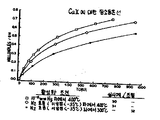
제2도는 30℃에서의 N2등온선을 도시한것.2 shows the N 2 isotherm at 30 ° C.
제3도는 CaX에 대한 질소의 등온선을 도시한 것임.3 shows an isotherm of nitrogen for CaX.
제4도는 제올라이트함량과 질소용량에 대한 건조 온도의 영향.4 shows the effect of drying temperature on zeolite content and nitrogen capacity.
본 발명은 포우저 사이트(faujasite)-함유 조성물 및 그 제조 방법에 관한 것이다. 또한 본 발명은 질소에 대하여 우수한 선택적 흡착성을 가지므로서 공기를 질소와 산소를 분리하는데 유용성을 부여하는 포우저사이트 함유 제올라이트에 관한 것이다.The present invention relates to a faujasite-containing composition and a method of making the same. The present invention also relates to a possiteite-containing zeolite which has good selective adsorption to nitrogen and confers utility in separating air from nitrogen.
분자체 제올라이트는 다양한 흡착성 혼합물과 접촉할 경우 선택적 흡착을 하는 것으로 오랫동안 관찰되어 왔다. 따라서 이런 특성은 다양한 분리에 효과를 주기 위하여 이용되어 왔는데 그 예로는 측쇄 파라핀으로부터 n-파라핀을 분리해 내거나 또는 압력스윙 또는 진공스윙공정을 사용하는 공지된 분리 방법등이 있다. 바람직한 분리의 효과를 극대화 하기 위하여 1또는 그 이상의 혼합물에 있어서 제올라이트의 흡착 선택도가 커져야 한다. 모든 기술적 요소가 일정하다고 가정할때, 흡착공정에서 선택되는 물질의 흡착성은 생성되는 기체의 순도가 산출량 모두에 영향을 미친다.Molecular sieve zeolites have long been observed to undergo selective adsorption upon contact with various adsorbent mixtures. Therefore, this property has been used to effect a variety of separation, for example, known separation method using the separation of n-paraffins from the side chain paraffin or using a pressure swing or vacuum swing process. The adsorption selectivity of the zeolite should be increased in one or more mixtures in order to maximize the effect of the desired separation. Assuming all technical factors are constant, the adsorptivity of the material chosen in the adsorption process affects both the purity of the gas produced.
분자체 제올라이트에 의한 선택적 흡착은 2성분 중의 1개가 결정성 물질에 흡착됨으로서 발생한다. 분자체의 특성은 결정성 알루미노 실리케이트의 성질인 고도의 균일한 다공성에 기인한다. 혼합물의 1개 또는 그 이상의 성분의 크기와 형태는 이러한 물질들에 의한 흡착이 배제된다. 측쇄 파라핀으로부터 n-파라핀의 분리는 이러한 효과에 대한 한 예이다. 만약 기공입구가 ~5 A인 제올라이트가 사용되었다면, 혼합물의 n-파라핀 성분은 용이하게 흡착되지만 측쇄 파라핀은 그들의 구조에 의하여 흡착으로 부터 제게되며 여려재의 상업적 공정의 기초가 되는, 성분 분리에 영향을 준다. 그러나 만약, 분리 되어질 혼합물의 분자가 제올라이트 결정에 유입될 정도로 모두 적다면 선택적 흡착은 2번째 기질에 의하여 수행되어야 한다. 제올라이트는 그들의 알루미노 실리케이트 구조내에 다양한 교환 가능한 양이온을 함유하고있다. 이러한 양이온은 결정성 제올라이트 구조상에 유입되기에 충분하도록 작은 흡착물과 다량으로 접촉할 수 있도록 위치해 있다. 이러한 양이온과 극성 또는 극성화되는 흡착질과의 에너지성 상호작용으로서 이러한 흡착제들은 극성 또는 극성화 경향이 더 작은 종류의 혼합물로 부터 선택적으로 흡착된다. 이러한 효과로서 압력스윙 또는 진공스윙 흡착에 의하여 나트륨모더나이트와 칼슘 교환된 A-형 제올라이트에 의한 것과 같이 공기로부터 N2가 선택적으로 흡착된다. 선행기술의 흡착성의 상세한 설명 즉 분자체 제올라이트를 사용하는 이유와 그 사용은 디.더블류.브렉, 제올라이트 분자체, 제이.윌리 앤드 선즈, 뉴욕, 제8장 593-724페이지(1974)에 나와 있다.Selective adsorption by molecular sieve zeolites occurs when one of the two components is adsorbed to the crystalline material. The properties of the molecular sieve are due to the highly uniform porosity that is the property of crystalline aluminosilicates. The size and shape of one or more components of the mixture excludes adsorption by these materials. The separation of n-paraffins from side chain paraffins is one example of this effect. If a zeolite with a pore inlet of ˜5 A is used, the n-paraffin components of the mixture are readily adsorbed, but the side chain paraffins are removed from the adsorption by their structure and affect the component separation, which is the basis of several commercial processes. give. However, if the molecules of the mixture to be separated are small enough to enter the zeolite crystals, selective adsorption should be carried out by the second substrate. Zeolites contain various exchangeable cations in their aluminosilicate structures. These cations are located in such a way that they can be contacted in large quantities with small adsorbates sufficient to enter the crystalline zeolite structure. As an energetic interaction of these cations with polar or polarized adsorbates, these adsorbents are selectively adsorbed from mixtures of a less polar or polarizing tendency. With this effect, N 2 is selectively adsorbed from the air, such as by A-type zeolites calcium-exchanged with sodium mordenite by pressure swing or vacuum swing adsorption. A detailed description of the adsorptive properties of the prior art, ie the reasons for using molecular sieve zeolites and their use, can be found in D. Double, Breck, Zeolite Molecular Sieve, J. Willy and Sons, New York,
질소는 0.31 ÅA의 사중극자(quadrupole)를 가지므로 0.10 Å3의 사중극자를 갖는 O2에 비하여 양이온의 에너지성 상호작용이 매우 강하다. 열역학에 의하면 더욱 강하게 흡착되어진 종이 양호하게 흡착된다. 또한 N2상호작용 에너지 및 흡착선호도 또는 선택성에 대한 이러한 양이온은 존재하는 변환가능한 양이온의 선택으로 변경될 수도 있다. 일반적으로, 주어진 제올라이트의 상호작용 에너지와 질소의 용량은 양전하의 전하밀도에 따라 증가된다. 따라서 알칼리 금속 양이온에 있어서, 질소용량은 다음의 경향으로서 존재하는데 : Li+> Na+> K+> Rb+> Cs+. 이것은 언급된 문헌인 브렉, 오드, 시트.694-695페이지와 에이치. 미나토와 엠.와타나베의 사이언티픽 페이퍼 제네럴 에듀 케이숀, 도오쿄오 대학, 제28권, 218페이지(1978)에 서술되어 있다. 더작은 사중극자와 따라서 더 작은 양이온 사중극자 상호작용 에너지를 갖는 산소는 존재하는 양이온에 대하여 훨씬 덜 민감하다. N2/O2선택성은 N2용량과 마찬가지의 영향을 갖는다.Since nitrogen has a quadrupole of 0.31 Å A , the energetic interaction of cations is much stronger than that of O 2 having a quadrupole of 0.10 Å 3 . Thermodynamics shows that the more strongly adsorbed species adsorbs well. Such cations for N 2 interaction energy and adsorption preference or selectivity may also be altered by the selection of convertible cations present. In general, the interaction energy of a given zeolite and the capacity of nitrogen increase with the charge density of the positive charge. Thus, for alkali metal cations, the nitrogen capacity exists as the following trend: Li +> Na +> K +> Rb +> Cs +. This is referred to in the references mentioned in Breck, Aude, Sitt. Pp. 694-695 and H. Minato and M. Watanabe, Scientific Paper General Edu Casshon, University of Tokyo, Vol. 28, p. 218 (1978). Oxygen with smaller quadrupoles and thus smaller cationic quadrupole interaction energies is much less sensitive to the cations present. N 2 / O 2 selectivity has the same effect as N 2 capacity.
다가 양이온도 비슷한 경향을 가지며 이들의 높은 전하밀도로 인하여 질소와 산소의 분리에 더욱 유용하다고 기대될 것이다. 그러나 이러한 특성은 어떠한 제올라이트에 대하여도 명확하게 증명되지는 않았다. 사실상 제올라이트 X와 같은 포우저사이트형은 그 반대의 경향을 갖는다고 미합중국 특허 제3,140,932와 3,140,933호에 서술되어 있다.Polyvalent cations have a similar tendency and their high charge density will be expected to be more useful for the separation of nitrogen and oxygen. However, this property has not been clearly demonstrated for any zeolite. In fact, a poserite type, such as zeolite X, has the opposite tendency, as described in US Pat. Nos. 3,140,932 and 3,140,933.
강한 극성인 물은 상기 언급한 양이온에 강하게 흡착된다. 이러한 제올라이트는 N2와 같은 물질의 흡착을 방해하는 물을 제거하기 위하여 온도를 증가시켜 활성화시켜야 한다. 그러나 앞서의 제올라이트 표면에 대한, 본 공기 분리와 기체흡착분야의 과학자들은 일반적으로는 다가 이온-교환된 제올라이트, 특별하게는 칼슘-교환된 포우저 사이트의 흡착특성의 열적활성화에 대한 민감성을 인식하는데 실패하였다. 이는 미합중국 특허 제2,882,244 : 3,141,932 : 3,313,991호를 보면 알수 있다. 이러한 인식부족은 밀톤 2,882,244호에 서술되어 있는데, 여기에서는 제올라이트 X 흡착제를 기술하였다. 본 특허의 칼럼 15,23-31행에는 제올라이트 X가 약 700℃의 고온에서 공기, 진공 또는 적절한 가스존재하에 활성화된다고 서술되어 있는데, 이러한 조건에서 다른 흡착제들은 부분적으로 또는 완전히 파괴된다. 사실상, 상기와 같은 제올라이트를 제조하는 공지된 방법은 약 250℃의 높은 온도에서 건조하는 단계와 합성 및/혹은 이온 교환단계에 의한다.Water of strong polarity is strongly adsorbed to the above-mentioned cations. These zeolites must be activated by increasing the temperature to remove water that would interfere with the adsorption of substances such as N 2 . However, for the above zeolite surfaces, scientists in the field of air separation and gas adsorption are generally aware of the sensitivity to thermal activation of the adsorption properties of polyvalent ion-exchanged zeolites, particularly calcium-exchanged poser sites. Failed. This can be seen in US Patent Nos. 2,882,244: 3,141,932: 3,313,991. This lack of recognition is described in Milton 2,882,244, which describes a zeolite X adsorbent. Columns 15,23-31 of this patent describe that zeolite X is activated in the presence of air, vacuum or a suitable gas at a high temperature of about 700 ° C., in which other adsorbents are partially or completely destroyed. In fact, known processes for preparing such zeolites are by drying at a high temperature of about 250 ° C. and by synthesis and / or ion exchange.
과거에는 알지못하였지만, 하기 실시예에서 볼 수 있듯이 제올라이트 함량측정, 흡착력측정, 가스크로마토그라피 분석과 적외선 실험을 사용하여, 이온교환단계후에 물질이 열적 처리될 때 조심스럽게 조절하지 않는다면, 양이온과 구조적 가수분해로서, 질소에 있어서 칼슘 교환된 X포우저 사이트의 용량과 선택성을 감소시킨다는 것을 알 수 있었다. 이러한 비교로부터, 1가와 다 가의 포우저사이트 사이에는 안정성에서 커다란 차이가 있음이 명백하다. 건조 공정시 일반적인 흡착제인 나트륨형의 포우저사이트는 흡착제로서의 작용이 손상됨 없이 250℃에서 일반적으로 건조된다. 칼슘형의 포우저 사이트를 똑같은 건조 조건하에서 건조하였을 때 흡착성은 나트륨형에 비하여 다소 열등하지만, 나트륨형과는 일반적으로 유사하다. 칼슘형의 포우저 사이트는 공기흡착제로서 별로 주목을 받지 못했는데, 왜냐하면 나트륨형에 비하여 어떤 특별한 잇점도 제공하지 않는다고 생각되었기 때문이다.Although not known in the past, zeolite content determination, adsorption force measurement, gas chromatography analysis and infrared experiments can be used, as shown in the examples below, if the material is not carefully controlled when the material is thermally treated after the ion exchange step. As hydrolysis, it was found that the nitrogen reduced the capacity and selectivity of the calcium exchanged Xposer site. From this comparison, it is evident that there is a large difference in stability between monovalent and multivalent posersite. In the drying process, sodium phossite, which is a general adsorbent, is generally dried at 250 ° C. without impairing its function as an adsorbent. When the calcium-shaped porcer sites are dried under the same drying conditions, the adsorbability is somewhat inferior to that of the sodium type, but is generally similar to the sodium type. Calcium-type porcer sites received little attention as air adsorbents because they were thought to provide no particular advantage over sodium.
모든 선행 기술의 제올라이트에서 오직 하나의 문헌만이 칼슘형 나트륨형의 포우저사이트보다 약간 잇점이 있다고 제안하였다. 헤브굿, 에이치, 더블류, 카나디안저널오브 케미스트리, 제42권, 2340-2350페이지 (1964). 헤브굿의 열처리 공정을 약 90%이상의 다량으로 교환된 칼슘형을 포함하는 X-형 제올라이트 제조후 행하였을때, 30℃의 대기압에서의 가정되는 질소 용량은 본 발명의 조심스럽게 조절된 열적 활성화 상태에서 제조된 똑같은 다량의 칼슘이 교환된 X-형의 제올라이트의 용량에 비하여 매우 낮다. 비록 특별한 건조와 열적 활성화조건이 해브굿의 문헌에 설명되지는 않았지만 매우 낮게 측정된 질소의 용량과, 하기 실시예에 상세하게 서술된 정확한 선택값에 의하면 그의제올라이트의 열적 처리는 조심스럽게 조절되지 않았음이 명백하다.In all prior art zeolites, only one literature suggests a slight advantage over the calcium-type sodium porusite. Havegood, H, W., Canadian Journal of Chemistry, Vol. 42, pp. 2340-2350 (1964). When the Hebgood heat treatment process was carried out after the preparation of X-type zeolites containing a large amount of calcium-type exchanged in excess of about 90%, the assumed nitrogen capacity at atmospheric pressure of 30 ° C. was carefully controlled thermally activated. The same large amount of calcium produced in is very low compared to the capacity of the exchanged X-type zeolite. Although specific drying and thermal activation conditions were not described in Havegood's literature, the very low measured nitrogen capacity and the exact choices detailed in the examples below did not carefully control the thermal treatment of its zeolites. The tone is clear.
가스크로마토그래피 선택성 및/혹인 질소용량에 대한 서술이 있거나 하기의 문헌에서 흡착제로의 사용이 제시된 칼슘 교환된 제올라이트에 비하여 본 발명의 흡착 조성물에 의하여 제조된 흡착제의 선택성과 질소용량은 월등히 높다. 볼페, 에프 등에 의한 독일특허 제 110,478(1974) : 볼페, 에프.,등에 의한 제트. 켐. 제15권, 36-37페이지(1975) : 안드로니카슈 리.티.지., 등에 의한 Izv. Akad. Nauk.Grve 소련특허 제1권, 4번, 3390-402페이지(1975) : 유터호벤, 지이.비, 스쿠니트, 알., 린메, 비.브이., 와 홀, 더블류.케이., 저널오브 카탈리스트 13, 425-434페이지(1969) : 워드, 제이.더블유., 저널 오브 피닛칼 케미스트리 72, 4211페이지(1968) : 올슨, 디.에이치., 저널 오브 피지칼 케미스트리 72, 1400-01페이지 (1968)과 베네트, 제이.엠과 스미스 제이.브이., 매트.리서치.불, 제3권, 633-642페이지(1968).The selectivity and nitrogen capacity of the adsorbent prepared by the adsorption composition of the present invention is significantly higher than that of the calcium exchanged zeolite, which has a description of gas chromatographic selectivity and / or nitrogen capacity or in which the use of the adsorbent is indicated in the literature below. German Patent No. 110,478 (1974) by Wolfe, F. et al .: Jet by Wolfe, F., et al. Chem. Vol. 15, pp. 36-37 (1975): Izv. By Andronikash R.G., et al. Akad. Nauk.Grve Soviet Patents Vol. 1, No. 4, pp. 3390-402 (1975): Uterhoven, G. B., Schnitt, R., Rinme, B. V., and Hall, W. K., Journal Of Catalysts 13, pp. 425-434 (1969): Ward, J. Double U., Journal of Physical Chemistry 72, 4211 (1968): Olsen, D. H., Journal of Physical Chemistry 72, 1400-01 (1968) and Bennett, J. M. and Smith J. V., Matt. Research. Bull, Vol. 3, pp. 633-642 (1968).
선공정과 가장 차이나는 점은, 특히 실리콘과 알루미늄이 약 1에서 약 2까지의 비율로 함유된 다가이온이 교환된 알루미노 실리케이트가 신규인 질소의 높은 선택적 흡착제로 전환되는 활성화 방법인 것이다.The main difference from the preliminary process is the activation method in which the polyion-exchanged aluminosilicate containing silicon and aluminum in a ratio of about 1 to about 2 is converted into a novel, highly selective adsorbent of nitrogen.
상기 물질의 열적활성화시에 존재하는 물의 양을 최소화 하는것이 디하이드레이트/디히드록실레이트 상태의 다량의 다가이온의 생성과 실질적으로 유용한 제올라이트 함량의 유지를 가능하게 한다. 본 발명에 의하여 제조되는 흡착 조성물이 질소와 산소의 2가지 혼합물에서의 실질적으로 더큰 선택성을 보이고, 선공정의 방법과 유사하게 제조된 물질에 비하여 더 큰 질소 용량을 갖는다는 것을 알았다. 이러한 현상은 실리콘과 알루미늄의 비가 약 1에서 2인, 즉 X형의 포우저 사이트인 알루미노 실리케이트가 다량 함유된 조성물에서 특히 두드러진다.Minimizing the amount of water present upon thermal activation of the material allows the production of large amounts of polyions in the dihydrate / dihydroxylate state and the maintenance of substantially useful zeolite content. It has been found that the adsorption composition prepared by the present invention exhibits substantially greater selectivity in the two mixtures of nitrogen and oxygen and has a higher nitrogen capacity compared to the material prepared similarly to the process of the prior art. This phenomenon is particularly pronounced in compositions containing a large amount of aluminosilicate, a ratio of silicon to aluminum of about 1 to 2, i.
정리하지면, 본 발명은 최소한 50중량%의 포우저사이트로 구성된 다가이온 교환된 흡착조성물을 제조하는 것인데 상기 포우저사이트는 다음의 방법으로 제조된, 교환 가능성이온용량의 대부분이 다가이온형인 것이다 :In summary, the present invention is to prepare a polyion exchanged adsorption composition composed of at least 50% by weight of the Poser site, wherein the Poser Site is prepared by the following method, and most of the exchangeable ion capacity is polyion type. :
(a) 포우저사이트를 합유하는 조성물을 다가이온으로 이온교환하고,(a) ion-exchanging the composition containing the phossite to polyvalent ion,
(b) 다가이온교환된 조성물을 열적으로 활성화하여 제올라이트성(性) 물(water)의 실질적인 모든 부분(상기 조성물의 양이온을 둘러싸는 수화 표면도 포함)을 제거하는데, 디하이드레이트/디히드록실레이트 상태의 상기 다가이온을 다량 생성함으로서 생성된 질소의 용량과 생성된 다가이온이 교환된 조성물의 선택도 비율은 이와 같은 열적 활성화 단계를 거치지 않은 다가이온이 교환된 조성물에 비하여 월등하게 크다.(b) thermally activating the polyion exchanged composition to remove substantially all of the zeolitic water, including the hydrated surface surrounding the cations of the composition, wherein the dihydrate / dihydroxylate By producing a large amount of the polyvalent ion in the state, the capacity ratio of the produced nitrogen and the selectivity ratio of the produced polyvalent ion exchanged composition are significantly larger than those of the polyvalent ion exchanged composition which did not undergo this thermal activation step.
열적 활성화 단계는 제올라이트성(性) 물(water)과 수와 표면이 조심스럽게 제거되고 본 단계동안에 제올라이트와 접촉하는 주위의 기체상태의 물을 최소화하는 다양한 방법에 의하여 성취되는바, 즉, 상기와 같은 접촉을 하는 물의 부분압을 약 0.4atm 이하, 양호하기로는 0.1atm 을 넘지 않게 한다.The thermal activation step is accomplished by various methods of carefully removing the zeolitic water and the water and the surface and minimizing the gaseous water in contact with the zeolite during this step. The partial pressure of the water making the same contact is about 0.4 atm or less, preferably not more than 0.1 atm.
본 공정을 성취할 수 있는 하나의 방법은 약 30중량 퍼센트까지의 물을 함유하는 다가이온교환된 조성물에 약 0.1에서 10atm의 압력을 가하고 비반응성 정제가스의 충분한 몰 질량 속도와 체류시간을 유지하는 것인데, 즉 몰 중량속도(G)는 약 0.5-100 kg.mole/m2-hr(=0.1-20 1bs-mole/ft2-hr)이고 체류시간(r)은 약 2.5분을 초과하지 않게 하는 것이고, 상기 조성물을 온도램프(ramp, 상승)를 사용하여 0.1-40℃/min으로 최소한 약 300℃까지 가열하는데 600℃는 넘지 않게 하며 본 온도에서 조성물을 최소한 약 12시간 유지한다. 체류 시간은 표준온도와 압력(STP)에서 정제기체의 부피흐름 속도에 의하여 나뉘어지는, 제올라이트를 열적 활성시키는 컬럼 또는 그외의 장치의 부피로서 정의된다. 몰 질량속도는 열적 활성화에 사용되는 칼럼의 단면적에 의해 나뉘어지는 정제가스의 흐름속도이다. 정제가스 사용목적은 흡착베드에 존재하는 세척가스에 함유된 물을 바람직한 낮은 수준으로 낮추기 위한 체류 시간에서 흡착제의 표면으로 부터 질량전달과 유효한 열에 필요한 충분한 질량을 제공하는 것이다. 최소 체류시간은 0.0025분 이하가 아무 이익을 제공하지 않는 것으로 알려졌지만 경제성과 공정상 제약에 의하여 결정된다.One way to achieve this process is to apply a pressure of about 0.1 to 10 atm to a polyion exchanged composition containing up to about 30 weight percent water and maintain a sufficient molar mass rate and residence time of the non-reactive purified gas. That is, the molar weight rate (G) is about 0.5-100 kg.mole / m 2 -hr (= 0.1-20 1bs-mole / ft 2 -hr) and the residence time (r) does not exceed about 2.5 minutes. The composition is heated to at least about 300 [deg.] C. at a temperature of 0.1-40 [deg.] C./min using a temperature ramp but no more than 600 [deg.] C. and the composition is maintained at this temperature for at least about 12 hours. The residence time is defined as the volume of a column or other device that thermally activates the zeolite, divided by the volume flow rate of the purified gas at standard temperature and pressure (STP). The molar mass rate is the flow rate of the purified gas divided by the cross sectional area of the column used for thermal activation. The purpose of purifying gas use is to provide sufficient mass for mass transfer and effective heat from the surface of the adsorbent at residence times to lower the water contained in the wash gas present in the adsorption bed to the desired low level. The minimum residence time is known to provide no benefit under 0.0025 minutes, but is determined by economic and process constraints.
또 다른 열적 활성화 방법은 어떠한 세척가스의 사용 없이 약 0.1이하의 압력의 진공하에서 진행하는 것이며 0.1-40℃/분의 온도램프에서 적당한 활성화온도로 물질을 가열한다.Another thermal activation method is to proceed under vacuum at a pressure of about 0.1 or less without the use of any cleaning gas and heat the material to an appropriate activation temperature in a temperature lamp of 0.1-40 ° C./minute.
본 발명의 제올라이트 흡착제의 열적활성화에 유용한 또 다른 방법은 미합중국 특허 제4,322,394호에서 기술되어 있는 조건하에서 극초던파 방사선을 사용하는 것인데 상기 특허에서의 열적활성화 제올라이트의 극초단파 공정의 서술은 본원에서는 참고로서 서술되어 있다.Another method useful for the thermal activation of the zeolite adsorbents of the present invention is the use of microwave radiation under the conditions described in US Pat. No. 4,322,394. It is.
활성화 조성물에서 흡착 방법에 의하여 측정된 제올리아트 함량을 최소한 약 70%(열적 활성화 단계전의 초기 값에 대하여)로 유지 하기만 한다면 상기 활성화 방법중의 어느 한가지가 사용될 수 있다,Any of the above activation methods may be used as long as the zeoliart content measured by the adsorption method in the activation composition is maintained at least about 70% (relative to the initial value before the thermal activation step).
본 발명의 조성물의 제조를 위한 출발물질의 대부분이 포우저 사이트형인 제올라이트 조성물이나 특히 Si/Al 비율이 1-2 즉 X-형의 제올라이트인 포우저 사이트인 제올라이트 조성물이 좋다. 이러한 기본 물질들은 꼭 필요하지는 않지만 때때로 그들의 나트륨형에서 다가이온 형태의 다량의 양이온을 함유하는 형태로 이온 교환된다. 이러한 효과를 내는 종래의 모든 이온 교환 방법이 적당하다. 진흙과 같은 불활성 결합제 및/혹은 그외의 제올라이트를 함유하는 고체 물질이 본 발명의 조성물의 우수한 흡착성을 얻는데 어떠한 역효를 주지 않으면서 소량으로 존재한다고 알려졌다.Preferred are zeolite compositions in which most of the starting materials for the preparation of the compositions of the present invention are poser site type, and in particular, zeolite compositions having a Si / Al ratio of 1-2, i.e., X-type zeolite. These basic substances are not necessary but are sometimes ion exchanged from their sodium form to a form containing a large amount of cations in the form of polyions. All conventional ion exchange methods that produce this effect are suitable. It is known that solid materials containing inert binders such as mud and / or other zeolites are present in small amounts without any adverse effect on obtaining good adsorptivity of the compositions of the present invention.
본 발명의 조성물을 제조하는 공정에 있어서, 출발물질은 어떠한 다가금속의 염화물, 질화물, 황화물 등과 같은 가용성 염의 과량 존재하에서 이온교환된다. 다가 금속은 주기율표 1b-7b와 8족 2가 및 3가 전이금속 원소, 2a족의 2가 알칼리토금속 원소와 란타나이드 희토류 금속등이다. 양호하게는 마그네슘, 칼슘, 스트론티움, 바륨 및 이들의 혼합물에서 선택되는 것이 양호하다. 그 중에서 양호한 다가금속은 칼슘이다. 종래의 이온교환 공정중 한예는 출발물질을 수용액에서 약 100℃까지의 환류온도와 약 1atm에서 2-48시간 동안 출발물질의 포우저 사이트의 원래의 양이온의 대부분이 다가이온으로 대치될 때까지 계속하여 다가이온 물질로 교환하는 것이다.In the process of preparing the compositions of the present invention, the starting materials are ion exchanged in the presence of excess soluble salts such as chlorides, nitrides, sulfides, etc. of any polyvalent metal. The polyvalent metals are periodic tables 1b-7b,
일단 다가상태의 다량의 양이온이 제조되고, 유리된 과량인 비-교환된 양이온을 실질적으로 세척하면, 물질들은 열적 활성화 하기에 알맞게 된다.Once a large amount of cations in the polyvalent state have been prepared and substantially washed off the excess excess non-exchanged cations, the materials are suitable for thermal activation.
제올라이트내의 높은 전자밀도를 갖는 다가이온 특히 포우저사이트는 열적 활성화시에 수산화된다는 것은 공지되어 있다.It is known that polyvalent ions, especially possites, having high electron density in zeolites are hydroxylated upon thermal activation.
NaX형의 제올라이트가 열적 처리시 더 안정하다는 것은 사실이 아니다. 수화는 다음의 평형식으로 나타내지는데It is not true that NaX type zeolites are more stable during thermal treatment. Sign language is represented in the following equilibrium:
MN++XH2O M(OH)e (n-e)++eH++(X-e)H2O (Ⅰ)M N + + XH 2 OM (OH) e (ne) + + eH + + (Xe) H 2 O (Ⅰ)
상기식에서 M은 2또는 3인 n원자가를 갖는 최소한 1개의 양이온이고 X는 1-6이며 e는 1또는 2이다.Wherein M is at least one cation having n atoms of 2 or 3, X is 1-6 and e is 1 or 2.
상기 반응식 오른쪽의 생성물은 제올라이트 흡착제에 좋지 못하다.The product on the right side of the scheme is poor for zeolite adsorbents.
Ca(OH)+와 같이 수산화된 다가 양이온은 특히 N2의 선택흡착을 위한 효율적인 사이트(site)를 제공하지 못한다고 알려졌다. 에이치.미나토와 엠.와타나베에 의한 사이언티픽 제네랄 에듀케이숀 유니버시티 오브 도오쿄오, 제28권 135페이지(1978)에는 특히 모르데나이트와 같은 천연 제올라이트가 참조되어 있다. 부가적으로, 제올라이트 구조는 H+에 대하여 불안정하다. 이러한 것은 Si/Al의 비가 1.0-2.0인 제올라이트와 같이 Si/Al의 비가 상대적으로 낮은 제올라이트에 대하여서는 특히 그렇다.Hydroxed polyvalent cations, such as Ca (OH) + , are known to not provide efficient sites, particularly for the selective adsorption of N 2 . Scientific General Education University of Tokyo, Vol. 28, page 135 (1978) by H. Minato and M. Watanabe, specifically refers to natural zeolites such as mordenite. In addition, the zeolite structure is unstable with respect to H + . This is especially true for zeolites with relatively low Si / Al ratios, such as zeolites having a Si / Al ratio of 1.0-2.0.
평형은 특히 150℃이상과 같은, 열적 활성화시에 있어서 어떠한 주어진 온도에서라도 존재하는 물의 양을 최소화함으로서 해로운 H+와 효과가 없는 수화된 양이온이 생성됨이 없이 양호한 다가양이온이 생성되게끔 진행시킬 수 있다.Equilibrium can proceed to produce good polycationics without the generation of harmful H + and ineffective hydrated cations by minimizing the amount of water present at any given temperature during thermal activation, especially above 150 ° C. .
초기건조시에 세심한 주의를 하지 않으면, 고온에서의 열적 활서화뒤에 계속적인 흡착서으이 실질적인 감소가 일어남을 알아냈다. 초기 건조는 실온에서부터 200℃이하 양호 하기로는 120℃이하 이거나 진공상태 또는 정제가스가 충분하게 흐르게 하면서도 그보다 높은 온도에서 진행시켜야 할 것이다.Unless careful attention is paid to the initial drying, a substantial decrease in subsequent adsorption occurs after thermal activation at high temperatures. Initial drying should be carried out at room temperature below 200 ° C., preferably below 120 ° C. or at a higher temperature with sufficient flow of vacuum or purified gas.
열적활성화는 선활성화 건조온도에서 부터 온도를 증가하여 650℃ 미만까지 양호하게는 350-450℃에서 성취된다.Thermal activation is achieved at pre-drying drying temperatures, preferably at 350-450 ° C., up to less than 650 ° C. with increasing temperature.
주어진 정제가스 흐름에서 증가온도의 속도를 천천히 함으로써 흡착성에 이득을 준다는 것이 알려졌다. 정제가스는 전조공기, 질소, 네온, 헬륨등과 같은 모든 비-반응성 기체이면 된다. 느린 온도의 증가는 주어진 온도하에서 제올라이트 내의 물을 흡착에 대해 거의 열적 평형으로 가깝게 한다.It has been found to benefit the adsorption by slowing the rate of increasing temperature in a given refinery gas stream. The purified gas may be any non-reactive gas such as precursor air, nitrogen, neon, helium, or the like. The slow increase in temperature brings the water in the zeolite close to thermal equilibrium with respect to adsorption under a given temperature.
반대로 말하자면. 주어진 온도 램프에서, 빠른 정제는 물을 더욱 완전하게 탈착시킴으로서 흡착성에 이로운 영향을 준다는 것이 알려졌다.On the contrary. At a given temperature ramp, it has been found that rapid purification has a beneficial effect on adsorption by desorbing water more completely.
본열적 활서화시에, 본 발명의 흡착조성물의 생산에 필요한 정확한 온도증가와 정제속도는 매우 다양하며 흡착베드의 구조에 의존한다.In thermothermal inactivation, the precise temperature increase and purification rate required for the production of the adsorption composition of the present invention vary widely and depend on the structure of the adsorption bed.
양호한 실시예에 있어서, 200℃이하 양하하게는 120℃이하에서 처리 건조된 다가교환된 제올라이트를 실온에서 최대온도 약 650℃정도로 증가시키면서 비반응 가스의 연속 정제가 0.006에서 6l /분(즉, 0.5-100kg mole/m2- 시간의 범위에서의 G 값)의 속도를 활성화되도록 하면서 비-반응성 정제 기체를 제올라이트가 최대 활성화 온도에 도달할때까지 계속 통과시키는데 양호한 온도범위는 350-450℃이다. 제올라이트는 이러한 상태로 12-48시간 유지된다. 더 긴 시간이 사용될 수도 있지만, 적당한 활성화를 얻기에 통상 필요하지는 않다. 120℃-350℃650℃의 임계온도범위시의 정확한 온도 증가는 열적 활성화 칼럼내의 베드의 깊이와 지름, 정제 기체의 유속과 주어진 온도 증가상태에 의존한다. 그러나, 열적 활성화 상태의 물질의 베드의 세척률이 바람직한 체류기간과 상기 서술된 몰 질량속도를 성취하기에 충분하고 베드가 진공상태하에서 최소한 0.1atm 으로, 양호하게는 100mmHg 이하로 유지될때는 온도 증가가 40℃/min 정도로 빨라질 수 있다.In a preferred embodiment, the continuous purification of the unreacted gas is increased from 0.006 to 6 l / min (i.e., 0.5) while increasing the polyhydric exchanged zeolites treated and dried at temperatures below 200 ° C. and below 120 ° C. at room temperature to a maximum temperature of about 650 ° C. The preferred temperature range is 350-450 ° C. to allow passage of the non-reactive purified gas until the zeolite reaches the maximum activation temperature while allowing the rate of G value in the range of -100 kg mole / m 2 -hour to be activated. The zeolite remains in this state for 12-48 hours. Longer times may be used, but are not usually necessary to obtain proper activation. The exact temperature increase over the critical temperature range of 120 ° C.-350 ° C. 650 ° C. depends on the depth and diameter of the bed in the thermal activation column, the flow rate of the purification gas and the given temperature increase. However, the temperature increase when the rate of cleaning of the bed of thermally activated material is sufficient to achieve the desired residence period and the molar mass rates described above and the bed is kept at least 0.1 atm under vacuum, preferably below 100 mmHg. Can be as fast as 40 ° C./min.
[기본 실시예][Base Example]
본 실시예들에 있어서, 산소흡착에 의한 제올라이트 함량과 질소 용량에 대한 어떠한 흡착용량측정에 앞서 제올라이트 샘플들은 하룻밤 동안 400℃, 10-5mmHg의 진공하에서 활성화된다. 1-2℃/분의 가열속도로 400℃의 온도까지 사용되었다.. 활성화후, 샘플을 질소 건조 박스에 넣었다. 그러나 맥베인-바크스프링 저울의 표본 상자가 채워졌을 때에는 대기에의 순간 노출은 피할 수가 없었다.In the present embodiments, the zeolite samples are activated under vacuum at 400 ° C., 10 −5 mmHg overnight, prior to any adsorption capacity measurement for zeolite content and nitrogen capacity by oxygen adsorption. A temperature of 400 ° C. was used at a heating rate of 1-2 ° C./min. After activation, the samples were placed in a nitrogen dry box. However, instant exposure to the atmosphere was inevitable when the sample box of the MacBane-Bark Spring balance was filled.
본 실시예들에 의하여 질소 용량이 측정되기전에 샘플들은 10-4mmHg하에서 400℃로 하룻밤 동안 배기되었다. 질소 용량은 760토르의 질소압력과 30℃에서 측정되었다. 평형시간 4시간이 지난후 흡착을 측정하였다.Samples were evacuated overnight at 400 ° C. under 10 −4 mmHg before the nitrogen capacity was measured by the present examples. Nitrogen capacity was measured at 760 Torr of nitrogen pressure and 30 ° C. Adsorption was measured after 4 hours of equilibration time.
산소 흡착에 의한 제올라이트 함량의 측정에 앞서 표본들을 400℃의 대기에서 하룻밤 정치하였다. 실시예에서의 제올라이트 함량 측정은 수정된 볼톤의 방법을 사용하였다. 에이.피.볼톤, "촉매 연구의 실험적 방법" 제11권, 알.비.앤더슨과 피.치.도우슨(편집인), 아카데믹 프레스, 뉴욕(1976), 11페이지, 액체산소의 온도와 100torr압력에서 실험하는 대신, 유사한 방법을 -190℃(액체질소온도)와 60torr에서 행하였다. 이러한 조건으로 P/P0가 0.13(77°K에서 산소의 P0는 155 torr)인 똑같은 상대적인 압력이 얻어졌다. 측정은 맥베인-바그 스프링 저울을 사용하였으며 똑같은 CaX 흡착제에 대한 2번의 분석은 2%내로 일치하였다.The samples were allowed to stand overnight in an atmosphere of 400 ° C. prior to the determination of the zeolite content by oxygen adsorption. The zeolite content measurement in the examples used the modified Volton's method. A. B. Bolton, "Experimental Methods of Catalyst Research," Vol. 11, R. B. Anderson and P. Dawson (Editor), Academic Press, New York (1976), page 11, Liquid Oxygen Temperatures and 100torr Pressure Instead of experimenting at, a similar method was conducted at -190 ° C (liquid nitrogen temperature) and 60torr. Under these conditions the same relative pressures were obtained with a P / P 0 of 0.13 (P 0 of oxygen at 155 ° 155 torr). Measurements were taken using a McVane-Bag spring balance and two analyzes for the same CaX adsorbent were within 2%.
흡수질의 흡착을 위한 미세기공의 부피는 물리적양과 관계가 있으므로 종래의 X선강도 측정하는 것보다 제올라이트 함량의 정확한 측정을 하기 위해 더욱 정확한 흡착 방법을 사용하여야 한다. 제올라이트 함유분의 감소시 발생하는 구멍의 막힘은 미세기공의 일부를 막음으로서 흡착질과 미세기공부위와의 작용을 방해하는데, 결정성에 대한 X선 측정은 흡착질에 접근하기 힘든 미세기공도 부위도 포함된다. 따라서 이러한 공정 및 연관된 흡착 연구는 저온에서 산소와 같은 흡착 저열을 함유하는 증기를 사용하여 가장 편리하게 측정되는 미소구부피를 기체로서 평가하는 것이다. 부가적으로, 산소는 질소 또는 그외의 흡착질에 비하여 제올라이트의 다른 사이트와 더욱 비특이적 상호작용을 한다.Since the volume of the micropores for adsorption of the absorbent material is related to the physical quantity, a more accurate adsorption method should be used to measure the zeolite content more accurately than the conventional X-ray intensity measurement. The blockage of the pores that occurs when the zeolite-containing content is reduced prevents the action of the adsorbate and the microporous site by blocking a part of the micropores. The X-ray measurement of crystallinity also includes the micropore region, which is difficult to access the adsorbate. Thus, this process and associated adsorption studies are to evaluate, as a gas, the microspheres that are most conveniently measured using steam containing adsorptive low heat such as oxygen at low temperatures. In addition, oxygen has a more nonspecific interaction with other sites of the zeolite than with nitrogen or other adsorbates.
t-플롯(plot)과 같은, 제올라이트 함량을 측정하는 그외의 흡착 방법이 실시예 27-29에서 사용되었다. 이 방법은 비 디보어방법(제이.클로이드 인터페이스, 사이언스, 21,405(1996))을 사용하는 t-플롯으로 전환되기 위하여 -195℃에서의 N2흡착 등온 결과(자동 기구에 의하여 얻어짐)가 필요하다. 미세기공 N2흡수는 Sing에 의한 접근방법을 사용한 t-플롯으로 부터 측정된다 (케미스트리 앤드 인더스트리, 5월 20일, 1967, 829페이지). 대부분의 결합제와 무정형에는 미세기공이 거의 없기 때문에 제올라이트 함량이 직접 미세기공양과 비례한다고 예견할 수 있다. 따라서 후자는 흡착제의 제올라이트 함량을 비교하는데 사용되거나 또는 표준흡착질과 비교에 의한 제올라이트 부위 절대값을 측정하는데 사용된다. 모든 비교에 있어서 똑같은 양이온 형과 양이온 함량을 갖는 흡착제를 조심스럽게 비교할 뿐이다.Other adsorption methods for measuring zeolite content, such as t-plots, were used in Examples 27-29. This method yields an N 2 adsorption isothermal result (obtained by an automated instrument) at -195 ° C to be converted to a t-plot using a non-debore method (J. Kloid Interface, Science, 21,405 (1996)). need. Microporous N 2 uptake is measured from t-plot using the Sing approach (Chemistry and Industry, May 20, 1967, p. 829). Since most binders and amorphous forms have few micropores, it can be predicted that the zeolite content is directly proportional to the amount of micropores. The latter is therefore used to compare the zeolite content of the adsorbent or to determine the absolute value of the zeolite site by comparison with the standard adsorbate. For all comparisons, we only carefully compare adsorbents with the same cation type and cation content.
나트륨 및/혹은 칼슘교환된 X 제올라이트상에 X-선회절을 사용한 제올라이트 함량 측정은 실시예 27-29와 32에서 실시되어 지는데 알파-Al2O3를 표준물질로서 제올라이트에 첨가하고 적분된 피크(peak)면적을 사용하여 표준에 대해 선택된 제올라이트선의 비율을 이용 하였다.Zeolite content determination using X-ray diffraction on sodium and / or calcium-exchanged X zeolites was carried out in Examples 27-29 and 32, in which alpha-Al 2 O 3 was added to the zeolite as a standard and integrated peaks ( The peak area was used to take advantage of the ratio of zeolite wire selected for the standard.
질소와 산소의 등온선은 대개의 경우 표시된 온도에서 마이크로바란스를 사용하여 측정하였다. 각각의 경우에 있어서 활성화는 더이상의 질량손실(0.004% 변화)이 발생하지 않을 때까지 약 10-4mmHg 진공상태에서 400℃로 행하여졌다.Nitrogen and oxygen isotherms were usually measured using microbalance at the indicated temperatures. In each case activation was done at 400 ° C. with about 10 −4 mmHg vacuum until no further mass loss (0.004% change) occurred.
선택성과 질소용량의 지표를 위한 본 실시예의 조성물의 산출에 사용되는 가스크로마토그라피(GC)방법은 매우 유용하며 다음의 연구자들이 사용한 것과 매우 유사하다. 제이.알,콘더와 시.엘.영 "가스크로마토 그라피에 의한 물리화학적 측정",죤-와일리(1979) : 알.제이.네덴 리프, 제이.클로이드 인터페이스 사이언스, 28,293(1968) : 디, 애킨슨과 지.컬토이즈, 제이시에스 패러데이 학보 1,77 897(1981) : 에이.브이.키젤레브와 와이.아이.이쉰, 가스-흡착 크로마토그라피, 플레넘 프레서(1969) 120-125페이지. 샘플들을 0급의 헬륨을 100cc/min으로 흐르게 하면서 GC팔럼 2℃/분으로 400℃까지 열적활성화하며 400℃에서 16시간 동안 유지 시키는 것은 다르다. 각 칼럼에 대한 불활성기체 체류 부피는 헬륨내의 10%N2을 사용하여 300℃에서 측정되었다. GC방법온 등온선의 저압부에 한계를 가지며 질소-산소 혼합물의 흡착이 피복률이 0에 다가가는 선택도의 극한값을 나타낸다. 또한 본 방법은 매우 빨리 할 수 있으며 스크린과 단계별 흡착을 나타내며 10%내에서 재생산된다.The gas chromatographic (GC) method used to calculate the composition of this example for the indication of selectivity and nitrogen capacity is very useful and very similar to that used by the following researchers. J. R. Conder and C. L. "Physical Chemical Measurements by Gas Chromatography", John-Wylie (1979): J. Neden Reef, J. Kloid Interface Science, 28,293 (1968): D, Akinson and G. Cultoise, J. Faresday Journal 1,77 897 (1981): A.V.Kieselev and Y.I.Isch, Gas-Adsorption Chromatography, Plenum Preser (1969) pp. 120-125 . The samples are thermally activated at 400 ° C. at 2 ° C./min and maintained at 400 ° C. for 16 hours while flowing a zero-grade helium at 100 cc / min. The inert gas retention volume for each column was measured at 300 ° C. using 10% N 2 in helium. The lower pressure part of the GC method isotherm has a limit and the adsorption of the nitrogen-oxygen mixture shows an extreme value of the selectivity at which the coverage reaches zero. The method is also very fast and shows screen and step adsorption and is reproduced within 10%.
흡착제에 주입된 물질의 체류 부피는 체류시간과 보정된 흐름 속도에 의하여 산출된다. 따라서 불활성 물질의 체류부피V1(300℃에서 네온의 체류데이타로부터), 각각의 온도에서 j번째 흡착질의 체류부피 Vj가 계산된다.The retention volume of material injected into the adsorbent is calculated by the residence time and the corrected flow rate. Therefore, the retention volume V 1 of the inert material (from the retention data of neon at 300 ° C.) and the retention volume V j of the j-th adsorbate at each temperature are calculated.
j번째 흡착질의 흡착평형상수는 다음의 식으로 부터 계산된다 :The adsorption equilibrium constant of the jth adsorbate is calculated from the equation:

K는cc/gm 또는 mdle/gm/mole/cc 단위이다.K is in cc / gm or mdle / gm / mole / cc.
K는 흡착등온의 초기 기울기를 나타내는데, 세로 좌표는 moles/g 가로 좌표는 moles/cc의 단위다.K denotes the initial slope of adsorption isotherm, where the ordinate is moles / g and the abscissa is moles / cc.
다음의 이상기체 법칙을 사용하며, K는 등온의 초기 기울기 C1으로 전환되는데 가로 좌표상의 양은 흡수질(부분)압력으로 압력단위이다. 제2도와 3도를 보면 알수 있다 (비중 또는 부피치로 부터의 등온은 일반적으로 다음의 식을 따른다) :The following ideal gas law is used, where K is converted to the isothermal initial slope C 1 , where the abscissa is the absorbent (partial) pressure in pressure units. This can be seen from Figures 2 and 3 (Isothermal from specific gravity or volumetric values is generally based on the following equation):

칼럼column
R은 기체상수 (=82.05cc-atm/mole- K)R is the gas constant (= 82.05 cc-atm / mole-K)
T는 GC에서의 칼럼온도(。K)(여기서 첨자의 "칼럼"이란 다음 부터는 생략되며 T는 칼럼의 온도를 나타냄).T is the column temperature (° K) at GC (where the "column" of the subscript is omitted from the next and T represents the temperature of the column).
C1을 흡착질의 분자량과 곱하면 g(흡착질)/g(흡착제)/atm 단위의 C2가 구해진다.When C 1 is multiplied by the molecular weight of the adsorbate, C 2 in units of g (adsorbate) / g (adsorbent) / atm is obtained.
1물질에 대한 제2물질의 선택적 비율


n은 가스상의 몰수이며 n는 흡착된 상의 몰수이다.n is the number of moles of gas phase and n is the number of moles of adsorbed phase.
예로서 N2-O2분리의 선택비는 다음으로 구해진다.As an example, the selectivity for N 2 -O 2 separation is determined as follows.


여러개의 Ⅰ과 Ⅱ족 금속 교환된 X 제올라이트는 본 실시예에 의하여 제조되고 평가된다. 실시예 1에 서술된 교환방법이 전형적인 예이다. 80% 이상이 교환될때까지 본 방법은 중요한 것이 아님을 보인다. 가스크로마토그라프는 하기 실시예 1에서 서술된 방법을 사용한 다양한 이온교환원 흡착제에 주로 스크린 하는 것으로 사용된다.Several Group I and II metal exchanged X zeolites are prepared and evaluated by this example. The exchange method described in Example 1 is a typical example. It is shown that this method is not important until more than 80% is exchanged. Gas chromatographs are used primarily to screen various ion exchange adsorbents using the method described in Example 1 below.
[실시예 1]Example 1
데이비슨 디비죤, W.R. 그레이스로부터의 Si/Al=1.25인 8-12 메쉬 구슬인 13X(NaX) 제올라이트 0.45kg을 1l의 1M CaCl2·6H2O를 콘덴서와 온도계가 장치된 2l둥근 바닥 플라스크에 내재된 제올라이트에 첨가하였다. 90°-95°가 되도록 30분 이상 처리하고 그뒤 수시간 유지시켰다. 교환 용액을 제거하고 13X 구슬을 정제된 1l의 물로 세번 세척하였다. 세척후, 구슬들을 15분간 정제된 물에 담구어 제올라이트로 부터 과량의 CaCl2용액을 완전히 제거하였다. 3번위 세척후, 새로운 1M CaCl·6H2O 1l를 제올라이트 구슬에 첨가한뒤 플라스크를 다시 95℃가 되도록 하였다. 본 방법을 3번 반복하여 총 4번 교환하였다. 최종 세척후, 생성된 칼슘 교한된 제올라이트 흡착제를 납작한 팬에 놓고 실온에서 건조 질소 공기 흐름으로 건조시켰다. 원소분석으로 95%의 이온 교환부가 칼슘형으로 전환되었음을 알 수 있다.Davidson Divine, 0.45 kg of 13X (NaX) zeolite, an 8-12 mesh bead with Si / Al = 1.25 from WR Grace, embedded 1 l of 1 M CaCl 2 · 6H 2 O in a 2 l round bottom flask equipped with a condenser and thermometer To the prepared zeolite. It was treated for at least 30 minutes to be 90 ° -95 ° and then held for several hours. The exchange solution was removed and the 13 × beads were washed three times with purified 1 L of water. After washing, the beads were immersed in purified water for 15 minutes to completely remove excess CaCl 2 solution from the zeolite. After the third wash, fresh 1M CaCl.6H 2 O 1 l was added to the zeolite beads and the flask was brought back to 95 ° C. The method was repeated three times and exchanged four times in total. After the final wash, the resulting calcium-bound zeolite adsorbent was placed in a flat pan and dried with a dry nitrogen air stream at room temperature. Elemental analysis shows that 95% of the ion exchangers have been converted to calcium.
생성된 CaX 조성물을 3ft 1/4in O. D. 구리튜브에 채운다. 충전된 칼럼의 질량을 측정하고 GC 칼럼내에 정치하고 상기 방법으로 열적 활성화 하였다. 열적 활성화 칼럼을 300℃로 한뒤 흐름을 30cc/min으로 감소시키고, 1시간 동안 평형시킨뒤 칼럼의 구슬 부피를 0.5cc 펄스(pulse)의 네온 가스를 주입시켜 측정하였다.The resulting CaX composition is filled into 3 ft 1/4 in O. D. copper tubes. The mass of the packed column was measured, left in a GC column and thermally activated in this manner. The thermally activated column was brought to 300 ° C. and the flow was reduced to 30 cc / min, equilibrated for 1 hour, and the beads volume of the column was measured by injecting 0.5 cc pulses of neon gas.
각 칼럼 출구에서 동반 기체 흐름 속도는 기포 흐름 미터로서 측정되었고 흐름 미터와 칼럼 사이의 온도와 압력 차이를 측정하는 표준 방법에 의하여 보정되었다. 구슬의 부피 측정후 헬륨내의 2% O2와 8% N2의 체류부피, 동반 기체 흐름속도와 연관된 데이타들이 300℃에서의 네온과 유사한 방법에 의하여 50℃, 40℃와 30℃에서 얻어졌다. 각각 새로운 온도에 대하여 1시간의 평형 시간이 필요하였다. GC 측정후, 칼럼을 GC로부터 제거하고 다시 세척하고 없어진 물의 질량으로부터 제올라이트의 전건조 질량을 측정하였다. Ne, O2와 N2의 체류 부피치와 건조 흡착제의 질량을 사용하여, mmole/g/atm과 N2/O2선택도로 나타내지는 헨리의 법칙 기울기가 산출되었다.The entrained gas flow rate at each column outlet was measured as a bubble flow meter and calibrated by standard methods of measuring the temperature and pressure difference between the flow meter and the column. After the volume measurement of the beads, data relating to the retention volume of 2% O 2 and 8% N 2 in the helium and the accompanying gas flow rate were obtained at 50 ° C., 40 ° C. and 30 ° C. by a method similar to neon at 300 ° C. An equilibrium time of 1 hour was required for each new temperature. After the GC measurement, the column was removed from the GC and washed again and the total dry mass of the zeolite was determined from the mass of water lost. Using the retention volumes of Ne, O 2 and N 2 and the mass of the dry adsorbent, Henry's law slope, expressed in mmole / g / atm and N 2 / O 2 selectivity, was calculated.
실시예 1의 CaX조성물은 30℃에서 13.1의 GC선택도(분리인자), 그리고 30℃와 1atm에서 0.82mmole/g/N2용량을 갖는다.The CaX composition of Example 1 has a GC selectivity (separator) of 13.1 at 30 ° C., and a 0.82 mmol / g / N 2 capacity at 30 ° C. and 1 atm.
[대조 실험 1][Control Experiment 1]
1/16in의 압출형으로서 Si/Al의 몰비율이 약1인 Cinde 5A(CaA)분자체를 실시예 1과 같은 GC 칼럼에 충전시킨다.A Cinde 5A (CaA) molecular sieve having a mole ratio of Si / Al of about 1/16 in as an extrusion type was packed in the same GC column as in Example 1.
본 칼슘형의 제올라이트를 실시예 1의 GC 방법에 의하여 측정하여 질소의 흡착열이 6.1cal/mole이고 선택도가 30℃와 50℃에서 각각 4.8과 4.0임을 알아냈다. 이들의 상대적으로 우수한 선택도로 인하여 문헌에는 상업적 공기 분리 공정에서 경제적인 압력 스윙 흡착 공정에 선택되는 흡착제로서 명시되고 있다. "제올라이트의 특성과 그 적용"R.P. 타운센트, 더 케미칼 소사이어티, 버링톤 하우스, 런던(1980) 92-102 페이지를 보면 알 수 있다.The calcium zeolite was measured by the GC method of Example 1 to find that the heat of adsorption of nitrogen was 6.1cal / mole and the selectivity was 4.8 and 4.0 at 30 ° C and 50 ° C, respectively. Due to their relatively good selectivity, the literature specifies that it is the adsorbent of choice in economical pressure swing adsorption processes in commercial air separation processes. "The Characteristics of Zeolites and Their Applications" R.P. Townsend, The Chemical Society, Burlington House, London (1980), pages 92-102.
[실시예 2]Example 2
Linde Division에서 구입할 수 있는 1/8 "압출형으로서 Si/Al의 몰비율이 약 1.25인 Linde 13X로 알려진 합성 나트륨 포우저 사이트 2,000gm 샘플을 1M CaCl2용액41로서 교환하였다. CaCl2용액은 588.1gm의 CaCl2디하이드레이트를 41의 증류수에 용해시켜 생성 되었다. 용액내의 제올라이트 슬러리를 1시간 동안 환류, 건조, 51의 증류수로 세척, 담금 그리고 다시 건조하였다. 부가적인 건조와 세척 단계를 반복 하였다. 제올라이트를 1M 칼슘 클로라이드 41에 하룻밤 담그고, 1시간 환류, 건조, 2번 세척, 그리고 1M 칼슘 클로라이드 용액 41내에서 4번 환류 하였다. 그후 제올라이트를 건조하고 모든 CaCl2잔유분이 제거되도록 여러번 세척하였다. 생성된 제올라이트는 순수한 Linde X 분말로서 비슷한 이용 교환 방법에 의하였기 때문에 95%이상으로 교환 되어진 고함량의 칼슘을 함유 하였다. 이러한 펠렛은 100℃에서 강한 질소 세척류를 사용한 오본에서 17시간 건조 하였다. 이러한 샘플들을 100℃, 50mmHg이하의 기계적 펌프 진공하에서 8시간 더 건조시켰다. 그후 제올라이트를 150°, 200°, 250°그리고 290°에서 진공 건조 하였다. 생성된 샘플은 실시예1의 제올라이트를 열적으로 활성하는데 사용된 것과 같은 방법으로 열적 활성화 하기전에 비하여 2중량% 이하의 물을 함유 하였다.A 2,000 gm sample of a synthetic sodium poser site, known as Linde 13X, with a 1/8 "extrusion, available from the Linde Division, having a molar ratio of Si / Al of about 1.25, was exchanged as a 1 M CaCl 2 solution 41. The CaCl 2 solution was 588.1 Produced by dissolving gm CaCl 2 dihydrate in distilled water of 41. The zeolite slurry in solution was refluxed, dried for 1 hour, washed with distilled water of 51, immersed and dried again Additional drying and washing steps were repeated. The zeolite was soaked in 1M calcium chloride 41 overnight, refluxed for 1 hour, dried, washed twice and refluxed 4 times in 1M calcium chloride solution 41. The zeolite was then dried and washed several times to remove all CaCl 2 residue. The resulting zeolite is a pure Linde X powder, which has a high content of calcium that has been replaced by more than 95% due to similar use exchange methods. These pellets were dried for 17 hours in Aubon using a strong nitrogen wash at 100 ° C. These samples were further dried for 8 hours under mechanical pump vacuum below 100 ° C. and 50 mm Hg. Vacuum drying at 250 ° and 290 ° The resulting sample contained up to 2% by weight of water compared to prior to thermal activation in the same manner as used for thermally activating the zeolite of Example 1.
2번에 걸친 30℃에서의 본 샘플의 선택 비율은 12.5이었고 30℃ 1atm에서의 질소 용량은 0.64mmole/g이었다.The selection rate of the sample at 30 ° C. over two times was 12.5 and the nitrogen capacity at 30 ° C. 1 atm was 0.64 mmole / g.
[대조 실험 2][Control Experiment 2]
2kg 샘플의 벌크를 225℃에서 질소 세척류하에서 약 10중량%까지의 물을 건조시키는 것을 제외하고는 실시예 2의 방법을 반복하였다. 30℃에서의 GC 선택도는 4.4이고 1atm에서의 질소 용량은 단지 0.16mmole/g이었다.The method of Example 2 was repeated except that the bulk of the 2 kg sample was dried up to about 10% by weight of water at 225 ° C. under a nitrogen wash. The GC selectivity at 30 ° C. was 4.4 and the nitrogen capacity at 1 atm was only 0.16 mmole / g.
[실시예 3-6]Example 3-6
Ⅱ족 금속 교환된 열여개의 X 제올라이트를 제조한 뒤 본 물질 200gms을 디비죤(Davison Division)의 8-12메쉬 펠렛형을 Na형 제올라이트 (5.83/gm)로 존재하는 원래의 나트륨의 실질적인 전량이 치환되도록 충분한 당량이 되는 400cc의 적당한 농도의 적당한 금속 염화물로 교환하여 평가 하였다.After making Group X metal-exchanged dozens of X zeolites, the actual amount of the original sodium in which 200 gms of this material was 8-12 mesh pellet form of Davidson Division as Na-type zeolite (5.83 / gm) was produced. Evaluation was made by exchanging with a suitable metal chloride at an appropriate concentration of 400 cc which was sufficient equivalent to be substituted.
실시예 3-6에 의하여 제조된 각각의 샘플을 증류수로 충분히 씻고 주위 온도로 건조 시킨뒤 환류 온도에서 12시간 지속되는 6번의 이온 교환을 실시하였다. 각 실시예의 원소 분석에 의하여 80% 또는 그 이상의 교환이 얻어졌음을 알 수 있다.Each sample prepared in Example 3-6 was sufficiently washed with distilled water, dried at ambient temperature, and subjected to six ion exchanges lasting 12 hours at reflux temperature. It can be seen that 80% or more exchange was obtained by elemental analysis of each example.
하기표(Ⅰ)은 실시예 3-6에서의 GC측정에 의한 선택적 제올라이트 용량을 요약한 것이며 본 발명에 의하여 이온 교환된 흡착제가 활성화 되었을 때 선공정에 의하여 요약된 표(Ⅱ)의 결과와 비교하여 봤을 때 알칼리토 금속 양이온들이 반대 경향을 띤다는 것을 알 수 있다.The following table (I) summarizes the selective zeolite capacity by GC measurement in Example 3-6 and compares with the results of table (II) summarized by the pre-process when the ion exchanged adsorbent is activated by the present invention. It can be seen that alkaline earth metal cations tend to be opposite.
[대조 실험 4-5][Control Experiment 4-5]
실시예 3-6에서 사용된 것과 똑같은 13X와 리튬 교환된 X제올라이트를 실시예 3-6에 서술된 것과 같은 활성화 방법으로 처리하였고 조절에서의 선택도와 제올라이트 용량을 하기표(Ⅰ)에 요약하였다.The same 13X and lithium exchanged X zeolites as used in Examples 3-6 were treated with the same activation method as described in Examples 3-6 and the selectivity in control and zeolite capacity are summarized in Table I below.
[표 Ⅰ]TABLE I
양이온 교환된 13X-형 제올라이트의 측정Measurement of Cation Exchanged 13X-Type Zeolites

(a) N2/O2의 선택도는 실시예 3-6의 것과 같은 열적활성화가 있거나 없거나 50℃에서 2.6이었다.(a) The selectivity of N 2 / O 2 was 2.6 at 50 ° C. with or without thermal activation as in Example 3-6.
[대조 실험 6-14][Control Experiment 6-14]
하기표(Ⅱ)는 총압력이 1atm일때 다양한 이온으로 교환된 13X 제오랴이트의 -78℃에서 25% O2-75% N2의 기체 혼합물에 대한 질소-산소 분리인자와 제올라이트 용량을 요약한 것이다. 결과는 선공정으로부터 취하였다.Table II summarizes the nitrogen-oxygen separators and zeolite capacities for a gas mixture of 25% O 2 -75% N 2 at -78 ° C of 13X zeoliite exchanged with various ions at a total pressure of 1 atm. will be. The results were taken from preliminary steps.
[표 Ⅱ]TABLE II
총압력이 1atm 일때 -78℃에서 25% O2-75% N2혼합물에 대한 이온 교환된 제올라이트의 용량과 선택도(a) Capacity and Selectivity of Ion-Exchanged Zeolites for 25% O 2 -75% N 2 Mixture at -78 ° C at 1 Atm Total Pressure (a)

(a) 미합중국 특허 제3,140,932와 3,140,933호에 의한 결과.(a) Results according to US Pat. Nos. 3,140,932 and 3,140,933.
표(Ⅱ)의 결과는 양이온의 전하 밀도가 증가하는 것과 마찬가지로 1족의 양이온 교환된 형, 알칼리 금속에 따라 분리 인자가 증가됨을 보여 준다.Ⅱ족의 양이온 교환된 형 즉 알칼리 토금속 이온과 마찬가지의 경향이 기대되지만 상기 표 (Ⅱ)는 그 반대되는 경향의 값을 나태내었다.The results in Table (II) show that the separation factor increases with the cation-exchanged type of group 1 and alkali metals as the charge density of the cation increases. A trend is expected, but Table (II) above shows the values of the opposite trend.
[실시예 7]Example 7
실시예 7의 조성물은 습식 교환된 제올라이트를 흡착성을 측정하기 위한 어떠한 열적 활성화 단계2일전에 질소 세척류하에 100℃에서 충분히 건조 시키는 것을 제외하고는 실시예 1의 방법과 똑같이 제조되었다. 생성된 조성물의 30℃에서의 GC선택도와 헨리의 법칙 기울기는 각각 12.5와 2.6이었다. 1atm, 30℃에서의 질소 용량은 0.82mmole/g이었다. 1 atm과 -196℃에서의 질소 용량 측정에 의해서 제올라이트 함량과 50℃에서의 N2/O2선택도는 하기 표(Ⅲ)에 요약되었다.The composition of Example 7 was prepared in the same manner as in Example 1 except that the wet exchanged zeolite was sufficiently dried at 100 ° C. under nitrogen wash stream two days before any thermal activation step to measure adsorption. The GC selectivity and Henry's law slopes at 30 ° C. of the resulting compositions were 12.5 and 2.6, respectively. The nitrogen capacity at 1 atm and 30 ° C. was 0.82 mmole / g. The zeolite content and N 2 / O 2 selectivity at 50 ° C. by nitrogen capacity measurements at 1 atm and −196 ° C. are summarized in Table (III) below.
[대조 실험 15-29][Control Experiment 15-29]
50℃에서의 N2/N2선택도와 1atm, -196℃에서의 상기 실시예 7의 흡착제와 같은 칸슘 함량을 함유한 칼슘 교환된 X 제올라이트의 질소에 대한 제올라이트 용량은 선공정의 칼슘 교환된 X제올라이트의 N2/O2선택도와 마찬가지로 하기 표 (Ⅲ)에 비교되어 요약되어 있다.The zeolite capacity for nitrogen of calcium exchanged X zeolites containing N 2 / N 2 selectivity at 50 ° C. and the same calcium content as the adsorbent of Example 7 above at 1 atm, −196 ° C. Similar to the N 2 / O 2 selectivity of the zeolites are summarized in Table (III) below.
[표 Ⅲ]TABLE III
CaX-형 흡착제의 흡착성Adsorption of CaX-type Adsorbents

(a) 50℃에서의 선택도(a) Selectivity at 50 ° C
(b) 30℃에서의 선택도(b) selectivity at 30 ° C
(c) 10또는 20℃에서 주어진 데이타로부터의 계산치(c) calculated from data given at 10 or 20 ° C.
(d) 교환전의 13X형(d) 13X type before replacement
(e)언급되지는 않았지만 같은 저지에 의한 그 외의 참고문헌으로 부터의 추측(e) speculation from other references not mentioned but by the same
NA : 유용하지 않음NA: not useful
참고문헌 :references :
1. 해브굿, 에이치.더블류.,"제올라이트 X의 다양한 양이온 형에 있어서의 흡착성과 가스 크로마토 그라피 특성" :1. Havegood, H. Doubles, "Adsorption and Gas Chromatography Properties of Zeolite X in Various Cationic Types":
카나디안 저널 오브 케미스 트리, 1964,2340-2350페이지.Canadian Journal of Chemistry, pp. 1964, 2340-2350.
2. 프레드릭 울프, 피터코니그, 이.독일 특허 제110,478호 (1974).2. Frederick Wolf, Peter Conig, E. German Patent No. 110,478 (1974).
3. 에프.울프, 피.코니그와 케이. 그루너 : Z켐, 제 15권 36-37(1975).3. F. Wolf, P. Conig and K. Gruner: Z Chem, Vol 15, 36-37 (1975).
4. 티.쥐.안드로니 키쉴리, 티.에이.컴브리쯔와 쥐.브이.치치쉬빌리 : Izv.Akad.Nauk.Grve.SSR.Ser.Khim 제1권, 4번 339-402페이지(1975)(러시아 문헌 번역집).4. T. Andron Kishli, T. A. Combritz and M. V. Chichishvili: Izv.Akad.Nauk.Grve.SSR.Ser.Khim Vol. 1, pp. 339-402 (1975) (Russian literature translation).
상기표(Ⅲ)의 결과에 의하여, 본 발명의 것과 유사한 흡착제는 참고 문헌1에만 서술되어 있다. 참고적인 실험에 사용되는 상업적인 제올라이트는 약 20%의 클레이 결합제를 함유하는 1/16" 펠렛형의 린드 디비죤 NaX분자체인데 문헌에서는 그것의 흡착성은 거의 무시할 정도라고 서술되어 있다. 실시예7에서 사용된 제올라이트는 다비손 13X 제올라이트로서 약 30%의 결합제를 함유하는데 거의 무시할 정도의 흡착성을 갖는다.As a result of the above table (III), adsorbents similar to those of the present invention are described only in Ref. Commercial zeolites used in the reference experiments are 1/16 "pelleted Lind Divine NaX molecular sieve containing about 20% clay binder, and the literature states that its adsorption is almost negligible. In Example 7 The zeolites used are Darbyson 13X zeolites containing about 30% binder and have almost negligible adsorption.
표(Ⅰ)에서 알 수 있듯이, GC에서 측정되었고 50℃의 13X 제올라이트의 저압부에서 한계를 갖는 N2/O2의 선택도는 2.6인데 이것은 선공정에서는 허용될만한 값이다. 이것은 참고문헌 1에 서술되어 있는 13X 제올라이트의 50℃에서 선택도 3.4에 비하여 매우 좋은 대조를 이룬다. VI계산치(상기식(Ⅱ)를 보시오)는 N2/O2선택도의 계산치보다 일반적으로 크다. 허용값 2.6을 기준으로 할때, 참고 문헌 1의 13X선택도의 추측값은 약 24%이다. 따라서 CaX 제올라이트에 대하여서도 똑같이 VI의 값을 산출하여 볼때 그 선택도는 참고문헌 1의 값이 10.4인 것에 비하여 8.2보다 크지 않다. 8.2라는 값은 400℃에서 16시간 열적 활성화를 하가 전에 초기 건조를 2450℃에서 한 CaX 제올라이트에서 산출된 값과 실질적으로 같다. 전술된 사실들은 참고 문헌 1의 CaX 제올라이트가 종래의 건조 단계를 거쳤다는 것을 증명한다.As can be seen from Table (I), the selectivity of N 2 / O 2 , which is measured at GC and has a limit in the low-pressure portion of 13X zeolite at 50 ° C., is 2.6, which is acceptable for preprocessing. This is a very good contrast to the selectivity 3.4 at 50 ° C. of 13X zeolites described in Ref. The calculated V I (see equation (II) above) is generally greater than the calculated N 2 / O 2 selectivity. Based on an allowance of 2.6, the estimated 13X selectivity in Ref. 1 is about 24%. Therefore, when calculating the value of V I similarly for CaX zeolite, the selectivity is not greater than 8.2 compared to the value of Reference 1 of 10.4. The value 8.2 is substantially the same as the value calculated for CaX zeolite with initial drying at 2450 ° C. before 16 hours of thermal activation at 400 ° C. The foregoing facts demonstrate that the CaX zeolite of Reference 1 has undergone a conventional drying step.
[실시예 8-9]Example 8-9
출발 물질로서 린드 NaX분말을 사용하는 것을 제외하고는 실시예 2와 1의 방법과 똑간은 방법으로 실시예 8-9의 조성물을 각각 제조 하였다. 실시예 9의 조성물에 의하여 77。K(-196℃)에서 얻어진 질소 흡착용량 또는 제올라이트 용량과 두가지 조성물과 실시예 2와 7의 조성물에 의하여 303。K(30℃)에서 얻어진 질소의 용량을 하기표 (Ⅳ)에 요약 하였다.The compositions of Examples 8-9 were prepared in the same manner as in Examples 2 and 1, except that Lind NaX powder was used as the starting material. The nitrogen adsorption capacity or zeolite capacity obtained at 77 ° K (-196 ° C.) by the composition of Example 9 and the capacity of nitrogen obtained at 303 ° K (30 ° C.) by the two compositions and the compositions of Examples 2 and 7 are given below. Summarized in table (IV).
[대소 실험 21-23][Global Experiments 21-23]
린드(대조 21)로 부터의 NaX분말과 다비손(대조 22)으로 부터의 8-12메쉬 펠렛의 NaX의 77。K에서의 제올라이트 용량이 얻어졌으며 대조 22와 23 조성물의 303。K에서의 질소 용량이 얻어졌다. 후자는 실시예 1에서와 같이 그의 이온 용량의 95% 칼슘형으로 이온 교환한 것과 같은 똑같은 방법으로 대조 22 조성물을 처리하고 상술된 것에 의하여 상대적인 제올라이트 용량과 질소 용량을 측정하기 전에 종래대로 250℃로 건조하여서 얻어졌다.A zeolite dose at 77 ° K of NaX of 8-12 mesh pellets from Lind (Control 21) and 8-12 mesh pellets from Davison (Control 22) was obtained and nitrogen at 303 ° K in Control 22 and 23 compositions. Capacity was obtained. The latter was conventionally treated at 250 ° C. before treating the control 22 composition in the same manner as in Example 1 ion exchanged to 95% calcium form of its ionic capacity and measuring the relative zeolite capacity and nitrogen capacity as described above. It was obtained by drying.
표 (Ⅳ)는 실시예 8-9와 대조 21-23에서 얻어진 용량값과 실시예 7과 대조 15-16에서 얻어진 것을 비교하였다.Table (IV) compares the dose values obtained in Examples 8-9 and Control 21-23 with those obtained in Example 7 and Control 15-16.
77。K에서 제올라아트 용량이 24-26%로 증가한 것은 본 발명의 방법에 의하여 나트륨형을 칼슘형으로 전한시킨 것에 기인한 것이다. 대조 21-22를 실시예 9와 7과 각각 비교. 본 전환에 의하여 303。K에서는 240%의 질소 용량 증가가 발생하였다 : 조절 22와 실시예 7을 비교.The increase in zeolar art dose to 24-26% at 77 ° K is due to the transfer of sodium form to calcium form by the method of the present invention. Comparison of Controls 21-22 with Examples 9 and 7 respectively. This conversion resulted in a 240% increase in nitrogen capacity at 303 ° K .: Comparison of Control 22 and Example 7.
참고문헌 1에서의 결과와 비교하여 봤을때 나트륨을 칼슘형으로 전환시켜올때 제올라이트 용량이 단지 7%만 증가하였다는 것은 CaX 제올라이트가 종래의 건조 단계로서 처리되었음을 증명한다. 종래의 건조 상태에서 건조된 대조 실험 23에 의하여 얻어진 질소 용량의 결과치는 약간의 증가가 있음을 나타내지만 본 발명에 의하였을 때 얻어지는 24%증가에는 미치지를 못한다.Compared with the results in Ref. 1, only 7% increase in zeolite capacity when converting sodium to calcium form demonstrates that CaX zeolite was treated as a conventional drying step. The result of the nitrogen capacity obtained by the control experiment 23 dried in the conventional dry state shows a slight increase, but it does not reach the 24% increase obtained by the present invention.
[표 Ⅳ]Table IV
다양한 Na와 CaX샘플에 있어서의 제올라이트와 질소용량Zeolite and Nitrogen Capacity in Various Na and CaX Samples

NA=유용하지 않음NA = Not Useful
[실시예 10-16]Example 10-16
각각의 표본을 하기표(Ⅴ)에 서술된 것과 같은 특별한 건조와 활성화 조건으로 하는 것을 제외하고는 실시예 2의 방법과 같은 방법으로 흡착제를 제조 하였다.Adsorbents were prepared in the same manner as in Example 2, except that each sample was subjected to special drying and activation conditions as described in Table V below.
[대조 실험 24-27][Control Experiment 24-27]
실시예 10-16의 방법에 따라 흡착제를 제조한뒤 하기 표 Ⅴ에 요약된 특별한 건조 및 활성화 단계를 거쳤다.Adsorbents were prepared according to the methods of Examples 10-16 and then subjected to the special drying and activation steps summarized in Table V below.
[표 Ⅴ]TABLE V
GC에 의한 Ca-X(a)의 측정Measurement of Ca-X (a) by GC

(a) 모든 샘플들을 환류하에서 1M의 CaCl2로 4번 교환된후 표시된 것처럼 건조하였다.(a) All samples were exchanged four times with 1 M CaCl 2 under reflux and dried as indicated.
(b) 최종 온도는 400℃(b) the final temperature is 400 ° C
상기표 (Ⅴ)는 CaX 흡착제가 본 발명에서와 같이 완만한 조건하에서 건조되고 활성화 됐을때 높은 선택도와 용량을 갖음을 나타낸다. 이러한 결과는 흡착제를 건조하고 진공하 또는 빠른 속도의 정제가스하에서 활성화 시킴으로서 가스상에서의 물의 부분압을 낮게 유지시킬때 얻어진다. 허용되는 정도의 부분압을 얻기 위해 요구되는 정확한 상태는 흡착베드의 구조에 기인한다.Table (V) above shows that the CaX adsorbent has high selectivity and capacity when dried and activated under mild conditions as in the present invention. This result is obtained by keeping the partial pressure of water in the gas phase low by drying the adsorbent and activating it under vacuum or under high velocity purified gas. The exact state required to achieve an acceptable partial pressure is due to the structure of the adsorptive bed.
물질들이 실질적인 주위 온도 25℃에서 일단 건조된 후 40℃으로 빠르게 활성화되고 세척가스의 선속도가 16.1kg·mole/m2-hr이고 체류시간이 0.15분 (실시예 10)이었을때, 질소 용량의 감소를 나타내는 헨리의 법칙 기울기의 감소가 있으며 등온선은 교차되지 않는다고 가정할 수 있다. 이러한 가정은 다양한 건조 방법에 의하여 생성된 CaX샘플의 6개의 등온선이 교차되지 않음이 측정되고 알려졌음에 기인하여 확실히 믿어진다 : 제2도의 도시된 결과를 보시오. 40℃/분에서의 헨리의 법칙의 기울기에 있어서 감소는 2℃/분의 온도 램프에 의하여 얻어진 기울기와 비교가 된다(실시예 11). 이러한 용량의 감소는, 초기의 건조온도가 낮게 유지되고 어떠한 흡착성의 손실이 없더라도 40℃/분의 빠른 속도의 온도 램프는 G가 16.1이고 0.15분의 체류 시간을 갖는 경우에 있어서는 다소 빠르다는 사실로서 설명이 될 수가 있다. 이러한 사실은 실시예 10에서와 마찬가지로 발생하는 제올라이트 함량의 파괴를 포함하는 흡착성 손실(헨리의 법칙 기울기에 의한 증거)로서 확실해지는데, 2℃/분 속도는 4.39의 G, 0.45분의 체류 시간인 경우 다소 빠르기 때문이다. 정제 가스는 모든 주어진 온도 램프에 있어서 건조/활성화계에 물의 부분압이 형성되는 것을 막기에 충분하도록 빨라야 한다.Once the materials were dried at a substantial ambient temperature of 25 ° C., they were quickly activated to 40 ° C., with a nitrogen gas capacity of 16.1 kg · mole / m 2 -hr and a residence time of 0.15 minutes (Example 10). It can be assumed that there is a decrease in Henry's law slope indicating a decrease and that the isotherms do not intersect. This assumption is certainly believed to be due to the fact that the six isotherms of the CaX samples produced by the various drying methods are not crossed and measured: see the results shown in FIG. The reduction in the slope of Henry's law at 40 ° C./min is compared with the slope obtained by the temperature ramp of 2 ° C./min (Example 11). This reduction in capacity is due to the fact that even if the initial drying temperature is kept low and there is no loss of adsorptivity, a rapid ramp of temperature of 40 ° C./minute is somewhat faster when G is 16.1 and has a residence time of 0.15 minutes. It can be an explanation. This fact is evident as the adsorptive loss (evidence by Henry's law slope), including destruction of the zeolite content that occurs as in Example 10, where the rate of 2 ° C./min is 4.39 G with a residence time of 0.45 min. It's a bit fast. The purge gas should be fast enough to prevent the partial pressure of water from forming in the drying / activation system for any given temperature ramp.
마찬가지로, 초기 온도 범위가 100℃에서 150℃이고 40℃/분의 빠른온도증가, 16.1또는 4.39의 G에서 각각의 체류 시간이 0.15도는 0.45분으로 할때 바람직한 흡착제에 비가역적인 손실을 준다(대조실험 24-25). 이것은 특히 실시예 13의 결과와 비료할때 더욱 두드러진다. 이러한 결과는 만약 어떠한 세척 가스 유속의 대응되는 증가 없이 온도 램프를 빠른 속도로 유지한다면 흡착제의 디하이드 레이트/디히드록실레이트 사이트의 실질적인 수의 감소와 제올라이트 함량의 많은 감소를 야기시키게되는, 고온의 기체상에서 물의 부분압에 기인하는 실질적인 질소 용량의 감소가 있음을 더욱 확인하여 준다.Similarly, when the initial temperature range is 100 ° C to 150 ° C, a rapid temperature increase of 40 ° C / min, and a respective residence time of 0.15 ° C at 0.45 minutes at G of 16.1 or 4.39 give irreversible loss to the desired adsorbent (control experiment). 24-25). This is especially pronounced when fertilizing with the results of Example 13. This result is a high temperature, which results in a substantial reduction in the zeolite content and a substantial decrease in the number of dihydrate / dihydroxylate sites of the adsorbent if the temperature ramp is maintained at a high rate without a corresponding increase in the cleaning gas flow rate. It is further confirmed that there is a substantial decrease in nitrogen capacity due to the partial pressure of water in the gas phase.
마지막으로, 대조실험 26의 결과는 실시예 14의 결과와 비교하였을때, 종래의 두툼한 베드에서 250℃ 정도의 고온에서 제올라이트를 초기에 건조한다는 것은 흡착제에서의 제올라이트 함량과 디하이드레이트/디히드록시레이트된 사이트의 상당한 감소를 초래하여 잘 조절된 온도 램프 및 유속하의 계속적인 활성화도 질소 용량에 어떠한 개선도 주지 못한다는 것을 보여준다. 반면, 흡착제의 베드가 얇거나 또는 충분한 고진공하라면 어떠한 해로운 물의 증기압도 발생하지 않음을 알수있다. 종합해서 말하자면, 가장 좋은 공정 방법은 150℃보다 높지 않은 온도에서 안정한 질소 세척기류로서 흡착제의 표면의 물을 제거하고, 건조단계후에 가스상의 물의 부분압이 극한점이상으로 되는것을 막기 위하여 35-450℃의 온도 범위로 온도를 증가시키면서 불활성 기체인 세척기류로서 열적 활성화 하는 것이다.Finally, the results of control experiment 26 compared to the results of Example 14, the initial drying of the zeolite at a high temperature of about 250 ° C. in the conventional thick bed means that the zeolite content and dihydrate / dihydroxylate in the adsorbent This results in a significant reduction of the sites, indicating that even well-regulated temperature ramps and continued activation under flow rate do not provide any improvement in nitrogen capacity. On the other hand, if the bed of adsorbent is thin or sufficiently high vacuum, no harmful water vapor pressure will be generated. Overall, the best process is a stable nitrogen scrubber at temperatures not higher than 150 ° C, to remove water from the surface of the adsorbent and to prevent the partial pressure of the gaseous water from reaching its extreme after the drying step. Increasing the temperature to the temperature range of the thermal activation as a washing gas inert gas.
[실시예 17-26 과 대조실험 27-28][Example 17-26 and Control Experiment 27-28]
본 실시예들은 디하이드레이트/디히드록실레이트형의 칼슈이온 다량을 함유할때의 효과와 초기 제올라이트 함량의 최소한 70%가 유지될대 우수한 흡착성이 있는지를 알아보기 위하여 고안되었다. 모든 실시예에 있어서, 8-12 메쉬 입자형의 다비손 13X제올라이트는 하기 표(Ⅵ)에 기술된 환류 또는 주위 온도의 조건하에서 1M CaCl2수용액으로 교환되는데 교환수는 하기표(Ⅵ)의 교환 함량이 성취되는 것을 나타내며 25℃에서 건조되고 상기 실시예1에 서술되어진 것과같이 GC칼럼에서 활성화 되었다.These examples are designed to determine the effect of containing a large amount of the dihydrate / dihydroxylate type of Karlshu ion and good adsorption when at least 70% of the initial zeolite content is maintained. In all examples, the 8-12 mesh particulate Darvison 13X zeolite was exchanged with 1M CaCl 2 aqueous solution under the conditions of reflux or ambient temperature described in Table (VI) below, where the exchange water was exchanged in Table (VI). The content was shown to be achieved and dried at 25 ° C. and activated in a GC column as described in Example 1 above.
실시예 16-26에서 사용된 방법은 칼슘 함량이 제올라이트에 존재하는 원래의 다량의 양이온보다는 적게 유지되도록 조절되었다.The method used in Examples 16-26 was adjusted such that the calcium content was kept less than the original large amount of cations present in the zeolite.
하기표(Ⅵ)에 있어서, 교환된 함량과 상태는 30℃의 N2/O2GC선택도와 비교되었다. 본 결과는 50%이하의 교환량을 나타내었는데, GC 방법에 의하여 측정된 선택도와 13X 제올라이트내의 칼슘 교환량과는 약간의 양성적 상호 관계가 있다. 정확한 교환 조건은 중요하지가 않는데 그 이유는 여러날에 걸쳐 주위 온도에서 이온 교환되어 산출된 흡착제는 환류온도에서 제조되고 똑같은 칼슘 함량을 갖는것과 유사한 GC선택도와 질소용량을 갖기 때문이다. 표(Ⅵ)의 결과는 제1도에 도시되었으며, 모든 단계가 본 발명의 방법에 의하였다면 50%이상 이온 교환된 칼슘 함량에서의 곡선의 변화는 매우 급격하다.In the following table (VI), the exchanged content and state were compared with N 2 / O 2 GC selectivity at 30 ° C. The results showed less than 50% exchange, which showed some positive correlation between the selectivity measured by the GC method and the calcium exchange in 13X zeolite. The exact exchange conditions are not critical because the adsorbents produced by ion exchange at ambient temperature over several days have similar GC selectivity and nitrogen capacity as those produced at reflux and having the same calcium content. The results of Table VI are shown in FIG. 1 and the change in curve in the calcium content more than 50% ion exchanged is very rapid if all steps were by the method of the present invention.
[표 Ⅵ]Table VI
제1도에 도시된 결과Results shown in FIG.

[실시예 27-29와 대조실험 29-31][Example 27-29 and control experiment 29-31]
하기표(Ⅵ)에 열거된 제올라이트 함량을 갖는 다비손 13X 제올라이트는 실시예 1에서와 같은 방법으로 칼슘 교환됐으며 다양한 건조 조건으로 처리하였다. 1atn에서의 등온결과는 표(Ⅶ)에 요약되었고 제2도에서 압력에 대해 도시되었는데 각각의 샘플을 1개만 제외하고는 400℃, 10-5mmHg 진공에서 더이상의 질량 손실(약 0.004%이하교환)이 없을때까지 활성화하여 얻어졌다. 제2도의 곡선D의 결과를 얻기 위하여 사용된 흡착제는 이슬점이 -37℃인 질소 지류하에 400℃까지 활성화 하였다. 다양한 활성화 방법은 곡선 A, B, C, C'와 D를 비교해볼때 흡착성의 다량 손실의 이유가 되지 못한다.Davison 13X zeolites having zeolite contents listed in Table (VI) were calcium exchanged in the same manner as in Example 1 and were treated under various drying conditions. The isothermal results at 1 atn are summarized in the table and shown for the pressure in FIG. 2 with no mass loss at 400 ° C. and 10 −5 mmHg vacuum except for one sample (exchange less than 0.004%). It was obtained by activating until). The adsorbent used to obtain the results of curve D in FIG. 2 was activated to 400 ° C. under a nitrogen feeder with a dew point of −37 ° C. FIG. Various activation methods are not the reason for the large loss of adsorptivity when comparing curves A, B, C, C 'and D.
곡선 A등온선에 사용된 실시예 27의 결과는 미리 열처리를 하지않은 샘플에 의한 것이다. 즉 건조는 샘플을 주위 온도하의 후드에 정치하여 성취되었다. 곡선 A가 결과치인 실시예 28의 샘플은 100-120℃의 오븐에서 표면이 건조된 후 10-5mmHg의 진공 압력과 1.5와 15℃/분의 온도램프하에서 각각 활성화되었다. 모든 세가지 상태의 등온선은 같았다.The result of Example 27 used for the curve A isotherm is from a sample that has not been heat treated beforehand. Ie drying was achieved by placing the sample in the hood under ambient temperature. The sample of Example 28, with curve A as a result, was activated under vacuum pressure of 10-5 mmHg and temperature lamps of 1.5 and 15 ° C / min after drying the surface in an oven at 100-120 ° C. The isotherms of all three states were the same.
실시예 29의 흡착제는 50mmHg 이하의 기계적 펌프 진공과 300℃의 두툼한 베드(14cm)에서 가온되면서 건조 되었고 활성화후의 등온선은 제2도 곡선 B에 도시하였다. 대조 29흡착제는 30cc/분 헬륨 정제기류(G=4.39kg/mole/m2-hr r=0.45분)의 GC 칼럼에서 40℃/분의 속도로 400℃까지 가열되었으며 그 결과는 제2도의 곡선 C에 도시하였다. 1atm에서의 질소 용량의 비교는 각각 다른 열처리에 의하여 곡선 A와 C사이에 96%의 개선이 있음을 나타낸다. 곡선 A와 B를 도시함으로써 실시예 27-28의 샘플 및 실시예 29샘플 사이에 질소 용량의 감소가 22%였음을 관측할수 있었고 이는 주로 제올라이트 내에 존재하는 몇몇 히드록시레이트 칼슘이온 때문이다. 이런 경우는 X-선 흡착 방법에 의해 결정된 표Ⅶ에서 보이고 있는 제올라이트 함량이 실시예 27-29에서 거의 같기 때문이다. 결정성에 있어서의 약간의 차이는 질소 용량의 감소에 영향을 미치지 못하며 여기서의 용량의 손실은 제올라인트 함량의 손실이 아니라 불완전한 디하이드 레이트/디히드록실레이트 화에 기인된 것임을 알수있다.The adsorbent of Example 29 was dried with warming in a mechanical pump vacuum below 50 mmHg and a thick bed (14 cm) at 300 ° C. and the isotherm after activation is shown in FIG. 2 curve B. FIG. The control 29 adsorbent was heated to 400 ° C. at a rate of 40 ° C./min in a 30 ° C./min helium purifier (G = 4.39 kg / mole / m 2 -hr r = 0.45 min) at 40 ° C./min and the result is shown in FIG. Shown in C. Comparison of the nitrogen capacity at 1 atm indicates that there is a 96% improvement between curves A and C by different heat treatments. By plotting curves A and B, it was observed that there was a 22% reduction in nitrogen capacity between the samples of Examples 27-28 and 29 samples, mainly due to some hydroxylate calcium ions present in the zeolite. This is because the zeolite content shown in the table determined by the X-ray adsorption method is about the same in Examples 27-29. A slight difference in crystallinity does not affect the reduction of nitrogen capacity and the loss of capacity here can be seen not due to loss of zeolite content but due to incomplete dihydrate / dehydroxylation.
대조실험 31에 있어서, 곡선 A를 얻기 위하여 사용된 샘플은 2시간동안 250℃의 실험실용 오븐내에 놓아두었다. 앞서 사용된 NaX제올라이트 활성화 방법을 사용하였다. 본 물질에 의해 측정된 질소등은 곡선은 곡선 C'인데 GC칼럼에서 빠르게 활성화 하여 얻어진것과 매우 유사하다.In Control 31, the sample used to obtain curve A was placed in a laboratory oven at 250 ° C. for 2 hours. The NaX zeolite activation method used previously was used. Nitrogen lamps measured by this material have a curve C 'which is very similar to that obtained by rapid activation in the GC column.
마지막으로, 제2도의 곡선A와 D는 질소 용량에 있어서 5번의 변화를 도시한 것인데, 그 중에서 대조 30의 흡착제는 질소 세척기류하, 225℃의 오븐에서 두툼한 베드 구조물내에서 건조시켰다. 곡선 D에서 보인 결과 흡착제의 등온선은 NaX제올라이트에 비하여 열등하다는것을 알았다. 이 결과로서 CaX의 관한 문헌에 기록된 결과와 일치하였으므로 본 방법에서의 건조기술은 선공정에서 사용된 방법이라고 믿어진다.Finally, curves A and D in FIG. 2 show five changes in nitrogen capacity, of which the adsorbent of
[표 Ⅶ][Table VII]
상의 초기 건조의 효과(a) Effect of Initial Drying of the Phase (a)

(a) 모든 샘플은 8-12메쉬의 다비손 NaX를 1M CaCl2로 4번 교환하여 제조됨(a) All samples were prepared by exchanging 8-12 mesh Davison NaX four times with 1M CaCl 2 .
(b) 100cc/분의 헬륨 세척기류하에서 2℃/분으로 400℃까지하여 활성화(b) activated at 400 ° C. at 2 ° C./min under a helium scrubber of 100 cc / min.
A-t-도시법A-t-City Law
B--196℃, 20torr에서의 산소흡착B--196 ℃, oxygen adsorption at 20torr
C-X-선 선강도 측정C-X-Ray Strength Measurement
고진공과 높은 정제속도에 있어서 열적활성화시에 1.5에서 15℃/분으로 온도를 증가시키는 것은 제2도의 곡선A의 등온선을 변경시키지 않는다. 이것은 물이 충분히 제거되는 한 상당량의 증기의 생성을 방지하며 따라서 구조적 가수분해는 불가능하게 한다는 것을 알 수 있다. 제올라이트 함량에 대한 선택적 실시예와 대조실험의 결과는 흡착 및 X-선 회질방법에 의하였으며 상기 표(Ⅶ)에 요약된 결과는 급격한 건조와 열적활성화 조건이 사용되면 제올라이트함량이 현저히 줄어듬을 나타낸다.Increasing the temperature from 1.5 to 15 ° C./min at thermal activation at high vacuum and high purification rates does not alter the isotherm of curve A in FIG. 2. It can be seen that this prevents the production of significant amounts of steam as long as the water is sufficiently removed, thus making structural hydrolysis impossible. The results of the selective examples and control experiments for the zeolite content were based on adsorption and X-ray graying methods and the results summarized in the table above show that the zeolite content is significantly reduced when rapid drying and thermal activation conditions are used.
질소 - 산소 분리인자 측정은 실시예 28에서 기술된 칼슘이온 교환이 고도로 된것과 대조실험 30(J. AICHE 11, 121(1965)의 2개의 샘플에 대해서 메이어와 프토츠니츠(Meyers and Prausnitz)에 의하여 서술된 것과 같은 "이상적으로 흡착된 용액이론"(Ideal Adlorbed Solution Theory)을 사용하여 산출하였다. 32℃에서 질소와 산소의 등온선은 질소 유체하에서 400℃로 활성화한뒤 이슬점이 -35℃이하가 될때까지 400℃로 유지한뒤 부피흡착장치를 사용하여 2개의 질에 대하여 얻어졌다. 100℃에서 표면적으로 건조된 CaX샘플(제2도의 곡선 A와 유사)은 1atm 에서의 선택도가 8.4로 계산되었고 225℃로 초기건조된 CaX(제2도의 곡선 D와 유사)의 선택도는 3.9였다. 그러므로 흡착성질소용량의 현저한 감소는 흡착제의 현저한 선택도의 감소를 동반하는데 NaX흡착제와 매우 유사하다. 양이온 가수분해와 현저한 제올라이트 함량의 감소는 CaX샘플이 표면적으로 건조되는 것보다 더 건조되었을때 발생한다.Nitrogen-oxygen separation factor measurements were performed on Meyers and Prausnitz for the two samples of control experiment 30 (J. AICHE 11, 121 (1965)) with high calcium ion exchange as described in Example 28. Calculated using the “Ideal Adlorbed Solution Theory” as described by: The isotherm of nitrogen and oxygen at 32 ° C. was activated at 400 ° C. under nitrogen fluid and the dew point below -35 ° C. Were obtained for two vaginas using a volume adsorption apparatus after maintaining at 400 ° C. The surface-dried CaX samples (similar to curve A in FIG. 2) were calculated to have a selectivity of 8.4 at 1 atm. The selectivity of CaX (similar to curve D in FIG. 2) initially dried at 225 ° C. was 3.9. Thus, the significant decrease in adsorbent nitrogen capacity was accompanied by a marked decrease in the selectivity of the adsorbent, which is very similar to the NaX adsorbent. Hydrolysis and significant decreases in zeolite content occur when the CaX samples are dried more than surface-dried.
NaX제올라이트와의 비교해보면, 나트륨형을 변화시키지는 않으나 심한 건조와 활성화조건하에 처리하였을 경우 제올라이트함량의 커다란 감소에 따라 CaX형 제올라이트 구조의 한정성은 감소하게 된다. 구조적 및 양이온의 가수분해(매우 낮은 이온밀도를 함유하는 Ca-OH형을 생성)는 본실시예와 조절에 의하여 얻어지는 질소의 용량을 감소시킨다.Compared with NaX zeolites, the sodium type does not change, but when treated under severe drying and activation conditions, the limitation of CaX type zeolite structure decreases with a large decrease in zeolite content. Structural and cationic hydrolysis (producing a Ca-OH form containing very low ion density) reduces the capacity of nitrogen obtained by this example and control.
[실시예 30-31]Example 30-31
실시예 30과 31의 흡착제는 실시예 2에서와 똑같은 방법이 사용되는데 각각은 주위온도하에서 건조되었다. 실시예 30의 흡착제는 10-5mmHg의 진공하에 400℃까지 온도를 증가시켰다. 실시예 31의 흡착제는, 이슬점이 -35℃이하가 될때까지 질소기류하에서 400℃로 가열하였다.The adsorbents of Examples 30 and 31 were used in the same manner as in Example 2, each of which was dried under ambient temperature. The adsorbent of Example 30 was increased to 400 ° C. under a vacuum of 10 −5 mmHg. The adsorbent of Example 31 was heated to 400 ° C. under a nitrogen stream until the dew point became −35 ° C. or lower.
실시예 30과 31의 질소등온곡선은 제3도에 도시되었다.The nitrogen isotherms of Examples 30 and 31 are shown in FIG.
[대조실험 32][Control Experiment 32]
최대활성온도를 단지 300℃로 하는것 이외에는 상기 실시예 31에 것과 똑같이 하였다. 본 조절의 등온곡선은 제3도에 도시되었다.The same procedure as in Example 31 was carried out except that the maximum active temperature was only 300 ° C. The isotherm of this adjustment is shown in FIG.
실시예 3의 등온곡선은 300℃에서보다 400℃에서 활성화하는것이 월등히 우수하다는 것을 증명하였다. 질소용량에서 나타난 개선점은 단순히 물을 제거 시킨다는데 있는 것이 아닌데 왜냐하면 어떠한 물의 밴드도 적외선 스펙트럼측정에 의하여 감지되지 않았기 때문이며 따라서 양이온 가수분해에 의하여 형성되는 Ca-OH의 디히드록실화의 결과에 기인한 것이라 사료된다. 실시예 30-31과 대조실험 32과 관련하여 적외선 스펙트럼은 CaX샘플의 활성화 온도를 300℃에서 400℃로 증가시켰을때 질소밴드의 강도(intensity)가 증가되고 Ca-OH의 OH밴드의 질적감소를 보여주고 있다. 적외선 스펙트럼은 또한 완만하거나 조절된 활성화 조건에서 다소의 가수분해가 흡착성을 더욱 증가시킴을 보여준다.The isothermal curve of Example 3 proved to be significantly better to activate at 400 ° C than at 300 ° C. Improvements in nitrogen capacity are not merely for the removal of water because no band of water was detected by infrared spectroscopy and thus due to the dehydroxylation of Ca-OH formed by cationic hydrolysis. It is considered to be. Infrared spectra associated with Examples 30-31 and
[실시예 32와 대조실험 33-34]EXAMPLE 32 AND CONTROL 33-34
실시예 1에 서술된 방법에 의하여 제조된 70g의 CaX샘플과 물로서 포화된 출발물질 NaX제올라이트 샘플을 표 (Ⅷ)에 상세히 설명되어진 여럿의 온도에서 실험실 오븐내의 두툼한 베드(14cm)에서 건조시켰다. 각각의 실험에 있어서, NaX와 CaX샘플을 각각 원하는 온도에 직접 넣은 뒤 그곳에서 2시간동안 유지시켰다. 건조단계후, 흡착과 X-선방법을 사용하여 대기압, 30℃에서의 N2용량과 제올라이트 함량을 측정하였다.A 70 g CaX sample and a starting material NaX zeolite sample saturated with water, prepared by the method described in Example 1, were dried in a thick bed (14 cm) in a laboratory oven at the various temperatures described in detail in Table VIII. For each experiment, the NaX and CaX samples were placed directly at the desired temperature and held there for 2 hours. After the drying step, N 2 capacity and zeolite content at atmospheric pressure, 30 ° C. were measured using adsorption and X-ray methods.
실시예 32와 대조실험 33-39에 대한 결과를 표(Ⅷ)에 표시하였고 제 4 도에 도시하였는데, 나트륨과 칼슘형의 제올라이트의 상대적인 안정도에 차이가 있음을 알수있었다. 건조온도가 증가됨에 따라 나트륨형의 질소용량감소%는 그에 상응하는 칼슘형보다 훨씬 더 작았다. 이 질소용량의 절대값 비교로서 250℃에서 건조된 CaX가 나트륨 샘플보다 다소 더 높음을 보여주는 것이다.The results for Example 32 and control experiments 33-39 are shown in the table and shown in FIG. 4, and it can be seen that there is a difference in the relative stability of the sodium and calcium zeolite. As the drying temperature increased, the percent reduction in nitrogen in sodium form was much smaller than the corresponding calcium form. The absolute comparison of this nitrogen capacity shows that CaX dried at 250 ° C. is somewhat higher than sodium samples.
대조실험 40-41에 있어서, NaX와 CaX는 얇은 베드(1cm)에 놓여졌으며 상술된 방법에 의하여 250℃에서 건조되었다. 표(Ⅷ)에서 알수 있듯이, 비록 얇은 베드일지라도 CaX샘플에대해서 질소용량의 손실이 실질적으로 크다는 것을 알수 있다.In control experiments 40-41, NaX and CaX were placed in thin beds (1 cm) and dried at 250 ° C. by the method described above. As can be seen from the table, even though it is a thin bed, the loss of nitrogen capacity for the CaX sample is substantial.
대조실험 42-43에 있어서, 샘플들은 2-10 1/분의 질소 정제기류로서 2시간 건조시켰다. 상술된 방법에 의하여 두툼한 베드(14㎝)에서 건조되었다. 표(Ⅷ)에서 알수 있듯이, 비록 두툼한 베드 구조일지라도 칼슘 X샘플의 질소용량에 현저한 감소가 있음을 알 수 있다.In controls 42-43, samples were dried for 2 hours with a nitrogen purge stream of 2-10 1 / min. It was dried in a thick bed (14 cm) by the method described above. As can be seen from the table, even in the thick bed structure, there is a significant decrease in the nitrogen content of the calcium X sample.
겉보기 제올라이트 함량을 측정하는 2개의 개별적인 방법을 비교함으로써 고온데서의 CaX건조시킴은 산소의 미세공의 부피를 감소시키며 반면에 X-선방법에 의하여서는 제올라이트 함량의 감소가 현저히 줄어듬을 알수 있다.By comparing the two separate methods for measuring the apparent zeolite content, CaX drying at high temperatures reduces the volume of oxygen micropores, while the reduction in zeolite content is significantly reduced by the X-ray method.
제4도는 정제 기류없이 두툼한 베드구조에서 건조된 NaX와 CaX의 제올라이트 함량과 질소용량의 상대적인 변화를 도시한것이다 ; 실시예 32와 대조실험 33-39를 보시오. 세로측의 상대적인 변화는 실시예 32와 대조실험 33에 있어서 CaX 또는 NaX에 대응하는 값에대한 주어진 조건에서의 제올라이트 함량 또는 질소의 용량을 나타내는 것이다. 제 4 도에서 볼 수 있듯이, 약 150℃이하의 건조온도는, 계속적인 적당한 활성화한 다음에 있어서, 질소용량 및 흡착조성물 초기에 존재하는 제올라이트 함량 모두를 실질적으로 변경시키지는 못한다. 제 4 도에서 보여지는 것과 같은 약 150℃이상의 건조온도에서, NaX의 질소용량 및 제올라이트 함량의 감소가 실험적인 오차내에서는 실질적으로 같고 칼슘형에서의 것보다 현저하게 적음을 보인다. 또한, 칼슘형은 산소 흡착에 의하여 측정되는 것과 같은 겉보기 제올라이트 함량의 감소에 의해 단독으로 산출되는 것에 비하여 실질적으로 적은 질소 용량을 갖는다.FIG. 4 shows the relative changes in zeolite content and nitrogen capacity of NaX and CaX dried in thick bed structure without purification airflow; See Example 32 and Control Experiments 33-39. The relative change on the longitudinal side is indicative of the zeolite content or capacity of nitrogen at given conditions for values corresponding to CaX or NaX in Example 32 and Control 33. As can be seen in FIG. 4, the drying temperature below about 150 ° C. does not substantially alter both the nitrogen capacity and the zeolite content present at the beginning of the adsorption composition after continued proper activation. At drying temperatures above about 150 ° C. as shown in FIG. 4, the reduction in nitrogen content and zeolite content of NaX is substantially the same within experimental error and markedly less than that in the calcium form. In addition, the calcium form has a substantially lower nitrogen capacity compared to that produced alone by a decrease in the apparent zeolite content as measured by oxygen adsorption.
제올라이트의 겉보기미세공중 다소의 양은 200°와 300℃사이에서의 건조후 흡수질이 접근할 수 없게된다. 반면 X-선방법에 의하여 측정되는 제올라이트 함량은 본효과를 정량적으로 분석할수없다. 제올라이트 겉보기 함량에 대한 X-선과 흡착방법은 200℃이상의 온도에서 가열될때 변하지않는 CaX및 NaX제올라이트에 대하여 매우 좋은 방법이다. 상기 표(Ⅶ)를 보시오. CaX가 200℃이상의 온도에서 노출되었을때, 상기 2가지 방법에 의해 측정된 제올라이트 함량에는 현저히 차이가 난다. : 표(Ⅶ)에서의 대조실험 31과 실시예 27-29 그리고 표(Ⅷ)의 대조실험 43과 실시예 32를 비교해보자. 이러한 차이는 선공정에 있어서 주로 제올라이트의 특성을 측정하는데에 X-선 방법을 사용하였다하더라도 CaX에 의한 높은 질소함량을 발견하지 못한 것에 대한 설명이 될 것이다.Some amount of the zeolite's apparent micropore becomes inaccessible after drying between 200 ° and 300 ° C. On the other hand, the zeolite content measured by the X-ray method cannot quantitatively analyze this effect. X-ray and adsorption methods for the zeolite apparent content are very good for CaX and NaX zeolites that do not change when heated at temperatures above 200 ° C. See the table above. When CaX is exposed to temperatures above 200 ° C., there is a significant difference in the zeolite content measured by the two methods. : Let's compare the control experiment 31 and Example 27-29 and the control experiment 43 and Example 32 in the table (iii). This difference may explain why the high nitrogen content due to CaX was not found even though the X-ray method was mainly used to measure zeolite properties in the linear process.
[표 Ⅷ][Table VII]
CaX와 NaX제올라이트의 구조적안정과 N2용량비교Structural Stability of CaX and NaX Zeolites and N 2 Capacity Comparison

(a) 절당한 양온 형태인 린드 결합제 없는 X분말과 비교(a) Comparison with X powder without rinse binder in moderate positive temperature form
(b) 얕은 베드 건조(b) shallow bed drying
(c) N2세척 기류하의 깊은 베드 건조(c) Deep bed drying under N 2 wash stream
[실시예 34와 대조실험 44]EXAMPLE 34 AND CONTROL 44
실시예 32와 대조실험 33-34에서 사용된 것과 유사하게 물로서 포화된 CaX(실시예 34)및 NaX(대조실험 44)샘플을 일정한 300torr(0.39 atm)수압하에서 처리하여 또 하나의 엄격히 조절된 건조를 연구하였다. 상기 Na와 Ca40g 샘플을 정지코크가 장치되고 진공분기관과 연결된 250cc의 둥근바닥 플라스크에 넣었다. 증류수를 함유한 250cc플라스크를 분기관에 연결하고 75-80℃의 온도로 유지하고 물의 증기압은 약 300 torr로 하였다. 분기관을 약 100℃로 유지하여 물이 내재된 플라스크가 거의 전체 수압을 조절하도록 하였다. 제올라이트 샘픔의 노출에 앞서, 분기관을 약 10-4mmHg로 진공화 하였다. 그후 계를 진공 펌프로 부터 분리하고 샘플을 250℃로 가열한뒤 4시간동안 그 상태로 유지하면서 저장플라스크내의 물의 온도에의하여 제올라이트의 전압과 수압은 한정되고 289(0.38atm)과 355 torr(0.47 atm)사이에 변화하도록 하였다. 상술된 방법에 의하여 처리된 CaX와 NaX샘플은 실시예 1의 방법에 따라 GC로 측정되었다. 질소에 대한 헨리의 법칙 기울기는 CaX 샘플이 초기 질소용량의 약 70%를 손실한 반면 대응되는 NaX는 단지 10%의 손실만이 있음을 나타내었다. 실시예 34와 대조실험 44에 의하여 얻어진 N2용량의 차이는, 매우 엄격히 조절된 상태에서 CaX와 NaX사이의 실질적인 안정도의 차이가 있음을 나타낸다.Similar to those used in Examples 32 and Controls 33-34, another closely controlled CaX (Example 34) and NaX (Control 44) samples as water were treated under a constant 300torr (0.39 atm) water pressure. Drying was studied. The Na and Ca40g samples were placed in a 250cc round bottom flask equipped with a stopcock and connected to a vacuum branch. A 250 cc flask containing distilled water was connected to the branch pipe, maintained at a temperature of 75-80 ° C., and the vapor pressure of water was about 300 torr. The branch tube was maintained at about 100 ° C. so that the water-containing flask regulated almost the entire water pressure. Prior to exposure of the zeolite glands, the branch tubes were evacuated to about 10 -4 mmHg. The system is then separated from the vacuum pump and the sample is heated to 250 ° C. and held for 4 hours while the zeolite's voltage and water pressure are limited by the temperature of the water in the storage flask and the 289 (0.38 atm) and 355 torr (0.47) atm). CaX and NaX samples treated by the method described above were measured by GC according to the method of Example 1. Henry's law slope for nitrogen showed that the CaX sample lost about 70% of the initial nitrogen capacity while the corresponding NaX lost only 10%. The difference in N 2 doses obtained by Example 34 and Control 44 indicates that there is a substantial difference in stability between CaX and NaX in a very tightly controlled state.
[실시예 35]Example 35
실시예 1의 방법에 의하여 제조된 흡착제는 전술된 GC방법에 의하여 평가되었다. 단한가지 차이점은 헬륨대신 건조공기(이슬점 -52℃)를 사용하여 활성화 시킨점이다. 본 방법을 사용하여 측정된 30℃에서의 선택도는 12.9이었다. 본 측정값은 헬륨에 의하여 활성화된 똑같은 흡착제에 의하여 산출된 13.1과는 실험오차 범위 내이고 실질적인 차이가 거의 없다. 상기 실시에는 건조공기가 흡착제의 활성에 사용될 수 있으며 어떠한 비활성 건조 기체도 열적 활성화 단계에 사용될 수 있음을 나타낸다.The adsorbents prepared by the method of Example 1 were evaluated by the GC method described above. The only difference is the activation using dry air (dew point -52 ° C) instead of helium. The selectivity at 30 ° C. measured using this method was 12.9. This measurement is within the experimental error range of 13.1 produced by the same adsorbent activated by helium and has little practical difference. This practice indicates that dry air can be used for the activation of the adsorbent and any inert dry gas can be used for the thermal activation step.
제올라이트 함량측정에 기준을 한 상기 결과는 CaX가 고온에서 상당한 수증기에 노출될경우 언제나 접근할수 있는 미세공부피 즉 겉보기 제올라이트 함량의 감소가 관측된다는 것을 보여준다. 건조와 열적활성화시에 칼슘이온에 의한 물의 가수분해부터 생성되는 양이온은 NaX 제올라이트가 안정한 상태에서도 히드록실화된 실리콘과 알루미늄원자를 생성하는 제올라이트 격자 구조를 공격하여 약간의 제올라이트를 분해시킨다고 생각한다. 또한 다가 양이온 특히 칼슘 마그네슘, 스트론튬과 같은 2가 양이온을 디히드록실화하는 다른 방법은 초기의 히드록실화된 양이온의 농노를 증가시키면 다량의 양이온이 형성되므로 더욱 용이해 진다. 마지막으로 본 분야의 과학자들 및 그외의 당업자들은 본 현상 및 건조와 열적 활성화가 본원에 서술되어진 방법에 의하여 진행되어야만 고온을 사용한 2가 이온 교환된 포우저 사이트의 디히드록시화가 상승되며 동시에 이러한 고온의 유입을 조심스럽게 조절하여 물의 양이온 가수분해에 의해 유발되는 격자 구조상의 손실을 제거 또는 최소화 할 수 있음을 알지 못하였다.The results, based on zeolite content determination, show that, when CaX is exposed to significant water vapor at high temperatures, a decrease in the apparent micropore volume, or apparent zeolite content, is always observed. The cations generated from the hydrolysis of water by calcium ions during drying and thermal activation are thought to decompose some zeolites by attacking the zeolite lattice structure that generates hydroxylated silicon and aluminum atoms even when NaX zeolite is stable. In addition, other methods of dehydroxylating polyvalent cations, especially divalent cations such as calcium magnesium and strontium, are made easier by increasing the concentration of the initial hydroxylated cations, resulting in the formation of large amounts of cations. Finally, scientists and others skilled in the art will appreciate that the phenomenon and drying and thermal activation must proceed by the methods described herein to increase the dehydroxylation of the divalent ion exchanged poser sites using high temperatures and at the same time It is not known that the influx of can be carefully controlled to eliminate or minimize the loss of lattice structure caused by cationic hydrolysis of water.
Claims (18)
Applications Claiming Priority (2)
| Application Number | Priority Date | Filing Date | Title |
|---|---|---|---|
| US06/441,822 US4481018A (en) | 1982-11-15 | 1982-11-15 | Polyvalent ion exchanged adsorbent for air separation |
| US441822 | 1982-11-15 |
Publications (2)
| Publication Number | Publication Date |
|---|---|
| KR840006618A KR840006618A (en) | 1984-12-01 |
| KR880000126B1 true KR880000126B1 (en) | 1988-03-12 |
Family
ID=23754432
Family Applications (1)
| Application Number | Title | Priority Date | Filing Date |
|---|---|---|---|
| KR1019830005416A Expired KR880000126B1 (en) | 1982-11-15 | 1983-11-15 | Polyion Exchanged Adsorbents for Air Separation |
Country Status (10)
| Country | Link |
|---|---|
| US (1) | US4481018A (en) |
| EP (1) | EP0109063B1 (en) |
| JP (1) | JPS59107920A (en) |
| KR (1) | KR880000126B1 (en) |
| AT (1) | ATE42913T1 (en) |
| CA (1) | CA1214450A (en) |
| DE (1) | DE3379834D1 (en) |
| ES (2) | ES8601798A1 (en) |
| MX (1) | MX159350A (en) |
| ZA (1) | ZA838476B (en) |
Families Citing this family (57)
| Publication number | Priority date | Publication date | Assignee | Title |
|---|---|---|---|---|
| US4544378A (en) * | 1982-11-15 | 1985-10-01 | Air Products And Chemicals, Inc. | Nitrogen adsorption process |
| JPS60179134A (en) * | 1984-02-28 | 1985-09-13 | Union Showa Kk | Molecular sieve molded body |
| US4557736A (en) * | 1984-10-29 | 1985-12-10 | Air Products And Chemicals, Inc. | Binary ion exchanged type X zeolite adsorbent |
| EP0196103A3 (en) * | 1985-03-28 | 1988-07-13 | Air Products And Chemicals, Inc. | Maximum aluminum x-type zeolite adsorbents |
| US4747854A (en) * | 1986-05-22 | 1988-05-31 | Air Products And Chemicals, Inc. | Selective chromatographic process using an ion-exchanged, dehydrated chabazite adsorbent |
| US4744805A (en) * | 1986-05-22 | 1988-05-17 | Air Products And Chemicals, Inc. | Selective adsorption process using an oxidized ion-exchanged dehydrated chabizite adsorbent |
| US4859217A (en) * | 1987-06-30 | 1989-08-22 | Uop | Process for separating nitrogen from mixtures thereof with less polar substances |
| US4775396A (en) * | 1987-11-05 | 1988-10-04 | Union Carbide Corporation | Selective adsorption of CO2 on zeolites |
| US4943304A (en) * | 1989-04-06 | 1990-07-24 | Air Products And Chemicals, Inc. | Process for the purification of bulk gases using chabazite adsorbents |
| US5174979A (en) * | 1989-10-06 | 1992-12-29 | Uop | Mixed ion-exchanged zeolites and processes for the use thereof in gas separations |
| CA2041874C (en) * | 1990-01-09 | 1999-04-06 | Richard T. Maurer | Separation of ethane from methane by pressure swing adsorption |
| US5013334A (en) * | 1990-01-09 | 1991-05-07 | Uop | Methane purification by pressure swing adsorption |
| FR2669242B1 (en) * | 1990-11-16 | 1994-09-02 | Ceca Sa | INDUSTRIAL ADSORBENTS BASED ON ZEOLITES X WITH LOW SILICA CONTENT FOR THE NON-CRYOGENIC SEPARATION OF AIR GASES AND THEIR PREPARATION PROCESS. |
| US5203887A (en) * | 1991-12-11 | 1993-04-20 | Praxair Technology, Inc. | Adsorbent beds for pressure swing adsorption operations |
| US5152813A (en) * | 1991-12-20 | 1992-10-06 | Air Products And Chemicals, Inc. | Nitrogen adsorption with a Ca and/or Sr exchanged lithium X-zeolite |
| US5258060A (en) * | 1992-09-23 | 1993-11-02 | Air Products And Chemicals, Inc. | Adsorptive separation using diluted adsorptive phase |
| US5266102A (en) * | 1992-09-23 | 1993-11-30 | Air Products And Chemicals, Inc. | O2 VSA process with low O2 capacity adsorbents |
| US5258058A (en) * | 1992-10-05 | 1993-11-02 | Air Products And Chemicals, Inc. | Nitrogen adsorption with a divalent cation exchanged lithium X-zeolite |
| US5354360A (en) * | 1993-01-11 | 1994-10-11 | Air Products And Chemicals, Inc. | Magnesium A-zeolite for nitrogen adsorption |
| US5441557A (en) * | 1993-12-14 | 1995-08-15 | Praxair Technology, Inc. | Enhanced gas separations and zeolite compositions therefor |
| US5698013A (en) * | 1994-03-18 | 1997-12-16 | Uop | Nitrogen-selective zeolitic adsorbent for use in air separation process |
| US5454857A (en) | 1994-03-18 | 1995-10-03 | Uop | Air separation process |
| DE19518407A1 (en) * | 1995-05-19 | 1996-11-21 | Bayer Ag | Process for the adsorptive oxygen enrichment of air with mixtures of molecular sieve zeolites |
| US5674311A (en) * | 1995-10-20 | 1997-10-07 | Praxair Technology, Inc. | Adsorption process and system using multilayer adsorbent beds |
| FR2743507B1 (en) * | 1996-01-16 | 1998-03-06 | Air Liquide | PROCESS FOR THE SEPARATION OF MIXTURES OF OXYGEN AND NITROGEN USING AN ADSORBENT WITH IMPROVED POROSITY |
| US5868818A (en) * | 1996-08-08 | 1999-02-09 | Tosoh Corporation | Adsorbent for air separation, production method thereof, and air-separation method using it |
| US6036939A (en) * | 1996-08-30 | 2000-03-14 | Tosoh Corporation | Heat-resistant low-silica zeolite, and process for production and application thereof |
| FR2766476B1 (en) * | 1997-07-22 | 1999-09-03 | Ceca Sa | IMPROVED ZEOLITIC ADSORBENT FOR THE SEPARATION OF AIR GASES AND PROCESS FOR OBTAINING SAME |
| FR2771656B1 (en) * | 1997-12-01 | 2000-01-07 | Air Liquide | PSA PROCESS USING AN ADSORBENT WITH HETEROGENEOUS CAPACITY AND / OR SELECTIVITY PROPERTIES |
| US6171370B1 (en) | 1998-03-04 | 2001-01-09 | Tosoh Corporation | Adsorbent for separating gases |
| US6780806B1 (en) | 1998-12-30 | 2004-08-24 | The Regents Of The University Of Michigan | Lithium-based zeolites containing silver and copper and use thereof for selective absorption |
| FR2792220B1 (en) * | 1999-04-19 | 2001-06-15 | Air Liquide | PSA PROCESS USING AN INTRINSICALLY RESISTANT ADSORBENT PROMOTING ADSORPTION KINETICS |
| US6340382B1 (en) * | 1999-08-13 | 2002-01-22 | Mohamed Safdar Allie Baksh | Pressure swing adsorption process for the production of hydrogen |
| US6451723B1 (en) | 2000-07-07 | 2002-09-17 | Honeywell International Inc. | Polymer-bound nitrogen adsorbent and method of making and using it |
| ES2717932T3 (en) | 2001-01-05 | 2019-06-26 | Air Prod & Chem | Apparatus for manufacturing coating compositions, laminates and adsorption elements |
| WO2003009811A2 (en) * | 2001-07-25 | 2003-02-06 | Haase Richard A | Processes and apparatus for the manufacture of polynuclear aluminum compounds and disinfectants, and polynuclear aluminum compounds and disinfectants from such processes and apparatus |
| JP3978060B2 (en) | 2002-03-25 | 2007-09-19 | カウンシル・オブ・サイエンティフィック・アンド・インダストリアル・リサーチ | Preparation method of molecular sieve adsorbent for selective adsorption of argon |
| MXPA04009982A (en) | 2002-04-11 | 2006-02-22 | Richard A Haase | Water combustion technology-methods, processes, systems and apparatus for the combustion of hydrogen and oxygen. |
| GB2399775B (en) * | 2003-03-28 | 2005-07-27 | Council Scient Ind Res | Process for the preparation of a molecular sieve adsorbent for the size/shape selective separation of air |
| US20040267071A1 (en) * | 2003-06-30 | 2004-12-30 | Chevron U.S.A. Inc. | Process for the oligomerization of olefins in Fischer-Tropsch derived feeds |
| US7319082B2 (en) * | 2003-10-27 | 2008-01-15 | Council Of Scientific And Industrial Research | Process for the preparation of molecular sieve adsorbent for selective adsorption of oxygen from air |
| US7128776B2 (en) * | 2004-03-10 | 2006-10-31 | Air Products And Chemicals, Inc. | Periodic high temperature regeneration of thermal swing adsorption systems |
| US7481763B2 (en) * | 2004-05-28 | 2009-01-27 | Ethicon Endo-Surgery, Inc. | Metal bellows position feedback for hydraulic control of an adjustable gastric band |
| US7390294B2 (en) * | 2004-05-28 | 2008-06-24 | Ethicon Endo-Surgery, Inc. | Piezo electrically driven bellows infuser for hydraulically controlling an adjustable gastric band |
| US7374565B2 (en) * | 2004-05-28 | 2008-05-20 | Ethicon Endo-Surgery, Inc. | Bi-directional infuser pump with volume braking for hydraulically controlling an adjustable gastric band |
| US7351240B2 (en) * | 2004-05-28 | 2008-04-01 | Ethicon Endo—Srugery, Inc. | Thermodynamically driven reversible infuser pump for use as a remotely controlled gastric band |
| US20050288740A1 (en) * | 2004-06-24 | 2005-12-29 | Ethicon Endo-Surgery, Inc. | Low frequency transcutaneous telemetry to implanted medical device |
| US7191007B2 (en) * | 2004-06-24 | 2007-03-13 | Ethicon Endo-Surgery, Inc | Spatially decoupled twin secondary coils for optimizing transcutaneous energy transfer (TET) power transfer characteristics |
| US7599743B2 (en) * | 2004-06-24 | 2009-10-06 | Ethicon Endo-Surgery, Inc. | Low frequency transcutaneous energy transfer to implanted medical device |
| US20050288739A1 (en) * | 2004-06-24 | 2005-12-29 | Ethicon, Inc. | Medical implant having closed loop transcutaneous energy transfer (TET) power transfer regulation circuitry |
| US7599744B2 (en) * | 2004-06-24 | 2009-10-06 | Ethicon Endo-Surgery, Inc. | Transcutaneous energy transfer primary coil with a high aspect ferrite core |
| KR101265353B1 (en) * | 2004-12-30 | 2013-05-21 | 이 아이 듀폰 디 네모아 앤드 캄파니 | Methods of Conditioning Getter Materials |
| US7404846B2 (en) * | 2005-04-26 | 2008-07-29 | Air Products And Chemicals, Inc. | Adsorbents for rapid cycle pressure swing adsorption processes |
| US8173995B2 (en) | 2005-12-23 | 2012-05-08 | E. I. Du Pont De Nemours And Company | Electronic device including an organic active layer and process for forming the electronic device |
| US8268269B2 (en) | 2006-01-24 | 2012-09-18 | Clearvalue Technologies, Inc. | Manufacture of water chemistries |
| US20200063056A1 (en) * | 2018-08-23 | 2020-02-27 | M Chemical Company | Adsorbent and process for methanol and oxygenates separation |
| CN110743492A (en) * | 2019-10-18 | 2020-02-04 | 苏州立昂新材料有限公司 | Lithium type low silicon faujasite mixed with multivalent cations, method for preparing same and use thereof |
Family Cites Families (12)
| Publication number | Priority date | Publication date | Assignee | Title |
|---|---|---|---|---|
| DE110478C (en) * | ||||
| US2882244A (en) * | 1953-12-24 | 1959-04-14 | Union Carbide Corp | Molecular sieve adsorbents |
| BE593866A (en) * | 1959-09-25 | |||
| US3140933A (en) * | 1960-12-02 | 1964-07-14 | Union Carbide Corp | Separation of an oxygen-nitrogen mixture |
| US3140932A (en) * | 1960-12-02 | 1964-07-14 | Union Carbide Corp | Separation of an oxygen-nitrogen mixture |
| BE613267A (en) * | 1961-02-01 | |||
| US3313091A (en) * | 1963-11-04 | 1967-04-11 | Exxon Research Engineering Co | Vacuum cycle adsorption |
| US4056370A (en) * | 1973-06-07 | 1977-11-01 | Bayer Aktiengesellschaft | Zeolite A with improved properties |
| JPS5829319B2 (en) * | 1974-09-12 | 1983-06-22 | 第一工業製薬株式会社 | cholesterol |
| CH623748A5 (en) * | 1975-12-15 | 1981-06-30 | Sergei Zinovievich Vasiliev | Process for purifying gas mixtures |
| US4322394A (en) * | 1977-10-31 | 1982-03-30 | Battelle Memorial Institute | Adsorbent regeneration and gas separation utilizing microwave heating |
| JPS56168833A (en) * | 1980-06-02 | 1981-12-25 | Mitsubishi Heavy Ind Ltd | Oxygen absorbent from two-component gas of oxygen and nitrogen and its using method |
-
1982
- 1982-11-15 US US06/441,822 patent/US4481018A/en not_active Expired - Lifetime
-
1983
- 1983-11-08 CA CA000440645A patent/CA1214450A/en not_active Expired
- 1983-11-10 JP JP58211665A patent/JPS59107920A/en active Pending
- 1983-11-10 AT AT83111245T patent/ATE42913T1/en not_active IP Right Cessation
- 1983-11-10 EP EP83111245A patent/EP0109063B1/en not_active Expired
- 1983-11-10 DE DE8383111245T patent/DE3379834D1/en not_active Expired
- 1983-11-14 MX MX199401A patent/MX159350A/en unknown
- 1983-11-14 ES ES527240A patent/ES8601798A1/en not_active Expired
- 1983-11-14 ZA ZA838476A patent/ZA838476B/en unknown
- 1983-11-15 KR KR1019830005416A patent/KR880000126B1/en not_active Expired
-
1984
- 1984-05-30 ES ES532926A patent/ES8603762A1/en not_active Expired
Also Published As
| Publication number | Publication date |
|---|---|
| EP0109063A3 (en) | 1985-06-12 |
| EP0109063A2 (en) | 1984-05-23 |
| ES527240A0 (en) | 1985-11-16 |
| ES8601798A1 (en) | 1985-11-16 |
| ES532926A0 (en) | 1986-01-01 |
| ES8603762A1 (en) | 1986-01-01 |
| JPS59107920A (en) | 1984-06-22 |
| EP0109063B1 (en) | 1989-05-10 |
| ZA838476B (en) | 1985-07-31 |
| CA1214450A (en) | 1986-11-25 |
| KR840006618A (en) | 1984-12-01 |
| MX159350A (en) | 1989-05-17 |
| ATE42913T1 (en) | 1989-05-15 |
| US4481018A (en) | 1984-11-06 |
| DE3379834D1 (en) | 1989-06-15 |
Similar Documents
| Publication | Publication Date | Title |
|---|---|---|
| KR880000126B1 (en) | Polyion Exchanged Adsorbents for Air Separation | |
| KR890003431B1 (en) | Nitrogen adsorption method | |
| KR100480219B1 (en) | Argon/oxygen selective x-zeolite | |
| KR100580340B1 (en) | Removal of Carbon Dioxide in Airflow with Zeolite Adsorbents | |
| JP2740470B2 (en) | Crystalline metal silicate composition, its synthesis method and adsorption separation method of adsorbed gas | |
| US4943304A (en) | Process for the purification of bulk gases using chabazite adsorbents | |
| US4567315A (en) | Process for purification of liquid paraffins | |
| US6425939B1 (en) | Process for the production of hydrogen using a carbonated adsorbent with selected dubinin parameters | |
| JPH0813683B2 (en) | Method for recovering purified NF3 from a mixture of NF3 and CF4 | |
| US4765808A (en) | Separation of carbon monoxide from nitrogen with Ba exchanged zeolite X | |
| US3078637A (en) | Process for the removal of carbon dioxide from ethylene | |
| JPH0859229A (en) | Crystalline metal silicate composition and its preparation and method for adsorptive separation of adsorbable gas | |
| US6878657B2 (en) | Process for the preparation of a molecular sieve adsorbent for the size/shape selective separation of air | |
| US3078638A (en) | Carbon dioxide removal from vapor mixtures | |
| US3164453A (en) | Water removal from gas mixtures | |
| JP2007509933A (en) | Separation of light hydrocarbons using 8-membered ring zeolite | |
| Ehrhardt et al. | Hydrothermal decomposition of aluminosilicate zeolites and prediction of their long-term stability | |
| US3078636A (en) | Unsaturated hydrocarbon separation | |
| CA1270208A (en) | Selective adsorption process | |
| CA2054254C (en) | Adsorbent and cleaning method of waste gas containing ketonic organic solvents | |
| CA2268489C (en) | Adsorbent for separating halogenated aromatic compounds and separation method using it | |
| Loughlin et al. | The sorption and diffusion of ethane in type A zeolites | |
| JP3149443B2 (en) | Adsorbent and gas purification method containing ketone organic solvent | |
| US5256385A (en) | Adsorbent and cleaning method of waste gas containing ketonic organic solvents | |
| Chandwadkar et al. | Sorption studies on dealuminated and decationated zeolites |
Legal Events
| Date | Code | Title | Description |
|---|---|---|---|
| A201 | Request for examination | ||
| PA0109 | Patent application |
St.27 status event code: A-0-1-A10-A12-nap-PA0109 |
|
| PA0201 | Request for examination |
St.27 status event code: A-1-2-D10-D11-exm-PA0201 |
|
| R17-X000 | Change to representative recorded |
St.27 status event code: A-3-3-R10-R17-oth-X000 |
|
| R17-X000 | Change to representative recorded |
St.27 status event code: A-3-3-R10-R17-oth-X000 |
|
| PG1501 | Laying open of application |
St.27 status event code: A-1-1-Q10-Q12-nap-PG1501 |
|
| R17-X000 | Change to representative recorded |
St.27 status event code: A-3-3-R10-R17-oth-X000 |
|
| PA0201 | Request for examination |
St.27 status event code: A-1-2-D10-D11-exm-PA0201 |
|
| E902 | Notification of reason for refusal | ||
| PE0902 | Notice of grounds for rejection |
St.27 status event code: A-1-2-D10-D21-exm-PE0902 |
|
| T11-X000 | Administrative time limit extension requested |
St.27 status event code: U-3-3-T10-T11-oth-X000 |
|
| P11-X000 | Amendment of application requested |
St.27 status event code: A-2-2-P10-P11-nap-X000 |
|
| P13-X000 | Application amended |
St.27 status event code: A-2-2-P10-P13-nap-X000 |
|
| E601 | Decision to refuse application | ||
| PE0601 | Decision on rejection of patent |
St.27 status event code: N-2-6-B10-B15-exm-PE0601 |
|
| J2X1 | Appeal (before the patent court) |
Free format text: APPEAL AGAINST DECISION TO DECLINE REFUSAL |
|
| P11-X000 | Amendment of application requested |
St.27 status event code: A-2-2-P10-P11-nap-X000 |
|
| P13-X000 | Application amended |
St.27 status event code: A-2-2-P10-P13-nap-X000 |
|
| G160 | Decision to publish patent application | ||
| PG1605 | Publication of application before grant of patent |
St.27 status event code: A-2-2-Q10-Q13-nap-PG1605 |
|
| E701 | Decision to grant or registration of patent right | ||
| PE0701 | Decision of registration |
St.27 status event code: A-1-2-D10-D22-exm-PE0701 |
|
| GRNT | Written decision to grant | ||
| PR0701 | Registration of establishment |
St.27 status event code: A-2-4-F10-F11-exm-PR0701 |
|
| PR1002 | Payment of registration fee |
St.27 status event code: A-2-2-U10-U11-oth-PR1002 Fee payment year number: 1 |
|
| LAPS | Lapse due to unpaid annual fee | ||
| PC1903 | Unpaid annual fee |
St.27 status event code: A-4-4-U10-U13-oth-PC1903 Not in force date: 19910313 Payment event data comment text: Termination Category : DEFAULT_OF_REGISTRATION_FEE |
|
| PC1903 | Unpaid annual fee |
St.27 status event code: N-4-6-H10-H13-oth-PC1903 Ip right cessation event data comment text: Termination Category : DEFAULT_OF_REGISTRATION_FEE Not in force date: 19910313 |
|
| R18-X000 | Changes to party contact information recorded |
St.27 status event code: A-5-5-R10-R18-oth-X000 |
|
| R18-X000 | Changes to party contact information recorded |
St.27 status event code: A-5-5-R10-R18-oth-X000 |
|
| R18-X000 | Changes to party contact information recorded |
St.27 status event code: A-5-5-R10-R18-oth-X000 |