KR830002163B1 - Chlorine-Alkaline Electrolyzer - Google Patents
Chlorine-Alkaline Electrolyzer Download PDFInfo
- Publication number
- KR830002163B1 KR830002163B1 KR1019790002339A KR790002339A KR830002163B1 KR 830002163 B1 KR830002163 B1 KR 830002163B1 KR 1019790002339 A KR1019790002339 A KR 1019790002339A KR 790002339 A KR790002339 A KR 790002339A KR 830002163 B1 KR830002163 B1 KR 830002163B1
- Authority
- KR
- South Korea
- Prior art keywords
- anolyte
- catholyte
- caustic
- electrolyzer
- efficiency
- Prior art date
- Legal status (The legal status is an assumption and is not a legal conclusion. Google has not performed a legal analysis and makes no representation as to the accuracy of the status listed.)
- Expired
Links
Images


Classifications
-
- C—CHEMISTRY; METALLURGY
- C25—ELECTROLYTIC OR ELECTROPHORETIC PROCESSES; APPARATUS THEREFOR
- C25B—ELECTROLYTIC OR ELECTROPHORETIC PROCESSES FOR THE PRODUCTION OF COMPOUNDS OR NON-METALS; APPARATUS THEREFOR
- C25B1/00—Electrolytic production of inorganic compounds or non-metals
- C25B1/01—Products
- C25B1/34—Simultaneous production of alkali metal hydroxides and chlorine, oxyacids or salts of chlorine, e.g. by chlor-alkali electrolysis
- C25B1/46—Simultaneous production of alkali metal hydroxides and chlorine, oxyacids or salts of chlorine, e.g. by chlor-alkali electrolysis in diaphragm cells
-
- C—CHEMISTRY; METALLURGY
- C25—ELECTROLYTIC OR ELECTROPHORETIC PROCESSES; APPARATUS THEREFOR
- C25B—ELECTROLYTIC OR ELECTROPHORETIC PROCESSES FOR THE PRODUCTION OF COMPOUNDS OR NON-METALS; APPARATUS THEREFOR
- C25B9/00—Cells or assemblies of cells; Constructional parts of cells; Assemblies of constructional parts, e.g. electrode-diaphragm assemblies; Process-related cell features
- C25B9/17—Cells comprising dimensionally-stable non-movable electrodes; Assemblies of constructional parts thereof
- C25B9/19—Cells comprising dimensionally-stable non-movable electrodes; Assemblies of constructional parts thereof with diaphragms
- C25B9/23—Cells comprising dimensionally-stable non-movable electrodes; Assemblies of constructional parts thereof with diaphragms comprising ion-exchange membranes in or on which electrode material is embedded
-
- C—CHEMISTRY; METALLURGY
- C25—ELECTROLYTIC OR ELECTROPHORETIC PROCESSES; APPARATUS THEREFOR
- C25B—ELECTROLYTIC OR ELECTROPHORETIC PROCESSES FOR THE PRODUCTION OF COMPOUNDS OR NON-METALS; APPARATUS THEREFOR
- C25B1/00—Electrolytic production of inorganic compounds or non-metals
- C25B1/01—Products
- C25B1/24—Halogens or compounds thereof
- C25B1/26—Chlorine; Compounds thereof
-
- C—CHEMISTRY; METALLURGY
- C25—ELECTROLYTIC OR ELECTROPHORETIC PROCESSES; APPARATUS THEREFOR
- C25B—ELECTROLYTIC OR ELECTROPHORETIC PROCESSES FOR THE PRODUCTION OF COMPOUNDS OR NON-METALS; APPARATUS THEREFOR
- C25B15/00—Operating or servicing cells
- C25B15/02—Process control or regulation
-
- C—CHEMISTRY; METALLURGY
- C25—ELECTROLYTIC OR ELECTROPHORETIC PROCESSES; APPARATUS THEREFOR
- C25B—ELECTROLYTIC OR ELECTROPHORETIC PROCESSES FOR THE PRODUCTION OF COMPOUNDS OR NON-METALS; APPARATUS THEREFOR
- C25B15/00—Operating or servicing cells
- C25B15/08—Supplying or removing reactants or electrolytes; Regeneration of electrolytes
-
- C—CHEMISTRY; METALLURGY
- C25—ELECTROLYTIC OR ELECTROPHORETIC PROCESSES; APPARATUS THEREFOR
- C25B—ELECTROLYTIC OR ELECTROPHORETIC PROCESSES FOR THE PRODUCTION OF COMPOUNDS OR NON-METALS; APPARATUS THEREFOR
- C25B9/00—Cells or assemblies of cells; Constructional parts of cells; Assemblies of constructional parts, e.g. electrode-diaphragm assemblies; Process-related cell features
- C25B9/70—Assemblies comprising two or more cells
Landscapes
- Chemical & Material Sciences (AREA)
- Engineering & Computer Science (AREA)
- Chemical Kinetics & Catalysis (AREA)
- Electrochemistry (AREA)
- Materials Engineering (AREA)
- Metallurgy (AREA)
- Organic Chemistry (AREA)
- Inorganic Chemistry (AREA)
- Automation & Control Theory (AREA)
- Electrolytic Production Of Non-Metals, Compounds, Apparatuses Therefor (AREA)
- Electrodes For Compound Or Non-Metal Manufacture (AREA)
Abstract
내용 없음.No content.
Description
제1도는 본 발명의 방법에 따른 5개의 전해조를 직렬 배열한 공정도 이고,1 is a process chart in which five electrolytic cells according to the method of the present invention are arranged in series,
제2도, 제3도 및 제4도는 본 발명의 효과를 비교시험한 결과를 나타낸 그래프이다.2, 3 and 4 are graphs showing the results of comparative tests of the effects of the present invention.
본 발명은 염소-알칼리전해조에 관한 것이다.The present invention relates to a chlor-alkali electrolyzer.
염수를 전해하여 염소 및 가성(caustic)물질을 제조하는 전해적 제조방법은 오래전부터 알려져 있다.BACKGROUND OF THE INVENTION Electrolytic methods for producing chlorine and caustic materials by electrolysis of brine have long been known.
역사적으로는 유공성강음극상(有孔性鋼陰極上)에 진공 침지된 수압적으로 투과성인 석면 격막을 사용하는 격막전해조가 널리 상업화되어 왔다.Historically, diaphragm electrolysers using hydraulically permeable asbestos diaphragms vacuum-immersed on porous porous cathodes have been widely commercialized.
이러한 격막조는 투과성 격막을 사용하여 NaCl을 함유하는 음극액(Catholyte)이 생성되나 이것은 NaCl이 격막을 통하여 양극액(Amolyte)으로부터 음극액으로 통과하기 때문이다.Such a diaphragm tank uses a permeable diaphragm to form a catholyte containing NaCl because NaCl passes from the anolyte to the catholyte through the diaphragm.
이같은 NaCl 함유 가성물질은 일반적으로 공업목적을 위한 저염 가성물질을 얻기 위하여 탈염공정을 거치치 않으면 안된다.Such NaCl-containing caustic must generally undergo a desalting process to obtain a low salt caustic for industrial purposes.
최근 염소-알칼리 공업은 품질을 향상시키고 고가의 탈염공정을 피하여 저염 또는 무염의 가성물질을 제조할 수 있는 막전해조(Membrane Cell)를 개발하는데 큰 관심을 쏟고 있다.Recently, the chlor-alkali industry is paying great attention to the development of membrane cells that can produce low salt or salt-free caustic substances by improving quality and avoiding expensive desalination processes.
실질상 수압적으로 불투과성이지만 Cl-이온의 이동을 실질적으로 방지하면서 수화된 Na+이온을 양극액부로부터 음극액부로 이동시키는 것을 목적으로 하는 막을 개발하여 왔다.A membrane has been developed that is substantially hydraulically impermeable but aims to move hydrated Na + ions from the anolyte portion to the catholyte portion while substantially preventing the migration of Cl − ions.
이같은 전해조는 브라인 용액을 양극액부로 유동시키고, 염을 함유하지 않은 물을 가성물질의 매체 기능을 발휘할 수 있도록 음극액부에 공급하는 것이다.Such an electrolytic cell flows a brine solution into the anolyte portion and supplies water containing no salt to the catholyte portion to exhibit the media function of the caustic material.
막전해조 또는 격막전해조 사용여하에 관계없이 수소는 음극에서 발생하며 염소는 양극에서 발생한다. 이미 1918년에 하나의 조(槽)에서 다른 조로 전해액이 유동하는 방법이 몇개의 특허로 제안되어 있다. 예를들면 미국특허 제1,284,618호는 음극액이 한 전해조에서 다른 전해조로 연속 유동하면서 각조에서 가성강도를 높일 수 있는 장치를 교시하고 특허청구하고 있다. 이렇게 하므로서 모든 전해조의 평균 가성농도는 최종조의 값보다 낮으며 따라서 전해조 전체를 통하여 가성농도의 효율을 높이게 한다. 동 특허는 또한 음극액이 각 전해조를 유동함에 있어서 음극의 직류전도 방향과 같은 방향 또는 다른 방향으로 유동할 수 있다는 것을 시사하고 있다. 또한 동 특허는 격막을 통하여 전해조액이 얼마간 여과되지만 만일 격막이 양극 및 음극액간의 수압적 유동에 대하여 불침투성이라면 음극액의 질렬유동이 더욱 유리할 것이라고 가정하고 있다. 동 특허에 따르면 양극액이 음극액과 따로, 병렬 또는 직렬로 주입되는 여부는 별로 관계가 없다. 또는 특허는 진렬의 최종 전해조로부터의 "폐(廢 : spent)" 양극액이 음극액부로 유동하여, 가성농도가 직렬유동을 통하여 증분적으로 증대하는 음극액으로 작용할 수 있음을 시사하고 있다. 그러나, 그 "폐" 양극액은 상당한 양의 소금을 함유하고 있음이 알려지고 있다.Regardless of whether the membrane or diaphragm electrolyzer is used, hydrogen is generated at the cathode and chlorine is generated at the anode. Already in 1918 several patents have proposed a method of flowing electrolyte from one tank to another. For example, US Pat. No. 1,284,618 teaches and claims a device that can increase caustic strength in each bath while catholyte flows continuously from one bath to another. In doing so, the average caustic concentration of all electrolyzers is lower than that of the final bath, thus increasing the efficiency of caustic concentration throughout the electrolyzer. The patent also suggests that the catholyte may flow in the same direction or in a different direction as the direct current conduction direction of the cathode in flowing each electrolyzer. The patent also assumes that the flow of catholyte will be more advantageous if the electrolyte is filtered for some time through the diaphragm, but if the diaphragm is impermeable to hydraulic flow between the anolyte and the catholyte. According to the patent, it is irrelevant whether the anolyte is injected separately or in parallel with the catholyte. Or the patent suggests that the "waste" anolyte from the final electrolyzer of the flow can flow into the catholyte portion, acting as a catholyte, where the caustic concentration increases incrementally through series flow. However, it is known that the "waste" anolyte contains a significant amount of salt.
가성효율은 막전해조 및 격막전해조에서의 음극액의 가성농도에 의존하며 또한 일반적으로 역관계가 있다는 것은 잘 알려진 사실이다.It is well known that the caustic efficiency depends on the caustic concentration of the catholyte in the membrane and diaphragm electrolytic baths and is generally inversely related.
가성효율은 양극액의 염농도(염이용도)에는 실질적으로 의존하고 있지 않다고 보고되어 있다[참조 : Water Pollution Contral Federation 제44년회, 칼리포니아주 센프랜시스코, 1971년 10월 3-8일, Ionics·Inc의 S.A. Michalek 등에 의한 논문 12페이지]. 또 사용한 막은 "XR-양이온-전달막"이며 양극은 일렉르로드 코포레이숀 제품인 "DSA" 양극이었다고 보고 되어 있다. "XR-양이온-전달막"은 나피온[Nafion:E.I. dupont de Nemours에서 전해막으로 게발한 것]을 말하며, "DSA"는 산화루데늄층으로 피복된 티타늄기질로 된 치수 안정된 양극(Dimensionally-stable anode)를 말한다. 동논문은 9페이지에서 "가장 경제적이고 실용적인 설계는 음극에 독립적으로 물을 공급하도록 한 간단한 2개의 구획실 막전해조(Compartment membrane cell)"라고 기술하고 있다.It is reported that caustic efficiency does not depend substantially on the salt concentration of the anolyte (Salt availability). 44th Annual Meeting, Water Pollution Contral Federation, San Francisco, Calif., October 3-8, 1971, Ionics. Inc SA 12 pages by Michalek et al.]. The membrane used is an "XR-cationic-transfer membrane" and the anode is reported to be a "DSA" anode manufactured by Electrod Corporation. "XR-cation-transfer membrane" is Nafion [E.I. "DSA" refers to a dimensionally-stable anode of titanium substrate coated with a layer of ruthenium oxide. The paper describes on page 9 that "the most economical and practical design is a simple two compartment membrane cell that provides water to the cathode independently."
전해조는 H2및 NaOH를 음극에서, 그리고 Cl2를 양극에서 생성하도록 NaCl 수용액을 전해하는데 사용되는데 생성된 NaOH와 Cl2는 하수처리에 이용되는 차아염소산 나트륨을 제조하기 위하여 반응시킨다.The electrolyzer is used to electrolyze the aqueous NaCl solution to produce H 2 and NaOH at the cathode and Cl 2 at the anode where the NaOH and Cl 2 are reacted to produce sodium hypochlorite for use in sewage treatment.
본 발명의 목적의 하나는 알칼리 금속할로겐화물을 전해하여 고도로 순수한 가성수용액을 제조하는 것이다.One of the objectives of the present invention is to electrolyze alkali metal halides to produce highly pure caustic solutions.
본 발명의 다른 목적은 염소-알칼리 막전해조 또는 전해조 배열의 총괄적 효율이 게선된 방법을 제공하는데 있다.Another object of the present invention is to provide a method in which the overall efficiency of the chlorine-alkali membrane electrolytic cell or electrolytic cell arrangement is improved.
본 발명의 다른 목적의 하나는 염소-알칼리 전해조의 양극액중의 알칼리금속 염화물이 가성효율의 유의한 손실없을 보다 효율적으로 사용되는 방법을 제공하는 것이다.Another object of the present invention is to provide a method in which alkali metal chlorides in the anolyte of a chlor-alkali electrolyzer are used more efficiently without significant loss of caustic efficiency.
본 발명의 또 다른 목적은 전류효율의 실질적인 손실이나 급속한 소모율을 겪게되는 곤란함이 없이 장시간의 운전이 가능한 전해조를 제공하는데 있다.Still another object of the present invention is to provide an electrolytic cell that can be operated for a long time without the difficulty of experiencing substantial loss of current efficiency or rapid consumption rate.
알칼리금속염화물 수용액이 가성(caustic), 수소 및 염소를 생성하도록 전해되는 염소-알칼리 막전해조 또는 전해조의 배열(Bank)이 제공되며, 그 전해조 또는 그 배열은 전자쌍( 약극 및 음극)을 함유하는 복수의 전해액 구획실로 구성되고, 그 전해액 구획실은 양극액부와 음극액부를 공여하도록 전극쌍 사이에 위치하는 수압적으로 불침투성인 막으로 분리되어 있으며 각각의 조(槽)에 전류를 공급하는 전기회로가 설치되어 있으며,양극액부로부터 음극액부에 차례로 주어진 방향으로 양극액을 연속직류시키는A chlorine-alkali membrane electrolyzer or an array of electrolyzers is provided in which the aqueous alkali metal chloride solution is electrolyzed to produce caustic, hydrogen and chlorine, the electrolyzer or array having a plurality of electron pairs (positive and negative). The electrolyte compartment is divided into hydraulically impermeable membranes positioned between the electrode pairs to provide the anolyte and catholyte portions, and an electric circuit for supplying current to each bath. It is installed, and the anolyte continuously flows in the direction given in turn from the anolyte part to the catholyte part.
바람직하게는 그 음극은 저-과 전압음극(Low-overvoltage cathod)을 제공하기 위하여 다공성 닉켈층으로 피복된 철금속으로 되어 있으며, 그 양극은 귀금속, 백금속 금속의 불용성 산화물 또는 코발트의 불용성 스피넬(spinel)의 도전성 보호피막으로 피복된 도전성 기질로 된 치수 안정금속양극(Dimensionally Stable metal anodes)이다.Preferably the cathode is made of ferrous metal coated with a porous nickel layer to provide a low-overvoltage cathod, the anode being an insoluble oxide of precious metal, a white metal metal or an insoluble spinel of cobalt ( Dimensionally Stable metal anodes with a conductive substrate coated with a conductive protective film of spinel.
제1도는 본 발명의 기재에서 그라프로나 시각적으로 원조를 주기 위하여 그 태양의 주요한 국면을, 척도로 나타내지는 않었으나 설명하거나 묘사한다.FIG. 1 illustrates or depicts, but is not shown to scale, the major aspects of the aspect in order to aid graph or visually in the description of the present invention.
제2, 3 및 4동는 본 발명의 기재를 돕기 위한 실험적 비교대이라 곡선을 묘사하는 그라프이다.2, 3 and 4 are graphs depicting curves as experimental comparative tables to aid in the description of the present invention.
제1도에서 전해조가 직렬로 배치되어 있다. 여기에서 5개임이 본질적인 것은 아니고 5보다 많거나 적은수있어도 무방하나 복수의 전극쌍이 직렬로 배열되어야 한다.In FIG. 1, the electrolytic cells are arranged in series. Here, 5 is not essential and may be more or less than 5, but a plurality of electrode pairs should be arranged in series.
복수의 전극쌍이 단일의 복전해조(Multe-cell)몸체안에 함유되어도 좋으며, 복수의 음극액부는 차례로 적당한 유동수단으로 유통되고 또 복수의 양극액부동 차례로 유동수단에 의하여 유통된다. 간명하도록 단일 복전해조 몸체중의 이같은 복스의 전극쌍은 도시되어 있지는 않으나 경우에 따라서는 바람직한 실시태양이다. 또 도시되어 있지는 않으나 주어진 양극액부 중의 복수양극과 주어진 음극액중의 복수음극이 사용되어도 좋은데 경우에 따라서는 바람직한 실시태양이 될 수 있다.A plurality of electrode pairs may be contained in a single multi-cell body, and the plurality of catholyte portions are in turn distributed by a suitable flow means and in a plurality of anolyte floats in turn by a flow means. For simplicity, such a box of electrode pairs in a single double digester body is not shown but is a preferred embodiment in some cases. Although not shown, a plurality of anodes in a given anolyte portion and a plurality of cathodes in a given catholyte may be used, but in some cases, this may be a preferred embodiment.
제1조에는 전해조 1, 2, 3, 4 및 5가 도시되어 있는데 각각의 전해조는 양극액부 20내지 24 및 음극액부 10내지 14까지 수압적으로 불침투성인 막 50으로 나누어진 몸체 51로 되어 있다. 각각의 양극액부 중에는 하나의 양극이 있으며 각각의 음극액부에는 하나의 음극이 있다. 전해조에는 복극(Bipolar) 또는 단극(Monopolar) 조작의 어느 것에 대하여서나 전류를 공급하기 위하여 전기회로가 부설되어 있다.In
조작중 각 전해조의 양극액은 농후한 알칼리금속 클로라이드 수용액 40을 양극액부 20의 저부로 유입시키며, 유동수단 41을 통하여 20의 상부로부터 양극액부 21의 저부로 유출시킨다.During operation, the anolyte solution of each electrolytic cell flows the rich aqueous alkali metal chloride solution 40 into the bottom of the
같은 양식으로 양극액은 각각의 양극액부 21, 22, 23 및 24를 통하여, 그리고 유동수단 42, 43 및 44를 통하여, 최종 양극액부 24로부터 유동수단 24에 의하여 부분적소모(Partially-depleted) 또는 "폐" 알칼리금속 염화물용액으로 제거될 때까지 차례로 유동한다.In the same manner, the anolyte is partially-depleted or "digested" through the respective
각 전해조의 음극액은 향류로 물 30을 음극액부 10의 저부로 유동시켜 유동수단 31을 통하여 음극액부 11의 저부로 유출시킨다.The catholyte of each electrolytic cell flows
음극액은 일련의 음극액부 10, 11, 12, 13 및 14를 통하며, 유동수단 31, 32, 33 및 34를 통하여 차례로 유동하는 사이에 가성강도가 나타나고 비교적 농후한 가성용액으로서 35로부터 14를 떠난다. 주어진 전해액부중으로 유동하는 것과 이로부터 유출하는 전해조액의 유동은 가동성에 대하여 상방유동 양식이어야 할 필요는 없으나 최적조작을 위하여는 상방유동이 바람직하며 특히 발생한 가스의 가스-리프트효과(Gas-left efect)를 위하여서 요망된다.Catholyte flows through a series of
염소가스는 양극액부중에서 상방으로 발생하며 수소가스는 음극액부중에서 상방을 향하여 발생한다.Chlorine gas is generated upward in the anolyte portion and hydrogen gas is generated upward in the catholyte portion.
양극액부의 상방부를 떠나는 염소가스는 유동수단 52를 통하여 운반되고 해더(Header) 53중으로 회수 집결된다. 하향유동을 하는 전해조액의 유동은 조내에 이미 존재하는 전해액부와 공급물의 걱정 혼합을 어느정도까지 방해하는 경향이 있다.Chlorine gas leaving the upper portion of the anolyte portion is transported through the flow means 52 and collected and collected in the header 53. The flow of the electrolyzer solution in the downward flow tends to some extent prevent the worrying mixing of the electrolyte portion and the feed already present in the bath.
양극액부중에 사용되는 알칼리금속 염화물은 NaCl 또는 KCl을 사용할 수 있다. 사용하는 막은 "수압적으로 불침투성(Hyraulically-impermeable)"이라 표현되는 것인데, 기술상 일반적은로 물에 대하여 근소한 투과성을 갖는 막이 어떤 경우 즉 수송되는 나트륨 이온이 수화되어 있는 경우네는 사용될 수 있는 것으로 인정되고 있다. 이같은 막은 통상 얇으며 어떤 경우에는 입상물질을 소결 또는 융합시켜 제조할 수 있다.Alkali-metal chloride used in the anolyte portion may use NaCl or KCl. The membrane used is referred to as "Hyraulically-impermeable", which is generally technically suitable for use in some cases where the membrane has a slight permeability to water, i.e. the sodium ions being transported are hydrated. It is recognized. Such membranes are usually thin and in some cases can be prepared by sintering or fusing particulate matter.
어떤 경우에는 그 막은 작은 핀 홀(pin hole)이나 미소한 통로 또는 불완전성이 존재되어 이를 통해 얼마간의 물이 횡단할 수 있게 된다.In some cases, the membrane may have small pin holes, tiny passages, or imperfections that allow some water to cross.
그 막은 양이온 교환능역을 주는 물질의 것이거나 또는 이를 함유할 수 있으며 비이온 교환물질의 것일수도 있다.The membrane may be of or contain a cation exchange capacity and may be of a nonionic exchange material.
수송의 원칙수단이 전기삼투(Electroosmotic)인 극미세공성(microporus)쉬트를 사용할 수도 있다.The principle means of transport may be an electroosmotic microporus sheet.
특히 비닐리덴 플루오라이드, 클로로트리플루오로에틸렌, 테트라플루오로에틸렌, 헥사플루오로프로필렌, 퍼플루오로(알킬비닐에테르)등의 중함체 또는 공중함체와 같은 플루오르폴리머로부터 제조한 막은 본 발명의 범위에 포함될 것이다.In particular, membranes prepared from fluorinated polymers such as vinylidene fluoride, chlorotrifluoroethylene, tetrafluoroethylene, hexafluoropropylene, perfluoro (alkylvinyl ether) and the like, or copolymers, are within the scope of the present invention. Will be included.
특히 듀뽕(E.I. du Pont)사에서 개발하여 기술면에서 내피온(NafionR)으로 알려진 막물질이 매우 적합하다. 이물질은 테트라플루오로에틸렌 및 설폰화 퍼플루오로비닐에테르의 가수분해된 공중합체이며 다음 식으로 나타낼 수 있다.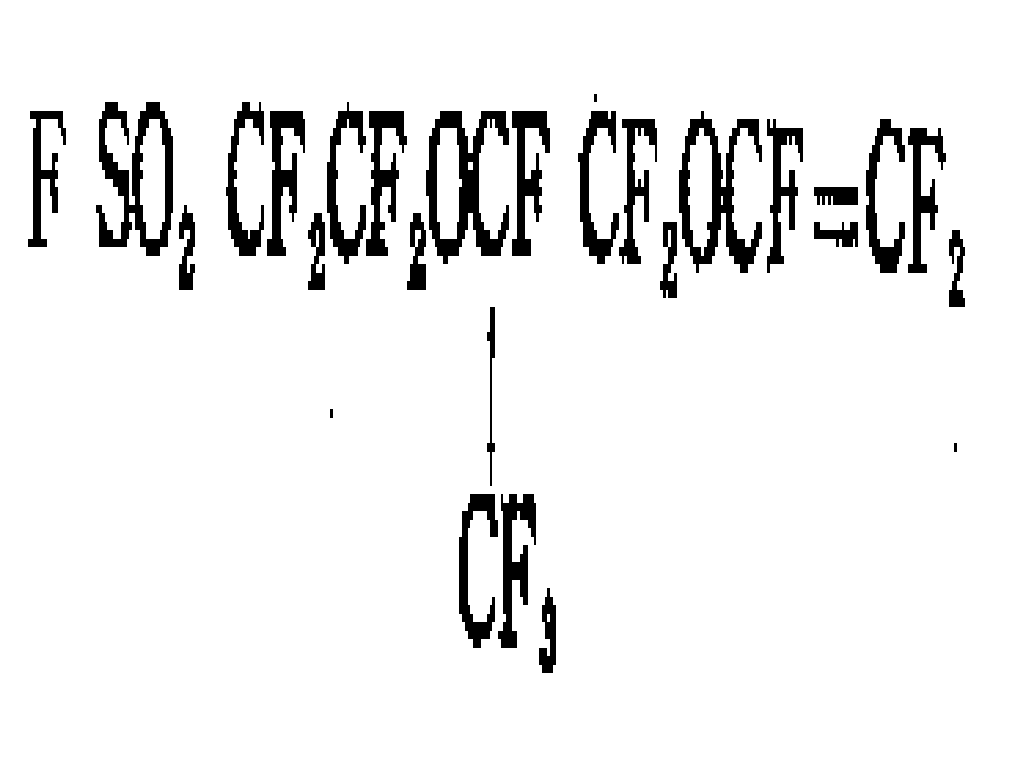
이에 대하여는 미함중국특허 제3,282,875호에 기술되어 있다.This is described in US Pat. No. 3,282,875.
본 명세서에서 사용하는 "막"이라는 용어는 물의 수압적유동(Hyraulic flow)에 대하여 불삼투성 또는 실질적으로 불삼투성이며, 양극액으로부터 음극액으로 Cl-이 통과하는 것을 실질적으로 방지하면서 양극액으로부터 음극액으로 수화 Na+를 통과시키는 얇은 쉬트 모양의 물질을 의미한다.As used herein, the term "membrane" is either impermeable or substantially impermeable to the hydraulic flow of water and anolyte while substantially preventing Cl − from passing from the anolyte to the catholyte. It means a thin sheet-like material that passes through the hydrated Na + to the catholyte from.
관련기술의 숙련자에게는 "막"에 대비하여 "격막"이라는 용어는 통상 음극액부로 양극액의 수압적 통과를 허용하는 물질, 예를들면 석면격막으로서 참조된다.For those skilled in the art, the term "diaphragm" as opposed to "membrane" is commonly referred to as a material, such as asbestos diaphragm, which allows the hydraulic passage of the anolyte into the catholyte portion.
양극은 도전도의 실질적인 손실이 없이 전해조중의 부식적 환경에 유의기간(有意期間) 견디어 낼 수 있는 임의의 도전성 물질(예 : 흑연, 백금등)이면 좋다.The anode may be any conductive material (eg graphite, platinum, etc.) that can withstand a corrosive environment in the electrolytic cell for a significant period without substantial loss of conductivity.
그러나 흑연양극은 부식과 치수손실(Loss of dimension)이 일어나는 한편 백금 금속의 양극은 매우 값이 비싸다. 바람직한 양극은 도전성의 안정한 금속산화물 또는 금속산화물의 혼합물로 보호피복된 비교적 값이 싼 도전성 기질로 구성된 것이다. 특히 바람직한 것은 백금 금속산화물의 보호피복(미합중국 특허 제3,711,385호 및 동 제5,776,834호 참조) 또는 코발트 스피넬의 보호피복(미합중국 특허 제4,061,549호 및 동 제3,977,958호 참조)을 갖는 티타늄 같은 발브금속(Vave metal)-필름형성금속이라고도 함-의 기질로 된 치수안정 양극이다.However, graphite anodes cause corrosion and loss of dimension, while platinum metal anodes are very expensive. Preferred anodes are those composed of a relatively inexpensive conductive substrate which is covered with a conductive stable metal oxide or a mixture of metal oxides. Particularly preferred are valve metals such as titanium having a protective coating of platinum metal oxide (see US Pat. Nos. 3,711,385 and 5,776,834) or a protective coating of cobalt spinel (see US Pat. Nos. 4,061,549 and 3,977,958). It is a dimensionally stable anode with a substrate-also known as a film-forming metal.
음극은 도전도 또는 치수의 실질적인 손실없이 전해조중의 환경에 유의한 기간 견딜 수 있는 임의의 도전성 물질이다.The negative electrode is any conductive material that can withstand a significant period of time in the environment of the electrolyzer without substantial loss of conductivity or dimensions.
역사적으로는 동 또는 철의 음극이 광범위하게 사용되고 있으나 최근에는 미합중국특허 제4,024,044호 및 독일특허 제2,527,386호에서와 같이 다공질 Ni로 피복된 철기질로 이루어진 개량음극이 개발되어 있다. 이같은 다공질 Ni피복은 음극의 과전압을 감소시키는데 효용성이 있다.Historically, copper or iron cathodes have been widely used, but recently, improved cathodes made of iron substrates coated with porous Ni have been developed, as in US Pat. Nos. 4,024,044 and 2,527,386. Such porous Ni coating is useful for reducing the overvoltage of the cathode.
이와같이 하여 본 발명은 수압적으로 불삼투성 또는 약삼투성인 막을 분리체로 사용하는 염소전해조 또는 전해조 배열(Bank of cell)의 효율을 향상시키는 수단을 제공한다.In this way, the present invention provides a means for improving the efficiency of a chlorine electrolytic cell or a bank of cells using a membrane that is hydraulically impermeable or weakly osmotic as a separator.
이온교환막(예 : du pont사의 NafionR)이 염소 전해조에 사용되는 경우, 그 효율은 그 특정막의 특성, 양극액중의 가성강도 및 양극액의 염화나트륨 농도에 의존한다. 음극액으로부터 양극액으로 수소이온의 역이동(Bank migration)하는 것을 방지하는데 특히 좋은 기능을 보유한 막은 양호한 가성도와 염소효율을 나타내는 것으로, 일반적으로 낮은 이온 선택성 막보다 높은 전해조 전압하에 운전된다[예를들면 아민처리 Nafion 대(vs) 미처리 ; 1100eq 중량 Nafion 대(vs) 보다 높은 eq 중량].When ion exchange membranes (eg Nafion R from du pont) are used in chlorine electrolyzers, their efficiency depends on the properties of the particular membrane, the caustic strength in the anolyte and the sodium chloride concentration in the anolyte. Membranes that have a particularly good function in preventing the bank migration of hydrogen ions from the catholyte to the anolyte exhibit good causticity and chlorine efficiency and are generally operated under higher electrolytic cell voltages than low ion selective membranes [eg For example, amine treatment Nafion vs. untreated; 1100 eq weight Nafion vs. eq weight higher than).
통상의 막공정에 있어서는 물이 연속적으로 전해조의 음극액 구획실로 첨가된다. 이 물리 첨가속도는 양극액 구획실로부터 막을 통하여 통과하는 수화된 나트륨이온으로부터의 물 속도와 함께 음극액구획실의 가성강도를 결정한다. 브라인은 연속적으로 양극액구획실로 첨가된다. 이 첨가속도는 양극액농도를 결정한다. 주어진 양극액 및 음극액 농도에 있어서 그 효율은 주로 사용한 특정막의 함수로 된다. 수소이온의 역이동을 보다 효율적으로 방지하기 위하여는 비교적 작은 정도는 물에 팽윤된 막이 사용된다. 이러한 일은 막을 제조하는데 사용되는 폴리며 물질을 화학적으로 가교시켜 관능폴리머의 당량중량(Equivalent weight)을 증대시키거나 또는 폴리머중에 산이한 이온교환기(Ion exchange group)를 사용하므로서 달성할 수 있다.In a normal membrane process, water is continuously added to the catholyte compartment of the electrolytic cell. This physical addition rate determines the caustic strength of the catholyte compartment with the rate of water from the hydrated sodium ions passing through the membrane from the anolyte compartment. Brine is subsequently added to the anolyte compartment. This rate of addition determines the anolyte concentration. For a given anolyte and catholyte concentration the efficiency is primarily a function of the specific membrane used. In order to more effectively prevent reverse migration of hydrogen ions, membranes swollen in water to a relatively small extent are used. This can be accomplished by chemically crosslinking the poly and materials used to make the membrane to increase the equivalent weight of the functional polymer or by using ion exchange groups that are acidic in the polymer.
일반적으로 폴리머물질의 물의 함유량의 감소는 전기저항을 증대시켜 보다 높은 조전압(槽電壓)을 유발한다.In general, the decrease in the water content of the polymer material increases the electrical resistance, causing higher voltage regulation.
전압은 주어진 막의 두께를 감소시키므로서 감압시킬 수 있으나 이는 또한 막의 투과선택성을 감소시킨다.The voltage can be reduced by reducing the thickness of a given membrane but this also reduces the permeability of the membrane.
주어진 음극액 및 양극액 농도에 있어서 막에 기준을 둔 총괄적 효율은 전압과 염소 및 가성효율 사이에 상충관계(相衝關係 : Trade off)를 나타낸다.The membrane-based overall efficiency for a given catholyte and anolyte concentration represents a trade off between voltage and chlorine and caustic efficiency.
양극액 구획실중으로 수소이온이 이동하면 pH가 증대하여 그 결과로 양극에서의 산소생성을 증대시킨다. 염소산염(Chlo rate)의 생성은 양극액의 pH를 증대시킨다.As hydrogen ions move into the anolyte compartment, the pH increases, resulting in increased oxygen production at the anode. The production of chlorate increases the pH of the anolyte.
이들 현상은 함께 염소효율을 떨어뜨리게 되고 이렇게하여 염소효율과 가성효율 사이의 관계가 형성된다.Together these phenomena lower the chlorine efficiency, thus forming a relationship between chlorine efficiency and caustic efficiency.
염소전해조의 조작에 있어서, 산, 바람직하게는 염산을 전해조의 양극액구획실로 첨가하여 양극액의 pH를 떨어뜨리므로서 염소효율의 손실을 가성효율의 손실로 상쇄할 수 있다는 것은 잘 알려진 사실이다.It is well known that in the operation of a chlorine electrolyzer, acid, preferably hydrochloric acid, can be added to the anolyte compartment of the electrolyzer to reduce the pH of the anolyte and offset the loss of chlorine efficiency to the loss of caustic efficiency. .
이러한 것은 전해조에 직접 첨가하여 주거나, 양극구획실의 브라인 공급원료에 첨가하여 주므로서 달성할 수 있다. 물론 산의 첨가에 따른 경비가 필요하게 된다.This can be achieved either by adding directly to the electrolyzer or by adding it to the brine feedstock in the anode compartment. Of course, the cost of the addition of acid is required.
통상의 막공정에 있어서, 산이 양극액구획실로 첨가되는 경우, 총괄적 전해조 효율상의 상충관계는 전압과 가성효율간의 하나로 나타난다.In a conventional membrane process, when an acid is added to the anolyte compartment, the overall tradeoff in electrolytic cell efficiency appears as one between voltage and caustic efficiency.
막 및 격막 염소전해조의 양방에 대하여, 가성효율은 음극액의 가성농도에 의존하는 사실이 잘 알려져있다. 가성효율은 실직적으로 양극액의 염산동도에 의존하지 않는 것으로 보고 되어 있다[참조 : Water Pollution Control Federation 제44년회, 1971년 10월 3-8일, 미국 칼리포니아주 샌프란시스코, 이오닉스 인코포레이티드의 S.A. Michalek 등의 보고논문 12페이지].It is well known that for both membrane and diaphragm chlorine baths, the caustic efficiency depends on the caustic concentration of the catholyte. It is reported that caustic efficiency does not actually depend on the hydrochloric acidity of the anolyte [44th Annual Meeting, Water Pollution Control Federation, 3-8 October 1971, San Francisco, Calif., USA] Tied SA 12 pages in a paper by Michalek et al.].
따라서 공급물중의 염의 높은 변환율(80%)이 바람직하다고 보고되어 있다.It is therefore reported that high conversions (80%) of the salts in the feed are preferred.
나피온(Nafion
이와같이하여 보다 높은 양극액농도는 상술한 바와 같이 보다 많은 양극액이 처리되는 것을 요구한다.As such, higher anolyte concentrations require that more anolyte be processed as described above.
일반적으로 약 10내지 12%가성농도 이상에서 조작하는 경우 증대된 양극액 농도에 의하여 수득된 효율과 처리되어야 할 폐양극액의 양과의 사이는 상충관계에 놓이게 된다.In general, when operating above about 10 to 12% caustic concentration, there is a trade-off between the efficiency obtained by increased anolyte concentration and the amount of waste anolyte to be treated.
통상의 공정에 있어서 각각의 전해조는 각기 일정한 브라인 속도와 일정한 물의 속도로 공급된다.In a conventional process, each electrolyzer is fed at a constant brine rate and a constant water rate, respectively.
이같이하여 각각의 전해조는 같은 양극액농도와 같은 음극액 농도하에 운전된다. 가성효율과 전압 및 가성효율과 양극액농도 사이에 이루어지는 모든 상충관계( Trade-off)는 전해조에 대하여 바르게 유지된다.In this way, each electrolyzer is operated under the same anolyte concentration. All trade-offs between caustic efficiency and voltage and caustic efficiency and anolyte concentration remain correct for the electrolyzer.
이같은 방법에 있어서는 임의 번호의 전해조로부터의 양극액은 합성물 처리를 위하여 모아진다.In such a method, the anolyte from any number of electrolyzers is collected for compound treatment.
본 발명은 음극액에 대한 물과 양극액에 대한 브라인의 양방에 대하여 전해조 공급이 다른 방법을 포함한다.The present invention includes a method in which the electrolyzer supply is different for both water for catholyte and brine for anolyte.
공급공정의 변화가 보통공정에 포함되는 상충관계에 놀라웁고 극적인 변화를 허용하는 것이 발견되었다.Changes in the supply process have been found to allow surprising and dramatic changes in the trade-offs involved in the normal process.
새로운 공급방법은 전해조군을 2조 또는 그 이상의 전해조로 이루어진 블럭(Block) 또는 씨리즈(Series)로 나누는 것을 포함하고 있다.The new supply method involves dividing the electrolyzer group into blocks or series of two or more electrolyzers.
다음에 각각의 전해조에 대하여가 아니라 각각의 그 블럭에 대하여 물의 흐름과 브라인의 흐름이 공급된다. 이기법은 "씨리즈 전해조공급"이라고 불리운다. 전해조 공급의 이 신규방법은 두 원리의 조합에 기초를 두고 있다. 하나는 전해조의 효율이 음극액의 가성농도에 의존하는 것이다. 음극액의 씨리즈 공급의 원리는 미합중국특히 제1,284,618호에 최초로 시사되어 있다. 이 특허는 한 전해조로부터 다른 전해조로 음극액을 오버플로우(over-flow)시키는 씨리즈공급에 의하여, 전해조의 평균 가성농도가 군(群)으로서 게게로 조작되는 전해조보다도 낮게되는 것을 시사하고 있다. 따라서 총괄적 효율이 높다. 동특허는 그 발명이 전해조의 양극 구획실로부터의 음극액 유도에 결코 의존하고 있지 않음을 기술하고 있다. 동특허는 또 공급기법상의 최대의 효율은 격막여과가 완전히 제거될 수 있을 때에 달성할 수 있을 것이라고 기술하고 있다.The flow of water and brine is then supplied to each block, not to each electrolyzer. This technique is called "series electrolyzer supply". This new method of electrolyzer supply is based on a combination of the two principles. One is that the efficiency of the electrolyzer depends on the caustic concentration of the catholyte. The principle of the series supply of catholyte is first suggested in US 1,284,618. This patent suggests that the average caustic concentration of the electrolyzer is lower than that of the electrolyzer operated by crabs as a group by supplying a series of overflows of the catholyte from one electrolyzer to another. Therefore, overall efficiency is high. The patent describes that the invention never relies on the induction of catholyte from the anode compartment of the electrolyzer. The patent also states that the maximum efficiency in the feed technique can be achieved when diaphragm filtration can be completely removed.
이들 조건은 염소 전해조에 있어서의 여과격막이 막으로 치환되었을 경우와 합치한다.These conditions are consistent with the case where the filtration diaphragm in a chlorine electrolytic cell is replaced by the membrane.
본 발명의 두번째 원리는 그 결과에서 나타나는 바와 같이 기성효율이 양극액농도에 의존하는 것, 특히 음극액의 농도가 약 10내지 12%가성도를 넘을 경우에 그 현상이 뚜렷한 사실이다. 동특허는 또 전해조의 양극액실이 어떻게 유지되는 가는 중요하지 않다고 하고 있다.The second principle of the present invention is that the phenomenon is apparent when the ready-made efficiency depends on the anolyte concentration, particularly when the concentration of the catholyte exceeds about 10 to 12% causticity. The patent also says that it is not important how the anolyte chamber of the electrolytic cell is maintained.
이들은 따로따로 병렬로 또는 직렬공 로급하여도 좋고 또 만일 질렬로 공급하는 경우에 그 유동방향은 음극액의 유동에 병행하거나 역행하거나 상관없음을 시사하고 있다.They may be separately supplied in parallel or in series, and if fed in tandem, their flow direction is parallel or reverse to the flow of catholyte.
본원 발명의 결과는 높은 기성도에 있어서 높은 양극액농도가 효율을 상승시키고 있음을 나타내고 있다.The results of the present invention indicate that the high anolyte concentration increases the efficiency at high readyness.
본원 발명은 또 직렬공급에 있어서 유동방향은 중요하지 않음을 보이고 있다. 음극액의 직렬공급(또는 "카스케이드"라도고 함)이 사용되는 경우, 음극액의 유동에 반대방향인 양극액의 연속공급이 놀랄만한 이점을 제공한다. 이러하 공급방향을 적용하여 음극액의 보다 높은 가성 농도하에 조작되는 전해조는 보다 높은 양극액농도를 갖는 전해조이다. 음극액 카스케이드가 사용되지 않고 각 전해조가 개별적으로 공급되는 경우에도 음극액의 카스케이드가 역시 놀라울만큼 유리함이 발견되었다.The present invention also shows that the flow direction is not critical for the in-line feed. When a series feed of catholyte (also referred to as "cascade") is used, the continuous supply of anolyte opposite to the flow of catholyte provides a surprising advantage. The electrolytic cell operated under higher caustic concentration of catholyte by applying the feed direction is an electrolyzer having a higher anolyte concentration. It was found that the cascade of catholyte was also surprisingly advantageous even when no catholyte cascade was used and each electrolyzer was fed individually.
바람직한 실시태양은 전극액 및 음극액의 양방을 향류적으로 카스케이드시키는 것이다.A preferred embodiment is to countercurrently cascade both the electrode and catholyte solutions.
이하에 운전공정을 상세히 기술한다.The operation process is described in detail below.
블럭 또는 씨리즈에 있어서, 최초 전해조의 음극액 구획실로 물이, 이 전해조중에서 매우 낮은 가성도가 많이 형성되도록 빠른 속도로 첨가된다.In a block or series, water is added to the catholyte compartment of the initial electrolyzer at a high rate so that much lower causticity is formed in the electrolyzer.
다음에 이 첫번째 전해조로부터의 희박 가성유출액(The dilute caustic effluent)은 적정한 배관(유동수단)에 의하여 두번째 전해조의 양극 구획실로 공급되며, 여기서 그 농도는 약간 증대된다.The dilute caustic effluent from this first electrolyzer is then fed to the anode compartment of the second electrolyzer by appropriate piping (flow means), where the concentration is slightly increased.
다음에 두 번째 전해조로부터의 가성유출액은 세번째 전해조로 공급되며, 여기에서 또 가성농도는 약간 증대하게 된다.Caustic effluent from the second electrolytic cell is then fed to the third electrolytic cell, where again the caustic concentration increases slightly.
이 씨리즈 유동이 전 전해조 블럭을 통하여 그 최종 전해조로부터 블럭을 떠날 때까지 계속된다. 최종 가성용액 및 각 전해조의 농도는 첫번째 전해조로 공급되는 물의 속도에 의존한다.This series flow continues through the entire electrolyzer block until it leaves the block from its final electrolyzer. The final caustic solution and the concentration of each electrolyzer depend on the rate of water supplied to the first electrolyzer.
이 공급방법을 적용하여 각 전해조는 가성농도가 다른 음극액으로 조작된다.By applying this supply method, each electrolyzer is operated with catholyte with different caustic concentration.
이 블럭중의 전해조의 수는 블럭중의 전해조수 증대에 따른 유속의 증대에 적용시키는데 필요한 배관(유동수단)의 치수에 대하여서만 한정된다.The number of electrolysers in this block is limited only to the dimensions of the pipes (flow means) required to apply to the increase in flow rate as the number of electrolysers in the block increases.
유동수단의 치수는 전해조 치수에 의하여 허용되는 공간중에 적당히 설치할 수 있는 치수로 한정된다. 이 블럭양식의 운전에서는 블럭중의 한 전해조만이(최종 전해조) 제품의 유동으로서 높은 가성농도하에 조작된다. 그밖의 전해조는 전진적으로 낮아지는 가성농도하에 운전된다.The dimensions of the flow means are limited to those which can be suitably installed in the space allowed by the electrolyzer dimensions. In this block mode of operation, only one electrolyzer in the block (final electrolyzer) is operated under high caustic concentration as the flow of product. Other electrolyzers are operated under caustic concentrations that are progressively lowered.
상술한 바와 같이 가성 및 염소 효율은 가성농도를 내림으로써 증대되며, 이 공급방법에 따라 운전되는 같은 수의 전해조로 부터의 제품(염소 및 가성)의 전 이론량은 같으나, 이는 조운전의 전류에만 의존하기 때문이다. 운전의 전전압은 두 방법에 있어서 동일한 막이 사용된 경우 통상의 방법과 본질적으로는 같다.As mentioned above, the caustic and chlorine efficiency is increased by lowering the caustic concentration and the total theoretical amount of products (chlorine and caustic) from the same number of electrolyzers operated according to this supply method is the same, Because it depends. The full voltage of operation is essentially the same as the conventional method when the same film is used in both methods.
이와같이하여, 동일한 막이 사용된 경우 씨리즈 공급방법에 의한 효율의 이익은 가성 및 염소효율의 증대로 실현된다. 씨리즈 공급방법을 적용함으로써 비교하는 보통 방법에서 사용되는 것과 다른 막을 사용하여 전압을 절감시키는 효율상 이점을 실현할 수 있다. 보다 높은 수분함유량을 갖는 막(예를들면 1500eq중량 Nafion을 1200eq중량 Nafion으로 바꾸어 줌으로써)이 사용된 경우 이 형태의 막에 수반하는 낮은 가성 및 염소효율을, 이 형태의 막에 수반하는 보다 낮은 전압을 유지하면서 본원 발명의 방법에 따라 증대시킬수 있다.In this way, when the same membrane is used, the benefit of efficiency by the series supply method is realized by increasing the caustic and chlorine efficiency. By applying the series supply method, the efficiency advantage of saving the voltage by using a different film than that used in the normal method of comparison can be realized. When higher moisture content membranes are used (eg by changing 1500 eq weight Nafion to 1200 eq weight Nafion), the lower causticity and lower chlorine efficiency associated with this type of membrane is achieved. It can be increased according to the method of the present invention while maintaining.
블럭중의 전해조의 음극액 구획실로의 씨리즈 공급과 함께 양극액의 씨리즈 공급이 또한 요망된다.A series supply of anolyte is also desired along with a series supply of catholyte compartments of the electrolyzer in the block.
이러한 것은 음극액 유동에 대하여 향류방향으로 실시할 때에 보다 유리하다.This is more advantageous when carried out in the countercurrent direction with respect to the catholyte flow.
씨리즈 공급의 개념에 있어서 포화브라인은 블럭의 최후 전해조로 그 전해조중의 염화나트륨이 소량소모될 수 있도록 하는 속도로 첨가된다. 최후 전해조로부터의 소량 소모된 양극액은 적정 유동수단에 의하여 최후 전해조 다음 조의 양극 구획실로 공급된다. 이곳에서 다시 소량 소모된다. 이러한 씨리즈 유동은 소망의 소모가 도달될 때까지 전해조로부터 다음 조로 계속된다. 이점에 있어서 폐 양극액은 제거되고 통상의 공정에서 사용되는 것과 동일한 방법으로 처리된다. 양극액의 씨리즈 공급에 의하여 접속되는 전해조의 수는 음극액 씨리즈 공급을 위하여 블럭중에 사용되는 수와 같아도 좋으나 반드시 그러할 필요는 없다. 폐양극액을 블럭중의 하나이상의 전해조로부터 공급 또는 배출할 수 있다. 많은 경우에 양극액의 유동은 음극액의 유동보다 많기 때문에 포화 브라인을 블럭중의 하나이상의 전해조로 공급하는 것이 바람직하다. 또양극액 씨리즈공급에 포함되는 전해조의 수는 조의 치수에 따라 한정되는 필요 유동수단의 치수에 의하여서만 제한된다.In the concept of a series feed, saturated brine is added to the final electrolyzer of the block at a rate that allows a small amount of sodium chloride in the electrolyzer to be consumed. A small amount of the anolyte consumed from the last electrolyzer is supplied to the anode compartment of the next bath after the last electrolyzer by appropriate flow means. A small amount is consumed here again. This series flow continues from the cell to the next tank until the desired consumption is reached. In this respect the waste anolyte is removed and treated in the same way as used in conventional processes. The number of electrolyzers connected by the series supply of anolyte may be the same as the number used in the block for catholyte series supply but need not be so. The waste anolyte may be supplied or discharged from one or more electrolysers in the block. In many cases, the flow of the anolyte is greater than that of the catholyte, so it is desirable to supply saturated brine to one or more of the electrolysers in the block. In addition, the number of electrolyzers included in the anolyte series supply is limited only by the dimensions of the required flow means, which are limited by the dimensions of the baths.
양극액 씨리즈공급의 적용은, 증대된 양극액강도가 증대된 가성 및 염소효율을 나타내는 범위의 최종 양극액 가성농도에서 운전되는 경우에 보다 높은 가성 및 염소효율을 발생한다.Application of the anolyte series supply results in higher caustic and chlorine efficiency when operated at a final anolyte caustic concentration in the range of increased anolyte strength and increased caustic and chlorine efficiency.
씨리즈공급을 향류로 운전시킴으로써 음극액중에 보다 높은 가성강도를 갖는 전해조는 보다 높은 양극액 강도를 갖는 바로 그 전해조가 된다. 나피온(Nafion
이렇게하여 손실이 작거나 손실이 없이 총괄적 브라인소모의 증가가 씨리즈 양극액공급으로 가능하게 된다. 막을 통하는 플럭스(Flux)가 주로 전기 투석력에 의하는 이온교환막 또는 임의 형태의 막을 사용하고 있는 염소 전해조는 이와 같이 음극액과 양극액의 향류 씨리즈 유동을 실시함으로써 보다 높은 총괄효율로 운전할 수 있다.In this way, an overall increase in brine consumption with little or no loss is possible with the series anode supply. The chlorine electrolyzer, in which the flux through the membrane uses an ion exchange membrane or any type of membrane mainly by electrodialysis, can be operated at higher overall efficiency by performing countercurrent series flow of the catholyte and the anolyte.
보다 높은 브라인 변환율이 부수하는 효율의 손실이 없이 이 방법으로 달성할 수 있다.Higher brine conversion can be achieved in this way without the accompanying loss of efficiency.
유입하는 브라인에 산을 첨가함으로써 양극액의 pH를 내리고 이로서 염소효율을 증대시키는 것이 요망되는 경우에는, 향류씨리즈 공급은 보다 낮은 염소효율의 전해조가 우선적으로 이 산을 수용할 수 있게 한다. 음극액 씨리즈 공급이 양극액 씨리즈 공급없이 단일한 브라인 전해조 공급으로 사용되는 경우에는 유입하는 산에 대한 개별적인 계량시스템(Seperate metering system)이 각각의 전해조에 대하여 사용되어야 하던가, 또는 소량의 산을 요구하거나 산을 요구하지 않는 전해조는 보다 많은 양의 산을 필If it is desired to reduce the pH of the anolyte by adding acid to the incoming brine and thereby increase the chlorine efficiency, the countercurrent series feed allows the lower chlorine efficiency electrolyser to preferentially receive this acid. If catholyte series feed is used as a single brine electrolyzer supply without anolyte series supply, a separate metering system for the incoming acid should be used for each electrolyzer, or if a small amount of acid is required Electrolyzers that do not require acid require more acid.
산이 과다할 경우에는 양극 구획실로부터 음극 구획실로 막을 통하여 양자가 이동하게 되어 가성효율의 감소를 유발한다.If the acid is excessive, the quantum moves through the membrane from the anode compartment to the cathode compartment, leading to a decrease in caustic efficiency.
양극액 및 음극액 씨리즈공급의 조합과 함께, 양극액만의 씨리즈공급, 즉 음극액의 단일 전해조 공급과의 조합이 주어진 브라인 변환율(Brine conversion)에 있어서 가성 및 염소효율을 증대시킬 것이다.Along with the combination of anolyte and catholyte series feeds, a series of anolyte only series feeds, i.e., a combination of a single electrolyzer supply of catholyte solution, will increase the caustic and chlorine efficiency for a given brine conversion.
이러한 것은 씨리즈중의 최후전해조를 제외한 모든 전해조가 동일한 변환율하의 단일조 조작보다 높은 양극액 농도로 조작될 수 있게 한다. 시험결과를 나타내는 제2도는 양극액중의 NaCl 농도하의 가성효율에 대한 가성농도의 영향을 비교하여 단일 전해조 유동조작, 음극액 카스케이드 유동조작 및 향류 카스케이드 유동조작(양극액 및 음극액)을 설명하는 것이다.This allows all of the electrolyzers except the final electrolyzer in the series to be operated at higher anolyte concentrations than single bath operations under the same conversion rate. Figure 2, which shows the test results, compares the effect of caustic concentration on the caustic efficiency under NaCl concentration in the anolyte and compares the single electrolyzer flow operation, catholyte cascade flow operation and countercurrent cascade flow operation (anode and catholyte). To explain.
제2도는 향류 카스케이드 유동(곡선 A)이 음극액 카스케이드 유동(곡선 B) 또는 단일조 유동(곡선 C)보다도 주어진 가성농도에 있어서 보다 높은 가성효율을 올리고 있음을 나타내는 데이타를 나타내고 있다.FIG. 2 shows data indicating that the countercurrent cascade flow (curve A) has a higher caustic efficiency at a given caustic concentration than the catholyte cascade flow (curve B) or monolithic flow (curve C).
위 세가지 모든 경우, 브라인 공급물은 25중량%의 NaCl이며, 음극액농도는 물의 공급액 속도가 변화함에 따라 변화하고, 브라인 변환율은 약 45중량%이며 또 양극액 오버플로우는 약 18중량% NaCl이다.In all three cases, the brine feed is 25 wt.% NaCl, the catholyte concentration changes as the feed rate of water changes, the brine conversion is about 45 wt.% And the anolyte overflow is about 18 wt.% NaCl. .
단일조 유동조작(곡선 C)에 있어서 25중량% NaCl 브라인 짜여진 와이아-메쉬 강음극(Woven Wiremesh Steel cathode), 치수안정금속 양극(Dimensionally stable metal anode) 및 나피온 막을 비치한 단일조 염소-알칼리 전해조의 양극액부로 공급되며 또 18중량% NaCl을 함유하는 양극액이 그로부터 유출된다.Monolithic chlor-alkali with 25 wt% NaCl brine Woven Wiremesh Steel cathode, Dimensionally stable metal anode and Nafion membrane in monolithic flow operation (Curve C) The anolyte containing 18 wt% NaCl supplied to the anolyte portion of the electrolyzer flows out therefrom.
"단일조유동조작"이라는 용어는, 양극액이 유일한 양극액부를 통하여 유통하며 또 음극액이 유일한 음극액부를 통하여 유동하는 것을 의미한다. 그 대표적인 것은 공통원(共通源)으로부터 양극액이 수개의 양극액부로 각각 동시에 공급되며 또 물이 수개의 음극액부로 각각 동시에 공급되는 막 전해조이다.The term "single tank flow operation" means that the anolyte flows through the only anolyte portion and the catholyte flows through the only catholyte portion. A typical example is a membrane electrolytic cell in which anolyte is simultaneously supplied to several anolyte portions from a common source and water is simultaneously supplied to several catholyte portions, respectively.
음극액 카스케이드 유동조작(곡선 B)에 있어서는, 25중량% NaCl 브라인이 5개의 음극액부로 각각 동시에 공급되며 또 18중량% NaCl을 함유하는 양극액이 그로부터 유출되고 또 물이 5개의 상당하는 음극액부의 최초 전해조로 공급되며, 그로부터 순차로 나머지 4개의 음극액부를 통하여 유동하며 그것이 조로부터 조로 유동하는 사이에 가성강도가 발현한다.In the catholyte cascade flow operation (curve B), 25% by weight NaCl brine is simultaneously supplied to five catholyte portions, and an anolyte containing 18% by weight NaCl flows out of it and five equivalent cathodes of water It is fed to the initial electrolyzer of the liquid part, from which it flows through the remaining four catholyte parts and develops caustic strength between it flowing from the bath to the bath.
향류 유동조작(곡선 A)에 있어서는 25중량% NaCl 브라인이 5조 씨리즈(5-cell series)의 최종조의 양극액부로 공급되며 그로부터 순차로 4개의 다른 조를 통하여 그것이 18중량% NaCl을 함유하는 "폐" 양극액으로서 최초의 조를 떠날때까지 유동한다. 동시에 물이 최초의 음극액부로 공급되며 그로부터 양극액에 대하여 향류 유동하여 다른 4개의 조를 통하여 그것이 가성도가 증대되어 최종조를 떠날때까지 유동한다.In countercurrent flow operation (curve A) 25 wt.% NaCl brine is fed to the anolyte portion of the final bath of the 5-cell series, from which it sequentially contains 18 wt.% NaCl through four different baths. Lung "Anolyte flows until the first bath leaves. At the same time, water is supplied to the first catholyte section and flows countercurrently to the anolyte through the other four baths until it has increased causticity and leaves the final bath.
이상 3개의 모든 조작(A, B 및 C)에 있어서, 상호-전극간격(inter-electrode gap)은 약 0.3cm이며 또 막은 양극과 음극 사이에 배치되고 그 두께는 약 0.02cm이다. 기본적 전해조 구성성분은 모든 경우에 같다. 전해조는 약 150mA/cm2의 전류 밀도하에 운전되며 그 온도는 약 80℃이고 전해조의 전압평균은 약 3.1볼트이다. 브라인은 양극액 오버플로우중에 약 18중량% NaCl을 수득할 수 있도록 조정되며 또 음극액의 유동은 음극액 유출액중에 여러가지 가성농도를 달성할 수 있도록 조절된다.In all three operations A, B and C, the inter-electrode gap is about 0.3 cm and the film is disposed between the anode and the cathode and the thickness is about 0.02 cm. The basic electrolyzer component is the same in all cases. The electrolyzer operates under a current density of about 150 mA / cm 2 , its temperature is about 80 ° C. and the voltage average of the electrolyzer is about 3.1 volts. The brine is adjusted to yield about 18% by weight NaCl during anolyte overflow and the flow of catholyte is adjusted to achieve various caustic concentrations in the catholyte effluent.
가성효율은 실제로 생성된 가성량을 평량하고 이를 가능한 이론량과 비교함으로써 측정된다. 제2도에 있어서의 곡선 A 및 B와 비슷한 방법으로 제3도의 곡선 A' 및 B'는 음극액 카스케이드 유동(곡선 B') 및 향류카스케이드 유동(곡선 A')사이의 비교를 설명하고 있으나, 이 경우에 13중량%의 양극액 오버플로우 즉 약 75중량%의 브라인 변환율이 사용된다. 음극액의 유속은 음극액 유출물중에 여러가지 가성농도를 수득할 수 있도록 조정된다.The caustic efficiency is measured by weighing the caustic actually produced and comparing it with the theoretical theoretical possible. In a manner similar to curves A and B in FIG. 2, curves A 'and B' in FIG. 3 illustrate the comparison between catholyte cascade flow (curve B ') and countercurrent cascade flow (curve A'). However, in this case a 13% by weight anolyte overflow, i.e. about 75% by weight brine conversion, is used. The flow rate of the catholyte is adjusted to obtain various caustic concentrations in the catholyte effluent.
제2도의 곡선 A 및 B를 제3도의 곡선 A' 및 B'와 비교하면, 주어진 가성농도하의 가성효율이 음극액 카스케이드 유동만의 공정에서는 보다 높은 NaCl 양극액농도에서 실질적으로 크게 되나, 향류 카스케이드 유동공정에서는 NaCl 양극액 농도에 의하여 조금밖에 영향을 받지 않음을 알 수 있다. 가성효율은 또 향류 카스케이드 유동공정의 경우가 음극액-카스케이드 유동만의 공정의 경우에 비하여 크다. 이같이 하여 향류카스케이드 유동을 적용함으로써, 일련의 전해조중의 브라인이 높은 변환율을 갖게 할 수Comparing curves A and B of FIG. 2 with curves A 'and B' of FIG. 3, the caustic efficiency under a given caustic concentration is substantially greater at higher NaCl anolyte concentrations in the process of catholyte cascade flow only. It can be seen that in the cascade flow process, only little is affected by the NaCl anolyte concentration. The caustic efficiency is also greater in the countercurrent cascade flow process than in the catholyte-cascade flow only process. By applying countercurrent cascade flow in this way, the brine in a series of electrolyzers can have a high conversion rate.
제4도는 양극액 오버플로우중의 2개 수준의 NaCl 농도하의 단일 유동조작(카스케이드 아님)을 나타내고있다. 곡선 D는 24중량% NaCl의 양극액 오버플로우 농도를 적용하여 얻은 결과를 나타내고, 곡선 E는 14중량% NaCl의 양극액 오버플로우 농도를 설명하고 있다. 약 10내지 12중량%의 가성농도에 있어서, 이들 곡선은 본질적으로 동일하나 보다 높은 가성농도에 있어서는 보다 높은 NaCl 농도의 영향이 보다 높은 가성효율을 발현하게 됨을 알 수 있다.4 shows a single flow operation (not cascade) under two levels of NaCl concentration during anolyte overflow. Curve D shows the results obtained by applying an anolyte overflow concentration of 24 wt% NaCl and curve E illustrates an anolyte overflow concentration of 14 wt% NaCl. For caustic concentrations of about 10 to 12% by weight, these curves are essentially the same, but at higher caustic concentrations, the effect of higher NaCl concentrations will result in higher caustic efficiency.
상술한 실시에는 본원 발명의 방법을 구체적으로 설명하기 위한 것이며 본 발명의 기술된 특정 향류 카스케이드 유동의 태양에 한정되는 것은 아니다. 양극액 농도는 8내지 26중량% NaCl로 할 수 있으며 NaCl 슬러리가 사용되는 경우에는 더 높일 수 있다.The foregoing implementations are intended to specifically illustrate the method of the present invention and are not limited to aspects of the particular countercurrent cascade flows described herein. The anolyte concentration can be 8 to 26 wt% NaCl and can be higher if a NaCl slurry is used.
통상은 10내지 23중량% NaCl의 바람직한 범위가 적용되고 25내지 26중량% NaCl의 브라인 공급물이 사용된다. 전해조로부터의 음극액 농도는 5내지 50중량% NaOH도 좋으며 바람직하게는 10내지 30중량% NaOH이다. 염소-알칼리 기술분야의 숙련자에게는 음극액이 조에서 조로 유동하는 사이에 가성가치가 생길 뿐 아니라, 그 막이 수압적인 물의 이동에 대하여 실질적으로 비투과성일 경우에도 막을 통한 물의 전기 삼투적 플럭스(이동)가 일어나 물이 추가로 생성됨을 쉽게 이해할 수 있을 것이다.Usually a preferred range of 10 to 23 weight percent NaCl is applied and a brine feed of 25 to 26 weight percent NaCl is used. The catholyte concentration from the electrolyser may be 5 to 50 wt% NaOH, preferably 10 to 30 wt% NaOH. Those skilled in the chlor-alkali art field not only have caustic value between the flow of catholyte from bath to bath, but also the electroosmotic flux of water through the membrane even if the membrane is substantially impermeable to hydraulic water movement. It will be readily understood that additional water is produced.
양극액으로부터 음극액으로의 이같은 물의 플럭스는 음극액을 가성 생성과 함께 희석하는 경향이 있으며 또 양극액을 NaCl의 소모에 따라 농축하는 경향이 있다. 그럼에도 불구하고 그 효율은 충분하며 가성 강도의 본질적인 증대와 양극액 강도의 본질적인 소모는 막을 통한 물의 전기 삼투적 플럭스에 의하여 증대하게 상쇄되지는 않는다.This flux of water from the anolyte to the catholyte tends to dilute the catholyte with caustic formation and to concentrate the anolyte with the consumption of NaCl. Nevertheless, the efficiency is sufficient and the intrinsic increase in caustic strength and the intrinsic consumption of anolyte strength are not offset by the increase in the electroosmotic flux of water through the membrane.
Claims (1)
Applications Claiming Priority (2)
| Application Number | Priority Date | Filing Date | Title |
|---|---|---|---|
| US05/924,268 US4197179A (en) | 1978-07-13 | 1978-07-13 | Electrolyte series flow in electrolytic chlor-alkali cells |
| US924268 | 1978-07-13 |
Publications (2)
| Publication Number | Publication Date |
|---|---|
| KR830000745A KR830000745A (en) | 1983-04-18 |
| KR830002163B1 true KR830002163B1 (en) | 1983-10-17 |
Family
ID=25449985
Family Applications (1)
| Application Number | Title | Priority Date | Filing Date |
|---|---|---|---|
| KR1019790002339A Expired KR830002163B1 (en) | 1978-07-13 | 1979-07-13 | Chlorine-Alkaline Electrolyzer |
Country Status (11)
| Country | Link |
|---|---|
| US (1) | US4197179A (en) |
| JP (1) | JPS5538990A (en) |
| KR (1) | KR830002163B1 (en) |
| AU (1) | AU525075B2 (en) |
| BE (1) | BE877645A (en) |
| CA (1) | CA1133419A (en) |
| DE (1) | DE2928427A1 (en) |
| FR (1) | FR2430988A1 (en) |
| GB (1) | GB2026036B (en) |
| IT (1) | IT1162608B (en) |
| NL (1) | NL7905501A (en) |
Families Citing this family (22)
| Publication number | Priority date | Publication date | Assignee | Title |
|---|---|---|---|---|
| US4313805A (en) * | 1980-03-03 | 1982-02-02 | The Dow Chemical Company | Chlorine cell catholyte series flow |
| FR2480794A1 (en) * | 1980-04-22 | 1981-10-23 | Occidental Res Corp | PROCESS FOR CONCENTRATING AN ALKALI METAL HYDROXIDE IN A SERIES OF HYBRID CELLS |
| US4285786A (en) * | 1980-05-09 | 1981-08-25 | Allied Chemical Corporation | Apparatus and method of monitoring temperature in a multi-cell electrolyzer |
| US4302610A (en) * | 1980-05-27 | 1981-11-24 | Allied Corporation | Vanadium containing niobates and tantalates |
| US4515989A (en) * | 1980-06-11 | 1985-05-07 | The Dow Chemical Company | Preparation decarboxylation and polymerization of novel acid flourides and resulting monomers |
| US4337137A (en) * | 1980-06-11 | 1982-06-29 | The Dow Chemical Company | Composite ion exchange membranes |
| US4358412A (en) * | 1980-06-11 | 1982-11-09 | The Dow Chemical Company | Preparation of vinyl ethers |
| US4470889A (en) * | 1980-06-11 | 1984-09-11 | The Dow Chemical Company | Electrolytic cell having an improved ion exchange membrane and process for operating |
| US4337211A (en) * | 1980-06-11 | 1982-06-29 | The Dow Chemical Company | Fluorocarbon ethers having substituted halogen site(s) and process to prepare |
| US4804727A (en) * | 1980-06-11 | 1989-02-14 | The Dow Chemical Company | Process to produce novel fluorocarbon vinyl ethers and resulting polymers |
| US4330654A (en) * | 1980-06-11 | 1982-05-18 | The Dow Chemical Company | Novel polymers having acid functionality |
| US4444631A (en) * | 1981-05-11 | 1984-04-24 | Occidental Chemical Corporation | Electrochemical purification of chlor-alkali cell liquor |
| US4402809A (en) * | 1981-09-03 | 1983-09-06 | Ppg Industries, Inc. | Bipolar electrolyzer |
| EP0121585A1 (en) * | 1983-04-12 | 1984-10-17 | The Dow Chemical Company | Chlorine cell design for electrolyte series flow |
| US4521281A (en) * | 1983-10-03 | 1985-06-04 | Olin Corporation | Process and apparatus for continuously producing multivalent metals |
| US5041197A (en) * | 1987-05-05 | 1991-08-20 | Physical Sciences, Inc. | H2 /C12 fuel cells for power and HCl production - chemical cogeneration |
| US4859745A (en) * | 1987-12-22 | 1989-08-22 | The Dow Chemical Company | Stratified fibrous fluoropolymer compositions and process for forming such fluoropolymers |
| ATE125310T1 (en) * | 1991-05-30 | 1995-08-15 | Sikel Nv | ELECTRODE FOR AN ELECTROLYTIC CELL, USE AND METHOD THEREOF. |
| US5311937A (en) * | 1992-07-08 | 1994-05-17 | Raito Kogyo Co., Ltd. | Extractor for an injection pipe |
| RU2100286C1 (en) * | 1996-12-11 | 1997-12-27 | Вестерн Пасифик Компани Инк. | Method of disinfecting water |
| ITMI20012003A1 (en) * | 2001-09-27 | 2003-03-27 | De Nora Elettrodi Spa | DIAPHRAGM CELL FOR THE PRODUCTION OF CHLOR-SODA OF INCREASED ELECTRODICAL SURFACE AND METHOD TO REALIZE IT |
| JP4216892B1 (en) * | 2007-04-13 | 2009-01-28 | 優章 荒井 | Electrolyzed water production apparatus, electrolyzed water production method, and electrolyzed water |
Family Cites Families (11)
| Publication number | Priority date | Publication date | Assignee | Title |
|---|---|---|---|---|
| FR360435A (en) * | 1905-02-23 | 1906-04-21 | Philippe A Guye | Methodical method of operating a group of electrolytic cells with diaphragms, called "cascade operation" |
| US1284618A (en) * | 1915-08-12 | 1918-11-12 | Dow Chemical Co | Process of and apparatus for electrolytic production of caustic alkali. |
| US2860095A (en) * | 1952-07-22 | 1958-11-11 | Ionics | Separation of electrolytic solutions into concentrated and dilute streams |
| US3711385A (en) * | 1970-09-25 | 1973-01-16 | Chemnor Corp | Electrode having platinum metal oxide coating thereon,and method of use thereof |
| US3977958A (en) * | 1973-12-17 | 1976-08-31 | The Dow Chemical Company | Insoluble electrode for electrolysis |
| ZA754732B (en) * | 1974-08-06 | 1976-08-25 | Hoechst Ag | Process and cell arrangement for the manufacture of chlorine and alkali metal hydroxide |
| US4024044A (en) * | 1975-09-15 | 1977-05-17 | Diamond Shamrock Corporation | Electrolysis cathodes bearing a melt-sprayed and leached nickel or cobalt coating |
| US4057474A (en) * | 1976-06-25 | 1977-11-08 | Allied Chemical Corporation | Electrolytic production of alkali metal hydroxide |
| JPS5319996A (en) * | 1976-08-09 | 1978-02-23 | Tokuyama Soda Co Ltd | Electrolyzing method for aqueous solution of alkali metal chloride |
| JPS5321098A (en) * | 1976-08-11 | 1978-02-27 | Tokuyama Soda Co Ltd | Electrolyzing method for aqueous solution of alkali metal chloride |
| JPH05319995A (en) * | 1992-05-21 | 1993-12-03 | Fujikura Ltd | Production of barium titanate optical single crystal |
-
1978
- 1978-07-13 US US05/924,268 patent/US4197179A/en not_active Expired - Lifetime
-
1979
- 1979-07-11 IT IT49725/79A patent/IT1162608B/en active
- 1979-07-12 FR FR7918145A patent/FR2430988A1/en active Granted
- 1979-07-12 GB GB7924288A patent/GB2026036B/en not_active Expired
- 1979-07-12 BE BE2/57948A patent/BE877645A/en not_active IP Right Cessation
- 1979-07-12 JP JP8868479A patent/JPS5538990A/en active Pending
- 1979-07-13 KR KR1019790002339A patent/KR830002163B1/en not_active Expired
- 1979-07-13 CA CA331,760A patent/CA1133419A/en not_active Expired
- 1979-07-13 NL NL7905501A patent/NL7905501A/en not_active Application Discontinuation
- 1979-07-13 DE DE19792928427 patent/DE2928427A1/en not_active Withdrawn
- 1979-07-30 AU AU49352/79A patent/AU525075B2/en not_active Ceased
Also Published As
| Publication number | Publication date |
|---|---|
| KR830000745A (en) | 1983-04-18 |
| IT7949725A0 (en) | 1979-07-11 |
| FR2430988B1 (en) | 1984-03-16 |
| FR2430988A1 (en) | 1980-02-08 |
| DE2928427A1 (en) | 1980-01-24 |
| NL7905501A (en) | 1980-01-15 |
| AU525075B2 (en) | 1982-10-21 |
| JPS5538990A (en) | 1980-03-18 |
| IT1162608B (en) | 1987-04-01 |
| CA1133419A (en) | 1982-10-12 |
| GB2026036A (en) | 1980-01-30 |
| GB2026036B (en) | 1982-09-02 |
| BE877645A (en) | 1980-01-14 |
| US4197179A (en) | 1980-04-08 |
Similar Documents
| Publication | Publication Date | Title |
|---|---|---|
| KR830002163B1 (en) | Chlorine-Alkaline Electrolyzer | |
| US3976549A (en) | Electrolysis method | |
| US4025405A (en) | Electrolytic production of high purity alkali metal hydroxide | |
| CA1153982A (en) | Electrolytic production of alkali metal hypohalite and apparatus therefor | |
| US5082543A (en) | Filter press electrolysis cell | |
| SU1750435A3 (en) | Method of electrolysis of aqueous solution of sodium chloride | |
| CA1073847A (en) | Method of operating a three compartment electrolytic cell for the production of alkali metal hydroxides | |
| US4297194A (en) | Electrolytic production of high purity alkali metal hydroxide | |
| US3948737A (en) | Process for electrolysis of brine | |
| US4584071A (en) | Process for electrolysis of brine with iodide impurities | |
| CN1025442C (en) | Process for producing alkali metal chlorate | |
| JPS6254196B2 (en) | ||
| US4269675A (en) | Electrolyte series flow in electrolytic chlor-alkali cells | |
| US4384937A (en) | Production of chromic acid in a three-compartment cell | |
| US4725341A (en) | Process for performing HCl-membrane electrolysis | |
| US4127457A (en) | Method of reducing chlorate formation in a chlor-alkali electrolytic cell | |
| US4273626A (en) | Electrolyte series flow in electrolytic chlor-alkali cells | |
| US3654104A (en) | Electrolysis of salt solution | |
| CA1257560A (en) | Electrochemical removal of hypochlorites from chlorate cell liquors | |
| US4061550A (en) | Process for electrolysis | |
| US4285795A (en) | Electrolysis apparatus | |
| EP0122775A1 (en) | Method for making a cathode, and method for lowering hydrogen overvoltage in a chloralkali cell | |
| RU242815U1 (en) | Electrolysis cell | |
| US4146445A (en) | Method of electrolytically producing a purified alkali metal hydroxide solution | |
| IL45141A (en) | Process and apparatus for electrolysis |
Legal Events
| Date | Code | Title | Description |
|---|---|---|---|
| PA0109 | Patent application |
St.27 status event code: A-0-1-A10-A12-nap-PA0109 |
|
| P11-X000 | Amendment of application requested |
St.27 status event code: A-2-2-P10-P11-nap-X000 |
|
| P13-X000 | Application amended |
St.27 status event code: A-2-2-P10-P13-nap-X000 |
|
| P11-X000 | Amendment of application requested |
St.27 status event code: A-2-2-P10-P11-nap-X000 |
|
| P13-X000 | Application amended |
St.27 status event code: A-2-2-P10-P13-nap-X000 |
|
| PE0902 | Notice of grounds for rejection |
St.27 status event code: A-1-2-D10-D21-exm-PE0902 |
|
| T11-X000 | Administrative time limit extension requested |
St.27 status event code: U-3-3-T10-T11-oth-X000 |
|
| T11-X000 | Administrative time limit extension requested |
St.27 status event code: U-3-3-T10-T11-oth-X000 |
|
| P11-X000 | Amendment of application requested |
St.27 status event code: A-2-2-P10-P11-nap-X000 |
|
| P13-X000 | Application amended |
St.27 status event code: A-2-2-P10-P13-nap-X000 |
|
| T11-X000 | Administrative time limit extension requested |
St.27 status event code: U-3-3-T10-T11-oth-X000 |
|
| T11-X000 | Administrative time limit extension requested |
St.27 status event code: U-3-3-T10-T11-oth-X000 |
|
| P11-X000 | Amendment of application requested |
St.27 status event code: A-2-2-P10-P11-nap-X000 |
|
| P13-X000 | Application amended |
St.27 status event code: A-2-2-P10-P13-nap-X000 |
|
| PE0902 | Notice of grounds for rejection |
St.27 status event code: A-1-2-D10-D21-exm-PE0902 |
|
| PG1501 | Laying open of application |
St.27 status event code: A-1-1-Q10-Q12-nap-PG1501 |
|
| P11-X000 | Amendment of application requested |
St.27 status event code: A-2-2-P10-P11-nap-X000 |
|
| P13-X000 | Application amended |
St.27 status event code: A-2-2-P10-P13-nap-X000 |
|
| PG1605 | Publication of application before grant of patent |
St.27 status event code: A-2-2-Q10-Q13-nap-PG1605 |
|
| PE0701 | Decision of registration |
St.27 status event code: A-1-2-D10-D22-exm-PE0701 |
|
| PR0701 | Registration of establishment |
St.27 status event code: A-2-4-F10-F11-exm-PR0701 |
|
| PR1002 | Payment of registration fee |
St.27 status event code: A-2-2-U10-U11-oth-PR1002 Fee payment year number: 1 |
|
| PR1001 | Payment of annual fee |
St.27 status event code: A-4-4-U10-U11-oth-PR1001 Fee payment year number: 4 |
|
| PR1001 | Payment of annual fee |
St.27 status event code: A-4-4-U10-U11-oth-PR1001 Fee payment year number: 5 |
|
| PC1903 | Unpaid annual fee |
St.27 status event code: A-4-4-U10-U13-oth-PC1903 Not in force date: 19881018 Payment event data comment text: Termination Category : DEFAULT_OF_REGISTRATION_FEE |
|
| PC1903 | Unpaid annual fee |
St.27 status event code: N-4-6-H10-H13-oth-PC1903 Ip right cessation event data comment text: Termination Category : DEFAULT_OF_REGISTRATION_FEE Not in force date: 19881018 |
|
| R18-X000 | Changes to party contact information recorded |
St.27 status event code: A-5-5-R10-R18-oth-X000 |
|
| R18-X000 | Changes to party contact information recorded |
St.27 status event code: A-5-5-R10-R18-oth-X000 |
|
| P22-X000 | Classification modified |
St.27 status event code: A-4-4-P10-P22-nap-X000 |