KR20240167892A - STAT modulators and their uses - Google Patents
STAT modulators and their uses Download PDFInfo
- Publication number
- KR20240167892A KR20240167892A KR1020247035865A KR20247035865A KR20240167892A KR 20240167892 A KR20240167892 A KR 20240167892A KR 1020247035865 A KR1020247035865 A KR 1020247035865A KR 20247035865 A KR20247035865 A KR 20247035865A KR 20240167892 A KR20240167892 A KR 20240167892A
- Authority
- KR
- South Korea
- Prior art keywords
- alkyl
- pharmaceutically acceptable
- halo
- acceptable salt
- mmol
- Prior art date
- Legal status (The legal status is an assumption and is not a legal conclusion. Google has not performed a legal analysis and makes no representation as to the accuracy of the status listed.)
- Pending
Links
Classifications
-
- C—CHEMISTRY; METALLURGY
- C07—ORGANIC CHEMISTRY
- C07D—HETEROCYCLIC COMPOUNDS
- C07D471/00—Heterocyclic compounds containing nitrogen atoms as the only ring hetero atoms in the condensed system, at least one ring being a six-membered ring with one nitrogen atom, not provided for by groups C07D451/00 - C07D463/00
- C07D471/02—Heterocyclic compounds containing nitrogen atoms as the only ring hetero atoms in the condensed system, at least one ring being a six-membered ring with one nitrogen atom, not provided for by groups C07D451/00 - C07D463/00 in which the condensed system contains two hetero rings
- C07D471/04—Ortho-condensed systems
-
- C—CHEMISTRY; METALLURGY
- C07—ORGANIC CHEMISTRY
- C07F—ACYCLIC, CARBOCYCLIC OR HETEROCYCLIC COMPOUNDS CONTAINING ELEMENTS OTHER THAN CARBON, HYDROGEN, HALOGEN, OXYGEN, NITROGEN, SULFUR, SELENIUM OR TELLURIUM
- C07F9/00—Compounds containing elements of Groups 5 or 15 of the Periodic Table
- C07F9/02—Phosphorus compounds
- C07F9/547—Heterocyclic compounds, e.g. containing phosphorus as a ring hetero atom
- C07F9/6561—Heterocyclic compounds, e.g. containing phosphorus as a ring hetero atom containing systems of two or more relevant hetero rings condensed among themselves or condensed with a common carbocyclic ring or ring system, with or without other non-condensed hetero rings
-
- A—HUMAN NECESSITIES
- A61—MEDICAL OR VETERINARY SCIENCE; HYGIENE
- A61K—PREPARATIONS FOR MEDICAL, DENTAL OR TOILETRY PURPOSES
- A61K31/00—Medicinal preparations containing organic active ingredients
- A61K31/66—Phosphorus compounds
- A61K31/675—Phosphorus compounds having nitrogen as a ring hetero atom, e.g. pyridoxal phosphate
-
- A—HUMAN NECESSITIES
- A61—MEDICAL OR VETERINARY SCIENCE; HYGIENE
- A61P—SPECIFIC THERAPEUTIC ACTIVITY OF CHEMICAL COMPOUNDS OR MEDICINAL PREPARATIONS
- A61P29/00—Non-central analgesic, antipyretic or antiinflammatory agents, e.g. antirheumatic agents; Non-steroidal antiinflammatory drugs [NSAID]
-
- A—HUMAN NECESSITIES
- A61—MEDICAL OR VETERINARY SCIENCE; HYGIENE
- A61P—SPECIFIC THERAPEUTIC ACTIVITY OF CHEMICAL COMPOUNDS OR MEDICINAL PREPARATIONS
- A61P35/00—Antineoplastic agents
-
- C—CHEMISTRY; METALLURGY
- C07—ORGANIC CHEMISTRY
- C07D—HETEROCYCLIC COMPOUNDS
- C07D487/00—Heterocyclic compounds containing nitrogen atoms as the only ring hetero atoms in the condensed system, not provided for by groups C07D451/00 - C07D477/00
- C07D487/02—Heterocyclic compounds containing nitrogen atoms as the only ring hetero atoms in the condensed system, not provided for by groups C07D451/00 - C07D477/00 in which the condensed system contains two hetero rings
- C07D487/04—Ortho-condensed systems
Landscapes
- Chemical & Material Sciences (AREA)
- Organic Chemistry (AREA)
- Health & Medical Sciences (AREA)
- Life Sciences & Earth Sciences (AREA)
- General Health & Medical Sciences (AREA)
- Medicinal Chemistry (AREA)
- Pharmacology & Pharmacy (AREA)
- Animal Behavior & Ethology (AREA)
- Public Health (AREA)
- Veterinary Medicine (AREA)
- Nuclear Medicine, Radiotherapy & Molecular Imaging (AREA)
- Chemical Kinetics & Catalysis (AREA)
- General Chemical & Material Sciences (AREA)
- Molecular Biology (AREA)
- Biochemistry (AREA)
- Pain & Pain Management (AREA)
- Rheumatology (AREA)
- Epidemiology (AREA)
- Pharmaceuticals Containing Other Organic And Inorganic Compounds (AREA)
- Organic Low-Molecular-Weight Compounds And Preparation Thereof (AREA)
- Acyclic And Carbocyclic Compounds In Medicinal Compositions (AREA)
Abstract
STAT3 및/또는 STAT6과 연관된 다양한 상태를 치료하는 데 유용한 하기 화학식 (I)의 화합물 및 그의 제약상 허용되는 염 및 조성물이 제공된다.

Description
관련 출원Related Applications
본 출원은 2022년 3월 31일에 출원된 미국 가출원 번호 63/325,908 및 2022년 5월 2일에 출원된 미국 가출원 번호 63/337,388을 우선권 주장하며, 이들 각각의 전체 내용은 본원에 참조로 포함된다.This application claims the benefit of U.S. Provisional Application No. 63/325,908, filed March 31, 2022, and U.S. Provisional Application No. 63/337,388, filed May 2, 2022, the entire contents of each of which are incorporated herein by reference.
단백질의 신호 전달자 및 전사 활성화제 (STAT) 패밀리는 세포 과정, 예컨대 증식, 분화, 아폽토시스 및 혈관신생의 조절에서 필수적인 역할을 하는 전사 인자로 이루어진다. 7개의 STAT 유전자가 인간 게놈에서 확인되었다: STAT1, STAT2, STAT3, STAT4, STAT5a, STAT5b, 및 STAT6.The signal transducer and activator of transcription (STAT) family of proteins consists of transcription factors that play essential roles in the regulation of cellular processes such as proliferation, differentiation, apoptosis, and angiogenesis. Seven STAT genes have been identified in the human genome: STAT1, STAT2, STAT3, STAT4, STAT5a, STAT5b, and STAT6.
STAT3은 종양 성장 및 면역 회피의 촉진과 강하게 연관되고, 그의 유전자 결실이 배아 치사를 유발하는 유일한 STAT 패밀리 구성원이기 때문에 특히 관심을 받았다. 실제로, 비정상적으로 상승된 STAT3 활성은 인간 암의 70% 초과에서 발생하는 것으로 추정되었다. 활성화된 STAT3은 세포 성장 및 아폽토시스를 이상조절하고, 혈관신생, 침습, 전이, 및 아폽토시스에 대한 내성의 발생을 촉진하고, 숙주의 종양의 면역 감시를 억제하는 결정적인 유전자 발현 변화 및 분자 사건을 매개하고, 그에 의해 구성적으로 활성인 STAT3이 발암 및 종양 진행의 결정적인 매개자가 되게 한다.STAT3 has been of particular interest because it is strongly associated with the promotion of tumor growth and immune evasion, and because it is the only STAT family member whose genetic deletion results in embryonic lethality. In fact, it has been estimated that abnormally elevated STAT3 activity occurs in more than 70% of human cancers. Activated STAT3 mediates critical gene expression changes and molecular events that dysregulate cell growth and apoptosis, promote angiogenesis, invasion, metastasis, and the development of apoptosis resistance, and suppress host immune surveillance of tumors, thereby making constitutively active STAT3 a critical mediator of carcinogenesis and tumor progression.
최근 관심을 받고 있는 또 다른 STAT 단백질은 STAT6이다. 최근 연구는 STAT6 신호전달이 IL-4- 및 IL-13-유도된 상피 중간엽 이행 (EMT) 및 결장직장암 세포 (CRC) 세포의 공격성에 필수적이라는 것을 보여주었다. STAT6은 염증성 질환 및 다른 관련 상태의 여러 측면에 관여한다.Another STAT protein that has recently attracted attention is STAT6. Recent studies have shown that STAT6 signaling is essential for IL-4- and IL-13-induced epithelial-mesenchymal transition (EMT) and aggressiveness of colorectal cancer cells (CRC). STAT6 is involved in several aspects of inflammatory diseases and other related conditions.
세포 과정의 조절에서의 그의 역할을 고려하여, 1종 이상의 STAT 단백질, 특히 STAT3 및/또는 STAT6의 활성을 조정하는 것은 암, 염증성 상태 및 다른 치료적 필요의 치료를 위한 연구의 중추적인 영역을 나타낸다.Given their role in the regulation of cellular processes, modulating the activity of one or more STAT proteins, particularly STAT3 and/or STAT6, represents a central area of research for the treatment of cancer, inflammatory conditions and other therapeutic needs.
STAT3 및/또는 STAT6의 조정제가 본원에 제공된다. 이러한 조정제는 하기 화학식 I을 갖는 것들 및 그의 제약상 허용되는 염 및 조성물을 포함한다:Modulators of STAT3 and/or STAT6 are provided herein. Such modulators include those having the following formula I and pharmaceutically acceptable salts and compositions thereof:

여기서 R1, R2, R3, R4, R5, R6, R7, R8, q, t 및 p는 본원에 기재된 바와 같다.wherein R 1 , R 2 , R 3 , R 4 , R 5 , R 6 , R 7 , R 8 , q, t and p are as described herein.
한 측면에서, 개시된 화학식 I의 화합물 및 그의 제약상 허용되는 염은 STAT3 및/또는 STAT6을 억제하고, 다양한 치료 용도, 예컨대 예를 들어 암 및 염증성 상태의 치료에 유용하다.In one aspect, the compounds of the disclosed formula I and pharmaceutically acceptable salts thereof inhibit STAT3 and/or STAT6 and are useful for a variety of therapeutic applications, such as, for example, the treatment of cancer and inflammatory conditions.
화학식 I의 개시된 화합물 및 화합물의 제약상 허용되는 염을 포함하는 제약 조성물, 뿐만 아니라 그의 제조 방법이 또한 포함된다.Pharmaceutical compositions comprising the disclosed compounds of formula I and pharmaceutically acceptable salts of the compounds, as well as processes for their preparation, are also included.
개시된 화합물, 그의 제약상 허용되는 염 및 조성물을 사용하여 STAT3 및/또는 STAT6의 조정에 반응성인 상태를 치료하는 방법이 또한 포함된다.Also included are methods of treating conditions responsive to modulation of STAT3 and/or STAT6 using the disclosed compounds, pharmaceutically acceptable salts and compositions thereof.
1. 화합물의 일반적 설명1. General description of the compound
제1 실시양태에서, 하기 구조 화학식 I를 갖는 화합물 또는 그의 제약상 허용되는 염이 본원에 제공된다:In a first embodiment, provided herein is a compound having the structural formula I: or a pharmaceutically acceptable salt thereof:

여기서:Here:
q는 0 또는 1이고, t는 0, 1 또는 2이며, 단 q 또는 t 중 적어도 1개는 1이고;q is 0 or 1, and t is 0, 1, or 2, provided that at least one of q or t is 1;
p는 1 또는 2이고;p is 1 or 2;
R1은 -CR1aR2aP(O)OR1bOR2b, -CR1aR2aP(O)[OR1b][NH(AA)C(O)ORT], -CR1aR2aP(O)[NHRTy][NH(AA)C(O)ORT], -P(O)OR1bOR2b, -[P(O)[NHRTy][NH(AA)C(O)ORT], -CR1aR2aP(O)[NH(AA)C(O)ORT]][NH(AA)C(O)ORT], 또는 -P(O)[OR1b][NH(AA)C(O)ORT]로 치환된 8- 내지 10-원 융합된 비시클릭 헤테로아릴; -CR1aR2aP(O)OR1bOR2b, -CR1aR2aP(O)[OR1b][NH(AA)C(O)ORT], -CR1aR2aP(O)[NHRTy][NH(AA)C(O)ORT], -P(O)OR1bOR2b, -[P(O)[NHRTy][NH(AA)C(O)ORT], -CR1aR2aP(O)[NH(AA)C(O)ORT]][NH(AA)C(O)ORT], 또는 -P(O)[OR1b][NH(AA)C(O)ORT]로 치환된 8- 내지 10-원 융합된 비시클릭 헤테로시클릴; -CR1aR2aP(O)OR1bOR2b, -CR1aR2aP(O)[OR1b][NH(AA)C(O)ORT], -CR1aR2aP(O)[NHRTy][NH(AA)C(O)ORT], -P(O)OR1bOR2b, -[P(O)[NHRTy][NH(AA)C(O)ORT], -CR1aR2aP(O)[NH(AA)C(O)ORT]][NH(AA)C(O)ORT], 또는 -P(O)[OR1b][NH(AA)C(O)ORT]로 치환된 아릴; -(C1-C4)알킬(아릴)의 아릴 부분이 -CR1aR2aP(O)OR1bOR2b, -CR1aR2aP(O)[OR1b][NH(AA)C(O)ORT], -CR1aR2aP(O)[NHRTy][NH(AA)C(O)ORT], -P(O)OR1bOR2b, -[P(O)[NHRTy][NH(AA)C(O)ORT], -CR1aR2aP(O)[NH(AA)C(O)ORT]][NH(AA)C(O)ORT], 또는 -P(O)[OR1b][NH(AA)C(O)ORT]로 치환된 -(C1-C4)알킬(아릴); 및 -(C2-C4)알케닐(아릴)의 아릴 부분이 -CR1aR2aP(O)OR1bOR2b, -CR1aR2aP(O)[OR1b][NH(AA)C(O)ORT], -CR1aR2aP(O)[NHRTy][NH(AA)C(O)ORT], -P(O)OR1bOR2b, -[P(O)[NHRTy][NH(AA)C(O)ORT], -CR1aR2aP(O)[NH(AA)C(O)ORT]][NH(AA)C(O)ORT], 또는 -P(O)[OR1b][NH(AA)C(O)ORT]로 치환된 -(C2-C4)알케닐(아릴)로부터 선택되고;R 1 is an 8- to 10-membered fused bicyclic heteroaryl substituted with -CR 1a R 2a P(O)OR 1b OR 2b , -CR 1a R 2a P(O)[OR 1b ][NH(AA)C(O)OR T ] , -CR 1a R 2a P(O)[NHR Ty ][NH(AA)C(O)OR T ], -P(O)OR 1b OR 2b , -[P(O)[NHR Ty ][NH(AA)C(O)OR T ], -CR 1a R 2a P(O)[NH(AA)C(O)OR T ]][NH(AA)C(O)OR T ], or -P(O)[OR 1b ][NH(AA)C(O)OR T ]; -CR 1a R 2a P(O)OR 1b OR 2b , -CR 1a R 2a P(O)[OR 1b ][NH(AA)C(O)OR T ], -CR 1a R 2a P(O)[NHR Ty ][NH(AA)C(O)OR T ], -P(O)OR 1b OR 2b , -[P(O)[NHR Ty ][NH(AA)C(O)OR T ], -CR 1a R 2a P(O)[NH(AA)C(O)OR T ]][NH(AA)C(O)OR T ], or -P(O)[OR 1b ][NH(AA)C(O)OR T ]; -CR 1a R 2a P(O)OR 1b OR 2b , -CR 1a R 2a P(O)[OR 1b ][NH(AA)C(O)OR T ], -CR 1a R 2a P(O)[NHR Ty ][NH(AA)C(O)OR T ], -P(O)OR 1b OR 2b , -[P(O)[NHR Ty aryl substituted with ][NH(AA)C(O)OR T ], -CR 1a R 2a P(O)[NH(AA)C(O)OR T ]][NH(AA)C(O)OR T ], or -P(O)[OR 1b ][NH(AA)C(O)OR T ]; -(C 1 -C 4 )alkyl(aryl) wherein the aryl moiety of -(C 1 -C 4 )alkyl(aryl) is substituted with -CR 1a R 2a P(O)OR 1b OR 2b , -CR 1a R 2a P(O)[OR 1b ][NH(AA)C(O)OR T ], -CR 1a R 2a P(O)[NHR Ty ][NH(AA)C(O)OR T ], -P(O)OR 1b OR 2b , -[P(O)[NHR Ty ][NH(AA)C(O)OR T ], -CR 1a R 2a P(O)[NH(AA)C(O)OR T ]][NH(AA)C(O)OR T ], or -P(O)[OR 1b ][NH(AA)C( O ) OR T ]; and the aryl portion of -(C 2 -C 4 )alkenyl(aryl) is -CR 1a R 2a P(O)OR 1b OR 2b , -CR 1a R 2a P(O)[OR 1b ][NH(AA)C(O)OR T ], -CR 1a R 2a P(O)[NHR Ty ][NH(AA)C(O)OR T ], -P(O)OR 1b OR 2b , -[P(O)[NHR Ty ][NH(AA)C(O)OR T ], -CR 1a R 2a P(O)[NH(AA)C(O)OR T ]][NH(AA)C(O)OR T ], or -(C 2 -C 4 substituted with -P(O)[OR 1b ][NH(AA)C(O)OR T ] ) is selected from alkenyl(aryl);
R1a 및 R2a는 각각 독립적으로 수소, 시아노, (C1-C4)알킬, 히드록시(C1-C4)알킬 및 플루오로로부터 선택되거나; 또는 R1a 및 R2a는 이들이 부착되어 있는 탄소와 함께 옥소를 형성하고;R 1a and R 2a are each independently selected from hydrogen, cyano, (C 1 -C 4 )alkyl, hydroxy(C 1 -C 4 )alkyl and fluoro; or R 1a and R 2a together with the carbon to which they are attached form oxo;
R1b 및 R2b는 각각 독립적으로 수소, (C1-C4)알킬, 할로(C1-C4)알킬, -[(C1-C4)알킬]-OC(O)-[(C1-C4)알킬], -[(C1-C4)알킬]-C(O)O-[(C1-C4)알킬], -[(C1-C4)알킬]-O-[(C1-C20)알킬], -[(C1-C4)알킬]-OC(O)-[할로(C1-C4)알킬], [(C1-C4)알킬]-OC(O)O-[5- 내지 7-원 헤테로시클릴], [(C1-C4)알킬]-OC(O)-[5- 내지 7-원 헤테로시클릴], -[(C1-C4)알킬]-OC(O)-[(C1-C4)알킬]-OH, -[(C1-C4)알킬]-OC(O)-[(C1-C4)알킬]-O-[(C1-C4)알킬], -[(C1-C4)알킬]-OC(O)O-[(C1-C4)알킬], -[(C1-C4)알킬]-OC(O)O-[할로(C1-C4)알킬], -[(C1-C4)알킬]-OC(O)O-[(C1-C4)알킬]-OH, -[(C1-C4)알킬]-OC(O)O-[(C1-C4)알킬]-O-[(C1-C4)알킬], -[(C1-C4)알킬페닐]-C(O)O-[(C1-C4)알킬], -[(C1-C4)알킬]-OC(O)-[NH(AA)C(O)ORT], -[(C1-C4)알킬]-SC(O)-[(C1-C4)알킬], -[(C1-C4)알킬]-SC(O)-[할로(C1-C4)알킬], -[(C1-C4)알킬]-SC(O)-[(C1-C4)알킬]-OH, -[(C1-C4)알킬]-SC(O)-[(C1-C4)알킬]-O-[(C1-C4)알킬], -[(C1-C4)알킬]-OC(O)NH(C1-C4)알킬], -[(C1-C4)알킬]-OC(O)N[(C1-C4)알킬]2 및 아릴로부터 선택되고, 여기서 상기 5- 내지 6-원 헤테로아릴 및 아릴은 각각 원자가가 허용하는 바에 따라 할로, 시아노 및 (C1-C4)알킬로부터 선택된 1 내지 2개의 기로 임의로 및 독립적으로 치환되고, 여기서 상기 [(C1-C4)알킬]-OC(O)O-[5- 내지 7-원 헤테로시클릴] 및 [(C1-C4)알킬]-OC(O)-[5- 내지 7-원 헤테로시클릴]의 5- 내지 7-원 헤테로시클릴은 각각 원자가가 허용하는 바에 따라 C(O)ORh로부터 선택된 1 내지 2개의 기로 임의로 및 독립적으로 치환되고;R 1b and R 2b are each independently hydrogen, (C 1 -C 4 )alkyl, halo(C 1 -C 4 )alkyl, -[(C 1 -C 4 )alkyl]-OC(O)-[(C 1 -C 4 )alkyl], -[(C 1 -C 4 )alkyl]-C(O)O-[(C 1 -C 4 )alkyl], -[(C 1 -C 4 )alkyl]-O-[(C 1 -C 20 )alkyl], -[(C 1 -C 4 )alkyl]-OC(O)-[halo(C 1 -C 4 )alkyl], [(C 1 -C 4 )alkyl]-OC(O)O-[5- to 7-membered heterocyclyl], [(C 1 -C 4 )alkyl]-OC(O)-[5- to 7-membered heterocyclyl], -[(C 1 -C 4 )alkyl]-OC(O)-[(C 1 -C 4 )alkyl]-OH, -[(C 1 -C 4 )alkyl]-OC(O)-[(C 1 -C 4 )alkyl]-O-[(C 1 -C 4 )alkyl], -[(C 1 -C 4 )alkyl]-OC(O)O-[(C 1 -C 4 )alkyl], -[(C 1 -C 4 )alkyl]-OC(O)O-[halo(C 1 -C 4 )alkyl], -[(C 1 -C 4 )alkyl]-OC(O)O-[(C 1 -C 4 )alkyl]-OH, -[(C 1 -C 4 )alkyl]-OC(O)O-[(C 1 -C 4 )alkyl]-O-[(C 1 -C 4 ) alkyl], -[(C 1 -C 4 ) alkylphenyl]-C(O)O-[(C 1 -C 4 ) alkyl], -[(C 1 -C 4 ) alkyl]-OC(O)-[NH(AA)C(O)OR T ], -[(C 1 -C 4 ) alkyl]-SC(O)-[(C 1 -C 4 ) alkyl], -[(C 1 -C 4 ) alkyl]-SC(O)-[halo(C 1 -C 4 ) alkyl], -[(C 1 -C 4 ) alkyl]-SC(O)-[(C 1 -C 4 ) alkyl]-OH, -[(C 1 -C 4 ) alkyl]-SC(O)-[(C 1 -C 4 ) alkyl]-O-[(C 1 -C 4 ) alkyl], -[(C 1 -C 4 )alkyl]-OC(O)NH(C 1 -C 4 )alkyl], -[(C 1 -C 4 )alkyl]-OC(O)N[(C 1 -C 4 )alkyl] 2 and aryl, wherein said 5- to 6-membered heteroaryl and aryl are each optionally and independently substituted with 1 to 2 groups selected from halo, cyano and (C 1 -C 4 )alkyl as valence permits, and wherein the 5- to 7-membered heterocyclyl of said [(C 1 -C 4 )alkyl]-OC(O)O-[5- to 7-membered heterocyclyl] and [(C 1 -C 4 )alkyl]-OC(O)-[5- to 7-membered heterocyclyl] are each optionally and independently substituted with 1 to 2 groups selected from C(O)OR h as valence permits;
R2는 수소, 할로, (C1-C4)알킬, 할로(C1-C4)알킬, (C1-C4)알콕시, 할로(C1-C4)알콕시, 히드록시(C1-C4)알킬, 시아노, 및 히드록실로부터 선택되고;R 2 is selected from hydrogen, halo, (C 1 -C 4 )alkyl, halo(C 1 -C 4 )alkyl, (C 1 -C 4 )alkoxy, halo(C 1 -C 4 )alkoxy, hydroxy(C 1 -C 4 )alkyl, cyano, and hydroxyl;
R3 및 R4는 각각 독립적으로 수소, 할로 및 (C1-C4)알킬로부터 선택되고;R 3 and R 4 are each independently selected from hydrogen, halo and (C 1 -C 4 )alkyl;
R5 및 R6은 각각 독립적으로 수소, 페닐 및 (C1-C4)알킬로부터 선택되고;R 5 and R 6 are each independently selected from hydrogen, phenyl and (C 1 -C 4 )alkyl;
R7은 (C1-C4)알킬, 페닐, 4- 내지 9-원 모노시클릭 또는 비시클릭 헤테로시클릴, 및 5- 내지 10-원 모노시클릭 또는 비시클릭 헤테로아릴로부터 선택되고, 여기서 상기 (C1-C4)알킬은 원자가가 허용하는 바에 따라 RY로부터 선택된 1 내지 3개의 기로 임의로 치환되고, 상기 페닐, 4- 내지 9-원 모노시클릭 또는 비시클릭 헤테로시클릴, 및 5- 내지 10-원 모노시클릭 또는 비시클릭 헤테로아릴은 각각 원자가가 허용하는 바에 따라 RZ로부터 선택된 1 내지 3개의 기로 임의로 치환되거나; 또는R 7 is selected from (C 1 -C 4 )alkyl, phenyl, 4- to 9-membered monocyclic or bicyclic heterocyclyl, and 5- to 10-membered monocyclic or bicyclic heteroaryl, wherein said (C 1 -C 4 )alkyl is optionally substituted with 1 to 3 groups selected from R Y as valence permits, and said phenyl, 4- to 9-membered monocyclic or bicyclic heterocyclyl, and 5- to 10-membered monocyclic or bicyclic heteroaryl are each optionally substituted with 1 to 3 groups selected from R Z as valence permits; or
R6 및 R7은 이들이 부착되어 있는 질소 원자와 함께 4- 내지 14-원 모노시클릭 또는 비시클릭 헤테로시클릴 또는 5- 내지 12-원 모노시클릭 또는 비시클릭 헤테로아릴을 형성하고, 이들 각각은 원자가가 허용하는 바에 따라 RQ로부터 선택된 1 내지 3개의 기로 임의로 치환되고;R 6 and R 7 together with the nitrogen atom to which they are attached form a 4- to 14-membered monocyclic or bicyclic heterocyclyl or a 5- to 12-membered monocyclic or bicyclic heteroaryl, each of which is optionally substituted with 1 to 3 groups selected from R Q as valence permits;
R8은 수소 또는 (C1-C4)알킬이고;R 8 is hydrogen or (C 1 -C 4 )alkyl;
AA는 알파 또는 베타 천연 또는 비-천연 아미노산의 잔기이고;AA is a residue of an alpha or beta natural or unnatural amino acid;
RT 및 RTy는 각각 독립적으로 (C1-C4)알킬, (C1-C4)알킬-C(O)O(C1-C4)알킬, 벤질 및 페닐로부터 선택되고, 여기서 상기 페닐은 할로, (C1-C4)알킬, 및 할로(C1-C4)알킬로부터 선택된 1 또는 2개의 기로 임의로 치환되고;R T and R Ty are each independently selected from (C 1 -C 4 )alkyl, (C 1 -C 4 )alkyl-C(O)O(C 1 -C 4 )alkyl, benzyl and phenyl, wherein said phenyl is optionally substituted with 1 or 2 groups selected from halo, (C 1 -C 4 )alkyl, and halo(C 1 -C 4 )alkyl;
RQ는 할로, (C2-C4)알케닐, (C1-C4)알킬, (C1-C4)알콕시, 할로(C1-C4)알콕시, 시아노, 페닐, 히드록실, 4- 내지 9-원 모노시클릭 또는 비시클릭 헤테로시클릴, 5- 내지 10-원 모노시클릭 또는 비시클릭 헤테로아릴, (C3-C6)시클로알킬, 옥소, 이미노, -ORe, -C(O)Rg, -C(O)ORe, -NRcC(O)Re, -C(O)NRcRd, -NRaRb, -S(O)ReRf, -S(O)2Rf, -S(O)=NH(C1-C4)알킬, -S(O)NReRf, 및 -S(O)2NReRf로부터 선택되고, 여기서 상기 (C2-C4)알케닐 및 (C1-C4)알킬은 각각 원자가가 허용하는 바에 따라 RM으로부터 선택된 1 내지 3개의 기로 임의로 및 독립적으로 치환되고, 여기서 상기 페닐, 5- 내지 10-원 모노시클릭 또는 비시클릭 헤테로아릴, (C3-C6)시클로알킬, 및 4- 내지 9-원 모노시클릭 또는 비시클릭 헤테로시클릴은 각각 원자가가 허용하는 바에 따라 RF로부터 선택된 1 내지 3개의 기로 임의로 및 독립적으로 치환되고;R Q is halo, (C 2 -C 4 )alkenyl, (C 1 -C 4 )alkyl, (C 1 -C 4 )alkoxy, halo(C 1 -C 4 )alkoxy, cyano, phenyl, hydroxyl, 4- to 9-membered monocyclic or bicyclic heterocyclyl, 5- to 10-membered monocyclic or bicyclic heteroaryl, (C 3 -C 6 )cycloalkyl, oxo, imino, -OR e , -C(O)R g , -C(O)OR e , -NR c C(O)R e , -C(O)NR c R d , -NR a R b , -S(O)R e R f , -S(O) 2 R f , -S(O)=NH(C 1 -C 4 )alkyl, -S(O)NR e R f , and -S(O) 2 NR e R f , wherein said (C 2 -C 4 )alkenyl and (C 1 -C 4 )alkyl are each optionally and independently substituted with 1 to 3 groups selected from R M as valence permits, and wherein said phenyl, 5- to 10-membered monocyclic or bicyclic heteroaryl, (C 3 -C 6 )cycloalkyl, and 4- to 9-membered monocyclic or bicyclic heterocyclyl are each optionally and independently substituted with 1 to 3 groups selected from R F as valence permits;
RY는 할로, (C1-C4)알콕시, 할로(C1-C4)알콕시, 시아노, -C(O)Rg, -C(O)ORe, -NHC(O)Re, -NRaRb, -S(O)ReRf, -S(O)2Rf, -S(O)NReRf, -S(O)=NH(C1-C4)알킬, -S(O)2NReRf, 히드록실, 페닐, 4- 내지 6-원 헤테로시클릴, 및 5- 내지 10-원 모노시클릭 또는 비시클릭 헤테로아릴로부터 선택되고, 여기서 상기 페닐, 4- 내지 6-원 헤테로시클릴, 및 5- 내지 10-원 모노시클릭 또는 비시클릭 헤테로아릴은 각각 원자가가 허용하는 바에 따라 RX로부터 선택된 1 내지 3개의 기로 임의로 치환되고;R Y is selected from halo, (C 1 -C 4 )alkoxy, halo(C 1 -C 4 )alkoxy, cyano, -C(O)R g , -C(O)OR e , -NHC(O)R e , -NR a R b , -S(O)R e R f , -S(O) 2 R f , -S(O)NR e R f , -S(O)=NH(C 1 -C 4 )alkyl, -S(O) 2 NR e R f , hydroxyl, phenyl, 4- to 6-membered heterocyclyl, and 5- to 10-membered monocyclic or bicyclic heteroaryl, wherein said phenyl, 4- to 6-membered heterocyclyl, and 5- to 10-membered monocyclic or bicyclic heteroaryl are each selected as valence permits. R is optionally substituted with 1 to 3 groups selected from X ;
RM 및 RJ는 각각 독립적으로 할로, (C1-C4)알킬, (C1-C4)알콕시, 할로(C1-C4)알콕시, 시아노, -C(O)Rg, -C(O)ORe, -NHC(O)Re, -C(O)NRcRd, -NRaRb, -S(O)ReRf, -S(O)2Rf, -S(O)NReRf, -S(O)=NRe(C1-C4)알킬, -S(O)2NReRf, 히드록실, 페닐, 4- 내지 6-원 헤테로시클릴, 및 5- 내지 10-원 모노시클릭 또는 비시클릭 헤테로아릴로부터 선택되고, 여기서 상기 페닐, 4- 내지 6-원 헤테로시클릴, 및 5- 내지 10-원 모노시클릭 또는 비시클릭 헤테로아릴은 각각 원자가가 허용하는 바에 따라 RX로부터 선택된 1 내지 3개의 기로 임의로 치환되고;R M and R J are each independently selected from halo, (C 1 -C 4 )alkyl, (C 1 -C 4 )alkoxy, halo(C 1 -C 4 )alkoxy, cyano, -C(O)R g , -C(O)OR e , -NHC(O)R e , -C(O)NR c R d , -NR a R b , -S(O)R e R f , -S(O) 2 R f , -S(O)NR e R f , -S(O)=NR e (C 1 -C 4 )alkyl, -S(O) 2 NR e R f , hydroxyl, phenyl, 4- to 6-membered heterocyclyl, and 5- to 10-membered monocyclic or bicyclic heteroaryl, wherein said phenyl, 4- to 6-membered heterocyclyl, and A 5- to 10-membered monocyclic or bicyclic heteroaryl is optionally substituted with 1 to 3 groups selected from R X , each as valence permits;
RF, RX 및 RZ는 각각 독립적으로 할로, 시아노, (C1-C4)알킬, 시아노(C1-C4)알킬, C3-C6 시클로알킬), 할로(C1-C4)알킬, -(C1-C4)알킬C(O)NRcRd, -(C1-C4)알킬(C1-C4)알콕시, 히드록시(C1-C4)알킬, -(C1-C4)알킬페닐, -(C1-C4)알킬헤테로아릴, (C2-C4)알케닐, 할로(C2-C4)알케닐, (C2-C4)알키닐, 할로(C2-C4)알키닐, (C1-C4)알콕시, 할로(C1-C4)알콕시, -ORe, 옥소, 이미노, 페닐, 4- 내지 6-원 헤테로시클릴, 5- 내지 6-원 모노시클릭 헤테로아릴, -S(O)ReRf, -S(O)2Rf, -S(O)=NH(C1-C4)알킬, -S(O)NReRf, -S(O)2NReRf, -C(O)ORe, -NRcC(O)Re, -(C1-C4알킬)C(O)Rg, -C(O)Rg, -C(O)NRcRd, NO2 및 -NRaRb로부터 선택되고, 여기서 상기 페닐, 상기 4- 내지 6-원 헤테로시클릴, 및 상기 -(C1-C4)알킬페닐에 대한 페닐은 각각 원자가가 허용하는 바에 따라 할로, 시아노, 옥소, (C1-C10)알킬, (C2-C10)알케닐, (C2-C10)알키닐, 할로(C1-C10)알킬, (C1-C10)알콕시, -(C1-C4)알킬(C1-C4)알콕시 및 할로(C1-C10)알콕시로부터 선택된 1 내지 3개의 기로 임의로 및 독립적으로 치환되고, 여기서 상기 (C1-C10)알킬, (C2-C10)알케닐 및 (C2-C10)알키닐은 각각 원자가가 허용하는 바에 따라 5- 내지 10-원 모노시클릭 또는 비시클릭 헤테로아릴 또는 4- 내지 10-원 모노시클릭 또는 비시클릭 헤테로시클릴로 임의로 치환되고, 각각의 상기 5- 내지 10-원 모노시클릭 및 비시클릭 헤테로아릴 또는 4- 내지 10-원 모노시클릭 또는 비시클릭 헤테로시클릴은 옥소 또는 1 내지 2개의 옥소로 임의로 치환된 5- 내지 7-원 헤테로시클릴로 임의로 치환되고;R F , R X and R Z are each independently halo, cyano, (C 1 -C 4 )alkyl, cyano(C 1 -C 4 )alkyl, C 3 -C 6 cycloalkyl), halo(C 1 -C 4 )alkyl, -(C 1 -C 4 )alkylC(O)NR c R d , -(C 1 -C 4 )alkyl(C 1 -C 4 )alkoxy, hydroxy(C 1 -C 4 )alkyl, -(C 1 -C 4 )alkylphenyl, -(C 1 -C 4 )alkylheteroaryl, (C 2 -C 4 )alkenyl, halo(C 2 -C 4 )alkenyl, (C 2 -C 4 )alkynyl, halo(C 2 -C 4 )alkynyl, (C 1 -C 4 )alkoxy, halo(C 1 -C 4 )alkoxy, -OR e , oxo, imino, phenyl, 4- to 6-membered heterocyclyl, 5- to 6-membered monocyclic heteroaryl, -S(O)R e R f , -S(O) 2 R f , -S(O)=NH(C 1 -C 4 )alkyl, -S(O)NR e R f , -S(O) 2 NR e R f , -C(O)OR e , -NR c C(O)R e , -(C 1 -C 4 alkyl)C(O)R g , -C ( O)NR c R d , NO 2 and -NR a R b , wherein phenyl for said phenyl, said 4- to 6-membered heterocyclyl, and said -(C 1 -C 4 )alkylphenyl are each wherein said (C 1 -C 10 )alkyl, (C 2 -C 10 )alkenyl, (C 2 -C 10 )alkynyl, halo(C 1 -C 10 )alkyl, (C 1 -C 10 )alkoxy, -(C 1 -C 4 )alkyl(C 1 -C 4 )alkoxy and halo(C 1 -C 10 )alkoxy are optionally and independently substituted with 1 to 3 groups selected from valence-allowable halo , cyano, oxo, (C 1 -C 10 )alkyl, (C 2 -C 10 )alkenyl and (C 2 -C 10 ) alkynyl are each independently a 5- to 10-membered monocyclic or bicyclic heteroaryl or a 4- to 10-membered monocyclic or bicyclic heterocyclyl, as valence-allowable; optionally substituted, and each of said 5- to 10-membered monocyclic and bicyclic heteroaryl or 4- to 10-membered monocyclic or bicyclic heterocyclyl is optionally substituted with oxo or a 5- to 7-membered heterocyclyl optionally substituted with 1 to 2 oxo;
Ra, Rb, Rc, Rd, Re, Rf, Rg, 및 Rh는 각각 독립적으로 원자가가 허용하는 바에 따라 수소, (C1-C4)알킬, (C2-C4)알키닐, -(C1-C4)알킬페닐, 페닐, (C3-C6)시클로알킬, 4- 내지 6-원 헤테로시클릴 및 5- 내지 6-원 헤테로아릴로부터 선택되고, 여기서 상기 (C1-C4)알킬은 원자가가 허용하는 바에 따라 RJ로부터 선택된 1 내지 3개의 기로 임의로 치환되고, 상기 페닐, (C3-C6)시클로알킬, 4- 내지 6-원 헤테로시클릴, 및 5- 내지 6-원 헤테로아릴은 각각 원자가가 허용하는 바에 따라 할로, 시아노, (C1-C4)알킬, 할로(C1-C4)알킬, (C1-C4)알콕시, 할로(C1-C4)알콕시, 히드록실, 페닐, 및 벤질로부터 선택된 1 내지 3개의 기로 독립적으로 임의로 치환된다.R a , R b , R c , R d , R e , R f , R g , and R h are each independently selected from hydrogen, (C 1 -C 4 )alkyl, (C 2 -C 4 )alkynyl, -(C 1 -C 4 )alkylphenyl, phenyl, (C 3 -C 6 )cycloalkyl, 4- to 6-membered heterocyclyl, and 5- to 6-membered heteroaryl, as permitted by the valence, wherein said (C 1 -C 4 )alkyl is optionally substituted with 1 to 3 groups selected from R J as permitted by the valence, and said phenyl, (C 3 -C 6 )cycloalkyl, 4- to 6-membered heterocyclyl, and 5- to 6-membered heteroaryl are each independently selected from halo, cyano, (C 1 -C 4 )alkyl, (C 2 -C 4 )alkynyl, -(C 1 -C 4 )alkylphenyl, phenyl, (C 3 -C 6 )cycloalkyl, 4- to 6-membered heterocyclyl, and 5- to 6-membered heteroaryl, as permitted by the valence )alkyl, halo(C 1 -C 4 )alkyl, (C 1 -C 4 )alkoxy, halo(C 1 -C 4 )alkoxy, hydroxyl, phenyl, and benzyl.
2. 정의2. Definition
다중 부착 지점을 가질 수 있는 화학적 기를 기재하는 데 관련되어 사용되는 경우, 하이픈 (-)은 그가 정의되는 가변기에 대한 그 기의 부착 지점을 지정한다. 예를 들어, -NRcC(O)Re는 이 기에 대한 부착 지점이 질소 원자 상에 존재하는 것을 의미한다.When used in connection with describing a chemical group which may have multiple points of attachment, the hyphen (-) designates the point of attachment of that group to the variable for which it is being defined. For example, -NR c C(O)R e means that the point of attachment for this group is on the nitrogen atom.
용어 "할로" 및 "할로겐"은 플루오린 (플루오로, -F), 염소 (클로로, -Cl), 브로민 (브로모, -Br) 및 아이오딘 (아이오도, -I)으로부터 선택된 원자를 지칭한다.The terms "halo" and "halogen" refer to atoms selected from fluorine (fluoro, -F), chlorine (chloro, -Cl), bromine (bromo, -Br), and iodine (iodo, -I).
달리 명시되지 않는 한, 용어 "알킬"은 단독으로 또는 보다 큰 모이어티, 예컨대 "할로알킬" 등의 일부로서 사용되는 경우에 포화 직쇄 또는 분지형 1가 탄화수소 라디칼을 의미한다.Unless otherwise specified, the term "alkyl", when used alone or as part of a larger moiety, such as "haloalkyl", means a saturated straight-chain or branched monovalent hydrocarbon radical.
용어 "할로알킬"은 모노, 폴리 및 퍼할로알킬 기를 포함하며, 여기서 할로겐은 독립적으로 플루오린, 염소, 브로민 및 아이오딘으로부터 선택된다.The term "haloalkyl" includes mono, poly and perhaloalkyl groups, where the halogen is independently selected from fluorine, chlorine, bromine and iodine.
"알콕시"는 산소 연결 원자를 통해 부착된 알킬 라디칼을 의미하고, -O-알킬에 의해 나타내어진다. 예를 들어, "(C1-C4)알콕시"는 메톡시, 에톡시, 프로폭시 및 부톡시를 포함한다."Alkoxy" means an alkyl radical attached through an oxygen linking atom, and is represented by -O-alkyl. For example, "(C 1 -C 4 )alkoxy" includes methoxy, ethoxy, propoxy, and butoxy.
"할로알콕시"는 산소 원자를 통해 또 다른 모이어티에 부착된 할로알킬 기, 예컨대 예를 들어 -OCHF2 또는 -OCF3이다.A “haloalkoxy” is a haloalkyl group attached to another moiety through an oxygen atom, such as, for example, -OCHF 2 or -OCF 3 .
용어 "옥소"는 기 =O를 의미한다.The term "oxo" means the group =O.
용어 "이미노"는 기 =NH를 의미한다.The term "imino" means the group =NH.
달리 명시되지 않는 한, 용어 "헤테로아릴"은 N, O 및 S로부터 선택된 1-4개의 헤테로원자를 함유하는 5- 내지 12-원 방향족 라디칼을 지칭한다. 일부 경우에, 헤테로아릴 내의 질소 원자는 4급화될 수 있다. 용어 "헤테로아릴"은 용어 "헤테로아릴 고리", "헤테로아릴 기" 또는 "헤테로방향족"과 상호교환가능하게 사용될 수 있다. 헤테로아릴 기는 모노- 또는 비-시클릭일 수 있다. 모노시클릭 헤테로아릴은, 예를 들어 티에닐, 푸라닐, 피롤릴, 이미다졸릴, 피라졸릴, 트리아졸릴, 테트라졸릴, 옥사졸릴, 이속사졸릴, 옥사디아졸릴, 티아졸릴, 이소티아졸릴, 티아디아졸릴, 피리딜, 피리다지닐, 피리미디닐, 피라지닐 등을 포함한다. 비시클릭 헤테로아릴은 모노시클릭 헤테로아릴 고리가 1개 이상의 아릴 또는 헤테로아릴 고리에 융합된 기를 포함한다. 비제한적 예는 인돌릴, 벤조옥사졸릴, 벤조옥소디아졸릴, 인다졸릴, 벤즈이미다졸릴, 벤즈티아졸릴, 벤조티오페닐, 퀴놀리닐, 퀴나졸리닐, 퀴녹살리닐, 피롤로피리디닐, 피롤로피리미디닐, 피롤로피리디닐, 티에노피리디닐, 티에노피리미디닐, 인돌리지닐, 퓨리닐, 신놀리닐, 나프티리디닐 및 프테리디닐을 포함한다. 명시된 경우, 헤테로아릴 기 상의 임의적인 치환기는 임의의 치환가능한 위치 상에 존재할 수 있고, 예를 들어 헤테로아릴이 부착되는 위치 (원자가가 허용되는 경우)를 포함할 수 있는 것으로 이해될 것이다.Unless otherwise specified, the term "heteroaryl" refers to a 5- to 12-membered aromatic radical containing 1-4 heteroatoms selected from N, O and S. In some cases, the nitrogen atom in the heteroaryl may be quaternized. The term "heteroaryl" may be used interchangeably with the terms "heteroaryl ring", "heteroaryl group" or "heteroaromatic". Heteroaryl groups can be mono- or bicyclic. Monocyclic heteroaryls include, for example, thienyl, furanyl, pyrrolyl, imidazolyl, pyrazolyl, triazolyl, tetrazolyl, oxazolyl, isoxazolyl, oxadiazolyl, thiazolyl, isothiazolyl, thiadiazolyl, pyridyl, pyridazinyl, pyrimidinyl, pyrazinyl, and the like. Bicyclic heteroaryl includes groups in which a monocyclic heteroaryl ring is fused to one or more aryl or heteroaryl rings. Non-limiting examples include indolyl, benzoxazolyl, benzoxodiazolyl, indazolyl, benzimidazolyl, benzthiazolyl, benzothiophenyl, quinolinyl, quinazolinyl, quinoxalinyl, pyrrolopyridinyl, pyrrolopyrimidinyl, pyrrolopyridinyl, thienopyridinyl, thienopyrimidinyl, indolizinyl, purinyl, cinnolinyl, naphthyridinyl, and pteridinyl. It will be understood that, where specified, an optional substituent on a heteroaryl group can be present at any substitutable position, including, for example, the position at which the heteroaryl is attached (where valence permits).
달리 명시되지 않는 한, 용어 "헤테로시클릴"은 N, O 및 S로부터 독립적으로 선택된 1 내지 4개의 헤테로원자를 함유하는 4- 내지 12-원 포화 또는 부분 불포화 헤테로시클릭 고리를 의미한다. 용어 "헤테로사이클", "헤테로시클릴", "헤테로시클릴 고리", "헤테로시클릭 기", "헤테로시클릭 모이어티" 및 "헤테로시클릭 라디칼"은 본원에서 상호교환가능하게 사용된다. 헤테로시클릴 고리는 안정한 구조를 생성하는 임의의 헤테로원자 또는 탄소 원자에서 그의 펜던트 기에 부착될 수 있다. 헤테로시클릴 기는 모노- 또는 비시클릭 (예를 들어, 가교된, 융합된, 또는 스피로 비시클릭 고리)일 수 있다. 모노시클릭 포화 또는 부분 불포화 헤테로시클릭 라디칼의 예는 비제한적으로 아제티디닐, 테트라히드로푸라닐, 테트라히드로티에닐, 테트라히드로피라닐, 피롤리디닐, 피롤리도닐, 피페리디닐, 옥사졸리디닐, 피페라지닐, 디옥사닐, 디옥솔라닐, 모르폴리닐, 디히드로푸라닐, 디히드로피라닐, 디히드로피리디닐, 테트라히드로피리디닐, 디히드로피리미디닐, 테트라히드로피리미디닐, 디히드로옥사디아졸릴, 및 디히드로이속사졸릴을 포함한다. 비-시클릭 헤테로시클릴 기는, 예를 들어 또 다른 불포화 헤테로시클릭 라디칼, 시클로알킬, 아릴 또는 헤테로아릴 고리에 융합된 불포화 헤테로시클릭 라디칼, 예컨대 예를 들어 벤조디옥솔릴, 디히드로벤조디옥시닐, 디히드로벤조푸라닐, 디히드로벤조티오페닐, 5-옥사-2,6-디아자스피로[3.4]옥트-6-에닐, 6-티아-2,7-디아자스피로[3.4]옥타닐, 2,6-디아자스피로[3.3]헵타닐, 스피로[인돌린-3,3'-피롤리딘]-일, 티오크로마닐 등을 포함한다. 명시된 경우, 헤테로시클릴 기 상의 임의적인 치환기는 임의의 치환가능한 위치 상에 존재할 수 있고, 예를 들어 헤테로시클릴이 부착되는 위치 (원자가가 허용되는 경우)를 포함하는 것으로 이해될 것이다.Unless otherwise specified, the term "heterocyclyl" means a 4- to 12-membered saturated or partially unsaturated heterocyclic ring containing 1 to 4 heteroatoms independently selected from N, O and S. The terms "heterocycle", "heterocyclyl", "heterocyclyl ring", "heterocyclic group", "heterocyclic moiety" and "heterocyclic radical" are used interchangeably herein. A heterocyclyl ring may be attached to its pendant group at any heteroatom or carbon atom that produces a stable structure. A heterocyclyl group may be mono- or bicyclic (e.g., a bridged, fused, or spiro bicyclic ring). Examples of monocyclic saturated or partially unsaturated heterocyclic radicals include, but are not limited to, azetidinyl, tetrahydrofuranyl, tetrahydrothienyl, tetrahydropyranyl, pyrrolidinyl, pyrrolidonyl, piperidinyl, oxazolidinyl, piperazinyl, dioxanyl, dioxolanyl, morpholinyl, dihydrofuranyl, dihydropyranyl, dihydropyridinyl, tetrahydropyridinyl, dihydropyrimidinyl, tetrahydropyrimidinyl, dihydrooxadiazolyl, and dihydroisoxazolyl. Non-cyclic heterocyclyl groups include, for example, unsaturated heterocyclic radicals fused to another unsaturated heterocyclic radical, a cycloalkyl, an aryl or heteroaryl ring, such as, for example, benzodioxolyl, dihydrobenzodioxinyl, dihydrobenzofuranyl, dihydrobenzothiophenyl, 5-oxa-2,6-diazaspiro[3.4]oct-6-enyl, 6-thia-2,7-diazaspiro[3.4]octanyl, 2,6-diazaspiro[3.3]heptanyl, spiro[indolin-3,3'-pyrrolidin]-yl, thiochromanyl, and the like. Where specified, the optional substituent on a heterocyclyl group can be at any substitutable position, and will be understood to include, for example, the position at which the heterocyclyl is attached (where valence permits).
용어 "스피로"는 1개의 고리 원자 (예를 들어, 탄소)를 공유하는 2개의 고리를 지칭한다.The term "spiro" refers to two rings that share one ring atom (e.g., carbon).
용어 "융합된"은 2개의 인접한 고리 원자를 서로 공유하는 2개의 고리를 지칭한다.The term "fused" refers to two rings that share two adjacent ring atoms with each other.
용어 "가교된"은 3개의 인접한 고리 원자를 서로 공유하는 2개의 고리를 지칭한다.The term "bridged" refers to two rings that share three adjacent ring atoms with each other.
용어 "아릴"은 6 내지 10개의 탄소 원자를 함유하는 방향족 카르보시클릭 단일 고리 또는 2개의 융합된 고리계를 지칭한다. 예는 페닐, 인다닐, 테트라히드로나프탈렌 및 나프틸을 포함한다. 한 측면에서, 아릴은 페닐 또는 나프틸이다.The term "aryl" refers to an aromatic carbocyclic single ring or two fused ring systems containing from 6 to 10 carbon atoms. Examples include phenyl, indanyl, tetrahydronaphthalene, and naphthyl. In one aspect, aryl is phenyl or naphthyl.
단독으로 또는 보다 큰 모이어티의 일부로서 사용된 용어 "시클로알킬"은 달리 명시되지 않는 한 3 내지 10개의 탄소 고리 원자를 갖는, 본원에 기재된 바와 같은 포화 시클릭 지방족 모노시클릭 또는 비시클릭 고리계를 지칭한다. 모노시클릭 시클로알킬 기는 비제한적으로 시클로프로필, 시클로부틸, 시클로펜틸, 시클로펜테닐, 시클로헥실, 시클로헥세닐, 시클로헵틸, 시클로헵테닐 및 시클로옥틸을 포함한다. 명시된 경우, 시클로알킬 또는 시클로지방족 기 상의 임의적인 치환기는 임의의 치환가능한 위치 상에 존재할 수 있고, 예를 들어 시클로알킬 기가 부착되는 위치를 포함할 수 있는 것으로 이해될 것이다.The term "cycloalkyl," used alone or as part of a larger moiety, refers to a saturated cyclic aliphatic monocyclic or bicyclic ring system, as described herein, having from 3 to 10 carbon ring atoms, unless otherwise specified. Monocyclic cycloalkyl groups include, but are not limited to, cyclopropyl, cyclobutyl, cyclopentyl, cyclopentenyl, cyclohexyl, cyclohexenyl, cycloheptyl, cycloheptenyl, and cyclooctyl. It will be understood that, when specified, optional substituents on a cycloalkyl or cycloaliphatic group can be present at any substitutable position, including, for example, the position at which the cycloalkyl group is attached.
"아미노산의 잔기"는 또 다른 화합물 내의 반응성 기 (예를 들어, 아미노 기)와 아미노산 내의 카르복실산 사이의 결합의 형성 후에, 또 다른 화합물 내의 반응성 기 (예를 들어, 카르복실산)와 아미노산 내의 아미노 기 사이의 결합의 형성 후에, 또는 둘 다 후에 남아있는 모이어티이다. 결합(들) 형성의 결과로서, 아미노산 내의 카르복실산은 더 이상 OH 기를 갖지 않고 대신에 카르보닐 기와 화합물 내의 반응성 기 사이의 결합을 갖거나; 아미노 기는 단지 1개의 수소 원자를 갖고 대신에 다른 화합물 내의 반응성 기와 아미노 기의 질소 사이의 결합을 갖거나; 또는 둘 다이다. 예를 들어, "알파 아미노산의 잔기"는 NH2CR'R-C(O)-, -NHCR'R-C(O)OH 또는 -NHCR'R-C(O)-로서 구조적으로 도시될 수 있고; "베타 아미노산의 잔기"는 NH2CR'RCH2-C(O)-, -NHCR'RCH2-C(O)OH 또는 -NHCR'RCH2-C(O)-로서 구조적으로 도시될 수 있고, 여기서 R'은 H 또는 C1-C6알킬이고, R은 H 또는 할로, (C1-C3)알콕시, OH, NH2, -NH(C1-C4알킬), -N[(C1-C4알킬)]2, SH, S(C1-C4알킬), 이미노, COOH, -COO(C1-C4알킬), -CO(C1-C4알킬), -CONH(C1-C4알킬)페닐, 페닐, 및 5- 내지 10-원 헤테로아릴로부터 선택된 1 내지 3개의 기로 임의로 치환된 C1-C6알킬이고, 여기서 상기 C1-C6알킬은 또한 황 또는 질소 헤테로원자에 의해 임의로 개재될 수 있고, 여기서 상기 페닐은 OH, 시아노, (C1-C4알킬), 및 할로(C1-C4알킬)로부터 선택된 1 내지 3개의 기로 임의로 치환되거나; 또는 R은 알파 또는 베타 아미노산 잔기로부터의 질소 원자와 함께 4- 내지 6-원 헤테로시클릴을 형성한다. 자연 발생 알파 아미노산 (즉, 자연에서 발생하는 아미노산)에 대해, R'은 H이고, R은 수소, 메틸, 이소프로필, -CH2CH(CH3)2, -(CH2)2SCH3, -CH(CH3)(CH2CH3), CH2OH, -CH(OH)(CH3), CH2SH, -CH2C(O)NH2, -(CH2)2C(O)NH2, 벤질, p-히드록시벤질, -CH2(인돌릴), -(CH2)4NH2, -(CH2)3NHC(=NH2)NH2, -CH2(이미다졸릴), -(CH2)COOH, 및 -(CH2)2COOH로부터 선택되거나; 또는 R은 알파 또는 베타 아미노산 잔기의 질소 원자와 함께 피롤리디닐 고리를 형성한다.A "residue of an amino acid" is a moiety that remains after formation of a bond between a reactive group (e.g., an amino group) in another compound and a carboxylic acid in an amino acid, after formation of a bond between a reactive group (e.g., a carboxylic acid) in another compound and the amino group in an amino acid, or after both. As a result of the formation of the bond(s), the carboxylic acid in the amino acid no longer has an OH group and instead has a bond between its carbonyl group and the reactive group in the compound; the amino group has only one hydrogen atom and instead has a bond between the reactive group in the other compound and the nitrogen of the amino group; or both. For example, a "residue of an alpha amino acid" can be structurally depicted as NH 2 CR'RC(O)-, -NHCR'RC(O)OH, or -NHCR'RC(O)-; A "residue of a beta amino acid" can be structurally depicted as NH 2 CR'RCH 2 -C(O)-, -NHCR'RCH 2 -C(O)OH or -NHCR'RCH 2 -C(O)-, wherein R' is H or C 1 -C 6 alkyl and R is C 1 -C optionally substituted with 1 to 3 groups selected from H or halo, (C 1 -C 3 )alkoxy, OH, NH 2 , -NH(C 1 -C 4 alkyl), -N[(C 1 -C 4 alkyl)] 2 , SH, S(C 1 -C 4 alkyl), imino, COOH, -COO(C 1 -C 4 alkyl), -CO(C 1 -C 4 alkyl), -CONH(C 1 -C 4 alkyl)phenyl, phenyl, and 5- to 10 -membered heteroaryl. 6 alkyl, wherein said C 1 -C 6 alkyl may also be optionally interrupted by sulfur or nitrogen heteroatoms, and wherein said phenyl is optionally substituted with 1 to 3 groups selected from OH, cyano, (C 1 -C 4 alkyl), and halo(C 1 -C 4 alkyl); or R forms a 4- to 6-membered heterocyclyl together with the nitrogen atom from an alpha or beta amino acid residue. For a naturally occurring alpha amino acid (i.e., an amino acid that occurs in nature), R' is H and R is selected from hydrogen, methyl, isopropyl, -CH 2 CH(CH 3 ) 2 , -(CH 2 ) 2 SCH 3 , -CH(CH 3 )(CH 2 CH 3 ), CH 2 OH, -CH(OH)(CH 3 ), CH 2 SH, -CH 2 C(O)NH 2 , -(CH 2 ) 2 C(O)NH 2 , benzyl, p-hydroxybenzyl, -CH 2 (indolyl), -(CH 2 ) 4 NH 2 , -(CH 2 ) 3 NHC(=NH 2 )NH 2 , -CH 2 (imidazolyl), -(CH 2 )COOH, and -(CH 2 ) 2 COOH; or R forms a pyrrolidinyl ring together with the nitrogen atom of an alpha or beta amino acid residue.
비-천연 아미노산은 관련 기술분야에 공지되어 있고, 예를 들어 알파-알킬 아미노산 (예를 들어, 알파 메틸), 알파-알킬알콕시 아미노산 (예를 들어, 알파 -CH2OCH3), N-메틸 아미노산, 호모-아미노산 등을 포함한다.Non-natural amino acids are known in the art and include, for example, alpha-alkyl amino acids (e.g., alpha methyl), alpha-alkylalkoxy amino acids (e.g., alpha -CH 2 OCH 3 ), N-methyl amino acids, homo-amino acids, and the like.
1개 이상의 키랄 중심을 갖는 화합물은 다양한 입체이성질체 형태로 존재할 수 있다. 입체이성질체는 그의 공간 배열만이 상이한 화합물이다. 입체이성질체는 모든 부분입체이성질체, 거울상이성질체 및 에피머 형태, 뿐만 아니라 라세미체 및 그의 혼합물을 포함한다. "기하 이성질체"는 탄소-탄소 이중 결합, 시클로알킬 고리 또는 가교된 비시클릭 시스템과 관련하여 치환기의 배향이 상이한 이성질체를 지칭한다. 탄소-탄소 이중 결합의 각 측 상의 원자 (H 이외의 것)는 E (치환기가 탄소-탄소 이중 결합의 반대 측 상에 있음) 또는 Z (치환기가 동일한 측 상에 배향됨) 배위일 수 있다. "시스"는 고리의 동일한 측 상에 배향된 치환기를 지칭하는 반면에, "트랜스"는 고리의 반대 측 상에 배향된 치환기를 지칭한다.Compounds having one or more chiral centers can exist in different stereoisomeric forms. Stereoisomers are compounds that differ only in their spatial arrangement. Stereoisomers include all diastereoisomers, enantiomers, and epimeric forms, as well as racemates and mixtures thereof. "Geometric isomers" refer to isomers that differ in the orientation of substituents with respect to a carbon-carbon double bond, a cycloalkyl ring, or a bridged bicyclic system. The atoms on each side of the carbon-carbon double bond (other than H) can be in the E (substituents are on opposite sides of the carbon-carbon double bond) or Z (substituents are oriented on the same side) configuration. "Cis" refers to substituents oriented on the same side of the ring, whereas "trans" refers to substituents oriented on opposite sides of the ring.
1개 이상의 키랄 중심을 갖는 화합물의 키랄 중심에서의 입체화학적 배위가 그의 화학 명칭 (예를 들어, 배위가 "R" 또는 "S"에 의해 화학 명칭으로 표시된 경우) 또는 구조 (예를 들어, 배위가 "쐐기" 결합에 의해 표시된 경우)에 의해 도시되는 경우, 반대 배위에 비해 표시된 배위의 풍부화는 50%, 60%, 70%, 80%, 90%, 99% 또는 99.9% 초과이다. "반대 배위에 대한 표시된 배위의 풍부화"는 몰 퍼센트이고, 키랄 중심(들)에 표시된 입체화학적 배위를 갖는 화합물의 수를 혼합물 중 동일하거나 반대의 입체화학적 배위를 갖는 모든 화합물의 총 수로 나눔으로써 결정된다.When the stereochemical configuration at a chiral center of a compound having one or more chiral centers is depicted by its chemical name (e.g., when the configuration is depicted in the chemical name by "R" or "S") or structure (e.g., when the configuration is depicted by a "wedge" bond), the enrichment of the depicted configuration relative to the opposite configuration is greater than 50%, 60%, 70%, 80%, 90%, 99%, or 99.9%. "Enrichment of the depicted configuration relative to the opposite configuration" is a mole percent and is determined by dividing the number of compounds having the depicted stereochemical configuration at the chiral center(s) by the total number of all compounds in the mixture having the same or opposite stereochemical configuration.
기하 이성질체가 명칭 또는 구조에 의해 도시된 경우, 반대 이성질체에 비해 나타낸 이성질체의 풍부화는 50%, 60%, 70%, 80%, 90%, 99% 또는 99.9% 초과이다. "반대 이성질체에 대한 표시된 이성질체의 풍부화"는 몰 퍼센트이고, 표시된 기하 배위를 갖는 화합물의 수를 혼합물 중 동일한 또는 반대의 기하 배위를 갖는 모든 화합물의 총 수로 나눔으로써 결정된다.When geometric isomers are depicted by name or structure, the enrichment of the depicted isomer relative to the opposite isomer is greater than 50%, 60%, 70%, 80%, 90%, 99% or 99.9%. "Enrichment of the depicted isomer relative to the opposite isomer" is a mole percent and is determined by dividing the number of compounds having the depicted geometric configuration by the total number of all compounds in the mixture having the same or opposite geometric configuration.
개시된 화합물이 입체화학을 나타내지 않고 명명되거나 구조에 의해 도시된 경우, 명칭 또는 구조는 다른 것이 없는 가능한 입체이성질체 또는 기하 이성질체 중 하나, 또는 포괄된 입체이성질체 또는 기하 이성질체의 혼합물을 포괄하는 것으로 이해된다.When a compound disclosed is named or depicted by structure without indicating its stereochemistry, it is understood that the name or structure encompasses any one of the possible stereoisomers or geometric isomers, or a mixture of stereoisomers or geometric isomers included, with none of the others.
특정 예에서, 화합물을 단리하고, 부분입체이성질체의 1:1 혼합물로서 시험하였다. 이러한 경우, 상대 입체화학은 용어 "rel-"에 의해 및 쐐기 대신에 편평 결합의 사용에 의해 표시된다. 예를 들어,In certain instances, compounds were isolated and tested as a 1:1 mixture of diastereoisomers. In such cases, the relative stereochemistry is indicated by the term "rel-" and by the use of a flat bond instead of a wedge. For example,

((((2-(((3S,6S,7aS,8aR,9aR)-3-((rel-트랜스)-3-시아노-4-페닐피롤리딘-1-카르보닐)-5-옥소데카히드로-1H-시클로프로파[d]피롤로[1,2-a]아조신-6-일)카르바모일)벤조[b]티오펜-5-일)디플루오로메틸)포스포릴)비스(옥시))비스(메틸렌) 비스(2,2-디메틸프로파노에이트)는 피롤리딘 고리에 대한 치환기가 트랜스이고 하기 두 부분입체이성질체의 혼합물을 포괄함을 의미한다:((((2-(((3S,6S,7aS,8aR,9aR)-3-((rel-trans)-3-cyano-4-phenylpyrrolidine-1-carbonyl)-5-oxodecahydro-1H-cyclopropa[d]pyrrolo[1,2-a]azocin-6-yl)carbamoyl)benzo[b]thiophen-5-yl)difluoromethyl)phosphoryl)bis(oxy))bis(methylene) bis(2,2-dimethylpropanoate) means that the substituent on the pyrrolidine ring is trans and encompasses a mixture of the following two diastereoisomers:

용어 "대상체" 및 "환자"는 상호교환가능하게 사용될 수 있고, 치료를 필요로 하는 포유동물, 예를 들어 반려 동물 (예를 들어, 개, 고양이 등), 가축 (예를 들어, 소, 돼지, 말, 양, 염소 등) 및 실험 동물 (예를 들어, 래트, 마우스, 기니 피그 등)을 의미한다. 전형적으로, 대상체는 치료를 필요로 하는 인간이다.The terms "subject" and "patient" may be used interchangeably and refer to mammals in need of treatment, such as companion animals (e.g., dogs, cats, etc.), livestock (e.g., cows, pigs, horses, sheep, goats, etc.) and laboratory animals (e.g., rats, mice, guinea pigs, etc.). Typically, the subject is a human in need of treatment.
용어 "억제하다", "억제" 또는 "억제하는"은 생물학적 활성 또는 과정의 기저 활성의 감소를 포함한다.The terms "inhibit," "suppression," or "inhibiting" include a decrease in the basal activity of a biological activity or process.
본원에 사용된 용어 "치료", "치료하다" 및 "치료하는"은 본원에 기재된 바와 같은 질환 또는 장애, 또는 그의 1종 이상의 증상을 역전시키거나, 완화시키거나, 그의 발병을 지연시키거나, 또는 그의 진행을 억제하는 것을 지칭한다. 일부 측면에서, 치료는 1종 이상의 증상이 발생한 후에, 즉 치유적 치료로 투여될 수 있다. 다른 측면에서, 치료는 증상의 부재 하에 투여될 수 있다. 예를 들어, 치료는 증상의 발병 전에 (예를 들어, 증상의 병력에 비추어 및/또는 특정한 유기체 또는 다른 감수성 인자에 대한 노출에 비추어) 감수성 개체에게 투여될 수 있으며, 즉 이는 예방적 치료이다. 치료는 또한 증상이 해결된 후에, 예를 들어 그의 재발을 지연시키기 위해 계속될 수 있다.The terms "treatment," "treat," and "treating," as used herein, refer to reversing, alleviating, delaying the onset of, or inhibiting the progression of a disease or disorder, or one or more of its symptoms, as described herein. In some aspects, the treatment can be administered after one or more of the symptoms have developed, i.e., curative treatment. In other aspects, the treatment can be administered in the absence of symptoms. For example, the treatment can be administered to a susceptible individual prior to the onset of symptoms (e.g., in light of the history of the symptoms and/or in light of exposure to a particular organism or other susceptibility factor), i.e., prophylactic treatment. The treatment can also be continued after the symptoms have resolved, e.g., to delay their recurrence.
용어 "제약상 허용되는 담체"는 그와 함께 제제화되는 화합물의 약리학적 활성을 파괴하지 않는 비-독성 담체, 아주반트 또는 비히클을 지칭한다. 본원에 기재된 조성물에 사용될 수 있는 제약상 허용되는 담체, 아주반트 또는 비히클은 이온 교환체, 알루미나, 스테아르산알루미늄, 레시틴, 혈청 단백질, 예컨대 인간 혈청 알부민, 완충제 물질, 예컨대 포스페이트, 글리신, 소르브산, 소르브산칼륨, 포화 식물성 지방산의 부분 글리세리드 혼합물, 물, 염 또는 전해질, 예컨대 프로타민 술페이트, 인산수소이나트륨, 인산수소칼륨, 염화나트륨, 아연 염, 콜로이드성 실리카, 삼규산마그네슘, 폴리비닐 피롤리돈, 셀룰로스-기재 물질, 폴리에틸렌 글리콜, 소듐 카르복시메틸셀룰로스, 폴리아크릴레이트, 왁스, 폴리에틸렌-폴리옥시프로필렌-블록 중합체, 폴리에틸렌 글리콜 및 양모 지방을 포함하나 이에 제한되지는 않는다.The term "pharmaceutically acceptable carrier" refers to a non-toxic carrier, adjuvant or vehicle that does not destroy the pharmacological activity of the compound with which it is formulated. Pharmaceutically acceptable carriers, adjuvants or vehicles that may be used in the compositions described herein include, but are not limited to, ion exchangers, alumina, aluminum stearate, lecithin, serum proteins such as human serum albumin, buffering substances such as phosphates, glycine, sorbic acid, potassium sorbate, partial glyceride mixtures of saturated vegetable fatty acids, water, salts or electrolytes such as protamine sulfate, disodium hydrogen phosphate, potassium hydrogen phosphate, sodium chloride, zinc salts, colloidal silica, magnesium trisilicate, polyvinyl pyrrolidone, cellulose-based materials, polyethylene glycol, sodium carboxymethylcellulose, polyacrylates, waxes, polyethylene-polyoxypropylene-block polymers, polyethylene glycol and wool fat.
의약에 사용하기 위해, 본원에 기재된 화합물의 염은 비-독성 "제약상 허용되는 염"을 지칭한다. 제약상 허용되는 염 형태는 제약상 허용되는 산성/음이온성 또는 염기성/양이온성 염을 포함한다. 본원에 기재된 화합물의 적합한 제약상 허용되는 산 부가염은, 예를 들어 무기 산 (예컨대, 염산, 브로민화수소산, 인산, 질산 및 황산) 및 유기 산 (예컨대, 아세트산, 벤젠술폰산, 벤조산, 메탄술폰산 및 p-톨루엔술폰산)의 염을 포함한다. 카르복실산과 같은 산성 기를 갖는 본 발명의 교시의 화합물은 제약상 허용되는 염기(들)와 제약상 허용되는 염을 형성할 수 있다. 적합한 제약상 허용되는 염기성 염은 예를 들어 암모늄 염, 알칼리 금속 염 (예컨대, 나트륨 및 칼륨 염) 및 알칼리 토금속 염 (예컨대, 마그네슘 및 칼슘 염)을 포함한다. 4급 암모늄 기를 갖는 화합물은 또한 반대음이온, 예컨대 클로라이드, 브로마이드, 아이오다이드, 아세테이트, 퍼클로레이트 등을 함유한다. 이러한 염의 다른 예는 히드로클로라이드, 히드로브로마이드, 술페이트, 메탄술포네이트, 니트레이트, 벤조에이트 및 글루탐산과 같은 아미노산과의 염을 포함한다.For use in medicine, salts of the compounds described herein are referred to as non-toxic "pharmaceutically acceptable salts." Pharmaceutically acceptable salt forms include pharmaceutically acceptable acid/anionic or basic/cationic salts. Suitable pharmaceutically acceptable acid addition salts of the compounds described herein include, for example, salts of inorganic acids (e.g., hydrochloric acid, hydrobromic acid, phosphoric acid, nitric acid, and sulfuric acid) and organic acids (e.g., acetic acid, benzenesulfonic acid, benzoic acid, methanesulfonic acid, and p-toluenesulfonic acid). Compounds of the present teachings having an acidic group, such as a carboxylic acid, can form pharmaceutically acceptable salts with pharmaceutically acceptable base(s). Suitable pharmaceutically acceptable basic salts include, for example, ammonium salts, alkali metal salts (e.g., sodium and potassium salts), and alkaline earth metal salts (e.g., magnesium and calcium salts). Compounds having a quaternary ammonium group also contain counteranions such as chloride, bromide, iodide, acetate, perchlorate, etc. Other examples of such salts include hydrochloride, hydrobromide, sulfate, methanesulfonate, nitrate, benzoate, and salts with amino acids such as glutamic acid.
용어 "유효량" 또는 "치료 유효량"은 투여 조건, 예를 들어 0.01 - 100 mg/kg 체중/일의 투여량 하에 목적하는 치료 효과 (예컨대, 본원에 언급된 상태의 치료)를 달성하기에 충분한 본원에 기재된 화합물의 양을 지칭한다.The term “effective amount” or “therapeutically effective amount” refers to an amount of a compound described herein sufficient to achieve a desired therapeutic effect (e.g., treatment of a condition mentioned herein) under administration conditions, for example, a dosage of 0.01 to 100 mg/kg body weight/day.
3. 화합물3. Compound
제1 실시양태에서, 하기 화학식 I의 화합물 또는 그의 제약상 허용되는 염이 제공된다:In a first embodiment, a compound of formula I or a pharmaceutically acceptable salt thereof is provided:

여기서 가변기는 상기 기재된 바와 같다. 대안적으로, 제1 실시양태의 일부로서, RF, RX 및 RZ는 각각 독립적으로 할로, 시아노, (C1-C4)알킬, 시아노(C1-C4)알킬, (C3-C6)시클로알킬, 할로(C1-C4)알킬, -(C1-C4)알킬C(O)NRcRd, -(C1-C4)알킬(C1-C4)알콕시, 히드록시(C1-C4)알킬, -(C1-C4)알킬페닐, -(C1-C4)알킬헤테로아릴, (C2-C4)알케닐, 할로(C2-C4)알케닐, (C2-C4)알키닐, 할로(C2-C4)알키닐, (C1-C4)알콕시, 할로(C1-C4)알콕시, -ORe, 옥소, 이미노, 페닐, 4- 내지 6-원 헤테로시클릴, 5- 내지 6-원 모노시클릭 헤테로아릴, -S(O)ReRf, -S(O)2Rf, -S(O)=NH(C1-C4)알킬, -S(O)NReRf, -S(O)2NReRf, -C(O)ORe, -NRcC(O)Re, -(C1-C4알킬)C(O)Rg, -C(O)Rg, -C(O)NRcRd, NO2 및 -NRaRb로부터 선택되고, 여기서 상기 페닐, 상기 4- 내지 6-원 헤테로시클릴, 및 상기 -(C1-C4)알킬페닐에 대한 페닐은 각각 원자가가 허용하는 바에 따라 할로, 시아노, 옥소, (C1-C10)알킬, (C2-C10)알케닐, (C2-C10)알키닐, 할로(C1-C10)알킬, (C1-C10)알콕시 및 할로(C1-C10)알콕시로부터 선택된 1 내지 3개의 기로 임의로 및 독립적으로 치환되고, 여기서 상기 (C1-C10)알킬, (C2-C10)알케닐 및 (C2-C10)알키닐은 각각 원자가가 허용하는 바에 따라 5- 내지 10-원 모노시클릭 또는 비시클릭 헤테로아릴 또는 4- 내지 10-원 모노시클릭 또는 비시클릭 헤테로시클릴로 임의로 치환되고, 각각의 상기 5- 내지 10-원 모노시클릭 및 비시클릭 헤테로아릴 또는 4- 내지 10-원 모노시클릭 또는 비시클릭 헤테로시클릴은 옥소 또는 1 내지 2개의 옥소로 임의로 치환된 5- 내지 7-원 헤테로시클릴로 임의로 치환되고, 나머지 가변기는 상기 기재된 바와 같다.The variables here are as described above. Alternatively, as part of the first embodiment, R F , R X and R Z are each independently halo, cyano, (C 1 -C 4 )alkyl, cyano(C 1 -C 4 )alkyl, (C 3 -C 6 )cycloalkyl, halo(C 1 -C 4 )alkyl, -(C 1 -C 4 )alkylC(O)NR c R d , -(C 1 -C 4 )alkyl(C 1 -C 4 )alkoxy, hydroxy(C 1 -C 4 )alkyl, -(C 1 -C 4 )alkylphenyl, -(C 1 -C 4 )alkylheteroaryl, (C 2 -C 4 )alkenyl, halo(C 2 -C 4 )alkenyl, (C 2 -C 4 )alkynyl, halo(C 2 -C 4 )alkynyl, (C 1 -C 4 )alkoxy, halo(C 1 -C 4 )alkoxy, -OR e , oxo, imino, phenyl, 4- to 6-membered heterocyclyl, 5- to 6-membered monocyclic heteroaryl, -S(O)R e R f , -S(O) 2 R f , -S(O)=NH(C 1 -C 4 )alkyl, -S(O)NR e R f , -S(O) 2 NR e R f , -C(O)OR e , -NR c C(O)R e , -(C 1 -C 4 alkyl)C(O)R g , -C(O)R g , -C(O)NR c R d , NO 2 and -NR a R b , wherein said phenyl, said 4- to 6-membered heterocyclyl, and The phenyl in the above -(C 1 -C 4 )alkylphenyl is optionally and independently substituted with 1 to 3 groups selected from halo, cyano, oxo, (C 1 -C 10 )alkyl, (C 2 -C 10 )alkenyl, (C 2 -C 10 )alkynyl, halo(C 1 -C 10 )alkyl, (C 1 -C 10 )alkoxy and halo(C 1 -C 10 )alkoxy, as permitted by the valence, wherein the (C 1 -C 10 )alkyl, (C 2 -C 10 )alkenyl and (C 2 -C 10 )alkynyl are optionally substituted with a 5- to 10-membered monocyclic or bicyclic heteroaryl or a 4- to 10-membered monocyclic or bicyclic heterocyclyl, as permitted by the valence, and each of the above 5- to 10-membered monocyclic and bicyclic heteroaryl or 4- to 10-membered monocyclic or bicyclic heterocyclyl is optionally substituted with oxo or 5- to 7-membered heterocyclyl optionally substituted with 1 to 2 oxo, and the remaining variables are as described above.
제2 실시양태에서, 화학식 I의 화합물은 하기 화학식 II의 화합물 또는 그의 제약상 허용되는 염이다:In a second embodiment, the compound of formula I is a compound of formula II: or a pharmaceutically acceptable salt thereof.

여기서 가변기는 화학식 I에 대해 상기 기재된 바와 같다.Here, the variables are as described above for chemical formula I.
제3 실시양태에서, 화학식 I 또는 II의 화합물 또는 그의 제약상 허용되는 염에서 q는 q이고, 여기서 나머지 가변기는 화학식 I에 대해 상기 기재된 바와 같다.In a third embodiment, in the compound of formula I or II, or a pharmaceutically acceptable salt thereof, q is q, wherein the remaining variables are as described above for formula I.
제4 실시양태에서, 화학식 I 또는 II의 화합물 또는 그의 제약상 허용되는 염에서 R2는 수소이고, 여기서 나머지 가변기는 화학식 I 또는 제3 실시양태에 대해 상기 기재된 바와 같다.In a fourth embodiment, in the compound of formula I or II, or a pharmaceutically acceptable salt thereof, R 2 is hydrogen, and wherein the remaining variables are as described above for formula I or the third embodiment.
제5 실시양태에서, 화학식 I의 화합물은 하기 화학식 III 또는 IV의 화합물 또는 그의 제약상 허용되는 염이다:In a fifth embodiment, the compound of formula I is a compound of formula III or IV: or a pharmaceutically acceptable salt thereof.

여기서 가변기는 화학식 I에 대해 상기 기재된 바와 같다.Here, the variables are as described above for chemical formula I.
제6 실시양태에서, 화학식 I, II, III 또는 IV의 화합물 또는 그의 제약상 허용되는 염에서 R5는 수소이고, 여기서 나머지 가변기는 화학식 I 또는 제3 또는 제4 실시양태 중 어느 하나에 대해 기재된 바와 같다.In a sixth embodiment, in the compound of formula I, II, III or IV, or a pharmaceutically acceptable salt thereof, R 5 is hydrogen, and wherein the remaining variables are as described for formula I or any one of the third or fourth embodiments.
제7 실시양태에서, 화학식 I, II, III 또는 IV의 화합물 또는 그의 제약상 허용되는 염에서 R3 및 R4는 각각 독립적으로 수소 및 할로로부터 선택되고, 여기서 나머지 가변기는 화학식 I 또는 제3, 제4 또는 제6 실시양태 중 어느 하나에 대해 기재된 바와 같다. 대안적으로, 제7 실시양태의 일부로서, 화학식 I, II, III 또는 IV의 화합물 또는 그의 제약상 허용되는 염에서 R3 및 R4는 각각 수소이고, 여기서 나머지 가변기는 화학식 I 또는 제3, 제4 또는 제6 실시양태 중 어느 하나에 대해 기재된 바와 같다. 대안적으로, 제7 실시양태의 일부로서, 화학식 I, II, III 또는 IV의 화합물 또는 그의 제약상 허용되는 염에서 R3 및 R4는 각각 플루오로이고, 여기서 나머지 가변기는 화학식 I 또는 제3, 제4 또는 제6 실시양태 중 어느 하나에 대해 기재된 바와 같다.In a seventh embodiment, in the compound of Formula I, II, III or IV, or a pharmaceutically acceptable salt thereof, R 3 and R 4 are each independently selected from hydrogen and halo, wherein the remaining variables are as described for Formula I or any one of the third, fourth or sixth embodiments. Alternatively, as part of the seventh embodiment, in the compound of Formula I, II, III or IV, or a pharmaceutically acceptable salt thereof, R 3 and R 4 are each hydrogen, wherein the remaining variables are as described for Formula I or any one of the third, fourth or sixth embodiments. Alternatively, as part of the seventh embodiment, in the compound of Formula I, II, III or IV, or a pharmaceutically acceptable salt thereof, R 3 and R 4 are each fluoro, wherein the remaining variables are as described for Formula I or any one of the third, fourth or sixth embodiments.
제8 실시양태에서, 화학식 I, II, III 또는 IV의 화합물 또는 그의 제약상 허용되는 염에서 R1은 8- 내지 10-원 융합된 비시클릭 헤테로아릴 및 아릴로부터 선택되고, 이들 각각은 -CR1aR2aP(O)OR1bOR2b, -CR1aR2aP(O)[NHRTy][NH(AA)C(O)ORT], -CR1aR2aP(O)[NH(AA)C(O)ORT]][NH(AA)C(O)ORT], 또는 -CR1aR2aP(O)[OR1b][NH(AA)C(O)ORT]로 치환되고, 여기서 나머지 가변기는 화학식 I 또는 제3, 제4, 제6 또는 제7 실시양태 중 어느 하나에 대해 기재된 바와 같다. 대안적으로, 제8 실시양태의 일부로서, 화학식 I, II, III 또는 IV의 화합물 또는 그의 제약상 허용되는 염에서 R1은 벤조티오페닐 및 나프탈레닐로부터 선택되고, 이들 각각은 -CR1aR2aP(O)OR1bOR2b, -CR1aR2aP(O)[NHRTy][NH(AA)C(O)ORT], -CR1aR2aP(O)[NH(AA)C(O)ORT]][NH(AA)C(O)ORT], 또는 -CR1aR2aP(O)[OR1b][NH(AA)C(O)ORT]로 치환되고, 여기서 나머지 가변기는 화학식 I 또는 제3, 제4, 제6 또는 제7 실시양태 중 어느 하나에 대해 기재된 바와 같다. 대안적으로, 제8 실시양태의 일부로서, 화학식 I, II, III 또는 IV의 화합물 또는 그의 제약상 허용되는 염에서 R1은 


제9 실시양태에서, 화학식 I, II, III 또는 IV의 화합물 또는 그의 제약상 허용되는 염에서 R1a 및 R2a는 각각 독립적으로 수소 및 플루오로로부터 선택되고, 여기서 나머지 가변기는 화학식 I 또는 제3, 제4 및 제6 내지 제8 실시양태 중 어느 하나에 대해 기재된 바와 같다. 대안적으로, 제9 실시양태의 일부로서, 화학식 I, II, III 또는 IV의 화합물 또는 그의 제약상 허용되는 염에서 R1a 및 R2a는 각각 수소이고, 여기서 나머지 가변기는 화학식 I 또는 제3, 제4 및 제6 내지 제8 실시양태 중 어느 하나에 대해 기재된 바와 같다. 대안적으로, 제9 실시양태의 일부로서, 화학식 I, II, III 또는 IV의 화합물 또는 그의 제약상 허용되는 염에서 R1a는 수소이고, R2a는 플루오로이고, 여기서 나머지 가변기는 화학식 I 또는 제3, 제4 및 제6 내지 제8 실시양태 중 어느 하나에 대해 기재된 바와 같다. 대안적으로, 제9 실시양태의 일부로서, 화학식 I, II, III 또는 IV의 화합물 또는 그의 제약상 허용되는 염에서 R1a 및 R2a는 각각 플루오로이고, 여기서 나머지 가변기는 화학식 I 또는 제3, 제4 및 제6 내지 제8 실시양태 중 어느 하나에 대해 기재된 바와 같다.In a ninth embodiment, in the compound of Formula I, II, III or IV, or a pharmaceutically acceptable salt thereof, R 1a and R 2a are each independently selected from hydrogen and fluoro, wherein the remaining variables are as described for Formula I or any one of the third, fourth and sixth to eighth embodiments. Alternatively, as part of the ninth embodiment, in the compound of Formula I, II, III or IV, or a pharmaceutically acceptable salt thereof, R 1a and R 2a are each hydrogen, wherein the remaining variables are as described for Formula I or any one of the third, fourth and sixth to eighth embodiments. Alternatively, as part of the ninth embodiment, in the compound of Formula I, II, III or IV, or a pharmaceutically acceptable salt thereof, R 1a is hydrogen, R 2a is fluoro, and wherein the remaining variables are as described for Formula I or any one of the third, fourth and sixth to eighth embodiments. Alternatively, as part of the ninth embodiment, in the compound of formula I, II, III or IV, or a pharmaceutically acceptable salt thereof, R 1a and R 2a are each fluoro, wherein the remaining variables are as described for formula I or any one of the third, fourth and sixth to eighth embodiments.
제10 실시양태에서, 화학식 I, II, III 또는 IV의 화합물 또는 그의 제약상 허용되는 염에서 R1b 및 R2b는 각각 독립적으로 수소, (C1-C4)알킬, 할로(C1-C4)알킬, -[(C1-C4)알킬]-OC(O)-[(C1-C4)알킬], -[(C1-C4)알킬]-C(O)O-[(C1-C4)알킬], -[(C1-C4)알킬페닐]-C(O)O-[(C1-C4)알킬], -[(C1-C4)알킬]-OC(O)-[NH(AA)C(O)ORT], -[(C1-C4)알킬]-OC(O)-[(C1-C4)알킬]-OH, -[(C1-C4)알킬]-OC(O)O-[5- 내지 7-원 헤테로시클릴], -[(C1-C4)알킬]-OC(O)O-[(C1-C4)알킬]-O-[(C1-C4)알킬], -[(C1-C4)알킬]-OC(O)O-[(C1-C4)알킬], -[(C1-C4)알킬]-SC(O)-[(C1-C4)알킬], -[(C1-C4)알킬]-SC(O)-[(C1-C4)알킬]-OH 및 페닐로부터 선택되고, 여기서 나머지 가변기는 화학식 I 또는 제3, 제4 및 제6 내지 제9 실시양태 중 어느 하나에 대해 기재된 바와 같다. 대안적으로, 제10 실시양태의 일부로서, 화학식 I, II, III 또는 IV의 화합물 또는 그의 제약상 허용되는 염에서 R1b 및 R2b는 각각 독립적으로 수소, [(C1-C4)알킬]-OC(O)-[(C1-C4)알킬], -[(C1-C4)알킬]-OC(O)O-[(C1-C4)알킬]-O-[(C1-C4)알킬], -[(C1-C4)알킬]-OC(O)O-[(C1-C4)알킬] 및 -[(C1-C4)알킬]-SC(O)-[(C1-C4)알킬]로부터 선택되고, 여기서 나머지 가변기는 화학식 I 또는 제3, 제4 및 제6 내지 제9 실시양태 중 어느 하나에 대해 기재된 바와 같다. 대안적으로, 제10 실시양태의 일부로서, 화학식 I, II, III 또는 IV의 화합물 또는 그의 제약상 허용되는 염에서 R1b 및 R2b는 각각 -[(C1-C4)알킬]-OC(O)-[(C1-C4)알킬]이고, 여기서 나머지 가변기는 화학식 I 또는 제3, 제4 및 제6 내지 제9 실시양태 중 어느 하나에 대해 기재된 바와 같다. 대안적으로, 제10 실시양태의 일부로서, 화학식 I, II, III 또는 IV의 화합물 또는 그의 제약상 허용되는 염에서 R1b 및 R2b는 각각 수소이고, 여기서 나머지 가변기는 화학식 I 또는 제3, 제4 및 제6 내지 제9 실시양태 중 어느 하나에 대해 기재된 바와 같다.In a tenth embodiment, in the compound of formula I, II, III or IV, or a pharmaceutically acceptable salt thereof, R 1b and R 2b are each independently hydrogen, (C 1 -C 4 )alkyl, halo(C 1 -C 4 )alkyl, -[(C 1 -C 4 )alkyl]-OC(O)-[(C 1 -C 4 )alkyl], -[(C 1 -C 4 )alkyl]-C(O)O-[(C 1 -C 4 )alkyl], -[(C 1 -C 4 )alkylphenyl]-C(O)O-[(C 1 -C 4 ) alkyl ], -[(C 1 -C 4 )alkyl]-OC(O)-[NH(AA)C(O)OR T ], -[(C 1 -C 4 )alkyl]-OC(O)-[(C 1 -C 4 )alkyl]-OH, -[(C 1 -C 4 )alkyl]-OC(O)O-[5- to 7-membered heterocyclyl], -[(C 1 -C 4 )alkyl]-OC(O)O-[(C 1 -C 4 )alkyl]-O-[(C 1 -C 4 )alkyl], -[(C 1 -C 4 )alkyl]-OC(O)O-[(C 1 -C 4 )alkyl], -[(C 1 -C 4 )alkyl]-SC(O)-[(C 1 -C 4 )alkyl], -[(C 1 -C 4 )alkyl]-SC(O)-[(C 1 -C 4 )alkyl]-OH and phenyl, wherein the remaining variables are as described for Formula I or any one of the third, fourth, and sixth to ninth embodiments. Alternatively, as part of the tenth embodiment, in the compound of Formula I, II, III or IV, or a pharmaceutically acceptable salt thereof, R 1b and R 2b are each independently selected from hydrogen, [(C 1 -C 4 )alkyl]-OC(O)-[(C 1 -C 4 )alkyl], -[(C 1 -C 4 )alkyl]-OC(O)O-[(C 1 -C 4 )alkyl]-O-[(C 1 -C 4 )alkyl], -[(C 1 -C 4 )alkyl]-OC(O)O-[(C 1 -C 4 )alkyl] and -[(C 1 -C 4 )alkyl]-SC(O)-[(C 1 -C 4 )alkyl], wherein the remaining variables are as described for Formula I or any one of the third, fourth and sixth through ninth embodiments. Alternatively, as part of the tenth embodiment, in the compound of Formula I, II, III or IV, or a pharmaceutically acceptable salt thereof, R 1b and R 2b are each -[(C 1 -C 4 )alkyl]-OC(O)-[(C 1 -C 4 )alkyl], wherein the remaining variables are as described for Formula I or any one of the third, fourth and sixth to ninth embodiments. Alternatively, as part of the tenth embodiment, in the compound of Formula I, II, III or IV, or a pharmaceutically acceptable salt thereof, R 1b and R 2b are each hydrogen, wherein the remaining variables are as described for Formula I or any one of the third, fourth and sixth to ninth embodiments.
제10 실시양태에서, 화학식 I, II, III 또는 IV의 화합물 또는 그의 제약상 허용되는 염에서 -CR1aR2aP(O)OR1bOR2b는In a tenth embodiment, in the compound of formula I, II, III or IV, or a pharmaceutically acceptable salt thereof, -CR 1a R 2a P(O)OR 1b OR 2b


제11 실시양태에서, 화학식 I, II, III 또는 IV의 화합물 또는 그의 제약상 허용되는 염에서 -(AA)C(O)ORT는 -C(R')(R)C(O)RT 또는 -C(R')(R)CH2C(O)RT이고, 여기서 R'은 수소이고, R은 수소, 메틸, -CH2CH(CH3)2, 벤질 및 -CH2CH2-페닐로부터 선택되고, 여기서 나머지 가변기는 화학식 I 또는 제3, 제4 및 제6 내지 제8 실시양태 중 어느 하나에 대해 기재된 바와 같다.In an eleventh embodiment, in the compound of Formula I, II, III or IV, or a pharmaceutically acceptable salt thereof, -(AA)C(O)OR T is -C(R')(R)C(O)R T or -C(R')(R)CH 2 C(O)R T , wherein R' is hydrogen and R is selected from hydrogen, methyl, -CH 2 CH(CH 3 ) 2 , benzyl and -CH 2 CH 2 -phenyl, and wherein the remaining variables are as described for Formula I or any one of the third, fourth and sixth to eighth embodiments.
제12 실시양태에서, 화학식 I, II, III 또는 IV의 화합물 또는 그의 제약상 허용되는 염에서 RT는 (C1-C4)알킬, (C1-C4)알킬-C(O)O-C1-4알킬 및 벤질로부터 선택되고, 여기서 나머지 가변기는 화학식 I 또는 제3, 제4, 제6 내지 제8 및 제11 실시양태 중 어느 하나에 대해 기재된 바와 같다.In a twelfth embodiment, in the compound of formula I, II, III or IV, or a pharmaceutically acceptable salt thereof, R T is selected from (C 1 -C 4 )alkyl, (C 1 -C 4 )alkyl-C(O)OC 1-4 alkyl and benzyl, wherein the remaining variables are as described for formula I or any one of the third, fourth, sixth to eighth and eleventh embodiments.
제13 실시양태에서, 화학식 I, II, III 또는 IV의 화합물 또는 그의 제약상 허용되는 염에서 -CR1aR2aP(O)[OR1b][NH(AA)C(O)ORT]는In a thirteenth embodiment, in the compound of formula I, II, III or IV, or a pharmaceutically acceptable salt thereof, -CR 1a R 2a P(O)[OR 1b ][NH(AA)C(O)OR T ]


제14 실시양태에서, 화학식 I, II, III 또는 IV의 화합물 또는 그의 제약상 허용되는 염에서 R6은 수소이고, 여기서 나머지 가변기는 화학식 I 또는 제3 내지 제13 실시양태 중 어느 하나에 대해 기재된 바와 같다.In a fourteenth embodiment, in the compound of formula I, II, III or IV, or a pharmaceutically acceptable salt thereof, R 6 is hydrogen, and wherein the remaining variables are as described for formula I or any one of embodiments 3 to 13.
제15 실시양태에서, 화학식 I, II, III 또는 IV의 화합물 또는 그의 제약상 허용되는 염에서 R7은 (C1-C4)알킬, 페닐 및 4- 내지 6-원 모노시클릭 헤테로시클릴로부터 선택되고, 여기서 상기 (C1-C4)알킬은 원자가가 허용하는 바에 따라 RY로부터 선택된 1 내지 3개의 기로 임의로 치환되고, 상기 페닐 및 4- 내지 6-원 모노시클릭 헤테로시클릴은 각각 원자가가 허용하는 바에 따라 RZ로부터 선택된 1 내지 3개의 기로 임의로 치환되고, 여기서 나머지 가변기는 화학식 I 또는 제3 내지 제14 실시양태 중 어느 하나에 대해 기재된 바와 같다. 대안적으로, 제15 실시양태의 일부로서, 화학식 I, II, III 또는 IV의 화합물 또는 그의 제약상 허용되는 염에서 R7은 (C1-C4)알킬, 페닐, 피롤리디닐 및 아제티디닐로부터 선택되고, 여기서 상기 (C1-C4)알킬은 원자가가 허용하는 바에 따라 RY로부터 선택된 1 내지 3개의 기로 임의로 치환되고, 상기 페닐, 피롤리디닐 및 아제티디닐은 각각 원자가가 허용하는 바에 따라 RZ로부터 선택된 1 내지 3개의 기로 임의로 치환되고, 여기서 나머지 가변기는 화학식 I 또는 제3 내지 제14 실시양태 중 어느 하나에 대해 기재된 바와 같다.In a fifteenth embodiment, R 7 in the compound of Formula I, II, III or IV, or a pharmaceutically acceptable salt thereof, is selected from (C 1 -C 4 )alkyl, phenyl and 4- to 6-membered monocyclic heterocyclyl, wherein said (C 1 -C 4 )alkyl is optionally substituted with 1 to 3 groups selected from R Y as valence permits, and said phenyl and 4- to 6-membered monocyclic heterocyclyl are each optionally substituted with 1 to 3 groups selected from R Z as valence permits, and wherein the remaining variables are as described for Formula I or any one of the third to fourteenth embodiments. Alternatively, as part of the fifteenth embodiment, in the compound of Formula I, II, III or IV, or a pharmaceutically acceptable salt thereof, R 7 is selected from (C 1 -C 4 )alkyl, phenyl, pyrrolidinyl and azetidinyl, wherein said (C 1 -C 4 )alkyl is optionally substituted with 1 to 3 groups selected from R Y as valence permits, and said phenyl, pyrrolidinyl and azetidinyl are each optionally substituted with 1 to 3 groups selected from R Z as valence permits, and wherein the remaining variables are as described for Formula I or any one of the third to fourteenth embodiments.
제16 실시양태에서, 화학식 I, II, III 또는 IV의 화합물 또는 그의 제약상 허용되는 염에서 RZ는 할로, -(C1-C4)알킬C(O)NRcRd, 히드록실, 페닐, 4- 내지 6-원 헤테로시클릴, 5- 내지 6-원 모노시클릭 헤테로아릴, -C(O)NRcRd 및 -C(O)Rg로부터 선택되고, 여기서 상기 페닐은 원자가가 허용하는 바에 따라 할로, (C1-C4)알킬, 할로(C1-C4)알킬, (C1-C4)알콕시 및 할로(C1-C4)알콕시로부터 선택된 1 내지 3개의 기로 임의로 치환되고, 여기서 나머지 가변기는 화학식 I 또는 제3 내지 제15 실시양태 중 어느 하나에 대해 기재된 바와 같다. 대안적으로, 제16 실시양태의 일부로서, 화학식 I, II, III 또는 IV의 화합물 또는 그의 제약상 허용되는 염에서 RZ는 할로, -(C1-C4)알킬C(O)NRcRd, 히드록실, 페닐, 테트라히드로피란, 테트라히드로푸란, 옥세타닐, 피리디닐, 피라졸릴, 피리다지닐, -C(O)NRcRd 및 -C(O)Rg로부터 선택되고, 여기서 나머지 가변기는 화학식 I 또는 제3 내지 제15 실시양태 중 어느 하나에 대해 기재된 바와 같다. 대안적으로, 제16 실시양태의 일부로서, 화학식 I, II, III 또는 IV의 화합물 또는 그의 제약상 허용되는 염에서 RZ는 할로, -(C1-C4)알킬C(O)NRcRd, 히드록실, 페닐, 테트라히드로피란, 테트라히드로푸란, 옥세타닐, 피리디닐, 피리미디닐, 이미다조일, 트리아조일, 피라졸릴, 피리다지닐, -C(O)NRcRd 및 -C(O)Rg로부터 선택되고, 여기서 피리디닐, 이미다조일 및 트리아조일은 할로 및 메틸로부터 선택된 1 또는 2개의 기로 임의로 치환되고, 여기서 나머지 가변기는 화학식 I 또는 제3 내지 제15 실시양태 중 어느 하나에 대해 기재된 바와 같다.In a sixteenth embodiment, in the compound of Formula I, II, III or IV, or a pharmaceutically acceptable salt thereof, R Z is selected from halo, -(C 1 -C 4 )alkylC(O)NR c R d , hydroxyl, phenyl, 4- to 6-membered heterocyclyl, 5- to 6-membered monocyclic heteroaryl, -C(O)NR c R d and -C(O)R g , wherein said phenyl is optionally substituted with 1 to 3 groups selected from halo, (C 1 -C 4 )alkyl, halo(C 1 -C 4 )alkyl, (C 1 -C 4 )alkoxy and halo(C 1 -C 4 )alkoxy as valence permits, wherein the remaining variables are as described for Formula I or any one of the third to fifteenth embodiments. Alternatively, as part of the sixteenth embodiment, in the compound of Formula I, II, III or IV, or a pharmaceutically acceptable salt thereof, R Z is selected from halo, -(C 1 -C 4 )alkylC(O)NR c R d , hydroxyl, phenyl, tetrahydropyran, tetrahydrofuran, oxetanyl, pyridinyl, pyrazolyl, pyridazinyl, -C(O)NR c R d and -C(O)R g , wherein the remaining variables are as described for Formula I or any one of the third to fifteenth embodiments. Alternatively, as part of the sixteenth embodiment, in the compound of Formula I, II, III or IV, or a pharmaceutically acceptable salt thereof, R Z is selected from halo, -(C 1 -C 4 )alkylC(O)NR c R d , hydroxyl, phenyl, tetrahydropyran, tetrahydrofuran, oxetanyl, pyridinyl, pyrimidinyl, imidazoyl, triazoyl, pyrazolyl, pyridazinyl, -C(O)NR c R d and -C(O)R g , wherein pyridinyl, imidazoyl and triazoyl are optionally substituted with one or two groups selected from halo and methyl, and wherein the remaining variables are as described for Formula I or any one of the third to fifteenth embodiments.
제17 실시양태에서, 화학식 I, II, III 또는 IV의 화합물 또는 그의 제약상 허용되는 염에서 RY는 히드록실 및 5- 내지 10-원 모노시클릭 또는 비시클릭 헤테로아릴로부터 선택되고, 여기서 상기 5- 내지 10-원 모노시클릭 또는 비시클릭은 원자가가 허용하는 바에 따라 RX로부터 선택된 1 내지 3개의 기로 임의로 치환되고, 여기서 나머지 가변기는 화학식 I 또는 제3 내지 제16 실시양태 중 어느 하나에 대해 기재된 바와 같다. 대안적으로, 제17 실시양태의 일부로서, 화학식 I, II, III 또는 IV의 화합물 또는 그의 제약상 허용되는 염에서 RY는 히드록실, 피리디닐 및 피롤로피리디닐로부터 선택되고, 여기서 나머지 가변기는 화학식 I 또는 제3 내지 제16 실시양태 중 어느 하나에 대해 기재된 바와 같다.In a seventeenth embodiment, in the compound of Formula I, II, III or IV, or a pharmaceutically acceptable salt thereof, R Y is selected from hydroxyl and a 5- to 10-membered monocyclic or bicyclic heteroaryl, wherein said 5- to 10-membered monocyclic or bicyclic is optionally substituted with 1 to 3 groups selected from R X as valency permits, wherein the remaining variables are as described for Formula I or any one of the third to sixteenth embodiments. Alternatively, as part of the seventeenth embodiment, in the compound of Formula I, II, III or IV, or a pharmaceutically acceptable salt thereof, R Y is selected from hydroxyl, pyridinyl and pyrrolopyridinyl, wherein the remaining variables are as described for Formula I or any one of the third to sixteenth embodiments.
제18 실시양태에서, 화학식 I, II, III 또는 IV의 화합물 또는 그의 제약상 허용되는 염에서 Rc 및 Rd는 각각 수소이고, 여기서 나머지 가변기는 화학식 I 또는 제3 내지 제17 실시양태 중 어느 하나에 대해 기재된 바와 같다.In an eighteenth embodiment, in the compound of formula I, II, III or IV, or a pharmaceutically acceptable salt thereof, R c and R d are each hydrogen, and wherein the remaining variables are as described for formula I or any one of embodiments 3 to 17.
제19 실시양태에서, 화학식 I, II, III 또는 IV의 화합물 또는 그의 제약상 허용되는 염에서 Rg는 -(C1-C4)알킬이고, 여기서 나머지 가변기는 화학식 I 또는 제3 내지 제18 실시양태 중 어느 하나에 대해 기재된 바와 같다.In a nineteenth embodiment, in the compound of formula I, II, III or IV, or a pharmaceutically acceptable salt thereof, R g is -(C 1 -C 4 )alkyl, wherein the remaining variables are as described for formula I or any one of embodiments 3 to 18.
제20 실시양태에서, 화학식 I, II, III 또는 IV의 화합물 또는 그의 제약상 허용되는 염에서 R6 및 R7은 이들이 부착되어 있는 질소 원자와 함께 4- 내지 14-원 모노시클릭 또는 비시클릭 헤테로시클릴 또는 5- 내지 12-원 모노시클릭 또는 비시클릭 헤테로아릴을 형성하고, 이들 각각은 원자가가 허용하는 바에 따라 RQ로부터 선택된 1 내지 3개의 기로 임의로 치환되고, 여기서 나머지 가변기는 화학식 I 또는 제3 내지 제19 실시양태 중 어느 하나에 대해 기재된 바와 같다. 대안적으로, 제20 실시양태의 일부로서, 화학식 I, II, III 또는 IV의 화합물 또는 그의 제약상 허용되는 염에서 R6 및 R7은 이들이 부착되어 있는 질소 원자와 함께 아제티디닐, 2,5-디아자스피로[3.4]옥타닐, 피롤리디닐, 2,6-디아자스피로[3.3]헵타닐, 피페라지닐, 스피로[인돌린-3,3'-피롤리딘]일, 6',7'-디히드로스피로[아제티딘-3,5'-피롤로[1,2-a]이미다졸]일을 형성하고, 이들 각각은 원자가가 허용하는 바에 따라 RQ로부터 선택된 1 내지 3개의 기로 임의로 치환되고, 여기서 나머지 가변기는 화학식 I 또는 제3 내지 제19 실시양태 중 어느 하나에 대해 기재된 바와 같다. 대안적으로, 제20 실시양태의 일부로서, 화학식 I, II, III 또는 IV의 화합물 또는 그의 제약상 허용되는 염에서 R6 및 R7은 이들이 부착되어 있는 질소 원자와 함께 아제티디닐, 2,5-디아자스피로[3.4]옥타닐, 피롤리디닐, 2,6-디아자스피로[3.3]헵타닐, 2,6-디아자비시클로[3.2.0]헵타닐, 피페라지닐, 스피로[인돌린-3,3'-피롤리딘]일, 6',7'-디히드로스피로[아제티딘-3,5'-피롤로[1,2-a]이미다졸]일, 3,4-디히드로-2H-벤조[b][1,4]옥사지닐, 3,4-디히드로-2H-피리도[3,2-b][1,4]옥사진, 2,3-디히드로-1H-피리도[2,3-b][1,4]옥사진, 2,3,4,5-테트라히드로벤조[b][1,4]옥사제피닐, 1,2,3,4-테트라히드로퀴녹살리닐, 1-아자스피로[3.5]노나닐, 4-아자스피로[2.4]헵타닐을 형성하고, 이들 각각은 원자가가 허용하는 바에 따라 RQ로부터 선택된 1 내지 3개의 기로 임의로 치환되고, 여기서 나머지 가변기는 화학식 I 또는 제3 내지 제19 실시양태 중 어느 하나에 대해 기재된 바와 같다.In a twentieth embodiment, in the compound of Formula I, II, III or IV, or a pharmaceutically acceptable salt thereof, R 6 and R 7 together with the nitrogen atom to which they are attached form a 4- to 14-membered monocyclic or bicyclic heterocyclyl or a 5- to 12-membered monocyclic or bicyclic heteroaryl, each of which is optionally substituted with 1 to 3 groups selected from R Q as valence permits, wherein the remaining variables are as described for Formula I or any one of the third to nineteenth embodiments. Alternatively, as part of the 20th embodiment, in the compound of Formula I, II, III or IV, or a pharmaceutically acceptable salt thereof, R 6 and R 7 together with the nitrogen atom to which they are attached form azetidinyl, 2,5-diazaspiro[3.4]octanyl, pyrrolidinyl, 2,6-diazaspiro[3.3]heptanyl, piperazinyl, spiro[indolin-3,3'-pyrrolidin]yl, 6',7'-dihydrospiro[azetidin-3,5'-pyrrolo[1,2-a]imidazol]yl, each of which is optionally substituted with 1 to 3 groups selected from R Q as valence permits, wherein the remaining variables are as described for Formula I or any one of the third to nineteenth embodiments. Alternatively, as part of the 20th embodiment, in the compound of formula I, II, III or IV, or a pharmaceutically acceptable salt thereof, R 6 and R 7 together with the nitrogen atom to which they are attached are selected from the group consisting of azetidinyl, 2,5-diazaspiro[3.4]octanyl, pyrrolidinyl, 2,6-diazaspiro[3.3]heptanyl, 2,6-diazabicyclo[3.2.0]heptanyl, piperazinyl, spiro[indolin-3,3'-pyrrolidin]yl, 6',7'-dihydrospiro[azetidine-3,5'-pyrrolo[1,2-a]imidazol]yl, 3,4-dihydro-2H-benzo[b][1,4]oxazinyl, 3,4-dihydro-2H-pyrido[3,2-b][1,4]oxazine, 2,3-Dihydro-1H-pyrido[2,3-b][1,4]oxazine, 2,3,4,5-tetrahydrobenzo[b][1,4]oxazepinyl, 1,2,3,4-tetrahydroquinoxalinyl, 1-azaspiro[3.5]nonanyl, 4-azaspiro[2.4]heptanyl, each of which is optionally substituted with 1 to 3 groups selected from R Q as valence permits, wherein the remaining variables are as described for Formula I or any one of the third to nineteenth embodiments.
제21 실시양태에서, 화학식 I, II, III 또는 IV의 화합물 또는 그의 제약상 허용되는 염에서 RQ는 할로, (C1-C4)알킬, (C1-C4)알콕시, 시아노, 페닐, 히드록실, 4- 내지 6-원 헤테로시클릴, 5- 내지 10-원 모노시클릭 또는 비시클릭 헤테로아릴, 옥소, 및 -C(O)Rg로부터 선택되고, 여기서 상기 (C1-C4)알킬은 원자가가 허용하는 바에 따라 RM으로부터 선택된 1 내지 3개의 기로 임의로 치환되고, 여기서 상기 페닐, 5- 내지 10-원 모노시클릭 또는 비시클릭 헤테로아릴 및 4- 내지 6-원 헤테로시클릴은 각각 원자가가 허용하는 바에 따라 RF로부터 선택된 1 내지 3개의 기로 임의로 및 독립적으로 치환되고, 여기서 나머지 가변기는 화학식 I 또는 제3 내지 제13 및 제20 실시양태 중 어느 하나에 대해 기재된 바와 같다. 대안적으로, 제21 실시양태의 일부로서, 화학식 I, II, III 또는 IV의 화합물 또는 그의 제약상 허용되는 염에서 RQ는 할로, (C1-C4)알킬, -ORe, 시아노, 페닐, 히드록실, 4- 내지 6-원 헤테로시클릴, 5- 내지 10-원 모노시클릭 또는 비시클릭 헤테로아릴, 옥소, 및 -C(O)Rg로부터 선택되고, 여기서 상기 (C1-C4)알킬은 원자가가 허용하는 바에 따라 RM으로부터 선택된 1 내지 3개의 기로 임의로 치환되고, 여기서 상기 페닐, 5- 내지 10-원 모노시클릭 또는 비시클릭 헤테로아릴 및 4- 내지 6-원 헤테로시클릴은 각각 원자가가 허용하는 바에 따라 RF로부터 선택된 1 내지 3개의 기로 임의로 및 독립적으로 치환되고, 여기서 Re는 (C1-C4)알킬 또는 5- 내지 6-원 헤테로아릴이고, 여기서 나머지 가변기는 화학식 I 또는 제3 내지 제13 및 제20 실시양태 중 어느 하나에 대해 기재된 바와 같다. 대안적으로, 제21 실시양태의 일부로서, 화학식 I, II, III 또는 IV의 화합물 또는 그의 제약상 허용되는 염에서 RQ는 할로, (C1-C4)알킬, (C1-C4)알콕시, 시아노, 페닐, 히드록실, 모르폴리닐, 테트라히드로피라닐, 티오모르폴리닐, 피페리디닐, 옥사타닐, 피라졸릴, 피리디닐, 테트라졸릴, 이미다졸릴, 피라지닐, 옥사디아졸릴, 트리아졸릴, 피리미디닐, 벤조이미다졸릴, 2,4,5,6-테트라히드로시클로펜타[c]피라졸릴, 옥소, 및 -C(O)Rg로부터 선택되고, 여기서 상기 (C1-C4)알킬은 원자가가 허용하는 바에 따라 RM으로부터 선택된 1 내지 3개의 기로 임의로 치환되고, 여기서 상기 모르폴리닐, 테트라히드로피라닐, 티오모르폴리닐, 피페리디닐, 옥사타닐, 피라졸릴, 피리디닐, 테트라졸릴, 이미다졸릴, 피라지닐, 옥사디아졸릴, 트리아졸릴, 피리미디닐, 벤조이미다졸릴, 및 2,4,5,6-테트라히드로시클로펜타[c]피라졸릴은 각각 원자가가 허용하는 바에 따라 RF로부터 선택된 1 내지 3개의 기로 임의로 및 독립적으로 치환되고, 여기서 나머지 가변기는 화학식 I 또는 제3 내지 제13 및 제20 실시양태 중 어느 하나에 대해 기재된 바와 같다. 대안적으로, 제21 실시양태의 일부로서, 화학식 I, II, III 또는 IV의 화합물 또는 그의 제약상 허용되는 염에서 RQ는 할로, (C1-C4)알킬, -ORe, 시아노, 페닐, 히드록실, 모르폴리닐, 테트라히드로피라닐, 티오모르폴리닐, 피페리디닐, 옥사타닐, 피라졸릴, 피리디닐, 테트라졸릴, 이미다졸릴, 피라지닐, 이속사조일, 옥사조일, 옥사디아졸릴, 트리아졸릴, 피리미디닐, 벤조이미다졸릴, 1H-피롤로[3,2-c]피리딘, 2,4,5,6-테트라히드로시클로펜타[c]피라졸릴, 옥소, 및 -C(O)Rg로부터 선택되고, 여기서 상기 (C1-C4)알킬은 원자가가 허용하는 바에 따라 RM으로부터 선택된 1 내지 3개의 기로 임의로 치환되고, 여기서 상기 모르폴리닐, 테트라히드로피라닐, 티오모르폴리닐, 피페리디닐, 옥사타닐, 피라졸릴, 피리디닐, 테트라졸릴, 이미다졸릴, 피라지닐, 이속사졸릴, 옥사조일, 옥사디아졸릴, 트리아졸릴, 피리미디닐, 벤조이미다졸릴, 1H-피롤로[3,2-c]피리딘 및 2,4,5,6-테트라히드로시클로펜타[c]피라졸릴은 각각 원자가가 허용하는 바에 따라 RF로부터 선택된 1 내지 3개의 기로 임의로 및 독립적으로 치환되고, 여기서 Re는 (C1-C4)알킬, 피리디닐, 피라지닐, 피리미디닐, 피라졸이고, 여기서 Re에 의해 나타내어지는 피라조일은 (C1-C4)알킬로 임의로 치환되고, 여기서 나머지 가변기는 화학식 I 또는 제3 내지 제13 및 제20 실시양태 중 어느 하나에 대해 기재된 바와 같다.In a twenty-first embodiment, in the compound of formula I, II, III or IV, or a pharmaceutically acceptable salt thereof, R Q is selected from halo, (C 1 -C 4 )alkyl, (C 1 -C 4 )alkoxy, cyano, phenyl, hydroxyl, 4- to 6-membered heterocyclyl, 5- to 10-membered monocyclic or bicyclic heteroaryl, oxo, and -C(O)R g , wherein said (C 1 -C 4 )alkyl is optionally substituted with 1 to 3 groups selected from R M as valence permits, and wherein said phenyl, 5- to 10-membered monocyclic or bicyclic heteroaryl and 4- to 6-membered heterocyclyl are each optionally and independently substituted with 1 to 3 groups selected from R F as valence permits, and wherein the remaining variables are selected from formula I or the third to thirteenth and As described in any one of the 20th embodiments. Alternatively, as part of the 21st embodiment, in the compound of formula I, II, III or IV, or a pharmaceutically acceptable salt thereof, R Q is selected from halo, (C 1 -C 4 )alkyl, -OR e , cyano, phenyl, hydroxyl, a 4- to 6-membered heterocyclyl, a 5- to 10-membered monocyclic or bicyclic heteroaryl, oxo, and -C(O)R g , wherein said (C 1 -C 4 )alkyl is optionally substituted with 1 to 3 groups selected from R M as valence permits, and wherein said phenyl, a 5- to 10-membered monocyclic or bicyclic heteroaryl and a 4- to 6-membered heterocyclyl are each optionally and independently substituted with 1 to 3 groups selected from R F as valence permits, and wherein R e is (C 1 -C 4 )alkyl or a 5- to 6-membered heteroaryl, wherein the remaining variables are as described for Formula I or any one of the third to thirteenth and twentieth embodiments. Alternatively, as part of the 21st embodiment, in the compound of formula I, II, III or IV, or a pharmaceutically acceptable salt thereof, R Q is selected from halo, (C 1 -C 4 )alkyl, (C 1 -C 4 )alkoxy, cyano, phenyl, hydroxyl, morpholinyl, tetrahydropyranyl, thiomorpholinyl, piperidinyl, oxatanyl, pyrazolyl, pyridinyl, tetrazolyl, imidazolyl, pyrazinyl, oxadiazolyl, triazolyl, pyrimidinyl, benzoimidazolyl, 2,4,5,6-tetrahydrocyclopenta[c]pyrazolyl, oxo, and -C(O)R g , wherein said (C 1 -C 4 )alkyl is optionally substituted with 1 to 3 groups selected from R M as valence permits, and wherein said morpholinyl, Tetrahydropyranyl, thiomorpholinyl, piperidinyl, oxatanyl, pyrazolyl, pyridinyl, tetrazolyl, imidazolyl, pyrazinyl, oxadiazolyl, triazolyl, pyrimidinyl, benzoimidazolyl, and 2,4,5,6-tetrahydrocyclopenta[c]pyrazolyl are each optionally and independently substituted with 1 to 3 groups selected from R F as valence permits, wherein the remaining variables are as described for Formula I or any one of the third to thirteenth and twentieth embodiments. Alternatively, as part of the 21st embodiment, in the compound of formula I, II, III or IV, or a pharmaceutically acceptable salt thereof, R Q is selected from halo, (C 1 -C 4 )alkyl, -OR e , cyano, phenyl, hydroxyl, morpholinyl, tetrahydropyranyl, thiomorpholinyl, piperidinyl, oxatanyl, pyrazolyl, pyridinyl, tetrazolyl, imidazolyl, pyrazinyl, isoxazoyl, oxazoyl, oxadiazolyl, triazolyl, pyrimidinyl, benzoimidazolyl, 1H-pyrrolo[3,2-c]pyridine, 2,4,5,6-tetrahydrocyclopenta[c]pyrazolyl, oxo, and -C(O)R g , wherein said (C 1 -C 4 )alkyl is selected from R M as valence permits. wherein said morpholinyl, tetrahydropyranyl, thiomorpholinyl, piperidinyl, oxatanyl, pyrazolyl, pyridinyl, tetrazolyl, imidazolyl, pyrazinyl, isoxazolyl, oxazoyl, oxadiazolyl, triazolyl, pyrimidinyl, benzoimidazolyl, 1H-pyrrolo[3,2-c]pyridine and 2,4,5,6-tetrahydrocyclopenta[c]pyrazolyl are each optionally and independently substituted with 1 to 3 groups selected from R F as valence permits, wherein R e is (C 1 -C 4 )alkyl, pyridinyl, pyrazinyl, pyrimidinyl, pyrazole, wherein the pyrazoyl represented by R e is optionally substituted with (C 1 -C 4 )alkyl, and wherein the remaining variables are As described in Chemical Formula I or any one of the third to thirteenth and twentieth embodiments.
제22 실시양태에서, 화학식 I, II, III 또는 IV의 화합물 또는 그의 제약상 허용되는 염에서 Rg는 원자가가 허용하는 바에 따라 (C1-C4)알킬, 4- 내지 6-원 헤테로시클릴 및 5- 내지 6-원 헤테로아릴로부터 선택되고, 여기서 상기 (C1-C4)알킬은 원자가가 허용하는 바에 따라 RJ로부터 선택된 1 내지 3개의 기로 임의로 치환되고, 상기 4- 내지 6-원 헤테로시클릴 및 5- 내지 6-원 헤테로아릴은 각각 원자가가 허용하는 바에 따라 (C1-C4)알킬, (C1-C4)알콕시, 벤질 및 히드록실로부터 선택된 1 내지 3개의 기로 독립적으로 임의로 치환되고, 여기서 나머지 가변기는 화학식 I 또는 제3 내지 제21 실시양태 중 어느 하나에 대해 기재된 바와 같다.In a twenty-second embodiment, R g in the compound of Formula I, II, III or IV, or a pharmaceutically acceptable salt thereof, is selected from (C 1 -C 4 )alkyl, a 4- to 6-membered heterocyclyl and a 5- to 6-membered heteroaryl, as valence permits, wherein said (C 1 -C 4 )alkyl is optionally substituted with 1 to 3 groups selected from R J as valence permits, and said 4- to 6-membered heterocyclyl and 5- to 6-membered heteroaryl are each optionally substituted independently with 1 to 3 groups selected from (C 1 -C 4 )alkyl, (C 1 -C 4 )alkoxy, benzyl and hydroxyl, as valence permits, wherein the remaining variables are as described for Formula I or any one of the third to twenty-first embodiments.
제23 실시양태에서, 화학식 I, II, III 또는 IV의 화합물 또는 그의 제약상 허용되는 염에서 RJ는 페닐이고, 여기서 나머지 가변기는 화학식 I 또는 제3 내지 제22 실시양태 중 어느 하나에 대해 기재된 바와 같다.In a twenty-third embodiment, in the compound of formula I, II, III or IV, or a pharmaceutically acceptable salt thereof, R J is phenyl, and wherein the remaining variables are as described for formula I or any one of embodiments 3 to 22.
제24 실시양태에서, 화학식 I, II, III 또는 IV의 화합물 또는 그의 제약상 허용되는 염에서 Rg는 원자가가 허용하는 바에 따라 (C1-C4)알킬, 모르폴리닐, 아제티디닐, 테트라히드로피라닐, 옥사타닐, 피롤리디닐 및 피라졸릴로부터 선택되고, 여기서 상기 (C1-C4)알킬은 원자가가 허용하는 바에 따라 RJ로부터 선택된 1 내지 3개의 기로 임의로 치환되고, 상기 모르폴리닐, 아제티디닐, 테트라히드로피라닐, 옥사타닐, 피롤리디닐 및 피라졸릴은 각각 원자가가 허용하는 바에 따라 (C1-C4)알킬, (C1-C4)알콕시, 벤질 및 히드록실로부터 선택된 1 내지 3개의 기로 독립적으로 임의로 치환되고, 여기서 나머지 가변기는 화학식 I 또는 제3 내지 제23 실시양태 중 어느 하나에 대해 기재된 바와 같다.In a twenty-fourth embodiment, in the compound of Formula I, II, III or IV, or a pharmaceutically acceptable salt thereof, R g is selected from (C 1 -C 4 )alkyl, morpholinyl, azetidinyl, tetrahydropyranyl, oxatanyl, pyrrolidinyl and pyrazolyl as valence permits, wherein said (C 1 -C 4 )alkyl is optionally substituted with 1 to 3 groups selected from R J as valence permits, and wherein said morpholinyl, azetidinyl, tetrahydropyranyl, oxatanyl, pyrrolidinyl and pyrazolyl are each independently optionally substituted with 1 to 3 groups selected from (C 1 -C 4 )alkyl, (C 1 -C 4 )alkoxy, benzyl and hydroxyl as valence permits, wherein the remaining variables are as described for Formula I or any one of the third to twenty-third embodiments.
제25 실시양태에서, 화학식 I, II, III 또는 IV의 화합물 또는 그의 제약상 허용되는 염에서 RF는 시아노, (C1-C4)알킬, 히드록실 및 옥소로부터 선택되고, 여기서 나머지 가변기는 화학식 I 또는 제3 내지 제24 실시양태 중 어느 하나에 대해 기재된 바와 같다. 대안적으로, 제25 실시양태의 일부로서, 화학식 I, II, III 또는 IV의 화합물 또는 그의 제약상 허용되는 염에서 RF는 할로, 시아노, (C1-C4)알킬, (C1-C4)할로알킬, (C1-C4)알콕시, 히드록실, -N[(C1-C4)알킬]2, 모르폴리닐, 피페라지닐, 아제티디닐, 피롤리디닐 및 옥소로부터 선택되고, 여기서 상기 피페라지닐, 피롤리디닐 및 아제티디닐은 각각 시아노, 할로, (C1-C4)알킬, (C1-C4)알콕시 및 (C1-C4)알킬(C1-C4)알콕시로부터 선택된 1 또는 2개의 기로 임의로 치환되고, 여기서 나머지 가변기는 화학식 I 또는 제3 내지 제24 실시양태 중 어느 하나에 대해 기재된 바와 같다.In a twenty-fifth embodiment, in the compound of formula I, II, III or IV, or a pharmaceutically acceptable salt thereof, R F is selected from cyano, (C 1 -C 4 )alkyl, hydroxyl and oxo, wherein the remaining variables are as described for formula I or any one of embodiments 3 to 24. Alternatively, as part of the 25th embodiment, in the compound of formula I, II, III or IV, or a pharmaceutically acceptable salt thereof, R F is selected from halo, cyano, (C 1 -C 4 )alkyl, (C 1 -C 4 )haloalkyl, (C 1 -C 4 ) alkoxy , hydroxyl, -N[(C 1- C 4 )alkyl] 2 , morpholinyl, piperazinyl, azetidinyl, pyrrolidinyl and oxo, wherein said piperazinyl, pyrrolidinyl and azetidinyl are each optionally substituted with 1 or 2 groups selected from cyano, halo, (C 1 -C 4 )alkyl, (C 1 -C 4 )alkoxy and (C 1 -C 4 )alkyl(C 1 -C 4 )alkoxy, and wherein the remaining variables are selected from formula I or any of the 3rd to 24th embodiments. As described for either one.
제26 실시양태에서, 화학식 I, II, III 또는 IV의 화합물 또는 그의 제약상 허용되는 염에서 RM은 할로, (C1-C4)알콕시, -S(O)2Rf 및 -S(O)=NH(C1-C4)알킬로부터 선택되고, 여기서 나머지 가변기는 화학식 I 또는 제3 내지 제25 실시양태 중 어느 하나에 대해 기재된 바와 같다. 대안적으로, 제26 실시양태의 일부로서, 화학식 I, II, III 또는 IV의 화합물 또는 그의 제약상 허용되는 염에서 RM은 할로, 히드록시, (C1-C4)알콕시, -S(O)2Rf, -S(O)=NH(C1-C4)알킬, 피리디닐, 피라조일, 및 1 또는 2개의 할로로 임의로 치환된 페닐로부터 선택되고, 여기서 나머지 가변기는 화학식 I 또는 제3 내지 제25 실시양태 중 어느 하나에 대해 기재된 바와 같다.In a twenty-sixth embodiment, in the compound of Formula I, II, III or IV, or a pharmaceutically acceptable salt thereof, R M is selected from halo, (C 1 -C 4 )alkoxy, -S(O) 2 R f and -S(O)=NH(C 1 -C 4 )alkyl, wherein the remaining variables are as described for Formula I or any one of the third to twenty-fifth embodiments. Alternatively, as part of the twenty-sixth embodiment, in the compound of Formula I, II, III or IV, or a pharmaceutically acceptable salt thereof, R M is selected from halo, hydroxy, (C 1 -C 4 )alkoxy, -S(O) 2 R f , -S(O)=NH(C 1 -C 4 )alkyl, pyridinyl, pyrazoyl, and phenyl optionally substituted with one or two halo, wherein the remaining variables are as described for Formula I or any one of the third to twenty-fifth embodiments.
제27 실시양태에서, 화학식 I, II, III 또는 IV의 화합물 또는 그의 제약상 허용되는 염에서 Rf는 (C1-C4)알킬이고, 여기서 상기 (C1-C4)알킬은 원자가가 허용하는 바에 따라 1 내지 3개의 할로로 임의로 치환되고, 여기서 나머지 가변기는 화학식 I 또는 제3 내지 제26 실시양태 중 어느 하나에 대해 기재된 바와 같다.In a twenty-seventh embodiment, in the compound of Formula I, II, III or IV, or a pharmaceutically acceptable salt thereof, R f is (C 1 -C 4 )alkyl, wherein said (C 1 -C 4 )alkyl is optionally substituted with 1 to 3 occurrences of halo as valence permits, and wherein the remaining variables are as described for Formula I or any one of Embodiments 3 to 26.
화학식 I을 갖는 화합물은 실시예에 추가로 개시되어 있고, 본 개시내용에 포함된다. 그의 제약상 허용되는 염 뿐만 아니라 중성 형태가 포함된다.Compounds having the formula I are further disclosed in the Examples and are incorporated into the present disclosure. Included are their neutral forms as well as their pharmaceutically acceptable salts.
4. 용도, 제제화 및 투여4. Uses, formulation and administration
본원에 기재된 화합물 및 조성물은 일반적으로 STAT 단백질, 특히 STAT3 및/또는 STAT6의 활성을 조정하는 데 유용하다. 일부 측면에서, 본원에 기재된 화합물, 제약상 허용되는 염 및 제약 조성물은 활성 STAT3 및/또는 STAT6을 억제한다.The compounds and compositions described herein are generally useful for modulating the activity of STAT proteins, particularly STAT3 and/or STAT6. In some aspects, the compounds, pharmaceutically acceptable salts and pharmaceutical compositions described herein inhibit active STAT3 and/or STAT6.
일부 측면에서, 본원에 기재된 화합물 및 제약 조성물은 STAT3 및/또는 STAT6의 조정에 반응성인 상태에 유용하다. 따라서, STAT3 및/또는 STAT6의 조정 (예를 들어, 억제)에 반응성인 상태의 치료를 필요로 하는 대상체에게 치료 유효량의 본원에 기재된 화합물 또는 그의 제약상 허용되는 염, 또는 개시된 화합물 또는 그의 제약상 허용되는 염을 포함하는 제약 조성물을 투여하는 것을 포함하는, 상기 대상체에서 상기 상태를 치료하는 방법이 본원에 제공된다.In some aspects, the compounds and pharmaceutical compositions described herein are useful for conditions responsive to modulation of STAT3 and/or STAT6. Accordingly, provided herein are methods of treating a condition in a subject in need thereof responsive to modulation (e.g., inhibition) of STAT3 and/or STAT6, comprising administering to the subject a therapeutically effective amount of a compound described herein, or a pharmaceutically acceptable salt thereof, or a pharmaceutical composition comprising a disclosed compound, or a pharmaceutically acceptable salt thereof.
STAT3 및/또는 STAT6의 조정 (예를 들어, 억제)에 반응성인 상태를 치료하기 위한 의약의 제조를 위한, 본원에 기재된 화합물 또는 그의 제약상 허용되는 염, 또는 개시된 화합물 또는 그의 제약상 허용되는 염을 포함하는 제약 조성물의 용도가 또한 제공된다. 또한, STAT3 및/또는 STAT6의 조정 (예를 들어, 억제)에 반응성인 상태를 치료하는 데 사용하기 위한, 본원에 기재된 화합물 또는 그의 제약상 허용되는 염, 또는 개시된 화합물 또는 그의 제약상 허용되는 염을 포함하는 제약 조성물이 제공된다.Also provided is the use of a compound described herein, or a pharmaceutically acceptable salt thereof, or a pharmaceutical composition comprising a disclosed compound, or a pharmaceutically acceptable salt thereof, for the manufacture of a medicament for treating a condition responsive to modulation (e.g., inhibition) of STAT3 and/or STAT6. Also provided is a pharmaceutical composition comprising a compound described herein, or a pharmaceutically acceptable salt thereof, or a disclosed compound, or a pharmaceutically acceptable salt thereof, for use in treating a condition responsive to modulation (e.g., inhibition) of STAT3 and/or STAT6.
한 측면에서, STAT3 및/또는 STAT6의 조정 (예를 들어, 억제)에 반응성인 상태는 암, 신경변성 장애, 바이러스성 질환, 자가면역 질환, 염증성 장애, 유전성 장애, 호르몬-관련 질환, 대사 장애, 기관 이식과 연관된 상태, 면역결핍 장애, 파괴성 골 장애, 증식성 장애, 감염성 질환, 세포 사멸과 연관된 상태, 트롬빈-유도된 혈소판 응집, 간 질환, T 세포 활성화를 수반하는 병리학적 면역 상태, 심혈관 장애 또는 CNS 장애를 포함하나 이에 제한되지는 않는다.In one aspect, conditions responsive to modulation (e.g., inhibition) of STAT3 and/or STAT6 include, but are not limited to, cancer, a neurodegenerative disorder, a viral disease, an autoimmune disease, an inflammatory disorder, a genetic disorder, a hormone-related disease, a metabolic disorder, a condition associated with organ transplantation, an immunodeficiency disorder, a destructive bone disorder, a proliferative disorder, an infectious disease, a condition associated with apoptosis, thrombin-induced platelet aggregation, a liver disease, a pathological immune condition involving T cell activation, a cardiovascular disorder, or a CNS disorder.
또 다른 측면에서, STAT3 및/또는 STAT6의 조정 (예를 들어, 억제)에 반응성인 상태는 암 (예를 들어, 문헌 [Turkson & Jove, Oncogene 2000, 19:6613-6626] 참조), 당뇨병 (문헌 [Gurzov et al., FEBS 2016, 283:3002] 참조), 심혈관 질환 (예를 들어, 문헌 [Grote et al., Vasc. Pharmacol. 2005, 43:2005] 참조), 바이러스 질환 (예를 들어, 문헌 [Gao et al., J Hepatol. 2012, 57(2):430] 참조), 자가면역 질환, 예컨대 루푸스 (예를 들어, 문헌 [Goropevsek et al., Clin. Rev. Alleg. & Immun. 2017, 52(2):164] 참조), 및 류마티스 관절염 (예를 들어, 문헌 [Walker & Smith, J. Rheumat. 2005, 32(9): 1650] 참조), 자가염증성 증후군 (예를 들어, 문헌 [Rauch et al., Jak-Stat 2013, 2(l):e23820] 참조), 아테롬성동맥경화증 (예를 들어, 문헌 [Ortiz-Munoz et al., Arterio., Thromho., Vase. Bio. 2009, 29:525] 참조), 건선 (예를 들어, 문헌 [Andres et al., Exp. Derm. 2013, 22(5):323] 참조), 알레르기성 장애 (예를 들어, 문헌 [Oh et al., Eur. Respir. Rev. 2019, 19(115):46] 참조), 염증성 장 질환 (예를 들어, 문헌 [Sugimoto, World J Gastroenterol. 2008, 14(33):5110] 참조), 염증 (예를 들어, 문헌 [Tamiya et al., Arierio. Thrombo., Vasc. Bio. 2011, 31:980] 참조), 급성 및 만성 통풍 및 통풍성 관절염, 신경계 장애 (예를 들어, 문헌 [Campbell, Brain Res. Rev. 2005, 48(2): 166] 참조), 대사 증후군, 면역결핍 장애, 예컨대 AIDS 및 HIV (예를 들어, 문헌 [O'Shea et al., N. Engl. J.Med. 2013, 368:161)] 참조), 파괴성 골 장애 (예를 들어, 문헌 [Jatiani et al., Genes & Can. 2011, 1(10):979] 참조), 골관절염, 증식성 장애, 발덴스트롬 마크로글로불린혈증 (예를 들어, 문헌 [Hodge et al., Blood 2014, 123(7):1055] 참조), 감염성 질환, 세포 사멸과 연관된 상태, T 세포 활성화를 수반하는 병리학적 면역 상태, 및 CNS 장애를 포함하나 이에 제한되지는 않는다.In another aspect, conditions responsive to modulation (e.g., inhibition) of STAT3 and/or STAT6 include cancer (see, e.g., Turkson & Jove, Oncogene 2000, 19:6613-6626), diabetes (see, e.g., Gurzov et al., FEBS 2016, 283:3002), cardiovascular disease (see, e.g., Grote et al., Vasc. Pharmacol. 2005, 43:2005), viral disease (see, e.g., Gao et al., J Hepatol. 2012, 57(2):430), autoimmune diseases such as lupus (see, e.g., Goropevsek et al., Clin. Rev. Alleg. & Immun. 2017, 52(2):164), and rheumatoid arthritis (see, e.g., [See Walker & Smith, J. Rheumat. 2005, 32(9): 1650]), autoinflammatory syndromes (see, e.g., Rauch et al., Jak-Stat 2013, 2(l):e23820), atherosclerosis (see, e.g., Ortiz-Munoz et al., Arterio., Thromho., Vase. Bio. 2009, 29:525]), psoriasis (see, e.g., Andres et al., Exp. Derm. 2013, 22(5):323]), allergic disorders (see, e.g., Oh et al., Eur. Respir. Rev. 2019, 19(115):46]), inflammatory bowel disease (see, e.g., Sugimoto, World J Gastroenterol. 2008, 14(33):5110]), inflammation (see, e.g., Tamiya et al., Arierio. Thrombo., Vasc. Bio. 2011, 31:980), acute and chronic gout and gouty arthritis, neurological disorders (see, e.g., Campbell, Brain Res. Rev. 2005, 48(2): 166), metabolic syndrome, immunodeficiency disorders such as AIDS and HIV (see, e.g., O'Shea et al., N. Engl. J.Med. 2013, 368:161)]), destructive bone disorders (see, e.g., Jatiani et al., Genes & Can. 2011, 1(10):979), osteoarthritis, proliferative disorders, Waldenstrom's macroglobulinemia (see, e.g., Hodge et al., Blood 2014, 123(7):1055), infectious diseases, conditions associated with apoptosis, pathological immune states involving T cell activation, and CNS disorders.
증식성 장애는 양성 또는 악성 종양, 고형 종양, 액상 종양, 뇌, 신장, 간, 부신, 방광, 유방, 위, 위 종양, 난소, 결장, 직장, 전립선, 췌장, 폐, 질, 자궁경부, 고환, 비뇨생식관, 식도, 후두, 피부, 골 또는 갑상선의 암종, 육종, 교모세포종, 신경모세포종, 다발성 골수종, 위장암, 특히 결장 암종 또는 결장직장 선종, 두경부 종양, 표피 과다증식, 건선, 전립선 비대증, 신생물, 상피 특징의 신생물, 선종, 선암종, 각화극세포종, 표피양 암종, 대세포 암종, 비소세포 폐 암종, 림프종, 호지킨 및 비-호지킨, 유방 암종, 여포성 암종, 미분화 암종, 유두상 암종, 정상피종, 흑색종, IL-I 유발 장애, MyD88 유발 장애, 무통성 다발성 골수종의 무증상, 또는 혈액 악성종양 (백혈병, 미만성 대 B-세포 림프종 (DLBCL), ABC DLBCL, 만성 림프구성 백혈병 (CLL), 만성 림프구성 림프종, 원발성 삼출 림프종, 버킷 림프종/백혈병, 급성 림프구성 백혈병, B-세포 전림프구성 백혈병, 림프형질세포성 림프종, 발덴스트롬 마크로글로불린혈증 (WM), 비장 변연부 림프종, 다발성 골수종, 형질세포종, 혈관내 대 B-세포 림프종을 포함하나 이에 제한되지는 않는다.Proliferative disorders include benign or malignant tumors, solid tumors, liquid tumors, carcinomas of the brain, kidney, liver, adrenal gland, bladder, breast, stomach, gastric tumors, ovaries, colon, rectum, prostate, pancreas, lung, vagina, cervix, testis, genitourinary tract, esophagus, larynx, skin, bone or thyroid, sarcomas, glioblastomas, neuroblastomas, multiple myeloma, gastrointestinal cancers, especially colon carcinomas or colorectal adenomas, head and neck tumors, epidermal hyperplasia, psoriasis, benign prostatic hyperplasia, neoplasms, neoplasms of epithelial character, adenomas, adenocarcinomas, keratoacanthomas, epidermoid carcinomas, large cell carcinomas, non-small cell lung carcinomas, lymphomas, Hodgkin's and non-Hodgkin's, breast carcinomas, follicular carcinomas, undifferentiated carcinomas, papillary carcinomas, seminoma, melanomas, IL-I-induced disorders, MyD88-induced disorders, asymptomatic forms of indolent multiple myeloma, or hematological malignancies (including but not limited to leukemia, diffuse large B-cell lymphoma (DLBCL), ABC DLBCL, chronic lymphocytic leukemia (CLL), chronic lymphocytic lymphoma, primary effusion lymphoma, Burkitt lymphoma/leukemia, acute lymphoblastic leukemia, B-cell prolymphocytic leukemia, lymphoplasmacytic lymphoma, Waldenstrom macroglobulinemia (WM), splenic marginal zone lymphoma, multiple myeloma, plasmacytoma, intravascular large B-cell lymphoma.
일부 실시양태에서, 치료될 암은 신경교종, 유방암, 전립선암, 두경부 편평 세포 암종, 피부 흑색종, 난소암, 악성 말초 신경초 종양 (MPNST) 및 췌장암으로부터 선택된다. 다른 실시양태에서, 치료될 암은 신경교종, 유방암, 전립선암, 두경부 편평 세포 암종, 피부 흑색종, 난소암, 악성 말초 신경초 종양 (MPNST), 췌장암, 비소세포 폐암 (NSCLC), 예컨대 EGFR-돌연변이체 NSCLC, 요로상피암, 간암, 담관암, 신장암, 결장암, 식도암, 위암, 위장 기질 종양, 및 혈액 악성종양, 예컨대 림프종, 백혈병, 골수종, 골수증식성 신생물 및 골수이형성 증후군으로부터 선택된 암이다. 다른 실시양태에서, 암은 고형 종양 (예를 들어, 전립선암, 신암, 간암, 췌장암, 위암, 유방암, 폐암, 두경부암, 갑상선암, 교모세포종, 카포시 육종, 캐슬만병, 자궁 평활근육종, 흑색종 등), 혈액암 (예를 들어, 림프종, 백혈병, 예컨대 급성 림프모구성 백혈병 (ALL), 급성 골수 백혈병 (AML) 또는 다발성 골수종), 및 피부암, 예컨대 피부 T-세포 림프종 (CTCL) 및 피부 B-세포 림프종으로부터 선택된다. CTCL의 예는 세자리 증후군 및 균상 식육종을 포함한다.In some embodiments, the cancer to be treated is selected from glioma, breast cancer, prostate cancer, squamous cell carcinoma of the head and neck, cutaneous melanoma, ovarian cancer, malignant peripheral nerve sheath tumor (MPNST), and pancreatic cancer. In other embodiments, the cancer to be treated is selected from glioma, breast cancer, prostate cancer, squamous cell carcinoma of the head and neck, cutaneous melanoma, ovarian cancer, malignant peripheral nerve sheath tumor (MPNST), pancreatic cancer, non-small cell lung cancer (NSCLC) such as EGFR-mutant NSCLC, urothelial cancer, liver cancer, cholangiocarcinoma, renal cancer, colon cancer, esophageal cancer, gastric cancer, gastrointestinal stromal tumor, and hematological malignancies such as lymphoma, leukemia, myeloma, myeloproliferative neoplasm, and myelodysplastic syndrome. In another embodiment, the cancer is selected from a solid tumor (e.g., prostate cancer, renal cancer, liver cancer, pancreatic cancer, stomach cancer, breast cancer, lung cancer, head and neck cancer, thyroid cancer, glioblastoma, Kaposi sarcoma, Castleman disease, uterine leiomyosarcoma, melanoma, etc.), a hematological cancer (e.g., a lymphoma, a leukemia, such as acute lymphoblastic leukemia (ALL), acute myeloid leukemia (AML), or multiple myeloma), and a skin cancer, such as cutaneous T-cell lymphoma (CTCL) and cutaneous B-cell lymphoma. Examples of CTCL include Sezary syndrome and mycosis fungoides.
본원에 기재된 화합물, 염 및 조성물은 또한 염증성 또는 폐쇄성 기도 질환의 치료에 유용하여, 예를 들어 조직 손상, 기도 염증, 기관지 과민성, 재형성 또는 질환 진행을 감소시킨다. 염증성 또는 폐쇄성 기도 질환은 유형 또는 기원에 상관없이 내인성 (비-알레르기성) 천식 및 외인성 (알레르기성) 천식 둘 다를 포함하는 천식, 경도 천식, 중등도 천식, 중증 천식, 기관지염 천식, 운동-유발 천식, 직업성 천식 및 박테리아 감염 후 유발된 천식을 포함한다. 천식의 치료는 또한 대상체, 예를 들어 천명 증상을 나타내고, "천명성 유아" (주요 의학적 관심의 확립된 환자 카테고리이며, 현재 종종 초기 또는 초기-상 천식으로 확인됨)로 진단되거나 진단가능한 4세 또는 5세 미만의 대상체의 치료를 포괄하는 것으로 이해되어야 한다.The compounds, salts and compositions described herein are also useful in the treatment of inflammatory or obstructive airway diseases, for example, reducing tissue damage, airway inflammation, bronchial hyperresponsiveness, remodeling or disease progression. Inflammatory or obstructive airway diseases include asthma, including both intrinsic (non-allergic) asthma and extrinsic (allergic) asthma, regardless of type or origin, mild asthma, moderate asthma, severe asthma, bronchitis asthma, exercise-induced asthma, occupational asthma and asthma induced after a bacterial infection. It should be understood that treatment of asthma also encompasses the treatment of subjects, for example, subjects under the age of 4 or 5 years who exhibit wheezing symptoms and who are diagnosed or diagnosable as "wheezing infants" (an established patient category of primary medical concern, now often identified as early or early-phase asthma).
본원에 기재된 화합물, 염 및 조성물은 또한 이식편 대 숙주 질환, 이식, 수혈, 아나필락시스, 알레르기 (예를 들어, 식물 화분, 라텍스, 약물, 식품, 곤충 독, 동물 모발, 동물 비듬, 먼지 진드기 또는 바퀴벌레 칼릭스에 대한 알레르기), 제I형 과민증, 알레르기성 결막염, 알레르기성 비염 및 아토피성 피부염을 포함하나 이에 제한되지는 않는 이종면역 질환의 치료에 유용하다.The compounds, salts and compositions described herein are also useful for treating heteroimmune diseases including, but not limited to, graft versus host disease, transplantation, blood transfusion, anaphylaxis, allergies (e.g., to plant pollens, latex, drugs, foods, insect venoms, animal hair, animal dander, dust mites or cockroach calyx), type I hypersensitivity, allergic conjunctivitis, allergic rhinitis and atopic dermatitis.
본원에 기재된 화합물, 염 및 조성물은 또한 본 발명이 적용가능한 다른 염증성 또는 폐쇄성 기도 질환 및 상태의 치료에 유용하고, 급성 폐 손상 (ALI), 성인/급성 호흡 곤란 증후군 (ARDS), 만성 폐쇄성 폐, 기도 또는 폐 질환 (COPD, COAD 또는 COLD), 예컨대 만성 기관지염 또는 그와 연관된 호흡곤란, 기종, 뿐만 아니라 다른 약물 요법, 특히 다른 흡입 약물 요법으로 인한 기도 과민증의 악화를 포함한다. 본원에 기재된 화합물, 염 및 조성물은 또한 급성, 아라키드성, 카타르성, 크루프성, 만성 또는 결핵성 기관지염을 포함하나 이에 제한되지는 않는 기관지염의 치료에 유용하다. 본원에 기재된 화합물, 염 및 조성물은 또한 유형 또는 기원에 상관없이 진폐증 (염증성, 통상적으로 직업성, 폐의 질환, 만성 또는 급성 기도 폐쇄에 의해 빈번하게 동반되고 분진의 반복 흡입에 의해 유발됨), 예컨대 예를 들어 알루미늄증, 탄분증, 석면증, 석폐증, 첩모탈락증, 철침착증, 규폐증, 연초폐증 및 면폐증의 치료에 유용하다.The compounds, salts and compositions described herein are also useful for the treatment of other inflammatory or obstructive airway diseases and conditions to which the present invention may be applied, including acute lung injury (ALI), adult/acute respiratory distress syndrome (ARDS), chronic obstructive pulmonary, airway or lung disease (COPD, COAD or COLD), such as chronic bronchitis or dyspnea associated therewith, emphysema, as well as exacerbation of airway hyperresponsiveness due to other drug therapies, particularly other inhaled drug therapies. The compounds, salts and compositions described herein are also useful for the treatment of bronchitis, including but not limited to acute, arachidic, catarrhal, croupous, chronic or tuberculous bronchitis. The compounds, salts and compositions described herein are also useful for the treatment of pneumoconiosis (inflammatory, usually occupational, diseases of the lungs, frequently accompanied by chronic or acute airway obstruction and caused by repeated inhalation of dusts), irrespective of type or origin, such as, for example, aluminosis, anthracosis, asbestosis, lithiasis, talcosis, siderosis, silicosis, tobacco pneumonia and sinusitis.
본원에 기재된 화합물, 염 및 조성물은 또한 피부의 염증성 또는 알레르기성 상태, 예를 들어 건선, 접촉성 피부염, 아토피성 피부염, 원형 탈모증, 다형성 홍반, 포진성 피부염, 경피증, 백반증, 과민성 혈관염, 두드러기, 수포성 유천포창, 홍반성 루푸스, 전신 홍반성 루푸스, 심상성 천포창, 낙엽상 천포창, 부신생물성 천포창, 후천성 수포성 표피박리증, 심상성 여드름, 및 피부의 다른 염증성 또는 알레르기성 상태의 치료에 유용하다.The compounds, salts and compositions described herein are also useful for treating inflammatory or allergic conditions of the skin, such as psoriasis, contact dermatitis, atopic dermatitis, alopecia areata, erythema multiforme, dermatitis herpetiformis, scleroderma, vitiligo, hypersensitivity vasculitis, urticaria, bullous pemphigoid, lupus erythematosus, systemic lupus erythematosus, pemphigus vulgaris, pemphigus foliaceus, paraneoplastic pemphigus, epidermolysis bullosa acquired, acne vulgaris, and other inflammatory or allergic conditions of the skin.
본원에 기재된 화합물, 염 및 조성물은 또한 다른 질환 또는 상태, 예컨대 염증성 성분을 갖는 질환 또는 상태의 치료, 예를 들어 눈의 질환 및 상태, 예컨대 안구 알레르기, 결막염, 건성 각결막염 및 춘계 결막염, 코에 영향을 미치는 질환, 예컨대 알레르기성 비염, 및 자가면역 반응이 연루되거나 자가면역 성분 또는 병인을 갖는 염증성 질환, 예컨대 자가면역 혈액 장애 (예를 들어, 용혈성 빈혈, 재생불량성 빈혈, 순수 적혈구 빈혈 및 특발성 혈소판감소증), 전신 홍반성 루푸스, 류마티스 관절염, 다발연골염, 경피증, 베게너 육아종증, 피부근염, 만성 활성 간염, 중증 근무력증, 스티븐-존슨 증후군, 특발성 스프루, 자가면역 염증성 장 질환 (예를 들어, 궤양성 결장염 및 크론병), 과민성 장 증후군, 복강 질환, 치주염, 유리질 막 질환, 신장 질환, 사구체 질환, 알콜성 간 질환, 다발성 경화증, 내분비 안병증, 그레이브스병, 사르코이드증, 폐포염, 만성 과민성 폐장염, 다발성 경화증, 원발성 담즙성 간경변증, 포도막염 (전방 및 후방), 쇼그렌 증후군, 건성 각결막염 및 춘계 각결막염, 간질성 폐 섬유증, 건선성 관절염, 전신 소아 특발성 관절염, 크리오피린-연관 주기성 증후군, 신염, 혈관염, 게실염, 간질성 방광염, 사구체신염 (신증후군, 예를 들어 예컨대 특발성 신증후군 또는 미세 변화 신병증 동반 및 비동반), 만성 육아종성 질환, 자궁내막증, 렙토스피라증 신질환, 녹내장, 망막 질환, 노화, 두통, 통증, 복합 부위 통증 증후군, 심장 비대, 근육소모, 이화 장애, 비만, 태아 성장 지연, 고콜레스테롤혈증, 심장 질환, 만성 심부전, 중피종, 무한성 외배엽 이형성증, 베체트병, 색소실조증, 파제트병, 췌장염, 유전성 주기성 발열 증후군, 천식 (알레르기성 및 비-알레르기성, 경도, 중등도, 중증, 기관지염성 및 운동-유발), 급성 폐 손상, 급성 호흡 곤란 증후군, 호산구증가증, 과민증, 아나필락시스, 부비동염, 안구 알레르기, 실리카 유발 질환, COPD (손상 감소, 기도 염증, 기관지 과민성, 재형성 또는 질환 진행), 폐 질환, 낭성 섬유증, 산유발 폐 손상, 폐고혈압, 다발신경병증, 백내장, 전신 경화증과 함께 근육 염증, 봉입체 근염, 중증 근무력증, 갑상선염, 애디슨병, 편평 태선, 제1형 당뇨병 또는 제2형 당뇨병, 충수염, 아토피성 피부염, 천식, 알레르기, 안검염, 세기관지염, 기관지염, 윤활낭염, 자궁경부염, 담관염, 담낭염, 만성 이식편 거부, 결장염, 결막염, 크론병, 방광염, 누선염, 피부염, 피부근염, 뇌염, 뇌척수염, 심내막염, 자궁내막염, 장염, 소장결장염, 상과염, 부고환염, 근막염, 섬유조직염, 위염, 위장염, 헤노흐-쇤라인 자반증, 간염, 화농성 한선염, 이뮤노글로불린 A 신병증, 간질성 폐 질환, 후두염, 유방염, 수막염, 척수염 심근염, 근염, 신염, 난소염, 고환염, 골염, 이염, 췌장염, 이하선염, 심막염, 복막염, 인두염, 흉막염, 정맥염, 폐장염, 폐렴, 다발근염, 직장염, 전립선염, 신우신염, 비염, 난관염, 부비동염, 구내염, 활막염, 건염, 편도염, 궤양성 결장염, 포도막염, 질염, 혈관염 또는 외음염의 치료에 유용하다.The compounds, salts and compositions described herein are also useful for the treatment of other diseases or conditions, such as diseases or conditions having an inflammatory component, for example, diseases and conditions of the eye, such as ocular allergies, conjunctivitis, keratoconjunctivitis sicca and vernal conjunctivitis, diseases affecting the nose, such as allergic rhinitis, and inflammatory diseases involving an autoimmune response or having an autoimmune component or etiology, such as autoimmune blood disorders (e.g., hemolytic anemia, aplastic anemia, pure red cell anemia and idiopathic thrombocytopenia), systemic lupus erythematosus, rheumatoid arthritis, polychondritis, scleroderma, Wegener's granulomatosis, dermatomyositis, chronic active hepatitis, myasthenia gravis, Stevens-Johnson syndrome, idiopathic sprue, autoimmune inflammatory bowel diseases (e.g., ulcerative colitis and Crohn's disease), irritable bowel syndrome, celiac disease, periodontitis, hyaline membrane disease, kidney disease, glomerular disease, alcoholic liver disease. Diseases, multiple sclerosis, endocrine ophthalmopathy, Graves' disease, sarcoidosis, alveolitis, chronic hypersensitivity pneumonitis, multiple sclerosis, primary biliary cirrhosis, uveitis (anterior and posterior), Sjogren's syndrome, keratoconjunctivitis sicca and vernal keratoconjunctivitis, interstitial pulmonary fibrosis, psoriatic arthritis, systemic juvenile idiopathic arthritis, cryopyrin-associated periodic syndrome, nephritis, vasculitis, diverticulitis, interstitial cystitis, glomerulonephritis (with and without nephrotic syndromes, e.g. idiopathic nephrotic syndrome or minimal change nephropathy), chronic granulomatous diseases, endometriosis, leptospirosis nephropathy, glaucoma, retinal diseases, aging, headache, pain, complex regional pain syndrome, cardiac hypertrophy, muscle wasting, catabolic disorders, obesity, fetal growth retardation, hypercholesterolemia, heart diseases, chronic heart failure, mesothelioma, infinitesimal ectodermal dysplasia, Behcet's disease, ataxia pigmentosa, Paget's disease, pancreatitis, hereditary periodic fever syndrome, asthma (allergic and non-allergic, mild, moderate, severe, bronchitis and exercise-induced), acute lung injury, acute respiratory distress syndrome, eosinophilia, hypersensitivity, anaphylaxis, sinusitis, ocular allergy, silica-induced disease, COPD (damage reduction, airway inflammation, bronchial hyperresponsiveness, remodeling or disease progression), lung disease, cystic fibrosis, acid-induced lung injury, pulmonary hypertension, polyneuropathy, cataracts, muscle inflammation with systemic sclerosis, inclusion body myositis, myasthenia gravis, thyroiditis, Addison's disease, lichen planus, type 1 or type 2 diabetes, appendicitis, atopic dermatitis, asthma, allergies, blepharitis, bronchiolitis, bronchitis, bursitis, cervicitis, cholangitis, Cholecystitis, chronic graft rejection, colitis, conjunctivitis, Crohn's disease, cystitis, dacryoadenitis, dermatitis, dermatomyositis, encephalitis, encephalomyelitis, endocarditis, endometritis, enteritis, enterocolitis, epicondylitis, epididymitis, fasciitis, fibromyalgia, gastritis, gastroenteritis, Henoch-Schonlein purpura, hepatitis, hidradenitis suppurativa, immunoglobulin A nephropathy, interstitial lung disease, laryngitis, mastitis, meningitis, myelitis myocarditis, myositis, nephritis, oophoritis, orchitis, osteitis, otitis, pancreatitis, parotitis, pericarditis, peritonitis, pharyngitis, pleurisy, phlebitis, pneumonitis, pneumonia, polymyositis, proctitis, prostatitis, pyelonephritis, rhinitis, salpingitis, sinusitis, stomatitis, synovitis, tendonitis, tonsillitis, ulcerative colitis, It is useful in the treatment of uveitis, vaginitis, vasculitis or vulvitis.
일부 실시양태에서, 본 방법에 따라 치료될 수 있는 심혈관 질환은 재협착, 심장비대, 아테롬성동맥경화증, 심근경색, 허혈성 졸중, 울혈성 심부전, 협심증, 혈관성형술 후 재폐쇄, 혈관성형술 후 재협착, 대동맥관상동맥 우회술 후 재폐쇄, 대동맥관상동맥 우회술 후 재협착, 졸중, 일과성 허혈, 말초 동맥 폐쇄성 장애, 폐 색전증 및 심부 정맥 혈전증을 포함하나 이에 제한되지는 않는다.In some embodiments, cardiovascular diseases that can be treated according to the present methods include, but are not limited to, restenosis, cardiac hypertrophy, atherosclerosis, myocardial infarction, ischemic stroke, congestive heart failure, angina, reocclusion after angioplasty, restenosis after angioplasty, reocclusion after aortocoronary artery bypass grafting, restenosis after aortocoronary artery bypass grafting, stroke, transient ischemia, peripheral arterial occlusive disorders, pulmonary embolism, and deep vein thrombosis.
일부 실시양태에서, 본 방법에 따라 치료될 수 있는 신경변성 질환은 알츠하이머병, 파킨슨병, 근위축성 측삭 경화증, 헌팅톤병, 뇌 허혈, 및 외상성 손상, 글루타메이트 신경독성, 저산소증, 간질, 당뇨병의 치료, 대사 증후군, 비만, 기관 이식 및 이식편 대 숙주 질환에 의해 유발된 신경변성 질환을 포함하나 이에 제한되지는 않는다.In some embodiments, neurodegenerative diseases that can be treated according to the present methods include, but are not limited to, neurodegenerative diseases caused by Alzheimer's disease, Parkinson's disease, amyotrophic lateral sclerosis, Huntington's disease, cerebral ischemia, and traumatic injury, glutamate neurotoxicity, hypoxia, epilepsy, diabetes, metabolic syndrome, obesity, organ transplantation, and graft-versus-host disease.
특정 측면에서, 본원에 기재된 제약 조성물은 이러한 조성물을 필요로 하는 환자에게 투여하기 위해 제제화된다. 본원에 기재된 제약 조성물은 경구로, 비경구로, 흡입 스프레이에 의해, 국소로, 직장으로, 비강으로, 협측으로, 질로 또는 이식된 저장소를 통해 투여될 수 있다. 본원에 사용된 용어 "비경구"는 피하, 정맥내, 근육내, 관절내, 활막내, 흉골내, 척수강내, 간내, 병변내 및 두개내 주사 또는 주입 기술을 포함한다. 일부 실시양태에서, 조성물은 경구로, 복강내로 또는 정맥내로 투여된다. 본원에 기재된 제약 조성물의 멸균 주사가능한 형태는 수성 또는 유성 현탁액일 수 있다. 이들 현탁액은 적합한 분산제 또는 습윤제 및 현탁화제를 사용하여 관련 기술분야에 공지된 기술에 따라 제제화될 수 있다.In certain aspects, the pharmaceutical compositions described herein are formulated for administration to a patient in need thereof. The pharmaceutical compositions described herein can be administered orally, parenterally, by inhalation spray, topically, rectally, nasally, buccally, vaginally, or via an implanted reservoir. The term "parenteral" as used herein includes subcutaneous, intravenous, intramuscular, intraarticular, intrasynovial, intrasternal, intrathecal, intrahepatic, intralesional, and intracranial injection or infusion techniques. In some embodiments, the compositions are administered orally, intraperitoneally, or intravenously. The sterile injectable forms of the pharmaceutical compositions described herein can be aqueous or oily suspensions. These suspensions can be formulated according to techniques known in the art using suitable dispersing or wetting agents and suspending agents.
일부 측면에서, 제약 조성물은 경구로 투여된다.In some aspects, the pharmaceutical composition is administered orally.
임의의 특정한 환자에 대한 구체적 투여량 및 치료 요법은 사용되는 구체적 화합물의 활성, 연령, 체중, 전반적 건강, 성별, 식이, 투여 시간, 배출 속도, 약물 조합, 및 치료 의사의 판단 및 치료될 특정한 질환의 중증도를 포함한 다양한 인자에 따라 달라질 것이다. 조성물 중 본원에 기재된 화합물의 양은 또한 제약 조성물 중 특정한 화합물에 따라 달라질 것이다.The specific dosage and treatment regimen for any particular patient will vary depending upon a variety of factors including the activity of the specific compound employed, age, body weight, general health, sex, diet, time of administration, rate of excretion, drug combination, and the judgment of the treating physician and the severity of the particular condition being treated. The amount of a compound described herein in a composition will also vary depending upon the particular compound in the pharmaceutical composition.
예시example
화합물의 제조Preparation of compounds
본원에 청구된 화합물은 하기 반응식에 요약된 절차에 따라 제조되었다. 화합물 명칭은 켐드로우(ChemDraw)에 내장된 소프트웨어를 사용하여 생성하였다. 화합물의 명칭과 그의 도시된 구조 사이에 불일치가 존재하는 한, 도시된 화학 구조는 적절한 화합물로 간주되어야 한다.The compounds claimed herein were prepared according to the procedures outlined in the following schemes. The compound names were generated using software built into ChemDraw. To the extent that there is a discrepancy between the name of a compound and its depicted structure, the depicted chemical structure should be considered the appropriate compound.
코어의 합성Synthesis of the core
(3S,6S,7aS,8aR,9aR)-6-((tert-부톡시카르보닐)아미노)-5-옥소데카히드로-1H-시클로프로파[d]피롤로[1,2-a]아조신-3-카르복실산 및 (3S,6S,7aR,8aS,9aR)-6-((tert-부톡시카르보닐)아미노)-5-옥소데카히드로-1H-시클로프로파[d]피롤로[1,2-a]아조신-3-카르복실산의 합성Synthesis of (3S,6S,7aS,8aR,9aR)-6-((tert-butoxycarbonyl)amino)-5-oxodecahydro-1H-cyclopropa[d]pyrrolo[1,2-a]azocine-3-carboxylic acid and (3S,6S,7aR,8aS,9aR)-6-((tert-butoxycarbonyl)amino)-5-oxodecahydro-1H-cyclopropa[d]pyrrolo[1,2-a]azocine-3-carboxylic acid

단계 1: 메틸 (2S)-5-알릴-1-((S)-2-((tert-부톡시카르보닐)아미노)펜트-4-에노일)피롤리딘-2-카르복실레이트의 제조Step 1: Preparation of methyl (2S)-5-allyl-1-((S)-2-((tert-butoxycarbonyl)amino)pent-4-enoyl)pyrrolidine-2-carboxylate
CH2Cl2 (1.60 L) 중 메틸 (2S)-5-알릴피롤리딘-2-카르복실레이트 히드로클로라이드 (200 g, 972 mmol, 1.00 당량) 및 (S)-2-((tert-부톡시카르보닐)아미노)펜트-4-엔산 (209 g, 972 mmol, 1.00 당량)의 냉각된 (0℃) 용액에 Et3N (406 mL, 2.92 mol, 3.00 당량) 및 2-클로로-1-메틸피리디늄 아이오다이드 (CMPI) (273 g, 1.07 mol, 1.10 당량)를 첨가하였다. 용액을 25℃로 가온하고, 1시간 동안 교반하였다. 혼합물을 물 (5.0 L)에 붓고, CH2Cl2 (2.00 L x 3)로 추출하였다. 합한 유기 층을 염수 (2.0 L)로 세척하고, Na2SO4 상에서 건조시키고, 여과하고, 감압 하에 농축시켰다. 동일한 규모의 6개의 개별 배치를 병행하여 수행하고, 후처리 동안 합하였다. 생성된 잔류물을 칼럼 크로마토그래피 (석유 에테르 : EtOAc = 100:1에서 10:1)에 의해 정제하여 메틸 (2S)-5-알릴-1-((S)-2-((tert-부톡시카르보닐)아미노)펜트-4-에노일)피롤리딘-2-카르복실레이트 (1.18 kg, 3.22 mol, 55.2% 수율)를 황색 오일로서 수득하였다. 1H NMR (400 MHz, CDCl3) δ 5.84 - 5.78 (m, 2H), 5.17 - 4.99 (m, 5H), 4.50 - 4.34 (m, 3H), 3.76 - 3.70 (m, 3H), 2.50 - 2.15 (m, 6H), 1.96 - 1.91 (m, 2H), 1.41 (s, 9H).To a cooled ( 0 °C) solution of methyl (2S)-5-allylpyrrolidine-2-carboxylate hydrochloride (200 g, 972 mmol, 1.00 equiv) and (S)-2-((tert-butoxycarbonyl)amino)pent-4-enoic acid (209 g, 972 mmol, 1.00 equiv) in CH 2 Cl 2 (1.60 L) was added Et 3 N (406 mL, 2.92 mol, 3.00 equiv) and 2-chloro-1-methylpyridinium iodide (CMPI) (273 g, 1.07 mol, 1.10 equiv). The solution was warmed to 25 °C and stirred for 1 h. The mixture was poured into water (5.0 L) and extracted with CH 2 Cl 2 (2.00 L x 3). The combined organic layers were washed with brine (2.0 L), dried over Na 2 SO 4 , filtered and concentrated under reduced pressure. Six individual batches of identical scale were performed in parallel and combined during workup. The resulting residue was purified by column chromatography (petroleum ether : EtOAc = 100:1 to 10:1) to afford methyl (2S)-5-allyl-1-((S)-2-((tert-butoxycarbonyl)amino)pent-4-enoyl)pyrrolidine-2-carboxylate (1.18 kg, 3.22 mol, 55.2% yield) as a yellow oil. 1 H NMR (400 MHz, CDCl 3 ) δ 5.84 - 5.78 (m, 2H), 5.17 - 4.99 (m, 5H), 4.50 - 4.34 (m, 3H), 3.76 - 3.70 (m, 3H), 2.50 - 2.15 (m, 6H), 1.96 - 1.91 (m, 2H), 1.41 (s, 9H).
단계 2: 메틸 (3S,6S,10aR,Z)-6-((tert-부톡시카르보닐)아미노)-5-옥소-1,2,3,5,6,7,10,10a-옥타히드로피롤로[1,2-a]아조신-3-카르복실레이트의 제조Step 2: Preparation of methyl (3S,6S,10aR,Z)-6-((tert-butoxycarbonyl)amino)-5-oxo-1,2,3,5,6,7,10,10a-octahydropyrrolo[1,2-a]azocine-3-carboxylate
CH2Cl2 (2.00 L) 중 메틸 (2S)-5-알릴-1-((S)-2-((tert-부톡시카르보닐)아미노)펜트-4-에노일)피롤리딘-2-카르복실레이트 (200 g, 546 mmol, 1.00 당량)의 용액에 25℃에서 제1 세대 그럽스 촉매 (44.9 g, 54.6 mmol, 0.10 당량)를 첨가하였다. 용액을 후속적으로 50℃로 가열하고, 36시간 동안 교반하였다. 동일한 규모의 6개의 개별 배치를 병행하여 수행하고, 후처리 동안 합하였다. 합한 반응 혼합물을 농축시켜 잔류물을 수득하였다. 잔류물을 칼럼 크로마토그래피 (석유 에테르 : EtOAc = 100:1에서 0:1)에 의해 2회 정제하여 조 생성물을 수득하였다. 조 생성물을 석유 에테르 (2.00 L)로 12시간 동안 연화처리하고, 여과하였다. 필터 케이크를 감압 하에 건조시켜 메틸 (3S,6S,10aR,Z)-6-((tert-부톡시카르보닐)아미노)-5-옥소-1,2,3,5,6,7,10,10a-옥타히드로피롤로[1,2-a]아조신-3-카르복실레이트 (510 g, 1.40 mol, 51.3% 수율, 92.9% 순도)를 고체로서 수득하였다. LCMS (ESI) m/z = 361.2 [M+Na]+; 1H NMR (400 MHz, CDCl3) δ 5.82 - 5.80 (m, 1H), 5.73 - 5.71 (m, 1H), 5.58 -5.56 (m, 1H), 4.88 - 4.85 (m, 1H), 4.52 - 4.49 (m, 1H), 4.16 - 4.14 (m, 1H), 3.71 (s, 3H), 2.81 - 2.74 (m, 2H), 2.45 - 2.38 (m, 1H), 2.33 - 2.24 (m, 1H), 2.14 - 2.05 (m, 2H), 1.98 - 1.93 (m, 2H), 1.43 (s, 9H).To a solution of methyl (2S)-5-allyl-1-((S)-2-((tert-butoxycarbonyl)amino)pent-4-enoyl)pyrrolidine-2-carboxylate (200 g, 546 mmol, 1.00 equiv ) in CH 2 Cl 2 (2.00 L) was added first generation Grubbs catalyst (44.9 g, 54.6 mmol, 0.10 equiv) at 25 °C. The solution was subsequently heated to 50 °C and stirred for 36 h. Six individual batches of identical scale were run in parallel and combined during workup. The combined reaction mixture was concentrated to give a residue. The residue was purified twice by column chromatography (petroleum ether : EtOAc = 100:1 to 0:1) to give the crude product. The crude product was triturated with petroleum ether (2.00 L) for 12 h and filtered. The filter cake was dried under reduced pressure to afford methyl (3S,6S,10aR,Z)-6-((tert-butoxycarbonyl)amino)-5-oxo-1,2,3,5,6,7,10,10a-octahydropyrrolo[1,2-a]azocine-3-carboxylate (510 g, 1.40 mol, 51.3% yield, 92.9% purity) as a solid. LCMS (ESI) m/z = 361.2 [M+Na] + ; 1 H NMR (400 MHz, CDCl 3 ) δ 5.82 - 5.80 (m, 1H), 5.73 - 5.71 (m, 1H), 5.58 -5.56 (m, 1H), 4.88 - 4.85 (m, 1H), 4.52 - 4.49 (m, 1H), 4.16 - 4.14 (m, 1H), 3.71 (s, 3H), 2.81 - 2.74 (m, 2H), 2.45 - 2.38 (m, 1H), 2.33 - 2.24 (m, 1H), 2.14 - 2.05 (m, 2H), 1.98 - 1.93 (m, 2H), 1.43 (s, 9H).
단계 3: 메틸 (3S,6S,7aS,8aR,9aR)-6-((tert-부톡시카르보닐)아미노)-5-옥소데카히드로-1H-시클로프로파[d]피롤로[1,2-a]아조신-3-카르복실레이트 및 메틸 (3S,6S,7aR,8aS,9aR)-6-((tert-부톡시카르보닐)아미노)-5-옥소데카히드로-1H-시클로프로파[d]피롤로[1,2-a]아조신-3-카르복실레이트의 제조Step 3: Preparation of methyl (3S,6S,7aS,8aR,9aR)-6-((tert-butoxycarbonyl)amino)-5-oxodecahydro-1H-cyclopropa[d]pyrrolo[1,2-a]azocine-3-carboxylate and methyl (3S,6S,7aR,8aS,9aR)-6-((tert-butoxycarbonyl)amino)-5-oxodecahydro-1H-cyclopropa[d]pyrrolo[1,2-a]azocine-3-carboxylate
Et2O (1.50 L) 중 1-메틸-1-니트로소우레아 (50.0 g, 485 mmol, 1.00 당량)의 냉각된 (0℃) 용액에 H2O (150 mL) 중 KOH (144 g, 2.57 mol, 5.30 당량)의 용액을 적가 방식으로 천천히 첨가하였다. 혼합물을 0℃에서 30분 동안 교반하였으며, 이 시점에 유기 층은 황색으로 변하였고, 이는 반응이 완결되었음을 나타냈다. 수성 층을 반응 혼합물을 분리하고, 황색 Et2O 층을 추가 조작 없이 후속 단계에 사용하였다. [Et2O (1.50 L) 중 디아조메탄 (20.0 g, 475 mmol, 98.0% 수율)을 수득하였다].To a cooled (0 °C) solution of 1-methyl-1-nitrosourea (50.0 g, 485 mmol, 1.00 equiv) in Et 2 O (1.50 L) was slowly added dropwise a solution of KOH (144 g, 2.57 mol, 5.30 equiv) in H 2 O (150 mL). The mixture was stirred at 0 °C for 30 min, at which point the organic layer had turned yellow, indicating the reaction was complete. The aqueous layer was separated from the reaction mixture, and the yellow Et 2 O layer was used in the next step without further manipulation. [Diazomethane (20.0 g, 475 mmol, 98.0% yield) in Et 2 O (1.50 L) was obtained].
THF (320 mL) 중 메틸 (3S,6S,10aR,Z)-6-((tert-부톡시카르보닐)아미노)-5-옥소-1,2,3,5,6,7,10,10a-옥타히드로피롤로[1,2-a]아조신-3-카르복실레이트 (10.0 g, 29.5 mmol, 1.00 당량)의 (0℃) 용액에 Et2O (1.50 L) 중 디아조메탄 (20.0 g, 476 mmol, 16.1 당량)의 대략 85% 용액을 조심스럽게 옮겼다. 생성된 혼합물에 THF (60.0 mL) 중 Pd(OAc)2 (1.99 g, 8.87 mmol, 0.30 당량)의 용액 ~50%를 천천히 첨가하였다. 반응 혼합물을 0℃에서 2분 동안 교반하고, 이어서 나머지 에테르성 디아조메탄 용액 및 팔라듐 용액을 연속적으로 첨가하였다. 반응물을 0℃에서 20분 동안 교반한 다음, 빙수조를 제거하고, 반응물을 20℃로 가온되도록 하였다. 60분 동안 교반한 후, 용매를 질소 유동에 의해 제거하였다. 생성된 건조 반응 혼합물을 EtOAc로 희석하고, 셀라이트를 통해 여과하였다. 잔류물 (총: 37.0 g)을 칼럼: 페노메넥스 루나 C18 250 x 80 mm x 10 um; 이동상: [물 (0.225% FA) - ACN]; B%: 45% - 70%, 21분에 의해 정제하였다. 생성물에 상응하는 적절한 피크를 수집하였다. 각각의 샘플을 수성 포화 NaHCO3 용액을 사용하여 pH ~ 8로 조정하고, 각각 농축시켰다. 각각의 수성 층을 EtOAc (2 x 1.00 L)로 추출하고, 염수 (1.00 L)로 세척하고, Na2SO4 상에서 건조시키고, 여과하고, 농축시켜 메틸 (3S,6S,7aS,8aR,9aR)-6-((tert-부톡시카르보닐)아미노)-5-옥소데카히드로-1H-시클로프로파[d]피롤로[1,2-a]아조신-3-카르복실레이트 (12.13 g, 33.5 mmol, 31.5% 수율, 97.3% 순도)를 백색 고체로서, 및 메틸 (3S,6S,7aR,8aS,9aR)-6-((tert-부톡시카르보닐)아미노)-5-옥소데카히드로-1H-시클로프로파[d]피롤로[1,2-a]아조신-3-카르복실레이트 (9.12 g, 25.5 mmol, 24.0% 수율, 98.6% 순도)를 백색 고체로서 수득하였다. 추가적으로, 메틸 (3S,6S,10aR,Z)-6-((tert-부톡시카르보닐)아미노)-5-옥소-1,2,3,5,6,7,10,10a-옥타히드로피롤로[1,2-a]아조신-3-카르복실레이트 (7.60 g, 99.0% 순도)를 황색 오일로서 회수하였다. 메틸 (3S,6S,7aS,8aR,9aR)-6-((tert-부톡시카르보닐)아미노)-5-옥소데카히드로-1H-시클로프로파[d]피롤로[1,2-a]아조신-3-카르복실레이트: LCMS (ESI) m/z = 353.0 [M+H]+; 1H NMR (400 MHz, DMSO-d6) δ 6.81 (d, J = 7.6 Hz, 0.8H), 6.50 (d, J = 3.6 Hz, 0.2H), 4.44 - 4.27 (m, 2H), 4.08 - 3.99 (m, 1H), 3.58 (s, 3H), 2.19 - 2.07 (m, 4H), 1.88 - 1.86 (m, 2H), 1.73 - 1.59 (m, 2H), 1.35 - 1.31 (m, 9H), 1.08 - 1.05 (m, 1H), 0.73 - 0.71 (m, 2H), 0.02 - 0.03 (m, 1H).To a (0 °C) solution of methyl (3S,6S,10aR,Z)-6-((tert-butoxycarbonyl)amino)-5-oxo-1,2,3,5,6,7,10,10a-octahydropyrrolo[1,2-a]azocine-3-carboxylate (10.0 g, 29.5 mmol, 1.00 equiv) in THF (320 mL) was carefully transferred an approximately 85% solution of diazomethane (20.0 g, 476 mmol, 16.1 equiv) in Et 2 O (1.50 L). To the resulting mixture was slowly added ~50% solution of Pd(OAc) 2 (1.99 g, 8.87 mmol, 0.30 equiv) in THF (60.0 mL). The reaction mixture was stirred at 0 °C for 2 min, then the remaining ethereal diazomethane solution and palladium solution were added successively. The reaction was stirred at 0 °C for 20 min, then the ice-water bath was removed and the reaction was allowed to warm to 20 °C. After stirring for 60 min, the solvent was removed by nitrogen flow. The resulting dry reaction mixture was diluted with EtOAc and filtered through celite. The residue (total: 37.0 g) was purified by column: Phenomenex Luna C18 250 x 80 mm x 10 um; mobile phase: [water (0.225% FA) - ACN]; B%: 45% - 70%, 21 min. The appropriate peak corresponding to the product was collected. Each sample was adjusted to pH ~ 8 with aqueous saturated NaHCO 3 solution and concentrated respectively. Each aqueous layer was extracted with EtOAc (2 x 1.00 L), washed with brine (1.00 L), dried over Na 2 SO 4 , filtered and concentrated to afford methyl (3S,6S,7aS,8aR,9aR)-6-((tert-butoxycarbonyl)amino)-5-oxodecahydro-1H-cyclopropa[d]pyrrolo[1,2-a]azocine-3-carboxylate (12.13 g, 33.5 mmol, 31.5% yield, 97.3% purity) as a white solid, and methyl (3S,6S,7aR,8aS,9aR)-6-((tert-butoxycarbonyl)amino)-5-oxodecahydro-1H-cyclopropa[d]pyrrolo[1,2-a]azocine-3-carboxylate (9.12 g, 25.5 mmol, 24.0% yield, 98.6% purity) was obtained as a white solid. Additionally, methyl (3S,6S,10aR,Z)-6-((tert-butoxycarbonyl)amino)-5-oxo-1,2,3,5,6,7,10,10a-octahydropyrrolo[1,2-a]azocine-3-carboxylate (7.60 g, 99.0% purity) was recovered as a yellow oil. Methyl (3S,6S,7aS,8aR,9aR)-6-((tert-butoxycarbonyl)amino)-5-oxodecahydro-1H-cyclopropa[d]pyrrolo[1,2-a]azocine-3-carboxylate: LCMS (ESI) m/z = 353.0 [M+H] + ; 1H NMR (400 MHz, DMSO-d 6 ) δ 6.81 (d, J = 7.6 Hz, 0.8H), 6.50 (d, J = 3.6 Hz, 0.2H), 4.44 - 4.27 (m, 2H), 4.08 - 3.99 (m, 1H), 3.58 (s, 3H), 2.19 - 2.07 (m, 4H), 1.88 - 1.86 (m, 2H), 1.73 - 1.59 (m, 2H), 1.35 - 1.31 (m, 9H), 1.08 - 1.05 (m, 1H), 0.73 - 0.71 (m, 2H), 0.02 - 0.03 (m, 1H).
메틸 (3S,6S,10aR,Z)-6-((tert-부톡시카르보닐)아미노)-5-옥소-1,2,3,5,6,7,10,10a-옥타히드로피롤로[1,2-a]아조신-3-카르복실레이트: LCMS (ESI) m/z = 353.0 [M+H]+; 1H NMR (400 MHz, DMSO-d6) δ 6.75 (d, J = 7.6 Hz, 0.9H), 6.22 (d, J = 2.0 Hz, 0.1H), 4.33 - 4.25 (m, 2H), 4.14 - 4.12 (m, 1H), 3.60 (s, 3H), 2.20 - 2.10 (m, 1H), 2.08 - 2.03 (m, 3H), 1.85 - 1.84 (m, 1H), 1.74 - 1.57 (m, 2H), 1.38 (s, 9H), 1.34 - 1.14 (m, 3H), 0.75 - 0.73 (m, 1H), 0.03 - 0.01 (m, 1H).Methyl (3S,6S,10aR,Z)-6-((tert-butoxycarbonyl)amino)-5-oxo-1,2,3,5,6,7,10,10a-octahydropyrrolo[1,2-a]azocine-3-carboxylate: LCMS (ESI) m/z = 353.0 [M+H] + ; 1H NMR (400 MHz, DMSO-d 6 ) δ 6.75 (d, J = 7.6 Hz, 0.9H), 6.22 (d, J = 2.0 Hz, 0.1H), 4.33 - 4.25 (m, 2H), 4.14 - 4.12 (m, 1H), 3.60 (s, 3H), 2.20 - 2.10 (m, 1H), 2.08 - 2.03 (m, 3H), 1.85 - 1.84 (m, 1H), 1.74 - 1.57 (m, 2H), 1.38 (s, 9H), 1.34 - 1.14 (m, 3H), 0.75 - 0.73 (m, 1H), 0.03 - 0.01 (m, 1H).
단계 4: 3S,6S,7aS,8aR,9aR)-6-((tert-부톡시카르보닐)아미노)-5-옥소데카히드로-1H-시클로프로파[d]피롤로[1,2-a]아조신-3-카르복실산의 제조Step 4: Preparation of (3S,6S,7aS,8aR,9aR)-6-((tert-butoxycarbonyl)amino)-5-oxodecahydro-1H-cyclopropa[d]pyrrolo[1,2-a]azocine-3-carboxylic acid
MeOH (1.0 mL), THF (1.0 mL) 및 물 (1.0 mL)의 혼합물 중 메틸 (3S,6S,7aS,8aR,9aR)-6-((tert-부톡시카르보닐)아미노)-5-옥소데카히드로-1H-시클로프로파[d]피롤로[1,2-a]아조신-3-카르복실레이트 (2.00 g, 5.67 mmol, 1 당량)의 용액에 LiOH·H2O (270 mg, 11.3 mmol, 2 당량)를 첨가하였다. 주위 온도에서 2시간 동안 교반한 후, 반응 혼합물은 탁한 백색으로 변하였다. 반응 혼합물을 감압 하에 조심스럽게 농축시켜 잔류물을 수득하였다. 잔류물을 물 (50 mL)로 희석하고, EtOAc (2 x 50 mL)로 추출하였다. 수성 상을 수성 1N HCl을 사용하여 pH ~4 내지 5로 산성화시켰다. 생성된 산성 상을 EtOAc (2 x 50 mL)로 추출하고, 합한 유기 층을 감압 하에 농축시켜 잔류물을 수득하였다. 생성물 (3S,6S,7aS,8aR,9aR)-6-((tert-부톡시카르보닐)아미노)-5-옥소데카히드로-1H-시클로프로파[d]피롤로[1,2-a]아조신-3-카르복실산 (2.00 g)을 황색 오일로서 단리시키고, 추가 정제 또는 조작 없이 사용하였다. LCMS (ESI) m/z = 339.0 [M+H]+.To a solution of methyl (3S,6S,7aS,8aR,9aR)-6-((tert-butoxycarbonyl)amino)-5-oxodecahydro-1H-cyclopropa[d]pyrrolo[1,2-a]azocine-3-carboxylate (2.00 g, 5.67 mmol, 1 equiv) in a mixture of MeOH (1.0 mL), THF (1.0 mL) and water (1.0 mL) was added LiOH H 2 O (270 mg, 11.3 mmol, 2 equiv). After stirring at ambient temperature for 2 h, the reaction mixture turned cloudy white. The reaction mixture was carefully concentrated under reduced pressure to give a residue. The residue was diluted with water (50 mL) and extracted with EtOAc (2 x 50 mL). The aqueous phase was acidified to pH ~4-5 with aqueous 1 N HCl. The resulting acidic phase was extracted with EtOAc (2 x 50 mL), and the combined organic layers were concentrated under reduced pressure to give the residue. The product (3S,6S,7aS,8aR,9aR)-6-((tert-butoxycarbonyl)amino)-5-oxodecahydro-1H-cyclopropa[d]pyrrolo[1,2-a]azocine-3-carboxylic acid (2.00 g) was isolated as a yellow oil and used without further purification or manipulation. LCMS (ESI) m/z = 339.0 [M+H] + .
표 1에 나타낸 중간체를 (3S,6S,7aS,8aR,9aR)-6-((tert-부톡시카르보닐)아미노)-5-옥소데카히드로-1H-시클로프로파[d]피롤로[1,2-a]아조신-3-카르복실산의 제조에 대해 상기 기재된 조건 하에 적절한 출발 물질 및 시약을 사용하여 합성하였다.The intermediates shown in Table 1 were synthesized using appropriate starting materials and reagents under the conditions described above for the preparation of (3S,6S,7aS,8aR,9aR)-6-((tert-butoxycarbonyl)amino)-5-oxodecahydro-1H-cyclopropa[d]pyrrolo[1,2-a]azocine-3-carboxylic acid.
표 1.Table 1.

메틸 (3S,6S,9aR)-6-((tert-부톡시카르보닐)아미노)-5-옥소-2,3,5,6,7,9a-헥사히드로-1H-피롤로[1,2-a]아제핀-3-카르복실레이트 및 메틸 (3S,6S,9aR)-6-((tert-부톡시카르보닐)아미노)-8-메틸-5-옥소-2,3,5,6,7,9a-헥사히드로-1H-피롤로[1,2-a]아제핀-3-카르복실레이트의 합성Synthesis of methyl (3S,6S,9aR)-6-((tert-butoxycarbonyl)amino)-5-oxo-2,3,5,6,7,9a-hexahydro-1H-pyrrolo[1,2-a]azepine-3-carboxylate and methyl (3S,6S,9aR)-6-((tert-butoxycarbonyl)amino)-8-methyl-5-oxo-2,3,5,6,7,9a-hexahydro-1H-pyrrolo[1,2-a]azepine-3-carboxylate

단계 1: 메틸 (S)-2-((tert-부톡시카르보닐)아미노)-5-옥소-7-(트리메틸실릴)헵트-6-이노에이트의 제조Step 1: Preparation of methyl (S)-2-((tert-butoxycarbonyl)amino)-5-oxo-7-(trimethylsilyl)hept-6-inoate
이소프로필마그네슘 클로라이드 (2.0 M, 9.04 L, 1.10 당량) 및 THF (4.00 L)의 냉각된 (0℃) 용액에 에티닐트리메틸실란 (1.86 kg, 18.9 mol, 2.62 L, 1.15 당량)을 첨가하였다. 반응 혼합물을 1시간 동안 교반하고, 이어서 THF (8.0 L) 중 1-(tert-부틸) 2-메틸 (S)-5-옥소피롤리딘-1,2-디카르복실레이트 (4.00 kg, 16.4 mol, 1.00 당량)의 용액을 1.5시간에 걸쳐 천천히 첨가하였다. 추가로 30분 동안 교반한 후, 반응 혼합물을 iPAc (5.00 L) 및 20% 수성 NH4Cl (16.0 L)의 교반 및 냉각된 (0℃) 2상 혼합물로 옮겼다. 2상 혼합물을 분리하고, 수성 층을 iPAc (8.00 L)로 추출하였다. 합한 유기 층을 20% 수성 NH4Cl 용액 (8.00 L), 염수 (8.00 L)로 세척하고, Na2SO4 상에서 건조시키고, 여과하고, 감압 하에 농축시켜 메틸 (S)-2-((tert-부톡시카르보닐)아미노)-5-옥소-7-(트리메틸실릴)헵트-6-이노에이트 (5.50 kg)를 황색 오일로서 수득하였다. 1H NMR (400 MHz, CDCl3) δ 5.11 - 5.09 (m, 1H), 4.32 - 4.30 (m, 1H), 3.77 - 3.72 (m, 3H), 2.72 - 2.64 (m, 2H), 2.04 - 2.01 (m, 1H), 1.73 - 1.71 (m, 1H), 1.41 (s, 9H), 0.24 (s, 9H).To a cooled (0 °C) solution of isopropylmagnesium chloride (2.0 M, 9.04 L, 1.10 equiv) and THF (4.00 L) was added ethynyltrimethylsilane (1.86 kg, 18.9 mol, 2.62 L, 1.15 equiv). The reaction mixture was stirred for 1 h, then a solution of 1-(tert-butyl) 2-methyl (S)-5-oxopyrrolidine-1,2-dicarboxylate (4.00 kg, 16.4 mol, 1.00 equiv) in THF (8.0 L) was added slowly over 1.5 h. After stirring for an additional 30 min, the reaction mixture was transferred to a stirred and cooled (0 °C) binary mixture of iPAc (5.00 L) and 20% aqueous NH 4 Cl (16.0 L). The two-phase mixture was separated and the aqueous layer was extracted with iPAc (8.00 L). The combined organic layers were washed with 20% aqueous NH 4 Cl solution (8.00 L), brine (8.00 L), dried over Na 2 SO 4 , filtered and concentrated under reduced pressure to afford methyl (S)-2-((tert-butoxycarbonyl)amino)-5-oxo-7-(trimethylsilyl)hept-6-inoate (5.50 kg) as a yellow oil. 1 H NMR (400 MHz, CDCl 3 ) δ 5.11 - 5.09 (m, 1H), 4.32 - 4.30 (m, 1H), 3.77 - 3.72 (m, 3H), 2.72 - 2.64 (m, 2H), 2.04 - 2.01 (m, 1H), 1.73 - 1.71 (m, 1H), 1.41 (s, 9H), 0.24 (s, 9H).
단계 2: 1-(tert-부틸) 2-메틸 (2S,5R)-5-((트리메틸실릴)에티닐)피롤리딘-1,2-디카르복실레이트의 제조Step 2: Preparation of 1-(tert-butyl)2-methyl (2S,5R)-5-((trimethylsilyl)ethynyl)pyrrolidine-1,2-dicarboxylate
iPAc (5.00 L) 중 NaBH(OAc)3 (4.03 kg, 19.0 mol, 1.30 당량)의 현탁액에 iPAc (20.0 L) 중 메틸 (S)-2-((tert-부톡시카르보닐)아미노)-5-옥소-7-(트리메틸실릴)헵트-6-이노에이트의 용액을 첨가하였다. 배치를 (-10℃)로 냉각시키고, 이어서 TFA (7.18 kg, 62.9 mol, 4.66 L, 4.30 당량)를 1.5시간에 걸쳐 천천히 첨가하였다. 혼합물을 10℃로 가온하고, 추가로 2시간 동안 교반하였다. 반응 혼합물을 25% 수성 K2HPO4 (40.0 L)의 냉각된 (0℃) 용액으로 옮겼다. 수성 포화 NaHCO3을 사용하여 현탁액의 pH를 pH 6 내지 7로 조정하였다. 2상 혼합물을 분리하고, 수성 층을 iPAc (8.00 L)로 추출하였다. 합한 유기 층을 25% K2HPO4 용액 (8.00 L), 염수 (5.00 L)로 세척하고, Na2SO4 상에서 건조시키고, 여과하고, 감압 하에 농축시켜 잔류물을 수득하였다. 잔류물을 실리카 겔 칼럼 크로마토그래피 (석유 에테르/EtOAc = 30/1에서 3/1)에 의해 정제하여 1-(tert-부틸) 2-메틸 (2S,5R)-5-((트리메틸실릴)에티닐)피롤리딘-1,2-디카르복실레이트 (2.27 kg, 6.97 mol, 42.4% 수율)를 황색 오일로서 수득하였다. 1H NMR (400 MHz, DMSO-d6) δ 4.49 - 4.32 (m, 1H), 4.16 (s, 1H), 3.63 (s, 3H), 2.16 (s, 2H), 1.95 - 1.88 (m, 2H), 1.40 - 1.32 (m, 9H), 0.13 (s, 9H).To a suspension of NaBH(OAc) 3 (4.03 kg, 19.0 mol, 1.30 equiv) in iPAc (5.00 L) was added a solution of methyl (S)-2-((tert-butoxycarbonyl)amino)-5-oxo-7-(trimethylsilyl)hept-6-inoate in iPAc (20.0 L). The batch was cooled to (-10 °C) and then TFA (7.18 kg, 62.9 mol, 4.66 L, 4.30 equiv) was added slowly over 1.5 h. The mixture was warmed to 10 °C and stirred for an additional 2 h. The reaction mixture was transferred to a cooled (0 °C) solution of 25% aqueous K 2 HPO 4 (40.0 L). The pH of the suspension was adjusted to pH 6-7 using aqueous saturated NaHCO 3 . The two-phase mixture was separated, and the aqueous layer was extracted with iPAc (8.00 L). The combined organic layers were washed with 25% K 2 HPO 4 solution (8.00 L), brine (5.00 L), dried over Na 2 SO 4 , filtered, and concentrated under reduced pressure to give the residue. The residue was purified by silica gel column chromatography (petroleum ether/EtOAc = 30/1 to 3/1) to give 1-(tert-butyl) 2-methyl (2S,5R)-5-((trimethylsilyl)ethynyl)pyrrolidine-1,2-dicarboxylate (2.27 kg, 6.97 mol, 42.4% yield) as a yellow oil. 1 H NMR (400 MHz, DMSO-d 6 ) δ 4.49 - 4.32 (m, 1H), 4.16 (s, 1H), 3.63 (s, 3H), 2.16 (s, 2H), 1.95 - 1.88 (m, 2H), 1.40 - 1.32 (m, 9H), 0.13 (s, 9H).
단계 3: 1-(tert-부틸) 2-메틸 (2S,5R)-5-에티닐피롤리딘-1,2-디카르복실레이트의 제조Step 3: Preparation of 1-(tert-butyl)2-methyl (2S,5R)-5-ethynylpyrrolidine-1,2-dicarboxylate
THF (2.00 L) 중 1-(tert-부틸) 2-메틸 (2S,5R)-5-((트리메틸실릴)에티닐)피롤리딘-1,2-디카르복실레이트 (500 g, 1.54 mol, 1.00 당량)의 냉각된 (0℃) 용액에 THF 중 TBAF (1.84 L, 1.20 당량)의 1.0 M 용액을 첨가하고, 혼합물을 후속적으로 1시간 동안 교반하였다. 동일한 규모의 4개의 배치를 병행하여 수행하고, 반응 혼합물을 합하고, 감압 하에 농축시켜 잔류물을 수득하였다. 잔류물을 실리카 겔 칼럼 크로마토그래피 (석유 에테르/EtOAc = 1/0에서 0/1)에 의해 정제하여 1-(tert-부틸) 2-메틸 (2S,5R)-5-에티닐피롤리딘-1,2-디카르복실레이트 (920 g, 2.95 mol, 48.0% 수율, 81.2% 순도)를 황색 오일로서 수득하였다. 1H NMR (400 MHz, CDCl3) δ 4.62 - 4.50 (m, 1H), 4.30 - 4.20 (m, 1H), 3.74 - 3.70 (m, 3H), 2.31 - 2.14 (m, 5H), 1.47 - 1.40 (m, 9H).To a cooled (0 °C) solution of 1-(tert-butyl) 2-methyl (2S,5R)-5-((trimethylsilyl)ethynyl)pyrrolidine-1,2-dicarboxylate (500 g, 1.54 mol, 1.00 equiv) in THF (2.00 L) was added a 1.0 M solution of TBAF (1.84 L, 1.20 equiv) in THF, and the mixture was subsequently stirred for 1 h. Four batches of identical scale were performed in parallel, and the reaction mixtures were combined and concentrated under reduced pressure to give a residue. The residue was purified by silica gel column chromatography (petroleum ether/EtOAc = 1/0 to 0/1) to afford 1-(tert-butyl)2-methyl (2S,5R)-5-ethynylpyrrolidine-1,2-dicarboxylate (920 g, 2.95 mol, 48.0% yield, 81.2% purity) as a yellow oil. 1 H NMR (400 MHz, CDCl 3 ) δ 4.62 - 4.50 (m, 1H), 4.30 - 4.20 (m, 1H), 3.74 - 3.70 (m, 3H), 2.31 - 2.14 (m, 5H), 1.47 - 1.40 (m, 9H).
단계 4: 1-(tert-부틸) 2-메틸 (2S,5R)-5-비닐피롤리딘-1,2-디카르복실레이트의 제조Step 4: Preparation of 1-(tert-butyl)2-methyl (2S,5R)-5-vinylpyrrolidine-1,2-dicarboxylate
N2 (g) 하에 EtOAc (1.50 L) 중 1-(tert-부틸) 2-메틸 (2S,5R)-5-에티닐피롤리딘-1,2-디카르복실레이트 (150 g, 592 mmol, 1.00 당량)의 현탁액에 린들라 촉매 (7.50 g, 1.82 mmol, 5.0 중량%) 및 퀴놀린 (163 g, 1.27 mol, 150 mL, 2.14 당량)을 첨가하였다. 현탁액을 진공 하에 탈기하고, H2 (g) (3x)로 퍼징하였다. 혼합물을 H2 (g) (50 psi) 하에 1시간 동안 교반하였다. 동일한 규모의 6개의 배치를 병행하여 수행하고, 여과하고, 여과물을 후처리 동안 합하였다. 혼합물을 여과하고, 여과물을 수성 1N HCl (9.00 L)로 세척하고, 분리하고, 농축시켰다. 합한 잔류물을 실리카 겔 칼럼 크로마토그래피 (석유 에테르/EtOAc = 1/0에서 0/1)에 의해 정제하여 1-(tert-부틸) 2-메틸 (2S,5R)-5-비닐피롤리딘-1,2-디카르복실레이트 (745 g, 2.23 mol, 62.8% 수율, 76.5% 순도)를 황색 오일로서 수득하였다. 1H NMR (400 MHz, DMSO-d6) δ 5.84 - 5.76 (m, 1H), 5.34 - 5.27 (m, 1H), 5.06 - 5.04 (m, 1H), 4.29 - 4.17 (m, 2H), 3.65 - 3.62 (m, 3H), 2.16 - 2.14 (m, 2H), 1.79 - 1.78 (m, 1H), 1.69 - 1.65 (m, 1H), 1.34 - 1.32 (m, 9H).To a suspension of 1-(tert-butyl) 2-methyl (2S,5R)-5-ethynylpyrrolidine-1,2-dicarboxylate (150 g, 592 mmol, 1.00 equiv) in EtOAc (1.50 L) under N 2 (g) was added Lindlar catalyst (7.50 g, 1.82 mmol, 5.0 wt %) and quinoline (163 g, 1.27 mol, 150 mL, 2.14 equiv). The suspension was degassed under vacuum and purged with H 2 (g) (3×). The mixture was stirred under H 2 (g) (50 psi) for 1 h. Six batches of identical scale were run in parallel, filtered and the filtrates were combined during workup. The mixture was filtered, and the filtrate was washed with aqueous 1 N HCl (9.00 L), separated and concentrated. The combined residue was purified by silica gel column chromatography (petroleum ether/EtOAc = 1/0 to 0/1) to afford 1-(tert-butyl) 2-methyl (2S,5R)-5-vinylpyrrolidine-1,2-dicarboxylate (745 g, 2.23 mol, 62.8% yield, 76.5% purity) as a yellow oil. 1 H NMR (400 MHz, DMSO-d 6 ) δ 5.84 - 5.76 (m, 1H), 5.34 - 5.27 (m, 1H), 5.06 - 5.04 (m, 1H), 4.29 - 4.17 (m, 2H), 3.65 - 3.62 (m, 3H), 2.16 - 2.14 (m, 2H), 1.79 - 1.78 (m, 1H), 1.69 - 1.65 (m, 1H), 1.34 - 1.32 (m, 9H).
단계 5: 메틸 (2S,5R)-5-비닐피롤리딘-2-카르복실레이트의 제조Step 5: Preparation of methyl (2S,5R)-5-vinylpyrrolidine-2-carboxylate
EtOAc (1.25 L) 중 1-(tert-부틸) 2-메틸 (2S,5R)-5-비닐피롤리딘-1,2-디카르복실레이트 (245 g, 959 mmol, 1.00 당량)의 용액에 EtOAc 중 HCl의 4.0 M 용액 (959 mL, 4.00 당량)을 첨가하였다. 동일한 규모의 3개의 배치를 병행하여 수행하고, 혼합물을 25℃에서 2시간 동안 교반하였다. 반응 혼합물을 합하고, 감압 하에 농축시켜 생성물 메틸 (2S,5R)-5-비닐피롤리딘-2-카르복실레이트 (520 g, HCl)를 회백색 고체로서 수득하였다. 1H NMR (400 MHz, DMSO-d6) δ 6.03 - 5.95 (m, 1H), 5.44 - 5.33 (m, 2H), 4.49 - 4.45 (m, 1H), 4.11 - 4.05 (m, 1H), 3.76 (s, 3H), 2.31 - 2.28 (m, 1H), 2.16 - 2.10 (m, 1H), 1.81 - 1.76 (m, 1H).To a solution of 1-(tert-butyl) 2-methyl (2S,5R)-5-vinylpyrrolidine-1,2-dicarboxylate (245 g, 959 mmol, 1.00 equiv) in EtOAc (1.25 L) was added a 4.0 M solution of HCl in EtOAc (959 mL, 4.00 equiv). Three batches of identical scale were performed in parallel and the mixture was stirred at 25 °C for 2 h. The reaction mixtures were combined and concentrated under reduced pressure to give the product methyl (2S,5R)-5-vinylpyrrolidine-2-carboxylate (520 g, HCl) as an off-white solid. 1 H NMR (400 MHz, DMSO-d 6 ) δ 6.03 - 5.95 (m, 1H), 5.44 - 5.33 (m, 2H), 4.49 - 4.45 (m, 1H), 4.11 - 4.05 (m, 1H), 3.76 (s, 3H), 2.31 - 2.28 (m, 1H), 2.16 - 2.10 (m, 1H), 1.81 - 1.76 (m, 1H).
단계 6: 메틸 (2S,5R)-1-((S)-2-((tert-부톡시카르보닐)아미노)펜트-4-에노일)-5-비닐피롤리딘-2-카르복실레이트의 제조Step 6: Preparation of methyl (2S,5R)-1-((S)-2-((tert-butoxycarbonyl)amino)pent-4-enoyl)-5-vinylpyrrolidine-2-carboxylate
CH2Cl2 (320 mL) 중 (S)-2-((tert-부톡시카르보닐)아미노)펜트-4-엔산 (35.9 g, 167 mmol, 1.00 당량)의 용액에 메틸 (2S,5R)-5-비닐피롤리딘-2-카르복실레이트 (32.0 g, 167 mmol, 1.00 당량, HCl) 및 Et3N (69.7 mL, 0.501 mol, 3.00 당량)을 첨가하였다. 혼합물을 0℃로 냉각시키고, CMPI (98.8 g, 387 mmol, 1.10 당량)를 첨가하였다. 반응 혼합물을 후속적으로 25℃로 가온하고, 3시간 동안 교반하였다. 반응 혼합물을 물 (500 mL)에 붓고, CH2Cl2 (200 mL x 3)로 추출하였다. 합한 유기 층을 포화 수성 NH4Cl (300 mL x 2)로 세척하고, Na2SO4 상에서 건조시키고, 여과하고, 감압 하에 농축시켜 잔류물을 수득하였다. 잔류물을 칼럼 크로마토그래피 (석유 에테르/EtOAc = 50/1에서 5/1)에 의해 정제하여 메틸 (2S,5R)-1-((S)-2-((tert-부톡시카르보닐)아미노)펜트-4-에노일)-5-비닐피롤리딘-2-카르복실레이트 (47.0 g)를 황색 오일로서 수득하였다. LCMS (ESI) m/z = 367.2 [M+H]+; 1H NMR (400 MHz, CDCl3) δ 6.03 - 5.94 (m, 1H), 5.77 - 5.66 (m, 1H), 5.52 (d, J = 16.8 Hz, 1H), 5.22 (d, J = 10.4 Hz, 1H), 5.12 - 5.00 (m, 4H), 4.81 (br d, J = 6.4 Hz, 1H), 4.53 - 4.44 (m, 2H), 3.73 (s, 3H), 2.45 - 2.38 (m, 1H), 2.32 - 2.27 (m, 1H), 2.22 - 2.15 (m, 2H), 2.02 - 1.83 (m, 3H), 1.41 (s, 9H).To a solution of (S)-2-((tert-butoxycarbonyl)amino)pent-4-enoic acid (35.9 g, 167 mmol, 1.00 equiv) in CH 2 Cl 2 (320 mL) was added methyl (2S,5R)-5-vinylpyrrolidine-2-carboxylate (32.0 g, 167 mmol, 1.00 equiv, HCl) and Et 3 N (69.7 mL, 0.501 mol, 3.00 equiv). The mixture was cooled to 0 °C and CMPI (98.8 g, 387 mmol, 1.10 equiv) was added. The reaction mixture was subsequently warmed to 25 °C and stirred for 3 h. The reaction mixture was poured into water (500 mL) and extracted with CH 2 Cl 2 (200 mL x 3). The combined organic layers were washed with saturated aqueous NH 4 Cl (300 mL x 2), dried over Na 2 SO 4 , filtered and concentrated under reduced pressure to give the residue. The residue was purified by column chromatography (petroleum ether/EtOAc = 50/1 to 5/1) to afford methyl (2S,5R)-1-((S)-2-((tert-butoxycarbonyl)amino)pent-4-enoyl)-5-vinylpyrrolidine-2-carboxylate (47.0 g) as a yellow oil. LCMS (ESI) m/z = 367.2 [M+H] + ; 1H NMR (400 MHz, CDCl 3 ) δ 6.03 - 5.94 (m, 1H), 5.77 - 5.66 (m, 1H), 5.52 (d, J = 16.8 Hz, 1H), 5.22 (d, J = 10.4 Hz, 1H), 5.12 - 5.00 (m, 4H), 4.81 (br d, J = 6.4 Hz, 1H), 4.53 - 4.44 (m, 2H), 3.73 (s, 3H), 2.45 - 2.38 (m, 1H), 2.32 - 2.27 (m, 1H), 2.22 - 2.15 (m, 2H), 2.02 - 1.83 (m, 3H), 1.41 (s, 9H).
표 2에 나타낸 중간체를 상기 기재된 반응 조건 하에 메틸 (2S,5R)-5-비닐피롤리딘-2-카르복실레이트, 적절한 N-보호된 아미노산, CMPI, 트리에틸아민 및 CH2Cl2를 사용하여 합성하였다. 중간체(들)를 표준 방법을 사용하여 정제하였다.Intermediates shown in Table 2 were synthesized using methyl (2S,5R)-5-vinylpyrrolidine-2-carboxylate, the appropriate N-protected amino acid, CMPI, triethylamine, and CH 2 Cl 2 under the reaction conditions described above. Intermediate(s) were purified using standard methods.
표 2.Table 2.

단계 7: 메틸 (3S,6S,9aR)-6-((tert-부톡시카르보닐)아미노)-5-옥소-2,3,5,6,7,9a-헥사히드로-1H-피롤로[1,2-a]아제핀-3-카르복실레이트의 제조Step 7: Preparation of methyl (3S,6S,9aR)-6-((tert-butoxycarbonyl)amino)-5-oxo-2,3,5,6,7,9a-hexahydro-1H-pyrrolo[1,2-a]azepine-3-carboxylate
CH2Cl2 (2.10 L) 중 메틸 (2S,5R)-1-((S)-2-((tert-부톡시카르보닐)아미노)펜트-4-에노일)-5-비닐피롤리딘-2-카르복실레이트 (21.0 g, 59.6 mmol, 1.00 당량)의 용액에 제1 세대 그럽스 촉매 (4.90 g, 5.96 mmol, 0.10 당량)를 첨가하였다. 혼합물을 50℃로 가열하고, 12시간 동안 교반하였다. 동일한 규모의 2개의 배치를 병행하여 수행하였다. 반응 혼합물을 후속적으로 합하고, 농축시켜 잔류물을 수득하였다. 잔류물을 칼럼 크로마토그래피 (석유 에테르/EtOAc = 10/1에서 1/1)에 의해 정제하여 메틸 (3S,6S,9aR)-6-((tert-부톡시카르보닐)아미노)-5-옥소-2,3,5,6,7,9a-헥사히드로-1H-피롤로[1,2-a]아제핀-3-카르복실레이트 (35.0 g, 94.8 mmol, 56.6% 수율, 87.9% 순도)를 회색 고체로서 수득하였다. LCMS (ESI) m/z = 225.0 [(M-Boc)+H]+; 1H NMR (400 MHz, CDCl3) δ 5.78 - 5.71 (m, 2H), 5.55 (d, J = 11.6 Hz, 1H), 4.75 - 4.63 (m, 3H), 3.72 (s, 3H), 2.64 - 2.58 (m, 1H), 2.38 - 2.29 (m, 2H), 2.11 - 2.05 (m, 2H), 1.93 - 1.85 (m, 1H), 1.44 (s, 9H).To a solution of methyl (2S,5R)-1-((S)-2-((tert-butoxycarbonyl)amino)pent-4-enoyl)-5-vinylpyrrolidine-2-carboxylate (21.0 g, 59.6 mmol, 1.00 equiv) in CH 2 Cl 2 (2.10 L) was added first generation Grubbs catalyst (4.90 g, 5.96 mmol, 0.10 equiv). The mixture was heated to 50 °C and stirred for 12 h. Two batches of identical scale were run in parallel. The reaction mixtures were subsequently combined and concentrated to give a residue. The residue was purified by column chromatography (petroleum ether/EtOAc = 10/1 to 1/1) to afford methyl (3S,6S,9aR)-6-((tert-butoxycarbonyl)amino)-5-oxo-2,3,5,6,7,9a-hexahydro-1H-pyrrolo[1,2-a]azepine-3-carboxylate (35.0 g, 94.8 mmol, 56.6% yield, 87.9% purity) as a gray solid. LCMS (ESI) m/z = 225.0 [(M-Boc)+H] + ; 1 H NMR (400 MHz, CDCl 3 ) δ 5.78 - 5.71 (m, 2H), 5.55 (d, J = 11.6 Hz, 1H), 4.75 - 4.63 (m, 3H), 3.72 (s, 3H), 2.64 - 2.58 (m, 1H), 2.38 - 2.29 (m, 2H), 2.11 - 2.05 (m, 2H), 1.93 - 1.85 (m, 1H), 1.44 (s, 9H).
표 3에 나타낸 중간체를 메틸 (3S,6S,9aR)-6-((tert-부톡시카르보닐)아미노)-5-옥소-2,3,5,6,7,9a-헥사히드로-1H-피롤로[1,2-a]아제핀-3-카르복실레이트의 제조에 대해 상기 기재된 조건 하에 적절한 출발 물질 및 시약을 사용하여 합성하였다.The intermediates shown in Table 3 were synthesized using appropriate starting materials and reagents under the conditions described above for the preparation of methyl (3S,6S,9aR)-6-((tert-butoxycarbonyl)amino)-5-oxo-2,3,5,6,7,9a-hexahydro-1H-pyrrolo[1,2-a]azepine-3-carboxylate.
표 3.Table 3.

(3S,6S,7aS,8aS,8bR)-6-((tert-부톡시카르보닐)아미노)-7a-메틸-5-옥소데카히드로시클로프로파[c]피롤로[1,2-a]아제핀-3-카르복실산 및 (3S,6S,7aR,8aR,8bR)-6-((tert-부톡시카르보닐)아미노)-7a-메틸-5-옥소데카히드로시클로프로파[c]피롤로[1,2-a]아제핀-3-카르복실산의 합성Synthesis of (3S,6S,7aS,8aS,8bR)-6-((tert-butoxycarbonyl)amino)-7a-methyl-5-oxodecahydrocyclopropa[c]pyrrolo[1,2-a]azepine-3-carboxylic acid and (3S,6S,7aR,8aR,8bR)-6-((tert-butoxycarbonyl)amino)-7a-methyl-5-oxodecahydrocyclopropa[c]pyrrolo[1,2-a]azepine-3-carboxylic acid

단계 1: 메틸 (3S,6S,7aS,8aS,8bR)-6-((tert-부톡시카르보닐)아미노)-5-옥소데카히드로시클로프로파[c]피롤로[1,2-a]아제핀-3-카르복실레이트 및 메틸 (3S,6S,7aR,8aR,8bR)-6-((tert-부톡시카르보닐)아미노)-5-옥소데카히드로시클로프로파[c]피롤로[1,2-a]아제핀-3-카르복실레이트의 제조Step 1: Preparation of methyl (3S,6S,7aS,8aS,8bR)-6-((tert-butoxycarbonyl)amino)-5-oxodecahydrocyclopropa[c]pyrrolo[1,2-a]azepine-3-carboxylate and methyl (3S,6S,7aR,8aR,8bR)-6-((tert-butoxycarbonyl)amino)-5-oxodecahydrocyclopropa[c]pyrrolo[1,2-a]azepine-3-carboxylate
MTBE (40 mL) 중 0.5 M 디아조메탄 (1.29 g, 30.8 mmol, 10 당량)의 교반 및 냉각된 (-40℃) 용액에 DCM 중 메틸 (3S,6S,9aR)-6-((tert-부톡시카르보닐)아미노)-5-옥소-2,3,5,6,7,9a-헥사히드로-1H-피롤로[1,2-a]아제핀-3-카르복실레이트 (1.00 g, 3.08 mmol, 1 당량)의 용액을 첨가하였다. 냉각된 혼합물에 DCM 중 Pd(OAc)2 (6.91 mg, 30.8 μmol, 0.01 당량)를 첨가하였다. 혼합물을 후속적으로 -10℃로 가온되도록 하고, N2 (g) 기체의 발포가 관찰되었다. 반응 혼합물을 이 온도에서 2시간 동안 또는 N2 (g)의 발생이 중단될 때까지 숙성시켰다. 반응 혼합물을 실온으로 가온하고, 여과하였다. 여과물을 농축시켜 조 생성물을 부분입체이성질체의 혼합물로서 수득하였다. 생성된 혼합물을 HPLC로 정제하고, 혼합물을 분리하여 메틸 (3S,6S,7aS,8aS,8bR)-6-((tert-부톡시카르보닐)아미노)-5-옥소데카히드로시클로프로파[c]피롤로[1,2-a]아제핀-3-카르복실레이트 (100 mg, 295 μmol, 9.61%) 및 메틸 (3S,6S,7aR,8aR,8bR)-6-((tert-부톡시카르보닐)아미노)-5-옥소데카히드로시클로프로파[c]피롤로[1,2-a]아제핀-3-카르복실레이트 (110 mg, 325 μmol, 10.5%)를 수득하였다.To a stirred and cooled (-40 °C) solution of 0.5 M diazomethane (1.29 g, 30.8 mmol, 10 equiv) in MTBE (40 mL) was added a solution of methyl (3S,6S,9aR)-6-((tert-butoxycarbonyl)amino)-5-oxo-2,3,5,6,7,9a-hexahydro-1H-pyrrolo[1,2-a]azepine-3-carboxylate (1.00 g, 3.08 mmol, 1 equiv) in DCM. To the cooled mixture was added Pd(OAc) 2 (6.91 mg, 30.8 μmol, 0.01 equiv) in DCM. The mixture was subsequently allowed to warm to -10 °C and the evolution of N 2 (g) gas was observed. The reaction mixture was aged at this temperature for 2 hours or until the evolution of N 2 (g) ceased. The reaction mixture was warmed to room temperature and filtered. The filtrate was concentrated to give the crude product as a mixture of diastereoisomers. The resulting mixture was purified by HPLC, and the mixture was separated to obtain methyl (3S,6S,7aS,8aS,8bR)-6-((tert-butoxycarbonyl)amino)-5-oxodecahydrocyclopropa[c]pyrrolo[1,2-a]azepine-3-carboxylate (100 mg, 295 μmol, 9.61%) and methyl (3S,6S,7aR,8aR,8bR)-6-((tert-butoxycarbonyl)amino)-5-oxodecahydrocyclopropa[c]pyrrolo[1,2-a]azepine-3-carboxylate (110 mg, 325 μmol, 10.5%).
메틸 (3S,6S,7aS,8aS,8bR)-6-((tert-부톡시카르보닐)아미노)-5-옥소데카히드로시클로프로파[c]피롤로[1,2-a]아제핀-3-카르복실레이트: LCMS (ESI) m/z = 239.0 [(M-Boc)+H]+.Methyl (3S,6S,7aS,8aS,8bR)-6-((tert-butoxycarbonyl)amino)-5-oxodecahydrocyclopropa[c]pyrrolo[1,2-a]azepine-3-carboxylate: LCMS (ESI) m/z = 239.0 [(M-Boc)+H] + .
메틸 (3S,6S,7aR,8aR,8bR)-6-((tert-부톡시카르보닐)아미노)-5-옥소데카히드로시클로프로파[c]피롤로[1,2-a]아제핀-3-카르복실레이트: LCMS (ESI) m/z = 239.0 [(M-Boc)+H]+.Methyl (3S,6S,7aR,8aR,8bR)-6-((tert-butoxycarbonyl)amino)-5-oxodecahydrocyclopropa[c]pyrrolo[1,2-a]azepine-3-carboxylate: LCMS (ESI) m/z = 239.0 [(M-Boc)+H] + .
단계 2: (3S,6S,7aS,8aS,8bR)-6-((tert-부톡시카르보닐)아미노)-5-옥소데카히드로시클로프로파[c]피롤로[1,2-a]아제핀-3-카르복실산 및 (3S,6S,7aR,8aR,8bR)-6-((tert-부톡시카르보닐)아미노)-5-옥소데카히드로시클로프로파[c]피롤로[1,2-a]아제핀-3-카르복실산의 제조Step 2: Preparation of (3S,6S,7aS,8aS,8bR)-6-((tert-butoxycarbonyl)amino)-5-oxodecahydrocyclopropa[c]pyrrolo[1,2-a]azepine-3-carboxylic acid and (3S,6S,7aR,8aR,8bR)-6-((tert-butoxycarbonyl)amino)-5-oxodecahydrocyclopropa[c]pyrrolo[1,2-a]azepine-3-carboxylic acid
표 4에 나타낸 중간체를 (3S,6S,7aS,8aR,9aR)-6-((tert-부톡시카르보닐)아미노)-5-옥소데카히드로-1H-시클로프로파[d]피롤로[1,2-a]아조신-3-카르복실산 및/또는 (3S,6S,7aR,8aS,9aR)-6-((tert-부톡시카르보닐)아미노)-5-옥소데카히드로-1H-시클로프로파[d]피롤로[1,2-a]아조신-3-카르복실산의 합성에 대해 단계 4에 기재된 가수분해 조건 하에 적절한 출발 물질 및 LiOH·H2O를 사용하여 합성하였다.The intermediates shown in Table 4 were synthesized using appropriate starting materials and LiOH H 2 O under the hydrolysis conditions described in Step 4 for the synthesis of (3S,6S,7aS,8aR,9aR)-6-((tert-butoxycarbonyl)amino)-5-oxodecahydro-1H-cyclopropa[d]pyrrolo[1,2-a]azocine-3-carboxylic acid and/or (3S,6S,7aR,8aS,9aR)-6-((tert-butoxycarbonyl)amino)-5-oxodecahydro- 1H -cyclopropa[d]pyrrolo[1,2-a]azocine-3-carboxylic acid.
표 4.Table 4.

(3S,6S,7aS,8aR,9aR)-6-((tert-부톡시카르보닐)아미노)-8,8-디플루오로-5-옥소데카히드로-1H-시클로프로파[d]피롤로[1,2-a]아조신-3-카르복실산의 합성Synthesis of (3S,6S,7aS,8aR,9aR)-6-((tert-butoxycarbonyl)amino)-8,8-difluoro-5-oxodecahydro-1H-cyclopropa[d]pyrrolo[1,2-a]azocine-3-carboxylic acid

단계 1: 메틸 (3S,6S,10aR,Z)-6-아미노-5-옥소-1,2,3,5,6,7,10,10a-옥타히드로피롤로[1,2-a]아조신-3-카르복실레이트의 제조Step 1: Preparation of methyl (3S,6S,10aR,Z)-6-amino-5-oxo-1,2,3,5,6,7,10,10a-octahydropyrrolo[1,2-a]azocine-3-carboxylate
디클로로메탄 (15 mL) 중 메틸 (3S,6S,10aR,Z)-6-((tert-부톡시카르보닐)아미노)-5-옥소-1,2,3,5,6,7,10,10a-옥타히드로피롤로[1,2-a]아조신-3-카르복실레이트 (1.0 g, 2.95 mmol, 1 당량)의 용액에 트리플루오로아세트산 (4.0 mL, 52 mmol, 17 당량)을 첨가하였다. 반응 혼합물을 실온에서 1시간 동안 교반하였다. 반응 혼합물을 농축 건조시키고, 역상 크로마토그래피에 의해 염기성 물 중 5-100% MeCN의 구배 (10 mM NH4HCO3, pH=10)를 사용하여 직접 정제하여 메틸 (3S,6S,10aR,Z)-6-아미노-5-옥소-1,2,3,5,6,7,10,10a-옥타히드로피롤로[1,2-a]아조신-3-카르복실레이트 (588 mg, 2.46 mmol, 83% 수율)를 백색 고체로서 수득하였다. 1H NMR (400 MHz, CD3OD) δ 5.78 - 5.64 (m, 2 H), 4.45 - 4.41 (m, 1 H), 4.25 - 4.17 (m, 1 H), 4.11 (dd, 1 H, J = 9.7, 6.0 Hz), 3.66 (s, 3 H), 2.81 - 2.67 (m, 2 H), 2.41 - 2.33 (m, 1 H), 2.22 - 2.05 (m, 3 H), 1.97 - 1.86 (m, 2 H).To a solution of methyl (3S,6S,10aR,Z)-6-((tert-butoxycarbonyl)amino)-5-oxo-1,2,3,5,6,7,10,10a-octahydropyrrolo[1,2-a]azocine-3-carboxylate (1.0 g, 2.95 mmol, 1 equiv) in dichloromethane (15 mL) was added trifluoroacetic acid (4.0 mL, 52 mmol, 17 equiv). The reaction mixture was stirred at room temperature for 1 h. The reaction mixture was concentrated to dryness and purified directly by reverse phase chromatography using a gradient of 5-100% MeCN in basic water (10 mM NH 4 HCO 3 , pH = 10) to afford methyl (3S,6S,10aR,Z)-6-amino-5-oxo-1,2,3,5,6,7,10,10a-octahydropyrrolo[1,2-a]azocine-3-carboxylate (588 mg, 2.46 mmol, 83% yield) as a white solid. 1 H NMR (400 MHz, CD 3 OD) δ 5.78 - 5.64 (m, 2 H), 4.45 - 4.41 (m, 1 H), 4.25 - 4.17 (m, 1 H), 4.11 (dd, 1 H, J = 9.7, 6.0 Hz), 3.66 (s, 3 H), 2.81 - 2.67 (m, 2 H), 2.41 - 2.33 (m, 1 H), 2.22 - 2.05 (m, 3 H), 1.97 - 1.86 (m, 2 H).
단계 2: 메틸 (3S,6S,10aR,Z)-6-(1,3-디옥소이소인돌린-2-일)-5-옥소-1,2,3,5,6,7,10,10a-옥타히드로피롤로[1,2-a]아조신-3-카르복실레이트의 제조Step 2: Preparation of methyl (3S,6S,10aR,Z)-6-(1,3-dioxoisoindolin-2-yl)-5-oxo-1,2,3,5,6,7,10,10a-octahydropyrrolo[1,2-a]azocine-3-carboxylate
톨루엔 (20 mL) 중 메틸 (3S,6S,10aR,Z)-6-아미노-5-옥소-1,2,3,5,6,7,10,10a-옥타히드로피롤로[1,2-a]아조신-3-카르복실레이트 (500 mg, 2.09 mmol, 1 당량) 및 프탈산 무수물 (318 mg, 2.15 mmol, 1.03 당량)의 용액을 환류 하에 24시간 동안 가열하였다. 이어서, 용매를 증발시키고, 생성물을 직접 역상 크로마토그래피에 의해 물 중 5-100% MeCN의 구배를 사용하여 정제하여 메틸 (3S,6S,10aR,Z)-6-(1,3-디옥소이소인돌린-2-일)-5-옥소-1,2,3,5,6,7,10,10a-옥타히드로피롤로[1,2-a]아조신-3-카르복실레이트 (659 mg, 1.78 mmol, 85% 수율)를 회백색 고체로서 수득하였다. 1H NMR (400 MHz, CDCl3) δ 7.86 - 7.80 (m, 2 H), 7.72 - 7.66 (m, 2 H), 6.18 - 6.09 (m, 1 H), 5.88 - 5.81 (m, 1 H), 5.31 (dd, J = 7.9, 4.5 Hz, 1 H), 4.46 - 4.38 (m, 2 H), 3.70 (s, 3 H), 3.13 - 3.03 (m, 1 H), 2.96 - 2.88 (m, 1 H), 2.63 - 2.54 (m, 1 H), 2.49 - 2.40 (m, 1 H), 2.32 - 2.23 (m, 1 H), 2.22 - 2.12 (m, 1 H), 2.05 - 1.94 (m, 1 H), 1.92 - 1.84 (m, 1 H).A solution of methyl (3S,6S,10aR,Z)-6-amino-5-oxo-1,2,3,5,6,7,10,10a-octahydropyrrolo[1,2-a]azocine-3-carboxylate (500 mg, 2.09 mmol, 1 equiv) and phthalic anhydride (318 mg, 2.15 mmol, 1.03 equiv) in toluene (20 mL) was heated under reflux for 24 h. The solvent was then evaporated and the product was purified directly by reverse phase chromatography using a gradient of 5-100% MeCN in water to afford methyl (3S,6S,10aR,Z)-6-(1,3-dioxoisoindolin-2-yl)-5-oxo-1,2,3,5,6,7,10,10a-octahydropyrrolo[1,2-a]azocine-3-carboxylate (659 mg, 1.78 mmol, 85% yield) as an off-white solid. 1 H NMR (400 MHz, CDCl 3 ) δ 7.86 - 7.80 (m, 2 H), 7.72 - 7.66 (m, 2 H), 6.18 - 6.09 (m, 1 H), 5.88 - 5.81 (m, 1 H), 5.31 (dd, J = 7.9, 4.5 Hz, 1 H), 4.46 - 4.38 (m, 2 H), 3.70 (s, 3 H), 3.13 - 3.03 (m, 1 H), 2.96 - 2.88 (m, 1 H), 2.63 - 2.54 (m, 1 H), 2.49 - 2.40 (m, 1 H), 2.32 - 2.23 (m, 1 H), 2.22 - 2.12 (m, 1 H), 2.05 - 1.94 (m, 1 H), 1.92 - 1.84 (m, 1 H).
단계 3: 메틸 (3S,6S,7aS,8aR,9aR)-6-(1,3-디옥소이소인돌린-2-일)-8,8-디플루오로-5-옥소데카히드로-1H-시클로프로파[d]피롤로[1,2-a]아조신-3-카르복실레이트의 제조Step 3: Preparation of methyl (3S,6S,7aS,8aR,9aR)-6-(1,3-dioxoisoindolin-2-yl)-8,8-difluoro-5-oxodecahydro-1H-cyclopropa[d]pyrrolo[1,2-a]azocine-3-carboxylate
자기 교반기 및 물 응축기가 구비된 둥근 바닥 플라스크에 메틸 (3S,6S,10aR,Z)-6-(1,3-디옥소이소인돌린-2-일)-5-옥소-1,2,3,5,6,7,10,10a-옥타히드로피롤로[1,2-a]아조신-3-카르복실레이트 (150 mg, 0.407 mmol, 1 당량), 플루오린화나트륨 (5.12 mg, 0.122 mmol, 0.3 당량) 및 무수 톨루엔 (2 mL)을 충전하였다. 혼합물을 환류 하에 30분 동안 가열한 다음, 톨루엔 (2 mL) 중 트리메틸실릴 2,2-디플루오로-2-(플루오로술포닐)아세테이트 (159 μL, 0.814 mmol, 2 당량)의 용액을 시린지 펌프를 통해 1시간에 걸쳐 첨가하였다. 투명한 용액이 연오렌지색으로 변하였다. 반응물을 환류 하에 1.5시간 동안 교반한 다음, 톨루엔 (2 mL) 중 추가의 트리메틸실릴 2,2-디플루오로-2-(플루오로술포닐)아세테이트 (159 μL, 0.814 mmol, 2 당량)를 시린지 펌프를 통해 40분에 걸쳐 첨가하고, 반응물을 환류 하에 1시간 동안 교반하였다. 반응 혼합물을 실온으로 냉각시키고, 수성 포화 중탄산나트륨 용액 및 EtOAc로 희석하고, 10분 동안 교반하였다. 층을 분리하였다. 유기 층을 염수로 세척하고, 황산나트륨 상에서 건조시키고, 여과하고, 농축 건조시켜 조 오렌지색 발포체 (238 mg, 140%)를 수득하였다. 역상 크로마토그래피에 의해 물 (0.1% 포름산 함유) 중 5-100% MeCN으로 용리시키면서 정제하여 메틸 (3S,6S,7aS,8aR,9aR)-6-(1,3-디옥소이소인돌린-2-일)-8,8-디플루오로-5-옥소데카히드로-1H-시클로프로파[d]피롤로[1,2-a]아조신-3-카르복실레이트 (48 mg, 0.114 mmol, 28% 수율)를 수득하였다. 1H NMR (400 MHz, CDCl3) δ 7.86 - 7.81 (m, 2 H), 7.74 - 7.68 (m, 2 H), 5.25 - 5.20 (m, 1 H), 4.40 (t, J = 8.1 Hz, 1 H), 4.28 - 4.20 (m, 1 H), 3.72 (s, 3 H), 2.74 - 2.61 (m, 2 H), 2.38 - 1.80 (m, 8 H).A round-bottom flask equipped with a magnetic stirrer and a water condenser was charged with methyl (3S,6S,10aR,Z)-6-(1,3-dioxoisoindolin-2-yl)-5-oxo-1,2,3,5,6,7,10,10a-octahydropyrrolo[1,2-a]azocine-3-carboxylate (150 mg, 0.407 mmol, 1 equiv), sodium fluoride (5.12 mg, 0.122 mmol, 0.3 equiv) and anhydrous toluene (2 mL). The mixture was heated under reflux for 30 min, then a solution of trimethylsilyl 2,2-difluoro-2-(fluorosulfonyl)acetate (159 μL, 0.814 mmol, 2 equiv) in toluene (2 mL) was added via a syringe pump over 1 h. The clear solution turned pale orange. The reaction was stirred under reflux for 1.5 h, then additional trimethylsilyl 2,2-difluoro-2-(fluorosulfonyl)acetate (159 μL, 0.814 mmol, 2 equiv) in toluene (2 mL) was added via a syringe pump over 40 min, and the reaction was stirred under reflux for 1 h. The reaction mixture was cooled to room temperature, diluted with aqueous saturated sodium bicarbonate solution and EtOAc, and stirred for 10 min. The layers were separated. The organic layer was washed with brine, dried over sodium sulfate, filtered and concentrated to dryness to give a crude orange foam (238 mg, 140%). The residue was purified by reverse phase chromatography eluting with 5-100% MeCN in water (containing 0.1% formic acid) to give methyl (3S,6S,7aS,8aR,9aR)-6-(1,3-dioxoisoindolin-2-yl)-8,8-difluoro-5-oxodecahydro-1H-cyclopropa[d]pyrrolo[1,2-a]azocine-3-carboxylate (48 mg, 0.114 mmol, 28% yield). 1 H NMR (400 MHz, CDCl 3 ) δ 7.86 - 7.81 (m, 2 H), 7.74 - 7.68 (m, 2 H), 5.25 - 5.20 (m, 1 H), 4.40 (t, J = 8.1 Hz, 1 H), 4.28 - 4.20 (m, 1 H), 3.72 (s, 3 H), 2.74 - 2.61 (m, 2 H), 2.38 - 1.80 (m, 8 H).
단계 4: (3S,6S,7aS,8aR,9aR)-6-((tert-부톡시카르보닐)아미노)-8,8-디플루오로-5-옥소데카히드로-1H-시클로프로파[d]피롤로[1,2-a]아조신-3-카르복실산의 제조Step 4: Preparation of (3S,6S,7aS,8aR,9aR)-6-((tert-butoxycarbonyl)amino)-8,8-difluoro-5-oxodecahydro-1H-cyclopropa[d]pyrrolo[1,2-a]azocine-3-carboxylic acid
물 (2 mL) 및 테트라히드로푸란 (6 mL) 중 메틸 (3S,6S,7aS,8aR,9aR)-6-(1,3-디옥소이소인돌린-2-일)-8,8-디플루오로-5-옥소데카히드로-1H-시클로프로파[d]피롤로[1,2-a]아조신-3-카르복실레이트 (145 mg, 0.346 mmol, 1 당량)의 용액에 수산화리튬 1수화물 (43.2 mg, 1.03 mmol, 3 당량)을 첨가하였다. 반응물을 20℃에서 1시간 동안 교반하였다. 휘발성 물질을 진공 하에 제거하였다. 수성 잔류물을 3 M 수성 염산 (5 mL)으로 희석하고, 용액을 100℃로 20시간 동안 가열하였다. 반응 혼합물을 농축 건조시켰다. 잔류물을 1 M 수성 NaOH (6 mL)로 희석하고, 디-tert-부틸 디카르보네이트 (377 mg, 1.73 mmol, 5 당량)를 첨가하였다. 반응물을 20℃에서 20시간 동안 교반하였다. 추가의 디-tert-부틸 디카르보네이트 (800 mg)를 첨가하고, 반응물을 20℃에서 16시간 동안 교반하였다. 휘발성 물질을 진공 하에 제거하였다. 생성된 수용액을 HCl의 6 N 수용액을 사용하여 pH 2로 산성화시키고, 생성물을 EtOAc (2 x 15 mL)로 추출하였다. 합한 유기 층을 염수로 세척하고, 황산나트륨 상에서 건조시키고, 여과하고, 감압 하에 농축시켰다. 생성물을 역상 크로마토그래피에 의해 물 (0.1% 포름산 함유) 중 5-100% MeCN의 구배를 사용하여 정제하여 (3S,6S,7aS,8aR,9aR)-6-((tert-부톡시카르보닐)아미노)-8,8-디플루오로-5-옥소데카히드로-1H-시클로프로파[d]피롤로[1,2-a]아조신-3-카르복실산 (84.0 mg, 0.224 mmol, 65%)을 백색 고체로서 수득하였다. 1H NMR (400 MHz, CDCl3) δ 5.40 - 5.33 (m, 1 H), 4.72 (d, J = 7.4 Hz, 1 H), 4.64 (q, J = 8.5 Hz, 1 H), 4.28 - 4.18 (m, 1 H), 2.43 - 2.26 (m, 2 H), 2.25 - 2.16 (m, 1 H), 2.11 - 1.90 (m, 5 H), 1.74 - 1.63 (m, 2 H), 1.43 (s, 9 H).To a solution of methyl (3S,6S,7aS,8aR,9aR)-6-(1,3-dioxoisoindolin-2-yl)-8,8-difluoro-5-oxodecahydro-1H-cyclopropa[d]pyrrolo[1,2-a]azocine-3-carboxylate (145 mg, 0.346 mmol, 1 equiv) in water (2 mL) and tetrahydrofuran (6 mL) was added lithium hydroxide monohydrate (43.2 mg, 1.03 mmol, 3 equiv). The reaction was stirred at 20 °C for 1 h. The volatiles were removed under vacuum. The aqueous residue was diluted with 3 M aqueous hydrochloric acid (5 mL), and the solution was heated to 100 °C for 20 h. The reaction mixture was concentrated to dryness. The residue was diluted with 1 M aqueous NaOH (6 mL) and di-tert-butyl dicarbonate (377 mg, 1.73 mmol, 5 equiv) was added. The reaction was stirred at 20 °C for 20 h. Additional di-tert-butyl dicarbonate (800 mg) was added and the reaction was stirred at 20 °C for 16 h. The volatiles were removed under vacuum. The resulting aqueous solution was acidified to pH 2 with a 6 N aqueous solution of HCl and the product was extracted with EtOAc (2 x 15 mL). The combined organic layers were washed with brine, dried over sodium sulfate, filtered, and concentrated under reduced pressure. The product was purified by reverse phase chromatography using a gradient of 5-100% MeCN in water (containing 0.1% formic acid) to afford (3S,6S,7aS,8aR,9aR)-6-((tert-butoxycarbonyl)amino)-8,8-difluoro-5-oxodecahydro-1H-cyclopropa[d]pyrrolo[1,2-a]azocine-3-carboxylic acid (84.0 mg, 0.224 mmol, 65%) as a white solid. 1 H NMR (400 MHz, CDCl 3 ) δ 5.40 - 5.33 (m, 1 H), 4.72 (d, J = 7.4 Hz, 1 H), 4.64 (q, J = 8.5 Hz, 1 H), 4.28 - 4.18 (m, 1 H), 2.43 - 2.26 (m, 2) H), 2.25 - 2.16 (m, 1 H), 2.11 - 1.90 (m, 5 H), 1.74 - 1.63 (m, 2 H), 1.43 (s, 9 H).
링커의 합성Synthesis of linker
표 5의 하기 중간체를 WO 2020205467에 기재된 프로토콜에 따라 제조하였다.The following intermediates in Table 5 were prepared according to the protocol described in WO 2020205467.
표 5.Table 5.

활성화된 에스테르 포스폰산의 제조를 위한 대표적인 절차A representative procedure for the preparation of activated ester phosphonic acids
(디플루오로(2-((4-니트로페녹시)카르보닐)벤조[b]티오펜-5-일)메틸)포스폰산의 합성Synthesis of (difluoro(2-((4-nitrophenoxy)carbonyl)benzo[b]thiophen-5-yl)methyl)phosphonic acid

단계 1: 4-니트로페닐 5-((디에톡시포스포릴)디플루오로메틸)벤조[b]티오펜-2-카르복실레이트의 제조Step 1: Preparation of 4-nitrophenyl 5-((diethoxyphosphoryl)difluoromethyl)benzo[b]thiophene-2-carboxylate
CH2Cl2 (80 mL) 중 5-[(디에톡시포스포릴)디플루오로메틸]-1-벤조티오펜-2-카르복실산 (L1) (10.0 g, 27.4 mmol), EDCI (7.85 g, 41.0 mmol) 및 DMAP (836 mg, 6.85 mmol)의 혼합물을 실온에서 교반하였다. 15분 후, 4-니트로페놀 (4.75 g, 34.2 mmol)을 첨가하고, 생성된 황색 혼합물을 실온에서 18시간 동안 교반하였다. 반응물을 물 (30 mL)로 켄칭하고, 생성물을 CH2Cl2 (10 mL x 2)로 추출하였다. 합한 유기 추출물을 염수로 세척하고, 황산나트륨으로 건조시키고, 여과하고, 진공 하에 농축시켰다. 조 잔류물을 역상 크로마토그래피 [C18 카트리지, 물 중 5-100% 아세토니트릴의 구배로 용리시킴]에 의해 정제하고, 적절한 분획을 농축시켜 4-니트로페닐 5-((디에톡시포스포릴)디플루오로메틸)벤조[b]티오펜-2-카르복실레이트 (7.80 g, 16.0 mmol, 59.0% 수율)를 황색 고체로서 수득하였다. LCMS m/z = 486.2 [M+H]+; 1H NMR (400 MHz, DMSO-d6) δ 8.32 - 8.37 (m, 3H), 8.22 (s, 1H), 8.01 (d, J = 9.1 Hz, 1H), 7.77 (d, J = 7.8 Hz, 1 H), 7.51 - 7.45 (m, 2 H), 4.14 - 4.32 (m, 4H), 1.34 (t, J = 7.8 Hz, 6H).A mixture of 5-[(diethoxyphosphoryl)difluoromethyl]-1-benzothiophene-2-carboxylic acid (L1) (10.0 g, 27.4 mmol), EDCI (7.85 g, 41.0 mmol), and DMAP ( 836 mg , 6.85 mmol) in CH 2 Cl 2 (80 mL) was stirred at room temperature. After 15 min, 4-nitrophenol (4.75 g, 34.2 mmol) was added, and the resulting yellow mixture was stirred at room temperature for 18 h. The reaction was quenched with water (30 mL), and the product was extracted with CH 2 Cl 2 (10 mL x 2). The combined organic extracts were washed with brine, dried over sodium sulfate, filtered, and concentrated in vacuo. The crude residue was purified by reverse phase chromatography [C18 cartridge, eluting with a gradient of 5-100% acetonitrile in water] and the appropriate fractions were concentrated to afford 4-nitrophenyl 5-((diethoxyphosphoryl)difluoromethyl)benzo[b]thiophene-2-carboxylate (7.80 g, 16.0 mmol, 59.0% yield) as a yellow solid. LCMS m/z = 486.2 [M+H] + ; 1 H NMR (400 MHz, DMSO-d 6 ) δ 8.32 - 8.37 (m, 3H), 8.22 (s, 1H), 8.01 (d, J = 9.1 Hz, 1H), 7.77 (d, J = 7.8 Hz, 1 H), 7.51 - 7.45 (m, 2 H), 4.14 - 4.32 (m, 4H), 1.34 (t, J = 7.8 Hz, 6H).
단계 2: (디플루오로(2-((4-니트로페녹시)카르보닐)벤조[b]티오펜-5-일)메틸)포스폰산의 제조Step 2: Preparation of (difluoro(2-((4-nitrophenoxy)carbonyl)benzo[b]thiophen-5-yl)methyl)phosphonic acid
CH2Cl2 (39 mL) 중 4-니트로페닐 5-((디에톡시포스포릴)디플루오로메틸)벤조[b]티오펜-2-카르복실레이트 (4.47 g, 9.20 mmol)의 냉각된 (0℃) 용액에 N,O-비스(트리메틸실릴)트리플루오로아세트아미드 (12.1 mL, 46.0 mmol) 및 아이오도트리메틸실란 (5.23 mL, 36.8 mmol)을 CH2Cl2 (10 mL) 중 용액으로서 첨가하였다. 반응 혼합물을 서서히 주위 온도로 가온되도록 하였다. 반응 혼합물에 2:1 H2O /아세토니트릴 (0.1% TFA 함유)의 혼합물 (50 mL)을 첨가하고, 생성물의 침전이 관찰되었다. 휘발성 물질을 진공 하에 제거하고, 조 잔류물을 아세토니트릴/물 용액의 혼합물 (1:1 v/v, 100 mL) 중에 현탁시켰다. 현탁액을 여과하고, 고체를 2:1 혼합물 아세토니트릴/물 용액으로 세척하고, 고체를 감압 하에 건조시켜 (디플루오로(2-((4-니트로페녹시)카르보닐)벤조[b]티오펜-5-일)메틸)포스폰산 (6.5 g, 94%)을 베이지색 고체로서 수득하였다. 여과물을 용매 부피의 50%로 농축시키고, 생성된 현탁액을 여과하고, 1:2 아세토니트릴/물 용액으로 세척하였다. 고체를 감압 하에 건조시켜 추가의 (디플루오로(2-((4-니트로페녹시)카르보닐)벤조[b]티오펜-5-일)메틸)포스폰산 (0.4 g)을 베이지색 고체로서 수득하였다. 생성물 둘 다를 동결건조시켜 (디플루오로(2-((4-니트로페녹시)카르보닐)벤조[b]티오펜-5-일)메틸)포스폰산 (6.90 g, 16.0 mmol, 98.0% 수율)을 수득하였다. 1H NMR (400 MHz, DMSO-d6) δ 7.66 - 7.74 (m, 3H), 8.27 (d, J = 8.3 Hz, 1H), 8.30 (s, 1H), 8.36 - 8.41 (m, 2H), 8.66 (s, 1H).To a cooled (0 °C) solution of 4-nitrophenyl 5-((diethoxyphosphoryl)difluoromethyl)benzo[b]thiophene-2-carboxylate (4.47 g, 9.20 mmol) in CH 2 Cl 2 (39 mL) was added N,O-bis(trimethylsilyl)trifluoroacetamide (12.1 mL, 46.0 mmol) and iodotrimethylsilane (5.23 mL, 36.8 mmol) as a solution in CH 2 Cl 2 (10 mL). The reaction mixture was allowed to slowly warm to ambient temperature. To the reaction mixture was added a mixture of 2:1 H 2 O/acetonitrile (containing 0.1% TFA) (50 mL) and precipitation of the product was observed. The volatiles were removed under vacuum and the crude residue was suspended in a mixture of acetonitrile/water solution (1:1 v/v, 100 mL). The suspension was filtered and the solid was washed with a 2:1 mixture acetonitrile/water solution and the solid was dried under reduced pressure to give (difluoro(2-((4-nitrophenoxy)carbonyl)benzo[b]thiophen-5-yl)methyl)phosphonic acid (6.5 g, 94%) as a beige solid. The filtrate was concentrated to 50% of the solvent volume and the resulting suspension was filtered and washed with a 1:2 acetonitrile/water solution. The solid was dried under reduced pressure to give additional (difluoro(2-((4-nitrophenoxy)carbonyl)benzo[b]thiophen-5-yl)methyl)phosphonic acid (0.4 g) as a beige solid. Both products were lyophilized to give (difluoro(2-((4-nitrophenoxy)carbonyl)benzo[b]thiophen-5-yl)methyl)phosphonic acid (6.90 g, 16.0 mmol, 98.0% yield). 1 H NMR (400 MHz, DMSO-d 6 ) δ 7.66 - 7.74 (m, 3H), 8.27 (d, J = 8.3 Hz, 1H), 8.30 (s, 1H), 8.36 - 8.41 (m, 2H), 8.66 (s, 1H).
표 6의 하기 중간체를 (디플루오로(2-((4-니트로페녹시)카르보닐)벤조[b]티오펜-5-일)메틸)포스폰산의 합성에 대해 상기 요약된 유사한 프로토콜을 사용하고 적절한 진행된 중간체(들)를 출발 물질(들)로서 사용하여 제조하였다.The following intermediates in Table 6 were prepared using similar protocols outlined above for the synthesis of (difluoro(2-((4-nitrophenoxy)carbonyl)benzo[b]thiophen-5-yl)methyl)phosphonic acid using the appropriate processed intermediate(s) as starting material(s).
표 6.Table 6.

((2-((퍼플루오로페녹시)카르보닐)벤조[b]티오펜-5-일)메틸)포스폰산의 합성Synthesis of ((2-((perfluorophenoxy)carbonyl)benzo[b]thiophen-5-yl)methyl)phosphonic acid

5-메틸벤조[b]티오펜-2-카르복실산의 제조Preparation of 5-methylbenzo[b]thiophene-2-carboxylic acid
5-메틸벤조[b]티오펜-2-카르복실산을 WO2016100184 A1에 기재된 절차에 따라 제조하였다.5-Methylbenzo[b]thiophene-2-carboxylic acid was prepared according to the procedure described in WO2016100184 A1.
단계 1: 벤질 5-메틸벤조[b]티오펜-2-카르복실레이트의 제조Step 1: Preparation of benzyl 5-methylbenzo[b]thiophene-2-carboxylate
DMF (200 mL) 중 5-메틸벤조[b]티오펜-2-카르복실산 (21.2 g, 110.0 mmol, 1.0 당량) 및 K2CO3 (30.4 g, 220.0 mmol, 2.0 당량)의 용액에 벤질 브로마이드 (20.6 g, 121.0 mmol, 1.1 당량)를 첨가하였다. 혼합물을 실온에서 14시간 동안 교반하였다. 반응 혼합물을 빙수 (400 mL)에 붓고, 5분 동안 교반하였다. 생성된 고체를 여과하고, 필터 케이크를 물 (50 mL)로 세척하고, 진공 하에 건조시켜 벤질 5-메틸벤조[b]티오펜-2-카르복실레이트 (30.1 g, 106.0 mmol, 97% 수율)를 황색 고체로서 수득하였다. 1H NMR (400 MHz, CDCl3) δ 8.01 (s, 1H), 7.71 (t, J = 12.2 Hz, 1H), 7.65 (s, 1H), 7.46 (d, J = 6.8 Hz, 2H), 7.42 - 7.35 (m, 3H), 7.29 - 7.26 (m, 1H), 5.38 (s, 2H), 2.47 (s, 3H).To a solution of 5-methylbenzo[b]thiophene-2-carboxylic acid (21.2 g, 110.0 mmol, 1.0 equiv) and K 2 CO 3 (30.4 g, 220.0 mmol, 2.0 equiv) in DMF (200 mL) was added benzyl bromide (20.6 g, 121.0 mmol, 1.1 equiv). The mixture was stirred at room temperature for 14 h. The reaction mixture was poured into iced water (400 mL) and stirred for 5 min. The resulting solid was filtered, and the filter cake was washed with water (50 mL) and dried under vacuum to afford benzyl 5-methylbenzo[b]thiophene-2-carboxylate (30.1 g, 106.0 mmol, 97% yield) as a yellow solid. 1H NMR (400 MHz, CDCl 3 ) δ 8.01 (s, 1H), 7.71 (t, J = 12.2 Hz, 1H), 7.65 (s, 1H), 7.46 (d, J = 6.8 Hz, 2H), 7.42 - 7.35 (m, 3H), 7.29 - 7.26 (m, 1H), 5.38 (s, 2H), 2.47 (s, 3H).
단계 2: 벤질 5-(브로모메틸)벤조[b]티오펜-2-카르복실레이트의 제조Step 2: Preparation of benzyl 5-(bromomethyl)benzo[b]thiophene-2-carboxylate
CCl4 (30 mL) 중 벤질 5-메틸벤조[b]티오펜-2-카르복실레이트 (15.0 g, 53.1 mmol, 1.0 당량) 및 NBS (10.3 g, 58.4 mmol, 1.1 당량)의 용액에 벤조일 퍼옥시드 (1.3 g, 5.31 mmol, 0.1 당량)를 첨가하였다. 반응 플라스크를 3 사이클의 배기 및 N2 (g)로의 재충전에 적용하였다. 혼합물을 N2 (g)의 일정한 분위기 하에 80℃에서 16시간 동안 교반하였다. 반응 혼합물을 감압 하에 농축시켰다. 잔류물을 실리카 겔 상에서 플래쉬 칼럼 크로마토그래피에 의해 정제하여 벤질 5-(브로모메틸)벤조[b]티오펜-2-카르복실레이트 (6.80 g, 18.8 mmol, 36% 수율)를 황색 고체로서 수득하였다.To a solution of benzyl 5-methylbenzo[b]thiophene-2-carboxylate (15.0 g, 53.1 mmol, 1.0 equiv) and NBS (10.3 g, 58.4 mmol, 1.1 equiv) in CCl 4 (30 mL) was added benzoyl peroxide (1.3 g, 5.31 mmol, 0.1 equiv). The reaction flask was subjected to three cycles of evacuation and refilling with N 2 (g). The mixture was stirred at 80 °C for 16 h under a constant atmosphere of N 2 (g). The reaction mixture was concentrated under reduced pressure. The residue was purified by flash column chromatography on silica gel to give benzyl 5-(bromomethyl)benzo[b]thiophene-2-carboxylate (6.80 g, 18.8 mmol, 36% yield) as a yellow solid.
단계 3: 벤질 5-((디에톡시포스포릴)메틸)벤조[b]티오펜-2-카르복실레이트의 제조Step 3: Preparation of benzyl 5-((diethoxyphosphoryl)methyl)benzo[b]thiophene-2-carboxylate
트리에틸 포스파이트 (30.0 g, 180.0 mmol, 6.3 당량) 중에 용해시킨 벤질 5-(브로모메틸)벤조[b]티오펜-2-카르복실레이트 (10.3 g, 28.5 mmol, 1.0 당량)의 용액을 100℃에서 5시간 동안 교반하였다. 반응 혼합물을 감압 하에 직접 농축시키고, 잔류물을 실리카 겔 상에서 플래쉬 칼럼 크로마토그래피에 의해 정제하여 벤질 5-((디에톡시포스포릴)메틸)벤조[b]티오펜-2-카르복실레이트 (6.5 g, 15.5 mmol, 55% 수율)를 무색 오일로서 수득하였다. LCMS (ESI) m/z = 419 [M+H]+; 1H NMR (400 MHz, CDCl3) δ 8.04 (s, 1H), 7.80 (d, J = 8.3 Hz, 2H), 7.49 - 7.33 (m, 6H), 5.39 (s, 2H), 4.08 - 3.93 (m, 4H), 3.26 (d, J = 21.5 Hz, 2H), 1.24 (t, J = 7.1 Hz, 6H).A solution of benzyl 5-(bromomethyl)benzo[b]thiophene-2-carboxylate (10.3 g, 28.5 mmol, 1.0 equiv) in triethyl phosphite (30.0 g, 180.0 mmol, 6.3 equiv) was stirred at 100 °C for 5 h. The reaction mixture was directly concentrated under reduced pressure, and the residue was purified by flash column chromatography on silica gel to give benzyl 5-((diethoxyphosphoryl)methyl)benzo[b]thiophene-2-carboxylate (6.5 g, 15.5 mmol, 55% yield) as a colorless oil. LCMS (ESI) m/z = 419 [M+H] + ; 1H NMR (400 MHz, CDCl 3 ) δ 8.04 (s, 1H), 7.80 (d, J = 8.3 Hz, 2H), 7.49 - 7.33 (m, 6H), 5.39 (s, 2H), 4.08 - 3.93 (m, 4H), 3.26 (d, J = 21.5 Hz, 2H), 1.24 (t, J = 7.1 Hz, 6H).
단계 4: 5-((디에톡시포스포릴)메틸)벤조[b]티오펜-2-카르복실산의 제조Step 4: Preparation of 5-((diethoxyphosphoryl)methyl)benzo[b]thiophene-2-carboxylic acid
THF (80 mL) 및 H2O (10 mL)의 혼합물 중에 용해시킨 벤질 5-((디에톡시포스포릴)메틸)벤조[b]티오펜-2-카르복실레이트 (5.6 g, 13.3 mmol, 1.0 당량)의 용액에 LiOH (1.10 g, 26.6 mmol, 2.0 당량)를 첨가하였다. 혼합물을 실온에서 3시간 동안 교반하고, 후속적으로 1 N HCl의 수용액으로 산성화시켰다 (pH ~3-4로 조정됨). 산성화 시 생성물이 용액으로부터 침전되었다. 생성된 고체를 여과하고, 필터 케이크를 물 (20 mL x 2)로 세척하고, 고체를 진공 하에 건조시켜 5-((디에톡시포스포릴)메틸)벤조[b]티오펜-2-카르복실산 (3.9 g, 11.8 mmol, 88.9% 수율)을 백색 고체로서 수득하였다. LCMS (ESI) m/z = 329 [M+H]+.To a solution of benzyl 5-((diethoxyphosphoryl)methyl)benzo[b]thiophene-2-carboxylate (5.6 g, 13.3 mmol, 1.0 equiv) in a mixture of THF (80 mL) and H 2 O (10 mL) was added LiOH (1.10 g, 26.6 mmol, 2.0 equiv). The mixture was stirred at room temperature for 3 h and subsequently acidified with aqueous 1 N HCl (adjusted to pH ~3-4). Upon acidification, the product precipitated from the solution. The resulting solid was filtered, the filter cake was washed with water (20 mL x 2), and the solid was dried under vacuum to afford 5-((diethoxyphosphoryl)methyl)benzo[b]thiophene-2-carboxylic acid (3.9 g, 11.8 mmol, 88.9% yield) as a white solid. LCMS (ESI) m/z = 329 [M+H] + .
단계 5: 퍼플루오로페닐 5-((디에톡시포스포릴)메틸)벤조[b]티오펜-2-카르복실레이트의 제조Step 5: Preparation of perfluorophenyl 5-((diethoxyphosphoryl)methyl)benzo[b]thiophene-2-carboxylate
CH2Cl2 (50 mL) 중 5-((디에톡시포스포릴)메틸)벤조[b]티오펜-2-카르복실산 (3.9 g, 11.8 mmol, 1.0 당량)의 냉각된 (0℃) 용액에 옥살릴 클로라이드 (2.2 g, 17.7 mmol, 1.5 당량)를 첨가하고, 이어서 2 방울의 DMF를 첨가하였다. 혼합물을 0℃에서 30분 동안 교반하고, 이어서 반응 혼합물을 증발 건조시켰다. 생성된 고체를 CH2Cl2 (50 mL) 중에 용해시키고, 이어서 Et3N (3.6 g, 35.4 mmol, 3.0 당량) 및 펜타플루오로페놀 (2.6 g, 14.1 mmol, 1.2 당량)을 첨가하였다. 생성된 혼합물을 실온에서 추가로 2시간 동안 교반하고, 후속적으로 H2O (30 mL)에 부었다. 2상 용액을 EtOAc (30 mL x 3)로 추출하였다. 합한 유기 층을 MgSO4 상에서 건조시키고, 여과하고, 감압 하에 농축시키고, 잔류물을 실리카 겔 상에서 칼럼 크로마토그래피에 의해 정제하여 퍼플루오로페닐 5-((디에톡시포스포릴)메틸)벤조[b]티오펜-2-카르복실레이트 (4.7 g, 9.5 mmol, 81% 수율)를 백색 고체로서 수득하였다. LCMS (ESI) m/z = 419 [M+H]+; 1H NMR (400 MHz, CDCl3) δ 8.29 (s, 1H), 7.88 (d, J = 9.1 Hz, 2H), 7.51 (d, J = 8.4 Hz, 1H), 4.14 - 3.94 (m, 4H), 3.29 (d, J = 21.5 Hz, 2H), 1.26 (t, J = 7.0 Hz, 6H).To a cooled (0 °C) solution of 5-((diethoxyphosphoryl)methyl)benzo[b]thiophene-2-carboxylic acid (3.9 g, 11.8 mmol, 1.0 equiv) in CH 2 Cl 2 (50 mL) was added oxalyl chloride (2.2 g, 17.7 mmol, 1.5 equiv), followed by 2 drops of DMF. The mixture was stirred at 0 °C for 30 min and then the reaction mixture was evaporated to dryness. The resulting solid was dissolved in CH 2 Cl 2 (50 mL) followed by the addition of Et 3 N (3.6 g, 35.4 mmol, 3.0 equiv) and pentafluorophenol (2.6 g, 14.1 mmol, 1.2 equiv). The resulting mixture was stirred at room temperature for an additional 2 h and subsequently poured into H 2 O (30 mL). The two-phase solution was extracted with EtOAc (30 mL x 3). The combined organic layers were dried over MgSO 4 , filtered, concentrated under reduced pressure, and the residue was purified by column chromatography on silica gel to afford perfluorophenyl 5-((diethoxyphosphoryl)methyl)benzo[b]thiophene-2-carboxylate (4.7 g, 9.5 mmol, 81% yield) as a white solid. LCMS (ESI) m/z = 419 [M+H] + ; 1H NMR (400 MHz, CDCl 3 ) δ 8.29 (s, 1H), 7.88 (d, J = 9.1 Hz, 2H), 7.51 (d, J = 8.4 Hz, 1H), 4.14 - 3.94 (m, 4H), 3.29 (d, J = 21.5 Hz, 2H), 1.26 (t, J = 7.0 Hz, 6H).
단계 6: ((2-((퍼플루오로페녹시)카르보닐)벤조[b]티오펜-5-일)메틸)포스폰산의 제조Step 6: Preparation of ((2-((perfluorophenoxy)carbonyl)benzo[b]thiophen-5-yl)methyl)phosphonic acid
CH2Cl2 (60 mL) 중 퍼플루오로페닐 5-((디에톡시포스포릴)메틸)벤조[b]티오펜-2-카르복실레이트 (4.7 g, 9.5 mmol, 1.0 당량)의 용액에 브로모트리메틸실란 (12 mL)을 첨가하였다. 혼합물을 실온에서 14시간 동안 교반한 다음, 감압 하에 농축시켰다. 잔류물을 C18 칼럼 크로마토그래피에 의해 정제하여 ((2-((퍼플루오로페녹시)카르보닐)벤조[b]티오펜-5-일)메틸)포스폰산 (3.7 g, 8.4 mmol, 89% 수율)을 백색 고체로서 수득하였다. LCMS (ESI) m/z = 439 [M+H]+.To a solution of perfluorophenyl 5-((diethoxyphosphoryl)methyl)benzo[b]thiophene-2-carboxylate (4.7 g, 9.5 mmol, 1.0 equiv) in CH 2 Cl 2 (60 mL) was added bromotrimethylsilane (12 mL). The mixture was stirred at room temperature for 14 h and then concentrated under reduced pressure. The residue was purified by C18 column chromatography to afford ((2-((perfluorophenoxy)carbonyl)benzo[b]thiophen-5-yl)methyl)phosphonic acid (3.7 g, 8.4 mmol, 89% yield) as a white solid. LCMS (ESI) m/z = 439 [M+H] + .
(R)- 또는 (S)-5-((디에톡시포스포릴)플루오로메틸)벤조[b]티오펜-2-카르복실산 및 (S)-5-((디에톡시포스포릴)플루오로메틸)벤조[b]티오펜-2-카르복실산의 합성Synthesis of (R)- or (S)-5-((diethoxyphosphoryl)fluoromethyl)benzo[b]thiophene-2-carboxylic acid and (S)-5-((diethoxyphosphoryl)fluoromethyl)benzo[b]thiophene-2-carboxylic acid

단계 1: rac-벤질 5-((디에톡시포스포릴)(히드록시)메틸)벤조[b]티오펜-2-카르복실레이트Step 1: rac-benzyl 5-((diethoxyphosphoryl)(hydroxy)methyl)benzo[b]thiophene-2-carboxylate
THF (75 mL) 및 2-(벤젠술포닐)-3-페닐옥사지리딘 (2.97 g, 11.4 mmol, 2 당량) 중 벤질 5-((디에톡시포스포릴)메틸)벤조[b]티오펜-2-카르복실레이트 (2.4 g, 5.73 mmol, 1 당량)의 냉각된 (-78℃) 용액에 THF 중 NaHMDS (11.4 mL, 11.4 mmol, 2 당량)의 1 M 용액을 첨가하였다. 염기의 첨가 시 진자주색 용액이 관찰되었으며, 이는 염기의 첨가가 완결된 후에 오렌지색으로 변화하였다. 혼합물을 추가로 10분 동안 교반하고, 이어서 수성 포화 NH4Cl (50 mL)을 첨가하였다. 혼합물을 주위 온도로 가온하고, EtOAc (75 mL) 및 물 (25 mL)을 첨가하였다. 추가로 30분 동안 교반한 후, 상을 분리하였다. 수성 층을 EtOAc (125 mL x 2)로 추출하였다. 합한 유기 추출물을 무수 황산나트륨으로 건조시키고, 여과하고, 감압 하에 농축시켰다. 동일한 규모의 또 다른 배치를 수행하고, 정제를 위해 합하였다. 합한 물질 (6.42 mmol, 총 12.15 mmol)을 플래쉬 크로마토그래피 (20% - 100% = EtOAc : 헵탄)에 의해 정제하여 rac-벤질 5-((디에톡시포스포릴)(히드록시)메틸)벤조[b]티오펜-2-카르복실레이트 (3.69 g, 8.49 mmol, 70%)를 백색 점착성 고체로서 수득하였다. LCMS (ESI) m/z = 869.4 [2M+H]+; 1H NMR (400 MHz, CDCl3) δ 8.10 (s, 1H), 8.04 - 8.00 (m, 1H), 7.88 (d, J = 8.6 Hz, 1H), 7.61 (d, J = 8.6 Hz, 1H), 7.51 - 7.47 (m, 2H), 7.46 - 7.35 (m, 3H), 5.42 (s, 2H), 5.17 (dd, J = 10.4, 4.5 Hz, 1H), 4.18 - 3.95 (m, 4H), 3.10 - 2.99 (m, 1H), 1.33 - 1.20 (m, 6H).To a cooled (-78 °C) solution of benzyl 5-((diethoxyphosphoryl)methyl)benzo[b]thiophene-2-carboxylate (2.4 g, 5.73 mmol, 1 equiv) in THF (75 mL) and 2-(benzenesulfonyl)-3-phenyloxaziridine (2.97 g, 11.4 mmol, 2 equiv) was added a 1 M solution of NaHMDS in THF (11.4 mL, 11.4 mmol, 2 equiv). Upon addition of the base a deep purple solution was observed, which turned orange after complete addition of the base. The mixture was stirred for an additional 10 min followed by addition of aqueous saturated NH 4 Cl (50 mL). The mixture was warmed to ambient temperature and EtOAc (75 mL) and water (25 mL) were added. After stirring for an additional 30 min, the phases were separated. The aqueous layer was extracted with EtOAc (125 mL x 2). The combined organic extracts were dried over anhydrous sodium sulfate, filtered and concentrated under reduced pressure. Another batch of the same scale was carried out and combined for purification. The combined material (6.42 mmol, total 12.15 mmol) was purified by flash chromatography (20% - 100% = EtOAc : heptane) to afford rac-benzyl 5-((diethoxyphosphoryl)(hydroxy)methyl)benzo[b]thiophene-2-carboxylate (3.69 g, 8.49 mmol, 70%) as a white sticky solid. LCMS (ESI) m/z = 869.4 [2M+H] + ; 1H NMR (400 MHz, CDCl 3 ) δ 8.10 (s, 1H), 8.04 - 8.00 (m, 1H), 7.88 (d, J = 8.6 Hz, 1H), 7.61 (d, J = 8.6 Hz, 1H), 7.51 - 7.47 (m, 2H), 7.46 - 7.35 (m, 3H), 5.42 (s, 2H), 5.17 (dd, J = 10.4, 4.5 Hz, 1H), 4.18 - 3.95 (m, 4H), 3.10 - 2.99 (m, 1H), 1.33 - 1.20 (m, 6H).
단계 2: rac-벤질 5-((디에톡시포스포릴)플루오로메틸)벤조[b]티오펜-2-카르복실레이트Step 2: rac-benzyl 5-((diethoxyphosphoryl)fluoromethyl)benzo[b]thiophene-2-carboxylate
CH2Cl2 (30 mL) 중 rac-벤질 5-((디에톡시포스포릴)(히드록시)메틸)벤조[b]티오펜-2-카르복실레이트 (cc) (1.56 g, 3.59 mmol, 1 당량)의 냉각된 (-78℃) 용액에 (N2 (g) 하에) (디에틸아미노)황 트리플루오라이드 (568 μL, 4.30 mmol, 1.2 당량)를 첨가하였다. 반응물을 15분 동안 교반하고, 이어서 수성 포화 NaHCO3 (50 mL)을 첨가하였다. 실온으로 가온한 후, 생성물을 CH2Cl2 (50 mL x 3)로 추출하였다. 합한 유기 층을 황산나트륨 상에서 건조시키고, 여과하고, 감압 하에 농축시켰다. 조 잔류물을 C18 카트리지 상에서 역상 크로마토그래피 (물 중 5-80% 아세토니트릴로 용리함)에 의해 정제하여 rac-벤질 5-((디에톡시포스포릴)플루오로메틸)벤조[b]티오펜-2-카르복실레이트 (650 mg, 1.48 mmol, 41.6%)를 농후한 투명한 오일로서 수득하였다. LCMS (ESI) m/z = 873.2 [2M+H]+; 1H NMR (400 MHz, CDCl3) δ 8.12 (s, 1H), 8.02 - 7.99 (m, 1H), 7.92 (d, J = 8.7 Hz, 1H), 7.61 (d, J = 8.7 Hz, 1H), 7.51 - 7.51 (m, 2H), 7.46 - 7.36 (m, 3H), 5.82 (dd, J = 44.4, 7.5 Hz, 1H), 5.42 (s, 2H), 4.21 - 4.02 (m, 4H), 1.34 - 1.26 (m, 6H).To a cooled (-78 °C) solution of rac-benzyl 5-((diethoxyphosphoryl)(hydroxy)methyl)benzo[b]thiophene-2-carboxylate (cc) (1.56 g, 3.59 mmol, 1 equiv) in CH 2 Cl 2 (30 mL) was added (diethylamino)sulfur trifluoride (568 μL, 4.30 mmol, 1.2 equiv) (under N 2 (g). The reaction was stirred for 15 min, followed by addition of aqueous saturated NaHCO 3 (50 mL). After warming to room temperature, the product was extracted with CH 2 Cl 2 (50 mL x 3). The combined organic layers were dried over sodium sulfate, filtered, and concentrated under reduced pressure. The crude residue was purified by reverse phase chromatography on a C18 cartridge (eluting with 5-80% acetonitrile in water) to afford rac-benzyl 5-((diethoxyphosphoryl)fluoromethyl)benzo[b]thiophene-2-carboxylate (650 mg, 1.48 mmol, 41.6%) as a thick, clear oil. LCMS (ESI) m/z = 873.2 [2M+H] + ; 1H NMR (400 MHz, CDCl 3 ) δ 8.12 (s, 1H), 8.02 - 7.99 (m, 1H), 7.92 (d, J = 8.7 Hz, 1H), 7.61 (d, J = 8.7 Hz, 1H), 7.51 - 7.51 (m, 2H), 7.46 - 7.36 (m, 3H), 5.82 (dd, J = 44.4, 7.5 Hz, 1H), 5.42 (s, 2H), 4.21 - 4.02 (m, 4H), 1.34 - 1.26 (m, 6H).
단계 3: 벤질 (R)-5-((디에톡시포스포릴)플루오로메틸)벤조[b]티오펜-2-카르복실레이트 및 벤질 (S)-5-((디에톡시포스포릴)플루오로메틸)벤조[b]티오펜-2-카르복실레이트의 제조Step 3: Preparation of benzyl (R)-5-((diethoxyphosphoryl)fluoromethyl)benzo[b]thiophene-2-carboxylate and benzyl (S)-5-((diethoxyphosphoryl)fluoromethyl)benzo[b]thiophene-2-carboxylate
rac-벤질 5-((디에톡시포스포릴)플루오로메틸)벤조[b]티오펜-2-카르복실레이트 (650 mg, 1.48 mmol)를 키랄 SFC 분리 (칼럼: 룩스 i-아밀로스 3, 21.2 x 250 mm 5 um 칼럼, 75 mL/분, 40% MeOH)에 적용하여 벤질 (R)- 또는 (S)-5-((디에톡시포스포릴)플루오로메틸)벤조[b]티오펜-2-카르복실레이트 (304 mg, 0.70 mmol, 46.8% 회수율, 99.9% ee)를 농후한 투명한 오일 (피크 1)로서, 및 벤질 (R)- 또는 (S)-5-((디에톡시포스포릴)플루오로메틸)벤조[b]티오펜-2-카르복실레이트 (317 mg, 0.73 mmol, 49% 회수율, 99.9% ee)를 농후한 투명한 오일 (피크 2)로서 수득하였다.rac-Benzyl 5-((diethoxyphosphoryl)fluoromethyl)benzo[b]thiophene-2-carboxylate (650 mg, 1.48 mmol) was subjected to chiral SFC separation (column: Lux i-amylose 3, 21.2 x 250 mm 5 um column, 75 mL/min, 40% MeOH) to give benzyl (R)- or (S)-5-((diethoxyphosphoryl)fluoromethyl)benzo[b]thiophene-2-carboxylate (304 mg, 0.70 mmol, 46.8% recovery, 99.9% ee) as a thick clear oil (peak 1), and benzyl (R)- or (S)-5-((diethoxyphosphoryl)fluoromethyl)benzo[b]thiophene-2-carboxylate (317 mg, 0.73 mmol, 49% recovery, 99.9% ee) was obtained as a thick, clear oil (peak 2).
주: SFC에 의한 가장 빠르게 용리하는 거울상이성질체는 (R)-5-(플루오로(포스포노)메틸)벤조[b]티오펜-2-카르복실산으로서 임의적으로 할당되었고, SFC에 의한 가장 느리게 용리하는 거울상이성질체는 (S)-5-(플루오로(포스포노)메틸)벤조[b]티오펜-2-카르복실산으로서 할당되었다.Note: The fastest eluting enantiomer by SFC was arbitrarily assigned as (R)-5-(fluoro(phosphono)methyl)benzo[b]thiophene-2-carboxylic acid, and the slowest eluting enantiomer by SFC was assigned as (S)-5-(fluoro(phosphono)methyl)benzo[b]thiophene-2-carboxylic acid.
거울상이성질체 과잉률의 분석을 위한 HPLC 방법: 룩스 셀룰로스-3 150 mm 45% H2O+0.05% TFA / 55% MeCN 1 mL/분 8분.HPLC method for analysis of enantiomeric excess: Lux Cellulose-3 150 mm 45% H 2 O + 0.05% TFA / 55% MeCN 1 mL/min 8 min.
단계 4: (R)- 또는 (S)-5-((디에톡시포스포릴)플루오로메틸)벤조[b]티오펜-2-카르복실산의 제조Step 4: Preparation of (R)- or (S)-5-((diethoxyphosphoryl)fluoromethyl)benzo[b]thiophene-2-carboxylic acid
THF (5 mL) 중 10% Pd/C (60 mg, 50% 습윤) 및 벤질 (R)-5-((디에톡시포스포릴)플루오로메틸)벤조[b]티오펜-2-카르복실레이트 (피크 1) (60 mg, 0.1374 mmol, 1 당량)의 혼합물에 N2 (g)로 5분 동안 탈기하였다. 혼합물에 H2 (g)를 5분 동안 버블링한 다음, 반응물을 H2 (g) (1 atm) 하에 실온에서 교반되도록 하였다. 출발 물질의 소모가 LCMS에 의해 검출될 때까지 반응 혼합물을 교반하였다. 반응 혼합물을 후속적으로 N2 (g)로 15분 동안 폭기하고, 셀라이트® 패드 상에서 여과하였다. 필터 케이크를 2-MeTHF로 세척하고, 여과물을 농축시켜 (R)- 또는 (S)-5-((디에톡시포스포릴)플루오로메틸)벤조[b]티오펜-2-카르복실산 (47.4 mg, 0.0137 mmol, 99%)을 농후한 투명한 오일로서 수득하였다. LCMS (ESI) m/z = 347.2 [M+H]+.A mixture of 10% Pd/C (60 mg, 50% wet) and benzyl (R)-5-((diethoxyphosphoryl)fluoromethyl)benzo[b]thiophene-2-carboxylate (peak 1) (60 mg, 0.1374 mmol, 1 equiv) in THF (5 mL) was degassed with N 2 (g) for 5 min. H 2 (g) was bubbled into the mixture for 5 min and the reaction was then allowed to stir at room temperature under H 2 (g) (1 atm). The reaction mixture was stirred until consumption of starting material was detected by LCMS. The reaction mixture was subsequently bubbled with N 2 (g) for 15 min and filtered over a pad of Celite®. The filter cake was washed with 2-MeTHF and the filtrate was concentrated to afford (R)- or (S)-5-((diethoxyphosphoryl)fluoromethyl)benzo[b]thiophene-2-carboxylic acid (47.4 mg, 0.0137 mmol, 99%) as a thick, clear oil. LCMS (ESI) m/z = 347.2 [M+H] + .
표 7의 하기 중간체를 벤질 (S)- 또는 (R)-5-((디에톡시포스포릴)플루오로메틸)벤조[b]티오펜-2-카르복실레이트 (피크 2)로부터 출발하여 적절한 시약을 사용하여 상기 (단계 4에서) 요약된 절차를 사용하여 제조하였다.The following intermediates in Table 7 were prepared starting from benzyl (S)- or (R)-5-((diethoxyphosphoryl)fluoromethyl)benzo[b]thiophene-2-carboxylate (peak 2) using the procedure outlined above (in Step 4) using appropriate reagents.
표 7.Table 7.

활성화된 링커의 합성을 위한 대표적인 방법Representative methods for the synthesis of activated linkers
방법 1: 혼합 링커의 합성을 위한 단계적 산 클로라이드 방법Method 1: Stepwise acid chloride method for the synthesis of mixed linkers
4-니트로페닐 5-(((2-(부티릴티오)에톡시)(피리딘-3-일옥시)포스포릴)디플루오로메틸)벤조[b]티오펜-2-카르복실레이트의 합성을 위한 대표적인 절차Representative procedure for the synthesis of 4-nitrophenyl 5-(((2-(butyrylthio)ethoxy)(pyridin-3-yloxy)phosphoryl)difluoromethyl)benzo[b]thiophene-2-carboxylate

단계 1: 4-니트로페닐 5-(디플루오로(히드록시(피리딘-3-일옥시)포스포릴)메틸)벤조[b]티오펜-2-카르복실레이트의 제조Step 1: Preparation of 4-nitrophenyl 5-(difluoro(hydroxy(pyridin-3-yloxy)phosphoryl)methyl)benzo[b]thiophene-2-carboxylate
CH2Cl2 (4 mL) 중 (디플루오로(2-((4-니트로페녹시)카르보닐)벤조[b]티오펜-5-일)메틸)포스폰산 (100 mg, 0.2329 mmol, 1 당량)의 냉각된 (0℃) 불균질 용액에 촉매 DMF (2 방울)를 첨가하고, 이어서 옥살릴 클로라이드 (198 μL, 2.32 mmol, 10 당량)를 적가하였다. 균질한 반응 혼합물을 실온으로 가온하고, 2시간 동안 교반하였다. 반응물을 진공 하에 농축시키고, 고진공 하에 30분 동안 추가로 건조시켜 황색 고체를 수득하였다. 황색 고체를 CH2Cl2 (4 mL) 중에 희석하고, -78℃로 냉각시켰다. CH2Cl2 (1 mL) 중 피리딘-3-올 (22.0 mg, 232 μmol, 1 당량) 및 트리에틸아민 (64.7 μL, 465 μmol, 2 당량)의 용액 [1분 동안 초음파처리하여 가용화되도록 함]을 천천히 첨가하였다. 균질한 반응 혼합물을 -78℃에서 2분 동안 교반한 다음, 주위 온도로 가온되도록 하고, 밤새 교반하였다. 24시간 후, 반응 혼합물은 불균질하게 변하였고, 반응물을 감압 하에 농축시켰다. 조 생성물 4-니트로페닐 5-(디플루오로(히드록시(피리딘-3-일옥시)포스포릴)메틸)벤조[b]티오펜-2-카르복실레이트를 후속 단계에서 직접 추가 정제 또는 조작 없이 사용하였다. LCMS m/z = 507.2 [M+H]+.To a cooled (0 ° C ) heterogeneous solution of (difluoro(2-((4-nitrophenoxy)carbonyl)benzo[b]thiophen-5-yl)methyl)phosphonic acid (100 mg, 0.2329 mmol, 1 equiv) in CH 2 Cl 2 (4 mL) was added catalyst DMF (2 drops), followed by dropwise addition of oxalyl chloride (198 μL, 2.32 mmol, 10 equiv). The homogeneous reaction mixture was warmed to room temperature and stirred for 2 h. The reaction was concentrated in vacuo and further dried under high vacuum for 30 min to give a yellow solid. The yellow solid was diluted in CH 2 Cl 2 (4 mL) and cooled to -78 °C. A solution of pyridin-3-ol (22.0 mg, 232 μmol, 1 equiv) and triethylamine (64.7 μL, 465 μmol, 2 equiv) in CH 2 Cl 2 (1 mL) [solubilized by sonication for 1 min] was added slowly. The homogeneous reaction mixture was stirred at -78 °C for 2 min, then allowed to warm to ambient temperature and stirred overnight. After 24 h, the reaction mixture had turned heterogeneous and the reaction was concentrated under reduced pressure. The crude product 4-nitrophenyl 5-(difluoro(hydroxy(pyridin-3-yloxy)phosphoryl)methyl)benzo[b]thiophene-2-carboxylate was used directly in the subsequent step without further purification or manipulation. LCMS m/z = 507.2 [M+H] + .
단계 2: 4-니트로페닐 5-(((2-(부티릴티오)에톡시)(피리딘-3-일옥시)포스포릴)디플루오로메틸)벤조[b]티오펜-2-카르복실레이트의 제조Step 2: Preparation of 4-nitrophenyl 5-(((2-(butyrylthio)ethoxy)(pyridin-3-yloxy)phosphoryl)difluoromethyl)benzo[b]thiophene-2-carboxylate
CH2Cl2 (5 mL) 중 니트로페닐 5-(디플루오로(히드록시(피리딘-3-일옥시)포스포릴)메틸)벤조[b]티오펜-2-카르복실레이트 (117 mg, 0.2329 mmol, 1 당량)의 냉각된 (0℃) 용액에 DMF 2 방울을 첨가하고, 이어서 옥살릴 클로라이드 (198 μL, 2.32 mmol, 10 당량)를 적가하였다. 반응물을 실온으로 가온하고, 1.5시간 동안 교반하였다. LCMS 분석은 목적 활성화된 중간체로의 부분 전환을 나타냈다. 추가의 옥살릴 클로라이드 (198 μL, 2.32 mmol, 10 당량)를 반응 혼합물에 도입하고, 혼합물을 추가로 1시간 동안 교반하였다. 반응물을 진공 하에 농축시키고, 고진공 하에 30분 동안 추가로 건조시켜 황색 고체를 수득하였다. 황색 고체를 CH2Cl2 (5 mL) 중에 희석하고, -78℃로 냉각시켰다. 냉각된 용액에 CH2Cl2 (1 mL) [무수 Na2SO4를 통과시켜 사전에 건조시킴] 중에 희석된 1-[(2-히드록시에틸)술파닐]부탄-1-온 (103 mg, 698 μmol, 3 당량)의 용액, 및 이어서 트리에틸아민 (134 μL, 967 μmol, 2 당량)을 천천히 첨가하였다. 2분 동안 교반한 후, 생성된 혼합물을 주위 온도로 가온되도록 하고, 밤새 교반하였다. 혼합물에 셀라이트®를 첨가하고, 혼합물을 진공 하에 조심스럽게 농축시켰다. 조 잔류물을 플래쉬-크로마토그래피 (구배 용리 헵탄 중 0-60% EtOAc)에 의해 정제하여 4-니트로페닐 5-(((2-(부티릴티오)에톡시)(피리딘-3-일옥시)포스포릴)디플루오로메틸)벤조[b]티오펜-2-카르복실레이트 (22.0 mg, 0.03455 mmol, 14.9% 수율)를 투명한 오일로서 수득하였다. LCMS m/z = 637.2 [M+H]+; 1H NMR: (400 MHz, DMSO-d6) δ 8.50 - 8.44 (m, 2H), 8.33 - 8.38 (m, 3H), 8.25 (s, 1H), 8.04 (d, J = 8.0 Hz, 1H), 7.79 (d, J = 8.6 Hz, 1H), 7.57 - 7.53 (m, 1 H), 7.50 - 7.45 (m, 2H), 7.31 - 7.26 (m, 1H), 4.37 - 4.24 (m, 2 H), 3.20 - 3.08 (m, 2H), 2.52 (t, J = 7.6 Hz, 2H), 1.67 (육중선, J = 7.3 Hz, 2H), 0.94 (t, J = 7.6 Hz, 3H).To a cooled (0 °C) solution of nitrophenyl 5-(difluoro(hydroxy(pyridin-3-yloxy)phosphoryl)methyl)benzo[b]thiophene-2-carboxylate (117 mg, 0.2329 mmol, 1 equiv) in CH 2 Cl 2 (5 mL) were added 2 drops of DMF, followed by dropwise addition of oxalyl chloride (198 μL, 2.32 mmol, 10 equiv). The reaction was warmed to room temperature and stirred for 1.5 h. LCMS analysis showed partial conversion to the desired activated intermediate. Additional oxalyl chloride (198 μL, 2.32 mmol, 10 equiv) was introduced to the reaction mixture, and the mixture was stirred for an additional 1 h. The reaction was concentrated in vacuo and further dried under high vacuum for 30 min to give a yellow solid. The yellow solid was diluted in CH 2 Cl 2 (5 mL) and cooled to -78 °C. To the cooled solution was added slowly a solution of 1 -[( 2 -hydroxyethyl)sulfanyl]butan-1-one (103 mg, 698 μmol, 3 equiv) diluted in CH 2 Cl 2 (1 mL) [previously dried over anhydrous Na 2 SO 4 ], followed by triethylamine (134 μL, 967 μmol, 2 equiv). After stirring for 2 minutes, the resulting mixture was allowed to warm to ambient temperature and stirred overnight. To the mixture was added Celite® and the mixture was carefully concentrated in vacuo. The crude residue was purified by flash chromatography (gradient elution 0-60% EtOAc in heptane) to afford 4-nitrophenyl 5-(((2-(butyrylthio)ethoxy)(pyridin-3-yloxy)phosphoryl)difluoromethyl)benzo[b]thiophene-2-carboxylate (22.0 mg, 0.03455 mmol, 14.9% yield) as a clear oil. LCMS m/z = 637.2 [M+H] + ; 1 H NMR: (400 MHz, DMSO-d 6 ) δ 8.50 - 8.44 (m, 2H), 8.33 - 8.38 (m, 3H), 8.25 (s, 1H), 8.04 (d, J = 8.0 Hz, 1H), 7.79 (d, J = 8.6 Hz, 1H), 7.57 - 7.53 (m, 1 H), 7.50 - 7.45 (m, 2H), 7.31 - 7.26 (m, 1H), 4.37 - 4.24 (m, 2 H), 3.20 - 3.08 (m, 2H), 2.52 (t, J = 7.6 Hz, 2H), 1.67 (sextet, J = 7.3 Hz, 2H), 0.94 (t, J = 7.6 Hz, 3H).
표 8의 하기 중간체를 4-니트로페닐 5-(((2-(부티릴티오)에톡시)(피리딘-3-일옥시)포스포릴)디플루오로메틸)벤조[b]티오펜-2-카르복실레이트의 합성에 대해 상기 기재된 유사한 프로토콜을 사용하고 적절한 진행된 중간체(들)를 출발 물질(들)로서 사용하여 제조하였다.The following intermediates in Table 8 were prepared using similar protocols described above for the synthesis of 4-nitrophenyl 5-(((2-(butyrylthio)ethoxy)(pyridin-3-yloxy)phosphoryl)difluoromethyl)benzo[b]thiophene-2-carboxylate using the appropriate processed intermediate(s) as starting material(s).
표 8.Table 8.


방법 2: 활성화된 링커의 합성을 위한 원-포트 산 클로라이드 방법Method 2: One-pot acid chloride method for the synthesis of activated linkers
퍼플루오로페닐 5-((비스(4-((3-메틸부타노일)티오)부톡시)포스포릴)디플루오로메틸)벤조[b]티오펜-2-카르복실레이트의 합성을 위한 대표적인 절차Representative procedure for the synthesis of perfluorophenyl 5-((bis(4-((3-methylbutanoyl)thio)butoxy)phosphoryl)difluoromethyl)benzo[b]thiophene-2-carboxylate

건조 CH2Cl2 (15 mL) 및 촉매 DMF (3.2 μL, 42.1 μmol, 0.1 당량) 중 3 (200 mg, 0.42 mmol, 1.0 당량)의 냉각된 (0℃) 용액에 옥살릴 클로라이드 (266 mg, 2.10 mmol, 5.0 당량)를 적가 방식으로 첨가하였다. 반응 혼합물을 40℃로 가온되도록 하였다. 2시간 동안 교반한 후, 반응 혼합물을 진공 하에 농축시키고, 건조시켰다 (과량의 옥살릴 클로라이드를 제거하기 위함). 생성된 고체를 무수 CH2Cl2 (5 mL) 중에 재용해시키고, 0℃로 냉각시켰다. 냉각된 용액에 S-(4-히드록시부틸) 3-메틸부탄티오에이트 (239 mg, 1.26 mmol, 3.0 당량), DMAP (5.14 mg, 42.1 μmol, 0.1 당량) 및 무수 CH2Cl2 (10 mL) 중 N,N-디이소프로필에틸아민 (217 mg, 1.68 mmol, 4.0 당량)의 용액을 첨가하였다. 반응 혼합물을 실온으로 가온되도록 하고, 추가로 18시간 동안 교반하였다. 반응물을 H2O (10 mL)를 첨가하여 켄칭하고, CH2Cl2 (3 x 10 mL)로 추출하였다. 유기 층을 합하고, 염수 (20 mL)로 세척하고, 무수 Na2SO4 상에서 건조시키고, 진공 하에 농축시켰다. 잔류물을 플래쉬 칼럼 크로마토그래피에 의해 정제하여 퍼플루오로페닐 5-((비스(4-((3-메틸부타노일)티오)부톡시)포스포릴)디플루오로메틸)벤조[b]티오펜-2-카르복실레이트 (15.0 mg, 18.3 μmol, 4.4% 수율)를 수득하였다. LCMS (ESI) m/z = 819 [M+H]+.To a cooled (0 °C) solution of 3 (200 mg, 0.42 mmol, 1.0 equiv) in dry CH 2 Cl 2 (15 mL) and catalyst DMF (3.2 μL, 42.1 μmol, 0.1 equiv) was added oxalyl chloride (266 mg, 2.10 mmol, 5.0 equiv) dropwise. The reaction mixture was allowed to warm to 40 °C. After stirring for 2 h, the reaction mixture was concentrated in vacuo and dried (to remove excess oxalyl chloride). The resulting solid was redissolved in anhydrous CH 2 Cl 2 (5 mL) and cooled to 0 °C. To the cooled solution was added S-(4-hydroxybutyl) 3-methylbutanethioate (239 mg, 1.26 mmol, 3.0 equiv), DMAP (5.14 mg, 42.1 μmol, 0.1 equiv) and a solution of N,N-diisopropylethylamine (217 mg, 1.68 mmol, 4.0 equiv) in anhydrous CH 2 Cl 2 (10 mL). The reaction mixture was allowed to warm to room temperature and stirred for an additional 18 h. The reaction was quenched by the addition of H 2 O (10 mL) and extracted with CH 2 Cl 2 (3 x 10 mL). The organic layers were combined, washed with brine (20 mL), dried over anhydrous Na 2 SO 4 , and concentrated in vacuo. The residue was purified by flash column chromatography to give perfluorophenyl 5-((bis(4-((3-methylbutanoyl)thio)butoxy)phosphoryl)difluoromethyl)benzo[b]thiophene-2-carboxylate (15.0 mg, 18.3 μmol, 4.4% yield). LCMS (ESI) m/z = 819 [M+H] + .
표 9의 하기 중간체를 퍼플루오로페닐 5-((비스(4-((3-메틸부타노일)티오)부톡시)포스포릴)디플루오로메틸)벤조[b]티오펜-2-카르복실레이트의 합성에 대해 상기 기재된 유사한 프로토콜을 사용하고 적절한 진행된 중간체(들)를 출발 물질(들)로서 사용하여 제조하였다.The following intermediates in Table 9 were prepared using similar protocols as described above for the synthesis of perfluorophenyl 5-((bis(4-((3-methylbutanoyl)thio)butoxy)phosphoryl)difluoromethyl)benzo[b]thiophene-2-carboxylate using the appropriate processed intermediate(s) as starting material(s).
표 9.Table 9.

방법 3: 활성화된 링커의 합성을 위한 원-포트 은 염 방법Method 3: One-pot silver salt method for the synthesis of activated linkers
퍼플루오로페닐 5-((비스(((이소프로폭시카르보닐)옥시)메톡시)포스포릴)메틸)벤조[b]티오펜-2-카르복실레이트의 합성에 대한 대표적인 절차Representative procedure for the synthesis of perfluorophenyl 5-((bis(((isopropoxycarbonyl)oxy)methoxy)phosphoryl)methyl)benzo[b]thiophene-2-carboxylate

단계 1: 은(I) ((2-((퍼플루오로페녹시)카르보닐)벤조[b]티오펜-5-일)메틸)포스포네이트의 제조Step 1: Preparation of silver(I) ((2-((perfluorophenoxy)carbonyl)benzo[b]thiophen-5-yl)methyl)phosphonate
탈이온 H2O (4 mL) 및 THF (2 mL)의 혼합물 중 ((2-((퍼플루오로페녹시)카르보닐)벤조[b]티오펜-5-일)메틸)포스폰산 (300 mg, 684 μmol, 1.0 당량)의 용액에 앰버라이트 IR120® 수지 (Na+ 형태) (1.5 g)를 첨가하였다. 생성된 혼합물을 실온에서 1시간 동안 교반하고, 현탁액을 후속적으로 여과하였다. 여과물에 탈이온 H2O (2 mL) 중 AgNO3 (463 mg, 2.73 mmol, 4.0 당량)의 용액을 첨가하고, 생성된 혼합물을 실온에서 추가로 1시간 동안 교반하였다. 백색 침전물의 형성이 관찰되었고, 고체를 여과에 의해 수집하였다. 이어서, 필터 케이크를 차가운 H2O (3 x 2 mL)로 세척하고, 고체를 감압 하에 건조시켜 은(I) ((2-((퍼플루오로페녹시)카르보닐)벤조[b]티오펜-5-일)메틸)포스포네이트를 건조 분말로서 수득하였다. 은 염을 추가 정제 없이 사용하였다.To a solution of ((2-((perfluorophenoxy)carbonyl)benzo[b]thiophen-5-yl)methyl)phosphonic acid (300 mg, 684 μmol, 1.0 equiv) in a mixture of deionized H 2 O (4 mL) and THF (2 mL) was added Amberlite IR120® resin (Na + form) (1.5 g). The resulting mixture was stirred at room temperature for 1 h and the suspension was subsequently filtered. To the filtrate was added a solution of AgNO 3 (463 mg, 2.73 mmol, 4.0 equiv) in deionized H 2 O (2 mL) and the resulting mixture was stirred at room temperature for an additional 1 h. The formation of a white precipitate was observed and the solid was collected by filtration. The filter cake was then washed with cold H2O (3 x 2 mL) and the solid was dried under reduced pressure to afford silver(I) ((2-((perfluorophenoxy)carbonyl)benzo[b]thiophen-5-yl)methyl)phosphonate as a dry powder. The silver salt was used without further purification.
단계 2: 퍼플루오로페닐 5-((비스(((이소프로폭시카르보닐)옥시)메톡시)포스포릴)메틸)벤조[b]티오펜-2-카르복실레이트의 제조Step 2: Preparation of perfluorophenyl 5-((bis(((isopropoxycarbonyl)oxy)methoxy)phosphoryl)methyl)benzo[b]thiophene-2-carboxylate
은(I) ((2-((퍼플루오로페녹시)카르보닐)벤조[b]티오펜-5-일)메틸)포스포네이트의 현탁액을 무수 톨루엔 (10 mL) 중에 현탁시키고, 아이오도메틸 2-메틸프로파노에이트 (500 mg, 2.05 mmol, 3.0 당량)를 적가 방식으로 첨가하였다. 첨가한 후, 생성된 혼합물을 실온에서 추가로 12시간 동안 교반하였다. 반응 진행을 LCMS에 의해 모니터링하고, 완결된 후, 미반응 은 염을 여과에 의해 회수하였다. 여과물 용액을 진공 하에 농축시키고, 생성된 잔류물을 역상 크로마토그래피 [C18 칼럼 구배 용리 물/아세토니트릴 = 90%에서 1%]에 의해 정제하여 퍼플루오로페닐 5-((비스(((이소프로폭시카르보닐)옥시)메톡시)포스포릴)메틸)벤조[b]티오펜-2-카르복실레이트 (165 mg, 246 μmol, 36% 수율)를 백색 고체로서 수득하였다. LCMS (ESI) m/z = 671 [M+H]+; 1H NMR (400 MHz, CDCl3) δ 8.28 (s, 1H), 7.96-7.80 (m, 2H), 7.48 (d, J = 8.5 Hz, 1H), 5.70-5.53 (m, 4H), 4.90 (dt, J = 12.6, 6.2 Hz, 2H), 3.42 (d, J = 22.2 Hz, 2H), 1.31 (d, J = 6.2 Hz, 12H).A suspension of silver(I) ((2-((perfluorophenoxy)carbonyl)benzo[b]thiophen-5-yl)methyl)phosphonate was suspended in anhydrous toluene (10 mL), and iodomethyl 2-methylpropanoate (500 mg, 2.05 mmol, 3.0 equiv) was added dropwise. After addition, the resulting mixture was stirred at room temperature for an additional 12 h. The progress of the reaction was monitored by LCMS, and after completion, the unreacted silver salt was recovered by filtration. The filtrate solution was concentrated in vacuo, and the resulting residue was purified by reverse phase chromatography [C18 column gradient elution water/acetonitrile = from 90% to 1%] to afford perfluorophenyl 5-((bis(((isopropoxycarbonyl)oxy)methoxy)phosphoryl)methyl)benzo[b]thiophene-2-carboxylate (165 mg, 246 μmol, 36% yield) as a white solid. LCMS (ESI) m/z = 671 [M+H] + ; 1H NMR (400 MHz, CDCl 3 ) δ 8.28 (s, 1H), 7.96-7.80 (m, 2H), 7.48 (d, J = 8.5 Hz, 1H), 5.70-5.53 (m, 4H), 4.90 (dt, J = 12.6, 6.2 Hz, 2H), 3.42 (d, J = 22.2 Hz, 2H), 1.31 (d, J = 6.2 Hz, 12H).
표 10의 하기 중간체를 퍼플루오로페닐 5-((비스(4-((3-메틸부타노일)티오)부톡시)포스포릴)디플루오로메틸)벤조[b]티오펜-2-카르복실레이트의 합성에 대해 상기 기재된 유사한 프로토콜을 사용하고 적절한 진행된 중간체(들)를 출발 물질(들)로서 사용하여 제조하였다.The following intermediates in Table 10 were prepared using similar protocols as described above for the synthesis of perfluorophenyl 5-((bis(4-((3-methylbutanoyl)thio)butoxy)phosphoryl)difluoromethyl)benzo[b]thiophene-2-carboxylate using the appropriate processed intermediate(s) as starting material(s).
표 10.Table 10.


(R)- 또는 (S)-5-((비스((피발로일옥시)메톡시)포스포릴)플루오로메틸)벤조[b]티오펜-2-카르복실산(R)- or (S)-5-((bis((pivaloyloxy)methoxy)phosphoryl)fluoromethyl)benzo[b]thiophene-2-carboxylic acid

단계 1: (R)- 또는 (S)-((2-((벤질옥시)카르보닐)벤조[b]티오펜-5-일)플루오로메틸)포스폰산의 제조Step 1: Preparation of (R)- or (S)-((2-((benzyloxy)carbonyl)benzo[b]thiophen-5-yl)fluoromethyl)phosphonic acid
CH2Cl2 (8.0 mL) 중 벤질 (R)- 또는 (S)-5-((디에톡시포스포릴)플루오로메틸)벤조[b]티오펜-2-카르복실레이트 (피크 1) (205 mg, 0.4697 mmol)의 냉각된 (0℃) 용액에 BSTFA (746 μL, 2.81 mmol), 및 이어서 CH2Cl2 중 트리메틸실릴 아이오다이드의 1.0 M 용액 (1.87 mL, 1.87 mmol)을 첨가하였다. 1시간 동안 교반한 후, 아세토니트릴 (0.66 mL), 물 (0.33 mL) 및 0.1% TFA의 혼합물을 첨가하였다. 용매를 감압 하에 0℃에서 제거하였다. 조 잔류물을 역상 크로마토그래피 (C18 카트리지, 물 중 5-40% 아세토니트릴로 용리시킴)에 의해 정제하여 (R)- 또는 (S)-((2-((벤질옥시)카르보닐)벤조[b]티오펜-5-일)플루오로메틸)포스폰산 (163 mg, 0.4285 mmol)을 백색 고체로서 수득하였다. 1H NMR (400 MHz, DMSO-d6) δ 8.33 (s, 1H), 8.11 - 8.06 (m, 2H), 7.58 (d, J = 8.6 Hz, 1H), 7.51 - 7.47 (m, 2H), 7.45 - 7.33 (m, 3H), 5.84 (dd, J = 44.6, 8.3 Hz, 1H), 5.40 (s, 2H).To a cooled (0 ° C ) solution of benzyl (R)- or (S)-5-((diethoxyphosphoryl)fluoromethyl)benzo[b]thiophene-2-carboxylate (peak 1) (205 mg, 0.4697 mmol) in CH 2 Cl 2 (8.0 mL) was added BSTFA (746 μL, 2.81 mmol), followed by a 1.0 M solution of trimethylsilyl iodide in CH 2 Cl 2 (1.87 mL, 1.87 mmol). After stirring for 1 h, a mixture of acetonitrile (0.66 mL), water (0.33 mL), and 0.1% TFA was added. The solvent was removed under reduced pressure at 0 °C. The crude residue was purified by reverse phase chromatography (C18 cartridge, eluting with 5-40% acetonitrile in water) to afford (R)- or (S)-((2-((benzyloxy)carbonyl)benzo[b]thiophen-5-yl)fluoromethyl)phosphonic acid (163 mg, 0.4285 mmol) as a white solid. 1 H NMR (400 MHz, DMSO-d 6 ) δ 8.33 (s, 1H), 8.11 - 8.06 (m, 2H), 7.58 (d, J = 8.6 Hz, 1H), 7.51 - 7.47 (m, 2H), 7.45 - 7.33 (m, 3H), 5.84 (dd, J = 44.6, 8.3 Hz, 1H), 5.40 (s, 2H).
단계 2: (R)- 또는 (S)-((2-((벤질옥시)카르보닐)벤조[b]티오펜-5-일)플루오로메틸)포스폰산의 제조Step 2: Preparation of (R)- or (S)-((2-((benzyloxy)carbonyl)benzo[b]thiophen-5-yl)fluoromethyl)phosphonic acid
[다음 반응은 호일로 덮인 용기에서 주위 광의 부재 하에 수행하였다]: 물 (5 mL) 중 (R)- 또는 (S)-((2-((벤질옥시)카르보닐)벤조[b]티오펜-5-일)플루오로메틸)포스폰산 (163 mg, 0.4285 mmol, 1 당량)의 현탁액에 물 (2 mL) 중 수성 수산화나트륨 (34.2 mg, 857 μmol, 2 당량)의 용액을 첨가하였다. 황색 용액에 질산은(I) (181 mg, 1.07 mmol, 2.5 당량)을 첨가하고, 생성된 회백색 현탁액을 실온에서 1.5시간 동안 교반하였다. 현탁액을 0℃로 냉각시키고, 여과하고, 고진공 하에 건조시켰다. 고체를 아세토니트릴 중에 재현탁시키고, 감압 하에 농축시키고, 고진공 하에 추가로 건조시켰다 (3시간). 생성된 암황색 분말을 톨루엔 (10 mL) 중에 현탁시키고, 아이오도메틸 2,2-디메틸프로파노에이트 (191 μL, 1.28 mmol, 3 당량)를 첨가하였다. 20시간 동안 교반한 후, 반응 혼합물을 실온에서 20시간 동안 교반하였다. 반응 혼합물을 여과하고, 톨루엔으로 헹구었다. 여과물을 감압 하에 농축시켰다. 조 잔류물을 정제 (C18 카트리지, 물 중 5-100% 아세토니트릴로 용리시킴)하여 (R)- 또는 (S)-((((2-((벤질옥시)카르보닐)벤조[b]티오펜-5-일)플루오로메틸)포스포릴)비스(옥시))비스(메틸렌) 비스(2,2-디메틸프로파노에이트) (122 mg, 0.2004 mmol, 46.9%)를 투명한 오일로서 수득하였다. 1H NMR (400 MHz, CDCl3) δ 8.11 (s, 1 H), 8.01 - 7.99 (m, 1 H), 7.92 (d, J = 8.3 Hz, 1H), 7.59 (d, J = 8.3 Hz, 1H), 7.52 - 7.47 (m, 2 H), 7.46 - 7.36 (m, 3H), 8.87 (dd, J = 44.3, 7.5 Hz, 1H), 5.72 - 5.62 (m, 4H), 5.43 (s, 2H), 1.21 (s, 18H).[The following reaction was carried out in the absence of ambient light in a foil-covered vessel]: To a suspension of (R)- or (S)-((2-((benzyloxy)carbonyl)benzo[b]thiophen-5-yl)fluoromethyl)phosphonic acid (163 mg, 0.4285 mmol, 1 equiv) in water (5 mL) was added a solution of aqueous sodium hydroxide (34.2 mg, 857 μmol, 2 equiv) in water (2 mL). To the yellow solution was added silver(I) nitrate (181 mg, 1.07 mmol, 2.5 equiv) and the resulting off-white suspension was stirred at room temperature for 1.5 h. The suspension was cooled to 0 °C, filtered and dried under high vacuum. The solid was resuspended in acetonitrile, concentrated under reduced pressure and further dried under high vacuum (3 h). The resulting dark yellow powder was suspended in toluene (10 mL) and iodomethyl 2,2-dimethylpropanoate (191 μL, 1.28 mmol, 3 equiv) was added. After stirring for 20 h, the reaction mixture was stirred at room temperature for 20 h. The reaction mixture was filtered and rinsed with toluene. The filtrate was concentrated under reduced pressure. The crude residue was purified (C18 cartridge, eluted with 5-100% acetonitrile in water) to afford (R)- or (S)-((((2-((benzyloxy)carbonyl)benzo[b]thiophen-5-yl)fluoromethyl)phosphoryl)bis(oxy))bis(methylene) bis(2,2-dimethylpropanoate) (122 mg, 0.2004 mmol, 46.9%) as a clear oil. 1 H NMR (400 MHz, CDCl 3 ) δ 8.11 (s, 1 H), 8.01 - 7.99 (m, 1 H), 7.92 (d, J = 8.3 Hz, 1H), 7.59 (d, J = 8.3 Hz, 1H), 7.52 - 7.47 (m, 2 H), 7.46 - 7.36 (m, 3H), 8.87 (dd, J = 44.3, 7.5 Hz, 1H), 5.72 - 5.62 (m, 4H), 5.43 (s, 2H), 1.21 (s, 18H).
단계 3: (R)- 또는 (S)-5-((비스((피발로일옥시)메톡시)포스포릴)플루오로메틸)벤조[b]티오펜-2-카르복실산의 제조Step 3: Preparation of (R)- or (S)-5-((bis((pivaloyloxy)methoxy)phosphoryl)fluoromethyl)benzo[b]thiophene-2-carboxylic acid
N2 (g) 하에 THF (10 mL) 중 (R)-((((2-((벤질옥시)카르보닐)벤조[b]티오펜-5-일)플루오로메틸)포스포릴)비스(옥시))비스(메틸렌) 비스(2,2-디메틸프로파노에이트) (122 mg, 0.200 mmol, 1 당량)의 용액에 10% Pd/C (50% 습윤, 120 mg, 0.1127 mmol, 0.56 당량)를 첨가하였다. 현탁액에 H2 (g)를 5분 동안 버블링하였다. 반응 혼합물을 H2 (g) (1 atm) 하에 실온에서 교반하였다. 22시간 동안 교반한 후, 반응 혼합물을 N2 (g)로 퍼징하고, 셀라이트® 상에서 여과하였다. 필터 패드를 THF로 세척하고, 감압 하에 농축시켜 (R)-5-((비스((피발로일옥시)메톡시)포스포릴)플루오로메틸)벤조[b]티오펜-2-카르복실산 (0.200 mmol, 99.9%)을 농후한 투명한 오일로서 수득하였다. LC-MS (ESI) m/z [M+H]+ = 519.1.To a solution of (R)-((((2-((benzyloxy)carbonyl)benzo[b]thiophen-5-yl)fluoromethyl)phosphoryl)bis(oxy))bis(methylene) bis( 2,2 -dimethylpropanoate) (122 mg, 0.200 mmol, 1 equiv) in THF (10 mL) under N 2 (g) was added 10% Pd/C (50% wet, 120 mg, 0.1127 mmol, 0.56 equiv). H 2 (g) was bubbled into the suspension for 5 min. The reaction mixture was stirred at room temperature under H 2 (g) (1 atm). After stirring for 22 h, the reaction mixture was purged with N 2 (g) and filtered over Celite®. The filter pad was washed with THF and concentrated under reduced pressure to afford (R)-5-((bis((pivaloyloxy)methoxy)phosphoryl)fluoromethyl)benzo[b]thiophene-2-carboxylic acid (0.200 mmol, 99.9%) as a thick, clear oil. LC-MS (ESI) m/z [M+H] + = 519.1.
표 11의 하기 중간체를 (R)- 또는 (S)-5-((비스((피발로일옥시)메톡시)포스포릴)플루오로메틸)벤조[b]티오펜-2-카르복실산의 합성에 대해 상기 기재된 유사한 프로토콜을 사용하고 적절한 진행된 중간체(들)를 출발 물질(들)로서 사용하여 제조하였다. 출발 물질, (R)- 또는 (S)-((2-((벤질옥시)카르보닐)벤조[b]티오펜-5-일)플루오로메틸)포스폰산의 절대 배위는 결정되지 않았다.The following intermediates in Table 11 were prepared using similar protocols as described above for the synthesis of (R)- or (S)-5-((bis((pivaloyloxy)methoxy)phosphoryl)fluoromethyl)benzo[b]thiophene-2-carboxylic acid and using the appropriate progressed intermediate(s) as starting material(s). The absolute configuration of the starting material, (R)- or (S)-((2-((benzyloxy)carbonyl)benzo[b]thiophen-5-yl)fluoromethyl)phosphonic acid, was not determined.
표 11.Table 11.

방법 4: 혼합 링커의 합성을 위한 단계적 은 염 방법Method 4: Stepwise silver salt method for the synthesis of mixed linkers
퍼플루오로페닐 5-(((2-(부티릴티오)에톡시)(2-(피발로일티오)에톡시)포스포릴)디플루오로메틸)벤조[b]티오펜-2-카르복실레이트에 대한 대표적인 절차Representative procedure for perfluorophenyl 5-(((2-(butyrylthio)ethoxy)(2-(pivaloylthio)ethoxy)phosphoryl)difluoromethyl)benzo[b]thiophene-2-carboxylate

단계 1: 퍼플루오로페닐 5-(디플루오로(히드록시(2-(피발로일티오)에톡시)포스포릴)메틸)벤조[b]티오펜-2-카르복실레이트의 제조Step 1: Preparation of perfluorophenyl 5-(difluoro(hydroxy(2-(pivaloylthio)ethoxy)phosphoryl)methyl)benzo[b]thiophene-2-carboxylate
은(I) ((2-((퍼플루오로페녹시)카르보닐)벤조[b]티오펜-5-일)메틸)포스포네이트의 합성에 대한 단계 1, 방법 3에 기재된 방법을 사용하여 (디플루오로(2-((퍼플루오로페녹시)카르보닐)벤조[b]티오펜-5-일)메틸)포스폰산으로부터 출발하여 은 (I) (디플루오로(2-((퍼플루오로페녹시)카르보닐)벤조[b]티오펜-5-일)메틸)포스포네이트를 합성하였다.Silver (I) (difluoro(2-((perfluorophenoxy)carbonyl)benzo[b]thiophen-5-yl)methyl)phosphonate was synthesized starting from (difluoro(2-((perfluorophenoxy)carbonyl)benzo[b]thiophen-5-yl)methyl)phosphonic acid using the method described in Step 1, Method 3 for the synthesis of silver (I) ((2-((perfluorophenoxy)carbonyl)benzo[b]thiophen-5-yl)methyl)phosphonate.
무수 톨루엔 (10 mL) 중 은(I) ((2-((퍼플루오로페녹시)카르보닐)벤조[b]티오펜-5-일)메틸)포스포네이트 (647 mg, 940 μmol, 1.0 당량)의 현탁액에 S-(2-아이오도에틸) 2,2-디메틸프로판티오에이트 (310 mg, 1.14 mmol, 1.2 당량)를 적가 방식으로 첨가하였다. 알콜의 첨가가 완결된 후, 생성된 혼합물을 실온에서 추가로 12시간 동안 교반하였다. 불균질 혼합물을 여과하고, 여과물을 진공 하에 농축시켰다. 생성된 잔류물을 역상 크로마토그래피에 의해 정제하여 퍼플루오로페닐 5-(디플루오로(히드록시(2-(피발로일티오)에톡시)포스포릴)메틸)벤조[b]티오펜-2-카르복실레이트 (240 mg, 388 μmol, 41% 수율)를 수득하였다. LCMS (ESI) m/z = 617 [M-H]-.To a suspension of silver(I) ((2-((perfluorophenoxy)carbonyl)benzo[b]thiophen-5-yl)methyl)phosphonate (647 mg, 940 μmol, 1.0 equiv) in anhydrous toluene (10 mL) was added S-(2-iodoethyl) 2,2-dimethylpropanethioate (310 mg, 1.14 mmol, 1.2 equiv) dropwise. After complete addition of alcohol, the resulting mixture was stirred at room temperature for an additional 12 h. The heterogeneous mixture was filtered and the filtrate was concentrated in vacuo. The resulting residue was purified by reverse phase chromatography to give perfluorophenyl 5-(difluoro(hydroxy(2-(pivaloylthio)ethoxy)phosphoryl)methyl)benzo[b]thiophene-2-carboxylate (240 mg, 388 μmol, 41% yield). LCMS (ESI) m/z = 617 [MH] - .
단계 2: 퍼플루오로페닐 5-(((2-(부티릴티오)에톡시)(2-(피발로일티오)에톡시)포스포릴)디플루오로메틸)벤조[b]티오펜-2-카르복실레이트의 제조Step 2: Preparation of perfluorophenyl 5-(((2-(butyrylthio)ethoxy)(2-(pivaloylthio)ethoxy)phosphoryl)difluoromethyl)benzo[b]thiophene-2-carboxylate
퍼플루오로페닐 5-(((2-(부티릴티오)에톡시)(2-(피발로일티오)에톡시)포스포릴)디플루오로메틸)벤조[b]티오펜-2-카르복실레이트를 상기 요약된 유사한 프로토콜을 사용하여 합성하였다. 퍼플루오로페닐 5-(디플루오로(히드록시(2-(피발로일티오)에톡시)포스포릴)메틸)벤조[b]티오펜-2-카르복실레이트 (190 mg, 307 μmol, 1.0 당량), AgNO3 (207 mg, 1.22 mmol, 4.0 당량), 및 S-(2-아이오도에틸) 부탄티오에이트 (94.9 mg, 368 μmol, 1.2 당량)로 출발하여 퍼플루오로페닐 5-(((2-(부티릴티오)에톡시)(2-(피발로일티오)에톡시)포스포릴)디플루오로메틸)벤조[b]티오펜-2-카르복실레이트 (55.0 mg, 73.4 μmol, 24%)를 백색 고체로서 수득하였다. LCMS (ESI) m/z = 749 [M+H]+.Perfluorophenyl 5-(((2-(butyrylthio)ethoxy)(2-(pivaloylthio)ethoxy)phosphoryl)difluoromethyl)benzo[b]thiophene-2-carboxylate was synthesized using a similar protocol outlined above. Starting with perfluorophenyl 5-(difluoro(hydroxy(2-(pivaloylthio)ethoxy)phosphoryl)methyl)benzo[b]thiophene-2-carboxylate (190 mg, 307 μmol, 1.0 equiv), AgNO 3 (207 mg, 1.22 mmol, 4.0 equiv), and S-(2-iodoethyl)butanethioate (94.9 mg, 368 μmol, 1.2 equiv) gave perfluorophenyl 5-(((2-(butyrylthio)ethoxy)(2-(pivaloylthio)ethoxy)phosphoryl)difluoromethyl)benzo[b]thiophene-2-carboxylate (55.0 mg, 73.4 μmol, 24%) as a white solid. LCMS (ESI) m/z = 749 [M+H] + .
표 12의 하기 중간체를 퍼플루오로페닐 5-(((2-(부티릴티오)에톡시)(2-(피발로일티오)에톡시)포스포릴)디플루오로메틸)벤조[b]티오펜-2-카르복실레이트의 합성에 대해 상기 기재된 유사한 프로토콜을 사용하고 적절한 진행된 중간체(들)를 출발 물질(들)로서 사용하여 제조하였다.The following intermediates in Table 12 were prepared using similar protocols described above for the synthesis of perfluorophenyl 5-(((2-(butyrylthio)ethoxy)(2-(pivaloylthio)ethoxy)phosphoryl)difluoromethyl)benzo[b]thiophene-2-carboxylate using the appropriate processed intermediate(s) as starting material(s).
표 12.Table 12.

5-(((((S)-1-이소프로폭시-1-옥소프로판-2-일)아미노)(페녹시)포스포릴)메틸)벤조[b]티오펜-2-카르복실산의 제조Preparation of 5-(((((S)-1-isopropoxy-1-oxopropan-2-yl)amino)(phenoxy)phosphoryl)methyl)benzo[b]thiophene-2-carboxylic acid

단계 1: 알릴 5-((디에톡시포스포릴)메틸)벤조[b]티오펜-2-카르복실레이트의 제조Step 1: Preparation of allyl 5-((diethoxyphosphoryl)methyl)benzo[b]thiophene-2-carboxylate
DMF (20 mL) 중 5-((디에톡시포스포릴)메틸)벤조[b]티오펜-2-카르복실산 (1.0 g, 3.0 mmol, 1.0 당량) 및 K2CO3 (839 mg, 6.1 mmol, 2.0 당량)의 현탁액에 3-브로모프로프-1-엔 (440 mg, 3.6 mmol, 1.2 당량)을 첨가하였다. 혼합물을 실온에서 14시간 동안 교반하고, 물 (30 mL)에 부었다. 혼합물을 EtOAc (25 mL x 3)로 추출하였다. 합한 유기 층을 Na2SO4 상에서 건조시키고, 여과하고, 감압 하에 농축시키고, 잔류물을 칼럼 크로마토그래피에 의해 정제하여 알릴 5-((디에톡시포스포릴)메틸)벤조[b]티오펜-2-카르복실레이트 (0.980 g, 2.7 mmol, 88% 수율)를 담황색 고체로서 수득하였다. LCMS (ESI) m/z = 369 [M+H]+; 1H NMR (400 MHz, CDCl3) δ 8.04 (s, 1H), 7.84 - 7.77 (m, 2H), 7.45 - 7.37 (m, 1H), 6.18 - 5.94 (m, 1H), 5.49 - 5.39 (m, 1H), 5.36 - 5.28 (m, 1H), 4.87 - 4.83 (m, 2H), 4.08 - 3.97 (m, 4H), 3.27 (d, J = 21.4 Hz, 2H), 1.25 (t, J = 7.1 Hz, 6H).To a suspension of 5-((diethoxyphosphoryl)methyl)benzo[b]thiophene-2-carboxylic acid (1.0 g, 3.0 mmol, 1.0 equiv) and K 2 CO 3 (839 mg, 6.1 mmol, 2.0 equiv) in DMF (20 mL) was added 3-bromoprop-1-ene (440 mg, 3.6 mmol, 1.2 equiv). The mixture was stirred at room temperature for 14 h and poured into water (30 mL). The mixture was extracted with EtOAc (25 mL x 3). The combined organic layers were dried over Na 2 SO 4 , filtered, concentrated under reduced pressure, and the residue was purified by column chromatography to afford allyl 5-((diethoxyphosphoryl)methyl)benzo[b]thiophene-2-carboxylate (0.980 g, 2.7 mmol, 88% yield) as a pale yellow solid. LCMS (ESI) m/z = 369 [M+H] + ; 1 H NMR (400 MHz, CDCl 3 ) δ 8.04 (s, 1H), 7.84 - 7.77 (m, 2H), 7.45 - 7.37 (m, 1H), 6.18 - 5.94 (m, 1H), 5.49 - 5.39 (m, 1H), 5.36 - 5.28 (m, 1H), 4.87 - 4.83 (m, 2H), 4.08 - 3.97 (m, 4H), 3.27 (d, J = 21.4 Hz, 2H), 1.25 (t, J = 7.1 Hz, 6H).
단계 2: ((2-((알릴옥시)카르보닐)벤조[b]티오펜-5-일)메틸)포스폰산의 제조Step 2: Preparation of ((2-((allyloxy)carbonyl)benzo[b]thiophen-5-yl)methyl)phosphonic acid
CH2Cl2 (15 mL) 중 알릴 5-((디에톡시포스포릴)메틸)벤조[b]티오펜-2-카르복실레이트 (980 mg, 2.7 mmol, 1.0 당량)의 용액에 브로모트리메틸실란 (3 mL)을 첨가하였다. 혼합물을 실온에서 14시간 동안 교반한 다음, 감압 하에 농축시켰다. 생성된 잔류물을 H2O (5 mL)로 연화처리하고, 생성된 침전물을 여과하였다. 필터 케이크를 H2O (5 mL x 2)로 세척하고, 감압 하에 건조시켜 ((2-((알릴옥시)카르보닐)벤조[b]티오펜-5-일)메틸)포스폰산 (0.710 g, 2.3 mmol, 86% 수율)을 백색 고체로서 수득하였다. LCMS (ESI) m/z = 313 [M+H]+; 1H NMR (400 MHz, DMSO-d6) δ 8.20 (s, 1H), 7.96 (d, J = 8.4 Hz, 1H), 7.92 - 7.83 (m, 1H), 7.50 - 7.38 (m, 1H), 6.12 - 5.98 (m, 1H), 5.46 - 5.38 (m, 1H), 5.32 - 5.27 (m, 1H), 4.85 - 4.80 (m, 2H), 3.08 (d, J = 21.2 Hz, 2H).To a solution of allyl 5-((diethoxyphosphoryl)methyl)benzo[b]thiophene-2-carboxylate (980 mg, 2.7 mmol, 1.0 equiv) in CH 2 Cl 2 (15 mL) was added bromotrimethylsilane (3 mL). The mixture was stirred at room temperature for 14 h and then concentrated under reduced pressure. The resulting residue was triturated with H 2 O (5 mL), and the resulting precipitate was filtered. The filter cake was washed with H 2 O (5 mL x 2) and dried under reduced pressure to afford ((2-((allyloxy)carbonyl)benzo[b]thiophen-5-yl)methyl)phosphonic acid (0.710 g, 2.3 mmol, 86% yield) as a white solid. LCMS (ESI) m/z = 313 [M+H] + ; 1H NMR (400 MHz, DMSO-d 6 ) δ 8.20 (s, 1H), 7.96 (d, J = 8.4 Hz, 1H), 7.92 - 7.83 (m, 1H), 7.50 - 7.38 (m, 1H), 6.12 - 5.98 (m, 1H), 5.46 - 5.38 (m, 1H), 5.32 - 5.27 (m, 1H), 4.85 - 4.80 (m, 2H), 3.08 (d, J = 21.2 Hz, 2H).
단계 3: 알릴 5-(((((S)-1-이소프로폭시-1-옥소프로판-2-일)아미노)(페녹시)포스포릴)메틸)벤조[b]티오펜-2-카르복실레이트의 제조Step 3: Preparation of allyl 5-(((((S)-1-isopropoxy-1-oxopropan-2-yl)amino)(phenoxy)phosphoryl)methyl)benzo[b]thiophene-2-carboxylate
건조 CH2Cl2 (50 mL) 중 ((2-((알릴옥시)카르보닐)벤조[b]티오펜-5-일)메틸)포스폰산 (2.80 g, 8.96 mmol, 1 당량) 및 촉매 DMF (1 방울)의 냉각된 (0℃) 용액에 (N2 (g)의 일정한 스트림 하에) 옥살릴 클로라이드 (3.40 g, 26.8 mmol, 3 당량)를 첨가하였다. 기체의 발포가 중지된 후, 혼합물을 40℃에서 가온하였다. 2시간 후, 혼합물을 실온으로 냉각시키고, 진공 하에 농축시켜 황색 고체를 수득하였다. 고체를 후속적으로 CH2Cl2 (50 mL)로 희석하고, 0℃로 냉각시켰다. 냉각된 용액에 페놀 (0.843 g, 8.96 mmol, 1 당량) 및 Et3N (4.53 g, 44.8 mmol, 5 당량)을 첨가하였다. 첨가가 완결된 후, 혼합물을 실온으로 가온하고, 1시간 동안 교반하고, 이어서 프로판-2-일 (2S)-2-아미노프로파노에이트 (1.75 g, 13.4 mmol, 1.5 당량)를 혼합물에 도입하였다. 추가로 2시간 동안 교반한 후, 혼합물을 농축 건조시켰다. 잔류물을 C18 칼럼 (용리 물 중 50% - 80% 아세토니트릴)에 의해 정제하여 알릴 5-(((((S)-1-이소프로폭시-1-옥소프로판-2-일)아미노)(페녹시)포스포릴)메틸)벤조[b]티오펜-2-카르복실레이트 (2.23 g, 4.44 mmol, 49.6% 수율)를 백색 고체로서 수득하였다. LCMS (ESI) m/z = 502.0 [M+H]+; 1H NMR (400 MHz, CDCl3) δ 8.05 (d, J = 6.9 Hz, 1H), 7.91 - 7.80 (m, 2H), 7.53 - 7.43 (m, 1H), 7.29 (d, J = 8.1 Hz, 2H), 7.18 - 7.09 (m, 3H), 6.05 (ddd, J = 16.1, 10.9, 5.6 Hz, 1H), 5.48 - 5.40 (m, 1H), 5.32 (dd, J = 10.4, 1.2 Hz, 1H), 4.98 - 4.87 (m, 1H), 4.85 (d, J = 5.7 Hz, 2H), 4.04 - 3.85 (m, 1H), 3.44 (dd, J = 20.7, 14.1 Hz, 2H), 3.12 (t, J = 10.9 Hz, 1H), 1.21 - 1.10 (m, 9H).To a cooled ( 0 ° C ) solution of ((2-((allyloxy)carbonyl)benzo[b]thiophen-5-yl)methyl)phosphonic acid (2.80 g, 8.96 mmol, 1 equiv) and the catalyst DMF (1 drop) in dry CH 2 Cl 2 (50 mL) was added oxalyl chloride (3.40 g, 26.8 mmol, 3 equiv) (under a constant stream of N 2 (g)). After the effervescence of gas ceased, the mixture was warmed to 40 °C. After 2 h, the mixture was cooled to room temperature and concentrated in vacuo to give a yellow solid. The solid was subsequently diluted with CH 2 Cl 2 (50 mL) and cooled to 0 °C. To the cooled solution were added phenol (0.843 g, 8.96 mmol, 1 eq) and Et 3 N (4.53 g, 44.8 mmol, 5 eq). After the addition was complete, the mixture was warmed to room temperature and stirred for 1 h, then propan-2-yl (2S)-2-aminopropanoate (1.75 g, 13.4 mmol, 1.5 eq) was introduced into the mixture. After stirring for an additional 2 h, the mixture was concentrated to dryness. The residue was purified by C18 column (50% - 80% acetonitrile in eluent) to afford allyl 5-(((((S)-1-isopropoxy-1-oxopropan-2-yl)amino)(phenoxy)phosphoryl)methyl)benzo[b]thiophene-2-carboxylate (2.23 g, 4.44 mmol, 49.6% yield) as a white solid. LCMS (ESI) m/z = 502.0 [M+H] + ; 1H NMR (400 MHz, CDCl 3 ) δ 8.05 (d, J = 6.9 Hz, 1H), 7.91 - 7.80 (m, 2H), 7.53 - 7.43 (m, 1H), 7.29 (d, J = 8.1 Hz, 2H), 7.18 - 7.09 (m, 3H), 6.05 (ddd, J = 16.1, 10.9, 5.6 Hz, 1H), 5.48 - 5.40 (m, 1H), 5.32 (dd, J = 10.4, 1.2 Hz, 1H), 4.98 - 4.87 (m, 1H), 4.85 (d, J = 5.7 Hz, 2H), 4.04 - 3.85 (m, 1H), 3.44 (dd, J = 20.7, 14.1 Hz, 2H), 3.12 (t, J = 10.9 Hz, 1H), 1.21 - 1.10 (m, 9H).
단계 4: 5-(((((S)-1-이소프로폭시-1-옥소프로판-2-일)아미노)(페녹시)포스포릴)메틸)벤조[b]티오펜-2-카르복실산의 제조Step 4: Preparation of 5-(((((S)-1-isopropoxy-1-oxopropan-2-yl)amino)(phenoxy)phosphoryl)methyl)benzo[b]thiophene-2-carboxylic acid
CH2Cl2 (5 mL) 중 알릴 5-(((((S)-1-이소프로폭시-1-옥소프로판-2-일)아미노)(페녹시)포스포릴)메틸)벤조[b]티오펜-2-카르복실레이트 (90 mg, 0.1794 mmol, 1 당량), 피롤리딘 (12.7 mg, 179 μmol, 1 당량), Pd(PPh3)4 (10.3 mg, 8.97 μmol, 0.05 당량)의 용액을 N2 (g) 하에 교반하였다. 2시간 후, 반응물을 진공 하에 농축시켰다. 잔류물을 C18 칼럼 (용리 물 중 30% - 70% 아세토니트릴)에 의해 정제하여 5-(((((S)-1-이소프로폭시-1-옥소프로판-2-일)아미노)(페녹시)포스포릴)메틸)벤조[b]티오펜-2-카르복실산 (64.0 mg, 0.1386 mmol, 77.4% 수율)을 백색 고체로서 수득하였다. LCMS (ESI) m/z = 462.1 [M+H]+.A solution of allyl 5-(((((S)-1-isopropoxy-1-oxopropan-2-yl)amino)( phenoxy )phosphoryl)methyl)benzo[b]thiophene-2-carboxylate (90 mg, 0.1794 mmol, 1 equiv), pyrrolidine (12.7 mg, 179 μmol, 1 equiv) and Pd(PPh 3 ) 4 (10.3 mg, 8.97 μmol, 0.05 equiv) in CH 2 Cl 2 (5 mL) was stirred under N 2 (g). After 2 h, the reaction was concentrated in vacuo. The residue was purified by C18 column (30% - 70% acetonitrile in eluent) to afford 5-(((((S)-1-isopropoxy-1-oxopropan-2-yl)amino)(phenoxy)phosphoryl)methyl)benzo[b]thiophene-2-carboxylic acid (64.0 mg, 0.1386 mmol, 77.4% yield) as a white solid. LCMS (ESI) m/z = 462.1 [M+H] + .
표 13의 하기 중간체를 5-(((((S)-1-이소프로폭시-1-옥소프로판-2-일)아미노)(페녹시)포스포릴)메틸)벤조[b]티오펜-2-카르복실산의 합성에 대해 상기 기재된 것을 사용하고 적절한 출발 물질 및 변형을 이용하여 적절하게 제조하였다.The following intermediates in Table 13 were suitably prepared using appropriate starting materials and modifications as described above for the synthesis of 5-(((((S)-1-isopropoxy-1-oxopropan-2-yl)amino)(phenoxy)phosphoryl)methyl)benzo[b]thiophene-2-carboxylic acid.
표 13.Table 13.

합성 반응식:Synthetic reaction scheme:
5-[1-(디에톡시포스포릴)-2-히드록시에틸]-1-벤조티오펜-2-카르복실산의 합성Synthesis of 5-[1-(diethoxyphosphoryl)-2-hydroxyethyl]-1-benzothiophene-2-carboxylic acid

단계 1: 벤질 5-[1-(디에톡시포스포릴)-2-히드록시에틸]-1-벤조티오펜-2-카르복실레이트의 제조Step 1: Preparation of benzyl 5-[1-(diethoxyphosphoryl)-2-hydroxyethyl]-1-benzothiophene-2-carboxylate
-78℃에서 테트라히드로푸란 (10 mL) 중 벤질 5-[(디에톡시포스포릴)메틸]-1-벤조티오펜-2-카르복실레이트 (200 mg, 0.4779 mmol, 1 당량)의 용액에 소듐 비스(트리메틸실릴아미드)의 용액 (THF 중 1 M) (1.43 mL, 1.43 mmol, 3.0 당량)을 적가하였다. 반응물을 -78℃에서 5분 동안 교반한 다음, 1H-벤조트리아졸-1-메탄올 (142 mg, 0.955 mmol, 2 당량)을 1 부분으로 첨가하였다. 반응물을 -78℃에서 2시간 동안 교반하였다. 반응 혼합물을 -78℃에서 포화 염화암모늄 수용액 (10 mL)으로 켄칭한 다음, 빙조를 제거하였다. 생성물을 EtOAc (3 x 30 mL)로 추출하였다. 합한 추출물을 무수 황산나트륨으로 건조시키고, 여과하고, 감압 하에 농축시켰다. 조 잔류물을 역상 크로마토그래피에 의해 50 g C18 카트리지 상에서 물 (0.1% 포름산 함유) 중 5-80% MeCN의 구배로 용리시키면서 정제하여 벤질 5-[1-(디에톡시포스포릴)-2-히드록시에틸]-1-벤조티오펜-2-카르복실레이트 (24 mg, 0.05351 mmol, 11.2%)를 투명한 농후 오일로서 수득하였다. LCMS: m/z = 449.2 [M+H]+; 1H NMR (400 MHz, DMSO-d6) δ 8.27 (s, 1 H), 8.02 (d, J = 8.5 Hz, 1 H), 7.99 (s, 1 H), 5.40 (s, 2 H), 4.87 (t, J = 5.5 Hz, 1 H), 4.07- 3.94 (m, 3 H), 3.93- 3.71 (m, 3 H), 3.52 - 3.41 (m, 1 H), 1.21 (t, J = 7.3 Hz, 3 H), 1.03 (t, J = 7.3 Hz, 3 H).- To a solution of benzyl 5-[(diethoxyphosphoryl)methyl]-1-benzothiophene-2-carboxylate (200 mg, 0.4779 mmol, 1 equiv) in tetrahydrofuran (10 mL) at -78 °C was added dropwise a solution of sodium bis(trimethylsilylamide) (1 M in THF) (1.43 mL, 1.43 mmol, 3.0 equiv). The reaction was stirred at -78 °C for 5 min, then 1H-Benzotriazole-1-methanol (142 mg, 0.955 mmol, 2 equiv) was added in one portion. The reaction was stirred at -78 °C for 2 h. The reaction mixture was quenched with saturated aqueous ammonium chloride solution (10 mL) at -78 °C, and the ice bath was removed. The product was extracted with EtOAc (3 × 30 mL). The combined extracts were dried over anhydrous sodium sulfate, filtered and concentrated under reduced pressure. The crude residue was purified by reverse phase chromatography on a 50 g C 18 cartridge, eluting with a gradient of 5-80% MeCN in water (containing 0.1% formic acid), to afford benzyl 5-[1-(diethoxyphosphoryl)-2-hydroxyethyl]-1-benzothiophene-2-carboxylate (24 mg, 0.05351 mmol, 11.2%) as a clear thick oil. LCMS: m/z = 449.2 [M+H] + ; 1 H NMR (400 MHz, DMSO-d 6 ) δ 8.27 (s, 1 H), 8.02 (d, J = 8.5 Hz, 1 H), 7.99 (s, 1 H), 5.40 (s, 2 H), 4.87 (t, J = 5.5 Hz, 1 H), 4.07-3.94 (m, 3 H), 3.93 - 3.71 (m, 3 H), 3.52 - 3.41 (m, 1 H), 1.21 (t, J = 7.3 Hz, 3 H), 1.03 (t, J = 7.3 Hz, 3 H).
단계 2: 5-[1-(디에톡시포스포릴)-2-히드록시에틸]-1-벤조티오펜-2-카르복실산의 제조Step 2: Preparation of 5-[1-(diethoxyphosphoryl)-2-hydroxyethyl]-1-benzothiophene-2-carboxylic acid
테트라히드로푸란 (8 mL) 중 탄소 상 10% 팔라듐 (50% 습윤) (80 mg, 0.03758 mmol, 0.163 당량) 및 벤질 5-[1-(디에톡시포스포릴)-2-히드록시에틸]-1-벤조티오펜-2-카르복실레이트벤질 5-[1-(디에톡시포스포릴)-2-히드록시에틸]-1-벤조티오펜-2-카르복실레이트 (38 mg, 0.08473 mmol, 1 당량)의 혼합물을 질소로 5분 동안 탈기하였다. 수소를 5분 동안 버블링한 다음, 반응물을 수소 (1 atm) 하에 실온에서 20시간 동안 교반되도록 하였다. 반응물을 셀라이트 상에서 여과하고, MeOH로 용리시켰다. 여과물을 감압 하에 농축시켰다. 조 잔류물을 역상 크로마토그래피에 의해 50 g C18 카트리지 상에서 물 중 5-80% MeCN (0.1% 포름산 함유)으로 용리시키면서 정제한 다음, 감압 하에 농축시키고, 동결 건조시켜 5-[1-(디에톡시포스포릴)-2-히드록시에틸]-1-벤조티오펜-2-카르복실산 (8.00 mg, 0.02232 mmol, 26.4%)을 백색 고체로서 수득하였다. LCMS: m/z = 359.0 [M+H]+; 1H NMR (400 MHz, DMSO-d6) δ 8.02 - 7.92 (m, 2 H), 7.90 (s, 1 H), 7.48 - 7.42 (m, 1 H), 4.92 - 4.79 (m, 1 H), 4.08 - 3.69 (m, 6 H), 3.52 - 3.39 (m, 1 H), 1.21 (t, J = 7.2 Hz, 3 H), 1.03 (t, J = 7.3 Hz, 3 H).A mixture of 10% palladium on carbon (50% wet) (80 mg, 0.03758 mmol, 0.163 equiv) and benzyl 5-[1-(diethoxyphosphoryl)-2-hydroxyethyl]-1-benzothiophene-2-carboxylate (38 mg, 0.08473 mmol, 1 equiv) in tetrahydrofuran (8 mL) was degassed with nitrogen for 5 min. Hydrogen was bubbled for 5 min and the reaction was allowed to stir under hydrogen (1 atm) at room temperature for 20 h. The reaction was filtered over Celite and eluted with MeOH. The filtrate was concentrated under reduced pressure. The crude residue was purified by reverse phase chromatography on a 50 g C 18 cartridge, eluting with 5-80% MeCN in water (containing 0.1% formic acid), concentrated under reduced pressure and lyophilized to afford 5-[1-(diethoxyphosphoryl)-2-hydroxyethyl]-1-benzothiophene-2-carboxylic acid (8.00 mg, 0.02232 mmol, 26.4%) as a white solid. LCMS: m/z = 359.0 [M+H] + ; 1 H NMR (400 MHz, DMSO-d 6 ) δ 8.02 - 7.92 (m, 2 H), 7.90 (s, 1 H), 7.48 - 7.42 (m, 1 H), 4.92 - 4.79 (m, 1 H), 4.08 - 3.69 (m, 6 H), 3.52 - 3.39 (m, 1 H), 1.21 (t, J = 7.2 Hz, 3 H), 1.03 (t, J = 7.3 Hz, 3 H).
5-(1-(디에톡시포스포릴)에틸)벤조[b]티오펜-2-카르복실산 및 5-(2-(디에톡시포스포릴)프로판-2-일)벤조[b]티오펜-2-카르복실산의 합성Synthesis of 5-(1-(diethoxyphosphoryl)ethyl)benzo[b]thiophene-2-carboxylic acid and 5-(2-(diethoxyphosphoryl)propan-2-yl)benzo[b]thiophene-2-carboxylic acid

단계 1: rac-벤질 5-[1-(디에톡시포스포릴)에틸]-1-벤조티오펜-2-카르복실레이트 및 벤질 5-[2-(디에톡시포스포릴)프로판-2-일]-1-벤조티오펜-2-카르복실레이트의 제조Step 1: Preparation of rac-benzyl 5-[1-(diethoxyphosphoryl)ethyl]-1-benzothiophene-2-carboxylate and benzyl 5-[2-(diethoxyphosphoryl)propan-2-yl]-1-benzothiophene-2-carboxylate
-78℃에서 테트라히드로푸란 (5 mL) 중 벤질 5-[(디에톡시포스포릴)메틸]-1-벤조티오펜-2-카르복실레이트 (200 mg, 0.4779 mmol, 1 당량) 및 메틸 아이오다이드 (88.5 μL, 1.43 mmol, 3 당량)의 용액에 소듐 비스(트리메틸실릴아미드)의 용액 (THF 중 1 M) (1.43 mL, 1.43 mmol, 3 당량)을 적가하였다. 혼합물을 -78℃에서 2시간 동안 교반하였다. 빙조를 제거하고, 반응물을 실온에서 1시간 동안 교반되도록 하였다. 반응 혼합물을 포화 염화암모늄 수용액 (10 mL)으로 켄칭하였다. 생성물을 EtOAc (3 x 30 mL)로 추출하였다. 합한 추출물을 무수 황산나트륨으로 건조시키고, 여과하고, 감압 하에 농축시켰다. 조 잔류물을 역상 크로마토그래피에 의해 50 g C18 카트리지 상에서 물 (0.1% 포름산 함유) 중 5-80% MeCN의 구배로 용리시키면서 정제하여 벤질 rac-5-[1-(디에톡시포스포릴)에틸]-1-벤조티오펜-2-카르복실레이트 (89.0 mg, 0.1993 mmol, 41.9%)를 투명한 오일로서 및 벤질 5-[2-(디에톡시포스포릴)프로판-2-일]-1-벤조티오펜-2-카르복실레이트 (22.0 mg, 0.5087 mmol, 10.6%)를 투명한 오일로서 수득하였다.- To a solution of benzyl 5-[(diethoxyphosphoryl)methyl]-1-benzothiophene-2-carboxylate (200 mg, 0.4779 mmol, 1 equiv) and methyl iodide (88.5 μL, 1.43 mmol, 3 equiv) in tetrahydrofuran (5 mL) at -78 °C was added a solution of sodium bis(trimethylsilylamide) (1 M in THF) (1.43 mL, 1.43 mmol, 3 equiv). The mixture was stirred at -78 °C for 2 h. The ice bath was removed, and the reaction was allowed to stir at room temperature for 1 h. The reaction mixture was quenched with saturated aqueous ammonium chloride solution (10 mL). The product was extracted with EtOAc (3 x 30 mL). The combined extracts were dried over anhydrous sodium sulfate, filtered, and concentrated under reduced pressure. The crude residue was purified by reverse phase chromatography on a 50 g C 18 cartridge, eluting with a gradient of 5-80% MeCN in water (containing 0.1% formic acid) to afford benzyl rac-5-[1-(diethoxyphosphoryl)ethyl]-1-benzothiophene-2-carboxylate (89.0 mg, 0.1993 mmol, 41.9%) as a clear oil and benzyl 5-[2-(diethoxyphosphoryl)propan-2-yl]-1-benzothiophene-2-carboxylate (22.0 mg, 0.5087 mmol, 10.6%) as a clear oil.
rac-벤질 5-[1-(디에톡시포스포릴)에틸]-1-벤조티오펜-2-카르복실레이트 LCMS: m/z = 433.0 [M+H]+; 1H NMR (400 MHz, DMSO-d6) δ 8.08 (s, 1 H), 7.88 - 7.85 (m, 1 H), 7.83 (d, J = 8.7 Hz, 1 H), 7.52 - 7.47 (m, 3 H), 7.45- 7.36 (m, 3 H), 5.42 (s, 2 H), 4.12 - 4.02 (m, 2 H), 4.00 - 3.91 (m, 1 H), 3.89 - 3.78 (m, 1 H), 3.38 - 3.25 (m, 1 H), 1.66 (dt, J = 18.3, 7.6 Hz, 3 H), 1.30 (t, J = 7.3 Hz, 3 H), 1.16 (t, J = 7.3 Hz, 3 H).rac-Benzyl 5-[1-(diethoxyphosphoryl)ethyl]-1-benzothiophene-2-carboxylate LCMS: m/z = 433.0 [M+H] + ; 1 H NMR (400 MHz, DMSO-d 6 ) δ 8.08 (s, 1 H), 7.88 - 7.85 (m, 1 H), 7.83 (d, J = 8.7 Hz, 1 H), 7.52 - 7.47 (m, 3 H), 7.45- 7.36 (m, 3 H), 5.42 (s, 2 H), 4.12 - 4.02 (m, 2 H), 4.00 - 3.91 (m, 1 H), 3.89 - 3.78 (m, 1 H), 3.38 - 3.25 (m, 1 H), 1.66 (dt, J = 18.3, 7.6 Hz, 3 H), 1.30 (t, J = 7.3 Hz, 3 H), 1.16 (t, J = 7.3 Hz, 3 H).
벤질 5-[2-(디에톡시포스포릴)프로판-2-일]-1-벤조티오펜-2-카르복실레이트: LCMS: m/z = 447.0 [M+H]+. 1H NMR (400 MHz, DMSO-d6) δ 8.01 (s, 1 H), 7.93 - 7.90 (m, 1 J), 7.74 (d, J = 8.6 Hz, 1 H), 7.69 - 7.63 (m, 1 H), 7.39 (d, J = 8.6 Hz, 1 H), 7.36 - 7.25 (m, 3 H), 5.32 (s, 2 H), 3.92 - 3.73 (m, 4 H), 1.61 (d, J = 16.8 Hz, 6 H), 1.11 (t, J = 7.2 Hz, 6 H).Benzyl 5-[2-(diethoxyphosphoryl)propan-2-yl]-1-benzothiophene-2-carboxylate: LCMS: m/z = 447.0 [M+H] + . 1 H NMR (400 MHz, DMSO-d 6 ) δ 8.01 (s, 1 H), 7.93 - 7.90 (m, 1 J), 7.74 (d, J = 8.6 Hz, 1 H), 7.69 - 7.63 (m, 1 H), 7.39 (d, J = 8.6 Hz, 1 H), 7.36 - 7.25 (m, 3 H), 5.32 (s, 2 H), 3.92 - 3.73 (m, 4 H), 1.61 (d, J = 16.8 Hz, 6 H), 1.11 (t, J = 7.2 Hz, 6 H).
단계 2: rac-5-[1-(디에톡시포스포릴)에틸]-1-벤조티오펜-2-카르복실산의 제조Step 2: Preparation of rac-5-[1-(diethoxyphosphoryl)ethyl]-1-benzothiophene-2-carboxylic acid
테트라히드로푸란 (8 mL) 중 10% Pd/C (50% 습윤) (80 mg, 0.03758 mmol, 0.163 당량) 및 벤질 5-[1-(디에톡시포스포릴)에틸]-1-벤조티오펜-2-카르복실레이트 (100 mg, 0.2312 mmol, 1 당량)의 혼합물을 질소로 5분 동안 탈기하였다. 수소를 5분 동안 버블링한 다음, 반응물을 수소 (1 atm) 하에 실온에서 교반되도록 하였다. 반응물을 셀라이트 상에서 여과하고, THF로 용리시켰다. 여과물을 감압 하에 농축시켰다. 조 잔류물을 역상 크로마토그래피에 의해 50 g C18 카트리지 상에서 물 (0.1% 포름산 함유) 중 5-80% MeCN의 구배로 용리시키면서 정제하여 rac-5-[1-(디에톡시포스포릴)에틸]-1-벤조티오펜-2-카르복실산 (51 mg, 0.1489 mmol, 65%)을 백색 고체로서 수득하였다. LCMS: m/z = 343.0 [M+H]+.A mixture of 10% Pd/C (50% wet) (80 mg, 0.03758 mmol, 0.163 equiv) and benzyl 5-[1-(diethoxyphosphoryl)ethyl]-1-benzothiophene-2-carboxylate (100 mg, 0.2312 mmol, 1 equiv) in tetrahydrofuran (8 mL) was degassed with nitrogen for 5 min. Hydrogen was bubbled for 5 min and the reaction was allowed to stir under hydrogen (1 atm) at room temperature. The reaction was filtered over Celite and eluted with THF. The filtrate was concentrated under reduced pressure. The crude residue was purified by reverse phase chromatography on a 50 g C 18 cartridge, eluting with a gradient of 5-80% MeCN in water (containing 0.1% formic acid), to afford rac-5-[1-(diethoxyphosphoryl)ethyl]-1-benzothiophene-2-carboxylic acid (51 mg, 0.1489 mmol, 65%) as a white solid. LCMS: m/z = 343.0 [M+H] + .
단계 3: 5-[2-(디에톡시포스포릴)프로판-2-일]-1-벤조티오펜-2-카르복실산의 제조Step 3: Preparation of 5-[2-(diethoxyphosphoryl)propan-2-yl]-1-benzothiophene-2-carboxylic acid
테트라히드로푸란 (2 mL) 중 탄소 상 10% 팔라듐 (50% 습윤) (5 mg, 0.002349 mmol, 당량) 및 5-[2-(디에톡시포스포릴)프로판-2-일]-1-벤조티오펜-2-카르복실레이트 (33 mg, 0.07390 mmol, 1 당량)의 혼합물을 질소로 5분 동안 탈기하였다. 수소를 5분 동안 버블링한 다음, 반응물을 수소 (1 atm) 하에 실온에서 교반되도록 하였다. 반응물을 시린지 필터 상에서 여과하고, MeOH로 용리시켰다. 여과물을 감압 하에 농축시켰다. 조 잔류물을 테트라히드로푸란 (2 mL)으로 희석하였다. 탄소 상 10% 팔라듐 (50% 습윤) (20 mg, 0.009396 mmol, 0.13 당량)을 질소 버블링 하에 첨가한 다음, 수소를 5분 동안 버블링하였다. 반응물을 수소 (1 atm) 하에 실온에서 밤새 교반하였다. 반응물을 시린지 필터 상에서 여과하고, MeOH로 용리시켰다. 여과물을 감압 하에 농축시켰다. 조 잔류물을 테트라히드로푸란 (2 mL) 중에 희석한 다음, 탄소 상 10% 팔라듐 (50% 습윤) (20 mg, 0.009396 mmol, 0.13 당량)을 질소 버블링 하에 첨가하고, 이어서 수소를 5분 동안 버블링하였다. 반응물을 수소 (1 atm) 하에 실온에서 40시간 동안 교반하였다. 반응물을 시린지 필터 상에서 여과하고, MeOH로 용리시켰다. 여과물을 감압 하에 농축시켜 조 5-[2-(디에톡시포스포릴)프로판-2-일]-1-벤조티오펜-2-카르복실산 (26.3 mg, 0.0738 mmol, 99%)을 투명한 오일로서 수득하였다. LCMS: m/z = 357.2 [M+H]+.A mixture of 10% palladium on carbon (50% wet) (5 mg, 0.002349 mmol, equiv) and 5-[2-(diethoxyphosphoryl)propan-2-yl]-1-benzothiophene-2-carboxylate (33 mg, 0.07390 mmol, 1 equiv) in tetrahydrofuran (2 mL) was degassed with nitrogen for 5 min. Hydrogen was bubbled for 5 min and the reaction was allowed to stir under hydrogen (1 atm) at room temperature. The reaction was filtered through a syringe filter and eluted with MeOH. The filtrate was concentrated under reduced pressure. The crude residue was diluted with tetrahydrofuran (2 mL). 10% palladium on carbon (50% wet) (20 mg, 0.009396 mmol, 0.13 equiv) was added under nitrogen bubbling, followed by hydrogen bubbled for 5 min. The reaction was stirred at room temperature under hydrogen (1 atm) overnight. The reaction was filtered on a syringe filter and eluted with MeOH. The filtrate was concentrated under reduced pressure. The crude residue was diluted in tetrahydrofuran (2 mL), followed by addition of 10% palladium on carbon (50% wet) (20 mg, 0.009396 mmol, 0.13 equiv) under nitrogen bubbling, followed by hydrogen bubbled for 5 min. The reaction was stirred at room temperature under hydrogen (1 atm) for 40 h. The reaction was filtered on a syringe filter and eluted with MeOH. The filtrate was concentrated under reduced pressure to afford crude 5-[2-(diethoxyphosphoryl)propan-2-yl]-1-benzothiophene-2-carboxylic acid (26.3 mg, 0.0738 mmol, 99%) as a clear oil. LCMS: m/z = 357.2 [M+H] + .
5-((비스((((2-메톡시에톡시)카르보닐)옥시)메톡시)포스포릴)디플루오로메틸)벤조[b]티오펜-2-카르복실산의 합성Synthesis of 5-((bis(((2-methoxyethoxy)carbonyl)oxy)methoxy)phosphoryl)difluoromethyl)benzo[b]thiophene-2-carboxylic acid

단계 1: 클로로메틸 2-메톡시에틸 카르보네이트의 제조Step 1: Preparation of chloromethyl 2-methoxyethyl carbonate
디에틸 에테르 (30 mL) 중 2-메톡시에탄-1-올 (1 g, 13.1 mmol, 1 당량) 및 클로로아세틸 클로라이드 (1.68 g, 13.1 mmol, 1 당량)의 용액을 질소 하에 0℃로 냉각시켰다. 피리딘 (1.04 mL, 13.1 mmol, 1.0 당량)을 적가한 다음, 반응물을 0℃에서 15분, 및 이어서 실온에서 16시간 동안 교반하였다. 백색 현탁액을 여과하고, 디에틸 에테르 (30 mL)로 헹구었다. 여과물을 1 N HCl (20 mL) 및 물 (2 x 20 mL)로 세척한 다음, 무수 황산나트륨 상에서 건조시키고, 여과하고, 감압 하에 농축시켜 클로로메틸 2-메톡시에틸 카르보네이트 (1.63 g, 9.66 mmol, 74.0% 수율)를 투명한 액체로서 수득하였다: 1H NMR (400 MHz, CDCl3) δ 5.76 (s, 2 H), 4.42 - 4.37 (m, 2 H), 3.68 - 3.64 (m, 2 H), 3.42 (s, 3 H).A solution of 2-methoxyethane-1-ol (1 g, 13.1 mmol, 1 equiv) and chloroacetyl chloride (1.68 g, 13.1 mmol, 1 equiv) in diethyl ether (30 mL) was cooled to 0 °C under nitrogen. Pyridine (1.04 mL, 13.1 mmol, 1.0 equiv) was added dropwise, and the reaction was stirred at 0 °C for 15 min and then at room temperature for 16 h. The white suspension was filtered and rinsed with diethyl ether (30 mL). The filtrate was washed with 1 N HCl (20 mL) and water (2 × 20 mL), dried over anhydrous sodium sulfate, filtered and concentrated under reduced pressure to afford chloromethyl 2-methoxyethyl carbonate (1.63 g, 9.66 mmol, 74.0% yield) as a clear liquid: 1 H NMR (400 MHz, CDCl 3 ) δ 5.76 (s, 2 H), 4.42 - 4.37 (m, 2 H), 3.68 - 3.64 (m, 2 H), 3.42 (s, 3 H).
단계 2: 벤질 5-((비스((((2-메톡시에톡시)카르보닐)옥시)메톡시)포스포릴)디플루오로메틸)벤조[b]티오펜-2-카르복실레이트의 제조Step 2: Preparation of benzyl 5-((bis(((2-methoxyethoxy)carbonyl)oxy)methoxy)phosphoryl)difluoromethyl)benzo[b]thiophene-2-carboxylate
물 (2 mL) 중 수산화나트륨 (59.9 mg, 1.50 mmol, 2 당량)을 물 (15 mL) 중 ((2-((벤질옥시)카르보닐)벤조[b]티오펜-5-일)디플루오로메틸)포스폰산 (300 mg, 0.7531 mmol, 1 당량)의 교반 용액에 적가하였다. 혼합물이 pH~8에 도달하였을 때, 질산은 (382 mg, 2.25 mmol, 3 당량)을 1 부분으로 첨가하였다. 실온에서 2시간 후, 회색 현탁액을 0℃로 냉각시켰다. 침전물을 여과에 의해 수집하고, 물로 세척하고, MeCN 중에 용해시키고, 감압 하에 건조시킨 다음, 고진공 하에 2시간 동안 건조시켰다. 고체를 건조 톨루엔 (10 mL) 중에 현탁시키고, 클로로메틸 2-메톡시에틸 카르보네이트 (379 mg, 2.25 mmol, 3 당량)를 첨가하였다. 혼합물을 실온에서 18시간 동안 교반한 다음, 50℃로 5일 동안 가열하였다. 혼합물을 실리카 겔 상에 흡착시키고, 감압 하에 농축시켰다. 조 잔류물을 플래쉬-크로마토그래피에 의해 24 g 실리카 겔 카트리지 상에서 헵탄 중 0-90% EtOAc로 용리시키면서 정제하여 벤질 5-((비스((((2-메톡시에톡시)카르보닐)옥시)메톡시)포스포릴)디플루오로메틸)벤조[b]티오펜-2-카르복실레이트 (290 mg, 0.4377 mmol, 58.2% 수율)를 투명한 오일로서 수득하였다. LCMS: m/z = 663.2 [M+H]+. 1H NMR (400 MHz, CDCl3) δ 8.17 (s, 1 H), 8.16 - 8.14 (m, 1 H), 7.98 (d, J = 8.4 Hz, 1 H), 7.69 (d, J = 8.4 Hz, 1 H), 7.51 - 7.48 (m, 2 H), 7.46 - 7.36 (m, 3 H), 5.75 (dd, J = 12.0, 5.5, Hz, 2 H), 5.69 (dd, J = 12.0, 5.5 Hz, 2 H), 5.43 (s, 2 H), 4.36 - 4.31 (m, 4 H), 3.64 - 3.60 (m, 4 H), 3.39 (s, 6 H).Sodium hydroxide (59.9 mg, 1.50 mmol, 2 equiv) in water (2 mL) was added dropwise to a stirred solution of ((2-((benzyloxy)carbonyl)benzo[b]thiophen-5-yl)difluoromethyl)phosphonic acid (300 mg, 0.7531 mmol, 1 equiv) in water (15 mL). When the mixture reached pH~8, silver nitrate (382 mg, 2.25 mmol, 3 equiv) was added in one portion. After 2 h at room temperature, the gray suspension was cooled to 0 °C. The precipitate was collected by filtration, washed with water, dissolved in MeCN, dried under reduced pressure and then under high vacuum for 2 h. The solid was suspended in dry toluene (10 mL) and chloromethyl 2-methoxyethyl carbonate (379 mg, 2.25 mmol, 3 equiv) was added. The mixture was stirred at room temperature for 18 h and then heated to 50 °C for 5 days. The mixture was adsorbed onto silica gel and concentrated under reduced pressure. The crude residue was purified by flash chromatography on a 24 g silica gel cartridge, eluting with 0-90% EtOAc in heptane to give benzyl 5-((bis((((2-methoxyethoxy)carbonyl)oxy)methoxy)phosphoryl)difluoromethyl)benzo[b]thiophene-2-carboxylate (290 mg, 0.4377 mmol, 58.2% yield) as a clear oil. LCMS: m/z = 663.2 [M+H] + . 1 H NMR (400 MHz, CDCl 3 ) δ 8.17 (s, 1 H), 8.16 - 8.14 (m, 1 H), 7.98 (d, J = 8.4 Hz, 1 H), 7.69 (d, J = 8.4 Hz, 1 H), 7.51 - 7.48 (m, 2 H), 7.46 - 7.36 (m, 3 H), 5.75 (dd, J = 12.0, 5.5, Hz, 2 H), 5.69 (dd, J = 12.0, 5.5 Hz, 2 H), 5.43 (s, 2 H), 4.36 - 4.31 (m, 4 H), 3.64 - 3.60 (m, 4 H), 3.39 (s, 6 H).
단계 3: 5-((비스((((2-메톡시에톡시)카르보닐)옥시)메톡시)포스포릴)디플루오로메틸)벤조[b]티오펜-2-카르복실산의 제조Step 3: Preparation of 5-((bis(((2-methoxyethoxy)carbonyl)oxy)methoxy)phosphoryl)difluoromethyl)benzo[b]thiophene-2-carboxylic acid
탄소 상 10% 팔라듐 (50% 습윤) (145 mg, 0.1353 mmol, 당량)을 무수 테트라히드로푸란 (15 mL) 중 벤질 5-((비스((((2-메톡시에톡시)카르보닐)옥시)메톡시)포스포릴)디플루오로메틸)벤조[b]티오펜-2-카르복실레이트 (145 mg, 0.2188 mmol, 1 당량)의 혼합물에 첨가하였다. 수소를 현탁액 내로 2분 동안 버블링한 다음, 반응 혼합물을 수소 (1 atm) 하에 20시간 동안 교반하였다. 질소를 버블링하고, 반응물을 셀라이트 상에서 여과하고, 2-MeTHF로 헹군 다음, 감압 하에 농축시켜 조 5-((비스((((2-메톡시에톡시)카르보닐)옥시)메톡시)포스포릴)디플루오로메틸)벤조[b]티오펜-2-카르복실산 (144 mg, 0.2188 mmol, 99% 수율)을 회색 고체로서 수득하였다. LCMS: m/z = 573.2 [M+H]+.10% palladium on carbon (50% wet) (145 mg, 0.1353 mmol, equiv) was added to a mixture of benzyl 5-((bis((((2-methoxyethoxy)carbonyl)oxy)methoxy)phosphoryl)difluoromethyl)benzo[b]thiophene-2-carboxylate (145 mg, 0.2188 mmol, 1 equiv) in anhydrous tetrahydrofuran (15 mL). Hydrogen was bubbled into the suspension for 2 min and the reaction mixture was stirred under hydrogen (1 atm) for 20 h. Nitrogen was bubbled through the residue, filtered over celite, rinsed with 2-MeTHF and concentrated under reduced pressure to afford crude 5-((bis((((2-methoxyethoxy)carbonyl)oxy)methoxy)phosphoryl)difluoromethyl)benzo[b]thiophene-2-carboxylic acid (144 mg, 0.2188 mmol, 99% yield) as a gray solid. LCMS: m/z = 573.2 [M+H] + .
표 14에서의 하기 링커를 적절한 출발 물질을 사용하여 5-((비스((((2-메톡시에톡시)카르보닐)옥시)메톡시)포스포릴)디플루오로메틸)벤조[b]티오펜-2-카르복실산의 합성에 대해 기재된 절차에 따라 제조하였다.The following linkers in Table 14 were prepared according to the procedures described for the synthesis of 5-((bis((((2-methoxyethoxy)carbonyl)oxy)methoxy)phosphoryl)difluoromethyl)benzo[b]thiophene-2-carboxylic acid using appropriate starting materials.
표 14.Table 14.

5-((비스(4-에톡시-4-옥소부톡시)포스포릴)디플루오로메틸)벤조[b]티오펜-2-카르복실산의 합성Synthesis of 5-((bis(4-ethoxy-4-oxobutoxy)phosphoryl)difluoromethyl)benzo[b]thiophene-2-carboxylic acid

단계 1: 디에틸 4,4'-((((2-((벤질옥시)카르보닐)벤조[b]티오펜-5-일)디플루오로메틸)포스포릴)비스(옥시))디부티레이트의 제조Step 1: Preparation of diethyl 4,4'-((((2-((benzyloxy)carbonyl)benzo[b]thiophen-5-yl)difluoromethyl)phosphoryl)bis(oxy))dibutyrate
H2O (2 mL) 중 수산화나트륨 (59.9 mg, 1.50 mmol)을 H2O (15 mL) 중 ((2-((벤질옥시)카르보닐)벤조[b]티오펜-5-일)디플루오로메틸)포스폰산 (300 mg, 0.7531 mmol, 1 당량)의 교반 용액에 적가하였다. 혼합물이 pH~8이 되었을 때, 질산은 (382 mg, 2.25 mmol)을 첨가하였다. 실온에서 2시간 후, 회색 현탁액을 0℃로 냉각시켰다. 침전물을 여과에 의해 수집하고, 물로 세척하고, MeCN 중에 용해시키고, 감압 하에 농축시킨 다음, 고진공 하에 건조시켰다. 고체를 건조 톨루엔 (10 mL) 중에 현탁시키고, 에틸 4-브로모부타노에이트 (438 mg, 2.25 mmol, 3 당량)를 첨가하였다. 혼합물을 50℃에서 18시간 동안 교반하였다. 혼합물을 실리카 겔 상에 흡착시키고, 감압 하에 농축시켰다. 조 잔류물을 플래쉬-크로마토그래피에 의해 24 g 실리카 겔 카트리지 상에서 헵탄 중 0-90% EtOAc로 용리시키면서 정제하여 디에틸 4,4'-((((2-((벤질옥시)카르보닐)벤조[b]티오펜-5-일)디플루오로메틸)포스포릴)비스(옥시))디부티레이트 (320 mg, 0.5106 mmol, 67.9% 수율)를 투명한 오일로서 수득하였다. 1H NMR (400 MHz, CDCl3) δ 8.18 - 8.13 (m, 2 H), 7.97 (d, J = 8.6 Hz, 1 H), 7.70 (d, J = 8.5 Hz, 1 H), 7.53 - 7.35 (m, 5 H). 5.43 (s, 2 H), 4.28 - 4.09 (m, 8 H), 2.44 - 2.36 (m, 4 H), 2.04 - 1.92 (m, 4 H), 1.32 - 1.22 (m, 6 H).Sodium hydroxide (59.9 mg , 1.50 mmol) in H 2 O (2 mL) was added dropwise to a stirred solution of ((2-((benzyloxy)carbonyl)benzo[b]thiophen-5-yl)difluoromethyl)phosphonic acid (300 mg, 0.7531 mmol, 1 equiv) in H 2 O (15 mL). When the mixture reached pH~8, silver nitrate (382 mg, 2.25 mmol) was added. After 2 h at room temperature, the gray suspension was cooled to 0 °C. The precipitate was collected by filtration, washed with water, dissolved in MeCN, concentrated under reduced pressure and dried under high vacuum. The solid was suspended in dry toluene (10 mL) and ethyl 4-bromobutanoate (438 mg, 2.25 mmol, 3 equiv) was added. The mixture was stirred at 50 °C for 18 h. The mixture was adsorbed onto silica gel and concentrated under reduced pressure. The crude residue was purified by flash chromatography on a 24 g silica gel cartridge, eluting with 0-90% EtOAc in heptane, to afford diethyl 4,4'-((((2-((benzyloxy)carbonyl)benzo[b]thiophen-5-yl)difluoromethyl)phosphoryl)bis(oxy))dibutyrate (320 mg, 0.5106 mmol, 67.9% yield) as a clear oil. 1 H NMR (400 MHz, CDCl 3 ) δ 8.18 - 8.13 (m, 2 H), 7.97 (d, J = 8.6 Hz, 1 H), 7.70 (d, J = 8.5 Hz, 1 H), 7.53 - 7.35 (m, 5 H). 5.43 (s, 2 H), 4.28 - 4.09 (m, 8 H), 2.44 - 2.36 (m, 4 H), 2.04 - 1.92 (m, 4 H), 1.32 - 1.22 (m, 6 H).
단계 2: 5-((비스(4-에톡시-4-옥소부톡시)포스포릴)디플루오로메틸)벤조[b]티오펜-2-카르복실산의 제조Step 2: Preparation of 5-((bis(4-ethoxy-4-oxobutoxy)phosphoryl)difluoromethyl)benzo[b]thiophene-2-carboxylic acid
탄소 상 10% 팔라듐 (50% 습윤) (100 mg, 0.04698 mmol, 0.3 당량)을 무수 테트라히드로푸란 (10 mL) 중 디에틸 4,4'-((((2-((벤질옥시)카르보닐)벤조[b]티오펜-5-일)디플루오로메틸)포스포릴)비스(옥시))디부티레이트 (100 mg, 0.1595 mmol, 1 당량)의 혼합물에 첨가하였다. 수소를 현탁액 내로 2분 동안 버블링한 다음, 반응 혼합물을 1 atm의 수소 하에 16시간 동안 교반하였다. 질소를 반응 혼합물 중에 버블링한 다음, 셀라이트 (2-MeTHF로 헹굼) 상에서 여과하고, 감압 하에 농축시켜 5-((비스(4-에톡시-4-옥소부톡시)포스포릴)디플루오로메틸)벤조[b]티오펜-2-카르복실산 (85.3 mg, 0.1595 mmol, 100% 수율)을 투명한 오일로서 수득하였다. LCMS: m/z = 559.2 [M+Na]+ . Palladium on carbon (50% wet) (100 mg, 0.04698 mmol, 0.3 equiv) was added to a mixture of diethyl 4,4'-((((2-((benzyloxy)carbonyl)benzo[b]thiophen-5-yl)difluoromethyl)phosphoryl)bis(oxy))dibutyrate (100 mg, 0.1595 mmol, 1 equiv) in anhydrous tetrahydrofuran (10 mL). Hydrogen was bubbled into the suspension for 2 min and the reaction mixture was stirred under 1 atm of hydrogen for 16 h. Nitrogen was bubbled into the reaction mixture, filtered over Celite (rinsed with 2-MeTHF), and concentrated under reduced pressure to afford 5-((bis(4-ethoxy-4-oxobutoxy)phosphoryl)difluoromethyl)benzo[b]thiophene-2-carboxylic acid (85.3 mg, 0.1595 mmol, 100% yield) as a clear oil. LCMS: m/z = 559.2 [M+Na] + .
5-(시아노(에톡시(히드록시)포스포릴)메틸)벤조[b]티오펜-2-카르복실산의 합성Synthesis of 5-(cyano(ethoxy(hydroxy)phosphoryl)methyl)benzo[b]thiophene-2-carboxylic acid

단계 1: 에틸 5-(시아노(디에톡시포스포릴)메틸)벤조[b]티오펜-2-카르복실레이트의 제조Step 1: Preparation of ethyl 5-(cyano(diethoxyphosphoryl)methyl)benzo[b]thiophene-2-carboxylate
질소 하에 무수 1,2-디메톡시에탄 (5 mL) 중 디에틸 (시아노메틸)포스포네이트 (127 mg, 722 μmol, 1.2 당량)의 용액에 수소화나트륨 (미네랄 오일 중 60%) (50.3 mg, 1.26 mmol, 2.1 당량)을 첨가하였다. 반응물을 실온에서 10분 동안 교반한 다음, 테트라키스(트리페닐포스핀)팔라듐 (34.7 mg, 30.1 μmol, 0.05 당량) 및 에틸 5-아이오도-1-벤조티오펜-2-카르복실레이트 (200 mg, 602 μmol, 1 당량)를 첨가하였다. 반응 혼합물을 85℃에서 16시간 동안 교반하였다. 반응 혼합물을 셀라이트 (DCM으로 용리함) 상에서 여과하고, 여과물을 감압 하에 농축시켰다. 조 잔류물을 역상 크로마토그래피에 의해 50 g C18 카트리지 상에서 물 중 5-80% MeCN으로 용리시키면서 정제하였다. 합한 분획을 농축시켜 에틸 5-(시아노(디에톡시포스포릴)메틸)벤조[b]티오펜-2-카르복실레이트 (50.0 mg, 131 μmol, 21.8% 수율)를 오렌지색 고체로서 수득하였다. LCMS: m/z = 382.2 [M+H]+; 1H NMR (400 MHz, DMSO-d6) δ 8.33 (s, 1H), 8.18 - 8.06 (m, 2H), 7.54 (d, J = 8.6 Hz, 1H), 5.67 - 5.56 (m, 1H), 4.37 (q, J = 7.1 Hz, 2H), 4.11 - 3.97 (m, 4H), 1.34 (t, J = 7.1 Hz, 3H), 1.20 (dt, J = 9.8, 7.1 Hz, 6H).To a solution of diethyl (cyanomethyl)phosphonate (127 mg, 722 μmol, 1.2 equiv) in anhydrous 1,2-dimethoxyethane (5 mL) under nitrogen was added sodium hydride (60% in mineral oil) (50.3 mg, 1.26 mmol, 2.1 equiv). The reaction was stirred at room temperature for 10 min, then tetrakis(triphenylphosphine)palladium (34.7 mg, 30.1 μmol, 0.05 equiv) and ethyl 5-iodo-1-benzothiophen-2-carboxylate (200 mg, 602 μmol, 1 equiv) were added. The reaction mixture was stirred at 85 °C for 16 h. The reaction mixture was filtered over Celite (eluted with DCM), and the filtrate was concentrated under reduced pressure. The crude residue was purified by reverse phase chromatography on a 50 g C 18 cartridge, eluting with 5-80% MeCN in water. The combined fractions were concentrated to afford ethyl 5-(cyano(diethoxyphosphoryl)methyl)benzo[b]thiophene-2-carboxylate (50.0 mg, 131 μmol, 21.8% yield) as an orange solid. LCMS: m/z = 382.2 [M+H] + ; 1H NMR (400 MHz, DMSO-d 6 ) δ 8.33 (s, 1H), 8.18 - 8.06 (m, 2H), 7.54 (d, J = 8.6 Hz, 1H), 5.67 - 5.56 (m, 1H), 4.37 (q, J = 7.1 Hz, 2H), 4.11 - 3.97 (m, 4H), 1.34 (t, J = 7.1 Hz, 3H), 1.20 (dt, J = 9.8, 7.1 Hz, 6H).
단계 2: 5-(시아노(에톡시(히드록시)포스포릴)메틸)벤조[b]티오펜-2-카르복실산의 제조Step 2: Preparation of 5-(cyano(ethoxy(hydroxy)phosphoryl)methyl)benzo[b]thiophene-2-carboxylic acid
아세토니트릴 (4 mL) 중 에틸 5-(시아노(디에톡시포스포릴)메틸)벤조[b]티오펜-2-카르복실레이트 (80 mg, 209 μmol, 1 당량)의 용액에 염산 (6 mL, 3 N)을 첨가하였다. 반응 혼합물을 70℃에서 7시간 동안 교반하였다. 추가의 염산 (1.5 mL, 3 N)을 첨가하고, 반응 혼합물을 70℃에서 추가로 22시간 동안 교반하였다. 염산 (1.5 mL, 3 N)을 첨가하고, 반응 혼합물을 80℃에서 추가로 20시간 동안 교반하였다. 반응 혼합물을 감압 하에 농축시켰다. 조 물질을 역상 크로마토그래피에 의해 50 g C18 카트리지를 사용하여 물 중 MeCN의 구배 (3 CV에서 5%, 및 이어서 18 CV에서 5에서 100%)로 용리시키면서 직접 정제하여 5-(시아노(에톡시(히드록시)포스포릴)메틸)벤조[b]티오펜-2-카르복실산 (52.0 mg, 159 μmol, 76.5% 수율)을 백색 고체로서 수득하였다. 1H NMR (400 MHz, DMSO-d6) δ 8.19 (s, 1H), 8.12 - 7.98 (m, 2H), 7.52 (d, J = 8.6 Hz, 1H), 5.23 - 5.12 (m, 1H), 3.97 (quin, J = 7.3 Hz, 2H), 1.22 - 1.13 (m, 3H).To a solution of ethyl 5-(cyano(diethoxyphosphoryl)methyl)benzo[b]thiophene-2-carboxylate (80 mg, 209 μmol, 1 equiv) in acetonitrile (4 mL) was added hydrochloric acid (6 mL, 3 N). The reaction mixture was stirred at 70 °C for 7 h. Additional hydrochloric acid (1.5 mL, 3 N) was added, and the reaction mixture was stirred at 70 °C for an additional 22 h. Hydrochloric acid (1.5 mL, 3 N) was added, and the reaction mixture was stirred at 80 °C for an additional 20 h. The reaction mixture was concentrated under reduced pressure. The crude material was purified directly by reverse phase chromatography using a 50 g C 18 cartridge, eluting with a gradient of MeCN in water (5% in 3 CV, then from 5 to 100% in 18 CV), to afford 5-(cyano(ethoxy(hydroxy)phosphoryl)methyl)benzo[b]thiophene-2-carboxylic acid (52.0 mg, 159 μmol, 76.5% yield) as a white solid. 1H NMR (400 MHz, DMSO-d 6 ) δ 8.19 (s, 1H), 8.12 - 7.98 (m, 2H), 7.52 (d, J = 8.6 Hz, 1H), 5.23 - 5.12 (m, 1H), 3.97 (quin, J = 7.3 Hz, 2H), 1.22 - 1.13 (m, 3H).
rac-5-[1-(디에톡시포스포릴)-1-플루오로에틸]-1-벤조티오펜-2-카르복실산의 합성Synthesis of rac-5-[1-(diethoxyphosphoryl)-1-fluoroethyl]-1-benzothiophene-2-carboxylic acid

단계 1: rac-벤질 5-[(디에톡시포스포릴)(히드록시)메틸]-1-벤조티오펜-2-카르복실레이트의 제조Step 1: Preparation of rac-benzyl 5-[(diethoxyphosphoryl)(hydroxy)methyl]-1-benzothiophene-2-carboxylate
테트라히드로푸란 (75 mL) 중 벤질 5-[(디에톡시포스포릴)메틸]-1-벤조티오펜-2-카르복실레이트 (2.4 g, 5.73 mmol, 1 당량)의 용액을 -78℃로 냉각시킨 다음, 2-(벤젠술포닐)-3-페닐옥사지리딘 (2.97 g, 11.4 mmol, 2 당량)을 첨가하고, 이어서 소듐 비스(트리메틸실릴아미드)의 용액 (THF 중 1.0 M) (11.4 mL, 11.4 mmol, 2 당량)을 적가하였다 (내부 T o = -75℃ 내지 -69℃). 염기의 첨가 시 진자주색 용액이 관찰되었고, 이는 신속하게 오렌지색으로 변화하였다. 혼합물을 -78℃에서 10분 동안 교반하였다. 반응 혼합물을 -78℃에서 포화 NH4Cl 수용액 (50 mL)으로 켄칭한 다음, 드라이 아이스 조를 제거하였다. EtOAc (75 mL) 및 물 (25 mL)을 첨가하고, 혼합물을 30분 동안 (내부 온도가 15℃에 도달할 때까지) 교반하였다. 상을 분리한 다음, 수성 층을 EtOAc (125 mL)로 역추출하였다. 합한 유기 추출물을 무수 황산나트륨으로 건조시키고, 여과하고, 실리카 겔 상에 흡착시키고, 감압 하에 농축시켰다. 조 물질을 또 다른 배치 (6.42 mmol, 총 12.15 mmol)와 합하고, 플래쉬-크로마토그래피에 의해 330 g 실리카 겔 카트리지 상에서 헵탄 중 20-100% EtOAc로 용리시키면서 정제하여 rac-벤질 5-[(디에톡시포스포릴)(히드록시)메틸]-1-벤조티오펜-2-카르복실레이트 (3.69 g, 8.49 mmol, 70% 수율)를 백색 점착성 고체로서 수득하였다. LCMS: m/z = 869.4 (2M+H)+; 1H NMR (400 MHz, CDCl3) δ 8.10 (s, 1H), 8.04 - 8.00 (m, 1H), 7.88 (d, J = 8.6 Hz, 1H), 7.61 (d, J = 8.6 Hz, 1H), 7.51 - 7.47 (m, 2H), 7.46 - 7.35 (m, 3H), 5.42 (s, 2H), 5.17 (dd, J = 10.4, 4.5 Hz, 1H), 4.18 - 3.95 (m, 4H), 3.10 - 2.99 (m, 1H), 1.33 - 1.20 (m, 6H).A solution of benzyl 5-[(diethoxyphosphoryl)methyl]-1-benzothiophene-2-carboxylate (2.4 g, 5.73 mmol, 1 equiv) in tetrahydrofuran (75 mL) was cooled to -78 °C, 2-(benzenesulfonyl)-3-phenyloxaziridine (2.97 g, 11.4 mmol, 2 equiv) was added, followed by dropwise addition of a solution of sodium bis(trimethylsilylamide) (1.0 M in THF) (11.4 mL, 11.4 mmol, 2 equiv) (internal T o = -75 °C to -69 °C). Upon addition of the base, a deep purple solution was observed, which quickly turned orange. The mixture was stirred at -78 °C for 10 min. The reaction mixture was quenched with saturated NH 4 Cl aqueous solution (50 mL) at -78 °C, and the dry ice bath was removed. EtOAc (75 mL) and water (25 mL) were added, and the mixture was stirred for 30 min (until the internal temperature reached 15 °C). The phases were separated, and the aqueous layer was back-extracted with EtOAc (125 mL). The combined organic extracts were dried over anhydrous sodium sulfate, filtered, adsorbed onto silica gel, and concentrated under reduced pressure. The crude material was combined with another batch (6.42 mmol, total 12.15 mmol) and purified by flash chromatography on a 330 g silica gel cartridge eluting with 20-100% EtOAc in heptane to afford rac-benzyl 5-[(diethoxyphosphoryl)(hydroxy)methyl]-1-benzothiophene-2-carboxylate (3.69 g, 8.49 mmol, 70% yield) as a white sticky solid. LCMS: m/z = 869.4 (2M+H) + ; 1H NMR (400 MHz, CDCl 3 ) δ 8.10 (s, 1H), 8.04 - 8.00 (m, 1H), 7.88 (d, J = 8.6 Hz, 1H), 7.61 (d, J = 8.6 Hz, 1H), 7.51 - 7.47 (m, 2H), 7.46 - 7.35 (m, 3H), 5.42 (s, 2H), 5.17 (dd, J = 10.4, 4.5 Hz, 1H), 4.18 - 3.95 (m, 4H), 3.10 - 2.99 (m, 1H), 1.33 - 1.20 (m, 6H).
단계 2: rac-벤질 5-[(디에톡시포스포릴)(플루오로)메틸]-1-벤조티오펜-2-카르복실레이트의 제조Step 2: Preparation of rac-benzyl 5-[(diethoxyphosphoryl)(fluoro)methyl]-1-benzothiophene-2-carboxylate
질소 하에 -78℃에서 메틸렌 클로라이드 (30 mL) 중 rac-벤질 5-[(디에톡시포스포릴)(히드록시)메틸]-1-벤조티오펜-2-카르복실레이트 (1.56 g, 3.59 mmol, 1 당량)의 용액에 (디에틸아미노)황 트리플루오라이드 (568 μL, 4.30 mmol, 1.2 당량)를 첨가하였다. 반응물을 -78℃에서 15분 동안 교반하였다. 반응물을 포화 중탄산나트륨 수용액 (50 mL)의 첨가로 켄칭하고, 생성물을 DCM (3 x 50 mL)으로 추출하였다. 합한 유기 층을 무수 황산나트륨 상에서 건조시키고, 여과하고, 감압 하에 농축시켰다. 조 잔류물을 역상 크로마토그래피에 의해 275 g C18 카트리지 상에서 물 중 5-80% MeCN으로 용리시키면서 정제하여 rac-벤질 5-[(디에톡시포스포릴)(플루오로)메틸]-1-벤조티오펜-2-카르복실레이트 (650 mg, 1.48 mmol, 41.6% 수율)를 농후한 투명한 오일로서 수득하였다. LCMS: m/z = 873.2 (2M+H)+; 1H NMR (400 MHz, CDCl3) δ 8.12 (s, 1H), 8.02 - 7.99 (m, 1H), 7.92 (d, J = 8.7 Hz, 1H), 7.61 (d, J = 8.7 Hz, 1H), 7.51 - 7.51 (m, 2H), 7.46 - 7.36 (m, 3H), 5.82 (dd, J = 44.4, 7.5 Hz, 1H), 5.42 (s, 2H), 4.21 - 4.02 (m, 4H), 1.34 - 1.26 (m, 6H).To a solution of rac-benzyl 5-[(diethoxyphosphoryl)(hydroxy)methyl]-1-benzothiophene-2-carboxylate (1.56 g, 3.59 mmol, 1 equiv) in methylene chloride (30 mL) at -78 °C under nitrogen was added (diethylamino)sulfur trifluoride (568 μL, 4.30 mmol, 1.2 equiv). The reaction was stirred at -78 °C for 15 min. The reaction was quenched by the addition of saturated aqueous sodium bicarbonate solution (50 mL), and the product was extracted with DCM (3 x 50 mL). The combined organic layers were dried over anhydrous sodium sulfate, filtered, and concentrated under reduced pressure. The crude residue was purified by reverse phase chromatography on a 275 g C 18 cartridge, eluting with 5-80% MeCN in water to afford rac-benzyl 5-[(diethoxyphosphoryl)(fluoro)methyl]-1-benzothiophene-2-carboxylate (650 mg, 1.48 mmol, 41.6% yield) as a thick, clear oil. LCMS: m/z = 873.2 (2M+H) + ; 1H NMR (400 MHz, CDCl 3 ) δ 8.12 (s, 1H), 8.02 - 7.99 (m, 1H), 7.92 (d, J = 8.7 Hz, 1H), 7.61 (d, J = 8.7 Hz, 1H), 7.51 - 7.51 (m, 2H), 7.46 - 7.36 (m, 3H), 5.82 (dd, J = 44.4, 7.5 Hz, 1H), 5.42 (s, 2H), 4.21 - 4.02 (m, 4H), 1.34 - 1.26 (m, 6H).
단계 3: rac-벤질 5-[1-(디에톡시포스포릴)-1-플루오로에틸]-1-벤조티오펜-2-카르복실레이트의 제조Step 3: Preparation of rac-benzyl 5-[1-(diethoxyphosphoryl)-1-fluoroethyl]-1-benzothiophene-2-carboxylate
-78℃에서 테트라히드로푸란 (4 mL) 중 벤질 5-[(디에톡시포스포릴)(플루오로)메틸]-1-벤조티오펜-2-카르복실레이트 (100 mg, 0.2291 mmol, 1 당량) 및 메틸 아이오다이드 (42.7 μL, 687 μmol, 3 당량)의 용액에 소듐 비스(트리메틸실릴아미드) (THF 중 1 M)의 용액 (458 μL, 458 μmol, 2 당량)을 적가하였다. 혼합물을 -78℃에서 5분 동안 교반하였다. 반응물을 1 M HCl (10 mL)로 켄칭하고, 실온으로 가온하고, DCM (2 x 25 mL)으로 추출하였다. 합한 유기 추출물을 무수 황산나트륨 상에서 건조시키고, 여과하고, 감압 하에 농축시켰다. 조 물질을 역상 크로마토그래피에 의해 50 g C18 카트리지 상에서 물 (0.1% 포름산 함유) 중 5-80% MeCN으로 용리시키면서 정제하였다. 분획을 합하고, 감압 하에 농축시킨 다음, 동결 건조시켜 rac-벤질 5-[1-(디에톡시포스포릴)-1-플루오로에틸]-1-벤조티오펜-2-카르복실레이트 (67.0 mg, 0.1487 mmol, 65.0% 수율)를 황색빛 오일로서 수득하였다. LCMS: m/z = 451.2 [M+H]+; 1H NMR (400 MHz, CDCl3) δ 8.13 (s, 1 H), 8.05 - 8.02 (m, 1 H), 7.90 (d, J = 8.7 Hz, 1 H), 7.65 (d, J = 8.7 Hz, 1 H), 7.52 - 7.47 (m, 2 H), 7.46 - 7.36 (m, 3 H), 5.42 (s, 2 H), 4.27 - 4.16 (m, 2 H), 4.05 - 3.94 (m, 1 H), 3.90 - 3.79 (m, 1 H), 2.03 (dd, J = 25.0, 14.0 Hz, 3 H), 1.37 (t, J = 7.1 Hz, 3 H), 1.17 (t, J = 7.1 Hz, 3 H).- To a solution of benzyl 5-[(diethoxyphosphoryl)(fluoro)methyl]-1-benzothiophene-2-carboxylate (100 mg, 0.2291 mmol, 1 equiv) and methyl iodide (42.7 μL, 687 μmol, 3 equiv) in tetrahydrofuran (4 mL) at -78 °C was added dropwise a solution of sodium bis(trimethylsilylamide) (1 M in THF) (458 μL, 458 μmol, 2 equiv). The mixture was stirred at -78 °C for 5 min. The reaction was quenched with 1 M HCl (10 mL), warmed to room temperature, and extracted with DCM (2 x 25 mL). The combined organic extracts were dried over anhydrous sodium sulfate, filtered, and concentrated under reduced pressure. The crude material was purified by reverse phase chromatography on a 50 g C 18 cartridge, eluting with 5-80% MeCN in water (containing 0.1% formic acid). The fractions were combined, concentrated under reduced pressure and then lyophilized to afford rac-benzyl 5-[1-(diethoxyphosphoryl)-1-fluoroethyl]-1-benzothiophene-2-carboxylate (67.0 mg, 0.1487 mmol, 65.0% yield) as a yellow oil. LCMS: m/z = 451.2 [M+H] + ; 1 H NMR (400 MHz, CDCl 3 ) δ 8.13 (s, 1 H), 8.05 - 8.02 (m, 1 H), 7.90 (d, J = 8.7 Hz, 1 H), 7.65 (d, J = 8.7 Hz, 1 H), 7.52 - 7.47 (m, 2 H), 7.46 - 7.36 (m, 3 H), 5.42 (s, 2 H), 4.27 - 4.16 (m, 2 H), 4.05 - 3.94 (m, 1 H), 3.90 - 3.79 (m, 1 H), 2.03 (dd, J = 25.0, 14.0 Hz, 3 H), 1.37 (t, J = 7.1 Hz, 3 H), 1.17 (t, J = 7.1 Hz, 3 H).
단계 4: rac-5-[1-(디에톡시포스포릴)-1-플루오로에틸]-1-벤조티오펜-2-카르복실산의 제조Step 4: Preparation of rac-5-[1-(diethoxyphosphoryl)-1-fluoroethyl]-1-benzothiophene-2-carboxylic acid
테트라히드로푸란 (6 mL) 중 탄소 상 10% 팔라듐 (50% 습윤) (99 mg, 0.04651 mmol, 0.21 당량) 및 벤질 5-[1-(디에톡시포스포릴)-1-플루오로에틸]-1-벤조티오펜-2-카르복실레이트벤질 5-[1-(디에톡시포스포릴)-1-플루오로에틸]-1-벤조티오펜-2-카르복실레이트 (99 mg, 0.2197 mmol, 1 당량)의 혼합물을 질소로 5분 동안 탈기하였다. 수소를 5분 동안 버블링한 다음, 반응물을 수소 (1 atm) 하에 실온에서 20시간 동안 교반되도록 하였다. 반응물을 시린지 필터 상에서 여과하고, THF로 헹구었다. 여과물을 감압 하에 농축시켜 조 rac-5-[1-(디에톡시포스포릴)-1-플루오로에틸]-1-벤조티오펜-2-카르복실산 (78.9 mg, 0.2197 mmol, 100% 수율)을 투명한 오일로서 수득하였다. LCMS: m/z = 361.2 [M+H]+.A mixture of 10% palladium on carbon (50% wet) (99 mg, 0.04651 mmol, 0.21 equiv) and benzyl 5-[1-(diethoxyphosphoryl)-1-fluoroethyl]-1-benzothiophene-2-carboxylate (99 mg, 0.2197 mmol, 1 equiv) in tetrahydrofuran (6 mL) was degassed with nitrogen for 5 min. Hydrogen was bubbled in for 5 min and the reaction was allowed to stir under hydrogen (1 atm) at room temperature for 20 h. The reaction was filtered through a syringe filter, rinsed with THF. The filtrate was concentrated under reduced pressure to afford crude rac-5-[1-(diethoxyphosphoryl)-1-fluoroethyl]-1-benzothiophene-2-carboxylic acid (78.9 mg, 0.2197 mmol, 100% yield) as a clear oil. LCMS: m/z = 361.2 [M+H] + .
rac-7-[(디에톡시포스포릴)(플루오로)메틸]나프탈렌-2-카르복실산의 합성Synthesis of rac-7-[(diethoxyphosphoryl)(fluoro)methyl]naphthalene-2-carboxylic acid

단계 1: 7-브로모나프탈렌-2-카르복실산의 제조Step 1: Preparation of 7-bromonaphthalene-2-carboxylic acid
테트라히드로푸란 (24 mL) 중 2,7-디브로모나프탈렌 (2 g, 6.99 mmol, 1 당량)의 용액을 질소 하에 -78℃로 냉각시켰다. n-부틸리튬의 용액 (헥산 중 1.6 M) (4.58 mL, 7.33 mmol, 1.05 당량)을 적가하였다. 반응물을 -78℃에서 15분 동안 교반한 다음, CO2를 반응 혼합물 내로 버블링하였다. 빙조를 제거하고, 반응물을 CO2 버블링 하에 1시간 동안 교반하였다. 반응물을 1 N HCl (50 mL, pH = 2)의 첨가로 켄칭한 다음, 생성물을 EtOAc (3 x 75 mL)로 추출하였다. 합한 유기 층을 물 (50 mL), 염수 (50 mL)로 세척한 다음, 무수 황산나트륨 상에서 건조시키고, 여과하고, 감압 하에 농축시켰다. 조 잔류물을 헵탄으로 연화처리하고, 생성된 고체를 여과하고, 건조시켜 7-브로모나프탈렌-2-카르복실산 (1.27 g, 5.05 mmol, 72.5% 수율)을 백색 고체로서 수득하였다. 1H NMR (400 MHz, CDCl3) δ 13.21 (s, 1 H), 8.61 (s, 1 H), 8.44 (s, 1 H), 8.08 - 7.96 (m, 3 H), 7.81 - 7.76 (m, 1 H).A solution of 2,7-dibromonaphthalene (2 g, 6.99 mmol, 1 equiv) in tetrahydrofuran (24 mL) was cooled to -78 °C under nitrogen. A solution of n-butyllithium (1.6 M in hexanes) (4.58 mL, 7.33 mmol, 1.05 equiv) was added dropwise. The reaction was stirred at -78 °C for 15 min, then CO 2 was bubbled into the reaction mixture. The ice bath was removed, and the reaction was stirred under CO 2 bubbling for 1 h. The reaction was quenched by the addition of 1 N HCl (50 mL, pH = 2), and the product was extracted with EtOAc (3 x 75 mL). The combined organic layers were washed with water (50 mL), brine (50 mL), dried over anhydrous sodium sulfate, filtered, and concentrated under reduced pressure. The crude residue was triturated with heptane, and the resulting solid was filtered and dried to afford 7-bromonaphthalene-2-carboxylic acid (1.27 g, 5.05 mmol, 72.5% yield) as a white solid. 1 H NMR (400 MHz, CDCl 3 ) δ 13.21 (s, 1 H), 8.61 (s, 1 H), 8.44 (s, 1 H), 8.08 - 7.96 (m, 3 H), 7.81 - 7.76 (m, 1 H).
단계 2: tert-부틸 7-브로모나프탈렌-2-카르복실레이트의 제조Step 2: Preparation of tert-butyl 7-bromonaphthalene-2-carboxylate
90℃에서 톨루엔 (9 mL) 중 7-브로모나프탈렌-2-카르복실산 (1.00 g, 3.98 mmol, 1 당량)의 교반 현탁액에 N,N-디메틸포름아미드 디부틸 아세탈 (3.80 mL, 15.9 mmol, 4 당량)을 15분에 걸쳐 첨가하였다. 반응물을 90℃에서 2시간 동안 교반한 다음, 추가량의 N,N-디메틸포름아미드 디부틸 아세탈 (0.9 mL, 3.38 mmol, 1 당량)을 적가하고, 반응물을 90℃에서 30분 동안 교반하였다. 반응물을 실온으로 냉각시키고, 밤새 교반하였다. 반응물을 실리카 겔 상에 흡착시키고, 감압 하에 농축시켰다. 조 잔류물을 플래쉬-크로마토그래피에 의해 40 g 실리카 겔 카트리지 상에서 헵탄 중 0-10% EtOAc의 구배로 용리시키면서 정제하여 tert-부틸 7-브로모나프탈렌-2-카르복실레이트 (1.11 g, 3.61 mmol, 90.9% 수율)를 백색 고체로서 수득하였다. 1H NMR (400 MHz, CDCl3) δ 8.46 (s, 1 H), 8.14 (s, 1 H), 8.06 (dd, J = 8.6, 1.6 Hz, 1 H), 7.86 (d, J = 8.6 Hz, 1 H), 7.77 (d, J = 8.6, Hz, 1 H), 7.66 (dd, J = 8.6, 1.6 Hz, 1 H), 1.67 (s, 9 H).To a stirred suspension of 7-bromonaphthalene-2-carboxylic acid (1.00 g, 3.98 mmol, 1 equiv) in toluene (9 mL) at 90 °C was added N,N-dimethylformamide dibutyl acetal (3.80 mL, 15.9 mmol, 4 equiv) over 15 min. The reaction was stirred at 90 °C for 2 h, then an additional portion of N,N-dimethylformamide dibutyl acetal (0.9 mL, 3.38 mmol, 1 equiv) was added dropwise and the reaction was stirred at 90 °C for 30 min. The reaction was cooled to room temperature and stirred overnight. The reaction was adsorbed onto silica gel and concentrated under reduced pressure. The crude residue was purified by flash chromatography on a 40 g silica gel cartridge, eluting with a gradient of 0-10% EtOAc in heptane, to afford tert-butyl 7-bromonaphthalene-2-carboxylate (1.11 g, 3.61 mmol, 90.9% yield) as a white solid. 1H NMR (400 MHz, CDCl 3 ) δ 8.46 (s, 1 H), 8.14 (s, 1 H), 8.06 (dd, J = 8.6, 1.6 Hz, 1 H), 7.86 (d, J = 8.6 Hz, 1 H), 7.77 (d, J = 8.6, Hz, 1 H), 7.66 (dd, J = 8.6, 1.6 Hz, 1 H), 1.67 (s, 9 H).
단계 3: tert-부틸 7-메틸나프탈렌-2-카르복실레이트의 제조Step 3: Preparation of tert-butyl 7-methylnaphthalene-2-carboxylate
1,4-디옥산 (20 mL) 중 tert-부틸 7-브로모나프탈렌-2-카르복실레이트 (1.11 g, 3.61 mmol, 1 당량), 트리메틸보록신 (906 mg, 7.22 mmol, 2 당량), 테트라키스(트리페닐포스핀)팔라듐 (834 mg, 722 μmol, 0.2 당량) 및 탄산칼륨 (1.99 g, 14.4 mmol, 4 당량)의 혼합물을 5분 동안 탈기한 다음, 밀봉하고, 110℃로 20시간 동안 가열하였다. 반응물을 EtOAc (20 mL)로 희석하고, 실리카 겔 상에 흡착시켰다. 조 잔류물을 플래쉬-크로마토그래피에 의해 헵탄 중 0-10% EtOAc로 용리시키면서 정제하여 tert-부틸 7-메틸나프탈렌-2-카르복실레이트 (808 mg, 3.33 mmol, 92.4% 수율)를 백색 결정질 고체로서 수득하였다. 1H NMR (400 MHz, CDCl3) δ 8.45 (s, 1 H), 7.95 (d, J = 8.7, Hz, 1 H), 7.80 (d, J = 8.5, Hz, 1 H), 7.77 (d, J = 8.5 Hz, 1 H), 7.71 (s, 1 H), 7.40 (d, J = 8.7 Hz, 1 H), 2.53 (s, 3 H), 1.65 (s, 9 H).A mixture of tert-butyl 7-bromonaphthalene-2-carboxylate (1.11 g, 3.61 mmol, 1 equiv), trimethylboroxine (906 mg, 7.22 mmol, 2 equiv), tetrakis(triphenylphosphine)palladium (834 mg, 722 μmol, 0.2 equiv) and potassium carbonate (1.99 g, 14.4 mmol, 4 equiv) in 1,4-dioxane (20 mL) was degassed for 5 min, then sealed and heated to 110 °C for 20 h. The reaction was diluted with EtOAc (20 mL) and adsorbed onto silica gel. The crude residue was purified by flash chromatography eluting with 0-10% EtOAc in heptane to afford tert-butyl 7-methylnaphthalene-2-carboxylate (808 mg, 3.33 mmol, 92.4% yield) as a white crystalline solid. 1 H NMR (400 MHz, CDCl 3 ) δ 8.45 (s, 1 H), 7.95 (d, J = 8.7, Hz, 1 H), 7.80 (d, J = 8.5, Hz, 1 H), 7.77 (d, J = 8.5 Hz, 1 H), 7.71 (s, 1 H), 7.40 (d, J = 8.7 Hz, 1 H), 2.53 (s, 3 H), 1.65 (s, 9 H).
단계 4: tert-부틸 7-(브로모메틸)나프탈렌-2-카르복실레이트의 제조Step 4: Preparation of tert-butyl 7-(bromomethyl)naphthalene-2-carboxylate
질소 분위기 하에 무수 사염화탄소 (25 mL) 중 tert-부틸 7-메틸나프탈렌-2-카르복실레이트 (808 mg, 3.33 mmol)의 용액에 N-브로모숙신이미드 (621 mg, 3.49 mmol) 및 벤조일 퍼옥시드 (32.2 mg, 133 μmol)를 첨가하였다. 반응 혼합물을 환류 하에 가열하고, 이 온도에서 20시간 동안 교반하였다. 침전물을 여과하고, 사염화탄소 (10 mL)로 세척한 다음, 여과물을 실리카 겔 상에 흡착시키고, 감압 하에 농축시켰다. 조 물질을 플래쉬-크로마토그래피에 의해 80 g 실리카 겔 카트리지 상에서 헵탄 중 0-10% EtOAc로 용리시키면서 정제하여 tert-부틸 7-(브로모메틸)나프탈렌-2-카르복실레이트 (720 mg, 2.24 mmol, 67.9% 수율)를 백색 고체로서 수득하였으며, 이는 잔류 출발 물질 (~25%)을 함유하였다. 1H NMR (400 MHz, CDCl3) δ 8.50 (s, 1 H), 8.04 (dd, J = 8.6, 1.6 Hz, 1 H), 7.93 (s, 1 H), 7.85 (t, J = 8.8 Hz, 2 H), 7.60 (dd, J = 8.6, 1.6 Hz, 1 H), 4.67 (s, 2 H), 1.64 (s, 9 H).To a solution of tert-butyl 7-methylnaphthalene-2-carboxylate (808 mg, 3.33 mmol) in anhydrous carbon tetrachloride (25 mL) under a nitrogen atmosphere was added N-bromosuccinimide (621 mg, 3.49 mmol) and benzoyl peroxide (32.2 mg, 133 μmol). The reaction mixture was heated to reflux and stirred at this temperature for 20 h. The precipitate was filtered, washed with carbon tetrachloride (10 mL), and the filtrate was adsorbed onto silica gel and concentrated under reduced pressure. The crude material was purified by flash chromatography on an 80 g silica gel cartridge, eluting with 0-10% EtOAc in heptane, to afford tert-butyl 7-(bromomethyl)naphthalene-2-carboxylate (720 mg, 2.24 mmol, 67.9% yield) as a white solid, which contained residual starting material (~25%). 1 H NMR (400 MHz, CDCl 3 ) δ 8.50 (s, 1 H), 8.04 (dd, J = 8.6, 1.6 Hz, 1 H), 7.93 (s, 1 H), 7.85 (t, J = 8.8 Hz, 2 H), 7.60 (dd, J = 8.6, 1.6 Hz, 1 H), 4.67 (s, 2 H), 1.64 (s, 9 H).
단계 5: tert-부틸 7-[(디에톡시포스포릴)메틸]나프탈렌-2-카르복실레이트의 제조Step 5: Preparation of tert-butyl 7-[(diethoxyphosphoryl)methyl]naphthalene-2-carboxylate
tert-부틸 7-(브로모메틸)나프탈렌-2-카르복실레이트 (720 mg, 2.24 mmol)를 트리에틸 포스파이트 (2 mL, 11.6 mmol) 중에 현탁시키고, 반응 혼합물을 환류 하에 1.5시간 동안 가열하였다 (110℃에서 1회 용액이 됨). 반응물을 실온으로 냉각시키고, 역상 크로마토그래피를 통해 50 g C18 카트리지 상에서 물 중 5-80% MeCN의 구배를 사용하여 직접 정제하여 tert-부틸 7-[(디에톡시포스포릴)메틸]나프탈렌-2-카르복실레이트 (580 mg, 1.53 mmol, 68.4% 수율)를 농후한 황색빛 오일로서 수득하였다. LCMS: m/z = 379.3 [M+H]+; 1H NMR (400 MHz, CDCl3) δ 8.52 (s, 1 H), 8.08 - 8.00 (m, 1 H), 7.89 - 7.83 (m, 3 H), 7.58 - 7.54 (m, 1 H), 4.11 - 3.97 (m, 4 H), 3.36 (d, J = 21.6 Hz, 2 H), 1.67 (s, 9 H), 1.26 (t, J = 7.0 Hz, 6 H).tert-Butyl 7-(bromomethyl)naphthalene-2-carboxylate (720 mg, 2.24 mmol) was suspended in triethyl phosphite (2 mL, 11.6 mmol) and the reaction mixture was heated under reflux for 1.5 h (made solution once at 110 °C). The reaction was cooled to room temperature and purified directly via reverse phase chromatography on a 50 g C 18 cartridge using a gradient of 5-80% MeCN in water to afford tert-butyl 7-[(diethoxyphosphoryl)methyl]naphthalene-2-carboxylate (580 mg, 1.53 mmol, 68.4% yield) as a thick yellow oil. LCMS: m/z = 379.3 [M+H] + ; 1 H NMR (400 MHz, CDCl 3 ) δ 8.52 (s, 1 H), 8.08 - 8.00 (m, 1 H), 7.89 - 7.83 (m, 3 H), 7.58 - 7.54 (m, 1 H), 4.11 - 3.97 (m, 4 H), 3.36 (d, J = 21.6 Hz, 2 H), 1.67 (s, 9 H), 1.26 (t, J = 7.0 Hz, 6 H).
단계 6: rac-tert-부틸 7-[(디에톡시포스포릴)(히드록시)메틸]나프탈렌-2-카르복실레이트의 제조Step 6: Preparation of rac-tert-butyl 7-[(diethoxyphosphoryl)(hydroxy)methyl]naphthalene-2-carboxylate
-78℃에서 테트라히드로푸란 (5 mL) 중 tert-부틸 7-[(디에톡시포스포릴)메틸]나프탈렌-2-카르복실레이트 (200 mg, 0.5285 mmol, 1 당량)의 용액에 소듐 비스(트리메틸실릴아미드)의 용액 (THF 중 1 M) (792 μL, 792 μmol, 1.5 당량)을 적가하였다. 혼합물을 2분 동안 교반한 다음, 2-(벤젠술포닐)-3-페닐옥사지리딘 (274 mg, 1.05 mmol, 2.0 당량)을 조금씩 첨가하였다. 암적색 용액을 -78℃에서 20분 동안 교반하였다. 반응 혼합물을 -78℃에서 포화 염화암모늄 수용액 (50 mL)으로 켄칭한 다음, 빙조를 제거하였다. EtOAc (25 mL) 및 물 (25 mL)을 첨가하고, 혼합물을 30분 동안 교반하였다. 상을 분리한 다음, 수성 층을 EtOAc (2 x 25 mL)로 역추출하였다. 합한 유기 추출물을 무수 황산나트륨으로 건조시키고, 여과하고, 감압 하에 농축시켰다. 조 물질을 플래쉬-크로마토그래피에 의해 24 g 실리카 겔 카트리지 상에서 헵탄 중 20-100% EtOAc로 용리시키면서 정제하여 rac-tert-부틸 7-[(디에톡시포스포릴)(히드록시)메틸]나프탈렌-2-카르복실레이트 (140 mg, 0.3549 mmol, 67.3% 수율)를 백색 점착성 고체로서 수득하였다. LCMS: m/z = 394.6 [M+H]+; 1H NMR (400 MHz, CDCl3) δ 8.57 (s, 1 H), 8.08 (s, 1 H), 8.05 (d, J = 8.6, Hz, 1 H), 7.90 (d, J = 8.3 Hz, 1 H), 7.87 (d, J = 8.3 Hz, 1 H), 7.72 (d, J = 8.3 Hz, 1 H), 5.24 (dd, J = 11.1, 4.7 Hz, 1 H), 4.18 - 3.99 (m, 4 H), 3.31 (dd, J = 11.1, 4.7 Hz, 1 H), 1.66 (s, 9 H), 1.32 - 1.22 (m, 6 H).- To a solution of tert-butyl 7-[(diethoxyphosphoryl)methyl]naphthalene-2-carboxylate (200 mg, 0.5285 mmol, 1 equiv) in tetrahydrofuran (5 mL) at -78 °C was added dropwise a solution of sodium bis(trimethylsilylamide) (1 M in THF) (792 μL, 792 μmol, 1.5 equiv). The mixture was stirred for 2 min, then 2-(benzenesulfonyl)-3-phenyloxaziridine (274 mg, 1.05 mmol, 2.0 equiv) was added portionwise. The dark red solution was stirred at -78 °C for 20 min. The reaction mixture was quenched with saturated aqueous ammonium chloride solution (50 mL) at -78 °C, and the ice bath was then removed. EtOAc (25 mL) and water (25 mL) were added and the mixture was stirred for 30 min. The phases were separated, and the aqueous layer was back-extracted with EtOAc (2 x 25 mL). The combined organic extracts were dried over anhydrous sodium sulfate, filtered, and concentrated under reduced pressure. The crude material was purified by flash chromatography on a 24 g silica gel cartridge, eluting with 20-100% EtOAc in heptane to afford rac-tert-butyl 7-[(diethoxyphosphoryl)(hydroxy)methyl]naphthalene-2-carboxylate (140 mg, 0.3549 mmol, 67.3% yield) as a white sticky solid. LCMS: m/z = 394.6 [M+H] + ; 1 H NMR (400 MHz, CDCl 3 ) δ 8.57 (s, 1 H), 8.08 (s, 1 H), 8.05 (d, J = 8.6, Hz, 1 H), 7.90 (d, J = 8.3 Hz, 1 H), 7.87 (d, J = 8.3 Hz, 1 H), 7.72 (d, J = 8.3 Hz, 1 H), 5.24 (dd, J = 11.1, 4.7 Hz, 1 H), 4.18 - 3.99 (m, 4 H), 3.31 (dd, J = 11.1, 4.7 Hz, 1 H), 1.66 (s, 9 H), 1.32 - 1.22 (m, 6 H).
단계 7: rac-tert-부틸 7-[(디에톡시포스포릴)(플루오로)메틸]나프탈렌-2-카르복실레이트의 제조Step 7: Preparation of rac-tert-butyl 7-[(diethoxyphosphoryl)(fluoro)methyl]naphthalene-2-carboxylate
질소 하에 -78℃에서 메틸렌 클로라이드 (5 mL) 중 tert-부틸 7-[(디에톡시포스포릴)(히드록시)메틸]나프탈렌-2-카르복실레이트 (140 mg, 0.3549 mmol, 1 당량)의 용액에 (디에틸아미노)황 트리플루오라이드의 용액 (56.1 μL, 425 μmol, 1.2 당량)을 적가하였다. 반응물을 -78℃에서 20분 동안 교반하였다. 반응물을 포화 중탄산나트륨 수용액 (50 mL)의 첨가로 켄칭하고, DCM (3 x 50 mL)으로 추출하였다. 합한 유기 층을 무수 황산나트륨 상에서 건조시키고, 여과하고, 감압 하에 농축시켰다. 조 잔류물을 역상 크로마토그래피에 의해 50 g C18 카트리지 상에서 물 중 5-80% MeCN의 구배로 용리시키면서 정제하여 rac-tert-부틸 7-[(디에톡시포스포릴)(플루오로)메틸]나프탈렌-2-카르복실레이트 (80.0 mg, 0.2018 mmol, 57.1% 수율)를 투명한 오일로서 수득하였다. LCMS: m/z = 397.4 [M+H]+; 1H NMR (400 MHz, CDCl3) δ 8.59 (s, 1 H), 8.11 - 8.04 (m, 2 H), 7.94 (d, J = 8.3, Hz, 1 H), 7.90 (d, J = 8.3 Hz, 1 H), 7.72 (d, J = 8.6, 1 H), 5.90 (dd, J = 44.6, 8.1 Hz, 1 H), 4.24 - 4.02 (m, 4 H), 1.35 - 1.25 (m, 6 H).To a solution of tert-butyl 7-[(diethoxyphosphoryl)(hydroxy)methyl]naphthalene-2-carboxylate (140 mg, 0.3549 mmol, 1 equiv) in methylene chloride (5 mL) at -78 °C under nitrogen was added a solution of (diethylamino)sulfur trifluoride (56.1 μL, 425 μmol, 1.2 equiv). The reaction was stirred at -78 °C for 20 min. The reaction was quenched by the addition of saturated aqueous sodium bicarbonate solution (50 mL) and extracted with DCM (3 × 50 mL). The combined organic layers were dried over anhydrous sodium sulfate, filtered, and concentrated under reduced pressure. The crude residue was purified by reverse phase chromatography on a 50 g C 18 cartridge, eluting with a gradient of 5-80% MeCN in water, to afford rac-tert-butyl 7-[(diethoxyphosphoryl)(fluoro)methyl]naphthalene-2-carboxylate (80.0 mg, 0.2018 mmol, 57.1% yield) as a clear oil. LCMS: m/z = 397.4 [M+H] + ; 1 H NMR (400 MHz, CDCl 3 ) δ 8.59 (s, 1 H), 8.11 - 8.04 (m, 2 H), 7.94 (d, J = 8.3, Hz, 1 H), 7.90 (d, J = 8.3 Hz, 1 H), 7.72 (d, J = 8.6, 1 H), 5.90 (dd, J = 44.6, 8.1 Hz, 1 H), 4.24 - 4.02 (m, 4 H), 1.35 - 1.25 (m, 6 H).
단계 8: rac-7-[(디에톡시포스포릴)(플루오로)메틸]나프탈렌-2-카르복실산의 제조Step 8: Preparation of rac-7-[(diethoxyphosphoryl)(fluoro)methyl]naphthalene-2-carboxylic acid
메틸렌 클로라이드 (4 mL) 중 rac-tert-부틸 7-[(디에톡시포스포릴)(플루오로)메틸]나프탈렌-2-카르복실레이트 (80 mg, 0.2018 mmol)의 용액에 트리플루오로아세트산 (1 mL)을 첨가하였다. 생성된 황색 용액을 실온에서 2.5시간 동안 교반하였다. 반응물을 감압 하에 농축시켜 조 rac-7-[(디에톡시포스포릴)(플루오로)메틸]나프탈렌-2-카르복실산 (68.3 mg, 0.2018 mmol)을 투명한 오일로서 수득하였다. LCMS: m/z = 341.2 [M+H]+.To a solution of rac-tert-butyl 7-[(diethoxyphosphoryl)(fluoro)methyl]naphthalene-2-carboxylate (80 mg, 0.2018 mmol) in methylene chloride (4 mL) was added trifluoroacetic acid (1 mL). The resulting yellow solution was stirred at room temperature for 2.5 h. The reaction was concentrated under reduced pressure to afford crude rac-7-[(diethoxyphosphoryl)(fluoro)methyl]naphthalene-2-carboxylic acid (68.3 mg, 0.2018 mmol) as a clear oil. LCMS: m/z = 341.2 [M+H] + .
5-{[비스({[(2S)-2-(메톡시카르보닐)피롤리딘-1-카르보닐옥시]메톡시})포스포릴]디플루오로메틸}-1-벤조티오펜-2-카르복실산의 합성Synthesis of 5-{[bis({[(2S)-2-(methoxycarbonyl)pyrrolidine-1-carbonyloxy]methoxy})phosphoryl]difluoromethyl}-1-benzothiophene-2-carboxylic acid

단계 1: 1-클로로메틸 2-메틸 (2S)-피롤리딘-1,2-디카르복실레이트의 제조Step 1: Preparation of 1-chloromethyl 2-methyl (2S)-pyrrolidine-1,2-dicarboxylate
클로로아세틸 클로라이드 (777 mg, 6.03 mmol)를 디클로로메탄 (15 mL) 중 메틸 (2S)-피롤리딘-2-카르복실레이트 히드로클로라이드 (1.00 g, 6.03 mmol) 및 N,N-디이소프로필에틸아민 (818 mg, 6.33 mmol, 1.05 당량)의 용액에 질소 분위기 하에 0℃에서 첨가하였다. 0.5시간 동안 교반한 후, 반응 혼합물을 1 N 수성 염산 (50 mL), 물 (50 mL) 및 염수로 연속적으로 세척하였다. 유기 층을 무수 황산나트륨 상에서 건조시키고, 여과하고, 감압 하에 농축시켰다. 생성물을 플래쉬-크로마토그래피에 의해 25 g 실리카 겔 카트리지를 사용하여 헵탄 중 EtOAc의 구배 (0에서 50%)로 용리시키면서 정제하였다. 합한 분획을 감압 하에 농축시켜 1-클로로메틸 2-메틸 (2S)-피롤리딘-1,2-디카르복실레이트 (701 mg, 3.16 mmol, 52.7% 수율)를 수득하였다. 1H NMR (400 MHz, CDCl3) δ 5.88 (d, J = 6.0 Hz, 0.5H), 5.76 - 5.70 (m, 1H), 5.65 (d, J = 6.2 Hz, 0.5H), 4.39 (ddd, J = 18.8, 8.5, 3.6 Hz, 1H), 3.74 (d, J = 3.4 Hz, 3H), 3.68 - 3.45 (m, 2H), 2.32 - 2.16 (m, 1H), 2.10 - 1.87 (m, 3H).Chloroacetyl chloride (777 mg, 6.03 mmol) was added to a solution of methyl (2S)-pyrrolidine-2-carboxylate hydrochloride (1.00 g, 6.03 mmol) and N,N-diisopropylethylamine (818 mg, 6.33 mmol, 1.05 equiv) in dichloromethane (15 mL) under nitrogen atmosphere at 0 °C. After stirring for 0.5 h, the reaction mixture was washed successively with 1 N aqueous hydrochloric acid (50 mL), water (50 mL) and brine. The organic layer was dried over anhydrous sodium sulfate, filtered and concentrated under reduced pressure. The product was purified by flash chromatography using a 25 g silica gel cartridge, eluting with a gradient of EtOAc in heptane (0 to 50%). The combined fractions were concentrated under reduced pressure to afford 1-chloromethyl 2-methyl (2S)-pyrrolidine-1,2-dicarboxylate (701 mg, 3.16 mmol, 52.7% yield). 1H NMR (400 MHz, CDCl 3 ) δ 5.88 (d, J = 6.0 Hz, 0.5H), 5.76 - 5.70 (m, 1H), 5.65 (d, J = 6.2 Hz, 0.5H), 4.39 (ddd, J = 18.8, 8.5, 3.6 Hz, 1H), 3.74 (d, J = 3.4 Hz, 3H), 3.68 - 3.45 (m, 2H), 2.32 - 2.16 (m, 1H), 2.10 - 1.87 (m, 3H).
단계 2: 1-{[({2-[(벤질옥시)카르보닐]-1-벤조티오펜-5-일}디플루오로메틸)({[(2S)-2-(메톡시카르보닐)피롤리딘-1-카르보닐옥시]메톡시})포스포릴]옥시}메틸 2-메틸 (2S)-피롤리딘-1,2-디카르복실레이트의 제조Step 2: Preparation of 1-{[({2-[(benzyloxy)carbonyl]-1-benzothiophen-5-yl}difluoromethyl)({[(2S)-2-(methoxycarbonyl)pyrrolidine-1-carbonyloxy]methoxy})phosphoryl]oxy}methyl 2-methyl (2S)-pyrrolidine-1,2-dicarboxylate
물 (2 mL) 중 수산화나트륨 (59.9 mg, 1.50 mmol)을 물 (15 mL) 중 ({2-[(벤질옥시)카르보닐]-1-벤조티오펜-5-일}디플루오로메틸)포스폰산 (300 mg, 753 μmol, 1 당량)의 교반 용액에 적가한 다음, 질산은 (382 mg, 2.25 mmol)을 첨가하였다. 실온에서 2시간 후, 현탁액을 0℃로 냉각시켰다. 침전물을 여과에 의해 수집하고, 물로 세척하고, 톨루엔 (2x)으로 공증발시키고, 고진공 하에 건조시켰다. 분말을 건조 톨루엔 (10 mL) 중에 현탁시키고, 1-클로로메틸 2-메틸 (2S)-피롤리딘-1,2-디카르복실레이트 (582 mg, 2.63 mmol, 3.5 당량)를 첨가하였다. 혼합물을 실온에서 18시간 동안 교반하였다. 조 물질을 정상 크로마토그래피에 의해 12 g 실리카 겔 카트리지를 사용하여 헵탄 중 EtOAc의 구배 (18 CV에서 0에서 100%)로 용리시키면서 직접 정제하여 1-{[({2-[(벤질옥시)카르보닐]-1-벤조티오펜-5-일}디플루오로메틸)({[(2S)-2-(메톡시카르보닐)피롤리딘-1-카르보닐옥시]메톡시})포스포릴]옥시}메틸 2-메틸 (2S)-피롤리딘-1,2-디카르복실레이트 (90.0 mg, 117 μmol, 15.5% 수율)를 백색 고체로서 수득하였다. 1H NMR (400 MHz, CDCl3) δ 8.20 - 8.12 (m, 2H), 7.97 - 7.91 (m, 1H), 7.69 - 7.64 (m, 1H), 7.48 - 7.33 (m, 5H), 5.79 - 5.66 (m, 2H), 5.66 - 5.52 (m, 2H), 5.41 - 5.38 (m, 2H), 4.40 - 4.31 (m, 2H), 3.75 - 3.65 (m, 6H), 3.63 - 3.40 (m, 4H), 2.25 - 2.11 (m, 2H), 2.04 - 1.81 (m, 6H).Sodium hydroxide (59.9 mg, 1.50 mmol) in water (2 mL) was added dropwise to a stirred solution of ({2-[(benzyloxy)carbonyl]-1-benzothiophen-5-yl}difluoromethyl)phosphonic acid (300 mg, 753 μmol, 1 equiv) in water (15 mL), followed by the addition of silver nitrate (382 mg, 2.25 mmol). After 2 h at room temperature, the suspension was cooled to 0 °C. The precipitate was collected by filtration, washed with water, co-evaporated with toluene (2×), and dried under high vacuum. The powder was suspended in dry toluene (10 mL) and 1-chloromethyl 2-methyl (2S)-pyrrolidine-1,2-dicarboxylate (582 mg, 2.63 mmol, 3.5 equiv) was added. The mixture was stirred at room temperature for 18 h. The crude material was purified directly by normal phase chromatography using a 12 g silica gel cartridge eluting with a gradient of EtOAc in heptane (0 to 100% in 18 CV) to afford 1-{[({2-[(Benzyloxy)carbonyl]-1-benzothiophen-5-yl}difluoromethyl)({[(2S)-2-(methoxycarbonyl)pyrrolidine-1-carbonyloxy]methoxy})phosphoryl]oxy}methyl 2-methyl (2S)-pyrrolidine-1,2-dicarboxylate (90.0 mg, 117 μmol, 15.5% yield) as a white solid. 1 H NMR (400 MHz, CDCl 3 ) δ 8.20 - 8.12 (m, 2H), 7.97 - 7.91 (m, 1H), 7.69 - 7.64 (m, 1H), 7.48 - 7.33 (m, 5H), 5.79 - 5.66 (m, 2H), 5.66 - 5.52 (m, 2H), 5.41 - 5.38 (m, 2H), 4.40 - 4.31 (m, 2H), 3.75 - 3.65 (m, 6H), 3.63 - 3.40 (m, 4H), 2.25 - 2.11 (m, 2H), 2.04 - 1.81 (m, 6H).
단계 3: 5-{[비스({[(2S)-2-(메톡시카르보닐)피롤리딘-1-카르보닐옥시]메톡시})포스포릴]디플루오로메틸}-1-벤조티오펜-2-카르복실산의 제조Step 3: Preparation of 5-{[bis({[(2S)-2-(methoxycarbonyl)pyrrolidine-1-carbonyloxy]methoxy})phosphoryl]difluoromethyl}-1-benzothiophene-2-carboxylic acid
탄소 상 팔라듐 (10% 로딩, 50% 습윤 지지체) (62.1 mg, 58.5 μmol, 0.5 당량)을 무수 테트라히드로푸란 (10 mL) 중 1-{[({2-[(벤질옥시)카르보닐]-1-벤조티오펜-5-일}디플루오로메틸) ({[(2S)-2-(메톡시카르보닐)피롤리딘-1-카르보닐옥시]메톡시})포스포릴]옥시}메틸 2-메틸 (2S)-피롤리딘-1,2-디카르복실레이트 (90 mg, 117 μmol, 1 당량)의 혼합물에 첨가하였다. 수소를 현탁액 내로 2분 동안 버블링한 다음, 반응 혼합물을 수소 1 atm (풍선) 하에 16시간 동안 교반하였다. 반응 혼합물을 셀라이트 상에서 여과하고, Me-THF로 헹구었다. 여과물을 진공 하에 농축시켜 조 5-{[비스({[(2S)-2-(메톡시카르보닐)피롤리딘-1-카르보닐옥시]메톡시})포스포릴]디플루오로메틸}-1-벤조티오펜-2-카르복실산 (95.0 mg, 140 μmol, 119% 수율)을 무색 오일로서 수득하였다. 1H NMR (400 MHz, CDCl3) δ 8.18 - 8.13 (m, 1H), 8.13 - 8.07 (m, 1H), 7.97 - 7.92 (m, 1 H), 7.69 - 7.63 (m, 1H), 5.82 - 5.58 (m, 4H), 4.43 - 4.34 (m, 2H), 3.77 - 3.67 (m, 6H), 3.64 - 3.42 (m, 4H), 2.27 - 2.15 (m, 2H), 2.09 - 1.82 (m, 6H).Palladium on carbon (10% loading, 50% wet support) (62.1 mg, 58.5 μmol, 0.5 equiv) was added to a mixture of 1-{[({2-[(benzyloxy)carbonyl]-1-benzothiophen-5-yl}difluoromethyl) ({[(2S)-2-(methoxycarbonyl)pyrrolidine-1-carbonyloxy]methoxy})phosphoryl]oxy}methyl 2-methyl (2S)-pyrrolidine-1,2-dicarboxylate (90 mg, 117 μmol, 1 equiv) in anhydrous tetrahydrofuran (10 mL). Hydrogen was bubbled into the suspension for 2 min and the reaction mixture was stirred under 1 atm hydrogen (balloon) for 16 h. The reaction mixture was filtered over Celite, rinsing with Me-THF. The filtrate was concentrated in vacuo to afford crude 5-{[bis({[(2S)-2-(methoxycarbonyl)pyrrolidine-1-carbonyloxy]methoxy})phosphoryl]difluoromethyl}-1-benzothiophene-2-carboxylic acid (95.0 mg, 140 μmol, 119% yield) as a colorless oil. 1H NMR (400 MHz, CDCl 3 ) δ 8.18 - 8.13 (m, 1H), 8.13 - 8.07 (m, 1H), 7.97 - 7.92 (m, 1H), 7.69 - 7.63 (m, 1H), 5.82 - 5.58 (m, 4H), 4.43 - 4.34 (m, 2H), 3.77 - 3.67 (m, 6H), 3.64 - 3.42 (m, 4H), 2.27 - 2.15 (m, 2H), 2.09 - 1.82 (m, 6H).
표 15의 하기 링커를 적절한 출발 물질을 사용하여 5-{[비스({[(2S)-2-(메톡시카르보닐)피롤리딘-1-카르보닐옥시]메톡시})포스포릴]디플루오로메틸}-1-벤조티오펜-2-카르복실산의 합성에 대해 기재된 절차에 따라 제조하였다.The following linkers in Table 15 were prepared according to the procedures described for the synthesis of 5-{[bis({[(2S)-2-(methoxycarbonyl)pyrrolidine-1-carbonyloxy]methoxy})phosphoryl]difluoromethyl}-1-benzothiophene-2-carboxylic acid using appropriate starting materials.
표 15.Table 15.

5-(((벤질아미노)(((S)-1-이소프로폭시-1-옥소프로판-2-일)아미노)포스포릴)메틸)벤조[b]티오펜-2-카르복실산의 합성:Synthesis of 5-(((benzylamino)(((S)-1-isopropoxy-1-oxopropan-2-yl)amino)phosphoryl)methyl)benzo[b]thiophene-2-carboxylic acid:

단계 1: 알릴 5-(((벤질아미노)(((S)-1-이소프로폭시-1-옥소프로판-2-일)아미노)포스포릴)메틸)벤조[b]티오펜-2-카르복실레이트의 제조Step 1: Preparation of allyl 5-(((benzylamino)(((S)-1-isopropoxy-1-oxopropan-2-yl)amino)phosphoryl)methyl)benzo[b]thiophene-2-carboxylate
옥살릴 클로라이드 (814.4 mg, 6.4 mmol, 10 당량)를 건조 DCM (6 mL) 및 DMF (1 방울) 중 ((2-((알릴옥시)카르보닐)벤조[b]티오펜-5-일)메틸)포스폰산 (200 mg, 0.64 mmol, 1.0 당량)의 용액에 0℃에서 적가하였다. 반응물을 40℃로 가온되도록 한 다음, 추가로 1~2시간 동안 교반하였다. 소량의 조 샘플을 피펫팅하고, MeOH로 켄칭함으로써 반응을 모니터링하여 비스-Cl 포스포릴 클로라이드 알릴 5-((디클로로포스포릴)메틸)벤조[b]티오펜-2-카르복실레이트가 완전히 형성되었음을 확인하였다 (비스-메톡시 포스포네이트가 LCMS에 의해 관찰됨). 완결된 후, 과량의 옥살릴 클로라이드 및 용매를 감압 하에 제거하고, 잔류물을 무수 DCM (5 mL) 중에 재용해시켰다. 이어서, 상기 용액에 무수 DCM (2 mL) 중 BnNH2 (64.8 mg, 0.64 mmol, 1.0 당량) 및 Et3N (194.32 mg, 1.92 mmol, 3.0 당량)을 -40℃에서 첨가하였다. 소량의 조 샘플을 피펫팅하고 MeOH로 켄칭함으로써 반응을 모니터링하여 대부분의 생성물이 알릴 5-(((벤질아미노)클로로포스포릴)메틸)벤조[b]티오펜-2-카르복실레이트임을 확인하였다 (모노-메톡시 포스포네이트가 LCMS에 의해 관찰됨). 이어서, 이 용액에 -40℃에서 무수 DCM (2 mL) 중 이소프로필 L-알라니네이트 (107.2 mg, 0.64 mmol, 1.0 당량)를 첨가하였다. 반응물을 실온으로 가온되도록 하고, 추가로 2시간 동안 교반하였다. 완결된 후, 반응물을 H2O (10 mL)를 첨가하여 켄칭하고, DCM (10 mL x 3)으로 추출하였다. 유기 층을 합하고, 염수 (20 mL)로 세척하고, 무수 Na2SO4 상에서 건조시키고, 감압 하에 농축시켰다. 잔류물을 플래쉬 칼럼 크로마토그래피에 의해 실리카 겔 상에서 정제하여 알릴 5-(((벤질아미노)(((S)-1-이소프로폭시-1-옥소프로판-2-일)아미노)포스포릴)메틸)벤조[b]티오펜-2-카르복실레이트 (100 mg, 194.33 μmol, 30% 수율)를 수득하였다. LCMS (ESI): m/z = 515.2 [M+H]+.Oxalyl chloride (814.4 mg, 6.4 mmol, 10 equiv) was added dropwise to a solution of ((2-((allyloxy)carbonyl)benzo[b]thiophen-5-yl)methyl)phosphonic acid (200 mg, 0.64 mmol, 1.0 equiv) in dry DCM (6 mL) and DMF (1 drop) at 0 °C. The reaction was allowed to warm to 40 °C and stirred for an additional 1-2 h. The reaction was monitored by pipetting a small amount of crude sample and quenching with MeOH to confirm complete formation of bis-Cl phosphoryl chloride allyl 5-((dichlorophosphoryl)methyl)benzo[b]thiophene-2-carboxylate (bis-methoxy phosphonate observed by LCMS). After completion, excess oxalyl chloride and solvent were removed under reduced pressure and the residue was redissolved in anhydrous DCM (5 mL). To the solution was then added BnNH 2 (64.8 mg, 0.64 mmol, 1.0 equiv) and Et 3 N (194.32 mg, 1.92 mmol, 3.0 equiv) in anhydrous DCM (2 mL) at -40 °C. The reaction was monitored by pipetting a small crude sample and quenching with MeOH to confirm that most of the product was allyl 5-(((benzylamino)chlorophosphoryl)methyl)benzo[b]thiophene-2-carboxylate (mono-methoxy phosphonate observed by LCMS). Next, isopropyl L-alaninate (107.2 mg, 0.64 mmol, 1.0 equiv) in anhydrous DCM (2 mL) was added to this solution at -40 °C. The reaction was allowed to warm to room temperature and stirred for an additional 2 h. After completion, the reaction was quenched by the addition of H 2 O (10 mL) and extracted with DCM (10 mL x 3). The organic layers were combined, washed with brine (20 mL), dried over anhydrous Na 2 SO 4 , and concentrated under reduced pressure. The residue was purified by flash column chromatography on silica gel to give allyl 5-(((benzylamino)(((S)-1-isopropoxy-1-oxopropan-2-yl)amino)phosphoryl)methyl)benzo[b]thiophene-2-carboxylate (100 mg, 194.33 μmol, 30% yield). LCMS (ESI): m/z = 515.2 [M+H] + .
단계 2: 5-(((벤질아미노)(((S)-1-이소프로폭시-1-옥소프로판-2-일)아미노)포스포릴)메틸)벤조[b]티오펜-2-카르복실산의 제조Step 2: Preparation of 5-(((benzylamino)(((S)-1-isopropoxy-1-oxopropan-2-yl)amino)phosphoryl)methyl)benzo[b]thiophene-2-carboxylic acid
DCM (3 mL) 중 알릴 5-(((벤질아미노)(((S)-1-이소프로폭시-1-옥소프로판-2-일)아미노)포스포릴)메틸)벤조[b]티오펜-2-카르복실레이트 (100 mg, 194 μmol, 1 당량), Pd(PPh3)4 (22.47 mg, 19.4 μmol, 0.1 당량) 및 피롤리딘 (13.8 mg, 194 μmol, 1 당량)의 용액을 실온에서 1시간 동안 교반하였다. 완결된 후, 반응 혼합물을 감압 하에 농축시켰다. 잔류물을 실리카 겔 상에서 플래쉬 칼럼 크로마토그래피에 의해 정제하여 5-(((벤질아미노)(((S)-1-이소프로폭시-1-옥소프로판-2-일)아미노)포스포릴)메틸)벤조[b]티오펜-2-카르복실산 (70 mg, 147.5 μmol, 76% 수율)을 수득하였다. LCMS (ESI): m/z = 475.1 [M+H]+.A solution of allyl 5-(((benzylamino)(((S)-1-isopropoxy-1-oxopropan-2-yl)amino)phosphoryl)methyl)benzo[b]thiophene-2-carboxylate (100 mg, 194 μmol, 1 equiv), Pd(PPh 3 ) 4 (22.47 mg, 19.4 μmol, 0.1 equiv) and pyrrolidine (13.8 mg, 194 μmol, 1 equiv) in DCM (3 mL) was stirred at room temperature for 1 h. After completion, the reaction mixture was concentrated under reduced pressure. The residue was purified by flash column chromatography on silica gel to give 5-(((benzylamino)(((S)-1-isopropoxy-1-oxopropan-2-yl)amino)phosphoryl)methyl)benzo[b]thiophene-2-carboxylic acid (70 mg, 147.5 μmol, 76% yield). LCMS (ESI): m/z = 475.1 [M+H] + .
4-니트로페닐 5-((비스(((프로폭시카르보닐)옥시)메톡시)포스포릴)디플루오로메틸)벤조[b]티오펜-2-카르복실레이트의 합성Synthesis of 4-nitrophenyl 5-((bis(((propoxycarbonyl)oxy)methoxy)phosphoryl)difluoromethyl)benzo[b]thiophene-2-carboxylate

단계 1: 클로로메틸 프로필 카르보네이트의 제조Step 1: Preparation of chloromethyl propyl carbonate
디에틸 에테르 (50 mL) 중 프로판-1-올 (1.24 mL, 16.5 mmol, 1 당량) 및 클로로아세틸 클로라이드 (1.46 mL, 16.5 mmol, 1 당량)의 용액을 질소 하에 0℃로 냉각시켰다. 피리딘 (1.32 mL, 16.5 mmol, 1.0 당량)을 적가한 다음, 반응 혼합물을 0℃에서 15분, 및 이어서 실온에서 3시간 동안 교반하였다. 백색 현탁액을 여과하고, 디에틸 에테르 (20 mL)로 헹구었다. 여과물을 1 N HCl (20 mL) 및 물 (2 x 15 mL)로 세척한 다음, 무수 황산나트륨 상에서 건조시키고, 여과하고, 감압 하에 농축시켜 클로로메틸 프로필 카르보네이트 (1.26 g, 8.25 mmol, 50.1% 수율)를 투명한 오일로서 수득하였다. 1H NMR (400 MHz, CDCl3) δ 5.74 (s, 2H), 4.25 - 4.17 (m, 2H), 1.74 (sxt, J = 7.1 Hz, 2H), 1.02 - 0.94 (m, 3H).A solution of propan-1-ol (1.24 mL, 16.5 mmol, 1 equiv) and chloroacetyl chloride (1.46 mL, 16.5 mmol, 1 equiv) in diethyl ether (50 mL) was cooled to 0 °C under nitrogen. Pyridine (1.32 mL, 16.5 mmol, 1.0 equiv) was added dropwise, and the reaction mixture was stirred at 0 °C for 15 min and then at room temperature for 3 h. The white suspension was filtered and rinsed with diethyl ether (20 mL). The filtrate was washed with 1 N HCl (20 mL) and water (2 x 15 mL), dried over anhydrous sodium sulfate, filtered, and concentrated under reduced pressure to give chloromethyl propyl carbonate (1.26 g, 8.25 mmol, 50.1% yield) as a clear oil. 1 H NMR (400 MHz, CDCl 3 ) δ 5.74 (s, 2H), 4.25 - 4.17 (m, 2H), 1.74 (sxt, J = 7.1 Hz, 2H), 1.02 - 0.94 (m, 3H).
단계 2: 4-니트로페닐 5-((비스(((((1-메톡시-2-메틸프로판-2-일)옥시)카르보닐)옥시)메톡시)포스포릴)디플루오로메틸)벤조[b]티오펜-2-카르복실레이트의 제조Step 2: Preparation of 4-nitrophenyl 5-((bis((((1-methoxy-2-methylpropan-2-yl)oxy)carbonyl)oxy)methoxy)phosphoryl)difluoromethyl)benzo[b]thiophene-2-carboxylate
H2O (1 mL) 중 수산화나트륨 (37.1 mg, 930 μmol, 2 당량)을 물 (4 mL) 중 (디플루오로(2-((4-니트로페녹시)카르보닐)벤조[b]티오펜-5-일)메틸)포스폰산 (200 mg, 465 μmol, 1 당량)의 교반 현탁액에 적가하였다. 혼합물이 pH~8에 도달하였을 때, 생성물이 침전되기 시작하였고, 질산은 (236 mg, 1.39 mmol, 3 당량)을 1 부분으로 첨가하였다. 0℃에서 2시간 후, 황색 침전물을 여과에 의해 수집하고, 물로 세척하고, 진공 하에 건조시켰다. 분말을 건조 톨루엔 (10 mL) 중에 현탁시키고, 클로로메틸 프로필 카르보네이트 (282 mg, 1.85 mmol, 4 당량)를 첨가하였다. 혼합물을 실온에서 18시간 동안 교반하였다. 조 물질을 정상 크로마토그래피에 의해 24 g 실리카 겔 카트리지를 사용하여 헵탄 중 EtOAc의 구배 (18 CV에서 0에서 60%)로 용리시키면서 직접 정제하여 4-니트로페닐 5-((비스(((((1-메톡시-2-메틸프로판-2-일)옥시)카르보닐)옥시)메톡시)포스포릴)디플루오로메틸)벤조[b]티오펜-2-카르복실레이트 (10 mg, 15.1 μmol, 3.25% 수율)를 백색 반고체로서 수득하였다: LCMS: m/z = 662.2 [M+H]+; 1H NMR (400 MHz, DMSO-d6) δ 8.64 (s, 1H), 8.43 - 8.27 (m, 4H), 7.72 - 7.65 (m, 3H), 5.75 - 5.65 (m, 4H), 4.12 - 4.02 (m, 4H), 1.67 - 1.55 (m, 4H), 0.90 - 0.84 (m, 6H).Sodium hydroxide (37.1 mg, 930 μmol, 2 equiv) in H 2 O (1 mL) was added dropwise to a stirred suspension of (difluoro(2-((4-nitrophenoxy)carbonyl)benzo[b]thiophen-5-yl)methyl)phosphonic acid (200 mg, 465 μmol, 1 equiv) in water (4 mL). When the mixture reached pH~8, the product began to precipitate and silver nitrate (236 mg, 1.39 mmol, 3 equiv) was added in one portion. After 2 h at 0 °C, the yellow precipitate was collected by filtration, washed with water and dried in vacuo. The powder was suspended in dry toluene (10 mL) and chloromethyl propyl carbonate (282 mg, 1.85 mmol, 4 equiv) was added. The mixture was stirred at room temperature for 18 h. The crude material was purified directly by normal phase chromatography using a 24 g silica gel cartridge eluting with a gradient of EtOAc in heptane (0 to 60% in 18 CV) to afford 4-nitrophenyl 5-((bis((((1-methoxy-2-methylpropan-2-yl)oxy)carbonyl)oxy)methoxy)phosphoryl)difluoromethyl)benzo[b]thiophene-2-carboxylate (10 mg, 15.1 μmol, 3.25% yield) as a white semi-solid: LCMS: m/z = 662.2 [M+H] + ; 1 H NMR (400 MHz, DMSO-d 6 ) δ 8.64 (s, 1H), 8.43 - 8.27 (m, 4H), 7.72 - 7.65 (m, 3H), 5.75 - 5.65 (m, 4H), 4.12 - 4.02 (m, 4H), 1.67 - 1.55 (m, 4H), 0.90 - 0.84 (m, 6H).
4-니트로페닐 5-((비스(((((1-메톡시-2-메틸프로판-2-일)옥시)카르보닐)옥시)메톡시)포스포릴)디플루오로메틸)벤조[b]티오펜-2-카르복실레이트의 합성Synthesis of 4-nitrophenyl 5-((bis((((1-methoxy-2-methylpropan-2-yl)oxy)carbonyl)oxy)methoxy)phosphoryl)difluoromethyl)benzo[b]thiophene-2-carboxylate

단계 1: 클로로메틸 1-메톡시-2-메틸프로판-2-일 카르보네이트의 제조Step 1: Preparation of chloromethyl 1-methoxy-2-methylpropan-2-yl carbonate
디에틸 에테르 (60 mL) 중 1-메톡시-2-메틸프로판-2-올 (2 g, 19.2 mmol, 1 당량) 및 클로로아세틸 클로라이드 (1.7 mL, 19.2 mmol, 1 당량)의 용액을 질소 하에 0℃로 냉각시켰다. 피리딘 (1.53 mL, 19.2 mmol, 1.0 당량)을 적가한 다음, 반응 혼합물을 0℃에서 15분, 및 이어서 실온에서 3시간 동안 교반하였다. 백색 현탁액을 여과하고, 디에틸 에테르 (20 mL)로 헹구었다. 여과물을 1 N HCl (30 mL) 및 물 (2 x 30 mL)로 세척한 다음, 무수 황산나트륨 상에서 건조시키고, 여과하고, 감압 하에 농축시켜 클로로메틸 1-메톡시-2-메틸프로판-2-일 카르보네이트 (860 mg, 4.37 mmol, 22.8% 수율)를 투명한 오일로서 수득하였다. 1H NMR (400 MHz, CDCl3) δ 7.20 - 7.17 (m, 2H), 5.04 - 5.00 (m, 2H), 4.90 (s, 3H), 3.03 - 2.99 (m, 6H).A solution of 1-methoxy-2-methylpropan-2-ol (2 g, 19.2 mmol, 1 equiv) and chloroacetyl chloride (1.7 mL, 19.2 mmol, 1 equiv) in diethyl ether (60 mL) was cooled to 0 °C under nitrogen. Pyridine (1.53 mL, 19.2 mmol, 1.0 equiv) was added dropwise, and the reaction mixture was stirred at 0 °C for 15 min and then at room temperature for 3 h. The white suspension was filtered and rinsed with diethyl ether (20 mL). The filtrate was washed with 1 N HCl (30 mL) and water (2 × 30 mL), dried over anhydrous sodium sulfate, filtered and concentrated under reduced pressure to afford chloromethyl 1-methoxy-2-methylpropan-2-yl carbonate (860 mg, 4.37 mmol, 22.8% yield) as a clear oil. 1 H NMR (400 MHz, CDCl 3 ) δ 7.20 - 7.17 (m, 2H), 5.04 - 5.00 (m, 2H), 4.90 (s, 3H), 3.03 - 2.99 (m, 6H).
단계 2: 4-니트로페닐 5-((비스(((((1-메톡시-2-메틸프로판-2-일)옥시)카르보닐)옥시)메톡시)포스포릴)디플루오로메틸)벤조[b]티오펜-2-카르복실레이트의 제조Step 2: Preparation of 4-nitrophenyl 5-((bis((((1-methoxy-2-methylpropan-2-yl)oxy)carbonyl)oxy)methoxy)phosphoryl)difluoromethyl)benzo[b]thiophene-2-carboxylate
H2O (1 mL) 중 수산화나트륨 (37.1 mg, 930 μmol, 2 당량)을 물 (5 mL) 중 (디플루오로(2-((4-니트로페녹시)카르보닐)벤조[b]티오펜-5-일)메틸)포스폰산 (200 mg, 465 μmol, 1 당량)의 교반 현탁액에 적가하였다. 혼합물이 pH~8에 도달하였을 때, 생성물이 침전되기 시작하였고, 질산은 (236 mg, 1.39 mmol, 3 당량)을 1 부분으로 첨가하였다. 0℃에서 2시간 후, 백색 침전물을 여과에 의해 수집하고, 물로 세척하고, 진공 하에 건조시켰다. 분말을 건조 톨루엔 (10 mL) 중에 현탁시키고, 클로로메틸 1-메톡시-2-메틸프로판-2-일 카르보네이트 (318 mg, 1.62 mmol, 3.5 당량)를 첨가하였다. 혼합물을 50℃에서 18시간 동안 교반하였다. 조 혼합물을 정상 크로마토그래피에 의해 24 g 실리카 겔 카트리지를 사용하여 헵탄 중 EtOAc의 구배 (18 CV에서 0에서 60%)로 용리시키면서 직접 정제하여 4-니트로페닐 5-((비스(((((1-메톡시-2-메틸프로판-2-일)옥시)카르보닐)옥시)메톡시)포스포릴)디플루오로메틸)벤조[b]티오펜-2-카르복실레이트 (51.0 mg, 68.0 μmol, 14.6% 수율)를 백색 반고체로서 수득하였다. 1H NMR (400 MHz, CDCl3) δ 8.38 - 8.33 (m, 3H), 8.24 (s, 1H), 8.03 (d, J = 8.8 Hz, 1H), 7.76 (d, J = 8.8 Hz, 1H), 7.51 - 7.47 (m, 2H), 5.74 - 5.62 (m, 4H), 3.53 - 3.50 (m, 4H), 3.41 - 3.38 (m, 6H), 1.51 (s, 12H).Sodium hydroxide (37.1 mg, 930 μmol, 2 equiv) in H 2 O (1 mL) was added dropwise to a stirred suspension of (difluoro(2-((4-nitrophenoxy)carbonyl)benzo[b]thiophen-5-yl)methyl)phosphonic acid (200 mg, 465 μmol, 1 equiv) in water (5 mL). When the mixture reached pH~8, the product began to precipitate and silver nitrate (236 mg, 1.39 mmol, 3 equiv) was added in one portion. After 2 h at 0 °C, the white precipitate was collected by filtration, washed with water and dried in vacuo. The powder was suspended in dry toluene (10 mL) and chloromethyl 1-methoxy-2-methylpropan-2-yl carbonate (318 mg, 1.62 mmol, 3.5 equiv) was added. The mixture was stirred at 50 °C for 18 h. The crude mixture was directly purified by normal phase chromatography using a 24 g silica gel cartridge eluting with a gradient of EtOAc in heptane (0 to 60% in 18 CV) to afford 4-nitrophenyl 5-((bis((((1-methoxy-2-methylpropan-2-yl)oxy)carbonyl)oxy)methoxy)phosphoryl)difluoromethyl)benzo[b]thiophene-2-carboxylate (51.0 mg, 68.0 μmol, 14.6% yield) as a white semi-solid. 1 H NMR (400 MHz, CDCl 3 ) δ 8.38 - 8.33 (m, 3H), 8.24 (s, 1H), 8.03 (d, J = 8.8 Hz, 1H), 7.76 (d, J = 8.8 Hz, 1H), 7.51 - 7.47 (m, 2H), 5.74 - 5.62 (m, 4H), 3.53 - 3.50 (m, 4H), 3.41 - 3.38 (m, 6H), 1.51 (s, 12H).
4-니트로페닐 5-((비스(((디프로필카르바모일)옥시)메톡시)포스포릴)디플루오로메틸)벤조[b]티오펜-2-카르복실레이트의 합성Synthesis of 4-nitrophenyl 5-((bis(((dipropylcarbamoyl)oxy)methoxy)phosphoryl)difluoromethyl)benzo[b]thiophene-2-carboxylate

단계 1: 클로로메틸 디프로필카르바메이트의 제조Step 1: Preparation of chloromethyl dipropylcarbamate
디프로필아민 (5.85 g, 57.9 mmol, 2.5 당량)을 헥산 (30 mL) 중 클로로아세틸 클로라이드 (2.06 mL, 23.2 mmol, 1 당량)의 용액에 질소 하에 0℃에서 첨가하고, 동일한 온도에서 30분 동안 교반하였다. 이어서, 반응 혼합물을 EtOAc (50 mL)로 희석하였다. 상을 분리하고, 유기 층을 1 N 염산 (50 mL), 물 및 염수로 연속적으로 세척하였다. 유기 층을 무수 황산나트륨 상에서 건조시킨 다음, 용매를 감압 하에 증발시켰다. 생성물을 플래쉬-크로마토그래피에 의해 80 g 실리카 겔 카트리지를 사용하여 헵탄 중 0-10% EtOAc의 구배로 용리시키면서 정제하였다. 순수한 합한 분획을 감압 하에 건조시켜 클로로메틸 디프로필카르바메이트 (2.89 g, 14.9 mmol, 64.3% 수율)를 무색 오일로서 수득하였다. LCMS: m/z = 194.2 [M+H]+; 1H NMR (400 MHz, CDCl3) δ 5.75 (s, 2H), 3.21 - 3.11 (m, 4H), 1.59 - 1.47 (m, 4H), 0.87 - 0.82 (m, 6H).Dipropylamine (5.85 g, 57.9 mmol, 2.5 equiv) was added to a solution of chloroacetyl chloride (2.06 mL, 23.2 mmol, 1 equiv) in hexane (30 mL) at 0 °C under nitrogen and stirred at the same temperature for 30 min. The reaction mixture was then diluted with EtOAc (50 mL). The phases were separated, and the organic layer was washed successively with 1 N hydrochloric acid (50 mL), water and brine. The organic layer was dried over anhydrous sodium sulfate, and the solvent was evaporated under reduced pressure. The product was purified by flash chromatography using an 80 g silica gel cartridge, eluting with a gradient of 0-10% EtOAc in heptane. The pure combined fractions were dried under reduced pressure to afford chloromethyl dipropylcarbamate (2.89 g, 14.9 mmol, 64.3% yield) as a colorless oil. LCMS: m/z = 194.2 [M+H] + ; 1 H NMR (400 MHz, CDCl 3 ) δ 5.75 (s, 2H), 3.21 - 3.11 (m, 4H), 1.59 - 1.47 (m, 4H), 0.87 - 0.82 (m, 6H).
단계 2: 4-니트로페닐 5-((비스(((디프로필카르바모일)옥시)메톡시)포스포릴)디플루오로메틸)벤조[b]티오펜-2-카르복실레이트의 제조Step 2: Preparation of 4-nitrophenyl 5-((bis(((dipropylcarbamoyl)oxy)methoxy)phosphoryl)difluoromethyl)benzo[b]thiophene-2-carboxylate
H2O (1 mL) 중 수산화나트륨 (37.1 mg, 930 μmol, 2 당량)을 H2O (5 mL) 중 (디플루오로(2-((4-니트로페녹시)카르보닐)벤조[b]티오펜-5-일)메틸)포스폰산 (200 mg, 465 μmol, 1 당량)의 교반 현탁액에 적가하였다. 혼합물이 pH~8에 도달하였을 때, 생성물이 침전되기 시작하였고, 질산은 (236 mg, 1.39 mmol, 3 당량)을 1 부분으로 첨가하였다. 0℃에서 2시간 후, 황색 침전물을 여과에 의해 수집하고, 물로 세척하고, 진공 하에 건조시켰다. 분말을 건조 톨루엔 (10 mL) 중에 현탁시키고, 클로로메틸 디프로필카르바메이트 (313 mg, 1.62 mmol, 3.5 당량)를 첨가하였다. 혼합물을 실온에서 18시간 동안 교반하였다. 조 물질을 정상 크로마토그래피에 의해 12 g 실리카 겔 카트리지를 사용하여 헵탄 중 EtOAc의 구배 (18 CV에서 0에서 60%)로 용리시키면서 직접 정제하여 4-니트로페닐 5-((비스(((디프로필카르바모일)옥시)메톡시)포스포릴)디플루오로메틸)벤조[b]티오펜-2-카르복실레이트 (110 mg, 147 μmol, 31.8% 수율)를 투명한 오일로서 수득하였다. 1H NMR (400 MHz, DMSO-d6) δ 8.65 - 8.56 (m, 1H), 8.41 - 8.21 (m, 4H), 7.76 - 7.59 (m, 3H), 5.77 - 5.60 (m, 4H), 3.17 - 2.99 (m, 8H), 1.53 - 1.38 (m, 8H), 0.85 - 0.75 (m, 12H).Sodium hydroxide (37.1 mg, 930 μmol, 2 equiv) in H 2 O (1 mL) was added dropwise to a stirred suspension of (difluoro(2-((4-nitrophenoxy)carbonyl)benzo[b]thiophen-5-yl)methyl)phosphonic acid (200 mg, 465 μmol, 1 equiv) in H 2 O (5 mL). When the mixture reached pH~8, the product began to precipitate and silver nitrate (236 mg, 1.39 mmol, 3 equiv) was added in one portion. After 2 h at 0 °C, the yellow precipitate was collected by filtration, washed with water and dried in vacuo. The powder was suspended in dry toluene (10 mL) and chloromethyl dipropylcarbamate (313 mg, 1.62 mmol, 3.5 equiv) was added. The mixture was stirred at room temperature for 18 h. The crude material was purified directly by normal phase chromatography using a 12 g silica gel cartridge, eluting with a gradient of EtOAc in heptane (0 to 60% in 18 CV) to afford 4-nitrophenyl 5-((bis(((dipropylcarbamoyl)oxy)methoxy)phosphoryl)difluoromethyl)benzo[b]thiophene-2-carboxylate (110 mg, 147 μmol, 31.8% yield) as a clear oil. 1 H NMR (400 MHz, DMSO-d 6 ) δ 8.65 - 8.56 (m, 1H), 8.41 - 8.21 (m, 4H), 7.76 - 7.59 (m, 3H), 5.77 - 5.60 (m, 4H), 3.17 - 2.99 (m, 8H), 1.53 - 1.38 (m, 8H), 0.85 - 0.75 (m, 12H).
4-니트로페닐 5-((비스(1-((프로폭시카르보닐)옥시)에톡시)포스포릴)디플루오로메틸)벤조[b]티오펜-2-카르복실레이트의 합성Synthesis of 4-nitrophenyl 5-((bis(1-((propoxycarbonyl)oxy)ethoxy)phosphoryl)difluoromethyl)benzo[b]thiophene-2-carboxylate

단계 1: 1-클로로에틸 프로필 카르보네이트의 제조Step 1: Preparation of 1-chloroethyl propyl carbonate
디에틸 에테르 (100 mL) 중 프로판-1-올 (2 g, 33.2 mmol, 1 당량) 및 1-클로로에틸 클로로포르메이트 (4.74 g, 33.2 mmol, 1 당량)의 용액을 질소 하에 0℃로 냉각시켰다. 피리딘 (2.66 mL, 33.2 mmol, 1.0 당량)을 적가한 다음, 반응 혼합물을 0℃에서 15분, 및 이어서 실온에서 3시간 동안 교반하였다. 백색 현탁액을 여과하고, 디에틸 에테르 (20 mL)로 헹구었다. 여과물을 1 N HCl (20 mL) 및 물 (2 x 15 mL)로 세척한 다음, 무수 황산나트륨 상에서 건조시키고, 여과하고, 감압 하에 농축시켜 1-클로로에틸 프로필 카르보네이트 (4.62 g, 27.7 mmol, 83.5% 수율)를 투명한 오일로서 수득하였다. 1H NMR (400 MHz, CDCl3) δ 6.44 (q, J = 5.8 Hz, 1H), 4.24 - 4.10 (m, 2H), 1.84 (d, J = 5.9 Hz, 3H), 1.78 - 1.66 (m, 2H), 1.01 - 0.94 (m, 3H).A solution of propan-1-ol (2 g, 33.2 mmol, 1 equiv) and 1-chloroethyl chloroformate (4.74 g, 33.2 mmol, 1 equiv) in diethyl ether (100 mL) was cooled to 0 °C under nitrogen. Pyridine (2.66 mL, 33.2 mmol, 1.0 equiv) was added dropwise, and the reaction mixture was stirred at 0 °C for 15 min and then at room temperature for 3 h. The white suspension was filtered and rinsed with diethyl ether (20 mL). The filtrate was washed with 1 N HCl (20 mL) and water (2 x 15 mL), dried over anhydrous sodium sulfate, filtered, and concentrated under reduced pressure to give 1-chloroethyl propyl carbonate (4.62 g, 27.7 mmol, 83.5% yield) as a clear oil. 1H NMR (400 MHz, CDCl 3 ) δ 6.44 (q, J = 5.8 Hz, 1H), 4.24 - 4.10 (m, 2H), 1.84 (d, J = 5.9 Hz, 3H), 1.78 - 1.66 (m, 2H), 1.01 - 0.94 (m, 3H).
단계 2: 4-니트로페닐 5-((비스(1-((프로폭시카르보닐)옥시)에톡시)포스포릴)디플루오로메틸)벤조[b]티오펜-2-카르복실레이트의 제조Step 2: Preparation of 4-nitrophenyl 5-((bis(1-((propoxycarbonyl)oxy)ethoxy)phosphoryl)difluoromethyl)benzo[b]thiophene-2-carboxylate
H2O (1 mL) 중 수산화나트륨 (37.1 mg, 930 μmol, 2 당량)을 H2O (4 mL) 중 (디플루오로(2-((4-니트로페녹시)카르보닐)벤조[b]티오펜-5-일)메틸)포스폰산 (200 mg, 465 μmol, 1 당량)의 교반 현탁액에 적가하였다. 혼합물이 투명해졌을 때 (pH~8), 질산은 (236 mg, 1.39 mmol, 2 당량)을 1 부분으로 첨가하였다. 0℃에서 2시간 후, 황색 침전물을 여과에 의해 수집하고, 진공 하에 건조시켰다. 분말을 건조 톨루엔 (10 mL) 중에 현탁시키고, 1-클로로에틸 프로필 카르보네이트 (269 mg, 1.62 mmol, 3.5 당량)를 첨가하였다. 혼합물을 실온에서 18시간 동안 교반하였다. 조 물질을 정상 크로마토그래피에 의해 12 g 실리카 겔 카트리지를 사용하여 헵탄 중 EtOAc의 구배 (18 CV에서 0에서 60%)로 용리시키면서 직접 정제하여 4-니트로페닐 5-((비스(1-((프로폭시카르보닐)옥시)에톡시)포스포릴)디플루오로메틸)벤조[b]티오펜-2-카르복실레이트 (113 mg, 163 μmol, 35.3% 수율)를 투명한 오일로서 수득하였다. LCMS: m/z = 712.2 (M+Na)+.Sodium hydroxide (37.1 mg, 930 μmol, 2 equiv) in H 2 O (1 mL) was added dropwise to a stirred suspension of (difluoro(2-((4-nitrophenoxy)carbonyl)benzo[b]thiophen-5-yl)methyl)phosphonic acid (200 mg, 465 μmol, 1 equiv) in H 2 O (4 mL). When the mixture became clear (pH~8), silver nitrate (236 mg, 1.39 mmol, 2 equiv) was added in one portion. After 2 h at 0 °C, the yellow precipitate was collected by filtration and dried in vacuo. The powder was suspended in dry toluene (10 mL) and 1-chloroethyl propyl carbonate (269 mg, 1.62 mmol, 3.5 equiv) was added. The mixture was stirred at room temperature for 18 h. The crude material was purified directly by normal phase chromatography using a 12 g silica gel cartridge, eluting with a gradient of EtOAc in heptane (0 to 60% in 18 CV) to afford 4-nitrophenyl 5-((bis(1-((propoxycarbonyl)oxy)ethoxy)phosphoryl)difluoromethyl)benzo[b]thiophene-2-carboxylate (113 mg, 163 μmol, 35.3% yield) as a clear oil. LCMS: m/z = 712.2 (M+Na) + .
(E)-3-(3-((디에톡시포스포릴)디플루오로메틸)페닐)-2-메틸아크릴산의 합성Synthesis of (E)-3-(3-((diethoxyphosphoryl)difluoromethyl)phenyl)-2-methylacrylic acid

단계 1: tert-부틸 2-(디에톡시포스포릴)프로파노에이트의 제조Step 1: Preparation of tert-butyl 2-(diethoxyphosphoryl)propanoate
tert-부틸 2-브로모프로파노에이트 (3 g, 14.3 mmol, 1 당량) 및 에탄-2-일륨-1-일 디에틸 포스파이트 (2.82 g, 17.1 mmol, 1.2 당량)의 혼합물을 110℃에서 16시간 동안 교반하였다. 완결된 후, 반응 혼합물을 감압 하에 농축시켰다. 잔류물을 플래쉬 칼럼 크로마토그래피에 의해 실리카 겔 상에서 정제하여 tert-부틸 2-(디에톡시포스포릴)프로파노에이트 (3.0 g, 11.3 mmol, 79% 수율)를 백색 고체로서 수득하였다. LCMS (ESI): m/z = 267 [M+H]+.A mixture of tert-butyl 2-bromopropanoate (3 g, 14.3 mmol, 1 equiv) and ethane-2-ylium-1-yl diethyl phosphite (2.82 g, 17.1 mmol, 1.2 equiv) was stirred at 110 °C for 16 h. After completion, the reaction mixture was concentrated under reduced pressure. The residue was purified by flash column chromatography on silica gel to give tert-butyl 2-(diethoxyphosphoryl)propanoate (3.0 g, 11.3 mmol, 79% yield) as a white solid. LCMS (ESI): m/z = 267 [M+H] + .
단계 2: tert-부틸 (E)-3-(3-아이오도페닐)-2-메틸아크릴레이트의 제조Step 2: Preparation of tert-butyl (E)-3-(3-iodophenyl)-2-methylacrylate
THF (10 mL) 중 tert-부틸 2-(디에톡시포스포릴)프로파노에이트 (1.14 g, 4.30 mmol, 1 당량)의 용액에 질소 하에 -78℃에서 n-BuLi (1.72 mL, 4.30 mmol, 1.0 당량)를 첨가하고, 생성된 혼합물을 이 온도에서 0.5시간 동안 교반하였다. 이어서, THF (5 mL) 중 3-아이오도벤즈알데히드 (1.0 g, 4.30 mmol, 1 당량)의 용액을 첨가하고, 첨가 후, 반응 혼합물을 실온으로 가온되도록 하고, 14시간 동안 교반하였다. 완결된 후, 반응 혼합물을 H2O (20 mL)를 첨가하여 켄칭한 다음, EtOAc (15 mL x 3)로 추출하였다. 유기 층을 합하고, 염수 (15 mL)로 세척하고, 무수 Na2SO4 상에서 건조시키고, 감압 하에 농축시켰다. 잔류물을 플래쉬 칼럼 크로마토그래피에 의해 실리카 겔 상에서 정제하여 tert-부틸 (E)-3-(3-아이오도페닐)-2-메틸아크릴레이트 (739.6 mg, 2.15 mmol, 50% 수율)를 백색 고체로서 수득하였다. LC-MS (ESI) m/z = 345 [M+H]+.To a solution of tert-butyl 2-(diethoxyphosphoryl)propanoate (1.14 g, 4.30 mmol, 1 equiv) in THF (10 mL) was added n-BuLi (1.72 mL, 4.30 mmol, 1.0 equiv) under nitrogen at -78 °C, and the resulting mixture was stirred at this temperature for 0.5 h. Then, a solution of 3-iodobenzaldehyde (1.0 g, 4.30 mmol, 1 equiv) in THF (5 mL) was added, and after addition, the reaction mixture was allowed to warm to room temperature and stirred for 14 h. After completion, the reaction mixture was quenched by the addition of H 2 O (20 mL) and extracted with EtOAc (15 mL x 3). The organic layers were combined, washed with brine (15 mL), dried over anhydrous Na 2 SO 4 , and concentrated under reduced pressure. The residue was purified by flash column chromatography on silica gel to afford tert-butyl (E)-3-(3-iodophenyl)-2-methylacrylate (739.6 mg, 2.15 mmol, 50% yield) as a white solid. LC-MS (ESI) m/z = 345 [M+H] + .
단계 3: tert-부틸 (E)-3-(3-((디에톡시포스포릴)디플루오로메틸)페닐)-2-메틸아크릴레이트의 제조Step 3: Preparation of tert-butyl (E)-3-(3-((diethoxyphosphoryl)difluoromethyl)phenyl)-2-methylacrylate
DMAc (7 mL) 중 디에틸 (브로모디플루오로메틸)포스포네이트 (1.08 g, 4.06 mmol, 2 당량) 아연 (265 mg, 4.06 mmol, 2 당량)의 용액을 질소 분위기 하에 60℃에서 1시간 동안 교반하였다. 이어서, CuBr (582 mg, 4.06 mmol, 2 당량)을 첨가하고, 혼합물을 60℃에서 추가로 1시간 동안 교반하였다. tert-부틸 (E)-3-(3-아이오도페닐)-2-메틸아크릴레이트 (700 mg, 2.03 mmol, 1 당량)를 첨가하고, 혼합물을 60℃에서 추가로 12시간 동안 교반하였다. 완결된 후, 현탁액을 셀라이트® 패드를 통해 여과하고, 여과물을 감압 하에 농축시켰다. 잔류물을 플래쉬 칼럼 크로마토그래피에 의해 실리카 겔 상에서 정제하여 tert-부틸 (E)-3-(3-((디에톡시포스포릴)디플루오로메틸)페닐)-2-메틸아크릴레이트 (180 mg, 445 μmol, 22% 수율)를 황색 오일로서 수득하였다. LCMS (ESI): m/z = 405 [M+H]+.A solution of diethyl (bromodifluoromethyl)phosphonate (1.08 g, 4.06 mmol, 2 equiv) and zinc (265 mg, 4.06 mmol, 2 equiv) in DMAc (7 mL) was stirred under nitrogen atmosphere at 60 °C for 1 h. Then CuBr (582 mg, 4.06 mmol, 2 equiv) was added, and the mixture was stirred at 60 °C for an additional 1 h. tert-Butyl (E)-3-(3-iodophenyl)-2-methylacrylate (700 mg, 2.03 mmol, 1 equiv) was added, and the mixture was stirred at 60 °C for an additional 12 h. After completion, the suspension was filtered through a pad of Celite®, and the filtrate was concentrated under reduced pressure. The residue was purified by flash column chromatography on silica gel to give tert-butyl (E)-3-(3-((diethoxyphosphoryl)difluoromethyl)phenyl)-2-methylacrylate (180 mg, 445 μmol, 22% yield) as a yellow oil. LCMS (ESI): m/z = 405 [M+H] + .
단계 4: (E)-3-(3-((디에톡시포스포릴)디플루오로메틸)페닐)-2-메틸아크릴산의 제조Step 4: Preparation of (E)-3-(3-((diethoxyphosphoryl)difluoromethyl)phenyl)-2-methylacrylic acid
DCM (8 mL) 및 TFA (4 mL)의 혼합물 중 tert-부틸 (E)-3-(3-((디에톡시포스포릴)디플루오로메틸)페닐)-2-메틸아크릴레이트 (180 mg, 445 μmol, 1 당량)의 용액을 실온에서 1시간 동안 교반하였다. 완결된 후, 반응 혼합물을 감압 하에 농축시켜 (E)-3-(3-((디에톡시포스포릴)디플루오로메틸)페닐)-2-메틸아크릴산 (154 mg, 정량적)을 백색 고체로서 수득하고, 이를 추가 정제 없이 후속 단계에서 직접 사용하였다. LCMS (ESI): m/z = 349 [M+H]+.A solution of tert-butyl (E)-3-(3-((diethoxyphosphoryl)difluoromethyl)phenyl)-2-methylacrylate (180 mg, 445 μmol, 1 equiv) in a mixture of DCM (8 mL) and TFA (4 mL) was stirred at room temperature for 1 h. After completion, the reaction mixture was concentrated under reduced pressure to afford (E)-3-(3-((diethoxyphosphoryl)difluoromethyl)phenyl)-2-methylacrylic acid (154 mg, quantitative) as a white solid, which was used directly in the subsequent step without further purification. LCMS (ESI): m/z = 349 [M+H] + .
(E)-3-(3-((디에톡시포스포릴)디플루오로메틸)페닐)부트-2-엔산의 합성Synthesis of (E)-3-(3-((diethoxyphosphoryl)difluoromethyl)phenyl)but-2-enoic acid

단계 1: tert-부틸 (E)-3-(3-아이오도페닐)부트-2-에노에이트의 제조Step 1: Preparation of tert-butyl (E)-3-(3-iodophenyl)but-2-enoate
n-BuLi (1.72 mL, 4.06 mmol, 1.0 당량)를 THF (20 mL) 중 tert-부틸 2-(디에톡시포스포릴)아세테이트 (1.02 g, 4.06 mmol, 1 당량)에 -78℃에서 첨가하고, 혼합물을 -78℃에서 0.5시간 동안 교반하였다. 이어서, THF (5 mL) 중 1-(3-아이오도페닐)에탄-1-온 (1 g, 4.06 mmol, 1 당량)의 용액을 반응물에 적가하였다. 첨가한 후, 반응 혼합물을 실온으로 가온되도록 하고, 18시간 동안 교반하였다. 완결된 후, 반응 혼합물을 H2O (20 mL)를 첨가하여 켄칭한 다음, EtOAc (20 mL x 3)로 추출하였다. 유기 층을 합하고, 염수 (15 mL)로 세척하고, 무수 Na2SO4 상에서 건조시키고, 감압 하에 농축시켰다. 잔류물을 플래쉬 칼럼 크로마토그래피에 의해 실리카 겔 상에서 정제하여 tert-부틸 (E)-3-(3-아이오도페닐)부트-2-에노에이트 (800 mg, 2.32 mmol, 58% 수율)를 오일로서 수득하였다. 1H NMR (400 MHz, CDCl3) δ 7.79 (t, J = 1.6 Hz, 1H), 7.66 (d, J = 7.9 Hz, 1H), 7.40 (d, J = 7.9 Hz, 1H), 7.09 (t, J = 7.9 Hz, 1H), 6.01 (d, J = 1.2 Hz, 1H), 2.49 (d, J = 1.2 Hz, 3H), 1.52 (s, 9H).n-BuLi (1.72 mL, 4.06 mmol, 1.0 equiv) was added to tert-butyl 2-(diethoxyphosphoryl)acetate (1.02 g, 4.06 mmol, 1 equiv) in THF (20 mL) at -78 °C, and the mixture was stirred at -78 °C for 0.5 h. Then, a solution of 1-(3-iodophenyl)ethan-1-one (1 g, 4.06 mmol, 1 equiv) in THF (5 mL) was added dropwise to the reaction. After addition, the reaction mixture was allowed to warm to room temperature and stirred for 18 h. After completion, the reaction mixture was quenched by the addition of H 2 O (20 mL) and then extracted with EtOAc (20 mL x 3). The organic layers were combined, washed with brine (15 mL), dried over anhydrous Na 2 SO 4 , and concentrated under reduced pressure. The residue was purified by flash column chromatography on silica gel to give tert-butyl (E)-3-(3-iodophenyl)but-2-enoate (800 mg, 2.32 mmol, 58% yield) as an oil. 1H NMR (400 MHz, CDCl 3 ) δ 7.79 (t, J = 1.6 Hz, 1H), 7.66 (d, J = 7.9 Hz, 1H), 7.40 (d, J = 7.9 Hz, 1H), 7.09 (t, J = 7.9 Hz, 1H), 6.01 (d, J = 1.2 Hz, 1H), 2.49 (d, J = 1.2 Hz, 3H), 1.52 (s, 9H).
단계 2: tert-부틸 (E)-3-(3-((디에톡시포스포릴)디플루오로메틸)페닐)부트-2-에노에이트의 제조Step 2: Preparation of tert-butyl (E)-3-(3-((diethoxyphosphoryl)difluoromethyl)phenyl)but-2-enoate
건조 DMAc (2 mL) 중 Zn (301 mg, 4.64 mmol, 2 당량)의 교반 현탁액에 질소 분위기 하에 DMAc (2 mL) 중 디에틸 (브로모디플루오로메틸)포스포네이트 (1.23 g, 4.64 mmol, 2 당량)의 용액을 천천히 첨가하였다. 반응 혼합물을 45℃에서 2시간 동안 교반한 다음, CuBr (665 mg, 4.64 mmol, 2 당량)을 첨가하고, 생성된 혼합물을 실온에서 45분 동안 교반하였다. DMAc (3 mL) 중 tert-부틸 (E)-3-(3-아이오도페닐)부트-2-에노에이트 (800 mg, 2.32 mmol, 1 당량)의 현탁액을 반응 혼합물에 첨가하였다. 혼합물을 질소 분위기 하에 45℃에서 24시간 동안 교반하였다. 이어서, 반응 혼합물을 물과 에테르 사이에 분배하였다. 혼합물을 셀라이트에 통과시키고, 에테르로 추출하였다. 유기 추출물을 염수로 세척하고, 무수 Na2SO4 상에서 건조시켰다. 용매를 진공 하에 제거하고, 잔류물을 플래쉬 칼럼 크로마토그래피에 의해 실리카 상에서 정제하여 tert-부틸 (E)-3-(3-((디에톡시포스포릴)디플루오로메틸)페닐)부트-2-에노에이트 (350 mg, 0.87 mmol, 37% 수율)를 오일로서 수득하였다. 1H NMR (400 MHz, CDCl3) δ 7.67 (d, J = 13.2 Hz, 1H), 7.63-7.54 (m, 2H), 7.45 (t, J = 7.7 Hz, 1H), 6.07 (d, J = 1.2 Hz, 1H), 4.27-4.11 (m, 4H), 2.54 (d, J = 1.0 Hz, 3H), 1.52 (s, 9H), 1.32 (t, J = 7.1 Hz, 6H).To a stirred suspension of Zn (301 mg, 4.64 mmol, 2 equiv) in dry DMAc (2 mL) was slowly added a solution of diethyl (bromodifluoromethyl)phosphonate (1.23 g, 4.64 mmol, 2 equiv) in DMAc (2 mL) under a nitrogen atmosphere. The reaction mixture was stirred at 45 °C for 2 h, then CuBr (665 mg, 4.64 mmol, 2 equiv) was added, and the resulting mixture was stirred at room temperature for 45 min. A suspension of tert-butyl (E)-3-(3-iodophenyl)but-2-enoate (800 mg, 2.32 mmol, 1 equiv) in DMAc (3 mL) was added to the reaction mixture. The mixture was stirred at 45 °C for 24 h under a nitrogen atmosphere. The reaction mixture was then partitioned between water and ether. The mixture was passed through celite and extracted with ether. The organic extract was washed with brine and dried over anhydrous Na 2 SO 4 . The solvent was removed in vacuo and the residue was purified by flash column chromatography on silica to give tert-butyl (E)-3-(3-((diethoxyphosphoryl)difluoromethyl)phenyl)but-2-enoate (350 mg, 0.87 mmol, 37% yield) as an oil. 1H NMR (400 MHz, CDCl 3 ) δ 7.67 (d, J = 13.2 Hz, 1H), 7.63-7.54 (m, 2H), 7.45 (t, J = 7.7 Hz, 1H), 6.07 (d, J = 1.2 Hz, 1H), 4.27-4.11 (m, 4H), 2.54 (d, J = 1.0 Hz, 3H), 1.52 (s, 9H), 1.32 (t, J = 7.1 Hz, 6H).
단계 3: (E)-3-(3-((디에톡시포스포릴)디플루오로메틸)페닐)부트-2-엔산의 제조Step 3: Preparation of (E)-3-(3-((diethoxyphosphoryl)difluoromethyl)phenyl)but-2-enoic acid
DCM (4 mL) 중 tert-부틸 (E)-3-(3-((디에톡시포스포릴)디플루오로메틸)페닐)부트-2-에노에이트 (350 mg, 0.87 mmol, 1 당량)의 용액에 실온에서 TFA (6.13 g, 53.8 mmol, 62.2 당량)를 첨가하고, 생성된 혼합물을 실온에서 18시간 동안 교반하였다. 완결된 후, 반응 혼합물을 감압 하에 농축시켜 (E)-3-(3-((디에톡시포스포릴)디플루오로메틸)페닐)부트-2-엔산 (250 mg, 0.72 mmol, 83% 수율)을 오일로서 수득하고, 이를 추가 정제 없이 후속 단계에서 사용하였다. LC-MS (ESI) m/z= 347.2 [M-H]-.To a solution of tert-butyl (E)-3-(3-((diethoxyphosphoryl)difluoromethyl)phenyl)but-2-enoate (350 mg, 0.87 mmol, 1 equiv) in DCM (4 mL) was added TFA (6.13 g, 53.8 mmol, 62.2 equiv) at room temperature, and the resulting mixture was stirred at room temperature for 18 h. After completion, the reaction mixture was concentrated under reduced pressure to afford (E)-3-(3-((diethoxyphosphoryl)difluoromethyl)phenyl)but-2-enoic acid (250 mg, 0.72 mmol, 83% yield) as an oil, which was used in the subsequent step without further purification. LC-MS (ESI) m/z = 347.2 [MH] - .
퍼플루오로페닐 7-((비스(2-(부티릴티오)에톡시)포스포릴)디플루오로메틸)-2-나프토에이트 및 퍼플루오로페닐 7-(((2-(부티릴티오)에톡시)(히드록시)포스포릴)디플루오로메틸)-2-나프토에이트의 합성Synthesis of perfluorophenyl 7-((bis(2-(butyrylthio)ethoxy)phosphoryl)difluoromethyl)-2-naphthoate and perfluorophenyl 7-(((2-(butyrylthio)ethoxy)(hydroxy)phosphoryl)difluoromethyl)-2-naphthoate

건조 DCM (18 mL) 중 (디플루오로(7-((퍼플루오로페녹시)카르보닐)나프탈렌-2-일)메틸)포스폰산 (1 g, 2.10 mmol, 1 당량)의 용액에 옥살릴 클로라이드 (266 mg, 2.13 mmol, 1.0 당량), 및 이어서 DMF (155 mg, 2.13 mmol, 1.0 당량)를 25℃에서 적가하였다. 반응 혼합물을 40℃로 가온한 다음, 환류 하에 추가로 1.2시간 동안 교반하였다. 소량의 조 샘플을 피펫팅하고 이를 MeOH로 켄칭함으로써 반응을 모니터링하여 비스-Cl 포스포릴 클로라이드가 완전히 형성되었음을 보장하였다 (비스-메톡시 포스포네이트가 LCMS에 의해 관찰됨). 완결된 후, 과량의 옥살릴 클로라이드 및 용매를 감압 하에 제거하였다. 잔류물을 무수 DCM (14 mL) 중에 재용해시킨 다음, 무수 DCM (15 mL) 중 S-(2-히드록시에틸) 부탄티오에이트 (641 mg, 4.33 mmol, 2.2 당량) 및 트리에틸아민 (198 mg, 1.97 mmol, 1.0 당량)의 혼합물에 0℃에서 첨가하였다. 반응물을 실온으로 가온되도록 하고, 추가로 12시간 동안 교반하였다. 반응 진행을 LCMS에 의해 모니터링하고, 완결된 후, 반응물을 H2O (10 mL)를 첨가하여 켄칭하고, 감압 하에 농축시켰다. 잔류물을 C18 칼럼 크로마토그래피에 의해 정제하여 2종의 생성물: 퍼플루오로페닐 7-((비스(2-(부티릴티오)에톡시)포스포릴)디플루오로메틸)-2-나프토에이트 (680 mg, 1.13 mmol, 58% 수율)를 백색 고체 (LCMS (ESI): m/z = 729 [M+H]+)로서 및 퍼플루오로페닐 7-(((2-(부티릴티오)에톡시)(히드록시)포스포릴)디플루오로메틸)-2-나프토에이트 (65.0 mg, 89.2 μmol)를 백색 고체 (LCMS (ESI): m/z = 599 [M+H]+)로서 수득하였다.To a solution of (difluoro(7-((perfluorophenoxy)carbonyl)naphthalen-2-yl)methyl)phosphonic acid (1 g, 2.10 mmol, 1 equiv) in dry DCM (18 mL) was added oxalyl chloride (266 mg, 2.13 mmol, 1.0 equiv) dropwise at 25 °C, followed by DMF (155 mg, 2.13 mmol, 1.0 equiv). The reaction mixture was warmed to 40 °C and stirred at reflux for an additional 1.2 h. The reaction was monitored by pipetting a small amount of crude sample and quenching it with MeOH to ensure complete formation of the bis-Cl phosphoryl chloride (bis-methoxy phosphonate observed by LCMS). After completion, the excess oxalyl chloride and solvent were removed under reduced pressure. The residue was redissolved in anhydrous DCM (14 mL) and then added to a mixture of S-(2-hydroxyethyl) butanethioate (641 mg, 4.33 mmol, 2.2 equiv) and triethylamine (198 mg, 1.97 mmol, 1.0 equiv) in anhydrous DCM (15 mL) at 0 °C. The reaction was allowed to warm to room temperature and stirred for an additional 12 h. The reaction progress was monitored by LCMS and upon completion, the reaction was quenched by the addition of H 2 O (10 mL) and concentrated under reduced pressure. The residue was purified by C18 column chromatography to afford two products: perfluorophenyl 7-((bis(2-(butyrylthio)ethoxy)phosphoryl)difluoromethyl)-2-naphthoate (680 mg, 1.13 mmol, 58% yield) as a white solid (LCMS (ESI): m/z = 729 [M+H] + ) and perfluorophenyl 7-(((2-(butyrylthio)ethoxy)(hydroxy)phosphoryl)difluoromethyl)-2-naphthoate (65.0 mg, 89.2 μmol) as a white solid (LCMS (ESI): m/z = 599 [M+H] + ).
퍼플루오로페닐 7-(((2-(부티릴티오)에톡시)(히드록시)포스포릴)디플루오로메틸)-2-나프토에이트의 합성Synthesis of perfluorophenyl 7-(((2-(butyrylthio)ethoxy)(hydroxy)phosphoryl)difluoromethyl)-2-naphthoate

탈이온 H2O (8 mL) 및 THF (2 mL)의 혼합물 중 퍼플루오로페닐 7-(((2-(부티릴티오)에톡시)(히드록시)포스포릴)디플루오로메틸)-2-나프토에이트 (300 mg, 501 μmol, 1 당량)의 용액에 앰버라이트 IR120® 수지 (Na+ 형태) (233 mg, 751 μmol, 1.5 당량)를 첨가하였다. 생성된 혼합물을 실온에서 1시간 동안 교반한 다음, 과량의 수지를 여과에 의해 제거하였다. 이어서, 탈이온 H2O (2 mL) 중 AgNO3 (127 mg, 751 μmol, 1.5 당량)을 생성된 용액에 첨가하였다. 첨가한 후, 생성된 혼합물을 실온에서 추가로 1시간 동안 교반하였다. 이 기간 동안, 은 염이 백색 침전물로서 형성되었고, 이를 여과에 의해 수집하였다. 필터 케이크를 차가운 H2O (2 mL x3)로 세척하고, 은 염을 감압 하에 추가로 건조시켜 건조 분말을 수득하였으며, 이는 추가 정제 없이 후속 단계에서 충분히 순수하였다.To a solution of perfluorophenyl 7-(((2-(butyrylthio)ethoxy)(hydroxy)phosphoryl)difluoromethyl)-2-naphthoate (300 mg, 501 μmol, 1 equiv) in a mixture of deionized H 2 O (8 mL) and THF (2 mL) was added Amberlite IR120® resin (Na + form) (233 mg, 751 μmol, 1.5 equiv). The resulting mixture was stirred at room temperature for 1 h, and then the excess resin was removed by filtration. AgNO 3 (127 mg, 751 μmol, 1.5 equiv) in deionized H 2 O (2 mL) was then added to the resulting solution. After the addition, the resulting mixture was stirred at room temperature for an additional 1 h. During this period, a silver salt formed as a white precipitate, which was collected by filtration. The filter cake was washed with cold H2O (2 mL x3) and the silver salt was further dried under reduced pressure to give a dry powder which was sufficiently pure for subsequent steps without further purification.
단리된 모노-Ag 염을 ACN (8 mL) 중에 현탁시키고, 아이오도메틸 이소프로필 카르보네이트 (244 mg, 1.00 mmol, 2 당량)를 적가하였다. 첨가한 후, 생성된 혼합물을 40℃에서 추가로 12시간 동안 교반하였다. 반응 진행을 LCMS에 의해 모니터링하고, 완결된 후, 미반응 은 염을 여과에 의해 회수하고, 여과물을 감압 하에 농축시켰다. 생성된 잔류물을 정제용 TLC에 의해 정제하여 퍼플루오로페닐 7-(((2-(부티릴티오)에톡시)(((이소프로폭시카르보닐)옥시)메톡시)포스포릴)디플루오로메틸)-2-나프토에이트 (30 mg, 41.9 μmol, 8%)를 무색 오일로서 수득하였다. LCMS (ESI) m/z = 737 [M+Na]+.The isolated mono-Ag salt was suspended in ACN (8 mL), and iodomethyl isopropyl carbonate (244 mg, 1.00 mmol, 2 equiv) was added dropwise. After the addition, the resulting mixture was stirred at 40 °C for an additional 12 h. The reaction progress was monitored by LCMS, and after completion, the unreacted silver salt was recovered by filtration, and the filtrate was concentrated under reduced pressure. The resulting residue was purified by preparative TLC to afford perfluorophenyl 7-(((2-(butyrylthio)ethoxy)(((isopropoxycarbonyl)oxy)methoxy)phosphoryl)difluoromethyl)-2-naphthoate (30 mg, 41.9 μmol, 8%) as a colorless oil. LCMS (ESI) m/z = 737 [M+Na] + .
5-((비스(((S)-1-이소프로폭시-1-옥소프로판-2-일)아미노)포스포릴)메틸)벤조[b]티오펜-2-카르복실산의 합성Synthesis of 5-((bis(((S)-1-isopropoxy-1-oxopropan-2-yl)amino)phosphoryl)methyl)benzo[b]thiophene-2-carboxylic acid

단계 1: 디이소프로필 2,2'-((((2-((알릴옥시)카르보닐)벤조[b]티오펜-5-일)메틸)포스포릴)비스(아잔디일))(2S,2'S)-디프로피오네이트의 제조Step 1: Preparation of diisopropyl 2,2'-((((2-((allyloxy)carbonyl)benzo[b]thiophen-5-yl)methyl)phosphoryl)bis(azanediyl))(2S,2'S)-dipropionate
0℃에서 건조 DCM (10 mL) 및 DMF (촉매량) 중 ((2-((알릴옥시)카르보닐)벤조[b]티오펜-5-일)메틸)포스폰산 (300 mg, 960 μmol, 1.0 당량)의 용액에 옥살릴 클로라이드 (609 mg, 4.80 mmol, 5.0 당량)를 적가하였다. 반응 혼합물을 40℃로 가온되도록 한 다음, 추가로 1~2시간 동안 교반하였다. 소량의 조 샘플을 피펫팅하고 이를 MeOH로 켄칭함으로써 반응을 모니터링하여 비스-Cl 포스포릴 클로라이드가 완전히 형성되었음을 보장하였다 (비스-메톡시 포스포네이트가 LCMS에 의해 관찰됨). 완결된 후, 과량의 옥살릴 클로라이드 및 용매를 감압 하에 제거하고, 잔류물을 무수 DCM (5 mL) 중에 재용해시켰다. 이어서, 이 용액을 0℃에서 무수 DCM (10 mL) 중 이소프로필 L-알라니네이트 (502 mg, 3.83 mmol, 4.0 당량) 및 N,N-디이소프로필에틸아민 (620 mg, 4.80 mmol, 5.0 당량)의 혼합물에 첨가하였다. 반응물을 실온으로 가온되도록 하고, 추가로 18시간 동안 교반하였다. 진행을 LCMS에 의해 모니터링하였다. 완결된 후, 반응물을 H2O (10 mL)를 첨가하여 켄칭하고, DCM (10 mL x 3)으로 추출하였다. 유기 층을 합하고, 염수 (20 mL)로 세척하고, 무수 Na2SO4 상에서 건조시키고, 감압 하에 농축시켰다. 잔류물을 실리카 겔 상에서 플래쉬 칼럼 크로마토그래피에 의해 정제하여 디이소프로필 2,2'-((((2-((알릴옥시)카르보닐)벤조[b]티오펜-5-일)메틸)포스포릴)비스(아잔디일))(2S,2'S)-디프로피오네이트 (70.0 mg, 129 μmol, 14% 수율)를 수득하였다. LCMS (ESI): m/z = 539.2 [M+H]+.To a solution of ((2-((allyloxy)carbonyl)benzo[b]thiophen-5-yl)methyl)phosphonic acid (300 mg, 960 μmol, 1.0 equiv) in dry DCM (10 mL) and DMF (catalytic volume) at 0 °C was added oxalyl chloride (609 mg, 4.80 mmol, 5.0 equiv). The reaction mixture was allowed to warm to 40 °C and stirred for an additional 1–2 h. The reaction was monitored by pipetting a small crude sample and quenching it with MeOH to ensure complete formation of the bis-Cl phosphoryl chloride (bis-methoxy phosphonate observed by LCMS). After completion, the excess oxalyl chloride and solvent were removed under reduced pressure and the residue was redissolved in anhydrous DCM (5 mL). This solution was then added to a mixture of isopropyl L-alaninate (502 mg, 3.83 mmol, 4.0 equiv) and N,N-diisopropylethylamine (620 mg, 4.80 mmol, 5.0 equiv) in anhydrous DCM (10 mL) at 0 °C. The reaction was allowed to warm to room temperature and stirred for an additional 18 h. The progress was monitored by LCMS. Upon completion, the reaction was quenched by the addition of H 2 O (10 mL) and extracted with DCM (10 mL x 3). The organic layers were combined, washed with brine (20 mL), dried over anhydrous Na 2 SO 4 , and concentrated under reduced pressure. The residue was purified by flash column chromatography on silica gel to give diisopropyl 2,2'-((((2-((allyloxy)carbonyl)benzo[b]thiophen-5-yl)methyl)phosphoryl)bis(azanediyl))(2S,2'S)-dipropionate (70.0 mg, 129 μmol, 14% yield). LCMS (ESI): m/z = 539.2 [M+H] + .
단계 2: 5-((비스(((S)-1-이소프로폭시-1-옥소프로판-2-일)아미노)포스포릴)메틸)벤조[b]티오펜-2-카르복실산의 제조Step 2: Preparation of 5-((bis(((S)-1-isopropoxy-1-oxopropan-2-yl)amino)phosphoryl)methyl)benzo[b]thiophene-2-carboxylic acid
DCM (1 mL) 중 디이소프로필 2,2'-((((2-((알릴옥시)카르보닐)벤조[b]티오펜-5-일)메틸)포스포릴)비스(아잔디일))(2S,2'S)-디프로피오네이트 (70 mg, 129 μmol, 1.0 당량)의 용액에 피롤리딘 (9.17 mg, 129 μmol, 1.0 당량) 및 Pd(PPh3)4 (14.9 mg, 12.9 μmol, 0.1 당량)를 N2 하에 첨가하고, 생성된 혼합물을 실온에서 2시간 동안 교반하였다. 완결된 후, 반응 혼합물을 빙조에서 냉각시킨 다음, pH가 pH = 4-6으로 조정될 때까지 HCl (수성 1 M)로 조심스럽게 중화시켰다. 생성된 혼합물을 DCM (10 mL x 3)으로 추출하고, 합한 유기 층을 염수 (10 mL x 2)로 세척하고, 무수 Na2SO4 상에서 건조시킨 다음, 감압 하에 농축시켰다. 잔류물을 바이오타지® C18 칼럼 크로마토그래피에 의해 정제하여 5-((비스(((S)-1-이소프로폭시-1-옥소프로판-2-일)아미노)포스포릴)메틸)벤조[b]티오펜-2-카르복실산 (70.0 mg, 140 μmol, 108%, 60% 순도)을 무색 오일로서 수득하였다. LCMS (ESI): m/z = 499.2 [M+H]+.To a solution of diisopropyl 2,2'-((((2-((allyloxy)carbonyl)benzo[b]thiophen-5-yl)methyl)phosphoryl)bis(azanediyl))(2S,2'S)-dipropionate (70 mg, 129 μmol, 1.0 equiv) in DCM (1 mL) were added pyrrolidine (9.17 mg, 129 μmol, 1.0 equiv) and Pd(PPh 3 ) 4 (14.9 mg, 12.9 μmol, 0.1 equiv) under N 2 , and the resulting mixture was stirred at room temperature for 2 h. After completion, the reaction mixture was cooled in an ice-bath and then carefully neutralized with HCl (aq. 1 M) until the pH was adjusted to pH = 4-6. The resulting mixture was extracted with DCM (10 mL x 3) and the combined organic layers were washed with brine (10 mL x 2), dried over anhydrous Na 2 SO 4 and concentrated under reduced pressure. The residue was purified by Biotage® C18 column chromatography to afford 5-((bis(((S)-1-isopropoxy-1-oxopropan-2-yl)amino)phosphoryl)methyl)benzo[b]thiophene-2-carboxylic acid (70.0 mg, 140 μmol, 108%, 60% purity) as a colorless oil. LCMS (ESI): m/z = 499.2 [M+H] + .
5-(디플루오로(((2-이소프로폭시-2-옥소에틸)아미노)(페녹시)포스포릴)메틸)벤조[b]티오펜-2-카르복실산의 합성Synthesis of 5-(difluoro(((2-isopropoxy-2-oxoethyl)amino)(phenoxy)phosphoryl)methyl)benzo[b]thiophene-2-carboxylic acid

단계 1: 벤질 5-(디플루오로(((2-이소프로폭시-2-옥소에틸)아미노)(페녹시)포스포릴)메틸)벤조[b]티오펜-2-카르복실레이트의 제조Step 1: Preparation of benzyl 5-(difluoro(((2-isopropoxy-2-oxoethyl)amino)(phenoxy)phosphoryl)methyl)benzo[b]thiophene-2-carboxylate
0℃에서 메틸렌 클로라이드 (8 mL) 중 ((2-((벤질옥시)카르보닐)벤조[b]티오펜-5-일)디플루오로메틸)포스폰산 (300 mg, 753 μmol, 1 당량)의 용액에 2 방울의 DMF (촉매량)를 첨가하고, 이어서 옥살릴 클로라이드 (192 μL, 2.25 mmol, 3 당량)를 적가하였다. 반응물을 실온으로 가온하고, 2시간 동안 교반하였다. 반응은 처음에는 가용성이 아니었지만, 옥살릴 클로라이드를 첨가하고 실온으로 가온 시 투명 용액이 되었다. 반응물을 감압 하에 농축시켰다. 이어서, 후자를 메틸렌 클로라이드 (8 mL)로 희석하고, 용액을 -78℃로 냉각시켰다. DCM (1 mL) 중 페놀 (56.6 mg, 602 μmol, 0.8 당량) 및 트리에틸아민 (155 μL, 1.12 mmol, 1.5 당량)의 용액을 황색 용액에 5분에 걸쳐 천천히 첨가하였다. 반응 혼합물을 -78℃에서 15분 동안 교반한 다음, 실온으로 가온하고, 2시간 동안 교반하였다. 반응 혼합물을 -78℃로 냉각시켰다. DCM (1 mL) 중 프로판-2-일 2-아미노아세테이트 (88.2 mg, 753 μmol, 1 당량) 및 트리에틸아민 (155 μL, 1.12 mmol, 1.5 당량)의 용액을 황색 용액에 5분에 걸쳐 천천히 첨가하였다. 반응 혼합물을 -78℃에서 15분 동안 교반한 다음, 실온으로 가온하고, 18시간 동안 교반하였다. 물 (2-3 방울)을 첨가하고, 반응물을 감압 하에 농축시켰다. 조 잔류물을 역상 크로마토그래피에 의해 50 g C18 카트리지 상에서 물 중 5-100% MeCN (0.1% 포름산 함유)으로 용리시키면서 정제하여 벤질 5-(디플루오로(((2-이소프로폭시-2-옥소에틸)아미노)(페녹시)포스포릴)메틸)벤조[b]티오펜-2-카르복실레이트 (90.0 mg, 156 μmol, 20.8% 수율)를 황색 오일로서 수득하였다. LCMS: m/z = 574.2 [M+H]+.To a solution of ((2-((benzyloxy)carbonyl)benzo[b]thiophen-5-yl)difluoromethyl)phosphonic acid (300 mg, 753 μmol, 1 equiv) in methylene chloride (8 mL) at 0 °C was added 2 drops of DMF (catalytic volume), followed by dropwise addition of oxalyl chloride (192 μL, 2.25 mmol, 3 equiv). The reaction was warmed to room temperature and stirred for 2 h. The reaction was initially insoluble, but upon addition of oxalyl chloride and warming to room temperature, a clear solution became available. The reaction was concentrated under reduced pressure. The latter was then diluted with methylene chloride (8 mL) and the solution was cooled to -78 °C. A solution of phenol (56.6 mg, 602 μmol, 0.8 equiv) and triethylamine (155 μL, 1.12 mmol, 1.5 equiv) in DCM (1 mL) was added slowly to the yellow solution over 5 min. The reaction mixture was stirred at -78 °C for 15 min, then warmed to room temperature and stirred for 2 h. The reaction mixture was cooled to -78 °C. A solution of propan-2-yl 2-aminoacetate (88.2 mg, 753 μmol, 1 equiv) and triethylamine (155 μL, 1.12 mmol, 1.5 equiv) in DCM (1 mL) was added slowly to the yellow solution over 5 min. The reaction mixture was stirred at -78 °C for 15 min, then warmed to room temperature and stirred for 18 h. Water (2-3 drops) was added and the reaction was concentrated under reduced pressure. The crude residue was purified by reverse phase chromatography on a 50 g C 18 cartridge, eluting with 5-100% MeCN in water (containing 0.1% formic acid), to afford benzyl 5-(difluoro(((2-isopropoxy-2-oxoethyl)amino)(phenoxy)phosphoryl)methyl)benzo[b]thiophene-2-carboxylate (90.0 mg, 156 μmol, 20.8% yield) as a yellow oil. LCMS: m/z = 574.2 [M+H] + .
단계 2: 5-(디플루오로(((2-이소프로폭시-2-옥소에틸)아미노)(페녹시)포스포릴)메틸)벤조[b]티오펜-2-카르복실산의 제조Step 2: Preparation of 5-(difluoro(((2-isopropoxy-2-oxoethyl)amino)(phenoxy)phosphoryl)methyl)benzo[b]thiophene-2-carboxylic acid
질소 하에 무수 테트라히드로푸란 (10 mL) 중 벤질 5-(디플루오로(((2-이소프로폭시-2-옥소에틸)아미노)(페녹시)포스포릴)메틸)벤조[b]티오펜-2-카르복실레이트 (90 mg, 156 μmol, 1 당량)의 용액에 탄소 상 10% 팔라듐 (50% 습윤) (166 mg, 78.0 μmol, 0.5 당량)을 첨가하였다. 수소를 5분 동안 버블링하고, 반응 혼합물을 수소 (1 atm) 하에 실온에서 18시간 동안 교반하였다. 질소를 혼합물에 버블링한 다음, 이를 셀라이트 (2-MeTHF로 헹굼) 상에서 여과하고, 감압 하에 농축시켰다. 단리된 생성물 5-(디플루오로(((2-이소프로폭시-2-옥소에틸)아미노)(페녹시)포스포릴)메틸)벤조[b]티오펜-2-카르복실산을 추가 정제 없이 사용하였다. LCMS: m/z = 484.2 [M+H]+.To a solution of benzyl 5-(difluoro(((2-isopropoxy-2-oxoethyl)amino)(phenoxy)phosphoryl)methyl)benzo[b]thiophene-2-carboxylate (90 mg, 156 μmol, 1 equiv) in anhydrous tetrahydrofuran (10 mL) under nitrogen was added 10% palladium on carbon (50% wet) (166 mg, 78.0 μmol, 0.5 equiv). Hydrogen was bubbled through for 5 min, and the reaction mixture was stirred at room temperature under hydrogen (1 atm) for 18 h. Nitrogen was bubbled through the mixture, which was then filtered over Celite (rinsed with 2-MeTHF), and concentrated under reduced pressure. The isolated product 5-(difluoro(((2-isopropoxy-2-oxoethyl)amino)(phenoxy)phosphoryl)methyl)benzo[b]thiophene-2-carboxylic acid was used without further purification. LCMS: m/z = 484.2 [M+H] + .
표 16에서의 하기 링커를 적절한 출발 물질을 사용하여 5-(디플루오로(((2-이소프로폭시-2-옥소에틸)아미노)(페녹시)포스포릴)메틸)벤조[b]티오펜-2-카르복실산의 합성에 대해 기재된 절차에 따라 제조하였다.The following linkers in Table 16 were prepared according to the procedures described for the synthesis of 5-(difluoro(((2-isopropoxy-2-oxoethyl)amino)(phenoxy)phosphoryl)methyl)benzo[b]thiophene-2-carboxylic acid using appropriate starting materials.
표 16.Table 16.

4-니트로페닐 5-(디플루오로((2-이소프로폭시-2-옥소에톡시)(페녹시)포스포릴)메틸)벤조[b]티오펜-2-카르복실레이트의 합성Synthesis of 4-nitrophenyl 5-(difluoro((2-isopropoxy-2-oxoethoxy)(phenoxy)phosphoryl)methyl)benzo[b]thiophene-2-carboxylate

단계 1: 4-니트로페닐 5-(디플루오로(히드록시(페녹시)포스포릴)메틸)벤조[b]티오펜-2-카르복실레이트의 제조Step 1: Preparation of 4-nitrophenyl 5-(difluoro(hydroxy(phenoxy)phosphoryl)methyl)benzo[b]thiophene-2-carboxylate
0℃에서 메틸렌 클로라이드 (6 mL) 중 (디플루오로(2-((4-니트로페녹시)카르보닐)벤조[b]티오펜-5-일)메틸)포스폰산 (1 g, 2.32 mmol, 1 당량)의 용액에 2 방울의 DMF (촉매량)를 첨가하고, 이어서 옥살릴 클로라이드 (1.18 mL, 13.9 mmol, 6 당량)를 적가하였다. 반응물을 실온으로 가온하고, 2시간 동안 교반하였다. 반응물은 처음에는 가용성이 아니었지만 (백색 고체가 표면 상에 부유함), 옥살릴 클로라이드를 첨가하고 실온으로 가온 시 투명한 용액이 되었다. 반응물을 감압 하에 농축시키고, 고진공 하에 30분 동안 완전히 건조시켜 황색 고체를 수득하였다. 이어서, 후자를 메틸렌 클로라이드 (10 mL)로 희석하고, -78℃로 냉각시켰다. DCM (1 mL) (Na2SO4 상에서 건조됨) 중 페놀 (218 mg, 2.32 mmol, 1 당량) 및 트리에틸아민 (646 μL, 4.64 mmol, 2 당량)의 용액을 황색 용액에 5분에 걸쳐 천천히 첨가하였다. 반응 혼합물을 -78℃에서 15분 동안 교반한 다음, 실온으로 가온하고, 2시간 동안 교반하였다. 물 (1 mL)을 첨가하고, 반응 혼합물을 감압 하에 농축시켰다. 조 잔류물을 역상 크로마토그래피에 의해 50 g C18 카트리지 상에서 물 (0.1% 포름산 함유) 중 5-100% MeCN의 구배로 용리시키면서 정제하여 4-니트로페닐 5-(디플루오로(히드록시(페녹시)포스포릴)메틸)벤조[b]티오펜-2-카르복실레이트 (848 mg, 1.67 mmol, 72.4%)를 황색 고체로서 수득하였다. 1H NMR (400 MHz, DMSO-d6) δ 9.04 (br. s., 1H), 8.63 (s, 1H), 8.37 (d, J = 9.0 Hz, 2H), 8.29 (s, 1H), 8.19 (d, J = 8.8 Hz, 1H), 7.78 (d, J = 8.8 Hz, 1H), 7.71 (d, J = 9.0 Hz, 2H), 7.27 - 7.18 (m, 2H), 7.10 (d, J = 8.3 Hz, 2H), 7.02 - 6.95 (m, 1H).To a solution of (difluoro(2-((4-nitrophenoxy)carbonyl)benzo[b]thiophen-5-yl)methyl)phosphonic acid (1 g, 2.32 mmol, 1 equiv) in methylene chloride (6 mL) at 0 °C was added 2 drops of DMF (catalytic volume), followed by dropwise addition of oxalyl chloride (1.18 mL, 13.9 mmol, 6 equiv). The reaction was warmed to room temperature and stirred for 2 h. The reaction was initially insoluble (a white solid floated to the surface), but upon addition of oxalyl chloride and warming to room temperature, a clear solution became available. The reaction was concentrated under reduced pressure and completely dried under high vacuum for 30 min to give a yellow solid. The latter was then diluted with methylene chloride (10 mL) and cooled to -78 °C. A solution of phenol (218 mg, 2.32 mmol, 1 equiv) and triethylamine (646 μL, 4.64 mmol, 2 equiv) in DCM (1 mL) (dried over Na 2 SO 4 ) was added slowly to the yellow solution over 5 min. The reaction mixture was stirred at -78 °C for 15 min, then warmed to room temperature and stirred for 2 h. Water (1 mL) was added, and the reaction mixture was concentrated under reduced pressure. The crude residue was purified by reverse phase chromatography on a 50 g C 18 cartridge, eluting with a gradient of 5-100% MeCN in water (containing 0.1% formic acid), to afford 4-nitrophenyl 5-(difluoro(hydroxy(phenoxy)phosphoryl)methyl)benzo[b]thiophene-2-carboxylate (848 mg, 1.67 mmol, 72.4%) as a yellow solid. 1H NMR (400 MHz, DMSO-d 6 ) δ 9.04 (br. s., 1H), 8.63 (s, 1H), 8.37 (d, J = 9.0 Hz, 2H), 8.29 (s, 1H), 8.19 (d, J = 8.8 Hz, 1H), 7.78 (d, J) = 8.8 Hz, 1H), 7.71 (d, J = 9.0 Hz, 2H), 7.27 - 7.18 (m, 2H), 7.10 (d, J = 8.3 Hz, 2H), 7.02 - 6.95 (m, 1H).
단계 2: 4-니트로페닐 5-(디플루오로((2-이소프로폭시-2-옥소에톡시)(페녹시)포스포릴)메틸)벤조[b]티오펜-2-카르복실레이트의 제조Step 2: Preparation of 4-nitrophenyl 5-(difluoro((2-isopropoxy-2-oxoethoxy)(phenoxy)phosphoryl)methyl)benzo[b]thiophene-2-carboxylate
0℃에서 메틸렌 클로라이드 (5 mL) 중 4-니트로페닐 5-(디플루오로(히드록시(페녹시)포스포릴)메틸)벤조[b]티오펜-2-카르복실레이트 (100 mg, 197 μmol, 1 당량)의 용액에 2 방울의 DMF (촉매량)를 첨가하고, 이어서 옥살릴 클로라이드 (168 μL, 1.97 mmol, 10 당량)를 적가하였다. 반응물을 실온으로 가온하고, 18시간 동안 교반하였다. 반응 혼합물을 감압 하에 농축시키고, 고진공 하에 완전히 건조시켰다. 이어서, 후자를 메틸렌 클로라이드 (5 mL)로 희석하고, 0℃로 냉각시켰다. DCM (1 mL) (Na2SO4 상에서 건조됨) 중 프로판-2-일 2-히드록시아세테이트 (30.2 mg, 256 μmol, 1.3 당량) 및 트리에틸아민 (82.3 μL, 591 μmol, 3 당량)의 용액을 오렌지색 용액에 천천히 첨가하였다. 반응 혼합물을 0℃에서 5분 동안 교반한 다음, 실온으로 가온하고, 5시간 동안 교반하였다. 반응 혼합물을 감압 하에 농축시켰다. 조 잔류물을 역상 크로마토그래피에 의해 50 g C18 카트리지 상에서 염기성 물 중 5-100% MeCN (NH4HCO3 10 mM, pH=10)으로 용리시키면서 정제하여 4-니트로페닐 5-(디플루오로((2-이소프로폭시-2-옥소에톡시)(페녹시)포스포릴)메틸)벤조[b]티오펜-2-카르복실레이트 (65.0 mg, 107 μmol, 54.6%)를 황색 오일로서 수득하였다. LCMS: m/z = 606.2 [M+H]+; 1H NMR (400 MHz, DMSO-d6) δ 8.66 (s, 1H), 8.46 (s, 1H), 8.41 - 8.35 (m, 3H), 7.83 (d, J = 8.3 Hz, 1H), 7.72 - 7.67 (m, 2H), 7.44 - 7.38 (m, 2H), 7.28 - 7.20 (m, 3H), 5.02 - 4.94 (m, 1H), 4.91 - 4.73 (m, 2H), 1.18 (dd, J = 6.4, 2.4 Hz, 6H).To a solution of 4-nitrophenyl 5-(difluoro(hydroxy(phenoxy)phosphoryl)methyl)benzo[b]thiophene-2-carboxylate (100 mg, 197 μmol, 1 equiv) in methylene chloride (5 mL) at 0 °C was added 2 drops of DMF (catalytic volume), followed by dropwise addition of oxalyl chloride (168 μL, 1.97 mmol, 10 equiv). The reaction was warmed to room temperature and stirred for 18 h. The reaction mixture was concentrated under reduced pressure and completely dried under high vacuum. The latter was then diluted with methylene chloride (5 mL) and cooled to 0 °C. A solution of propane-2-yl 2-hydroxyacetate (30.2 mg, 256 μmol, 1.3 equiv) and triethylamine (82.3 μL, 591 μmol, 3 equiv) in DCM (1 mL) (dried over Na 2 SO 4 ) was slowly added to the orange solution. The reaction mixture was stirred at 0 °C for 5 min, then warmed to room temperature and stirred for 5 h. The reaction mixture was concentrated under reduced pressure. The crude residue was purified by reverse phase chromatography on a 50 g C18 cartridge, eluting with 5-100% MeCN in basic water (NH 4 HCO 3 10 mM, pH = 10) to afford 4-nitrophenyl 5-(difluoro((2-isopropoxy-2-oxoethoxy)(phenoxy)phosphoryl)methyl)benzo[b]thiophene-2-carboxylate (65.0 mg, 107 μmol, 54.6%) as a yellow oil. LCMS: m/z = 606.2 [M+H] + ; 1H NMR (400 MHz, DMSO-d 6 ) δ 8.66 (s, 1H), 8.46 (s, 1H), 8.41 - 8.35 (m, 3H), 7.83 (d, J = 8.3 Hz, 1H), 7.72 - 7.67 (m, 2H), 7.44 - 7.38 (m, 2H), 7.28 - 7.20 (m, 3H), 5.02 - 4.94 (m, 1H), 4.91 - 4.73 (m, 2H), 1.18 (dd, J = 6.4, 2.4 Hz, 6H).
표 17에서의 하기 링커를 적절한 출발 물질을 사용하여 4-니트로페닐 5-(디플루오로((2-이소프로폭시-2-옥소에톡시)(페녹시)포스포릴)메틸)벤조[b]티오펜-2-카르복실레이트에 대해 기재된 절차에 따라 제조하였다.The following linkers in Table 17 were prepared according to the procedures described for 4-nitrophenyl 5-(difluoro((2-isopropoxy-2-oxoethoxy)(phenoxy)phosphoryl)methyl)benzo[b]thiophene-2-carboxylate using appropriate starting materials.
표 17.Table 17.

5-(((((S)-1-(벤질옥시)-1-옥소프로판-2-일)아미노)(2-((3-메틸부타노일)티오)에톡시)포스포릴)디플루오로메틸)벤조[b]티오펜-2-카르복실산의 합성Synthesis of 5-(((((S)-1-(benzyloxy)-1-oxopropan-2-yl)amino)(2-((3-methylbutanoyl)thio)ethoxy)phosphoryl)difluoromethyl)benzo[b]thiophene-2-carboxylic acid

단계 1: 알릴 5-(((((S)-1-(벤질옥시)-1-옥소프로판-2-일)아미노)(2-((3-메틸부타노일)티오)에톡시)포스포릴)디플루오로메틸)벤조[b]티오펜-2-카르복실레이트의 제조Step 1: Preparation of allyl 5-(((((S)-1-(benzyloxy)-1-oxopropan-2-yl)amino)(2-((3-methylbutanoyl)thio)ethoxy)phosphoryl)difluoromethyl)benzo[b]thiophene-2-carboxylate
0℃에서 메틸렌 클로라이드 (10 mL) 중 ((2-((알릴옥시)카르보닐)벤조[b]티오펜-5-일)디플루오로메틸)포스폰산 (200 mg, 0.5742 mmol, 1 당량)의 용액에 3 방울의 DMF를 첨가하고, 이어서 옥살릴 클로라이드 (147 μL, 1.72 mmol, 3 당량)를 적가하였다. 반응물을 실온으로 가온하고, 3시간 동안 교반하였다. 반응물을 감압 하에 농축시키고, 고진공 하에 30분 동안 건조시켜 회백색 고체를 수득하였다. 조 고체를 메틸렌 클로라이드 (10 mL)로 희석하고, 0℃로 냉각시켰다. DCM (2 mL) (Na2SO4 상에서 건조됨) 중 1-[(2-히드록시에틸)술파닐]-3-메틸부탄-1-온 (93.1 mg, 574 μmol, 1 당량)의 용액을 적가한 다음, DCM (2 mL) (Na2SO4 상에서 건조됨) 중 트리에틸아민 (299 μL, 2.87 mmol, 5 당량)을 황색 용액에 1분에 걸쳐 천천히 첨가하였다. 반응 혼합물을 0℃에서 1분 동안 교반한 다음, 실온으로 가온하고, 1시간 동안 교반하였다. 반응물을 0℃로 냉각시킨 다음, 벤질 (2R)-2-아미노프로파노에이트 4-메틸벤젠-1-술폰산 염 (302 mg, 861 μmol, 1.5 당량)을 1 부분으로 첨가하였다. 반응물을 실온으로 가온하고, 20시간 동안 교반하였다. 반응물을 감압 하에 농축시킨 다음, DMSO/MeCN/물 (3 mL)로 희석하였다. 조 잔류물을 역상 크로마토그래피에 의해 100 g C18 카트리지 상에서 물 중 5-100% MeCN으로 용리시키면서 정제하여 알릴 5-(((((S)-1-(벤질옥시)-1-옥소프로판-2-일)아미노)(2-((3-메틸부타노일)티오)에톡시)포스포릴)디플루오로메틸)벤조[b]티오펜-2-카르복실레이트 (180 mg, 0.2753 mmol, 48.0% 수율)를 농후한 갈색빛 오일로서 수득하였다. 1H NMR (400 MHz, CDCl3) δ 8.16 - 8.12 (m, 1 H), 7.94 (d, J = 8.5 Hz, 0.5 H), 7.78 (d, J = 8.5 Hz, 0.5 H), 7.70 - 7.64 (m, 1 H), 7.43 - 7.31 (m, 6 H), 6.12 - 6.01 (m, 1 H), 5.47 (d, J = 16.8 Hz, 1 H), 5.35 (d, J = 10.4 Hz, 1 H), 5.25 - 5.11 (m, 2 H), 4.90 - 4.86 (m, 2 H), 4.24 - 4.00 (m, 2 H), 3.82 - 3.69 (m, 1 H), 3.24 - 2.92 (m, 2 H), 2.45 - 2.40 (m, 2 H), 2.18 - 2.10 (m, 1 H), 1.44 (dd, J = 16.0, 7.1 Hz, 3 H), 0.98 - 0.94 (m, 6 H).To a solution of ((2-((allyloxy)carbonyl)benzo[b]thiophen-5-yl)difluoromethyl)phosphonic acid (200 mg, 0.5742 mmol, 1 equiv) in methylene chloride (10 mL) at 0 °C was added 3 drops of DMF, followed by dropwise addition of oxalyl chloride (147 μL, 1.72 mmol, 3 equiv). The reaction was warmed to room temperature and stirred for 3 h. The reaction was concentrated under reduced pressure and dried under high vacuum for 30 min to give an off-white solid. The crude solid was diluted with methylene chloride (10 mL) and cooled to 0 °C. A solution of 1-[(2-Hydroxyethyl)sulfanyl]-3-methylbutan-1-one (93.1 mg, 574 μmol, 1 equiv) in DCM (2 mL) (dried over Na 2 SO 4 ) was added dropwise, followed by slow addition of triethylamine (299 μL, 2.87 mmol, 5 equiv) in DCM (2 mL) (dried over Na 2 SO 4 ) to the yellow solution over 1 min. The reaction mixture was stirred at 0 °C for 1 min, then warmed to room temperature and stirred for 1 h. The reaction was cooled to 0 °C and benzyl (2R)-2-aminopropanoate 4-methylbenzene-1-sulfonic acid salt (302 mg, 861 μmol, 1.5 equiv) was added in one portion. The reaction was warmed to room temperature and stirred for 20 h. The reaction was concentrated under reduced pressure and then diluted with DMSO/MeCN/water (3 mL). The crude residue was purified by reverse phase chromatography on a 100 g C 18 cartridge, eluting with 5-100% MeCN in water to afford allyl 5-(((((S)-1-(benzyloxy)-1-oxopropan-2-yl)amino)(2-((3-methylbutanoyl)thio)ethoxy)phosphoryl)difluoromethyl)benzo[b]thiophene-2-carboxylate (180 mg, 0.2753 mmol, 48.0% yield) as a thick brown oil. 1 H NMR (400 MHz, CDCl 3 ) δ 8.16 - 8.12 (m, 1 H), 7.94 (d, J = 8.5 Hz, 0.5 H), 7.78 (d, J = 8.5 Hz, 0.5 H), 7.70 - 7.64 (m, 1 H), 7.43 - 7.31 (m, 6 H), 6.12 - 6.01 (m, 1 H), 5.47 (d, J = 16.8 Hz, 1 H), 5.35 (d, J = 10.4 Hz, 1 H), 5.25 - 5.11 (m, 2 H), 4.90 - 4.86 (m, 2 H), 4.24 - 4.00 (m, 2 H), 3.82 - 3.69 (m, 1 H), 3.24 - 2.92 (m, 2 H), 2.45 - 2.40 (m, 2 H), 2.18 - 2.10 (m, 1 H), 1.44 (dd, J = 16.0, 7.1 Hz, 3 H), 0.98 - 0.94 (m, 6 H).
단계 2: 5-(((((S)-1-(벤질옥시)-1-옥소프로판-2-일)아미노)(2-((3-메틸부타노일)티오)에톡시)포스포릴)디플루오로메틸)벤조[b]티오펜-2-카르복실산의 제조Step 2: Preparation of 5-(((((S)-1-(benzyloxy)-1-oxopropan-2-yl)amino)(2-((3-methylbutanoyl)thio)ethoxy)phosphoryl)difluoromethyl)benzo[b]thiophene-2-carboxylic acid
테트라히드로푸란 (3 mL) 중 알릴 5-(((((S)-1-(벤질옥시)-1-옥소프로판-2-일)아미노)(2-((3-메틸부타노일)티오)에톡시)포스포릴)디플루오로메틸)벤조[b]티오펜-2-카르복실레이트 (60 mg, 0.09178 mmol, 1 당량)의 교반 용액에 질소 하에 모르폴린 (39.5 μL, 458 μmol, 5 당량) 및 테트라키스(트리페닐포스핀)팔라듐 (10.5 mg, 9.17 μmol, 0.10 당량)을 첨가하였다. 반응 혼합물을 실온에서 1.5시간 동안 교반하였다. 반응물을 칼럼 상에 직접 주입하였다. 생성물을 역상 크로마토그래피에 의해 50 g C18 카트리지 상에서 물 중 5-80% MeCN (0.1% 포름산 함유)으로 용리시키면서 정제한 다음, 동결-건조시켜 5-(((((S)-1-(벤질옥시)-1-옥소프로판-2-일)아미노)(2-((3-메틸부타노일)티오)에톡시)포스포릴)디플루오로메틸)벤조[b]티오펜-2-카르복실산 (40.0 mg, 0.06518 mmol, 71.1% 수율)을 회백색 점착성 고체로서 수득하였다. LCMS: m/z = 611.9 [M+H]+; 1H NMR (400 MHz, CDCl3) δ 8.10 (d, J = 16.8 Hz, 1 H), 7.86 - 7.78 (m, 2 H), 7.61 - 7.54 (m, 1 H), 7.45 - 7.35 (m, 5 H), 5.25 (d, J = 13.0 Hz, 2 H), 4.60 - 4.45 (m, 1 H), 4.40 - 4.14 (m, 3 H), 3.36 - 3.14 (m, 2 H), 2.48 (t, J = 7.1 Hz, 3 H), 2.25 - 2.13 (m, 1 H), 1.58 - 1.51 (m, 3 H), 1.02 - 0.96 (m, 6 H).To a stirred solution of allyl 5-(((((S)-1-(benzyloxy)-1-oxopropan-2-yl)amino)(2-((3-methylbutanoyl)thio)ethoxy)phosphoryl)difluoromethyl)benzo[b]thiophene-2-carboxylate (60 mg, 0.09178 mmol, 1 equiv) in tetrahydrofuran (3 mL) was added morpholine (39.5 μL, 458 μmol, 5 equiv) and tetrakis(triphenylphosphine)palladium (10.5 mg, 9.17 μmol, 0.10 equiv) under nitrogen. The reaction mixture was stirred at room temperature for 1.5 h. The reaction was injected directly onto the column. The product was purified by reverse phase chromatography on a 50 g C 18 cartridge, eluting with 5-80% MeCN in water (containing 0.1% formic acid), and then freeze-dried to afford 5-(((((S)-1-(benzyloxy)-1-oxopropan-2-yl)amino)(2-((3-methylbutanoyl)thio)ethoxy)phosphoryl)difluoromethyl)benzo[b]thiophene-2-carboxylic acid (40.0 mg, 0.06518 mmol, 71.1% yield) as an off-white sticky solid. LCMS: m/z = 611.9 [M+H] + ; 1 H NMR (400 MHz, CDCl 3 ) δ 8.10 (d, J = 16.8 Hz, 1 H), 7.86 - 7.78 (m, 2 H), 7.61 - 7.54 (m, 1 H), 7.45 - 7.35 (m, 5 H), 5.25 (d, J = 13.0 Hz, 2 H), 4.60 - 4.45 (m, 1 H), 4.40 - 4.14 (m, 3 H), 3.36 - 3.14 (m, 2 H), 2.48 (t, J = 7.1 Hz, 3 H), 2.25 - 2.13 (m, 1 H), 1.58 - 1.51 (m, 3 H), 1.02 - 0.96 (m, 6 H).
빌딩 블록의 합성Synthesis of building blocks
6-페닐-4-아자스피로[2.4]헵탄의 합성Synthesis of 6-phenyl-4-azaspiro[2.4]heptane

단계 1: 메틸 3-시아노-2-페닐프로파노에이트의 제조Step 1: Preparation of methyl 3-cyano-2-phenylpropanoate
건조 THF (50 mL) 중 메틸 2-페닐아세테이트 (5.0 g, 33.3 mmol, 1.0 당량)의 냉각된 (-78℃) 용액에 THF 중 2 M LDA (20 mL, 40.0 mmol, 1.2 당량)의 용액을 천천히 첨가하였다. 1시간 후, 2-브로모아세토니트릴 (4.2 g, 35.0 mmol, 1.1 당량)을 천천히 적가 방식으로 첨가하고, 반응물을 -78℃에서 추가로 1시간 동안 추가 숙성시켰다. 혼합물에 포화 수성 NH4Cl (5 mL)을 첨가하고, 혼합물을 실온으로 가온하였다. 혼합물을 EtOAc (20 mL x 3)로 처리하였다. 유기 층을 합하고, 염수 (150 mL)로 세척하고, 무수 Na2SO4 상에서 건조시키고, 감압 하에 농축시켰다. 잔류물을 플래쉬 칼럼 크로마토그래피에 의해 실리카 겔 상에서 정제하여 메틸 3-시아노-2-페닐프로파노에이트 (5.0 g, 26.5 mmol, 79% 수율)를 백색 고체로서 수득하였다. LCMS (ESI) m/z = 190.1 [M+H]+.To a cooled (-78 °C) solution of methyl 2-phenylacetate (5.0 g, 33.3 mmol, 1.0 equiv) in dry THF (50 mL) was slowly added a solution of 2 M LDA in THF (20 mL, 40.0 mmol, 1.2 equiv). After 1 h, 2-bromoacetonitrile (4.2 g, 35.0 mmol, 1.1 equiv) was slowly added dropwise and the reaction was further aged at -78 °C for an additional 1 h. To the mixture was added saturated aqueous NH 4 Cl (5 mL) and the mixture was warmed to room temperature. The mixture was treated with EtOAc (20 mL x 3). The organic layers were combined, washed with brine (150 mL), dried over anhydrous Na 2 SO 4 , and concentrated under reduced pressure. The residue was purified by flash column chromatography on silica gel to give methyl 3-cyano-2-phenylpropanoate (5.0 g, 26.5 mmol, 79% yield) as a white solid. LCMS (ESI) m/z = 190.1 [M+H] + .
단계 2: 6-페닐-4-아자스피로[2.4]헵탄-5-온의 제조Step 2: Preparation of 6-phenyl-4-azaspiro[2.4]heptan-5-one
건조 THF (100 mL) 중 메틸 3-시아노-2-페닐프로파노에이트 (5.0 g, 26.5 mmol, 1.0 당량) 및 Ti(OiPr)4 (9.0 g, 31.7 mmol, 1.2 당량)의 냉각된 (0℃) 용액에 내부 온도를 -5℃ 내지 0℃로 유지하면서 EtMgBr의 3 M 용액 (20 mL, 59.6 mmol, 2.25 당량)을 천천히 첨가하였다. EtMgBr의 첨가가 완결된 후, 혼합물을 0℃에서 추가로 1시간 동안 교반하였다. 반응 혼합물을 수성 2 N HCl (60 mL)의 첨가에 의해 켄칭하였다. 생성된 산성 용액을 EtOAc (50 mL x 3)로 추출하였다. 합한 유기 층을 염수 (20 mL x2)로 세척하고, 무수 Na2SO4 상에서 건조시키고, 감압 하에 농축시켰다. 잔류물을 플래쉬 칼럼 크로마토그래피에 의해 정제하여 6-페닐-4-아자스피로[2.4]헵탄-5-온 (2.1 g, 11.2 mmol, 42% 수율)을 백색 고체로서 수득하였다. LCMS (ESI) m/z = 188 [M+H]+; 1H NMR (400 MHz, CDCl3) δ 7.39-7.24 (m, 6H), 3.86 (dd, J = 9.4, 7.6 Hz, 1H), 2.51 (dd, J = 12.9, 9.4 Hz, 1H), 2.29 (dd, J = 12.9, 7.6 Hz, 1H), 0.85-0.88 (m, 1H), 0.87-0.81 (m, 1H), 0.76-0.64 (m, 2H).To a cooled (0 °C) solution of methyl 3-cyano-2-phenylpropanoate (5.0 g, 26.5 mmol, 1.0 equiv) and Ti(OiPr) 4 (9.0 g, 31.7 mmol, 1.2 equiv) in dry THF (100 mL) was slowly added a 3 M solution of EtMgBr (20 mL, 59.6 mmol, 2.25 equiv) while maintaining the internal temperature between -5 °C and 0 °C. After the addition of EtMgBr was complete, the mixture was stirred at 0 °C for an additional 1 h. The reaction mixture was quenched by the addition of aqueous 2 N HCl (60 mL). The resulting acidic solution was extracted with EtOAc (50 mL x 3). The combined organic layers were washed with brine (20 mL x 2), dried over anhydrous Na 2 SO 4 , and concentrated under reduced pressure. The residue was purified by flash column chromatography to give 6-phenyl-4-azaspiro[2.4]heptan-5-one (2.1 g, 11.2 mmol, 42% yield) as a white solid. LCMS (ESI) m/z = 188 [M+H] + ; 1H NMR (400 MHz, CDCl 3 ) δ 7.39-7.24 (m, 6H), 3.86 (dd, J = 9.4, 7.6 Hz, 1H), 2.51 (dd, J = 12.9, 9.4 Hz, 1H), 2.29 (dd, J = 12.9, 7.6 Hz, 1H), 0.85-0.88 (m, 1H), 0.87-0.81 (m, 1H), 0.76-0.64 (m, 2H).
단계 3: 6-페닐-4-아자스피로[2.4]헵탄의 제조Step 3: Preparation of 6-phenyl-4-azaspiro[2.4]heptane
건조 THF (50 mL) 중 6-페닐-4-아자스피로[2.4]헵탄-5-온 (2.1 g, 11.2 mmol, 1.0 당량)의 냉각된 (10℃) 용액에 NaBH4 (2.1 g, 56.0 mmol, 5.0 당량)를 여러 부분으로 첨가하였다. 혼합물에 BF3·Et2O (6.7 mL, 56.0 mmol, 5.0 당량)를 적가 방식으로 첨가하였다. 반응 혼합물을 60℃에서 16시간 동안 가열하였다. 혼합물을 주위 온도로 냉각시키고, 수성 2 N HCl (30 mL)을 천천히 도입하였다. 산성 혼합물을 EtOAc (30 mL x 3)로 추출하였다. 유기 층을 합하고, 염수 (20 mL)로 세척하고, 무수 Na2SO4 상에서 건조시키고, 감압 하에 농축시켰다. 잔류물을 바이오타지® C18 칼럼에 의해 정제하여 6-페닐-4-아자스피로[2.4]헵탄 (1.5 g, 8.7 mmol, 78% 수율)을 무색 오일로서 수득하였다. LCMS (ESI) m/z = 174 [M+H]+; 1H NMR (400 MHz, CDCl3) 8.59 (s, 1H), δ 7.38-7.27 (m, 5H), 3.85-3.57 (m, 2H), 3.40-3.17 (m, 1H), 2.43-2.09 (m, 2H), 1.46-1.18 (m, 2H), 0.98-0.66 (m, 2H).To a cooled (10 °C) solution of 6-phenyl-4-azaspiro[2.4]heptan-5-one (2.1 g, 11.2 mmol, 1.0 equiv) in dry THF (50 mL) was added NaBH 4 (2.1 g, 56.0 mmol, 5.0 equiv) in several portions. To the mixture was added BF 3 ·Et 2 O (6.7 mL, 56.0 mmol, 5.0 equiv). The reaction mixture was heated at 60 °C for 16 h. The mixture was cooled to ambient temperature and aqueous 2 N HCl (30 mL) was slowly introduced. The acidic mixture was extracted with EtOAc (30 mL x 3). The organic layers were combined, washed with brine (20 mL), dried over anhydrous Na 2 SO 4 , and concentrated under reduced pressure. The residue was purified by Biotage® C18 column to give 6-phenyl-4-azaspiro[2.4]heptane (1.5 g, 8.7 mmol, 78% yield) as a colorless oil. LCMS (ESI) m/z = 174 [M+H] + ; 1 H NMR (400 MHz, CDCl 3 ) 8.59 (s, 1H), δ 7.38-7.27 (m, 5H), 3.85-3.57 (m, 2H), 3.40-3.17 (m, 1H), 2.43-2.09 (m, 2H), 1.46-1.18 (m, 2H), 0.98-0.66 (m, 2H).
피롤리딘 빌딩 블록 합성:Synthesis of pyrrolidine building blocks:
rel-(트랜스)-4-시클로헥실피롤리딘-3-카르보니트릴의 합성Synthesis of rel-(trans)-4-cyclohexylpyrrolidine-3-carbonitrile

단계 1: (E)-3-시클로헥실아크릴로니트릴의 제조Step 1: Preparation of (E)-3-cyclohexylacrylonitrile
THF (15 mL) 중 시클로헥산카르브알데히드 (500 mg, 4.45 mmol, 1.0 당량)의 용액에 실온에서 t-BuOK (998 mg, 8.90 mmol, 2.0 당량) 및 디에틸 (시아노메틸)포스포네이트 (788 mg, 4.45 mmol, 1.0 당량)를 첨가하였다. 용액을 실온에서 1시간 동안 교반하였다. 완결된 후, 반응 혼합물을 H2O (10 mL)를 첨가하여 켄칭한 다음, EtOAc (10 mL x 3)로 추출하였다. 유기 층을 합하고, 염수 (10 mL)로 세척하고, 무수 Na2SO4 상에서 건조시키고, 여과하고, 감압 하에 농축시켰다. 잔류물을 실리카 겔 상에서 플래쉬 칼럼 크로마토그래피에 의해 정제하여 (E)-3-시클로헥실아크릴로니트릴 (300 mg, 2.21 mmol, 50% 수율)을 무색 오일로서 수득하였다. LC-MS (ESI) m/z = 136 [M+H]+.To a solution of cyclohexanecarbaldehyde (500 mg, 4.45 mmol, 1.0 equiv) in THF (15 mL) was added t-BuOK (998 mg, 8.90 mmol, 2.0 equiv) and diethyl (cyanomethyl)phosphonate (788 mg, 4.45 mmol, 1.0 equiv) at room temperature. The solution was stirred at room temperature for 1 h. After completion, the reaction mixture was quenched by the addition of H 2 O (10 mL) and extracted with EtOAc (10 mL x 3). The organic layers were combined, washed with brine (10 mL), dried over anhydrous Na 2 SO 4 , filtered, and concentrated under reduced pressure. The residue was purified by flash column chromatography on silica gel to give (E)-3-cyclohexylacrylonitrile (300 mg, 2.21 mmol, 50% yield) as a colorless oil. LC-MS (ESI) m/z = 136 [M+H] + .
단계 2: rel-(트랜스)-1-벤질-4-시클로헥실피롤리딘-3-카르보니트릴의 제조Step 2: Preparation of rel-(trans)-1-benzyl-4-cyclohexylpyrrolidine-3-carbonitrile
CH2Cl2 (5 mL) 중 (E)-3-시클로헥실아크릴로니트릴 (300 mg, 2.21 mmol, 1.0 당량)의 용액에 N-벤질-1-메톡시-N-((트리메틸실릴)메틸)메탄아민 (524 mg, 2.21 mmol, 1.0 당량) 및 TFA (25.1 mg, 221 μmol, 0.1 당량)를 첨가하였다. 반응 혼합물을 실온에서 12시간 동안 교반하였다. 완결된 후, 반응 혼합물을 CH2Cl2 (10 mL)로 희석하고, 수성 포화 NaHCO3 (5 mL)으로 세척하고, 유기 층을 분리하고, 감압 하에 농축시켜 조 rel-(트랜스)-1-벤질-4-시클로헥실피롤리딘-3-카르보니트릴 (700 mg)을 무색 오일로서 수득하였다. LC-MS (ESI) m/z = 269 [M+H]+.To a solution of (E)-3-cyclohexylacrylonitrile (300 mg, 2.21 mmol, 1.0 equiv) in CH 2 Cl 2 (5 mL) was added N-benzyl-1-methoxy-N-((trimethylsilyl)methyl)methanamine (524 mg, 2.21 mmol, 1.0 equiv) and TFA (25.1 mg, 221 μmol, 0.1 equiv). The reaction mixture was stirred at room temperature for 12 h. After completion, the reaction mixture was diluted with CH 2 Cl 2 (10 mL), washed with aqueous saturated NaHCO 3 (5 mL), and the organic layer was separated and concentrated under reduced pressure to afford crude rel-(trans)-1-benzyl-4-cyclohexylpyrrolidine-3-carbonitrile (700 mg) as a colorless oil. LC-MS (ESI) m/z = 269 [M+H] + .
단계 3: rel-(트랜스)-4-시클로헥실피롤리딘-3-카르보니트릴의 제조Step 3: Preparation of rel-(trans)-4-cyclohexylpyrrolidine-3-carbonitrile
건조 1,2-디클로로에탄 (15 mL) 중 (트랜스)-1-벤질-4-시클로헥실피롤리딘-3-카르보니트릴 (700 mg)의 용액에 1-클로로에틸 카르보노클로리데이트 (3.71 g, 26.0 mmol, 10.0 당량)를 첨가하였다. 생성된 혼합물을 70℃에서 12시간 동안 교반한 다음, 감압 하에 농축시키고, 조 생성물을 MeOH (5 mL) 중에 용해시키고, 70℃에서 1시간 동안 교반하였다. 완결된 후, 반응 용액을 실온으로 냉각시키고, 감압 하에 농축시켰다. 잔류물을 실리카 겔 상에서 플래쉬 칼럼 크로마토그래피에 의해 정제하여 rel-(트랜스)-4-시클로헥실피롤리딘-3-카르보니트릴 (211 mg, 1.18 mmol, 46% 수율)을 무색 오일로서 수득하였다. LC-MS (ESI) m/z = 179 [M+H]+.To a solution of (trans)-1-benzyl-4-cyclohexylpyrrolidine-3-carbonitrile (700 mg) in dry 1,2-dichloroethane (15 mL) was added 1-chloroethyl carbonochloridate (3.71 g, 26.0 mmol, 10.0 equiv). The resulting mixture was stirred at 70 °C for 12 h, then concentrated under reduced pressure, and the crude product was dissolved in MeOH (5 mL) and stirred at 70 °C for 1 h. After completion, the reaction solution was cooled to room temperature and concentrated under reduced pressure. The residue was purified by flash column chromatography on silica gel to give rel-(trans)-4-cyclohexylpyrrolidine-3-carbonitrile (211 mg, 1.18 mmol, 46% yield) as a colorless oil. LC-MS (ESI) m/z = 179 [M+H] + .
표 18의 하기 중간체를 적절한 출발 물질 및 변형을 이용하여 rel-(트랜스)-4-시클로헥실피롤리딘-3-카르보니트릴에 대해 기재된 대표적인 절차 (단계 1 내지 단계 3)에 따라 제조하였다. 화합물을 피롤리딘 고리 내의 C3 및 C4 입체중심에 대해 트랜스 입체화학적 배위를 갖는 라세미체로서 제조하였다.The following intermediates in Table 18 were prepared following the representative procedure (Steps 1 to 3) described for rel-(trans)-4-cyclohexylpyrrolidine-3-carbonitrile using appropriate starting materials and modifications. The compounds were prepared as racemates having the trans stereochemical configuration about the C3 and C4 stereocenters in the pyrrolidine ring.
표 18.Table 18.

tert-부틸 rel-(트랜스)-3-시아노-4-페닐피롤리딘-1-카르복실레이트 및 tert-부틸 (트랜스)-3-시아노-4-(2-옥소-1,2-디히드로피리딘-4-일)피롤리딘-1-카르복실레이트를 rel-(트랜스)-4-시클로헥실피롤리딘-3-카르보니트릴의 합성에 대해 상기 기재된 방법에 따라 제조하였다. 트랜스-이성질체의 라세미 혼합물을 SFC 조건 하에 정제하고, 절대 입체화학을 도시된 바와 같이 임의적으로 할당하였다.tert-Butyl rel-(trans)-3-cyano-4-phenylpyrrolidine-1-carboxylate and tert-butyl (trans)-3-cyano-4-(2-oxo-1,2-dihydropyridin-4-yl)pyrrolidine-1-carboxylate were prepared according to the method described above for the synthesis of rel-(trans)-4-cyclohexylpyrrolidine-3-carbonitrile. The racemic mixture of trans isomers was purified under SFC conditions and the absolute stereochemistry was arbitrarily assigned as shown.

정제용 분리 방법:Separation method for purification:
기기: 워터스 타르 80 정제용 SFC; 칼럼: 키랄팩 C-IG, 100 x4.6 mm I.D., 5 μm; 이동상: A - CO2 및 B - 메탄올 (0.05% 디에틸아민); 구배: 8분 동안 10%에서 40% B; 유량: 2.5 mL/분; 배압: 100 bar; 칼럼 온도: 40℃; 파장: 210 nm; 사이클-시간: 2분Instrument: Waterstar 80 Prep SFC; Column: Chiralpak C-IG, 100 x4.6 mm ID, 5 μm; Mobile phase: A - CO2 and B - Methanol (0.05% diethylamine); Gradient: 10% to 40% B in 8 min; Flow rate: 2.5 mL/min; Back pressure: 100 bar; Column temperature: 40°C; Wavelength: 210 nm; Cycle time: 2 min
표 19의 하기 중간체를 적절한 출발 물질 및 변형을 이용하여 rel-(트랜스)-4-시클로헥실피롤리딘-3-카르보니트릴에 대해 기재된 절차에 따라 제조하였다.The following intermediates in Table 19 were prepared according to the procedures described for rel-(trans)-4-cyclohexylpyrrolidine-3-carbonitrile using appropriate starting materials and modifications.
표 19.Table 19.

2-(4-아미노-[1,1'-비페닐]-3-일)아세트아미드의 합성Synthesis of 2-(4-amino-[1,1'-biphenyl]-3-yl)acetamide

단계 1: 2-(5-브로모-2-니트로페닐)아세틸 클로라이드의 제조Step 1: Preparation of 2-(5-bromo-2-nitrophenyl)acetyl chloride
티오닐 클로라이드 (2 mL) 중 2-(5-브로모-2-니트로페닐)아세트산 (0.30 g, 1.2 mmol, 1 당량)의 용액을 80℃에서 1시간 동안 교반하였다. 반응 혼합물을 감압 하에 농축시켜 2-(5-브로모-2-니트로페닐)아세틸 클로라이드 (0.30 g, 조 물질)를 백색 고체로서 수득하였다.A solution of 2-(5-bromo-2-nitrophenyl)acetic acid (0.30 g, 1.2 mmol, 1 equiv) in thionyl chloride (2 mL) was stirred at 80 °C for 1 h. The reaction mixture was concentrated under reduced pressure to give 2-(5-bromo-2-nitrophenyl)acetyl chloride (0.30 g, crude) as a white solid.
단계 2: 2-(5-브로모-2-니트로페닐)아세트아미드의 제조Step 2: Preparation of 2-(5-bromo-2-nitrophenyl)acetamide
테트라히드로푸란 (3 mL) 및 NH3·H2O (4 mL) 중 2-(5-브로모-2-니트로페닐)아세틸 클로라이드 (0.30 g, 1.1 mmol, 1 당량)의 용액을 25℃에서 30분 동안 교반하였다. 반응 혼합물을 감압 하에 농축시켜 2-(5-브로모-2-니트로페닐)아세트아미드 (0.30 g, 조 물질)를 백색 고체로서 수득하였다. LCMS: m/z [M+H]+ = 258.9.A solution of 2-(5-bromo-2-nitrophenyl)acetyl chloride (0.30 g, 1.1 mmol, 1 equiv) in tetrahydrofuran (3 mL) and NH 3 ·H 2 O (4 mL) was stirred at 25 °C for 30 min. The reaction mixture was concentrated under reduced pressure to give 2-(5-bromo-2-nitrophenyl)acetamide (0.30 g, crude) as a white solid. LCMS: m/z [M+H] + = 258.9.
단계 3: 2-(4-니트로-[1,1'-비페닐]-3-일)아세트아미드의 제조Step 3: Preparation of 2-(4-nitro-[1,1'-biphenyl]-3-yl)acetamide
디옥산 (1 mL) 및 물 (0.2 mL) 중 2-(5-브로모-2-니트로페닐)아세트아미드 (0.10 g, 0.39 mmol, 1 당량)의 용액에 탄산나트륨 (0.12 g, 1.2 mmol, 3 당량), 페닐보론산 (52 mg, 0.42 mmol, 1.1 당량), 철(2+) 비스(시클로펜타-2,4-디인-1-일디페닐-람다4-포스판) 팔라듐 디클로라이드 (14 mg, 0.019 mmol, 0.05 당량)를 첨가하고, 혼합물을 100℃에서 12시간 동안 교반하였다. 혼합물을 물 (20 mL)로 희석하고, EtOAc (20 mL x 2)로 추출하고, 합한 유기 층을 포화 염수 (20 mL x 2)로 세척하고, Na2SO4 상에서 건조시키고, 여과하고, 감압 하에 농축시켜 잔류물을 수득하였다. 잔류물을 칼럼 크로마토그래피에 의해 정제하여 2-(4-니트로-[1,1'-비페닐]-3-일)아세트아미드 (60 mg, 60% 수율)를 백색 고체로서 수득하였다. LCMS: m/z (M+Na)+ = 279.0. 1H NMR (400 MHz, CD3OD) δ 8.17 (d, J = 8.4 Hz, 1H), 7.79 - 7.69 (m, 4H), 7.52 - 7.40 (m, 3H), 4.06 (s, 2H)To a solution of 2-(5-bromo-2-nitrophenyl)acetamide (0.10 g, 0.39 mmol, 1 equiv) in dioxane (1 mL) and water (0.2 mL) were added sodium carbonate (0.12 g, 1.2 mmol, 3 equiv), phenylboronic acid (52 mg, 0.42 mmol, 1.1 equiv) and iron(2+) bis(cyclopenta-2,4-diyn-1-yldiphenyl-lambda4-phosphane)palladium dichloride (14 mg, 0.019 mmol, 0.05 equiv), and the mixture was stirred at 100 °C for 12 h. The mixture was diluted with water (20 mL), extracted with EtOAc (20 mL x 2), and the combined organic layers were washed with saturated brine (20 mL x 2), dried over Na 2 SO 4 , filtered, and concentrated under reduced pressure to give the residue. The residue was purified by column chromatography to give 2-(4-nitro-[1,1'-biphenyl]-3-yl)acetamide (60 mg, 60% yield) as a white solid. LCMS: m/z (M+Na) + = 279.0. 1 H NMR (400 MHz, CD 3 OD) δ 8.17 (d, J = 8.4 Hz, 1H), 7.79 - 7.69 (m, 4H), 7.52 - 7.40 (m, 3H), 4.06 (s, 2H)
단계 4: 2-(4-아미노-[1,1'-비페닐]-3-일)아세트아미드의 제조Step 4: Preparation of 2-(4-amino-[1,1'-biphenyl]-3-yl)acetamide
에틸 알콜 (0.8 mL) 및 물 (0.2 mL) 중 2-(4-니트로-[1,1'-비페닐]-3-일)아세트아미드 (60 mg, 0.23 mmol, 1 당량)의 용액에 염화암모늄 (0.038 g, 0.70 mmol, 3 당량) 및 철 (0.13 g, 2.4 mmol, 10 당량)을 첨가하였다. 혼합물을 25℃에서 4시간 동안 교반하였다. 반응 혼합물을 여과하고, 여과물을 농축시켜 2-(4-아미노-[1,1'-비페닐]-3-일)아세트아미드 (0.043 g, 조 물질)를 백색 고체로서 수득하였다. LCMS: m/z [M+H]+ = 227.0. 1H NMR (400 MHz, DMSO-d6) δ 7.53 (d, J = 7.6 Hz, 3H), 7.41 - 7.35 (m, 3H), 7.30 - 7.20 (m, 2H), 6.98 (s, 1H), 6.73 (d, J = 8.4 Hz, 1H), 5.26 (s, 2H), 3.32 (s, 2H).To a solution of 2-(4-nitro-[1,1'-biphenyl]-3-yl)acetamide (60 mg, 0.23 mmol, 1 equiv) in ethyl alcohol (0.8 mL) and water (0.2 mL) was added ammonium chloride (0.038 g, 0.70 mmol, 3 equiv) and iron (0.13 g, 2.4 mmol, 10 equiv). The mixture was stirred at 25 °C for 4 h. The reaction mixture was filtered, and the filtrate was concentrated to give 2-(4-amino-[1,1'-biphenyl]-3-yl)acetamide (0.043 g, crude) as a white solid. LCMS: m/z [M+H] + = 227.0. 1H NMR (400 MHz, DMSO-d 6 ) δ 7.53 (d, J = 7.6 Hz, 3H), 7.41 - 7.35 (m, 3H), 7.30 - 7.20 (m, 2H), 6.98 (s, 1H), 6.73 (d, J = 8.4 Hz, 1H), 5.26 (s, 2H), 3.32 (s, 2H).
1-((3S,4R)-3-아미노-4-플루오로피롤리딘-1-일)에탄-1-온의 합성Synthesis of 1-((3S,4R)-3-amino-4-fluoropyrrolidin-1-yl)ethan-1-one

단계 1: tert-부틸 (3S,4R)-3-(((벤질옥시)카르보닐)아미노)-4-플루오로피롤리딘-1-카르복실레이트의 제조Step 1: Preparation of tert-butyl (3S,4R)-3-(((benzyloxy)carbonyl)amino)-4-fluoropyrrolidine-1-carboxylate
THF (10 mL) 및 물 (2 mL) 중 tert-부틸 (3S,4R)-3-아미노-4-플루오로피롤리딘-1-카르복실레이트 (250 mg, 1.22 mmol, 1.0 당량) 및 탄산수소나트륨 (512 mg, 6.10 mmol, 5.0 당량)의 용액에 실온에서 벤질 카르보노클로리데이트 (416 mg, 2.44 mmol, 2.0 당량)를 첨가하였다. 첨가한 후, 반응 혼합물을 실온에서 밤새 교반하였다. 완결된 후, 반응 혼합물을 물 (10 mL)에 붓고, EtOAc (10 mL x 3)로 추출하였다. 합한 유기 상을 염수 (10 mL)로 세척하고, 무수 Na2SO4 상에서 건조시키고, 감압 하에 농축시켜 tert-부틸 (3S,4R)-3-(((벤질옥시)카르보닐)아미노)-4-플루오로피롤리딘-1-카르복실레이트 (2, 400 mg, 1.18 mmol, 97%)를 황색 오일로서 수득하고, 이를 추가 정제 없이 후속 단계에서 직접 사용하였다. LCMS (ESI): m/z = 361.1 [M+Na]+.To a solution of tert-butyl (3S,4R)-3-amino-4-fluoropyrrolidine-1-carboxylate (250 mg, 1.22 mmol, 1.0 equiv) and sodium bicarbonate (512 mg, 6.10 mmol, 5.0 equiv) in THF (10 mL) and water (2 mL) at room temperature was added benzyl carbonochloridate (416 mg, 2.44 mmol, 2.0 equiv). After addition, the reaction mixture was stirred at room temperature overnight. After completion, the reaction mixture was poured into water (10 mL) and extracted with EtOAc (10 mL x 3). The combined organic phases were washed with brine (10 mL), dried over anhydrous Na 2 SO 4 and concentrated under reduced pressure to afford tert-butyl (3S,4R)-3-(((benzyloxy)carbonyl)amino)-4-fluoropyrrolidine-1-carboxylate (2, 400 mg, 1.18 mmol, 97%) as a yellow oil which was used directly in the next step without further purification. LCMS (ESI): m/z = 361.1 [M+Na] + .
단계 2: 벤질 ((3S,4R)-4-플루오로피롤리딘-3-일)카르바메이트의 제조Step 2: Preparation of benzyl ((3S,4R)-4-fluoropyrrolidin-3-yl)carbamate
DCM (1 mL) 및 TFA (0.5 mL) 중 tert-부틸 (3S,4R)-3-(((벤질옥시)카르보닐)아미노)-4-플루오로피롤리딘-1-카르복실레이트 (200 mg, 0.59 mmol, 1.0 당량)의 용액을 N2 하에 25℃에서 밤새 교반하였다. 완결된 후, 반응 혼합물을 감압 하에 농축시켜 조 벤질 ((3S,4R)-4-플루오로피롤리딘-3-일)카르바메이트 (140 mg, 정량적)를 백색 고체로서 수득하고, 이를 추가 정제 없이 후속 단계에서 직접 사용하였다. LCMS (ESI): m/z = 239.3 [M+H]+.A solution of tert-butyl (3S,4R)-3-(((benzyloxy)carbonyl)amino)-4-fluoropyrrolidine-1-carboxylate (200 mg, 0.59 mmol, 1.0 equiv) in DCM (1 mL) and TFA (0.5 mL) was stirred overnight at 25 °C under N 2 . After completion, the reaction mixture was concentrated under reduced pressure to afford crude benzyl ((3S,4R)-4-fluoropyrrolidin-3-yl)carbamate (140 mg, quantitative) as a white solid, which was used directly in the next step without further purification. LCMS (ESI): m/z = 239.3 [M+H] + .
단계 3: 벤질 ((3S,4R)-1-아세틸-4-플루오로피롤리딘-3-일)카르바메이트의 제조Step 3: Preparation of benzyl ((3S,4R)-1-acetyl-4-fluoropyrrolidin-3-yl)carbamate
건조 DCM (6 mL) 중 벤질 ((3S,4R)-4-플루오로피롤리딘-3-일)카르바메이트 (140 mg, 0.59 mmol, 1.0 당량) 및 TEA (179 mg, 1.77 mmol, 3.0 당량)의 용액에 0℃에서 아세틸 클로라이드 (46.0 mg, 0.59 mmol, 1.0 당량)를 첨가하였다. 첨가한 후, 생성된 혼합물을 20℃로 가온하고, N2 하에 2시간 동안 교반하였다. 완결된 후, 반응 혼합물을 물 (10 mL)에 붓고, DCM (10 mL x 3)으로 추출하였다. 유기 층을 합하고, 염수 (10 mL)로 세척하고, 무수 Na2SO4 상에서 건조시키고, 감압 하에 농축시켰다. 잔류물을 실리카 겔 상에서 플래쉬 칼럼 크로마토그래피에 의해 정제하여 벤질 ((3S,4R)-1-아세틸-4-플루오로피롤리딘-3-일)카르바메이트 (611 mg, 1.29 mmol, 62%)를 백색 고체로서 수득하였다. LCMS (ESI): m/z = 281.1 [M+H]+.To a solution of benzyl ((3S,4R)-4-fluoropyrrolidin-3-yl)carbamate (140 mg, 0.59 mmol, 1.0 equiv) and TEA (179 mg, 1.77 mmol, 3.0 equiv) in dry DCM (6 mL) was added acetyl chloride (46.0 mg, 0.59 mmol, 1.0 equiv) at 0 °C. After addition, the resulting mixture was warmed to 20 °C and stirred under N 2 for 2 h. After completion, the reaction mixture was poured into water (10 mL) and extracted with DCM (10 mL x 3). The organic layers were combined, washed with brine (10 mL), dried over anhydrous Na 2 SO 4 , and concentrated under reduced pressure. The residue was purified by flash column chromatography on silica gel to give benzyl ((3S,4R)-1-acetyl-4-fluoropyrrolidin-3-yl)carbamate (611 mg, 1.29 mmol, 62%) as a white solid. LCMS (ESI): m/z = 281.1 [M+H] + .
단계 4: 1-((3S,4R)-3-아미노-4-플루오로피롤리딘-1-일)에탄-1-온의 제조Step 4: Preparation of 1-((3S,4R)-3-amino-4-fluoropyrrolidin-1-yl)ethan-1-one
EtOH (10 mL) 중 벤질 ((3S,4R)-1-아세틸-4-플루오로피롤리딘-3-일)카르바메이트 (250 mg, 1.22 mmol, 1.0 당량)의 용액에 질소 하에 Pd/C (50 mg)를 첨가하였다. 현탁액을 진공 하에 탈기하고, H2로 수회 퍼징하였다. 생성된 혼합물을 실온에서 밤새 교반하였다. 완결된 후, 현탁액을 셀라이트® 패드를 통해 여과하고, 필터 케이크를 EtOH (20 mL)로 세척하였다. 합한 여과물을 농축 건조시켜 1-((3S,4R)-3-아미노-4-플루오로피롤리딘-1-일)에탄-1-온 (375 mg, 2.10 mmol, 87%)을 무색 오일로서 수득하였다. LCMS (ESI): m/z = 147.1 [M+H]+.To a solution of benzyl ((3S,4R)-1-acetyl-4-fluoropyrrolidin-3-yl)carbamate (250 mg, 1.22 mmol, 1.0 equiv) in EtOH (10 mL) was added Pd/C (50 mg) under nitrogen. The suspension was degassed under vacuum and purged several times with H 2 . The resulting mixture was stirred at room temperature overnight. Upon completion, the suspension was filtered through a pad of Celite®, and the filter cake was washed with EtOH (20 mL). The combined filtrates were concentrated to dryness to afford 1-((3S,4R)-3-amino-4-fluoropyrrolidin-1-yl)ethan-1-one (375 mg, 2.10 mmol, 87%) as a colorless oil. LCMS (ESI): m/z = 147.1 [M+H] + .
(R)-아제티딘-3-일(2-메틸모르폴리노)메타논의 합성Synthesis of (R)-azetidin-3-yl(2-methylmorpholino)methanone

단계 1: tert-부틸 (R)-3-(2-메틸모르폴린-4-카르보닐)아제티딘-1-카르복실레이트의 제조Step 1: Preparation of tert-butyl (R)-3-(2-methylmorpholine-4-carbonyl)azetidine-1-carboxylate
DMF (2 mL) 중 1-[(tert-부톡시)카르보닐]아제티딘-3-카르복실산 (1, 100 mg, 496 μmol, 1.0 당량), HATU (226 mg, 595 μmol, 1.2 당량), 및 트리에틸아민 (100 mg, 992 μmol, 2.0 당량)의 용액에 (2R)-2-메틸모르폴린 (55.1 mg, 545 μmol, 1.1 당량)을 첨가하고, 생성된 혼합물을 N2 하에 20℃에서 밤새 교반하였다. 완결된 후, 반응 혼합물을 여과하고, 감압 하에 농축시켰다. 잔류물을 바이오타지® C18 칼럼 크로마토그래피에 의해 정제하여 tert-부틸 (R)-3-(2-메틸모르폴린-4-카르보닐)아제티딘-1-카르복실레이트 (2, 140 mg, 492 μmol, 99%)를 백색 고체로서 수득하였다. LCMS (ESI): m/z = 229.2 [(M-56)+H]+.To a solution of 1-[(tert-butoxy)carbonyl]azetidine-3-carboxylic acid (1, 100 mg, 496 μmol, 1.0 equiv), HATU (226 mg, 595 μmol, 1.2 equiv), and triethylamine (100 mg, 992 μmol, 2.0 equiv) in DMF (2 mL) was added (2R)-2-methylmorpholine (55.1 mg, 545 μmol, 1.1 equiv), and the resulting mixture was stirred at 20 °C overnight under N 2 . After completion, the reaction mixture was filtered and concentrated under reduced pressure. The residue was purified by Biotage® C18 column chromatography to give tert-butyl (R)-3-(2-methylmorpholine-4-carbonyl)azetidine-1-carboxylate (2, 140 mg, 492 μmol, 99%) as a white solid. LCMS (ESI): m/z = 229.2 [(M-56)+H] + .
단계 2: (R)-아제티딘-3-일(2-메틸모르폴리노)메타논의 제조Step 2: Preparation of (R)-azetidin-3-yl(2-methylmorpholino)methanone
DCM (6 mL) 및 TFA (2 mL) 중 tert-부틸 (R)-3-(2-메틸모르폴린-4-카르보닐)아제티딘-1-카르복실레이트 (2, 50 mg, 175 μmol, 1.0 당량)의 용액을 N2 하에 25℃에서 밤새 교반하였다. 완결된 후, 반응 혼합물을 농축시켜 조 (R)-아제티딘-3-일(2-메틸모르폴리노)메타논 (3, 40.0 mg, 정량적)을 백색 고체로서 수득하고, 이를 추가 정제 없이 후속 단계에서 직접 사용하였다. LCMS (ESI): m/z = 185.3 [M+H]+.A solution of tert-butyl (R)-3-(2-methylmorpholine-4-carbonyl)azetidine-1-carboxylate (2, 50 mg, 175 μmol, 1.0 equiv) in DCM (6 mL) and TFA (2 mL) was stirred overnight at 25 °C under N 2 . After completion, the reaction mixture was concentrated to afford crude (R)-azetidin-3-yl(2-methylmorpholino)methanone (3, 40.0 mg, quantitative) as a white solid, which was used directly in the next step without further purification. LCMS (ESI): m/z = 185.3 [M+H] + .
하기 빌딩 블록을 상기 반응식에 따라 제조하였다:The following building blocks were prepared according to the above reaction scheme:
표 20의 하기 중간체를 적절한 출발 물질 및 변형을 이용하여 (R)-아제티딘-3-일(2-메틸모르폴리노)메타논에 대해 기재된 절차에 따라 제조하였다.The following intermediates in Table 20 were prepared according to the procedures described for (R)-azetidin-3-yl(2-methylmorpholino)methanone using appropriate starting materials and modifications.
표 20.Table 20.

(R)-모르폴리노(피롤리딘-3-일)메타논의 합성Synthesis of (R)-morpholino(pyrrolidin-3-yl)methanone

단계 1: 벤질 (R)-3-(모르폴린-4-카르보닐)피롤리딘-1-카르복실레이트의 제조Step 1: Preparation of benzyl (R)-3-(morpholine-4-carbonyl)pyrrolidine-1-carboxylate
DMF (1 mL) 중 (R)-1-((벤질옥시)카르보닐)피롤리딘-3-카르복실산 (0.15 g, 0.60 mmol) 및 HATU (0.34 g, 0.90 mmol)의 용액에 모르폴린 (58 mg, 0.66 mmol) 및 DIEA (0.23 g, 1.8 mmol)를 첨가하고, 15℃에서 1시간 동안 교반하여 갈색 용액을 수득하였다. 용액을 물 (10 mL)로 켄칭하고, EtOAc (10 mL x 2)로 추출하고, 합한 유기 층을 포화 염수 (10 mL x 3)로 세척하고, Na2SO4 상에서 건조시키고, 여과하고, 감압 하에 농축시켰다. 잔류물을 실리카 겔 크로마토그래피에 의해 정제하여 벤질 (R)-3-(모르폴린-4-카르보닐)피롤리딘-1-카르복실레이트 (0.10 g, 52% 수율)를 갈색 오일로서 수득하였다. 1H NMR (400 MHz, CDCl3) δ 7.41 - 7.28 (m, 5H), 5.14 (s, 2H), 3.68 (d, J = 4.4 Hz, 9H), 3.53 - 3.40 (m, 3H), 3.24 - 3.16 (m, 1H), 2.34 - 2.13 (m, 1H), 1.49 - 1.42 (m, 1H).To a solution of (R)-1-((benzyloxy)carbonyl)pyrrolidine-3-carboxylic acid (0.15 g, 0.60 mmol) and HATU (0.34 g, 0.90 mmol) in DMF (1 mL) were added morpholine (58 mg, 0.66 mmol) and DIEA (0.23 g, 1.8 mmol), and stirred at 15 °C for 1 h to give a brown solution. The solution was quenched with water (10 mL), extracted with EtOAc (10 mL x 2), and the combined organic layers were washed with saturated brine (10 mL x 3), dried over Na 2 SO 4 , filtered, and concentrated under reduced pressure. The residue was purified by silica gel chromatography to give benzyl (R)-3-(morpholine-4-carbonyl)pyrrolidine-1-carboxylate (0.10 g, 52% yield) as a brown oil. 1 H NMR (400 MHz, CDCl 3 ) δ 7.41 - 7.28 (m, 5H), 5.14 (s, 2H), 3.68 (d, J = 4.4 Hz, 9H), 3.53 - 3.40 (m, 3H), 3.24 - 3.16 (m, 1H), 2.34 - 2.13 (m, 1H), 1.49 - 1.42 (m, 1H).
단계 2: (R)-모르폴리노(피롤리딘-3-일)메타논의 제조Step 2: Preparation of (R)-morpholino(pyrrolidin-3-yl)methanone
MeOH (5 mL) 중 벤질 (R)-3-(모르폴린-4-카르보닐)피롤리딘-1-카르복실레이트 (0.10 g, 0.31 mmol)의 용액에 습윤 Pd/C (0.10 g)를 첨가하고, H2 (15 psi) 하에 15℃에서 2시간 동안 교반하여 흑색 현탁액을 수득하였다. 반응 혼합물을 여과하고, 진공 하에 농축시켜 (R)-모르폴리노(피롤리딘-3-일)메타논 (60 mg, 조 물질)을 무색 오일로서 수득하였다. LCMS: (ESI) m/z [M+H]+ = 185.3To a solution of benzyl (R)-3-(morpholine-4-carbonyl)pyrrolidine-1-carboxylate (0.10 g, 0.31 mmol) in MeOH (5 mL) was added wet Pd/C (0.10 g) and stirred at 15 °C for 2 h under H 2 (15 psi) to give a black suspension. The reaction mixture was filtered and concentrated in vacuo to give (R)-morpholino(pyrrolidin-3-yl)methanone (60 mg, crude) as a colorless oil. LCMS: (ESI) m/z [M+H] + = 185.3
표 21의 하기 중간체를 적절한 출발 물질 및 변형을 이용하여 (R)-모르폴리노(피롤리딘-3-일)메타논에 대해 기재된 절차에 따라 제조하였다.The following intermediates in Table 21 were prepared according to the procedures described for (R)-morpholino(pyrrolidin-3-yl)methanone using appropriate starting materials and modifications.
표 21.Table 21.

(S)-1-(테트라히드로푸란-3-일)아제티딘-3-아민의 합성Synthesis of (S)-1-(tetrahydrofuran-3-yl)azetidin-3-amine

단계 1: (R)-테트라히드로푸란-3-일 메탄술포네이트의 제조Step 1: Preparation of (R)-tetrahydrofuran-3-yl methanesulfonate
DCM (20 mL) 중 (R)-테트라히드로푸란-3-올 (2.0 g, 23 mmol, 1.0 당량) 및 TEA (6.9 g, 69 mmol, 3.0 당량)의 용액에 메탄술포닐 클로라이드 (3.4 g, 29 mmol, 1.3 당량)를 0℃에서 적가하고, 혼합물을 25℃에서 2시간 동안 교반하여 황색 혼합물을 수득하였다. 혼합물을 H2O (50 mL)에 의해 켄칭하고, DCM (50 mL x 2)으로 추출하고, 합한 유기 층을 Na2SO4 상에서 건조시키고, 여과하고, 농축시켜 (R)-테트라히드로푸란-3-일 메탄술포네이트 (3.5 g, 조 물질)를 황색 오일로서 수득하였다. 1H NMR (400 MHz, CDCl3) δ 5.28 - 5.20 (m, 1H), 3.99 - 3.75 (m, 4H), 2.97 (s, 3H), 2.23 - 2.11 (m, 2H)To a solution of (R)-tetrahydrofuran-3-ol (2.0 g, 23 mmol, 1.0 equiv) and TEA (6.9 g, 69 mmol, 3.0 equiv) in DCM (20 mL) was added methanesulfonyl chloride (3.4 g, 29 mmol, 1.3 equiv) dropwise at 0 °C, and the mixture was stirred at 25 °C for 2 h to give a yellow mixture. The mixture was quenched with H 2 O (50 mL), extracted with DCM (50 mL x 2), and the combined organic layers were dried over Na 2 SO 4 , filtered and concentrated to give (R)-tetrahydrofuran-3-yl methanesulfonate (3.5 g, crude) as a yellow oil. 1 H NMR (400 MHz, CDCl 3 ) δ 5.28 - 5.20 (m, 1H), 3.99 - 3.75 (m, 4H), 2.97 (s, 3H), 2.23 - 2.11 (m, 2H)
단계 2: tert-부틸 (S)-(1-(테트라히드로푸란-3-일)아제티딘-3-일)카르바메이트의 제조Step 2: Preparation of tert-butyl (S)-(1-(tetrahydrofuran-3-yl)azetidin-3-yl)carbamate
MeCN (15 mL) 중 (R)-테트라히드로푸란-3-일 메탄술포네이트 (1.5 g, 9.0 mmol, 1.0 당량) 및 tert-부틸 아제티딘-3-일카르바메이트 (4.7 g, 27 mmol, 3.0 당량)의 용액에 K2CO3 (5.6 g, 41 mmol, 4.5 당량)을 첨가하고, 혼합물을 80℃에서 12시간 동안 교반하여 담황색 현탁액을 수득하였다. 혼합물을 여과하고, 농축시켜 잔류물을 수득하였다. 잔류물을 칼럼 크로마토그래피에 의해 정제하여 tert-부틸 (S)-(1-(테트라히드로푸란-3-일)아제티딘-3-일)카르바메이트 (0.6 g, 조 물질)를 황색 오일로서 수득하였다. LCMS: (ESI) m/z [M+H]+ = 243.0To a solution of (R)-tetrahydrofuran-3-yl methanesulfonate (1.5 g, 9.0 mmol, 1.0 equiv) and tert-butyl azetidin-3-ylcarbamate (4.7 g, 27 mmol, 3.0 equiv) in MeCN (15 mL) was added K 2 CO 3 (5.6 g, 41 mmol, 4.5 equiv), and the mixture was stirred at 80 °C for 12 h to obtain a pale yellow suspension. The mixture was filtered and concentrated to obtain the residue. The residue was purified by column chromatography to give tert-butyl (S)-(1-(tetrahydrofuran-3-yl)azetidin-3-yl)carbamate (0.6 g, crude) as a yellow oil. LCMS: (ESI) m/z [M+H] + = 243.0
단계 3: (S)-1-(테트라히드로푸란-3-일)아제티딘-3-아민의 제조Step 3: Preparation of (S)-1-(tetrahydrofuran-3-yl)azetidin-3-amine
DCM (1.5 mL) 및 TFA (0.50 mL) 중 tert-부틸 (S)-(1-(테트라히드로푸란-3-일)아제티딘-3-일)카르바메이트 (0.10 mg, 0.41 mmol, 1 당량)의 용액을 25℃에서 2시간 동안 교반하여 분홍색 용액을 수득하였다. 반응 혼합물을 감압 하에 농축시켜 (S)-1-(테트라히드로푸란-3-일)아제티딘-3-아민 (0.10 mg, 조 물질)을 황색 오일로서 수득하였다. LCMS: (ESI) m/z [M+H]+ = 143.3A solution of tert-butyl (S)-(1-(tetrahydrofuran-3-yl)azetidin-3-yl)carbamate (0.10 mg, 0.41 mmol, 1 equiv) in DCM (1.5 mL) and TFA (0.50 mL) was stirred at 25 °C for 2 h to give a pink solution. The reaction mixture was concentrated under reduced pressure to give (S)-1-(tetrahydrofuran-3-yl)azetidin-3-amine (0.10 mg, crude) as a yellow oil. LCMS: (ESI) m/z [M+H] + = 143.3
표 22의 하기 중간체를 적절한 출발 물질 및 변형을 이용하여 (S)-1-(테트라히드로푸란-3-일)아제티딘-3-아민에 대해 기재된 절차에 따라 제조하였다.The following intermediates in Table 22 were prepared according to the procedures described for (S)-1-(tetrahydrofuran-3-yl)azetidin-3-amine using appropriate starting materials and modifications.
표 22.Table 22.

(3S,4R)-4-플루오로-1-(피리딘-3-일)피롤리딘-3-아민의 합성Synthesis of (3S,4R)-4-fluoro-1-(pyridin-3-yl)pyrrolidin-3-amine

단계 1: tert-부틸 ((3S,4R)-4-플루오로-1-(피리딘-3-일)피롤리딘-3-일)카르바메이트의 제조Step 1: Preparation of tert-butyl ((3S,4R)-4-fluoro-1-(pyridin-3-yl)pyrrolidin-3-yl)carbamate
디옥산 (2.5 mL) 중 tert-부틸 ((3S,4R)-4-플루오로피롤리딘-3-일)카르바메이트 (0.1 g, 0.49 mmol, 1.0 당량)의 용액에 3-브로모피리딘 (93 mg, 0.59 mmol, 1.2 당량), Xantphos (25 mg, 44 μmol, 0.1 당량) 및 탄산세슘 (0.25 g, 0.78 mmol, 1.6 당량)을 첨가하고, 반응물을 탈기하고, N2로 3회 퍼징한 다음, Pd2(dba)3 (0.13 g, 14 μmol, 0.3 당량)을 첨가하였다. 생성된 반응 혼합물을 100℃에서 72시간 동안 교반하여 흑색 현탁액을 수득하였다. 반응 혼합물을 여과하고, 여과물을 농축시켜 잔류물을 수득하였다. 잔류물을 물 (50 mL)로 희석하고, EtOAc (50 mL x 2)로 추출하고, 합한 유기 층을 포화 염수 (50 mL x 2)로 세척하고, Na2SO4 상에서 건조시키고, 여과하고, 감압 하에 농축시켜 잔류물을 수득하였다. 잔류물을 플래쉬 실리카 겔 크로마토그래피에 의해 정제하여 tert-부틸 ((3S,4R)-4-플루오로-1-(피리딘-3-일)피롤리딘-3-일)카르바메이트 (0.1 g, 73% 수율)를 황색 오일로서 수득하였다. LCMS: (ESI) m/z [M+H]+ =282.1To a solution of tert-butyl ((3S,4R)-4-fluoropyrrolidin-3-yl)carbamate (0.1 g, 0.49 mmol, 1.0 equiv) in dioxane (2.5 mL) were added 3-bromopyridine (93 mg, 0.59 mmol, 1.2 equiv), Xantphos (25 mg, 44 μmol, 0.1 equiv) and cesium carbonate (0.25 g, 0.78 mmol, 1.6 equiv), the reaction was degassed and purged with N2 three times, then Pd 2 (dba) 3 (0.13 g, 14 μmol, 0.3 equiv) was added. The resulting reaction mixture was stirred at 100 °C for 72 h to give a black suspension. The reaction mixture was filtered, and the filtrate was concentrated to give a residue. The residue was diluted with water (50 mL), extracted with EtOAc (50 mL x 2), and the combined organic layers were washed with saturated brine (50 mL x 2), dried over Na 2 SO 4 , filtered, and concentrated under reduced pressure to give the residue. The residue was purified by flash silica gel chromatography to give tert-butyl ((3S,4R)-4-fluoro-1-(pyridin-3-yl)pyrrolidin-3-yl)carbamate (0.1 g, 73% yield) as a yellow oil. LCMS: (ESI) m/z [M+H] + =282.1
단계 2: (3S,4R)-4-플루오로-1-(피리딘-3-일)피롤리딘-3-아민의 제조Step 2: Preparation of (3S,4R)-4-fluoro-1-(pyridin-3-yl)pyrrolidin-3-amine
DCM (0.3 mL) 및 트리플루오로아세트산 (0.1 mL) 중 tert-부틸 ((3S,4R)-4-플루오로-1-(피리딘-3-일)피롤리딘-3-일)카르바메이트 (0.1 g, 0.36 mmol, 1.0 당량)의 용액을 20℃에서 1시간 동안 교반하여 황색 용액을 수득하였다. 반응 혼합물을 감압 하에 농축시켜 (3S,4R)-4-플루오로-1-(피리딘-3-일)피롤리딘-3-아민 (0.1 g, 조 물질)을 황색 오일로서 수득하였다. LCMS: (ESI) m/z [M+H]+ =182.1A solution of tert-butyl ((3S,4R)-4-fluoro-1-(pyridin-3-yl)pyrrolidin-3-yl)carbamate (0.1 g, 0.36 mmol, 1.0 equiv) in DCM (0.3 mL) and trifluoroacetic acid (0.1 mL) was stirred at 20 °C for 1 h to give a yellow solution. The reaction mixture was concentrated under reduced pressure to give (3S,4R)-4-fluoro-1-(pyridin-3-yl)pyrrolidin-3-amine (0.1 g, crude) as a yellow oil. LCMS: (ESI) m/z [M+H] + =182.1
표 23의 하기 중간체를 적절한 출발 물질 및 변형을 이용하여 (3S,4R)-4-플루오로-1-(피리딘-3-일)피롤리딘-3-아민에 대해 기재된 절차에 따라 제조하였다.The following intermediates in Table 23 were prepared according to the procedures described for (3S,4R)-4-fluoro-1-(pyridin-3-yl)pyrrolidin-3-amine using appropriate starting materials and modifications.
표 23.Table 23.

1-((3S,4S)-3-아미노-4-플루오로피롤리딘-1-일)에탄-1-온의 제조Preparation of 1-((3S,4S)-3-amino-4-fluoropyrrolidin-1-yl)ethan-1-one

단계 1: tert-부틸 ((3S,4S)-1-아세틸-4-플루오로피롤리딘-3-일)카르바메이트의 제조Step 1: Preparation of tert-butyl ((3S,4S)-1-acetyl-4-fluoropyrrolidin-3-yl)carbamate
DCM (0.5 mL) 중 tert-부틸 ((3S,4S)-4-플루오로피롤리딘-3-일)카르바메이트 (0.1 g, 0.49 mmol, 1 당량)의 용액에 TEA (0.1 g, 0.98 mmol, 2 당량)를 첨가하고, 혼합물을 0℃에서 5분 동안 교반한 다음, DCM (0.5 mL) 중 Ac2O (0.05 g, 0.49 mmol, 1당량)의 용액을 첨가하고, 혼합물을 25℃에서 30분 동안 교반하였다. 반응 혼합물을 물 (50 mL)로 희석하고, EtOAc (50 mL x 2)로 추출하고, 합한 유기 층을 포화 염수 (50 mL x 2)로 세척하고, Na2SO4 상에서 건조시키고, 여과하고, 감압 하에 농축시켜 잔류물을 수득하였다. 잔류물을 칼럼 크로마토그래피 (SiO2, 석유 에테르/EtOAc = 10:1에서 3:1)에 의해 정제하여 tert-부틸 ((3S,4S)-1-아세틸-4-플루오로피롤리딘-3-일)카르바메이트 (60 mg, 49% 수율)를 황색 오일로서 수득하였다. LCMS: (ESI) m/z [M+H]+ = 247.1To a solution of tert-butyl ((3S,4S)-4-fluoropyrrolidin-3-yl)carbamate (0.1 g, 0.49 mmol, 1 equiv) in DCM (0.5 mL) was added TEA (0.1 g, 0.98 mmol, 2 equiv) and the mixture was stirred at 0 °C for 5 min, then a solution of Ac 2 O (0.05 g, 0.49 mmol, 1 equiv) in DCM (0.5 mL) was added and the mixture was stirred at 25 °C for 30 min. The reaction mixture was diluted with water (50 mL) and extracted with EtOAc (50 mL x 2) and the combined organic layers were washed with saturated brine (50 mL x 2), dried over Na 2 SO 4 , filtered and concentrated under reduced pressure to give the residue. The residue was purified by column chromatography (SiO 2 , petroleum ether/EtOAc = 10:1 to 3:1) to afford tert-butyl ((3S,4S)-1-acetyl-4-fluoropyrrolidin-3-yl)carbamate (60 mg, 49% yield) as a yellow oil. LCMS: (ESI) m/z [M+H] + = 247.1
단계 2: 1-((3S,4S)-3-아미노-4-플루오로피롤리딘-1-일)에타논의 제조Step 2: Preparation of 1-((3S,4S)-3-amino-4-fluoropyrrolidin-1-yl)ethanone
TFA (0.3 mL) 및 DCM (0.9 mL) 중 tert-부틸 ((3S,4S)-1-아세틸-4-플루오로피롤리딘-3-일)카르바메이트 (60 mg, 0.24 mmol, 1 당량)의 용액을 25℃에서 30분 동안 교반하여 황색 용액을 수득하였다. 반응 혼합물을 감압 하에 농축시켜 1-((3S,4S)-3-아미노-4-플루오로피롤리딘-1-일)에타논 (60 mg, 조 물질)을 황색 오일로서 수득하였다. LCMS: (ESI) m/z [M+H]+ = 147.2A solution of tert-butyl ((3S,4S)-1-acetyl-4-fluoropyrrolidin-3-yl)carbamate (60 mg, 0.24 mmol, 1 eq) in TFA (0.3 mL) and DCM (0.9 mL) was stirred at 25 °C for 30 min to give a yellow solution. The reaction mixture was concentrated under reduced pressure to give 1-((3S,4S)-3-amino-4-fluoropyrrolidin-1-yl)ethanone (60 mg, crude) as a yellow oil. LCMS: (ESI) m/z [M+H] + = 147.2
표 24의 하기 중간체를 적절한 출발 물질 및 변형을 이용하여 1-((3S,4S)-3-아미노-4-플루오로피롤리딘-1-일)에탄-1-온에 대해 기재된 절차에 따라 제조하였다.The following intermediates in Table 24 were prepared according to the procedures described for 1-((3S,4S)-3-amino-4-fluoropyrrolidin-1-yl)ethan-1-one using appropriate starting materials and modifications.
표 24.Table 24.

2-페닐-1-(2,6-디아자스피로[3.3]헵탄-2-일)에탄-1-온의 합성Synthesis of 2-phenyl-1-(2,6-diazaspiro[3.3]heptan-2-yl)ethan-1-one

단계 1: tert-부틸 6-(2-페닐아세틸)-2,6-디아자스피로[3.3]헵탄-2-카르복실레이트의 제조Step 1: Preparation of tert-butyl 6-(2-phenylacetyl)-2,6-diazaspiro[3.3]heptane-2-carboxylate
DMF (1 mL) 중 2-페닐아세트산 (0.20 g, 1.5 mmol, 1 당량)의 용액에 HATU (0.83 g, 2.2 mmol, 1.5 당량) 및 DIEA (0.38 g, 3.0 mmol, 2 당량)를 첨가한 다음, DMF (1 mL) 및 DIEA (0.57 g, 4.5 mmol, 3 당량) 중 tert-부틸 2,6-디아자스피로[3.3]헵탄-2-카르복실레이트 (0.35 g, 1.8 mmol, 1.2 당량)의 용액을 첨가하고, 혼합물을 25℃에서 2시간 동안 교반하여 황색 용액을 수득하였다. 혼합물을 물 (10 mL)로 켄칭하고, EtOAc (10 mL x 2)로 추출하고, 합한 유기 층을 포화 염수 (10 mL x 2)로 세척하고, Na2SO4 상에서 건조시키고, 여과하고, 감압 하에 농축시켜 잔류물을 수득하였다. 잔류물을 칼럼 크로마토그래피 (SiO2, DCM: MeOH = 100:1에서 10:1)에 의해 정제하여 tert-부틸 6-(2-페닐아세틸)-2,6-디아자스피로[3.3]헵탄-2-카르복실레이트 (0.100 g, 23% 수율)를 황색 오일로서 수득하였다. LCMS: (ESI) m/z [M+H]+ = 317.0To a solution of 2-phenylacetic acid (0.20 g, 1.5 mmol, 1 equiv) in DMF (1 mL) were added HATU (0.83 g, 2.2 mmol, 1.5 equiv) and DIEA (0.38 g, 3.0 mmol, 2 equiv), followed by a solution of tert-butyl 2,6-diazaspiro[3.3]heptane-2-carboxylate (0.35 g, 1.8 mmol, 1.2 equiv) in DMF (1 mL) and DIEA (0.57 g, 4.5 mmol, 3 equiv), and the mixture was stirred at 25 °C for 2 h to obtain a yellow solution. The mixture was quenched with water (10 mL), extracted with EtOAc (10 mL x 2), and the combined organic layers were washed with saturated brine (10 mL x 2), dried over Na 2 SO 4 , filtered, and concentrated under reduced pressure to give the residue. The residue was purified by column chromatography (SiO 2 , DCM: MeOH = from 100:1 to 10:1) to give tert-butyl 6-(2-phenylacetyl)-2,6-diazaspiro[3.3]heptane-2-carboxylate (0.100 g, 23% yield) as a yellow oil. LCMS: (ESI) m/z [M+H] + = 317.0
단계 2: 2-페닐-1-(2,6-디아자스피로[3.3]헵탄-2-일)에타논의 제조Step 2: Preparation of 2-phenyl-1-(2,6-diazaspiro[3.3]heptan-2-yl)ethanone
DCM (3 mL) 및 TFA (1 mL) 중 tert-부틸 6-(2-페닐아세틸)-2,6-디아자스피로[3.3]헵탄-2-카르복실레이트 (0.1 g, 0.32 mmol, 1 당량)의 용액에, 혼합물을 25℃에서 2시간 동안 교반하여 황색 용액을 수득하였다. 반응 혼합물을 감압 하에 농축시켜 2-페닐-1-(2,6-디아자스피로[3.3]헵탄-2-일)에타논 (0.100 g, 조 물질)을 황색 오일 (3-메틸아제티딘-3-일)(피페리딘-1-일)메타논으로서 수득하였다: 1H NMR (400 MHz, CDCl3) δ 4.07 - 3.96 (m, 2H), 3.67 (s, 2H), 3.24 - 3.13 (m, 2H), 3.09 (s, 2H), 2.99 (s, 2H), 2.91 (s, 2H), 1.74 (s, 3H).To a solution of tert-butyl 6-(2-phenylacetyl)-2,6-diazaspiro[3.3]heptane-2-carboxylate (0.1 g, 0.32 mmol, 1 eq) in DCM (3 mL) and TFA (1 mL) the mixture was stirred at 25 °C for 2 h to give a yellow solution. The reaction mixture was concentrated under reduced pressure to afford 2-phenyl-1-(2,6-diazaspiro[3.3]heptan-2-yl)ethanone (0.100 g, crude) as a yellow oil (3-methylazetidin-3-yl)(piperidin-1-yl)methanone: 1 H NMR (400 MHz, CDCl 3 ) δ 4.07 - 3.96 (m, 2H), 3.67 (s, 2H), 3.24 - 3.13 (m, 2H), 3.09 (s, 2H), 2.99 (s, 2H), 2.91 (s, 2H), 1.74 (s, 3H).
표 25의 하기 중간체를 적절한 출발 물질 및 변형을 이용하여 2-페닐-1-(2,6-디아자스피로[3.3]헵탄-2-일)에탄-1-온에 대해 기재된 절차에 따라 제조하였다.The following intermediates in Table 25 were prepared according to the procedures described for 2-phenyl-1-(2,6-diazaspiro[3.3]heptan-2-yl)ethan-1-one using appropriate starting materials and modifications.
표 25.Table 25.

4-(3-플루오로아제티딘-3-일)벤조니트릴의 합성Synthesis of 4-(3-fluoroazetidin-3-yl)benzonitrile

단계 1: tert-부틸 3-(4-시아노페닐)-3-플루오로아제티딘-1-카르복실레이트의 제조Step 1: Preparation of tert-butyl 3-(4-cyanophenyl)-3-fluoroazetidine-1-carboxylate
DMF (10 mL) 중 tert-부틸 3-(4-브로모페닐)-3-플루오로아제티딘-1-카르복실레이트 (0.50 g, 1.5 mmol, 1.0 당량)의 용액에 K4Fe(CN)6 (0.16 g, 0.38 mmol, 0.25 당량), 탄산나트륨 (0.16 mg, 1.51 mmol, 1.0 당량) 및 Pd(dppf)Cl2 (55 mg, 75.5 μmol, 0.05 당량)를 첨가하고, 혼합물을 25℃에서 12시간 동안 교반하여 흑색 혼합물을 수득하였다. 반응 혼합물을 여과하고, 여과물을 물 (50 mL)로 희석하고, EtOAc (50 mL x 2)로 추출하고, 합한 유기 층을 포화 염수 (50 mL x 2)로 세척하고, Na2SO4 상에서 건조시키고, 여과하고, 감압 하에 농축시켜 잔류물을 수득하였다. 잔류물을 플래쉬 실리카 겔 크로마토그래피에 의해 정제하여 tert-부틸 3-(4-시아노페닐)-3-플루오로아제티딘-1-카르복실레이트 (0.35 g, 83% 수율)를 백색 고체로서 수득하였다. LCMS: (ESI) m/z [M+H]+ = 277.0To a solution of tert-butyl 3-(4-bromophenyl)-3-fluoroazetidine-1-carboxylate (0.50 g, 1.5 mmol, 1.0 equiv) in DMF (10 mL) were added K 4 Fe(CN) 6 (0.16 g, 0.38 mmol, 0.25 equiv), sodium carbonate (0.16 mg, 1.51 mmol, 1.0 equiv) and Pd(dppf)Cl 2 (55 mg, 75.5 μmol, 0.05 equiv), and the mixture was stirred at 25 °C for 12 h to give a black mixture. The reaction mixture was filtered, the filtrate was diluted with water (50 mL), extracted with EtOAc (50 mL x 2), and the combined organic layers were washed with saturated brine (50 mL x 2), dried over Na 2 SO 4 , filtered, and concentrated under reduced pressure to give the residue. The residue was purified by flash silica gel chromatography to give tert-butyl 3-(4-cyanophenyl)-3-fluoroazetidine-1-carboxylate (0.35 g, 83% yield) as a white solid. LCMS: (ESI) m/z [M+H] + = 277.0
단계 2: 4-(3-플루오로아제티딘-3-일)벤조니트릴의 제조Step 2: Preparation of 4-(3-fluoroazetidin-3-yl)benzonitrile
DCM (1.5 mL) 및 TFA (0.50 mL) 중 tert-부틸 3-(4-시아노페닐)-3-플루오로아제티딘-1-카르복실레이트 (0.25 mg, 0.90 mmol, 1.0 당량)의 용액을 25℃에서 30분 동안 교반하여 황색 용액을 수득하였다. 반응 혼합물을 감압 하에 농축시켜 4-(3-플루오로아제티딘-3-일)벤조니트릴 (0.16 g, 조 물질)을 황색 오일로서 수득하였다. LCMS: (ESI) m/z [M+H]+ = 177.3A solution of tert-butyl 3-(4-cyanophenyl)-3-fluoroazetidine-1-carboxylate (0.25 mg, 0.90 mmol, 1.0 equiv) in DCM (1.5 mL) and TFA (0.50 mL) was stirred at 25 °C for 30 min to give a yellow solution. The reaction mixture was concentrated under reduced pressure to give 4-(3-fluoroazetidin-3-yl)benzonitrile (0.16 g, crude) as a yellow oil. LCMS: (ESI) m/z [M+H] + = 177.3
2-(4-아미노-[1,1'-비페닐]-3-일)프로판아미드의 합성Synthesis of 2-(4-amino-[1,1'-biphenyl]-3-yl)propanamide

단계 1: 2-(5-브로모-2-니트로페닐)아세틸 클로라이드의 제조Step 1: Preparation of 2-(5-bromo-2-nitrophenyl)acetyl chloride
SOCl2 중 2-(5-브로모-2-니트로페닐)아세트산 (1.0 g, 3.8 mmol, 1 당량)의 용액을 80℃에서 1시간 동안 교반하였다. 반응 혼합물을 감압 하에 농축시켜 2-(5-브로모-2-니트로페닐)아세틸 클로라이드 (1 g, 조 물질)를 황색 오일로서 수득하였다. LCMS: (ESI) m/z (M+MeOH)+ = 273.9.A solution of 2-(5-bromo-2-nitrophenyl)acetic acid (1.0 g, 3.8 mmol, 1 equiv) in SOCl 2 was stirred at 80 °C for 1 h. The reaction mixture was concentrated under reduced pressure to give 2-(5-bromo-2-nitrophenyl)acetyl chloride (1 g, crude) as a yellow oil. LCMS: (ESI) m/z (M+MeOH) + = 273.9.
단계 2: 2-(5-브로모-2-니트로페닐)아세트아미드의 제조Step 2: Preparation of 2-(5-bromo-2-nitrophenyl)acetamide
THF (20 mL) 중 2-(5-브로모-2-니트로페닐)아세틸 클로라이드 (1.0 g, 3.6 mmol, 1 당량)의 용액에 NH3·H2O (0.63 g, 17 mmol, 5 당량)를 0℃에서 적가하고, 반응 혼합물을 25℃에서 2시간 동안 교반하였다. 반응 혼합물을 감압 하에 농축시켜 잔류물을 수득하였다. 잔류물을 칼럼 크로마토그래피에 의해 정제하여 2-(5-브로모-2-니트로페닐)아세트아미드 (0.8 g, 86% 수율)를 백색 고체로서 수득하였다. LCMS: (ESI) m/z [M+H]+ = 258.9.To a solution of 2-(5-bromo-2-nitrophenyl)acetyl chloride (1.0 g, 3.6 mmol, 1 equiv) in THF (20 mL) was added NH 3 ·H 2 O (0.63 g, 17 mmol, 5 equiv) dropwise at 0 °C, and the reaction mixture was stirred at 25 °C for 2 h. The reaction mixture was concentrated under reduced pressure to obtain a residue. The residue was purified by column chromatography to give 2-(5-bromo-2-nitrophenyl)acetamide (0.8 g, 86% yield) as a white solid. LCMS: (ESI) m/z [M+H] + = 258.9.
단계 3: 2-(4-니트로-[1,1'-비페닐]-3-일)아세트아미드의 제조Step 3: Preparation of 2-(4-nitro-[1,1'-biphenyl]-3-yl)acetamide
디옥산 (10 mL) 및 H2O (1 mL) 중 2-(5-브로모-2-니트로페닐)아세트아미드 (0.8 g, 3.1 mmol, 1 당량)의 용액에 Na2CO3 (0.65 g, 6.2 mmol, 2 당량) 및 페닐보론산 (0.45 g, 3.7 mmol, 1.2 당량), 및 이어서 Pd(dppf)Cl2 (0.22 g, 0.31 mmol, 0.1 당량)를 N2 하에 첨가하고, 혼합물을 100℃에서 12시간 동안 교반하였다. 반응 혼합물을 감압 하에 농축시켜 잔류물을 수득하였다. 잔류물을 칼럼 크로마토그래피에 의해 정제하여 2-(4-니트로-[1,1'-비페닐]-3-일)아세트아미드 (0.5 g, 63% 수율)를 백색 고체로서 수득하였다. LCMS: (ESI) m/z [M+H]+ = 257.0.단계 4: 2-(4-니트로-[1,1'-비페닐]-3-일)프로펜아미드의 제조To a solution of 2-(5-bromo-2-nitrophenyl)acetamide (0.8 g, 3.1 mmol, 1 equiv) in dioxane (10 mL) and H 2 O (1 mL) were added Na 2 CO 3 (0.65 g, 6.2 mmol, 2 equiv) and phenylboronic acid (0.45 g, 3.7 mmol, 1.2 equiv), followed by Pd(dppf)Cl 2 (0.22 g, 0.31 mmol, 0.1 equiv) under N 2 , and the mixture was stirred at 100 °C for 12 h. The reaction mixture was concentrated under reduced pressure to give the residue. The residue was purified by column chromatography to give 2-(4-nitro-[1,1'-biphenyl]-3-yl)acetamide (0.5 g, 63% yield) as a white solid. LCMS: (ESI) m/z [M+H] + = 257.0. Step 4: Preparation of 2-(4-nitro-[1,1'-biphenyl]-3-yl)propenamide
디메틸포름아미드 (10 mL) 중 2-(4-니트로-[1,1'-비페닐]-3-일)아세트아미드 (50 mg, 0.19 mmol, 1 당량)의 용액에 탄산세슘 (0.13 g, 0.38 mmol, 2 당량) 및 메틸 아이오다이드 (41 mg, 0.29 mmol, 1.5 당량)를 첨가하고, 혼합물을 마이크로웨이브 조사 하에 80℃에서 2시간 동안 교반하였다. 반응 혼합물을 감압 하에 농축시켜 잔류물을 수득하였다. 잔류물을 칼럼 크로마토그래피에 의해 정제하여 2-(4-니트로-[1,1'-비페닐]-3-일)프로판아미드 (34 mg, 64% 수율)를 백색 고체로서 수득하였다. LCMS: (ESI) m/z [M+H]+ = 271.2.To a solution of 2-(4-nitro-[1,1'-biphenyl]-3-yl)acetamide (50 mg, 0.19 mmol, 1 equiv) in dimethylformamide (10 mL) was added cesium carbonate (0.13 g, 0.38 mmol, 2 equiv) and methyl iodide (41 mg, 0.29 mmol, 1.5 equiv), and the mixture was stirred under microwave irradiation at 80 °C for 2 h. The reaction mixture was concentrated under reduced pressure to obtain the residue. The residue was purified by column chromatography to give 2-(4-nitro-[1,1'-biphenyl]-3-yl)propanamide (34 mg, 64% yield) as a white solid. LCMS: (ESI) m/z [M+H] + = 271.2.
단계 5: 2-(4-아미노-[1,1'-비페닐]-3-일)프로판아미드의 제조Step 5: Preparation of 2-(4-amino-[1,1'-biphenyl]-3-yl)propanamide
에틸 알콜 (0.4 mL) 및 물 (0.1 mL) 중 2-(4-니트로-[1,1'-비페닐]-3-일)프로판아미드 (30 mg, 0.11 mmol, 1 당량)의 용액에 염화암모늄 (18 mg, 0.33 mmol, 3 당량) 및 철 (61 mg, 1.1 mmol, 10 당량)을 첨가하였다. 혼합물을 25℃에서 4시간 동안 교반하였다. 반응 혼합물을 여과하고, 여과물을 농축시켜 2-(4-아미노-[1,1'-비페닐]-3-일)프로판아미드 (30 mg, 조 물질)를 백색 고체로서 수득하였다. LCMS: (ESI) m/z [M+H]+ = 241.1To a solution of 2-(4-nitro-[1,1'-biphenyl]-3-yl)propanamide (30 mg, 0.11 mmol, 1 equiv) in ethyl alcohol (0.4 mL) and water (0.1 mL) was added ammonium chloride (18 mg, 0.33 mmol, 3 equiv) and iron (61 mg, 1.1 mmol, 10 equiv). The mixture was stirred at 25 °C for 4 h. The reaction mixture was filtered, and the filtrate was concentrated to give 2-(4-amino-[1,1'-biphenyl]-3-yl)propanamide (30 mg, crude) as a white solid. LCMS: (ESI) m/z [M+H] + = 241.1
(R)-아제티딘-3-일(3-메톡시피롤리딘-1-일)메타논의 합성Synthesis of (R)-azetidin-3-yl(3-methoxypyrrolidin-1-yl)methanone

단계 1: 벤질 (R)-3-(3-히드록시피롤리딘-1-카르보닐)아제티딘-1-카르복실레이트의 제조Step 1: Preparation of benzyl (R)-3-(3-hydroxypyrrolidine-1-carbonyl)azetidine-1-carboxylate
DMF (5 mL) 중 1-((벤질옥시)카르보닐)아제티딘-3-카르복실산 (0.5 g, 2.1 mmol, 1 당량)의 용액에 HATU (1.2 g, 3.2 mmol, 1.5 당량), DIEA (0.82 g, 6.3 mmol, 3 당량) 및 (R)-피롤리딘-3-올 (0.18 g, 2.1 mmol, 1 당량)을 첨가하고, 혼합물을 25℃에서 2시간 동안 교반하여 황색 용액을 수득하였다. 혼합물을 물 (20 mL)로 희석하고, EtOAc (20 mL x 2)로 추출하고, 합한 유기 층을 포화 염수 (20 mL x 2)로 세척하고, Na2SO4 상에서 건조시키고, 여과하고, 감압 하에 농축시켜 잔류물을 수득하였다. 잔류물을 플래쉬 실리카 겔 크로마토그래피에 의해 정제하여 벤질 (R)-3-(3-히드록시피롤리딘-1-카르보닐)아제티딘-1-카르복실레이트 (0.55 g, 85% 수율)를 황색 오일로서 수득하였다. 1H NMR (400 MHz, CDCl3) δ 7.44 - 7.30 (m, 5H), 5.16 - 5.02 (m, 2H), 4.59 - 4.49 (m, 1H), 4.37 - 4.06 (m, 5H), 3.74 - 3.16 (m, 6H).To a solution of 1-((Benzyloxy)carbonyl)azetidine-3-carboxylic acid (0.5 g, 2.1 mmol, 1 equiv) in DMF (5 mL) were added HATU (1.2 g, 3.2 mmol, 1.5 equiv), DIEA (0.82 g, 6.3 mmol, 3 equiv) and (R)-pyrrolidin-3-ol (0.18 g, 2.1 mmol, 1 equiv), and the mixture was stirred at 25 °C for 2 h to give a yellow solution. The mixture was diluted with water (20 mL), extracted with EtOAc (20 mL x 2), and the combined organic layers were washed with saturated brine (20 mL x 2), dried over Na 2 SO 4 , filtered and concentrated under reduced pressure to give the residue. The residue was purified by flash silica gel chromatography to give benzyl (R)-3-(3-hydroxypyrrolidine-1-carbonyl)azetidine-1-carboxylate (0.55 g, 85% yield) as a yellow oil. 1 H NMR (400 MHz, CDCl 3 ) δ 7.44 - 7.30 (m, 5H), 5.16 - 5.02 (m, 2H), 4.59 - 4.49 (m, 1H), 4.37 - 4.06 (m, 5H), 3.74 - 3.16 (m, 6H).
단계 2: 벤질 (R)-3-(3-메톡시피롤리딘-1-카르보닐)아제티딘-1-카르복실레이트의 제조Step 2: Preparation of benzyl (R)-3-(3-methoxypyrrolidine-1-carbonyl)azetidine-1-carboxylate
THF (1 mL) 중 벤질 (R)-3-(3-히드록시피롤리딘-1-카르보닐)아제티딘-1-카르복실레이트 (50 mg, 0.16 mmol, 1 당량)의 용액에 0℃에서 NaH (13 mg, 0.33 mmol, 2 당량)를 첨가하고, N2 하에 10분 동안 교반한 다음, 메틸 아이오다이드 (47 mg, 0.33 mmol, 2 당량)를 첨가하였다. 혼합물을 25℃에서 2시간 동안 교반하여 백색 현탁액을 수득하였다. 반응 혼합물을 H2O (1 mL)에 의해 켄칭한 다음, 감압 하에 농축시켜 잔류물을 수득하였다. 잔류물을 플래쉬 실리카 겔 크로마토그래피에 의해 정제하여 벤질 (R)-3-(3-메톡시피롤리딘-1-카르보닐)아제티딘-1-카르복실레이트 (22 mg, 42% 수율)를 황색 오일로서 수득하였다. 1H NMR (400 MHz, CDCl3) δ 7.44 - 7.30 (m, 5H), 5.11 (s, 2H), 4.17-8.15 (m, 2H), 4.07 - 3.92 (m, 1H), 3.79 - 3.38 (m, 6H), 3.34 (d, J = 3.2 Hz, 3H), 2.22 - 1.79 (m, 2H), 1.77 - 1.41 (m, 1H).To a solution of benzyl (R)-3-(3-hydroxypyrrolidine-1-carbonyl)azetidine-1-carboxylate (50 mg, 0.16 mmol, 1 equiv) in THF (1 mL) at 0 °C was added NaH (13 mg, 0.33 mmol, 2 equiv), stirred under N 2 for 10 min, and then methyl iodide (47 mg, 0.33 mmol, 2 equiv) was added. The mixture was stirred at 25 °C for 2 h to give a white suspension. The reaction mixture was quenched with H 2 O (1 mL) and concentrated under reduced pressure to give the residue. The residue was purified by flash silica gel chromatography to give benzyl (R)-3-(3-methoxypyrrolidine-1-carbonyl)azetidine-1-carboxylate (22 mg, 42% yield) as a yellow oil. 1 H NMR (400 MHz, CDCl 3 ) δ 7.44 - 7.30 (m, 5H), 5.11 (s, 2H), 4.17-8.15 (m, 2H), 4.07 - 3.92 (m, 1H), 3.79 - 3.38 (m, 6H), 3.34 (d, J = 3.2 Hz, 3H), 2.22 - 1.79 (m, 2H), 1.77 - 1.41 (m, 1H).
단계 3: (R)-아제티딘-3-일(3-메톡시피롤리딘-1-일)메타논의 제조Step 3: Preparation of (R)-azetidin-3-yl(3-methoxypyrrolidin-1-yl)methanone
MeOH (2.5 mL) 중 벤질 (R)-3-(3-메톡시피롤리딘-1-카르보닐)아제티딘-1-카르복실레이트 (50 mg, 0.16 mmol, 1 당량)의 용액에 N2 하에 Pd/C (10 mg)를 첨가하였다. 혼합물을 H2 (15 psi) 하에 25℃에서 16시간 동안 교반하여 흑색 현탁액을 수득하였다. 반응 혼합물을 여과하고, 여과물을 농축시켜 (R)-아제티딘-3-일(3-메톡시피롤리딘-1-일)메타논 (40 mg, 조 물질)을 황색 오일로서 수득하였다.To a solution of benzyl (R)-3-(3-methoxypyrrolidine-1-carbonyl)azetidine-1-carboxylate (50 mg, 0.16 mmol, 1 equiv) in MeOH (2.5 mL) was added Pd/C (10 mg) under N 2 . The mixture was stirred at 25 °C for 16 h under H 2 (15 psi) to give a black suspension. The reaction mixture was filtered, and the filtrate was concentrated to give (R)-azetidin-3-yl(3-methoxypyrrolidin-1-yl)methanone (40 mg, crude) as a yellow oil.
(R)-1-(1H-피라졸-4-일)피롤리딘-3-아민의 합성Synthesis of (R)-1-(1H-pyrazol-4-yl)pyrrolidin-3-amine

단계 1: 4-브로모-1-((2-(트리메틸실릴)에톡시)메틸)-1H-피라졸의 제조Step 1: Preparation of 4-bromo-1-((2-(trimethylsilyl)ethoxy)methyl)-1H-pyrazole
THF (30 mL) 중 4-브로모-1H-피라졸 (2.0 g, 14 mmol, 1 당량)의 용액을 0℃로 냉각시킨 다음, 수소화나트륨 (1.1 g, 27 mmol, 1.5 당량)을 N2 하에 0℃에서 첨가하였다. 혼합물을 0℃에서 30분 동안 교반한 다음, SEMCl (3.4 g, 20 mmol, 1.5 당량)을 0℃에서 적가하였다. 혼합물을 N2 하에 25℃에서 12시간 동안 교반하여 황색 용액을 수득하였다. 반응 혼합물을 0℃에서 H2O (20 mL)에 의해 켄칭한 다음, 물 (50 mL)로 희석하고, EtOAc (50 mL x 2)로 추출하고, 합한 유기 층을 포화 염수 (50 mL x 2)로 세척하고, Na2SO4 상에서 건조시키고, 여과하고, 감압 하에 농축시켜 잔류물을 수득하였다. 잔류물을 칼럼 크로마토그래피 (SiO2, 석유 에테르/EtOAc = 1:0에서 95:5)에 의해 정제하여 4-브로모-1-((2-(트리메틸실릴)에톡시)메틸)-1H-피라졸 (1.2 g, 31% 수율)을 백색 고체로서 수득하였다. 1H NMR (400 MHz, 메탄올-d4) δ 7.93 (s, 1H), 7.54 (s, 1H), 5.40 (s, 2H), 3.62 - 3.50 (m, 2H), 0.91 - 0.83 (m, 2H), 0.05 - 0.09 (m, 9H).A solution of 4-bromo-1H-pyrazole (2.0 g, 14 mmol, 1 equiv) in THF (30 mL) was cooled to 0 °C, then sodium hydride (1.1 g, 27 mmol, 1.5 equiv) was added at 0 °C under N 2 . The mixture was stirred at 0 °C for 30 min, then SEMCl (3.4 g, 20 mmol, 1.5 equiv) was added dropwise at 0 °C. The mixture was stirred at 25 °C under N 2 for 12 h to give a yellow solution. The reaction mixture was quenched with H 2 O (20 mL) at 0 °C, then diluted with water (50 mL), extracted with EtOAc (50 mL x 2), and the combined organic layers were washed with saturated brine (50 mL x 2), dried over Na 2 SO 4 , filtered and concentrated under reduced pressure to give the residue. The residue was purified by column chromatography (SiO 2 , petroleum ether/EtOAc = 1:0 to 95:5) to give 4-bromo-1-((2-(trimethylsilyl)ethoxy)methyl)-1H-pyrazole (1.2 g, 31% yield) as a white solid. 1 H NMR (400 MHz, methanol-d 4 ) δ 7.93 (s, 1H), 7.54 (s, 1H), 5.40 (s, 2H), 3.62 - 3.50 (m, 2H), 0.91 - 0.83 (m, 2H), 0.05 - 0.09 (m, 9H).
단계 2: (R)-tert-부틸 (1-(1-((2-(트리메틸실릴)에톡시)메틸)-1H-피라졸-4-일)피롤리딘-3-일)카르바메이트의 제조Step 2: Preparation of (R)-tert-butyl (1-(1-((2-(trimethylsilyl)ethoxy)methyl)-1H-pyrazol-4-yl)pyrrolidin-3-yl)carbamate
오르토-크실렌 (10 mL) 중 4-브로모-1-((2-(트리메틸실릴)에톡시)메틸)-1H-피라졸 (0.50 g, 1.8 mmol, 1 당량), tert-부틸 (R)-피롤리딘-3-일카르바메이트 (0.67 g, 3.6 mmol, 2 당량), 포타슘 tert-부톡시드 (0.40 g, 3.6 mmol, 2 당량)의 용액에 탈기하고, N2로 3회 퍼징한 다음, 혼합물에 Pd2(dba)3 (0.16 g, 0.18 mmol, 0.1 당량) 및 t-BuDavephos (0.12 g, 0.36 mmol, 0.2 당량)를 첨가하였다. 혼합물을 90℃에서 12시간 동안 교반하여 흑색 용액을 수득하였다. 혼합물을 물 (50 mL)로 희석하고, EtOAc (50 mL x 2)로 추출하고, 합한 유기 층을 포화 염수 (50 mL x 2)로 세척하고, Na2SO4 상에서 건조시키고, 여과하고, 감압 하에 농축시켜 잔류물을 수득하였다. 잔류물을 칼럼 크로마토그래피 (SiO2, 석유 에테르/EtOAc = 1:0에서 6:1)에 의해 정제하여 (R)-tert-부틸 (1-(1-((2-(트리메틸실릴)에톡시)메틸)-1H-피라졸-4-일)피롤리딘-3-일)카르바메이트 (60 mg, 8.7% 수율)를 백색 고체로서 수득하였다. 1H NMR (400 MHz, 메탄올-d4) δ 7.26 - 7.13 (m, 2H), 5.38 - 5.25 (m, 2H), 4.24 - 4.14 (m, 1H), 3.57 - 3.48 (m, 2H), 3.21 (m, 1H), 3.05 (m, 1H), 2.93 - 2.89 (m, 1H), 2.33 - 2.22 (m, 1H), 1.90 - 1.79 (m, 1H), 1.48 - 1.41 (m, 9H), 1.36 - 1.27 (m, 1H), 0.92 - 0.82 (m, 2H), 0.03 -0.06 (m, 9H).To a solution of 4-bromo-1-((2-(trimethylsilyl)ethoxy)methyl)-1H-pyrazole (0.50 g, 1.8 mmol, 1 equiv), tert-butyl (R)-pyrrolidin-3-ylcarbamate (0.67 g, 3.6 mmol, 2 equiv) and potassium tert-butoxide (0.40 g, 3.6 mmol, 2 equiv) in o-xylene (10 mL) was degassed and purged three times with N 2 , and to the mixture were added Pd 2 (dba) 3 (0.16 g, 0.18 mmol, 0.1 equiv) and t-BuDavephos (0.12 g, 0.36 mmol, 0.2 equiv). The mixture was stirred at 90 °C for 12 h to give a black solution. The mixture was diluted with water (50 mL), extracted with EtOAc (50 mL x 2), and the combined organic layers were washed with saturated brine (50 mL x 2), dried over Na 2 SO 4 , filtered, and concentrated under reduced pressure to give the residue. The residue was purified by column chromatography (SiO 2 , petroleum ether/EtOAc = 1:0 to 6:1) to give (R)-tert-butyl (1-(1-((2-(trimethylsilyl)ethoxy)methyl)-1H-pyrazol-4-yl)pyrrolidin-3-yl)carbamate (60 mg, 8.7% yield) as a white solid. 1 H NMR (400 MHz, methanol-d 4 ) δ 7.26 - 7.13 (m, 2H), 5.38 - 5.25 (m, 2H), 4.24 - 4.14 (m, 1H), 3.57 - 3.48 (m, 2H), 3.21 (m, 1H), 3.05 (m, 1H), 2.93 - 2.89 (m, 1H), 2.33 - 2.22 (m, 1H), 1.90 - 1.79 (m, 1H), 1.48 - 1.41 (m, 9H), 1.36 - 1.27 (m, 1H), 0.92 - 0.82 (m, 2H), 0.03 -0.06 (m, 9H).
단계 3: (R)-1-(1H-피라졸-4-일)피롤리딘-3-아민의 제조Step 3: Preparation of (R)-1-(1H-pyrazol-4-yl)pyrrolidin-3-amine
DCM (2 mL) 및 TFA (2 mL) 중 (R)-tert-부틸 (1-(1-((2-(트리메틸실릴)에톡시)메틸)-1H-피라졸-4-일)피롤리딘-3-일)카르바메이트 (30 mg, 78 μmol, 1 당량)의 용액을 25℃에서 1시간 동안 교반하였다. 반응 혼합물을 감압 하에 농축시켜 (R)-1-(1H-피라졸-4-일)피롤리딘-3-아민 (30 mg, 조 물질)을 황색 오일로서 수득하였다. LCMS: (ESI) m/z [M+H]+ = 153.0A solution of (R)-tert-butyl (1-(1-((2-(trimethylsilyl)ethoxy)methyl)-1H-pyrazol-4-yl)pyrrolidin-3-yl)carbamate (30 mg, 78 μmol, 1 equiv) in DCM (2 mL) and TFA (2 mL) was stirred at 25 °C for 1 h. The reaction mixture was concentrated under reduced pressure to give (R)-1-(1H-pyrazol-4-yl)pyrrolidin-3-amine (30 mg, crude) as a yellow oil. LCMS: (ESI) m/z [M+H] + = 153.0
(R)-3-아미노피롤리딘-1-카르복스아미드의 합성Synthesis of (R)-3-aminopyrrolidine-1-carboxamide

단계 1: tert-부틸 (R)-(1-카르바모일피롤리딘-3-일)카르바메이트의 제조Step 1: Preparation of tert-butyl (R)-(1-carbamoylpyrrolidin-3-yl)carbamate
1,4-디옥산 (20 mL) 중 tert-부틸 (R)-피롤리딘-3-일카르바메이트 (1.0 g, 5.4 mmol, 1.0 당량)의 용액에 우레아 (1.3 g, 16 mmol, 3.0 당량)를 첨가하고, 혼합물을 140℃에서 12시간 동안 교반하여 황색 용액을 수득하였다. 반응 혼합물을 감압 하에 농축시켜 잔류물을 수득하였다. 잔류물을 DCM으로 세척하고, 여과하였다. 여과물을 농축시켜 잔류물을 수득하였다. 잔류물을 플래쉬 실리카 겔 크로마토그래피에 의해 정제하여 tert-부틸 (R)-(1-카르바모일피롤리딘-3-일)카르바메이트 (0.800 g, 66% 수율)를 백색 고체로서 수득하였다. 1H NMR (400 MHz, CDCl3) δ 5.06 - 4.06 (m, 4H), 3.62 (dd, J = 6.0, 10.4 Hz, 1H), 3.48 (s, 2H), 3.25 (dd, J = 3.6, 10.0 Hz, 1H), 2.28 - 2.08 (m,1H), 1.90 (dd, J = 6.4, 12.0 Hz, 1H), 1.45 (s, 9H)To a solution of tert-butyl (R)-pyrrolidin-3-ylcarbamate (1.0 g, 5.4 mmol, 1.0 equiv) in 1,4-dioxane (20 mL) was added urea (1.3 g, 16 mmol, 3.0 equiv) and the mixture was stirred at 140 °C for 12 h to give a yellow solution. The reaction mixture was concentrated under reduced pressure to give a residue. The residue was washed with DCM and filtered. The filtrate was concentrated to give a residue. The residue was purified by flash silica gel chromatography to give tert-butyl (R)-(1-carbamoylpyrrolidin-3-yl)carbamate (0.800 g, 66% yield) as a white solid. 1 H NMR (400 MHz, CDCl 3 ) δ 5.06 - 4.06 (m, 4H), 3.62 (dd, J = 6.0, 10.4 Hz, 1H), 3.48 (s, 2H), 3.25 (dd, J = 3.6, 10.0 Hz, 1H), 2.28 - 2.08 (m,1H), 1.90 (dd, J = 6.4, 12.0 Hz, 1H), 1.45 (s, 9H)
단계 2: (R)-3-아미노피롤리딘-1-카르복스아미드의 제조Step 2: Preparation of (R)-3-aminopyrrolidine-1-carboxamide
DCM (10 mL) 및 트리플루오로아세트산 (3 mL) 중 tert-부틸 (R)-(1-카르바모일피롤리딘-3-일)카르바메이트 (0.8 g, 3.5 mmol, 1 당량)의 용액을 20℃에서 1시간 동안 교반하여 백색 용액을 수득하였다. 반응 혼합물을 감압 하에 농축시켜 (R)-3-아미노피롤리딘-1-카르복스아미드 (1 g, 조 물질)를 황색 오일로서 수득하였다. LCMS: (ESI) m/z [M+H]+ = 130.1.A solution of tert-butyl (R)-(1-carbamoylpyrrolidin-3-yl)carbamate (0.8 g, 3.5 mmol, 1 equiv) in DCM (10 mL) and trifluoroacetic acid (3 mL) was stirred at 20 °C for 1 h to give a white solution. The reaction mixture was concentrated under reduced pressure to give (R)-3-aminopyrrolidine-1-carboxamide (1 g, crude) as a yellow oil. LCMS: (ESI) m/z [M+H] + = 130.1.
1-(피리딘-2-일)아제티딘-3-아민의 합성Synthesis of 1-(pyridin-2-yl)azetidin-3-amine

단계 1: tert-부틸 (1-(피리딘-2-일)아제티딘-3-일)카르바메이트의 제조Step 1: Preparation of tert-butyl (1-(pyridin-2-yl)azetidin-3-yl)carbamate
DMF (5 mL) 중 2-브로모피리딘 (0.50 g, 3.2 mmol, 1 당량) 및 tert-부틸 아제티딘-3-일카르바메이트 (0.54 g, 3.2 mmol, 1 당량)의 용액에 K2CO3 (1.3 g, 9.5 mmol, 3 당량)을 첨가하였다. 혼합물을 80℃에서 16시간 동안 교반하여 회백색 현탁액을 수득하였다. 반응 혼합물을 물 (30 mL)에 의해 켄칭하고, EtOAc 90 mL (30 mL x 3)로 추출하였다. 합한 유기 층을 포화 염수 (30 mL)로 세척하고, Na2SO4 상에서 건조시키고, 여과하고, 감압 하에 농축시켜 잔류물을 수득하였다. 잔류물을 정제용 HPLC (칼럼: YMC 트리아트 C18 250 x 50 mm x 7 um; 이동상: [물 (FA) - ACN]; B%: 7% - 37%, 10분)에 의해 정제하고, 이어서 동결건조시켜 tert-부틸 (1-(피리딘-2-일)아제티딘-3-일)카르바메이트 (0.12 g, 15% 수율)를 백색 고체로서 수득하였다. LCMS: (ESI) m/z [M+H]+ = 250.1To a solution of 2-bromopyridine (0.50 g, 3.2 mmol, 1 equiv) and tert-butyl azetidin-3-ylcarbamate (0.54 g, 3.2 mmol, 1 equiv) in DMF (5 mL) was added K 2 CO 3 (1.3 g, 9.5 mmol, 3 equiv). The mixture was stirred at 80 °C for 16 h to give an off-white suspension. The reaction mixture was quenched with water (30 mL) and extracted with 90 mL of EtOAc (30 mL x 3). The combined organic layers were washed with saturated brine (30 mL), dried over Na 2 SO 4 , filtered, and concentrated under reduced pressure to give the residue. The residue was purified by preparative HPLC (column: YMC Triart C18 250 x 50 mm x 7 um; mobile phase: [water (FA) - ACN]; B%: 7% - 37%, 10 min) and then lyophilized to afford tert-butyl (1-(pyridin-2-yl)azetidin-3-yl)carbamate (0.12 g, 15% yield) as a white solid. LCMS: (ESI) m/z [M+H] + = 250.1
단계 2: 1-(피리딘-2-일)아제티딘-3-아민의 제조Step 2: Preparation of 1-(pyridin-2-yl)azetidin-3-amine
DCM (0.9 mL) 및 TFA (0.3 mL) 중 tert-부틸 (1-(피리딘-2-일)아제티딘-3-일)카르바메이트 (0.10 g, 0.40 mmol, 1 당량)의 용액을 25℃에서 1시간 동안 교반하여 담황색 용액을 수득하였다. 반응 혼합물을 감압 하에 농축시켜 1-(피리딘-2-일)아제티딘-3-아민 (0.10 g, 조 물질)을 황색 오일로서 수득하였다. LCMS: (ESI) m/z [M+H]+ = 150.2A solution of tert-butyl (1-(pyridin-2-yl)azetidin-3-yl)carbamate (0.10 g, 0.40 mmol, 1 equiv) in DCM (0.9 mL) and TFA (0.3 mL) was stirred at 25 °C for 1 h to give a pale yellow solution. The reaction mixture was concentrated under reduced pressure to give 1-(pyridin-2-yl)azetidin-3-amine (0.10 g, crude) as a yellow oil. LCMS: (ESI) m/z [M+H] + = 150.2
SFC 방법:SFC method:

키랄 SFC 분리 (칼럼 명칭: 셀룰로스 4, 15% 메탄올 (0.1% DEA), 유량: 4 mL/분, 주입 부피: 14 μL, 유출구 압력: 100 bar) 후, (3R,4'R)-2-옥소스피로[인돌린-3,3'-피롤리딘]-4'-카르보니트릴 (가장 빠르게 용리하는 거울상이성질체) 및 (3S,4'S)-2-옥소스피로[인돌린-3,3'-피롤리딘]-4'-카르보니트릴 (가장 느리게 용리하는 거울상이성질체)을 단리하였다. 옥소스피로[인돌린-3,3'-피롤리딘] 시스템의 상대 입체화학은 도시된 바와 같지만, 절대 입체화학은 알려지지 않았다.After chiral SFC separation (column name: Cellulose 4, 15% methanol (0.1% DEA), flow rate: 4 mL/min, injection volume: 14 μL, outlet pressure: 100 bar), (3R,4'R)-2-oxospiro[indoline-3,3'-pyrrolidine]-4'-carbonitrile (the fastest eluting enantiomer) and (3S,4'S)-2-oxospiro[indoline-3,3'-pyrrolidine]-4'-carbonitrile (the slowest eluting enantiomer) were isolated. The relative stereochemistry of the oxospiro[indoline-3,3'-pyrrolidine] system is as shown, but the absolute stereochemistry is unknown.
반응식에 대한 대표적인 절차Representative procedure for reaction formula
대표적인 절차: 반응식 1 (포스포네이트 산):Representative procedure: Scheme 1 (phosphonate acid):
(디플루오로(2-(((3S,6S,7aS,8aR,9aR)-3-(3-((R)-2-메틸모르폴린-4-카르보닐)아제티딘-1-카르보닐)-5-옥소데카히드로-1H-시클로프로파[d]피롤로[1,2-a]아조신-6-일)카르바모일)벤조[b]티오펜-5-일)메틸)포스폰산 (실시예 1)의 합성Synthesis of (difluoro(2-(((3S,6S,7aS,8aR,9aR)-3-(3-((R)-2-methylmorpholine-4-carbonyl)azetidine-1-carbonyl)-5-oxodecahydro-1H-cyclopropa[d]pyrrolo[1,2-a]azocin-6-yl)carbamoyl)benzo[b]thiophen-5-yl)methyl)phosphonic acid (Example 1)

단계 1: tert-부틸 ((3S,6S,7aS,8aR,9aR)-3-(3-((R)-2-메틸모르폴린-4-카르보닐)아제티딘-1-카르보닐)-5-옥소데카히드로-1H-시클로프로파[d]피롤로[1,2-a]아조신-6-일)카르바메이트의 제조Step 1: Preparation of tert-butyl ((3S,6S,7aS,8aR,9aR)-3-(3-((R)-2-methylmorpholine-4-carbonyl)azetidine-1-carbonyl)-5-oxodecahydro-1H-cyclopropa[d]pyrrolo[1,2-a]azocin-6-yl)carbamate
DMF (2 mL) 중 (3S,6S,7aS,8aR,9aR)-6-((tert-부톡시카르보닐)아미노)-5-옥소데카히드로-1H-시클로프로파[d]피롤로[1,2-a]아조신-3-카르복실산 (50 mg, 147 μmol, 1.0 당량), HATU (66.8 mg, 176 μmol, 1.2 당량) 및 트리에틸아민 (44.6 mg, 441 μmol, 3.0 당량)의 용액에 (R)-아제티딘-3-일(2-메틸모르폴리노)메타논 (29.6 mg, 161 μmol, 1.1 당량)을 첨가하고, 생성된 혼합물을 N2 분위기 하에 20℃에서 밤새 교반하였다. 완결된 후, 반응 혼합물을 여과하고, 감압 하에 농축시켰다. 잔류물을 바이오타지® C18 칼럼 크로마토그래피에 의해 정제하여 tert-부틸 ((3S,6S,7aS,8aR,9aR)-3-(3-((R)-2-메틸모르폴린-4-카르보닐)아제티딘-1-카르보닐)-5-옥소데카히드로-1H-시클로프로파[d]피롤로[1,2-a]아조신-6-일)카르바메이트 (70.0 mg, 138 μmol, 94%)를 백색 고체로서 수득하였다. LCMS (ESI): m/z = 505.4 [M+H]+.To a solution of (3S,6S,7aS,8aR,9aR)-6-((tert-butoxycarbonyl)amino)-5-oxodecahydro-1H-cyclopropa[d]pyrrolo[1,2-a]azocine-3-carboxylic acid (50 mg, 147 μmol, 1.0 equiv), HATU (66.8 mg, 176 μmol, 1.2 equiv) and triethylamine (44.6 mg, 441 μmol, 3.0 equiv) in DMF (2 mL) was added (R)-azetidin-3-yl(2-methylmorpholino)methanone (29.6 mg, 161 μmol, 1.1 equiv), and the resulting mixture was stirred at 20 °C overnight under N 2 atmosphere. After completion, the reaction mixture was filtered and concentrated under reduced pressure. The residue was purified by Biotage® C18 column chromatography to afford tert-butyl ((3S,6S,7aS,8aR,9aR)-3-(3-((R)-2-methylmorpholine-4-carbonyl)azetidine-1-carbonyl)-5-oxodecahydro-1H-cyclopropa[d]pyrrolo[1,2-a]azocin-6-yl)carbamate (70.0 mg, 138 μmol, 94%) as a white solid. LCMS (ESI): m/z = 505.4 [M+H] + .
단계 2: (5S,8S,10aR)-3-아세틸-5-아미노-8-(6-페닐-4-아자스피로[2.4]헵탄-4-카르보닐)옥타히드로피롤로[1,2-a][1,5]디아조신-6(1H)-온의 제조Step 2: Preparation of (5S,8S,10aR)-3-acetyl-5-amino-8-(6-phenyl-4-azaspiro[2.4]heptane-4-carbonyl)octahydropyrrolo[1,2-a][1,5]diazocin-6(1H)-one
DCM (6 mL) 및 TFA (2 mL) 중 tert-부틸 ((3S,6S,7aS,8aR,9aR)-3-(3-((R)-2-메틸모르폴린-4-카르보닐)아제티딘-1-카르보닐)-5-옥소데카히드로-1H-시클로프로파[d]피롤로[1,2-a]아조신-6-일)카르바메이트 (80 mg, 158 μmol, 1.0 당량)의 용액을 N2 하에 25℃에서 밤새 교반하였다. 완결된 후, 반응 혼합물을 농축시켜 조 (5S,8S,10aR)-3-아세틸-5-아미노-8-(6-페닐-4-아자스피로[2.4]헵탄-4-카르보닐)옥타히드로피롤로[1,2-a][1,5]디아조신-6(1H)-온 (63.0 mg, 정량적)을 백색 고체로서 수득하고, 이를 추가 정제 없이 후속 단계에서 직접 사용하였다. LCMS (ESI): m/z = 405.4 [M+H]+.A solution of tert-butyl ((3S,6S,7aS,8aR,9aR)-3-(3-((R)-2-methylmorpholine-4-carbonyl)azetidine-1-carbonyl)-5-oxodecahydro-1H-cyclopropa[d]pyrrolo[1,2-a]azocin-6-yl)carbamate (80 mg, 158 μmol, 1.0 equiv) in DCM (6 mL) and TFA (2 mL) was stirred at 25 °C overnight under N 2 . After completion, the reaction mixture was concentrated to afford crude (5S,8S,10aR)-3-acetyl-5-amino-8-(6-phenyl-4-azaspiro[2.4]heptane-4-carbonyl)octahydropyrrolo[1,2-a][1,5]diazocin-6(1H)-one (63.0 mg, quantitative) as a white solid, which was used directly in the subsequent step without further purification. LCMS (ESI): m/z = 405.4 [M+H] + .
단계 3: (디플루오로(2-(((3S,6S,7aS,8aR,9aR)-3-(3-((R)-2-메틸모르폴린-4-카르보닐)아제티딘-1-카르보닐)-5-옥소데카히드로-1H-시클로프로파[d]피롤로[1,2-a]아조신-6-일)카르바모일)벤조[b]티오펜-5-일)메틸)포스폰산의 제조Step 3: Preparation of (difluoro(2-(((3S,6S,7aS,8aR,9aR)-3-(3-((R)-2-methylmorpholine-4-carbonyl)azetidine-1-carbonyl)-5-oxodecahydro-1H-cyclopropa[d]pyrrolo[1,2-a]azocin-6-yl)carbamoyl)benzo[b]thiophen-5-yl)methyl)phosphonic acid
DMF (2 mL) 중 (5S,8S,10aR)-3-아세틸-5-아미노-8-(6-페닐-4-아자스피로[2.4]헵탄-4-카르보닐)옥타히드로피롤로[1,2-a][1,5]디아조신-6(1H)-온 (7, 60 mg, 148 μmol, 1.0 당량), 트리에틸아민 (44.8 mg, 443 μmol, 3.0 당량), DMAP (9.03 mg, 74.0 μmol, 0.5 당량) 및 (디플루오로(2-((퍼플루오로페녹시)카르보닐)벤조[b]티오펜-5-일)메틸)포스폰산 (83.9 mg,177 μmol, 1.2 당량)의 용액을 N2 분위기 하에 30℃에서 밤새 교반하였다. 완결된 후, 반응 혼합물을 여과하고, 감압 하에 농축시켰다. 잔류물을 바이오타지® C18 칼럼 크로마토그래피에 의해 정제하여 (디플루오로(2-(((3S,6S,7aS,8aR,9aR)-3-(3-((R)-2-메틸모르폴린-4-카르보닐)아제티딘-1-카르보닐)-5-옥소데카히드로-1H-시클로프로파[d]피롤로[1,2-a]아조신-6-일)카르바모일)벤조[b]티오펜-5-일)메틸)포스폰산 (80.0 mg, 115 μmol, 78%)을 백색 고체로서 수득하였다. LCMS (ESI): m/z = 695.3 [M+H]+; 1H NMR (400 MHz, DMSO-d6) δ 9.00-8.84 (m, 1H), 8.34 (s, 1H), 8.13 (d, J = 8.5 Hz, 1H), 8.08 (s, 1H), 7.58 (d, J = 8.6 Hz, 1H), 5.00-4.86 (m, 1H), 4.68-4.46 (m, 1H), 4.40-4.25 (m, 2H), 4.22-4.09 (m, 2H), 4.05-3.85 (m, 2H), 3.81-3.63 (m, 2H), 3.48-3.27 (m, 3H), 3.11-2.98 (m, 1H), 2.78-2.62 (m, 1H), 2.39-2.28 (m, 1H), 2.18-1.96 (m, 4H), 1.91-1.75 (m, 2H), 1.70-1.55 (m, 1H), 1.42-1.27 (m, 1H), 1.12-1.01 (m, 3H), 0.84-0.66 (m, 2H), 0.03-0.04 (m, 1H).A solution of (5S,8S,10aR)-3-acetyl-5-amino-8-(6-phenyl-4-azaspiro[2.4]heptane-4-carbonyl)octahydropyrrolo[1,2-a][1,5]diazocin-6(1H)-one (7, 60 mg, 148 μmol, 1.0 equiv), triethylamine (44.8 mg, 443 μmol, 3.0 equiv), DMAP (9.03 mg, 74.0 μmol, 0.5 equiv) and (difluoro(2-((perfluorophenoxy)carbonyl)benzo[b]thiophen-5-yl)methyl)phosphonic acid (83.9 mg, 177 μmol, 1.2 equiv) in DMF (2 mL) was stirred at 30 °C overnight under N 2 atmosphere. After completion, the reaction mixture was filtered and concentrated under reduced pressure. The residue was purified by Biotage® C18 column chromatography to afford (difluoro(2-(((3S,6S,7aS,8aR,9aR)-3-(3-((R)-2-methylmorpholine-4-carbonyl)azetidine-1-carbonyl)-5-oxodecahydro-1H-cyclopropa[d]pyrrolo[1,2-a]azocin-6-yl)carbamoyl)benzo[b]thiophen-5-yl)methyl)phosphonic acid (80.0 mg, 115 μmol, 78%) as a white solid. LCMS (ESI): m/z = 695.3 [M+H] + ; 1H NMR (400 MHz, DMSO-d 6 ) δ 9.00-8.84 (m, 1H), 8.34 (s, 1H), 8.13 (d, J = 8.5 Hz, 1H), 8.08 (s, 1H), 7.58 (d, J = 8.6 Hz, 1H), 5.00-4.86 (m, 1H), 4.68-4.46 (m, 1H), 4.40-4.25 (m, 2H), 4.22-4.09 (m, 2H), 4.05-3.85 (m, 2H), 3.81-3.63 (m, 2H), 3.48-3.27 (m, 3H), 3.11-2.98 (m, 1H), 2.78-2.62 (m, 1H), 2.39-2.28 (m, 1H), 2.18-1.96 (m, 4H), 1.91-1.75 (m, 2H), 1.70-1.55 (m, 1H), 1.42-1.27 (m, 1H), 1.12-1.01 (m, 3H), 0.84-0.66 (m, 2H), 0.03-0.04 (m, 1H).
대표적인 절차: 반응식 2: (포스포네이트 에스테르 또는 아미드)Representative procedure: Scheme 2: (phosphonate ester or amide)
이소프로필 ((디플루오로(2-(((3S,6S,7aS,8aR,9aR)-3-(3-(모르폴린-4-카르보닐)아제티딘-1-카르보닐)-5-옥소데카히드로-1H-시클로프로파[d]피롤로[1,2-a]아조신-6-일)카르바모일)벤조[b]티오펜-5-일)메틸)(페녹시)포스포릴)글리시네이트 (실시예 2)의 합성Synthesis of isopropyl ((difluoro(2-(((3S,6S,7aS,8aR,9aR)-3-(3-(morpholine-4-carbonyl)azetidine-1-carbonyl)-5-oxodecahydro-1H-cyclopropa[d]pyrrolo[1,2-a]azocin-6-yl)carbamoyl)benzo[b]thiophen-5-yl)methyl)(phenoxy)phosphoryl)glycinate (Example 2)

DMF (3 mL) 중 (3S,6S,7aS,8aR,9aR)-6-아미노-3-(3-(모르폴린-4-카르보닐)아제티딘-1-카르보닐)데카히드로-5H-시클로프로파[d]피롤로[1,2-a]아조신-5-온 (50 mg, 99.1 μmol, 1 당량), DIPEA (99.2 mg, 768 μmol, 7.75 당량) 및 5-(디플루오로(((2-이소프로폭시-2-옥소에틸)아미노)(페녹시)포스포릴)메틸)벤조[b]티오펜-2-카르복실산 (73.9 mg, 153 μmol, 1.54 당량)의 용액에 HATU (63.1 mg, 166 μmol, 1.67 당량)를 첨가하였다. 반응물을 실온에서 1시간 동안 교반하였다. 반응 혼합물을 역상 크로마토그래피에 의해 50 g C18 카트리지 상에서 물 중 5-100% MeCN으로 용리시키면서 직접 정제하여 이소프로필 ((디플루오로(2-(((3S,6S,7aS,8aR,9aR)-3-(3-(모르폴린-4-카르보닐)아제티딘-1-카르보닐)-5-옥소데카히드로-1H-시클로프로파[d]피롤로[1,2-a]아조신-6-일)카르바모일)벤조[b]티오펜-5-일)메틸)(페녹시)포스포릴)글리시네이트 (88.2 mg, 103 μmol, 104%)를 백색 고체로서 수득하였다. LCMS: (ESI) m/z = 856.1 [M+H]+; 1H NMR (400 MHz, CD3OD) δ 8.23 - 8.12 (m, 2H), 8.07 - 7.98 (m, 1H), 7.75 - 7.69 (m, 1H), 7.36 - 7.29 (m, 2H), 7.23 - 7.15 (m, 3H), 5.07 - 4.92 (m, 2H), 4.73 - 4.70 (m, 1H), 4.54 - 4.37 (m, 2H), 4.33 - 4.16 (m, 2H), 4.11 - 4.02 (m, 1H), 3.82 - 3.71 (m, 1H), 3.71 - 3.44 (m, 8H), 3.38 - 3.34 (m, 1H), 3.30 - 3.20 (m, 1H), 2.50 - 2.38 (m, 1H), 2.35 - 2.06 (m, 4H), 2.04 - 1.92 (m, 2H), 1.78 - 1.67 (m, 1H), 1.45 - 1.36 (m, 1H), 1.20 - 1.16 (m, 6H), 0.98 - 0.89 (m, 1H), 0.88 - 0.79 (m, 1H), 0.10 - 0.02 (m, 1H).To a solution of (3S,6S,7aS,8aR,9aR)-6-amino-3-(3-(morpholine-4-carbonyl)azetidine-1-carbonyl)decahydro-5H-cyclopropa[d]pyrrolo[1,2-a]azocin-5-one (50 mg, 99.1 μmol, 1 equiv), DIPEA (99.2 mg, 768 μmol, 7.75 equiv) and 5-(difluoro(((2-isopropoxy-2-oxoethyl)amino)(phenoxy)phosphoryl)methyl)benzo[b]thiophene-2-carboxylic acid (73.9 mg, 153 μmol, 1.54 equiv) in DMF (3 mL) was added HATU (63.1 mg, 166 μmol, 1.67 equiv). The reaction was stirred at room temperature for 1 h. The reaction mixture was purified directly by reverse phase chromatography on a 50 g C18 cartridge, eluting with 5-100% MeCN in water, to afford isopropyl ((difluoro(2-(((3S,6S,7aS,8aR,9aR)-3-(3-(morpholine-4-carbonyl)azetidine-1-carbonyl)-5-oxodecahydro-1H-cyclopropa[d]pyrrolo[1,2-a]azocin-6-yl)carbamoyl)benzo[b]thiophen-5-yl)methyl)(phenoxy)phosphoryl)glycinate (88.2 mg, 103 μmol, 104%) as a white solid. LCMS: (ESI) m/z = 856.1 [M+H] + ; 1 H NMR (400 MHz, CD 3 OD) δ 8.23 - 8.12 (m, 2H), 8.07 - 7.98 (m, 1H), 7.75 - 7.69 (m, 1H), 7.36 - 7.29 (m, 2H), 7.23 - 7.15 (m, 3H), 5.07 - 4.92 (m, 2H), 4.73 - 4.70 (m, 1H), 4.54 - 4.37 (m, 2H), 4.33 - 4.16 (m, 2H), 4.11 - 4.02 (m, 1H), 3.82 - 3.71 (m, 1H), 3.71 - 3.44 (m, 8H), 3.38 - 3.34 (m, 1H), 3.30 - 3.20 (m, 1H), 2.50 - 2.38 (m, 1H), 2.35 - 2.06 (m, 4H), 2.04 - 1.92 (m, 2H), 1.78 - 1.67 (m, 1H), 1.45 - 1.36 (m, 1H), 1.20 - 1.16 (m, 6H), 0.98 - 0.89 (m, 1H), 0.88 - 0.79 (m, 1H), 0.10 - 0.02 (m, 1H).
대표적인 절차: 반응식 3 (포스포네이트 산):Representative procedure: Scheme 3 (phosphonate acid):
((2-(((3S,6S,7aS,8aR,9aR)-3-([1,1'-비페닐]-4-일카르바모일)-5-옥소데카히드로-1H-시클로프로파[d]피롤로[1,2-a]아조신-6-일)카르바모일)벤조[b]티오펜-5-일)디플루오로메틸)포스폰산 (실시예 3)의 합성Synthesis of ((2-(((3S,6S,7aS,8aR,9aR)-3-([1,1'-biphenyl]-4-ylcarbamoyl)-5-oxodecahydro-1H-cyclopropa[d]pyrrolo[1,2-a]azocin-6-yl)carbamoyl)benzo[b]thiophen-5-yl)difluoromethyl)phosphonic acid (Example 3)

단계 1: 메틸 (3S,6S,7aR,8aS,9aR)-6-(5-((디에톡시포스포릴)디플루오로메틸)벤조[b]티오펜-2-카르복스아미도)-5-옥소데카히드로-1H-시클로프로파[d]피롤로[1,2-a]아조신-3-카르복실레이트의 제조Step 1: Preparation of methyl (3S,6S,7aR,8aS,9aR)-6-(5-((diethoxyphosphoryl)difluoromethyl)benzo[b]thiophene-2-carboxamido)-5-oxodecahydro-1H-cyclopropa[d]pyrrolo[1,2-a]azocine-3-carboxylate
DMF (1 mL) 중 5-((디에톡시포스포릴)디플루오로메틸)벤조[b]티오펜-2-카르복실산 (29 mg, 0.79 mmol, 1 당량)의 용액에 HATU (45 mg, 1.2 mmol, 1.5 당량), 및 이어서 DMF (1 mL) 중 메틸 (3S,6S,7aR,8aS,9aR)-6-아미노-5-옥소데카히드로-1H-시클로프로파[d]피롤로[1,2-a]아조신-3-카르복실레이트 (20 mg, 0.79 mmol, 1.2 당량)의 용액을 첨가하고, DIEA (41 mg, 3.2 mmol, 4 당량)를 첨가하고, 혼합물을 25℃에서 1시간 동안 교반하였다. 반응 혼합물을 물 (10 mL)로 켄칭하고, EtOAc (10 mL x 3)로 추출하고, 합한 유기 층을 포화 염수 (10 mL x 3)로 세척하고, Na2SO4 상에서 건조시키고, 여과하고, 감압 하에 농축시켜 잔류물을 수득하였다. 잔류물을 칼럼 크로마토그래피 (SiO2, 석유 에테르/EtOAc = 1:1에서 15:85)에 의해 정제하여 메틸 (3S,6S,7aR,8aS,9aR)-6-(5-((디에톡시포스포릴)디플루오로메틸)벤조[b]티오펜-2-카르복스아미도)-5-옥소데카히드로-1H-시클로프로파[d]피롤로[1,2-a]아조신-3-카르복실레이트 (15 mg, 41% 수율)를 황색 고체로서 수득하였다. LCMS: m/z [M+H]+ = 599.4.To a solution of 5-((diethoxyphosphoryl)difluoromethyl)benzo[b]thiophene-2-carboxylic acid (29 mg, 0.79 mmol, 1 equiv) in DMF (1 mL) was added HATU (45 mg, 1.2 mmol, 1.5 equiv), followed by a solution of methyl (3S,6S,7aR,8aS,9aR)-6-amino-5-oxodecahydro-1H-cyclopropa[d]pyrrolo[1,2-a]azocine-3-carboxylate (20 mg, 0.79 mmol, 1.2 equiv) in DMF (1 mL), DIEA (41 mg, 3.2 mmol, 4 equiv) and the mixture was stirred at 25 °C for 1 h. The reaction mixture was quenched with water (10 mL), extracted with EtOAc (10 mL x 3), and the combined organic layers were washed with saturated brine (10 mL x 3), dried over Na 2 SO 4 , filtered, and concentrated under reduced pressure to give the residue. The residue was purified by column chromatography (SiO 2 , petroleum ether/EtOAc = 1:1 to 15:85) to afford methyl (3S,6S,7aR,8aS,9aR)-6-(5-((diethoxyphosphoryl)difluoromethyl)benzo[b]thiophene-2-carboxamido)-5-oxodecahydro-1H-cyclopropa[d]pyrrolo[1,2-a]azocine-3-carboxylate (15 mg, 41% yield) as a yellow solid. LCMS: m/z [M+H] + = 599.4.
단계 2: (3S,6S,7aR,8aS,9aR)-6-(5-((디에톡시포스포릴)디플루오로메틸)벤조[b]티오펜-2-카르복스아미도)-5-옥소데카히드로-1H-시클로프로파[d]피롤로[1,2-a]아조신-3-카르복실산의 제조Step 2: Preparation of (3S,6S,7aR,8aS,9aR)-6-(5-((diethoxyphosphoryl)difluoromethyl)benzo[b]thiophene-2-carboxamido)-5-oxodecahydro-1H-cyclopropa[d]pyrrolo[1,2-a]azocine-3-carboxylic acid
ACN (0.9 mL) 및 2 N HCl (0.3 mL) 중 메틸 (3S,6S,7aR,8aS,9aR)-6-(5-((디에톡시포스포릴)디플루오로메틸)벤조[b]티오펜-2-카르복스아미도)-5-옥소데카히드로-1H-시클로프로파[d]피롤로[1,2-a]아조신-3-카르복실레이트 (15 mg, 0.25 mmol, 1 당량)의 용액에 혼합물을 70℃에서 5시간 동안 교반하였다. 반응 혼합물을 여과하고, 여과 잔류물을 정제용 HPLC (칼럼: 페노메넥스 루나 C18 150 x 25 mm x10 um, 이동상: 물 (0.1% TFA) - ACN; B%: 28% - 58%, 10분)에 의해 정제하고, 이어서 동결건조시켜 (3S,6S,7aR,8aS,9aR)-6-(5-((디에톡시포스포릴)디플루오로메틸)벤조[b]티오펜-2-카르복스아미도)-5-옥소데카히드로-1H-시클로프로파[d]피롤로[1,2-a]아조신-3-카르복실산 (4 mg, 43% 수율)을 황색 오일로서 수득하였다. 1H NMR (400 MHz, CDCl3) δ 8.11 (s, 1H), 7.95 (m, 2H), 7.85 (d, J = 5.6 Hz, 1H), 7.66 (d, J = 8.4 Hz, 1H), 4.96 ( d, J = 5.2 Hz, 1H), 4.56 - 4.45 (m, 1H), 4.32 - 4.10 (m, 5H), 2.39 - 2.27 (m, 2H), 2.24 - 2.12 (m, 2H), 2.10 - 2.00 (m, 1H), 1.99 - 1.88 (m, 1H), 1.82 - 1.72 (m, 1H), 1.72 - 1.64 (m, 2H), 1.37 - 1.29 (m, 6H), 1.27 - 1.18 (m, 1H), 0.87 - 0.75 (m, 1H), 0.10 (d, J = 4.8 Hz, 1H).To a solution of methyl (3S,6S,7aR,8aS,9aR)-6-(5-((diethoxyphosphoryl)difluoromethyl)benzo[b]thiophene-2-carboxamido)-5-oxodecahydro-1H-cyclopropa[d]pyrrolo[1,2-a]azocine-3-carboxylate (15 mg, 0.25 mmol, 1 equiv) in ACN (0.9 mL) and 2 N HCl (0.3 mL) was stirred at 70 °C for 5 h. The reaction mixture was filtered and the filter residue was purified by preparative HPLC (column: Phenomenex Luna C18 150 x 25 mm x10 um, mobile phase: water (0.1% TFA) - ACN; B%: 28% - 58%, 10 min), then lyophilized to afford (3S,6S,7aR,8aS,9aR)-6-(5-((diethoxyphosphoryl)difluoromethyl)benzo[b]thiophene-2-carboxamido)-5-oxodecahydro-1H-cyclopropa[d]pyrrolo[1,2-a]azocine-3-carboxylic acid (4 mg, 43% yield) as a yellow oil. 1H NMR (400 MHz, CDCl 3 ) δ 8.11 (s, 1H), 7.95 (m, 2H), 7.85 (d, J = 5.6 Hz, 1H), 7.66 (d, J = 8.4 Hz, 1H), 4.96 (d, J = 5.2 Hz, 1H), 4.56 - 4.45 (m, 1H), 4.32 - 4.10 (m, 5H), 2.39 - 2.27 (m, 2H), 2.24 - 2.12 (m, 2H), 2.10 - 2.00 (m, 1H), 1.99 - 1.88 (m, 1H), 1.82 - 1.72 (m, 1H), 1.72 - 1.64 (m, 2H), 1.37 - 1.29 (m, 6H), 1.27 - 1.18 (m, 1H), 0.87 - 0.75 (m, 1H), 0.10 (d, J = 4.8 Hz, 1H).
단계 3: 디에틸 ((2-(((3S,6S,7aR,8aS,9aR)-3-([1,1'-비페닐]-4-일카르바모일)-5-옥소데카히드로-1H-시클로프로파[d]피롤로[1,2-a]아조신-6-일)카르바모일)벤조[b]티오펜-5-일)디플루오로메틸)포스포네이트의 제조Step 3: Preparation of diethyl ((2-(((3S,6S,7aR,8aS,9aR)-3-([1,1'-biphenyl]-4-ylcarbamoyl)-5-oxodecahydro-1H-cyclopropa[d]pyrrolo[1,2-a]azocin-6-yl)carbamoyl)benzo[b]thiophen-5-yl)difluoromethyl)phosphonate
DMF (0.3 mL) 중 (3S,6S,7aR,8aS,9aR)-6-(5-((디에톡시포스포릴)디플루오로메틸)벤조[b]티오펜-2-카르복스아미도)-5-옥소데카히드로-1H-시클로프로파[d]피롤로[1,2-a]아조신-3-카르복실산 (4 mg, 6.8 μmol, 1 당량)의 용액에 HATU (3.8 mg, 10 μmol, 1.5 당량)를 첨가한 다음, DMF (0.3 mL) 중 [1,1'-비페닐]-4-아민 (1.4 mg, 8.2 μmol, 1.2 당량)의 용액 및 DIEA (4.0 mg, 0.33 mmol, 4 당량)를 첨가하고, 혼합물을 25℃에서 1시간 동안 교반하였다. 혼합물을 칼럼 크로마토그래피 (SiO2, 석유 에테르/EtOAc = 10:1에서 3:1)에 의해 직접 정제하여 디에틸 ((2-(((3S,6S,7aR,8aS,9aR)-3-([1,1'-비페닐]-4-일카르바모일)-5-옥소데카히드로-1H-시클로프로파[d]피롤로[1,2-a]아조신-6-일)카르바모일)벤조[b]티오펜-5-일)디플루오로메틸)포스포네이트 (12 mg, 조 물질)를 황색 오일로서 수득하였다. LCMS: m/z [M+H]+ =736.2To a solution of (3S,6S,7aR,8aS,9aR)-6-(5-((diethoxyphosphoryl)difluoromethyl)benzo[b]thiophene-2-carboxamido)-5-oxodecahydro-1H-cyclopropa[d]pyrrolo[1,2-a]azocine-3-carboxylic acid (4 mg, 6.8 μmol, 1 equiv) in DMF (0.3 mL) was added HATU (3.8 mg, 10 μmol, 1.5 equiv), followed by a solution of [1,1'-biphenyl]-4-amine (1.4 mg, 8.2 μmol, 1.2 equiv) in DMF (0.3 mL) and DIEA (4.0 mg, 0.33 mmol, 4 equiv), and the mixture was stirred at 25 °C for 1 h. The mixture was purified directly by column chromatography (SiO 2 , petroleum ether/EtOAc = 10:1 to 3:1) to afford diethyl ((2-(((3S,6S,7aR,8aS,9aR)-3-([1,1'-biphenyl]-4-ylcarbamoyl)-5-oxodecahydro-1H-cyclopropa[d]pyrrolo[1,2-a]azocin-6-yl)carbamoyl)benzo[b]thiophen-5-yl)difluoromethyl)phosphonate (12 mg, crude) as a yellow oil. LCMS: m/z [M+H] + =736.2
단계 4: ((2-(((3S,6S,7aR,8aS,9aR)-3-([1,1'-비페닐]-4-일카르바모일)-5-옥소데카히드로-1H-시클로프로파[d]피롤로[1,2-a]아조신-6-일)카르바모일)벤조[b]티오펜-5-일)디플루오로메틸)포스폰산의 제조Step 4: Preparation of ((2-(((3S,6S,7aR,8aS,9aR)-3-([1,1'-biphenyl]-4-ylcarbamoyl)-5-oxodecahydro-1H-cyclopropa[d]pyrrolo[1,2-a]azocin-6-yl)carbamoyl)benzo[b]thiophen-5-yl)difluoromethyl)phosphonic acid
DCM (0.5 mL) 중 디에틸 ((2-(((3S,6S,7aR,8aS,9aR)-3-([1,1'-비페닐]-4-일카르바모일)-5-옥소데카히드로-1H-시클로프로파[d]피롤로[1,2-a]아조신-6-일)카르바모일)벤조[b]티오펜-5-일)디플루오로메틸)포스포네이트 (12 mg, 0.16 mmol, 1 당량)의 용액에 BSTFA (25 mg, 0.96 mmol, 6 당량)를 첨가하고, DCM (0.5 ml) 중 TMSI (13 mg, 0.64 mmol, 4 당량)를 0℃에서 적가하고, 혼합물을 0℃에서 15분 동안 교반하였다. 반응 혼합물을 감압 하에 농축시켜 잔류물을 수득하였다. 잔류물을 정제용 HPLC (칼럼: 페노메넥스 루나 C18 150 x 25 mm x10 um, 이동상: 물 (0.1% TFA) - ACN; B%: 40% - 70%, 10분)에 의해 정제하고, 이어서 동결건조시켜 ((2-(((3S,6S,7aR,8aS,9aR)-3-([1,1'-비페닐]-4-일카르바모일)-5-옥소데카히드로-1H-시클로프로파[d]피롤로[1,2-a]아조신-6-일)카르바모일)벤조[b]티오펜-5-일)디플루오로메틸)포스폰산 (1.22 mg, 9.45% 수율)을 백색 고체로서 수득하였다. LCMS: (ESI) m/z [M+H]+ = 680; 1H NMR (400 MHz, CD3OD) δ 8.18 - 8.08 (m, 2H), 7.98 (d, J = 8.4 Hz, 1H), 7.69 (d, J = 8.4 Hz, 1H), 7.66 - 7.61 (m, 2H), 7.61 - 7.54 (m, 4H), 7.41 (t, J = 7.6 Hz, 2H), 7.33 - 7.26 (m, 1H), 5.00 (d, J = 4.4 Hz, 1H), 4.55 ( t, J = 8.4 Hz, 1H), 4.37 (t, J = 7.6 Hz, 1H), 2.42 - 2.31 (m, 2H), 2.27 - 2.14 (m, 2H), 2.12 - 2.04 (m, 1H), 2.03 - 1.96 (m, 2H), 1.89 - 1.76 (m, 1H), 1.54 - 1.41 (m, 1H), 1.38 - 1.23 (m, 3H), 0.92 - 0.84 (m, 1H), 0.29 - 0.22 (m, 1H)To a solution of diethyl ((2-(((3S,6S,7aR,8aS,9aR)-3-([1,1'-biphenyl]-4-ylcarbamoyl)-5-oxodecahydro-1H-cyclopropa[d]pyrrolo[1,2-a]azocin-6-yl)carbamoyl)benzo[b]thiophen-5-yl)difluoromethyl)phosphonate (12 mg, 0.16 mmol, 1 equiv) in DCM (0.5 mL) was added BSTFA (25 mg, 0.96 mmol, 6 equiv) and TMSI (13 mg, 0.64 mmol, 4 equiv) in DCM (0.5 ml) was added dropwise at 0 °C, and the mixture was stirred at 0 °C for 15 min. The reaction mixture was concentrated under reduced pressure to obtain a residue. The residue was purified by preparative HPLC (Column: Phenomenex Luna C18 150 x 25 mm x10 um, Mobile phase: Water (0.1% TFA) - ACN; B%: 40% - 70%, 10 min) and then lyophilized to afford ((2-(((3S,6S,7aR,8aS,9aR)-3-([1,1'-biphenyl]-4-ylcarbamoyl)-5-oxodecahydro-1H-cyclopropa[d]pyrrolo[1,2-a]azocin-6-yl)carbamoyl)benzo[b]thiophen-5-yl)difluoromethyl)phosphonic acid (1.22 mg, 9.45% yield) as a white solid. LCMS: (ESI) m/z [M+H] + = 680; 1 H NMR (400 MHz, CD 3 OD) δ 8.18 - 8.08 (m, 2H), 7.98 (d, J = 8.4 Hz, 1H), 7.69 (d, J = 8.4 Hz, 1H), 7.66 - 7.61 (m, 2H), 7.61 - 7.54 (m, 4H), 7.41 (t, J = 7.6 Hz, 2H), 7.33 - 7.26 (m, 1H), 5.00 (d, J = 4.4 Hz, 1H), 4.55 (t, J = 8.4 Hz, 1H), 4.37 (t, J = 7.6 Hz, 1H), 2.42 - 2.31 (m, 2H), 2.27 - 2.14 (m, 2H), 2.12 - 2.04 (m, 1H), 2.03 - 1.96 (m, 2H), 1.89 - 1.76 (m, 1H), 1.54 - 1.41 (m, 1H), 1.38 - 1.23 (m, 3H), 0.92 - 0.84 (m, 1H), 0.29 - 0.22 (m, 1H)
특정 유사체 합성Synthesis of specific analogues
(((디플루오로(2-(((3S,6S,7aS,8aR,9aR)-3-(3-(모르폴린-4-카르보닐)아제티딘-1-카르보닐)-5-옥소데카히드로-1H-시클로프로파[d]피롤로[1,2-a]아조신-6-일)카르바모일)벤조[b]티오펜-5-일)메틸)포스포릴)비스(옥시))비스(메틸렌) 디펜타노에이트 (실시예 4)의 합성Synthesis of (((difluoro(2-(((3S,6S,7aS,8aR,9aR)-3-(3-(morpholine-4-carbonyl)azetidine-1-carbonyl)-5-oxodecahydro-1H-cyclopropa[d]pyrrolo[1,2-a]azocin-6-yl)carbamoyl)benzo[b]thiophen-5-yl)methyl)phosphoryl)bis(oxy))bis(methylene) dipentanoate (Example 4)

단계 1: 클로로메틸 펜타노에이트의 제조Step 1: Preparation of chloromethyl pentanoate
DCM (10 mL) 중 펜탄산 (1, 1 g, 9.79 mmol, 1.0 당량), 테트라부틸암모늄 히드로겐 술페이트 (332 mg, 979 μmol, 0.1 당량) 및 클로로메틸 술푸로클로리데이트 (1.76 g, 10.7 mmol, 1.1 당량)의 용액에 물 (10 mL) 중 NaHCO3 (1.63 g, 19.5 mmol, 2.0 당량)의 용액을 0℃에서 적가한 다음, 반응물을 실온으로 가온되도록 하고, N2 하에 밤새 교반하였다. 완결된 후, 반응 혼합물을 디클로로메탄 (20 mL x 3)으로 추출하였다. 유기 층을 합하고, 무수 Na2SO4 상에서 건조시키고, 감압 하에 농축시켰다. 잔류물을 실리카 겔 상에서 플래쉬 크로마토그래피에 의해 정제하여 클로로메틸 펜타노에이트 (1.40 g, 9.29 mmol, 95% 수율)를 투명한 오일로서 수득하였다. 1H NMR (400 MHz, CDCl3) δ 5.71 (s, 2H), 2.39 (t, J = 7.5 Hz, 2H), 1.69-1.60 (m, 2H), 1.41-1.33 (m, 2H), 0.93 (t, J = 7.4 Hz, 3H).To a solution of pentanoic acid (1.1 g, 9.79 mmol, 1.0 equiv), tetrabutylammonium hydrogen sulfate (332 mg, 979 μmol, 0.1 equiv) and chloromethyl sulfurochloridate (1.76 g, 10.7 mmol, 1.1 equiv) in DCM (10 mL) was added dropwise a solution of NaHCO 3 (1.63 g, 19.5 mmol, 2.0 equiv) in water (10 mL) at 0 °C, then the reaction was allowed to warm to room temperature and stirred overnight under N 2 . After completion, the reaction mixture was extracted with dichloromethane (20 mL x 3). The organic layers were combined, dried over anhydrous Na 2 SO 4 and concentrated under reduced pressure. The residue was purified by flash chromatography on silica gel to give chloromethyl pentanoate (1.40 g, 9.29 mmol, 95% yield) as a clear oil. 1 H NMR (400 MHz, CDCl 3 ) δ 5.71 (s, 2H), 2.39 (t, J = 7.5 Hz, 2H), 1.69-1.60 (m, 2H), 1.41-1.33 (m, 2H), 0.93 (t, J = 7.4 Hz, 3H).
단계 2: 아이오도메틸 펜타노에이트의 제조Step 2: Preparation of iodomethyl pentanoate
MeCN (10 mL) 중 클로로메틸 펜타노에이트 (400 mg, 2.65 mmol, 1.0 당량) 및 NaI (794 mg, 5.30 mmol, 2.0 당량)의 용액을 N2 하에 40℃에서 밤새 교반하였다. 완결된 후, 반응 혼합물을 여과하고, 여과물을 감압 하에 농축시켰다. 잔류물을 실리카 겔 상에서 플래쉬 크로마토그래피에 의해 정제하여 아이오도메틸 펜타노에이트 (3, 100 mg, 413 μmol, 16%)를 황색 오일로서 수득하였다. 1H NMR (400 MHz, CDCl3) δ 5.91 (s, 2H), 2.34 (t, J = 7.5 Hz, 2H), 1.68-1.58 (m, 2H), 1.41-1.31 (m, 2H), 0.92 (t, J = 7.3 Hz, 3H).A solution of chloromethyl pentanoate (400 mg, 2.65 mmol, 1.0 equiv) and NaI (794 mg, 5.30 mmol, 2.0 equiv) in MeCN (10 mL) was stirred overnight at 40 °C under N 2 . After completion, the reaction mixture was filtered and the filtrate was concentrated under reduced pressure. The residue was purified by flash chromatography on silica gel to give iodomethyl pentanoate (3, 100 mg, 413 μmol, 16%) as a yellow oil. 1H NMR (400 MHz, CDCl 3 ) δ 5.91 (s, 2H), 2.34 (t, J = 7.5 Hz, 2H), 1.68-1.58 (m, 2H), 1.41-1.31 (m, 2H), 0.92 (t, J = 7.3 Hz, 3H).
단계 3: (((디플루오로(2-(((3S,6S,7aS,8aR,9aR)-3-(3-(모르폴린-4-카르보닐)아제티딘-1-카르보닐)-5-옥소데카히드로-1H-시클로프로파[d]피롤로[1,2-a]아조신-6-일)카르바모일)벤조[b]티오펜-5-일)메틸)포스포릴)비스(옥시))비스(메틸렌) 디펜타노에이트의 제조Step 3: Preparation of (((difluoro(2-(((3S,6S,7aS,8aR,9aR)-3-(3-(morpholine-4-carbonyl)azetidine-1-carbonyl)-5-oxodecahydro-1H-cyclopropa[d]pyrrolo[1,2-a]azocin-6-yl)carbamoyl)benzo[b]thiophen-5-yl)methyl)phosphoryl)bis(oxy))bis(methylene) dipentanoate
물 (2 mL) 중 NaOH (7.03 mg, 176 μmol, 2.0 당량)의 용액을 H2O (6 mL) 중 (디플루오로(2-(((3S,6S,7aS,8aR,9aR)-3-(3-(모르폴린-4-카르보닐)아제티딘-1-카르보닐)-5-옥소데카히드로-1H-시클로프로파[d]피롤로[1,2-a]아조신-6-일)카르바모일)벤조[b]티오펜-5-일)메틸)포스폰산 (60 mg, 88.1 μmol, 1.0 당량)의 교반 현탁액에 적가하였다. 혼합물이 투명해졌을 때 (pH~9), AgNO3 (32.7 mg, 193 μmol, 2.2 당량)을 첨가하였다. 0℃에서 2시간 동안 교반한 후, 회색 침전물을 여과에 의해 수집하고, 진공 하에 건조시켰다. 분말을 건조 톨루엔 (1 mL) 중에 현탁시키고, 아이오도메틸 펜타노에이트 (3, 63.9 g, 264 μmol, 3.0 당량)를 첨가하였다. 혼합물을 실온에서 24시간 동안 교반하였다. 여과 후, 용매를 진공 하에 제거하였다. 조 잔류물을 플래쉬 크로마토그래피에 의해 실리카 겔 상에서 직접 정제하여 (((디플루오로(2-(((3S,6S,7aS,8aR,9aR)-3-(3-(모르폴린-4-카르보닐)아제티딘-1-카르보닐)-5-옥소데카히드로-1H-시클로프로파[d]피롤로[1,2-a]아조신-6-일)카르바모일)벤조[b]티오펜-5-일)메틸)포스포릴)비스(옥시))비스(메틸렌) 디펜타노에이트 (ST-214-2, 2.00 mg, 2.20 μmol, 3% 수율)를 백색 고체로서 수득하였다. LCMS (ESI): m/z = 909.3 [M+H]+; 1H NMR (400 MHz, DMSO-d6) δ 8.99 (dd, J = 22.8, 7.5 Hz, 1H), 8.39-8.00 (m, 3H), 7.55 (d, J = 8.6 Hz, 1H), 5.86-5.36 (m, 4H), 4.99-4.89 (m, 1H), 4.68-4.50 (m, 1H), 4.37-4.24 (m, 2H), 4.20-4.11 (m, 1H), 4.05-3.85 (m, 2H), 3.75-3.64 (m, 1H), 3.56-3.50 (m, 4H), 3.48-3.44 (m, 2H), 3.28-3.23 (m, 2H), 2.34-2.24 (m, 4H), 2.17-1.94 (m, 4H), 1.90-1.75 (m, 2H), 1.68-1.57 (m, 1H), 1.54-1.40 (m, 4H), 1.36-1.19 (m, 6H), 0.89-0.67 (m, 8H), 0.01--0.02 (m, 1H).A solution of NaOH (7.03 mg, 176 μmol, 2.0 equiv) in water (2 mL) was added dropwise to a stirred suspension of (difluoro(2-(((3S,6S,7aS,8aR,9aR)-3-(3-(morpholine-4-carbonyl)azetidine-1-carbonyl)-5-oxodecahydro-1H-cyclopropa[d]pyrrolo[1,2-a]azocin-6-yl)carbamoyl)benzo[b]thiophen-5-yl)methyl)phosphonic acid (60 mg, 88.1 μmol, 1.0 equiv) in H 2 O (6 mL). When the mixture became clear (pH~9), AgNO 3 (32.7 mg, 193 μmol, 2.2 equiv) was added. After stirring at 0°C for 2 h, the gray precipitate was collected by filtration and dried under vacuum. The powder was suspended in dry toluene (1 mL) and iodomethyl pentanoate (3, 63.9 g, 264 μmol, 3.0 equiv) was added. The mixture was stirred at room temperature for 24 h. After filtration, the solvent was removed under vacuum. The crude residue was purified directly on silica gel by flash chromatography to afford (((difluoro(2-(((3S,6S,7aS,8aR,9aR)-3-(3-(morpholine-4-carbonyl)azetidine-1-carbonyl)-5-oxodecahydro-1H-cyclopropa[d]pyrrolo[1,2-a]azocin-6-yl)carbamoyl)benzo[b]thiophen-5-yl)methyl)phosphoryl)bis(oxy))bis(methylene) dipentanoate (ST-214-2, 2.00 mg, 2.20 μmol, 3% yield) as a white solid. LCMS (ESI): m/z = 909.3 [M+H] + ; 1H NMR (400 MHz, DMSO-d 6 ) δ 8.99 (dd, J = 22.8, 7.5 Hz, 1H), 8.39-8.00 (m, 3H), 7.55 (d, J = 8.6 Hz, 1H), 5.86-5.36 (m, 4H), 4.99-4.89 (m, 1H), 4.68-4.50 (m, 1H), 4.37-4.24 (m, 2H), 4.20-4.11 (m, 1H), 4.05-3.85 (m, 2H), 3.75-3.64 (m, 1H), 3.56-3.50 (m, 4H), 3.48-3.44 (m, 2H), 3.28-3.23 (m, 2H), 2.34-2.24 (m, 4H), 2.17-1.94 (m, 4H), 1.90-1.75 (m, 2H), 1.68-1.57 (m, 1H), 1.54-1.40 (m, 4H), 1.36-1.19 (m, 6H), 0.89-0.67 (m, 8H), 0.01--0.02 (m, 1H).
이소프로필 ((R)-((2-(((3S,6S,7aS,8aR,9aR)-3-(3-(모르폴린-4-카르보닐)아제티딘-1-카르보닐)-5-옥소데카히드로-1H-시클로프로파[d]피롤로[1,2-a]아조신-6-일)카르바모일)벤조[b]티오펜-5-일)메틸)(페녹시)포스포릴)-L-알라니네이트 및 이소프로필 ((S)-((2-(((3S,6S,7aS,8aR,9aR)-3-(3-(모르폴린-4-카르보닐)아제티딘-1-카르보닐)-5-옥소데카히드로-1H-시클로프로파[d]피롤로[1,2-a]아조신-6-일)카르바모일)벤조[b]티오펜-5-일)메틸)(페녹시)포스포릴)-L-알라니네이트의 제조 (실시예 5 및 실시예 6)Isopropyl ((R)-((2-(((3S,6S,7aS,8aR,9aR)-3-(3-(morpholine-4-carbonyl)azetidine-1-carbonyl)-5-oxodecahydro-1H-cyclopropa[d]pyrrolo[1,2-a]azocin-6-yl)carbamoyl)benzo[b]thiophen-5-yl)methyl)(phenoxy)phosphoryl)-L-alaninate and isopropyl Preparation of ((S)-((2-(((3S,6S,7aS,8aR,9aR)-3-(3-(morpholine-4-carbonyl)azetidine-1-carbonyl)-5-oxodecahydro-1H-cyclopropa[d]pyrrolo[1,2-a]azocin-6-yl)carbamoyl)benzo[b]thiophen-5-yl)methyl)(phenoxy)phosphoryl)-L-alaninate (Examples 5 and 6)

정제용 분리 방법: 기기: 워터스 타르 80 정제용 SFC, 칼럼: 키랄팩 IB, 250 x 21.2 mm I.D., 5 μm; 이동상: A - CO2 및 B - MeOH + 0.1% NH3H2O; 구배: B 35%; 유량: 40 mL/분; 배압: 100 bar; 칼럼 온도: 35℃, 파장: 220 nm, 사이클-시간: 4분Separation method for purification: Instrument: Waterstar 80 Prep SFC, Column: Chiralpak IB, 250 x 21.2 mm ID, 5 μm; Mobile phase: A - CO 2 and B - MeOH + 0.1% NH 3 H 2 O; Gradient: B 35%; Flow rate: 40 mL/min; Back pressure: 100 bar; Column temperature: 35°C, Wavelength: 220 nm, Cycle time: 4 min
이소프로필 (((2-(((3S,6S,7aS,8aR,9aR)-3-(3-(모르폴린-4-카르보닐)아제티딘-1-카르보닐)-5-옥소데카히드로-1H-시클로프로파[d]피롤로[1,2-a]아조신-6-일)카르바모일)벤조[b]티오펜-5-일)메틸)(페녹시)포스포릴)-L-알라니네이트 (60 mg, 71.9 μmol, 1.0 당량)를 정제용 SFC에 의해 정제하여 하기를 수득하였다:Isopropyl (((2-(((3S,6S,7aS,8aR,9aR)-3-(3-(morpholine-4-carbonyl)azetidine-1-carbonyl)-5-oxodecahydro-1H-cyclopropa[d]pyrrolo[1,2-a]azocin-6-yl)carbamoyl)benzo[b]thiophen-5-yl)methyl)(phenoxy)phosphoryl)-L-alaninate (60 mg, 71.9 μmol, 1.0 equiv) was purified by preparative SFC to obtain:
피크 1: 백색 고체로서 이소프로필 ((R)-((2-(((3S,6S,7aS,8aR,9aR)-3-(3-(모르폴린-4-카르보닐)아제티딘-1-카르보닐)-5-옥소데카히드로-1H-시클로프로파[d]피롤로[1,2-a]아조신-6-일)카르바모일)벤조[b]티오펜-5-일)메틸)(페녹시)포스포릴)-L-알라니네이트 또는 이소프로필 ((S)-((2-(((3S,6S,7aS,8aR,9aR)-3-(3-(모르폴린-4-카르보닐)아제티딘-1-카르보닐)-5-옥소데카히드로-1H-시클로프로파[d]피롤로[1,2-a]아조신-6-일)카르바모일)벤조[b]티오펜-5-일)메틸)(페녹시)포스포릴)-L-알라니네이트 (20.0 mg, 24.0 μmol, 99.9% ee, 33% 수율), 피크 1 데이터 (실시예 5), P-키랄성은 임의적으로 할당됨 LCMS (ESI): m/z = 834.4 [M+H]+; 1H NMR (400 MHz, CDCl3) δ 7.89-7.73 (m, 3H), 7.49-7.42 (m, 1H), 7.37-7.27 (m, 3H), 7.16-7.08 (m, 3H), 5.10-5.01 (m, 1H), 4.99-4.73 (m, 2H), 4.58-4.50 (m, 1H), 4.48-4.39 (m, 1H), 4.35-4.26 (m, 1H), 4.22-4.05 (m, 2H), 4.00-3.91 (m, 1H), 3.74-3.53 (m, 7H), 3.45 (d, J = 20.8 Hz, 2H), 3.33-3.23 (m, 2H), 3.18-3.08 (m, 1H), 2.37-2.24 (m, 3H), 2.16-1.97 (m, 4H), 1.67-1.61 (m, 1H), 1.50-1.38 (m, 1H), 1.21-1.16 (m, 6H), 1.12 (d, J = 7.1 Hz, 3H), 1.01-0.91 (m, 1H), 0.86-0.77 (m, 1H), 0.06-0.00 (m, 1H) 및 피크 2: 백색 고체로서 이소프로필 ((S)-((2-(((3S,6S,7aS,8aR,9aR)-3-(3-(모르폴린-4-카르보닐)아제티딘-1-카르보닐)-5-옥소데카히드로-1H-시클로프로파[d]피롤로[1,2-a]아조신-6-일)카르바모일)벤조[b]티오펜-5-일)메틸)(페녹시)포스포릴)-L-알라니네이트 또는 이소프로필 ((R)-((2-(((3S,6S,7aS,8aR,9aR)-3-(3-(모르폴린-4-카르보닐)아제티딘-1-카르보닐)-5-옥소데카히드로-1H-시클로프로파[d]피롤로[1,2-a]아조신-6-일)카르바모일)벤조[b]티오펜-5-일)메틸)(페녹시)포스포릴)-L-알라니네이트 (30.0 mg, 36.0 μmol, 99.7% ee, 50% 수율). LCMS (ESI): m/z = 834.4 [M+H]+; 피크 2 데이터 (실시예 6), P-키랄성은 임의적으로 할당됨: 1H NMR (400 MHz, CDCl3) δ 7.86-7.69 (m, 3H), 7.55-7.33 (m, 2H), 7.32-7.27 (m, 2H), 7.19-7.06 (m, 3H), 5.11-5.00 (m, 1H), 4.95-4.72 (m, 2H), 4.58-4.48 (m, 1H), 4.46-4.37 (m, 1H), 4.35-4.26 (m, 1H), 4.22-4.05 (m, 2H), 3.98-3.87 (m, 1H), 3.74-3.51 (m, 7H), 3.46-3.20 (m, 5H), 2.37-2.23 (m, 3H), 2.15-1.96 (m, 4H), 1.72-1.62 (m, 1H), 1.50-1.39 (m, 1H), 1.21-1.08 (m, 9H), 1.00-0.89 (m, 1H), 0.86-0.76 (m, 1H), 0.04-0.00 (m, 1H).Peak 1: isopropyl ((R)-((2-(((3S,6S,7aS,8aR,9aR)-3-(3-(morpholine-4-carbonyl)azetidine-1-carbonyl)-5-oxodecahydro-1H-cyclopropa[d]pyrrolo[1,2-a]azocin-6-yl)carbamoyl)benzo[b]thiophen-5-yl)methyl)(phenoxy)phosphoryl)-L-alaninate or isopropyl as a white solid ((S)-((2-(((3S,6S,7aS,8aR,9aR)-3-(3-(morpholine-4-carbonyl)azetidine-1-carbonyl)-5-oxodecahydro-1H-cyclopropa[d]pyrrolo[1,2-a]azocin-6-yl)carbamoyl)benzo[b]thiophen-5-yl)methyl)(phenoxy)phosphoryl)-L-alaninate (20.0 mg, 24.0 μmol, 99.9% ee, 33% yield), peak 1 data (Example 5), P-chirality was arbitrarily assigned LCMS (ESI): m/z = 834.4 [M+H] + ; 1 H NMR (400 MHz, CDCl 3 ) δ 7.89-7.73 (m, 3H), 7.49-7.42 (m, 1H), 7.37-7.27 (m, 3H), 7.16-7.08 (m, 3H), 5.10-5.01 (m, 1H), 4.99-4.73 (m, 2H), 4.58-4.50 (m, 1H), 4.48-4.39 (m, 1H), 4.35-4.26 (m, 1H), 4.22-4.05 (m, 2H), 4.00-3.91 (m, 1H), 3.74-3.53 (m, 7H), 3.45 (d, J = 20.8 Hz, 2H), 3.33-3.23 (m, 2H), 3.18-3.08 (m, 1H), 2.37-2.24 (m, 3H), 2.16-1.97 (m, 4H), 1.67-1.61 (m, 1H), 1.50-1.38 (m, 1H), 1.21-1.16 (m, 6H), 1.12 (d, J = 7.1 Hz, 3H), 1.01-0.91 (m, 1H), 0.86-0.77 (m, 1H), 0.06-0.00 (m, 1H) and peak 2: isopropyl as a white solid. ((S)-((2-(((3S,6S,7aS,8aR,9aR)-3-(3-(morpholine-4-carbonyl)azetidine-1-carbonyl)-5-oxodecahydro-1H-cyclopropa[d]pyrrolo[1,2-a]azocin-6-yl)carbamoyl)benzo[b]thiophen-5-yl)methyl)(phenoxy)phosphoryl)-L-alaninate or isopropyl ((R)-((2-(((3S,6S,7aS,8aR,9aR)-3-(3-(morpholine-4-carbonyl)azetidine-1-carbonyl)-5-oxodecahydro-1H-cyclopropa[d]pyrrolo[1,2-a]azocin-6-yl)carbamoyl)benzo[b]thiophen-5-yl)methyl)(phenoxy)phosphoryl)-L-alaninate (30.0 mg, 36.0 μmol, 99.7% ee, 50% yield). LCMS (ESI): m/z = 834.4 [M+H] + ; Peak 2 data (Example 6), P-chirality was arbitrarily assigned: 1 H NMR (400 MHz, CDCl 3 ) δ 7.86-7.69 (m, 3H), 7.55-7.33 (m, 2H), 7.32-7.27 (m, 2H), 7.19-7.06 (m, 3H), 5.11-5.00 (m, 1H), 4.95-4.72 (m, 2H), 4.58-4.48 (m, 1H), 4.46-4.37 (m, 1H), 4.35-4.26 (m, 1H), 4.22-4.05 (m, 2H), 3.98-3.87 (m, 1H), 3.74-3.51 (m, 7H), 3.46-3.20 (m, 5H), 2.37-2.23 (m, 3H), 2.15-1.96 (m, 4H), 1.72-1.62 (m, 1H), 1.50-1.39 (m, 1H), 1.21-1.08 (m, 9H), 1.00-0.89 (m, 1H), 0.86-0.76 (m, 1H), 0.04-0.00 (m, 1H).
(디플루오로(2-(((3S,6S,7aS,8aR,9aR)-5-옥소-3-(4-((R)-테트라히드로푸란-3-카르보닐)피페라진-1-카르보닐)데카히드로-1H-시클로프로파[d]피롤로[1,2-a]아조신-6-일)카르바모일)벤조[b]티오펜-5-일)메틸)포스폰산 (실시예 7)의 합성Synthesis of (difluoro(2-(((3S,6S,7aS,8aR,9aR)-5-oxo-3-(4-((R)-tetrahydrofuran-3-carbonyl)piperazine-1-carbonyl)decahydro-1H-cyclopropa[d]pyrrolo[1,2-a]azocin-6-yl)carbamoyl)benzo[b]thiophen-5-yl)methyl)phosphonic acid (Example 7)

단계 1: tert-부틸 4-((3S,6S,7aS,8aR,9aR)-6-(5-((디에톡시포스포릴)디플루오로메틸)벤조[b]티오펜-2-카르복스아미도)-5-옥소데카히드로-1H-시클로프로파[d]피롤로[1,2-a]아조신-3-카르보닐)피페라진-1-카르복실레이트의 제조Step 1: Preparation of tert-butyl 4-((3S,6S,7aS,8aR,9aR)-6-(5-((diethoxyphosphoryl)difluoromethyl)benzo[b]thiophene-2-carboxamido)-5-oxodecahydro-1H-cyclopropa[d]pyrrolo[1,2-a]azocine-3-carbonyl)piperazine-1-carboxylate
DCM (1 mL) 중 (3S,6S,7aS,8aR,9aR)-6-(5-((디에톡시포스포릴)디플루오로메틸)벤조[b]티오펜-2-카르복스아미도)-5-옥소데카히드로-1H-시클로프로파[d]피롤로[1,2-a]아조신-3-카르복실산 (0.4 g, 0.68 mmol, 1.0 당량)의 용액에 tert-부틸 피페라진-1-카르복실레이트 (0.13 g, 0.68 mmol, 1.0 당량), T3P (0.46 g, 1.0 mmol, 1.5 당량, 50% 순도) 및 DIEA (0.13 g, 1.0 mmol, 1.5 당량)를 첨가하였다. 혼합물을 20℃에서 16시간 동안 교반하여 황색 탁한 용액을 수득하였다. 반응 혼합물을 감압 하에 농축시켜 잔류물을 수득하였다. 잔류물을 플래쉬 실리카 겔 크로마토그래피에 의해 정제하여 tert-부틸 4-((3S,6S,7aS,8aR,9aR)-6-(5-((디에톡시포스포릴)디플루오로메틸)벤조[b]티오펜-2-카르복스아미도)-5-옥소데카히드로-1H-시클로프로파[d]피롤로[1,2-a]아조신-3-카르보닐)피페라진-1-카르복실레이트 (0.43 g, 83% 수율)를 백색 고체로서 수득하였다. LCMS: (ESI) m/z [M-Boc]+ = 653.2To a solution of (3S,6S,7aS,8aR,9aR)-6-(5-((diethoxyphosphoryl)difluoromethyl)benzo[b]thiophene-2-carboxamido)-5-oxodecahydro-1H-cyclopropa[d]pyrrolo[1,2-a]azocine-3-carboxylic acid (0.4 g, 0.68 mmol, 1.0 equiv) in DCM (1 mL) were added tert-butyl piperazine-1-carboxylate (0.13 g, 0.68 mmol, 1.0 equiv), T 3 P (0.46 g, 1.0 mmol, 1.5 equiv, 50% purity), and DIEA (0.13 g, 1.0 mmol, 1.5 equiv). The mixture was stirred at 20°C for 16 h to obtain a yellow turbid solution. The reaction mixture was concentrated under reduced pressure to obtain a residue. The residue was purified by flash silica gel chromatography to give tert-butyl 4-((3S,6S,7aS,8aR,9aR)-6-(5-((diethoxyphosphoryl)difluoromethyl)benzo[b]thiophene-2-carboxamido)-5-oxodecahydro-1H-cyclopropa[d]pyrrolo[1,2-a]azocine-3-carbonyl)piperazine-1-carboxylate (0.43 g, 83% yield) as a white solid. LCMS: (ESI) m/z [M-Boc] + = 653.2
단계 2: 디에틸 (디플루오로(2-(((3S,6S,7aS,8aR,9aR)-5-옥소-3-(피페라진-1-카르보닐)데카히드로-1H-시클로프로파[d]피롤로[1,2-a]아조신-6-일)카르바모일)벤조[b]티오펜-5-일)메틸)포스포네이트의 제조Step 2: Preparation of diethyl (difluoro(2-(((3S,6S,7aS,8aR,9aR)-5-oxo-3-(piperazine-1-carbonyl)decahydro-1H-cyclopropa[d]pyrrolo[1,2-a]azocin-6-yl)carbamoyl)benzo[b]thiophen-5-yl)methyl)phosphonate
DCM (3.0 mL) 중 tert-부틸 4-((3S,6S,7aS,8aR,9aR)-6-(5-((디에톡시포스포릴) 디플루오로메틸)벤조[b]티오펜-2-카르복스아미도)-5-옥소데카히드로-1H-시클로프로파[d]피롤로[1,2-a]아조신-3-카르보닐) 피페라진-1-카르복실레이트 (0.43 g, 0.56 mmol, 1.0 당량)의 용액에 TFA (1.0 mL)를 첨가하였다. 생성된 혼합물을 25℃에서 1시간 동안 교반하여 황색 용액을 수득하였다. 반응 혼합물을 감압 하에 농축시켜 디에틸 (디플루오로(2-(((3S,6S,7aS,8aR,9aR)-5-옥소-3-(피페라진-1-카르보닐)데카히드로-1H-시클로프로파[d]피롤로[1,2-a]아조신-6-일)카르바모일)벤조[b]티오펜-5-일)메틸)포스포네이트 (0.43 g, 조 물질)를 황색 오일로서 수득하였다.To a solution of tert-butyl 4-((3S,6S,7aS,8aR,9aR)-6-(5-((diethoxyphosphoryl)difluoromethyl)benzo[b]thiophene-2-carboxamido)-5-oxodecahydro-1H-cyclopropa[d]pyrrolo[1,2-a]azocine-3-carbonyl) piperazine-1-carboxylate (0.43 g, 0.56 mmol, 1.0 equiv) in DCM (3.0 mL) was added TFA (1.0 mL). The resulting mixture was stirred at 25 °C for 1 h to give a yellow solution. The reaction mixture was concentrated under reduced pressure to afford diethyl (difluoro(2-(((3S,6S,7aS,8aR,9aR)-5-oxo-3-(piperazine-1-carbonyl)decahydro-1H-cyclopropa[d]pyrrolo[1,2-a]azocin-6-yl)carbamoyl)benzo[b]thiophen-5-yl)methyl)phosphonate (0.43 g, crude) as a yellow oil.
단계 3: 디에틸 (디플루오로(2-(((3S,6S,7aS,8aR,9aR)-5-옥소-3-(4-((R)-테트라히드로푸란-3-카르보닐)피페라진-1-카르보닐)데카히드로-1H-시클로프로파[d]피롤로[1,2-a]아조신-6-일)카르바모일)벤조[b]티오펜-5-일)메틸)포스포네이트의 제조Step 3: Preparation of diethyl (difluoro(2-(((3S,6S,7aS,8aR,9aR)-5-oxo-3-(4-((R)-tetrahydrofuran-3-carbonyl)piperazine-1-carbonyl)decahydro-1H-cyclopropa[d]pyrrolo[1,2-a]azocin-6-yl)carbamoyl)benzo[b]thiophen-5-yl)methyl)phosphonate
DMF (1.0 mL) 중 디에틸 (디플루오로(2-(((3S,6S,7aS,8aR,9aR)-5-옥소-3-(피페라진-1-카르보닐)데카히드로-1H-시클로프로파[d]피롤로[1,2-a]아조신-6-일)카르바모일)벤조[b]티오펜-5-일)메틸)포스포네이트 (50 mg, 77 μmol, 1.0 당량)의 용액에 DIEA (30 mg, 0.23 mmol, 3.0 당량)를 첨가하고, 반응물을 20℃에서 30분 동안 교반하여 무색 용액을 수득하였다. DMF (1.0 mL) 중 (3R)-옥솔란-3-카르복실산 (8.9 mg, 77 μmol, 1.0 당량)의 개별 용액에 DIEA (30 mg, 0.23 mmol, 3.0 당량)를 첨가하고, HATU (43 mg, 0.1 mmol, 1.5 당량)를 20℃에서 30분 동안 교반하여 흑색 용액을 수득하였다. 2종의 혼합물을 합하고, 20℃에서 1시간 동안 교반하여 용액을 수득하였다. 혼합물을 물 (10 mL)에 의해 켄칭하고, EtOAc (10 mL x 2)로 추출하고, 합한 유기 층을 포화 염수 (10 mL x 2)로 세척하고, Na2SO4 상에서 건조시키고, 여과하고, 감압 하에 농축시켜 디에틸 (디플루오로(2-(((3S,6S,7aS,8aR,9aR)-5-옥소-3-(4-((R)-테트라히드로푸란-3-카르보닐)피페라진-1-카르보닐)데카히드로-1H-시클로프로파[d]피롤로[1,2-a]아조신-6-일)카르바모일)벤조[b]티오펜-5-일)메틸)포스포네이트 (50 mg, 조 물질)를 황색 오일로서 수득하였다. LCMS: (ESI) m/z [M+H]+ = 751.3To a solution of diethyl (difluoro(2-(((3S,6S,7aS,8aR,9aR)-5-oxo-3-(piperazine-1-carbonyl)decahydro-1H-cyclopropa[d]pyrrolo[1,2-a]azocin-6-yl)carbamoyl)benzo[b]thiophen-5-yl)methyl)phosphonate (50 mg, 77 μmol, 1.0 equiv) in DMF (1.0 mL) was added DIEA (30 mg, 0.23 mmol, 3.0 equiv), and the reaction was stirred at 20 °C for 30 min to give a colorless solution. To a separate solution of (3R)-oxolane-3-carboxylic acid (8.9 mg, 77 μmol, 1.0 equiv) in DMF (1.0 mL) was added DIEA (30 mg, 0.23 mmol, 3.0 equiv) and HATU (43 mg, 0.1 mmol, 1.5 equiv) and stirred at 20 °C for 30 min to obtain a black solution. The two mixtures were combined and stirred at 20 °C for 1 h to obtain a solution. The mixture was quenched with water (10 mL), extracted with EtOAc (10 mL x 2), and the combined organic layers were washed with saturated brine (10 mL x 2), dried over Na 2 SO 4 , filtered, and concentrated under reduced pressure to afford diethyl (difluoro(2-(((3S,6S,7aS,8aR,9aR)-5-oxo-3-(4-((R)-tetrahydrofuran-3-carbonyl)piperazine-1-carbonyl)decahydro-1H-cyclopropa[d]pyrrolo[1,2-a]azocin-6-yl)carbamoyl)benzo[b]thiophen-5-yl)methyl)phosphonate (50 mg, crude) as a yellow oil. LCMS: (ESI) m/z [M+H] + = 751.3
단계 4: (디플루오로(2-(((3S,6S,7aS,8aR,9aR)-5-옥소-3-(4-((R)-테트라히드로푸란-3-카르보닐)피페라진-1-카르보닐)데카히드로-1H-시클로프로파[d]피롤로[1,2-a]아조신-6-일)카르바모일)벤조[b]티오펜-5-일)메틸)포스폰산의 제조Step 4: Preparation of (difluoro(2-(((3S,6S,7aS,8aR,9aR)-5-oxo-3-(4-((R)-tetrahydrofuran-3-carbonyl)piperazine-1-carbonyl)decahydro-1H-cyclopropa[d]pyrrolo[1,2-a]azocin-6-yl)carbamoyl)benzo[b]thiophen-5-yl)methyl)phosphonic acid
DCM (1.0 mL) 중 디에틸 (디플루오로(2-(((3S,6S,7aS,8aR,9aR)-5-옥소-3-(4-((R)-테트라히드로푸란-3-카르보닐)피페라진-1-카르보닐)데카히드로-1H-시클로프로파[d]피롤로[1,2-a]아조신-6-일)카르바모일) 벤조[b]티오펜-5-일)메틸)포스포네이트 (50 mg, 0.07 mmol, 1.0 당량)의 용액에 0℃에서 BSTFA (0.1 g, 0.4 mmol, 6.0 당량)를 첨가한 다음, 트리메틸실릴 아이오다이드 (54 mg, 0.27 mmol, 4.0 당량)를 적가하고, 0℃에서 0.5시간 동안 교반하여 황색 혼합물을 수득하였다. 반응 혼합물을 감압 하에 농축시켜 잔류물을 수득하였다. 잔류물을 정제용 HPLC (중성; (칼럼: 워터스 엑스브리지 150 x 25 mm 10 um, 이동상: 물 (10 mM NH4HCO3) - ACN; B%: 5% - 35%, 10분)에 의해 정제하고, 이어서 동결건조시켜 (디플루오로(2-(((3S,6S,7aS,8aR,9aR)-5-옥소-3-(4-((R)-테트라히드로푸란-3-카르보닐)피페라진-1-카르보닐)데카히드로-1H-시클로프로파[d]피롤로[1,2-a]아조신-6-일)카르바모일)벤조[b]티오펜-5-일)메틸)포스폰산 (1.2 mg, 2.6% 수율)을 백색 고체로서 수득하였다. LCMS: (ESI) m/z [M+H]+ = 695.2; 1H NMR (400 MHz, CD3OD) δ 8.17 (s, 1H), 8.11 (s, 1H), 7.93 (d, J = 8.4 Hz, 1H), 7.73 (d, J = 8.4 Hz, 1H), 5.09 - 5.01 (m, 1H), 5.00 - 4.95 (m, 1H), 4.31 (d, J = 6.4 Hz, 1H), 3.95 (s, 1H), 3.91 - 3.65 (m, 8H), 3.64 - 3.51 (m, 2H), 3.50 - 3.40 (m, 2H), 2.53 - 2.42 (m, 1H), 2.33 (dd, J = 2.0, 14.4 Hz, 1H), 2.19 (s, 5H),2.05 - 1.87 (m, 2H), 1.85 - 1.68 (m, 1H), 1.45 (s, 1H), 1.02 (d, J = 8.8 Hz, 1H), 0.91 - 0.79 (m, 1H), 0.08 (d, J = 5.2 Hz, 1H)To a solution of diethyl (difluoro(2-(((3S,6S,7aS,8aR,9aR)-5-oxo-3-(4-((R)-tetrahydrofuran-3-carbonyl)piperazine-1-carbonyl)decahydro-1H-cyclopropa[d]pyrrolo[1,2-a]azocin-6-yl)carbamoyl)benzo[b]thiophen-5-yl)methyl)phosphonate (50 mg, 0.07 mmol, 1.0 equiv) in DCM (1.0 mL) at 0 °C was added BSTFA (0.1 g, 0.4 mmol, 6.0 equiv). Trimethylsilyl iodide (54 mg, 0.27 mmol, 4.0 equiv) was added dropwise, and the mixture was stirred at 0 °C for 0.5 h to give a yellow mixture. The reaction mixture was concentrated under reduced pressure to obtain a residue. The residue was purified by preparative HPLC (neutral; (Column: Waters XBridge 150 x 25 mm 10 μm, Mobile phase: Water (10 mM NH 4 HCO 3 ) - ACN; B%: 5% - 35%, 10 min) and then lyophilized to afford (difluoro(2-(((3S,6S,7aS,8aR,9aR)-5-oxo-3-(4-((R)-tetrahydrofuran-3-carbonyl)piperazine-1-carbonyl)decahydro-1H-cyclopropa[d]pyrrolo[1,2-a]azocin-6-yl)carbamoyl)benzo[b]thiophen-5-yl)methyl)phosphonic acid (1.2 mg, 2.6% yield) as a white solid. LCMS: (ESI) m/z [M+H] + = 695.2; 1 H NMR (400 MHz, CD 3 OD) δ 8.17 (s, 1H), 8.11 (s, 1H), 7.93 (d, J = 8.4 Hz, 1H), 7.73 (d, J = 8.4 Hz, 1H), 5.09 - 5.01 (m, 1H), 5.00 - 4.95 (m, 1H), 4.31 (d, J = 6.4 Hz, 1H), 3.95 (s, 1H), 3.91 - 3.65 (m, 8H), 3.64 - 3.51 (m, 2H), 3.50 - 3.40 (m, 2H), 2.53 - 2.42 (m, 1H), 2.33 (dd, J = 2.0, 14.4 Hz, 1H), 2.19 (s, 5H),2.05 - 1.87 (m, 2H), 1.85 - 1.68 (m, 1H), 1.45 (s, 1H), 1.02 (d, J = 8.8 Hz, 1H), 0.91 - 0.79 (m, 1H), 0.08 (d, J = 5.2 Hz, 1H)
(디플루오로(2-(((3S,6S,7aS,8aR,9aR)-5-옥소-3-(4-((S)-테트라히드로푸란-3-카르보닐)피페라진-1-카르보닐)데카히드로-1H-시클로프로파[d]피롤로[1,2-a]아조신-6-일)카르바모일)벤조[b]티오펜-5-일)메틸)포스폰산 (실시예 8)을 적절한 출발 물질을 사용하여 (디플루오로(2-(((3S,6S,7aS,8aR,9aR)-5-옥소-3-(4-((R)-테트라히드로푸란-3-카르보닐)피페라진-1-카르보닐)데카히드로-1H-시클로프로파[d]피롤로[1,2-a]아조신-6-일)카르바모일)벤조[b]티오펜-5-일)메틸)포스폰산에 대해 상기 기재된 절차에 따라 제조하였다:(Difluoro(2-(((3S,6S,7aS,8aR,9aR)-5-oxo-3-(4-((S)-tetrahydrofuran-3-carbonyl)piperazine-1-carbonyl)decahydro-1H-cyclopropa[d]pyrrolo[1,2-a]azocin-6-yl)carbamoyl)benzo[b]thiophen-5-yl)methyl)phosphonic acid (Example 8) was prepared using appropriate starting materials. (Difluoro(2-(((3S,6S,7aS,8aR,9aR)-5-oxo-3-(4-((R)-tetrahydrofuran-3-carbonyl)piperazine-1-carbonyl)decahydro-1H-cyclopropa[d]pyrrolo[1,2-a]azocin-6-yl)carbamoyl)benzo[b]thiophen-5-yl)methyl)phosphonic acid was prepared according to the procedure described above:

(디플루오로(2-(((3S,6S,7aS,8aR,9aR)-5-옥소-3-(4-((S)-테트라히드로푸란-3-카르보닐)피페라진-1-카르보닐)데카히드로-1H-시클로프로파[d]피롤로[1,2-a]아조신-6-일)카르바모일)벤조[b]티오펜-5-일)메틸)포스폰산: 1H NMR (400 MHz, CD3OD) δ 8.27 - 8.07 (m, 2H), 7.93 (d, J = 8.4 Hz, 1H), 7.73 (d, J = 8.8 Hz, 1H), 5.13 - 4.94 (m, 2H), 4.36 - 4.19 (m, 1H), 4.04 - 3.38 (m, 13H), 2.56 - 2.42 (m, 1H), 2.38 - 2.29 (m, 1H), 2.24 - 1.88 (m, 7H), 1.78-1.75 (m, 1H), 1.51 - 1.36 (m, 1H), 1.08 - 0.97 (m, 1H), 1.11-0.87 (m, 1H), 0.12-0.08 (m, 1H).(Difluoro(2-(((3S,6S,7aS,8aR,9aR)-5-oxo-3-(4-((S)-tetrahydrofuran-3-carbonyl)piperazine-1-carbonyl)decahydro-1H-cyclopropa[d]pyrrolo[1,2-a]azocin-6-yl)carbamoyl)benzo[b]thiophen-5-yl)methyl)phosphonic acid: 1 H NMR (400 MHz, CD3 OD) δ 8.27 - 8.07 (m, 2H), 7.93 (d, J = 8.4 Hz, 1H), 7.73 (d, J = 8.8 Hz, 1H), 5.13 - 4.94 (m, 2H), 4.36 - 4.19 (m, 1H), 4.04 - 3.38 (m, 13H), 2.56 - 2.42 (m, 1H), 2.38 - 2.29 (m, 1H), 2.24 - 1.88 (m, 7H), 1.78-1.75 (m, 1H), 1.51 - 1.36 (m, 1H), 1.08 - 0.97 (m, 1H), 1.11-0.87 (m, 1H), 0.12-0.08 (m, 1H).
((2-(((3S,6S,7aS,8aR,9aR)-3-(((3S,4S)-1-아세틸-4-히드록시피롤리딘-3-일)카르바모일)-5-옥소데카히드로-1H-시클로프로파[d]피롤로[1,2-a]아조신-6-일)카르바모일)벤조[b]티오펜-5-일)디플루오로메틸)포스폰산 (실시예 9)의 합성Synthesis of ((2-(((3S,6S,7aS,8aR,9aR)-3-(((3S,4S)-1-acetyl-4-hydroxypyrrolidin-3-yl)carbamoyl)-5-oxodecahydro-1H-cyclopropa[d]pyrrolo[1,2-a]azocin-6-yl)carbamoyl)benzo[b]thiophen-5-yl)difluoromethyl)phosphonic acid (Example 9)

단계 1: tert-부틸 (3S,4S)-3-((3S,6S,7aS,8aR,9aR)-6-(5-((디에톡시포스포릴)디플루오로메틸)벤조[b]티오펜-2-카르복스아미도)-5-옥소데카히드로-1H-시클로프로파[d]피롤로[1,2-a]아조신-3-카르복스아미도)-4-히드록시피롤리딘-1-카르복실레이트의 제조Step 1: Preparation of tert-butyl (3S,4S)-3-((3S,6S,7aS,8aR,9aR)-6-(5-((diethoxyphosphoryl)difluoromethyl)benzo[b]thiophene-2-carboxamido)-5-oxodecahydro-1H-cyclopropa[d]pyrrolo[1,2-a]azocine-3-carboxamido)-4-hydroxypyrrolidine-1-carboxylate
DCM (5 mL) 중 (3S,6S,7aS,8aR,9aR)-6-(5-((디에톡시포스포릴)디플루오로메틸)벤조[b]티오펜-2-카르복스아미도)-5-옥소데카히드로-1H-시클로프로파[d]피롤로[1,2-a]아조신-3-카르복실산 (0.1 g, 0.17 mmol, 1 당량), CMPI (44 mg, 0.34 mmol, 2 당량) 및 TEA (52 mg, 0.51 mmol, 3 당량)의 용액에 혼합물을 20℃에서 1시간 동안 교반하여 황색 용액을 수득하였다. 용액을 물 (10 mL)로 켄칭하고, EtOAc (10 mL x 2)로 추출하고, 합한 유기 층을 포화 염수 (10 mL x 2)로 세척하고, Na2SO4 상에서 건조시키고, 여과하고, 감압 하에 농축시켜 잔류물을 수득하였다. 잔류물을 플래쉬 실리카 겔 크로마토그래피에 의해 정제하여 tert-부틸 (3S,4S)-3-((3S,6S,7aS,8aR,9aR)-6-(5-((디에톡시포스포릴)디플루오로메틸)벤조[b]티오펜-2-카르복스아미도)-5-옥소데카히드로-1H-시클로프로파[d]피롤로[1,2-a]아조신-3-카르복스아미도)-4-히드록시피롤리딘-1-카르복실레이트 (90 mg, 79% 수율)를 황색 고체로서 수득하였다. LCMS: (ESI) m/z [M+H]+ = 769.2To a solution of (3S,6S,7aS,8aR,9aR)-6-(5-((diethoxyphosphoryl)difluoromethyl)benzo[b]thiophene-2-carboxamido)-5-oxodecahydro-1H-cyclopropa[d]pyrrolo[1,2-a]azocine-3-carboxylic acid (0.1 g, 0.17 mmol, 1 equiv.), CMPI (44 mg, 0.34 mmol, 2 equiv.) and TEA (52 mg, 0.51 mmol, 3 equiv.) in DCM (5 mL) was stirred at 20 °C for 1 h to give a yellow solution. The solution was quenched with water (10 mL), extracted with EtOAc (10 mL x 2), and the combined organic layers were washed with saturated brine (10 mL x 2), dried over Na 2 SO 4 , filtered, and concentrated under reduced pressure to give the residue. The residue was purified by flash silica gel chromatography to afford tert-butyl (3S,4S)-3-((3S,6S,7aS,8aR,9aR)-6-(5-((diethoxyphosphoryl)difluoromethyl)benzo[b]thiophene-2-carboxamido)-5-oxodecahydro-1H-cyclopropa[d]pyrrolo[1,2-a]azocine-3-carboxamido)-4-hydroxypyrrolidine-1-carboxylate (90 mg, 79% yield) as a yellow solid. LCMS: (ESI) m/z [M+H] + = 769.2
단계 2: 디에틸 (디플루오로(2-(((3S,6S,7aS,8aR,9aR)-3-(((3S,4S)-4-히드록시피롤리딘-3-일)카르바모일)-5-옥소데카히드로-1H-시클로프로파[d]피롤로[1,2-a]아조신-6-일)카르바모일)벤조[b]티오펜-5-일)메틸) 포스포네이트의 제조Step 2: Preparation of diethyl (difluoro(2-(((3S,6S,7aS,8aR,9aR)-3-(((3S,4S)-4-hydroxypyrrolidin-3-yl)carbamoyl)-5-oxodecahydro-1H-cyclopropa[d]pyrrolo[1,2-a]azocin-6-yl)carbamoyl)benzo[b]thiophen-5-yl)methyl)phosphonate
DCM (3 mL) 및 TFA (0.6 mL) 중 tert-부틸 (3S,4S)-3-((3S,6S,7aS,8aR,9aR)-6-(5-((디에톡시포스포릴)디플루오로메틸)벤조[b]티오펜-2-카르복스아미도)-5-옥소데카히드로-1H-시클로프로파[d]피롤로[1,2-a]아조신-3-카르복스아미도)-4-히드록시피롤리딘-1-카르복실레이트 (90 mg, 0.12 mmol, 1 당량)의 용액을 20℃에서 1시간 동안 교반하여 황색 용액을 수득하였다. 혼합물을 진공 하에 농축시켜 디에틸 (디플루오로(2-(((3S,6S,7aS,8aR,9aR)-3-(((3S,4S)-4-히드록시피롤리딘-3-일)카르바모일)-5-옥소데카히드로-1H-시클로프로파[d]피롤로[1,2-a]아조신-6-일)카르바모일)벤조[b]티오펜-5-일)메틸) 포스포네이트 (90 mg, 조 물질)를 갈색 오일로서 수득하였다. LCMS: (ESI) m/z [M+H]+ = 669.2A solution of tert-butyl (3S,4S)-3-((3S,6S,7aS,8aR,9aR)-6-(5-((diethoxyphosphoryl)difluoromethyl)benzo[b]thiophene-2-carboxamido)-5-oxodecahydro-1H-cyclopropa[d]pyrrolo[1,2-a]azocine-3-carboxamido)-4-hydroxypyrrolidine-1-carboxylate (90 mg, 0.12 mmol, 1 equiv) in DCM (3 mL) and TFA (0.6 mL) was stirred at 20 °C for 1 h to give a yellow solution. The mixture was concentrated in vacuo to afford diethyl (difluoro(2-(((3S,6S,7aS,8aR,9aR)-3-(((3S,4S)-4-hydroxypyrrolidin-3-yl)carbamoyl)-5-oxodecahydro-1H-cyclopropa[d]pyrrolo[1,2-a]azocin-6-yl)carbamoyl)benzo[b]thiophen-5-yl)methyl)phosphonate (90 mg, crude) as a brown oil. LCMS: (ESI) m/z [M+H] + = 669.2
단계 3: 디에틸 ((2-(((3S,6S,7aS,8aR,9aR)-3-(((3S,4S)-1-아세틸-4-히드록시피롤리딘-3-일)카르바모일)-5-옥소데카히드로-1H-시클로프로파[d]피롤로[1,2-a]아조신-6-일)카르바모일)벤조[b]티오펜-5-일)디플루오로메틸)포스포네이트의 제조Step 3: Preparation of diethyl ((2-(((3S,6S,7aS,8aR,9aR)-3-(((3S,4S)-1-acetyl-4-hydroxypyrrolidin-3-yl)carbamoyl)-5-oxodecahydro-1H-cyclopropa[d]pyrrolo[1,2-a]azocin-6-yl)carbamoyl)benzo[b]thiophen-5-yl)difluoromethyl)phosphonate
DCM (5 mL) 및 트리에틸아민 (24 mg, 0.24 mmol, 2 당량) 중 디에틸 (디플루오로(2-(((3S,6S,7aS,8aR,9aR)-3-(((3S,4S)-4-히드록시피롤리딘-3-일)카르바모일)-5-옥소데카히드로-1H-시클로프로파[d]피롤로[1,2-a]아조신-6-일)카르바모일)벤조[b]티오펜-5-일)메틸) 포스포네이트 (90 mg, 0.12 mmol, 1 당량)의 용액을 20℃에서 10분 동안 교반한 다음, Ac2O (15 mg, 0.14 mmol, 1.2 당량)를 0℃에서 적가하고, 혼합물을 20℃에서 2시간 동안 교반하여 황색 용액을 수득하였다. 혼합물을 진공 하에 농축시켜 황색 고체를 수득하였다. 고체를 플래쉬 실리카 겔 크로마토그래피에 의해 정제하여 디에틸 ((2-(((3S,6S,7aS,8aR,9aR)-3-(((3S,4S)-1-아세틸-4-히드록시피롤리딘-3-일)카르바모일)-5-옥소데카히드로-1H-시클로프로파[d]피롤로[1,2-a]아조신-6-일)카르바모일)벤조[b]티오펜-5-일)디플루오로메틸)포스포네이트 (47 mg, 55% 수율)를 황색 고체로서 수득하였다. 1H NMR (400 MHz, CDCl3) δ 8.10 (s, 1H), 7.98 - 7.89 (m, 2H), 7.71 (d, J = 3.2 Hz, 1H), 7.63 (d, J = 8.4 Hz, 1H), 5.18 - 5.06 (m, 1H), 4.72 - 4.57 (m, 1H), 4.32 - 4.14 (m, 6H), 3.81 (d, J = 5.6 Hz, 1H), 3.72 (q, J = 7.2 Hz, 3H), 3.08 - 3.06 (m, 1H), 3.14 (dd, J = 4.4, 7.2 Hz, 1H), 2.41 - 2.18 (m, 4H), 2.09 - 2.05 (m, 2H), 1.95 (s, 3H), 1.61 (dd, J = 3.6, 7.6 Hz, 1H), 1.34 - 1.30 (m, 6H), 0.86 - 0.71 (m, 2H), 0.07 (dd, J = 4.0, 7.6 Hz, 1H)A solution of diethyl (difluoro(2-(((3S,6S,7aS,8aR,9aR)-3-(((3S,4S)-4-hydroxypyrrolidin-3-yl)carbamoyl)-5-oxodecahydro-1H-cyclopropa[d]pyrrolo[1,2-a]azocin-6-yl)carbamoyl)benzo[b]thiophen-5-yl)methyl) phosphonate (90 mg, 0.12 mmol, 1 equiv) in DCM (5 mL) and triethylamine (24 mg, 0.24 mmol, 2 equiv) was stirred at 20 °C for 10 min. Ac 2 O (15 mg, 0.14 mmol, 1.2 equiv) was added dropwise at 0 °C, and the mixture was stirred at 20 °C for 2 h to give a yellow solution. The mixture was concentrated in vacuo to give a yellow solid. The solid was purified by flash silica gel chromatography to give diethyl ((2-(((3S,6S,7aS,8aR,9aR)-3-(((3S,4S)-1-acetyl-4-hydroxypyrrolidin-3-yl)carbamoyl)-5-oxodecahydro-1H-cyclopropa[d]pyrrolo[1,2-a]azocin-6-yl)carbamoyl)benzo[b]thiophen-5-yl)difluoromethyl)phosphonate (47 mg, 55% yield) as a yellow solid. 1H NMR (400 MHz, CDCl 3 ) δ 8.10 (s, 1H), 7.98 - 7.89 (m, 2H), 7.71 (d, J = 3.2 Hz, 1H), 7.63 (d, J = 8.4 Hz, 1H), 5.18 - 5.06 (m, 1H), 4.72 - 4.57 (m, 1H), 4.32 - 4.14 (m, 6H), 3.81 (d, J = 5.6 Hz, 1H), 3.72 (q, J = 7.2 Hz, 3H), 3.08 - 3.06 (m, 1H), 3.14 (dd, J = 4.4, 7.2 Hz, 1H), 2.41 - 2.18 (m, 4H), 2.09 - 2.05 (m, 2H), 1.95 (s, 3H), 1.61 (dd, J = 3.6, 7.6 Hz, 1H), 1.34 - 1.30 (m, 6H), 0.86 - 0.71 (m, 2H), 0.07 (dd, J = 4.0, 7.6 Hz, 1H)
단계 4: ((2-(((3S,6S,7aS,8aR,9aR)-3-(((3S,4S)-1-아세틸-4-히드록시피롤리딘-3-일)카르바모일)-5-옥소데카히드로-1H-시클로프로파[d]피롤로[1,2-a]아조신-6-일)카르바모일)벤조[b]티오펜-5-일) 디플루오로메틸)포스폰산의 제조Step 4: Preparation of ((2-(((3S,6S,7aS,8aR,9aR)-3-(((3S,4S)-1-acetyl-4-hydroxypyrrolidin-3-yl)carbamoyl)-5-oxodecahydro-1H-cyclopropa[d]pyrrolo[1,2-a]azocin-6-yl)carbamoyl)benzo[b]thiophen-5-yl)difluoromethyl)phosphonic acid
DCM (3 mL) 중 디에틸 ((2-(((3S,6S,7aS,8aR,9aR)-3-(((3S,4S)-1-아세틸-4-히드록시피롤리딘-3-일)카르바모일)-5-옥소데카히드로-1H-시클로프로파[d]피롤로[1,2-a]아조신-6-일)카르바모일)벤조[b]티오펜-5-일)디플루오로메틸)포스포네이트 (47 mg, 86 μmol, 1 당량)의 용액에 BSTFA (89 mg, 0.34 mmol, 4 당량) 및 트리메틸실릴 아이오다이드 (69 mg, 0.34 mmol, 4 당량)를 0℃에서 적가하고, 반응 혼합물을 0℃에서 1시간 동안 교반하여 황색 현탁액을 수득하였다. 혼합물을 진공 하에 농축시켜 갈색 고체를 수득하였다. 고체를 정제용 HPLC (칼럼: 페노메넥스 루나 C18 100 x 30 mm x 5 um, 조건: 물 (10 mM NH4HCO3)-ACN, 유량 (ml /분): 25분)에 의해 정제하고, 이어서 동결건조시켜 ((2-(((3S,6S,7aS,8aR,9aR)-3-(((3S,4S)-1-아세틸-4-히드록시피롤리딘-3-일)카르바모일)-5-옥소데카히드로-1H-시클로프로파[d]피롤로[1,2-a]아조신-6-일)카르바모일)벤조[b]티오펜-5-일) 디플루오로메틸)포스폰산 (11 mg, 20% 수율)을 황색 고체로서 수득하였다. LCMS: (ESI) m/z [M+H]+ = 655.1; 1H NMR (400 MHz, CD3OD) δ 8.19 (s, 1H), 8.13 (s, 1H), 7.93 (d, J = 8.4 Hz, 1H), 7.74 (d, J = 8.4 Hz, 1H), 5.03 (t, J = 9.2 Hz, 1H), 4.61 - 4.50 (m,1H), 4.31 - 4.25 (m, 1H), 4.19 - 4.05 (m, 2H), 3.89 - 3.53 (m, 2H), 3.49 - 3.36 (m, 2H), 2.54 - 2.40 (m, 1H), 2.34 - 2.25 (m, 1H), 2.23 - 2.09 (m, 3H), 2.05 (d, J =10.4 Hz, 4H), 2.01 - 1.92 (m, 1H), 1.81 - 1.62 (m, 1H), 1.25 - 0.99 (m, 1H), 0.93 - 0.81 (m, 2H), 0.10 (dd, J = 3.2, 5.4 Hz, 1H)To a solution of diethyl ((2-(((3S,6S,7aS,8aR,9aR)-3-(((3S,4S)-1-acetyl-4-hydroxypyrrolidin-3-yl)carbamoyl)-5-oxodecahydro-1H-cyclopropa[d]pyrrolo[1,2-a]azocin-6-yl)carbamoyl)benzo[b]thiophen-5-yl)difluoromethyl)phosphonate (47 mg, 86 μmol, 1 equiv) in DCM (3 mL) were added BSTFA (89 mg, 0.34 mmol, 4 equiv) and trimethylsilyl iodide (69 mg, 0.34 mmol, 4 equiv) dropwise at 0 °C, and the reaction mixture was stirred at 0 °C for 1 h to obtain a yellow suspension. The mixture was concentrated in vacuo to obtain a brown solid. The solid was purified by preparative HPLC (column: Phenomenex Luna C18 100 x 30 mm x 5 um, conditions: water (10 mM NH 4 HCO 3 )-ACN, flow rate (ml /min): 25 min) and then lyophilized to afford ((2-(((3S,6S,7aS,8aR,9aR)-3-(((3S,4S)-1-acetyl-4-hydroxypyrrolidin-3-yl)carbamoyl)-5-oxodecahydro-1H-cyclopropa[d]pyrrolo[1,2-a]azocin-6-yl)carbamoyl)benzo[b]thiophen-5-yl)difluoromethyl)phosphonic acid (11 mg, 20% yield) as a yellow solid. LCMS: (ESI) m/z [M+H] + = 655.1; 1H NMR (400 MHz, CD 3 OD) δ 8.19 (s, 1H), 8.13 (s, 1H), 7.93 (d, J = 8.4 Hz, 1H), 7.74 (d, J = 8.4 Hz, 1H), 5.03 (t, J = 9.2 Hz, 1H), 4.61 - 4.50 (m,1H), 4.31 - 4.25 (m, 1H), 4.19 - 4.05 (m, 2H), 3.89 - 3.53 (m, 2H), 3.49 - 3.36 (m, 2H), 2.54 - 2.40 (m, 1H), 2.34 - 2.25 (m, 1H), 2.23 - 2.09 (m, 3H), 2.05 (d, J =10.4 Hz, 4H), 2.01 - 1.92 (m, 1H), 1.81 - 1.62 (m, 1H), 1.25 - 0.99 (m, 1H), 0.93 - 0.81 (m, 2H), 0.10 (dd, J = 3.2, 5.4 Hz, 1H)
포스포네이트 산 데이터 표Phosphonate Acid Data Table
반응식 1에 따라 제조: 포스포네이트 산Prepared according to reaction scheme 1: Phosphonate acid
표 26의 하기 화합물을 적절한 출발 물질 및 변형을 이용하여 (디플루오로(2-(((3S,6S,7aS,8aR,9aR)-3-(3-((R)-2-메틸모르폴린-4-카르보닐)아제티딘-1-카르보닐)-5-옥소데카히드로-1H-시클로프로파[d]피롤로[1,2-a]아조신-6-일)카르바모일)벤조[b]티오펜-5-일)메틸)포스폰산 (실시예 1)의 합성에 대해 상기 기재된 대표적인 절차에 따라 제조하였다.The following compounds in Table 26 were prepared following the representative procedures described above for the synthesis of (difluoro(2-(((3S,6S,7aS,8aR,9aR)-3-(3-((R)-2-methylmorpholine-4-carbonyl)azetidine-1-carbonyl)-5-oxodecahydro-1H-cyclopropa[d]pyrrolo[1,2-a]azocin-6-yl)carbamoyl)benzo[b]thiophen-5-yl)methyl)phosphonic acid (Example 1) using appropriate starting materials and modifications.
표 26.Table 26.


반응식 2에 따라 제조: 포스포네이트 산Prepared according to reaction scheme 2: Phosphonate acid
표 27의 하기 화합물을 적절한 출발 물질 및 변형을 이용하여 ((2-(((3S,6S,7aS,8aR,9aR)-3-([1,1'-비페닐]-4-일카르바모일)-5-옥소데카히드로-1H-시클로프로파[d]피롤로[1,2-a]아조신-6-일)카르바모일)벤조[b]티오펜-5-일)디플루오로메틸)포스폰산 (실시예 3)의 합성에 대해 상기 기재된 대표적인 절차에 따라 제조하였다.The following compounds in Table 27 were prepared following the representative procedures described above for the synthesis of ((2-(((3S,6S,7aS,8aR,9aR)-3-([1,1'-biphenyl]-4-ylcarbamoyl)-5-oxodecahydro-1H-cyclopropa[d]pyrrolo[1,2-a]azocin-6-yl)carbamoyl)benzo[b]thiophen-5-yl)difluoromethyl)phosphonic acid (Example 3) using appropriate starting materials and modifications.
표 27.Table 27.


포스포네이트 에스테르 및 아미드 데이터 표:Phosphonate Esters and Amides Data Table:
반응식 1: 포스포네이트 에스테르 또는 아미드Scheme 1: Phosphonate ester or amide
표 28의 하기 화합물을 적절한 출발 물질 및 변형을 이용하여 이소프로필 ((디플루오로(2-(((3S,6S,7aS,8aR,9aR)-3-(3-(모르폴린-4-카르보닐)아제티딘-1-카르보닐)-5-옥소데카히드로-1H-시클로프로파[d]피롤로[1,2-a]아조신-6-일)카르바모일)벤조[b]티오펜-5-일)메틸)(페녹시)포스포릴)글리시네이트 (실시예 2)의 합성에 대해 상기 기재된 대표적인 절차에 따라 제조하였다.The following compounds in Table 28 were prepared following the representative procedures described above for the synthesis of isopropyl ((difluoro(2-(((3S,6S,7aS,8aR,9aR)-3-(3-(morpholine-4-carbonyl)azetidine-1-carbonyl)-5-oxodecahydro-1H-cyclopropa[d]pyrrolo[1,2-a]azocin-6-yl)carbamoyl)benzo[b]thiophen-5-yl)methyl)(phenoxy)phosphoryl)glycinate (Example 2) using appropriate starting materials and modifications.
표 28.Table 28.


(3S,6S,8aR,9aS,9bR)-6-((tert-부톡시카르보닐)아미노)-8a-메틸-5-옥소데카히드로-1H-시클로프로파[c]피롤로[1,2-a]아조신-3-카르복실산의 합성Synthesis of (3S,6S,8aR,9aS,9bR)-6-((tert-butoxycarbonyl)amino)-8a-methyl-5-oxodecahydro-1H-cyclopropa[c]pyrrolo[1,2-a]azocine-3-carboxylic acid

단계 1: (3S,6S,10aR)-6-((tert-부톡시카르보닐)아미노)-9-메틸-5-옥소-1,2,3,5,6,7,8,10a-옥타히드로피롤로[1,2-a]아조신-3-카르복실산Step 1: (3S,6S,10aR)-6-((tert-butoxycarbonyl)amino)-9-methyl-5-oxo-1,2,3,5,6,7,8,10a-octahydropyrrolo[1,2-a]azocine-3-carboxylic acid

테트라히드로푸란 (6 mL) 및 물 (2 mL) 중 (3S,6S,10aR)-메틸 6-((tert-부톡시카르보닐)아미노)-9-메틸-5-옥소-1,2,3,5,6,7,8,10a-옥타히드로피롤로[1,2-a]아조신-3-카르복실레이트 (1.5 g, 4.25 mmol, 1 당량)의 용액에 수산화리튬 1수화물 (356 mg, 8.50 mmol, 2.0 당량)을 첨가하였다. 반응물을 실온에서 16시간 동안 교반하였다. 이어서, 반응물을 감압 하에 부분적으로 농축시켜 THF를 제거하였다. 반응물을 물 (20 mL) 및 EtOAc (50 mL)로 희석하였다. 상을 분리하고, 수성 상을 1N 수성 HCl을 사용하여 pH = 1-2로 산성화시켰다. 이어서, 생성물을 DCM (3 x 50 mL)으로 추출하였다. 합한 유기 층을 황산나트륨으로 건조시키고, 여과하고, 감압 하에 농축시켜 (3S,6S,10aR)-6-((tert-부톡시카르보닐)아미노)-9-메틸-5-옥소-1,2,3,5,6,7,8,10a-옥타히드로피롤로[1,2-a]아조신-3-카르복실산 (1.43 g, 100%)을 백색 고체로서 수득하였다. LCMS (ESI) m/z = 339.2 (M+H)+.To a solution of (3S,6S,10aR)-methyl 6-((tert-butoxycarbonyl)amino)-9-methyl-5-oxo-1,2,3,5,6,7,8,10a-octahydropyrrolo[1,2-a]azocine-3-carboxylate (1.5 g, 4.25 mmol, 1 equiv) in tetrahydrofuran (6 mL) and water (2 mL) was added lithium hydroxide monohydrate (356 mg, 8.50 mmol, 2.0 equiv). The reaction was stirred at room temperature for 16 h. The reaction was then partially concentrated under reduced pressure to remove THF. The reaction was diluted with water (20 mL) and EtOAc (50 mL). The phases were separated, and the aqueous phase was acidified to pH = 1-2 with 1 N aqueous HCl. The product was then extracted with DCM (3 x 50 mL). The combined organic layers were dried over sodium sulfate, filtered and concentrated under reduced pressure to afford (3S,6S,10aR)-6-((tert-butoxycarbonyl)amino)-9-methyl-5-oxo-1,2,3,5,6,7,8,10a-octahydropyrrolo[1,2-a]azocine-3-carboxylic acid (1.43 g, 100%) as a white solid. LCMS (ESI) m/z = 339.2 (M+H) + .
단계 2: (3S,6S,8aR,9aR,9bR)-9,9-디브로모-6-((tert-부톡시카르보닐)아미노)-8a-메틸-5-옥소데카히드로-1H-시클로프로파[c]피롤로[1,2-a]아조신-3-카르복실산 및 (3S,6S,8aS,9aS,9bR)-9,9-디브로모-6-((tert-부톡시카르보닐)아미노)-8a-메틸-5-옥소데카히드로-1H-시클로프로파[c]피롤로[1,2-a]아조신-3-카르복실산Step 2: (3S,6S,8aR,9aR,9bR)-9,9-Dibromo-6-((tert-butoxycarbonyl)amino)-8a-methyl-5-oxodecahydro-1H-cyclopropa[c]pyrrolo[1,2-a]azocine-3-carboxylic acid and (3S,6S,8aS,9aS,9bR)-9,9-dibromo-6-((tert-butoxycarbonyl)amino)-8a-methyl-5-oxodecahydro-1H-cyclopropa[c]pyrrolo[1,2-a]azocine-3-carboxylic acid

메틸렌 클로라이드 (15 mL) 중 (3S,6S,10aR)-6-((tert-부톡시카르보닐)아미노)-9-메틸-5-옥소-1,2,3,5,6,7,8,10a-옥타히드로피롤로[1,2-a]아조신-3-카르복실산 (1.45 g, 4.28 mmol, 1 당량)의 용액에 질소 분위기 하에 브로모포름 (5.22 mL, 59.9 mmol, 14 당량) 및 벤질트리에틸암모늄 클로라이드 (309 mg, 1.36 mmol, 0.32 당량)를 첨가하였다. 물 (7.52 mL) 중 수산화나트륨 (3.76 g, 94.1 mmol, 22 당량)의 용액을 첨가하였다. 반응물을 환류 하에 72시간 동안 가열하였다. 이어서, 반응물을 감압 하에 농축시켜 DCM, 물 및 과량의 브로모포름 대부분을 제거하였다. 생성된 암갈색 잔류물을 물 (50 mL) 중에 용해시키고, 3 N 수성 HCl을 사용하여 pH 1-2로 산성화시켰다. 수성 층을 DCM (3 x 50 mL)으로 추출하고, 합한 유기 층을 황산나트륨으로 건조시키고, 여과하고, 감압 하에 농축시켰다. 조 잔류물을 역상 크로마토그래피에 의해 275 g C18 카트리지 상에서 물 (0.1% 포름산 함유) 중 5-60% MeCN으로 용리시키면서 정제하였다. 제1 용리 생성물 (3S,6S,8aS,9aS,9bR)-9,9-디브로모-6-((tert-부톡시카르보닐)아미노)-8a-메틸-5-옥소데카히드로-1H-시클로프로파[c]피롤로[1,2-a]아조신-3-카르복실산 (479 mg, 21.9%)을 백색 고체로서 단리시켰다. LCMS (ESI) m/z = 408.9 (M-Boc+H)+; 1H NMR (400 MHz, CDCl3) δ 5.87 (d, J = 6.8 Hz, 1H), 4.54 (t, J = 8.8 Hz, 1H), 4.30 - 4.22 (m, 1H), 3.96 - 3.88 (m, 1H), 2.52 - 1.96 (m, 8H), 1.69 (d, J = 10.8 Hz, 1H), 1.44 (s, 9H), 1.36 (s, 3H).To a solution of (3S,6S,10aR)-6-((tert-butoxycarbonyl)amino)-9-methyl-5-oxo-1,2,3,5,6,7,8,10a-octahydropyrrolo[1,2-a]azocine-3-carboxylic acid (1.45 g, 4.28 mmol, 1 equiv) in methylene chloride (15 mL) under nitrogen atmosphere was added bromoform (5.22 mL, 59.9 mmol, 14 equiv) and benzyltriethylammonium chloride (309 mg, 1.36 mmol, 0.32 equiv). A solution of sodium hydroxide (3.76 g, 94.1 mmol, 22 equiv) in water (7.52 mL) was added. The reaction was heated under reflux for 72 h. The reaction mass was then concentrated under reduced pressure to remove DCM, water and most of the excess bromoform. The resulting dark brown residue was dissolved in water (50 mL) and acidified to pH 1-2 with 3 N aqueous HCl. The aqueous layer was extracted with DCM (3 x 50 mL) and the combined organic layers were dried over sodium sulfate, filtered and concentrated under reduced pressure. The crude residue was purified by reverse phase chromatography on a 275 g C 18 cartridge, eluting with 5-60% MeCN in water (containing 0.1% formic acid). The first eluted product (3S,6S,8aS,9aS,9bR)-9,9-dibromo-6-((tert-butoxycarbonyl)amino)-8a-methyl-5-oxodecahydro-1H-cyclopropa[c]pyrrolo[1,2-a]azocine-3-carboxylic acid (479 mg, 21.9%) was isolated as a white solid. LCMS (ESI) m/z = 408.9 (M-Boc+H) + ; 1H NMR (400 MHz, CDCl 3 ) δ 5.87 (d, J = 6.8 Hz, 1H), 4.54 (t, J = 8.8 Hz, 1H), 4.30 - 4.22 (m, 1H), 3.96 - 3.88 (m, 1H), 2.52 - 1.96 (m, 8H), 1.69 (d, J = 10.8 Hz, 1H), 1.44 (s, 9H), 1.36 (s, 3H).
제2 용리 생성물 (3S,6S,8aR,9aR,9bR)-9,9-디브로모-6-((tert-부톡시카르보닐)아미노)-8a-메틸-5-옥소데카히드로-1H-시클로프로파[c]피롤로[1,2-a]아조신-3-카르복실산 (191 mg, 8.8%)을 백색 고체로서 단리시켰다. LCMS (ESI) m/z = 408.9 (M-Boc+H)+; 1H NMR (400 MHz, CDCl3) δ 5.91 (s, 1H), 5.36 (d, J = 8.8 Hz, 1H), 4.78 - 4.70 (m, 1H), 4.66 (t, J = 7.6 Hz, 1H), 3.39 - 3.28 (m, 2H), 2.89 (dt, J = 13.9, 7.2 Hz, 2H), 2.48 - 2.38 (m, 1H), 2.34 - 2.24 (m, 1H), 2.05 - 1.95 (m, 1H), 1.87 (s, 3H), 1.84 - 1.75 (m, 1H), 1.61 - 1.52 (m, 1H), 1.44 (s, 9H).The second eluted product (3S,6S,8aR,9aR,9bR)-9,9-dibromo-6-((tert-butoxycarbonyl)amino)-8a-methyl-5-oxodecahydro-1H-cyclopropa[c]pyrrolo[1,2-a]azocine-3-carboxylic acid (191 mg, 8.8%) was isolated as a white solid. LCMS (ESI) m/z = 408.9 (M-Boc+H) + ; 1H NMR (400 MHz, CDCl 3 ) δ 5.91 (s, 1H), 5.36 (d, J = 8.8 Hz, 1H), 4.78 - 4.70 (m, 1H), 4.66 (t, J = 7.6 Hz, 1H), 3.39 - 3.28 (m, 2H), 2.89 (dt, J = 13.9, 7.2 Hz, 2H), 2.48 - 2.38 (m, 1H), 2.34 - 2.24 (m, 1H), 2.05 - 1.95 (m, 1H), 1.87 (s, 3H), 1.84 - 1.75 (m, 1H), 1.61 - 1.52 (m, 1H), 1.44 (s, 9H).
단계 3: (3S,6S,8aR,9aS,9bR)-6-((tert-부톡시카르보닐)아미노)-8a-메틸-5-옥소데카히드로-1H-시클로프로파[c]피롤로[1,2-a]아조신-3-카르복실산Step 3: (3S,6S,8aR,9aS,9bR)-6-((tert-butoxycarbonyl)amino)-8a-methyl-5-oxodecahydro-1H-cyclopropa[c]pyrrolo[1,2-a]azocine-3-carboxylic acid

튜브에서, (3S,6S,8aS,9aS,9bR)-9,9-디브로모-6-((tert-부톡시카르보닐)아미노)-8a-메틸-5-옥소데카히드로-1H-시클로프로파[c]피롤로[1,2-a]아조신-3-카르복실산 (600 mg, 1.17 mmol, 1 당량)을 2-프로판올 (10 mL) 중에 질소 분위기 하에 용해시켰다. 이어서, 수산화칼륨 (393 mg, 7.02 mmol, 6 당량) 및 탄소 상 10% 팔라듐 (50% 습윤) (400 mg, 188 μmol, 0.16 당량)을 첨가하였다. 튜브를 수소 (40 psi)로 충전하고, 밀봉하였다. 반응 혼합물을 70℃로 20시간 동안 가열하였다. 이어서, 반응 혼합물을 실온으로 냉각시키고, MeOH로 희석하고, 셀라이트 패드 상에서 여과하였다. 여과물을 감압 하에 농축시켰다. 조 잔류물을 역상 크로마토그래피에 의해 50 g C18 카트리지 상에서 5-60% MeCN/물 (0.1% 포름산 함유)로 용리시키면서 정제하여 동결건조 후에 (3S,6S,8aR,9aS,9bR)-6-((tert-부톡시카르보닐)아미노)-8a-메틸-5-옥소데카히드로-1H-시클로프로파[c]피롤로[1,2-a]아조신-3-카르복실산 (120 mg, 29.1%)을 백색 고체로서 수득하였다. LCMS (ESI) m/z = 353.2 (M+H)+; 1H NMR (400 MHz, CDCl3) δ 5.87 (d, J = 6.8 Hz, 1H), 4.56 (t, J = 8.6 Hz, 1H), 4.24 (t, J = 7.9 Hz, 1H), 3.63 (dd, J = 11.0, 6.4 Hz, 1H), 2.68 - 2.51 (m, 1H), 2.38 - 2.20 (m, 2H), 2.14 - 1.87 (m, 4H), 1.53 (dd, J = 15.3, 10.6 Hz, 1H), 1.44 (s, 9H), 1.04 - 0.93 (m, 4H), 0.54 (dd, J = 8.6, 4.9 Hz, 1H), 0.33 (t, J = 5.0 Hz, 1H).In a tube, (3S,6S,8aS,9aS,9bR)-9,9-dibromo-6-((tert-butoxycarbonyl)amino)-8a-methyl-5-oxodecahydro-1H-cyclopropa[c]pyrrolo[1,2-a]azocine-3-carboxylic acid (600 mg, 1.17 mmol, 1 equiv) was dissolved in 2-propanol (10 mL) under nitrogen atmosphere. Then, potassium hydroxide (393 mg, 7.02 mmol, 6 equiv) and 10% palladium on carbon (50% wet) (400 mg, 188 μmol, 0.16 equiv) were added. The tube was filled with hydrogen (40 psi) and sealed. The reaction mixture was heated to 70 °C for 20 h. The reaction mixture was then cooled to room temperature, diluted with MeOH and filtered over a pad of Celite. The filtrate was concentrated under reduced pressure. The crude residue was purified by reverse phase chromatography on a 50 g C 18 cartridge, eluting with 5-60% MeCN/water (containing 0.1% formic acid) to afford, after lyophilization, (3S,6S,8aR,9aS,9bR)-6-((tert-butoxycarbonyl)amino)-8a-methyl-5-oxodecahydro-1H-cyclopropa[c]pyrrolo[1,2-a]azocine-3-carboxylic acid (120 mg, 29.1%) as a white solid. LCMS (ESI) m/z = 353.2 (M+H) + ; 1H NMR (400 MHz, CDCl 3 ) δ 5.87 (d, J = 6.8 Hz, 1H), 4.56 (t, J = 8.6 Hz, 1H), 4.24 (t, J = 7.9 Hz, 1H), 3.63 (dd, J = 11.0, 6.4 Hz, 1H), 2.68 - 2.51 (m, 1H), 2.38 - 2.20 (m, 2H), 2.14 - 1.87 (m, 4H), 1.53 (dd, J = 15.3, 10.6 Hz, 1H), 1.44 (s, 9H), 1.04 - 0.93 (m, 4H), 0.54 (dd, J = 8.6, 4.9 Hz, 1H), 0.33 (t, J = 5.0 Hz, 1H).

(3S,6S,8aS,9aR,9bR)-6-((tert-부톡시카르보닐)아미노)-8a-메틸-5-옥소데카히드로-1H-시클로프로파[c]피롤로[1,2-a]아조신-3-카르복실산을 상기와 동일한 조건 하에 합성하였다. LCMS (ESI) m/z = 353.2 (M+H)+.(3S,6S,8aS,9aR,9bR)-6-((tert-Butoxycarbonyl)amino)-8a-methyl-5-oxodecahydro-1H-cyclopropa[c]pyrrolo[1,2-a]azocine-3-carboxylic acid was synthesized under the same conditions as above. LCMS (ESI) m/z = 353.2 (M+H) + .
[(2-{[(1R,3S,5R,7S,10S)-3-메틸-8-옥소-10-[3-(피리딘-3-일)아제티딘-1-카르보닐]-9-아자트리시클로[7.3.0.03,5]도데칸-7-일]카르바모일}-1-벤조티오펜-5-일)메틸]포스폰산의 합성Synthesis of [(2-{[(1R,3S,5R,7S,10S)-3-methyl-8-oxo-10-[3-(pyridin-3-yl)azetidine-1-carbonyl]-9-azatricyclo[7.3.0.0 3 ,5]dodecan-7-yl]carbamoyl}-1-benzothiophen-5-yl)methyl]phosphonic acid

단계 1: (3S,6S,10aR)-6-{[(tert-부톡시)카르보닐]아미노}-9-메틸-5-옥소-1H,2H,3H,5H,6H,7H,10H,10aH-피롤로[1,2-a]아조신-3-카르복실산Step 1: (3S,6S,10aR)-6-{[(tert-butoxy)carbonyl]amino}-9-methyl-5-oxo-1H,2H,3H,5H,6H,7H,10H,10aH-pyrrolo[1,2-a]azocine-3-carboxylic acid

테트라히드로푸란 (24 mL) 및 물 (8 mL) 중 메틸 (3S,6S,10aR)-6-{[(tert-부톡시)카르보닐]아미노}-9-메틸-5-옥소-1H,2H,3H,5H,6H,7H,10H,10aH-피롤로[1,2-a]아조신-3-카르복실레이트 (3.5 g, 9.93 mmol, 1 당량)의 용액에 수산화리튬 1수화물 (1.04 g, 24.8 mmol, 2.5 당량)을 첨가하였다. 반응 혼합물을 실온에서 16시간 동안 교반하였다. 반응 혼합물을 감압 하에 부분적으로 농축시켰다 (THF를 제거하기 위함). 조 혼합물을 물 (40 mL) 및 EtOAc (60 mL)로 희석하였다. 상을 분리하고, 수성 상을 1 N HCl (pH = 1-2)을 사용하여 산성화시킨 다음, 생성물을 DCM (3 x 60 mL)으로 추출하였다. 합한 유기 층을 황산나트륨으로 건조시키고, 여과하고, 감압 하에 농축시켰다. 조 잔류물을 역상 크로마토그래피에 의해 150 g C18 카트리지 상에서 물 (0.1% 포름산 함유) 중 5-60% MeCN으로 용리시키면서 정제하여 (3S,6S,10aR)-6-{[(tert-부톡시)카르보닐]아미노}-9-메틸-5-옥소-1H,2H,3H,5H,6H,7H,10H,10aH-피롤로[1,2-a]아조신-3-카르복실산 (2.85 g, 84.8%)을 백색 고체로서 수득하였다. LCMS (ESI): m/z = 339.1 (M+H)+; 1H NMR (400 MHz, DMSO-d6) δ 12.32 (br. s., 1H), 6.75 (d, J = 7.3 Hz, 1H), 5.48 - 5.39 (m, 1H), 4.47 (q, J = 7.4 Hz, 1H), 4.19 (d, J = 7.1 Hz, 2H), 2.77 - 2.52 (m, 2H), 2.26 - 2.03 (m, 4H), 1.83 (br. s., 2H), 1.74 (s, 3H), 1.36 (s, 9H).To a solution of methyl (3S,6S,10aR)-6-{[(tert-butoxy)carbonyl]amino}-9-methyl-5-oxo-1H,2H,3H,5H,6H,7H,10H,10aH-pyrrolo[1,2-a]azocine-3-carboxylate (3.5 g, 9.93 mmol, 1 equiv) in tetrahydrofuran (24 mL) and water (8 mL) was added lithium hydroxide monohydrate (1.04 g, 24.8 mmol, 2.5 equiv). The reaction mixture was stirred at room temperature for 16 h. The reaction mixture was partially concentrated under reduced pressure (to remove THF). The crude mixture was diluted with water (40 mL) and EtOAc (60 mL). The phases were separated, the aqueous phase was acidified with 1 N HCl (pH = 1-2) and the product was then extracted with DCM (3 x 60 mL). The combined organic layers were dried over sodium sulfate, filtered and concentrated under reduced pressure. The crude residue was purified by reverse phase chromatography on a 150 g C 18 cartridge eluting with 5-60% MeCN in water (containing 0.1% formic acid) to afford (3S,6S,10aR)-6-{[(tert-butoxy)carbonyl]amino}-9-methyl-5-oxo-1H,2H,3H,5H,6H,7H,10H,10aH-pyrrolo[1,2-a]azocine-3-carboxylic acid (2.85 g, 84.8%) as a white solid. LCMS (ESI): m/z = 339.1 (M+H) + ; 1H NMR (400 MHz, DMSO-d 6 ) δ 12.32 (br. s., 1H), 6.75 (d, J = 7.3 Hz, 1H), 5.48 - 5.39 (m, 1H), 4.47 (q, J = 7.4 Hz, 1H), 4.19 (d, J = 7.1 Hz, 2H), 2.77 - 2.52 (m, 2H), 2.26 - 2.03 (m, 4H), 1.83 (br. s., 2H), 1.74 (s, 3H), 1.36 (s, 9H).
단계 2: (1R,7S,10S)-4,4-디브로모-7-{[(tert-부톡시)카르보닐]아미노}-3-메틸-8-옥소-9-아자트리시클로[7.3.0.03,5]도데칸-10-카르복실산Step 2: (1R,7S,10S)-4,4-Dibromo-7-{[(tert-butoxy)carbonyl]amino}-3-methyl-8-oxo-9-azatricyclo[7.3.0.0 3 ,5]dodecane-10-carboxylic acid

메틸렌 클로라이드 (50 mL) 중 (3S,6S,10aR)-6-{[(tert-부톡시)카르보닐]아미노}-9-메틸-5-옥소-1H,2H,3H,5H,6H,7H,10H,10aH-피롤로[1,2-a]아조신-3-카르복실산 (1.5 g, 4.43 mmol, 1 당량)의 용액에 질소 분위기 하에 트리브로모메탄 (3.84 mL, 44.3 mmol, 10 당량) 및 벤질트리에틸암모늄 클로라이드 (201 mg, 886 μmol, 0.2 당량)를 첨가하였다. 물 (7.8 mL) 중 수산화나트륨 (3.89 g, 97.4 mmol, 22 당량)의 용액을 첨가하였다. 반응 혼합물을 40℃로 24시간 동안 가열하였다. 반응 혼합물을 감압 하에 농축시켜 DCM, 물, 및 대부분의 브로모포름을 제거하였다. 암갈색 잔류물을 물 (30 mL) 중에 용해시키고, 교반 하에 3 N 수성 HCl을 사용하여 pH = 2로 천천히 산성화시켰다. 산성 수성 층을 DCM (3 x 30 mL)으로 세척하였다. 합한 유기 층을 황산나트륨으로 건조시키고, 여과하고, 감압 하에 농축시켰다. 조 잔류물을 역상 크로마토그래피에 의해 150 g C18 카트리지 상에서 5-60% MeCN (물 중 0.1% 포름산 함유)으로 용리시키면서 정제하여 (1R,7S,10S)-4,4-디브로모-7-{[(tert-부톡시)카르보닐]아미노}-3-메틸-8-옥소-9-아자트리시클로[7.3.0.03,5]도데칸-10-카르복실산 (1.42 g, 62.8%)을 베이지색 고체로서 수득하였다. 1H NMR (400 MHz, DMSO-d6) δ 12.45 (br. s., 1H), 6.70 (d, J = 6.8 Hz, 1H), 4.55 - 4.03 (m, 3H), 2.43 - 2.08 (m, 4H), 2.06 - 1.97 (m, 1H), 1.96 - 1.67 (m, 4H), 1.55 - 1.50 (m, 1H), 1.48 - 1.44 (m, 1H), 1.42 - 1.24 (m, 10H).To a solution of (3S,6S,10aR)-6-{[(tert-butoxy)carbonyl]amino}-9-methyl-5-oxo-1H,2H,3H,5H,6H,7H,10H,10aH-pyrrolo[1,2-a]azocine-3-carboxylic acid (1.5 g, 4.43 mmol, 1 equiv) in methylene chloride (50 mL) was added tribromomethane (3.84 mL, 44.3 mmol, 10 equiv) and benzyltriethylammonium chloride (201 mg, 886 μmol, 0.2 equiv) under nitrogen atmosphere. A solution of sodium hydroxide (3.89 g, 97.4 mmol, 22 equiv) in water (7.8 mL) was added. The reaction mixture was heated to 40 °C for 24 h. The reaction mixture was concentrated under reduced pressure to remove DCM, water, and most of the bromoform. The dark brown residue was dissolved in water (30 mL) and slowly acidified to pH = 2 with 3 N aqueous HCl under stirring. The acidic aqueous layer was washed with DCM (3 x 30 mL). The combined organic layers were dried over sodium sulfate, filtered, and concentrated under reduced pressure. The crude residue was purified by reverse phase chromatography on a 150 g C 18 cartridge, eluting with 5-60% MeCN (containing 0.1% formic acid in water) to afford (1R,7S,10S)-4,4-dibromo-7-{[(tert-butoxy)carbonyl]amino}-3-methyl-8-oxo-9-azatricyclo[7.3.0.0 3 ,5]dodecane-10-carboxylic acid (1.42 g, 62.8%) as a beige solid. 1 H NMR (400 MHz, DMSO-d 6 ) δ 12.45 (br. s., 1H), 6.70 (d, J = 6.8 Hz, 1H), 4.55 - 4.03 (m, 3H), 2.43 - 2.08 (m, 4H), 2.06 - 1.97 (m, 1H), 1.96 - 1.67 (m, 4H), 1.55 - 1.50 (m, 1H), 1.48 - 1.44 (m, 1H), 1.42 - 1.24 (m, 10H).
단계 3: (1R,7S,10S)-4,4-디브로모-7-{[(tert-부톡시)카르보닐]아미노}-3-메틸-8-옥소-9-아자트리시클로[7.3.0.03,5]도데칸-10-카르복실산Step 3: (1R,7S,10S)-4,4-Dibromo-7-{[(tert-butoxy)carbonyl]amino}-3-methyl-8-oxo-9-azatricyclo[7.3.0.0 3 ,5]dodecane-10-carboxylic acid

압력 용기에서, (1R,7S,10S)-4,4-디브로모-7-{[(tert-부톡시)카르보닐]아미노}-3-메틸-8-옥소-9-아자트리시클로[7.3.0.03,5]도데칸-10-카르복실산 (1.4 g, 2.74 mmol, 1 당량)을 2-프로판올 (40 mL) 중에 용해시킨 다음, 질소 분위기 하에 수산화칼륨 (920 mg, 16.4 mmol, 6 당량) 및 탄소 상 10% 팔라듐 (50% 습윤) (1.44 g, 0.68 mmol, 0.25 당량)을 첨가하였다. 반응 혼합물을 40 psi의 수소 하에 70℃로 21시간 동안 가열하였다. 반응 혼합물을 실온으로 냉각시키고, MeOH로 희석하고, 셀라이트 패드 상에서 여과하였다. 여과물을 감압 하에 농축시켰다. 조 카르복실레이트를 최소량의 물에 희석하였다. 조 생성물을 역상 크로마토그래피에 의해 50 g C18 카트리지 상에서 물 중 5-60% MeCN (물 중 0.1% 포름산 함유)으로 용리시키면서 정제하였다. 순수한 생성물을 함유하는 튜브를 감압 하에 농축시켜 목적 생성물 (460 mg)을 백색 고체 (2종의 이성질체의 혼합물)로서 수득하였다. 생성물을 키랄 SFC 분리 (SFC 조건: 칼럼 룩스 아밀로스-1 21.2 x 250 mm 5 um 칼럼, 10 mg/주입, 농도 1.67 mg/mL, 칼럼 T = 40℃, 유량 25 mL/분, 10% MeOH, 사이클 시간: 4.6분)하여 (1R,3S,5R,7S,10S)-7-{[(tert-부톡시)카르보닐]아미노}-3-메틸-8-옥소-9-아자트리시클로[7.3.0.03,5]도데칸-10-카르복실산 (180 mg, 18.6%, 가장 빠르게 용리하는 이성질체)을 백색 고체로서 수득하였다. LCMS (ESI): m/z = 353.2 (M+H)+. 1H NMR (400 MHz, 벤젠-d6) δ 6.30 - 6.18 (m, 1H), 4.52 - 4.32 (m, 2H), 3.60 - 3.47 (m, 1H), 2.25 - 2.20 (m, 1H), 1.77 - 1.72 (m, 1H), 1.66 - 1.53 (m, 3H), 1.46 (s, 9H), 1.42 - 1.25 (m, 4H), 1.17 - 1.06 (m, 1H), 0.81 (s, 3H), 0.33 - 0.30 (m, 1H), 0.04 - -0.10 (m, 1H). (1R,3R,5S,7S,10S)-7-{[(tert-부톡시)카르보닐]아미노}-3-메틸-8-옥소-9-아자트리시클로[7.3.0.03,5]도데칸-10-카르복실산 (256 mg, 26.5%, 가장 느리게 용리하는 이성질체)을 또한 백색 고체로서 단리시켰다. LCMS (ESI): m/z = 353.2 (M+H)+; 1H NMR (400 MHz, 벤젠-d6) δ 5.33 - 5.31 (m, 1H), 4.52 - 4.46 ( m, 1H), 4.11 - 4.09 (m, 1H), 3.30 - 3.26 (m, 1H), 2.34 - 2.31 (m, 1H), 2.02 - 1.86 (m, 1H), 1.62 - 1.45 (m, 3H), 1.44 (s, 9H), 1.36 - 1.09 (m, 2H), 1.12 - 0.90 (m, 2H), 0.75 (s, 3H), 0.46 - 0.32 (m, 1H), 0.17 - 0.14 (m, 1H), -0.42 (t, J = 4.4 Hz, 1H).In a pressure vessel, (1R,7S,10S)-4,4-dibromo-7-{[(tert-butoxy)carbonyl]amino}-3-methyl-8-oxo-9-azatricyclo[7.3.0.0 3 ,5]dodecane-10-carboxylic acid (1.4 g, 2.74 mmol, 1 equiv) was dissolved in 2-propanol (40 mL), then potassium hydroxide (920 mg, 16.4 mmol, 6 equiv) and 10% palladium on carbon (50% wet) (1.44 g, 0.68 mmol, 0.25 equiv) were added under nitrogen. The reaction mixture was heated to 70 °C under 40 psi of hydrogen for 21 h. The reaction mixture was cooled to room temperature, diluted with MeOH, and filtered through a pad of Celite. The filtrate was concentrated under reduced pressure. The crude carboxylate was diluted with a minimum amount of water. The crude product was purified by reverse phase chromatography on a 50 g C 18 cartridge, eluting with 5-60% MeCN in water (containing 0.1% formic acid in water). The tube containing the pure product was concentrated under reduced pressure to give the desired product (460 mg) as a white solid (a mixture of two isomers). The product was separated by chiral SFC (SFC conditions: Column Lux Amylose-1 21.2 x 250 mm 5 um column, 10 mg/injection, concentration 1.67 mg/mL, Column T = 40 °C, flow rate 25 mL/min, 10% MeOH, cycle time: 4.6 min) to afford (1R,3S,5R,7S,10S)-7-{[(tert-butoxy)carbonyl]amino}-3-methyl-8-oxo-9-azatricyclo[7.3.0.0 3 ,5]dodecane-10-carboxylic acid (180 mg, 18.6%, fastest eluting isomer) as a white solid. LCMS (ESI): m/z = 353.2 (M+H) + . 1 H NMR (400 MHz, benzene-d 6 ) δ 6.30 - 6.18 (m, 1H), 4.52 - 4.32 (m, 2H), 3.60 - 3.47 (m, 1H), 2.25 - 2.20 (m, 1H), 1.77 - 1.72 (m, 1H), 1.66 - 1.53 (m, 3H), 1.46 (s, 9H), 1.42 - 1.25 (m, 4H), 1.17 - 1.06 (m, 1H), 0.81 (s, 3H), 0.33 - 0.30 (m, 1H), 0.04 - -0.10 (m, 1H). (1R,3R,5S,7S,10S)-7-{[(tert-butoxy)carbonyl]amino}-3-methyl-8-oxo-9-azatricyclo[7.3.0.0 3 ,5]dodecane-10-carboxylic acid (256 mg, 26.5%, the slowest eluting isomer) was also isolated as a white solid. LCMS (ESI): m/z = 353.2 (M+H) + ; 1 H NMR (400 MHz, benzene-d 6 ) δ 5.33 - 5.31 (m, 1H), 4.52 - 4.46 (m, 1H), 4.11 - 4.09 (m, 1H), 3.30 - 3.26 (m, 1H), 2.34 - 2.31 (m, 1H), 2.02 - 1.86 (m, 1H), 1.62 - 1.45 (m, 3H), 1.44 (s, 9H), 1.36 - 1.09 (m, 2H), 1.12 - 0.90 (m, 2H), 0.75 (s, 3H), 0.46 - 0.32 (m, 1H), 0.17 - 0.14 (m, 1H), -0.42 (t, J = 4.4 Hz, 1H).
링커의 합성:Synthesis of the linker:
((2-((알릴옥시)카르보닐)벤조[b]티오펜-5-일)메틸)포스폰산 및 ((2-((알릴옥시)카르보닐)벤조[b]티오펜-5-일)플루오로메틸)포스폰산의 합성:Synthesis of ((2-((allyloxy)carbonyl)benzo[b]thiophen-5-yl)methyl)phosphonic acid and ((2-((allyloxy)carbonyl)benzo[b]thiophen-5-yl)fluoromethyl)phosphonic acid:

에틸 5-메틸벤조[b]티오펜-2-카르복실레이트를 WO 2016/100184에 기재된 절차에 따라 제조하였다.Ethyl 5-methylbenzo[b]thiophene-2-carboxylate was prepared according to the procedure described in WO 2016/100184.
단계 1: 에틸 5-(브로모메틸)벤조[b]티오펜-2-카르복실레이트Step 1: Ethyl 5-(bromomethyl)benzo[b]thiophene-2-carboxylate
20℃에서 교반된 CHCl3 (58 L) 중 에틸 5-메틸벤조[b]티오펜-2-카르복실레이트 (1, 7.3 kg, 33.1 mol, 1.0 당량)의 용액에 AIBN (544 g, 3.31 mol, 0.10 당량) 및 NBS (6.19 kg, 34.8 mol, 1.05 당량)를 첨가하였다. 혼합물을 30℃에서 50℃로 4시간에 걸쳐 가열한 다음, 60℃로 가열하고, 12시간 동안 교반하였다. 완결된 후, 반응 혼합물을 10℃로 냉각시키고, 15% Na2SO3 (20 L)을 첨가하였다. 유기 층을 H2O (20 L * 2)로 세척하고, Na2SO4 상에서 건조시키고, 감압 하에 45℃에서 농축시켜 에틸 5-(브로모메틸)벤조[b]티오펜-2-카르복실레이트 (2, 9.50 kg, 23.5 mol, 70.9% 수율, 74.0% 순도)를 황색 고체로서 수득하였다. LCMS (ESI): m/z = 298.9 [M+H]+; 1H NMR (400 MHz, CDCl3) δ 8.034 (s, 1H), 7.89 - 7.84 (m, 2H), 7.50 (d, J = 9.6 Hz, 1H), 4.64 (s, 2H), 4.45 - 4.40 (m, 2H), 1.45 - 1.41 (m, 3H).To a solution of ethyl 5-methylbenzo[b]thiophene-2-carboxylate (1, 7.3 kg, 33.1 mol, 1.0 equiv) in CHCl 3 (58 L) stirred at 20 °C was added AIBN (544 g, 3.31 mol, 0.10 equiv) and NBS (6.19 kg, 34.8 mol, 1.05 equiv). The mixture was heated from 30 °C to 50 °C over 4 h, then to 60 °C and stirred for 12 h. After completion, the reaction mixture was cooled to 10 °C and 15% Na 2 SO 3 (20 L) was added. The organic layer was washed with H 2 O (20 L * 2), dried over Na 2 SO 4 and concentrated under reduced pressure at 45 °C to afford ethyl 5-(bromomethyl)benzo[b]thiophene-2-carboxylate (2, 9.50 kg, 23.5 mol, 70.9% yield, 74.0% purity) as a yellow solid. LCMS (ESI): m/z = 298.9 [M+H] + ; 1H NMR (400 MHz, CDCl 3 ) δ 8.034 (s, 1H), 7.89 - 7.84 (m, 2H), 7.50 (d, J = 9.6 Hz, 1H), 4.64 (s, 2H), 4.45 - 4.40 (m, 2H), 1.45 - 1.41 (m, 3H).
단계 2: 에틸 5-((디에톡시포스포릴)메틸)벤조[b]티오펜-2-카르복실레이트Step 2: Ethyl 5-((diethoxyphosphoryl)methyl)benzo[b]thiophene-2-carboxylate
20℃에서 교반된 DMF (28.5 L) 중 에틸 5-(브로모메틸)벤조[b]티오펜-2-카르복실레이트 (2, 9.50 kg, 31.8 mol, 1.0 당량)의 용액에 트리에틸 포스파이트 (5.8 kg, 34.9 mol, 1.1 당량)를 첨가하였다. 혼합물을 100℃로 가열하고, 5시간 동안 교반하였다. 완결된 후, 반응 혼합물을 15℃로 냉각시키고, H2O (50.0 L)에 붓고, EtOAc (20 L *2)로 추출하였다. 합한 유기부를 H2O (20 L * 2) 및 염수 (10 L)로 세척하고, Na2SO4 상에서 건조시키고, 감압 하에 45℃에서 농축시켜 잔류물을 수득하였다. 조 잔류물을 실리카 겔 크로마토그래피 (석유 에테르/에틸 아세테이트 = 100/1에서 1/1, 석유 에테르/에틸 아세테이트 = 0/1)에 의해 정제하여 에틸 5-((디에톡시포스포릴)메틸)벤조[b]티오펜-2-카르복실레이트 (3, 5.24 kg, 14 mol, 44.4% 수율)를 황색 고체로서 수득하였다. LCMS (ESI): m/z = 356.9 [M+H]+. 1H NMR (400 MHz, CDCl3) δ 8.02 (s, 1H), 7.82 - 7.80 (m, 2H), 7.41 (d, J = 2.0 Hz, 1H), 4.44 - 4.41 (m, 2H), 4.05 - 4.01 (m, 4H), 3.27 (d, J = 21.6 Hz, 2H), 1.46 - 1.42 (m, 3H), 1.27 - 1.23 (m, 6H).To a solution of ethyl 5-(bromomethyl)benzo[b]thiophene-2-carboxylate (2, 9.50 kg, 31.8 mol, 1.0 equiv) in DMF (28.5 L) stirred at 20 °C was added triethyl phosphite (5.8 kg, 34.9 mol, 1.1 equiv). The mixture was heated to 100 °C and stirred for 5 h. After completion, the reaction mixture was cooled to 15 °C, poured into H 2 O (50.0 L) and extracted with EtOAc (20 L *2). The combined organics were washed with H 2 O (20 L * 2) and brine (10 L), dried over Na 2 SO 4 and concentrated under reduced pressure at 45 °C to give the residue. The crude residue was purified by silica gel chromatography (petroleum ether/ethyl acetate = 100/1 to 1/1, petroleum ether/ethyl acetate = 0/1) to afford ethyl 5-((diethoxyphosphoryl)methyl)benzo[b]thiophene-2-carboxylate (3, 5.24 kg, 14 mol, 44.4% yield) as a yellow solid. LCMS (ESI): m/z = 356.9 [M+H] + . 1 H NMR (400 MHz, CDCl 3 ) δ 8.02 (s, 1H), 7.82 - 7.80 (m, 2H), 7.41 (d, J = 2.0 Hz, 1H), 4.44 - 4.41 (m, 2H), 4.05 - 4.01 (m, 4H), 3.27 (d, J = 21.6 Hz, 2H), 1.46 - 1.42 (m, 3H), 1.27 - 1.23 (m, 6H).
단계 3: 에틸 5-((디에톡시포스포릴)플루오로메틸)벤조[b]티오펜-2-카르복실레이트Step 3: Ethyl 5-((diethoxyphosphoryl)fluoromethyl)benzo[b]thiophene-2-carboxylate
3개의 배치를 병행하여 수행하였다.Three batches were performed in parallel.
THF (2.50 L) 중 에틸 5-((디에톡시포스포릴)메틸)벤조[b]티오펜-2-카르복실레이트 (3, 250 g, 702 mmol, 1.00 당량) 및 N-(벤젠술포닐)-N-플루오로벤젠술폰아미드 (221 g, 702 mmol, 1.00 당량)의 용액에 N2 하에 -70℃에서 LiHMDS (1 M, 702 mL, 1.00 당량)를 적가하였다. 혼합물을 -70℃에서 3시간 동안 교반하였다. 완결된 후, 반응 혼합물을 포화 NH4Cl 수용액 (5.00 L)에 0℃에서 천천히 붓고, 혼합물을 0℃에서 0.5시간 동안 교반하였다. 이어서, 3개의 배치를 합하여 후처리하였다. 혼합물을 에틸 아세테이트 (5.00 L * 3)로 추출하였다. 유기 층을 합하고, 염수 (5.00 L)로 세척하고, 무수 Na2SO4 상에서 건조시키고, 감압 하에 농축시켰다. 잔류물을 칼럼 크로마토그래피 (SiO2, 석유 에테르/에틸 아세테이트 = 1/0 - 3/1, Rf = 0.30, 석유 에테르/에틸 아세테이트 = 1/1)에 의해 정제하여 에틸 5-((디에톡시포스포릴)플루오로메틸)벤조[b]티오펜-2-카르복실레이트 (4, 357 g, 928 mmol, 44.1% 수율)를 황색 오일로서 수득하였다. LCMS (ESI): m/z = 375.0 [M+H]+. 1H NMR (400 MHz, CDCl3) δ 8.07 (s, 1H), 8.00 (s, 1H), 7.90 (d, J = 8.4 Hz, 1H), 7.59 (d, J = 8.8 Hz, 1H), 5.88 - 5.75 (m, 1H), 4.45 - 4.40 (m, 2H), 4.15 - 4.05 (m, 4H), 1.45 - 1.41 (m 3H), 1.31 - 1.28 (m, 6H).To a solution of ethyl 5-((diethoxyphosphoryl)methyl)benzo[b]thiophene-2-carboxylate (3, 250 g, 702 mmol, 1.00 equiv) and N-(benzenesulfonyl)-N-fluorobenzenesulfonamide (221 g, 702 mmol, 1.00 equiv) in THF (2.50 L) was added LiHMDS (1 M, 702 mL, 1.00 equiv) dropwise at -70 °C under N 2 . The mixture was stirred at -70 °C for 3 h. After completion, the reaction mixture was slowly poured into saturated NH 4 Cl aqueous solution (5.00 L) at 0 °C, and the mixture was stirred at 0 °C for 0.5 h. The three batches were then combined and worked up. The mixture was extracted with ethyl acetate (5.00 L * 3). The organic layers were combined, washed with brine (5.00 L), dried over anhydrous Na 2 SO 4 , and concentrated under reduced pressure. The residue was purified by column chromatography (SiO 2 , petroleum ether/ethyl acetate = 1/0 - 3/1, R f = 0.30, petroleum ether/ethyl acetate = 1/1) to afford ethyl 5-((diethoxyphosphoryl)fluoromethyl)benzo[b]thiophene-2-carboxylate (4, 357 g, 928 mmol, 44.1% yield) as a yellow oil. LCMS (ESI): m/z = 375.0 [M+H] + . 1H NMR (400 MHz, CDCl 3 ) δ 8.07 (s, 1H), 8.00 (s, 1H), 7.90 (d, J = 8.4 Hz, 1H), 7.59 (d, J = 8.8 Hz, 1H), 5.88 - 5.75 (m, 1H), 4.45 - 4.40 (m, 2H), 4.15 - 4.05 (m, 4H), 1.45 - 1.41 (m 3H), 1.31 - 1.28 (m, 6H).
단계 4: 5-((디에톡시포스포릴)플루오로메틸)벤조[b]티오펜-2-카르복실산Step 4: 5-((diethoxyphosphoryl)fluoromethyl)benzo[b]thiophene-2-carboxylic acid
MeOH (1.80 L) 중 에틸 5-((디에톡시포스포릴)플루오로메틸)벤조[b]티오펜-2-카르복실레이트 (4, 252 g, 673 mmol, 1.00 당량)의 용액에 N2 하에 10 - 20℃에서 H2O (760 mL) 및 LiOH·H2O (56.5 g, 1.35 mol, 2.00 당량)를 첨가하였다. 혼합물을 10 - 20℃에서 1시간 동안 교반하였다. TLC (석유 에테르/에틸 아세테이트 = 1/1)는 화합물 4가 소모되었고 (Rf = 0.30), 목적 스팟 (Rf = 0.10)이 형성되었음을 나타냈다. 반응 혼합물을 H2O (2.50 L)에 의해 켄칭한 다음, HCl (수성 1 M)을 사용하여 pH를 3 - 4로 조정하였다. 혼합물을 디클로로메탄 (2.50 L * 3)으로 추출하였다. 합한 유기 층을 무수 Na2SO4 상에서 건조시키고, 감압 하에 농축시켜 5-((디에톡시포스포릴)플루오로메틸)벤조[b]티오펜-2-카르복실산 (5, 222 g, 626 mmol, 93.0% 수율)을 백색 고체로서 수득하였다.To a solution of ethyl 5-((diethoxyphosphoryl)fluoromethyl)benzo[b]thiophene-2-carboxylate (4, 252 g, 673 mmol, 1.00 equiv) in MeOH (1.80 L) was added H 2 O (760 mL) and LiOH H 2 O (56.5 g, 1.35 mol, 2.00 equiv) under N 2 at 10 - 20 °C. The mixture was stirred at 10 - 20 °C for 1 h. TLC (petroleum ether/ethyl acetate = 1/1) showed that compound 4 was consumed (R f = 0.30) and the target spot (R f = 0.10) was formed. The reaction mixture was quenched with H 2 O (2.50 L) and the pH was then adjusted to 3 - 4 with HCl (aq. 1 M). The mixture was extracted with dichloromethane (2.50 L * 3). The combined organic layers were dried over anhydrous Na 2 SO 4 and concentrated under reduced pressure to afford 5-((diethoxyphosphoryl)fluoromethyl)benzo[b]thiophene-2-carboxylic acid (5, 222 g, 626 mmol, 93.0% yield) as a white solid.
단계 5: 알릴 5-((디에톡시포스포릴)플루오로메틸)벤조[b]티오펜-2-카르복실레이트Step 5: Allyl 5-((diethoxyphosphoryl)fluoromethyl)benzo[b]thiophene-2-carboxylate
2개의 배치를 병행하여 수행하였다.Two batches were performed in parallel.
DMF (1.78 L) 중 5-((디에톡시포스포릴)플루오로메틸)벤조[b]티오펜-2-카르복실산 (5, 178 g, 514 mmol, 1.00 당량)의 용액에 10 - 20℃에서 K2CO3 (142 g, 1.03 mol, 2.00 당량) 및 알릴 브로마이드 (68.4 g, 565 mmol, 1.10 당량)를 첨가하였다. 혼합물을 10 - 20℃에서 12시간 동안 교반하였다. TLC (석유 에테르/에틸 아세테이트 = 0/1)는 화합물 5가 소모되었고 (Rf = 0.60) 새로운 스팟 (Rf = 0.70)이 형성되었음을 나타냈다. 반응 혼합물을 H2O (6.00 L)로 희석하고, 에틸 아세테이트 (2.00 L * 3)로 추출하였다. 유기 층을 합하였다. 혼합물을 염수 (2.00 L) 및 NH4Cl (2.00 L)로 세척하고, 무수 Na2SO4 상에서 건조시키고, 감압 하에 농축시켜 알릴 5-((디에톡시포스포릴)플루오로메틸)벤조[b]티오펜-2-카르복실레이트 (6, 388 g, 985 mmol, 95.8% 수율)를 황색 오일로서 수득하였다.To a solution of 5-((diethoxyphosphoryl)fluoromethyl)benzo[b]thiophene-2-carboxylic acid (5, 178 g, 514 mmol, 1.00 equiv) in DMF (1.78 L) at 10 - 20 °C was added K 2 CO 3 (142 g, 1.03 mol, 2.00 equiv) and allyl bromide (68.4 g, 565 mmol, 1.10 equiv). The mixture was stirred at 10 - 20 °C for 12 h. TLC (petroleum ether/ethyl acetate = 0/1) showed that compound 5 was consumed (R f = 0.60) and a new spot (R f = 0.70) was formed. The reaction mixture was diluted with H 2 O (6.00 L) and extracted with ethyl acetate (2.00 L * 3). The organic layers were combined. The mixture was washed with brine (2.00 L) and NH 4 Cl (2.00 L), dried over anhydrous Na 2 SO 4 , and concentrated under reduced pressure to afford allyl 5-((diethoxyphosphoryl)fluoromethyl)benzo[b]thiophene-2-carboxylate (6, 388 g, 985 mmol, 95.8% yield) as a yellow oil.
단계 6: ((2-((알릴옥시)카르보닐)벤조[b]티오펜-5-일)메틸)포스폰산Step 6: ((2-((allyloxy)carbonyl)benzo[b]thiophen-5-yl)methyl)phosphonic acid
DCM (5 L) 중 알릴 5-((디에톡시포스포릴)메틸)벤조[b]티오펜-2-카르복실레이트 (7, 50 g, 136 mmol, 1.0 당량)의 용액에 TMSBr (411 g, 2.71 mol, 20.0 당량)을 0℃에서 적가하였다. 첨가한 후, 반응 혼합물을 실온으로 가온되도록 하고, 추가로 12시간 동안 교반하였다. 반응 진행을 LCMS에 의해 모니터링하였다. 완결된 후, 반응 혼합물을 감압 하에 농축시키고, 물을 첨가하였다. 생성된 혼합물을 여과하고, 필터 케이크를 물 (2 L)로 세척한 다음, 진공 하에 건조시켜 ((2-((알릴옥시)카르보닐)벤조[b]티오펜-5-일)메틸)포스폰산 (40.3 g, 129 mmol, 95%)을 황색 고체로서 수득하였다. 1H NMR (400 MHz, DMSO-d6) δ 8.20 (s, 1H), 7.96 (d, J = 8.4 Hz, 1H), 7.87 (s, 1H), 7.43 (d, J = 8.4 Hz, 1H), 6.10-5.98 (m, 1H), 5.46-5.37 (m, 1H), 5.33-5.24 (m, 1H), 4.86-4.77 (m, 2H), 3.08 (d, J = 21.2 Hz, 2H). LCMS (ESI) m/z = 313.1 [M+H]+.To a solution of allyl 5-((diethoxyphosphoryl)methyl)benzo[b]thiophene-2-carboxylate (7, 50 g, 136 mmol, 1.0 equiv) in DCM (5 L) was added TMSBr (411 g, 2.71 mol, 20.0 equiv) dropwise at 0 °C. After addition, the reaction mixture was allowed to warm to room temperature and stirred for an additional 12 h. The progress of the reaction was monitored by LCMS. After completion, the reaction mixture was concentrated under reduced pressure, and water was added. The resulting mixture was filtered, and the filter cake was washed with water (2 L) and dried in vacuo to afford ((2-((allyloxy)carbonyl)benzo[b]thiophen-5-yl)methyl)phosphonic acid (40.3 g, 129 mmol, 95%) as a yellow solid. 1H NMR (400 MHz, DMSO-d 6 ) δ 8.20 (s, 1H), 7.96 (d, J = 8.4 Hz, 1H), 7.87 (s, 1H), 7.43 (d, J = 8.4 Hz, 1H), 6.10-5.98 (m, 1H), 5.46-5.37 (m, 1H), 5.33-5.24 (m, 1H), 4.86-4.77 (m, 2H), 3.08 (d, J = 21.2 Hz, 2H). LCMS (ESI) m/z = 313.1 [M+H] + .
단계 7: ((2-((알릴옥시)카르보닐)벤조[b]티오펜-5-일)플루오로메틸)포스폰산Step 7: ((2-((allyloxy)carbonyl)benzo[b]thiophen-5-yl)fluoromethyl)phosphonic acid
DCM (500 mL) 중 알릴 5-((디에톡시포스포릴)플루오로메틸)벤조[b]티오펜-2-카르복실레이트 (9, 5.2 g, 13.5 mmol, 1.0 당량)의 용액에 TMSBr (41.1 g, 270 mmol, 20.0 당량)을 0℃에서 적가하였다. 첨가한 후, 반응 혼합물을 실온으로 가온되도록 하고, 추가로 12시간 동안 교반하였다. 반응 진행을 LCMS에 의해 모니터링하였다. 완결된 후, 반응 혼합물을 감압 하에 농축시키고, 물을 첨가하였다. 생성된 혼합물을 여과하고, 필터 케이크를 물 (200 mL)로 세척한 다음, 진공 하에 건조시켜 ((2-((알릴옥시)카르보닐)벤조[b]티오펜-5-일)플루오로메틸)포스폰산 (3.1 g, 9.37 mmol, 69%)을 황색 고체로서 수득하였다. 1H NMR (400 MHz, DMSO-d6) δ 8.32 (s, 1H), 8.14-8.05 (m, 2H), 7.59 (d, J = 8.4 Hz, 1H), 6.12-5.99 (m, 1H), 5.84 (dd, J = 44.3, 8.2 Hz, 1H), 5.49-5.40 (m, 1H), 5.35-5.27 (m, 1H), 4.88-4.81 (m, 2H). LCMS (ESI): m/z = 329.1 [M-H]-.To a solution of allyl 5-((diethoxyphosphoryl)fluoromethyl)benzo[b]thiophene-2-carboxylate (9, 5.2 g, 13.5 mmol, 1.0 equiv) in DCM (500 mL) was added TMSBr (41.1 g, 270 mmol, 20.0 equiv) dropwise at 0 °C. After addition, the reaction mixture was allowed to warm to room temperature and stirred for an additional 12 h. The progress of the reaction was monitored by LCMS. After completion, the reaction mixture was concentrated under reduced pressure, and water was added. The resulting mixture was filtered, and the filter cake was washed with water (200 mL) and dried in vacuo to afford ((2-((allyloxy)carbonyl)benzo[b]thiophen-5-yl)fluoromethyl)phosphonic acid (3.1 g, 9.37 mmol, 69%) as a yellow solid. 1H NMR (400 MHz, DMSO-d 6 ) δ 8.32 (s, 1H), 8.14-8.05 (m, 2H), 7.59 (d, J = 8.4 Hz, 1H), 6.12-5.99 (m, 1H), 5.84 (dd, J = 44.3, 8.2 Hz, 1H), 5.49-5.40 (m, 1H), 5.35-5.27 (m, 1H), 4.88-4.81 (m, 2H). LCMS (ESI): m/z = 329.1 [MH] - .
알릴 5-((디에톡시포스포릴)플루오로메틸)벤조[b]티오펜-2-카르복실레이트의 키랄 분리Chiral separation of allyl 5-((diethoxyphosphoryl)fluoromethyl)benzo[b]thiophene-2-carboxylate
Rac- 알릴 5-((디에톡시포스포릴)플루오로메틸)벤조[b]티오펜-2-카르복실레이트 (617 g, 1.62 mol, 1.00 당량)를 SFC에 의해 정제하여 알릴(S)-5-((디에톡시포스포릴)플루오로메틸)벤조[b]티오펜-2-카르복실레이트 (피크 1) 및 알릴(R)-5-((디에톡시포스포릴)플루오로메틸)벤조[b]티오펜-2-카르복실레이트 (피크 2)를 수득하였다.Rac- Allyl 5-((diethoxyphosphoryl)fluoromethyl)benzo[b]thiophene-2-carboxylate (617 g, 1.62 mol, 1.00 equiv) was purified by SFC to give allyl (S)-5-((diethoxyphosphoryl)fluoromethyl)benzo[b]thiophene-2-carboxylate (peak 1) and allyl (R)-5-((diethoxyphosphoryl)fluoromethyl)benzo[b]thiophene-2-carboxylate (peak 2).
정제용 SFC 방법: 기기: 워터스 350 정제용 SFC. 칼럼: 레지스 (S,S) 웰크-O1, 250x50 mm I.D., 10 μm. 이동상: A - CO2 및 B - MEOH (Neu). 구배: B 30%. 유량: 220 g/분. 배압: 100 bar. 칼럼 온도: 35℃. 파장: 220 nm. 사이클-시간: 3.3분.SFC method for preparative use: Instrument: Waters 350 Prep SFC. Column: REGIS (S,S) Welk-O1, 250x50 mm ID, 10 μm. Mobile phase: A - CO 2 and B - MEOH (Neu). Gradient: B 30%. Flow rate: 220 g/min. Back pressure: 100 bar. Column temperature: 35°C. Wavelength: 220 nm. Cycle time: 3.3 min.
분석용 SFC 방법: 칼럼: 크로마실 (S,S) 웰크-O1, 50x4.6 mm I.D., 3.5 μm. 이동상: A - CO2 및 B - MEOH (0.05% DEA). 구배: B 5에서 40% 유량: 3 mL/분. 배압: 100 bar. 칼럼 온도: 35℃. 파장: 220 nm.Analytical SFC method: Column: Chromasil (S,S) Welk-O1, 50x4.6 mm ID, 3.5 μm. Mobile phase: A - CO 2 and B - MEOH (0.05% DEA). Gradient: B 5 to 40%. Flow rate: 3 mL/min. Back pressure: 100 bar. Column temperature: 35°C. Wavelength: 220 nm.
알릴(S)-5-((디에톡시포스포릴)플루오로메틸)벤조[b]티오펜-2-카르복실레이트 (피크 1, 267 g, 685 mmol, 39.7% 수율, >99%ee, RT = 1.36분)를 황색 오일로서 수득하였다. LCMS (ESI): m/z = 387.1 [M+H]+.Obtained allyl (S)-5-((diethoxyphosphoryl)fluoromethyl)benzo[b]thiophene-2-carboxylate (peak 1, 267 g, 685 mmol, 39.7% yield, >99%ee, RT = 1.36 min) as yellow oil. LCMS (ESI): m/z = 387.1 [M+H] + .
알릴(R)-5-((디에톡시포스포릴)플루오로메틸)벤조[b]티오펜-2-카르복실레이트 (피크 2, 270 g, 676 mmol, 39.2% 수율, >99%ee, RT = 1.55분)를 황색 오일로서 수득하였다. LCMS (ESI): m/z = 387.1 [M+H]+.Obtained allyl (R)-5-((diethoxyphosphoryl)fluoromethyl)benzo[b]thiophene-2-carboxylate (peak 2, 270 g, 676 mmol, 39.2% yield, >99%ee, RT = 1.55 min) as yellow oil. LCMS (ESI): m/z = 387.1 [M+H] + .
절대 입체화학적 배위의 할당은 실험 진동 원편광 이색성 (VCD) 스펙트럼을 DFT 계산으로부터 수득된 이론적 VCD 스펙트럼과 비교함으로써 이루어졌다.Assignments of the absolute stereochemical configurations were made by comparing experimental vibrational circular dichroism (VCD) spectra with theoretical VCD spectra obtained from DFT calculations.
표 29의 하기 중간체를 ((2-((알릴옥시)카르보닐)벤조[b]티오펜-5-일)플루오로메틸)포스폰산의 제조에 대해 단계 7에 상기 기재된 방법을 사용하고 적절한 출발 물질 및 변형을 이용하여 제조하였다.The following intermediates in Table 29 were prepared using the method described above in Step 7 for the preparation of ((2-((allyloxy)carbonyl)benzo[b]thiophen-5-yl)fluoromethyl)phosphonic acid using appropriate starting materials and modifications.
표 29.Table 29.

퍼플루오로페닐 5-((S)-플루오로((R)-(((S)-1-옥소-1-프로폭시프로판-2-일)아미노)(페녹시)포스포릴)메틸)벤조[b]티오펜-2-카르복실레이트의 합성Synthesis of perfluorophenyl 5-((S)-fluoro((R)-(((S)-1-oxo-1-propoxypropan-2-yl)amino)(phenoxy)phosphoryl)methyl)benzo[b]thiophene-2-carboxylate


단계 1: (S)-((2-((알릴옥시)카르보닐)벤조[b]티오펜-5-일)플루오로메틸)포스폰산의 제조Step 1: Preparation of (S)-((2-((allyloxy)carbonyl)benzo[b]thiophen-5-yl)fluoromethyl)phosphonic acid
메틸렌 클로라이드 (500 mL) 중 알릴(S)-5-((디에톡시포스포릴)플루오로메틸)벤조[b]티오펜-2-카르복실레이트 (20 g, 52 mmol, 1 당량)의 용액에 트리메틸실릴 아이오다이드 (21 g, 0.10 mol, 2 당량)를 첨가하였다. 혼합물을 0℃에서 1시간 동안 교반하여 갈색 용액을 수득하였다. 반응 혼합물을 감압 하에 농축시켜 잔류물을 수득하였다. 반응 잔류물을 정제용 HPLC (TFA)에 의해 정제하여 동결건조시켜 (S)-((2-((알릴옥시)카르보닐)벤조[b]티오펜-5-일)플루오로메틸)포스폰산 (12 g, 36 mmol, 70% 수율)을 갈색 고체로서 수득하였다. LCMS (ESI) m/z = 330.9To a solution of allyl (S)-5-((diethoxyphosphoryl)fluoromethyl)benzo[b]thiophene-2-carboxylate (20 g, 52 mmol, 1 equiv) in methylene chloride (500 mL) was added trimethylsilyl iodide (21 g, 0.10 mol, 2 equiv). The mixture was stirred at 0 °C for 1 h to give a brown solution. The reaction mixture was concentrated under reduced pressure to give the residue. The reaction residue was purified by preparative HPLC (TFA) and lyophilized to give (S)-((2-((allyloxy)carbonyl)benzo[b]thiophen-5-yl)fluoromethyl)phosphonic acid (12 g, 36 mmol, 70% yield) as a brown solid. LCMS (ESI) m/z = 330.9
단계 2: 알릴(S)-5-((디클로로포스포릴)플루오로메틸)벤조[b]티오펜-2-카르복실레이트의 제조Step 2: Preparation of allyl (S)-5-((dichlorophosphoryl)fluoromethyl)benzo[b]thiophene-2-carboxylate
메틸렌 클로라이드 (200 mL) 중 (S)-((2-((알릴옥시)카르보닐)벤조[b]티오펜-5-일)플루오로메틸)포스폰산 (11 g, 33 mmol, 1 당량)의 용액에 N2 분위기 하에 0℃에서 디메틸포름아미드 (0.24 g, 3.3 mmol, 0.1 당량)를 첨가한 다음, 옥살릴 클로라이드 (13 g, 0.10 mol, 3 당량)를 적가하고, 0℃에서 30분 동안 교반하고, 40℃로 1시간 동안 가온하여 갈색 용액을 수득하였다. 반응 혼합물을 감압 하에 농축시켜 알릴(S)-5-((디클로로포스포릴)플루오로메틸)벤조[b]티오펜-2-카르복실레이트 (11 g 조 물질)를 황색 고체로서 수득하였다. LCMS (ESI) m/z = 358.9.To a solution of (S)-((2-((allyloxy)carbonyl)benzo[b]thiophen-5-yl)fluoromethyl)phosphonic acid (11 g, 33 mmol, 1 equiv) in methylene chloride (200 mL) under N 2 atmosphere at 0 °C was added dimethylformamide (0.24 g, 3.3 mmol, 0.1 equiv), then oxalyl chloride (13 g, 0.10 mol, 3 equiv) was added dropwise, stirred at 0 °C for 30 min, and heated to 40 °C for 1 h to obtain a brown solution. The reaction mixture was concentrated under reduced pressure to obtain allyl (S)-5-((dichlorophosphoryl)fluoromethyl)benzo[b]thiophene-2-carboxylate (11 g crude material) as a yellow solid. LCMS (ESI) m/z = 358.9.
단계 3: 알릴 5-((1S)-플루오로((((S)-1-옥소-1-프로폭시프로판-2-일)아미노)(페녹시)포스포릴)메틸)벤조[b]티오펜-2-카르복실레이트의 제조Step 3: Preparation of allyl 5-((1S)-fluoro((((S)-1-oxo-1-propoxypropan-2-yl)amino)(phenoxy)phosphoryl)methyl)benzo[b]thiophene-2-carboxylate
메틸렌 클로라이드 (150 mL) 중 (S)-5-((디클로로포스포릴)플루오로메틸)벤조[b]티오펜-2-카르복실레이트 (11 g, 30 mmol, 1 당량)의 용액에 0℃에서 10분에 걸쳐 메틸렌 클로라이드 (20 mL) 중 페놀 (2.2 g, 24 mmol, 0.8 당량)을 첨가한 다음, 메틸렌 클로라이드 (200 mL) 중 N,N-디이소프로필에틸아민 (12 g, 90 mmol, 3 당량)의 용액을 1.5시간에 걸쳐 적가하고, 혼합물을 25℃에서 5분 동안 교반하여 황색 용액을 수득하였으며, 여기에 메틸렌 클로라이드 (20 mL) 중 프로필 (2S)-2-아미노프로파노에이트 (3.9 g, 30 mmol, 1 당량)의 용액을 첨가하고, 혼합물을 25℃에서 1시간 동안 교반하여 황색의 깨끗한 용액을 수득하였다. 반응 혼합물을 감압 하에 농축시켜 잔류물을 수득하였다. 잔류물을 플래쉬 실리카 겔 크로마토그래피에 의해 정제하여 알릴 5-((1S)-플루오로((((S)-1-옥소-1-프로폭시프로판-2-일)아미노)(페녹시)포스포릴)메틸)벤조[b]티오펜-2-카르복실레이트 (7.4 g, 14.2 mmol, 47% 수율)를 황색 고체로서 수득하였다. LCMS (ESI) m/z = 520.2To a solution of (S)-5-((dichlorophosphoryl)fluoromethyl)benzo[b]thiophene-2-carboxylate (11 g, 30 mmol, 1 equiv) in methylene chloride (150 mL) was added phenol (2.2 g, 24 mmol, 0.8 equiv) in methylene chloride (20 mL) over 10 min at 0 °C, then a solution of N,N-diisopropylethylamine (12 g, 90 mmol, 3 equiv) in methylene chloride (200 mL) was added dropwise over 1.5 h, and the mixture was stirred at 25 °C for 5 min to obtain a yellow solution, to which a solution of propyl (2S)-2-aminopropanoate (3.9 g, 30 mmol, 1 equiv) in methylene chloride (20 mL) was added, and the mixture was stirred at 25 °C for 1 h to obtain a yellow clear A solution was obtained. The reaction mixture was concentrated under reduced pressure to obtain a residue. The residue was purified by flash silica gel chromatography to give allyl 5-((1S)-fluoro((((S)-1-oxo-1-propoxypropan-2-yl)amino)(phenoxy)phosphoryl)methyl)benzo[b]thiophene-2-carboxylate (7.4 g, 14.2 mmol, 47% yield) as a yellow solid. LCMS (ESI) m/z = 520.2
단계 4: 5-((1S)-플루오로((((S)-1-옥소-1-프로폭시프로판-2-일)아미노)(페녹시)포스포릴)메틸)벤조[b]티오펜-2-카르복실산의 제조Step 4: Preparation of 5-((1S)-fluoro((((S)-1-oxo-1-propoxypropan-2-yl)amino)(phenoxy)phosphoryl)methyl)benzo[b]thiophene-2-carboxylic acid
N2 분위기 하에 0℃에서 메틸렌 클로라이드 (40 mL) 중 알릴 5-((1S)-플루오로((((S)-1-옥소-1-프로폭시프로판-2-일)아미노)(페녹시)포스포릴)메틸)벤조[b]티오펜-2-카르복실레이트 (3.5 g, 6.7 mmol, 1 당량)의 용액에 피롤리딘 (0.38 g, 5.4 mmol, 0.8 당량) 및 팔라듐;트리페닐포스판 (0.7 g, 0.67 mmol, 0.11 당량)을 적가하고, 0℃에서 10분 동안 교반하고, 25℃로 10분 동안 가온하여 갈색 용액을 수득하였다. 반응 혼합물을 감압 하에 농축시켜 잔류물을 수득하였다. 반응 잔류물을 정제용 HPLC (TFA)에 의해 정제하여 동결건조시켜 5-((1S)-플루오로((((S)-1-옥소-1-프로폭시프로판-2-일)아미노)(페녹시)포스포릴)메틸)벤조[b]티오펜-2-카르복실산 (2.8 g, 5.9 mmol, 87% 수율)을 백색 고체로서 수득하였다. 1H NMR (400 MHz, CDCl3) δ 8.10 (d, J = 11.2 Hz, 2H), 7.97 (d, J = 8.4 Hz, 1H), 7.66 (d, J = 8.4 Hz, 1H), 7.38 - 7.30 (m, 2H), 7.19 (d, J = 7.6 Hz, 3H), 6.20 - 5.99 (m, 1H), 4.05 - 3.77 (m, 3H), 1.68 - 1.42 (m, 2H), 1.22 (d, J = 7.2 Hz, 3H), 0.89 - 0.85 (m, 3H)To a solution of allyl 5-((1S)-fluoro((((S)-1-oxo-1-propoxypropan-2-yl)amino)(phenoxy)phosphoryl)methyl)benzo[b]thiophene-2-carboxylate (3.5 g, 6.7 mmol, 1 equiv) in methylene chloride (40 mL) at 0 °C under N atmosphere were added pyrrolidine (0.38 g, 5.4 mmol, 0.8 equiv) and palladium;triphenylphosphane (0.7 g, 0.67 mmol, 0.11 equiv), stirred at 0 °C for 10 min, and warmed to 25 °C for 10 min to obtain a brown solution. The reaction mixture was concentrated under reduced pressure to obtain a residue. The reaction residue was purified by preparative HPLC (TFA) and lyophilized to afford 5-((1S)-fluoro((((S)-1-oxo-1-propoxypropan-2-yl)amino)(phenoxy)phosphoryl)methyl)benzo[b]thiophene-2-carboxylic acid (2.8 g, 5.9 mmol, 87% yield) as a white solid. 1H NMR (400 MHz, CDCl 3 ) δ 8.10 (d, J = 11.2 Hz, 2H), 7.97 (d, J = 8.4 Hz, 1H), 7.66 (d, J = 8.4 Hz, 1H), 7.38 - 7.30 (m, 2H), 7.19 (d, J = 7.6 Hz, 3H), 6.20 - 5.99 (m, 1H), 4.05 - 3.77 (m, 3H), 1.68 - 1.42 (m, 2H), 1.22 (d, J = 7.2 Hz, 3H), 0.89 - 0.85 (m, 3H)
단계 5: 퍼플루오로페닐 5-((S)-플루오로((R)-(((S)-1-옥소-1-프로폭시프로판-2-일)아미노)(페녹시)포스포릴)메틸)벤조[b]티오펜-2-카르복실레이트 및 퍼플루오로페닐 5-((S)-플루오로((S)-(((S)-1-옥소-1-프로폭시프로판-2-일)아미노)(페녹시)포스포릴)메틸)벤조[b]티오펜-2-카르복실레이트의 제조Step 5: Preparation of perfluorophenyl 5-((S)-fluoro((R)-(((S)-1-oxo-1-propoxypropan-2-yl)amino)(phenoxy)phosphoryl)methyl)benzo[b]thiophene-2-carboxylate and perfluorophenyl 5-((S)-fluoro((S)-(((S)-1-oxo-1-propoxypropan-2-yl)amino)(phenoxy)phosphoryl)methyl)benzo[b]thiophene-2-carboxylate
N2 분위기 하에 0℃에서 피리딘 (15 mL) 중 5-((1S)-플루오로((((S)-1-옥소-1-프로폭시프로판-2-일)아미노)(페녹시)포스포릴)메틸)벤조[b]티오펜-2-카르복실산 (3.0 g, 6.3 mmol, 1 당량)의 용액에 2,3,4,5,6-펜타플루오로페닐 2,2,2-트리플루오로아세테이트 (5.2 g, 19 mmol, 3 당량)를 적가하고, 0℃에서 10분 동안 교반하고, 25℃로 1시간 동안 가온하여 갈색 용액을 수득하였다. 반응 혼합물을 감압 하에 농축시켜 잔류물을 수득하였다. 잔류물을 플래쉬 실리카 겔 크로마토그래피에 의해 3:1 석유 에테르/에틸 아세테이트로 정제하여 생성물을 수득하였다. 유사한 (R)-F 이성질체를 유사한 방식으로 제조하였다. 모든 4종의 이성질체에 대한 분석 데이터를 하기 표에 열거한다. 피크 할당에 사용된 SFC 조건은 하기와 같다: 키랄팩 AS-3 50x4.6 mm I.D., 3 um. 이동상: 상 A - CO2, 및 상 B - EtOH (0.05%DEA); 구배 용리: A 중 B 5%에서 40%. 유량: 3 mL/분; 검출기: PDA; 칼럼 온도: 35℃; 배압: 100Bar.To a solution of 5-((1S)-fluoro((((S)-1-oxo-1-propoxypropan-2-yl)amino)(phenoxy)phosphoryl)methyl)benzo[b]thiophene-2-carboxylic acid (3.0 g, 6.3 mmol, 1 equiv) in pyridine (15 mL) at 0 °C under N atmosphere was added 2,3,4,5,6-pentafluorophenyl 2,2,2-trifluoroacetate (5.2 g, 19 mmol, 3 equiv) dropwise, stirred at 0 °C for 10 min and warmed to 25 °C for 1 h to give a brown solution. The reaction mixture was concentrated under reduced pressure to give a residue. The residue was purified by flash silica gel chromatography with 3:1 petroleum ether/ethyl acetate to give the product. The analogous (R)-F isomers were prepared in a similar manner. The analytical data for all four isomers are listed in the table below. The SFC conditions used for peak assignment were as follows: Chiralpak AS-3 50x4.6 mm I.D., 3 um. Mobile phase: Phase A - CO2, and Phase B - EtOH (0.05%DEA); Gradient elution: 5% to 40% B in A. Flow rate: 3 mL/min; Detector: PDA; Column temperature: 35°C; Back pressure: 100 Bar.
표 30의 하기 중간체를 알릴 5-((1S)-플루오로((((S)-1-옥소-1-프로폭시프로판-2-일)아미노)(페녹시)포스포릴)메틸)벤조[b]티오펜-2-카르복실레이트에 대해 상기 기재된 합성 절차를 사용하고 적절한 출발 물질 및 변형을 이용하여 제조하였다.The following intermediates in Table 30 were prepared using the synthetic procedure described above for 5-((1S)-fluoro((((S)-1-oxo-1-propoxypropan-2-yl)amino)(phenoxy)phosphoryl)methyl)benzo[b]thiophene-2-carboxylate using appropriate starting materials and modifications.
표 30.Table 30.

표 31의 하기 인 키랄 중간체를 알릴 5-((1S)-플루오로((((S)-1-옥소-1-프로폭시프로판-2-일)아미노)(페녹시)포스포릴)메틸)벤조[b]티오펜-2-카르복실레이트에 대해 상기 기재된 합성 절차를 사용하고 적절한 출발 물질 및 변형을 이용하여 제조한 상응하는 P-이성질체 혼합물의 키랄 SFC 분리에 의해 수득하였다. 인에서의 절대 입체화학적 배위는 도시된 바와 같이 임의적으로 할당된다.The following chiral intermediates in Table 31 were prepared using the synthetic procedure described above for allylic 5-((1S)-fluoro((((S)-1-oxo-1-propoxypropan-2-yl)amino)(phenoxy)phosphoryl)methyl)benzo[b]thiophene-2-carboxylate using appropriate starting materials and modifications, and by chiral SFC separation of the corresponding P-isomer mixtures. The absolute stereochemical configurations at phosphorus are arbitrarily assigned as shown.
표 31.Table 31.
표 32의 하기 중간체를 5-((1S)-플루오로((((S)-1-옥소-1-프로폭시프로판-2-일)아미노)(페녹시)포스포릴)메틸)벤조[b]티오펜-2-카르복실산에 대해 상기 기재된 합성 절차를 사용하고 적절한 출발 물질 및 변형을 이용하여 제조하였다.The following intermediates in Table 32 were prepared using the synthetic procedure described above for 5-((1S)-fluoro((((S)-1-oxo-1-propoxypropan-2-yl)amino)(phenoxy)phosphoryl)methyl)benzo[b]thiophene-2-carboxylic acid using appropriate starting materials and modifications.
표 32.Table 32.

표 33의 하기 중간체를 5-(((((S)-1-이소프로폭시-1-옥소프로판-2-일)아미노)(페녹시)포스포릴)메틸)벤조[b]티오펜-2-카르복실산의 합성에 대해 상기 기재된 프로토콜을 사용하고 적절한 출발 물질 및 변형을 이용하여 제조하였다.The following intermediates in Table 33 were prepared using the protocol described above for the synthesis of 5-(((((S)-1-isopropoxy-1-oxopropan-2-yl)amino)(phenoxy)phosphoryl)methyl)benzo[b]thiophene-2-carboxylic acid using appropriate starting materials and modifications.
표 33.Table 33.

(3S,4S)-4-플루오로-1-(피리딘-3-일)피롤리딘-3-아민의 합성Synthesis of (3S,4S)-4-fluoro-1-(pyridin-3-yl)pyrrolidin-3-amine

단계 1: tert-부틸 ((3S,4S)-4-플루오로-1-(피리딘-3-일)피롤리딘-3-일)카르바메이트의 제조Step 1: Preparation of tert-butyl ((3S,4S)-4-fluoro-1-(pyridin-3-yl)pyrrolidin-3-yl)carbamate
디옥산 (1.0 mL) 중 tert-부틸 ((3S,4S)-4-플루오로피롤리딘-3-일)카르바메이트 (0.15 g, 0.73 mmol, 1.0 당량) 및 3-브로모피리딘 (0.15 g, 0.95 mmol, 1.3 당량)의 용액에 Pd2(dba)3 (20 mg, 22 μmol, 0.03 당량), Xantphos (38 mg, 66 μmol, 0.09 당량) 및 Cs2CO3 (0.38 g, 1.2 mmol, 1.6 당량)을 첨가하였다. 혼합물을 110℃에서 16시간 동안 교반하여 갈색 용액을 수득하였다. 혼합물을 물 (10 mL)로 희석하고, EtOAc (10 mL x 3)로 추출하고, 합한 유기 층을 포화 염수 (30 mL x 2)로 세척하고, Na2SO4 상에서 건조시키고, 여과하고, 감압 하에 농축시켜 잔류물을 수득하였다. 잔류물을 플래쉬 실리카 겔 크로마토그래피에 의해 정제하고, 진공 하에 농축시켜 잔류물 (0.13 g, 0.48 mmol, 62% 수율)을 갈색 오일로서 수득하였다. LCMS (ESI) m/z = 282.3; 1H NMR (400 MHz, CDCl3) δ 8.07 - 7.97 (m, 2H), 7.20 - 7.16 (m, 1H), 6.89 - 6.86 (m, 1H), 5.29 - 5.09 (m, 1H), 4.77 - 4.35 (m, 2H), 3.85 - 3.66 (m, 2H), 3.56 - 3.42 (m, 1H), 1.46 (s, 9H).To a solution of tert-butyl ((3S,4S)-4-fluoropyrrolidin-3-yl)carbamate (0.15 g, 0.73 mmol, 1.0 equiv) and 3-bromopyridine (0.15 g, 0.95 mmol, 1.3 equiv) in dioxane (1.0 mL) were added Pd 2 (dba) 3 (20 mg, 22 μmol, 0.03 equiv), Xantphos (38 mg, 66 μmol, 0.09 equiv) and Cs 2 CO 3 (0.38 g, 1.2 mmol, 1.6 equiv). The mixture was stirred at 110 °C for 16 h to give a brown solution. The mixture was diluted with water (10 mL), extracted with EtOAc (10 mL x 3), and the combined organic layers were washed with saturated brine (30 mL x 2), dried over Na 2 SO 4 , filtered, and concentrated under reduced pressure to give the residue. The residue was purified by flash silica gel chromatography and concentrated under vacuum to give the residue (0.13 g, 0.48 mmol, 62% yield) as a brown oil. LCMS (ESI) m/z = 282.3; 1 H NMR (400 MHz, CDCl 3 ) δ 8.07 - 7.97 (m, 2H), 7.20 - 7.16 (m, 1H), 6.89 - 6.86 (m, 1H), 5.29 - 5.09 (m, 1H), 4.77 - 4.35 (m, 2H), 3.85 - 3.66 (m, 2H), 3.56 - 3.42 (m, 1H), 1.46 (s, 9H).
단계 2: (3S,4S)-4-플루오로-1-(피리딘-3-일)피롤리딘-3-아민의 제조Step 2: Preparation of (3S,4S)-4-fluoro-1-(pyridin-3-yl)pyrrolidin-3-amine
메틸렌 클로라이드 (2.0 mL) 중 tert-부틸 N-[(3S,4S)-4-플루오로-1-(피리딘-3-일)피롤리딘-3-일]카르바메이트 (0.13 g, 0.46 mmol, 1.0 당량)의 용액에 트리플루오로아세트산 (1 mL)을 첨가하였다. 혼합물을 25℃에서 1시간 동안 교반하여 갈색 용액을 수득하였다. 반응 혼합물을 감압 하에 농축시켜 (3S,4S)-4-플루오로-1-(피리딘-3-일)피롤리딘-3-아민 (0.13 g, 조 물질)을 갈색 오일로서 수득하였다. LCMS (ESI) m/z = 181.9.To a solution of tert-butyl N-[(3S,4S)-4-fluoro-1-(pyridin-3-yl)pyrrolidin-3-yl]carbamate (0.13 g, 0.46 mmol, 1.0 equiv) in methylene chloride (2.0 mL) was added trifluoroacetic acid (1 mL). The mixture was stirred at 25 °C for 1 h to give a brown solution. The reaction mixture was concentrated under reduced pressure to give (3S,4S)-4-fluoro-1-(pyridin-3-yl)pyrrolidin-3-amine (0.13 g, crude) as a brown oil. LCMS (ESI) m/z = 181.9.
4-(아제티딘-3-일)-1H-피라졸의 합성Synthesis of 4-(azetidin-3-yl)-1H-pyrazole

단계 1: tert-부틸 3-(1H-피라졸-4-일)아제티딘-1-카르복실레이트의 제조Step 1: Preparation of tert-butyl 3-(1H-pyrazol-4-yl)azetidine-1-carboxylate
DMF (20 mL) 및 물 (2.0 mL) 중 4-(4,4,5,5-테트라메틸-1,3,2-디옥사보롤란-2-일)-1H-피라졸 (1.0 g, 5.2 mmol, 1.0 당량)의 용액에 K2CO3 (2.1 g, 15 mmol, 3.0 당량), tert-부틸 3-아이오도아제티딘-1-카르복실레이트 (2.9 g, 10 mmol, 2.0 당량) 및 Pd(PPh3)4 (0.1 g, 87 μmol, 0.1 당량)를 첨가하였다. 혼합물을 N2 하에 120℃에서 12시간 동안 교반하여 황색 용액을 수득하였다. 혼합물을 물 (30 mL)로 희석하고, EtOAc (30 mL x 3)로 추출하고, 합한 유기 층을 포화 염수 (30 mL x 1)로 세척하고, Na2SO4 상에서 건조시키고, 여과하고, 감압 하에 농축시켜 잔류물을 수득하였다. 잔류물을 플래쉬 실리카 겔 크로마토그래피에 의해 정제하여 tert-부틸 3-(1H-피라졸-4-일)아제티딘-1-카르복실레이트 (0.1 g, 0.45 mmol, 8.7% 수율)를 황색 오일로서 수득하였다. LCMS (ESI) m/z = 224.1; 1H NMR (400 MHz, CDCl3) δ 7.71 - 7.60 (m, 1H), 7.55 (d, J = 2.4 Hz, 1H), 6.34 (t, J = 2.0 Hz, 1H), 5.16 - 5.04 (m, 1H), 4.48 - 4.36 (m, 2H), 4.35 - 4.28 (m, 2H), 1.47 (s, 9H)To a solution of 4-(4,4,5,5-tetramethyl-1,3,2-dioxaborolan-2-yl)-1H-pyrazole (1.0 g, 5.2 mmol, 1.0 equiv) in DMF (20 mL) and water (2.0 mL) was added K 2 CO 3 (2.1 g, 15 mmol, 3.0 equiv), tert-butyl 3-iodoazetidine-1-carboxylate (2.9 g, 10 mmol, 2.0 equiv) and Pd(PPh 3 ) 4 (0.1 g, 87 μmol, 0.1 equiv). The mixture was stirred at 120 °C for 12 h under N 2 to give a yellow solution. The mixture was diluted with water (30 mL), extracted with EtOAc (30 mL x 3), and the combined organic layers were washed with saturated brine (30 mL x 1), dried over Na 2 SO 4 , filtered, and concentrated under reduced pressure to give the residue. The residue was purified by flash silica gel chromatography to give tert-butyl 3-(1H-pyrazol-4-yl)azetidine-1-carboxylate (0.1 g, 0.45 mmol, 8.7% yield) as a yellow oil. LCMS (ESI) m/z = 224.1; 1 H NMR (400 MHz, CDCl 3 ) δ 7.71 - 7.60 (m, 1H), 7.55 (d, J = 2.4 Hz, 1H), 6.34 (t, J = 2.0 Hz, 1H), 5.16 - 5.04 (m, 1H), 4.48 - 4.36 (m, 2H), 4.35 - 4.28 (m, 2H), 1.47 (s, 9H)
단계 2: 4-(아제티딘-3-일)-1H-피라졸의 제조Step 2: Preparation of 4-(azetidin-3-yl)-1H-pyrazole
DCM (1.5 mL) 중 tert-부틸 3-(1H-피라졸-4-일)아제티딘-1-카르복실레이트 (100 mg, 0.45 mmol, 1 당량)의 용액에 TFA (0.5 mL)를 첨가하였다. 혼합물을 25℃에서 1시간 동안 교반하여 황색 용액을 수득하였다. 반응 혼합물을 감압 하에 농축시켜 4-(아제티딘-3-일)-1H-피라졸 (80 mg)을 황색 오일로서 수득하였다. LCMS (ESI) m/z = 124.1To a solution of tert-butyl 3-(1H-pyrazol-4-yl)azetidine-1-carboxylate (100 mg, 0.45 mmol, 1 eq) in DCM (1.5 mL) was added TFA (0.5 mL). The mixture was stirred at 25 °C for 1 h to give a yellow solution. The reaction mixture was concentrated under reduced pressure to give 4-(azetidin-3-yl)-1H-pyrazole (80 mg) as a yellow oil. LCMS (ESI) m/z = 124.1
4-(아제티딘-3-일)-1-메틸-1H-피라졸의 합성Synthesis of 4-(azetidin-3-yl)-1-methyl-1H-pyrazole

단계 1: tert-부틸 3-(1-메틸-1H-피라졸-4-일)아제티딘-1-카르복실레이트의 제조Step 1: Preparation of tert-butyl 3-(1-methyl-1H-pyrazol-4-yl)azetidine-1-carboxylate
디옥산 (5.0 ml) 중 tert-부틸 3-아이오도아제티딘-1-카르복실레이트 (2.7 g, 9.6 mmol, 2.0 당량) 및 1-메틸-4-(4,4,5,5-테트라메틸-1,3,2-디옥사보롤란-2-일)-1H-피라졸 (1.0 g, 4.8 mmol, 1.0 당량)의 용액에 Pd(PPh3)4 (0.55 g, 0.48 mmol, 0.10 당량) 및 Na2CO3 (1.0 g, 9.6 mmol, 2.0 당량)을 첨가하였다. 혼합물을 130℃에서 4시간 동안 교반하여 갈색 용액을 수득하였다. 반응 혼합물을 감압 하에 농축시켜 잔류물을 수득하였다. 잔류물을 물 (50 mL)로 희석하고, EtOAc (50 mL x 3)로 추출하고, 합한 유기 층을 포화 염수 (150 mL x 2)로 세척하고, Na2SO4 상에서 건조시키고, 여과하고, 감압 하에 농축시켜 잔류물을 수득하였다. 잔류물을 RP-플래쉬 ((FA 조건; 80 g 플래쉬 칼럼 웰치 얼티메이트 XB_C18 20-40 μm; H2O+ACN; 20-35% 20분)에 의해 정제한 다음, 동결건조시켜 tert-부틸 3-(4-메틸피리딘-3-일)아제티딘-1-카르복실레이트 (0.36 g, 1.5 mmol, 32% 수율)를 갈색 오일로서 수득하였다. LCMS (ESI) m/z = 237.9; 1H NMR (400 MHz, CDCl3) δ 7.58 - 7.54 (m, 1H), 7.37 (s, 1H), 4.33 - 4.29 (m, 2H), 3.96 (s, 3H), 3.88 - 3.84 (m, 2H), 3.72 - 3.63 (m, 1H), 1.47 (s, 9H).To a solution of tert-butyl 3-iodoazetidine-1-carboxylate (2.7 g, 9.6 mmol, 2.0 equiv) and 1-methyl-4-(4,4,5,5-tetramethyl-1,3,2-dioxaborolan-2-yl)-1H-pyrazole (1.0 g, 4.8 mmol, 1.0 equiv) in dioxane (5.0 ml) were added Pd(PPh 3 ) 4 (0.55 g, 0.48 mmol, 0.10 equiv) and Na 2 CO 3 (1.0 g, 9.6 mmol, 2.0 equiv). The mixture was stirred at 130 °C for 4 h, giving a brown solution. The reaction mixture was concentrated under reduced pressure to give the residue. The residue was diluted with water (50 mL), extracted with EtOAc (50 mL x 3), and the combined organic layers were washed with saturated brine (150 mL x 2), dried over Na 2 SO 4 , filtered, and concentrated under reduced pressure to give the residue. The residue was purified by RP-flash ((FA conditions; 80 g Flash column Welch Ultimate XB_C18 20-40 μm; H 2 O+ACN; 20-35% 20 min) and then lyophilized to give tert-butyl 3-(4-methylpyridin-3-yl)azetidine-1-carboxylate (0.36 g, 1.5 mmol, 32% yield) as a brown oil. LCMS (ESI) m/z = 237.9; 1 H NMR (400 MHz, CDCl 3 ) δ 7.58 - 7.54 (m, 1H), 7.37 (s, 1H), 4.33 - 4.29 (m, 2H), 3.96 (s, 3H), 3.88 - 3.84 (m, 2H), 3.72 - 3.63 (m, 1H), 1.47 (s, 9H).
단계 2: 4-(아제티딘-3-일)-1-메틸-1H-피라졸의 제조Step 2: Preparation of 4-(azetidin-3-yl)-1-methyl-1H-pyrazole
메틸렌 클로라이드 (1.0 mL) 중 tert-부틸 3-(1-메틸-1H-피라졸-4-일)아제티딘-1-카르복실레이트 (80 mg, 0.34 mmol, 1.0 당량)의 용액에 트리플루오로아세트산 (0.3 mL)을 첨가하였다. 혼합물을 25℃에서 2시간 동안 교반하여 갈색 용액을 수득하였다. 반응 혼합물을 감압 하에 농축시켜 4-(아제티딘-3-일)-1-메틸-1H-피라졸 (0.10 g 조 물질)을 갈색 오일로서 수득하였다. LCMS (ESI) m/z =138.0.To a solution of tert-butyl 3-(1-methyl-1H-pyrazol-4-yl)azetidine-1-carboxylate (80 mg, 0.34 mmol, 1.0 equiv) in methylene chloride (1.0 mL) was added trifluoroacetic acid (0.3 mL). The mixture was stirred at 25 °C for 2 h, affording a brown solution. The reaction mixture was concentrated under reduced pressure to afford 4-(azetidin-3-yl)-1-methyl-1H-pyrazole (0.10 g crude) as a brown oil. LCMS (ESI) m/z = 138.0.
2-(아제티딘-3-일)티아졸의 합성Synthesis of 2-(azetidin-3-yl)thiazole

단계 1: tert-부틸 3-(티아졸-2-일)아제티딘-1-카르복실레이트의 제조Step 1: Preparation of tert-butyl 3-(thiazol-2-yl)azetidine-1-carboxylate
디메틸 술폭시드 (9.0 mL) 및 물 (3.0 mL) 중 tert-부틸 3-아이오도아제티딘-1-카르복실레이트 (6.6 g, 23 mmol, 2.0 당량) 및 1,3-티아졸 (1.0 g, 12 mmol, 1.0 당량)의 용액에 이칼륨 [(술포네이토퍼옥시)술포닐]옥시다니드 (6.3 g, 23 mmol,2.0 당량) 및 에틸비스(프로판-2-일)아민 (6.0 g, 46 mmol, 4.0 당량)을 첨가한 다음, 혼합물을 70℃에서 16시간 동안 교반하였다. 반응 혼합물을 물 (100 mL)과 EtOAc (100 mL) 사이에 분배하였다. 유기 상을 분리하고, EtOAc (100 mL x 2)로 세척하고, Na2SO4 상에서 건조시키고, 여과하고, 감압 하에 농축시켜 잔류물을 수득하였다. 잔류물을 플래쉬 실리카 겔 크로마토그래피에 의해 정제하여 tert-부틸 3-(티아졸-2-일)아제티딘-1-카르복실레이트를 백색 고체로서 수득하였다. 1H NMR (400 MHz, CD3OD) δ 7.77 (d, J=3.20 Hz, 1H), 7.54 (d, J=3.20 Hz, 1H), 4.34 - 4.40 (m, 2H), 4.17 - 4.25 (m, 1H), 4.09 - 4.14 (m, 2H), 1.46 (s, 9H).To a solution of tert-butyl 3-iodoazetidine-1-carboxylate (6.6 g, 23 mmol, 2.0 equiv) and 1,3-thiazole (1.0 g, 12 mmol, 1.0 equiv) in dimethyl sulfoxide (9.0 mL) and water (3.0 mL) were added dipotassium [(sulfonatoperoxy)sulfonyl]oxidanide (6.3 g, 23 mmol, 2.0 equiv) and ethylbis(propan-2-yl)amine (6.0 g, 46 mmol, 4.0 equiv), and the mixture was stirred at 70 °C for 16 h. The reaction mixture was partitioned between water (100 mL) and EtOAc (100 mL). The organic phase was separated, washed with EtOAc (100 mL x 2), dried over Na 2 SO 4 , filtered and concentrated under reduced pressure to give the residue. The residue was purified by flash silica gel chromatography to give tert-butyl 3-(thiazol-2-yl)azetidine-1-carboxylate as a white solid. 1 H NMR (400 MHz, CD 3 OD) δ 7.77 (d, J=3.20 Hz, 1H), 7.54 (d, J=3.20 Hz, 1H), 4.34 - 4.40 (m, 2H), 4.17 - 4.25 (m, 1H), 4.09 - 4.14 (m, 2H), 1.46 (s, 9H).
단계 2: 2-(아제티딘-3-일)티아졸의 제조Step 2: Preparation of 2-(azetidin-3-yl)thiazole
메틸렌 클로라이드 (1.0 mL) 중 tert-부틸 3-(1,3-티아졸-2-일)아제티딘-1-카르복실레이트 (0.1 g, 0.4 mmol, 1.0 당량)의 용액에 25℃에서 트리플루오로아세트산 (0.3 mL)을 첨가하였다. 이어서, 혼합물을 25℃에서 1시간 동안 교반하였다. 혼합물을 감압 하에 농축시켜 조 2-(아제티딘-3-일)-1,3-티아졸 (60 mg, 조 물질)을 황색 오일로서 수득하였다. LCMS (ESI) m/z = 140.1.To a solution of tert-butyl 3-(1,3-thiazol-2-yl)azetidine-1-carboxylate (0.1 g, 0.4 mmol, 1.0 equiv) in methylene chloride (1.0 mL) was added trifluoroacetic acid (0.3 mL) at 25 °C. The mixture was then stirred at 25 °C for 1 h. The mixture was concentrated under reduced pressure to afford crude 2-(azetidin-3-yl)-1,3-thiazole (60 mg, crude) as a yellow oil. LCMS (ESI) m/z = 140.1.
tert-부틸 (R)-3-(4-플루오로피리딘-3-일)피롤리딘-1-카르복실레이트의 합성Synthesis of tert-butyl (R)-3-(4-fluoropyridin-3-yl)pyrrolidine-1-carboxylate

단계 1: tert-부틸 3-(4-플루오로피리딘-3-일)피롤리딘-1-카르복실레이트의 제조Step 1: Preparation of tert-butyl 3-(4-fluoropyridin-3-yl)pyrrolidine-1-carboxylate
교반 막대가 구비된 15 mL 바이알에 DME (20 mL) 중 3-브로모-4-플루오로피리딘 (1.0 g, 5.7 mmol, 1.0 당량), tert-부틸 3-브로모피롤리딘-1-카르복실레이트 (1.84 g, 7.38 mmol, 1.3 당량), Ir[dF(CF3)ppy]2(dtbpy)(PF6) (67 mg, 57 μmol, 0.010 당량), NiCl2·dtbbpy (35 mg, 85 μmol, 0.015 당량), TTMSS (1.5 g, 5.7 mmol, 1.0 당량), Na2CO3 (1.2 g, 11 mmol, 2.0 당량)을 첨가하였다. 바이알을 밀봉하고, 질소 하에 두었다. 반응물을 교반하고, 냉각수로 10 W 청색 LED 램프로 (3 cm 떨어져서) 조사하여 반응 온도를 25℃에서 14시간 동안 유지하였다. 혼합물을 직접 농축시켜 잔류물을 수득하였다. 잔류물을 칼럼 크로마토그래피에 의해 정제하여 화합물 tert-부틸 3-(4-플루오로피리딘-3-일)피롤리딘-1-카르복실레이트 (0.9 g, 3.3 mmol, 60% 수율)를 황색 오일로서 수득하였다. LCMS (ESI) m/z = 267.4; 1H NMR (400 MHz, CD3OD) δ 8.54 - 8.42 (m, 2H), 7.29 - 7.19 (m, 1H), 3.87 - 3.78 (m, 1H), 3.66 - 3.56 (m, 2H), 3.44 - 3.39 (m, 1H), 3.36 (d, J = 6.0 Hz, 1H), 2.33 (d, J = 2.4 Hz, 1H), 2.23 - 2.09 (m, 1H), 1.48 (s, 9H).A 15 mL vial equipped with a stir bar was added 3-Bromo-4-fluoropyridine (1.0 g, 5.7 mmol, 1.0 equiv), tert-Butyl 3-bromopyrrolidine-1-carboxylate (1.84 g, 7.38 mmol, 1.3 equiv), Ir[dF(CF 3 )ppy] 2 (dtbpy)(PF 6 ) (67 mg, 57 μmol, 0.010 equiv), NiCl 2 ·dtbbpy (35 mg, 85 μmol, 0.015 equiv), TTMSS (1.5 g, 5.7 mmol, 1.0 equiv), Na 2 CO 3 (1.2 g, 11 mmol, 2.0 equiv) in DME (20 mL). The vial was sealed and placed under nitrogen. The reaction mass was stirred and maintained at 25°C for 14 h under a 10 W blue LED lamp (3 cm away) with cooling water. The mixture was concentrated directly to obtain the residue. The residue was purified by column chromatography to afford compound tert-butyl 3-(4-fluoropyridin-3-yl)pyrrolidine-1-carboxylate (0.9 g, 3.3 mmol, 60% yield) as a yellow oil. LCMS (ESI) m/z = 267.4; 1 H NMR (400 MHz, CD 3 OD) δ 8.54 - 8.42 (m, 2H), 7.29 - 7.19 (m, 1H), 3.87 - 3.78 (m, 1H), 3.66 - 3.56 (m, 2H), 3.44 - 3.39 (m, 1H), 3.36 (d, J = 6.0 Hz, 1H), 2.33 (d, J = 2.4 Hz, 1H), 2.23 - 2.09 (m, 1H), 1.48 (s, 9H).
단계 2: (R)-tert-부틸 3-(4-플루오로피리딘-3-일)피롤리딘-1-카르복실레이트의 제조Step 2: Preparation of (R)-tert-butyl 3-(4-fluoropyridin-3-yl)pyrrolidine-1-carboxylate
tert-부틸 3-(4-플루오로피리딘-3-일)피롤리딘-1-카르복실레이트 (0.90 g, 3.4 mmol, 1.0 당량)를 SFC (칼럼: 다이셀 키랄팩 AD (250 mm x 30 mm,10 um), 이동상: Neu-EtOH; B%: 25% - 25%)에 의해 정제하여 (S)-tert-부틸 3-(4-플루오로피리딘-3-일)피롤리딘-1-카르복실레이트 또는 (R)-tert-부틸 3-(4-플루오로피리딘-3-일)피롤리딘-1-카르복실레이트 (0.30 g, 1.12 mmol, 33% 수율, Rt=1.038분, 피크 1)를 황색 오일로서, 및 (R)-tert-부틸 3-(4-플루오로피리딘-3-일)피롤리딘-1-카르복실레이트 또는 (S)-tert-부틸 3-(4-플루오로피리딘-3-일)피롤리딘-1-카르복실레이트 (0.28 g, 1.05 mmol, 31% 수율, Rt=1.318분, 피크 2)를 황색 오일로서 수득하였다. 1H NMR (400 MHz, CD3OD) δ 8.59 - 8.41 (m, 2H), 7.24 (d, J = 10.2 Hz, 1H), 3.82 (t, J = 8.8 Hz, 1H), 3.71 - 3.54 (m, 2H), 3.51 - 3.34 (m, 2H), 2.33 (s, 1H), 2.24 - 2.07 (m, 1H), 1.48 (s, 9H).tert-Butyl 3-(4-fluoropyridin-3-yl)pyrrolidine-1-carboxylate (0.90 g, 3.4 mmol, 1.0 equiv) was purified by SFC (Column: Daicel Chiralpak AD (250 mm x 30 mm, 10 um), Mobile phase: Neu-EtOH; B%: 25% - 25%) to give (S)-tert-butyl 3-(4-fluoropyridin-3-yl)pyrrolidine-1-carboxylate or (R)-tert-butyl 3-(4-fluoropyridin-3-yl)pyrrolidine-1-carboxylate (0.30 g, 1.12 mmol, 33% yield, Rt=1.038 min, peak 1) as a yellow oil, and (R)-tert-butyl 3-(4-Fluoropyridin-3-yl)pyrrolidine-1-carboxylate or (S)-tert-butyl 3-(4-fluoropyridin-3-yl)pyrrolidine-1-carboxylate (0.28 g, 1.05 mmol, 31% yield, Rt=1.318 min, peak 2) was obtained as yellow oil. 1 H NMR (400 MHz, CD 3 OD) δ 8.59 - 8.41 (m, 2H), 7.24 (d, J = 10.2 Hz, 1H), 3.82 (t, J = 8.8 Hz, 1H), 3.71 - 3.54 (m, 2H), 3.51 - 3.34 (m, 2H), 2.33 (s, 1H), 2.24 - 2.07 (m, 1H), 1.48 (s, 9H).
단계 3: (R)-4-플루오로-3-(피롤리딘-3-일)피리딘 또는 (S)-4-플루오로-3-(피롤리딘-3-일)피리딘의 제조Step 3: Preparation of (R)-4-fluoro-3-(pyrrolidin-3-yl)pyridine or (S)-4-fluoro-3-(pyrrolidin-3-yl)pyridine
DCM (1.0 mL) 중 (R)-tert-부틸 3-(4-플루오로피리딘-3-일)피롤리딘-1-카르복실레이트 또는 (S)-4-플루오로-3-(피롤리딘-3-일)피리딘 (피크 2, 80 mg, 0.30 mmol, 1.0 당량)의 용액에 TFA (0.30 mL)를 첨가하고, 혼합물을 25℃에서 1시간 동안 교반하였다. 혼합물을 직접 농축시켜 (R)-4-플루오로-3-(피롤리딘-3-일)피리딘 (50 mg, 조 물질)을 황색 오일로서 수득하였다. LCMS (ESI) m/z =167.0.To a solution of (R)-tert-butyl 3-(4-fluoropyridin-3-yl)pyrrolidine-1-carboxylate or (S)-4-fluoro-3-(pyrrolidin-3-yl)pyridine (peak 2, 80 mg, 0.30 mmol, 1.0 equiv) in DCM (1.0 mL) was added TFA (0.30 mL), and the mixture was stirred at 25 °C for 1 h. The mixture was concentrated directly to afford (R)-4-fluoro-3-(pyrrolidin-3-yl)pyridine (50 mg, crude) as a yellow oil. LCMS (ESI) m/z = 167.0.
2-(아제티딘-3-일)옥사졸의 합성Synthesis of 2-(azetidin-3-yl)oxazole

단계 1: tert-부틸 3-(옥사졸-2-일)아제티딘-1-카르복실레이트의 제조Step 1: Preparation of tert-butyl 3-(oxazol-2-yl)azetidine-1-carboxylate
자기 교반 막대가 구비된 15 mL 바이알에 DME (0.5 mL) 중 2-브로모옥사졸 (0.5 g, 3.4 mmol, 1.0 당량), tert-부틸 3-브로모아제티딘-1-카르복실레이트 (1.0 g, 4.4 mmol, 1.3 당량), Ir[dF(CF3)ppy]2(dtb (22 mg, 34 μmol, 0.01 당량), TTMSS (7.5 mg, 51 μmol, 0.015 당량), NiCl2.dtbbpy (1.8 g, 3.4 mmol, 1.0 당량), Na2CO3 (3.7 g, 6.8 mmol, 2.0 당량)을 첨가하였다. 바이알을 밀봉하고, 질소 하에 두었다. 반응물을 교반하고, 냉각수와 함께 10 W 청색 LED 램프로 조사하여 반응 온도를 25℃에서 14시간 동안 유지하여 황색 용액을 수득하였다. 반응 혼합물을 감압 하에 농축시켜 잔류물을 수득하였다. 잔류물을 플래쉬 실리카 겔 크로마토그래피에 의해 정제하여 tert-부틸 3-(3-메톡시-1-메틸-1H-피라졸-4-일)아제티딘-1-카르복실레이트 (90 mg, 41 mmol, 12% 수율)를 황색 오일로서 수득하였다. LCMS (ESI) m/z = 225.0.A 15 mL vial equipped with a magnetic stir bar was added 2-bromooxazole (0.5 g, 3.4 mmol, 1.0 equiv), tert-butyl 3-bromoazetidine-1-carboxylate (1.0 g, 4.4 mmol, 1.3 equiv), Ir[dF(CF 3 )ppy] 2 (dtb (22 mg, 34 μmol, 0.01 equiv), TTMSS (7.5 mg, 51 μmol, 0.015 equiv), NiCl 2 .dtbbpy (1.8 g, 3.4 mmol, 1.0 equiv), Na 2 CO 3 (3.7 g, 6.8 mmol, 2.0 equiv) in DME (0.5 mL). The vial was sealed and placed under nitrogen. The reaction was stirred and monitored with a 10 W blue LED lamp with cooling water. The reaction mixture was stirred for 14 h at 25°C to give a yellow solution. The reaction mixture was concentrated under reduced pressure to give a residue. The residue was purified by flash silica gel chromatography to give tert-butyl 3-(3-methoxy-1-methyl-1H-pyrazol-4-yl)azetidine-1-carboxylate (90 mg, 41 mmol, 12% yield) as a yellow oil. LCMS (ESI) m/z = 225.0.
단계 2: 2-(아제티딘-3-일)옥사졸의 제조.Step 2: Preparation of 2-(azetidin-3-yl)oxazole.
DCM (9.0 mL) 중 tert-부틸 3-(옥사졸-2-일)아제티딘-1-카르복실레이트 (0.85 g, 3.8 mmol, 1.0 당량)의 용액에 TFA (3.0 mL)를 혼합물에 첨가하고, 혼합물을 25℃에서 1시간 동안 교반하여 황색 용액을 수득하였다. 반응 혼합물을 감압 하에 농축시켜 조 생성물을 황색 오일로서 수득하였다. LCMS (ESI) m/z = 125.2.To a solution of tert-butyl 3-(oxazol-2-yl)azetidine-1-carboxylate (0.85 g, 3.8 mmol, 1.0 equiv) in DCM (9.0 mL) was added TFA (3.0 mL), and the mixture was stirred at 25 °C for 1 h to obtain a yellow solution. The reaction mixture was concentrated under reduced pressure to give the crude product as a yellow oil. LCMS (ESI) m/z = 125.2.
3-(아제티딘-3-일)-4-브로모이속사졸의 합성Synthesis of 3-(azetidin-3-yl)-4-bromoisoxazole

단계 1: (Z)-tert-부틸 3-((히드록시이미노)메틸)아제티딘-1-카르복실레이트의 제조Step 1: Preparation of (Z)-tert-butyl 3-((hydroxyimino)methyl)azetidine-1-carboxylate
MeOH (3.0 mL), H2O (3.0 mL) 중 tert-부틸 3-포르밀아제티딘-1-카르복실레이트 (0.50 g, 2.7 mmol, 1.0 당량)의 용액에 0℃에서 Na2CO3 (0.17 g, 1.6 mmol, 0.60 당량) 및 히드록실아민 히드로클로라이드 (0.22 g, 3.2 mmol, 1.2 당량)를 첨가하고, 혼합물을 0℃에서 30분 동안 교반하고, 25℃로 4시간 동안 가온되도록 하여 불균질 용액을 수득하였다. 반응 혼합물을 감압 하에 농축시켜 잔류물을 수득하였다. 잔류물을 물 (5 mL)로 희석하고, EtOAc (5 mL x 2)로 추출하고, 합한 유기 층을 포화 염수 (5 mL x 2)로 세척하고, Na2SO4 상에서 건조시키고, 여과하고, 감압 하에 농축시켜 (Z)-tert-부틸 3-((히드록시이미노)메틸)아제티딘-1-카르복실레이트 (0.48 g, 조 물질)를 백색 고체로서 수득하였다. 1H NMR (400 MHz, CD3OD) δ 7.54 (d, J = 6.4 Hz, 1H), 4.20 - 4.14 (m, 1H), 3.95 - 3.72 (m, 3H), 3.41 - 3.32 (m, 1H), 1.44 (s, 9H).To a solution of tert-butyl 3-formylazetidine-1-carboxylate (0.50 g, 2.7 mmol, 1.0 equiv) in MeOH (3.0 mL), H 2 O (3.0 mL) at 0 °C were added Na 2 CO 3 (0.17 g, 1.6 mmol, 0.60 equiv) and hydroxylamine hydrochloride (0.22 g, 3.2 mmol, 1.2 equiv), the mixture was stirred at 0 °C for 30 min and warmed to 25 °C for 4 h to give a heterogeneous solution. The reaction mixture was concentrated under reduced pressure to give a residue. The residue was diluted with water (5 mL), extracted with EtOAc (5 mL x 2), and the combined organic layers were washed with saturated brine (5 mL x 2), dried over Na 2 SO 4 , filtered, and concentrated under reduced pressure to afford (Z)-tert-butyl 3-((hydroxyimino)methyl)azetidine-1-carboxylate (0.48 g, crude) as a white solid. 1 H NMR (400 MHz, CD 3 OD) δ 7.54 (d, J = 6.4 Hz, 1H), 4.20 - 4.14 (m, 1H), 3.95 - 3.72 (m, 3H), 3.41 - 3.32 (m, 1H), 1.44 (s, 9H).
단계 2: (E)-tert-부틸 3-(클로로(히드록시이미노)메틸)아제티딘-1-카르복실레이트의 제조Step 2: Preparation of (E)-tert-butyl 3-(chloro(hydroxyimino)methyl)azetidine-1-carboxylate
DMF (5 mL) 중 (Z)-tert-부틸 3-((히드록시이미노)메틸)아제티딘-1-카르복실레이트 (0.41 g, 2 mmol, 1.0 당량)의 용액에 클로로숙신이미드 (0.30 g, 2.2 mmol, 1.1 당량)를 첨가하고, 혼합물을 40℃에서 4시간 동안 교반하여 황색 용액을 수득하고, 반응 혼합물을 감압 하에 농축시켜 잔류물을 수득하였다. 잔류물을 물 (15 mL)로 희석하고, EtOAc (20 mL x 2)로 추출하고, 합한 유기 층을 포화 염수 (10 mL x 2)로 세척하고, Na2SO4 상에서 건조시키고, 여과하고, 감압 하에 농축시켜 (E)-tert-부틸 3-(클로로(히드록시이미노)메틸)아제티딘-1-카르복실레이트 (0.44 g, 조 물질)를 백색 고체로서 수득하였다.To a solution of (Z)-tert-butyl 3-((hydroxyimino)methyl)azetidine-1-carboxylate (0.41 g, 2 mmol, 1.0 equiv) in DMF (5 mL) was added chlorosuccinimide (0.30 g, 2.2 mmol, 1.1 equiv), the mixture was stirred at 40 °C for 4 h to obtain a yellow solution, and the reaction mixture was concentrated under reduced pressure to obtain a residue. The residue was diluted with water (15 mL), extracted with EtOAc (20 mL x 2), and the combined organic layers were washed with saturated brine (10 mL x 2), dried over Na 2 SO 4 , filtered, and concentrated under reduced pressure to afford (E)-tert-butyl 3-(chloro(hydroxyimino)methyl)azetidine-1-carboxylate (0.44 g, crude) as a white solid.
단계 3: tert-부틸 3-(5-(트리메틸실릴)이속사졸-3-일)아제티딘-1-카르복실레이트의 제조Step 3: Preparation of tert-butyl 3-(5-(trimethylsilyl)isoxazol-3-yl)azetidine-1-carboxylate
EtOAc (4 mL) 중 (E)-tert-부틸 3-(클로로(히드록시이미노)메틸)아제티딘-1-카르복실레이트 (0.44 g, 1.9 mmol, 1 당량)의 용액에 트리메틸실릴아세틸렌 (0.37 mg, 3.7 mmol, 2.0 당량) 및 K2CO3 (0.37 g, 3.7 mmol, 2.0 당량)을 첨가하고, 혼합물을 25℃에서 12시간 동안 교반하여 백색 현탁액을 수득하였다. 반응 혼합물을 여과하여 잔류물을 수득하였다. 잔류물을 정제용 HPLC (TFA 조건; (칼럼: 웰치 얼티메이트 C18 150 x 25 mm x 5 um, 이동상: 물 (TFA)-ACN; B%:B%: 40% - 60%, 10분)에 의해 정제한 다음, 동결건조시켜 tert-부틸 3-(5-(트리메틸실릴)이속사졸-3-일)아제티딘-1-카르복실레이트 (0.40 g, 1.34 mmol, 72% 수율)를 갈색 오일로서 수득하였다. 1H NMR (400 MHz, CDCl3) δ 6.48 (s, 1H), 4.32 (t, J = 8.8 Hz, 2H), 4.04 (dd, J = 6.0, 8.4 Hz, 2H), 3.96 - 3.87 (m, 1H), 1.46 (s, 9H), 0.35 (s, 9H).To a solution of (E)-tert-butyl 3-(chloro(hydroxyimino)methyl)azetidine-1-carboxylate (0.44 g, 1.9 mmol, 1 equiv) in EtOAc (4 mL) were added trimethylsilylacetylene (0.37 mg, 3.7 mmol, 2.0 equiv) and K 2 CO 3 (0.37 g, 3.7 mmol, 2.0 equiv), and the mixture was stirred at 25 °C for 12 h to obtain a white suspension. The reaction mixture was filtered to obtain the residue. The residue was purified by preparative HPLC (TFA conditions; (Column: Welch Ultimate C18 150 x 25 mm x 5 um, Mobile phase: Water (TFA)-ACN; B%:B%: 40% - 60%, 10 min) and then lyophilized to afford tert-butyl 3-(5-(trimethylsilyl)isoxazol-3-yl)azetidine-1-carboxylate (0.40 g, 1.34 mmol, 72% yield) as a brown oil. 1 H NMR (400 MHz, CDCl 3 ) δ 6.48 (s, 1H), 4.32 (t, J = 8.8 Hz, 2H), 4.04 (dd, J = 6.0, 8.4 Hz, 2H), 3.96 - 3.87 (m, 1H), 1.46 (s, 9H), 0.35 (s, 9H).
단계 4: tert-부틸 3-(이속사졸-3-일)아제티딘-1-카르복실레이트의 제조Step 4: Preparation of tert-butyl 3-(isoxazol-3-yl)azetidine-1-carboxylate
MeOH (2 mL) 중 tert-부틸 3-(5-(트리메틸실릴)이속사졸-3-일)아제티딘-1-카르복실레이트 (0.20 g, 0.67 mmol, 1.0 당량)의 용액 및 H2O (1.0 mL) 중 KHF2 (53 mg, 0.67 mmol, 1.0 당량)의 용액을 혼합물에 첨가하고, 혼합물을 40℃에서 12시간 동안 교반하여 황색 용액을 수득하고, 반응물을 정제용 HPLC (TFA 조건; (칼럼: 웰치 얼티메이트 C18 150 x 25 mm x 5 um, 이동상: 물 (TFA)-ACN; B%:B%: 20% - 40%, 10분)에 의해 정제한 다음, 동결건조시켜 tert-부틸 3-(이속사졸-3-일)아제티딘-1-카르복실레이트 (70 mg, 0.31 mmol 46% 수율)를 무색 오일로서 수득하였다. 1H NMR (400 MHz, CD3OD) δ 8.64 (d, J = 1.6 Hz, 1H), 6.55 (d, J = 2.0 Hz, 1H), 4.33 (t, J = 8.4 Hz, 2H), 4.07 - 4.00 (m, 2H), 3.99 - 3.90 (m, 1H), 1.46 (s, 9H).A solution of tert-butyl 3-(5-(trimethylsilyl)isoxazol-3-yl)azetidine-1-carboxylate (0.20 g, 0.67 mmol, 1.0 equiv) in MeOH (2 mL) and a solution of KHF 2 (53 mg, 0.67 mmol, 1.0 equiv) in H 2 O (1.0 mL) were added to the mixture, and the mixture was stirred at 40 °C for 12 h to obtain a yellow solution, and the reaction was purified by preparative HPLC (TFA conditions; (Column: Welch Ultimate C18 150 x 25 mm x 5 um, Mobile phase: Water (TFA)-ACN; B%:B%: 20% - 40%, 10 min) and lyophilized to obtain tert-butyl 3-(isoxazol-3-yl)azetidine-1-carboxylate (70 mg, 0.31 mmol 46% yield) was obtained as a colorless oil. 1 H NMR (400 MHz, CD 3 OD) δ 8.64 (d, J = 1.6 Hz, 1H), 6.55 (d, J = 2.0 Hz, 1H), 4.33 (t, J = 8.4 Hz, 2H), 4.07 - 4.00 (m, 2H), 3.99 - 3.90 (m, 1H), 1.46 (s, 9H).
단계 5: tert-부틸 3-(4-브로모이속사졸-3-일)아제티딘-1-카르복실레이트의 제조Step 5: Preparation of tert-butyl 3-(4-bromoisoxazol-3-yl)azetidine-1-carboxylate
ACN (20 mL) 중 tert-부틸 3-(이속사졸-3-일)아제티딘-1-카르복실레이트 (2.5 g, 11 mmol, 1.0 당량)의 용액에 1-브로모피롤리딘-2,5-디온 (3.0 g, 17 mmol, 1.5 당량) 및 팔라듐(2+) 디아세테이트 (0.25 g, 1.1 mmol, 0.10 당량)를 첨가하고, 혼합물을 70℃에서 12시간 동안 교반하여 적색 용액을 수득하였다. 혼합물을 역상 (TFA), 및 이어서 동결건조에 의해 정제하여 tert-부틸 3-(4-브로모이속사졸-3-일)아제티딘-1-카르복실레이트 (0.20 g, 0.67 mmol, 6.0% 수율)를 황색 오일로서 수득하였다. LCMS (ESI) m/z = 303.1 1H NMR (400 MHz, CDCl3) δ 8.42 (s, 1H), 4.37 - 4.30 (m, 2H), 4.30 - 4.24 (m, 2H), 3.93 - 3.80 (m, 1H), 1.46 (s, 9H).To a solution of tert-butyl 3-(isoxazol-3-yl)azetidine-1-carboxylate (2.5 g, 11 mmol, 1.0 equiv) in ACN (20 mL) were added 1-bromopyrrolidine-2,5-dione (3.0 g, 17 mmol, 1.5 equiv) and palladium(2+) diacetate (0.25 g, 1.1 mmol, 0.10 equiv), and the mixture was stirred at 70 °C for 12 h to give a red solution. The mixture was purified by reverse phase (TFA) and then lyophilization to give tert-butyl 3-(4-bromoisoxazol-3-yl)azetidine-1-carboxylate (0.20 g, 0.67 mmol, 6.0% yield) as a yellow oil. LCMS (ESI) m/z = 303.1 1 H NMR (400 MHz, CDCl 3 ) δ 8.42 (s, 1H), 4.37 - 4.30 (m, 2H), 4.30 - 4.24 (m, 2H), 3.93 - 3.80 (m, 1H), 1.46 (s, 9H).
단계 6: 3-(아제티딘-3-일)-4-브로모이속사졸의 제조Step 6: Preparation of 3-(azetidin-3-yl)-4-bromoisoxazole
DCM (0.30 mL) 중 tert-부틸 3-(4-브로모이속사졸-3-일)아제티딘-1-카르복실레이트 (50 mg, 0.16 mmol, 1.0 당량)의 용액에 TFA (0.10 mL)를 첨가하고, 혼합물을 25℃에서 0.5시간 동안 교반하였다. 반응 혼합물을 감압 하에 농축시켜 3-(아제티딘-3-일)-4-브로모이속사졸 (50 mg, 조 물질)을 황색 오일로서 수득하였다. LCMS (ESI) m/z = 202.9.To a solution of tert-butyl 3-(4-bromoisoxazol-3-yl)azetidine-1-carboxylate (50 mg, 0.16 mmol, 1.0 equiv) in DCM (0.30 mL) was added TFA (0.10 mL), and the mixture was stirred at 25 °C for 0.5 h. The reaction mixture was concentrated under reduced pressure to afford 3-(azetidin-3-yl)-4-bromoisoxazole (50 mg, crude) as a yellow oil. LCMS (ESI) m/z = 202.9.
2-(아제티딘-3-일)-5-메틸옥사졸의 합성Synthesis of 2-(azetidin-3-yl)-5-methyloxazole

단계 1: 벤질 3-(프로프-2-인-1-일카르바모일)아제티딘-1-카르복실레이트의 제조Step 1: Preparation of benzyl 3-(prop-2-yn-1-ylcarbamoyl)azetidine-1-carboxylate
DMF (30 mL) 중 1-((벤질옥시)카르보닐)아제티딘-3-카르복실산 (3.0 g, 13 mmol, 1 당량)의 용액에 프로프-2-인-1-아민 (0.84 g, 15 mmol, 1.2 당량) 및 EDCI (3.7 g, 19 mmol, 1.5 당량), 피리딘 (2.0 g, 26 mmol, 2 당량)을 첨가하였다. 이어서, 혼합물을 25℃에서 1시간 동안 교반하여 황색 용액을 수득하였다. 혼합물을 물 (50 mL)로 희석하고, EtOAc (50 mL x 2)로 추출하고, 합한 유기 층을 포화 염수 (150 mL x 2)로 세척하고, Na2SO4 상에서 건조시키고, 여과하고, 감압 하에 농축시켜 잔류물을 수득하였다. 잔류물을 플래쉬 실리카 겔 크로마토그래피에 의해 정제하여 벤질 3-(프로프-2-인-1-일카르바모일)아제티딘-1-카르복실레이트 (3.0 g, 11 mmol, 87% 수율)를 황색 고체로서 수득하였다. LCMS (ESI) m/z =272.9; 1H NMR (400 MHz, CD3OD) δ 7.26 (m, 5H), 5.00 (s, 2H), 4.03 (m, 5H), 3.89 (d, J = 4.0 Hz, 2H), 3.25 - 3.21 (m, 1H)To a solution of 1-((Benzyloxy)carbonyl)azetidine-3-carboxylic acid (3.0 g, 13 mmol, 1 equiv) in DMF (30 mL) were added prop-2-yn-1-amine (0.84 g, 15 mmol, 1.2 equiv) and EDCI (3.7 g, 19 mmol, 1.5 equiv) and pyridine (2.0 g, 26 mmol, 2 equiv). The mixture was then stirred at 25 °C for 1 h to give a yellow solution. The mixture was diluted with water (50 mL), extracted with EtOAc (50 mL x 2), and the combined organic layers were washed with saturated brine (150 mL x 2), dried over Na 2 SO 4 , filtered, and concentrated under reduced pressure to give the residue. The residue was purified by flash silica gel chromatography to give benzyl 3-(prop-2-yn-1-ylcarbamoyl)azetidine-1-carboxylate (3.0 g, 11 mmol, 87% yield) as a yellow solid. LCMS (ESI) m/z = 272.9; 1 H NMR (400 MHz, CD 3 OD) δ 7.26 (m, 5H), 5.00 (s, 2H), 4.03 (m, 5H), 3.89 (d, J = 4.0 Hz, 2H), 3.25 - 3.21 (m, 1H)
단계 2: 벤질 3-(5-메틸옥사졸-2-일)아제티딘-1-카르복실레이트의 제조.Step 2: Preparation of benzyl 3-(5-methyloxazol-2-yl)azetidine-1-carboxylate.
톨루엔 (10 mL) 중 벤질 3-(프로프-2-인-1-일카르바모일)아제티딘-1-카르복실레이트 (8.0 g, 29 mmol, 1 당량)의 용액에 아연(2+) 디트리플루오로메탄술포네이트 (0.53 g, 1.5 mmol, 0.050 당량)를 첨가한 다음, 혼합물을 마이크로웨이브를 사용하여 150℃에서 0.5시간 동안 교반하여 갈색 용액을 수득하였다. 반응 혼합물을 감압 하에 농축시켜 잔류물을 수득하였다. 잔류물을 역상 (칼럼: 220 g; 이동상: [물 (0.1% TFA)-ACN]; B%: 35%-50%, 15분)에 의해 정제하였다. 용액을 동결건조시켜 벤질 3-(5-메틸옥사졸-2-일)아제티딘-1-카르복실레이트 (2.8 g, 10 mmol, 35% 수율)를 갈색 오일로서 수득하였다. LCMS (ESI) m/z =273.0; 1H NMR (400 MHz, CDCl3) δ 7.40 - 7.30 (m, 5H), 6.70 (s, 1H), 5.12 (s, 2H), 4.37 - 4.32 (m, 2H), 4.29 (m, 2H), 3.93 (s, 1H), 2.31 (s, 3H).To a solution of benzyl 3-(prop-2-yn-1-ylcarbamoyl)azetidine-1-carboxylate (8.0 g, 29 mmol, 1 equiv) in toluene (10 mL) was added zinc(2+) ditrifluoromethanesulfonate (0.53 g, 1.5 mmol, 0.050 equiv), and the mixture was stirred using a microwave at 150 °C for 0.5 h to give a brown solution. The reaction mixture was concentrated under reduced pressure to give a residue. The residue was purified by reverse phase (column: 220 g; mobile phase: [water (0.1% TFA)-ACN]; B%: 35%-50%, 15 min). The solution was lyophilized to afford benzyl 3-(5-methyloxazol-2-yl)azetidine-1-carboxylate (2.8 g, 10 mmol, 35% yield) as a brown oil. LCMS (ESI) m/z = 273.0; 1 H NMR (400 MHz, CDCl 3 ) δ 7.40 - 7.30 (m, 5H), 6.70 (s, 1H), 5.12 (s, 2H), 4.37 - 4.32 (m, 2H), 4.29 (m, 2H), 3.93 (s, 1H), 2.31 (s, 3H).
단계 3: 2-(아제티딘-3-일)-5-메틸옥사졸의 제조Step 3: Preparation of 2-(azetidin-3-yl)-5-methyloxazole
THF (5 mL) 중 벤질 3-(5-메틸옥사졸-2-일)아제티딘-1-카르복실레이트 (0.20 g, 0.73 mmol, 1 당량)의 용액에 N2 분위기 하에 습윤 Pd/C (0.2 g, 0.73 mmol, 1 당량)를 첨가하였다. 이어서, 혼합물을 H2 (15 Psi) 분위기 하에 25℃에서 4시간 동안 교반하여 흑색 현탁액을 수득하였다. 반응 혼합물을 여과하고, 감압 하에 농축시켜 2-(아제티딘-3-일)-5-메틸옥사졸 (0.10 g, 조 물질)을 황색 오일로서 수득하였다. LCMS (ESI) m/z =139.0.To a solution of benzyl 3-(5-methyloxazol-2-yl)azetidine-1-carboxylate (0.20 g, 0.73 mmol, 1 equiv) in THF (5 mL) was added wet Pd/C (0.2 g, 0.73 mmol, 1 equiv) under N 2 atmosphere. The mixture was then stirred at 25 °C for 4 h under H 2 (15 Psi) atmosphere to give a black suspension. The reaction mixture was filtered and concentrated under reduced pressure to give 2-(azetidin-3-yl)-5-methyloxazole (0.10 g, crude) as a yellow oil. LCMS (ESI) m/z = 139.0.
3-(아제티딘-3-일)-5-(디플루오로메틸)이속사졸의 합성Synthesis of 3-(azetidin-3-yl)-5-(difluoromethyl)isoxazole

단계 1: tert-부틸 3-포르밀아제티딘-1-카르복실레이트의 제조Step 1: Preparation of tert-butyl 3-formyl azetidine-1-carboxylate
-70℃로 냉각시킨 DCM (60 mL) 중 DMSO (1.9 g, 24 mmol, 1.5 당량)의 용액에 N2 하에 옥살릴 클로라이드 (3.0 g, 24 mmol, 1.5 당량)를 천천히 첨가하였다. 반응 혼합물을 -70℃에서 0.5시간 동안 교반하고, 이어서 2-[3-(히드록시메틸)아제티딘-1-카르보닐옥시]-2-메틸프로판-1-일륨 (3 g, 16 mmol, 1.0 당량)을 천천히 첨가하였다. 혼합물을 -70℃에서 1시간 동안 교반하고, 트리에틸아민 (8.1 g, 80 mmol, 5.0 당량)을 후속적으로 -70℃에서 첨가하였다. 혼합물을 가온하고, 25℃에서 0.5시간 동안 교반하였다. 반응물을 주위 온도에서 추가로 0.5시간 동안 교반하여 백색 탁한 혼합물을 수득하였다. 반응 혼합물을 감압 하에 농축시켜 tert-부틸 3-포르밀아제티딘-1-카르복실레이트 (2.8 g, 조 물질)를 황색 오일로서 수득하였다. 1H NMR (400 MHz, CDCl3) δ 9.85 (d, J = 2.0 Hz, 1H), 5.32 - 5.25 (m, 1H), 4.17 - 4.06 (m, 4H), 1.49 - 1.41 (m, 9H).To a solution of DMSO (1.9 g, 24 mmol, 1.5 equiv) in DCM (60 mL), cooled to -70 °C, was added slowly oxalyl chloride (3.0 g, 24 mmol, 1.5 equiv) under N 2 . The reaction mixture was stirred at -70 °C for 0.5 h, then 2-[3-(hydroxymethyl)azetidine-1-carbonyloxy]-2-methylpropan-1-yllium (3 g, 16 mmol, 1.0 equiv) was added slowly. The mixture was stirred at -70 °C for 1 h, and triethylamine (8.1 g, 80 mmol, 5.0 equiv) was subsequently added at -70 °C. The mixture was warmed and stirred at 25 °C for 0.5 h. The reaction was stirred at ambient temperature for an additional 0.5 h to give a white cloudy mixture. The reaction mixture was concentrated under reduced pressure to afford tert-butyl 3-formylazetidine-1-carboxylate (2.8 g, crude) as a yellow oil. 1 H NMR (400 MHz, CDCl 3 ) δ 9.85 (d, J = 2.0 Hz, 1H), 5.32 - 5.25 (m, 1H), 4.17 - 4.06 (m, 4H), 1.49 - 1.41 (m, 9H).
단계 2: tert-부틸 (Z)-3-((히드록시이미노)메틸)아제티딘-1-카르복실레이트의 제조Step 2: Preparation of tert-butyl (Z)-3-((hydroxyimino)methyl)azetidine-1-carboxylate
THF/H2O = 1/1 (40 mL) 중 tert-부틸 3-포르밀아제티딘-1-카르복실레이트 (2.8 g, 15 mmol, 1.0 당량)의 용액에 히드록실아민 히드로클로라이드 (1.6 g, 30 mmol, 1.5 당량) 및 K2CO3 (2.1 g, 15 mmol, 1.0 당량)을 첨가하였다. 혼합물을 25℃에서 12시간 동안 교반하여 투명한 황색 용액을 수득하였다. 반응 용액을 물 (80 mL)로 희석하고, EtOAc (50 mL x 3)로 추출하였다. 합한 유기 층을 포화 염수 (100 mL x3)로 세척하고, Na2SO4 상에서 건조시키고, 여과하고, 감압 하에 농축시켜 tert-부틸 (Z)-3-((히드록시이미노)메틸)아제티딘-1-카르복실레이트 (2.8 g, 조 물질)를 황색 오일로서 수득하였다. LCMS (ESI) m/z = 201.1.To a solution of tert-butyl 3-formylazetidine-1-carboxylate (2.8 g, 15 mmol, 1.0 equiv) in THF/H 2 O = 1/1 (40 mL) was added hydroxylamine hydrochloride (1.6 g, 30 mmol, 1.5 equiv) and K 2 CO 3 (2.1 g, 15 mmol, 1.0 equiv). The mixture was stirred at 25 °C for 12 h, yielding a clear yellow solution. The reaction solution was diluted with water (80 mL) and extracted with EtOAc (50 mL x 3). The combined organic layers were washed with saturated brine (100 mL x3), dried over Na 2 SO 4 , filtered and concentrated under reduced pressure to afford tert-butyl (Z)-3-((hydroxyimino)methyl)azetidine-1-carboxylate (2.8 g, crude) as a yellow oil. LCMS (ESI) m/z = 201.1.
단계 3: tert-부틸 (E)-3-(클로로(히드록시이미노)메틸)아제티딘-1-카르복실레이트의 제조Step 3: Preparation of tert-butyl (E)-3-(chloro(hydroxyimino)methyl)azetidine-1-carboxylate
DMF (40 mL) 중 tert-부틸 (Z)-3-((히드록시이미노)메틸)아제티딘-1-카르복실레이트 (2.8 g, 14 mmol, 1.0 당량)의 용액에 1-클로로피롤리딘-2,5-디온 (1.9 g, 14 mmol, 1.0 당량)을 첨가하였다. 반응 혼합물을 50℃에서 2시간 동안 교반하여 투명한 황색 용액을 수득하였다. 반응물을 물 (100 mL)로 희석하고, EtOAc (100 mL x 3)로 추출하고, 합한 유기 층을 포화 염수 (100 mL x 3)로 세척하고, Na2SO4 상에서 건조시키고, 여과하고, 감압 하에 농축시켜 tert-부틸 (E)-3-(클로로(히드록시이미노)메틸)아제티딘-1-카르복실레이트 (3.0 g, 조 물질)를 황색 고체로서 수득하였다. LCMS (ESI) m/z = 235.1.To a solution of tert-butyl (Z)-3-((hydroxyimino)methyl)azetidine-1-carboxylate (2.8 g, 14 mmol, 1.0 equiv) in DMF (40 mL) was added 1-chloropyrrolidine-2,5-dione (1.9 g, 14 mmol, 1.0 equiv). The reaction mixture was stirred at 50 °C for 2 h to obtain a clear yellow solution. The reaction was diluted with water (100 mL), extracted with EtOAc (100 mL x 3), and the combined organic layers were washed with saturated brine (100 mL x 3), dried over Na 2 SO 4 , filtered, and concentrated under reduced pressure to afford tert-butyl (E)-3-(chloro(hydroxyimino)methyl)azetidine-1-carboxylate (3.0 g, crude) as a yellow solid. LCMS (ESI) m/z = 235.1.
단계 4: tert-부틸 3-(5-(디에톡시메틸)이속사졸-3-일)아제티딘-1-카르복실레이트의 제조Step 4: Preparation of tert-butyl 3-(5-(diethoxymethyl)isoxazol-3-yl)azetidine-1-carboxylate
DCM (6.0 mL) 중 tert-부틸 (E)-3-(클로로(히드록시이미노)메틸)아제티딘-1-카르복실레이트 (0.2 g, 0.85 mmol, 1.0 당량)의 용액에 3,3-디에톡시프로프-1-인 (0.33 g, 2.6 mmol, 3.0 당량) 및 트리에틸아민 (0.18 g, 1.7 mmol, 2.0 당량)을 첨가하였다. 혼합물을 25℃에서 12시간 동안 교반하여 투명한 황색 용액을 수득하였다. 반응물을 여과하고, 감압 하에 농축시켜 잔류물을 수득하였다. 잔류물을 정제용 HPLC (TFA 조건)에 의해 정제하고, 동결건조시켜 tert-부틸 3-(5-(디에톡시메틸)이속사졸-3-일)아제티딘-1-카르복실레이트 (0.23 g, 0.70 mmol, 81% 수율)를 황색 오일로서 수득하였다. 1H NMR (400 MHz, CDCl3) δ 6.41 (s, 1H), 5.63 (s, 1H), 4.35 - 4.29 (m, 4H), 4.27 - 4.15 (m, 1H), 4.10 - 4.04 (m, 2H), 3.92 - 3.80 (m, 2H), 1.46 (s, 9H), 1.26 (t, J = 7.2 Hz, 6H).To a solution of tert-butyl (E)-3-(chloro(hydroxyimino)methyl)azetidine-1-carboxylate (0.2 g, 0.85 mmol, 1.0 equiv) in DCM (6.0 mL) was added 3,3-diethoxyprop-1-yne (0.33 g, 2.6 mmol, 3.0 equiv) and triethylamine (0.18 g, 1.7 mmol, 2.0 equiv). The mixture was stirred at 25 °C for 12 h, giving a clear yellow solution. The reaction was filtered and concentrated under reduced pressure to give the residue. The residue was purified by preparative HPLC (TFA conditions) and lyophilized to afford tert-butyl 3-(5-(diethoxymethyl)isoxazol-3-yl)azetidine-1-carboxylate (0.23 g, 0.70 mmol, 81% yield) as a yellow oil. 1 H NMR (400 MHz, CDCl 3 ) δ 6.41 (s, 1H), 5.63 (s, 1H), 4.35 - 4.29 (m, 4H), 4.27 - 4.15 (m, 1H), 4.10 - 4.04 (m, 2H), 3.92 - 3.80 (m, 2H), 1.46 (s, 9H), 1.26 (t, J = 7.2 Hz, 6H).
단계 5: tert-부틸 3-(5-포르밀이속사졸-3-일)아제티딘-1-카르복실레이트의 제조Step 5: Preparation of tert-butyl 3-(5-formylisoxazol-3-yl)azetidine-1-carboxylate
tert-부틸 3-(5-(디에톡시메틸)이속사졸-3-일)아제티딘-1-카르복실레이트 (0.25 g, 0.76 mol, 1.0 당량)에 THF/H2O/AcOH=1/1/1의 혼합물 (6.0 mL)을 첨가하였다. 반응물을 25℃에서 12시간 동안 교반하여 황색 용액을 수득하였다. 반응물을 여과하고, 감압 하에 농축시켜 잔류물을 수득하였다. 잔류물을 정제용 HPLC (TFA 조건)에 의해 정제하여 tert-부틸 3-(5-포르밀이속사졸-3-일)아제티딘-1-카르복실레이트 (80 mg, 0.32 mmol, 42% 수율)를 황색 오일로서 수득하였다. LCMS (ESI) m/z = 253.1.To tert-butyl 3-(5-(diethoxymethyl)isoxazol-3-yl)azetidine-1-carboxylate (0.25 g, 0.76 mol, 1.0 equiv) was added a mixture of THF/H 2 O/AcOH=1/1/1 (6.0 mL). The reaction was stirred at 25 °C for 12 h, obtaining a yellow solution. The reaction was filtered and concentrated under reduced pressure to obtain the residue. The residue was purified by preparative HPLC (TFA condition) to give tert-butyl 3-(5-formylisoxazol-3-yl)azetidine-1-carboxylate (80 mg, 0.32 mmol, 42% yield) as a yellow oil. LCMS (ESI) m/z = 253.1.
단계 6: tert-부틸 3-(5-(디플루오로메틸)이속사졸-3-일)아제티딘-1-카르복실레이트의 제조Step 6: Preparation of tert-butyl 3-(5-(difluoromethyl)isoxazol-3-yl)azetidine-1-carboxylate
DCM (3.0 mL) 중 tert-부틸 3-(5-포르밀이속사졸-3-일)아제티딘-1-카르복실레이트 (0.1 g, 0.40 mmol, 1.0 당량)의 용액을 0℃로 냉각시키고, 디에틸(트리플루오로-λ4-술파닐)아민 (0.64 g, 4.0 mmol, 10 당량)을 천천히 첨가하였다. 이어서, 반응물을 25℃로 가온하고, 25℃에서 12시간 동안 교반하여 황색 투명한 용액을 수득하였다. 반응물을 여과하고, 감압 하에 농축시켜 잔류물을 수득하였다. 잔류물을 정제용 HPLC (FA 조건)에 의해 정제하고 동결건조시켜 tert-부틸 3-(5-(디플루오로메틸)이속사졸-3-일)아제티딘-1-카르복실레이트 (56 mg, 0.20 mmol, 52% 수율)를 황색 오일로서 수득하였다. LCMS (ESI) m/z = 275.1.A solution of tert-butyl 3-(5-formylisoxazol-3-yl)azetidine-1-carboxylate (0.1 g, 0.40 mmol, 1.0 equiv) in DCM (3.0 mL) was cooled to 0 °C and diethyl(trifluoro-λ 4 -sulfanyl)amine (0.64 g, 4.0 mmol, 10 equiv) was slowly added. The reaction was then warmed to 25 °C and stirred at 25 °C for 12 h to obtain a yellow clear solution. The reaction was filtered and concentrated under reduced pressure to obtain the residue. The residue was purified by preparative HPLC (FA condition) and lyophilized to give tert-butyl 3-(5-(difluoromethyl)isoxazol-3-yl)azetidine-1-carboxylate (56 mg, 0.20 mmol, 52% yield) as a yellow oil. LCMS (ESI) m/z = 275.1.
단계 7: 3-(아제티딘-3-일)-5-(디플루오로메틸)이속사졸의 제조Step 7: Preparation of 3-(azetidin-3-yl)-5-(difluoromethyl)isoxazole
TFA/DCM=1/3 (3.0 mL) 중 tert-부틸 3-(5-(디플루오로메틸)이속사졸-3-일)아제티딘-1-카르복실레이트 (70 mg, 0.26 mmol, 1.0 당량)의 용액을 25℃에서 2시간 동안 교반하여 황색의 깨끗한 용액을 수득하였다. 반응물을 감압 하에 농축시켜 3-(아제티딘-3-일)-5-(디플루오로메틸)이속사졸 (45 mg, 조 물질)을 황색 고체로서 수득하였다. LCMS (ESI) m/z = 175.0.A solution of tert-butyl 3-(5-(difluoromethyl)isoxazol-3-yl)azetidine-1-carboxylate (70 mg, 0.26 mmol, 1.0 equiv) in TFA/DCM=1/3 (3.0 mL) was stirred at 25 °C for 2 h to obtain a yellow, clear solution. The reaction was concentrated under reduced pressure to give 3-(azetidin-3-yl)-5-(difluoromethyl)isoxazole (45 mg, crude) as a yellow solid. LCMS (ESI) m/z = 175.0.
5-(아제티딘-3-일)-3-메틸-1,2,4-옥사디아졸의 합성Synthesis of 5-(azetidin-3-yl)-3-methyl-1,2,4-oxadiazole

단계 1: 벤질 3-(클로로카르보닐)아제티딘-1-카르복실레이트의 제조Step 1: Preparation of benzyl 3-(chlorocarbonyl)azetidine-1-carboxylate
DCM (10 mL) 중 1-((벤질옥시)카르보닐)아제티딘-3-카르복실산 (1.0 g, 4.3 mmol, 1.0 당량)의 용액에 DMF (0.10 mL) 및 옥살릴 클로라이드 (2.7 g, 21 mmol, 5.0 당량)를 첨가하였다. 혼합물을 40℃에서 1시간 동안 교반하여 무색 용액을 수득하였다. 반응 혼합물을 감압 하에 농축시켜 벤질 3-(클로로카르보닐)아제티딘-1-카르복실레이트 (1.0 g, 조 물질)를 황색 오일로서 수득하였다.To a solution of 1-((benzyloxy)carbonyl)azetidine-3-carboxylic acid (1.0 g, 4.3 mmol, 1.0 equiv) in DCM (10 mL) was added DMF (0.10 mL) and oxalyl chloride (2.7 g, 21 mmol, 5.0 equiv). The mixture was stirred at 40 °C for 1 h to give a colorless solution. The reaction mixture was concentrated under reduced pressure to give benzyl 3-(chlorocarbonyl)azetidine-1-carboxylate (1.0 g, crude) as a yellow oil.
단계 2: 벤질 3-(3-메틸-1,2,4-옥사디아졸-5-일)아제티딘-1-카르복실레이트의 제조Step 2: Preparation of benzyl 3-(3-methyl-1,2,4-oxadiazol-5-yl)azetidine-1-carboxylate
DCM (10 mL) 중 벤질 3-(클로로카르보닐)아제티딘-1-카르복실레이트 (1.0 g, 3.94 mmol, 1.0 당량)의 냉각된 (0℃) 용액에 DCM (5 mL) 중 DIEA (0.56 g, 4.3 mmol, 1.1 당량) 및 (E)-N'-히드록시아세트이미드아미드 (0.31 g, 4.3 mmol, 1.1 당량)를 첨가하였다. 혼합물을 주위 온도로 가온하고, 2시간 동안 교반하여 무색 용액을 수득하였다. 반응 혼합물을 농축시키고, 플래쉬 실리카 겔 크로마토그래피에 의해 정제하여 벤질 3-(3-메틸-1,2,4-옥사디아졸-5-일)아제티딘-1-카르복실레이트 (1.0 g, 3.66 mmol, 92% 수율)를 황색 오일로서 수득하였다. LCMS (ESI) m/z = 274.4.To a cooled (0 °C) solution of benzyl 3-(chlorocarbonyl)azetidine-1-carboxylate (1.0 g, 3.94 mmol, 1.0 equiv) in DCM (10 mL) was added DIEA (0.56 g, 4.3 mmol, 1.1 equiv) and (E)-N'-hydroxyacetimidamide (0.31 g, 4.3 mmol, 1.1 equiv) in DCM (5 mL). The mixture was warmed to ambient temperature and stirred for 2 h to give a colorless solution. The reaction mixture was concentrated and purified by flash silica gel chromatography to give benzyl 3-(3-methyl-1,2,4-oxadiazol-5-yl)azetidine-1-carboxylate (1.0 g, 3.66 mmol, 92% yield) as a yellow oil. LCMS (ESI) m/z = 274.4.
단계 3: 5-(아제티딘-3-일)-3-메틸-1,2,4-옥사디아졸의 제조Step 3: Preparation of 5-(azetidin-3-yl)-3-methyl-1,2,4-oxadiazole
벤질 3-(3-메틸-1,2,4-옥사디아졸-5-일)아제티딘-1-카르복실레이트 (0.32 g, 1.2 mmol, 1.0 당량)에 DCM/TFA=2/1의 혼합물 (2 mL)을 첨가하였다. 혼합물을 70℃에서 2시간 동안 교반하였다. 반응 혼합물을 감압 하에 농축시켜 잔류물을 수득하였다. 반응물을 정제용 HPLC에 의해 정제하고 동결건조시켜 5-(아제티딘-3-일)-3-메틸-1,2,4-옥사디아졸 (0.15 g, 조 물질)을 황색 오일로서 수득하였다. LCMS (ESI) m/z = 140.1.To benzyl 3-(3-methyl-1,2,4-oxadiazol-5-yl)azetidine-1-carboxylate (0.32 g, 1.2 mmol, 1.0 equiv) was added a mixture of DCM/TFA=2/1 (2 mL). The mixture was stirred at 70 °C for 2 h. The reaction mixture was concentrated under reduced pressure to obtain the residue. The reaction was purified by preparative HPLC and lyophilized to give 5-(azetidin-3-yl)-3-methyl-1,2,4-oxadiazole (0.15 g, crude) as a yellow oil. LCMS (ESI) m/z = 140.1.
5-(아제티딘-3-일)-3-메틸이속사졸의 합성Synthesis of 5-(azetidin-3-yl)-3-methylisoxazole

단계 1: (Z)-N-히드록시아세트이미도일 클로라이드의 제조Step 1: Preparation of (Z)-N-hydroxyacetimidoyl chloride
DMF (50 mL) 중 (E)-N-에틸리덴히드록실아민 (3.0 g, 51 mmol, 1.0 당량)의 용액에 25℃에서 N-클로로숙신이미드 (6.8 g, 51 mmol, 1.0 당량)를 첨가하였다. 혼합물을 25℃에서 12시간 동안 교반하고, 후속적으로 물 (100 mL)에 첨가하였다. 수성 혼합물을 EtOAc (100 mL x 2)로 추출하였다. 합한 유기 층을 포화 염수 (100 mL x 2)로 세척하고, Na2SO4 상에서 건조시키고, 여과하고, 감압 하에 농축시켜 (Z)-N-히드록시아세트이미도일 클로라이드 (4.3 g, 46 mmol, 90% 수율)를 황색 오일로서 수득하였다. 1H NMR (400 MHz, CDCl3) δ 8.89 (s, 1H), 2.25 (s, 3H).To a solution of (E)-N-ethylidenehydroxylamine (3.0 g, 51 mmol, 1.0 equiv) in DMF (50 mL) was added N-chlorosuccinimide (6.8 g, 51 mmol, 1.0 equiv) at 25 °C. The mixture was stirred at 25 °C for 12 h and subsequently added water (100 mL). The aqueous mixture was extracted with EtOAc (100 mL x 2). The combined organic layers were washed with saturated brine (100 mL x 2), dried over Na 2 SO 4 , filtered and concentrated under reduced pressure to afford (Z)-N-hydroxyacetimidoyl chloride (4.3 g, 46 mmol, 90% yield) as a yellow oil. 1 H NMR (400 MHz, CDCl 3 ) δ 8.89 (s, 1H), 2.25 (s, 3H).
단계 2: tert-부틸 3-(3-메틸이속사졸-5-일)아제티딘-1-카르복실레이트의 제조Step 2: Preparation of tert-butyl 3-(3-methylisoxazol-5-yl)azetidine-1-carboxylate
DCM (60 mL) 중 (Z)-N-히드록시아세트이미도일 클로라이드 (0.77 g, 8.3 mmol, 1.5 당량) 및 tert-부틸 3-에티닐아제티딘-1-카르복실레이트 (1.0 g, 5.5 mmol, 1.0 당량)의 용액에 25℃에서 트리에틸아민 (1.7 g, 17 mmol, 3.0 당량)을 첨가하였다. 혼합물을 12시간 동안 교반하였다. 반응물을 여과하고, 감압 하에 농축시켜 잔류물을 수득하였다. 잔류물을 플래쉬 실리카 겔 크로마토그래피에 의해 정제하여 tert-부틸 3-(3-메틸이속사졸-5-일)아제티딘-1-카르복실레이트 (1.1 g, 4.8 mmol, 87% 수율)를 황색 오일로서 수득하였다. LCMS (ESI) m/z = 239.1.To a solution of (Z)-N-hydroxyacetimidoyl chloride (0.77 g, 8.3 mmol, 1.5 equiv) and tert-butyl 3-ethynylazetidine-1-carboxylate (1.0 g, 5.5 mmol, 1.0 equiv) in DCM (60 mL) was added triethylamine (1.7 g, 17 mmol, 3.0 equiv) at 25 °C. The mixture was stirred for 12 h. The reaction was filtered and concentrated under reduced pressure to give the residue. The residue was purified by flash silica gel chromatography to give tert-butyl 3-(3-methylisoxazol-5-yl)azetidine-1-carboxylate (1.1 g, 4.8 mmol, 87% yield) as a yellow oil. LCMS (ESI) m/z = 239.1.
단계 3: 5-(아제티딘-3-일)-3-메틸이속사졸의 제조Step 3: Preparation of 5-(azetidin-3-yl)-3-methylisoxazole
DCM/TFA=3:1의 혼합물 (2.0 mL) 중 tert-부틸 3-(3-메틸이속사졸-5-일)아제티딘-1-카르복실레이트 (0.3 g, 1.1 mmol, 1.0 당량)의 용액을 25℃에서 1시간 동안 교반하였다. 반응 혼합물을 감압 하에 농축시켜 5-(아제티딘-3-일)-3-메틸이속사졸 (150 mg, 조 물질)을 백색 고체로서 수득하였다. LCMS (ESI) m/z = 139.0.A solution of tert-butyl 3-(3-methylisoxazol-5-yl)azetidine-1-carboxylate (0.3 g, 1.1 mmol, 1.0 equiv) in a mixture of DCM/TFA=3:1 (2.0 mL) was stirred at 25 °C for 1 h. The reaction mixture was concentrated under reduced pressure to afford 5-(azetidin-3-yl)-3-methylisoxazole (150 mg, crude) as a white solid. LCMS (ESI) m/z = 139.0.
5-(아제티딘-3-일)-3-메톡시이속사졸의 합성Synthesis of 5-(azetidin-3-yl)-3-methoxyisoxazole

단계 1: tert-부틸 3-((트리메틸실릴)에티닐)아제티딘-1-카르복실레이트의 제조Step 1: Preparation of tert-butyl 3-((trimethylsilyl)ethynyl)azetidine-1-carboxylate
THF (200 mL) 중 에티닐트리메틸실란 (6.2 g, 63 mmol, 1.2 당량)의 냉각된 (0℃) 용액에 클로로 (프로판-2-일)마그네슘 (5.8 mL, 58 mmol, 1.1 당량, THF 중 1.0 M)을 천천히 첨가하고, 혼합물을 0℃에서 15분 동안 교반하였다. 혼합물에 DMF (300 mL) 중 tert-부틸 3-아이오도아제티딘-1-카르복실레이트 (15 g, 53 mmol, 1.0 당량)의 용액을 적가 방식으로 첨가하고, 15분 후 FeCl2 (0.54 g, 4.2 mmol, 0.080 당량)를 도입하였다. 혼합물을 25℃로 서서히 가온되도록 하고, 12시간 동안 교반하였다. 반응물을 물 (50 mL)로 켄칭하고, EtOAc (50 mL x 2)로 추출하였다. 합한 유기 층을 포화 염수 (50 mL x 2)로 세척하고, Na2SO4 상에서 건조시키고, 여과하고, 감압 하에 농축시켜 잔류물을 수득하였다. 잔류물을 플래쉬 실리카 겔 크로마토그래피에 의해 정제하여 tert-부틸 3-((트리메틸실릴)에티닐)아제티딘-1-카르복실레이트 (7.2 g, 28 mmol, 54% 수율)를 황색 오일로서 수득하였다. LCMS (ESI) m/z = 254.1.To a cooled (0 °C) solution of ethynyltrimethylsilane (6.2 g, 63 mmol, 1.2 equiv) in THF (200 mL) was slowly added chloro(propan-2-yl)magnesium (5.8 mL, 58 mmol, 1.1 equiv, 1.0 M in THF), and the mixture was stirred at 0 °C for 15 min. To the mixture was added dropwise a solution of tert-butyl 3-iodoazetidine-1-carboxylate (15 g, 53 mmol, 1.0 equiv) in DMF (300 mL), followed by introduction of FeCl 2 (0.54 g, 4.2 mmol, 0.080 equiv) after 15 min. The mixture was allowed to gradually warm to 25 °C and stirred for 12 h. The reaction was quenched with water (50 mL) and extracted with EtOAc (50 mL x 2). The combined organic layers were washed with saturated brine (50 mL x 2), dried over Na 2 SO 4 , filtered, and concentrated under reduced pressure to give the residue. The residue was purified by flash silica gel chromatography to give tert-butyl 3-((trimethylsilyl)ethynyl)azetidine-1-carboxylate (7.2 g, 28 mmol, 54% yield) as a yellow oil. LCMS (ESI) m/z = 254.1.
단계 2: tert-부틸 3-에티닐아제티딘-1-카르복실레이트의 제조Step 2: Preparation of tert-butyl 3-ethynyl azetidine-1-carboxylate
MeOH (10 mL) 중 tert-부틸 3-((트리메틸실릴)에티닐)아제티딘-1-카르복실레이트 (1.0 g, 4.1 mmol, 1.0 당량)의 용액에 K2CO3 (0.57 g, 4.1 mmol, 1.0 당량)을 첨가하였다. 혼합물을 25℃에서 2시간 동안 교반하고, 후속적으로 물 (50 mL)로 켄칭하였다. 수성 층을 DCM (50 mL x 2)으로 추출하였다. 합한 유기 층을 포화 염수 (50 mL x 2)로 세척하고, Na2SO4 상에서 건조시키고, 여과하고, 감압 하에 농축시켜 tert-부틸 3-에티닐아제티딘-1-카르복실레이트 (0.72 g, 조 물질)를 황색 오일로서 수득하였다. LCMS (ESI) m/z = 182.0.To a solution of tert-butyl 3-((trimethylsilyl)ethynyl)azetidine-1-carboxylate (1.0 g, 4.1 mmol, 1.0 equiv) in MeOH (10 mL) was added K 2 CO 3 (0.57 g, 4.1 mmol, 1.0 equiv). The mixture was stirred at 25 °C for 2 h and subsequently quenched with water (50 mL). The aqueous layer was extracted with DCM (50 mL x 2). The combined organic layers were washed with saturated brine (50 mL x 2), dried over Na 2 SO 4 , filtered, and concentrated under reduced pressure to afford tert-butyl 3-ethynylazetidine-1-carboxylate (0.72 g, crude) as a yellow oil. LCMS (ESI) m/z = 182.0.
단계 3: tert-부틸 3-(3-브로모이속사졸-5-일)아제티딘-1-카르복실레이트의 제조Step 3: Preparation of tert-butyl 3-(3-bromoisoxazol-5-yl)azetidine-1-carboxylate
EtOAc (20 mL) 및 H2O (2 mL) 중 tert-부틸 3-에티닐아제티딘-1-카르복실레이트 (1.0 g, 5.5 mmol, 1.0 당량) 및 1-브로모-N-히드록시메탄카본이미도일 브로마이드 (2.2 g, 11 mmol, 2.0 당량)의 용액에 KHCO3 (1.7 g, 17 mmol, 3.0 당량)을 첨가하였다. 혼합물을 25℃에서 12시간 동안 교반하였다. 반응물을 물 (30 mL)로 켄칭하고, DCM (30 mL x 2)으로 추출하였다. 합한 유기 층을 포화 염수 (30 mL x 2)로 세척하고, Na2SO4 상에서 건조시키고, 여과하고, 감압 하에 농축시켜 잔류물을 수득하였다. 잔류물을 정제용 HPLC (FA 조건)에 의해 정제하고, 동결건조시켜 tert-부틸 3-(3-브로모이속사졸-5-일)아제티딘-1-카르복실레이트 (1.4 g, 4.7 mmol, 85% 수율)를 황색 오일로서 수득하였다. LCMS (ESI) m/z = 304.0; 1H NMR (400 MHz, CDCl3) δ 6.27 (s, 1H), 4.30 - 4.34 (m, 2H), 4.13 - 4.10 (m, 2H), 4.01 - 3.99 (m, H), 1.49 (s, 9H).To a solution of tert-butyl 3- ethynylazetidine -1-carboxylate (1.0 g, 5.5 mmol, 1.0 equiv) and 1-bromo-N-hydroxymethanecarbonimidoyl bromide (2.2 g, 11 mmol, 2.0 equiv) in EtOAc (20 mL) and H 2 O (2 mL) was added KHCO 3 (1.7 g, 17 mmol, 3.0 equiv). The mixture was stirred at 25 °C for 12 h. The reaction was quenched with water (30 mL) and extracted with DCM (30 mL x 2). The combined organic layers were washed with saturated brine (30 mL x 2), dried over Na 2 SO 4 , filtered, and concentrated under reduced pressure to give the residue. The residue was purified by preparative HPLC (FA condition) and lyophilized to give tert-butyl 3-(3-bromoisoxazol-5-yl)azetidine-1-carboxylate (1.4 g, 4.7 mmol, 85% yield) as a yellow oil. LCMS (ESI) m/z = 304.0; 1 H NMR (400 MHz, CDCl 3 ) δ 6.27 (s, 1H), 4.30 - 4.34 (m, 2H), 4.13 - 4.10 (m, 2H), 4.01 - 3.99 (m, H), 1.49 (s, 9H).
단계 4: tert-부틸 3-(3-메톡시이속사졸-5-일)아제티딘-1-카르복실레이트의 제조Step 4: Preparation of tert-butyl 3-(3-methoxyisoxazol-5-yl)azetidine-1-carboxylate
메탄올 (20 mL) 중 tert-부틸 3-(3-브로모이속사졸-5-일)아제티딘-1-카르복실레이트 (1.6 g, 5.2 mmol, 1.0 당량)의 용액에 KOH (3.0 g, 52 mmol, 10 당량)를 첨가하였다. 혼합물을 70℃에서 4시간 동안 교반하였다. 반응물을 물 (20 mL)로 희석하고, EtOAc (20 mL x 2)로 추출하였다. 합한 유기 층을 포화 염수 (20 mL x 2)로 세척하고, Na2SO4 상에서 건조시키고, 여과하고, 감압 하에 농축시켜 잔류물을 수득하였다. 잔류물을 플래쉬 실리카 겔 크로마토그래피에 의해 정제하여 tert-부틸 3-(3-메톡시이속사졸-5-일)아제티딘-1-카르복실레이트 (1.0 g, 3.9 mmol, 74% 수율)를 황색 오일로서 수득하였다. LCMS (ESI) m/z = 254.2.To a solution of tert-butyl 3-(3-bromoisoxazol-5-yl)azetidine-1-carboxylate (1.6 g, 5.2 mmol, 1.0 equiv) in methanol (20 mL) was added KOH (3.0 g, 52 mmol, 10 equiv). The mixture was stirred at 70 °C for 4 h. The reaction was diluted with water (20 mL) and extracted with EtOAc (20 mL x 2). The combined organic layers were washed with saturated brine (20 mL x 2), dried over Na 2 SO 4 , filtered, and concentrated under reduced pressure to give the residue. The residue was purified by flash silica gel chromatography to afford tert-butyl 3-(3-methoxyisoxazol-5-yl)azetidine-1-carboxylate (1.0 g, 3.9 mmol, 74% yield) as a yellow oil. LCMS (ESI) m/z = 254.2.
단계 5: 5-(아제티딘-3-일)-3-메톡시이속사졸의 제조Step 5: Preparation of 5-(azetidin-3-yl)-3-methoxyisoxazole
tert-부틸 3-(3-메톡시이속사졸-5-일)아제티딘-1-카르복실레이트 (1.0 g, 3.9 mmol, 1.0 당량)에 DCM/TFA=3/1의 혼합물 (2 mL)을 희석하였다. 혼합물을 25℃에서 1시간 동안 교반하였다. 반응 혼합물을 감압 하에 농축시켜 5-(아제티딘-3-일)-3-메톡시이속사졸 (350 mg, 조 물질)을 황색 오일로서 수득하였다. LCMS (ESI) m/z = 154.1.tert-Butyl 3-(3-methoxyisoxazol-5-yl)azetidine-1-carboxylate (1.0 g, 3.9 mmol, 1.0 equiv) was diluted with a mixture of DCM/TFA=3/1 (2 mL). The mixture was stirred at 25 °C for 1 h. The reaction mixture was concentrated under reduced pressure to give 5-(azetidin-3-yl)-3-methoxyisoxazole (350 mg, crude) as a yellow oil. LCMS (ESI) m/z = 154.1.
(3S,4S)-4-플루오로-1-(1H-1,2,4-트리아졸-3-일)피롤리딘-3-아민의 합성Synthesis of (3S,4S)-4-fluoro-1-(1H-1,2,4-triazol-3-yl)pyrrolidin-3-amine

단계 1: 3-브로모-1-((2-(트리메틸실릴)에톡시)메틸)-1H-1,2,4-트리아졸의 제조Step 1: Preparation of 3-bromo-1-((2-(trimethylsilyl)ethoxy)methyl)-1H-1,2,4-triazole
THF (20 mL) 중 3-브로모-1H-1,2,4-트리아졸 (2.0 g, 14 mmol, 1.0 당량)의 냉각된 (0℃) 용액에 수소화나트륨 (0.97 g, 42 mmol, 3.0 당량)을 여러 부분으로 첨가하였다. 반응 혼합물을 실온으로 가온되도록 하고, 20분 동안 교반하였다. 혼합물을 다시 냉각시키고 (0℃), (2-(클로로메톡시)에틸)트리메틸실란 (2.7 g, 16 mmol, 2.9 mL, 1.2 당량)을 첨가하였다. 반응 용액을 25℃에서 2시간 동안 교반하고, 물 (30 mL)을 첨가하여 켄칭하였다. 수성 상을 EtOAc (30 mL x 2)로 추출하였다. 유기 층을 Na2SO4로 건조시키고, 여과하고, 농축시켜 조 생성물을 수득하였다. 잔류물을 플래쉬 실리카 겔 크로마토그래피에 의해 정제하여 3-브로모-1-((2-(트리메틸실릴)에톡시)메틸)-1H-1,2,4-트리아졸 (2.5 g, 9.0 mmol, 67% 수율)을 무색 오일로서 수득하였다. 1H NMR (400 MHz, CDCl3) δ 8.12 (s, 1H), 5.49 (d, J = 3.2 Hz, 2H), 3.63 - 3.59 (m, 2H), 0.85 - 0.82 (m, 2H), 0.00 (s, 9H).To a cooled (0 °C) solution of 3-bromo-1H-1,2,4-triazole (2.0 g, 14 mmol, 1.0 equiv) in THF (20 mL) was added sodium hydride (0.97 g, 42 mmol, 3.0 equiv) in several portions. The reaction mixture was allowed to warm to room temperature and stirred for 20 min. The mixture was cooled again (0 °C) and (2-(chloromethoxy)ethyl)trimethylsilane (2.7 g, 16 mmol, 2.9 mL, 1.2 equiv) was added. The reaction solution was stirred at 25 °C for 2 h and quenched by the addition of water (30 mL). The aqueous phase was extracted with EtOAc (30 mL x 2). The organic layer was dried over Na 2 SO 4 , filtered, and concentrated to give the crude product. The residue was purified by flash silica gel chromatography to afford 3-bromo-1-((2-(trimethylsilyl)ethoxy)methyl)-1H-1,2,4-triazole (2.5 g, 9.0 mmol, 67% yield) as a colorless oil. 1 H NMR (400 MHz, CDCl 3 ) δ 8.12 (s, 1H), 5.49 (d, J = 3.2 Hz, 2H), 3.63 - 3.59 (m, 2H), 0.85 - 0.82 (m, 2H), 0.00 (s, 9H).
단계 2: tert-부틸 ((3S,4S)-4-플루오로-1-(1-((2-(트리메틸실릴)에톡시)메틸)-1H-1,2,4-트리아졸-3-일)피롤리딘-3-일)카르바메이트의 제조Step 2: Preparation of tert-butyl ((3S,4S)-4-fluoro-1-(1-((2-(trimethylsilyl)ethoxy)methyl)-1H-1,2,4-triazol-3-yl)pyrrolidin-3-yl)carbamate
톨루엔 (2.0 mL) 중 3-브로모-1-((2-(트리메틸실릴)에톡시)메틸)-1H-1,2,4-트리아졸 (0.20 g, 0.7 mmol, 1.0 당량)의 용액에 tert-부틸 ((3S,4S)-4-플루오로피롤리딘-3-일)카르바메이트 (0.18 g, 0.86 mmol, 1.2 당량), NaOtBu (0.17 g, 1.8 mmol, 2.5 당량) 및 팔라듐 촉매 (62 mg, 72 μmol, 0.10 당량, CAS: 1435347-24-2)를 첨가하였다. 혼합물을 80℃에서 6시간 동안 교반하였다. 반응 혼합물을 여과하고, 감압 하에 농축시켜 잔류물을 수득하였다. 잔류물을 플래쉬 실리카 겔 크로마토그래피에 의해 정제하여 tert-부틸 ((3S,4S)-4-플루오로-1-(1-((2-(트리메틸실릴)에톡시)메틸)-1H-1,2,4-트리아졸-3-일)피롤리딘-3-일)카르바메이트 (0.23 g, 0.57 mmol, 80% 수율)를 무색 오일로서 수득하였다. 1H NMR (400 MHz, DMSO-d6) δ 8.30 (s, 1H), 7.33 (d, J = 4.8 Hz, 1H), 5.28 (s, 2H), 5.16 - 4.94 (m, 1H), 4.18 - 4.06 (m, 1H), 3.62 - 3.51 (m, 4H), 3.27 (dd, J = 2.8, 10.8 Hz, 1H), 1.39 (s, 9H), 0.87 - 0.82 (m, 2H), 0.00 (s, 9H).To a solution of 3-bromo-1-((2-(trimethylsilyl)ethoxy)methyl)-1H-1,2,4-triazole (0.20 g, 0.7 mmol, 1.0 equiv) in toluene (2.0 mL) was added tert-butyl ((3S,4S)-4-fluoropyrrolidin-3-yl)carbamate (0.18 g, 0.86 mmol, 1.2 equiv), NaOtBu (0.17 g, 1.8 mmol, 2.5 equiv) and a palladium catalyst (62 mg, 72 μmol, 0.10 equiv, CAS: 1435347-24-2). The mixture was stirred at 80 °C for 6 h. The reaction mixture was filtered and concentrated under reduced pressure to give the residue. The residue was purified by flash silica gel chromatography to afford tert-butyl ((3S,4S)-4-fluoro-1-(1-((2-(trimethylsilyl)ethoxy)methyl)-1H-1,2,4-triazol-3-yl)pyrrolidin-3-yl)carbamate (0.23 g, 0.57 mmol, 80% yield) as a colorless oil. 1H NMR (400 MHz, DMSO-d 6 ) δ 8.30 (s, 1H), 7.33 (d, J = 4.8 Hz, 1H), 5.28 (s, 2H), 5.16 - 4.94 (m, 1H), 4.18 - 4.06 (m, 1H), 3.62 - 3.51 (m, 4H), 3.27 (dd, J = 2.8, 10.8 Hz, 1H), 1.39 (s, 9H), 0.87 - 0.82 (m, 2H), 0.00 (s, 9H).
단계 3: (3S,4S)-4-플루오로-1-(1H-1,2,4-트리아졸-3-일)피롤리딘-3-아민의 제조.Step 3: Preparation of (3S,4S)-4-fluoro-1-(1H-1,2,4-triazol-3-yl)pyrrolidin-3-amine.
TFA (0.50 mL) 및 DCM (0.50 mL) 중 tert-부틸 ((3S,4S)-4-플루오로-1-(1-((2-(트리메틸실릴)에톡시)메틸)-1H-1,2,4-트리아졸-3-일)피롤리딘-3-일)카르바메이트 (0.23 g, 0.57 mmol, 1.0 당량)의 용액을 25℃에서 2시간 동안 교반하였다. 반응 혼합물을 여과하고, 감압 하에 농축시켜 (3S,4S)-4-플루오로-1-(1H-1,2,4-트리아졸-3-일)피롤리딘-3-아민 (160 mg, 조 물질)을 무색 오일로서 수득하였다. 1H NMR (400 MHz, DMSO-d6) δ 9.00 - 8.91 (m, 2H), 5.71 - 5.52 (m, 1H), 4.32 - 3.66 (m, 5H).A solution of tert-butyl ((3S,4S)-4-fluoro-1-(1-((2-(trimethylsilyl)ethoxy)methyl)-1H-1,2,4-triazol-3-yl)pyrrolidin-3-yl)carbamate (0.23 g, 0.57 mmol, 1.0 equiv) in TFA (0.50 mL) and DCM (0.50 mL) was stirred at 25 °C for 2 h. The reaction mixture was filtered and concentrated under reduced pressure to afford (3S,4S)-4-fluoro-1-(1H-1,2,4-triazol-3-yl)pyrrolidin-3-amine (160 mg, crude) as a colorless oil. 1 H NMR (400 MHz, DMSO-d 6 ) δ 9.00 - 8.91 (m, 2H), 5.71 - 5.52 (m, 1H), 4.32 - 3.66 (m, 5H).
(3S,4S)-4-플루오로-1-(5-메틸-1H-1,2,4-트리아졸-3-일)피롤리딘-3-아민의 합성Synthesis of (3S,4S)-4-fluoro-1-(5-methyl-1H-1,2,4-triazol-3-yl)pyrrolidin-3-amine

단계 1: 3-브로모-5-메틸-1-((2-(트리메틸실릴)에톡시)메틸)-1H-1,2,4-트리아졸의 제조Step 1: Preparation of 3-bromo-5-methyl-1-((2-(trimethylsilyl)ethoxy)methyl)-1H-1,2,4-triazole
THF (5.0 mL) 중 3-브로모-5-메틸-1H-1,2,4-트리아졸 (0.5 g, 3.1 mmol, 1.0 당량)의 냉각된 (0℃) 용액에 수소화나트륨 (0.37 g, 9.2 mmol, 3.0 당량)을 여러 부분으로 첨가하였다. 반응 혼합물을 실온으로 가온되도록 하고, 15분 동안 교반하였다. 혼합물을 다시 냉각시키고 (0℃), 2-(클로로메톡시)에틸-트리메틸-실란 (0.67 g, 4.1 mmol, 0.7 mL, 1.2 당량)을 첨가하였다. 반응 혼합물을 주위 온도로 가온되도록 하고, 2시간 동안 교반하고, 이어서 포화 NH4Cl (10 mL)을 첨가하였다. 수성 상을 EtOAc (10 mL x 3)로 추출하였다. 합한 유기 층을 H2O (10 mL)로 세척하고, Na2SO4 상에서 건조시키고, 여과하고, 감압 하에 농축시켜 잔류물을 수득하였다. 잔류물을 플래쉬 실리카 겔 크로마토그래피에 의해 정제하여 3-브로모-5-메틸-1-((2-(트리메틸실릴)에톡시)메틸)-1H-1,2,4-트리아졸 (0.60 g, 2.1 mmol, 67% 수율)을 무색 오일로서 수득하였다. 1H NMR (400 MHz, CDCl3) δ 5.44 (s, 2H), 3.59 - 3.56 (m, 2H), 2.44 (s, 3H), 0.86 - 0.83 (m, 2H), 0.00 (s, 9H).To a cooled (0 °C) solution of 3-bromo-5-methyl-1H-1,2,4-triazole (0.5 g, 3.1 mmol, 1.0 equiv) in THF (5.0 mL) was added sodium hydride (0.37 g, 9.2 mmol, 3.0 equiv) in several portions. The reaction mixture was allowed to warm to room temperature and stirred for 15 min. The mixture was cooled again (0 °C) and 2-(chloromethoxy)ethyl-trimethyl-silane (0.67 g, 4.1 mmol, 0.7 mL, 1.2 equiv) was added. The reaction mixture was allowed to warm to ambient temperature and stirred for 2 h, after which saturated NH 4 Cl (10 mL) was added. The aqueous phase was extracted with EtOAc (10 mL x 3). The combined organic layers were washed with H 2 O (10 mL), dried over Na 2 SO 4 , filtered and concentrated under reduced pressure to give the residue. The residue was purified by flash silica gel chromatography to give 3-bromo-5-methyl-1-((2-(trimethylsilyl)ethoxy)methyl)-1H-1,2,4-triazole (0.60 g, 2.1 mmol, 67% yield) as a colorless oil. 1 H NMR (400 MHz, CDCl3) δ 5.44 (s, 2H), 3.59 - 3.56 (m, 2H), 2.44 (s, 3H), 0.86 - 0.83 (m, 2H), 0.00 (s, 9H).
단계 2: tert-부틸 ((3S,4S)-4-플루오로-1-(5-메틸-1-((2-(트리메틸실릴)에톡시)메틸)-1H-1,2,4-트리아졸-3-일)피롤리딘-3-일)카르바메이트의 제조Step 2: Preparation of tert-butyl ((3S,4S)-4-fluoro-1-(5-methyl-1-((2-(trimethylsilyl)ethoxy)methyl)-1H-1,2,4-triazol-3-yl)pyrrolidin-3-yl)carbamate
톨루엔 (2.0 mL) 중 3-브로모-5-메틸-1-((2-(트리메틸실릴)에톡시)메틸)-1H-1,2,4-트리아졸 (0.20 g, 0.68 mmol, 1.0 당량)의 용액에 tert-부틸 ((3S,4S)-4-플루오로피롤리딘-3-일)카르바메이트 (22 mg, 0.10 mmol, 1.5 당량), 소듐 tert-부톡시드 (0.17 g, 1.8 mmol, 2.5 당량), 및 Pd-촉매 (62 mg, 72 μmol, 0.10 당량, CAS: 1435347-24-2)를 첨가하였다. 혼합물을 100℃에서 12시간 동안 교반하였다. 반응 혼합물을 0℃에서 포화 NH4Cl 10 mL에 의해 켄칭하고, EtOAc (10 mL x 3)로 추출하였다. 합한 유기 층을 H2O (10 mL)로 세척하고, Na2SO4 상에서 건조시키고, 여과하고, 감압 하에 농축시켜 잔류물을 수득하였다. 잔류물을 플래쉬 실리카 겔 크로마토그래피에 의해 정제하여 tert-부틸 ((3S,4S)-4-플루오로-1-(5-메틸-1-((2-(트리메틸실릴)에톡시)메틸)-1H-1,2,4-트리아졸-3-일)피롤리딘-3-일)카르바메이트 (50 mg, 0.12 mmol, 70% 수율)를 무색 오일로서 수득하였다. LCMS (ESI) m/z = 416.0.To a solution of 3-bromo-5-methyl-1-((2-(trimethylsilyl)ethoxy)methyl)-1H-1,2,4-triazole (0.20 g, 0.68 mmol, 1.0 equiv) in toluene (2.0 mL) was added tert-butyl ((3S,4S)-4-fluoropyrrolidin-3-yl)carbamate (22 mg, 0.10 mmol, 1.5 equiv), sodium tert-butoxide (0.17 g, 1.8 mmol, 2.5 equiv), and Pd catalyst (62 mg, 72 μmol, 0.10 equiv, CAS: 1435347-24-2). The mixture was stirred at 100 °C for 12 h. The reaction mixture was quenched with 10 mL of saturated NH 4 Cl at 0 °C and extracted with EtOAc (10 mL x 3). The combined organic layers were washed with H 2 O (10 mL), dried over Na 2 SO 4 , filtered, and concentrated under reduced pressure to give the residue. The residue was purified by flash silica gel chromatography to give tert-butyl ((3S,4S)-4-fluoro-1-(5-methyl-1-((2-(trimethylsilyl)ethoxy)methyl)-1H-1,2,4-triazol-3-yl)pyrrolidin-3-yl)carbamate (50 mg, 0.12 mmol, 70% yield) as a colorless oil. LCMS (ESI) m/z = 416.0.
단계 3: (3S,4S)-4-플루오로-1-(5-메틸-1H-1,2,4-트리아졸-3-일)피롤리딘-3-아민의 제조Step 3: Preparation of (3S,4S)-4-fluoro-1-(5-methyl-1H-1,2,4-triazol-3-yl)pyrrolidin-3-amine
TFA (0.30 mL) 및 DCM (0.30 mL) 중 tert-부틸 ((3S,4S)-4-플루오로-1-(5-메틸-1-((2-(트리메틸실릴)에톡시)메틸)-1H-1,2,4-트리아졸-3-일)피롤리딘-3-일)카르바메이트 (55 mg, 0.13 mmol, 1.0 당량)의 용액을 25℃에서 2시간 동안 교반하였다. 반응 혼합물을 감압 하에 농축시켜 (3S,4S)-4-플루오로-1-(5-메틸-1H-1,2,4-트리아졸-3-일)피롤리딘-3-아민 (50 mg, 조 물질)을 백색 고체로서 수득하였다. LCMS (ESI) m/z = 185.2.A solution of tert-butyl ((3S,4S)-4-fluoro-1-(5-methyl-1-((2-(trimethylsilyl)ethoxy)methyl)-1H-1,2,4-triazol-3-yl)pyrrolidin-3-yl)carbamate (55 mg, 0.13 mmol, 1.0 equiv) in TFA (0.30 mL) and DCM (0.30 mL) was stirred at 25 °C for 2 h. The reaction mixture was concentrated under reduced pressure to afford (3S,4S)-4-fluoro-1-(5-methyl-1H-1,2,4-triazol-3-yl)pyrrolidin-3-amine (50 mg, crude) as a white solid. LCMS (ESI) m/z = 185.2.
(3S,4S)-4-플루오로-1-(1-메틸-1H-이미다졸-2-일)피롤리딘-3-아민의 합성Synthesis of (3S,4S)-4-fluoro-1-(1-methyl-1H-imidazol-2-yl)pyrrolidin-3-amine

단계 1: tert-부틸 ((3S,4S)-4-플루오로-1-(1-메틸-1H-이미다졸-2-일)피롤리딘-3-일)카르바메이트의 제조Step 1: Preparation of tert-butyl ((3S,4S)-4-fluoro-1-(1-methyl-1H-imidazol-2-yl)pyrrolidin-3-yl)carbamate
톨루엔 (1 mL) 중 2-브로모-1-메틸-1H-이미다졸 (66 mg, 0.41 mmol, 1.0 당량)의 용액에 tert-부틸 ((3S,4S)-4-플루오로피롤리딘-3-일)카르바메이트 (99 mg, 0.49 mmol, 1.2 당량), NaOtBu (98 mg, 1.0 mmol, 2.5 당량), 및 Pd-촉매 (35 mg, 41 μmol, 0.10 당량, CAS: 1435347-24-2)를 첨가하였다. 반응 혼합물을 80℃에서 12시간 동안 교반하여 황색 용액을 수득하였다. 반응 혼합물을 감압 하에 농축시켜 잔류물을 수득하였다. 잔류물을 물 (10 mL)로 희석하고, EtOAc (10 mL x 2)로 추출하였다. 합한 유기 층을 포화 염수 (10 mL x 2)로 세척하고, Na2SO4 상에서 건조시키고, 여과하고, 감압 하에 농축시켜 잔류물을 수득하였다. 잔류물을 역상 (TFA 조건; (칼럼: 페노메넥스 C18 250 x 50 mm x 10 um, 이동상: 물 (TFA) - ACN; B%:B%: 27% - 36%,10분)에 의해 정제하여 tert-부틸 ((3S,4S)-4-플루오로-1-(1-메틸-1H-이미다졸-2-일)피롤리딘-3-일)카르바메이트 (0.1 g, 0.35 mmol, 35% 수율)를 황색 오일로서 수득하였다. LCMS (ESI) m/z = 285.1; 1H NMR (400 MHz, CD3OD) δ 7.19 (dd, J = 2.4, 15.2 Hz, 1H), 6.98 (dd, J = 2.4, 12.0 Hz, 1H), 4.37 - 4.16 (m, 1H), 4.13 - 4.00 (m, 1H), 3.94 (d, J = 12.4 Hz, 1H), 3.80 (d, J = 5.6 Hz, 1H), 3.65 (d, J = 10.4 Hz, 1H), 3.56 - 3.46 (m, 1H), 3.32 (s, 3H), 1.57 - 1.41 (m, 9H).To a solution of 2-bromo-1-methyl-1H-imidazole (66 mg, 0.41 mmol, 1.0 equiv) in toluene (1 mL) was added tert-butyl ((3S,4S)-4-fluoropyrrolidin-3-yl)carbamate (99 mg, 0.49 mmol, 1.2 equiv), NaOtBu (98 mg, 1.0 mmol, 2.5 equiv), and Pd catalyst (35 mg, 41 μmol, 0.10 equiv, CAS: 1435347-24-2). The reaction mixture was stirred at 80 °C for 12 h to give a yellow solution. The reaction mixture was concentrated under reduced pressure to give a residue. The residue was diluted with water (10 mL) and extracted with EtOAc (10 mL x 2). The combined organic layers were washed with saturated brine (10 mL x 2), dried over Na 2 SO 4 , filtered, and concentrated under reduced pressure to obtain the residue. The residue was purified by reverse phase (TFA conditions; (Column: Phenomenex C18 250 x 50 mm x 10 um, Mobile phase: Water (TFA) - ACN; B%:B%: 27% - 36%, 10 min) to afford tert-butyl ((3S,4S)-4-fluoro-1-(1-methyl-1H-imidazol-2-yl)pyrrolidin-3-yl)carbamate (0.1 g, 0.35 mmol, 35% yield) as a yellow oil. LCMS (ESI) m/z = 285.1; 1 H NMR (400 MHz, CD 3 OD) δ 7.19 (dd, J = 2.4, 15.2 Hz, 1H), 6.98 (dd, J = 2.4, 12.0 Hz, 1H), 4.37 - 4.16 (m, 1H), 4.13 - 4.00 (m, 1H), 3.94 (d, J = 12.4 Hz, 1H), 3.80 (d, J = 5.6 Hz, 1H), 3.65 (d, J = 10.4 Hz, 1H), 3.56 - 3.46 (m, 1H), 3.32 (s, 3H), 1.57 - 1.41 (m, 9H).
단계 2: (3S,4S)-4-플루오로-1-(1-메틸-1H-이미다졸-2-일)피롤리딘-3-아민의 제조Step 2: Preparation of (3S,4S)-4-fluoro-1-(1-methyl-1H-imidazol-2-yl)pyrrolidin-3-amine
DCM (1.0 mL) 중 tert-부틸 ((3S,4S)-4-플루오로-1-(1-메틸-1H-이미다졸-2-일)피롤리딘-3-일)카르바메이트 (0.1 g, 0.35 mmol, 1.0 당량)의 용액에 트리플루오로아세트산 (0.30 mL)을 첨가하고, 혼합물을 25℃에서 10분 동안 교반하여 황색의 깨끗한 용액을 수득하였다. 반응 혼합물을 감압 하에 농축시켜 (3S,4S)-4-플루오로-1-(1-메틸-1H-이미다졸-2-일)피롤리딘-3-아민 (65 mg, 조 물질)을 백색 오일로서 수득하였다. LCMS (ESI) m/z = 185.1To a solution of tert-butyl ((3S,4S)-4-fluoro-1-(1-methyl-1H-imidazol-2-yl)pyrrolidin-3-yl)carbamate (0.1 g, 0.35 mmol, 1.0 equiv) in DCM (1.0 mL) was added trifluoroacetic acid (0.30 mL), and the mixture was stirred at 25 °C for 10 min to obtain a yellow clear solution. The reaction mixture was concentrated under reduced pressure to give (3S,4S)-4-fluoro-1-(1-methyl-1H-imidazol-2-yl)pyrrolidin-3-amine (65 mg, crude) as a white oil. LCMS (ESI) m/z = 185.1
((3S,4S)-1-(1,4-디메틸-1H-이미다졸-2-일)-4-플루오로피롤리딘-3-아민의 합성Synthesis of ((3S,4S)-1-(1,4-dimethyl-1H-imidazol-2-yl)-4-fluoropyrrolidin-3-amine

단계 1: 2-브로모-1,4-디메틸-1H-이미다졸의 제조.Step 1: Preparation of 2-bromo-1,4-dimethyl-1H-imidazole.
THF (10 mL) 중 2-브로모-4-메틸-1H-이미다졸 (1.0 g, 6.2 mmol, 1.0 당량)의 냉각된 (0℃) 용액에 NaH (0.62 g, 16 mmol, 2.5 당량)를 첨가하였다. 혼합물을 15분 동안 교반하고, 이어서 아이오도메탄 (0.88 g, 6.2 mmol, 1.0 당량)을 적가하였다. 반응 혼합물을 주위 온도로 가온되도록 하고, 2시간 동안 교반하였다. 혼합물을 후속적으로 0℃로 냉각시키고, 포화 NH4Cl (10 mL)을 첨가하여 켄칭하였다. 수성 상을 EtOAc (10 mL x 3)로 추출하였다. 합한 유기 층을 H2O (10 mL)로 세척하고, Na2SO4 상에서 건조시키고, 여과하고, 감압 하에 농축시켜 잔류물을 수득하였다. 잔류물을 플래쉬 실리카 겔 크로마토그래피에 의해 정제하여 2-브로모-1,4-디메틸-1H-이미다졸 (0.2 g, 1.1 mmol, 19% 수율)을 무색 오일로서 수득하였다. 1H NMR (400 MHz, CDCl3) δ 7.00 (s, 1H), 3.50 (s, 3H), 2.04 (s, 3H).To a cooled (0 °C) solution of 2-bromo-4-methyl-1H-imidazole (1.0 g, 6.2 mmol, 1.0 equiv) in THF (10 mL) was added NaH (0.62 g, 16 mmol, 2.5 equiv). The mixture was stirred for 15 min and then iodomethane (0.88 g, 6.2 mmol, 1.0 equiv) was added dropwise. The reaction mixture was allowed to warm to ambient temperature and stirred for 2 h. The mixture was subsequently cooled to 0 °C and quenched by the addition of saturated NH 4 Cl (10 mL). The aqueous phase was extracted with EtOAc (10 mL x 3). The combined organic layers were washed with H 2 O (10 mL), dried over Na 2 SO 4 , filtered, and concentrated under reduced pressure to give a residue. The residue was purified by flash silica gel chromatography to give 2-bromo-1,4-dimethyl-1H-imidazole (0.2 g, 1.1 mmol, 19% yield) as a colorless oil. 1 H NMR (400 MHz, CDCl3) δ 7.00 (s, 1H), 3.50 (s, 3H), 2.04 (s, 3H).
단계 2: tert-부틸 ((3S,4S)-1-(1,4-디메틸-1H-이미다졸-2-일)-4-플루오로피롤리딘-3-일)카르바메이트의 제조Step 2: Preparation of tert-butyl ((3S,4S)-1-(1,4-dimethyl-1H-imidazol-2-yl)-4-fluoropyrrolidin-3-yl)carbamate
톨루엔 (2.0 mL) 중 2-브로모-1,4-디메틸-1H-이미다졸 (0.2 g, 1.1 mmol, 1.0 당량), tert-부틸 ((3S,4S)-4-플루오로피롤리딘-3-일)카르바메이트 (0.28 g, 1.4 mmol, 1.2 당량), Pd-촉매 (98 mg, 0.11 mmol, 0.10 당량, CAS: 1435347-24-2), NaOtBu (0.28 g, 2.89 mmol, 2.5 당량)의 혼합물을 N2 하에 100℃에서 12시간 동안 교반하였다. 반응 혼합물을 주위 온도로 냉각시키고, 이어서 포화 NH4Cl (10 mL)을 20℃에서 첨가하고, 혼합물을 EtOAc (10 mL x 3)로 추출하였다. 합한 유기 층을 H2O (10 mL)로 세척하고, Na2SO4 상에서 건조시키고, 여과하고, 감압 하에 농축시켜 잔류물을 수득하였다. 잔류물을 플래쉬 실리카 겔 크로마토그래피에 의해 정제하여 tert-부틸 ((3S,4S)-1-(1,4-디메틸-1H-이미다졸-2-일)-4-플루오로피롤리딘-3-일)카르바메이트 (0.23 g, 0.77 mmol, 68% 수율)를 무색 오일로서 수득하였다. LCMS (ESI) m/z = 299.1.A mixture of 2-bromo-1,4-dimethyl-1H-imidazole (0.2 g, 1.1 mmol, 1.0 equiv), tert-butyl ((3S,4S)-4-fluoropyrrolidin-3-yl)carbamate (0.28 g, 1.4 mmol, 1.2 equiv), Pd catalyst (98 mg, 0.11 mmol, 0.10 equiv, CAS: 1435347-24-2), NaO t Bu (0.28 g, 2.89 mmol, 2.5 equiv) in toluene (2.0 mL) was stirred at 100 °C under N 2 for 12 h. The reaction mixture was cooled to ambient temperature, then saturated NH 4 Cl (10 mL) was added at 20 °C, and the mixture was extracted with EtOAc (10 mL x 3). The combined organic layers were washed with H 2 O (10 mL), dried over Na 2 SO 4 , filtered and concentrated under reduced pressure to give the residue. The residue was purified by flash silica gel chromatography to give tert-butyl ((3S,4S)-1-(1,4-dimethyl-1H-imidazol-2-yl)-4-fluoropyrrolidin-3-yl)carbamate (0.23 g, 0.77 mmol, 68% yield) as a colorless oil. LCMS (ESI) m/z = 299.1.
단계 3: (3S,4S)-1-(1,4-디메틸-1H-이미다졸-2-일)-4-플루오로피롤리딘-3-아민의 제조Step 3: Preparation of (3S,4S)-1-(1,4-dimethyl-1H-imidazol-2-yl)-4-fluoropyrrolidin-3-amine
DCM (2.0 mL) 및 TFA (2.0 mL) 중 tert-부틸 ((3S,4S)-1-(1,4-디메틸-1H-이미다졸-2-일)-4-플루오로피롤리딘-3-일)카르바메이트 (0.23 g, 0.77 mmol, 1.0 당량)의 용액을 25℃에서 2시간 동안 교반하였다. 반응 혼합물을 농축시켜 (3S,4S)-1-(1,4-디메틸-1H-이미다졸-2-일)-4-플루오로피롤리딘-3-아민 (0.15 g, 조 물질)을 백색 고체로서 수득하였다. LCMS (ESI) m/z = 199.1.A solution of tert-butyl ((3S,4S)-1-(1,4-dimethyl-1H-imidazol-2-yl)-4-fluoropyrrolidin-3-yl)carbamate (0.23 g, 0.77 mmol, 1.0 equiv) in DCM (2.0 mL) and TFA (2.0 mL) was stirred at 25 °C for 2 h. The reaction mixture was concentrated to afford (3S,4S)-1-(1,4-dimethyl-1H-imidazol-2-yl)-4-fluoropyrrolidin-3-amine (0.15 g, crude) as a white solid. LCMS (ESI) m/z = 199.1.
(3S,4S)-1-(1,5-디메틸-1H-이미다졸-2-일)-4-플루오로피롤리딘-3-아민의 합성Synthesis of (3S,4S)-1-(1,5-dimethyl-1H-imidazol-2-yl)-4-fluoropyrrolidin-3-amine

단계 1: 2-브로모-1,5-디메틸-1H-이미다졸의 제조Step 1: Preparation of 2-bromo-1,5-dimethyl-1H-imidazole
THF (10 mL) 중 2-브로모-4-메틸-1H-이미다졸 (1.0 g, 6.2 mmol, 1.0 당량)의 냉각된 (0℃) 용액에 NaH (0.62 g, 16 mmol, 2.5 당량)를 첨가하였다. 혼합물을 15분 동안 교반하고, 이어서 아이오도메탄 (0.88 g, 6.2 mmol, 1.0 당량)을 적가하였다. 이어서, 혼합물을 25℃에서 2시간 동안 교반하고, 후속적으로 0℃에서 포화 NH4Cl (10 mL)에 의해 켄칭하였다. 혼합물을 EtOAc (10 mL x 3)로 추출하였다. 합한 유기 층을 H2O (10 mL)로 세척하고, Na2SO4 상에서 건조시키고, 여과하고, 감압 하에 농축시켜 잔류물을 수득하였다. 잔류물을 플래쉬 실리카 겔 크로마토그래피에 의해 정제하여 2-브로모-1,5-디메틸-1H-이미다졸 (0.2 g, 1.1 mmol, 19% 수율)을 무색 오일로서 수득하였다. LCMS (ESI) m/z = 174.8.To a cooled (0 °C) solution of 2-bromo-4-methyl-1H-imidazole (1.0 g, 6.2 mmol, 1.0 equiv) in THF (10 mL) was added NaH (0.62 g, 16 mmol, 2.5 equiv). The mixture was stirred for 15 min and then iodomethane (0.88 g, 6.2 mmol, 1.0 equiv) was added dropwise. The mixture was then stirred at 25 °C for 2 h and subsequently quenched with saturated NH 4 Cl (10 mL) at 0 °C. The mixture was extracted with EtOAc (10 mL x 3). The combined organic layers were washed with H 2 O (10 mL), dried over Na 2 SO 4 , filtered and concentrated under reduced pressure to give the residue. The residue was purified by flash silica gel chromatography to give 2-bromo-1,5-dimethyl-1H-imidazole (0.2 g, 1.1 mmol, 19% yield) as a colorless oil. LCMS (ESI) m/z = 174.8.
단계 2: tert-부틸 ((3S,4S)-1-(1,5-디메틸-1H-이미다졸-2-일)-4-플루오로피롤리딘-3-일)카르바메이트의 제조Step 2: Preparation of tert-butyl ((3S,4S)-1-(1,5-dimethyl-1H-imidazol-2-yl)-4-fluoropyrrolidin-3-yl)carbamate
톨루엔 (2.0 mL) 중 2-브로모-1,5-디메틸-1H-이미다졸 (0.1 g, 0.57 mmol, 1.0 당량) 및 tert-부틸 ((3S,4S)-4-플루오로피롤리딘-3-일)카르바메이트 (0.14 g, 0.69 mmol, 1.2 당량)의 용액에 NaOtBu (0.14 g, 1.4 mmol, 2.5 당량) 및 Pd-촉매 (49 mg, 57 μmol, 0.10 당량, CAS: 1435347-24-2)를 첨가하고, 생성된 혼합물을 85℃에서 12시간 동안 교반하였다. 반응 혼합물을 감압 하에 농축시켜 잔류물을 수득하였다. 잔류물을 정제용 TLC에 의해 정제하여 tert-부틸 ((3S,4S)-1-(1,5-디메틸-1H-이미다졸-2-일)-4-플루오로피롤리딘-3-일)카르바메이트 (80 mg, 0.27 mmol, 47% 수율)를 황색 고체로서 수득하였다. LCMS (ESI) m/z = 299.1.To a solution of 2-bromo-1,5-dimethyl-1H-imidazole (0.1 g, 0.57 mmol, 1.0 equiv) and tert-butyl ((3S,4S)-4-fluoropyrrolidin-3-yl)carbamate (0.14 g, 0.69 mmol, 1.2 equiv) in toluene (2.0 mL) were added NaOtBu (0.14 g, 1.4 mmol, 2.5 equiv) and Pd catalyst (49 mg, 57 μmol, 0.10 equiv, CAS: 1435347-24-2), and the resulting mixture was stirred at 85 °C for 12 h. The reaction mixture was concentrated under reduced pressure to obtain the residue. The residue was purified by preparative TLC to afford tert-butyl ((3S,4S)-1-(1,5-dimethyl-1H-imidazol-2-yl)-4-fluoropyrrolidin-3-yl)carbamate (80 mg, 0.27 mmol, 47% yield) as a yellow solid. LCMS (ESI) m/z = 299.1.
단계 3: (3S,4S)-1-(1,5-디메틸-1H-이미다졸-2-일)-4-플루오로피롤리딘-3-아민의 제조Step 3: Preparation of (3S,4S)-1-(1,5-dimethyl-1H-imidazol-2-yl)-4-fluoropyrrolidin-3-amine
4 M HCl/디옥산 (0.50 mL) 중 tert-부틸 ((3S,4S)-1-(1,5-디메틸-1H-이미다졸-2-일)-4-플루오로피롤리딘-3-일)카르바메이트 (80 mg, 0.27 mmol, 1.0 당량)의 용액을 25℃에서 1시간 동안 교반하였다. 반응 혼합물을 감압 하에 농축시켜 (3S,4S)-1-(1,5-디메틸-1H-이미다졸-2-일)-4-플루오로피롤리딘-3-아민 (50 mg, 조 물질)을 황색 오일로서 수득하였다. LCMS (ESI) m/z =199.1.A solution of tert-butyl ((3S,4S)-1-(1,5-dimethyl-1H-imidazol-2-yl)-4-fluoropyrrolidin-3-yl)carbamate (80 mg, 0.27 mmol, 1.0 equiv) in 4 M HCl/dioxane (0.50 mL) was stirred at 25 °C for 1 h. The reaction mixture was concentrated under reduced pressure to afford (3S,4S)-1-(1,5-dimethyl-1H-imidazol-2-yl)-4-fluoropyrrolidin-3-amine (50 mg, crude) as a yellow oil. LCMS (ESI) m/z = 199.1.
3-(아제티딘-3-일)-4-메틸-4H-1,2,4-트리아졸의 합성Synthesis of 3-(azetidin-3-yl)-4-methyl-4H-1,2,4-triazole

단계 1: 벤질 3-(히드라진카르보닐)아제티딘-1-카르복실레이트의 제조Step 1: Preparation of benzyl 3-(hydrazinecarbonyl)azetidine-1-carboxylate
MeOH (50 mL) 중 1-벤질 3-메틸 아제티딘-1,3-디카르복실레이트 (5.0 g, 20 mmol, 1.0 당량)의 용액에 N2 하에 히드라진 수화물 (6.0 g, 0.12 mol, 6.0 당량)을 첨가하고, 혼합물을 후속적으로 N2 분위기 하에 70℃에서 16시간 동안 교반하였다. 반응 혼합물을 여과하여 벤질 3-(히드라진카르보닐)아제티딘-1-카르복실레이트 (3.2 g, 13 mmol, 64% 수율)를 백색 고체로서 수득하였다. 1H NMR (400 MHz, DMSO-d6) δ 9.16 (s, 1H), 7.30 - 7.41 (m, 5H), 5.03 (s, 2H), 3.85 - 4.10 (m, 5H), 3.20 - 3.27 (m, 1H).To a solution of 1-benzyl 3-methyl azetidine-1,3-dicarboxylate (5.0 g, 20 mmol, 1.0 equiv) in MeOH (50 mL) was added hydrazine hydrate (6.0 g, 0.12 mol, 6.0 equiv) under N 2 , and the mixture was subsequently stirred at 70 °C for 16 h under N 2 atmosphere. The reaction mixture was filtered to afford benzyl 3-(hydrazinecarbonyl)azetidine-1-carboxylate (3.2 g, 13 mmol, 64% yield) as a white solid. 1H NMR (400 MHz, DMSO-d 6 ) δ 9.16 (s, 1H), 7.30 - 7.41 (m, 5H), 5.03 (s, 2H), 3.85 - 4.10 (m, 5H), 3.20 - 3.27 (m, 1H).
단계 2: 벤질 (E)-3-(2-((디메틸아미노)메틸렌)히드라진-1-카르보닐)아제티딘-1-카르복실레이트의 제조Step 2: Preparation of benzyl (E)-3-(2-((dimethylamino)methylene)hydrazine-1-carbonyl)azetidine-1-carboxylate
DCM (50 mL) 중 벤질 3-(히드라진카르보닐)아제티딘-1-카르복실레이트 (5.0 g, 20 mmol, 1.0 당량) 및 (디메톡시메틸)디메틸아민 (5.0 g, 42 mmol, 2.1 당량)의 용액을 25℃에서 3시간 동안 교반하였다. 혼합물을 플래쉬 실리카 겔에 의해 정제하여 벤질 (E)-3-(2-((디메틸아미노)메틸렌)히드라진-1-카르보닐)아제티딘-1-카르복실레이트 (5.0 g, 16 mmol, 82% 수율)를 백색 고체로서 수득하였다. 1H NMR (400 MHz, CDCl3) δ 7.94 - 7.71 (m, 1H), 7.29 - 7.26 (m, 3H), 7.25 - 7.20 (m, 1H), 7.20 - 7.18 (m, 1H), 5.02 (s, 2H), 4.17 (s, 2H), 4.12 - 4.00 (m, 2H), 3.80 - 3.67 (m, 1H), 2.83 - 2.81 (m, 3H), 2.73 (s, 3H).A solution of benzyl 3-(hydrazinecarbonyl)azetidine-1-carboxylate (5.0 g, 20 mmol, 1.0 equiv) and (dimethoxymethyl)dimethylamine (5.0 g, 42 mmol, 2.1 equiv) in DCM (50 mL) was stirred at 25 °C for 3 h. The mixture was purified by flash silica gel to afford benzyl (E)-3-(2-((dimethylamino)methylene)hydrazine-1-carbonyl)azetidine-1-carboxylate (5.0 g, 16 mmol, 82% yield) as a white solid. 1 H NMR (400 MHz, CDCl 3 ) δ 7.94 - 7.71 (m, 1H), 7.29 - 7.26 (m, 3H), 7.25 - 7.20 (m, 1H), 7.20 - 7.18 (m, 1H), 5.02 (s, 2H), 4.17 (s, 2H), 4.12 - 4.00 (m, 2H), 3.80 - 3.67 (m, 1H), 2.83 - 2.81 (m, 3H), 2.73 (s, 3H).
단계 3: 벤질 3-(4-메틸-4H-1,2,4-트리아졸-3-일)아제티딘-1-카르복실레이트의 제조Step 3: Preparation of benzyl 3-(4-methyl-4H-1,2,4-triazol-3-yl)azetidine-1-carboxylate
AcOH (60 mL) 중 벤질 (E)-3-(2-((디메틸아미노)메틸렌)히드라진-1-카르보닐)아제티딘-1-카르복실레이트 (3.0 g, 9.9 mmol, 1.0 당량)의 용액에 메틸아민 (3.1 g, 99 mmol, 10 당량)을 첨가하고, 혼합물을 후속적으로 90℃에서 3시간 동안 교반하였다. 반응 혼합물을 H2O (60 mL x 3)로 세척하고, EtOAc (60 mL x 3)로 추출하고, Na2SO4 상에서 건조시키고, 여과하고, 감압 하에 농축시켜 잔류물을 수득하였다. 잔류물을 플래쉬 실리카 겔 크로마토그래피에 의해 정제하여 벤질 3-(4-메틸-4H-1,2,4-트리아졸-3-일)아제티딘-1-카르복실레이트 (1.7 g, 6.2 mmol, 63% 수율)를 황색 오일로서 수득하였다. 1H NMR (400 MHz, CDCl3) δ 8.04 (s, 1H), 7.29 - 7.18 (m, 5H), 5.07 - 4.94 (m, 2H), 4.46 - 4.23 (m, 4H), 3.81 (t, J = 7.6 Hz, 1H), 3.49 (s, 3H).To a solution of benzyl (E)-3-(2-((dimethylamino)methylene)hydrazine-1-carbonyl)azetidine-1-carboxylate (3.0 g, 9.9 mmol, 1.0 equiv) in AcOH (60 mL) was added methylamine (3.1 g, 99 mmol, 10 equiv), and the mixture was subsequently stirred at 90 °C for 3 h. The reaction mixture was washed with H 2 O (60 mL x 3), extracted with EtOAc (60 mL x 3), dried over Na 2 SO 4 , filtered, and concentrated under reduced pressure to give the residue. The residue was purified by flash silica gel chromatography to give benzyl 3-(4-methyl-4H-1,2,4-triazol-3-yl)azetidine-1-carboxylate (1.7 g, 6.2 mmol, 63% yield) as a yellow oil. 1 H NMR (400 MHz, CDCl 3 ) δ 8.04 (s, 1H), 7.29 - 7.18 (m, 5H), 5.07 - 4.94 (m, 2H), 4.46 - 4.23 (m, 4H), 3.81 (t, J = 7.6 Hz, 1H), 3.49 (s, 3H).
단계 4: 3-(아제티딘-3-일)-4-메틸-4H-1,2,4-트리아졸의 제조Step 4: Preparation of 3-(azetidin-3-yl)-4-methyl-4H-1,2,4-triazole
THF (4.0 mL) 중 벤질 3-(4-메틸-4H-1,2,4-트리아졸-3-일)아제티딘-1-카르복실레이트 (0.4 g, 1.5 mmol, 1.0 당량)의 용액에 습윤 Pd(OH)2 (102 mg, 0.73 mmol, 0.50 당량)를 첨가하고, 혼합물을 H2 (15 Psi) 하에 25℃에서 10시간 동안 교반하였다. 혼합물을 셀라이트® 패드 상에서 여과하고, 여과물을 직접 농축시켜 3-(아제티딘-3-일)-4-메틸-4H-1,2,4-트리아졸 (0.2 g, 조 물질)을 수득하였다. LCMS (ESI) m/z =139.1To a solution of benzyl 3-(4-methyl-4H-1,2,4-triazol-3-yl)azetidine-1-carboxylate (0.4 g, 1.5 mmol, 1.0 equiv) in THF (4.0 mL) was added wet Pd(OH) 2 (102 mg, 0.73 mmol, 0.50 equiv), and the mixture was stirred at 25 °C under H 2 (15 Psi) for 10 h. The mixture was filtered over a Celite® pad, and the filtrate was concentrated directly to give 3-(azetidin-3-yl)-4-methyl-4H-1,2,4-triazole (0.2 g, crude). LCMS (ESI) m/z = 139.1
2-(아제티딘-3-일옥시)피라진의 합성Synthesis of 2-(azetidin-3-yloxy)pyrazine

단계 1: tert-부틸 3-(피라진-2-일옥시)아제티딘-1-카르복실레이트의 제조Step 1: Preparation of tert-butyl 3-(pyrazin-2-yloxy)azetidine-1-carboxylate
THF (50 mL) 중 tert-부틸 3-히드록시아제티딘-1-카르복실레이트 (0.8 g, 4.6 mmol, 1.0 당량)의 용액에 NaH (0.45 g, 18 mmol, 4.0 당량)를 첨가하였다. 용액을 0℃에서 0.5시간 동안 교반하고, 이어서 2-클로로피라진 (0.53 g, 4.6 mmol, 1.0 당량)을 첨가하였다. 혼합물을 후속적으로 가온하고, 60℃에서 12시간 동안 교반하였다. 반응 혼합물을 물 (50 mL)로 켄칭하고, EtOAc (50 mL x 3)로 추출하였다. 합한 유기 층을 염수 (50 mL x 3)로 세척하고, 무수 Na2SO4 상에서 건조시키고, 여과하고, 감압 하에 농축시켜 tert-부틸 3-(피라진-2-일옥시)아제티딘-1-카르복실레이트 (1.14 g, 조 물질)를 황색 오일로서 수득하였다. 1H NMR (400 MHz, CDCl3) δ 8.28 (d, J = 1.6 Hz, 1H), 8.18 (d, J = 2.8 Hz, 1H), 8.05 (t, J = 1.6 Hz, 1H), 5.37 - 5.25 (m, 1H), 4.41 - 4.26 (m, 2H), 4.06 - 3.92 (m, 2H), 1.46 (s, 9H).To a solution of tert-butyl 3-hydroxyazetidine-1-carboxylate (0.8 g, 4.6 mmol, 1.0 equiv) in THF (50 mL) was added NaH (0.45 g, 18 mmol, 4.0 equiv). The solution was stirred at 0 °C for 0.5 h, then 2-chloropyrazine (0.53 g, 4.6 mmol, 1.0 equiv) was added. The mixture was subsequently warmed and stirred at 60 °C for 12 h. The reaction mixture was quenched with water (50 mL) and extracted with EtOAc (50 mL x 3). The combined organic layers were washed with brine (50 mL x 3), dried over anhydrous Na 2 SO 4 , filtered and concentrated under reduced pressure to afford tert-butyl 3-(pyrazin-2-yloxy)azetidine-1-carboxylate (1.14 g, crude) as a yellow oil. 1 H NMR (400 MHz, CDCl 3 ) δ 8.28 (d, J = 1.6 Hz, 1H), 8.18 (d, J = 2.8 Hz, 1H), 8.05 (t, J = 1.6 Hz, 1H), 5.37 - 5.25 (m, 1H), 4.41 - 4.26 (m, 2H), 4.06 - 3.92 (m, 2H), 1.46 (s, 9H).
단계 2: 2-(아제티딘-3-일옥시)피라진의 제조Step 2: Preparation of 2-(azetidin-3-yloxy)pyrazine
메틸렌 클로라이드 (12 mL) 중 tert-부틸 3-(피라진-2-일옥시)아제티딘-1-카르복실레이트 (1.1 g, 4.5 mmol, 1.0 당량)의 용액에 4 M HCl/디옥산 (5 mL, 20.0 mmol, 4.5 당량)을 첨가하였다. 혼합물을 25℃에서 0.5시간 동안 교반하고, 후속적으로 감압 하에 농축시켜 2-(아제티딘-3-일옥시)피라진 (1 g, 조 물질)을 황색 고체로서 수득하였다.To a solution of tert-butyl 3-(pyrazin-2-yloxy)azetidine-1-carboxylate (1.1 g, 4.5 mmol, 1.0 equiv) in methylene chloride (12 mL) was added 4 M HCl/dioxane (5 mL, 20.0 mmol, 4.5 equiv). The mixture was stirred at 25 °C for 0.5 h, then concentrated under reduced pressure to afford 2-(azetidin-3-yloxy)pyrazine (1 g, crude) as a yellow solid.
4-(아제티딘-3-일옥시)-1-메틸-1H-피라졸의 합성Synthesis of 4-(azetidin-3-yloxy)-1-methyl-1H-pyrazole

단계 1: tert-부틸 3-((1-메틸-1H-피라졸-4-일)옥시)아제티딘-1-카르복실레이트의 제조Step 1: Preparation of tert-butyl 3-((1-methyl-1H-pyrazol-4-yl)oxy)azetidine-1-carboxylate
DMF (2.0 mL) 중 1-메틸-1H-피라졸-4-올 (0.20 g, 2.0 mmol, 1.0 당량)의 용액에 tert-부틸 3-아이오도아제티딘-1-카르복실레이트 (0.69 g, 2.4 mmol, 1.2 당량) 및 Cs2CO3 (1.3 g, 4 mmol, 2.0 당량)을 첨가하고, 반응 혼합물을 60℃에서 교반하였다. 12시간 후, 불균질 혼합물을 주위 온도로 냉각시키고, 물 (10 mL)로 켄칭하였다. 혼합물을 EtOAc (10 mL x 2)로 추출하였다. 합한 유기 층을 포화 염수 (10 mL x 2)로 세척하고, Na2SO4 상에서 건조시키고, 여과하고, 감압 하에 농축시켜 잔류물을 수득하였다. 잔류물을 플래쉬 실리카 겔 크로마토그래피에 의해 정제하여 tert-부틸 3-((1-메틸-1H-피라졸-4-일)옥시)아제티딘-1-카르복실레이트 (0.20 g, 0.79 mmol, 39% 수율)를 백색 고체로서 수득하였다. LCMS (ESI) m/z =254.1.To a solution of 1-methyl-1H-pyrazol-4-ol (0.20 g, 2.0 mmol, 1.0 equiv) in DMF (2.0 mL) were added tert-butyl 3-iodoazetidine-1-carboxylate (0.69 g, 2.4 mmol, 1.2 equiv) and Cs 2 CO 3 (1.3 g, 4 mmol, 2.0 equiv), and the reaction mixture was stirred at 60 °C. After 12 h, the heterogeneous mixture was cooled to ambient temperature and quenched with water (10 mL). The mixture was extracted with EtOAc (10 mL x 2). The combined organic layers were washed with saturated brine (10 mL x 2), dried over Na 2 SO 4 , filtered, and concentrated under reduced pressure to give the residue. The residue was purified by flash silica gel chromatography to afford tert-butyl 3-((1-methyl-1H-pyrazol-4-yl)oxy)azetidine-1-carboxylate (0.20 g, 0.79 mmol, 39% yield) as a white solid. LCMS (ESI) m/z = 254.1.
단계 2: 4-(아제티딘-3-일옥시)-1-메틸-1H-피라졸의 제조Step 2: Preparation of 4-(azetidin-3-yloxy)-1-methyl-1H-pyrazole
DCM (1.0 mL) 중 tert-부틸 3-((1-메틸-1H-피라졸-4-일)옥시)아제티딘-1-카르복실레이트 (0.10 g, 0.39 mmol, 1.0 당량)의 용액에 트리플루오로아세트산 (0.3 mL)을 첨가하였다. 혼합물을 25℃에서 0.5시간 동안 교반하고, 후속적으로 감압 하에 농축시켜 4-(아제티딘-3-일옥시)-1-메틸-1H-피라졸 (0.10 g, 조 물질)을 황색 오일로서 수득하였다. LCMS (ESI) m/z =154.1.To a solution of tert-butyl 3-((1-methyl-1H-pyrazol-4-yl)oxy)azetidine-1-carboxylate (0.10 g, 0.39 mmol, 1.0 equiv) in DCM (1.0 mL) was added trifluoroacetic acid (0.3 mL). The mixture was stirred at 25 °C for 0.5 h, and subsequently concentrated under reduced pressure to afford 4-(azetidin-3-yloxy)-1-methyl-1H-pyrazole (0.10 g, crude) as a yellow oil. LCMS (ESI) m/z = 154.1.
2-(아제티딘-3-일옥시)피리딘의 합성Synthesis of 2-(azetidin-3-yloxy)pyridine

단계 1: tert-부틸 3-(피리딘-2-일옥시)아제티딘-1-카르복실레이트의 제조Step 1: Preparation of tert-butyl 3-(pyridin-2-yloxy)azetidine-1-carboxylate
THF (3.0 mL) 중 2-플루오로피리딘 (0.3 g, 3.1 mmol, 1.0 당량)의 용액에 tert-부틸 3-히드록시아제티딘-1-카르복실레이트 (0.64 g, 3.7 mmol, 1.2 당량) 및 KOtBu (0.86 g, 7.7 mmol, 2.5 당량)를 첨가하였다. 반응 혼합물을 후속적으로 가열하고, 80℃에서 교반하였다. 3시간 후, 반응물을 실온으로 냉각시키고, H2O (10 mL)로 켄칭하였다. 혼합물을 EtOAc (10 mL x 3)로 추출하였다. 합한 유기 층을 포화 염수 (10 mL x 3)로 세척하고, 무수 Na2SO4 상에서 건조시키고, 여과하고, 감압 하에 농축시켜 잔류물을 수득하였다. 잔류물을 플래쉬 실리카 겔 크로마토그래피에 의해 정제하여 tert-부틸 3-(피리딘-2-일옥시)아제티딘-1-카르복실레이트 (0.19 g, 0.76 mmol, 25% 수율)를 황색 오일로서 수득하였다. 1H NMR (400 MHz, CDCl3) δ 8.10 (dd, J = 1.2, 5.2 Hz, 1H), 7.62 - 7.56 (m, 1H), 6.89 (dd, J = 5.6, 6.8 Hz, 1H), 6.77 (d, J = 8.4 Hz, 1H), 5.35 - 5.29 (m, 1H), 4.32 (dd, J = 6.8, 10.0 Hz, 2H), 3.97 (dd, J = 4.0, 10.0 Hz, 2H), 1.45 (s, 9H).To a solution of 2-fluoropyridine (0.3 g, 3.1 mmol, 1.0 equiv) in THF (3.0 mL) was added tert-Butyl 3-hydroxyazetidine-1-carboxylate (0.64 g, 3.7 mmol, 1.2 equiv) and KOtBu (0.86 g, 7.7 mmol, 2.5 equiv). The reaction mixture was subsequently heated and stirred at 80 °C. After 3 h, the reaction was cooled to room temperature and quenched with H 2 O (10 mL). The mixture was extracted with EtOAc (10 mL x 3). The combined organic layers were washed with saturated brine (10 mL x 3), dried over anhydrous Na 2 SO 4 , filtered, and concentrated under reduced pressure to give the residue. The residue was purified by flash silica gel chromatography to afford tert-butyl 3-(pyridin-2-yloxy)azetidine-1-carboxylate (0.19 g, 0.76 mmol, 25% yield) as a yellow oil. 1H NMR (400 MHz, CDCl 3 ) δ 8.10 (dd, J = 1.2, 5.2 Hz, 1H), 7.62 - 7.56 (m, 1H), 6.89 (dd, J = 5.6, 6.8 Hz, 1H), 6.77 (d, J = 8.4 Hz, 1H), 5.35 - 5.29 (m, 1H), 4.32 (dd, J = 6.8, 10.0 Hz, 2H), 3.97 (dd, J = 4.0, 10.0 Hz, 2H), 1.45 (s, 9H).
단계 2: 2-(아제티딘-3-일옥시)피리딘의 제조Step 2: Preparation of 2-(azetidin-3-yloxy)pyridine
DCM (1.5 mL) 중 tert-부틸 3-(피리딘-2-일옥시)아제티딘-1-카르복실레이트 (0.15 g, 0.6 mmol, 1.0 당량)의 용액에 트리플루오로아세트산 (0.5 mL)을 첨가하였다. 혼합물을 25℃에서 0.5시간 동안 교반하였다. 반응 혼합물을 감압 하에 농축시켜 2-(아제티딘-3-일옥시)피리딘 (0.12 g, 조 물질)을 황색 오일로서 수득하였다. LCMS (ESI) m/z =151.1.To a solution of tert-butyl 3-(pyridin-2-yloxy)azetidine-1-carboxylate (0.15 g, 0.6 mmol, 1.0 equiv) in DCM (1.5 mL) was added trifluoroacetic acid (0.5 mL). The mixture was stirred at 25 °C for 0.5 h. The reaction mixture was concentrated under reduced pressure to give 2-(azetidin-3-yloxy)pyridine (0.12 g, crude) as a yellow oil. LCMS (ESI) m/z = 151.1.
2-(아제티딘-3-일옥시)피리미딘의 합성Synthesis of 2-(azetidin-3-yloxy)pyrimidine

단계 1: tert-부틸 3-(피리미딘-2-일옥시)아제티딘-1-카르복실레이트의 제조Step 1: Preparation of tert-butyl 3-(pyrimidin-2-yloxy)azetidine-1-carboxylate
DMF (5.0 mL) 중 (2-메탄술포닐피리미딘 (0.2 g, 1.3 mmol, 1.0 당량)의 용액에 tert-부틸 3-히드록시아제티딘-1-카르복실레이트 (0.22 g, 1.3 mmol, 1.0 당량) 및 K2CO3 (0.35 g, 2.5 mmol, 2.0 당량)을 첨가하였다. 반응 혼합물을 25℃에서 12시간 동안 교반하였다. 생성된 황색 용액을 물 (20 mL)로 켄칭하고, EtOAc (20 mL x 2)로 추출하였다. 합한 유기 층을 포화 염수 (20 mL x 2)로 세척하고, Na2SO4 상에서 건조시키고, 여과하고, 감압 하에 농축시켜 잔류물을 수득하였다. 잔류물을 역상 (TFA 조건; (칼럼: 페노메넥스 C18 250 x 50 mm x 10 um, 이동상: 물 (TFA)-ACN; B%:B%: 33% - 67%,10분)에 의해 정제하여 동결건조시켜 tert-부틸 3-(피리미딘-2-일옥시)아제티딘-1-카르복실레이트 (0.28 g, 1.1 mmol, 88% 수율)를 황색 오일로서 수득하였다. LCMS (ESI) m/z = 252.1.To a solution of (2-methanesulfonylpyrimidine (0.2 g, 1.3 mmol, 1.0 equiv) in DMF (5.0 mL) were added tert-butyl 3-hydroxyazetidine-1-carboxylate (0.22 g, 1.3 mmol, 1.0 equiv) and K 2 CO 3 (0.35 g, 2.5 mmol, 2.0 equiv). The reaction mixture was stirred at 25 °C for 12 h. The resulting yellow solution was quenched with water (20 mL) and extracted with EtOAc (20 mL x 2). The combined organic layers were washed with saturated brine (20 mL x 2), dried over Na 2 SO 4 , filtered and concentrated under reduced pressure to give the residue. The residue was purified by reverse phase (TFA conditions; (Column: Phenomenex C18 250 x 50 mm x 10 μm, mobile phase: water (TFA)-ACN; B%:B%: 33% - 67%, 10 min) and lyophilized to afford tert-butyl 3-(pyrimidin-2-yloxy)azetidine-1-carboxylate (0.28 g, 1.1 mmol, 88% yield) as a yellow oil. LCMS (ESI) m/z = 252.1.
단계 2: 2-(아제티딘-3-일옥시)피리미딘의 제조Step 2: Preparation of 2-(azetidin-3-yloxy)pyrimidine
DCM (1.0 mL) 중 tert-부틸 3-(피리미딘-2-일옥시)아제티딘-1-카르복실레이트 (0.1 g, 0.40 mmol, 1.0 당량)의 용액에 트리플루오로아세트산 (0.30 mL)을 첨가하고, 혼합물을 25℃에서 10분 동안 교반하여 무색의 깨끗한 용액을 수득하였다. 반응 혼합물을 감압 하에 농축시켜 2-(아제티딘-3-일옥시)피리미딘 (45 mg, 조 물질)을 백색 오일로서 수득하였다. LCMS (ESI) m/z = 152.1To a solution of tert-butyl 3-(pyrimidin-2-yloxy)azetidine-1-carboxylate (0.1 g, 0.40 mmol, 1.0 equiv) in DCM (1.0 mL) was added trifluoroacetic acid (0.30 mL), and the mixture was stirred at 25 °C for 10 min to obtain a colorless, clear solution. The reaction mixture was concentrated under reduced pressure to give 2-(azetidin-3-yloxy)pyrimidine (45 mg, crude) as a white oil. LCMS (ESI) m/z = 152.1
2-(아제티딘-3-일)-6-메틸피리딘의 합성Synthesis of 2-(azetidin-3-yl)-6-methylpyridine

단계 1: tert-부틸 3-(6-메틸피리딘-2-일)아제티딘-1-카르복실레이트의 제조Step 1: Preparation of tert-butyl 3-(6-methylpyridin-2-yl)azetidine-1-carboxylate
1 M HCl (1.0 mL) 중 아연 (2.3 g, 36 mmol, 3 당량)의 현탁액을 25℃에서 2시간 동안 교반하였다. 현탁액을 여과하고, 필터 케이크를 EtOH (10 ml x 3) 및 아세톤 (10 ml x 3)으로 헹구고, 고체를 후속적으로 진공 하에 건조시켰다. 생성된 고체를 N2 (g)의 분위기 하에 DMF (5.0 mL) 중에 현탁시키고, 55℃에서 0.5시간 동안 교반하였다. 혼합물에 클로로트리메틸실란 (0.63 g, 5.8 mmol, 0.48 당량)을 첨가하고, 이어서 1,2-디브로모에탄 (1.1 g, 5.8 mmol, 0.48 당량)을 적가하였다. 생성된 혼합물에 DMF (15 mL) 중 tert-부틸 3-아이오도아제티딘-1-카르복실레이트 (10 g, 36 mmol, 3.0 당량)의 용액을 첨가하였다. 0.5분 동안 교반한 후, 반응 혼합물을 실온으로 냉각시켰다. 생성된 유기아연 시약을 추가 조작 없이 사용하였다.A suspension of zinc (2.3 g, 36 mmol, 3 equiv) in 1 M HCl (1.0 mL) was stirred at 25 °C for 2 h. The suspension was filtered, the filter cake rinsed with EtOH (10 ml x 3) and acetone (10 ml x 3), and the solid was subsequently dried under vacuum. The resulting solid was suspended in DMF (5.0 mL) under an atmosphere of N 2 (g) and stirred at 55 °C for 0.5 h. To the mixture was added chlorotrimethylsilane (0.63 g, 5.8 mmol, 0.48 equiv), followed by dropwise addition of 1,2-dibromoethane (1.1 g, 5.8 mmol, 0.48 equiv). To the resulting mixture was added a solution of tert-butyl 3-iodoazetidine-1-carboxylate (10 g, 36 mmol, 3.0 equiv) in DMF (15 mL). After stirring for 0.5 min, the reaction mixture was cooled to room temperature. The resulting organozinc reagent was used without further manipulation.
DMF (5.0 mL) 중 2-브로모-6-메틸피리딘 (2.0 g, 12 mmol, 1.0 당량) 및 Pd(dppf)Cl2·CH2Cl2 (0.85 g, 1.2 mmol, 0.1 당량)의 냉각된 (0℃) 용액에 유기아연 시약을 천천히 첨가하였다. 아연 시약의 첨가가 완결된 후, 반응 혼합물을 50℃로 12시간 동안 가온하였다. 생성된 갈색 현탁액을 실온으로 냉각시키고, 물 (60 mL)로 켄칭하였다. 혼합물을 EtOAc (60 mL x 3)로 처리하였다. 합한 유기 층을 포화 염수 (80 mL x 3)로 세척하고, Na2SO4 상에서 건조시키고, 여과하고, 진공 하에 농축시켜 잔류물을 수득하였다. 잔류물을 칼럼 크로마토그래피에 의해 정제하여 tert-부틸 3-(6-메틸피리딘-2-일)아제티딘-1-카르복실레이트 (2.0 g, 8.05 mmol, 69% 수율)를 황색 오일로서 수득하였다. 1H NMR (400 MHz, CDCl3) δ 7.57 (t, J = 7.6 Hz, 1H), 7.11 (d, J = 7.6 Hz, 1H), 7.04 (d, J = 7.6 Hz, 1H), 4.36 - 4.27 (m, 2H), 4.14 (dd, J = 6.0, 8.4 Hz, 2H), 3.89 (d, J = 5.2 Hz, 1H), 2.56 (s, 3H), 1.47 (s, 9H).To a cooled (0 °C) solution of 2-bromo-6-methylpyridine (2.0 g, 12 mmol, 1.0 equiv) and Pd(dppf)Cl 2 ·CH 2 Cl 2 (0.85 g, 1.2 mmol, 0.1 equiv) in DMF (5.0 mL) was added slowly the organozinc reagent. After complete addition of the zinc reagent, the reaction mixture was warmed to 50 °C for 12 h. The resulting brown suspension was cooled to room temperature and quenched with water (60 mL). The mixture was treated with EtOAc (60 mL x 3). The combined organic layers were washed with saturated brine (80 mL x 3), dried over Na 2 SO 4 , filtered, and concentrated in vacuo to give the residue. The residue was purified by column chromatography to give tert-butyl 3-(6-methylpyridin-2-yl)azetidine-1-carboxylate (2.0 g, 8.05 mmol, 69% yield) as a yellow oil. 1 H NMR (400 MHz, CDCl 3 ) δ 7.57 (t, J = 7.6 Hz, 1H), 7.11 (d, J = 7.6 Hz, 1H), 7.04 (d, J = 7.6 Hz, 1H), 4.36 - 4.27 (m, 2H), 4.14 (dd, J = 6.0, 8.4 Hz, 2H), 3.89 (d, J = 5.2 Hz, 1H), 2.56 (s, 3H), 1.47 (s, 9H).
단계 2: 2-(아제티딘-3-일)-6-메틸피리딘의 제조Step 2: Preparation of 2-(azetidin-3-yl)-6-methylpyridine
TFA (0.3 mL) 및 DCM (1.0 mL) 중 tert-부틸 3-(6-메틸피리딘-2-일)아제티딘-1-카르복실레이트 (85 mg, 0.34 mmol)의 용액을 25℃에서 1시간 동안 교반하여 황색 용액을 수득하였다. 반응 혼합물을 후속적으로 감압 하에 농축시켜 2-(아제티딘-3-일)-6-메틸피리딘 (51 mg, 조 물질)을 황색 오일로서 수득하였다. LCMS (ESI) m/z = 149.1.A solution of tert-butyl 3-(6-methylpyridin-2-yl)azetidine-1-carboxylate (85 mg, 0.34 mmol) in TFA (0.3 mL) and DCM (1.0 mL) was stirred at 25 °C for 1 h to give a yellow solution. The reaction mixture was subsequently concentrated under reduced pressure to give 2-(azetidin-3-yl)-6-methylpyridine (51 mg, crude) as a yellow oil. LCMS (ESI) m/z = 149.1.
tert-부틸 (1S,5S)-2-아세틸-2,6-디아자비시클로[3.2.0]헵탄-6-카르복실레이트 및 tert-부틸 (1R,5R)-2-아세틸-2,6-디아자비시클로[3.2.0]헵탄-6-카르복실레이트의 합성Synthesis of tert-butyl (1S,5S)-2-acetyl-2,6-diazabicyclo[3.2.0]heptane-6-carboxylate and tert-butyl (1R,5R)-2-acetyl-2,6-diazabicyclo[3.2.0]heptane-6-carboxylate

0℃에서 메틸렌 클로라이드 (5 mL) 중 tert-부틸 2,6-디아자비시클로[3.2.0]헵탄-6-카르복실레이트 (300 mg, 1.51 mmol, 1 당량) 및 N,N-디이소프로필에틸아민 (1.57 mL, 9.06 mmol, 6 당량)의 용액에 아세트산 무수물 (170 μL, 1.81 mmol, 1.2 당량)을 천천히 첨가하였다. 반응 혼합물을 실온에서 3시간 동안 교반한 다음, DCM으로 희석하고, 염수로 세척하고, 황산나트륨으로 건조시키고, 여과하고, 진공 하에 농축시켰다. 조 잔류물을 역상 크로마토그래피에 의해 50 g C18카트리지를 사용하여 물 (0.1% 포름산 함유) 중 MeCN의 5-100% 구배로 용리시키면서 정제하여 목적 생성물 (313 mg)을 오렌지색 오일 (2종의 이성질체의 혼합물)로서 수득하였다. 생성물을 키랄 SFC 분리 (SFC 조건: 칼럼 룩스 i-셀룰로스-3 21.2 x 250 mm 5 um 칼럼, 10.6 mg/주입, 농도 53 mg/mL, 칼럼 T = 40℃, 유량 55 mL/분, 5% MeOH, 사이클 시간: 10.5분)하여 tert-부틸 (1S,5S)-2-아세틸-2,6-디아자비시클로[3.2.0]헵탄-6-카르복실레이트 (137 mg, 37.8%, 가장 빠르게 용리하는 이성질체)를 백색 고체로서 수득하였다. LCMS (ESI): m/z = 241.1 (M+H)+. 또한, tert-부틸 (1R,5R)-2-아세틸-2,6-디아자비시클로[3.2.0]헵탄-6-카르복실레이트 (132 mg, 36.4%, 가장 느리게 용리하는 이성질체)를 백색 고체로서 단리시켰다. LCMS (ESI): m/z = 241.1 (M+H)+.To a solution of tert-butyl 2,6-diazabicyclo[3.2.0]heptane-6-carboxylate (300 mg, 1.51 mmol, 1 equiv) and N,N-diisopropylethylamine (1.57 mL, 9.06 mmol, 6 equiv) in methylene chloride (5 mL) at 0 °C was slowly added acetic anhydride (170 μL, 1.81 mmol, 1.2 equiv). The reaction mixture was stirred at room temperature for 3 h, then diluted with DCM, washed with brine, dried over sodium sulfate, filtered, and concentrated in vacuo. The crude residue was purified by reverse phase chromatography using a 50 g C 18 cartridge, eluting with a gradient of 5-100% of MeCN in water (containing 0.1% formic acid) to afford the desired product (313 mg) as an orange oil (a mixture of two isomers). The product was subjected to chiral SFC separation (SFC conditions: Column Lux i-Cellulose-3 21.2 × 250 mm 5 um column, 10.6 mg/injection, concentration 53 mg/mL, Column T = 40 °C, flow rate 55 mL/min, 5% MeOH, cycle time: 10.5 min) to afford tert-butyl (1S,5S)-2-acetyl-2,6-diazabicyclo[3.2.0]heptane-6-carboxylate (137 mg, 37.8%, the fastest eluting isomer) as a white solid. LCMS (ESI): m/z = 241.1 (M+H) + . Also, tert-Butyl (1R,5R)-2-acetyl-2,6-diazabicyclo[3.2.0]heptane-6-carboxylate (132 mg, 36.4%, the slowest eluting isomer) was isolated as a white solid. LCMS (ESI): m/z = 241.1 (M+H) + .
단계 2a: 1-[(1S,5S)-2,6-디아자비시클로[3.2.0]헵탄-2-일]에탄-1-온 TFA 염Step 2a: 1-[(1S,5S)-2,6-diazabicyclo[3.2.0]heptan-2-yl]ethan-1-one TFA salt

메틸렌 클로라이드 (2 mL) 중 tert-부틸 (1S,5S)-2-아세틸-2,6-디아자비시클로[3.2.0]헵탄-6-카르복실레이트 (137 mg, 570 μmol, 1 당량)의 용액에 트리플루오로아세트산 (1 mL)을 첨가하였다. 생성된 황색 용액을 실온에서 1시간 동안 교반하였다. 반응 혼합물을 감압 하에 농축시켰다. 조 TFA 염을 추가 정제 없이 후속 단계에서 직접 사용하였다. LCMS (ESI): m/z = 141.1 (M+H)+.To a solution of tert-butyl (1S,5S)-2-acetyl-2,6-diazabicyclo[3.2.0]heptane-6-carboxylate (137 mg, 570 μmol, 1 eq) in methylene chloride (2 mL) was added trifluoroacetic acid (1 mL). The resulting yellow solution was stirred at room temperature for 1 h. The reaction mixture was concentrated under reduced pressure. The crude TFA salt was used directly in the subsequent step without further purification. LCMS (ESI): m/z = 141.1 (M+H) + .
단계 2b: 1-[(1R,5R)-2,6-디아자비시클로[3.2.0]헵탄-2-일]에탄-1-온 TFA 염Step 2b: 1-[(1R,5R)-2,6-diazabicyclo[3.2.0]heptan-2-yl]ethan-1-one TFA salt

메틸렌 클로라이드 (2 mL) 중 tert-부틸 (1R,5R)-2-아세틸-2,6-디아자비시클로[3.2.0]헵탄-6-카르복실레이트 (132 mg, 549 μmol, 1 당량)의 용액에 트리플루오로아세트산 (1 mL)을 첨가하였다. 생성된 황색 용액을 실온에서 1시간 동안 교반하였다. 반응 혼합물을 감압 하에 농축시켰다. 조 TFA 염을 추가 정제 없이 후속 단계에서 직접 사용하였다. LCMS (ESI): m/z = 141.1 (M+H)+.To a solution of tert-butyl (1R,5R)-2-acetyl-2,6-diazabicyclo[3.2.0]heptane-6-carboxylate (132 mg, 549 μmol, 1 eq) in methylene chloride (2 mL) was added trifluoroacetic acid (1 mL). The resulting yellow solution was stirred at room temperature for 1 h. The reaction mixture was concentrated under reduced pressure. The crude TFA salt was used directly in the subsequent step without further purification. LCMS (ESI): m/z = 141.1 (M+H) + .
1-(옥세탄-3-일)-1,2,3,4-테트라히드로퀴녹살린의 합성Synthesis of 1-(oxetan-3-yl)-1,2,3,4-tetrahydroquinoxaline

단계 1: 1-(옥세탄-3-일)-1,2,3,4-테트라히드로퀴녹살린의 제조Step 1: Preparation of 1-(oxetan-3-yl)-1,2,3,4-tetrahydroquinoxaline
메틸렌 클로라이드 (5.0 mL) 중 1,2,3,4-테트라히드로퀴녹살린 (0.5 g, 3.7 mmol, 1.0 당량) 및 NaBH(OAc)3 (0.95 g, 4.5 mmol, 1.2 당량)의 용액에 옥세탄-3-온 (0.32 g, 4.5 mmol, 1.2 당량), 및 아세트산 (1.1 g, 19 mmol, 5.0 당량)을 첨가하였다. 혼합물을 25℃에서 1시간 동안 교반하였다. 반응 혼합물을 DCM (10 mL)으로 희석하고, 포화 수성 NaHCO3 (20 mL)을 혼합물에 천천히 도입하였다. 혼합물을 DCM (3 x 20 mL)으로 추출하였다. 합한 유기 층을 Na2SO4 상에서 건조시키고, 여과하고, 감압 하에 농축시켜 1-(옥세탄-3-일)-1,2,3,4-테트라히드로퀴녹살린 (0.90 g, 조 물질)을 적색 오일로서 수득하였다. LCMS (ESI) m/z = 191.1.To a solution of 1,2,3,4-tetrahydroquinoxaline (0.5 g, 3.7 mmol, 1.0 equiv) and NaBH(OAc) 3 (0.95 g, 4.5 mmol, 1.2 equiv) in methylene chloride (5.0 mL) was added oxetan-3-one (0.32 g, 4.5 mmol, 1.2 equiv) and acetic acid (1.1 g, 19 mmol, 5.0 equiv). The mixture was stirred at 25 °C for 1 h. The reaction mixture was diluted with DCM (10 mL) and saturated aqueous NaHCO 3 (20 mL) was slowly introduced into the mixture. The mixture was extracted with DCM (3 x 20 mL). The combined organic layers were dried over Na 2 SO 4 , filtered and concentrated under reduced pressure to afford 1-(oxetan-3-yl)-1,2,3,4-tetrahydroquinoxaline (0.90 g, crude) as a red oil. LCMS (ESI) m/z = 191.1.
tert-부틸 3-(4-(3-플루오로-3-(메톡시메틸)아제티딘-1-일)피리딘-3-일)아제티딘-1-카르복실레이트의 합성Synthesis of tert-butyl 3-(4-(3-fluoro-3-(methoxymethyl)azetidin-1-yl)pyridin-3-yl)azetidine-1-carboxylate

단계 1: tert-부틸 3-(4-(3-플루오로-3-(메톡시메틸)아제티딘-1-일)피리딘-3-일)아제티딘-1-카르복실레이트의 제조Step 1: Preparation of tert-butyl 3-(4-(3-fluoro-3-(methoxymethyl)azetidin-1-yl)pyridin-3-yl)azetidine-1-carboxylate
디메틸아세트아미드 (5.0 mL) 중 tert-부틸 3-(4-플루오로피리딘-3-일)아제티딘-1-카르복실레이트 (0.48 g, 1.9 mmol, 1.0 당량), 3-플루오로-3-(메톡시메틸)아제티딘; 트리플루오로아세트산 (0.90 g, 3.8 mmol, 2.0 당량)의 용액에 탄산세슘 (1.8 g, 5.7 mmol, 3.0 당량)을 첨가하였다. 혼합물을 120℃에서 12시간 동안 교반하였다. 혼합물을 여과하고, 여과물을 역상 (FA 조건)에 의해 정제하고, 이어서 동결건조시켜 tert-부틸 3-{4-[3-플루오로-3-(메톡시메틸)아제티딘-1-일]피리딘-3-일}아제티딘-1-카르복실레이트 (0.62 g, 1.7 mmol, 92% 수율)를 백색 고체로서 수득하였다. LCMS (ESI) m/z = 352.1. 1H NMR (400 MHz, CDCl3) δ = 8.41 - 8.26 (m, 2H), 6.37 (d, J = 6.0 Hz, 1H), 4.30 - 4.02 (m, 8H), 3.84 - 3.77 (m, 1H), 3.73 (d, J = 18.4 Hz, 2H), 3.48 (s, 3H), 1.47 (s, 9H)To a solution of tert-butyl 3-(4-fluoropyridin-3-yl)azetidine-1-carboxylate (0.48 g, 1.9 mmol, 1.0 equiv), 3-fluoro-3-(methoxymethyl)azetidine; trifluoroacetic acid (0.90 g, 3.8 mmol, 2.0 equiv) in dimethylacetamide (5.0 mL) was added cesium carbonate (1.8 g, 5.7 mmol, 3.0 equiv). The mixture was stirred at 120 °C for 12 h. The mixture was filtered, and the filtrate was purified by reverse phase (FA condition) and then lyophilized to afford tert-butyl 3-{4-[3-fluoro-3-(methoxymethyl)azetidin-1-yl]pyridin-3-yl}azetidine-1-carboxylate (0.62 g, 1.7 mmol, 92% yield) as a white solid. LCMS (ESI) m/z = 352.1. 1 H NMR (400 MHz, CDCl 3 ) δ = 8.41 - 8.26 (m, 2H), 6.37 (d, J = 6.0 Hz, 1H), 4.30 - 4.02 (m, 8H), 3.84 - 3.77 (m, 1H), 3.73 (d, J = 18.4 Hz, 2H), 3.48 (s, 3H), 1.47 (s, 9H)
하기 화합물을 동일한 일반적 절차로 제조하였다:The following compounds were prepared by the same general procedure:

4-(아제티딘-1-일)-5-(아제티딘-3-일)피리미딘의 합성Synthesis of 4-(azetidin-1-yl)-5-(azetidin-3-yl)pyrimidine

단계 1: 4-(아제티딘-1-일)-5-브로모피리미딘의 제조.Step 1: Preparation of 4-(azetidin-1-yl)-5-bromopyrimidine.
DMA (23 mL) 중 5-브로모-4-클로로피리미딘 (2.3 g, 12 mmol, 1.0 당량)의 용액에 아제티딘 (1.1 g, 12 mmol, 1.0 당량) 및 탄산세슘 (13 g, 41 mmol, 3.5 당량)을 첨가하였다. 혼합물을 100℃에서 12시간 동안 교반하였다. 반응 혼합물을 H2O 250 mL로 희석하고, 에틸 아세테이트 750 mL (250 mL x 3)로 추출하였다. 합한 유기 층을 포화 염수 750 mL (250 mL x 3)로 세척하고, 무수 Na2SO4 상에서 건조시키고, 여과하고, 감압 하에 농축시켜 잔류물을 수득하였다. 잔류물을 플래쉬 실리카 겔 크로마토그래피에 의해 정제하여 4-(아제티딘-1-일)-5-브로모피리미딘 (2.0 g, 9.3 mmol, 79% 수율)을 황색 고체로서 수득하였다. 1H NMR (400 MHz, CD3OD) δ 8.32 (s, 1H), 8.19 (s, 1H), 4.44 (s, 4H), 2.41 - 2.33 (m, 2H).To a solution of 5-bromo-4-chloropyrimidine (2.3 g, 12 mmol, 1.0 equiv) in DMA (23 mL) was added azetidine (1.1 g, 12 mmol, 1.0 equiv) and cesium carbonate (13 g, 41 mmol, 3.5 equiv). The mixture was stirred at 100 °C for 12 h. The reaction mixture was diluted with 250 mL of H 2 O and extracted with 750 mL of ethyl acetate (250 mL x 3). The combined organic layers were washed with 750 mL of saturated brine (250 mL x 3), dried over anhydrous Na 2 SO 4 , filtered, and concentrated under reduced pressure to give a residue. The residue was purified by flash silica gel chromatography to give 4-(azetidin-1-yl)-5-bromopyrimidine (2.0 g, 9.3 mmol, 79% yield) as a yellow solid. 1 H NMR (400 MHz, CD 3 OD) δ 8.32 (s, 1H), 8.19 (s, 1H), 4.44 (s, 4H), 2.41 - 2.33 (m, 2H).
단계 2: tert-부틸 3-(4-(아제티딘-1-일)피리미딘-5-일)아제티딘-1-카르복실레이트의 제조Step 2: Preparation of tert-butyl 3-(4-(azetidin-1-yl)pyrimidin-5-yl)azetidine-1-carboxylate
교반 막대가 구비된 15 mL 바이알에 DME (10.0 mL) 중 4-(아제티딘-1-일)-5-브로모피리미딘 (1.0 g, 4.7 mmol, 1.0 당량), tert-부틸 3-브로모아제티딘-1-카르복실레이트 (1.4 g, 6.1 mmol, 1.3 당량), Ir [Df (CF3) ppy] 2 (dtbpy) (PF6) (52 mg, 47 μmol, 0.01 당량), 탄산이나트륨 (1.0 g, 9.3 mmol, 2.0 당량), TTMSS (49 mg, 1.0 당량), NiCl2.dtbbpy (28 mg, 70 μmol, 0.015 당량)를 첨가하였다. 바이알을 밀봉하고, 질소 하에 두고, 첨가하였다. 반응물을 교반하고, 냉각수와 함께 10 W 청색 LED 램프로 (3 cm 떨어져서) 조사하여 반응 온도를 25℃에서 14시간 동안 유지하였다. 반응 혼합물을 H2O 30 mL로 희석하고, 에틸 아세테이트 90 mL (30 mL x 3)로 추출하였다. 합한 유기 층을 포화 염수 90 mL (30 mL x 3)로 세척하고, 무수 Na2SO4 상에서 건조시키고, 여과하고, 감압 하에 농축시켜 잔류물을 수득하고, 이를 플래쉬 실리카 겔 크로마토그래피 (이스코®; 40 g 세파플래쉬® 실리카 플래쉬 칼럼, 0~7% 에틸 아세테이트/메탄올 구배의 용리액 @ 60 mL/분)에 의해 정제하여 tert-부틸 3-(4-(아제티딘-1-일)피리미딘-5-일)아제티딘-1-카르복실레이트 (0.25 g, 0.86 mmol, 19% 수율)를 황색 고체로서 수득하였다. 1H NMR (400 MHz, CD3OD) δ 8.35 (s, 1H), 8.21 (s, 1H), 4.27 (t, J = 7.6 Hz, 6H), 4.02 - 3.96 (m, 2H), 3.91 - 3.86 (m, 1H), 2.44 - 2.36 (m, 2H), 1.45 (s, 9H).A 15 mL vial equipped with a stir bar was added 4-(azetidin-1-yl)-5-bromopyrimidine (1.0 g, 4.7 mmol, 1.0 equiv), tert-butyl 3-bromoazetidine-1-carboxylate (1.4 g, 6.1 mmol, 1.3 equiv), Ir[Df( CF3 )ppy] 2 (dtbpy)( PF6 ) (52 mg, 47 μmol, 0.01 equiv), sodium bicarbonate (1.0 g, 9.3 mmol, 2.0 equiv), TTMSS (49 mg, 1.0 equiv), NiCl2.dtbbpy (28 mg, 70 μmol, 0.015 equiv) in DME (10.0 mL). The vial was sealed, placed under nitrogen, and the addition was made. The reaction mixture was stirred and maintained at 25°C for 14 h under illumination with a 10 W blue LED lamp (3 cm away) together with cooling water. The reaction mixture was diluted with 30 mL of H2O and extracted with 90 mL of ethyl acetate (30 mL x 3). The combined organic layers were washed with 90 mL (30 mL x 3) of saturated brine, dried over anhydrous Na 2 SO 4 , filtered and concentrated under reduced pressure to give the residue which was purified by flash silica gel chromatography (ISCO®; 40 g Sepaflash® silica flash column, eluent @ 60 mL/min with a gradient of 0-7% ethyl acetate/methanol) to give tert-butyl 3-(4-(azetidin-1-yl)pyrimidin-5-yl)azetidine-1-carboxylate (0.25 g, 0.86 mmol, 19% yield) as a yellow solid. 1 H NMR (400 MHz, CD 3 OD) δ 8.35 (s, 1H), 8.21 (s, 1H), 4.27 (t, J = 7.6 Hz, 6H), 4.02 - 3.96 (m, 2H), 3.91 - 3.86 (m, 1H), 2.44 - 2.36 (m, 2H), 1.45 (s, 9H).
단계 3: 4-(아제티딘-1-일)-5-(아제티딘-3-일)피리미딘의 제조Step 3: Preparation of 4-(azetidin-1-yl)-5-(azetidin-3-yl)pyrimidine
DCM (1.5 mL) 중 tert-부틸 3-(4-(아제티딘-1-일)피리미딘-5-일)아제티딘-1-카르복실레이트 (0.15 g, 0.52 mmol, 1.0 당량)의 혼합물에 트리플루오로아세트산 (0.5 mL)을 첨가하고, 혼합물을 25℃에서 30분 동안 교반하였다. 반응 혼합물을 감압 하에 농축시켜 4-(아제티딘-1-일)-5-(아제티딘-3-일)피리미딘 (95.0 mg, 조 물질)을 갈색 오일로서 수득하였다. LCMS (ESI) m/z = 191.1.To a mixture of tert-butyl 3-(4-(azetidin-1-yl)pyrimidin-5-yl)azetidine-1-carboxylate (0.15 g, 0.52 mmol, 1.0 equiv) in DCM (1.5 mL) was added trifluoroacetic acid (0.5 mL), and the mixture was stirred at 25 °C for 30 min. The reaction mixture was concentrated under reduced pressure to afford 4-(azetidin-1-yl)-5-(azetidin-3-yl)pyrimidine (95.0 mg, crude) as a brown oil. LCMS (ESI) m/z = 191.1.
7-(아제티딘-3-일)-1-메틸-1H-피롤로[3,2-c]피리딘의 합성Synthesis of 7-(azetidin-3-yl)-1-methyl-1H-pyrrolo[3,2-c]pyridine

단계 1: tert-부틸 3-(1-메틸-1H-피롤로[3,2-c]피리딘-7-일)아제티딘-1-카르복실레이트의 제조Step 1: Preparation of tert-butyl 3-(1-methyl-1H-pyrrolo[3,2-c]pyridin-7-yl)azetidine-1-carboxylate
교반 막대가 구비된 40 mL 바이알에 DCE (40 mL) 중 7-브로모-1-메틸-1H-피롤로[3,2-c]피리딘 (2.0 g, 9.5 mmol, 1.0 당량), tert-부틸 3-브로모아제티딘-1-카르복실레이트 (2.9 g, 12 mmol, 1.3 당량), 탄산나트륨 (2.0 g, 19 mmol, 2.0 당량), Ir[dF(CF3)ppy]2(dtbpy)(PF6) (0.11 g, 95 μmol, 0.01 당량), NiCl2.dtbbpy (3.7 g, 9.5 mmol, 1.0 당량), 1,1,1,3,3,3-헥사메틸-2-(트리메틸실릴)트리실란 (2.4 g, 9.5 mmol, 1.0 당량)을 첨가하였다. 바이알을 밀봉하고, 질소 하에 두고, 첨가하였다. 반응물을 교반하고, 냉각수와 함께 4 x 50 W [455 nm] 청색 LED 램프로 (3 cm 떨어져서) 조사하여 반응 온도를 25℃에서 16시간 동안 유지하였다. 반응 혼합물을 여과하고, 감압 하에 농축시켜 잔류물을 수득하였다. 잔류물을 플래쉬 실리카 겔 크로마토그래피에 의해 정제하여 tert-부틸 3-{1-메틸-1H-피롤로[3,2-c]피리딘-7-일}아제티딘-1-카르복실레이트 (1.0 g, 3.45 mmol, 37% 수율)를 회백색 고체로서 수득하였다. 1H NMR (400 MHz, CDCl3) δ 9.10 (s, 1H), 8.51 (s, 1H), 7.38 (d, J = 3.2 Hz, 1H), 6.98 (d, J = 2.0 Hz, 1H), 4.49 - 4.43 (m, 2H), 4.29 - 4.19 (m, 2H), 4.12 (s, 3H), 3.78 - 3.54 (m, 1H), 1.49 (d, J = 0.8 Hz, 9H).A 40 mL vial equipped with a stir bar was charged with 7-bromo-1-methyl-1H-pyrrolo[3,2-c]pyridine (2.0 g, 9.5 mmol, 1.0 equiv), tert-butyl 3-bromoazetidine-1-carboxylate (2.9 g, 12 mmol, 1.3 equiv), sodium carbonate (2.0 g, 19 mmol, 2.0 equiv), Ir[dF(CF3)ppy]2(dtbpy)(PF6) (0.11 g, 95 μmol, 0.01 equiv), NiCl 2 .dtbbpy (3.7 g, 9.5 mmol, 1.0 equiv), 1,1,1,3,3,3-hexamethyl-2-(trimethylsilyl)trisilane (2.4 g, 9.5 mmol, 1.0 equivalent) was added. The vial was sealed, placed under nitrogen and added. The reaction was stirred and irradiated with a 4 x 50 W [455 nm] blue LED lamp (3 cm away) together with cooling water, maintaining the reaction temperature at 25 °C for 16 h. The reaction mixture was filtered and concentrated under reduced pressure to give the residue. The residue was purified by flash silica gel chromatography to give tert-butyl 3-{1-methyl-1H-pyrrolo[3,2-c]pyridin-7-yl}azetidine-1-carboxylate (1.0 g, 3.45 mmol, 37% yield) as an off-white solid. 1H NMR (400 MHz, CDCl 3 ) δ 9.10 (s, 1H), 8.51 (s, 1H), 7.38 (d, J = 3.2 Hz, 1H), 6.98 (d, J = 2.0 Hz, 1H), 4.49 - 4.43 (m, 2H), 4.29 - 4.19 (m, 2H), 4.12 (s, 3H), 3.78 - 3.54 (m, 1H), 1.49 (d, J = 0.8 Hz, 9H).
단계 2: 7-(아제티딘-3-일)-1-메틸-1H-피롤로[3,2-c]피리딘의 제조Step 2: Preparation of 7-(azetidin-3-yl)-1-methyl-1H-pyrrolo[3,2-c]pyridine
DCM (1.0 mL) 중 tert-부틸 3-{1-메틸-1H-피롤로[3,2-c]피리딘-7-일}아제티딘-1-카르복실레이트 (80 mg, 0.28 mmol, 1.0 당량)의 용액에 트리플루오로아세트산 (0.3 mL)을 첨가하고, 혼합물을 25℃에서 1시간 동안 교반하였다. 혼합물을 직접 농축시켜 3-{1-메틸-1H-피롤로[3,2-c]피리딘-7-일}아제티딘 (52.0 mg, 조 물질)을 황색 오일로서 수득하였다. LCMS (ESI) m/z = 188.0To a solution of tert-butyl 3-{1-methyl-1H-pyrrolo[3,2-c]pyridin-7-yl}azetidine-1-carboxylate (80 mg, 0.28 mmol, 1.0 equiv) in DCM (1.0 mL) was added trifluoroacetic acid (0.3 mL), and the mixture was stirred at 25 °C for 1 h. The mixture was concentrated directly to afford 3-{1-methyl-1H-pyrrolo[3,2-c]pyridin-7-yl}azetidine (52.0 mg, crude) as a yellow oil. LCMS (ESI) m/z = 188.0
라세미-트랜스-6-(피리딘-3-일)-4-아자스피로[2.4]헵탄-7-카르보니트릴의 제조Preparation of racemic-trans-6-(pyridin-3-yl)-4-azaspiro[2.4]heptane-7-carbonitrile

단계 1: 2-((2,4-디메톡시벤질)아미노)-1-(피리딘-3-일)에탄-1-올의 제조Step 1: Preparation of 2-((2,4-dimethoxybenzyl)amino)-1-(pyridin-3-yl)ethan-1-ol
MeOH (10 mL) 중 2-아미노-1-(피리딘-3-일)에탄-1-올 디히드로클로라이드 (2.8 g, 13.2 mmol, 1 당량) 및 2,4-디메톡시벤즈알데히드 (2.19 g, 13.2 mmol, 1 당량)의 용액을 60℃에서 0.5시간 동안 교반한 다음, NaBH4 (1.50 g, 39.5 mmol, 3 당량)를 20℃에서 첨가하고, 반응 혼합물을 N2 분위기 하에 20℃에서 16시간 동안 교반하였다. 완결된 후, 반응 혼합물을 얼음-NH4Cl (100 mL)에 부은 다음, EtOAc (50 mL x 3)로 추출하였다. 유기 층을 합하고, 염수 (100 mL)로 세척하고, 무수 Na2SO4 상에서 건조시키고, 감압 하에 농축시켜 2-((2,4-디메톡시벤질)아미노)-1-(피리딘-3-일)에탄-1-올 (2.50 g, 8.67 mmol, 66%)을 황색 오일로서 수득하였다. LCMS (ESI): m/z = 289.2 [M+H]+. 1H NMR (400 MHz, DMSO) δ 8.52 (d, J = 2.0 Hz, 1H), 8.44 (dd, J = 4.8, 1.6 Hz, 1H), 7.71 (dt, J = 7.8, 1.8 Hz, 1H), 7.33 (dd, J = 7.7, 4.9 Hz, 1H), 7.13 (d, J = 8.2 Hz, 1H), 6.52 (d, J = 2.3 Hz, 1H), 6.45 (dd, J = 8.2, 2.4 Hz, 1H), 5.46 (s, 1H), 4.70 (t, J = 6.0 Hz, 1H), 3.74 (d, J = 3.2 Hz, 6H), 3.64 (d, J = 4.7 Hz, 2H), 3.17 (d, J = 5.1 Hz, 1H), 2.70-2.62 (m, 2H).A solution of 2-amino-1-(pyridin-3-yl)ethan-1-ol dihydrochloride (2.8 g, 13.2 mmol, 1 equiv) and 2,4-dimethoxybenzaldehyde (2.19 g, 13.2 mmol, 1 equiv) in MeOH (10 mL) was stirred at 60 °C for 0.5 h, then NaBH 4 (1.50 g, 39.5 mmol, 3 equiv) was added at 20 °C, and the reaction mixture was stirred under N 2 atmosphere at 20 °C for 16 h. After completion, the reaction mixture was poured into ice-NH 4 Cl (100 mL) and extracted with EtOAc (50 mL x 3). The organic layers were combined, washed with brine (100 mL), dried over anhydrous Na 2 SO 4 and concentrated under reduced pressure to afford 2-((2,4-dimethoxybenzyl)amino)-1-(pyridin-3-yl)ethan-1-ol (2.50 g, 8.67 mmol, 66%) as a yellow oil. LCMS (ESI): m/z = 289.2 [M+H] + . 1H NMR (400 MHz, DMSO) δ 8.52 (d, J = 2.0 Hz, 1H), 8.44 (dd, J = 4.8, 1.6 Hz, 1H), 7.71 (dt, J = 7.8, 1.8 Hz, 1H), 7.33 (dd, J = 7.7, 4.9 Hz, 1H), 7.13 (d, J = 8.2 Hz, 1H), 6.52 (d, J = 2.3 Hz, 1H), 6.45 (dd, J = 8.2, 2.4 Hz, 1H), 5.46 (s, 1H), 4.70 (t, J = 6.0 Hz, 1H), 3.74 (d, J = 3.2 Hz, 6H), 3.64 (d, J = 4.7 Hz, 2H), 3.17 (d, J = 5.1 Hz, 1H), 2.70-2.62 (m, 2H).
단계 2: 2-(1-((2,4-디메톡시벤질)(2-히드록시-2-(피리딘-3-일)에틸)아미노)시클로프로필)아세토니트릴의 제조Step 2: Preparation of 2-(1-((2,4-dimethoxybenzyl)(2-hydroxy-2-(pyridin-3-yl)ethyl)amino)cyclopropyl)acetonitrile
EtOH (5 mL) 중 2-((2,4-디메톡시벤질)아미노)-1-(피리딘-3-일)에탄-1-올 (2.5g, 8.67 mmol, 1 당량)의 혼합물에 PE 용액 중 2-시클로프로필리덴아세토니트릴 (1.36 g, 17.3 mmol, 2 당량)을 첨가하고, 생성된 혼합물을 N2 분위기 하에 20℃에서 1시간 동안 교반하였다. 완결된 후, 반응 혼합물을 감압 하에 농축시켜 잔류물을 수득하였다. 잔류물을 실리카 겔 상에서 플래쉬 칼럼 크로마토그래피에 의해 정제하여 2-(1-((2,4-디메톡시벤질)(2-히드록시-2-(피리딘-3-일)에틸)아미노)시클로프로필)아세토니트릴 (2.40 g, 6.53 mmol, 75%)을 연황색 오일로서 수득하였다. LCMS (ESI): m/z = 368.2 [M+H]+. 1H NMR (400 MHz, DMSO) δ 8.40 (dd, J = 4.7, 1.6 Hz, 1H), 8.30 (d, J = 1.8 Hz, 1H), 7.54 (dt, J = 7.8, 1.8 Hz, 1H), 7.28 (dd, J = 7.8, 4.8 Hz, 1H), 7.18 (d, J = 8.3 Hz, 1H), 6.54 (d, J = 2.3 Hz, 1H), 6.47 (dd, J = 8.3, 2.4 Hz, 1H), 4.99 (d, J = 3.1 Hz, 1H), 4.28 (dd, J = 9.8, 6.6 Hz, 1H), 3.85-3.71 (m, 8H), 2.94-2.71 (m, 4H), 0.60-0.31 (m, 3H), 0.06 (s, 1H).To a mixture of 2-((2,4-dimethoxybenzyl)amino)-1-(pyridin-3-yl)ethan-1-ol (2.5 g, 8.67 mmol, 1 equiv) in EtOH (5 mL) was added 2-cyclopropylideneacetonitrile (1.36 g, 17.3 mmol, 2 equiv) in PE solution, and the resulting mixture was stirred under N 2 atmosphere at 20 °C for 1 h. After completion, the reaction mixture was concentrated under reduced pressure to obtain the residue. The residue was purified by flash column chromatography on silica gel to give 2-(1-((2,4-dimethoxybenzyl)(2-hydroxy-2-(pyridin-3-yl)ethyl)amino)cyclopropyl)acetonitrile (2.40 g, 6.53 mmol, 75%) as a pale yellow oil. LCMS (ESI): m/z = 368.2 [M+H] + . 1H NMR (400 MHz, DMSO) δ 8.40 (dd, J = 4.7, 1.6 Hz, 1H), 8.30 (d, J = 1.8 Hz, 1H), 7.54 (dt, J = 7.8, 1.8 Hz, 1H), 7.28 (dd, J = 7.8, 4.8 Hz, 1H), 7.18 (d, J = 8.3 Hz, 1H), 6.54 (d, J = 2.3 Hz, 1H), 6.47 (dd, J = 8.3, 2.4 Hz, 1H), 4.99 (d, J = 3.1 Hz, 1H), 4.28 (dd, J = 9.8, 6.6) Hz, 1H), 3.85-3.71 (m, 8H), 2.94-2.71 (m, 4H), 0.60-0.31 (m, 3H), 0.06 (s, 1H).
단계 3: 2-(1-((2-클로로-2-(피리딘-3-일)에틸)(2,4-디메톡시벤질)아미노)시클로프로필)아세토니트릴의 제조Step 3: Preparation of 2-(1-((2-chloro-2-(pyridin-3-yl)ethyl)(2,4-dimethoxybenzyl)amino)cyclopropyl)acetonitrile
DCM 중 SOCl2 용액 (3, 281 mg, 2.37 mmol, 1.2 당량)을 0℃에서 DCM (10 mL) 중 2-(1-((2,4-디메톡시벤질)(2-히드록시-2-(피리딘-3-일)에틸)아미노)시클로프로필)아세토니트릴 (730 mg, 1.98 mmol, 1 당량)의 용액에 첨가하였다. 용액을 실온에서 0.5시간 동안 교반하였다. 완결된 후, 반응 혼합물을 NaHCO3 (수성, 포화) (20 mL)으로 켄칭한 다음, EtOAc (50 mL x 2)로 추출하였다. 유기 층을 합하고, 염수 (100 mL)로 세척하고, 무수 Na2SO4 상에서 건조시키고, 감압 하에 농축시켰다. 잔류물을 실리카 겔 상에서 플래쉬 칼럼 크로마토그래피에 의해 정제하여 2-(1-((2-클로로-2-(피리딘-3-일)에틸)(2,4-디메톡시벤질)아미노)시클로프로필)아세토니트릴 (310 mg, 0.80 mmol, 41%)을 오일로서 수득하였다. LCMS (ESI): m/z = 386.2 [M+H]+. 1H NMR (400 MHz, DMSO) δ 8.50 (dd, J = 4.8, 1.5 Hz, 1H), 8.31 (d, J = 1.9 Hz, 1H), 7.64-7.57 (m, 1H), 7.37 (dd, J = 7.9, 4.8 Hz, 1H), 7.13 (d, J = 8.3 Hz, 1H), 6.55 (d, J = 2.3 Hz, 1H), 6.49 (dd, J = 8.3, 2.4 Hz, 1H), 4.62 (t, J = 7.2 Hz, 1H), 3.81-3.72 (m, 8H), 3.36-3.23 (m, 2H), 2.91-2.75 (m, 2H), 0.61-0.38 (m, 3H), 0.06--0.04 (m, 1H).A solution of SOCl 2 in DCM (3, 281 mg, 2.37 mmol, 1.2 equiv) was added to a solution of 2-(1-((2,4-dimethoxybenzyl)(2-hydroxy-2-(pyridin-3-yl)ethyl)amino)cyclopropyl)acetonitrile (730 mg, 1.98 mmol, 1 equiv) in DCM (10 mL) at 0 °C. The solution was stirred at room temperature for 0.5 h. After completion, the reaction mixture was quenched with NaHCO 3 (aq, sat.) (20 mL) and extracted with EtOAc (50 mL x 2). The organic layers were combined, washed with brine (100 mL), dried over anhydrous Na 2 SO 4 , and concentrated under reduced pressure. The residue was purified by flash column chromatography on silica gel to give 2-(1-((2-chloro-2-(pyridin-3-yl)ethyl)(2,4-dimethoxybenzyl)amino)cyclopropyl)acetonitrile (310 mg, 0.80 mmol, 41%) as an oil. LCMS (ESI): m/z = 386.2 [M+H] + . 1H NMR (400 MHz, DMSO) δ 8.50 (dd, J = 4.8, 1.5 Hz, 1H), 8.31 (d, J = 1.9 Hz, 1H), 7.64-7.57 (m, 1H), 7.37 (dd, J = 7.9, 4.8 Hz, 1H), 7.13 (d, J = 8.3 Hz, 1H), 6.55 (d, J = 2.3 Hz, 1H), 6.49 (dd, J = 8.3, 2.4 Hz, 1H), 4.62 (t, J = 7.2 Hz, 1H), 3.81-3.72 (m, 8H), 3.36-3.23 (m, 2H), 2.91-2.75 (m, 2H), 0.61-0.38 (m, 3H), 0.06--0.04 (m, 1H).
단계 4: 라세미-트랜스-4-(2,4-디메톡시벤질)-6-(피리딘-3-일)-4-아자스피로[2.4]헵탄-7-카르보니트릴 및 라세미-시스-4-(2,4-디메톡시벤질)-6-(피리딘-3-일)-4-아자스피로[2.4]헵탄-7-카르보니트릴의 제조Step 4: Preparation of racemic-trans-4-(2,4-dimethoxybenzyl)-6-(pyridin-3-yl)-4-azaspiro[2.4]heptane-7-carbonitrile and racemic-cis-4-(2,4-dimethoxybenzyl)-6-(pyridin-3-yl)-4-azaspiro[2.4]heptane-7-carbonitrile
THF (10 mL) 중 2-(1-((2-클로로-2-(피리딘-3-일)에틸)(2,4-디메톡시벤질)아미노)시클로프로필)아세토니트릴 (310 mg, 0.80 mmol, 1 당량)의 용액에 LiHMDS (202 mg, 2.00 mmol, 2.5 당량)를 -10℃에서 적가하고, 용액을 실온에서 1시간 동안 교반하였다. 완결된 후, 반응 혼합물을 NH4Cl (수성, 포화) (15 mL)로 켄칭한 다음, EtOAc (15 mL x 2)로 추출하였다. 유기 층을 합하고, 염수 (10 mL)로 세척하고, 무수 Na2SO4 상에서 건조시키고, 감압 하에 농축시켰다. 잔류물을 실리카 겔 상에서 플래쉬 칼럼 크로마토그래피에 의해 정제하여 라세미-트랜스-4-(2,4-디메톡시벤질)-6-(피리딘-3-일)-4-아자스피로[2.4]헵탄-7-카르보니트릴 (75 mg, 0.21 mmol, 27%) 및 시스-4-(2,4-디메톡시벤질)-6-(피리딘-3-일)-4-아자스피로[2.4]헵탄-7-카르보니트릴 (55.0 mg, 0.16 mmol, 20%)을 황색 오일로서 수득하였다. LCMS (ESI): m/z = 350.2 [M+H]+.To a solution of 2-(1-((2-chloro-2-(pyridin-3-yl)ethyl)(2,4-dimethoxybenzyl)amino)cyclopropyl)acetonitrile (310 mg, 0.80 mmol, 1 equiv) in THF (10 mL) was added LiHMDS (202 mg, 2.00 mmol, 2.5 equiv) dropwise at -10 °C, and the solution was stirred at room temperature for 1 h. After completion, the reaction mixture was quenched with NH 4 Cl (aq, sat.) (15 mL) and extracted with EtOAc (15 mL x 2). The organic layers were combined, washed with brine (10 mL), dried over anhydrous Na 2 SO 4 , and concentrated under reduced pressure. The residue was purified by flash column chromatography on silica gel to give racemic-trans-4-(2,4-dimethoxybenzyl)-6-(pyridin-3-yl)-4-azaspiro[2.4]heptane-7-carbonitrile (75 mg, 0.21 mmol, 27%) and cis-4-(2,4-dimethoxybenzyl)-6-(pyridin-3-yl)-4-azaspiro[2.4]heptane-7-carbonitrile (55.0 mg, 0.16 mmol, 20%) as yellow oil. LCMS (ESI): m/z = 350.2 [M+H] + .
단계 5: 라세미-트랜스-6-(피리딘-3-일)-4-아자스피로[2.4]헵탄-7-카르보니트릴의 제조Step 5: Preparation of racemic-trans-6-(pyridin-3-yl)-4-azaspiro[2.4]heptane-7-carbonitrile
TFA (5 mL) 중 라세미-트랜스-4-(2,4-디메톡시벤질)-6-(피리딘-3-일)-4-아자스피로[2.4]헵탄-7-카르보니트릴 (100 mg, 0.29 mmol, 1 당량)의 용액을 N2 하에 20℃에서 밤새 교반하였다. 완결된 후, 반응 혼합물을 NaHCO3 (수성, 포화) (20 mL)으로 켄칭한 다음, EtOAc (20 mL x 2)로 추출하였다. 유기 층을 합하고, 염수 (100 mL)로 세척하고, 무수 Na2SO4 상에서 건조시키고, 감압 하에 농축시켜 라세미-트랜스-6-(피리딘-3-일)-4-아자스피로[2.4]헵탄-7-카르보니트릴 (55.0 mg, 정량적)을 오일로서 수득하고, 이를 추가 정제 없이 후속 단계에서 사용하였다. LCMS (ESI): m/z = 199.9 [M+H]+.A solution of racemic-trans-4-(2,4-dimethoxybenzyl)-6-(pyridin-3-yl)-4-azaspiro[2.4]heptane-7-carbonitrile (100 mg, 0.29 mmol, 1 equiv) in TFA (5 mL) was stirred overnight at 20 °C under N 2 . After completion, the reaction mixture was quenched with NaHCO 3 (aq, sat.) (20 mL) and extracted with EtOAc (20 mL x 2). The organic layers were combined, washed with brine (100 mL), dried over anhydrous Na 2 SO 4 and concentrated under reduced pressure to afford racemic-trans-6-(pyridin-3-yl)-4-azaspiro[2.4]heptane-7-carbonitrile (55.0 mg, quantitative) as an oil which was used in the subsequent step without further purification. LCMS (ESI): m/z = 199.9 [M+H] + .

Rac- (6R,7S)-4-(2,4-디메톡시벤질)-6-(피리딘-3-일)-4-아자스피로[2.4]헵탄-7-카르보니트릴 (8 g)을 키랄 SFC에 의해 분리하여 (6S,7R)-4-(2,4-디메톡시벤질)-6-(피리딘-3-일)-4-아자스피로[2.4]헵탄-7-카르보니트릴 (피크 1, 4.0 g, 50%) 및 (6R,7S)-4-(3,4-디메톡시벤질)-6-(피리딘-3-일)-4-아자스피로[2.4]헵탄-7-카르보니트릴 (피크 2, 3.2 g, 40%)을 백색 고체로서 수득하였다. 절대 입체화학적 배위를 도시된 바와 같이 임의적으로 할당하였다.Rac- (6R,7S)-4-(2,4-dimethoxybenzyl)-6-(pyridin-3-yl)-4-azaspiro[2.4]heptane-7-carbonitrile (8 g) was separated by chiral SFC to afford (6S,7R)-4-(2,4-dimethoxybenzyl)-6-(pyridin-3-yl)-4-azaspiro[2.4]heptane-7-carbonitrile (peak 1, 4.0 g, 50%) and (6R,7S)-4-(3,4-dimethoxybenzyl)-6-(pyridin-3-yl)-4-azaspiro[2.4]heptane-7-carbonitrile (peak 2, 3.2 g, 40%) as white solids. The absolute stereochemical configurations were arbitrarily assigned as shown.
피크 1: 체류 시간: 1.946분; >99% ee.Peak 1: Residence time: 1.946 min; >99% ee.
피크 2: 체류 시간: 2.456분; >99% ee.Peak 2: Residence time: 2.456 min; >99% ee.
분석 방법: 칼럼: 키랄팩 IG, 100x4.6 mm I.D., 5 um, 이동상: A - CO2 및 B - 에탄올 (0.05% DEA), 구배: B 30%에서 8분, 유량: 2.5 mL/분, 배압: 100 bar, 칼럼 온도: 35℃.Analytical method: Column: Chiralpak IG, 100x4.6 mm ID, 5 um, Mobile phase: A - CO2 and B - Ethanol (0.05% DEA), Gradient: B 30% in 8 min, Flow rate: 2.5 mL/min, Back pressure: 100 bar, Column temperature: 35°C.
SFC 방법: 기기: 워터스 타르 80 정제용 SFC, 칼럼: 키랄팩 IG, 250x21.2 mm I.D., 5 μm, 이동상: A - CO2 및 B - EtOH + 0.1%NH3H2O, 구배: B 30%, 유량: 40 mL/분, 배압: 100 bar, 칼럼 온도: 35℃, 파장: 220 nm, 사이클-시간: 5.2분, 용리 시간: 3 H.SFC method: Instrument: Waters Tar 80 Prep SFC, Column: Chiralpak IG, 250x21.2 mm ID, 5 μm, Mobile phase: A - CO 2 and B - EtOH + 0.1%NH 3 H 2 O, Gradient: B 30%, Flow rate: 40 mL/min, Back pressure: 100 bar, Column temperature: 35°C, Wavelength: 220 nm, Cycle-time: 5.2 min, Elution time: 3 H.
표 34의 하기 중간체를 적절한 출발 물질 및 변형을 이용하여 라세미-트랜스-6-(피리딘-3-일)-4-아자스피로[2.4]헵탄-7-카르보니트릴에 대해 단계 5에 상기 기재된 방법을 사용하여 제조하였다.The following intermediates in Table 34 were prepared using the method described above in Step 5 for racemic-trans-6-(pyridin-3-yl)-4-azaspiro[2.4]heptane-7-carbonitrile using appropriate starting materials and modifications.
표 34.Table 34.

N,N-디메틸-3-(4-아자스피로[2.4]헵탄-6-일)피리딘-4-아민의 제조Preparation of N,N-dimethyl-3-(4-azaspiro[2.4]heptan-6-yl)pyridin-4-amine

단계 A: 2-(4-클로로피리딘-3-일)아세토니트릴Step A: 2-(4-chloropyridin-3-yl)acetonitrile
DME (100 mL) 중 t-BuOK (15.8 g, 141 mmol, 2 당량)의 용액에 25℃에서 TosMIC (16.5 g, 84.7 mmol, 1.2 당량)를 첨가하였다. 반응 혼합물을 -60℃로 냉각시켰다. DME (100 mL) 중 4-클로로니코틴알데히드 (10 g, 70.6 mmol, 1 당량)를 -60℃에서 혼합물에 적가하였다. 반응물을 -60℃에서 1시간 동안 교반한 다음, 25℃로 가온하고, N2 분위기 하에 2시간 동안 교반하였다. MeOH (100 mL)를 혼합물에 첨가하고, 반응 혼합물을 80℃로 가열하고, N2 분위기 하에 80℃에서 0.5시간 동안 교반하였다. 완결된 후, 반응 혼합물을 H2O (200 mL)를 첨가하여 켄칭한 다음, EtOAc (100 mL x 3)로 추출하였다. 유기 층을 합하고, 염수 (150 mL)로 세척하고, 무수 Na2SO4 상에서 건조시키고, 감압 하에 농축시켰다. 잔류물을 실리카 겔 상에서 플래쉬 칼럼 크로마토그래피에 의해 정제하여 2-(4-클로로피리딘-3-일)아세토니트릴 (4.2 g, 27.5 mmol, 39%)을 황색 고체로서 수득하였다. LC-MS (ESI) m/z = 153 [M+H]+ . To a solution of t-BuOK (15.8 g, 141 mmol, 2 equiv) in DME (100 mL) was added TosMIC (16.5 g, 84.7 mmol, 1.2 equiv) at 25 °C. The reaction mixture was cooled to -60 °C. 4-Chloronicotinaldehyde (10 g, 70.6 mmol, 1 equiv) in DME (100 mL) was added dropwise to the mixture at -60 °C. The reaction was stirred at -60 °C for 1 h, then warmed to 25 °C and stirred under N 2 atmosphere for 2 h. MeOH (100 mL) was added to the mixture, and the reaction mixture was heated to 80 °C and stirred at 80 °C under N 2 atmosphere for 0.5 h. After completion, the reaction mixture was quenched by the addition of H 2 O (200 mL) and then extracted with EtOAc (100 mL x 3). The organic layers were combined, washed with brine (150 mL), dried over anhydrous Na 2 SO 4 , and concentrated under reduced pressure. The residue was purified by flash column chromatography on silica gel to afford 2-(4-chloropyridin-3-yl)acetonitrile (4.2 g, 27.5 mmol, 39%) as a yellow solid. LC-MS (ESI) m/z = 153 [M+H] + .
단계 B: 2-(4-클로로피리딘-3-일)아세트산Step B: 2-(4-chloropyridin-3-yl)acetic acid
2-(4-클로로피리딘-3-일)아세토니트릴 (4.2 g, 27.5 mmol, 1.0 당량)을 25℃에서 H2O (51 mL) 중 수산화나트륨 (9 g, 225 mmol, 8.2 당량)의 용액에 첨가하였다. 반응 혼합물을 100℃로 가열하고, 1시간 동안 교반하였다. 완결된 후, 반응 혼합물을 빙조에서 냉각시킨 다음, pH가 pH =1로 조정될 때까지 HCl (진한)로 조심스럽게 산성화시켰다. 생성된 혼합물을 MeOH (50 mL) 중에 용해시켰다. 현탁액을 셀라이트 패드를 통해 여과하고, 필터 케이크를 MeOH (10 mL)로 세척하였다. 합한 여과물을 감압 하에 농축시켜 2-(4-클로로피리딘-3-일)아세트산 (4.0 g, 23.3 mmol, 85%)을 갈색 고체로서 수득하였다. LC-MS (ESI) m/z = 172 [M+H]+ . 2-(4-Chloropyridin-3-yl)acetonitrile (4.2 g, 27.5 mmol, 1.0 equiv) was added to a solution of sodium hydroxide (9 g, 225 mmol, 8.2 equiv) in H 2 O (51 mL) at 25 °C. The reaction mixture was heated to 100 °C and stirred for 1 h. After completion, the reaction mixture was cooled in an ice bath and then carefully acidified with HCl (conc.) until the pH was adjusted to pH = 1. The resulting mixture was dissolved in MeOH (50 mL). The suspension was filtered through a pad of Celite, and the filter cake was washed with MeOH (10 mL). The combined filtrates were concentrated under reduced pressure to give 2-(4-chloropyridin-3-yl)acetic acid (4.0 g, 23.3 mmol, 85%) as a brown solid. LC-MS (ESI) m/z = 172 [M+H] + .
단계 C: 메틸 2-(4-클로로피리딘-3-일)아세테이트Step C: Methyl 2-(4-chloropyridin-3-yl)acetate
MeOH (50 mL) 중 2-(4-클로로피리딘-3-일)아세트산 (4 g, 23.3 mmol, 1 당량)의 용액에 티오닐 클로라이드 (13.7 g, 116 mmol, 5 당량)를 25℃에서 적가하였다. 반응 혼합물을 80℃로 가열하고, 1시간 동안 교반하였다. 완결된 후, 반응 혼합물을 감압 하에 농축시켰다. 생성물을 물 (100 mL) 중에 용해시키고, 수성 상을 pH가 pH = 9로 조정될 때까지 NaHCO3 (수성)으로 조심스럽게 중화시켰다. 생성된 혼합물을 EtOAc (100 mL x 2)로 추출하고, 합한 유기 층을 염수 (100 mL)로 세척하고, 무수 Na2SO4 상에서 건조시킨 다음, 감압 하에 농축시켰다. 잔류물을 실리카 겔 상에서 플래쉬 칼럼 크로마토그래피에 의해 정제하여 메틸 2-(4-클로로피리딘-3-일)아세테이트 (4.0 g, 21.5 mmol, 93%)를 황색 오일로서 수득하였다. LCMS (ESI): m/z = 186 [M+H]+.To a solution of 2-(4-chloropyridin-3-yl)acetic acid (4 g, 23.3 mmol, 1 equiv) in MeOH (50 mL) was added thionyl chloride (13.7 g, 116 mmol, 5 equiv) dropwise at 25 °C. The reaction mixture was heated to 80 °C and stirred for 1 h. After completion, the reaction mixture was concentrated under reduced pressure. The product was dissolved in water (100 mL) and the aqueous phase was carefully neutralized with NaHCO 3 (aq) until the pH was adjusted to pH = 9. The resulting mixture was extracted with EtOAc (100 mL x 2) and the combined organic layers were washed with brine (100 mL), dried over anhydrous Na 2 SO 4 and concentrated under reduced pressure. The residue was purified by flash column chromatography on silica gel to give methyl 2-(4-chloropyridin-3-yl)acetate (4.0 g, 21.5 mmol, 93%) as a yellow oil. LCMS (ESI): m/z = 186 [M+H] + .
단계 D: 메틸 2-(4-클로로피리딘-3-일)-3-시아노프로파노에이트Step D: Methyl 2-(4-chloropyridin-3-yl)-3-cyanopropanoate
건조 THF (10 mL) 중 메틸 2-(4-클로로피리딘-3-일)아세테이트 (3 g, 16.1 mmol, 1 당량)의 용액에 질소 하에 -65℃에서 LDA (9.7 mL, 19.3 mmol, 1.2 당량)를 천천히 첨가하였다. 혼합물을 -65℃에서 추가로 1시간 동안 교반한 다음, 2-브로모아세토니트릴 (2.31 g, 19.3 mmol, 1.2 당량)을 적가하고, 첨가 후, 반응 혼합물을 -65℃에서 1시간 동안 교반하였다. 완결된 후, 반응 혼합물을 포화 NH4Cl (100 mL)을 첨가하여 켄칭한 다음, EtOAc (100 mL x 2)로 추출하였다. 유기 층을 합하고, 염수 (100 mL)로 세척하고, 무수 Na2SO4 상에서 건조시키고, 감압 하에 농축시켰다. 잔류물을 실리카 겔 상에서 플래쉬 칼럼 크로마토그래피에 의해 정제하여 메틸 2-(4-클로로피리딘-3-일)-3- 시아노프로파노에이트 (3.0 g, 13.3 mmol, 83%)를 황색 오일로서 수득하였다. LC-MS (ESI) m/z = 225 [M+H]+ To a solution of methyl 2-(4-chloropyridin-3-yl)acetate (3 g, 16.1 mmol, 1 equiv) in dry THF (10 mL) was slowly added LDA (9.7 mL, 19.3 mmol, 1.2 equiv) under nitrogen at -65 °C. The mixture was stirred at -65 °C for an additional 1 h, then 2-bromoacetonitrile (2.31 g, 19.3 mmol, 1.2 equiv) was added dropwise, and after addition, the reaction mixture was stirred at -65 °C for 1 h. After completion, the reaction mixture was quenched by the addition of saturated NH 4 Cl (100 mL), then extracted with EtOAc (100 mL x 2). The organic layers were combined, washed with brine (100 mL), dried over anhydrous Na 2 SO 4 , and concentrated under reduced pressure. The residue was purified by flash column chromatography on silica gel to give methyl 2-(4-chloropyridin-3-yl)-3-cyanopropanoate (3.0 g, 13.3 mmol, 83%) as a yellow oil. LC-MS (ESI) m/z = 225 [M+H] +
단계 E: 6-(4-클로로피리딘-3-일)-4-아자스피로[2.4]헵탄-5-온Step E: 6-(4-chloropyridin-3-yl)-4-azaspiro[2.4]heptan-5-one
THF (30 mL) 중 메틸 2-(4-클로로피리딘-3-일)-3-시아노프로파노에이트 (1 g, 4.45 mmol, 1 당량) 및 티타늄 이소프로폭시드 (1.58 g, 5.56 mmol, 1.25 당량)의 용액에 EtMgBr (3.7 mL, 11.1 mmol, 2.5 당량)을 25℃에서 2시간 동안 적가하였다. 반응 혼합물을 N2 분위기 하에 25℃에서 0.5시간 동안 교반하였다. 완결된 후, 반응 혼합물을 H2O (10 mL)로 희석한 다음, EtOAc (20 mL x 3)로 추출하였다. 유기 층을 합하고, 염수 (150 mL)로 세척하고, 무수 Na2SO4 상에서 건조시키고, 감압 하에 농축시켰다. 잔류물을 실리카 겔 상에서 플래쉬 칼럼 크로마토그래피에 의해 정제하여 6-(4-클로로피리딘-3-일)-4-아자스피로[2.4]헵탄-5-온 (500 mg, 2.25 mmol, 51%)을 황색 오일로서 수득하였다. LC-MS (ESI) m/z = 223 [M+H]+ To a solution of methyl 2-(4-chloropyridin-3-yl)-3-cyanopropanoate (1 g, 4.45 mmol, 1 equiv) and titanium isopropoxide (1.58 g, 5.56 mmol, 1.25 equiv) in THF (30 mL) was added EtMgBr (3.7 mL, 11.1 mmol, 2.5 equiv) dropwise at 25 °C for 2 h. The reaction mixture was stirred under N 2 atmosphere at 25 °C for 0.5 h. After completion, the reaction mixture was diluted with H 2 O (10 mL) and extracted with EtOAc (20 mL x 3). The organic layers were combined, washed with brine (150 mL), dried over anhydrous Na 2 SO 4 , and concentrated under reduced pressure. The residue was purified by flash column chromatography on silica gel to give 6-(4-chloropyridin-3-yl)-4-azaspiro[2.4]heptan-5-one (500 mg, 2.25 mmol, 51%) as a yellow oil. LC-MS (ESI) m/z = 223 [M+H] +
단계 F: 6-(4-클로로피리딘-3-일)-4-아자스피로[2.4]헵탄 히드로클로라이드Step F: 6-(4-chloropyridin-3-yl)-4-azaspiro[2.4]heptane hydrochloride
디옥산 (10 mL) 중 6-(4-클로로피리딘-3-일)-4-아자스피로[2.4]헵탄-5-온 (500 mg, 2.24 mmol, 1.0 당량)의 용액에 25℃에서 람다1-로듐(1+) 포르밀 라디칼 트리스(트리페닐포스핀) 히드라이드 (103 mg, 112 μmol, 0.05 당량) 및 페닐실란 (1.45 g, 13.4 mmol, 6 당량)을 첨가하였다. 반응 혼합물을 100℃로 가열하고, N2 분위기 하에 12시간 동안 교반하였다. 완결된 후, 반응 혼합물을 25℃로 냉각시키고, pH가 pH = 1로 조정될 때까지 HCl/디옥산 (4 M)으로 조심스럽게 산성화시켰다. 생성된 혼합물을 감압 하에 농축시켰다. 잔류물을 H2O (10 mL)로 연화처리하고, 여과하였다. 여과물을 감압 하에 농축시켜 6-(4-클로로피리딘-3-일)-4-아자스피로[2.4]헵탄 히드로클로라이드 (200 mg, 815 μmol, 36%)를 황색 고체로서 수득하였다. LC-MS (ESI) m/z = 209 [M+H]+.To a solution of 6-(4-chloropyridin-3-yl)-4-azaspiro[2.4]heptan-5-one (500 mg, 2.24 mmol, 1.0 equiv) in dioxane (10 mL) at 25 °C was added lambda1-rhodium(1+) formyl radical tris(triphenylphosphine) hydride (103 mg, 112 μmol, 0.05 equiv) and phenylsilane (1.45 g, 13.4 mmol, 6 equiv). The reaction mixture was heated to 100 °C and stirred under N 2 atmosphere for 12 h. After completion, the reaction mixture was cooled to 25 °C and carefully acidified with HCl/dioxane (4 M) until the pH was adjusted to pH = 1. The resulting mixture was concentrated under reduced pressure. The residue was triturated with H2O (10 mL) and filtered. The filtrate was concentrated under reduced pressure to afford 6-(4-chloropyridin-3-yl)-4-azaspiro[2.4]heptane hydrochloride (200 mg, 815 μmol, 36%) as a yellow solid. LC-MS (ESI) m/z = 209 [M+H] + .
단계 G: tert-부틸 6-(4-클로로피리딘-3-일)-4-아자스피로[2.4]헵탄-4-카르복실레이트Step G: tert-Butyl 6-(4-chloropyridin-3-yl)-4-azaspiro[2.4]heptane-4-carboxylate
H2O (5 mL) 및 THF (5 mL)의 혼합물 중 6-(4-클로로피리딘-3-일)-4-아자스피로[2.4]헵탄 히드로클로라이드 (200 mg, 958 μmol, 1 당량) 및 중탄산나트륨 (402 mg, 4.79 mmol, 5 당량)의 용액에 25℃에서 디-tert-부틸 디카르보네이트 (312 mg, 1.43 mmol, 1.5 당량)를 첨가하였다. 반응 혼합물을 25℃에서 2시간 동안 교반하였다. 완결된 후, 반응 혼합물을 H2O (10 mL)로 희석한 다음, EtOAc (20 mL x 3)로 추출하였다. 유기 층을 합하고, 염수 (15 mL)로 세척하고, 무수 Na2SO4 상에서 건조시키고, 감압 하에 농축시켰다. 잔류물을 실리카 겔 상에서 플래쉬 칼럼 크로마토그래피에 의해 정제하여 tert-부틸 6-(4-클로로피리딘-3-일)-4-아자스피로[2.4]헵탄-4-카르복실레이트 (200 mg, 647 μmol, 68%)를 황색 오일로서 수득하였다. LC-MS (ESI) m/z = 309 [M+H]+.To a solution of 6-(4-chloropyridin-3-yl)-4-azaspiro[2.4]heptane hydrochloride (200 mg, 958 μmol, 1 equiv) and sodium bicarbonate (402 mg, 4.79 mmol, 5 equiv) in a mixture of H 2 O (5 mL) and THF (5 mL) at 25 °C was added di-tert-butyl dicarbonate (312 mg, 1.43 mmol, 1.5 equiv). The reaction mixture was stirred at 25 °C for 2 h. After completion, the reaction mixture was diluted with H 2 O (10 mL) and extracted with EtOAc (20 mL x 3). The organic layers were combined, washed with brine (15 mL), dried over anhydrous Na 2 SO 4 , and concentrated under reduced pressure. The residue was purified by flash column chromatography on silica gel to give tert-butyl 6-(4-chloropyridin-3-yl)-4-azaspiro[2.4]heptane-4-carboxylate (200 mg, 647 μmol, 68%) as a yellow oil. LC-MS (ESI) m/z = 309 [M+H] + .
단계 H: tert-부틸 6-(4-(디메틸아미노)피리딘-3-일)-4-아자스피로[2.4]헵탄-4-카르복실레이트Step H: tert-Butyl 6-(4-(dimethylamino)pyridin-3-yl)-4-azaspiro[2.4]heptane-4-carboxylate
THF (2 mL) 중 tert-부틸 6-(4-클로로피리딘-3-일)-4-아자스피로[2.4]헵탄-4-카르복실레이트 (100 mg, 0.32 mmol, 1 당량), 디메틸아민 (0.64 mmol, 2.0 당량, THF 중 1 M), 및 t-BuONa (61 mg, 0.64 mmol, 2.0 당량)의 혼합물에 Pd(OAc)2 (5 mg, 32 μmol, 0.1 당량) 및 Ruphos (30 mg, 64 μmol, 0.2 당량)를 첨가하였다. 현탁액을 진공 하에 탈기하고, N2로 수회 퍼징하였다. 생성된 혼합물을 60℃에서 0.5시간 동안 교반하였다. 완결된 후, 혼합물을 감압 하에 농축시켰다. 잔류물을 실리카 겔 상에서 플래쉬 칼럼 크로마토그래피에 의해 정제하여 tert-부틸 6-(4-(디메틸아미노)피리딘-3-일)-4-아자스피로[2.4]헵탄-4-카르복실레이트 (70 mg, 0.22 mmol, 69%)를 황색 오일로서 수득하였다. LCMS (ESI): m/z = 318 [M+H]+.To a mixture of tert-butyl 6-(4-chloropyridin-3-yl)-4-azaspiro[2.4]heptane-4-carboxylate (100 mg, 0.32 mmol, 1 equiv), dimethylamine (0.64 mmol, 2.0 equiv, 1 M in THF), and t-BuONa (61 mg, 0.64 mmol, 2.0 equiv) in THF (2 mL) were added Pd(OAc) 2 (5 mg, 32 μmol, 0.1 equiv) and Ruphos (30 mg, 64 μmol, 0.2 equiv). The suspension was degassed under vacuum and purged several times with N 2 . The resulting mixture was stirred at 60 °C for 0.5 h. After completion, the mixture was concentrated under reduced pressure. The residue was purified by flash column chromatography on silica gel to give tert-butyl 6-(4-(dimethylamino)pyridin-3-yl)-4-azaspiro[2.4]heptane-4-carboxylate (70 mg, 0.22 mmol, 69%) as a yellow oil. LCMS (ESI): m/z = 318 [M+H] + .
단계 I: N,N-디메틸-3-(4-아자스피로[2.4]헵탄-6-일)피리딘-4-아민Step I: N,N-Dimethyl-3-(4-azaspiro[2.4]heptan-6-yl)pyridin-4-amine
TFA (0.5 mL) 중 tert-부틸 6-(4-(디메틸아미노)피리딘-3-일)-4-아자스피로[2.4]헵탄-4-카르복실레이트 (100 mg, 0.31 mmol, 1.0 당량)의 용액을 40℃에서 6시간 동안 교반하였다. 완결된 후, 반응 혼합물을 감압 하에 농축시켜 N,N-디메틸-3-(4-아자스피로[2.4]헵탄-6-일)피리딘-4-아민 (100 mg, 정량적) (TFA 염)을 갈색 고체로서 수득하고, 이를 추가 정제 없이 사용하였다. LCMS (ESI): m/z = 218 [M+H]+.A solution of tert-butyl 6-(4-(dimethylamino)pyridin-3-yl)-4-azaspiro[2.4]heptane-4-carboxylate (100 mg, 0.31 mmol, 1.0 equiv) in TFA (0.5 mL) was stirred at 40 °C for 6 h. After completion, the reaction mixture was concentrated under reduced pressure to afford N,N-dimethyl-3-(4-azaspiro[2.4]heptan-6-yl)pyridin-4-amine (100 mg, quantitative) (TFA salt) as a brown solid which was used without further purification. LCMS (ESI): m/z = 218 [M+H] + .
tert-부틸 ((3S,6S,7aS,8aR,9aR)-3-((R)-6-(4-(디메틸아미노)피리딘-3-일)-4-아자스피로[2.4]헵탄-4-카르보닐)-5-옥소데카히드로-1H-시클로프로파[d]피롤로[1,2-a]아조신-6-일)카르바메이트 및 tert-부틸 ((3S,6S,7aS,8aR,9aR)-3-((S)-6-(4-(디메틸아미노)피리딘-3-일)-4-아자스피로[2.4]헵탄-4-카르보닐)-5-옥소데카히드로-1H-시클로프로파[d]피롤로[1,2-a]아조신-6-일)카르바메이트의 제조Preparation of tert-butyl ((3S,6S,7aS,8aR,9aR)-3-((R)-6-(4-(dimethylamino)pyridin-3-yl)-4-azaspiro[2.4]heptane-4-carbonyl)-5-oxodecahydro-1H-cyclopropa[d]pyrrolo[1,2-a]azocin-6-yl)carbamate and tert-butyl ((3S,6S,7aS,8aR,9aR)-3-((S)-6-(4-(dimethylamino)pyridin-3-yl)-4-azaspiro[2.4]heptane-4-carbonyl)-5-oxodecahydro-1H-cyclopropa[d]pyrrolo[1,2-a]azocin-6-yl)carbamate

단계 A: tert-부틸 ((3S,6S,7aS,8aR,9aR)-3-(6-(4-(디메틸아미노)피리딘-3-일)-4-아자스피로[2.4]헵탄-4-카르보닐)-5-옥소데카히드로-1H-시클로프로파[d]피롤로[1,2-a]아조신-6-일)카르바메이트Step A: tert-Butyl ((3S,6S,7aS,8aR,9aR)-3-(6-(4-(dimethylamino)pyridin-3-yl)-4-azaspiro[2.4]heptane-4-carbonyl)-5-oxodecahydro-1H-cyclopropa[d]pyrrolo[1,2-a]azocin-6-yl)carbamate
DMF (2 mL) 중 N,N-디메틸-3-(4-아자스피로[2.4]헵탄-6-일)피리딘-4-아민 (100 mg, 0.46 mmol, 1.0 당량) 및 (3S,6S,7aS,8aR,9aR)-6-((tert-부톡시카르보닐)아미노)-5-옥소데카히드로-1H-시클로프로파[d]피롤로[1,2-a]아조신-3-카르복실산 (155 mg, 0.46 mmol, 1.0 당량)의 혼합물에 HATU (262 mg, 0.69 mmol, 1.5 당량) 및 DIEA (297 mg, 2.3 mmol, 5.0 당량)를 첨가하였다. 생성된 혼합물을 실온에서 2시간 동안 교반하였다. 완결된 후, 반응 혼합물을 C18 칼럼 크로마토그래피에 의해 정제하여 tert-부틸 ((3S,6S,7aS,8aR,9aR)-3-(6-(4-(디메틸아미노)피리딘-3-일)-4-아자스피로[2.4]헵탄-4-카르보닐)-5-옥소데카히드로-1H-시클로프로파[d]피롤로[1,2-a]아조신-6-일)카르바메이트 (50 mg, 93 μmol, 20%)를 백색 고체로서 수득하였다. LCMS (ESI): m/z = 538 [M+H]+; 1H NMR (400 MHz, CDCl3): δ 8.63-8.40 (m, 1H), 8.38-8.20 (m, 1H), 6.94-6.74 (m, 1H), 5.62-5.42 (m, 1H), 4.72-4.49 (m, 2H), 4.17-3.68 (m, 3H), 2.81 (d, J = 7.2 Hz, 6H), 2.48-1.84 (m, 11H), 1.74-1.46 (m, 3H), 1.44-1.38 (m, 9H), 0.94-0.73 (m, 2H), 0.64-0.41 (m, 2H), -0.04--0.10 (m, 1H).To a mixture of N,N-dimethyl-3-(4-azaspiro[2.4]heptan-6-yl)pyridin-4-amine (100 mg, 0.46 mmol, 1.0 equiv) and (3S,6S,7aS,8aR,9aR)-6-((tert-butoxycarbonyl)amino)-5-oxodecahydro-1H-cyclopropa[d]pyrrolo[1,2-a]azocine-3-carboxylic acid (155 mg, 0.46 mmol, 1.0 equiv) in DMF (2 mL) was added HATU (262 mg, 0.69 mmol, 1.5 equiv) and DIEA (297 mg, 2.3 mmol, 5.0 equiv). The resulting mixture was stirred at room temperature for 2 h. After completion, the reaction mixture was purified by C18 column chromatography to afford tert-butyl ((3S,6S,7aS,8aR,9aR)-3-(6-(4-(dimethylamino)pyridin-3-yl)-4-azaspiro[2.4]heptane-4-carbonyl)-5-oxodecahydro-1H-cyclopropa[d]pyrrolo[1,2-a]azocin-6-yl)carbamate (50 mg, 93 μmol, 20%) as a white solid. LCMS (ESI): m/z = 538 [M+H] + ; 1 H NMR (400 MHz, CDCl 3 ): δ 8.63-8.40 (m, 1H), 8.38-8.20 (m, 1H), 6.94-6.74 (m, 1H), 5.62-5.42 (m, 1H), 4.72-4.49 (m, 2H), 4.17-3.68 (m, 3H), 2.81 (d, J = 7.2 Hz, 6H), 2.48-1.84 (m, 11H), 1.74-1.46 (m, 3H), 1.44-1.38 (m, 9H), 0.94-0.73 (m, 2H), 0.64-0.41 (m, 2H), -0.04--0.10 (m, 1H).
단계 B: tert-부틸 ((3S,6S,7aS,8aR,9aR)-3-((R)-6-(4-(디메틸아미노)피리딘-3-일)-4-아자스피로[2.4]헵탄-4-카르보닐)-5-옥소데카히드로-1H-시클로프로파[d]피롤로[1,2-a]아조신-6-일)카르바메이트 및 tert-부틸 ((3S,6S,7aS,8aR,9aR)-3-((S)-6-(4-(디메틸아미노)피리딘-3-일)-4-아자스피로[2.4]헵탄-4-카르보닐)-5-옥소데카히드로-1H-시클로프로파[d]피롤로[1,2-a]아조신-6-일)카르바메이트Step B: tert-Butyl ((3S,6S,7aS,8aR,9aR)-3-((R)-6-(4-(dimethylamino)pyridin-3-yl)-4-azaspiro[2.4]heptane-4-carbonyl)-5-oxodecahydro-1H-cyclopropa[d]pyrrolo[1,2-a]azocin-6-yl)carbamate and tert-Butyl ((3S,6S,7aS,8aR,9aR)-3-((S)-6-(4-(dimethylamino)pyridin-3-yl)-4-azaspiro[2.4]heptane-4-carbonyl)-5-oxodecahydro-1H-cyclopropa[d]pyrrolo[1,2-a]azocin-6-yl)carbamate
tert-부틸 ((3S,6S,7aS,8aR,9aR)-3-(6-(4-(디메틸아미노)피리딘-3-일)-4-아자스피로[2.4]헵탄-4-카르보닐)-5-옥소데카히드로-1H-시클로프로파[d]피롤로[1,2-a]아조신-6-일)카르바메이트 (570 mg)를 키랄 SFC에 의해 분리하여 tert-부틸 ((3S,6S,7aS,8aR,9aR)-3-((R)-6-(4-(디메틸아미노)피리딘-3-일)-4-아자스피로[2.4]헵탄-4-카르보닐)-5-옥소데카히드로-1H-시클로프로파[d]피롤로[1,2-a]아조신-6-일)카르바메이트 (피크 1, 280 mg, 49%) 및 tert-부틸 ((3S,6S,7aS,8aR,9aR)-3-((S)-6-(4-(디메틸아미노)피리딘-3-일)-4-아자스피로[2.4]헵탄-4-카르보닐)-5-옥소데카히드로-1H-시클로프로파[d]피롤로[1,2-a]아조신-6-일)카르바메이트 (피크 2, 200 mg, 35%)를 백색 고체로서 수득하였다. 피롤리딘 입체중심의 절대 배위를 도시된 바와 같이 임의적으로 할당하였다.tert-Butyl ((3S,6S,7aS,8aR,9aR)-3-(6-(4-(dimethylamino)pyridin-3-yl)-4-azaspiro[2.4]heptane-4-carbonyl)-5-oxodecahydro-1H-cyclopropa[d]pyrrolo[1,2-a]azocin-6-yl)carbamate (570 mg) was separated by chiral SFC to give tert-Butyl ((3S,6S,7aS,8aR,9aR)-3-((R)-6-(4-(dimethylamino)pyridin-3-yl)-4-azaspiro[2.4]heptane-4-carbonyl)-5-oxodecahydro-1H-cyclopropa[d]pyrrolo[1,2-a]azocin-6-yl)carbamate (peak 1, 280 mg, 49%) and tert-butyl ((3S,6S,7aS,8aR,9aR)-3-((S)-6-(4-(dimethylamino)pyridin-3-yl)-4-azaspiro[2.4]heptane-4-carbonyl)-5-oxodecahydro-1H-cyclopropa[d]pyrrolo[1,2-a]azocin-6-yl)carbamate (peak 2, 200 mg, 35%) were obtained as white solids. The absolute configuration of the pyrrolidine stereocenter was arbitrarily assigned as shown.
피크 1: 체류 시간: 1.080분; >99% de.Peak 1: Retention time: 1.080 min; >99% de.
피크 2: 체류 시간: 1.876분; 97% de.Peak 2: Residence time: 1.876 min; 97% de.
분석 방법: 칼럼: 키랄팩 IH, 100x4.6 mm I.D., 5 μm; 이동상: A - CO2 및 B - 메탄올 (0.05%DEA); 구배: 20% B에서 8분; 유량: 2.5 mL/분; 칼럼 온도: 40℃.Analytical Method: Column: Chiralpak IH, 100x4.6 mm ID, 5 μm; Mobile Phase: A - CO2 and B - Methanol (0.05%DEA); Gradient: 20% B in 8 min; Flow Rate: 2.5 mL/min; Column Temperature: 40°C.
SFC 방법: 기기: 워터스 타르 80 정제용 SFC, 칼럼: 키랄팩 IH, 250×21.2 mm I.D., 5 μm, 이동상: A - CO2 및 B - MEOH (MeOH 중 0.1% 7mol/L NH3), 구배: B 25%, 유량: 40 mL/분, 배압: 100 bar, 칼럼 온도: 35℃, 파장: 220 nm, 사이클-시간: 10분, 용리 시간: 3 H.SFC method: Instrument: Waters Tar 80 Prep SFC, Column: Chiralpak IH, 250×21.2 mm ID, 5 μm, Mobile phase: A - CO 2 and B - MEOH (0.1% 7 mol/L NH 3 in MeOH), Gradient: B 25%, Flow rate: 40 mL/min, Back pressure: 100 bar, Column temperature: 35°C, Wavelength: 220 nm, Cycle-time: 10 min, Elution time: 3 h.
표 35의 하기 화합물을 적절한 출발 물질 및 변형을 이용하여 이소프로필 ((디플루오로(2-(((3S,6S,7aS,8aR,9aR)-3-(3-(모르폴린-4-카르보닐)아제티딘-1-카르보닐)-5-옥소데카히드로-1H-시클로프로파[d]피롤로[1,2-a]아조신-6-일)카르바모일)벤조[b]티오펜-5-일)메틸)(페녹시)포스포릴)글리시네이트 (실시예 2)의 합성에 대해 상기 기재된 대표적인 절차에 따라 제조하였다.The following compounds in Table 35 were prepared according to the representative procedures described above for the synthesis of isopropyl ((difluoro(2-(((3S,6S,7aS,8aR,9aR)-3-(3-(morpholine-4-carbonyl)azetidine-1-carbonyl)-5-oxodecahydro-1H-cyclopropa[d]pyrrolo[1,2-a]azocin-6-yl)carbamoyl)benzo[b]thiophen-5-yl)methyl)(phenoxy)phosphoryl)glycinate (Example 2) using appropriate starting materials and modifications.
표 35.Table 35.


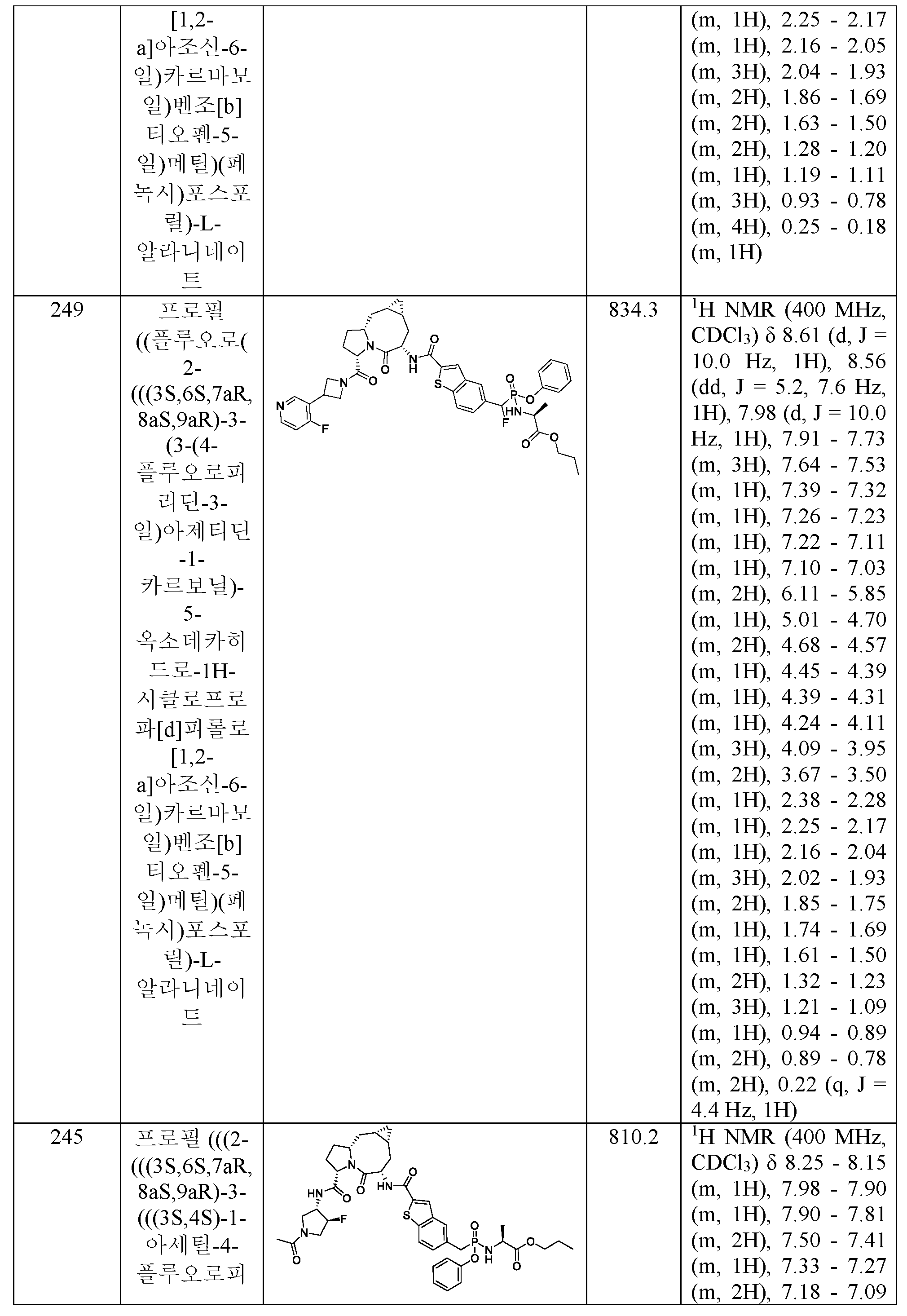


표 36의 하기 화합물을 적절한 출발 물질 및 변형을 이용하여 (디플루오로(2-(((3S,6S,7aS,8aR,9aR)-3-(3-((R)-2-메틸모르폴린-4-카르보닐)아제티딘-1-카르보닐)-5-옥소데카히드로-1H-시클로프로파[d]피롤로[1,2-a]아조신-6-일)카르바모일)벤조[b]티오펜-5-일)메틸)포스폰산 (실시예 1)의 합성에 대해 상기 기재된 대표적인 절차에 따라 제조하였다.The following compounds in Table 36 were prepared following the representative procedures described above for the synthesis of (difluoro(2-(((3S,6S,7aS,8aR,9aR)-3-(3-((R)-2-methylmorpholine-4-carbonyl)azetidine-1-carbonyl)-5-oxodecahydro-1H-cyclopropa[d]pyrrolo[1,2-a]azocin-6-yl)carbamoyl)benzo[b]thiophen-5-yl)methyl)phosphonic acid (Example 1) using appropriate starting materials and modifications.
표 36.Table 36.


생화학적 및 세포 검정Biochemical and cell assays
STAT3 형광 편광 (FP) 검정STAT3 fluorescence polarization (FP) assay
시험 물질에 대한 IC50 값을 결정하기 위해 FP 검정을 개발하였다. 25 nM의 재조합 STAT3 단백질 (STAT3 (G127-I722))을 FP 완충제 (10 mM HEPES pH 7.4, 50 mM NaCl, 1 mM EDTA, 0.05% 트윈 20, 2 mM DTT) 중에서 2 nM의 형광 표지된 포스포티로신 펩티드 프로브 (5-FAM-GpYLPQTV-NH2)와 합하였다. STAT3-프로브 혼합물 50 μL를 흑색, 96-웰 플레이트 (그라이너 바이오원(Greiner BioOne) 655076) 내의 연속 희석된 화합물에 1% DMSO의 최종 농도로 첨가하였다. 반응 성분을 혼합하고, 테칸 스파크 다중모드 플레이트 판독기를 사용하여 실온에서 45-분 인큐베이션 후에 FP를 측정하였다. FP 신호 (mP)를 시험 물질의 로그 농도에 대해 플롯팅하고, 그래프패드 프리즘 소프트웨어를 사용하여 비선형 회귀 분석에 의해 IC50 값을 계산하였다. 결과를 표 37에 제시한다. STAT3 FP 검정의 경우, A = ≤ 100 nM; B = >100-1000 nM; C = >1-10 μM; 및 D = >10 μM.A FP assay was developed to determine IC 50 values for test substances. 25 nM recombinant STAT3 protein (STAT3 (G127-I722)) was combined with 2 nM fluorescently labeled phosphotyrosine peptide probe (5-FAM-GpYLPQTV-NH 2 ) in FP buffer (10 mM HEPES pH 7.4, 50 mM NaCl, 1 mM EDTA, 0.05% Tween 20, 2 mM DTT). Fifty μL of STAT3-probe mixture was added to serially diluted compounds in black, 96-well plates (Greiner BioOne 655076) to a final concentration of 1% DMSO. The reaction components were mixed and FP was measured after 45 minutes of incubation at room temperature using a Tecan Spark multimode plate reader. FP signals (mP) were plotted against log concentration of test substance, and IC 50 values were calculated by nonlinear regression analysis using GraphPad Prism software. Results are presented in Table 37. For STAT3 FP assay, A = ≤ 100 nM; B = >100-1000 nM; C = >1-10 μM; and D = >10 μM.
STAT6 형광 편광 (FP) 검정STAT6 fluorescence polarization (FP) assay
시험 물질에 대한 IC50 값을 결정하기 위해 FP 검정을 개발하였다. 250 nM의 재조합 STAT6 단백질 (STAT6 (W123-T658))을 FP 완충제 (10 mM HEPES pH 7.4, 50 mM NaCl, 1 mM EDTA, 0.05% 트윈 20, 2 mM DTT) 중에서 2 nM의 형광 표지된 포스포티로신 펩티드 프로브 (5-FAM-ApYKPFQDLI-NH2)와 합하였다. STAT6-프로브 혼합물 50 μL를 흑색, 96-웰 플레이트 (그라이너 바이오원 655076) 내의 연속 희석된 화합물에 1% DMSO의 최종 농도로 첨가하였다. 반응 성분을 혼합하고, 테칸 스파크 다중모드 플레이트 판독기를 사용하여 실온에서 45-분 인큐베이션 후에 FP를 측정하였다. FP 신호 (mP)를 시험 물질의 로그 농도에 대해 플롯팅하고, 그래프패드 프리즘 소프트웨어를 사용하여 비선형 회귀 분석에 의해 IC50 값을 계산하였다. 결과를 표 37에 제시한다. STAT6 FP 검정의 경우, A = ≤ 300 nM; B = >300-3000 nM; C = >3-30 μM; 및 D = >30 μM.A FP assay was developed to determine IC 50 values for test substances. 250 nM recombinant STAT6 protein (STAT6 (W123-T658)) was combined with 2 nM fluorescently labeled phosphotyrosine peptide probe (5-FAM-ApYKPFQDLI-NH 2 ) in FP buffer (10 mM HEPES pH 7.4, 50 mM NaCl, 1 mM EDTA, 0.05% Tween 20, 2 mM DTT). Fifty μL of the STAT6-probe mixture was added to serially diluted compounds in a black, 96-well plate (Greiner BioOne 655076) to a final concentration of 1% DMSO. The reaction components were mixed and FP was measured after 45 minutes of incubation at room temperature using a Tecan Spark multimode plate reader. FP signals (in mP) were plotted against log concentration of test substance, and IC 50 values were calculated by nonlinear regression analysis using GraphPad Prism software. Results are presented in Table 37. For STAT6 FP assay, A = ≤ 300 nM; B = >300-3000 nM; C = >3-30 μM; and D = >30 μM.
표 37.Table 37.


MSD-pSTAT-PBMC 검정MSD-pSTAT-PBMC assay
물질:substance:
동결보존된 말초 혈액 단핵 세포 (PBMC)는 올셀즈(AllCells)로부터의 것이다. 재조합 인간 IL-4 및 IL-6은 페프로테크(Peprotech)로부터의 것이다. 마우스 모노클로날 항-STAT3 항체, 토끼 모노클로날 항-pY705-STAT3 항체, 토끼 모노클로날 항-pY641-STAT6 항체, 및 용해 완충제는 셀 시그널링 테크놀로지(Cell Signaling Technology; CST)로부터의 것이다. 마우스 모노클로날 항-STAT6 항체는 바이오레전드(BioLegend)로부터의 것이다. 검정 플레이트, 차단제, 및 항-토끼 2차 항체는 메소 스케일 디스커버리(Meso Scale Discovery; MSD)로부터의 것이다.Cryopreserved peripheral blood mononuclear cells (PBMCs) were from AllCells. Recombinant human IL-4 and IL-6 were from Peprotech. Mouse monoclonal anti-STAT3 antibody, rabbit monoclonal anti-pY705-STAT3 antibody, rabbit monoclonal anti-pY641-STAT6 antibody, and lysis buffer were from Cell Signaling Technology (CST). Mouse monoclonal anti-STAT6 antibody was from BioLegend. Assay plates, blocking agents, and anti-rabbit secondary antibodies were from Meso Scale Discovery (MSD).
검정 방법:Black method:
동결보존된 PBMC를 해동시키고, IMDM + 10% 열-불활성화된 FBS에서 밤새 회수한 후, 96-웰 U-바닥 조직 배양 플레이트에 웰당 50,000개 (STAT3) 또는 25,000개 (STAT6) 세포를 플레이팅하였다. 세포를 화합물로 3시간 동안 처리한 다음, 10 ng/mL IL-6 (STAT3) 또는 1 ng/mL IL-4 (STAT6)로 10분 동안 자극하였다. 이어서, 세포를 회전 침강시키고, 빙냉 PBS로 세척한 후, 세포 펠릿을 1x HALT 프로테아제 및 포스파타제 억제제 칵테일 (써모)을 함유하는 1x 용해 완충제 (CST)로 용해시켰다. 용해물을 웰당 30 μL의 1x PBS 중 0.6 μg/mL 마우스 모노클로날 항-STAT3 항체 (STAT3) 또는 2 μg/mL 마우스 모노클로날 항-STAT6 항체 (STAT6)로 밤새 사전-코팅된 퀵플렉스(QuickPlex) 96-웰 고결합 검정 플레이트 (MSD)로 옮기고 진탕시키면서 4℃에서 밤새 인큐베이션하고, 1시간 동안 3% 차단제-A (MSD)로 사전-차단하였다. 그 후, 검정 플레이트 내의 포획된 단백질을 세척하고, 웰당 25 μl의 1% 차단제-A 중 0.25 μg/ml 토끼 모노클로날 항-pY705-STAT3 항체 (STAT3) 또는 0.18 μg/ml 토끼 모노클로날 항-pY641-STAT6 항체 (STAT6)로 1시간 동안 실온에서 진탕시키면서 프로빙한 후, 세척하고, 웰당 25 μl의 1% 차단제-A 중 1 μg/ml 술포-태그 표지된 염소 항-토끼 항체 (MSD)로 1시간 동안 실온에서 진탕시키면서 프로빙하였다. 이어서, 검정 플레이트를 세척하고, 1x 판독 완충제-T(MSD) 150 μL를 각 웰에 첨가한 후, SQ120 MSD 플레이트 판독기 상에서 판독하였다. 각각의 샘플로부터의 검정 신호를 비자극 대조군 웰로부터의 신호에 의해 차감하고, DMSO 대조군 웰에 대해 정규화하였다. IC50 값을 가변 기울기를 갖는 그래프 패드 프리즘 용량-반응 비선형 회귀를 사용하여 계산하였다. 결과를 표 38에 제시한다. pSTAT3 및 pSTAT6 둘 다에 대해 A = ≤ 100 nM; B = >100-1000 nM; C = >1000-3000 nM; 및 D = >3 μM.Cryopreserved PBMCs were thawed, harvested overnight in IMDM + 10% heat-inactivated FBS, and plated at 50,000 (STAT3) or 25,000 (STAT6) cells per well in 96-well U-bottom tissue culture plates. Cells were treated with compounds for 3 h and then stimulated with 10 ng/mL IL-6 (STAT3) or 1 ng/mL IL-4 (STAT6) for 10 min. Cells were then spun down, washed with ice-cold PBS, and the cell pellet was lysed in 1x lysis buffer (CST) containing 1x HALT protease and phosphatase inhibitor cocktail (Thermo). Lysates were transferred to QuickPlex 96-well high binding assay plates (MSD) pre-coated overnight with 0.6 μg/mL mouse monoclonal anti-STAT3 antibody (STAT3) or 2 μg/mL mouse monoclonal anti-STAT6 antibody (STAT6) in 30 μL 1x PBS per well and incubated overnight at 4°C with shaking, and pre-blocked with 3% blocking reagent-A (MSD) for 1 hour. The captured proteins in the assay plates were then washed and probed with 0.25 μg/ml rabbit monoclonal anti-pY705-STAT3 antibody (STAT3) or 0.18 μg/ml rabbit monoclonal anti-pY641-STAT6 antibody (STAT6) in 25 μl per well of 1% Blocker-A for 1 hour at room temperature with shaking, then washed and probed with 1 μg/ml sulfo-tag labeled goat anti-rabbit antibody (MSD) in 25 μl per well of 1% Blocker-A for 1 hour at room temperature with shaking. The assay plates were then washed, 150 μL of 1x Read Buffer-T (MSD) was added to each well, and read on a SQ120 MSD plate reader. The assay signal from each sample was subtracted by the signal from the unstimulated control wells and normalized to the DMSO control wells. IC 50 values were calculated using GraphPad Prism dose-response nonlinear regression with variable slope. Results are presented in Table 38. For both pSTAT3 and pSTAT6, A = ≤ 100 nM; B = >100-1000 nM; C = >1000-3000 nM; and D = >3 μM.
표 38.Table 38.


본 발명자들이 다수의 실시양태를 기재하였지만, 본 발명자들의 기본 실시예는 본 발명의 화합물 및 방법을 이용하는 다른 실시양태를 제공하도록 변경될 수 있음이 명백하다. 따라서, 본 발명의 범주는 예로서 제시된 구체적 실시양태에 의해서가 아니라 첨부된 청구범위에 의해 정의되어야 함이 인지될 것이다.While the inventors have described a number of embodiments, it is apparent that the inventors' basic embodiments may be modified to provide other embodiments utilizing the compounds and methods of the present invention. Accordingly, it is to be recognized that the scope of the present invention should be defined by the appended claims, rather than by the specific embodiments presented by way of example.
본 출원 전반에 걸쳐 인용된 모든 참고문헌 (문헌 참조물, 허여된 특허, 공개된 특허 출원, 및 동시-계류 중인 특허 출원 포함)의 내용은 이로써 그 전문이 본원에 명백하게 참조로 포함된다. 달리 정의되지 않는 한, 본원에 사용된 모든 기술 과학 용어는 관련 기술분야의 통상의 기술자에게 통상적으로 공지된 의미와 일치한다.The contents of all references (including literature references, issued patents, published patent applications, and co-pending patent applications) cited throughout this application are hereby expressly incorporated herein by reference in their entirety. Unless otherwise defined, all technical and scientific terms used herein have the same meaning as commonly known to one of ordinary skill in the art.
Claims (60)

여기서:
q는 0 또는 1이고, t는 0, 1 또는 2이며, 단 q 또는 t 중 적어도 1개는 1이고;
p는 1 또는 2이고;
R1은 -CR1aR2aP(O)OR1bOR2b, -CR1aR2aP(O)[OR1b][NH(AA)C(O)ORT], -CR1aR2aP(O)[NHRTy][NH(AA)C(O)ORT], -P(O)OR1bOR2b, -[P(O)[NHRTy][NH(AA)C(O)ORT], -CR1aR2aP(O)[NH(AA)C(O)ORT]][NH(AA)C(O)ORT], 또는 -P(O)[OR1b][NH(AA)C(O)ORT]로 치환된 8- 내지 10-원 융합된 비시클릭 헤테로아릴; -CR1aR2aP(O)OR1bOR2b, -CR1aR2aP(O)[OR1b][NH(AA)C(O)ORT], -CR1aR2aP(O)[NHRTy][NH(AA)C(O)ORT], -P(O)OR1bOR2b, -[P(O)[NHRTy][NH(AA)C(O)ORT], -CR1aR2aP(O)[NH(AA)C(O)ORT]][NH(AA)C(O)ORT], 또는 -P(O)[OR1b][NH(AA)C(O)ORT]로 치환된 8- 내지 10-원 융합된 비시클릭 헤테로시클릴; -CR1aR2aP(O)OR1bOR2b, -CR1aR2aP(O)[OR1b][NH(AA)C(O)ORT], -CR1aR2aP(O)[NHRTy][NH(AA)C(O)ORT], -P(O)OR1bOR2b, -[P(O)[NHRTy][NH(AA)C(O)ORT], -CR1aR2aP(O)[NH(AA)C(O)ORT]][NH(AA)C(O)ORT], 또는 -P(O)[OR1b][NH(AA)C(O)ORT]로 치환된 아릴; -(C1-C4)알킬(아릴)의 아릴 부분이 -CR1aR2aP(O)OR1bOR2b, -CR1aR2aP(O)[OR1b][NH(AA)C(O)ORT], -CR1aR2aP(O)[NHRTy][NH(AA)C(O)ORT], -P(O)OR1bOR2b, -[P(O)[NHRTy][NH(AA)C(O)ORT], -CR1aR2aP(O)[NH(AA)C(O)ORT]][NH(AA)C(O)ORT], 또는 -P(O)[OR1b][NH(AA)C(O)ORT]로 치환된 -(C1-C4)알킬(아릴); 및 -(C2-C4)알케닐(아릴)의 아릴 부분이 -CR1aR2aP(O)OR1bOR2b, -CR1aR2aP(O)[OR1b][NH(AA)C(O)ORT], -CR1aR2aP(O)[NHRTy][NH(AA)C(O)ORT], -P(O)OR1bOR2b, -[P(O)[NHRTy][NH(AA)C(O)ORT], -CR1aR2aP(O)[NH(AA)C(O)ORT]][NH(AA)C(O)ORT], 또는 -P(O)[OR1b][NH(AA)C(O)ORT]로 치환된 -(C2-C4)알케닐(아릴)로부터 선택되고;
R1a 및 R2a는 각각 독립적으로 수소, 시아노, (C1-C4)알킬, 히드록시(C1-C4)알킬 및 플루오로로부터 선택되거나; 또는 R1a 및 R2a는 이들이 부착되어 있는 탄소와 함께 옥소를 형성하고;
R1b 및 R2b는 각각 독립적으로 수소, (C1-C4)알킬, 할로(C1-C4)알킬, -[(C1-C4)알킬]-OC(O)-[(C1-C4)알킬], -[(C1-C4)알킬]-C(O)O-[(C1-C4)알킬], -[(C1-C4)알킬]-O-[(C1-C20)알킬], -[(C1-C4)알킬]-OC(O)-[할로(C1-C4)알킬], [(C1-C4)알킬]-OC(O)O-[5- 내지 7-원 헤테로시클릴], [(C1-C4)알킬]-OC(O)-[5- 내지 7-원 헤테로시클릴], -[(C1-C4)알킬]-OC(O)-[(C1-C4)알킬]-OH, -[(C1-C4)알킬]-OC(O)-[(C1-C4)알킬]-O-[(C1-C4)알킬], -[(C1-C4)알킬]-OC(O)O-[(C1-C4)알킬], -[(C1-C4)알킬]-OC(O)O-[할로(C1-C4)알킬], -[(C1-C4)알킬]-OC(O)O-[(C1-C4)알킬]-OH, -[(C1-C4)알킬]-OC(O)O-[(C1-C4)알킬]-O-[(C1-C4)알킬], -[(C1-C4)알킬페닐]-C(O)O-[(C1-C4)알킬], -[(C1-C4)알킬]-OC(O)-[NH(AA)C(O)ORT], -[(C1-C4)알킬]-SC(O)-[(C1-C4)알킬], -[(C1-C4)알킬]-SC(O)-[할로(C1-C4)알킬], -[(C1-C4)알킬]-SC(O)-[(C1-C4)알킬]-OH, -[(C1-C4)알킬]-SC(O)-[(C1-C4)알킬]-O-[(C1-C4)알킬], -[(C1-C4)알킬]-OC(O)NH(C1-C4)알킬], -[(C1-C4)알킬]-OC(O)N[(C1-C4)알킬]2 및 아릴로부터 선택되고, 여기서 상기 5- 내지 6-원 헤테로아릴 및 아릴은 각각 원자가가 허용하는 바에 따라 할로, 시아노 및 (C1-C4)알킬로부터 선택된 1 내지 2개의 기로 임의로 및 독립적으로 치환되고, 여기서 상기 [(C1-C4)알킬]-OC(O)O-[5- 내지 7-원 헤테로시클릴] 및 [(C1-C4)알킬]-OC(O)-[5- 내지 7-원 헤테로시클릴]의 5- 내지 7-원 헤테로시클릴은 각각 원자가가 허용하는 바에 따라 C(O)ORh로부터 선택된 1 내지 2개의 기로 임의로 및 독립적으로 치환되고;
R2는 수소, 할로, (C1-C4)알킬, 할로(C1-C4)알킬, (C1-C4)알콕시, 할로(C1-C4)알콕시, 히드록시(C1-C4)알킬, 시아노, 및 히드록실로부터 선택되고;
R3 및 R4는 각각 독립적으로 수소, 할로 및 (C1-C4)알킬로부터 선택되고;
R5 및 R6은 각각 독립적으로 수소, 페닐 및 (C1-C4)알킬로부터 선택되고;
R7은 (C1-C4)알킬, 페닐, 4- 내지 9-원 모노시클릭 또는 비시클릭 헤테로시클릴, 및 5- 내지 10-원 모노시클릭 또는 비시클릭 헤테로아릴로부터 선택되고, 여기서 상기 (C1-C4)알킬은 원자가가 허용하는 바에 따라 RY로부터 선택된 1 내지 3개의 기로 임의로 치환되고, 상기 페닐, 4- 내지 9-원 모노시클릭 또는 비시클릭 헤테로시클릴, 및 5- 내지 10-원 모노시클릭 또는 비시클릭 헤테로아릴은 각각 원자가가 허용하는 바에 따라 RZ로부터 선택된 1 내지 3개의 기로 임의로 치환되거나; 또는
R6 및 R7은 이들이 부착되어 있는 질소 원자와 함께 4- 내지 14-원 모노시클릭 또는 비시클릭 헤테로시클릴 또는 5- 내지 12-원 모노시클릭 또는 비시클릭 헤테로아릴을 형성하고, 이들 각각은 원자가가 허용하는 바에 따라 RQ로부터 선택된 1 내지 3개의 기로 임의로 치환되고;
R8은 수소 또는 (C1-C4)알킬이고;
AA는 알파 또는 베타 천연 또는 비-천연 아미노산의 잔기이고;
RT 및 RTy는 각각 독립적으로 (C1-C4)알킬, (C1-C4)알킬-C(O)O(C1-C4)알킬, 벤질 및 페닐로부터 선택되고, 여기서 상기 페닐은 할로, (C1-C4)알킬, 및 할로(C1-C4)알킬로부터 선택된 1 또는 2개의 기로 임의로 치환되고;
RQ는 할로, (C2-C4)알케닐, (C1-C4)알킬, (C1-C4)알콕시, 할로(C1-C4)알콕시, 시아노, 페닐, 히드록실, 4- 내지 9-원 모노시클릭 또는 비시클릭 헤테로시클릴, 5- 내지 10-원 모노시클릭 또는 비시클릭 헤테로아릴, (C3-C6)시클로알킬, 옥소, 이미노, -ORe, -C(O)Rg, -C(O)ORe, -NRcC(O)Re, -C(O)NRcRd, -NRaRb, -S(O)ReRf, -S(O)2Rf, -S(O)=NH(C1-C4)알킬, -S(O)NReRf, 및 -S(O)2NReRf로부터 선택되고, 여기서 상기 (C2-C4)알케닐 및 (C1-C4)알킬은 각각 원자가가 허용하는 바에 따라 RM으로부터 선택된 1 내지 3개의 기로 임의로 및 독립적으로 치환되고, 여기서 상기 페닐, 5- 내지 10-원 모노시클릭 또는 비시클릭 헤테로아릴, (C3-C6)시클로알킬, 및 4- 내지 9-원 모노시클릭 또는 비시클릭 헤테로시클릴은 각각 원자가가 허용하는 바에 따라 RF로부터 선택된 1 내지 3개의 기로 임의로 및 독립적으로 치환되고;
RY는 할로, (C1-C4)알콕시, 할로(C1-C4)알콕시, 시아노, -C(O)Rg, -C(O)ORe, -NHC(O)Re, -NRaRb, -S(O)ReRf, -S(O)2Rf, -S(O)NReRf, -S(O)=NH(C1-C4)알킬, -S(O)2NReRf, 히드록실, 페닐, 4- 내지 6-원 헤테로시클릴, 및 5- 내지 10-원 모노시클릭 또는 비시클릭 헤테로아릴로부터 선택되고, 여기서 상기 페닐, 4- 내지 6-원 헤테로시클릴, 및 5- 내지 10-원 모노시클릭 또는 비시클릭 헤테로아릴은 각각 원자가가 허용하는 바에 따라 RX로부터 선택된 1 내지 3개의 기로 임의로 치환되고;
RM 및 RJ는 각각 독립적으로 할로, (C1-C4)알킬, (C1-C4)알콕시, 할로(C1-C4)알콕시, 시아노, -C(O)Rg, -C(O)ORe, -NHC(O)Re, -C(O)NRcRd, -NRaRb, -S(O)ReRf, -S(O)2Rf, -S(O)NReRf, -S(O)=NRe(C1-C4)알킬, -S(O)2NReRf, 히드록실, 페닐, 4- 내지 6-원 헤테로시클릴, 및 5- 내지 10-원 모노시클릭 또는 비시클릭 헤테로아릴로부터 선택되고, 여기서 상기 페닐, 4- 내지 6-원 헤테로시클릴, 및 5- 내지 10-원 모노시클릭 또는 비시클릭 헤테로아릴은 각각 원자가가 허용하는 바에 따라 RX로부터 선택된 1 내지 3개의 기로 임의로 치환되고;
RF, RX 및 RZ는 각각 독립적으로 할로, 시아노, (C1-C4)알킬, 시아노(C1-C4)알킬, (C3-C6)시클로알킬, 할로(C1-C4)알킬, -(C1-C4)알킬C(O)NRcRd, -(C1-C4)알킬(C1-C4)알콕시, 히드록시(C1-C4)알킬, -(C1-C4)알킬페닐, -(C1-C4)알킬헤테로아릴, (C2-C4)알케닐, 할로(C2-C4)알케닐, (C2-C4)알키닐, 할로(C2-C4)알키닐, (C1-C4)알콕시, 할로(C1-C4)알콕시, -ORe, 옥소, 이미노, 페닐, 4- 내지 6-원 헤테로시클릴, 5- 내지 6-원 모노시클릭 헤테로아릴, -S(O)ReRf, -S(O)2Rf, -S(O)=NH(C1-C4)알킬, -S(O)NReRf, -S(O)2NReRf, -C(O)ORe, -NRcC(O)Re, -(C1-C4알킬)C(O)Rg, -C(O)Rg, -C(O)NRcRd, NO2 및 -NRaRb로부터 선택되고, 여기서 상기 페닐, 상기 4- 내지 6-원 헤테로시클릴, 및 상기 -(C1-C4)알킬페닐에 대한 페닐은 각각 원자가가 허용하는 바에 따라 할로, 시아노, 옥소, (C1-C10)알킬, (C2-C10)알케닐, (C2-C10)알키닐, 할로(C1-C10)알킬, (C1-C10)알콕시, -(C1-C4)알킬(C1-C4)알콕시 및 할로(C1-C10)알콕시로부터 선택된 1 내지 3개의 기로 임의로 및 독립적으로 치환되고, 여기서 상기 (C1-C10)알킬, (C2-C10)알케닐 및 (C2-C10)알키닐은 각각 원자가가 허용하는 바에 따라 5- 내지 10-원 모노시클릭 또는 비시클릭 헤테로아릴 또는 4- 내지 10-원 모노시클릭 또는 비시클릭 헤테로시클릴로 임의로 치환되고, 각각의 상기 5- 내지 10-원 모노시클릭 및 비시클릭 헤테로아릴 또는 4- 내지 10-원 모노시클릭 또는 비시클릭 헤테로시클릴은 옥소 또는 1 내지 2개의 옥소로 임의로 치환된 5- 내지 7-원 헤테로시클릴로 임의로 치환되고;
Ra, Rb, Rc, Rd, Re, Rf, Rg, 및 Rh는 각각 독립적으로 원자가가 허용하는 바에 따라 수소, (C1-C4)알킬, (C2-C4)알키닐, -(C1-C4)알킬페닐, 페닐, (C3-C6)시클로알킬, 4- 내지 6-원 헤테로시클릴 및 5- 내지 6-원 헤테로아릴로부터 선택되고, 여기서 상기 (C1-C4)알킬은 원자가가 허용하는 바에 따라 RJ로부터 선택된 1 내지 3개의 기로 임의로 치환되고, 상기 페닐, (C3-C6)시클로알킬, 4- 내지 6-원 헤테로시클릴, 및 5- 내지 6-원 헤테로아릴은 각각 원자가가 허용하는 바에 따라 할로, 시아노, (C1-C4)알킬, 할로(C1-C4)알킬, (C1-C4)알콕시, 할로(C1-C4)알콕시, 히드록실, 페닐, 및 벤질로부터 선택된 1 내지 3개의 기로 독립적으로 임의로 치환된다.A compound having the following structural formula I or a pharmaceutically acceptable salt thereof:
Here:
q is 0 or 1, and t is 0, 1, or 2, provided that at least one of q or t is 1;
p is 1 or 2;
R 1 is an 8- to 10-membered fused bicyclic heteroaryl substituted with -CR 1a R 2a P(O)OR 1b OR 2b , -CR 1a R 2a P(O)[OR 1b ][NH(AA)C(O)OR T ] , -CR 1a R 2a P(O)[NHR Ty ][NH(AA)C(O)OR T ], -P(O)OR 1b OR 2b , -[P(O)[NHR Ty ][NH(AA)C(O)OR T ], -CR 1a R 2a P(O)[NH(AA)C(O)OR T ]][NH(AA)C(O)OR T ], or -P(O)[OR 1b ][NH(AA)C(O)OR T ]; -CR 1a R 2a P(O)OR 1b OR 2b , -CR 1a R 2a P(O)[OR 1b ][NH(AA)C(O)OR T ], -CR 1a R 2a P(O)[NHR Ty ][NH(AA)C(O)OR T ], -P(O)OR 1b OR 2b , -[P(O)[NHR Ty ][NH(AA)C(O)OR T ], -CR 1a R 2a P(O)[NH(AA)C(O)OR T ]][NH(AA)C(O)OR T ], or -P(O)[OR 1b ][NH(AA)C(O)OR T ]; -CR 1a R 2a P(O)OR 1b OR 2b , -CR 1a R 2a P(O)[OR 1b ][NH(AA)C(O)OR T ], -CR 1a R 2a P(O)[NHR Ty ][NH(AA)C(O)OR T ], -P(O)OR 1b OR 2b , -[P(O)[NHR Ty aryl substituted with ][NH(AA)C(O)OR T ], -CR 1a R 2a P(O)[NH(AA)C(O)OR T ]][NH(AA)C(O)OR T ], or -P(O)[OR 1b ][NH(AA)C(O)OR T ]; -(C 1 -C 4 )alkyl(aryl) wherein the aryl moiety of -(C 1 -C 4 )alkyl(aryl) is substituted with -CR 1a R 2a P(O)OR 1b OR 2b , -CR 1a R 2a P(O)[OR 1b ][NH(AA)C(O)OR T ], -CR 1a R 2a P(O)[NHR Ty ][NH(AA)C(O)OR T ], -P(O)OR 1b OR 2b , -[P(O)[NHR Ty ][NH(AA)C(O)OR T ], -CR 1a R 2a P(O)[NH(AA)C(O)OR T ]][NH(AA)C(O)OR T ], or -P(O)[OR 1b ][NH(AA)C( O ) OR T ]; and the aryl portion of -(C 2 -C 4 )alkenyl(aryl) is -CR 1a R 2a P(O)OR 1b OR 2b , -CR 1a R 2a P(O)[OR 1b ][NH(AA)C(O)OR T ], -CR 1a R 2a P(O)[NHR Ty ][NH(AA)C(O)OR T ], -P(O)OR 1b OR 2b , -[P(O)[NHR Ty ][NH(AA)C(O)OR T ], -CR 1a R 2a P(O)[NH(AA)C(O)OR T ]][NH(AA)C(O)OR T ], or -(C 2 -C 4 substituted with -P(O)[OR 1b ][NH(AA)C(O)OR T ] ) is selected from alkenyl(aryl);
R 1a and R 2a are each independently selected from hydrogen, cyano, (C 1 -C 4 )alkyl, hydroxy(C 1 -C 4 )alkyl and fluoro; or R 1a and R 2a together with the carbon to which they are attached form oxo;
R 1b and R 2b are each independently hydrogen, (C 1 -C 4 )alkyl, halo(C 1 -C 4 )alkyl, -[(C 1 -C 4 )alkyl]-OC(O)-[(C 1 -C 4 )alkyl], -[(C 1 -C 4 )alkyl]-C(O)O-[(C 1 -C 4 )alkyl], -[(C 1 -C 4 )alkyl]-O-[(C 1 -C 20 )alkyl], -[(C 1 -C 4 )alkyl]-OC(O)-[halo(C 1 -C 4 )alkyl], [(C 1 -C 4 )alkyl]-OC(O)O-[5- to 7-membered heterocyclyl], [(C 1 -C 4 )alkyl]-OC(O)-[5- to 7-membered heterocyclyl], -[(C 1 -C 4 )alkyl]-OC(O)-[(C 1 -C 4 )alkyl]-OH, -[(C 1 -C 4 )alkyl]-OC(O)-[(C 1 -C 4 )alkyl]-O-[(C 1 -C 4 )alkyl], -[(C 1 -C 4 )alkyl]-OC(O)O-[(C 1 -C 4 )alkyl], -[(C 1 -C 4 )alkyl]-OC(O)O-[halo(C 1 -C 4 )alkyl], -[(C 1 -C 4 )alkyl]-OC(O)O-[(C 1 -C 4 )alkyl]-OH, -[(C 1 -C 4 )alkyl]-OC(O)O-[(C 1 -C 4 )alkyl]-O-[(C 1 -C 4 ) alkyl], -[(C 1 -C 4 ) alkylphenyl]-C(O)O-[(C 1 -C 4 ) alkyl], -[(C 1 -C 4 ) alkyl]-OC(O)-[NH(AA)C(O)OR T ], -[(C 1 -C 4 ) alkyl]-SC(O)-[(C 1 -C 4 ) alkyl], -[(C 1 -C 4 ) alkyl]-SC(O)-[halo(C 1 -C 4 ) alkyl], -[(C 1 -C 4 ) alkyl]-SC(O)-[(C 1 -C 4 ) alkyl]-OH, -[(C 1 -C 4 ) alkyl]-SC(O)-[(C 1 -C 4 ) alkyl]-O-[(C 1 -C 4 ) alkyl], -[(C 1 -C 4 )alkyl]-OC(O)NH(C 1 -C 4 )alkyl], -[(C 1 -C 4 )alkyl]-OC(O)N[(C 1 -C 4 )alkyl] 2 and aryl, wherein said 5- to 6-membered heteroaryl and aryl are each optionally and independently substituted with 1 to 2 groups selected from halo, cyano and (C 1 -C 4 )alkyl as valence permits, and wherein the 5- to 7-membered heterocyclyl of said [(C 1 -C 4 )alkyl]-OC(O)O-[5- to 7-membered heterocyclyl] and [(C 1 -C 4 )alkyl]-OC(O)-[5- to 7-membered heterocyclyl] are each optionally and independently substituted with 1 to 2 groups selected from C(O)OR h as valence permits;
R 2 is selected from hydrogen, halo, (C 1 -C 4 )alkyl, halo(C 1 -C 4 )alkyl, (C 1 -C 4 )alkoxy, halo(C 1 -C 4 )alkoxy, hydroxy(C 1 -C 4 )alkyl, cyano, and hydroxyl;
R 3 and R 4 are each independently selected from hydrogen, halo and (C 1 -C 4 )alkyl;
R 5 and R 6 are each independently selected from hydrogen, phenyl and (C 1 -C 4 )alkyl;
R 7 is selected from (C 1 -C 4 )alkyl, phenyl, 4- to 9-membered monocyclic or bicyclic heterocyclyl, and 5- to 10-membered monocyclic or bicyclic heteroaryl, wherein said (C 1 -C 4 )alkyl is optionally substituted with 1 to 3 groups selected from R Y as valence permits, and said phenyl, 4- to 9-membered monocyclic or bicyclic heterocyclyl, and 5- to 10-membered monocyclic or bicyclic heteroaryl are each optionally substituted with 1 to 3 groups selected from R Z as valence permits; or
R 6 and R 7 together with the nitrogen atom to which they are attached form a 4- to 14-membered monocyclic or bicyclic heterocyclyl or a 5- to 12-membered monocyclic or bicyclic heteroaryl, each of which is optionally substituted with 1 to 3 groups selected from R Q as valence permits;
R 8 is hydrogen or (C 1 -C 4 )alkyl;
AA is a residue of an alpha or beta natural or unnatural amino acid;
R T and R Ty are each independently selected from (C 1 -C 4 )alkyl, (C 1 -C 4 )alkyl-C(O)O(C 1 -C 4 )alkyl, benzyl and phenyl, wherein said phenyl is optionally substituted with 1 or 2 groups selected from halo, (C 1 -C 4 )alkyl, and halo(C 1 -C 4 )alkyl;
R Q is halo, (C 2 -C 4 )alkenyl, (C 1 -C 4 )alkyl, (C 1 -C 4 )alkoxy, halo(C 1 -C 4 )alkoxy, cyano, phenyl, hydroxyl, 4- to 9-membered monocyclic or bicyclic heterocyclyl, 5- to 10-membered monocyclic or bicyclic heteroaryl, (C 3 -C 6 )cycloalkyl, oxo, imino, -OR e , -C(O)R g , -C(O)OR e , -NR c C(O)R e , -C(O)NR c R d , -NR a R b , -S(O)R e R f , -S(O) 2 R f , -S(O)=NH(C 1 -C 4 )alkyl, -S(O)NR e R f , and -S(O) 2 NR e R f , wherein said (C 2 -C 4 )alkenyl and (C 1 -C 4 )alkyl are each optionally and independently substituted with 1 to 3 groups selected from R M as valence permits, and wherein said phenyl, 5- to 10-membered monocyclic or bicyclic heteroaryl, (C 3 -C 6 )cycloalkyl, and 4- to 9-membered monocyclic or bicyclic heterocyclyl are each optionally and independently substituted with 1 to 3 groups selected from R F as valence permits;
R Y is selected from halo, (C 1 -C 4 )alkoxy, halo(C 1 -C 4 )alkoxy, cyano, -C(O)R g , -C(O)OR e , -NHC(O)R e , -NR a R b , -S(O)R e R f , -S(O) 2 R f , -S(O)NR e R f , -S(O)=NH(C 1 -C 4 )alkyl, -S(O) 2 NR e R f , hydroxyl, phenyl, 4- to 6-membered heterocyclyl, and 5- to 10-membered monocyclic or bicyclic heteroaryl, wherein said phenyl, 4- to 6-membered heterocyclyl, and 5- to 10-membered monocyclic or bicyclic heteroaryl are each selected as valence permits. R is optionally substituted with 1 to 3 groups selected from X ;
R M and R J are each independently selected from halo, (C 1 -C 4 )alkyl, (C 1 -C 4 )alkoxy, halo(C 1 -C 4 )alkoxy, cyano, -C(O)R g , -C(O)OR e , -NHC(O)R e , -C(O)NR c R d , -NR a R b , -S(O)R e R f , -S(O) 2 R f , -S(O)NR e R f , -S(O)=NR e (C 1 -C 4 )alkyl, -S(O) 2 NR e R f , hydroxyl, phenyl, 4- to 6-membered heterocyclyl, and 5- to 10-membered monocyclic or bicyclic heteroaryl, wherein said phenyl, 4- to 6-membered heterocyclyl, and A 5- to 10-membered monocyclic or bicyclic heteroaryl is optionally substituted with 1 to 3 groups selected from R X , each as valence permits;
R F , R X and R Z are each independently halo, cyano, (C 1 -C 4 )alkyl, cyano(C 1 -C 4 )alkyl, (C 3 -C 6 )cycloalkyl, halo(C 1 -C 4 )alkyl, -(C 1 -C 4 )alkylC(O)NR c R d , -(C 1 -C 4 )alkyl(C 1 -C 4 )alkoxy, hydroxy(C 1 -C 4 )alkyl, -(C 1 -C 4 )alkylphenyl, -(C 1 -C 4 )alkylheteroaryl, (C 2 -C 4 )alkenyl, halo(C 2 -C 4 )alkenyl, (C 2 -C 4 )alkynyl, halo(C 2 -C 4 )alkynyl, (C 1 -C 4 )alkoxy, halo(C 1 -C 4 )alkoxy, -OR e , oxo, imino, phenyl, 4- to 6-membered heterocyclyl, 5- to 6-membered monocyclic heteroaryl, -S(O)R e R f , -S(O) 2 R f , -S(O)=NH(C 1 -C 4 )alkyl, -S(O)NR e R f , -S(O) 2 NR e R f , -C(O)OR e , -NR c C(O)R e , -(C 1 -C 4 alkyl)C(O)R g , -C(O)R g , -C(O)NR c R d , NO 2 and -NR a R b , wherein said phenyl, said 4- to 6-membered heterocyclyl, and said -(C 1 -C 4 ) Phenyl in alkylphenyl is optionally and independently substituted with 1 to 3 groups selected from halo, cyano, oxo, (C 1 -C 10 )alkyl, (C 2 -C 10 )alkenyl, (C 2 -C 10 )alkynyl, halo(C 1 -C 10 )alkyl, (C 1 -C 10 )alkoxy, -(C 1 -C 4 )alkyl(C 1 -C 4 )alkoxy and halo(C 1 -C 10 )alkoxy, as permitted by the valence, wherein said (C 1 -C 10 )alkyl, (C 2 -C 10 )alkenyl and (C 2 -C 10 )alkynyl are each optionally and independently substituted with 1 to 3 groups selected from halo, cyano, oxo, (C 1 -C 10 )alkyl, (C 2 -C 10 )alkenyl, (C 2 -C 10 )alkynyl, as permitted by the valence, wherein said (C 1 -C 10 )alkyl, (C 2 -C 10 )alkenyl and (C 2 -C 10 )alkynyl are each optionally and independently substituted with 1 to 3 groups selected from halo, cyano, oxo, (C 1 -C 10 )alkyl, (C 2 -C 10 )alkenyl and (C 2 -C 10 )alkynyl, as permitted by the valence, selected from 5- to 10-membered monocyclic or bicyclic heteroaryl or 4- to 10-membered monocyclic or optionally substituted with a bicyclic heterocyclyl, wherein each of said 5- to 10-membered monocyclic and bicyclic heteroaryl or 4- to 10-membered monocyclic or bicyclic heterocyclyl is optionally substituted with oxo or a 5- to 7-membered heterocyclyl optionally substituted with 1 to 2 oxo;
R a , R b , R c , R d , R e , R f , R g , and R h are each independently selected from hydrogen, (C 1 -C 4 )alkyl, (C 2 -C 4 )alkynyl, -(C 1 -C 4 )alkylphenyl, phenyl, (C 3 -C 6 )cycloalkyl, 4- to 6-membered heterocyclyl, and 5- to 6-membered heteroaryl, as permitted by the valence, wherein said (C 1 -C 4 )alkyl is optionally substituted with 1 to 3 groups selected from R J as permitted by the valence, and said phenyl, (C 3 -C 6 )cycloalkyl, 4- to 6-membered heterocyclyl, and 5- to 6-membered heteroaryl are each independently selected from halo, cyano, (C 1 -C 4 )alkyl, (C 2 -C 4 )alkynyl, -(C 1 -C 4 )alkylphenyl, phenyl, (C 3 -C 6 )cycloalkyl, 4- to 6-membered heterocyclyl, and 5- to 6-membered heteroaryl, as permitted by the valence )alkyl, halo(C 1 -C 4 )alkyl, (C 1 -C 4 )alkoxy, halo(C 1 -C 4 )alkoxy, hydroxyl, phenyl, and benzyl.


으로부터 선택되는 것인 화합물 또는 그의 제약상 허용되는 염.In any one of claims 1 to 14, R 1
A compound selected from or a pharmaceutically acceptable salt thereof.

으로부터 선택되는 것인 화합물 또는 그의 제약상 허용되는 염.In any one of claims 1 to 15, R 1
A compound selected from or a pharmaceutically acceptable salt thereof.


으로부터 선택되는 것인 화합물 또는 그의 제약상 허용되는 염.In any one of claims 1 to 17 and 22, -CR 1a R 2a P(O)OR 1b OR 2b
A compound selected from or a pharmaceutically acceptable salt thereof.


으로부터 선택되는 것인 화합물 또는 그의 제약상 허용되는 염.In any one of claims 1 to 16 and 28 to 30, -CR 1a R 2a P(O)[OR 1b ][NH(AA)C(O)OR T ]
A compound selected from or a pharmaceutically acceptable salt thereof.


으로부터 선택되는 것인 화합물 또는 그의 제약상 허용되는 염.In any one of claims 1 to 16 and 28 to 30, -CR 1a R 2a P(O)[OR 1b ][NH(AA)C(O)OR T ]
A compound selected from or a pharmaceutically acceptable salt thereof.
Applications Claiming Priority (5)
| Application Number | Priority Date | Filing Date | Title |
|---|---|---|---|
| US202263325908P | 2022-03-31 | 2022-03-31 | |
| US63/325,908 | 2022-03-31 | ||
| US202263337388P | 2022-05-02 | 2022-05-02 | |
| US63/337,388 | 2022-05-02 | ||
| PCT/US2023/065171 WO2023192960A1 (en) | 2022-03-31 | 2023-03-30 | Stat modulators and uses thereof |
Publications (1)
| Publication Number | Publication Date |
|---|---|
| KR20240167892A true KR20240167892A (en) | 2024-11-28 |
Family
ID=86054105
Family Applications (1)
| Application Number | Title | Priority Date | Filing Date |
|---|---|---|---|
| KR1020247035865A Pending KR20240167892A (en) | 2022-03-31 | 2023-03-30 | STAT modulators and their uses |
Country Status (11)
| Country | Link |
|---|---|
| US (1) | US20250215030A1 (en) |
| EP (1) | EP4499656A1 (en) |
| JP (1) | JP2025514628A (en) |
| KR (1) | KR20240167892A (en) |
| CN (1) | CN119183453A (en) |
| AU (1) | AU2023244363A1 (en) |
| CA (1) | CA3253876A1 (en) |
| CO (1) | CO2024013985A2 (en) |
| IL (1) | IL316050A (en) |
| MX (1) | MX2024012029A (en) |
| WO (1) | WO2023192960A1 (en) |
Families Citing this family (16)
| Publication number | Priority date | Publication date | Assignee | Title |
|---|---|---|---|---|
| TW202508595A (en) | 2023-05-04 | 2025-03-01 | 美商銳新醫藥公司 | Combination therapy for a ras related disease or disorder |
| WO2024238603A2 (en) * | 2023-05-15 | 2024-11-21 | Recludix Pharma, Inc. | Stat degraders and uses thereof |
| US20250049810A1 (en) | 2023-08-07 | 2025-02-13 | Revolution Medicines, Inc. | Methods of treating a ras protein-related disease or disorder |
| AU2024360465A1 (en) | 2023-10-12 | 2026-04-09 | Revolution Medicines, Inc. | Macrocyclic ras inhibitors |
| WO2025171296A1 (en) | 2024-02-09 | 2025-08-14 | Revolution Medicines, Inc. | Ras inhibitors |
| TW202547461A (en) | 2024-05-17 | 2025-12-16 | 美商銳新醫藥公司 | Ras inhibitors |
| WO2025255438A1 (en) | 2024-06-07 | 2025-12-11 | Revolution Medicines, Inc. | Methods of treating a ras protein-related disease or disorder |
| WO2025265060A1 (en) | 2024-06-21 | 2025-12-26 | Revolution Medicines, Inc. | Therapeutic compositions and methods for managing treatment-related effects |
| WO2026006747A1 (en) | 2024-06-28 | 2026-01-02 | Revolution Medicines, Inc. | Ras inhibitors |
| WO2026015801A1 (en) | 2024-07-12 | 2026-01-15 | Revolution Medicines, Inc. | Methods of treating a ras related disease or disorder |
| WO2026015790A1 (en) | 2024-07-12 | 2026-01-15 | Revolution Medicines, Inc. | Methods of treating a ras related disease or disorder |
| WO2026015868A1 (en) | 2024-07-12 | 2026-01-15 | Recludix Pharma, Inc. | Stat6 modulators and uses thereof |
| WO2026015796A1 (en) | 2024-07-12 | 2026-01-15 | Revolution Medicines, Inc. | Methods of treating a ras related disease or disorder |
| WO2026015825A1 (en) | 2024-07-12 | 2026-01-15 | Revolution Medicines, Inc. | Use of ras inhibitor for treating pancreatic cancer |
| WO2026050446A1 (en) | 2024-08-29 | 2026-03-05 | Revolution Medicines, Inc. | Ras inhibitors |
| WO2026072904A2 (en) | 2024-09-26 | 2026-04-02 | Revolution Medicines, Inc. | Compositions and methods for treating lung cancer |
Family Cites Families (6)
| Publication number | Priority date | Publication date | Assignee | Title |
|---|---|---|---|---|
| EP3623371A1 (en) | 2014-12-16 | 2020-03-18 | Axovant Sciences GmbH | Geminal substituted quinuclidine amide compounds as agonists of alpha-7 nicotinic acetylcholine receptors |
| US12570679B2 (en) | 2019-03-29 | 2026-03-10 | Regents Of The University Of Michigan | STAT3 protein degraders |
| CN120574283A (en) * | 2019-04-05 | 2025-09-02 | 凯麦拉医疗公司 | STAT degraders and their uses |
| CA3170503A1 (en) * | 2020-03-17 | 2021-09-23 | Nan JI | Stat degraders and uses thereof |
| US12522623B2 (en) * | 2020-03-26 | 2026-01-13 | Regents Of The University Of Michigan | Small molecule STAT protein degraders |
| IL301830A (en) * | 2020-10-07 | 2023-06-01 | Kymera Therapeutics Inc | STAT joints and their uses |
-
2023
- 2023-03-30 CA CA3253876A patent/CA3253876A1/en active Pending
- 2023-03-30 IL IL316050A patent/IL316050A/en unknown
- 2023-03-30 US US18/841,804 patent/US20250215030A1/en active Pending
- 2023-03-30 EP EP23718609.3A patent/EP4499656A1/en active Pending
- 2023-03-30 AU AU2023244363A patent/AU2023244363A1/en active Pending
- 2023-03-30 KR KR1020247035865A patent/KR20240167892A/en active Pending
- 2023-03-30 WO PCT/US2023/065171 patent/WO2023192960A1/en not_active Ceased
- 2023-03-30 CN CN202380039573.2A patent/CN119183453A/en active Pending
- 2023-03-30 JP JP2024557895A patent/JP2025514628A/en active Pending
-
2024
- 2024-09-27 MX MX2024012029A patent/MX2024012029A/en unknown
- 2024-10-16 CO CONC2024/0013985A patent/CO2024013985A2/en unknown
Also Published As
| Publication number | Publication date |
|---|---|
| JP2025514628A (en) | 2025-05-09 |
| CA3253876A1 (en) | 2023-10-05 |
| EP4499656A1 (en) | 2025-02-05 |
| CO2024013985A2 (en) | 2024-10-31 |
| CN119183453A (en) | 2024-12-24 |
| WO2023192960A1 (en) | 2023-10-05 |
| IL316050A (en) | 2024-11-01 |
| AU2023244363A1 (en) | 2024-09-19 |
| MX2024012029A (en) | 2025-01-09 |
| US20250215030A1 (en) | 2025-07-03 |
Similar Documents
| Publication | Publication Date | Title |
|---|---|---|
| KR20240167892A (en) | STAT modulators and their uses | |
| KR20240167786A (en) | STAT modulators and their uses | |
| KR20240153365A (en) | 6-Oxodecahydropyrrolo[1,2-a][1,5]diazocine and 6-oxodecahydro-4H-pyrrolo[2,1-d][1,5]thiazocine derivatives as STAT3 and STAT6 modulators for the treatment of cancer and inflammatory conditions | |
| JP7153647B2 (en) | Imidazopyrrolopyridines as inhibitors of the JAK family of kinases | |
| US20170174680A1 (en) | P2x7 modulators | |
| AU2012250979B2 (en) | Isoxazolines as therapeutic agents | |
| CN116783199A (en) | Pyrazolo[1,5-A]pyrazine derivatives as BTK inhibitors | |
| WO2014086316A1 (en) | Substituted pyridopyrazines as syk inhibitors | |
| EP4284802A1 (en) | Small molecule inhibitors of salt inducible kinases | |
| WO2024238598A2 (en) | Stat degraders and uses thereof | |
| CN118804917A (en) | STAT regulators and their uses | |
| JP2025516564A (en) | Pyrrolidinone derivatives as inhibitors of NF-κB-inducing kinase - Patents.com | |
| WO2024238603A2 (en) | Stat degraders and uses thereof | |
| CN121752559A (en) | Morpholino orexin receptor antagonists | |
| HK40054771A (en) | Inhibitors of keap1-nrf2 protein-protein interaction | |
| HK40054771B (en) | Inhibitors of keap1-nrf2 protein-protein interaction |
Legal Events
| Date | Code | Title | Description |
|---|---|---|---|
| PA0105 | International application |
St.27 status event code: A-0-1-A10-A15-nap-PA0105 |
|
| PG1501 | Laying open of application |
St.27 status event code: A-1-1-Q10-Q12-nap-PG1501 |
|
| E13 | Pre-grant limitation requested |
Free format text: ST27 STATUS EVENT CODE: A-2-3-E10-E13-LIM-X000 (AS PROVIDED BY THE NATIONAL OFFICE) |
|
| E13-X000 | Pre-grant limitation requested |
St.27 status event code: A-2-3-E10-E13-lim-X000 |
|
| P11 | Amendment of application requested |
Free format text: ST27 STATUS EVENT CODE: A-2-2-P10-P11-NAP-X000 (AS PROVIDED BY THE NATIONAL OFFICE) |
|
| P11-X000 | Amendment of application requested |
St.27 status event code: A-2-2-P10-P11-nap-X000 |