KR20240079756A - Method and apparatus for providing artificial intelligence application for surpporting edgecps - Google Patents
Method and apparatus for providing artificial intelligence application for surpporting edgecps Download PDFInfo
- Publication number
- KR20240079756A KR20240079756A KR1020220162995A KR20220162995A KR20240079756A KR 20240079756 A KR20240079756 A KR 20240079756A KR 1020220162995 A KR1020220162995 A KR 1020220162995A KR 20220162995 A KR20220162995 A KR 20220162995A KR 20240079756 A KR20240079756 A KR 20240079756A
- Authority
- KR
- South Korea
- Prior art keywords
- artificial intelligence
- intelligence application
- information
- application
- edgecps
- Prior art date
- Legal status (The legal status is an assumption and is not a legal conclusion. Google has not performed a legal analysis and makes no representation as to the accuracy of the status listed.)
- Ceased
Links
Images


Classifications
-
- G—PHYSICS
- G06—COMPUTING OR CALCULATING; COUNTING
- G06F—ELECTRIC DIGITAL DATA PROCESSING
- G06F9/00—Arrangements for program control, e.g. control units
- G06F9/06—Arrangements for program control, e.g. control units using stored programs, i.e. using an internal store of processing equipment to receive or retain programs
- G06F9/46—Multiprogramming arrangements
- G06F9/50—Allocation of resources, e.g. of the central processing unit [CPU]
- G06F9/5005—Allocation of resources, e.g. of the central processing unit [CPU] to service a request
- G06F9/5027—Allocation of resources, e.g. of the central processing unit [CPU] to service a request the resource being a machine, e.g. CPUs, Servers, Terminals
-
- G—PHYSICS
- G06—COMPUTING OR CALCULATING; COUNTING
- G06F—ELECTRIC DIGITAL DATA PROCESSING
- G06F9/00—Arrangements for program control, e.g. control units
- G06F9/06—Arrangements for program control, e.g. control units using stored programs, i.e. using an internal store of processing equipment to receive or retain programs
- G06F9/46—Multiprogramming arrangements
- G06F9/50—Allocation of resources, e.g. of the central processing unit [CPU]
- G06F9/5061—Partitioning or combining of resources
- G06F9/5077—Logical partitioning of resources; Management or configuration of virtualized resources
-
- G—PHYSICS
- G06—COMPUTING OR CALCULATING; COUNTING
- G06F—ELECTRIC DIGITAL DATA PROCESSING
- G06F16/00—Information retrieval; Database structures therefor; File system structures therefor
- G06F16/90—Details of database functions independent of the retrieved data types
- G06F16/901—Indexing; Data structures therefor; Storage structures
-
- G—PHYSICS
- G06—COMPUTING OR CALCULATING; COUNTING
- G06F—ELECTRIC DIGITAL DATA PROCESSING
- G06F16/00—Information retrieval; Database structures therefor; File system structures therefor
- G06F16/90—Details of database functions independent of the retrieved data types
- G06F16/903—Querying
- G06F16/9032—Query formulation
-
- G—PHYSICS
- G06—COMPUTING OR CALCULATING; COUNTING
- G06F—ELECTRIC DIGITAL DATA PROCESSING
- G06F16/00—Information retrieval; Database structures therefor; File system structures therefor
- G06F16/90—Details of database functions independent of the retrieved data types
- G06F16/903—Querying
- G06F16/9038—Presentation of query results
-
- G—PHYSICS
- G06—COMPUTING OR CALCULATING; COUNTING
- G06F—ELECTRIC DIGITAL DATA PROCESSING
- G06F9/00—Arrangements for program control, e.g. control units
- G06F9/06—Arrangements for program control, e.g. control units using stored programs, i.e. using an internal store of processing equipment to receive or retain programs
- G06F9/30—Arrangements for executing machine instructions, e.g. instruction decode
- G06F9/30003—Arrangements for executing specific machine instructions
- G06F9/30076—Arrangements for executing specific machine instructions to perform miscellaneous control operations, e.g. NOP
- G06F9/30079—Pipeline control instructions, e.g. multicycle NOP
-
- G—PHYSICS
- G06—COMPUTING OR CALCULATING; COUNTING
- G06F—ELECTRIC DIGITAL DATA PROCESSING
- G06F9/00—Arrangements for program control, e.g. control units
- G06F9/06—Arrangements for program control, e.g. control units using stored programs, i.e. using an internal store of processing equipment to receive or retain programs
- G06F9/30—Arrangements for executing machine instructions, e.g. instruction decode
- G06F9/38—Concurrent instruction execution, e.g. pipeline or look ahead
- G06F9/3867—Concurrent instruction execution, e.g. pipeline or look ahead using instruction pipelines
-
- G—PHYSICS
- G06—COMPUTING OR CALCULATING; COUNTING
- G06F—ELECTRIC DIGITAL DATA PROCESSING
- G06F9/00—Arrangements for program control, e.g. control units
- G06F9/06—Arrangements for program control, e.g. control units using stored programs, i.e. using an internal store of processing equipment to receive or retain programs
- G06F9/44—Arrangements for executing specific programs
- G06F9/455—Emulation; Interpretation; Software simulation, e.g. virtualisation or emulation of application or operating system execution engines
- G06F9/45533—Hypervisors; Virtual machine monitors
- G06F9/45558—Hypervisor-specific management and integration aspects
-
- H—ELECTRICITY
- H04—ELECTRIC COMMUNICATION TECHNIQUE
- H04L—TRANSMISSION OF DIGITAL INFORMATION, e.g. TELEGRAPHIC COMMUNICATION
- H04L67/00—Network arrangements or protocols for supporting network services or applications
- H04L67/50—Network services
-
- G—PHYSICS
- G06—COMPUTING OR CALCULATING; COUNTING
- G06F—ELECTRIC DIGITAL DATA PROCESSING
- G06F9/00—Arrangements for program control, e.g. control units
- G06F9/06—Arrangements for program control, e.g. control units using stored programs, i.e. using an internal store of processing equipment to receive or retain programs
- G06F9/44—Arrangements for executing specific programs
- G06F9/455—Emulation; Interpretation; Software simulation, e.g. virtualisation or emulation of application or operating system execution engines
- G06F9/45533—Hypervisors; Virtual machine monitors
- G06F9/45558—Hypervisor-specific management and integration aspects
- G06F2009/4557—Distribution of virtual machine instances; Migration and load balancing
-
- G—PHYSICS
- G06—COMPUTING OR CALCULATING; COUNTING
- G06F—ELECTRIC DIGITAL DATA PROCESSING
- G06F9/00—Arrangements for program control, e.g. control units
- G06F9/06—Arrangements for program control, e.g. control units using stored programs, i.e. using an internal store of processing equipment to receive or retain programs
- G06F9/44—Arrangements for executing specific programs
- G06F9/455—Emulation; Interpretation; Software simulation, e.g. virtualisation or emulation of application or operating system execution engines
- G06F9/45533—Hypervisors; Virtual machine monitors
- G06F9/45558—Hypervisor-specific management and integration aspects
- G06F2009/45591—Monitoring or debugging support
Landscapes
- Engineering & Computer Science (AREA)
- Theoretical Computer Science (AREA)
- Software Systems (AREA)
- Physics & Mathematics (AREA)
- General Physics & Mathematics (AREA)
- General Engineering & Computer Science (AREA)
- Databases & Information Systems (AREA)
- Data Mining & Analysis (AREA)
- Computational Linguistics (AREA)
- Mathematical Physics (AREA)
- Computer Networks & Wireless Communication (AREA)
- Signal Processing (AREA)
- Stored Programmes (AREA)
Abstract
본 발명의 일 실시예에 따른 EdgeCPS 지원을 위한 인공지능 응용 제공 방법은 인공지능 응용 및 서비스 명세를 수신하는 단계, 상기 인공지능 응용 및 서비스 명세에 기반하여 인공지능 정보공유 데이터베이스에서 인공지능 관련 정보를 할당받는 단계, 인공지능 응용 및 서비스 명세에 상응하는 파이프라인 명세를 생성하는 단계 및 상기 파이프라인 명세를 이용하여 각 파이프라인에 상응하는 자원을 할당하는 단계를 포함한다.A method of providing an artificial intelligence application for EdgeCPS support according to an embodiment of the present invention includes the steps of receiving an artificial intelligence application and service specification, and collecting artificial intelligence-related information from an artificial intelligence information sharing database based on the artificial intelligence application and service specification. It includes an allocation step, a step of generating a pipeline specification corresponding to the artificial intelligence application and service specification, and a step of allocating resources corresponding to each pipeline using the pipeline specification.
Description
본 발명은 클라우드 컴퓨팅 환경 또는 임베디드 컴퓨팅 환경에서 인공지능 서비스를 제공하는 플랫폼에 관한 것이다.The present invention relates to a platform that provides artificial intelligence services in a cloud computing environment or embedded computing environment.
인공지능 응용 서비스들은 객체 탐지, 객체 추적, 상황 예측 등에서 좋은 성능을 보이고 있다. 이러한 인공지능 서비스에 이용되는 다양한 센서들과 대규모 데이터들은 일반적으로 빠른 시간내에 처리되어야 함으로 고성능 컴퓨팅 환경을 요구한다. 최근 들어, 저성능의 컴퓨팅 환경에서도 인공지능 서비스를 지원하기 위해서 다양한 학습 방법이나 경량화 방법 등이 지속적으로 연구되고 있다. 이러한 다양한 컴퓨팅 환경에서 인공지능 서비스들은 Standalone 형태의 응용에서 Network 기반 형태의 응용으로 변화되고 있다. 그 이유는 네트워크 인프라의 규모가 커지고, 서비스를 하는 대상의 규모도 커졌기 때문이다. 이 때문에 시스템의 상황에 따라서 최적의 수행 환경을 보장받기가 쉽지 않고, IT 환경이 거대해지고 복잡해지는 상황에서 제공되는 서비스들마다 특성과 변화속도가 다르기 때문에 수정 및 배포 등의 어려움이 발생할 수 있다.Artificial intelligence application services are showing good performance in object detection, object tracking, and situation prediction. The various sensors and large-scale data used in these artificial intelligence services generally require a high-performance computing environment because they must be processed quickly. Recently, various learning methods and lightweight methods have been continuously researched to support artificial intelligence services even in low-performance computing environments. In these diverse computing environments, artificial intelligence services are changing from standalone applications to network-based applications. The reason is that the size of the network infrastructure has grown and the size of the target service provider has also increased. For this reason, it is not easy to ensure an optimal performance environment depending on the system situation, and as the IT environment becomes larger and more complex, the characteristics and speed of change of each service provided are different, which may lead to difficulties in modification and distribution.
이를 해결하기 위한 방안으로 Kaggle과 같은 온라인 플랫폼에 데이터셋이나 해결 과제와 같은 정보를 공유하며 문제를 해결해 나가는 방식을 채택하고 있고, 자원을 효율적으로 실행하고 관리할 수 있는 쿠버네티스 상에서 Kubeflow와 같은 플랫폼은 AI 응용 프로그램에 대해서 통합 관리 환경을 제공하고 파이프라인 등의 시각화 기능을 제공하고 있다. 하지만, Kaggle은 AI 관련 응용 작성에 필요한 많은 데이터를 제공하지만, 데이터와 디바이스는 고려하지 않고 모델 성능만 고려하여 최적의 결과를 채택한다. 이 때문에 채택된 최적의 결과를 이용하여 사용자가 임의의 시스템에서 실행하면 사용자가 원하는 성능이 나오지 않을 경우가 많다. 또한 kubeflow와 같은 강력한 파이프라인 기능을 제공하지만, 하드웨어 요구사항, 사용자 요구사항, 성능 요구사항 등을 전혀 고려하고 있지 않기 때문에 다양한 실행환경에서 최적의 AI 응용 프로그램을 제공하기가 쉽지 않다.As a way to solve this problem, we adopt a method of solving problems by sharing information such as datasets and tasks on online platforms such as Kaggle, and use tools such as Kubeflow on Kubernetes, which can run and manage resources efficiently. The platform provides an integrated management environment for AI applications and provides visualization functions such as pipelines. However, Kaggle provides a lot of data needed to create AI-related applications, but adopts the optimal result by considering only model performance without considering data and devices. For this reason, if the user runs it on an arbitrary system using the adopted optimal results, the performance desired by the user is often not achieved. It also provides powerful pipeline functions like kubeflow, but does not take into account hardware requirements, user requirements, performance requirements, etc., making it difficult to provide optimal AI applications in various execution environments.
EdgeCPS 플랫폼 기술은 자원에 대한 성능 증강 또는 기능 증강 등을 통해서 사용자가 원하는 서비스 요구사항을 만족시켜 실세계를 지능적으로 제어하는 기술을 의미한다. 하드웨어적 관점의 성능 증강은 인공지능 응용의 목적 등에 맞게 코어, 저장공간, 메모리, 디바이스 등을 할당받는 것을 나타내며, 소프트웨어 관점의 기능 증강은 최적화된 인공지능 응용을 제공하기 위해 머신러닝, CNN, RNN 등의 인공지능 요소등을 이용하여 Non-AI 응용을 AI 응용으로 변경하거나 최적화, 개별화, 군집화, 분산화 등을 이용하여 최적화된 AI 응용을 제공하는 것을 나타낸다. EdgeCPS platform technology refers to a technology that intelligently controls the real world by satisfying the service requirements of users through performance enhancement or function enhancement of resources. Performance enhancement from a hardware perspective refers to allocation of cores, storage space, memory, devices, etc. according to the purpose of artificial intelligence application, etc., while function enhancement from a software perspective refers to machine learning, CNN, and RNN to provide optimized artificial intelligence applications. It refers to changing a non-AI application to an AI application using artificial intelligence elements such as providing an optimized AI application by using optimization, individualization, clustering, decentralization, etc.
따라서, 이와 같은 Edge CPS 플랫폼 상에서 수행 가능하도록 컴포넌트 기반의 AI 응용 구성을 지원하는 기술에 대한 필요성이 절실히 대두된다.Therefore, there is an urgent need for technology that supports component-based AI application configuration so that it can be performed on such an Edge CPS platform.
본 발명의 목적은 EdgeCPS 환경에서 인공지능 응용 소프트웨어 명세 플랫폼 내 응용 서비스에 대하여 최적의 실행 환경을 제공하는 것이다.The purpose of the present invention is to provide an optimal execution environment for application services within the artificial intelligence application software specification platform in the EdgeCPS environment.
또한, 본 발명의 목적은 EdgeCPS 환경에서 프로그램 개발자 또는 사용자가 손쉽게 인공지능 응용을 개발할 수 있는 기능을 제공하는 것이다.Additionally, the purpose of the present invention is to provide a function that allows program developers or users to easily develop artificial intelligence applications in the EdgeCPS environment.
상기한 목적을 달성하기 위한 본 발명의 일 실시예에 따른 EdgeCPS 지원을 위한 인공지능 응용 제공 방법은 인공지능 응용 및 서비스 명세를 수신하는 단계, 상기 인공지능 응용 및 서비스 명세에 기반하여 인공지능 정보공유 데이터베이스에서 인공지능 관련 정보를 할당받는 단계, 인공지능 응용 및 서비스 명세에 상응하는 파이프라인 명세를 생성하는 단계 및 상기 파이프라인 명세를 이용하여 각 파이프라인에 상응하는 자원을 할당하는 단계를 포함한다. A method of providing an artificial intelligence application for EdgeCPS support according to an embodiment of the present invention to achieve the above object includes the steps of receiving artificial intelligence application and service specifications, and sharing artificial intelligence information based on the artificial intelligence application and service specifications. It includes the steps of allocating artificial intelligence-related information from a database, generating pipeline specifications corresponding to artificial intelligence application and service specifications, and allocating resources corresponding to each pipeline using the pipeline specifications.
이때, 상기 파이프라인에 상응하는 자원을 할당하는 단계는 질의 변환기에 기반하여 생성된 배포 명세를 이용하여 상기 자원을 할당할 수 있다. At this time, in the step of allocating resources corresponding to the pipeline, the resources may be allocated using a distribution specification generated based on a query converter.
이때, 상기 질의 변환기는 상기 인공지능 응용 및 서비스 명세에 기반하여 상기 인공지능 정보공유 데이터베이스에서 인공지능 관련 정보를 추출하는 질의어를 생성할 수 있다. At this time, the query converter may generate a query language that extracts artificial intelligence-related information from the artificial intelligence information sharing database based on the artificial intelligence application and service specifications.
이때, 상기 배포 명세는 전역 정보, 기본 정보, 시스템 정보 및 응용 정보로 구성된 세부 명세를 포함하고, 상기 전역 정보는 나머지 세부 명세에 적용되는 정보를 포함할 수 있다. At this time, the distribution specification includes detailed specifications consisting of global information, basic information, system information, and application information, and the global information may include information applied to the remaining detailed specifications.
이때, 상기 방법은 상기 파이프라인에 할당된 자원이 부족하면, 인공지능 자원 정보 시스템에 추가 자원 할당 요청을 전송하는 단계 및 추가 할당된 자원에 기반하여 상기 파이프라인을 재구성하는 단계를 더 포함할 수 있다. At this time, if the resources allocated to the pipeline are insufficient, the method may further include transmitting an additional resource allocation request to an artificial intelligence resource information system and reconfiguring the pipeline based on the additional allocated resources. there is.
이때, 상기 인공지능 응용 및 서비스 명세는 인공지능 응용 카테고리, 인공지능 응용 배포 방식, 인공지능 응용 형태, 인공지능 응용 추론 방법, 인공지능 응용 추론 형태 또는 인공지능 응용 추론 대상에 관한 정보를 포함할 수 있다. At this time, the artificial intelligence application and service specifications may include information about the artificial intelligence application category, artificial intelligence application distribution method, artificial intelligence application type, artificial intelligence application inference method, artificial intelligence application inference type, or artificial intelligence application inference target. there is.
이때, 상기 파이프라인 명세는 인공지능 응용의 입/출력, 전처리 정보, 파라미터의 개수 또는 인공지능 응용의 특성 정보를 포함할 수 있다. At this time, the pipeline specification may include input/output of the artificial intelligence application, preprocessing information, number of parameters, or characteristic information of the artificial intelligence application.
또한, 상기한 목적을 달성하기 위한 본 발명의 일 실시예에 따른 EdgeCPS 지원을 위한 인공지능 응용 제공 장치는 적어도 하나의 프로그램이 기록된 메모리 및 상기 프로그램을 실행하는 프로세서를 포함하며, 상기 프로그램은 인공지능 응용 및 서비스 명세를 수신하는 단계, 상기 인공지능 응용 및 서비스 명세에 기반하여 인공지능 정보공유 데이터베이스에서 인공지능 관련 정보를 할당받는 단계, 인공지능 응용 및 서비스 명세에 상응하는 파이프라인 명세를 생성하는 단계 및 상기 파이프라인 명세를 이용하여 각 파이프라인에 상응하는 자원을 할당하는 단계의 수행을 위한 명령어들을 포함한다. In addition, an artificial intelligence application providing device for EdgeCPS support according to an embodiment of the present invention for achieving the above object includes a memory in which at least one program is recorded and a processor that executes the program, and the program is an artificial intelligence application. Receiving intelligence application and service specifications, allocating artificial intelligence-related information from the artificial intelligence information sharing database based on the artificial intelligence application and service specifications, and generating pipeline specifications corresponding to the artificial intelligence application and service specifications. It includes instructions for performing the step of allocating resources corresponding to each pipeline using the pipeline specification.
이때, 상기 파이프라인에 상응하는 자원을 할당하는 단계는 질의 변환기에 기반하여 생성된 배포 명세를 이용하여 상기 자원을 할당할 수 있다. At this time, in the step of allocating resources corresponding to the pipeline, the resources may be allocated using a distribution specification generated based on a query converter.
이때, 상기 질의 변환기는 상기 인공지능 응용 및 서비스 명세에 기반하여 상기 인공지능 정보공유 데이터베이스에서 인공지능 관련 정보를 추출하는 질의어를 생성할 수 있다. At this time, the query converter may generate a query language that extracts artificial intelligence-related information from the artificial intelligence information sharing database based on the artificial intelligence application and service specifications.
이때, 상기 배포 명세는 전역 정보, 기본 정보, 시스템 정보 및 응용 정보로 구성된 세부 명세를 포함하고, 상기 전역 정보는 나머지 세부 명세에 적용되는 정보를 포함할 수 있다. At this time, the distribution specification includes detailed specifications consisting of global information, basic information, system information, and application information, and the global information may include information applied to the remaining detailed specifications.
이때, 상기 프로그램은 상기 파이프라인에 할당된 자원이 부족하면, 인공지능 자원 정보 시스템에 추가 자원 할당 요청을 전송하는 단계 및 추가 할당된 자원에 기반하여 상기 파이프라인을 재구성하는 단계의 수행을 위한 명령어들을 더 포함할 수 있다. At this time, when the resources allocated to the pipeline are insufficient, the program provides instructions for performing the steps of transmitting an additional resource allocation request to the artificial intelligence resource information system and reconfiguring the pipeline based on the additional allocated resources. More may be included.
이때, 상기 인공지능 응용 및 서비스 명세는 인공지능 응용 카테고리, 인공지능 응용 배포 방식, 인공지능 응용 형태, 인공지능 응용 추론 방법, 인공지능 응용 추론 형태 또는 인공지능 응용 추론 대상에 관한 정보를 포함할 수 있다. At this time, the artificial intelligence application and service specifications may include information about the artificial intelligence application category, artificial intelligence application distribution method, artificial intelligence application type, artificial intelligence application inference method, artificial intelligence application inference type, or artificial intelligence application inference target. there is.
이때, 상기 파이프라인 명세는 인공지능 응용의 입/출력, 전처리 정보, 파라미터의 개수 또는 인공지능 응용의 특성 정보를 포함할 수 있다.At this time, the pipeline specification may include input/output of the artificial intelligence application, preprocessing information, number of parameters, or characteristic information of the artificial intelligence application.
본 발명에 따르면, EdgeCPS 환경에서 인공지능 응용 소프트웨어 명세 플랫폼 내 응용 서비스에 대하여 최적의 실행 환경을 제공할 수 있다.According to the present invention, an optimal execution environment can be provided for application services within the artificial intelligence application software specification platform in the EdgeCPS environment.
또한, 본 발명은 EdgeCPS 환경에서 프로그램 개발자 또는 사용자가 손쉽게 인공지능 응용을 개발할 수 있는 기능을 제공할 수 있다.Additionally, the present invention can provide a function that allows program developers or users to easily develop artificial intelligence applications in the EdgeCPS environment.
도 1은 본 발명의 일 실시예에 따른 EdgeCPS 지원을 위한 인공지능 응용 제공 방법을 나타낸 흐름도이다.
도 2는 EdgeCPS 환경에서 인공지능 응용 서비스 명세가 실환경에 배포되어 동작하는 것을 나타낸 도면이다.
도 3은 EdgeCPS 지원을 위한 정보 공유 기술 기반의 AI 응용 SW 명세 플랫폼을 구성하는 명세를 나타낸다.
도 4는 EdgeCPS 지원 AI 응용 및 서비스 명세에 대한 구체적인 명세 흐름을 보인 것이다.
도 5는 AI 응용을 지원하기 위한 명세 흐름을 보인 것이다.
도 6은 본 발명의 일 실시예에 따른 방법에서 생성된 명세를 나타낸 개념도이다.
도 7은 본 발명의 일 실시예에 따른 방법에서 AI 명세의 일 예이다.
도 8은 본 발명의 일 실시예에 따른 방법에서 파이프라인 명세의 일 예이다.
도 9는 질의 변환기의 구조를 예시적으로 나타낸 블록도이다.
도 10은 지식 공유 시스템에 요청하는 질의어 예시를 나타낸 표이다.
도 11은 본 발명의 일 실시예에 따른 방법에서 배포 명세를 개념적으로 나타낸 도면이다.
도 12는 본 발명의 일 실시예에 따른 방법에서 배포 명세의 일 예이다.
도 13은 본 발명의 일 실시예에 따른 인공지능 응용 제공 시스템을 개념적으로 나타낸 도면이다.
도 14은 실시예에 따른 컴퓨터 시스템의 구성을 나타낸 도면이다.Figure 1 is a flowchart showing a method of providing an artificial intelligence application for EdgeCPS support according to an embodiment of the present invention.
Figure 2 is a diagram showing how the artificial intelligence application service specification is distributed and operated in the real environment in the EdgeCPS environment.
Figure 3 shows the specifications that constitute the AI application SW specification platform based on information sharing technology for EdgeCPS support.
Figure 4 shows the specific specification flow for EdgeCPS-supported AI application and service specifications.
Figure 5 shows the specification flow to support AI applications.
Figure 6 is a conceptual diagram showing specifications generated in a method according to an embodiment of the present invention.
Figure 7 is an example of AI specification in a method according to an embodiment of the present invention.
Figure 8 is an example of a pipeline specification in a method according to an embodiment of the present invention.
Figure 9 is a block diagram illustrating the structure of a query converter.
Figure 10 is a table showing examples of query words requested from the knowledge sharing system.
Figure 11 is a diagram conceptually showing a distribution specification in a method according to an embodiment of the present invention.
Figure 12 is an example of a distribution specification in a method according to an embodiment of the present invention.
Figure 13 is a diagram conceptually showing an artificial intelligence application providing system according to an embodiment of the present invention.
Figure 14 is a diagram showing the configuration of a computer system according to an embodiment.
본 발명의 이점 및 특징, 그리고 그것들을 달성하는 방법은 첨부되는 도면과 함께 상세하게 후술되어 있는 실시예들을 참조하면 명확해질 것이다. 그러나 본 발명은 이하에서 개시되는 실시예들에 한정되는 것이 아니라 서로 다른 다양한 형태로 구현될 것이며, 단지 본 실시예들은 본 발명의 개시가 완전하도록 하며, 본 발명이 속하는 기술분야에서 통상의 지식을 가진 자에게 발명의 범주를 완전하게 알려주기 위해 제공되는 것이며, 본 발명은 청구항의 범주에 의해 정의될 뿐이다. 명세서 전체에 걸쳐 동일 참조 부호는 동일 구성 요소를 지칭한다.The advantages and features of the present invention and methods for achieving them will become clear by referring to the embodiments described in detail below along with the accompanying drawings. However, the present invention is not limited to the embodiments disclosed below and will be implemented in various different forms. The present embodiments only serve to ensure that the disclosure of the present invention is complete and that common knowledge in the technical field to which the present invention pertains is not limited. It is provided to fully inform those who have the scope of the invention, and the present invention is only defined by the scope of the claims. Like reference numerals refer to like elements throughout the specification.
비록 "제1" 또는 "제2" 등이 다양한 구성요소를 서술하기 위해서 사용되나, 이러한 구성요소는 상기와 같은 용어에 의해 제한되지 않는다. 상기와 같은 용어는 단지 하나의 구성요소를 다른 구성요소와 구별하기 위하여 사용될 수 있다. 따라서, 이하에서 언급되는 제1 구성요소는 본 발명의 기술적 사상 내에서 제2 구성요소일 수도 있다.Although terms such as “first” or “second” are used to describe various components, these components are not limited by the above terms. The above terms may be used only to distinguish one component from another component. Accordingly, the first component mentioned below may also be the second component within the technical spirit of the present invention.
본 명세서에서 사용된 용어는 실시예를 설명하기 위한 것이며 본 발명을 제한하고자 하는 것은 아니다. 본 명세서에서, 단수형은 문구에서 특별히 언급하지 않는 한 복수형도 포함한다. 명세서에서 사용되는 "포함한다(comprises)" 또는 "포함하는(comprising)"은 언급된 구성요소 또는 단계가 하나 이상의 다른 구성요소 또는 단계의 존재 또는 추가를 배제하지 않는다는 의미를 내포한다.The terms used in this specification are for describing embodiments and are not intended to limit the invention. As used herein, singular forms also include plural forms, unless specifically stated otherwise in the context. As used in the specification, “comprises” or “comprising” implies that the mentioned component or step does not exclude the presence or addition of one or more other components or steps.
본 명세서에서, "A 또는 B", "A 및 B 중 적어도 하나", "A 또는 B 중 적어도 하나", "A, B 또는 C", "A, B 및 C 중 적어도 하나", 및 "A, B, 또는 C 중 적어도 하나"와 같은 문구들 각각은 그 문구들 중 해당하는 문구에 함께 나열된 항목들 중 어느 하나, 또는 그들의 모든 가능한 조합을 포함할 수 있다.As used herein, “A or B”, “at least one of A and B”, “at least one of A or B”, “A, B or C”, “at least one of A, B and C”, and “A Each of phrases such as “at least one of , B, or C” may include any one of the items listed together in the corresponding phrase, or any possible combination thereof.
다른 정의가 없다면, 본 명세서에서 사용되는 모든 용어는 본 발명이 속하는 기술분야에서 통상의 지식을 가진 자에게 공통적으로 이해될 수 있는 의미로 해석될 수 있다. 또한, 일반적으로 사용되는 사전에 정의되어 있는 용어들은 명백하게 특별히 정의되어 있지 않는 한 이상적으로 또는 과도하게 해석되지 않는다.Unless otherwise defined, all terms used in this specification can be interpreted as meanings commonly understood by those skilled in the art to which the present invention pertains. Additionally, terms defined in commonly used dictionaries are not to be interpreted ideally or excessively unless clearly specifically defined.
이하, 첨부된 도면을 참조하여 본 발명의 실시예들을 상세히 설명하기로 하며, 도면을 참조하여 설명할 때 동일하거나 대응하는 구성 요소는 동일한 도면 부호를 부여하고 이에 대한 중복되는 설명은 생략하기로 한다.Hereinafter, embodiments of the present invention will be described in detail with reference to the attached drawings. When describing with reference to the drawings, identical or corresponding components will be assigned the same reference numerals and redundant description thereof will be omitted. .
본 발명은 EdgeCPS 환경에서 최적의 수행 환경을 제공하는 것을 목적으로 인공지능 응용을 손쉽게 작성하고 배포할 수 있는 SW 명세 플랫폼에 대한 방법 및 시스템에 관한 것이다.The present invention relates to a method and system for a SW specification platform that can easily create and distribute artificial intelligence applications with the purpose of providing an optimal performance environment in an EdgeCPS environment.
도 1은 본 발명의 일 실시예에 따른 EdgeCPS 지원을 위한 인공지능 응용 제공 방법을 나타낸 흐름도이다.Figure 1 is a flowchart showing a method of providing an artificial intelligence application for EdgeCPS support according to an embodiment of the present invention.
본 발명의 일 실시예에 따른 EdgeCPS 지원을 위한 인공지능 응용 제공 방법은 컴퓨팅 디바이스, 서버 등과 같은 인공지능 응용 제공 장치에서 수행될 수 있다. The artificial intelligence application provision method for EdgeCPS support according to an embodiment of the present invention may be performed in an artificial intelligence application provision device such as a computing device or server.
도 1을 참조하면, 본 발명의 일 실시예에 따른 방법은 인공지능 응용 및 서비스 명세를 수신하는 단계(S110), 상기 인공지능 응용 및 서비스 명세에 기반하여 인공지능 정보공유 데이터베이스에서 인공지능 관련 정보를 할당받는 단계(S120), 인공지능 응용 및 서비스 명세에 상응하는 파이프라인 명세를 생성하는 단계(S130) 및 상기 파이프라인 명세를 이용하여 각 파이프라인에 상응하는 자원을 할당하는 단계(S140)를 포함한다. Referring to Figure 1, the method according to an embodiment of the present invention includes receiving artificial intelligence application and service specifications (S110), and artificial intelligence-related information from the artificial intelligence information sharing database based on the artificial intelligence application and service specifications. A step of being allocated (S120), a step of generating a pipeline specification corresponding to the artificial intelligence application and service specification (S130), and a step of allocating resources corresponding to each pipeline using the pipeline specification (S140). Includes.
이때, 상기 파이프라인에 상응하는 자원을 할당하는 단계(S140)는 질의 변환기에 기반하여 생성된 배포 명세를 이용하여 상기 자원을 할당할 수 있다. At this time, in the step of allocating resources corresponding to the pipeline (S140), the resources may be allocated using a distribution specification generated based on a query converter.
이때, 상기 질의 변환기는 상기 인공지능 응용 및 서비스 명세에 기반하여 상기 인공지능 정보공유 데이터베이스에서 인공지능 관련 정보를 추출하는 질의어를 생성할 수 있다. At this time, the query converter may generate a query language that extracts artificial intelligence-related information from the artificial intelligence information sharing database based on the artificial intelligence application and service specifications.
이때, 상기 배포 명세는 전역 정보, 기본 정보, 시스템 정보 및 응용 정보로 구성된 세부 명세를 포함하고, 상기 전역 정보는 나머지 세부 명세에 적용되는 정보를 포함할 수 있다. At this time, the distribution specification includes detailed specifications consisting of global information, basic information, system information, and application information, and the global information may include information applied to the remaining detailed specifications.
이때, 상기 방법은 상기 파이프라인에 할당된 자원이 부족하면, 인공지능 자원 정보 시스템에 추가 자원 할당 요청을 전송하는 단계 및 추가 할당된 자원에 기반하여 상기 파이프라인을 재구성하는 단계를 더 포함할 수 있다. At this time, if the resources allocated to the pipeline are insufficient, the method may further include transmitting an additional resource allocation request to an artificial intelligence resource information system and reconfiguring the pipeline based on the additional allocated resources. there is.
이때, 상기 인공지능 응용 및 서비스 명세는 인공지능 응용 카테고리, 인공지능 응용 배포 방식, 인공지능 응용 형태, 인공지능 응용 추론 방법, 인공지능 응용 추론 형태 또는 인공지능 응용 추론 대상에 관한 정보를 포함할 수 있다. At this time, the artificial intelligence application and service specifications may include information about the artificial intelligence application category, artificial intelligence application distribution method, artificial intelligence application type, artificial intelligence application inference method, artificial intelligence application inference type, or artificial intelligence application inference target. there is.
이때, 상기 파이프라인 명세는 인공지능 응용의 입/출력, 전처리 정보, 파라미터의 개수 또는 인공지능 응용의 특성 정보를 포함할 수 있다. At this time, the pipeline specification may include input/output of the artificial intelligence application, preprocessing information, number of parameters, or characteristic information of the artificial intelligence application.
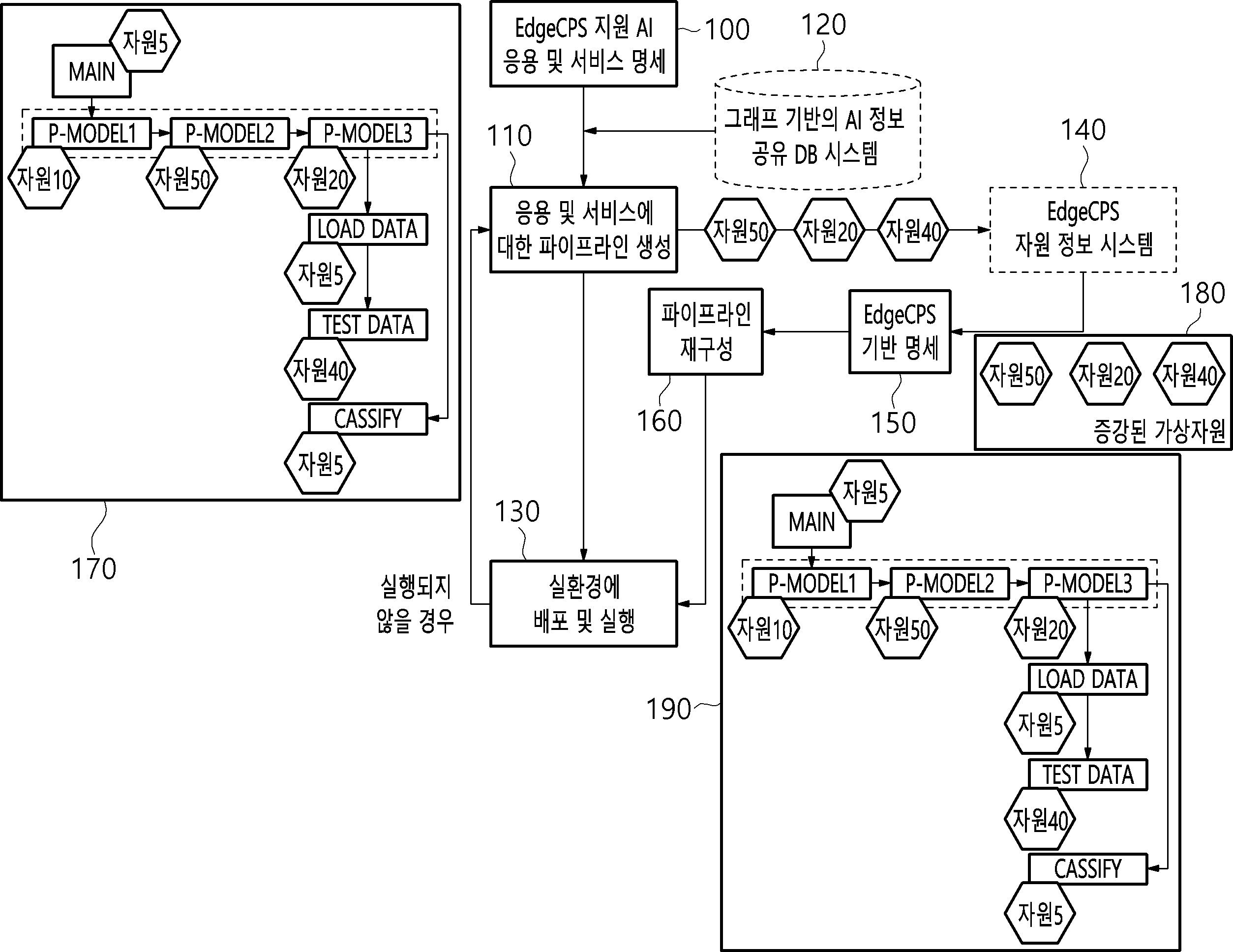
도 2는 EdgeCPS 환경에서 인공지능 응용 서비스 명세가 실환경에 배포되어 동작하는 것을 나타낸 도면이다. Figure 2 is a diagram showing how the artificial intelligence application service specification is distributed and operated in the real environment in the EdgeCPS environment.
도 2를 참조하면, 실시예에 따른 방법은 EdgeCPS 지원 AI 응용 및 서비스 명세(100)를 작성하여 그래프 기반의 AI 정보 공유 DB 시스템(120)에서 인공지능에 관련된 정보를 할당 받는다. AI 정보 공유 DB 시스템(120)은 학습데이터, 학습된 모델, 추론알고리즘, 하드웨어 정보, 그리고 코드 정보 등을 저장하고 있다. 예를 들어, 얼굴 인식 추론응용을 작성하게 되면, 정보공유 DB 시스템에서 사전에 학습된 모델인 얼굴학습모델을 지원받게 된다. Referring to FIG. 2, the method according to the embodiment creates an EdgeCPS-supported AI application and
다음으로, 지원받은 정보를 이용하여 응용 및 서비스에 대한 파이프라인 생성(110)을 하게 된다. 이렇게 생성된 파이프라인 명세를 이용하여 실환경에 배포 및 실행 (130)을 하게 된다. 그러면 각 파이프라인마다 정해진 자원(170)으로 실행하게 된다. 이런 상태에서 “P-Model-2”, “P-Model-3”, 그리고 “TestData” 파이프라인에서 자원 부족 등으로 실행이 되지 않았다고 하면, 파이프라인 생성 모듈(110)로 다시 피드백 되어 “자원50”, “자원20”, 그리고 “자원40”에 대해서 EdgeCPS 자원정보 시스템(140)에 추가적인 자원을 요구한다. EdgeCPS 자원 정보 시스템에서 증강된 가상자원을 할당받아서 EdgeCPS기반의 명세(150)를 재생성하고, 파이프라인도 재구성(160)하게 된다. 이렇게 구성된 파이프라인으로 재실행하게 되면 이전과 다르게 “P-Model-2”, “P-Model-3”, 그리고 “TestData” 파이프라인에서 원활한 수행을 하여 정상적인 수행 (190)이 이루어지게 된다. 본 특허에서는 그래프 기반의 AI 정보 공유 DB 시스템(120)에 대한 세부적인 내용은 다루지 않는다.Next, pipelines for applications and services are created (110) using the supported information. Using the pipeline specification created in this way, it is distributed and executed in the real environment (130). Then, each pipeline is executed with designated resources (170). In this state, if the “P-Model-2”, “P-Model-3”, and “TestData” pipelines are not executed due to lack of resources, the feedback is fed back to the
도 3은 EdgeCPS 지원을 위한 정보 공유 기술 기반의 AI 응용 SW 명세 플랫폼을 구성하는 명세를 나타낸다.Figure 3 shows the specifications that constitute the AI application SW specification platform based on information sharing technology for EdgeCPS support.
도 3을 참조하면, EdgeCPS 지원 AI 응용 및 서비스 명세(200), 파이프라인 명세(210), 배포 명세(220), 그리고 Kubeflow기반 명세(250), ArgCD 기반 명세(260), 그리고 Kubernetes 기반 명세(270) 등으로 구성되어 있다. 추가적으로 EdgeCPS 정보를 가진 그래프 기반의 지식 공유 시스템(240)을 활용하기 위해서 질의 변환기(230)를 이용한다. Referring to Figure 3, EdgeCPS-supported AI application and service specification (200), pipeline specification (210), deployment specification (220), Kubeflow-based specification (250), ArgCD-based specification (260), and Kubernetes-based specification ( 270), etc. Additionally, the
질의 변환기(230)는 EdgeCPS 지원 AI 응용 및 서비스 명세에서 활용할 수 있고, 파이프라인 명세에서도 활용할 수 있다. 즉, 사용자 및 개발자의 선택사항이다. 결과적으로, 200과 210 중에서 둘 중 한 군데에서 EdgeCPS에 관련된 정보를 지원받을 수 있다. 각 명세를 해석하기 위한 명세 해석기는 각 구현마다 다를 수 있으므로 본 특허의 범위에는 포함하지 않는다.The
도 4는 EdgeCPS 지원 AI 응용 및 서비스 명세에 대한 구체적인 명세 흐름을 보인 것이다.Figure 4 shows the specific specification flow for EdgeCPS-supported AI application and service specifications.
도 4를 참조하면, EdgeCPS 지원 AI 응용 및 서비스 명세(200)에 대한 구체적인 명세 흐름을 볼 수 있다. EdgeCPS 지원 AI 응용 및 서비스 명세(200)에 대한 구체적인 명세 흐름은 총 9단계로 이루어져 있다. 각 단계마다 정의되어 있는 속성들을 참고하여 인공지능 프로그램을 작성할 사용자가 하나씩 선택하면 최종적으로 명세가 만들어진다. 첫번째 단계에서는 분석/기능 AI, 대화형 AI, 텍스트형 AI, 그리고 시각적 AI 중에서 하나를 선택한다. 분석/기능 AI는 데이터 분석, 데이터 패턴 식별, 데이터 해석 등에 관련된 것이고, 대화형 AI는 자동대화, 챗봇, 스마트 개인비서 등에 관련된 것이다. 그리고 텍스트형 AI는 텍스트 분석 및 인식, 음성-텍스트 변환, 자연어처리 등에 관련된 것이고, 시각적 AI는 이미지/비디오 인식, 이미지/비디오 분류, 이미지/비디오 추적 등에 관련된 것이다. Referring to Figure 4, you can see the specific specification flow for the EdgeCPS supported AI application and service specification (200). The specific specification flow for the EdgeCPS-supported AI application and service specification (200) consists of a total of 9 steps. The user who will write the artificial intelligence program selects one by one, referring to the properties defined at each stage, and the final specification is created. In the first step, choose between analytical/functional AI, conversational AI, textual AI, and visual AI. Analysis/functional AI is related to data analysis, data pattern identification, and data interpretation, while conversational AI is related to automatic conversation, chatbots, and smart personal assistants. And textual AI is related to text analysis and recognition, voice-to-text conversion, natural language processing, etc., and visual AI is related to image/video recognition, image/video classification, and image/video tracking.
두번째 단계에서는 AI 응용의 Serving 방식을 선택하는 것이다. “Single Deploy”, “Multi Deploy”, 그리고 “Partitioning” 속성을 가지고 있다. “Single Deploy”은 최종적으로 생성된 파이프라인 기반의 AI 응용을 한 개의 시스템에 배포해서 실행하는 방법이다. “Multi Deploy”은 최종적으로 생성된 파이프라인 기반의 AI 응용을 두 개 이상의 시스템에 배포하여 실행하는 방법이다. 그리고 “Partitioning” 은 AI 관련 파이프라인이 많은 계산량으로 인해서 여러 개의 조각으로 나누어서 실행하는 방법이다. The second step is to select the serving method of AI application. It has “Single Deploy”, “Multi Deploy”, and “Partitioning” properties. “Single Deploy” is a method of distributing and executing the final created pipeline-based AI application on one system. “Multi Deploy” is a method of distributing and executing the final created pipeline-based AI application to two or more systems. And “Partitioning” is a method of dividing AI-related pipelines into several pieces and executing them due to the large amount of calculations.
세번째 단계에서는 AI 응용 형태를 선택하는 것이다. 학습을 위한 AI 응용을 생성할 것인지 추론을 위한 AI 응용을 생성할 것인지를 선택하는 것이다. 네번째 단계에서는 AI 응용의 추론 방법을 선택하는 것이다. 추론 방법으로는 OpenCV 등을 이용한 Non-CNN 기반의 추론 방법과 VGG, ResNet, Google 등과 같은 CNN 기반의 추론 방법이 있다. The third step is to select the type of AI application. The choice is whether to create an AI application for learning or an AI application for inference. The fourth step is to select the inference method for AI application. Inference methods include non-CNN-based inference methods using OpenCV, etc., and CNN-based inference methods such as VGG, ResNet, Google, etc.
네번째 단계부터는 추론 응용에 한정된 Flow를 보인 것이다. 네번째 단계에서는 AI 응용의 추론 방법을 선택한다. 선택 속성으로는 Non-CNN 방법, CNN 방법에 있으나 본 발명의 범위가 이에 한정되는 것은 아니다. 다섯번째 단계에서는 AI 응용의 추론 형태를 선택하는 것이다. 선택할 수 있는 속성으로는 Classification (VGG, ResNet, GoogleNet, Inception, etc), 1-Stage 기반의 Detection (tracking) (SSD, YOLO, etc), 그리고 2-Stage 기반의 Detection (tracking) (R-CNN, Fast R-CNN, etc) 등이 있다. 이 단계에서는 AI 알고리즘을 선택하는 단계이다. 여섯번째 단계에서는 AI 응용의 추론 대상을 선택하는 것이다. 선택할 수 있는 속성으로는 도 3의 지식 공유 시스템(240)에서 지원하는 추론 대상을 선택할 수 있다. 예를 들어, 지식 공유 시스템에서 얼굴인식 관련 학습모델, 자동차 신호판 관련 학습 모델, 자동차 인식 관련 학습모델을 지원하면 사용자는 이중에서 하나를 선택할 수 있다. 일곱번째 단계부터 아홉번째 단계까지는 선택사항이다. 차례대로 AI 응용이 동작하는 시스템 요구사항을 명세하는 것, AI 응용의 추론 성능에 대한 요구사항을 명세하는 것, 그리고 AI 응용에 대한 모니터링을 위한 프로파일링 여부를 명세하는 것이다.From the fourth step, the flow was limited to inference applications. In the fourth step, the inference method for AI application is selected. Optional properties include Non-CNN method and CNN method, but the scope of the present invention is not limited thereto. The fifth step is to select the inference type for AI application. Selectable properties include Classification (VGG, ResNet, GoogleNet, Inception, etc), 1-Stage based Detection (tracking) (SSD, YOLO, etc), and 2-Stage based Detection (tracking) (R-CNN) , Fast R-CNN, etc). This step is to select an AI algorithm. The sixth step is to select the inference target for AI application. As a selectable attribute, an inference target supported by the
도 5는 AI 응용을 지원하기 위한 명세 흐름을 보인 것이다. Figure 5 shows the specification flow to support AI applications.
도 5를 참조하면, AI 응용을 지원하기 위한 명세 흐름은 총 6단계로 구성되어 있다. 첫번째 단계에서는 지원 형태를 선택하는 것이다. 선택할 수 있는 속성으로는 “INPUT”, “PREPROCESSING”, “OUTPUT”, 그리고 “OTHERS” 등이 있다. 두번째 단계에서는 도 5의 첫번째 단계와 유사하게 Serving 방식을 선택하는 것이다. 세번째 단계에서는 해당 기능에 필요한 입력과 출력 파라미터를 정의하는 단계이다. 네번째 단계에서는 기능정의를 하는 단계이다. 예를 들어, “PREPROCESSING”를 선택하면 전처리를 할 수 있는 여러가지 기능 중에 하나이상을 선택할 수 있다. 다섯번째 단계에서는 선택한 지원 형태에 대한 기능들이 수행해야 될 시스템 요구사항을 명세하는 것이다. 여섯번째 단계에서는 기능의 수행을 프로파일링하는 단계이다.Referring to Figure 5, the specification flow to support AI applications consists of a total of six steps. The first step is to choose a form of support. Selectable attributes include “INPUT”, “PREPROCESSING”, “OUTPUT”, and “OTHERS”. In the second step, similar to the first step in Figure 5, a serving method is selected. The third step is to define the input and output parameters required for the function. The fourth step is to define functions. For example, if you select “PREPROCESSING”, you can select one or more of several functions that can perform preprocessing. The fifth step is to specify the system requirements that the functions for the selected support type must perform. The sixth step is to profile the performance of the function.
도 6은 본 발명의 일 실시예에 따른 방법에서 생성된 명세를 나타낸 개념도이다.Figure 6 is a conceptual diagram showing specifications generated in a method according to an embodiment of the present invention.
도 7은 본 발명의 일 실시예에 따른 방법에서 AI 명세의 일 예이다.Figure 7 is an example of AI specification in a method according to an embodiment of the present invention.
도 6을 참조하면, AI 응용 서비스 명세(500)는 크게 5개의 세부 명세(510, 520, 530, 540, 550)를 가지고 있다. 각 세부 명세는 하나 이상의 명세를 가지고 각 명세는 그 명세에 부족한 부분을 추가하는 명세(560)로 구성되어 있다. 세부 명세인 “Input Information” (510)은 도 7의 610에 해당하는 부분이다. 세부 명세인 “Preprocessing Information” (520)은 도 7의 620에 해당하는 부분이다. 세부 명세인 “AI Information” (530)은 도 7의 600에 해당하는 부분이다. 세부 명세인 “Output Information” (540)은 도 7의 630에 해당하는 부분이다. 세부 명세인 “Supplement Information” (550)은 510부터 540 명세에서 부족한 부분을 보충하는 부분이고, “INPUT”, “PREPROCESSING”, “AI”, “OUTPUT” 이외에 다른 기능이 필요하면 추가적으로 작성하는 부분이다.Referring to FIG. 6, the AI application service specification 500 largely has five detailed specifications (510, 520, 530, 540, and 550). Each detailed specification has one or more specifications, and each specification consists of a specification 560 that adds missing parts to the specification. The detailed specification, “Input Information” (510), corresponds to 610 in FIG. 7. The detailed specification, “Preprocessing Information” (520), corresponds to
도 8은 본 발명의 일 실시예에 따른 방법에서 파이프라인 명세의 일 예이다.Figure 8 is an example of a pipeline specification in a method according to an embodiment of the present invention.
도 8의 파이프라인 명세는 도 7에 도시된 AI 명세를 이용하여 생성될 수 있다. The pipeline specification of FIG. 8 can be created using the AI specification shown in FIG. 7.
도 8에 도시된 명세 예시는 경우에 따라 파이프라인 중간표현(Intermediate Representation)이라고 지칭할 수 있다. 파이프라인 명세에서 “Meta Information”은 도 8의 760에서 첫번째 라인에 해당하는 부분이다. 첫번째 라인은 응용 Serving 방식, 응용 구성 개수, 외부입력장치, 프로그램 특성, 외부출력장치, 사용자 혹은 개발자를 표시한다. “Head” (710), “Type” (720), “Func I/O” (730), “System | Performance” (740), “Profiling” (750)는 파이프라인 명세의 핵심이다. “Head”는 Input, Preprocessing, AI, Output을 나타낸다. “Type”은 각 “Head”에 해당하는 특성들을 나타낸다. 예를 들어, 760의 두번째 라인에 Input의 type은 외부입력장치인 싱글 카메라 사용하는 것으로 되어 있다. 그래서 {type: device=single_cam}으로 정의되어 있다. “Func I/O”은 각 함수에 대한 기능 정의에 필요한 입력 출력 파라미터 개수와 입력과 출력에 대해서 정의한 것이다. 예를 들어, 760의 세번째 라인에서 입력 파라미터가 1개이고, 그 값이 카메라 값이고, 출력 파라미터는 1개이고 그 값은 이미지이다. 그래서 {func_input_parms:1, {cam:obj}}, {func_output_parms:1, {img:img}}로 정의되어 있다. “System | Performance”은 “Head” 따라 system 성능을 요구할 수 있고, performance 성능을 요구할 수 있다. 예를 들어, “INPUT”, “PREPROCESSING”, “OUTPUT”은 system 성능을 요구하고, “AI”는 performance 성능을 요구한다. 도 8의 760에서 네번째 라인의 경우에는 “AI” 특성을 가지고 있다. 그래서 performance 성능을 정의한다. 그래서 “{performance: acc=0.8, speed(sec)=2.0, FPS=empty, core_util=empty, mem_util=empty, tx=empty, rx=empty}”로 정의되어 있다. 마지막으로 “Profiling”은 각 “Head”별로 프로파일링 지원 여부를 정의하는 것이다. Profiling이 yes로 설정되면 실행되는 코드 등에 프로파일링 코드가 추가된다.The specification example shown in FIG. 8 may be referred to as a pipeline intermediate representation in some cases. In the pipeline specification, “Meta Information” corresponds to the first line at 760 in FIG. 8. The first line displays the application serving method, number of application configurations, external input device, program characteristics, external output device, and user or developer. “Head” (710), “Type” (720), “Func I/O” (730), “System | “Performance” (740) and “Profiling” (750) are the core of the pipeline specification. “Head” stands for Input, Preprocessing, AI, and Output. “Type” represents the characteristics corresponding to each “Head”. For example, in the second line of 760, the input type is to use a single camera, an external input device. So it is defined as {type: device=single_cam}. “Func I/O” defines the number of input and output parameters and input and output required to define the function for each function. For example, in the third line of 760, there is 1 input parameter and its value is the camera value, and there is 1 output parameter and its value is the image. So, it is defined as {func_input_parms:1, {cam:obj}}, {func_output_parms:1, {img:img}}. “System | “Performance” can request system performance depending on “Head” and can request performance. For example, “INPUT”, “PREPROCESSING”, and “OUTPUT” require system performance, and “AI” requires performance. The fourth line at 760 in FIG. 8 has the “AI” characteristic. So performance is defined. So, it is defined as “{performance: acc=0.8, speed(sec)=2.0, FPS=empty, core_util=empty, mem_util=empty, tx=empty, rx=empty}”. Lastly, “Profiling” defines whether profiling is supported for each “Head”. If Profiling is set to yes, profiling code is added to the executed code.
도 9는 질의 변환기의 구조를 예시적으로 나타낸 블록도이다.Figure 9 is a block diagram illustrating the structure of a query converter.
도 9를 참조하면, 질의 변환기는 명세 파서(800), 질의어 추출기(810), 질의어 생성기(820), 질의 요청기(830) 및 결과제공기(840)를 포함할 수 있다.Referring to FIG. 9, the query converter may include a
질의 변환기의 역할은 AI 응용 및 서비스 명세 혹은 파이프라인 명세의 내용을 분석하여 지식 공유 시스템에 요청할 질의어를 생성하여 해당되는 정보를 추출한다. 질의 변환기는 AI 응용 및 서비스 명세(200) 단계와 파이프라인 명세(210)단계에서 사용할 수 있다. 첫번째는 AI 응용 및 서비스 명세(200) 단계에서 질의 변환기를 통해서 지식 공유 시스템 (240)에서 해당 정보를 추출하여 그 다음 단계인 파이프라인 명세 생성 시에 사용할 수 있다. 두번째는 파이프라인 명세 단계에서 질의 변환기를 통해서 지식 공유 시스템에서 해당 정보를 추출하여 그 다음 단계인 배포 명세 생성 시에 사용할 수 있다. 질의 변환기는 명세파서, 질의어 추출기, 질의어 생성기, 질의 요청기, 그리고 결과 제공기로 구성되어 있다. 지식 공유 시스템에서는 해당 소스코드 및 해당 이미지 (e.g., 도커이미지)등을 제공하고, 사용자가 원하는 하드웨어나 사용자가 원하는 성능에 부합하는 AI 알고리즘 등을 제공한다.The role of the query converter is to analyze the contents of AI application and service specifications or pipeline specifications, create a query to request from the knowledge sharing system, and extract the relevant information. The query converter can be used at the AI application and service specification (200) stage and pipeline specification (210) stage. First, at the AI application and service specification (200) stage, the relevant information can be extracted from the knowledge sharing system (240) through a query converter and used when creating the pipeline specification, which is the next stage. Second, at the pipeline specification stage, the relevant information can be extracted from the knowledge sharing system through a query converter and used in the next stage, when generating a distribution specification. The query converter consists of a specification parser, query extractor, query generator, query requester, and result provider. The knowledge sharing system provides the source code and images (e.g., Docker images), as well as the hardware desired by the user and AI algorithms that match the performance desired by the user.
도 10은 지식 공유 시스템에 요청하는 질의어 예시를 나타낸 표이다.Figure 10 is a table showing examples of query words requested from the knowledge sharing system.
도 10을 참조하면, 질의어는 Non-AI과 AI 경우로 나누어서 생성되고, 질의어 종류는 해당 코드 및 이미지를 검색하는 것과 하드웨어 및 알고리즘을 검색하는 것이 있다.Referring to FIG. 10, query words are generated by dividing them into Non-AI and AI cases, and the types of query words include searching the corresponding code and image and searching hardware and algorithms.
도 11은 본 발명의 일 실시예에 따른 방법에서 배포 명세를 개념적으로 나타낸 도면이다.Figure 11 is a diagram conceptually showing a distribution specification in a method according to an embodiment of the present invention.
도 11을 참조하면, 배포명세는 실환경의 시스템에 배포되어 실행하는 방법, 가상환경의 시스템에 배포되어 실행하는 방법, 그리고 혼합환경의 시스템에 배포되어 실행하는 방법이 있다. 배포명세는 총 4개의 세부 명세인 “Global Information”(1010), “Basic Information”(1020), “System Information”(1030), 그리고 “Application Information”(1040)으로 구성되어 있다. “Global Information” 세부 명세는 1060에서 보인 것처럼 전체 세부 명세에 영향을 미친다. Referring to FIG. 11, the distribution specification includes a method of distributing and executing on a system in a real environment, a method of distributing and executing on a system of a virtual environment, and a method of distributing and executing on a system of a mixed environment. The distribution specification consists of a total of four detailed specifications: “Global Information” (1010), “Basic Information” (1020), “System Information” (1030), and “Application Information” (1040). The “Global Information” detailed specification affects the entire detailed specification as shown in 1060.
도 12는 본 발명의 일 실시예에 따른 방법에서 배포 명세의 일 예이다.Figure 12 is an example of a distribution specification in a method according to an embodiment of the present invention.
도 12의 1100에 있는 “Global Information”의 “type” 부분에 real-world, virtual-world, mixed-reality배포 실행 방법을 명시한다. “Basic Information” 명세는 도 11의 1110에서 support type과 deployment name을 명시하고, “System Information” 명세는 도 11의 1110에서 replicas를 몇 개로 할 것인가와 실행할 노드에 대한 정보를 명시한다. 실행할 노드에 대한 정보는 지식 공유 시스템에서 제공한다. 그리고 “Application Information” 명세는 도 11의 1110에서 실행할 응용의 이름, 그 응용의 위치, 그리고 서비스 포트 등을 명시한다. 이 응용도 지식 공유 시스템에서 제공한다. 만약에 지식 공유 시스템에서 원하는 정보를 제공하지 않는다면, 사용자가 직접 명시하면 된다. 도 11의 1120은 쿠버네티스에서 실행하는 명세를 보인 것이다.The “type” part of “Global Information” at 1100 in Figure 12 specifies the real-world, virtual-world, and mixed-reality distribution execution method. The “Basic Information” specification specifies the support type and deployment name at 1110 in Figure 11, and the “System Information” specification specifies the number of replicas at 1110 in Figure 11 and information about the node to run. Information about the nodes to be executed is provided by the knowledge sharing system. And the “Application Information” specification specifies the name of the application to be executed at 1110 in FIG. 11, the location of the application, and the service port. This application is also provided by the knowledge sharing system. If the knowledge sharing system does not provide the desired information, the user can specify it directly. 1120 in Figure 11 shows the specification executed in Kubernetes.
도 13은 본 발명의 일 실시예에 따른 인공지능 응용 제공 시스템을 개념적으로 나타낸 도면이다.Figure 13 is a diagram conceptually showing an artificial intelligence application providing system according to an embodiment of the present invention.
도 13을 참조하면, EdgeCPS 지원을 위한 정보 공유 기술을 기반으로 AI 응용 SW 명세를 바탕으로 단일 디바이스용 배포, 다중 디바이스 배포 명세를 통해서 실환경의 시스템, 가상환경의 시스템, 혼합환경의 시스템 상에서 수행한다. 그리고 단일 디바이스용 배포 및 다중 디바이스 배포는 내부적으로 partitioning을 지원한다. 즉, 하나의 기능으로 구성된 함수가 여러 개의 기능으로 나누어질 수 있다는 것이다. 이렇게 수행하면서 각 시스템에서 동작하는 기능들에 대해서 프로파일링을 하게 된다. 프로파일링을 하면서 문제가 있는 부분을 찾아서 해당되는 부분을 다른 기능으로 변경하거나 자원 증강 등을 통해서 문제점을 해결한다.Referring to Figure 13, based on information sharing technology to support EdgeCPS, distribution for a single device and multi-device deployment specifications are performed on a system in a real environment, a system in a virtual environment, and a system in a mixed environment based on the AI application SW specification. do. And single-device deployments and multi-device deployments support partitioning internally. In other words, a function consisting of one function can be divided into multiple functions. In doing so, the functions operating in each system are profiled. While profiling, we find problematic parts and solve them by changing the relevant parts to other functions or increasing resources.
도 14은 실시예에 따른 컴퓨터 시스템의 구성을 나타낸 도면이다.Figure 14 is a diagram showing the configuration of a computer system according to an embodiment.
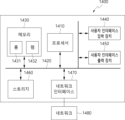
실시예에 따른 EdgeCPS 지원을 위한 인공지능 응용 제공 장치는 컴퓨터로 읽을 수 있는 기록매체와 같은 컴퓨터 시스템(1400)에서 구현될 수 있다.The artificial intelligence application providing device for EdgeCPS support according to the embodiment may be implemented in a
컴퓨터 시스템(1400)은 버스(1420)를 통하여 서로 통신하는 하나 이상의 프로세서(1410), 메모리(1430), 사용자 인터페이스 입력 장치(1440), 사용자 인터페이스 출력 장치(1450) 및 스토리지(1460)를 포함할 수 있다. 또한, 컴퓨터 시스템(1400)은 네트워크(1480)에 연결되는 네트워크 인터페이스(1470)를 더 포함할 수 있다. 프로세서(1410)는 중앙 처리 장치 또는 메모리(1430)나 스토리지(1460)에 저장된 프로그램 또는 프로세싱 인스트럭션들을 실행하는 반도체 장치일 수 있다. 메모리(1430) 및 스토리지(1460)는 휘발성 매체, 비휘발성 매체, 분리형 매체, 비분리형 매체, 통신 매체, 또는 정보 전달 매체 중에서 적어도 하나 이상을 포함하는 저장 매체일 수 있다. 예를 들어, 메모리(1430)는 ROM(1431)이나 RAM(1432)을 포함할 수 있다.
본 발명의 일 실시예에 따른 EdgeCPS 지원을 위한 인공지능 응용 제공 장치는 적어도 하나의 프로그램이 기록된 메모리(1430) 및 상기 프로그램을 실행하는 프로세서(1410)를 포함하며, 상기 프로그램은 인공지능 응용 및 서비스 명세를 수신하는 단계, 상기 인공지능 응용 및 서비스 명세에 기반하여 인공지능 정보공유 데이터베이스에서 인공지능 관련 정보를 할당받는 단계, 인공지능 응용 및 서비스 명세에 상응하는 파이프라인 명세를 생성하는 단계 및 상기 파이프라인 명세를 이용하여 각 파이프라인에 상응하는 자원을 할당하는 단계의 수행을 위한 명령어들을 포함한다. An artificial intelligence application providing device for EdgeCPS support according to an embodiment of the present invention includes a
이때, 상기 파이프라인에 상응하는 자원을 할당하는 단계는 질의 변환기에 기반하여 생성된 배포 명세를 이용하여 상기 자원을 할당할 수 있다. At this time, in the step of allocating resources corresponding to the pipeline, the resources may be allocated using a distribution specification generated based on a query converter.
이때, 상기 질의 변환기는 상기 인공지능 응용 및 서비스 명세에 기반하여 상기 인공지능 정보공유 데이터베이스에서 인공지능 관련 정보를 추출하는 질의어를 생성할 수 있다. At this time, the query converter may generate a query language that extracts artificial intelligence-related information from the artificial intelligence information sharing database based on the artificial intelligence application and service specifications.
이때, 상기 배포 명세는 전역 정보, 기본 정보, 시스템 정보 및 응용 정보로 구성된 세부 명세를 포함하고, 상기 전역 정보는 나머지 세부 명세에 적용되는 정보를 포함할 수 있다. At this time, the distribution specification includes detailed specifications consisting of global information, basic information, system information, and application information, and the global information may include information applied to the remaining detailed specifications.
이때, 상기 프로그램은 상기 파이프라인에 할당된 자원이 부족하면, 인공지능 자원 정보 시스템에 추가 자원 할당 요청을 전송하는 단계 및 추가 할당된 자원에 기반하여 상기 파이프라인을 재구성하는 단계의 수행을 위한 명령어들을 더 포함할 수 있다. At this time, when the resources allocated to the pipeline are insufficient, the program provides instructions for performing the steps of transmitting an additional resource allocation request to the artificial intelligence resource information system and reconfiguring the pipeline based on the additional allocated resources. More may be included.
이때, 상기 인공지능 응용 및 서비스 명세는 인공지능 응용 카테고리, 인공지능 응용 배포 방식, 인공지능 응용 형태, 인공지능 응용 추론 방법, 인공지능 응용 추론 형태 또는 인공지능 응용 추론 대상에 관한 정보를 포함할 수 있다. At this time, the artificial intelligence application and service specifications may include information about the artificial intelligence application category, artificial intelligence application distribution method, artificial intelligence application type, artificial intelligence application inference method, artificial intelligence application inference type, or artificial intelligence application inference target. there is.
이때, 상기 파이프라인 명세는 인공지능 응용의 입/출력, 전처리 정보, 파라미터의 개수 또는 인공지능 응용의 특성 정보를 포함할 수 있다. At this time, the pipeline specification may include input/output of the artificial intelligence application, preprocessing information, number of parameters, or characteristic information of the artificial intelligence application.
본 발명에서 설명하는 특정 실행들은 실시예들로서, 어떠한 방법으로도 본 발명의 범위를 한정하는 것은 아니다. 명세서의 간결함을 위하여, 종래 전자적인 구성들, 제어시스템들, 소프트웨어, 상기 시스템들의 다른 기능적인 측면들의 기재는 생략될 수 있다. 또한, 도면에 도시된 구성 요소들 간의 선들의 연결 또는 연결 부재들은 기능적인 연결 및/또는 물리적 또는 회로적 연결들을 예시적으로 나타낸 것으로서, 실제 장치에서는 대체 가능하거나 추가의 다양한 기능적인 연결, 물리적인 연결, 또는 회로 연결들로서 나타내어질 수 있다. 또한, “필수적인”, “중요하게” 등과 같이 구체적인 언급이 없다면 본 발명의 적용을 위하여 반드시 필요한 구성 요소가 아닐 수 있다.The specific implementations described in the present invention are examples and are not intended to limit the scope of the present invention in any way. For the sake of brevity of the specification, descriptions of conventional electronic components, control systems, software, and other functional aspects of the systems may be omitted. In addition, the connections or connection members of lines between components shown in the drawings exemplify functional connections and/or physical or circuit connections, and in actual devices, various functional connections or physical connections may be replaced or added. Can be represented as connections, or circuit connections. Additionally, if there is no specific mention such as “essential,” “important,” etc., it may not be a necessary component for the application of the present invention.
따라서, 본 발명의 사상은 상기 설명된 실시예에 국한되어 정해져서는 아니되며, 후술하는 특허청구범위뿐만 아니라 이 특허청구범위와 균등한 또는 이로부터 등가적으로 변경된 모든 범위는 본 발명의 사상의 범주에 속한다고 할 것이다.Therefore, the spirit of the present invention should not be limited to the above-described embodiments, and the scope of the patent claims described below as well as all scopes equivalent to or equivalently changed from the scope of the claims are within the scope of the spirit of the present invention. It will be said to belong to
1400: 컴퓨터 시스템
1410: 프로세서
1420: 버스
1430: 메모리
1431: 롬
1432: 램
1440: 사용자 인터페이스 입력 장치
1450: 사용자 인터페이스 출력 장치
1460: 스토리지
1470: 네트워크 인터페이스
1480: 네트워크1400: computer system 1410: processor
1420: Bus 1430: Memory
1431: Romans 1432: Ram
1440: User interface input device
1450: User interface output device
1460: Storage 1470: Network Interface
1480: network
Claims (14)
인공지능 응용 및 서비스 명세를 수신하는 단계;
상기 인공지능 응용 및 서비스 명세에 기반하여 인공지능 정보공유 데이터베이스에서 인공지능 관련 정보를 할당받는 단계;
인공지능 응용 및 서비스 명세에 상응하는 파이프라인 명세를 생성하는 단계; 및
상기 파이프라인 명세를 이용하여 각 파이프라인에 상응하는 자원을 할당하는 단계
를 포함하는 것을 특징으로 하는 EdgeCPS 지원을 위한 인공지능 응용 제공 방법.In the method of providing artificial intelligence applications to support EdgeCPS,
Receiving artificial intelligence application and service specifications;
Allocating artificial intelligence-related information from an artificial intelligence information sharing database based on the artificial intelligence application and service specifications;
Generating pipeline specifications corresponding to artificial intelligence application and service specifications; and
Allocating resources corresponding to each pipeline using the pipeline specification
A method of providing an artificial intelligence application for EdgeCPS support, comprising:
상기 파이프라인에 상응하는 자원을 할당하는 단계는
질의 변환기에 기반하여 생성된 배포 명세를 이용하여 상기 자원을 할당하는 것을 특징으로 하는 EdgeCPS 지원을 위한 인공지능 응용 제공 방법.In claim 1,
The step of allocating resources corresponding to the pipeline is
An artificial intelligence application provision method for EdgeCPS support, characterized in that allocating the resources using a distribution specification generated based on a query converter.
상기 질의 변환기는
상기 인공지능 응용 및 서비스 명세에 기반하여 상기 인공지능 정보공유 데이터베이스에서 인공지능 관련 정보를 추출하는 질의어를 생성하는 것을 특징으로 하는 EdgeCPS 지원을 위한 인공지능 응용 제공 방법.In claim 2,
The query converter is
An artificial intelligence application provision method for EdgeCPS support, characterized in that a query language is generated to extract artificial intelligence-related information from the artificial intelligence information sharing database based on the artificial intelligence application and service specifications.
상기 배포 명세는
전역 정보, 기본 정보, 시스템 정보 및 응용 정보로 구성된 세부 명세를 포함하고, 상기 전역 정보는 나머지 세부 명세에 적용되는 정보를 포함하는 것을 특징으로 하는 EdgeCPS 지원을 위한 인공지능 응용 제공 방법.In claim 2,
The distribution specification above is
An artificial intelligence application providing method for EdgeCPS support, comprising a detailed specification consisting of global information, basic information, system information, and application information, and the global information includes information applied to the remaining detailed specifications.
상기 방법은
상기 파이프라인에 할당된 자원이 부족하면, 인공지능 자원 정보 시스템에 추가 자원 할당 요청을 전송하는 단계; 및
추가 할당된 자원에 기반하여 상기 파이프라인을 재구성하는 단계
를 더 포함하는 것을 특징으로 하는 EdgeCPS 지원을 위한 인공지능 응용 제공 방법.In claim 1,
The above method is
If the resources allocated to the pipeline are insufficient, transmitting an additional resource allocation request to an artificial intelligence resource information system; and
Reconfiguring the pipeline based on additional allocated resources
A method of providing an artificial intelligence application for EdgeCPS support, further comprising:
상기 인공지능 응용 및 서비스 명세는
인공지능 응용 카테고리, 인공지능 응용 배포 방식, 인공지능 응용 형태, 인공지능 응용 추론 방법, 인공지능 응용 추론 형태 또는 인공지능 응용 추론 대상에 관한 정보를 포함하는 것을 특징으로 하는 EdgeCPS 지원을 위한 인공지능 응용 제공 방법.In claim 1,
The above artificial intelligence application and service specifications are
Artificial intelligence application for supporting EdgeCPS, characterized in that it includes information on artificial intelligence application category, artificial intelligence application distribution method, artificial intelligence application type, artificial intelligence application inference method, artificial intelligence application inference type, or artificial intelligence application inference target. How to provide.
상기 파이프라인 명세는
인공지능 응용의 입/출력, 전처리 정보, 파라미터의 개수 또는 인공지능 응용의 특성 정보를 포함하는 것을 특징으로 하는 EdgeCPS 지원을 위한 인공지능 응용 제공 방법.In claim 1,
The pipeline specification is
A method of providing an artificial intelligence application for EdgeCPS support, characterized by including input/output of the artificial intelligence application, preprocessing information, number of parameters, or characteristic information of the artificial intelligence application.
상기 프로그램을 실행하는 프로세서
를 포함하며,
상기 프로그램은
인공지능 응용 및 서비스 명세를 수신하는 단계;
상기 인공지능 응용 및 서비스 명세에 기반하여 인공지능 정보공유 데이터베이스에서 인공지능 관련 정보를 할당받는 단계;
인공지능 응용 및 서비스 명세에 상응하는 파이프라인 명세를 생성하는 단계; 및
상기 파이프라인 명세를 이용하여 각 파이프라인에 상응하는 자원을 할당하는 단계
의 수행을 위한 명령어들을 포함하는 것을 특징으로 하는 EdgeCPS 지원을 위한 인공지능 응용 제공 장치.a memory in which at least one program is recorded; and
Processor that executes the program
Includes,
The above program is
Receiving artificial intelligence application and service specifications;
Allocating artificial intelligence-related information from an artificial intelligence information sharing database based on the artificial intelligence application and service specifications;
Generating pipeline specifications corresponding to artificial intelligence application and service specifications; and
Allocating resources corresponding to each pipeline using the pipeline specification
An artificial intelligence application providing device for EdgeCPS support, characterized in that it includes instructions for performing.
상기 파이프라인에 상응하는 자원을 할당하는 단계는
질의 변환기에 기반하여 생성된 배포 명세를 이용하여 상기 자원을 할당하는 것을 특징으로 하는 EdgeCPS 지원을 위한 인공지능 응용 제공 장치.In claim 8,
The step of allocating resources corresponding to the pipeline is
An artificial intelligence application providing device for EdgeCPS support, characterized in that allocating the resources using a distribution specification generated based on a query converter.
상기 질의 변환기는
상기 인공지능 응용 및 서비스 명세에 기반하여 상기 인공지능 정보공유 데이터베이스에서 인공지능 관련 정보를 추출하는 질의어를 생성하는 것을 특징으로 하는 EdgeCPS 지원을 위한 인공지능 응용 제공 장치.In claim 9,
The query converter is
An artificial intelligence application providing device for EdgeCPS support, characterized in that it generates a query language to extract artificial intelligence-related information from the artificial intelligence information sharing database based on the artificial intelligence application and service specifications.
상기 배포 명세는
전역 정보, 기본 정보, 시스템 정보 및 응용 정보로 구성된 세부 명세를 포함하고, 상기 전역 정보는 나머지 세부 명세에 적용되는 정보를 포함하는 것을 특징으로 하는 EdgeCPS 지원을 위한 인공지능 응용 제공 장치.In claim 9,
The distribution specification above is
An artificial intelligence application providing device for EdgeCPS support, comprising a detailed specification consisting of global information, basic information, system information, and application information, and the global information includes information applied to the remaining detailed specifications.
상기 프로그램은
상기 파이프라인에 할당된 자원이 부족하면, 인공지능 자원 정보 시스템에 추가 자원 할당 요청을 전송하는 단계; 및
추가 할당된 자원에 기반하여 상기 파이프라인을 재구성하는 단계
의 수행을 위한 명령어들을 더 포함하는 것을 특징으로 하는 EdgeCPS 지원을 위한 인공지능 응용 제공 장치.In claim 8,
The above program is
If the resources allocated to the pipeline are insufficient, transmitting an additional resource allocation request to an artificial intelligence resource information system; and
Reconfiguring the pipeline based on additional allocated resources
An artificial intelligence application providing device for EdgeCPS support, characterized in that it further includes instructions for performing.
상기 인공지능 응용 및 서비스 명세는
인공지능 응용 카테고리, 인공지능 응용 배포 방식, 인공지능 응용 형태, 인공지능 응용 추론 방법, 인공지능 응용 추론 형태 또는 인공지능 응용 추론 대상에 관한 정보를 포함하는 것을 특징으로 하는 EdgeCPS 지원을 위한 인공지능 응용 제공 장치.In claim 8,
The above artificial intelligence application and service specifications are
Artificial intelligence application for supporting EdgeCPS, characterized in that it includes information on artificial intelligence application category, artificial intelligence application distribution method, artificial intelligence application type, artificial intelligence application inference method, artificial intelligence application inference type, or artificial intelligence application inference target. Provided device.
상기 파이프라인 명세는
인공지능 응용의 입/출력, 전처리 정보, 파라미터의 개수 또는 인공지능 응용의 특성 정보를 포함하는 것을 특징으로 하는 EdgeCPS 지원을 위한 인공지능 응용 제공 장치.
In claim 8,
The pipeline specification is
An artificial intelligence application providing device for EdgeCPS support, characterized in that it includes input/output of the artificial intelligence application, preprocessing information, number of parameters, or characteristic information of the artificial intelligence application.
Priority Applications (2)
| Application Number | Priority Date | Filing Date | Title |
|---|---|---|---|
| KR1020220162995A KR20240079756A (en) | 2022-11-29 | 2022-11-29 | Method and apparatus for providing artificial intelligence application for surpporting edgecps |
| US18/347,352 US20240176664A1 (en) | 2022-11-29 | 2023-07-05 | Artificial intelligence application provision method and apparatus for supporting edge computing for cyber-physical systems |
Applications Claiming Priority (1)
| Application Number | Priority Date | Filing Date | Title |
|---|---|---|---|
| KR1020220162995A KR20240079756A (en) | 2022-11-29 | 2022-11-29 | Method and apparatus for providing artificial intelligence application for surpporting edgecps |
Publications (1)
| Publication Number | Publication Date |
|---|---|
| KR20240079756A true KR20240079756A (en) | 2024-06-05 |
Family
ID=91191774
Family Applications (1)
| Application Number | Title | Priority Date | Filing Date |
|---|---|---|---|
| KR1020220162995A Ceased KR20240079756A (en) | 2022-11-29 | 2022-11-29 | Method and apparatus for providing artificial intelligence application for surpporting edgecps |
Country Status (2)
| Country | Link |
|---|---|
| US (1) | US20240176664A1 (en) |
| KR (1) | KR20240079756A (en) |
Citations (1)
| Publication number | Priority date | Publication date | Assignee | Title |
|---|---|---|---|---|
| KR20210122431A (en) | 2020-04-01 | 2021-10-12 | 주식회사 컴홈 | Machining system for artificial intelligence processing on service platform |
Family Cites Families (3)
| Publication number | Priority date | Publication date | Assignee | Title |
|---|---|---|---|---|
| US10360214B2 (en) * | 2017-10-19 | 2019-07-23 | Pure Storage, Inc. | Ensuring reproducibility in an artificial intelligence infrastructure |
| US11126541B2 (en) * | 2018-05-24 | 2021-09-21 | Red Hat, Inc. | Managing resources used during a development pipeline |
| US11948003B2 (en) * | 2020-11-04 | 2024-04-02 | RazorThink, Inc. | System and method for automated production and deployment of packaged AI solutions |
-
2022
- 2022-11-29 KR KR1020220162995A patent/KR20240079756A/en not_active Ceased
-
2023
- 2023-07-05 US US18/347,352 patent/US20240176664A1/en active Pending
Patent Citations (1)
| Publication number | Priority date | Publication date | Assignee | Title |
|---|---|---|---|---|
| KR20210122431A (en) | 2020-04-01 | 2021-10-12 | 주식회사 컴홈 | Machining system for artificial intelligence processing on service platform |
Also Published As
| Publication number | Publication date |
|---|---|
| US20240176664A1 (en) | 2024-05-30 |
Similar Documents
| Publication | Publication Date | Title |
|---|---|---|
| WO2021190597A1 (en) | Processing method for neural network model, and related device | |
| US10210452B2 (en) | High level neuromorphic network description apparatus and methods | |
| US9117176B2 (en) | Round-trip engineering apparatus and methods for neural networks | |
| US8712939B2 (en) | Tag-based apparatus and methods for neural networks | |
| CN117009038B (en) | Graph computing platform based on cloud native technology | |
| CN115169810A (en) | Artificial intelligence system construction method and device for power grid regulation | |
| EP2825974A1 (en) | Tag-based apparatus and methods for neural networks | |
| CN112199086A (en) | Automatic programming control system, method, device, electronic device and storage medium | |
| CN117289904A (en) | Artificial intelligence model construction methods, systems, equipment and storage media | |
| CN115202868A (en) | An autonomous controllable heterogeneous intelligent computing service platform and intelligent scene matching method | |
| CN114820279A (en) | Distributed deep learning method and device based on multiple GPUs and electronic equipment | |
| CN116127899A (en) | Chip design system, method, electronic device, and storage medium | |
| CN114924721A (en) | Code generation method and device, computer equipment and storage medium | |
| JP2025121863A (en) | Artificial intelligence assistant for work protocols | |
| CN119127420A (en) | A method for constructing and intelligently scheduling multi-model services based on large models | |
| CN119918582B (en) | User task processing method, device, equipment and medium based on multi-expert model | |
| CN120803419A (en) | Application construction method, device, equipment, storage medium and product | |
| US20220269528A1 (en) | System, method and apparatus for intelligent heterogeneous computation | |
| KR20240079756A (en) | Method and apparatus for providing artificial intelligence application for surpporting edgecps | |
| CN119473392A (en) | Single lamp control instruction generation method and device based on large model | |
| CN110766163B (en) | System for implementing machine learning process | |
| CN118567712A (en) | Application publishing method, system and computer storage medium | |
| CN117519709A (en) | Computational graph compilation method, compilation device, computing equipment and storage medium | |
| Urias et al. | Evaluation of frameworks for MLOps and microservices | |
| CN121008933B (en) | Computing resource allocation methods, devices, storage media, and software products |
Legal Events
| Date | Code | Title | Description |
|---|---|---|---|
| PA0109 | Patent application |
St.27 status event code: A-0-1-A10-A12-nap-PA0109 |
|
| PA0201 | Request for examination |
St.27 status event code: A-1-2-D10-D11-exm-PA0201 |
|
| D13-X000 | Search requested |
St.27 status event code: A-1-2-D10-D13-srh-X000 |
|
| PG1501 | Laying open of application |
St.27 status event code: A-1-1-Q10-Q12-nap-PG1501 |
|
| E902 | Notification of reason for refusal | ||
| PE0902 | Notice of grounds for rejection |
St.27 status event code: A-1-2-D10-D21-exm-PE0902 |
|
| E13-X000 | Pre-grant limitation requested |
St.27 status event code: A-2-3-E10-E13-lim-X000 |
|
| P11-X000 | Amendment of application requested |
St.27 status event code: A-2-2-P10-P11-nap-X000 |
|
| E601 | Decision to refuse application | ||
| PE0601 | Decision on rejection of patent |
St.27 status event code: N-2-6-B10-B15-exm-PE0601 |
|
| P11 | Amendment of application requested |
Free format text: ST27 STATUS EVENT CODE: A-2-2-P10-P11-NAP-X000 (AS PROVIDED BY THE NATIONAL OFFICE) |
|
| P11-X000 | Amendment of application requested |
St.27 status event code: A-2-2-P10-P11-nap-X000 |