KR20230098233A - Method for Purifying Fluromutilin - Google Patents
Method for Purifying Fluromutilin Download PDFInfo
- Publication number
- KR20230098233A KR20230098233A KR1020237017422A KR20237017422A KR20230098233A KR 20230098233 A KR20230098233 A KR 20230098233A KR 1020237017422 A KR1020237017422 A KR 1020237017422A KR 20237017422 A KR20237017422 A KR 20237017422A KR 20230098233 A KR20230098233 A KR 20230098233A
- Authority
- KR
- South Korea
- Prior art keywords
- fluromutilin
- formula
- compound
- ppm
- thiamulin
- Prior art date
- Legal status (The legal status is an assumption and is not a legal conclusion. Google has not performed a legal analysis and makes no representation as to the accuracy of the status listed.)
- Pending
Links
Images


Classifications
-
- C—CHEMISTRY; METALLURGY
- C07—ORGANIC CHEMISTRY
- C07C—ACYCLIC OR CARBOCYCLIC COMPOUNDS
- C07C68/00—Preparation of esters of carbonic or haloformic acids
- C07C68/08—Purification; Separation; Stabilisation
-
- C—CHEMISTRY; METALLURGY
- C07—ORGANIC CHEMISTRY
- C07C—ACYCLIC OR CARBOCYCLIC COMPOUNDS
- C07C67/00—Preparation of carboxylic acid esters
- C07C67/48—Separation; Purification; Stabilisation; Use of additives
- C07C67/60—Separation; Purification; Stabilisation; Use of additives by treatment giving rise to chemical modification
-
- C—CHEMISTRY; METALLURGY
- C07—ORGANIC CHEMISTRY
- C07C—ACYCLIC OR CARBOCYCLIC COMPOUNDS
- C07C303/00—Preparation of esters or amides of sulfuric acids; Preparation of sulfonic acids or of their esters, halides, anhydrides or amides
- C07C303/26—Preparation of esters or amides of sulfuric acids; Preparation of sulfonic acids or of their esters, halides, anhydrides or amides of esters of sulfonic acids
-
- C—CHEMISTRY; METALLURGY
- C07—ORGANIC CHEMISTRY
- C07C—ACYCLIC OR CARBOCYCLIC COMPOUNDS
- C07C319/00—Preparation of thiols, sulfides, hydropolysulfides or polysulfides
- C07C319/26—Separation; Purification; Stabilisation; Use of additives
- C07C319/28—Separation; Purification
-
- C—CHEMISTRY; METALLURGY
- C07—ORGANIC CHEMISTRY
- C07C—ACYCLIC OR CARBOCYCLIC COMPOUNDS
- C07C323/00—Thiols, sulfides, hydropolysulfides or polysulfides substituted by halogen, oxygen or nitrogen atoms, or by sulfur atoms not being part of thio groups
- C07C323/50—Thiols, sulfides, hydropolysulfides or polysulfides substituted by halogen, oxygen or nitrogen atoms, or by sulfur atoms not being part of thio groups containing thio groups and carboxyl groups bound to the same carbon skeleton
- C07C323/51—Thiols, sulfides, hydropolysulfides or polysulfides substituted by halogen, oxygen or nitrogen atoms, or by sulfur atoms not being part of thio groups containing thio groups and carboxyl groups bound to the same carbon skeleton having the sulfur atoms of the thio groups bound to acyclic carbon atoms of the carbon skeleton
- C07C323/52—Thiols, sulfides, hydropolysulfides or polysulfides substituted by halogen, oxygen or nitrogen atoms, or by sulfur atoms not being part of thio groups containing thio groups and carboxyl groups bound to the same carbon skeleton having the sulfur atoms of the thio groups bound to acyclic carbon atoms of the carbon skeleton the carbon skeleton being acyclic and saturated
-
- C—CHEMISTRY; METALLURGY
- C07—ORGANIC CHEMISTRY
- C07C—ACYCLIC OR CARBOCYCLIC COMPOUNDS
- C07C323/00—Thiols, sulfides, hydropolysulfides or polysulfides substituted by halogen, oxygen or nitrogen atoms, or by sulfur atoms not being part of thio groups
- C07C323/50—Thiols, sulfides, hydropolysulfides or polysulfides substituted by halogen, oxygen or nitrogen atoms, or by sulfur atoms not being part of thio groups containing thio groups and carboxyl groups bound to the same carbon skeleton
- C07C323/51—Thiols, sulfides, hydropolysulfides or polysulfides substituted by halogen, oxygen or nitrogen atoms, or by sulfur atoms not being part of thio groups containing thio groups and carboxyl groups bound to the same carbon skeleton having the sulfur atoms of the thio groups bound to acyclic carbon atoms of the carbon skeleton
- C07C323/57—Thiols, sulfides, hydropolysulfides or polysulfides substituted by halogen, oxygen or nitrogen atoms, or by sulfur atoms not being part of thio groups containing thio groups and carboxyl groups bound to the same carbon skeleton having the sulfur atoms of the thio groups bound to acyclic carbon atoms of the carbon skeleton the carbon skeleton being further substituted by nitrogen atoms, not being part of nitro or nitroso groups
- C07C323/58—Thiols, sulfides, hydropolysulfides or polysulfides substituted by halogen, oxygen or nitrogen atoms, or by sulfur atoms not being part of thio groups containing thio groups and carboxyl groups bound to the same carbon skeleton having the sulfur atoms of the thio groups bound to acyclic carbon atoms of the carbon skeleton the carbon skeleton being further substituted by nitrogen atoms, not being part of nitro or nitroso groups with amino groups bound to the carbon skeleton
-
- C—CHEMISTRY; METALLURGY
- C07—ORGANIC CHEMISTRY
- C07C—ACYCLIC OR CARBOCYCLIC COMPOUNDS
- C07C69/00—Esters of carboxylic acids; Esters of carbonic or haloformic acids
- C07C69/66—Esters of carboxylic acids having esterified carboxylic groups bound to acyclic carbon atoms and having any of the groups OH, O—metal, —CHO, keto, ether, acyloxy, groups, groups, or in the acid moiety
- C07C69/67—Esters of carboxylic acids having esterified carboxylic groups bound to acyclic carbon atoms and having any of the groups OH, O—metal, —CHO, keto, ether, acyloxy, groups, groups, or in the acid moiety of saturated acids
- C07C69/675—Esters of carboxylic acids having esterified carboxylic groups bound to acyclic carbon atoms and having any of the groups OH, O—metal, —CHO, keto, ether, acyloxy, groups, groups, or in the acid moiety of saturated acids of saturated hydroxy-carboxylic acids
-
- C—CHEMISTRY; METALLURGY
- C07—ORGANIC CHEMISTRY
- C07D—HETEROCYCLIC COMPOUNDS
- C07D303/00—Compounds containing three-membered rings having one oxygen atom as the only ring hetero atom
- C07D303/02—Compounds containing oxirane rings
- C07D303/12—Compounds containing oxirane rings with hydrocarbon radicals, substituted by singly or doubly bound oxygen atoms
- C07D303/16—Compounds containing oxirane rings with hydrocarbon radicals, substituted by singly or doubly bound oxygen atoms by esterified hydroxyl radicals
- C07D303/17—Compounds containing oxirane rings with hydrocarbon radicals, substituted by singly or doubly bound oxygen atoms by esterified hydroxyl radicals containing oxirane rings condensed with carbocyclic ring systems having three or more relevant rings
-
- C—CHEMISTRY; METALLURGY
- C07—ORGANIC CHEMISTRY
- C07C—ACYCLIC OR CARBOCYCLIC COMPOUNDS
- C07C2603/00—Systems containing at least three condensed rings
- C07C2603/56—Ring systems containing bridged rings
- C07C2603/58—Ring systems containing bridged rings containing three rings
- C07C2603/76—Ring systems containing bridged rings containing three rings containing at least one ring with more than six ring members
- C07C2603/80—Ring systems containing bridged rings containing three rings containing at least one ring with more than six ring members containing eight-membered rings
- C07C2603/82—Ring systems containing bridged rings containing three rings containing at least one ring with more than six ring members containing eight-membered rings having three condensed rings with in total fourteen carbon atoms and having a having a [5.4.3.0(1,8)] ring structure, e.g. pleuromutiline
-
- C—CHEMISTRY; METALLURGY
- C07—ORGANIC CHEMISTRY
- C07C—ACYCLIC OR CARBOCYCLIC COMPOUNDS
- C07C2603/00—Systems containing at least three condensed rings
- C07C2603/56—Ring systems containing bridged rings
- C07C2603/58—Ring systems containing bridged rings containing three rings
- C07C2603/76—Ring systems containing bridged rings containing three rings containing at least one ring with more than six ring members
- C07C2603/84—Ring systems containing bridged rings containing three rings containing at least one ring with more than six ring members containing rings with more than eight members
Landscapes
- Chemical & Material Sciences (AREA)
- Organic Chemistry (AREA)
- Chemical Kinetics & Catalysis (AREA)
- General Chemical & Material Sciences (AREA)
- Organic Low-Molecular-Weight Compounds And Preparation Thereof (AREA)
- Pharmaceuticals Containing Other Organic And Inorganic Compounds (AREA)
- Acyclic And Carbocyclic Compounds In Medicinal Compositions (AREA)
Abstract
본 개시내용은 플류로무틸린의 제조 방법을 제공한다.The present disclosure provides methods for preparing fluromutilin.
Description
<관련 출원에 대한 상호 참조><Cross Reference to Related Applications>
본 출원은 2020년 10월 29일에 출원된 미국 가출원 일련 번호 63/106,920을 우선권 주장하며, 이는 본원에 참조로 포함된다.This application claims priority to U.S. Provisional Application Serial No. 63/106,920, filed on October 29, 2020, incorporated herein by reference.
<기술분야><Technical field>
본 개시내용은 의약 화학, 약리학, 및 수의학 및 인간 의약에 관한 것이다.The present disclosure relates to medicinal chemistry, pharmacology, and veterinary and human medicine.
플류로무틸린은 현재 수의학 의약으로 이용가능한 가장 현대적이고 가장 유효한 항미생물제 중 하나이다. 그의 가장 널리 공지된 대표물은 티아물린 및 발네물린을 포함한다. 두 물질 모두 동물에서 호흡 기관 및 소화관의 전 범위의 감염성 박테리아성 질환에 대해 매우 성공적으로 사용될 수 있다.Fluromutilin is one of the most modern and most effective antimicrobial agents currently available in veterinary medicine. Its most well-known representatives include thiamulin and balnemulin. Both substances can be used very successfully against a full range of infectious bacterial diseases of the respiratory and digestive tracts in animals.
플류로무틸린의 활성 스펙트럼은, 예를 들어 병원체, 예컨대 스트렙토코쿠스 아론손(Streptococcus aronson), 스타필로코쿠스 아우레우스(Staphylococcus aureus), 미코플라스마 아르트리티디스(Mycoplasma arthritidis), 미코플라스마 보비게니탈리움(Mycoplasma bovigenitalium), 미코플라스마 보비마스티디스(Mycoplasma bovimastitidis), 미코플라스마 보비리니스(Mycoplasma bovirhinis), 미코플라스마 종(Mycoplasma sp.), 미코플라스마 카니스(Mycoplasma canis), 미코플라스마 펠리스(Mycoplasma felis), 미코플라스마 페르멘탄스(Mycoplasma fermentans), 미코플라스마 갈리나룸(Mycoplasma gallinarum), 미코플라스마 갈리셉티쿰(Mycoplasma gallisepticum), 에이. 그라눌라룸(A. granularum), 미코플라스마 호미니스(Mycoplasma hominis), 미코플라스마 히오리니스(Mycoplasma hyorhinis), 악티노바실루스 레이들라위이(Actinobacillus laidlawii), 미코플라스마 멜레아그리디스(Mycoplasma meleagridis), 미코플라스마 뉴롤리티쿰(Mycoplasma neurolyticum), 미코플라스마 뉴모니아(Mycoplasma pneumonia) 및 미코플라스마 히오뉴모니아에(Mycoplasma hyopneumoniae)를 포함한다.Fluromutilin's spectrum of activity is, for example, pathogenic, such as Streptococcus aronson , Staphylococcus aureus , Mycoplasma arthritidis , Mycoplasma bovi Genitalium ( Mycoplasma bovigenitalium ), Mycoplasma bovimastitidis ( Mycoplasma bovimastitidis ), Mycoplasma bovirhinis ( Mycoplasma bovirhinis ), Mycoplasma species ( Mycoplasma sp. ), Mycoplasma canis ( Mycoplasma canis ), Mycoplasma felis ( Mycoplasma felis ), Mycoplasma fermentans, Mycoplasma gallina room ( Mycoplasma gallinarum ), Mycoplasma gallisepticum ( Mycoplasma gallisepticum ), A. Granularum ( A. granularum ), Mycoplasma hominis ( Mycoplasma hominis ), Mycoplasma hyorinis ( Mycoplasma hyorhinis ), Actinobacillus Laidlawii ( Actinobacillus laidlawii ), Mycoplasma meleagridis ( Mycoplasma meleagridis ), Mycoplasma neurolyticum, Mycoplasma pneumoniae and Mycoplasma hyopneumoniae .
WO/2004/015122 A1은 a) 플류로무틸린-생산 미생물을 액체 배양 배지에서 배양하는 단계; 및 b) 여과되지 않은 배양 배지로부터 플류로무틸린을 수불혼화성 유기 용매로 추출하는 단계를 포함하는, 하나 이상의 플류로무틸린의 제조 방법을 개시한다.WO/2004/015122 A1 includes a) culturing a fluromutilin-producing microorganism in a liquid culture medium; and b) extracting fluromutilin from the unfiltered culture medium with a water-immiscible organic solvent.
WO/2018/146264 A1은 결정화 및/또는 재결정화에 의한 플류로무틸린의 정제 방법을 개시한다. 방법은 i-프로필아세테이트의 존재 하에 수행된다.WO/2018/146264 A1 discloses a process for the purification of fluromutilin by crystallization and/or recrystallization. The method is performed in the presence of i-propylacetate.
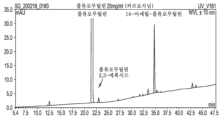
도 1은 플류로무틸린 출발 물질의 HPLC 분석을 도시한다 (플류로무틸린-2,3-에폭시드의 함량은 약 0.3%임).
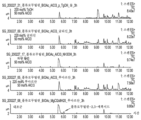
도 2는 3시간 후 양성 AlCl3 함유 반응 혼합물의 UHPLC-MS 비교를 도시한다.
도 3은 참조 샘플 (AlCl3 없음, p-톨루엔술폰산 없음)의 UHPLC-MS를 도시한다.
도 4는 반응 혼합물 (AlCl3 없음, 10 mol% p-톨루엔술폰산)의 UHPLC-MS를 도시한다. *는 치환기의 위치가 불명확함을 나타낸다.
도 5는 참조 샘플 (10 mol% AlCl3, p-톨루엔술폰산 없음)의 UHPLC-MS를 도시한다. *는 치환기의 위치가 불명확함을 나타낸다.
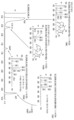
도 6a는 형성된 반응 생성물의 UHPLC-UV 평가을 도시한다 (HPLC-UV, 상부 선: 0.5 mol% AlCl3 & 10 mol% p-톨루엔술폰산, 중간 선: AlCl3 & 10 mol% p-톨루엔술폰산 없음, 하부 선: 대조군, 반응 없음). RT 32.9분에서의 주요 반응 생성물은 디엔 반응 생성물에 상응한다.
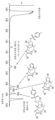
도 6b는 RT 32.9분에서의 주요 반응 생성물의 UV 스펙트럼을 도시한다 (디엔 반응 생성물에 상응함).Figure 1 shows the HPLC analysis of the fluromutilin starting material (the content of fluromutilin-2,3-epoxide is about 0.3%).
Figure 2 shows a UHPLC-MS comparison of positive AlCl 3 containing reaction mixtures after 3 hours.
3 shows UHPLC-MS of a reference sample (no AlCl 3 , no p-toluenesulfonic acid).
4 shows UHPLC-MS of the reaction mixture (no AlCl 3 , 10 mol% p-toluenesulfonic acid). * indicates that the position of the substituent is unclear.
5 shows UHPLC-MS of a reference sample (10 mol% AlCl 3 , no p-toluenesulfonic acid). * indicates that the position of the substituent is unclear.
6A shows UHPLC-UV evaluation of the reaction product formed (HPLC-UV, top line: 0.5 mol% AlCl 3 & 10 mol% p-toluenesulfonic acid, middle line: AlCl 3 & 10 mol% p-toluenesulfonic acid no, lower line: control, no reaction). The main reaction product at RT 32.9 min corresponds to the diene reaction product.
Figure 6b shows the UV spectrum of the main reaction product at RT 32.9 minutes (corresponding to the diene reaction product).
[(1S,2R,3S,4S,6R,7R,8R)-4-에테닐-3-히드록시-2,4,7,14-테트라메틸-9-옥소-6-트리시클로[5.4.3.01,8]테트라데카닐] 2-[2-(디에틸아미노)에틸술파닐]아세테이트로도 공지된 티아물린은 화학식 (1)의 구조를 갖는다:[(1S,2R,3S,4S,6R,7R,8R)-4-ethenyl-3-hydroxy-2,4,7,14-tetramethyl-9-oxo-6-tricyclo[5.4.3.0 Thiamulin, also known as 1,8 ] tetradecanyl] 2-[2-(diethylamino)ethylsulfanyl]acetate, has the structure of formula (1):

티아물린 및 그의 염 (히드로겐 푸무레이트 염 포함)은 다수의 질환, 예컨대 예를 들어 돼지 및 가금류에서의 이질, 폐렴 및 미코플라스마 감염의 치료 및 예방에 유용하다.Thiamulin and its salts (including the hydrogen fumurate salt) are useful for the treatment and prevention of a number of diseases, such as dysentery, pneumonia and mycoplasma infection, eg in swine and poultry.
티아물린 및 그의 염 형태는 플류로무틸린 [화학식 (2)]의 발효 및 후속적인 화학적 변형에 의해 생성된다.Thiamulin and its salt forms are produced by fermentation and subsequent chemical transformation of fluromutilin [Formula (2)].

생성된 티아물린 최종 생성물 (예를 들어, 티아물린 히드로겐 푸무레이트)은 1% 이하의 화학식 (4)의 에폭시드 화합물을 함유한다. 화학식 (4)의 에폭시드 모이어티는 이 물질을 잠재적 유전자독성 불순물 (PGI)로서 분류하는 것을 허용한다.The resulting thiamulin end product (eg thiamulin hydrogen fumurate) contains less than 1% of the epoxide compound of formula (4). The epoxide moiety of formula (4) allows this substance to be classified as a potentially genotoxic impurity (PGI).

화학식 (4)의 상응하는 에폭시드 전구체는 발효 혼합물에서 산화/에폭시화 효소의 선천성 생물학적 활성으로 인해 상당한 수준으로 형성된 발효 부산물 [화학식 (5)]로서 플류로무틸린에 이미 존재한다.The corresponding epoxide precursor of formula (4) is already present in fluromutilin as a fermentation by-product [formula (5)] formed to a significant degree due to the innate biological activity of the oxidation/epoxidation enzymes in the fermentation mixture.

플류로무틸린의 제조 방법이 공지되어 있지만, 개선된 제조 방법, 보다 특히 플류로무틸린 중 바람직하지 않은 에폭시드 불순물 함량을 허용되는 수준으로 감소시키는 방법에 대한 필요성이 존재한다.Although processes for the preparation of fluromutilin are known, there is a need for improved processes for preparation, more particularly methods for reducing the undesirable epoxide impurity content in fluromutilin to acceptable levels.
한 측면에서, 본 개시내용은 플류로무틸린 부류 화합물 (예를 들어, 플류로무틸린, 티아물린, 발네물린, 레타파물린, 레파물린)의 조성물에서 에폭시드 불순물 함량을 감소시키는 방법을 제공한다. 개시된 방법은 에폭시드 불순물의 95-99%만큼의 감소 (화학량론적 대조군을 기준으로 가변적인 출발 에폭시드 불순물 함량을 견딜 수 있음)를 제공하며, 이로써 최종 생성물 중 에폭시드 함량을 ≤0.5% (5000 ppm), 바람직하게는 ≤0.1% (1000 ppm), 보다 바람직하게는 ≤0.05% (500 ppm), 보다 더 바람직하게는 ≤0.01% (100 ppm)로 감소시킨다.In one aspect, the present disclosure provides a method for reducing the epoxide impurity content in a composition of a fluromutilin class compound (e.g., fluromutilin, thiamulin, balnemulin, retapamulin, repamulin). The disclosed process provides a reduction of epoxide impurities by 95-99% (can tolerate variable starting epoxide impurity content based on stoichiometric control), thereby reducing the epoxide content in the final product to ≤0.5% (5000 ppm), preferably ≤0.1% (1000 ppm), more preferably ≤0.05% (500 ppm), even more preferably ≤0.01% (100 ppm).
또 다른 측면에서, 본 개시내용은 ≤0.5% (5000 ppm), 바람직하게는 ≤0.1% (1000 ppm), 보다 바람직하게는 ≤0.05% (500 ppm), 보다 더 바람직하게는 ≤0.01% (100 ppm)의 에폭시드 불순물 함량을 갖는 플류로무틸린 부류 화합물 (예를 들어, 플류로무틸린, 티아물린, 발네물린, 레타파물린, 레파물린)의 조성물을 제공한다.In another aspect, the present disclosure provides ≤0.5% (5000 ppm), preferably ≤0.1% (1000 ppm), more preferably ≤0.05% (500 ppm), even more preferably ≤0.01% (100 ppm) of the epoxide impurity content.
1. 정의1. Definition
달리 정의되지 않는 한, 본원에 사용된 모든 기술 과학 용어는 관련 기술분야의 통상의 기술자에 의해 통상적으로 이해되는 바와 동일한 의미를 갖는다. 상충되는 경우, 정의를 포함한 본 문헌이 우선할 것이다. 바람직한 방법 및 물질이 하기에 기재되지만, 본원에 기재된 것들과 유사하거나 동등한 방법 및 물질이 본 발명의 실시 또는 시험에 사용될 수 있다. 본원에 언급된 모든 간행물, 특허 출원, 특허 및 다른 참고문헌은 그 전문이 참조로 포함된다. 본원에 개시된 물질, 방법 및 예는 단지 예시적이며, 제한적인 것으로 의도되지 않는다.Unless defined otherwise, all technical and scientific terms used herein have the same meaning as commonly understood by one of ordinary skill in the relevant art. In case of conflict, this document, including definitions, will control. Although preferred methods and materials are described below, methods and materials similar or equivalent to those described herein may be used in the practice or testing of the present invention. All publications, patent applications, patents and other references mentioned herein are incorporated by reference in their entirety. The materials, methods and examples disclosed herein are illustrative only and are not intended to be limiting.
용어 "약"은 측정가능한 수치 변수와 관련하여 사용될 때, 변수의 지시된 값 및 지시된 값의 실험 오차 내에 있거나 지시된 값의 ±10 퍼센트 내에 있는 (어느 것이든 더 큰 것) 변수의 모든 값을 지칭한다.The term "about", when used in reference to a measurable numerical variable, includes the indicated value of the variable and any value of the variable that is within experimental error of the indicated value or within ±10 percent of the indicated value, whichever is greater. refers to
용어 "대상체에게 투여하는"은 피부, 피하, 근육내, 점막, 점막하, 경피, 경구 또는 비강내 투여를 포함하나 이에 제한되지는 않는다. 투여는 주사 또는 국소 투여를 포함할 수 있다.The term “administering to a subject” includes, but is not limited to, cutaneous, subcutaneous, intramuscular, mucosal, submucosal, transdermal, oral or intranasal administration. Administration may include injection or topical administration.
본원에 사용된 용어 "알킬"은 1 내지 10개의 탄소 원자를 함유하는 직쇄형 또는 분지형, 포화 탄화수소 쇄를 의미한다. 용어 "저급 알킬" 또는 "C1-C6-알킬"은 1 내지 6개의 탄소 원자를 함유하는 직쇄 또는 분지쇄 탄화수소를 의미한다. 용어 "C1-C3-알킬"은 1 내지 3개의 탄소 원자를 함유하는 직쇄 또는 분지쇄 탄화수소를 의미한다. 알킬의 대표적인 예는 메틸, 에틸, n-프로필, 이소-프로필, n-부틸, sec-부틸, 이소-부틸, tert-부틸, n-펜틸, 이소펜틸, 네오펜틸, n-헥실, 3-메틸헥실, 2,2-디메틸펜틸, 2,3-디메틸펜틸, n-헵틸, n-옥틸, n-노닐 및 n-데실을 포함하나 이에 제한되지는 않는다.As used herein, the term "alkyl" refers to a straight or branched, saturated hydrocarbon chain containing from 1 to 10 carbon atoms. The term "lower alkyl" or "C 1 -C 6 -alkyl" means a straight or branched chain hydrocarbon containing 1 to 6 carbon atoms. The term "C 1 -C 3 -alkyl" means a straight or branched chain hydrocarbon containing 1 to 3 carbon atoms. Representative examples of alkyl are methyl, ethyl, n-propyl, iso-propyl, n-butyl, sec-butyl, iso-butyl, tert-butyl, n-pentyl, isopentyl, neopentyl, n-hexyl, 3-methyl hexyl, 2,2-dimethylpentyl, 2,3-dimethylpentyl, n-heptyl, n-octyl, n-nonyl and n-decyl.
본원에 사용된 용어 "알케닐"은 적어도 1개의 탄소-탄소 이중 결합 및 1 내지 10개의 탄소 원자를 함유하는 직쇄형 또는 분지형 탄화수소 쇄를 의미한다.As used herein, the term "alkenyl" means a straight or branched hydrocarbon chain containing at least one carbon-carbon double bond and from 1 to 10 carbon atoms.
구체적 관능기 및 화학 용어의 정의는 하기에 보다 상세히 기재된다. 본 개시내용의 목적상, 화학 원소는 문헌 [Handbook of Chemistry and Physics, 75th Ed.]의 표지 안쪽의 원소 주기율표, CAS 버전에 따라 확인되고, 구체적 관능기는 일반적으로 본원에 기재된 바와 같이 정의된다. 추가로, 유기 화학의 일반적 원리, 뿐만 아니라 구체적 관능성 모이어티 및 반응성은 문헌 [Organic Chemistry, Thomas Sorrell, University Science Books, Sausalito, 1999; Smith and March March's Advanced Organic Chemistry, 5th Edition, John Wiley & Sons, Inc., New York, 2001; Larock, Comprehensive Organic Transformations, VCH Publishers, Inc., New York, 1989; Carruthers, Some Modern Methods of Organic Synthesis, 3rd Edition, Cambridge University Press, Cambridge, 1987]에 기재되어 있으며; 이들 각각의 전체 내용은 본원에 참조로 포함된다.Definitions of specific functional groups and chemical terms are described in more detail below. For purposes of this disclosure, chemical elements are identified according to the Inside Cover Periodic Table of the Elements, CAS version, Handbook of Chemistry and Physics, 75th Ed., and specific functional groups are generally defined as described herein. Additionally, general principles of organic chemistry, as well as specific functional moieties and reactivity, are described in Organic Chemistry, Thomas Sorrell, University Science Books, Sausalito, 1999; Smith and March March's Advanced Organic Chemistry, 5th Edition, John Wiley & Sons, Inc., New York, 2001; Larock, Comprehensive Organic Transformations, VCH Publishers, Inc., New York, 1989; Carruthers, Some Modern Methods of Organic Synthesis, 3rd Edition, Cambridge University Press, Cambridge, 1987; The entire contents of each of these are incorporated herein by reference.
본원에 사용된 용어 "알콕시"는 산소 원자를 통해 모 분자 모이어티에 부가된 본원에 정의된 바와 같은 알킬 기를 지칭한다. 알콕시의 대표적인 예는 메톡시, 에톡시, 프로폭시, 2-프로폭시, 부톡시 및 tert-부톡시를 포함하나 이에 제한되지는 않는다.As used herein, the term "alkoxy" refers to an alkyl group, as defined herein, appended to the parent molecular moiety through an oxygen atom. Representative examples of alkoxy include, but are not limited to, methoxy, ethoxy, propoxy, 2-propoxy, butoxy and tert-butoxy.
본원에 사용된 용어 "알케닐"은 적어도 1개의 탄소-탄소 이중 결합 및 1 내지 10개의 탄소 원자를 함유하는 직쇄형 또는 분지형 탄화수소 쇄를 의미한다.As used herein, the term "alkenyl" means a straight or branched hydrocarbon chain containing at least one carbon-carbon double bond and from 1 to 10 carbon atoms.
본원에 사용된 용어 "알콕시알킬"은 본원에 정의된 바와 같은 알킬 기를 통해 모 분자 모이어티에 부가된 본원에 정의된 바와 같은 알콕시 기를 지칭한다.As used herein, the term "alkoxyalkyl" refers to an alkoxy group as defined herein appended to the parent molecular moiety through an alkyl group as defined herein.
본원에 사용된 용어 "알콕시플루오로알킬"은 본원에 정의된 바와 같은 플루오로알킬 기를 통해 모 분자 모이어티에 부가된 본원에 정의된 바와 같은 알콕시 기를 지칭한다.As used herein, the term “alkoxyfluoroalkyl” refers to an alkoxy group, as defined herein, appended to the parent molecular moiety through a fluoroalkyl group, as defined herein.
본원에 사용된 용어 "알킬렌"은 1 내지 10개의 탄소 원자, 예를 들어 2 내지 5개의 탄소 원자의 직쇄 또는 분지쇄 탄화수소로부터 유래된 2가 기를 지칭한다. 알킬렌의 대표적인 예는 -CH2CH2-, -CH2CH2CH2-, -CH2CH2CH2CH2-, 및 -CH2CH2CH2CH2CH2-를 포함하나 이에 제한되지는 않는다.As used herein, the term “alkylene” refers to a divalent group derived from a straight or branched chain hydrocarbon of 1 to 10 carbon atoms, for example 2 to 5 carbon atoms. Representative examples of alkylene include -CH 2 CH 2 -, -CH 2 CH 2 CH 2 -, -CH 2 CH 2 CH 2 CH 2 -, and -CH 2 CH 2 CH 2 CH 2 CH 2 -, but Not limited.
본원에 사용된 용어 "알킬아미노"는 본원에 정의된 바와 같은 적어도 1개의 알킬 기가 본원에 정의된 바와 같은 아미노 기를 통해 모 분자 모이어티에 부가된 것을 의미한다.The term "alkylamino" as used herein means at least one alkyl group as defined herein is appended to the parent molecular moiety through an amino group as defined herein.
본원에 사용된 용어 "아미드"는 -C(O)Rx- 또는 -RxC(O)-를 의미하며, 여기서 Rx는 수소, 알킬, 시클로알킬, 아릴, 헤테로아릴, 헤테로사이클, 알케닐 또는 헤테로알킬일 수 있다.As used herein, the term "amide" means -C(O)R x - or -R x C(O)-, where R x is hydrogen, alkyl, cycloalkyl, aryl, heteroaryl, heterocycle, al It can be kenyl or heteroalkyl.
본원에 사용된 용어 "아미노알킬"은 본원에 정의된 바와 같은 적어도 1개의 아미노 기가 본원에 정의된 바와 같은 알킬렌 기를 통해 모 분자 모이어티에 부가된 것을 의미한다.The term "aminoalkyl" as used herein means at least one amino group as defined herein is appended to the parent molecular moiety through an alkylene group as defined herein.
본원에 사용된 용어 "아미노"는 -NRxRy를 의미하며, 여기서 Rx 및 Ry는 수소, 알킬, 시클로알킬, 아릴, 헤테로아릴, 헤테로사이클, 알케닐 또는 헤테로알킬일 수 있다. 아미노알킬 기 또는 아미노가 2개의 다른 모이어티와 함께 부가된 임의의 다른 모이어티의 경우, 아미노는 -NRx-일 수 있고, 여기서 Rx는 수소, 알킬, 시클로알킬, 아릴, 헤테로아릴, 헤테로사이클, 알케닐 또는 헤테로알킬일 수 있다.As used herein, the term "amino" means -NR x R y , where R x and R y can be hydrogen, alkyl, cycloalkyl, aryl, heteroaryl, heterocycle, alkenyl or heteroalkyl. For an aminoalkyl group or any other moiety in which amino is added together with two other moieties, the amino can be -NR x -, where R x is hydrogen, alkyl, cycloalkyl, aryl, heteroaryl, hetero It can be cyclic, alkenyl or heteroalkyl.
본원에 사용된 용어 "아릴"은 페닐 기 또는 비시클릭 융합된 고리계를 지칭한다. 비시클릭 융합된 고리계는, 모 분자 모이어티에 부가되고 본원에 정의된 바와 같은 시클로알킬 기, 페닐 기, 본원에 정의된 바와 같은 헤테로아릴 기 또는 본원에 정의된 바와 같은 헤테로사이클에 융합된 페닐 기에 의해 예시된다. 아릴의 대표적인 예는 인돌릴, 나프틸, 페닐 및 테트라히드로퀴놀리닐을 포함하나 이에 제한되지는 않는다.As used herein, the term “aryl” refers to a phenyl group or bicyclic fused ring system. A bicyclic fused ring system is a phenyl group added to the parent molecular moiety and fused to a cycloalkyl group as defined herein, a phenyl group, a heteroaryl group as defined herein, or a heterocycle as defined herein. exemplified by Representative examples of aryl include, but are not limited to, indolyl, naphthyl, phenyl, and tetrahydroquinolinyl.
본원에 사용된 용어 "시아노알킬"은 적어도 1개의 -CN 기가 본원에 정의된 바와 같은 알킬렌 기를 통해 모 분자 모이어티에 부가된 것을 의미한다.As used herein, the term "cyanoalkyl" means at least one -CN group is appended to the parent molecular moiety through an alkylene group as defined herein.
본원에 사용된 용어 "시아노플루오로알킬"은 적어도 1개의 -CN 기가 본원에 정의된 바와 같은 플루오로알킬 기를 통해 모 분자 모이어티에 부가된 것을 의미한다.As used herein, the term "cyanofluoroalkyl" means that at least one -CN group is appended to the parent molecular moiety through a fluoroalkyl group as defined herein.
본원에 사용된 용어 "시클로알콕시"는 산소 원자를 통해 모 분자 모이어티에 부가된 본원에 정의된 바와 같은 시클로알킬 기를 지칭한다.As used herein, the term "cycloalkoxy" refers to a cycloalkyl group, as defined herein, appended to the parent molecular moiety through an oxygen atom.
본원에 사용된 용어 "시클로알킬"은 3 내지 10개의 탄소 원자, 0개의 헤테로원자 및 0개의 이중 결합을 함유하는 카르보시클릭 고리계를 지칭한다. 시클로알킬의 대표적인 예는 시클로프로필, 시클로부틸, 시클로펜틸, 시클로헥실, 시클로헵틸, 시클로옥틸, 시클로노닐 및 시클로데실을 포함하나 이에 제한되지는 않는다. "시클로알킬"은 또한, 시클로알킬 기가 모 분자 모이어티에 부가되고, 본원에 정의된 바와 같은 아릴 기, 본원에 정의된 바와 같은 헤테로아릴 기 또는 본원에 정의된 바와 같은 헤테로사이클에 융합된 카르보시클릭 고리계를 포함한다. 이러한 시클로알킬 기의 대표적인 예는 2,3-디히드로-1H-인데닐 (예를 들어, 2,3-디히드로-1H-인덴-1-일 및 2,3-디히드로-1H-인덴-2-일), 6,7-디히드로-5H-시클로펜타[b]피리디닐 (예를 들어, 6,7-디히드로-5H-시클로펜타[b]피리딘-6-일), 및 5,6,7,8-테트라히드로퀴놀리닐 (예를 들어, 5,6,7,8-테트라히드로퀴놀린-5-일)을 포함하나 이에 제한되지는 않는다.As used herein, the term “cycloalkyl” refers to a carbocyclic ring system containing 3 to 10 carbon atoms, 0 heteroatoms and 0 double bonds. Representative examples of cycloalkyl include, but are not limited to, cyclopropyl, cyclobutyl, cyclopentyl, cyclohexyl, cycloheptyl, cyclooctyl, cyclononyl and cyclodecyl. “Cycloalkyl” also refers to a carbocyclic group in which a cycloalkyl group is added to a parent molecular moiety and fused to an aryl group as defined herein, a heteroaryl group as defined herein, or a heterocycle as defined herein. contains a ring system. Representative examples of such cycloalkyl groups are 2,3-dihydro-1H-indenyl (e.g., 2,3-dihydro-1H-inden-1-yl and 2,3-dihydro-1H-indenyl- 2-yl), 6,7-dihydro-5H-cyclopenta[b]pyridinyl (
본원에 사용된 용어 "시클로알케닐"은 적어도 1개의 탄소-탄소 이중 결합을 함유하고, 바람직하게는 고리당 5-10개의 탄소 원자를 갖는 비-방향족 모노시클릭 또는 멀티시클릭 고리계를 의미한다. 예시적인 모노시클릭 시클로알케닐 고리는 시클로펜테닐, 시클로헥세닐 또는 시클로헵테닐을 포함한다.As used herein, the term “cycloalkenyl” refers to a non-aromatic monocyclic or multicyclic ring system containing at least one carbon-carbon double bond and preferably having 5-10 carbon atoms per ring. do. Exemplary monocyclic cycloalkenyl rings include cyclopentenyl, cyclohexenyl or cycloheptenyl.
본원에 사용된 용어 "플루오로알킬"은 1, 2, 3, 4, 5, 6, 7 또는 8개의 수소 원자가 플루오린에 의해 대체된 본원에 정의된 바와 같은 알킬 기를 의미한다. 플루오로알킬의 대표적인 예는 2-플루오로에틸, 2,2,2-트리플루오로에틸, 트리플루오로메틸, 디플루오로메틸, 펜타플루오로에틸, 및 트리플루오로프로필, 예컨대 3,3,3-트리플루오로프로필을 포함하나 이에 제한되지는 않는다.As used herein, the term “fluoroalkyl” refers to an alkyl group as defined herein in which 1, 2, 3, 4, 5, 6, 7 or 8 hydrogen atoms have been replaced by fluorine. Representative examples of fluoroalkyls are 2-fluoroethyl, 2,2,2-trifluoroethyl, trifluoromethyl, difluoromethyl, pentafluoroethyl, and trifluoropropyl, such as 3,3, including but not limited to 3-trifluoropropyl.
본원에 사용된 용어 "플루오로알콕시"는 본원에 정의된 바와 같은 적어도 1개의 플루오로알킬 기가 산소 원자를 통해 모 분자 모이어티에 부가된 것을 의미한다. 플루오로알콕시의 대표적인 예는 디플루오로메톡시, 트리플루오로메톡시 및 2,2,2-트리플루오로에톡시를 포함하나 이에 제한되지는 않는다.As used herein, the term "fluoroalkoxy" means at least one fluoroalkyl group as defined herein is appended to the parent molecular moiety through an oxygen atom. Representative examples of fluoroalkoxy include, but are not limited to, difluoromethoxy, trifluoromethoxy, and 2,2,2-trifluoroethoxy.
본원에 사용된 용어 "할로겐" 또는 "할로"는 Cl, Br, I 또는 F를 의미한다.As used herein, the term "halogen" or "halo" means Cl, Br, I or F.
본원에 사용된 용어 "할로알킬"은 1, 2, 3, 4, 5, 6, 7 또는 8개의 수소 원자가 할로겐에 의해 대체된 본원에 정의된 바와 같은 알킬 기를 의미한다.As used herein, the term “haloalkyl” refers to an alkyl group as defined herein in which 1, 2, 3, 4, 5, 6, 7 or 8 hydrogen atoms have been replaced by halogen.
본원에 사용된 용어 "할로알콕시"는 본원에 정의된 바와 같은 적어도 1개의 할로알킬 기가 산소 원자를 통해 모 분자 모이어티에 부가된 것을 의미한다.As used herein, the term "haloalkoxy" means at least one haloalkyl group as defined herein is appended to the parent molecular moiety through an oxygen atom.
본원에 사용된 용어 "할로시클로알킬"은 1개 이상의 수소 원자가 할로겐에 의해 대체된 본원에 정의된 바와 같은 시클로알킬 기를 의미한다.As used herein, the term “halocycloalkyl” refers to a cycloalkyl group as defined herein in which one or more hydrogen atoms have been replaced by a halogen.
본원에 사용된 용어 "헤테로알킬"은 탄소 원자 중 1개 이상이 S, O, P 및 N으로부터 선택된 헤테로원자에 의해 대체된 본원에 정의된 바와 같은 알킬 기를 의미한다. 헤테로알킬의 대표적인 예는 알킬 에테르, 2급 및 3급 알킬 아민, 아미드, 및 알킬 술피드를 포함하나 이에 제한되지는 않는다.As used herein, the term "heteroalkyl" refers to an alkyl group as defined herein in which one or more of the carbon atoms is replaced by a heteroatom selected from S, O, P and N. Representative examples of heteroalkyl include, but are not limited to, alkyl ethers, secondary and tertiary alkyl amines, amides, and alkyl sulfides.
본원에 사용된 용어 "헤테로아릴"은 방향족 모노시클릭 고리 또는 방향족 비시클릭 고리계를 지칭한다. 방향족 모노시클릭 고리는 N, O 및 S로 이루어진 군으로부터 독립적으로 선택된 적어도 1개의 헤테로원자 (예를 들어, O, S, 및 N으로부터 독립적으로 선택된 1, 2, 3, 또는 4개의 헤테로원자)를 함유하는 5 또는 6원 고리이다. 5원 방향족 모노시클릭 고리는 2개의 이중 결합을 갖고, 6원 방향족 모노시클릭 고리는 3개의 이중 결합을 갖는다. 비시클릭 헤테로아릴 기는, 모 분자 모이어티에 부가되고 본원에 정의된 바와 같은 모노시클릭 시클로알킬 기, 본원에 정의된 바와 같은 모노시클릭 아릴 기, 본원에 정의된 바와 같은 모노시클릭 헤테로아릴 기 또는 본원에 정의된 바와 같은 모노시클릭 헤테로사이클에 융합된 모노시클릭 헤테로아릴 고리에 의해 예시된다. 헤테로아릴의 대표적인 예는 인돌릴, 피리디닐 (피리딘-2-일, 피리딘-3-일, 피리딘-4-일 포함), 피리미디닐, 피라지닐, 피리다지닐, 피라졸릴, 1,2,3-트리아졸릴, 1,3,4-티아디아졸릴, 1,2,4-티아디아졸릴, 1,3,4-옥사디아졸릴, 1,2,4-옥사디아졸릴, 이미다졸릴, 티아졸릴, 이소티아졸릴, 티에닐, 벤즈이미다졸릴, 벤조티아졸릴, 벤족사졸릴, 벤족사디아졸릴, 벤조티에닐, 벤조푸라닐, 이소벤조푸라닐, 푸라닐, 옥사졸릴, 이속사졸릴, 퓨리닐, 이소인돌릴, 퀴녹살리닐, 인다졸릴, 퀴나졸리닐, 1,2,4-트리아지닐, 1,3,5-트리아지닐, 이소퀴놀리닐, 퀴놀리닐, 6,7-디히드로-1,3-벤조티아졸릴, 이미다조[1,2-a]피리디닐, 나프티리디닐, 피리도이미다졸릴, 티아졸로[5,4-b]피리딘-2-일, 및 티아졸로[5,4-d]피리미딘-2-일을 포함하나 이에 제한되지는 않는다.As used herein, the term "heteroaryl" refers to an aromatic monocyclic ring or an aromatic bicyclic ring system. Aromatic monocyclic rings contain at least one heteroatom independently selected from the group consisting of N, O and S (e.g., 1, 2, 3, or 4 heteroatoms independently selected from O, S, and N). It is a 5 or 6 membered ring containing A 5-membered aromatic monocyclic ring has two double bonds, and a 6-membered aromatic monocyclic ring has three double bonds. A bicyclic heteroaryl group is a monocyclic cycloalkyl group added to the parent molecular moiety and as defined herein, a monocyclic aryl group as defined herein, a monocyclic heteroaryl group as defined herein, or exemplified by a monocyclic heteroaryl ring fused to a monocyclic heterocycle as defined herein. Representative examples of heteroaryl are indolyl, pyridinyl (including pyridin-2-yl, pyridin-3-yl, pyridin-4-yl), pyrimidinyl, pyrazinyl, pyridazinyl, pyrazolyl, 1,2, 3-triazolyl, 1,3,4-thiadiazolyl, 1,2,4-thiadiazolyl, 1,3,4-oxadiazolyl, 1,2,4-oxadiazolyl, imidazolyl, thia zolyl, isothiazolyl, thienyl, benzimidazolyl, benzothiazolyl, benzoxazolyl, benzoxadiazolyl, benzothienyl, benzofuranyl, isobenzofuranyl, furanyl, oxazolyl, isoxazolyl, Purinyl, isoindolyl, quinoxalinyl, indazolyl, quinazolinyl, 1,2,4-triazinyl, 1,3,5-triazinyl, isoquinolinyl, quinolinyl, 6,7-di Hydro-1,3-benzothiazolyl, imidazo[1,2-a]pyridinyl, naphthyridinyl, pyridoimidazolyl, thiazolo[5,4-b]pyridin-2-yl, and thiazolo [5,4-d]pyrimidin-2-yl.
본원에 사용된 용어 "헤테로사이클" 또는 "헤테로시클릭"은 모노시클릭 헤테로사이클, 비시클릭 헤테로사이클 또는 트리시클릭 헤테로사이클을 의미한다. 모노시클릭 헤테로사이클은 O, N 및 S로 이루어진 군으로부터 독립적으로 선택된 적어도 1개의 헤테로원자를 함유하는 3-, 4-, 5-, 6-, 7- 또는 8-원 고리이다. 3- 또는 4-원 고리는 0 또는 1개의 이중 결합, 및 O, N 및 S로 이루어진 군으로부터 선택된 1개의 헤테로원자를 함유한다. 5-원 고리는 0 또는 1개의 이중 결합, 및 O, N 및 S로 이루어진 군으로부터 선택된 1, 2 또는 3개의 헤테로원자를 함유한다. 6-원 고리는 0, 1 또는 2개의 이중 결합, 및 O, N 및 S로 이루어진 군으로부터 선택된 1, 2 또는 3개의 헤테로원자를 함유한다. 7- 및 8-원 고리는 0, 1, 2 또는 3개의 이중 결합, 및 O, N 및 S로 이루어진 군으로부터 선택된 1, 2 또는 3개의 헤테로원자를 함유한다. 모노시클릭 헤테로사이클의 대표적인 예는 아제티디닐, 아제파닐, 아지리디닐, 디아제파닐, 1,3-디옥사닐, 1,3-디옥솔라닐, 1,3-디티올라닐, 1,3-디티아닐, 이미다졸리닐, 이미다졸리디닐, 이소티아졸리닐, 이소티아졸리디닐, 이속사졸리닐, 이속사졸리디닐, 모르폴리닐, 옥사디아졸리닐, 옥사디아졸리디닐, 옥사졸리닐, 옥사졸리디닐, 옥세타닐, 피페라지닐, 피페리디닐, 피라닐, 피라졸리닐, 피라졸리디닐, 피롤리닐, 피롤리디닐, 테트라히드로푸라닐, 테트라히드로피라닐, 테트라히드로피리디닐, 테트라히드로티에닐, 티아디아졸리닐, 티아디아졸리디닐, 1,2-티아지나닐, 1,3-티아지나닐, 티아졸리닐, 티아졸리디닐, 티오모르폴리닐, 1,1-디옥시도티오모르폴리닐 (티오모르폴린 술폰), 티오피라닐, 및 트리티아닐을 포함하나 이에 제한되지는 않는다. 비시클릭 헤테로사이클은 페닐 기에 융합된 모노시클릭 헤테로사이클, 또는 모노시클릭 시클로알킬에 융합된 모노시클릭 헤테로사이클, 또는 모노시클릭 시클로알케닐에 융합된 모노시클릭 헤테로사이클, 또는 모노시클릭 헤테로사이클에 융합된 모노시클릭 헤테로사이클, 또는 스피로 헤테로사이클 기, 또는 고리의 2개의 비-인접 원자가 1, 2, 3 또는 4개의 탄소 원자의 알킬렌 가교에 의해 또는 2, 3 또는 4개의 탄소 원자의 알케닐렌 가교에 의해 연결된 가교된 모노시클릭 헤테로사이클 고리계이다. 비시클릭 헤테로사이클의 대표적인 예는 벤조피라닐, 벤조티오피라닐, 크로마닐, 2,3-디히드로벤조푸라닐, 2,3-디히드로벤조티에닐, 2,3-디히드로이소퀴놀린, 2-아자스피로[3.3]헵탄-2-일, 2-옥사-6-아자스피로[3.3]헵탄-6-일, 아자비시클로[2.2.1]헵틸 (2-아자비시클로[2.2.1]헵트-2-일 포함), 아자비시클로[3.1.0]헥사닐 (3-아자비시클로[3.1.0]헥산-3-일 포함), 2,3-디히드로-1H-인돌릴, 이소인돌리닐, 옥타히드로시클로펜타[c]피롤릴, 옥타히드로피롤로피리디닐 및 테트라히드로이소퀴놀리닐을 포함하나 이에 제한되지는 않는다. 트리시클릭 헤테로사이클은 페닐 기에 융합된 비시클릭 헤테로사이클, 또는 모노시클릭 시클로알킬에 융합된 비시클릭 헤테로사이클, 또는 모노시클릭 시클로알케닐에 융합된 비시클릭 헤테로사이클, 또는 모노시클릭 헤테로사이클에 융합된 비시클릭 헤테로사이클, 또는 비시클릭 고리의 2개의 비-인접 원자가 1, 2, 3 또는 4개의 탄소 원자의 알킬렌 가교에 의해 또는 2, 3 또는 4개의 탄소 원자의 알케닐렌 가교에 의해 연결된 비시클릭 헤테로사이클에 의해 예시된다. 트리시클릭 헤테로사이클의 예는 옥타히드로-2,5-에폭시펜탈렌, 헥사히드로-2H-2,5-메타노시클로펜타[b]푸란, 헥사히드로-1H-1,4-메타노시클로펜타[c]푸란, 아자-아다만탄 (1-아자트리시클로[3.3.1.13,7]데칸), 및 옥사-아다만탄 (2-옥사트리시클로[3.3.1.13,7]데칸)을 포함하나 이에 제한되지는 않는다. 모노시클릭, 비시클릭 및 트리시클릭 헤테로사이클은 고리 내에 함유된 임의의 탄소 원자 또는 임의의 질소 원자를 통해 모 분자 모이어티에 연결되고, 비치환 또는 치환될 수 있다.As used herein, the term "heterocycle" or "heterocyclic" means a monocyclic heterocycle, bicyclic heterocycle or tricyclic heterocycle. A monocyclic heterocycle is a 3-, 4-, 5-, 6-, 7- or 8-membered ring containing at least one heteroatom independently selected from the group consisting of O, N and S. The 3- or 4-membered ring contains 0 or 1 double bond and 1 heteroatom selected from the group consisting of O, N and S. The 5-membered ring contains 0 or 1 double bond and 1, 2 or 3 heteroatoms selected from the group consisting of O, N and S. The 6-membered ring contains 0, 1 or 2 double bonds and 1, 2 or 3 heteroatoms selected from the group consisting of O, N and S. The 7- and 8-membered rings contain 0, 1, 2 or 3 double bonds and 1, 2 or 3 heteroatoms selected from the group consisting of O, N and S. Representative examples of monocyclic heterocycles are azetidinyl, azepanil, aziridinyl, diazepanyl, 1,3-dioxanyl, 1,3-dioxolanyl, 1,3-dithiolanyl, 1, 3-Dithianil, imidazolinyl, imidazolidinyl, isothiazolinyl, isothiazolidinyl, isoxazolinyl, isoxazolidinyl, morpholinyl, oxadiazolinyl, oxadiazolidinyl, oxa Zolinyl, oxazolidinyl, oxetanil, piperazinyl, piperidinyl, pyranyl, pyrazolinyl, pyrazolidinyl, pyrrolinyl, pyrrolidinyl, tetrahydrofuranyl, tetrahydropyranyl, tetrahydro Pyridinyl, tetrahydrothienyl, thiadiazolinyl, thiadiazolidinyl, 1,2-thiazinanyl, 1,3-thiazinanyl, thiazolinyl, thiazolidinyl, thiomorpholinyl, 1,1 -deoxidothiomorpholinyl (thiomorpholine sulfone), thiopyranil, and tritianil, but are not limited thereto. A bicyclic heterocycle is a monocyclic heterocycle fused to a phenyl group, or a monocyclic heterocycle fused to a monocyclic cycloalkyl, or a monocyclic heterocycle fused to a monocyclic cycloalkenyl, or a monocyclic heterocycle fused to a monocyclic cycloalkenyl group. A monocyclic heterocycle fused to a heterocycle, or a spiro heterocycle group, or two non-adjacent atoms of the ring by an alkylene bridge of 1, 2, 3 or 4 carbon atoms or 2, 3 or 4 carbon atoms It is a bridged monocyclic heterocyclic ring system linked by alkenylene bridges of atoms. Representative examples of bicyclic heterocycles are benzopyranyl, benzothiopyranyl, chromanyl, 2,3-dihydrobenzofuranyl, 2,3-dihydrobenzothienyl, 2,3-dihydroisoquinoline, 2 -Azaspiro[3.3]heptan-2-yl, 2-oxa-6-azaspiro[3.3]heptan-6-yl, azabicyclo[2.2.1]heptyl (2-azabicyclo[2.2.1]hept-2 -yl), azabicyclo[3.1.0]hexanyl (including 3-azabicyclo[3.1.0]hexan-3-yl), 2,3-dihydro-1H-indolyl, isoindolinyl, octa hydrocyclopenta[c]pyrrolyl, octahydropyrrolopyridinyl and tetrahydroisoquinolinyl. A tricyclic heterocycle is a bicyclic heterocycle fused to a phenyl group, or a bicyclic heterocycle fused to a monocyclic cycloalkyl, or a bicyclic heterocycle fused to a monocyclic cycloalkenyl, or a monocyclic heterocycle. Fused bicyclic heterocycles, or two non-adjacent atoms of a bicyclic ring, are linked by an alkylene bridge of 1, 2, 3 or 4 carbon atoms or by an alkenylene bridge of 2, 3 or 4 carbon atoms exemplified by bicyclic heterocycles. Examples of tricyclic heterocycles are octahydro-2,5-epoxypentalene, hexahydro-2H-2,5-methanocyclopenta[b]furan, hexahydro-1H-1,4-methanocyclopenta[ c]furan, including aza-adamantane (1-azatricyclo[3.3.1.1 3,7 ]decane), and oxa-adamantane (2-oxatricyclo[3.3.1.1 3,7 ]decane) However, it is not limited thereto. Monocyclic, bicyclic and tricyclic heterocycles are linked to the parent molecular moiety through any carbon atom or any nitrogen atom contained within the ring, and may be unsubstituted or substituted.
본원에 사용된 용어 "히드록실" 또는 "히드록시"는 -OH 기를 의미한다.As used herein, the term "hydroxyl" or "hydroxyl" refers to an -OH group.
본원에 사용된 용어 "히드록시알킬"은 적어도 1개의 -OH 기가 본원에 정의된 바와 같은 알킬렌 기를 통해 모 분자 모이어티에 부가된 것을 의미한다.As used herein, the term “hydroxyalkyl” means at least one —OH group is appended to the parent molecular moiety through an alkylene group as defined herein.
본원에 사용된 용어 "히드록시플루오로알킬"은 적어도 1개의 -OH 기가 본원에 정의된 바와 같은 플루오로알킬 기를 통해 모 분자 모이어티에 부착된 것을 의미한다.As used herein, the term "hydroxyfluoroalkyl" means that at least one -OH group is attached to the parent molecular moiety through a fluoroalkyl group as defined herein.
일부 경우에, 히드로카르빌 치환기 (예를 들어, 알킬 또는 시클로알킬) 내의 탄소 원자의 수는 접두어 "Cx-Cy-"에 의해 표시되며, 여기서 x는 치환기 내의 탄소 원자의 최소 수이고, y는 최대 수이다. 따라서, 예를 들어 "C1-C3-알킬"은 1 내지 3개의 탄소 원자를 함유하는 알킬 치환기를 지칭한다.In some cases, the number of carbon atoms in a hydrocarbyl substituent (e.g., alkyl or cycloalkyl) is indicated by the prefix "C x -C y -", where x is the minimum number of carbon atoms in the substituent, y is the maximum number. Thus, for example, “C 1 -C 3 -alkyl” refers to an alkyl substituent containing 1 to 3 carbon atoms.
본원에 사용된 용어 "술폰아미드"는 -S(O)2Rd- 또는 -RdS(O)-를 의미하며, 여기서 Rd는 수소, 알킬, 시클로알킬, 아릴, 헤테로아릴, 헤테로사이클, 알케닐 또는 헤테로알킬일 수 있다.As used herein, the term "sulfonamide" means -S(O) 2 R d - or -R d S(O)-, where R d is hydrogen, alkyl, cycloalkyl, aryl, heteroaryl, heterocycle , alkenyl or heteroalkyl.
용어 "동물"은 인간을 비롯한 모든 척추 동물을 포함하도록 본원에 사용된다. 이는 또한 배아 및 태아 단계를 비롯한 모든 발달 단계의 개별 동물을 포함한다.The term "animal" is used herein to include all vertebrates including humans. This also includes individual animals at all stages of development, including embryonic and fetal stages.
본원에 사용된 용어 "포함하다", "포함한다", "갖는", "갖다", "할 수 있다", "함유하다", 및 그의 변형은 추가의 작용 또는 구조의 가능성을 배제하지 않는 개방형 연결 어구, 용어 또는 단어인 것으로 의도된다. 단수 형태는 문맥이 달리 명백하게 지시하지 않는 한 복수 지시대상을 포함한다. 본 개시내용은 또한, 명백하게 제시되든 아니든, 본원에 제시된 실시양태 또는 요소 "를 포함하는", "로 이루어진" 및 "로 본질적으로 이루어진" 다른 실시양태를 고려한다.The terms “comprises,” “comprises,” “has,” “has,” “could,” “includes,” and variations thereof, as used herein, are open ended that do not preclude the possibility of additional acts or structures. It is intended to be a linking phrase, term or word. The singular form includes the plural referent unless the context clearly dictates otherwise. This disclosure also contemplates embodiments presented herein or other embodiments “comprising,” “consisting of,” and “consisting essentially of” an element, whether expressly set forth or not.
용어 "제어하다", "제어하는" 또는 "제어된"은 제한 없이 증상, 장애, 상태 또는 질환의 위험을 감소, 저감 또는 호전시키고, 증상, 장애, 상태 또는 질환으로부터 동물을 보호하는 것을 지칭한다. 조절은 치료적, 예방적 또는 방지적 투여를 지칭할 수 있다. 예를 들어, 유충 또는 미성숙 심장사상충 감염은 감염이 성숙 기생충에 의한 감염으로 진행되는 것을 방지하는 유충 또는 미성숙 기생충에 작용함으로써 제어될 것이다.The terms "control," "controlling," or "controlled" refer to, without limitation, reducing, reducing, or ameliorating the risk of a symptom, disorder, condition, or disease, and protecting an animal from a symptom, disorder, condition, or disease. . Modulation may refer to therapeutic, prophylactic or preventive administration. For example, infection with larvae or immature heartworms will be controlled by acting on the larvae or immature parasites preventing the infection from progressing to infection with the mature parasites.
용어 "유효량"은 대상체에게 목적하는 이익을 제공하는 양을 지칭하고, 치료 및 대조군 둘 다를 위한 투여를 포함한다. 양은 개별 대상체마다 달라질 것이고, 대상체의 전체 신체 상태 및 치료될 상태의 기저 원인의 중증도, 병용 치료, 및 목적하는 반응을 유익한 수준으로 유지하는 데 사용되는 본 발명의 화합물의 양을 포함한 다수의 인자에 따라 달라질 것이다.The term "effective amount" refers to an amount that provides a desired benefit to a subject, and includes administration for both treatment and control purposes. The amount will vary for the individual subject and will depend on a number of factors including the overall physical condition of the subject and the severity of the underlying cause of the condition being treated, the concomitant treatment, and the amount of compound of the present invention used to maintain the desired response at a beneficial level. will depend on
유효량은 관련 기술분야의 통상의 기술자로서의 담당 진단자에 의해, 공지된 기술의 사용에 의해 및 유사한 상황 하에 수득된 결과를 관찰함으로써 용이하게 결정될 수 있다. 유효량, 용량을 결정하는 데 있어서, 환자의 종; 그의 크기, 연령 및 전반적 건강; 수반되는 구체적 상태, 장애, 감염 또는 질환; 상태, 장애 또는 질환의 수반 정도 또는 중증도, 개별 환자의 반응; 투여되는 특정한 화합물; 투여 방식; 투여되는 제제의 생체이용률 특징; 선택된 용량 요법; 병용 의약의 사용; 및 다른 관련 상황을 포함하나 이에 제한되지는 않는 다수의 요인이 담당 진단자에 의해 고려된다. 본 개시내용의 유효량인 활성 성분 치료 투여량은, 예를 들어 0.5 mg 내지 100 mg의 범위일 수 있다. 구체적인 양은 관련 기술분야의 통상의 기술자에 의해 결정될 수 있다. 이들 투여량은 약 1 kg 내지 약 20 kg의 질량을 갖는 대상체에 기초하지만, 진단자는 질량이 상기 체중 범위 밖에 속하는 대상체에 대한 적절한 용량을 결정할 수 있을 것이다. 본 개시내용의 유효량인 활성 성분 치료 투여량은, 예를 들어 대상체 1 kg당 0.1 mg 내지 10 mg의 범위일 수 있다. 투여 요법은 매일, 매주 또는 매월 투여일 것으로 예상된다.The effective amount can be readily determined by the attending diagnostician as a person skilled in the art, by use of known techniques and by observing results obtained under similar circumstances. In determining the effective amount, dosage, the species of the patient; his size, age and overall health; concomitant specific condition, disorder, infection or disease; the degree or severity of the condition, disorder or disease, the individual patient's response; the specific compound being administered; mode of administration; bioavailability characteristics of the agent being administered; selected dose regimen; use of concomitant medications; A number of factors are considered by the attending diagnostician, including but not limited to, and other relevant circumstances. An active ingredient therapeutic dosage that is an effective amount of the present disclosure may range, for example, from 0.5 mg to 100 mg. Specific amounts can be determined by those skilled in the art. These dosages are based on a subject having a mass of about 1 kg to about 20 kg, but the diagnostician will be able to determine an appropriate dosage for a subject whose mass falls outside this weight range. A therapeutic dose of an active ingredient, which is an effective amount of the present disclosure, may range, for example, from 0.1 mg to 10 mg per kg of subject. The dosing regimen is expected to be daily, weekly or monthly dosing.
용어 "거울상이성질체적으로 순수한"은 90% 초과의 (S)-거울상이성질체, 즉 80% 거울상이성질체 과잉률 또는 90% (S)-거울상이성질체 및 10% (R)-거울상이성질체를 지칭한다. 한 실시양태에서, 용어 "거울상이성질체적으로 순수한"은 92% 초과로 존재하는 (S)-거울상이성질체 및 8%의 (R)-거울상이성질체를 지칭한다. 한 실시양태에서, 용어 "거울상이성질체적으로 순수한"은 94% 초과로 존재하는 (S)-거울상이성질체 및 6%의 (R)-거울상이성질체를 지칭한다. 한 실시양태에서, 용어 "거울상이성질체적으로 순수한"은 96% 초과로 존재하는 (S)-거울상이성질체 및 4%의 (R)-거울상이성질체를 지칭한다.The term “enantiomerically pure” refers to greater than 90% (S)-enantiomer, i.e. 80% enantiomeric excess or 90% (S)-enantiomer and 10% (R)-enantiomer. In one embodiment, the term “enantiomerically pure” refers to greater than 92% of the (S)-enantiomer and 8% of the (R)-enantiomer. In one embodiment, the term “enantiomerically pure” refers to greater than 94% of the (S)-enantiomer and 6% of the (R)-enantiomer. In one embodiment, the term “enantiomerically pure” refers to the (S)-enantiomer present at greater than 96% and the (R)-enantiomer at 4%.
용어 "염"은 수의학적 또는 제약상 허용되는 유기 산 및 염기 또는 무기 산 및 염기의 염을 지칭한다. 이러한 염은 관련 기술분야에 널리 공지되어 있고, 문헌 [Journal of Pharmaceutical Science, 66, 2-19 (1977)]에 기재된 것을 포함한다. 염은 화합물의 최종 단리 및 정제 동안 또는 화합물의 아미노 기를 적합한 산과 반응시킴으로써 개별적으로 제조될 수 있다. 예를 들어, 화합물을 적합한 용매, 예컨대 비제한적으로 메탄올 및 물 중에 용해시키고, 적어도 1 당량의 산, 예컨대 염산으로 처리할 수 있다. 생성된 염을 침전시키고, 여과에 의해 단리하고, 감압 하에 건조시킬 수 있다. 대안적으로, 용매 및 과량의 산을 감압 하에 제거하여 염을 제공할 수 있다. 대표적인 염은 아세테이트, 아디페이트, 알기네이트, 시트레이트, 아스파르테이트, 벤조에이트, 벤젠술포네이트, 비술페이트, 부티레이트, 캄포레이트, 캄포르술포네이트, 디글루코네이트, 글리세로포스페이트, 헤미술페이트, 헵타노에이트, 헥사노에이트, 포르메이트, 이세티오네이트, 푸마레이트, 락테이트, 말레에이트, 메탄술포네이트, 나프틸렌술포네이트, 니코티네이트, 옥살레이트, 파모에이트, 펙티네이트, 퍼술페이트, 3-페닐프로피오네이트, 피크레이트, 옥살레이트, 말레에이트, 피발레이트, 프로피오네이트, 숙시네이트, 타르트레이트, 트리클로로아세테이트, 트리플루오로아세테이트, 글루타메이트, 파라-톨루엔술포네이트, 운데카노에이트, 염산, 브로민화수소산, 황산, 인산 등을 포함한다. 화합물의 아미노 기는 또한 알킬 클로라이드, 브로마이드 및 아이오다이드, 예컨대 메틸, 에틸, 프로필, 이소프로필, 부틸, 라우릴, 미리스틸, 스테아릴 등으로 4급화될 수 있다.The term "salts" refers to salts of veterinarily or pharmaceutically acceptable organic acids and bases or inorganic acids and bases. Such salts are well known in the art and include those described in Journal of Pharmaceutical Science, 66, 2-19 (1977). Salts can be prepared individually during the final isolation and purification of the compound or by reacting the amino group of the compound with a suitable acid. For example, a compound can be dissolved in a suitable solvent such as, but not limited to, methanol and water and treated with at least one equivalent of an acid such as hydrochloric acid. The resulting salt precipitates out and can be isolated by filtration and dried under reduced pressure. Alternatively, the solvent and excess acid may be removed under reduced pressure to provide a salt. Representative salts include acetate, adipate, alginate, citrate, aspartate, benzoate, benzenesulfonate, bisulfate, butyrate, camphorate, camphorsulfonate, digluconate, glycerophosphate, hemisulfate, Heptanoate, hexanoate, formate, isethionate, fumarate, lactate, maleate, methanesulfonate, naphthylenesulfonate, nicotinate, oxalate, pamoate, pectinate, persulfate, 3 -Phenylpropionate, picrate, oxalate, maleate, pivalate, propionate, succinate, tartrate, trichloroacetate, trifluoroacetate, glutamate, para-toluenesulfonate, undecanoate, hydrochloric acid , hydrobromic acid, sulfuric acid, phosphoric acid and the like. The amino groups of the compounds may also be quaternized with alkyl chlorides, bromides and iodides such as methyl, ethyl, propyl, isopropyl, butyl, lauryl, myristyl, stearyl and the like.
염기성 부가염은 개시된 화합물의 최종 단리 및 정제 동안 카르복실 기와 적합한 염기, 예컨대 금속 양이온, 예컨대 리튬, 나트륨, 칼륨, 칼슘, 마그네슘 또는 알루미늄의 히드록시드, 카르보네이트 또는 비카르보네이트, 또는 유기 1급, 2급 또는 3급 아민과의 반응에 의해 제조될 수 있다. 4급 아민 염, 예컨대 메틸아민, 디메틸아민, 트리메틸아민, 트리에틸아민, 디에틸아민, 에틸아민, 트리부틸아민, 피리딘, N,N-디메틸아닐린, N-메틸피페리딘, N-메틸모르폴린, 디시클로헥실아민, 프로카인, 디벤질아민, N,N-디벤질페네틸아민, 1-에페나민 및 N,N'-디벤질에틸렌디아민, 에틸렌디아민, 에탄올아민, 디에탄올아민, 피페리딘, 피페라진 등으로부터 유도된 것이 제조될 수 있다.Basic addition salts are formed during the final isolation and purification of the disclosed compounds with carboxyl groups and suitable bases such as hydroxides, carbonates or bicarbonates of metal cations such as lithium, sodium, potassium, calcium, magnesium or aluminum, or organic It can be prepared by reaction with primary, secondary or tertiary amines. Quaternary amine salts such as methylamine, dimethylamine, trimethylamine, triethylamine, diethylamine, ethylamine, tributylamine, pyridine, N,N-dimethylaniline, N-methylpiperidine, N-methylmorph Folin, dicyclohexylamine, procaine, dibenzylamine, N,N-dibenzylphenethylamine, 1-ephenamine and N,N'-dibenzylethylenediamine, ethylenediamine, ethanolamine, diethanolamine, p Those derived from peridine, piperazine and the like can be prepared.
용어 "대상체" 및 "환자"는 인간 및 비-인간 포유동물 동물, 예컨대 개, 고양이, 마우스, 래트, 기니 피그, 토끼, 페릿, 소, 말, 양, 염소 및 돼지를 지칭한다. 보다 특정한 대상체는 인간인 것으로 이해된다. 또한, 보다 특정한 대상체는 포유동물 애완동물 또는 반려 동물, 예컨대 개 및 고양이 및 또한 마우스, 기니 피그, 페릿 및 토끼이다.The terms “subject” and “patient” refer to human and non-human mammalian animals such as dogs, cats, mice, rats, guinea pigs, rabbits, ferrets, cows, horses, sheep, goats and pigs. A more specific subject is understood to be a human being. Also more specific subjects are mammalian pets or companion animals, such as dogs and cats and also mice, guinea pigs, ferrets and rabbits.
용어 "치환된"은 1개 이상의 비-수소 치환기로 추가로 치환될 수 있는 기를 지칭한다. 치환기는 할로겐, =O (옥소), =S (티옥소), 시아노, 니트로, 플루오로알킬, 알콕시플루오로알킬, 플루오로알콕시, 알킬, 알케닐, 알키닐, 할로알킬, 할로알콕시, 헤테로알킬, 시클로알킬, 시클로알케닐, 아릴, 헤테로아릴, 헤테로사이클, 시클로알킬알킬, 헤테로아릴알킬, 아릴알킬, 히드록시, 히드록시알킬, 알콕시, 알콕시알킬, 알킬렌, 아릴옥시, 페녹시, 벤질옥시, 아미노, 알킬아미노, 디알킬아미노, 아실아미노, 아미노알킬, 아릴아미노, 술포닐아미노, 술피닐아미노, 술포닐, 알킬술포닐, 아릴술포닐, 아미노술포닐, 술피닐, -COOH, 케톤, 아미드, 카르바메이트 및 아실을 포함하나 이에 제한되지는 않는다. 예를 들어, 기가 "임의로 치환된" (예컨대, 알킬, 알케닐, 알키닐, 아릴, 헤테로아릴, 시클로알킬, 헤테로알킬, 헤테로사이클 또는 다른 기, 예컨대 R 기) 것으로 기재된 경우, 이는 할로겐, =O (옥소), =S (티옥소), 시아노, 니트로, 플루오로알킬, 알콕시플루오로알킬, 플루오로알콕시, 알킬, 알케닐, 알키닐, 할로알킬, 할로알콕시, 헤테로알킬, 시클로알킬, 시클로알케닐, 아릴, 헤테로아릴, 헤테로사이클, 시클로알킬알킬, 헤테로아릴알킬, 아릴알킬, 히드록시, 히드록시알킬, 알콕시, 알콕시알킬, 알킬렌, 아릴옥시, 페녹시, 벤질옥시, 아미노, 알킬아미노, 디알킬아미노, 아실아미노, 아미노알킬, 아릴아미노, 술포닐아미노, 술피닐아미노, 술포닐, 알킬술포닐, 아릴술포닐, 아미노술포닐, 술피닐, -COOH, 케톤, 아미드, 카르바메이트 및 아실로부터 독립적으로 선택된 0, 1, 2, 3, 4 또는 5개의 치환기를 가질 수 있다.The term "substituted" refers to a group which may be further substituted with one or more non-hydrogen substituents. Substituents are halogen, =O (oxo), =S (thioxo), cyano, nitro, fluoroalkyl, alkoxyfluoroalkyl, fluoroalkoxy, alkyl, alkenyl, alkynyl, haloalkyl, haloalkoxy, hetero Alkyl, cycloalkyl, cycloalkenyl, aryl, heteroaryl, heterocycle, cycloalkylalkyl, heteroarylalkyl, arylalkyl, hydroxy, hydroxyalkyl, alkoxy, alkoxyalkyl, alkylene, aryloxy, phenoxy, benzyl oxy, amino, alkylamino, dialkylamino, acylamino, aminoalkyl, arylamino, sulfonylamino, sulfinylamino, sulfonyl, alkylsulfonyl, arylsulfonyl, aminosulfonyl, sulfinyl, -COOH, ketone , amides, carbamates and acyls, but are not limited thereto. For example, when a group is described as being "optionally substituted" (e.g., an alkyl, alkenyl, alkynyl, aryl, heteroaryl, cycloalkyl, heteroalkyl, heterocycle or other group such as an R group), it is halogen, = O (oxo), =S (thioxo), cyano, nitro, fluoroalkyl, alkoxyfluoroalkyl, fluoroalkoxy, alkyl, alkenyl, alkynyl, haloalkyl, haloalkoxy, heteroalkyl, cycloalkyl, Cycloalkenyl, aryl, heteroaryl, heterocycle, cycloalkylalkyl, heteroarylalkyl, arylalkyl, hydroxy, hydroxyalkyl, alkoxy, alkoxyalkyl, alkylene, aryloxy, phenoxy, benzyloxy, amino, alkyl Amino, dialkylamino, acylamino, aminoalkyl, arylamino, sulfonylamino, sulfinylamino, sulfonyl, alkylsulfonyl, arylsulfonyl, aminosulfonyl, sulfinyl, -COOH, ketone, amide, carba may have 0, 1, 2, 3, 4 or 5 substituents independently selected from mate and acyl.
본원에 기재된 화합물에 대해, 기 및 그의 치환기는, 선택 및 치환이, 예를 들어 재배열, 고리화, 제거 등에 의한 것과 같은 변환을 자발적으로 겪지 않는 안정한 화합물을 생성하도록 원자 및 치환기의 허용되는 원자가에 따라 선택될 수 있다.For the compounds described herein, groups and substituents thereof are such that the permissible valences of the atoms and substituents are such that selection and substitution result in stable compounds that do not spontaneously undergo transformation, such as, for example, by rearrangement, cyclization, elimination, and the like. can be selected according to
용어 "치료하는", "치료하기 위해", "치료된" 또는 "치료"는 제한 없이 기존 증상의 진행 또는 중증도를 억제, 둔화, 정지, 감소, 호전, 역전시키거나, 또는 장애, 상태 또는 질환을 예방하는 것을 포함한다. 예를 들어, 성인 심장사상충 감염은 본 발명의 화합물을 투여함으로써 치료될 것이다. 치료는 치료적으로 적용 또는 투여될 수 있다.The terms "treating", "to treat", "treated" or "treatment" means, without limitation, to inhibit, slow, arrest, reduce, ameliorate, reverse the progression or severity of an existing condition, or disorder, condition or disease. includes preventing For example, adult heartworm infection may be treated by administering a compound of the present invention. Treatment can be applied or administered therapeutically.
관련 기술분야의 통상의 기술자는 본 발명의 특정 화합물이 이성질체로서 존재한다는 것을 알 것이다. 임의의 비의 기하 이성질체, 거울상이성질체 및 부분입체이성질체를 비롯한 본 발명의 화합물의 모든 입체이성질체는 본 발명의 범주 내에 있는 것으로 고려된다. 관련 기술분야의 통상의 기술자는 또한 본 발명의 특정 화합물이 호변이성질체로서 존재한다는 것을 알 것이다. 본 발명의 화합물의 모든 호변이성질체 형태는 본 발명의 범주 내에 있는 것으로 고려된다.Those skilled in the art will recognize that certain compounds of the present invention exist as isomers. All stereoisomers of the compounds of this invention, including geometric isomers, enantiomers and diastereomers in any ratio, are contemplated within the scope of this invention. Those skilled in the art will also recognize that certain compounds of the present invention exist as tautomers. All tautomeric forms of the compounds of this invention are contemplated as being within the scope of this invention.
본 발명의 화합물은 또한 우세한 원자 질량의 적어도 1개의 원자가 동일한 원자 번호를 갖지만 우세한 원자 질량과 상이한 원자 질량을 갖는 원자에 의해 대체된 모든 동위원소 변형을 포함한다. 동위원소 변형 (예를 들어, 중수소, 2H)의 사용은 보다 큰 대사 안정성을 제공할 수 있다. 추가적으로, 본 발명의 화합물의 특정 동위원소 변형은 약물 및/또는 기질 조직 분포 연구에 유용할 수 있는 방사성 동위원소 (예를 들어, 삼중수소, 3H, 또는 14C)를 혼입할 수 있다. 양전자 방출 동위원소, 예컨대 11C, 18F, 15O 및 13N으로의 치환은 양전자 방출 단층촬영 (PET) 연구에 유용할 수 있다.The compounds of the present invention also include all isotopic variations in which at least one atom of the predominant atomic mass is replaced by an atom having the same atomic number but a different atomic mass than the predominant atomic mass. The use of isotopic modifications (eg, deuterium, 2 H) may provide greater metabolic stability. Additionally, certain isotopic variations of the compounds of the present invention may incorporate radioactive isotopes (eg, tritium, 3 H, or 14 C) that may be useful in drug and/or substrate tissue distribution studies. Substitution with positron emitting isotopes such as 11 C, 18 F, 15 O and 13 N may be useful in Positron Emission Tomography (PET) studies.
본원에서 수치 범위를 언급하는 경우, 동일한 정도의 정밀도를 갖는 그 사이의 각각의 개재 수가 명백하게 고려된다. 예를 들어, 6-9의 범위에 대해, 6 및 9에 추가로 숫자 7 및 8이 고려되고, 6.0-7.0의 범위에 대해, 숫자 6.0, 6.1, 6.2, 6.3, 6.4, 6.5, 6.6, 6.7, 6.8, 6.9, 및 7.0이 명백하게 고려된다.Where numerical ranges are recited herein, each intervening number therebetween with the same degree of precision is expressly contemplated. For example, for the range of 6-9, the numbers 7 and 8 are considered in addition to 6 and 9, and for the range of 6.0-7.0, the numbers 6.0, 6.1, 6.2, 6.3, 6.4, 6.5, 6.6, 6.7 , 6.8, 6.9, and 7.0 are explicitly contemplated.
2. 방법2. Method
한 측면에서, 본 개시내용은 플류로무틸린 부류 화합물을 정제하는 방법을 제공하며, 방법은 플류로무틸린 및 하나 이상의 불순물을 포함하는 조성물을 친핵체로 처리하여 하나 이상의 불순물-친핵체 반응 부가물을 생성하고, 임의로 하나 이상의 불순물-친핵체 반응 부가물 중 적어도 하나로부터 플류로무틸린을 정제하는 것을 수반한다.In one aspect, the present disclosure provides a method for purifying a fluromutilin class compound, the method comprising treating a composition comprising fluromutilin and one or more impurities with a nucleophile to generate one or more impurity-nucleophile reaction adducts; , optionally involving purifying fluromutilin from at least one of the one or more impurity-nucleophile reaction adducts.
특정 실시양태에서, 플류로무틸린은 화학식 (6)을 갖고, 하나 이상의 불순물은 화학식 (7)을 갖는다.In certain embodiments, fluromutilin has formula (6) and the one or more impurities have formula (7).

여기서here
R 및 R1은 각각 독립적으로 -OH, 

R3은 H이다.R 3 is H.
특정 실시양태에서, 친핵체는 할로겐; 탄소 친핵체; 보론산; 산소 친핵체 (예를 들어, 알콜, 에테르, 유기 산); 질소 친핵체 (예를 들어, 암모니아, 아민, 아지드, 시아나이드, 이소시아네이트, 이소티오시아네이트); 황 친핵체 (예를 들어, 티올, 티오에테르); 셀레노시아네이트; 포스핀 또는 그리냐르 시약이다. 바람직한 실시양태에서, 친핵체는 유기 산, 보다 바람직하게는 푸마르산 또는 p-톨루엔 술폰산, 보다 더 바람직하게는 p-톨루엔술폰산 (또한 통상적으로 p-TSA, p-TsOH 또는 토스산으로 지칭되며, 여기서 p ='파라' 또는 4-페닐 치환 위치임)이다.In certain embodiments, the nucleophile is selected from halogen; carbon nucleophiles; boronic acid; oxygen nucleophiles (eg alcohols, ethers, organic acids); nitrogen nucleophiles (eg, ammonia, amines, azides, cyanides, isocyanates, isothiocyanates); sulfur nucleophiles (eg, thiols, thioethers); selenocyanate; It is a phosphine or Grignard reagent. In a preferred embodiment, the nucleophile is an organic acid, more preferably fumaric acid or p-toluene sulfonic acid, even more preferably p-toluenesulfonic acid (also commonly referred to as p-TSA, p-TsOH or tosic acid, where p = 'para' or 4-phenyl substitution site).
특정 실시양태에서, 친핵체는 화학식 (8)을 갖는다: R2-OH, 여기서 R2는 H, 알킬, 알케닐, 알키닐, -S(O)-R4, -S(O)2-R4, 및 -C(O)-R5로부터 선택되고, 여기서 R4 및 R5는 알킬, 알케닐, 알키닐, 아릴, 헤테로아릴, 시클로알킬, 및 헤테로시클로알킬로부터 독립적으로 선택되고, 여기서 상기 R2, R4, 및 R5의 알킬, 알케닐, 아릴, 헤테로아릴, 시클로알킬, 및 헤테로시클로알킬은 각각 독립적으로 1개 이상의 치환기로 치환 또는 비치환된다.In certain embodiments, a nucleophile has formula (8): R 2 -OH, where R 2 is H, alkyl, alkenyl, alkynyl, -S(O)-R 4 , -S(O) 2 -R 4 , and -C(O)-R 5 , wherein R 4 and R 5 are independently selected from alkyl, alkenyl, alkynyl, aryl, heteroaryl, cycloalkyl, and heterocycloalkyl, wherein Alkyl, alkenyl, aryl, heteroaryl, cycloalkyl, and heterocycloalkyl in R 2 , R 4 , and R 5 are each independently unsubstituted or substituted with one or more substituents.
특정 실시양태에서, 친핵체는 화학식 (8)을 갖는다: R2-OH, 여기서 R2는 H, -C1-C6-알킬, -C1-C6-할로알킬, -C2-C6-알케닐, -C2-C6-알키닐, -S(O)-R4, -S(O)2-R4, 및 -C(O)-R5로부터 선택되고, 여기서 R4 및 R5는 -C1-C6-알킬, -C2-C6-알케닐, -C6-C10-아릴, -5- 내지10-원 헤테로아릴, -C3-C8-시클로알킬, 및 5- 내지10-원 헤테로시클로알킬로부터 독립적으로 선택되고, 이들 각각은 -C1-C6-알킬, -C1-C6-할로알킬, -C6-C10-아릴, -C3-C8-시클로알킬, 5- 내지10-원 헤테로아릴, 할로겐, -ORb, -NRdRc, -CORb, -CN, -CO2Rb, 및 -CONRdRe부터 선택된 1, 2, 3, 4, 또는 5개의 치환기로 원자가가 허용하는 한 임의로 치환되고, 여기서 Rb, Rc, Rd, 및 Re는 각각 독립적으로 -H, 및 -C1-C6-알킬로부터 선택된다.In certain embodiments, a nucleophile has formula (8): R 2 -OH, where R 2 is H, -C 1 -C 6 -alkyl, -C 1 -C 6 -haloalkyl, -C 2 -C 6 -alkenyl, -C 2 -C 6 -alkynyl, -S(O)-R 4 , -S(O) 2 -R 4 , and -C(O)-R 5 , wherein R 4 and R 5 is -C 1 -C 6 -alkyl, -C 2 -C 6 -alkenyl, -C 6 -C 10 -aryl, -5- to 10-membered heteroaryl, -C 3 -C 8 -cycloalkyl , and 5- to 10-membered heterocycloalkyl, each of which is -C 1 -C 6 -alkyl, -C 1 -C 6 -haloalkyl, -C 6 -C 10 -aryl, -C selected from 3 -C 8 -cycloalkyl, 5- to 10-membered heteroaryl, halogen, -OR b , -NR d R c , -COR b , -CN, -CO 2 R b , and -CONR d R e optionally substituted with 1, 2, 3, 4, or 5 substituents as valency permits, wherein R b , R c , R d , and R e are each independently -H, and -C 1 -C 6 - selected from alkyl.
특정 실시양태에서, 친핵성 첨가 반응은 활성화제 (예를 들어, 촉매)의 존재 하에 수행된다. 특정 실시양태에서, 친핵성 첨가 반응은 촉매의 존재 하에 수행된다. 특정 실시양태에서, 친핵성 첨가 반응은 하나 이상의 산 또는 하나 이상의 염기의 존재 하에 수행된다. 바람직한 실시양태에서, 친핵성 첨가 반응은 루이스 산 (예를 들어, AlCl3, AlBr3, ZnCl2, FeCl3, BF3, SnCl4)의 존재 하에 수행된다.In certain embodiments, the nucleophilic addition reaction is performed in the presence of an activator (eg, catalyst). In certain embodiments, the nucleophilic addition reaction is performed in the presence of a catalyst. In certain embodiments, the nucleophilic addition reaction is performed in the presence of one or more acids or one or more bases. In a preferred embodiment, the nucleophilic addition reaction is performed in the presence of a Lewis acid (eg, AlCl 3 , AlBr 3 , ZnCl 2 , FeCl 3 , BF 3 , SnCl 4 ).
특정 실시양태에서, 친핵성 첨가 반응은 용매 (예를 들어, 물, 에스테르, 알칸올, 할로겐화 탄화수소, 케톤, 에테르), 바람직하게는 극성 비양성자성 용매의 존재 하에 수행된다. 예시적인 용매는 메탄올, 에탄올, n-프로판올, 이소프로판올, n-부탄올, 디클로로메탄, 클로로포름, 1,2-디클로로에탄, 아세톤, 메틸 에틸 케톤, 디에틸 에테르, 테트라히드로푸란, N,N-디메틸포름아미드, N,N-디메틸아세트아미드, 디메틸술폭시드, 아세토니트릴, N-메틸피롤리돈, 에틸 아세테이트, 프로필 아세테이트, 이소프로필 아세테이트 및 n-부틸 아세테이트, 또는 그의 임의의 조합을 포함하나 이에 제한되지는 않는다. 특정 실시양태에서, 용매는 에틸 아세테이트이다. 특정 실시양태에서, 용매는 n-부틸 아세테이트이다.In certain embodiments, the nucleophilic addition reaction is conducted in the presence of a solvent (eg, water, ester, alkanol, halogenated hydrocarbon, ketone, ether), preferably a polar aprotic solvent. Exemplary solvents are methanol, ethanol, n-propanol, isopropanol, n-butanol, dichloromethane, chloroform, 1,2-dichloroethane, acetone, methyl ethyl ketone, diethyl ether, tetrahydrofuran, N,N-dimethylform amides, N,N-dimethylacetamide, dimethylsulfoxide, acetonitrile, N-methylpyrrolidone, ethyl acetate, propyl acetate, isopropyl acetate and n-butyl acetate, or any combination thereof. does not In certain embodiments, the solvent is ethyl acetate. In certain embodiments, the solvent is n-butyl acetate.
특정 실시양태에서, 친핵성 첨가 반응은 상 이동 조건 하에 수행된다. 반응에 유용한 상 이동 촉매는 예를 들어 4급 암모늄 염, 4급 포스포늄 염, 크라운 에테르, 및 폴리에틸렌 글리콜 및 그의 유도체를 포함한다. 4급 암모늄 염 및 포스포늄 염의 예시적인 상 이동 촉매는 화학식 (RT)4T(+)Z(-)의 것들을 포함하며, 여기서 각각의 RT는 독립적으로 C1-C25 알킬로부터 선택되고; T는 N 또는 P이고; Z는 음이온이다. 예시적인 상 이동 촉매는 테트라에틸암모늄 클로라이드, 테트라프로필암모늄 클로라이드, 테트라부틸암모늄 클로라이드, 테트라부틸암모늄 브로마이드, 테트라부틸암모늄 비술페이트, C16H33N(+)(부틸)3Br(-), (부틸)4N(+)CH3SO3 (-), (부틸)4N(+)CF3SO3 (-), 메틸트리알킬 (C8-C10)암모늄 클로라이드, (CH3CH2)4PCl, (C4H9)4PCl, (프로프)4PBr, 및 헥사데실트리메틸포스포늄 브로마이드를 포함한다.In certain embodiments, the nucleophilic addition reaction is conducted under phase transfer conditions. Phase transfer catalysts useful for the reaction include, for example, quaternary ammonium salts, quaternary phosphonium salts, crown ethers, and polyethylene glycol and derivatives thereof. Exemplary phase transfer catalysts of quaternary ammonium salts and phosphonium salts include those of the formula (R T ) 4 T (+) Z (-) , wherein each R T is independently selected from C 1 -C 25 alkyl ; T is N or P; Z is an anion. Exemplary phase transfer catalysts include tetraethylammonium chloride, tetrapropylammonium chloride, tetrabutylammonium chloride, tetrabutylammonium bromide, tetrabutylammonium bisulfate, C 16 H 33 N (+) (butyl) 3 Br (-) , ( butyl) 4 N (+) CH 3 SO 3 (-) , (butyl) 4 N (+) CF 3 SO 3 (-) , methyltrialkyl (C 8 -C 10 )ammonium chloride, (CH 3 CH 2 ) 4 PCl, (C 4 H 9 ) 4 PCl, (prop) 4 PBr, and hexadecyltrimethylphosphonium bromide.
특정 실시양태에서, 친핵성 첨가 반응은 이온 교환 조건 (예를 들어, 불균질 고체 지지체 상의 친핵체, 예컨대 예를 들어 술포네이트 에스테르 수지) 하에 수행된다.In certain embodiments, the nucleophilic addition reaction is performed under ion exchange conditions (eg, a nucleophile on a heterogeneous solid support such as, for example, a sulfonate ester resin).
특정 실시양태에서, 친핵성 첨가 반응은 20℃ 내지 100℃, 25℃ 내지 95℃, 30℃ 내지 90℃, 35℃ 내지 85℃, 40℃ 내지 80℃, 45℃ 내지 75℃, 50℃ 내지 70℃, 또는 55℃ 내지 65℃의 온도에서 수행된다. 특정 실시양태에서, 친핵성 첨가 반응은 약 60℃의 온도에서 수행된다.In certain embodiments, the nucleophilic addition reaction is performed at 20°C to 100°C, 25°C to 95°C, 30°C to 90°C, 35°C to 85°C, 40°C to 80°C, 45°C to 75°C, 50°C to 70°C. °C, or at a temperature of 55 °C to 65 °C. In certain embodiments, the nucleophilic addition reaction is conducted at a temperature of about 60°C.
특정 실시양태에서, 친핵성 첨가 반응은 0.5 내지 24시간, 1 내지 12시간, 또는 2 내지 4시간에 걸쳐 수행된다. 특정 실시양태에서, 친핵성 첨가 반응은 3시간에 걸쳐 수행된다. 특정 실시양태에서, 친핵체는 제한된 투여 속도가 사용되는 헤드 탱크로부터의 용액 중에 충전된다.In certain embodiments, the nucleophilic addition reaction is conducted over 0.5 to 24 hours, 1 to 12 hours, or 2 to 4 hours. In certain embodiments, the nucleophilic addition reaction is conducted over 3 hours. In certain embodiments, the nucleophile is charged in solution from a head tank where a limited dosing rate is used.
특정 실시양태에서, 친핵성 첨가 반응은, 예를 들어 과도한 와류 형성의 부재 하에 단위 부피당 적절한 혼합 동력, 열 및 물질 전달 속도를 보장하는 폭넓은 범위의 교반기 임펠러 속도를 임의로 사용하여 교반과 함께 수행된다. 특정 실시양태에서, 반응은 50 내지 1000 분당 회전수 (rpm), 또는 700 내지 900 rpm에서 작동하는 혼합 또는 교반 장치로 수행된다. 특정 실시양태에서, 친핵성 첨가 반응은 교반, 예를 들어 800 rpm에서 작동하는 혼합 또는 교반 장치를 사용하여 수행된다. 특정 실시양태에서, 친핵성 첨가 반응은 교반과 함께, 예를 들어 20-40 rpm에서 작동하는 혼합 또는 교반 장치를 사용하여, 예컨대 대규모 반응으로 수행된다.In certain embodiments, the nucleophilic addition reaction is conducted with agitation, optionally using a wide range of agitator impeller speeds that ensure adequate mixing power, heat and mass transfer rates per unit volume, for example, in the absence of excessive vortex formation. . In certain embodiments, the reaction is performed with a mixing or stirring device operating at 50 to 1000 revolutions per minute (rpm), or 700 to 900 rpm. In certain embodiments, the nucleophilic addition reaction is performed using agitation, for example, a mixing or stirring device operating at 800 rpm. In certain embodiments, the nucleophilic addition reaction is performed with agitation, eg, as a large-scale reaction, using a mixing or stirring device operating at 20-40 rpm.
<반응식 1><
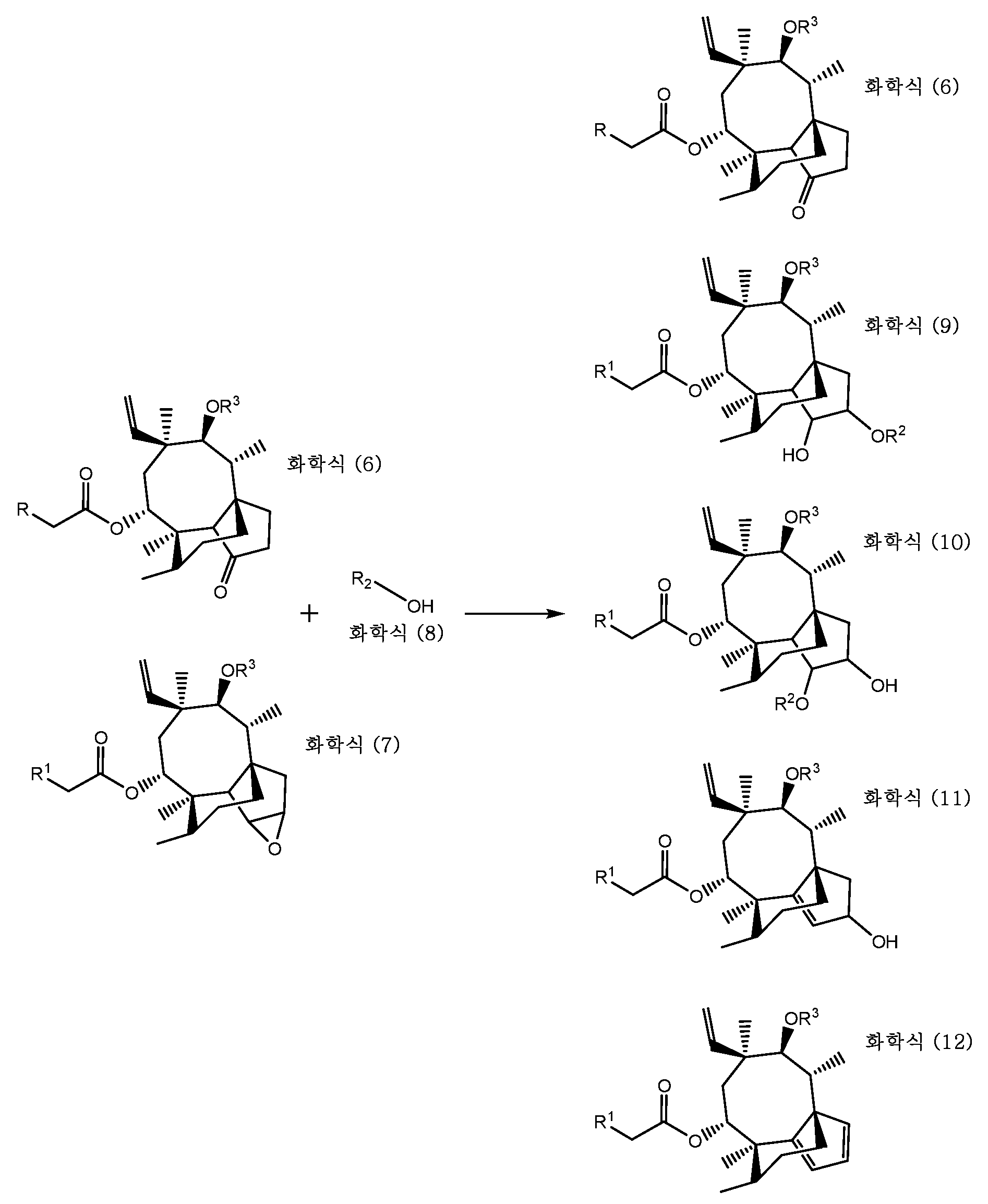
반응식 1은 플류로무틸린을 정제하는 예시적인 방법을 나타내며, 여기서 R, R1, R2, 및 R3은 상기 정의된 바와 같다. 플류로무틸린의 정제 방법은 화학식 (6)의 플류로무틸린 및 화학식 (7)의 불순물을 포함하는 조성물을 화학식 (8)의 친핵체 및 임의로 활성화제로 처리하여, 하나 이상의 불순물-친핵체 반응 부가물을 포함하는 조성물을 생성하는 것을 포함한다. 따라서, 화학식 (6)의 플류로무틸린은 바람직하게는 화학식 (7)의 불순물과 화학식 (8)의 친핵체 사이의 친핵성 반응에서 방관자로서 작용한다. 특정 실시양태에서, 불순물-친핵체 반응 부가물 중 적어도 하나는 화학식 (9), 화학식 (10), 화학식 (11), 또는 화학식 (12)를 갖는다. 이론에 얽매이는 것을 원하지는 않지만, 화학식 (11) 및 화학식 (12)의 불순물-친핵체 반응 부가물은 화학식 (7)의 에폭시드에의 친핵성 첨가 후 하나 이상의 제거 반응으로부터 생성되는 것으로 여겨진다.
화학식 (6)의 플류로무틸린 (예를 들어, 플류로무틸린, 티아물린, 발네물린, 레타파물린, 레파물린)은 합성 공정에서 하나 이상의 단계에서 불순물-친핵체 반응 부가물로부터 정제될 수 있다. 예를 들어, 초기에 생성된 불순물-친핵체 반응 부가물은 (i) 하나 이상의 하류 합성 단계에서 퍼징되거나, (ii) 추가의 합성 단계에서 방관자로서 수행되거나, (iii) 선택된 합성 단계에서 추가의 합성 변형을 겪고, 후속적으로 정제 제거되거나, 또는 (iv) 그의 임의의 조합일 수 있다. 예를 들어, 티아물린 히드로겐 푸무레이트의 합성에서, 플류로무틸린을 친핵체로 처리하여 플류로무틸린 및 하나 이상의 불순물-친핵체 반응 부가물을 포함하는 조성물을 제공할 수 있다. 플류로무틸린 및 하나 이상의 불순물-친핵체 반응 부가물을 포함하는 조성물을 하나 이상의 정제 공정에 적용하여 불순물-친핵체 반응 부가물로부터 플류로무틸린을 정제 제거할 수 있다. 대안적으로 또는 추가로, 플류로무틸린 및 하나 이상의 불순물-친핵체 반응 부가물을 포함하는 조성물은 추가의 합성 단계에서 (예를 들어, 티아물린 또는 그의 염에 대해) 수행될 수 있고, 임의로 초기 하나 이상의 불순물-친핵체 반응 부가물은 목적 조성물로부터 정제 제거 전에 합성 변형을 겪는다.The fluromutilin of formula (6) (e.g., fluromutilin, thiamulin, balnemoline, retapamulin, repamulin) can be purified from impurity-nucleophile reaction adducts in one or more steps in the synthetic process. For example, an initially formed impurity-nucleophile reaction adduct is (i) purged in one or more downstream synthetic steps, (ii) performed as a bystander in additional synthetic steps, or (iii) further synthesized in selected synthetic steps. undergo modification and subsequently purified away, or (iv) any combination thereof. For example, in the synthesis of thiamulin hydrogen fumurate, fluromutilin can be treated with a nucleophile to provide a composition comprising fluromutilin and one or more impurity-nucleophile reactive adducts. A composition comprising fluromutilin and one or more impurity-nucleophilic reaction adducts may be subjected to one or more purification processes to purify and remove fluromutilin from the impurity-nucleophile reaction adducts. Alternatively or additionally, the composition comprising fluromutilin and one or more impurity-nucleophile reaction adducts can be carried out in additional synthetic steps (eg, for thiamulin or a salt thereof), optionally with an initial one The above impurity-nucleophile reaction adducts undergo synthetic transformation prior to purification removal from the desired composition.
화학식 (6)의 플류로무틸린은 유기 합성 분야의 관련 기술분야의 통상의 기술자에게 널리 공지된 방법에 의해 하나 이상의 불순물-친핵체 반응 부가물 중 적어도 하나로부터 단리 및 정제될 수 있다. 화합물을 단리 및 정제하기 위한 통상적인 방법의 예는, 예를 들어 문헌 ["Vogel's Textbook of Practical Organic Chemistry," 5th edition (1989), by Furniss, Hannaford, Smith, and Tatchell, pub. Longman Scientific & Technical, Essex CM20 2JE, England]에 기재된 바와 같이, 고체 지지체, 예컨대 실리카 겔, 알루미나, 또는 알킬실란 기로 유도체화된 실리카 상의 크로마토그래피, 활성탄으로의 임의적인 전처리와 함께 고온 또는 저온에서의 재결정화, 박층 크로마토그래피, 다양한 압력에서의 증류, 진공 하의 승화, 및 연화처리를 포함할 수 있으나 이에 제한되지는 않는다.Fluromutilin of formula (6) may be isolated and purified from at least one of the one or more impurity-nucleophile reaction adducts by methods well known to those skilled in the art of organic synthesis. Examples of conventional methods for isolating and purifying compounds are described, for example, in "Vogel's Textbook of Practical Organic Chemistry," 5th edition (1989), by Furniss, Hannaford, Smith, and Tatchell, pub. Chromatography on a solid support such as silica gel, alumina, or silica derivatized with alkylsilane groups, at high or low temperature with optional pretreatment with activated carbon, as described in Longman Scientific & Technical, Essex CM20 2JE, England. recrystallization, thin layer chromatography, distillation at various pressures, sublimation under vacuum, and trituration.
화학식 (6)의 플류로무틸린은 특정 실시양태에서 조성물을 염기로 처리하는 것을 포함하는 방법에 의해 하나 이상의 불순물-친핵체 반응 부가물 중 적어도 하나로부터 단리 및 정제될 수 있다. 염기는 알칼리 금속 수산화물, 알칼리 토금속 수산화물, 또는 그의 조합일 수 있다. 알칼리 금속 수산화물은 LiOH, NaOH, KOH, RbOH 및 CsOH를 포함한다. 알칼리 토금속 수산화물은 Be(OH)2, Mg(OH)2, Ca(OH)2, Sr(OH)2, 및 Ba(OH)2를 포함한다. 특정 실시양태에서, 염기는 KOH 또는 NaOH이다.Fluromutilin of formula (6) may in certain embodiments be isolated and purified from at least one of the one or more impurity-nucleophile reaction adducts by a method comprising treating the composition with a base. The base may be an alkali metal hydroxide, an alkaline earth metal hydroxide, or a combination thereof. Alkali metal hydroxides include LiOH, NaOH, KOH, RbOH and CsOH. Alkaline earth metal hydroxides include Be(OH) 2 , Mg(OH) 2 , Ca(OH) 2 , Sr(OH) 2 , and Ba(OH) 2 . In certain embodiments, the base is KOH or NaOH.
개시된 화합물은 적어도 1개의 염기성 질소를 가질 수 있으며, 여기서 화합물은 산으로 처리되어 목적하는 염을 형성할 수 있다. 예를 들어, 화합물을 실온 또는 그 초과에서 산과 반응시켜 목적하는 염을 제공할 수 있고, 이를 침착시키고, 냉각 후에 여과에 의해 수집한다. 반응에 적합한 산의 예는 타르타르산, 락트산, 숙신산, 뿐만 아니라 만델산, 아트로락트산, 메탄술폰산, 에탄술폰산, 톨루엔술폰산, 나프탈렌술폰산, 벤젠술폰산, 탄산, 푸마르산, 말레산, 글루콘산, 아세트산, 프로피온산, 살리실산, 염산, 브로민화수소산, 인산, 황산, 시트르산, 히드록시부티르산, 캄포르술폰산, 말산, 페닐아세트산, 아스파르트산 또는 글루탐산 등을 포함하나 이에 제한되지는 않는다.The disclosed compounds may have at least one basic nitrogen, wherein the compound may be treated with an acid to form the desired salt. For example, the compound can be reacted with an acid at room temperature or above to give the desired salt, which is precipitated and, after cooling, collected by filtration. Examples of acids suitable for the reaction include tartaric acid, lactic acid, succinic acid, as well as mandelic acid, atrolactic acid, methanesulfonic acid, ethanesulfonic acid, toluenesulfonic acid, naphthalenesulfonic acid, benzenesulfonic acid, carbonic acid, fumaric acid, maleic acid, gluconic acid, acetic acid, propionic acid , salicylic acid, hydrochloric acid, hydrobromic acid, phosphoric acid, sulfuric acid, citric acid, hydroxybutyric acid, camphorsulfonic acid, malic acid, phenylacetic acid, aspartic acid or glutamic acid, and the like.
합성 반응을 위한 반응 조건 및 반응 시간은 사용된 특정한 반응물 및 사용된 반응물에 존재하는 치환기에 따라 달라질 수 있다. 구체적 절차는 실시예 섹션에 제공된다. 반응은 통상적인 방식 (예를 들어, 침전, 결정화, 증류, 추출, 연화처리 또는 크로마토그래피)으로 후처리될 수 있다. 달리 기재되지 않는 한, 출발 물질 및 시약은 상업적으로 입수가능하거나, 또는 화학 문헌에 기재된 방법을 사용하여 상업적으로 입수가능한 물질로부터 관련 기술분야의 통상의 기술자에 의해 제조될 수 있다. 출발 물질은, 상업적으로 입수가능하지 않은 경우, 표준 유기 화학 기술, 공지된 합성과 유사한 기술, 구조적으로 유사한 화합물, 또는 상기 기재된 반응식 또는 합성 실시예 섹션에 기재된 절차와 유사한 기술로부터 선택된 절차에 의해 제조될 수 있다.Reaction conditions and reaction times for the synthesis reaction may vary depending on the particular reactants used and the substituents present in the reactants used. Specific procedures are provided in the Examples section. The reaction may be worked up in a conventional manner (eg precipitation, crystallization, distillation, extraction, trituration or chromatography). Unless otherwise stated, starting materials and reagents are commercially available or can be prepared by one skilled in the art from commercially available materials using methods described in the chemical literature. Starting materials, if not commercially available, are prepared by procedures selected from standard organic chemistry techniques, techniques analogous to known synthesis, structurally analogous compounds, or techniques analogous to those described in the reaction schemes described above or in the Synthetic Examples section. It can be.
합성 경로의 반응 조건, 시약 및 순서의 적절한 조작, 반응 조건과 상용성일 수 없는 임의의 화학적 관능기의 보호, 및 방법의 반응 순서에서 적합한 시점에서의 탈보호를 포함한 상용 실험이 본 발명의 범주에 포함된다. 적합한 보호기 및 이러한 적합한 보호기를 사용하여 다양한 치환기를 보호 및 탈보호하는 방법은 관련 기술분야의 통상의 기술자에게 널리 공지되어 있으며; 그의 예는 문헌 [PGM Wuts and TW Greene, in Greene's book titled Protective Groups in Organic Synthesis (4th ed.), John Wiley & Sons, NY (2006)]에서 찾아볼 수 있고, 이는 그 전문이 본원에 참조로 포함된다.Commercial experiments, including proper manipulation of the reaction conditions, reagents and sequence of the synthetic route, protection of any chemical functional groups that may not be compatible with the reaction conditions, and deprotection at appropriate points in the reaction sequence of the method are within the scope of this invention. do. Suitable protecting groups and methods for protecting and deprotecting various substituents using such suitable protecting groups are well known to those skilled in the art; Examples thereof can be found in PGM Wuts and TW Greene, in Greene's book titled Protective Groups in Organic Synthesis (4 th ed.), John Wiley & Sons, NY (2006), incorporated herein by reference in its entirety. included as
개시된 화합물의 광학 활성 형태가 요구되는 경우, 이는 광학 활성 출발 물질 (예를 들어, 적합한 반응 단계의 비대칭 유도에 의해 제조됨)을 사용하여 본원에 기재된 절차 중 하나를 수행함으로써, 또는 표준 절차 (예컨대, 크로마토그래피 분리, 재결정화 또는 효소적 분해)를 사용하여 화합물 또는 중간체의 입체이성질체의 혼합물을 분해함으로써 수득될 수 있다. 유사하게, 화합물의 순수한 기하 이성질체가 요구되는 경우, 이는 순수한 기하 이성질체를 출발 물질로서 사용하여 상기 절차 중 하나를 수행함으로써, 또는 크로마토그래피 분리와 같은 표준 절차를 사용하여 화합물 또는 중간체의 기하 이성질체의 혼합물을 분해함으로써 수득될 수 있다.When an optically active form of a disclosed compound is desired, it can be obtained by carrying out one of the procedures described herein using an optically active starting material (eg, prepared by asymmetric derivation of a suitable reaction step) or by standard procedures (such as , chromatographic separation, recrystallization or enzymatic digestion) to resolve a mixture of stereoisomers of a compound or intermediate. Similarly, when a pure geometric isomer of a compound is desired, it can be obtained by carrying out one of the above procedures using the pure geometric isomer as the starting material, or by using standard procedures such as chromatographic separation to obtain a mixture of geometric isomers of the compound or intermediate. It can be obtained by decomposition.
또 다른 측면에서, 본 개시내용은 (i) 플류로무틸린 또는 그의 염 및 화학식 (5)의 화합물을 포함하는 조성물을 제공하고; (ii) 화학식 (5)의 에폭시드를 친핵체로 개환시켜 하나 이상의 반응 부가물을 제공하고; (iii) 하나 이상의 반응 부가물로부터 플류로무틸린 또는 그의 염을 분리하는 것을 포함하는, 화학식 (5)의 화합물로부터 플류로무틸린 또는 그의 염을 정제하는 방법을 제공한다.In another aspect, the present disclosure provides a composition comprising (i) fluromutilin or a salt thereof and a compound of formula (5); (ii) ring opening of the epoxide of formula (5) with a nucleophile to provide one or more reactive adducts; (iii) a process for purifying fluromutilin or a salt thereof from a compound of formula (5) comprising isolating fluromutilin or a salt thereof from one or more reaction adducts.
또 다른 측면에서, 본 개시내용은 (i) 티아물린 또는 그의 염 및 화학식 (4)의 화합물을 포함하는 조성물을 제공하는 단계; (ii) 화학식 (4)의 에폭시드를 친핵체로 개환시켜 하나 이상의 반응 부가물을 제공하는 단계; 및 (iii) 하나 이상의 반응 부가물로부터 티아물린 또는 그의 염을 분리하는 단계를 포함하는, 화학식 (4)의 화합물로부터 티아물린 또는 그의 염을 정제하는 방법을 제공한다. 특정 실시양태에서, 티아물린 또는 그의 염은 티아물린 히드로겐 푸무레이트이다.In another aspect, the present disclosure provides a composition comprising (i) providing a composition comprising thiamulin or a salt thereof and a compound of formula (4); (ii) ring opening of the epoxide of formula (4) with a nucleophile to provide one or more reactive adducts; and (iii) isolating the thiamulin or salt thereof from the one or more reaction adducts. In certain embodiments, thiamulin or a salt thereof is thiamulin hydrogen fumurate.
또 다른 측면에서, 본 개시내용은 플류로무틸린 및 하나 이상의 불순물을 포함하는 조성물을 하나 이상의 불순물 중 적어도 하나 내에 포함된 에폭시드 관능기를 개환시키도록 구성된 하나 이상의 시약으로 처리하고, 임의로 에폭시드 개환으로부터 생성된 반응 부가물 중 적어도 하나로부터 플류로무틸린을 정제하는 것을 포함하는, 플류로무틸린 부류 화합물을 정제하는 방법을 제공한다. 특정 실시양태에서, 플류로무틸린 부류 화합물은 플류로무틸린이다. 특정 실시양태에서, 에폭시드 관능기를 포함하는 하나 이상의 불순물은 플류로무틸린-2,3-에폭시드이다. 특정 실시양태에서, 하나 이상의 시약은 임의로 용매 (예를 들어, 에틸 아세테이트 또는 부틸 아세테이트)의 존재 하에 p-톨루엔술폰산 또는 푸마르산이다. 특정 실시양태에서, 반응은 약 60℃에서 수행된다. 특정 실시양태에서, 플류로무틸린은 반응 켄칭 (예를 들어, 수성 수산화나트륨), 분리 (예를 들어, 유기 및 수성 층 분리), 증류 또는 침전 중 하나 이상에 의해 반응 부가물로부터 정제되고, 이어서 정제된 플류로무틸린이 회수된다.In another aspect, the present disclosure provides treatment of a composition comprising fluromutilin and one or more impurities with one or more reagents configured to ring-open an epoxide functional group contained within at least one of the one or more impurities, optionally from epoxide ring-opening. A process for purifying fluromutilin class compounds is provided, comprising purifying fluromutilin from at least one of the resulting reaction adducts. In certain embodiments, the fluromutilin class compound is fluromutilin. In certain embodiments, the at least one impurity comprising an epoxide function is fluromutilin-2,3-epoxide. In certain embodiments, the one or more reagents is p-toluenesulfonic acid or fumaric acid, optionally in the presence of a solvent (eg, ethyl acetate or butyl acetate). In certain embodiments, the reaction is performed at about 60 °C. In certain embodiments, fluromutilin is purified from the reaction adducts by one or more of reactive quenching (eg, aqueous sodium hydroxide), separation (eg, separating organic and aqueous layers), distillation, or precipitation, followed by Purified fluromutilin is recovered.
또 다른 측면에서, 플류로무틸린 부류 화합물, 예컨대 티아물린, 플류로무틸린 또는 그의 염을 정제하는 방법은 화합물의 결정화 및/또는 재결정화의 부재 하에, i-프로필아세테이트를 사용한 화합물의 결정화 및/또는 재결정화의 부재 하에, 또는 i-프로필아세테이트의 부재 하에 수행된다.In another aspect, a method of purifying a fluromutilin class compound, such as thiamulin, fluromutilin or a salt thereof, comprises crystallizing and/or It is carried out in the absence of recrystallization, or in the absence of i-propylacetate.
본 발명의 또 다른 측면은 HPLC에 의한 잔류 친핵체/시약의 모니터링 및 단리 동안 플류로무틸린 케이크의 저온 용매 세척에 의한 잔류 친핵체/시약의 제거를 포함한다.Another aspect of the present invention involves removal of residual nucleophile/reagent by cold solvent washing of the fluromutilin cake during isolation and monitoring of residual nucleophile/reagent by HPLC.
기재된 바와 같은 합성 반응식 및 구체적 예는 예시적이며, 첨부된 청구범위에 정의된 바와 같은 본 발명의 범주를 제한하는 것으로 해석되어서는 안됨을 인지할 수 있다. 합성 방법 및 구체적 예의 모든 대안, 변형 및 등가물은 청구범위의 범주 내에 포함된다.It is to be appreciated that the synthetic schemes and specific examples as described are illustrative and should not be construed as limiting the scope of the present invention as defined in the appended claims. All alternatives, modifications and equivalents of synthetic methods and specific examples are included within the scope of the claims.
3. 조성물3. Composition
한 측면에서, 본 개시내용은 화학식 (7)의 화합물을 실질적으로 함유하지 않는 화학식 (6)의 플류로무틸린 부류 화합물을 포함하는 조성물을 제공한다. 특정 실시양태에서, 플류로무틸린 부류 화합물을 포함하는 조성물은 ≤0.5% (5000 ppm)의 화학식 (7)의 화합물, 바람직하게는 ≤0.1% (1000 ppm)의 화학식 (7)의 화합물, 보다 바람직하게는 ≤0.05% (500 ppm)의 화학식 (7)의 화합물, 보다 더 바람직하게는 ≤0.01% (100 ppm)의 화학식 (7)의 화합물을 함유한다.In one aspect, the present disclosure provides a composition comprising a fluromutilin class compound of formula (6) that is substantially free of a compound of formula (7). In certain embodiments, a composition comprising a fluromutilin class compound comprises ≤0.5% (5000 ppm) of a compound of formula (7), preferably ≤0.1% (1000 ppm) of a compound of formula (7), more preferably ≤0.1% (1000 ppm) of a compound of formula (7) preferably <0.05% (500 ppm) of the compound of formula (7), even more preferably <0.01% (100 ppm) of the compound of formula (7).
또 다른 측면에서, 본 개시내용은 ≤0.5% (5000 ppm)의 화학식 (5)의 화합물, 바람직하게는 ≤0.1% (1000 ppm)의 화학식 (5)의 화합물, 보다 바람직하게는 ≤0.05% (500 ppm)의 화학식 (5)의 화합물, 보다 더 바람직하게는 ≤0.01% (100 ppm)의 화학식 (5)의 화합물을 함유하는, 플류로무틸린 또는 그의 염을 포함하는 조성물을 제공한다.In another aspect, the present disclosure provides ≤0.5% (5000 ppm) of a compound of formula (5), preferably ≤0.1% (1000 ppm) of a compound of formula (5), more preferably ≤0.05% ( 500 ppm) of the compound of formula (5), even more preferably ≤0.01% (100 ppm) of the compound of formula (5).
또 다른 측면에서, 본 개시내용은 ≤0.5% (5000 ppm)의 화학식 (4)의 화합물, 바람직하게는 ≤0.1% (1000 ppm)의 화학식 (4)의 화합물, 보다 바람직하게는 ≤0.05% (500 ppm)의 화학식 (4)의 화합물, 보다 더 바람직하게는 ≤0.01% (100 ppm)의 화학식 (4)의 화합물을 함유하는, 티아물린 또는 그의 염을 포함하는 조성물을 제공한다. 바람직하게는, 티아물린 또는 그의 염은 티아물린 히드로겐 푸무레이트이다.In another aspect, the present disclosure provides ≤0.5% (5000 ppm) of a compound of formula (4), preferably ≤0.1% (1000 ppm) of a compound of formula (4), more preferably ≤0.05% ( 500 ppm) of the compound of formula (4), even more preferably <0.01% (100 ppm) of the compound of formula (4). Preferably, thiamulin or a salt thereof is thiamulin hydrogen fumurate.
또 다른 측면에서, 본 개시내용은 화학식 (6)의 플류로무틸린 부류 화합물, 플류로무틸린 또는 그의 염, 또는 티아물린 또는 그의 염을 포함하는 상기 기재된 조성물이 각각 화학식 (7), 화학식 (5), 또는 화학식 (4)의 화합물의 에폭시드 불순물을 약 0.5% (5000 ppm), 0.4% (4000 ppm), 0.3% (3000 ppm), 0.2% (2000 ppm), 0.1% (1000 ppm), 0.09% (900 ppm), 0.08% (800 ppm), 0.07% (700 ppm), 0.06% (600 ppm), 0.05% (500 ppm), 0.04% (400 ppm), 0.03% (300 ppm), 0.02% (200 ppm) 또는 0.01% (100 ppm) 이하의 양으로 함유할 수 있는 것을 제공한다. 에폭시드 불순물은 0% 또는 0 ppm 초과의 양으로 존재할 수 있다.In another aspect, the present disclosure provides that the above-described compositions comprising a fluromutilin class compound of formula (6), fluromutilin or a salt thereof, or thiamulin or a salt thereof are of formula (7), formula (5), respectively , or about 0.5% (5000 ppm), 0.4% (4000 ppm), 0.3% (3000 ppm), 0.2% (2000 ppm), 0.1% (1000 ppm), 0.09% of the epoxide impurity of the compound of formula (4). % (900 ppm), 0.08% (800 ppm), 0.07% (700 ppm), 0.06% (600 ppm), 0.05% (500 ppm), 0.04% (400 ppm), 0.03% (300 ppm), 0.02% (200 ppm) or 0.01% (100 ppm) or less. Epoxide impurities may be present in amounts greater than 0% or 0 ppm.
"실질적으로 함유하지 않는"은 불순물을 약 0.5% (5000 ppm), 0.4% (4000 ppm), 0.3% (3000 ppm), 0.2% (2000 ppm), 0.1% (1000 ppm), 0.09% (900 ppm), 0.08% (800 ppm), 0.07% (700 ppm), 0.06% (600 ppm), 0.05% (500 ppm), 0.04% (400 ppm), 0.03% (300 ppm), 0.02% (200 ppm), 또는 0.01% (100 ppm) 이하의 양으로 함유하는 것을 의미한다. 불순물은 화학식 (7), (5) 및 (4)의 에폭시드 불순물을 포함하나 이에 제한되지는 않는다."Substantially free" is about 0.5% (5000 ppm), 0.4% (4000 ppm), 0.3% (3000 ppm), 0.2% (2000 ppm), 0.1% (1000 ppm), 0.09% (900 ppm) of impurities. ppm), 0.08% (800 ppm), 0.07% (700 ppm), 0.06% (600 ppm), 0.05% (500 ppm), 0.04% (400 ppm), 0.03% (300 ppm), 0.02% (200 ppm) ), or 0.01% (100 ppm) or less. Impurities include, but are not limited to, epoxide impurities of Formulas (7), (5) and (4).
또 다른 측면에서, 본 개시내용은 99.5% 또는 그 초과, 99.6% 또는 그 초과, 99.7% 또는 그 초과, 99.8% 또는 그 초과, 99.9% 또는 그 초과, 99.91% 또는 그 초과, 99.92% 또는 그 초과, 99.93% 또는 그 초과, 99.94% 또는 그 초과, 99.95% 또는 그 초과, 99.96% 또는 그 초과, 99.97% 또는 그 초과, 99.98% 또는 그 초과, 또는 99.99% 또는 그 초과의 순도를 갖는, 화학식 (6)의 정제된 플류로무틸린 부류 화합물, 그의 정제된 플류로무틸린 또는 염, 정제된 티아물린 또는 그의 염을 제공한다. 나머지 백분율은 불순물, 예컨대 화학식 (7), (5) 및 (4)의 에폭시드 불순물을 포함하며, 이는 0% 또는 0 ppm 초과의 양으로 존재할 수 있다.In another aspect, the disclosure provides 99.5% or greater, 99.6% or greater, 99.7% or greater, 99.8% or greater, 99.9% or greater, 99.91% or greater, 99.92% or greater. , having a purity of 99.93% or higher, 99.94% or higher, 99.95% or higher, 99.96% or higher, 99.97% or higher, 99.98% or higher, or 99.99% or higher, formula ( A purified fluromutilin class compound of 6), purified fluromutilin or a salt thereof, and purified thiamulin or a salt thereof are provided. The remaining percentage includes impurities, such as epoxide impurities of formulas (7), (5) and (4), which may be present in amounts greater than 0% or 0 ppm.
또 다른 측면에서, 본 개시내용은, 플류로무틸린 및 하나 이상의 불순물을 포함하는 조성물을 친핵체로 처리하여 하나 이상의 불순물-친핵체 반응 부가물을 생성하고, 하나 이상의 불순물-친핵체 반응 부가물 중 적어도 하나로부터 플류로무틸린을 정제하는 것을 수반하는 방법에 의해 생성된, 정제된 플류로무틸린 조성물을 제공한다.In another aspect, the present disclosure relates to treatment of a composition comprising fluromutilin and one or more impurities with a nucleophile to generate one or more impurity-nucleophile reaction adducts, from at least one of the one or more impurity-nucleophile reaction adducts. A purified fluromutilin composition produced by a method involving purifying fluromutilin is provided.
또 다른 측면에서, 본 개시내용은, (i) 플류로무틸린 또는 그의 염 및 화학식 (5)의 화합물을 포함하는 조성물을 제공하고; (ii) 화학식 (5)의 에폭시드를 친핵체로 개환시켜 하나 이상의 반응 부가물을 제공하고; (iii) 하나 이상의 반응 부가물로부터 플류로무틸린 또는 그의 염을 분리하는 것을 포함하는 방법에 의해 생성된, 정제된 플류로무틸린 조성물을 제공한다.In another aspect, the present disclosure provides a composition comprising (i) fluromutilin or a salt thereof and a compound of formula (5); (ii) ring opening of the epoxide of formula (5) with a nucleophile to provide one or more reactive adducts; (iii) a purified fluromutilin composition produced by a process comprising separating fluromutilin or a salt thereof from one or more reaction adducts.
또 다른 측면에서, 본 개시내용은, (i) 티아물린 또는 그의 염 및 화학식 (4)의 화합물을 포함하는 조성물을 제공하는 단계; (ii) 화학식 (4)의 에폭시드를 친핵체로 개환시켜 하나 이상의 반응 부가물을 제공하는 단계; 및 (iii) 하나 이상의 반응 부가물로부터 티아물린 또는 그의 염을 분리하는 단계를 포함하는 방법에 의해 생성된, 정제된 티아물린 조성물을 제공한다. 특정 실시양태에서, 티아물린 또는 그의 염은 티아물린 히드로겐 푸무레이트이다.In another aspect, the present disclosure provides a composition comprising (i) providing a composition comprising thiamulin or a salt thereof and a compound of formula (4); (ii) ring opening of the epoxide of formula (4) with a nucleophile to provide one or more reactive adducts; and (iii) isolating tiamulin or a salt thereof from the one or more reaction adducts. In certain embodiments, thiamulin or a salt thereof is thiamulin hydrogen fumurate.
4. 사용 방법4. How to use
또 다른 측면에서, 개시된 정제된 플류로무틸린 조성물을 사용하는 치료 방법이 개시된다.In another aspect, methods of treatment using the disclosed purified fluromutilin compositions are disclosed.
본 개시내용은 티아물린에 감수성인 트레포네마 히오디센테리아에(Treponema hyodysenteriae)와 연관된 돼지 이질을 제어하는 방법을 제공하며, 상기 방법은 그를 필요로 하는 돼지에게 티아물린 또는 그의 염을 포함하는 조성물의 치료 유효량을 투여하는 것을 포함하고, 여기서 티아물린 또는 그의 염을 포함하는 조성물은 ≤0.5% (5000 ppm), 바람직하게는 ≤0.1% (1000 ppm), 보다 바람직하게는 ≤0.05% (500 ppm), 보다 더 바람직하게는 ≤0.01% (100 ppm)의 에폭시드 불순물 함량 [예를 들어, 화학식 (4)의 화합물]을 갖는다.The present disclosure provides a method for controlling swine dysentery associated with Tiamulin susceptible Treponema hyodysenteriae , the method comprising thiamulin or a salt thereof to a pig in need thereof. comprising administering a therapeutically effective amount of the composition, wherein the composition comprising thiamulin or a salt thereof is ≤0.5% (5000 ppm), preferably ≤0.1% (1000 ppm), more preferably ≤0.05% (500 ppm) ppm), even more preferably <0.01% (100 ppm) of an epoxide impurity content [eg, a compound of formula (4)].
본 개시내용은 라우소니아 인트라셀룰라리스(Lawsonia intracellularis)와 연관된 돼지 증식성 장병증 (회장염)을 제어하는 방법을 제공하며, 상기 방법은 그를 필요로 하는 돼지에게 티아물린 또는 그의 염을 포함하는 조성물의 치료 유효량을 투여하는 것을 포함하고, 여기서 티아물린 또는 그의 염을 포함하는 조성물은 ≤0.5% (5000 ppm), 바람직하게는 ≤0.1% (1000 ppm), 보다 바람직하게는 ≤0.05% (500 ppm), 보다 더 바람직하게는 ≤0.01% (100 ppm)의 에폭시드 불순물 함량 [예를 들어, 화학식 (4)의 화합물]을 갖는다.The present disclosure provides a method for controlling porcine proliferative enteropathy (ileitis) associated with Lawsonia intracellularis , the method comprising administering to a pig in need thereof a composition comprising tiamulin or a salt thereof. wherein the composition comprising thiamulin or a salt thereof is ≤0.5% (5000 ppm), preferably ≤0.1% (1000 ppm), more preferably ≤0.05% (500 ppm) ), even more preferably have an epoxide impurity content [eg, a compound of formula (4)] of ≤0.01% (100 ppm).
본 개시내용은 티아물린에 감수성인 트레포네마 히오디센테리아에와 연관된 돼지 이질 및 악티노바실루스 플레우로뉴모니아에(Actinobacillus pleuropneumoniae)로 인한 돼지 폐렴을 치료하는 방법을 제공하며, 상기 방법은 그를 필요로 하는 돼지에게 티아물린 또는 그의 염을 포함하는 조성물의 치료 유효량을 투여하는 것을 포함하고, 여기서 티아물린 또는 그의 염을 포함하는 조성물은 ≤0.5% (5000 ppm), 바람직하게는 ≤0.1% (1000 ppm), 보다 바람직하게는 ≤0.05% (500 ppm), 보다 더 바람직하게는 ≤0.01% (100 ppm)의 에폭시드 불순물 함량 [예를 들어, 화학식 (4)의 화합물]을 갖는다.The present disclosure provides a method for treating porcine dysentery associated with Tiamulin-susceptible Treponema hyodysenteriae and swine pneumonia caused by Actinobacillus pleuropneumoniae , the method comprising: administering to a pig in need thereof a therapeutically effective amount of a composition comprising tiamulin or a salt thereof, wherein the composition comprising tiamulin or a salt thereof is ≤0.5% (5000 ppm), preferably ≤0.1% (1000 ppm), more preferably ≤0.05% (500 ppm), even more preferably ≤0.01% (100 ppm) epoxide impurity content [eg, the compound of formula (4)].
본 개시내용은 티아물린에 감수성인 브라키스피라 히오디센테리아에(Brachyspira hyodysenteriae)와 연관된 돼지 이질 및 악티노바실루스 플레우로뉴모니아에로 인한 돼지 폐렴을 치료하는 방법을 제공하며, 상기 방법은 그를 필요로 하는 돼지에게 티아물린 또는 그의 염을 포함하는 조성물의 치료 유효량을 투여하는 것을 포함하고, 여기서 티아물린 또는 그의 염을 포함하는 조성물은 ≤0.5% (5000 ppm), 바람직하게는 ≤0.1% (1000 ppm), 보다 바람직하게는 ≤0.05% (500 ppm), 보다 더 바람직하게는 ≤0.01% (100 ppm)의 에폭시드 불순물 함량 [예를 들어, 화학식 (4)의 화합물]을 갖는다.The present disclosure provides a method for treating porcine dysentery associated with Brachyspira hyodysenteriae susceptible to thiamulin and swine pneumonia caused by Actinobacillus pleuropneumoniae, the method comprising: administering to a pig in need thereof a therapeutically effective amount of a composition comprising tiamulin or a salt thereof, wherein the composition comprising tiamulin or a salt thereof is ≤0.5% (5000 ppm), preferably ≤0.1% ( 1000 ppm), more preferably ≤0.05% (500 ppm), even more preferably ≤0.01% (100 ppm) epoxide impurity content [eg, a compound of formula (4)].
본 개시내용은 티아물린에 감수성인 세르풀리나 히오디센테리아에(Serpulina hyodysenteriae)와 연관된 돼지 이질을 제어하고, 클로르테트라시클린에 감수성인 에스케리키아 콜라이(Escherichia coli) 및 살모넬라 콜레라에수이스(Salmonella choleraesuis)로 인한 돼지 박테리아 장염을 치료하고, 클로르테트라시클린에 감수성인 파스테우렐라 물토시다(Pasteurella multocida)로 인한 박테리아 폐렴을 치료하는 방법을 제공하며, 상기 방법은 그를 필요로 하는 돼지에게 티아물린 또는 그의 염을 포함하는 조성물의 치료 유효량을 투여하는 것을 포함하고, 여기서 티아물린 또는 그의 염을 포함하는 조성물은 ≤0.5% (5000 ppm), 바람직하게는 ≤0.1% (1000 ppm), 보다 바람직하게는 ≤0.05% (500 ppm), 보다 더 바람직하게는 ≤0.01% (100 ppm)의 에폭시드 불순물 함량 [예를 들어, 화학식 (4)의 화합물]을 갖는다.The present disclosure controls porcine dysentery associated with Serpulina hyodysenteriae , which is sensitive to thiamulin, and Escherichia coli , which is sensitive to chlortetracycline, and Salmonella cholera Esuis ( Salmonella choleraesuis ) to treat swine bacterial enteritis and chlortetracycline-sensitive Pasteurella multocida ( Pasteurella multocida ) To provide a method for treating bacterial pneumonia caused by, said method to a pig in need thereof administering a therapeutically effective amount of a composition comprising tiamulin or a salt thereof, wherein the composition comprising tiamulin or a salt thereof is ≤0.5% (5000 ppm), preferably ≤0.1% (1000 ppm), greater than preferably ≤0.05% (500 ppm), even more preferably ≤0.01% (100 ppm) epoxide impurity content [eg, the compound of formula (4)].
5. 실시예5. Examples
본 발명은 하기 비제한적 실시예에 의해 예시되는 다수의 측면을 갖는다.The present invention has a number of aspects illustrated by the following non-limiting examples.
HPLC-UV 작동 조건은 표 1A 및 1B에 제공된다.HPLC-UV operating conditions are provided in Tables 1A and 1B.
표 1A. HPLC-UV 작동 조건Table 1A. HPLC-UV operating conditions

표 1B. 구배Table 1B. gradient
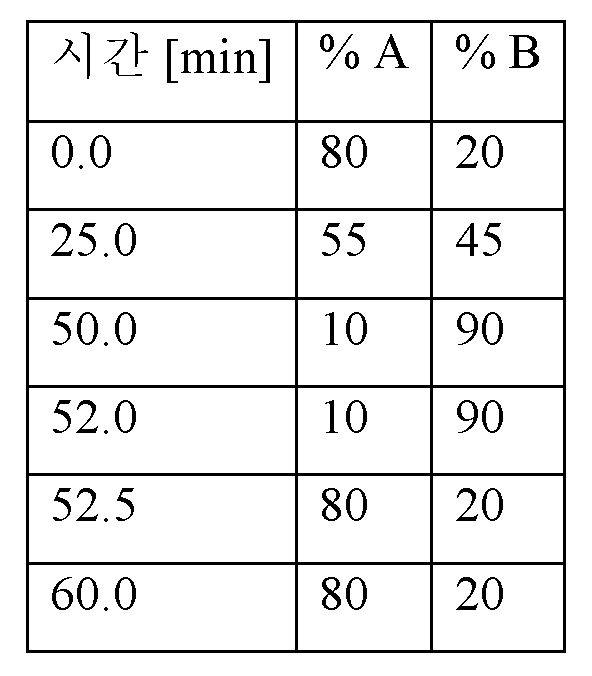
HPLC-MS 작동 조건은 표 2A, 2B 및 2C에 제공된다.HPLC-MS operating conditions are provided in Tables 2A, 2B and 2C.
표 2A. HPLC-MS 작동 조건Table 2A. HPLC-MS operating conditions

표 2B. 구배Table 2B. gradient
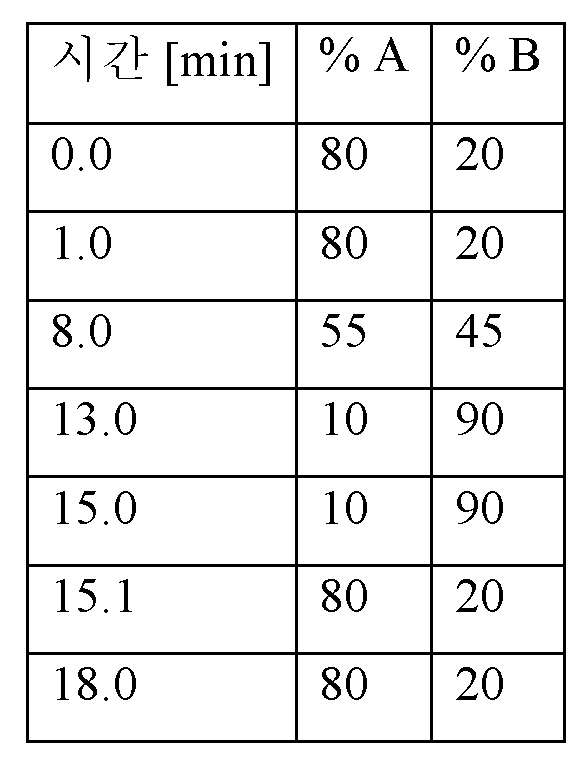
표 2C. MS 조건Table 2C. MS condition

반응을 위한 실험 설정은 표 3에 제공된다. 샘플을 2 mL 유리 바이알에 넣고, 알루미늄 크림프 캡으로 잘 밀봉하였다 (견고함은 미리 시험되어야 함). 샘플을 60℃ 및 800 rpm (실시예 1에서는 900 rpm)에서 혼합기에서 인큐베이션하였다. 샘플을 명시된 시점에 따라 취하고, 실온으로 냉각시켰다. HPLC 및 LC-MS 분석을 위해, 샘플을 아세토니트릴로 희석하였다.The experimental setup for the reaction is provided in Table 3. Samples were placed in 2 mL glass vials and well sealed with aluminum crimp caps (tightness to be tested beforehand). Samples were incubated in a mixer at 60°C and 800 rpm (900 rpm in Example 1). Samples were taken at the indicated time points and cooled to room temperature. For HPLC and LC-MS analysis, samples were diluted with acetonitrile.
표 3. 실험 설정Table 3. Experimental setup

실험에 사용된 시약은 표 4에 제공된다.Reagents used in the experiments are provided in Table 4.
표 4. 시약Table 4. Reagents
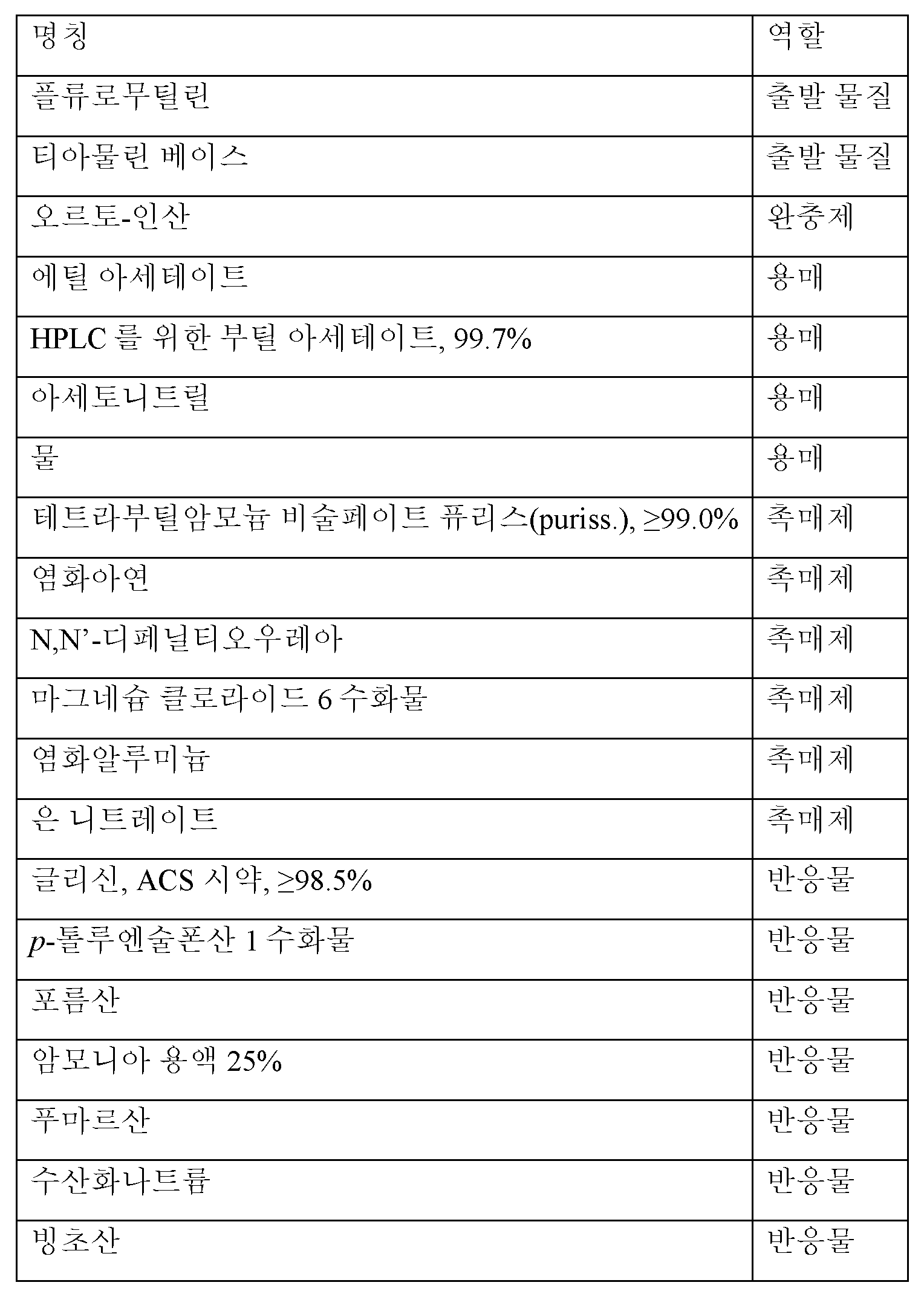
도 1. 에폭시드 불순물을 갖는 플류로무틸린 출발 물질의 HPLC. 플류로무틸린 샘플에 존재하는 2종의 주요 불순물은 14-아세틸 플류로무틸린 및 플류로무틸린-에폭시드였고, 평가에 허용가능하게 높은 0.3%의 에폭시드 수준이었다. 다른 부차 불순물이 또한 샘플에서 관찰되었지만, 본 작업을 방해하는 것으로 간주되지 않았다.Figure 1. HPLC of fluromutilin starting material with epoxide impurity. The two main impurities present in the fluromutilin sample were 14-acetyl fluromutilin and fluromutilin-epoxide, with an epoxide level of 0.3% that was acceptable for evaluation. Other minor impurities were also observed in the samples, but were not considered to interfere with this work.
플류로무틸린-에폭시드에 대한 참조 표준물은 이용가능하지 않았다. 플류로무틸린 표준물에 대한 외부 보정을 통한 정량화를 제1 실험에서 시험하였다. 결과는 음성 대조군에서의 피크 면적과 비교하여 반응 혼합물 중 플류로무틸린-에폭시드의 피크 면적을 사용한 정량화가 실험의 평가에 완전히 충분하다는 것을 나타냈다. 따라서, 음성 대조군의 플류로무틸린-에폭시드 농도를 100% 값으로 정의하였다. 하기 요약 표에 주어진 %-값은 이 값을 지칭하며, 플류로무틸린-에폭시드의 나머지 양에 상응한다. 높은 값은 고갈이 없음을 나타낸다. 체크표시 마크 (
실시예 1Example 1
에폭시드 불순물을 제거하기 위한 친핵체 스크린Nucleophile screen to remove epoxide impurities
표 5에 나타낸 바와 같이, 다양한 루이스 산 및 유기-촉매와 함께 친핵체의 패널을 스크리닝하여, 플류로무틸린 에폭시드 불순물에의 친핵성 첨가를 통해 플류로무틸린의 정제를 유도할 시약 및 조건을 확인하였다. 4 g의 플류로무틸린 원액을 20 mL 부피 플라스크로 정확하게 칭량하였다. 원액을 에틸 아세테이트로 부피까지 희석하고, 초음파 조에서 약 1시간 동안 초음파처리하였다. 용액은 우윳빛이었다. 촉매 및 반응물을 2 mL 유리 바이알에서 각각 4회 정확하게 칭량하였다. 이어서, 1 mL의 플류로무틸린 원액 (잘 혼합됨)을 촉매에 첨가하였다. 이 용액을 반응물에 첨가하였다. 16개의 조합물을 수득하였다. 샘플을 60℃ 및 900 rpm에서 3시간 및 12시간 동안 인큐베이션하였다. 각각의 시점 후, 샘플을 냉각되도록 하였다. 50 μL의 분취물을 취하고, HPLC 유리 바이알에서 아세토니트릴로 1:5 희석하였다.As shown in Table 5, a panel of nucleophiles was screened along with various Lewis acids and organo-catalysts to identify reagents and conditions that would lead to purification of fluromutilin via nucleophilic addition to the fluromutilin epoxide impurity. . 4 g of fluromutilin stock solution was accurately weighed into a 20 mL volumetric flask. The stock solution was diluted to volume with ethyl acetate and sonicated for about 1 hour in an ultrasonic bath. The solution was milky white. Catalyst and reactants were each accurately weighed 4 times in 2 mL glass vials. 1 mL of fluromutilin stock solution (well mixed) was then added to the catalyst. This solution was added to the reaction. 16 combinations were obtained. Samples were incubated at 60° C. and 900 rpm for 3 and 12 hours. After each time point, the sample was allowed to cool. An aliquot of 50 μL was taken and diluted 1:5 with acetonitrile in an HPLC glass vial.
음성 대조군: 0.5 mL의 플류로무틸린 원액을 0.5 mL의 에틸 아세테이트와 혼합하였다.Negative control: 0.5 mL of fluromutilin stock solution was mixed with 0.5 mL of ethyl acetate.
양성 대조군을 실행하여 실험이 작동하는지 여부를 평가하였다. 이를 위해, 0.5 mL의 플류로무틸린 원액을 0.4 mL의 에틸 아세테이트 및 0.1 mL의 0.1 N 염산 용액과 혼합하였다.A positive control was run to evaluate whether the experiment worked. To this end, 0.5 mL of fluromutilin stock solution was mixed with 0.4 mL of ethyl acetate and 0.1 mL of 0.1 N hydrochloric acid solution.
음성 및 양성 대조군을 다른 샘플과 같이 처리하였다. HPLC 분석을 위해, 음성 및 양성 대조군을 아세토니트릴로 1:2.5 희석하였다.Negative and positive controls were treated like other samples. For HPLC analysis, negative and positive controls were diluted 1:2.5 with acetonitrile.
표 5. 친핵체 스크린Table 5. Nucleophile screen
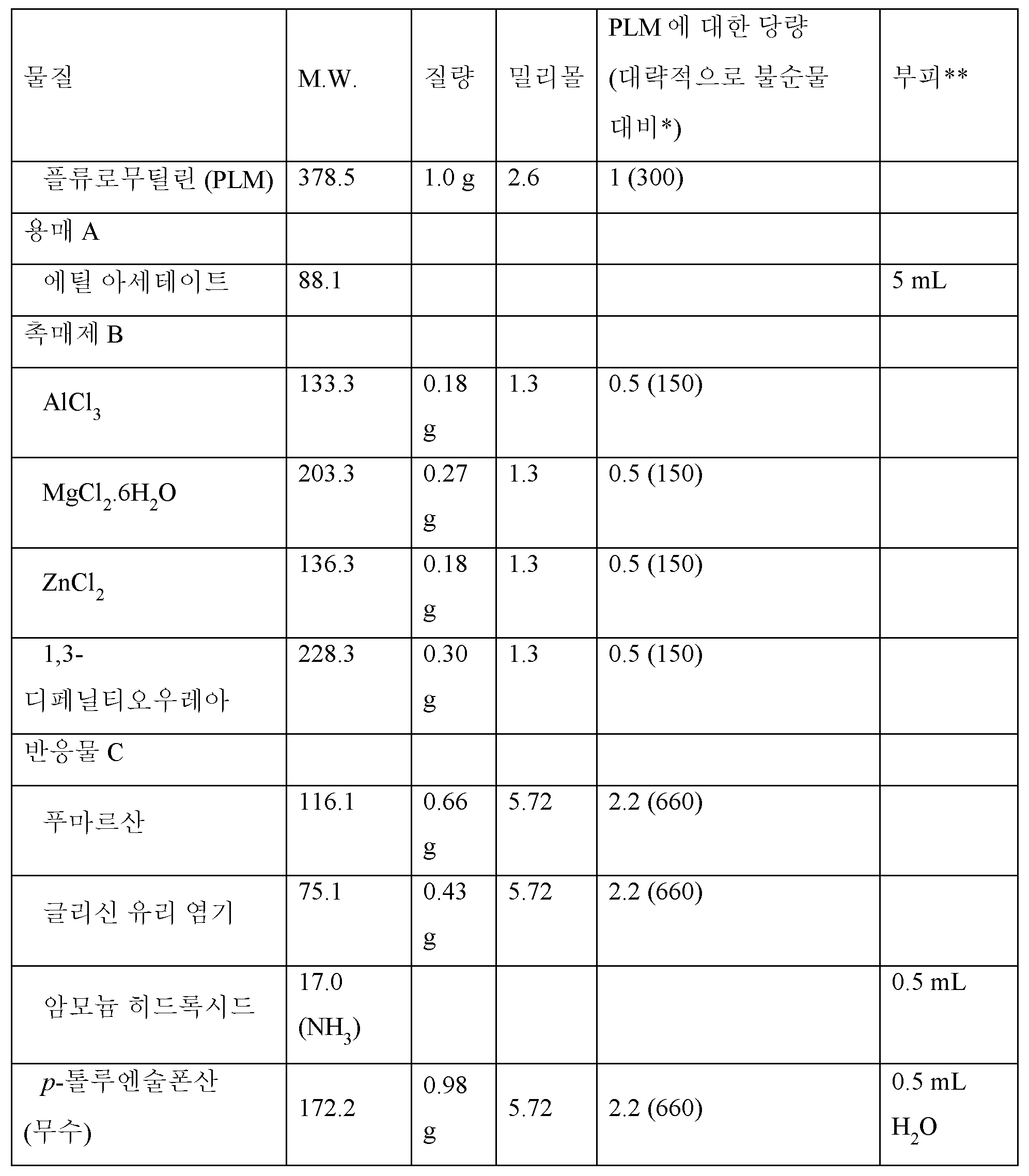
* 불순물은 약 0.3%a/a (PLM 대비)로 샘플에 존재함* Impurity is present in the sample at approximately 0.3%a/a (compared to PLM)
** 실제 부피는 1 ml였다 (그에 따라 양 및 부피가 감소됨)** Actual volume was 1 ml (volume and volume reduced accordingly)
이 실험에서 여러 반응물 및 촉매를 스크리닝하였다. 반응물 및 촉매의 농도는 임의의 가능한 반응 조건의 누락을 생략하기 위해 매우 높았다. 표 6에 나타낸 바와 같이, 체크표시 (

표 6. 친핵체 스크린의 결과Table 6. Results of nucleophile screen

실시예 2Example 2
p-톨루엔술폰산 및 AlCl3의 평가Evaluation of p-toluenesulfonic acid and AlCl 3
플류로무틸린 원액을 위해, 3.125 g의 플류로무틸린을 25 mL 부피 플라스크로 정확하게 칭량하였다. 이를 에틸 아세테이트로 부피까지 희석하고, 초음파 조에서 약 30분 동안 초음파처리하였다. 상기 원액 1 mL는 125 mg의 플류로무틸린을 함유하였다. 이어서, 모든 추가의 원액을 10 mL 유리 플라스크에서 제조하였다. 촉매 원액을 에틸 아세테이트로 및 반응물 원액을 물로 부피까지 희석하였다. 원액을 초음파 조에서 약 15분 동안 초음파처리하였다. 먼저, 반응물 원액 100 μL를 2 mL 유리 바이알에 피펫팅하였다. 이들 용액에 100 μL의 상응하는 촉매 원액을 첨가하였다. 최종적으로, 800 μL의 플류로무틸린 원액을 첨가하였다. 샘플을 1시간 및 3시간 동안 인큐베이션하였다. 각각의 시점 후, 샘플을 냉각되도록 하였다. 100 μL의 분취물을 취하고, HPLC 유리 바이알에서 아세토니트릴로 희석하였다. 희석은 1:2.5였다. 2개의 음성 대조군을 0.8 mL 플류로무틸린 원액 + 100 μL 에틸 아세테이트 및 100 μL 물로 제조하였다. 이들 샘플을 HPLC 분석을 위한 참조 용액 (100%로 설정)으로서 사용하였다. 100 μL의 분취물을 취하고, HPLC 유리 바이알에서 아세토니트릴로 희석하였다. 희석은 1:2.5였다.For the fluromutilin stock solution, 3.125 g of fluromutilin was accurately weighed into a 25 mL volumetric flask. It was diluted to volume with ethyl acetate and sonicated for about 30 minutes in an ultrasonic bath. 1 mL of the stock solution contained 125 mg of fluromutilin. All additional stock solutions were then prepared in 10 mL glass flasks. The catalyst stock solution was diluted to volume with ethyl acetate and the reactant stock solution with water. The stock solution was sonicated for about 15 minutes in an ultrasonic bath. First, 100 μL of the reactant stock solution was pipetted into a 2 mL glass vial. To these solutions, 100 μL of the corresponding catalyst stock solution was added. Finally, 800 μL of fluromutilin stock solution was added. Samples were incubated for 1 hour and 3 hours. After each time point, the sample was allowed to cool. An aliquot of 100 μL was taken and diluted with acetonitrile in an HPLC glass vial. The dilution was 1:2.5. Two negative controls were prepared with 0.8 mL fluromutilin stock solution + 100 μL ethyl acetate and 100 μL water. These samples were used as reference solutions (set at 100%) for HPLC analysis. An aliquot of 100 μL was taken and diluted with acetonitrile in an HPLC glass vial. The dilution was 1:2.5.
표 7. p-톨루엔술폰산 스크린Table 7. p-Toluenesulfonic acid screen

다양한 농도의 p-톨루엔술폰산 및 AlCl3의 영향을 연구하였고, 결과를 표 8에 나타냈다. 체크표시 (
표 8. p-톨루엔술폰산 ("p-TSA") 및 AlCl3의 평가 결과Table 8. Evaluation results of p-toluenesulfonic acid (“p-TSA”) and AlCl 3

*플류로무틸린 ("PL") 대비*Compared to Fluromutilin ("PL")
**참조는 100% 에폭시드 불순물로 설정함**Reference set to 100% epoxide impurity
약 0.3% (PL 대비)로 샘플에 존재하는 에폭시드 불순물Epoxide impurity present in the sample at about 0.3% (relative to PL)
실시예 3Example 3
용매로서의 부틸 아세테이트의 평가 및 물의 효과Evaluation of Butyl Acetate as a Solvent and Effect of Water
플류로무틸린 원액을 위해, 5 g의 플류로무틸린을 50 mL 부피 플라스크로 정확하게 칭량하였다. 부틸 아세테이트로 부피까지 희석하고, 초음파 조에서 약 30분 동안 초음파처리하였다. 상기 원액 1.0 mL는 플류로무틸린 100 mg을 함유하였다. p-톨루엔술폰산 원액을 10 mL 유리 플라스크에서 제조하였다. 원액을 부틸 아세테이트로 부피까지 희석하고, 초음파 조에서 약 15분 동안 초음파처리하였다. 100 μL의 반응물 원액을 2 mL 유리 바이알에 피펫팅하였다. 4.6 mg/mL p-톨루엔술폰산을 함유하는 반응물 원액을 2회 피펫팅하고, 물 100 μL를 1개의 바이알에 첨가하였다. 최종적으로, 900 μL의 플류로무틸린 원액을 각각의 바이알에 첨가하였다. 샘플을 1시간 및 3시간 인큐베이션하였다. 물을 함유하는 샘플을 3시간 및 12시간 동안 인큐베이션하였다. 각각의 시점 후, 샘플을 냉각되도록 하였다. HPLC 분석을 위해, 100 μL의 분취물을 취하고, HPLC 유리 바이알에서 아세토니트릴로 희석하였다. 희석은 1:2.5였다. 2개의 음성 대조군을 0.9 mL 플류로무틸린 원액 + 100 μL 부틸 아세테이트로 제조하였다. 이들 샘플을 HPLC 분석을 위한 참조 용액 (100%로 설정)으로서 사용하였다. 100 μL의 분취물을 취하고, HPLC 유리 바이알에서 아세토니트릴로 희석하였다. 희석은 1:2.5였다.For the fluromutilin stock solution, 5 g of fluromutilin was accurately weighed into a 50 mL volumetric flask. Dilute to volume with butyl acetate and sonicate for about 30 minutes in an ultrasonic bath. 1.0 mL of the stock solution contained 100 mg of fluromutilin. A stock solution of p-toluenesulfonic acid was prepared in a 10 mL glass flask. The stock solution was diluted to volume with butyl acetate and sonicated for about 15 minutes in an ultrasonic bath. 100 μL of the reactant stock solution was pipetted into a 2 mL glass vial. The reactant stock solution containing 4.6 mg/mL p-toluenesulfonic acid was pipetted twice, and 100 μL of water was added to one vial. Finally, 900 μL of fluromutilin stock solution was added to each vial. Samples were incubated for 1 hour and 3 hours. Samples containing water were incubated for 3 and 12 hours. After each time point, the sample was allowed to cool. For HPLC analysis, an aliquot of 100 μL was taken and diluted with acetonitrile in an HPLC glass vial. The dilution was 1:2.5. Two negative controls were prepared with 0.9 mL fluromutilin stock solution + 100 μL butyl acetate. These samples were used as reference solutions (set at 100%) for HPLC analysis. An aliquot of 100 μL was taken and diluted with acetonitrile in an HPLC glass vial. The dilution was 1:2.5.
표 9. 부틸 아세테이트로의 변화 및 물의 효과Table 9. Change to Butyl Acetate and Effect of Water

표 10에 나타낸 바와 같이, 에폭시드 개환은 부틸 아세테이트에서 효과적으로 작동하였다. 추가의 물 충전은 필요하지 않지만, 비-건조 용매의 사용으로 인한 고유 잔류수로부터의 기여는 배제될 수 없다. 따라서, p-톨루엔술폰산을 사용한 에폭시드 개환은 (물의 존재 및 부재 하에) 에틸 아세테이트 및 부틸 아세테이트에서 효과적이다.As shown in Table 10, epoxide ring opening worked effectively in butyl acetate. No additional water charge is required, but a contribution from inherent residual water due to the use of non-drying solvents cannot be excluded. Thus, epoxide ring opening with p-toluenesulfonic acid is effective in ethyl acetate and butyl acetate (with and without water).
표 10. 부틸 아세테이트 및 물을 사용한 평가 결과Table 10. Evaluation results using butyl acetate and water

* 플류로무틸린 대비* Compared to Fluromutilin
실시예 4Example 4
상 이동 촉매의 존재 및 부재 하의 조건Conditions with and without phase transfer catalysts
플류로무틸린 원액을 위해, 5 g의 플류로무틸린을 50 mL 부피 플라스크로 정확하게 칭량하였다. 부틸 아세테이트로 부피까지 희석하고, 초음파 조에서 약 30분 동안 초음파처리하였다. 상기 원액 1.0 mL는 플류로무틸린 100 mg을 함유하였다. 원액을 10 mL 유리 플라스크에서 제조하였다. p-톨루엔술폰산의 원액을 부틸 아세테이트로 희석하였다. 다른 원액을 물로 부피까지 희석하고, 초음파 조에서 약 15분 동안 초음파처리하였다. 2가지 설정을 사용하였다. 제1 설정에서, 9 mg의 테트라부틸암모늄 비술페이트를 9개의 2 ml 유리 바이알로 정확하게 칭량하였다. 이어서, 100 μL 푸마르산을 3개의 바이알에 피펫팅하고, 100 μL p-톨루엔술폰산 및 100 μL 글리신을 추가의 3개의 바이알에 피펫팅하였다. 반응물을 나머지 3개의 바이알에 첨가하지 않았다. 그 후, 인산 (pH 2), 인산 (pH 4) 및 물을 샘플에 첨가하였다. 샘플을 100 uL 부틸 아세테이트로 제조하였다. 마지막으로, 각각의 샘플은 1.0 mL 부틸 아세테이트를 함유하였다. 샘플을 3시간 동안 인큐베이션하였다. 촉매 및 푸마르산을 함유하지 않는 샘플을 1시간 및 3시간 동안 인큐베이션하였다. 각각의 시점 후, 샘플을 냉각되도록 하였다. HPLC 분석을 위해, 100 μL의 분취물을 취하고, HPLC 유리 바이알에서 아세토니트릴로 희석하였다. 희석은 1:2.5였다. 제2 설정은 제1 설정과 유사하지만, 촉매로서 테트라부틸암모늄 비술페이트가 없었다. 2개의 음성 대조군을 0.9 mL 플류로무틸린 원액 + 100 μL 부틸 아세테이트로 제조하였다. 이들 샘플을 HPLC 분석용 참조 용액 (100%로 설정)으로서 사용하였다. 100 μL의 분취물을 취하고, HPLC 유리 바이알에서 아세토니트릴로 희석하였다. 희석은 1:2.5였다.For the fluromutilin stock solution, 5 g of fluromutilin was accurately weighed into a 50 mL volumetric flask. Dilute to volume with butyl acetate and sonicate for about 30 minutes in an ultrasonic bath. 1.0 mL of the stock solution contained 100 mg of fluromutilin. A stock solution was prepared in a 10 mL glass flask. A stock solution of p-toluenesulfonic acid was diluted with butyl acetate. The other stock solutions were diluted to volume with water and sonicated for about 15 minutes in an ultrasonic bath. Two settings were used. In a first setup, 9 mg of tetrabutylammonium bisulfate was accurately weighed into nine 2 ml glass vials. 100 μL fumaric acid was then pipetted into 3 vials, and 100 μL p-toluenesulfonic acid and 100 μL glycine were pipetted into an additional 3 vials. No reaction was added to the remaining 3 vials. Phosphoric acid (pH 2), phosphoric acid (pH 4) and water were then added to the sample. Samples were prepared with 100 uL butyl acetate. Finally, each sample contained 1.0 mL butyl acetate. Samples were incubated for 3 hours. Samples containing no catalyst and fumaric acid were incubated for 1 hour and 3 hours. After each time point, the sample was allowed to cool. For HPLC analysis, an aliquot of 100 μL was taken and diluted with acetonitrile in an HPLC glass vial. The dilution was 1:2.5. The second setup was similar to the first setup, but without tetrabutylammonium bisulfate as catalyst. Two negative controls were prepared with 0.9 mL fluromutilin stock solution + 100 μL butyl acetate. These samples were used as reference solutions (set at 100%) for HPLC analysis. An aliquot of 100 μL was taken and diluted with acetonitrile in an HPLC glass vial. The dilution was 1:2.5.
표 11. 상 이동 촉매의 존재 및 부재 하의 조건Table 11. Conditions with and without phase transfer catalyst

* 초기에 첨가된 정확한 pH의 인산 용액 (제1 수치), 및 이어서 희석제로서의 물 (제2 양)을 정확한 부피 (수성 상 대 유기 상의 대략 1:1 비)로 만듦*Phosphoric acid solution of correct pH added initially (first value), followed by water as diluent (second amount) to the correct volume (approximately 1:1 ratio of aqueous phase to organic phase)
표 12는 상 이동 촉매의 존재 및 부재 하에 부틸 아세테이트 중 기타 조건의 스크리닝의 결과를 나타낸다. 결정된 모든 값은 시약이 없는 대조군의 범위 내였다. 어떠한 조건도 에폭시드 불순물을 제거하는 데 효과적이지 않았다.Table 12 shows the results of screening other conditions in butyl acetate with and without a phase transfer catalyst. All values determined were within the range of the no reagent control. Neither condition was effective in removing epoxide impurities.
표 12. 상 이동 촉매의 존재 및 부재 하의 조건의 평가 결과Table 12. Results of evaluation of conditions with and without phase transfer catalyst

실시예 5Example 5
추가의 조건의 평가, 및 티아물린 베이스로의 시험Evaluation of Additional Conditions and Testing with Thiamulin Base
플류로무틸린 원액을 위해, 2.5 g의 플류로무틸린을 25 mL 부피 플라스크로 정확하게 칭량하고, 부틸 아세테이트로 부피까지 희석하고, 약 30분 동안 초음파조에서 초음파처리하였다. 상기 원액 1.0 mL는 100 mg의 플류로무틸린을 함유하였다. 티아물린 베이스 원액의 제조를 위해, 하기 절차를 수행하였다. 마이크로웨이브 오븐에서 600 와트의 전력 설정을 사용하여 60초 동안 가열함으로써 티아물린 베이스를 액화시켰다. 3.25 g의 액체 티아물린 베이스를 25 mL 플라스크로 정확하게 칭량하고, 부틸 아세테이트로 부피까지 희석하고, 초음파 조에서 약 30분 동안 초음파처리하였다. 원액을 10 mL 플라스크에서 제조하였다. 두 푸마르산 용액 중 하나를 제외한 모든 원액을 부틸 아세테이트 중에 희석하였다. 제2 푸마르산 용액을 물로 부피까지 희석하였다. 하기 샘플을 2 mL 유리 바이알에서 제조하였다. 0.9 mL 플류로무틸린 또는 티아물린 베이스에 하기를 첨가하였다:For the fluromutilin stock solution, 2.5 g of fluromutilin was accurately weighed into a 25 mL volumetric flask, diluted to volume with butyl acetate and sonicated in an ultrasonic bath for about 30 minutes. 1.0 mL of the stock solution contained 100 mg of fluromutilin. For the preparation of thiamulin base stock solution, the following procedure was performed. Thiamulin base was liquefied by heating in a microwave oven for 60 seconds using a power setting of 600 watts. 3.25 g of liquid thiamulin base was accurately weighed into a 25 mL flask, diluted to volume with butyl acetate, and sonicated in an ultrasonic bath for about 30 minutes. A stock solution was prepared in a 10 mL flask. All but one of the two fumaric acid solutions were diluted in butyl acetate. The second fumaric acid solution was diluted to volume with water. The following samples were prepared in 2 mL glass vials. To 0.9 mL fluromutilin or thiamulin base was added:
+ 부틸 아세테이트 중 푸마르산 100 μL+ 100 μL fumaric acid in butyl acetate
+ 물 중 100 μL 부틸 아세테이트 + 100 μL 푸마르산+ 100 μL butyl acetate in water + 100 μL fumaric acid
+ 100 μL AlCl3 + 200 μL 수성 암모니아+ 100 μL AlCl 3 + 200 μL aqueous ammonia
+ 100 μL p-톨루엔술폰산 + 200 μL 수성 암모니아+ 100 μL p-toluenesulfonic acid + 200 μL aqueous ammonia
+ 100 μL 부틸 아세테이트 + 430 μL 10% 수성 아세트산+ 100 μL butyl acetate + 430 μL 10% aqueous acetic acid
+ 100 μL 부틸 아세테이트 + 430 μL 수성 H3PO4 (pH 2)+ 100 μL butyl acetate + 430 μL aqueous H 3 PO 4 (pH 2)
+ 100 μL p-톨루엔술폰산+ 100 μL p-toluenesulfonic acid
샘플을 1시간 및 3시간 동안 인큐베이션하였다. 각각의 시점 후, 샘플을 냉각되도록 하였다. HPLC 분석을 위해, 플류로무틸린에 대한 100 μL의 분취물 및 티아물린 베이스에 대한 150 μL의 분취물을 취하고, HPLC 유리 바이알에서 아세토니트릴로 희석하였다. 각 경우에 플류로무틸린에 대한 희석은 1:2.5였고, 티아물린 베이스에 대해서는 1:5였다. 2개의 음성 대조군을 각각 0.9 mL 플류로무틸린/티아물린 베이스 원액 + 100 μL 부틸 아세테이트로 제조하였다. 이들 샘플을 HPLC 분석을 위한 참조 용액 (100%로 설정)으로서 사용하였다. HPLC 분석을 위해, 플류로무틸린에 대한 100 μL /티아물린 베이스에 대한 150 μL의 분취물을 취하고, HPLC 유리 바이알에서 아세토니트릴로 희석하였다. 플류로무틸린에 대한 희석은 1:2.5였고, 티아물린 베이스에 대해서는 1:5였다.Samples were incubated for 1 hour and 3 hours. After each time point, the sample was allowed to cool. For HPLC analysis, an aliquot of 100 μL for fluromutilin and an aliquot of 150 μL for thiamulin base were taken and diluted with acetonitrile in an HPLC glass vial. The dilution for fluromutilin in each case was 1:2.5 and 1:5 for thiamulin base. Two negative controls were prepared with each 0.9 mL fluromutilin/thiamulin base stock solution + 100 μL butyl acetate. These samples were used as reference solutions (set at 100%) for HPLC analysis. For HPLC analysis, an aliquot of 100 μL for fluromutilin/150 μL for thiamulin base was taken and diluted with acetonitrile in an HPLC glass vial. The dilution for fluromutilin was 1:2.5 and for thiamulin base was 1:5.
표 13. 플류로무틸린을 사용한 추가의 조건의 평가Table 13. Evaluation of Additional Conditions Using Fluromutilin

표 14. 티아물린 베이스를 사용한 조건의 평가Table 14. Evaluation of conditions using thiamulin base

표 15에 나타낸 바와 같이, 부틸 아세테이트 중 p-톨루엔술폰산 (이전 실시예로부터 재-확인됨) 및 푸마르산과의 반응은 플류로무틸린-2,3-에폭시드 불순물을 완전히 고갈시키는 데 효과적인 것으로 결정되었다. 티아물린 베이스를 사용한 동일한 반응 조건의 평가는 모든 조건 하에 화학식 (4)의 부분적 고갈을 유발하였다.As shown in Table 15, the reaction with p-toluenesulfonic acid (re-confirmed from previous examples) and fumaric acid in butyl acetate was determined to be effective in completely depleting the fluromutilin-2,3-epoxide impurity. . Evaluation of the same reaction conditions using thiamulin base resulted in partial depletion of formula (4) under all conditions.
표 15. 플류로무틸린을 사용한 추가의 조건의 평가 결과Table 15. Results of evaluation of additional conditions using fluromutilin

실시예 1-5에 의해 예시된 바와 같이, 플류로무틸린 중 플류로무틸린-2,3-에폭시드의 고갈에 적합한 조건을 찾기 위해, 100개 초과의 별개의 실험 조건을 HPLC-UV 및 HPLC-MS에 의해 시험하고 평가하였다. 시험은 2 mL 유리 바이알에서 24개의 반응을 병행하여 소규모로 수행하였다. 2가지 상업적으로 실행가능한 옵션이 확인되었다: 플류로무틸린-2,3-에폭시드는 (i) p-톨루엔술폰산 [예를 들어, 플류로무틸린에 대해 0.5-1 mol% (에폭시드 불순물에 대해 약 2-3배 과량)], 또는 (ii) 푸마르산 [예를 들어, 플류로무틸린에 대해 2 mol%]으로의 처리에 의해 실현가능한 반응 조건 (시간, 온도) 하에 n-부틸 아세테이트 또는 에틸 아세테이트에서 완전히 고갈될 수 있다.As illustrated by Examples 1-5, more than 100 distinct experimental conditions were tested in order to find suitable conditions for the depletion of fluromutilin-2,3-epoxide in fluromutilin. Tested and evaluated by MS. The test was performed on a small scale with 24 reactions in parallel in 2 mL glass vials. Two commercially viable options have been identified: fluromutilin-2,3-epoxide is (i) p-toluenesulfonic acid [e.g., 0.5-1 mol% relative to fluromutilin (about epoxide impurities) 2-3 fold excess)], or (ii) in n-butyl acetate or ethyl acetate under feasible reaction conditions (time, temperature) by treatment with fumaric acid [e.g., 2 mol % relative to fluromutilin] can be completely exhausted.
실시예 6Example 6
플류로무틸린 정제, 대규모Fluromutilin tablets, large scale
각각 대략 680 kg 플류로무틸린 (등가량)을 함유하는 균사체의 2개의 발효 하위-배치를 에틸 아세테이트 (추출 탱크)와 혼합한 후, 제2 용기로 옮기고, 여기서 약 40%w/w로의 농축을 수행하였다. 두 하위-배치를 결정화 용기로 옮기고, 여기서 3.3 당량의 p-톨루엔술폰산을 첨가하고, 혼합물을 플류로무틸린 에폭시드가 소멸될 때까지 60℃에서 적어도 1시간 동안 교반하였다. HPLC 피크를 HPLC 분석에 의해 확인하였다. 이어서, 생성된 플류로무틸린 (PL) 배치를 결정화하고, 여과하고, 세척하고, 표준 가공 조건 하에 건조시켰다.Two fermentation sub-batches of mycelia, each containing approximately 680 kg fluromutilin (equivalent amount) were mixed with ethyl acetate (extraction tank) and then transferred to a second vessel, where concentration to about 40% w/w was achieved. performed. Both sub-batches were transferred to a crystallization vessel, where 3.3 equivalents of p-toluenesulfonic acid were added and the mixture was stirred at 60° C. for at least 1 hour until fluromutilin epoxide disappeared. HPLC peaks were confirmed by HPLC analysis. The resulting fluromutilin (PL) batch was then crystallized, filtered, washed and dried under standard processing conditions.
이들 생산 규모 배치를 플류로무틸린 에폭시드 함량에 대해 평가하고, 각 경우에 또한 약 1000 kg 규모로 티아물린 히드로겐 푸무레이트 (티아물린 HFU)로 전진 가공하였다. 티아물린 HFU 배치 둘 다의 분석 결과를 하기 표 16 및 17에 제시한다.These production scale batches were evaluated for fluromutilin epoxide content and in each case also advanced processed with thiamulin hydrogen fumurate (thiamulin HFU) on a scale of about 1000 kg. The analytical results of both thiamulin HFU batches are presented in Tables 16 and 17 below.
실험실 규모 정제 (p-톨루엔술폰산 처리 없이 단리됨)를 통해 0.58% (로트 번호 PL2012046T) 및 0.49% (로트 번호 PL2101023T)의 최종 플류로무틸린 에폭시드 HPLC 수준을 함유하는 것으로 평가된 출발 플류로무틸린 배치를 기준선 목적을 위해 사용하였다. 이들 플류로무틸린 대조군 샘플을 또한 표준 실험실 규모 조건 하에 티아물린 HFU로 전환시켰고, 그 결과 각각 약 1.1% 및 0.8%의 조 에폭시드 수준이 관찰되었다. 최종 정제는 이들 상승된 수준을 유의하게 변경시킬 것으로 예상되지 않을 것이며, 따라서 이들 결과는 이 제조 방법에서 티아물린 에폭시드의 제어와 관련하여 통상적인 공정 능력 - 순수한 티아물린 HFU에서 0.4 내지 0.6%인 것으로 간주되었다.A starting fluromutilin batch evaluated to contain final fluromutilin epoxide HPLC levels of 0.58% (lot number PL2012046T) and 0.49% (lot number PL2101023T) via laboratory scale purification (isolated without treatment with p-toluenesulfonic acid). was used for baseline purposes. These fluromutilin control samples were also converted to thiamulin HFU under standard laboratory scale conditions, resulting in crude epoxide levels of approximately 1.1% and 0.8%, respectively. Final tablets would not be expected to significantly alter these elevated levels, so these results are consistent with typical process capabilities with regard to the control of thiamulin epoxide in this manufacturing process - 0.4 to 0.6% in pure thiamulin HFU. was considered to be
상업적 장비를 사용하여 제조된 상응하는 대규모 배치에서, p-톨루엔술폰산 처리의 실행 후의 최종 플류로무틸린 에폭시드 수준은 각각 0.15% 및 <0.05% (LOD 미만)였다.In corresponding large-scale batches prepared using commercial equipment, the final fluromutilin epoxide levels after implementation of p-toluenesulfonic acid treatment were 0.15% and <0.05% (below LOD), respectively.
이들 플류로무틸린 배치를 또한 샘플링하고, 실험실 생성된 티아물린 HFU 대조군 샘플과의 직접적인 병렬 비교를 위해 실험실 규모로 사용하였다. 관찰된 상응하는 조 티아물린 HFU 에폭시드 수준은 각각 0.2% 및 <0.05%였다 (상기 요약된 상응하는 전진 가공된 PL 실험실 대조군 샘플의 경우 1.1% 및 0.8% 참조). 전체 생산 규모 배치: 01982012340 (PL 로트 번호 PL2012046T를 사용한 제1 API 배치) 및 01982101204 (PL 로트 번호 PL2101023T를 사용한 제2 API 배치) 둘 다로부터 수집된 조 티아물린 HFU 에폭시드 불순물 데이터는 또한 이들 실험실 규모 데이터와 완전히 대등하였다 (각각 0.15% 및 0.06%).These fluromutilin batches were also sampled and used on a laboratory scale for direct side-by-side comparison with laboratory generated thiamulin HFU control samples. Corresponding crude thiamulin HFU epoxide levels observed were 0.2% and <0.05%, respectively (see 1.1% and 0.8% for the corresponding advance processed PL laboratory control samples summarized above). Crude thiamulin HFU epoxide impurity data collected from both full production scale batches: 01982012340 (1st API batch with PL lot number PL2012046T) and 01982101204 (2nd API batch with PL lot number PL2101023T) also show these laboratory scale data were perfectly matched (0.15% and 0.06%, respectively).
단리된 순수한 티아물린 HFU에서의 최종 에폭시드 수준은 각각 0.10% 및 <0.05%였고 (표 16 및 17 참조), 이에 의해 본 발명은 심지어 전체 생산 규모에서도 궁극적인 티아물린 HFU 제조 단계에 대한 임의의 작업 변형을 필요로 하지 않으면서 본 연구의 1차 목적을 성공적으로 충족시켰고, 플류로무틸린 에폭시드 억제는 티아물린 에폭시드 환원에 대한 효과적인 제어 전략이며, 이러한 p-톨루엔술폰산 방법은 예상대로 규모가 확대되었고 관심 표적 에폭시드 불순물 수준의 적어도 10배 감소를 훌륭하게 달성할 수 있었음을 입증한다.The final epoxide levels in the isolated pure thiamulin HFU were 0.10% and <0.05%, respectively (see Tables 16 and 17), whereby the present invention provides any desired epoxide levels for the ultimate thiamulin HFU manufacturing step even on a full production scale. The primary objective of this study was successfully met without the need for operational modification, fluromutilin epoxide inhibition is an effective control strategy for thiamulin epoxide reduction, and this p-toluenesulfonic acid method scales up as expected. scaled up and demonstrates that at least a 10-fold reduction in the level of the target epoxide impurity of interest could be successfully achieved.
표 16. 제1 플류로무틸린 (PL) 및 티아물린 HFU (API) 배치에 대한 분석 결과Table 16. Analytical results for the first batch of Fluromutilin (PL) and Thiamulin HFU (API)

표 17. 제2 플류로무틸린 (PL) 및 티아물린 HFU (API) 배치에 대한 분석 결과Table 17. Analytical results for the second batch of Fluromutilin (PL) and Thiamulin HFU (API)

상기 상세한 설명 및 첨부 실시예는 단지 예시적이며, 첨부된 청구범위 및 그의 등가물에 의해서만 정의되는 본 발명의 범주에 대한 제한으로서 간주되어서는 안되는 것으로 이해된다.It is understood that the foregoing detailed description and appended examples are illustrative only and should not be regarded as limitations on the scope of the present invention as defined only by the appended claims and equivalents thereof.
개시된 실시양태에 대한 다양한 변화 및 변형이 관련 기술분야의 통상의 기술자에게 명백할 것이다. 본 발명의 화학 구조, 치환기, 유도체, 중간체, 합성, 조성물, 제제, 또는 사용 방법과 관련된 것들을 비제한적으로 포함하는 이러한 변화 및 변형은 그의 취지 및 범주로부터 벗어나지 않으면서 이루어질 수 있다.Various changes and modifications to the disclosed embodiments will be apparent to those skilled in the art. Such changes and modifications, including but not limited to those relating to the chemical structures, substituents, derivatives, intermediates, syntheses, compositions, formulations, or methods of use of the present invention, may be made without departing from its spirit and scope.
Claims (19)


상기 방법은 (i) 플류로무틸린 또는 그의 염 및 화학식 (5)의 화합물을 포함하는 조성물을 제공하는 단계; (ii) 화학식 (5)의 에폭시드를 친핵체로 개환시켜 하나 이상의 반응 부가물을 제공하는 단계; 및 (iii) 하나 이상의 반응 부가물로부터 플류로무틸린 또는 그의 염을 분리하는 단계를 포함하는 것인
방법.A method for purifying fluromutilin or a salt thereof from the compound of formula (5),
The method comprises (i) providing a composition comprising fluromutilin or a salt thereof and a compound of formula (5); (ii) ring opening of the epoxide of formula (5) with a nucleophile to provide one or more reactive adducts; and (iii) separating fluromutilin or a salt thereof from the one or more reaction adducts.
method.


상기 방법은 (i) 티아물린 또는 그의 염 및 화학식 (4)의 화합물을 포함하는 조성물을 제공하는 단계; (ii) 화학식 (4)의 에폭시드를 친핵체로 개환시켜 하나 이상의 반응 부가물을 제공하는 단계; 및 (iii) 하나 이상의 반응 부가물로부터 티아물린 또는 그의 염을 분리하는 단계를 포함하는 것인
방법.A method for purifying thiamulin or a salt thereof from the compound of formula (4),
The method comprises (i) providing a composition comprising thiamulin or a salt thereof and a compound of formula (4); (ii) ring opening of the epoxide of formula (4) with a nucleophile to provide one or more reactive adducts; and (iii) separating the thiamulin or salt thereof from the one or more reaction adducts.
method.

Applications Claiming Priority (3)
| Application Number | Priority Date | Filing Date | Title |
|---|---|---|---|
| US202063106920P | 2020-10-29 | 2020-10-29 | |
| US63/106,920 | 2020-10-29 | ||
| PCT/US2021/057304 WO2022094247A1 (en) | 2020-10-29 | 2021-10-29 | Process for purification of pleuromutilins |
Publications (1)
| Publication Number | Publication Date |
|---|---|
| KR20230098233A true KR20230098233A (en) | 2023-07-03 |
Family
ID=81383263
Family Applications (1)
| Application Number | Title | Priority Date | Filing Date |
|---|---|---|---|
| KR1020237017422A Pending KR20230098233A (en) | 2020-10-29 | 2021-10-29 | Method for Purifying Fluromutilin |
Country Status (13)
| Country | Link |
|---|---|
| US (1) | US20230265040A1 (en) |
| EP (1) | EP4237403A4 (en) |
| JP (1) | JP2023548968A (en) |
| KR (1) | KR20230098233A (en) |
| CN (1) | CN117480151A (en) |
| AR (1) | AR123965A1 (en) |
| AU (1) | AU2021369809A1 (en) |
| BR (1) | BR112023005850A2 (en) |
| CA (1) | CA3195311A1 (en) |
| CL (1) | CL2023001137A1 (en) |
| MX (1) | MX2023004950A (en) |
| TW (1) | TW202233562A (en) |
| WO (1) | WO2022094247A1 (en) |
Families Citing this family (2)
| Publication number | Priority date | Publication date | Assignee | Title |
|---|---|---|---|---|
| CN116199690B (en) * | 2023-04-28 | 2023-07-07 | 西华大学 | Purine pleuromutilin derivative, stereoisomer or pharmaceutically acceptable salt, application thereof and pharmaceutical composition |
| CN118955406B (en) * | 2024-07-26 | 2025-10-17 | 中国农业科学院兰州畜牧与兽药研究所 | Sulphate of pleuromutilin compound, and preparation method and application thereof |
Family Cites Families (4)
| Publication number | Priority date | Publication date | Assignee | Title |
|---|---|---|---|---|
| CN103450061B (en) * | 2012-05-29 | 2014-10-22 | 大英九合生物化工股份有限公司 | Purification method for tiamulin reaction solution in industrial production |
| WO2017151492A1 (en) * | 2016-03-02 | 2017-09-08 | Anacor Pharmaceuticals, Inc. | Boron-containing small molecules |
| US20190352262A1 (en) * | 2017-02-01 | 2019-11-21 | Yale University | New Pleuromutilin Antibiotic Compounds, Compositions and Methods of Use and Synthesis |
| TWI762573B (en) * | 2017-02-10 | 2022-05-01 | 奧地利商納畢瓦治療有限責任公司 | Purification of pleuromutilin |
-
2021
- 2021-10-29 AU AU2021369809A patent/AU2021369809A1/en not_active Abandoned
- 2021-10-29 TW TW110140482A patent/TW202233562A/en unknown
- 2021-10-29 KR KR1020237017422A patent/KR20230098233A/en active Pending
- 2021-10-29 CA CA3195311A patent/CA3195311A1/en active Pending
- 2021-10-29 AR ARP210103020A patent/AR123965A1/en unknown
- 2021-10-29 MX MX2023004950A patent/MX2023004950A/en unknown
- 2021-10-29 EP EP21887622.5A patent/EP4237403A4/en not_active Withdrawn
- 2021-10-29 WO PCT/US2021/057304 patent/WO2022094247A1/en not_active Ceased
- 2021-10-29 BR BR112023005850A patent/BR112023005850A2/en not_active Application Discontinuation
- 2021-10-29 CN CN202180088179.9A patent/CN117480151A/en active Pending
- 2021-10-29 JP JP2023551650A patent/JP2023548968A/en active Pending
-
2023
- 2023-04-19 CL CL2023001137A patent/CL2023001137A1/en unknown
- 2023-04-28 US US18/140,710 patent/US20230265040A1/en active Pending
Also Published As
| Publication number | Publication date |
|---|---|
| CL2023001137A1 (en) | 2023-11-24 |
| TW202233562A (en) | 2022-09-01 |
| AU2021369809A1 (en) | 2023-05-11 |
| JP2023548968A (en) | 2023-11-21 |
| CA3195311A1 (en) | 2022-05-05 |
| EP4237403A4 (en) | 2024-09-18 |
| MX2023004950A (en) | 2023-05-17 |
| CN117480151A (en) | 2024-01-30 |
| WO2022094247A1 (en) | 2022-05-05 |
| BR112023005850A2 (en) | 2023-05-09 |
| US20230265040A1 (en) | 2023-08-24 |
| EP4237403A1 (en) | 2023-09-06 |
| AU2021369809A9 (en) | 2024-10-03 |
| AR123965A1 (en) | 2023-01-25 |
Similar Documents
| Publication | Publication Date | Title |
|---|---|---|
| CN116804005B (en) | Kinesin KIF18A inhibitor and its application | |
| EP4507691A2 (en) | Jak inhibitor analogs, formulations, and uses thereof | |
| ES2883265T3 (en) | Derivative of 9 element fused ring | |
| US20230265040A1 (en) | Process for purification of pleuromutilins | |
| KR20200041336A (en) | Treatment of fatty liver disease and treatment of obesity | |
| CN114835596B (en) | Kakeromycin and process for producing derivative thereof | |
| US10894790B2 (en) | Production method of thiazole derivative | |
| US10221185B2 (en) | Crystal form of substituted aminopyran derivativek | |
| CN108997121A (en) | Application of Magnolol Derivatives in the Preparation of Medicines for Treating Central Nervous System Diseases | |
| CN115215883A (en) | USP7 inhibitors | |
| WO2017059401A2 (en) | Androgen receptor ligands | |
| WO2015184405A1 (en) | Aromatic compounds, compositions and uses thereof | |
| US12215108B2 (en) | Development of potential antidotes for arsenicals | |
| WO2024192144A1 (en) | Pyrazolopyrimidines as antidotes for arsenicals | |
| WO2026039606A1 (en) | Synthesis of hydropersulfides and thioethers | |
| CN113321629A (en) | 1,3, 4-thiadiazole compound and preparation method and application thereof | |
| CN111943891B (en) | Rosuvastatin calcium impurity and rosuvastatin calcium quality control method | |
| RU2659574C2 (en) | 6-(3,5-diphenyl-1,3,4-thiadiazol-2(3h)-yliden)-2,4-diphenyl-4h-1,3,4-thiadiazin-5-one and method of its production | |
| WO2025199151A1 (en) | Small molecule cereblon binders that induce the degradation of proteins (kdm4b, vcl) relevant to cancer | |
| BR112017015828B1 (en) | Compounds derived from pyrazolo [3,4-d] pyrimidine, pharmaceutical composition and combination comprising said compounds and their use for the treatment of leishmaniasis |
Legal Events
| Date | Code | Title | Description |
|---|---|---|---|
| PA0105 | International application |
Patent event date: 20230523 Patent event code: PA01051R01D Comment text: International Patent Application |
|
| PG1501 | Laying open of application | ||
| A201 | Request for examination | ||
| PA0201 | Request for examination |
Patent event code: PA02012R01D Patent event date: 20241029 Comment text: Request for Examination of Application |