KR20220109439A - Combination of an azetidine LPA1 receptor antagonist with pirfenidone and/or nintedanib for use in the treatment of a fibrotic disease - Google Patents
Combination of an azetidine LPA1 receptor antagonist with pirfenidone and/or nintedanib for use in the treatment of a fibrotic disease Download PDFInfo
- Publication number
- KR20220109439A KR20220109439A KR1020227022458A KR20227022458A KR20220109439A KR 20220109439 A KR20220109439 A KR 20220109439A KR 1020227022458 A KR1020227022458 A KR 1020227022458A KR 20227022458 A KR20227022458 A KR 20227022458A KR 20220109439 A KR20220109439 A KR 20220109439A
- Authority
- KR
- South Korea
- Prior art keywords
- fibrosis
- pharmaceutically acceptable
- isopropylphenyl
- acceptable salt
- compound
- Prior art date
- Legal status (The legal status is an assumption and is not a legal conclusion. Google has not performed a legal analysis and makes no representation as to the accuracy of the status listed.)
- Pending
Links
Images


Classifications
-
- A—HUMAN NECESSITIES
- A61—MEDICAL OR VETERINARY SCIENCE; HYGIENE
- A61K—PREPARATIONS FOR MEDICAL, DENTAL OR TOILETRY PURPOSES
- A61K31/00—Medicinal preparations containing organic active ingredients
- A61K31/33—Heterocyclic compounds
- A61K31/395—Heterocyclic compounds having nitrogen as a ring hetero atom, e.g. guanethidine or rifamycins
- A61K31/435—Heterocyclic compounds having nitrogen as a ring hetero atom, e.g. guanethidine or rifamycins having six-membered rings with one nitrogen as the only ring hetero atom
- A61K31/44—Non condensed pyridines; Hydrogenated derivatives thereof
- A61K31/4427—Non condensed pyridines; Hydrogenated derivatives thereof containing further heterocyclic ring systems
-
- A—HUMAN NECESSITIES
- A61—MEDICAL OR VETERINARY SCIENCE; HYGIENE
- A61K—PREPARATIONS FOR MEDICAL, DENTAL OR TOILETRY PURPOSES
- A61K31/00—Medicinal preparations containing organic active ingredients
- A61K31/33—Heterocyclic compounds
- A61K31/395—Heterocyclic compounds having nitrogen as a ring hetero atom, e.g. guanethidine or rifamycins
- A61K31/435—Heterocyclic compounds having nitrogen as a ring hetero atom, e.g. guanethidine or rifamycins having six-membered rings with one nitrogen as the only ring hetero atom
- A61K31/44—Non condensed pyridines; Hydrogenated derivatives thereof
-
- A—HUMAN NECESSITIES
- A61—MEDICAL OR VETERINARY SCIENCE; HYGIENE
- A61K—PREPARATIONS FOR MEDICAL, DENTAL OR TOILETRY PURPOSES
- A61K31/00—Medicinal preparations containing organic active ingredients
- A61K31/33—Heterocyclic compounds
- A61K31/395—Heterocyclic compounds having nitrogen as a ring hetero atom, e.g. guanethidine or rifamycins
- A61K31/435—Heterocyclic compounds having nitrogen as a ring hetero atom, e.g. guanethidine or rifamycins having six-membered rings with one nitrogen as the only ring hetero atom
- A61K31/44—Non condensed pyridines; Hydrogenated derivatives thereof
- A61K31/4418—Non condensed pyridines; Hydrogenated derivatives thereof having a carbocyclic group directly attached to the heterocyclic ring, e.g. cyproheptadine
-
- A—HUMAN NECESSITIES
- A61—MEDICAL OR VETERINARY SCIENCE; HYGIENE
- A61K—PREPARATIONS FOR MEDICAL, DENTAL OR TOILETRY PURPOSES
- A61K31/00—Medicinal preparations containing organic active ingredients
- A61K31/33—Heterocyclic compounds
- A61K31/395—Heterocyclic compounds having nitrogen as a ring hetero atom, e.g. guanethidine or rifamycins
- A61K31/495—Heterocyclic compounds having nitrogen as a ring hetero atom, e.g. guanethidine or rifamycins having six-membered rings with two or more nitrogen atoms as the only ring heteroatoms, e.g. piperazine or tetrazines
- A61K31/496—Non-condensed piperazines containing further heterocyclic rings, e.g. rifampin, thiothixene or sparfloxacin
-
- A—HUMAN NECESSITIES
- A61—MEDICAL OR VETERINARY SCIENCE; HYGIENE
- A61K—PREPARATIONS FOR MEDICAL, DENTAL OR TOILETRY PURPOSES
- A61K45/00—Medicinal preparations containing active ingredients not provided for in groups A61K31/00 - A61K41/00
- A61K45/06—Mixtures of active ingredients without chemical characterisation, e.g. antiphlogistics and cardiaca
-
- A—HUMAN NECESSITIES
- A61—MEDICAL OR VETERINARY SCIENCE; HYGIENE
- A61P—SPECIFIC THERAPEUTIC ACTIVITY OF CHEMICAL COMPOUNDS OR MEDICINAL PREPARATIONS
- A61P1/00—Drugs for disorders of the alimentary tract or the digestive system
- A61P1/16—Drugs for disorders of the alimentary tract or the digestive system for liver or gallbladder disorders, e.g. hepatoprotective agents, cholagogues, litholytics
-
- A—HUMAN NECESSITIES
- A61—MEDICAL OR VETERINARY SCIENCE; HYGIENE
- A61P—SPECIFIC THERAPEUTIC ACTIVITY OF CHEMICAL COMPOUNDS OR MEDICINAL PREPARATIONS
- A61P11/00—Drugs for disorders of the respiratory system
-
- A—HUMAN NECESSITIES
- A61—MEDICAL OR VETERINARY SCIENCE; HYGIENE
- A61P—SPECIFIC THERAPEUTIC ACTIVITY OF CHEMICAL COMPOUNDS OR MEDICINAL PREPARATIONS
- A61P13/00—Drugs for disorders of the urinary system
- A61P13/12—Drugs for disorders of the urinary system of the kidneys
-
- A—HUMAN NECESSITIES
- A61—MEDICAL OR VETERINARY SCIENCE; HYGIENE
- A61P—SPECIFIC THERAPEUTIC ACTIVITY OF CHEMICAL COMPOUNDS OR MEDICINAL PREPARATIONS
- A61P43/00—Drugs for specific purposes, not provided for in groups A61P1/00-A61P41/00
-
- A—HUMAN NECESSITIES
- A61—MEDICAL OR VETERINARY SCIENCE; HYGIENE
- A61K—PREPARATIONS FOR MEDICAL, DENTAL OR TOILETRY PURPOSES
- A61K2300/00—Mixtures or combinations of active ingredients, wherein at least one active ingredient is fully defined in groups A61K31/00 - A61K41/00
Landscapes
- Health & Medical Sciences (AREA)
- Chemical & Material Sciences (AREA)
- Medicinal Chemistry (AREA)
- Pharmacology & Pharmacy (AREA)
- Life Sciences & Earth Sciences (AREA)
- Animal Behavior & Ethology (AREA)
- General Health & Medical Sciences (AREA)
- Public Health (AREA)
- Veterinary Medicine (AREA)
- Epidemiology (AREA)
- Engineering & Computer Science (AREA)
- Bioinformatics & Cheminformatics (AREA)
- Chemical Kinetics & Catalysis (AREA)
- General Chemical & Material Sciences (AREA)
- Nuclear Medicine, Radiotherapy & Molecular Imaging (AREA)
- Organic Chemistry (AREA)
- Pulmonology (AREA)
- Gastroenterology & Hepatology (AREA)
- Urology & Nephrology (AREA)
- Pharmaceuticals Containing Other Organic And Inorganic Compounds (AREA)
- Plural Heterocyclic Compounds (AREA)
Abstract
본 발명은 식 (I) 의 화합물:

[식 중에서, R1, R2, R3, X 및 Y 는 상세한 설명에서 기재된 바와 같음], 및 섬유증 질환의 예방 및/또는 치료에서의 특히 피르페니돈 및/또는 닌테다닙과 같은 항-섬유화제(들) 로서 작용하는 하나 이상의 치료적 활성 성분과 조합으로의 LPA1 수용체의 길항제로서의 그의 용도에 관한 것이다. 본 발명은 또한 피르페니돈 또는 닌테다닙과 같은 항-섬유화제(들) 로서 작용하는 하나 이상의 치료적 활성 성분과 조합으로 식 (I) 의 화합물을 포함하는 약학 조성물에 관한 것이다.The present invention relates to a compound of formula (I):
wherein R 1 , R 2 , R 3 , X and Y are as described in the detailed description, and anti-fibers such as pirfenidone and/or nintedanib in particular in the prevention and/or treatment of fibrotic diseases to its use as an antagonist of the LPA 1 receptor in combination with one or more therapeutically active ingredients acting as agent(s). The present invention also relates to a pharmaceutical composition comprising a compound of formula (I) in combination with one or more therapeutically active ingredients acting as anti-fibrotic agent(s) such as pirfenidone or nintedanib.
Description
본 발명은 식 (I) 의 화합물:The present invention relates to a compound of formula (I):

및 섬유증 질환 (및/또는 섬유증과 관련된 질환 또는 장애) 의 예방 및/또는 치료에서의 특히 피르페니돈과 같은 항-섬유화제(들) 로서 작용하는 하나 이상의 치료적 활성 성분과 조합으로의 LPA1 수용체의 길항제로서의 그의 용도에 관한 것이며; 여기서 이러한 섬유증 질환은 특히 폐 섬유증, 특히 특발성 폐 섬유증 또는 전신 염증성 질환에 2 차적인 폐 섬유증이다. 본 발명은 또한 피르페니돈 또는 닌테다닙, 특히 피르페니돈과 같은 항-섬유화제(들) 로서 작용하는 하나 이상의 치료적 활성 성분과 조합으로 식 (I) 의 화합물을 포함하는 약학 조성물에 관한 것이다. and LPA 1 in combination with one or more therapeutically active ingredients that act as anti-fibrotic agent(s), particularly pirfenidone, in the prevention and/or treatment of fibrotic diseases (and/or diseases or disorders associated with fibrosis). to their use as antagonists of receptors; Here this fibrotic disease is in particular pulmonary fibrosis, in particular pulmonary fibrosis secondary to idiopathic pulmonary fibrosis or systemic inflammatory disease. The present invention also relates to a pharmaceutical composition comprising a compound of formula (I) in combination with one or more therapeutically active ingredients acting as anti-fibrotic agent(s) such as pirfenidone or nintedanib, in particular pirfenidone .
식 (I) 의 특정 화합물은 WO2019234115 (PCT/EP2019/064690) 및 PCT/EP2020/066767 에서 LPA1 수용체의 길항제로서 개시되며, 섬유증 (및 섬유증과 관련된 질환 또는 장애), 또는 LPA1 수용체 신호전달에 의해 매개되는 다른 장애의 예방 및/또는 치료에 유용할 수 있다. 특히 상기 화합물은 하기의 예방 및/또는 치료에서 잠재적으로 사용될 수 있는 것으로서 개시된다:Certain compounds of formula (I) are disclosed as antagonists of the LPA 1 receptor in WO2019234115 (PCT/EP2019/064690) and PCT/EP2020/066767 and are involved in fibrosis (and diseases or disorders associated with fibrosis), or LPA 1 receptor signaling. It may be useful in the prevention and/or treatment of other disorders mediated by In particular, the compounds are disclosed as potentially useful in the prophylaxis and/or treatment of:
ㆍ 특발성 폐 섬유증을 포함하는 섬유화 간질성 폐 질환; 전신 염증성 질환 예컨대 류마티스 관절염, 경피증 (전신 경화증; SSc), 루푸스 (전신 홍반성 루푸스; SLE), 다발성근염 또는 혼합 결합 조직 질환 (MCTD) 에 2 차적인 폐 섬유증; 사르코이드증에 2 차적인 폐 섬유증; 방사선-유도된 섬유증을 포함하는 의원성 폐 섬유증; 규폐증-유도된 폐 섬유증; 석면-유도된 폐 섬유증; 및 흉막 섬유증을 포함하는, 폐 섬유증;dot fibrotic interstitial lung disease including idiopathic pulmonary fibrosis; pulmonary fibrosis secondary to systemic inflammatory diseases such as rheumatoid arthritis, scleroderma (systemic sclerosis; SSc), lupus (systemic lupus erythematosus; SLE), polymyositis or mixed connective tissue disease (MCTD); pulmonary fibrosis secondary to sarcoidosis; iatrogenic pulmonary fibrosis including radiation-induced fibrosis; silicosis-induced pulmonary fibrosis; asbestos-induced pulmonary fibrosis; and pulmonary fibrosis, including pleural fibrosis;
ㆍ CKD, 만성 신부전, 세관사이질 신염, 및/또는 만성 신증 예컨대 (원발성) 사구체신염, 및 루푸스 (SLE) 및 경피증 (SSc) 과 같은 전신 염증성 질환, 당뇨병, 국소 분절성 사구체 경화증, IgA 신증, 고혈압, 신장 동종이식편 및 알포트 증후군에 2 차적인 사구체신염과 관련된 신장 섬유증을 포함하는, 신장 섬유증;dot CKD, chronic renal failure, tubular nephritis, and/or chronic nephritis such as (primary) glomerulonephritis, and systemic inflammatory diseases such as lupus (SLE) and scleroderma (SSc), diabetes, focal segmental glomerulosclerosis, IgA nephropathy, hypertension, renal fibrosis, including renal allograft and renal fibrosis associated with glomerulonephritis secondary to Alport's syndrome;
ㆍ 경피증에 2 차적인 장 섬유증, 및 방사선-유도된 장 섬유증을 포함하는, 장 섬유증;dot intestinal fibrosis, including intestinal fibrosis secondary to scleroderma, and radiation-induced intestinal fibrosis;
ㆍ 간경변, 알코올-유도된 간 섬유증, 비알코올성 지방간염, 담관 손상, 원발성 담즙 간경변 (원발성 담관염으로도 공지됨), 감염- 또는 바이러스-유도된 간 섬유증 (예를 들어 만성 HCV 감염) 및 자가면역 간염을 포함하는, 간 섬유증;dot Cirrhosis, alcohol-induced liver fibrosis, nonalcoholic steatohepatitis, biliary tract injury, primary biliary cirrhosis (also known as primary cholangitis), infection- or virus-induced liver fibrosis (eg chronic HCV infection) and autoimmune hepatitis liver fibrosis, including;
ㆍ 방사선-유도된 두경부 섬유증을 포함하는 두경부 섬유증; dot head and neck fibrosis, including radiation-induced head and neck fibrosis;
ㆍ LASIK (레이저 각막절삭 가공성형술 (laser-assisted in situ keratomileusis)), 각막 이식 및 섬유주절제술의 후유증을 포함하는, 각막 반흔;dot corneal scarring, including sequelae of LASIK (laser-assisted in situ keratomileusis), corneal transplantation and trabeculectomy;
ㆍ 화상-유도된 또는 수술적 비후성 반흔 및 켈로이드를 포함하는, 비후성 반흔 및 켈로이드;dot hypertrophic scars and keloids, including burn-induced or surgical hypertrophic scars and keloids;
ㆍ 및 다른 섬유성 질환, 예를 들어 자궁내막증, 척수 섬유증, 골수섬유증, 심장 섬유증, 혈관주위 섬유증; 및 반흔 조직의 형성, 페로니병, 복부 또는 장 유착, 방광 섬유증, 및 비강 섬유증.dot and other fibrotic diseases such as endometriosis, spinal fibrosis, myelofibrosis, cardiac fibrosis, perivascular fibrosis; and scar tissue formation, Peyronie's disease, abdominal or intestinal adhesions, bladder fibrosis, and nasal fibrosis.
섬유증은 병리학적, 과도한 세포외 기질 침착의 과정이며, 이는 상이한 콜라겐 아형의 침착 및 가교결합, 및 왜곡된 조직 구조를 포함한다. 섬유증은 다양한 질환에서 장기 기능장애의 주요 원인이다. Fibrosis is a pathological, process of excessive extracellular matrix deposition, which involves the deposition and crosslinking of different collagen subtypes, and distorted tissue structure. Fibrosis is a major cause of organ dysfunction in a variety of diseases.
상해의 결과로서, 세포 손상 및/또는 사멸은 통상 복원 과정을 촉발하여, 원래 조직 구조 및 기능의 재확립을 초래한다. 그러나, 만성 손상 및 일부 경우에는 심지어 급성 손상은, 섬유증의 발달, 정상 조직 구조의 손실 및 장기 기능의 손실을 일으킬 수 있다. 섬유증은 특히 폐, 간, 심장, 신장 및 피부의 질환에서 이환율 및 사망률의 주요 원인으로서 인정된다 (Nanthakumar et al., Nat Rev Drug Discov. 2015; 14(10):693-720). 대부분의 섬유증 질환에 대해 현재 효과적인 치료요법이 이용가능하지 않다. 최근 2 가지 약물 (닌테다닙, 티로신 키나아제 억제제; 및 피르페니돈) 이 특발성 폐 섬유증 (IPF) 환자를 치료하는데 승인되었으며, 두 화합물 모두 치유를 제공하지는 않으나 질환 진행 속도를 늦추는 것으로 나타났다. 따라서, IPF, 및 다른 섬유증 질환을 갖는 환자를 치료하기 위한 추가적인 치료 양식이 시급하다.As a result of injury, cell damage and/or death usually triggers a process of repair, resulting in the re-establishment of original tissue structure and function. However, chronic and in some cases even acute injuries can lead to the development of fibrosis, loss of normal tissue structure and loss of organ function. Fibrosis is recognized as a major cause of morbidity and mortality, particularly in diseases of the lung, liver, heart, kidney and skin (Nanthakumar et al., Nat Rev Drug Discov. 2015; 14(10):693-720). No effective therapies are currently available for most fibrotic diseases. Two drugs (nintedanib, a tyrosine kinase inhibitor; and pirfenidone) have recently been approved for the treatment of patients with idiopathic pulmonary fibrosis (IPF), and neither compound provides cure, but has been shown to slow disease progression. Therefore, there is an urgent need for additional therapeutic modalities for treating patients with IPF, and other fibrotic diseases.
지난 몇 년 동안, 잠재적인 유전적 위험 인자에 대한 분자적 이해 (Kaur et al., 2014) 및 IPF 진행을 초래하는 메커니즘 (McDonough et al, JCI Insight. 2019; 4(22). doi: 10.1172/jci.insight.131597; Reyfman et al., Am J Respir Crit Care Med. 2019; 199(12):1517-1536) 이 부각되었다. 상피 손상 및 염증 세포의 후속적 침윤은, 증식하고, 세포자멸사에 저항하고 과랑의 세포외 기질 (ECM) 단백질을 분비하는 전염증성 및 전섬유증성 근섬유아세포 표현형으로의 상주 섬유아세포의 분화를 촉발시킨다. 조직 경화는 역학감지 근섬유아세포를 더 자극하여 자가 증폭 전섬유성 상태를 생성한다 (Lv et al., Future Med Chem 2019; 11:2595-2620). 결과적으로, 근섬유아세포는 오늘날 섬유증 반응의 주요 세포 효과기로 간주된다. 상피-중간엽 전이 (Hill et al., J Lung Health Dis. 2019; 3(2):31-35) 및 침윤성 섬유세포 (Chong et al., Int J Biochem Cell Biol. 2019; 116:105595) 는 근섬유아세포 표현형으로 분화될 수 있는 섬유아세포 세포의 풀 (pool) 을 확대시키기 위해 제안되었다. 따라서, 근섬유아세포로 분화되거나 근섬유아세포 활성을 억제하기 쉬운 섬유아세포를 표적화하는 것은 진행성 섬유증 질환을 치료하기 위한 새로운 전략이다.Over the past few years, a molecular understanding of potential genetic risk factors (Kaur et al., 2014) and mechanisms leading to IPF progression (McDonough et al, JCI Insight. 2019; 4(22). doi: 10.1172/ jci.insight.131597; Reyfman et al., Am J Respir Crit Care Med. 2019; 199(12):1517-1536) were highlighted. Epithelial injury and subsequent infiltration of inflammatory cells triggers differentiation of resident fibroblasts into proinflammatory and profibrotic myofibroblast phenotypes that proliferate, resist apoptosis and secrete furrowed extracellular matrix (ECM) proteins. . Tissue sclerosis further stimulates mechanosensitive myofibroblasts to generate self-amplifying profibrotic states (Lv et al., Future Med Chem 2019; 11:2595-2620). Consequently, myofibroblasts are today considered major cellular effectors of the fibrotic response. Epithelial-mesenchymal transition (Hill et al., J Lung Health Dis. 2019; 3(2):31-35) and infiltrating fibroblasts (Chong et al., Int J Biochem Cell Biol. 2019; 116:105595) It has been proposed to expand the pool of fibroblast cells capable of differentiating to a myofibroblast phenotype. Therefore, targeting fibroblasts that are prone to differentiate into myofibroblasts or inhibit myofibroblast activity is a novel strategy for treating advanced fibrosis disease.
IPF 에서, 상피 손상은 섬유아세포의 근섬유아세포 표현형으로의 분화에 기여하는 많은 상이한 신호를 촉발시키고, 이는 알파 평활근 액틴 (αSMA) 의 증가된 발현, αSMA 스트레스 섬유의 출현, 증가한 ECM 단백질 분비 활성 및 전염증성 사이토카인의 분비를 특징으로 하며, 섬유증 상태를 더 악화시킨다. 섬유아세포를 근섬유아세포 전이로 촉발시키는 공지된 사이토카인 중에서, TGFβ 및 이의 다운스트림 효과기는 가장 강력하고 가장 두드러진 섬유증 유발인자이지만, 다른 TNFα, PDGFα, IL-1, IL-6 및 리소포스파티드산 (LPA) 을 포함하는 다른 인자도 기여한다 (Alsafadi et al., Am J Physiol Lung Cell Mol Physiol. 2017; 312(6):L896-L902; Peyser et al. Am J Respir Cell Mol Biol. 2019; 61(1):74-85; Distler et al., Nat Rev Rheumatol. 2019; 15:705-730).In IPF, epithelial injury triggers many different signals that contribute to the differentiation of fibroblasts into myofibroblast phenotypes, which include increased expression of alpha smooth muscle actin (αSMA), appearance of αSMA stress fibers, increased ECM protein secretory activity and translocation. It is characterized by the secretion of inflammatory cytokines and exacerbates the fibrotic condition. Among the known cytokines that trigger fibroblasts to myofibroblast metastasis, TGFβ and its downstream effectors are the most potent and most prominent inducers of fibrosis, but other TNFα, PDGFα, IL-1, IL-6 and lysophosphatidic acid ( LPA) also contribute (Alsafadi et al., Am J Physiol Lung Cell Mol Physiol. 2017; 312(6):L896-L902; Peyser et al. Am J Respir Cell Mol Biol. 2019; 61 ( 1):74-85; Distler et al., Nat Rev Rheumatol. 2019; 15:705-730).
폐 섬유아세포 표현형에 대한 전섬유증 상태 및 결과는 원발성 인간 폐 섬유아세포에 대한 TGFβ, PDGFα 또는 LPA 와 같은 외인성 자극을 사용하여 시험관내에서 모방될 수 있으며, 약리학적 개입은 효능에 대해 시험될 수 있다. 분비 활성 및 유전자 발현 분석을 기반으로 하여, 시험관내-유도된 근섬유아세포 표현형은 생체내 IPF-유래 (근)섬유아세포의 표현형과 양호하게 일치한다 (Weigle et al, J Biol Methods. 2019; 6(2):e115).Profibrotic status and outcomes for lung fibroblast phenotypes can be mimicked in vitro using exogenous stimuli such as TGFβ, PDGFα or LPA against primary human lung fibroblasts, and pharmacological interventions can be tested for efficacy. . Based on secretory activity and gene expression assays, the in vitro-induced myofibroblast phenotype is in good agreement with the phenotype of IPF-derived (myo)fibroblasts in vivo (Weigle et al, J Biol Methods. 2019; 6 ( 2):e115).
LPA1 수용체 길항제 BMS-986020 (CAS Reg. No.: 1257213-50-5; WO2010/141761, WO2012/7078805, 이하, 화합물 D 로도 지칭함) 는 IPF 환자에서 II 상 임상 시험 (NCT01766817) 에서 시험되었다. BMS-986020 b.i.d. 로 치료된 환자는 위약에 비해 강제 폐활량 (FVC) 에서 상당히 더 느린 감소율을 경험하였다. FVC 는 폐활량 측정 동안 측정되는 강제 호기량 시험 동안 배출되는 공기의 총량이며; 폐 기능의 가장 중요한 측정으로 고려될 수 있다. 간 효소에서의 용량 관련 상승은 BMS-986020 처리군 모두에서 관찰되었다. 언블라인딩 (unblinding) 후 BMS-986020 과 관련되는 것으로 결정된 3 건의 담낭염으로 인해 연구는 조기에 종료되었다.The LPA 1 receptor antagonist BMS-986020 (CAS Reg. No.: 1257213-50-5; WO2010/141761, WO2012/7078805, hereinafter also referred to as compound D) was tested in a phase II clinical trial (NCT01766817) in patients with IPF. Patients treated with BMS-986020 bid experienced a significantly slower rate of decrease in forced vital capacity (FVC) compared to placebo. FVC is the total amount of air expelled during a forced expiratory volume test as measured during spirometry; It can be considered as the most important measure of lung function. Dose-related elevations in liver enzymes were observed in both BMS-986020 treatment groups. The study was prematurely terminated due to 3 cases of cholecystitis determined to be related to BMS-986020 after unblinding.
닌테다닙 ((3Z)-2,3-디히드로-3-[[[4-[메틸-[(4-메틸-1-피페라지닐)-아세틸]-아미노]-페닐]-아미노]-페닐메틸렌]-2-옥소-1H-인돌-6-카르복실산 메틸 에스테르 에탄술포네이트 (; 예를 들어 US 6,762,180, US 7,119,093, US 7,989,474, US 9,907,756, US 10,105,323, US 10,154,990 참조) 는 수용체 티로신 키나아제 섬유아세포 성장 인자 수용체 (FGFR), 혈소판-유래 성장 인자 수용체 (PDGFR) 및 혈관 내피 성장 인자 수용체 (VEGFR) 를 표적화하는 삼중 키나아제 억제제이며 이는 또한 섬유증 및 IPF 의 발병기전에도 연루되어 있다. 2 건의 III 상 임상 시험에서, 닌테다닙은 폐 기능 감소를 1 년에 걸쳐 대략 50% 감소시켰다. 닌테다닙 경질 젤라틴 캡슐은 예를 들어 닌테다닙 (150 mg 또는 100 mg), 및 불활성 성분 중간쇄 경질 지방 트리글리세라이드, 및 소야 레시틴 (E322) 을 함유한다. 이는 2014 년에 US FDA 에서, 그리고 2015 년에 유럽에서 승인되었다. US 에서, 이는 특발성 폐 섬유증 (IPF) 의 치료를 나타내며 전신 경화증-관련 간질성 폐 질환 (SSc-ILD) 을 갖는 환자의 폐 기능 감소율을 늦추는 것으로 나타난다. 권장 투약량은 음식과 함께 대략 12 시간 간격으로 1 일 2 회 150 mg (b.i.d.) 이다. 경증 간 손상 환자 (Child Pugh A) 에서의 권장 투약량은 음식과 함께 대략 12 시간 간격으로 100 mg b.i.d. 이다. 100 mg 으로의 일시적 용량 감소, 치료 중단, 또는 부작용 관리를 위한 중단이 고려되어야 하며, 치료 개시 전에, 모든 환자에서의 간 기능 시험 및 가임 여성에서의 임신 시험이 권장된다. 상승된 간 효소 및 약물-유도된 간 손상: ALT, AST 및 빌리루빈 상승은 약물-유도된 간 손상의 경우를 포함하여, 닌테다닙에서 발생하였다. 시판후 기간에, 치명적 결과를 갖는 중증 간 손상을 포함하는 약물-유도된 간 손상의 심각한 사례 및 심각하지 않은 사례가 보고되었다. 닌테다닙의 추가 잠재적 부작용은 설사, 오심 및 구토와 같은 위장 장애; 배아-태야 독성; 동맥 혈전색전성 이벤트; 출혈 이벤트; 및 위장관 천공을 포함하는 것으로 보고된다. EU 에서, 닌테다닙은 특발성 폐 섬유증 (IPF) 의 치료를 위해 표시되며, 제 1 선 화학요법 후 선암종 종양 조직학의 국소 진행성, 전이성또는 국소 재발성 비-소세포 폐암 (NSCLC) 을 갖는 성인 환자의 치료를 위해 도세탁셀과 조합으로 추가 표시되고; 이때 닌테다닙의 권장 용량은 표준 21 일 도세탁셀 치료 사이클의 제 2 일 내지 제 21 일에 대략 12 시간 간격으로 매일 2 회 200 mg 이다.Nintedanib ((3Z)-2,3-dihydro-3-[[[4-[methyl-[(4-methyl-1-piperazinyl)-acetyl]-amino]-phenyl]-amino]-phenyl Methylene]-2-oxo-1H-indole-6-carboxylic acid methyl ester ethanesulfonate (see for example US 6,762,180, US 7,119,093, US 7,989,474, US 9,907,756, US 10,105,323, US 10,154,990) is a receptor tyrosine kinase fiber It is a triple kinase inhibitor targeting blast growth factor receptor (FGFR), platelet-derived growth factor receptor (PDGFR) and vascular endothelial growth factor receptor (VEGFR), which has also been implicated in the pathogenesis of fibrosis and IPF. In clinical trials, nintedanib reduced lung function decline by approximately 50% over one year.Nintedanib hard gelatin capsules contain, for example, nintedanib (150 mg or 100 mg), and the inactive ingredient medium chain hard fat triglycerides, and soya lecithin (E322).It was approved by the US FDA in 2014 and in Europe in 2015. In the US, it represents the treatment of idiopathic pulmonary fibrosis (IPF) and systemic sclerosis-associated interstitial lung disease ( SSc-ILD) appears to slow the rate of lung function decline in patients.Recommended dosage is 150 mg (b.i.d.) twice daily with food approximately 12 hours apart.Recommendation in patients with mild liver injury (Child Pugh A). Dosage is 100 mg b.i.d., approximately 12 hours apart with food.Temporary dose reduction to 100 mg, discontinuation of treatment, or discontinuation for side effects management should be considered, and prior to initiation of treatment, liver function tests in all patients and fertility Pregnancy testing in women is recommended Elevated liver enzymes and drug-induced liver injury: Elevated ALT, AST and bilirubin are associated with nintedanib, including in drug-induced liver injury. occurred in In the post-marketing period, serious and non-serious cases of drug-induced liver damage, including severe liver damage with fatal outcome, have been reported. Additional potential side effects of nintedanib include gastrointestinal disturbances such as diarrhea, nausea and vomiting; embryo-fetal toxicity; arterial thromboembolic events; bleeding events; and gastrointestinal perforation. In the EU, nintedanib is indicated for the treatment of idiopathic pulmonary fibrosis (IPF) and treatment of adult patients with locally advanced, metastatic or locally recurrent non-small cell lung cancer (NSCLC) of adenocarcinoma tumor histology after first line chemotherapy. further indicated in combination with docetaxel for; The recommended dose of nintedanib is 200 mg twice daily, approximately 12 hours apart, on
www.clinicaltrials.gov 에 따르면, 닌테다닙은 피르페니돈과 조합으로 IPF; 및 경피증 관련 폐 섬유증; 진행성 섬유화 간질성 폐 질환 (PF-ILD); 및 조혈 줄기 세포 이식 후 세기관지염 폐색 증후군에 대한 임상 시험에서; 및 예를 들어 갑상선 암; 비-소세포 폐암; 소세포 폐암; 식도위암; 재발하는 악성 흉막 중피종; HER2-음성 전이성 염증성 유방암 (MIBC); 연조직 육종; 진행성 난소암; 재발성 또는 지속성 자궁내막암; 폐암; 전이성 충수암; 자궁내막암, 늑막 악성 중피종; 및 난치성 전이성 결장직장암을 포함하는 암에 대한 여러 연구에서 시험되었다.According to www.clinicaltrials.gov, nintedanib is used in combination with pirfenidone for IPF; and scleroderma-associated pulmonary fibrosis; progressive fibrotic interstitial lung disease (PF-ILD); and in clinical trials for bronchiolitis obstructive syndrome after hematopoietic stem cell transplantation; and, for example, thyroid cancer; non-small cell lung cancer; small cell lung cancer; esophageal and gastric cancer; recurrent malignant pleural mesothelioma; HER2-negative metastatic inflammatory breast cancer (MIBC); soft tissue sarcoma; advanced ovarian cancer; recurrent or persistent endometrial cancer; lung cancer; metastatic appendix cancer; endometrial cancer, pleural malignant mesothelioma; and refractory metastatic colorectal cancer.
피르페니돈 (5-메틸-1-페닐-2-(1H)-피리돈) 은 IPF 의 치료를 위해 표시된다. 피르페니돈 경질 젤라틴 캡슐은 피르페니돈 (267 mg), 및 불활성 성분 미세결정질 셀룰로오스, 크로스카르멜로오스 소듐, 포비돈, 및 마그네슘 스테아레이트를 함유한다. 피르페니돈 필름-코팅된 정제는 피르페니돈 [267 mg (황색) 및 801 mg (갈색)] 및 불활성 성분 미세결정질 셀룰로오스, 콜로이드성 무수 실리카, 포비돈, 크로스카르멜로오스 소듐, 마그네슘 스테아레이트, 폴리비닐 알코올, 티타늄 디옥시드, 마크로골 (폴리에틸렌 글리콜), 탈크 및 철 옥시드를 함유한다. Pirfenidone (5-methyl-1-phenyl-2-(1H)-pyridone) is indicated for the treatment of IPF. Pirfenidone hard gelatin capsules contain pirfenidone (267 mg), and the inactive ingredients microcrystalline cellulose, croscarmellose sodium, povidone, and magnesium stearate. Pirfenidone film-coated tablets contain pirfenidone [267 mg (yellow) and 801 mg (brown)] and inactive ingredients microcrystalline cellulose, colloidal anhydrous silica, povidone, croscarmellose sodium, magnesium stearate, poly Contains vinyl alcohol, titanium dioxide, macrogol (polyethylene glycol), talc and iron oxide.
피르페니돈의 권장 투약량은 1 일 3 회 801 mg (t.i.d) 으로 2403 mg/일에 상응하며; 치료 개시시 또는 치료 중단 후에 267 mg t.i.d. 용량으로부터 시작하여 14 일에 걸친 고적정이 권장된다. 치료 전, 간 기능 시험 (알라닌 트랜스아미나아제 (ALT), 아스파르테이트 트랜스아미나아제 (AST) 및 빌리루빈) 의 수행이 권장된다. The recommended dosage of pirfenidone is 801 mg (t.i.d) three times a day, corresponding to 2403 mg/day; 267 mg t.i.d. at the start of treatment or after discontinuation of treatment. A high titration over 14 days is recommended starting with the dose. Prior to treatment, it is recommended to perform liver function tests (alanine transaminase (ALT), aspartate transaminase (AST) and bilirubin).
약물-유도된 간 손상 (DILI) 의 사례가 피르페니돈에서 관찰되었다. 시판후 기간에, 치명적 결과를 갖는 중증 간 손상을 포함하는 DILI 의 심각한 사례 및 심각하지 않은 사례가 보고되었다. 3 건의 3 상 시험에서 피르페니돈 2403 mg/일로 치료한 환자는 위약 환자보다 ALT 또는 AST ≥ 3x 정상치상한 (upper limit of normal) (ULN) 에서의 상승 발생이 더 높았다 (각각 3.7% 대 0.8%). ALT 또는 AST 에서 10x ULN 이상의 상승이 피르페니돈 2403 mg/일 군에서의 환자의 0.3% 및 위약 군에서의 환자의 0.2% 에서 발생하였다. ALT 및 AST ≥ 3x ULN 에서의 증가는 용량 변형 또는 치료 중간으로 가역적이었다. Cases of drug-induced liver injury (DILI) have been observed with pirfenidone. In the post-marketing period, serious and non-serious cases of DILI including severe liver damage with fatal outcome have been reported. In three Phase III trials, patients treated with pirfenidone 2403 mg/day had a higher incidence of elevations in ALT or AST ≥ 3x upper limit of normal (ULN) than placebo patients (3.7% versus 0.8%, respectively, respectively). ). Elevations of ≥10x ULN in ALT or AST occurred in 0.3% of patients in the pirfenidone 2403 mg/day group and 0.2% of patients in the placebo group. Increases in ALT and AST ≥ 3x ULN were reversible with dose modification or interim treatment.
그 결과, 일시적 투약량 감소, 치료 중간, 또는 DILI 와 같은 부작용의 관리를 위한 중단이 권장된다. 또한, 투약량 감소 또는 중단은 광민감성 반응 또는 발진의 일부 경우; 뿐만 아니라 위장 부작용의 일부 경우에도 필요할 수 있다. 임상 연구에서, 오심, 설사, 소화 불량, 구토, 위-식도 역류 질환 및 복통의 위장 이벤트가 위약을 복용한 경우에서보다 피르페니돈 처리군에서의 환자에 의해 더 빈번하게 보고되었다. 위장 이벤트로 인한 투약량 감소 또는 중단은 위약군에서 환자의 5.8% 와 비교하여 2403 mg/일 군에서 환자의 18.5% 에서 요구되었고; 위약군에서 1.0% 와 비교하여, 피르페니돈 2403 mg/일 군에서 환자의 2.2% 는 위장 이벤트로 인해 치료를 중단하였다. As a result, a temporary dose reduction, interruption in the middle of treatment, or discontinuation for management of adverse events such as DILI is recommended. In addition, dosage reduction or discontinuation may occur in some cases of photosensitivity reaction or rash; It may also be necessary in some cases of gastrointestinal side effects. In clinical studies, gastrointestinal events of nausea, diarrhea, dyspepsia, vomiting, gastroesophageal reflux disease and abdominal pain were reported more frequently by patients in the pirfenidone-treated group than in those taking placebo. Dose reduction or discontinuation due to gastrointestinal events was required in 18.5% of patients in the 2403 mg/day group compared to 5.8% of patients in the placebo group; 2.2% of patients in the pirfenidone 2403 mg/day group discontinued treatment due to gastrointestinal events compared to 1.0% in the placebo group.
몇몇 특허는 피르페니돈, 이의 용도 뿐만 아니라 상기 언급된 책임을 완화시키는 방법에 관한 것이다 (예를 들어 US 7,566,729, US 7,635,707, US 7,696,236, US 7,767,225, US 7,767,700, US 7,816,383, US 7,910,610, US 7,988,994, US 8,013,002, US 8,084,475, US 8,318,780, US 8,383,150, US 8,420,674, US 8,592,462, US 8,609,701, US 8,648,098, US 8,753,679, US 8,754,109, US 8,778,947 참조). 피르페니돈은 또한 선택된 환자에서의 특정 항-섬유증 치료요법에서 유용한 것으로 청구되었다 (WO2012/162592).Several patents relate to pirfenidone, its use as well as methods of alleviating the aforementioned liability (e.g. US 7,566,729, US 7,635,707, US 7,696,236, US 7,767,225, US 7,767,700, US 7,816,383, US 7,910,610, US 7,988,994, US 8,013,002, US 8,084,475, US 8,318,780, US 8,383,150, US 8,420,674, US 8,592,462, US 8,609,701, US 8,648,098, US 8,753,679, US 8,754,109, US 8,778,947). Pirfenidone has also been claimed to be useful in certain anti-fibrotic therapies in selected patients (WO2012/162592).
www.clinicaltrials.gov 에 따르면, 피르페니돈은 류마티스 관절염 관련된 간질성 폐 질환 (RA-ILD), 방사선-유도된 폐 손상, 만성 신장 질환 (CKD), 당노병성 신장 질환, 당뇨병성 신증, 임상적 무근육병 피부근육염과 관련된 진행성 간질성 폐 질환, 항-미엘로퍼옥시다아제 (MPO) 항체를 갖는 폐 섬유증 또는 항-MPO 관련 관련 혈관염을 갖는 폐 섬유증, 전신 경화증-관련 간질성 폐 질환 (SSc-ILD), 진행성 섬유증 사르코이드증, 진행성 간 섬유증, 전신 경화증에서의 피부 섬유증, 전신 경화증과 관련된 간질성 폐 질환, 및 암에 대한 방사선요법에 의해 유발된 섬유증에 대한 임상 시험에서 시험되었다. 멕시코에서 경구 투여된 피르페니돈은 폐 섬유증 및 간 섬유증의 치료를 위해, 그리고 반흔, 섬유증 조직 및 피부 궤양의 치료를 위한 겔 형태로 승인되었다. According to www.clinicaltrials.gov, pirfenidone is used in rheumatoid arthritis-associated interstitial lung disease (RA-ILD), radiation-induced lung injury, chronic kidney disease (CKD), diabetic kidney disease, diabetic nephropathy, and clinically Progressive interstitial lung disease associated with amyloid dermatomyositis, pulmonary fibrosis with anti-myeloperoxidase (MPO) antibody or pulmonary fibrosis with anti-MPO associated vasculitis, systemic sclerosis-associated interstitial lung disease (SSc-ILD) , advanced fibrosis sarcoidosis, progressive liver fibrosis, skin fibrosis in systemic sclerosis, interstitial lung disease associated with systemic sclerosis, and radiotherapy-induced fibrosis for cancer. Orally administered pirfenidone in Mexico has been approved in gel form for the treatment of pulmonary fibrosis and liver fibrosis, and for the treatment of scars, fibrotic tissue and skin ulcers.
또한, 섬유증, 특히 폐 섬유증의 발달은 COVID-19, 특히 중등도 또는 중증 COVID-19 의 가능한 후유증 중 하나일 수 있다. 그 결과, 최근 임상 시험에서는 COVID-19, 특히 COVID-19 후 폐 섬유증의 맥락에서 닌테다닙 및 피르페니돈을 연구하는 것이 개시되었다 (예를 들어 NCT04607928, NCT04541680, NCT04338802, NCT04619680 참조).In addition, the development of fibrosis, particularly pulmonary fibrosis, may be one of the possible sequelae of COVID-19, especially moderate or severe COVID-19. As a result, a recent clinical trial has been initiated to study nintedanib and pirfenidone in the context of pulmonary fibrosis after COVID-19, particularly post-COVID-19 (see e.g. NCT04607928, NCT04541680, NCT04338802, NCT04619680).
전임상 모델에서, 피르페니돈의 일반적인 항-섬유증 효과는 폐, 심장, 신장 및 간 섬유증의 동물 모델에서 뿐만 아니라 듀프이트렌 구축 (Dupuytren's contracture) 에서 널리 확립되었다. 피르페니돈은 섬유증 및 섬유화 매개체의 발현을 감소시키는 일관된 능력을 입증하였다. In preclinical models, the general anti-fibrotic effect of pirfenidone has been well established in Dupuytren's contracture as well as in animal models of lung, heart, kidney and liver fibrosis. Pirfenidone has demonstrated a consistent ability to reduce the expression of fibrosis and fibrotic mediators.
다양한 조건에서 원발성 인간 폐 (근)섬유아세포를 사용하여 닌테다닙 및 피르페니돈 둘 모두를 그의 시험관내 항-섬유증 활성에 대해 시험하였다 (Atanelishvili et al, Clin Exp Rheumatol. 2019; 37 Suppl 119(4):115-124; Lehtonen et al., Respir Res. 2016; 17:14; Hostettler et al., Respir Res. 2014; 15:157). 두 화합물 모두 섬유아세포에서 근섬유아세포 분화 및/또는 (근)섬유아세포의 전섬유증 활성을 약화시키지만, 통상 완전히 억제하지는 않는다. 이들 결과는 이러한 시험관내 시스템이 항-섬유증 활성에 대한 화합물을 평가하는데 적합하다는 것을 입증하지만, 또한 다중 신호 및 신호전달 경로가 이들 세포에서 전섬유증 표현형이 유도되도록 수렴된다는 것을 확인한다. 또한, 피르페니돈도 닌텐데닙도 높은 농도에서도 최대 효과에 도달할 수 없다는 것을 시사한다.Both nintedanib and pirfenidone were tested for their in vitro anti-fibrotic activity using primary human lung (muscular) fibroblasts under various conditions (Atanelishvili et al, Clin Exp Rheumatol. 2019; 37 Suppl 119(4) ):115-124; Lehtonen et al., Respir Res. 2016; 17:14; Hostettler et al., Respir Res. 2014; 15:157). Both compounds attenuate, but usually do not completely inhibit, myofibroblast differentiation in fibroblasts and/or profibrotic activity of (myo)fibroblasts. These results demonstrate that this in vitro system is suitable for evaluating compounds for anti-fibrotic activity, but also confirm that multiple signaling and signaling pathways converge to induce a profibrotic phenotype in these cells. It also suggests that neither pirfenidone nor nintenenib can reach the maximum effect even at high concentrations.
특히 경구로 801 mg/일 3 회의 높은 용량 (총 2403 mg/일) 에서 인간에게 투여되는 피르페니돈의 경우, 시험관내 유의한 효과를 관찰하기 위해 사용되는 농도 (>0.5 mM) 는 인간에서 높은 화합물 노출에 대한 필요성과 일치한다. 이러한 발견은 현재 이용가능한 백그라운드 치료요법 (즉, 피르페니돈 및/또는 닌테다닙, 및 임의로는 추가의 백그라운드 치료요법) 의 상부에서 사용될 수 있고, 이러한 항-섬유증 치료요법의 효능을 조합으로 증가시킬 수 있는 추가적인 치료에 대한 필요성을 강조한다. Particularly for pirfenidone administered orally to humans at a high dose of 801 mg/
LPA1 수용체 길항제 예컨대 특히 하기 정의되는 바와 같은 식 (I) 의 화합물로서, 섬유증 질환 및 장애 (예컨대 폐 섬유증; 신장 섬유증; 장 섬유증; 간 섬유증; 두경부 섬유증; 각막 반흔; 비후성 반흔 및 켈로이드; 및 자궁내막증, 척수 섬유증, 골수섬유증, 심장 섬유증, 혈관주위 섬유증을 포함하는 본원에서 언급된 다른 섬유증 질환; 반흔 조직의 형성, 페로니병, 복부 또는 장 유착, 방광 섬유증, 비강 섬유증, 및 섬유아세포에 의해 매개된 섬유증) 의 예방 및 치료에서 가능성을 갖는 LPA1 수용체 길항제인 것은, 이러한 섬유증 질환 및 장애의 치료에서 피르페니돈과 조합되는 경우 상보적이고 심지어 상승작용적인 효과를 가질 수 있다는 것이 이제 발견되었다. 따라서 이러한 조합은 폐 섬유증 (특히 IPF) 의 예방 및/또는 치료에서 특히 유용할 수 있다. 또한, LPA1 수용체 길항제 예컨대 식 (I) 의 화합물과 피르페니돈의 조합은 잠재적으로는 단독 투여시 피르페니돈의 확립된 최적으로 효과적인 투약량 미만인 투약량으로 피르페니돈의 용량이 감소되게 할 수 있어, 따라서, 높은 용량 (일반적으로 801 mg t.i.d. 로서 투여되는 2403 mg/일) 의 피르페니돈과 관련되는 특정 안전성 책임 (예를 들어 간 효소, 광민감성, 발진 또는 위장 부작용에 대한 영향) 을 잠재적으로 완화시킨다.LPA 1 receptor antagonists such as in particular compounds of formula (I) as defined below, fibrotic diseases and disorders (such as pulmonary fibrosis; renal fibrosis; intestinal fibrosis; liver fibrosis; head and neck fibrosis; corneal scars; hypertrophic scars and keloids; and uterus Other fibrotic diseases mentioned herein including endometriosis, spinal cord fibrosis, myelofibrosis, cardiac fibrosis, perivascular fibrosis: formation of scar tissue, Peyronie's disease, abdominal or intestinal adhesions, bladder fibrosis, nasal fibrosis, and mediated by fibroblasts It has now been discovered that LPA 1 receptor antagonists with promise in the prevention and treatment of fibrosis) can have complementary and even synergistic effects when combined with pirfenidone in the treatment of these fibrotic diseases and disorders. Thus, such a combination may be particularly useful in the prevention and/or treatment of pulmonary fibrosis (particularly IPF). In addition, the combination of an LPA 1 receptor antagonist such as a compound of formula (I) with pirfenidone can potentially cause the dose of pirfenidone to be reduced to a dosage that is less than the established optimally effective dosage of pirfenidone when administered alone. , therefore, potentially poses certain safety responsibilities (e.g. effects on liver enzymes, photosensitivity, rash or gastrointestinal side effects) associated with pirfenidone at high doses (typically 2403 mg/day administered as 801 mg tid). alleviate
LPA1 수용체 길항제 예컨대 특히 하기 정의되는 바와 같은 식 (I) 의 화합물은 또한 이러한 섬유증 질환 및 장애의 치료에서 닌텐다닙과 조합되는 경우 적어도 상보적 효과를 가질 수 있다. 본 발명의 LPA1 수용체 길항제는 또한 이러한 섬유증 질환의 삼중 조합 예방 및/또는 치료에서 피르페니돈 및 닌테다닙 둘 모두와 조합될 수 있다. LPA 1 receptor antagonists such as in particular compounds of formula (I) as defined below may also have at least a complementary effect when combined with nintendanib in the treatment of such fibrotic diseases and disorders. The LPA 1 receptor antagonists of the present invention may also be combined with both pirfenidone and nintedanib in the triple combination prophylaxis and/or treatment of such fibrotic diseases.
도 1 은 인간 섬유아세포에서 TGFβ-유도된 αSMA 발현에 대한 화합물 A (COMPOUND A), 피르페니돈 및 그의 조합의 효과를 나타낸다.
도 2 는 인간 섬유아세포에서 TGFβ-유도된 αSMA 발현에 대한 화합물 B (COMPOUND B), 피르페니돈 및 그의 조합의 효과를 나타낸다.
도 3 은 인간 섬유아세포에서 TGFβ-유도된 αSMA 발현에 대한 화합물 C (COMPOUND C), 피르페니돈 및 그의 조합의 효과를 나타낸다.
도 4 는 인간 섬유아세포에서 TGFβ-유도된 αSMA 발현에 대한 화합물 D (COMPOUND D), 피르페니돈 및 그의 조합의 효과를 나타낸다.
도 5 는 화합물 A 의 부재 하, 및 10 nM, 100 nM 및 1000 nM 의 화합물 A 의 존재 하 NHLF 에서 TGFβ-유도된 αSMA 발현에 대한 피르페니돈의 용량-반응을 나타낸다.
도 6 은 인간 섬유아세포에서 TGFβ-유도된 αSMA 발현에 대한 화합물 A, 닌테다닙 및 그의 조합의 효과를 나타낸다.
도 7 은 인간 섬유아세포에서 TGFβ-유도된 αSMA 발현에 대한 화합물 B, 닌테다닙 및 그의 조합의 효과를 나타낸다.
도 8 은 인간 섬유아세포에서 TGFβ-유도된 αSMA 발현에 대한 화합물 C, 닌테다닙 및 그의 조합의 효과를 나타낸다. 1 shows the effect of COMPOUND A, pirfenidone and combinations thereof on TGFβ-induced αSMA expression in human fibroblasts.
2 shows the effect of COMPOUND B, pirfenidone and combinations thereof on TGFβ-induced αSMA expression in human fibroblasts.
3 shows the effect of COMPOUND C, pirfenidone and combinations thereof on TGFβ-induced αSMA expression in human fibroblasts.
4 shows the effect of COMPOUND D, pirfenidone and combinations thereof on TGFβ-induced αSMA expression in human fibroblasts.
5 shows in the absence of compound A and in the presence of 10 nM, 100 nM and 1000 nM of compound A. The dose-response of pirfenidone on TGFβ-induced αSMA expression in NHLF is shown.
6 shows the TGFβ-induced αSMA expression in human fibroblasts. The effect of compound A, nintedanib and combinations thereof is shown.
7 shows the effect of Compound B, nintedanib and combinations thereof on TGFβ-induced αSMA expression in human fibroblasts.
8 shows the effect of compound C, nintedanib and combinations thereof on TGFβ-induced αSMA expression in human fibroblasts.
1) 제 1 구현예는 활성 물질 (active principles) 로서 식 (I) 의 화합물 또는 이의 약학적으로 허용가능한 염을:1) A first embodiment provides as active principles a compound of formula (I) or a pharmaceutically acceptable salt thereof:

[식 중에서,[In the formula,
ㆍ X 는 CH 이고; Y 는 N 이고; R 2 는 메틸, 에틸 또는 이소프로필 (특히 메틸) 이거나; 또는• X is CH; Y is N; R 2 is methyl, ethyl or isopropyl (especially methyl); or
ㆍ X 는 N 이고; Y 는 CH 이고; R 2 는 메틸, 에틸 또는 이소프로필 (특히 메틸), 또는 디플루오로메틸이고; • X is N; Y is CH; R 2 is methyl, ethyl or isopropyl (especially methyl), or difluoromethyl;
R 1 은 플루오로, 클로로, 브로모 또는 메틸 (특히 클로로 또는 메틸) 이고; R 1 is fluoro, chloro, bromo or methyl (especially chloro or methyl);
R 3 은 R 3 is
ㆍ -(CH2)2-3-C(CH3)2-COOH (특히 -CH2-CH2-C(CH3)2-COOH); -(CH 2 ) 2-3 -C(CH 3 ) 2 -COOH (especially -CH 2 -CH 2 -C(CH 3 ) 2 -COOH);
ㆍ -CO-(CH2)1-2-C(CH3)2-COOH (특히 -CO-CH2-C(CH3)2-COOH); 또는-CO-(CH 2 ) 1-2 -C(CH 3 ) 2 -COOH (especially -CO-CH 2 -C(CH 3 ) 2 -COOH); or
ㆍ -SO2-NH2 ㆍ -SO 2 -NH 2
를 나타냄];represents];
항-섬유화제(들) 로서 작용하는 하나 이상의 치료적 활성 성분 및 적어도 하나의 약학적으로 허용가능한 부형제와 조합으로 포함하는 약학 조성물에 관한 것이며; 여기서 상기 항-섬유화제(들) 는 특히 피르페니돈 및/또는 닌테다닙; 또는 이의 약학적으로 허용가능한 염이다.to a pharmaceutical composition comprising one or more therapeutically active ingredients acting as anti-fibrotic agent(s) and at least one pharmaceutically acceptable excipient in combination; wherein said anti-fibrotic agent(s) are in particular pirfenidone and/or nintedanib; or a pharmaceutically acceptable salt thereof.
구현예 1) 에 따른 약학 조성물은 약제로서, 예를 들어 장관 (enteral) 투여 (예컨대, 특히 경구 투여) 또는 비경구 투여 (국소 적용 또는 흡입을 포함함) 용 약학 조성물의 형태로 사용될 수 있다. 이러한 약학 조성물의 제조는 당업자에게 친숙한 방식으로 (예를 들어, Remington, The Science and Practice of Pharmacy, 21st Edition (2005), Part 5, "Pharmaceutical Manufacturing" [Lippincott Williams & Wilkins 에 의해 출판됨] 를 참조), 본 발명의 조합 활성 성분을 임의로 기타 치료적으로 가치있는 물질과의 조합으로, 적합한, 비독성, 불활성, 약학적으로 허용가능한 고체 또는 액체 담체 물질, 및 요구되는 경우, 통상의 약학적 아쥬반트와 함께 생약 투여 형태로 제공함으로써 실시될 수 있다. 경구 투여용 약학 조성물은 특히 캡슐 또는 정제의 형태일 수 있다. The pharmaceutical composition according to embodiment 1) can be used as a medicament, for example, in the form of a pharmaceutical composition for enteral administration (eg, particularly oral administration) or parenteral administration (including topical application or inhalation). For the preparation of such pharmaceutical compositions, see, e.g., Remington, The Science and Practice of Pharmacy , 21st Edition (2005),
2) 추가 구현예는 구현예 1) 에 따른 약학 조성물에 관한 것이며, 여기서 식 (I) 의 화합물에서:2) A further embodiment relates to the pharmaceutical composition according to embodiment 1), wherein in the compound of formula (I):
ㆍ X 는 CH 이고; Y 는 N 이고; R 2 는 메틸, 에틸 또는 이소프로필 (특히 메틸) 이거나; 또는• X is CH; Y is N; R 2 is methyl, ethyl or isopropyl (especially methyl); or
ㆍ X 는 N 이고; Y 는 CH 이고; R 2 는 메틸 또는 디플루오로메틸 (특히 디플루오로메틸) 이다.• X is N; Y is CH; R 2 is methyl or difluoromethyl (especially difluoromethyl).
3) 추가 구현예는 구현예 1) 에 다른 약학 조성물에 관한 것이며, 여기서 X 는 CH 이고; Y 는 N 이고; R 2 는 메틸, 에틸 또는 이소프로필 (특히 메틸) 이다. 3) A further embodiment relates to a pharmaceutical composition according to embodiment 1), wherein X is CH; Y is N; R 2 is methyl, ethyl or isopropyl (especially methyl).
4) 추가 구현예는 구현예 1) 에 따른 약학 조성물에 관한 것이며, 여기서 X 는 N 이고; Y 는 CH 이고; R 2 는 디플루오로메틸이다.4) A further embodiment relates to the pharmaceutical composition according to embodiment 1), wherein X is N; Y is CH; R 2 is difluoromethyl.
5) 추가 구현예는 구현예 1) 내지 4) 중 어느 하나에 따른 [특히 구현예 3) 에 따른] 약학 조성물에 관한 것이며, 여기서 R 1 은 플루오로, 클로로 또는 브로모 (특히 클로로) 이다.5) A further embodiment relates to a pharmaceutical composition according to any one of embodiments 1) to 4) [in particular according to embodiment 3), wherein R 1 is fluoro, chloro or bromo (especially chloro).
6) 추가 구현예는 구현예 1) 내지 4) 중 어느 하나에 따른 [특히 구현예 4) 에 따른] 약학 조성물에 관한 것이며, 여기서 R 1 은 메틸이다.6) A further embodiment relates to a pharmaceutical composition according to any one of embodiments 1) to 4) [in particular according to embodiment 4), wherein R 1 is methyl.
7) 추가 구현예는 구현예 1) 내지 6) 중 어느 하나에 따른 약학 조성물에 관한 것이며, 여기서 R 3 은:7) A further embodiment relates to the pharmaceutical composition according to any one of embodiments 1) to 6), wherein R 3 is:
ㆍ -CH2-CH2-C(CH3)2-COOH; -CH 2 -CH 2 -C(CH 3 ) 2 -COOH;
ㆍ -CO-CH2-C(CH3)2-COOH; 또는-CO-CH 2 -C(CH 3 ) 2 -COOH; or
ㆍ -SO2-NH2 ㆍ -SO 2 -NH 2
를 나타낸다.indicates
8) 추가 구현예는 구현예 1) 내지 6) 중 어느 하나에 따른 [특히 구현예 4) 또는 6) 에 따른] 약학 조성물에 관한 것이며, 여기서 R 3 은 -(CH2)2-3-C(CH3)2-COOH (특히 -CH2-CH2-C(CH3)2-COOH) 를 나타낸다.8) A further embodiment relates to a pharmaceutical composition according to any one of embodiments 1) to 6) [in particular according to embodiments 4) or 6), wherein R 3 represents -(CH 2 ) 2-3 -C(CH 3 ) 2 -COOH (especially -CH 2 -CH 2 -C(CH 3 ) 2 -COOH).
9) 추가 구현예는 구현예 1) 내지 6) 중 어느 하나에 따른 [특히 구현예 4) 또는 6) 에 따른] 약학 조성물에 관한 것이며, 여기서 R 3 은 -CO-(CH2)1-2-C(CH3)2-COOH (특히 -CO-CH2-C(CH3)2-COOH) 를 나타낸다.9) A further embodiment relates to a pharmaceutical composition according to any one of embodiments 1) to 6) [in particular according to embodiments 4) or 6), wherein R 3 represents -CO-(CH 2 ) 1-2 -C(CH 3 ) 2 -COOH (especially -CO-CH 2 -C(CH 3 ) 2 -COOH).
10) 추가 구현예는 구현예 1) 내지 6) 중 어느 하나에 따른 [특히 구현예 3) 또는 5) 에 따른] 약학 조성물에 관한 것이며, 여기서 R 3 은 -SO2-NH2 를 나타낸다.10) A further embodiment relates to a pharmaceutical composition according to any one of embodiments 1) to 6) [in particular according to embodiments 3) or 5), wherein R 3 represents —SO 2 —NH 2 .
11) 추가 구현예는 구현예 1) 에 따른 약학 조성물에 관한 것이며, 여기서 식 (I) 의 화합물은 하기의 것이다:11) A further embodiment relates to the pharmaceutical composition according to embodiment 1), wherein the compound of formula (I) is
4-(3-((2-(디플루오로메톡시)-6-메틸피리딘-3-일)카르바모일)-3-(2-이소프로필페닐)아제티딘-1-일)-2,2-디메틸부탄산;4-(3-((2-(difluoromethoxy)-6-methylpyridin-3-yl)carbamoyl)-3-(2-isopropylphenyl)azetidin-1-yl)-2,2 -dimethylbutanoic acid;
5-(3-((2-(디플루오로메톡시)-6-메틸피리딘-3-일)카르바모일)-3-(2-이소프로필페닐)아제티딘-1-일)-2,2-디메틸펜탄산;5-(3-((2-(difluoromethoxy)-6-methylpyridin-3-yl)carbamoyl)-3-(2-isopropylphenyl)azetidin-1-yl)-2,2 -dimethylpentanoic acid;
4-(3-((2-(디플루오로메톡시)-6-메틸피리딘-3-일)카르바모일)-3-(2-이소프로필페닐)아제티딘-1-일)-2,2-디메틸-4-옥소부탄산; 4-(3-((2-(difluoromethoxy)-6-methylpyridin-3-yl)carbamoyl)-3-(2-isopropylphenyl)azetidin-1-yl)-2,2 -dimethyl-4-oxobutanoic acid;
5-(3-((2-(디플루오로메톡시)-6-메틸피리딘-3-일)카르바모일)-3-(2-이소프로필페닐)아제티딘-1-일)-2,2-디메틸-5-옥소펜탄산; 5-(3-((2-(difluoromethoxy)-6-methylpyridin-3-yl)carbamoyl)-3-(2-isopropylphenyl)azetidin-1-yl)-2,2 -dimethyl-5-oxopentanoic acid;
N-(2-(디플루오로메톡시)-6-메틸피리딘-3-일)-3-(2-이소프로필페닐)-1-술파모일아제티딘-3-카르복사미드; N-(2-(difluoromethoxy)-6-methylpyridin-3-yl)-3-(2-isopropylphenyl)-1-sulfamoylazetidine-3-carboxamide;
3-(2-이소프로필페닐)-N-(2-메톡시-6-메틸피리딘-3-일)-1-술파모일아제티딘-3-카르복사미드; 3-(2-isopropylphenyl)-N-(2-methoxy-6-methylpyridin-3-yl)-1-sulfamoylazetidine-3-carboxamide;
N-(2-에톡시-6-메틸피리딘-3-일)-3-(2-이소프로필페닐)-1-술파모일아제티딘-3-카르복사미드; 또는 N-(2-ethoxy-6-methylpyridin-3-yl)-3-(2-isopropylphenyl)-1-sulfamoylazetidine-3-carboxamide; or
N-(2-이소프로폭시-6-메틸피리딘-3-일)-3-(2-이소프로필페닐)-1-술파모일아제티딘-3-카르복사미드. N-(2-isopropoxy-6-methylpyridin-3-yl)-3-(2-isopropylphenyl)-1-sulfamoylazetidine-3-carboxamide.
12) 추가 구현예는 구현예 1) 에 따른 약학 조성물에 관한 것이며, 여기서 식 (I) 의 화합물은 하기의 것이다:12) A further embodiment relates to the pharmaceutical composition according to embodiment 1), wherein the compound of formula (I) is
4-(3-((6-클로로-4-메톡시피리딘-3-일)카르바모일)-3-(2-이소프로필페닐)아제티딘-1-일)-2,2-디메틸부탄산; 4-(3-((6-chloro-4-methoxypyridin-3-yl)carbamoyl)-3-(2-isopropylphenyl)azetidin-1-yl)-2,2-dimethylbutanoic acid ;
4-(3-((6-클로로-4-에톡시피리딘-3-일)카르바모일)-3-(2-이소프로필페닐)아제티딘-1-일)-2,2-디메틸부탄산; 4-(3-((6-chloro-4-ethoxypyridin-3-yl)carbamoyl)-3-(2-isopropylphenyl)azetidin-1-yl)-2,2-dimethylbutanoic acid ;
4-(3-((6-클로로-4-이소프로폭시피리딘-3-일)카르바모일)-3-(2-이소프로필페닐)아제티딘-1-일)-2,2-디메틸부탄산; 4-(3-((6-chloro-4-isopropoxypyridin-3-yl)carbamoyl)-3-(2-isopropylphenyl)azetidin-1-yl)-2,2-dimethyl moiety carbonic acid;
4-(3-((6-브로모-4-메톡시피리딘-3-일)카르바모일)-3-(2-이소프로필페닐)아제티딘-1-일)-2,2-디메틸부탄산; 4-(3-((6-bromo-4-methoxypyridin-3-yl)carbamoyl)-3-(2-isopropylphenyl)azetidin-1-yl)-2,2-dimethyl moiety carbonic acid;
5-(3-((6-클로로-4-메톡시피리딘-3-일)카르바모일)-3-(2-이소프로필페닐)아제티딘-1-일)-2,2-디메틸펜탄산; 5-(3-((6-chloro-4-methoxypyridin-3-yl)carbamoyl)-3-(2-isopropylphenyl)azetidin-1-yl)-2,2-dimethylpentanoic acid ;
5-(3-((6-클로로-4-에톡시피리딘-3-일)카르바모일)-3-(2-이소프로필페닐)아제티딘-1-일)-2,2-디메틸펜탄산; 5-(3-((6-chloro-4-ethoxypyridin-3-yl)carbamoyl)-3-(2-isopropylphenyl)azetidin-1-yl)-2,2-dimethylpentanoic acid ;
4-(3-((6-클로로-4-메톡시피리딘-3-일)카르바모일)-3-(2-이소프로필페닐)아제티딘-1-일)-2,2-디메틸-4-옥소부탄산; 4-(3-((6-chloro-4-methoxypyridin-3-yl)carbamoyl)-3-(2-isopropylphenyl)azetidin-1-yl)-2,2-dimethyl-4 -oxobutanoic acid;
4-(3-((6-브로모-4-메톡시피리딘-3-일)카르바모일)-3-(2-이소프로필페닐)아제티딘-1-일)-2,2-디메틸-4-옥소부탄산; 4-(3-((6-bromo-4-methoxypyridin-3-yl)carbamoyl)-3-(2-isopropylphenyl)azetidin-1-yl)-2,2-dimethyl- 4-oxobutanoic acid;
4-(3-((6-클로로-4-에톡시피리딘-3-일)카르바모일)-3-(2-이소프로필페닐)아제티딘-1-일)-2,2-디메틸-4-옥소부탄산;4-(3-((6-chloro-4-ethoxypyridin-3-yl)carbamoyl)-3-(2-isopropylphenyl)azetidin-1-yl)-2,2-dimethyl-4 -oxobutanoic acid;
N-(6-플루오로-4-메톡시피리딘-3-일)-3-(2-이소프로필페닐)-1-술파모일아제티딘-3-카르복사미드; N-(6-fluoro-4-methoxypyridin-3-yl)-3-(2-isopropylphenyl)-1-sulfamoylazetidine-3-carboxamide;
N-(6-클로로-4-메톡시피리딘-3-일)-3-(2-이소프로필페닐)-1-술파모일아제티딘-3-카르복사미드;N-(6-chloro-4-methoxypyridin-3-yl)-3-(2-isopropylphenyl)-1-sulfamoylazetidine-3-carboxamide;
N-(6-클로로-4-에톡시피리딘-3-일)-3-(2-이소프로필페닐)-1-술파모일아제티딘-3-카르복사미드;N-(6-chloro-4-ethoxypyridin-3-yl)-3-(2-isopropylphenyl)-1-sulfamoylazetidine-3-carboxamide;
N-(6-클로로-4-이소프로폭시피리딘-3-일)-3-(2-이소프로필페닐)-1-술파모일아제티딘-3-카르복사미드; N-(6-chloro-4-isopropoxypyridin-3-yl)-3-(2-isopropylphenyl)-1-sulfamoylazetidine-3-carboxamide;
N-(6-브로모-4-메톡시피리딘-3-일)-3-(2-이소프로필페닐)-1-술파모일아제티딘-3-카르복사미드; 또는N-(6-bromo-4-methoxypyridin-3-yl)-3-(2-isopropylphenyl)-1-sulfamoylazetidine-3-carboxamide; or
3-(2-이소프로필페닐)-N-(4-메톡시-6-메틸피리딘-3-일)-1-술파모일아제티딘-3-카르복사미드. 3-(2-isopropylphenyl)-N-(4-methoxy-6-methylpyridin-3-yl)-1-sulfamoylazetidine-3-carboxamide.
13) 추가 구현예는 구현예 1) 에 따른 약학 조성물에 관한 것이며, 여기서 식 (I) 의 화합물은 하기의 것이다:13) A further embodiment relates to the pharmaceutical composition according to embodiment 1), wherein the compound of formula (I) is
4-(3-((2-(디플루오로메톡시)-6-메틸피리딘-3-일)카르바모일)-3-(2-이소프로필페닐)아제티딘-1-일)-2,2-디메틸부탄산;4-(3-((2-(difluoromethoxy)-6-methylpyridin-3-yl)carbamoyl)-3-(2-isopropylphenyl)azetidin-1-yl)-2,2 -dimethylbutanoic acid;
4-(3-((2-(디플루오로메톡시)-6-메틸피리딘-3-일)카르바모일)-3-(2-이소프로필페닐)아제티딘-1-일)-2,2-디메틸-4-옥소부탄산; 또는4-(3-((2-(difluoromethoxy)-6-methylpyridin-3-yl)carbamoyl)-3-(2-isopropylphenyl)azetidin-1-yl)-2,2 -dimethyl-4-oxobutanoic acid; or
N-(6-클로로-4-메톡시피리딘-3-일)-3-(2-이소프로필페닐)-1-술파모일아제티딘-3-카르복사미드.N-(6-Chloro-4-methoxypyridin-3-yl)-3-(2-isopropylphenyl)-1-sulfamoylazetidine-3-carboxamide.
14) 추가 구현예는 구현예 1) 에 따른 약학 조성물에 관한 것이며, 여기서 식 (I) 의 화합물은 N-(6-클로로-4-메톡시피리딘-3-일)-3-(2-이소프로필페닐)-1-술파모일아제티딘-3-카르복사미드이다.14) A further embodiment relates to the pharmaceutical composition according to embodiment 1), wherein the compound of formula (I) is N-(6-chloro-4-methoxypyridin-3-yl)-3-(2-iso propylphenyl)-1-sulfamoylazetidine-3-carboxamide.
15) 추가 구현예는 구현예 1) 에 따른 약학 조성물에 관한 것이며, 여기서 식 (I) 의 화합물은 4-(3-((2-(디플루오로메톡시)-6-메틸피리딘-3-일)카르바모일)-3-(2-이소프로필페닐)아제티딘-1-일)-2,2-디메틸-4-옥소부탄산이다. 15) A further embodiment relates to the pharmaceutical composition according to embodiment 1), wherein the compound of formula (I) is 4-(3-((2-(difluoromethoxy)-6-methylpyridin-3-yl) )carbamoyl)-3-(2-isopropylphenyl)azetidin-1-yl)-2,2-dimethyl-4-oxobutanoic acid.
16) 추가 구현예는 구현예 1) 내지 15) 중 어느 하나에 따른 약학 조성물에 관한 것이며, 여기서 항-섬유화제(들) 로서 작용하는 상기 하나 이상의 치료적 활성 성분은 피르페니돈, 또는 이의 약학적으로 허용가능한 염이다.16) A further embodiment relates to the pharmaceutical composition according to any one of embodiments 1) to 15), wherein said at least one therapeutically active ingredient acting as anti-fibrotic agent(s) is pirfenidone, or a pharmaceutical thereof It is an acceptable salt.
17) 추가 구현예는 구현예 1) 내지 15) 중 어느 하나에 따른 약학 조성물에 관한 것이며, 여기서 상기 조성물은 식 (I) 의 화합물, 및 추가로, 항-섬유화제로서 작용하는 2 개의 치료적 활성 성분을 포함하고, 상기 항-섬유화제는 닌테다닙, 또는 이의 약학적으로 허용가능한 염과 조합으로의 피르페니돈, 또는 이의 약학적으로 허용가능한 염이다.17) A further embodiment relates to a pharmaceutical composition according to any one of embodiments 1) to 15), wherein said composition comprises a compound of formula (I) and, in addition, two therapeutic agents acting as anti-fibrotic agents An active ingredient, wherein the anti-fibrotic agent is pirfenidone in combination with nintedanib, or a pharmaceutically acceptable salt thereof, or a pharmaceutically acceptable salt thereof.
18) 추가 구현예는 구현예 1) 내지 17) 중 어느 하나에 따른 약학 조성물에 관한 것이며, 여기서 피르페니돈, 또는 이의 약학적으로 허용가능한 염은 피르페니돈의 경구 투여에 적합한 약학적 단위 투약량으로 포함되고, 피르페니돈, 또는 이의 약학적으로 허용가능한 염은 총 1 일 당 약 2403 mg 이하 (예를 들어 총 약 801 mg t.i.d 이하) 의 피르페니돈의 경구 투여에 적합한 약학적 단위 투약량으로 포함된다.18) A further embodiment relates to the pharmaceutical composition according to any one of embodiments 1) to 17), wherein pirfenidone, or a pharmaceutically acceptable salt thereof, is administered in a pharmaceutical unit dosage suitable for oral administration of pirfenidone. and pirfenidone, or a pharmaceutically acceptable salt thereof, in a pharmaceutical unit dosage suitable for oral administration of pirfenidone of about 2403 mg or less per day (for example, about 801 mg t.i.d or less in total) per day. Included.
19) 추가 구현예는 구현예 1) 내지 18) 중 어느 하나에 따른 약학 조성물에 관한 것이며, 여기서 피르페니돈, 또는 이의 약학적으로 허용가능한 염은 단일 치료요법으로서 제공되는 경우 피르페니돈의 허용 유효 용량이거나 허용 유효 용량보다 더 낮은 용량으로 포함된다 (예를 들어 단일 치료요법으로서 제공되는 경우 특정 질환 또는 장애에 대한 피르페니돈에 대한 승인서에서 표시되는 바와 같음).19) A further embodiment relates to the pharmaceutical composition according to any one of embodiments 1) to 18), wherein pirfenidone, or a pharmaceutically acceptable salt thereof, is an acceptable dosage of pirfenidone when given as monotherapy. It is included at an effective dose or at a dose lower than the acceptable effective dose (eg, as indicated in the approval for pirfenidone for a particular disease or disorder when given as monotherapy).
20) 추가 구현예는 구현예 1) 내지 18) 중 어느 하나에 따른 약학 조성물에 관한 것이며, 여기서 피르페니돈, 또는 이의 약학적으로 허용가능한 염은 단일 치료요법으로서 제공되는 경우 피르페니돈의 허용 유효 용량보다 더 낮은 용량으로 포함되고 (예를 들어 단일 치료요법으로서 제공되는 경우 특정 질환 또는 장애에 대한 피르페니돈에 대한 승인서에서 표시되는 바와 같음); 이러한 용량은 총 1602 mg/일 이하 (예를 들어 1 일 3 회 534 mg); 특히 총 801 mg/일 (예를 들어 1 일 3 회 267 mg) 일 수 있다.20) A further embodiment relates to the pharmaceutical composition according to any one of embodiments 1) to 18), wherein pirfenidone, or a pharmaceutically acceptable salt thereof, is pirfenidone acceptable when given as monotherapy. included at a dose lower than the effective dose (eg, as indicated in the letter of approval for pirfenidone for a particular disease or disorder when given as monotherapy); Such doses may be up to 1602 mg/day in total (eg 534
21) 추가 구현예는 구현예 1) 내지 20) 중 어느 하나에 따른 약학 조성물에 관한 것이며, 여기서 항-섬유화제(들) 로서 작용하는 상기 하나 이상의 치료적 활성 성분은 닌테다닙, 또는 이의 약학적으로 허용가능한 염 (예컨대 특히 에탄-술포네이트) 이다.21) A further embodiment relates to the pharmaceutical composition according to any one of embodiments 1) to 20), wherein said at least one therapeutically active ingredient acting as anti-fibrotic agent(s) is nintedanib, or a pharmaceutical thereof acceptable salts (such as in particular ethane-sulfonate).
22) 추가 구현예는 구현예 1) 내지 21) 중 어느 하나에 따른 약학 조성물에 관한 것이며, 여기서 닌테다닙, 또는 이의 약학적으로 허용가능한 염 (예컨대 특히 에탄-술포네이트) 은, 존재시, 닌테다닙의 경구 투여에 적합한 약학적 단위 투약량으로 포함되고, 닌테다닙, 또는 이의 약학적으로 허용가능한 염은 총 1 일 당 약 200 mg 이하 (예를 들어 100 mg b.i.d. 이하), 1 일 당 300 mg 이하 (예를 들어 150 mg b.i.d. 이하), 또는 1 일 당 400 mg 이하 (예를 들어 200 mg b.i.d. 이하) 의 닌테다닙의 경구 투여에 적합한 약학적 단위 투약량으로 포함된다.22) A further embodiment relates to a pharmaceutical composition according to any one of embodiments 1) to 21), wherein nintedanib, or a pharmaceutically acceptable salt thereof (such as in particular ethane-sulfonate), when present, is Contained in a pharmaceutical unit dosage suitable for oral administration of danib, nintedanib, or a pharmaceutically acceptable salt thereof, totals about 200 mg or less per day (eg 100 mg b.i.d. or less), 300 mg or less per day (eg 150 mg b.i.d. or less), or 400 mg or less (eg 200 mg b.i.d. or less) per day in a pharmaceutical unit dosage suitable for oral administration of nintedanib.
23) 추가 구현예는 구현예 1) 내지 22) 중 어느 하나에 따른 약학 조성물에 관한 것이며, 여기서 닌테다닙, 또는 이의 약학적으로 허용가능한 염은 단일 치료요법으로서 제공되는 경우 닌테다닙의 허용 유효 용량이거나 허용 유효 용량보다 더 낮은 용량으로 포함된다 (예를 들어 단일 치료요법으로서 제공되는 경우 특정 질환 또는 장애에 대한 닌테다닙에 대한 승인서에서 표시되는 바와 같음).23) A further embodiment relates to the pharmaceutical composition according to any one of embodiments 1) to 22), wherein the nintedanib, or a pharmaceutically acceptable salt thereof, is an acceptable effective dose of nintedanib when given as monotherapy. or are included at doses lower than the acceptable effective dose (eg, as indicated in the approval for nintedanib for a particular disease or disorder when given as monotherapy).
24) 추가 구현예는 구현예 1) 내지 23) 중 어느 하나에 따른 약학 조성물에 관한 것이며, 여기서 닌테다닙, 또는 이의 약학적으로 허용가능한 염은 단일 치료요법으로서 제공되는 경우 닌테다닙의 허용 유효 용량보다 더 낮은 용량으로 포함되고 (예를 들어 단일 치료요법으로서 제공되는 경우 특정 질환 또는 장애에 대한 닌테다닙에 대한 승인서에서 표시되는 바와 같음); 이러한 용량은 총 1 일 당 200 mg 이하 (예를 들어 100 mg b.i.d.) 의 닌테다닙일 수 있다.24) A further embodiment relates to the pharmaceutical composition according to any one of embodiments 1) to 23), wherein the nintedanib, or a pharmaceutically acceptable salt thereof, is an acceptable effective dose of nintedanib when given as monotherapy. included in lower doses (eg, as indicated in the letter of approval for nintedanib for certain diseases or disorders when given as monotherapy); Such a dose may be up to 200 mg (eg 100 mg b.i.d.) of nintedanib total per day.
구현예 1) 내지 24) 에 따른 이러한 조합 약학 조성물은 특히 본원에서 정의된 바와 같은 섬유증 질환, 특히 폐 섬유증 (특히 IPF) 의 예방 또는 치료에; 및 본원에서 정의된 바와 같은 섬유증 질환, 특히 폐 섬유증 (특히 IPF) 의 예방 또는 치료를 위한 방법에서 유용하며, 상기 방법은 약학적 유효 용량의 이러한 조합 약학 조성물을 이를 필요로 하는 대상체 (특히 인간) 에게 투여하는 것을 포함한다. Such combination pharmaceutical compositions according to embodiments 1) to 24) are particularly useful for the prophylaxis or treatment of fibrotic diseases as defined herein, in particular pulmonary fibrosis (in particular IPF); and in a method for the prophylaxis or treatment of a fibrotic disease as defined herein, in particular pulmonary fibrosis (in particular IPF), said method comprising administering a pharmaceutically effective dose of such a combination pharmaceutical composition to a subject (especially a human) in need thereof. including administration to
25) 본 발명의 또 다른 양태는 폐 섬유증 (특히 IPF) 의 방지/예방에서 사용하기 위한 구현예 1) 내지 24) 에 따른 약학 조성물에 관한 것이며, 여기서 상기 폐 섬유증 (특히 IPF) 의 방지/예방은 폐렴 또는 간질성 폐 질환 (ILD; 대안적으로 미만성 폐실질 질환 (diffuse parenchymal lung disease) (DPLD) 으로 지칭함) 을 경험한 / 폐렴 또는 ILD 를 경험한 것으로 진단된 환자에서 폐 섬유증 (특히 IPF) 의 발병을 지연시키는 것을 포함하고; 특히 이러한 폐렴 또는 ILD 는 간질성 폐렴, 특히 통상성 간질성 폐렴이다. 25) Another aspect of the present invention relates to a pharmaceutical composition according to embodiments 1) to 24) for use in the prevention/prevention of pulmonary fibrosis (in particular IPF), wherein said prevention/prophylaxis of pulmonary fibrosis (in particular IPF) has suffered from pneumonia or interstitial lung disease (ILD; alternatively referred to as diffuse parenchymal lung disease (DPLD)) / pulmonary fibrosis (particularly IPF) in patients diagnosed as having experienced pneumonia or ILD delaying the onset of In particular such pneumonia or ILD is interstitial pneumonia, in particular common interstitial pneumonia.
26) 또 다른 양태에서, 본 발명은 폐 섬유증의 방지/예방 또는 치료에서 사용하기 위한 구현예 1) 내지 24) 에 다른 약학 조성물에 관한 것이며, 여기서:26) In another aspect, the present invention relates to a pharmaceutical composition according to embodiments 1) to 24) for use in the prevention/prophylaxis or treatment of pulmonary fibrosis, wherein:
ㆍ 상기 폐 섬유증의 방지/예방은 폐 섬유증의 발병을 지연시키는 것을 포함하고, dot wherein said preventing/preventing pulmonary fibrosis comprises delaying the onset of pulmonary fibrosis,
ㆍ 상기 폐 섬유증의 치료는 폐 기능의 감소율을 늦추는 것을 포함하고; dot treating the lung fibrosis comprises slowing the rate of decline in lung function;
특히 상기 폐 섬유증의 방지/예방 또는 치료는 전신 염증성 질환 예컨대 류마티스 관절염, 경피증 (전신 경화증), 루푸스 (전신 홍반성 루푸스), 다발성근염 또는 혼합 결합 조직 질환 (MCTD) 을 갖는 (가지고 있는 것으로 진단된) 대상체에서; 사르코이드증을 갖는 (가지고 있는 것으로 진단된) 대상체에서; 방사선을 경험한 / 방사선요법으로 치료받은 대상체에서; 또는 규진 (규폐증) 또는 석면에 대한 노출을 경험한 대상체에서 수행되고; 상기 대상체는 특히 간질성 폐 질환을 갖는다 (가지고 있는 것으로 진단된다).In particular, the prevention/prophylaxis or treatment of the pulmonary fibrosis is a systemic inflammatory disease such as having (diagnosed as having) rheumatoid arthritis, scleroderma (systemic sclerosis), lupus (systemic lupus erythematosus), polymyositis or mixed connective tissue disease (MCTD). ) in the subject; in subjects with (diagnosed as having) sarcoidosis; in subjects who have experienced radiation / treated with radiation therapy; or in subjects who have experienced exposure to rubella (silicosis) or asbestos; The subject particularly has (diagnosed as having) interstitial lung disease.
27) 본 발명의 특정 구현예에서, 구현예 1) 내지 26) 에 따른 상기 조합 약학 조성물은:27) In a specific embodiment of the present invention, the combination pharmaceutical composition according to embodiments 1) to 26) comprises:
ㆍ 세포 및/또는 피브로넥틴 및/또는 콜라겐의 비정상적 축적, 및/또는 폐에서 증가한 섬유아세포 동원의 예방 또는 치료에서, 및/또는 dot in the prevention or treatment of abnormal accumulation of cells and/or fibronectin and/or collagen, and/or increased fibroblast recruitment in the lung, and/or
ㆍ 폐에서 구조적 변경의 진행을 예방 또는 치료하기 위해 / 이의 속도를 늦추기 위해 dot To prevent or treat / slow the progression of structural changes in the lungs
사용하기 위한 것이며; intended for use;
여기서 특히 치료할 대상체는 본원에서 정의된 바와 같은 폐 섬유증 및/또는 폐렴 또는 간질성 폐 질환을 가지고 있는 것으로 진단된다.wherein in particular the subject to be treated is diagnosed as having pulmonary fibrosis and/or pneumonia or interstitial lung disease as defined herein.
28) 본 발명의 제 2 양태는 본원에서 정의된 바와 같은 섬유증 질환, 특히 폐 섬유증 (특히 IPF) 의 예방/방지 또는 치료에서 사용하기 위한 구현예 1) 내지 15) 중 어느 하나에서 정의된 바와 같은 식 (I) 의 화합물, 또는 이의 약학적으로 허용가능한 염에 관한 것이며; 여기서 상기 식 (I) 의 화합물은 항-섬유화제(들) 로서 작용하는 하나 이상의 (특히 1 또는 2 개의) 치료적 활성 성분과 조합으로 투여 (될 것으로 의도) 될 것이고 / 투여되고;28) The second aspect of the present invention is as defined in any one of embodiments 1) to 15) for use in the prophylaxis/prevention or treatment of a fibrotic disease as defined herein, in particular pulmonary fibrosis (particularly IPF). to a compound of formula (I), or a pharmaceutically acceptable salt thereof; wherein said compound of formula (I) will/is administered in combination with one or more (in particular one or two) therapeutically active ingredients acting as anti-fibrotic agent(s);
하위 구현예에서, 상기 조합은 바람직하게는 In a sub-embodiment, the combination is preferably
ㆍ 피르페니돈, 또는 이의 약학적으로 허용가능한 염 (특히 유리 형태의 피르페니돈) 과의 조합; dot combination with pirfenidone, or a pharmaceutically acceptable salt thereof (particularly pirfenidone in free form);
ㆍ 닌테다닙, 또는 이의 약학적으로 허용가능한 염 (예컨대 특히 에탄-술포네이트) 과의 조합; 또는 dot combination with nintedanib, or a pharmaceutically acceptable salt thereof (such as in particular ethane-sulfonate); or
ㆍ 피르페니돈, 또는 이의 약학적으로 허용가능한 염 (특히 유리 형태의 피르페니돈) 및 닌테다닙, 또는 이의 약학적으로 허용가능한 염 (예컨대 특히 에탄-술포네이트) 둘 모두와의 조합이거나; dot in combination with both pirfenidone, or a pharmaceutically acceptable salt thereof (particularly pirfenidone in free form) and nintedanib, or a pharmaceutically acceptable salt thereof (such as in particular ethane-sulfonate);
또는 상기 조합은or the combination is
ㆍ 피르페니돈 유사체, 또는 이의 약학적으로 허용가능한 염과의 조합; 또는 dot combination with a pirfenidone analog, or a pharmaceutically acceptable salt thereof; or
ㆍ 피르페니돈 유사체, 또는 이의 약학적으로 허용가능한 염, 및 닌테다닙, 또는 이의 약학적으로 허용가능한 염 (예컨대 특히 에탄-술포네이트) 둘 모두와의 조합dot Combination with both a pirfenidone analog, or a pharmaceutically acceptable salt thereof, and nintedanib, or a pharmaceutically acceptable salt thereof (such as in particular ethane-sulfonate)
이다.to be.
특히 피르페니돈 및/또는 닌테다닙과 같은 항-섬유화제(들) 로서 작용하는 하나 이상의 치료적 활성 성분과 조합시 구현예 1) 내지 15) 에서 정의된 바와 같은 식 (I) 의 화합물은 본원에서 정의된 바와 같은 섬유증 질환, 특히 폐 섬유증 (특히 IPF) (및 이러한 섬유증 질환과 관련된 질환 또는 장애) 의 예방 및/또는 치료에 유용하고, 또한 LPA1 수용체 신호전달에 의해 매개되는 다른 장애의 예방 및/또는 치료에 잠재적으로 사용될 수 있다. Compounds of formula (I) as defined in embodiments 1) to 15), in particular in combination with one or more therapeutically active ingredients acting as anti-fibrotic agent(s), such as pirfenidone and/or nintedanib, are used herein It is useful for the prevention and/or treatment of fibrotic diseases as defined in, in particular pulmonary fibrosis (particularly IPF) (and diseases or disorders associated with such fibrotic diseases), and also for the prevention of other disorders mediated by LPA 1 receptor signaling and/or potentially used in therapy.
29) 추가 구현예는 구현예 28) 에 따른 사용을 위한 구현예 1) 내지 15) 중 어느 하나에서 정의된 바와 같은 식 (I) 의 화합물, 또는 이의 약학적으로 허용가능한 염에 관한 것이며; 여기서 이러한 사용은 하기의 예방 및/또는 치료를 위한 것이다: 29) A further embodiment relates to a compound of formula (I) as defined in any one of embodiments 1) to 15) for use according to embodiment 28), or a pharmaceutically acceptable salt thereof; wherein such use is for the prophylaxis and/or treatment of:
ㆍ 폐 섬유증; 특히 특발성 폐 섬유증; 전신 염증성 질환 예컨대 류마티스 관절염, 경피증 (전신 경화증), 루푸스 (전신 홍반성 루푸스), 다발성근염 또는 혼합 결합 조직 질환 (MCTD) 에 2 차적인 폐 섬유증; 사르코이드증에 2 차적인 폐 섬유증; 방사선-유도된 섬유증을 포함하는 의원성 폐 섬유증; 규폐증-유도된 폐 섬유증; 석면-유도된 폐 섬유증; 및 흉막 섬유증; 및 상기 열거된 것에 추가로, COVID-19 (특히 중증도 또는 중증 COVID-19) 에 관련된 폐 섬유증에서 선택되는 폐 섬유증;dot lung fibrosis; especially idiopathic pulmonary fibrosis; pulmonary fibrosis secondary to systemic inflammatory diseases such as rheumatoid arthritis, scleroderma (systemic sclerosis), lupus (systemic lupus erythematosus), polymyositis or mixed connective tissue disease (MCTD); pulmonary fibrosis secondary to sarcoidosis; iatrogenic pulmonary fibrosis including radiation-induced fibrosis; silicosis-induced pulmonary fibrosis; asbestos-induced pulmonary fibrosis; and pleural fibrosis; and in addition to those listed above, pulmonary fibrosis selected from pulmonary fibrosis associated with COVID-19 (especially moderate or severe COVID-19);
ㆍ 신장 섬유증; 특히 CKD, 만성 신부전, 세관사이질 신염, 및/또는 만성 신증 예컨대 (원발성) 사구체신염, 및 전신 염증성 질환 예컨대 루푸스 (SLE) 또는 경피증 (SSc), 당뇨병, 국소 분절성 사구체 경화증, IgA 신증, 고혈압, 신장 동종이식편 및 알포트 증후군에 2 차적인 사구체신염과 관련된 신장 섬유증에서 선택되는 신장 섬유증; 또는 dot renal fibrosis; especially CKD, chronic renal failure, tubular nephritis, and/or chronic nephropathy such as (primary) glomerulonephritis, and systemic inflammatory diseases such as lupus (SLE) or scleroderma (SSc), diabetes, focal segmental glomerulosclerosis, IgA nephropathy, hypertension, renal fibrosis selected from renal allograft and renal fibrosis associated with glomerulonephritis secondary to Alport's syndrome; or
ㆍ 간 섬유증; 특히 간경변, 알코올-유도된 간 섬유증, 비알코올성 지방간염, 담관 손상, 원발성 담즙 간경변 (원발성 담관염으로도 공지됨), 감염- 또는 바이러스-유도된 간 섬유증 (예를 들어 만성 HCV 감염) 및 자가면역 간염에서 선택되는 간 섬유증.dot liver fibrosis; In particular, cirrhosis, alcohol-induced liver fibrosis, nonalcoholic steatohepatitis, biliary tract injury, primary biliary cirrhosis (also known as primary cholangitis), infection- or virus-induced liver fibrosis (eg chronic HCV infection) and autoimmune Liver fibrosis chosen from hepatitis.
30) 추가 구현예는 구현예 28) 에 따른 사용을 위한 구현예 1) 내지 15) 중 어느 하나에서 정의된 바와 같은 식 (I) 의 화합물, 또는 이의 약학적으로 허용가능한 염에 관한 것이며; 여기서 이러한 사용은 폐 섬유증의 예방 및/또는 치료를 위한 것이고, 특히 상기 폐 섬유증은30) A further embodiment relates to a compound of formula (I) as defined in any one of embodiments 1) to 15) for use according to embodiment 28), or a pharmaceutically acceptable salt thereof; This use here is for the prevention and/or treatment of pulmonary fibrosis, in particular said pulmonary fibrosis
ㆍ 특발성 폐 섬유증; dot idiopathic pulmonary fibrosis;
ㆍ 전신 염증성 질환 예컨대 류마티스 관절염, 경피증 (전신 경화증), 루푸스 (전신 홍반성 루푸스), 다발성근염 또는 혼합 결합 조직 질환 (MCTD) 에 2 차적인 폐 섬유증; dot pulmonary fibrosis secondary to systemic inflammatory diseases such as rheumatoid arthritis, scleroderma (systemic sclerosis), lupus (systemic lupus erythematosus), polymyositis or mixed connective tissue disease (MCTD);
ㆍ 사르코이드증에 2 차적인 폐 섬유증; dot pulmonary fibrosis secondary to sarcoidosis;
ㆍ 방사선-유도된 섬유증을 포함하는 의원성 폐 섬유증; dot iatrogenic pulmonary fibrosis including radiation-induced fibrosis;
ㆍ 규폐증-유도된 폐 섬유증; dot silicosis-induced pulmonary fibrosis;
ㆍ 석면-유도된 폐 섬유증; 또는 dot asbestos-induced pulmonary fibrosis; or
ㆍ 흉막 섬유증; 또는 상기 열거한 것에 추가로,dot pleural fibrosis; or in addition to those listed above,
ㆍ COVID-19 (특히 중증도 또는 중증 COVID-19) 에 관련된 폐 섬유증dot Pulmonary fibrosis related to COVID-19 (especially moderate or severe COVID-19)
이다.to be.
31) 추가 구현예는 구현예 28) 에 따른 사용을 위한 구현예 1) 내지 15) 중 어느 하나에서 정의된 바와 같은 식 (I) 의 화합물, 또는 이의 약학적으로 허용가능한 염에 관한 것이며; 여기서 이러한 사용은 하기의 예방 및/또는 치료를 위한 것이다:31) A further embodiment relates to a compound of formula (I) as defined in any one of embodiments 1) to 15) for use according to embodiment 28), or a pharmaceutically acceptable salt thereof; wherein such use is for the prophylaxis and/or treatment of:
ㆍ 특발성 폐 섬유증; dot idiopathic pulmonary fibrosis;
ㆍ 전신 염증성 질환 예컨대 류마티스 관절염, 경피증 (전신 경화증), 루푸스 (전신 홍반성 루푸스), 다발성근염 또는 혼합 결합 조직 질환 (MCTD) 에 2 차적인 폐 섬유증; dot pulmonary fibrosis secondary to systemic inflammatory diseases such as rheumatoid arthritis, scleroderma (systemic sclerosis), lupus (systemic lupus erythematosus), polymyositis or mixed connective tissue disease (MCTD);
ㆍ 사르코이드증에 2 차적인 폐 섬유증; dot pulmonary fibrosis secondary to sarcoidosis;
ㆍ 방사선-유도된 섬유증; dot radiation-induced fibrosis;
ㆍ 규폐증-유도된 폐 섬유증; 또는 dot silicosis-induced pulmonary fibrosis; or
ㆍ 석면-유도된 폐 섬유증; 또는 상기 열거된 것에 추가로,dot asbestos-induced pulmonary fibrosis; or in addition to those listed above,
ㆍ COVID-19 (특히 중증도 또는 중증 COVID-19) 에 관련된 폐 섬유증.dot Pulmonary fibrosis related to COVID-19 (especially moderate or severe COVID-19).
32) 추가 구현예는 구현예 28) 내지 31) 중 어느 하나에 따른 조합 사용을 위한 구현예 1) 내지 15) 중 어느 하나에서 정의된 바와 같은 식 (I) 의 화합물, 또는 이의 약학적으로 허용가능한 염에 관한 것이며; 여기서 구현예 16) 내지 27) 중 어느 하나에서 정의된 특징은 조합 사용을 위한 이러한 화합물에 준용하여 적용된다. 32) A further embodiment is a compound of formula (I) as defined in any one of embodiments 1) to 15) for combined use according to any one of embodiments 28) to 31), or a pharmaceutically acceptable compound thereof possible salts; The features defined herein in any one of embodiments 16) to 27) apply mutatis mutandis to such compounds for combined use.
33) 특히 구현예 28) 내지 32) 중 어느 하나에 따른 조합 사용을 위한 이러한 식 (I) 의 화합물은 이러한 용도에 관한 것이며, 여기서 상기 식 (I) 의 화합물은 피르페니돈, 또는 이의 약학적으로 허용가능한 염 (특히 유리 형태의 피르페니돈) 인 항-섬유화제로서 작용하는 하나의 치료적 활성 성분과 함께 투여 (될 것으로 의도) 될 것이고 / 투여된다.33) In particular, this compound of formula (I) for combined use according to any one of embodiments 28) to 32) relates to this use, wherein said compound of formula (I) is pirfenidone, or a pharmaceutical thereof will/administer with one therapeutically active ingredient acting as an anti-fibrotic agent, which is an acceptable salt (particularly pirfenidone in free form).
34) 구현예 33) 에 따른 조합 사용을 위한 이러한 식 (I) 의 화합물은 특히 이러한 용도에 관한 것이며, 여기서 상기 식 (I) 의 화합물은 피르페니돈과 함께 투여 (될 것으로 의도) 될 것이고 / 투여되고, 피르페니돈, 또는 이의 약학적으로 허용가능한 염은 총 1 일 당 약 2403 mg 이하 (예를 들어 총 약 801 mg t.i.d 이하) 의 피르페니돈을 경구 투여하기에 적합한 약학적 단위 투약 형태로 투여된다.34) This compound of formula (I) for combined use according to embodiment 33) relates in particular to this use, wherein said compound of formula (I) will be administered (intended to be) with pirfenidone / pirfenidone, or a pharmaceutically acceptable salt thereof, in a pharmaceutical unit dosage form suitable for oral administration of about 2403 mg or less (eg, a total of about 801 mg t.i.d or less) of pirfenidone per day in total. is administered with
35) 구현예 33) 에 따른 조합 사용을 위한 이러한 식 (I) 의 화합물은 또한 이러한 용도에 관한 것이며, 여기서 상기 식 (I) 의 화합물은 피르페니돈과 함께 투여 (될 것으로 의도) 될 것이고 / 투여되고, 피르페니돈, 또는 이의 약학적으로 허용가능한 염은 단일 치료요법으로서 제공되는 경우 피르페니돈의 허용 유효 용량이거나 허용 유효 용량보다 더 낮은 용량으로 투여된다 (예를 들어 단일 치료요법으로서 제공되는 경우 특정 질환 또는 장애에 대한 피르페니돈에 대한 승인서에서 표시되는 바와 같음).35) This compound of formula (I) for combined use according to embodiment 33) also relates to this use, wherein said compound of formula (I) will be administered (intended to be) with pirfenidone / pirfenidone, or a pharmaceutically acceptable salt thereof, is administered at or at a lower dose than the acceptable effective dose of pirfenidone when given as monotherapy (e.g., given as monotherapy) as indicated in the authorization for pirfenidone for certain diseases or disorders).
36) 구현예 33) 에 따른 조합 사용을 위한 이러한 식 (I) 의 화합물은 또한 이러한 용도에 관한 것이며, 여기서 상기 식 (I) 의 화합물은 피르페니돈과 함께 투여 (될 것으로 의도) 될 것이고 / 투여되고, 피르페니돈, 또는 이의 약학적으로 허용가능한 염은 단일 치료요법으로서 제공되는 경우 피르페니돈의 허용 유효 용량보다 더 낮은 용량으로 투여되고 (예를 들어 단일 치료요법으로서 제공되는 경우 특정 질환 또는 장애에 대한 피르페니돈에 대한 승인서에서 표시되는 바와 같음); 이러한 용량은 총 1602 mg/일 이하 (예를 들어 1 일 3 회 534 mg); 특히 총 801 mg/일 (예를 들어 1 일 3 회 267 mg) 일 수 있다.36) This compound of formula (I) for combined use according to embodiment 33) also relates to this use, wherein said compound of formula (I) will be administered (intended to be) with pirfenidone / pirfenidone, or a pharmaceutically acceptable salt thereof, is administered at a lower dose than the acceptable effective dose of pirfenidone when given as monotherapy (e.g., for certain diseases when given as monotherapy) or as indicated in the letter of approval for pirfenidone for disorders); Such doses may be up to 1602 mg/day in total (eg 534
37) 구현예 28) 내지 32) 중 어느 하나에 따른 조합 사용을 위한 이러한 식 (I) 의 화합물은 또한 이러한 용도에 관한 것이며, 여기서 상기 식 (I) 의 화합물은 닌테다닙, 또는 이의 약학적으로 허용가능한 염 (예컨대 특히 에탄-술포네이트) 인 항-섬유화제로서 작용하는 하나의 치료적 활성 성분과 함께 투여 (될 것으로 의도) 될 것이고 / 투여된다.37) This compound of formula (I) for combined use according to any one of embodiments 28) to 32) also relates to this use, wherein said compound of formula (I) is nintedanib, or a pharmaceutically thereof It will be/administered with one therapeutically active ingredient that acts as an anti-fibrotic agent, which is an acceptable salt (such as in particular ethane-sulfonate).
38) 구현예 37) 에 따른 조합 사용을 위한 이러한 식 (I) 의 화합물은 특히 이러한 용도에 관한 것이며, 여기서 닌테다닙, 또는 이의 약학적으로 허용가능한 염은 닌테다닙의 경구 투여에 적합한 약학적 단위 투약량으로 투여되고, 닌테다닙, 또는 이의 약학적으로 허용가능한 염은 총 1 일 당 약 200 mg 이하 (예를 들어 100 mg b.i.d. 이하), 1 일 당 300 mg 이하 (예를 들어 150 mg b.i.d. 이하), 또는 1 일 당 400 mg 이하 (예를 들어 200 mg b.i.d. 이하) 의 닌테다닙의 경구 투여에 적합한 약학적 단위 투약 형태로 포함된다.38) This compound of formula (I) for combined use according to embodiment 37) relates in particular to this use, wherein nintedanib, or a pharmaceutically acceptable salt thereof, is a pharmaceutical unit suitable for oral administration of nintedanib Administered in a dosage, nintedanib, or a pharmaceutically acceptable salt thereof, totals about 200 mg per day or less (eg 100 mg b.i.d. or less), 300 mg or less per day (eg 150 mg b.i.d. or less) per day. , or in a pharmaceutical unit dosage form suitable for oral administration of 400 mg or less (eg 200 mg b.i.d. or less) of nintedanib per day.
39) 구현예 37) 에 따른 조합 사용을 위한 이러한 식 (I) 의 화합물은 또한 이러한 용도에 관한 것이며, 여기서 닌테다닙, 또는 이의 약학적으로 허용가능한 염은 단일 치료요법으로서 제공되는 경우 닌테다닙의 허용 유효 용량이거나 허용 유효 용량보다 더 낮은 용량으로 투여된다 (예를 들어 단일 치료요법으로서 제공되는 경우 특정 질환 또는 장애에 대한 닌테다닙에 대한 승인서에서 표시되는 바와 같음).39) This compound of formula (I) for combined use according to embodiment 37) also relates to this use, wherein nintedanib, or a pharmaceutically acceptable salt thereof, is used in combination with nintedanib when given as monotherapy. It is administered at an acceptable effective dose or at a dose lower than the acceptable effective dose (eg, as indicated in the approval for nintedanib for a particular disease or disorder when given as monotherapy).
40) 구현예 37) 에 따른 조합 사용을 위한 이러한 식 (I) 의 화합물은 또한 이러한 용도에 관한 것이며, 여기서 닌테다닙, 또는 이의 약학적으로 허용가능한 염은 단일 치료요법으로서 제공되는 경우 닌테다닙의 허용 유효 용량보다 더 낮은 용량으로 투여되고 (예를 들어 단일 치료요법으로서 제공되는 경우 특정 질환 또는 장애에 대한 닌테다닙에 대한 승인서에서 표시되는 바와 같음); 이러한 용량은 총 1 일 당 200 mg 이하 (예를 들어 100 mg b.i.d.) 의 닌테다닙일 수 있다.40) This compound of formula (I) for combined use according to embodiment 37) also relates to this use, wherein nintedanib, or a pharmaceutically acceptable salt thereof, is used in combination with nintedanib when given as monotherapy. administered at a dose lower than the acceptable effective dose (eg, as indicated in the approval for nintedanib for a particular disease or disorder when given as monotherapy); Such a dose may be up to 200 mg (eg 100 mg b.i.d.) of nintedanib total per day.
41) 본 발명의 또 다른 특정 양태는 구현예 28) 내지 40) 에 따른 조합 사용을 위한 이러한 식 (I) 의 화합물에 관한 것이며, 여기서 상기 식 (I) 의 화합물은 폐 섬유증 (특히 IPF) 의 방지/예방에서 사용하기 위한 것이고, 상기 폐 섬유증 (특히 IPF) 의 방지/예방은 폐렴 또는 간질성 폐 질환 (ILD; 대안적으로 미만성 폐실질 질환 (DPLD)) 을 경험한 / 폐렴 또는 ILD 를 경험한 것으로 진단된 대상체에서 폐 섬유증 (특히 IPF) 의 발병을 지연시키는 것을 포함하고; 특히 이러한 폐렴 또는 ILD 는 간질성 폐렴, 특히 통상성 간질성 폐렴이다. 41) Another particular aspect of the present invention relates to such compounds of formula (I) for combined use according to embodiments 28) to 40), wherein said compounds of formula (I) are used in the treatment of pulmonary fibrosis (in particular IPF). for use in prevention/prophylaxis, wherein said prevention/prophylaxis of pulmonary fibrosis (particularly IPF) has suffered from pneumonia or interstitial lung disease (ILD; alternatively diffuse pulmonary parenchymal disease (DPLD))/experienced pneumonia or ILD delaying the onset of pulmonary fibrosis (particularly IPF) in a subject diagnosed with In particular such pneumonia or ILD is interstitial pneumonia, in particular common interstitial pneumonia.
42) 본 발명의 또 다른 특정 양태는 구현예 28) 내지 41) 에 따른 조합 사용을 위한 이러한 식 (I) 의 화합물에 관한 것이며, 여기서 상기 식 (I) 의 화합물은 폐 섬유증의 방지/예방에서 사용하기 위한 것이고, 42) Another particular aspect of the present invention relates to such compounds of formula (I) for combined use according to embodiments 28) to 41), wherein said compounds of formula (I) are used in the prevention/prophylaxis of lung fibrosis. is for use,
ㆍ 상기 폐 섬유증의 방지/예방은 폐 섬유증의 발병을 지연시키는 것을 포함하고, dot wherein said preventing/preventing pulmonary fibrosis comprises delaying the onset of pulmonary fibrosis,
ㆍ 상기 폐 섬유증의 치료는 폐 기능의 감소율을 늦추는 것을 포함하고;dot treating the lung fibrosis comprises slowing the rate of decline in lung function;
특히 상기 폐 섬유증의 방지/예방 또는 치료는 전신 염증성 질환 예컨대 류마티스 관절염, 경피증 (전신 경화증), 루푸스 (전신 홍반성 루푸스), 다발성근염 또는 혼합 결합 조직 질환 (MCTD) 을 갖는 (가지고 있는 것으로 진단된) 대상체에서; 사르코이드증을 갖는 (가지고 있는 것으로 진단된) 대상체에서; 방사선을 경험한 / 방사선요법으로 치료받은 대상체에서; 또는 규진 (규폐증) 또는 석면에 대한 노출을 경험한 대상체에서 수행되고; 상기 대상체는 특히 간질성 폐 질환을 갖는다 (가지고 있는 것으로 진단된다).In particular, the prevention/prophylaxis or treatment of pulmonary fibrosis is a systemic inflammatory disease such as having (diagnosed as having) rheumatoid arthritis, scleroderma (systemic sclerosis), lupus (systemic lupus erythematosus), polymyositis or mixed connective tissue disease (MCTD). ) in the subject; in subjects with (diagnosed as having) sarcoidosis; in subjects who have experienced radiation / treated with radiation therapy; or in subjects who have experienced exposure to rubella (silicosis) or asbestos; The subject particularly has (diagnosed as having) interstitial lung disease.
본 발명의 맥락에서, 폐 기능 감소율을 늦추는 것은 예를 들어 표준 관리 치료에 비해, 또는 위약에 비해 특히 강제 폐활량 (FVC) 의 감소율을 늦추는 것으로서 표현될 수 있다는 것이 이해된다. It is understood that, in the context of the present invention, slowing the rate of decrease in lung function can be expressed as slowing the rate of decrease in forced vital capacity (FVC) in particular compared to standard of care treatment, or compared to placebo, for example.
43) 본 발명의 또 다른 특정 양태는 구현예 28) 내지 41) 에 따른 조합 사용을 위한 이러한 식 (I) 의 화합물에 관한 것이며, 여기서 상기 식 (I) 의 화합물은 43) Another particular aspect of the present invention relates to such compounds of formula (I) for combined use according to embodiments 28) to 41), wherein said compounds of formula (I) are
ㆍ 세포 및/또는 피브로넥틴 및/또는 콜라겐의 비정상적 축적, 및/또는 폐에서 증가한 섬유아세포 동원을 예방 또는 치료하기 위해, 및/또는dot to prevent or treat abnormal accumulation of cells and/or fibronectin and/or collagen, and/or increased fibroblast recruitment in the lung, and/or
ㆍ 폐에서 구조적 변경의 진행을 예방 또는 치료하기 위해 / 이의 속도를 늦추기 위해dot To prevent or treat / slow the progression of structural changes in the lungs
사용되고; used;
여기서 특히 치료할 대상체는 본원에서 정의된 바와 같은 폐 섬유증 및/또는 폐렴 또는 간질성 폐 질환을 가지고 있는 것으로 진단된다.wherein in particular the subject to be treated is diagnosed as having pulmonary fibrosis and/or pneumonia or interstitial lung disease as defined herein.
따라서, 본 발명에 따른, 구현예 1) 내지 15) 중 어느 하나에서 정의된 바와 같은 식 (I) 의 화합물, 또는 이의 약학적으로 허용가능한 염은 항-섬유증 활성을 갖는 본원에서 정의된 바와 같은 상기 추가의 약학적 활성 성분과 조합 (또는 공동-치료요법) 으로 사용하기 위한 것이다. Thus, according to the present invention, the compound of formula (I) as defined in any one of embodiments 1) to 15), or a pharmaceutically acceptable salt thereof, has anti-fibrotic activity as defined herein. for use in combination (or co-therapy) with said further pharmaceutically active ingredient.
본원에서 제공되는 정의는 다르게 명백히 제시된 정의가 더 넓은 또는 더 좁은 정의를 제공하지 않는 한, 구현예 1) 내지 43) 중 어느 하나에, 그리고 준용하여, 상세한 설명 및 청구범위 전체에 동일하게 적용되는 것으로 의도된다. 용어의 정의 또는 바람직한 정의가 본원에서 정의된 바와 같은 임의의 또는 모든 다른 용어의 임의의 정의 또는 바람직한 정의와 관계없이 (그리고 이와 조합으로) 각각의 용어를 규정하고 대체할 수 있다는 것이 잘 이해된다. The definitions provided herein apply equally throughout the detailed description and claims to any one of embodiments 1) to 43), and mutatis mutandis, unless a definition explicitly set forth otherwise provides a broader or narrower definition. it is intended to be It is well understood that definitions or preferred definitions of terms may define and replace each term without regard to (and in combination with) any definition or preferred definition of any or all other terms as defined herein.
용어 "항-섬유화제(들) 로서 작용하는 치료적 활성 성분" 또는 "항-섬유화제(들)" 는 치료적 용도에 대한 가능성을 나타내고/내거나 (시험관내 및/또는 생체내 모델에서, 특히 임상 시험에서 시험된 바와 같이), 이러한 치료적 용도를 위해 표시되는 임의의 항-섬유화제를 지칭하며; 여기서 치료적 용도는 적어도 하나의 섬유증 질환에 대한 것이다. 예는 특히 피르페니돈, 또는 이의 약학적으로 허용가능한 염; 및 닌테다닙, 또는 이의 약학적으로 허용가능한 염이다. 또한, 항-섬유화제의 추가 예는 피르페니돈 유사체 (즉, 피르페니돈과 구조적 유사성이 있으며 피르페니돈과 본질적으로 비슷한 / 동일한 방식에 의해 작용하는 화합물) 이다. 특정 피르페니돈 유사체는 중수소화된 피르페니돈 유사체 예컨대 1-페닐-5-(트리듀테로메틸)피리딘-2(1H)-온 (SD-560); 화합물 1-메틸-7-(1-메틸-1H-피라졸-4-일)-5-(4-(트리플루오로메톡시)페닐)-1,5-디히드로-4H-이미다조[4,5-c]피리딘-4-온 (AK-3280, CAS Reg. No. 1799412-33-1, WO2014/055548, WO2019/152863); 및 WO2014/055548 에 개시된 추가 화합물 예컨대 7-(4-플루오로페닐)-3-메틸-5-(4-(트리플루오로메톡시)페닐)-3,5-디히드로-4H-이미다조[4,5-c]피리딘-4-온, 3-에틸-7-(1H-피라졸-4-일)-5-(4-(트리플루오로메톡시)페닐)-3,5-디히드로-4H-이미다조[4,5-c]피리딘-4-온, 또는 7-(1-이소프로필-1H-피라졸-4-일)-3-메틸-5-(4-(트리플루오로메톡시)페닐)-3,5-디히드로-4H-이미다조[4,5-c]피리딘-4-온; 뿐만 아니라 WO2015/153683 / US10,233,195 에 개시된 화합물 [특히 본원에 개시된 화합물 712-714 및 716-738, 특히 1-(메틸-d3)-7-(1-(메틸-d3)-1H-피라졸-4-일)-5-(4-(트리플루오로메톡시)페닐)-1,5-디히드로-4H-이미다조[4,5-c]피리딘-4-온 (화합물 724)] 이다. 피르페니돈 유사체는 또한, 닌테다닙과 조합으로 사용될 수 있는 것으로 이해된다.The term "therapeutically active ingredient acting as anti-fibrotic agent(s)" or "anti-fibrotic agent(s)" indicates potential for therapeutic use and/or (in in vitro and/or in vivo models, in particular as tested in clinical trials), to any anti-fibrotic agent indicated for such therapeutic use; The therapeutic use herein is for at least one fibrotic disease. Examples include, inter alia, pirfenidone, or a pharmaceutically acceptable salt thereof; and nintedanib, or a pharmaceutically acceptable salt thereof. Also, a further example of an anti-fibrotic agent is a pirfenidone analog (ie, a compound that is structurally similar to pirfenidone and acts in an essentially similar/same manner as pirfenidone). Certain pirfenidone analogs include deuterated pirfenidone analogs such as 1-phenyl-5-(trideuteromethyl)pyridin-2(1H)-one (SD-560); Compound 1-methyl-7-(1-methyl-1H-pyrazol-4-yl)-5-(4-(trifluoromethoxy)phenyl)-1,5-dihydro-4H-imidazo[4, 5-c]pyridin-4-one (AK-3280, CAS Reg. No. 1799412-33-1, WO2014/055548, WO2019/152863); and further compounds disclosed in WO2014/055548 such as 7-(4-fluorophenyl)-3-methyl-5-(4-(trifluoromethoxy)phenyl)-3,5-dihydro-4H-imidazo[4 ,5-c]pyridin-4-one, 3-ethyl-7-(1H-pyrazol-4-yl)-5-(4-(trifluoromethoxy)phenyl)-3,5-dihydro-4H -imidazo[4,5-c]pyridin-4-one, or 7-(1-isopropyl-1H-pyrazol-4-yl)-3-methyl-5-(4-(trifluoromethoxy) phenyl)-3,5-dihydro-4H-imidazo[4,5-c]pyridin-4-one; as well as the compounds disclosed in WO2015/153683 / US10,233,195 [particularly the compounds 712-714 and 716-738 disclosed herein, in particular 1-(methyl-d3)-7-(1-(methyl-d3)-1H-pyrazole -4-yl)-5-(4-(trifluoromethoxy)phenyl)-1,5-dihydro-4H-imidazo[4,5-c]pyridin-4-one (Compound 724)]. It is understood that pirfenidone analogs may also be used in combination with nintedanib.
따라서 하위 구현예에서, 본 발명은 본원에서 정의된 바와 같은 섬유증 질환, 특히 폐 섬유증 (특히 IPF) 의 예방/방지 또는 치료에서 사용하기 위한 구현예 1) 내지 15) 중 어느 하나에서 정의된 바와 같은 식 (I) 의 화합물, 또는 이의 약학적으로 허용가능한 염에 관한 것이며; 여기서 상기 식 (I) 의 화합물은 피르페니돈 유사체, 예컨대 특히 1-페닐-5-(트리듀테로메틸)피리딘-2(1H)-온; 또는 1-메틸-7-(1-메틸-1H-피라졸-4-일)-5-(4-(트리플루오로메톡시)페닐)-1,5-디히드로-4H-이미다조[4,5-c]피리딘-4-온, 또는 이의 약학적으로 허용가능한 염 (특히 토실레이트); 임의로는 추가로 닌테다닙, 또는 이의 약학적으로 허용가능한 염 (특히 에실레이트) 와 조합으로 투여 (될 것으로 의도) 될 것이고 / 투여된다. Thus, in a sub-embodiment, the present invention relates to a fibrotic disease as defined herein, in particular pulmonary fibrosis (in particular IPF), as defined in any one of embodiments 1) to 15) for use in the prophylaxis/prevention or treatment. to a compound of formula (I), or a pharmaceutically acceptable salt thereof; wherein the compound of formula (I) is a pirfenidone analog, such as in particular 1-phenyl-5-(trideuteromethyl)pyridin-2(1H)-one; or 1-methyl-7-(1-methyl-1H-pyrazol-4-yl)-5-(4-(trifluoromethoxy)phenyl)-1,5-dihydro-4H-imidazo[4, 5-c]pyridin-4-one, or a pharmaceutically acceptable salt thereof (especially tosylate); Optionally further it will/is administered in combination with nintedanib, or a pharmaceutically acceptable salt (especially esylate) thereof.
용어 "피르페니돈, 또는 이의 약학적으로 허용가능한 염" 은 특히 유리 형태의 피르페니돈을 지칭한다.The term “pirfenidone, or a pharmaceutically acceptable salt thereof,” specifically refers to pirfenidone in its free form.
용어 "닌테다닙, 또는 이의 약학적으로 허용가능한 염" 은 특히 유리 형태 또는 약학적으로 허용가능한 염 형태의 닌테다닙을 지칭하며, 바람직한 약학적으로 허용가능한 염 형태는 닌테다닙 에탄술포네이트 (닌테다닙 에실레이트) 이다.The term "nintedanib, or a pharmaceutically acceptable salt thereof," specifically refers to nintedanib in free or pharmaceutically acceptable salt form, the preferred pharmaceutically acceptable salt form being nintedanib ethanesulfonate (nintedanib) acylate).
용어 "섬유증 질환" 또는 대안적으로 "섬유증" 은 심장, 신장, 간, 관절, 폐, 흉막 조직, 복막 조직, 피부, 각막, 망막, 근골격 및 소화관과 같은 개별 장기 또는 조직의 섬유증을 포함하여, 세포 및/또는 피브로넥틴 및/또는 콜라겐의 비정상적 축적 및/또는 장기에서의 증가된 섬유아세포 동원과 관련된 상태를 지칭한다.The term "fibrotic disease" or alternatively "fibrosis" includes fibrosis of individual organs or tissues such as the heart, kidney, liver, joint, lung, pleural tissue, peritoneal tissue, skin, cornea, retina, musculoskeletal and digestive tract, Refers to a condition associated with abnormal accumulation of cells and/or fibronectin and/or collagen and/or increased fibroblast recruitment in an organ.
용어 섬유증은 특히 하기를 포함하는 것으로 정의될 수 있다:The term fibrosis can be defined to include in particular:
ㆍ 모든 형태의 섬유화 간질성 폐 질환, 특히 특발성 폐 섬유증 (대안적으로 잠복성 섬유화 폐포염으로 지칭); 전신 염증성 질환 예컨대 류마티스 관절염, 경피증 (전신 경화증), 루푸스 (전신 홍반성 루푸스), 다발성근염 또는 혼합 결합 조직 질환 (MCTD) 에 2 차적인 폐 섬유증; 사르코이드증에 2 차적인 폐 섬유증; 방사선-유도된 섬유증을 포함하는 의원성 폐 섬유증; 규폐증-유도된 폐 섬유증; 석면-유도된 폐 섬유증; 및 흉막 섬유증을 포함하는, 모든 형태의 폐 섬유증;dot all forms of fibrotic interstitial lung disease, especially idiopathic pulmonary fibrosis (alternatively referred to as latent fibrosing alveolitis); pulmonary fibrosis secondary to systemic inflammatory diseases such as rheumatoid arthritis, scleroderma (systemic sclerosis), lupus (systemic lupus erythematosus), polymyositis or mixed connective tissue disease (MCTD); pulmonary fibrosis secondary to sarcoidosis; iatrogenic pulmonary fibrosis including radiation-induced fibrosis; silicosis-induced pulmonary fibrosis; asbestos-induced pulmonary fibrosis; and all forms of pulmonary fibrosis, including pleural fibrosis;
ㆍ CKD, 만성 신부전, 세관사이질 신염, 및/또는 만성 신증 예컨대 (원발성) 사구체신염, 및 전신 염증성 질환 예컨대 루푸스 (SLE) 또는 경피증 (SSc), 당뇨병, 국소 분절성 사구체 경화증, IgA 신증, 고혈압, 신장 동종이식편 및 알포트 증후군에 2 차적인 사구체신염과 관련된 신장 섬유증을 포함하는, 신장 섬유증; dot CKD, chronic renal failure, interstitial nephritis, and/or chronic nephropathy such as (primary) glomerulonephritis, and systemic inflammatory diseases such as lupus (SLE) or scleroderma (SSc), diabetes, focal segmental glomerulosclerosis, IgA nephropathy, hypertension, kidney renal fibrosis, including renal fibrosis associated with allograft and glomerulonephritis secondary to Alport's syndrome;
ㆍ 경피증에 2 차적인 장 섬유증, 및 방사선-유도된 장 섬유증을 포함하는, 장 섬유증;dot intestinal fibrosis, including intestinal fibrosis secondary to scleroderma, and radiation-induced intestinal fibrosis;
ㆍ 간경변, 알코올-유도된 간 섬유증, 비알코올성 지방간염, 담관 손상, 원발성 담즙 간경변 (원발성 담관염로도 공지됨), 감염- 또는 바이러스-유도된 간 섬유증 (예를 들어 만성 HCV 감염) 및 자가면역 간염을 포함하는, 모든 형태의 간 섬유증; dot Cirrhosis, alcohol-induced liver fibrosis, nonalcoholic steatohepatitis, biliary tract injury, primary biliary cirrhosis (also known as primary cholangitis), infection- or virus-induced liver fibrosis (eg chronic HCV infection) and autoimmune hepatitis all forms of liver fibrosis, including;
ㆍ 방사선-유도된 두경부 섬유증을 포함하는 두경부 섬유증;dot head and neck fibrosis, including radiation-induced head and neck fibrosis;
ㆍ LASIK (레이저 각막절삭 가공성형술), 각막 이식 및 섬유주절제술의 후유증을 포함하는, 각막 반흔; dot corneal scarring, including sequelae of LASIK (laser keratectomy), corneal transplantation and trabeculectomy;
ㆍ 화상-유도된 또는 수술적 비후성 반흔 및 켈로이드를 포함하는, 비후성 반흔 및 켈로이드;dot hypertrophic scars and keloids, including burn-induced or surgical hypertrophic scars and keloids;
ㆍ 및 다른 섬유성 질환, 예를 들어 자궁내막증, 척수 섬유증, 골수섬유증, 심장 섬유증, 혈관주위 섬유증; 및 반흔 조직의 형성, 페로니병, 복부 또는 장 유착, 방광 섬유증, 비강 섬유증 및 섬유아세포에 의해 매개되는 섬유증.dot and other fibrotic diseases such as endometriosis, spinal fibrosis, myelofibrosis, cardiac fibrosis, perivascular fibrosis; and formation of scar tissue, Peyronie's disease, abdominal or intestinal adhesions, bladder fibrosis, nasal fibrosis and fibrosis mediated by fibroblasts.
상기 열거된 것에 추가로, 용어 섬유증은 또한 SARS-CoV-2 감염 및/또는 COVID-19 (특히 중증도 또는 중증 COVID-19) 와 관련된 모든 형태의 섬유증 (특히 폐 섬유증, 신장 섬유증 또는 간 섬유증, 특히 폐 섬유증) 을 포함한다. 용어 "~와 관련된" 은 상기 섬유증 (특히 폐 섬유증, 신장 섬유증 또는 간 섬유증, 특히 폐 섬유증) 이 진단된 SARS-CoV-2 감염 및/또는 COVID-19 와 동시에 또는 이후에 발생하는 것으로 이해될 것이며, 여기서 상기 섬유증의 실제 원인은 불명확하거나 진단되지 않을 수 있다. 이러한 SARS-CoV-2 감염 및/또는 COVID-19 (특히 중증도 또는 중증 COVID-19) 와 관련된 이러한 섬유증 (특히 폐 섬유증, 신장 섬유증 또는 간 섬유증, 특히 폐 섬유증) 은 상기 SARS-CoV-2 감염 및/또는 COVID-19 의 후유증일 수 있고/있거나; 상기 SARS-CoV-2 감염 및/또는 COVID-19 에 의해 유도될 수 있는 (또는 이에 의해 유발될 수 있는) 것으로 이해된다. In addition to those listed above, the term fibrosis also includes SARS-CoV-2 infection and/or all forms of fibrosis associated with COVID-19 (especially moderate or severe COVID-19) (especially pulmonary fibrosis, renal fibrosis or liver fibrosis, in particular pulmonary fibrosis). The term "associated with" will be understood to occur concurrently with or after the SARS-CoV-2 infection and/or COVID-19 in which said fibrosis (especially pulmonary fibrosis, renal fibrosis or liver fibrosis, in particular pulmonary fibrosis) is diagnosed , where the actual cause of the fibrosis may be unclear or undiagnosed. Such SARS-CoV-2 infection and/or such fibrosis associated with COVID-19 (especially moderate or severe COVID-19) (especially pulmonary fibrosis, renal fibrosis or liver fibrosis, especially pulmonary fibrosis) and/or may be a sequelae of COVID-19; It is understood that the SARS-CoV-2 infection and/or may be induced by (or caused by) COVID-19.
마찬가지로, 용어 폐 섬유증은, 상기 열거한 섬유화 간질성 폐 질환의 형태에 추가로, 특히 SARS-CoV-2 infection 및/또는 COVID-19 (특히 중증도 또는 중증 COVID-19) 와 관련된 폐 섬유증을 포함한다.Likewise, the term pulmonary fibrosis includes, in addition to the above-listed forms of fibrosing interstitial lung disease, in particular pulmonary fibrosis associated with SARS-CoV-2 infection and/or COVID-19 (particularly moderate or severe COVID-19). .
용어 "섬유증의 방지 / 예방" 은 장기 또는 조직의 섬유증 위험성, 특히 폐, 간 또는 신장 섬유증의 위험성을 증가시키는 것으로 알려진 하나 이상의 환경 조건에 노출된 대상체; 또는 장기 또는 조직의 섬유증 발생의 유전적 소인을 갖는 대상체에서의 섬유증의 방지; 뿐만 아니라 수술을 포함하는 손상 후 반흔의 방지 또는 최소화를 포함한다.The term “prevention/prevention of fibrosis” refers to a subject exposed to one or more environmental conditions known to increase the risk of fibrosis of an organ or tissue, particularly lung, liver or kidney fibrosis; or preventing fibrosis in a subject having a genetic predisposition to developing fibrosis of an organ or tissue; as well as the prevention or minimization of scarring after injury including surgery.
용어 "폐 섬유증의 방지 / 예방" (여기서 이러한 폐 섬유증은 특히 IPF 임)은 또한 폐렴 또는 간질성 폐 질환 (ILD; 대안적으로 미만성 폐실질 질환 (DPLD) 으로 지칭) 을 경험한 / 폐렴 또는 ILD 를 경험한 것으로 진단된 환자에서 폐 섬유증 (특히 IPF) 의 발병을 지연시키는 것을 포함하며; 여기서 특히 이러한 폐렴 또는 ILD 는 간질성 폐렴, 특히 통상성 간질성 폐렴이다. The term “prevention/prevention of pulmonary fibrosis” (wherein such pulmonary fibrosis is in particular IPF) also refers to pneumonia or interstitial lung disease (ILD; alternatively referred to as diffuse pulmonary parenchymal disease (DPLD)) / having suffered from pneumonia or ILD delaying the onset of pulmonary fibrosis (particularly IPF) in patients diagnosed as experiencing Here in particular this pneumonia or ILD is interstitial pneumonia, in particular common interstitial pneumonia.
용어 "폐 섬유증의 치료" (여기서 이러한 폐 섬유증은 특히 IPF 임) 는 또한 폐렴 또는 간질성 폐 질환 (ILD; 대안적으로 미만성 폐실질 질환 (DPLD) 으로 지칭) 을 경험한 / 폐렴 또는 ILD 를 경험한 것으로 진단된 환자에서 폐 기능의 감소율을 늦추는 것을 포함하며; 여기서 특히 이러한 폐렴 또는 ILD 는 간질성 폐렴, 특히 통상성 간질성 폐렴이다. The term “treatment of pulmonary fibrosis” (wherein such pulmonary fibrosis is in particular IPF) also refers to those who have suffered from pneumonia or interstitial lung disease (ILD; alternatively referred to as diffuse pulmonary parenchymal disease (DPLD))/experienced with pneumonia or ILD slowing the rate of decline in lung function in patients diagnosed with Here in particular this pneumonia or ILD is interstitial pneumonia, in particular common interstitial pneumonia.
용어 "폐 섬유증의 방지 / 예방" 은 또한 폐 섬유증의 발병을 지연시키는 것을 포함하고, 용어 "폐 섬유증의 치료" 는 또한 폐 기능의 감소율을 늦추는 것을 포함하고; 상기 방지 / 예방 또는 치료는 전신 염증성 질환 예컨대 류마티스 관절염, 경피증 (전신 경화증), 루푸스 (전신 홍반성 루푸스), 다발성근염 또는 혼합 결합 조직 질환 (MCTD) 을 갖는 (가지고 있는 것으로 진단된) 대상체/환자에서; 사르코이드증을 갖는 (가지고 있는 것으로 진단된) 대상체/환자에서; 방사선을 경험한 / 방사선요법으로 치료받은 대상체/환자에서; 또는 규진 (규폐증) 또는 석면에 대한 노출을 경험한 대상체/환자에서 수행되며; 상기 대상체/환자는 특히 간질성 폐 질환을 갖는다 / 가지고 있는 것으로 진단된다.The term “prevention/prevention of pulmonary fibrosis” also includes delaying the onset of pulmonary fibrosis, and the term “treatment of pulmonary fibrosis” also includes slowing the rate of decline in lung function; The prevention/prophylaxis or treatment is a subject/patient having (diagnosed as having) a systemic inflammatory disease such as rheumatoid arthritis, scleroderma (systemic sclerosis), lupus (systemic lupus erythematosus), polymyositis or mixed connective tissue disease (MCTD). at; in subjects/patients with (diagnosed as having) sarcoidosis; in subjects/patients who have experienced radiation/treated with radiation therapy; or in subjects/patients who have experienced exposure to rubella (silicosis) or asbestos; Said subject/patient particularly has/diagnosed as having interstitial lung disease.
용어 "전신 염증성 질환" 은 전신 염증성 및/또는 자가면역 질환, 예컨대 특히 류마티스 관절염, 경피증 (전신 경화증), 루푸스 (전신 홍반성 루푸스), 다발성근염 및 혼합 결합 조직 질환 (MCTD) 을 지칭한다.The term "systemic inflammatory disease" refers to systemic inflammatory and/or autoimmune diseases such as, inter alia, rheumatoid arthritis, scleroderma (systemic sclerosis), lupus (systemic lupus erythematosus), polymyositis and mixed connective tissue disease (MCTD).
용어 "폐 섬유증의 방지 / 예방 또는 치료" (여기서 이러한 폐 섬유증은 특히 IPF 임) 는 또한 비정상적 축적 of 세포 및/또는 피브로넥틴 및/또는 콜라겐의 비정상적 축적 및/또는 폐에서 증가한 섬유아세포 동원의 방지 또는 치료, 및/또는 폐에서 구조적 변경의 진행의 방지 또는 치료 / 이의 속도를 늦추는 것을 포함하고; 여기서 특히 치료할 대상체/환자는 폐 섬유증 및/또는 폐렴 또는 간질성 폐 질환을 가지고 있는 것으로 진단된다.The term "prevention/prevention or treatment of pulmonary fibrosis" (wherein such pulmonary fibrosis is in particular IPF) also refers to abnormal accumulation of cells and/or abnormal accumulation of fibronectin and/or collagen and/or prevention of increased fibroblast recruitment in the lung or treatment, and/or preventing or treating / slowing the progression of structural alterations in the lung; wherein the subject/patient to be treated in particular is diagnosed as having pulmonary fibrosis and/or pneumonia or interstitial lung disease.
폐에서 구조적 변경은 중격 비후, 벌집모양 음영 (honeycombing), 결정양 패턴, 폐 감쇄 패턴, 간유리 음영 (ground-glass opacity) (GGO) 등과 같은 널리 알려진 조직병리학적 외관과 상관관계가 있으며, 흉곽의 고해상 전산 단층 촬영술 (high-resolution computed tomography) (HRCT) 을 사용하여 일상적으로 검출 및 정량화될 수 있다. Structural alterations in the lungs correlate with well-known histopathological appearances such as septal thickening, honeycombing, crystallite pattern, lung attenuation pattern, ground-glass opacity (GGO), etc. can be routinely detected and quantified using high-resolution computed tomography (HRCT) of
구현예 1) 내지 15) 중 어느 하나에서 정의된 바와 같은 식 (I) 의 화합물은, 피르페니돈 및/또는 닌테다닙과 조합되는 경우 LPA1 수용체 신호전달에 의해 매개되는 질환 및 장애의 예방 및/또는 치료에 또한 유용할 수 있으며, 이러한 질환 및 장애는 특히 피부과적 장애, 통증, 악성 및 양성 증식성 질환, 호흡기 질환, 신경계 장애, 심혈관 질환, 및 염증성 장애, 비만 및 인슐린 저항성을 포함한다.The compound of formula (I) as defined in any one of embodiments 1) to 15), when combined with pirfenidone and/or nintedanib, for the prevention of diseases and disorders mediated by LPA 1 receptor signaling and It may also be useful in treatment, and such diseases and disorders include, inter alia, dermatological disorders, pain, malignant and benign proliferative diseases, respiratory diseases, neurological disorders, cardiovascular diseases, and inflammatory disorders, obesity and insulin resistance.
용어 "피부과적 장애" 는 피부 장애를 지칭한다. 이러한 피부과적 장애는 피부의 증식성 또는 염증성 장애 예컨대 전신 경화증, 아토피성 피부염, 수포성 장애, 콜라겐증, 건선, 경피증, 건선성 병변, 피부염, 접촉성 피부염, 습진, 두드러기, 주사비, 상처 치유, 반흔, 비후성 반흔, 켈로이드, 가와사키병, 주사비, 쇼그렌-라소 증후군, 두드러기; 특히 전신 경화증을 포함한다. The term “dermatological disorder” refers to a skin disorder. Such dermatological disorders include proliferative or inflammatory disorders of the skin such as systemic sclerosis, atopic dermatitis, bullous disorders, collagenosis, psoriasis, scleroderma, psoriatic lesions, dermatitis, contact dermatitis, eczema, urticaria, rosacea, wound healing, scarring, hypertrophic scarring, keloids, Kawasaki disease, rosacea, Sjogren-Lasso syndrome, urticaria; especially systemic sclerosis.
용어 "통증" 은 급성 통증, 만성 통증 및 신경병성 통증을 지칭한다. 특정 예는 섬유근육통, 특히 수축성 근육에서 섬유성 반흔 조직의 형성으로부터 유래하는 섬유근육통, 및 암 통증이다.The term “pain” refers to acute pain, chronic pain and neuropathic pain. Specific examples are fibromyalgia, particularly fibromyalgia resulting from the formation of fibrous scar tissue in contractile muscles, and cancer pain.
용어 "악성 및 양성 증식성 질환" 은 특히 암을 지칭하며, 종양 세포의 증식, 암종의 침윤 및/또는 전이의 제어를 지칭한다. The term “malignant and benign proliferative diseases” refers in particular to cancer, and refers to the control of proliferation of tumor cells, invasion and/or metastasis of carcinoma.
용어 "암" 은 모든 종류의 암, 예컨대 암종; 선암; 백혈병; 육종; 림프종; 골수종; 전이성 암; 뇌 종양; 신경모세포종; 췌장암; 위장암; 폐암; 유방암; 전립선암; 자궁내막암; 피부암; 방광암; 두경부암; 신경내분비 종양; 난소암; 자궁경부암; 구강 종양; 비인두 종양; 흉부암; 및 바이러스-유도된 종양을 지칭한다. 특히 용어는 흉막 중피종, 복막 중피종 및 골 전이 뿐만 아니라 뇌 전이, 악성 교종, 다형성 교모세포종, 수모세포종, 수막종을 포함하는 뇌 종양; 신경모세포종; 췌장 선암종/췌장 관 선암종을 포함하는 췌장암; 결장 암종, 결장직장 선종, 결장직장 선암종, 전이성 결장직장암, 가족성 선종 용종증 (FAP), 위암, 담낭암, 담관암, 간세포 암종을 포함하는 위장 암; 카포시 육종; 급성 골수성 백혈병, 성인 T-세포 백혈병을 포함하는 백혈병; 버킷 림프종, 호지킨 림프종, MALT 림프종 및 원발 안구 내 B-세포 림프종을 포함하는 림프종; 비-소세포 폐암을 포함하는 폐암; 삼중 음성 유방 암종을 포함하는 유방암; 횡문근육종; 거세-저항성 전립선 암을 포함하는 전립선 암; 식도 편평암; (경구) 편평 세포 암종; 자궁내막암; 유두상 갑상선 암종을 포함하는 갑상선 암종; 전이성 암; 폐 전이; 흑색종 및 전이성 흑색종을 포함하는 피부암; 방광암, 요로상피 세포 암종을 포함하는 방광암; 다발성 골수종; 골육종; 두경부암; 및 신장 세포 암종 신장 투명 세포 암종, 전이성 신장 세포 암종, 전이성 신장 투명 세포 암종을 포함하는 신장 암종; 뿐만 아니라 신경내분비 종양; 난소암; 자궁경부암; 구강 종양; 비인두 종양; 흉부 암; 융모암종; 유윙 육종; 및 바이러스-유도된 종양을 지칭한다.The term “cancer” includes all types of cancer, such as carcinoma; adenocarcinoma; leukemia; sarcoma; lymphoma; myeloma; metastatic cancer; brain tumor; neuroblastoma; pancreatic cancer; stomach cancer; lung cancer; breast cancer; prostate cancer; endometrial cancer; cutaneous cancer; bladder cancer; head and neck cancer; neuroendocrine tumors; ovarian cancer; cervical cancer; oral tumors; nasopharyngeal tumor; chest cancer; and virus-induced tumors. In particular the term includes pleural mesothelioma, peritoneal mesothelioma and bone metastases, as well as brain metastases, gliomas malignant, glioblastoma multiforme, medulloblastoma, brain tumors including meningioma; neuroblastoma; pancreatic cancer, including pancreatic adenocarcinoma/pancreatic ductal adenocarcinoma; gastrointestinal cancer including colon carcinoma, colorectal adenoma, colorectal adenocarcinoma, metastatic colorectal cancer, familial adenomatous polyposis (FAP), stomach cancer, gallbladder cancer, cholangiocarcinoma, hepatocellular carcinoma; Kaposi's sarcoma; leukemias including acute myeloid leukemia, adult T-cell leukemia; lymphomas including Burkitt's lymphoma, Hodgkin's lymphoma, MALT lymphoma and primary intraocular B-cell lymphoma; lung cancer, including non-small cell lung cancer; breast cancer, including triple negative breast carcinoma; rhabdomyosarcoma; prostate cancer, including castration-resistant prostate cancer; esophageal squamous cancer; (oral) squamous cell carcinoma; endometrial cancer; thyroid carcinoma, including papillary thyroid carcinoma; metastatic cancer; lung metastases; skin cancer, including melanoma and metastatic melanoma; bladder cancer, including bladder cancer, urothelial cell carcinoma; multiple myeloma; osteosarcoma; head and neck cancer; and renal cell carcinoma, including renal clear cell carcinoma, metastatic renal cell carcinoma, metastatic renal clear cell carcinoma; as well as neuroendocrine tumors; ovarian cancer; cervical cancer; oral tumors; nasopharyngeal tumor; chest cancer; choriocarcinoma; Ewing's sarcoma; and virus-induced tumors.
용어 "호흡기 질환" 은 호흡에 관여하는 장기, 예컨대 코, 목, 후두, 유스타키오관, 기도, 기관지, 폐, 관련 근육 (예를 들어 횡경막 및 늑간근), 및 신경에 영향을 주는 질환을 지칭한다. 호흡기 질환은 간질성 폐렴, 성인 호흡 곤란 증후군 및 알레르기성 (외인성) 천식, 비알레르기성 (내인성) 천식, 급성 중증 천식, 만성 천식, 임상 천식, 야간 천식, 알레르겐-유도된 천식, 아스피린-민감성 천식, 운동-유도된 천식, 등탄산 과호흡, 아동-발병 천식, 성인-발병 천식, 기침형 천식, 직업성 천식, 스테로이드-저항성 천식, 계절성 천식을 포함하는 원인이 무엇이던간에 (내인성, 외인성 또는 둘 모두; 알레르기성 또는 비알레르기성) 기도 수축과 관련된 폐 기류에서의 변화를 특징으로 하는 폐의 임의의 장애를 지칭하는 천식; 계절성 알레르기성 비염, 통년성 알레르기성 비염을 포함하는 비염; 만성 기관지염 또는 폐기종을 포함하는 만성 폐쇄성 폐 질환 (COPD); 기도 염증, 사르코이드증, 낭포성 섬유증, 저산소증, 및 급성 폐 손상 및 급성 호흡 곤란 증후군 (ARDS) (박테리아 폐렴-유도, 외상-유도, 바이러스 폐렴-유도, 호흡기-유도, 비-폐 패혈증-유도, 또는 흡인-유도되는 ARDS 포함) 을 포함한다.The term “respiratory disease” refers to diseases that affect the organs involved in breathing, such as the nose, throat, larynx, eustachian tube, airways, bronchi, lungs, related muscles (eg diaphragm and intercostal muscles), and nerves. Respiratory diseases include interstitial pneumonia, adult respiratory distress syndrome and allergic (exogenous) asthma, non-allergic (endogenous) asthma, acute severe asthma, chronic asthma, clinical asthma, nocturnal asthma, allergen-induced asthma, aspirin-sensitive asthma , exercise-induced asthma, isobaric hyperventilation, child-onset asthma, adult-onset asthma, cough-type asthma, occupational asthma, steroid-resistant asthma, seasonal asthma (endogenous, exogenous or asthma, which refers to any disorder of the lungs characterized by changes in lung airflow associated with airway constriction (both: allergic or non-allergic); rhinitis including seasonal allergic rhinitis and perennial allergic rhinitis; chronic obstructive pulmonary disease (COPD) including chronic bronchitis or emphysema; Airway Inflammation, Sarcoidosis, Cystic Fibrosis, Hypoxia, and Acute Lung Injury and Acute Respiratory Distress Syndrome (ARDS) (bacterial pneumonia-induced, trauma-induced, viral pneumonia-induced, respiratory-induced, non-pulmonary sepsis-induced , or aspiration-induced ARDS).
용어 "신경계 장애" 는 뇌, 척수 또는 말초 신경계의 구조 또는 기능을 변경시키는 병상을 지칭하며, 알츠하이머병, 뇌 부종, 다발성 경화증, 신경병증, 파킨슨병, 둔기 외상 또는 외과적 외상 (수술후 인지 기능장애 및 척수 또는 뇌 줄기 손상, 및 두부 손상 포함) 에서 기인하는 신경계 장애, 뇌 부종, 편두통 뿐만 아니라 장애의 신경학적 양태 예컨대 퇴행성 디스크 질환 및 좌골 신경통을 포함하나 이에 제한되지는 않는다.The term "neurologic disorder" refers to conditions that alter the structure or function of the brain, spinal cord, or peripheral nervous system, including Alzheimer's disease, brain edema, multiple sclerosis, neuropathy, Parkinson's disease, blunt trauma or surgical trauma (postoperative cognitive dysfunction (postoperative cognitive dysfunction) and neurological disorders resulting from spinal cord or brain stem injuries, and head injuries), brain edema, migraines, as well as neurological aspects of disorders such as degenerative disc disease and sciatica.
본원에서 사용되는 용어 "심혈관 질환" 은 부정맥 (심방 또는 심실 또는 둘 모두); 아테롬성동맥경화증 및 그의 후유증; 대뇌 허혈, 뇌졸중, 협심증; 심박 장애; 심근 허혈; 심근경색; 대동맥류를 포함하는 심장 또는 혈관 동맥류; 망막 허혈; 뇌, 심장 또는 다른 장기 또는 조직의 허혈에 따른 재관류 손상; 재협착증; 사지, 장기 또는 조직의 말초 폐색성 동맥증; 내독성, 외과적 또는 외상성 쇼크; 고혈압, 판막성 심장병, 심부전, 비정상적 혈압; 쇼크; 혈관 수축 (편두통과 관련된 것 포함); 혈관 이상, 혈전증, 단일 장기 또는 조직에 제한되는 기능부전을 포함하지만 이에 제한되지 않는, 심장 또는 혈관 또는 둘 모두에 영향을 주는 질환을 지칭한다.As used herein, the term “cardiovascular disease” includes arrhythmias (atria or ventricles or both); atherosclerosis and its sequelae; cerebral ischemia, stroke, angina; heart rate disorders; myocardial ischemia; myocardial infarction; heart or vascular aneurysms, including aortic aneurysms; retinal ischemia; reperfusion injury following ischemia of the brain, heart, or other organs or tissues; restenosis; peripheral arteriosclerosis of a limb, organ or tissue; endotoxic, surgical or traumatic shock; hypertension, valvular heart disease, heart failure, abnormal blood pressure; shock; vasoconstriction (including those associated with migraines); Refers to diseases affecting the heart or blood vessels or both, including but not limited to vascular abnormalities, thrombosis, and dysfunction limited to a single organ or tissue.
용어 "염증성 장애" 는 건선, 류마티스 관절염, 혈관염, 염증성 장 질환, 피부염, 골관절염, 염증성 근육 질환, 질염, 간질성 방광염, 경피증, 습진, 동종 또는 이종 이식 (장기, 골수, 줄기 세포 및 다른 세포 및 조직) 이식편 거부, 이식편-대-숙주 질환, 혼합 결합 조직 질환, 홍반성 루프스, I형 당뇨병, 피부근염, 정맥염, 쇼그렌 증후군, 다발혈관염을 갖는 육아종증 (GPA, 베그너 육아종증 (Wegener's granulomatosis)), 갑상선염 (예를 들어, 하시모토 (Hashimoto) 및 자가면역 갑상선염), 중증 근무력증, 자가면역 용혈성 빈혈, 만성 재발성 결막염, 알러지성 결막염, 아토피성 피부염, 축농증, 및 호중구에 의해 매개된 염증을 포함한다.The term "inflammatory disorder" refers to psoriasis, rheumatoid arthritis, vasculitis, inflammatory bowel disease, dermatitis, osteoarthritis, inflammatory muscle disease, vaginitis, interstitial cystitis, scleroderma, eczema, allogeneic or xenograft (organs, bone marrow, stem cells and other cells and tissue) graft rejection, graft-versus-host disease, mixed connective tissue disease, lupus erythematosus, type I diabetes, dermatomyositis, phlebitis, Sjogren's syndrome, granulomatosis with polyangiitis (GPA, Wegener's granulomatosis) ), thyroiditis (e.g., Hashimoto and autoimmune thyroiditis), myasthenia gravis, autoimmune hemolytic anemia, chronic recurrent conjunctivitis, allergic conjunctivitis, atopic dermatitis, sinusitis, and neutrophil-mediated inflammation. do.
LPA1 수용체가 역할을 하는 추가 장애는 특히 전립선 및 방광 장애 예컨대 전립선 비대증, 호산구 및/또는 호염기구 및/또는 수지상 세포 및/또는 호중구 및/또는 단핵구 및/또는 T-세포 동원에 연관된 질환, 심근병증, 심근 리모델링, 혈관 리모델링, 혈관 투과성 장애, 신장 질환, 신장 유두 괴사, 신부전, 종양 성장, 대사성 질환, 소양증, 안질환, 황반 변성, 내분비 장애, 갑상성 기능 항진증, 골다공증, 당뇨병-관련 질환 (신증, 망막증) 을 포함한다.Further disorders in which the LPA 1 receptor plays a role are in particular prostate and bladder disorders such as prostatic hyperplasia, eosinophils and/or basophils and/or dendritic cells and/or neutrophils and/or monocytes and/or T-cells recruitment, myocardial pathology, myocardial remodeling, vascular remodeling, vascular permeability disorders, renal disease, renal papillary necrosis, renal failure, tumor growth, metabolic disease, pruritus, ophthalmic disease, macular degeneration, endocrine disorders, hyperthyroidism, osteoporosis, diabetes-related diseases ( nephropathy, retinopathy).
용어 "대상체" 는 포유동물, 특히 인간을 지칭한다.The term “subject” refers to a mammal, particularly a human.
이러한 조합 치료 (또는 공동-치료요법) 는 동시에 (고정 용량으로 또는 비-고정 용량으로), 별도로, 또는 일정 기간에 걸쳐 (특히 동시에) 수행될 수 있다.Such combination treatment (or co-therapy) may be carried out simultaneously (in fixed or non-fixed doses), separately, or over a period of time (in particular simultaneously).
투여 형태에 대해서 나타낸 경우에, “동시에”는 본 출원에서, 관련된 투여 형태가 거의 동시의, 2 개 이상의 활성 성분 및/또는 치료제의 투여에 있다는 것을 의미하고; 동시의 투여는 대상체를 2 개 이상의 활성 성분 및/또는 치료제에 동시에 노출시킬 것이라는 것이 이해된다. 동시에 투여되는 경우에, 상기 2 개 이상의 활성 성분은 고정 용량 조합으로, 또는 비-고정 용량 조합으로 투여될 수 있으며, 여기서 이러한 비-고정 조합은 고정 용량 조합과 동등한 비-고정 용량 조합 (예를 들어, 대략 동일한 시간에 동일한 투여 경로에 의해 투여될 둘 이상의 상이한 약학 조성물을 사용함으로써), 또는 둘 이상의 상이한 투여 경로 또는 투약 양생법을 사용하는 비-고정 용량 조합일 수 있고; 각각의 경우 상기 투여는 조합된 둘 이상의 활성 성분 및/또는 치료제에 대상체가 본질적으로 동시에 노출되게 한다. 대략 동일한 시간에 동일한 투여 경로에 의해 투여될 2 개의 상이한 약학 조성물을 사용하는 바-고정은 용량 조합의 동시 투여의 예는, 구현예 1) 내지 15) 중 어느 하나에서 정의된 바와 같은 식 (I) 의 화합물이 b.i.d. 투여되고 각각의 항-섬유화제(들) 가 b.i.d.투여되는 비-고정 용량 조합이다. 2 가지 상이한 투여 경로를 사용하는 비-고정 용량 조합의 동시 투여의 또 다른 예는, 구현예 1) 내지 15) 중 어느 하나에서 정의된 바와 같은 식 (I) 의 화합물이 1 일 1 회 또는 b.i.d. 투여되고 각각의 항-섬유화제(들) 가 t.i.d. 투여되는 비-고정 용량 조합이다. 2 가지 상이한 투여 경로를 사용하는 비-고정 용량 조합의 동시 투여의 또 다른 예는, 구현예 1) 내지 15) 중 어느 하나에서 정의된 바와 같은 식 (I) 의 화합물이 1 일 1 회 투여되고 각각의 항-섬유화제(들) 가 b.i.d. 투여되는 비-고정 용량 조합이다. 피르페니돈 및/또는 닌테다닙과; 또는 피르페니돈 유사체 및/또는 닌테다닙과 조합으로 사용되는 경우; 구현예 1) 내지 15) 중 어느 하나에서 정의된 바와 같은 식 (I) 의 화합물은 특히 "동시에", 특히 비-고정 용량 조합으로 동시에 사용될 수 있다. When referring to dosage forms, “simultaneously” means, in this application, that the dosage forms involved are in the administration of two or more active ingredients and/or therapeutic agents at approximately the same time; It is understood that simultaneous administration will expose the subject to two or more active ingredients and/or therapeutic agents simultaneously. When administered simultaneously, the two or more active ingredients may be administered in a fixed dose combination, or in a non-fixed dose combination, wherein such non-fixed dose combination is equivalent to a fixed dose combination and is equivalent to a non-fixed dose combination (e.g. for example, by using two or more different pharmaceutical compositions to be administered by the same route of administration at approximately the same time), or a non-fixed dose combination employing two or more different routes of administration or dosing regimens; In each case said administration results in essentially simultaneous exposure of the subject to the two or more active ingredients and/or therapeutic agents in combination. An example of simultaneous administration of a bar-fixed dose combination using two different pharmaceutical compositions to be administered by the same route of administration at approximately the same time is the formula (I) as defined in any one of embodiments 1) to 15). ) is a compound of b.i.d. is a non-fixed dose combination in which each anti-fibrotic agent(s) is administered b.i.d. Another example of simultaneous administration of a non-fixed dose combination using two different routes of administration is that the compound of formula (I) as defined in any one of embodiments 1) to 15) is administered once a day or b.i.d. administered and each anti-fibrotic agent(s) administered t.i.d. It is a non-fixed dose combination administered. Another example of simultaneous administration of a non-fixed dose combination using two different routes of administration is that the compound of formula (I) as defined in any one of embodiments 1) to 15) is administered once a day and Each anti-fibrotic agent(s) has b.i.d. It is a non-fixed dose combination administered. pirfenidone and/or nintedanib; or when used in combination with a pirfenidone analog and/or nintedanib; The compounds of formula (I) as defined in any one of embodiments 1) to 15) may in particular be used simultaneously "simultaneously", in particular in non-fixed dose combinations.
투여 유형을 나타내는 경우에, "고정 용량 조합" 은 본 출원에서 관련된 투여 유형이 2 개 이상의 활성 성분을 포함하는 하나의 단일 약학 조성물, 예컨대 특히 구현예 1) 내지 24) 중 어느 하나의 약학 조성물의 투여에 있다는 것을 의미한다.When referring to a dosage type, “fixed dose combination” means in this application one single pharmaceutical composition comprising two or more active ingredients, wherein the dosage type to which it relates is in particular the pharmaceutical composition of any one of embodiments 1) to 24). It means that it is in administration.
투여 유형을 나타내는 경우에, "별도로" 는 본 출원에서 관련된 투여 유형이 상이한 시점에서의 2 개 이상의 활성 성분 및/또는 치료제의 투여에 있다는 것을 의미하고; 별도의 투여는 대상체가 2 개 이상의 활성 성분 및/또는 치료제에 동시에 노출되는 치료 단계 (예를 들어 적어도 1 시간, 특히 적어도 6 시간, 특히 적어도 12 시간) 로 이어질 것이지만; 별도의 투여가 또한 특정 기간 동안 (예를 들어 적어도 12 시간, 특히 적어도 1 일) 대상체에 2 개 이상의 활성 성분 및/또는 치료제 중 단 하나에만 노출되는 치료 단계로 이어질 수 있다는 것이 이해된다. 별도의 투여는 특히 활성 성분 및/또는 치료제 중 적어도 하나가 매일 (예컨대 매일 1 회 또는 2 회 또는 3 회) 투여와 실질적으로 상이한 주기성으로 제공되는 상황을 의미한다 (예를 들어, 하나의 활성 성분 및/또는 치료제가 예를 들어 1 일 1 회 또는 2 회 또는 3 회 제공되며, 또 다른 하나는 예를 들어 격일, 또는 1 주에 1 회 또는 훨씬 긴 간격으로 제공된다).When referring to a dosage type, "separately" means in the present application that the related dosage types are in the administration of two or more active ingredients and/or therapeutic agents at different times; Separate administration will lead to a treatment phase (eg at least 1 hour, in particular at least 6 hours, in particular at least 12 hours) in which the subject is simultaneously exposed to two or more active ingredients and/or therapeutic agents; It is understood that separate administration may also lead to a treatment phase in which the subject is exposed to only one of two or more active ingredients and/or therapeutic agents for a specified period of time (eg at least 12 hours, in particular at least 1 day). Separate administration particularly refers to situations in which at least one of the active ingredient and/or therapeutic agent is given at a periodicity substantially different from administration daily (eg, once or twice or three times daily) (eg, one active ingredient and/or the therapeutic agent is given, for example, once or twice or three times a day, and another is given, for example, every other day, or once a week or at much longer intervals).
"일정 기간에 걸친" 투여란, 본 출원에서, 상이한 시간에서의 2 개 이상의 활성 성분 및/또는 치료제의 후속적인 투여를 의미한다. 이 용어는 특히 활성 성분들 및/또는 치료제들 중 하나의 전체 투여를 완료한 후에, 다른 것 / 다른 것들의 투여의 시작에 따른 투여 방법을 의미한다. 이러한 방식으로, 활성 성분들 및/또는 치료제들 중 하나를 수 개월 동안 투여한 후, 다른 활성 성분 (들) 및/또는 치료제 (들) 을 투여하는 것이 가능하다.Administration "over a period of time" means, in the present application, the subsequent administration of two or more active ingredients and/or therapeutic agents at different times. This term particularly refers to a method of administration following completion of the entire administration of one of the active ingredients and/or therapeutic agents, followed by the start of administration of the other/others. In this way, it is possible to administer one of the active ingredients and/or therapeutic agents for several months, followed by administration of the other active ingredient(s) and/or therapeutic agent(s).
본원에서 정의된 바와 같은 섬유증 질환의 치료에서 조합 사용을 위한 구현예 1) 내지 15) 중 어느 하나에서 정의된 바와 같은 식 (I) 의 화합물, 또는 이의 약학적으로 허용가능한 염에 관한 임의의 구현예 (여기서, 상기 식 (I) 의 화합물은 하나 이상의 항-섬유화제(들), 예컨대 피르페니돈 및/또는 닌테다닙, 또는 이의 약학적으로 허용가능한 염과 조합으로 투여 (될 것으로 의도) 될 것이고 / 투여됨) 는 또한 하기에 관한 것으로 이해된다:Any embodiment relating to a compound of formula (I) as defined in any one of embodiments 1) to 15), or a pharmaceutically acceptable salt thereof, for combination use in the treatment of a fibrotic disease as defined herein For example, wherein the compound of formula (I) is to be administered (intended to be) in combination with one or more anti-fibrotic agent(s), such as pirfenidone and/or nintedanib, or a pharmaceutically acceptable salt thereof. is / administered) is also understood to relate to:
ㆍ 상기 섬유증 질환의 치료에서 사용하기 위한 상기 항-섬유화제, 특히 피르페니돈 및/또는 닌테다닙, 또는 이의 약학적으로 허용가능한 염; 여기서 상기 항-섬유화제, 특히 피르페니돈 및/또는 닌테다닙은 상기 식 (I) 의 화합물과 조합으로 투여됨 (투여되는 것으로 의도됨);dot said anti-fibrotic agent, in particular pirfenidone and/or nintedanib, or a pharmaceutically acceptable salt thereof, for use in the treatment of said fibrotic disease; wherein said anti-fibrotic agent, in particular pirfenidone and/or nintedanib, is administered (intended to be administered) in combination with said compound of formula (I);
ㆍ 상기 섬유증 질환의 치료에서 사용하기 위한 상기 식 (I) 의 화합물, 또는 이의 약학적으로 허용가능한 염, 및 상기 항-섬유화제, 특히 피르페니돈 및/또는 닌테다닙, 또는 이의 약학적으로 허용가능한 염을 포함하는 약제 / 약학 조성물의 제조를 위한, 상기 식 (I) 의 화합물, 또는 이의 약학적으로 허용가능한 염의 용도; dot A compound of formula (I), or a pharmaceutically acceptable salt thereof, and said anti-fibrotic agent, in particular pirfenidone and/or nintedanib, or a pharmaceutically acceptable salt thereof, for use in the treatment of said fibrotic disease. the use of a compound of formula (I), or a pharmaceutically acceptable salt thereof, for the manufacture of a medicament/pharmaceutical composition comprising a salt;
ㆍ 상기 섬유증 질환의 치료에서 사용하기 위한, 활성 성분으로서 상기 식 (I) 의 화합물, 또는 이의 약학적으로 허용가능한 염을 포함하는 약제/약학 조성물의 제조를 위한, 상기 식 (I) 의 화합물, 또는 이의 약학적으로 허용가능한 염의 용도; 여기서 상기 약제/약학 조성물은 상기 항-섬유화제, 특히 피르페니돈 및/또는 닌테다닙, 또는 이의 약학적으로 허용가능한 염과 조합으로 사용됨 (사용되는 것으로 의도됨); dot A compound of formula (I), or the use of pharmaceutically acceptable salts thereof; wherein said medicament/pharmaceutical composition is used (intended for use) in combination with said anti-fibrotic agent, in particular pirfenidone and/or nintedanib, or a pharmaceutically acceptable salt thereof;
ㆍ 상기 섬유증 질환의 치료에서 사용하기 위한, 활성 성분으로서 상기 항-섬유화제, 특히 피르페니돈 및/또는 닌테다닙, 또는 이의 약학적으로 허용가능한 염을 포함하는 약제/약학 조성물의 제조를 위한, 상기 항-섬유화제, 특히 피르페니돈 및/또는 닌테다닙, 또는 이의 약학적으로 허용가능한 염의 용도; 여기서 상기 약제/약학 조성물은 상기 식 (I) 의 화합물, 또는 이의 약학적으로 허용가능한 염과 조합으로 사용됨 (사용되는 것으로 의도됨); dot For the preparation of a medicament/pharmaceutical composition comprising as an active ingredient said anti-fibrotic agent, in particular pirfenidone and/or nintedanib, or a pharmaceutically acceptable salt thereof, for use in the treatment of said fibrotic disease, said the use of an anti-fibrotic agent, in particular pirfenidone and/or nintedanib, or a pharmaceutically acceptable salt thereof; wherein said medicament/pharmaceutical composition is used (intended for use) in combination with a compound of formula (I), or a pharmaceutically acceptable salt thereof;
ㆍ 상기 섬유증 질환의 치료를 위한 상기 식 (I) 의 화합물, 또는 이의 약학적으로 허용가능한 염, 및 상기 항-섬유화제, 특히 피르페니돈 및/또는 닌테다닙, 또는 이의 약학적으로 허용가능한 염을 포함하는 약학 조성물의 용도;dot Said compound of formula (I), or a pharmaceutically acceptable salt thereof, and said anti-fibrotic agent, in particular pirfenidone and/or nintedanib, or a pharmaceutically acceptable salt thereof, for the treatment of said fibrotic disease. use of a pharmaceutical composition comprising;
ㆍ 상기 섬유증 질환의 예방 또는 치료에서 사용하기 위한 약제로서, 상기 약제는 상기 식 (I) 의 화합물, 또는 이의 약학적으로 허용가능한 염을 포함하는 것인 약제; 여기서 상기 약제는 상기 항-섬유화제, 특히 피르페니돈 및/또는 닌테다닙, 또는 이의 약학적으로 허용가능한 염과 조합으로 투여됨 (투여되는 것으로 의도됨); dot A medicament for use in the prevention or treatment of the fibrotic disease, wherein the medicament comprises a compound of Formula (I), or a pharmaceutically acceptable salt thereof; wherein said medicament is administered (intended to be administered) in combination with said anti-fibrotic agent, in particular pirfenidone and/or nintedanib, or a pharmaceutically acceptable salt thereof;
ㆍ 이를 필요로 하는 대상체 (바람직하게는 인간) 에게 유효량의 상기 식 (I) 의 화합물, 또는 이의 약학적으로 허용가능한 염을 투여하는 것을 포함하는 상기 섬유증 질환을 예방 또는 치료하는 방법, 여기서 상기 식 (I) 의 화합물은 유효량의 상기 항-섬유화제, 특히 피르페니돈 및/또는 닌테다닙, 또는 이의 약학적으로 허용가능한 염과 조합으로 투여되고; 상기 조합된 투여는 고정 용량 조합 또는 비-고정 용량 조합일 수 있는 것으로 이해됨; dot A method for preventing or treating said fibrotic disease comprising administering to a subject (preferably a human) in need thereof an effective amount of a compound of formula (I), or a pharmaceutically acceptable salt thereof, wherein said formula ( The compound of I) is administered in combination with an effective amount of said anti-fibrotic agent, in particular pirfenidone and/or nintedanib, or a pharmaceutically acceptable salt thereof; It is understood that the combined administration may be a fixed dose combination or a non-fixed dose combination;
ㆍ 이를 필요로 하는 대상체에게 상기 식 (I) 의 화합물, 또는 이의 약학적으로 허용가능한 염, 및 상기 항-섬유화제, 특히 피르페니돈 및/또는 닌테다닙, 또는 이의 약학적으로 허용가능한 염을 포함하는 유효량의 약학 조성물을 투여하는 것을 포함하는, 상기 섬유증 질환을 예방 또는 치료하는 방법; 및dot To a subject in need thereof a compound of formula (I), or a pharmaceutically acceptable salt thereof, and said anti-fibrotic agent, in particular pirfenidone and/or nintedanib, or a pharmaceutically acceptable salt thereof A method for preventing or treating the fibrotic disease, comprising administering an effective amount of a pharmaceutical composition; and
ㆍ 이를 필요로 하는 대상체 (바람직하게는 인간) 에게 유효량의 상기 항-섬유화제, 특히 피르페니돈 및/또는 닌테다닙, 또는 이의 약학적으로 허용가능한 염을 투여하는 것을 포함하는 상기 섬유증 질환을 예방 또는 치료하는 방법, 여기서 상기 항-섬유화제, 특히 피르페니돈 및/또는 닌테다닙은 유효량의 상기 식 (I) 의 화합물, 또는 이의 약학적으로 허용가능한 염과 조합으로 투여되고, 상기 조합 투여는 고정 용량 조합 또는 비-고정 용량 조합일 수 있는 것으로 이해됨.dot Preventing or preventing said fibrotic disease comprising administering to a subject (preferably a human) in need thereof an effective amount of said anti-fibrotic agent, in particular pirfenidone and/or nintedanib, or a pharmaceutically acceptable salt thereof; A method of treatment, wherein said anti-fibrotic agent, in particular pirfenidone and/or nintedanib, is administered in combination with an effective amount of a compound of formula (I), or a pharmaceutically acceptable salt thereof, wherein said combination administration is fixed It is understood that it may be a dose combination or a non-fixed dose combination.
화합물, 염, 약학 조성물, 질환 등에 대해 복수 형태가 사용되는 경우, 이는 또한 단일 화합물, 염 등을 의미하는 것으로 의도된다. When the plural form is used for a compound, salt, pharmaceutical composition, disease, etc., it is also intended to mean a single compound, salt, etc.
화합물에 대한 임의의 언급은 또한 적절한 경우 및 편의상, 이러한 화합물의 염 (및 특히 약학적으로 허용가능한 염) 을 지칭하는 것으로 이해된다.Any reference to a compound is also understood, where appropriate and for convenience, to refer to salts (and in particular pharmaceutically acceptable salts) of such compounds.
용어 "약학적으로 허용가능한 염" 은, 대상 화합물의 원하는 생물학적 활성을 보유하며 최소한의 원치 않는 독성학적 효과를 나타내는 염을 지칭한다. 이러한 염은, 대상 화합물에서의 염기성 및/또는 산성 기의 존재에 따라, 무기 또는 유기 산 및/또는 염기 부가 염을 포함한다. 참고로, 예를 들어 "Handbook of Pharmaceutical Salts. Properties, Selection and Use.", P. Heinrich Stahl, Camille G. Wermuth (Eds.), Wiley-VCH, 2008; 및 "Pharmaceutical Salts and Co-crystals", Johan Wouters and Luc Quere (Eds.), RSC Publishing, 2012 를 참조한다.The term "pharmaceutically acceptable salt" refers to a salt that retains the desired biological activity of the subject compound and exhibits minimal undesired toxicological effects. Such salts include inorganic or organic acid and/or base addition salts, depending on the presence of basic and/or acidic groups in the subject compound. See, for example, "Handbook of Pharmaceutical Salts. Properties, Selection and Use.", P. Heinrich Stahl, Camille G. Wermuth (Eds.), Wiley-VCH, 2008; and "Pharmaceutical Salts and Co-crystals", Johan Wouters and Luc Quere (Eds.), RSC Publishing, 2012.
온도와 관련하여 사용되지 않는 한, 본 출원에서 수치 값 "X" 앞에 위치한 용어 "약" 은 X - X 의 10% 내지 X + X 의 10% 로 확장되는 간격, 바람직하게는 X - X 의 5% 내지 X + X 의 5% 로 확장되는 간격을 지칭한다. 온도의 특별한 경우에, 본 출원에서 온도 "Y" 앞에 위치한 용어 "약" 은 온도 Y - 10℃ 내지 Y + 10℃ 로 확장되는 간격, 바람직하게는 Y - 5℃ 내지 Y + 5℃ 로 확장되는 간격, 특히 Y - 3℃ 내지 Y + 3℃ 로 확장되는 간격을 지칭한다. 실온은 약 25℃ 의 온도를 의미한다. 본 출원에서 n 당량(들) 이라는 용어가 사용되는 경우 (여기서, n 은 숫자임), 이는 본 출원의 범위 내에서, n 이 대략적으로 그 숫자 n 을 나타내고, 바람직하게는 n 이 바로 그 숫자 n 을 나타내는 것을 의미한다.Unless used in relation to temperature, in this application the term "about" placed before a numerical value "X" means an interval extending from 10% of X - X to 10% of X + X, preferably 5 of X - X Refers to an interval extending from % to 5% of X + X. In the special case of temperature, in this application the term "about" placed before temperature "Y" means an interval extending from temperature Y - 10°C to Y + 10°C, preferably extending from Y - 5°C to Y + 5°C Interval, in particular, refers to an interval extending from Y - 3°C to Y + 3°C. Room temperature means a temperature of about 25°C. Where the term n equivalent(s) is used in this application, where n is a number, it is within the scope of the present application that n approximately represents the number n, preferably n is the very number n means to indicate
단어 "사이" 또는 "내지" 가 수치 범위를 기재하는데 사용되는 경우, 나타낸 범위의 종말점이 범위에 명확하게 포함된다고 이해된다. 예를 들어: 온도 범위가 40℃ 와 80℃ 사이 (또는 40℃ 내지 80℃) 인 것으로 기재된다면, 이는 종말점 40℃ 및 80℃ 가 범위에 포함된다는 것을 의미하고; 또는 변수가 1 과 4 사이 (또는 1 내지 4) 의 정수인 것으로서 정의된다면, 이는 변수가 정수 1, 2, 3 또는 4 라는 것을 의미한다. When the word "between" or "between" is used to describe a numerical range, it is understood that the endpoint of the indicated range is expressly included in the range. For example: if a temperature range is stated to be between 40°C and 80°C (or 40°C to 80°C), this means that the
용어 "본질적으로" 는 본 발명의 맥락에서 특히 각각의 양 / 순도 / 시간 등이 각각의 총량의 적어도 90%, 특히 적어도 95%, 특히 적어도 99% 임을 의미하는 것으로 이해된다. 예를 들어, 용어 "본질적으로 동시에 노출" 에서 사용되는 경우, 특히 각각의 노출이 시간의, 즉 약학적 활성 성분에 대한 만성 / 정상 상태 노출이 고려되는 경우 하루의 적어도 90%, 특히 적어도 95%, 특히 적어도 99% 동안, 모든 조합 활성 성분의 약학적 유효량의 동시 노출을 초래한다는 것을 의미하는 것으로 이해된다. The term "essentially" is understood in the context of the present invention to mean in particular that each amount / purity / time etc. is at least 90%, in particular at least 95%, in particular at least 99% of the respective total amount. For example, when used in the term "essentially simultaneous exposure", in particular each exposure is at least 90%, in particular at least 95% of the time, ie when chronic/steady state exposure to the pharmaceutically active ingredient is considered. , in particular for at least 99%, is understood to mean resulting in simultaneous exposure of a pharmaceutically effective amount of all active ingredients in combination.
본 발명의 특정한 구현예를 하기의 실시예에서 기재하며, 이는 본 발명을 어떠한 식으로도 그의 범주를 제한하지 않으면서 보다 상세히 설명하는 것이다.Certain embodiments of the invention are described in the following examples, which illustrate the invention in more detail without limiting its scope in any way.
실험 부분experimental part
모든 온도는 ℃ 로 기재된다. 시판 출발 물질은 추가 정제 없이 입수한 대로 사용하였다. 달리 명시되지 않는 한, 모든 반응은 질소 또는 아르곤 분위기 하에 실행하였다. 화합물은 실리카 겔 상에서 플래시 크로마토그래피 (Biotage) 에 의해, prep TLC (Merck 사제의 TLC-플레이트, 실리카 겔 60 F254) 에 의해, 또는 분취용 HPLC 에 의해 정제하였다. 본 발명에 기재된 화합물은 하기 열거된 조건을 사용하여 1H-NMR (400 MHz 또는 500 MHz Bruker; 화학적 이동은 사용한 용매에 대해 ppm 으로 주어진다; 다중도: s = 단일항, d = 이중항, t = 삼중항, q = 사중항, quint = 오중항, hex = 육중항, hept = 칠중항, m = 다중항, br = 브로드, 커플링 상수는 Hz 로 주어짐) 및/또는 LC-MS (체류 시간 tR 은 분으로 주어지고; 질량 스펙트럼에 대해 수득한 분자량은 g/mol 로 주어짐) 에 의해 특징분석된다. All temperatures are reported in °C. Commercial starting materials were used as received without further purification. Unless otherwise specified, all reactions were run under a nitrogen or argon atmosphere. The compound was purified by flash chromatography on silica gel (Biotage), by prep TLC (TLC-plate from Merck, silica gel 60 F 254 ), or by preparative HPLC. Compounds described in the present invention were prepared by 1 H-NMR (400 MHz or 500 MHz Bruker; chemical shifts are given in ppm relative to solvent used; multiplicity: s = singlet, d = doublet, t = triplet, q = quartet, quint = quintet, hex = quintet, hept = sevent, m = multiplet, br = broad, coupling constant given in Hz) and/or LC-MS (residence time) t R is given in minutes; the molecular weight obtained for the mass spectrum is given in g/mol).
산성 조건을 사용하는 LC-MSLC-MS using acidic conditions
LCMS -1: Waters Acquity Binary, Solvent Manager, MS: Waters SQ 검출기, DAD: Acquity UPLC PDA 검출기, ELSD: Acquity UPLC ELSD. 컬럼: Acquity UPLC CSH C18 1.7 um 2.1x50 mm (Waters), Acquity UPLC Column Manager 에서 60℃ 에서 온도조절됨. 용리액: A: H2O + 0.05% 포름산; B: AcCN + 0.045% FA. 방법: 구배: 2% B 98% B, 2.0 분. 유량: 1.0 mL/분. 검출: UV 214 nm 및 ELSD. LCMS -1 : Waters Acquity Binary, Solvent Manager, MS: Waters SQ detector, DAD: Acquity UPLC PDA detector, ELSD: Acquity UPLC ELSD. Column: Acquity UPLC CSH C18 1.7 um 2.1x50 mm (Waters), temperature controlled at 60°C in Acquity UPLC Column Manager. Eluent: A: H2O+0.05% formic acid; B: AcCN + 0.045% FA. Method: Gradient: 2% B 98% B, 2.0 min. Flow rate: 1.0 mL/min. Detection: UV 214 nm and ELSD.
LCMS -2: 질량 분석법 검출 (MS: Finnigan single quadrupole) 을 갖는 Aligent 1100 시리즈. 컬럼: Zorbax RRHD SB-Aq (1.8 um, 3.0 x 50 mm). 조건: MeCN [용리액 A]; 물 + 0.04% TFA [용리액 B]. 구배: 95% B → 5% B, 5 분 (유량: 4.5 mL/분) LCMS -2 : Aligent 1100 series with mass spectrometry detection (MS: Finnigan single quadrupole). Column: Zorbax RRHD SB-Aq (1.8 um, 3.0 x 50 mm). Conditions: MeCN [eluent A]; water + 0.04% TFA [eluent B]. Gradient: 95% B → 5% B, 5 min (flow: 4.5 mL/min)
산성 조건을 사용하는 분취용 HPLCPreparative HPLC using acidic conditions
Prep- HPLC -1: 컬럼: Waters XBridge C18 (10 um, 75 x 30 mm). 조건: MeCN [용리액 A]; 물 + 0.5% 포름산 [용리액 B]. 구배: 95% B → 5% B, 5 분 (유량: 75 mL/분). 검출: UV/Vis + MS Prep - HPLC -1 : Column: Waters XBridge C18 (10 um, 75 x 30 mm). Conditions: MeCN [eluent A]; water + 0.5% formic acid [eluent B]. Gradient: 95% B to 5% B, 5 min (flow: 75 mL/min). Detection: UV/Vis + MS
Prep- HPLC -2: 컬럼: Waters Zorbax SB-Aq (5 um, 75 x 30 mm). 조건: MeCN [용리액 A]; 물 + 0.5% 포름산 [용리액 B]. 구배: 95% B → 5% B, 5 분 (유량: 75 mL/분). 검출: UV/Vis + MS Prep - HPLC -2 : Column: Waters Zorbax SB-Aq (5 um, 75 x 30 mm). Conditions: MeCN [eluent A]; water + 0.5% formic acid [eluent B]. Gradient: 95% B to 5% B, 5 min (flow: 75 mL/min). Detection: UV/Vis + MS
염기성 조건을 사용하는 분취용 HPLCPreparative HPLC using basic conditions
Prep- HPLC -3: 컬럼: Waters XBridge C18 (10 um, 75 x 30 mm). 조건: MeCN [용리액 A]; 물 + 0.5% NH4OH [용리액 B]. 구배: 90% B → 5% B, 6.5 분 (유량: 75 mL/분). 검출: UV/Vis + MS Prep - HPLC -3 : Column: Waters XBridge C18 (10 um, 75 x 30 mm). Conditions: MeCN [eluent A]; water + 0.5% NH 4 OH [eluent B]. Gradient: 90% B → 5% B, 6.5 min (flow: 75 mL/min). Detection: UV/Vis + MS
약어 (본원에서 사용되는 바와 같음):Abbreviations (as used herein):
AcOH 아세트산AcOH acetic acid
aq. 수성aq. Mercury
b.i.d. (bis in die): 1 일 2 회 b.i.d. (bis in die): twice a day
Boc tert-부톡시카르보닐Boc tert -butoxycarbonyl
BSA 소 혈청 알부민BSA bovine serum albumin
Bu 부틸 예컨대 tert.-Bu 로의 것 (= 3 급 부틸)Bu Butyl such as that of tert.-Bu (=tertiary butyl)
DCM 디클로로메탄DCM dichloromethane
DIPEA 디이소프로필-에틸아민, 휴니그 염기 (Hunig's base), 에틸-디이소프로필아민DIPEA Diisopropyl-ethylamine, Hunig's base, ethyl-diisopropylamine
DMF 디메틸포름아미드DMF dimethylformamide
DMSO 디메틸술폭시드DMSO dimethyl sulfoxide
EDC N-(3-디메틸아미노프로필)-N'-에틸-카르보디이미드EDC N-(3-Dimethylaminopropyl)-N'-ethyl-carbodiimide
Et 에틸 (예컨대 OEt 로의 것: 에톡시)It's ethyl (such as as OEt: ethoxy)
EtOAc 에틸 아세테이트EtOAc ethyl acetate
EtOH 에탄올EtOH ethanol
Ex. 실시예(들)Ex. Example(s)
h 시간(들)h time(s)
HATU 1-[비스(디메틸아미노)메틸렌]-1H-1,2,3-트리아졸로[4,5-b]피리디늄 3-옥시드 헥사플루오로포스페이트HATU 1-[bis(dimethylamino)methylene]-1H-1,2,3-triazolo[4,5-b]pyridinium 3-oxide hexafluorophosphate
HOBt 1-히드록시벤조트리아졸HOBt 1-hydroxybenzotriazole
HPLC 고성능 액체 크로마토그래피HPLC High Performance Liquid Chromatography
iPr 이소프로필iPr isopropyl
LC-MS 액체 크로마토그래피 - 질량 분석법LC-MS Liquid Chromatography - Mass Spectrometry
LPA 리소포스파티드산LPA lysophosphatidic acid
LPAR1
리소포스파티드산 수용체 1LPAR 1
Me 메틸 (예컨대 OMe 로의 것: 메톡시)Me methyl (such as as OMe: methoxy)
MeCN 아세토니트릴MeCN acetonitrile
MeOH 메탄올MeOH methanol
PBS 인산 완충 생리식염수PBS Phosphate Buffered Saline
Pd(OH)2/C 팔라듐 히드록시드/목탄Pd(OH) 2 /C palladium hydroxide/charcoal
prep. 분취용prep. preparative
q.d. (quaque die): 1 일 1 회q.d. (quaque die): once a day
Ref Ex 참조예Ref Ex Reference example
r.t. 실온r.t. room temperature
sat. 포화sat. saturation
TEA 트리에틸아민TEA triethylamine
TFA 트리플루오로아세트산TFA trifluoroacetic acid
THF 테트라히드로푸란THF tetrahydrofuran
t.i.d. (ter in die): 1 일 3 회 t.i.d. (ter in die): 3 times a day
TLC 박막 크로마토그래피TLC thin layer chromatography
T3P 프로필폭스폰산 무수물T3P Propylfoxonic anhydride
tR 체류 시간t R residence time
중간체의 제조Preparation of intermediates
중간체 1.A: 6-클로로-4-메톡시피리딘-3-아민Intermediate 1.A: 6-chloro-4-methoxypyridin-3-amine
EtOH (12 mL) 및 물 (1.2 mL) 중 2-클로로-4-메톡시-5-니트로피리딘 (440 mg, 2.33 mmol), 암모늄 클로라이드 (624 mg, 11.7 mmol) 및 철 분말 (526 mg, 11.7 mmol) 의 혼합물을 80℃ 에서 2 일 동안 가열한다. 반응 혼합물을 냉각하고, Whatmann 유리 필터를 통해 여과하고 증발시킨다. 잔류물을 EtOAc 와 포화 NaHCO3 수용액 사이에 분리시킨다. 상을 분리한다. 수성상을 EtOAc 로 추출하고, 조합된 유기 추출물을 MgSO4 로 건조시키고, 여과하고 증발시켜, 표제 화합물 I- 1.A 를 갈색 고체 (253 mg, 72%) 로서 수득한다. 1H NMR (400 MHz, DMSO D6) δ: 7.61 (s, 1 H), 6.89 (s, 1 H), 5.02 (s, 2 H), 3.86 (s, 3 H).2-chloro-4-methoxy-5-nitropyridine (440 mg, 2.33 mmol), ammonium chloride (624 mg, 11.7 mmol) and iron powder (526 mg, 11.7) in EtOH (12 mL) and water (1.2 mL) mmol) is heated at 80° C. for 2 days. The reaction mixture is cooled, filtered through a Whatmann glass filter and evaporated. The residue is partitioned between EtOAc and saturated aqueous NaHCO 3 solution. Separate the phases. The aqueous phase is extracted with EtOAc and the combined organic extracts are dried over MgSO 4 , filtered and evaporated to give the title compound I- 1.A as a brown solid (253 mg, 72%). 1 H NMR (400 MHz, DMSO D6) δ : 7.61 (s, 1 H), 6.89 (s, 1 H), 5.02 (s, 2 H), 3.86 (s, 3 H).
중간체 1.B: 6-클로로-4-이소프로폭시피리딘-3-아민Intermediate 1.B: 6-chloro-4-isopropoxypyridin-3-amine
EtOAc (40 mL) 중 2-클로로-4-이소프로폭시-5-니트로피리딘 (1 g, 4.62 mmol) 의 용액에 활성탄 (50-70% 습윤 분말) 상 백금 1% 및 바나듐 2% (75 mg) 및 활성탄 상 백금 3% (25 mg) 를 첨가한다. 반응 혼합물을 실온에서 5 일 동안 수소화한 다음, 셀라이트 패드를 통해 여과하고, MgSO4 로 건조시키고, 여과하고 증발시켜, 표제 화합물 I- 1.B 를 황색 오일 (0.87 g, 정량적 수율) 로서 수득한다. 1H NMR (400 MHz, DMSO D6) δ: 7.61 (s, 1 H), 6.89 (s, 1 H), 4.92 (s, 2 H), 4.74 (hept, J = 6.0 Hz, 1 H), 1.29 (d, J = 6.0 Hz, 6 H).To a solution of 2-chloro-4-isopropoxy-5-nitropyridine (1 g, 4.62 mmol) in EtOAc (40 mL) 1% platinum and 2% vanadium (75 mg) on activated carbon (50-70% wet powder) ) and platinum on activated
중간체 1.C: 4-메톡시-6-메틸피리딘-3-아민Intermediate 1.C: 4-methoxy-6-methylpyridin-3-amine
MeOH (10 mL) 중 2-클로로-4-메톡시-6-메틸-3-니트로피리딘 (190 mg, 0.92 mmol) 의 용액에 10% 팔라듐/탄소-50% 습윤물 (30 mg) 을 첨가한다. 반응 혼합물을 실온에서 1 시간 동안 수소화하고, 아르곤으로 탈기한 다음, 셀라이트 패드를 통해 여과하고, MgSO4 로 건조시키고, 여과하고 증발시킨다. 미정제 물질을 MeCN 에서 결정화하여, 표제 화합물 I- 1.C 를 황백색 고체 (121 mg, 95% 수율) 로서 수득한다. 1H NMR (400 MHz, DMSO D6) δ: 7.76 (s, 1 H), 7.30 (s, 1 H), 5.82 (s, 2 H), 4.03 (s, 3H).To a solution of 2-chloro-4-methoxy-6-methyl-3-nitropyridine (190 mg, 0.92 mmol) in MeOH (10 mL) is added 10% palladium/carbon-50% wet (30 mg) . The reaction mixture is hydrogenated at room temperature for 1 h, degassed with argon, filtered through a pad of celite, dried over MgSO 4 , filtered and evaporated. The crude material is crystallized from MeCN to give the title compound I- 1.C as an off-white solid (121 mg, 95% yield). 1 H NMR (400 MHz, DMSO D6) δ : 7.76 (s, 1 H), 7.30 (s, 1 H), 5.82 (s, 2 H), 4.03 (s, 3H).
중간체 1.D: 2-메톡시-6-메틸피리딘-3-아민Intermediate 1.D: 2-methoxy-6-methylpyridin-3-amine
단계 1. 메탄올 (256 uL, 6.39 mmol) 을 0℃ 에서 무수 THF (10 mL) 중 NaH (오일 중 60% 분산액, 256 mg, 6.39 mmol) 의 교반된 현탁액에 적가하고, 생성 용액을 0.5 시간 동안 교반한다. 이 용액에 무수 THF (5 mL) 중 2-플루오로-6-메틸-3-니트로피리딘 (1.0 g, 6.09 mmol) 의 용액을 적가한다. 첨가 완료 후, 용액을 0℃ 에서 0.5 시간 동안 교반한 후, 주변 온도로 가온시킨다. 반응을 주변 온도에서 18 시간 동안 교반하고, 물 (30 mL) 로 켄칭하고, 수성층을 EtOAc (3 x 50 mL) 로 추출한다. 조합된 유기 추출물을 염수 (30 mL) 로 세척하고, MgSO4 로 건조시키고, 여과하고 진공 하 농축한다. prep-HPLC (Prep-HPLC-3) 에 의해 정제 후 2-메톡시-6-메틸-3-니트로피리딘을 황색 오일 (539 mg, 53% 수율) 로서 수득한다. 1H NMR (400 MHz, DMSO D6) δ: 8.34 (d, J = 8.1 Hz, 1 H), 7.09 (d, J = 8.1 Hz, 1 H), 4.01 (s, 3 H), 2.51 (s, 3 H).
단계 2. 메탄올 (10 mL) 중 2-메톡시-6-메틸-3-니트로피리딘 (539 mg, 3.21 mmol) 의 탈기 용액에 Pd(OH)2/C (255 mg) 이후 암모늄 포르메이트를 첨가한다. 반응 혼합물을 50℃ 에서 20 시간 동안 교반한 다음, Whatmann-필터를 통해 여과하고 증발시킨다. 잔류물을 EtOAc (30 mL) 에 용해하고, 유기 용액을 포화 NaHCO3 용액 (15 mL) 이후 염수 (15 mL) 로 세척한다. 유기 상을 MgSO4 로 건조시키고 여과하고 증발시켜, 2-메톡시-6-메틸피리딘-3-아민 I- 1.D 를 황색 오일 (199 mg, 45% 수율) 로서 수득한다. LCMS-2: tR = 0.38 분, [M+1]+ 139.13; 1H NMR (400 MHz, DMSO D6) δ: 6.78 (d, J = 7.5 Hz, 1 H), 6.54 (d, J = 7.5 Hz, 1 H), 4.65 (s, 2 H), 3.82 (s, 3 H), 2.23 (s, 3 H).
중간체 intermediate 1.E1.E : 2-: 2- 이소프로폭시isopropoxy -6--6- 메틸피리딘methylpyridine -3-아민-3-amine
2-이소프로폭시-6-메틸피리딘-3-아민 I- 1.E 를 시판 2-플루오로-6-메틸-3-니트로피리딘 및 이소프로판올로부터 출발하여 I-1.D 에 대해 기재된 방법을 사용하여 합성한다. 1H NMR (400 MHz, DMSO D6) δ: 6.77 (d, J = 7.5 Hz, 1 H), 6.49 (d, J = 7.5 Hz, 1 H), 5.22 (m, 1 H), 4.53 (s, 2 H), 2.21 (s, 3 H), 1.27 (d, J = 6.2 Hz, 6 H).Starting 2-isopropoxy-6-methylpyridin-3-amine I- 1.E from commercially available 2-fluoro-6-methyl-3-nitropyridine and isopropanol using the method described for I-1.D to synthesize 1 H NMR (400 MHz, DMSO D6) δ : 6.77 (d, J = 7.5 Hz, 1 H), 6.49 (d, J = 7.5 Hz, 1 H), 5.22 (m, 1 H), 4.53 (s, 2 H), 2.21 (s, 3 H), 1.27 (d, J = 6.2 Hz, 6 H).
중간체 intermediate 1.F1.F : 2-: 2- 에톡시ethoxy -6--6- 메틸피리딘methylpyridine -3-아민-3-amine
2-에톡시-6-메틸피리딘-3-아민 I- 1.F 를 시판 2-플루오로-6-메틸-3-니트로피리딘 및 에탄올로부터 출발하여 I- 1.D 에 대해 기재된 방법을 사용하여 합성한다. 1H NMR (400 MHz, DMSO D6) δ: 6.78 (d, J = 7.5 Hz, 1 H), 6.52 (d, J = 7.5 Hz, 1 H), 4.59 (s, 2 H), 4.28 (q, J = 7.0 Hz, 2 H), 2.22 (s, 3 H), 1.31 (t, J = 7.0 Hz, 3 H).2-Ethoxy-6-methylpyridin-3-amine I- 1.F was prepared from commercially available 2-fluoro-6-methyl-3-nitropyridine and ethanol using the method described for I- 1.D . synthesize 1 H NMR (400 MHz, DMSO D6) δ : 6.78 (d, J = 7.5 Hz, 1 H), 6.52 (d, J = 7.5 Hz, 1 H), 4.59 (s, 2 H), 4.28 (q, J = 7.0 Hz, 2 H), 2.22 (s, 3 H), 1.31 (t, J = 7.0 Hz, 3 H).
중간체 intermediate 1.G1.G : 2-(: 2-( 디플루오로메톡시difluoromethoxy )-6-)-6- 메틸피리딘methylpyridine -3-아민-3-amine
단계 1. MeCN (250 mL) 중 6-메틸-3-니트로피리딘-2-올 (10 g, 61.6 mmol) 및 Na2SO4 (21.89 g, 15.4 mmol) 의 현탁액을 60℃ 까지 가열하고, 2,2-디플루오로-2-(플루오로술포닐)아세트산 (8.8 mL, 80 mmol) 을 10 분에 걸쳐 적가한다. 반응 혼합물을 추가 1 시간 동안 교반한 다음, NaOH 3M (250 mL) 로 켄칭하고 아세토니트릴을 진공 하 제거한다. 잔여 수성 성분을 EtOAc (3 x 200 mL) 로 추출한다. 조합된 유기 추출물을 물 (50 mL), 이후 염수 (100 mL) 로 세척하고, MgSO4 로 건조시키고, 여과하고 진공 하 농축한다. 황색 오일을 컬럼 크로마토그래피 (Biotage, 헵탄: EtOAc 1:0 내지 1:1) 에 의해 정제하여, 2-(디플루오로메톡시)-6-메틸-3-니트로피리딘을 정치시 결정화된 황색 오일 (10.9 g, 85% 수율) 로서 수득한다. 1H NMR (400 MHz, DMSO D6) δ: 8.51 (d, J = 8.2 Hz, 1 H), 7.82 (t, J = 71.3 Hz, 1 H), 7.39 (d, J = 8.2 Hz, 1 H), 2.55 (s, 3 H).
단계 2. 탈기된 메탄올 (100 mL) 중 2-(디플루오로메톡시)-6-메틸-3-니트로피리딘 (4.65 g, 22.8 mmol) 에 10% 팔라듐/탄소-50% 습윤물 (350 mg) 을 첨가하고, 반응을 대기압에서 18 시간 동안 수소화한다. 혼합물을 셀라이트 패드를 통해 여과한다. 패드를 THF (3 x 10 mL) 로 헹구고 유기 용액을 진공 하 농축하여, 2-(디플루오로메톡시)-6-메틸피리딘-3-아민 I- 1.G 을 정치시 결정화된 옅은 황색 오일 (4.1 g, 92% 수율) 로서 수득한다. LCMS-2: tR = 0.75 분, 무-질량물; 1H NMR (400 MHz, CDCl3) δ: 7.52 (t, J = 73.5 Hz, 1 H), 6.96 (d, J = 7.8 Hz, 1 H), 6.77 (d, J = 7.8 Hz, 1 H), 2.36 (s, 3 H).
중간체 intermediate 2: 12: 1 -벤즈히드릴-3-(2-브로모-Benzhydryl-3-(2-bromo 페닐phenyl )) 아제티딘azetidine -3-카르복실산-3-carboxylic acid
단계 1. THF (60 mL) 중 시판 1-브로모-2-플루오로벤젠 (5 g, 28.6 mmol) 의 용액에 1-벤즈히드릴아제티딘-3-카르보니트릴 (10.6 g, 42.9 mmol) 및 KHMDS 95% (10.3 mL, 42.9 mmol) 를 첨가한다. 반응 혼합물을 실온에서 밤새 교반되게 한다. 그런 다음, 반응 혼합물을 진공 하 오일로 농축하고, EtOAc (100 mL) 로 희석하고 물 (2 x 50 mL) 로 세척한다. 유기 상을 MgSO4 로 건조시키고 진공 하 농축한다. 미정제 물질을 prep. HPLC (Prep-HPLC-2 조건) 에 의해 정제하여, 1-벤즈히드릴-3-(2-브로모페닐)아제티딘-3-카르보니트릴을 베이지색 고체 (7.64 g, 66% 수율) 로서 수득한다. 1H NMR (400 MHz, DMSO D6) δ: 7.70 (d, J = 7.9 Hz, 1 H), 7.47-7.42 (m, 6 H), 7.36-7.31 (m, 5 H), 7.25-7.21 (m, 2 H), 4.56 (s, 1 H), 3.98 (d, J = 8.0 Hz, 2 H), 3.49-3.42 (m, 2 H).
단계 2. 에탄올 (80 mL) 중 1-벤즈히드릴-3-(2-브로모페닐)아제티딘-3-카르보니트릴 (7.2 g, 17.9 mmol) 의 용액에 NaOH 25% (40 mL) 를 첨가한다. 반응 혼합물을 80℃ 에서 3-4 일 동안 교반한 다음 (반응은 LCMS 에 의해 모니터링함), 0℃ 로 냉각시키고 수성 2M HCl 에 의해 산성화한다. 혼합물을 EtOAc (2 x 200 mL) 로 추출하고, MgSO4 로 건조시키고, 여과하고 증발시킨다. 미정제 물질을 컬럼 크로마토그래피 (용리액: DCM/MeOH 9:1) 에 의해 정제하여, 1-벤즈히드릴-3-(2-브로모페닐)아제티딘-3-카르복실산 I-2 를 황색 폼 (6.37 g, 84% 수율) 으로서 수득한다. LCMS-2: tR = 0.83 분, [M+1]+ 423.99; 1H NMR (400 MHz, DMSO D6) δ: 7.54 (d, J = 7.8 Hz, 1 H), 7.43-7.41 (m, 4 H), 7.37 (d, J = 4.2 Hz, 2 H), 7.29 (t, J = 7.3 Hz, 4 H), 7.21-7.17 (m, 3 H), 4.47 (s, 1 H), 3.88 (d, J = 7.8 Hz, 2 H), 3.36 (d, J = 7.7 Hz, 2 H).
중간체 intermediate 3: 13: 1 -- 벤즈히드릴benzhydryl -3-(2-브로모페-3-(2-bromope 닐Neil )) 아제티딘azetidine -3-카르보닐 클로라이드-3-carbonyl chloride
1-벤즈히드릴-3-(2-브로모페닐)아제티딘-3-카르복실산 I-2 (538 mg, 1.38 mmol) 를 DCM (10 mL) 에 용해한다. 3 점적의 DMF 를 첨가한 후 티오닐 클로라이드 (0.5 mL, 6.9 mmol) 를 첨가하고, 반응을 50℃ 에서 1 시간 동안 교반한다 (LCMS 에 의해 모니터링함). 그런 다음, 반응 혼합물을 증발시켜, 미정제 1-벤즈히드릴-3-(2-브로모페닐)아제티딘-3-카르보닐 클로라이드 I-3 을 그 자체로 사용되는 왁스 (620 mg) 로서 수득한다.Dissolve 1-benzhydryl-3-(2-bromophenyl)azetidine-3-carboxylic acid I-2 (538 mg, 1.38 mmol) in DCM (10 mL). 3 drops of DMF are added followed by thionyl chloride (0.5 mL, 6.9 mmol) and the reaction is stirred at 50° C. for 1 h (monitored by LCMS). Then, the reaction mixture was evaporated to give crude 1 - benzhydryl-3-(2-bromophenyl)azetidine-3-carbonyl chloride I-3 as a wax used as such (620 mg). do.
중간체 intermediate 4: 14: 1 -(-( terttert -- 부톡시카르보닐Butoxycarbonyl )-3-(2-)-3-(2- 이소프로필페닐isopropylphenyl )) 아제티딘azetidine -3-카르복실산 -3-carboxylic acid
단계 1. MeOH (30 mL) 중 I-2 (5.0 g, 11.8 mmol) 의 용액에 농축 황산 (10 mL) 을 첨가한다. 반응 혼합물을 75℃ 에서 24 시간 동안 교반한 다음 증발시킨다. 잔류물을 EtOAc (100 mL) 에 용해하고 포화 NaHCO3 으로 세척한다. 상을 분리하고 유기 상을 염수 (50 mL) 로 세척하고, MgSO4 로 건조시키고, 여과하고 증발시킨다. 미정제 화합물을 크로마토그래피 (CombiFlash Hept /EtOAc 9:1) 에 의해 정제하여, 메틸 1-벤즈히드릴-3-(2-브로모페닐)아제티딘-3-카르복실레이트를 황색 오일 (4.12 g, 80% 수율) 로서 수득한다. 1H NMR (400 MHz, CDCl3) δ: 7.54 (dd, J 1 = 1.1 Hz, J 2 = 8.0 Hz, 1 H), 7.49-7.41 (m, 4 H), 7.38-7.32 (m, 1 H), 7.32-7.26 (m, 5 H), 7.24-7.19 (m, 2 H), 7.17 (td, J 1 = 1.9 Hz, J 2 = 7.9 Hz, 1 H), 4.43 (s, 1 H), 4.08 (d, J = 8.3 Hz, 2 H), 3.74 (s, 3 H), 3.51 (d, J = 8.2 Hz, 2 H).
단계 2. 디옥산 (50 mL) 중 메틸 1-벤즈히드릴-3-(2-브로모페닐)아제티딘-3-카르복실레이트 (4.12 g, 9.44 mmol) 의 용액에 이소프로페닐 보론산 피나콜에스테르 (2.5 g, 14.2 mmol), 이후 K2CO3 (6.5 g) 및 물 (25 mL) 을 첨가한다. 이어서, Pd(PPh3)4 (327 mg, 0.28 mmol) 를 첨가하고, 반응 혼합물을 80℃ 에서 15 시간 동안 교반한다. 물을 실온에서 첨가하고, 반응 혼합물을 EtOAc 로 추출한다. 유기 추출물을 MgSO4 로 건조시키고, 여과하고 증발시킨다. 미정제 생성물을 크로마토그래피 (Combiflash, Hept /EtOAc 9:1) 에 의해 정제하여, 메틸 1-벤즈히드릴-3-(2-(프로프-1-엔-2-일)페닐)아제티딘-3-카르복실레이트를 황색 오일 (3.64 g, 97% 수율) 을 수득한다. 1H NMR (400 MHz, DMSO D6) δ: 7.40-7.38 (m, 4 H), 7.30-7.23 (m, 7 H), 7.21-7.17 (m, 2 H), 7.12-7.10 (m, 1 H), 5.06 (s, 1 H), 4.59 (s, 1 H), 4.42 (s, 1 H), 3.82 (d, J = 7.7 Hz, 2 H), 3.66 (s, 3 H), 3.21 (d, J = 7.7 Hz, 2 H), 1.92 (s, 3 H).
단계 3. MeOH/THF 1:1 (20 mL) 중 메틸 1-벤즈히드릴-3-(2-(프로프-1-엔-2-일)페닐)아제티딘-3-카르복실레이트 (3.64 g, 9.16 mmol) 의 용액에 수성 2M LiOH (10 mL) 를 첨가한다. 반응 혼합물을 50℃ 에서 2 일 동안 교반한 다음, 5℃ 로 냉각하고, 2M HCl 을 사용하여 pH 4 로 산성화시킨다. 반응 혼합물을 EtOAc 로 추출한다. 유기 추출물을 MgSO4 로 건조시키고, 여과하고 증발시켜 1-벤즈히드릴-3-(2-(프로프-1-엔-2-일)페닐)아제티딘-3-카르복실산을 베이지색 고체 (3.35 g, 95% 수율) 로서 수득한다. 1H NMR (400 MHz, DMSO D6) δ: 7.39 (d, J = 7.3 Hz, 4 H), 7.28 (t, J = 7.4 Hz, 4 H), 7.23-7.17 (m, 5 H), 7.11-7.09 (m, 1 H), 5.06 (s, 1 H), 4.71 (s, 1 H), 4.39 (s, 1 H), 3.82 (d, J = 7.6 Hz, 2 H), 3.14 (d, J = 7.5 Hz, 2 H), 1.95 (s, 3 H).
단계 4. MeOH (100 mL) 중 1-벤즈히드릴-3-(2-(프로프-1-엔-2-일)페닐)아제티딘-3-카르복실산 (3.35 g, 8.74 mmol), 25% HCl 용액 (18 mL) 및 Pd(OH)2/C 20% (1.6 g) 의 혼합물을 탈기하고, 그런 다음 1 bar 에서 18 시간 동안 수소화한다 (반응은 LCMS 에 의해 모니터링함). 이어서, 반응 혼합물을 아르곤으로 탈기하고, 셀라이트 패드 상에서 여과하고 이를 MeOH 로 헹군다. 휘발물을 증발시키고, 잔류물을 MeCN 에서 결정화하여, 3-(2-이소프로필페닐)아제티딘-3-카르복실산의 히드로클로라이드를 백색 고체 (1.17 g, 61% 수율) 로서 수득한다. 1H NMR (400 MHz, DMSO D6) δ: 13.55 (s br, 1 H), 9.40 (s br, 1 H), 9.15 (s br, 1 H), 7.39 (d, J = 6.9 Hz, 1 H), 7.34 (t, J = 7.2 Hz, 1 H), 7.24 (t, J = 7.0 Hz, 1 H), 7.18 (d, J = 7.6 Hz, 1 H), 4.57-4.54 (m, 2 H), 4.39-4.35 (m, 2 H), 1.13 (d, J = 6.7 Hz, 6 H).
단계 5. DCM (25 mL) 중 3-(2-이소프로필페닐)아제티딘-3-카르복실산 히드로클로라이드 (1.17 g, 4.57 mmol) 의 현탁액에 DIPEA (5.9 mL, 34.4 mmol), 이후 Boc2O (1.1 g, 5.02 mmol) 를 첨가한다. 혼합물을 실온에서 24 시간 동안 교반한다. 1N HCl 을 5℃ 에서 첨가하여 pH 를 1 로 조정하고, 반응 혼합물을 DCM 으로 추출한다 (4 회). 조합된 유기 추출물을 MgSO4 로 건조시키고, 여과하고 증발시킨다. 잔류물을 크로마토그래피 (CombiFlash Hept/EtOAc 1.5:1) 에 의해 정제하여, 1-(tert-부톡시카르보닐)-3-(2-이소프로필페닐)아제티딘-3-카르복실산 I-4 를 백색 고체 (0.85 g, 58% 수율) 로서 수득한다. 1H NMR (400 MHz, CDCl3) δ: 7.36-7.31 (m, 2 H), 7.26-7.21 (m, 1 H), 7.18 (d, J = 7.0 Hz, 1 H), 4.64 (d, J = 8.5 Hz, 2 H), 4.37 (d, J = 8.5 Hz, 2 H), 2.61-2.51 (m, 1 H), 1.46 (s, 9 H), 1.19 (d, J = 6.7 Hz, 6 H).
참조예 1: N-(6-플루오로-4-Reference Example 1: N-(6-fluoro-4- 메톡시피리딘methoxypyridine -3-일)-3-(2--3-yl)-3-(2- 이소프로필페닐isopropylphenyl )) 아제티딘azetidine -3-카르복사미드-3-carboxamide
단계 1. 피리딘 (3 mL) 중 1-(tert-부톡시카르보닐)-3-(2-이소프로필페닐)아제티딘-3-카르복실산 I-4 (110 mg, 0.34 mmol) 및 DMF (0.3 mL) 의 용액에 POCl3 (47 uL, 0.52 mmol) 을 35 분에 걸쳐 적가한다 (이의 아실 클로라이드로의 완전 전환은 MeOH 켄치를 사용하여 LCMS 에 의해 모니터링함). 다음으로, 피리딘 (1 mL) 중 6-플루오로-4-메톡시피리딘-3-아민 (50.5 mg, 0.34 mmol) 의 용액을 반응 혼합물에 첨가한다. 몇 시간 후, 혼합물을 물, 이후 NaHCO3 으로 켄칭한다. 그런 다음, 수용액을 EtOAc 로 2 회 추출한다. 조합된 유기 추출물을 MgSO4 로 건조시키고, 여과하고 증발시킨다. 미정제 생성물을 prep. HPLC (Prep-HPLC-3 조건) 에 의해 정제하여, tert -부틸 3-((6-플루오로-4-메톡시피리딘-3-일)카르바모일)-3-(2-이소프로필페닐)아제티딘-1-카르복실레이트 (77 mg, 50% 수율) 를 옅은 황색 오일로서 수득한다. LCMS-1: tR = 1.28 분, [M+1]+ 444.20.
단계 2. 디옥산 (2 mL) 중 tert -부틸 3-((6-플루오로-4-메톡시피리딘-3-일)카르바모일)-3-(2-이소프로필페닐)아제티딘-1-카르복실레이트 (76 mg, 0.17 mmol) 에 디옥산 중 HCl 4N (0.5 mL) 을 첨가한다. 반응 혼합물을 실온에서 밤새 교반한다. 휘발물을 증발시켜, 표제 화합물 실시예 1 의 히드로클로라이드를 백색 고체 (70 mg, 정량적 수율) 로서 수득한다. LCMS-1: tR = 0.58 분, [M+1]+ 344.28. 1H NMR (400 MHz, DMSO D6) δ: 8.58 (s, 1 H), 8.21 (s, 1 H), 7.49-7.40 (m, 3 H), 7.34 (t, J = 7.3 Hz, 1 H), 6.90 (s, 1 H), 4.66 (d, J = 10.4 Hz, 2 H), 4.40 (d, J = 10.4 Hz, 2 H), 3.74 (s, 3 H), 2.50-2.40 (m, 1 H), 1.12 (d, J = 6.5 Hz, 6 H).
표 1: 참조예 2 ~ 6Table 1: Reference Examples 2 to 6
참조예 2 ~ 6 을, 시판 또는 합성한 피리딘-3-아민 및 중간체 I-4 를 사용하여 참조예 1 에 대해 기재된 방법과 유사하게 제조한다. Reference Examples 2 to 6 were prepared similarly to the method described for Reference Example 1 using commercially available or synthesized pyridin-3-amine and Intermediate I-4 .

참조예Reference example 7: 37: 3 -(2--(2- 이소프로필페닐isopropylphenyl )-N-(2-)-N-(2- 메톡시methoxy -6--6- 메틸피리딘methylpyridine -3-일)-3 days) 아제티딘azetidine -3-카르복사미드-3-carboxamide
단계 1. THF (10 mL) 중 2-메톡시-6-메틸피리딘-3-아민 I- 1.D (191 mg, 1.38 mmol) 의 용액에 NaH 의 현탁액 (오일 중 60% 분산액, 120 mg, 2.76 mmol) 을 첨가한다. 혼합물을 30 분 동안 교반한 후, THF (10 mL) 중 벤즈히드릴-3-(2-브로모페닐)아제티딘-3-카르보닐 클로라이드 I-3 (608 mg, 1.38 mmol) 의 현탁액을 적가하고, 교반을 2 시간 동안 지속한다 (반응은 LCMS 에 의해 모니터링함). 그런 다음, 반응 혼합물을 DCM (50 mL) 으로 희석하고 물 (20 mL) 로 세척한다. 유기 상을 MgSO4 로 건조시키고, 여과하고 증발시킨다. 미정제 화합물을 MeCN 에서 결정화하여, 1-벤즈히드릴-3-(2-브로모페닐)-N-(2-메톡시-6-메틸피리딘-3-일)아제티딘-3-카르복사미드를 황백색 고체 (278 mg, 37% 수율) 로서 수득한다. 1H NMR (400 MHz, DMSO D6) δ: 11.10 (s, 1H), 8.42 (d, J = 7.9 Hz, 1 H), 7.62-7.57 (m, 5 H), 7.40-7.34 (m, 5 H), 7.28-7.18 (m, 4 H), 6.88 (d, J = 7.9 Hz, 1 H), 4.73 (s, 1 H), 4.17 (s, 3 H), 4.01 (d, J = 7.0 Hz, 2 H), 3.52 (d, J = 7.3 Hz, 2 H), 2.42 (s, 3 H).
단계 2. 1-벤즈히드릴-N-(2-메톡시-6-메틸피리딘-3-일)-3-(2-(프로프-1-엔-2-일)페닐)아제티딘-3-카르복사미드를 I-4 - 단계 2 에 대해 기재된 방법에 따라 1-벤즈히드릴-3-(2-브로모페닐)-N-(2-메톡시-6-메틸피리딘-3-일)아제티딘-3-카르복사미드로부터 제조한다 (216 mg, 84% 수율). 1H NMR (400 MHz, DMSO D6) δ: 11.24 (s, 1 H), 8.44 (d, J = 7.9 Hz, 1 H), 7.57 (d, J = 7.5 Hz, 4 H), 7.36 (t, J = 7.5 Hz, 4 H), 7.26-7.15 (m, 5 H), 7.00 (d, J = 7.3 Hz, 1 H), 6.88 (d, J = 7.9 Hz, 1 H), 4.98 (s, 1 H), 4.74 (s, 1 H), 4.68 (s, 1 H), 4.16 (s, 3 H), 3.87 (d, J = 7.4 Hz, 2 H), 3.33 (d, J = 7.4 Hz, 2 H), 2.42 (s, 3 H), 1.94 (s, 3 H).
단계 3. MeOH (25 mL) 중 Pd(OH)2/C 20% 중량% (300 mg), 25% HCl 용액 (4.5 mL) 및 1-벤즈히드릴-N-(2-메톡시-6-메틸피리딘-3-일)-3-(2-(프로프-1-엔-2-일)페닐)아제티딘-3-카르복사미드 (216 mg, 0.43 mmol) 의 혼합물을 탈기한 다음, 1 bar 에서 18 시간 동안 수소화한다 (반응은 LCMS 에 의해 모니터링함). 이어서, 반응 혼합물을 아르곤으로 탈기하고 셀라이트 패드 상에서 여과하여 이를 MeOH (10 mL) 로 헹군다. 휘발물을 증발시키고, 잔류물을 EtOAc (60 mL) 에 용해한다. 유기 용액을 NaOH 5N 수용액 (30 mL) 으로 세척하고, MgSO4 로 건조시키고, 여과하고 증발시킨다. 미정제 물질을 prep-TLC (용리액: DCM/MeOH 9/1) 에 의해 정제하여, 3-(2-이소프로필페닐)-N-(2-메톡시-6-메틸피리딘-3-일)아제티딘-3-카르복사미드 참조예 7 을 백색 고체 (32 mg, 22% 수율) 로서 수득한다. LCMS-1: tR = 0.68 분, [M+1]+ 340.43; 1H NMR (400 MHz, CD3OD) δ: 8.34 (d, J = 7.9 Hz, 1 H), 7.46-7.35 (m, 4 H), 6.78 (d, J = 7.9 Hz, 1 H), 4.31 (d, J = 8.5 Hz, 2 H), 4.17 (d, J = 8.5 Hz, 2 H), 3.72 (s, 3 H), 2.49 (m, 1 H), 2.36 (s, 3 H), 1.13 (d, J = 6.7 Hz, 6 H).
참조예 8: N-(2-Reference Example 8: N-(2- 이소프로폭시isopropoxy -6--6- 메틸피리딘methylpyridine -3-일)-3-(2--3-yl)-3-(2- 이소프로필페닐isopropylphenyl )아제티딘-3-카르복사미드)azetidine-3-carboxamide
N-(2-이소프로폭시-6-메틸피리딘-3-일)-3-(2-이소프로필페닐)아제티딘-3-카르복사미드를 참조예 7 에 대해 기재된 방법에 따라 2-이소프로폭시-6-메틸피리딘-3-아민 I- 1.E (1.8 g) 및 벤즈히드릴-3-(2-브로모페닐)아제티딘-3-카르보닐 클로라이드 I-3 (4.36 g) 으로부터 제조한다 (1.29 g, 백색 고체). LCMS-1: tR = 0.80 분, [M+1]+ 368.34; 1H NMR (400 MHz, CD3OD) δ: 8.45 (d, J = 7.9 Hz, 1 H), 7.49-7.47 (m, 2 H), 7.43-7.40 (m, 2 H), 6.74 (d, J = 8.0 Hz, 1 H), 5.51 (s, 1 H), 5.18-5.11 (m, 1 H), 4.38 (d, J = 8.2 Hz, 2 H), 4.21 (d, J = 8.0 Hz, 2 H), 2.37-2.44 (m, 1 H), 2.33 (s, 3 H), 1.13 (d, J = 6.7 Hz, 7 H), 1.02 (d, J = 6.2 Hz, 6 H).N-(2-isopropoxy-6-methylpyridin-3-yl)-3-(2-isopropylphenyl)azetidine-3-carboxamide was prepared in accordance with the method described for Reference Example 7 to 2-isopropane Prepared from poxy-6-methylpyridin-3-amine I- 1.E (1.8 g) and benzhydryl-3-(2-bromophenyl)azetidine-3-carbonyl chloride I-3 (4.36 g) (1.29 g, white solid). LCMS-1: t R =0.80 min, [M+1] + 368.34; 1 H NMR (400 MHz, CD 3 OD) δ : 8.45 (d, J = 7.9 Hz, 1 H), 7.49-7.47 (m, 2 H), 7.43-7.40 (m, 2 H), 6.74 (d, J = 8.0 Hz, 1 H), 5.51 (s, 1 H), 5.18-5.11 (m, 1 H), 4.38 (d, J = 8.2 Hz, 2 H), 4.21 (d, J = 8.0 Hz, 2 H), 2.37-2.44 (m, 1 H), 2.33 (s, 3 H), 1.13 (d, J = 6.7 Hz, 7 H), 1.02 (d, J = 6.2 Hz, 6 H).
참조예 9: N-(2-(Reference Example 9: N-(2-( 디플루오로메톡시difluoromethoxy )-6-)-6- 메틸피리딘methylpyridine -3-일)-3-(2--3-yl)-3-(2- 이소프로필페닐isopropylphenyl )아제티딘-3-카르복사미드)azetidine-3-carboxamide
N-(2-(디플루오로메톡시)-6-메틸피리딘-3-일)-3-(2-이소프로필페닐)아제티딘-3-카르복사미드를 참조예 7 에 기재된 방법에 따라 2-(디플루오로메톡시)-6-메틸피리딘-3-아민 I- 1.G (229 mg) 및 벤즈히드릴-3-(2-브로모페닐)아제티딘-3-카르보닐 클로라이드 I-3 (608 mg) 으로부터 제조한다 (110 mg, 황색 오일). LCMS-1: tR = 0.71 분, [M+1]+ 376.22; 1H NMR (500 MHz, DMSO D6) δ: 9.90 (s, 1 H), 8.24 (d, J = 8.0 Hz, 1 H), 7.63 (t, J = 72.6 Hz, 1 H), 7.33 (dd, J 1 = 1.3 Hz, J 2 = 7.8 Hz, 1 H), 7.28 (td, J 1 = 1.2 Hz, J 2 = 7.3 Hz, 1 H), 7.19 (m, J 1 = 1.4 Hz, J 2 = 7.7 Hz, 1 H), 7.14 (dd, J 1 = 1.1 Hz, J 2 = 7.7 Hz, 1 H), 7.11 (d, J = 8.4 Hz, 1 H), 4.07 (m, 2 H), 4.01 (m, 2 H), 2.38 (s, 3 H), 1.09 (d, J = 6.7 Hz, 6 H).N-(2-(difluoromethoxy)-6-methylpyridin-3-yl)-3-(2-isopropylphenyl)azetidine- 3 -carboxamide was prepared in 2- (difluoromethoxy)-6-methylpyridin-3-amine I- 1.G (229 mg) and benzhydryl-3-(2-bromophenyl)azetidine-3-carbonyl chloride I-3 ( 608 mg) (110 mg, yellow oil). LCMS-1: t R = 0.71 min, [M+1] + 376.22; 1 H NMR (500 MHz, DMSO D6) δ :9.90 (s, 1 H), 8.24 (d, J = 8.0 Hz, 1 H), 7.63 (t, J = 72.6 Hz, 1 H), 7.33 (dd, J 1 = 1.3 Hz, J 2 = 7.8 Hz, 1 H), 7.28 (td, J 1 = 1.2 Hz, J 2 = 7.3 Hz, 1 H), 7.19 (m, J 1 = 1.4 Hz, J 2 = 7.7 Hz, 1 H), 7.14 (dd, J 1 = 1.1 Hz, J 2 = 7.7 Hz, 1 H), 7.11 (d, J = 8.4 Hz, 1 H), 4.07 (m, 2 H), 4.01 (m , 2 H), 2.38 (s, 3 H), 1.09 (d, J = 6.7 Hz, 6 H).
참조예 10: N-(6-Reference Example 10: N-(6- 클로로Chloro -2--2- 메톡시피리딘methoxypyridine -3-일)-3-(2--3-yl)-3-(2- 이소프로필페닐isopropylphenyl )아제티딘-3-카르복사미드)azetidine-3-carboxamide
단계 1. EtOAc (1 mL) 중 I-4 (40 mg, 0.125 mmol), 시판 6-클로로-2-메톡시피리딘-3-아민 (25 mg, 0.15 mmol) 및 피리딘 (70 uL, 0.07 mmol) 의 용액에 EtOAc 중 T3P 50% 용액 (300 uL, 0.5 mmol) 을 첨가한다. 반응 혼합물을 65℃ 에서 밤새 교반한다. 그런 다음, 물 (5 mL) 을 첨가하고 반응 혼합물을 EtOAc (3 x 10 mL) 로 추출한다. 조합된 유기 추출물을 MgSO4 로 건조시키고, 여과하고 증발시킨다. 잔류물을 prep. HPLC (Prep-HPLC-1 조건) 에 의해 정제하여, tert-부틸 3-((6-클로로-2-메톡시피리딘-3-일)카르바모일)-3-(2-이소프로필페닐)아제티딘-1-카르복실레이트를 황색 오일 (54 mg, 62% 수율) 로서 수득한다. LCMS-2: tR = 1.22 분, [M+1]+ 460.37. 1H NMR (400 MHz, CDCl3) δ: 8.58 (d, J = 8.2 Hz, 1 H), 7.48-7.41 (m, 2 H), 7.39-7.32 (m, 3 H), 6.92 (d, J = 8.2 Hz, 1 H), 4.80-4.54 (m, 2 H), 4.52-4.28 (m, 2 H), 3.75 (s, 3 H), 2.43 (m, 1 H), 1.48 (s, 9 H), 1.14 (d, J = 6.6 Hz, 6 H).
단계 2. tert-부틸 3-((6-클로로-2-메톡시피리딘-3-일)카르바모일)-3-(2-이소프로필페닐)아제티딘-1-카르복실레이트를 표준 Boc 탈보호 조건 처리한다: DCM (20 mL) 중 Boc 보호된 전구체 (1.41 mmol) 의 용액에 TFA (1.1 mL, 14.1 mmol) 를 10℃ 에서 첨가한다. 반응 혼합물을 실온에서 2 시간 동안 교반한 다음 (LCMS 에 의해 모니터링함), 증발시킨다. 잔류물을 prep. HPLC (Prep-HPLC-3 조건) 에 의해 정제하여, 참조예 10 을 무색 오일 (30 mg, 75% 수율) 로서 수득한다. LCMS-1: tR = 0.72 분, [M+1]+ 360.30. 1H NMR (400 MHz, CDCl3) δ: 8.62 (d, J = 8.2 Hz, 1 H), 8.38 (s, 1 H), 7.41-7.36 (m, 2 H), 7.34-7.29 (m, 1 H), 7.17 (d, J = 7.7 Hz, 1 H), 6.92 (d, J = 8.2 Hz, 1 H), 4.27 (s br, 4 H), 3.85 (s, 3 H), 2.51-2.41 (m, 1 H), 1.14 (d, J = 6.7 Hz, 6 H).
참조예 11: N-(2-Reference Example 11: N-(2- 에톡시ethoxy -6--6- 메틸피리딘methylpyridine -3-일)-3-(2--3-yl)-3-(2- 이소프로필페닐isopropylphenyl )) 아제티딘azetidine -3-카르복사미드-3-carboxamide
N-(2-에톡시-6-메틸피리딘-3-일)-3-(2-이소프로필페닐)아제티딘-3-카르복사미드를 참조예 8 과 유사하게 2-에톡시-6-메틸피리딘-3-아민 I- 1.F 로부터 제조한다.N-(2-ethoxy-6-methylpyridin-3-yl)-3-(2-isopropylphenyl)azetidine-3-carboxamide was prepared similarly to Reference Example 8 with 2-ethoxy-6-methyl Prepared from pyridin-3-amine I- 1.F.
실시예Example
표 2: 참조예 및 실시예 2-1 ~ 2-11: 환원성 아민화Table 2: Reference Examples and Examples 2-1 to 2-11: Reductive Amination
건조 MeOH (2 mL) 중 적절한 참조예 1 ~ 11 (0.139 mmol) 및 적절한 알데히드 (0.417 mmol) 의 용액을 불활성 분위기 하에 2 시간 동안 교반한다. 그런 다음, 시아노보로히드라이드 (43 mg, 0.695 mmol) 를 첨가한다. 반응 혼합물을 50℃ 에서 2 시간 동안 교반한 다음 (반응은 LCMS 에 의해 모니터링함), 물 (2 mL) 로 켄칭한다. 혼합물을 MeCN (2 mL) 으로 희석하고 prep. HPLC (Prep-HPLC-2 조건) 에 의해 정제하여, 원하는 생성물을 수득한다.A solution of the appropriate Reference Examples 1 to 11 (0.139 mmol) and the appropriate aldehyde (0.417 mmol) in dry MeOH (2 mL) is stirred under an inert atmosphere for 2 h. Then cyanoborohydride (43 mg, 0.695 mmol) is added. The reaction mixture is stirred at 50° C. for 2 h (reaction monitored by LCMS), then quenched with water (2 mL). The mixture was diluted with MeCN (2 mL) and prep. Purification by HPLC (Prep-HPLC-2 conditions) gives the desired product.
참조예 및 실시예 2-1 ~ 2-11 을 환원성 아민화에 의해 적절한 참조예 1 ~ 11 로부터 합성한다. 산과 같은 작용기는 적절한 에스테르 보호기로 보호될 수 있다. 예를 들어, 에스테르는 환원성 아민화 단계 후 2N LiOH 에 의해 사포닌화된다. Reference Examples and Examples 2-1 to 2-11 were synthesized from appropriate Reference Examples 1 to 11 by reductive amination. Functional groups such as acids may be protected with suitable ester protecting groups. For example, the ester is saponified with 2N LiOH after a reductive amination step.

표 3: Table 3: 실시예Example 3-1: 알킬화 3-1: alkylation
단계 1. MeCN (1 mL) 중 적절한 아민 전구체 참조예 1 ~ 11, 예를 들어 참조예 3 히드로클로라이드 (50 mg, 0.11 mmol), 적절한 메틸 (브로모알킬)카르복실레이트 (0.17 mmol) 및 Cs2CO3 (150 mg, 0.46 mmol) 의 혼합물을 50℃ 에서 18 시간 동안 교반한다. 반응 혼합물을 증발시키고, 잔류물을 prep-HPLC (Prep-HPLC-3 조건) 에 의해 정제하여, 원하는 에스테르를 수득한다.
단계 2. 에스테르 (0.06 mmol) 를 MeOH (2 mL) 에 용해하고 2M LiOH (1 mL, 2.0 mmol) 로 처리한다. 용액을 실온에서 밤새 교반한다 (반응 과정은 LCMS 에 의해 모니터링함). 반응 혼합물을 0℃ 로 냉각하고, 2N HCl 의 용액을 사용하여 pH 4 로 천천히 산성화시킨다. 그런 다음, 수용액을 EtOAc 로 2 회 추출한다. 조합된 유기 추출물을 MgSO4 로 건조시키고, 여과하고 증발시켜, 원하는 생성물의 히드로클로라이드 염을 수득한다.

표 4: Table 4: 참조예Reference example 및 and 실시예Example 4-1 ~ 4-7: 4-1 to 4-7: 아미드 커플링 Amide coupling
DMF (2 mL) 중 적절한 참조예 1 ~ 11, 예를 들어 N-(6-클로로-4-메톡시피리딘-3-일)-3-(2-이소프로필페닐)아제티딘-3-카르복사미드 참조예 2 (30 mg, 0.08 mmol) 및 적절한 산 (0.12 mmol) 의 용액에, EDC (21 mg, 0.11 mmol), HOBt (17 mg, 0.11 mmol) 및 DIPEA (43 uL, 0.25 mmol) 를 첨가한다. 혼합물을 실온에서 18 시간 동안 교반한 후, 포화 수성 NaHCO3 으로 희석하고 EtOAc 로 2 회 추출한다. 조합된 유기 추출물을 MgSO4 로 건조시키고, 여과하고 농축한다. 미정제 생성물을 prep. HPLC (Prep-HPLC-3 조건) 에 의해 정제하여, 원하는 생성물을 수득한다. Suitable Reference Examples 1 to 11 in DMF (2 mL), for example N-(6-chloro-4-methoxypyridin-3-yl)-3-(2-isopropylphenyl)azetidine-3-carboxa To a solution of Mid Reference Example 2 (30 mg, 0.08 mmol) and an appropriate acid (0.12 mmol) were added EDC (21 mg, 0.11 mmol), HOBt (17 mg, 0.11 mmol) and DIPEA (43 uL, 0.25 mmol) do. The mixture is stirred at room temperature for 18 h, then diluted with saturated aqueous NaHCO 3 and extracted twice with EtOAc. The combined organic extracts are dried over MgSO 4 , filtered and concentrated. Prep the crude product. Purification by HPLC (Prep-HPLC-3 conditions) gives the desired product.
참조예 및 실시예 4-1 ~ 4-7 을 EDC/HOBt, HATU, 또는 T3P 및 유기 염기 (예를 들어, DIPEA, 또는 피리딘) 의 존재 하에 아실클로라이드 또는 카르복실산과의 아미드 커플링에 의해 적절한 참조예 1 ~ 11 로부터 합성한다. 작용기, 예컨대 카르복실산은 적절한 에스테르 보호기로 보호될 수 있다. 예를 들어 에스테르는 환원성 아미드화 단계 후 2N LiOH 에 의해 사포닌화된다. Reference Examples and Examples 4-1 to 4-7 EDC/HOBt, HATU, or T3P and by amide coupling with an acylchloride or carboxylic acid in the presence of an organic base (eg DIPEA , or pyridine) from appropriate Reference Examples 1-11 . Functional groups such as carboxylic acids may be protected with suitable ester protecting groups. For example, the ester is saponified with 2N LiOH after a reductive amidation step.
사포닌화 . 적절한 에스테르 (0.044 mmol) 를 MeOH/THF 1:1 (1 mL) 에 용해하고, 2M LiOH (45 uL, 18.4 mmol) 로 처리한다. 용액을 실온에서 2 시간 동안 교반한다 (반응 진행은 LCMS 에 의해 모니터링함). 그런 다음, 반응 혼합물을 물로 희석하고, 5℃ 에서 6N HCl 을 사용하여 pH 1 로 산성화시키고, EtOAc 로 2 회 추출한다. 조합된 유기 추출물을 MgSO4 로 건조시키고, 여과하고 증발시켜, 원하는 생성물을 수득한다. saponification . The appropriate ester (0.044 mmol) is dissolved in MeOH/THF 1:1 (1 mL) and treated with 2M LiOH (45 uL, 18.4 mmol). The solution is stirred at room temperature for 2 h (reaction progress monitored by LCMS). Then, the reaction mixture is diluted with water, acidified to
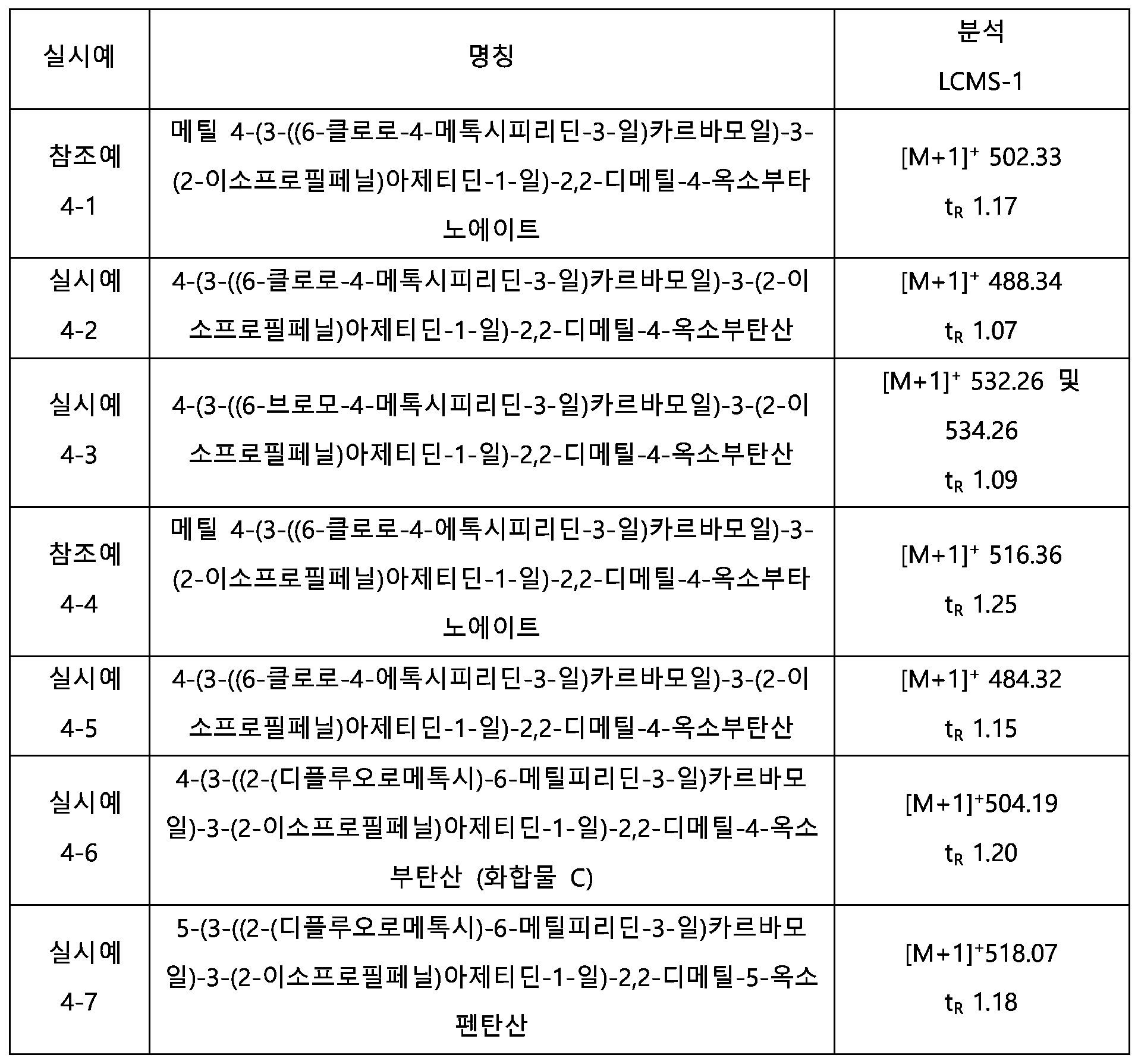
표 5: Table 5: 실시예Example 5-1 ~ 5-10: 5-1 to 5-10:
실시예 5-1: N-(6-플루오로-4-Example 5-1: N- (6-fluoro-4- 메톡시피리딘methoxypyridine -3-일)-3-(2--3-yl)-3-(2- 이소프로필페닐isopropylphenyl )-1-)-One- 술파모일아제티딘sulfamoylazetidine -3-카르복사미드-3-carboxamide
디옥산 (1 mL) 중 참조예 1 (35 mg, 0.09 mmol) 및 TEA (39 uL, 0.28 mmol) 의 용액에 술파미드 (18 mg, 0.18 mmol) 를 첨가한다. 반응 혼합물을 100℃ 에서 18 시간 동안 교반한 다음, 증발시킨다. 미정제 화합물을 prep. HPLC (Prep-HPLC-2 조건) 에 의해 정제하여, 표제 화합물 실시예 5-1 을 백색 고체 (15 mg, 39% 수율) 로서 수득한다. LCMS-1: tR = 0.94 분, [M+1]+ 423.29. 1H NMR (400 MHz, DMSO D6) δ: 8.69 (s, 1 H), 8.15 (s, 1 H), 7.42-7.32 (m, 3 H), 7.29-7.24 (m, 1 H), 7.05 (s, 2 H), 6.89 (s, 1 H), 4.41 (d, J = 7.6 Hz, 2 H), 4.14 (d, J = 7.6 Hz, 2 H), 3.75 (s, 3 H), 2.75-2.64 (m, 1 H), 1.11 (d, J = 6.6 Hz, 6 H).To a solution of Reference Example 1 (35 mg, 0.09 mmol) and TEA (39 uL, 0.28 mmol) in dioxane (1 mL) is added sulfamide (18 mg, 0.18 mmol). The reaction mixture is stirred at 100° C. for 18 hours and then evaporated. Prep the crude compound. Purification by HPLC (Prep-HPLC-2 conditions) gave the title compound Example 5-1 as a white solid (15 mg, 39% yield). LCMS-1: t R =0.94 min, [M+1] + 423.29. 1 H NMR (400 MHz, DMSO D6) δ : 8.69 (s, 1 H), 8.15 (s, 1 H), 7.42-7.32 (m, 3 H), 7.29-7.24 (m, 1 H), 7.05 ( s, 2 H), 6.89 (s, 1 H), 4.41 (d, J = 7.6 Hz, 2 H), 4.14 (d, J = 7.6 Hz, 2 H), 3.75 (s, 3 H), 2.75- 2.64 (m, 1 H), 1.11 (d, J = 6.6 Hz, 6 H).
실시예 5-2 ~ 5-10Examples 5-2 to 5-10
실시예 5-2 ~ 5-10 을 실시예 5-1 에 대해 기재된 방법과 유사하게 적절한 참 조예 1 ~ 11 로부터 출발하여 합성한다. Examples 5-2 to 5-10 are synthesized starting from the appropriate reference examples 1 to 11 analogously to the method described for example 5-1 .
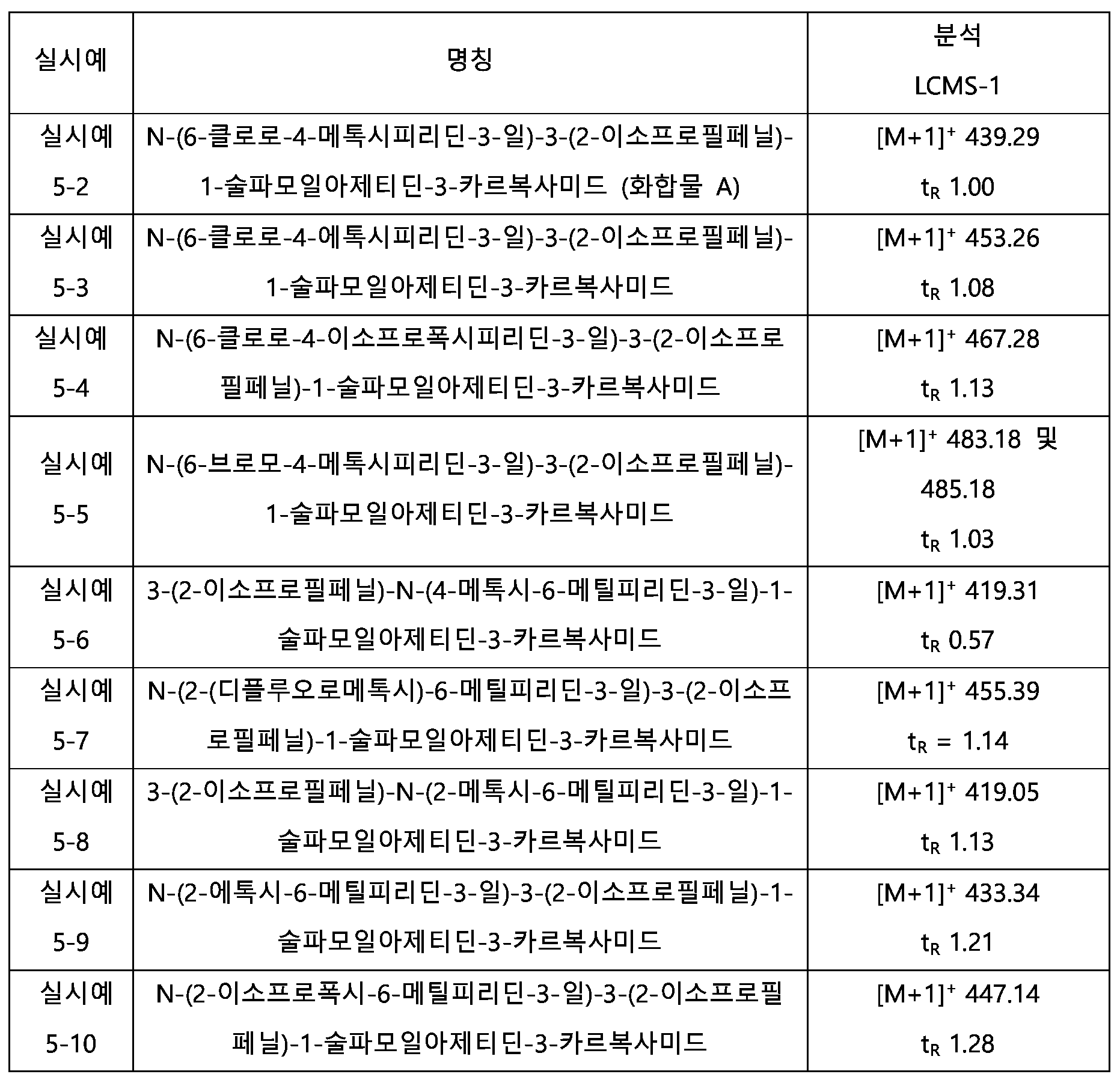
생물학적 biological 어세이assay
인간 LPARhuman LPAR 1One 에 대한 IC for IC 5050 값을 결정하기 위한 베타-아레스틴 동원 어세이 Beta-Arrestin Mobilization Assay to Determine Value
Invitrogen 으로부터 TangoTM EDG2-bla U2OS 세포를 입수한다. 이들 세포는 TEV 프로테아제 위치에 연결된 인간 LPA1 수용체 cDNA 및 TangoTM GPCR-bla U2OS 모 (parental) 세포주에 통합된 Gal4-VP16 전사 인자를 함유한다. 이러한 모 세포주는 UAS 반응 요소의 제어 하에서 베타-아레스틴 / TEV 프로테아제 융합 단백질 및 베타-락타마아제 (bla) 리포터 유전자를 안정적으로 발현한다. LPA (작용제) 결합시에, LPA1 수용체가 활성화되어, 전사 인자의 단백질분해 방출 및 아레스틴-프로테아제 동원을 야기한다: 전사 인자는 이후 베타-락타마아제 리포터 구축물의 전사를 조절하고, 이는 생세포 기질의 첨가시에 측정된다. Tango ™ EDG2- bla U2OS cells are obtained from Invitrogen. These cells contain human LPA 1 receptor cDNA linked to the TEV protease site and the Gal4-VP16 transcription factor integrated into the Tango ™ GPCR- bla U2OS parental cell line. This parental cell line stably expresses beta-arrestin/TEV protease fusion protein and beta-lactamase ( bla ) reporter genes under the control of UAS response elements. Upon LPA (agonist) binding, the LPA 1 receptor is activated, resulting in proteolytic release of a transcription factor and recruitment of arestin-protease: the transcription factor then regulates the transcription of the beta-lactamase reporter construct, which Measured upon addition of substrate.
10'000 TangoTM EDG2-bla U2OS 세포를 30 μl Freestyle 293 발현 배지 (Invitrogen) 중 투명 바닥 플레이트를 갖는 384-웰 블랙에 시딩하고, 20 시간 동안 37℃, 5% CO2 에서 인큐베이션한다. 길항제 어세이를 위해, 5 μl 의 시험 화합물 (DMSO / Freestyle 293 발현 배지 / 0.1% 지방산 불포함 BSA (Sigma) 중에서 연속 희석) 또는 완충제 대조군을 웰 당 첨가하고, 30 분 동안 37℃, 5% CO2 에서 인큐베이션한다. 5 μl 의 LPA 18:1 (500 nM 최종) (Freestyle 293 발현 배지 / 0.1% 지방산 불포함 BSA (Sigma) 중 용액) 을 웰 당 첨가하고, 플레이트를 16 시간 동안 37℃, 5% CO2 에서 인큐베이션한다. 그런 다음, 세포를 암환경에서 2 시간 동안 LiveBLAzer-FRETTM B/G 기질 (Invitrogen) 과 함께 로딩하고, 460 nm 및 530 nm 에서의 형광 방사를 SynergyMx 판독기 (BioTek) 를 사용하여 측정한다. 두 채널 모두로부터의 배경 차감 (background subtraction) 이후, 각각의 웰에 대한 460/530 nm 방사 비를 계산한 다음, 플로팅하고 4-매개변수 로지스틱 함수에 피팅하여, IC50 값을 수득한다. IC50 은 최대 반응의 50% 를 억제하는 길항제의 농도이다. 10'000 Tango ™ EDG2-bla U2OS cells are seeded in 384-well black with clear bottom plates in 30 μl Freestyle 293 expression medium (Invitrogen) and incubated for 20 hours at 37° C., 5% CO 2 . For antagonist assay, 5 μl of test compound (serial dilution in DMSO/Freestyle 293 expression medium/0.1% fatty acid free BSA (Sigma)) or buffer control is added per well, 37° C., 5% CO 2 for 30 min. incubate in 5 μl of LPA 18:1 (500 nM final) (Freestyle 293 expression medium/solution in 0.1% fatty acid free BSA (Sigma)) is added per well and the plate is incubated at 37° C., 5% CO 2 for 16 hours. . Then, the cells are loaded with LiveBLAzer-FRET ™ B/G substrate (Invitrogen) for 2 hours in a dark environment, and the fluorescence emission at 460 nm and 530 nm is measured using a SynergyMx reader (BioTek). After background subtraction from both channels, the 460/530 nm emission ratio for each well is calculated, then plotted and fitted to a 4-parameter logistic function to obtain IC 50 values. IC 50 is the concentration of antagonist that inhibits 50% of the maximal response.
예시된 화합물의 길항 활성 (IC50 값) 을 측정하고, 표 6 에 길항 활성을 나타낸다. 여러 값이 측정된 경우, 기하평균 (geomean) 값이 주어진다.The antagonistic activities (IC 50 values) of the exemplified compounds were measured, and the antagonistic activities are shown in Table 6. If multiple values are measured, a geometric mean value is given.
표 6: ICTable 6: IC 5050

생체내 효능 평가In vivo efficacy evaluation
식 (I) 의 화합물의 생체내 효능을 마우스 LPA-유도된 피부 혈관 누출 모델을 사용하여 측정할 수 있다. 암컷 Balb/c 마우스를 비히클 또는 시험 화합물 (p.o.) 로 적어도 1 시간 동안 처리한 후, 알부민 마커 Evans blue (50 mg/kg, i.v., 0.9% NaCl) 를 투여하고, 이후 LPA (5 μg, i.d.) 로 챌린지한다. 30 분 후, 마우스를 CO2 흡입에 의해 희생시킨다. 주사 위치로부터의 피부의 디스크를 제거하고, 포름아미드 (500 μl, 37℃, 24 시간) 에서 소화시키고, Evans blue 의 함량을 색채계측 어세이 (colorimetric assay) 에 의해 정량화한다. 결과를 피부 디스크 당 분출된 Evans blue (μg/디스크) 로 표현한다. The in vivo efficacy of a compound of formula (I) can be determined using a mouse LPA-induced skin vascular leak model. After treatment of female Balb/c mice with vehicle or test compound (po) for at least 1 hour, the albumin marker Evans blue (50 mg/kg, iv, 0.9% NaCl) was administered, followed by LPA (5 μg, id) challenge with After 30 min, mice are sacrificed by CO 2 inhalation. The disc of the skin from the injection site is removed, digested in formamide (500 μl, 37° C., 24 hours), and the content of Evans blue is quantified by a colorimetric assay. Results are expressed as Evans blue (μg/disc) ejected per skin disc.
예를 들면, 본 발명의 선택된 화합물, 실시예 5-2 는 비히클로만 처리한 동물 군과 비교하여 30 mg/kg 을 마우스에 경구 투여한 후 LPA-유도된 혈관 누출을 효과적으로 감소시킬 수 있다. 비히클 군과 비교하여 혈관 누출의 감소는 ≥ 60% 였다.For example, the selected compound of the present invention, Example 5-2 , can effectively reduce LPA-induced vascular leakage after oral administration of 30 mg/kg to mice compared to the group of animals treated with vehicle alone. The reduction in vascular leakage compared to the vehicle group was > 60%.
피르페니돈과 조합된 식 (I) 의 화합물의 항-섬유증 효과의 예Examples of anti-fibrotic effects of compounds of formula (I) in combination with pirfenidone
각각의 실시예 화합물 A-C 또는 참조 화합물 D (BMS-986020) 및 피르페니돈 단독 또는 조합으로의 항-섬유증 효과는 TGFβ-유도된 근섬유아세포 분화의 어세이에서 시험관내 측정할 수 있다.The anti-fibrotic effect of each of Example Compounds A-C or Reference Compound D (BMS-986020) and pirfenidone alone or in combination can be determined in vitro in an assay of TGFβ-induced myofibroblast differentiation.
조합 효능 실험: 인간 섬유아세포에서의 전환 성장 인자 베타 (Combination Efficacy Experiment: Converting Growth Factor Beta in Human Fibroblasts ( TGFβTGFβ )-유도된 α-평활근 액틴 (αSMA) 발현:)-induced α-smooth muscle actin (αSMA) expression:
정상 인간 폐 섬유아세포 (NHLF) 를 Lonza 로부터 입수하였다. 10'000 세포를 300 μl 섬유아세포 성장 배지-2 (FGMTM-2, Lonza) 중에서 24-웰 플레이트에서 시딩하고, 20 시간 동안 37℃, 5% CO2 에서 인큐베이션하였다. 배지를 0.1% 지방산 불포함 BSA (Sigma) 가 보충된 300 μl 섬유아세포 기본 배지 (FBMTM, Lonza) 로 바꾸고, 플레이트를 20 시간 동안 37℃, 5% CO2 에서 인큐베이션하였다. 100 μl 의 화합물, 피르페니돈 또는 그의 조합 (FBMTM / 0.1% 지방산 불포함 BSA 중 용액) 을 웰 당 첨가하고, 30 분 동안 인큐베이션한 후, 100 μl 의 TGFβ (5 ng/ml 최종) (FBMTM / 0.1% 지방산 불포함 BSA 중 용액) 를 첨가하고, 48 시간 동안 37℃, 5% CO2 에서 인큐베이션하였다. 세포를 빙랭 PBS 로 세척하고, NaF, Na-오르토바나데이트, 페닐메틸술포닐플루오라이드 (PMSF), 디티오트레이톨 (DTT) 및 벤조나아제가 보충된 RIPA 완충제 (Sigma) 에서 용해하였다. 샘플을 4-12% Novex Bis-Tris 프리캐스트 겔 (Thermo Fischer Scientific) 상에서 SDS-PAGE 에 의해 분석하고, αSMA (Sigma) 및 HRP-커플링된 2 차 항체를 사용하여 웨스턴 블롯에 의해 분석하였다. 멤브레인을 Western Lighting Enhanced Chemiluminescence Substrate (Perkin Elmer) 로 처리하고, 화학발광 신호를 판독기 Fusion FX6 (Viber Lourmat) 에 의해 기록하였다. 신호를 Fusion 소프트웨어에서 농도계 분석을 사용하여 정량화하였다. TGFβ-유도된 αSMA 발현의 억제 % 를 각각의 화합물, 피르페니돈 및 그의 조합에 대해 계산하였다. 화합물 단독 및 피르페니돈 단독에 의한 억제 % 값을 더하여 부가 효과를 계산하고, "예상 콤보 억제" 로 표시하였다. 화합물 및 피르페니돈 조합에 의한 측정된 억제 % 를 "측정 콤보 억제" 로 표시하였다. 피르페니돈 효능을 하기 설정을 사용하여 GraphPad Prism 소프트웨어로 측정하였다: TGFβ 자극이 없는 비히클 대조군에 의해 정의된 최소값, 화합물의 부재 또는 존재 하에 TGFβ 의 반응에 의해 정의된 최대값, 가중치 없음, 및 가변성 기울기.Normal human lung fibroblasts (NHLF) were obtained from Lonza. 10'000 cells were seeded in 24-well plates in 300 μl fibroblast growth medium-2 (FGM TM -2, Lonza) and incubated for 20 hours at 37° C., 5% CO 2 . The medium was changed to 300 μl fibroblast basal medium (FBM ™ , Lonza) supplemented with 0.1% fatty acid free BSA (Sigma) and the plates were incubated at 37° C., 5% CO 2 for 20 hours. 100 μl of compound, pirfenidone or a combination thereof (FBM TM / solution in 0.1% fatty acid free BSA) is added per well and incubated for 30 minutes, after which 100 μl of TGFβ (5 ng/ml final) (FBM TM ) / solution in BSA without 0.1% fatty acid) and incubated for 48 h at 37° C., 5% CO 2 . Cells were washed with ice-cold PBS and lysed in RIPA buffer (Sigma) supplemented with NaF, Na-orthovanadate, phenylmethylsulfonylfluoride (PMSF), dithiothreitol (DTT) and Benzonase. Samples were analyzed by SDS-PAGE on 4-12% Novex Bis-Tris precast gels (Thermo Fischer Scientific) and by Western blot using αSMA (Sigma) and HRP-coupled secondary antibody. The membrane was treated with Western Lighting Enhanced Chemiluminescence Substrate (Perkin Elmer) and the chemiluminescence signal was recorded by a reader Fusion FX6 (Viber Lourmat). Signals were quantified using densitometry analysis in Fusion software. The % inhibition of TGFβ-induced αSMA expression was calculated for each compound, pirfenidone and combinations thereof. Additive effects were calculated by adding the values of % inhibition by compound alone and pirfenidone alone and expressed as “expected combo inhibition”. The measured % inhibition by compound and pirfenidone combination was expressed as “measured combo inhibition”. Pirfenidone potency was measured with GraphPad Prism software using the following settings: minimum defined by vehicle control without TGFβ stimulation, maximum defined by response of TGFβ in the absence or presence of compound, no weight, and variability inclination.
조합 효능 실험으로부터의 결과를 도 1 ~ 4 및 도 5 에서 나타낸다. Results from combination efficacy experiments are shown in FIGS. 1-4 and 5 .
도 1 ~ 4: 10 nM 화합물 A-D 각각, 및 2 mM 피르페니돈은 NHLF 에서 TGFβ-유도된 αSMA 발현을 최소한으로 억제하였다. 화합물 A-D 중 어느 하나가 피르페니돈과 조합된 경우, 조합은 상승작용적 효과를 나타내어, αSMA 발현을 강하게 감소시켰다. Figure 1 ~ 4:10 nM each of compound AD, and 2 mM pirfenidone, minimally inhibited TGFβ-induced αSMA expression in NHLF. When either compound AD was combined with pirfenidone, the combination showed a synergistic effect, strongly reducing αSMA expression.
도 5 는 10 nM, 100 nM 및 1000 nM 의 화합물 A 의 부재 또는 존재 하에 NHLF 에서 TGFβ-유도된 αSMA 발현에 대한 피르페니돈의 용량-반응을 나타낸다. 피르페니돈은 그의 IC50 (mM) 감소에 의해 나타낸 바와 같이 화합물 A 와 조합시 효능이 증가한다. Figure 5 shows the dose-response of pirfenidone on TGFβ-induced αSMA expression in NHLF in the absence or presence of 10 nM, 100 nM and 1000 nM of Compound A. Pirfenidone has an increased potency when combined with Compound A as indicated by its IC 50 (mM) reduction.
닌테다닙과 조합된 식 (I) 의 화합물의 항-섬유증 효과의 예Examples of anti-fibrotic effects of compounds of formula (I) in combination with nintedanib
각각의 실시예 화합물 A-C 및 닌테다닙 단독 또는 조합으로의 항-섬유증 효과는 TGFβ-유도된 근섬유아세포 분화의 어세이에서 시험관내 측정할 수 있다.The anti-fibrotic effects of each of the example compounds A-C and nintedanib alone or in combination can be measured in vitro in an assay of TGFβ-induced myofibroblast differentiation.
조합 효능 실험: 인간 섬유아세포에서의Combination efficacy experiments: in human fibroblasts TGFβ-유도된 αSMA 발현:TGFβ-induced αSMA expression:
NHLF 를 Lonza 로부터 입수하였다. 10'000 세포를 300 μl FGMTM-2 에서 24-웰 플레이트에서 시딩하고, 20 시간 동안 37℃, 5% CO2 에서 인큐베이션하였다. 배지를 0.1% 지방산 불포함 BSA (Sigma) 가 보충된 300 μl FBMTM 으로 바꾸고, 플레이트를 20 시간 동안 37℃, 5% CO2 에서 인큐베이션하였다. 100 μl 의 각각의 화합물, 닌테다닙 또는 그의 조합 (FBMTM / 0.1% 지방산 불포함 BSA 중 용액) 을 웰 당 첨가하고, 30 분 동안 인큐베이션한 후, 100 μl 의 TGFβ (5 ng/ml 최종) (FBMTM / 0.1% 지방산 불포함 BSA 중 용액) 를 첨가하고, 48 시간 동안 37℃, 5% CO2 에서 인큐베이션하였다. 세포를 빙랭 PBS 로 세척하고, NaF, Na-오르토바나데이트, 페닐메틸술포닐플루오라이드 (PMSF), 디티오트레이톨 (DTT) 이 보충된 RIPA 완충제 (Sigma) 에서 용해하였다. 샘플을 4-12% Novex Bis-Tris 프리캐스트 겔 (Thermo Fischer Scientific) 상에서 SDS-PAGE 에 의해 분석하고, αSMA (Sigma) 및 HRP-커플링된 2 차 항체를 사용하여 웨스턴 블롯에 의해 분석하였다. 멤브레인을 Western Lighting Enhanced Chemiluminescence Substrate (Perkin Elmer) 로 처리하고, 화학발광 신호를 판독기 Fusion FX6 (Viber Lourmat) 에 의해 기록하였다. 신호를 Fusion 소프트웨어에서 농도계 분석을 사용하여 정량화하였다. TGFβ-유도된 αSMA 발현의 억제 % 를 각각의 화합물, 닌테다닙 및 그의 조합에 대해 계산하였다. 화합물 단독 및 닌테다닙 단독에 의한 억제 % 값을 더하여 부가 효과를 계산하고, "예상 콤보 억제" 로 표시하였다. 화합물 및 닌테다닙 조합에 의한 측정된 억제 % 를 "측정 콤보 억제" 로 표시하였다.NHLF was obtained from Lonza. 10'000 cells were seeded in 24-well plates in 300 μl FGM TM -2 and incubated for 20 hours at 37° C., 5% CO 2 . The medium was changed to 300 μl FBM TM supplemented with 0.1% fatty acid free BSA (Sigma) and the plates were incubated for 20 hours at 37° C., 5% CO 2 . 100 μl of each compound, nintedanib or a combination thereof (FBM TM / solution in 0.1% fatty acid free BSA) is added per well and incubated for 30 minutes, after which 100 μl of TGFβ (5 ng/ml final) (FBM) TM /solution in BSA without 0.1% fatty acid) was added and incubated for 48 h at 37° C., 5% CO 2 . Cells were washed with ice-cold PBS and lysed in RIPA buffer (Sigma) supplemented with NaF, Na-orthovanadate, phenylmethylsulfonylfluoride (PMSF), dithiothreitol (DTT). Samples were analyzed by SDS-PAGE on 4-12% Novex Bis-Tris precast gels (Thermo Fischer Scientific) and by Western blot using αSMA (Sigma) and HRP-coupled secondary antibody. The membrane was treated with Western Lighting Enhanced Chemiluminescence Substrate (Perkin Elmer) and the chemiluminescence signal was recorded by a reader Fusion FX6 (Viber Lourmat). Signals were quantified using densitometry analysis in Fusion software. The % inhibition of TGFβ-induced αSMA expression was calculated for each compound, nintedanib and combinations thereof. Additive effects were calculated by adding the values of % inhibition by compound alone and nintedanib alone and expressed as “expected combo inhibition”. The measured % inhibition by compound and nintedanib combination was expressed as “measured combo inhibition”.
조합 효능 실험으로부터의 결과를 도 6 ~ 8 에서 나타낸다. Results from combination efficacy experiments are shown in Figures 6-8.
도 6 ~ 8: 10 nM 화합물 A-C 각각, 및 1 μM 닌테다닙은 NHLF 에서 TGFβ-유도된 αSMA 발현을 최소한으로 억제하였다. 화합물 A-C 중 어느 하나가 닌테다닙과 조합되는 경우, 조합은 적어도 부가 효과를 나타내어, αSMA 발현을 강하게 감소시켰다. Fig. 6 ~ 8 : 10 nM each of compound AC, and 1 μM nintedanib minimally inhibited TGFβ-induced αSMA expression in NHLF. When either compound AC was combined with nintedanib, the combination had at least an additive effect, strongly reducing αSMA expression.
Claims (15)

[식 중에서,
ㆍ X 는 CH 이고; Y 는 N 이고; R 2 는 메틸, 에틸 또는 이소프로필이거나; 또는
ㆍ X 는 N 이고; Y 는 CH 이고; R 2 는 메틸, 에틸 또는 이소프로필, 또는 디플루오로메틸이고;
R 1 은 플루오로, 클로로, 브로모 또는 메틸이고;
R 3 은
ㆍ -(CH2)2-3-C(CH3)2-COOH;
ㆍ -CO-(CH2)1-2-C(CH3)2-COOH; 또는
ㆍ -SO2-NH2
를 나타냄];
여기서, 상기 식 (I) 의 화합물은 항-섬유화제(들) 로서 작용하는 하나 이상의 치료적 활성 성분과 조합으로; 특히
ㆍ 피르페니돈, 또는 이의 약학적으로 허용가능한 염과 조합으로;
ㆍ 닌테다닙, 또는 이의 약학적으로 허용가능한 염과 조합으로; 또는
ㆍ 피르페니돈, 또는 이의 약학적으로 허용가능한 염, 및 닌테다닙, 또는 이의 약학적으로 허용가능한 염 둘 모두와 조합으로 투여됨.A compound of formula (I) or a pharmaceutically acceptable salt thereof for combined use in the prophylaxis or treatment of a fibrotic disease:
[In the formula,
• X is CH; Y is N; R 2 is methyl, ethyl or isopropyl; or
• X is N; Y is CH; R 2 is methyl, ethyl or isopropyl, or difluoromethyl;
R 1 is fluoro, chloro, bromo or methyl;
R 3 is
-(CH 2 ) 2-3 -C(CH 3 ) 2 -COOH;
-CO-(CH 2 ) 1-2 -C(CH 3 ) 2 -COOH; or
ㆍ -SO 2 -NH 2
represents];
wherein the compound of formula (I) is in combination with one or more therapeutically active ingredients acting as anti-fibrotic agent(s); Especially
• in combination with pirfenidone, or a pharmaceutically acceptable salt thereof;
• in combination with nintedanib, or a pharmaceutically acceptable salt thereof; or
Administered in combination with both pirfenidone, or a pharmaceutically acceptable salt thereof, and nintedanib, or a pharmaceutically acceptable salt thereof.
ㆍ -CH2-CH2-C(CH3)2-COOH;
ㆍ -CO-CH2-C(CH3)2-COOH; 또는
ㆍ -SO2-NH2
를 나타내는, 조합 사용을 위한 식 (I) 의 화합물, 또는 이의 약학적으로 허용가능한 염.6. The method according to any one of claims 1 to 5, wherein R 3 is
-CH 2 -CH 2 -C(CH 3 ) 2 -COOH;
-CO-CH 2 -C(CH 3 ) 2 -COOH; or
ㆍ -SO 2 -NH 2
A compound of formula (I) for combination use, or a pharmaceutically acceptable salt thereof.
4-(3-((2-(디플루오로메톡시)-6-메틸피리딘-3-일)카르바모일)-3-(2-이소프로필페닐)아제티딘-1-일)-2,2-디메틸부탄산;
5-(3-((2-(디플루오로메톡시)-6-메틸피리딘-3-일)카르바모일)-3-(2-이소프로필페닐)아제티딘-1-일)-2,2-디메틸펜탄산;
4-(3-((2-(디플루오로메톡시)-6-메틸피리딘-3-일)카르바모일)-3-(2-이소프로필페닐)아제티딘-1-일)-2,2-디메틸-4-옥소부탄산;
5-(3-((2-(디플루오로메톡시)-6-메틸피리딘-3-일)카르바모일)-3-(2-이소프로필페닐)아제티딘-1-일)-2,2-디메틸-5-옥소펜탄산;
N-(2-(디플루오로메톡시)-6-메틸피리딘-3-일)-3-(2-이소프로필페닐)-1-술파모일아제티딘-3-카르복사미드;
3-(2-이소프로필페닐)-N-(2-메톡시-6-메틸피리딘-3-일)-1-술파모일아제티딘-3-카르복사미드;
N-(2-에톡시-6-메틸피리딘-3-일)-3-(2-이소프로필페닐)-1-술파모일아제티딘-3-카르복사미드;
N-(2-이소프로폭시-6-메틸피리딘-3-일)-3-(2-이소프로필페닐)-1-술파모일아제티딘-3-카르복사미드;
4-(3-((6-클로로-4-메톡시피리딘-3-일)카르바모일)-3-(2-이소프로필페닐)아제티딘-1-일)-2,2-디메틸부탄산;
4-(3-((6-클로로-4-에톡시피리딘-3-일)카르바모일)-3-(2-이소프로필페닐)아제티딘-1-일)-2,2-디메틸부탄산;
4-(3-((6-클로로-4-이소프로폭시피리딘-3-일)카르바모일)-3-(2-이소프로필페닐)아제티딘-1-일)-2,2-디메틸부탄산;
4-(3-((6-브로모-4-메톡시피리딘-3-일)카르바모일)-3-(2-이소프로필페닐)아제티딘-1-일)-2,2-디메틸부탄산;
5-(3-((6-클로로-4-메톡시피리딘-3-일)카르바모일)-3-(2-이소프로필페닐)아제티딘-1-일)-2,2-디메틸펜탄산;
5-(3-((6-클로로-4-에톡시피리딘-3-일)카르바모일)-3-(2-이소프로필페닐)아제티딘-1-일)-2,2-디메틸펜탄산;
4-(3-((6-클로로-4-메톡시피리딘-3-일)카르바모일)-3-(2-이소프로필페닐)아제티딘-1-일)-2,2-디메틸-4-옥소부탄산;
4-(3-((6-브로모-4-메톡시피리딘-3-일)카르바모일)-3-(2-이소프로필페닐)아제티딘-1-일)-2,2-디메틸-4-옥소부탄산;
4-(3-((6-클로로-4-에톡시피리딘-3-일)카르바모일)-3-(2-이소프로필페닐)아제티딘-1-일)-2,2-디메틸-4-옥소부탄산;
N-(6-플루오로-4-메톡시피리딘-3-일)-3-(2-이소프로필페닐)-1-술파모일아제티딘-3-카르복사미드;
N-(6-클로로-4-메톡시피리딘-3-일)-3-(2-이소프로필페닐)-1-술파모일아제티딘-3-카르복사미드;
N-(6-클로로-4-에톡시피리딘-3-일)-3-(2-이소프로필페닐)-1-술파모일아제티딘-3-카르복사미드;
N-(6-클로로-4-이소프로폭시피리딘-3-일)-3-(2-이소프로필페닐)-1-술파모일아제티딘-3-카르복사미드;
N-(6-브로모-4-메톡시피리딘-3-일)-3-(2-이소프로필페닐)-1-술파모일아제티딘-3-카르복사미드; 또는
3-(2-이소프로필페닐)-N-(4-메톡시-6-메틸피리딘-3-일)-1-술파모일아제티딘-3-카르복사미드;
또는 이의 약학적으로 허용가능한 염.A compound of formula (I), or a pharmaceutically acceptable salt thereof, for combined use according to claim 1, wherein the compound is:
4-(3-((2-(difluoromethoxy)-6-methylpyridin-3-yl)carbamoyl)-3-(2-isopropylphenyl)azetidin-1-yl)-2,2 -dimethylbutanoic acid;
5-(3-((2-(difluoromethoxy)-6-methylpyridin-3-yl)carbamoyl)-3-(2-isopropylphenyl)azetidin-1-yl)-2,2 -dimethylpentanoic acid;
4-(3-((2-(difluoromethoxy)-6-methylpyridin-3-yl)carbamoyl)-3-(2-isopropylphenyl)azetidin-1-yl)-2,2 -dimethyl-4-oxobutanoic acid;
5-(3-((2-(difluoromethoxy)-6-methylpyridin-3-yl)carbamoyl)-3-(2-isopropylphenyl)azetidin-1-yl)-2,2 -dimethyl-5-oxopentanoic acid;
N-(2-(difluoromethoxy)-6-methylpyridin-3-yl)-3-(2-isopropylphenyl)-1-sulfamoylazetidine-3-carboxamide;
3-(2-isopropylphenyl)-N-(2-methoxy-6-methylpyridin-3-yl)-1-sulfamoylazetidine-3-carboxamide;
N-(2-ethoxy-6-methylpyridin-3-yl)-3-(2-isopropylphenyl)-1-sulfamoylazetidine-3-carboxamide;
N-(2-isopropoxy-6-methylpyridin-3-yl)-3-(2-isopropylphenyl)-1-sulfamoylazetidine-3-carboxamide;
4-(3-((6-chloro-4-methoxypyridin-3-yl)carbamoyl)-3-(2-isopropylphenyl)azetidin-1-yl)-2,2-dimethylbutanoic acid ;
4-(3-((6-chloro-4-ethoxypyridin-3-yl)carbamoyl)-3-(2-isopropylphenyl)azetidin-1-yl)-2,2-dimethylbutanoic acid ;
4-(3-((6-chloro-4-isopropoxypyridin-3-yl)carbamoyl)-3-(2-isopropylphenyl)azetidin-1-yl)-2,2-dimethyl moiety carbonic acid;
4-(3-((6-bromo-4-methoxypyridin-3-yl)carbamoyl)-3-(2-isopropylphenyl)azetidin-1-yl)-2,2-dimethyl moiety carbonic acid;
5-(3-((6-chloro-4-methoxypyridin-3-yl)carbamoyl)-3-(2-isopropylphenyl)azetidin-1-yl)-2,2-dimethylpentanoic acid ;
5-(3-((6-chloro-4-ethoxypyridin-3-yl)carbamoyl)-3-(2-isopropylphenyl)azetidin-1-yl)-2,2-dimethylpentanoic acid ;
4-(3-((6-chloro-4-methoxypyridin-3-yl)carbamoyl)-3-(2-isopropylphenyl)azetidin-1-yl)-2,2-dimethyl-4 -oxobutanoic acid;
4-(3-((6-bromo-4-methoxypyridin-3-yl)carbamoyl)-3-(2-isopropylphenyl)azetidin-1-yl)-2,2-dimethyl- 4-oxobutanoic acid;
4-(3-((6-chloro-4-ethoxypyridin-3-yl)carbamoyl)-3-(2-isopropylphenyl)azetidin-1-yl)-2,2-dimethyl-4 -oxobutanoic acid;
N-(6-fluoro-4-methoxypyridin-3-yl)-3-(2-isopropylphenyl)-1-sulfamoylazetidine-3-carboxamide;
N-(6-chloro-4-methoxypyridin-3-yl)-3-(2-isopropylphenyl)-1-sulfamoylazetidine-3-carboxamide;
N-(6-chloro-4-ethoxypyridin-3-yl)-3-(2-isopropylphenyl)-1-sulfamoylazetidine-3-carboxamide;
N-(6-chloro-4-isopropoxypyridin-3-yl)-3-(2-isopropylphenyl)-1-sulfamoylazetidine-3-carboxamide;
N-(6-bromo-4-methoxypyridin-3-yl)-3-(2-isopropylphenyl)-1-sulfamoylazetidine-3-carboxamide; or
3-(2-isopropylphenyl)-N-(4-methoxy-6-methylpyridin-3-yl)-1-sulfamoylazetidine-3-carboxamide;
or a pharmaceutically acceptable salt thereof.
4-(3-((2-(디플루오로메톡시)-6-메틸피리딘-3-일)카르바모일)-3-(2-이소프로필페닐)아제티딘-1-일)-2,2-디메틸부탄산;
4-(3-((2-(디플루오로메톡시)-6-메틸피리딘-3-일)카르바모일)-3-(2-이소프로필페닐)아제티딘-1-일)-2,2-디메틸-4-옥소부탄산; 또는
N-(6-클로로-4-메톡시피리딘-3-일)-3-(2-이소프로필페닐)-1-술파모일아제티딘-3-카르복사미드;
또는 이의 약학적으로 허용가능한 염.A compound of formula (I), or a pharmaceutically acceptable salt thereof, for combined use according to claim 1, wherein the compound is:
4-(3-((2-(difluoromethoxy)-6-methylpyridin-3-yl)carbamoyl)-3-(2-isopropylphenyl)azetidin-1-yl)-2,2 -dimethylbutanoic acid;
4-(3-((2-(difluoromethoxy)-6-methylpyridin-3-yl)carbamoyl)-3-(2-isopropylphenyl)azetidin-1-yl)-2,2 -dimethyl-4-oxobutanoic acid; or
N-(6-chloro-4-methoxypyridin-3-yl)-3-(2-isopropylphenyl)-1-sulfamoylazetidine-3-carboxamide;
or a pharmaceutically acceptable salt thereof.
ㆍ 폐 섬유증; 여기서 특히 상기 폐 섬유증은 특발성 폐 섬유증, 전신 염증성 질환에 2 차적인 폐 섬유증, 사르코이드증에 2 차적인 폐 섬유증, 의원성 폐 섬유증, 규폐증-유도된 폐 섬유증, 석면-유도된 폐 섬유증, 흉막 섬유증, 및 COVID-19 와 관련된 폐 섬유증에서 선택됨;
ㆍ 신장 섬유증; 여기서 특히 상기 신장 섬유증은 CKD, 만성 신부전, 세관사이질 신염, 및 원발성 사구체신염, 및 전신 염증성 질환, 당뇨병, 국소 분절성 사구체 경화증, IgA 신증, 고혈압, 신장 동종이식편 및 알포트 증후군에 2 차적인 사구체신염에서 선택되는 만성 신증과 관련된 신장 섬유증에서 선택됨; 또는
ㆍ 간 섬유증; 여기서 특히 상기 간 섬유증은 간경변, 알코올-유도된 간 섬유증, 비알코올성 지방간염, 담관 손상, 원발성 담즙 간경변, 감염- 또는 바이러스-유도된 간 섬유증, 및 자가면역 간염에서 선택됨.12. A compound of formula (I), or a pharmaceutically acceptable salt thereof, for combined use according to any one of claims 1 to 11, wherein the combined use is for the prophylaxis or treatment of:
• Pulmonary fibrosis; wherein said pulmonary fibrosis in particular is idiopathic pulmonary fibrosis, pulmonary fibrosis secondary to systemic inflammatory disease, pulmonary fibrosis secondary to sarcoidosis, iatrogenic pulmonary fibrosis, silicosis-induced pulmonary fibrosis, asbestos-induced pulmonary fibrosis, pleura fibrosis, and lung fibrosis associated with COVID-19;
• Renal fibrosis; wherein said renal fibrosis in particular is CKD, chronic renal failure, interstitial nephritis, and primary glomerulonephritis, and glomeruli secondary to systemic inflammatory disease, diabetes, focal segmental glomerulosclerosis, IgA nephropathy, hypertension, renal allograft and Alport's syndrome. renal fibrosis associated with chronic nephropathy selected from nephritis; or
• Liver fibrosis; wherein in particular said liver fibrosis is selected from cirrhosis, alcohol-induced liver fibrosis, nonalcoholic steatohepatitis, biliary tract injury, primary biliary cirrhosis, infection- or virus-induced liver fibrosis, and autoimmune hepatitis.
ㆍ 특발성 폐 섬유증;
ㆍ 전신 염증성 질환에 2 차적인 폐 섬유증;
ㆍ 사르코이드증에 2 차적인 폐 섬유증;
ㆍ 방사선-유도된 섬유증;
ㆍ 규폐증-유도된 폐 섬유증;
ㆍ 석면-유도된 폐 섬유증; 또는
ㆍ COVID-19 와 관련된 폐 섬유증.12. A compound of formula (I), or a pharmaceutically acceptable salt thereof, for combined use according to any one of claims 1 to 11, wherein the combined use is for the prophylaxis or treatment of:
• idiopathic pulmonary fibrosis;
• Pulmonary fibrosis secondary to systemic inflammatory disease;
• Pulmonary fibrosis secondary to sarcoidosis;
• radiation-induced fibrosis;
• silicosis-induced pulmonary fibrosis;
• asbestos-induced pulmonary fibrosis; or
ㆍ Pulmonary fibrosis associated with COVID-19.
ㆍ 폐 섬유증; 여기서 특히 상기 폐 섬유증은 특발성 폐 섬유증; 전신 염증성 질환에 2 차적인 폐 섬유증; 사르코이드증에 2 차적인 폐 섬유증; 의원성 폐 섬유증; 규폐증-유도된 폐 섬유증; 석면-유도된 폐 섬유증; 흉막 섬유증; 및 COVID-19 와 관련된 폐 섬유증에서 선택됨;
ㆍ 신장 섬유증; 여기서 특히 상기 신장 섬유증은 CKD, 만성 신부전, 세관사이질 신염, 및 원발성 사구체신염, 및 전신 염증성 질환, 당뇨병, 국소 분절성 사구체 경화증, IgA 신증, 고혈압, 신장 동종이식편 및 알포트 증후군에 2 차적인 사구체신염에서 선택되는 만성 신증과 관련된 신장 섬유증에서 선택됨; 또는
ㆍ 간 섬유증; 여기서 특히 상기 간 섬유증은 간경변, 알코올-유도된 간 섬유증, 비알코올성 지방간염, 담관 손상, 원발성 담즙 간경변, 감염- 또는 바이러스-유도된 간 섬유증, 및 자가면역 간염에서 선택됨;
상기 방법은 약학적 유효량의 제 1 항 내지 제 11 항 중 어느 한 항에서 정의된 바와 같은 식 (I) 의 화합물, 또는 이의 약학적으로 허용가능한 염을 항-섬유화제(들) 로서 작용하는 하나 이상의 치료적 활성 성분과 조합으로 투여하는 것을 포함하고; 상기 항-섬유화제(들) 가 특히 피르페니돈 및/또는 닌테다닙; 또는 이의 약학적으로 허용가능한 염인, 방법.
How to prevent or treat:
• Pulmonary fibrosis; wherein in particular said pulmonary fibrosis is idiopathic pulmonary fibrosis; pulmonary fibrosis secondary to systemic inflammatory disease; pulmonary fibrosis secondary to sarcoidosis; iatrogenic pulmonary fibrosis; silicosis-induced pulmonary fibrosis; asbestos-induced pulmonary fibrosis; pleural fibrosis; and pulmonary fibrosis associated with COVID-19;
• Renal fibrosis; wherein said renal fibrosis in particular is CKD, chronic renal failure, interstitial nephritis, and primary glomerulonephritis, and glomeruli secondary to systemic inflammatory disease, diabetes, focal segmental glomerulosclerosis, IgA nephropathy, hypertension, renal allograft and Alport's syndrome. renal fibrosis associated with chronic nephropathy selected from nephritis; or
• Liver fibrosis; wherein in particular said liver fibrosis is selected from cirrhosis, alcohol-induced liver fibrosis, nonalcoholic steatohepatitis, biliary tract injury, primary biliary cirrhosis, infection- or virus-induced liver fibrosis, and autoimmune hepatitis;
The method comprises one of a pharmaceutically effective amount of a compound of formula (I) as defined in any one of claims 1 to 11, or a pharmaceutically acceptable salt thereof, acting as anti-fibrotic agent(s). comprising administering in combination with any of the above therapeutically active ingredients; Said anti-fibrotic agent(s) are in particular pirfenidone and/or nintedanib; or a pharmaceutically acceptable salt thereof.
Applications Claiming Priority (3)
| Application Number | Priority Date | Filing Date | Title |
|---|---|---|---|
| EPPCT/EP2019/083757 | 2019-12-04 | ||
| EP2019083757 | 2019-12-04 | ||
| PCT/EP2020/084401 WO2021110805A1 (en) | 2019-12-04 | 2020-12-03 | Combination of an azetidine lpa1 receptor antagonist with pirfenidone and/or nintedanib for use in the treatment of fibrotic diseases |
Publications (1)
| Publication Number | Publication Date |
|---|---|
| KR20220109439A true KR20220109439A (en) | 2022-08-04 |
Family
ID=76221504
Family Applications (1)
| Application Number | Title | Priority Date | Filing Date |
|---|---|---|---|
| KR1020227022458A Pending KR20220109439A (en) | 2019-12-04 | 2020-12-03 | Combination of an azetidine LPA1 receptor antagonist with pirfenidone and/or nintedanib for use in the treatment of a fibrotic disease |
Country Status (14)
| Country | Link |
|---|---|
| US (1) | US12539294B2 (en) |
| EP (1) | EP4069227A1 (en) |
| JP (1) | JP7665619B2 (en) |
| KR (1) | KR20220109439A (en) |
| CN (1) | CN114761001A (en) |
| AU (1) | AU2020397207B2 (en) |
| BR (1) | BR112022010891A2 (en) |
| CA (1) | CA3160410A1 (en) |
| CL (1) | CL2022001439A1 (en) |
| IL (1) | IL293474A (en) |
| MX (1) | MX2022006736A (en) |
| PH (1) | PH12022551359A1 (en) |
| TW (1) | TWI895300B (en) |
| WO (1) | WO2021110805A1 (en) |
Families Citing this family (11)
| Publication number | Priority date | Publication date | Assignee | Title |
|---|---|---|---|---|
| EP3802517B1 (en) | 2018-06-07 | 2022-12-21 | Idorsia Pharmaceuticals Ltd | Alkoxy-substituted pyridinyl derivatives as lpa1 receptor antagonists and their use in the treatment of fibrosis |
| AR119162A1 (en) | 2019-06-18 | 2021-12-01 | Idorsia Pharmaceuticals Ltd | PYRIDIN-3-YL DERIVATIVES |
| AU2020384883B2 (en) | 2019-11-15 | 2023-11-16 | Gilead Sciences, Inc. | Triazole carbamate pyridyl sulfonamides as LPA receptor antagonists and uses thereof |
| TWI843503B (en) | 2020-06-03 | 2024-05-21 | 美商基利科學股份有限公司 | Lpa receptor antagonists and uses thereof |
| CN115867556B (en) | 2020-06-03 | 2025-05-06 | 吉利德科学公司 | LPA receptor antagonists and uses thereof |
| TWI853704B (en) | 2021-05-11 | 2024-08-21 | 美商基利科學股份有限公司 | Lpa receptor antagonists and uses thereof |
| KR20240007233A (en) | 2021-05-13 | 2024-01-16 | 길리애드 사이언시즈, 인코포레이티드 | LPA receptor antagonists and uses thereof |
| WO2023107938A1 (en) | 2021-12-08 | 2023-06-15 | Gilead Sciences, Inc. | Lpa receptor antagonists and uses thereof |
| WO2023192646A1 (en) * | 2022-03-31 | 2023-10-05 | Puretech Lyt 100, Inc. | Methods of treating fibrotic- and collagen-mediated diseases and disorders with deupirfenidone |
| CN120379666A (en) * | 2022-12-23 | 2025-07-25 | 百时美施贵宝公司 | LPA1 antagonists for the treatment of interstitial lung disease |
| WO2025169931A1 (en) * | 2024-02-05 | 2025-08-14 | Ube株式会社 | Carboxamide compound |
Family Cites Families (56)
| Publication number | Priority date | Publication date | Assignee | Title |
|---|---|---|---|---|
| NL130088C (en) | 1960-03-14 | |||
| GB9420763D0 (en) | 1994-10-14 | 1994-11-30 | Glaxo Inc | Acetamide derivatives |
| GB9919776D0 (en) | 1998-08-31 | 1999-10-27 | Zeneca Ltd | Compoujnds |
| US6762180B1 (en) | 1999-10-13 | 2004-07-13 | Boehringer Ingelheim Pharma Kg | Substituted indolines which inhibit receptor tyrosine kinases |
| WO2001032173A1 (en) | 1999-10-29 | 2001-05-10 | Yamanouchi Pharmaceutical Co., Ltd. | Kainic acid neurocytotoxicity inhibitors |
| AU2001262185A1 (en) | 2000-04-10 | 2001-10-23 | Novartis Ag | Substituted (hetero)aryl carboxamide derivatives as microsomal triglyceride transfer protein (mtp) and apolipoprotein b (apo b) secretion |
| WO2002062389A1 (en) | 2001-02-08 | 2002-08-15 | Ono Pharmaceutical Co., Ltd. | Remedies for urinary diseases comprising lpa receptor controlling agents |
| TW200403058A (en) | 2002-04-19 | 2004-03-01 | Bristol Myers Squibb Co | Heterocyclo inhibitors of potassium channel function |
| US7435824B2 (en) | 2002-04-19 | 2008-10-14 | Bristol-Myers Squibb Company | Prodrugs of potassium channel inhibitors |
| DE10233500A1 (en) | 2002-07-24 | 2004-02-19 | Boehringer Ingelheim Pharma Gmbh & Co. Kg | 3-Z- [1- (4- (N - ((4-methyl-piperazin-1-yl) -methylcarbonyl) -N-methyl-amino) -anilino) -1-phenyl-methylene] -6-methoxycarbonyl- 2-indolinone monoethanesulfonate and its use as a medicament |
| US20040204458A1 (en) | 2002-08-16 | 2004-10-14 | Boehringer Ingelheim Pharma Gmbh & Co. Kg | Use of Lck inhibitors for treatment of immunologic diseases |
| TW200505902A (en) | 2003-03-20 | 2005-02-16 | Schering Corp | Cannabinoid receptor ligands |
| JP4847868B2 (en) | 2003-05-14 | 2011-12-28 | ニューロジェネティック ファーマシューティカルズ、 インコーポレイテッド | Compounds and their use in the regulation of amyloid beta |
| US7749999B2 (en) | 2003-09-11 | 2010-07-06 | Itherx Pharmaceuticals, Inc. | Alpha-ketoamides and derivatives thereof |
| EP1679069A4 (en) | 2003-10-21 | 2009-05-13 | Dainippon Sumitomo Pharma Co | NEW PIPERIDINE DERIVATIVE |
| EP1687296A1 (en) | 2003-11-18 | 2006-08-09 | Warner-Lambert Company LLC | Antibacterial aminoquinazolidinedione derivatives |
| PE20060777A1 (en) | 2004-12-24 | 2006-10-06 | Boehringer Ingelheim Int | INDOLINONE DERIVATIVES FOR THE TREATMENT OR PREVENTION OF FIBROTIC DISEASES |
| WO2006091862A2 (en) | 2005-02-24 | 2006-08-31 | Kemia, Inc. | Cytokine inhibitors and their use in therapy |
| HRP20130719T1 (en) | 2005-08-24 | 2013-09-30 | Eisai R&D Management Co., Ltd. | Novel pyridine derivative and pyrimidine derivative (3) |
| NZ591443A (en) | 2005-09-22 | 2013-04-26 | Intermune Inc | Granule formation of pirfenidone and pharmaceutically acceptable excipients |
| WO2007058990A2 (en) | 2005-11-14 | 2007-05-24 | Kemia, Inc. | Therapy using cytokine inhibitors |
| CA2691214A1 (en) | 2006-06-09 | 2007-12-21 | Kemia, Inc. | Therapy using cytokine inhibitors |
| JP5164510B2 (en) | 2006-10-06 | 2013-03-21 | 日本曹達株式会社 | Nitrogen-containing heterocyclic compounds and pest control agents |
| WO2008115281A2 (en) | 2006-10-16 | 2008-09-25 | Myriad Genetics, Inc. | Compounds for treating viral infections |
| SI2124945T1 (en) | 2006-12-18 | 2011-08-31 | Intermune Inc | Method of providing pirfenidone therapy to a patient |
| ATE552257T1 (en) | 2007-10-18 | 2012-04-15 | Merck Sharp & Dohme | POSITIVE ALLOSTERIC QUINOLICIDINONE M1 RECEPTOR MODULATORS |
| US8158616B2 (en) | 2008-03-11 | 2012-04-17 | Incyte Corporation | Azetidine and cyclobutane derivatives as JAK inhibitors |
| US8193202B2 (en) | 2008-04-21 | 2012-06-05 | Lexicon Pharmaceuticals, Inc. | LIMK2 inhibitors, compositions comprising them, and methods of their use |
| RU2529484C2 (en) | 2008-05-05 | 2014-09-27 | Санофи-Авентис | Acylamino-substituted derivatives of condensed cyclopentacarboxylic acids and their application as pharmaceuticals |
| US20170065529A1 (en) | 2015-09-09 | 2017-03-09 | Boehringer Ingelheim International Gmbh | Pharmaceutical dosage form for immediate release of an indolinone derivative |
| MX2010013203A (en) | 2008-06-06 | 2011-02-25 | Boehringer Ingelheim Int | Capsule pharmaceutical dosage form comprising a suspension formulation of an indolinone derivative. |
| MX2011001938A (en) | 2008-08-26 | 2011-03-29 | Boehringer Ingelheim Int | Thienopyrimidines for pharmaceutical compositions. |
| US7566729B1 (en) | 2008-11-10 | 2009-07-28 | Intermune, Inc. | Modifying pirfenidone treatment for patients with atypical liver function |
| US7635707B1 (en) | 2008-11-10 | 2009-12-22 | Intermune, Inc. | Pirfenidone treatment for patients with atypical liver function |
| GB2470833B (en) | 2009-06-03 | 2011-06-01 | Amira Pharmaceuticals Inc | Polycyclic antagonists of lysophosphatidic acid receptors |
| BR112012006686B8 (en) | 2009-09-25 | 2021-05-25 | Astellas Pharma Inc | substituted amide compounds, pharmaceutical compositions containing said compounds, and their use to prevent and/or treat diseases caused by Lpa |
| US8084475B2 (en) | 2009-12-04 | 2011-12-27 | Intermune, Inc. | Pirfenidone therapy and inducers of cytochrome P450 |
| US7816383B1 (en) | 2009-12-04 | 2010-10-19 | Intermune, Inc. | Methods of administering pirfenidone therapy |
| CN103270036B (en) | 2010-08-05 | 2015-11-25 | 佐蒂斯有限责任公司 | As antiparasitic isoxazoline derivative |
| TW201305178A (en) | 2010-10-29 | 2013-02-01 | Glenmark Pharmaceuticals Sa | Tricyclic compounds as mPGES-1 inhibitors |
| EP3360552A1 (en) | 2010-12-07 | 2018-08-15 | Amira Pharmaceuticals, Inc. | Polycyclic lpa1 antagonist and uses thereof |
| US9073895B2 (en) | 2010-12-16 | 2015-07-07 | Boehringer Ingelheim International Gmbh | Biarylamide inhibitors of leukotriene production |
| ME02412B (en) | 2011-03-10 | 2016-09-20 | Zoetis Services Llc | SPIROCYCLIC ISOXAZOLINE DERIVATIVES AS ANTIPARASITICS |
| HK1197159A1 (en) | 2011-05-25 | 2015-01-09 | Intermune, Inc. | Pirfenidone and anti-fibrotic therapy in selected patients |
| HK1199259A1 (en) * | 2011-08-15 | 2015-06-26 | Intermune, Inc. | Lysophosphatidic acid receptor antagonists |
| JP2015506349A (en) | 2011-12-21 | 2015-03-02 | アルデリックス, インコーポレイテッド | Non-systemic TGR5 agonist |
| CA2819967C (en) | 2012-08-31 | 2016-03-22 | Intermune, Inc. | Use of pirfenidone concomitantly with ciprofloxacin |
| AR092742A1 (en) | 2012-10-02 | 2015-04-29 | Intermune Inc | ANTIFIBROTIC PYRIDINONES |
| US20140148484A1 (en) | 2012-11-23 | 2014-05-29 | Boehringer Ingelheim International Gmbh | Pyrazole compounds for treating hairloss |
| MX382781B (en) | 2014-04-02 | 2025-03-13 | Intermune Inc | ANTI-FIBROTIC PYRIDINONES. |
| AR108185A1 (en) | 2016-04-06 | 2018-07-25 | Abbvie Inc | TERTIARY AMIDAS AND METHOD FOR USE |
| WO2017207643A1 (en) | 2016-06-01 | 2017-12-07 | Boehringer Ingelheim International Gmbh | Use of ecm biomarkers for the determining the treatment onset with nintedanib and pirfenidone |
| TWI834634B (en) | 2018-02-02 | 2024-03-11 | 美商建南德克公司 | Pharmaceutical compound, salts thereof, formulations thereof, and methods of making and using same |
| WO2019201297A1 (en) | 2018-04-18 | 2019-10-24 | 南京明德新药研发有限公司 | Benzopyrazole compound used as rho kinase inhibitor |
| EP3802517B1 (en) * | 2018-06-07 | 2022-12-21 | Idorsia Pharmaceuticals Ltd | Alkoxy-substituted pyridinyl derivatives as lpa1 receptor antagonists and their use in the treatment of fibrosis |
| AR119162A1 (en) | 2019-06-18 | 2021-12-01 | Idorsia Pharmaceuticals Ltd | PYRIDIN-3-YL DERIVATIVES |
-
2020
- 2020-12-03 KR KR1020227022458A patent/KR20220109439A/en active Pending
- 2020-12-03 AU AU2020397207A patent/AU2020397207B2/en active Active
- 2020-12-03 IL IL293474A patent/IL293474A/en unknown
- 2020-12-03 MX MX2022006736A patent/MX2022006736A/en unknown
- 2020-12-03 JP JP2022531534A patent/JP7665619B2/en active Active
- 2020-12-03 BR BR112022010891A patent/BR112022010891A2/en unknown
- 2020-12-03 CA CA3160410A patent/CA3160410A1/en active Pending
- 2020-12-03 CN CN202080083930.1A patent/CN114761001A/en active Pending
- 2020-12-03 WO PCT/EP2020/084401 patent/WO2021110805A1/en not_active Ceased
- 2020-12-03 TW TW109142607A patent/TWI895300B/en active
- 2020-12-03 PH PH1/2022/551359A patent/PH12022551359A1/en unknown
- 2020-12-03 EP EP20816188.5A patent/EP4069227A1/en active Pending
- 2020-12-03 US US17/782,530 patent/US12539294B2/en active Active
-
2022
- 2022-06-01 CL CL2022001439A patent/CL2022001439A1/en unknown
Also Published As
| Publication number | Publication date |
|---|---|
| MX2022006736A (en) | 2022-07-11 |
| JP2023504415A (en) | 2023-02-03 |
| TW202133844A (en) | 2021-09-16 |
| AU2020397207A1 (en) | 2022-07-21 |
| WO2021110805A1 (en) | 2021-06-10 |
| US12539294B2 (en) | 2026-02-03 |
| EP4069227A1 (en) | 2022-10-12 |
| TWI895300B (en) | 2025-09-01 |
| US20230000846A1 (en) | 2023-01-05 |
| CN114761001A (en) | 2022-07-15 |
| AU2020397207B2 (en) | 2026-02-12 |
| JP7665619B2 (en) | 2025-04-21 |
| BR112022010891A2 (en) | 2022-08-16 |
| CA3160410A1 (en) | 2021-06-10 |
| PH12022551359A1 (en) | 2023-11-20 |
| IL293474A (en) | 2022-08-01 |
| CL2022001439A1 (en) | 2023-01-27 |
Similar Documents
| Publication | Publication Date | Title |
|---|---|---|
| TWI895300B (en) | Combination of an azetidine lpa1 receptor antagonist with anti-fibrotic agents | |
| KR102866916B1 (en) | LPA receptor antagonists and uses thereof | |
| KR102775995B1 (en) | Triazole carbamate pyridyl sulfonamides as LPA receptor antagonists and their uses | |
| CN106715415B (en) | 3-Amino-1,5,6,7-tetrahydro-4H-indol-4-one | |
| KR20120125978A (en) | Quinazolines as potassium ion channel inhibitors | |
| EP2751108A1 (en) | Bicyclic heterocycle derivatives for the treatment of pulmonary arterial hypertension | |
| JP2014521618A (en) | Substituted heterocyclic aza derivatives | |
| JP5487100B2 (en) | Triazolo [1,5-A] quinoline as adenosine A3 receptor ligand | |
| TW200800184A (en) | Kinase inhibitors | |
| KR102826034B1 (en) | Alkoxy-substituted pyridinyl derivatives as LPA1 receptor antagonists and their use in the treatment of fibrosis | |
| JP7494222B2 (en) | Pyridin-3-yl derivatives | |
| WO2017018475A1 (en) | Condensed pyrazole derivative having new linker site and medicinal use of same | |
| EP4263546B1 (en) | Dihydrofuropyridine derivatives as rho- kinase inhibitors | |
| EA047522B1 (en) | COMBINATION OF AN AZETIDINE RECEPTOR LPA1 ANTAGONIST WITH PIRPHENIDONE AND/OR NINTEDANIB FOR THE TREATMENT OF FIBROTIC DISEASES | |
| WO2011119694A1 (en) | Trpv4 antagonists | |
| HK40076696A (en) | Combination of an azetidine lpa1 receptor antagonist with anti-fibrotic agents | |
| TW202430165A (en) | Small molecule modulators of il-17 | |
| WO2022128843A1 (en) | Dihydrofuropyridine derivatives as rho- kinase inhibitors | |
| HK40066271B (en) | Pyridin-3-yl derivatives | |
| HK40066271A (en) | Pyridin-3-yl derivatives | |
| WO2020157474A1 (en) | Orexin 1 receptor antagonists | |
| HK1196126B (en) | Bicyclic heterocycle derivatives for the treatment of pulmonary arterial hypertension |
Legal Events
| Date | Code | Title | Description |
|---|---|---|---|
| PA0105 | International application |
St.27 status event code: A-0-1-A10-A15-nap-PA0105 |
|
| PG1501 | Laying open of application |
St.27 status event code: A-1-1-Q10-Q12-nap-PG1501 |
|
| P11-X000 | Amendment of application requested |
St.27 status event code: A-2-2-P10-P11-nap-X000 |
|
| P13-X000 | Application amended |
St.27 status event code: A-2-2-P10-P13-nap-X000 |
|
| PA0201 | Request for examination |
St.27 status event code: A-1-2-D10-D11-exm-PA0201 |
|
| D21 | Rejection of application intended |
Free format text: ST27 STATUS EVENT CODE: A-1-2-D10-D21-EXM-PE0902 (AS PROVIDED BY THE NATIONAL OFFICE) |
|
| PE0902 | Notice of grounds for rejection |
St.27 status event code: A-1-2-D10-D21-exm-PE0902 |