KR20190126346A - Inhibitors of beta secretase - Google Patents
Inhibitors of beta secretase Download PDFInfo
- Publication number
- KR20190126346A KR20190126346A KR1020197028606A KR20197028606A KR20190126346A KR 20190126346 A KR20190126346 A KR 20190126346A KR 1020197028606 A KR1020197028606 A KR 1020197028606A KR 20197028606 A KR20197028606 A KR 20197028606A KR 20190126346 A KR20190126346 A KR 20190126346A
- Authority
- KR
- South Korea
- Prior art keywords
- alkyl
- halo
- alkyloxy
- group
- formula
- Prior art date
- Legal status (The legal status is an assumption and is not a legal conclusion. Google has not performed a legal analysis and makes no representation as to the accuracy of the status listed.)
- Withdrawn
Links
Classifications
-
- C—CHEMISTRY; METALLURGY
- C07—ORGANIC CHEMISTRY
- C07D—HETEROCYCLIC COMPOUNDS
- C07D513/00—Heterocyclic compounds containing in the condensed system at least one hetero ring having nitrogen and sulfur atoms as the only ring hetero atoms, not provided for in groups C07D463/00, C07D477/00 or C07D499/00 - C07D507/00
- C07D513/02—Heterocyclic compounds containing in the condensed system at least one hetero ring having nitrogen and sulfur atoms as the only ring hetero atoms, not provided for in groups C07D463/00, C07D477/00 or C07D499/00 - C07D507/00 in which the condensed system contains two hetero rings
- C07D513/04—Ortho-condensed systems
-
- A—HUMAN NECESSITIES
- A61—MEDICAL OR VETERINARY SCIENCE; HYGIENE
- A61K—PREPARATIONS FOR MEDICAL, DENTAL OR TOILETRY PURPOSES
- A61K31/00—Medicinal preparations containing organic active ingredients
- A61K31/33—Heterocyclic compounds
- A61K31/395—Heterocyclic compounds having nitrogen as a ring hetero atom, e.g. guanethidine or rifamycins
- A61K31/54—Heterocyclic compounds having nitrogen as a ring hetero atom, e.g. guanethidine or rifamycins having six-membered rings with at least one nitrogen and one sulfur as the ring hetero atoms, e.g. sulthiame
- A61K31/542—Heterocyclic compounds having nitrogen as a ring hetero atom, e.g. guanethidine or rifamycins having six-membered rings with at least one nitrogen and one sulfur as the ring hetero atoms, e.g. sulthiame ortho- or peri-condensed with heterocyclic ring systems
-
- A—HUMAN NECESSITIES
- A61—MEDICAL OR VETERINARY SCIENCE; HYGIENE
- A61P—SPECIFIC THERAPEUTIC ACTIVITY OF CHEMICAL COMPOUNDS OR MEDICINAL PREPARATIONS
- A61P25/00—Drugs for disorders of the nervous system
- A61P25/28—Drugs for disorders of the nervous system for treating neurodegenerative disorders of the central nervous system, e.g. nootropic agents, cognition enhancers, drugs for treating Alzheimer's disease or other forms of dementia
-
- C—CHEMISTRY; METALLURGY
- C07—ORGANIC CHEMISTRY
- C07D—HETEROCYCLIC COMPOUNDS
- C07D519/00—Heterocyclic compounds containing more than one system of two or more relevant hetero rings condensed among themselves or condensed with a common carbocyclic ring system not provided for in groups C07D453/00 or C07D455/00
Landscapes
- Chemical & Material Sciences (AREA)
- Organic Chemistry (AREA)
- Health & Medical Sciences (AREA)
- Neurology (AREA)
- Bioinformatics & Cheminformatics (AREA)
- Neurosurgery (AREA)
- Life Sciences & Earth Sciences (AREA)
- Animal Behavior & Ethology (AREA)
- General Health & Medical Sciences (AREA)
- Public Health (AREA)
- Veterinary Medicine (AREA)
- Engineering & Computer Science (AREA)
- Pharmacology & Pharmacy (AREA)
- Biomedical Technology (AREA)
- Medicinal Chemistry (AREA)
- Hospice & Palliative Care (AREA)
- Epidemiology (AREA)
- Psychiatry (AREA)
- Chemical Kinetics & Catalysis (AREA)
- General Chemical & Material Sciences (AREA)
- Nuclear Medicine, Radiotherapy & Molecular Imaging (AREA)
- Pharmaceuticals Containing Other Organic And Inorganic Compounds (AREA)
- Nitrogen And Oxygen Or Sulfur-Condensed Heterocyclic Ring Systems (AREA)
Abstract
본 발명은 하기 화학식 I 및 화학식 II:
[화학식 I]

[화학식 II]

(여기서, 라디칼은 본 명세서에 정의된 바와 같음)로 나타낸 구조를 갖는 베타-세크레타제의 삼환식 억제제에 관한 것이다. 본 발명은 또한 이러한 화합물을 포함하는 제약 조성물, 이러한 화합물 및 조성물의 제조 방법 및 베타-세크레타제가 관련된 장애, 예컨대 알츠하이머병(Alzheimer's disease; AD), 경증 인지 장애, 노쇠, 치매, 루이 소체 치매(dementia with Lewy bodies), 다운 증후군(Down's syndrome), 뇌졸중 관련 치매, 파킨슨병(Parkinson's disease) 관련 치매, 베타-아밀로이드 관련 치매, 연령 관련 황반 변성, 제2형 당뇨병 및 다른 대사성 장애의 예방 및 치료를 위한 이러한 화합물 및 조성물의 용도에 관한 것이다.The present invention provides the following formulas I and II:
[Formula I]
[Formula II]
It relates to a tricyclic inhibitor of beta-secretase having a structure represented by wherein the radicals are as defined herein. The present invention also provides pharmaceutical compositions comprising such compounds, methods of making such compounds and compositions, and disorders involving beta-secretase, such as Alzheimer's disease (AD), mild cognitive disorders, senility, dementia, Lewy body dementia ( prevention and treatment of dementia with Lewy bodies, Down's syndrome, stroke-related dementia, Parkinson's disease-related dementia, beta-amyloid-related dementia, age-related macular degeneration, type 2 diabetes and other metabolic disorders To the use of such compounds and compositions.
Description
본 발명은 하기 화학식 I 및 화학식 II:The present invention provides the following formulas I and II:
[화학식 I][Formula I]

[화학식 II] [Formula II]

로 나타낸 구조를 갖는 베타-세크레타제의 삼환식 억제제, 및 이의 호변이성질체 및 입체이성질체 형태에 관한 것이며, 여기서, 라디칼은 본 명세서에 정의된 바와 같다. 본 발명은 또한 이러한 화합물을 포함하는 제약 조성물, 이러한 화합물 및 조성물의 제조 방법 및 베타-세크레타제가 관련된 장애, 예컨대 알츠하이머병(Alzheimer's disease; AD), 경증 인지 장애, 노쇠, 치매, 루이 소체 치매(dementia with Lewy bodies), 다운 증후군(Down's syndrome), 뇌졸중 관련 치매, 파킨슨병(Parkinson's disease) 관련 치매, 베타-아밀로이드 관련 치매, 연령 관련 황반 변성, 제2형 당뇨병 및 다른 대사성 장애의 예방 및 치료를 위한 이러한 화합물 및 조성물의 용도에 관한 것이다. Tricyclic inhibitors of beta-secretase, and tautomeric and stereoisomeric forms thereof, wherein the radicals are as defined herein. The present invention also provides pharmaceutical compositions comprising such compounds, methods of making such compounds and compositions, and disorders involving beta-secretase, such as Alzheimer's disease (AD), mild cognitive disorders, senility, dementia, Lewy body dementia ( prevention and treatment of dementia with Lewy bodies, Down's syndrome, stroke-related dementia, Parkinson's disease-related dementia, beta-amyloid-related dementia, age-related macular degeneration, type 2 diabetes and other metabolic disorders To the use of such compounds and compositions.
알츠하이머 질환(AD)은 노화와 관련된 신경변성 질환이다. AD 환자는 인지 결핍 및 기억 상실뿐만 아니라 불안과 같은 행동상의 문제를 겪는다. AD에 걸린 사람들의 90% 초과는 이 장애의 산발성 형태를 갖는 반면, 이러한 사례 중 10% 미만은 가족성 또는 유전성이다. 미국에서 65세의 사람 10명 중 약 1명이 AD를 갖는 반면, 85세에서는 매 2명의 개인 중 1명이 AD에 걸린다. 초기 진단으로부터의 평균 기대 수명은 7년 내지 10년이며, AD 환자는 노인 원호 생활 시설(assisted living facility)에서의 또는 가족 구성원에 의한 광범위한 관리를 필요로 한다. 고령 인구수가 증가함에 따라, AD에 대한 의학적 관심이 증가하고 있다. AD에 현재 이용가능한 치료법은 단지 질환의 증상을 치료하는 것이며, 이 병과 관련된 행동상의 문제를 제어하기 위한 항불안제 및 항정신병제뿐만 아니라 인지 특성을 개선하기 위한 아세틸콜린에스테라제 억제제도 포함한다. Alzheimer's disease (AD) is a neurodegenerative disease associated with aging. AD patients suffer from behavioral problems such as cognitive deficits and memory loss as well as anxiety. More than 90% of people with AD have sporadic forms of this disorder, while less than 10% of these cases are familial or hereditary. In the United States, about 1 in 10 people aged 65 have AD, whereas in 85 years, 1 in every 2 individuals gets AD. The average life expectancy from the initial diagnosis is 7 to 10 years, and AD patients require extensive care at an assisted living facility or by family members. As the elderly population increases, medical attention to AD is increasing. Therapies currently available for AD are merely to treat the symptoms of the disease and include anti-anxiety and antipsychotic agents to control behavioral problems associated with the disease as well as acetylcholinesterase inhibitors to improve cognitive properties.
AD 환자의 뇌에서의 특징적인 병리학적 특성은 타우(tau) 단백질의 과인산화에 의해 생성되는 신경원섬유 농축체(neurofibrillary tangle) 및 베타-아밀로이드 1-42(Abeta 1-42) 펩티드의 응집에 의해 형성되는 아밀로이드 플라크이다. Abeta 1-42는 올리고머를 형성한 다음, 원섬유를 형성하고, 궁극적으로는 아밀로이드 플라크를 형성한다. 올리고머 및 원섬유는 특히 신경독성인 것으로 여겨지며, AD와 연관된 대부분의 신경학적 손상을 야기할 수 있다. Abeta 1-42의 형성을 예방하는 에이전트(agent)는 AD 치료용 질환 조절제(disease-modifying agent)가 될 잠재성을 갖는다. Abeta 1-42는 770개의 아미노산으로 구성된 아밀로이드 전구체 단백질(amyloid precursor protein; APP)로부터 생성된다. Abeta 1-42의 N-말단이 베타-세크레타제(ARN-5091)에 의해 절단된 다음, 감마-세크레타제가 C-종결 말단을 절단한다. 감마-세크레타제는 Abeta 1-42에 더하여, 주된 절단 생성물인 Abeta 1-40뿐만 아니라 Abeta 1-38 및 Abeta 1-43도 또한 유리시킨다. 이러한 Abeta 형태들 또한 응집하여 올리고머 및 원섬유를 형성할 수 있다. 따라서, BACE1의 억제제는 Abeta 1-42뿐만 아니라 Abeta 1-40, Abeta 1-38 및 Abeta 1-43의 형성도 방지할 것으로 예상되며, AD 치료에서 잠재적인 치료제가 될 것이다. Characteristic pathological characteristics in the brain of AD patients are due to aggregation of neurofibrillary tangles and beta-amyloid 1-42 peptides produced by hyperphosphorylation of tau protein. Amyloid plaques formed. Abeta 1-42 forms oligomers, then fibrils, and ultimately amyloid plaques. Oligomers and fibrils are believed to be particularly neurotoxic and can cause most neurological damage associated with AD. Agents that prevent the formation of Abeta 1-42 have the potential to be disease-modifying agents for treating AD. Abeta 1-42 is produced from amyloid precursor protein (APP) consisting of 770 amino acids. The N-terminus of Abeta 1-42 is cleaved by beta-secretase (ARN-5091), and then gamma-secretase cleaves the C-terminus end. In addition to Abeta 1-42, gamma-secretase also releases Abeta 1-38 and Abeta 1-43 as well as the major cleavage products Abeta 1-40. These Abeta forms can also aggregate to form oligomers and fibrils. Thus, inhibitors of BACE1 are expected to prevent the formation of Abeta 1-40, Abeta 1-38 and Abeta 1-43 as well as Abeta 1-42, and may be potential therapeutic agents in AD treatment.
제2형 당뇨병(T2D)은 인슐린 저항성 및 췌장 베타-세포로부터의 부적절한 인슐린 분비에 의해 야기되며 이는 불량한 혈당 조절 및 고혈당을 초래한다. T2D에 걸린 환자는 미세혈관 및 대혈관 질환과, 당뇨병성 신병증, 망막병증 및 심혈관계 질환을 포함하는 일련의 관련 합병증의 위험이 증가된다. T2D의 유병률의 증가는 세계 인구의 증가 중인 좌식 생활방식 및 고에너지 식품 섭취와 연관된다. Type 2 diabetes (T2D) is caused by insulin resistance and inappropriate insulin secretion from pancreatic beta-cells, resulting in poor blood sugar control and hyperglycemia. Patients with T2D have an increased risk of microvascular and macrovascular disease and a series of related complications, including diabetic nephropathy, retinopathy and cardiovascular disease. Increased prevalence of T2D is associated with increasing sedentary lifestyles and high energy food intake in the world's population.
베타-세포 부전 및 그 결과에 따른 극적인 인슐린 분비 감소 및 고혈당은 T2D의 발병의 전조이다. 대부분의 현재의 치료법은 명백한 T2D를 특징짓는 베타-세포 매스(mass)의 손실을 방지하지 않는다. 그러나, GLP-1 유사체, 가스트린 및 기타 에이전트의 최근의 개발은, 베타-세포의 보존 및 증식의 달성이 가능함을 보여주며, 이는 개선된 내당성 및 명백한 T2D로의 더 느린 진행을 초래한다. Beta-cell failure and the resulting dramatic decrease in insulin secretion and hyperglycemia are precursors to the onset of T2D. Most current therapies do not prevent the loss of beta-cell masses that characterize apparent T2D. However, recent developments in GLP-1 analogs, gastrins, and other agents have shown that it is possible to achieve the preservation and proliferation of beta-cells, resulting in improved glucose tolerance and slower progression to apparent T2D.
Tmem27은 베타-세포 증식 및 인슐린 분비를 촉진하는 단백질로 확인되었다. Tmem27은 베타-세포의 표면으로부터 지속적으로(constitutively) 탈락되는 42 kDa 막 당단백질로서, 이는 전장 세포 Tmem27의 분해에서 생긴다. 트랜스제닉(transgenic) 마우스에서의 Tmem27의 과다발현은 베타-세포 매스를 증가시키며, 당뇨병의 식이-유발된 비만(diet-induced obesity; DIO) 모델에서 내당성을 개선시킨다. 더욱이, 설치류 베타-세포 증식 분석법(예를 들어, INS1e 세포를 사용함)에서의 Tmem27의 siRNA 넉아웃(knockout)은 증식 속도를 감소시키며, 이는 베타-세포 매스의 조절에서의 Tmem27의 역할을 나타낸다. Tmem27 has been identified as a protein that promotes beta-cell proliferation and insulin secretion. Tmem27 is a 42 kDa membrane glycoprotein that is constitutively dislodged from the surface of beta-cells, resulting from the degradation of full-length cell Tmem27. Overexpression of Tmem27 in transgenic mice increases beta-cell mass and improves glucose tolerance in the diet-induced obesity (DIO) model of diabetes. Moreover, siRNA knockout of Tmem27 in rodent beta-cell proliferation assays (eg using INS1e cells) reduces the rate of proliferation, indicating the role of Tmem27 in the regulation of beta-cell mass.
BACE2는 Tmem27의 분해에 책임이 있는 프로테아제이다. 이것은 막-결합 아스파르틸 프로테아제이며, 인간 췌장 베타-세포에서 Tmem27과 공존한다. 이것은 또한 APP, IL-1R2 및 ACE2를 분해시킬 수 있는 것으로 공지되어 있다. ACE2를 분해시키는 능력은 고혈압의 조절에서의 BACE2의 가능한 역할을 나타낸다. BACE2 is a protease responsible for the degradation of Tmem27. It is a membrane-bound aspartyl protease and coexists with Tmem27 in human pancreatic beta-cells. It is also known to be able to degrade APP, IL-1R2 and ACE2. The ability to degrade ACE2 represents a possible role of BACE2 in the regulation of hypertension.
게다가, BACE1 및/또는 BACE2의 억제제는 근위축성 측삭 경화증(amyotrophic lateral sclerosis; ALS), 동맥 혈전증, 자가면역/염증성 질환, 암, 예컨대 유방암, 심혈관계 질환, 예컨대 심근 경색 및 뇌졸중, 피부근염, 다운 증후군(Down's Syndrome), 위장 질환, 다형성 교모세포종, 그레이브스병(Graves Disease), 헌팅턴병(Huntington's Disease), 봉입체 근염(inclusion body myositis; IBM), 염증 반응, 카포시 육종(Kaposi Sarcoma), 코스트만병(Kostmann Disease), 홍반성 루푸스, 대식세포성 근막염, 소아기 특발성 관절염, 육아종성 관절염, 악성 흑색종, 다발성 골수종, 류마티스 관절염, 쇼그렌 증후군(Sjogren syndrome), 척수소뇌성 실조증 1형, 척수소뇌성 실조증 7형, 휘플병(Whipple's Disease) 또는 윌슨병의 치료적 및/또는 예방적 치료에 사용될 수 있다. In addition, inhibitors of BACE1 and / or BACE2 include amyotrophic lateral sclerosis (ALS), arterial thrombosis, autoimmune / inflammatory diseases, cancers such as breast cancer, cardiovascular diseases such as myocardial infarction and stroke, dermatitis, down Down's Syndrome, Gastrointestinal Disease, Glioblastoma Glioblastoma, Graves Disease, Huntington's Disease, Inclusion Body Myositis (IBM), Inflammatory Response, Kaposi Sarcoma, Kostmann Disease Disease, lupus erythematosus, macrophage fasciitis, childhood idiopathic arthritis, granulomatous arthritis, malignant melanoma, multiple myeloma, rheumatoid arthritis, Sjogren syndrome, spinal cerebellar ataxia type 1, spinal cerebellar ataxia type 7 It may be used for the therapeutic and / or prophylactic treatment of Whipple's Disease or Wilson's disease.
본 발명은 하기 화학식 I 및 화학식 II의 화합물 및 이의 호변이성질체 및 입체이성질체 형태와, 이들의 제약상 허용가능한 부가염 및 용매화물에 관한 것이다: The present invention relates to compounds of formula (I) and formula (II) and tautomeric and stereoisomeric forms thereof, as well as pharmaceutically acceptable addition salts and solvates thereof:
[화학식 I][Formula I]

[화학식 II] [Formula II]

식 중,In the formula,
R은 할로, C1- 3알킬옥시, 시아노, 2-시아노-피리딘-5-일, 3-시아노-피리딘-5-일, 및 피리미딘-5-일로 이루어진 군으로부터 각각 독립적으로 선택되는 1, 2, 또는 3개의 치환체로 선택적으로 치환된 페닐이며;R is halo, C 1- 3 alkyloxy, cyano, 2-cyano-pyridin-5-yl, 3-cyano-5-yl, and each independently selected from the group consisting of pyrimidin-5-day Phenyl optionally substituted with 1, 2, or 3 substituents;
-L1-은 -CH2-NH-(C=O)- 및 -(C=O)-NR1a-로부터 선택되며;-L 1 -is selected from -CH 2 -NH- (C = 0)-and-(C = 0) -NR 1a- ;
R1은 C3- 6시클로알킬, Ar, Het, Ar-CH2-, Het-CH2-, 및 4-모르폴리닐-CH2-로 이루어진 군으로부터 선택되며; 여기서, R 1 is C 3- 6 cycloalkyl, Ar, Het, Ar-CH 2 -, Het-CH 2 -, and 4-morpholinyl -CH 2 - is selected from the group consisting of; here,
Ar은 페닐, 또는 할로, 시아노, C1- 3알킬, 모노-할로-C1- 3알킬, 폴리-할로-C1- 3알킬, C3- 6시클로알킬, C1- 3알킬옥시, 모노-할로-C1- 3알킬옥시 및 폴리할로-C1- 3알킬옥시로 이루어진 군으로부터 각각 독립적으로 선택되는 1, 2 또는 3개의 치환체로 선택적으로 치환된 페닐이며;Ar is phenyl, or from halo, cyano, C 1- 3 alkyl, mono-halo-1- -C 3 alkyl, poly-halo-1- -C 3 alkyl, C 3- 6 cycloalkyl, C 1- 3 alkyl-oxy, mono-halo-1- -C 3 alkyloxy and poly be -C 1- 3 is phenyl optionally substituted by alkyloxy one, two or three substituents each independently selected from the group consisting of;
Het는 피리딜, 피리미디닐, 피라지닐, 피리다지닐, 푸라닐, 티에닐, 피롤릴, 피라졸릴, 이미다졸릴, 트리아졸릴, 테트라졸릴, 티아졸릴, 이소티아졸릴, 티아디아졸릴, 옥사졸릴, 이속사졸릴, 옥사디아졸릴, 인돌릴, 인다졸릴, 1H-벤즈이미다졸릴, 벤족사졸릴, 및 벤조티아졸릴(이들 각각은 할로, 시아노, C1- 3알킬, 모노-할로-C1-3알킬, 폴리-할로-C1- 3알킬, C3- 6시클로알킬, C1- 3알킬옥시, 모노-할로-C1- 3알킬옥시 및 폴리할로-C1- 3알킬옥시로 이루어진 군으로부터 각각 독립적으로 선택되는 1, 2, 또는 3개의 치환체로 선택적으로 치환됨)로 이루어진 군으로부터 선택되며; Het is pyridyl, pyrimidinyl, pyrazinyl, pyridazinyl, furanyl, thienyl, pyrrolyl, pyrazolyl, imidazolyl, triazolyl, tetrazolyl, thiazolyl, isothiazolyl, thiadiazolyl, oxa , isoxazolyl, oxadiazolyl, indolyl, indazolyl, 1H- benzimidazolyl, benzoxazolyl, and benzothiazolyl (each of which is halo, cyano, C 1- 3 alkyl, mono-halo- C 1-3 alkyl, poly-halo-1- -C 3 alkyl, C 3- 6 cycloalkyl, C 1- 3 alkyloxy, mono-halo alkyl, -C 3 -C 1- 1- 3 alkyl oxy and poly be Optionally substituted with 1, 2, or 3 substituents each independently selected from the group consisting of oxy;
a) R1a는 H 또는 C1- 3알킬이거나, 또는a) R 1a is either H or C 1- 3 alkyl, or
b) -NR1R1a는 함께 피롤리딘-1-일, 피페리딘-1-일, 피페라진-1-일, 모르폴린-4-일, 티오모르폴린-4-일, 5,7-디히드로-6H-피롤로[3,4-b]피리딘-6-일, 6,7-디히드로피라졸로[1,5-a]피리미딘-4(5H)-일, 및 8-옥사-3-아자비시클로[3.2.1]옥트-3-일(이들 각각은 C1- 3알킬, C1- 3알킬옥시, (C1- 3알킬옥시)C1- 3알킬, C3- 6시클로알킬, 시아노, 옥소, 할로-페닐, (C1- 3알킬)페닐, (C1- 3알킬옥시)페닐, 할로-페닐옥시, (C1-3알킬)페닐옥시, (C1- 3알킬옥시)페닐옥시, C1- 3알킬-(C=O)-, C3- 6시클로알킬-(C=O)-, 피리딜, 피리미디닐, 피라졸릴, 및 티아졸릴로 이루어진 군으로부터 각각 독립적으로 선택되는 1, 2 또는 3개의 치환체로 선택적으로 치환됨)로 이루어진 군으로부터 선택되는 복소환식 라디칼을 형성하며; b) -NR 1 R 1a together form pyrrolidin-1-yl, piperidin-1-yl, piperazin-1-yl, morpholin-4-yl, thiomorpholin-4-yl, 5,7 -Dihydro-6H-pyrrolo [3,4-b] pyridin-6-yl, 6,7-dihydropyrazolo [1,5-a] pyrimidin-4 (5H) -yl, and 8-oxa 3-azabicyclo [3.2.1] oct-3-yl (each of which C 1- 3 alkyl, C 1- 3 alkyl-oxy, (C 1- 3 alkyloxy) C 1- 3 alkyl, C 3- 6 cycloalkyl, cyano, oxo, halo-phenyl, (C 1- 3 alkyl) phenyl, (C 1- 3 alkyl) phenyl, halo-phenyl-oxy, (C 1-3 alkyl), phenyloxy, (C 1- 3 alkyloxy) phenyloxy, C 1- 3 alkyl, - (C = O) -, C 3- 6 cycloalkyl, - (C = O) -, the group consisting of pyridyl, pyrimidinyl, pyrazolyl, and thiazolyl Optionally substituted with one, two, or three substituents each independently selected from: heterocyclic radicals selected from the group consisting of:
R2는 수소 또는 C1- 3알킬이다.R 2 is hydrogen or C 1- 3 alkyl.
본 발명의 실례로는 제약상 허용가능한 담체 및 상기 기술한 화합물 중 임의의 것을 포함하는 제약 조성물이 있다. 본 발명의 실례로는 상기 기술한 화합물 중 임의의 것과 제약상 허용가능한 담체를 혼합함으로써 제조되는 제약 조성물이 있다. 본 발명의 실례로는 상기 기술한 화합물 중 임의의 것과 제약상 허용가능한 담체를 혼합하는 것을 포함하는, 제약 조성물을 제조하는 방법이 있다. An example of the present invention is a pharmaceutical composition comprising a pharmaceutically acceptable carrier and any of the compounds described above. An example of the invention is a pharmaceutical composition prepared by mixing any of the compounds described above with a pharmaceutically acceptable carrier. An example of the present invention is a method for preparing a pharmaceutical composition comprising mixing any of the compounds described above with a pharmaceutically acceptable carrier.
본 발명의 예시에는 베타-세크레타제 효소에 의해 매개되는 장애를 치료하는 방법이 있으며, 본 방법은 이를 필요로 하는 대상체에게 임의의 상기 기술한 화합물 또는 제약 조성물의 치료적 유효량을 투여하는 단계를 포함한다. Exemplary of the invention includes a method of treating a disorder mediated by a beta-secretase enzyme, the method comprising administering a therapeutically effective amount of any of the above-described compounds or pharmaceutical compositions to a subject in need thereof. Include.
본 발명의 추가의 예시에는 베타-세크레타제 효소의 억제를 필요로 하는 대상체에게 임의의 상기 기술한 화합물 또는 제약 조성물의 치료적 유효량을 투여하는 단계를 포함하는, 베타-세크레타제 효소를 억제하는 방법이 있다. Further examples of the invention include inhibiting the beta-secretase enzyme, comprising administering a therapeutically effective amount of any of the above-described compounds or pharmaceutical compositions to a subject in need thereof. There is a way.
본 발명의 일례로는 치료를 필요로 하는 대상체에게 상기 기술한 화합물 또는 제약 조성물 중 임의의 것의 치료적 유효량을 투여하는 단계를 포함하는, 알츠하이머병, 경도 인지 장애, 노쇠, 치매, 루이 소체 치매, 다운 증후군, 뇌졸중 관련 치매, 파킨슨병 관련 치매, 베타-아밀로이드 관련 치매, 및 연령-관련 황반 변성, 바람직하게는 알츠하이머병, 제2형 당뇨병 및 기타 대사성 장애로 이루어진 군으로부터 선택되는 장애를 치료하는 방법이 있다. An example of the invention includes Alzheimer's disease, mild cognitive impairment, senility, dementia, Lewy body dementia, comprising administering to a subject in need thereof a therapeutically effective amount of any of the compounds or pharmaceutical compositions described above. A method for treating disorders selected from the group consisting of Down syndrome, stroke related dementia, Parkinson's disease dementia, beta-amyloid related dementia, and age-related macular degeneration, preferably Alzheimer's disease, type 2 diabetes and other metabolic disorders There is this.
본 발명의 또 다른 예로는 치료를 필요로 하는 대상체에서 (a) 알츠하이머병, (b) 경도 인지 장애, (c) 노쇠, (d) 치매, (e) 루이 소체 치매, (f) 다운 증후군, (g) 뇌졸중 관련 치매, (h) 파킨슨병 관련 치매, (i) 베타-아밀로이드 관련 치매, 또는 (j) 연령-관련 황반 변성, (k) 제2형 당뇨병 및 (l) 기타 대사성 장애를 치료하는 데 사용하기 위한 상기 기술한 화합물 중 임의의 것이 있다. Another example of the present invention includes (a) Alzheimer's disease, (b) mild cognitive impairment, (c) senility, (d) dementia, (e) Lewy body dementia, (f) Down syndrome, in a subject in need of treatment. treating (g) stroke-related dementia, (h) Parkinson's disease-related dementia, (i) beta-amyloid-related dementia, or (j) age-related macular degeneration, (k) type 2 diabetes, and (l) other metabolic disorders Any of the compounds described above for use in
본 발명은 이상에서 정의된 화학식 I 및 화학식 II의 화합물 및 이의 제약상 허용가능한 부가염 및 용매화물에 관한 것이다. 화학식 I의 화합물은 베타-세크레타제 효소(베타-부위 절단 효소, BACE, BACE1, Asp2 또는 메맙신(memapsin) 2, 또는 BACE2로도 알려짐)의 억제제이며, 알츠하이머병(AD), 경도 인지 장애, 노쇠, 치매, 뇌졸중 관련 치매, 루이 소체 치매, 다운 증후군, 파킨슨병 관련 치매, 베타-아밀로이드 관련 치매, 및 연령-관련 황반 변성, 바람직하게는 알츠하이머병, 경도 인지 장애 또는 치매, 더 바람직하게는 알츠하이머병, 제2형 당뇨병 및 기타 대사성 장애의 치료에 유용할 수 있다. The present invention relates to compounds of formula (I) and formula (II) as defined above and pharmaceutically acceptable addition salts and solvates thereof. Compounds of formula (I) are inhibitors of beta-secretase enzymes (also known as beta-site cleavage enzymes, BACE, BACE1, Asp2 or memapsin 2, or BACE2), Alzheimer's disease (AD), mild cognitive impairment, Aging, dementia, stroke-related dementia, Lewy body dementia, Down syndrome, Parkinson's-related dementia, beta-amyloid-related dementia, and age-related macular degeneration, preferably Alzheimer's disease, mild cognitive impairment or dementia, more preferably Alzheimer's It may be useful for the treatment of diseases, type 2 diabetes and other metabolic disorders.
일 실시 형태에서, 본 발명은 본원에 정의된 바와 같은, In one embodiment, the invention is as defined herein,
-L1-이 -(C=O)-NR1a-이며;-L 1 -is-(C = 0) -NR 1a- ;
a) R1a가 H 또는 C1- 3알킬이고, R1이 C3- 6시클로알킬, Ar, 및 Het-로 이루어진 군으로부터 선택되거나; 또는a) and R 1a is H or C 1- 3 alkyl, R 1 is C 3- 6 cycloalkyl, selected from the group consisting of Ar, and Het- or; or
b) -NR1R1a는 함께 피롤리딘-1-일, 피페리딘-1-일, 피페라진-1-일, 모르폴린-4-일, 티오모르폴린-4-일, 5,7-디히드로-6H-피롤로[3,4-b]피리딘-6-일, 6,7-디히드로피라졸로[1,5-a]피리미딘-4(5H)-일, 및 8-옥사-3-아자비시클로[3.2.1]옥트-3-일(이들 각각은 C1- 3알킬, C1- 3알킬옥시, (C1- 3알킬옥시)C1- 3알킬, C3- 6시클로알킬, 시아노, 옥소, 할로-페닐, (C1- 3알킬)페닐, (C1- 3알킬옥시)페닐, 할로-페닐옥시, (C1-3알킬)페닐옥시, (C1- 3알킬옥시)페닐옥시, C1- 3알킬-(C=O)-, C3- 6시클로알킬-(C=O)-, 피리딜, 피리미디닐, 피라졸릴, 및 티아졸릴로 이루어진 군으로부터 각각 독립적으로 선택되는 1, 2 또는 3개의 치환체로 선택적으로 치환됨)로 이루어진 군으로부터 선택되는 복소환식 라디칼을 형성하며; 여기서,b) -NR 1 R 1a together form pyrrolidin-1-yl, piperidin-1-yl, piperazin-1-yl, morpholin-4-yl, thiomorpholin-4-yl, 5,7 -Dihydro-6H-pyrrolo [3,4-b] pyridin-6-yl, 6,7-dihydropyrazolo [1,5-a] pyrimidin-4 (5H) -yl, and 8-oxa 3-azabicyclo [3.2.1] oct-3-yl (each of which C 1- 3 alkyl, C 1- 3 alkyl-oxy, (C 1- 3 alkyloxy) C 1- 3 alkyl, C 3- 6 cycloalkyl, cyano, oxo, halo-phenyl, (C 1- 3 alkyl) phenyl, (C 1- 3 alkyl) phenyl, halo-phenyl-oxy, (C 1-3 alkyl), phenyloxy, (C 1- 3 alkyloxy) phenyloxy, C 1- 3 alkyl, - (C = O) -, C 3- 6 cycloalkyl, - (C = O) -, the group consisting of pyridyl, pyrimidinyl, pyrazolyl, and thiazolyl Optionally substituted with one, two, or three substituents each independently selected from: heterocyclic radicals selected from the group consisting of: here,
Ar은 페닐, 또는 할로, 시아노, C1- 3알킬, 모노-할로-C1- 3알킬, 폴리-할로-C1- 3알킬, C3-6시클로알킬, C1- 3알킬옥시, 모노-할로-C1- 3알킬옥시 및 폴리할로-C1- 3알킬옥시로 이루어진 군으로부터 각각 독립적으로 선택되는 1, 2 또는 3개의 치환체로 선택적으로 치환된 페닐이며;Ar is phenyl, or from halo, cyano, C 1- 3 alkyl, mono-halo-1- -C 3 alkyl, poly-halo-1- -C 3 alkyl, C 3-6 cycloalkyl, C 1- 3 alkyl-oxy, mono-halo-1- -C 3 alkyloxy and poly be -C 1- 3 is phenyl optionally substituted by alkyloxy one, two or three substituents each independently selected from the group consisting of;
Het는 피리딜, 피리미디닐, 피라지닐, 및 피리다지닐(이들 각각은 할로, 시아노, C1-3알킬, 폴리-할로-C1- 3알킬, 및 C1- 3알킬옥시로 이루어진 군으로부터 각각 독립적으로 선택되는 1, 2, 또는 3개의 치환체로 선택적으로 치환됨)로 이루어진 군으로부터 선택되며;Het is pyridyl, pyrimidinyl, pyrazinyl, and pyridazinyl (each of which is halo, cyano, C 1-3 alkyl, poly-1- consisting of halo -C 3 alkyl, and C 1- 3 alkyloxy Optionally substituted with 1, 2, or 3 substituents each independently selected from the group;
R, 및 R2는 본원에 정의된 바와 같은 화학식 I 및 화학식 II의 화합물에 관한 것이다. R, and R 2 relate to compounds of Formula I and Formula II as defined herein.
특정 실시 형태에서, 본 발명은 본원에 정의된 바와 같은, In certain embodiments, the invention as defined herein,
-L1-이 -(C=O)-NR1a-이며;-L 1 -is-(C = 0) -NR 1a- ;
-NR1R1a가 함께 피롤리딘-1-일, 피페리딘-1-일, 피페라진-1-일, 모르폴린-4-일, 및 1,1-디옥시도티오모르폴린-4-일(이들 각각은 C1- 3알킬, C1- 3알킬옥시, (C1- 3알킬옥시)C1-3알킬, 시아노, 옥소, C1- 3알킬-(C=O)-, 및 C3- 6시클로알킬-(C=O)-로 이루어진 군으로부터 각각 독립적으로 선택되는 1, 2, 또는 3개의 치환체로 선택적으로 치환됨)로 이루어진 군으로부터 선택되는 복소환식 라디칼을 형성하며;-NR 1 R 1a together form pyrrolidin-1-yl, piperidin-1-yl, piperazin-1-yl, morpholin-4-yl, and 1,1-dioxydothiomorpholin-4 -yl (each C 1- 3 alkyl, C 1- 3 alkyl-oxy, (C 1- 3 alkyloxy) C 1-3 alkyl, cyano, oxo, C 1- 3 alkyl, these - (C = O) - , and C 3- 6 cycloalkyl, - (C = O) - forms a heterocyclic radical selected from the group consisting of optionally substituted) with one, two, or three substituents each independently selected from the group consisting of and ;
R 및 R2가 본원에 정의된 바와 같은 화학식 I 및 화학식 II의 화합물에 관한 것이다. R and R 2 relate to compounds of Formula I and Formula II as defined herein.
추가 실시 형태에서, 본 발명은 본원에 정의된 바와 같은, In a further embodiment, the invention is as defined herein,
-L1-이 -CH2-NH-(C=O)-이며;-L 1 -is -CH 2 -NH- (C = 0)-;
R1이 C3- 6시클로알킬, Ar, Het, Ar-CH2-, Het-CH2-, 및 4-모르폴리닐-CH2-로 이루어진 군으로부터 선택되며;R 1 is C 3- 6 cycloalkyl, Ar, Het, Ar-CH 2 -, Het-CH 2 -, and 4-morpholinyl -CH 2 - is selected from the group consisting of;
R 및 R2가 본원에 정의된 바와 같은 화학식 I 및 화학식 II의 화합물에 관한 것이다. R and R 2 relate to compounds of Formula I and Formula II as defined herein.
추가 실시 형태에서, 본 발명은 본원에 정의된 바와 같은,In a further embodiment, the invention is as defined herein,
-L1-이 -CH2-NH-(C=O)-이며;-L 1 -is -CH 2 -NH- (C = 0)-;
R1이 C3- 6시클로알킬, Ar, Het, 및 4-모르폴리닐-CH2-로 이루어진 군으로부터 선택되며; 여기서,R 1 is C 3- 6 cycloalkyl, Ar, Het, and 4-morpholinyl -CH 2 - is selected from the group consisting of; here,
Ar은 페닐, 또는 할로, 시아노, C1- 3알킬, 모노-할로-C1- 3알킬, 폴리-할로-C1- 3알킬, C3-6시클로알킬, C1- 3알킬옥시, 모노-할로-C1- 3알킬옥시- 및 폴리할로-C1- 3알킬옥시로 이루어진 군으로부터 각각 독립적으로 선택되는 1, 2 또는 3개의 치환체로 치환된 페닐이며;Ar is phenyl, or from halo, cyano, C 1- 3 alkyl, mono-halo-1- -C 3 alkyl, poly-halo-1- -C 3 alkyl, C 3-6 cycloalkyl, C 1- 3 alkyl-oxy, mono-halo-1- -C 3 alkyloxy-and poly 1- to -C 3 alkyl and oxy substituted by one, two or three substituents each independently selected from the group consisting of phenyl;
Het는 피리딜, 피리미디닐, 피라지닐, 및 피리다지닐(이들 각각은 할로, 시아노, C1-3알킬, 폴리-할로-C1- 3알킬, 및 C1- 3알킬옥시로 이루어진 군으로부터 각각 독립적으로 선택되는 1, 2, 또는 3개의 치환체로 선택적으로 치환됨)로 이루어진 군으로부터 선택되며;Het is pyridyl, pyrimidinyl, pyrazinyl, and pyridazinyl (each of which is halo, cyano, C 1-3 alkyl, poly-1- consisting of halo -C 3 alkyl, and C 1- 3 alkyloxy Optionally substituted with 1, 2, or 3 substituents each independently selected from the group;
R 및 R2가 본원에 정의된 바와 같은 화학식 I 및 화학식 II의 화합물에 관한 것이다. R and R 2 relate to compounds of Formula I and Formula II as defined herein.
추가 실시 형태에서, 본 발명은 본원에 정의된 바와 같은,In a further embodiment, the invention is as defined herein,
R이 할로, C1- 3알킬옥시, 시아노, 2-시아노-피리딘-5-일, 3-시아노-피리딘-5-일, 및 피리미딘-5-일로 이루어진 군으로부터 각각 독립적으로 선택되는 1, 2, 또는 3개의 치환체로 치환된 페닐이며;R is halo, C 1- 3 alkyloxy, cyano, 2-cyano-pyridin-5-yl, 3-cyano-5-yl, and each independently selected from the group consisting of pyrimidin-5-day Phenyl substituted with 1, 2, or 3 substituents;
L1, R 및 R1이 본원에 정의된 바와 같은 화학식 I 및 화학식 II의 화합물에 관한 것이다. L 1 , R and R 1 relate to compounds of Formula I and Formula II as defined herein.
추가 실시 형태에서, R2는 C1- 3알킬, 구체적으로 메틸이다. In a further embodiment, R 2 is methyl by C 1- 3 alkyl, in particular.
구체적으로 본 발명은 삼환식 스캐폴드에서의 탄소 중심인 C4a 및 C10a가 시스 배열의 것인(즉, H 및 R이 스캐폴드의 평면 밖으로 동일한 쪽으로 돌출된) 화합물에 관한 것이다:Specifically, the present invention relates to compounds wherein the carbon centers C 3a and C 10a in the tricyclic scaffold are of the cis configuration (ie, H and R protrude out the same plane out of the scaffold):
[화학식 I][Formula I]

[화학식 II] [Formula II]

따라서, 구체적으로, 본 발명은 하기에 나타낸 바와 같은 화학식 I' 및 화학식 II"의 화합물 및 화학식 I' 및 화학식 II"의 화합물에 관한 것이며, 여기서, 화학식 I' 및 화학식 II'에서, 삼환식 코어는 그림의 평면 내에 있고, H 및 R은 그림의 평면 위로 돌출되어 있거나(이때 결합은 볼드 웨지 

[화학식 I'][Formula I ']

[화학식 II'][Formula II ']

[화학식 I"]Formula I "

[화학식 II"]Formula II "

정의Justice
"할로"는 플루오로, 클로로 및 브로모를 나타내고; "C1- 3알킬"은 각각 1개, 2개 또는 3개의 탄소 원자를 갖는 직쇄 또는 분지형 포화 알킬 기, 예를 들어 메틸, 에틸, 1-프로필, 2-프로필 등을 나타내고; "C1- 3알킬옥시"는 C1- 3알킬이 이전에 정의된 바와 같은 에테르 라디칼을 나타내고; "모노- 및 폴리할로C1 - 3알킬"은 이전에 정의된 바와 같은, 1개, 2개, 3개 또는 가능할 경우 더 많은 할로 원자로 치환된, 이전에 정의된 바와 같은 C1- 3알킬을 나타내고; "모노- 및 폴리할로C1 - 3알킬옥시"는 모노- 및 폴리할로C1 - 3알킬이 이전에 정의된 바와 같은 에테르 라디칼을 나타내고;"Halo" refers to fluoro, chloro and bromo; "C 1 - 3 alkyl" each one, two or three straight-chain or branched saturated alkyl group having a carbon atom, for example, represents a methyl, ethyl, 1-propyl, 2-propyl and the like; "C 1- 3 alkyloxy" are C 1- 3 alkyl represents a polyether radical as previously defined; "Mono- and poly-C 1 to a-3 alkyl" is 1, as described previously defined, 2, 3 or where possible more halo atoms substituted, C 1- 3 alkyl as defined previously Represents; "Mono- and poly-1 to C-3 alkyloxy" is a mono- and poly-C 1 to 3 alkyl represents a polyether radical as previously defined;
"C3- 6시클로알킬"은 시클로프로필, 시클로부틸, 시클로펜틸 및 시클로헥실을 나타낸다. "C 3- 6 cycloalkyl" refers to cyclopropyl, cyclobutyl, cyclopentyl and cyclohexyl.
본원에서 사용되는 바와 같이, "대상체"라는 용어는 치료, 관찰 또는 실험의 대상이거나 대상이었던 동물, 바람직하게는 포유류, 가장 바람직하게는 인간을 지칭한다. As used herein, the term "subject" refers to an animal, preferably a mammal, most preferably a human, that is or is the subject of a treatment, observation or experiment.
본원에서 사용되는 바와 같이, "치료적 유효량"이라는 용어는 치료 중인 질환 또는 장애의 증상의 완화를 포함하는, 연구자, 수의사, 의사 또는 기타 임상의가 조사 중인 조직계, 동물 또는 인간에서의 생물학적 또는 의학적 반응을 유도하는 활성 화합물 또는 약제의 양을 의미한다. As used herein, the term “therapeutically effective amount” refers to a biological or medical condition in the tissue system, animal or human being investigated by a researcher, veterinarian, doctor or other clinician, which includes alleviating the symptoms of the disease or disorder being treated. The amount of active compound or medicament that elicits a response.
본원에서 사용되는 용어 "조성물"은 특정된 성분을 특정된 양으로 포함하는 생성물뿐만 아니라, 특정된 성분을 특정된 양으로 조합함으로써 직접적으로 또는 간접적으로 생성되는 임의의 생성물을 포함하고자 한다. The term "composition," as used herein, is intended to include not only products comprising specified components in specified amounts, but also any products produced directly or indirectly by combining specified components in specified amounts.
이상 및 이하에서, "화학식 I의 화합물"이라는 용어는 이의 부가염, 용매화물 및 입체이성질체를 포함함을 의미한다. Above and below, the term "compound of formula I" is meant to include addition salts, solvates and stereoisomers thereof.
이상 또는 이하에서, "입체이성질체" 또는 "입체화학적 이성질체 형태"라는 용어는 상호교환가능하게 사용된다. Above or below, the terms "stereoisomers" or "stereochemically isomeric forms" are used interchangeably.
본 발명은 순수한 입체이성질체로서 또는 2가지 이상의 입체이성질체의 혼합물로서의 화학식 I의 화합물의 모든 입체이성질체를 포함한다. The present invention includes all stereoisomers of the compounds of formula (I) as pure stereoisomers or as mixtures of two or more stereoisomers.
거울상 이성질체는 서로 겹쳐지지 않는(non-superimposable) 거울상인 입체이성질체이다. 한 쌍의 거울상 이성질체의 1:1 혼합물은 라세미체 또는 라세미 혼합물이다. 부분입체 이성질체(diastereomer 또는 diastereoisomer)는 거울상 이성질체가 아닌 입체이성질체며, 즉, 이들은 거울상으로서 관련되어 있지 않다. 화합물이 이중 결합을 포함하는 경우, 치환체는 E 또는 Z 배열일 수 있다. 만일 화합물이 2치환된 시클로알킬 기를 포함하면, 치환체들은 시스 또는 트랜스 배열일 수 있다. 따라서, 본 발명은 거울상이성질체, 부분입체이성질체, 라세미체, E 이성질체, Z 이성질체, 시스 이성질체, 트랜스 이성질체 및 이들의 혼합물을 포함한다. Enantiomers are stereoisomers that are non-superimposable mirror images. The 1: 1 mixture of a pair of enantiomers is a racemate or racemic mixture. Diastereomers (diastereomers or diastereoisomers) are stereoisomers which are not enantiomers, ie they are not related as enantiomers. If the compound comprises a double bond, the substituents may be in E or Z configuration. If the compound comprises a disubstituted cycloalkyl group, the substituents may be in cis or trans configuration. Accordingly, the present invention includes enantiomers, diastereomers, racemates, E isomers, Z isomers, cis isomers, trans isomers and mixtures thereof.
절대적인 배열 형태는 칸-인골드-프렐로그(Cahn-Ingold-Prelog) 시스템에 따라 명시된다. 비대칭 원자에서의 배열은 R 또는 S로 명시된다. 절대 배열이 알려지지 않은 분할 화합물은 이 화합물이 평면 편광을 회전시키는 방향에 따라서 (+) 또는 (-)로 표기될 수 있다. Absolute configuration forms are specified according to the Cahn-Ingold-Prelog system. The arrangement at the asymmetric atom is specified by R or S. Splitting compounds whose absolute configuration is not known may be designated as (+) or (-) depending on the direction in which they rotate planar polarization.
특정 입체이성질체가 확인될 때, 이는 상기 입체이성질체에 다른 이성질체가 실질적으로 없음을 의미하며, 즉, 상기 입체이성질체가 50% 미만, 바람직하게는 20% 미만, 더 바람직하게는 10% 미만, 훨씬 더 바람직하게는 5% 미만, 특히 2% 미만, 그리고 가장 바람직하게는 1% 미만의 다른 이성질체와 결부됨을 의미한다. 따라서, 화학식 I의 화합물이, 예를 들어 (R)로서 명시될 때, 이는 본 화합물에 (S) 이성질체가 실절직으로 없음을 의미하고; 화학식 I의 화합물이, 예를 들어 E로서 명시될 때, 이는 본 화합물에 Z 이성질체가 실질적으로 없음을 의미하며; 화학식 I의 화합물이, 예를 들어 시스로서 명시될 때, 이는 본 화합물에 트랜스 이성질체가 실질적으로 없음을 의미한다. When a particular stereoisomer is identified, it means that the stereoisomer is substantially free of other isomers, that is, the stereoisomer is less than 50%, preferably less than 20%, more preferably less than 10%, even more Preferably less than 5%, in particular less than 2%, and most preferably less than 1%. Thus, when a compound of formula (I) is specified, for example as (R), it means that the (S) isomer is absent in the present compound; When a compound of formula (I) is specified, for example, as E, it means that the compound is substantially free of Z isomers; When a compound of formula (I) is specified, for example as cis, this means that the compound is substantially free of trans isomers.
의약에서 사용하기 위하여, 본 발명의 화합물의 부가염은 비독성의 "제약상 허용가능한 부가염"을 말한다. 그러나, 다른 염이 본 발명에 따른 화합물 또는 이의 제약상 허용가능한 부가염의 제조에 유용할 수 있다. 화합물의 적합한 제약상 허용가능한 부가염은, 예를 들어 화합물의 용액을 염산, 황산, 푸마르산, 말레산, 숙신산, 아세트산, 벤조산, 시트르산, 타르타르산, 탄산 또는 인산과 같은 제약상 허용가능한 산의 용액과 혼합함으로써 형성될 수 있는 산 부가염을 포함한다. 더욱이, 본 발명의 화합물이 산성 모이어티를 가질 경우, 이의 적합한 제약상 허용가능한 부가염은 알칼리 금속 염, 예컨대 나트륨 또는 칼륨 염; 알칼리 토금속 염, 예컨대 칼슘 또는 마그네슘 염; 및 적합한 유기 리간드에 의해 형성된 염, 예컨대 4차 암모늄 염을 포함할 수 있다. For use in medicine, addition salts of the compounds of the present invention refer to nontoxic "pharmaceutically acceptable addition salts". However, other salts may be useful for the preparation of the compounds according to the invention or pharmaceutically acceptable addition salts thereof. Suitable pharmaceutically acceptable addition salts of the compounds include, for example, solutions of the compounds with solutions of pharmaceutically acceptable acids such as hydrochloric acid, sulfuric acid, fumaric acid, maleic acid, succinic acid, acetic acid, benzoic acid, citric acid, tartaric acid, carbonic acid or phosphoric acid. Acid addition salts that can be formed by mixing. Moreover, when the compounds of the present invention have an acidic moiety, suitable pharmaceutically acceptable addition salts thereof include alkali metal salts such as sodium or potassium salts; Alkaline earth metal salts such as calcium or magnesium salts; And salts formed by suitable organic ligands, such as quaternary ammonium salts.
제약상 허용가능한 부가염의 제조에 사용될 수 있는 대표적인 산은 다음과 같은 것을 포함하지만, 이에 한정되는 것은 아니다: 아세트산, 2,2-디클로로-아세트산, 아실화 아미노산, 아디프산, 알긴산, 아스코르브산, L-아스파르트산, 벤젠술폰산, 벤조산, 4-아세트아미도벤조산, (+)-캄포르산, 캄포르술폰산, 카프르산, 카프로익산, 카프릴산, 신남산, 시트르산, 시클람산, 에탄-1,2-디술폰산, 에탄술폰산, 2-히드록시-에탄술폰산, 포름산, 푸마르산, 갈락타르산, 겐티신산, 글루코헵톤산, D-글루콘산, D-글루쿠론산, L-글루탐산, 베타-옥소-글루타르산, 글리콜산, 히푸르산, 브롬화수소산, 염산, (+)-L-락트산, (±)-DL-락트산, 락토비온산, 말레산, (-)-L-말산, 말론산, (±)-DL-만델산, 메탄술폰산, 나프탈렌-2-술폰산, 나프탈렌-1,5-디술폰산, 1-히드록시-2-나프트산, 니코틴산, 질산, 올레산, 오로트산, 옥살산, 팔미트산, 파모산, 인산, L-피로글루탐산, 살리실산, 4-아미노-살리실산, 세바스산, 스테아르산, 숙신산, 황산, 탄닌산, (+)-L-타르타르산, 티오시안산, p-톨루엔술폰산, 트리플루오로메틸술폰산, 및 운데실렌산. 제약상 허용가능한 부가염의 제조에 사용될 수 있는 대표적인 염기는 다음과 같은 것을 포함하지만, 이에 한정되는 것은 아니다: 암모니아, L-아르기닌, 베네타민, 벤자틴, 수산화칼슘, 콜린, 디메틸에탄올아민, 디에탄올아민, 디에틸아민, 2-(디에틸아미노)-에탄올, 에탄올아민, 에틸렌-디아민, N-메틸-글루카민, 히드라바민, 1H-이미다졸, L-라이신, 수산화마그네슘, 4-(2-히드록시에틸)-모르폴린, 피페라진, 수산화칼륨, 1-(2-히드록시에틸)-피롤리딘, 2차 아민, 수산화나트륨, 트리에탄올아민, 트로메타민 및 수산화아연. 특정한 염으로는 트리플루오로아세트산 부가염이 있다. Representative acids that can be used to prepare pharmaceutically acceptable addition salts include, but are not limited to: acetic acid, 2,2-dichloro-acetic acid, acylated amino acids, adipic acid, alginic acid, ascorbic acid, L Aspartic acid, benzenesulfonic acid, benzoic acid, 4-acetamidobenzoic acid, (+)-camphoric acid, camphorsulfonic acid, capric acid, caproic acid, caprylic acid, cinnamic acid, citric acid, cyclic acid, ethane-1 , 2-disulfonic acid, ethanesulfonic acid, 2-hydroxy-ethanesulfonic acid, formic acid, fumaric acid, galactaric acid, gentisic acid, glucoheptonic acid, D-gluconic acid, D-glucuronic acid, L-glutamic acid, beta-oxo -Glutaric acid, glycolic acid, hypuric acid, hydrobromic acid, hydrochloric acid, (+)-L-lactic acid, (±) -DL-lactic acid, lactobionic acid, maleic acid, (-)-L-malic acid, malonic acid , (±) -DL-mandelic acid, methanesulfonic acid, naphthalene-2-sulfonic acid, naphthalene-1,5-disulfonic acid, 1-hydroxy-2-naphthalic acid, nicotinic acid, Nitric acid, oleic acid, orotic acid, oxalic acid, palmitic acid, pamoic acid, phosphoric acid, L-pyroglutamic acid, salicylic acid, 4-amino-salicylic acid, sebacic acid, stearic acid, succinic acid, sulfuric acid, tannic acid, (+)-L- Tartaric acid, thiocyanic acid, p-toluenesulfonic acid, trifluoromethylsulfonic acid, and undecylenic acid. Representative bases that can be used in the preparation of pharmaceutically acceptable addition salts include, but are not limited to: ammonia, L-arginine, benetamine, benzatin, calcium hydroxide, choline, dimethylethanolamine, diethanolamine , Diethylamine, 2- (diethylamino) -ethanol, ethanolamine, ethylene-diamine, N-methyl-glucamine, hydramine, 1H-imidazole, L-lysine, magnesium hydroxide, 4- (2-hydride Oxyethyl) -morpholine, piperazine, potassium hydroxide, 1- (2-hydroxyethyl) -pyrrolidine, secondary amines, sodium hydroxide, triethanolamine, tromethamine and zinc hydroxide. Particular salts include trifluoroacetic acid addition salts.
화합물의 명칭은 CAS(Chemical Abstracts Service)에 의해 공인된 명명 규정(nomenclature rule)에 따라, 또는 국제 순수 응용 화학 연맹(International Union of Pure and Applied Chemistry; IUPAC)에 의해 공인된 명명 규정에 따라 생성되었다. 호변이성질체 형태의 경우에는, 그 구조의 도시된 호변이성질체 형태의 명칭이 생성되었다. 다른 비-도시된 호변이성질체 형태도 본 발명의 범주 내에 포함된다. The name of the compound was generated in accordance with the nomenclature rule accredited by the Chemical Abstracts Service (CAS) or in accordance with the naming convention accredited by the International Union of Pure and Applied Chemistry (IUPAC). . In the case of tautomeric forms, the names of the depicted tautomeric forms of the structure have been generated. Other non-shown tautomeric forms are also included within the scope of the present invention.
화합물의 제조Preparation of the compound
실험 절차 1Experimental procedure 1
화학식 I 및 화학식 II에 따른 최종 화합물을 화학식 III 및 화학식 IV의 중간체 화합물의 탈보호에 의해 제조할 수 있으며, 여기서, Q는 염기 불안정성(예를 들어 아실) 또는 산 불안정성(예를 들어 트리틸) 보호기를 나타낸다(반응식 1). 이러한 반응은 본 기술 분야에 공지된 반응 조건 하에 수행될 수 있다. Final compounds according to formulas (I) and (II) can be prepared by deprotection of intermediate compounds of formulas (III) and (IV), wherein Q is base labile (eg acyl) or acid labile (eg trityl) A protecting group is shown (Scheme 1). Such reactions can be carried out under reaction conditions known in the art.
[반응식 1]Scheme 1

중간체 화합물의 제조Preparation of Intermediate Compounds
실험 절차 2Experimental Procedure 2
R2가 C1- 3알킬인 화학식 IV의 중간체(본원에서 화학식 IV-a의 중간체로 지칭됨)를 R2가 메틸인 화학식 III의 상응하는 중간체(본원에서 화학식 III-a의 중간체로 지칭됨)와 C1- 3알킬 요오다이드의 반응에 의해 제조할 수 있다(반응식 2). 상기 반응은 예를 들어 반응 혼합물을 100℃에서 가열하는 것과 같은 열적 조건 하에 수행될 수 있다. 반응식 2에서, 모든 변수는 화학식 I에서와 같이 정의된다. R 2 is referred to as intermediates of formula III-a in C 1- 3 alkyl, the corresponding intermediate (herein of formula IV intermediate (referred to herein as an intermediate of the formula IV-a) the formula R 2 is methyl III of ) and C 1- 3 alkyl yaw can come be prepared by the reaction of Id (Scheme 2). The reaction can be carried out under thermal conditions such as for example heating the reaction mixture at 100 ° C. In Scheme 2, all variables are defined as in formula (I).
[반응식 2]Scheme 2

실험 절차 3Experimental Procedure 3
R2가 수소인 화학식 III의 중간체 화합물(본원에서 (III-b)로 지칭됨)을 본 기술 분야에 공지된 O-탈메틸화 절차에 따라, 화학식 III-a의 중간체 화합물로부터 제조할 수 있다. 상기 변환은 적합한 반응 조건 하에, 예컨대 편리한 온도, 전형적으로 50℃에서, 반응의 완료를 보장하는 시간 기간 동안 적합한 불활성 용매, 예컨대 아세토니트릴에서, 적합한 첨가제, 예컨대 요오드화나트륨의 존재 하에, 중간체(III-a)를 적합한 O-탈메틸화제, 예컨대 트리메틸클로로실란으로 처리함으로써 편리하게 수행될 수 있다. 반응식 3에서, 모든 변수는 화학식 I에서와 같이 정의된다. Intermediate compounds of formula III, wherein R 2 is hydrogen, referred to herein as (III-b), can be prepared from intermediate compounds of formula III-a according to O -demethylation procedures known in the art. The transformation is carried out under suitable reaction conditions, for example at a convenient temperature, typically 50 ° C., in a suitable inert solvent such as acetonitrile, in the presence of a suitable additive such as sodium iodide for a period of time to ensure the completion of the reaction. It may conveniently be carried out by treating a) with a suitable O-demethylating agent such as trimethylchlorosilane. In Scheme 3, all variables are defined as in formula (I).
[반응식 3]Scheme 3

실험 절차 4Experimental Procedure 4
-L1-R1이 -CH2-NH-(C=O)-R1인 화학식 III의 중간체 화합물(본원에서 화학식 III-c의 중간체로 지칭됨)은 예를 들어, 편리한 온도, 예컨대 실온에서, 반응의 완료를 보장하는 시간 기간 동안, 적합한 용매, 예컨대 DCM에서, 염기, 예컨대 트리에틸아민 및 펩티드 커플링 시약, 예컨대 HBTU의 존재 하에 중간체(III-d)를 적절한 카르복실산으로 처리하는 것과 같은 표준 펩티드 커플링 방법에 의해 화학식 III-d의 중간체로부터 제조될 수 있다. Intermediate compounds of formula III wherein -L 1 -R 1 is -CH 2 -NH- (C = 0) -R 1 , referred to herein as intermediates of formula III-c, are, for example, convenient temperatures, such as room temperature. Treatment of intermediate (III-d) with a suitable carboxylic acid in the presence of a base such as triethylamine and a peptide coupling reagent such as HBTU, in a suitable solvent such as DCM for a period of time to ensure the completion of the reaction It may be prepared from the intermediate of formula III-d by standard peptide coupling method such as.
화학식 III-d의 중간체 화합물은 본 기술 분야에 공지된 환원 절차에 의해, 예를 들어, 편리한 온도, 예컨대 실온에서, 반응의 완료를 보장하는 시간 기간 동안, 적합한 용매, 예컨대 THF에 용해시킨 중간체 화합물(III-e)을 환원제, 예컨대 수소화알루미늄리튬으로 처리함으로써 화학식 III-e의 중간체 화합물로부터 제조될 수 있다. Intermediate compounds of formula III-d are intermediate compounds dissolved in a suitable solvent, such as THF, by a reduction procedure known in the art, for example, at a convenient temperature, such as room temperature, for a period of time to ensure the completion of the reaction. (III-e) can be prepared from intermediate compounds of formula III-e by treating with a reducing agent such as lithium aluminum hydride.
화학식 III-e의 중간체는 본 기술 분야에 공지된 시안화 절차에 따라 화학식 III-f의 상응하는 중간체로부터 제조될 수 있다. 상기 시안화는 반응이 완료될 때까지 적합한 온도, 예를 들어 120℃에서 적합한 불활성 용매, 예를 들어 DMA 등에서, 적합한 Pd 촉매, 예를 들어 비스(디벤질리덴아세톤)팔라듐 (0), 적합한 리간드, 예를 들어, 1,1'-비스(디페닐포스피노)페로센, 및 아연 분말의 존재 하에 화학식 III-f의 상응하는 중간체 화합물을 시안화제, 예를 들어 시안화아연으로 처리함으로써 편리하게 수행될 수 있다. 반응식 4에서, 모든 변수는 화학식 I에서와 같이 정의된다. Intermediates of formula III-e can be prepared from the corresponding intermediates of formula III-f according to cyanation procedures known in the art. The cyanide can be reacted with a suitable Pd catalyst such as bis (dibenzylideneacetone) palladium (0), a suitable ligand, at a suitable temperature, for example at 120 ° C., at a suitable inert solvent such as DMA or the like until the reaction is complete. For example, 1,1'-bis (diphenylphosphino) ferrocene, and the corresponding intermediate compound of formula III-f in the presence of zinc powder can be conveniently carried out by treatment with a cyanating agent, for example zinc cyanide. have. In Scheme 4, all variables are defined as in formula (I).
[반응식 4]Scheme 4

실험 절차 5Experimental Procedure 5
-L1-R1이 -(C=O)-NR1aR1인 화학식 III의 중간체 화합물(본원에서 화학식 III-g의 중간체로 지칭됨)은 예를 들어, 편리한 온도, 예컨대 실온에서, 반응의 완료를 보장하는 시간 기간 동안, 적합한 용매, 예컨대 DCM에서, 염기, 예컨대 트리에틸아민 및 펩티드 커플링 시약, 예컨대 HBTU의 존재 하에 중간체(III-h)를 적절한 아민으로 처리하는 것과 같은 표준 펩티드 커플링 방법에 의해 화학식 III-h의 중간체로부터 제조될 수 있다. Intermediate compounds of formula (III), wherein -L 1 -R 1 is-(C = O) -NR 1a R 1 , referred to herein as intermediates of formula III-g, may be reacted, for example, at a convenient temperature, such as room temperature. For a period of time to ensure the completion of the standard peptide couple, such as treating intermediate (III-h) with the appropriate amine in the presence of a base such as triethylamine and a peptide coupling reagent such as HBTU in a suitable solvent such as DCM It can be prepared from the intermediate of formula III-h by the ring method.
화학식 III-h의 중간체 화합물은 표준 가수분해 절차, 예를 들어, 편리한 온도, 예컨대 80℃에서, 반응의 완료를 보장하는 시간 기간 동안, 적합한 용매들의 혼합물, 예컨대 물/디옥산에서, 중간체(III-i)를 수산화물, 예컨대 수산화리튬으로 처리함으로써 화학식 III-i의 중간체 화합물로부터 제조될 수 있다. Intermediate compounds of formula III-h are prepared by standard hydrolysis procedures such as intermediate (III) in a mixture of suitable solvents, such as water / dioxane, at a convenient temperature, such as 80 ° C., for a period of time to ensure the completion of the reaction. -i) can be prepared from intermediate compounds of formula III-i by treating with hydroxides such as lithium hydroxide.
화학식 III-h 및 화학식 III-i의 중간체 화합물은 본 기술 분야에 공지된 팔라듐-촉매된 카르보닐화 절차에 따라 화학식 III-f의 상응하는 중간체로부터 제조될 수 있다. 상기 카르보닐화는 일산화탄소 분위기 하에, 적합한 반응 용매 또는 용매 혼합물, 예를 들어, THF/EtOH에서, 적합한 팔라듐 촉매, 예를 들어, 아세트산팔라듐, 적합한 리간드, 예컨대 1,3-비스(디페닐포스피노)프로판 및 적합한 염기, 예컨대 아세트산칼륨의 존재 하에, 화학식 III-f의 중간체 화합물을 교반시킴으로써 편리하게 수행될 수 있다. 반응은 반응의 완료를 보장하는 시간 기간 동안, 오토클레이브에서 적합한 압력, 예를 들어 30 bar에서, 편리한 온도, 전형적으로 120℃에서 실시될 수 있다. 반응식 5에서, 모든 변수는 화학식 I에서와 같이 정의된다. Intermediate compounds of Formula III-h and Formula III-i may be prepared from the corresponding intermediates of Formula III-f according to the palladium-catalyzed carbonylation procedures known in the art. The carbonylation is carried out under a carbon monoxide atmosphere, in a suitable reaction solvent or solvent mixture, for example THF / EtOH, with a suitable palladium catalyst, for example palladium acetate, with a suitable ligand, such as 1,3-bis (diphenylphosphino). In the presence of propane and a suitable base such as potassium acetate, this may be conveniently carried out by stirring the intermediate compound of formula III-f. The reaction may be carried out at a suitable pressure in the autoclave, for example 30 bar, at a convenient temperature, typically 120 ° C., for a time period to ensure the completion of the reaction. In Scheme 5, all variables are defined as in formula (I).
[반응식 5]Scheme 5

화학식 III-d 및 화학식 III-h의 중간체는 본 발명의 화합물의 합성에서 유용한 중간체이다. 따라서 일 실시 형태에서, 본 발명은 하기 화학식 III-d'의 화합물 및 하기 화학식 III-h'의 화합물에 관한 것이다:Intermediates of Formula III-d and Formula III-h are useful intermediates in the synthesis of the compounds of the present invention. Thus, in one embodiment, the present invention relates to compounds of Formula III-d 'and to compounds of Formula III-h'
[화학식 III-d']Formula III-d '

[화학식 III-h']Formula III-h '

여기서, Q'는 H 또는 보호기이며, R 및 R2는 본원에서 화학식 I의 화합물에 대하여 정의된 바와 같다. Wherein Q 'is H or a protecting group and R and R 2 are as defined herein for compounds of formula (I).
실험 절차 6Experimental Procedure 6
화학식 III-f의 중간체 화합물은 본 기술 분야에 공지된 브롬화 절차에 의해 화학식 III-j의 중간체 화합물로부터 제조될 수 있다. 상기 브롬화는 적합한 불활성 용매, 예를 들어, 아세토니트릴 등에서, 적합한 온도, 예를 들어 실온에서 반응이 완료될 때까지(예를 들어 16시간) 화학식 III-j의 상응하는 중간체 화합물을 브롬화제, 예를 들어 N-브로모숙신이미드로 처리함으로써 편리하게 수행될 수 있다. Intermediate compounds of formula III-f may be prepared from intermediate compounds of formula III-j by bromination procedures known in the art. The bromination may be carried out in a suitable inert solvent such as acetonitrile or the like, to form the corresponding intermediate compound of formula III-j in a brominating agent, e.g., at a suitable temperature, e.g. For example, it can be conveniently performed by treating with N -bromosuccinimide.
화학식 III-j의 중간체 화합물은 본 기술 분야에 공지된 절차에 따라 보호기 PG, 예를 들어 tert-부톡시카르보닐 기에 의해 보호될 필요가 있을 수 있다. 상기 반응은 적합한 반응 조건 하에, 예컨대 편리한 온도, 전형적으로 실온에서, 반응의 완료를 보장하는 시간 기간 동안 적합한 불활성 용매, 예컨대 THF에서, 적합한 촉매, 예컨대 4-(디메틸아미노)피리딘(DMAP)의 존재 하에, 중간체 화합물(III-j)을 디-tert-부틸 디카르보네이트로 처리함으로써 편리하게 수행될 수 있다. Intermediate compounds of formula III-j may need to be protected by a protecting group PG, for example tert -butoxycarbonyl group, according to procedures known in the art. The reaction is carried out under suitable reaction conditions, such as at a convenient temperature, typically room temperature, in the presence of a suitable catalyst such as 4- (dimethylamino) pyridine (DMAP) in a suitable inert solvent such as THF for a time period to ensure the completion of the reaction. Under the treatment of intermediate compound (III-j) with di- tert -butyl dicarbonate.
그 후, 보호된 중간체(III-k)를 상기에 설명된 바와 같이 브롬화하여 (III-l)을 생성하고, 그 후 이를 주위 온도에서, 니트하게(neat), 또는 적합한 용매에서 적합한 산, 예를 들어 트리플루오로아세트산 또는 포름산으로 처리함으로써 탈보호하여 중간체(III-f)를 생성할 수 있다. The protected intermediate (III-k) is then brominated as described above to give (III-l), which is then neat at ambient temperature, neat, or in a suitable solvent, eg an acid. Deprotection, for example, by treatment with trifluoroacetic acid or formic acid, can produce intermediate (III-f).
반응식 6에서, Q 및 PG는 보호기이며 모든 다른 변수는 화학식 I에서와 같이 정의된다. In Scheme 6, Q and PG are protecting groups and all other variables are defined as in formula (I).
[반응식 6]Scheme 6

실험 절차 7Experimental Procedure 7
화학식 III-j의 중간체 화합물은 본 기술 분야에 공지된 환화 절차에 따라 화학식 V의 중간체 화합물로부터 제조될 수 있다. 상기 환화는 적합한 반응 조건 하에, 예컨대 편리한 온도, 전형적으로 실온에서, 반응의 완료를 보장하는 시간 기간 동안, 적합한 반응 용매, 예를 들어 DCM에서, 화학식 V의 중간체 화합물을 적합한 시약, 예컨대 1-클로로-N,N-2-트리메틸프로페닐아민으로 처리함으로써 편리하게 수행될 수 있다. Intermediate compounds of formula III-j can be prepared from intermediate compounds of formula V according to cyclization procedures known in the art. The cyclization is carried out under suitable reaction conditions, such as at a convenient temperature, typically room temperature, for a period of time to ensure the completion of the reaction, in a suitable reaction solvent, for example DCM, the intermediate compound of formula V in a suitable reagent such as 1-chloro Conveniently by treatment with N, N -2-trimethylpropenylamine.
중간체 V의 중간체 화합물은 편리한 온도, 전형적으로 실온에서, 반응이 완료될 때까지(예를 들어 3시간), 적합한 불활성 용매, 예를 들어 DCM에서, 화학식 VI의 상응하는 중간체 화합물을 적합한 시약, 예컨대 벤질 이소티오시아네이트와 반응시킴으로써(Q가 페닐(C=O)-인 화합물 (VI) 및 (III)을 생성함) 제조될 수 있다. The intermediate compound of Intermediate V is prepared at a convenient temperature, typically room temperature, until the reaction is complete (e.g. 3 hours), in a suitable inert solvent, e. By reacting with benzyl isothiocyanate (produces compounds (VI) and (III) wherein Q is phenyl (C═O) —).
화학식 VI의 중간체 화합물은 본 기술 분야에 공지된 아지리딘 개환 절차에 따라 화학식 VII의 상응하는 중간체 화합물로부터 제조될 수 있다. 상기 반응은 수소 분위기 하에, 적절한 촉매, 예를 들어 라니(Raney)-니켈의 존재 하에, 적합한 용매, 예를 들어 알칸올, 예를 들어 메탄올, 에탄올 등에서, 편리한 온도, 전형적으로 실온에서, 반응이 완료될 때까지(예를 들어 6시간) 반응물들을 교반시킴으로써 실시될 수 있다. Intermediate compounds of formula VI can be prepared from the corresponding intermediate compounds of formula VII according to aziridine ring opening procedures known in the art. The reaction is carried out under a hydrogen atmosphere, in the presence of a suitable catalyst, for example Raney-nickel, in a suitable solvent, for example alkanol, for example methanol, ethanol and the like, at a convenient temperature, typically at room temperature. This may be done by stirring the reactants until completion (eg 6 hours).
화학식 VII의 중간체 화합물은 화학식 VIII의 상응하는 중간체 화합물을 화학식 IX의 중간체와 반응시킴으로써 제조될 수 있으며, 여기서, X는 할로이고, R은 화학식 I에서 정의된 바와 같다. 상기 반응은 적합한 반응 조건 하에, 예컨대 적합한 온도(전형적으로 -78℃ 내지 실온의 범위)에서, 반응의 완료를 보장하는 시간 기간 동안, 적합한 반응 불활성 용매, 예컨대 THF에서 수행될 수 있다. 화학식 IX의 중간체 화합물은 상업적으로 입수되거나 문헌의 절차에 따라 합성될 수 있다. Intermediate compounds of formula (VII) may be prepared by reacting the corresponding intermediate compounds of formula (VIII) with intermediates of formula (IX), wherein X is halo and R is as defined in formula (I). The reaction may be carried out under suitable reaction conditions, such as at a suitable temperature (typically in the range of −78 ° C. to room temperature), in a suitable reaction inert solvent such as THF for a period of time to ensure the completion of the reaction. Intermediate compounds of formula (IX) can be obtained commercially or synthesized according to the procedures in the literature.
[반응식 7]Scheme 7

실험 절차 8Experimental Procedure 8
화학식 VIII의 중간체 화합물은 본 기술 분야에 공지된 환화 절차에 따라 화학식 X의 상응하는 중간체 화합물을 반응시킴으로써 제조될 수 있다. 상기 환화는 적합한 반응 조건 하에, 예컨대 적합한 온도, 전형적으로 50℃에서, 반응의 완료를 보장하는 시간 기간 동안 적합한 반응 불활성 용매, 예컨대 THF에서, 화학식 X의 중간체 화합물을 적합한 산, 예를 들어 염산으로 처리함으로써 편리하게 수행될 수 있다. Intermediate compounds of formula (VIII) can be prepared by reacting the corresponding intermediate compounds of formula (X) according to cyclization procedures known in the art. The cyclization is carried out under suitable reaction conditions, such as at a suitable temperature, typically 50 ° C., in a suitable reaction inert solvent such as THF for a period of time to ensure the completion of the reaction, the intermediate compound of formula X with a suitable acid, for example hydrochloric acid. It can be conveniently done by processing.
화학식 X의 중간체 화합물은 본 기술 분야에 공지된 커플링 절차에 따라 화학식 XI의 중간체 화합물을 반응시킴으로써 제조될 수 있다. 상기 변환은 적합한 금속화 시약, 예컨대 이소프로필마그네슘 클로라이드 리튬 클로라이드 착물, 및 적합한 유기큐프레이트(organocuprate) 전구체, 예를 들어 구리(I) 시아나이드 디(리튬 클로라이드) 착물 용액의 존재 하에 화학식 XI의 중간체 화합물을 상응하는 시아노큐프레이트 시약으로 전환시키고, 이어서 적합한 할라이드, 예컨대 알릴 브로마이드를 첨가함으로써 편리하게 수행될 수 있다. 반응은 편리한 온도, 전형적으로 -70℃ 내지 실온에서, 반응의 완료를 보장하는 시간 기간 동안, 적합한 불활성 용매, 예를 들어 THF 등의 용매에서 수행될 수 있다. Intermediate compounds of formula (X) may be prepared by reacting intermediate compounds of formula (XI) according to coupling procedures known in the art. The transformation is carried out in the presence of a suitable metallization reagent such as isopropylmagnesium chloride lithium chloride complex, and a suitable organocuprate precursor such as copper (I) cyanide di (lithium chloride) complex solution The compound can be conveniently carried out by converting the compound into the corresponding cyanocuprate reagent and then adding a suitable halide such as allyl bromide. The reaction can be carried out at a convenient temperature, typically -70 ° C to room temperature, for a period of time to ensure the completion of the reaction, in a suitable inert solvent, for example a solvent such as THF.
화학식 XI의 중간체 화합물은 본 기술 분야에 공지된 위티그(Wittig) 반응 절차에 따라 화학식 XII의 중간체 화합물을 반응시킴으로써 제조될 수 있다. 상기 반응은 편리한 온도, 전형적으로 -10℃ 내지 실온에서, 반응의 완료를 보장하는 시간 기간 동안, 적합한 염기, 예를 들어 포타슘 비스(트리메틸실릴)아미드의 존재 하에, 적합한 반응 불활성 용매, 예를 들어 톨루엔에서, 화학식 XII의 중간체 화합물을 적합한 포스포늄 염, 예를 들어, 메톡시메틸 트리페닐포스포늄 클로라이드로 처리함으로써 편리하게 수행될 수 있다. Intermediate compounds of formula (XI) can be prepared by reacting intermediate compounds of formula (XII) according to the Wittig reaction procedure known in the art. The reaction is carried out at a convenient temperature, typically -10 ° C. to room temperature, for a period of time to ensure the completion of the reaction, in the presence of a suitable base such as potassium bis (trimethylsilyl) amide, for example a suitable reaction inert solvent, for example In toluene, this can be conveniently carried out by treating the intermediate compound of formula (XII) with a suitable phosphonium salt, for example methoxymethyl triphenylphosphonium chloride.
일반적으로 화학식 XII의 중간체 화합물은 상업적으로 입수되거나 문헌의 절차에 따라 합성될 수 있다. In general, intermediate compounds of formula (XII) can be obtained commercially or synthesized according to the procedures in the literature.
반응식 8에서, 모든 변수는 화학식 I에서와 같이 정의된다. In Scheme 8, all variables are defined as in formula (I).
[반응식 8]Scheme 8

실험 절차 9Experimental Procedure 9
대안적으로, 화학식 VIII의 중간체 화합물은 화학식 IX-a의 유기금속 화학종의 부가를 겪을 수 있으며, 여기서, R'는 당업자에게 공지된 절차, 예를 들어, 교차 커플링 반응, 알킬화 반응 및 탈보호 반응을 이용함으로써 R로 전환될 수 있는 임의의 라디칼이다. 중간체 화합물 (VII-a)은 이전의 실시예에 기술된 동일한 합성 경로를 이용한 합성에 들어갈 수 있다. 당업자라면 합성 시퀀스의 어느 지점이 R'의 R로의 전환의 수행에 적절한지를 판단할 수 있을 것이다. Alternatively, intermediate compounds of formula (VIII) may undergo the addition of organometallic species of formula (IX-a), wherein R 'is a procedure known to those skilled in the art, for example, cross coupling reactions, alkylation reactions and deaminations. Any radical that can be converted to R by using a protective reaction. Intermediate compound (VII-a) can enter the synthesis using the same synthetic route described in the previous examples. Those skilled in the art will be able to determine which point in the synthesis sequence is appropriate for carrying out the conversion of R 'to R.
[반응식 9]Scheme 9

화합물의 제조 - 유동 화학Preparation of Compounds-Flow Chemistry
높은 성공률 범위(61~96%의 성공률)로 작동하는, 본원에 기술된 바와 같은 CyclOpsTM 플랫폼을 이용하여 다수의 화합물을 합성 및 스크리닝하였다. 유동 합성 시스템은 Vapourtec® R4 반응기 및 R2 펌프 모듈을 이용하였으며, 이때 일체형 밸브 및 시약 루프는 FlowCommanderTM 소프트웨어에 의해 제어되었다. 화학반응의 복잡성에 따라 최대 4개의 반응기, 펌프 및 밸브를 이용하였다. 최종 반응기로부터의 산물은 HPLC 주입 밸브 내로 유동하여, 생성물의 분취물이 정제 시스템에 주입되게 할 수 있었다. 합성 시스템에서의 분산으로 인한 물질의 손실은 여러 방법으로 최소화되었다. 첫째, 소형 보어 튜빙을 상기 시스템 전체에 걸쳐 사용하였으며, 그 이유는 이것이 분산을 최소화하였기 때문이다. 둘째, 시약 루프 크기를 선택하여 반응물의 정상 상태 농도를 보장하고, 생성물을 반응기 내에서 얻었다. 마지막으로, HPLC로의 주입 시간은 분취물이 최대 생성물 농도 시점에, 즉, 정상 상태 조건 하에 취해지는 것을 보장하도록 조절하였다. 일반적으로, 새로운 시약병의 사용 및/또는 원위치에서의 시약 생성은 합성 결과를 개선시킬 수 있다. Many compounds were synthesized and screened using the CyclOps ™ platform as described herein, operating in a high success rate range (61-96% success rate). The flow synthesis system used a Vapourtec® R4 reactor and R2 pump module, with the integral valves and reagent loops controlled by FlowCommander ™ software. Depending on the complexity of the chemical reaction, up to four reactors, pumps and valves were used. The product from the final reactor could flow into the HPLC injection valve, allowing an aliquot of the product to be injected into the purification system. Loss of material due to dispersion in the synthesis system was minimized in several ways. First, small bore tubing was used throughout the system because it minimized dispersion. Second, the reagent loop size was chosen to ensure steady state concentration of the reactants and the product was obtained in the reactor. Finally, the injection time into HPLC was adjusted to ensure that aliquots were taken at the point of maximum product concentration, ie under steady state conditions. In general, the use of new reagent bottles and / or reagent generation in situ can improve the synthesis results.
실험 절차 10Experimental Procedure 10
-L1-R1이 -CH2-NH-(C=O)-R1인 화학식 I의 화합물(본원에서 화학식 I-a의 화합물로 지칭됨)은 적절한 염기, 에컨대 DIPEA의 존재 하에 적절한 커플링 시약, 예를 들어 HATU를 사용하여 화학식 III-d의 중간체로부터 제조될 수 있으며, 여기서, Q는 보호기, 예를 들어 트리틸이다. 상기 반응은 1.2 당량만큼 적은 당량에서 작동하지만, 전형적으로 2 당량의 아민 또는 산 커플링 파트너(IX-b)를 사용하여 최대 전환을 보장한다. 전형적으로, (III-d)에 대하여 DIPEA는 3배 과량으로 존재하며, 1.2 당량의 HATU가 사용된다. 염기, 예컨대 DIPEA가 (III-d)에 첨가된다. Compounds of formula (I, herein referred to as compounds of formula (Ia)) in which -L 1 -R 1 is -CH 2 -NH- (C = O) -R 1 are suitable coupling in the presence of a suitable base, such as DIPEA. Reagents such as HATU can be used to prepare from intermediates of Formula III-d, wherein Q is a protecting group such as trityl. The reaction operates at as low as 1.2 equivalents but typically uses 2 equivalents of amine or acid coupling partner (IX-b) to ensure maximum conversion. Typically, DIPEA is present in 3-fold excess for (III-d), and 1.2 equivalents of HATU are used. Bases such as DIPEA are added to (III-d).
아미드 형성을 위한 주입 루프 크기는 각각의 구성요소에 있어서 전형적으로 250 μL이다. 탈보호를 위한 산 용액, 예를 들어 TFA는, NMP 중 33% TFA를 0.5 ml 주입하는 것이다. The injection loop size for amide formation is typically 250 μL for each component. An acid solution for deprotection, for example TFA, is a 0.5 ml injection of 33% TFA in NMP.
전형적으로 아미드 형성은 보호된 생성물을 제공하기 위하여 용매로서 NMP를 사용하여 40℃에서 20분 동안 유동 중에 수행된다. Typically amide formation is carried out in flow for 20 minutes at 40 ° C. using NMP as solvent to provide the protected product.
보호기, 예를 들어 트리틸 기는 공지된 절차에 따라, 예를 들어 NMP 중 33% TFA를 사용함으로써 제거될 수 있다. 그 후 이것은 첫 번째 반응의 유출물에 첨가되며, 상기 후속적인 혼합물은 전형적으로 120℃에서 15분 동안 가열된다. 반응식 10에서, 모든 변수는 화학식 I에서 정의된 바와 같다. Protective groups such as trityl groups can be removed according to known procedures, for example by using 33% TFA in NMP. It is then added to the effluent of the first reaction and the subsequent mixture is typically heated at 120 ° C. for 15 minutes. In Scheme 10, all variables are as defined in formula (I).
[반응식 10]Scheme 10

실험 절차 11Experimental Procedure 11
-L1-R1이 -(C=O)-NR1aR1인 화학식 I의 화합물(본원에서 화학식 I-b의 화합물로 지칭됨)은 반응의 완료를 보장하는 조건 하에 적합한 용매, 예를 들어 DCM에서 적절한 염기, 에컨대 DIPEA의 존재 하에 적절한 커플링 시약, 예를 들어 HBTU를 사용하여 화학식 IX-c의 아민과 반응시킴으로써 화학식 III-h의 중간체로부터 제조될 수 있으며, 여기서, Q는 보호기, 예를 들어 트리틸이다. 반응식 11에서, 모든 변수는 화학식 I에서 정의된 바와 같다. Compounds of formula (I) herein referred to as compounds of formula (Ib) in which -L 1 -R 1 is-(C = 0) -NR 1a R 1 are suitable solvents, for example DCM Can be prepared from an intermediate of formula III-h by reacting with an amine of formula IX-c using a suitable coupling reagent, for example HBTU, in the presence of a suitable base, such as DIPEA, wherein Q is a protecting group, eg For example is trityl. In Scheme 11, all variables are as defined in formula (I).
[반응식 11]Scheme 11

약리학적 특성Pharmacological properties
본 발명의 화합물 및 이의 제약상 허용가능한 조성물은 BACE를 억제하며, 따라서 알츠하이머병(AD), 경도 인지 장애(MCI), 노쇠, 치매, 루이 소체 치매, 뇌 아밀로이드 혈관병증, 다발 경색 치매, 다운 증후군, 파킨슨병 관련 치매, 알츠하이머형 치매, 혈관성 치매, HIV 질환으로 인한 치매, 두부 외상으로 인한 치매, 헌팅톤병으로 인한 치매, 피크병(Pick's disease)으로 인한 치매, 크로이츠펠트-야콥병(Creutzfeldt-Jakob disease)으로 인한 치매, 전측두엽 치매, 권투선수 치매, 베타-아밀로이드 관련 치매, 및 연령-관련 황반 변성, 제2형 당뇨병 및 기타 대사성 장애의 치료 또는 예방에 유용할 수 있다. Compounds of the invention and their pharmaceutically acceptable compositions inhibit BACE and thus Alzheimer's disease (AD), mild cognitive impairment (MCI), senility, dementia, Lewy body dementia, cerebral amyloid angiopathy, multiple infarct dementia, Down syndrome , Parkinson's disease dementia, Alzheimer's dementia, vascular dementia, dementia caused by HIV disease, dementia caused by head trauma, dementia caused by Huntington's disease, dementia caused by Pick's disease, Creutzfeldt-Jakob disease ), Frontal lobe dementia, boxer dementia, beta-amyloid related dementia, and age-related macular degeneration, type 2 diabetes and other metabolic disorders.
본원에서 사용되는 바와 같이, "치료"라는 용어는 질환의 진행을 늦추거나, 중단시키거나, 저지 또는 중지시킬 수 있거나, 또는 증상을 완화할 수 있는 모든 과정을 말하는 것으로 의도되지만, 반드시 모든 증상을 완전히 없애는 것을 나타내는 것은 아니다. As used herein, the term “treatment” is intended to refer to any process that can slow, stop, arrest or stop the progression of a disease, or alleviate the symptoms, but is not necessarily all symptoms. It does not indicate complete elimination.
본 발명은 또한 AD, MCI, 노쇠, 치매, 루이 소체 치매, 대뇌 아밀로이드 혈관병증, 다발 경색 치매, 다운 증후군, 파킨슨병 관련 치매, 알츠하이머형 치매, 베타-아밀로이드 관련 치매 및 연령 관련 황반 변성, 제2형 당뇨병 및 기타 대사성 장애로 이루어진 군으로부터 선택되는 질환 또는 병태의 치료 또는 예방에 사용하기 위한 화학식 I에 따른 화합물, 이의 입체이성질체 형태 또는 이들의 제약상 허용가능한 산 또는 염기 부가염에 관한 것이다. The invention also relates to AD, MCI, senile dementia, Lewy body dementia, cerebral amyloid angiopathy, multiple infarct dementia, Down syndrome, Parkinson's disease related dementia, Alzheimer's type dementia, beta-amyloid related dementia and age related macular degeneration, secondary A compound according to formula (I), a stereoisomeric form thereof or a pharmaceutically acceptable acid or base addition salt thereof for use in the treatment or prevention of a disease or condition selected from the group consisting of type diabetes and other metabolic disorders.
본 발명은 또한 AD, MCI, 노쇠, 치매, 루이 소체 치매, 대뇌 아밀로이드 혈관병증, 다발 경색 치매, 다운 증후군, 파킨슨병 관련 치매, 알츠하이머형 치매, 베타-아밀로이드 관련 치매 및 연령 관련 황반 변성, 제2형 당뇨병 및 기타 대사성 장애로 이루어진 군으로부터 선택되는 질환 또는 병태의 위험의 감소, 조절, 개선, 예방 또는 치료에 사용하기 위한 화학식 I에 따른 화합물, 이의 입체이성질체 형태 또는 이들의 제약상 허용가능한 산 또는 염기 부가염에 관한 것이다. The invention also relates to AD, MCI, senile dementia, Lewy body dementia, cerebral amyloid angiopathy, multiple infarct dementia, Down syndrome, Parkinson's disease related dementia, Alzheimer's type dementia, beta-amyloid related dementia and age related macular degeneration, secondary A compound according to formula (I), a stereoisomeric form thereof or a pharmaceutically acceptable acid thereof for use in reducing, controlling, ameliorating, preventing or treating a risk of a disease or condition selected from the group consisting of type diabetes and other metabolic disorders, or It relates to a base addition salt.
이상에서 이미 언급된 바와 같이, "치료"라는 용어는 반드시 모든 증상의 완전한 제거를 나타내는 것은 아니지만, 또한 상기에 언급된 임의의 장애에서의 증상의 치료를 말할 수 있다. 화학식 I의 화합물의 유용성을 고려하여, 이상에서 언급된 질환 중 어느 하나를 앓고 있는 대상체, 예컨대 인간을 포함하는 온혈 동물의 치료 방법, 또는 이를 앓고 있는 대상체, 예컨대 인간을 포함하는 온혈 동물의 예방 방법이 제공된다. As already mentioned above, the term "treatment" does not necessarily indicate complete elimination of all symptoms, but may also refer to the treatment of symptoms in any of the disorders mentioned above. In view of the utility of the compounds of formula (I), methods of treating warm-blooded animals comprising a subject, such as a human, having any one of the diseases mentioned above, or methods of preventing warm-blooded animals comprising a subject, such as a human, having the same This is provided.
상기 방법은 대상체, 예컨대 인간을 포함하는 온혈 동물에게의 치료적 유효량의 화학식 I의 화합물, 이의 입체이성질체 형태, 이들의 제약상 허용가능한 부가염 또는 용매화물의 투여, 즉 전신 또는 국소 투여, 바람직하게는 경구 투여를 포함한다. The method comprises the administration of a therapeutically effective amount of a compound of formula (I), a stereoisomeric form thereof, a pharmaceutically acceptable addition salt or solvate thereof, i.e. systemic or topical administration, to a subject, such as a warm blooded animal, preferably a human Includes oral administration.
따라서 본 발명은 또한 필요로 하는 대상체에게 치료적 유효량의 본 발명에 따른 화합물을 투여하는 단계를 포함하는, 이상에서 언급된 질환 중 임의의 것의 예방 및/또는 치료 방법에 관한 것이다. The present invention therefore also relates to a method for the prophylaxis and / or treatment of any of the diseases mentioned above, comprising administering to a subject in need thereof a therapeutically effective amount of a compound according to the invention.
또한 본 발명은 베타-부위 아밀로이드 절단 효소 활성의 조절 방법에 관한 것이며, 본 방법은 이를 필요로 하는 대상체에게 치료적 유효량의 본 발명에 따른, 그리고 청구범위에 정의된 바와 같은 화합물 또는 본 발명에 따른, 그리고 청구범위에 정의된 바와 같은 제약 조성물을 투여하는 단계를 포함한다. The present invention also relates to a method for modulating beta-site amyloid cleavage enzyme activity, the method comprising a therapeutically effective amount of a compound according to the invention and a compound as defined in the claims or according to the invention in a subject in need thereof. And administering a pharmaceutical composition as defined in the claims.
치료 방법은 또한 일일 1회 내지 4회 섭취의 요법으로 활성 성분을 투여하는 것을 포함할 수 있다. 이러한 치료 방법에서, 본 발명에 따른 화합물은 바람직하게는 투여 전에 제형화된다. 이하에 기술된 바와 같이, 적합한 제약 제형은 용이하게 입수할 수 있는 잘 알려진 성분들을 사용하여 공지된 방법에 의해 제조된다. The method of treatment may also include administering the active ingredient in a regimen of one to four intakes per day. In this method of treatment, the compounds according to the invention are preferably formulated prior to administration. As described below, suitable pharmaceutical formulations are prepared by known methods using well known ingredients that are readily available.
알츠하이머병 또는 이의 증상을 치료 또는 예방하는 데 적합할 수 있는 본 발명의 화합물은, 단독으로 또는 1가지 이상의 추가의 치료제와 조합되어 투여될 수 있다. 병용 요법은 화학식 I의 화합물 및 하나 이상의 추가의 치료제를 함유하는 단일한 약학적 투여 제형을 투여하는 것뿐만 아니라, 화학식 I의 화합물 및 각각의 추가의 치료제를 그 자체의 별개의 약학적 투여 제형으로 투여하는 것도 포함한다. 예를 들어, 화학식 I의 화합물과 치료제는 단일 경구 투여 조성물, 예를 들어 정제 또는 캡슐로 함께 환자에게 투여될 수 있거나, 또는 각각의 에이전트는 별개의 경구 투여 제형으로 투여될 수 있다. The compounds of the present invention, which may be suitable for treating or preventing Alzheimer's disease or symptoms thereof, may be administered alone or in combination with one or more additional therapeutic agents. Combination therapies not only administer a single pharmaceutical dosage form containing a compound of formula (I) and one or more additional therapeutic agents, but also bring the compound of formula (I) and each additional therapeutic agent into its own separate pharmaceutical dosage form. It also includes administration. For example, the compound of formula (I) and the therapeutic agent may be administered to a patient together in a single oral dosage composition, such as a tablet or capsule, or each agent may be administered in a separate oral dosage form.
당업자는 본원에서 언급된 질환 또는 병태에 대한 대안적인 명명, 질병 분류, 및 분류 시스템에 친숙할 것이다. 예를 들어, 문헌[Diagnostic & Statistical Manual of Mental Disorders (DSM-5TM) of the American Psychiatric Association(제5판)]은, 신경 인지 장애(neurocognitive disorder; NCD)(주요 및 경도 신경 인지 장애 둘 다), 특히, 알츠하이머병, 외상성 뇌 손상(traumatic brain injury; TBI), 루이 소체병, 파킨슨병 또는 혈관성 NCD(예를 들어, 다경색을 동반하는 혈관성 NCD)로 인한 신경 인지 장애와 같은 용어를 이용한다. 그러한 용어는 당업자에 의해 본원에 언급된 질환 또는 병태 중 일부에 대한 대안적 명명법으로 사용될 수 있다. Those skilled in the art will be familiar with alternative naming, disease classification, and classification systems for the diseases or conditions referred to herein. For example, the Diagnostic & Statistical Manual of Mental Disorders (DSM-5 ™ ) of the American Psychiatric Association (Fifth Edition) suggests that neurocognitive disorders (NCD) (both major and mild neurocognitive disorders). ), In particular, terms such as Alzheimer's disease, traumatic brain injury (TBI), Lewy body disease, Parkinson's disease, or vascular NCD (eg, vascular NCD with multi-infarction). . Such terms may be used as an alternative nomenclature for some of the diseases or conditions mentioned herein by those skilled in the art.
제약 조성물Pharmaceutical composition
본 발명은 또한 베타-세크레타제의 억제가 유익한 질환, 예를 들어 알츠하이머병(AD), 경도 인지 장애(MCI), 노쇠, 치매, 루이 소체 치매, 다운 증후군, 뇌졸중 관련 치매, 파킨슨병 관련 치매 및 베타-아밀로이드 관련 치매 및 연령 관련 황반 변성, 제2형 당뇨병 및 기타 대사성 장애를 예방 또는 치료하기 위한 조성물을 제공한다. 상기 조성물은 화학식 I에 따른 화합물의 치료적 유효량 및 제약상 허용가능한 담체 또는 희석제를 포함한다. The invention also relates to diseases where inhibition of beta-secretase is beneficial, such as Alzheimer's disease (AD), mild cognitive impairment (MCI), senility, dementia, Lewy body dementia, Down's syndrome, stroke-related dementia, Parkinson's-related dementia And compositions for preventing or treating beta-amyloid related dementia and age related macular degeneration, type 2 diabetes and other metabolic disorders. The composition comprises a therapeutically effective amount of a compound according to formula (I) and a pharmaceutically acceptable carrier or diluent.
활성 성분은 단독으로 투여하는 것이 가능하지만, 그것을 제약 조성물로서 제공하는 것이 바람직하다. 따라서, 본 발명은 추가로, 본 발명에 따른 화합물을 제약상 허용가능한 담체 또는 희석제와 함께 포함하는 제약 조성물을 제공한다. 담체 또는 희석제는 조성물의 다른 성분과 상용성이고 이의 수용자에게 유해하지 않다는 의미에서 "허용가능"하여야 한다. The active ingredient may be administered alone, but it is preferred to provide it as a pharmaceutical composition. Thus, the present invention further provides a pharmaceutical composition comprising a compound according to the invention together with a pharmaceutically acceptable carrier or diluent. The carrier or diluent should be "acceptable" in the sense of being compatible with the other ingredients of the composition and not harmful to its recipients.
본 발명의 제약 조성물은 약학 분야에 잘 알려진 임의의 방법에 의해 제조될 수 있다. 활성 성분으로서의 염기 형태 또는 부가염 형태의 특정 화합물의 치료적 유효량을 제약상 허용가능한 담체와 친밀한 혼합물 형태로 배합하며, 이는 투여에 요망되는 제제의 형태에 따라 매우 다양한 형태를 취할 수 있다. 바람직하게는, 이들 제약 조성물은 바람직하게는 경구, 경피 또는 비경구 투여와 같은 전신 투여에 적합하거나; 또는 흡입, 코 스프레이, 점안액을 통하거나 크림, 겔, 샴푸 등을 통한 것과 같은 국소 투여에 적합한 일원화(unitary) 투여 형태이다. 예를 들어, 조성물을 경구 투여 형태로 제조함에 있어서, 통상의 약학적 매질 중 임의의 것, 예를 들어 현탁액, 시럽, 엘릭시르 및 용액과 같은 경구 액체 제제의 경우에는 물, 글리콜, 오일, 알코올 등; 또는 산제, 환제, 캡슐 및 정제의 경우에는 전분, 당, 카올린, 활택제, 결합제, 붕해제 등과 같은 고체 담체가 이용될 수 있다. 투여가 용이하기 때문에, 정제 및 캡슐이 가장 유리한 경구 단위 투여 형태를 대표하는데, 이 경우에는 약학적 고체 담체가 명백히 이용된다. 비경구 조성물의 경우, 담체는 대개 살균수를 적어도 아주 많이 포함하지만, 예를 들어 용해성을 돕기 위한 다른 성분이 포함될 수 있다. 예를 들어, 담체가 염수, 포도당 용액 또는 염수와 포도당 용액의 혼합물을 포함하는 주사가능한 용액이 제조될 수 있다. 주사가능한 현탁액이 또한 제조될 수 있는데, 이 경우에는 적절한 액체 담체, 현탁제 등이 이용될 수 있다. 경피 투여에 적합한 조성물에서, 담체는 작은 비율의 임의의 성질의 적합한 첨가제와 선택적으로 배합된, 침투 향상제 및/또는 적합한 습윤제를 선택적으로 포함하는데, 상기 첨가제는 피부에 대해 어떠한 상당한 해로운 효과도 야기하지 않는다. 상기 첨가제는 피부로의 투여를 용이하게 할 수 있고/있거나 요망되는 조성물을 제조하는데 도움을 줄 수 있다. 이들 조성물은 다양한 방법으로, 예를 들어 경피 패치, 스팟-온(spot-on) 또는 연고로서 투여될 수 있다. The pharmaceutical composition of the present invention may be prepared by any method well known in the pharmaceutical art. A therapeutically effective amount of a particular compound in base form or in addition salt form as the active ingredient is formulated in an intimate mixture with a pharmaceutically acceptable carrier, which can take a wide variety of forms depending on the form of preparation desired for administration. Preferably, these pharmaceutical compositions are preferably suitable for systemic administration, such as oral, transdermal or parenteral administration; Or unitary dosage forms suitable for topical administration, such as through inhalation, nasal spray, eye drops, or via creams, gels, shampoos, and the like. For example, in preparing the compositions in oral dosage form, any of the usual pharmaceutical media, for example oral liquid preparations such as suspensions, syrups, elixirs and solutions, may be used as water, glycols, oils, alcohols and the like. ; Or solid carriers such as starches, sugars, kaolin, glidants, binders, disintegrants and the like in the case of powders, pills, capsules and tablets. Because of their ease of administration, tablets and capsules represent the most advantageous oral unit dosage forms, in which case a pharmaceutical solid carrier is explicitly employed. In the case of parenteral compositions, the carrier usually contains at least very much sterile water, but for example other components may be included to aid in solubility. For example, an injectable solution may be prepared in which the carrier comprises saline, glucose solution or a mixture of saline and glucose solution. Injectable suspensions may also be prepared in which case appropriate liquid carriers, suspending agents and the like may be employed. In compositions suitable for transdermal administration, the carrier optionally comprises a penetration enhancer and / or a suitable humectant, optionally in combination with a small proportion of suitable additives of any nature, the additive causing no significant deleterious effect on the skin. . Such additives may facilitate administration to the skin and / or may help to prepare the desired composition. These compositions can be administered in a variety of ways, for example as transdermal patches, spot-on or ointments.
전술한 제약 조성물을 투여 용이성 및 투여량의 균일성을 위하여 단위 투여 형태로 제형화하는 것이 특히 유리하다. 본원의 명세서 및 청구범위에서 사용되는 단위 투여 형태는 일원화 투여형으로서 적합한 물리적으로 별개인 단위를 말하며, 각각의 단위는 필요한 약학적 담체와 회합하여 요망되는 치료 효과를 생성하도록 계산된 소정량의 활성 성분을 함유한다. 그러한 단위 투여 형태의 예로는 정제(분할선이 있는(scored) 또는 코팅된 정제를 포함), 캡슐, 환제, 분말 패킷, 웨이퍼, 주사가능한 용액 또는 현탁액, 티스푼풀(teaspoonful), 테이블스푼풀(tablespoonful) 등, 및 이들의 분리형 멀티플 (segregated multiple)이 있다. It is particularly advantageous to formulate the aforementioned pharmaceutical compositions in unit dosage form for ease of administration and uniformity of dosage. As used herein in the specification and claims, unit dosage forms refer to physically discrete units suited as unitary dosage forms, each unit having a predetermined amount of activity calculated to associate with the required pharmaceutical carrier to produce the desired therapeutic effect. Contains ingredients Examples of such unit dosage forms include tablets (including scored or coated tablets), capsules, pills, powder packets, wafers, injectable solutions or suspensions, teaspoonfuls, tablespoonfuls ) And their segregated multiples.
정확한 투여량 및 투여 빈도는 사용되는 화학식 I의 특정 화합물, 치료될 특정 병태, 치료될 병태의 중증도, 특정 환자의 연령, 체중, 성별, 장애의 범위 및 전신 상태(general physical condition)뿐만 아니라 개인이 복약 중일 수 있는 기타 약에 따라 달라지며, 이는 당업자에게 잘 알려진 바와 같다. 더욱이, 상기 일일 유효량은 치료되는 대상체의 반응에 따라 및/또는 본 발명의 화합물을 처방하는 의사의 평가에 따라 감소 또는 증가될 수 있음이 명백하다. The exact dosage and frequency of administration are determined by the individual as well as the specific compound of formula (I) used, the specific condition to be treated, the severity of the condition to be treated, the age, weight, sex, extent of disability and general physical condition of the particular patient. It depends on other medicines that may be in the medication, as is well known to those skilled in the art. Moreover, it is evident that the daily effective amount may be reduced or increased depending on the response of the subject to be treated and / or upon the assessment of the physician prescribing the compound of the invention.
투여 방식에 따라, 제약 조성물은 0.05 중량% 내지 99 중량%, 바람직하게는 0.1 중량% 내지 70 중량%, 더 바람직하게는 0.1 중량% 내지 50 중량%의 활성 성분, 및 1 중량% 내지 99.95 중량%, 바람직하게는 30 중량% 내지 99.9 중량%, 더 바람직하게는 50 중량% 내지 99.9 중량%의 제약상 허용가능한 담체를 포함할 것이며, 모든 백분율은 조성물의 총 중량을 기준으로 한다. Depending on the mode of administration, the pharmaceutical composition comprises from 0.05% to 99% by weight, preferably from 0.1% to 70% by weight, more preferably from 0.1% to 50% by weight of the active ingredient, and from 1% to 99.95% by weight. And preferably 30% to 99.9% by weight, more preferably 50% to 99.9% by weight of pharmaceutically acceptable carrier, all percentages being based on the total weight of the composition.
본 발명의 화합물은 경구, 경피 또는 비경구 투여와 같은 전신 투여; 또는 흡입, 코 스프레이, 점안액을 통하거나 크림, 겔, 샴푸 등을 통한 것과 같은 국소 투여에 사용될 수 있다. 본 화합물은 바람직하게는 경구 투여된다. 정확한 투여량 및 투여 빈도는 사용되는 화학식 I의 특정 화합물, 치료될 특정 병태, 치료될 병태의 중증도, 특정 환자의 연령, 체중, 성별, 장애의 범위 및 전신 상태뿐만 아니라 개인이 복약 중일 수 있는 기타 약에 따라 달라지며, 이는 당업자에게 잘 알려진 바와 같다. 더욱이, 상기 일일 유효량은 치료받는 대상체의 반응에 따라 및/또는 본 발명의 화합물을 처방하는 의사의 평가에 따라 감소 또는 증가될 수 있음이 명백하다. Compounds of the present invention may be administered systemically, such as oral, transdermal or parenteral administration; Or for topical administration, such as through inhalation, nasal spray, eye drops, or through creams, gels, shampoos, and the like. The compound is preferably administered orally. The exact dosage and frequency of administration will depend on the specific compound of formula (I) used, the particular condition to be treated, the severity of the condition to be treated, the age, weight, sex, extent of disability and systemic condition of the particular patient, as well as other which the individual may be on medication. Depends on the drug, as is well known to those skilled in the art. Moreover, it is evident that the daily effective amount may be reduced or increased depending on the response of the subject to be treated and / or upon the assessment of the physician prescribing the compound of the invention.
단일 투여 형태를 생성하기 위해 담체 물질과 조합할 수 있는 화학식 I의 화합물의 양은 치료되는 질환, 포유류 종, 및 특정 투여 방식에 따라 달라질 것이다. 그러나, 일반적인 가이드로서, 본 발명의 화합물의 적합한 단위 용량은, 예를 들어 바람직하게는 활성 화합물 0.1 mg 내지 약 1000 mg을 포함할 수 있다. 바람직한 단위 용량은 1 mg 내지 약 500 mg이다. 더 바람직한 단위 용량은 1 mg 내지 약 300 mg이다. 훨씬 더 바람직한 단위 용량은 1 mg 내지 약 100 mg이다. 그러한 단위 용량은 일일 1회 초과로, 예를 들어, 일일 2, 3, 4, 5 또는 6회 투여될 수 있지만, 바람직하게는 일일 1 또는 2회 투여되어, 70 kg 성인에 대한 총 투여량이 투여당 대상체의 체중 1 kg당 0.001 내지 약 15 mg의 범위가 되도록 한다. 바람직한 투여량은 투여당 대상체의 체중 1 ㎏당 0.01 내지 약 1.5 mg이고, 이러한 요법은 수 주일 또는 수 개월 동안, 그리고 일부의 경우에는 수 년 동안 확장될 수 있다. 그러나, 본 분야의 숙련자에 의해 잘 이해되듯이, 임의의 특정 환자를 위한 특정 용량 수준은 사용되는 특정 화합물의 활성; 치료받는 개인의 연령, 체중, 일반적인 건강, 성별 및 식이; 투여 시간 및 경로, 배설 속도; 앞서 투여된 다른 약물; 그리고 치료 중인 특정 질환의 중증도를 포함하는 다양한 인자에 의존할 것임이 이해될 것이다. The amount of compound of formula I that can be combined with a carrier material to produce a single dosage form will vary depending upon the disease treated, mammalian species, and the particular mode of administration. However, as a general guide, suitable unit doses of the compounds of the invention may, for example, preferably comprise from 0.1 mg to about 1000 mg of the active compound. Preferred unit doses are from 1 mg to about 500 mg. More preferred unit dose is 1 mg to about 300 mg. Even more preferred unit dose is 1 mg to about 100 mg. Such unit doses may be administered more than once daily, for example 2, 3, 4, 5 or 6 times daily, but preferably 1 or 2 times daily, so that the total dose for a 70 kg adult is administered. And from 0.001 to about 15 mg / kg body weight per subject. Preferred dosages are from 0.01 to about 1.5 mg / kg body weight of the subject per administration and such therapy can be extended for weeks or months, and in some cases for years. However, as will be well understood by those skilled in the art, specific dose levels for any particular patient may include the activity of the particular compound employed; The age, body weight, general health, sex and diet of the individual being treated; Time and route of administration, rate of excretion; Other drugs previously administered; And will depend on various factors, including the severity of the particular disease being treated.
전형적인 투여량은 일일 1회, 또는 일일 다회로 복약되는 1 mg 내지 약 100 mg 정제 또는 1 mg 내지 약 300 mg 정제 1개이거나, 또는 일일 1회 복약되고 비례적으로 더 높은 함량의 활성 성분을 포함하는 지속 방출(time-release) 캡슐 또는 정제 1개일 수 있다. 상기 지속 방출 효과는 상이한 pH 값에서 용해되는 캡슐 재료, 삼투압에 의해서 서서히 방출하는 캡슐, 또는 임의의 다른 공지된 제어 방출 수단에 의해 얻어질 수 있다. Typical dosages are 1 mg to about 100 mg tablets or 1 mg to about 300 mg tablets taken once daily, or in multiple doses daily, or once daily and contain proportionally higher content of active ingredient. May be one time-release capsule or tablet. The sustained release effect may be obtained by a capsule material dissolving at different pH values, a capsule slowly releasing by osmotic pressure, or any other known controlled release means.
당업자에게 명백한 바와 같이 일부 경우에는 이들 범위 밖의 투여량을 사용하는 것이 필요할 수 있다. 또한, 임상의 또는 치료 의사는 개별 환자 반응과 함께, 치료법을 시작, 중단, 조정 또는 종료하는 방법 및 시기를 알 것임이 주지된다. As will be apparent to those skilled in the art, in some cases it may be necessary to use dosages outside these ranges. It is also noted that the clinician or treating physician will know how and when to start, stop, adjust or terminate the therapy, with individual patient response.
상기 제공된 조성물, 방법 및 키트에 있어서, 당업자는, 각각에서 사용하기에 바람직한 화합물들이 상기 바람직한 것으로 언급된 화합물이라는 것을 이해할 것이다. 조성물, 방법 및 키트에 훨씬 더 바람직한 화합물로는 하기 비제한적인 실시예들에 제공된 화합물들이 있다. In the compositions, methods and kits provided above, one skilled in the art will understand that the compounds which are preferred for use in each are the compounds mentioned as preferred above. Even more preferred compounds for compositions, methods and kits are those provided in the following non-limiting examples.
실험 파트Experiment part
이하, 용어 "aq."는 수성을 의미하며, "r.m."은 반응 혼합물을 의미하며, "r.t." 또는 "RT"는 실온을 의미하며, "DIPEA"는 N,N-디이소프로필에틸아민을 의미하며, "DIPE"는 디이소프로필에테르를 의미하며, "THF"는 테트라히드로푸란을 의미하며, "DMF"는 디메틸포름아미드를 의미하며, "DCM"은 디클로로메탄을 의미하며, "EtOH"는 에탄올을 의미하며, "EtOAc"는 에틸아세테이트를 의미하며, "AcOH"는 아세트산을 의미하며, "iPrOH"는 이소프로판올을 의미하며, "iPrNH2"는 이소프로필아민을 의미하며, "ACN" 또는 "MeCN"은 아세토니트릴을 의미하며, "MeOH"는 메탄올을 의미하며, "Pd(OAc)2"는 디아세트산팔라듐(II)을 의미하며, "rac"는 라세믹을 의미하며, "sat."는 포화됨을 의미하며, "SFC"는 초임계 유체 크로마토그래피를 의미하며, "SFC-MS"는 초임계 유체 크로마토그래피/질량 분광법을 의미하며, "LC-MS"는 액체 크로마토그래피/질량 분광법을 의미하며, "GCMS"는 가스 크로마토그래피/질량 분광법을 의미하며, "HPLC"는 고성능 액체 크로마토그래피를 의미하며, "RP"는 역상을 의미하며, "UPLC"는 초고성능 액체 크로마토그래피를 의미하며, "Rt"는 체류 시간(분)을 의미하며, "[M+H]+"는 화합물의 유리 염기의 양성자화된 매스(mass)를 의미하며, "HATU"는 O-(7-아자벤조트리아졸-1-일)-N,N,N ',N'-테트라메틸우로늄 헥사플루오로포스페이트를 의미하며, "HBTU"는 N,N,N′,N′-테트라메틸-O-(1H-벤조트리아졸-1-일)우로늄 헥사플루오로포스페이트를 의미하며, "잔트포스(Xantphos)"는 (9,9-디메틸-9H-잔텐-4,5-디일)비스[디페닐포스핀]을 의미하며, "TFA"는 트리플루오로아세트산을 의미하며, "Et2O"는 디에틸에테르를 의미하며, "DMSO"는 디메틸술폭시드를 의미하며, "NMP"는 N-메틸피롤리돈을 의미하며, "NMR"은 핵 자기 공명을 의미하며, "LDA"는 리튬 디이소프로필아미드를 의미하며, "DIPA"는 디이소프로필아민을 의미하며, "n-BuLi"는 n-부틸리튬을 의미한다. "h"는 시간을 의미한다. "min"은 분을 의미하며, "sol."은 용액을 의미하며, "BOC"는 t-부톡시카르보닐을 의미하며, "DMA"는 N,N-디메틸아세트아미드를 의미하며, "DMAP"는 디메틸아미노피리딘을 의미하며, "mw"는 마이크로웨이브를 의미하며, "NBS"는 N-브로모숙신이미드를 의미하며, "Pd(PPh3)4"는 테트라키스(트리페닐포스핀)팔라듐(0)을 의미하며, "DBU"는 1,8-디아자비시클로[5.4.0]운데스-7-엔을 의미하며, "SQD"는 단일 사중극자 검출기(Single Quadrupole Detector)를 의미하며, "MSD"는 질량 선택 검출기(Mass Selective Detector)를 의미하며, "BEH"는 가교된 에틸실록산/실리카 하이브리드(hybrid)를 의미하며, "DAD"는 다이오드 어레이 검출기(Diode Array Detector)를 의미하며, "HSS"는 고강도 실리카(High Strength 실리카)를 의미하며, "Q-Tof"는 사중극자 비행 시간형(Quadrupole Time-of-flight) 질량 분광계를 의미하며, "CLND"는 화학발광 질소 검출기(ChemiLuminescent Nitrogen Detector)를 의미하며, "ELSD"는 증발 광 스캐닝 검출기(Evaporative Light Scanning Detector)를 의미한다. Hereinafter, the term "aq." Means aqueous, "rm" means reaction mixture, "rt" or "RT" means room temperature, and "DIPEA" means N , N -diisopropylethylamine. "DIPE" means diisopropyl ether, "THF" means tetrahydrofuran, "DMF" means dimethylformamide, "DCM" means dichloromethane, "EtOH" Means ethanol, "EtOAc" means ethyl acetate, "AcOH" means acetic acid, "iPrOH" means isopropanol, "iPrNH2" means isopropylamine, "ACN" or " MeCN "means acetonitrile," MeOH "means methanol," Pd (OAc) 2 "means palladium diacetate (II)," rac "means racemic," sat. " Means saturated, "SFC" means supercritical fluid chromatography, and "SFC-MS" means supercritical fluid chromatography / mass spectroscopy. "LC-MS" means liquid chromatography / mass spectroscopy, "GCMS" means gas chromatography / mass spectroscopy, "HPLC" means high performance liquid chromatography, and "RP" means reversed phase. "UPLC" means ultra-high performance liquid chromatography, "R t " means retention time in minutes, and "[M + H] + " is the protonated mass of the free base of the compound ), "HATU" means O- (7-azabenzotriazol-1-yl) -N, N, N ', N' -tetramethyluronium hexafluorophosphate, "HBTU" N, N, N ', N'-tetramethyl-O- (1H-benzotriazol-1-yl) uronium hexafluorophosphate, and "Xantphos" means (9,9-dimethyl -9H-xanthene-4,5-diyl) bis [diphenylphosphine], "TFA" means trifluoroacetic acid, "Et 2 O" means diethyl ether, "DMSO" Means dimethylsulfoxide, and "NMP" means N- Means methylpyrrolidone, "NMR" means nuclear magnetic resonance, "LDA" means lithium diisopropylamide, "DIPA" means diisopropylamine, "n-BuLi" n-butyllithium means. "h" means time. "min" means minute, "sol." means solution, "BOC" means t-butoxycarbonyl, "DMA" means N, N-dimethylacetamide, "DMAP "Means dimethylaminopyridine," mw "means microwave," NBS "means N-bromosuccinimide, and" Pd (PPh 3 ) 4 "means tetrakis (triphenylphosphine ) Means palladium (0), "DBU" means 1,8-diazabicyclo [5.4.0] undes-7-ene, "SQD" means Single Quadrupole Detector "MSD" stands for Mass Selective Detector, "BEH" stands for cross-linked ethylsiloxane / silica hybrid, and "DAD" stands for Diode Array Detector. "HSS" stands for High Strength Silica, "Q-Tof" stands for Quadrupole Time-of-flight Mass Spectrometer, and "CLND" ChemiLuminescent Nitrogen Detector, and "ELSD" means Evaporative Light Scanning Detector (Evaporative Light Scanning Detector).
입체화학적 배열의 할당 및 도해적 표현Allocation and Graphical Representation of Stereochemical Arrangements
중간체/화합물의 중심 C4a 및 C10a의 입체배열은 다음과 같이 표시되었다:The conformation of the centers C 4a and C 10a of the intermediate / compound is indicated as follows:
a) 중간체/화합물이 순수 거울상 이성질체이고 절대 입체배열이 공지되어 있는 경우, 코어는 

b) 중간체/화합물이 순수 거울상 이성질체이지만 절대 입체배열이 결정되지 않은 경우, 코어는 

c) 중간체/화합물이 시스 상대 배열의 두 거울상 이성질체의 라세미 혼합물인 경우, 코어는 
중간체/화합물의 입체화학적 절대 배열은 화학적 합성 방법 및 NMR(상대적 입체배열의 할당), 및 화합물 30 및 중간체 26, 및 다양한 순수 거울상 이성질체 유사체와 BACE 1 효소의 공결정화를 기반으로 합리화되었는데, 이는 화합물이 나타내는 시험관 내 활성과 함께, 화합물에서의 R 기의 바람직한 배향의 규명을 가능하게 하였다Stereochemical absolute arrangements of intermediates / compounds were rationalized based on chemical synthesis methods and NMR (allocation of relative stereoarrays), and cocrystallization of Compound 30 and Intermediate 26, as well as various pure enantiomeric analogs and the BACE 1 enzyme. This in vitro activity, together with the in vitro activity, allowed the identification of the preferred orientation of the R groups in the compound.
A. 중간체의 제조A. Preparation of Intermediates
중간체 1Intermediate 1

THF (100 mL) 중 DIPA (3.5 mL, 25 mmol)의 혼합물을 -20℃까지 냉각시키고, n-BuLi (헵탄 중 2.7 M, 9.2 mL, 25 mmol)를 적가하였다. 10분간 교반시킨 후, 반응 혼합물을 -75℃까지 냉각시키고, THF (50 mL) 중 2-플루오로-3-요오도피리딘 (5.55 g, 25 mmol)을 적가하였다. 교반을 -65℃에서 2시간 동안 계속하였다. 반응 혼합물을 -75℃까지 냉각시키고, THF (25 mL) 중 에틸 포르메이트 (2.3 mL, 28 mmol)를 적가하였다. 10분 후 소듐 메톡시드 (5.8 mL, 0.95 g/mL, 25 mmol, 25%의 순도)를 적가하였다. 냉각조를 제거하고, 반응 혼합물을 실온까지 되게 하고, 염수 (50 mL), Et2O (100 mL)로 처리하고, 층들을 분리하였다. 수성 층을 Et2O (100 mL)로 추출하고, 합한 유기 층을 염수 (50 mL)로 처리하고, MgSO4로 건조시키고, 여과시키고, 진공에서 농축시켜 중간체 1 (6.15 g, 94%)을 수득하고, 이를 다음 반응 단계에서 그대로 사용하였다. A mixture of DIPA (3.5 mL, 25 mmol) in THF (100 mL) was cooled to −20 ° C. and n-BuLi (2.7 M in heptane, 9.2 mL, 25 mmol) was added dropwise. After stirring for 10 minutes, the reaction mixture was cooled to -75 ° C and 2-fluoro-3-iodopyridine (5.55 g, 25 mmol) in THF (50 mL) was added dropwise. Stirring was continued at -65 ° C for 2 hours. The reaction mixture was cooled to -75 ° C and ethyl formate (2.3 mL, 28 mmol) in THF (25 mL) was added dropwise. After 10 minutes sodium methoxide (5.8 mL, 0.95 g / mL, 25 mmol, 25% purity) was added dropwise. The cold bath was removed and the reaction mixture was allowed to come to room temperature, treated with brine (50 mL), Et 2 O (100 mL) and the layers separated. The aqueous layer was extracted with Et 2 O (100 mL) and the combined organic layers were treated with brine (50 mL), dried over MgSO 4 , filtered and concentrated in vacuo to afford intermediate 1 (6.15 g, 94%). Obtained and used as such in the next reaction step.
중간체 2Intermediate 2

-10℃에서 톨루엔 (150 mL) 중 메톡시메틸 트리페닐포스포늄 클로라이드 (8.4 g, 24 mmol)의 교반 혼합물에 포타슘 비스(트리메틸실릴)아미드 (톨루엔 중 0.7 M, 34 mL, 24 mmol)를 적가하였다. 교반을 이 온도에서 30분 동안 계속하였다. 톨루엔 (20 mL) 중 중간체 1 (2.1 g, 8 mmol)을 적가하고, 2시간 후 반응 혼합물을 물 (50 mL)로 켄칭하고, 층들을 분리하였다. 유기 층을 MgSO4로 건조시키고, 여과시키고, 진공에서 농축시켜 황갈색 오일을 수득하였다. 이 오일을 컬럼 크로마토그래피 (실리카, 0/100에서 10/90까지의 EtOAc/헵탄)로 정제하여 중간체 2를 오일로서 수득하였다 (1.86 g, 80%). To a stirred mixture of methoxymethyl triphenylphosphonium chloride (8.4 g, 24 mmol) in toluene (150 mL) at −10 ° C. was added dropwise potassium bis (trimethylsilyl) amide (0.7 M in toluene, 34 mL, 24 mmol) dropwise. It was. Stirring was continued for 30 minutes at this temperature. Intermediate 1 (2.1 g, 8 mmol) in toluene (20 mL) was added dropwise, after 2 h the reaction mixture was quenched with water (50 mL) and the layers separated. The organic layer was dried over MgSO 4 , filtered and concentrated in vacuo to give a tan oil. This oil was purified by column chromatography (silica, EtOAc / heptanes from 0/100 to 10/90) to afford intermediate 2 as an oil (1.86 g, 80%).
중간체 3Intermediate 3

내부 온도를 -65℃ 미만으로 유지하면서 THF (500 mL) 중 중간체 2 (30 g, 100 mmol)의 교반 및 냉각 (-70℃) 혼합물에 이소프로필마그네슘 클로라이드-리튬 클로라이드 착물 (105 mL, 1.3 M, 140 mmol)을 적가하였다. 첨가가 완료되었을 때, 교반을 1.5시간 동안 계속하였다. 그 후 구리(I) 시아나이드 디(리튬 클로라이드) 착물 용액 (105 mL, 1 M, 110 mmol)을 -70℃에서 적가하고, 15분 후 알릴 브로마이드 (28 mL, 31 mmol)를 적가하였다. 반응 혼합물을 실온까지 되게 하고, 그 후 염수 (100 mL)로 켄칭하고, Et2O (0.3 L) 및 물 (0.1 L)로 희석시키고, 층들을 분리하였다. 유기 층을 먼저, 청색이 사라질 때까지 암모니아로 일부씩 세척하고 (5 x 0.2 L), 그 후 염수 (0.1 L)로 세척하였다. 유기 층을 MgSO4로 건조시키고, 여과시키고, 진공에서 농축시켜 잔사를 수득하고, 이를 컬럼 크로마토그래피 (실리카, 98/2에서 100/0까지의 DCM/헵탄)로 정제하여 중간체 3 (19.6 g, 93%)을 수득하였다. Isopropylmagnesium chloride-lithium chloride complex (105 mL, 1.3 M) in a stirred and cooled (-70 ° C) mixture of intermediate 2 (30 g, 100 mmol) in THF (500 mL) while maintaining the internal temperature below -65 ° C , 140 mmol) was added dropwise. When the addition was complete, stirring was continued for 1.5 hours. Then a copper (I) cyanide di (lithium chloride) complex solution (105 mL, 1 M, 110 mmol) was added dropwise at -70 ° C and after 15 minutes allyl bromide (28 mL, 31 mmol) was added dropwise. The reaction mixture was allowed to come to room temperature, then quenched with brine (100 mL), diluted with Et 2 O (0.3 L) and water (0.1 L) and the layers separated. The organic layer was first washed partially with ammonia (5 x 0.2 L) until blue disappeared and then with brine (0.1 L). The organic layer was dried over MgSO 4 , filtered and concentrated in vacuo to afford a residue, which was purified by column chromatography (silica, DCM / heptane from 98/2 to 100/0) to give intermediate 3 (19.6 g, 93%) was obtained.
중간체 4Intermediate 4

THF (200 mL) 중 중간체 3 (19.6 g, 95 mmol)의 교반 용액을 수성 6 M HCl (70 mL, 420 mmol)로 처리하고, 반응 혼합물을 50℃에서 30분 동안 가열하였다. 반응 혼합물을 얼음물 (0.2 L)에 붓고, 중성 pH가 될 때까지 포화 Na2CO3 용액으로 처리하였다. 반응 혼합물을 DCM (3 x 0.1 L)으로 추출하고, 합한 유기 층을 MgSO4로 건조시켰다. 생성된 용액에 트리에틸아민 (40 mL, 290 mmol), 그 후 히드록실아민 히드로클로라이드 (8 g, 120 mmol)를 첨가하고, 교반을 1시간 동안 계속하였다. 반응 혼합물을 포화 NaHCO3 용액 (0.1 L)으로 희석시키고, 층들을 분리하였다. 유기 층을 MgSO4로 건조시키고, 여과시키고, 기계적 교반기가 갖추어져 있는 1 L 4구 플라스크로 옮기고, 0℃(내부 온도)까지 냉각시켰다. 이러한 냉각된 용액에, 차아염소산나트륨 (210 mL, 470 mmol)을 적가하였다. 완전한 첨가 후, 반응 혼합물을 실온까지 되게 하고, 교반을 실온에서 하룻밤 계속하였다. 층들을 분리하고, 수성 층을 DCM (0.2 L)으로 추출하였다. 합한 유기 층을 MgSO4로 건조시키고, 여과시키고, 진공에서 농축시켜 고형물을 제공하고, 이를 DIPE (0.1 L)로부터 재결정화하여 중간체 4 (8.64 g, 44%)를 수득하였다. A stirred solution of intermediate 3 (19.6 g, 95 mmol) in THF (200 mL) was treated with aqueous 6 M HCl (70 mL, 420 mmol) and the reaction mixture was heated at 50 ° C. for 30 minutes. The reaction mixture was poured into ice water (0.2 L) and treated with saturated Na 2 CO 3 solution until neutral pH. The reaction mixture was extracted with DCM (3 × 0.1 L) and the combined organic layers were dried over MgSO 4 . To the resulting solution was added triethylamine (40 mL, 290 mmol), then hydroxylamine hydrochloride (8 g, 120 mmol) and stirring continued for 1 hour. The reaction mixture was diluted with saturated NaHCO 3 solution (0.1 L) and the layers separated. The organic layer was dried over MgSO 4 , filtered, transferred to a 1 L four-necked flask equipped with a mechanical stirrer and cooled to 0 ° C. (internal temperature). To this cooled solution, sodium hypochlorite (210 mL, 470 mmol) was added dropwise. After complete addition, the reaction mixture was brought to room temperature and stirring was continued at room temperature overnight. The layers were separated and the aqueous layer was extracted with DCM (0.2 L). The combined organic layers were dried over MgSO 4 , filtered and concentrated in vacuo to give a solid which was recrystallized from DIPE (0.1 L) to give intermediate 4 (8.64 g, 44%).
중간체 5Intermediate 5

1-브로모-2,4-디플루오로벤젠 (9.699 mL, 70.51 mmol)을 질소 하에 43 mL의 THF에서 교반시키고, 반응 혼합물을 -15℃까지 냉각시켰다. 이소프로필마그네슘 클로라이드 (THF 중 2 M, 43.048 mL, 86.1 mmol)를 -15℃에서 적가하고, 반응 혼합물을 0~5℃에서 1시간 동안 교반시키고, 그 후 다시 -15℃까지 냉각시켰다. 43 ml의 THF에 용해시킨 중간체 4 (7.2 g, 35.26 mmol)를 적가하였다. 상기 혼합물을 실온에 도달시키고, 그 후 60 mL의 NH4Cl 포화 용액에 적가하고, EtOAc로 추출하였다. 유기 층을 MgSO4로 건조시키고, 여과시키고, 진공에서 농축시켜 중간체 5 (11.15 g, 99%, 시스/트랜스 혼합물)을 제공하였다. 1-Bromo-2,4-difluorobenzene (9.699 mL, 70.51 mmol) was stirred in 43 mL of THF under nitrogen and the reaction mixture was cooled to -15 ° C. Isopropylmagnesium chloride (2M in THF, 43.048 mL, 86.1 mmol) was added dropwise at -15 ° C, and the reaction mixture was stirred at 0-5 ° C for 1 hour, then cooled back to -15 ° C. Intermediate 4 (7.2 g, 35.26 mmol) dissolved in 43 ml of THF was added dropwise. The mixture was allowed to reach room temperature, then added dropwise to 60 mL of saturated NH 4 Cl solution and extracted with EtOAc. The organic layer was dried over MgSO 4 , filtered and concentrated in vacuo to give intermediate 5 (11.15 g, 99%, cis / trans mixture).
중간체 6Intermediate 6

라니®-니켈 (64 g) 및 티오펜 (DIPE 중 4%, 85 mL) (EtOH (473 mL) 중)을 수소화 플라스크 내에 넣은 후, EtOH (473 mL)에 용해시킨 중간체 5 (17.2 g, 54 mmol)을 첨가하였다. 상기 플라스크를 탈기시키고, 그 후 수소 가스로 플러시한 후 14℃에서 6시간 동안 교반시켰다. 반응 혼합물을 디칼라이트(dicalite)®에서 여과시키고, EtOH 및 THF로 세척한 후 생성물을 증발에 의해 농축시켰다. 생성물을 정제하였다 (실리카, 0/100에서 6/94까지의 MeOH/DCM). 순수한 분획을 증발시켜 중간체 6 (10.34 g, 60%)을 생성하였다. Raney®-Nickel (64 g) and thiophene (4% in DIPE, 85 mL) (in EtOH (473 mL)) were placed in a hydrogenation flask, and then Intermediate 5 (17.2 g, 54) dissolved in EtOH (473 mL). mmol) was added. The flask was degassed, then flushed with hydrogen gas and stirred at 14 ° C. for 6 hours. The reaction mixture was filtered over dicalite®, washed with EtOH and THF and the product was concentrated by evaporation. The product was purified (silica, MeOH / DCM from 0/100 to 6/94). Pure fractions were evaporated to yield intermediate 6 (10.34 g, 60%).
중간체 7Intermediate 7

중간체 6 (2.32 g, 7.24 mmol)을 빙조에서 130 mL의 DCM에 용해시킨 후 20 mL의 DCM 중 벤조일 이소티오시아네이트 (1.66 g, 10.14 mmol)를 상기 혼합물에 적가하고, 반응물을 실온에서 1.5시간 동안 교반시켰다. 소량의 얼음을 여전히 교반 중인 반응 혼합물에 첨가하고, 생성물을 DCM을 사용하여 추출하고; 유기 층을 MgSO4로 건조시키고, 여과시키고, 증발에 의해 농축시켰다. 유기 층을 컬럼 크로마토그래피 (실리카, 0/100에서 80/20까지의 EtOAc/헵탄)로 정제하였다. 생성물을 함유하는 분획을 수집하고, 증발에 의해 농축시켜 중간체 7 (3.50 g, 정량적)를 생성하였다. Intermediate 6 (2.32 g, 7.24 mmol) was dissolved in 130 mL of DCM in an ice bath, then benzoyl isothiocyanate (1.66 g, 10.14 mmol) in 20 mL of DCM was added dropwise to the mixture, and the reaction was allowed to react at room temperature for 1.5 hours. Was stirred. A small amount of ice is added to the still stirring reaction mixture and the product is extracted using DCM; The organic layer was dried over MgSO 4 , filtered and concentrated by evaporation. The organic layer was purified by column chromatography (silica, EtOAc / heptanes from 0/100 to 80/20). Fractions containing product were collected and concentrated by evaporation to yield intermediate 7 (3.50 g, quantitative).
중간체 8a 및 8bIntermediates 8a and 8b

중간체 7 (3.5 g, 7.24 mmol)를 질소 유동 하에 실온에서 DCM (91 mL)에서 교반시킨 후 1-클로로-N,N,2-트리메틸프로페닐아민 (2.62 mL, 19.80 mmol)을 적가하고, 반응 혼합물을 10분 동안 교반시켰다. 반응을 완료시키고, 그 후 반응물을 20 mL의 포화 NaHCO3 수용액으로 켄칭하고, 10분 동안 교반시켰다. 유기 물질을 DCM을 사용하여 추출하고, MgSO4로 건조시키고, 여과시키고, 증발에 의해 농축시켰다. 이 물질을 DIPE에서 교반시켜 백색 고형물을 수득하고, 이를 여과 제거하고, 오븐에서 건조시켜 2.46 g의 혼합물을 생성하고, 이를 분취용 SFC (고정상: 키랄팩 디아셀(Chiralpak Diacel) AD 30 x 250 mm, 이동상: CO2, 0.2% iPrNH2를 포함하는 MeOH)로 정제하여 중간체 8a (1.99 g, 33%, 순수한 거울상 이성질체) 및 중간체 8b (1.67, 28% 순수한 거울상 이성질체)를 생성하였다. Intermediate 7 (3.5 g, 7.24 mmol) was stirred in DCM (91 mL) at room temperature under nitrogen flow and then 1-chloro-N, N, 2-trimethylpropenylamine (2.62 mL, 19.80 mmol) was added dropwise and the reaction The mixture was stirred for 10 minutes. The reaction was completed and then the reaction was quenched with 20 mL of saturated NaHCO 3 aqueous solution and stirred for 10 minutes. The organic material was extracted using DCM, dried over MgSO 4 , filtered and concentrated by evaporation. The material is stirred in DIPE to give a white solid which is filtered off and dried in an oven to give 2.46 g of a mixture which is preparative SFC (fixed phase: Chiralpak Diacel AD 30 x 250 mm) , Mobile phase: CO 2 , MeOH with 0.2% iPrNH 2 ) to give intermediate 8a (1.99 g, 33%, pure enantiomer) and intermediate 8b (1.67, 28% pure enantiomer).
중간체 9Intermediate 9

THF (20 mL, 0.89 g/mL, 0.25 mol) 중 중간체 8a (2.2 g, 0.0047 mol)의 교반 혼합물을 BOC-언하이드라이드 (1.24 g, 0.0057 mol) 및 DMAP (50 mg, 0.00041 mol)로 처리하였다. 실온에서 1시간 동안 교반시킨 후, 반응 혼합물을 포화 NaHCO3 용액 (20 mL), 물 (50 mL) 및 EtOAc (100 mL)로 희석시키고, 층들을 분리하였다. 수성 층을 EtOAc (50 mL)로 추출하였다. 합한 유기 층을 염수 (20 mL)로 처리하고, MgSO4로 건조시키고, 여과시키고, 진공에서 농축시켜 중간체 9를 백색 폼으로 제공하였다 (2.77 g, 99%).Treating a stirred mixture of intermediate 8a (2.2 g, 0.0047 mol) in THF (20 mL, 0.89 g / mL, 0.25 mol) with BOC-unhydride (1.24 g, 0.0057 mol) and DMAP (50 mg, 0.00041 mol) It was. After stirring for 1 h at rt, the reaction mixture was diluted with saturated NaHCO 3 solution (20 mL), water (50 mL) and EtOAc (100 mL) and the layers separated. The aqueous layer was extracted with EtOAc (50 mL). The combined organic layers were treated with brine (20 mL), dried over MgSO 4 , filtered and concentrated in vacuo to give intermediate 9 as a white foam (2.77 g, 99%).
중간체 10Intermediate 10

ACN (250 mL, 0.79 g/mL, 4.81 mol) 중 중간체 9 (2.77 g, 0.0049 mol)의 교반 혼합물에 N-브로모숙신이미드 (1 g, 0.0056 mol)를 조금씩 첨가하고, 그 결과 생성된 반응 혼합물을 실온에서 4일 동안 교반시키고, 그 후 추가의 N-브로모숙신이미드 (0.2 g, 0.0011 mol)를 첨가하고, 교반을 추가로 3시간 동안 계속하였다. 반응 혼합물을 40 mL의 포화 NaHCO3, 물 (0.1 L), EtOAc (200 mL)로 희석시키고, 층들을 분리하였다. 수성 층을 EtOAc (5 mL)로 추출하고, 합한 유기 층을 염수 (0.1 L)로 처리하고, MgSO4로 건조시키고, 여과시키고, 진공에서 농축시켜 황백색 고형물을 수득하였다. 이것은 헵탄 중 0~50% EtOAc의 구배를 이용하여 용출시키는 120 g 레디세프(Redisep) 플래시 컬럼을 사용하여 실리카 겔 컬럼 크로마토그래피로 정제하여 중간체 10을 밝은 백색 고형물로 수득하였다 (2.1 g, 수율 67%).To a stirred mixture of intermediate 9 (2.77 g, 0.0049 mol) in ACN (250 mL, 0.79 g / mL, 4.81 mol) was added N-bromosuccinimide (1 g, 0.0056 mol) in small portions, resulting in The reaction mixture was stirred for 4 days at room temperature, after which additional N-bromosuccinimide (0.2 g, 0.0011 mol) was added and stirring was continued for an additional 3 hours. The reaction mixture was diluted with 40 mL of saturated NaHCO 3 , water (0.1 L), EtOAc (200 mL) and the layers separated. The aqueous layer was extracted with EtOAc (5 mL) and the combined organic layers were treated with brine (0.1 L), dried over MgSO 4 , filtered and concentrated in vacuo to yield an off-white solid. This was purified by silica gel column chromatography using a 120 g Redisep flash column eluting with a gradient of 0-50% EtOAc in heptanes to give intermediate 10 as a light white solid (2.1 g, yield 67). %).
중간체 11Intermediate 11

중간체 10 (13.71 g, 21 mmol) 및 포름산 (79.7 mL, 2.1 mmol)을 실온에서 1시간 동안 교반시켰다. 반응 혼합물에 존재하는 포름산을 증발시키고, 생성물을 Na2CO3으로 염기성화한 후 DCM으로 추출하였다. 유기 층을 MgSO4로 건조시키고, 여과시키고, 증발에 의해 농축시켜 생성물을 생성하고, 이를 DIPE로부터 결정화하였다. 결정을 여과 제거하고, 건조시켜 중간체 11 (9.32 g, 81%)을 생성하였다. Intermediate 10 (13.71 g, 21 mmol) and formic acid (79.7 mL, 2.1 mmol) were stirred at rt for 1 h. Formic acid present in the reaction mixture was evaporated and the product basified with Na 2 CO 3 and extracted with DCM. The organic layer was dried over MgSO 4 , filtered and concentrated by evaporation to give the product, which was crystallized from DIPE. The crystals were filtered off and dried to yield intermediate 11 (9.32 g, 81%).
중간체 12Intermediate 12

중간체 11 (9.32 g, 17 mmol), DBU (25.5 mL, 171 mmol) 및 MeOH (192.8 mL)를 가압 튜브 내에 넣고, 60℃에서 하룻밤 교반시켰다. 반응 혼합물을 증발에 의해 농축시킨 후, 이 물질을 컬럼 크로마토그래피 (실리카, DCM에서 DCM 중 5% MeOH까지)로 2회 정제하였다. 생성물을 함유하는 분획을 합하고, 증발에 의해 중간체 12 (6.84 g, 91%)를 생성하였다. Intermediate 11 (9.32 g, 17 mmol), DBU (25.5 mL, 171 mmol) and MeOH (192.8 mL) were placed in a pressurized tube and stirred at 60 ° C. overnight. After the reaction mixture was concentrated by evaporation, this material was purified twice by column chromatography (silica, from DCM to 5% MeOH in DCM). Fractions containing product were combined and evaporated to yield intermediate 12 (6.84 g, 91%).
중간체 13Intermediate 13

중간체 12 (0.87 g, 1.976 mmol)을 건조 아세토니트릴 (76 mL)에 용해시키고, 그 후 Et3N (0.55 mL. 3.95 mmol), 이어서 트리페닐메틸 클로라이드 (0.826 g, 2.96 mmol)를 첨가하였다. 그 후 반응 혼합물을 1,5시간 동안 80℃까지 가열하고, 그 후 용매를 증발시키고, 잔사를 EtOAc에 용해시켰다. K2CO3을 사용한 상기 혼합물의 염기성화 후, 유기 층을 염수 (x3)로 세척하고, 상들을 분리하였다. 합한 유기 층을 MgSO4로 건조시키고, 여과시키고, 진공에서 농축시켰다. 조 생성물을 플래쉬 컬럼 크로마토그래피 (실리카 겔, 0/100에서 10/90까지의 EtOAc/헵탄)로 정제하였다. 요망되는 분획물을 수집하고, 진공에서 증발시켰다. 화합물을 MeOH에 의해 미분화하고, 결정을 여과 제거하고, 건조시켜 중간체 13 (1.3 g, 96%)를 백색 고형물로 생성하였다. Intermediate 12 (0.87 g, 1.976 mmol) was dissolved in dry acetonitrile (76 mL), then Et 3 N (0.55 mL. 3.95 mmol) was added followed by triphenylmethyl chloride (0.826 g, 2.96 mmol). The reaction mixture is then heated to 80 ° C. for 1,5 hours, after which the solvent is evaporated and the residue is dissolved in EtOAc. After basicization of the mixture with K 2 CO 3 , the organic layer was washed with brine (× 3) and the phases were separated. The combined organic layers were dried over MgSO 4 , filtered and concentrated in vacuo. The crude product was purified by flash column chromatography (silica gel, EtOAc / heptanes from 0/100 to 10/90). The desired fractions were collected and evaporated in vacuo. The compound was triturated with MeOH, the crystals were filtered off and dried to yield intermediate 13 (1.3 g, 96%) as a white solid.
중간체 14Intermediate 14

75 mL 스테인리스강 오토클레이브를 질소 분위기 하에 중간체 13 (1.1 g, 1.61 mmol), Pd(OAc)2 (77.2 mg, 0.34 mmol), 1,3-비스(디페닐포스피노)프로판 (44 mg, 0.107 mmol), 아세트산칼륨 (385 mg, 3.93 mmol), THF (20 mL) 및 EtOH (20 mL)로 채웠다. 오토클레이브를 닫고 30 bar CO로 가압하였다. 반응 혼합물을 120℃에서 19시간 동안 교반시켰다. 반응 혼합물을 증발시킨 후 물 및 DCM을 첨가하고, 혼합물을 디칼라이트®에서 여과시켰다. 유기 물질을 DCM으로 추출하고, MgSO4로 건조시키고, 여과시키고, 증발에 의해 농축시켜 1.48 g의 생성물을 생성하고, 이를 컬럼 크로마토그래피 (실리카, 0/100에서 2/98까지의 MeOH/DCM)로 정제하고, 생성물을 함유하는 분획을 합하고, 증발에 의해 농축시켜 중간체 14 (0.902 g, 83%)를 생성하였다. A 75 mL stainless steel autoclave was placed under nitrogen atmosphere in Intermediate 13 (1.1 g, 1.61 mmol), Pd (OAc) 2 (77.2 mg, 0.34 mmol), 1,3-bis (diphenylphosphino) propane (44 mg, 0.107 mmol), potassium acetate (385 mg, 3.93 mmol), THF (20 mL) and EtOH (20 mL). The autoclave was closed and pressurized to 30 bar CO. The reaction mixture was stirred at 120 ° C. for 19 hours. After the reaction mixture was evaporated, water and DCM were added and the mixture was filtered over decalite®. The organic material is extracted with DCM, dried over MgSO 4 , filtered and concentrated by evaporation to yield 1.48 g of product, which is column chromatography (silica, MeOH / DCM from 0/100 to 2/98) Purification was carried out, the fractions containing the product were combined and concentrated by evaporation to yield intermediate 14 (0.902 g, 83%).
중간체 15Intermediate 15

요망되는 생성물로 완전히 전환될 때까지 중간체 14 (1.137 g, 1.682 mmol), 수산화리튬 (484 mg, 20.189 mmol), 물 (130 mL) 및 1,4-디옥산 (130 mL)을 80℃에서 3시간 동안 교반시켰다. 그 후 디옥산을 증발시키고, 혼합물을 대략 3의 pH가 될 때까지 AcOH로 산성화하였다. 후속적으로, 반응 혼합물을 DCM으로 추출하고, 유기 층을 수집하고, MgSO4로 건조시키고, 용매를 진공에서 증발시켰다. 잔사를 컬럼 크로마토그래피 (실리카, 0/100에서 5/95까지의 MeOH/DCM)로 정제하여 중간체 15를 생성하고, 이를 오븐에서 건조시켜 고형물 (0.845 g, 78%)을 수득하였다. Intermediate 14 (1.137 g, 1.682 mmol), lithium hydroxide (484 mg, 20.189 mmol), water (130 mL) and 1,4-dioxane (130 mL) were dried at 80 ° C. until complete conversion to the desired product. Stir for hours. Dioxane was then evaporated and the mixture was acidified with AcOH until a pH of approximately 3. Subsequently, the reaction mixture was extracted with DCM, the organic layer collected, dried over MgSO 4 and the solvent was evaporated in vacuo. The residue was purified by column chromatography (silica, MeOH / DCM from 0/100 to 5/95) to give intermediate 15, which was dried in an oven to give a solid (0.845 g, 78%).
중간체 16Intermediate 16

트리스(디벤질리덴아세톤)디팔라듐(0) (519.4 mg, 0.57 mmol) 및 1,1'-비스(디페닐포스피노)페로센 (649.7 mg, 1.17 mmol)을 mw 바이알에서 DMA (106.7 mL)에서 혼합하고, 이 혼합물을 질소를 이용하여 10분 동안 탈기시켰다. 그 후 중간체 13 (1.6 g, 2.34 mol), 이어서 아연 (183.9 mg, 2.81 mmol) 및 Zn(CN)2 (2.20 g, 18.8 mmol)를 첨가하였다. 상기 바이알은 뚜껑을 닫고, 150℃에서 4시간 동안 가열하였다. 반응 혼합물을 얼음물에 붓고, 교반시켰으며, 이는 갈색 고형물의 형성을 야기하였다. 상기 고형물을 여과 제거하고, DCM에 용해시키고, 물로 세척하였다. 유기 층을 MgSO4로 건조시키고, 여과시키고, 증발에 의해 농축시켰다. 생성물을 컬럼 크로마토그래피 (실리카, 0/100에서 1/99까지의 MeOH/DCM)로 정제하였다. 순수 분획을 합하고, 증발에 의해 농축시켜 중간체 16 (1.47 g, 정량적)을 생성하였다. Tris (dibenzylideneacetone) dipalladium (0) (519.4 mg, 0.57 mmol) and 1,1'-bis (diphenylphosphino) ferrocene (649.7 mg, 1.17 mmol) in mw vials in DMA (106.7 mL) It was mixed and the mixture was degassed with nitrogen for 10 minutes. Then intermediate 13 (1.6 g, 2.34 mol) was added followed by zinc (183.9 mg, 2.81 mmol) and Zn (CN) 2 (2.20 g, 18.8 mmol). The vial was capped and heated at 150 ° C. for 4 hours. The reaction mixture was poured into iced water and stirred, which caused the formation of a brown solid. The solid was filtered off, dissolved in DCM and washed with water. The organic layer was dried over MgSO 4 , filtered and concentrated by evaporation. The product was purified by column chromatography (silica, MeOH / DCM from 0/100 to 1/99). Pure fractions were combined and concentrated by evaporation to yield intermediate 16 (1.47 g, quantitative).
중간체 17Intermediate 17

중간체 16 (1.47 g, 2.3 mmol)을 질소 유동 하에 -20℃에서 THF (건조) (147 mL)에 용해시키고, LiAlH4 (THF 중 2 M, 2.34 mL, 4.7 mmol)를 적가하였다. 상기 반응물을 실온까지 가온하고, 16시간 동안 교반시켰다. 반응 혼합물을 빙조에서 냉각시키고, 10 mL의 로셸(Rochelle) 염 용액 (H2O 중 1.5 M)으로 켄칭하였다. 유기 물질을 DCM으로 추출하고, MgSO4로 건조시키고, 여과시키고, 증발에 의해 농축시켰다. 이것을 실리카에서 정제하고(용출제: DCM -> 5% MeOH/NH3 (DCM 중)), 생성물을 함유하는 분획을 합하고, 증발에 의해 농축시키고, 오븐에서 2시간 동안 건조시켜 중간체 16 (0.74 g, 50%)을 생성하고; 220 mg의 출발 물질을 회수하였다. Intermediate 16 (1.47 g, 2.3 mmol) was dissolved in THF (dry) (147 mL) at −20 ° C. under nitrogen flow and LiAlH 4 (2M in THF, 2.34 mL, 4.7 mmol) was added dropwise. The reaction was allowed to warm to room temperature and stirred for 16 hours. The reaction mixture was cooled in an ice bath and quenched with 10 mL of Rochelle's salt solution (1.5 M in H 2 O). The organic material was extracted with DCM, dried over MgSO 4 , filtered and concentrated by evaporation. It was purified on silica (eluant: DCM-> 5% MeOH / NH 3 (in DCM)), the fractions containing the product were combined, concentrated by evaporation and dried in an oven for 2 hours to give intermediate 16 (0.74 g). , 50%); 220 mg of starting material was recovered.
중간체 18Intermediate 18

중간체 15 (90 mg, 0.14 mmol)를 DCM (2.25 mL)에서 교반시키고, DIPEA (0.12 mL, 0.70 mmol) 및 HBTU (52.69 mg, 0.139 mmol)를 첨가하고, 교반을 실온에서 0.5시간 동안 계속하였다. 시클로프로필아민 (0.0116 mL, 0.167 mmol)을 상기 용액에 첨가하고, 교반을 실온에서 1시간 동안 계속하였다. NaOH (1 N 용액, 3 mL)를 첨가하고, 반응 혼합물을 5분 동안 교반시켰다. 유기 층을 분리하고, MgSO4로 건조시키고, 여과시키고, 증발에 의해 농축시켰다. 유기 잔사를 컬럼 크로마토그래피 (실리카, 0/100에서 4/96까지의 MeOH/DCM)로 정제하고, 생성물을 함유하는 분획을 합하고, 증발에 의해 농축시켜 중간체 18 (135 mg, 72%의 순도, 정량적)을 생성하였다. Intermediate 15 (90 mg, 0.14 mmol) was stirred in DCM (2.25 mL), DIPEA (0.12 mL, 0.70 mmol) and HBTU (52.69 mg, 0.139 mmol) were added and stirring was continued for 0.5 h at room temperature. Cyclopropylamine (0.0116 mL, 0.167 mmol) was added to the solution and stirring was continued for 1 hour at room temperature. NaOH (1 N solution, 3 mL) was added and the reaction mixture was stirred for 5 minutes. The organic layer was separated, dried over MgSO 4 , filtered and concentrated by evaporation. The organic residue was purified by column chromatography (silica, MeOH / DCM from 0/100 to 4/96), the fractions containing the product were combined and concentrated by evaporation to afford intermediate 18 (135 mg, 72% purity, Quantitative).
중간체 19Intermediate 19

2-플루오로페닐마그네슘 브로마이드의 교반, 냉각 (5℃) 불균질 혼합물 (20 mL, 1 M, 20 mmol)에 톨루엔 (40 mL) 중 중간체 4 (2 g, 9.8 mmol)의 용액을 적가하였다. 첨가가 완료되었을 때, 교반을 30분 동안 계속하고, 그 후 반응 혼합물을 포화 NH4Cl 수용액 (50 mL), 물 (0.1 L)로 켄칭하고, 층들을 분리하였다. 수성 상을 EtOAc (3 x 0.1 L)로 추출하고, 합한 유기 층을 염수 (0.1 L)로 처리하고, MgSO4로 건조시키고, 여과시키고, 진공에서 농축시켜 잔사를 제공하고, 이를 컬럼 크로마토그래피 (실리카, 0/100에서 100/0까지의 EtOAc/DCM)로 정제하여 중간체 19를 황백색 폼으로 수득하였다 (2.45 g, 83%, 시스/트랜스: 93/7).To a stirred, cooled (5 ° C.) heterogeneous mixture of 2-fluorophenylmagnesium bromide (20 mL, 1 M, 20 mmol) was added dropwise a solution of intermediate 4 (2 g, 9.8 mmol) in toluene (40 mL). When the addition was complete, stirring was continued for 30 minutes, after which the reaction mixture was quenched with saturated aqueous NH 4 Cl solution (50 mL), water (0.1 L), and the layers were separated. The aqueous phase is extracted with EtOAc (3 x 0.1 L) and the combined organic layers are treated with brine (0.1 L), dried over MgSO 4 , filtered and concentrated in vacuo to give a residue, which is subjected to column chromatography ( Purification with silica, 0/100 to 100/0 EtOAc / DCM) afforded intermediate 19 as an off-white foam (2.45 g, 83%, cis / trans: 93/7).
중간체 20Intermediate 20

중간체 6의 합성에 대하여 보고한 것과 유사한 합성 절차에 따라 중간체 20을 제조하였다. 중간체 19 (2.8 g, 9.32 mmol)로부터 출발하여 중간체 20을 수득하고, 이를 다음 단계에서 그대로 사용하였다 (2.8 g, 정량적, 시스/트랜스: 96/4).Intermediate 20 was prepared following a synthesis procedure similar to that reported for the synthesis of intermediate 6. Starting from intermediate 19 (2.8 g, 9.32 mmol), intermediate 20 was obtained, which was used as such in the next step (2.8 g, quantitative, cis / trans: 96/4).
중간체 21Intermediate 21

중간체 7의 합성에 대하여 보고한 것과 유사한 합성 절차에 따라 중간체 21을 제조하였다. 중간체 20 (1.6 g, 5.29 mmol)로부터 출발하여, 중간체 21을 백색 폼으로 수득하였다 (2.22 g, 90%, 시스).Intermediate 21 was prepared following a synthesis procedure similar to that reported for the synthesis of intermediate 7. Starting from intermediate 20 (1.6 g, 5.29 mmol), intermediate 21 was obtained as a white foam (2.22 g, 90%, cis).
중간체 22Intermediate 22

중간체 8의 합성에 대하여 보고한 것과 유사한 합성 절차에 따라 중간체 22를 제조하였다. 중간체 21 (2.22 g, 4.77 mmol)로부터 출발하여, 중간체 22를 백색 고형물로서 수득하였다 (1.4 g, 66%, 시스).Intermediate 22 was prepared following a synthesis procedure similar to that reported for the synthesis of intermediate 8. Starting from intermediate 21 (2.22 g, 4.77 mmol), intermediate 22 was obtained as a white solid (1.4 g, 66%, cis).
중간체 23Intermediate 23

THF (20 mL) 중 중간체 22 (1.5 g, 3.4 mmol)의 교반 혼합물에 BOC-언하이드라이드 (0.9 g, 4.1 mmol) 및 DMAP (0.01 g, 0.082 mmol)를 첨가하고, 반응 혼합물을 실온에서 3시간 동안 교반시켰다. 반응 혼합물을 포화 NaHCO3 수용액 (5 mL)으로 희석시키고, 층들을 분리하고, 유기 층을 MgSO4로 건조시키고, 여과시키고, 진공에서 농축시켰다. 잔사를 컬럼 크로마토그래피 (실리카, 0/100에서 2/98까지의 MeOH/DCM)로 정제하여 중간체 23을 백색 고형물로 수득하였다 (1.1 g, 60%, 시스).To a stirred mixture of intermediate 22 (1.5 g, 3.4 mmol) in THF (20 mL) is added BOC-anhydride (0.9 g, 4.1 mmol) and DMAP (0.01 g, 0.082 mmol), and the reaction mixture is added at room temperature to 3 Stir for hours. The reaction mixture was diluted with saturated aqueous NaHCO 3 (5 mL), the layers were separated, the organic layer was dried over MgSO 4 , filtered and concentrated in vacuo. The residue was purified by column chromatography (silica, MeOH / DCM from 0/100 to 2/98) to afford intermediate 23 as a white solid (1.1 g, 60%, cis).
중간체 24Intermediate 24

MeCN (50 mL) 중 중간체 23 (1.1 g, 2 mmol)의 교반 현탁물에 NBS (0.46 g, 2.6 mmol)를 조금씩 첨가하였다. 16시간 후, 반응 혼합물을 DCM (0.1 L) 및 포화 NaHCO3 수용액으로 희석시키고, 층들을 분리하였다. 유기 층을 염수로 처리하고, MgSO4로 건조시키고, 여과시키고, 진공에서 농축시켜 고형물을 제공하였다. 이러한 조 물질을 컬럼 크로마토그래피 (실리카, 0/100에서 50/50까지의 EtOAc/헵탄)로 정제하여 중간체 24를 백색 고형물로 수득하였다 (0.8 g, 64%, 시스).To the stirred suspension of intermediate 23 (1.1 g, 2 mmol) in MeCN (50 mL) was added NBS (0.46 g, 2.6 mmol) in portions. After 16 h, the reaction mixture was diluted with DCM (0.1 L) and saturated aqueous NaHCO 3 solution and the layers were separated. The organic layer was treated with brine, dried over MgSO 4 , filtered and concentrated in vacuo to give a solid. This crude was purified by column chromatography (silica, EtOAc / heptanes from 0/100 to 50/50) to afford intermediate 24 as a white solid (0.8 g, 64%, cis).
중간체 25Intermediate 25

DCM (20 mL) 중 중간체 24 (0.8 g, 1.3 mmol)의 교반 혼합물을 TFA (1 mL, 13 mmol)로 처리하였다. 실온에서 1시간 후, pH가 대략 8이 될 때까지 상기 혼합물을 포화 NaHCO3 수용액으로 희석시키고, 층들을 분리하였다. 유기 층을 MgSO4로 건조시키고, 여과시키고, 진공에서 농축시켜 중간체 25를 백색 고형물로 제공하였다 (0.67 g, 99%, 시스).A stirred mixture of intermediate 24 (0.8 g, 1.3 mmol) in DCM (20 mL) was treated with TFA (1 mL, 13 mmol). After 1 hour at room temperature the mixture was diluted with saturated aqueous NaHCO 3 solution until the pH was approximately 8 and the layers were separated. The organic layer was dried over MgSO 4 , filtered and concentrated in vacuo to give intermediate 25 as a white solid (0.67 g, 99%, cis).
중간체 26Intermediate 26

DCM (5 mL) 중 중간체 25 (0.15 g, 0.24 mol)의 교반 혼합물에 TFA (1 mL, 13 mmol)를 첨가하였다. 10분 후 반응 혼합물을 DCM (20 mL) 및 포화 NaHCO3 수용액 (염기성 pH가 될 때까지)으로 희석시키고, 층들을 분리하였다. 유기 층을 MgSO4로 건조시키고, 여과시키고, 진공에서 농축시켜 오일을 제공하였다. 이 오일을 MeOH (10 mL)에 용해시키고, DBU (0.36 mL, 2.4 mmol)로 처리하였다. 반응 혼합물을 65℃에서 16시간 동안 가열하고, 그 후 반응 혼합물을 진공에서 농축시켜 오일을 수득하였다. 이 오일을 플래시 크로마토그래피 (실리카, 0/100에서 4/96까지의 MeOH 중 7 M 암모니아/DCM)로 정제하여 오일을 수득하고, 이를 Et2O로 미분화하였다. 생성된 백색 고형물을 건조시켜 (진공 오븐, 60℃, 1시간) 중간체 26 (47 mg, 47%, 시스)을 수득하였다. To a stirred mixture of intermediate 25 (0.15 g, 0.24 mol) in DCM (5 mL) was added TFA (1 mL, 13 mmol). After 10 minutes the reaction mixture was diluted with DCM (20 mL) and saturated aqueous NaHCO 3 (until basic pH) and the layers separated. The organic layer was dried over MgSO 4 , filtered and concentrated in vacuo to give an oil. This oil was dissolved in MeOH (10 mL) and treated with DBU (0.36 mL, 2.4 mmol). The reaction mixture was heated at 65 ° C. for 16 hours, after which the reaction mixture was concentrated in vacuo to give an oil. This oil was purified by flash chromatography (silica, 7 M ammonia / DCM in MeOH from 0/100 to 4/96) to give an oil, which was micronized with Et 2 O. The resulting white solid was dried (vacuum oven, 60 ° C., 1 hour) to afford intermediate 26 (47 mg, 47%, cis).
중간체 27Intermediate 27

중간체 13의 합성에 대하여 보고한 것과 유사한 합성 절차에 따라 중간체 27을 제조하였다. 중간체 26 (0.47 g, 1.11 mmol)으로부터 출발하여, 중간체 27을 수득하였다 (0.396 g, 54%, 시스).Intermediate 27 was prepared following a synthesis procedure similar to that reported for the synthesis of intermediate 13. Starting from intermediate 26 (0.47 g, 1.11 mmol), intermediate 27 was obtained (0.396 g, 54%, cis).
중간체 28Intermediate 28

마이크로웨이브용 튜브를 트리스(디벤질리덴아세톤)디팔라듐(0) (25 mg, 0.027 mmol), 1,1'-비스(디페닐포스피노)페로센 (30 mg, 0.053 mmol) (디메틸아세트아미드 (10 mL) 중)로 채우고, 질소를 이용하여 탈기시키고, 그 후 중간체 27 (150 mg, 0.226 mmol), 아연 분말 (5 mg, 0.076 mmol) 및 시안화아연 (108 mg, 0.9 mmol)을 첨가하였다. 상기 튜브는 뚜껑을 닫고, 120℃에서 12시간 동안 가열하였다. 반응 혼합물을 냉각시키고, 얼음물 (30 mL)에 붓고, EtOAc (2 x 20 mL)로 추출하였다. 합한 유기 층을 물 (2 x 5 mL)로 처리하고, MgSO4로 건조시키고, 여과시키고, 진공에서 농축시켜 갈색 고형물을 제공하였다. 이 고형물을 컬럼 크로마토그래피 (실리카, 0/100에서 1/99까지의 MeOH/DCM)로 정제하여 중간체 28을 백색 고형물 (0.159 g, 정량적, 시스)로 수득하고, 이를 다음 단계에서 그대로 사용하였다. The tube for microwaves was treated with tris (dibenzylideneacetone) dipalladium (0) (25 mg, 0.027 mmol), 1,1'-bis (diphenylphosphino) ferrocene (30 mg, 0.053 mmol) (dimethylacetamide ( 10 mL), degassed with nitrogen, then intermediate 27 (150 mg, 0.226 mmol), zinc powder (5 mg, 0.076 mmol) and zinc cyanide (108 mg, 0.9 mmol) were added. The tube was capped and heated at 120 ° C. for 12 hours. The reaction mixture was cooled down, poured into iced water (30 mL) and extracted with EtOAc (2 x 20 mL). The combined organic layers were treated with water (2 × 5 mL), dried over MgSO 4 , filtered and concentrated in vacuo to give a brown solid. This solid was purified by column chromatography (silica, MeOH / DCM from 0/100 to 1/99) to afford intermediate 28 as a white solid (0.159 g, quantitative, cis), which was used as such in the next step.
중간체 29Intermediate 29

THF (10 mL) 중 중간체 28 (0.24 g, 0.39 mmol)의 빙냉 용액에 수소화알루미늄리튬 (THF 중 2 M, 0.39 mL, 0.79 mmol)을 적가하였다. 반응 혼합물을 실온에 도달하게 하고, 16시간 동안 교반시켰다. 그 후 포화로셸염 용액 (5 mL), 이어서 EtOAc (20 mL)를 첨가하고, 층들을 분리하였다. 수성 층을 EtOAc (3 x 10 mL)로 추출하고, 합한 유기 층을 염수로 세척하고, MgSO4로 건조시키고, 여과 후 진공에서 농축시켰다. 그 후 조 물질을 컬럼 크로마토그래피 (실리카, 0/100에서 5/95까지의 MeOH 중 7 M 암모니아/DCM)로 정제하여 중간체 29 (0.14 g, 58%, 시스)를 수득하였다. To an ice cold solution of intermediate 28 (0.24 g, 0.39 mmol) in THF (10 mL) was added lithium aluminum hydride (2M in THF, 0.39 mL, 0.79 mmol) dropwise. The reaction mixture was allowed to reach room temperature and stirred for 16 hours. Then saturated Rochelle salt solution (5 mL) was added followed by EtOAc (20 mL) and the layers were separated. The aqueous layer was extracted with EtOAc (3 × 10 mL) and the combined organic layers were washed with brine, dried over MgSO 4 , filtered and concentrated in vacuo. The crude material was then purified by column chromatography (silica, 7 M ammonia / DCM in MeOH from 0/100 to 5/95) to afford intermediate 29 (0.14 g, 58%, cis).
중간체 30Intermediate 30

DCM (20 mL) 중 중간체 29 (0.12 g, 0.195 mmol), 시클로프로판 카르복실산 (20 mg, 0.23 mmol) 및 트리에틸아민 (0.1 mL, 0.72 mmol)의 교반 혼합물에 HBTU (90 mg, 0.237 mmol)를 한꺼번에 첨가하였다. 실온에서의 2시간 교반 후, 반응 혼합물을 물 (1 mL)로 희석시키고, 층들을 분리하였다. 후속적으로 유기 층을 물 (2 mL) 및 1 M HCl (0.5 mL), 그 후 1 M NaOH (1 mL)로 처리하였다. 상기 용액을 MgSO4로 건조시키고, 여과시키고, 진공에서 농축시켜 황백색 고형물을 수득하고, 이를 컬럼 크로마토그래피 (실리카, 0/100에서 50/50까지의 EtOAc/헵탄)로 정제하여 중간체 30을 백색 고형물로 수득하였다 (85 mg, 64%, 시스). HBTU (90 mg, 0.237 mmol) in a stirred mixture of intermediate 29 (0.12 g, 0.195 mmol), cyclopropane carboxylic acid (20 mg, 0.23 mmol) and triethylamine (0.1 mL, 0.72 mmol) in DCM (20 mL). ) Were added all at once. After 2 h stirring at room temperature, the reaction mixture was diluted with water (1 mL) and the layers separated. The organic layer was subsequently treated with water (2 mL) and 1 M HCl (0.5 mL) followed by 1 M NaOH (1 mL). The solution was dried over MgSO 4 , filtered and concentrated in vacuo to yield an off white solid which was purified by column chromatography (silica, EtOAc / heptanes from 0/100 to 50/50) to yield intermediate 30 as a white solid. Obtained (85 mg, 64%, cis).
중간체 31Intermediate 31

중간체 8b로부터 출발하여, 중간체 14 (순서대로 중간체 8a, 9, 10, 11, 12, 13에서 14)의 합성에 대해 보고된 것과 유사한 합성 절차에 따라 중간체 31을 제조하였다. Starting from intermediate 8b, intermediate 31 was prepared following a synthesis procedure similar to that reported for the synthesis of intermediate 14 (intermediates 8a, 9, 10, 11, 12, 13 to 14 in sequence).
B. 최종 화합물의 제조B. Preparation of Final Compound
실시예 E1 - 일반 절차의 유동 화학에 따른 아미드 화합물의 제조Example E1 Preparation of Amide Compounds According to the Flow Chemistry of the General Procedure
하나의 용기 내에서 중간체 17 (25 mg) 및 염기 (예를 들어 DIPEA (17 μL))를 용매 (예를 들어 NMP (400 μL))에 용해시켰다. 두 번째 및 세 번째 용기 내에서 커플링제 (예를 들어 HATU (17.6 mg)) 및 산 커플링제 (2 당량)를 용매 (예를 들어 NMP (400 μL))에 용해시켰다. 마지막 용기 내에 산의 스톡 용액 (예를 들어 NMP 중 33% TFA (2 mL))을 넣었다. Intermediate 17 (25 mg) and base (eg DIPEA (17 μL)) were dissolved in a solvent (eg NMP (400 μL)) in one vessel. In the second and third vessels the coupling agent (eg HATU (17.6 mg)) and the acid coupling agent (2 equiv) were dissolved in a solvent (eg NMP (400 μL)). In a final vessel was placed stock solution of acid (eg 33% TFA in NMP (2 mL)).
처음 세 용기를 길슨(Gilson) 215에 로딩하고, 250 μL 주입 루프 내로, 그리고 후속적으로 2 mL 스테인리스강 코일(40℃까지 가열됨)에 주입하였으며, 이때 각각의 펌프는 33 μL/분으로 작동하였다. 산 (TFA) 용액을 0.5 mL 주입 루프에 로딩하였으며, 이는 120℃까지 가열된 2 mL 스테인리스강 코일 내로 자동적으로 피크 매칭되었다. 산 (TFA) 펌프를 33 μL/분으로 작동시켰다. 유출물은 20 μL 루프를 통하여 플랫폼의 정제 및 분석 파트 내로 자동적으로 주입되었다. The first three vessels were loaded into Gilson 215 and injected into a 250 μL injection loop and subsequently into a 2 mL stainless steel coil (heated to 40 ° C.), with each pump running at 33 μL / min. It was. Acid (TFA) solution was loaded into a 0.5 mL injection loop, which was automatically peak matched into a 2 mL stainless steel coil heated to 120 ° C. The acid (TFA) pump was run at 33 μL / min. The effluent was automatically injected into the purification and analysis part of the platform through a 20 μL loop.
RP HPLC에 대한 언급은 분취용 HPLC를 사용하여 정제된 샘플과 관련된다. 분획을 냉동 건조에 의해 동결건조시켰다. 구배 프로파일은 각 샘플에 대한 것을 기반으로 하여 조정하여 요구되는 화합물과 임의의 중간체 사이의 분할을 최대화하였다. Reference to RP HPLC relates to samples purified using preparative HPLC. Fractions were lyophilized by freeze drying. The gradient profile was adjusted based on that for each sample to maximize the partition between the required compound and any intermediates.
분취용 HPLC 시스템은 다음 구성요소로 이루어졌다:Preparative HPLC systems consisted of the following components:
H2 헤드(0.3 내지 30 ml/분)를 갖춘 길슨 322 펌프Gilson 322 pump with H 2 head (0.3 to 30 ml / min)
세미-프렙 플로우 셀(semi-prep flow cell)(0.5 mm의 경로 길이)을 갖춘 길슨 155 검출기Gilson 155 detector with semi-prep flow cell (0.5 mm path length)
길슨 819 주입 모듈Gilson 819 injection module
길슨 506 시스템 계면 모듈Gilson 506 System Interface Module
100 x 16 mm의 튜브를 수용하도록 세팅된 길슨 FC204 분획 수집 장치Gilson FC204 Fraction Collector, set to accommodate a 100 x 16 mm tube
컨트롤은 Unipoint 5.11을 통한 것이었다Control was through Unipoint 5.11
HPLC 컬럼: 페노메넥스 루나(Phenomenex Luna), 5 μm C18 (2), 150 mm x 21.2 mmHPLC column: Phenomenex Luna, 5 μιη C18 (2), 150 mm x 21.2 mm
용매 A: 10 mM 아세트산암모늄을 함유하는 HPLC 등급 물(pH는 조정되지 않음)Solvent A: HPLC grade water containing 10 mM ammonium acetate (pH not adjusted)
용매 B: HPLC 등급 아세토니트릴Solvent B: HPLC Grade Acetonitrile
검출: 230 및 260 nmDetection: 230 and 260 nm
온도: 주위 온도Temperature: ambient temperature
실시예 E2 - 화합물 1의 제조Example E2-Preparation of Compound 1

중간체 18 (135 mg, 0.20 mmol)을 60℃에서 1.5시간 동안 TFA (6 mL)에서 교반시켰다. TFA를 증발시키고, 유기 잔사를 Na2CO3으로 중화시킨 후 DCM과 물 사이에 분배시켰다. 유기 층을 MgSO4로 건조시키고, 여과시키고, 증발에 의해 농축시켰다. 이것을 컬럼 크로마토그래피 (실리카, 0/100에서 8/92까지의 MeOH/DCM)로 정제하고, 생성물을 함유하는 분획을 합하고, 증발에 의해 농축시켰다. 생성물을 추가로 오븐에서 하룻밤 건조시켜 화합물 1 (52 mg, 60%)을 생성하였다. Intermediate 18 (135 mg, 0.20 mmol) was stirred in TFA (6 mL) at 60 ° C. for 1.5 h. TFA was evaporated and the organic residue was neutralized with Na 2 CO 3 and then partitioned between DCM and water. The organic layer was dried over MgSO 4 , filtered and concentrated by evaporation. It was purified by column chromatography (silica, MeOH / DCM from 0/100 to 8/92), the fractions containing the product were combined and concentrated by evaporation. The product was further dried in the oven overnight resulting in compound 1 (52 mg, 60%).
실시예 E3 - 화합물 22의 제조Example E3-Preparation of Compound 22

중간체 15(100 mg, 0.154 mmol)를 NMP (300 μL)에 용해시키고, N-에틸-N-이소프로필프로판-2-아민 (81 μL, 0.463 mmol) 및 피페리딘-4-카르보니트릴 (17.01 mg, 0.154 mmol), 이어서 HATU (70.4 mg, 0.185 mmol)를 첨가하였다. 상기 반응물을 10분 동안 정치시키고, 그 후 LCMS로 분석하였더니 반응이 완료된 것으로 밝혀졌다. 2,2,2-트리플루오로아세트산 (151 μL, 1.975 mmol)을 첨가하고, 혼합물을 120℃에서 20분 동안 가열하였다. 상기 혼합물을 물에 붓고, DCM으로 추출하였다. 유기 상을 수집하고, 여과시키고, 증발시켜 검을 제공하고, 이를 RP HPLC (용매 B - 최소 10%, 중간체 55%, 최대 95%)로 정제하여 화합물 22를 백색 고형물로 제공하였다 (21.6 mg, 28%).Intermediate 15 (100 mg, 0.154 mmol) was dissolved in NMP (300 μL), N-ethyl-N-isopropylpropan-2-amine (81 μL, 0.463 mmol) and piperidine-4-carbonitrile (17.01 mg, 0.154 mmol), then HATU (70.4 mg, 0.185 mmol) was added. The reaction was allowed to stand for 10 minutes and then analyzed by LCMS to find the reaction was complete. 2,2,2-trifluoroacetic acid (151 μL, 1.975 mmol) was added and the mixture was heated at 120 ° C. for 20 minutes. The mixture was poured into water and extracted with DCM. The organic phase was collected, filtered and evaporated to give a gum, which was purified by RP HPLC (solvent B-minimum 10%, intermediate 55%, maximum 95%) to give compound 22 as a white solid (21.6 mg, 28). %).
실시예 E4 - 화합물 26의 제조Example E4-Preparation of Compound 26

중간체 15 (100 mg, 0.154 mmol)를 NMP (300 μL)에 용해시키고, N-에틸-N-이소프로필프로판-2-아민 (100 mg, 0.772 mmol) 및 4-(피롤리딘-3-일)피리딘 (22.88 mg, 0.154 mmol), 이어서 HATU (70.4 mg, 0.185 mmol)를 첨가하였다. 상기 반응물을 10분 동안 정치시키고, 그 후 LCMS로 분석하였더니 반응이 완료된 것으로 밝혀졌다. 상기 혼합물을 물에 붓고, DCM으로 추출하였다. 유기 상을 수집하고, 여과시키고, 증발시켜 검을 제공하였다. 2,2,2-트리플루오로아세트산 (151 μL, 1.975 mmol)을 첨가하고, 혼합물을 120℃에서 20분 동안 가열하였다. 상기 혼합물을 물에 붓고, DCM으로 추출하였다. 유기물을 건조시키고, 여과시키고, 증발시켜 검을 제공하고, 이를 RP HPLC (용매 B - 최소 10%, 중간체 60%, 최대 95%)로 정제하여 화합물 26을 백색 고형물로 제공하였다 (14.1 mg, 17%).Intermediate 15 (100 mg, 0.154 mmol) was dissolved in NMP (300 μL), N-ethyl-N-isopropylpropan-2-amine (100 mg, 0.772 mmol) and 4- (pyrrolidin-3-yl Pyridine (22.88 mg, 0.154 mmol) was added followed by HATU (70.4 mg, 0.185 mmol). The reaction was allowed to stand for 10 minutes and then analyzed by LCMS to find the reaction was complete. The mixture was poured into water and extracted with DCM. The organic phase was collected, filtered and evaporated to give a gum. 2,2,2-trifluoroacetic acid (151 μL, 1.975 mmol) was added and the mixture was heated at 120 ° C. for 20 minutes. The mixture was poured into water and extracted with DCM. The organics were dried, filtered and evaporated to give a gum which was purified by RP HPLC (solvent B-at least 10%, intermediate 60%, at most 95%) to give compound 26 as a white solid (14.1 mg, 17%). ).
실시예 E5 - 화합물 48의 제조Example E5-Preparation of Compound 48

중간체 17 (50 mg, 0.079 mmol)을 NMP (300 μL)에 용해시키고, N-에틸-N-이소프로필프로판-2-아민 (41.3 μL, 0.237 mmol) 및 3-클로로피라진-2-카르복실산 (13.78 mg, 0.087 mmol), 이어서 HATU (36.1 mg, 0.095 mmol)를 첨가하였다. 상기 반응물을 10분 동안 정치시키고, 그 후 LCMS로 분석하였더니 반응이 완료된 것으로 밝혀졌다. 2,2,2-트리플루오로아세트산 (151 μL, 1.975 mmol)을 첨가하고, 혼합물을 120℃에서 20분 동안 가열하였다. 상기 혼합물을 물에 붓고, DCM으로 추출하였다. 유기물을 건조시키고, 여과시키고, 증발시켜 검을 제공하고, 이를 RP HPLC (용매 B - 최소 10%, 중간체 55%, 최대 95%)로 정제하여 화합물 48을 백색 고형물로 제공하였다 (10 mg, 24%).Intermediate 17 (50 mg, 0.079 mmol) was dissolved in NMP (300 μL), N-ethyl-N-isopropylpropan-2-amine (41.3 μL, 0.237 mmol) and 3-chloropyrazine-2-carboxylic acid (13.78 mg, 0.087 mmol) followed by HATU (36.1 mg, 0.095 mmol). The reaction was allowed to stand for 10 minutes and then analyzed by LCMS to find the reaction was complete. 2,2,2-trifluoroacetic acid (151 μL, 1.975 mmol) was added and the mixture was heated at 120 ° C. for 20 minutes. The mixture was poured into water and extracted with DCM. The organics were dried, filtered and evaporated to give a gum which was purified by RP HPLC (solvent B-at least 10%, intermediate 55%, at most 95%) to give compound 48 as a white solid (10 mg, 24%). ).
실시예 E6 - 화합물 4의 제조Example E6-Preparation of Compound 4

1,3-디메틸-2-이미다졸리디논 (440 mL) 및 THF (220 μL) (0.150 ml/min) 및 LHDMS (THF 중 1.0 M, 220 μL, 0.22 mmol) (0.050 ml/min) 중 중간체 31 (33.8 mg, 0.05 mmol) 및 4-아미노피리딘 (5.2 mg, 0.055 mmol)의 두 용액을 2개의 시린지 펌프로 펌핑하고, 시그마-알드리치(Sigma-Aldrich)® 마이크로반응기에서 50℃에서 혼합하였다 (V = 1 mL, Rt = 5 min). 그 후 TFA (880 μL, 11.5 mmol)를 상기 조 혼합물에 첨가하고, 마이크로웨이브 조사 하에 120℃에서 5분 동안 가열하였다. 용매들을 진공에서 증발시켜 조 물질을 생성하고, 이를 RP HPLC (고정상: C18 선파이어(Sunfire) 30 x 100 mm 5 μm, 이동상: 구배: 80%의, 물 중 0.1% TFA 용액, 20%의 CH3CN으로부터 0%의, 물 중 0.1% TFA 용액, 100%의 CH3CN까지)로 정제하여 화합물 4 (11 mg, 43%)를 생성하였다. Intermediate in 1,3-dimethyl-2-imidazolidinone (440 mL) and THF (220 μL) (0.150 ml / min) and LHDMS (1.0 M in THF, 220 μL, 0.22 mmol) (0.050 ml / min) Two solutions of 31 (33.8 mg, 0.05 mmol) and 4-aminopyridine (5.2 mg, 0.055 mmol) were pumped with two syringe pumps and mixed at 50 ° C. in a Sigma-Aldrich® microreactor ( V = 1 mL, Rt = 5 min). TFA (880 μL, 11.5 mmol) was then added to the crude mixture and heated at 120 ° C. for 5 minutes under microwave irradiation. The solvents were evaporated in vacuo to give crude material which was then purified by RP HPLC (fixed phase: C18 Sunfire 30 × 100 mm 5 μm, mobile phase: gradient: 80%, 0.1% TFA solution in water, 20% CH). Purification from 3 CN with 0% 0.1% TFA solution in water, up to 100% CH 3 CN) yielded Compound 4 (11 mg, 43%).
실시예 E7 - 화합물 29의 제조Example E7-Preparation of Compound 29

MeOH (7 mL) 및 아세트산 (7 mL) 중 중간체 30 (0.085 g, 0.012 mmol)의 교반 혼합물을 80℃에서 16시간 동안 가열하였다. 반응 혼합물을 진공에서 농축시키고, 그 후 DCM (20 mL)으로 희석시키고, 포화 수성 Na2CO3 (2 mL)로 처리하였다. 층들을 분리하고, 유기 층을 MgSO4로 건조시키고, 여과시키고, 농축시켜 오일을 제공하고, 이를 컬럼 크로마토그래피 (4 g 레디셉(Redisep) 플래시 컬럼, 구배: 0~10% 7 N NH3/MeOH (DCM 중))로 정제하여 화합물 29 (0.032 g, 59%)를 백색 고형물로 수득하였다. A stirred mixture of intermediate 30 (0.085 g, 0.012 mmol) in MeOH (7 mL) and acetic acid (7 mL) was heated at 80 ° C. for 16 h. The reaction mixture was concentrated in vacuo, then diluted with DCM (20 mL) and treated with saturated aqueous Na 2 CO 3 (2 mL). The layers were separated and the organic layer was dried over MgSO 4 , filtered and concentrated to give an oil, which was column chromatography (4 g Redisep flash column, gradient: 0-10% 7 N NH 3 / Purification with MeOH (in DCM) gave compound 29 (0.032 g, 59%) as a white solid.
하기 표 1 및 표 2에는 예시되고 (*Ex. No.), 상기 실시예들 (Ex. No.) 중 하나와 유사하게 제조된 화학식 I 및 화학식 II의 화합물이 열거되어 있다. 염 형태가 표시되지 않은 경우, 화합물은 유리 염기로서 수득되었다. 'Ex. No.'는 실시예 번호(상기 프로토콜에 따라 화합물을 합성함)를 말한다. 'Co. No.'는 화합물 번호를 의미한다. Tables 1 and 2 below list the compounds of Formula I and Formula II, illustrated (* Ex. No.) and prepared analogously to one of the examples (Ex. No.) above. If no salt form is indicated, the compound was obtained as the free base. 'Ex. No. 'refers to Example No. (synthesizing compound according to the above protocol). 'Co. No. 'means compound number.
[표 1]TABLE 1


[표 2]TABLE 2

C. 분석 파트C. Analysis Part
LCMS(액체 크로마토그래피/질량 분광법)LCMS (Liquid Chromatography / Mass Spectroscopy)
LCMS의 일반 절차General Procedure of LCMS
고성능 액체 크로마토그래피(HPLC) 측정을 LC 펌프, 다이오드-어레이(DAD) 또는 UV 검출기, 및 각각의 방법에 명시된 바와 같은 컬럼을 사용하여 수행하였다. 필요할 경우, 추가의 검출기를 포함시켰다(하기의 방법에 대한 표를 참조).High performance liquid chromatography (HPLC) measurements were performed using LC pumps, diode-array (DAD) or UV detectors, and columns as specified in the respective methods. Additional detectors were included if necessary (see table for method below).
컬럼으로부터의 유동물을 대기압 이온 공급원과 함께 구성된 질량 분광계(MS)로 가져왔다. 화합물의 공칭 단일동위원소 분자량(MW)의 확인을 허용하는 이온을 얻기 위하여 조정 파라미터(예를 들어, 스캐닝 범위, 드웰(dwell) 시간...)를 설정하는 것은 당업자의 지식 이내이다. 적절한 소프트웨어를 사용하여 데이터 획득을 수행하였다. The flow from the column was brought to a mass spectrometer (MS) configured with an atmospheric pressure ion source. It is within the knowledge of those skilled in the art to set tuning parameters (eg, scanning range, dwell time ...) to obtain ions that allow identification of the nominal monoisotopic molecular weight (MW) of the compound. Data acquisition was performed using appropriate software.
화합물은 이들의 실험적 체류 시간(Rt) 및 이온에 의해 설명된다. 데이터의 표에 상이하게 명시되어 있지 않다면, 보고된 분자 이온은 [M+H]+(양성자화된 분자) 및/또는 [M-H]-(탈양성자화된 분자)에 상응한다. 다수의 동위원소 패턴을 갖는 분자(예를 들어 Br, Cl)에 있어서, 보고된 값은 최저 동위원소 질량에 대하여 얻어진 것이다. 모든 결과는 사용된 방법과 일반적으로 연관되어 있는 실험적 불확실성을 가지고서 얻어졌다. Compounds are described by their experimental residence time (R t ) and ions. Unless otherwise specified in the table of data, the reported molecular ions correspond to [M + H] + (protonated molecules) and / or [MH] − (deprotonated molecules). For molecules with multiple isotope patterns (eg Br, Cl), the reported values are those obtained for the lowest isotope mass. All results were obtained with experimental uncertainty generally associated with the method used.
[표 3]TABLE 3

융점Melting point
값들은 최고 값이거나 용융 범위이며, 이 분석 방법과 일반적으로 연관되어 있는 실험적 불확실성을 가지고서 얻어진다. The values are either the highest or the melting range and are obtained with the experimental uncertainty commonly associated with this analytical method.
다수의 화합물에 대하여, 융점을 DSC823e (메틀러-톨레도(Mettler-Toledo))로 측정하였다. 융점을 30℃/분의 온도 구배를 이용하여 측정하였다. 최대 온도는 300℃였다. For many compounds, melting points were measured by DSC823e (Mettler-Toledo). Melting points were measured using a temperature gradient of 30 ° C./min. Maximum temperature was 300 ° C.
[표 4]TABLE 4


NMRNMR
다수의 화합물에 있어서, 1H NMR 스펙트럼을, 용매로서 클로로포름-d(중수소화 클로로포름, CDCl3) 또는 DMSO-d 6(중수소화 DMSO, 디메틸-d66 술폭시드)을 사용하여, 400 MHz에서 작동하는 브루커(Bruker) DPX-400 분광계, 또는 600 MHz에서 작동하는 것, 360 MHz에서 작동하는 브루커 DPX-360 분광계에서 기록하였다. 화학적 이동(δ)은 테트라메틸실란(TMS)에 대하여 백만부당 부(ppm)로 기록하였으며, 이를 내부 표준으로 사용하였다. For many compounds, 1 H NMR spectra are operated at 400 MHz using chloroform- d (deuterated chloroform, CDCl 3 ) or DMSO- d 6 (deuterated DMSO, dimethyl-d66 sulfoxide) as solvent. The Bruker DPX-400 spectrometer, or one operating at 600 MHz, was recorded on a Bruker DPX-360 spectrometer operating at 360 MHz. Chemical shifts (δ) were reported in parts per million (ppm) relative to tetramethylsilane (TMS), which was used as internal standard.
[표 5]TABLE 5

D. 약리학적 실시예D. Pharmacological Examples
본 발명에 제공된 화합물들은 베타-부위 APP 절단 효소 1(BACE1)의 억제제이다. 아스파르트 프로테아제인 BACE1의 억제는 알츠하이머병(AD)의 치료와 관련되어 있다고 생각된다. 베타-아밀로이드 전구체 단백질(APP) 유래 베타-아밀로이드 펩티드(Abeta)의 생성 및 축적은 AD의 발병과 진행에 있어서 중요한 역할을 하는 것으로 생각된다. Abeta는, Abeta 도메인의 N-말단 및 C-말단에서의 순차적 절단(각각 베타-세크라타제 및 감마-세크라타제에 의함)에 의해 아밀로이드 전구체 단백질(APP)로부터 생성된다. Compounds provided herein are inhibitors of beta-site APP cleaving enzyme 1 (BACE1). Inhibition of BACE1, an aspartic protease, is thought to be associated with the treatment of Alzheimer's disease (AD). The production and accumulation of beta-amyloid precursor protein (APP) derived beta-amyloid peptides (Abeta) is believed to play an important role in the development and progression of AD. Abeta is produced from amyloid precursor protein (APP) by sequential cleavage (by beta-secretase and gamma-secretase, respectively) at the N-terminus and C-terminus of the Abeta domain.
화학식 I의 화합물은 효소 활성을 억제하는 능력에 의해 실질적으로 BACE1에 효과를 가질 것으로 예상된다. 이와 같은 화합물, 더 구체적으로 화학식 I에 따른 화합물의 확인에 적합한, 하기에 기술된 SKNBE2 세포에서의 생화학적 형광 공명 에너지 전달(Fluorescence Resonance Energy Transfer; FRET) 기반 분석법 및 세포 알파리사(αLisa) 분석법을 사용하여 테스트되는 이와 같은 억제제의 거동을 표 8 및 표 9에 나타낸다. Compounds of formula (I) are expected to have substantially effects on BACE1 by their ability to inhibit enzymatic activity. Biochemical Fluorescence Resonance Energy Transfer (FRET) based assays and cellular AlphaLisa assays in SKNBE2 cells described below, which are suitable for the identification of such compounds, more specifically compounds according to Formula I, The behavior of such inhibitors tested using is shown in Tables 8 and 9.
BACE1의 생화학적 FRET 기반 분석Biochemical FRET Based Analysis of BACE1
이 분석법은 형광 공명 에너지 전달(FRET) 기반 분석법이다. 이 분석법을 위한 기질은 아밀로이드 전구체 단백질(APP) 베타-세크레타제 절단 부위의 '스웨디시(Swedish)' Lys-Met/Asn-Leu 돌연변이를 함유하는 APP 유래 13개 아미노산 펩티드이다. 이 기질은 또한 2개의 형광단을 함유한다:(7-메톡시쿠마린-4-일) 아세트산(Mca)은 320 nm에서 여기 파장 및 405 nm에서 방출 파장을 갖는 형광 공여체이고, 2,4-디니트로페닐(Dnp)은 독점적인 켄처 수용체이다. 이들 2개의 그룹 사이의 거리는 광 여기시에, 공여체 형광 에너지가 공명 에너지 전달을 통해 수용체에 의해 상당히 켄칭되도록 선택되었다. BACE1에 의한 절단시에, 형광단 Mca는 켄칭 그룹 Dnp로부터 분리되어 공여체의 최대 형광 수율을 회복시킨다. 형광의 증가는 단백질 분해 속도와 선형적으로 관련되어 있다. This assay is a fluorescence resonance energy transfer (FRET) based assay. The substrate for this assay is a 13 amino acid peptide derived from APP containing the 'Swedish' Lys-Met / Asn-Leu mutation of the amyloid precursor protein (APP) beta-secretase cleavage site. This substrate also contains two fluorophores: (7-methoxycoumarin-4-yl) acetic acid (Mca) is a fluorescent donor having an excitation wavelength at 320 nm and an emission wavelength at 405 nm and a 2,4-di Nitrophenyl (Dnp) is a proprietary quencher receptor. The distance between these two groups was chosen such that upon photoexcitation, the donor fluorescent energy was significantly quenched by the receptor via resonance energy transfer. Upon cleavage by BACE1, the fluorophore Mca is separated from the quench group Dnp to restore the maximum fluorescence yield of the donor. The increase in fluorescence is linearly related to the rate of protein degradation.
간략하게는 384웰 포맷에서 0.04 μg/ml의 최종 농도의 재조합 BACE1 단백질을 화합물 또는 DMSO의 존재 하에 인큐베이션 완충제(50 mM 시트레이트 완충제(pH 5.0), 0.05% PEG) 중 20 μM 기질과 함께 실온에서 450분 동안 인큐베이션한다. 그 다음에, 단백질 분해의 양을 상이한 인큐베이션 시간(0분, 30분, 60분, 90분, 120분 및 450분)에 형광 측정(320 nm에서의 여기 및 405 nm에서의 방출)에 의해 직접 측정한다. 모든 실험에 있어서, 시간 곡선(0분과 120분 사이 30분 마다)을 이용하여 고 대조군의 최저 기저 신호가 발견되는 시간을 결정한다. 이 시점(Tx)에서의 신호를 이용하여 450분에서의 신호에서 감산한다. 결과를 T450과 Tx 사이의 차이로서, RFU로 표현한다. Briefly, recombinant BACE1 protein at a final concentration of 0.04 μg / ml in 384 well format was added at room temperature with 20 μM substrate in incubation buffer (50 mM citrate buffer (pH 5.0), 0.05% PEG) in the presence of compound or DMSO. Incubate for 450 minutes. The amount of proteolysis was then directly determined by fluorescence measurements (excitation at 320 nm and emission at 405 nm) at different incubation times (0, 30, 60, 90, 120 and 450 minutes). Measure For all experiments, the time curve (every 30 minutes between 0 and 120 minutes) is used to determine the time when the lowest basal signal of the high control is found. The signal at this time point Tx is used to subtract from the signal at 450 minutes. The result is expressed as RFU, as the difference between T450 and Tx.
최소 자승 합 방법에 의해 %Controlmin 대 화합물 농도의 그래프에 최적 부합 곡선을 피팅한다. 이로부터, IC50 값(활성의 50% 억제를 야기하는 억제 농도)을 수득할 수 있다. Fit the best fit curve to the graph of% Controlmin vs. compound concentration by the least squares sum method. From this, an IC 50 value (inhibition concentration causing 50% inhibition of activity) can be obtained.
LC = 저 컨트롤 값의 중앙값LC = median of low control value
= 저 컨트롤: 효소를 이용하지 않는 반응 = Low control: enzyme-free reaction
HC = 고 컨트롤 값의 중앙값HC = median of high control value
= 고 컨트롤: 효소를 이용한 반응 High Control: Enzyme Reaction
%효과 = 100-[(샘플-LC) / (HC-LC)*100]% Effect = 100-[(Sample-LC) / (HC-LC) * 100]
%Control = (샘플/HC)*100% Control = (Sample / HC) * 100
%Controlmin = (샘플-LC) / (HC-LC)*100% Controlmin = (Sample-LC) / (HC-LC) * 100
하기의 예시된 화합물을 본질적으로 상기에 기술된 바와 같이 테스트하였으며, 이들은 하기의 활성을 나타냈다:The following exemplified compounds were tested essentially as described above, which showed the following activity:
[표 6]TABLE 6

SKNBE2 세포에서의 세포 알파리사 분석Cellular AlphaLISA Analysis in SKNBE2 Cells
2회의 알파리사 분석에 있어서, 생성되어 인간 신경모세포종 SKNBE2 세포의 배지 내로 분비된 Abeta 토탈 및 Abeta 1-42의 수준을 정량화한다. 본 분석법은, 야생형 아밀로이드 전구체 단백질(hAPP695)을 발현하는 인간 신경모세포종 SKNBE2를 기반으로 한다. 본 화합물들을 희석하여 상기 세포에 첨가하고, 18시간 동안 인큐베이션하고, Abeta 1-42 및 Abeta 토탈을 측정한다. Abeta 토탈 및 Abeta 1-42를 샌드위치 알파리사에 의해 측정한다. 알파리사는, 스트렙타비딘 코팅된 비드에 부착되어 있는 바이오티닐화 항체 AbN/25와, 수용체 비드에 콘쥬게이션된 항체 Ab4G8 또는 cAb42/26(각각 Abeta 토탈 및 Abeta 1-42 검출용)을 사용하는 샌드위치 분석법이다. Abeta 토탈 또는 Abeta 1-42의 존재 하에서 비드들은 매우 근접하게 된다. 공여체 비드의 여기는 일중항 산소 분자의 방출을 유발시키고, 이러한 산소 분자의 방출은 수용체 비드에서 에너지 전달의 캐스케이드를 촉발시켜 그 결과 광 방출이 일어난다. 1시간의 인큐베이션 후 발광을 측정한다(650 nm에서 여기, 615 nm에서 방출).In two AlphaLISA assays, the levels of Abeta total and Abeta 1-42 produced and secreted into the medium of human neuroblastoma SKNBE2 cells are quantified. The assay is based on human neuroblastoma SKNBE2 expressing wild type amyloid precursor protein (hAPP695). The compounds are diluted and added to the cells, incubated for 18 hours and the total of Abeta 1-42 and Abeta are measured. Abeta total and Abeta 1-42 are measured by Sandwich AlphaLISA. AlphaLisa uses biotinylated antibody AbN / 25 attached to streptavidin coated beads and antibodies Ab4G8 or cAb42 / 26 conjugated to receptor beads (for Abeta total and Abeta 1-42, respectively) Sandwich method. Beads are in close proximity in the presence of Abeta total or Abeta 1-42. Excitation of the donor beads triggers the release of singlet oxygen molecules, which trigger the cascade of energy transfer in the acceptor beads, resulting in light emission. Luminescence is measured after 1 hour of incubation (excitation at 650 nm, emission at 615 nm).
최소 자승 합 방법에 의해 %Controlmin 대 화합물 농도의 그래프에 최적 부합 곡선을 피팅한다. 이로부터, IC50 값(활성의 50 % 억제를 야기하는 억제 농도)을 수득할 수 있다. Fit the best fit curve to the graph of% Controlmin vs. compound concentration by the least squares sum method. From this, it is possible to obtain IC 50 values (inhibitory concentrations that result in 50% inhibition of activity).
LC = 저 컨트롤 값의 중앙값LC = median of low control value
= 저 컨트롤: 알파리사에서 바이오티닐화 Ab를 이용하지 않고서, 화합물 없이 사전 인큐베이션된 세포 Low Control: Cells pre-incubated without compounds without using biotinylated Ab in AlphaLISA
HC = 고 컨트롤 값의 중앙값HC = median of high control value
= 고 컨트롤: 화합물 없이 사전 인큐베이션된 세포 = High control: pre-incubated cells without compound
%효과 = 100-[(샘플-LC) / (HC-LC)*100]% Effect = 100-[(Sample-LC) / (HC-LC) * 100]
%Control = (샘플/HC)*100% Control = (Sample / HC) * 100
%Controlmin = (샘플-LC) / (HC-LC)*100% Controlmin = (Sample-LC) / (HC-LC) * 100
하기의 예시된 화합물을 본질적으로 상기에 기술된 바와 같이 테스트하였으며, 이들은 하기의 활성을 나타냈다:The following exemplified compounds were tested essentially as described above, which showed the following activity:
[표 7]TABLE 7
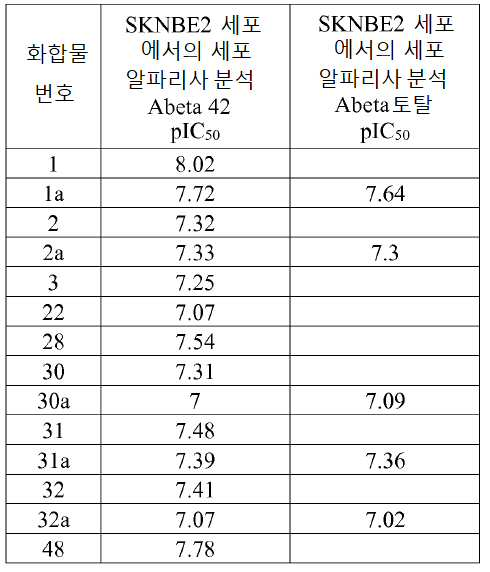
BACE2의 생화학적 FRET 기반 분석Biochemical FRET Based Analysis of BACE2
이 분석법은 형광 공명 에너지 전달(FRET) 기반 분석법이다. 이 분석법을 위한 기질은 아밀로이드 전구체 단백질(APP) 베타-세크레타제 절단 부위의 '스웨디시' Lys-Met/Asn-Leu 돌연변이를 함유한다. 이 기질은 또한 2개의 형광단을 함유한다:(7-메톡시쿠마린-4-일) 아세트산(Mca)은 320 nm에서 여기 파장 및 405 nm에서 방출 파장을 갖는 형광 공여체이고, 2,4-디니트로페닐(Dnp)은 독점적인 켄처 수용체이다. 이들 2개의 그룹 사이의 거리는 광 여기시에, 공여체 형광 에너지가 공명 에너지 전달을 통해 수용체에 의해 상당히 켄칭되도록 선택되었다. 베타-세크레타제에 의한 절단시에, 형광단 Mca는 켄칭 그룹 Dnp로부터 분리되어 공여제의 전체 형광 수율을 회복시킨다. 형광의 증가는 단백질 분해 속도와 선형적으로 관련되어 있다. This assay is a fluorescence resonance energy transfer (FRET) based assay. Substrates for this assay contain a 'Swedish' Lys-Met / Asn-Leu mutation of the amyloid precursor protein (APP) beta-secretase cleavage site. This substrate also contains two fluorophores: (7-methoxycoumarin-4-yl) acetic acid (Mca) is a fluorescent donor having an excitation wavelength at 320 nm and an emission wavelength at 405 nm and a 2,4-di Nitrophenyl (Dnp) is a proprietary quencher receptor. The distance between these two groups was chosen such that upon photoexcitation, the donor fluorescent energy was significantly quenched by the receptor via resonance energy transfer. Upon cleavage by beta-secretase, the fluorophore Mca is separated from the quench group Dnp to restore the overall fluorescence yield of the donor. The increase in fluorescence is linearly related to the rate of protein degradation.
간략하게는 384웰 포맷에서 0.4 μg/ml의 최종 농도의 재조합 BACE2 단백질을 화합물의 존재 또는 부재 하에 인큐베이션 완충제(50 mM 시트레이트 완충제(pH 5.0), 0.05% PEG, DMSO 없음) 중 10 μM 기질과 함께 실온에서 450분 동안 인큐베이션한다. 그 다음에, T=0 및 T=450 (320 nm에서 여기 및 405 nm에서 방출)에서의 형광 측정에 의해 단백질 분해의 양을 직접 측정한다. 결과를 T450과 T0 사이의 차이로서 RFU(상대 형광 단위)로 표현한다. Briefly, the recombinant BACE2 protein at a final concentration of 0.4 μg / ml in 384 well format was combined with 10 μM substrate in incubation buffer (50 mM citrate buffer (pH 5.0), 0.05% PEG, without DMSO) with or without compound. Incubate together for 450 minutes at room temperature. The amount of proteolysis is then directly measured by fluorescence measurements at T = 0 and T = 450 (excitation at 320 nm and emission at 405 nm). The results are expressed in RFU (relative fluorescence units) as the difference between T450 and T0.
최소 자승 합 방법에 의해 %Controlmin 대 화합물 농도의 그래프에 최적 부합 곡선을 피팅한다. 이로부터, IC50 값(활성의 50% 억제를 야기하는 억제 농도)을 수득할 수 있다. Fit the best fit curve to the graph of% Controlmin vs. compound concentration by the least squares sum method. From this, an IC 50 value (inhibition concentration causing 50% inhibition of activity) can be obtained.
LC = 저 컨트롤 값의 중앙값LC = median of low control value
= 저 컨트롤: 효소를 이용하지 않는 반응 = Low control: enzyme-free reaction
HC = 고 컨트롤 값의 중앙값HC = median of high control value
= 고 컨트롤: 효소를 이용한 반응 High Control: Enzyme Reaction
%효과 = 100-[(샘플-LC) / (HC-LC)*100]% Effect = 100-[(Sample-LC) / (HC-LC) * 100]
%Control = (샘플/HC)*100% Control = (Sample / HC) * 100
%Controlmin = (샘플-LC) / (HC-LC)*100% Controlmin = (Sample-LC) / (HC-LC) * 100
하기의 예시된 화합물을 본질적으로 상기에 기술된 바와 같이 테스트하였으며, 이들은 하기의 활성을 나타냈다:The following exemplified compounds were tested essentially as described above, which showed the following activity:
[표 8]TABLE 8

생화학적 분석 - 자동화Biochemical Analysis-Automation
일반적 방법General method
달리 표시되지 않으면, 모든 생화학적 물질을 영국 도싯 풀 소재의 시그마-알드리치 케미칼 컴퍼니(Sigma-Aldrich Chemical Company)로부터 구매하고, 분석 등급 이상의 등급의 비수성 용매를 영국 러퍼버러 소재의 서모피셔 사이언티픽(ThermoFisher Scientific)으로부터 구매하였다. 밀리큐(MilliQ) 물 (엘릭스(Elix) 5 및 밀리큐 그래디언트(MilliQ Gradient); 머크 밀리포어(Merck Millipore))을 생물학적 완충제를 구성하는 기본 수성 용매로 사용하였다. 5.0의 최종 pH가 달성될 때까지 50 mM 트리소듐 시트레이트 (1.06448; 머크 바이오사이언시즈(Merck Biosciences))의 교반 용액에 50 mM 시트르산 용액 (1.00244; 머크 바이오사이언시즈)을 첨가함으로써 기본 분석 완충제를 제조하였다. 이것에 40% 폴리에틸렌 글리콜("PEG")(P1458; 시그마 알드리치) 용액을 0.05%의 최종 농도까지 첨가하였으며; 따라서 기본 완충제는 0.05% PEG를 함유하는 50 mM 시트르산나트륨(pH 5.0)으로 이루어졌다. 모든 분석을 일상적으로 384웰 분석 플레이트 (코스타(Costar) 4514; 코닝 라이프 사이언시즈(Corning Life Sciences))에서 실시하고, 이를 37 ± 1℃에서 60분 동안 인큐베이션한 후 종점 형광 강도를 판독하였다. (7-메톡실 쿠마린-4-일)아세트산계 기질인 β-세크레타제 기질 VI (M2465; 바켐(Bachem))을 100% DMSO (D/4121/PB08; 서모피셔) 중 1 mM 스톡으로 제조하였다. DMSO를 기본 완충제에 1% (vol./vol.)의 최종 농도까지 첨가함으로써 분석 완충제를 제조하였다. β-세크레타제 I (18.64 μM; "BACE1") 및 β-세크레타제 II (4.65 μM; "BACE2")를 벨기에 비어스 소재의 얀센 파마슈티카(Janssen Pharmaceutica)로부터 입수하고, 냉동 분취물 (대략 20 μl)로서 보관하고, 필요할 경우 해동시켰다. Unless otherwise indicated, all biochemicals are purchased from Sigma-Aldrich Chemical Company, Dorset Pools, UK, and non-aqueous solvents of grades above analytical grade are available from ThermoFisher Scientific, Ruperborough, UK. ThermoFisher Scientific). MilliQ water (Elix 5 and MilliQ Gradient; Merck Millipore) was used as the basic aqueous solvent that constitutes the biological buffer. Base assay buffer was added by adding 50 mM citric acid solution (1.00244; Merck Biosciences) to a stirred solution of 50 mM trisodium citrate (1.06448; Merck Biosciences) until a final pH of 5.0 was achieved. Prepared. To this 40% polyethylene glycol ("PEG") (P1458; Sigma Aldrich) solution was added to a final concentration of 0.05%; The basic buffer thus consisted of 50 mM sodium citrate, pH 5.0, containing 0.05% PEG. All assays were routinely performed in 384 well assay plates (Costar 4514; Corning Life Sciences), which were incubated at 37 ± 1 ° C. for 60 minutes before reading endpoint fluorescence intensity. Β-secretase substrate VI (M2465; Bachem), a (7-methoxyl coumarin-4-yl) acetic acid-based substrate, was prepared as a 1 mM stock in 100% DMSO (D / 4121 / PB08; ThermoFisher) It was. Assay buffer was prepared by adding DMSO to the basic buffer to a final concentration of 1% (vol./vol.). β-secretase I (18.64 μM; “BACE1”) and β-secretase II (4.65 μM; “BACE2”) were obtained from Janssen Pharmaceutica, Beers, Belgium, and frozen aliquots ( Approximately 20 μl) and thawed if necessary.
수동 분석Manual analysis
전형적으로 12.5 μl의 분석 완충제를 분석 플레이트의 B열 내지 P열에 분배하였다. 분석 완충제 중에 적절하게 희석시킨 테스트 화합물 18.75 μl를 A열에 첨가하였다. 6.25 μl의 샘플 분취물을 A열로부터 B열로 옮기고, 샘플을 피펫으로 3회 혼합하였다. 이 공정을 플레이트 아래에서 반복하고, 혼합 후 N열에서 6.25 μl의 용액을 버렸다. O열 및 P열을 양성 및 음성 대조군으로 표기하였다. P열에 6.25 μl의 기본 완충제를 첨가하였다. 기본 완충제에 희석시킨 6.25 μl의 효소 (신선하게 제조한 40 nM BACE1 또는 40 nM BACE2)를 A열 내지 O열에 첨가하였다. 분석을 시작하기 위하여, 6.25 μl의 신선 제조 80 μM 기질(100% DMSO 용액 중 1 mM을 HPLC 등급 물 (옵티마(Optima) W6-212; 서모피셔) 내에 희석시킴으로써 제조함)을 모든 웰에 첨가하였다. 분석 플레이트는 뚜껑을 덮고 37±1℃에서 60분 동안 인큐베이션하였다. 웰당 9회 판독의 프로토콜 (50 ms 적분; 3의 치밀도, 0.25 mm의 이격치; 스펙트라맥스 패러다임(SpectraMAX Paradigm) 플레이트 판독기; TUNE 카트리지; SoftMax Pro v 6.3 소프트웨어; 영국 버크셔 오킹엄 소재의 몰레큘라 디바이시즈 유케이 리미티드(Molecular Devices UK Ltd.))을 이용하고, 상기 9개의 판독치의 중앙값을 텍스트 파일로 출력하여, 360/405 nm(여기/방출)에서 웰의 형광 강도를 판독하였다. 판매 회사가 공급하는 비선형 회귀 분석 모델을 이용하여, Prism 소프트웨어 v 6.3 (미국 캘리포니아주 샌디에고 소재의 그래프패드 인크.(GraphPad Inc.))을 이용하여 데이터 분석을 실시하였다. IC50 결정을 위하여, 4 파라미터 로지스틱 변수 기울기 모델을 이용하여 미가공 형광 강도 데이터를 피팅시켰으며, 이때 '최하위(bottom)'는 음성 대조군에 대하여 보정하였다. Typically 12.5 μl of assay buffer was dispensed in rows B to P of the assay plate. 18.75 μl of test compound appropriately diluted in assay buffer was added to column A. 6.25 μl sample aliquots were transferred from row A to row B and the samples were mixed three times with a pipette. This process was repeated under the plate and after mixing the 6.25 μl solution was discarded in column N. Columns O and P were designated as positive and negative controls. To column P was added 6.25 μl of basic buffer. 6.25 μl of enzyme (freshly prepared 40 nM BACE1 or 40 nM BACE2) diluted in basic buffer was added to rows A to O. To start the assay, 6.25 μl fresh prepared 80 μM substrate (prepared by diluting 1 mM in 100% DMSO solution in HPLC grade water (Optima W6-212; Thermo Fisher)) was added to all wells. . Assay plates were capped and incubated at 37 ± 1 ° C. for 60 minutes. Protocol of 9 readings per well (50 ms integration; density of 3, 0.25 mm separation; SpectraMAX Paradigm plate reader; TUNE cartridge; SoftMax Pro v 6.3 software; Molecular Div. The median values of the nine readings were output to a text file using Sieve UK Limited (Molecular Devices UK Ltd.) to read the fluorescence intensity of the wells at 360/405 nm (excitation / emission). Data were analyzed using Prism software v 6.3 (GraphPad Inc., San Diego, Calif.), Using a nonlinear regression analysis model supplied by the sales company. For IC 50 determinations, the raw fluorescence intensity data was fitted using a four parameter logistic variable slope model, with the 'bottom' corrected for the negative control.
자동화 바이오어세이 하드웨어Automated Bioassay Hardware
CyclOps 바이오어세이 모듈은 분획 수집 스테이션, 시약 스테이션, 액체 처리 로봇, 플레이트 스토어 및 일체형 플레이트 판독기(스펙트라맥스 패러다임, TUNE 카트리지, SoftMax Pro v 6.3; 몰레큘라 디바이시즈)로 이루어져 있다. 분획 수집 스테이션은 H-포탈 캐리지(독일 에슬링겐 소재의 페스토 아게 운트 코. 카게(Festo AG & Co. KG))에 장착된 384웰 수집 플레이트(P-384-240SQ-C; 미국 캘리포니아주 유니온 시티 소재의 악시젠(Axygen)), 시린지 드라이브 및 두방향 6구 주입 밸브(200 μl 루프를 갖춤)(스위스 스첸콘 소재의 VICI 아게 인터내셔널(VICI AG International))로 구성되었다. 주입 밸브의 출력은 384웰 수집 플레이트의 모든 위치에 대하여 주소 지정이 가능하였다. 시약 스테이션은 유압식으로 냉각시킨(10~12℃) 알루미늄 세그먼트들로 이루어졌으며; 상기 세그먼트 각각은 SBS 마이크로타이터 플레이트 풋프린트를 수용하도록 제조되었다. 독립적인 주소 지정 가능 시약 스테이션들은 이러한 섹션들 내에 수용되었다. 필요할 경우, 맞춤형 알루미늄 하우징을 이용하여 실험실용 표준 플라스틱 제품(예를 들어, 에펜도르프(Eppendorf) 튜브, 팔콘(Falcon) 튜브 등)을 수용하였다. 필요할 경우, 그리고 필요한 때에, 시약 저장체의 뚜껑을 덮었으며, 뚜껑은 테플론(Teflon)-코팅된 탐침자가 용액에 접근할 수 있는 구멍을 포함하였다. 액체 처리 시스템에 존재하는 시약은 다음과 같았다:The CyclOps bioassay module consists of a fraction collection station, reagent station, liquid processing robot, plate store and integrated plate reader (Spectramax paradigm, TUNE cartridge, SoftMax Pro v 6.3; Molecular Devices). The fraction collection station is a 384 well collection plate (P-384-240SQ-C; Union, California, USA) mounted on an H-portal carriage (Festo AG & Co. KG, Esslingen, Germany). Axigen, City, syringe drive and two-way six-hole injection valve with 200 μl loop (VICI AG International, Schencon, Switzerland). The output of the injection valve was addressable for all positions of the 384 well collection plate. The reagent station consisted of hydraulically cooled (10-12 ° C.) aluminum segments; Each of these segments was made to accommodate an SBS microtiter plate footprint. Independent addressable reagent stations were housed within these sections. If necessary, custom aluminum housings were used to accommodate laboratory standard plastic products (eg, Eppendorf tubes, Falcon tubes, etc.). If necessary and when needed, the reagent reservoir was capped, and the lid included a hole through which a Teflon-coated probe could access the solution. The reagents present in the liquid treatment system were as follows:
● 뚜껑을 덮은 시약 저장체(390007; 영국 레더헤드 소재의 포베어 사이언시즈 리미티드(Porvair Sciences Ltd.))에 담긴 탐침자 세척 용액 (대략 150 ml; 33.3:33.3:33.3의 물:프로판-2-올 (P/7508/17; 서모피셔):메탄올 (M/4058/17; 서모피셔)).● Probe wash solution (approximately 150 ml; water: propan-2-ol in 33.3: 33.3: 33.3) in a capped reagent reservoir (390007; Porvair Sciences Ltd., Leatherhead, UK) (P / 7508/17; ThermoFisher): Methanol (M / 4058/17; ThermoFisher)).
● 분석 완충액● Assay Buffer
● HPLC 등급 물● HPLC grade water
● 5 ml 에펜도르프 튜브 (0030 119.401; 에펜도르프)에 담긴 기본 완충제 중에 희석시킨 40 nM BACE1● 40 nM BACE1 diluted in basic buffer in 5 ml Eppendorf tubes (0030 119.401; Eppendorf)
● 1.5 ml 에펜도르프 튜브 (0030 000.919; 에펜도르프)에 담긴, 100 mM 염화나트륨 및 20% 글리세롤 (16374; 미국 오하이오주 클레블랜드 소재의 유에스비 코포레이션(USB Corp.))을 함유하는 25 mM 트리스 (648311; 영국 노팅엄 소재의 머크 바이오사이언시즈)(pH 7.5) 중에 희석시킨 400 nM BACE2● 25 mM Tris (648311; UK) containing 100 mM sodium chloride and 20% glycerol (16374; USB Corp., Cleveland, Ohio) in a 1.5 ml Eppendorf tube (0030 000.919; Eppendorf) 400 nM BACE2 diluted in Merck Biosciences, Nottingham (pH 7.5)
● (주위 온도에서 유지된) 1.5 ml 에펜도르프 튜브에 담긴 100% DMSO 중 1 mM 기질● 1 mM substrate in 100% DMSO in 1.5 ml Eppendorf tube (maintained at ambient temperature)
● 2개의 빈 1.5 ml 에펜도르프 튜브● Two empty 1.5 ml eppendorf tubes
액체 처리 시스템은 그리퍼 아암(gripper arm) 및 단일 테플론-코팅 스테인리스강 탐침자가 갖추어진 LISSY 시스템(독일 프랑크푸르트 소재의 진세르 아날리티크 게엠베하(Zinsser Analytik GmbH))으로 구성되었다. 모든 액체 처리 단계 사이에, 테플론-코팅 스테인리스강 탐침자를 탐침자 세척 용액, 이어서 시스템용 액체(물)로 세척하였다. 바이오어세이 시스템의 제어는 WinLISSY 소프트웨어(진세르 아날리티크) 및 SoftMax Pro(이는 WinLISSY 자동 커맨드 컨트롤 하에 있음)를 사용하여 성취하였다. 플레이트 스토어는 분석 플레이트(코스타 4514)의 스택을 수용하였다. 입력 및 출력 릴레이는 바이오어세이 모듈과 CyclOps 컨트롤 소프트웨어 사이의 접점 폐쇄 컨트롤 및 피드백을 가능하게 하였다. 플레이트 스토어는 액체 처리 시스템이 접근할 수 있는 분석 플레이트 스택을 수용하는 알루미늄 랙이었다. The liquid treatment system consisted of a LISSY system (Zinsser Analytik GmbH, Frankfurt, Germany) equipped with a gripper arm and a single Teflon-coated stainless steel probe. Between all liquid treatment steps, the Teflon-coated stainless steel probe was washed with a probe wash solution followed by liquid (water) for the system. Control of the bioassay system was achieved using WinLISSY software (Ginser Analytic) and SoftMax Pro (which is under WinLISSY automatic command control). The plate store received a stack of assay plates (Costa 4514). Input and output relays enable closed contact control and feedback between the bioassay module and CyclOps control software. The plate store was an aluminum rack containing an assay plate stack accessible by the liquid processing system.
자동화 바이오어세이 과정Automated Bioassay Course
희석 모듈의 출력은 '로드' 위치에 세팅된 수집 스테이션 주입 밸브를 통하여 유동하였다. 폴링 모드를 입력하도록 세팅된 WinLISSY를 이용하여, CyclOps 컨트롤 소프트웨어에 의한 접점 폐쇄에 의해 바이오어세이 프로토콜이 시작되었다. 첫 번째 작동은 주입 밸브를 '주입' 위치로 트리거링하여 루프 내용물들을 격리시키고, 분획 수집 시스템은 루프 내용물들을 수집 플레이트 상의 주소 지정 가능 웰에 분배하였다. 부수적으로, 액체 처리 시스템은 분석 플레이트를 액체 처리 베드 상의 분석 스테이션에 전달하였다. 액체 처리 시스템은, 분석 플레이트의 컬럼 상에, B열로부터 P열까지 분석 플레이트의 두 컬럼에 12.5 μl의 분석 완충제를 아래로 분배하였다. A열에 수집 플레이트의 각각의 웰로부터의 테스트 화합물 18.75 μl를 첨가하였다. A열로부터의 샘플 분취물 6.25 μl를 B열로 옮겼다. 이 과정을 상기 컬럼 둘 다에 대하여 플레이트 아래로 반복하고, 6.25 μl의 시약을 N열에서 버렸다. O열 및 P열을 양성 및 음성 대조군으로 표기하였다. P열에 6.25 μl의 분석 완충제를 첨가하였다. 첫 번째 컬럼의 A열 내지 O열에 기본 완충제 중에 보관된 40 nM BACE1 6.25 μl를 첨가하였다. BACE2 효소 첨가를 위하여, 17.5 μl의 400 nM BACE2를 157.5 μl의 기본 완충제로 희석시켰다. 이것은 175 μl의 용액을 표기된 수용 에펜도르프 튜브에서 5회 피펫팅함으로써 혼합하였으며, 그 후 6.25 μl의 희석 BACE2를 각각의 컬럼에 첨가하였다. MCA 기질에 있어서, 100% DMSO 중 1 mM MCA 기질 30.8 μl를 385 μl의 HPLC용 물로 희석시켰다. 이것은 400 μl를 표기된 수용 에펜도르프 튜브에서 5회 피펫팅함으로써 혼합하였으며, 6.25 μl를 각각의 컬럼에 첨가하였다. 그 후 분석 플레이트를 플레이트 판독기 캐리지에 옮기고, 드로어를 닫고, 어세이 인큐베이션을 시작하였다. 60분 후, WinLISSY는, 형광 강도를 판독하는 프로토콜 파일을 로딩 및 실행하도록 플레이트 판독기에 지시하는 서브루틴을 실행하였다. 이러한 프로토콜 파일은 마이크로타이터 플레이트를 판독하여 상응하는 데이터를 텍스트 파일로서 작성하는 데 필요한 파라미터를 포함하였다. 형광 강도는 웰당 9회 판독의 프로토콜 (50 ms 적분; 3의 치밀도, 0.25 mm의 이격치)을 이용하여 360/405 nm(여기/방출)에서 판독하였으며, 상기 9개의 판독치의 중앙값을 텍스트 파일로 출력하였다. The output of the dilution module flowed through the collection station injection valve set to the 'load' position. Using WinLISSY set to enter polling mode, the bioassay protocol was initiated by contact closure by CyclOps control software. The first operation triggered the injection valve to the 'injection' position to isolate the loop contents, and the fraction collection system dispensed the loop contents into addressable wells on the collection plate. Incidentally, the liquid treatment system delivered the assay plate to an assay station on the liquid treatment bed. The liquid treatment system dispensed 12.5 μl of assay buffer down to two columns of the assay plate from column B to column P on the column of the assay plate. To column A, 18.75 μl of test compound from each well of the collection plate was added. 6.25 μl of sample aliquots from column A were transferred to column B. This procedure was repeated down the plate for both columns and 6.25 μl of reagent was discarded in column N. Columns O and P were designated as positive and negative controls. 6.25 μl of assay buffer was added to column P. To column A to column O of the first column, 6.25 μl of 40 nM BACE1 stored in basic buffer was added. For BACE2 enzyme addition, 17.5 μl of 400 nM BACE2 was diluted with 157.5 μl of basic buffer. This was mixed by pipetting 175 μl of solution five times in the indicated receiving Eppendorf tubes, after which 6.25 μl of diluted BACE2 was added to each column. For MCA substrates, 30.8 μl of 1 mM MCA substrate in 100% DMSO was diluted with 385 μl of HPLC water. This was mixed by pipetting 400 μl five times in the indicated receiving Eppendorf tubes, and 6.25 μl was added to each column. The assay plate was then transferred to the plate reader carriage, the drawer closed and the assay incubation started. After 60 minutes, WinLISSY ran a subroutine that instructed the plate reader to load and run a protocol file that reads the fluorescence intensity. This protocol file contained the parameters needed to read the microtiter plate and write the corresponding data as a text file. Fluorescence intensities were read at 360/405 nm (excitation / emission) using a protocol of 9 readings per well (50 ms integration; density of 3, separation of 0.25 mm), with the median of the 9 readings as a text file. Was output.
CyclOps 바이오어세이 데이터의 분석Analysis of CyclOps Bioassay Data
CyclOps 소프트웨어는 바이오어세이 공유 데이터 파일 폴더를 폴링하도록 세팅되었다. 데이터의 저장시에, WinLISSY는 출력 접점 폐쇄 시그널을 보내서 바이오어세이가 완료되었음을 CyclOps에게 알려주었다. CyclOps 소프트웨어에 의해 상기 데이터를 열고, 가공하고, 분석하였다. 데이터 가공은 테스트 물품의 각각의 농도를 상응하는 열에 첨부하는 것으로 이루어졌다(이때 데이터는 희석 모듈로부터 받음). 그 후, 4 파라미터 로지스틱 모델을 이용한 비선형 회귀 분석에 의해 데이터를 분석하여(MATLAB; 영국 캠브리지 소재의 매스웍스(MathWorks)) IC50을 결정하였다. 그 범위는 기준선(즉, P열)과 최대 관찰 양성 대조군 비율(즉, O열) 사이에서 고정되었다. 데이터 품질을 유지하기 위하여, 자동화 바이오어세이 데이터 분석을 통제하도록 규칙을 정하였다. 첫 번째 경우에서, 75% 이상의 활성 또는 25% 이하의 활성이 관찰될 경우, 데이터를 거부하였다. 이것은 양호한 분석의 실시에 충분한 적정 데이터가 있음을 보장하였다. 그 후, 피트의 질을 R 자승 값으로 판단하였다. 이 값이 0.85 아래로 떨어지면, 데이터를 거부하였다. 모든 경우에, 거부는 바이오어세이 실패 태그가 시스템에 보고되게 하였다. 이상치 분석을 이전에 기술된 바와 같이 실시하였으며(문헌[Motulsky, H.J. and Brown, R.E., (2006), BMC Bioinformatics, 7, 123]), 이때 Q 값은 10%였다. 자동화 IC50 분석을 위하여, 최대 3개의 이상치를 피트 플래그 오류 생성 전에 배제할 수 있다. 바이오어세이 데이터의 교차 확인은, '최하위'를 음성 대조군에 대하여 보정한 미가공 형광 강도 데이터를 피팅하기 위한 비선형 회귀 분석용 4 파라미터 로지스틱 변수 기울기 모델을 이용한 Prism 소프트웨어 v 6.3(그래프패드 인크.)을 이용하여 분석함으로써 달성하였다. CyclOps software was set up to poll the Bioassay shared data file folder. Upon storage of data, WinLISSY sent an output contact closure signal to inform CyclOps that the bioassay was complete. The data was opened, processed and analyzed by CyclOps software. Data processing consisted of appending each concentration of the test article to the corresponding column (data received from the dilution module). The data was then analyzed by nonlinear regression analysis using a four parameter logistic model (MATLAB; MathWorks, Cambridge, UK) to determine IC 50 . The range was fixed between baseline (ie, column P) and the maximum observed positive control ratio (ie, column O). In order to maintain data quality, rules were set up to control automated bioassay data analysis. In the first case, if more than 75% activity or less than 25% activity was observed, the data was rejected. This ensured that there was enough titration data to perform a good analysis. Thereafter, the quality of the pit was determined by the R-squared value. If this value fell below 0.85, the data was rejected. In all cases, rejection caused the bioassay failure tag to be reported to the system. Outlier analysis was performed as previously described (Motulsky, HJ and Brown, RE, (2006), BMC Bioinformatics , 7, 123), with a Q value of 10%. For automated IC 50 analysis, up to three outliers can be excluded before the pit flag error is generated. Cross-validation of bioassay data was performed using Prism software v 6.3 (GraphPad Inc.) using a 4-parameter logistic variable slope model for nonlinear regression analysis to fit raw fluorescence intensity data with 'lowest' corrected for negative control. Achievement by analysis.
[표 9]TABLE 9


Claims (15)
[화학식 I]

[화학식 II]

[식 중,
R은 할로, C1-3알킬옥시, 시아노, 2-시아노-피리딘-5-일, 3-시아노-피리딘-5-일, 및 피리미딘-5-일로 이루어진 군으로부터 각각 독립적으로 선택되는 1, 2, 또는 3개의 치환체로 선택적으로 치환된 페닐이며;
-L1-은 -CH2-NH-(C=O)- 및 -(C=O)-NR1a-로부터 선택되며;
R1은 C3-6시클로알킬, Ar, Het, Ar-CH2-, Het-CH2-, 및 4-모르폴리닐-CH2-로 이루어진 군으로부터 선택되며; 여기서,
Ar은 페닐, 또는 할로, 시아노, C1-3알킬, 모노-할로-C1-3알킬, 폴리-할로-C1-3알킬, C3-6시클로알킬, C1-3알킬옥시, 모노-할로-C1-3알킬옥시 및 폴리할로-C1-3알킬옥시로 이루어진 군으로부터 각각 독립적으로 선택되는 1, 2 또는 3개의 치환체로 치환된 페닐이며;
Het는 피리딜, 피리미디닐, 피라지닐, 피리다지닐, 푸라닐, 티에닐, 피롤릴, 피라졸릴, 이미다졸릴, 트리아졸릴, 테트라졸릴, 티아졸릴, 이소티아졸릴, 티아디아졸릴, 옥사졸릴, 이속사졸릴, 옥사디아졸릴, 인돌릴, 인다졸릴, 1H-벤즈이미다졸릴, 벤족사졸릴, 및 벤조티아졸릴(이들 각각은 할로, 시아노, C1-3알킬, 모노-할로-C1-3알킬, 폴리-할로-C1-3알킬, C3-6시클로알킬, C1-3알킬옥시, 모노-할로-C1-3알킬옥시 및 폴리할로-C1-3알킬옥시로 이루어진 군으로부터 각각 독립적으로 선택되는 1, 2, 또는 3개의 치환체로 선택적으로 치환됨)로 이루어진 군으로부터 선택되며;
a) R1a는 H 또는 C1-3알킬이거나, 또는
b) -NR1R1a는 함께 피롤리딘-1-일, 피페리딘-1-일, 피페라진-1-일, 모르폴린-4-일, 티오모르폴린-4-일, 5,7-디히드로-6H-피롤로[3,4-b]피리딘-6-일, 6,7-디히드로피라졸로[1,5-a]피리미딘-4(5H)-일, 및 8-옥사-3-아자비시클로[3.2.1]옥트-3-일(이들 각각은 C1-3알킬, C1-3알킬옥시, (C1-3알킬옥시)C1-3알킬, C3-6시클로알킬, 시아노, 옥소, 할로-페닐, (C1-3알킬)페닐, (C1-3알킬옥시)페닐, 할로-페닐옥시, (C1-3알킬)페닐옥시, (C1-3알킬옥시)페닐옥시, C1-3알킬-(C=O)-, C3-6시클로알킬-(C=O)-, 피리딜, 피리미디닐, 피라졸릴, 및 티아졸릴로 이루어진 군으로부터 각각 독립적으로 선택되는 1, 2 또는 3개의 치환체로 선택적으로 치환됨)로 이루어진 군으로부터 선택되는 복소환식 라디칼을 형성하며;
R2는 수소 또는 C1-3알킬임].A compound of formula (I), or a tautomeric or stereoisomeric form thereof, or a pharmaceutically acceptable addition salt or solvate thereof:
[Formula I]
[Formula II]
[In the meal,
R is each independently selected from the group consisting of halo, C 1-3 alkyloxy, cyano, 2-cyano-pyridin-5-yl, 3-cyano-pyridin-5-yl, and pyrimidin-5-yl Phenyl optionally substituted with 1, 2, or 3 substituents;
-L 1 -is selected from -CH 2 -NH- (C = 0)-and-(C = 0) -NR 1a- ;
R 1 is selected from the group consisting of C 3-6 cycloalkyl, Ar, Het, Ar—CH 2 —, Het—CH 2 —, and 4-morpholinyl-CH 2 —; here,
Ar is phenyl, or halo, cyano, C 1-3 alkyl, mono-halo-C 1-3 alkyl, poly-halo-C 1-3 alkyl, C 3-6 cycloalkyl, C 1-3 alkyloxy, Phenyl substituted with 1, 2 or 3 substituents each independently selected from the group consisting of mono-halo-C 1-3 alkyloxy and polyhalo-C 1-3 alkyloxy;
Het is pyridyl, pyrimidinyl, pyrazinyl, pyridazinyl, furanyl, thienyl, pyrrolyl, pyrazolyl, imidazolyl, triazolyl, tetrazolyl, thiazolyl, isothiazolyl, thiadiazolyl, oxa Zolyl, isoxazolyl, oxadiazolyl, indolyl, indazolyl, 1H-benzimidazolyl, benzoxazolyl, and benzothiazolyl (each of which is halo, cyano, C 1-3 alkyl, mono-halo- C 1-3 alkyl, poly-halo-C 1-3 alkyl, C 3-6 cycloalkyl, C 1-3 alkyloxy, mono-halo-C 1-3 alkyloxy and polyhalo-C 1-3 alkyl Optionally substituted with 1, 2, or 3 substituents each independently selected from the group consisting of oxy;
a) R 1a is H or C 1-3 alkyl, or
b) -NR 1 R 1a together form pyrrolidin-1-yl, piperidin-1-yl, piperazin-1-yl, morpholin-4-yl, thiomorpholin-4-yl, 5,7 -Dihydro-6H-pyrrolo [3,4-b] pyridin-6-yl, 6,7-dihydropyrazolo [1,5-a] pyrimidin-4 (5H) -yl, and 8-oxa -3-azabicyclo [3.2.1] oct-3-yl, each of which is C 1-3 alkyl, C 1-3 alkyloxy, (C 1-3 alkyloxy) C 1-3 alkyl, C 3-6 Cycloalkyl, cyano, oxo, halo-phenyl, (C 1-3 alkyl) phenyl, (C 1-3 alkyloxy) phenyl, halo-phenyloxy, (C 1-3 alkyl) phenyloxy, (C 1- Group consisting of 3 alkyloxy) phenyloxy, C 1-3 alkyl- (C═O) —, C 3-6 cycloalkyl- (C═O) —, pyridyl, pyrimidinyl, pyrazolyl, and thiazolyl Optionally substituted with one, two, or three substituents each independently selected from: heterocyclic radicals selected from the group consisting of:
R 2 is hydrogen or C 1-3 alkyl.
-L1-은 -(C=O)-NR1a-이며;
a) R1a는 H 또는 C1-3알킬이고, R1은 C3-6시클로알킬, Ar, 및 Het로 이루어진 군으로부터 선택되거나; 또는
b) -NR1R1a는 함께 피롤리딘-1-일, 피페리딘-1-일, 피페라진-1-일, 모르폴린-4-일, 티오모르폴린-4-일, 5,7-디히드로-6H-피롤로[3,4-b]피리딘-6-일, 6,7-디히드로피라졸로[1,5-a]피리미딘-4(5H)-일, 및 8-옥사-3-아자비시클로[3.2.1]옥트-3-일(이들 각각은 C1-3알킬, C1-3알킬옥시, (C1-3알킬옥시)C1-3알킬, C3-6시클로알킬, 시아노, 옥소, 할로-페닐, (C1-3알킬)페닐, (C1-3알킬옥시)페닐, 할로-페닐옥시, (C1-3알킬)페닐옥시, (C1-3알킬옥시)페닐옥시, C1-3알킬-(C=O)-, C3-6시클로알킬-(C=O)-, 피리딜, 피리미디닐, 피라졸릴, 및 티아졸릴로 이루어진 군으로부터 각각 독립적으로 선택되는 1, 2 또는 3개의 치환체로 선택적으로 치환됨)로 이루어진 군으로부터 선택되는 복소환식 라디칼을 형성하며; 여기서,
Ar은 페닐, 또는 할로, 시아노, C1-3알킬, 모노-할로-C1-3알킬, 폴리-할로-C1-3알킬, C3-6시클로알킬, C1-3알킬옥시, 모노-할로-C1-3알킬옥시- 및 폴리할로-C1-3알킬옥시로 이루어진 군으로부터 각각 독립적으로 선택되는 1, 2 또는 3개의 치환체로 치환된 페닐이며;
Het는 피리딜, 피리미디닐, 피라지닐, 및 피리다지닐(이들 각각은 할로, 시아노, C1-3알킬, 폴리-할로-C1-3알킬, 및 C1-3알킬옥시로 이루어진 군으로부터 각각 독립적으로 선택되는 1, 2, 또는 3개의 치환체로 선택적으로 치환됨)로 이루어진 군으로부터 선택되는 화합물.The method of claim 1,
-L 1 -is-(C = O) -NR 1a- ;
a) R 1a is H or C 1-3 alkyl and R 1 is selected from the group consisting of C 3-6 cycloalkyl, Ar, and Het; or
b) -NR 1 R 1a together form pyrrolidin-1-yl, piperidin-1-yl, piperazin-1-yl, morpholin-4-yl, thiomorpholin-4-yl, 5,7 -Dihydro-6H-pyrrolo [3,4-b] pyridin-6-yl, 6,7-dihydropyrazolo [1,5-a] pyrimidin-4 (5H) -yl, and 8-oxa -3-azabicyclo [3.2.1] oct-3-yl, each of which is C 1-3 alkyl, C 1-3 alkyloxy, (C 1-3 alkyloxy) C 1-3 alkyl, C 3-6 Cycloalkyl, cyano, oxo, halo-phenyl, (C 1-3 alkyl) phenyl, (C 1-3 alkyloxy) phenyl, halo-phenyloxy, (C 1-3 alkyl) phenyloxy, (C 1- Group consisting of 3 alkyloxy) phenyloxy, C 1-3 alkyl- (C═O) —, C 3-6 cycloalkyl- (C═O) —, pyridyl, pyrimidinyl, pyrazolyl, and thiazolyl Optionally substituted with one, two, or three substituents each independently selected from: heterocyclic radicals selected from the group consisting of: here,
Ar is phenyl, or halo, cyano, C 1-3 alkyl, mono-halo-C 1-3 alkyl, poly-halo-C 1-3 alkyl, C 3-6 cycloalkyl, C 1-3 alkyloxy, Phenyl substituted with 1, 2 or 3 substituents each independently selected from the group consisting of mono-halo-C 1-3 alkyloxy- and polyhalo-C 1-3 alkyloxy;
Het is pyridyl, pyrimidinyl, pyrazinyl, and pyridazinyl (each of which consists of halo, cyano, C 1-3 alkyl, poly-halo-C 1-3 alkyl, and C 1-3 alkyloxy Optionally substituted with 1, 2, or 3 substituents each independently selected from the group).
-NR1R1a는 함께 피롤리딘-1-일, 피페리딘-1-일, 피페라진-1-일, 모르폴린-4-일, 1,1-디옥시도티오모르폴린-4-일(이들 각각은 C1-3알킬, C1-3알킬옥시, (C1-3알킬옥시)C1-3알킬, 시아노, 옥소, C1-3알킬-(C=O)-, 및 C3-6시클로알킬-(C=O)-로 이루어진 군으로부터 각각 독립적으로 선택되는 1, 2, 또는 3개의 치환체로 선택적으로 치환됨)로 이루어진 군으로부터 선택되는 복소환식 라디칼을 형성하는 화합물.The method according to claim 1 or 2,
-NR 1 R 1a together form pyrrolidin-1-yl, piperidin-1-yl, piperazin-1-yl, morpholin-4-yl, 1,1-dioxydothiomorpholin-4- One (each of which is C 1-3 alkyl, C 1-3 alkyloxy, (C 1-3 alkyloxy) C 1-3 alkyl, cyano, oxo, C 1-3 alkyl- (C = 0)-, And C 3-6 cycloalkyl- ( C═O ) — optionally substituted with 1, 2, or 3 substituents each independently selected from the group consisting of C 3-6 cycloalkyl- ( C═O ) — .
-L1-은 -CH2-NH-(C=O)-이며;
R1은 C3-6시클로알킬, Ar, Het, Ar-CH2-, Het-CH2-, 및 4-모르폴리닐-CH2-로 이루어진 군으로부터 선택되는 화합물.The method of claim 1,
-L 1 -is -CH 2 -NH- (C = 0)-;
R 1 is selected from the group consisting of C 3-6 cycloalkyl, Ar, Het, Ar—CH 2 —, Het—CH 2 —, and 4-morpholinyl-CH 2 —.
R1은 C3-6시클로알킬, Ar, Het, 및 4-모르폴리닐-CH2-로 이루어진 군으로부터 선택되며; 여기서,
Ar은 페닐, 또는 할로, 시아노, C1-3알킬, 모노-할로-C1-3알킬, 폴리-할로-C1-3알킬, C3-6시클로알킬, C1-3알킬옥시, 모노-할로-C1-3알킬옥시- 및 폴리할로-C1-3알킬옥시로 이루어진 군으로부터 각각 독립적으로 선택되는 1, 2 또는 3개의 치환체로 치환된 페닐이며;
Het는 피리딜, 피리미디닐, 피라지닐, 및 피리다지닐(이들 각각은 할로, 시아노, C1-3알킬, 폴리-할로-C1-3알킬, 및 C1-3알킬옥시로 이루어진 군으로부터 각각 독립적으로 선택되는 1, 2, 또는 3개의 치환체로 선택적으로 치환됨)로 이루어진 군으로부터 선택되는 화합물.The method according to claim 1 or 4,
R 1 is selected from the group consisting of C 3-6 cycloalkyl, Ar, Het, and 4-morpholinyl-CH 2 —; here,
Ar is phenyl, or halo, cyano, C 1-3 alkyl, mono-halo-C 1-3 alkyl, poly-halo-C 1-3 alkyl, C 3-6 cycloalkyl, C 1-3 alkyloxy, Phenyl substituted with 1, 2 or 3 substituents each independently selected from the group consisting of mono-halo-C 1-3 alkyloxy- and polyhalo-C 1-3 alkyloxy;
Het is pyridyl, pyrimidinyl, pyrazinyl, and pyridazinyl (each of which consists of halo, cyano, C 1-3 alkyl, poly-halo-C 1-3 alkyl, and C 1-3 alkyloxy Optionally substituted with 1, 2, or 3 substituents each independently selected from the group).
R은 할로, C1-3알킬옥시, 시아노, 2-시아노-피리딘-5-일, 3-시아노-피리딘-5-일, 및 피리미딘-5-일로 이루어진 군으로부터 각각 독립적으로 선택되는 1, 2, 또는 3개의 치환체로 치환된 페닐인 화합물.The method according to any one of claims 1 to 5,
R is each independently selected from the group consisting of halo, C 1-3 alkyloxy, cyano, 2-cyano-pyridin-5-yl, 3-cyano-pyridin-5-yl, and pyrimidin-5-yl To phenyl substituted with one, two, or three substituents.
a) 적절한 염기의 존재 하에, 커플링 시약의 존재 하에, 화학식 III-d(여기서, Q는 보호기임)의 화합물을 화학식 IX-b(여기서, R1은 제1항 또는 제4항 내지 제6항 중 어느 한 항에 정의된 바와 같음)의 화합물과 반응시키는 단계

b) 커플링 시약 및 적절한 염기의 존재 하에, 화학식 III-h(여기서, Q는 보호기이며, R 및 R2는 제1항 또는 제6항에 정의된 바와 같음)의 중간체를 화학식 IX-c(여기서, R1 및 R1a는 제1항 내지 제3항 또는 제6항 중 어느 한 항에 정의된 바와 같음)의 아민과 반응시키는 단계

a) in the presence of a suitable base, in the presence of a coupling reagent, a compound of formula III-d, wherein Q is a protecting group, wherein the compound of formula IX-b, wherein R 1 is Reacting with a compound as defined in any one of the preceding claims.
b) In the presence of a coupling reagent and a suitable base, an intermediate of formula III-h, wherein Q is a protecting group and R and R 2 are as defined in claim 1 or 6, is selected from formula IX-c ( Wherein R 1 and R 1a are reacted with an amine as defined in any one of claims 1 to 3 or 6).
[화학식 III-d']

[화학식 III-h']

(식 중, Q'는 H 또는 보호기이며, R 및 R2는 제1항 내지 제6항 중 어느 한 항에 정의된 바와 같음).A compound of Formula III-d 'or Formula III-h'
Formula III-d '
Formula III-h '
Wherein Q 'is H or a protecting group and R and R 2 are as defined in any one of claims 1 to 6.
Applications Claiming Priority (5)
| Application Number | Priority Date | Filing Date | Title |
|---|---|---|---|
| US201762468070P | 2017-03-07 | 2017-03-07 | |
| US62/468,070 | 2017-03-07 | ||
| EP17189778.8 | 2017-09-07 | ||
| EP17189778 | 2017-09-07 | ||
| PCT/EP2018/055403 WO2018162445A1 (en) | 2017-03-07 | 2018-03-06 | Inhibitors of beta secretase |
Publications (1)
| Publication Number | Publication Date |
|---|---|
| KR20190126346A true KR20190126346A (en) | 2019-11-11 |
Family
ID=61616995
Family Applications (1)
| Application Number | Title | Priority Date | Filing Date |
|---|---|---|---|
| KR1020197028606A Withdrawn KR20190126346A (en) | 2017-03-07 | 2018-03-06 | Inhibitors of beta secretase |
Country Status (9)
| Country | Link |
|---|---|
| US (1) | US20190389882A1 (en) |
| EP (1) | EP3592752A1 (en) |
| JP (1) | JP2020509064A (en) |
| KR (1) | KR20190126346A (en) |
| CN (1) | CN110382506A (en) |
| AU (1) | AU2018229723A1 (en) |
| CA (1) | CA3051779A1 (en) |
| MA (1) | MA47731A (en) |
| MX (1) | MX2019010653A (en) |
Family Cites Families (1)
| Publication number | Priority date | Publication date | Assignee | Title |
|---|---|---|---|---|
| AR077277A1 (en) * | 2009-07-09 | 2011-08-17 | Lilly Co Eli | BICYCLE COMPOUNDS (1,3) TIAZIN-2-AMINA PHARMACEUTICAL FORMULATION THAT INCLUDES IT AND ITS USE FOR THE MANUFACTURE OF A USEFUL MEDICINAL PRODUCT FOR THE TREATMENT OF ALZHEIMER'S DISEASE |
-
2018
- 2018-03-06 KR KR1020197028606A patent/KR20190126346A/en not_active Withdrawn
- 2018-03-06 US US16/489,910 patent/US20190389882A1/en not_active Abandoned
- 2018-03-06 EP EP18710001.1A patent/EP3592752A1/en not_active Withdrawn
- 2018-03-06 MX MX2019010653A patent/MX2019010653A/en unknown
- 2018-03-06 CN CN201880016097.1A patent/CN110382506A/en active Pending
- 2018-03-06 MA MA047731A patent/MA47731A/en unknown
- 2018-03-06 CA CA3051779A patent/CA3051779A1/en not_active Abandoned
- 2018-03-06 JP JP2019548451A patent/JP2020509064A/en active Pending
- 2018-03-06 AU AU2018229723A patent/AU2018229723A1/en not_active Abandoned
Also Published As
| Publication number | Publication date |
|---|---|
| MX2019010653A (en) | 2019-10-21 |
| JP2020509064A (en) | 2020-03-26 |
| US20190389882A1 (en) | 2019-12-26 |
| CA3051779A1 (en) | 2018-09-13 |
| EP3592752A1 (en) | 2020-01-15 |
| MA47731A (en) | 2020-01-15 |
| CN110382506A (en) | 2019-10-25 |
| AU2018229723A1 (en) | 2019-08-15 |
Similar Documents
| Publication | Publication Date | Title |
|---|---|---|
| EP2683721B1 (en) | 3,4-DIHYDRO-PYRROLO[1,2-a]PYRAZIN-1-YLAMINE DERIVATIVES USEFUL AS INHIBITORS OF BETA-SECRETASE (BACE) | |
| EP2788335B1 (en) | 5-(3-aminophenyl)-5-alkyl-5,6-dihydro-2h-[1,4]oxazin-3-amine derivatives for the treatment of disorders in which beta-secretase is involved | |
| EP2788346B1 (en) | 6-difluoromethyl-5,6-dihydro-2h-[1,4]oxazin-3-amine derivatives | |
| CN107108582B (en) | 2,3,4,5-tetrahydropyridin-6-amine inhibitors of β-secretase | |
| CA2799635A1 (en) | 5-amino-3,6-dihydro-1h-pyrazin-2-one derivatives useful as inhibitors of beta-secretase (bace) | |
| WO2021107023A1 (en) | Cycloalkyl urea derivative | |
| KR20190126346A (en) | Inhibitors of beta secretase | |
| KR20190126828A (en) | Inhibitors of beta secretase | |
| WO2018162445A1 (en) | Inhibitors of beta secretase | |
| KR20190126345A (en) | Inhibitors of beta secretase | |
| WO2018162443A1 (en) | Inhibitors of beta secretase | |
| WO2018162444A1 (en) | Inhibitors of beta secretase | |
| NZ623858B2 (en) | 5-(3-aminophenyl)-5-alkyl-5,6-dihydro-2h-[1,4]oxazin-3-amine derivatives | |
| HK1181755A (en) | 5-amino-3,6-dihydro-1h-pyrazin-2-one derivatives useful as inhibitors of beta-secretase (bace) | |
| AU2011263836A1 (en) | 5-amino-3,6-dihydro-1H-pyrazin-2-one derivatives useful as inhibitors of beta-secretase (BACE) | |
| NZ626662B2 (en) | 6-difluoromethyl-5,6-dihydro-2h-[1,4]oxazin-3-amine derivatives |
Legal Events
| Date | Code | Title | Description |
|---|---|---|---|
| PA0105 | International application |
Patent event date: 20190927 Patent event code: PA01051R01D Comment text: International Patent Application |
|
| PG1501 | Laying open of application | ||
| PC1203 | Withdrawal of no request for examination |