KR20190095928A - Lithium Ion Battery and Manufacturing Method Thereof - Google Patents
Lithium Ion Battery and Manufacturing Method Thereof Download PDFInfo
- Publication number
- KR20190095928A KR20190095928A KR1020197017721A KR20197017721A KR20190095928A KR 20190095928 A KR20190095928 A KR 20190095928A KR 1020197017721 A KR1020197017721 A KR 1020197017721A KR 20197017721 A KR20197017721 A KR 20197017721A KR 20190095928 A KR20190095928 A KR 20190095928A
- Authority
- KR
- South Korea
- Prior art keywords
- lithium
- cathode
- anode
- electrolyte
- ion battery
- Prior art date
- Legal status (The legal status is an assumption and is not a legal conclusion. Google has not performed a legal analysis and makes no representation as to the accuracy of the status listed.)
- Granted
Links
Images




Classifications
-
- H—ELECTRICITY
- H01—ELECTRIC ELEMENTS
- H01M—PROCESSES OR MEANS, e.g. BATTERIES, FOR THE DIRECT CONVERSION OF CHEMICAL ENERGY INTO ELECTRICAL ENERGY
- H01M4/00—Electrodes
- H01M4/02—Electrodes composed of, or comprising, active material
- H01M4/13—Electrodes for accumulators with non-aqueous electrolyte, e.g. for lithium-accumulators; Processes of manufacture thereof
- H01M4/131—Electrodes based on mixed oxides or hydroxides, or on mixtures of oxides or hydroxides, e.g. LiCoOx
-
- H—ELECTRICITY
- H01—ELECTRIC ELEMENTS
- H01M—PROCESSES OR MEANS, e.g. BATTERIES, FOR THE DIRECT CONVERSION OF CHEMICAL ENERGY INTO ELECTRICAL ENERGY
- H01M10/00—Secondary cells; Manufacture thereof
- H01M10/05—Accumulators with non-aqueous electrolyte
- H01M10/052—Li-accumulators
- H01M10/0525—Rocking-chair batteries, i.e. batteries with lithium insertion or intercalation in both electrodes; Lithium-ion batteries
-
- H—ELECTRICITY
- H01—ELECTRIC ELEMENTS
- H01M—PROCESSES OR MEANS, e.g. BATTERIES, FOR THE DIRECT CONVERSION OF CHEMICAL ENERGY INTO ELECTRICAL ENERGY
- H01M10/00—Secondary cells; Manufacture thereof
- H01M10/05—Accumulators with non-aqueous electrolyte
- H01M10/052—Li-accumulators
-
- H—ELECTRICITY
- H01—ELECTRIC ELEMENTS
- H01M—PROCESSES OR MEANS, e.g. BATTERIES, FOR THE DIRECT CONVERSION OF CHEMICAL ENERGY INTO ELECTRICAL ENERGY
- H01M10/00—Secondary cells; Manufacture thereof
- H01M10/05—Accumulators with non-aqueous electrolyte
- H01M10/056—Accumulators with non-aqueous electrolyte characterised by the materials used as electrolytes, e.g. mixed inorganic/organic electrolytes
- H01M10/0564—Accumulators with non-aqueous electrolyte characterised by the materials used as electrolytes, e.g. mixed inorganic/organic electrolytes the electrolyte being constituted of organic materials only
- H01M10/0566—Liquid materials
- H01M10/0567—Liquid materials characterised by the additives
-
- H—ELECTRICITY
- H01—ELECTRIC ELEMENTS
- H01M—PROCESSES OR MEANS, e.g. BATTERIES, FOR THE DIRECT CONVERSION OF CHEMICAL ENERGY INTO ELECTRICAL ENERGY
- H01M10/00—Secondary cells; Manufacture thereof
- H01M10/42—Methods or arrangements for servicing or maintenance of secondary cells or secondary half-cells
- H01M10/44—Methods for charging or discharging
- H01M10/446—Initial charging measures
-
- H—ELECTRICITY
- H01—ELECTRIC ELEMENTS
- H01M—PROCESSES OR MEANS, e.g. BATTERIES, FOR THE DIRECT CONVERSION OF CHEMICAL ENERGY INTO ELECTRICAL ENERGY
- H01M4/00—Electrodes
- H01M4/02—Electrodes composed of, or comprising, active material
- H01M4/04—Processes of manufacture in general
- H01M4/0438—Processes of manufacture in general by electrochemical processing
- H01M4/044—Activating, forming or electrochemical attack of the supporting material
- H01M4/0445—Forming after manufacture of the electrode, e.g. first charge, cycling
- H01M4/0447—Forming after manufacture of the electrode, e.g. first charge, cycling of complete cells or cells stacks
-
- H—ELECTRICITY
- H01—ELECTRIC ELEMENTS
- H01M—PROCESSES OR MEANS, e.g. BATTERIES, FOR THE DIRECT CONVERSION OF CHEMICAL ENERGY INTO ELECTRICAL ENERGY
- H01M4/00—Electrodes
- H01M4/02—Electrodes composed of, or comprising, active material
- H01M4/04—Processes of manufacture in general
- H01M4/0438—Processes of manufacture in general by electrochemical processing
- H01M4/0459—Electrochemical doping, intercalation, occlusion or alloying
-
- H—ELECTRICITY
- H01—ELECTRIC ELEMENTS
- H01M—PROCESSES OR MEANS, e.g. BATTERIES, FOR THE DIRECT CONVERSION OF CHEMICAL ENERGY INTO ELECTRICAL ENERGY
- H01M4/00—Electrodes
- H01M4/02—Electrodes composed of, or comprising, active material
- H01M4/13—Electrodes for accumulators with non-aqueous electrolyte, e.g. for lithium-accumulators; Processes of manufacture thereof
- H01M4/133—Electrodes based on carbonaceous material, e.g. graphite-intercalation compounds or CFx
-
- H—ELECTRICITY
- H01—ELECTRIC ELEMENTS
- H01M—PROCESSES OR MEANS, e.g. BATTERIES, FOR THE DIRECT CONVERSION OF CHEMICAL ENERGY INTO ELECTRICAL ENERGY
- H01M4/00—Electrodes
- H01M4/02—Electrodes composed of, or comprising, active material
- H01M4/13—Electrodes for accumulators with non-aqueous electrolyte, e.g. for lithium-accumulators; Processes of manufacture thereof
- H01M4/134—Electrodes based on metals, Si or alloys
-
- H—ELECTRICITY
- H01—ELECTRIC ELEMENTS
- H01M—PROCESSES OR MEANS, e.g. BATTERIES, FOR THE DIRECT CONVERSION OF CHEMICAL ENERGY INTO ELECTRICAL ENERGY
- H01M4/00—Electrodes
- H01M4/02—Electrodes composed of, or comprising, active material
- H01M4/13—Electrodes for accumulators with non-aqueous electrolyte, e.g. for lithium-accumulators; Processes of manufacture thereof
- H01M4/136—Electrodes based on inorganic compounds other than oxides or hydroxides, e.g. sulfides, selenides, tellurides, halogenides or LiCoFy
-
- H—ELECTRICITY
- H01—ELECTRIC ELEMENTS
- H01M—PROCESSES OR MEANS, e.g. BATTERIES, FOR THE DIRECT CONVERSION OF CHEMICAL ENERGY INTO ELECTRICAL ENERGY
- H01M4/00—Electrodes
- H01M4/02—Electrodes composed of, or comprising, active material
- H01M4/13—Electrodes for accumulators with non-aqueous electrolyte, e.g. for lithium-accumulators; Processes of manufacture thereof
- H01M4/139—Processes of manufacture
-
- H—ELECTRICITY
- H01—ELECTRIC ELEMENTS
- H01M—PROCESSES OR MEANS, e.g. BATTERIES, FOR THE DIRECT CONVERSION OF CHEMICAL ENERGY INTO ELECTRICAL ENERGY
- H01M4/00—Electrodes
- H01M4/02—Electrodes composed of, or comprising, active material
- H01M4/13—Electrodes for accumulators with non-aqueous electrolyte, e.g. for lithium-accumulators; Processes of manufacture thereof
- H01M4/139—Processes of manufacture
- H01M4/1397—Processes of manufacture of electrodes based on inorganic compounds other than oxides or hydroxides, e.g. sulfides, selenides, tellurides, halogenides or LiCoFy
-
- H—ELECTRICITY
- H01—ELECTRIC ELEMENTS
- H01M—PROCESSES OR MEANS, e.g. BATTERIES, FOR THE DIRECT CONVERSION OF CHEMICAL ENERGY INTO ELECTRICAL ENERGY
- H01M4/00—Electrodes
- H01M4/02—Electrodes composed of, or comprising, active material
- H01M4/36—Selection of substances as active materials, active masses, active liquids
- H01M4/362—Composites
- H01M4/364—Composites as mixtures
-
- H—ELECTRICITY
- H01—ELECTRIC ELEMENTS
- H01M—PROCESSES OR MEANS, e.g. BATTERIES, FOR THE DIRECT CONVERSION OF CHEMICAL ENERGY INTO ELECTRICAL ENERGY
- H01M4/00—Electrodes
- H01M4/02—Electrodes composed of, or comprising, active material
- H01M4/36—Selection of substances as active materials, active masses, active liquids
- H01M4/38—Selection of substances as active materials, active masses, active liquids of elements or alloys
- H01M4/386—Silicon or alloys based on silicon
-
- H—ELECTRICITY
- H01—ELECTRIC ELEMENTS
- H01M—PROCESSES OR MEANS, e.g. BATTERIES, FOR THE DIRECT CONVERSION OF CHEMICAL ENERGY INTO ELECTRICAL ENERGY
- H01M4/00—Electrodes
- H01M4/02—Electrodes composed of, or comprising, active material
- H01M4/36—Selection of substances as active materials, active masses, active liquids
- H01M4/48—Selection of substances as active materials, active masses, active liquids of inorganic oxides or hydroxides
- H01M4/483—Selection of substances as active materials, active masses, active liquids of inorganic oxides or hydroxides for non-aqueous cells
-
- H—ELECTRICITY
- H01—ELECTRIC ELEMENTS
- H01M—PROCESSES OR MEANS, e.g. BATTERIES, FOR THE DIRECT CONVERSION OF CHEMICAL ENERGY INTO ELECTRICAL ENERGY
- H01M4/00—Electrodes
- H01M4/02—Electrodes composed of, or comprising, active material
- H01M4/36—Selection of substances as active materials, active masses, active liquids
- H01M4/48—Selection of substances as active materials, active masses, active liquids of inorganic oxides or hydroxides
- H01M4/52—Selection of substances as active materials, active masses, active liquids of inorganic oxides or hydroxides of nickel, cobalt or iron
- H01M4/525—Selection of substances as active materials, active masses, active liquids of inorganic oxides or hydroxides of nickel, cobalt or iron of mixed oxides or hydroxides containing iron, cobalt or nickel for inserting or intercalating light metals, e.g. LiNiO2, LiCoO2 or LiCoOxFy
-
- H—ELECTRICITY
- H01—ELECTRIC ELEMENTS
- H01M—PROCESSES OR MEANS, e.g. BATTERIES, FOR THE DIRECT CONVERSION OF CHEMICAL ENERGY INTO ELECTRICAL ENERGY
- H01M4/00—Electrodes
- H01M4/02—Electrodes composed of, or comprising, active material
- H01M4/36—Selection of substances as active materials, active masses, active liquids
- H01M4/58—Selection of substances as active materials, active masses, active liquids of inorganic compounds other than oxides or hydroxides, e.g. sulfides, selenides, tellurides, halogenides or LiCoFy; of polyanionic structures, e.g. phosphates, silicates or borates
- H01M4/5825—Oxygenated metallic salts or polyanionic structures, e.g. borates, phosphates, silicates, olivines
-
- H—ELECTRICITY
- H01—ELECTRIC ELEMENTS
- H01M—PROCESSES OR MEANS, e.g. BATTERIES, FOR THE DIRECT CONVERSION OF CHEMICAL ENERGY INTO ELECTRICAL ENERGY
- H01M4/00—Electrodes
- H01M4/02—Electrodes composed of, or comprising, active material
- H01M4/36—Selection of substances as active materials, active masses, active liquids
- H01M4/58—Selection of substances as active materials, active masses, active liquids of inorganic compounds other than oxides or hydroxides, e.g. sulfides, selenides, tellurides, halogenides or LiCoFy; of polyanionic structures, e.g. phosphates, silicates or borates
- H01M4/583—Carbonaceous material, e.g. graphite-intercalation compounds or CFx
- H01M4/587—Carbonaceous material, e.g. graphite-intercalation compounds or CFx for inserting or intercalating light metals
-
- H—ELECTRICITY
- H01—ELECTRIC ELEMENTS
- H01M—PROCESSES OR MEANS, e.g. BATTERIES, FOR THE DIRECT CONVERSION OF CHEMICAL ENERGY INTO ELECTRICAL ENERGY
- H01M4/00—Electrodes
- H01M4/02—Electrodes composed of, or comprising, active material
- H01M4/62—Selection of inactive substances as ingredients for active masses, e.g. binders, fillers
-
- Y—GENERAL TAGGING OF NEW TECHNOLOGICAL DEVELOPMENTS; GENERAL TAGGING OF CROSS-SECTIONAL TECHNOLOGIES SPANNING OVER SEVERAL SECTIONS OF THE IPC; TECHNICAL SUBJECTS COVERED BY FORMER USPC CROSS-REFERENCE ART COLLECTIONS [XRACs] AND DIGESTS
- Y02—TECHNOLOGIES OR APPLICATIONS FOR MITIGATION OR ADAPTATION AGAINST CLIMATE CHANGE
- Y02E—REDUCTION OF GREENHOUSE GAS [GHG] EMISSIONS, RELATED TO ENERGY GENERATION, TRANSMISSION OR DISTRIBUTION
- Y02E60/00—Enabling technologies; Technologies with a potential or indirect contribution to GHG emissions mitigation
- Y02E60/10—Energy storage using batteries
Landscapes
- Chemical & Material Sciences (AREA)
- Electrochemistry (AREA)
- General Chemical & Material Sciences (AREA)
- Chemical Kinetics & Catalysis (AREA)
- Engineering & Computer Science (AREA)
- Manufacturing & Machinery (AREA)
- Materials Engineering (AREA)
- Inorganic Chemistry (AREA)
- Composite Materials (AREA)
- Physics & Mathematics (AREA)
- Condensed Matter Physics & Semiconductors (AREA)
- General Physics & Mathematics (AREA)
- Crystallography & Structural Chemistry (AREA)
- Secondary Cells (AREA)
- Battery Electrode And Active Subsutance (AREA)
Abstract
캐소드, 애노드, 및 전해질을 포함하는 신규의 리튬 이온 배터리가 제공되고, 캐소드는 캐소드 활성 재료 및 리튬 과산화물을 포함한다. 또한 리튬 이온 배터리를 제조하는 방법이 제공된다.A novel lithium ion battery is provided comprising a cathode, an anode, and an electrolyte, the cathode comprising a cathode active material and lithium peroxide. Also provided is a method of making a lithium ion battery.
Description
본 발명은 리튬 이온 배터리들 및 그 제조 방법들에 관한 것이다.The present invention relates to lithium ion batteries and methods of manufacturing the same.
리튬 이온 배터리들은 현재 에너지 저장 시스템들 및 전기 자동차들에 널리 사용된다.Lithium ion batteries are currently widely used in energy storage systems and electric vehicles.
리튬 함유 캐소드 재료들(예컨대 LiCoO2 또는 LiNiO2), 리튬이 없는 애노드 재료들(예컨대 그래파이트) 및 전해질들을 포함하는 리튬 이온 배터리들의 경우, 리튬 이온들은 충전시 캐소드들로부터 애노드들로 이동한다. 그러나, 이동하는 리튬 이온들은 불가피하게 그리고 연속적으로 전해질들과 반응한다. 결과로서, 리튬은 바람직하지 않게 소비되고 고체 전해질 계면들(SEI)이 애노드들상에 형성된다. 소비된 리튬은 이후의 방전 동안 캐소드들로 리턴하지 않아서, 리튬 이온 배터리들에 대해 빠른 용량 페이딩을 야기한다.In the case of lithium ion batteries including lithium containing cathode materials (eg LiCoO 2 or LiNiO 2 ), lithium free anode materials (eg graphite) and electrolytes, lithium ions migrate from the cathodes to the anodes upon charging. However, the moving lithium ions inevitably and continuously react with the electrolytes. As a result, lithium is undesirably consumed and solid electrolyte interfaces (SEI) are formed on the anodes. The spent lithium does not return to the cathodes during subsequent discharges, causing fast capacity fading for lithium ion batteries.
추가 리튬 분말들 또는 리튬 질화물을 애노드들상에 코팅하여 애노드들을 전리튬화시키고(prelithiate) 용량 페이딩을 보상하는 것이 제안되어 왔다. 전리튬화된 애노드들은 리튬 이온 배터리들로 후속하여 어셈블리된다. 그러나, 리튬 분말들의 높은 활성으로 인해, 전리튬화 단계에 후속하는 배터리 생산 절차들은 잘 조절된 습도를 갖는 작동 환경을 요구하며, 이는 리튬 이온 배터리들의 제조 비용을 증가시킨다.It has been proposed to coat additional lithium powders or lithium nitride on the anodes to prelithiate the anodes and compensate for capacity fading. The prelithiated anodes are subsequently assembled into lithium ion batteries. However, due to the high activity of lithium powders, battery production procedures following the prelithiation step require an operating environment with well controlled humidity, which increases the manufacturing cost of lithium ion batteries.
더 매력적이고 신뢰성 있는 리튬 이온 배터리들을 제공할 수 있는 방법들에 대한 지속적인 수요가 있다.There is a continuing demand for methods that can provide more attractive and reliable lithium ion batteries.
본 발명의 목적은 본 발명은 리튬 이온 배터리들 및 그 제조 방법들을 제공하는 것이다.It is an object of the present invention to provide lithium ion batteries and their manufacturing methods.
자세한 연구 후, 발명자들은 캐소드, 애노드 및 전해질을 포함하는 신규의 리튬 이온 배터리를 개발했고, 여기서 캐소드는 캐소드 활성 재료 및 리튬 과산화물을 포함한다.After further research, the inventors developed a novel lithium ion battery comprising a cathode, an anode and an electrolyte, wherein the cathode comprises a cathode active material and lithium peroxide.
일부 예들에서, 리튬 이온 배터리는 전리튬화 또는 전리륨화되지 않고, 리튬 과산화물의 함량은 캐소드 조성물의 총 건조 중량에 기초하여 0 초과 내지 약 20중량%, 바람직하게는 0 초과 20 중량% 미만, 더 바람직하게는 0.01중량% 내지 약 5중량%, 더욱 더 바람직하게는 약 0.01% 내지 약 1%이다.In some examples, the lithium ion battery is not prelithiated or ionized and the content of lithium peroxide is greater than 0 to about 20 weight percent, preferably greater than 0 and less than 20 weight percent, based on the total dry weight of the cathode composition. Preferably from 0.01% to about 5% by weight, even more preferably from about 0.01% to about 1%.
본 개시에 따른 리튬 이온 배터리를 제조하는 방법이 또한 제공되고, 상기 방법은:Also provided is a method of making a lithium ion battery according to the present disclosure, the method comprising:
-- 캐소드 활성 재료 및 리튬 과산화물을 함유하는 캐소드를 제공하는 단계;Providing a cathode containing a cathode active material and lithium peroxide;
-- 캐소드, 애노드 및 전해질을 리튬 이온 배터리로 어셈블리하는 단계; 및 선택적으로-Assembling the cathode, anode and electrolyte into a lithium ion battery; And optionally
-- 캐소드내의 리튬 과산화물로부터 리튬 이온들을 방출하고 애노드에 리튬을 저장하기 위해 리튬 이온 배터리를 충전하여, 애노드를 전리튬화하는 단계를 포함하고,Charging the lithium ion battery to release lithium ions from the lithium peroxide in the cathode and to store lithium at the anode, thereby prelithiating the anode,
전리튬화된 배터리 또는 전리튬화되지 않은 배터리 내의 리튬 과산화물의 함량은 캐소드 조성물의 총 건조 중량에 기초하여 0 초과 내지 약 20 중량%, 바람직하게는 0 초과 내지 20 중량% 미만, 더 바람직하게는 약 0.01 중량% 내지 약 5 중량%, 더욱 더 바람직하게는 약 0.01% 내지 약 1%이다.The content of lithium peroxide in the pre-lithiated or non-lithiated battery is greater than 0 to about 20 weight percent, preferably greater than 0 to less than 20 weight percent, more preferably based on the total dry weight of the cathode composition. From about 0.01% to about 5%, even more preferably from about 0.01% to about 1%.
또한, 캐소드, 애노드 및 전해질을 포함하는 리튬 이온 배터리가 또한 제공되고, 전해질은 리튬염, 비수성 용매 및 리튬 과산화물을 포함한다.In addition, there is also provided a lithium ion battery comprising a cathode, an anode and an electrolyte, the electrolyte comprising a lithium salt, a non-aqueous solvent and a lithium peroxide.
본 개시에 따른 리튬 이온 배터리를 제조하는 방법이 또한 제공되고, 상기 방법은:Also provided is a method of making a lithium ion battery according to the present disclosure, the method comprising:
-- 리튬염, 비수성 용매 및 리튬 과산화물을 함유하는 전해질을 제공하는 단계;Providing an electrolyte containing a lithium salt, a non-aqueous solvent and a lithium peroxide;
-- 전해질, 캐소드 및 애노드를 리튬 이온 배터리로 어셈블리하는 단계; 및 선택적으로-Assembling the electrolyte, the cathode and the anode into a lithium ion battery; And optionally
-- 전해질 내의 리튬 과산화물로부터 리튬 이온을 방출하고, 애노드에 리튬을 저장하기 위해 리튬 이온 배터리를 충전하여, 애노드를 전리튬화하는 단계를 포함한다.Releasing lithium ions from the lithium peroxide in the electrolyte, charging a lithium ion battery to store lithium at the anode, and prelithiating the anode.
처음으로, 발명자들은 애노드를 전리튬화하기 위한 리튬 소스로서 리튬 이온 배터리의 전해질 또는 캐소드 내의 리튬 과산화물(Li2O2)이 유리하게 사용할 수 있다는 것을 발견했다. 리튬 이온 배터리의 애노드를 전리튬화하기 위해 리튬 과산화물을 채용함으로써, 용량 페이딩이 보상될 수 있고, 배터리 성능들(예컨대 비가역 용량 및 주기 안정성)이 크게 향상될 수 있다.For the first time, the inventors have found that lithium peroxide (Li 2 O 2 ) in the electrolyte or cathode of a lithium ion battery can be advantageously used as a lithium source for prelithiating an anode. By employing lithium peroxide to prelithiate the anode of a lithium ion battery, capacity fading can be compensated and battery performances (such as irreversible capacity and cycle stability) can be greatly improved.
종래 기술에서 애노드들을 전리튬화하기 위해 애노드들상에 리튬 분말들 또는 리튬 질화물을 코팅하는 제안에 관하여, 한편, 리튬 분말들은 대기 중의 수분에 대하여 높은 활성을 가지고, 물과의 반응시 수소 가스를 방출하므로, 배터리들에 리튬 분말들을 채용할 때 폭발 위험이 있다. 마찬가지로, 리튬 질화물도 공기중의 수분과 반응하여 스파크를 발생시킨다. 한편, 리튬 분말들은 분무, 스퍼터링, 또는 증착의 추가 단계들에 의해 애노드상에 코팅된다. 이러한 추가 단계를 수행하기 위한 요건들을 충족시키기 위해, 결합제(binder) 및 용매와 같은 애노드 조성물의 다른 성분들이 개질될 필요가 있다.Regarding the proposal in the prior art to coat lithium powders or lithium nitrides on the anodes to prelithiate the anodes, on the other hand, the lithium powders have a high activity against moisture in the atmosphere, and react with hydrogen gas in the reaction with water. As it emits, there is a risk of explosion when employing lithium powders in batteries. Likewise, lithium nitride reacts with moisture in the air to generate sparks. Lithium powders, on the other hand, are coated on the anode by further steps of spraying, sputtering, or deposition. In order to meet the requirements for carrying out these additional steps, other components of the anode composition, such as binders and solvents, need to be modified.
반대로, 본 개시에서 채용되는 리튬 과산화물은 수분에 대해 비교적 안정하다. 심지어 리튬 과산화물이 수분과 반응하더라도, 가스가 발생되지 않아서 폭발 위험이 없고, 이는 생산 안전성을 크게 향상시키고 제조 비용을 감소시킨다. 또한, 리튬 과산화물의 도입은 캐소드 조성물 또는 전해질 조성물의 다른 성분들의 추가와 통합될 수 있고, 개별 단계가 추가로 필요하지 않거나 특별한 조건을 필요로 하지 않고, 이는 산업 생산을 위한 상당한 비용 절약 및 노동 절약을 의미한다.In contrast, lithium peroxides employed in the present disclosure are relatively stable to moisture. Even if lithium peroxide reacts with moisture, no gas is generated and there is no risk of explosion, which greatly improves production safety and reduces manufacturing costs. In addition, the introduction of lithium peroxide can be integrated with the addition of other components of the cathode composition or the electrolyte composition, and no additional steps are required or require special conditions, which is a significant cost saving and labor saving for industrial production. Means.
본 개시의 추가의 특징들 및 이점들은 기술의 특징들을 예로서 함께 도시하는 첨부된 도면과 함께 취해진 이하의 상세한 설명으로부터 명백해질 것이다.
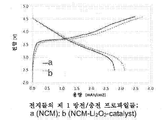
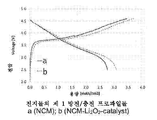
도 1은 본 개시의 예들 및 비교예에 따라 제조된 전지들의 방전/충전 프로파일들을 비교한 도면.
도 2는 본 개시의 예들 및 비교예에 따라 제조된 전지들의 사이클링 성능들을 비교한 도면.
도 3은 본 개시의 예 및 비교예에 따라 제조된 전지들의 방전/충전 프로파일들을 비교한 도면.
도 4는 본 개시의 예 및 비교예에 따라 제조된 전지들의 사이클링 성능들을 비교한 도면.
도 5는 본 개시의 예에 따라 제조된 전지들의 방전/충전 프로파일들을 도시한 도면.
도 6은 본 개시의 예에 따라 제조된 전지들의 사이클링 성능들을 도시하는 도면.
도 7은 본 개시의 예 및 비교예에 따라 제조된 전지의 방전/충전 프로파일들을 비교한 도면.
도 8은 본 개시의 예 및 비교예에 따라 제조된 전지의 사이클링 성능들을 비교한 도면.
도 9는 본 개시의 예에 따라 제조된 전지의 방전/충전 프로파일들을 도시하는 도면.
도 10은 본 개시의 예에 따라 제조된 전지의 사이클링 성능들을 도시하는 도면.
도 11은 본 개시의 예 및 비교예에 따라 제조된 전지들의 방전/충전 프로파일들을 비교한 도면.
도 12는 본 개시의 예 및 비교예에 따라 제조된 전지들의 사이클링 성능들을 비교한 도면.
도 13은 본 개시의 예 및 비교예에 따라 제조된 전지들의 방전/충전 프로파일들을 비교한 도면.
도 14는 본 개시의 예 및 비교예에 따라 제조된 전지들의 사이클링 성능들을 비교한 도면.
이제 몇몇 예시적인 예들이 참조될 것이고, 특정 언어가 본 명세서에서 동일한 것을 기술하기 위해 사용될 것이다. 그럼에도 불구하고, 본 개시의 범위의 제한이 그에 의해 의도되지 않는다는 것이 이해될 것이다.Further features and advantages of the present disclosure will become apparent from the following detailed description taken in conjunction with the accompanying drawings, which together illustrate by way of example the features of the technology.
1 is a view comparing discharge / charge profiles of batteries manufactured according to examples and comparative examples of the present disclosure.
2 is a comparison of the cycling capabilities of batteries made according to examples and comparative examples of the present disclosure.
3 is a view comparing discharge / charge profiles of batteries manufactured according to examples and comparative examples of the present disclosure.
4 is a comparison of cycling performances of cells made according to examples and comparative examples of the present disclosure.
5 shows discharge / charge profiles of batteries made according to examples of the disclosure.
6 illustrates cycling capabilities of cells made according to examples of the disclosure.
7 is a view comparing discharge / charge profiles of a battery prepared according to examples and comparative examples of the present disclosure.
8 is a comparison of the cycling performances of cells made according to examples and comparative examples of the present disclosure.
9 illustrates discharge / charge profiles of a battery made according to examples of the disclosure.
10 illustrates cycling capabilities of a cell made in accordance with an example of the present disclosure.
11 is a view comparing discharge / charge profiles of batteries manufactured according to examples and comparative examples of the present disclosure.
12 is a comparison of cycling performances of cells made according to examples and comparative examples of the present disclosure.
13 is a view comparing discharge / charge profiles of batteries manufactured according to examples and comparative examples of the present disclosure.
14 is a comparison of cycling performances of cells made according to examples and comparative examples of the disclosure.
Reference will now be made to some illustrative examples, and specific language will be used herein to describe the same. Nevertheless, it will be understood that no limitation of the scope of the disclosure is thereby intended.
본 명세서 전반에 걸쳐, 모든 과학적 및 기술적 용어들은 달리 명시하지 않는 한, 당업자에게 공지된 것과 동일한 의미를 갖는다. 불일치가 있는 경우, 본 개시에서 제공된 정의가 취해져야 한다.Throughout this specification, all scientific and technical terms have the same meanings as known to those skilled in the art, unless otherwise specified. In case of inconsistency, the definitions provided in this disclosure should be taken.
모든 재료들, 프로세스들, 예들 및 도면들의 상세한 설명은 설명의 목적으로 제공되고, 따라서, 달리 명확하게 명시되지 않는 한, 본 개시의 제한으로 해석되지 않는다는 것이 이해되어야 한다.It is to be understood that the detailed description of all materials, processes, examples, and figures is provided for purposes of illustration and, therefore, is not to be construed as a limitation on the present disclosure, unless expressly stated otherwise.
여기에서, 용어 "전지" 및 "배터리"는 상호 교환 가능하게 사용될 수 있다. "리튬 이온 전지(또는 배터리)"라는 용어는 "전지" 또는 "배터리"로 약어로 표시될 수도 있다.Here, the terms "cell" and "battery" may be used interchangeably. The term "lithium ion cell (or battery)" may be abbreviated as "cell" or "battery".
본 명세서에서, "포함하는"이라는 용어는 최종 효과에 영향을 미치지 않는 다른 성분들 또는 다른 단계들이 포함될 수 있음을 의미한다. 이러한 용어는 "구성되는" 및 "본질적으로 구성되는"이라는 용어들을 포함한다. 본 개시에 따른 생성물 및 프로세스는 본 명세서에 설명된 필수적인 기술적 특징들 및/또는 본 개시의 한정들, 뿐만 아니라 본 명세서에 설명된 임의의 추가 및/또는 선택적인 성분들, 구성 요소들, 단계들 또는 한정들을 포함할 수 있고, 이들로 구성될 수 있고, 이들로 본질적으로 구성될 수 있다.As used herein, the term "comprising" means that other ingredients or other steps may be included that do not affect the final effect. This term includes the terms “consisting of” and “consisting essentially of”. The products and processes according to the present disclosure may be subject to the essential technical features and / or limitations of the disclosure described herein, as well as any additional and / or optional components, components, steps described herein. Or may include, and consist of, and consist essentially of.
여기서, "캐소드 조성물" 또는 "애노드 조성물"이란 용어는 캐소드 슬러리 또는 애노드 슬러리를 형성하기 위해 사용된 조성물을 의미하는 것으로 의도된다. 캐소드 슬러리 또는 애노드 슬러리는 후속하여 대응하는 집전체상에 도포되고 캐소드 또는 애노드로부터 건조될 수 있다.Here, the term "cathode composition" or "anode composition" is intended to mean the composition used to form the cathode slurry or anode slurry. The cathode slurry or anode slurry can subsequently be applied on the corresponding current collector and dried from the cathode or anode.
본 출원의 요지를 설명하는 문맥에서 (특히 이하의 청구 범위의 문맥에서) 단수 용어들 및 유사한 지시 대상의 사용은 여기에 달리 명시되거나 문맥에 분명히 모순되지 않는 한 단수 및 복수 모두를 포함하는 것으로 해석되어야 한다.The use of singular terms and the like in the context of the subject matter of the present application (particularly in the context of the following claims) is to be interpreted to include both the singular and the plural unless the context clearly dictates otherwise or contradicts the context. Should be.
달리 특정되지 않는 한, 이러한 문맥에서의 모든 수치 범위는 종단점들 및 상기 수치 범위들에 속하는 하위 범위들 및 임의의 수들 모두를 포함하는 것을 의도한다.Unless otherwise specified, all numerical ranges in this context are intended to include both endpoints and subranges belonging to the numerical ranges and any numbers.
특별히 나타내지지 않는 한, 본원에서 사용된 모든 재료들 및 제제는 상업적으로 이용 가능하다.Unless specifically indicated, all materials and formulations used herein are commercially available.
본 개시의 예들이 이하에 상세히 설명된다.Examples of the present disclosure are described in detail below.
리튬 이온 배터리Lithium ion battery
일부 예들에서, 캐소드, 애노드 및 전해질을 포함하는 리튬 이온 배터리가 제공되며, 캐소드는 캐소드 활성 재료 및 리튬 과산화물을 포함한다.In some examples, a lithium ion battery is provided that includes a cathode, an anode, and an electrolyte, the cathode comprising a cathode active material and lithium peroxide.
일부 예들에서, 리튬 이온 배터리는 전리튬화되거나 전리륨화되지 않고, 리튬 과산화물의 함량은 캐소드 조성물의 총 건조 중량에 기초하여 0 초과 내지 20 중량%, 바람직하게는 0 초과 20 중량% 미만, 더 바람직하게는 0.01 중량% 내지 약 5 중량%, 더욱 더 바람직하게는 약 0.01 중량% 내지 약 1 중량%이다.In some examples, the lithium ion battery is not prelithiated or ionized and the content of lithium peroxide is greater than 0 to 20% by weight, preferably greater than 0 to less than 20% by weight, more preferably based on the total dry weight of the cathode composition. Preferably from 0.01 wt% to about 5 wt%, even more preferably from about 0.01 wt% to about 1 wt%.
일부 예들에서, 본 개시에 따라 리튬 이온 배터리를 제조하는 방법에 있어서:In some examples, a method of making a lithium ion battery according to the present disclosure:
-- 캐소드 활성 재료 및 리튬 과산화물을 함유하는 캐소드를 제공하는 단계;Providing a cathode containing a cathode active material and lithium peroxide;
-- 캐소드, 애노드 및 전해질을 리튬 이온 배터리로 어셈블리하는 단계; 및 선택적으로-Assembling the cathode, anode and electrolyte into a lithium ion battery; And optionally
-- 캐소드 내의 리튬 과산화물로부터 리튬 이온들을 방출하고, 애노드에 리튬을 저장하기 위해 리튬 이온 배터리를 충전하여, 애노드를 전리튬화하는 단계를 포함하고,Releasing lithium ions from lithium peroxide in the cathode, charging a lithium ion battery to store lithium at the anode, and prelithiating the anode,
전리튬화 배터리 또는 전리튬화되지 않은 배터리 내의 리튬 과산화물의 함량은 캐소드 조성물의 총 건조 중량에 기초하여 0 초과 내지 약 20 중량%, 바람직하게는 0 초과 내지 20 중량% 미만, 더 바람직하게는 약 0.01 중량% 내지 약 5 중량% , 더욱 더 바람직하게는 약 0.01% 내지 약 1%일 수 있다.The lithium peroxide content in the pre-lithiated or non-lithiated battery is greater than 0 to about 20 weight percent, preferably greater than 0 to less than 20 weight percent, more preferably about 0, based on the total dry weight of the cathode composition. 0.01 wt% to about 5 wt%, even more preferably about 0.01% to about 1%.
일부 예들에서, 캐소드, 애노드 및 전해질을 포함하는 리튬 이온 배터리가 제공되고, 상기 전해질은 리튬염, 비수성 용매 및 리튬 과산화물을 포함한다.In some examples, a lithium ion battery is provided that includes a cathode, an anode, and an electrolyte, the electrolyte comprising a lithium salt, a non-aqueous solvent, and a lithium peroxide.
일부 예들에서, 본 개시에 따른 리튬 이온 배터리를 제조하는 방법은:In some examples, a method of making a lithium ion battery according to the present disclosure is:
-- 리튬염, 비수성 용매 및 리튬 과산화물을 함유하는 전해질을 제공하는 단계;Providing an electrolyte containing a lithium salt, a non-aqueous solvent and a lithium peroxide;
-- 전해질, 캐소드 및 애노드를 리튬 이온 배터리로 어셈블리하는 단계; 및 선택적으로-Assembling the electrolyte, the cathode and the anode into a lithium ion battery; And optionally
-- 전해질 내의 리튬 과산화물로부터 리튬 이온들을 방출하고, 애노드에 리튬을 저장하기 위해 리튬 이온 배터리를 충전하여, 애노드를 전리튬화하는 단계를 포함한다.Releasing lithium ions from lithium peroxide in the electrolyte, charging a lithium ion battery to store lithium at the anode, and prelithiating the anode.
발명자들은 놀랍게도, 본 개시에 따른 리튬 이온 배터리들을 제공함으로써, 한편으로는, SEI가 안정화될 수 있고, 용량 손실 페이딩이 보상될 수 있고, 배터리 성능들(예컨대 비가역 용량 및 사이클링 안정성)이 현저하게 개선될 수 있다는 것을 발견했다. 반면에, 바람직하지 않은 리튬 수지상 돌기(lithium dendrite)가 회피될 수 있다.The inventors have surprisingly found that by providing lithium ion batteries according to the present disclosure, on the one hand, the SEI can be stabilized, capacity loss fading can be compensated, and battery performances (such as irreversible capacity and cycling stability) are significantly improved. Found that it could be. On the other hand, undesirable lithium dendrite can be avoided.
본 개시에서 채용되는 리튬 과산화물은 수분에 대해 비교적 안정하다. 리튬 과산화물이 수분과 반응하더라도, 가스가 발생하지 않아 폭발 위험이 없고, 이는 생산 안전성이 크게 향상시키고 제조 비용을 감소시킨다.Lithium peroxides employed in the present disclosure are relatively stable with respect to moisture. Even if lithium peroxide reacts with moisture, no gas is generated and there is no risk of explosion, which greatly improves production safety and reduces manufacturing costs.
본 개시에 따르면, 리튬 과산화물에 캐소드 또는 전해질이 제공된다. 리튬 과산화물은 캐소드 또는 전해질에 함유된 다른 구성 성분들과 융화성이기 때문에, 캐소드 또는 전해질의 조성물을 변화시킬 필요가 없다. 대조적으로, 리튬 과산화물이 애노드에 직접 제공되는 경우, 애노드에 함유된 용매 및 접착제는 대응하여 변경될 필요가 있다.According to the present disclosure, a cathode or electrolyte is provided for lithium peroxide. Since lithium peroxide is compatible with other components contained in the cathode or electrolyte, there is no need to change the composition of the cathode or electrolyte. In contrast, when lithium peroxide is provided directly to the anode, the solvent and adhesive contained in the anode need to be changed correspondingly.
일부 예들에서, 캐소드 활성 재료 및 리튬 과산화물을 함유하는 캐소드를 제공하는 단계에서, 캐소드 활성 재료 및 리튬 과산화물이 캐소드 슬러리를 형성하기 위해 채용될 수 있고, 후속하여 캐소드 슬러리가 캐소드 집전체상에 도포될 수 있다. 구체적으로, 리튬 과산화물이 캐소드 조성물의 다른 구성 성분들(캐소드 활성 재료, 탄소 재료, 결합제, 용매, 및/또는 임의의 첨가제(들)와 같은)과 혼합되어 캐소드 슬러리를 제조할 수 있다. 후속하여, 캐소드 슬러리는 리튬 과산화물을 함유하는 캐소드를 형성하기 위해, 예를 들면 코팅에 의해 집전체상에 도포될 수 있다. 본 개시에 따르면, 캐소드에 리튬 과산화물을 도입하는 것이 쉽다. 리튬 과산화물의 도입은 캐소드 조성물의 다른 구성 성분들의 첨가와 통합되고, 별도의 단계가 추가로 필요하지 않거나 특별한 조건을 필요로 하지 않고, 이는 산업 생산을 위한 상당한 비용 절감 및 노동 절약을 의미한다.In some examples, in providing a cathode containing a cathode active material and a lithium peroxide, the cathode active material and the lithium peroxide may be employed to form a cathode slurry, which is subsequently applied to the cathode current collector. Can be. Specifically, lithium peroxide can be mixed with other constituents of the cathode composition (such as cathode active material, carbon material, binder, solvent, and / or any additive (s)) to produce the cathode slurry. Subsequently, the cathode slurry may be applied onto the current collector, for example by coating, to form a cathode containing lithium peroxide. According to the present disclosure, it is easy to introduce lithium peroxide into the cathode. The introduction of lithium peroxide is integrated with the addition of other constituents of the cathode composition and does not require additional steps or require special conditions, which means significant cost savings and labor savings for industrial production.
대안적으로, 캐소드 활성 재료 및 리튬 과산화물을 함유하는 캐소드를 제공하는 단계에서, 캐소드 활성 재료는 캐소드 집전체상에 도포되어 활성 재료층을 형성하고, 이후 리튬 과산화물이 활성 재료층상에 도포되어 리튬 과산화물층을 형성할 수 있다. 이러한 방식으로 리튬 과산화물을 공급하는 것은 또한 수행되기 쉽다.Alternatively, in providing a cathode containing a cathode active material and a lithium peroxide, the cathode active material is applied on the cathode current collector to form an active material layer, and then lithium peroxide is applied on the active material layer to form a lithium peroxide A layer can be formed. Supplying lithium peroxide in this manner is also easy to carry out.
전리튬화 단계Prelithiation stage
일부 예들에서, 리튬 이온 배터리의 처음 몇 번의 충전들 동안, 리튬 이온들은 캐소드 또는 전해질 내의 리튬 과산화물로부터 추출된다. 한편, 리튬 과산화물의 과산화물 음이온(O2 2-)은 전자들을 잃어 산소 가스로 전환한다. 추출된 리튬 이온들은 애노드로 삽입되고 그에 저장된다. 이와 같이, 애노드는 전리륨화된다. 애노드가 전리륨화되는 처음 몇몇 충전들은 "형성 충전들(formation charges)"이라고도 불린다. 후속하는 방전/충전 사이클들 동안, 형성 충전들에서 애노드에 저장된 리튬은 리튬 이온 전이에 참여할 수 있고, SEI 층의 형성으로 인한 리튬 손실을 보상할 수 있고, SEI 층을 안정화시킬 수 있고, 용량 페이딩을 감소시킬 수 있다.In some examples, during the first few charges of a lithium ion battery, lithium ions are extracted from lithium peroxide in the cathode or electrolyte. On the other hand, peroxide anion (O 2 2- ) of lithium peroxide loses electrons and converts to oxygen gas. The extracted lithium ions are inserted into and stored in the anode. As such, the anode is ionized. The first few charges at which the anode is ionized are also referred to as "formation charges". During subsequent discharge / charge cycles, the lithium stored at the anode in the formation charges may participate in lithium ion transitions, compensate for lithium loss due to the formation of the SEI layer, stabilize the SEI layer, and capacity fading Can be reduced.
본 개시의 일부 예들에 따라, 형성 충전들은 전압 범위, 즉 차단 전압(cut-off voltage) 범위 내에서 수행될 수 있다. 일부 예들에서, 리튬 이온 배터리를 충전하는 동안, 차단 전압의 상한은 약 3.8V 이상 5V 이하, 바람직하게는 약 4.2V 이상 약 5V 이하일 수 있다. 형성 충전들 중 차단 전압의 상한은 리튬 이온 전지에 포함된 캐소드 활성 재료에 의존할 수 있다. 캐소드 활성 재료는 이후에 설명될 것이다. 예를 들면, 캐소드가 활성 재료로서 리튬 니켈 코발트 망간 산화물(NCM) 또는 리튬 니켈 코발트 알루미늄 산화물(NCA)을 함유하는 경우, 형성 충전들 중 차단 전압의 상한은 약 4.2V 이상 약 5V 이하일 수 있다. 캐소드가 활성 재료로서 리튬 니켈 코발트 망간 산화물/Li2MnO3 복합체("리튬-리치드 NCM(lithium-riched NCM)"이라고도 함)를 함유하는 경우, 형성 충전들 중 차단 전압의 상한은 약 4.35V 이상 약 5.0V 이하일 수 있다. 이들 범위들 내에 속하는 형성 충전들 중 차단 전압의 상한에 의해, 한편으로는, 리튬 과산화물이 리튬 이온들을 충분히 방출할 수 있고, 다른 한편으로는 캐소드가 심각하게 파괴되지 않는다.According to some examples of the disclosure, the forming charges may be performed within a voltage range, that is, a cut-off voltage range. In some examples, while charging the lithium ion battery, the upper limit of the blocking voltage may be about 3.8V or more and 5V or less, preferably about 4.2V or more and about 5V or less. The upper limit of the blocking voltage during the formation charges may depend on the cathode active material included in the lithium ion battery. The cathode active material will be described later. For example, when the cathode contains lithium nickel cobalt manganese oxide (NCM) or lithium nickel cobalt aluminum oxide (NCA) as the active material, the upper limit of the blocking voltage during the forming charges may be about 4.2V or more and about 5V or less. If the cathode contains a lithium nickel cobalt manganese oxide / Li 2 MnO 3 composite (also known as "lithium-riched NCM") as the active material, the upper limit of the blocking voltage during the forming charges is about 4.35V. About 5.0V or less. Due to the upper limit of the blocking voltage among the forming charges falling within these ranges, on the one hand, lithium peroxide can sufficiently release lithium ions and on the other hand the cathode is not severely destroyed.
본 개시의 일부 예들에 따라, SEI의 형성으로 인한 리튬 손실을 보상할 뿐만 아니라 캐소드와 애노드 사이에 바람직한 리튬 전이를 유지하도록 애노드가 부분적으로 전리튬화될 수 있다.In accordance with some examples of the present disclosure, the anode may be partially prelithiated to compensate for lithium loss due to the formation of SEI as well as to maintain a desirable lithium transition between the cathode and the anode.
본 개시 몇몇 예들에 따르면, 전리튬화 동안 애노드에 저장된 리튬을 제외하면, 리튬 삽입에 이용 가능한 애노드의 비가역 용량(단위: mAh/㎠)은 약 1 내지 약 1.2배, 예를 들면, 캐소드의 비가역 용량(단위: mAh/㎠)의 약 1 내지 1.1배이다. 이상적으로, 캐소드의 비가역 용량에 대한 애노드의 비가역 용량의 비는 1일 수 있다. 그러나, 배터리를 제조하는 동안 불가피한 작동 오차들이 있다고 고려하면, 상기 비율은 1보다 클 수 있다. 캐소드의 비가역 용량에 대한 애노드의 비가역 용량의 비가 1 미만인 경우, 과량의 리튬 금속이 애노드 주위에 결집되어, 바람직하지 않게 리튬 수지상 돌기들을 형성하여 단락을 야기한다. 캐소드의 비가역 용량에 대한 애노드의 비가역 용량의 비가 1.2를 초과하는 경우, 애노드 용량이 너무 커서 애노드 비가역 용량을 과도하게 소비한다.According to some examples of the present disclosure, with the exception of lithium stored at the anode during prelithiation, the irreversible capacity (in mAh / cm 2) of the anode available for lithium insertion is about 1 to about 1.2 times, for example, irreversible of the cathode. About 1 to 1.1 times the capacity in mAh / cm 2. Ideally, the ratio of the irreversible capacity of the anode to the irreversible capacity of the cathode may be one. However, considering that there are inevitable operating errors during battery manufacture, the ratio may be greater than one. If the ratio of the irreversible capacity of the anode to the irreversible capacity of the cathode is less than 1, excess lithium metal collects around the anode, undesirably forming lithium dendritic protrusions, causing a short circuit. If the ratio of the irreversible capacity of the anode to the irreversible capacity of the cathode exceeds 1.2, the anode capacity is too large to consume the anode irreversible capacity excessively.
본 개시에 따른 리튬 이온 배터리들은 에너지 저장 시스템들 및 전기 자동차들에 사용될 수 있다.Lithium ion batteries according to the present disclosure can be used in energy storage systems and electric vehicles.
캐소드 조성물Cathode composition
본 개시의 일부 예들에 따라, 전리튬화 전에, 캐소드 조성물은 애노드를 전리튬화하기 위한 리튬 소스로서 리튬 과산화물을 포함할 수 있다. 전리튬화 후에, 캐소드 조성물은 캐소드 조성물의 총 건조 중량에 기초하여 미량의 리튬 과산화물, 예를 들면, 약 0.01 중량% 내지 약 1 중량%를 보유할 수 있다.According to some examples of the disclosure, prior to prelithiation, the cathode composition may include lithium peroxide as a lithium source for prelithiation of the anode. After prelithiation, the cathode composition may have a trace amount of lithium peroxide, such as about 0.01 wt% to about 1 wt%, based on the total dry weight of the cathode composition.
본 개시의 일부 예들에 따라, 캐소드는 캐소드 활성 재료를 포함할 수 있다. 일부 예들에서, 캐소드 활성 재료는 충전/방전 사이클들 동안 리튬 이온들을 가역적으로 없애고 삽입하는 재료일 수 있다. 방전 사이클들에서, 캐소드 활성 재료로부터 유래된 리튬 이온들은 애노드로부터 캐소드로 다시 전달되어 캐소드 활성 재료를 다시 형성할 수 있다. 기본 리튬 소스의 역할을 하는 캐소드의 캐소드 활성 재료와 비교하면, 리튬 과산화물은 "추가 리튬 소스" 또는 "보조 리튬 소스"로 지칭될 수 있다.In accordance with some examples of the present disclosure, the cathode may comprise a cathode active material. In some examples, the cathode active material may be a material that reversibly removes and inserts lithium ions during charge / discharge cycles. In discharge cycles, lithium ions derived from the cathode active material may be transferred back from the anode to the cathode to form the cathode active material again. Compared to the cathode active material of the cathode, which serves as the primary lithium source, lithium peroxide may be referred to as an "additional lithium source" or "secondary lithium source."
캐소드 활성 재료는 특별히 제한이 없고, 리튬 이온 전지들에 일반적으로 사용되는 이들 캐소드 활성 재료들이 사용될 수 있다. 일부 예들에서, 캐소드 활성 재료는 리튬 과산화물과 상이할 수 있다. 일부 예들에서, 캐소드 활성 재료는 리튬 기반 활성 재료일 수 있다. 일부 예들에서, 캐소드 활성 재료는 리튬 금속 산화물들, 리튬 금속 인산염들, 리튬 금속 실리케이트들, 황화물들 및 그의 임의의 조합, 바람직하게는 리튬-전이 금속 복합 산화물들, 리튬-전이 금속 인산염들, 리튬 금속 실리케이트들, 금속 황화물들 및 그의 임의의 조합으로 구성된 그룹으로부터 선택될 수 있다. 일부 예들에서, 캐소드 활성 재료는 리튬 철 인산염, 리튬 망간 인산염, 리튬 망간 철 인산염 및 그의 임의의 조합으로 구성된 그룹으로부터 선택될 수 있다. 일부 예들에서, 리튬-전이 금속 복합 산화물은 리튬 니켈 산화물, 리튬 코발트 산화물, 리튬 망간 산화물, 리튬 니켈 코발트 산화물, 리튬 니켈 망간 산화물, 리튬 니켈 코발트 망간 산화물(NCM), 리튬 니켈 코발트 알루미늄 산화물(NCA), 리튬 니켈 코발트 망간 산화물/Li2MnO3 복합체(또한 "리튬-리치드 NCM"으로 지칭됨), 또는 그의 임의의 조합일 수 있다. 일부 예들에서, 금속 황화물은 황화철일 수 있다. 일부 예들에서, 캐소드 활성 재료는 1 마이크로미터 내지 수십 마이크로미터의 크기를 가질 수 있다.The cathode active material is not particularly limited, and these cathode active materials commonly used in lithium ion batteries can be used. In some examples, the cathode active material may be different from lithium peroxide. In some examples, the cathode active material may be a lithium based active material. In some examples, the cathode active material is lithium metal oxides, lithium metal phosphates, lithium metal silicates, sulfides and any combination thereof, preferably lithium-transition metal composite oxides, lithium-transition metal phosphates, lithium Metal silicates, metal sulfides and any combination thereof. In some examples, the cathode active material may be selected from the group consisting of lithium iron phosphate, lithium manganese phosphate, lithium manganese iron phosphate, and any combination thereof. In some examples, the lithium-transition metal composite oxide is lithium nickel oxide, lithium cobalt oxide, lithium manganese oxide, lithium nickel cobalt oxide, lithium nickel manganese oxide, lithium nickel cobalt manganese oxide (NCM), lithium nickel cobalt aluminum oxide (NCA) , Lithium nickel cobalt manganese oxide / Li 2 MnO 3 composite (also referred to as “lithium-rich NCM”), or any combination thereof. In some examples, the metal sulfide may be iron sulfide. In some examples, the cathode active material may have a size of 1 micrometer to several tens of micrometers.
선택적으로, 캐소드는 추가로 캐소드 활성 재료의 입자 크기보다 작은 입자 크기를 갖는 미세 입자들을 포함할 수 있다. 일부 예들에서, 미세 입자들은 1 마이크로미터(즉, 나노 스케일) 미만의 크기를 가질 수 있다. 미세 입자들은 전이 금속 화합물들, 귀금속들, 탄소 재료들 및 그의 임의의 조합으로 구성된 그룹으로부터 선택될 수 있다. 미세 입자들은 상업적으로 이용가능하거나, 예를 들면, 밀 공(mill ball)을 사용하여 비교적 큰 입자들을 작은 크기들로 분쇄함으로써 획득될 수 있다. 이들 미세 입자들은 형성 충전 중 리튬 과산화물들의 리튬 이온들로의 분해를 유리하게 촉진시킬 수 있다. 미세 입자들이 캐소드에 함유된 경우, 미세 입자들이 전리튬화를 위한 촉매의 역할을 하기 때문에, 이들 미세 입자들은 전리튬화 전후 모두에 캐소드에 존재할 수 있다. 전이 금속 화합물들은 산화 티탄, 산화 아연, 산화 구리, 산화 니켈, 산화 몰리브덴과 같은 주기율표 3족 내지 12족의 임의의 전이 금속들의 화합물들을 포함할 수 있다. 귀금속들은 금, 은, 및 백금족 금속들(즉, 루테늄, 로듐, 팔라듐, 오스뮴, 이리듐 및 백금)을 포함한다. 탄소 재료들의 미세 입자들은 탄소 나노튜브, 경질 탄소, 구형 탄소 등일 수 있다.Optionally, the cathode may further comprise fine particles having a particle size smaller than the particle size of the cathode active material. In some examples, the fine particles may have a size of less than 1 micron (ie, nanoscale). The fine particles may be selected from the group consisting of transition metal compounds, noble metals, carbon materials and any combination thereof. Fine particles are commercially available or can be obtained by, for example, milling relatively large particles into smaller sizes using mill balls. These fine particles can advantageously facilitate the decomposition of lithium peroxides into lithium ions during formation charge. When the fine particles are contained in the cathode, since the fine particles serve as a catalyst for prelithiation, these fine particles may be present in the cathode both before and after prelithiation. The transition metal compounds may include compounds of any of the transition metals of Groups 3 to 12 of the periodic table, such as titanium oxide, zinc oxide, copper oxide, nickel oxide, molybdenum oxide. Precious metals include gold, silver, and platinum group metals (ie, ruthenium, rhodium, palladium, osmium, iridium and platinum). Fine particles of carbon materials can be carbon nanotubes, hard carbon, spherical carbon, and the like.
일부 예들에서, 캐소드는 2개의 상이한 크기들의 캐소드 활성 재료들을 동시에 포함할 수 있다. 일부 예들에서, 캐소드는 1 마이크로미터 내지 수십 마이크로미터의 크기들을 갖는 캐소드 활성 재료, 및 1 마이크로미터 미만의 크기를 갖는 동일한 캐소드 활성 재료의 미세 입자들을 동시에 포함할 수 있다.In some examples, the cathode may include two different sizes of cathode active materials at the same time. In some examples, the cathode may simultaneously include cathode active material having sizes of 1 micrometer to several tens of micrometers, and fine particles of the same cathode active material having a size of less than 1 micrometer.
본 개시의 일부 예들에 따르면, 캐소드 조성물은 탄소 재료를 더 포함할 수 있다. "탄소 재료"는 탄소 원소를 함유하는 재료일 수 있다. 탄소 재료는 캐소드 조성물의 전기 전도성 및/또는 분산성을 증가시킬 수 있다. 탄소 재료에 대한 특별한 한정은 없고, 리튬 이온 배터리들에서 사용을 위한 알려진 것들이 사용될 수 있다. 일부 예들에서, 탄소 재료는 카본 블랙, 수퍼 P, 아세틸렌 블랙, 케첸 블랙(Ketjen black), 그래파이트, 그래핀, 탄소 나노튜브들, 탄소 섬유들, 기상 성장 탄소 섬유들, 및 그의 조합을 포함할 수 있지만, 이에 한정되지는 않는다. 일부 예들에서, 캐소드는 2종 또는 상이한 형태들의 탄소 재료들의 혼합물을 함유할 수 있다. 일부 예들에서, 캐소드는 2개의 다른 크기들의 탄소 재료들, 즉 1 마이크로미터 이상의 탄소 재료 및 1 마이크로미터 미만의 동일하거나 상이한 탄소 재료의 미세 입자들을 동시에 포함할 수 있다.According to some examples of the disclosure, the cathode composition may further comprise a carbon material. The "carbon material" may be a material containing a carbon element. The carbon material may increase the electrical conductivity and / or dispersibility of the cathode composition. There is no particular limitation on the carbon material, and known ones for use in lithium ion batteries can be used. In some examples, the carbon material may include carbon black, super P, acetylene black, Ketjen black, graphite, graphene, carbon nanotubes, carbon fibers, vapor grown carbon fibers, and combinations thereof. However, it is not limited to this. In some examples, the cathode may contain a mixture of two or different forms of carbon materials. In some examples, the cathode may simultaneously include two different sizes of carbon materials, namely fine particles of at least one micrometer of carbon material and less than one micrometer of the same or different carbon material.
본 개시의 일부 예들에 따라, 캐소드 조성물은 결합제를 더 포함할 수 있다. 결합제는 캐소드 조성물의 구성 성분들을 함께 보유할 수 있고, 캐소드 조성물을 캐소드 집전체에 부착할 수 있고, 반복된 충전/방전 사이클들 동안 체적 변화가 발생할 때 캐소드의 양호한 안정성 및 완전성을 유지하는 것을 돕고, 따라서 사이클링 성능들 및 비율 성능들을 포함하여 최종 전지들의 전기 화학적 속성들을 개선할 수 있다. 결합제에 대한 특별한 한정은 없고, 리튬 이온 배터리들에서 사용을 위해 알려진 것들이 사용될 수 있다. 일부 예들에서, 결합제는 폴리비닐리덴 플루오라이드(PVDF), 폴리아크릴산(PAA), 소듐 카르복시메틸 셀룰로즈(CMC), 바람직하게는 PVDF일 수 있다.According to some examples of the disclosure, the cathode composition may further comprise a binder. The binder can hold the components of the cathode composition together, attach the cathode composition to the cathode current collector, help maintain good stability and integrity of the cathode when volume changes occur during repeated charge / discharge cycles Thus, it is possible to improve the electrochemical properties of the final cells, including cycling performances and ratio performances. There is no particular limitation on the binder, and those known for use in lithium ion batteries can be used. In some examples, the binder may be polyvinylidene fluoride (PVDF), polyacrylic acid (PAA), sodium carboxymethyl cellulose (CMC), preferably PVDF.
본 개시의 일부 예들에 따르면, 캐소드 조성물들은 용매를 더 포함할 수 있다. 용매는 캐소드 조성물의 다른 구성 성분들을 용해시켜 캐소드 슬러리를 제공할 수 있다. 결과의 캐소드 슬러리는 캐소드 집전체상에 후속하여 도포될 수 있다. 이후, 캐소드 슬러리가 그 위에 도포된 캐소드 집전체는 건조되어 캐소드를 획득할 수 있다. 캐소드 조성물에 함유된 용매에 특별한 한정이 없고, 리튬 이온 배터리들에서 사용을 위해 알려진 것들이 사용될 수 있다. 일부 예들에서, 캐소드 조성물 내의 용매는 N-메틸-2-피롤리돈(NMP)일 수 있다.According to some examples of the disclosure, the cathode compositions may further comprise a solvent. The solvent may dissolve other components of the cathode composition to provide a cathode slurry. The resulting cathode slurry can subsequently be applied onto the cathode current collector. Thereafter, the cathode current collector with the cathode slurry applied thereon can be dried to obtain the cathode. There is no particular limitation on the solvent contained in the cathode composition, and those known for use in lithium ion batteries can be used. In some examples, the solvent in the cathode composition can be N-methyl-2-pyrrolidone (NMP).
일부 예들에서, 캐소드 조성물은 리튬 과산화물, 캐소드 활성 재료, 탄소 재료, 결합제 및 용매를 포함한다. 또한, 리튬 이온 배터리들에서 사용을 위해 일반적으로 알려진 다른 첨가제들은 배터리의 바람직한 성능들을 저해하지 않는 한 선택적으로 사용될 수 있다.In some examples, the cathode composition includes lithium peroxide, cathode active material, carbon material, binder and solvent. In addition, other additives generally known for use in lithium ion batteries may optionally be used as long as they do not interfere with the desired performance of the battery.
캐소드 조성물 내의 각 구성 성분의 형태들, 형상들, 크기들 및/또는 함량들에 특별한 한정이 없다.There are no particular limitations on the forms, shapes, sizes and / or contents of each component in the cathode composition.
캐소드 집전체에는 특별한 한정이 없다. 일부 예들에서, 알루미늄 포일이 캐소드 집전체로서 사용될 수 있다.There is no particular limitation on the cathode current collector. In some examples, aluminum foil may be used as the cathode current collector.
애노드 조성물Anode composition
본 개시에 따른 애노드 조성물들은 애노드 활성 재료를 포함할 수 있다. 애노드 활성 재료에 대한 특별한 한정이 없고, 리튬 이온 전지들에서 일반적으로 알려진 이들 애노드 활성 재료들이 사용될 수 있다. 본 개시의 일부 예들에 따르면, 애노드 활성 재료는 실리콘 기반 활성 재료들, 그래파이트 기반 활성 재료들 및 그의 임의의 조합으로 구성된 그룹에서 선택될 수 있다.Anode compositions according to the present disclosure may comprise an anode active material. There is no particular limitation on the anode active material, and these anode active materials generally known in lithium ion batteries can be used. According to some examples of this disclosure, the anode active material may be selected from the group consisting of silicon based active materials, graphite based active materials and any combination thereof.
"실리콘 기반 활성 재료"는 실리콘 원소를 함유한 활성 재료일 수 있다. 적합한 실리콘 기반 활성 재료의 예들은 실리콘, 실리콘 합금들, 실리콘 산화물들, 실리콘/탄소 복합체들, 실리콘 산화물/탄소 복합체들 및 그의 임의의 조합을 포함할 수 있지만, 그에 한정되는 것은 아니다. 일부 예들에서, 실리콘 합금은 실리콘 및 Ti, Sn, Al, Sb, Bi, As, Ge 및 Pb로 구성된 그룹으로부터 선택된 하나 이상의 금속들을 포함할 수 있다. 일부 예들에서, 실리콘 산화물은 하나보다 많은 실리콘 산화물들의 혼합물일 수 있다. 예를 들면, 실리콘 산화물은 SiOx로 나타낼 수 있고, x의 평균값이 약 0.5 내지 약 2일 수 있다.The "silicone based active material" may be an active material containing a silicon element. Examples of suitable silicon based active materials may include, but are not limited to, silicon, silicon alloys, silicon oxides, silicon / carbon composites, silicon oxide / carbon composites, and any combination thereof. In some examples, the silicon alloy may include silicon and one or more metals selected from the group consisting of Ti, Sn, Al, Sb, Bi, As, Ge, and Pb. In some examples, the silicon oxide may be a mixture of more than one silicon oxides. For example, silicon oxide may be represented by SiO x , and the average value of x may be about 0.5 to about 2.
"탄소 기반 활성 재료"는 탄소 원소를 함유하는 활성 재료일 수 있다. 애노드 내의 탄소 기반 활성 재료는 캐소드에 함유된 탄소 재료와 동일하거나 상이할 수 있다. 적합한 탄소 기반 활성 재료의 예들은 그래파이트, 그래핀, 경질 탄소, 카본 블랙 및 탄소 나노 튜브들을 포함할 수 있지만 이에 한정되지는 않는다."Carbon-based active material" may be an active material containing a carbon element. The carbon based active material in the anode may be the same or different from the carbon material contained in the cathode. Examples of suitable carbon-based active materials may include, but are not limited to, graphite, graphene, hard carbon, carbon black and carbon nanotubes.
캐소드 조성물과 유사하게, 애노드 조성물은 탄소 재료, 결합제 및/또는 용매를 추가로 포함할 수 있다. 애노드 내의 탄소 재료, 결합제 및 용매는 각각 캐소드에 함유된 것과 동일하거나 상이할 수 있다. 또한, 리튬 이온 배터리들에 사용하기 위해 일반적으로 알려진 다른 첨가제들은 배터리의 바람직한 성능들을 저해하지 않는 한 선택적으로 사용될 수 있다.Similar to the cathode composition, the anode composition may further comprise a carbon material, a binder and / or a solvent. The carbon material, binder and solvent in the anode may each be the same or different from that contained in the cathode. In addition, other additives generally known for use in lithium ion batteries may optionally be used as long as they do not interfere with the desired performance of the battery.
애노드 조성물의 각 성분의 종류들, 형상들, 크기들 및/또는 함량들에 특별한 한정이 없다.There is no particular limitation on the types, shapes, sizes and / or contents of each component of the anode composition.
애노드 집전체에는 특별한 한정이 없다. 일부 예들에서, 니켈 포일, 니켈 네트, 구리 포일 또는 구리 네트가 애노드 집전체로서 사용될 수 있다.There is no particular limitation on the anode collector. In some examples, nickel foil, nickel net, copper foil or copper net may be used as the anode current collector.
전해질Electrolyte
본 개시에 따른 리튬 이온 배터리들은 전해질을 포함할 수 있다. 본 개시의 일부 예들에 따라, 전해질은 리튬염 및 비수성 용매를 포함할 수 있다. 리튬염 및 비수성 용매에 대한 특별한 한정이 없고, 전지들 내에 일반적으로 알려진 이들 리튬염들 및 비수성 용매들이 사용될 수 있다. 일부 예들에서, 전해질 내의 리튬염은 캐소드 내의 리튬 과산화물 및 캐소드 활성 재료와 상이할 수 있다. 본 개시의 일부 실시예들에 따르면, 리튬염들은 헥사플루오로포스페이트(LiPF6), 리튬 테트라플루오로보레이트(LiBF4), 비산 리튬(LiAsO4), LiSbO4, 과염소산 리튬(LiClO4), LiAlO4, LiGaO4, 리튬 비스(옥살레이트) 보레이트(LiBOB) 및 그의 임의의 조합을 포함할 수 있지만, 그로 한정되지 않고, LiPF6가 바람직하다.Lithium ion batteries according to the present disclosure may include an electrolyte. According to some examples of the present disclosure, the electrolyte may include lithium salts and non-aqueous solvents. There is no particular limitation on lithium salts and non-aqueous solvents, and these lithium salts and non-aqueous solvents generally known in batteries can be used. In some examples, the lithium salt in the electrolyte may be different from the lithium peroxide and cathode active material in the cathode. According to some embodiments of the present disclosure, the lithium salts are hexafluorophosphate (LiPF 6 ), lithium tetrafluoroborate (LiBF 4 ), lithium arsenate (LiAsO 4 ), LiSbO 4 , lithium perchlorate (LiClO 4 ), LiAlO 4 , LiGaO 4 , lithium bis (oxalate) borate (LiBOB) and any combination thereof, but is not limited thereto, and LiPF 6 is preferred.
본 개시의 일부 예들에 따르면, 비수성 용매들은 카보네이트들(즉, 비플루오르화 카보네이트들) 및 플루오르화 카보네이트들일 수 있다. 본 개시의 일부 예들에 따르면, 카보네이트들은 에틸렌 카보네이트(EC), 프로필렌 카보네이트(PC), 부틸렌 카보네이트(BC)과 같은 환식 카보네이트들; 디메틸 카보네이트(DMC), 디에틸 카보네이트(DEC), 디프로필 카보네이트(DPC), 에틸 메틸 카보네이트(EMC), 메틸프로필 카보네이트(MPC), 에틸프로필 카보네이트(EPC)와 같은 선형 카보네이트들; 및 상술된 카보네이트들의 임의의 조합을 포함할 수 있지만 그로 한정되지 않는다. 본 개시의 일부 예들에 따르면, 플루오르화 카보네이트들은 플루오로에틸렌 카보네이트(FEC) 및 다이플루오로에틸렌 카보네이트, 다이플루오르화 디메틸 카보네이트(DFDMC)와 같은 상술된 카보네이트들의 플루오르화 유도체들일 수 있다. 본 개시에서, 비플루오르화 카보네이트 및 플루오르화 카보네이트의 혼합물은 "부분적으로 플루오르화된 카보네이트"로 지칭될 수 있다. 플루오르화 카보네이트는 비플루오르화 카보네이트 및 부분적으로 플루오르화된 카보네이트에 비해 "완전 플루오르화된 카보네이트"라고 지칭될 수 있다.According to some examples of the disclosure, the non-aqueous solvents may be carbonates (ie, non-fluorinated carbonates) and fluorinated carbonates. According to some examples of this disclosure, carbonates include cyclic carbonates such as ethylene carbonate (EC), propylene carbonate (PC), butylene carbonate (BC); Linear carbonates such as dimethyl carbonate (DMC), diethyl carbonate (DEC), dipropyl carbonate (DPC), ethyl methyl carbonate (EMC), methylpropyl carbonate (MPC), ethylpropyl carbonate (EPC); And any combination of the carbonates described above. According to some examples of the present disclosure, the fluorinated carbonates may be fluorinated derivatives of the aforementioned carbonates such as fluoroethylene carbonate (FEC) and difluoroethylene carbonate, difluorinated dimethyl carbonate (DFDMC). In the present disclosure, a mixture of non-fluorinated carbonates and fluorinated carbonates may be referred to as "partially fluorinated carbonates". Fluorinated carbonates may be referred to as "fully fluorinated carbonates" compared to non-fluorinated carbonates and partially fluorinated carbonates.
전해질 내의 붕소 기반 음이온 수용체Boron-based Anion Receptor in Electrolyte
본 개시의 일부 예들에 따르면, 전해질은 붕소 기반 음이온 수용체를 더 포함할 수 있다. 붕소 기반 음이온 수용체에 대한 특별한 한정이 없고, 붕소 원자들 상에 루이스 산 중심들을 갖고 과산화물 이온(O2 2-, 루이스 염기 중심)과 복합체들을 형성할 수 있는 보란들 및 보레이트들이 사용될 수 있다. 이러한 보란들 또는 보레이트들을 사용함으로써, 리튬 과산화물의 전해질 내 용해도가 증가될 수 있고, 리튬 과산화물로부터 리튬 이온의 방출을 가능하게 하는 리튬 과산화물의 탈리튬화의 반응 속도가 개선될 수 있다. 전해질이 열적으로 불안정한 리튬염(예컨대 LiPF6)을 포함하는 경우, 보란들 또는 보레이트들은 또한 음이온(예컨대 PF6 5-)을 안정화시키고, 그와 달리 용량 페이딩을 야기하고 충전/방전 사이클링 동안 임피던스를 증가시키는 리튬염(예컨대 LiPF6)의 분해를 완화시킬 수 있다.According to some examples of the disclosure, the electrolyte may further comprise a boron based anion acceptor. There is no particular limitation on the boron based anion acceptor, and boranes and borates can be used that have Lewis acid centers on boron atoms and can form complexes with peroxide ions (O 2 2- , Lewis base center). By using such boranes or borates, the solubility of the lithium peroxide in the electrolyte can be increased, and the reaction rate of delithiation of the lithium peroxide that enables the release of lithium ions from the lithium peroxide can be improved. If the electrolyte contains a thermally labile lithium salt (such as LiPF 6 ), the boranes or borates also stabilize the anion (such as PF 6 5- ), otherwise causing capacity fading and impedance during charge / discharge cycling. It is possible to mitigate the degradation of increasing lithium salts (eg LiPF 6 ).
예를 들면, 화학식(불소화 알킬-O)3-B로 표시되는 보레이트들, 화학식(불소화 아릴-O)3-B로 표시되는 보레이트들, 및 H. S. Lee 등에 의해 설명된 일반식(불소화 아릴)3-B로 표시되는 보레인들 등(J. Electochem. Soc., 145 (1998), pp 2813-2818, 그 전체가 여기에 참고로 통합됨)이 본 개시에 따라 사용될 수 있다. 예시된 보레이트들은 트리스(2H-헥사플루오로이소프로필) 보레이트(THFPB, [(CF3)2CHO]3B) 및 트리스(2,4-다이플루오로에틸)보레이트(F2C6H3O)3B를 포함할 수 있지만, 그로 한정되지는 않고, 예시된 보레인들은 트리스(펜타플루오로페닐) 보레인 (TPFPB, (C6F5)3B)을 포함할 수 있지만, 그로 한정되지는 않는다.For example, borates represented by the formula (alkyl fluoride-O) 3 -B, borates represented by the formula (fluorinated aryl-O) 3 -B, and the general formula (fluorinated aryl) 3 described by HS Lee et al. Boranes, etc. (J. Electochem. Soc., 145 (1998), pp 2813-2818, incorporated herein by reference in its entirety), denoted by -B, can be used in accordance with the present disclosure. Illustrated borates include tris (2H-hexafluoroisopropyl) borate (THFPB, [(CF 3 ) 2 CHO] 3 B) and tris (2,4-difluoroethyl) borate (F 2 C 6 H 3 O ) 3 B may include, but is not limited to, exemplified boranes may include, but are not limited to, tris (pentafluorophenyl) borane (TPFPB, (C 6 F 5 ) 3 B) Does not.
미국 특허 출원 공보 제 US2012/0183866 A1 호에 기재된 플루오르화 아릴보론 옥살레이트들이 또한 유용하고, 이 특허 출원은 그 전체가 본 명세서에 참고로 통합된다. 예시된 플루오르화 아릴보론 옥살레이트들은 하기 화학식으로 나타내질 수 있다:Also useful are the fluorinated arylboron oxalates described in US Patent Application Publication No. US2012 / 0183866 A1, which is incorporated herein by reference in its entirety. Illustrated fluorinated arylboron oxalates can be represented by the formula:

R은 플루오린 함유 부분(들)이다. 플루오르화 아릴보론 옥살레이트들의 비제한적인 예는 펜타플루오로페닐보론 옥살레이트(PFPBO)를 포함할 수 있지만 그로 한정되지는 않는다.R is a fluorine containing moiety (s). Non-limiting examples of fluorinated arylboron oxalates may include but are not limited to pentafluorophenylboron oxalate (PFPBO).
하기 화학식으로 나타내진, 리튬 비스(옥살라토) 보레이트(LiBOB)는Lithium bis (oxalato) borate (LiBOB), represented by the formula

전해질에서 붕소 기반 음이온 수용체로서 사용될 수도 있다.It may also be used as a boron based anion acceptor in the electrolyte.
또한, 미국 특허 출원 제 10/625686 호에 기재된 리튬 옥살토다이플루오로보레이트(LiBF2C2O4, LiODFB로 약칭됨)는 또한 전해질에서 붕소 기반 음이온 수용체로서 사용될 수 있다.In addition, lithium oxaltodifluoroborate (abbreviated as LiBF 2 C 2 O 4 , LiODFB) described in US Patent Application No. 10/625686 can also be used as boron based anion acceptor in the electrolyte.
플루오르화 아릴보론 옥살레이트들(예를 들면, PFPBO), LiBOB 및 LIODFB는 또한 애노드의 표면상에 더 안정한 SEI 층을 형성하는 것을 도울 수 있고, 이는 리튬 소비를 감소시키고 배터리 성능들을 향상시킨다.Fluorinated arylboron oxalates (eg PFPBO), LiBOB and LIODFB can also help to form a more stable SEI layer on the surface of the anode, which reduces lithium consumption and improves battery performances.
예들Example
재료들Materials
NCM-111: 리튬 니켈 코발트 망간 산화물, 캐소드의 활성 재료, D50: 12㎛, BASF로부터 입수 가능.NCM-111: lithium nickel cobalt manganese oxide, active material of cathode, D50: 12 μm, available from BASF.
Si/C 복합체: 실리콘 나노입자들(직경: 50 ㎚, Alfa Aesar로부터 입수 가능) 및 그래파이트(Shenzhen Kejingstar Technology Ltd.로부터 입수 가능)를 1:1의 중량비로 혼합하여 수제의 애노드의 활성 재료.Si / C composite: active material of handmade anode by mixing silicon nanoparticles (diameter: 50 nm, available from Alfa Aesar) and graphite (available from Shenzhen Kejingstar Technology Ltd.) in a weight ratio of 1: 1.
Super P: Timcal로부터 입수 가능한 탄소 재료, 40㎚.Super P: carbon material available from Timcal, 40 nm.
KS6L: 그래파이트 플레이크, 탄소 재료, 약 6㎛, Timcal로부터 입수 가능.KS6L: graphite flake, carbon material, about 6 μm, available from Timcal.
리튬 과산화물: 애노드 전리튬화를 위한 리튬 소스, Alfa Aesar로부터 입수 가능.Lithium Peroxide: Lithium source for anode prelithiation, available from Alfa Aesar.
PVDF: 폴리비닐리덴 플루오라이드, 결합제, Sovey로부터 입수 가능.PVDF: Polyvinylidene fluoride, binder, available from Sovey.
NMP: N-메틸-2-피롤리돈, 용매, Guoyao로부터 입수 가능.NMP: N-methyl-2-pyrrolidone, solvent, available from Guoyao.
Celgard 2325: PP/PE/PP 막, 격리판. Celgard로부터 입수 가능. Celgard 2325: PP / PE / PP membranes, separators. Available from Celgard.
[캐소드의 제조][Production of cathode]
예 1Example 1
938.6 ㎎ NCM-111, 26.4 ㎎ 리튬 과산화물, 10 ㎎ 수퍼 P, 5 ㎎ KS6L, 20 ㎎ PVDF은 아르곤 충진 글로브박스(MB-10 컴팩트, MBraun)내 450 mL NMP에 첨가된다. 3시간 동안 교반한 후, 결과의 균일하게 분산된 슬러리는 알루미늄 호일상에 코팅되고, 이후 6시간 동안 진공에서 80℃에서 건조된다. 코팅된 Al 포일을 글로브박스에서 꺼내어져서 몇개의 Φ 12 ㎜ 캐소드들(NCM-Li2O2 캐소드들로 약칭됨)로 컷팅된다.938.6 mg NCM-111, 26.4 mg lithium peroxide, 10 mg super P, 5 mg KS6L, 20 mg PVDF is added to 450 mL NMP in an argon filled glovebox (MB-10 compact, MBraun). After stirring for 3 hours, the resulting uniformly dispersed slurry is coated onto aluminum foil and then dried at 80 ° C. in vacuo for 6 hours. The coated Al foil was taken out of the glovebox and cut into several Φ 12 mm cathodes (abbreviated as NCM-Li 2 O 2 cathodes).
[전지의 제조][Manufacture of Battery]
코인 전지들(CR2016)은 위에서 얻은 캐소드들을 사용하여 아르곤 충진 글로브박스(MB-10 컴팩트, MBraun)에서 어셈블리된다. 순수한 Li 금속 포일은 대향 전극으로 사용된다. FEC + EMC에서 1M LiPF6(3:7 부피로, 부분 플루오르화 카보네이트 전해질)은 전해질로 사용된다. Celgard 2325는 격리판으로 사용되었다.Coin cells CR2016 are assembled in an argon filled glovebox (MB-10 compact, MBraun) using the cathodes obtained above. Pure Li metal foils are used as counter electrodes. In FEC + EMC 1M LiPF 6 (3: 7 vol, partially fluorinated carbonate electrolyte) is used as electrolyte. Celgard 2325 was used as separator.
예 2Example 2
캐소드들(NCM-Li2O2-촉매 캐소드들에 대한 약칭)은, 촉매로서 NCM-111의 10 ㎎ 미세 입자들이 캐소드 슬러리를 제조하기 위해 첨가되고, 928.6 ㎎ NCM-111가 938.6 ㎎ NCM-111 대신에 사용되는 것 이외에는, 예 1에 대해 전술된 것과 동일한 방식으로 제조된다. NCM-111의 미세 입자들은 1㎛ 미만의 입자 크기를 갖는다.Cathodes (abbreviated for NCM-Li 2 O 2 -catalyzed cathodes), 10 mg fine particles of NCM-111 as catalyst were added to prepare the cathode slurry, and 928.6 mg NCM-111 was added to 938.6 mg NCM-111 Except for being used instead, it is prepared in the same manner as described above for Example 1. Fine particles of NCM-111 have a particle size of less than 1 μm.
예 3Example 3
캐소드들(NCM-Li2O2-촉매 캐소드들에 대한 약칭)은 24.1 ㎎ 리튬 과산화물이 26.4 ㎎ 리튬 과산화물 대신에 사용되는 것을 제외하고는, 예 2에 대해 전술된 것과 동일한 방식으로 제조된다.Cathodes (abbreviated for NCM-Li 2 O 2 -catalyzed cathodes) are prepared in the same manner as described above for Example 2, except that 24.1 mg lithium peroxide is used instead of 26.4 mg lithium peroxide.
예 4Example 4
캐소드들(NCM-Li2O2-촉매 캐소드들에 대한 약칭)은 50 ㎎ 리튬 과산화물이 26.4 ㎎ 리튬 과산화물 대신에 사용된 것을 제외하고는, 예 2에 대해 전술된 것과 동일한 방식으로 제조된다.Cathodes (abbreviated for NCM-Li 2 O 2 -catalyzed cathodes) are prepared in the same manner as described above for Example 2, except that 50 mg lithium peroxide was used instead of 26.4 mg lithium peroxide.
예 5Example 5
전지는 EC + DMC에서 1M LiPF6(1:1 부피로, 비플루오르화 카보네이트 전해질)이 전해질로서 사용되는 것을 제외하고는, 예 4에 대해 전술된 것과 동일한 방식으로 제조된다.The cell was prepared in the same manner as described above for Example 4, except that 1M LiPF 6 (in 1: 1 volume, non-fluorinated carbonate electrolyte) in EC + DMC was used as the electrolyte.
예 6Example 6
전지는 완전 플루오르화 카보네이트 전해질(30 vol%의 FEC 함유)에서 1M LiPF6가 전해질로서 사용되는 것을 제외하고는, 예 4에 대해 전술된 것과 동일한 방식으로 제조된다.The cell was prepared in the same manner as described above for Example 4, except that 1M LiPF 6 was used as the electrolyte in a fully fluorinated carbonate electrolyte (containing 30 vol% FEC).
예 7Example 7
전지는 Si/C 복합체가 애노드로서 사용하는 것을 제외하고는 예 2에 대해 전술된 것과 동일한 방식으로 제조된다.The cell is prepared in the same manner as described above for Example 2 except that the Si / C composite is used as the anode.
예 8Example 8
전지는 완전 플루오르화 카보네이트 전해질(30 vol%의 FEC 함유)에서 1M LiPF6가 전해질로서 사용되는 것을 제외하고는, 예 7에 대해 전술된 것과 동일한 방식으로 제조된다.The cell was prepared in the same manner as described above for Example 7, except that 1M LiPF 6 was used as the electrolyte in a fully fluorinated carbonate electrolyte (containing 30 vol% FEC).
비교예 1Comparative Example 1
캐소드들(NCM 캐소드들에 대한 약칭)은 리튬 과산화물이 채용되지 않고, 965 ㎎ NCM-111이 938.6 ㎎ NCM-111 대신에 사용되는 것을 제외하고는 예 1에 대해 전술된 것과 동일한 방식으로 제조된다.Cathodes (abbreviated for NCM cathodes) are prepared in the same manner as described above for Example 1 except that lithium peroxide is not employed and 965 mg NCM-111 is used instead of 938.6 mg NCM-111.
비교예 2Comparative Example 2
전지는 Si/C 복합체가 애노드로서 사용된 것을 제외하고는 비교예 1에 대해 전술된 것과 동일한 방식으로 제조된다.The cell was prepared in the same manner as described above for Comparative Example 1 except that the Si / C composite was used as the anode.
비교예 3Comparative Example 3
전지는 완전 플루오르화 카보네이트 전해질(30 vol%의 FEC 함유)에서 1M LiPF6가 전해질로서 사용된 것을 제외하고는, 비교예 2에 대해 전술된 것과 동일한 방식으로 제조된다.The cell was prepared in the same manner as described above for Comparative Example 2, except that 1M LiPF 6 was used as the electrolyte in a fully fluorinated carbonate electrolyte (containing 30 vol% FEC).
[전기화학적 측정들][Electrochemical measurements]
각 전지의 사이클링 성능들은 Arbin 배터리 테스트 시스템으로 25℃에서 평가되었다.The cycling performance of each cell was evaluated at 25 ° C. with an Arbin battery test system.
도 1은 제 1 충전/방전 사이클 동안 예 1, 예 2 및 비교예 1에 따라 제조된 전지들의 방전/충전 프로파일들을 비교한다. 제 1 충전/방전 사이클에서, 각 전지는 3 내지 4.6V(vs Li/Li+)의 전압 범위 내에서 충전/방전되었다. 전지들의 각 캐소드에서의 NCM의 매스 로딩(mass loading)은 약 10 ㎎/㎠이다. 구체적인 용량들은 NCM의 중량에 기초하여 계산되었다. 비교예 1의 NCM 캐소드와 비교하여, 예 1의 NCM-Li2O2 캐소드는 제 1 충전에서의 충전 용량을 향상시켰다. 예 1의 NCM-Li2O2 캐소드와 비교하여, 예 2의 NCM-Li2O2-촉매 캐소드는 제 1 충전에서의 충전 용량을 더 향상시켰다. 이는 리튬 과산화물의 분해를 촉진시키는 NCM의 미세 입자들에 기인하는 것으로, 더 많은 리튬 이온들이 애노드들에 제공되었다.1 compares the discharge / charge profiles of batteries prepared according to Examples 1, 2 and Comparative Example 1 during a first charge / discharge cycle. In the first charge / discharge cycle, each cell was charged / discharged within a voltage range of 3 to 4.6 V (vs Li / Li + ). The mass loading of the NCM at each cathode of the cells is about 10 mg / cm 2. Specific doses were calculated based on the weight of the NCM. Compared to the NCM cathode of Comparative Example 1, the NCM-Li 2 O 2 cathode of Example 1 improved the charge capacity at the first charge. Example 1 compared to the NCM-Li 2 O 2 cathode, Example 2 of the NCM-Li 2 O 2 - The cathode catalyst has improved further the charging capacity at the first charge. This is due to the fine particles of the NCM that promote the decomposition of lithium peroxide, where more lithium ions were provided to the anodes.
도 2는 예 1, 예 2 및 비교예 1에 따라 제조된 전지들의 사이클링 성능들을 비교한 것이다. 각 전지는 제 1 충전 사이클 동안 3 내지 4.6V(vs Li/Li+)의 전압 범위 내에서 방전/충전되고, 이후 3 내지 4.3V의 정상 전압 범위에서 충전/방전된다. 전지들의 각 캐소드에서의 NCM의 매스 로딩은 약 10 ㎎/㎠이다. 구체적인 용량들은 NCM의 중량에 기초하여 계산되었다. 도 2를 참조하면, 예 2의 NCM-Li2O2-촉매 캐소드가 최고의 용량 및 최상의 안정성을 보인 반면, 비교예 1의 NCM 캐소드는 최악의 안정성을 보임을 알 수 있다.2 compares the cycling performances of batteries prepared according to Example 1, Example 2 and Comparative Example 1. FIG. Each cell is discharged / charged within a voltage range of 3 to 4.6 V (vs Li / Li + ) during the first charge cycle and then charged / discharged at a normal voltage range of 3 to 4.3 V. The mass loading of NCM at each cathode of the cells is about 10 mg / cm 2. Specific doses were calculated based on the weight of the NCM. Referring to FIG. 2, it can be seen that the NCM-Li 2 O 2 -catalyst cathode of Example 2 showed the highest capacity and the best stability, while the NCM cathode of Comparative Example 1 showed the worst stability.
도 3은 제 1 충전/방전 사이클 동안 예 3 및 비교예 1에 따라 제조된 전지들의 방전/충전 프로파일들을 비교한 것이다. 도 4는 예 3 및 비교예 1에 따라 제조된 전지들의 사이클링 성능들을 비교한 것이다. 도 5는 제 1 충전/방전 사이클 동안 예 4에 따라 제조된 전지들의 방전/충전 프로파일들을 도시한다. 도 6은 예 4에 따라 제조된 전지들의 사이클링 성능들을 도시한다. 각 전지는 제 1 충전 사이클 동안 3 내지 4.6V (vs Li/Li+)의 전압 범위 내에서 방전/충전되고, 이후 3 내지 4.3V의 정상 전압 범위에서 충전/방전된다. 전지들의 각 캐소드에서의 NCM의 매스 로딩은 약 10 ㎎/㎠이다. 구체적인 용량들은 NCM의 중량에 기초하여 계산되었다. 도 3 내지 도 6은 NCM-Li2O2-촉매 캐소드들이 NCM 캐소드들보다 전지들의 용량들 및 안정성들을 현저하게 개선함을 입증하였다.3 compares the discharge / charge profiles of batteries prepared according to Example 3 and Comparative Example 1 during a first charge / discharge cycle. 4 compares cycling performance of batteries prepared according to Example 3 and Comparative Example 1. FIG. 5 shows the discharge / charge profiles of the batteries prepared according to Example 4 during the first charge / discharge cycle. 6 shows cycling capabilities of batteries made according to Example 4. FIG. Each cell is discharged / charged within a voltage range of 3 to 4.6 V (vs Li / Li + ) during the first charge cycle and then charged / discharged at a normal voltage range of 3 to 4.3 V. The mass loading of NCM at each cathode of the cells is about 10 mg / cm 2. Specific doses were calculated based on the weight of the NCM. 3 to 6 demonstrate that NCM-Li 2 O 2 -catalyst cathodes significantly improve the capacity and stability of cells over NCM cathodes.
도 7은 제 1 충전/방전 사이클 동안 예 5 및 비교예 1에 따라 제조된 전지의 방전/충전 프로파일을 비교한 것이다. 도 8은 예 5 및 비교예 1에 따라 제조된 전지의 사이클링 성능을 비교한 것이다. 도 9는 제 1 충전/방전 사이클 동안 예 6에 따라 제조된 전지의 방전/충전 프로파일을 도시한다. 도 10은 예 6에 따라 제조된 전지의 사이클링 성능을 도시한다. 각 전지는 제 1 충전 사이클 동안 3 내지 4.6V (vs Li/Li+)의 전압 범위 내에서 방전/충전되고, 이후 3 내지 4.3V의 정상 전압 범위에서 충전/방전된다. 전지들의 각 캐소드에서의 NCM의 매스 로딩은 약 10 ㎎/㎠이다. 구체적인 용량들은 NCM의 중량에 기초하여 계산되었다. 도 7 내지 도 10은 비플루오르화 카보네이트들, 완전 플루오르화된 카보네이트들 및 부분 플루오르화 카보네이트들이 전리튬화 방법에 모두 적합하고, 전지들의 용량들 및 안정성들을 현저하게 개선함을 입증하였다.FIG. 7 compares the discharge / charge profiles of batteries prepared according to Example 5 and Comparative Example 1 during a first charge / discharge cycle. 8 compares the cycling performance of a battery prepared according to Example 5 and Comparative Example 1. 9 shows a discharge / charge profile of a battery prepared according to Example 6 during a first charge / discharge cycle. 10 shows the cycling performance of a cell prepared according to Example 6. FIG. Each cell is discharged / charged within a voltage range of 3 to 4.6 V (vs Li / Li + ) during the first charge cycle and then charged / discharged at a normal voltage range of 3 to 4.3 V. The mass loading of NCM at each cathode of the cells is about 10 mg / cm 2. Specific doses were calculated based on the weight of the NCM. 7-10 demonstrate that non-fluorinated carbonates, fully fluorinated carbonates and partially fluorinated carbonates are all suitable for the prelithiation method and significantly improve the capacity and stability of the cells.
도 11은 제 1 충전/방전 사이클 동안 예 7 및 비교예 2에 따라 제조된 전지들의 방전/충전 프로파일들을 비교한 것이다. 도 12는 예 7 및 비교예 2에 따라 제조된 전지들의 사이클링 성능을 비교한 것이다. 각 전지는 제 1 충전 사이클 동안 2.5 내지 4.6V (vs Li/Li+)의 전압 범위 내에서 충전되고, 이후 2.5 내지 4.2V의 정상 전압 범위에서 충전/방전된다. 전지들의 각 캐소드에서의 NCM의 매스 로딩은 약 18 ㎎/㎠이다. 비교예 2의 전지와 비교하여, 예 7의 NCM-Li2O2-촉매 캐소드는 제 1 충전에서 더 많은 충전 용량을 나타내고, 충전/방전 사이클들 동안 더 우수한 용량 유지를 나타낸다.FIG. 11 compares the discharge / charge profiles of batteries prepared according to Example 7 and Comparative Example 2 during a first charge / discharge cycle. 12 compares the cycling performance of batteries prepared according to Example 7 and Comparative Example 2. FIG. Each cell is charged within a voltage range of 2.5 to 4.6 V (vs Li / Li + ) during the first charge cycle and then charged / discharged at a normal voltage range of 2.5 to 4.2 V. The mass loading of NCM at each cathode of the cells is about 18 mg / cm 2. Compared with the cell of Comparative Example 2, the NCM-Li 2 O 2 -catalyst cathode of Example 7 shows more charge capacity in the first charge and better capacity retention during the charge / discharge cycles.
도 13은 제 1 충전/방전 사이클 동안 예 8 및 비교예 3에 따라 제조된 전지들의 방전/충전 프로파일들을 비교한 것이다. 도 14는 예 8 및 비교예 3에 따라 제조된 전지들의 사이클링 성능들을 비교한 것이다. 비교예 3의 전지와 비교하여, 예 8의 NCM-Li2O2-촉매 캐소드는 제 1 충전에서 더 많은 충전 용량을 나타내고, 충전/방전 사이클들 동안 더 양호한 용량 유지를 나타낸다.FIG. 13 compares the discharge / charge profiles of batteries prepared according to Example 8 and Comparative Example 3 during a first charge / discharge cycle. FIG. 14 compares cycling performance of batteries prepared according to Example 8 and Comparative Example 3. FIG. Compared with the cell of Comparative Example 3, the NCM-Li 2 O 2 -catalyst cathode of Example 8 shows more charge capacity in the first charge and better capacity retention during the charge / discharge cycles.
Claims (14)
상기 캐소드는 캐소드 활성 재료 및 리튬 과산화물을 포함하는, 리튬 이온 배터리.In a lithium ion battery comprising a cathode, an anode and an electrolyte,
And the cathode comprises a cathode active material and lithium peroxide.
상기 리튬 이온 배터리는 전리튬화(prelithiated)되거나 전리튬화되지 않고, 리튬 과산화물의 함량은 캐소드 조성물의 총 건조 중량에 기초하여 0초과 내지 약 20중량%, 바람직하게는 0초과 20중량% 미만, 더 바람직하게는 약 0.01중량% 내지 약 5중량%, 더욱 더 바람직하게는 약 0.01중량% 내지 약 1중량%인, 리튬 이온 배터리.The method of claim 1,
The lithium ion battery is not prelithiated or prelithiated, and the lithium peroxide content is greater than 0 to about 20% by weight, preferably greater than 0 and less than 20% by weight, based on the total dry weight of the cathode composition, More preferably about 0.01% to about 5%, even more preferably about 0.01% to about 1% by weight.
상기 캐소드 활성 재료는 1 마이크로미터 내지 수십 마이크로미터의 입자 크기를 갖는, 리튬 이온 배터리.The method according to claim 1 or 2,
And the cathode active material has a particle size of 1 micrometer to several tens of micrometers.
상기 캐소드는 1 마이크로미터 미만의 입자 크기를 갖는 미세 입자들을 추가로 포함하고, 상기 미세 입자들은 전이 금속 화합물들, 귀금속들, 탄소 재료들 및 그의 임의의 조합으로 구성된 그룹으로부터 선택되는, 리튬 이온 배터리.The method according to any one of claims 1 to 3,
The cathode further comprises fine particles having a particle size of less than 1 micrometer, the fine particles being selected from the group consisting of transition metal compounds, precious metals, carbon materials and any combination thereof. .
상기 캐소드 내 상기 캐소드 활성 재료는 리튬 금속 산화물들, 리튬 금속 인산염들, 리튬 금속 실리케이트들, 황화물들 및 그의 임의의 조합으로 구성된 그룹으로부터 선택되는, 리튬 이온 배터리.The method according to any one of claims 1 to 4,
And the cathode active material in the cathode is selected from the group consisting of lithium metal oxides, lithium metal phosphates, lithium metal silicates, sulfides and any combination thereof.
상기 애노드는 실리콘 기반 활성 재료들, 탄소 기반 활성 재료들 및 그의 임의의 조합으로 구성된 그룹으로부터 선택된 애노드 활성 재료를 포함하는, 리튬 이온 배터리.The method according to any one of claims 1 to 5,
And the anode comprises an anode active material selected from the group consisting of silicon based active materials, carbon based active materials and any combination thereof.
상기 전해질은 붕소 기반 음이온 수용체를 더 포함하는, 리튬 이온 배터리.The method according to any one of claims 1 to 7,
The electrolyte further comprises a boron based anion receptor.
캐소드 활성 재료 및 리튬 과산화물을 함유하는 캐소드를 제공하는 단계;
상기 캐소드, 애노드 및 전해질을 리튬 이온 배터리로 어셈블리하는 단계; 및 선택적으로
상기 캐소드 내의 상기 리튬 과산화물로부터 리튬 이온들을 방출하고 상기 애노드에 리튬을 저장하기 위해, 상기 리튬 이온 배터리를 충전하여, 상기 애노드를 전리튬화하는 단계를 포함하고,
상기 전리튬화된 배터리 또는 전리튬화되지 않은 배터리에서 리튬 과산화물의 함량은 캐소드 조성물의 총 건조 중량에 기초하여 0초과 내지 약 20 중량%, 바람직하게는 0초과 20 중량% 미만, 더 바람직하게는 약 0.01 중량% 내지 약 5 중량%, 더욱 더 바람직하게는 약 0.01 중량% 내지 약 1 중량%인, 리튬 이온 배터리를 제조하는 방법.In the method of manufacturing a lithium ion battery according to any one of claims 1 to 8,
Providing a cathode containing a cathode active material and lithium peroxide;
Assembling the cathode, anode and electrolyte into a lithium ion battery; And optionally
Charging the lithium ion battery to release lithium ions from the lithium peroxide in the cathode and to store lithium in the anode, to prelithiate the anode,
The lithium peroxide content in the pre-lithiated or non-lithiated battery is based on the total dry weight of the cathode composition from greater than 0 to about 20% by weight, preferably greater than 0% and less than 20% by weight, more preferably. From about 0.01% to about 5%, even more preferably from about 0.01% to about 1% by weight.
상기 리튬 이온 배터리를 충전하는 동안, 컷오프 전압의 상한은 약 3.8V 이상 약 5V 이하, 바람직하게는 약 4.2V 이상 약 5V 이하인, 리튬 이온 배터리를 제조하는 방법.The method of claim 9,
While charging the lithium ion battery, the upper limit of the cutoff voltage is about 3.8V or more and about 5V or less, preferably about 4.2V or more and about 5V or less.
전리튬화 동안 상기 애노드에 저장된 리튬을 제외하고, 리튬 삽입에 이용가능한 상기 애노드의 비가역 용량(단위: mAh/㎠)은 약 1 내지 약 1.2배, 예를 들면, 상기 캐소드의 비가역 용량(단위: mAh/㎠)의 약 1배 내지 약 1.1배인, 리튬 이온 배터리를 제조하는 방법.The method according to claim 9 or 10,
With the exception of lithium stored at the anode during prelithiation, the irreversible capacity (in mAh / cm 2) of the anode available for lithium insertion is about 1 to about 1.2 times, for example, the irreversible capacity (in units) of the cathode. mAh / cm 2) about 1 to about 1.1 times.
상기 전해질은 리튬염, 비수성 용매 및 리튬 과산화물을 포함하는, 리튬 이온 배터리.In a lithium ion battery comprising a cathode, an anode and an electrolyte,
And the electrolyte comprises a lithium salt, a non-aqueous solvent and lithium peroxide.
상기 전해질은 붕소 기반 음이온 수용체를 더 포함하는, 리튬 이온 배터리.The method of claim 12,
The electrolyte further comprises a boron based anion receptor.
리튬염, 비수성 용매 및 리튬 과산화물을 함유하는 전해질을 제공하는 단계;
상기 전해질, 캐소드 및 애노드를 리튬 이온 배터리로 어셈블리하는 단계; 및 선택적으로
상기 전해질 내의 리튬 과산화물로부터 리튬 이온들을 방출하고 상기 애노드에 리튬을 저장하기 위해, 상기 리튬 이온 배터리를 충전하여, 상기 애노드를 전리튬화하는 단계를 포함하는, 리튬 이온 배터리를 제조하는 방법.A method of manufacturing a lithium ion battery according to claim 12, wherein
Providing an electrolyte containing lithium salt, non-aqueous solvent and lithium peroxide;
Assembling the electrolyte, the cathode and the anode into a lithium ion battery; And optionally
Charging the lithium ion battery to release lithium ions from lithium peroxide in the electrolyte and to store lithium in the anode, thereby prelithiating the anode.
Applications Claiming Priority (1)
| Application Number | Priority Date | Filing Date | Title |
|---|---|---|---|
| PCT/CN2016/111329 WO2018112801A1 (en) | 2016-12-21 | 2016-12-21 | Lithium ion battery and preparation method thereof |
Publications (2)
| Publication Number | Publication Date |
|---|---|
| KR20190095928A true KR20190095928A (en) | 2019-08-16 |
| KR102950959B1 KR102950959B1 (en) | 2026-04-13 |
Family
ID=62624387
Family Applications (1)
| Application Number | Title | Priority Date | Filing Date |
|---|---|---|---|
| KR1020197017721A Active KR102950959B1 (en) | 2016-12-21 | 2016-12-21 | Lithium-ion battery and method of manufacturing the same |
Country Status (4)
| Country | Link |
|---|---|
| KR (1) | KR102950959B1 (en) |
| CN (1) | CN110100335A (en) |
| DE (1) | DE112016007530T5 (en) |
| WO (1) | WO2018112801A1 (en) |
Families Citing this family (9)
| Publication number | Priority date | Publication date | Assignee | Title |
|---|---|---|---|---|
| CN110896143B (en) * | 2018-09-13 | 2021-08-06 | 宁德时代新能源科技股份有限公司 | Lithium Ion Battery |
| WO2020091428A1 (en) * | 2018-10-30 | 2020-05-07 | 주식회사 엘지화학 | Lithium secondary battery |
| KR102864154B1 (en) | 2018-10-30 | 2025-09-25 | 주식회사 엘지에너지솔루션 | Lithium secondary battery |
| DE112019007359A5 (en) | 2019-05-21 | 2022-03-17 | Wacker Chemie Ag | Lithium Ion Batteries |
| DE102019119793A1 (en) * | 2019-07-22 | 2021-01-28 | Bayerische Motoren Werke Aktiengesellschaft | Cathode active material with lithium peroxide, cathode for a lithium ion battery, lithium ion battery and the use of coated lithium peroxide in a lithium ion battery |
| CN111740153B (en) * | 2020-08-26 | 2021-01-26 | 清陶(昆山)能源发展有限公司 | All-solid-state lithium ion battery |
| CN112271281B (en) * | 2020-10-22 | 2023-01-13 | 欣旺达电动汽车电池有限公司 | Composite cathode material, preparation method and application thereof, and lithium ion battery |
| CN114530634A (en) * | 2020-11-23 | 2022-05-24 | 华为技术有限公司 | Positive electrode lithium supplement agent and preparation method and application thereof |
| JP2024504534A (en) | 2021-06-17 | 2024-02-01 | ワッカー ケミー アクチエンゲゼルシャフト | Method for prelithiation of silicon-containing anodes in lithium-ion batteries |
Family Cites Families (11)
| Publication number | Priority date | Publication date | Assignee | Title |
|---|---|---|---|---|
| JP2010225291A (en) | 2009-03-19 | 2010-10-07 | Toyota Motor Corp | Lithium ion secondary battery and manufacturing method thereof |
| WO2011014451A2 (en) | 2009-07-29 | 2011-02-03 | Brookhaven Science Associates Llc | Fluorinated arylboron oxalate as anion receptors and additives for non-aqueous battery electrolytes |
| CN103518286A (en) * | 2011-05-10 | 2014-01-15 | 本田技研工业株式会社 | Oxygen cell |
| US9559395B2 (en) * | 2011-06-10 | 2017-01-31 | Robert Bosch Gmbh | Lithium/air battery with variable volume insertion material |
| CN103843191B (en) * | 2011-10-07 | 2016-10-12 | 丰田自动车株式会社 | The electrolyte of lithium-air battery |
| CN103035979B (en) * | 2012-12-10 | 2015-04-29 | 中南大学 | Unsymmetrical lithia battery |
| CN104037418A (en) * | 2013-03-05 | 2014-09-10 | 中国科学院宁波材料技术与工程研究所 | A kind of cathode film of lithium ion battery and its preparation and application |
| DE102014219421A1 (en) * | 2014-09-25 | 2016-03-31 | Bayerische Motoren Werke Aktiengesellschaft | Cathode (positive electrode) and this comprehensive lithium ion battery in the state before the first charging, method for forming a lithium-ion battery and lithium ion battery after formation |
| CN105655646A (en) * | 2014-11-13 | 2016-06-08 | 有量科技股份有限公司 | Lithium ion energy storage element and manufacturing method thereof |
| CN105702913A (en) * | 2014-11-27 | 2016-06-22 | 比亚迪股份有限公司 | Positive electrode and preparation method therefor, and lithium secondary battery |
| CN105810887A (en) * | 2016-03-17 | 2016-07-27 | 苏州宇量电池有限公司 | Positive plate capable of improving lithium nickel manganese oxide battery capacity and lithium nickel manganese oxide battery applying positive electrode plate |
-
2016
- 2016-12-21 KR KR1020197017721A patent/KR102950959B1/en active Active
- 2016-12-21 WO PCT/CN2016/111329 patent/WO2018112801A1/en not_active Ceased
- 2016-12-21 DE DE112016007530.8T patent/DE112016007530T5/en active Pending
- 2016-12-21 CN CN201680091755.4A patent/CN110100335A/en active Pending
Also Published As
| Publication number | Publication date |
|---|---|
| WO2018112801A1 (en) | 2018-06-28 |
| DE112016007530T5 (en) | 2019-10-31 |
| CN110100335A (en) | 2019-08-06 |
| KR102950959B1 (en) | 2026-04-13 |
Similar Documents
| Publication | Publication Date | Title |
|---|---|---|
| KR102950959B1 (en) | Lithium-ion battery and method of manufacturing the same | |
| KR102744446B1 (en) | Lithium ion battery and its manufacturing method | |
| CN110783529B (en) | Lithium metal cathode for secondary battery and preparation and application thereof | |
| US11769900B2 (en) | Lithium ion battery and prelithiation method of anode | |
| CN103208623A (en) | Positive active material for rechargeable lithium battery and rechargeable lithium battery including the same | |
| WO2015083900A1 (en) | Positive electrode active material for lithium secondary battery, method for manufacturing same, and lithium secondary battery including same | |
| WO2000079632A1 (en) | Nonaqueous electrolytic solution type secondary battery | |
| KR101788561B1 (en) | Positive active material for rechargeable lithium battery, method of preparing the same, and rechargeable lithium battery including the same | |
| JP2011142066A (en) | Lithium secondary battery | |
| KR20140024079A (en) | Eletrolyte for high voltage lithium rechargeable battery and lithium rechargeable battery comprising the same | |
| WO2016147607A1 (en) | Anode for sodium-ion and potassium-ion batteries | |
| EP3264503B1 (en) | Electrode for electrochemical element, manufacturing method therefor, and electrochemical element comprising same | |
| KR101775543B1 (en) | Positive active material for rechargeable lithium battery, method of manufacturing the same and rechargeable lithium battery using the same | |
| KR20170107227A (en) | Positive active material for rechargeable lithium battery and rechargeable lithium battery including same | |
| US9742027B2 (en) | Anode for sodium-ion and potassium-ion batteries | |
| US20210184254A1 (en) | Nanoscale interfacial coating for stabilizing electrolyte with high-voltage cathode | |
| JP2012164480A (en) | Battery | |
| US12148927B2 (en) | Lithium battery and use of a germanium organyl-based electrolyte additive as an electrolyte additive therein | |
| KR101904773B1 (en) | Positive active material for rechargeable lithium battery | |
| KR20160083818A (en) | Positive active material for rechargeable lithium battery, method of preparing the same, and rechargeable lithium battery including the same | |
| EP3701580B1 (en) | Current collector and current collector-electrode assembly for an accumulator operating according to the principle of ion insertion and deinsertion | |
| KR101668799B1 (en) | Positive active material for rechargeable lithium battery, method of preparing the same, and rechargeable lithium battery including the same | |
| JP6931090B2 (en) | Anode composition and method of prelithiumization of anode | |
| WO2014021431A1 (en) | Battery |
Legal Events
| Date | Code | Title | Description |
|---|---|---|---|
| PA0105 | International application |
St.27 status event code: A-0-1-A10-A15-nap-PA0105 |
|
| PG1501 | Laying open of application |
St.27 status event code: A-1-1-Q10-Q12-nap-PG1501 |
|
| A201 | Request for examination | ||
| P11-X000 | Amendment of application requested |
St.27 status event code: A-2-2-P10-P11-nap-X000 |
|
| P13-X000 | Application amended |
St.27 status event code: A-2-2-P10-P13-nap-X000 |
|
| PA0201 | Request for examination |
St.27 status event code: A-1-2-D10-D11-exm-PA0201 |
|
| D13-X000 | Search requested |
St.27 status event code: A-1-2-D10-D13-srh-X000 |
|
| D14-X000 | Search report completed |
St.27 status event code: A-1-2-D10-D14-srh-X000 |
|
| E902 | Notification of reason for refusal | ||
| PE0902 | Notice of grounds for rejection |
St.27 status event code: A-1-2-D10-D21-exm-PE0902 |
|
| E13-X000 | Pre-grant limitation requested |
St.27 status event code: A-2-3-E10-E13-lim-X000 |
|
| P11-X000 | Amendment of application requested |
St.27 status event code: A-2-2-P10-P11-nap-X000 |
|
| P13-X000 | Application amended |
St.27 status event code: A-2-2-P10-P13-nap-X000 |
|
| E902 | Notification of reason for refusal | ||
| PE0902 | Notice of grounds for rejection |
St.27 status event code: A-1-2-D10-D21-exm-PE0902 |
|
| P11-X000 | Amendment of application requested |
St.27 status event code: A-2-2-P10-P11-nap-X000 |
|
| D21 | Rejection of application intended |
Free format text: ST27 STATUS EVENT CODE: A-1-2-D10-D21-EXM-PE0902 (AS PROVIDED BY THE NATIONAL OFFICE) |
|
| PE0902 | Notice of grounds for rejection |
St.27 status event code: A-1-2-D10-D21-exm-PE0902 |
|
| P22-X000 | Classification modified |
St.27 status event code: A-2-2-P10-P22-nap-X000 |
|
| E13 | Pre-grant limitation requested |
Free format text: ST27 STATUS EVENT CODE: A-2-3-E10-E13-LIM-X000 (AS PROVIDED BY THE NATIONAL OFFICE) |
|
| E13-X000 | Pre-grant limitation requested |
St.27 status event code: A-2-3-E10-E13-lim-X000 |
|
| P11 | Amendment of application requested |
Free format text: ST27 STATUS EVENT CODE: A-2-2-P10-P11-NAP-X000 (AS PROVIDED BY THE NATIONAL OFFICE) |
|
| P11-X000 | Amendment of application requested |
St.27 status event code: A-2-2-P10-P11-nap-X000 |
|
| D22 | Grant of ip right intended |
Free format text: ST27 STATUS EVENT CODE: A-1-2-D10-D22-EXM-PE0701 (AS PROVIDED BY THE NATIONAL OFFICE) |
|
| PE0701 | Decision of registration |
St.27 status event code: A-1-2-D10-D22-exm-PE0701 |
|
| F11 | Ip right granted following substantive examination |
Free format text: ST27 STATUS EVENT CODE: A-2-4-F10-F11-EXM-PR0701 (AS PROVIDED BY THE NATIONAL OFFICE) |
|
| PR0701 | Registration of establishment |
St.27 status event code: A-2-4-F10-F11-exm-PR0701 |
|
| PR1002 | Payment of registration fee |
St.27 status event code: A-2-2-U10-U12-oth-PR1002 Fee payment year number: 1 |
|
| U12 | Designation fee paid |
Free format text: ST27 STATUS EVENT CODE: A-2-2-U10-U12-OTH-PR1002 (AS PROVIDED BY THE NATIONAL OFFICE) Year of fee payment: 1 |
|
| PG1601 | Publication of registration |
St.27 status event code: A-4-4-Q10-Q13-nap-PG1601 |
|
| Q13 | Ip right document published |
Free format text: ST27 STATUS EVENT CODE: A-4-4-Q10-Q13-NAP-PG1601 (AS PROVIDED BY THE NATIONAL OFFICE) |