KR20190084233A - Organic Electroluminescence Device - Google Patents
Organic Electroluminescence Device Download PDFInfo
- Publication number
- KR20190084233A KR20190084233A KR1020190081866A KR20190081866A KR20190084233A KR 20190084233 A KR20190084233 A KR 20190084233A KR 1020190081866 A KR1020190081866 A KR 1020190081866A KR 20190081866 A KR20190081866 A KR 20190081866A KR 20190084233 A KR20190084233 A KR 20190084233A
- Authority
- KR
- South Korea
- Prior art keywords
- compound
- mmol
- substituted
- unsubstituted
- preparation
- Prior art date
- Legal status (The legal status is an assumption and is not a legal conclusion. Google has not performed a legal analysis and makes no representation as to the accuracy of the status listed.)
- Ceased
Links
- 0 CCC(CC)(C(c1c(*)c(*)c2I)=I)*(*)=C(C=CC)c1c2O Chemical compound CCC(CC)(C(c1c(*)c(*)c2I)=I)*(*)=C(C=CC)c1c2O 0.000 description 5
- AHMZSCRFGNELRM-UHFFFAOYSA-O C(C1C2CCCCC2)[NH+]1N(C1C2)C3C=CC=CC3C1C=C1C2C(CCCC2)C2[SH-]C(CCC=C2)C2C2=CCCC=C2C1 Chemical compound C(C1C2CCCCC2)[NH+]1N(C1C2)C3C=CC=CC3C1C=C1C2C(CCCC2)C2[SH-]C(CCC=C2)C2C2=CCCC=C2C1 AHMZSCRFGNELRM-UHFFFAOYSA-O 0.000 description 1
- XCDQOQDXQMDAIN-UHFFFAOYSA-O C(CC1)CC(C2C3C=CC4C2SC2C4C=CCC2)=C1N3C1[NH2+]C(C(CC2)CCC2C2C=CC=CC2)C2=CC=CCC2N1 Chemical compound C(CC1)CC(C2C3C=CC4C2SC2C4C=CCC2)=C1N3C1[NH2+]C(C(CC2)CCC2C2C=CC=CC2)C2=CC=CCC2N1 XCDQOQDXQMDAIN-UHFFFAOYSA-O 0.000 description 1
- DQJXOMWTXAAQNL-UHFFFAOYSA-N C(CC1=C(C23)OC4C=CC=CC14)C2NC1=C3C=CCC1 Chemical compound C(CC1=C(C23)OC4C=CC=CC14)C2NC1=C3C=CCC1 DQJXOMWTXAAQNL-UHFFFAOYSA-N 0.000 description 1
- HZXHBNZXQFFVQP-UHFFFAOYSA-N C1CC2C3C(SC4C=CCCC44)=C4C=CC3NC2CC1 Chemical compound C1CC2C3C(SC4C=CCCC44)=C4C=CC3NC2CC1 HZXHBNZXQFFVQP-UHFFFAOYSA-N 0.000 description 1
- NUXOYUUONKEXKM-OXOILQCWSA-N CC(C)(C(CCC=C1)C1C1=C2)C1=C[C@H](C1C3C=CCC1)C2N3C(CC1)=CC=C1C1NC(C2=CC=CCC2)NC(C2=CC=CCC2)N1 Chemical compound CC(C)(C(CCC=C1)C1C1=C2)C1=C[C@H](C1C3C=CCC1)C2N3C(CC1)=CC=C1C1NC(C2=CC=CCC2)NC(C2=CC=CCC2)N1 NUXOYUUONKEXKM-OXOILQCWSA-N 0.000 description 1
- FBNQUCRDIZSKFB-UHFFFAOYSA-N CC(CC(c1ccccc1)N)(c1ccccc1)N Chemical compound CC(CC(c1ccccc1)N)(c1ccccc1)N FBNQUCRDIZSKFB-UHFFFAOYSA-N 0.000 description 1
- MNVWSHQBZFGRMK-UHFFFAOYSA-N NC(CC(C1=CCCCC1)N)C1C=CCCC1 Chemical compound NC(CC(C1=CCCCC1)N)C1C=CCCC1 MNVWSHQBZFGRMK-UHFFFAOYSA-N 0.000 description 1
Classifications
-
- C—CHEMISTRY; METALLURGY
- C07—ORGANIC CHEMISTRY
- C07F—ACYCLIC, CARBOCYCLIC OR HETEROCYCLIC COMPOUNDS CONTAINING ELEMENTS OTHER THAN CARBON, HYDROGEN, HALOGEN, OXYGEN, NITROGEN, SULFUR, SELENIUM OR TELLURIUM
- C07F15/00—Compounds containing elements of Groups 8, 9, 10 or 18 of the Periodic Table
- C07F15/0006—Compounds containing elements of Groups 8, 9, 10 or 18 of the Periodic Table compounds of the platinum group
- C07F15/0033—Iridium compounds
-
- C—CHEMISTRY; METALLURGY
- C07—ORGANIC CHEMISTRY
- C07D—HETEROCYCLIC COMPOUNDS
- C07D209/00—Heterocyclic compounds containing five-membered rings, condensed with other rings, with one nitrogen atom as the only ring hetero atom
- C07D209/56—Ring systems containing three or more rings
- C07D209/58—[b]- or [c]-condensed
- C07D209/70—[b]- or [c]-condensed containing carbocyclic rings other than six-membered
-
- C—CHEMISTRY; METALLURGY
- C07—ORGANIC CHEMISTRY
- C07D—HETEROCYCLIC COMPOUNDS
- C07D403/00—Heterocyclic compounds containing two or more hetero rings, having nitrogen atoms as the only ring hetero atoms, not provided for by group C07D401/00
- C07D403/14—Heterocyclic compounds containing two or more hetero rings, having nitrogen atoms as the only ring hetero atoms, not provided for by group C07D401/00 containing three or more hetero rings
-
- C—CHEMISTRY; METALLURGY
- C07—ORGANIC CHEMISTRY
- C07D—HETEROCYCLIC COMPOUNDS
- C07D405/00—Heterocyclic compounds containing both one or more hetero rings having oxygen atoms as the only ring hetero atoms, and one or more rings having nitrogen as the only ring hetero atom
- C07D405/14—Heterocyclic compounds containing both one or more hetero rings having oxygen atoms as the only ring hetero atoms, and one or more rings having nitrogen as the only ring hetero atom containing three or more hetero rings
-
- C—CHEMISTRY; METALLURGY
- C09—DYES; PAINTS; POLISHES; NATURAL RESINS; ADHESIVES; COMPOSITIONS NOT OTHERWISE PROVIDED FOR; APPLICATIONS OF MATERIALS NOT OTHERWISE PROVIDED FOR
- C09K—MATERIALS FOR MISCELLANEOUS APPLICATIONS, NOT PROVIDED FOR ELSEWHERE
- C09K11/00—Luminescent materials, e.g. electroluminescent or chemiluminescent
- C09K11/06—Luminescent materials, e.g. electroluminescent or chemiluminescent containing organic luminescent materials
-
- H01L51/0072—
-
- H01L51/0073—
-
- H01L51/0074—
-
- H01L51/0085—
-
- H01L51/5016—
-
- H01L51/5024—
-
- H—ELECTRICITY
- H10—SEMICONDUCTOR DEVICES; ELECTRIC SOLID-STATE DEVICES NOT OTHERWISE PROVIDED FOR
- H10K—ORGANIC ELECTRIC SOLID-STATE DEVICES
- H10K50/00—Organic light-emitting devices
- H10K50/10—OLEDs or polymer light-emitting diodes [PLED]
- H10K50/11—OLEDs or polymer light-emitting diodes [PLED] characterised by the electroluminescent [EL] layers
-
- H—ELECTRICITY
- H10—SEMICONDUCTOR DEVICES; ELECTRIC SOLID-STATE DEVICES NOT OTHERWISE PROVIDED FOR
- H10K—ORGANIC ELECTRIC SOLID-STATE DEVICES
- H10K50/00—Organic light-emitting devices
- H10K50/10—OLEDs or polymer light-emitting diodes [PLED]
- H10K50/11—OLEDs or polymer light-emitting diodes [PLED] characterised by the electroluminescent [EL] layers
- H10K50/12—OLEDs or polymer light-emitting diodes [PLED] characterised by the electroluminescent [EL] layers comprising dopants
-
- H—ELECTRICITY
- H10—SEMICONDUCTOR DEVICES; ELECTRIC SOLID-STATE DEVICES NOT OTHERWISE PROVIDED FOR
- H10K—ORGANIC ELECTRIC SOLID-STATE DEVICES
- H10K85/00—Organic materials used in the body or electrodes of devices covered by this subclass
- H10K85/30—Coordination compounds
- H10K85/341—Transition metal complexes, e.g. Ru(II)polypyridine complexes
- H10K85/342—Transition metal complexes, e.g. Ru(II)polypyridine complexes comprising iridium
-
- H—ELECTRICITY
- H10—SEMICONDUCTOR DEVICES; ELECTRIC SOLID-STATE DEVICES NOT OTHERWISE PROVIDED FOR
- H10K—ORGANIC ELECTRIC SOLID-STATE DEVICES
- H10K85/00—Organic materials used in the body or electrodes of devices covered by this subclass
- H10K85/60—Organic compounds having low molecular weight
- H10K85/649—Aromatic compounds comprising a hetero atom
- H10K85/657—Polycyclic condensed heteroaromatic hydrocarbons
- H10K85/6572—Polycyclic condensed heteroaromatic hydrocarbons comprising only nitrogen in the heteroaromatic polycondensed ring system, e.g. phenanthroline or carbazole
-
- H—ELECTRICITY
- H10—SEMICONDUCTOR DEVICES; ELECTRIC SOLID-STATE DEVICES NOT OTHERWISE PROVIDED FOR
- H10K—ORGANIC ELECTRIC SOLID-STATE DEVICES
- H10K85/00—Organic materials used in the body or electrodes of devices covered by this subclass
- H10K85/60—Organic compounds having low molecular weight
- H10K85/649—Aromatic compounds comprising a hetero atom
- H10K85/657—Polycyclic condensed heteroaromatic hydrocarbons
- H10K85/6574—Polycyclic condensed heteroaromatic hydrocarbons comprising only oxygen in the heteroaromatic polycondensed ring system, e.g. cumarine dyes
-
- H—ELECTRICITY
- H10—SEMICONDUCTOR DEVICES; ELECTRIC SOLID-STATE DEVICES NOT OTHERWISE PROVIDED FOR
- H10K—ORGANIC ELECTRIC SOLID-STATE DEVICES
- H10K85/00—Organic materials used in the body or electrodes of devices covered by this subclass
- H10K85/60—Organic compounds having low molecular weight
- H10K85/649—Aromatic compounds comprising a hetero atom
- H10K85/657—Polycyclic condensed heteroaromatic hydrocarbons
- H10K85/6576—Polycyclic condensed heteroaromatic hydrocarbons comprising only sulfur in the heteroaromatic polycondensed ring system, e.g. benzothiophene
Landscapes
- Chemical & Material Sciences (AREA)
- Organic Chemistry (AREA)
- Engineering & Computer Science (AREA)
- Materials Engineering (AREA)
- Physics & Mathematics (AREA)
- Spectroscopy & Molecular Physics (AREA)
- Optics & Photonics (AREA)
- Crystallography & Structural Chemistry (AREA)
- Inorganic Chemistry (AREA)
- Electroluminescent Light Sources (AREA)
Abstract
Description
본 발명은 도판트 화합물 및 호스트 화합물을 함유하는 유기 전계 발광 소자에 관한 것이다.The present invention relates to an organic electroluminescent device containing a dopant compound and a host compound.
표시 소자 중, 전기 발광 소자(electroluminescence device: EL device)는 자체 발광형 표시 소자로서 LCD에 비해 시야각이 넓고 콘트라스트가 우수할 뿐만 아니라 응답속도가 빠르다는 장점을 가지고 있다. 1987년 이스트만 코닥(Eastman Kodak)사에서는 발광층 형성용 재료로서 저분자인 방향족 디아민과 알루미늄 착물을 이용하고 있는 유기 EL 소자를 처음으로 개발하였다[Appl. Phys. Lett. 51, 913, 1987].Among electroluminescence devices, electroluminescence device (EL device) is a self-emissive type display device which has a wide viewing angle and excellent contrast as well as a high response speed. In 1987, Eastman Kodak Company developed an organic EL device using an aromatic diamine and an aluminum complex having low molecular weight as a light emitting layer forming material [Appl. Phys. Lett. 51, 913, 1987].
유기 EL 소자에서 발광 효율을 결정하는 가장 중요한 요인은 발광 재료이다. 발광 재료는 기능적인 측면에서 호스트 재료와 도판트 재료로 구분될 수 있는데 일반적으로 EL 특성이 가장 우수한 소자 구조로는 호스트에 도판트를 도핑하여 발광층을 만드는 것으로 알려져 있다. 최근에 고효율, 장수명 유기 EL 소자의 개발이 시급한 과제로 대두되고 있는데, 특히 중대형 OLED 패널에서 요구하고 있는 EL 특성 수준을 고려해 볼 때 기존의 발광 재료에 비해 매우 우수한 재료의 개발이 시급한 실정이다. 이를 위하여 고체 상태의 용매 및 에너지 전달자 역할을 하는 호스트 물질의 바람직한 특성은 순도가 높아야 하며, 진공증착이 가능하도록 적당한 분자량을 가져야 한다. 또한 유리 전이온도와 열분해온도가 높아 열적 안정성을 확보해야 하며, 장수명화를 위해 높은 전기화학적 안정성이 요구되며, 무정형 박막을 형성하기 용이해야 하며, 인접한 다른 층의 재료들과는 접착력이 좋은 반면 층간 이동은 하지 않아야 한다.The most important factor for determining the luminous efficiency in the organic EL device is the luminescent material. The luminescent material can be divided into a host material and a dopant material in terms of function. Generally, it is known that an EL material has the best EL structure to form a light emitting layer by doping a host with a dopant. In recent years, development of high-efficiency, long-life organic EL devices has become an urgent task. In particular, considering the level of EL characteristics required for middle- or large-sized OLED panels, it is urgent to develop materials superior to conventional light-emitting materials. For this purpose, the desirable characteristics of the host material acting as a solid state solvent and energy transfer agent should be high purity and have a proper molecular weight to enable vacuum deposition. In addition, the glass transition temperature and thermal decomposition temperature must be high to ensure thermal stability, high electrochemical stability is required for longevity improvement, amorphous thin film must be easy to form, and adhesion to other adjacent layers is good, You should not.
발광 재료로는 현재까지 형광 재료가 널리 사용되고 있으나, 전기발광의 메커니즘 상 인광 재료의 개발은 이론적으로 4배까지 발광 효율을 개선시킬 수 있는 가장 좋은 방법 중 하나이다. 현재까지 이리듐(III)착물 계열이 인광 발광체의 도판트 화합물로 널리 알려져 있으며, 각 RGB 별로는 비스(2-(2'-벤조티에닐)-피리디네이토-N,C-3')이리듐(아세틸아세토네이트) [(acac)Ir(btp)2], 트리스(2-페닐피리딘)이리듐 [Ir(ppy)3] 및 비스(4,6-디플루오로페닐피리디네이토-N,C2)피콜리네이토이리듐 [Firpic] 등의 재료가 알려져 있다. 인광 발광체의 호스트 화합물로는 현재까지 4,4’-N,N'-디카바졸-비페닐(CBP)가 가장 널리 알려져 있고, 바토큐프로인(Bathocuproine, BCP) 및 알루미늄(III)비스(2-메틸-8-퀴놀리네이트)(4-페닐페놀레이트)(BAlq) 등의 정공차단층을 적용한 고효율의 OLED가 공지되어 있다. Fluorescent materials are widely used as luminescent materials to date, but the development of a phosphorescent material on the mechanism of electroluminescence is one of the best ways to improve the luminous efficiency up to 4 times theoretically. Until now, the iridium (III) complex series has been widely known as a dopant compound of a phosphorescent emitter. Each RGB has bis (2- (2'-benzothienyl) -pyridinate-N, C-3 ' (Acp) Ir (btp) 2 ], tris (2-phenylpyridine) iridium [Ir (ppy) 3 ] And bis (4,6-difluorophenylpyridinate-N, C2) picolinato is iridium [Firpic] are known. 4,4'-N, N'-dicarbazole-biphenyl (CBP) is the most widely known host compound for phosphorescent emitters and has been widely used as a host compound for bathocuproine (BCP) and aluminum (III) bis -Methyl-8-quinolinate) (4-phenylphenolate) (BAlq) is known as a high-efficiency OLED.
그러나 기존의 도판트 화합물과 호스트 화합물을 함유하는 발광재료를 유기 전계 발광 소자에 적용하는 경우, 전력 효율이 좋지 못하고 작동 수명 측면에서도 만족스럽지 못하여 발광 효율 면에서 문제점을 나타내었다. 더욱이 우수한 성능을 가지면서 황록색 발광을 나타내는 발광재료를 얻는 데 어려움이 있었다.However, when a conventional light emitting material containing a dopant compound and a host compound is applied to an organic electroluminescent device, power efficiency is poor and operation life is unsatisfactory. Further, it has been difficult to obtain a luminescent material having excellent performance and exhibiting yellowish green luminescence.
한국공개특허 KR10-2012-0012431 A는 이리듐 착물의 도판트 화합물 및 각종 호스트 화합물의 조합에 대하여 언급하고 있으나, 황록색 발광을 나타내는 발광재료에 대해서는 언급하고 있지 않다.Korean Laid-Open Patent Application KR10-2012-0012431 A refers to a combination of a dopant compound of iridium complex and various host compounds, but does not mention a luminescent material exhibiting yellowish green luminescence.
이에, 본 발명자들은 상기의 문제점을 해결하기 위하여 노력한 결과, 특정 조합의 도판트 화합물 및 호스트 화합물을 함유하는 발광재료가 황록색 발광을 나타내면서, 고색순도, 고휘도 및 장수명의 유기 전계 발광 소자의 제조에 적합함을 발견하고 본 발명을 완성하게 되었다.The present inventors have made efforts to solve the above problems, and as a result, they have found that a light emitting material containing a specific combination of a dopant compound and a host compound is suitable for the production of an organic electroluminescent device having high color purity, high brightness and long life, And finally completed the present invention.
본 발명의 목적은 소자의 전류특성을 개선시킴으로써 소자의 구동전압을 저하시키고 동시에 전력효율과 수명이 향상된, 황록색 발광을 나타내는 유기 전계 발광 소자를 제공하는 것이다.It is an object of the present invention to provide an organic electroluminescent device which improves current characteristics of a device, thereby lowering the driving voltage of the device and simultaneously improving power efficiency and lifetime, and exhibiting yellowish green light emission.
상기의 목적을 달성하기 위하여, 본 발명은 하기 화학식 1로 표시되는 1종 이상의 도판트 화합물 및 하기 화학식 2 로 표시되는 1종 이상의 호스트 화합물을 함유하는 유기 전계 발광 소자를 제공한다.In order to achieve the above object, the present invention provides an organic electroluminescent device comprising at least one dopant compound represented by the following formula (1) and at least one host compound represented by the following formula (2).
[화학식 1][Chemical Formula 1]

상기 화학식 1에서,In Formula 1,
L은 하기구조에서 선택되고;L is selected from the following structures;

R1 내지 R9은 각각 독립적으로 수소, 중수소, 할로겐, 치환 또는 비치환된 (C1-C30)알킬, 치환 또는 비치환된 (C3-C30)시클로알킬, 시아노, 또는 치환 또는 비치환된 (C1-C30)알콕시이고; R 1 to R 9 are each independently selected from the group consisting of hydrogen, deuterium, halogen, substituted or unsubstituted (C 1 -C 30) alkyl, substituted or unsubstituted (C 3 -C 30) cycloalkyl, cyano, or substituted or unsubstituted C1-C30) alkoxy;
R201 내지 R211은 각각 독립적으로 수소, 중수소, 할로겐, 치환 또는 비치환된 (C1-C30)알킬, 또는 치환 또는 비치환된 (C3-C30)시클로알킬이며; R 201 to R 211 are each independently hydrogen, deuterium, halogen, substituted or unsubstituted (C 1 -C 30) alkyl, or substituted or unsubstituted (C 3 -C 30) cycloalkyl;
n은 1 내지 3의 정수이다.n is an integer of 1 to 3;
[화학식 2](2)

상기 화학식 2에서,In Formula 2,
A고리 및 C고리는 각각 독립적으로 하기 식 1a로 표시되는 방향족환을 나타내고;The rings A and C independently represent an aromatic ring represented by the following formula 1a;
B고리는 하기식 1b로 표시되는 5원환을 나타내며;Ring B represents a 5-membered ring represented by the following formula 1b;
[식1a] [식 1b][Formula 1a] [Formula 1b]


L1 및 L2는 각각 독립적으로 단일결합, 치환 또는 비치환된 (C6-C30)아릴렌, 또는 치환 또는 비치환된 (5-30원) 헤테로아릴렌이고;L 1 and L 2 are each independently a single bond, substituted or unsubstituted (C 6 -C 30) arylene, or substituted or unsubstituted (5-30 membered) heteroarylene;
Ar1 및 Ar2는 각각 독립적으로 수소, 중수소, 할로겐, 시아노, 니트로, 히드록시, 치환 또는 비치환된 (C1-C30)알킬, 치환 또는 비치환된 (C1-C30)알콕시, 치환 또는 비치환된 (C3-C30)시클로알킬, 치환 또는 비치환된 (C6-C30)아릴, 치환 또는 비치환된 트리(C1-C30)알킬실릴, 치환 또는 비치환된 트리(C6-C30)아릴실릴, 또는 치환 또는 비치환된 (5-30원) 헤테로아릴이거나, 인접한 치환체와 함께 단일환 또는 다환의 (C3-C30) 지환족 또는 방향족 고리를 형성할 수 있으며, 상기 형성된 지환족 또는 방향족 고리의 탄소 원자는 질소, 산소 및 황으로부터 선택되는 하나 이상의 헤테로원자로 대체될 수 있으며;Ar 1 and Ar 2 are each independently selected from the group consisting of hydrogen, deuterium, halogen, cyano, nitro, hydroxy, substituted or unsubstituted (C 1 -C 30) alkyl, substituted or unsubstituted (C 1 -C 30) (C6-C30) arylsilyl, substituted or unsubstituted tri (C1-C30) alkylsilyl, substituted or unsubstituted tri (C6-C30) arylsilyl, Or a substituted or unsubstituted (5-30 membered) heteroaryl, or may form a monocyclic or polycyclic (C3-C30) alicyclic or aromatic ring together with the adjacent substituents, and the carbon of the formed alicyclic or aromatic ring The atom may be replaced by one or more heteroatoms selected from nitrogen, oxygen and sulfur;
R21은 수소, 중수소, 할로겐, 치환 또는 비치환된 (C1-C30)알킬, 치환 또는 비치환된 (C6-C30)아릴, 치환 또는 비치환된 (5-30원) 헤테로아릴, -NR11R12 또는 -SiR13R14R15이거나, 인접한 치환체와 함께 단일환 또는 다환의 (C3-C30) 지환족 또는 방향족 고리를 형성할 수 있으며, 상기 형성된 지환족 또는 방향족 고리의 탄소 원자는 질소, 산소 및 황으로부터 선택되는 하나 이상의 헤테로원자로 대체될 수 있고;R 21 is hydrogen, deuterium, halogen, substituted or unsubstituted (C1-C30) alkyl, substituted or unsubstituted (C6-C30) aryl, substituted or unsubstituted (5-30 membered) heteroaryl, -NR 11 R 12 or -SiR 13 R 14 R 15 or may form a monocyclic or polycyclic (C3-C30) alicyclic or aromatic ring together with the adjacent substituents, wherein the carbon atom of the alicyclic or aromatic ring formed may be nitrogen, Lt; / RTI > may be replaced by one or more heteroatoms selected from nitrogen, oxygen and sulfur;
X는 -O-, -S-, -N(R22)-, -C(R23)(R24)- 또는 -Si(R25)(R26)-를 나타내며;X represents -O-, -S-, -N (R 22 ) -, -C (R 23 ) (R 24 ) - or -Si (R 25 ) (R 26 ) -;
R11 내지 R15 및 R22 내지 R26은 각각 독립적으로 수소, 중수소, 할로겐, 치환 또는 비치환된 (C1-C30)알킬, 치환 또는 비치환된 (C6-C30)아릴, 또는 치환 또는 비치환된 (5-30원) 헤테로아릴이거나, 인접한 치환체와 함께 단일환 또는 다환의 (C3-C30) 지환족 또는 방향족 고리를 형성할 수 있으며, 상기 형성된 지환족 또는 방향족 고리의 탄소 원자는 질소, 산소 및 황으로부터 선택되는 하나 이상의 헤테로원자로 대체될 수 있고;R 11 to R 15 and R 22 to R 26 each independently represent hydrogen, deuterium, halogen, substituted or unsubstituted (C 1 -C 30) alkyl, substituted or unsubstituted (C 6 -C 30) (5-30 membered) heteroaryl, or may form a monocyclic or polycyclic (C3-C30) alicyclic or aromatic ring with adjacent substituents, wherein the carbon atom of the alicyclic or aromatic ring formed may be nitrogen, oxygen Lt; / RTI > and sulfur;
a 및 c는 0 내지 4의 정수이며, a 또는 c가 2이상의 정수인 경우 각각의 Ar1 또는 각각의 Ar2는 서로 동일하거나 상이할 수 있고;a and c are an integer of 0 to 4, and when a or c is an integer of 2 or more, each Ar 1 or each Ar 2 may be the same or different from each other;
b는 0내지 2의 정수이며, b가 2인 경우 각각의 R21은 동일하거나 상이할 수 있다.b is an integer of 0 to 2, and when b is 2, each R 21 may be the same or different.
본 발명에 따른 유기 전계 발광 소자는 황록색 발광을 나타내고, 소자의 전류특성을 개선시킴으로써 소자의 구동전압을 저하시키고 동시에 전력효율과 작동수명을 향상시킨다.The organic electroluminescent device according to the present invention exhibits yellow-green light emission and improves the current characteristics of the device, thereby lowering the driving voltage of the device and simultaneously improving power efficiency and operating life.
이하에서 본 발명을 더욱 상세히 설명하나, 이는 설명을 위한 것으로 본 발명의 범위를 제한하는 방법으로 해석되어서는 안 된다.The present invention will now be described in more detail, but this should not be construed as limiting the scope of the present invention.
본 발명은 상기 화학식 1로 표시되는 1종 이상의 도판트 화합물 및 상기 화학식 2로 표시되는 1종 이상의 호스트 화합물을 함유하는 유기 전계 발광 소자에 관한 것이다.The present invention relates to an organic electroluminescent device containing at least one dopant compound represented by the formula (1) and at least one host compound represented by the formula (2).
상기 화학식 1로 표시되는 도판트 화합물은 하기 화학식 3 또는 4로 표시되는 화합물인 것이 바람직하다.The dopant compound represented by the formula (1) is preferably a compound represented by the following formula (3) or (4).
[화학식 3] [화학식 4](3) [Chemical Formula 4]


상기 화학식 3 및 4에서, R1 내지 R9, L 및 n은 상기 화학식 1에서의 정의와 동일하다.In the formulas (3) and (4), R 1 to R 9 , L and n are the same as defined in the above formula (1).
상기 화학식 1, 3 및 4에서, 상기 R1 내지 R9은 바람직하게는 각각 독립적으로 수소, 중수소, 할로겐으로 치환 또는 비치환된 (C1-C10)알킬, 비치환된 (C3-C7)시클로알킬, 또는 할로겐으로 치환 또는 비치환된 (C1-C10)알콕시이다. 상기 R201 내지 R211은 바람직하게는 각각 독립적으로 수소, 또는 비치환된 (C1-C10)알킬이다.R 1 to R 9 are preferably each independently selected from the group consisting of hydrogen, deuterium, (C 1 -C 10) alkyl unsubstituted or substituted with halogen, unsubstituted (C 3 -C 7) cycloalkyl , Or (C1-C10) alkoxy unsubstituted or substituted with halogen. The R 201 to R 211 are preferably each independently hydrogen or unsubstituted (C 1 -C 10) alkyl.
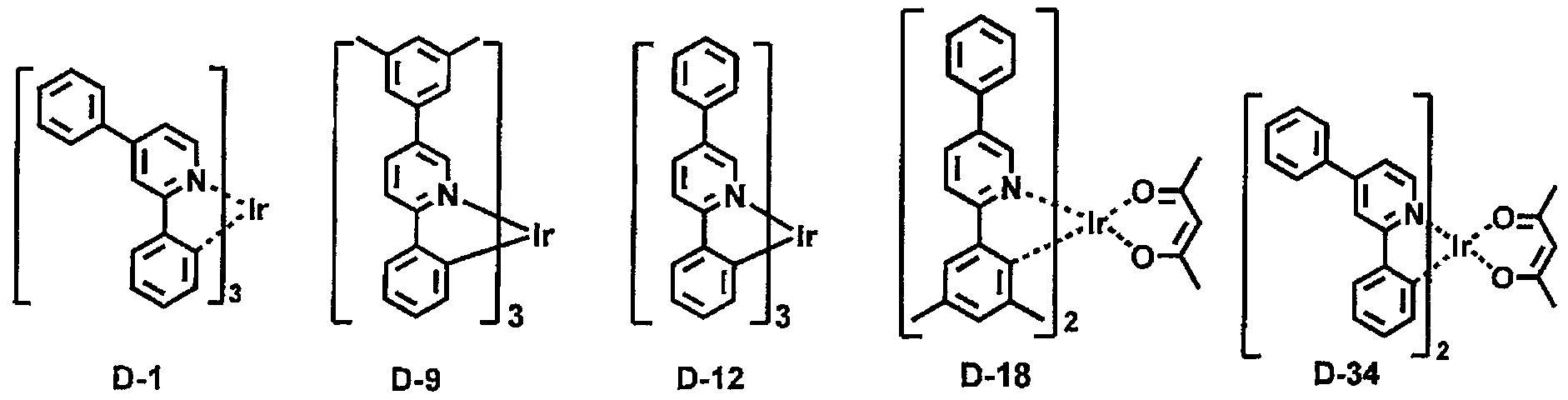
상기 화학식 1의 화합물은 보다 구체적으로 하기의 화합물로 예시될 수 있으나, 하기 화합물이 본 발명을 한정하는 것은 아니다.The compound of formula (1) may be more specifically exemplified by the following compounds, but the following compounds do not limit the invention.


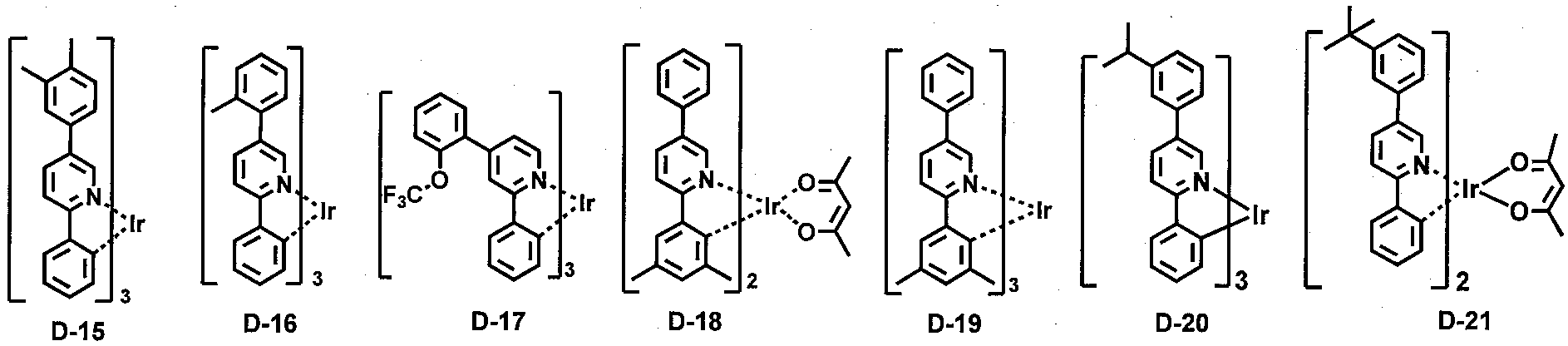


상기 화학식 2로 표시되는 호스트 화합물은 하기 화학식 5 내지 10으로 표시되는 화합물로부터 선택되는 것이 바람직하다.The host compound represented by the formula (2) is preferably selected from the compounds represented by the following formulas (5) to (10).
[화학식 5] [화학식 6] [화학식 7][Chemical Formula 5] (7)


[화학식 8] [화학식 9] [화학식 10][Chemical Formula 8]


상기 화학식 5 내지 10에 있어서, L1, L2, Ar1, Ar2, R21, a, b 및 c는 상기 화학식 2에서의 정의와 동일하다.Wherein L 1 , L 2 , Ar 1 , Ar 2 , R 21 , a, b and c are the same as defined in the above formula (2).
상기 화학식 2 및 5 내지 10에서, 상기 L1 및 L2는 각각 독립적으로 단일결합, 치환 또는 비치환된 (C6-C30)아릴렌, 또는 치환 또는 비치환된 (5-30원) 헤테로아릴렌이고, 바람직하게는 각각 독립적으로 단일결합, 치환 또는 비치환된 (C6-C20)아릴렌, 또는 치환 또는 비치환된 (5-22원) 헤테로아릴렌이며, 더욱 바람직하게는 각각 독립적으로 단일결합, (C1-C6)알킬로 치환 또는 비치환된 (C6-C20)아릴렌, 또는 비치환된 (5-22원) 헤테로아릴렌이다.Wherein L 1 and L 2 are each independently a single bond, substituted or unsubstituted (C6-C30) arylene, or substituted or unsubstituted (5-30 membered) heteroarylene (C6-C20) arylene, or substituted or unsubstituted (5-22 membered heteroarylene), and more preferably each independently is a single bond, a substituted or unsubstituted , (C6-C20) arylene substituted or unsubstituted with (C1-C6) alkyl, or unsubstituted (5-22) heteroarylene.
상기 Ar1 및 Ar2는 각각 독립적으로 수소, 중수소, 할로겐, 시아노, 니트로, 히드록시, 치환 또는 비치환된 (C1-C30)알킬, 치환 또는 비치환된 (C1-C30)알콕시, 치환 또는 비치환된 (C3-C30)시클로알킬, 치환 또는 비치환된 (C6-C30)아릴, 치환 또는 비치환된 트리(C1-C30)알킬실릴, 치환 또는 비치환된 트리(C6-C30)아릴실릴, 또는 치환 또는 비치환된 (5-30원) 헤테로아릴이거나, 인접한 치환체와 함께 단일환 또는 다환의 (C3-C30) 지환족 또는 방향족 고리를 형성할 수 있으며, 상기 형성된 지환족 또는 방향족 고리의 탄소 원자는 질소, 산소 및 황으로부터 선택되는 하나 이상의 헤테로원자로 대체될 수 있고, 바람직하게는 각각 독립적으로 수소, 치환 또는 비치환된 (C1-C6)알킬, 치환 또는 비치환된 (C6-C20)아릴, 치환 또는 비치환된 트리(C1-C6)알킬실릴, 치환 또는 비치환된 트리(C6-C12)아릴실릴, 또는 치환 또는 비치환된 (5-22원) 헤테로아릴이며, 더욱 바람직하게는 각각 독립적으로 수소; 비치환된 (C1-C6)알킬; (C1-C6)알킬 또는 (C6-C20)아릴로 치환 또는 비치환된 (C6-C20)아릴; 비치환된 트리(C1-C6)알킬실릴; 비치환된 트리(C6-C12)아릴실릴; 또는 비치환된 (5-22원) 헤테로아릴이다.Wherein Ar 1 and Ar 2 are each independently selected from the group consisting of hydrogen, deuterium, halogen, cyano, nitro, hydroxy, substituted or unsubstituted (C 1 -C 30) alkyl, substituted or unsubstituted (C 1 -C 30) (C6-C30) arylsilyl, substituted or unsubstituted tri (C1-C30) alkylsilyl, substituted or unsubstituted tri (C6-C30) arylsilyl , Or a substituted or unsubstituted (5-30 membered) heteroaryl, or may form a monocyclic or polycyclic (C3-C30) alicyclic or aromatic ring together with the adjacent substituents, and the formed alicyclic or aromatic ring The carbon atom may be substituted with one or more heteroatoms selected from nitrogen, oxygen and sulfur, and preferably each independently hydrogen, substituted or unsubstituted (C1-C6) alkyl, substituted or unsubstituted (C6- Aryl, substituted or unsubstituted tri (C1-C6) alkylsilyl, substituted or unsubstituted Li (C6-C12) arylsilyl, or a substituted or an unsubstituted (5-22 membered) heteroaryl, more preferably are each independently hydrogen, Unsubstituted (CrC6) alkyl; (C6-C20) aryl unsubstituted or substituted by (C1-C6) alkyl or (C6-C20) aryl; Unsubstituted tri (C1-C6) alkylsilyl; Unsubstituted tri (C6-C12) arylsilyl; Or unsubstituted (5-22 membered) heteroaryl.
상기 R21은 수소, 중수소, 할로겐, 치환 또는 비치환된 (C1-C30)알킬, 치환 또는 비치환된 (C6-C30)아릴, 치환 또는 비치환된 (5-30원) 헤테로아릴, -NR11R12 또는 -SiR13R14R15이거나, 인접한 치환체와 함께 단일환 또는 다환의 (C3-C30) 지환족 또는 방향족 고리를 형성할 수 있으며, 상기 형성된 지환족 또는 방향족 고리의 탄소 원자는 질소, 산소 및 황으로부터 선택되는 하나 이상의 헤테로원자로 대체될 수 있고, 바람직하게는 수소, 치환 또는 비치환된 (C6-C20)아릴, 또는 치환 또는 비치환된 (5-22원) 헤테로아릴이며, 더욱 바람직하게는 수소; 비치환된 (C6-C20)아릴; 또는 (C6-C20)아릴로 치환 또는 비치환된 (5-22원) 헤테로아릴이다.Wherein R 21 is hydrogen, deuterium, halogen, substituted or unsubstituted (C1-C30) alkyl, substituted or unsubstituted (C6-C30) aryl, substituted or unsubstituted (5-30 membered) heteroaryl, -NR 11 R 12 or -SiR 13 R 14 R 15, or may form a monocyclic or polycyclic (C3-C30) alicyclic or aromatic ring together with the adjacent substituents, and the carbon atom of the alicyclic or aromatic ring formed may be nitrogen (C6-C20) aryl, or a substituted or unsubstituted (5-22 membered heteroaryl) group, more preferably one or more heteroatoms selected from oxygen, sulfur and sulfur, and is preferably hydrogen, substituted or unsubstituted Preferably hydrogen; Unsubstituted (C6-C20) aryl; Or (5-22 membered) heteroaryl which is unsubstituted or substituted by (C6-C20) aryl.
상기 X는 -O-, -S-, -N(R22)-, -C(R23)(R24)- 또는 -Si(R25)(R26)-이다.X is -O-, -S-, -N (R 22 ) -, -C (R 23 ) (R 24 ) - or -Si (R 25 ) (R 26 ) -.
상기 R11 내지 R15 및 R22 내지 R26은 각각 독립적으로 수소, 중수소, 할로겐, 치환 또는 비치환된 (C1-C30)알킬, 치환 또는 비치환된 (C6-C30)아릴, 또는 치환 또는 비치환된 (5-30원) 헤테로아릴이거나, 인접한 치환체와 함께 단일환 또는 다환의 (C3-C30) 지환족 또는 방향족 고리를 형성할 수 있으며, 상기 형성된 지환족 또는 방향족 고리의 탄소 원자는 질소, 산소 및 황으로부터 선택되는 하나 이상의 헤테로원자로 대체될 수 있고, 바람직하게는 각각 독립적으로 수소, 치환 또는 비치환된 (C1-C6)알킬, 치환 또는 비치환된 (C6-C20)아릴, 또는 치환 또는 비치환된 (5-22원) 헤테로아릴이거나, 인접한 치환체와 함께 단일환 또는 다환의 (C3-C30) 지환족 또는 방향족 고리를 형성할 수 있으며, 더욱 바람직하게는 수소; 비치환된 (C1-C6)알킬; 비치환된 (C6-C20)아릴; 또는 (C6-C20)아릴로 치환 또는 비치환된 (5-22원) 헤테로아릴이거나; 인접한 치환체와 함께 단일환 또는 다환의 (C3-C30) 지환족 또는 방향족 고리를 형성할 수 있다.Wherein R 11 to R 15 and R 22 to R 26 are each independently selected from the group consisting of hydrogen, deuterium, halogen, substituted or unsubstituted (C 1 -C 30) alkyl, substituted or unsubstituted (C 6 -C 30) (C3-C30) cycloaliphatic or aromatic ring, and the carbon atom of the alicyclic or aromatic ring formed may be substituted with nitrogen, (C 1 -C 6) alkyl, substituted or unsubstituted (C 6 -C 20) aryl, or substituted or unsubstituted (C 1 -C 6) alkyl, substituted or unsubstituted Unsubstituted (5-22 membered) heteroaryl, or may form a monocyclic or polycyclic (C3-C30) alicyclic or aromatic ring with adjacent substituents, more preferably hydrogen; Unsubstituted (CrC6) alkyl; Unsubstituted (C6-C20) aryl; Or (5-22 membered) heteroaryl, which is unsubstituted or substituted by (C6-C20) aryl; May form a monocyclic or polycyclic (C3-C30) cycloaliphatic or aromatic ring with adjacent substituents.
상기 화학식 2의 화합물은 보다 구체적으로 하기의 화합물로서 예시될 수 있으나, 하기 화합물이 본 발명을 한정하는 것은 아니다.The compound of formula (2) may be more specifically exemplified as the following compounds, but the following compounds are not intended to limit the invention.


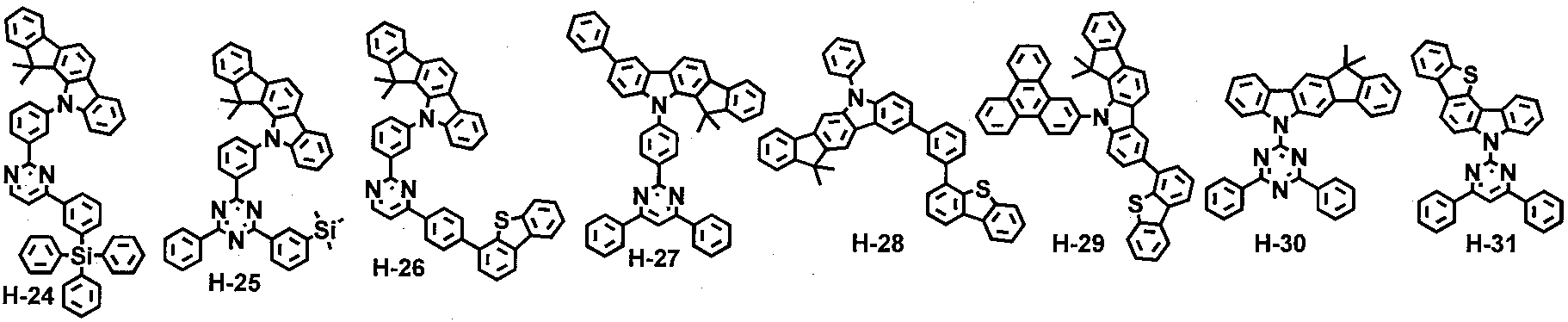












본 발명에 기재되어 있는 "(C1-C30)알킬(렌)"은 탄소수가 1 내지 30개인 직쇄 또는 분지쇄 알킬(렌)을 의미하고, 여기에서 탄소수가 1 내지 20개인 것이 바람직하고, 1 내지 10개인 것이 더 바람직하다. 상기 알킬의 구체적인 예로서, 메틸, 에틸, n-프로필, 이소프로필, n-부틸, 이소부틸 및 3급-부틸 등이 있다. 본원에서 "(C2-C30)알케닐"은 탄소수가 2 내지 30개인 직쇄 또는 분지쇄 알케닐을 의미하고, 여기에서 탄소수가 2 내지 20개인 것이 바람직하고, 2 내지 10개인 것이 더 바람직하다. 상기 알케닐의 구체적인 예로서, 비닐, 1-프로페닐, 2-프로페닐, 1-부테닐, 2-부테닐, 3-부테닐, 2-메틸부트-2-에닐 등이 있다. 본원에서 "(C2-C30)알키닐"은 탄소수가 2 내지 30개인 직쇄 또는 분지쇄 알키닐을 의미하고, 여기에서 탄소수가 2 내지 20개 인 것이 바람직하고, 2 내지 10개인 것이 더 바람직하다. 상기 알키닐의 예로서, 에티닐, 1-프로피닐, 2-프로피닐, 1-부티닐, 2-부티닐, 3-부티닐, 1-메틸펜트-2-이닐 등이 있다. 본원에서 "(C3-C30)시클로알킬"은 탄소수가 3 내지 30개인 단일환 또는 다환 탄화수소를 의미하고, 여기에서 탄소수가 3 내지 20개인 것이 바람직하고, 3 내지 7개인 것이 더 바람직하다. 상기 시클로알킬의 예로서, 시클로프로필, 시클로부틸, 시클로펜틸, 시클로헥실 등이 있다. 본원에서 "(3-7원) 헤테로시클로알킬"은 환 골격 원자수가 3 내지 7개이고, B, N, O, S, P(=O), Si 및 P로 이루어진 군에서 선택된 하나 이상의 헤테로원자, 바람직하게는 O, S 및 N에서 선택되는 하나 이상의 헤테로원자를 포함하는 시클로알킬을 의미하고, 예를 들어, 테트라히드로푸란, 피롤리딘, 티올란, 테트라히드로피란 등이 있다. 본원에서 "(C6-C30)아릴(렌)"은 탄소수가 6 내지 30개인 방향족 탄화수소에서 유래된 단일환 또는 융합환계 라디칼을 의미하고, 여기에서 환 골격 탄소수가 6 내지 20개인 것이 바람직하고, 6 내지 15개인 것이 더 바람직하다. 상기 아릴의 예로서, 페닐, 비페닐, 터페닐, 나프틸, 플루오레닐, 페난트레닐, 안트라세닐, 인데닐, 트리페닐레닐, 피레닐, 테트라세닐, 페릴레닐, 크라이세닐, 나프타세닐, 플루오란테닐 등이 있다. 본원에서 "(3-30원) 헤테로아릴(렌)"은 환 골격 원자수가 3 내지 30개이고, B, N, O, S, P(=O), Si 및 P로 이루어진 군에서 선택된 하나 이상의 헤테로원자를 포함하는 아릴 기를 의미한다. 여기에서 환 골격 원자수가 5 내지 20개인 것이 바람직하고, 5 내지 15개인 것이 더 바람직하다. 헤테로원자수는 바람직하게는 1 내지 4개이고, 단일 환계이거나 하나 이상의 벤젠환과 축합된 융합환계일 수 있으며, 부분적으로 포화될 수도 있다. 또한, 본원에서 상기 헤테로아릴(렌)은 하나 이상의 헤테로아릴 또는 아릴기가 단일 결합에 의해 헤테로아릴기와 연결된 형태도 포함한다. 상기 헤테로아릴의 예로서, 푸릴, 티오펜일, 피롤릴, 이미다졸릴, 피라졸릴, 티아졸릴, 티아디아졸릴, 이소티아졸릴, 이속사졸릴, 옥사졸릴, 옥사디아졸릴, 트리아진일, 테트라진일, 트리아졸릴, 테트라졸릴, 푸라잔일, 피리딜, 피라진일, 피리미딘일, 피리다진일 등의 단일 환계 헤테로아릴, 벤조푸란일, 벤조티오펜일, 이소벤조푸란일, 디벤조푸란일, 디벤조티오펜일, 벤조이미다졸릴, 벤조티아졸릴, 벤조이소티아졸릴, 벤조이속사졸릴, 벤조옥사졸릴, 이소인돌릴, 인돌릴, 인다졸릴, 벤조티아디아졸릴, 퀴놀릴, 이소퀴놀릴, 신놀리닐, 퀴나졸리닐, 퀴녹살리닐, 카바졸릴, 페녹사진일, 페난트리딘일, 벤조디옥솔릴 등의 융합 환계 헤테로아릴 등이 있다. 본원에서 "할로겐"은 F, Cl, Br 및 I 원자를 포함한다.The term "(C1-C30) alkyl (phenylene)" as used in the present invention means a linear or branched alkylene having 1 to 30 carbon atoms, wherein the number of carbon atoms is preferably 1 to 20, 10 is preferable. Specific examples of the alkyl include methyl, ethyl, n-propyl, isopropyl, n-butyl, isobutyl and tert-butyl. As used herein, "(C2-C30) alkenyl" means straight or branched chain alkenyl having 2 to 30 carbon atoms, preferably 2 to 20 carbon atoms, more preferably 2 to 10 carbon atoms. Specific examples of the alkenyl include vinyl, 1-propenyl, 2-propenyl, 1-butenyl, 2-butenyl, 3-butenyl, 2-methylbut-2-enyl and the like. As used herein, the term "(C2-C30) alkynyl" means straight chain or branched chain alkynyl having 2 to 30 carbon atoms, preferably 2 to 20 carbon atoms, more preferably 2 to 10 carbon atoms. Examples of the alkynyl include ethynyl, 1-propynyl, 2-propynyl, 1-butynyl, 2-butynyl, 3-butynyl and 1-methylpent-2-onyl. The term "(C3-C30) cycloalkyl" as used herein means a monocyclic or polycyclic hydrocarbon having 3 to 30 carbon atoms, preferably 3 to 20 carbon atoms, more preferably 3 to 7 carbon atoms. Examples of the cycloalkyl include cyclopropyl, cyclobutyl, cyclopentyl, cyclohexyl and the like. The term " (3-7 member) heterocycloalkyl "as used herein refers to a heterocycloalkyl group having 3 to 7 ring skeletal atoms and at least one heteroatom selected from the group consisting of B, N, O, S, P (= O) Preferably one or more heteroatoms selected from O, S and N, and includes, for example, tetrahydrofuran, pyrrolidine, thiolane, tetrahydropyran and the like. The term "(C6-C30) aryl (phenylene)" as used herein refers to a single ring or fused ring radical derived from an aromatic hydrocarbon having 6 to 30 carbon atoms, wherein the number of carbon atoms in the ring is 6 to 20, 15 < / RTI > Examples of such aryls include phenyl, biphenyl, terphenyl, naphthyl, fluorenyl, phenanthrenyl, anthracenyl, indenyl, triphenylenyl, pyrenyl, tetracenyl, perylenyl, , Fluoranthenyl, and the like. The term "(3-30) heteroaryl (phenylene)" used herein refers to a heteroaryl group having 3 to 30 ring skeletal atoms and one or more heteroatoms selected from the group consisting of B, N, O, S, P Quot; means an aryl group containing an atom. Here, the number of the atoms of the ring skeleton is preferably 5 to 20, more preferably 5 to 15. The number of heteroatoms is preferably 1 to 4, and may be a monocyclic ring system or a fused ring system condensed with at least one benzene ring, and may be partially saturated. In addition, the heteroaryl (phenylene) also includes a heteroaryl group in which at least one heteroaryl or aryl group is linked to a heteroaryl group by a single bond. Examples of such heteroaryls include furyl, thiophenyl, pyrrolyl, imidazolyl, pyrazolyl, thiazolyl, thiadiazolyl, isothiazolyl, isoxazolyl, oxazolyl, oxadiazolyl, triazinyl, tetrazinyl , Monocyclic heteroaryl such as triazolyl, tetrazolyl, furanzyl, pyridyl, pyrazinyl, pyrimidinyl and pyridazinyl, benzofuranyl, benzothiophenyl, isobenzofuranyl, dibenzofuranyl, di Benzoimidazolyl, benzothiazolyl, benzothiazolyl, benzoisothiazolyl, benzooxazolyl, isoindolyl, indolyl, indazolyl, benzothiadiazolyl, quinolyl, isoquinolyl, Fused heterocyclic heteroaryl such as norbornyl, quinazolinyl, quinoxalinyl, carbazolyl, phenoxaphyl, phenanthridinyl, benzodioxolyl and the like. As used herein, "halogen" includes F, Cl, Br, and I atoms.
또한 본 발명에 기재되어 있는 "치환 또는 비치환"이라는 기재에서 '치환'은 어떤 작용기에서 수소 원자가 다른 원자 또는 다른 작용기 (즉, 치환체)로 대체되는 것을 뜻한다. 상기 화학식에서, 치환 알킬(렌), 치환 아릴(렌), 치환 헤테로아릴(렌), 치환 시클로알킬, 치환 알콕시, 치환 트리알킬실릴, 치환 트리아릴실릴 및 치환 헤테로시클로알킬의 치환체는 각각 독립적으로 중수소, 할로겐, 할로겐으로 치환 또는 비치환된 (C1-C30)알킬, (3-30원)헤테로아릴로 치환 또는 비치환된 (C6-C30)아릴, (C6-C30)아릴로 치환 또는 비치환된 (3-30원)헤테로아릴, (5-7원)헤테로시클로알킬, (C6-C30)방향족고리가 하나 이상 융합된 (5-7원)헤테로시클로알킬, (C3-C30)시클로알킬, (C6-C30)방향족고리가 하나 이상 융합된 (C6-C30)시클로알킬, RaRbRcSi-, (C2-C30)알케닐, (C2-C30)알키닐, 시아노, 카바졸릴, -NRdRe, -BRfRg, -PRhRi, -P(=O)RjRk, (C6-C30)아르(C1-C30)알킬, (C1-C30)알킬(C6-C30)아릴, RlZ-, RmC(=O)-, RmC(=O)O-, 카르복실, 니트로 및 히드록시로 이루어진 군으로부터 선택되는 1종 이상인 것이 바람직하며, 상기 Ra 내지 Rl은 각각 독립적으로 (C1-C30)알킬, (C6-C30)아릴 또는 (C3-C30)헤테로아릴이거나, 인접한 치환체와 함께 단일환 또는 다환의 (C3-C30) 지환족 또는 방향족 고리를 형성할 수 있으며, 상기 형성된 지환족 또는 방향족 고리의 탄소 원자는 질소, 산소 및 황으로부터 선택되는 하나 이상의 헤테로원자로 대체될 수 있고; Z는 S 또는 O이며; Rm은 (C1-C30)알킬, (C1-C30)알콕시, (C6-C30)아릴 또는 (C6-C30)아릴옥시이다.Also, in the phrase "substituted or unsubstituted" described in the present invention, "substituted" means that a hydrogen atom is replaced with another atom or another functional group (ie, a substituent) in a certain functional group. In the above formulas, the substituents of the substituted alkyl (phenylene), substituted aryl (phenylene), substituted heteroaryl (phenylene), substituted cycloalkyl, substituted alkoxy, substituted trialkylsilyl, substituted triarylsilyl and substituted heterocycloalkyl are each independently (C6-C30) aryl, (C6-C30) aryl which is unsubstituted or substituted by halogen, halogen, halogen substituted by (C1-C30) (5- to 7-membered) heterocycloalkyl, (5- to 7-membered) heterocycloalkyl fused with at least one (C6-C30) aromatic ring, (C3-C30) (C6-C30) cycloalkyl, RaRbRcSi-, (C2-C30) alkenyl, (C2-C30) alkynyl, cyano, carbazolyl, -NRdRe, -BRfRg , -PRhRi, -P (= O) RjRk, (C6-C30) ar (C1-C30) alkyl, (CrC30) = O) O-, carboxyl, nitro, and hydroxy (C3-C30) aryl or (C3-C30) heteroaryl, or together with the adjacent substituents, a single or multi-ring (C3-C30) Alicyclic or aromatic ring, and the carbon atom of the alicyclic or aromatic ring formed may be substituted with one or more heteroatoms selected from nitrogen, oxygen and sulfur; Z is S or O; Rm is (C1-C30) alkyl, (C1-C30) alkoxy, (C6-C30) aryl or (C6-C30) aryloxy.
구체적으로, 본 발명에 따른 유기 전계 발광 소자는 제1전극; 제2전극; 및 상기 제1전극 및 제2전극 사이에 개재되는 1층 이상의 유기물층을 가지며, 상기 유기물층은 발광층을 포함하고, 상기 발광층은 상기 화학식 1로 표시되는 1종 이상의 도판트 화합물 및 상기 화학식 2로 표시되는 1종 이상의 호스트 화합물을 포함한다.Specifically, the organic electroluminescent device according to the present invention includes a first electrode; A second electrode; And at least one organic compound layer interposed between the first electrode and the second electrode, wherein the organic compound layer includes a light emitting layer, wherein the light emitting layer comprises at least one dopant compound represented by Formula 1 and at least one dopant compound represented by Formula 2 At least one host compound.
상기 발광층의 의미는 발광이 이루어지는 층으로서 단일 층일 수 있으며, 또한 2개 이상의 층이 적층된 복수의 층일 수 있다. 상기 발광층의 호스트 화합물에 대한 도판트 화합물의 도핑농도가 20 중량% 미만이 바람직하다.The light emitting layer may be a single layer as a light emitting layer, or may be a plurality of layers in which two or more layers are stacked. The doping concentration of the dopant compound with respect to the host compound of the light emitting layer is preferably less than 20% by weight.
본 발명의 다른 양태에 의하면, 본 발명은 상기 화학식 1로 표시되는 하나 이상의 도판트 화합물 및 상기 화학식 2로 표시되는 하나 이상의 호스트 화합물의 호스트/도판트 조합을 제공한다. 또한, 본 발명은 상기 호스트/도판트 조합을 포함하는 유기 전계 발광 소자를 제공한다.According to another aspect of the present invention, there is provided a host / dopant combination of at least one dopant compound represented by Formula 1 and at least one host compound represented by Formula 2. The present invention also provides an organic electroluminescent device comprising the host / dopant combination.
본 발명의 또 다른 양태에 의하면, 본 발명은 상기 화학식 1로 표시되는 하나 이상의 도판트 화합물 및 상기 화학식 2로 표시되는 하나 이상의 호스트 화합물을 함유하는 유기물층을 제공한다. 상기 유기물층은 복수의 층을 포함하며, 상기 도판트 화합물과 상기 호스트 화합물은 동일한 층에 포함될 수도 있고, 각각 서로 다른 층에 포함될 수도 있다. 또한, 본 발명은 상기 유기물층을 포함하는 유기 전계 발광 소자를 제공한다.According to another aspect of the present invention, there is provided an organic material layer containing at least one dopant compound represented by Formula 1 and at least one host compound represented by Formula 2. The organic material layer includes a plurality of layers, and the dopant compound and the host compound may be included in the same layer or may be included in different layers, respectively. The present invention also provides an organic electroluminescent device including the organic material layer.
또한, 본 발명의 유기 전계 발광 소자에 있어서, 한 쌍의 전극의 적어도 한쪽의 표면에 전자 전달 화합물과 환원성 도판트의 혼합 영역 또는 정공 전달 화합물과 산화성 도판트의 혼합 영역을 배치하는 것도 바람직하다. 이러한 방식으로, 전자 전달 화합물이 음이온으로 환원되므로 혼합 영역으로부터 발광 매체에 전자를 주입 및 전달하기 용이해진다. 또한, 정공 전달 화합물은 산화되어 양이온으로 되므로 혼합 영역으로부터 발광 매체에 정공을 주입 및 전달하기 용이해진다. 바람직한 산화성 도판트로서는 각종 루이스산 및 억셉터(acceptor) 화합물을 들 수 있다. 바람직한 환원성 도판트로서는 알칼리 금속, 알칼리 금속 화합물, 알칼리 토류 금속, 희토류 금속 및 이들의 혼합물을 들 수 있다. 또한 환원성 도판트층을 전하생성층으로 사용하여 두 개 이상의 발광층을 가진 백색 유기 전계 발광 소자를 제작할 수 있다.In the organic electroluminescent device of the present invention, it is also preferable to arrange a mixed region of the electron transfer compound and the reducing dopant or a mixed region of the hole transport compound and the oxidative dopant, on at least one surface of the pair of electrodes. In this way, since the electron transfer compound is reduced to the anion, it becomes easy to inject and transfer electrons from the mixed region to the light emitting medium. Further, since the hole transport compound is oxidized and becomes a cation, it becomes easy to inject and transport holes from the mixed region into the light emitting medium. Preferred oxidizing dopants include various Lewis acids and acceptor compounds. Preferred reducing dopants include alkali metals, alkali metal compounds, alkaline earth metals, rare earth metals, and mixtures thereof. Also, a white organic light emitting device having two or more light emitting layers can be manufactured using a reducing dopant layer as a charge generating layer.
이하에서, 본 발명의 상세한 이해를 위하여 본 발명의 대표 화합물을 들어 본 발명에 따른 화합물, 이의 제조방법 및 소자의 발광특성을 설명하나, 이는 단지 그 실시 양태를 예시하기 위한 것일 뿐, 본 발명의 범위를 한정하는 것은 아니다.Hereinafter, for a detailed understanding of the present invention, the compounds according to the present invention, the preparation method thereof and the luminescent characteristics of the device are described for the representative compounds of the present invention, but the present invention is not limited thereto. It is not intended to limit the scope.
[실시예 1] 화합물 D-1의 제조[Example 1] Preparation of Compound D-1

화합물 1-1의 제조Preparation of Compound 1-1
플라스크에 2,4-디클로로피리딘 5 g (34 mmol), 페닐보론산 16 g (135 mmol), Pd(PPh3)4 3.9 g (2.4 mmol) 및 K2CO3 23 g (135 mmol), 톨루엔 100 mL, 에탄올 50 mL 및 H2O 50 mL을 넣고, 120℃ 로 6시간 교반하였다. 반응 혼합물은 건조하여 칼럼 분리하여 화합물 1-1 6.4 g (82 %)을 얻었다.A flask 2,4-dichloro pyridine 5 g (34 mmol), phenylboronic acid 16 g (135 mmol), Pd (PPh 3) 4 3.9 g (2.4 mmol) and K 2 CO 3 23 g (135 mmol), toluene 100 mL of ethanol, 50 mL of ethanol, and 50 mL of H 2 O, and the mixture was stirred at 120 ° C for 6 hours. The reaction mixture was dried and separated by column to obtain 6.4 g (82%) of Compound 1-1.
화합물 1-2의 제조Preparation of Compound 1-2
플라스크에 화합물 1-1 4 g (17 mmol), IrCl3 2.3 g (7.8 mmol), 2-에톡시에탄올 60 mL 및 H2O 20 mL(2-에톡시에탄올/H2O=3/1)을 모두 넣고, 120℃에서 환류를 24시간 동안 진행시켰다. 반응이 종료되면, H2O/MeOH/헥산(Hex)을 사용하여 세척 건조하여 화합물 1-2 3.0 g (56 %)을 얻었다.The flask compounds 1-1 4 g (17 mmol), IrCl 3 2.3 g (7.8 mmol), ethoxyethanol and 60 mL H 2 O 20 mL 2- (2-ethoxy-ethanol / H 2 O = 3/1 ) And the reflux was allowed to proceed for 24 hours at 120 ° C. When the reaction was completed, the reaction product was washed with H 2 O / MeOH / hexane (Hex) to obtain 3.0 g (56%) of Compound 1-2.
화합물 1-3의 제조Preparation of compounds 1-3
플라스크에 화합물 1-2 3.0 g (2.2 mmol), 2,4-디펜타디온 0.6 g (6.5 mmol), Na2CO3 1.4 g (13 mmol) 및 2-에톡시에탄올 10 mL을 모두 넣고, 110℃에서 12시간 동안 반응을 진행시켰다. 반응이 종료되면 생성된 고체를 건조하여 칼럼 분리하여 화합물 1-3 3 g (75 %)을 얻었다.The flask Compound 1-2 3.0 g (2.2 mmol), 2,4- di-penta-dione 0.6 g (6.5 mmol), Na 2 CO 3 1.4 g (13 mmol) and into both ethoxyethanol 10 mL of 2, 110 RTI ID = 0.0 > C < / RTI > for 12 hours. After completion of the reaction, the resulting solid was dried and separated by column to obtain 3 g (75%) of Compound 1-3.
화합물 D-1의 제조Preparation of compound D-1
플라스크에 화합물 1-3 2.44 g (3.25 mmol), 화합물 1-1 1.5 g (6.49 mmol)을 가하고 글리세롤을 가하여 16시간 동안 환류하였다. 반응 후 생긴 고체를 여과하고 건조하여 칼럼 분리하여 화합물 D-1 2.5 g (87 %)을 얻었다.To the flask was added 2.44 g (3.25 mmol) of Compound 1-3 and 1.5 g (6.49 mmol) of Compound 1-1, and glycerol was added thereto, followed by refluxing for 16 hours. The solid formed after the reaction was filtered, dried and separated by column to obtain 2.5 g (87%) of the compound D-1.
[실시예 2] 화합물 D-2 및 D-8의 제조[Example 2] Preparation of compounds D-2 and D-8

화합물 2-1의 제조Preparation of Compound 2-1
플라스크에 2,5-디브로모피리딘 20 g (84 mmol), 2,4-디메틸벤젠보론산 15 g (101 mmol), Pd(PPh3)4 4 g (3.4 mmol), Na2CO3 27 g (253 mmol), 톨루엔 240 mL 및 H2O 120 mL를 넣고, 100℃에서 12시간 교반하였다. 반응 혼합물을 에틸아세테이트(EA)로 추출하고 MgSO4로 수분을 제거한 후, 감압증류하였다. 반응 혼합물을 건조하여 칼럼 분리하여 화합물 2-1 18 g (70 %)을 얻었다.A flask 2,5-dibromo-pyridine 20 g (84 mmol), 2,4- dimethyl-benzene-boronic acid 15 g (101 mmol), Pd (PPh 3) 4 4 g (3.4 mmol), Na 2 CO 3 27 g (253 mmol), 240 mL of toluene and 120 mL of H 2 O, and the mixture was stirred at 100 ° C for 12 hours. The reaction mixture was extracted with ethyl acetate (EA), and water was removed with MgSO 4 , followed by distillation under reduced pressure. The reaction mixture was dried and separated by column to obtain 18 g (70%) of the compound 2-1.
화합물 2-2의 제조Preparation of Compound 2-2
플라스크에서 화합물 2-1 18 g (70 mmol) 및 페닐보론산 13 g (105 mmol)을 사용하여 화합물 1-1와 동일한 방법으로 합성하여 화합물 2-2 18 g (99 %)를 얻었다.18 g (99%) of the compound 2-2 was obtained by the same method as the compound 1-1 using 18 g (70 mmol) of the compound 2-1 and 13 g (105 mmol) of the phenylboronic acid in the flask.
화합물 2-3의 제조Preparation of Compound 2-3
플라스크에서 화합물 2-2 14 g (54 mmol) 및 IrCl3 7.5 g (24.3 mmol)을 사용하여 화합물 1-2와 동일한 방법으로 합성하여 화합물 2-3 13 g (72 %)를 얻었다.The compound 2-2 was synthesized in the same manner as the compound 1-2 by using 14 g (54 mmol) of the compound 2-2 and 7.5 g (24.3 mmol) of IrCl 3 to obtain 13 g (72%) of the compound 2-3.
화합물D-2의 제조Preparation of Compound D-2
플라스크에서 화합물 2-3 3 g (2 mmol)을 화합물 1-3과 동일한 방법으로 합성하여 화합물 D-2 2.4 g (74 %)를 얻었다.3 g (2 mmol) of Compound 2-3 was synthesized in the same manner as Compound 1-3, to obtain 2.4 g (74%) of Compound D-2.
화합물 D-8의 제조Preparation of compound D-8
플라스크에서 화합물 D-2 2.4 g (3 mmol)을 D-1과 동일한 방법으로 합성하여 화합물 D-8 1.5 g (50 %)을 얻었다.In a flask, 2.4 g (3 mmol) of the compound D-2 was synthesized in the same manner as D-1 to obtain 1.5 g (50%) of the compound D-8.
[실시예 3] 화합물 D-9 및 D-10의 제조[Example 3] Preparation of compounds D-9 and D-10

화합물 3-1의 제조Preparation of Compound 3-1
플라스크에서 2,5-디브로모피리딘 20 g (84 mmol) 및 페닐보론산 12 g (101 mmol)을 사용하여 화합물 2-1과 동일한 방법으로 합성하여 화합물 3-1 16 g (79 %)을 얻었다.16 g (79%) of the compound 3-1 was synthesized in the same manner as in the compound 2-1 except that 20 g (84 mmol) of 2,5-dibromopyridine and 12 g (101 mmol) of phenylboronic acid were used in the flask. .
화합물 3-2의 제조Preparation of Compound 3-2
플라스크에서 화합물 3-1 16 g (67 mmol) 및 3,5-디메틸페닐보론산 15 g (101 mmol)을 사용하여 화합물 2-2와 동일한 방법으로 합성하여 화합물 3-2 17 g (97 %)을 얻었다.17 g (97%) of the compound 3-2 was synthesized in the same manner as the compound 2-2 using 16 g (67 mmol) of the compound 3-1 and 15 g (101 mmol) of 3,5-dimethylphenylboronic acid in a flask, ≪ / RTI >
화합물 3-3의 제조Preparation of compound 3-3
플라스크에서 화합물 3-2 7 g (27 mmol) 및 IrCl3 3.7 g (12 mmol)을 사용하여 화합물 2-3과 동일한 방법으로 합성하여 화합물 3-3 6 g (65 %)를 얻었다.The compound 3-3 was synthesized in an amount of 6 g (65%) in the same manner as the compound 2-3 by using 7 g (27 mmol) of the compound 3-2 and 3.7 g (12 mmol) of IrCl 3 in the flask.
화합물 D-10의 제조Preparation of compound D-10
플라스크에서 화합물 3-3 6 g (4 mmol) 및 2,4-펜타디온 1.2 g (12 mmol)을 사용하여 D-2와 동일한 방법으로 합성하여 화합물 D-10 5 g (81 %)를 얻었다.The compound was synthesized in the same manner as D-2 using 6 g (4 mmol) of the compound 3-3 and 1.2 g (12 mmol) of 2,4-pentadione in a flask to obtain 5 g (81%) of the compound D-10.
화합물 D-9의 제조Preparation of compound D-9
플라스크에서 화합물 D-10 3 g (3.7 mmol) 및 화합물 3-2 2 g (7.4 mmol)을 사용하여 화합물 D-8과 동일한 방법으로 합성하여 화합물 D-9 1.6 g (45 %)를 얻었다.Compound D-9 (1.6 g, 45%) was obtained in the same manner as Compound D-8 by using 3 g (3.7 mmol) of Compound D-10 and 2 g (7.4 mmol) of Compound 3-2 in a flask.
[실시예 4] 화합물 D-11 및 D-12의 제조[Example 4] Preparation of compounds D-11 and D-12

화합물 4-1의 제조Preparation of Compound 4-1
플라스크에서 2,5-디브로모피리딘 70 g (295.5 mmol) 및 페닐보론산 83 g (679.6 mmol)를 사용하여 화합물 1-1과 동일한 방법으로 합성하여 화합물 4-1 60 g (87 %)을 얻었다. 60 g (87%) of Compound 4-1 was synthesized in the same manner as Compound 1-1 using 70 g (295.5 mmol) of 2,5-dibromopyridine and 83 g (679.6 mmol) of phenylboronic acid in a flask .
화합물 4-2의 제조Preparation of Compound 4-2
플라스크에서 화합물 4-1 40 g (380.5 mmol) 및 IrCl3 23.5 g (173 mmol)을 사용하여 1-2와 동일한 방법으로 합성하여 화합물 4-2 44 g (92 %)을 얻었다The compound 4-1 was synthesized in the same manner as 1-2 using 40 g (380.5 mmol) of the compound 4-1 and 23.5 g (173 mmol) of IrCl 3 to obtain 44 g (92%) of the compound 4-2
화합물 D-11의 제조Preparation of compound D-11
플라스크에서 화합물 4-2 44 g (48 mmol) 및 2,4-펜타디온 9.6 g (96 mmol)을 사용하여 화합물 1-3과 동일한 방법으로 합성하여 화합물 D-11 42 g (87.4 %)을 얻었다.In a flask, 42 g (48 mmol) of the compound 4-2 and 9.6 g (96 mmol) of 2,4-pentadione were used to synthesize 42 g (87.4%) of the compound D-11 in the same manner as the compound 1-3 .
화합물 D-12의 제조Preparation of compound D-12
플라스크에서 화합물 D-11 42 g (80.5 mmol) 및 화합물 4-1 20 g (161 mmol)을 사용하여 화합물 D-1과 동일한 방법으로 합성하여 화합물 D-12 20 g (38 %)을 얻었다In a flask, the compound D-11 was synthesized in the same manner as the compound D-1 using 42 g (80.5 mmol) of the compound D-11 and 20 g (161 mmol) of the compound 4-1 to obtain 20 g (38%
[실시예 5] 화합물 H-33의 제조[Example 5] Preparation of Compound H-33

화합물 5-1의 제조Preparation of Compound 5-1
1-브로모-2-나이트로벤젠 39 g (0.19 mol), 디벤조[b,d]퓨란-4-일보론산 45 g (0.21 mol), Pd(PPh3)4 11.1 g (0.0096 mol), 2M K2CO3 수용액 290 mL, EtOH 290 mL 및 톨루엔 580 mL를 혼합한 후 120℃로 가열시키면서 4시간 교반하였다. 반응이 끝나면 증류수로 씻어주고 EA로 추출한 뒤 유기층을 무수 MgSO4로 건조시킨 후 회전 증발기로 용매를 제거한 후 컬럼 크로마토그래피로 정제하여 화합물 5-1 47 g (85 %)를 얻었다.Benzene 39 g of 1-bromo-2-nitro (0.19 mol), dibenzo [b, d] furan -4- 45 g Daily acid (0.21 mol), Pd (PPh 3) 4 11.1 g (0.0096 mol), 290 mL of 2M K 2 CO 3 aqueous solution, 290 mL of EtOH and 580 mL of toluene were mixed and stirred for 4 hours while being heated to 120 ° C. After the reaction was completed, the reaction mixture was washed with distilled water and extracted with EA. The organic layer was dried over anhydrous MgSO 4 , and the solvent was removed using a rotary evaporator, followed by purification by column chromatography to obtain 47 g (85%) of Compound 5-1.
화합물 5-2의 제조Preparation of Compound 5-2
화합물 5-1 47 g (0.16 mol), 트리에틸포스파이트 600 mL 및 1,2-디클로로벤젠 300 mL를 혼합한 후 150℃로 가열하여 12시간 교반하였다. 반응이 끝나면 증류(distillation) 장치를 이용해서 미반응 트리에틸포스파이트와 1,2-디클로로벤젠을 제거한 후, 증류수로 씻어주고 EA로 추출한 뒤 유기층을 무수 MgSO4로 건조시켰다. 회전 증발기로 용매를 제거한 후 컬럼 크로마토그래피로 정제하여 화합물 5-2 39 g (81 %)를 얻었다.47 g (0.16 mol) of Compound 5-1, 600 mL of triethylphosphite and 300 mL of 1,2-dichlorobenzene were mixed, and the mixture was heated to 150 캜 and stirred for 12 hours. After the reaction was completed, unreacted triethyl phosphite and 1,2-dichlorobenzene were removed using a distillation apparatus, washed with distilled water, extracted with EA, and the organic layer was dried over anhydrous MgSO 4 . The solvent was removed using a rotary evaporator and then purified by column chromatography to obtain 39 g (81%) of Compound 5-2.
화합물 H-33의 제조Preparation of Compound H-33
NaH (1.9 mg, 42.1 mmol) 을 디메틸포름아미드(DMF)에 녹여 교반시켰다. 화합물 5-2 (7 g, 27.2 mmol) 을 DMF에 녹인 후, 교반시키는 NaH용액에 첨가하여 1시간 동안 교반하였다. 2-클로로-4,6-디페닐피리미딘 (8.7 g, 32.6 mmol) 을 DMF 에 녹인 후 교반시키고 1시간 동안 교반시킨 반응물을 첨가하고 실온에서 24시간 교반시켰다. 반응이 끝나면 생성된 고체를 거른 후, 에틸 아세테이트로 씻어주고 컬럼 크로마토그래피로 정제하여 목적 화합물 H-33 (3.5 g, 25 %)를 얻었다.NaH (1.9 mg, 42.1 mmol) was dissolved in dimethylformamide (DMF) and stirred. Compound 5-2 (7 g, 27.2 mmol) was dissolved in DMF and added to stirred NaH solution and stirred for 1 hour. 2-Chloro-4,6-diphenylpyrimidine (8.7 g, 32.6 mmol) was dissolved in DMF, stirred, and stirred for 1 hour. The reaction mixture was stirred at room temperature for 24 hours. After completion of the reaction, the resulting solid was filtered off, washed with ethyl acetate, and purified by column chromatography to obtain the title compound H-33 (3.5 g, 25%).
[실시예 6]화합물 H-43의 제조[Example 6] Preparation of compound H-43

화합물 5-2 (7 g, 27.2 mmol)과 2-클로로-4,6-디페닐-1,3,5-트리아진 (8.2 g, 32.6 mmol)을 사용하여 화합물 H-33과 동일한 방법으로 제조하여 목적화합물 H-43 (11.3 g, 78 %)를 얻었다.Compound H-33 was prepared using Compound 5-2 (7 g, 27.2 mmol) and 2-chloro-4,6-diphenyl-1,3,5-triazine (8.2 g, 32.6 mmol) To obtain the title compound H-43 (11.3 g, 78%).
[실시예 7] 화합물 H-45의 제조[Example 7] Preparation of Compound H-45

화합물 7-1의 제조Preparation of Compound 7-1
디벤조[b,d]티오펜-4-일보론산 10 g (43.84 mmol)을 사용하여 화합물 5-1과 동일한 방법으로 제조하여 화합물 7-1 10 g (32.74 mmol, 74.68 %)을 얻었다.Dibenzo [b, d] thiophen-4-ylboronic acid (10 g, 43.84 mmol) was used to produce 10 g (32.74 mmol, 74.68%) of the compound 7-1.
화합물 7-2의 제조Preparation of Compound 7-2
화합물 7-1 10 g (32.74 mmol)을 사용하여 화합물 5-2와 동일한 방법으로 제조하여 화합물 7-2 7 g (25.60 mmol, 78.19 %)을 얻었다.Compound 7-1 10 g (32.74 mmol) was used to prepare 7 g of Compound 7-2 (25.60 mmol, 78.19%) in the same manner as Compound 5-2.
화합물 H-45의 제조Preparation of compound H-45
화합물 7-2 (7 g, 25.6 mmol)와 2-클로로-4,6-디페닐-1,3,5-트리아진 (8.7 g, 32.6 mmol)을 사용하여 화합물 H-33과 동일한 방법으로 제조하여 H-45 (5.6 g, 40 %)를 얻었다.Preparation of Compound H-33 was performed using Compound 7-2 (7 g, 25.6 mmol) and 2-chloro-4,6-diphenyl-1,3,5-triazine (8.7 g, 32.6 mmol) To give H-45 (5.6 g, 40%).
[실시예 8] 화합물 H-67의 제조[Example 8] Preparation of compound H-67

화합물 7-2 (7 g, 25.6 mmol)와 화합물 8-1 (8.2 g, 32.6 mmol)을 사용하여 화합물 H-33과 동일한 방법으로 제조하여 목적 화합물 H-67 (5.3 g, 49 %)를 얻었다.Compound H-67 (5.3 g, 49%) was obtained by the same method as Compound H-33, using Compound 7-2 (7 g, 25.6 mmol) and Compound 8-1 (8.2 g, 32.6 mmol) .
[실시예 9] 화합물 H-99의 제조[Example 9] Preparation of Compound H-99

화합물 5-2 (7 g, 27.2 mmol)과 2-클로로-4,6-디(나프탈렌-1-일)-1,3,5-트리아진 (15.2 g, 32.6 mmol)을 사용하여 화합물 H-33과 동일한 방법으로 제조하여 목적화합물 H-99 (8.6 g, 46 %)를 얻었다.Using compound 5-2 (7 g, 27.2 mmol) and 2-chloro-4,6-di (naphthalen-1-yl) -1,3,5-triazine (15.2 g, 32.6 mmol) 33, to obtain the title compound H-99 (8.6 g, 46%).
[실시예 10] 화합물 H-118의 제조[Example 10] Preparation of compound H-118

화합물 10-1의 제조Preparation of Compound 10-1
2-브로모-9,9-다이메틸-9H-플루오렌 80 g (291 mmol), 2-클로로벤젠아민 45 mL (437 mmol), Pd(OAc)2 2.6 g (12 mmol), P(t-Bu)3 12 mL (24 mmol), NaOt-Bu 70 g (728 mmol) 및 톨루엔 800 mL를 혼합한 후 120℃로 가열시키면서 9시간 교반하였다. 반응이 끝나면 실온으로 식힌 후 에틸아세테이트 1.5 L 로 추출하여, 얻어진 유기층을 증류수 400 mL로 씻어주었다. 그 후 감압 하에서 용매를 제거하여 얻어진 고체를 헥산으로 씻어 필터한 후 건조하였다. 실리카겔 컬럼크로마토그래피와 재결정법으로 분리하여 화합물 10-1 70 g (75 %)을 얻었다.2-bromo-9,9-dimethyl--9H- fluorene 80 g (291 mmol), 2- chloro-benzene amine 45 mL (437 mmol), Pd (OAc) 2 2.6 g (12 mmol), P (t -Bu) 3 12 mL (24 mmol), NaOt-Bu 70 g (728 mmol) and toluene 800 mL were mixed and stirred for 9 hours while heating to 120 ° C. After the reaction was completed, the mixture was cooled to room temperature, extracted with 1.5 L of ethyl acetate, and the obtained organic layer was washed with 400 mL of distilled water. The solvent was then removed under reduced pressure, and the resulting solid was washed with hexane, filtered and dried. The residue was separated by silica gel column chromatography and recrystallization to obtain 70 g (75%) of Compound 10-1.
화합물 10-2의 제조Preparation of Compound 10-2
화합물 10-1 70 g (218 mmol), Pd(OAc)2 2.4 g (11 mmol), PCy3HBF4 8 g (22 mmol), Na2CO3 70 g (654 mmol) 및 디메틸아세트아마이드(DMA) 1.2 L를 혼합하고 190℃에서 3시간 동안 교반하였다. 반응이 끝나면 에틸아세테이트 1 L로 추출한 후, 얻어진 유기층을 증류수 200 mL로 씻어준 다음, 무수황산마그네슘으로 건조하고, 유기용매는 감압 하에서 제거하였다. 얻어진 고체는 실리카겔 컬럼크로마토그래피와 재결정법으로 분리하여 화합물 10-2 22 g (36 %)을 얻었다.Compound 10-1 70 g (218 mmol), Pd (OAc) 2 2.4 g (11 mmol), PCy 3 HBF 4 8 g (22 mmol), Na 2 CO 3 70 g (654 mmol) and dimethyl acetamide (DMA ) Were mixed and stirred at 190 캜 for 3 hours. After the reaction was completed, the organic layer was extracted with 1 L of ethyl acetate, washed with 200 mL of distilled water, dried over anhydrous magnesium sulfate, and the organic solvent was removed under reduced pressure. The obtained solid was separated by silica gel column chromatography and recrystallization to obtain 22 g (36%) of Compound 10-2.
화합물 10-3의 제조Preparation of compound 10-3
화합물 10-2 15 g (53 mmol), 1,4-다이브로모벤젠 32 mL (265 mmol), Pd(OAc)2 1.2 g (5 mmol), P(t-Bu)3 30 mL (64 mmol), NaOt-Bu 25 g (265 mmol) 및 톨루엔 300 mL을 혼합하고 120℃에서 24시간 동안 교반하였다. 반응이 끝나면 실온으로 식힌 후 에틸아세테이트 1.5 L 로 추출하여, 얻어진 유기층을 증류수 400 mL로 씻어주었다. 그 후 감압 하에서 용매를 제거하여 얻어진 고체를 헥산으로 씻어 필터한 후 건조하였다. 실리카겔 컬럼크로마토그래피와 재결정법으로 분리하여 화합물 10-3 7 g (30 %)을 얻었다.Compound 10-2 15 g (53 mmol), 1,4- dibromo-benzene, 32 mL (265 mmol), Pd (OAc) 2 1.2 g (5 mmol), P (t-Bu) 3 30 mL (64 mmol) , 25 g (265 mmol) of NaOt-Bu and 300 mL of toluene were mixed and stirred at 120 DEG C for 24 hours. After the reaction was completed, the mixture was cooled to room temperature, extracted with 1.5 L of ethyl acetate, and the obtained organic layer was washed with 400 mL of distilled water. The solvent was then removed under reduced pressure, and the resulting solid was washed with hexane, filtered and dried. The residue was separated by silica gel column chromatography and recrystallization to obtain 7 g (30%) of Compound 10-3.
화합물 10-4의 제조Preparation of Compound 10-4
화합물 10-3 7 g (16 mmol)을 테트라하이드로퓨란(THF) 100 mL에 녹인 후 -78℃에서 n-BuLi (헥산 내 2.5 M) 10 mL (24 mmol)를 첨가하였다. 이 혼합물을 -78℃에서 1시간 동안 교반한 후 B(Oi-Pr)3 6 mL (24 mmol)를 첨가하였다. 전체 반응물을 2시간 동안 교반하여준 후 염화암모늄 수용액 20 mL로 반응을 종결시킨 후 에틸아세테이트 500 mL로 추출하고, 얻어진 유기층을 증류수 200 mL로 씻어주었다. 유기층을 무수황산마그네슘으로 건조하고, 유기용매는 감압하에서 제거하였다. 얻어진 고체는 재결정방법으로 분리하여 화합물 10-4 5 g (75 %)을 얻었다.7 g (16 mmol) of compound 10-3 was dissolved in 100 mL of tetrahydrofuran (THF), and 10 mL (24 mmol) of n-BuLi (2.5 M in hexane) was added at -78 ° C. The mixture was stirred at -78 < 0 > C for 1 hour and then 6 mL (24 mmol) of B (Oi-Pr) 3 was added. The reaction was stirred for 2 hours, and then the reaction was terminated with 20 mL of an aqueous ammonium chloride solution. The reaction mixture was extracted with 500 mL of ethyl acetate, and the organic layer was washed with 200 mL of distilled water. The organic layer was dried over anhydrous magnesium sulfate and the organic solvent was removed under reduced pressure. The obtained solid was separated by recrystallization method to obtain 5 g (75%) of Compound 10-4.
화합물 H-118의 제조Preparation of compound H-118
플라스크에 2-클로로-4,6-디페닐-1,3,5-트리아진 6.5 g (0.03 mol), 화합물 10-4 19.2 g (0.036 mol), Pd(PPh3)4 1.6 g (0.001 mol), K2CO3 11 g (0.08 mol), 톨루엔 140 mL, EtOH 35 mL 및 H2O 40 mL을 넣은 후 120℃에서 12시간 교반하였다. 반응 종결 후 에틸아세테이트를 사용하여 추출한 뒤 유기 층을 MgSO4로 건조하고, 거른 후 감압 하에서 용매를 제거한 후, 칼럼하여 목적화합물 H-118 (5.7 g, 27%)을 얻었다.2-chloro-4,6-diphenyl-1,3,5-triazine in a flask 6.5 g (0.03 mol), compound 10-4 19.2 g (0.036 mol), Pd (PPh 3) 4 1.6 g (0.001 mol ), 11 g (0.08 mol) of K 2 CO 3 , 140 mL of toluene, 35 mL of EtOH and 40 mL of H 2 O, and the mixture was stirred at 120 ° C. for 12 hours. After completion of the reaction, the reaction mixture was extracted with ethyl acetate. The organic layer was dried over MgSO 4 , filtered and the solvent was removed under reduced pressure. The product was collected by column chromatography to obtain the desired compound H-118 (5.7 g, 27%).
상기 실시예 1 내지 4에서 제조된 도판트 화합물 및 이로부터 용이하게 제조할 수 있는 다른 도판트 화합물에 대한 데이터를 하기 표 1에 나타내었다.The data of the dopant compounds prepared in Examples 1 to 4 and other dopant compounds which can be easily prepared therefrom are shown in Table 1 below.

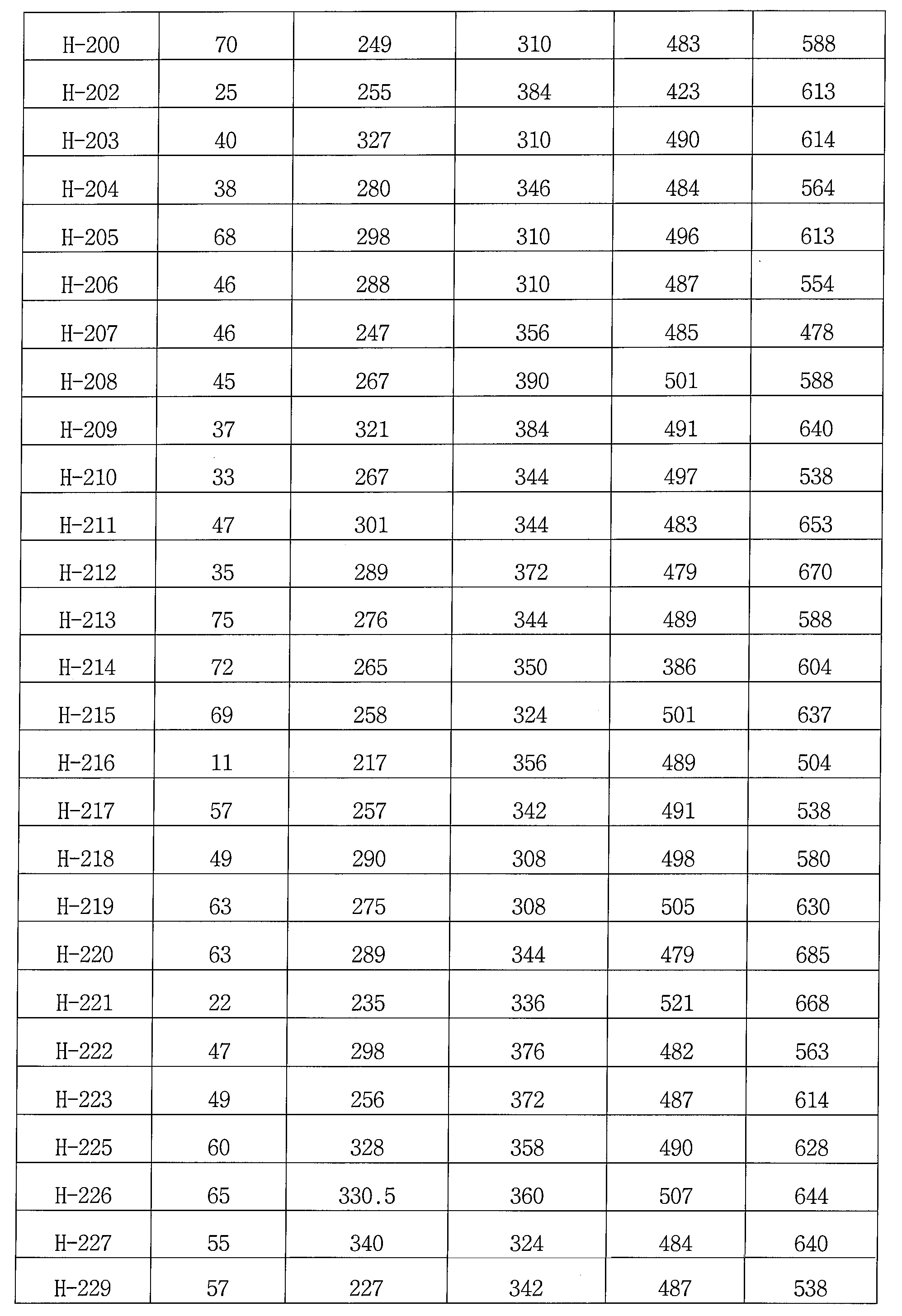
상기 실시예 5 내지 10에서 제조된 호스트 화합물 및 이로부터 용이하게 제조할 수 있는 다른 호스트 화합물에 대한 데이터를 하기 표 2에 나타내었다.Data for the host compounds prepared in Examples 5 to 10 and other host compounds which can be easily prepared therefrom are shown in Table 2 below.


[실험예 1] 본 발명에 따른 유기 전자재료용 화합물을 이용한 OLED 소자 제작[Experimental Example 1] Production of an OLED device using a compound for an organic electronic material according to the present invention
본 발명의 발광 재료를 이용하여 OLED 소자를 제작하였다. 우선, OLED용 글래스(삼성-코닝사 제조)로부터 얻어진 투명전극 ITO 박막(15Ω/□)을, 트리클로로에틸렌, 아세톤, 에탄올, 증류수를 순차적으로 사용하여 초음파 세척을 실시한 후, 이소프로판올에 넣어 보관한 후 사용하였다. 다음으로 진공 증착 장비의 기판 홀더에 ITO기판을 장착한 후, 진공 증착장비 내의 셀에 N1,N1'-([1,1'-비페닐]-4,4'-디일)비스(N1-(나프탈렌-1-일)-N4,N4-디페닐벤젠-1,4-디아민)을 넣고 챔버 내의 진공도가 10-6 torr에 도달할 때까지 배기시킨 후, 셀에 전류를 인가하여 증발시켜 ITO 기판 위에 120 nm 두께의 정공주입층을 증착하였다. 이어서, 진공 증착 장비 내의 다른 셀에 N4,N4,N4',N4'-테트라([1,1'-비페닐]-4-일)-[1,1'-비페닐]-4,4'-디아민을 넣고, 셀에 전류를 인가하여 증발시켜 정공주입층 위에 20 nm 두께의 정공전달층을 증착하였다. 정공주입층, 정공전달층을 형성시킨 후, 그 위에 발광층을 다음과 같이 증착시켰다. 진공 증착 장비 내의 한쪽 셀에 호스트로서 화합물 H-43을 넣고, 또 다른 셀에는 도판트로서 화합물 D-9를 각각 넣은 후, 두 물질을 다른 속도로 증발시켜 12 중량%의 양으로 도핑함으로써 상기 정공전달층 위에 40 nm 두께의 발광층을 증착하였다. 이어서 상기 발광층 위에 전자 전달층으로써 한쪽 셀에 2-(4-(9,10-디(나프탈렌-2-일)안트라센-2-일)페닐)-1-페닐-1H-벤조[d]이미다졸을 넣고, 또 다른 셀에는 리튬 퀴놀레이트를 각각 넣은 후, 두 물질을 다른 속도로 증발시켜 50 중량%로 도핑함으로써 30 nm의 전자전달층을 증착하였다. 이어서 전자 주입층으로 리튬 퀴놀레이트를 1 내지 2 nm 두께로 증착한 후, 다른 진공 증착장비를 이용하여 Al 음극을 150 nm의 두께로 증착하여 OLED 소자를 제작하였다. 재료 별로 각 화합물은 10-6 torr 하에서 진공 승화 정제하여 사용하였다.An OLED device was fabricated using the light emitting material of the present invention. First, a transparent electrode ITO thin film (15? /?) Obtained from a glass for OLED (manufactured by Samsung Corning) was ultrasonically cleaned using trichlorethylene, acetone, ethanol and distilled water sequentially and stored in isopropanol Respectively. Next, an ITO substrate was mounted on a substrate holder of a vacuum deposition apparatus, and N 1 , N 1 ' - ([1,1'-biphenyl] -4,4'-diyl) bis 1 - (naphthalene- 1 -yl) -N 4 , N 4 -diphenylbenzene-1,4-diamine) was added and the chamber was evacuated until the degree of vacuum reached 10 -6 torr. And evaporated to deposit a 120 nm thick hole injection layer on the ITO substrate. Subsequently, N 4 , N 4 , N 4 ' , N 4' -tetra ([1,1'-biphenyl] -4-yl) - [1,1'- 4,4'-diamine was added thereto, and a current was applied to the cell to evaporate it, thereby depositing a hole transport layer having a thickness of 20 nm on the hole injection layer. A hole injecting layer and a hole transporting layer were formed, and then a light emitting layer was deposited thereon as follows. Compound H-43 was placed as a host in one cell in a vacuum evaporation apparatus and compound D-9 was added as a dopant to another cell. Then, the two materials were evaporated at different rates and doped in an amount of 12 wt% A light emitting layer with a thickness of 40 nm was deposited on the transfer layer. Then, on one side of the luminescent layer, an electron transport layer was formed by adding a solution of 2- (4- (9,10-di (naphthalen-2-yl) anthracen- And lithium quinolate was added to another cell. Then, the two materials were evaporated at different rates and doped to 50 wt%, thereby depositing a 30 nm electron transport layer. Subsequently, lithium quinolate was deposited to a thickness of 1 to 2 nm as an electron injecting layer, and then an Al cathode was deposited to a thickness of 150 nm using another vacuum vapor deposition equipment to fabricate an OLED device. Each compound was purified by vacuum sublimation under 10 -6 torr.
그 결과, 2.5 mA/cm2의 전류가 흘렀으며, 1470 cd/m2의 황록색발광이 확인되었다.As a result, a current of 2.5 mA / cm < 2 > flowed and a yellow-green light emission of 1470 cd / m < 2 >
[실험예 2] 본 발명에 따른 유기 전자재료용 화합물을 이용한 OLED 소자 제작[Experimental Example 2] Fabrication of an OLED device using a compound for an organic electronic material according to the present invention
발광재료로서 호스트에는 화합물 H-45, 도판트에는 화합물 D-12를 사용한 것 외에는 실시예 1과 동일한 방법으로 OLED소자를 제작하였다. 그 결과, 5.07 mA/cm2의 전류가 흘렀으며, 3062 cd/m2의 황록색발광이 확인되었다. An OLED device was fabricated in the same manner as in Example 1 except that Compound H-45 was used as a host material and Compound D-12 was used as a dopant. As a result, a current of 5.07 mA / cm < 2 > flowed and a yellow-green light emission of 3062 cd / m < 2 >
[실험예 3] 본 발명에 따른 유기 전자재료용 화합물을 이용한 OLED 소자 제작[Experimental Example 3] Fabrication of an OLED device using a compound for an organic electronic material according to the present invention
발광재료로서 호스트에는 화합물 H-99, 도판트에는 화합물 D-18을 사용한 것 외에는 실시예 1과 동일한 방법으로 OLED소자를 제작하였다. 그 결과, 8.61 mA/cm2의 전류가 흘렀으며, 4305 cd/m2의 황록색발광이 확인되었다. OLED devices were fabricated in the same manner as in Example 1 except that the compound H-99 was used as the host material and the compound D-18 was used as the dopant. As a result, a current of 8.61 mA / cm < 2 > flowed and a yellowish green luminescence of 4305 cd / m < 2 > was confirmed.
[실험예 4] 본 발명에 따른 유기 전자재료용 화합물을 이용한 OLED 소자 제작[Experimental Example 4] Fabrication of an OLED device using a compound for an organic electronic material according to the present invention
발광재료로서 호스트에는 화합물 H-67, 도판트에는 화합물 D-9를 사용한 것 외에는 실시예 1과 동일한 방법으로 OLED소자를 제작하였다. 그 결과, 2.86 mA/cm2의 전류가 흘렀으며, 1647 cd/m2의 황록색발광이 확인되었다. An OLED device was fabricated in the same manner as in Example 1 except that the compound H-67 was used as the host material and the compound D-9 was used as the dopant. As a result, a current of 2.86 mA / cm < 2 > flowed and an emission of 1647 cd / m < 2 >
[실험예 5] 본 발명에 따른 유기 전자재료용 화합물을 이용한 OLED 소자 제작[Experimental Example 5] Fabrication of an OLED device using a compound for an organic electronic material according to the present invention
발광재료로서 호스트에는 화합물 H-33, 도판트에는 화합물 D-12를 사용한 것 외에는 실시예 1과 동일한 방법으로 OLED소자를 제작하였다. 그 결과, 1.94 mA/cm2의 전류가 흘렀으며, 1164 cd/m2의 황록색발광이 확인되었다.An OLED device was fabricated in the same manner as in Example 1 except that Compound H-33 was used as a host material and Compound D-12 was used as a dopant. As a result, a current of 1.94 mA / cm < 2 > flowed and emission of 1164 cd / m < 2 >
[실험예 6] 본 발명에 따른 유기 전자재료용 화합물을 이용한 OLED 소자 제작[Experimental Example 6] Fabrication of an OLED device using a compound for an organic electronic material according to the present invention
발광재료로서 호스트에는 화합물 H-118, 도판트에는 화합물 D-18을 사용한 것 외에는 실시예 1과 동일한 방법으로 OLED소자를 제작하였다. 그 결과, 15.6 mA/cm2의 전류가 흘렀으며, 5554 cd/m2의 황록색발광이 확인되었다.An OLED device was fabricated in the same manner as in Example 1 except that Compound H-118 was used as a host material and Compound D-18 was used as a dopant. As a result, a current of 15.6 mA / cm < 2 > flowed and an emission of 5554 cd / m < 2 >
[실험예 7] 본 발명에 따른 유기 전자재료용 화합물을 이용한 OLED 소자 제작[Experimental Example 7] Fabrication of an OLED device using a compound for an organic electronic material according to the present invention
발광재료로서 호스트에는 화합물 H-208, 도판트에는 화합물 D-34을 사용한 것 외에는 실시예 1과 동일한 방법으로 OLED소자를 제작하였다. 그 결과, 5.8 mA/cm2의 전류가 흘렀으며, 53100 cd/m2의 황록색발광이 확인되었다.An OLED device was fabricated in the same manner as in Example 1 except that Compound H-208 was used as a host material and Compound D-34 was used as a dopant. As a result, a current of 5.8 mA / cm < 2 > flowed and emission of yellow green light of 53100 cd / m < 2 > was confirmed.
이상에서 살펴본 바와 같이, 본 발명의 유기 전계 발광 소자는 특정 도판트 화합물과 호스트 화합물의 조합을 함유하는 발광재료를 포함함으로써 황록색 발광을 나타내면서 우수한 전류특성을 가지는 것을 확인할 수 있다.As described above, the organic electroluminescent device of the present invention includes a light-emitting material containing a combination of a specific dopant compound and a host compound, thereby exhibiting yellowish green light emission and having excellent current characteristics.
또한 본 발명에 따른 유기 전자재료용 화합물은 전자전달 효율이 높아 소자 제작시 결정화를 방지할 뿐만 아니라 층 형성이 양호하여 소자의 전류특성을 개선시킴으로서 소자의 구동전압을 저하시키고 동시에 전력효율과 수명이 향상된 OLED 소자를 제조할 수 있는 장점이 있다.In addition, the compound for organic electronic materials according to the present invention has high electron transfer efficiency, thereby preventing crystallization during device fabrication and improving the current characteristics of the device due to good layer formation, thereby lowering the driving voltage of the device, There is an advantage that an improved OLED device can be manufactured.
유기 전계 발광 소자는 일반적으로 적색, 녹색 및 청색의 3가지의 색을 섞어서 백색을 구현할 수 있는데 비해, 본 발명에 따른 도판트 화합물과 호스트 화합물을 사용하는 경우, 청색과의 이색 조합으로 백색 구현이 가능한 장점을 가지고 있다.In general, organic electroluminescent devices can realize a white color by mixing three colors of red, green, and blue. In contrast, when a dopant compound and a host compound according to the present invention are used, Possible advantages.
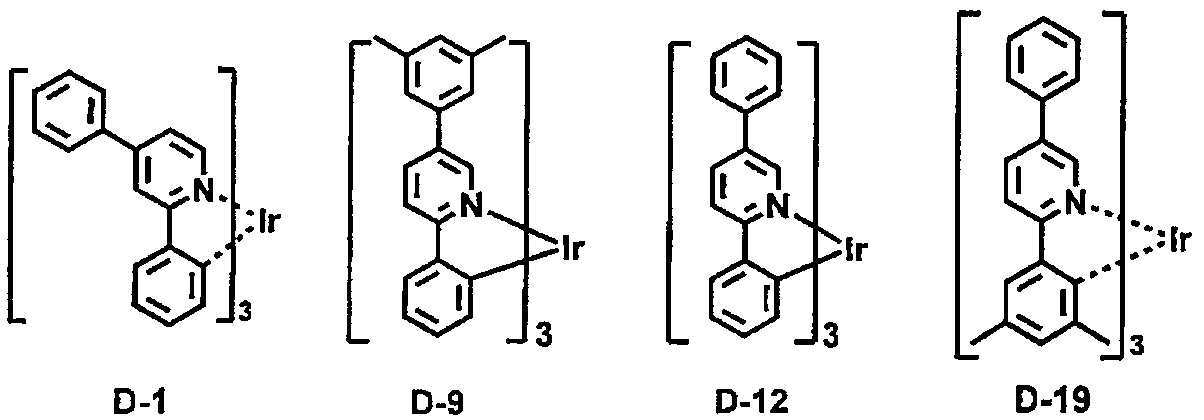
Claims (5)
상기 1종 이상의 도판트 화합물은 하기 화학식 1로 표시되고,
[화학식 1]

상기 화학식 1에서,


L은 하기 구조이며;

R201 및 R202는 각각 CH3이고;
R203은 수소이며;
n은 1 내지 3의 정수이고,
상기 1종 이상의 호스트 화합물은 하기 구조로부터 선택되고,


황록색 발광을 나타내는 것을 특징으로 하는, 유기 전계 발광 소자.1. An organic electroluminescent device comprising at least one dopant compound and at least one host compound,
Wherein the at least one dopant compound is represented by the following general formula (1)
[Chemical Formula 1]
In Formula 1,
L is the following structure;
R 201 and R 202 are each CH 3 ;
R 203 is hydrogen;
n is an integer of 1 to 3,
Wherein the at least one host compound is selected from the following structures,
Wherein the organic electroluminescent device exhibits yellow-green light emission.



상기 1종 이상의 호스트 화합물은 하기 구조로부터 선택되는 것을 특징으로 하는 유기 전계 발광 소자.


Wherein the at least one host compound is selected from the following structures.


상기 1종 이상의 호스트 화합물은 하기 구조로부터 선택되는 것을 특징으로 하는 유기 전계 발광 소자.

Wherein the at least one host compound is selected from the following structures.
상기 1종 이상의 호스트 화합물은 하기 구조로부터 선택되는 것을 특징으로 하는 유기 전계 발광 소자.


Wherein the at least one host compound is selected from the following structures.
Priority Applications (1)
| Application Number | Priority Date | Filing Date | Title |
|---|---|---|---|
| KR1020190081866A KR20190084233A (en) | 2019-07-08 | 2019-07-08 | Organic Electroluminescence Device |
Applications Claiming Priority (1)
| Application Number | Priority Date | Filing Date | Title |
|---|---|---|---|
| KR1020190081866A KR20190084233A (en) | 2019-07-08 | 2019-07-08 | Organic Electroluminescence Device |
Related Parent Applications (1)
| Application Number | Title | Priority Date | Filing Date |
|---|---|---|---|
| KR1020120099580A Division KR20140032823A (en) | 2012-09-07 | 2012-09-07 | Organic electroluminescence device |
Publications (1)
| Publication Number | Publication Date |
|---|---|
| KR20190084233A true KR20190084233A (en) | 2019-07-16 |
Family
ID=67474298
Family Applications (1)
| Application Number | Title | Priority Date | Filing Date |
|---|---|---|---|
| KR1020190081866A Ceased KR20190084233A (en) | 2019-07-08 | 2019-07-08 | Organic Electroluminescence Device |
Country Status (1)
| Country | Link |
|---|---|
| KR (1) | KR20190084233A (en) |
Citations (1)
| Publication number | Priority date | Publication date | Assignee | Title |
|---|---|---|---|---|
| KR20120012431A (en) | 2010-07-30 | 2012-02-09 | 롬엔드하스전자재료코리아유한회사 | Organic EL device employing organic light emitting compound as light emitting material |
-
2019
- 2019-07-08 KR KR1020190081866A patent/KR20190084233A/en not_active Ceased
Patent Citations (1)
| Publication number | Priority date | Publication date | Assignee | Title |
|---|---|---|---|---|
| KR20120012431A (en) | 2010-07-30 | 2012-02-09 | 롬엔드하스전자재료코리아유한회사 | Organic EL device employing organic light emitting compound as light emitting material |
Similar Documents
| Publication | Publication Date | Title |
|---|---|---|
| JP6356130B2 (en) | Novel combination of host compound and dopant compound and organic electroluminescent device comprising the same | |
| JP5903448B2 (en) | NOVEL ORGANIC ELECTROLUMINESCENT COMPOUND AND ORGANIC ELECTROLUMINESCENT DEVICE USING THE SAME | |
| KR101431645B1 (en) | Light-Emitting Layer and Organic Electroluminescence Device comprising the same | |
| KR101429035B1 (en) | Organic Electroluminescent Compounds and Organic Electroluminescent Device Comprising the Same | |
| CN102625819B (en) | New organic electroluminescent compound and organic electroluminescent device using the same | |
| CN103249722B (en) | New compounds for organic electronic materials and organic electroluminescent devices using the compounds | |
| CN103384712B (en) | The organic electroluminescence device of new organic electroluminescent compounds and this compound of use | |
| KR20120038060A (en) | Novel compounds for organic electronic material and organic electroluminescent device using the same | |
| CN103703003A (en) | Novel compounds for organic electronic material and organic electroluminescent device using the same | |
| KR20150034333A (en) | Organic electroluminescent device | |
| KR20140012440A (en) | Organic electroluminescence device | |
| KR20110049217A (en) | Novel organic light emitting compound and organic electroluminescent device employing the same | |
| CN103732590A (en) | New compounds for organic electronic materials and organic electroluminescent devices using the compounds | |
| JP2013526014A (en) | Novel organic electroluminescent compound and organic electroluminescent device using the same | |
| KR20120029751A (en) | Novel organic electroluminescent compounds and organic electroluminescent device using the same | |
| KR20120032054A (en) | Novel organic luminescent compounds and organic electroluminescent device using the same | |
| CN103717603A (en) | New compounds for organic electronic materials and organic electroluminescent devices using the compounds | |
| KR101427620B1 (en) | Novel organic electroluminescent compounds and organic electroluminescent device comprising the same | |
| KR20110093055A (en) | Novel organic light emitting compound and organic electroluminescent device employing the same | |
| KR20150032447A (en) | Novel organic electroluminescent compounds and organic electroluminescent device comprising the same | |
| KR20140082351A (en) | Organic Electroluminescent Compounds and Organic Electroluminescent Device Comprising the Same | |
| KR20120050557A (en) | Novel organic electroluminescent compounds and organic electroluminescent device using the same | |
| KR20140071944A (en) | Organic Electroluminescence Compounds and Organic Electroluminescence Device Comprising the Same | |
| KR20140144550A (en) | Organic Electroluminescent Compounds and Organic Electroluminescent Device Comprising the Same | |
| KR20120033017A (en) | Novel compounds for organic electronic material and organic electroluminescent device using the same |
Legal Events
| Date | Code | Title | Description |
|---|---|---|---|
| A107 | Divisional application of patent | ||
| A201 | Request for examination | ||
| PA0107 | Divisional application |
Comment text: Divisional Application of Patent Patent event date: 20190708 Patent event code: PA01071R01D Filing date: 20120907 Application number text: 1020120099580 |
|
| PA0201 | Request for examination |
Patent event code: PA02012R01D Patent event date: 20190708 Comment text: Request for Examination of Application |
|
| PG1501 | Laying open of application | ||
| E902 | Notification of reason for refusal | ||
| PE0902 | Notice of grounds for rejection |
Comment text: Notification of reason for refusal Patent event date: 20191001 Patent event code: PE09021S01D |
|
| E601 | Decision to refuse application | ||
| PE0601 | Decision on rejection of patent |
Patent event date: 20200401 Comment text: Decision to Refuse Application Patent event code: PE06012S01D Patent event date: 20191001 Comment text: Notification of reason for refusal Patent event code: PE06011S01I |