KR20180121943A - Continuous system and procedure of sterilization and physical stabilization of pumpable fluids by means of ultra-high pressure homogenization - Google Patents
Continuous system and procedure of sterilization and physical stabilization of pumpable fluids by means of ultra-high pressure homogenization Download PDFInfo
- Publication number
- KR20180121943A KR20180121943A KR1020187028268A KR20187028268A KR20180121943A KR 20180121943 A KR20180121943 A KR 20180121943A KR 1020187028268 A KR1020187028268 A KR 1020187028268A KR 20187028268 A KR20187028268 A KR 20187028268A KR 20180121943 A KR20180121943 A KR 20180121943A
- Authority
- KR
- South Korea
- Prior art keywords
- temperature
- fluid
- pressure
- sterilization
- heat exchanger
- Prior art date
- Legal status (The legal status is an assumption and is not a legal conclusion. Google has not performed a legal analysis and makes no representation as to the accuracy of the status listed.)
- Granted
Links
Images

Classifications
-
- A—HUMAN NECESSITIES
- A23—FOODS OR FOODSTUFFS; TREATMENT THEREOF, NOT COVERED BY OTHER CLASSES
- A23B—PRESERVATION OF FOODS, FOODSTUFFS OR NON-ALCOHOLIC BEVERAGES; CHEMICAL RIPENING OF FRUIT OR VEGETABLES
- A23B2/00—Preservation of foods or foodstuffs, in general
- A23B2/40—Preservation of foods or foodstuffs, in general by heating loose unpacked materials
- A23B2/42—Preservation of foods or foodstuffs, in general by heating loose unpacked materials while they are progressively transported through the apparatus
-
- A23C3/033—
-
- A—HUMAN NECESSITIES
- A23—FOODS OR FOODSTUFFS; TREATMENT THEREOF, NOT COVERED BY OTHER CLASSES
- A23B—PRESERVATION OF FOODS, FOODSTUFFS OR NON-ALCOHOLIC BEVERAGES; CHEMICAL RIPENING OF FRUIT OR VEGETABLES
- A23B11/00—Preservation of milk or dairy products
- A23B11/10—Preservation of milk or milk preparations
- A23B11/12—Preservation of milk or milk preparations by heating
- A23B11/13—Preservation of milk or milk preparations by heating the materials being loose unpacked
- A23B11/133—Preservation of milk or milk preparations by heating the materials being loose unpacked and progressively transported through the apparatus
-
- A—HUMAN NECESSITIES
- A23—FOODS OR FOODSTUFFS; TREATMENT THEREOF, NOT COVERED BY OTHER CLASSES
- A23B—PRESERVATION OF FOODS, FOODSTUFFS OR NON-ALCOHOLIC BEVERAGES; CHEMICAL RIPENING OF FRUIT OR VEGETABLES
- A23B2/00—Preservation of foods or foodstuffs, in general
- A23B2/10—Preservation of foods or foodstuffs, in general by treatment with pressure variation, shock, acceleration or shear stress
- A23B2/103—Preservation of foods or foodstuffs, in general by treatment with pressure variation, shock, acceleration or shear stress using sub- or super-atmospheric pressures, or pressure variations transmitted by a liquid or gas
-
- A23L3/0155—
-
- A23L3/18—
-
- A—HUMAN NECESSITIES
- A23—FOODS OR FOODSTUFFS; TREATMENT THEREOF, NOT COVERED BY OTHER CLASSES
- A23L—FOODS, FOODSTUFFS OR NON-ALCOHOLIC BEVERAGES, NOT OTHERWISE PROVIDED FOR; PREPARATION OR TREATMENT THEREOF
- A23L9/00—Puddings; Cream substitutes; Preparation or treatment thereof
- A23L9/10—Puddings; Dry powder puddings
-
- A—HUMAN NECESSITIES
- A61—MEDICAL OR VETERINARY SCIENCE; HYGIENE
- A61L—METHODS OR APPARATUS FOR STERILISING MATERIALS OR OBJECTS IN GENERAL; DISINFECTION, STERILISATION OR DEODORISATION OF AIR; CHEMICAL ASPECTS OF BANDAGES, DRESSINGS, ABSORBENT PADS OR SURGICAL ARTICLES; MATERIALS FOR BANDAGES, DRESSINGS, ABSORBENT PADS OR SURGICAL ARTICLES
- A61L2/00—Disinfection or sterilisation of materials or objects, in general; Accessories therefor
- A61L2/02—Disinfection or sterilisation of materials or objects, in general; Accessories therefor using physical processes
- A61L2/04—Heat
- A61L2/06—Hot gas
- A61L2/07—Steam
Landscapes
- Life Sciences & Earth Sciences (AREA)
- Engineering & Computer Science (AREA)
- Chemical & Material Sciences (AREA)
- Polymers & Plastics (AREA)
- Food Science & Technology (AREA)
- Wood Science & Technology (AREA)
- Zoology (AREA)
- Health & Medical Sciences (AREA)
- General Health & Medical Sciences (AREA)
- Veterinary Medicine (AREA)
- Animal Behavior & Ethology (AREA)
- Epidemiology (AREA)
- Public Health (AREA)
- Nutrition Science (AREA)
- Food Preservation Except Freezing, Refrigeration, And Drying (AREA)
- Dairy Products (AREA)
- General Preparation And Processing Of Foods (AREA)
- Apparatus For Disinfection Or Sterilisation (AREA)
- Cosmetics (AREA)
Abstract
펌핑가능한 유체, 식품, 또는 다른 유형의 유체의 살균 및 물리적 안정화를 위한 연속 시스템과 방법은, 초고압 균질화(UHPH)를 통해 40℃ 내지 90℃ 사이의 온도(Tp)에서 유체를 예열하는 제 1 열 교환기와; 최종 값(Tu)까지 그 온도를 증가시키는 200 내지 600MPa 사이의 압력(Pu)에서 온도(Tp)에 있는 유체를 도입하는 초 균질화기(3)와; 그 냉각 온도가 값(Te)에서 조절되는 제 2 열교환기(4)와; 값(Te)에 있는 냉각된 유체를 수신하는 무균 탱크(5)를 포함하며, 이로부터 유체는 최종 제품을 패키징하기 위해 무균 포장 기계에 살균 공기 압력으로 펌핑되는 것을 특징으로 한다.Continuous systems and methods for sterilization and physical stabilization of pumped fluid, food, or other types of fluids include first and second fluidized beds for preheating fluid at a temperature (T p ) between 40 ° C and 90 ° C via ultra high pressure homogenization (UHPH) A heat exchanger; A super homogenizer (3) for introducing a fluid at a temperature (T p ) at a pressure (P u ) between 200 and 600 MPa which increases its temperature to a final value (T u ); A second heat exchanger (4) whose cooling temperature is adjusted at a value (T e ); And a sterile tank (5) receiving the cooled fluid at a value T e , from which the fluid is pumped to sterile air pressure in the aseptic packaging machine to package the final product.
Description
본 발명은, 식품, 제약, 화학, 및 화장품 분야, 그리고 일반적으로 무균 포장될 수 있는 제품을 획득하는 시스템과 화학적으로 호환가능한 임의의 펌핑가능한 제품에 적용되는 초고압 균질화에 의하여 펌핑가능한 유체의 살균 및 물리적 안정화를 위한 연속 시스템 및 방법에 관한 것이다.The present invention relates to the disinfection and sterilization of pumps that can be pumped by ultra-high pressure homogenization applied to any pumped product chemically compatible with the food, pharmaceutical, chemical, and cosmetic fields, To a continuous system and method for physical stabilization.
살균은 생장 형태와 미생물 포자를 파괴하고 실온에서 저장된 제품의 장시간 보존을 가능하게 하는 처리이다. 보통, 100℃보다 더 높은 온도에서 열 처리가 사용된다. 이 상태에서 처리한 후에 관능 특성에 대한 영향을 볼 수 있는 것이 분명하고, 식품의 경우 영양가의 중요한 손실이 있을 수 있다. 한편, 많은 제품은 이러한 조건을 지원하지 않으며, 이들 제품은 물리적으로 불안정하다. 이 시스템에 의해 살균된 식품과 다른 제품은 실온에서 보관하면 6개월(그 조성에 따라 다름)보다 더 긴 수명을 구비한다. 살균 공정은 이후에 보는 바와 같이 각 경우에 다른 기술을 요구하는, 포장 전 또는 포장 후에 적용될 수 있다. 살균은 식품 안정화와 항상 함께 간다. 고체의 경우, 색상과 텍스처(texture)를 보호하고 맛(flavour)을 강화하는 첨가제를 적용할 필요가 있다. 콜로이드 특성의 액체 식품의 경우, 위상 분리를 방지하기 위해, 기계적 처리가 사용되는데, 예를 들어, 종래의 균질화 및 안정화제와 같은 것들이 식품의 복잡성에 따라 (유화제, 공급 증점제, 염분 침전 방지제, 등) 추가된다.Sterilization is a process that destroys growth forms and microbial spores and allows long-term storage of stored products at room temperature. Usually, heat treatment is used at a temperature higher than 100 ° C. It is clear that the effect on sensory properties can be seen after treatment in this state, and in the case of food there can be a significant loss of nutritional value. On the other hand, many products do not support these conditions, and these products are physically unstable. Food and other products sterilized by this system have a longer lifetime than 6 months (depending on their composition) when stored at room temperature. The sterilization process can be applied before or after packaging, which requires different techniques in each case, as will be seen later. Sterilization always goes together with food stabilization. In the case of solids, it is necessary to apply additives that protect color and texture and enhance flavor. In the case of colloidal liquid foodstuffs, mechanical treatments are used to prevent phase separation, such as, for example, conventional homogenisation and stabilizers depending on the complexity of the food (emulsifier, feed thickener, salt precipitation inhibitor, etc.) ).
포장 제품의 살균의 경우, 열 처리는 포장 및 그 내용물 (식품)의 전체 그룹에 적용되며, 생산 요구 사항에 따라, 부하 시스템 또는 연속 시스템이 사용될 수 있다.In the case of sterilization of packaged products, the heat treatment is applied to the entire group of packages and their contents (food), and depending on the production requirements, a load system or a continuous system can be used.
살균할 식품이 펌핑이 가능한 점성을 구비하는 액체라면, 이후 무균 포장과 연관된 포장에 앞서 살균 시스템을 사용하는 것이 가능하다. 이 경우, 제품이 예열, 살균, 냉각 및 무균 포장의 연속 공정이 있는 폐쇄 회로에서 순환한다. 일반적으로, 살균은 135 내지 150℃의 고온에서 수행되고, 매우 짧은 시간, 즉 4 내지 15초 동안 처리된다. 이 처리는 일반적으로 초고온 (UHT : Ultra High Temperature)으로 알려져 있다. UHT 공정은 액체 우유 처리에 있어서는 60년대 산업 레벨로 구현되어서, 병 우유를 살균하는 데 사용된 종래의 살균기로 얻어진 것보다 저온 살균 우유(pasteurized milk)에 더 유사한 특성을 가지는 제품을 획득하였다. 60년대부터 현대에 이르기까지 다른 UHT 공정은 또한 다른 유제품 (농축 우유, 신선한 크림, 쉐이크(shake), 발효 제품, 아이스크림, 디저트, ...) 및 수프, 소스와 퓨레(puree) 등을 위해 개발되었다.If the food to be sterilized is a liquid with a pumpable viscosity, it is then possible to use a sterilization system prior to packaging associated with aseptic packaging. In this case, the product circulates in a closed circuit with a continuous process of preheating, sterilization, cooling and aseptic packaging. In general, the sterilization is carried out at a high temperature of 135 to 150 DEG C and is treated for a very short time, i.e. 4 to 15 seconds. This process is commonly known as Ultra High Temperature (UHT). The UHT process was implemented at an industrial level in the late 1960s in liquid milk processing and obtained products with properties more similar to pasteurized milk than those obtained with conventional sterilizers used to sterilize bottled milk. Other UHT processes from the 1960s to the modern are also being developed for other dairy products (concentrated milk, fresh creams, shakes, fermented products, ice cream, desserts ...) and soups, sauces and puree .
포장 제품의 살균에 비해, UHT 공정은 시간, 전력, 공간 및 인력을 절약한다. 요즘, 시장에는 2개의 UHT 처리 시스템, 즉 제품이 열 매체(수증기)와 직접 접촉하여 가열되는 직접 시스템과, 열이 열 교환기에서 분리면을 통해 전달되는 간접 시스템이 존재한다.Compared to disinfection of packaged products, the UHT process saves time, power, space and manpower. Nowadays, there are two UHT treatment systems on the market: a direct system where the product is heated in direct contact with the thermal medium (water vapor) and an indirect system where the heat is transferred through the separation face in the heat exchanger.
이들 살균 공정에서 식품의 유형, 주로 물에 오일 유형의 에멀전을 가지는 식품(예를 들어, 우유, 찍어 먹는 소스, 유제품 기반 쉐이크 또는 아이스크림 믹스)에 따라, 열 처리 전 또는 후에 균질화 공정을 도입할 필요가 있다. 균질화기 작업은 저장 동안 크리밍(creaming) 현상이 있을 경우에 제품을 안정화시키기 위해 물방울 사이즈(droplets)를 분산된 위상으로 감소시키는 것이다. 압력 균질화기는 배출 측에 균질화 밸브를 구비하는 10 내지 70Mpa에서 동작하는 고압 펌프를 구비하여 형성된다. 밸브 및 그 지지부 사이의 공간으로부터 액체를 펌핑할 때, 생성된 고압은 고속으로 액체를 이동시킨다. 밸브 단부에서, 액체의 이동 속도는 급격히 저하하고, 생성된 극한 난류는 강한 전단 율을 생성한다. 입자 크기를 감소시키는 공정에서 개입하는 다른 힘은 액체 궤도 동안 밸브에서 형성된 충격력과 기포{캐비테이션(cavitation)}을 붕괴시킨다. 일부 식품에서, 예를 들어, 우유에서, 종종 첨가제를 형성하는, 입자의 비정상적인 분산이 있다. 제 1 밸브와 유사하고 액체 궤도에 설치된 제 2 밸브는 한번 더 이러한 첨가제를 분쇄한다.In these sterilization processes, it is necessary to introduce a homogenization process either before or after the heat treatment, depending on the type of food, mainly food (eg milk, dipping sauce, dairy based shake or ice cream mix) having an oil type emulsion in water . The homogenizer operation is to reduce the droplets to a dispersed phase to stabilize the product in the event of creaming during storage. The pressure homogenizer is formed with a high pressure pump operating at 10 to 70 MPa with a homogenization valve on the discharge side. When pumping liquid from the space between the valve and its support, the resulting high pressure moves the liquid at high speed. At the end of the valve, the velocity of the liquid drops sharply and the resulting ultimate turbulence produces a strong shear rate. Another force intervening in the process of reducing particle size collapses the bubble (cavitation) created in the valve during the liquid orbit. In some foods, for example in milk, there is an abnormal dispersion of the particles, often forming additives. The second valve, similar to the first valve and installed in the liquid track, once again pulverizes these additives.
열 처리는 한편으로는 미생물 불활성화와 같은 식품에 대한 유리한 효과를 구비하지만, 이와 병행하여, 이는 적용된 처리에 따라 영양학적, 관능적 및/또는 기술적 특성에 영향을 미칠 수 있는 원치 않는 화학적 및 물리적 변화를 생성한다.Heat treatment, on the one hand, has beneficial effects on foods, such as microbial deactivation, but in parallel, it causes undesirable chemical and physical changes that may affect nutritional, sensory and / .
맛(향 + 맛 + 일관성)은 심지어 우유가 음료수로 소비되는 경우에도, 우유와 같은 가장 널리 소비되는 살균 식품 중 하나의 식품의 소비자에 대한 품질 측면으로 고려해야 할 매우 중요한 파라미터이다. 열처리는 적용된 처리 강도에 따라 더 높거나 더 낮은 규모로 품질에 영향을 미칠 수 있는 우유 맛에 대해 중요한 효과를 구비한다. UHT 살균 우유(135 내지 150℃, 2 내지 20초)는 "카라멜" 향과 케톤(ketones) 형성과 연관된 다른 일반적인 것과 함께, 단백질 변성 후에 방출되는 H2S의 존재에 의해 주로 야기된 조리 향으로 식별된다. 종래의 병(bottle)의 살균 처리(105 내지 120℃, 10 내지 40분) 동안, 강한 조리, 케톤 및 카라멜 향이 있고, 후자는 마일라드(Maillard) 반응과 카라멜화(caramelization) 제품으로부터 특정 제품을 형성하는 것에 의해 야기되며, 이는 심지어 조리 향을 위장할 수 있다. 이 열 처리가 야기할 수 있는 다른 물리적 및 생화학적 현상은 단백질 침전, 위상 분리, 크리밍(제품이 이전에 균질화된 경우에도 지방이 분리되는 현상)에 의한 실온에서의 저장 동안 제품 불안정성이며, 이는 열처리로부터 유도된 영향을 최소화하거나 완화하기 위해 유화제, 안정화제 또는 산도 조절제와 같은 특정 첨가제를 사용하는 것을 필요로 한다. 주스와 같은 덜 복잡한 식품에서는, 비타민 함량(비타민 C 및 다른 수용성 비타민)의 급격한 손실, 원래의 맛과 향에 큰 변화(휘발성 성분의 손실), 뿐만 아니라 색상의 변화가 있다.Taste (flavor + taste + consistency) is a very important parameter to consider in terms of quality of food for one of the most widely consumed sterilized foods such as milk, even if milk is consumed as drinking water. The heat treatment has an important effect on the taste of the milk which can affect quality on a higher or lower scale depending on the applied processing intensity. UHT pasteurized milk (135-150 ° C, 2 to 20 seconds), together with "caramel" flavors and other common things associated with ketone formation, is the result of the cooking aroma mainly caused by the presence of H 2 S released after protein denaturation . Ketones and caramel fragrances during the conventional bottle sterilization treatment (105-120 ° C, 10-40 minutes), the latter containing certain products from the Maillard reaction and caramelization products ≪ / RTI > which can even disguise the cooking aroma. Other physical and biochemical phenomena that this heat treatment may cause are product instability during storage at room temperature by protein precipitation, phase separation, creaming (the phenomenon that fat is separated even if the product has previously been homogenized) It is necessary to use certain additives such as emulsifiers, stabilizers or acidity modifiers to minimize or alleviate the effects derived from the heat treatment. In less complex foods such as juice, there is a sharp loss of vitamin content (vitamin C and other water soluble vitamins), a big change in original taste and flavor (loss of volatile components), as well as a change in color.
초고압 균질화 (UHPH: Ultra High Pressure Homogenization) 기술은 종래의 균질화와 동일한 원리에 기초하나, 하나의 큰 차이점으로는 밸브 설계와 새로운 물질의 사용 덕분에, 200Mpa보다 더 높은 압력에 도달할 수 있다는 것이다. UHPH 처리는 그 작용이 동적 고압의 적용으로 인해 야기된 전단, 난류, 캐비테이션 및 충격의 조합된 힘으로부터 초래되기 때문에 신생 물리적 기술과 연관될 수 있다. 그럼에도 불구하고, 이 기술은 높은 수압 처리(HHP: High Hydrostatic Pressure treatment)와 같은 높은 압력을 또한 사용하는 다른 기술과 혼동해서는 안된다. UHPH 같은 이 기술은, 병원성 및 변경 미생물의 파괴에서 종래의 열 처리에 대한 대안으로 개발되었지만, 이 기술에서 작용하는 이 시스템 또는 작업 장비 뿐만 아니라 미생물의 불활성화 메커니즘은 아래에 설명하는 바와 같이 UHPH와 완전히 다른 것이다. HHP 장비는 유연한 물질로 이전에 포장되고 폐쇄된 제품의 부하(불연속 공정)로 동작하여 그 방수성(watertightness)을 보장한다; 이 장비는 기본적으로 일반적으로 물인 압력을 전달하는 정적 유체(이것이 정압이라고 하는 이유이다)를 포함하는 실린더, 압력 생성 시스템(저압 펌프 및 압력 강화기)에 의해 형성된다. 이 기술에서, 포장된 식품은 (최대 600Mpa까지 식품 응용의 산업 장비 내에서) 선택된 압력 조건, 즉 400 내지 1000Mpa이 충족되고 원하는 시간 동안 유지될 때까지, 압력을 전달하는 액체(일반적으로 물)로 채워진 압력 실린더에 도입된다. 이 시간 동안, 압력은 평형으로(isostatically) 전달되고, 이는 제품이 그 형상 또는 크기에 상관없이 균질화에 의해 처리되고, 동시에 이것은 처리 동안 변형을 방지한다는 것을 의미한다. 이후, 실린더를 압력 해제(depressurising)한 후, 이 기계로부터 제품을 추출하기 위해 실린더가 개방된다.Ultra High Pressure Homogenization (UHPH) technology is based on the same principle as conventional homogenization, but one major difference is that the pressure of the valve can reach more than 200 MPa due to valve design and the use of new materials. UHPH treatment can be associated with emerging physical techniques because its action results from the combined forces of shear, turbulence, cavitation and impact caused by the application of dynamic high pressure. Nonetheless, this technique should not be confused with other technologies that also use high pressures such as high hydrostatic pressure treatment (HHP). This technology, such as UHPH, has been developed as an alternative to conventional heat treatment in the destruction of pathogenic and altered microorganisms, but the system or work equipment acting on this technology, as well as microbial deactivation mechanisms, It is completely different. HHP equipment is a flexible material that acts as a load (discontinuous process) of previously packaged and enclosed products to ensure its watertightness; The equipment is basically formed by a cylinder, a pressure-generating system (low-pressure pump and pressure intensifier) that contains a static fluid (which is why it is a static pressure) that delivers pressure that is typically water. In this technique, the packaged food is delivered to the pressurized liquid (generally water) until a selected pressure condition (within the industrial equipment of the food application up to 600 MPa) is met, i.e., 400-1000 MPa is met and maintained for the desired period of time. Is introduced into the filled pressure cylinder. During this time, the pressure is transferred isostatically, which means that the product is treated by homogenization regardless of its shape or size, while at the same time it prevents deformation during processing. After depressurising the cylinder, the cylinder is then opened to extract the product from the machine.
미생물 불활성화 메커니즘에 관하여 HHP 기술은 형태의 변화, 생화학 반응, 유전 메커니즘 또는 세포막의 변화를 유도하는 미생물을 비활성화시킬 수 있다. 일반적으로, 높은 온도와 함께 조합하여 처리가 적용되지 않는 한, 포자는 이러한 처리에 저항한다.With respect to microbial deactivation mechanisms, HHP technology can inactivate microorganisms that induce changes in morphology, biochemical reactions, genetic mechanisms or changes in cell membranes. Generally, spores resist this treatment unless the treatment is applied in combination with high temperatures.
지금까지 개발된 UHPH 장비는 연속적인 공정에서 동작하하는 최대 400MPa의 압력에까지 유체 또는 펌핑가능한 식품 시스템을 처리할 수 있다. 지금까지, 상이한 고압 균질화 장비는, 그 제품을 유화, 확산, 혼합 및 처리하기 위하여 화학적 및 제약적 산업, 특별히 식품과 생물 공학에서 사용되었다.UHPH equipment developed so far can handle fluid or pumped food systems up to pressures up to 400 MPa operating in continuous processes. Until now, different high pressure homogenizing equipment has been used in chemical and pharmaceutical industries, especially food and biotechnology, to emulsify, diffuse, mix and process the product.
초 균질화기(ultra-homogenizer)에서 균질화 밸브는 100℃ 이상의 온도와 최대 400MPa(및 심지어 이보다 더 높은 압력에 도달하기 위한 개선이 가능하다)까지의 압력에 견딜 수 있는 물질(예를 들어, 세라믹)로 만들어진다. 또한, 밸브의 형상은 종래의 균질화기에 있는 전통적인 APV-Gaulin 밸브와는 다르다.In an ultra-homogenizer, the homogenization valve is a material (such as a ceramic) capable of withstanding pressures from a temperature of 100 ° C or higher to a maximum of 400 MPa (and even improvement to reach higher pressures) . In addition, the shape of the valve is different from conventional APV-Gaulin valves in conventional homogenizers.
이 기술은 미생물을 포함하는 분산 입자의 분쇄를 생성한다. 입자들은 다양한 특성을 구비할 수 있고, 우유, 야채 쉐이크, 클라우디 주스 등과 같은 콜로이드 식품에서 일반적이다. UHPH 동안 미생물의 분해에 포함된 가능한 물리적 공정(미생물의 불활성화의 주요 메커니즘) 중에는, 급격한 압력 강하, 충격력, 절단 및 비틀림, 난류, 캐비테이션을 볼 수 있다. 밸브를 통과한 후 제품의 온도가 증가하는 것은 균질화기 밸브에 생성된 물리적인 힘에 추가적인 영향이 있기 때문에 (포자를 포함하여) 미생물 불활성화에 기여한다.This technique produces pulverization of dispersed particles containing microorganisms. Particles can have a variety of properties and are common in colloidal foods such as milk, vegetable shakes, Claudine juice, and the like. Among the possible physical processes involved in microbial degradation during UHPH (the main mechanism of microbial deactivation), abrupt pressure drop, impact force, shear and torsion, turbulence, and cavitation can be seen. Increasing the temperature of the product after passing through the valve contributes to microbial deactivation (including spores) because it has an additional effect on the physical force created on the homogenizer valve.
열 처리의 대안으로 UHPH 기술을 고려할 수 있지만, UHPH 공정 동안 다음 이유, 즉 (1) 압력 강화기 내부에서 그리고 유체의 압축을 생성하는 밸브 앞에 위치된 파이프에서 발생하는 압력 증가, 및 (2) 고압 밸브를 통과할 때 유체가 받는 힘과 운동 에너지의 열 에너지로의 변환으로 인해 제품의 온도가 크게 증가된다.Although UHPH technology can be considered as an alternative to heat treatment, it is possible to consider the following reasons during the UHPH process: (1) the pressure build up inside the pressure intensifier and in the pipe located in front of the valve producing the compression of the fluid, and (2) The temperature of the product is greatly increased by the conversion of the force received by the fluid as it passes through the valve and the kinetic energy into thermal energy.
균질화 단계 이전에 압력의 증가와 유체의 높은 속도로 인한 마찰은 제품의 온도를 매 10MPa마다 약 2 내지 2.5℃ (150MPa의 균질화 사이클에서는 20℃ 내지 50℃의 온도 증가)를 상승시킨다. 그러나, 매우 짧은 기간 ( < 0.5초)에 적용된 이 열 효과는 선택적으로 제품 압력 강하 후, 신속하고 효율적인 방식으로 온도를 제어하는 냉각 장비를 도입하는 것에 의해 최대로 최소화되거나 상쇄될 수 있다. 마찬가지로, 균질화 사이클에 의해 야기된 이 온도 증가는, 제 1 균질화 단계 후에, 플래쉬 방식으로, 제품을 40 내지 90℃ 온도에, 심지어 살균 온도(최대 150℃)에 노출하는 경우 극대화되거나 선호될 수 있다.The increase in pressure prior to the homogenization step and the friction due to the high velocity of the fluid increases the temperature of the product by about 2 to 2.5 DEG C (a temperature increase of 20 DEG C to 50 DEG C in a homogenization cycle of 150 MPa) every 10 MPa. However, this thermal effect applied in a very short period (< 0.5 sec) can be minimized or canceled maximally by introducing a cooling device that selectively controls the temperature in a quick and efficient manner after product pressure drop. Likewise, this temperature increase caused by the homogenization cycle can be maximized or preferred if the product is exposed to a temperature of 40 to 90 DEG C, even at a sterilization temperature (max. 150 DEG C), in a flash manner after the first homogenization step .
식품 유체에서 UHPH 기술 응용에 관해, 이 처리는 우유, 야채 쉐이크, 계란, 주스 등과 같은 여러 제품의 저온 살균을 야기할 수 있다는 것이 제안되었다(Donsi, F., Ferrari, G., & Maresca, P. 2009. High-Pressure Homogenization for Food Sanitization. Chapter 19, pages 309-335. 2ln: Global Issues in Food Science and Technology. Ed. Barbosa-Canovas, G. et al. Academic Press. Burlington, MA, USA.). 그러나, 사용되는 장비와 공정은 연구된 제품의 살균에 도달하기에는 불충분한 것을 보여 주었다. 예를 들어, Puig 등(2008년)은 포도의 미생물적 및 물리화학적 특성에 대한 UHPH 처리의 효과(200MPa, 입구 온도 6 내지 8℃)를 연구하여 우수한 감각 특성을 가지는 제품 내 잔류 microbiota를 획득하였다. Donsi 등(High-Pressure Homogenisation for Food Sanitisation. Proceedings of the 13th World Congress of Food Science and Technology 'Food is Life', Nantes, 17 - 21 September 2006, 1851-1862, doi:10.1051/IUFoST: 20060497)은, 오렌지, 사과 및 파인애플 주스에서 250MPa에서 상이한 UHPH 사이클의 효과를 연구하여 처리된 제품의 미생물 불활성화 및 품질 손실을 평가하였다. UHPH는 저온 살균된 과일 주스를 획득하기 위한 효과적인 처리이었으며, 따라서 4℃로 제품을 냉동시켜 28일 동안 감각 특성을 유지하여 그 수명을 연장하였다. For UHPH technology applications in food fluids, it has been proposed that this treatment can cause pasteurization of several products such as milk, vegetable shakes, eggs, juices, etc. (Donsi, F., Ferrari, G., & Maresca, P 2009. High-Pressure Homogenization for Food Sanitation Chapter 19, pages 309-335. 2ln: Global Issues in Food Science and Technology, Ed. Barbosa-Canovas, G. et al., Academic Press, Burlington, Mass., USA). . However, the equipment and processes used show that it is insufficient to reach the sterilization of the products studied. For example, Puig et al. (2008) studied the effect of UHPH treatment on microbial and physico-chemical properties of grapes (200 MPa, inlet temperature 6 to 8 ° C) to obtain residual microbiota in products with superior sensory properties . Donsi et al. (Proceedings of the 13th World Congress of Food Science and Technology, Nantes, 17-21 September 2006, 1851-1862, doi: 10.1051 / IUFoST: 20060497) The effects of different UHPH cycles at 250 MPa in orange, apple and pineapple juices were studied to assess microbial deactivation and quality loss of the treated products. UHPH was an effective treatment to obtain pasteurized fruit juices and therefore the product was frozen at 4 ° C to maintain its sensory properties for 28 days to extend its lifespan.
다른 연구자들은 UHPH 처리에서 생성된 미생물 불활성화를 개선하기 위해 항균 성분을 추가할 것을 제안하였다. 이 방식으로, Pathanibul 등(2009. Inactivation of Escherichia coli and Listeria innocua in apple and carrot juices using high pressure homogenization and nisin. International Journal of Food Microbiology 129, 316 - 320.)은 UHPH (0 내지 350MPa)로 처리된 Escherichia coli 또는 Listeria innocua (∼7 log ufc/ml)으로 접종된 사과와 당근 주스에 nisin(0-10 Ul/ml)을 추가하는 것을 연구하였으며, 이들은 중요한 미생물 감소(∼5 log ufc/ml)를 관찰하였으나 이를 완전히 제거하지는 못하였다. Other researchers have suggested adding an antibacterial component to improve microbial inactivation produced by UHPH treatment. In this way, Pathanibul et al. (2009. Inactivation of Escherichia coli and Listeria innocua in apple and carrot juices using high pressure homogenization and nisin. International Journal of Food Microbiology 129, 316-320) reported that UHPH (0-350 MPa) We have studied the addition of nisin (0-10 U / ml) to apples and carrot juice inoculated with Escherichia coli or Listeria innocua (~7 log ufc / ml) and they have important microbial reduction (~ 5 log ufc / ml) But did not remove it completely.
초 균질화기의 문제는 이 초 균질화기가 무균 상태에서 식품의 살균 및 후속 포장을 스스로 보증하지 못한다는 것이다. 다시 말해, 살균(저항 포자의 파괴를 포함하는), 첨가제 없는 또는 그 농도를 더 잘 조절한 안정화, 및 무균 상태에서 포장을 가능하게 하는 "시스템"에 일련의 장비를 결합하는 것이 필요하다. The problem with the microfluidizer is that the microfluidizer does not self-assure sterilization and subsequent packaging of food in an aseptic state. In other words, it is necessary to combine a series of equipment into a " system " that enables sterilization (including the destruction of resistance spores), stabilization without additives or a more controlled concentration thereof, and packaging in aseptic conditions.
본 명세서에 설명된 시스템 및 공정은 (1) 처리의 종단에서 제품의 상업적 살균에 도달하는 펌핑가능한 상이한 특성(심지어 열 감지 특성)의 식품과 제품의 처리와 보존, (2) 첨가제 없는 (또는 그 농도를 최소로 감소시킨) 제품 안정화, (3) 예를 들어 변성과 단백질 추가를 최소화하는 침전 방지제, (4) 강한 균질화기 효과에 의한 위상 분리 방지, 및 (5) 균질화기 효과와 함께 제품 살균을 생성하는 최소 열 효과로 인한 처리된 식품의 원래의 색상, 맛 및 향을 유지하여, 제품 관능과 영양적 특성을 보호하고, 종래의 살균과 UHT의 현재 문제를 해결하는 것을 가능하게 한다. 유체가 초 균질화기를 통과할 때 식품 유체에서 생성된 열 효과는, 압력 강하 후, 신속하고 효율적인 방식으로 그 온도를 조절하는 냉각 장비를 도입하는 것에 의해 최소로 감소된다.The systems and processes described herein can be used to (1) treat and preserve food and products of different pumped characteristics (even heat-sensitive characteristics) reaching commercial sterilization of the product at the end of the process, (2) (3) a precipitation inhibitor which minimizes, for example, denaturation and protein addition, (4) phase separation prevention by the effect of a strong homogenizer, and (5) sterilization of the product with the effect of homogenizer Flavor and aroma of the processed food due to the minimal heat effect that results in the production of the product, thereby protecting the product sensory and nutritional properties and solving the current problems of conventional disinfection and UHT. The thermal effect created in the food fluid as it passes through the microfluidizer is minimized by introducing cooling equipment that regulates its temperature in a quick and efficient manner after pressure drop.
"상업적 살균"이라는 용어는 본 문맥에서 처리 응용 동안 달성된 조건이 공중 보건에 상당한 영향을 미칠 수 있는 미생물 형태가 없고 통상적인 저장 및 분배 조건 하에서 식품에서 자기 자신을 복제할 수 있는 공중 보건에 상당한 영향을 미침이 없이 미생물 형태가 없는 식품을 생성하는 식품 제품을 말하는 데 사용된다. 한편, 식품 준비와 조절은 위생 조건 하에서 수행되고 이들 일반 식품은 과도한 수의 미생물을 포함하지 않는 것으로 이해된다. 상업적 살균의 중요한 측면은 여기에 최종 포장되고 살균된 제품에 낮은 양의 생존 미생물이 있을 수 있지만 제품이 합리적으로 긴 기간 동안 저장될 때 미생물이 성장하지 않으며 식품이 안전하고 먹을 수 있는 상태로 유지된다는 것이다.The term " commercial sterilization " in this context means that the conditions achieved during a treatment application in this context are free of significant microorganisms that may have a significant impact on public health, and that there is considerable potential for public health to replicate itself in food under conventional storage and dispensing conditions It is used to refer to food products that produce foods without microbial form without affecting them. On the other hand, it is understood that food preparation and control are carried out under hygienic conditions and that these general foods do not contain an excessive number of microorganisms. An important aspect of commercial disinfection is that there may be a low amount of viable microorganisms in the final packed and sterilized product here, but that the microorganisms do not grow when the product is stored for a reasonably long period of time and that the food remains safe and eatable will be.
제 1 양태에 따르면, 초고압 균질화(UHPH)를 통해, 펌핑가능한, 식품, 또는 다른 특성의 유체의 살균 및 안정화를 위한 연속 시스템이 제공되고, 여기서 이 유체는 시스템(주로, 스테인레스 스틸)을 구성하는 물질과 호환가능하다.According to a first aspect, there is provided a continuous system for sterilization and stabilization of fluids, which can be pumped, food, or other characteristics, via ultra high pressure homogenization (UHPH), wherein the fluid comprises a system (mainly stainless steel) Compatible with materials.
이러한 시스템은 다음 처리 장비를 포함한다: (1) 먹을 수 있는 것이든 아니든 간에 저장 탱크로부터 오는 (0 내지 39℃) 유체를 40 내지 90℃의 온도(Tp)로 예열하는 제 1 열 교환기; (2) 온도(Tp)에서 이전에 가열된 유체가 200 내지 600MPa 사이 압력(P u )에 도입되어 유체의 온도를 이 초 균질화기에 적용된 압력(Pu)과 온도(Tp)에 비례하는 최대 최종 값(Tu)까지 증가시키는, 고압에서 동작할 수 있는 밸브를 구비하는 초 균질화기; (3) 초 균질화기로부터 오는 유체의 온도가 최종 제품 기술에 따라 원하는 냉각 온도 값(Te)으로 감소되는 적어도 하나의 제 2 열 교환기; 및 (4) 온도 값(Te)으로 냉각된 유체를 수신하고 이 유체를 (5) 무균 포장 기계로 펌핑하는 무균 탱크.This system includes the following processing equipment: (1) a first heat exchanger to preheat the fluid (0 to 39 DEG C) from the storage tank, whether or not it can be eaten, to a temperature ( Tp ) of 40 to 90 DEG C; (2) a fluid previously heated at a temperature T p is introduced into a pressure P u between 200 and 600 MPa so that the temperature of the fluid is proportional to the pressure P u applied to the super homogenizer and the temperature T p up to a final value (T u) group increased to, homogenization having a second valve which is operable at high pressure to; (3) at least one second heat exchanger in which the temperature of the fluid from the supermormulator is reduced to a desired cooling temperature value (T e ) according to the end product technology; And (4) a sterile tank for receiving a cooled fluid at a temperature value (T e ) and pumping the fluid (5) to an aseptic packaging machine.
초 균질화기 밸브로부터 나온 후, 유체 온도(Tu)의 최종 값은 0.1 내지 1초 동안 유지된다. 선택적으로 그리고 필요한 경우, 유체의 보유는 1초를 초과하는 기간 동안 최종 온도(Tu)에서 수행될 수 있다.After exiting from the micro-homogenizer valve, the final value of fluid temperature (T u ) is maintained for 0.1 to 1 second. Optionally and if necessary, retention of the fluid can be performed at a final temperature (T u ) for a period of more than one second.
제 2 열 교환기에서, 유체의 원하는 냉각 온도 값(Te)은 그 기술에 따라 좌우된다. 다시 말해, 비젤라틴화된 제품에 대해서는 20 내지 25℃의 냉각 온도 값이고, 커스타드, 푸딩 등과 같은 포장 내 젤라틴화된 제품에 대해서는 55℃의 값이다.In the second heat exchanger, the desired cooling temperature value (T e ) of the fluid is dependent on the technique. In other words, it is a cooling temperature value of 20 to 25 ° C for non-gelatinized products and 55 ° C for gelatinized products in packages such as custards, puddings and the like.
또한 제 2 양태에 따라, 연속 시스템으로부터 초고압 균질화를 통해, 펌핑가능한 유체, 식품 또는 다른 유형의 유체의 살균 및 안정화를 위한 방법이 제공되며, 상기 연속 시스템은, 예열된 유체가 200 내지 600MPa에서 동작하는 초 균질화기로 운송되는, 예열을 위한 제 1 열 교환기; 초 균질화기를 통과한 후 유체를 냉각시키는 제 2 열 교환기; 냉각된 식품을 수신하고 무균 포장 기계로 펌핑하는 무균 탱크를 포함한다.According to a second aspect there is also provided a method for sterilizing and stabilizing a pumpable fluid, food or other type of fluid through ultra-high pressure homogenization from a continuous system, said continuous system comprising a preheated fluid operating at 200 to 600 MPa A first heat exchanger for preheating, conveyed to a super homogenizer; A second heat exchanger for cooling the fluid after passing through the super homogenizer; And an aseptic tank for receiving the cooled food and pumping it to an aseptic packaging machine.
본 방법은, 본 발명에 따라 상기 연속 시스템에 기초하여 다음 단계를 포함한다:The method comprises the following steps based on the continuous system according to the invention:
- 상기 무균 탱크와의 연결부까지 상기 초 균질화기를 포함하는 서브 시스템을 사전 살균하는 단계로서, 상기 서브 시스템에 물이 도입되고, 압력이 300 내지 600MPa까지 상승되고, 상기 초 균질화기가 정지하고 상기 유체 입구가 폐쇄된 후에, 수증기가 140℃의 온도에 도달할 때까지 추가되며 30 내지 60분 동안 그 온도를 유지하는, 상기 무균 탱크와의 연결부까지 상기 초 균질화기를 포함하는 서브 시스템을 사전 살균하는 단계; - pre-sterilizing the subsystem comprising the supermormerator to the connection with the aseptic tank, wherein water is introduced into the subsystem, the pressure is increased to 300 to 600 MPa, the supermormerator is stopped and the fluid inlet Pre-sterilizing the subsystem comprising the supermormerator to the connection with the aseptic tank, wherein the steam is added until the temperature of the steam reaches 140 < 0 > C and the temperature is maintained for 30 to 60 minutes;
- 수증기가 140℃의 온도에 도달할 때까지 30 내지 60분 동안 그 온도를 유지하는 증기 주입 공정과, 0.4 내지 6바(bar)의 압력으로 필터(0.2 내지 0.4μ)를 통해 살균된 공기에 양의 압력을 유지하는 이중 재킷 냉각에 의하여 상기 무균 탱크를 사전 살균하는 단계;A steam injection process in which the steam is maintained for 30 to 60 minutes until a temperature of 140 DEG C is reached and a steam injection process in which the sterilized air is passed through a filter (0.2 to 0.4 mu) at a pressure of 0.4 to 6 bar Pre-sterilizing said aseptic tank by double jacket cooling to maintain a positive pressure;
- 상기 시스템이 일단 "동작"하면, 다시 말해, 상기 시스템이 선택된 온도와 압력에서 연속적이고 안정적인 방식으로 물로 작동하면, 상기 유체가 물을 밀어내고 제 1 예열 교환기를 통과하고, 상기 유체는 40 내지 90℃ 사이의 예열 온도(Tp)와 200 내지 600MPa 사이의 압력(Pu)에서 온도(Tu)를 달성할 때까지 상기 초 균질화기 밸브에 도입되고, 이 온도(Tu)는 상기 유체가 상기 밸브로부터 나온 후 0.1 내지 1초 동안 유지되는 단계;Once the system is " operational ", in other words, if the system operates in water in a continuous and stable manner at selected temperatures and pressures, the fluid pushes water through the first preheat exchanger, until achieving a temperature (T u) in the pre-heating temperature of between 90 ℃ pressure between (T p) and from 200 to 600MPa (p u) is introduced into the second homogenizer valve, the temperature (T u) is the fluid Is held for 0.1 to 1 second after exiting from the valve;
- 상기 초 균질화기에서 머무른 후에, 상기 유체는 상기 냉동 교환기를 통해 냉각되고, 상기 냉각 온도는 제품 기술에 따라 값(Te)으로 조절되는데, 다시 말해, 이 냉각 온도는 비젤라틴화된 제품에 대해서는 20 내지 25℃의 냉각 온도 값(Te)이고, 커스타드, 푸딩 등과 같이, 팩 내에서 젤라틴화된 제품에 대해서는 55℃의 값이며, 이후, 유체는 무균 탱크로 운송되고, 여기서 유체는 펌핑되고 무균 포장 기계에서 차후 포장되는 단계.After staying in the super homogenizer, the fluid is cooled through the refrigeration exchanger and the cooling temperature is adjusted to a value (T e ) according to the product description, that is to say that the cooling temperature (T e ) of 20 to 25 ° C and 55 ° C for a gelatinized product in a pack, such as custard, pudding, etc., and then the fluid is transported to the aseptic tank, Pumped and subsequently packaged in an aseptic packaging machine.
그 설계로 인해 수증기로 시스템을 살균하는 것이 가능한 것 외에, 이것은 또한 사용되는 물질과 호환가능한 종래의 중성 세제 또는 효소 세제로 세척될 수 있다.Besides its ability to sterilize the system with steam by its design, it can also be cleaned with conventional neutral detergents or enzymatic detergents compatible with the materials used.
이 시스템은 동시에 액체 식품을 살균하고, 미생물의 생장 형태와 포자를 파괴하고, 물리적 안정화 (침전 방지와 크리밍과 같은 성분의 분리 방지)를 달성하고, 생체 활성(bioactive) 성분을 포함하는 것에 의해 나노 캡슐(nanocapsules)을 형성할 수 있고, 또한 단백질 알레르기(allergenicity)를 감소시키고 천연 색상, 그 향(심지어 이 향을 개선한다) 및 신선한 제품 외관을 가지는 영양가를 유지할 수 있다.The system is also capable of simultaneously sterilizing liquid foods, destroying the growth forms and spores of microorganisms, achieving physical stabilization (preventing separation of components such as precipitation and creaming) and by including bioactive components It can form nanocapsules and can also maintain nutritional value with reduced protein allergenicity and natural color, better flavor (even improves flavor) and fresher product appearance.
전술된 것은 화장품과 의약품에도 적용된다.The above also applies to cosmetics and medicines.
본 발명을 더 잘 이해하기 위해, 이하에서는 구체적으로 비제한적인 예시로서 제시된 본 발명의 일 실시예에 관한 도면의 간단한 설명이 제공된다. BRIEF DESCRIPTION OF THE DRAWINGS For a better understanding of the present invention, a brief description of the drawings of one embodiment of the present invention, presented below as a non-limiting example, is provided.
도 1은 펌핑가능한 유체를 살균하기 위해 특정 조건과 특정 순서로 일련의 장비를 결합하는 본 명세서에 설명된 시스템의 다이아그램을 도시한다.Figure 1 illustrates a diagram of the system described herein that combines a series of devices in a particular order with specific conditions to sterilize the pumpable fluid.
다음은 본 발명의 예시적인 비 제한적인 예시이다. 모든 실제적인 목적을 위하여, 기저 제품의 정교한 방법은 종래의 것에서 변하지 않으므로 두유(soymilk)의 UHPH 처리가 예시로 사용된다. 그러나, 콩(soy bean) 100kg으로부터 두유 (기저 제품)의 정교한 방법이 설명된다:The following are illustrative, non-limiting examples of the present invention. For all practical purposes, UHPH treatment of soymilk is used by way of example since the sophisticated method of the base product does not change from the conventional one. However, a sophisticated method of soy milk (base product) from 100 kg of soy bean is described:
- 콩의 세척과 수화(15h 실온),- washing and hydration of the beans (15h room temperature),
- 분쇄(20분 동안 80 내지 85℃),- milling (80 to 85 < 0 > C for 20 minutes)
- 콜로이드 밀(mill)을 통해 전달- delivered via a colloid mill
- 필터링(여과) 및- filtering (filtering) and
- 두유의 원료 샘플 획득- Acquisition of raw material sample of soy milk
Majesta 품종(variety)의 콩 씨앗(Glicine max)을 사용하여 전술된 방법을 통해 획득된 두유 조성{평균(%p/p) ± 표준 편차)는 건조 물질 5.78 ± 0.47; 총 지질 1.36 ± 0.22 및 총 단백질 3.10 ± 0.15이었다.The soybean milk composition (mean (% p / p) standard deviation) obtained using the Majesta variety of soybean seeds (Glicine max) was determined to be 5.78 + 0.47; Total lipid 1.36 ± 0.22 and total protein 3.10 ± 0.15.
원료 샘플은 다음 최적 조건에서, 본 발명의 시스템과 방법을 거친다:The raw material samples undergo the system and method of the present invention at the following optimum conditions:
a) 열교환기(1 및 4), 초 균질화기, 무균 탱크 및 무균 포장 기계에 의해 만들어진 시스템의 사전 살균,a) Pre-sterilization of systems made by heat exchangers (1 and 4), super homogenizers, aseptic tanks and aseptic packaging machines,
b) 초 균질화기(3)에 차후 도입을 위해 75℃의 온도(Tp)에서 제 1 열 교환기(1)를 통해 저장 탱크(2)로부터 오는 두유의 예열,b) preheating the soymilk coming from the storage tank (2) through the first heat exchanger (1) at a temperature (T p ) of 75 ° C for subsequent introduction into the supermormerator (3)
c) 두유의 처리는 300MPa의 압력(Pu)에서 초 균질화기(3)에서 수행된다. 이들 압력 조건에서, 두유는 0.5초 동안 130 내지 137℃의 온도(Tu)로 올라간다,c) The treatment of soybean milk is carried out in the micro-homogenizer (3) at a pressure (P u ) of 300 MPa. Under these pressure conditions, the soymilk goes up to a temperature (T u ) of 130-137 ° C for 0.5 second,
d) 26℃보다 더 낮은 온도까지 열 교환기(4)를 통해 순간 냉각. 2개의 열교환기가 이 예에서 사용된다.d) Instant cooling through heat exchanger (4) to a temperature lower than 26 ° C. Two heat exchangers are used in this example.
e) 무균 포장 기계에서 차후 포장하기 위해 냉각된 액체를 무균 탱크(5)로 운송한다.e) Transfer the cooled liquid to the aseptic tank (5) for subsequent packaging in the aseptic packaging machine.
시스템 및 단계는 우수한 품질 특성을 가지는 상업적 살균을 가정하는 두유의 초고압 균질화 압력 처리의 최적 조건을 획득하는 것을 입증하기 위해, 수행된 연구에 대한 상세사항을 설명한다. 이것은 동일한 기저 제품으로부터 시작하여 저온 살균과 UHT 살균과 같은 종래의 열 처리 및 UHPH 처리의 여러 조건 중에서 총 3개의 개별 생산 공정을 비교 분석한 것을 제안한다. 분석된 파라미터는 제품의 품질에서 가장 뛰어난 것이었다.The system and steps illustrate the details of the studies carried out to demonstrate that obtaining the optimum conditions of the ultra-high pressure homogenizing pressure treatment of soybean milk assuming commercial sterilization with superior quality characteristics. This suggests a comparative analysis of three separate production processes, starting from the same base product and under various conditions of conventional heat treatment and UHPH treatment such as pasteurization and UHT sterilization. The parameters analyzed were the best in product quality.
처리 조건Treatment condition
열 저온 살균 : 95℃/30초, 18MPa에서 1 단계 균질화. Thermo pasteurization : 1 stage homogenization at 95 ° C / 30 sec, 18 MPa.
UHT 처리 : 142℃/6초, 2 단계 균질화 (18 및 4MPa). UHT treatment : 142 占 폚 / 6 seconds, homogenization in two steps (18 and 4 MPa).
UHPH : 표 1에 도시된 것. UHPH : as shown in Table 1.
표 1. UHPH 테스트 조건Table 1. UHPH test conditions
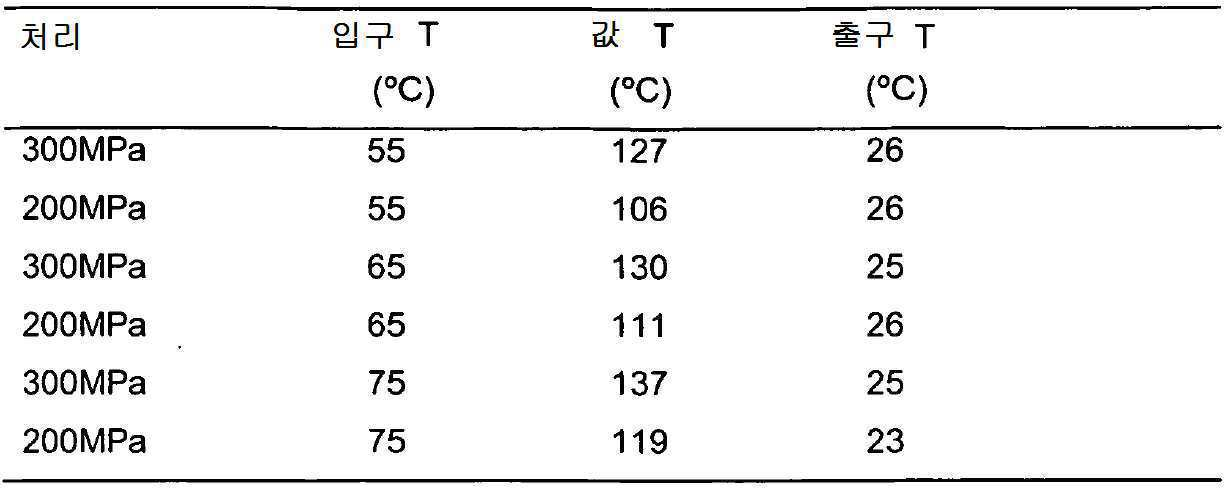
미생물 테스트Microbiological test
그 기원과 차후 조작으로부터 파생된 원료(콩)의 특성으로 인해, 고려해야 할 현재의 병원체 미생물은, 특정한 것으로 살모넬라균(Salmonella spp)과 같은 병원균으로 고려되어야 하는 특정 장내 세균(enterobacteriaceae), 포도상 구균(Staphylococcus aureus), 효모 및 균류와 같은 특정 구균(micrococcaceae), 및 그 병원체 특성으로 인해 또는 바실루스 서브틸리스(B. subtilis) 또는 바실루스 메센테로이데스(B. mesenteroides)로 제품을 변성시키는 영향으로 인해 바실루스 세레우스(Bacillus cereus)가 억압되어야 하는 포자형성(sporulating) 미생물에 생태학적으로 높은 내성을 가지고 있는 것이다.Due to the nature of the raw materials (beans) derived from its origin and subsequent manipulation, the current pathogenic microorganisms to be considered are specific enterobacteriaceae, staphylococci (Staphylococcus aureus), which must be considered pathogens such as Salmonella spp. Staphylococcus aureus, yeast and fungi, and due to their pathogenic character or due to the effect of denaturing the product to B. subtilis or B. mesenteroides, Bacillus subtilis (Bacillus subtilis) or Bacillus mesenteroides Bacillus cereus is highly ecologically resistant to sporulating microorganisms that must be suppressed.
산화에 대한 평가Evaluation of oxidation
히드로퍼옥시드(hydroperoxides)의Of hydroperoxides 형성 formation
히드로퍼옥시드의 결정은 4℃에서 24시간 기간 및 저장 15일 후에 신선한 샘플에 수행되었다. 사용된 방법은 Ostdal, 등{(2000). H., Andersen, H. J., & Nielsen, J. H. (2000). Antioxidative activity of urate in bovine milk. Journay of Agriculture and Food Chemistry 48, 5588-5592}에 의해 설명된 방법이었다. Crystals of hydroperoxide were carried out on fresh samples at 4 ° C for a period of 24 hours and 15 days after storage. The method used was Ostdal, et al. (2000). H., Andersen, H. J., & Nielsen, J. H. (2000). Antioxidative activity of urate in bovine milk. Journay of Agriculture and Food Chemistry 48, 5588-5592.
리폭시케나제Lipoxygenase (( LipoxiqenaseLipoxiqenase )(LOX) 활동) (LOX) Activities
LOX 추출을 달성하기 위해, Axelrod, B., Cheesbrough, T. M., 및 Laasko, S. (1981) (Lipoxygenase from soybean. Methods in enzimology. Ed. J. M. Lowenstein. Waltham, Massachusetts pp. 441-451)에 의해 설명된 방법이 사용되었다. 그리고 LOX 활동이 Van der Ven, C, Matser, A. M., 및 Van den Berg, R. W. (2005) (Inactivation of soybean trypsin inhibitors and lipoxygenase by high-pressure processing. Journal of Agricultural and Food Chemistry 53, 1087-1092.)에 의해 설명된 방법을 사용하여 결정되었다. Described by Axelrod, B., Cheesbrough, TM, and Laasko, S. (1981) (Lipoxygenase from soybean.Methods in Enzymology.Ed.JM Lowenstein.Waltham, Massachusetts pp. 441-451) to achieve LOX extraction. Was used. And LOX activity is described by Van der Ven, C, Matser, AM, and Van den Berg, RW (2005) (Inactivation of soybean trypsin inhibitors and lipoxygenase by high-pressure processing. Journal of Agricultural and Food Chemistry 53, 1087-1092.) ≪ / RTI >
물리적 안정성Physical stability
물리적 안정성은 2가지 방법에 의해 결정되었다:Physical stability was determined by two methods:
- 원심 분리하여 침전물 층의 중량 퍼센트의 결정.- Determining the percentage by weight of the sediment layer by centrifugation.
- 병에 저장(2일, 5일, 및 7일)하여 침전물 층의 질적 평가를 통해.- through qualitative assessment of sediment layer by storing in bottles (2 days, 5 days, and 7 days).
입자 크기Particle size
이것은 0.04 내지 2000μm의 직경의 입자나 방울을 검출할 수 있는 Beckman Coulter LSTM 13320 분석기에서 레이저 광의 분산에 의해 결정되었다. This was determined by the dispersion of the laser light in a Beckman Coulter LS TM 13320 analyzer capable of detecting particles or droplets of 0.04 to 2000 μm in diameter.
트립신 억제제 활동(TIA)Trypsin inhibitor activity (TIA)
TIA 추출 및 분석은 Guerrero-Beltran, J. A., Estrada-Giron, Y., Swanson, B. 및 Barbasa-Canovas, G. V. {(2009). Pressure and temperature combination for inactivation of soymilk trypsin inhibitors. Food Chemistry 116, 676-679., and Hamerstrand, G. E., Black, L. T., & Glover, J. D. (1981 ).Trypsin-inhibitors in soy products - Modification of the standard analytical procedure. Cereal Chemistry 58, 42-45}에 의해 설명된 방법을 통해 발견되고 분석되었다.TIA extraction and analysis are described in Guerrero-Beltran, J.A., Estrada-Giron, Y., Swanson, B. and Barbasa-Canovas, G. V. (2009). Pressure and temperature combination for inactivation of soymilk trypsin inhibitors. Food Chemistry 116, 676-679., And Hamerstrand, G. E., Black, L. T., & Glover, J. D. (1981) .Trypsin-inhibitors in soybean products-Modification of the standard analytical procedure. Cereal Chemistry 58, 42-45}.
결과result
표 2. 두유(평균 ± 표준 편차)에서 미생물 리카운트recount)(log UFC/ml)Table 2. Microbial recount recount in soy milk (mean ± standard deviation) (log UFC / ml)


표 3. 히드로퍼옥시드의 평균 값 (± d.e) (흡광도), 리폭시게네이트(lipoxigenated) 활동(LOX), 원료 샘플 및 산도(pH)와 관련하여 트립신 억제제의 잔류 활동의 퍼센트.Table 3. Percentage of residual activity of trypsin inhibitors in relation to mean (± d.e) (absorbance), lipoxigenated activity (LOX), raw sample and pH (pH) of hydroperoxide.

표 4. 물리적 안정성. 원심 분리에 의한 침전물의 평균 퍼센트(± d.e)Table 4. Physical Stability. The average percentage of sediment by centrifugation (± d.e)

표 5. 물리적 안정성. 정적 침전 값.Table 5. Physical Stability. Static sedimentation value.

표 6. 두유 입자의 평균 크기.Table 6. Mean size of soymilk particles.

결론conclusion
75℃의 초 균질화기의 입구 온도와 300MPa의 압력을 가지고 본 특허 출원에서 제안된 시스템을 통한 두유 처리는 다음을 달성한다:With the inlet temperature of the hyper-homogenizer of 75 DEG C and a pressure of 300 MPa, soybean oil treatment through the system proposed in this patent application achieves the following:
- 제품 살균,- Product sterilization,
- 제품 침전과 자발적인 스키밍(skimming) 동안 우수한 물리적 안정성,- Excellent physical stability during product precipitation and voluntary skimming,
- UHT 살균 처리로 획득된 제품보다 더 낮은 산화 레벨 (히드로퍼옥시드에 포함된 것),- lower oxidation levels (contained in hydroperoxides) than products obtained with UHT sterilization treatment,
- UHT와 관련하여 트립신 억제제(소화성)의 유사한 레벨,- a similar level of trypsin inhibitor (digestible) in relation to UHT,
- "허브"와 "콩" 향이 더 감소된 것을 의미하는 처리된(상세사항은 미도시) UHT 보다 더 맛있는 제품.- A more delicious product than processed (meaning not detailed) UHT, which means that the "herb" and "bean" flavor is further reduced.
Claims (7)
저장 탱크(2)로 나오는 유체를 40℃ 내지 90℃의 온도(Tp)로 예열하는 제 1 열 교환기;
200 내지 600MPa의 압력(Pu)에서 온도(Tp)의 예열된 유체를 도입하는 밸브를 구비하고 그 온도를 값을 입력할 때 온도(Tp)와 적용된 압력(Pu)에 비례하는 최종 값(Tu)으로 증가시키는 초 균질화기(3);
상기 초 균질화기(3)로부터 나오는 유체의 온도를 원하는 냉각 온도 값(Te)으로 조절하는 적어도 하나의 제 2 열 교환기(4); 및
값(Te)에서 상기 냉각된 유체를 수신하는 무균 탱크(5);를 포함하며,
상기 무균 탱크(5)로부터 상기 유체는 상기 최종 제품을 팩킹하기 위하여 무균 포장 기계에 살균된 공기의 압력으로 펌핑되는 것을 특징으로 하는 살균 및 물리적 안정화를 위한 연속 시스템.In continuous systems for sterilization and physical stabilization of fluids, foods or other types of fluids that can be pumped through ultra high pressure homogenization (UHPH)
A first heat exchanger for preheating the fluid exiting the storage tank (2) to a temperature (T p ) of 40 ° C to 90 ° C;
End that is proportional to the temperature (T p) when a valve and enter the temperature value of the temperature (T p) and the applied pressure (P u) for introducing a pre-heated fluid in the pressure (P u) of from 200 to 600MPa value second homogenizer (3) increasing the (u T);
At least one second heat exchanger (4) for regulating the temperature of the fluid exiting the supermormulator (3) to a desired cooling temperature value (T e ); And
And an aseptic tank (5) for receiving said cooled fluid at a value (T e )
Characterized in that said fluid from said aseptic tank (5) is pumped to the pressure of sterilized air in an aseptic packaging machine to pack said final product.
상기 초 균질화기(3)로부터 나온 후에 유체의 온도를 감소시키기 위한 적어도 하나의 제 2 냉동 교환기(4)와;
상기 제 2 냉동 교환기(4)에 의해 온도가 감소된 유체를 수신하여 무균 포장 기계로 펌핑되는 무균 탱크(5)
를 포함하는 살균 및 물리적 안정화를 위한 연속 시스템으로부터, 초고압 균질화를 통해 펌핑가능한 유체, 식품 또는 다른 유형의 유체의 살균 및 물리적 안정화를 위한 방법으로서,
- 상기 무균 탱크(5)와의 연결부까지 상기 초 균질화기(3)를 포함하는 시스템을 사전 살균하는 단계로서, 상기 시스템에 물이 도입되고, 압력이 300 내지 600MPa까지 상승되고, 상기 초 균질화기가 정지하고 상기 유체 입구가 폐쇄된 후에, 수증기가 140℃의 온도에 도달할 때까지 추가되며 30 내지 60분 동안 그 온도를 유지하는, 상기 무균 탱크(5)와의 연결부까지 상기 초 균질화기(3)를 포함하는 시스템을 사전 살균하는 단계;
- 수증기가 140℃의 온도에 도달할 때까지 30 내지 60분 동안 그 온도를 유지하는 증기 주입 공정과, 0.4 내지 6바(bar)의 압력으로 필터를 통해 살균된 공기에 양의 압력을 유지하는 이중 재킷 냉각에 의하여 상기 무균 탱크(5)를 사전 살균하는 단계;
- 상기 시스템이 유체 처리를 위해 선택한 온도와 압력에서 연속적이고 안정적인 방식으로 물로 사전 살균된다면, 상기 유체가 상기 제 1 예열 교환기(1)를 통과한 후, 40 내지 90℃ 사이의 온도(Tp)와 200 내지 600MPa 사이의 압력(Pu)에서 상기 초 균질화기(3) 밸브에 도입되고, 상기 유체는 온도(Tu)를 달성하며 이 온도는 상기 유체가 상기 밸브로부터 나온 후 0.1 내지 1초 동안 유지되는 단계;
- 상기 초 균질화기(3)에서 머무른 후에, 상기 유체는 상기 냉동 교환기(4)를 통해 냉각되고, 상기 냉각 온도는 제품 기술에 따라 값(Te)으로 조절되고, 이후, 상기 유체는 상기 무균 탱크(5)로 운송되고, 상기 무균 탱크(5)로부터 상기 유체는 펌핑되어 무균 포장 기계에서 차후 포장되는 단계
를 포함하는 것을 특징으로 하는 살균 및 물리적 안정화를 위한 방법.In a first heat exchanger (1), a fluid preheated from the first heat exchanger (1) is conveyed to a supermormer (3) and the supermormer (3) has a high pressure valve, A first heat exchanger (1) which is introduced at a pressure of 200 to 600 MPa;
At least one second refrigeration exchanger (4) for reducing the temperature of the fluid after leaving the supermormerator (3);
An aseptic tank 5 which receives the fluid whose temperature has been reduced by the second freezer exchanger 4 and is pumped to the aseptic packaging machine,
As a method for sterilization and physical stabilization of a pumpable fluid, food or other type of fluid through ultra-high pressure homogenization from a continuous system for sterilization and physical stabilization,
- pre-sterilizing the system comprising the supermormerator (3) to a connection with the aseptic tank (5), wherein water is introduced into the system, the pressure is increased to 300 to 600 MPa, the supermormerator And the fluid inlet is closed, the super-homogenizer (3) is added to the connection with the aseptic tank (5) which is added until the temperature of the steam reaches a temperature of 140 ° C and the temperature is maintained for 30 to 60 minutes Pre-sterilizing the containing system;
Maintaining the temperature for 30 to 60 minutes until the steam reaches a temperature of 140 DEG C; maintaining the pressure at a positive pressure in the sterilized air through the filter at a pressure of 0.4 to 6 bar; Pre-sterilizing said aseptic tank (5) by double jacket cooling;
If the system is pre-sterilized with water in a continuous and stable manner at the temperature and pressure selected for the treatment of the fluid, the fluid is passed through the first preheat exchanger 1 and then cooled to a temperature (T p ) between 40 and 90 ° C, (3) valve at a pressure (P u ) of between 200 and 600 MPa, said fluid achieving a temperature (T u ) which is from 0.1 to 1 second ;
- after staying in the supermormater (3), the fluid is cooled through the refrigeration exchanger (4) and the cooling temperature is adjusted to a value (T e ) according to the product description, Is transported to the tank (5), and the fluid from the aseptic tank (5) is pumped and subsequently packed in an aseptic packaging machine
≪ / RTI > The method of claim < RTI ID = 0.0 > 1, < / RTI >
Applications Claiming Priority (3)
| Application Number | Priority Date | Filing Date | Title |
|---|---|---|---|
| EP10380094.2 | 2010-07-21 | ||
| EP20100380094 EP2409583B1 (en) | 2010-07-21 | 2010-07-21 | Continuous system and procedure of sterilization and physical stabilization of pumpable fluids by means of ultra-high pressure homogenization |
| PCT/EP2011/003572 WO2012010284A2 (en) | 2010-07-21 | 2011-07-18 | Continuous system and procedure of sterilization and physical stabilization of pumpable fluids by means of ultra-high pressure homogenization |
Related Parent Applications (1)
| Application Number | Title | Priority Date | Filing Date |
|---|---|---|---|
| KR1020137002924A Division KR20140005126A (en) | 2010-07-21 | 2011-07-18 | Continuous system and procedure of sterilization and physical stabilization of pumpable fluids by means of ultra-high pressure homogenization |
Publications (2)
| Publication Number | Publication Date |
|---|---|
| KR20180121943A true KR20180121943A (en) | 2018-11-09 |
| KR101979177B1 KR101979177B1 (en) | 2019-05-15 |
Family
ID=43425821
Family Applications (3)
| Application Number | Title | Priority Date | Filing Date |
|---|---|---|---|
| KR1020137002924A Ceased KR20140005126A (en) | 2010-07-21 | 2011-07-18 | Continuous system and procedure of sterilization and physical stabilization of pumpable fluids by means of ultra-high pressure homogenization |
| KR1020187028267A Active KR102096615B1 (en) | 2010-07-21 | 2011-07-18 | Continuous system and procedure of sterilization and physical stabilization of pumpable fluids by means of ultra-high pressure homogenization |
| KR1020187028268A Active KR101979177B1 (en) | 2010-07-21 | 2011-07-18 | Continuous system and procedure of sterilization and physical stabilization of pumpable fluids by means of ultra-high pressure homogenization |
Family Applications Before (2)
| Application Number | Title | Priority Date | Filing Date |
|---|---|---|---|
| KR1020137002924A Ceased KR20140005126A (en) | 2010-07-21 | 2011-07-18 | Continuous system and procedure of sterilization and physical stabilization of pumpable fluids by means of ultra-high pressure homogenization |
| KR1020187028267A Active KR102096615B1 (en) | 2010-07-21 | 2011-07-18 | Continuous system and procedure of sterilization and physical stabilization of pumpable fluids by means of ultra-high pressure homogenization |
Country Status (17)
| Country | Link |
|---|---|
| US (1) | US9192190B2 (en) |
| EP (1) | EP2409583B1 (en) |
| JP (1) | JP5781608B2 (en) |
| KR (3) | KR20140005126A (en) |
| CN (1) | CN103118555B (en) |
| AU (1) | AU2011281986B2 (en) |
| BR (1) | BR112013001519B1 (en) |
| CY (1) | CY1116499T1 (en) |
| DK (1) | DK2409583T3 (en) |
| ES (1) | ES2543365T3 (en) |
| HR (1) | HRP20150774T1 (en) |
| MX (1) | MX339023B (en) |
| PL (1) | PL2409583T3 (en) |
| PT (1) | PT2409583E (en) |
| SI (1) | SI2409583T1 (en) |
| SM (1) | SMT201500179B (en) |
| WO (1) | WO2012010284A2 (en) |
Families Citing this family (19)
| Publication number | Priority date | Publication date | Assignee | Title |
|---|---|---|---|---|
| US20140348988A1 (en) * | 2011-12-12 | 2014-11-27 | Bühler Barth Gmbh | Method and Device for the Pasteurization and/or Sterilization of a Food |
| CN104126663B (en) * | 2014-07-25 | 2016-02-10 | 黑龙江大三源乳品机械有限公司 | A kind of cyclic preheat steam direct injection dairy products sterilizing unit |
| WO2016151381A1 (en) * | 2015-03-24 | 2016-09-29 | Gea Mechanical Equipment Italia S.P.A. | Apparatus and method for flushing aseptic chambers of a high-pressure homogenizer or pump |
| CN205731171U (en) | 2015-03-28 | 2016-11-30 | 压力生物科技公司 | High pressure, the system of high shear force process for fluid |
| US11096406B2 (en) * | 2015-04-24 | 2021-08-24 | Millisecond Technologies Corp. | Killing microbes with pressure drop and heat |
| CN105011275A (en) * | 2015-06-30 | 2015-11-04 | 陕西海升果业发展股份有限公司 | Compound fruit juice beverage and production process thereof |
| CN121242084A (en) * | 2015-07-03 | 2026-01-02 | 纳图鲁私人有限公司 | Method for treating milk |
| AU2016318955B2 (en) | 2015-09-11 | 2021-10-21 | Pressure Biosciences, Inc. | Ultrahigh pressure compact valve with throttling capability |
| CN106539690B (en) * | 2015-09-18 | 2020-08-04 | 天士力医药集团股份有限公司 | Continuous intelligent preparation method of liquid cooling dropping pills |
| CA3011096C (en) * | 2016-01-15 | 2024-02-20 | The Coca-Cola Company | Continuous high pressure processing of food and beverage products |
| DE102018202518A1 (en) | 2018-02-20 | 2019-08-22 | Krones Ag | Method and device for preserving liquids by ultra-high pressure homogenization |
| WO2019229215A2 (en) | 2018-05-30 | 2019-12-05 | DÖHLER GmbH | High-pressure process, in particular for preserving items of food, pharmaceuticals and cosmetics, and high-pressure apparatus |
| CN109022150B (en) * | 2018-07-04 | 2021-09-21 | 红云红河烟草(集团)有限责任公司 | High-pressure sterilization filtering method for preventing fermentation of sugar flavor for cigarettes |
| CN110150538B (en) * | 2019-06-28 | 2022-03-22 | 山东双超生物设备科技有限公司 | Ultrahigh-pressure continuous sterilization device system and sterilization process |
| CN111011490A (en) * | 2019-12-27 | 2020-04-17 | 光明乳业股份有限公司 | Sterile milk and preparation method thereof |
| CN115334902A (en) * | 2020-03-27 | 2022-11-11 | 阿维瑞技术股份有限公司 | Batch processing pressure vessel temperature control in high pressure applications |
| CN111840589A (en) * | 2020-07-15 | 2020-10-30 | 湖南弘烨医疗器械有限公司 | Be used for pharmaceutic novel damp and hot sterilization system |
| KR102521670B1 (en) * | 2020-09-09 | 2023-04-13 | 농업회사법인 (주)제주향 | Method for Preparing Carrot or Citrus Juice Without Layer Separation |
| CN112089853A (en) * | 2020-09-22 | 2020-12-18 | 漳州明建机械设备制造有限公司 | Liquid ultrahigh pressure equipment with static ultrahigh pressure and dynamic ultrahigh pressure functions |
Citations (2)
| Publication number | Priority date | Publication date | Assignee | Title |
|---|---|---|---|---|
| WO1999021442A1 (en) * | 1997-10-23 | 1999-05-06 | Morinaga Milk Industry Co., Ltd. | Method and apparatus for continuous heat sterilization of liquid |
| JP2000139433A (en) * | 1998-11-04 | 2000-05-23 | Shimadzu Corp | Liquid substance continuous processing method, continuous processing apparatus and liquid food and drink treated by them |
Family Cites Families (6)
| Publication number | Priority date | Publication date | Assignee | Title |
|---|---|---|---|---|
| JPS59194745A (en) * | 1983-04-19 | 1984-11-05 | ハウス食品工業株式会社 | Sterilizing and filling system capable of continuously treating liouid |
| JPS59210862A (en) * | 1983-05-17 | 1984-11-29 | World Food Kk | Production of bean curd fortified with edible fiber |
| US6086936A (en) * | 1995-12-14 | 2000-07-11 | Kal Kan Foods, Inc. | High temperature/ultra-high pressure sterilization of foods |
| US6136362A (en) * | 1998-12-10 | 2000-10-24 | Alfa Laval Flow Inc. | High temperature/short time pasteurization system and method of cleaning |
| JP2004049437A (en) * | 2002-07-18 | 2004-02-19 | Masaaki Shoji | Apparatus and method for continuous sterilization of liquid and heat-resistant flow channel sheet |
| AU2006234771A1 (en) * | 2005-04-12 | 2006-10-19 | Auckland Uniservices Ltd | Pressure assisted thermal sterilisation or pasteurisation method and apparatus |
-
2010
- 2010-07-21 ES ES10380094.2T patent/ES2543365T3/en active Active
- 2010-07-21 PT PT103800942T patent/PT2409583E/en unknown
- 2010-07-21 EP EP20100380094 patent/EP2409583B1/en active Active
- 2010-07-21 SI SI201030982T patent/SI2409583T1/en unknown
- 2010-07-21 DK DK10380094.2T patent/DK2409583T3/en active
- 2010-07-21 PL PL10380094T patent/PL2409583T3/en unknown
-
2011
- 2011-07-18 US US13/811,199 patent/US9192190B2/en active Active
- 2011-07-18 MX MX2013000811A patent/MX339023B/en active IP Right Grant
- 2011-07-18 AU AU2011281986A patent/AU2011281986B2/en not_active Ceased
- 2011-07-18 KR KR1020137002924A patent/KR20140005126A/en not_active Ceased
- 2011-07-18 WO PCT/EP2011/003572 patent/WO2012010284A2/en not_active Ceased
- 2011-07-18 KR KR1020187028267A patent/KR102096615B1/en active Active
- 2011-07-18 BR BR112013001519-5A patent/BR112013001519B1/en not_active IP Right Cessation
- 2011-07-18 CN CN201180041240.0A patent/CN103118555B/en active Active
- 2011-07-18 KR KR1020187028268A patent/KR101979177B1/en active Active
- 2011-07-18 JP JP2013519999A patent/JP5781608B2/en active Active
-
2015
- 2015-07-14 CY CY20151100612T patent/CY1116499T1/en unknown
- 2015-07-14 HR HRP20150774TT patent/HRP20150774T1/en unknown
- 2015-07-27 SM SM201500179T patent/SMT201500179B/en unknown
Patent Citations (4)
| Publication number | Priority date | Publication date | Assignee | Title |
|---|---|---|---|---|
| WO1999021442A1 (en) * | 1997-10-23 | 1999-05-06 | Morinaga Milk Industry Co., Ltd. | Method and apparatus for continuous heat sterilization of liquid |
| US6673311B1 (en) * | 1997-10-23 | 2004-01-06 | Morinaga Milk Industry Co., Ltd. | Method and apparatus for continuous heat sterilization of liquid |
| JP3674685B2 (en) * | 1997-10-23 | 2005-07-20 | 森永乳業株式会社 | Method and apparatus for continuous heat sterilization of liquid |
| JP2000139433A (en) * | 1998-11-04 | 2000-05-23 | Shimadzu Corp | Liquid substance continuous processing method, continuous processing apparatus and liquid food and drink treated by them |
Also Published As
| Publication number | Publication date |
|---|---|
| HRP20150774T1 (en) | 2015-09-11 |
| WO2012010284A3 (en) | 2012-03-15 |
| WO2012010284A2 (en) | 2012-01-26 |
| JP2013538048A (en) | 2013-10-10 |
| MX2013000811A (en) | 2013-05-30 |
| US9192190B2 (en) | 2015-11-24 |
| BR112013001519A2 (en) | 2017-11-14 |
| SMT201500179B (en) | 2015-09-07 |
| KR102096615B1 (en) | 2020-04-20 |
| EP2409583A1 (en) | 2012-01-25 |
| KR20140005126A (en) | 2014-01-14 |
| ES2543365T3 (en) | 2015-08-18 |
| AU2011281986B2 (en) | 2015-07-02 |
| PT2409583E (en) | 2015-09-14 |
| CN103118555A (en) | 2013-05-22 |
| KR101979177B1 (en) | 2019-05-15 |
| SI2409583T1 (en) | 2015-10-30 |
| KR20180113623A (en) | 2018-10-16 |
| PL2409583T3 (en) | 2015-10-30 |
| JP5781608B2 (en) | 2015-09-24 |
| BR112013001519B1 (en) | 2018-06-26 |
| CN103118555B (en) | 2015-04-08 |
| AU2011281986A1 (en) | 2013-01-31 |
| US20130243644A1 (en) | 2013-09-19 |
| MX339023B (en) | 2016-05-05 |
| DK2409583T3 (en) | 2015-07-27 |
| EP2409583B1 (en) | 2015-04-22 |
| CY1116499T1 (en) | 2017-03-15 |
Similar Documents
| Publication | Publication Date | Title |
|---|---|---|
| KR101979177B1 (en) | Continuous system and procedure of sterilization and physical stabilization of pumpable fluids by means of ultra-high pressure homogenization | |
| Chiozzi et al. | Advances, applications, and comparison of thermal (pasteurization, sterilization, and aseptic packaging) against non-thermal (ultrasounds, UV radiation, ozonation, high hydrostatic pressure) technologies in food processing | |
| Muntean et al. | High pressure processing in food industry–characteristics and applications | |
| Zamora et al. | Opportunities for ultra-high-pressure homogenisation (UHPH) for the food industry | |
| US6120732A (en) | Microbial inactivation by high-pressure throttling | |
| US20080152775A1 (en) | Inactivation of food spoilage and pathogenic microorganisms by dynamic high pressure | |
| Balaban et al. | Dense phase carbon dioxide research: current focus and directions | |
| Veiga et al. | Supercritical carbon dioxide technology in food processing: Insightful comprehension of the mechanisms of microbial inactivation and impacts on quality and safety aspects | |
| US20090263548A1 (en) | Ozone treatment of liquid foodstuff | |
| Karim et al. | Introduction to thermal food processes by steam and hot water | |
| Ibrahim | Thermal and nonthermal food processing technologies for food preservation and their effects on food chemistry and nutritional values | |
| Birwal et al. | Nonthermal processing of dairy beverages | |
| JP2736605B2 (en) | Liquid material sterilization method | |
| Chetia et al. | Effect of non-thermal processing on nutritional and functional properties of milk and milk products-A review | |
| Abid et al. | Food preservation methods and use of nanomaterials as a preservative | |
| Codina et al. | Horchata | |
| Nanjegowda et al. | Aseptic processing | |
| Bhujel et al. | Recent Developments in Non-thermal Processing Techniques to Improve the Quality and Safety of Milk and Milk Products | |
| Devraj et al. | Dense phase carbon dioxide (DPCD)-aided preservation of foods | |
| Ortega-Rivas | High-voltage pulsed electric fields | |
| Mezgebe | Recent advances in colostrum processing techniques | |
| Murtaza et al. | Impact of High-Pressure Carbon Dioxide on the Processing of Fruits and Vegetables | |
| Jeantet | Inactivation of food modifying agents | |
| Evrendilek | Pulsed Electric Field: Impact on Food Product Attributes | |
| Gottardi et al. | Nonthermal approaches to increase the shelf life and safety of vegetable puree: technical aspects of ultra high pressure homogenization processes and case studies |
Legal Events
| Date | Code | Title | Description |
|---|---|---|---|
| A107 | Divisional application of patent | ||
| E13-X000 | Pre-grant limitation requested |
St.27 status event code: A-2-3-E10-E13-lim-X000 |
|
| P11-X000 | Amendment of application requested |
St.27 status event code: A-2-2-P10-P11-nap-X000 |
|
| P13-X000 | Application amended |
St.27 status event code: A-2-2-P10-P13-nap-X000 |
|
| PA0104 | Divisional application for international application |
St.27 status event code: A-0-1-A10-A18-div-PA0104 St.27 status event code: A-0-1-A10-A16-div-PA0104 |
|
| P11-X000 | Amendment of application requested |
St.27 status event code: A-2-2-P10-P11-nap-X000 |
|
| P13-X000 | Application amended |
St.27 status event code: A-2-2-P10-P13-nap-X000 |
|
| A201 | Request for examination | ||
| PA0201 | Request for examination |
St.27 status event code: A-1-2-D10-D11-exm-PA0201 |
|
| PG1501 | Laying open of application |
St.27 status event code: A-1-1-Q10-Q12-nap-PG1501 |
|
| E902 | Notification of reason for refusal | ||
| PE0902 | Notice of grounds for rejection |
St.27 status event code: A-1-2-D10-D21-exm-PE0902 |
|
| P11-X000 | Amendment of application requested |
St.27 status event code: A-2-2-P10-P11-nap-X000 |
|
| P13-X000 | Application amended |
St.27 status event code: A-2-2-P10-P13-nap-X000 |
|
| E701 | Decision to grant or registration of patent right | ||
| PE0701 | Decision of registration |
St.27 status event code: A-1-2-D10-D22-exm-PE0701 |
|
| GRNT | Written decision to grant | ||
| PR0701 | Registration of establishment |
St.27 status event code: A-2-4-F10-F11-exm-PR0701 |
|
| PR1002 | Payment of registration fee |
St.27 status event code: A-2-2-U10-U12-oth-PR1002 Fee payment year number: 1 |
|
| PG1601 | Publication of registration |
St.27 status event code: A-4-4-Q10-Q13-nap-PG1601 |
|
| PR1001 | Payment of annual fee |
St.27 status event code: A-4-4-U10-U11-oth-PR1001 Fee payment year number: 4 |
|
| PR1001 | Payment of annual fee |
St.27 status event code: A-4-4-U10-U11-oth-PR1001 Fee payment year number: 5 |
|
| PR1001 | Payment of annual fee |
St.27 status event code: A-4-4-U10-U11-oth-PR1001 Fee payment year number: 6 |
|
| P22-X000 | Classification modified |
St.27 status event code: A-4-4-P10-P22-nap-X000 |
|
| PR1001 | Payment of annual fee |
St.27 status event code: A-4-4-U10-U11-oth-PR1001 Fee payment year number: 7 |
|
| U11 | Full renewal or maintenance fee paid |
Free format text: ST27 STATUS EVENT CODE: A-4-4-U10-U11-OTH-PR1001 (AS PROVIDED BY THE NATIONAL OFFICE) Year of fee payment: 7 |