KR20140052189A - Refining method of organic amine, organic amine refined by the method, and polyamide prepared therefrom - Google Patents
Refining method of organic amine, organic amine refined by the method, and polyamide prepared therefrom Download PDFInfo
- Publication number
- KR20140052189A KR20140052189A KR1020120117501A KR20120117501A KR20140052189A KR 20140052189 A KR20140052189 A KR 20140052189A KR 1020120117501 A KR1020120117501 A KR 1020120117501A KR 20120117501 A KR20120117501 A KR 20120117501A KR 20140052189 A KR20140052189 A KR 20140052189A
- Authority
- KR
- South Korea
- Prior art keywords
- diaminobutane
- fermentation broth
- composition
- distillation
- concentrating
- Prior art date
- Legal status (The legal status is an assumption and is not a legal conclusion. Google has not performed a legal analysis and makes no representation as to the accuracy of the status listed.)
- Ceased
Links
Images

Classifications
-
- C—CHEMISTRY; METALLURGY
- C07—ORGANIC CHEMISTRY
- C07C—ACYCLIC OR CARBOCYCLIC COMPOUNDS
- C07C209/00—Preparation of compounds containing amino groups bound to a carbon skeleton
- C07C209/82—Purification; Separation; Stabilisation; Use of additives
- C07C209/84—Purification
-
- C—CHEMISTRY; METALLURGY
- C07—ORGANIC CHEMISTRY
- C07C—ACYCLIC OR CARBOCYCLIC COMPOUNDS
- C07C211/00—Compounds containing amino groups bound to a carbon skeleton
- C07C211/01—Compounds containing amino groups bound to a carbon skeleton having amino groups bound to acyclic carbon atoms
- C07C211/02—Compounds containing amino groups bound to a carbon skeleton having amino groups bound to acyclic carbon atoms of an acyclic saturated carbon skeleton
- C07C211/09—Diamines
-
- C—CHEMISTRY; METALLURGY
- C08—ORGANIC MACROMOLECULAR COMPOUNDS; THEIR PREPARATION OR CHEMICAL WORKING-UP; COMPOSITIONS BASED THEREON
- C08G—MACROMOLECULAR COMPOUNDS OBTAINED OTHERWISE THAN BY REACTIONS ONLY INVOLVING UNSATURATED CARBON-TO-CARBON BONDS
- C08G69/00—Macromolecular compounds obtained by reactions forming a carboxylic amide link in the main chain of the macromolecule
- C08G69/02—Polyamides derived from amino-carboxylic acids or from polyamines and polycarboxylic acids
- C08G69/04—Preparatory processes
-
- C—CHEMISTRY; METALLURGY
- C08—ORGANIC MACROMOLECULAR COMPOUNDS; THEIR PREPARATION OR CHEMICAL WORKING-UP; COMPOSITIONS BASED THEREON
- C08G—MACROMOLECULAR COMPOUNDS OBTAINED OTHERWISE THAN BY REACTIONS ONLY INVOLVING UNSATURATED CARBON-TO-CARBON BONDS
- C08G69/00—Macromolecular compounds obtained by reactions forming a carboxylic amide link in the main chain of the macromolecule
- C08G69/02—Polyamides derived from amino-carboxylic acids or from polyamines and polycarboxylic acids
- C08G69/26—Polyamides derived from amino-carboxylic acids or from polyamines and polycarboxylic acids derived from polyamines and polycarboxylic acids
-
- C—CHEMISTRY; METALLURGY
- C12—BIOCHEMISTRY; BEER; SPIRITS; WINE; VINEGAR; MICROBIOLOGY; ENZYMOLOGY; MUTATION OR GENETIC ENGINEERING
- C12P—FERMENTATION OR ENZYME-USING PROCESSES TO SYNTHESISE A DESIRED CHEMICAL COMPOUND OR COMPOSITION OR TO SEPARATE OPTICAL ISOMERS FROM A RACEMIC MIXTURE
- C12P13/00—Preparation of nitrogen-containing organic compounds
- C12P13/001—Amines; Imines
-
- C—CHEMISTRY; METALLURGY
- C12—BIOCHEMISTRY; BEER; SPIRITS; WINE; VINEGAR; MICROBIOLOGY; ENZYMOLOGY; MUTATION OR GENETIC ENGINEERING
- C12P—FERMENTATION OR ENZYME-USING PROCESSES TO SYNTHESISE A DESIRED CHEMICAL COMPOUND OR COMPOSITION OR TO SEPARATE OPTICAL ISOMERS FROM A RACEMIC MIXTURE
- C12P13/00—Preparation of nitrogen-containing organic compounds
Landscapes
- Chemical & Material Sciences (AREA)
- Organic Chemistry (AREA)
- Life Sciences & Earth Sciences (AREA)
- Chemical Kinetics & Catalysis (AREA)
- Health & Medical Sciences (AREA)
- Zoology (AREA)
- Engineering & Computer Science (AREA)
- Wood Science & Technology (AREA)
- Polymers & Plastics (AREA)
- Medicinal Chemistry (AREA)
- Biotechnology (AREA)
- Microbiology (AREA)
- Biochemistry (AREA)
- Bioinformatics & Cheminformatics (AREA)
- General Engineering & Computer Science (AREA)
- General Health & Medical Sciences (AREA)
- Genetics & Genomics (AREA)
- General Chemical & Material Sciences (AREA)
- Proteomics, Peptides & Aminoacids (AREA)
- Preparation Of Compounds By Using Micro-Organisms (AREA)
- Organic Low-Molecular-Weight Compounds And Preparation Thereof (AREA)
- Polyamides (AREA)
- Vaporization, Distillation, Condensation, Sublimation, And Cold Traps (AREA)
Abstract
1,4-디아미노부탄 및 이의 염 중 하나 이상을 포함하는 발효액을 농축하는 단계; 상기 발효액의 농축물에 염기를 첨가하여 pH 12 이상의 염기성 조성물을 준비하는 단계; 및 상기 염기성 조성물로부터 1,4-디아미노부탄을 회수하는 단계;를 포함하는 1,4-디아미노부탄의 정제방법, 상기 방법으로 정제된 1,4-디아미노부탄, 및 상기 1,4-디아미노부탄을 사용하여 제조되는 폴리아미드가 제공된다.Concentrating a fermentation liquid comprising at least one of 1,4-diaminobutane and its salt; Preparing a basic composition having a pH of 12 or more by adding a base to the concentrate of the fermentation broth; And recovering the 1,4-diaminobutane from the basic composition, a method for purifying 1,4-diaminobutane, 1,4-diaminobutane purified by the method, A polyamide produced by using diaminobutane is provided.
Description
1,4-디아미노부탄의 정제방법, 상기 방법으로 정제된 1,4-디아미노부탄 및 상기 1,4-디아미노부탄을 사용하여 제조되는 폴리아미드에 관한 것이다.1,4-diaminobutane, 1,4-diaminobutane purified by the above method, and polyamides produced by using the 1,4-diaminobutane.
1,4-디아미노부탄(일명, 퓨트레신)은 시안화수소와 아크릴로니트릴을 사용하여 숙시노니트릴을 제조하고 수소화 과정 및 증류 과정을 거쳐 제조될 수 있다. 다르게는, 1,4-디아미노부탄은 1,4-디브로모부탄 또는 1,4-디클로로부탄에 알칼리금속 프탈이미드 촉매 및 히드라진을 첨가한 후 증류 과정을 거쳐 제조될 수 있다. 이러한 화학합성법은 시안화수소와 같은 유독성 화합물을 사용하거나 고가의 반응촉매를 사용해야 한다.1,4-diaminobutane (aka, putrescine) can be prepared by preparing succinonitrile using hydrogen cyanide and acrylonitrile, and hydrogenation and distillation. Alternatively, 1,4-diaminobutane can be prepared by adding an alkali metal phthalimide catalyst and hydrazine to 1,4-dibromobutane or 1,4-dichlorobutane followed by distillation. These chemical synthesis methods require the use of toxic compounds such as hydrogen cyanide or the use of expensive reaction catalysts.
최근 유독성 화합물 및 고가 촉매의 사용 없이 발효 과정을 통하여 1,4-디아미노부탄을 생산하는 방법이 연구되고 있다. 그러나, 발효 과정으로부터 얻어지는 발효액에 포함된 1,4-디아미노부탄은 농도가 낮으며 염과 결합한 상태로 존재하는 것이 일반적이다.Recently, a method for producing 1,4-diaminobutane through a fermentation process without using toxic compounds and expensive catalysts has been studied. However, the 1,4-diaminobutane contained in the fermentation broth obtained from the fermentation process is low in concentration and generally exists in a state of being bound to a salt.
따라서, 상기 발효액으로부터 1,4-디아미노부탄을 효과적으로 정제하는 방법이 요구된다.Therefore, there is a need for a method for efficiently purifying 1,4-diaminobutane from the fermentation broth.
한 측면은 새로운 1,4-디아미노부탄의 정제방법을 제공하는 것이다.One aspect is to provide a process for the purification of the novel 1,4-diaminobutane.
다른 한 측면은 상기 방법으로 정제된 1,4-디아미노부탄을 제공하는 것이다.Another aspect is to provide 1,4-diaminobutane purified by the above method.
또 다른 한 측면은 상기 1,4-디아미노부탄을 사용하여 제조된 폴리아미드를 제공하는 것이다.Another aspect is to provide a polyamide produced using the 1,4-diaminobutane.
한 측면에 따라,According to one aspect,
1,4-디아미노부탄 및 이의 염 중 하나 이상을 포함하는 발효액을 농축하는 단계;Concentrating a fermentation liquid comprising at least one of 1,4-diaminobutane and its salt;
상기 발효액의 농축물에 염기를 첨가하여 pH 12 이상의 염기성 조성물을 준비하는 단계; 및Preparing a basic composition having a pH of 12 or more by adding a base to the concentrate of the fermentation broth; And
상기 염기성 조성물로부터 1,4-디아미노부탄을 회수하는 단계;를 포함하는 1,4-디아미노부탄의 정제방법이 제공된다.And recovering the 1,4-diaminobutane from the basic composition. The present invention also provides a method for purifying 1,4-diaminobutane.
다른 한 측면에 따라,According to another aspect,
상기의 방법으로 정제된 1,4-디아미노부탄이 제공된다.1,4-diaminobutane purified by the above method is provided.
또 다른 한 측면에 따라,According to another aspect,
상기 1,4-디아미노부탄을 사용하여 제조된 폴리아미드가 제공된다.There is provided a polyamide produced by using the 1,4-diaminobutane.
한 측면에 따르면 1,4-디아미노부탄을 포함하는 발효액에 염기를 가함에 의하여 고순도 1,4-디아미노부탄을 높은 수율로 얻을 수 있다.According to one aspect, high purity 1,4-diaminobutane can be obtained in high yield by adding a base to a fermentation broth containing 1,4-diaminobutane.
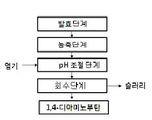
도 1은 실시예 1에 따른 1,4-디아미노부탄 정제 방법의 순서도이다.
도 2는 실시예 2에 따른 1,4-디아미노부탄 정제 방법의 순서도이다.Fig. 1 is a flow chart of the 1,4-diaminobutane purification method according to Example 1. Fig.
Fig. 2 is a flow chart of the 1,4-diaminobutane purification method according to Example 2. Fig.
이하에서 예시적인 일구현예에 따른 1,4-디아미노부탄의 정제방법, 상기 방법으로 정제된 1,4-디아미노부탄 및 상기 1,4-디아미노부탄을 사용하여 제조되는 폴리아미드에 관하여 더욱 상세히 설명한다.Hereinafter, a method for purifying 1,4-diaminobutane according to an exemplary embodiment, a method for purifying 1,4-diaminobutane and a polyamide prepared using the 1,4-diaminobutane Will be described in more detail.
일구현예에 따른 1,4-디아미노부탄의 정제방법은 1,4-디아미노부탄 및 이의 염 중 하나 이상을 포함하는 발효액을 농축하는 단계; 상기 발효액의 농축물에 염기를 첨가하여 pH 12 이상의 염기성 조성물을 준비하는 단계; 및 상기 염기성 조성물로부터 1,4-디아미노부탄을 회수하는 단계;를 포함한다.The process for the purification of 1,4-diaminobutane according to one embodiment comprises concentrating a fermentation broth comprising at least one of 1,4-diaminobutane and its salts; Preparing a basic composition having a pH of 12 or more by adding a base to the concentrate of the fermentation broth; And recovering the 1,4-diaminobutane from the basic composition.
상기 정제방법은 1,4-디아미노부탄의 염을 포함하는 중성 발효액을 농축한 후, 여기에 염기를 첨가하여 1,4-디아미노부탄의 염으로부터 1,4-디아미노부탄을 분리한 후, 1,4-디아미노부탄을 선택적으로 회수함으로써 간단하게 고순도의 1,4-디아미노부탄을 높은 수율로 얻을 수 있다.In the above purification method, a neutral fermentation liquid containing a salt of 1,4-diaminobutane is concentrated, and then a base is added thereto to separate 1,4-diaminobutane from the salt of 1,4-diaminobutane , 1,4-diaminobutane can be selectively recovered to obtain 1,4-diaminobutane of high purity with high yield.
상기 발효액은 중성이다. 상기 발효액을 농축하는 단계에서 발효액에 포함된 용매의 적어도 일부가 제거될 수 있으며 1차 농축단계에 해당한다. 상기 용매의 적어도 일부가 제거됨에 의하여 발효액에 포함된 1,4-디아미노부탄의 농도가 증가할 수 있다. 상기 용매는 예를 들어 물이다. 예를 들어, 상기 중성 발효액을 농축하는 단계에서 농축되지 않은 발효액에 포함된 최초 용매의 50% 이상, 바람직하게는 60% 이상, 보다 바람직하게는 70% 이상, 보다 더 바람직하게는 80% 이상이 제거될 수 있다.The fermentation broth is neutral. At the step of concentrating the fermentation broth, at least a part of the solvent contained in the fermentation broth can be removed and corresponds to the first concentration step. The removal of at least a part of the solvent may increase the concentration of 1,4-diaminobutane contained in the fermentation broth. The solvent is, for example, water. For example, in the step of concentrating the neutral fermentation broth, at least 50%, preferably at least 60%, more preferably at least 70%, even more preferably at least 80% of the original solvent contained in the non-concentrated fermentation broth Can be removed.
상기 발효액을 농축하는 단계에서 발효액에 균체가 포함되는 경우 균체의 파괴를 방지하기 위하여 저온 및 감압 환경에서 농축이 수행될 수 있다.In the step of concentrating the fermentation broth, in the case where the broth is contained in the fermentation broth, the concentration may be performed in a low-temperature and reduced-pressure environment to prevent destruction of the bacterium.
상기 정제방법에서 발효액을 농축하는 단계는 100℃ 이하의 증기온도에서 수행될 수 있다. 즉, 발효액으로부터 기화되는 증기의 온도가 100℃ 이하인 조건에서 농축이 수행될 수 있다. 예를 들어, 상기 정제방법에서 발효액을 농축하는 단계는 10℃ 내지 100℃ 의 증기온도, 바람직하게는 30℃ 내지 80℃ 의 증기온도, 보다 바람직하게는 45℃ 내지 67℃ 의 증기온도에서 수행될 수 있다. 상기 조건에서 용매가 더욱 용이하게 제거될 수 있다.In the purification method, the step of concentrating the fermentation broth can be carried out at a vapor temperature of 100 ° C or lower. That is, the concentration can be performed under the condition that the temperature of the vapor to be vaporized from the fermentation broth is 100 ° C or less. For example, in the purification method, the step of concentrating the fermentation broth is carried out at a vapor temperature of 10 ° C to 100 ° C, preferably at a vapor temperature of 30 ° C to 80 ° C, more preferably at a vapor temperature of 45 ° C to 67 ° C . Under these conditions, the solvent can be more easily removed.
상기 정제방법에서 발효액을 농축하는 단계는 760mmHg 이하의 감소된 압력에서 수행될 수 있다. 즉, 발효액과 평형인 증기의 압력이 760mmHg 이하인 조건에서 농축이 수행될 수 있다. 예를 들어, 상기 정제방법에서 발효액을 농축하는 단계는 10 내지 760mmHg의 압력, 바람직하게는 40 내지 500mmHg의 압력, 더욱 바람직하게는 70 내지 200mmHg의 압력에서 수행될 수 있다. 상기 조건에서 용매가 더욱 용이하게 제거될 수 있다.In the purification method, the step of concentrating the fermentation broth can be performed at a reduced pressure of 760 mmHg or less. That is, the concentration can be performed under the condition that the pressure of the equilibrium vapor with the fermentation broth is 760 mmHg or lower. For example, in the purification method, the step of concentrating the fermentation broth can be performed at a pressure of 10 to 760 mmHg, preferably 40 to 500 mmHg, more preferably 70 to 200 mmHg. Under these conditions, the solvent can be more easily removed.
상기 정제방법에서 발효액을 농축하는 단계 전에 상기 발효액으로부터 균체를 제거하는 단계를 추가적으로 포함할 수 있다. 발효액을 농축하기 전에 발효액에서 균체를 제거하면 정제 과정에서 얻어지는 1,4-디아미노부탄의 순도가 증가될 수 있다. 상기 분리된 균체는 부산물로 활용될 수 있다. 예를 들어, 분리된 균체는 건조 후 동물용 사료 등으로 사용될 수 있다.The purification method may further include removing the cells from the fermentation broth prior to concentrating the fermentation broth. Removal of cells from the fermentation broth prior to concentrating the fermentation broth can increase the purity of the 1,4-diaminobutane obtained in the purification process. The separated microorganism can be used as a by-product. For example, the separated microorganism can be used as an animal food after drying.
발효액으로부터 균체를 제거하는 방법은 특별히 제한되지 않으며 당해 기술분야에서 사용가능한 모든 방법이 사용될 수 있다. 예를 들어, 균체를 분리하여 제거하는 방법은 원심 분리기, 필터 프레스, 압착 여과기, 규조토 여과기, 회전식 진공 여과기, 멤브레인 필터(membrane filter), 및 응집/부유 방법 등이 사용될 수 있다.The method of removing the cells from the fermentation broth is not particularly limited and any method available in the art can be used. For example, a centrifugal separator, a filter press, a pressure filter, a diatomaceous earth filter, a rotary vacuum filter, a membrane filter, and a coagulation / flocculation method can be used as a method for separating and removing the cells.
발효액을 농축하여 얻어지는 농축물(즉, 농축 결과물)에 포함된 용매의 함량은 농축물 총 중량을 기준으로 10 내지 50중량% 일 수 있다. 예를 들어, 상기 농축물의 용매 함량은 농축 결과물 총 중량을 기준으로 15 내지 45중량%일 수 있으며, 바람직하게는 20 내지 40중량% 일 수 있다. 상기 농축물에서 용매 함량이 지나치게 낮으면 염기성 조성물을 준비하는 단계에서 염이 다량 석출될 수 있다. 상기 농축물에서 용매의 함량이 지나치게 많으면 염기성 조성물로부터 1,4-디아미노부탄을 제거하는데 많은 시간이 소요되어 1,4-디아미노부탄의 탄산염이 형성될 수 있다. 상기 용매는 물일 수 있다.The content of the solvent contained in the concentrate obtained by concentrating the fermentation broth (i.e., the concentrate) may be 10 to 50% by weight based on the total weight of the concentrate. For example, the solvent content of the concentrate may be 15 to 45 wt%, preferably 20 to 40 wt%, based on the total weight of the concentrated product. If the solvent content in the concentrate is too low, a large amount of salt may be precipitated in the step of preparing the basic composition. If the concentration of the solvent in the concentrate is excessively large, it takes a long time to remove 1,4-diaminobutane from the basic composition, so that carbonate of 1,4-diaminobutane can be formed. The solvent may be water.
상기 정제방법에서 발효액은 발효 과정으로부터 생성될 수 있다. 상기 발효액은 미생물을 이용하여 배양한 발효액이며, 예를 들어 변이된 미생물을 이용하여 배양한 발효액일 수 있다. 상기 미생물을 배양하는 방법은 예를 들어 회분식 배양방법, 연속식 배양방법, 유가식 배양방법 등에 의해 수행될 수 있으나 반드시 이들로 한정되지 않으며 당해 기술분야에서 사용가능한 방법이라면 모두 가능하다.In this purification method, the fermentation broth can be produced from the fermentation process. The fermentation broth may be a fermentation broth cultured using microorganisms, for example, a fermentation broth cultured using mutated microorganisms. The method of culturing the microorganism can be performed by, for example, a batch culture method, a continuous culture method, a fed-batch culture method, and the like, but is not limited thereto and any method that can be used in the art is possible.
상기 정제방법에서 염기성 조성물의 준비에 사용되는 염기는 수산화나트륨, 수산화칼슘, 수산화마그네슘, 수산화칼륨, 수산화바륨 및 수산화암모늄으로 이루어진 군으로부터 선택된 하나 이상일 수 있으나 반드시 이들로 한정되지 않으며 조성물의 pH를 염기로 만들어 줄 수 있는 것으로서 당해 기술분야에서 사용가능한 것이라면 모두 가능하다.The base used in the preparation of the basic composition in the purification method may be at least one selected from the group consisting of sodium hydroxide, calcium hydroxide, magnesium hydroxide, potassium hydroxide, barium hydroxide and ammonium hydroxide, but not always limited thereto, Which can be used in the technical field.
상기 정제방법에서 염기성 조성물의 pH는 12 이상, 바람직하게는 12.0 내지 14.0일 수 있다. 염기성 조성물의 pH가 12.0 이하이면 1,4-디아미노부탄 중 일부가 염과 결합된 상태로 존재함에 의하여 증류에 의하여 1,4-디아미노부탄의 분리가 어려울 수 있다. 결과적으로, 1,4-디아미노부탄의 회수율이 낮아질 수 있다.In the purification method, the pH of the basic composition may be 12 or more, preferably 12.0 to 14.0. When the pH of the basic composition is 12.0 or less, some of the 1,4-diaminobutane is present in a state of being bound to the salt, so that the separation of 1,4-diaminobutane may be difficult by distillation. As a result, the recovery of 1,4-diaminobutane can be lowered.
상기 정제방법에서 1,4-디아미노부탄을 회수하는 단계는 염기성 조성물에서 상기 1,4-디아미노부탄의 탄산염이 생성되기 전에 수행될 수 있다. 상기 염기성 조성물에서 시간이 지남에 따라 1,4-디아미노부탄과 대기 중의 이산화탄소가 결합하여 1,4-디아미노부탄의 탄산염을 형성되어 증류에 의하여 회수될 수 있는 1,4-디아미노부탄의 함량이 감소할 수 있다. 따라서, 염기성 조성물이 준비되는 즉시 또는 이와 동시에 1,4-디아미노부탄이 회수될 수 있다.The step of recovering 1,4-diaminobutane in the above purification method may be carried out before the carbonate of the 1,4-diaminobutane is produced in the basic composition. In the basic composition, 1,4-diaminobutane and 1,4-diaminobutane, which can be recovered by distillation through the formation of 1,4-diaminobutane carbonate by bonding of 1,4-diaminobutane and carbon dioxide in the atmosphere over time The content can be reduced. Thus, immediately or simultaneously with the preparation of the basic composition, 1,4-diaminobutane can be recovered.
구체적으로, 상기 정제방법에서 염기성 조성물로부터 1,4-디아미노부탄을 회수하는 단계는 상기 염기성 조성물로부터 증류에 의하여 1,4-디아미노부탄을 포함하는 조성물을 분리하는 2차 농축 단계와 상기 1,4-디아미노부탄을 포함하는 조성물에서 1,4-디아미노부탄을 분별증류하는 단계를 포함할 수 있다.Specifically, the step of recovering 1,4-diaminobutane from the basic composition in the purification method comprises a second concentration step of separating the composition containing 1,4-diaminobutane from the basic composition by distillation, , 4-diaminobutane, and the like.
예를 들어, 염기성 조성물로부터 상기 1,4-디아미노부탄을 포함하는 조성물을 분리하여 저장한 후, 필요에 따라 상기 분리된 조성물이 1,4-디아미노부탄을 회수하는 단계에 사용될 수 있다. 상기 1,4-디아미노부탄을 포함하는 조성물은 구성 성분 중에서 1,4-디아미노부탄의 함량이 염기성 조성물에 비하여는 높지만 최종 정제 결과물에 비하여는 1,4-디아미노부탄의 함량이 낮은 조성물을 의미한다.For example, after the composition containing the 1,4-diaminobutane is separated and stored from the basic composition, the separated composition may be used for recovering the 1,4-diaminobutane if necessary. The composition comprising 1,4-diaminobutane has a higher 1,4-diaminobutane content than the basic composition, but has a lower 1,4-diaminobutane content than the final purified product .
상기 정제방법에서 상기 1,4-디아미노부탄을 포함하는 조성물은 기상, 액상 또는 이들의 혼합상일 수 있다. 즉, 상기 정제방법에서 요구되는 조건에 따라 상기 1,4-디아미노부탄을 포함하는 조성물의 상태가 달라질 수 있다.In the above purification method, the composition comprising 1,4-diaminobutane may be in a vapor phase, a liquid phase, or a mixed phase thereof. That is, the state of the composition including the 1,4-diaminobutane may be changed according to the conditions required for the purification method.
상기 분리단계는 증류에 의하여 1,4-디아미노부탄을 포함하는 증기 및/또는 응축액을 회수한다. 상기 분리단계는 이중 자켓 반응기에서 수행할 수 있다.The separation step recovers the vapor and / or condensate containing 1,4-diaminobutane by distillation. The separating step can be carried out in a double jacket reactor.
상기 정제방법에서 1,4-디아미노부탄을 포함하는 조성물을 분리하는 단계는 30℃ 내지 158℃의 증기온도 및 10mmHg 내지 760mmHg의 압력, 바람직하게는 40℃ 내지 120℃의 증기온도 및 70mmHg 내지 200mmHg의 압력에서 수행될 수 있다. 상기 조건에서 1,4-디아미노부탄을 포함하는 조성물이 높은 수율로 분리될 수 있다. 상기 온도 및 압력 범위에서 분리되는 1,4-디아미노부탄을 포함하는 조성물은 응축에 의하여 액상으로 얻어질 수 있다.The step of separating the composition comprising 1,4-diaminobutane in the above-described purification method comprises a step of separating the composition containing 1,4-diaminobutane at a vapor temperature of 30 to 158 DEG C and a pressure of 10 mmHg to 760 mmHg, preferably a vapor temperature of 40 to 120 DEG C and a pressure of 70 mmHg to 200 mmHg Lt; / RTI > Under these conditions, compositions containing 1,4-diaminobutane can be separated in high yield. A composition comprising 1,4-diaminobutane separated in the temperature and pressure ranges can be obtained in liquid form by condensation.
상기 저장은 예를 들어 반응기의 상단과 증류탑의 사이에 배치되는 저장조에 의하여 이루어질 수 있으나, 반드시 이러한 구성으로 한정되지 않으며 당해 기술분야에서 사용될 수 있는 모든 저장 방법이 가능하다.The storage may be accomplished, for example, by a reservoir disposed between the top of the reactor and the distillation column, but is not necessarily limited to such a configuration and any storage method that can be used in the art is possible.
다르게는, 상기 정제방법에서 증류에 의하여 1,4-디아미노부탄을 포함하는 조성물을 분리하는 단계와 분별증류에 의하여 1,4-디아미노부탄을 회수하는 단계는 연속적으로 수행될 수 있다. 즉, 상기 1,4-디아미노부탄을 포함하는 조성물이 염기성 조성물에서 증류에 의하여 분리됨과 동시에 다시 분별증류에 의하여 1,4-디아미노부탄과 다른 성분으로 분리되어 1,4-디아미노부탄이 회수될 수 있다. 상기 분별증류에 의하여 얻어지는 1,4-디아미노부탄은 최종결과물이다.Alternatively, the step of separating the 1,4-diaminobutane-containing composition by distillation in the purification process and the step of recovering 1,4-diaminobutane by fractional distillation may be carried out continuously. Namely, the composition containing the 1,4-diaminobutane is separated from the basic composition by distillation and is further separated into 1,4-diaminobutane and other components by fractional distillation to obtain 1,4-diaminobutane Can be recovered. The 1,4-diaminobutane obtained by fractional distillation is the final product.
상기 정제방법에서 1,4-디아미노부탄을 회수하는 단계는 증류탑에서 수행될 수 있다. 예를 들어, 염기성 조성물을 포함하는 반응기에서 기화된 1,4-디아미노부탄을 주성분으로 포함하는 조성물이 연속적으로 증류탑에 투입되어 1,4-디아미노부탄이 선택적으로 회수될 수 있다. 예를 들어, 상기 1,4-디아미노부탄을 포함하는 조성물은 증류탑의 중간 위치에 투입될 수 있으나, 투입 위치는 구체적인 반응 조건 및 증류탑의 조건에 따라 변경될 수 있다.The step of recovering 1,4-diaminobutane in the above purification method can be carried out in a distillation column. For example, a composition containing 1,4-diaminobutane vaporized in a reactor containing a basic composition as a main component may be continuously fed to a distillation column to selectively recover 1,4-diaminobutane. For example, the 1,4-diaminobutane-containing composition may be added to the intermediate position of the distillation column, but the position may be changed depending on specific reaction conditions and conditions of the distillation column.
상기 정제방법에서 증류탑은 30℃ 내지 158℃의 증기온도 및 10mmHg 내지 760mmHg의 압력에서 작동될 수 있다. 예를 들어, 상기 증류탑은 80℃ 내지 120℃의 증기온도 및 70mmHg 내지 200mmHg의 압력에서 작동될 수 있다. 상기 범위의 온도 및 압력에서 1,4-디아미노부탄이 높은 수율로 얻어질 수 있다.In this purification process, the distillation column can be operated at a vapor temperature of 30 ° C to 158 ° C and a pressure of 10 mmHg to 760 mmHg. For example, the distillation column may be operated at a vapor temperature of 80 ° C to 120 ° C and a pressure of 70mmHg to 200mmHg. 1,4-diaminobutane can be obtained at a high yield in the above range of temperature and pressure.
상기 정제방법에서 1,4-디아미노부탄은 증류탑의 하부에서 회수될 수 있으며, 상기 증류탑의 상부에서는 예를 들어, 물과 암모니아가 회수될 수 있다.In the purification process, 1,4-diaminobutane can be recovered from the bottom of the distillation column, and, for example, water and ammonia can be recovered from the top of the distillation column.
상기 정제방법에서 1,4-디아미노부탄을 주성분으로 하는 조성물이 제거된 후 나머지 염기성 조성물로부터 부산물이 회수될 수 있다. 예를 들어, 염기성 조성물에서 1,4-디아미노부탄을 주성분으로 하는 조성물이 제거된 후 남은 슬러리로부터 추가 정제단계를 거쳐 부산물이 회수될 수 있다. 또한, 슬러리가 균체를 포함하는 경우에는 상기 슬러리에 증류수를 추가로 투입하여 슬러리를 완전히 용해하여 균체를 분리한 후 부산물을 회수할 수 있다.After the composition containing 1,4-diaminobutane as a main component is removed in the purification method, by-products can be recovered from the remaining basic composition. For example, the by-product can be recovered from the slurry remaining after the composition containing 1,4-diaminobutane as a main component in the basic composition is removed through an additional purification step. When the slurry contains cells, distilled water may be further added to the slurry to completely dissolve the slurry to separate the cells and recover the by-products.
상기 부산물은 예를 들어, 황산나트륨, 황산칼륨, 황산마그네슘, 황산리튬, 황산바륨 및 황산암모늄으로 이루어진 군에서 선택된 하나 이상일 수 있다.The by-product may be at least one selected from the group consisting of, for example, sodium sulfate, potassium sulfate, magnesium sulfate, lithium sulfate, barium sulfate and ammonium sulfate.
예를 들어, 1,4-디아미노부탄은 다음과 같이 정제될 수 있다.For example, 1,4-diaminobutane can be purified as follows.
발효 단계Fermentation stage
먼저 미생물을 배양하여 1,4-디아미노부탄 및 이의 염을 포함하는 발효액이 준비된다.First, the microorganism is cultured to prepare a fermentation liquid containing 1,4-diaminobutane and a salt thereof.
발효 단계에서 이용되는 미생물은 변이된 코리네박테리움속 미생물 또는 변이된 대장균일 수 있다. 상기 미생물을 이용하여 배양하는 방법은 공지된 회분식 배양방법, 연속식 배양방법, 유가식 배양방법 등을 이용할 수 있다. 배양조건으로는 염기성 화합물을 사용하여 pH 7 정도로 조절할 수 있다. 또한, 산소 또는 산소??함유 가스 혼합물을 배양물에 도입시키고 배양온도는 20 내지 45℃, 예를 들어 25 내지 40℃에서 약 10 내지 160 시간 동안 배양할 수 있다. 아울러, 사용되는 배양용 배지는 예를 들어, XQ37/pKKSpeC 균주), 포도당 및 황산암모늄((NH2)2SO4) 등을 적절하게 혼합할 수 있다. 상기 XQ37/pKKSpeC 균주는 한국공개출원 제2009-0107920호에 기재된 제조방법과 동일한 방법에 의해 제조될 수 있다.The microorganism used in the fermentation step may be mutated Corynebacterium sp. Microorganism or mutated E. coli. As a method of culturing using the microorganism, known batch culture method, continuous culture method, oil-fed culture method and the like can be used. The culture conditions can be adjusted to about pH 7 using a basic compound. In addition, the oxygen or oxygen-containing gas mixture may be introduced into the culture and the incubation temperature may be from 20 to 45 ° C, for example from 25 to 40 ° C, for about 10 to 160 hours. In addition, the medium for the culture to be used may be appropriately mixed and the like, for example, XQ37 / pKKSpeC strain), glucose and ammonium sulfate ((NH 2) 2 SO 4 ). The XQ37 / pKKSpeC strain can be produced by the same method as described in Korean Published Application No. 2009-0107920.
균체 제거 단계Strain removal step
다음으로, 상기 발효액에서 균체를 제거한다. 상기 균체의 제거는 생략될 수 있다.Next, the cells are removed from the fermentation broth. The removal of the microbial cells may be omitted.
상기 발효액에서 균체를 제거하기 위해 사용되는 방법은 특별히 이에 제한되지 않고, 원심 분리기, 필터 프레스, 압착 여과기, 규조토 여과기, 회전식 진공 여과기, 멤브레인 필터(membrane filter), 및 응집과 부유하는 방법 등을 이용할 수 있다. 예를 들어, 균체를 제거하기 위해 사용되는 방법은 멤브레인 필터(membrane filter)를 이용할 수 있다. 상기 중성 발효액은 멤브레인 필터를 이용하여 여과액과 균체 슬러지로 분리될 수 있다. 멤브레인의 공극을 통과할 수 없는 균체 및 기타 불순물이 상기 중성 발효액에서 제거되고 미세 공극을 통과한 액만 여과액으로 얻어질 수 있다. 이 때 멤브레인의 공극을 통과하지 못하여 여과액으로 수득되지 않는 잔류물인 균체 슬러지 또는 균체 슬러지액이 분리 제거될 수 있다. 상기 멤브레인 필터는 상기 중성 발효액에서 균체를 분리 제거할 수 있는 것이면 어느 것이나 이용될 수 있다. 멤브레인 필터의 운전 조건도 당업자가 중성 발효액에서 균체를 분리 제거하기 위하여 용이하게 조건을 설정할 수 있다. 예를 들어, 중성 발효액을 약 50℃로 미리 가열하여 수행할 수 있다. 이는 균체 분리 제거의 효율을 높이기 위한 것으로 낮은 온도보다는 50℃ 정도에서 여과액이 나오는 속도가 더 높아져 여과 시간을 단축시킬 수 있으며, 생산성도 높아지는 효과를 기대할 수 있기 때문이다. 멤브레인간 압력(TMP: Trans membrane pressure)은 약 1.0 내지 1.5 기압의 조건에서 수행될 수 있다. 멤브레인간 압력(TMP)은 수직 방향으로 흐르는 액에 대해 수평 방향으로 가해지는 압력의 크기를 나타내는 값으로, 멤브레인 필터 내의 용액이 막에 가하는 압력을 나타낸다. 사용되는 멤브레인의 공극의 크기도 또한 당업자가 용이하게 선택할 수 있다. 예를 들어, 멤브레인의 공극의 크기는 약 0.01㎛ 내지 0.15㎛일 수 있다.The method used for removing the microbial cells from the fermentation broth is not particularly limited, and a centrifugal separator, a filter press, a compression filter, a diatomaceous earth filter, a rotary vacuum filter, a membrane filter, . For example, a membrane filter may be used as a method for removing cells. The neutral fermentation broth can be separated into filtrate and cell sludge using a membrane filter. Microbial cells and other impurities that can not pass through the pores of the membrane are removed from the neutral fermentation broth and an arsenic filtrate that has passed through the micropores can be obtained. At this time, the microbial sludge or the microbial sludge liquid which is a residue which does not pass through the pores of the membrane and is not obtained as a filtrate can be separated and removed. The membrane filter may be any membrane filter capable of separating and removing cells from the neutral fermentation broth. The operating conditions of the membrane filter can be easily set by those skilled in the art to separate and remove the cells from the neutral fermentation broth. For example, the neutral fermentation broth can be preheated to about 50 < 0 > C. This is to increase the efficiency of separation and removal of the cells, because the filtration speed is higher at a temperature of about 50 ° C than at a lower temperature, so that the filtration time can be shortened and the productivity can be increased. The trans membrane pressure (TMP) can be carried out at a pressure of about 1.0 to 1.5 atm. The inter-membrane pressure (TMP) is a value representing the magnitude of the pressure applied in the horizontal direction to the liquid flowing in the vertical direction, and represents the pressure applied by the solution in the membrane filter to the membrane. The size of the pores of the membrane used can also be readily selected by those skilled in the art. For example, the size of the pores of the membrane may be from about 0.01 [mu] m to 0.15 [mu] m.
또한, 멤브레인 필터의 가동 후 초기에 겔 층(gel layer) 형성 시간을 1시간 정도 가질 수 있다. 겔 층 형성은 여과 멤브레인 표면에 균체의 얇은 층을 형성시켜 여과액 유속(permeate flux)을 일정한 수준으로 오랜 시간 지속하기 위한 과정이다. 이 과정을 거치는 경우 여과액 유속을 일정하게 유지할 수 있고 멤브레인 필터의 세척 횟수를 줄일 수 있다. 겔 층 형성이 끝난 후에는 본격적으로 멤브레인을 통해 여과액을 수득할 수 있다.In addition, it is possible to have a gel layer formation time of about one hour at the initial stage after the operation of the membrane filter. Gel layer formation is a process for forming a thin layer of microbial cells on the surface of the filtration membrane and maintaining the permeate flux at a constant level for a long time. When this process is performed, the flow rate of the filtrate can be kept constant and the number of times of washing the membrane filter can be reduced. After the formation of the gel layer, the filtrate can be obtained through the membrane in earnest.
1차 농축 단계(물 제거 단계)The first concentration step (water removal step)
다음으로 균체가 제거되거나 제거되지 않은 발효액에서 물을 제거하여 발효액을 농축시킨다.Next, water is removed from the fermentation broth in which the cells are not removed or removed, and the fermentation broth is concentrated.
상기 물의 제거에 사용되는 방법은 감압 농축법 및/또는 증발 농축법 등이다. 이에 사용되는 농축기의 종류는 특별히 이에 제한되지 않고, 원심 농축기, 증발 농축기, 대류순환식 농축기, 저온감압 농축기, 회전식 감압 농축기, 감압증발 농축기, 박막 농축기 및 판형 농축기로 이루어진 군으로부터 선택된 1종의 농축기를 이용할 수 있다.The method used to remove the water is a vacuum concentration method and / or a vapor concentration method. The type of the concentrator to be used is not particularly limited and includes a concentrator selected from the group consisting of a centrifugal concentrator, an evaporation concentrator, a convection circulation type concentrator, a low temperature decompression concentrator, a rotary vacuum concentrator, a vacuum evaporation concentrator, a thin film concentrator, Can be used.
예를 들어, 상기 농축 방법 중에서 저온 감압 농축법을 이용하여 농축할 수 있다. 구체적으로는, 상기 균체가 제거되거나 제거되지 않은 발효액의 농축은 10℃ 내지 100℃, 예를 들어 45℃ 내지 70℃의 증기 온도 및 10 mmHg 내지 760mmHg, 바람직하게는 70mmHg 내지 200mmHg의 압력에서 수행될 수 있다. 상기 물이 제거된 농축액의 물 함량은 농축된 발효액 총 중량을 기준으로 15 중량% 내지 45중량%일 수 있고, 예를 들어 20 중량% 내지 40중량%, 예를 들어 30 중량% 내지 40중량%일 수 있다.For example, the concentration can be performed using the low-temperature decompression concentration method in the above-mentioned concentration method. Concretely, the concentration of the fermentation broth in which the microbial cells are not removed or removed is carried out at a vapor temperature of 10 ° C to 100 ° C, for example 45 ° C to 70 ° C, and a pressure of 10 mmHg to 760 mmHg, preferably 70 mmHg to 200 mmHg . The water content of the concentrate from which the water has been removed can be from 15% to 45% by weight, for example from 20% to 40% by weight, for example from 30% to 40% by weight, based on the total weight of the concentrated fermentation broth, Lt; / RTI >
pH 조절 단계pH adjustment step
다음으로, 농축된 발효액에 염기를 첨가하여 발효액의 pH를 염기성으로 만든다.Next, the pH of the fermentation broth is made basic by adding a base to the concentrated fermentation broth.
농출된 발효액에 수산화나트륨, 수산화칼슘, 수산화마그네슘, 수산화칼륨, 수산화바륨 및 수산화암모늄으로 이루어진 군으로부터 선택된 1종 이상의 염기를 첨가하여 pH를 조절할 수 있고, 예를 들어 수산화나트륨을 첨가하여 pH를 조절할 수 있다. 상기 염기성 발효액의 pH가 12.0 이상, 바람직하게는 12.0 내지 14.0로 조절될 수 있다. 상기 염기성 발효액의 pH가 12.0 이하이면 1,4-디아미노부탄 중 일부가 염과 결합된 상태로 존재함에 의하여 후속적인 1,4-디아미노부탄1,4-디아미노부탄의 분리가 어려울 수 있으나, 상기 염기성 발효액의 pH가 12.0 이상이면 상기 염기성 발효액에서 1,4-디아미노부탄에 결합된 염이 분리되어 1,4-디아미노부탄의 증류가 용이해질 수 있어 결과적으로 1,4-디아미노부탄의 회수율이 향상될 수 있다.The pH can be adjusted by adding at least one base selected from the group consisting of sodium hydroxide, calcium hydroxide, magnesium hydroxide, potassium hydroxide, barium hydroxide and ammonium hydroxide to the fermentation broth and adjusting the pH by adding, for example, sodium hydroxide have. The pH of the basic fermentation broth can be adjusted to 12.0 or higher, preferably 12.0 to 14.0. When the pH of the basic fermentation broth is 12.0 or less, some of the 1,4-diaminobutane exists in a state bound to the salt, so that subsequent separation of 1,4-diaminobutane 1,4-diaminobutane may be difficult , And when the pH of the basic fermentation broth is 12.0 or more, the salt bound to 1,4-diaminobutane is separated in the basic fermentation broth to facilitate distillation of 1,4-diaminobutane. As a result, 1,4-diamino The recovery of butane can be improved.
회수단계Recovery stage
회수단계는 구체적으로 2차 농축 단계 및 증류 단계로 나눌 수 있으나 실제로는 연속적으로 수행될 수 있다.The recovery step can be divided into a second concentration step and a distillation step, but in practice it can be carried out continuously.
2차 농축 단계(1,4-디아미노부탄을 포함하는 증기 및/또는 응축액 분리)Secondary enrichment stage (separation of steam and / or condensate containing 1,4-diaminobutane)
다음으로, 염기성의 농축된 발효액에서 증류에 의하여 1,4-디아미노부탄을 주성분으로 포함하는 증기 및/또는 응축액을 회수한다.Next, the vapor and / or condensate containing 1,4-diaminobutane as a main component is recovered by distillation in a basic concentrated fermentation broth.
상기 2차 농축 단계는 염기성 농축액을 다시 농축기에 넣고 예를 들어 10~760mmHg의 진공상태에서 수행되거나, 70~200mHg의 진공상태에서 수행될 수 있다. 상기 2차 농축 단계는 예를 들어 30~158℃의 온도, 또는 40~120℃의 온도에서 수행될 수 있다.The second concentration step may be performed in a vacuum state of, for example, 10 to 760 mmHg, or in a vacuum state of 70 to 200 mHg, again by adding the basic concentrate to the concentrator. The second concentration step may be performed at a temperature of, for example, 30 to 158 ° C, or a temperature of 40 to 120 ° C.
증발된 증기는 응축된 후 액체로 증류탑에 투입될 수 있고, 응축시키지 않고 바로 증류탑에 투입될 수도 있다. 즉, 후속 증류 단계에 사용될 수 있다.The vaporized vapor can be put into the distillation column as a liquid after it is condensed, and it can be directly fed to the distillation column without being condensed. That is, it can be used in a subsequent distillation step.
2차 농축 단계에서 농축기로부터 1,4-디아미노부탄이 증발됨에 따라 농축기에 잔류하는 하부액의 pH가 감소하므로 염기를 추가적으로 투입하여 하부액의 pH를 12.0~14.0로 유지할 수 있다. 또한, 하부액의 슬러리 상태를 유지하기 위해 증류수를 일정하게 투입하여 슬러리에 포함된 고체/액체 비율을 0.1~2.0, 바람직하게는 0.5~1.5로 유지할 수 있다.As 1,4-diaminobutane is evaporated from the concentrator in the second concentration stage, the pH of the lower liquid remaining in the concentrator decreases, so that the pH of the lower liquid can be maintained at 12.0 to 14.0 by additionally adding a base. In order to maintain the slurry state of the lower liquid, distilled water may be constantly added to maintain the solid / liquid ratio in the slurry at 0.1 to 2.0, preferably at 0.5 to 1.5.
2차 농축단계에서 남은 슬러리는 추가정제공정을 거쳐 부산물로 활용 가능하다. 균체분리하지 않은 발효액의 경우 증류수를 추가로 투입하여 슬러리를 완전히 용해하여 균체분리 후 모액에서 부산물을 회수할 수도 있다.The slurry remaining in the second concentration stage can be used as a by-product after further purification. In the case of fermentation broth which has not been separated, the distilled water may be further added to completely dissolve the slurry to recover the by-product from the mother liquor after cell separation.
여기서 발생되는 부산물은 pH 조절하는 알카리성분에 따라 황산나트륨, 황산칼슘, 황산마그네슘, 황산칼륨, 황산리튬, 황산바륨 및 황산암모늄 등으로 구성된 그룹 중 하나 이상으로 회수할 수 있다.The by-products generated may be recovered to at least one of the group consisting of sodium sulfate, calcium sulfate, magnesium sulfate, potassium sulfate, lithium sulfate, barium sulfate and ammonium sulfate depending on the alkaline component to control the pH.
증류 단계(고순도 1,4-디아미노부탄의 회수)Distillation stage (recovery of high purity 1,4-diaminobutane)
상기 2차 농축단계에서 발생된 1,4-디아미노부탄을 주성분으로 포함하는 증기 및/또는 응축액으로부터 고순도의 1,4-디아미노부탄을 분리한다.High-purity 1,4-diaminobutane is separated from the vapor and / or condensate containing 1,4-diaminobutane as a main component generated in the second concentration step.
상기 2차 농축 단계와 증류단계를 연속적으로 수행될 수 있다. 예를 들어, 2차 농축단계에서 농축된 1,4-디아미노부탄을 포함하는 증기가 증류단계를 위해 증류탑의 중간 높이 위치로 바로 투입될 수 있다.The second concentration step and the distillation step may be performed continuously. For example, the vapor containing 1,4-diaminobutane, which is concentrated in the second concentration stage, can be fed directly to the middle height position of the distillation column for the distillation step.
상기 2차 농축 단계는 염기성 농축액을 다시 농축기에 넣고 예를 들어 10~760mmHg의 진공상태에서 수행되거나, 70~200mHg의 진공상태에서 수행될 수 있다. 상기 2차 농축 단계는 예를 들어 30~158℃의 온도, 또는 80~120℃의 온도에서 수행될 수 있다.The second concentration step may be performed in a vacuum state of, for example, 10 to 760 mmHg, or in a vacuum state of 70 to 200 mHg, again by adding the basic concentrate to the concentrator. The second concentration step may be performed at a temperature of, for example, 30 to 158 ° C, or a temperature of 80 to 120 ° C.
상기 압력조건 및 온도조건하에서 증류됨으로써 증류탑의 상부로는 물과 암모니아가 분리되고, 하부로는 1,4-디아미노부탄이 분리된다.By distillation under the above-mentioned pressure conditions and temperature conditions, water and ammonia are separated from the upper portion of the distillation column, and 1,4-diaminobutane is separated from the lower portion.
상기 방법으로 정제된 1,4-디아미노부탄은 60중량% 이상의 회수율, 바람직하게는 65중량% 이상의 회수율, 더욱 바람직하게는 75% 이상의 회수율, 더욱 더 바람직하게는 85% 이상의 회수율, 가장 바람직하게는 90.0중량% 이상의 회수율을 가질 수 있다.The 1,4-diaminobutane purified by the above method has a recovery rate of at least 60% by weight, preferably at least 65% by weight, more preferably at least 75% recovery, even more preferably at least 85% recovery, May have a recovery of at least 90.0% by weight.
또한, 상기 방법으로 정제된 1,4-디아미노부탄은 99.50중량% 이상의 순도 및 90.0중량% 이상의 회수율을 가질 수 있다. 상기 방법으로 정제된 1,4-디아미노부탄은 99.90중량% 이상의 순도 및 91.0중량% 이상의 회수율을 가질 수 있다. 상기 방법으로 정제된 1,4-디아미노부탄은 99.95중량% 이상의 순도 및 92.0중량% 이상의 회수율을 가질 수 있다. 상기 순도는 용매를 제외한 성분들에 대한 순도이다. 예를 들어, 상기 용매는 물일 수 있다.The 1,4-diaminobutane purified by the above method may have a purity of 99.50% by weight or more and a recovery of 90.0% by weight or more. The 1,4-diaminobutane purified by the above method may have a purity of 99.90% by weight or more and a recovery rate of 91.0% by weight or more. The 1,4-diaminobutane purified by the above method may have a purity of 99.95 wt% or more and a recovery rate of 92.0 wt% or more. The purity is the purity of the components except for the solvent. For example, the solvent may be water.
또다른 일구현예에 따른 폴리아미드는 상기 1,4-디아미노부탄을 사용하여 제조된다.A polyamide according to another embodiment is prepared using the 1,4-diaminobutane.
예를 들어, 1,4-디아미노부탄은 아디프산과 반응하여 폴리아미드 4,6가 제조될 수 있다. 예를 들어, 1,4-디아미노부탄은 테레프탈산과 반응하여 폴리아미드 4T가 제조될 수 있다. 이외에도, 상기 1,4-디아미노부탄을 사용하여 다양한 폴리아미드가 제조될 수 있다.
For example, 1,4-diaminobutane can be reacted with adipic acid to produce polyamide 4,6. For example, 1,4-diaminobutane can be reacted with terephthalic acid to produce polyamide 4T. In addition, various polyamides can be prepared using the 1,4-diaminobutane.
이하의 실시예 및 비교예를 통하여 본 발명이 더욱 상세하게 설명된다. 단, 실시예는 본 발명을 예시하기 위한 것으로서 이들만으로 본 발명의 범위가 한정되는 것이 아니다.The present invention will be described in more detail by way of the following examples and comparative examples. However, the examples are for illustrating the present invention, and the scope of the present invention is not limited thereto.
(1,4-디아미노부탄의 정제)(Purification of 1,4-diaminobutane)
실시예 1: 균체 제거 없는 1,4-디아미노부탄의 정제방법Example 1: Purification of 1,4-diaminobutane without removal of cells
(발효단계)(Fermentation step)
LB 배지에서 활성화된 XQ37/pKKSpeC 컬쳐 중 1ml를 동일한 배지 50mL를 포함하는 350mL baffled flask에 첨가한 후, 30℃, 220rpm으로 24시간 동안 OD600이 5가 될 때까지 배양하여 1,4-디아미노부탄 발효액을 생성하였다. 용존산소(Dissolved oxygen)는 850rpm의 교반속도를 자동적으로 증가시킴으로써 포화공기 20%로 유지되었다. 포도당 농도를 유지하기 위하여 추가되는 공급용액은 500g/l의 포도당과 200g/L의 (NH4)2SO4를 포함하였다.After the addition of 1ml of the XQ37 / pKKSpeC culture activated in LB medium in 350mL baffled flask containing the same medium 50mL, 30 ℃, and cultured for 24 hours with 220rpm until the OD 600 become a 1,4-diamino-5 Butane fermentation broth. Dissolved oxygen was maintained at 20% saturated air by automatically increasing the stirring rate at 850 rpm. The feed solution is added to maintain the glucose concentration is included in a 500g / l glucose and 200g / L of (NH 4) 2 SO 4.
(1차 농축 단계)(Primary enrichment step)
상기 1,4-디아미노부탄 발효액 8,000g을 10L 농축기(Eyela사 제조)에 투입하고, 47℃의 증기온도 및 80mmHg의 압력으로 유지하면서 발효액의 70%를 제거하여 농축하였다. 이 때, 제거된 응축수는 5600g이었고, 제거된 응축수 중에 1,4-디아미노부탄이 0.2g 검출되었다. 하기 표 1은 1차 농축 단계 전, 후의 성분 분석표이다. 하기 표 1의 1,4-디아미노부탄, 아미노산, 유기산과 이온은 HPLC로 분석하였고, 수분분석은 Karl-fisher 수분 측정법을 이용하여 분석하였다.8,000 g of the 1,4-diaminobutane fermentation broth was added to a 10 L concentrator (manufactured by Eyela), and 70% of the fermentation broth was removed while maintaining the steam temperature at 47 ° C and the pressure of 80 mmHg, followed by concentration. At this time, the removed condensed water was 5600 g, and 0.2 g of 1,4-diaminobutane was detected in the removed condensed water. Table 1 below is a compositional table before and after the first concentration step. The 1,4-diaminobutane, amino acid, organic acid and ion in Table 1 were analyzed by HPLC, and moisture analysis was performed by Karl-fisher moisture measurement method.
(pH 조절 단계)(pH adjustment step)
상기 1차 농축 후 잔류액 2400g에 수산화나트륨 1230g을 첨가하여 pH 13.5로 조절하였다.To 2400 g of the residue after the first concentration, 1230 g of sodium hydroxide was added to adjust the pH to 13.5.
(회수 단계: 2차 농축 단계)(Recovery step: second concentration step)
상기 pH 13.5로 조절된 잔류액을 5L 이중 자켓 반응기에 투입하였다. 상기 이중 자켓 반응기의 상부는 트레이(tray) 형태의 총 30단의 증류탑(Aceglass사 제조)의 하부로부터 10단 부분에 연결되어 있다. 상기 이중 자켓 반응기는 50 내지 90℃의 증기온도 및 80mmHg의 압력에서 상기 잔류액을 추가로 농축하였다. 상기 이중 자켓 반응기는 초기에 수분 증발로 인해 47℃의 증기온도로 유지되다가 1,4-디아미노부탄이 증발되면서 90℃까지 증기온도가 상승하였다. 1,4-디아미노부탄이 주성분으로 포함된 증기를 30단의 증류탑으로 투입하였다.The residual solution adjusted to pH 13.5 was added to a 5 L double jacket reactor. The upper part of the double jacket reactor is connected to the 10-stage section from the bottom of a total of 30 stages of trays (manufactured by Aceglass) in the form of trays. The dual jacket reactor was further concentrated in the residue at a steam temperature of 50 to 90 < 0 > C and a pressure of 80 mm Hg. The dual jacket reactor initially maintained a steam temperature of 47 ° C due to moisture evaporation, and the steam temperature rose to 90 ° C as 1,4-diaminobutane evaporated. The vapor containing 1,4-diaminobutane as the main component was introduced into the 30-stage distillation column.
(회수 단계: 분별증류 단계)(Recovery step: fractional distillation step)
상기 1,4-디아미노부탄이 주성분으로 포함된 증기를 30단의 증류탑으로 투입하여 증류탑의 상부에서 물과 암모니아가 2042.6g이 회수되고, 증류탑의 하부에서 1,4-디아미노부탄이 260.5g (HPLC 순도 99.93중량%, 수분 제외)이 회수되었고, 1,4-디아미노부탄의 회수율은 90.33중량%이었다.The steam containing 1,4-diaminobutane as a main component was introduced into the 30-stage distillation column, and 2042.6 g of water and ammonia were recovered from the upper portion of the distillation column. 260.5 g of 1,4-diaminobutane (HPLC purity 99.93% by weight, excluding moisture) was recovered, and the recovery of 1,4-diaminobutane was 90.33% by weight.
상기 증류탑은 50 내지 90℃의 증기온도 및 80mmHg의 압력에서 1,4-디아미노부탄을 분별증류하였다.The distillation column was subjected to fractional distillation of 1,4-diaminobutane at a steam temperature of 50 to 90 DEG C and a pressure of 80 mmHg.
하기 표 2는 pH 조절 및 회수 단계에서의 성분 분석표이다. 하기 표 2의 1,4-디아미노부탄, 아미노산, 유기산과 이온은 HPLC로 분석하였고, 수분분석은 Karl-fisher 수분 측정법을 이용하여 분석하였다.Table 2 below is an analysis of the components in pH adjustment and recovery steps. The 1,4-diaminobutane, amino acid, organic acid and ion in Table 2 were analyzed by HPLC, and moisture analysis was performed by Karl-fisher moisture measurement method.
농축액(g)Recovered from the bottom of the distillation column
Concentrate (g)
농축액(g)Recovered from the top of the distillation tower
Concentrate (g)
실시예 2: 균체 제거 후 유기 아민의 정제방법Example 2: Purification of Organic Amines after Removal of Cells
(발효단계)(Fermentation step)
LB 배지에서 활성화된 XQ37/pKKSpeC 컬쳐 중 1ml를 동일한 배지 50mL를 포함하는 350mL baffled flask에 첨가한 후, 30℃, 220rpm으로 24시간 동안 OD600이 5가 될 때까지 배양하여 1,4-디아미노부탄 발효액을 생성하였다. 용존산소(Dissolved oxygen)는 850rpm의 교반속도를 자동적으로 증가시킴으로써 포화공기 20%로 유지되었다. 포도당 농도를 유지하기 위하여 추가되는 공급용액은 500g/l의 포도당과 200g/L의 (NH4)2SO4를 포함하였다.After the addition of 1ml of the XQ37 / pKKSpeC culture activated in LB medium in 350mL baffled flask containing the same medium 50mL, 30 ℃, and cultured for 24 hours with 220rpm until the OD 600 become a 1,4-diamino-5 Butane fermentation broth. Dissolved oxygen was maintained at 20% saturated air by automatically increasing the stirring rate at 850 rpm. The feed solution is added to maintain the glucose concentration is included in a 500g / l glucose and 200g / L of (NH 4) 2 SO 4.
(균체 제거 단계)(Cell removal step)
상기 1,4-디아미노부탄 발효액 8000g을 15L 바스켓에 넣고, 카트리지 형태의 멤브레인 필터(Milipore사 제조, Pellicon 2, 공극의 크기: 0.1㎛, 멤브레인 면적: 0.5㎡)를 사용하였다. 상기 발효액을 상기 멤브레인 필터에 넣고 50℃의 온도에서 멤브레인간 압력(TMP: Trans membrane pressure)이 1.2 기압인 조건하에 균체 슬러지를 분리제거하고 여과액을 수득하였다.8000 g of the 1,4-diaminobutane fermentation broth was placed in a 15 L basket and a cartridge type membrane filter (manufactured by Milipore, Pellicon 2, pore size: 0.1 μm, membrane area: 0.5 m 2) was used. The fermentation broth was placed in the membrane filter, and the cell sludge was separated and removed under a condition that the membrane pressure (TMP: Trans membrane pressure) was 1.2 at a temperature of 50 ° C to obtain a filtrate.
(1차 농축 단계)(Primary enrichment step)
균체가 제거된 여과액은 7803.6g이었고, 균체 슬러지액은 196.4g이었다. 상기 균체가 제거된 여과액 7803.6g을 10L 농축기(Eyela사 제조)에 투입하고, 47℃의 증기온도 및 80mmHg의 압력으로 유지하면서 발효액의 70%를 제거하고 농축하였다. 이 때, 제거된 응축수는 5462.5g이었고, 제거된 응축수 중에 1,4-디아미노부탄이 0.3g 검출되었다. 하기 표 3은 균체분리하기 전, 후, 및 1차 농축 단계 전, 후의 성분 분석표이다. 하기 표 3의 1,4-디아미노부탄, 아미노산, 유기산과 이온은 HPLC로 분석하였고, 수분분석은 Karl-fisher 수분 측정법을 이용하여 분석하였다.The filtrate from which the cells were removed was 7803.6 g, and the cell sludge solution was 196.4 g. 7803.6 g of the filtrate from which the cells were removed was added to a 10 L concentrator (manufactured by Eyela), 70% of the fermentation broth was removed while maintaining the steam temperature at 47 ° C and the pressure of 80 mmHg, and concentrated. At this time, the removed condensed water was 5462.5 g, and 0.3 g of 1,4-diaminobutane was detected in the removed condensed water. Table 3 below is a compositional table before, after, and after the step of the first concentration step. The 1,4-diaminobutane, amino acid, organic acid and ion in Table 3 were analyzed by HPLC, and moisture analysis was performed using Karl-fisher moisture measurement method.
(pH 조절 단계)(pH adjustment step)
상기 1차 농축 후 잔류액 2341.1g에 수산화나트륨 1205.4g을 첨가하여 pH 13.5로 조절하였다.To 2341.1 g of the residue after the first concentration, 1205.4 g of sodium hydroxide was added to adjust the pH to 13.5.
(회수 단계: 2차 농축 단계)(Recovery step: second concentration step)
상기 pH 13.5로 조절된 잔류액을 5L 이중 자켓 반응기에 투입하였다. 상기 이중 자켓 반응기의 상부는 트레이(tray) 형태의 총 30단의 증류탑(Aceglass사 제조)의 하부에서 10단 부분에 연결되어 있다. 상기 이중 자켓 반응기는 50 내지 90℃의 증기온도 및 80mmHg의 압력에서 상기 잔류액을 추가로 농축하였다. 상기 이중 자켓 반응기는 초기에 수분 증발로 인해 47℃의 증기온도로 유지되다가 1,4-디아미노부탄이 증발되면서 90℃까지 증기온도가 상승하였다. 1,4-디아미노부탄이 주성분으로 포함된 증기를 30단의 증류탑으로 투입하였다.The residual solution adjusted to pH 13.5 was added to a 5 L double jacket reactor. The upper part of the double-jacketed reactor is connected to the bottom of a 30-stage distillation tower (manufactured by Aceglass Co.) in the form of a tray at a 10-stage section. The dual jacket reactor was further concentrated in the residue at a steam temperature of 50 to 90 < 0 > C and a pressure of 80 mm Hg. The dual jacket reactor initially maintained a steam temperature of 47 ° C due to moisture evaporation, and the steam temperature rose to 90 ° C as 1,4-diaminobutane evaporated. The vapor containing 1,4-diaminobutane as the main component was introduced into the 30-stage distillation column.
(회수 단계: 분별증류 단계)(Recovery step: fractional distillation step)
상기 1,4-디아미노부탄이 주성분으로 포함된 증기를 30단의 증류탑으로 투입하여 증류탑의 상부에서 물과 암모니아가 2279.0g이 회수되고, 증류탑의 하부에서 1,4-디아미노부탄이 268.5g (HPLC 순도 99.97중량%, 수분 제외)이 회수되었고, 1,4?? 디아미노부탄의 회수율은 95.01중량%이었다.The vapor containing 1,4-diaminobutane as a main component was introduced into a 30-stage distillation column, and 2279.0 g of water and ammonia were recovered from the upper portion of the distillation column. 268.5 g of 1,4-diaminobutane (HPLC purity 99.97% by weight, excluding water) was recovered, and 1,4 ?? The recovery rate of diaminobutane was 95.01% by weight.
상기 증류탑은 50 내지 90℃의 증기온도 및 80mmHg의 압력에서 1,4-디아미노부탄을 분별증류하였다.The distillation column was subjected to fractional distillation of 1,4-diaminobutane at a steam temperature of 50 to 90 DEG C and a pressure of 80 mmHg.
하기 표 4는 pH 조절 및 회수 단계에서의 성분 분석표이다. 하기 표 4의 1,4-디아미노부탄, 아미노산, 유기산과 이온은 HPLC로 분석하였고, 수분분석은 Karl-fisher 수분 측정법을 이용하여 분석하였다.Table 4 below is an analysis of the components in pH adjustment and recovery steps. The 1,4-diaminobutane, amino acid, organic acid and ion in Table 4 were analyzed by HPLC, and moisture analysis was performed by Karl-fisher moisture measurement method.
농축액(g)Recovered from the bottom of the distillation column
Concentrate (g)
농축액(g)Recovered from the top of the distillation tower
Concentrate (g)
실시예 3Example 3
1차 농축단계에서 얻어지는 1차 농축후 잔류액의 pH를 12.3으로 조절한 것을 제외하고는 실시예 2와 동일한 방법으로 1,4-디아미노부탄의 정제를 수행하였다.1,4-diaminobutane was purified in the same manner as in Example 2, except that the pH of the residue after the first concentration obtained in the first concentration step was adjusted to 12.3.
증류탑 하부에서 얻어진 1,4-디아미노부탄의 회수율은 67.6중량%이었다.The recovery rate of 1,4-diaminobutane obtained from the bottom of the distillation tower was 67.6% by weight.
실시예 4Example 4
1차 농축단계에서 얻어지는 1차 농축후 잔류액의 pH를 12.5로 조절한 것을 제외하고는 실시예 2와 동일한 방법으로 1,4-디아미노부탄의 정제를 수행하였다.The purification of 1,4-diaminobutane was carried out in the same manner as in Example 2 except that the pH of the residue after the first concentration obtained in the first concentration step was adjusted to 12.5.
증류탑 하부에서 얻어진 1,4-디아미노부탄의 회수율은 75.8중량%이었다.The recovery rate of 1,4-diaminobutane obtained from the bottom of the distillation tower was 75.8% by weight.
비교예Comparative Example 1 One
1차 농축단계에서 얻어지는 1차 농축후 잔류액의 pH를 11.8로 조절한 것을 제외하고는 실시예 2와 동일한 방법으로 1,4-디아미노부탄의 정제를 수행하였다.1,4-diaminobutane was purified in the same manner as in Example 2, except that the pH of the residue after the first concentration obtained in the first concentration step was adjusted to 11.8.
증류탑 하부에서 얻어진 1,4-디아미노부탄의 회수율은 6.9중량%이었다.
The recovery of 1,4-diaminobutane obtained from the bottom of the distillation tower was 6.9% by weight.
평가예Evaluation example 1 One
상기 실시예 2 내지 4 및 비교예 1에서 얻어진 1,4-디아미노부탄의 회수율을 1차 농축액의 pH와 같이 하기 표 5에 나타내어 1차 농축액의 pH 변화에 따른 1,4-디아미노부탄 회수율 차이를 평가하였다.The recovery rates of 1,4-diaminobutane obtained in Examples 2 to 4 and Comparative Example 1 are shown in Table 5 as the pH of the first concentrate, and the recovery rate of 1,4-diaminobutane The differences were evaluated.
상기 표 5에서 보여지는 바와 같이 1차 농축액이 pH 12 이상의 염기성을 가짐에 의하여 1,4-디아미노부탄의 회수율이 현저히 증가하였다.As shown in Table 5, the recovery of 1,4-diaminobutane was remarkably increased when the primary concentrate had a basicity of pH 12 or more.
Claims (20)
상기 발효액의 농축물에 염기를 첨가하여 pH 12 이상의 염기성 조성물을 준비하는 단계; 및
상기 염기성 조성물로부터 1,4-디아미노부탄을 회수하는 단계;를 포함하는 1,4-디아미노부탄의 정제방법.Concentrating a fermentation liquid comprising at least one of 1,4-diaminobutane and its salt;
Preparing a basic composition having a pH of 12 or more by adding a base to the concentrate of the fermentation broth; And
Recovering the 1,4-diaminobutane from the basic composition; and recovering 1,4-diaminobutane from the basic composition.
상기 염기성 조성물로부터 증류에 의하여 1,4-디아미노부탄을 포함하는 조성물을 분리하는 단계; 및
상기 1,4-디아미노부탄을 포함하는 조성물에서 분별증류에 의하여 1,4-디아미노부탄을 회수하는 단계를 포함하는 정제방법.The method of claim 1, wherein the step of recovering 1,4-diaminobutane from the basic composition comprises:
Separating the composition comprising 1,4-diaminobutane from the basic composition by distillation; And
And recovering 1,4-diaminobutane by fractional distillation in a composition comprising the 1,4-diaminobutane.
Priority Applications (12)
| Application Number | Priority Date | Filing Date | Title |
|---|---|---|---|
| KR1020120117501A KR20140052189A (en) | 2012-10-22 | 2012-10-22 | Refining method of organic amine, organic amine refined by the method, and polyamide prepared therefrom |
| BR112015009055-9A BR112015009055B1 (en) | 2012-10-22 | 2013-10-22 | method for purifying 1,4-diaminobutane, and 1,4-diaminobutane |
| RU2015114079A RU2616002C2 (en) | 2012-10-22 | 2013-10-22 | Method for cleaning 1,4-diaminobutane, cleaned by the provided method of 1,4-diaminobutane and polyamide obtained from it |
| IN3205DEN2015 IN2015DN03205A (en) | 2012-10-22 | 2013-10-22 | |
| JP2015536723A JP6050895B2 (en) | 2012-10-22 | 2013-10-22 | Method for purifying 1,4-diaminobutane, 1,4-diaminobutane purified by the method, and polyamide produced therefrom |
| MYPI2015001008A MY175861A (en) | 2012-10-22 | 2013-10-22 | Method for purifying 1,4-diaminobutane, 1, 4-diaminobutane purified by said method, and polyamide prepared therefrom |
| ES13849534T ES2797379T3 (en) | 2012-10-22 | 2013-10-22 | Purification procedure of 1,4-diaminobutane, 1,4-diaminobutane purified by said procedure, and polyamide prepared from this |
| AU2013335491A AU2013335491B2 (en) | 2012-10-22 | 2013-10-22 | Method for purifying 1,4-diaminobutane, 1,4-diaminobutane purified by said method, and polyamide prepared therefrom |
| CN201380062423.XA CN104822652B (en) | 2012-10-22 | 2013-10-22 | Process for purifying 1,4-diaminobutane, 1,4-diaminobutane purified by said process and polyamides prepared therefrom |
| PCT/KR2013/009399 WO2014065553A1 (en) | 2012-10-22 | 2013-10-22 | Method for purifying 1,4-diaminobutane, 1,4-diaminobutane purified by said method, and polyamide prepared therefrom |
| US14/437,172 US9376370B2 (en) | 2012-10-22 | 2013-10-22 | Method for purifying 1,4-diaminobutane, 1,4-diaminobutane purified by said method, and polyamide prepared therefrom |
| EP13849534.6A EP2910543B1 (en) | 2012-10-22 | 2013-10-22 | Method for purifying 1,4-diaminobutane, 1,4-diaminobutane purified by said method, and polyamide prepared therefrom |
Applications Claiming Priority (1)
| Application Number | Priority Date | Filing Date | Title |
|---|---|---|---|
| KR1020120117501A KR20140052189A (en) | 2012-10-22 | 2012-10-22 | Refining method of organic amine, organic amine refined by the method, and polyamide prepared therefrom |
Related Child Applications (1)
| Application Number | Title | Priority Date | Filing Date |
|---|---|---|---|
| KR1020140079113A Division KR20140095037A (en) | 2014-06-26 | 2014-06-26 | Refining method of organic amine, organic amine refined by the method, and polyamide prepared therefrom |
Publications (1)
| Publication Number | Publication Date |
|---|---|
| KR20140052189A true KR20140052189A (en) | 2014-05-07 |
Family
ID=50544882
Family Applications (1)
| Application Number | Title | Priority Date | Filing Date |
|---|---|---|---|
| KR1020120117501A Ceased KR20140052189A (en) | 2012-10-22 | 2012-10-22 | Refining method of organic amine, organic amine refined by the method, and polyamide prepared therefrom |
Country Status (12)
| Country | Link |
|---|---|
| US (1) | US9376370B2 (en) |
| EP (1) | EP2910543B1 (en) |
| JP (1) | JP6050895B2 (en) |
| KR (1) | KR20140052189A (en) |
| CN (1) | CN104822652B (en) |
| AU (1) | AU2013335491B2 (en) |
| BR (1) | BR112015009055B1 (en) |
| ES (1) | ES2797379T3 (en) |
| IN (1) | IN2015DN03205A (en) |
| MY (1) | MY175861A (en) |
| RU (1) | RU2616002C2 (en) |
| WO (1) | WO2014065553A1 (en) |
Cited By (2)
| Publication number | Priority date | Publication date | Assignee | Title |
|---|---|---|---|---|
| WO2016182257A1 (en) * | 2015-05-08 | 2016-11-17 | 씨제이제일제당 (주) | Method for purifying 1,4-diaminobutane |
| RU2780399C1 (en) * | 2015-05-08 | 2022-09-22 | Сиджей Чейлджеданг Корп. | Method for purification of 1,4-diaminobutane |
Families Citing this family (5)
| Publication number | Priority date | Publication date | Assignee | Title |
|---|---|---|---|---|
| JP2615774B2 (en) | 1988-03-09 | 1997-06-04 | 株式会社豊田自動織機製作所 | Unnecessary weft discharge method in loom |
| WO2020011725A1 (en) * | 2018-07-10 | 2020-01-16 | Givaudan Sa | Improvements in or relating to organic compounds |
| KR102352784B1 (en) * | 2020-03-19 | 2022-01-18 | 씨제이제일제당 주식회사 | Membrane seperation process for carbonate-contaning diaminoalkane solution |
| EP4151619A1 (en) * | 2021-09-20 | 2023-03-22 | Covestro Deutschland AG | Method for the removal of water from and transport of aliphatic diamines |
| CN117986134A (en) * | 2022-10-28 | 2024-05-07 | 中国科学院过程工程研究所 | A method for purifying high-purity 1,5-pentanediamine |
Family Cites Families (8)
| Publication number | Priority date | Publication date | Assignee | Title |
|---|---|---|---|---|
| CN101010433B (en) * | 2004-07-15 | 2012-03-07 | 帝斯曼知识产权资产管理有限公司 | Biochemical Synthesis of 1,4-Butanediamine |
| CN101356151B (en) * | 2006-01-11 | 2012-06-06 | 帝斯曼知识产权资产管理有限公司 | Process for isolation of an organic amine |
| PL2235194T3 (en) * | 2008-01-23 | 2011-12-30 | Basf Se | Method for fermentatively producing 1,5-diaminopentane |
| CA2718258C (en) * | 2008-03-12 | 2016-12-13 | Toray Industries, Inc. | Method for producing diamine and polyamide |
| MY175283A (en) * | 2008-04-10 | 2020-06-18 | Korea Advanced Inst Sci & Tech | Mutant microorganisms having high ability to produce putrescine and method for producing putrescine using the same |
| KR101188432B1 (en) | 2008-04-10 | 2012-10-08 | 한국과학기술원 | Variant Microorganism Having Putrescine Producing Ability and Method for Preparing Putrescine Using the Same |
| KR101286158B1 (en) * | 2011-08-24 | 2013-07-15 | 씨제이제일제당 (주) | The seperation and purification method of 1,4-diaminobutane from a fermented solution |
| EP2767589B1 (en) * | 2011-10-14 | 2017-12-20 | Toray Industries, Inc. | Process for producing 2,3-butanediol |
-
2012
- 2012-10-22 KR KR1020120117501A patent/KR20140052189A/en not_active Ceased
-
2013
- 2013-10-22 ES ES13849534T patent/ES2797379T3/en active Active
- 2013-10-22 US US14/437,172 patent/US9376370B2/en active Active
- 2013-10-22 RU RU2015114079A patent/RU2616002C2/en active
- 2013-10-22 IN IN3205DEN2015 patent/IN2015DN03205A/en unknown
- 2013-10-22 EP EP13849534.6A patent/EP2910543B1/en active Active
- 2013-10-22 MY MYPI2015001008A patent/MY175861A/en unknown
- 2013-10-22 BR BR112015009055-9A patent/BR112015009055B1/en active IP Right Grant
- 2013-10-22 JP JP2015536723A patent/JP6050895B2/en active Active
- 2013-10-22 CN CN201380062423.XA patent/CN104822652B/en active Active
- 2013-10-22 AU AU2013335491A patent/AU2013335491B2/en active Active
- 2013-10-22 WO PCT/KR2013/009399 patent/WO2014065553A1/en not_active Ceased
Cited By (5)
| Publication number | Priority date | Publication date | Assignee | Title |
|---|---|---|---|---|
| WO2016182257A1 (en) * | 2015-05-08 | 2016-11-17 | 씨제이제일제당 (주) | Method for purifying 1,4-diaminobutane |
| JP2018515606A (en) * | 2015-05-08 | 2018-06-14 | シージェイ チェイルジェダン コーポレーション | Method for purifying 1,4-diaminobutane |
| RU2699538C2 (en) * | 2015-05-08 | 2019-09-06 | Сиджей Чейлджеданг Корп. | Method for purifying 1,4-diaminobutane |
| US10450262B2 (en) | 2015-05-08 | 2019-10-22 | Cj Cheiljedang Corporation | Method for purifying 1,4-diaminobutane |
| RU2780399C1 (en) * | 2015-05-08 | 2022-09-22 | Сиджей Чейлджеданг Корп. | Method for purification of 1,4-diaminobutane |
Also Published As
| Publication number | Publication date |
|---|---|
| AU2013335491A1 (en) | 2015-04-30 |
| CN104822652A (en) | 2015-08-05 |
| EP2910543A4 (en) | 2016-06-08 |
| EP2910543B1 (en) | 2020-04-15 |
| BR112015009055B1 (en) | 2020-12-08 |
| AU2013335491B2 (en) | 2016-04-28 |
| JP2015533830A (en) | 2015-11-26 |
| IN2015DN03205A (en) | 2015-10-02 |
| BR112015009055A2 (en) | 2017-07-04 |
| ES2797379T3 (en) | 2020-12-02 |
| MY175861A (en) | 2020-07-14 |
| EP2910543A1 (en) | 2015-08-26 |
| US20150284315A1 (en) | 2015-10-08 |
| WO2014065553A1 (en) | 2014-05-01 |
| US9376370B2 (en) | 2016-06-28 |
| JP6050895B2 (en) | 2016-12-21 |
| CN104822652B (en) | 2017-07-14 |
| RU2616002C2 (en) | 2017-04-12 |
| RU2015114079A (en) | 2016-12-10 |
Similar Documents
| Publication | Publication Date | Title |
|---|---|---|
| KR20140052189A (en) | Refining method of organic amine, organic amine refined by the method, and polyamide prepared therefrom | |
| JP6158428B2 (en) | Method for purifying 1,5-diaminopentane | |
| KR101773135B1 (en) | Refining method of 1,4-diaminobutane | |
| US8927774B2 (en) | Method for separating and purifying 1,4-diaminobutane from fermented solution | |
| KR101803810B1 (en) | Refining method of organic amine, organic amine refined by the method, and polyamide prepared therefrom | |
| KR20140095037A (en) | Refining method of organic amine, organic amine refined by the method, and polyamide prepared therefrom | |
| KR102094348B1 (en) | Refining method of 1,5-diaminopentane | |
| KR101802343B1 (en) | Refining method of organic amine | |
| RU2780399C1 (en) | Method for purification of 1,4-diaminobutane | |
| KR20210118282A (en) | Membrane seperation process for carbonate-contaning diaminoalkane solution |
Legal Events
| Date | Code | Title | Description |
|---|---|---|---|
| A201 | Request for examination | ||
| PA0109 | Patent application |
St.27 status event code: A-0-1-A10-A12-nap-PA0109 |
|
| PA0201 | Request for examination |
St.27 status event code: A-1-2-D10-D11-exm-PA0201 |
|
| D13-X000 | Search requested |
St.27 status event code: A-1-2-D10-D13-srh-X000 |
|
| D14-X000 | Search report completed |
St.27 status event code: A-1-2-D10-D14-srh-X000 |
|
| R18-X000 | Changes to party contact information recorded |
St.27 status event code: A-3-3-R10-R18-oth-X000 |
|
| E902 | Notification of reason for refusal | ||
| PE0902 | Notice of grounds for rejection |
St.27 status event code: A-1-2-D10-D21-exm-PE0902 |
|
| T11-X000 | Administrative time limit extension requested |
St.27 status event code: U-3-3-T10-T11-oth-X000 |
|
| AMND | Amendment | ||
| E13-X000 | Pre-grant limitation requested |
St.27 status event code: A-2-3-E10-E13-lim-X000 |
|
| P11-X000 | Amendment of application requested |
St.27 status event code: A-2-2-P10-P11-nap-X000 |
|
| P13-X000 | Application amended |
St.27 status event code: A-2-2-P10-P13-nap-X000 |
|
| PG1501 | Laying open of application |
St.27 status event code: A-1-1-Q10-Q12-nap-PG1501 |
|
| E601 | Decision to refuse application | ||
| PE0601 | Decision on rejection of patent |
St.27 status event code: N-2-6-B10-B15-exm-PE0601 |
|
| A107 | Divisional application of patent | ||
| AMND | Amendment | ||
| P11-X000 | Amendment of application requested |
St.27 status event code: A-2-2-P10-P11-nap-X000 |
|
| PA0107 | Divisional application |
St.27 status event code: A-0-1-A10-A18-div-PA0107 St.27 status event code: A-0-1-A10-A16-div-PA0107 |
|
| E801 | Decision on dismissal of amendment | ||
| PE0601 | Decision on rejection of patent |
St.27 status event code: N-2-6-B10-B15-exm-PE0601 |
|
| PE0801 | Dismissal of amendment |
St.27 status event code: A-2-2-P10-P12-nap-PE0801 |
|
| J201 | Request for trial against refusal decision | ||
| PJ0201 | Trial against decision of rejection |
St.27 status event code: A-3-3-V10-V11-apl-PJ0201 |
|
| J301 | Trial decision |
Free format text: TRIAL DECISION FOR APPEAL AGAINST DECISION TO DECLINE REFUSAL REQUESTED 20140901 Effective date: 20150630 |
|
| PJ1301 | Trial decision |
St.27 status event code: A-3-3-V10-V15-crt-PJ1301 Decision date: 20150630 Appeal event data comment text: Appeal Kind Category : Appeal against decision to decline refusal, Appeal Ground Text : 2012 0117501 Appeal request date: 20140901 Appellate body name: Patent Examination Board Decision authority category: Office appeal board Decision identifier: 2014101005546 |
|
| R18-X000 | Changes to party contact information recorded |
St.27 status event code: A-3-3-R10-R18-oth-X000 |
|
| R18-X000 | Changes to party contact information recorded |
St.27 status event code: A-3-3-R10-R18-oth-X000 |
|
| R18-X000 | Changes to party contact information recorded |
St.27 status event code: A-3-3-R10-R18-oth-X000 |