KR20120065961A - High-purity rebaudioside d and applications - Google Patents
High-purity rebaudioside d and applications Download PDFInfo
- Publication number
- KR20120065961A KR20120065961A KR1020117009079A KR20117009079A KR20120065961A KR 20120065961 A KR20120065961 A KR 20120065961A KR 1020117009079 A KR1020117009079 A KR 1020117009079A KR 20117009079 A KR20117009079 A KR 20117009079A KR 20120065961 A KR20120065961 A KR 20120065961A
- Authority
- KR
- South Korea
- Prior art keywords
- rebaudioside
- mixture
- extract
- acid
- purity
- Prior art date
- Legal status (The legal status is an assumption and is not a legal conclusion. Google has not performed a legal analysis and makes no representation as to the accuracy of the status listed.)
- Granted
Links
- MUGPMBXDZGZZSH-OHWJTAOLSA-N CC(C)(CCC[C@@]1(C)[C@H](CC[I]2OC)C(CC3)CC2=C)C13C(C)=O Chemical compound CC(C)(CCC[C@@]1(C)[C@H](CC[I]2OC)C(CC3)CC2=C)C13C(C)=O MUGPMBXDZGZZSH-OHWJTAOLSA-N 0.000 description 1
Images


Classifications
-
- A—HUMAN NECESSITIES
- A61—MEDICAL OR VETERINARY SCIENCE; HYGIENE
- A61K—PREPARATIONS FOR MEDICAL, DENTAL OR TOILETRY PURPOSES
- A61K31/00—Medicinal preparations containing organic active ingredients
- A61K31/70—Carbohydrates; Sugars; Derivatives thereof
- A61K31/7028—Compounds having saccharide radicals attached to non-saccharide compounds by glycosidic linkages
- A61K31/7034—Compounds having saccharide radicals attached to non-saccharide compounds by glycosidic linkages attached to a carbocyclic compound, e.g. phloridzin
- A61K31/704—Compounds having saccharide radicals attached to non-saccharide compounds by glycosidic linkages attached to a carbocyclic compound, e.g. phloridzin attached to a condensed carbocyclic ring system, e.g. sennosides, thiocolchicosides, escin, daunorubicin
-
- A—HUMAN NECESSITIES
- A23—FOODS OR FOODSTUFFS; TREATMENT THEREOF, NOT COVERED BY OTHER CLASSES
- A23L—FOODS, FOODSTUFFS OR NON-ALCOHOLIC BEVERAGES, NOT OTHERWISE PROVIDED FOR; PREPARATION OR TREATMENT THEREOF
- A23L27/00—Spices; Flavouring agents or condiments; Artificial sweetening agents; Table salts; Dietetic salt substitutes; Preparation or treatment thereof
- A23L27/30—Artificial sweetening agents
-
- A—HUMAN NECESSITIES
- A21—BAKING; EDIBLE DOUGHS
- A21D—TREATMENT OF FLOUR OR DOUGH FOR BAKING, e.g. BY ADDITION OF MATERIALS; BAKING; BAKERY PRODUCTS
- A21D13/00—Finished or partly finished bakery products
- A21D13/06—Products with modified nutritive value, e.g. with modified starch content
- A21D13/062—Products with modified nutritive value, e.g. with modified starch content with modified sugar content; Sugar-free products
-
- A—HUMAN NECESSITIES
- A21—BAKING; EDIBLE DOUGHS
- A21D—TREATMENT OF FLOUR OR DOUGH FOR BAKING, e.g. BY ADDITION OF MATERIALS; BAKING; BAKERY PRODUCTS
- A21D2/00—Treatment of flour or dough by adding materials thereto before or during baking
- A21D2/08—Treatment of flour or dough by adding materials thereto before or during baking by adding organic substances
- A21D2/36—Vegetable material
-
- A—HUMAN NECESSITIES
- A23—FOODS OR FOODSTUFFS; TREATMENT THEREOF, NOT COVERED BY OTHER CLASSES
- A23C—DAIRY PRODUCTS, e.g. MILK, BUTTER OR CHEESE; MILK OR CHEESE SUBSTITUTES; PREPARATION THEREOF
- A23C9/00—Milk preparations; Milk powder or milk powder preparations
- A23C9/12—Fermented milk preparations; Treatment using microorganisms or enzymes
- A23C9/13—Fermented milk preparations; Treatment using microorganisms or enzymes using additives
- A23C9/1307—Milk products or derivatives; Fruit or vegetable juices; Sugars, sugar alcohols, sweeteners; Oligosaccharides; Organic acids or salts thereof or acidifying agents; Flavours, dyes or pigments; Inert or aerosol gases; Carbonation methods
-
- A—HUMAN NECESSITIES
- A23—FOODS OR FOODSTUFFS; TREATMENT THEREOF, NOT COVERED BY OTHER CLASSES
- A23G—COCOA; COCOA PRODUCTS, e.g. CHOCOLATE; SUBSTITUTES FOR COCOA OR COCOA PRODUCTS; CONFECTIONERY; CHEWING GUM; ICE-CREAM; PREPARATION THEREOF
- A23G1/00—Cocoa; Cocoa products, e.g. chocolate; Substitutes therefor
- A23G1/30—Cocoa products, e.g. chocolate; Substitutes therefor
- A23G1/32—Cocoa products, e.g. chocolate; Substitutes therefor characterised by the composition containing organic or inorganic compounds
- A23G1/42—Cocoa products, e.g. chocolate; Substitutes therefor characterised by the composition containing organic or inorganic compounds containing microorganisms or enzymes; containing paramedical or dietetical agents, e.g. vitamins
-
- A—HUMAN NECESSITIES
- A23—FOODS OR FOODSTUFFS; TREATMENT THEREOF, NOT COVERED BY OTHER CLASSES
- A23G—COCOA; COCOA PRODUCTS, e.g. CHOCOLATE; SUBSTITUTES FOR COCOA OR COCOA PRODUCTS; CONFECTIONERY; CHEWING GUM; ICE-CREAM; PREPARATION THEREOF
- A23G9/00—Frozen sweets, e.g. ice confectionery, ice-cream; Mixtures therefor
- A23G9/32—Frozen sweets, e.g. ice confectionery, ice-cream; Mixtures therefor characterised by the composition containing organic or inorganic compounds
- A23G9/36—Frozen sweets, e.g. ice confectionery, ice-cream; Mixtures therefor characterised by the composition containing organic or inorganic compounds containing microorganisms or enzymes; containing paramedical or dietetical agents, e.g. vitamins
-
- A—HUMAN NECESSITIES
- A23—FOODS OR FOODSTUFFS; TREATMENT THEREOF, NOT COVERED BY OTHER CLASSES
- A23L—FOODS, FOODSTUFFS OR NON-ALCOHOLIC BEVERAGES, NOT OTHERWISE PROVIDED FOR; PREPARATION OR TREATMENT THEREOF
- A23L2/00—Non-alcoholic beverages; Dry compositions or concentrates therefor; Preparation or treatment thereof
- A23L2/02—Non-alcoholic beverages; Dry compositions or concentrates therefor; Preparation or treatment thereof containing fruit or vegetable juices
-
- A—HUMAN NECESSITIES
- A23—FOODS OR FOODSTUFFS; TREATMENT THEREOF, NOT COVERED BY OTHER CLASSES
- A23L—FOODS, FOODSTUFFS OR NON-ALCOHOLIC BEVERAGES, NOT OTHERWISE PROVIDED FOR; PREPARATION OR TREATMENT THEREOF
- A23L2/00—Non-alcoholic beverages; Dry compositions or concentrates therefor; Preparation or treatment thereof
- A23L2/52—Adding ingredients
- A23L2/54—Mixing with gases
-
- A—HUMAN NECESSITIES
- A23—FOODS OR FOODSTUFFS; TREATMENT THEREOF, NOT COVERED BY OTHER CLASSES
- A23L—FOODS, FOODSTUFFS OR NON-ALCOHOLIC BEVERAGES, NOT OTHERWISE PROVIDED FOR; PREPARATION OR TREATMENT THEREOF
- A23L2/00—Non-alcoholic beverages; Dry compositions or concentrates therefor; Preparation or treatment thereof
- A23L2/52—Adding ingredients
- A23L2/60—Sweeteners
-
- A—HUMAN NECESSITIES
- A23—FOODS OR FOODSTUFFS; TREATMENT THEREOF, NOT COVERED BY OTHER CLASSES
- A23L—FOODS, FOODSTUFFS OR NON-ALCOHOLIC BEVERAGES, NOT OTHERWISE PROVIDED FOR; PREPARATION OR TREATMENT THEREOF
- A23L27/00—Spices; Flavouring agents or condiments; Artificial sweetening agents; Table salts; Dietetic salt substitutes; Preparation or treatment thereof
- A23L27/30—Artificial sweetening agents
- A23L27/33—Artificial sweetening agents containing sugars or derivatives
- A23L27/36—Terpene glycosides
-
- A—HUMAN NECESSITIES
- A23—FOODS OR FOODSTUFFS; TREATMENT THEREOF, NOT COVERED BY OTHER CLASSES
- A23L—FOODS, FOODSTUFFS OR NON-ALCOHOLIC BEVERAGES, NOT OTHERWISE PROVIDED FOR; PREPARATION OR TREATMENT THEREOF
- A23L27/00—Spices; Flavouring agents or condiments; Artificial sweetening agents; Table salts; Dietetic salt substitutes; Preparation or treatment thereof
- A23L27/40—Table salts; Dietetic salt substitutes
-
- A—HUMAN NECESSITIES
- A61—MEDICAL OR VETERINARY SCIENCE; HYGIENE
- A61K—PREPARATIONS FOR MEDICAL, DENTAL OR TOILETRY PURPOSES
- A61K8/00—Cosmetics or similar toiletry preparations
- A61K8/18—Cosmetics or similar toiletry preparations characterised by the composition
- A61K8/30—Cosmetics or similar toiletry preparations characterised by the composition containing organic compounds
- A61K8/60—Sugars; Derivatives thereof
-
- C—CHEMISTRY; METALLURGY
- C07—ORGANIC CHEMISTRY
- C07H—SUGARS; DERIVATIVES THEREOF; NUCLEOSIDES; NUCLEOTIDES; NUCLEIC ACIDS
- C07H1/00—Processes for the preparation of sugar derivatives
- C07H1/06—Separation; Purification
- C07H1/08—Separation; Purification from natural products
-
- C—CHEMISTRY; METALLURGY
- C07—ORGANIC CHEMISTRY
- C07H—SUGARS; DERIVATIVES THEREOF; NUCLEOSIDES; NUCLEOTIDES; NUCLEIC ACIDS
- C07H15/00—Compounds containing hydrocarbon or substituted hydrocarbon radicals directly attached to hetero atoms of saccharide radicals
- C07H15/20—Carbocyclic rings
- C07H15/24—Condensed ring systems having three or more rings
-
- A—HUMAN NECESSITIES
- A23—FOODS OR FOODSTUFFS; TREATMENT THEREOF, NOT COVERED BY OTHER CLASSES
- A23V—INDEXING SCHEME RELATING TO FOODS, FOODSTUFFS OR NON-ALCOHOLIC BEVERAGES AND LACTIC OR PROPIONIC ACID BACTERIA USED IN FOODSTUFFS OR FOOD PREPARATION
- A23V2002/00—Food compositions, function of food ingredients or processes for food or foodstuffs
Landscapes
- Life Sciences & Earth Sciences (AREA)
- Chemical & Material Sciences (AREA)
- Health & Medical Sciences (AREA)
- Engineering & Computer Science (AREA)
- Food Science & Technology (AREA)
- Nutrition Science (AREA)
- Polymers & Plastics (AREA)
- Organic Chemistry (AREA)
- General Health & Medical Sciences (AREA)
- Molecular Biology (AREA)
- Genetics & Genomics (AREA)
- Microbiology (AREA)
- Biochemistry (AREA)
- Biotechnology (AREA)
- Epidemiology (AREA)
- Inorganic Chemistry (AREA)
- Proteomics, Peptides & Aminoacids (AREA)
- Animal Behavior & Ethology (AREA)
- Public Health (AREA)
- Veterinary Medicine (AREA)
- Birds (AREA)
- Medicinal Chemistry (AREA)
- Pharmacology & Pharmacy (AREA)
- Seasonings (AREA)
- Saccharide Compounds (AREA)
- Cosmetics (AREA)
Abstract
본 발명은 스테비아 레바우디아나 베르토니 식물 추출물로부터 레바우디오사이드 A와 함께 레바우디오사이드 D를 정제하는 방법을 제공한다. 상기 방법은 고순도 레바우디오사이드 D 및 레바우디오사이드 A를 제조하는 데 유용하다. 본 발명은 정제된 레바우디오사이드 D를 함유하는 제품을 또한 제공한다.The present invention provides a method for purifying Rebaudioside D with Rebaudioside A from Stevia Rebaudiona Bertoni plant extract. The method is useful for preparing high purity Rebaudioside D and Rebaudioside A. The present invention also provides a product containing purified Rebaudioside D.
Description
본 발명은 스테비아 레바우디아나 베르토니 (Stevia rebaudiana Bertoni) 식물 추출물로부터 개개의 감미 글리코사이드를 단리하고 정제하는 방법에 관한 것이며, 보다 상세하게는, 스테비아 레바우디아나 베르토니 식물 추출물로부터의 레바우디오사이드 D(Rebaudioside D)의 단리 및 정제, 또한 고강도 감미료로 감미된 제품에 관한 것이다.The invention Stevia lever woody Ana Bell T. (Stevia rebaudiana Bertoni) relates to a method for isolating and purifying the individual sweet glycosides from the plant extract, more particularly, stevia lever woody Ana Bell T. Le Bow video from plant extracts Isolation and purification of Rebaudioside D, as well as products sweetened with high intensity sweeteners.
감미료는 식품 공급에 있어서 매우 중요한 성분이다. 건강에 좋은 저칼로리 음료 및 식품에 대한 요구는 감미료 소비를 증가시키는 결과를 가져오고, 따라서 감미료가 기여하는 칼로리를 감소시킬 필요가 있다. 이 목표는 고강도 감미료를 사용함으로써 달성될 수 있다.Sweeteners are a very important ingredient in food supply. The need for healthy low-calorie drinks and foods results in increased sweetener consumption, and therefore, there is a need to reduce the calories contributed by sweeteners. This goal can be achieved by using high intensity sweeteners.
고강도 감미료는 수크로스의 당도(sweetness level)의 몇 배로 초과하는 당도를 갖는다. 상기 감미료들은 본질적으로 무칼로리이고, 다이어트 및 저칼로리 식품의 제조에 넓게 사용된다. 수크로스, 프룩토스 및 글루코스와 같은 천연 고칼로리 감미료는 소비자에게 가장 바람직한 맛을 제공하지만, 이것들은 고칼로리이다. 고강도 감미료는 혈당 수준에 영향을 미치지 않고, 영양가는 없거나 매우 적다. High intensity sweeteners have a sugar content that is several times greater than the sweetness level of sucrose. The sweeteners are essentially calorie-free and are widely used in the manufacture of diets and low-calorie foods. Natural high calorie sweeteners such as sucrose, fructose and glucose provide consumers with the most desirable tastes, but these are high calories. High intensity sweeteners do not affect blood sugar levels and have little or no nutritional value.
그러나, 수크로스 대체물로 일반적으로 사용되는 고강도 감미료는 설탕과는 상이한 미각 특징을 갖는데, 예컨대 설탕과는 상이한 시간적 프로파일, 최대 응답, 풍미 프로파일, 입안의 감촉, 및/또는 적응 거동을 갖는 단맛이다. 예를 들면, 일부 고효능 감미료의 단맛은 설탕에 비해 개시는 느리고 지속 시간은 더 길어서, 식품 조성물의 미각 균형을 바꿔버린다. 이러한 차이점으로 인해, 식품 또는 음료 중의 설탕과 같은 대량 감미료를 대체하는 데 고효능 감미료를 사용하는 것은 시간적 및/또는 풍미 프로파일이 불균형이 되게 한다. 고효능 감미료의 미각 프로파일이 변경되어 원하는 미각 특징을 부여할 수 있다면, 소비자에게 보다 바람직한 미각 특징을 갖는 저칼로리 음료 및 식품을 제공할 수 있게 된다.However, high intensity sweeteners commonly used as sucrose substitutes have taste characteristics different from sugars, such as sweetness, which has a different temporal profile, maximum response, flavor profile, texture in the mouth, and / or adaptive behavior than sugar. For example, the sweetness of some high potency sweeteners has a slow onset and longer duration compared to sugar, altering the taste balance of the food composition. Because of these differences, the use of high potency sweeteners to replace bulk sweeteners such as sugar in food or beverages results in an unbalanced temporal and / or flavor profile. If the taste profile of the high potency sweetener can be altered to give the desired taste characteristics, it will be possible to provide consumers with low calorie beverages and foods with more desirable taste characteristics.
한편, 고효능 감미료는 설탕에 비해 몇몇 비용적 및 기능적 장점을 가질 수 있다. 설탕과 비-설탕 고효능 감미료 간의 경쟁은, 이들의 사용 및 제조가 허가된 나라 및 설탕 가격이 과대평가된 나라에서의 청량음료 산업에 있어서 치열하다.High potency sweeteners, on the other hand, may have some cost and functional advantages over sugar. Competition between sugar and non-sugar high potency sweeteners is fierce in the soft drink industry in countries where their use and manufacture are permitted and where sugar prices are overestimated.
현재는 고강도 감미료가 전세계적으로 사용된다. 이것들은 합성 및 천연 기원 모두가 될 수 있다.At present high intensity sweeteners are used worldwide. These can be of both synthetic and natural origin.
합성 감미료의 비-한정적인 예로는 수크랄로스, 칼륨 아세설팜, 아스파르탐, 알리탐, 사카린, 네오헤스페리딘 디하이드로칼콘 합성 유도체, 시클라메이트, 네오탐, 둘신, 수오산, N-[N-[3-(3-히드록시-4-메톡시페닐)프로필]-L-α-아스파틸]-L-페닐알라닌 1-메틸-에스테르, N-[N-3-(3-히드록시-4-메톡시페닐)-3-메톡시부틸]-L-α-아스파틸]-L-페닐알라닌 1-메틸 에스테르, N-[N-3-(3-메톡시-4-히드록시페닐)프로필]-L-α-아스파틸]-L-페닐알라닌 1-메틸 에스테르, 이들의 염 등, 그리고 이들의 조합이 있다.Non-limiting examples of synthetic sweeteners include sucralose, potassium acesulfame, aspartame, altam, saccharin, neohesperidine dihydrokalcon synthetic derivatives, cyclamate, neotam, ducin, suoic acid, N- [N- [3- (3-hydroxy-4-methoxyphenyl) propyl] -L-α-aspartyl] -L-phenylalanine 1-methyl-ester, N- [N-3- (3-hydroxy-4- Methoxyphenyl) -3-methoxybutyl] -L-α-aspartyl] -L-phenylalanine 1-methyl ester, N- [N-3- (3-methoxy-4-hydroxyphenyl) propyl]- L-α-aspartyl] -L-phenylalanine 1-methyl ester, salts thereof, and the like, and combinations thereof.
천연 고강도 감미료의 비-한정적인 예로는 스테비오사이드, 레바우디오사이드 A, 레바우디오사이드 B, 레바우디오사이드 C, 레바우디오사이드 E, 레바우디오사이드 F, 스테비올비오사이드, 둘코사이드 A, 루부소사이드, 모그로사이드, 브라제인, 네오헤스페리딘 디하이드로칼콘 (NHDC), 글리시리진산 및 그의 염, 타우마틴, 페릴라르틴, 페르난둘신, 무쿠로지오사이드, 바이유노사이드, 플로미소사이드-I, 디메틸 헥사하이드로플루오렌-디카복실산, 아브루소사이드, 페리안드린, 카르노시플로사이드, 시클로카리오사이드, 프테로카리오사이드, 폴리포도사이드 A, 브라질린, 헤르난둘신, 필로둘신, 글리시필린, 플로리진, 트릴로바틴, 디하이드로플라보놀, 디하이드로퀘르세틴-3-아세테이트, 네오아스틸리빈, 트랜스-신남알데하이드, 모나틴 및 그의 염, 셀리구에인 A, 헤마톡실린, 모넬린, 오슬란딘, 프테로카리오사이드 A, 프테로카리오사이드 B, 마빈린, 펜타딘, 미라큘린, 커르큘린, 네오큘린, 클로로겐산, 시나린, 시아메노사이드 등이 있다.Non-limiting examples of natural high intensity sweeteners include Stevioside, Rebaudioside A, Rebaudioside B, Rebaudioside C, Rebaudioside E, Rebaudioside F, Steviovioside, Dulco Side A, Rubusoside, Mogroside, Brazein, Neohesperidin Dihydrocalcon (NHDC), Glycilisic Acid and its salts, Taumatin, Perillartine, Fernanducin, Mukurozioside, Biyunose, Flumiso Side-I, dimethyl hexahydrofluorene-dicarboxylic acid, abrusoside, periandrine, carnoscifloside, cyclocarioside, pterocarioside, polypodoside A, braziline, hernanducin, pilodulcin, Glyciphylline, Floridine, Trilovavatin, Dihydroflavonol, DihydroQuercetin-3-acetate, Neoastilivin, Trans-cinnamaldehyde, Monatin and its salts, Seli Ein A, Hematoxylin, Monelin, Oslandin, Pterocarioside A, Pterocarioside B, Marvinine, Pentadine, Miraculin, Curculine, Neoculin, Chlorogenic Acid, Cinnarin, Ciamenoside, etc. have.
고강도 감미료는 천연 고강도 감미료의 변경물로부터, 예를 들면 발효, 효소 처리 또는 유도체화에 의해 유도될 수 있다.High intensity sweeteners can be derived from modifications of natural high intensity sweeteners, for example by fermentation, enzyme treatment or derivatization.
현재, 약 열 한 가지의 고강도 감미료가 전세계적으로 사용되고 있다. 이들은 아세술팜-K, 알리탐, 아스파르탐, 시클라메이트, 글리시리진, NHDC, 사카린, 스테비오사이드, 수크랄로스, 타우마틴, 네오탐 및 레바우디오사이드 A이다.Currently, about eleven high intensity sweeteners are used worldwide. These are Acesulfame-K, Alitam, Aspartame, Cyclamate, Glycirizine, NHDC, Saccharin, Stevioside, Sucralose, Taumatin, Neotam and Rebaudioside A.
고강도 감미료는 삼 세대로 구분할 수 있다. 시클라메이트, 글리시리진 및 사카린으로 대표되는 제 1 세대는 식품내 사용에 있어 긴 역사를 갖는다. 제 2 세대는 아세술팜-K, 아스파르탐, NHDC 및 타우마틴을 포함한다. 알리탐, 네오탐, 수크랄로스, 스테비오사이드 및 레바우디오사이드 A는 제 3 세대에 속한다.High intensity sweeteners can be divided into three generations. The first generation represented by cyclamate, glycyrrhizin and saccharin has a long history in use in food. The second generation includes Acesulfame-K, Aspartame, NHDC and Taumatin. Alitam, Neotam, Sucralose, Stevioside and Rebaudioside A belong to the third generation.
각각의 고강도 감미료와 관련된 표준 감미력(sweetening power)를 표 1에 나타낸다. 그러나 이것들이 배합물로서 사용될 때에는 감미력이 상당히 변할 수 있다.The standard sweetening power associated with each high intensity sweetener is shown in Table 1. However, when used as a blend, sweetness can vary significantly.
반면, '천연' 및 '유기농' 식품 및 음료는 식품 산업에 있어서 "가장 인기있는 분야"가 되었다. 소비자의 욕구, 식품 기술의 진보, 다이어트와 질병 및 질병 예방을 연결시키는 새로운 연구의 조합이 다이어트 및 생활습관을 통해 공중보건을 다룰 전례없는 기회를 창출해냈다.On the other hand, 'natural' and 'organic' foods and beverages have become the "most popular sector" in the food industry. The combination of new research that links consumer needs, advances in food technology, and diet and disease and disease prevention has created an unprecedented opportunity to deal with public health through diet and lifestyle.
더욱 많은 소비자들이 자신들의 현재 건강상태를 향상시키고/시키거나 미래의 질병에 대해 대비책을 세움으로써 자신들의 건강을 콘트롤하는 능력을 인지하고 있다. 이는 향상된 특성 및 건강에 대한 관련된 유익성을 갖는 식품에 대한 요구, 특히 "전체적 건강 솔루션" 생활습관을 지향하는 식품 및 소비자 시장 트렌드를 창출한다. "천연"이란 단어는 감미료 세계에서 매우 감정을 자극하는 단어이며, "통곡물 (whole grains)", "심장 건강에 좋은(heart-healthy)" 및 "저나트륨(low-sodium)"과 함께 주요 신뢰 대상의 하나로 인식되어 왔다. '천연'이란 단어는 '보다 건강한'과 밀접하게 연관된다.More and more consumers are aware of their ability to control their health by improving their current health and / or preparing for future illnesses. This creates a trend in the food and consumer market that is directed towards food needs with improved properties and related benefits for health, in particular the "global health solutions" lifestyle. The word "natural" is a very emotional word in the sweetener world, with major "whole grains", "heart-healthy" and "low-sodium". It has been recognized as one of the objects of trust. The word 'natural' is closely related to 'healthier'.
이러한 측면에서, 천연 고강도 감미료는 더 나은 상업적 잠재력을 가질 수 있다.In this respect, natural high intensity sweeteners may have better commercial potential.
수크로스, 프룩토스 및 글루코스와 같은 천연 고칼로리 설탕은 그 기분좋은 맛으로 인해 음료, 식품, 치과, 및 구강 보건/화장품 산업에서 많이 이용된다. 특히 수크로스는 소비자에게 바람직한 맛을 제공한다. 수크로스는 탁월한 단맛 특성을 제공하지만, 고칼로리이다. 칼로리는 적절한 신체 기능에 필수적이지만, 몸을 많이 움직이지 않는 생활습관을 가진 소비자나 칼로리에 관심이 많은 소비자들을 위해 설탕과 유사한 맛을 갖는 무칼로리 또는 저칼로리 대체 감미료를 시장에 제공할 필요가 있다. 설탕 함유량이 전무하거나 낮은 음료, 식품 및 드레싱 제품의 새로운 제제(formulations)가 바람직하다. 그러나 일반적으로 무칼로리 또는 저칼로리 감미료는, 단맛의 늦은 개시, 오래가는 달콤한 뒷맛, 쓴맛, 금속성 맛, 톡 쏘는 맛, 시원한 맛, 및/또는 감초 같은 맛 등의 소비자에게 바람직하지 못한 미각과 결부되어왔다. 만일 천연 및 합성 고효능 감미료의 미각 프로파일이 특정의 원하는 미각 특징이 보다 더 설탕같이 되도록 변경시킬 수 있다면, 그러한 감미료로 제조될 수 있는 조성물의 종류 및 다양성은 상당히 확장될 것이다. 따라서, 천연 및 합성 고효능 감미료의 미각 특징을 선택적으로 변경할 수 있는 것이 바람직하다. 당뇨병용 (무설탕) 또는 칼로리 저감 제품이 통상적인 제품과 가능한 한 차이가 적어지는 것 또한 매우 중요하다.Natural high calorie sugars such as sucrose, fructose and glucose are widely used in the beverage, food, dental, and oral health / cosmetics industries because of their pleasant taste. Sucrose in particular provides the desired taste to the consumer. Sucrose provides excellent sweetness properties but is high calorie. While calories are essential for proper functioning of the body, there is a need to provide the market with calorie-free or low-calorie replacement sweeteners that have a sugar-like taste for consumers with lifestyle-free lifestyles or consumers interested in calories. New formulations of beverages, foods and dressing products with no or low sugar content are preferred. Generally, however, no-calorie or low-calorie sweeteners have been associated with undesirable tastes for consumers, such as late onset of sweetness, long-lasting sweet aftertaste, bitterness, metallic taste, tangy taste, cool taste, and / or licorice-like taste. . If the taste profiles of natural and synthetic high potency sweeteners can be altered such that certain desired taste characteristics are more sugary, the type and variety of compositions that can be prepared with such sweeteners will expand significantly. Thus, it is desirable to be able to selectively alter the taste characteristics of natural and synthetic high potency sweeteners. It is also very important that diabetic (sugar free) or calorie reduction products are as small as possible from conventional products.
예를 들면, 감미료, 풍미제, 풍미향상제, 증량제 등을 채용하는 새로운 제제의 개발은, 수반되는 쓴맛 및/또는 기타 이상한 맛 및 조직을 다루는 데 있어 도전 과제가 된다. 또한, 그러한 도전 과제는 보통 개선된 특성 및/또는 동일한 조직 특성을 유지하는 풍미 프로파일을 위해 개발된 제제를 통해 나타난다. 또한 영양, 풍미, 보존기간 및 기타 목적을 포함하는 목적들의 조합을 만족스럽게 충족시킬 수 있는 새로운 제제가 필요하다.For example, the development of new formulations employing sweeteners, flavors, flavor enhancers, extenders and the like is a challenge in dealing with the accompanying bitter and / or other strange tastes and textures. In addition, such challenges usually arise through formulations developed for flavor profiles that maintain improved properties and / or the same tissue properties. There is also a need for new formulations that can satisfactorily meet a combination of purposes including nutrition, flavor, shelf life and other purposes.
본 발명의 목적은 뛰어난 맛과 물리적 특성을 갖는 제품을 제공하는 것이다. 상기 제품은 하나 이상의 비영양(non-nutritive) 천연 감미료를, 인지가능한 감미를 제공하는 데 충분한 양으로 포함한다. 상기 조성물은 레바우디오사이드 D와 같은 신규 천연 고강도 감미료를 사용함에 따라, 보다 설탕과 같은 감미 프로파일을 제공한다.It is an object of the present invention to provide a product having excellent taste and physical properties. The product includes one or more non-nutritive natural sweeteners in an amount sufficient to provide appreciable sweetness. The composition provides a more sugary sweetness profile as it uses novel natural high intensity sweeteners such as Rebaudioside D.
스테비아 레바우디아나 베르토니는 남아메리카의 특정 파라구아이 또는 브가질 지역에서 자생하는 해바라기 (국화) 과 (Asteraceae (Compositae) family)의 다년생 관목이다. 상기 식물의 잎은 10% ? 20%의 디테르펜 글리코사이드를 함유하며, 설탕에 비해 약 150?450 배 더 달다. 상기 잎은 파라과이 및 브라질에서 수 백년 동안 그 지역의 차와 약물을 감미하는 데 전통적으로 사용되어 왔다. Stevia Rebaudiana Bertoni is a perennial shrub of the sunflower (Chrysanthemum) and Asteraceae (Compositae) family, which grows in certain Paraguay or Vazil regions of South America. The leaves of the plant is 10%? Contains 20% diterpene glycosides, about 150-450 times sweeter than sugar. The leaves have traditionally been used to sweeten local teas and drugs in Paraguay and Brazil for hundreds of years.
현재는 상당한 감미 물성을 갖는 스테비아가 230 종 넘게 있다. 상기 식물은 그 자생 지역은 아열대 지방부터 추운 북쪽의 위도 지역에 까지 이르는 넓은 범위의 조건 하에서 성공적으로 재배되고 있다. Currently there are over 230 stevia species with significant sweetness. The plants have been successfully grown under a wide range of conditions, from their subtropics to the cold north latitudes.
스테비올 글리코사이드는 제로 칼로리이고, 설탕이 사용되는 곳은 어디든지 사용할 수 있다. 이들은 당뇨병용 및 저칼로리 다이어트에 이상적이다. 또한 상기 감미 스테비올 글리코사이드는 여러 고효능 감미제에 비해 월등한 기능적 및 감각적 물성을 보유한다.Steviol glycosides are zero calories and can be used wherever sugar is used. They are ideal for diabetes and low calorie diets. The sweet steviol glycosides also possess superior functional and sensory properties compared to many high potency sweeteners.
스테비아 레바우디아나 식물의 추출물은, 단일 염기-스테비올을 가지고 C13 및 C19 위치에서의 탄수화물 잔기의 존재 유무에 따라 달라지는 다양한 감미 디테르펜 글리코사이드의 혼합물을 함유한다. 이들 글리코사이드는 스테비아 잎에 축적되어 총 건조중량의 대략 10% ? 20%를 구성한다. 통상, 건조중량 기준으로, 스테비아의 잎에서 발견되는 네 가지 주요 글리코사이드는 둘코사이드 A (0.3%), 레바우디오사이드 C (0.6%), 레바우디오사이드 A (3.8%) 및 스테비오사이드 (9.1%)이다. 스테비아 추출물에서 확인되는 다른 글리코사이드에는 레바우디오사이드 B, C, D, E 및 F, 스테비올비오사이드 및 루부소사이드가 있다(도 1). 스테비올 글리코사이드 중 스테비오사이드 및 레바우디오사이드 A만이 상업적 규모로 입수가능하다.The extract of the Stevia rebaudiana plant contains a mixture of various sweet diterpene glycosides with a single base-steviol and depending on the presence or absence of carbohydrate residues at the C13 and C19 positions. These glycosides accumulate in the stevia leaves, approximately 10% of the total dry weight. Make up 20%. Typically, on a dry weight basis, the four major glycosides found in the leaves of Stevia are Dulcoside A (0.3%), Rebaudioside C (0.6%), Rebaudioside A (3.8%) and Stevioside ( 9.1%). Other glycosides identified in the stevia extracts are rebaudiosides B, C, D, E and F, steviolbiosides and rubusoside (FIG. 1). Only Stevioside and Rebaudioside A in Steviol glycosides are available on a commercial scale.
스테비아 레바우디아나 베르토니의 디테르펜 글리코사이드의 화학 구조를 도 2에 나타낸다.The chemical structure of the diterpene glycosides of Stevia rebaudiana Bertoni is shown in FIG.
물리적 및 감각적 물성에 대한 연구는 스테비오사이드 및 레바우디오사이드 A에 대해서만 잘 이루어져있다. 스테비오사이드의 미각 효능은 수크로스보다 약 210 배 더 높고, 레바우디오사이드 A는 200?400 배 더 높고, 레바우디오사이드 C 및 둘코사이드 A는 약 30 배 더 높다. 레바우디오사이드 A가 네 가지 주요 스테비올 글리코사이드 중 가장 유리한 감각적 자질을 갖는 것으로 인식된다 (표 2).The study of physical and sensory properties is well done only for Stevioside and Rebaudioside A. The taste efficacy of steviosides is about 210 times higher than sucrose, rebaudioside A is 200-400 times higher, and rebaudioside C and dulcoside A are about 30 times higher. Rebaudioside A is recognized to have the most favorable sensory qualities of the four major steviol glycosides (Table 2).
잎 유래의 글리코사이드는 물 또는 유기용매 추출을 사용하여 추출할 수 있다. 초임계 유체 추출 및 수증기 증류 또한 기술되었다. 막 기술, 및 물 또는 메탄올과 에탄올과 같은 유기 용매을 사용하는 스테비아 레바우디아나로부터 감미 디테르펜 글리코사이드의 회수 방법 또한 기술되어 있다.Glycosides derived from leaves can be extracted using water or organic solvent extraction. Supercritical fluid extraction and steam distillation have also been described. Membrane techniques and methods of recovering sweet diterpene glycosides from stevia rebaudiana using water or organic solvents such as methanol and ethanol are also described.
[[
aa
]]
2525
D D
(H(H
22
O, 1%, w/v)O, 1%, w / v)
일부 개별적 스테비올 글리코사이드의 정제에 대한 문헌이 몇 가지 있다. There are several documents on the purification of some individual steviol glycosides.
일반적으로 추출물의 제조에는 물 또는 물-유기용매 혼합물을 이용한 식물 물질의 추출, 고분자량 물질의 침전, 탈이온화, 및 탈색, 특정 거대다공성 고분자 흡착제상의 정제, 농축 및 건조가 포함된다.Generally, the preparation of extracts includes extraction of plant material with water or water-organic solvent mixtures, precipitation of high molecular weight materials, deionization and decolorization, purification of certain macroporous polymeric adsorbents, concentration and drying.
미국특허 제 3,723,410 호에는 스테비아 레바우디아나 베르토니로부터 스테비오사이드의 추출이 개시되어 있다. 상기 방법은 끓는점에서의 150 시간 초과 동안 클로로포름 처리, 및 끓는점에서의 2 시간 동안 탄산칼슘의 존재 하 디옥산 처리 3 회에 의해 스테비아 잎을 탈지하는 것을 포함한다. 여과 후에 디옥산 여과액을 합하고, 50℃에서 감압 하에 시럽 상태로 농축시켰다. 그 후, 동일한 부피의 메탄올을 상기 시럽에 첨가하고, 얻어진 용액을 밤새 방치하여 결정화가 일어나게 하였다. 상기 결정을 여과로 회수하고 빙냉 메탄올로 철저히 세정하였다. 잔여 용액을 농축시키고, 동일한 부피의 메탄올을 첨가하고, 혼합물을 밤새 방치하여 결정화시켰다. 상기 결정을 여과에 의해 꺼내고 100℃에서 진공 하에 건조하였다. 풍건한(air-dried) 잎으로부터의 스테비오사이드의 수율은 6.5%였다. 상기 방법은 독성 유기 용매의 사용함과 함께 매우 복잡하다. 스테비오사이드의 순도에 대한 정보는 없지만, 기술된 조건 하에서는 레바우디오사이드는 스테비오사이드와 함께 침전할 것이다. 상기 공정은 상업적 규모로 적용하기는 어렵다.US Patent No. 3,723,410 discloses the extraction of steviosides from Stevia rebaudiana Bertoni. The method comprises degreasing stevia leaves by chloroform treatment for more than 150 hours at boiling point and three dioxane treatments in the presence of calcium carbonate for two hours at boiling point. After filtration the dioxane filtrates were combined and concentrated in syrup state at 50 ° C. under reduced pressure. An equal volume of methanol was then added to the syrup and the resulting solution was left overnight to cause crystallization. The crystals were recovered by filtration and washed thoroughly with ice cold methanol. The remaining solution was concentrated, equal volume of methanol was added and the mixture left to crystallize overnight. The crystals were taken out by filtration and dried under vacuum at 100 ° C. The yield of steviosides from air-dried leaves was 6.5%. The method is very complicated with the use of toxic organic solvents. There is no information on the purity of steviosides, but under the conditions described, rebaudiosides will precipitate with steviosides. The process is difficult to apply on a commercial scale.
레바우디오사이드 A의 추가적 단리가 병행되는 스테비아 추출물의 제조 방법이 미국특허 제 4,082,858 호에서 개발되었다. 풍건한 스테비아 잎을 고온수로 추출하고, 그 추출물을 진공 하에서 건조하였다. 얻어진 혼합물을 메탄올로 추출하고, 합한 추출물로부터 메탄올을 감압 하 증류에 의해 제거하였다. 얻어진 시럽을, n-프로판올, 물 및 에틸 아세테이트의 혼합물을 이동상으로 이용하여, 실리카 겔상 컬럼크로마토그래피 분리로 처리하였다. 상기 방법은 실험실 규모에만 유용하고, 상업적 규모상으로는 다양한 단점을 갖는다.A process for the preparation of stevia extracts with additional isolation of Rebaudioside A was developed in US Pat. No. 4,082,858. The dry stevia leaves were extracted with hot water and the extract was dried under vacuum. The obtained mixture was extracted with methanol, and methanol was removed from the combined extracts by distillation under reduced pressure. The resulting syrup was treated by column chromatography separation on silica gel using a mixture of n-propanol, water and ethyl acetate as mobile phase. The method is useful only on a laboratory scale and has various disadvantages on a commercial scale.
미국특허 제 4,171,430 호에는 스테비아 추출물로부터 스테비오사이드의 정제에 대해 개시되어 있다. 상기 방법은 스테비아 잎을 물로 추출하고, 용액을 농축시키고, 메탄올로 추출하는 것을 포함한다. 스테비오사이드를 메탄올 용액으로부터 결정화시키고, 테트라하이드로푸란을 이동상으로 하여 스티렌형 겔상에서 정제하였다. 상기 방법은 실험실 규모에만 유용하다. 상기 공정은 상업적 규모로 적용하기는 어렵다.US 4,171,430 discloses the purification of steviosides from stevia extracts. The method includes extracting stevia leaves with water, concentrating the solution and extracting with methanol. Stevioside was crystallized from methanol solution and purified on styrene gel using tetrahydrofuran as mobile phase. The method is useful only on a laboratory scale. The process is difficult to apply on a commercial scale.
미국특허 제 4,361,697 호에는 스테비아 레바우디아나로부터 디테르펜 글리코사이드의 추출, 분리 및 회수에 대해 개시되어 있다. 상기 공정은 우선 중간 극성의 용매 (예컨대, 클로로포름)로 식물 물질을 추출하고, 고극성의 제 2 용매 (예컨대, 메탄올)로 연속 추출하는 단계를 포함하였다. 얻어진 추출물을 액체 크로마토그래피 분리로 처리하였다. 스테비올 글리코사이드는 메탄올 분획 중에 존재하였다. 주요 단점은 감미 글리코사이드를 추출하고 가공하기 위해 다양한 독성 용매를 사용한다는 점이었다. 글리코사이드의 최종 정제는 실리카 겔과 같은 흡착제를 고정상으로 사용하고 두 종류의 용매를 칼럼에 순차적으로 흘리면서 칼럼을 용출하는 칼럼 크로마토그래피에 의해 이루어졌다. 친환경적이지 못한 공정이며, 대규모로 실시하기가 어렵다.U.S. Patent 4,361,697 discloses the extraction, separation and recovery of diterpene glycosides from stevia rebaudiana . The process first included extracting the plant material with a solvent of medium polarity (eg chloroform), followed by continuous extraction with a second, high polarity solvent (eg methanol). The obtained extract was treated by liquid chromatography separation. Steviol glycosides were present in the methanol fraction. The main disadvantage was the use of various toxic solvents to extract and process sweet glycosides. Final purification of glycosides was accomplished by column chromatography using an adsorbent such as silica gel as the stationary phase and eluting the column with two solvents sequentially flowing through the column. This process is not environmentally friendly and difficult to carry out on a large scale.
스테비아 레바우디아나 베르토니 식물로부터 스테비올 글리코사이드의 회수를 위한 개선된 방법이 미국특허 제 4,599,403 호에 기술되어 있는데, 이 방법은 이온 교환 및/또는 크로마토그래피 컬럼과 같은 특수한 분리 장치의 사용을 필요로 하지 않는 것이다. 추출은 물로 실시하였다. 얻어진 수성 추출물은 시트르산으로 처리하여 금속성 및 기타 불순물을 제거하고 pH를 약 3.0으로 낮춘다. 혼합물을 셀라이트로 여과하고, 여과액의 pH를 산화칼슘으로 10.5로 조정하였다. 생성된 침전물을 여과에 의해 제거하였다. 여과액을 농축시키고, n-부탄올로 추출하였다. 그 후, 정제된 스테비오사이드 결정은, 용매 추출 단계로부터 수득한 수층을 냉각시킴으로써 회수하였다. 상기 방법의 주요 단점은 n-부탄올에 의한 추출 중 글리코사이드의 손실, 및 수용액으로부터의 스테비오사이드 결정의 낮은 수율이다. 최종 생성물 중 염 함유량이 높을 수 있다. 스테비오사이드의 최종 순도에 대한 데이터는 없다. 상기 공정은 상업적 규모로 적용하기 어렵다. An improved method for the recovery of steviol glycosides from Stevia rebaudiana Bertoni plants is described in US Pat. No. 4,599,403, which requires the use of special separation equipment such as ion exchange and / or chromatography columns. As it is not. Extraction was performed with water. The resulting aqueous extract is treated with citric acid to remove metallic and other impurities and lower the pH to about 3.0. The mixture was filtered through celite and the pH of the filtrate was adjusted to 10.5 with calcium oxide. The resulting precipitate was removed by filtration. The filtrate was concentrated and extracted with n-butanol. The purified stevioside crystals were then recovered by cooling the aqueous layer obtained from the solvent extraction step. The main disadvantages of this process are the loss of glycosides during extraction with n-butanol and the low yield of stevioside crystals from aqueous solutions. The salt content in the final product may be high. There is no data on the final purity of steviosides. The process is difficult to apply on a commercial scale.
미국특허 제 4,892,938 호 및 일본공개특허 제 01-131191 호에는, 상기 식물의 추출물을 교반 하 실온 이상 및 약 65℃ 이하의 온도에서 수중에서 처리한 후, 이어지는 여과 및 원심분리로 수득하는 정제 공정에 대해 개시되어 있다. 이 추출물은 수산화칼슘으로 처리하였고, 침전물은 여과 또는 원시분리로 제거하였다. 이 여과액은 강산성 이온 교환 수지로 처리하였고, 이어서 약염기성 이온 교환 수지로 처리하였다. 감미 글리코사이드는 수중에 잔존하였고, 물을 증발시킴으로써 회수하였다. 단점은, 최종 생성물의 순도가 꽤 낮다는 것이다. 최종 생성물 중 감미 글리코사이드 함유량은 약 70% 밖에 되지 않았다.U.S. Patent No. 4,892,938 and Japanese Patent Application Laid-Open No. 01-131191 disclose the purification process obtained by treating the extract of the plant in water at a temperature above room temperature and below about 65 ° C. under stirring, followed by filtration and centrifugation. Is disclosed. This extract was treated with calcium hydroxide and the precipitate was removed by filtration or primitive separation. This filtrate was treated with a strongly acidic ion exchange resin followed by a weakly basic ion exchange resin. Sweet glycosides remained in water and were recovered by evaporation of water. The disadvantage is that the purity of the final product is quite low. The sweet glycoside content in the final product was only about 70%.
미국특허 제 5,112,610 호에는 스테비아 레바우디아나에 기초한 천연 감미료 제조 공정에 대해 개시되어 있다. 상기 방법은 스테비아 레바우디아나의 식물 물질을 유기 용매로 추출하고, 용액을 초임계 가스 (CO2) 추출 처리하여, 바람직하지 못하고 맛을 손상시키는 구성성분이 전혀 없는 잔류물을 얻는 것을 포함하였다. 일반적으로 말하자면, 상기 방법은 스테비아 잎 또는 추출물로부터 큐티클 왁스, 엽록소, 기타 색소, 및 특히 맛을 손상시키는 성분의 제거에 관한 것이다. 그러나 잎의 직접적인 처리는 매우 많은 양의 출발 물질을 필요로 해서, 추출 전에 건조되거나 잘게 썬 잎을 펠렛으로 압축함으로써 상기 잎의 부피 밀도를 증가시켜도 잎의 사용이 경제적이지 못했다. 통상적인 방법에 의해 잎에서 얻은 분말화된 추출물을 처리하면, 맛을 손상시키는 성분의 제거 정도가 저하되었고, 연행제 (entrainer; 저분자량 알코올, 적당한 탄화수소, 또는 용매의 혼합물)를 사용하지 않으면 완전히 만족스러운 결과를 얻을 수 없다. 더욱이, 추출물의 실제 순도에 대한 정량화된 데이터가 없다. 상기 공정은 상업적 규모로 적용하기가 어렵다.U. S. Patent No. 5,112, 610 discloses a process for preparing natural sweeteners based on stevia rebaudiana . The method involved extracting the plant material of Stevia rebaudiana with an organic solvent and subjecting the solution to supercritical gas (CO 2 ) extraction to obtain a residue that is undesirable and has no taste-damaging components. Generally speaking, the method relates to the removal of cuticle wax, chlorophyll, other pigments, and particularly taste-damaging ingredients from stevia leaves or extracts. However, direct treatment of the leaves requires a very large amount of starting material, so increasing the bulk density of the leaves by compacting dried or chopped leaves into pellets prior to extraction has not been economical to use the leaves. Treatment of the powdered extract obtained from the leaves by conventional methods reduced the degree of elimination of taste-damaging components and completely without the use of entrainers (low molecular weight alcohols, suitable hydrocarbons, or mixtures of solvents). No satisfactory results are obtained. Moreover, there is no quantified data on the actual purity of the extract. The process is difficult to apply on a commercial scale.
미국특허 제 5,962,678 호에는 스테비아 레바우디아나 식물로부터 레바우디오사이드 A의 다단계 추출 및 정제 공정에 대해 기재되어 있다. 상기 식물의 추출물은 교반 하 상온 이상 약 65℃ 이하 범위의 온도에서 수중에서 처리한 후, 여과 및 원심분리를 통해 얻었다. 이 추출물은 수산화칼슘으로 처리하고, 침전물을 여과 또는 원심분리로 제거하였다. 이 여과액을 강산성 이온 교환 수지로 처리한 후, 이어서 약염기성 이온 교환 수지로 처리하였다. 감미 글리코사이드는 수중에 잔존하였고, 물을 증발시킴으로써 회수하였다. 이 단계에서 추출물 중 스테비올 글리코사이드의 함유량은 70% 밖에 되지 않았다. 추가 정제를 위해, 상기 생성물을 스테비올 글리코사이드의 흡착이 가능한 앰버라이트(Amberlite) XAD-7로 충전한 컬럼에 통과시켰다. 물로 세정한 후, 글리코사이드를 메탄올로 탈착시켰다. 상기 추출물의 순도는 약 95%였고, 내용물의 상당량은 소위 황색 오일이었다. 스테비오사이드 및 레바우디오사이드 A를 개별적으로 단리하기 위해, 건조한 고체를 무수 메탄올 용액 중에 환류시킨 후 냉각시켜서 스테비오사이드를 순도 91.6%로 침전시켰다. 그러나 스테비오사이드의 수율은 스테비오사이드를 60% 함유하는 스테비아 추출물로부터 15%에 지나지 않았다. 스테비오사이드는 메탄올-물 용액 중에서 환류시킴으로써 추가 정제할 수 있다. 생성물의 순도는 약 99%였다.U. S. Patent No. 5,962, 678 describes a multistage extraction and purification process of Rebaudioside A from a Stevia rebaudiona plant. The extract of the plant was obtained by filtration and centrifugation after treatment in water at a temperature in the range of about 65 ℃ or less at room temperature under stirring. This extract was treated with calcium hydroxide and the precipitate was removed by filtration or centrifugation. This filtrate was treated with a strongly acidic ion exchange resin followed by a weakly basic ion exchange resin. Sweet glycosides remained in water and were recovered by evaporation of water. At this stage, the content of steviol glycosides in the extract was only 70%. For further purification, the product was passed through a column packed with Amberlite XAD-7 capable of adsorption of steviol glycosides. After washing with water, the glycosides were desorbed with methanol. The purity of the extract was about 95% and the substantial amount of the contents was the so-called yellow oil. To separate Stevioside and Rebaudioside A separately, the dry solid was refluxed in anhydrous methanol solution and then cooled to precipitate Stevioside to 91.6% purity. However, the yield of stevioside was only 15% from the stevia extract containing 60% of stevioside. Steviosides can be further purified by reflux in methanol-water solution. The purity of the product was about 99%.
미국특허 제 5,972,120 호에 기재되어 있는 바와 같이, 미세여과, 한외여과 및 나노여과의 조합된 사용으로 더욱 정제된 생성물을 제조할 수 있다. 추출은 연속 흐름 칼럼에서 끊김없이 실시하였다. 잎의 최적 평균 입자 크기는 약 20 mm 이어야만 한다. 입자가 더 작을수록, 칼럼이 막혀서 여과율은 실질적으로 감소하였다. 초기 물을 건조 잎 1 부 (중량 기준) 당 0.05 부의 양으로 첨가하였다. 칼럼 온도를 4℃ 이하로 설정하였고, 추출을 2.0?4.0 범위의 pH (인산으로 조정)에서 물을 사용하여 실시하였다. 저온 및 저 pH에서는, 보다 더 선택적인 추출이 일어났고, 거의 무색인 용액을 얻었다. 그 후 상기 추출물을 관상 세라믹 막을 통해 여과시킨 후, 한외여과막을 통해 여과시켰다. 제조된 여과액을 고온에서 나노막으로 저분자량 불순물로부터 분리하였다.As described in US Pat. No. 5,972,120, the combined use of microfiltration, ultrafiltration and nanofiltration can produce more purified products. Extraction was carried out seamlessly in a continuous flow column. The optimum average particle size of the leaves should be about 20 mm. The smaller the particles were, the clogged column caused the filtration rate to decrease substantially. Initial water was added in an amount of 0.05 parts per 1 part dry weight. The column temperature was set below 4 ° C. and extraction was carried out using water at a pH (adjusted with phosphoric acid) in the range 2.0-4.0. At low and low pH, more selective extraction took place, yielding a nearly colorless solution. The extract was then filtered through a tubular ceramic membrane and then filtered through an ultrafiltration membrane. The filtrate prepared was separated from low molecular weight impurities by nanomembrane at high temperature.
스테비아 추출물의 분리 방법이 미국특허 제 6,031,157 호 및 제 6,080,561 호에 기재되어 있다. 건조한 잎을 10?20 부의 물로 수차례 추출하였다. 얻어진 추출물을 합하고, 양이온 교환 수지로 충전된 컬럼에 서서히 통과시킨 후, 음이온 교환 수지로 충전된 컬럼에 서서히 통과시켰다. 그 후 처리된 용액을 수지 (앰버라이트 XAD-2)로 충전된 컬럼에 통과시켜서 감미 성분을 흡착시킨 후 물로 세정하였다. 컬럼으로부터 물을 배수시킨 후, 3배 부피의 메탄올로 용출시켜서 감미 성분을 단리시켰다. 용출물을 농축시키고, 감압 하에서 추가 건조하여 담황색 분말을 수득하였다. 상기 방법의 주요 단점은 추출물의 품질이 낮다는 것이다. 이온 교환체 및 특정 흡착제만으로 처리하는 것에 의해서는 스테비올 글리코사이드의 함량이 높은 백색의 고품질 스테비아 추출물을 얻지 못한다.Methods of separating stevia extracts are described in US Pat. Nos. 6,031,157 and 6,080,561. The dry leaves were extracted several times with 10-20 parts of water. The obtained extracts were combined, passed slowly through a column filled with cation exchange resin, and then slowly passed through a column filled with anion exchange resin. The treated solution was then passed through a column filled with resin (Amberlite XAD-2) to adsorb the sweetener and then washed with water. After the water was drained from the column, the sweetening component was isolated by eluting with three volumes of methanol. The eluate was concentrated and further dried under reduced pressure to give a pale yellow powder. The main disadvantage of this method is the low quality of the extract. Treatment with only ion exchangers and certain adsorbents does not yield white high quality stevia extracts with high content of steviol glycosides.
미국공개특허 제 2006/0142555 호에는 스테비아 레바우디아나 식물로부터 스테비오사이드의 제조 방법이 개시되어 있다. 상기 방법은 수증기를 추출기에 직접 주입함으로써 식물 분말을 추출한 후, 여과에 의해 수성 추출물을 얻고, 수산화칼슘 처리에 의해 침전물 형태로 불순물을 제거하는 것을 포함하였다. 상기 여과액을 강한 양이온 교환 수지로 처리한 후, 약염기성 음이온 교환 수지로 처리하였다. 스테비오사이드를 함유하는 수성 용리액을 농축시켜서, 최종 생성물 중 스테비오사이드 함유량이 45.47?65.5%인 정제된 스테비오사이드를 얻었다. 상기 제공된 방법은 다양한 함량의 스테비오사이드를 포함하는 스테비아 추출물의 제조에 적합하지만, 고도 정제된 스테비올 글리코사이드에는 적합하지 않다.US Patent Publication No. 2006/0142555 discloses a method for preparing steviosides from Stevia rebaudiana plants. The method involved extracting the plant powder by injecting water vapor directly into the extractor, then obtaining an aqueous extract by filtration, and removing impurities in the form of a precipitate by calcium hydroxide treatment. The filtrate was treated with strong cation exchange resin and then with weakly basic anion exchange resin. The aqueous eluate containing steviosides was concentrated to obtain purified steviosides having a stevioside content of 45.47-65.5% in the final product. The methods provided above are suitable for the preparation of stevia extracts comprising various amounts of steviosides, but not for highly purified steviol glycosides.
미국공개특허 제 2006/0083838 호는 상업적으로 입수가능한 스테비아 레바우디아나 출발 물질로부터 레바우디오사이드 A를 단리하고 정제하는 방법에 대해 보고하고 있다. 상기 방법은, (1) 선택된 EtOH 용매를 제제화하는 EtOH 제제화 단계, (2) 스테비아 출발 물질을 이용하는 제 1 환류 단계, 및 환류된 혼합물 또는 교반된 세정 혼합물로부터 단리된 잔여물을 이용하는 임의 부가적인 환류 단계, (3) 필요에 따라, 1 회 이상의 교반 세정 단계, 및 (4) 에탄올 퍼지 및 건조 단계를 포함한다. 저품질 스테비아 출발 물질을 사용한 실시형태에서는, 통상 제 2 환류 단계를 상기 교반 세정 단계 전에 부가하여 레바우디오사이드 A 최종 생성물의 순도를 최대화하였다. 보고된 상기 방법에서는, 환류 단계(들)에서의 사용을 위해 바람직한 환류 용매를 제제화하기 위해 EtOH 제제화 단계를 실시하였다. 통상, 환류 용매는 에탄올과 물의 혼합물로서, 물 함량이 약 5 부피% 내지 15 부피%인 것이었다. 상기 공정은, 통상 약 89℃ ? 90℃ 온도에서 약 1 시간 동안 실시한 1 회 이상의 에너지-집중 환류 단계를 추가로 포함하였다. 상기 방법은 100% 순도의 수용성 레바우디오사이드 A를 제조한 것으로 보고되어 있다.US Patent Publication 2006/0083838 reports a method for isolating and purifying Rebaudioside A from commercially available Stevia rebaudiana starting materials. The process comprises the steps of: (1) formulating an EtOH solvent to formulate a selected EtOH solvent, (2) a first reflux step using stevia starting material, and any additional reflux using the residue isolated from the refluxed or stirred wash mixture. Step, (3) if necessary, at least one stirring washing step, and (4) ethanol purge and drying step. In an embodiment using a low quality stevia starting material, a second reflux step was usually added before the stirred wash step to maximize the purity of the Rebaudioside A final product. In this reported method, an EtOH formulation step was carried out to formulate the reflux solvent desired for use in the reflux step (s). Typically, the reflux solvent was a mixture of ethanol and water, with a water content of about 5% to 15% by volume. The said process is about 89 degreeC normally. It further included one or more energy-intensive reflux steps conducted at 90 ° C. for about 1 hour. The method is reported to produce 100% pure water-soluble Rebaudioside A.
미국특허출원 제 2006/0134292 호는 스테비아 레바우디아나 식물 물질로부터 감미 글리코사이드를 회수하는 공정을 보고한다. 건조되고 분말화된 잎을 펙티나아제, 셀룰라아제 및 알파-아밀라아제의 존재 하에서 물로 처리하였다. 이러한 효소를 사용하는 것은 추출율을 상당히 증가시키고, 정제의 다음 단계들을 용이하게 하는 것으로 보고되어 있다. 얻어진 추출물을 수산화칼슘 처리 및 한외여과를 사용하여 정제하였다. 투과물을 벤토나이트로 충전된 컬럼에 통과시키고 진공 하에서 시럽 상태로 농축하였다. 에탄올 처리에 의해 사실상 순수한 레바우디오사이드 A를 상기 혼합물로부터 분리하였다. 결정을 88% ? 95% 에탄올로 세정한 후, 고순도 레바우디오사이드 A를 수득하였다.U.S. Patent Application No. 2006/0134292 is reported a process for recovering sweet glycosides from the Stevia lever woody plant material Ana. Dried and powdered leaves were treated with water in the presence of pectinase, cellulase and alpha-amylase. The use of such enzymes has been reported to significantly increase the extraction rate and facilitate the next steps of purification. The obtained extract was purified using calcium hydroxide treatment and ultrafiltration. The permeate was passed through a column packed with bentonite and concentrated in syrup under vacuum. Virtually pure Rebaudioside A was isolated from the mixture by ethanol treatment. 88% of decisions? After washing with 95% ethanol, high purity Rebaudioside A was obtained.
미국특허출원 제 2007/0082103 호는 스테비아 추출물 및 고도 정제된 스테비오사이드 및 레바우디오사이드 A를 제조하기 위한 공정을 보고한다. 건조하고 분말화된 잎을 물로 추출 처리하고, 얻어진 추출물을 수산화칼슘과 같은 염기로 처리한 후 염화철로 처리하여 정제하였다. 여과액을 이온교환수지를 이용하여 탈이온화하고, 진공 하에서 농축 및 분무건조하였다. 상기 추출물을 메탄올 중에 용해시켜 스테비오사이드를 침전시킴으로써, 고도 정제된 레바우디오사이드 A 및 스테비오사이드를 수득하였다. 스테비오사이드를 단리한 후 잔류 용액을 건조하고, 레바우디오사이드 A를 에탄올로 처리하여 단리하였다. 에탄올-물 용액으로 처리하여, 레바우디오사이드 A의 최종 정제를 진행하였다. 순도는 98% 이상이었다.US patent application 2007/0082103 reports a process for preparing stevia extracts and highly purified steviosides and rebaudiosides A. The dried and powdered leaves were extracted with water, and the obtained extract was treated with a base such as calcium hydroxide and then purified with iron chloride. The filtrate was deionized using an ion exchange resin, concentrated in vacuo and spray dried. The extract was dissolved in methanol to precipitate stevioside, yielding highly purified Rebaudioside A and Stevioside. After steviosides were isolated, the remaining solution was dried, and Rebaudioside A was isolated by treatment with ethanol. Treatment with ethanol-water solution resulted in the final purification of Rebaudioside A. Purity was over 98%.
미국공개특허출원 제 20070292582 호에는 레바우디오사이드 A의 정제에 대해 개시되어 있다. 상기 방법은, 미정제 레바우디오사이드 A 및 수성 유기 용매를 합하여 레바우디오사이드 A 용액을 형성하는 단계 (상기 수성 유기 용매는 약 10 중량% ? 약 25 중량%의 양으로 물을 포함함), 및 미정제 레바우디오사이드 A 용액으로부터 단일 단계에서 순도가 95% 초과인 실질적으로 순수한 레바우디오사이드 A를 결정화시키는 단계를 포함하였다. 에탄올-메탄올-물 혼합물의 경우, 순도가 97% 초과인 레바우디오사이드 A의 수율은 77.4%의 레바우디오사이드 A를 함유하는 출발 물질로부터는 32.5%였다. 80.37%의 레바우디오사이드 A를 함유하는 출발 물질로부터는 수율이 54.6?72.0% 범위였다. 에탄올과 함께 사용되는 기타 공용매, 예컨대 에틸 아세테이트, 1-부탄올, 2-부탄올, tert-부탄올, sec-부탄올, 아세토니트릴, 이소프로판올, 및 1-프로판올은 순도 97% 초과로 레바우디오사이드 A를 제조하는 데에는 적합하지 않았다. 에탄올을 다양한 양의 물과 함께 결정화 용매로서 사용하는 경우에, 레바우디오사이드 A의 수율은 80.37%의 레바우디오사이드 A를 함유하는 출발 물질로부터 39.6% ? 76.4% 범위였다. 상기 공정은 두 가지 유기 용매의 혼합물을 사용하였는데, 이들 용매의 대규모 회수 및 정제는 매우 복잡하였다. 더욱이, 상업적 규모로는 원심분리가 상대적으로 오랜 시간이 걸릴 수 있을 경우, 스테비오사이드, 레바우디오사이드 C, 및 레바우디오사이드 D의 공침전이 일어날 수 있다.US Patent Application No. 20070292582 discloses the purification of Rebaudioside A. The method comprises combining crude Rebaudioside A and an aqueous organic solvent to form a Rebaudioside A solution, wherein the aqueous organic solvent comprises water in an amount of about 10% to about 25% by weight. And crystallizing substantially pure Rebaudioside A with greater than 95% purity in a single step from the crude Rebaudioside A solution. For the ethanol-methanol-water mixture, the yield of Rebaudioside A with purity greater than 97% was 32.5% from the starting material containing 77.4% Rebaudioside A. From starting materials containing 80.37% of Rebaudioside A the yield was in the range of 54.6-72.0%. Other cosolvents used with ethanol, such as ethyl acetate, 1-butanol, 2-butanol, tert-butanol, sec-butanol, acetonitrile, isopropanol, and 1-propanol, have a rebaudioside A of greater than 97% purity. It was not suitable for manufacture. When ethanol is used as the crystallization solvent with varying amounts of water, the yield of Rebaudioside A is 39.6%? From the starting material containing 80.37% of Rebaudioside A. 76.4% range. The process used a mixture of two organic solvents, and the large scale recovery and purification of these solvents was very complex. Moreover, on a commercial scale, if the centrifugation can take a relatively long time, coprecipitation of stevioside, rebaudioside C, and rebaudioside D can occur.
미국특허출원 제 2008/0300402 호 및 중국특허 제 101200480 호는 하기 단계를 포함하는 정제된 레바우디오사이드 A를 제조하는 방법을 보고하였다: 에틸 아세테이트, 에탄올 및 물의 혼합물을 이동상으로 사용하여 실리카 겔로 충진된 크로마토그래피 컬럼 상에서 레바우디오사이드 A를 분리하는 단계. 레바우디오사이드 A 분획을 합하고 건조하였다. 고체를 2?10%의 물을 함유하는 에탄올로 처리하고, 상기 혼합물을 -20℃에서 냉각시킴으로써 레바우디오사이드 A를 결정화하였다. 레바우디오사이드 A의 순도는 99% 초과에 이를 수 있다. 레바우디오사이드 A의 정제를 위해, 스테비오사이드의 분리 후에 여과액을 농축시키고 밤새 약 16 시간 동안 0℃로 냉각시켰다. 얻어진 레바우디오사이드 A의 침전물을 여과하고, 적은 부피량의 냉 메탄올로 세정하고 건조하여, 초기 추출물로부터 79.0% 순도 및 3.3%의 수율로 레바우디오사이드 A를 수득하였다. 이 미정제 레바우디오사이드 A를 무수 메탄올 또는 메탄올-물 혼합물 중에서 환류시킴으로써 추가 정제하였다. 90.2%의 레바우디오사이드 A를 함유하는 출발 물질로부터, 98.6%의 순도를 갖는 생성물의 생산량은 약 67%였다. 그러나 레바우디오사이드 A의 순도를 79%로부터 90.2%로 향상시키는 방법은 소용없다. 상기 공정의 주요 단점은 최종 고도 제품의 낮은 수율이므로, 상기 공정은 고도 정제된 스테비오사이드 및 레바우디오사이드 A의 상업적 생산에 적합하지 않다.US Patent Application No. 2008/0300402 and Chinese Patent No. 101200480 report a process for preparing purified Rebaudioside A, comprising the following steps: Filling with silica gel using a mixture of ethyl acetate, ethanol and water as mobile phase Separating Rebaudioside A on the prepared chromatography column. Rebaudioside A fractions were combined and dried. Rebaudioside A was crystallized by treating the solid with ethanol containing 2-10% of water and cooling the mixture at -20 ° C. The purity of Rebaudioside A can reach greater than 99%. For purification of Rebaudioside A, the filtrate was concentrated after separation of steviosides and cooled to 0 ° C. for about 16 hours overnight. The precipitate of Rebaudioside A obtained was filtered, washed with a small volume of cold methanol and dried to give Rebaudioside A with 79.0% purity and 3.3% yield from the initial extract. This crude rebaudioside A was further purified by refluxing in anhydrous methanol or methanol-water mixture. From a starting material containing 90.2% of Rebaudioside A, the yield of the product having a purity of 98.6% was about 67%. However, there is no way to improve the purity of Rebaudioside A from 79% to 90.2%. The main drawback of the process is the low yield of the final high product, so the process is not suitable for commercial production of highly purified steviosides and Rebaudioside A.
다양한 일본 특허가 또한 스테비아 레바우디아나 베르토니로부터 추출물을 제조하는 것에 관련되어 있다.A variety of Japanese patents also relate to manufacturing an extract from the stevia lever Woody Ana Tony Bell.
일본공개특허 제 52-100500 호에는 수성 스테비오사이드 추출물을 높은 탈색능을 가진 특정 이온 교환 수지로 처리한 후, 앰버라이트 XAD 형 특정 흡착제로 처리함으로써 상기 추출물을 정제 및 농축시키는 것에 대해 기재되어 있다. 이온 교환체를 이용한 처리 및 흡착/탈착만으로는 고품질 추출물을 얻지 못한다.Japanese Patent Application Laid-Open No. 52-100500 describes purifying and concentrating the extract by treating the aqueous stevioside extract with a specific ion exchange resin having a high decolorizing ability, followed by treatment with an Amberlite XAD type specific adsorbent. Treatment with ion exchangers and adsorption / desorption alone do not yield high quality extracts.
일본공개특허 제 52-136200 호에는 고온수 또는 함수 알코올로 추출한 후 막 분리함으로써 스테비오사이드 용액을 제조하는 것에 대해 개시되어 있다. 감미 글리코사이드 및 스테레빈의 분자량은 매우 근접하고, 막 시스템은 이들 화합물의 만족스러운 분별을 이루어내지 못하는데, 이는 추출물의 순도에 영향을 미칠 것이다. 최종 생성물 중 염의 함유량은 높을 것이다.Japanese Patent Application Laid-Open No. 52-136200 discloses preparing a stevioside solution by extracting with hot water or hydrous alcohol and then separating the membrane. The molecular weights of sweet glycosides and sterebin are very close and the membrane system will not achieve satisfactory fractionation of these compounds, which will affect the purity of the extract. The salt content in the final product will be high.
일본공개특허 제 52-005800 호에는 추출 및 양이온 교환 수지를 이용한 처리에 의해 스테비아 레바우디아나의 잎으로부터 정제된 스테비오사이드를 제조하는 방법에 대해 개시되어 있다. 이러한 처리는 감미 글리코사이드의 함유량이 낮아 보이는 황색 분말을 생성할 것이다.Japanese Patent Laid-Open No. 52-005800 discloses a method for producing purified stevioside from the leaves of Stevia rebaudiana by extraction and treatment with a cation exchange resin. This treatment will produce a yellow powder that appears low in sweet glycosides.
일본특허 제 54030199 호에는 스테비아 레바우디아나 베르토니의 잎을 물로 추출하고, 그 추출물을 비극성 합성 흡착제 수지로 처리한 후 탈착시키고, 이온 교환 수지로 추가 처리함으로써, 특징적인 냄새와 쓴 맛이 제거된 스테비아 감미제를 제조하는 방법에 대해 개시되어 있다. 상기 방법은 전통적인 중국 기술과 매우 흡사한데, 이에 의해 스테비올 글리코사이드 함량이 85?86% 이하인 스테비아 추출물의 제조가 가능하다.In Japanese Patent No. 54030199, the leaves of Stevia rebaudiana Bertoni are extracted with water, the extract is treated with a nonpolar synthetic adsorbent resin and then desorbed, and further treated with an ion exchange resin to remove characteristic odor and bitter taste. A method for preparing a stevia sweetener is disclosed. The method is very similar to traditional Chinese techniques, allowing the preparation of stevia extracts with a steviol glycoside content of 85-86% or less.
일본공개특허 제 54-132599 호에는 스테비아 잎을 고온수로 추출하고, 그 추출물을 비극성 합성 흡착제로 처리하고, 수지를 소석회의 수용액으로 세정하고, 친수성 유기 용매 또는 함수 친수성 유기 용매를 사용하여 상기 수지로부터 스테비오사이드를 용출시킴으로써, 스테비오사이드를 분리 및 정제하는 것에 대해 개시되어 있다. 비극성 합성 흡착제만의 처리로는 고품질 추출물을 생산해내지 못하는데; 잔류 염 및 생성물의 색상에 대해서는 아무런 대책이 없다.Japanese Patent Application Laid-Open No. 54-132599 discloses stevia leaves with hot water, the extracts are treated with a nonpolar synthetic adsorbent, the resin is washed with an aqueous solution of hydrated lime, and the resin is prepared using a hydrophilic organic solvent or a hydrophilic hydrophilic organic solvent. It is disclosed to separate and purify steviosides by eluting steviosides from them. Treatment with nonpolar synthetic adsorbents alone does not produce high quality extracts; There is no measure for the residual salts and the color of the product.
일본공개특허 제 55-159770 호는 물 또는 함수 알코올로 스테비아 잎을 추출함으로써 스테비오사이드의 추출 및 정제하는 것에 관한 것이다. 상기 추출물을 고형분을 10?50%까지 농축시키고, 0.1?5.0%의 염화칼슘을 첨가하여 응집시키고, 추출물 중에 존재하는 콜로이드성 불순물을 침전시켰다. CaCl2를 이용한 농축 용액으로부터는 대부분의 불순물이 제거되지 못한다. 탈염 및 탈색 단계는 없다.Japanese Patent Laid-Open No. 55-159770 relates to extraction and purification of steviosides by extracting stevia leaves with water or hydrous alcohol. The extract was concentrated to 10-50% solids, flocculated by addition of 0.1-5.0% calcium chloride, and the colloidal impurities present in the extract precipitated. Most of the impurities cannot be removed from the concentrated solution using CaCl 2 . There is no desalting and decolorizing step.
일본공개특허 제 55-162953 호는 60?80℃에서 10?15배 부피의 물로 스테비아 잎을 추출함으로서 스테비오사이드를 제조하는 것에 관한 것이다. 상기 추출물은 통기 하에 소석회로 처리하고, 황산 또는 시트르산을 첨가함으로써 현탁액의 pH를 대략 8.0으로 조정하였다. 얻어진 약간 가용성인 염을 여과 제거한 후, 여과액을 폴리아미드 수지와 접촉시켜 불순물을 제거하였다. 상기 여과액을 n-부탄올로 추가 추출하고, 유기상을 진공 하에 증류시켜 스테비오사이드를 백색 결정으로서 회수하였다. 이와 같은 생성물 중 염의 함량은 높을 것이다. n-부탄올 추출을 이용한 정제 공정은 상업적 규모로 적용하기 어렵다.Japanese Patent Application Laid-Open No. 55-162953 relates to preparing stevioside by extracting stevia leaves with 10-15 times volume of water at 60-80 ° C. The extract was treated with calcination under aeration and the pH of the suspension was adjusted to approximately 8.0 by addition of sulfuric acid or citric acid. After the slightly soluble salt obtained was filtered off, the filtrate was contacted with a polyamide resin to remove impurities. The filtrate was further extracted with n-butanol and the organic phase was distilled under vacuum to recover stevioside as white crystals. The salt content in such products will be high. Purification processes using n-butanol extraction are difficult to apply on a commercial scale.
일본공개특허 제 55-081567 호에는 스테비오사이드의 추출 및 정제에 대해 기술되어 있다. 물 또는 함수 알코올 추출로 제조된 스테비아 잎의 추출물을 농축시키고, 1종 이상의 Ca, Fe 및 Al의 수용성 염 및 수용성 유기 용매, 예를 들면 에탄올 또는 아세톤을 상기 농축물에 첨가하여 콜로이드성 불순물을 침전시키고 제거하였다. pH 3?7인 상기 얻어진 액체를 강성 양이온 교환 수지 및 약성 음이온 교환 수지에 통과시켰다. 얻어진 용액을 특정 흡착제에 통과시켰다. 스테비오사이드의 분획을 합하였다. 상기 공정은 전통적인 중국 기술과 유사한데, 이는 스테비올 글리코사이드 함량이 85?86% 밖에 되지 않는 황색 분말을 생성할 수 있다.Japanese Patent Laid-Open No. 55-081567 describes the extraction and purification of steviosides. Concentrate the extract of Stevia leaf prepared by water or hydrous alcohol extraction and add colloidal impurities by adding one or more water-soluble salts of Ca, Fe and Al and a water-soluble organic solvent such as ethanol or acetone to the concentrate. And removed. The liquid obtained at pH 3-7 was passed through a rigid cation exchange resin and a weak anion exchange resin. The resulting solution was passed through a specific adsorbent. Fractions of steviosides were combined. The process is similar to traditional Chinese techniques, which can produce a yellow powder with a steviol glycoside content of only 85-86%.
일본공개특허 제 55-120770 호는 스테비오사이드 용액의 정제에 관한 것이다. 스테비아 레바우디아나 베르토니의 잎 및 줄기를 물 또는 알코올성 용액으로 추출하고, 여기에 수용성 주석염, 예를 들면 염화주석, 황산제1주석, 황산제2주석 등을 첨가하고 용해시켰다. 알칼리 물질, 예를 들면 수산화나트륨 또는 석회를 상기 얻어진 용액에 첨가하여 pH 값을 약 5?10으로 조정하였다. 형성된 침전물을 분리하였다. 이 공정으로는 염 및 기타 저분자량 불순물이 없는 추출물을 생산하지 못한다.Japanese Patent Laid-Open No. 55-120770 relates to the purification of stevioside solution. The leaves and stems of Stevia rebaudiana Bertoni were extracted with water or an alcoholic solution, to which water-soluble tin salts such as tin chloride, stannous sulfate, distantin sulfate and the like were added and dissolved. An alkaline substance such as sodium hydroxide or lime was added to the solution obtained to adjust the pH value to about 5-10. The precipitate formed was separated. This process does not produce extracts free of salts and other low molecular weight impurities.
일본공개특허 제 55-138372 호에는 스테비오사이드 용액의 정제에 대해 기술되어 있다. 물, 고온수 또는 함수 알코올을 이용하여 스테비아 레바우디아나의 잎 및 줄기로부터 스테비오사이드를 추출하고, 그 추출물 또는 그 농축물을 소석회 또는 석회유와 혼합하였다. 그 후, 상기 혼합물을 여과하고, 등량의 수용성 철 화합물, 예를 들면 황산제1철과 혼합하고, 교반하여 철 이온을 난용성 수산화물로서 침전시키고, 이 침전물을 거기에 붙은 착색 물질과 함께 제거하였다. 상기 공정은 염 및 기타 저분자량 불순물이 없는 추출물을 생산하지 못한다.Japanese Patent Laid-Open No. 55-138372 describes the purification of stevioside solution. Stevioside was extracted from the leaves and stems of Stevia rebaudiana using water, hot water or hydrous alcohol and the extract or concentrate thereof was mixed with hydrated lime or lime oil. Thereafter, the mixture was filtered, mixed with an equivalent amount of a water-soluble iron compound such as ferrous sulfate, and stirred to precipitate iron ions as poorly soluble hydroxide, and the precipitate was removed together with the colored material attached thereto. . The process does not produce extracts free of salts and other low molecular weight impurities.
일본공개특허 제 55-039731 호는 스테비오사이드의 추출에 관한 것이다. 1 kg의 스테비아 레바우디아나의 건조한 잎을 3?10배 부피의 물 또는 함수 알코올로 추출하였다. 상기 추출물을 고형분 10?50%로 농축시키고, 0.1?5%의 금속 염화물, 예를 들면 칼슘, 알루미늄 또는 철 염화물을 첨가하였다. 불순물들의 침전물을 여과에 의해 제거하였다. 이온 교환 수지, 흡착제 및 한외여과 막을 사용한 후속의 정제 절차를 추가로 실시할 수 있다. 대부분의 불순물은 염을 이용한 농축 용액으로부터 제거되지 못한다. 저분자량 불순물의 함량이 높을 수 있다.JP 55-039731 relates to the extraction of steviosides. The dried leaves of
일본공개특허 제 56-160962 호에는 스테비아 잎을 물로 추출하고, 얻어진 추출물을 고형분 25?50%까지 농축시키고, 농축물을 저분자량 지방족 알코올과 혼합하고, 상기 혼합물로부터 침전된 불순물을 제거함으로써 스테비오사이드 함유 용액을 정제하는 것이 개시되어 있다. 상기 알코올의 양은 수성 추출물의 적어도 5배 부피이거나, 농축물의 3?6배 부피였다. 상기 처리는 저분자량 불순물을 제거하기에 적합하지 않다. 탈색 단계도 없다. 공정은 상업적 규모로 적용하기가 어렵다.Japanese Patent Application Laid-Open No. 56-160962 discloses stevioside by extracting stevia leaves with water, concentrating the obtained extract to 25-50% solids, mixing the concentrate with a low molecular weight aliphatic alcohol, and removing impurities precipitated from the mixture. Purifying the containing solution is disclosed. The amount of alcohol was at least 5 times the volume of the aqueous extract or 3-6 times the volume of the concentrate. This treatment is not suitable for removing low molecular weight impurities. There is no bleaching step. The process is difficult to apply on a commercial scale.
일본공개특허 제 56-109568 호에는 스테비아 잎을 물 또는 친수성 유기 용매로 추출함으로써 스테비아 감미 물질을 정제하는 것에 대해 개시되어 있다. 상기 추출물은 4?8C 에테르, 4?7C 에스테르, 및 1?4C 유기 염소 화합물로 이루어진 군으로부터 선택된 유기 용매로 처리하고, 상기 용매에 가용성인 성분을 분리하였다. 디에틸 에테르, 디이소프로필 에테르, 에틸 아세테이트, 염화메틸, 사염화탄소 등을 정제용 용매로 언급할 수 있다. 쓴 맛은 탈색과 동시에 효과적으로 제거할 수 있다. 그러나 사용된 유해 용매가 최종 생성물 중에 잔존할 수 있다. 공정은 상업적 규모로 적용하기 어렵다.Japanese Patent Laid-Open No. 56-109568 discloses the purification of stevia sweetening material by extracting stevia leaves with water or a hydrophilic organic solvent. The extract was treated with an organic solvent selected from the group consisting of 4-8 C ether, 4-7 C ester, and 1-4 C organic chlorine compound, and the components soluble in the solvent were separated. Diethyl ether, diisopropyl ether, ethyl acetate, methyl chloride, carbon tetrachloride and the like can be mentioned as a solvent for purification. Bitter taste can be effectively removed at the same time as it discolors. However, harmful solvents used may remain in the final product. The process is difficult to apply on a commercial scale.
일본공개특허 제 56-099768 호는 스테비올 글리코사이드의 제조에 관한 것이다. 스테비올 글리코사이드를 함유하는 용액, 예를 들어 스테비아 레바우디아나 베르토니의 수성 추출물을 마그네슘 실리케이트 알루미네이트로 처리하여 불순물, 예를 들면 색소 또는 단백질을 흡착시켰다. 그러나 최종 생성물 중 염 함유량은 높을 수 있다. 탈색 및 부가적 정제 단계는 없다. 최종 생성물 중 스테비올 글리코사이드 함량은 낮을 수 있다.Japanese Laid-Open Patent No. 56-099768 relates to the preparation of steviol glycosides. Solution containing a steviol glycoside, for example by treating the aqueous extract of Stevia lever woody Ana Bell T. magnesium silicate aluminate, for impurities, such a dye was adsorbed or protein. However, the salt content in the final product can be high. There is no bleaching and no additional purification steps. The steviol glycosides content in the final product may be low.
일본공개특허 제 57-002656 호는 스테비아 추출물의 변색 및 정제에 관한 것이다. 스테비아 추출물을, 물에 용이하게 가용성인 바륨 화합물의 수용액으로 처리한 후, 황산으로 중화시켰다. 수산화바륨을 pH가 7?9가 될 때까지 첨가하고, 현탁액을 다시 pH 3?4까지 황산으로 처리하였다. 침전물을 분리하였다. 주요 단점은 최종 생성물 중 염 함유량이 높을 수 있고, 탈색 및 부가적 정제 단계가 없고, 그 결과, 최종 생성물 중 스테비올 글리코사이드 함량이 낮을 수 있다는 것이다.Japanese Patent Application Laid-Open No. 57-002656 relates to discoloration and purification of stevia extract. The stevia extract was treated with an aqueous solution of a barium compound that was readily soluble in water and then neutralized with sulfuric acid. Barium hydroxide was added until the pH was 7-9, and the suspension was again treated with sulfuric acid until pH 3-4. The precipitate was separated. The main disadvantage is that the salt content in the final product can be high, there is no bleaching and additional purification steps, and as a result, the steviol glycoside content in the final product can be low.
일본공개특허 제 57-005663 호는 추출을 통한 스테비오사이드의 정제에 관한 것이다. 스테비아 잎과 물 또는 물-함유 알코올의 추출 용액을 고형분 10?50%까지 농축시켰다. 칼슘, 철 또는 알루미늄의 염 또는 염기를 첨가하고, 침전물을 여과에 의해 제거하였다. 여과액의 pH를 5?7로 조정하고, 형성된 침전물을 제거하였다. 여과액을 양이온 교환 및 음이온 교환 수지로 처리하고, 증발시켜 건조하였다. 상기 방법의 주요 단점은 추출물의 낮은 품질이다. 알칼리 및 이온 교환체만으로 처리하는 것은 스테비올 글리코사이드의 함량이 높은 백색의 스테비아 추출물을 제조하기에 충분하지 않다.Japanese Laid-Open Patent Publication No. 57-005663 relates to the purification of stevioside through extraction. The extract solution of stevia leaf and water or water-containing alcohol was concentrated to 10-50% solids. Salts or bases of calcium, iron or aluminum are added and the precipitate is removed by filtration. The pH of the filtrate was adjusted to 5-7, and the formed precipitate was removed. The filtrate was treated with cation exchange and anion exchange resin, evaporated to dryness. The main disadvantage of this method is the low quality of the extract. Treatment with alkali and ion exchangers alone is not sufficient to produce a white stevia extract with a high content of steviol glycosides.
일본공개특허 제 57-046998 호는 스테비오사이드의 제조에 관한 것이다. 스테비아 레바우디아나의 생잎을 10?20배 부피의 물로 추출하고, 여과액을 생잎 중량의 10?30%가 되는 양의 수산화칼슘으로 처리하였다. 그후, 현탁액의 pH를 황산 또는 시트르산으로 4?6으로 조정하였다. 여과 후에 상기 추출물을 폴리아미드 컬럼에 통과시켜 글리코사이드를 흡착시키고, 불순물을 제거하였다. 그 후, 정제된 추출물을 감압 하에서 농축시키고, 암모니아수로 pH를 8?9로 조정하고, n-부탄올로 추출하여 미정제 스테비오사이드를 얻었다. 이것은 메탄올로부터 재결정화시켰다. 그러나 잔류 염의 함유량은 높을 수 있고, 탈색 단계가 없으며, n-부탄올을 이용한 추출 및 메탄올로부터의 재결정화는 상업적으로 이용가능하지 않다.Japanese Laid-Open Patent Publication No. 57-046998 relates to the preparation of steviosides. Stevia extract the saengip the lever woody know 10? 20-fold volume of water, and treatment of the filtrate in an amount of calcium hydroxide which is 10? 30% by weight of saengip. The pH of the suspension was then adjusted to 4-6 with sulfuric acid or citric acid. After filtration the extract was passed through a polyamide column to adsorb glycosides and remove impurities. Thereafter, the purified extract was concentrated under reduced pressure, the pH was adjusted to 8-9 with ammonia water, and extracted with n-butanol to obtain crude stevioside. This was recrystallized from methanol. However, the residual salt content can be high, there is no bleaching step, extraction with n-butanol and recrystallization from methanol are not commercially available.
일본공개특허 제 57-075992 호는 스테비오사이드의 정제에 관한 것이다. 스테비아 레바우디아나 베르토니의 수성 추출액을 응집제 (예를 들면, 염화알루미늄 또는 염화폴리알루미늄)과 혼합하여 응집시키고 콜로이드성 불순물을 제거한 후, 비극성 수지 (예를 들면, 듀오라이트(Duolite) ES-861)로 처리하여 감미 물질을 흡착시켰다. 흡착된 물질을 유기 용매 (예를 들면, 메탄올, 아세톤 등)로 용출시키고, 용액을 활성탄 및 활성백토로 탈색 및 정제하였다. 활성탄은 수용액으로부터 스테비오사이드를 강하게 흡착시킬 수 있고, 활성탄의 탈색 및 정제 효과는 활성백토와 함께 병용함으로써 촉진시킬 수 있다. 그러나 유해 용매를 사용하고, 이것이 최종 생성물 중에 존재할 수 있다는 것이다. 공정은 상업적 규모로 적용하기가 어렵다.Japanese Laid-Open Patent Publication No. 57-075992 relates to the purification of steviosides. Aqueous extracts of Stevia rebaudiana Bertoni are mixed with a flocculant (e.g. aluminum chloride or polyaluminum chloride) to coagulate and remove colloidal impurities, followed by a nonpolar resin (e.g. Duoolite ES-861). ) To adsorb the sweetener. The adsorbed material was eluted with an organic solvent (eg methanol, acetone, etc.), and the solution was decolorized and purified with activated carbon and activated clay. Activated carbon can strongly adsorb stevioside from an aqueous solution, and the discoloration and purification effects of activated carbon can be promoted by using together with activated clay. However, harmful solvents are used, which may be present in the final product. The process is difficult to apply on a commercial scale.
일본공개특허 제 57-086264 호는 스테비아의 주된 감미 성분의 단리에 고나한 것이다. 건조된 스테비아의 줄기 및 잎을 냉수, 고온수, 함수 알코올 등으로 추출하였다. 추출물을 흡착제로 응집시키거나 침전시켰고, 침전물을 여과 또는 원심분리에 의해 제거하여 감미 성분을 함유하는 맑은 액체를 수득하였다. 상기 성분을 합성 고분자 흡착제에 흡착시키고 80?90% 순도로 정제하고, 농축시키고, 건조하고, 3?8배 부피의 고온 메탄올 또는 고온 에탄올에 용해시켰다. 스테비오사이드 및 레바우디오사이드 A를 동시에 용액으로부터 결정화하였다. 용매를 완전히 제거한 후, 혼합 결정을 3?6배 부피의 알코올과 함께 가열하고, 고온 여과에 의해 용액 부분과 고체 부분으로 분리하였다. 스테비오사이드는 용액으로부터 수득할 수 있고, 레바우디오사이드 A는 고체 부분을 세정하고 건조함으로써 제조할 수 있다. 방법은 정제된 스테비오사이드 및 레바우디오사이드 A를 생성할 수 있으나, 탈이온화 및 탈색 단계의 부재로 인해 추출물의 품질이 낮을 수 있다. 저분자량 불순물의 함량이 높을 수 있다.Japanese Patent Laid-Open No. 57-086264 is suitable for the isolation of the main sweet component of stevia. Stems and leaves of dried stevia were extracted with cold water, hot water, hydrous alcohol and the like. The extract was agglomerated or precipitated with an adsorbent and the precipitate was removed by filtration or centrifugation to yield a clear liquid containing the sweetening component. The components were adsorbed onto synthetic polymeric adsorbents, purified to 80-90% purity, concentrated, dried and dissolved in 3-8 times the volume of hot methanol or hot ethanol. Stevioside and Rebaudioside A were simultaneously crystallized from solution. After complete removal of the solvent, the mixed crystals were heated with 3-6 times the volume of alcohol and separated into solution portion and solid portion by hot filtration. Steviosides can be obtained from solution, and Rebaudioside A can be prepared by washing and drying the solid part. The method may produce purified steviosides and rebaudiosides A, but the quality of the extract may be low due to the absence of deionization and bleaching steps. The content of low molecular weight impurities may be high.
일본공개특허 제 58-212759 호 및 제 58-212760 호에는 스테비아 감미 물질의 정제에 대해 기술되어 있다. 스테비아 레바우디아나 베르토니의 잎을 pH 4에서 물 또는 알코올로 추출하였다. 추출물을 수산화칼슘으로 처리하고, 형성된 침전물을 여과로 제거하였다. 메탄올과 같은 수용성 유기 용매를 여과액에 첨가하고, 침전물을 제거하였다. 수용성 유기 용매의 양은 여과액 기준으로 5% ? 50% 였다. 얻어진 여과액을 이온 교환 수지 또는 흡착 수지로 정제하였다. 주요 단점은 유해 용매가 사용되고, 이것이 최종 생성물에 존재할 수 있다는 것이다. 공정은 상업적 규모로 적용하기 어렵다.Japanese Patent Laid-Open Nos. 58-212759 and 58-212760 describe the purification of stevia sweetening material. The leaves of Stevia rebaudiana Bertoni are extracted with water or alcohol at
일본공개특허 제 58-028246 호에는 스테비오사이드의 제조에 대해 기술되어 있다. 스테비아의 생잎을 물, 고온수 또는 물-알코올 혼합물로 추출하고, 그 후 필요하면 추출물을 농축하였다. 수산화칼슘과 염화칼슘의 혼합물을 추출물 중 고형분 양의 0.5?2.0 배의 양으로 상기 추출물 또는 농축된 추출물에, 바람직하게는 기체상 이산화탄소를 흘리면서 첨가하였다. 불순물을 콜로이드성 물질의 형태로 침전시키고, 이것을 여과에 의해 분리하였다. 그러나 추출물의 품질은 고함량의 염 및 저분자량 화합물로 인해 낮을 수도 있다.Japanese Patent Laid-Open No. 58-028246 describes the preparation of steviosides. The raw leaves of stevia were extracted with water, hot water or water-alcohol mixture, and then the extract was concentrated if necessary. A mixture of calcium hydroxide and calcium chloride was added to the extract or concentrated extract in an amount of 0.5-2.0 times the amount of solids in the extract, preferably with flowing gaseous carbon dioxide. Impurities were precipitated in the form of colloidal material which was separated by filtration. However, the quality of the extract may be low due to the high content of salts and low molecular weight compounds.
일본공개특허 제 58-028247 호는 스테비오사이드 용액의 정제 방법에 관한 것이다. 스테비아의 생잎을 물, 고온수 또는 물-알코올 혼합물로 추출하고, 그 추출물을 농축하였다. 수산화칼슘 및 수용성 고중합체성 응집제, 예를 들면 폴리아크릴아미드 고중합체를 추출물 중 고형분 함량의 1?2.5 배의 양으로 상기 추출물 또는 농축된 추출물에 첨가하여 불순물을 침전시키고, 이것을 여과로 제거하였다. 투명하고 거의 무색인 스테비오사이드 용액을 수득하였다. 그러나 추출물 품질은 고함량의 염 및 저분자량 화합물로 인해 낮을 수도 있다.Japanese Patent Laid-Open No. 58-028247 relates to a method for purifying a stevioside solution. The raw leaves of stevia were extracted with water, hot water or water-alcohol mixture and the extract was concentrated. Calcium hydroxide and a water soluble high polymeric coagulant such as polyacrylamide high polymer were added to the extract or concentrated extract in an amount of 1 to 2.5 times the solids content of the extract to precipitate impurities, which were removed by filtration. A clear, almost colorless stevioside solution was obtained. However, the extract quality may be low due to the high content of salts and low molecular weight compounds.
일본공개특허 제 59-045848 호는 레바우디오사이드 A의 함량이 높은 스테비아 감미제의 제조에 관한 것이다. 스테비오사이드보다 레바우디오사이드 A를 1.57 배 더 함유하는 스테비아 종의 건조된 잎을 물 또는 물-함유 용매로 추출하였다. 제조된 추출 용액을 양이온 교환 수지 및 음이온 교환 수지로 처리하였다. 상기 용액을 흡착 수지상에 흡착시키고, 친수성 용매로 용출시키고, 용액을 농축시켜 천연 감미제를 얻었다. 상기 공정은 전통적 중국 기술과 유사한데, 이는 스테비올 글리코사이드 함량이 85?86% 밖에 되지 않는 황색 분말을 생성할 수 있다.Japanese Patent Laid-Open No. 59-045848 relates to the preparation of a stevia sweetener having a high content of Rebaudioside A. Dried leaves of Stevia species containing 1.57 times more Rebaudioside A than Stevioside were extracted with water or a water-containing solvent. The prepared extraction solution was treated with a cation exchange resin and an anion exchange resin. The solution was adsorbed onto the adsorbent resin, eluted with a hydrophilic solvent, and the solution concentrated to give a natural sweetener. The process is similar to traditional Chinese techniques, which can produce a yellow powder with a steviol glycoside content of only 85-86%.
일본공개특허 제 62-166861 호는 스테비아의 건조 잎으로부터 감미제 성분을 추출 및 정제하는 것에 관한 것이다. 스테비아 레바우디아나 베르토니의 건조 잎을 교반 하에 50?70℃에서 3?6 시간 동안 7?14배 부피의 물로 추출하여, 총 고형분 함량이 2?3%이고 0.7?0.8%의 스테비오사이드를 함유하는 갈색 액체 추출물을 수득하였다. 상기 추출물을 감압 하에서 약 60℃에서 7?8 배 농축시켰다. 농축된 액체를 0.5?2% CaCl2로 처리하여 불순물을 응집 침전물로서 분리하였다. 상기 용액을 격렬한 교반 하에 40?55℃에서 고형분 함량의 15?20%에 해당하는 양의 Al, Mg 산화물로 처리하였다. 그 후, 침전물을 여과에 의해 제거하였다. 스테비오사이드는 특정 흡착제상에서 추가로 정제할 수 있다. 그러나 상기 공정은 상업화시키기 어렵고, 추출물의 정제에 사용된 염의 양이 많고, 탈이온화 및 탈색 단계가 없다. 저분자량 화합물의 함량이 높을 수 있다.Japanese Patent Laid-Open No. 62-166861 relates to extracting and purifying sweetener components from dry leaves of stevia. The dried leaves of Stevia rebaudiana Bertoni are extracted with 7-14 times the volume of water for 3-6 hours at 50-70 ° C. under stirring, with a total solids content of 2-3% and containing 0.7-0.8% stevioside. A brown liquid extract was obtained. The extract was concentrated 7-8 fold at about 60 ° C. under reduced pressure. The concentrated liquid was treated with 0.5-2% CaCl 2 to separate impurities as flocculated precipitate. The solution was treated with Al, Mg oxide in an amount corresponding to 15-20% of the solid content at 40-55 ° C. under vigorous stirring. The precipitate was then removed by filtration. Steviosides can be further purified on certain adsorbents. However, the process is difficult to commercialize, the amount of salt used for purification of the extract is high, and there are no deionization and decolorization steps. The content of low molecular weight compounds may be high.
일본공개특허 제 06-007108 호는 스테비아 레바우디아나 베르토니의 감미 물질을 추출하고 분리하는 방법에 관한 것이다. 스테비아 레바우디아나 베르토니의 잎을 메탄올과 같은 수혼화성 알코올로 추출하였다. 추출된 용액을 물과 혼합하고, 20?150 kDa의 분획분자량을 갖는 한외여과막에 통과시킨 후 1?10 kDa의 분획분자량을 갖는 한외여과막에 통과시켰다. 그러나 유해 용매가 사용되고, 이는 최종 생성물 중에 존재할 수 있는 것이다. 공정은 상업적 규모로 적용하기는 어렵다.Japanese Laid-Open Patent Publication No. 06-007108 relates to a method for extracting and separating the sweetener of Stevia rebaudiana Bertoni . The leaves of Stevia rebaudiana Bertoni are extracted with a water miscible alcohol such as methanol. The extracted solution was mixed with water, passed through an ultrafiltration membrane having a fractional molecular weight of 20-150 kDa, and then passed through an ultrafiltration membrane having a fractional molecular weight of 1-10 kDa. However, harmful solvents are used, which may be present in the final product. The process is difficult to apply on a commercial scale.
일본공개특허 제 52083731 호는 실리카 겔상의 컬럼 크로마토그래피에 의한 레바우디오사이드 A 및 레바우디오사이드 B의 단리 및 정제를 다룬다. 추가 정제를 메탄올 또는 에탄올과 같은 유기 용매로부터의 결정화에 의해 진행한다.Japanese Patent Laid-Open No. 52083731 deals with the isolation and purification of Rebaudioside A and Rebaudioside B by column chromatography on silica gel. Further purification proceeds by crystallization from organic solvents such as methanol or ethanol.
일본공개특허 제 55-092400 호는 스테비오사이드의 제조에 관한 것이다. 스테비오사이드를 함유하는 수용액을 1H,1H,5H-옥타플루오로-1-펜탄올로 추출하였다. 분리 후, 용매를 증류 제거하고, 잔류물을 건조하였다. 침전물을 메탄올로부터 재결정화하였다. 스테비오사이드의 순도는 95% 초과였다.Japanese Patent Laid-Open No. 55-092400 relates to the preparation of steviosides. The aqueous solution containing steviosides was extracted with 1H, 1H, 5H-octafluoro-1-pentanol. After separation, the solvent was distilled off and the residue was dried. The precipitate was recrystallized from methanol. The purity of stevioside was greater than 95%.
일본공개특허 제 56-121453 호, 제 56-121454 호 및 제 56-121455 호는 스테비오사이드 및 레바우디오사이드 A의 분리에 관한 것이다. 스테비아 레바우디아나 베르토니의 잎으로부터 추출된 스테비오사이드 및 레바우디오사이드 A의 혼합물을 75% 메탄올 수용액과 혼합하고 약 3 시간 동안 상온에서 유지하였다. 스테비오사이드 함량이 65%이고 레바우디오사이드 A 함량이 25.2%인 얻어진 결정을 여과에 의해 분리하고 건조하였다. 90% 에탄올 수용액을 적용하는 경우에는, 최종 혼합물이 57.4%의 스테비오사이드 및 31.9%의 레바우디오사이드 A를 함유한다. 90% 에탄올 수용액으로부터 추가 재결정화는 더 높은 레바우디오사이드 A의 함량을 가진 생성물을 생성하였다. 상기 생성물의 순도는 약 80%였다. 스테비오사이드는 물을 이용한 부가적 세정에 의해 86.1%까지 정제할 수 있다. 스테비오사이드의 β-형 결정 및 레바우디오사이드 A의 α-형 결정을 수득하였다.Japanese Patent Application Laid-Open Nos. 56-121453, 56-121454, and 56-121455 relate to the separation of stevioside and rebaudioside A. A mixture of Stevioside and Rebaudioside A extracted from the leaves of Stevia Rebaudiana Bertoni was mixed with 75% aqueous methanol solution and kept at room temperature for about 3 hours. The obtained crystals having a stevioside content of 65% and a Rebaudioside A content of 25.2% were separated by filtration and dried. When applying 90% aqueous ethanol solution, the final mixture contains 57.4% stevioside and 31.9% rebaudioside A. Further recrystallization from 90% ethanol aqueous solution produced a product with higher content of Rebaudioside A. The purity of the product was about 80%. Stevioside can be purified to 86.1% by additional washing with water. Β-form crystals of stevioside and α-form crystals of Rebaudioside A were obtained.
일본공개특허 제 57-046998 호는 스테비오사이드의 제조에 관한 것이다. 스테비아 레바우디아나의 생잎을 10?20배 부피의 물로 추출하고, 여과액을 생잎 중량의 10?30%인 양의 수산화칼슘으로 처리하였다. 그 후, 상기 현탁액의 pH를 황산 또는 시트르산으로 4?6으로 조정하였다. 여과 후에 상기 추출물을 폴리아미드 컬럼에 통과시켜서 글리코사이드를 흡착시키고 불순물을 제거하였다. 이어서 정제된 추출물을 감압 하에서 농축시키고, 암모니아수로 pH를 8?9로 조정하고, n-부탄올로 추출하여 미정제 스테비오사이드를 얻었다. 이는 이어서 메탄올로부터 재결정화하였다.Japanese Laid-Open Patent Publication No. 57-046998 relates to the preparation of steviosides. Stevia extract the saengip the lever woody know 10? 20-fold volume of water, and treatment of the filtrate in an amount of calcium hydroxide of 10? 30% by weight of saengip. The pH of the suspension was then adjusted to 4-6 with sulfuric acid or citric acid. After filtration the extract was passed through a polyamide column to adsorb glycosides and remove impurities. The purified extract was then concentrated under reduced pressure, pH was adjusted to 8-9 with ammonia water, and extracted with n-butanol to give crude stevioside. It was then recrystallized from methanol.
일본공개특허 제 57-086264 호는 스테비아의 주된 감미 성분의 단리에 관한 것이다. 스테비아의 건조된 줄기 및 잎을 냉수, 고온수, 함수 알코올 등으로 추출하였다. 상기 추출물을 흡착제로 응집시키거나 침전시키고, 침전물을 여과 또는 원심분리로 제거하여, 감미 성분을 함유하는 맑은 액체를 수득하였다. 상기 성분을 합성 고분자 흡착제상에 흡착시키고, 80?90% 순도로 정제하고, 농축시키고, 건조하고, 3?8배 부피의 고온 메탄올 또는 고온 에탄올에 용해시켰다. 스테비오사이드 및 레바우디오사이드 A를 동시에 상기 용액으로부터 결정화하였다. 용매의 완전한 제거 후, 혼합 결정을 3?6배 부피의 알코올과 함께 가열하고, 고체를 고온 여과에 의해 용액으로부터 분리하였다. 스테비오사이드는 용액으로부터 수득할 수 있고, 레바우디오사이드 A는 고체 부분을 세정하고 건조함으로써 제조할 수 있다.Japanese Laid-Open Patent No. 57-086264 relates to the isolation of the main sweet component of stevia. Dried stems and leaves of stevia were extracted with cold water, hot water, hydrous alcohol and the like. The extract was agglomerated or precipitated with an adsorbent and the precipitate was removed by filtration or centrifugation to give a clear liquid containing sweet components. The components were adsorbed onto synthetic polymeric adsorbents, purified to 80-90% purity, concentrated, dried and dissolved in 3-8 times the volume of hot methanol or hot ethanol. Stevioside and Rebaudioside A were simultaneously crystallized from the solution. After complete removal of the solvent, the mixed crystals were heated with 3-6 volumes of alcohol and the solids were separated from the solution by hot filtration. Steviosides can be obtained from solution, and Rebaudioside A can be prepared by washing and drying the solid part.
일본공개특허 제 06-192283 호 및 일본공개특허 제 08-000214 호에는 토요펄(Toyo Perl) HW-40 상의 겔-여과에 의해 레바우디오사이드 A의 정제에 대해 개시되어 있다. 레바우디오사이드 C 및 둘코사이드를 HPLC에 의해 수득하였다. 방법은 실험실 규모로만 유용하다.Japanese Patent Laid-Open No. 06-192283 and Japanese Patent Laid-Open No. 08-000214 disclose the purification of Rebaudioside A by gel-filtration on Toyo Perl HW-40. Rebaudioside C and dulcoside were obtained by HPLC. The method is only useful on a laboratory scale.
일본공개특허 제 63163531에는 스테비아 레바우디아나 식물로부터 감미 글리코사이드를 추출하는 방법에 대해 기술되어 있다. 상기 공정의 제 1 단계는 스테비아 레바우디아나 식물로부터 감미 글리코사이드의 액상 용액을 추출하는 것이었다. 둘째는, 상기 감미 글리코사이드의 액상 용액을 비극성 다공성 수지에 통과시키고, 수용성 유기 용매, 바람직하게는 메탄올로 용출시켰다. 셋째는, 용출된 용액을 농축시키고 건조하여 분말 물질을 수득하였다. 이 절차는 감미 글리코사이드의 혼합물을 단리하지만, 레바우디오사이드 A와 같은 단일 순수 감미 글리코사이드를 단리하지는 못한다.Japanese Patent Laid-Open No. 63163531 describes a method for extracting sweet glycosides from a stevia rebaudiana plant. The first step of the process was to extract a liquid solution of sweet glycosides from the Stevia rebaudiana plant. Second, the liquid solution of sweet glycosides was passed through a nonpolar porous resin and eluted with a water soluble organic solvent, preferably methanol. Third, the eluted solution was concentrated and dried to give a powdery material. This procedure isolates a mixture of sweet glycosides but does not isolate a single pure sweet glycoside, such as Rebaudioside A.
일본공개특허 제 07-143860 호에는 10?20%의 메탄올 수용액으로부터 결정화 및 재결정화를 통해 레바우디오사이드 A의 정제에 대해 개시되어 있다. 레바우디오사이드 A의 순도는 약 90%였다.Japanese Patent Application Laid-Open No. 07-143860 discloses the purification of Rebaudioside A through crystallization and recrystallization from 10-20% aqueous methanol solution. The purity of Rebaudioside A was about 90%.
일본공개특허 제 07-177862 호에는 레바우디오사이드 A 및 스테비오사이드의 정제에 대해 개시되어 있다. 정제된 스테비아 추출물을 저농도의 알코올로 처리하여, 스테비오사이드 및 레바우디오사이드 A의 함량이 약 75%인 결정을 수득하였다. 상기 결정을 물로부터 추가 재결정화하여, 스테비오사이드 및 레바우디오사이드 A의 비율이 약 1:2 w/w인 약간 수용성인 감미료를 제공하였다.Japanese Patent Application Laid-Open No. 07-177862 discloses purification of Rebaudioside A and Stevioside. Purified stevia extract was treated with a low concentration of alcohol to obtain crystals having a content of Stevioside and Rebaudioside A of about 75%. The crystals were further recrystallized from water to provide a slightly water soluble sweetener with a ratio of stevioside and rebaudioside A of about 1: 2 w / w.
일본공개특허 제 2002-262822 호에는 스테비아 식물의 건조된 잎으로부터 추출된 감미료 및 그의 추출 방법에 대해 개시되어 있다. 이 공정은 물 또는 수성 용매를 사용하여, 상기 건조된 잎으로부터 스테비아 글리코사이드를 추출하였다. 상기 얻어진 생성물에서는, 레바우디오사이드 A의 함량이 스테비오사이드의 양의 2.56 배이다.Japanese Patent Laid-Open No. 2002-262822 discloses a sweetener extracted from dried leaves of a Stevia plant and a method of extracting the same. This process extracted the stevia glycosides from the dried leaves using water or an aqueous solvent. In the obtained product, the content of Rebaudioside A is 2.56 times the amount of Stevioside.
스테비오사이드, 레바우디오사이드 A, 레바우디오사이드 B의 단리가 Khoda 등 (1976)에 의해 실시되었다. 건조된 잎을 고온 메탄올로 추출하고, 여과액을 농축시켜 건조하였다. 잔류물을 n-부탄올로 추출하고, 건조 후에 상기 잔류물을 메탄올로부터 재결정화하였다. 모액을 클로로포름-메탄올-물 혼합물을 이동상으로 이용한 실리카 겔상의 크로마토그래피 분리로 처리하였다. 추가 정제를 박층 크로마토그래피로 진행하였다. 상기 방법은 소량의 상술한 감미 글리코사이드의 제조를 위해 실험실 규모로만 적용할 수 있다.Isolation of Stevioside, Rebaudioside A, Rebaudioside B was performed by Khoda et al. (1976). The dried leaves were extracted with hot methanol and the filtrate was concentrated to dryness. The residue was extracted with n-butanol and after drying the residue was recrystallized from methanol. The mother liquor was subjected to chromatographic separation on silica gel using a chloroform-methanol-water mixture as mobile phase. Further purification was carried out by thin layer chromatography. The method can only be applied on a laboratory scale for the production of small amounts of the aforementioned sweet glycosides.
둘코사이드 A 및 B를 메탄올-에탄올 혼합물로부터 결정화를 이용하여 단리 및 확인하고, 실리카 겔상에서 크로마토그래피로 추가 정제하였다 (Kobayashi 등, 1977).Dulcosides A and B were isolated and identified from the methanol-ethanol mixture using crystallization and further purified by chromatography on silica gel (Kobayashi et al., 1977).
한외여과, 정용여과(diafiltration), 역삼투 및 이온 교환 처리의 조합을 스테비아 추출물의 정제에 사용하였다 (Fuh 및 Chiang, 1990). 한외여과막의 분획분자량은 25,000 및 100,000 달톤이었다. 강성 및 약성 양이온 및 음이온 교환 수지의 혼합물을 이온 교환체로서 사용하였다. 총 스테비올 글리코사이드의 회수는 약 90%이지만, 최종 생성물 순도는 46%에 지나지 않았다.A combination of ultrafiltration, diafiltration, reverse osmosis and ion exchange treatment was used for the purification of stevia extracts (Fuh and Chiang, 1990). The fractional molecular weights of the ultrafiltration membranes were 25,000 and 100,000 daltons. A mixture of rigid and weak cation and anion exchange resin was used as ion exchanger. The recovery of total steviol glycosides is about 90%, but the final product purity is only 46%.
막 기술에 의한 스테비올 글리코사이드의 정제 방법이 Liu 등 (1991) 및 Zhang 등 (2000)에 의해 기술되었다. 건조된 잎을 표준 유리 컬럼에 놓고, 역삼투수로 추출을 실시하였다. 상기 추출물을 세라믹 관상막으로 전처리한 후, 정용여과 방식으로 한외여과막으로 처리하였다. 침투액을 고온에서 정용여과 방식으로 나노여과막에 의해 저분자량 불순물로부터 세정하였다. 석회 및/또는 기타 응집제를 한외여과 공급물에 첨가하여, 플럭스(flux)를 상당히 개선시켰다. 상기 공정은 비교적 고순도의 감미료 농축물을 제공할 수 있었다. 그러나 추출물의 순도 및 스테비올 글리코사이드의 회수에 대한 데이터는 없다. 추출에 사용된 낮은 pH 값은 특정한 내산성 반응기를 필요로 하였다. 추출시의 낮은 온도는 생산 조작비용을 증가시켰다. 이 두 가지 (낮은 온도 및 pH)는 다량의 희석된 초기 추출물을 생성시켰다. 추출물의 희석은 미세여과 및 한외여과 중에도 일어났다. 최종 정제를 위해 이온 교환 처리가 필요하다. 이들 요인은 제조비용을 실질적으로 증가시키고, 단위 시간 당 최종 생성물의 수율을 감소시킨다. 초기 투자비용 또한 높다.Methods for purifying steviol glycosides by membrane techniques have been described by Liu et al. (1991) and Zhang et al. (2000). The dried leaves were placed on a standard glass column and extracted with reverse osmosis water. The extract was pretreated with a ceramic tubular membrane and then treated with an ultrafiltration membrane by diafiltration. The permeate was washed from low molecular weight impurities by nanofiltration membranes in diafiltration at high temperatures. Lime and / or other flocculant was added to the ultrafiltration feed to significantly improve the flux. The process could provide a relatively high purity sweetener concentrate. However, there is no data on the purity of the extract and the recovery of steviol glycosides. The low pH values used for extraction required specific acid resistant reactors. Lower temperatures during extraction increased production operating costs. Both of these (low temperature and pH) produced large amounts of diluted initial extract. Dilution of the extract also occurred during microfiltration and ultrafiltration. Ion exchange treatment is required for final purification. These factors substantially increase the manufacturing cost and reduce the yield of the final product per unit time. Initial investment costs are also high.
카보닐기를 갖는 폴리스티렌을 기재로 하는 극성 수지 시리즈를 스테비올 글리코사이드의 흡착 및 스테비오사이드 및 레바우디오사이드 A의 부분적 분리에 사용하였다 (Chen 등, 1998; 1999). 레바우디오사이드 A 대 스테비오사이드의 비율을 0.72 로부터 2.24 까지 증가시킬 수 있다.A series of polar resins based on polystyrene with carbonyl groups were used for adsorption of steviol glycosides and partial separation of steviosides and rebaudiosides A (Chen et al., 1998; 1999). The ratio of Rebaudioside A to Stevioside can be increased from 0.72 to 2.24.
스테비올 글리코사이드에 대한 피리딜기를 갖는 신규 흡착제의 흡착능 및 선택성을 연구하였다 (Chen 등, 1999). 흡착제의 극성 및 물리적 구조의 선택성에 대한 효과를 상세히 조사하였다. 레바우디오사이드 A가 풍부한 물질에 두 가지 분리방법을 적용하였다. 이들은 메탄올 또는 에탄올 용액을 용매로 사용하는 선택적 용출, 및 고선택성의 피리딜 수지를 사용하는 동적 크로마토그래피 분리였다. 결과에 따르면, 크로마토그래피 분리 방법이 고함량의 스테비오사이드를 함유한 스테비아 추출물로부터 레바우디오사이드 A를 효과적으로 풍부하게 할 수 있다. 레바우디오사이드 대 스테비오사이드의 비율은 0.75로부터 3.94까지 증가시킬 수 있다. 레바우디오사이드 A의 추가 정제는 메탄올로부터의 결정화에 의해 가능하였다.The adsorption capacity and selectivity of novel adsorbents having pyridyl groups on steviol glycosides were studied (Chen et al., 1999). The effect on the polarity of the adsorbent and the selectivity of the physical structure was investigated in detail. Two separation methods were applied to materials rich in Rebaudioside A. These were selective elution using methanol or ethanol solution as solvent and dynamic chromatography separation using high selectivity pyridyl resin. According to the results, the chromatographic separation method can effectively enrich Rebaudioside A from stevia extract containing high content of steviosides. The ratio of rebaudiosides to steviosides can be increased from 0.75 to 3.94. Further purification of Rebaudioside A was possible by crystallization from methanol.
수식된 제올라이트를 사용한 스테비아 추출물의 정화 방법이 Moraes 등 (2001) 및 Montovaneli 등 (2004)에 의해 기술되었다. 합성 또는 천연 제올라이트를 칼슘 또는 바륨 이온으로 처리하여 수식하였고, 전처리를 전혀 하지 않은 스테비아 추출물을 수식된 제올라이트와 접촉시켰다. 이는 배치 중에서는 70?80%의 정화를 결과로 하고, 연속 조건에서는 55?60%에 지나지 않았다. 상기 정화 공정은 추출물을 갈색으로 만드는 색소를 흡착시키도록 의도된 것이고, 단맛을 내는 글리코사이드를 흡착시키는 것은 아니었다. 그러나 최종 생성물 중 스테비올 글리코사이드 함량에 대한 데이터는 없다. 명백하게도, 이러한 유형의 처리만이 고도 정제된 추출물을 생성할 수 없는데, 특히 정화된 추출물에 잔류하는 다당류, 중금속 및 스테레빈 때문이다. 더욱이, 공정을 연속 조건 하에서 실시할 때 매우 중요한 요인인, 담체의 반감기 및 흡착능에 대한 데이터는 없다.Methods for purifying stevia extracts using modified zeolites have been described by Moraes et al. (2001) and Montovaneli et al. (2004). Synthetic or natural zeolites were modified by treatment with calcium or barium ions, and the stevia extract without any pretreatment was contacted with the modified zeolites. This resulted in 70-80% of the purification in the batch and only 55-60% in the continuous conditions. The purification process is intended to adsorb the pigment that makes the extract brown, not to adsorb the sweetening glycosides. However, there is no data on the steviol glycoside content in the final product. Obviously, only this type of treatment cannot produce highly purified extracts, especially because of the polysaccharides, heavy metals and sterebin remaining in the clarified extracts. Moreover, there is no data on the half-life and adsorption capacity of the carrier, which is a very important factor when the process is run under continuous conditions.
-N+(CH3)3 기를 갖는 고분자성 흡착제를 고안하고 스테비올 글리코사이드의 정제 및 레바우디오사이드 A의 풍부화에 적용하였다 (Shi 등, 2002). 다섯 개의 컬럼을 직렬로 연결했을 때, 레바우디오사이드 A의 함량은 제 1 컬럼 생성물로부터 제 5 컬럼 생성물까지 증가하였다. 동시에 상기 흡착제는 탈색 능력을 나타내었다.Polymeric adsorbents having -N + (CH 3 ) 3 groups were designed and applied to purification of steviol glycosides and enrichment of Rebaudioside A (Shi et al., 2002). When five columns were connected in series, the content of Rebaudioside A increased from the first column product to the fifth column product. At the same time the adsorbent exhibited a decolorizing ability.
Starratt 등 (2002)은 레바우디오사이드 F를 3-아미노프로필-관능화된 실리카 겔상 액체 크로마토그래피로 단리하였다. 레바우디오사이드 C 및 레바우디오사이드 F가 풍부한 분획을 합하고, Waters 탄수화물 컬럼상에서 아세토니트릴 및 물의 선형 구배로 HPLC로 분리하였다.Starratt et al. (2002) isolated Rebaudioside F by liquid chromatography on 3-aminopropyl-functionalized silica gel. Fractions rich in Rebaudioside C and Rebaudioside F were combined and separated by HPLC with a linear gradient of acetonitrile and water on a Waters carbohydrate column.
초임계 유체 추출에 의한 스테비아 추출물의 제조가 Yoda 등 (2003)에 의해 기술되었다. 이것은 (i) 200 바 및 30℃에서의 CO2 추출, 및 (ii) CO2 + 물 추출의 두 단계 공정이다. 대략 72%의 CO2-가용성 화합물을 회수하였고, 주된 화합물은 오스트로이뉼린(austroinulin)이었다. 스테비아 + CO2 + 물의 시스템은 본래 스테비오사이드의 대략 50% 및 레바우디오사이드 A의 약 72%를 제거할 수 있었다. 상기 방법의 주요 단점은 고압력이 필요하고, 감미 성분의 추출율이 낮다는 것이다. 이외에, 최종 추출물 중 소량 성분의 함유량 및 총 스테비올 글리코사이드 함량에 대한 정보가 없다. 상기 공정은 상업적 규모로 적용하기가 어렵다.The preparation of stevia extracts by supercritical fluid extraction has been described by Yoda et al. (2003). This is a two step process: (i) CO 2 extraction at 200 bar and 30 ° C., and (ii) CO 2 + water extraction. Approximately 72% of the CO 2 -soluble compound was recovered and the main compound was austroinulin. The system of stevia + CO 2 + water could originally remove approximately 50% of steviosides and about 72% of rebaudioside A. The main disadvantage of this method is that high pressure is required and the extraction rate of the sweetener is low. In addition, there is no information on the content of minor components and the total steviol glycoside content in the final extract. The process is difficult to apply on a commercial scale.
물 또는 메탄올을 사용하는 가압 유체 추출을 스테비아 레바우디아나 베르토니로부터 스테비오사이드의 추출에 채용하였다 (Pol 등, 2007). 110℃의 온도가, 물 또는 메탄올을 이용한 스테비아 레바우디아나 잎으로부터 스테비오사이드의 추출에 최적인 것으로 판정되었다. 증가된 온도는 양 용매의 매체 중의 스테비오사이드의 상당한 분해, 또는 수중 추출 수율의 저하를 초래하였다. 양 용매는 매우 유사한 재현성을 갖는 스테비오사이드 추출을 입증하였고, 제시된 추출 파라미터는 양 방법에 대해 동일하다. 물은 메탄올에 비해 보다 환경친화적이고 저렴한 대안이 된다.Water or pressurized fluid extraction using methanol were employed in the extraction of stevioside from Stevia lever woody Ana Bell T. (Pol et al., 2007). The temperature of 110 ℃, was judged to be the most suitable for extraction of stevioside from Stevia lever woody Ana leaf using water or methanol. The increased temperature resulted in significant degradation of steviosides in the medium of both solvents, or a decrease in extraction yield in water. Both solvents demonstrated stevioside extraction with very similar reproducibility and the extraction parameters presented are the same for both methods. Water is a more environmentally friendly and less expensive alternative to methanol.
스테비아 추출물의 제조 및 정제 방법이 Kovylyaeva 등 (2007)에 의해 기술되었다. 상기 방법은 끓는점에서 한 시간 동안 14배 부피의 증류수를 이용한 건조 잎의 추출, 여과, 및 여과액을 시럽 상태로 농축을 포함하였다. 시럽을 희석시키고, AlCl3.6H2O 를 첨가하고, 용해될 때까지 교반하였다. 혼합물을 교반하고 NaOH의 수용액으로 처리하였다. 침전물을 여과하고, 여과액을 Al2O3로 충진된 컬럼에 통과시켰다. 컬럼을 증류수로 용출시켜 담갈색 용액을 얻었다. 스테비오사이드, 레바우디오사이드 A 및 레바우디오사이드 C의 추가 정제를 n-부탄올을 이용한 추출 및 Al2O3 및 실리카 겔상의 컬럼 크로마토그래피에 의해 실시하였다. 상기 방법은 고순도 스테비아 추출물을 생성하지 못한다. 다량의 염이 전처리에 사용된다. 정체 공정은 상업적 규모로 적용하기 어렵다.Methods of preparing and purifying stevia extracts have been described by Kovylyaeva et al. (2007). The method involved extraction of dry leaves with 14 times the volume of distilled water for one hour at boiling, filtration, and concentration of the filtrate in syrup. The syrup was diluted and AlCl 3 .6H 2 O was added and stirred until dissolved. The mixture was stirred and treated with an aqueous solution of NaOH. The precipitate was filtered off and the filtrate was passed through a column packed with Al 2 O 3 . The column was eluted with distilled water to give a light brown solution. Further purification of Stevioside, Rebaudioside A and Rebaudioside C was performed by extraction with n-butanol and column chromatography on Al 2 O 3 and silica gel. The method does not produce high purity stevia extracts. Large amounts of salts are used for pretreatment. The stagnation process is difficult to apply on a commercial scale.
스테비오사이드 및 레바우디오사이드 A의 효율적인 마이크로파-관련 추출 공정이 Bandna 등 (2009)에 의해 기술되었다. S. 레바우디아나의 건조 및 분말화된 잎을 메탄올, 에탄올 및 물을 단일 용매로서, 또한 이원 혼합물로서 사용하는 통상적인 초음파 및 마이크로파-관련 추출 기법으로 추출하였다. 통상적인 냉추출을 25℃에서 12 시간 동안 실시한 반면, 초음파 추출을 35℃의 온도에서 30 분간 실시하였다. 마이크로파-관련 추출은 50℃에서 80 W의 전력 수준 하에 1 분간 실시하였다. 그 결과, 마이크로파-관련 추출은 스테비오사이드 및 레바우디오사이드 A를 각각 8.64% 및 2.34% 생산한 반면, 통상적인 초음파 기법은 스테비오사이드 및 레바우디오사이드 A를 각각 6.54 및 1.20%, 및 4.20 및 1.98% 생산하였다.An efficient microwave-related extraction process of Stevioside and Rebaudioside A has been described by Bandna et al. (2009). The dried and powdered leaves of S. rebaudiana were extracted by conventional ultrasonic and microwave-related extraction techniques using methanol, ethanol and water as a single solvent and as a binary mixture. Conventional cold extraction was carried out at 25 ° C. for 12 hours, while ultrasonic extraction was carried out at a temperature of 35 ° C. for 30 minutes. Microwave-related extraction was performed for 1 minute at 50 ° C. under a power level of 80 W. As a result, microwave-related extraction produced 8.64% and 2.34% of Stevioside and Rebaudioside A, respectively, while conventional ultrasound techniques produced 6.54 and 1.20% of Stevioside and Rebaudioside A, and 4.20 and Produced 1.98%.
스테비올 글리코사이드의 효율적인 단리를 가압 고온수 추출을 이용해서도 달성하였다 (Teo 등, 2009).Efficient isolation of steviol glycosides was also achieved using pressurized hot water extraction (Teo et al., 2009).
기존의 모든 방법들은 초기 추출물로부터 하나 또는 다른 스테비올 글리코사이드의 단리 및 정제를 다루며, 잔류 용액의 추가적 처리 또는 소량의 화합물의 정제에 대한 방책은 나타내지 않는다. 따라서 스테비아 레바우디아나 베르토니 식물로부터 생산된 추출물의 종합적인 전처리를 위한 효율적이고 경제적인 방법이 필요하다.All existing methods deal with the isolation and purification of one or other steviol glycosides from the initial extract and do not represent measures for further treatment of the residual solution or purification of small amounts of compounds. Therefore, there is a need for an efficient and economical method for the comprehensive pretreatment of extracts produced from Stevia rebaudiana Bertoni plants.
그러나, 뛰어난 감각적 물성을 보유하는 레바우디오사이드 D의 상업적 단리 및 정제에 대해 공개된 데이터는 없다.However, there are no published data on commercial isolation and purification of Rebaudioside D with excellent sensory properties.
추출물 중 레바우디오사이드 D 함유량은 매우 낮고, 그 때문에 그 정제가 매우 어렵다.The rebaudioside D content in the extract is very low, and therefore its purification is very difficult.
따라서 식품, 음료, 약제 화장품 및 기타 산업에 있어서 감미료로서 사용될 수 있는 고순도 레바우디오사이드 D의 제조에 대한 효율적이고 경제적인 방법이 필요하다.There is therefore a need for an efficient and economical method for the preparation of high purity rebaudioside D which can be used as a sweetener in food, beverage, pharmaceutical cosmetics and other industries.
본 발명은 스테비아 레바우디아나 베르토니 식물로무터 개개의 감미 글리코사이드의 단리 및 정제 공정, 보다 상세하게는 레바우디오사이드 D의 단리 및 정제 공정, 및 그의 감미료로서의 응용에 관한 것이다.The present invention relates to the process of isolating and purifying individual sweet glycosides from Stevia rebaudiana Bertoni plant, and more particularly to the process of isolating and purifying rebaudioside D, and its application as a sweetener.
본 발명의 첫 번째 해결해야 할 기술과제 및 첫 번째 목적은 스테비아 추출물로부터 여러 가지 스테비올 글리코사이드, 특히 레바우디오사이드 D를 단리 및 정제하는 매우 효율적인 방법을 제공하는 것이다.The first problem to be solved and the first object of the present invention is to provide a very efficient method for isolating and purifying various steviol glycosides, in particular rebaudioside D from stevia extract.
본 발명은 스테비아 레바우디아나 베르토니 식물 추출물을, 개개의 고도 정제된 감미 글리코사이드, 특히 레바우디오사이드 D의 단리 및 정제로 재처리하는 공정을 제공한다.The present invention provides a process for reprocessing Stevia rebaudiana Bertoni plant extracts with the isolation and purification of individual highly purified sweet glycosides, in particular Rebaudioside D.
고도 정제된 레바우디오사이드 D 단독 또는 기타 감미료 및/또는 기타 성분과의 조합은 임의의 음료, 제과, 제빵, 쿠키, 껌 등과 같은 식용 및 씹을 수 있는 조성물에서 무칼로리 감미료로서 유용하다.Highly purified Rebaudioside D alone or in combination with other sweeteners and / or other ingredients is useful as a calorie-free sweetener in any edible and chewable composition such as any beverage, confectionery, bakery, cookie, gum, and the like.
본 발명에 따르면, 레바우디오사이드 D의 단리 및 정제는 스테비아 추출물로부터 진행된다. 한 실시형태에서, 레바우디오사이드 D의 단리 및 정제 방법은 스테비아 추출물을 제 1 알코올 또는 알코올-수용액으로 처리하여 제 1 혼합물을 형성하는 단계, 상기 제 1 혼합물로부터 레바우디오사이드 A 및 레바우디오사이드 D를 함유하는 제 1 침전물을 수득하는 단계, 상기 제 1 침전물을 제 2 알코올 또는 알코올-수용액으로 처리하여 제 2 혼합물을 형성하는 단계, 상기 제 2 혼합물로부터 고도 정제된 레바우디오사이드 A를 함유하는 제 2 침전물 및 레바우디오사이드 D 함량이 높은 여과액을 수득하는 단계(이 때 상기 제 2 침전물을 건조시켜 고순도 레바우디오사이드 A를 제조하고, 상기 여과액을 농축시켜 고순도 레바우디오사이드 D를 제조함)를 포함한다. 경우에 따라, 상기 방법은 정제된 레바우디오사이드 D를 제 3 알코올 또는 알코올-수용액으로 처리하여 고순도 레바우디오사이드 D를 제당하는 것을 추가로 포함한다.According to the present invention, isolation and purification of Rebaudioside D proceeds from stevia extract. In one embodiment, the method of isolating and purifying rebaudioside D comprises treating the stevia extract with a first alcohol or an alcohol-aqueous solution to form a first mixture, from which the rebaudioside A and rebaud Obtaining a first precipitate containing dioside D, treating the first precipitate with a second alcohol or alcohol-aqueous solution to form a second mixture, highly purified rebaudioside A from the second mixture Obtaining a second precipitate containing and a filtrate having a high content of rebaudioside D, wherein the second precipitate is dried to produce high purity rebaudioside A, and the filtrate is concentrated to obtain a high purity rebau Dioside D). If desired, the method further comprises treating the purified rebaudioside D with a third alcohol or an alcohol-aqueous solution to sweeten high-purity rebaudioside D.
본 발명의 목적은 뛰어난 맛과 물리적 특징을 갖는 제품을 제공하는 것이다. 상기 제품은 하나 이상의 비영양 천연 감미료를, 인지가능한 감미를 제공하기에 충분한 양으로 포함한다. 상기 조성물은 레바우디오사이드 D를 비영양 천연 감미료로서, 인지가능한 감미를 제공하기에 충분한 양으로 사용함으로써, 보다 더 설탕과 같은 미각 프로파일을 제공한다.It is an object of the present invention to provide a product having excellent taste and physical characteristics. The product comprises one or more non-nutritive natural sweeteners in an amount sufficient to provide appreciable sweetness. The composition provides a more sugary taste profile by using Rebaudioside D as a non-nutritive natural sweetener in an amount sufficient to provide appreciable sweetness.
상기한 일반적 기재 및 하기할 상세한 기재 모두가 예시적이고 설명을 위한 것이며, 청구된 본 발명의 추가적 설명을 제공하도록 의도된 것임을 이해할 것이다.It is to be understood that both the foregoing general description and the following detailed description are exemplary and explanatory and are intended to provide further explanation of the invention as claimed.
첨부한 도면은 본 발명의 더 나은 이해를 제공하도록 포함되었다. 도면은 본 발명의 실시형태를 예시하고, 상세한 기재와 함께 본 발명의 실시형태의 원리를 설명한다.
도 1은 스테비아 스테비올의 화학 구조 및 레바우디아나 베르토니 잎에 존재하는 스테비올 글리코사이드를 나타낸다.
도 2는 스테비아 레바우디아나 베르토니에 존재하는 스테비올 글리코사이드의 화학 구조를 나타낸다.
도 3은 본 발명의 한 실시형태에 따른, 에탄올-물 시스템을 이용하는 레바우디오사이드 A의 일단계 정제 구상을 나타낸다.
도 4는 다양한 정제 단계에서의 레바우디오사이드 D의 HPLC 차트를 나타낸다.
도 5는 본 발명의 한 실시형태에 따른 레바우디오사이드 D의 정제 구상을 나타낸다.
도 6은 레바우디오사이드 D의 FTIR 스펙트럼을 나타낸다.The accompanying drawings are included to provide a better understanding of the present invention. The drawings illustrate embodiments of the invention and together with the description serve to explain the principles of embodiments of the invention.
Figure 1 shows the chemical structure of stevia steviol and the steviol glycosides present in the Rebaudiana Bertoni leaf.
Figure 2 shows the chemical structures of steviol glycosides present in Stevia rebaudiana Bertoni .
3 shows a one step purification scheme for Rebaudioside A using an ethanol-water system, according to one embodiment of the invention.
4 shows an HPLC chart of Rebaudioside D at various purification steps.
5 shows a purified globular of rebaudioside D according to one embodiment of the invention.
6 shows the FTIR spectrum of Rebaudioside D. FIG.
본 발명은 스테비아 레바우디아나 베르토니 식물 추출물로부터 개개의 감미 글리코사이드의 단리 및 정제 공정, 보다 상세하게는 스테비아 레바우디아나 베르토니 식물 추출물로부터 레바우디오사이드 D의 단리 및 정제 공정, 및 그의 다양한 제품에서의 응용을 제공한다.The present invention provides a process for the isolation and purification of individual sweet glycosides from Stevia rebaudiana Bertoni plant extract, more specifically the process for isolation and purification of Rebaudioside D from Stevia rebaudiana Bertoni plant extract, and various Provides application in the product.
본 발명의 장점은 이하에 나타낸 상세한 설명으로부터 보다 명백해질 것이다. 그러나 본 발명의 바람직한 실시형태를 나타내는 상세한 설명 및 구체적 실시예는 단지 예시적 목적으로 기재되는데, 이는 본 발명의 취지 및 범위 내의 다양한 변경예 및 변형예는 이러한 상세한 설명으로부터 당업자에게 명백할 것이기 때문임을 이해해야 한다.The advantages of the present invention will become more apparent from the detailed description given hereinafter. However, the detailed description and specific examples showing the preferred embodiments of the present invention are described for illustrative purposes only, since various changes and modifications within the spirit and scope of the present invention will be apparent to those skilled in the art from this detailed description. You have to understand.
스테비아 중에 존재하는 감미 글리코사이드 중, 스테비오사이드 및 레바우디오사이드 A는 <80% 순도에서는 중간 가격에, >80% 순도에서는 높은 가격에 입수가능하다. 상업 제품의 고순도는 보통 97% 초과를 말한다. 시장에서는 레바우디오사이드 B, 레바우디오사이드 D 및 레바우디오사이드 C가 상업적 양으로 공급되지 않는다. 소량의 레바우디오사이드 E 및 F의 분석용 등급은 아직 없다.Of the sweet glycosides present in stevia, Stevioside and Rebaudioside A are available at medium prices at <80% purity and at high prices at> 80% purity. High purity of commercial products is usually above 97%. Rebaudioside B, Rebaudioside D and Rebaudioside C are not supplied in commercial quantities in the market. There are no analytical grades of small amounts of Rebaudiosides E and F yet.
레바우디오사이드 D는 도 2에 나타낸 화학 구조를 갖는 고효능 디테르페노이드 글리코사이드 감미료이다.Rebaudioside D is a high potency diterpenoid glycoside sweetener having the chemical structure shown in FIG. 2.
레바우디오사이드 D는 스테비아 레바우디아나 베르토니 식물 ("스테비아")로부터 다른 스테비올 글리코사이드와 함께 단리 및 추출되는데, 상기 식물은 현재 일본, 대만, 말레이시아, 대한민국, 중국, 이스라엘, 인도, 브라질, 오스트레일리아 및 파라과이에서 상업적으로 재배되고 있다. 레바우디오사이드 D는 다른 많은 고효능 감미료에 비해 탁월한 기능적 및 감각적 물성을 갖는 이상적인 무칼로리 감미료이다. 스테비아의 가공된 형태는 설탕보다 30?400 배 더 효능이 강할 수 있다. 스테비아의 감미 디테르페노이드 글리코사이드 중, 레바우디오사이드 D가 가장 덜 쓰고, 뒷맛이 남지 않는 것이다.Rebaudioside D is isolated and extracted with other steviol glycosides from the Stevia rebaudiona Bertoni plant ("Stevia"), which is currently available in Japan, Taiwan, Malaysia, South Korea, China, Israel, India, Brazil Grown commercially in Australia, Australia and Paraguay. Rebaudioside D is the ideal calorie-free sweetener with superior functional and sensory properties compared to many other high potency sweeteners. The processed form of stevia may be 30-400 times more potent than sugar. Of the stevia's sweet diterpenoid glycosides, Rebaudioside D is the least used and has no aftertaste.
현재에는 레바우디오사이드 D의 단리 및 정제에 관한 상업적 기술에 대해 기술된 것은 없고, 확실히 스테비아 추출물로부터 개개의 감미 글리코사이드의 종합적 단리 및 정제를 위한 효율적이고 경제적인 방법에 대한 요구가 있다.There is currently no commercial description of the isolation and purification of Rebaudioside D, and certainly there is a need for an efficient and economical method for the comprehensive isolation and purification of individual sweet glycosides from stevia extracts.
본 발명은 스테비아 추출물로부터 고도 정제된 레바우디오사이드 D의 제조 방법 및 그 후의 사용을 제공한다.The present invention provides a process for the preparation of highly purified Rebaudioside D from stevia extract and its subsequent use.
이하, "고도 정제된(highly purified)"이란 용어는 건조 중량 기준으로 적어도 약 91% ? 100%의 레바우디오사이드 D를 포함하는 레바우디오사이드 D 조성물을 가리킨다. Hereinafter, the term "highly purified" means at least about 91% based on dry weight. Refers to the rebaudioside D composition comprising 100% rebaudioside D.
본 발명의 예시적 실시형태를 하기에 상세히 기재하고 도 3 내지 도 6에 예시한다.Exemplary embodiments of the invention are described in detail below and illustrated in FIGS. 3 to 6.
그러나 상세한 설명에서는, 본 발명의 특정 대표적 실시형태만을 예시로서 나타내고 기재한다. 당업자는 인식하겠지만, 본 발명은 많은 다양한 형태로 구현될 수 있으며, 본 명세서에 기재된 실시형태에 한정되는 것으로 이해되지 않아야 한다.In the detailed description, however, only certain representative embodiments of the invention are shown and described as examples. As those skilled in the art will recognize, the present invention may be embodied in many different forms and should not be construed as limited to the embodiments set forth herein.
단맛 물질을 포함해서 디테르펜 글리코사이드는 S. 레바우디아나 베르토니 식물의 줄기, 종자 및 잎에서 발견되며, 잎에서 가장 높은 농도로 존재한다. 따라서 잎이 감미 글리코사이드의 회수에 바람직한 출발 물질이다.Diterpene glycosides, including sweet substances, are found in the stems, seeds and leaves of S. rebaudiana Bertoni plants, and are present in the highest concentrations in the leaves. Thus, leaves are the preferred starting material for the recovery of sweet glycosides.
레바우디오사이드 D 정제는 상업적 스테비아 추출물로부터 출발하여 진행된다. 추출물 중 레바우디오사이드 D의 함량은 스테비아 식물종 또는 추출물 제조의 기술적 구성에 따라 달라질 수 있다.Rebaudioside D purification proceeds from the commercial stevia extract. The content of rebaudioside D in the extract may vary depending on the technical composition of the stevia plant species or extract preparation.
스테비오사이드 - 25.40%, 레바우디오사이드 A - 59.14%, 레바우디오사이드 C - 9.71%, 레바우디오사이드 D - 2.03%, 레바우디오사이드 B - 0.56%, 레바우디오사이드 E - 0.68%, 레바우디오사이드 F - 1.02%, 스테비올비오사이드 - 0.11%, 및 둘코사이드 A - 1.35%를 함유하는 스테비아 추출물을 레바우디오사이드 D의 정제의 예시에 있어서 대표적 출발물질로서 사용하였다. Stevioside-25.40%, Rebaudioside A-59.14%, Rebaudioside C-9.71%, Rebaudioside D-2.03%, Rebaudioside B-0.56%, Rebaudioside E-0.68% A stevia extract containing Rebaudioside F-1.02%, Steviolbioside-0.11%, and Dulcoside A-1.35% was used as a representative starting material in the illustration of rebaudioside D purification.
도 3을 참조하면, 본 발명의 한 실시형태에 따른 고순도 레바우디오사이드 A와 비교적 고함량의 레바우디오사이드 D의 단일 단계 정제가 제공된다. 스테비아 추출물을 50?70℃, 바람직하게는 55?60℃에서 약 10?30 분, 바람직하게는 15?20 분간, 이어서 15?40℃, 바람직하게는 20?22℃에서 약 18?48 시간, 바람직하게는 20?24 시간 동안, 교반 하에 제 1 에탄올-수용액에 용해시켰다. 온도가 22℃에 도달했을 때, 1?2% (w/vol)의 고도 정제된 레바우디오사이드 A를 반응 혼합물에 개시제(starter)로서 첨가하여 결정화를 개시하였다. 추출물과 제 1 에탄올-수용액의 비율은 소량 글리코사이드의 함량에 의존하였고, 1.0:2.5 ? 1.0:10.0 (w/v), 바람직하게는 1.0:3.0 ? 5.0 (w/v)이었다.Referring to FIG. 3, there is provided a single step purification of high purity Rebaudioside A and a relatively high content of Rebaudioside D in accordance with an embodiment of the present invention. The stevia extract is about 10-30 minutes, preferably 15-20 minutes at 50-70 DEG C, preferably 55-60 DEG C, followed by about 18-48 hours at 15-40 DEG C, preferably 20-22 DEG C, Preferably, it was dissolved in the first ethanol-aqueous solution for 20-24 hours under stirring. When the temperature reached 22 ° C., 1-2% (w / vol) of highly purified Rebaudioside A was added to the reaction mixture as an initiator to initiate crystallization. The ratio of extract to the first ethanol-aqueous solution was dependent on the content of small amounts of glycosides, 1.0: 2.5? 1.0: 10.0 (w / v), preferably 1.0: 3.0? 5.0 (w / v).
이 시간 동안, 제 1 침전물이 형성되었고, 이는 여과 또는 원심분리에 의해 분리하였다.During this time, a first precipitate formed which was separated by filtration or centrifugation.
제 1 에탄올-수용액 중 에탄올의 농도는 75?99%, 바람직하게는 82?88%이다. 제 1 침전물 중 레바우디오사이드 A 및 레바우디오사이드 D의 함유량은 각각 79?99% 및 0.8?4.0% 범위이다.The concentration of ethanol in the first ethanol-aqueous solution is 75-99%, preferably 82-88%. The content of Rebaudioside A and Rebaudioside D in the first precipitate is in the range of 79-99% and 0.8-4.0%, respectively.
레바우디오사이드 A의 순도 및 수율은 추출물 대 에탄올-수용액의 배합량, 및 에탄올의 농도에 의존하였다. 다양한 에탄올 농도에서의 데이터를 표 3에 요약하였다. 추출물:메탄올 비는 1:3.0 (w/v)였다.The purity and yield of Rebaudioside A was dependent on the combined amount of extract to ethanol-aqueous solution, and the concentration of ethanol. Data at various ethanol concentrations is summarized in Table 3. Extract: methanol ratio was 1: 3.0 (w / v).
다양한 부피의 88% 에탄올 용액에서의 레바우디오사이드 A의 정제 수준 및 생산량을 표 4에 요약하였다.The purification levels and yields of Rebaudioside A in various volumes of 88% ethanol solution are summarized in Table 4.
%%
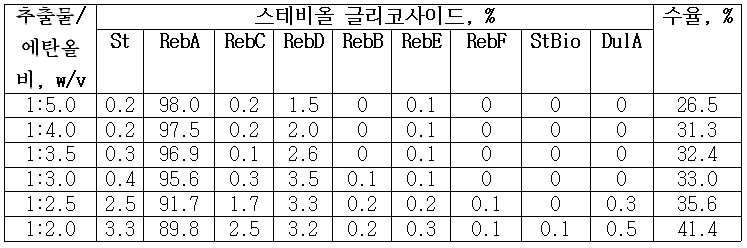
레바우디오사이드 D 함량은 88?90% 까지 에탄올의 농도 증가, 및 에탄올 수용액 대 추출물의 배합량의 감소에 따라 증가한다. 동시에, 레바우디오사이드 A의 순도는 보다 희석된 에탄올 용액 및 에탄올-수용액 대 추출물의 더 높은 비율에 따라 증가하였다.Rebaudioside D content increases with increasing concentration of ethanol up to 88-90%, and with decreasing blending amount of aqueous ethanol to extract. At the same time, the purity of Rebaudioside A increased with higher ratios of more diluted ethanol solution and ethanol-aqueous solution to extract.
88% 에탄올의 1:3 (w/vol) 비에 의해 처리한 후, 레바우디오사이드 A의 다양한 함량을 갖는 스테비아 추출물에 대한 상기 단계에서의 생성물의 수율을 표 5에 요약하였다. 기대할 수 있었던 바와 같이, 생성물의 수율은 초기 추출물 중 레바우디오사이드 A의 함량의 증가에 따라 증가한다.After treatment with a 1: 3 (w / vol) ratio of 88% ethanol, the yield of the product at this stage for the stevia extract with varying amounts of Rebaudioside A is summarized in Table 5. As could be expected, the yield of the product increases with increasing content of Rebaudioside A in the initial extract.
상기 침전물을 여과 또는 원심분리에 의해 분리하고, 약 2배 부피의 무수 에탄올로 세정하고, 건조하였다. 침전물을 액체로부터 분리할 수 있는 어느 형태의 장치, 예컨대 다양한 유형의 원심분리기 또는 여과 시스템이 본 단계에서 사용될 수 있다. 다양한 유형의 건조기, 예컨대 회전진공 건조기, 유동층 건조기, 회전 터널 건조기 또는 플레이트 건조기가 분말 형태의 정제된 스테비올 글리코사이드를 제조하는 데 적합하다.The precipitate was separated by filtration or centrifugation, washed with about two volumes of anhydrous ethanol and dried. Any type of device capable of separating the precipitate from the liquid, such as various types of centrifuges or filtration systems, can be used in this step. Various types of dryers are suitable for preparing purified steviol glycosides in powder form, such as rotary vacuum dryers, fluid bed dryers, rotary tunnel dryers or plate dryers.
초기 추출물이 다량의 레바우디오사이드 B 및 레바우디오사이드 D를 함유하는 경우, 레바우디오사이드 A 및 나중에 레바우디오사이드 D 정제를 위해서는, 저농도의 에탄올 및 에탄올-수용액 대 상기 추출물의 높은 비율이 사용하기에 바람직하다 (표 6, 표 7). 이 일련의 실험에서는, 초기 추출물 중 레바우디오사이드 A의 함량이 48.7%였다.If the initial extract contains large amounts of Rebaudioside B and Rebaudioside D, for rebaudioside A and later Rebaudioside D purification, a high ratio of low concentrations of ethanol and ethanol-aqueous solution to the extract Preferred for this use (Table 6, Table 7). In this series of experiments, the content of Rebaudioside A in the initial extract was 48.7%.
고함량의 레바우디오사이드 A 및 레바우디오사이드 D를 갖는 생성물의 수율은 침전후 단계에 대해 에탄올을 사용함으로써 증가시킬 수 있다. 상기 목적을 위해, 결정화 완료시점에 초기 고체에 대해 0.5?1.0 (v/w), 바람직하게는 0.5?0.8 (v/w)의 무수 에탄올을 혼합물에 첨가하고, 상기 공정을 다시 2?3 시간 동안 지속시켰다. 레바우디오사이드 A의 함량이 48.7%인 추출물로부터 상기 생성물의 수율 및 순도를 표 8에 요약하였다.The yield of products with high amounts of Rebaudioside A and Rebaudioside D can be increased by using ethanol for the post precipitation step. For this purpose, 0.5 to 1.0 (v / w), preferably 0.5 to 0.8 (v / w), of anhydrous ethanol is added to the mixture at the time of crystallization completion and the process is repeated for 2 to 3 hours. Lasted. The yield and purity of the product from the extract with a Rebaudioside A content of 48.7% is summarized in Table 8.


고순도 레바우디오사이드 A를 제조하기 위해, 상기 공정은 냉각 단계 없이 30?50℃에서 실시할 수 있다. 레바우디오사이드 A의 순도가 더 높았지만, 생성물의 수율을 더 낮아졌다. 상기 생성물의 품질은 세정 온도가 높아질수록 증가하였다. 24 시간 후에, 침전후 단계의 존재 및 부재 하에, 1 부의 추출물에 대해 3.5배 부피의 85% 에탄올을 사용하여 얻은 결과를 표 9에 요약하였다.To produce high purity Rebaudioside A, the process can be carried out at 30-50 ° C. without a cooling step. Although the purity of Rebaudioside A was higher, the yield of the product was lower. The quality of the product increased with higher cleaning temperatures. After 24 hours, the results obtained using a 3.5-fold volume of 85% ethanol for one part of the extract, with and without the post-precipitation step, are summarized in Table 9.

최종 생성물 중 레바우디오사이드 A의 함량이 주로 레바우디오사이드 B 및/또는 레바우디오사이드 D의 높은 함량으로 인해 97% 미만인 경우에는, 생성물을 에탄올 수용액으로 부가적으로 세정하였다. 이를 위해, 침전 후에 수득한 레바우디오사이드 A를 실온에서 30?40 분간 에탄올-물 혼합물에 현탁히였다. 균질한 현탁액을 얻은 후, 온도를 35?50℃, 바람직하게는 38?42℃까지 증가시키고, 약 10?20 시간, 바람직하게는 12?15 시간 동안 교반한 후, 10?25℃, 바람직하게는 20?22℃에서 약 3?20 시간, 바람직하게는 5?10 시간 동안 교반하였다. 레바우디오사이드 A 및 에탄올의 비율은 1.0:2.0 ? 1.0:5.0 (w/v), 바람직하게는 1.0:2.5 ? 4.0 (w/v) 였다. 에탄올 농도는 85?93%, 바람직하게는 88?90%였다.If the content of Rebaudioside A in the final product was less than 97% mainly due to the high content of Rebaudioside B and / or Rebaudioside D, the product was additionally washed with an aqueous ethanol solution. For this purpose, Rebaudioside A obtained after precipitation was suspended in an ethanol-water mixture for 30-40 minutes at room temperature. After obtaining a homogeneous suspension, the temperature is increased to 35-50 ° C., preferably 38-42 ° C., stirred for about 10-20 hours, preferably 12-15 hours, and then 10-25 ° C., preferably Was stirred at 20? 22 ° C. for about 3-20 hours, preferably 5-10 hours. The ratio of Rebaudioside A and Ethanol is 1.0: 2.0? 1.0: 5.0 (w / v), preferably 1.0: 2.5? 4.0 (w / v). The ethanol concentration was 85 to 93%, preferably 88 to 90%.
레바우디오사이드 A의 순도가 스테비오사이드의 높은 함량으로 인해 97% 미만인 경우에는, 레바우디오사이드 B 및 레바우디오사이드 D가 생성물을 오염시킨 경우에 대해 상기한 바와 동일한 방식으로, 생성물을 무수 에탄올로 세정하였다. 레바우디오사이드 A 및 에탄올의 비율은 1.0:2.0 ? 1.0:5.0 (w/v), 바람직하게는 1.0:2.5 ? 4.0 (w/v) 였다.If the purity of Rebaudioside A is less than 97% due to the high content of steviosides, the product may be dried in the same manner as described above for the case where Rebaudioside B and Rebaudioside D contaminate the product. Washed with ethanol. The ratio of Rebaudioside A and Ethanol is 1.0: 2.0? 1.0: 5.0 (w / v), preferably 1.0: 2.5? 4.0 (w / v).
도 5를 참조하면, 본 발명의 한 실시형태에 따라 레바우디오사이드 A 및 레바우디오사이드 D의 정제에 대한 기능적 플로우차트가 제공된다.Referring to FIG. 5, a functional flowchart for the purification of Rebaudioside A and Rebaudioside D is provided in accordance with an embodiment of the present invention.
레바우디오사이드 A 및 레바우디오사이드 D의 함량이 각각 약 75?80% 및 2.0?3.5%인 결정/침전물로부터 레바우디오사이드 D의 정제를 하기와 같이 진행하였다. 레바우디오사이드 A 및 레바우디오사이드 D를 함유한 결정은 도 3과 관련하여 기술한 바와 같은 공정으로부터 수득할 수 있음에 주목한다.Purification of Rebaudioside D from the crystals / precipitates of Rebaudioside A and Rebaudioside D content of about 75-80% and 2.0-3.5%, respectively, proceeded as follows. Note that crystals containing Rebaudioside A and Rebaudioside D can be obtained from the process as described in connection with FIG. 3.
고함량의 레바우디오사이드 A 및 레바우디오사이드 D를 함유한 침전물을 제 2 에탄올-수용액과 혼합하고, 45?65℃, 바람직하게는 50?55℃에서 2?6 시간, 바람직하게는 3?4 시간 동안 교반 하에 인큐베이션 하였다. 이어서, 상기 혼합물을 1?3 시간, 바람직하게는 0.5?1.0 시간 동안 실온으로 냉각시켰다. 침전물을 여과에 의해 분리하였다.The precipitate containing the high content of Rebaudioside A and Rebaudioside D is mixed with the second ethanol-aqueous solution and 2 to 6 hours at 45 to 65 ° C, preferably 50 to 55 ° C, preferably 3 Incubated under stirring for 4 hours. The mixture was then cooled to room temperature for 1-3 hours, preferably 0.5-1.0 hours. The precipitate was separated by filtration.
고체 대 에탄올 수용액의 바람직한 비율은 1:5 (w/v) 이고, 에탄올의 최적 농도는 78%였다. 그러나 에탄올 농도는 70?80%의 범위일 수 있고, 비율은 1:2.5 ? 1.7 (w/v)의 범위일 수 있다. The preferred ratio of solid to aqueous ethanol solution is 1: 5 (w / v) and the optimal concentration of ethanol was 78%. However, the ethanol concentration can range from 70-80% and the ratio is 1: 2.5? 1.7 (w / v).
고함량 레바우디오사이드 D 침전물의 여과를 용이하게 하기 위해, 여과 전에 활성탄을 0.5?3.0배 부피%, 바람직하게는 1.0?1.5배 부피%의 양으로 상기 혼합물에 첨가하였다. 이어서 상기 침전물을 3?5배 부피의 30?50% 메탄올과 혼합하였다. 상기 현탁액을 교반 하에 45?65℃, 바람직하게는 57?62℃에서 1?5 시간, 바람직하게는 2?3 시간 동안 유지하고, 여과 처리하였다. 활성탄에 흡착된 글리코사이드의 용출을 메탄올을 사용하여 실시하였다.To facilitate filtration of the high content Rebaudioside D precipitate, activated carbon was added to the mixture in an amount of 0.5-3.0 times by volume, preferably 1.0-1.5 times by volume, prior to filtration. The precipitate was then mixed with 3-5 volumes of 30-50% methanol. The suspension was kept at 45-65 ° C., preferably 57-62 ° C. for 1-5 hours, preferably 2-3 hours under stirring and filtered. Elution of glycosides adsorbed on activated carbon was carried out using methanol.
활성탄 적용 없이 및 적용 하에 수득한 침전물은 모두 최적 조건 하에서 19?22.1%의 레바우디오사이드 D를 함유한다 (표 10).The precipitates obtained without and under the application of activated carbon both contain 19-22.1% of Rebaudioside D under optimum conditions (Table 10).

원칙적으로는, 메탄올의 적용된 부피가 클수록 용출 공정이 더 빨리 일어날 수 있다. 상기 공정은 메탄올 수용액이 사용되었을 때 더 짧은 기간 내에 완료될 수 있다.In principle, the larger the applied volume of methanol, the faster the elution process can occur. The process can be completed in a shorter time period when an aqueous methanol solution is used.
메탄올 분획을 증발시켜 건조하였다.The methanol fractions were evaporated to dryness.
95.6%의 레바우디오사이드 A 및 3.5%의 레바우디오사이드 D를 함유하는 초기 물질 (도 4a)을 3.5배 부피의 78.0% 에탄올과 혼합하고, 상기 혼합물을 10?15 분간 비등하고, 불용 물질을 고온 여과에 의해 분리하였을 때, 침전물의 생산량은 6?7.0%의 범위였으며, 레바우디오사이드 A 및 레바우디오사이드 D의 함량은 각각 52?53.0% 및 43?45.0% 였다 (도 4b). The initial material containing 95.6% Rebaudioside A and 3.5% Rebaudioside D (FIG. 4A) was mixed with 3.5 times the volume of 78.0% ethanol and the mixture was boiled for 10-15 minutes, insoluble material When was separated by hot filtration, the yield of the precipitate was in the range of 6 ~ 7.0%, the content of Rebaudioside A and Rebaudioside D was 52 ~ 53.0% and 43 ~ 45.0%, respectively (Fig. 4b) .
추가의 정제를 위하여, 침전물을 30?40℃에서, 바람직하게는 33?37℃에서 50% 에탄올 중에 1:2 w/v의 비율로 현탁시키고, 교반하면서 2?15시간, 바람직하게는 10?12시간 동안 유지시켰다. 이 현탁액을 여과 및 건조시켰다. 약 15?17.0%의 레바우디오사이드 A 및 80?82%의 레바우디오사이드 D의 함량을 갖는 침전물의 수율은 42?46.0%의 범위였다. 원칙적으로는 5배 부피까지의 수성 에탄올이 이 단계에 적용될 수 있다. 에탄올의 농도는 바람직하게는 45?52%의 범위일 수 있다.For further purification, the precipitate is suspended in a ratio of 1: 2 w / v in 50% ethanol at 30-40 DEG C, preferably 33-37 DEG C, and stirred for 2-15 hours, preferably 10? Hold for 12 hours. This suspension was filtered and dried. The yield of precipitates with a content of about 15-17.0% rebaudioside A and 80-82% rebaudioside D ranged from 42-46.0%. In principle up to 5 volumes of aqueous ethanol can be applied at this stage. The concentration of ethanol may preferably be in the range of 45-52%.
침전물을 유사하게 처리하였다. 침전물을 여과하여 분리하고, 약 2배 부피의 무수 메탄올로 세정하고, 건조시켰다. 액체로부터 침전물을 분리시킬 수 있게 하는 임의의 유형의 장비들, 예컨대 각종 유형의 원심분리기들 또는 여과 시스템들이 이 단계에서 사용될 수 있다. 회전진공 건조기, 유동층 건조기, 회전터널 건조기 또는 플레이트 건조기와 같은 상이한 유형의 건조기들이 분말 형태의 정제 레바우디오사이드 D를 생산하는데 적합하다.The precipitate was treated similarly. The precipitate was separated by filtration, washed with about two volumes of anhydrous methanol and dried. Any type of equipment capable of separating the precipitate from the liquid, such as various types of centrifuges or filtration systems, can be used at this stage. Different types of dryers, such as rotary vacuum dryers, fluid bed dryers, rotary tunnel dryers or plate dryers, are suitable for producing refined rebaudioside D in powder form.
레바우디오사이드 D의 순도는 약 95?99% 함량이었다(도 4c). 생산품의 수율은 약 58?60%이었다. Rebaudioside D had a purity of about 95-99% (FIG. 4C). The yield of the product was about 58-60%.
레바우디오사이드 D의 단리 후 조합된 잔여 용액을 개시제로서 소량의 레바우디오사이드 A와 혼합하고, 20?22℃에서 20?24시간 동안 결정화를 위해 방치하였다. 결정들 중 레바우디오사이드 A 함량은 97.7?99.4%의 범위였다.The combined residual solution after isolation of Rebaudioside D was mixed with a small amount of Rebaudioside A as an initiator and left for crystallization at 20-22 ° C. for 20-24 hours. Rebaudioside A content in the crystals ranged from 97.7 to 99.4%.
제 1 침전물로부터의 잔여 용액은 레바우디오사이드 A 또는 스테비올 글리코사이드의 고순도 혼합물의 단리에 사용될 수 있다.The remaining solution from the first precipitate can be used for the isolation of a high purity mixture of Rebaudioside A or Steviol Glycoside.
본 발명에서 수득된 고순도 레바우디오사이드 D는 1129.15의 분자량, C50H80O28 의 분자식, 도 2에 나타낸 구조를 가지며, 무취의 백색 분말 형태이다. 상기 화합물은 10%의 수크로스 용액에 비해 설탕보다 약 180?200배 더 달다. 적외선 흡수 스펙트럼을 도 6에 나타내었다. 레바우디오사이드 D는 약 1730cm-1에서 특징적인 최대 흡수를 나타낸다. 순수한 레바우디오사이드 D의 다른 물성들은 다음과 같다:The high purity rebaudioside D obtained in the present invention has a molecular weight of 1129.15, a molecular formula of C 50 H 80 O 28 , a structure shown in FIG. 2 and is in the form of an odorless white powder. The compound is about 180-200 times sweeter than sugar compared to 10% sucrose solution. Infrared absorption spectrum is shown in FIG. 6. Rebaudioside D shows a characteristic maximum absorption at about 1730 cm −1 . Other properties of pure Rebaudioside D are as follows:
용융점: 248-249℃.Melting point: 248-249 ° C.
비선광도(specific rotation): 50% 에탄올 중 [α]D 25 -29.5o (C=1.0).Specific rotation: [α] D 25 -29.5 o (C = 1.0) in 50% ethanol.
수용해도는 약 0.2%이며, 이는 온도 증가에 따라 증가한다. 용액 냉각시 다시 침전된다. 크로마토그래피 분리 단계동안 및 결정화 전에 많이 용해됨.The water solubility is about 0.2%, which increases with increasing temperature. Precipitates again upon solution cooling. Highly soluble during the chromatography separation step and before crystallization.
메탄올, 에탄올, n-프로판올 및 이소프로판올의 희석 용액들에 가용성.Soluble in dilute solutions of methanol, ethanol, n-propanol and isopropanol.
아세톤, 벤젠, 클로로포름 및 에테르에 불용성.Insoluble in acetone, benzene, chloroform and ethers.
본 발명에서 수득된 레바우디오사이드 D는 열-안정성 및 pH-안정성이다.Rebaudioside D obtained in the present invention is heat-stable and pH-stable.
본 발명에 따라 수득된 레바우디오사이드 D는 식료품, 음료, 약학 조성물, 화장품, 츄잉검, 양념 제품류(table top products), 씨리얼, 유제품, 치약 및 기타 구강 조성물 등에 고강도 천연 감미료로서 포함될 수 있다. 하기 실시예들은 사용될 수 있는 대표적인 비율들을 보여준다.Rebaudioside D obtained according to the present invention may be included as a high strength natural sweetener in foodstuffs, beverages, pharmaceutical compositions, cosmetics, chewing gums, table top products, cereals, dairy products, toothpastes and other oral compositions. The following examples show representative proportions that may be used.
추가적으로, 레바우디오사이드 D는 음료, 식료품 및 인간 소비용으로 제공된 기타 제품들 뿐만 아니라, 개선된 특성들을 갖는 동물 먹이 및 사료(fodder)에도 사용될 수 있다.Additionally, Rebaudioside D can be used in animal feed and fodder with improved properties as well as in beverages, foodstuffs and other products provided for human consumption.
식료품, 음료, 약, 화장품, 양념 제품류, 츄잉검의 제조 중, 혼합, 혼련, 용해, 피클절임(pickling), 침투(permeation), 침출(percolation), 스프링클링(sprinkling), 분무, 우려내기(infusing) 및 기타 방법들과 같은 통상의 방법들이 사용될 수 있다.During the manufacture of foodstuffs, beverages, medicines, cosmetics, condiments, chewing gums, mixing, kneading, dissolving, pickling, permeation, percolation, sprinkling, spraying, brewing conventional methods such as infusing) and other methods can be used.
본 발명에서 수득된 감미료는 건조 또는 액체 형태로 사용될 수 있다. 이는 식품의 열처리 전 또는 후에 사용될 수 있다. 감미료의 양은 사용 용도에 따라 달라진다. 이는 단독으로 또는 다른 화합물들과 조합되어 첨가될 수 있다.The sweeteners obtained in the present invention can be used in dry or liquid form. It can be used before or after the heat treatment of the food. The amount of sweetener depends on the intended use. It may be added alone or in combination with other compounds.
본 발명의 구체적인 실시형태에서, 레바우디오사이드 D, 감미 화합물로서, 단일 감미료로서 사용될 수 있거나, 또는 다른 천연 고강도 감미료들과 함께 사용될 수 있다.In specific embodiments of the present invention, Rebaudioside D, a sweetening compound, may be used as a single sweetener or may be used in conjunction with other natural high intensity sweeteners.
본 명세서에서 사용된 것과 같은 "천연 고강도 감미료"라는 표현은, 자연에서 발견되고, 수크로스, 프룩토스 또는 글루코스보다 높은 감미 효능을 갖는 임의의 조성물들을 의미한다.The expression “natural high intensity sweetener” as used herein refers to any compositions found in nature that have a higher sweetening efficacy than sucrose, fructose or glucose.
천연 고강도 감미료의 비-한정적인 예로는 스테비오사이드, 레바우디오사이드 A, 레바우디오사이드 B, 레바우디오사이드 C, 레바우디오사이드 E, 레바우디오사이드 F, 스테비올비오사이드, 둘코사이드 A, 루부소사이드, 모그로사이드, 브라제인, 글리시리진산 및 그의 염, 타우마틴, 페릴라르틴, 페르난둘신, 무쿠로지오사이드, 바이유노사이드, 플로미소사이드-I, 디메틸 헥사하이드로플루오렌-디카복실산, 아브루소사이드, 페리안드린, 카르노시플로사이드, 시클로카리오사이드, 프테로카리오사이드, 폴리포도사이드 A, 브라질린, 헤르난둘신, 필로둘신, 글리시필린, 플로리진, 트릴로바틴, 디하이드로플라보놀, 디하이드로퀘르세틴-3-아세테이트, 네오아스틸리빈, 트랜스-신남알데하이드, 모나틴 및 그의 염, 셀리구에인 A, 헤마톡실린, 모넬린, 오슬란딘, 프테로카리오사이드 A, 프테로카리오사이드 B, 마빈린, 펜타딘, 미라큘린, 커르큘린, 네오큘린, 클로로겐산, 시나린, 루오 한 구오(Luo Han Guo) 감미료, 시아메노사이드와 등, 및 이들의 조합들을 포함한다.Non-limiting examples of natural high intensity sweeteners include Stevioside, Rebaudioside A, Rebaudioside B, Rebaudioside C, Rebaudioside E, Rebaudioside F, Steviovioside, Dulco Side A, rubusside, mogroside, brazein, glycyrrhizinic acid and salts thereof, taumartin, peryllartin, fernandulcin, mukurozioside, biunoside, fluoroisoside-I, dimethyl hexahydrofluorene Dicarboxylic acids, abrusosides, periandrins, carnosciflosides, cyclocariosides, pterocariosides, polypodosides A, brazilin, hernanducin, pilodulcin, glycidylline, floridine, trilovavatin , Dihydroflavonol, dihydroquercetin-3-acetate, neoastilivin, trans-cinnamaldehyde, monatin and salts thereof, celigine A, hematoxylin, monelin, oslandin, Pterocarioside A, Pterocarioside B, Marvinline, Pentadine, Miraculin, Curculine, Neoculin, Chlorogenic Acid, Cinnarin, Luo Han Guo Sweetener, Cyanoside, and the like, and these Combinations thereof.
또다른 구체적인 실시형태에서, 감미 화합물로서 레바우디오사이드 D는 합성 또는 인공 고강도 감미료들과 함께 사용될 수 있다.In another specific embodiment, Rebaudioside D as a sweetening compound can be used with synthetic or artificial high intensity sweeteners.
본 명세서에서 사용된 것과 같은, "합성 또는 인공 고강도 감미료들"이라는 표현은 자연에서 발견되지 않으며, 수크로스, 프룩토스 또는 글루코스보다 높은 감미 효능을 갖는 임의의 조성물을 의미한다.The expression “synthetic or artificial high intensity sweeteners,” as used herein, means any composition that is not found in nature and has a higher sweetening efficacy than sucrose, fructose or glucose.
합성 또는 인공 고강도 감미료들의 비-한정적인 예들은 수크랄로스, 칼륨 아세설팜, 아스파르탐, 알리탐, 사카린, 네오헤스페리딘 디하이드로칼콘, 시클라메이트, 네오탐, 둘신, 수오산, N-[N-[3-(3-히드록시-4-메톡시페닐)프로필]-L-α-아스파틸]-L-페닐알라닌 1-메틸-에스테르, N-[N-[3-(3-히드록시-4-메톡시페닐)-3-메틸부틸]-L-α-아스파틸]-L-페닐알라닌 1-메틸-에스테르, N-[N-3-(3-메톡시-4-히드록시페닐)프로필]-L-α-아스파틸]-L-페닐알라닌 1-메틸 에스테르, 이들의 염 등, 그리고 이들의 조합을 포함한다.Non-limiting examples of synthetic or artificial high intensity sweeteners include sucralose, potassium acesulfame, aspartame, altam, saccharin, neohesperidin dihydrochalcone, cyclamate, neotam, ducin, suoic acid, N- [N -[3- (3-hydroxy-4-methoxyphenyl) propyl] -L-α-aspartyl] -L-phenylalanine 1-methyl-ester, N- [N- [3- (3-hydroxy- 4-methoxyphenyl) -3-methylbutyl] -L-α-aspartyl] -L-phenylalanine 1-methyl-ester, N- [N-3- (3-methoxy-4-hydroxyphenyl) propyl ] -L-α-aspartyl] -L-phenylalanine 1-methyl ester, salts thereof, and the like, and combinations thereof.
한 실시형태에서, 레바우디오사이드 D는 김네마산(gymnemic acid), 호둘신, 지지핀(ziziphin), 락티솔(lactisole) 등과 같은 천연 감미료 억제제들과 조합하여 사용될 수 있다.In one embodiment, rebaudioside D can be used in combination with natural sweetener inhibitors such as gimnemic acid, dulcin, ziziphin, lactisole and the like.
한 구체적인 실시형태에서, 레바우디오사이드 D는 이에 한정되지는 않지만, 아스파르트산, 아르기닌, 글리신, 글루탐산, 프롤린, 트레오닌, 테아닌, 시스테인, 시스틴, 알라닌, 발린, 티로신, 류신, 이소류신, 아스파라긴, 세린, 리신, 히스티딘, 오르니틴, 메티오닌, 카미틴, 아미노부티르산(알파-, 베타- 또는 감마-이성질체), 글루타민, 히드록시프롤린, 타우린, 노르발린, 사르코신, 및 나트륨 또는 칼륨염 또는 산염과 같은 이들의 염 형태들을 포함하는 아미노산과 함께 제제화될 수 있다. 아미노산 첨가제는 D- 또는 L-배열일 수 있고, 동일하거나 또는 상이한 아미노산의 모노-, 디- 또는 트리-형태일 수도 있다. 부가적으로, 아미노산은 적당한 경우, α-, β-, γ-, δ- 및 ε-이성질체일 수 있다. 상기 아미노산 및 그들의 대응 염(예로서, 나트륨, 칼륨, 칼슘, 마그네슘염 또는 기타 알칼리염 또는 알칼리토금속염)의 조합들도 적당한 첨가제이다. 상기 아미노산은 천연 또는 합성일 수 있다. 아미노산은 변형될 수도 있다. 변형 아미노산은 적어도 하나의 원자가 첨가되거나, 제거되거나, 치환되거나 또는 이들의 조합인, 임의의 아미노산을 의미한다(예로서, N-알킬 아미노산, N-아실 아미노산 또는 N-메틸 아미노산). 변형 아미노산의 비-한정적인 예들은 트리메틸 글리신, N-메틸-글리신 및 N-메틸-알라닌과 같은 아미노산 유도체들을 포함한다. 여기 사용된 것과 같은, 아미노산은 변형 또는 변형되지 않은 아미노산을 모두 포괄한다. 여기 사용된 것과 같은, 변형 아미노산은 글루타티온 및 L-알라닐-L-글루타민과 같은 펩티드 및 폴리펩티드(예로서, 디펩티드, 트리펩티드, 테트라펩티드 및 펜타펩티드)을 포괄할 수 있다.In one specific embodiment, Rebaudioside D is, but is not limited to, aspartic acid, arginine, glycine, glutamic acid, proline, threonine, theanine, cysteine, cystine, alanine, valine, tyrosine, leucine, isoleucine, asparagine, serine Such as lysine, histidine, ornithine, methionine, carmitine, aminobutyric acid (alpha-, beta- or gamma-isomers), glutamine, hydroxyproline, taurine, norvaline, sarcosine, and sodium or potassium salts or salts It may be formulated with amino acids including their salt forms. The amino acid additives may be D- or L-configurations and may be mono-, di- or tri-forms of the same or different amino acids. In addition, the amino acids may be the α- , β- , γ- , δ- and ε-isomers, where appropriate. Combinations of these amino acids and their corresponding salts (eg, sodium, potassium, calcium, magnesium salts or other alkali or alkaline earth metal salts) are also suitable additives. The amino acid may be natural or synthetic. Amino acids may be modified. By modified amino acid is meant any amino acid in which at least one atom is added, removed, substituted or a combination thereof (eg, N-alkyl amino acid, N-acyl amino acid or N-methyl amino acid). Non-limiting examples of modified amino acids include amino acid derivatives such as trimethyl glycine, N-methyl-glycine and N-methyl-alanine. As used herein, amino acids encompass both modified or unmodified amino acids. As used herein, modified amino acids can encompass peptides and polypeptides such as glutathione and L-alanyl-L-glutamine (eg, dipeptides, tripeptides, tetrapeptides and pentapeptides).
한 구체적인 실시형태에서, 레바우디오사이드 D는 폴리-L-아스파르트산, 폴리-L-리신 (예로서, 폴리-L-α-리신 또는 폴리-L-ε-리신), 폴리-L-오르니틴 (예로서, 폴리-L-α-오르니틴 또는 폴리-L-ε-오르니틴), 폴리-L-아르기닌, 아미노산의 기타 중합형태, 및 이들의 염 형태(예로서, L-글루탐산 일나트륨염과 같은 마그네슘, 칼슘, 칼륨 또는 나트륨염)을 포함하는 폴리아미노산 첨가제들과 함께 제제화될 수 있다. 상기 폴리아미노산 첨가제들은 D- 또는 L-배열일 수도 있다. 부가적으로, 상기 폴리아미노산은 적당한 경우, α-, β-, γ-, δ- 및 ε-이성질체일 수 있다. 상기 폴리아미노산 및 그들의 대응 염(예로서, 나트륨, 칼륨, 칼슘, 마그네슘염 또는 기타 알칼리염 또는 알칼리토금속염 또는 산염)의 조합들도 본 발명의 실시형태들에서 적당한 감미 첨가제들이다. 본 명세서에 기재된 상기 폴리아미노산은 상이한 아미노산의 공중합체를 포함할 수도 있다. 상기 폴리아미노산은 천연 또는 합성일 수 있다. 폴리 아미노산은, 적어도 하나의 원자가 첨가, 제거, 치환되거나 또는 이들의 조합이 되도록 변형될 수도 있다(예로서, N-알킬 아미노산 폴리아미노산 또는 N-아실 폴리아미노산). 여기 사용된 것과 같은, 폴리아미노산은 변형 폴리아미노산 및 변형되지 않은 폴리아미노산을 모두 포괄한다. 구체적인 실시형태들에 따르면, 변형 폴리아미노산은 이에 한정되지는 않지만, MW 1,500, MW 6,000, MW 25,200, MW 63,000, MW 83,000 또는 MW 300,000을 갖는 폴리-L-α-리신과 같이 다양한 분자량(MW)의 폴리아미노산을 포함한다.In one specific embodiment, rebaudioside D is poly-L-aspartic acid, poly-L-lysine (eg, poly-L- α -lysine or poly-L- ε -lysine), poly-L-orni Tin (eg, poly-L- α -ornithine or poly-L- ε -ornithine), poly-L-arginine, other polymerized forms of amino acids, and salt forms thereof (eg, monosodium L-glutamic acid) And polyamino acid additives including magnesium, calcium, potassium or sodium salts, such as salts. The polyamino acid additives may be D- or L-configuration. In addition, the polyamino acids may be α- , β- , γ- , δ- and ε-isomers, where appropriate. Combinations of the above polyamino acids and their corresponding salts (eg, sodium, potassium, calcium, magnesium salts or other alkali or alkaline earth metal salts or acid salts) are also suitable sweetening additives in embodiments of the present invention. The polyamino acids described herein may comprise copolymers of different amino acids. The polyamino acid can be natural or synthetic. Poly amino acids may be modified such that at least one valence is added, removed, substituted, or a combination thereof (eg, N-alkyl amino acid polyamino acid or N-acyl polyamino acid). As used herein, polyamino acids encompass both modified polyamino acids and unmodified polyamino acids. According to specific embodiments, the modified polyamino acid is not limited thereto, but may vary in molecular weight (MW), such as poly-L- α -lysine with MW 1,500, MW 6,000, MW 25,200, MW 63,000, MW 83,000 or MW 300,000. Of polyamino acids.
또다른 구체적인 실시형태에서, 레바우디오사이드 D는 폴리올 또는 당알코올들과 조합될 수 있다. "폴리올"이라는 용어는 하나 이상의 히드록실기를 포함하는 분자를 의미한다. 폴리올은 각각 2, 3 및 4개의 히드록실기를 포함하는 디올, 트리올 또는 테트라올을 포함할 수 있다. 폴리올은 4개 이상의 히드록실기를 포함할 수 있으며, 예컨대 각각 5, 6 또는 7개의 히드록실기를 포함하는 펜탄올, 헥산올, 헵탄올 등을 포함할 수 있다. 부가적으로, 폴리올은 탄수화물의 환원형인, 당알코올, 다가알코올(polyhydric alcohol) 또는 폴리알코올일 수 있으며, 여기에서 카르보닐기(알데히드 또는 케톤 또는 환원당)은 일차 또는 이차 히드록실기로 환원된다.In another specific embodiment, Rebaudioside D can be combined with a polyol or sugar alcohols. The term "polyol" means a molecule comprising one or more hydroxyl groups. The polyols may comprise diols, triols or tetraols comprising 2, 3 and 4 hydroxyl groups, respectively. The polyols may include four or more hydroxyl groups, such as pentanol, hexanol, heptanol, and the like, each containing 5, 6 or 7 hydroxyl groups. In addition, the polyol may be a sugar alcohol, polyhydric alcohol or polyalcohol, which is a reduced form of carbohydrate, wherein the carbonyl group (aldehyde or ketone or reducing sugar) is reduced to primary or secondary hydroxyl groups.
폴리올의 비-한정적인 예들은 에리트리톨, 말티톨, 만니톨, 소르비톨, 락티톨, 자일리톨, 이노시톨, 이소말트, 프로필렌 글리콜, 글리세롤, 트레이톨, 갈락티톨, 수소화 이소말툴로스, 환원된 이소말토-올리고사카라이드, 환원된 자일로-올리고사카라이드, 환원된 젠티오-올리고사카라이드, 환원된 말토오스 시럽, 환원된 글루코오스 시럽, 수소화 전분 가수분해물, 폴리글리시톨 및 감미료 조성물의 맛에 좋지않은 영향을 미치지 않는 환원가능한 임의의 다른 탄수화물 또는 당알코올, 및 이들의 조합을 포함한다.Non-limiting examples of polyols include erythritol, maltitol, mannitol, sorbitol, lactitol, xylitol, inositol, isomalt, propylene glycol, glycerol, traceol, galactitol, hydrogenated isomaltulose, reduced isomalto-oligosaka Undesired effects on the taste of lysates, reduced xylo-oligosaccharides, reduced genthio-oligosaccharides, reduced maltose syrups, reduced glucose syrups, hydrogenated starch hydrolysates, polyglycitol and sweetener compositions Non-reducible any other carbohydrate or sugar alcohol, and combinations thereof.
한 구체적인 실시형태에서 레바우디오사이드 D는 D-타가토스, L-당, L-소르보스, L-아라비노오스 및 기타 및 이들의 조합들과 같은 저칼로리 감미료들과 조합될 수 있다.In one specific embodiment rebaudioside D can be combined with low calorie sweeteners such as D-tagatose, L-sugars, L-sorbose, L-arabinose and others and combinations thereof.
또다른 구체적인 실시형태에서, 레바우디오사이드 D는 각종 탄수화물과 조합될 수 있다. "탄수화물"이라는 용어는 일반적으로 일반식 (CH2O)n의, 다수의 히드록실기로 치환된 알데히드 또는 케톤 화합물을 의미하며, 식 중 "n"은 3?30이고, 이들의 올리고머 및 폴리머도 의미한다. 본 발명의 탄수화물은, 부가적으로, 하나 이상의 위치에서 치환 또는 탈산소화될 수 있다. 탄수화물은 여기 사용된 것과 같이, 변형되지 않은 탄수화물, 탄수화물 유도체, 치환 탄수화물 및 변형 탄수화물을 포괄한다. 여기 사용된 것과 같은 "탄수화물 유도체", "치환된 탄수화물" 및 "변형 탄수화물"이라는 용어는 동의어이다. 변형 탄수화물은 임의의 탄수화물일 수 있으며, 여기에서 적어도 하나의 원자가 첨가, 제거, 치환 또는 이들의 조합이다. 따라서, 탄수화물 유도체 또는 치환 탄수화물은 치환 또는 비치환 단당류, 이당류, 올리고사카라이드류 및 폴리사카라이드류를 포함한다. 상기 탄수화물 유도체 또는 치환 탄수화물은 임의로 임의의 대응 C-위치에서 탈산소화되거나 및/또는 하기와 같은 하나 이상의 성분들로 치환될 수 있다: 수소, 할로겐, 할로알킬, 카르복실, 아실, 아실옥시, 아미노, 아미도, 카르복실 유도체들, 알킬아미노, 디알킬아미노, 아릴아미노, 알콕시, 아릴옥시, 니트로, 시아노, 술포, 머캅토, 이미노, 술포닐, 술페닐, 술피닐, 술파모일, 카르보알콕시, 카르복사미도, 포스포닐, 포스피닐, 포스포릴, 포스피노, 티오에스테르, 티오에테르, 옥시미노, 하이드라지노, 카르바모일, 포스포, 포스포나토 또는 임의의 기타 생육력있는 관능기들을 포함하며, 단 탄수화물 유도체 또는 치환 탄수화물이 감미료 조성물의 감미를 개선시키는 기능을 할 수 있다.In another specific embodiment, Rebaudioside D can be combined with various carbohydrates. The term "carbohydrate" generally refers to an aldehyde or ketone compound substituted with a plurality of hydroxyl groups of the general formula (CH 2 O) n , wherein "n" is 3-30, and their oligomers and polymers It also means. Carbohydrates of the invention may additionally be substituted or deoxygenated at one or more positions. Carbohydrates encompass unmodified carbohydrates, carbohydrate derivatives, substituted carbohydrates and modified carbohydrates, as used herein. The terms "carbohydrate derivative", "substituted carbohydrate" and "modified carbohydrate" as used herein are synonymous. The modified carbohydrate can be any carbohydrate, where at least one valence addition, removal, substitution, or combination thereof is employed. Thus, carbohydrate derivatives or substituted carbohydrates include substituted or unsubstituted monosaccharides, disaccharides, oligosaccharides and polysaccharides. The carbohydrate derivative or substituted carbohydrate may optionally be deoxygenated at any corresponding C-position and / or substituted with one or more components as follows: hydrogen, halogen, haloalkyl, carboxyl, acyl, acyloxy, amino , Amido, carboxyl derivatives, alkylamino, dialkylamino, arylamino, alkoxy, aryloxy, nitro, cyano, sulfo, mercapto, imino, sulfonyl, sulfphenyl, sulfinyl, sulfamoyl, carbox Boalkoxy, carboxamido, phosphonyl, phosphinyl, phosphoryl, phosphino, thioester, thioether, oxymino, hydrazino, carbamoyl, phospho, phosphonato or any other viable functional group Including carbohydrate derivatives or substituted carbohydrates may serve to improve the sweetness of the sweetener composition.
본 발명의 실시형태들에서 탄수화물의 비-한정적인 예들은 타가토스, 트레할로스, 갈락토스, 람노스, 각종 사이클로덱스트린, 시클릭 올리고당, 각종 유형의 말토덱스트린, 덱스트란, 수크로스, 글루코스, 리불로스, 프룩토스, 트레오스, 아라비노스, 자일로스, 라일로스, 알로스(allose), 알트로스, 만노스, 아이도스, 락토스, 말토스, 전화당, 이소트레할로스, 네오트레할로스, 이소말툴로스, 에리트로스, 데옥시리보스, 굴로스, 아이도스, 탈로스, 에리트룰로스, 자일룰로스, 사이코스(psicose), 투라노스, 셀로비오스, 아밀로펙틴, 글루코사민, 만노사민, 푸코스, 글루쿠론산, 글루콘산, 글루코노-락톤, 아베쿠오스, 갈락토사민, 비트 올리고당, 이소말토-올리고당 (이소말토스, 이소말토트리오스, 판노스 등), 자일로-올리고당 (자일로트리오스, 자일로비오스 등), 자일로-말단 올리고당, 젠티오-올리고당 (젠티비오스, 젠티트리오스, 젠티오테트라오스 등), 소르보스, 니제로-올리고당, 팔라티노스 올리고당, 프룩토올리고당 (케스토스, 나이스토스 등), 말토테트라올, 말토트리올, 말토-올리고당 (말토트리오스, 말토테트라오스, 말토펜토스, 말토헥사오스, 말토헵타오스 등), 전분, 이눌린, 이눌로-올리고당류, 락툴로스, 멜리비오스, 라피노스, 리보스, 이성질화 액체 당류 예컨대 고과당 콘시럽, 커플링당류 및 대두 올리고당을 포함한다. 부가적으로, 여기 사용된 것과 같은 탄수화물은 D- 또는 L-배열일 수 있다. 제제에서 상기 화합물의 임의의 조합이 사용될 수 있다.Non-limiting examples of carbohydrates in embodiments of the invention include tagatose, trehalose, galactose, rhamnose, various cyclodextrins, cyclic oligosaccharides, various types of maltodextrins, dextran, sucrose, glucose, ribulose, Fructose, treos, arabinose, xylose, lilos, allose, altrose, mannose, idose, lactose, maltose, invert sugar, isotrehalose, neotrehalose, isomaltulose, erythrose, des Oxyribose, gulose, iodos, talos, erythrulose, xylulose, psicose, turanose, cellobiose, amylopectin, glucosamine, mannosamine, fucose, glucuronic acid, gluconic acid, glucono -Lactones, avecus, galactosamine, beet oligosaccharides, isomalto-oligosaccharides (isomaltose, isomaltrios, pannose, etc.), xylo-oligosaccharides (xylotriose, xylobiose, etc.) ), Xylo-terminal oligosaccharides, genthio-oligosaccharides (gentiviose, gentitriose, genthiotetraose, etc.), sorbose, nitro-oligosaccharides, palatinose oligosaccharides, fructooligosaccharides (kestos, nystos, etc.) ), Maltotetraol, maltotriol, malto-oligosaccharides (maltotriose, maltotetraose, maltopentose, maltohexaose, maltoheptaose, etc.), starch, inulin, inulin-oligosaccharides, lactulose, meli Biocides, raffinose, ribose, isomerized liquid sugars such as high fructose corn syrup, coupling sugars and soy oligosaccharides. In addition, carbohydrates as used herein can be D- or L-configuration. Any combination of the above compounds in the formulation can be used.
구체적인 실시형태에서, 레바우디오사이드 D는 이에 한정되지는 않지만 알돈산, 유론산, 알다르산, 알긴산, 글루코산, 글루쿠론산, 글루카르산, 갈락타르산, 갈락투론산 및 이들의 염 (예로서, 나트륨, 칼륨, 칼슘, 마그네슘 염 또는 기타 생리학적으로 허용가능한 염) 및 이들의 조합을 포함하는 당 산(sugar acids)과 함께 제제화될 수 있다.In specific embodiments, rebaudioside D is, but is not limited to, aldonic acid, euonic acid, aldar acid, alginic acid, glucoic acid, glucuronic acid, glucaric acid, galactaric acid, galacturonic acid and salts thereof (Eg, sodium, potassium, calcium, magnesium salts or other physiologically acceptable salts) and combinations thereof with sugar acids.
구체적인 실시형태에서, 레바우디오사이드 D는 각종 생리활성 물질들 또는 기능성 성분들과 조합사용될 수 있다. 기능성 성분들은 일반적으로 카로테노이드, 식이섬유, 지방산, 사포닌, 항산화제, 건강 기능 식품(nutraceuticals), 플라보노이드, 이소티오시아네이트, 페놀, 식물성 스테롤 및 스탄올 (파이토스테롤 및 파이토스탄올); 폴리올; 프리바이오틱스(prebiotics), 프로바이오틱스(probiotics); 파이토에스트로겐; 콩단백질; 술피드/티올; 아미노산; 단백질; 비타민; 및 무기물과 같은 카테고리들로 분류된다. 기능성 성분들은 또한 건강에 이로운 것, 예컨대 심혈관, 콜레스테롤 저하 및 항염증에 기초하여 분류된다.In a specific embodiment, Rebaudioside D can be used in combination with various bioactive substances or functional ingredients. Functional ingredients generally include carotenoids, dietary fiber, fatty acids, saponins, antioxidants, nutraceuticals, flavonoids, isothiocyanates, phenols, vegetable sterols and stanols (phytosterols and phytostanols); Polyols; Prebiotics, probiotics; Phytoestrogens; Soy protein; Sulfide / thiol; amino acid; protein; vitamin; And minerals. Functional ingredients are also classified based on what is good for health, such as cardiovascular, hypocholesterolemic and anti-inflammatory.
레바우디오사이드 D를 갖는 조성물은 천연 또는 인공 기원의 풍미제를 포함할 수 있다. 여기 사용된 것과 같은, '풍미'라는 용어는 달리 나타내지 않는 한, 본 발명의 조성물들에 첨가되어 식료품에 원하는 풍미를 제공할 수 있는 임의의 식품등급 재료를 의미한다. 본 발명에 유용한 풍미제들은 정유, 예컨대 식물 또는 과일 유래 오일, 박하유, 스피아민트유, 기타 민트유, 클로브유, 계피유, 윈터그린(wintergreen), 월계수, 타임, 삼목잎(cedar leaf), 넛맥(nutmeg), 올스파이스(allspice), 세이지(sage), 메이스(mace) 및 아몬드의 오일을 포함한다. 풍미제는 사과, 바나나, 수박, 배, 복숭아, 포도, 딸기, 라스베리, 체리, 플럼, 파인애플, 살구 및 이들의 혼합물들과 같은 식물 추출물 또는 과일 에센스일 수 있다. 풍미제는 레몬, 라임, 오렌지, 귤, 자몽, 시트론 또는 금귤의 추출물, 에센스, 또는 오일과 같은 감귤류(cirtrus) 풍미제일 수 있다. 본 발명에서 유용한 풍미제들은 크림, 헤이즐넛, 바닐라, 초콜렛, 계피, 피칸, 레몬, 라임, 라스베리, 복숭아, 망고, 바닐린, 버터, 버터스카치, 차, 오렌지, 귤, 캬라멜, 딸기, 바나나, 포도, 플럼, 체리, 블루베리, 파인애플, 엘더베리, 수박, 버블검, 칸탈로페, 구아바, 키위, 파파야, 코코넛, 민트, 스피아민트, 유도체들 및 이들의 조합을 포함할 수 있다.Compositions with Rebaudioside D may comprise flavoring agents of natural or artificial origin. As used herein, the term 'flavour' means any food grade material that can be added to the compositions of the present invention to provide the desired flavor to food products, unless otherwise indicated. Flavorants useful in the present invention include essential oils such as plant or fruit derived oils, peppermint oil, spearmint oil, other mint oils, clove oil, cinnamon oil, wintergreen, laurel, thyme, cedar leaf, nutmeg ), Oils of allspice, sage, mace and almond. Flavors can be plant extracts or fruit essences such as apples, bananas, watermelons, pears, peaches, grapes, strawberries, raspberries, cherries, plums, pineapples, apricots and mixtures thereof. The flavoring agent may be a cirtrus flavoring agent such as an extract, essence, or oil of lemon, lime, orange, tangerine, grapefruit, citron or kumquat. Flavors useful in the present invention include cream, hazelnut, vanilla, chocolate, cinnamon, pecan, lemon, lime, raspberry, peach, mango, vanillin, butter, butterscotch, tea, orange, tangerine, caramel, strawberry, banana, grape, Plum, cherry, blueberry, pineapple, elderberry, watermelon, bubble gum, cantalope, guava, kiwi, papaya, coconut, mint, spearmint, derivatives and combinations thereof.
레바우디오사이드 D를 갖는 조성물은 아로마 성분을 포함할 수 있다. 본 명세서에서 사용된 것과 같은, "아로마 성분"이라는 용어는 달리 나타내지 않는 한, 식료품과 혼합된 경우 원하는 향기를 생성하기 위하여 사용될 수 있는 임의의 식품-등급의 휘발성 물질을 의미한다. 본 발명에 유용한 아로마는 예로서, 정유 (감귤 오일), 압착유 (오렌지 오일), 증류유 (장미유), 추출물들 (과일), 아네톨 (감초, 아니스 종자, 우조(ouzo), 펜넬), 아니솔 (아니스 종자), 벤즈알데히드 (마지팬(marzipan), 아몬드), 캄포 (신나모문 캄포라(cinnamomum camphora)), 신남알데히드 (계피), 시트랄 (신트로넬라유, 레몬유), d-리모넨 (오렌지), 에틸 부타노에이트 (파인애플), 유젠올 (클로브 오일), 푸라네올 (딸기), 푸르푸랄 (캬라멜), 리날울 (코리앤더, 로즈우드(rose wood)), 멘톨 (페퍼민트), 메틸 부타노에이트 (사과, 파인애플), 메틸 살리실레이트 (윈터그린 오일), 네랄 (오렌지 꽃), 네롤린 (오렌지 꽃), 펜틸 부타노에이트 (배, 살구), 펜틸 펜타노에이트 (사과, 파인애플), 소톨론 (단풍시럽, 카레, 페누그리크(fennugreek)), 딸기 케톤 (딸기), 치환 피라진, 예로서, 2-에톡시-3-이소프로필피라진; 2-메톡시-3-sec-부틸피라진; 및 2-메톡시-3-메틸피라진 (페누그리크, 큐민 및 코리앤더의 종자를 구운 것), 투존(thujone) (노간주나무, 일반 세이지, 누트카 측백나무(Nootka cypress) 및 웜우드(wormwood)), 티몰 (캄포-유사), 트리메틸아민 (생선), 바닐린 (바닐라) 및 이들의 조합들을 포함한다. 본 발명에 따른 바람직한 아로마 성분은, 정유 (감귤 오일), 압착유 (오렌지 오일), 증류유 (로즈 오일), 추출물들 (과일), 벤즈알데히드, d-리모넨, 푸르푸랄, 멘톨, 메틸 부타노에이트, 펜틸 부타노에이트, 이들의 염, 유도체 및 조합을 포함한다.The composition with Rebaudioside D may comprise an aromatic component. As used herein, the term "aroma component" means any food-grade volatile that can be used to produce the desired aroma when mixed with food products, unless otherwise indicated. Aromas useful in the present invention include, for example, essential oils (citrus oils), compressed oils (orange oils), distilled oils (rose oils), extracts (fruits), anetol (licorice, anise seeds, ouzo, fennel), Anisole (anise seed), benzaldehyde (marzipan, almond), camphor (cinnamomum camphora), cinnamon aldehyde (cinnamon), citral (cintronella oil, lemon oil), d-limonene (Orange), ethyl butanoate (pineapple), eugenol (clove oil), furaneol (strawberry), furfural (caramel), linal wool (coriander, rosewood), menthol (pepmint), methyl Butanoate (apple, pineapple), methyl salicylate (wintergreen oil), neral (orange flower), nerolin (orange flower), pentyl butanoate (pear, apricot), pentyl pentanoate (apple, pineapple) , Sotolone (foliage syrup, curry, fennugreek), strawberry ketone (strawberry), substituted pyrazine, eg 2- -3-isopropyl pyrazine; 2-methoxy-3-sec-butylpyrazine; And 2-methoxy-3-methylpyrazine (baked seeds of penugreek, cumin and coriander), tujone (juniper, common sage, Nutka cypress and wormwood) , Thymol (campo-like), trimethylamine (fish), vanillin (vanilla) and combinations thereof. Preferred aroma components according to the invention are essential oils (citrus oils), compressed oils (orange oils), distilled oils (rose oils), extracts (fruits), benzaldehyde, d-limonene, furfural, menthol, methyl butanoate , Pentyl butanoate, salts, derivatives and combinations thereof.
레바우디오사이드 D를 갖는 조성물은 본 발명의 실시형태들에의 이용을 위한 뉴클레오티드 첨가제를 포함할 수 있다. 이들은 이에 한정되지는 않지만, 이노신 모노포스페이트, 구아노신 모노포스페이트, 아데노신 모노포스페이트, 시토신 모노포스페이트, 우라실 모노포스페이트, 이노신 디포스페이트, 구아노신 디포스페이트, 아데노신 디포스페이트, 시토시 디포스페이트, 우라실 디포스페이트, 이노신 트리포스페이트, 구아노신 트리포스페이트, 아데노신 트리포스페이트, 시토신 트리포스페이트, 우라실 트리포스페이트, 및 이들의 알칼리염 또는 알칼리 토금속염 및 이들의 조합을 포함한다. 여기 기재된 뉴클레오티드은 핵산 염기(예로서, 구아닌, 시토신, 아데닌, 티민, 우라실)과 같은 뉴클레오-관련 첨가제도 포함할 수 있다.Compositions with Rebaudioside D may comprise nucleotide additives for use in embodiments of the present invention. These include, but are not limited to, inosine monophosphate, guanosine monophosphate, adenosine monophosphate, cytosine monophosphate, uracil monophosphate, inosine diphosphate, guanosine diphosphate, adenosine diphosphate, cytosine diphosphate, uracil diphosphate Inosine triphosphate, guanosine triphosphate, adenosine triphosphate, cytosine triphosphate, uracil triphosphate, and alkali or alkaline earth metal salts thereof and combinations thereof. The nucleotides described herein may also include nucleo-related additives such as nucleic acid bases (eg, guanine, cytosine, adenine, thymine, uracil).
레바우디오사이드 D를 갖는 조성물은 유기산 첨가제를 포함할 수 있다. 유기산들은 -COOH 성분을 포함하는 화합물이다. 본 발명의 실시형태들에서의 이용에 적당한 유기산 첨가제는 이에 한정되지는 않지만, C2?C30 카르복실산, 치환된 히드록실 C1?C30 카르복실산, 벤조산, 치환된 벤조산 (예로서, 2,4-디히드록시벤조산), 치환된 신남산, 히드록시산, 치환된 히드록시벤조산, 치환된 시클로헥실 카르복실산, 탄닌산, 락트산, 타르타르산, 시트르산, 글루콘산, 글루코헵톤산, 아디프산, 히드록시시트르산, 말산, 프루트타르산(fruitaric acid) (말산, 푸마르산 및 타르타르산의 배합물), 푸마르산, 말레산, 숙신산, 클로로젠산, 살리실산, 크레아틴, 글루코사민 하이드로클로라이드, 글루코노 델타 락톤, 카페산, 담즙산, 아세트산, 아스코르브산, 알긴산, 크리토르브산(crythorbic acid), 폴리글루탐산, 및 이들의 알칼리염 또는 알칼리 토금속염 유도체를 포함한다. 또한, 유기산 첨가제는 D- 또는 L-배열일 수도 있다.The composition with Rebaudioside D may comprise an organic acid additive. Organic acids are compounds comprising a -COOH component. Suitable organic acid additives for use in embodiments of the invention include, but are not limited to, C 2 -C 30 carboxylic acids, substituted hydroxyl C 1 -C 30 carboxylic acids, benzoic acids, substituted benzoic acids (eg, 2,4 Dihydroxybenzoic acid), substituted cinnamic acid, hydroxy acid, substituted hydroxybenzoic acid, substituted cyclohexyl carboxylic acid, tannic acid, lactic acid, tartaric acid, citric acid, gluconic acid, glucoheptonic acid, adipic acid, hydroxide Loxycitrate, malic acid, fruitaric acid (a combination of malic acid, fumaric acid and tartaric acid), fumaric acid, maleic acid, succinic acid, chlorogenic acid, salicylic acid, creatine, glucosamine hydrochloride, glucono delta lactone, caffeic acid, bile acid , Acetic acid, ascorbic acid, alginic acid, crythorbic acid, polyglutamic acid, and alkali or alkaline earth metal salt derivatives thereof. In addition, the organic acid additive may be a D- or L-array.
레바우디오사이드 D를 갖는 조성물은 유기산 염 첨가제를 포함할 수 있다. 이들은 이에 한정되지는 않지만, 모든 유기산, 예컨대 시트르산, 말산, 타르타르산, 플루나르산, 락트산 (예로서, 나트륨 락테이트), 알긴산 (예로서, 나트륨 알지네이트), 아스코르브산 (예로서, 나트륨 아스코르베이트), 벤조산 (예로서, 나트륨 벤조에이트 또는 칼륨 벤조에이트), 및 아디프산의 나트륨, 칼슘, 칼륨 및 마그네슘염을 포함한다. 상기 설명된 감미 개선 유기산 염 첨가제들의 예들은 하기로 이루어지는 군으로부터 선택된 하나 이상의 성분으로 임의로 치환될 수 있다: 수소, 알킬, 알케닐, 알키닐, 할로, 할로알킬, 카르복실, 아실, 아실옥시, 아미노, 아미도, 카르복실 유도체, 알킬아미노, 디알킬아미노, 아릴아미노, 알콕시, 아릴옥시, 니트로, 시아노, 술포, 티올, 이민, 술포닐, 술페닐, 술피닐, 술파밀, 카르복스알콕시, 카르복사미도, 포스페닐, 포스피닐, 포스포릴, 포스피노, 티오에스테르, 티오에테르, 무수물, 옥시미노, 하이드라지노, 카르바밀, 포스포, 포스포네이토 및 기타 사용가능한 관능기; 단, 상기 치환된 유기산 염첨가제가 감미료 조성물의 감미를 개선시키기 위한 기능을 한다.The composition with Rebaudioside D may comprise an organic acid salt additive. These include, but are not limited to, all organic acids such as citric acid, malic acid, tartaric acid, flunaric acid, lactic acid (eg sodium lactate), alginic acid (eg sodium alginate), ascorbic acid (eg sodium ascorbate) ), Benzoic acid (eg sodium benzoate or potassium benzoate), and the sodium, calcium, potassium and magnesium salts of adipic acid. Examples of the sweetness improving organic acid salt additives described above may be optionally substituted with one or more components selected from the group consisting of: hydrogen, alkyl, alkenyl, alkynyl, halo, haloalkyl, carboxyl, acyl, acyloxy, Amino, amido, carboxyl derivatives, alkylamino, dialkylamino, arylamino, alkoxy, aryloxy, nitro, cyano, sulfo, thiol, imine, sulfonyl, sulfphenyl, sulfinyl, sulfamyl, carboxalkoxy Carboxamido, phosphphenyl, phosphinyl, phosphoryl, phosphino, thioester, thioether, anhydride, oxymino, hydrazino, carbamyl, phospho, phosphonato and other usable functional groups; However, the substituted organic acid salt additive functions to improve the sweetness of the sweetener composition.
레바우디오사이드 D를 갖는 조성물은 본 발명의 실시형태들에서의 이용을 위한 무기산 첨가제를 포함할 수 있다. 이들은, 이에 한정되지는 않지만, 인산, 아인산, 폴리인산, 염산, 황산, 카르본산, 인산이수소나트륨 및 이들의 대응 알칼리염 또는 알칼리 토금속염을 포함한다(예로서, 이노시톨 헥사포스페이트 Mg/Ca).Compositions with Rebaudioside D may comprise an inorganic acid additive for use in embodiments of the present invention. These include, but are not limited to, phosphoric acid, phosphorous acid, polyphosphoric acid, hydrochloric acid, sulfuric acid, carboxylic acid, sodium dihydrogen phosphate and their corresponding alkali or alkaline earth metal salts (e.g., inositol hexaphosphate Mg / Ca) .
레바우디오사이드 D를 갖는 조성물은 본 발명의 실시형태들에서의 이용을 위한 쓴맛 화합물 첨가제를 포함할 수 있으며, 이에 한정되지는 않지만, 카페인, 퀴닌, 우레아, 쓴맛 오렌지 오일, 나린진, 콰시아(quassia) 및 이들의 염을 포함한다.Compositions with Rebaudioside D may include but are not limited to bitter compound additives for use in embodiments of the present invention, including, but not limited to, caffeine, quinine, urea, bitter orange oil, naringin, quascia ( quassia) and salts thereof.
레바우디오사이드 D를 갖는 조성물은 인공 또는 천연 감미 증진제 및 이들의 조합을 포함할 수 있다.Compositions with rebaudioside D may include artificial or natural sweeteners and combinations thereof.
레바우디오사이드 D 제제는 본 발명이 실시형태들에서의 이용을 위한 폴리머 첨가제를 포함하며, 이에 한정되지는 않지만, 키토산, 펙틴, 펙트산, 펙틴산, 폴리유론산, 폴리갈락투론산, 전분, 식품 하이드로콜로이드 또는 이들의 조추출물(예로서, 검 아카시아 세네갈 (Fibergum.TM.), 검 아카시아 세이알(seyal), 카라기난), 폴리-L-리신 (예로서, 폴리-L-α-리신 또는 폴리-L-ε-리신), 폴리-L-오르니틴 (예로서, 폴리-L-α-오르니틴 또는 폴리-L-ε-오르니틴), 폴리아르기닌, 폴리프로필렌 글리콜, 폴리에틸렌 글리콜, 폴리(에틸렌 글리콜 메틸 에테르), 폴리아스파르트산, 폴리글루탐산, 폴리에틸렌이민, 알긴산, 나트륨 알기네이트, 프로필렌 글리콜 알기네이트, 나트륨 헥사메타포스페이트(SHMP) 및 그의 염 및 나트륨 폴리에틸렌글리콜알기네이트 및 기타 양이온성 중합체 및 음이온성 중합체를 포함한다.Rebaudioside D formulations include, but are not limited to, polymer additives for use in embodiments, chitosan, pectin, pectic acid, pectinic acid, polyuronic acid, polygalacturonic acid, starch , Food hydrocolloids or crude extracts thereof (eg gum acacia senegal (Fibergum.TM.), Gum acacia seyal, carrageenan), poly-L-lysine (eg poly-L- α -lysine Or poly-L- ε -lysine), poly-L-ornithine (eg, poly-L- α -ornithine or poly-L- ε -ornithine), polyarginine, polypropylene glycol, polyethylene glycol, poly (Ethylene glycol methyl ether), polyaspartic acid, polyglutamic acid, polyethyleneimine, alginic acid, sodium alginate, propylene glycol alginate, sodium hexametaphosphate (SHMP) and salts thereof and sodium polyethylene glycol alginate and other cations It comprises a polymer and an anionic polymer.
레바우디오사이드 D 제제는 본 발명의 실시형태들에서의 이용을 위한 단백질 또는 단백질 가수분해 첨가물들을 포함할 수 있으며, 이에 한정되지는 않지만, 소 혈청 알부민, 유청 단백질(90% 인스턴트 유청 단백질 분리물, 34% 유청 단백질, 50% 가수분해 유청 단백질 및 80% 유청 단백질 농축물과 같은 그의 분획 또는 농축물), 가용성 쌀 단백질, 콩 단백질, 단백질 분리물, 단백질 가수분해물, 단백질 가수분해물의 반응 생성물, 아미노산(예로서, 글리신, 알라닌, 세린, 트레오닌, 아스파라긴, 글루타민, 아르기닌, 발린, 이소류신, 류신, 노르발린, 메티오닌, 프롤린, 티로신, 히드록시프롤린 등)을 함유하는 당단백질 및/또는 프로테오글리칸류, 콜라겐(예로서, 젤라틴), 부분 가수분해된 콜라겐(예로서, 가수분해된 생선 콜라겐) 및 콜라겐 가수화물 (예로서, 돼지 콜라겐 가수화물)을 포함한다.Rebaudioside D formulations may include, but are not limited to, protein or proteolytic additives for use in embodiments of the present invention, bovine serum albumin, whey protein (90% instant whey protein isolate) , Fractions or concentrates thereof such as 34% whey protein, 50% hydrolyzed whey protein and 80% whey protein concentrate), soluble rice protein, soy protein, protein isolate, protein hydrolyzate, protein hydrolysate, Glycoproteins and / or proteoglycans containing amino acids (e.g., glycine, alanine, serine, threonine, asparagine, glutamine, arginine, valine, isoleucine, leucine, norvaline, methionine, proline, tyrosine, hydroxyproline, etc.) Collagen (eg gelatin), partially hydrolyzed collagen (eg hydrolyzed fish collagen) and collagen hydrolysate (eg, Includes not collagen hydrolysis products thereof).
레바우디오사이드 D 제제는 본 발명의 실시형태들에서의 이용을 위한 계면활성제 첨가제를 포함할 수 있으며, 이에 한정되지는 않지만, 폴리소르베이트류 (예로서, 폴리옥시에틸렌 소르비탄 모노올레이트(폴리소르베이트(polysorbate) 80), 폴리소르베이트 20, 폴리소르베이트 60), 나트륨 도데실벤젠술포네이트, 디옥틸 술포숙시네이트 또는 디옥틸 술포숙시네이트 나트륨, 나트류 도데실 술페이트, 세틸피리디늄 클로라이드(헥사데실피리디늄 클로라이드), 헥사데실트리메틸암모뉴 브로마이드, 나트륨 콜레이트, 카바모일, 콜린 클로라이드, 나트륨 글리콜레이트, 나트륨 타우로데옥시콜레이트, 라우르산 알기네이트, 나트륨 스테아로일 락틸레이트, 나트륨 타우로콜레이트, 레시틴, 수크로스 올레이트 에스테르, 수크로스 스테아레이트 에스테르, 수크로스 팔미테이트 에스테르, 수크로스 라우레이트 에스테르, 및 기타 유화제 등을 포함할 수 있다.Rebaudioside D formulations may include, but are not limited to, surfactant additives for use in embodiments of the present invention, such as but not limited to polysorbates (eg, polyoxyethylene sorbitan monooleate ( Polysorbate 80), polysorbate 20, polysorbate 60), sodium dodecylbenzenesulfonate, dioctyl sulfosuccinate or dioctyl sulfosuccinate sodium, natrium dodecyl sulfate, cetyl Pyridinium chloride (hexadecylpyridinium chloride), hexadecyltrimethylammonium bromide, sodium cholate, carbamoyl, choline chloride, sodium glycolate, sodium taudeoxycholate, lauric alginate, sodium stearoyl lactyl Latex, sodium taurocholate, lecithin, sucrose oleate ester, sucrose stearate ester, sucrose Palmitate ester, the number may include a cross-laurate esters, and other emulsifiers and the like.
레바우디오사이드 D 제제는 본 발명의 실시형태들에서의 이용을 위한 플라보노이드 첨가제를 포함할 수 있으며, 이들은 일반적으로 플라보놀, 플라보논, 플라바논, 플라반-3-올, 이소플라본 또는 안토시아닌을 포함할 수 있다. 플라보노이드 첨가제의 비-한정적인 예는 카테킨(예로서, 녹차 추출물), 폴리페놀, 루틴, 네오헤스페리딘, 나린진, 네오헤스페리딘 등을 포함할 수 있다. Rebaudioside D formulations may comprise flavonoid additives for use in embodiments of the invention, which generally comprise flavonols, flavonones, flavanones, flavan-3-ols, isoflavones or anthocyanins It may include. Non-limiting examples of flavonoid additives may include catechins (eg, green tea extract), polyphenols, rutin, neohesperidine, naringin, neohesperidine, and the like.
상기 제제는 본 발명의 실시형태들에서의 이용을 위한 알코올 첨가제를 포함할 수 있으며, 이에 제한되지는 않지만, 에탄올을 포함할 수 있다.The formulations may include alcohol additives for use in embodiments of the present invention, but may include, but are not limited to, ethanol.
상기 제제는 수렴성 화합물 첨가제를 포함할 수 있으며, 이들은 이에 한정되지는 않지만, 탄닌산, 유로피움 클로라이드 (EuC3), 가돌리늄 클로라이드 (GdCl3), 테르븀 클로라이드 (TbCl3), 알륨, 탄닌산 및 폴리페놀류 (예로서, 차 폴리페놀류)를 포함한다.The formulations may include astringent compound additives, which include but are not limited to tannic acid, europium chloride (EuC 3 ), gadolinium chloride (GdCl 3 ), terbium chloride (TbCl 3 ), allium, tannic acid, and polyphenols ( By way of example, tea polyphenols) are included.
상기 제제는 비타민을 포함할 수 있다. 비타민은 인간이 정상적인 기능을 위하여 소량으로 요구하는 유기 화합물이다. 신체는 탄수화물 및 단백질과 같은 다른 영양소와는 달리, 비타민을 분해하지 않고 이용한다. 본 발명의 실시형태에서의 이용을 위한 비타민들은, 이에 한정되지는 않지만, 비타민 A (레티놀, 레틴알데히드, 레틴산, 레티노이드, 레티날, 레틴산), 비타민 D (비타민 D1?D5; 콜레칼시페롤, 루미스테롤, 에르고칼시페롤, 디하이드로타키스테롤, 7-디하이드로콜레스테롤), 비타민 E (이오코페롤, 토코트리에놀), 비타민 K (필로퀴논, 나프토퀴논), 비타민 B1 (티아민), 비타민 B2 (리보플라빈, 비타민 G), 비타민 B3 (니아신, 니코틴산, 비타민 PP), 비타민 B5 (판토텐산), 비타민 B6 (피리독신, 피리독살, 피리독사민), 비타민 B7 (비오틴, 비타민 H), 비타민 B9 (엽산, 폴레이트, 폴라신, 비타민 M, 프테롤-L-글루탐산), 비타민 B12 (코발라민, 시아노코발라민), 및 비타민 C (아스코르브산). The formulation may comprise a vitamin. Vitamins are organic compounds that humans require in small amounts for normal function. The body uses vitamins without breaking down, unlike other nutrients such as carbohydrates and proteins. Vitamins for use in embodiments of the present invention include, but are not limited to, vitamin A (retinol, retinaldehyde, retinic acid, retinoid, retinal, retinic acid), vitamin D (vitamin D1-D5; cholecalci Ferrol, lumesterol, ergocalciferol, dihydrotachisterol, 7-dihydrocholesterol), vitamin E (iocopherol, tocotrienol), vitamin K (phylloquinone, naphthoquinone), vitamin B1 (thiamine), vitamin B2 (riboflavin, vitamin G), vitamin B3 (niacin, nicotinic acid, vitamin PP), vitamin B5 (pantothenic acid), vitamin B6 (pyridoxine, pyridoxal, pyridoxamine), vitamin B7 (biotin, vitamin H), vitamin B9 ( Folic acid, folate, polarine, vitamin M, pterol-L-glutamic acid), vitamin B12 (cobalamin, cyanocobalamin), and vitamin C (ascorbic acid).
각종 화합물들이 일부 기관들에 의해 비타민류로서 분류되어 왔다. 이들 화합물들은 유사-비타민(pseudo-vitamins)로 명명될 수 있으며, 이에 한정되지는 않지만 유비퀴논 (코엔자임 Q10), 판감산, 디메틸글리신, 타에스트릴, 아미그달린, 플라바노이드류, 파라-아미노벤조산, 아데닌, 아데닐산 및 s-메틸메티오닌과 같은 화합물들을 포함한다. 본 명세서에서 사용된 것과 같은, 비타민이라는 용어는 유사-비타민을 포함한다.Various compounds have been classified as vitamins by some organs. These compounds may be termed pseudo-vitamins, including but not limited to ubiquinone (coenzyme Q10), panmic acid, dimethylglycine, taestryl, amigdaline, flavanoids, para-aminobenzoic acid Compounds such as adenine, adenylic acid and s-methylmethionine. The term vitamin, as used herein, includes pseudo-vitamins.
레바우디오사이드 D를 갖는 제제는 식이섬유를 포함할 수 있다. 식이섬유는 벌크(bulk) 또는 러피지(roughage)로서도 알려져 있으며, 인간 소화효소들에 의한 가수분해에 저항성인 식품 부분으로, 일반적으로 소화계를 통하여 움직이는 식물성 물질의 비소화성 부분을 포함하며, 장이 연동되도록 자극한다.Formulations with Rebaudioside D may comprise dietary fibers. Dietary fiber, also known as bulk or roughage, is a food part that is resistant to hydrolysis by human digestive enzymes, and typically contains a non-digestible part of the plant material that moves through the digestive system, intestinal peristalsis. Stimulate as much as possible.
조성 및 연결 면에서 현저히 상이한 구조들을 갖는 수많은 탄수화물이 식이섬유의 정의에 속한다. 이러한 화합물들은 당업자에게 공지이며, 이들의 비-한정적인 예는 비-전분 다당류, 리그닌, 셀룰로오스, 메틸셀룰로오스, 헤미셀룰로오스, β-글루칸류, 펙틴류, 검류, 점액성물질(mucilage), 왁스, 이눌린, 올리고당류, 프룩토올리고당류, 사이클로덱스트린류, 키틴(chitin)류 및 이들의 조합을 포함한다.Numerous carbohydrates with significantly different structures in composition and connection are within the definition of dietary fiber. Such compounds are known to those skilled in the art, and non-limiting examples thereof include non-starch polysaccharides, lignin, cellulose, methylcellulose, hemicellulose, β -glucans, pectins, gums, mucilage, waxes, inulins , Oligosaccharides, fructooligosaccharides, cyclodextrins, chitins, and combinations thereof.
식이섬유의 식품공급원은 이에 한정되지는 않지만, 곡식, 콩류, 과일 및 채소를 포함한다. 식이섬유를 제공하는 곡식은 이에 한정되지는 않지만, 귀리, 호밀, 보리, 밀을 포함한다. 식이섬유를 제공하는 콩류는 이에 한정되지는 않지만, 완두콩류, 대두와 같은 강낭콩류를 포함한다. 식이섬유를 제공하는 과일 및 채소는 이에 한정되지는 않지만, 사과, 오렌지, 배, 바나나, 베리류, 토마토, 그린빈(green geans), 브로콜리, 콜리플라워, 당근, 감자, 셀러리를 포함한다. 겨, 견과류 및 종자들 (예컨대 아마(flax)씨)과 같은 식물성 식품들도 식이섬유의 공급원이다. 식이섬유를 제공하는 식물의 부분들은 이에 한정되지는 않지만, 줄기, 뿌리, 잎, 종자, 펄프 및 껍질을 포함한다.Food sources of dietary fiber include, but are not limited to, grains, legumes, fruits, and vegetables. Grains that provide dietary fiber include, but are not limited to, oats, rye, barley, wheat. Legumes that provide dietary fiber include, but are not limited to, kidney beans such as peas, soybeans. Fruits and vegetables that provide dietary fiber include, but are not limited to, apples, oranges, pears, bananas, berries, tomatoes, green geans, broccoli, cauliflower, carrots, potatoes, celery. Vegetable foods such as bran, nuts and seeds (such as flax seeds) are also sources of dietary fiber. Parts of the plant that provide dietary fiber include, but are not limited to, stems, roots, leaves, seeds, pulp and bark.
식이섬유는 일반적으로 식물 공급원들로부터 유래되지만, 키틴(chitin)과 같은 비소화성 동물성 제품들도 식이섬유로서 분류된다. 키틴은 셀룰로오스의 결합과 유사하게, β(1-4) 결합에 의해 연결된 아세틸글루코사민 단위들로 구성된 다당류이다.Dietary fiber is generally derived from plant sources, but non-digestible animal products such as chitin are also classified as dietary fiber. Chitin is a polysaccharide composed of acetylglucosamine units linked by β (1-4) bonds, similar to the bond of cellulose.
레바우디오사이드 D 함유 제제는 항산화제를 포함할 수 있다. 본 발명의 실시형태들에 적당한 항산화제의 예는 이에 한정되지는 않지만, 비타민, 비타민 보조인자, 미네랄, 호르몬, 카로티노이드, 카로티노이드 테르페노이드, 비-카로티노이드 테르페노이드, 플라보노이드, 플라보노이드 폴리페놀물질 (예로서, 바이오플라보노이드), 플라보놀, 플라보논, 페놀, 폴리페놀, 페놀의 에스테르, 폴리페놀의 에스테르, 비플라보노이드 페놀물질, 이소티오시아네이트 및 이들의 조합을 포함한다. 일부 실시형태들에서, 상기 항산화제는 다음을 포함할 수 있다: 비타민 A, 비타민 C, 비타민 E, 유비퀴논, 무기 셀레늄, 망간, 멜라토닌, α-카로틴, β-카로틴, 라이코펜, 루테인, 제안틴, 크리포잔틴, 레세르바톨, 유제놀, 쿼세틴, 카테킨, 고시폴, 헤스페레틴, 커큐민, 페룰산, 티몰, 히드록시티로솔, 튜머릭, 타임, 올리브유, 리포산, 글루타티온, 굴라민, 옥살산, 토코페롤-유래 화합물, 부틸화 히드록시아니솔, 부틸화 히드록시올루엔, 에틸렌디아민테트라아세트산, tert-부틸하이드로퀴논, 아세트산, 펙틴, 토코트리에놀, 토코페롤, 코엔자임 Q10, 제아잔틴, 아스타잔틴, 칸타잔틴, 사포닌, 리모노이드, 카엠페드롤, 미리세틴, 이소르함네틴, 프로안토시아니딘, 쿼세틴, 루틴(rutin), 루테올린, 아피제닌, 탄제리틴, 헤스페레틴, 나린제닌, 에로딕티올, 플라반-3-올 (예로서, 안토시아니딘), 갈로카테킨, 에피카테킨 및 그의 갈레이트 형태, 에피갈로카테킨 및 그의 갈레이트 형태, 테아플라빈 및 그의 갈레이트 형태, 테아루비긴, 이소플라본 파이토에스트로겐, 제니스테인, 다이드제인(daidzein), 글리시테인, 안토시아닌, 시아나이딩, 델피니딘, 말비딘, 펠라고니딘, 페오니딘, 페투니딘, 엘라진산, 갈산, 살리실산, 로즈마린산, 신남산 및 이의 유도체 (예로서, 페룰산), 클로로젠산, 치코르산, 갈로탄닌, 엘라지탄닌, 안토잔틴, 베타시아닌 및 기타 식물 색소들, 실리마린, 시트르산, 리그난, 항영양소, 빌리루빈, 우린산, R-알파-리포산, N-아세틸시스테인, 엠블리카닌, 사과 추출물, 사과껍질 추출물 (애플페논), 루이보스 추출물 레드, 루이보스 추출물, 그린 호손베리(green hawthorn berry) 추출물, 레드 라스베리 추출물, 그린 커피 항산화제, 아로니아 추출물 20% 포도씨 추출물, 코코아 추출물, 호프 추출무르 망고스틴 추출물, 망고스틴 껍질 추출물, 크랜베리 추출물, 석류 추출물, 석류 껍질 추추출물, 석류씨 추출물, 호손베리 추출물, 포멜라 석류 추출물, 계피 껍질(cinnamon hark) 추출물, 포도껍질 추출물, 빌베리 추출물, 소나무껍질 추출물, 피코제놀, 엘더베리 추출물, 뽕나무 뿌리 추출물, 구기자(wolfberry) (고지:goji) 추출물, 블랙베리 추출물, 블루베리 추출물, 블루베리 잎 추출물, 라스베리 추출물, 튜머릭 추출물, 시트러스 바이오플라보노이드, 블랙 커런트, 생강, 아카이(acai) 분말, 그린 커피콩 추출물, 녹차 추출물 및 피틴산, 또는 이들의 조합. 다른 실시형태들에서, 항산화제는 예로서, 부틸화 히드록시톨루엔 또는 부틸화 히드록시아니솔과 같은 합성 항산화제를 포함할 수 있다. 본 발명의 실시형태들에 적당한 항산화제들의 다른 공급원들은 이에 한정되지는 않지만, 과일, 채소, 차, 코코아, 초콜렛, 양념들, 허브, 쌀, 가축의 내장육, 효모, 통곡물 또는 씨리얼 곡물을 포함한다. Rebaudioside D containing formulations may include antioxidants. Examples of antioxidants suitable for embodiments of the invention include, but are not limited to, vitamins, vitamin cofactors, minerals, hormones, carotenoids, carotenoid terpenoids, non-carotenoid terpenoids, flavonoids, flavonoid polyphenols ( Examples include bioflavonoids), flavonols, flavonones, phenols, polyphenols, esters of phenols, esters of polyphenols, biflavonoid phenolic substances, isothiocyanates and combinations thereof. In some embodiments, the antioxidant may include: vitamin A, vitamin C, vitamin E, ubiquinone, inorganic selenium, manganese, melatonin, α -carotene, β -carotene, lycopene, lutein, prosotetin , Cryoxanthin, Reserbatol, Eugenol, Quercetin, Catechin, Gosipol, Hesperetin, Curcumin, Ferulic acid, Timol, Hydroxytyrosol, Turmeric, Thyme, Olive oil, Lipoic acid, Glutathione, Gulamin, Oxalic acid, tocopherol-derived compounds, butylated hydroxyanisole, butylated hydroxyolene, ethylenediaminetetraacetic acid, tert-butylhydroquinone, acetic acid, pectin, tocotrienol, tocopherol, coenzyme Q10, zeaxanthin, astaxanthin, cannes Taraxanthin, saponin, limonoid, camephedrol, myricetin, isorhamnetine, proanthocyanidins, quercetin, rutin, luteolin, apigenin, tangeritin, hesperetin, naringenin, erosion Dithiol, Flavan-3-ol (Eg, anthocyanidins), gallocatechin, epicatechin and gallate forms thereof, epigallocatechin and gallate forms thereof, theaflavin and gallate forms thereof, thearubigins, isoflavone phytoestrogens, genistein, Daidzein, glycidine, anthocyanin, cyanide, delphinidin, malvidin, pelagonidine, peonidine, petunidine, elazine acid, gallic acid, salicylic acid, rosemarine acid, cinnamic acid and derivatives thereof (e.g. Ferulic acid), chlorogenic acid, chicoric acid, galotannin, ellagitannin, anthoxanthin, betacyanine and other plant pigments, silymarin, citric acid, lignans, antinutrients, bilirubin, uric acid, R-alpha- Lipoic acid, N-acetylcysteine, emblycanine, apple extract, apple peel extract (applephenone), rooibos extract red, rooibos extract, green hawthorn berry extract, red raspberry extract, green curker Antioxidant, Aaronia Extract 20% Grape Seed Extract, Cocoa Extract, Hope Extract Mur Mangosteen Extract, Mangosteen Bark Extract, Cranberry Extract, Pomegranate Extract, Pomegranate Peel Extract, Pomegranate Seed Extract, Hawthorn Berry Extract, Pomela Pomegranate Extract, Cinnamon hark extract, grape bark extract, bilberry extract, pine bark extract, picogenol, elderberry extract, mulberry root extract, wolfberry (goji) extract, blackberry extract, blueberry extract, blueberry Leaf extract, raspberry extract, turmeric extract, citrus bioflavonoid, black currant, ginger, acai powder, green coffee bean extract, green tea extract and phytic acid, or combinations thereof. In other embodiments, the antioxidant can include, for example, synthetic antioxidants such as butylated hydroxytoluene or butylated hydroxyanisole. Other sources of antioxidants suitable for embodiments of the present invention include, but are not limited to, fruits, vegetables, tea, cocoa, chocolate, spices, herbs, rice, viscera, yeast, whole grains or cereal grains. Include.
일부 항산화제들은, 식물에서 발견되고, 분자 당 하나 이상의 페놀기의 존재에 의해 특징되는 화학 물질들의 군인, 폴리페놀류("폴리페놀릭"으로도 알려짐)로 명명되는 식물영양소의 부류에 속한다. 폴리페놀류로부터 유래되는 각종 건강상의 장점들은 예로서 암, 심장병 및 만성 염증성 질환의 예방, 및 개선된 정신력 및 신체력을 포함한다. 본 발명의 실시형태들에 적당한 폴리페놀류는, 카테킨, 프로안토시아니딘, 프로시아니딘, 안토시아닌, 쿼세린, 루틴, 레세르바트롤, 이소플라본, 커큐민, 푸니칼라긴, 엘라기탄닌, 헤스페리딘, 나린진, 시트러스 플라보노이드, 클로로젠산, 기타 유사 물질 및 이들의 조합들을 포함한다.Some antioxidants belong to the class of phytonutrients found in plants and termed polyphenols (also known as "polyphenolic"), a group of chemicals found in plants and characterized by the presence of one or more phenolic groups per molecule. Various health benefits derived from polyphenols include, for example, prevention of cancer, heart disease and chronic inflammatory diseases, and improved mental and physical strength. Polyphenols suitable for embodiments of the present invention include catechins, proanthocyanidins, procyanidins, anthocyanins, querines, rutin, reserbatrol, isoflavones, curcumin, punicalagin, ellagitannin, hesperidin, naringin Citrus flavonoids, chlorogenic acid, other similar substances and combinations thereof.
본 발명의 실시형태들에 적당한 카테킨의 공급원은, 이에 한정되지는 않지만 녹차, 백차, 홍차, 우롱차, 초콜렛, 코코아, 레드 와인, 포도씨, 적포도 껍질, 자색 포도 껍질, 적포도 쥬스, 자색 포도 쥬스, 베리류, 피크노제놀 및 적색 사과 껍질을 포함한다. 프로안토시아닌 및 프로시아니딘과 같은 본 발명의 실시형태들에 적당한 항산화제의 공급원은, 이에 한정되지는 않지만 적포도, 자색 포도, 코코아, 초콜렛, 포도씨, 레드와인, 카카오 콩, 크랜베리, 사과 껍질, 플럼, 블루베리, 블랙 커런트(currant), 초크 베리, 녹차, 수수, 계피, 보리, 강낭콩(red kidney bean), 핀토빈(pinto bean), 호프, 아몬드, 헤이즐넛, 피칸, 피스타치오, 피크노제놀 및 화려한 색상의 베리를 포함한다. 본 발명의 실시형태들에 적당한 안토시아닌의 공급원은, 이에 한정되지는 않지만 레드베리, 블루베리, 빌베리, 크랜베리, 라스베리, 체리, 석류, 딸기, 엘더베리, 초크베리, 적포도 껍질, 자색 포도 껍질, 포도씨, 레드 와인, 블랙 커런트, 레드 커런트, 코코아, 플럼, 사과 껍질, 복숭아, 적색 배, 적색 양배추, 적색 양파, 적색 오렌지 및 블랙베리를 포함한다. 본 발명의 실시형태들에 적당한 쿼세틴 및 루틴의 공급원은, 이에 한정되지는 않지만 적색 사과, 양파, 케일, 보그 워틀베리(bog whortleberry), 리그논베리, 초크베리, 크랜베리, 블랙베리, 블루베리, 딸기, 라스베리, 블랙 커런트, 녹차, 홍차, 플럼, 살구, 파슬리, 파, 브로콜리, 칠리페퍼, 베리 와인 및 은행나무를 포함한다. 본 발명의 실시형태들에 적당한 레스베라트롤의 공급원은, 이에 한정되지는 않지만 적포도, 땅콩, 크랜베리, 블루베리, 빌베리, 오디(mulberry), 일본 이타도리차(Japanese Itadori tea) 및 레드와인을 포함한다. 본 발명의 실시형태들에 적당한 이소플라본의 공급원은, 이에 한정되지는 않지만 대두, 콩 제품, 콩과 식물(legumes), 알팔파 싹, 병아리콩, 땅콩 및 적색 클로버를 포함한다. 본 발명의 실시형태들에 적당한 커큐민의 공급원들은, 이에 한정되지는 않지만 튜머릭 및 겨자를 포함한다. 본 발명의 실시형태들에 적당한 푸니칼라진(punicalagin) 및 엘라지탄닌(ellagitannin)의 공급원들은, 이에 한정되지는 않지만 석류, 라스베리, 딸기, 호두 및 오크-숙성된 레드와인을 포함한다. 본 발명의 실시형태들에 적당한, 헤스페리딘(hesperidin) 또는 나린진(naringin)과 같은 시트러스 플라보노이드의 공급원은, 이에 한정되지는 않지만 오렌지, 자몽 및 감귤류 쥬스를 포함한다. 본 발명의 실시형태들에 적당한 클로로젠산의 공급원은, 이에 한정되지는 않지만 녹색 커피, 에르바 메이트(yerba mate), 레드 와인, 포도씨, 적포도 껍질, 자색 포도 껍질, 적포도 쥬스, 자색 포도 쥬스, 사과 쥬스, 크랜베리, 석류, 블루베리, 딸기, 해바라기, 에키나시아(Echinacea), 피크노제놀 및 사과 껍질을 포함한다.Sources of catechins suitable for embodiments of the invention include, but are not limited to, green tea, white tea, black tea, oolong tea, chocolate, cocoa, red wine, grape seeds, red grape peel, purple grape husk, red grape juice, purple grape Juices, berries, pycnogenol and red apple peel. Suitable sources of antioxidants for embodiments of the invention such as proanthocyanin and procyanidins include, but are not limited to, red grapes, purple grapes, cocoa, chocolate, grape seeds, red wine, cacao beans, cranberries, apple peel, plum, Blueberries, blackcurrants, chokeberries, green tea, sorghum, cinnamon, barley, red kidney bean, pinto bean, hops, almonds, hazelnuts, pecans, pistachios, pycnogenol and colorful berry It includes. Suitable sources of anthocyanins for embodiments of the present invention include, but are not limited to, redberries, blueberries, bilberries, cranberries, raspberries, cherries, pomegranates, strawberries, elderberries, chokeberries, red grape husks, purple grape husks, grape seeds. Contains red wine, black currant, red currant, cocoa, plum, apple peel, peach, red pear, red cabbage, red onion, red orange and blackberry. Sources of quercetin and rutin suitable for embodiments of the present invention include, but are not limited to, red apples, onions, kale, bog whortleberry, lignonberries, chokeberries, cranberries, blackberries, blueberries, Includes strawberries, raspberries, blackcurrants, green tea, black tea, plums, apricots, parsley, green onions, broccoli, chili peppers, berry wines and ginkgo biloba. Sources of resveratrol suitable for embodiments of the present invention include, but are not limited to, red grapes, peanuts, cranberries, blueberries, bilberries, mulberry, Japanese Itadori tea and red wine. . Suitable sources of isoflavones for embodiments of the present invention include, but are not limited to, soybeans, soy products, legumes, alfalfa shoots, chickpeas, peanuts and red clover. Sources of curcumin suitable for embodiments of the present invention include, but are not limited to, tumeric and mustard. Sources of punicalagin and ellagitannin suitable for embodiments of the present invention include, but are not limited to, pomegranate, raspberries, strawberries, walnuts, and oak-aged red wines. Suitable sources of citrus flavonoids, such as hesperidin or naringin, suitable for embodiments of the present invention include, but are not limited to, orange, grapefruit and citrus juices. Suitable sources of chlorogenic acid for embodiments of the present invention include, but are not limited to, green coffee, yerba mate, red wine, grape seed, red grape peel, purple grape husk, red grape juice, purple grape Juices, apple juice, cranberries, pomegranates, blueberries, strawberries, sunflowers, Echinacea, pycnogenol and apple peel.
레바우디오사이드 D 조성물은 지방산을 포함할 수 있다. 본 명세서에서 사용된 것과 같은, "지방산"은 임의의 직쇄 모노카르복실산을 의미하고, 포화 지방산, 불포화 지방산, 장쇄 지방산, 중간쇄 지방산, 단쇄 지방산, 지방산 전구체 (오메가-9 지방산 전구체 포함) 및 에스테르화 지방산을 포함한다. 본 명세서에서 사용된 것과 같은, "장쇄 다가불포화 지방산"은 긴 지방족 후부(tail)를 갖는 임의의 다가불포화 카르복실산 또는 유기산을 의미한다. 본 명세서에서 사용된 것과 같은, "오메가-3 지방산"은 그의 탄소쇄의 최종 메틸 말단으로부터 세번째의 탄소-탄소 결합으로서 제 1 이중결합을 갖는 임의의 다가불포화 지방산을 의미한다. 구체적인 실시형태들에서, 오메가-3 지방산은 장쇄 오메가-3 지방산을 포함할 수 있다. 본 명세서에서 사용된 것과 같은 "오메가-6 지방산"은 그의 탄소쇄의 최종 메틸 말단으로부터 6번째의 탄소-탄소 결합으로서 제 1 이중결합을 갖는 임의의 다가불포화 지방산을 의미한다.The rebaudioside D composition may comprise a fatty acid. As used herein, “fatty acid” means any straight chain monocarboxylic acid, including saturated fatty acids, unsaturated fatty acids, long chain fatty acids, medium chain fatty acids, short chain fatty acids, fatty acid precursors (including omega-9 fatty acid precursors) and Esterified fatty acids. As used herein, "long chain polyunsaturated fatty acid" means any polyunsaturated carboxylic acid or organic acid with a long aliphatic tail. As used herein, "omega-3 fatty acid" means any polyunsaturated fatty acid having a first double bond as the third carbon-carbon bond from the last methyl terminus of its carbon chain. In specific embodiments, the omega-3 fatty acids may comprise long chain omega-3 fatty acids. "Omega-6 fatty acid" as used herein means any polyunsaturated fatty acid having a first double bond as the sixth carbon-carbon bond from the last methyl terminus of its carbon chain.
레바우디오사이드 D를 갖는 조성물은 염을 포함할 수 있다. 상기 용어 "염"은 본 발명의 감미 개선 조성물의 원하는 화학 활성을 보유하고, 일반적으로 허용가능한 범위 내에서 인간 또는 동물 섭취에 대해 안전한 복합체도 의미한다. 알칼리 금속 (예로서, 나트륨 또는 칼륨) 염 또는 알칼리 토금속 (예로서, 칼슘 또는 마그네슘) 염이 형성될 수도 있다. 염은 알칼리 및 알칼리 토금속의 조합을 포함할 수도 있다. 이러한 염의 비-한정적인 예은 (a) 무기산로 형성된 산 부가염 및 유기산로 형성된 염; (b) 칼슘, 비스무트, 바륨, 마그네슘, 알루미늄, 구리, 코발트 니켈, 카드뮴, 나트륨, 칼륨 등과 같은 금속 양이온로 형성된 염기 부가염, 또는 암모니아 N,N-디벤질에틸렌디아민, D-글루코사민, 테트라에틸암모늄, 또는 에틸렌디아민으로부터 형성된 양이온으로 형성된 염기 부가염; 또는 (c) (a) 및 (b)의 조합을 포함한다. 따라서, 감미 개선 조성물로부터 유도될 수 있는 임의의 염 형태들은, 그 감미 개선 첨가제의 염이 적어도 하나 이상의 천연 및/또는 합성 고-효능 감미료를 포함하는 감미료 조성물의 맛에 좋지 않은 영향을 미치지 않는 한, 본 발명의 실시형태들에서 사용될 수 있다. 첨가제의 염 형태는 그들의 산 또는 염기 형태와 동일한 양으로 천연 및/또는 합성 감미료 조성물에 첨가될 수 있다.The composition with Rebaudioside D may comprise a salt. The term "salt" also means a complex that retains the desired chemical activity of the sweetening composition of the present invention and is generally safe for human or animal intake within acceptable ranges. Alkali metal (eg sodium or potassium) salts or alkaline earth metal (eg calcium or magnesium) salts may be formed. The salt may comprise a combination of alkali and alkaline earth metals. Non-limiting examples of such salts include (a) acid addition salts formed with inorganic acids and salts formed with organic acids; (b) base addition salts formed with metal cations such as calcium, bismuth, barium, magnesium, aluminum, copper, cobalt nickel, cadmium, sodium, potassium, etc., or ammonia N, N-dibenzylethylenediamine, D-glucosamine, tetraethyl Base addition salts formed with cations formed from ammonium, or ethylenediamine; Or (c) a combination of (a) and (b). Thus, any salt forms that can be derived from the sweetening improving composition, so long as the salts of the sweetening improving additive do not adversely affect the taste of the sweetening composition comprising at least one natural and / or synthetic high-potency sweetener. May be used in embodiments of the present invention. Salt forms of the additives may be added to the natural and / or synthetic sweetener compositions in the same amounts as their acid or base forms.
구체적인 실시형태들에서, 실시형태들에 유용한 적당한 무기염은, 이에 한정되지는 않지만 나트륨 클로라이드, 칼륨 클로라이드, 나트륨 술페이트, 칼륨 시트레이트, 유로퓸 클로라이드 (EuCl3), 가돌리늄 클로라이드 (GdCl3), 테르븀 클로라이드 (TbCl3), 마그네슘 술페이트, 알륨, 마그네슘 클로라이드, 인산 (예로서, 무기 포스페이트)의 일염기성, 이염기성, 삼염기성 나트륨 또는 칼륨염, 염산 염 (예로서, 무기 클로라이드), 나트륨 카보네이트, 나트륨 비술페이트 및 나트륨 비카보네이트를 포함한다. 나아가, 구체적인 실시형태들에서, 감미 개선 첨가제로서 유용한 적당한 유기염은, 이에 한정되지는 않지만 콜린 클로라이드, 알긴산 나트륨 (나트륨 알기네이트), 글루코헵톤산 나트륨염, 글루콘산 나트륨염 (나트륨 글루코네이트), 글루콘산 칼륨염 (칼륨 글루코네이트), 구아니딘 HCl, 글루코사민 HCl, 암릴로라이드(amriloride) HCl, 모노나트륨 글루타메이트, 아데노신 모노포스페이트염, 마그네슘 글루코네이트, 칼륨 타르트레이트 (일수화물) 및 나트륨 타르트레이트 (이수화물)을 포함한다.In specific embodiments, suitable inorganic salts useful in the embodiments include, but are not limited to, sodium chloride, potassium chloride, sodium sulfate, potassium citrate, europium chloride (EuCl 3 ), gadolinium chloride (GdCl 3 ), terbium Chloride (TbCl 3 ), magnesium sulfate, allium, magnesium chloride, monobasic, dibasic, tribasic sodium or potassium salt of phosphoric acid (eg inorganic phosphate), hydrochloride salt (eg inorganic chloride), sodium carbonate, Sodium bisulfate and sodium bicarbonate. Furthermore, in specific embodiments, suitable organic salts useful as sweetness improving additives include, but are not limited to, choline chloride, sodium alginate (sodium alginate), glucoheptonate sodium salt, sodium gluconate salt (sodium gluconate), Potassium Gluconate (Potassium Gluconate), Guanidine HCl, Glucosamine HCl, Amriloride HCl, Monosodium Glutamate, Adenosine Monophosphate Salt, Magnesium Gluconate, Potassium Tartrate (monohydrate) and Sodium Tartrate (Dihydrate) Water).
본 발명에 따라 수득된 레바우디오사이드 D 조성물은, 개선된 맛 특징들을 갖는 제로 칼로리, 저감된 칼로리 또는 당뇨환자용 음료 및 식품을 생산하기 위하여 고강도 감미료로서 적용될 수 있다. 또한 이는 당이 사용될 수 없는 음료, 식료품, 약품 및 기타 제품들에 사용될 수 있다.The rebaudioside D composition obtained according to the present invention can be applied as a high intensity sweetener to produce zero calorie, reduced calorie or beverages and foods for diabetic patients with improved taste characteristics. It can also be used in beverages, foodstuffs, pharmaceuticals and other products for which sugar cannot be used.
부가적으로, 레바우디오사이드 D 조성물은 인간 소비용의 음료, 식료품 및 기타 제품들 뿐만 아니라, 개선된 특징들을 갖는 동물 먹이 및 사료용 감미료로서 사용될 수 있다.In addition, the Rebaudioside D composition can be used as a sweetener for animal feed and feed as well as beverages, foodstuffs and other products for human consumption.
레바우디오사이드 D 조성물이 감미 화합물로서 사용된 제품의 예는, 알코올성 음료, 예컨대 보드카, 와인, 맥주, 리큐르, 사케 등; 천연 쥬스, 청량음료, 탄산 무알콜음료, 다이어트 음료, 제로 칼로리 음료, 저칼로리 음료 및 식품, 요구르트 음료, 인스턴트 쥬스, 인스턴트 커피, 분말형 인스턴트 음료, 캔제품, 시럽, 발효 콩페이스트, 간장, 식초, 드레싱, 마요네즈, 케첩, 카레, 수프, 인스턴트 부이용(bouillon), 분말화 간장, 분말화 식초, 비스킷 형태, 쌀 비스킷, 크래커, 빵, 초콜렛, 캬라멜, 사탕, 츄잉검, 젤리, 푸딩, 절임 과일 및 채소, 생크림, 잼, 마말레이드, 꽃 페이스트, 분말화 우유, 아이스크림, 소르베, 채소 및 과일 병제품, 캔에 담긴 삶은 콩, 감미소스 중에서 삶은 고기 및 식품, 농경 식물성 식품, 해산물, 햄, 소시지, 생선 햄, 생선 소시지, 생선 페이스트, 튀긴 생선제품, 건조 해산물, 냉동식품, 절인 해초, 절인 고기, 담배, 의약품 등일 수 있다. 원칙적으로, 이의 적용은 제한되지 않을 수 있다.Examples of products in which the Rebaudioside D composition is used as a sweetening compound include alcoholic beverages such as vodka, wine, beer, liqueurs, sake and the like; Natural juices, soft drinks, carbonated non-alcoholic beverages, diet drinks, zero calorie drinks, low calorie drinks and foods, yogurt drinks, instant juices, instant coffee, powdered instant drinks, canned products, syrups, fermented soy pastes, soy sauce, vinegar, dressings , Mayonnaise, ketchup, curry, soup, bouillon, powdered soy sauce, powdered vinegar, biscuits, rice biscuits, crackers, bread, chocolate, caramel, candy, chewing gum, jelly, pudding, pickled fruit and Vegetables, fresh cream, jams, marmalade, flower pastes, powdered milk, ice cream, sorbet, vegetable and fruit bottles, boiled canned beans, meat and foods from sweet sauces, agricultural vegetable foods, seafood, ham, sausages, fish Ham, fish sausage, fish paste, fried fish product, dried seafood, frozen food, marinated seaweed, marinated meat, tobacco, pharmaceuticals and the like. In principle, its application may not be limited.
감미 조성물은 음료를 포함하며, 이의 비-한정적인 예는 비-탄산 및 탄산음료, 예컨대 콜라, 진저에일, 루트비어, 사이더, 과일향 무알콜음료 (예로서, 레몬-라임 또는 오렌지와 같은 감귤향 무알콜음료), 분말화 무알콜음료 등; 과일 또는 채소에서 기원한 과일 쥬스, 착즙 쥬스 등을 포함하는 과일 쥬스; 과일 입자를 함유하는 과일 쥬스, 과일 음료, 과일 쥬스음료, 과일 쥬스 함유 음료, 과일향을 갖는 음료, 야채 쥬스, 채소 함유 쥬스, 및 과일과 채소를 함유하는 혼합 쥬스; 스포츠 음료, 에너지 음료, 거의 물같은 음료(near water) 등의 음료 (예로서, 천연 또는 합성 풍미제를 갖는 물); 커피, 코코아, 홍차, 녹차, 우롱차 등과 같은 차 또는 기호품 유형의 음료; 우유 성분 함유 음료, 예컨대 우유 음료, 우유 성분 함유 커피, 카페오레, 밀크티, 과일 우유 음료, 마시는 요구르트, 유산균 음료 등; 및 유제품을 포함한다.Sweetening compositions include beverages, non-limiting examples of which are non-carbonated and carbonated beverages such as cola, ginger ale, root beer, cider, fruit-free non-alcoholic beverages (e.g., citrus non-alcoholic such as lemon-lime or orange) Beverages), powdered non-alcoholic beverages, etc .; Fruit juices including fruit juices, juice juices, etc. derived from fruits or vegetables; Fruit juices containing fruit particles, fruit drinks, fruit juice drinks, fruit juice containing drinks, fruit flavored drinks, vegetable juices, vegetable containing juices, and mixed juices containing fruits and vegetables; Beverages such as sports drinks, energy drinks, near water, such as water with natural or synthetic flavors; Tea or beverage type beverages such as coffee, cocoa, black tea, green tea, oolong tea, etc .; Milk component-containing beverages such as milk beverages, milk-containing coffees, caffeine, milk tea, fruit milk beverages, drinking yogurt, lactic acid bacteria beverages, and the like; And dairy products.
일반적으로, 감미 조성물에 존재하는 감미료의 양은 감미 조성물의 특정 유형 및 원하는 감미에 따라 크게 변화된다. 당업자는 감미 조성물에 첨가될 감미료의 적정량을 쉽게 알 수 있다.In general, the amount of sweetener present in the sweetening composition varies greatly depending on the particular type of sweetening composition and the desired sweetness. One skilled in the art can readily know the appropriate amount of sweetener to be added to the sweetening composition.
상세한 설명에서는, 단지 본 발명의 특정의 예시적인 실시형태들을 예로서 나타내고, 기재한다. 당업자는 본 발명이 많은 다른 형태로 구현될 수 있으며, 본 명세서에서 설명된 실시형태들에 한정되는 것으로서 해석되어서는 안될 것임을 인식할 것이다.In the detailed description, only certain illustrative embodiments of the invention are shown and described as examples. Those skilled in the art will recognize that the present invention may be embodied in many other forms and should not be construed as limited to the embodiments set forth herein.
본 발명에서 수득된 감미료는 건조 또는 액체 형태로 사용될 수 있다. 이는 식품의 열처리 전 또는 후에 첨가될 수 있다. 감미료의 양은 이용 목적에 따라 달라진다. 이는 단독으로 또는 다른 화합물과 조합되어 첨가될 수 있다.The sweeteners obtained in the present invention can be used in dry or liquid form. It may be added before or after the heat treatment of the food. The amount of sweetener depends on the purpose of use. It may be added alone or in combination with other compounds.
식료품, 음료, 약, 화장품, 양념 제품류, 츄잉검의 제조 중, 혼합, 혼련, 용해, 절임, 침투, 침출, 스프링클링, 분무, 우려내기 및 기타 방법들과 같은 통상의 방법들이 사용될 수 있다.Conventional methods can be used during the manufacture of foodstuffs, beverages, medicines, cosmetics, condiments products, chewing gums, such as mixing, kneading, dissolving, pickling, penetrating, leaching, sprinkling, spraying, boiling and other methods.
따라서, 본 발명의 조성물은, 성분들의 균질하고 고른 혼합물 또는 균질한 혼합물을 제공하는 당업자에게 알려진 임의의 방법에 의해 형성될 수 있다. 이들 방법은 건조 블렌딩, 분무건조, 응집, 습식 과립화, 압축, 공-결정화 등을 포함한다.Thus, the compositions of the present invention can be formed by any method known to those skilled in the art to provide a homogeneous, even mixture of components or a homogeneous mixture. These methods include dry blending, spray drying, flocculation, wet granulation, compression, co-crystallization, and the like.
본 발명의 감미 조성물은 고체 형태로 제공되어, 감미화될 식품 내로의 전달에 적당한 임의의 형태로 소비자에게 제공될 수 있으며, 이는 작은 봉투(sachet), 패킷(paket), 벌크 백 또는 박스, 큐브, 정제, 미스트 또는 가용성 스트립(strip)을 포함한다. 조성물은 단위 투여형태로서 또는 벌크 형태로 제공될 수 있다.The sweetening composition of the present invention may be provided in solid form and provided to the consumer in any form suitable for delivery into the food to be sweetened, which may be a small sachet, packet, bulk bag or box, cube. , Tablets, mists or soluble strips. The composition may be provided in unit dosage form or in bulk form.
액체 감미료 계 및 조성물의 경우, 편리한 범위의 유체, 반-유체, 페이스트 및 크림 형태, 적당한 포장재를 사용하여 임의의 모양 또는 형태의 적당한 포장을, 상기 감미료 제품들 중 어떤 것을 함유하는 임의의 조합 또는 상기 생산된 제품의 조합을 운반 또는 분배 또는 저장 또는 이동하기 편리하게 만들 수 있다.For liquid sweetener systems and compositions, a convenient range of fluid, semi-fluid, paste and cream forms, suitable packaging in any shape or form, using any suitable packaging material, any combination containing any of the above sweetener products, or The combination of the produced products can be made convenient to transport or distribute or to store or move.
기타 스테비올 글리코사이드, 천연 고강도 감미료 및 인공 고강도 감미료와 레바우디오사이드 D의 조합에 의해 개선된 맛 프로파일을 갖는 감미 조성물을 생산한다는 것이 수행된 연구들에서 나타났다.It has been shown in studies conducted that other steviol glycosides, natural high intensity sweeteners and artificial high intensity sweeteners and the combination of Rebaudioside D produce sweetening compositions with improved taste profiles.
레바우디오사이드 D 및 기타 고강도 감미료는, 다양한 배합으로 조합되었으며, 여기에서 상기 조성물의 단맛에서 레바우디오사이드 D의 기여도는 10%?90%였다.Rebaudioside D and other high intensity sweeteners were combined in various combinations, where the contribution of Rebaudioside D in the sweetness of the composition was 10% -90%.
혼합물 중 레바우디오사이드 D의 함량이 높을수록, 개선 효과가 더 현저하였다.The higher the content of Rebaudioside D in the mixture, the more pronounced the improvement effect was.
상기 조성물은 각종 벌크화제, 기능성 성분, 색소, 풍미제를 포함할 수 있다.The composition may include various bulking agents, functional ingredients, pigments, flavoring agents.
하기 실시예들은 레바우디오사이드 D 및 관련 화합물의 단리 및 정제, 및 이들의 식료품 및 약품에서의 이용에 대한 본 발명의 바람직한 실시형태들을 예시한다. 본 발명은 단지 예시적으로만 제공된 하기 실시예들에서 설명된 재료, 비율, 조건 및 절차들에 한정되는 것이 아님을 이해하여야 할 것이다.
The following examples illustrate preferred embodiments of the invention for the isolation and purification of Rebaudioside D and related compounds and their use in foodstuffs and pharmaceuticals. It is to be understood that the present invention is not limited to the materials, proportions, conditions and procedures described in the following examples, which are provided merely by way of example.
실시예 1Example 1
레바우디오사이드 D의 정제Purification of Rebaudioside D
스테비오사이드 함유 스테비아 추출물 25.40%, 레바우디오사이드 A 59.14%, 레바우디오사이드 C 9.71%, 레바우디오사이드 D 2.03%, 레바우디오사이드 B 0.56%, 레바우디오사이드 E 0.68%, 레바우디오사이드 F 1.02%, 스테비올비오사이드 0.11%및 둘코사이드 A 1.35%를 함유하는 스테비아 추출물 1 kg을 95% 에틸 알코올 3000 ml 중에 용해시키고, 교반하면서 80℃에서 35분 동안 유지시킨 후, 15℃에서 12시간 동안 유지시켰다. 온도가 22℃에 도달했을 때, 상기 반응 혼합물에 1.0%의 고도로 정제된 레바우디오사이드 A를 개시제로서 첨가하여 결정화를 개시하였다.Steviaside-containing Stevia Extract 25.40%, Rebaudioside A 59.14%, Rebaudioside C 9.71%, Rebaudioside D 2.03%, Rebaudioside B 0.56%, Rebaudioside E 0.68%,
여과에 의해 침전물을 분리하고, 약 2배 부피의 99.5% 에탄올로 세정하였다.The precipitate was separated by filtration and washed with about two volumes of 99.5% ethanol.
스테비오사이드 (8.8%), 레바우디오사이드 A (81.7%), 레바우디오사이드 C (5.1%), 레바우디오사이드 D (3.3%), 레바우디오사이드 B (0.1%), 레바우디오사이드 E (0.3%), 레바우디오사이드 F (0.4%) 및 둘코사이드 A (0.3%)의 함량을 갖는 결정성 물질의 수율은 47.1% 이었다.Stevioside (8.8%), Rebaudioside A (81.7%), Rebaudioside C (5.1%), Rebaudioside D (3.3%), Rebaudioside B (0.1%), Rebaudio The yield of crystalline material having the contents of Side E (0.3%), Rebaudioside F (0.4%) and Dulcoside A (0.3%) was 47.1%.
잔여 용액은 스테비오사이드 (40.2%), 레바우디오사이드 A (39.1%), 레바우디오사이드 C (13.8%), 레바우디오사이드 D (0.9%), 레바우디오사이드 B (1.0%), 레바우디오사이드 E (1.0%), 레바우디오사이드 F (1.6%), 스테비올비오사이드 (0.2%) 및 둘코사이드 A (2.3%)를 포함하였으며, 레바우디오사이드 A 또는 고도로 정제된 스테비오 글리코사이드의 단리에 사용될 수 있다. The remaining solution was Stevioside (40.2%), Rebaudioside A (39.1%), Rebaudioside C (13.8%), Rebaudioside D (0.9%), Rebaudioside B (1.0%), Rebaudioside E (1.0%), Rebaudioside F (1.6%), Steviovioside (0.2%), and Dulcoside A (2.3%), including Rebaudioside A or highly purified It can be used for the isolation of stevio glycosides.
상기 침전물을 3.5배 부피의 77.7% 에탄올과 혼합하고, 교반하면서 50℃에서 3시간 동안 인큐베이션하였다. 그 후, 이 혼합물을 실온으로 냉각시키고 침전물을 여과분리하였다. 결정 산출량은 약 14% 였으며, 스테비오사이드 (1.4%), 레바우디오사이드 A (72.8%), 레바우디오사이드 C (1.5%), 레바우디오사이드 D (21.4%), 레바우디오사이드 B (0.1%), 레바우디오사이드 E (2.1%) 및 레바우디오사이드 F (0.7%)를 갖는 생성물 65.9g을 수득하였다.The precipitate was mixed with 3.5 times the volume of 77.7% ethanol and incubated at 50 ° C. for 3 hours with stirring. Thereafter, the mixture was cooled to room temperature and the precipitate was filtered off. The crystal yield was about 14%, Stevioside (1.4%), Rebaudioside A (72.8%), Rebaudioside C (1.5%), Rebaudioside D (21.4%), Rebaudioside B (0.1%), 65.9 g of product with Rebaudioside E (2.1%) and Rebaudioside F (0.7%) were obtained.
여과액 중의 각종 글리코사이드의 함량은 다음과 같았다: 스테비오사이드 (10.0%), 레바우디오사이드 A (83.15%), 레바우디오사이드 C (5.69%), 레바우디오사이드 D (0.35%), 레바우디오사이드 B (0.1%), 레바우디오사이드 E (0.01%), 레바우디오사이드 F (0.35%) 및 둘코사이드 A (0.35%).The content of various glycosides in the filtrate was as follows: stevioside (10.0%), rebaudioside A (83.15%), rebaudioside C (5.69%), rebaudioside D (0.35%), Rebaudioside B (0.1%), Rebaudioside E (0.01%), Rebaudioside F (0.35%) and Dulcoside A (0.35%).
레바우디오사이드 D를 더욱 정제하기 위하여, 상기 침전물을 50% 에탄올에 1:2 w/v 비율로 현탁시키고 교반하면서 35℃에서 12시간 동안 유지하였다. 현탁액을 여과하고 침전물을 건조시켰다. 침전물의 수율은 약 23%였으며, 이는 스테비오사이드 (0.8%), 레바우디오사이드 A (16.2%), 레바우디오사이드 C (0.7%), 레바우디오사이드 D (81.6%), 레바우디오사이드 E (0.5%) 및 레바우디오사이드 F (0.2%)를 포함하였다. 약 15.2g의 건조 물질을 이 단계에서 수득하였다.To further purify Rebaudioside D, the precipitate was suspended in 50% ethanol at a ratio of 1: 2 w / v and maintained at 35 ° C. for 12 hours with stirring. The suspension was filtered and the precipitate dried. The yield of the precipitate was about 23%, which was Stevioside (0.8%), Rebaudioside A (16.2%), Rebaudioside C (0.7%), Rebaudioside D (81.6%), Rebaudio Side E (0.5%) and Rebaudioside F (0.2%) were included. About 15.2 g of dry matter was obtained in this step.
생성된 여과액 중의 각종 글리코사이드의 함량은 다음과 같았다: 스테비오사이드 (1.6%), 레바우디오사이드 A (89.7%), 레바우디오사이드 C (1.7%), 레바우디오사이드 D (3.4%), 레바우디오사이드 B (0.1%), 레바우디오사이드 E (2.6%) 및 레바우디오사이드 F (0.8%). 이를 전단계로부터의 여과액과 조합하였다.The content of various glycosides in the resulting filtrate was as follows: stevioside (1.6%), rebaudioside A (89.7%), rebaudioside C (1.7%), rebaudioside D (3.4% ), Rebaudioside B (0.1%), Rebaudioside E (2.6%) and Rebaudioside F (0.8%). This was combined with the filtrate from the previous step.
상기 침전물을 50% 에탄올 용액으로 유사하게 처리하여, 3.8%의 레바우디오사이드 A 및 95.7%의 레바우디오사이드 D를 포함하는 생성물을 수득하였다. 이 생성물은 또한 스테비오사이드, 레바우디오사이드 C 및 레바우디오사이드 F를 각각 0.1%, 그리고 레바우디오사이드 E를 0.2% 포함하였다. 이 생성물의 수율은 약 75%였으며, 약 11.4g의 결정을 수득하였다.The precipitate was similarly treated with a 50% ethanol solution to give a product comprising 3.8% Rebaudioside A and 95.7% Rebaudioside D. This product also contained 0.1% Stevioside, Rebaudioside C and Rebaudioside F, respectively, and 0.2% Rebaudioside E. The yield of this product was about 75%, yielding about 11.4 g of crystals.
이 단계에서 여과액의 양은 약 3.8g이었으며, 레바우디오사이드 D 및 레바우디오사이드 A를 각각 39.3% 및 53.4% 포함하였다.The amount of filtrate at this stage was about 3.8 g and contained 39.3% and 53.4% of Rebaudioside D and Rebaudioside A, respectively.
수득된 레바우디오사이드 D를 2배 부피의 30% 메탄올 중에 용해시키고, 60℃에서 30분 동안 0.3%의 활성탄으로 처리한 후 고온 여과(hot filtration)시켰다. 레바우디오사이드 D는 여과 후 자발적으로 침전되었다.The obtained Rebaudioside D was dissolved in two volumes of 30% methanol, treated with 0.3% activated carbon at 60 ° C. for 30 minutes and then hot filtration. Rebaudioside D precipitated spontaneously after filtration.
결정을 여과하여 분리하고, 80℃에서 12시간 동안 건조시켰다. 침전물 수율은 약 8.8g이었으며, 이는 건조 기준으로 98.4% 레바우디오사이드 D를 포함하였다.The crystals were separated by filtration and dried at 80 ° C. for 12 hours. The precipitate yield was about 8.8 g, which included 98.4% rebaudioside D on a dry basis.
두번째 및 세번째 침전 단계로부터의 여과액을 합한 것은 455.8g이었으며, 이는 스테비오사이드 (9.1%), 레바우디오사이드 A (83.9%), 레바우디오사이드 C (5.2%), 레바우디오사이드 D (0.7%), 레바우디오사이드 B (0.1%), 레바우디오사이드 E (0.3%), 레바우디오사이드 F (0.4%) 및 둘코사이드 A (0.3%)를 포함하였다. 개시제로서 1%의 레바우디오사이드 A와 혼합하고, 결정화를 위해 22℃에서 12 시간 동안 방치하였다. 결정을 여과분리하고, 약 2배 부피의 에탄올로 세정하였다. 결정 중 레바우디오사이드 A 함량은 건조 기준으로 98.8%이었다. 건조 후의 양은 273.5 g이었다.The combined filtrates from the second and third precipitation steps were 455.8 g, which was Stevioside (9.1%), Rebaudioside A (83.9%), Rebaudioside C (5.2%), Rebaudioside D ( 0.7%), Rebaudioside B (0.1%), Rebaudioside E (0.3%), Rebaudioside F (0.4%) and Dulcoside A (0.3%). It was mixed with 1% Rebaudioside A as an initiator and left at 22 ° C. for 12 hours for crystallization. The crystals were filtered off and washed with about two volumes of ethanol. The Rebaudioside A content in the crystals was 98.8% on a dry basis. The amount after drying was 273.5 g.
레바우디오사이드 D의 순도는 ZORBAX NH2 컬럼 (150×4.6 mm, 5 mm)를 이용하여 30℃에서 HPLC를 수행하여 결정하였다. 이동상은 20% 버퍼 (0.0125% 아세트산 및 0.0125% 암모늄 아세테이트) 및 80% 아세토니트릴 용액으로 구성되었으며, 유속은 1.0 mL/분이었다. 각 샘플 12 ㎕를 이중으로 주입하고, UV 검출기를 사용하여, 260 nm (100 nm 대역폭)을 기준으로 하여 210 nm (4 nm 대역폭)에서 분석하였다. 분석은 40?60 분 범위의 가동 시간을 필요로 하였다.Purity of Rebaudioside D was determined by HPLC at 30 ° C. using a ZORBAX NH 2 column (150 × 4.6 mm, 5 mm). The mobile phase consisted of 20% buffer (0.0125% acetic acid and 0.0125% ammonium acetate) and 80% acetonitrile solution with a flow rate of 1.0 mL / min. 12 μl of each sample was injected in duplicate and analyzed at 210 nm (4 nm bandwidth) based on 260 nm (100 nm bandwidth) using a UV detector. The analysis required uptime in the range of 40-60 minutes.
0.125 g 암모늄 아세테이트 및 125 ㎕의 빙초산을 1리터의 물에 용해시켜 0.0125% 아세트산 및 0.0125% 암모늄 아세테이트의 버퍼 용액을 제조하였다. 레바우디오사이드 B의 체류시간은, 아세트산 및 암모늄 아세테이트의 총 조합량은 0.025%로 유지하면서 아세트산에 대한 암모늄 아세테이트 비율을 변화시켜 조정하였다. 아세트산을 증가시키면 레바우디오사이드 B의 체류시간은 감소되었다.0.125 g ammonium acetate and 125 μl of glacial acetic acid were dissolved in 1 liter of water to prepare a buffer solution of 0.0125% acetic acid and 0.0125% ammonium acetate. The residence time of Rebaudioside B was adjusted by changing the ammonium acetate to acetic acid ratio while maintaining the total combined amount of acetic acid and ammonium acetate at 0.025%. Increasing acetic acid decreased the residence time of Rebaudioside B.
500 mL의 에틸 알코올과 500 mL의 상기 버퍼 용액을 혼합하여 희석 용액을 제조하였다. 10.0±0.5 mg (0.1 mg에 가장 근접하게 기록)의 레바우디오사이드 D 표준품을 4 mL의 희석 용액으로 희석하여 약 2500 mg/L의 표준 용액을 만들어 레바우디오사이드 D 표준품을 제조하였다. 레바우디오사이드 D 표준용액을 10.8, 11.4, 12.6 및 13.2 ㎕의 양으로 주입하였다. 수분 함량을 칼 피셔(Karl Fischer) 분석으로 매회 측정하고, 분석 인증서에 따른 용매 순도 기준으로 표준품을 제조 및 보정하였다.Dilution solution was prepared by mixing 500 mL of ethyl alcohol and 500 mL of the above buffer solution. Rebaudioside D standards were prepared by diluting 10.0 ± 0.5 mg (recorded closest to 0.1 mg) of Rebaudioside D standard with 4 mL dilution solution to make about 2500 mg / L of standard solution. Rebaudioside D standard solution was injected in amounts of 10.8, 11.4, 12.6 and 13.2 μl. Moisture content was measured each time by Karl Fischer assay and standards were prepared and calibrated based on solvent purity according to Certificate of Analysis.
12.5±0.5 mg (0.1 mg 에 가장 근접하게 기록)의 스테비오 표준품을 5 mL의 희석 용액으로 희석하여 대략 2500 mg/L 표준 (원액 A)의 표준 용액 (수분 및 순도 보정)을 만들어서, 스테비오사이드 표준품을 제조하였다. 이어서 스테비오사이드 표준품을, 1 mL의 원액 A 대 10 mL의 희석제를 사용하여 희석해서, 250 mg/L 표준 (원액 B)를 제조하였고, 표준 원액은 최종 농도가 2.5?50 mg/L 범위가 되도록 희석하였다.Dilute 12.5 ± 0.5 mg (recorded closest to 0.1 mg) stevio standard with 5 mL dilution to make a standard solution (water and purity calibration) of approximately 2500 mg / L standard (stock A), Was prepared. The stevioside standard was then diluted using 1 mL of stock A to 10 mL of diluent to prepare a 250 mg / L standard (stock B), with the standard stock solution having a final concentration in the range of 2.5-50 mg / L. Diluted.
125±2 mg (0.1 mg에 가장 근접하게 기록)의 레바우디오사이드 D 조성물을 50 mL의 희석 용액으로 희석하여 대략 2500 mg/L (수분 보정)의 샘플 용액을 만들어서, 레바우디오사이드 D 조성물의 샘플을 제조하였다. 개별적으로 제조된 복제 샘플들을 12 ㎕로 주입하였다. 샘플을 즉시 분석하지 않은 경우에는, 샘플을 공간부분 없이 질소 하에 건조한 채로 보관하였다.The rebaudioside D composition was diluted by 125 ± 2 mg (recorded closest to 0.1 mg) to a sample solution of approximately 2500 mg / L (moisture correction) by diluting with 50 mL of dilution solution. A sample of was prepared. Individually prepared replicated samples were injected in 12 μl. If the samples were not analyzed immediately, the samples were stored dry under nitrogen without any portion of space.
표 11은 레바우디오사이드 D 및 기타 스테비올 글리코사이드의 체류시간에 대한 가이드라인을 제시한다. 그러나 당업자는 필요에 따라 상기 체류시간이 변경될 수도 있음을 인지하여야 한다.Table 11 sets forth guidelines for the residence time of Rebaudioside D and other steviol glycosides. However, those skilled in the art should recognize that the residence time may be changed as necessary.
실시예Example 2 2
저칼로리 오렌지주스 음료Low Calorie Orange Juice Drink
60 g의 농축 오렌지주스를 1.1 g의 시트르산, 0.24 g의 비타민 C, 1.0 g의 오렌지 에센스, 0.76 g의 레바우디오사이드 D 및 물과 혼합하여, 총량 1000 mL의 균질하게 용해된 혼합물을 제조하였다. 이어서 통상적인 방법으로 제조된 오렌지주스와 유사한 오렌지주스를 제조하기 위해 상기 혼합물을 약 95℃에서 20 초간 저온살균하였다. 상기 제품은 미각 프로파일이 우수하였다.60 g concentrated orange juice was mixed with 1.1 g citric acid, 0.24 g vitamin C, 1.0 g orange essence, 0.76 g rebaudioside D and water to prepare a totally 1000 mL homogeneously dissolved mixture. . The mixture was then pasteurized at about 95 ° C. for 20 seconds to produce orange juice similar to orange juice prepared by conventional methods. The product had a good taste profile.
다른 과일, 예컨대 사과, 레몬, 살구, 체리, 파인애플 등으로부터도 동일한 접근법을 사용하여 주스를 제조할 수 있다.The same approach can also be used to make juice from other fruits such as apples, lemons, apricots, cherries, pineapples and the like.
실시예 3Example 3
아이스크림Ice cream
1.50 kg의 전유(whole milk)를 45℃로 가열하고, 300 그램의 밀크 크림, 100 그램의 타가토스(tagatose), 90 그램의 소르비톨, 안정제로서 6 그램의 카라기난, 유화제로서 3 그램의 폴리소르베이트-80, 및 1.0 그램의 실시예 10에서와 같은 레바우디오사이드 D를 상기 우유에 첨가하고 성분들이 완전히 용해될 때까지 교반하였다. 이어서 상기 혼합물을 80℃ 온도에서 25 초간 저온살균하였다. 균질화 후에 샘플을 4℃ 온도에서 24 시간 동안 저장하여 숙성 공정을 완성시켰다. 숙성 후에 바닐라향 (혼합물 중량의 1.0%) 및 색소 (혼합물 중량의 0.025%)를 상기 혼합물에 첨가하였다. 이어서 상기 혼합물을 아이스크림 제조기에 옮겨서 자동식으로 아이스크림을 제조하였다. 제조된 아이스크림의 샘플을 밀폐용기에 옮기고, -18℃ 온도의 냉동고에 저장하였다.Heat 1.50 kg whole milk to 45 ° C., 300 grams of milk cream, 100 grams of tagatose, 90 grams of sorbitol, 6 grams carrageenan as stabilizer, 3 grams of polysorbate as emulsifier -80, and 1.0 gram of Rebaudioside D as in Example 10 were added to the milk and stirred until the ingredients were completely dissolved. The mixture was then pasteurized at 80 ° C. for 25 seconds. After homogenization the samples were stored at 4 ° C. for 24 hours to complete the aging process. After aging vanilla (1.0% of the weight of the mixture) and pigment (0.025% of the weight of the mixture) were added to the mixture. The mixture was then transferred to an ice cream maker to make ice cream automatically. Samples of the prepared ice cream were transferred to an airtight container and stored in a freezer at -18 ° C.
감미료의 적용은 아이스크림의 물리화학적 물성을 비롯하여, 색상, 부드러움, 표면 질감, 기포, 바닐라향 강도, 바닐라맛, 백악성(chalkiness), 차가움 및 녹는 속도의 전체적 속성에는 영향을 미치지 않았다.The application of sweeteners did not affect the overall properties of color, softness, surface texture, bubbles, vanilla flavor, vanilla taste, chalkness, coolness and melting speed, including the physicochemical properties of the ice cream.
실시예 4Example 4
요거트yogurt
1 kg의 탈지유에, 본 발명에 따라 제조한 0.8 그램의 고순도 레바우디오사이드 D를 용해시켰다. 82℃에서 20 분간 저온살균한 후, 상기 우유를 40℃로 냉각시켰다. 30그램의 개시제를 첨가하고, 혼합물을 37℃에서 6 시간 동안 인큐베이션 하였다. 이어서 발효물을 10?15℃에서 12 시간 동안 유지하였다.In 1 kg of skim milk, 0.8 grams of high purity Rebaudioside D prepared according to the present invention was dissolved. After 20 minutes pasteurization at 82 ° C., the milk was cooled to 40 ° C. 30 grams of initiator were added and the mixture was incubated at 37 ° C. for 6 hours. The fermentation was then maintained at 10-15 ° C. for 12 hours.
상기 제품은 저칼로리 및 저-우식성(low-cariogenic) 요거트이고, 이상한 맛이나 냄새는 없다.The product is low calorie and low-cariogenic yogurt and has no strange taste or smell.
실시예 5Example 5
아이스 레몬티Iced Lemon Tea
상기 음료품에 대한 제제는 다음과 같았다.The formulation for the beverage was as follows.
모든 성분을 배합하고 물에 용해시킨 후, 저온살균하였다. 상기 제품은 뛰어난 맛과 향을 지녔다.All ingredients were combined and dissolved in water and then pasteurized. The product has an excellent taste and aroma.
실시예 6Example 6
빵bread
1 kg의 밀가루, 37.38 그램의 프룩토올리고당 시럽, 80 그램의 마가린, 20 그램의 소금, 20 그램의 이스트, 및 본 발명에 따라 수득한 0.25 그램의 고순도 레바우디오사이드 D를 블렌더에 넣고 잘 혼합하였다. 600 ml의 물을 상기 혼합물에 붓고 충분히 혼련하였다. 혼련 공정이 완료되면, 반죽을 성형하고 30?45 분간 발효시켰다. 준비된 반죽을 오븐에 넣고 45분간 구웠다. 빵 샘플은 크림과 같은 백색을 띠고 부드러운 질감을 가졌다.1 kg of flour, 37.38 grams fructooligosaccharide syrup, 80 grams margarine, 20 grams salt, 20 grams yeast, and 0.25 grams of high purity rebaudioside D obtained according to the invention are mixed well and mixed. It was. 600 ml of water were poured into the mixture and thoroughly kneaded. When the kneading process was completed, the dough was molded and fermented for 30 to 45 minutes. The prepared dough was placed in the oven and baked for 45 minutes. The bread sample was creamy white and had a soft texture.
실시예 7Example 7
다이어트 쿠키Diet Cookies
밀가루 50.0%, 마가린 30.0%, 프룩토스 10.0%, 말티톨 8.0%, 전유 1.0%, 소금 0.2%, 베이킹 파우더 0.15%, 바닐린 0.1%, 본 발명에 따라 수득한 레바우디오사이드 D 0.55% 를 반죽 제조기에서 잘 혼련하였다. 반죽을 성형한 후, 쿠키를 200℃에서 15 분간 구웠다.Flour 50.0%, margarine 30.0%, fructose 10.0%, maltitol 8.0%, whole milk 1.0%, salt 0.2%, baking powder 0.15%, vanillin 0.1%, rebaudioside D 0.55% obtained according to the present invention dough maker Kneaded well at After molding the dough, the cookies were baked at 200 ° C. for 15 minutes.
상기 제품은 맛이 뛰어나고 당도가 적당한 저칼로리 다이어트 쿠키이다.The product is a low calorie diet cookie that has a good taste and a moderate sugar content.
실시예 8Example 8
간장Soy sauce
0.8 g의 레바우디오사이드 D를 1000 mL의 간장에 첨가하고 균질하게 혼합하였다. 상기 제품은 맛과 질감이 뛰어났다.0.8 g of Rebaudioside D was added to 1000 mL of soy sauce and mixed homogeneously. The product was excellent in taste and texture.
실시예 9Example 9
치약toothpaste
인산칼슘 45.0%, 카복시메틸셀룰로오스 1.5%, 카라기난 0.5%, 글리세롤 18.0%, 폴리옥시에틸렌 소르비탄 모노에스테르 2.0%, 베타-시클로덱스트린 1.5%, 나트륨 라우릴사르코시네이트 0.2%, 향료 1.0%, 보존제 0.1%, 본 발명에 따라 수득한 레바우디오사이드 D 0.2%, 및 100%에 맞추는 양의 물을 포함하는 조성물을 통상적인 방법으로 혼련함으로써 치약을 제조하였다. 상기 제품은 발포성 및 세정능력이 우수하고, 적당한 당도를 지닌다.Calcium Phosphate 45.0%, Carboxymethylcellulose 1.5%, Carrageenan 0.5%, Glycerol 18.0%, Polyoxyethylene sorbitan monoester 2.0%, Beta-cyclodextrin 1.5%, Sodium lauryl sarcosinate 0.2%, Flavor 1.0%, Preservative Toothpaste was prepared by kneading in a conventional manner a composition comprising 0.1%, 0.2% of Rebaudioside D obtained according to the invention, and an amount of water adapted to 100%. The product has excellent foamability and detergency, and has a moderate sugar content.
실시예 10Example 10
케이크cake
통상적인 방법에 따라 케이크를 제조하기 위해, 123 g의 계란, 45 g의 설탕, 345 g의 액상 소르비톨, 2.0 g의 수크로스 지방산 에스테르, 0.35 g의 순도 95% 레바우디오사이드 D를 100 g의 밀가루 및 200 g의 물과 혼합하였다. 상기 제품은 맛이 뛰어나고 최적의 단맛을 냈다.To prepare the cake according to a conventional method, 100 g of 123 g egg, 45 g sugar, 345 g liquid sorbitol, 2.0 g sucrose fatty acid ester, 0.35 g purity 95% rebaudioside D Mix with flour and 200 g of water. The product was excellent in taste and had an optimal sweetness.
실시예 11Example 11
저칼로리 탄산음료Low calorie soda
상기 음료에 대한 제제는 아래와 같았다:The formulation for this beverage was as follows:

여러 가지 감미료로 제조한 음료를, 비교를 위해 10 명의 판정자에게 제공하였다.Beverages prepared with various sweeteners were provided to 10 judges for comparison.
그 결과를 하기 표에 나타낸다. The results are shown in the table below.

상기 결과는, 고도 정제된 레바우디오사이드 D를 사용하여 제조된 음료는 양호한 감각수용성 특성을 갖는다는 것을 나타낸다.The results indicate that beverages prepared using highly purified Rebaudioside D have good organoleptic properties.
실시예 12Example 12
초콜릿chocolate
30 kg의 카카오액, 11.5 kg의 카카오버터, 14 kg의 분유, 44 kg의 소르비톨, 0.1 kg의 소금, 및 0.1 kg의 고순도 레바우디오사이드 D를 함유하는 조성물을 충분히 혼련한 후, 상기 혼합물을 정제기(refiner)에 넣고 24 시간 동안 입자 크기를 감소시켰다. 그 후, 내용물을 정련기(conche)로 옮기고, 300 그램의 레시틴을 첨가하였다. 상기 조성물을 50℃에서 48 시간 동안 혼련하였다. 이어서, 상기 내용물을 성형기에 넣고 고체화하였다.The mixture is thoroughly kneaded with a composition containing 30 kg of cacao liquor, 11.5 kg of cacao butter, 14 kg of milk powder, 44 kg of sorbitol, 0.1 kg of salt, and 0.1 kg of high purity rebaudioside D. The particle size was reduced for 24 hours in a refiner. The contents were then transferred to a conche and 300 grams of lecithin were added. The composition was kneaded at 50 ° C. for 48 hours. The contents were then placed in a molding machine and solidified.
상기 제품은 맛이 뛰어난 저-우식성 및 저칼로리 초콜릿이다. 또한 20 패널이 수행한 감각수용성 시험 결과는 뒷맛이 남지 않음을 보여주었다. 가장 바람직한 것은 순도 95% 이상의 레바우디오사이드 D로 만든 제품이었다.The product is a low-carious and low calorie chocolate with excellent taste. In addition, the sensory acceptor tests conducted by 20 panels showed no aftertaste. Most preferred was a product made from Rebaudioside D with a purity of at least 95%.
실시예 13Example 13
식탁용 정제Table tablets
58.5%의 락토오스, 10%의 칼슘 실리케이트, 5%의 크로스카르멜로스, 5%의 L-류신, 1%의 에어로졸 200, 0.5%의 마그네슘 스테아레이트, 및 20%의 레바우디오사이드 D로 이루어진 혼합물을 충분히 혼련하였다. 이어서 상기 혼합물을, 6.2 mm 직경의 펀치기(puncher)가 장착된 타정기를 사용하여 각각 3.0 mm 두께 및 10±1 kg 경도(hardness)를 지닌 70 mg 정제로 성형하였다.A mixture of 58.5% lactose, 10% calcium silicate, 5% croscarmellose, 5% L-leucine, 1% aerosol 200, 0.5% magnesium stearate, and 20% rebaudioside D Was sufficiently kneaded. The mixture was then molded into 70 mg tablets with 3.0 mm thickness and 10 ± 1 kg hardness, respectively, using a tablet machine equipped with a 6.2 mm diameter puncher.
상기 정제는 그 적당한 단맛으로 인해 쉽게 복용가능하다. 그러나 저등급 레바우디오사이드 D를 사용하여 만든 제제는, 25℃의 물에서 약 3?4 분 정도의 용해도를 가지고 약간 끈적거렸다. 고도 정제된 레바우디오사이드 D로 제조한 정제는 용해도가 약 20?30 초인, 최상의 특성을 나타내었다.The tablets are readily available due to their moderate sweetness. However, formulations made using low grade Rebaudioside D were slightly sticky with a solubility of about 3-4 minutes in water at 25 ° C. Tablets made with highly purified Rebaudioside D exhibited the best properties, with a solubility of about 20-30 seconds.
본원에 나타낸 상기 기재 및 구체적 실시형태는 단순히 본 발명의 최선의 양태 및 그 원리를 예시하기 위한 것이며, 당업자는 발명의 취지 및 범위를 벗어나지 않으면서 변경예 및 부가예를 쉽게 구성할 수 있음을 이해할 것이다. 따라서, 본 발명의 취지 및 범위는 첨부된 청구범위의 범위에 의해서만 제한됨을 이해할 것이다.The foregoing description and specific embodiments shown herein are merely intended to illustrate the best aspects and principles of the invention, and those skilled in the art will understand that modifications and additions can be easily made without departing from the spirit and scope of the invention. will be. Accordingly, it is to be understood that the spirit and scope of the invention is limited only by the scope of the appended claims.
참고문헌references
Kovylyaeva, G.I., Bakaleinik, G.A., Strobykina, I.Y., Gubskaya, V.I., Sharipova, R.R., Alfonsov, V.A., Kataev, V.E., and Tolstikov, A.G. 2007. Glycosides from Stevia rebaudiana. Chemistry of Natural Compounds. V.43, No.1, 81-85.Kovylyaeva, GI, Bakaleinik, GA, Strobykina, IY, Gubskaya, VI, Sharipova, RR, Alfonsov, VA, Kataev, VE, and Tolstikov, AG 2007. Glycosides from Stevia rebaudiana . Chemistry of Natural Compounds. V. 43, No. 1, 81-85.
Kohda, H., Kasai, R., Yamazaki, K., Murakami, K., and Tanaka, O. 1976. New sweet diterpene glucosides from Stevia rebaudiana. Phytochemistry. V.15, 981-983.Kohda, H., Kasai, R., Yamazaki, K., Murakami, K., and Tanaka, O. 1976. New sweet diterpene glucosides from Stevia rebaudiana . Phytochemistry. V.15, 981-983.
Starratt, A.N., Kirbi, C.W., Pocs, R., and Brandle J.E. 2002. rebaudioside F, a diterpene glycoside from Stevia rebaudiana. Phytochemistry. V.59, 367-370.Starratt, AN, Kirbi, CW, Pocs, R., and Brandle JE 2002. rebaudioside F, a diterpene glycoside from Stevia rebaudiana . Phytochemistry. V.59, 367-370.
Kobayashi, M., Horikawa, S., Dergandi, I.H., Ueno, J., and Mitsuhashi, H. 1977. Dulcoside A and B, New diterpene glycosides from Stevia rebaudiana. Phytochemistry. V/16. 1405-1408. Kobayashi, M., Horikawa, S., Dergandi, IH, Ueno, J., and Mitsuhashi, H. 1977. Dulcoside A and B, New diterpene glycosides from Stevia rebaudiana . Phytochemistry. V / 16. 1405-1408.
Shi, R., Xu, M., Shi, Z., Fan, Y., Guo, X., Liu, Y., Wang, C., and He, B. 2002. Synthesis of bifunctional polymeric adsorbent and its application in purification of Stevia glycosides. Reactive & Functional Polymers. V.50. 107-116Shi, R., Xu, M., Shi, Z., Fan, Y., Guo, X., Liu, Y., Wang, C., and He, B. 2002. Synthesis of bifunctional polymeric adsorbent and its application in purification of Stevia glycosides. Reactive & Functional Polymers. V.50. 107-116
Chen, T., Zhang, Y., Liu, X., Shi, Z., Sun, J. and He, B. 1998. Science in China. V.41. No.4, 436-441.Chen, T., Zhang, Y., Liu, X., Shi, Z., Sun, J. and He, B. 1998. Science in China. V.41. No. 4, 436-441.
Chen, T., Zhang, Y., Liu, X., Shi, Z., Sun, J. and He, B. 1999. Science in China. V.42. No.3, 277-282.Chen, T., Zhang, Y., Liu, X., Shi, Z., Sun, J. and He, B. 1999. Science in China. V.42. No. 3, 277-282.
Fuh, W-S., Chiang, B-H. 1990. Purification of steviosides by membrane and ion exchange process. Journal of Food Science. V.55. No.5, 1454-1457. Fuh, W-S., Chiang, B-H. 1990. Purification of steviosides by membrane and ion exchange process. Journal of Food Science. V.55. No. 5, 1454-1457.
Zhang, S.Q., Kumar, A., Kutowy, O. 2000. Membrane-based separation scheme for processing sweetener from Stevia leaves. Food Research International. V.33. 617-620.Zhang, S.Q., Kumar, A., Kutowy, O. 2000. Membrane-based separation scheme for processing sweetener from Stevia leaves. Food Research International. V.33. 617-620.
Liu, Y., Yiming, C., Lining, W., and J.Jianhua. 1991. Study of Stevioside preparation by membrane separation process. Desalination. V.83. 375-382.Liu, Y., Yiming, C., Lining, W., and J. Jianhua. 1991. Study of Stevioside preparation by membrane separation process. Desalination. V.83. 375-382.
Chen, T., Zhang, Y., Liu, X., and He, B. 1999. Studies on the adsorptive selectivity of the polar resin with carbonyl group on rebaudioside A. Acta Polymeric Scnica. No.4, 398-403. Chen, T., Zhang, Y., Liu, X., and He, B. 1999. Studies on the adsorptive selectivity of the polar resin with carbonyl group on rebaudioside A. Acta Polymeric Scnica. No. 4, 398-403.
Moraes, E., Machado., N.R. 2001. Clarification of Stevia rebaudiana (Bert.) Bertoni extract by adsorption in modified zeolites. Acta Scientiarum. V.23. No.6. 1375-1380.Moraes, E., Machado., NR 2001. Clarification of Stevia rebaudiana (Bert.) Bertoni extract by adsorption in modified zeolites. Acta Scientiarum. V.23. No.6. 1375-1380.
Montovaneli, I.C.C., Ferretti, E.C., Simxes, M.R., and C. Silva. 2004. The effect of temperature and flow rate on the clarification of the aqueous Stevia-extract in fixed-bed column with zeolites. Brazilian Journal of Chemical Engineering. V.21. No.3, 449-458.Montovaneli, I.C.C., Ferretti, E.C., Simxes, M.R., and C. Silva. 2004. The effect of temperature and flow rate on the clarification of the aqueous Stevia-extract in fixed-bed column with zeolites. Brazilian Journal of Chemical Engineering. V.21. No. 3, 449-458.
Pol, J., Ostra, E.V., Karasek, P., Roth, M., Benesova, K., Kotlarikova, P., and J.Caslavsky. 2007. V.388. 1847-1857.Pol, J., Ostra, E. V., Karasek, P., Roth, M., Benesova, K., Kotlarikova, P., and J. Caslavsky. 2007. V.388. 1847-1857.
Bandna, V.J., Singh, B., and V.K.Kaul. 2009. An efficient microwave-assisted extraction process of stevioside and rebaudioside A from Stevia rebaudiana (Bertoni). Phytochemical Analysis. V.20. 240-245.Bandna, VJ, Singh, B., and VK Kaul. 2009. An efficient microwave-assisted extraction process of stevioside and rebaudioside A from Stevia rebaudiana (Bertoni). Phytochemical Analysis. V.20. 240-245.
Teo, C.C., Tan, S.N., Yong, J.W.H., Hew, C.S., and E.S.Ong. 2009. Validation of green-solvent extraction combined with chromatographic chemical fingerprint to evaluate quality of Stevia rebaudiana Bertoni. J.Sep.Sci. V.32. 613-622.Teo, CC, Tan, SN, Yong, JWH, Hew, CS, and ESOng. 2009. Validation of green-solvent extraction combined with chromatographic chemical fingerprint to evaluate quality of Stevia rebaudiana Bertoni. J.Sep.Sci. V.32. 613-622.
Yoda, S.K., Marques, M.O.M., Ademir J. Petenate, A.J., and M. A. Meireles. 2003. Supercritical fluid extraction from Stevia rebaudiana Bertoni using CO2 and CO2+ water: extraction kinetics and identification of extracted components. Journal of Food Engineering. V.57. 125-134.
Yoda, SK, Marques, MOM, Ademir J. Petenate, AJ, and MA Meireles. 2003. Supercritical fluid extraction from Stevia rebaudiana Bertoni using CO 2 and CO 2 + water: extraction kinetics and identification of extracted components. Journal of Food Engineering. V.57. 125-134.
Claims (21)
a. 스테비아 레바우디아나 베르토니 (Stevia rebaudiana Bertoni) 식물의 추출물을 제공하는 단계;
b. 상기 추출물을 제 1 유기 용매 수용액에 용해시켜 스테비올 글리코사이드들의 제 1 혼합물을 생성하는 단계;
c. 상기 제 1 혼합물에서 결정화를 유도하는 단계;
d. 상기 제 1 혼합물을 여과하여 제 1 침전물 및 제 1 여과액을 수득하는 단계
e. 상기 제 1 혼합물을 제 2 유기 용매 수용액에 용해시켜 제 2 혼합물을 생성하는 단계;
f. 상기 제 2 혼합물에서 결정화를 유도하는 단계;
g. 상기 제 2 혼합물을 여과하여 제 2 침전물 및 제 2 여과액을 수득하는 단계
h. 상기 제 2 침전물을 제 3 유기 용매 수용액에 용해시켜 제 3 혼합물을 생성하는 단계;
i. 상기 제 3 혼합물에서 결정화를 유도하는 단계; 및
j. 상기 제 3 혼합물을 여과하여 제 3 침전물 및 제 3 여과액을 수득하여, 이로써 상기 제 3 침전물을 건조시켜 정제 레바우디오사이드 D를 수득하는 단계.A method for purifying Rebaudioside D from a Stevia extract, comprising the following steps a? J:
a. Stevia lever Woody Ana T. Berger (Stevia rebaudiana Bertoni) providing an extract of the plant;
b. Dissolving the extract in an aqueous solution of a first organic solvent to produce a first mixture of steviol glycosides;
c. Inducing crystallization in said first mixture;
d. Filtering the first mixture to obtain a first precipitate and a first filtrate
e. Dissolving the first mixture in an aqueous second organic solvent solution to produce a second mixture;
f. Inducing crystallization in said second mixture;
g. Filtering the second mixture to obtain a second precipitate and a second filtrate
h. Dissolving the second precipitate in a third aqueous organic solvent solution to produce a third mixture;
i. Inducing crystallization in said third mixture; And
j. Filtering the third mixture to obtain a third precipitate and a third filtrate, whereby the third precipitate is dried to obtain purified rebaudioside D.
상기 제 3 침전물을 제 4 유기 용매 용액 중에 용해시켜 제 4 혼합물을 생성하는 단계;
상기 제 4 혼합물에서 결정화를 유도하는 단계; 및
상기 제 4 혼합물을 여과하여 제 4 침전물을 수득하고, 이로써 순도 95% 초과의 레바우디오사이드 D를 수득하는 단계.The method of claim 1 comprising the following steps as additional:
Dissolving the third precipitate in a fourth organic solvent solution to produce a fourth mixture;
Inducing crystallization in said fourth mixture; And
Filtering the fourth mixture to obtain a fourth precipitate, whereby obtaining rebaudioside D of greater than 95% purity.
천연 고강도 감미료, 합성 또는 인공 고강도 감미료, 천연 감미 억제제, 감칠맛 증진제, 아미노산, 폴리아미노산 첨가제, 폴리올 또는 당 알코올, 칼로리 저감 감미료, 탄수화물, 당 산, 풍미제, 아로마 성분, 뉴클레오티드 첨가제, 유기산 첨가제, 유기산염 첨가제, 무기산염 첨가제, 쓴맛 성분 첨가제, 인공 또는 천연 감미 증진제, 중합체 첨가제, 단백질 또는 단백질 가수분해물 첨가제, 계면활성제 첨가제, 플라보노이드 첨가제, 알코올 첨가제, 수렴성 화합물 첨가제, 비타민, 식이섬유, 항산화제, 지방산, 또는 염.The product of claim 20, wherein the sweetener composition further comprises a component selected from the group consisting of:
Natural high intensity sweeteners, synthetic or artificial high intensity sweeteners, natural sweeteners, taste enhancers, amino acids, polyamino acid additives, polyols or sugar alcohols, calorie reducing sweeteners, carbohydrates, sugar acids, flavoring agents, aromatic ingredients, nucleotide additives, organic acid additives, organic Acid additives, inorganic acid additives, bitter ingredient additives, artificial or natural sweeteners, polymer additives, protein or protein hydrolysate additives, surfactant additives, flavonoid additives, alcohol additives, astringent compound additives, vitamins, dietary fiber, antioxidants, fatty acids Or salts.
Applications Claiming Priority (27)
| Application Number | Priority Date | Filing Date | Title |
|---|---|---|---|
| US12/580,233 US8299224B2 (en) | 2009-10-15 | 2009-10-15 | High-purity Rebaudioside D |
| US12/580,233 | 2009-10-15 | ||
| US12/785,507 | 2010-05-24 | ||
| US12/785,506 US8568818B2 (en) | 2009-10-15 | 2010-05-24 | High-purity Rebaudioside D and low-calorie carbonated drink containing the same |
| US12/785,508 | 2010-05-24 | ||
| US12/785,501 US8574656B2 (en) | 2009-10-15 | 2010-05-24 | High-purity Rebaudioside D and low-calorie fruit juice containing the same |
| US12/785,507 US8512790B2 (en) | 2009-10-15 | 2010-05-24 | High-purity rebaudioside D and low-calorie chocolate containing the same |
| US12/786,392 US8414949B2 (en) | 2009-10-15 | 2010-05-24 | High-purity rebaudioside D and low-calorie yogurt containing the same |
| US12/786,416 US8414951B2 (en) | 2009-10-15 | 2010-05-24 | High-purity Rebaudioside D and low-calorie soy sauce containing the same |
| US12/785,501 | 2010-05-24 | ||
| US12/785,504 US8507022B2 (en) | 2009-10-15 | 2010-05-24 | High-purity rebaudioside D and low-calorie carbonated lemon-flavored beverage containing the same |
| US12/786,413 US8916138B2 (en) | 2009-10-15 | 2010-05-24 | High-purity rebaudioside D and low-calorie tooth paste composition containing the same |
| US12/786,419 | 2010-05-24 | ||
| US12/786,427 | 2010-05-24 | ||
| US12/786,402 US8414950B2 (en) | 2009-10-15 | 2010-05-24 | High-purity rebaudioside D and low-calorie table top tablet containing the same |
| US12/786,392 | 2010-05-24 | ||
| US12/786,416 | 2010-05-24 | ||
| US12/786,413 | 2010-05-24 | ||
| US12/785,508 US8414948B2 (en) | 2009-10-15 | 2010-05-24 | High-purity rebaudioside D and low-calorie ice cream containing the same |
| US12/786,427 US8414952B2 (en) | 2009-10-15 | 2010-05-24 | High-purity rebaudioside D and low-calorie diet cookies containing the same |
| US12/786,430 US8420147B2 (en) | 2009-10-15 | 2010-05-24 | High-purity rebaudioside D and low-calorie cake containing the same |
| US12/785,506 | 2010-05-24 | ||
| US12/786,419 US8420146B2 (en) | 2009-10-15 | 2010-05-24 | High-purity Rebaudioside D and low-calorie bread containing the same |
| US12/785,504 | 2010-05-24 | ||
| US12/786,430 | 2010-05-24 | ||
| US12/786,402 | 2010-05-24 | ||
| PCT/MY2010/000207 WO2011046423A1 (en) | 2009-10-15 | 2010-10-13 | High-purity rebaudioside d and applications |
Publications (2)
| Publication Number | Publication Date |
|---|---|
| KR20120065961A true KR20120065961A (en) | 2012-06-21 |
| KR101733515B1 KR101733515B1 (en) | 2017-05-08 |
Family
ID=43876322
Family Applications (1)
| Application Number | Title | Priority Date | Filing Date |
|---|---|---|---|
| KR1020117009079A Active KR101733515B1 (en) | 2009-10-15 | 2010-10-13 | High-purity rebaudioside d and applications |
Country Status (11)
| Country | Link |
|---|---|
| EP (2) | EP2708548B1 (en) |
| JP (1) | JP5759998B2 (en) |
| KR (1) | KR101733515B1 (en) |
| AR (1) | AR078647A1 (en) |
| CA (2) | CA3015571C (en) |
| DK (1) | DK2358730T3 (en) |
| ES (2) | ES2457641T3 (en) |
| MX (1) | MX2012003686A (en) |
| PL (1) | PL2708548T4 (en) |
| RU (1) | RU2596190C9 (en) |
| WO (1) | WO2011046423A1 (en) |
Cited By (2)
| Publication number | Priority date | Publication date | Assignee | Title |
|---|---|---|---|---|
| KR20140057322A (en) * | 2011-08-08 | 2014-05-12 | 에볼바 에스아 | Recombinant production of steviol glycosides |
| KR20190113721A (en) * | 2017-05-25 | 2019-10-08 | 주정원 | Onion Coat composition Using An Enzyme With Stevia Extract And Method thereof |
Families Citing this family (89)
| Publication number | Priority date | Publication date | Assignee | Title |
|---|---|---|---|---|
| US9107436B2 (en) | 2011-02-17 | 2015-08-18 | Purecircle Sdn Bhd | Glucosylated steviol glycoside as a flavor modifier |
| EP2544538B1 (en) * | 2010-03-12 | 2022-06-15 | PureCircle USA Inc. | High-purity steviol glycosides |
| US10696706B2 (en) | 2010-03-12 | 2020-06-30 | Purecircle Usa Inc. | Methods of preparing steviol glycosides and uses of the same |
| CN105671108A (en) | 2010-06-02 | 2016-06-15 | 沃维公司 | Recombinant production of steviol glycosides |
| BR112013014614B1 (en) * | 2010-12-13 | 2019-07-16 | Cargill, Incorporated | Sweetener Composition Understanding a Glycoside Mixture |
| EP3181574A1 (en) * | 2010-12-13 | 2017-06-21 | Purecircle USA | Highly soluble rebaudioside d |
| BR112013014589B1 (en) | 2010-12-13 | 2019-04-02 | Purecircle Usa Inc. | METHOD FOR PREPARING A HIGHLY SOLUBLE REBAUDIOSIDE COMPOSITION |
| US11690391B2 (en) | 2011-02-17 | 2023-07-04 | Purecircle Sdn Bhd | Glucosylated steviol glycoside as a flavor modifier |
| US9771434B2 (en) | 2011-06-23 | 2017-09-26 | Purecircle Sdn Bhd | Products from stevia rebaudiana |
| CN102894325A (en) * | 2011-07-25 | 2013-01-30 | 成都华高瑞甜科技有限公司 | Composite sweeting agent and preparation method thereof, and method for improving taste of stevia glycoside sweeting agents |
| WO2013133689A1 (en) * | 2012-03-08 | 2013-09-12 | Purecircle Sdn Bhd | High-purity rubusoside and process for producing of the same |
| US20220002774A1 (en) * | 2011-08-10 | 2022-01-06 | Purecircle Sdn. Bhd. | High-purity rubusoside and process for producing of the same |
| WO2013066490A1 (en) | 2011-09-06 | 2013-05-10 | Pepsico, Inc. | Rebaudioside d sweeteners and food products sweetened with rebaudioside d |
| EP2599390A1 (en) * | 2011-12-03 | 2013-06-05 | Cavalier N.V./S.A. | A fiber enriched filling composition for a chocolate product |
| BE1020640A3 (en) * | 2011-12-03 | 2014-02-04 | Cavalier Nv | A FILLED COMPOSITION FOR A CHOCOLATE PRODUCT. |
| EP3009010B1 (en) | 2011-12-19 | 2020-02-05 | PureCircle SDN BHD | Methods for purifying steviol glycosides |
| JP5984386B2 (en) * | 2011-12-28 | 2016-09-06 | ポーラ化成工業株式会社 | Food composition |
| US10292412B2 (en) * | 2012-02-15 | 2019-05-21 | Kraft Foods Global Brands Llc | High solubility natural sweetener compositions |
| JP6034952B2 (en) | 2012-04-04 | 2016-11-30 | ペプシコ, インコーポレイテッドPepsiCo Inc. | Formation of complex proteins by electrospinning |
| CN104254256B (en) * | 2012-04-16 | 2016-11-02 | 百事可乐公司 | Produce the method for the low-heat carbonated soft drink that Rebaudiodside A D sweetens |
| BR112014028819A2 (en) * | 2012-05-22 | 2017-07-25 | Purecircle Sdn Bhd | high purity steviol glycosides |
| US9752174B2 (en) | 2013-05-28 | 2017-09-05 | Purecircle Sdn Bhd | High-purity steviol glycosides |
| US11013248B2 (en) | 2012-05-25 | 2021-05-25 | Kraft Foods Group Brands Llc | Shelf stable, concentrated, liquid flavorings and methods of preparing beverages with the concentrated liquid flavorings |
| CA2880189C (en) * | 2012-08-02 | 2017-05-09 | The Procter & Gamble Company | Process for oral care material taste and/or odor improvement |
| CN102796152A (en) * | 2012-09-07 | 2012-11-28 | 谱赛科(江西)生物技术有限公司 | Method for preparing high-Reb-D-content stevioside |
| EP2941134A4 (en) * | 2013-01-04 | 2017-01-04 | Cargill, Incorporated | Liquid stevia compositions |
| SG11201505597SA (en) * | 2013-02-06 | 2015-08-28 | Evolva Sa | Methods for improved production of rebaudioside d and rebaudioside m |
| CA2900882A1 (en) | 2013-02-11 | 2014-08-14 | Evolva Sa | Efficient production of steviol glycosides in recombinants hosts |
| US20140272068A1 (en) * | 2013-03-14 | 2014-09-18 | Indra Prakash | Beverages containing rare sugars |
| BR112015023476A8 (en) * | 2013-03-15 | 2019-12-03 | Cargill Inc | composition, process for preparing a composition and extract |
| US9538782B2 (en) | 2013-03-15 | 2017-01-10 | Altria Client Services Llc | Inhibition of sensory irritation during consumption of smokeless tobacco products using a combinatorial approach |
| US20140342044A1 (en) | 2013-05-14 | 2014-11-20 | Pepsico, Inc. | Compositions and Comestibles |
| CN105682467A (en) | 2013-06-07 | 2016-06-15 | 谱赛科美国股份有限公司 | Stevia extract containing selected steviol glycosides as aroma, saltiness and sweetness profile modifiers |
| US10952458B2 (en) | 2013-06-07 | 2021-03-23 | Purecircle Usa Inc | Stevia extract containing selected steviol glycosides as flavor, salty and sweetness profile modifier |
| US10905146B2 (en) * | 2013-07-12 | 2021-02-02 | The Coca-Cola Company | Compositions for improving rebaudioside M solubility |
| AU2014298420B2 (en) * | 2013-07-31 | 2018-10-04 | Dsm Ip Assets B.V. | Recovery of steviol glycosides |
| CN103397064B (en) | 2013-08-14 | 2015-04-15 | 苏州汉酶生物技术有限公司 | Method for preparing rebaudioside M through enzyme method |
| WO2015077509A1 (en) * | 2013-11-21 | 2015-05-28 | Nestec S.A. | Vitamin formulations |
| US10357052B2 (en) * | 2014-06-16 | 2019-07-23 | Sweet Green Fields USA LLC | Rebaudioside A and stevioside with improved solubilities |
| AU2015303294A1 (en) | 2014-08-11 | 2017-02-02 | Evolva Sa. | Production of steviol glycosides in recombinant hosts |
| WO2016036578A1 (en) | 2014-09-02 | 2016-03-10 | Purecircle Sdn Bhd | Stevia extracts |
| WO2017035524A1 (en) * | 2015-08-27 | 2017-03-02 | Purecircle Usa Inc. | Stevia extracts |
| AU2015314251A1 (en) | 2014-09-09 | 2017-03-16 | Evolva Sa | Production of steviol glycosides in recombinant hosts |
| EP3017708B1 (en) * | 2014-10-24 | 2018-05-02 | Red Bull GmbH | Sweetening composition |
| CN109006460B (en) * | 2015-01-23 | 2022-03-22 | 谱赛科美国公司 | Preparation of New Stevia Variety 817096 Puxing 5 and Steviol Glycosides with High RD Content |
| SG11201705606PA (en) | 2015-01-30 | 2017-08-30 | Evolva Sa | Production of steviol glycosides in recombinant hosts |
| HK1254978A1 (en) * | 2015-03-03 | 2019-08-02 | 哈特兰德消费品有限责任公司 | Rebaudioside-d containing sweetener compositions |
| CA2979931A1 (en) | 2015-03-16 | 2016-09-22 | Dsm Ip Assets B.V. | Udp-glycosyltransferases |
| BR112017024772A2 (en) | 2015-05-20 | 2018-07-31 | Cargill Inc | sweetener and drink composition |
| CN105037458B (en) * | 2015-07-23 | 2018-12-28 | 诸城市浩天药业有限公司 | A kind of stevioside D glycosides crystal form A, preparation method and its application |
| AU2016307066A1 (en) | 2015-08-07 | 2018-02-08 | Evolva Sa | Production of steviol glycosides in recombinant hosts |
| JP6779287B2 (en) * | 2015-10-02 | 2020-11-04 | ザ コカ・コーラ カンパニーThe Coca‐Cola Company | Steviol glycoside sweetener with improved flavor profile |
| ES2970118T3 (en) | 2015-10-26 | 2024-05-27 | Purecircle Usa Inc | Steviol glycoside compositions |
| WO2017106577A1 (en) | 2015-12-15 | 2017-06-22 | Purecircle Usa Inc. | Steviol glycoside compositions |
| US20190048356A1 (en) | 2016-03-11 | 2019-02-14 | Evolva Sa | Production of steviol glycosides in recombinant hosts |
| AU2017239890B2 (en) * | 2016-03-31 | 2019-10-03 | Suntory Holdings Limited | Stevia-containing beverage |
| JPWO2017171023A1 (en) * | 2016-03-31 | 2018-04-12 | サントリーホールディングス株式会社 | Beverages with reduced hesperidin precipitation |
| EP3437485B1 (en) * | 2016-03-31 | 2021-07-28 | Suntory Holdings Limited | Stevia-containing beverage |
| ES2984353T3 (en) * | 2016-03-31 | 2024-10-29 | Suntory Holdings Ltd | Beverage containing polymerized tea polyphenol and RebD and/or RebM |
| SG11201808396WA (en) | 2016-03-31 | 2018-10-30 | Suntory Holdings Ltd | Beverage containing catechin compound(s) and rebd and/or rebm |
| US10982249B2 (en) | 2016-04-13 | 2021-04-20 | Evolva Sa | Production of steviol glycosides in recombinant hosts |
| WO2017198682A1 (en) | 2016-05-16 | 2017-11-23 | Evolva Sa | Production of steviol glycosides in recombinant hosts |
| US11102995B2 (en) * | 2016-09-16 | 2021-08-31 | Pepsico, Inc. | Compositions and methods for improving taste of non-nutritive sweeteners |
| RU2626823C1 (en) * | 2016-10-17 | 2017-08-02 | Ольга Александровна Логинова | Composition for physical stability and operability increase |
| AU2016427120B2 (en) * | 2016-10-21 | 2022-08-18 | Pepsico, Inc. | Method for preparing rebaudioside C using enzymatic method |
| BR112019008048A2 (en) | 2016-10-21 | 2019-07-02 | Pepsico Inc | method for preparing rebaudioside n using enzymatic method |
| US11359222B2 (en) | 2016-10-21 | 2022-06-14 | Pepsico, Inc. | Enzymatic method for preparing Rebaudioside j |
| US11396669B2 (en) | 2016-11-07 | 2022-07-26 | Evolva Sa | Production of steviol glycosides in recombinant hosts |
| MX2019010537A (en) * | 2017-03-06 | 2019-11-21 | Conagen Inc | Biosynthetic production of steviol glycoside rebaudioside d4 from rebaudioside e. |
| WO2018211032A1 (en) | 2017-05-17 | 2018-11-22 | Evolva Sa | Production of steviol glycosides in recombinant hosts |
| WO2018225817A1 (en) | 2017-06-08 | 2018-12-13 | サントリーホールディングス株式会社 | Food or beverage with increased sweetness |
| EP3720968A1 (en) | 2017-12-05 | 2020-10-14 | Evolva SA | Production of steviol glycosides in recombinant hosts |
| EA202091396A1 (en) * | 2017-12-07 | 2020-09-02 | РИВЕН АйПи ХОЛДКО ЭлЭлСи | COMPOSITIONS AND METHODS FOR TREATMENT OF METABOLIC CONDITIONS |
| CN107955048A (en) * | 2017-12-25 | 2018-04-24 | 史迪威生物科技(苏州)有限公司 | The isolation and purification technique of rebaudioside D |
| CN108558966A (en) * | 2018-01-04 | 2018-09-21 | 常州嘉众新材料科技有限公司 | The production method of Rebaudiodside A D in a kind of enriching stevia sugar |
| CN109007749B (en) * | 2018-07-26 | 2022-04-01 | 武汉市华甜生物科技有限公司 | Compound sweetener containing edwanol for sauce as well as preparation method and application thereof |
| CN109329543A (en) * | 2018-10-26 | 2019-02-15 | 谢丹 | A kind of production technology using lactic acid bacteria and enzyme preparation preservation fruit embryo |
| CN113163789A (en) | 2018-12-07 | 2021-07-23 | 三得利控股株式会社 | Coffee beverage with improved taste quality of sugar and sweetener |
| JP7516395B2 (en) * | 2019-08-23 | 2024-07-16 | サントリーホールディングス株式会社 | Method for producing rebaudioside D-containing aqueous composition, sweetening composition containing rebaudioside D, and beverage containing sweetening composition |
| BR112022008219A2 (en) * | 2019-11-01 | 2022-07-12 | Suntory Holdings Ltd | METHOD FOR PRODUCING A CRYSTALLIZED PRODUCT CONTAINING REBAUDIOSIDE D, CRYSTALLIZED PRODUCT CONTAINING REBAUDIOSIDE D, E, FOOD OR BEVERAGE PRODUCT |
| MY208792A (en) * | 2019-11-01 | 2025-05-29 | Suntory Holdings Ltd | Method for manufacturing revaudioside-d-containing crystallized product, and revaudioside d-containing crystallized product |
| WO2021132567A1 (en) * | 2019-12-27 | 2021-07-01 | サントリーホールディングス株式会社 | High-solubility rebaudioside d complex |
| CN111879865B (en) * | 2020-06-13 | 2021-11-05 | 武汉迈特维尔生物科技有限公司 | Method for separating and identifying stevioside |
| US20240041080A1 (en) * | 2020-12-16 | 2024-02-08 | Corn Products Development, Inc. | Method for purifying a crude composition comprising one or more steviol glycosides |
| WO2022173456A1 (en) * | 2021-02-15 | 2022-08-18 | Rath Matthias W | A pharmaceutical micronutrient composition and its use to simultaneously inhibit multiple cellular mechanisms of infectivity caused by coronavirus, its variants and mutants |
| JP7735088B2 (en) * | 2021-06-10 | 2025-09-08 | サントリーホールディングス株式会社 | Sweetener Composition |
| CN113331465B (en) * | 2021-06-17 | 2023-03-31 | 齐鲁工业大学 | Method for extracting sucrose ester in tobacco |
| CN115606830B (en) * | 2022-08-17 | 2024-07-05 | 中国烟草总公司郑州烟草研究院 | A tobacco flavor regulating agent and its application in regulating tobacco flavor |
| CN119462796A (en) * | 2024-11-14 | 2025-02-18 | 东台市浩瑞生物科技有限公司 | A method for preparing high-purity rebaudioside B at low cost |
Family Cites Families (73)
| Publication number | Priority date | Publication date | Assignee | Title |
|---|---|---|---|---|
| US3723410A (en) | 1970-12-01 | 1973-03-27 | Amazon Natural Drug Co | Method of producing stevioside |
| FR2192971B1 (en) | 1972-07-19 | 1976-02-13 | Nickel Le | |
| JPS51142570A (en) | 1975-06-04 | 1976-12-08 | Morita Kagaku Kogyo | Method of imparting sweetness to food or pharmaceutical agent |
| JPS525800A (en) | 1975-06-27 | 1977-01-17 | Sanyo Kokusaku Pulp Co Ltd | Method of purifying stevioside |
| JPS5283731A (en) | 1976-01-01 | 1977-07-12 | Ajinomoto Co Inc | Rebaudiosides |
| JPS52100500A (en) | 1976-02-18 | 1977-08-23 | Japan Organo Co Ltd | Purification and concentration of aqueous stevioside extract |
| JPS52136200A (en) | 1976-05-12 | 1977-11-14 | Daicel Chem Ind Ltd | Extraction purification of stevioside |
| JPS5338669A (en) | 1976-09-16 | 1978-04-08 | Toyo Soda Mfg Co Ltd | Separation of natural sweetening agent |
| JPS54132599A (en) | 1978-04-04 | 1979-10-15 | Sanyo Kokusaku Pulp Co Ltd | Separation and purification of stevioside sweetening |
| JPS5539731A (en) | 1978-09-11 | 1980-03-19 | Res Inst For Prod Dev | Extraction of stevioside |
| JPS5581567A (en) | 1978-12-13 | 1980-06-19 | Res Inst For Prod Dev | Extraction and purification of stevioside |
| JPS5592400A (en) | 1978-12-29 | 1980-07-12 | Daikin Ind Ltd | Purification of stevioside |
| JPS55120770A (en) | 1979-03-14 | 1980-09-17 | Chisso Corp | Purification of stevioside solution |
| JPS55138372A (en) | 1979-04-13 | 1980-10-29 | Chisso Corp | Purification of stevioside solution |
| JPS55162953A (en) | 1979-06-04 | 1980-12-18 | Yamada Masami | Preparation of stevioside |
| JPS5699768A (en) | 1980-01-09 | 1981-08-11 | Hayashibara Biochem Lab Inc | Preparation of steviol glycoside |
| JPS56109568A (en) | 1980-02-01 | 1981-08-31 | Maruzen Kasei Kk | Purification of stevia sweetening substance |
| JPS56121455A (en) | 1980-02-27 | 1981-09-24 | Ajinomoto Co Inc | Separation of stevioside and rebaudioside a by crystallization |
| JPS56121453A (en) | 1980-02-27 | 1981-09-24 | Ajinomoto Co Inc | Separation of stevioside and rebaudioside a |
| JPS56121454A (en) * | 1980-02-27 | 1981-09-24 | Ajinomoto Co Inc | Separation of stevioside and rebaudioside a by crystallization |
| JPS56160962A (en) | 1980-05-14 | 1981-12-11 | Dick Fine Chem Kk | Purification of solution containing stevioside-type sweetening substance |
| JPS55159770A (en) | 1980-05-26 | 1980-12-12 | Res Inst For Prod Dev | Extraction and purification of stevioside |
| JPS572656A (en) | 1980-06-05 | 1982-01-08 | Shinnakamura Kagaku Kogyo Kk | Decoloration and purification of stevia extract |
| JPS575663A (en) | 1980-06-13 | 1982-01-12 | Res Inst For Prod Dev | Purification of stevioside through extraction |
| JPS5746998A (en) | 1980-09-04 | 1982-03-17 | Fuji Food:Kk | Preparation of stevioside |
| JPS5775992A (en) | 1980-10-30 | 1982-05-12 | Tama Seikagaku Kk | Purification of stevioside |
| JPS5846310B2 (en) | 1980-11-19 | 1983-10-15 | 丸善化成株式会社 | How to isolate the main sweetening components in Stevia |
| US4361697A (en) | 1981-05-21 | 1982-11-30 | F. K. Suzuki International, Inc. | Extraction, separation and recovery of diterpene glycosides from Stevia rebaudiana plants |
| JPS5828246A (en) | 1981-08-10 | 1983-02-19 | Mitsubishi Acetate Co Ltd | Preparation of stevioside |
| JPS5828247A (en) | 1981-08-10 | 1983-02-19 | Mitsubishi Acetate Co Ltd | Purification method of stevioside solution |
| JPS58212760A (en) | 1982-06-04 | 1983-12-10 | Sekisui Chem Co Ltd | Purification of stevia sweetening substance |
| JPS58212759A (en) | 1982-06-04 | 1983-12-10 | Sekisui Chem Co Ltd | Purification of stevia sweetening substance |
| JPS5945848A (en) | 1982-09-09 | 1984-03-14 | Morita Kagaku Kogyo Kk | Novel natural sweetener |
| US4612942A (en) | 1984-03-08 | 1986-09-23 | Stevia Company, Inc. | Flavor enhancing and modifying materials |
| US4599403A (en) | 1985-10-07 | 1986-07-08 | Harold Levy | Method for recovery of stevioside |
| JPS62166861A (en) | 1986-01-20 | 1987-07-23 | Sanpack:Kk | Extraction and purification of sweetener component from dry leaf of stevia |
| ATE97910T1 (en) | 1987-07-21 | 1993-12-15 | Roger H Giovanetto | PROCESS FOR OBTAINING STEVIOIDES FROM VEGETABLE RAW MATERIAL. |
| JP3111203B2 (en) | 1987-12-26 | 2000-11-20 | 中里 隆憲 | Plants belonging to new Stevia varieties |
| DE3810681A1 (en) | 1988-03-29 | 1989-10-12 | Udo Kienle | METHOD FOR PRODUCING A NATURAL SWEETENER BASED ON STEVIA REBAUDIANA AND ITS USE |
| JPH067108A (en) | 1992-06-23 | 1994-01-18 | P C C Technol:Kk | Stevia sweet substance extraction and separation method |
| JPH06192283A (en) | 1992-12-17 | 1994-07-12 | Ikeda Pan:Kk | Method for production pure rebaudioside a |
| JP3436317B2 (en) | 1993-11-24 | 2003-08-11 | 大日本インキ化学工業株式会社 | Method for producing stevia sweetener |
| JPH07177862A (en) | 1993-12-24 | 1995-07-18 | Morita Kagaku Kogyo Kk | Slightly water-soluble sweetener |
| JPH08214A (en) | 1994-06-17 | 1996-01-09 | Ikeda Pan:Kk | Rebaudioside a-based sweetener and its production |
| US5962678A (en) * | 1996-09-13 | 1999-10-05 | Alberta Research Council | Method of extracting selected sweet glycosides from the Stevia rebaudiana plant |
| JPH10271928A (en) | 1997-01-30 | 1998-10-13 | Morita Kagaku Kogyo Kk | New plant belonging to stevia rabaudiana berton. |
| JP2002262822A (en) | 1997-01-30 | 2002-09-17 | Morita Kagaku Kogyo Kk | Sweetener obtained from plant body of variety of stevia rebaudiana cultivatable from seed |
| US5972120A (en) | 1997-07-19 | 1999-10-26 | National Research Council Of Canada | Extraction of sweet compounds from Stevia rebaudiana Bertoni |
| EP1361870A2 (en) * | 2001-02-01 | 2003-11-19 | Nutri Pharma ASA | A substance for use in a dietary supplement or for the preparation of a medicament for the treatment of non-insulin dependent diabetes mellitus, hypertension and/or the metabolic syndrome |
| US7923552B2 (en) | 2004-10-18 | 2011-04-12 | SGF Holdings, LLC | High yield method of producing pure rebaudioside A |
| US7838044B2 (en) | 2004-12-21 | 2010-11-23 | Purecircle Sdn Bhd | Extraction, separation and modification of sweet glycosides from the Stevia rebaudiana plant |
| US20060142555A1 (en) | 2004-12-23 | 2006-06-29 | Council Of Scientific And Industrial Research | Process for production of steviosides from stevia rebaudiana bertoni |
| US7862845B2 (en) | 2005-10-11 | 2011-01-04 | Purecircle Sdn Bhd | Process for manufacturing a sweetener and use thereof |
| RU2008122901A (en) * | 2005-11-23 | 2009-12-27 | Дзе Кока-Кола Компани (US) | COMPOSITION OF INTENSIVE SWEETER WITH SAPONIN AND SUGGESTED COMPOSITIONS |
| US20070116829A1 (en) * | 2005-11-23 | 2007-05-24 | The Coca-Cola Company | Pharmaceutical Composition with High-Potency Sweetener |
| US20070116822A1 (en) | 2005-11-23 | 2007-05-24 | The Coca-Cola Company | High-potency sweetener composition with saponin and compositions sweetened therewith |
| US8940351B2 (en) * | 2005-11-23 | 2015-01-27 | The Coca-Cola Company | Baked goods comprising high-potency sweetener |
| US8791253B2 (en) | 2006-06-19 | 2014-07-29 | The Coca-Cola Company | Rebaudioside A composition and method for purifying rebaudioside A |
| CN101200480B (en) | 2006-12-15 | 2011-03-30 | 成都华高药业有限公司 | Extraction method of rebaudioside A |
| JP5307730B2 (en) * | 2007-01-22 | 2013-10-02 | カーギル・インコーポレイテッド | Process for the preparation of a purified rebaudioside A composition using solvent / antisolvent crystallization |
| US8277862B2 (en) * | 2007-03-14 | 2012-10-02 | Concentrate Manufacturing Company Of Ireland | Beverage products having steviol glycosides and at least one acid |
| US20080226795A1 (en) * | 2007-03-14 | 2008-09-18 | Concentrate Manufacturing Company Of Ireland | Non-nutritive sweetened beverages with glycerine |
| US20080226773A1 (en) * | 2007-03-14 | 2008-09-18 | Concentrate Manufacturing Company Of Ireland | Beverage Sweetened with Rebaudioside A |
| US20080226802A1 (en) * | 2007-03-14 | 2008-09-18 | Concentrate Manufacturing Company Of Ireland | Beverage having natural sweeteners with one or more stevia components and source of berry |
| US20080226794A1 (en) * | 2007-03-14 | 2008-09-18 | Concentrate Manufacturing Company Of Ireland | Non-nutritive sweetened beverages with coconut milk |
| US20080226800A1 (en) * | 2007-03-14 | 2008-09-18 | Concentrate Manufacturing Company Of Ireland | Diet cola beverages |
| MY155722A (en) * | 2007-12-03 | 2015-11-30 | Dsm Ip Assets Bv | Novel nutraceutical compositions containing stevia extract or stevia extract constituents and uses thereof |
| NZ586358A (en) * | 2007-12-27 | 2013-04-26 | Mcneil Nutritionals Llc | Synergistic sweetening compositions comprising sucralose and a purified extract of stevia |
| TWI475963B (en) * | 2008-02-25 | 2015-03-11 | 可口可樂公司 | Stevioside A derivative product and method for producing same |
| KR20110016937A (en) * | 2008-05-15 | 2011-02-18 | 더 코카콜라 컴파니 | Natural and / or synthetic high potency sweetener compositions, methods for formulation, and uses having an improved transient profile and / or flavor profile |
| EP2346361B1 (en) * | 2008-08-29 | 2013-09-18 | Tropicana Products, Inc. | Naturally sweetened juice beverage products with beta-glucan |
| EP2826386B1 (en) * | 2009-06-16 | 2022-12-28 | Sweet Green Fields International Co., Limited | Stevia composition comprising rebaudioside A and D |
| CA2773134A1 (en) | 2009-09-04 | 2011-03-10 | Redpoint Bio Corporation | Sweetness enhancers including rebaudioside a or d |
-
2010
- 2010-10-13 ES ES10821460.2T patent/ES2457641T3/en active Active
- 2010-10-13 MX MX2012003686A patent/MX2012003686A/en active IP Right Grant
- 2010-10-13 EP EP13196410.8A patent/EP2708548B1/en not_active Revoked
- 2010-10-13 CA CA3015571A patent/CA3015571C/en active Active
- 2010-10-13 WO PCT/MY2010/000207 patent/WO2011046423A1/en not_active Ceased
- 2010-10-13 KR KR1020117009079A patent/KR101733515B1/en active Active
- 2010-10-13 EP EP10821460.2A patent/EP2358730B1/en active Active
- 2010-10-13 RU RU2011115775/04A patent/RU2596190C9/en active
- 2010-10-13 ES ES13196410.8T patent/ES2661539T3/en active Active
- 2010-10-13 PL PL13196410T patent/PL2708548T4/en unknown
- 2010-10-13 JP JP2012534133A patent/JP5759998B2/en active Active
- 2010-10-13 DK DK10821460.2T patent/DK2358730T3/en active
- 2010-10-13 CA CA2775732A patent/CA2775732C/en active Active
- 2010-10-15 AR ARP100103768A patent/AR078647A1/en active IP Right Grant
Cited By (2)
| Publication number | Priority date | Publication date | Assignee | Title |
|---|---|---|---|---|
| KR20140057322A (en) * | 2011-08-08 | 2014-05-12 | 에볼바 에스아 | Recombinant production of steviol glycosides |
| KR20190113721A (en) * | 2017-05-25 | 2019-10-08 | 주정원 | Onion Coat composition Using An Enzyme With Stevia Extract And Method thereof |
Also Published As
| Publication number | Publication date |
|---|---|
| EP2358730A4 (en) | 2013-04-03 |
| PL2708548T3 (en) | 2018-07-31 |
| RU2011115775A (en) | 2012-11-10 |
| PL2708548T4 (en) | 2018-07-31 |
| EP2708548B1 (en) | 2017-12-06 |
| RU2596190C9 (en) | 2016-10-20 |
| JP5759998B2 (en) | 2015-08-05 |
| CA3015571A1 (en) | 2011-04-21 |
| ES2457641T3 (en) | 2014-04-28 |
| DK2358730T3 (en) | 2014-04-07 |
| AR078647A1 (en) | 2011-11-23 |
| EP2358730A1 (en) | 2011-08-24 |
| CA2775732C (en) | 2018-10-09 |
| EP2708548A3 (en) | 2014-07-16 |
| RU2596190C2 (en) | 2016-08-27 |
| MX2012003686A (en) | 2012-07-25 |
| EP2708548A2 (en) | 2014-03-19 |
| KR101733515B1 (en) | 2017-05-08 |
| WO2011046423A1 (en) | 2011-04-21 |
| CA2775732A1 (en) | 2011-04-21 |
| JP2013507914A (en) | 2013-03-07 |
| EP2358730B1 (en) | 2014-01-15 |
| CA3015571C (en) | 2021-07-06 |
| ES2661539T3 (en) | 2018-04-02 |
Similar Documents
| Publication | Publication Date | Title |
|---|---|---|
| KR101733515B1 (en) | High-purity rebaudioside d and applications | |
| US8512790B2 (en) | High-purity rebaudioside D and low-calorie chocolate containing the same | |
| US8414949B2 (en) | High-purity rebaudioside D and low-calorie yogurt containing the same | |
| US8568818B2 (en) | High-purity Rebaudioside D and low-calorie carbonated drink containing the same | |
| US8507022B2 (en) | High-purity rebaudioside D and low-calorie carbonated lemon-flavored beverage containing the same | |
| RU2728234C2 (en) | Compositions containing rebaudioside x | |
| EP1959762B1 (en) | High-potency sweetener composition for treatment and/or prevention of autoimmune disorders, compositions and beverages sweetened therewith | |
| US8414950B2 (en) | High-purity rebaudioside D and low-calorie table top tablet containing the same | |
| CN109219355B (en) | Sweetness and taste improvement of steviol glycoside or mogroside sweeteners | |
| CA3061045A1 (en) | Sweetness and taste improvement of steviol glycoside and mogroside sweeteners with dihydrochalcones | |
| US8916138B2 (en) | High-purity rebaudioside D and low-calorie tooth paste composition containing the same | |
| US8574656B2 (en) | High-purity Rebaudioside D and low-calorie fruit juice containing the same | |
| US8414948B2 (en) | High-purity rebaudioside D and low-calorie ice cream containing the same | |
| US8414951B2 (en) | High-purity Rebaudioside D and low-calorie soy sauce containing the same | |
| US8420147B2 (en) | High-purity rebaudioside D and low-calorie cake containing the same | |
| US8420146B2 (en) | High-purity Rebaudioside D and low-calorie bread containing the same | |
| US8414952B2 (en) | High-purity rebaudioside D and low-calorie diet cookies containing the same | |
| Class et al. | Patent application title: High-Purity Rebaudioside D And Low-Calorie Tooth Paste Composition Containing The Same Inventors: Varuzhan Abelyan (Kuala Lumpur, MY) Avetik Markosyan (Kuala Lumpur, MY) Lidia Abelyan (Kuala Lumpur, MY) Assignees: PureCircle Sdn Bhd | |
| Class et al. | Patent application title: High-Purity Rebaudioside D And Low-Calorie Yogurt Containing The Same Inventors: Varuzhan Abelyan (Kuala Lumpur, MY) Avetik Markosyan (Kuala Lumpur, MY) Lidia Abelyan (Kuala Lumpur, MY) Assignees: PureCircle Sdn Bhd | |
| Class et al. | Patent application title: High-Purity Rebaudioside D And Low-Calorie Bread Containing The Same Inventors: Varuzhan Abelyan (Kuala Lumpur, MY) Avetik Markosyan (Kuala Lumpur, MY) Lidia Abelyan (Kuala Lumpur, MY) Assignees: PureCircle Sdn Bhd | |
| BRPI1005384B1 (en) | METHOD OF OBTAINING PURIFIED REBAUDIOSIDE D |
Legal Events
| Date | Code | Title | Description |
|---|---|---|---|
| PA0105 | International application |
St.27 status event code: A-0-1-A10-A15-nap-PA0105 |
|
| PG1501 | Laying open of application |
St.27 status event code: A-1-1-Q10-Q12-nap-PG1501 |
|
| A201 | Request for examination | ||
| P11-X000 | Amendment of application requested |
St.27 status event code: A-2-2-P10-P11-nap-X000 |
|
| P13-X000 | Application amended |
St.27 status event code: A-2-2-P10-P13-nap-X000 |
|
| PA0201 | Request for examination |
St.27 status event code: A-1-2-D10-D11-exm-PA0201 |
|
| E902 | Notification of reason for refusal | ||
| PE0902 | Notice of grounds for rejection |
St.27 status event code: A-1-2-D10-D21-exm-PE0902 |
|
| T11-X000 | Administrative time limit extension requested |
St.27 status event code: U-3-3-T10-T11-oth-X000 |
|
| E13-X000 | Pre-grant limitation requested |
St.27 status event code: A-2-3-E10-E13-lim-X000 |
|
| P11-X000 | Amendment of application requested |
St.27 status event code: A-2-2-P10-P11-nap-X000 |
|
| P13-X000 | Application amended |
St.27 status event code: A-2-2-P10-P13-nap-X000 |
|
| P22-X000 | Classification modified |
St.27 status event code: A-2-2-P10-P22-nap-X000 |
|
| E902 | Notification of reason for refusal | ||
| PE0902 | Notice of grounds for rejection |
St.27 status event code: A-1-2-D10-D21-exm-PE0902 |
|
| P11-X000 | Amendment of application requested |
St.27 status event code: A-2-2-P10-P11-nap-X000 |
|
| P13-X000 | Application amended |
St.27 status event code: A-2-2-P10-P13-nap-X000 |
|
| E701 | Decision to grant or registration of patent right | ||
| PE0701 | Decision of registration |
St.27 status event code: A-1-2-D10-D22-exm-PE0701 |
|
| GRNT | Written decision to grant | ||
| PR0701 | Registration of establishment |
St.27 status event code: A-2-4-F10-F11-exm-PR0701 |
|
| PR1002 | Payment of registration fee |
St.27 status event code: A-2-2-U10-U12-oth-PR1002 Fee payment year number: 1 |
|
| PG1601 | Publication of registration |
St.27 status event code: A-4-4-Q10-Q13-nap-PG1601 |
|
| FPAY | Annual fee payment |
Payment date: 20200506 Year of fee payment: 4 |
|
| PR1001 | Payment of annual fee |
St.27 status event code: A-4-4-U10-U11-oth-PR1001 Fee payment year number: 4 |
|
| FPAY | Annual fee payment |
Payment date: 20210412 Year of fee payment: 5 |
|
| PR1001 | Payment of annual fee |
St.27 status event code: A-4-4-U10-U11-oth-PR1001 Fee payment year number: 5 |
|
| R18-X000 | Changes to party contact information recorded |
St.27 status event code: A-5-5-R10-R18-oth-X000 |
|
| FPAY | Annual fee payment |
Payment date: 20220411 Year of fee payment: 6 |
|
| PR1001 | Payment of annual fee |
St.27 status event code: A-4-4-U10-U11-oth-PR1001 Fee payment year number: 6 |
|
| PR1001 | Payment of annual fee |
St.27 status event code: A-4-4-U10-U11-oth-PR1001 Fee payment year number: 7 |
|
| R18-X000 | Changes to party contact information recorded |
St.27 status event code: A-5-5-R10-R18-oth-X000 |
|
| PR1001 | Payment of annual fee |
St.27 status event code: A-4-4-U10-U11-oth-PR1001 Fee payment year number: 8 |
|
| PR1001 | Payment of annual fee |
St.27 status event code: A-4-4-U10-U11-oth-PR1001 Fee payment year number: 9 |
|
| U11 | Full renewal or maintenance fee paid |
Free format text: ST27 STATUS EVENT CODE: A-4-4-U10-U11-OTH-PR1001 (AS PROVIDED BY THE NATIONAL OFFICE) Year of fee payment: 9 |