KR20110070927A - Evaluation method of skin blackening tendency by ultraviolet rays - Google Patents
Evaluation method of skin blackening tendency by ultraviolet rays Download PDFInfo
- Publication number
- KR20110070927A KR20110070927A KR1020117012442A KR20117012442A KR20110070927A KR 20110070927 A KR20110070927 A KR 20110070927A KR 1020117012442 A KR1020117012442 A KR 1020117012442A KR 20117012442 A KR20117012442 A KR 20117012442A KR 20110070927 A KR20110070927 A KR 20110070927A
- Authority
- KR
- South Korea
- Prior art keywords
- skin
- amount
- protein
- value
- annexin
- Prior art date
- Legal status (The legal status is an assumption and is not a legal conclusion. Google has not performed a legal analysis and makes no representation as to the accuracy of the status listed.)
- Granted
Links
Images


Classifications
-
- A—HUMAN NECESSITIES
- A61—MEDICAL OR VETERINARY SCIENCE; HYGIENE
- A61K—PREPARATIONS FOR MEDICAL, DENTAL OR TOILETRY PURPOSES
- A61K8/00—Cosmetics or similar toiletry preparations
- A61K8/18—Cosmetics or similar toiletry preparations characterised by the composition
- A61K8/30—Cosmetics or similar toiletry preparations characterised by the composition containing organic compounds
- A61K8/64—Proteins; Peptides; Derivatives or degradation products thereof
-
- G—PHYSICS
- G01—MEASURING; TESTING
- G01N—INVESTIGATING OR ANALYSING MATERIALS BY DETERMINING THEIR CHEMICAL OR PHYSICAL PROPERTIES
- G01N33/00—Investigating or analysing materials by specific methods not covered by groups G01N1/00 - G01N31/00
- G01N33/48—Biological material, e.g. blood, urine; Haemocytometers
- G01N33/50—Chemical analysis of biological material, e.g. blood, urine; Testing involving biospecific ligand binding methods; Immunological testing
-
- A—HUMAN NECESSITIES
- A61—MEDICAL OR VETERINARY SCIENCE; HYGIENE
- A61Q—SPECIFIC USE OF COSMETICS OR SIMILAR TOILETRY PREPARATIONS
- A61Q17/00—Barrier preparations; Preparations brought into direct contact with the skin for affording protection against external influences, e.g. sunlight, X-rays or other harmful rays, corrosive materials, bacteria or insect stings
- A61Q17/04—Topical preparations for affording protection against sunlight or other radiation; Topical sun tanning preparations
-
- G—PHYSICS
- G01—MEASURING; TESTING
- G01N—INVESTIGATING OR ANALYSING MATERIALS BY DETERMINING THEIR CHEMICAL OR PHYSICAL PROPERTIES
- G01N33/00—Investigating or analysing materials by specific methods not covered by groups G01N1/00 - G01N31/00
- G01N33/15—Medicinal preparations ; Physical properties thereof, e.g. dissolubility
-
- G—PHYSICS
- G01—MEASURING; TESTING
- G01N—INVESTIGATING OR ANALYSING MATERIALS BY DETERMINING THEIR CHEMICAL OR PHYSICAL PROPERTIES
- G01N33/00—Investigating or analysing materials by specific methods not covered by groups G01N1/00 - G01N31/00
- G01N33/48—Biological material, e.g. blood, urine; Haemocytometers
- G01N33/50—Chemical analysis of biological material, e.g. blood, urine; Testing involving biospecific ligand binding methods; Immunological testing
- G01N33/68—Chemical analysis of biological material, e.g. blood, urine; Testing involving biospecific ligand binding methods; Immunological testing involving proteins, peptides or amino acids
-
- G—PHYSICS
- G01—MEASURING; TESTING
- G01N—INVESTIGATING OR ANALYSING MATERIALS BY DETERMINING THEIR CHEMICAL OR PHYSICAL PROPERTIES
- G01N33/00—Investigating or analysing materials by specific methods not covered by groups G01N1/00 - G01N31/00
- G01N33/48—Biological material, e.g. blood, urine; Haemocytometers
- G01N33/50—Chemical analysis of biological material, e.g. blood, urine; Testing involving biospecific ligand binding methods; Immunological testing
- G01N33/68—Chemical analysis of biological material, e.g. blood, urine; Testing involving biospecific ligand binding methods; Immunological testing involving proteins, peptides or amino acids
- G01N33/6881—Chemical analysis of biological material, e.g. blood, urine; Testing involving biospecific ligand binding methods; Immunological testing involving proteins, peptides or amino acids from skin
-
- A—HUMAN NECESSITIES
- A61—MEDICAL OR VETERINARY SCIENCE; HYGIENE
- A61K—PREPARATIONS FOR MEDICAL, DENTAL OR TOILETRY PURPOSES
- A61K2800/00—Properties of cosmetic compositions or active ingredients thereof or formulation aids used therein and process related aspects
- A61K2800/80—Process related aspects concerning the preparation of the cosmetic composition or the storage or application thereof
- A61K2800/81—Preparation or application process involves irradiation
-
- G—PHYSICS
- G01—MEASURING; TESTING
- G01N—INVESTIGATING OR ANALYSING MATERIALS BY DETERMINING THEIR CHEMICAL OR PHYSICAL PROPERTIES
- G01N2800/00—Detection or diagnosis of diseases
- G01N2800/20—Dermatological disorders
- G01N2800/207—Pigmentation disorders
Landscapes
- Health & Medical Sciences (AREA)
- Life Sciences & Earth Sciences (AREA)
- Engineering & Computer Science (AREA)
- Chemical & Material Sciences (AREA)
- Molecular Biology (AREA)
- General Health & Medical Sciences (AREA)
- Immunology (AREA)
- Biomedical Technology (AREA)
- Hematology (AREA)
- Urology & Nephrology (AREA)
- Analytical Chemistry (AREA)
- Food Science & Technology (AREA)
- Medicinal Chemistry (AREA)
- Physics & Mathematics (AREA)
- Biochemistry (AREA)
- General Physics & Mathematics (AREA)
- Pathology (AREA)
- Public Health (AREA)
- Cell Biology (AREA)
- Biotechnology (AREA)
- Veterinary Medicine (AREA)
- Microbiology (AREA)
- Animal Behavior & Ethology (AREA)
- Dermatology (AREA)
- Proteomics, Peptides & Aminoacids (AREA)
- Bioinformatics & Cheminformatics (AREA)
- Biophysics (AREA)
- Pharmacology & Pharmacy (AREA)
- Birds (AREA)
- Epidemiology (AREA)
- Investigating Or Analysing Biological Materials (AREA)
- Cosmetics (AREA)
Abstract
본 발명은 비침습적인 수단을 이용하여 채취한 피부 각질층 중의 아넥신 II 단백질량을 지표로 하는 피부 멜라닌량을 추정하는 방법, 또는 자외선에 의한 피부 흑화 경향의 평가방법에 관한 것이다.The present invention relates to a method for estimating the amount of skin melanin as an indicator of the amount of Annexin II protein in the stratum corneum obtained by non-invasive means, or to a method for evaluating skin blackening tendency by ultraviolet rays.
Description
본 발명은 자외선에 의한 피부 흑화 경향의 평가방법에 관한 것이다.The present invention relates to a method for evaluating skin blackening tendency by ultraviolet rays.
자외선에는 피부에 대한 발암작용, 백내장 등의 안질환으로의 영향, 면역기능으로의 영향 등 많은 건강으로의 영향이 우려되고 있다. 피부에 있어서도 자외선에 노출되면, 다양한 자외선 장애를 일으킨다. 자외선은 피부에 염증을 일으키거나, 피부의 불포화지질을 산화하여 지질 라디칼을 발생시켜, 과산화지질을 생성한다. 이와 같은 자외선에 의한 염증과 산화는 조직, 세포, DNA의 장애를 일으킨다. 피부의 자외선 폭로에 의한 현상으로서는 일반적으로, 주름, 기미, 피부암 등을 들 수 있다.Ultraviolet rays are concerned about many health effects such as carcinogenic effects on the skin, effects on eye diseases such as cataracts, and effects on immune function. Exposure to ultraviolet rays in the skin also causes various ultraviolet disorders. Ultraviolet rays can irritate the skin or oxidize unsaturated lipids in the skin to generate lipid radicals, producing lipid peroxide. Inflammation and oxidation caused by UV light cause tissue, cell, and DNA disorders. As a phenomenon by the ultraviolet exposure of the skin, wrinkles, blemishes, skin cancer, etc. are generally mentioned.
최근 들어, 역학적인 데이터로서 자외선에 대한 감수성의 차이(피부 색, 피부타입 등)에 따라 피부암의 리스크가 높아진다는 보고도 있다(비특허문헌 1, 2). 또한 피부암의 일종인 악성 흑색종(멜라노머)의 위험 리스크도는 melanocortin1 receptor의 1염기 치환의 유전자 변이에 의해 리스크가 수배 높아지는 것도 명확해져 있다(비특허문헌 3, 4). 자외선에 대한 감수성은 피부타입에 따라 크게 상이하여, 6단계로 분류하는 타입별로 나누거나, 불그스름함(홍반)을 발생시키는 최소 자외선 에너지(최소 홍반량: MED)를 기준으로 행해지나, 전자는 주관적 관측, 또한 후자는 자외선을 쬐지 않고는 측정할 수 없다는 리스크가 수반된다. 오존층 파괴 등에 의해 이전에 비해 더욱 자외선 증가가 문제가 되고 있어, 개인에 대한 자외선으로의 감수성 리스크 평가도 적절히 행해질 필요가 있다.In recent years, there is also reported that the risk of skin cancer increases according to the difference in sensitivity to ultraviolet rays (skin color, skin type, etc.) as the dynamic data (Non-Patent
한편, 일반적으로 기미로 불리고 있는 색소 침착이 생기는 초기단계에 있어서는 피부 표면에 현재화(顯在化)되기 전에 다양한 자극에 의해 표피 각화세포가 α-MSH, bFGF, CGRP, 엔도텔린(endothelin) 등의 정보전달물질을 생성하여, 멜라노사이트에 전달한다. 멜라노사이트에 전달된 후, 세포 내에 있어서 멜라닌 색소가 대량으로 만들어진다. 한편 자외선에 의해 턴오버가 이상해져 대량으로 만들어진 멜라닌 색소를 배출할 수 없기 때문에 색소성 병변으로 변화한다. 인 비트로(in vitro)계를 이용한 실험에 있어서도 멜라노사이트에 자외선을 조사한 경우, 세포의 증식인자 마커인, p73, Nup88, p27, Id1, PCNA가, 또한 아포토시스 관련 단백질인 bcl-2의 발현이 증감한다는 보고가 있다(비특허문헌 5). 지금까지, 기미의 상황을 생검(biopsy)에 의한 피부조직을 사용하여 침습적으로 기미부와 정상부를 비교하여, 기미부에 있어서 NT-3, ADAM9, HB-EGF 등의 단백질의 발현이 현저히 증가하고 있다는 보고가 있다(특허문헌 1). 또한, 피부의 기미 형성을 예지하는 검사방법으로서 생검에 의해 MLSTD1, MOGAT1, Mcp9, Krt2-6b 등의 mRNA량을 측정하여, 기미 형성의 리스크를 판단한다는 보고가 있다(특허문헌 2, 3, 4). 또한, 비침습적 방법으로서 테이프 스트리핑 또는 찰과를 매개로 채취한 피부에 유래하는 각질층을 시료로 하여, 인터류킨 1(IL-1)과 인터류킨 1 리셉터 안타고니스트(IL-1ra)의 존재량을 분석해, 피부질을 평가하는 방법이 특허문헌 5에 개시되어 있다.On the other hand, in the early stages of pigmentation, commonly called blemishes, epidermal keratinocytes are stimulated by various stimuli before they are present on the skin surface, such as α-MSH, bFGF, CGRP, and endothelin. Creates and transmits the information carrier to Melanosite. After delivery to melanocytes, a large amount of melanin pigment is made in the cells. On the other hand, the turnover is abnormal due to ultraviolet rays, so that the melanin pigment produced in large quantities cannot be discharged, so it turns into a pigmented lesion. In the experiment using in vitro system, when the melanocytes were irradiated with ultraviolet rays, the expression of p73, Nup88, p27, Id1, and PCNA, which are proliferation factor markers of cells, also increased and decreased the expression of bcl-2, an apoptosis related protein. There is a report (Non Patent Literature 5). Until now, the condition of the blemishes was invaded using the biopsy skin tissue, and the expression of NT-3, ADAM9, HB-EGF, etc. in the blemishes was markedly increased. There is a report (patent document 1). In addition, as a test method for predicting the formation of blemishes on the skin, it is reported that the amount of mRNA such as MLSTD1, MOGAT1, Mcp9, Krt2-6b, etc. is measured by biopsy to determine the risk of blemish formation (
특허문헌 1: 일본국 특허공개 제2004-205246호 공보Patent Document 1: Japanese Patent Application Laid-Open No. 2004-205246
특허문헌 2: 일본국 특허공개 제2005-106745호 공보Patent Document 2: Japanese Patent Application Laid-Open No. 2005-106745
특허문헌 3: 일본국 특허공개 제2005-110505호 공보Patent Document 3: Japanese Patent Application Laid-Open No. 2005-110505
특허문헌 4: 일본국 특허공개 제2007-289063호 공보Patent Document 4: Japanese Patent Application Laid-Open No. 2007-289063
특허문헌 5: 일본국 특허 제3590708호 공보Patent Document 5: Japanese Patent No. 3590708
비특허문헌 1: Arch Dermatol.2004;140:819-824[Non-Patent Document 1] Arch Dermatol. 2004; 140: 819-824
비특허문헌 2: Cancer Causes Control.1997;8 (2):246-252Non-Patent Document 2: Cancer Causes Control. 1997; 8 (2): 246-252
비특허문헌 3: Invest Dermatol. 117:294-300,2001[Non-Patent Document 3] Invest Dermatol. 117: 294-300,2001
비특허문헌 4: Am.J.Hum.Genet.66:176-186,2000Non-Patent Document 4: Am.J.Hum.Genet. 66: 176-186,2000
비특허문헌 5: Carcinogenesis 24(12):1929-1934,2003Non-Patent Document 5: Carcinogenesis 24 (12): 1929-1934,2003
본 발명은 자외선 장애 리스크를 평가하는 방법을 제공한다. 특히, 비침습적 수단을 이용하여 채취한 피부 각질층을 사용해서, 당해 피험자의 피부 흑화 경향을 알기 위한 수법을 제공하는 것을 목적으로 한다.The present invention provides a method for assessing the risk of ultraviolet radiation disorders. In particular, it aims at providing the method to know the skin blackening tendency of the said subject using the skin stratum corneum collected using non-invasive means.
본 발명의 주된 구성은 다음과 같다.The main configuration of the present invention is as follows.
(1) 피부 각질층 중의 아넥신 II 단백질량에 따라 피부의 자외선에 의한 피부 흑화 경향이 강하다고 평가하는 것을 특징으로 하는 자외선에 의한 피부 흑화 경향의 평가방법.(1) The evaluation method of the skin blackening tendency by ultraviolet-ray which evaluates that the skin blackening tendency by the ultraviolet-ray of skin is strong according to the amount of Annexin II protein in a stratum corneum.
(2) (1)에 기재된 피부 흑화 경향의 평가방법을 이용하여, 피부 흑화에 영향을 주는 성분을 스크리닝하는 방법.(2) The method of screening the component which affects skin blackening using the evaluation method of skin blackening tendency of description in (1).
(3) (2)에 기재된 피부 흑화 경향의 평가방법을 이용하여 얻어진 피부 흑화 경향에 따라 화장료를 선택하는 방법.(3) A method of selecting a cosmetic according to the skin blackening tendency obtained using the method for evaluating skin blackening tendency according to (2).
본 발명은 생체 내에 있어서 발현되고 있는 단백질인 아넥신 II 단백질량이 자외선 피폭에 의한 멜라닌량의 생성과 양의 상관관계가 있는 것을 발견하고, 피부 흑화 경향을 평가할 수 있는 것을 명확하게 한 것이다.The present invention finds that the amount of Annexin II protein, which is a protein expressed in vivo, correlates positively with the production of melanin by UV exposure, and it is clear that the tendency to skin blackening can be evaluated.
본 발명에 의해, 자외선을 실제로 조사하지 않고, 자외선에 의한 피부 흑화 경향을 평가할 수 있다.According to the present invention, the tendency of skin blackening due to ultraviolet rays can be evaluated without actually irradiating ultraviolet rays.
본 발명은 비침습적 테이프 스트리핑수단을 이용하여 채취한 피부 각질층을 사용해서 평가할 수 있기 때문에, 안전하고도 간편하다.Since the present invention can be evaluated using the skin stratum corneum collected using a non-invasive tape stripping means, it is safe and simple.
또한, 본 발명의 평가법을 이용하여, 자외선에 의한 피부 흑화 경향의 억제 또는 자외선 피폭 후의 멜라닌 생성 억제에 유용한 성분을 스크리닝할 수 있다.In addition, the evaluation method of the present invention can be used to screen components useful for suppressing skin blackening tendency by ultraviolet light or inhibiting melanin production after ultraviolet light exposure.
본 발명에 의해, 기미 대책, 기미 예방의 미용이 용이해진다. 즉, 기미 등 색소 침착부위에 대한 화장료, 의약부외품, 의약품 또는 미용용 건강식품의 선택 및 그것을 위해 유효한 정보를 제공할 수 있다. 기미 대책 등의 미용 카운셀링을 적확하게 행할 수 있다.By this invention, the beauty of a blemish measure and a blemish prevention becomes easy. That is, the selection of cosmetics, quasi-drugs, medicines or cosmetic health foods for pigmentation sites such as blemishes and the like can provide valid information. Beauty counseling such as a blemish measure can be performed correctly.
이하, 본 발명의 실시형태에 대해 보다 상세히 설명한다.EMBODIMENT OF THE INVENTION Hereinafter, embodiment of this invention is described in detail.
본 발명은 피부 각질층 중에 포함되는 아넥신 II 단백질량을 측정하는 것을 포함하는, 자외선 장애 리스크를 평가하는 방법을 제공한다.The present invention provides a method for evaluating the risk of ultraviolet ray disorders comprising measuring the amount of Annexin II protein contained in the stratum corneum.
본원 발명은, 비침습적인 수단에 의해 채취한 피부 각질층 중에 존재하는 단백질인 아넥신 II를 계측한 존재량을 토대로, 자외선 폭로에 의해 당해 피부 각질층의 출처원이 된 사람이 흑화될 리스크를 알 수 있는 것이다.The present invention reveals the risk of blackening of the person sourced from the stratum corneum by exposure to ultraviolet rays, based on the amount of annexin II, a protein present in the stratum corneum, collected by non-invasive means. It is.
본 발명자는, 폭로 후의 멜라닌 생성의 변화와 아넥신 II의 발현량이 양의 상관이 있는 것을 발견하고, 아넥신 II의 발현량을 측정함으로써, 폭로된 경우에 멜라닌이 생성될 리스크, 또한 피부가 흑화되는 정도를 예측할 수 있는 것을 명확히 하였다.The inventors found that there was a positive correlation between the change in melanin production after exposure and the expression amount of Annexin II, and by measuring the expression amount of Annexin II, the risk of melanin production when exposed, and the skin blackened. The extent to which it can be predicted is clearly defined.
이 결과를 토대로, 피부 각질층 중의 아넥신 II의 발현량을 앎으로써, 자외선 폭로의 영향을 억제하는 화장료의 선택 등의 예방조치를 강구할 수 있다. 또한, 자외선 폭로에 의한 영향의 예상에 맞추어, 대책을 검토하는 것이 가능해진다. 즉, 본 발명에 의해, 기미 대책, 기미 예방의 미용이 용이해진다. 또한, 기미 등 색소 침착부위에 대한 화장료, 의약부외품, 의약품 또는 미용용 건강식품의 선택 및 그를 위해 유효한 정보를 제공할 수 있다. 기미 대책 등의 미용 카운셀링을 과학적인 근거로 적확하게 행할 수 있다.Based on this result, by taking the expression amount of Annexin II in the stratum corneum, it is possible to take preventive measures such as the selection of a cosmetic which suppresses the effect of ultraviolet exposure. In addition, it is possible to examine the countermeasures in accordance with the anticipation of the effect of ultraviolet exposure. That is, according to this invention, the beauty of a blemish measure and a blemish prevention becomes easy. In addition, the selection of cosmetics, quasi-drugs, medicines or cosmetic health food for the pigmentation site, such as blemishes and can provide effective information therefor. Beauty counseling such as blemish measures can be performed accurately on a scientific basis.
또한 아넥신 II 고발현 생산 배양 피부 모델을 이용하여, 이 아넥신 II 단백질의 발현량에 영향을 미치는 피검사물질을 탐색함으로써, 멜라닌의 생성을 억제할 수 있는 약제를 스크리닝할 수 있다.In addition, by using an annexin II high-expression-producing cultured skin model, it is possible to screen a drug that can inhibit the production of melanin by searching for a test substance that affects the expression level of this annexin II protein.
본원 발명은, 테이프 스트리핑 등의 비침습적 방법에 의해 안전하고 용이하게 피부 각질층을 채취하여, 그 피부 각질층을 단시간에, 주목하는 아넥신 II 단백질의 발현량을 특정할 수 있기 때문에, 화장품 매장 등에서 간단하게 측정하여, 그 자리에서 화장료 선택자료로 이용할 수 있다. 이 아넥신 II 단백질의 발현량을 측정하는 기기는, 검출한 결과와 지표를 비교하여 제시할 수 있다. 또한, 이 결과를 토대로, 적합한 화장료나 메뉴를 표시하는 것도 가능하다.The invention of the present invention is simple in cosmetics stores and the like, because the skin stratum corneum can be safely and easily collected by non-invasive methods such as tape stripping, and the expression level of Annexin II protein to be noted in a short time can be specified. It can be used as a cosmetic selection material on the spot. The instrument which measures the expression amount of this annexin II protein can compare and show a detection result and an indicator. Moreover, based on this result, it is also possible to display a suitable cosmetics and menu.
아넥신 II는, 분자질량 38,473 Da의 세포 내 단백질로, 칼슘으로 제어되는 막 결합 단백질이며, 이 단백질에 2개의 칼슘 이온이 결합한다. 2조(組) 있는 아넥신 리피트 중, 하나는 칼슘이 결합하고, 하나는 인지질이 결합한다. 이 단백질은 세포막에 있는 인지질에 결합하고 있는 액틴이나 세포 골격계의 단백질과 가교하거나, t-PA(tissue plasminogen activator)를 매개로 플라스미노겐을 활성화한다. 유전자 염기서열정보(Annexin A2, Gene 95:243-251(1990), BC015834). 아미노산 서열정보(Annexin A2, J.Biol. Chem. 266:5169-5176(1991), P07355).Annexin II is an intracellular protein with a molecular mass of 38,473 Da, which is a membrane-bound protein controlled by calcium, and two calcium ions bind to this protein. Of the two groups of annexin repeats, one binds calcium and one binds phospholipids. The protein crosslinks with actin or cytoskeleton proteins that bind to the phospholipids in the cell membrane, or activates plasminogen via a tissue plasminogen activator (t-PA). Gene sequencing information (Annexin A2, Gene 95: 243-251 (1990), BC015834). Amino acid sequence information (Annexin A2, J. Biol. Chem. 266: 5169-5176 (1991), P07355).
피부 각질층으로부터 각질층 단백질을 채취하는 방법How to collect stratum corneum proteins from the stratum corneum
(1) 테이프 스트리핑법에 의한 각질층의 채취(1) Collection of stratum corneum by tape stripping method
테이프 스트리핑법이란 피부에 점착 테이프를 첩부(貼付)하고, 점착 테이프를 떼어냄으로써, 점착면에 점착된 각질층을 채취하는 방법이다.The tape stripping method is a method of collecting a stratum corneum adhered to an adhesive face by applying an adhesive tape to the skin and peeling off the adhesive tape.
시판의 점착 테이프를 사용하여, 예를 들면 사람 협부(頰部)에 점착 테이프를 눌러붙임으로써, 각질층을 점착 테이프에 점착시켜서 채취할 수 있다. 시판의 점착 테이프로서는 아사히 바이오메드사 제조 각질 체커, 모리텍스사 제조 각질층 실, PROMOTOOL사 제조 각질 체커(디스크타입 W, 디스크타입 G, PRO타입), Integral사 제조 Corneofix, 3M사 제조 투명 테이프, 3M사 제조 투명 양면 테이프 등을 들 수 있다.By using a commercially available adhesive tape, for example, the adhesive tape is pressed onto the human narrow part, the stratum corneum layer can be adhered to the adhesive tape and collected. Commercially available adhesive tapes include Asahi Biomed's keratin checker, Mortex's keratin layer seal, PROMOTOOL's keratin checker (disc type W, disc type G, PRO type), Integral's Corneofix, 3M's transparent tape, 3M The transparent double-stick tape manufactured by the company is mentioned.
(2) 추출 버퍼(2) extraction buffer
점착 테이프에 점착된 각질층으로부터 각질층 단백질을 추출하기 위해 추출 버퍼를 사용한다. 추출 버퍼로서 예를 들면 이하의 조성을 들 수 있다. 조성: PBS(-), 0.1% SDS.An extraction buffer is used to extract the stratum corneum protein from the stratum corneum adhered to the adhesive tape. As an extraction buffer, the following compositions are mentioned, for example. Composition: PBS (-), 0.1% SDS.
점착 테이프로 채취되어 오는 피부의 각질층은 각화세포가 분화된 것으로, 세포골격계의 단백질을 다수 포함한다. 그 때문에 각질층 단백질의 추출 효율을 높이기 위해서는, 이 추출 버퍼에 적당한 계면활성제를 함유시키는 것이 바람직하다. 계면활성제로서는 SDS(라우릴황산나트륨, CH3(CH2)11OSO3Na)를 사용하는 것이 바람직하다.The stratum corneum of the skin, which is collected by the adhesive tape, is differentiated from keratinocytes and contains many proteins of the cytoskeletal system. Therefore, in order to raise the extraction efficiency of a stratum corneum protein, it is preferable to contain a suitable surfactant in this extraction buffer. It is preferable to use SDS (sodium lauryl sulfate, CH 3 (CH 2 ) 11 OSO 3 Na) as the surfactant.
(3) 각질층 단백질의 추출(3) extraction of stratum corneum protein
각질층을 채취한 점착 테이프를 원통 용기에 넣고, 고속회전하는 호모지나이제이션용 페슬(pestle)(이하, 「페슬」이라 부른다)을 사용해서 점착면을 문지름으로써 신속하게 각질층 단백질의 추출이 가능하다. 점착 테이프는 점착면을 원통 용기 내측으로 향하게 하고, 점착면의 반대면을 원통 용기의 내측을 따르듯이 하여, 원통 용기에 넣는다. 점착 테이프를 점착면의 반대면을 원통 용기의 내측을 따르게 하여 넣음으로써, 페슬에 의해 용이하게 점착면을 문지를 수 있다. 그 외의 방법으로서, 각질층을 채취한 점착 테이프를 추출 버퍼에 담그고 스크레이퍼(scraper)로 문질러 각질층 단백질을 추출해도 되고, 진탕법이나 초음파 조사법을 이용해도 된다.The adhesive tape from which the stratum corneum is collected is placed in a cylindrical container, and the stratum corneum protein can be quickly extracted by rubbing the adhesive surface using a pestle for homogenization (hereinafter referred to as "pestle") which rotates at high speed. The adhesive tape faces the adhesive face inside the cylindrical container, and puts the opposite side of the adhesive face along the inside of the cylindrical container, and puts it in the cylindrical container. By putting the adhesive tape on the opposite side of the adhesive surface along the inside of the cylindrical container, the adhesive surface can be easily rubbed with the pestle. As another method, the adhesive tape from which the stratum corneum is taken may be immersed in an extraction buffer and rubbed with a scraper to extract the stratum corneum protein, or a shaking method or an ultrasonic irradiation method may be used.
(4) 각질층 단백질 추출액의 회수(4) Recovery of the horny layer protein extract
각질층 단백질 추출액을 약 1분간 정치(靜置)하여, 거품을 침정화(沈靜化)하고, 그 후, 원통 용기로부터 각질층 단백질 추출액을 흡인하여 회수하는 것이 바람직하다.It is preferable that the stratum corneum protein extract is left to stand for about 1 minute, the bubbles are precipitated, and thereafter, the stratum corneum protein extract is sucked and recovered from the cylindrical container.
(5) 각질층 단백질 중의 아넥신 II 단백질량의 분석(5) Analysis of the amount of Annexin II protein in the stratum corneum protein
얻어진 각질층 단백질 추출액 중의 아넥신 II 단백질량은, 면역 블로팅법, ELISA법, 항체칩법, FRET법에 의해 정량 분석할 수 있다.The amount of Annexin II protein in the obtained stratum corneum protein extract can be quantitatively analyzed by immunoblotting, ELISA, antibody chip or FRET.
자외선에 의한 피부 UV skin 흑화Black flower 경향의 평가 Assessment of trends
본 발명에 의해, 피부 각질층 중의 아넥신 II 단백질량과, 1 MED(최소 홍반량)의 자외선 조사 후의 피부 명도가 음의 상관관계를 갖는 것이 명확해졌다. 또한, 피부 각질층 중의 아넥신 II 단백질량과, 1 MED(최소 홍반량)의 자외선 조사 후의 멜라닌량(색차계(Mexameter)로 측정한 N값)이 양의 상관을 갖는 것이 명확해졌다.According to the present invention, it became clear that the amount of Annexin II protein in the stratum corneum and the skin brightness after ultraviolet irradiation of 1 MED (minimum erythema amount) had a negative correlation. In addition, it became clear that the amount of annexin II protein in the stratum corneum and the amount of melanin (N value measured by a chromometer) after 1 MED (minimum erythema amount) of ultraviolet irradiation were positively correlated.
따라서, 피부 각질층 중의 아넥신 II 단백질량이 평균값보다도 높은 경우에는, 피부의 자외선에 의한 피부 흑화 경향이 강하다고 평가할 수 있다. 구체적으로는, 피부 각질층 중의 아넥신 II 단백질량이 평균값보다도 높은 사람은, 자외선 폭로에 의해 멜라닌 생산이 항진되기 쉬워, 기미 등의 자외선 장애가 발생하기 쉽다고 평가할 수 있다.Therefore, when the amount of annexin II protein in a stratum corneum is higher than an average value, it can be evaluated that the tendency of skin blackening by the ultraviolet-ray of skin is strong. Specifically, a person whose amount of annexin II protein in the stratum corneum is higher than the average value can be evaluated that melanin production tends to be enhanced by UV exposure, and UV disturbances such as blemishes are likely to occur.
자외선에 의한 피부 UV skin 흑화의Blackening 억제제의 스크리닝 Screening of Inhibitors
마우스 등의 피부 각질층 중의 아넥신 II 단백질량을 감소시키는 성분을 탐색함으로써, 자외선에 의한 피부 흑화의 억제제를 스크리닝할 수 있다.By searching for a component that reduces the amount of Annexin II protein in the stratum corneum of the mouse or the like, an inhibitor of skin blackening caused by ultraviolet rays can be screened.
실시예Example
1. 피험자1. Subject
20대와 30대의 남성 10명을 피험자로 하였다. 각 피험자의 연령, 피부타입, 최소 홍반량, 자외선 조사 전의 L*값, N값을 표 1에 나타낸다. 또한, 피부타입의 II는 「간단히 선번(Sunburn)을 일으키고, 약간 선탠(Suntan)을 일으키는」 타입, III는 「보통으로 선번을 일으키고, 보통으로 선탠을 일으키는(담갈색의 햇볕에 그을림)」 타입, IV는 「약간 선번을 일으키고, 항상 선탠을 일으키는(갈색의 햇볕에 그을림)」 타입이다.Ten males in their twenties and thirties were enrolled. Table 1 shows the age, skin type, minimum erythema amount, L * value before ultraviolet irradiation, and N value of each subject. In addition, skin type II is a type of `` simple sunburn, slightly tanning '', and III type of `` normally sunburn, usually tanning (light tan). IV is a type that causes a slight sunburn and always tans (brown tan).
또한, L*값은 분광측색계(CM-500, 코니카미놀타사 제조)로 측정한 L*a*b* 표색계의 명도로, L*값이 크면 밝고(흑화되어 있지 않고), L*값이 작으면 어둡다(흑화되어 있다)고 평가할 수 있다. 또한, N값은 멜라닌량의 지표로, Courage+Khazaka 제조 mexameterMX16을 사용해서 측정하였다. N값이 클수록 흑화되어 있고, N값이 작으면 멜라닌량이 적어 피부가 희다고 평가할 수 있다.In addition, the L * value is the brightness of the L * a * b * colorimeter measured by a spectrophotometer (CM-500, manufactured by Konica Minolta Co., Ltd.), and when the L * value is large (not blackened), the L * value is If it is small, it can be evaluated as dark (blackened). In addition, N value was an index of melanin amount, and it measured using mexameterMX16 by Courage + Khazaka. The larger the N value is, the darker the skin is. The smaller the N value is, the smaller the amount of melanin can be.

2. 피부 각질층 중의 아넥신 II 단백질량의 측정2. Determination of Annexin II Protein Content in the Corneous Layer of Skin
2.1 테이프 스트리핑에 의한 각질층의 채취2.1 Collection of the stratum corneum by tape stripping
점착 테이프로서 아사히 바이오메드사 제조 각질 체커(2.5 ㎝×2.5 ㎝)를 사용하였다. 피험자의 배부(背部)에 각질 체커를 붙이고, 손가락 끝으로 가볍게 문질러 붙여서 피부 각질층을 각질 체커의 점착면에 점착시켜, 합계 5장의 테이프 스트리핑을 배부로부터 채취하였다.Asahi Biomed Co., Ltd. keratin checker (2.5 cm x 2.5 cm) was used as the adhesive tape. A keratin checker was attached to the subject's back, lightly rubbed with a fingertip, and the skin stratum corneum was adhered to the adhesive surface of the keratin checker, and a total of five tape strips were taken from the back.
또한, 테이프 스트리핑에 의한 채취 개소는 자외선 비조사부위로부터 채취하였다.In addition, the sampling place by tape stripping was extract | collected from the ultraviolet non-irradiation site | part.
2.2 피부 각질층 단백질의 추출2.2 Extraction of Skin Corneal Proteins
추출 버퍼: PBS(-), 0.1%(w/v) SDS.Extraction buffer: PBS (-), 0.1% (w / v) SDS.
추출 버퍼량: 200 μL.Extraction buffer volume: 200 μL.
추출용기: 직경 11 ㎜의 원통 용기.Extraction vessel: A cylindrical vessel having a diameter of 11 mm.
원통 용기에 점착 테이프를 점착면의 반대면이 용기의 내벽을 따르듯이 하여 넣고, 추출 버퍼를 넣어, 미니·코드리스 그라인더(후나코시사 code13753E)에 페슬로서 Handy pestle(TOYOBO사, code HMX-301)을 접속하고, 페슬을 9000 rpm으로 회전시켜서, 원통 용기 내벽을 따르게 한 점착 테이프의 점착면을 문질렀다. 교반시간은 90초로 하였다.Put the adhesive tape into the cylindrical container so that the opposite side of the adhesive surface is along the inner wall of the container, and put the extraction buffer, and put Handy pestle (TOYOBO company, code HMX-301) as a pestle to a mini cordless grinder ), The pestle was rotated at 9000 rpm, and the adhesive surface of the adhesive tape which followed the cylindrical container inner wall was rubbed. The stirring time was 90 seconds.
피부 각질층 단백질 추출액을 약 1분간 정치하여, 거품을 침정화하고, 그 후, 원통 용기로부터 피부 각질층 단백질 추출액을 흡인하여 회수하였다.The skin stratum corneum protein extract was left to stand for about 1 minute, the foam was allowed to settle, and then the skin stratum corneum protein extract was aspirated and recovered from the cylindrical container.
3. 피부 각질층 단백질량의 측정3. Measurement of the amount of protein of the stratum corneum of the skin
피부 각질층 단백질 추출액에 포함되는 전체 단백질량을 DC protein Assay Kit(BIO-RAD사)를 사용해서 측정하였다.The total protein contained in the stratum corneum protein extract was measured using a DC protein assay kit (BIO-RAD).
4. 피부 각질층 단백질 중의 아넥신 II 단백질량 측정4. Determination of Annexin II Protein Content in Skin Corneal Layer Proteins
피부 각질층 단백질량 1 ㎍ 분량을 사용하여 면역 블로팅에 의한 아넥신 II의 발현량을 측정하였다. 각 피험자의 피부 각질층 단백질 1 ㎍ 분량을 사용하여 5-15% 그래디언트 겔을 사용해서 SDS-PAGE에 의해 분리 후, 단백질을 PVDF막으로 전사하여, 5% 탈지유로 블로킹을 행하였다. 1차항체(아넥신 II 다중클론항체: Santa Cruz Biotechnology사 제조)를 1000배 희석, 2차항체(HRP-토끼 anti-Goat IgG: ZYMED Laboratories사 제조)를 10000배 희석으로 반응시킨 후, ECLplus(BD Bioscience사 제조)로 검출을 행하였다. 얻어진 밴드의 강도는 화상해석 소프트 NIH-Image(NIH 제조)로 수치화를 행하였다. 이 수치를 아넥신 II 단백질량으로 하였다.The expression level of Annexin II by immunoblotting was measured using 1 microgram amount of skin stratum corneum proteins. After separating by SDS-PAGE using a 5-15% gradient gel using 1 µg of skin stratum corneum protein of each subject, the protein was transferred to PVDF membrane and blocked with 5% skim milk. The primary antibody (annexin II polyclonal antibody: manufactured by Santa Cruz Biotechnology) was diluted 1000-fold, and the secondary antibody (HRP-rabbit anti-Goat IgG: manufactured by ZYMED Laboratories) was reacted at 10000-fold dilution, followed by ECLplus ( BD Bioscience Co., Ltd.) was used for detection. The intensity of the obtained band was quantified by image analysis software NIH-Image (NIH). This value was defined as the amount of Annexin II protein.
5. 자외선 조사5. UV irradiation
피험자 배부의 직경 약 8 ㎜의 원 내에 1 MED의 자외선을 조사하였다. 자외선 조사장치는 solar light company 제조 Multiple Solar Ultraviolet Simulator Model 601을 사용하였다. 자외선 강도는 solar light company 제조 Erythema UV & UVAIntensity Meter Model 3D-600 v2.0을 사용해서 설정하였다.Ultraviolet light of 1 MED was irradiated in a circle of about 8 mm in diameter of the subject's back. The UV irradiation apparatus used Multiple Solar
6. 피부 명도의 측정6. Measurement of Skin Brightness
분광측색계(CM-500, 코니카미놀타사 제조)를 사용하여 자외선 조사부위 및 비조사부위의 L*값을 측정하였다. 자외선 조사 전, 조사 후 2, 4, 7, 10, 14일째의 자외선 조사부위 및 비조사부위의 L*값을 측정하여, 같은 날 내에서 조사부위와 비조사부위의 L*의 차를 측정일의 L* 변화량으로서 해석에 사용하였다.L * value of the ultraviolet irradiation site and the non-irradiation site was measured using the spectrophotometer (CM-500, the product made by Konica Minolta). Measure the L * value of the UV-irradiated and non-irradiated sites on the 2nd, 4th, 7th, 10th, and 14th day after the UV irradiation, and measure the difference between L * of the irradiated and non-irradiated sites within the same day. It was used for analysis as the amount of change in L *.
7. 피부 멜라닌량의 측정7. Measurement of Skin Melanin Level
Courage+Khazaka 제조 mexameterMX16을 사용하여, 멜라닌량의 지표가 되는 N값을 측정하였다. N값은 파장 568~660 ㎚의 빛의 반사율이다.The mexameter MX16 manufactured by Courage + Khazaka was used to measure the N value, which is an index of melanin content. N value is the reflectance of the light of wavelength 568-660 nm.
자외선 조사 전, 조사 후 2, 4, 7, 10, 14일째의 자외선 조사부위 및 비조사부위의 N값을 측정하여, 같은 날 내에서 조사부위와 비조사부위의 N값의 차를 측정일의 N값 변화량으로서 해석에 사용하였다.Measure the N value of the UV and non-irradiated sites on the 2nd, 4th, 7th, 10th, and 14th day after irradiation, and measure the difference between the N values of the irradiated and non-irradiated sites within the same day. It used for analysis as an amount of change of N value.
8. 피부 명도의 측정결과8. Measurement result of skin brightness
자외선 조사 후의 L*값의 변화량을 도 1에 나타낸다.The amount of change in L * value after ultraviolet irradiation is shown in FIG.
L*값의 변화량(자외선 조사 후의 L*값-자외선 조사 전의 L*값)은 자외선 조사 2일째에 음의 값이 최대가 되고, 그 후, 14일째에 거의 회복하였다. 자외선 조사 2일째의 L*값이 가장 낮아, 피부가 흑화되어 있는 것을 반영하고 있다.The amount of change in the L * value (L * value after ultraviolet irradiation-L * value before ultraviolet irradiation) became the maximum on the second day of ultraviolet irradiation, and almost recovered on
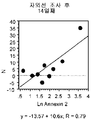
0일째의 L*값과 아넥신 II의 각질층 중의 발현량의 상관관계 및 2일째, 4일째, 7일째, 10일째, 14일째의 L*값의 변화량과 자연대수 변환한 아넥신 II 단백질량의 상관관계를 조사하였다. 회귀직선의 그래프를 도 2~7에, 상관계수를 표 2에 나타낸다.Correlation between L * Value on
자연대수 변환한 아넥신 II 단백질량과 2, 10, 14일째의 L*값의 변화량은 「상당한 음의 상관」을 나타내고, 4, 7일째의 L*값의 변화량은 「강한 음의 상관」을 나타내었다.The amount of change in L * value on the 2nd, 10th, and 14th days of the natural logarithmic conversion of Annexin II protein indicates "significant negative correlation," and the amount of change in the L * value on the 4th and 7th days indicates a "strong negative correlation." Indicated.
이상의 사실로부터, 피부 각질층 중의 아넥신 II 단백질량이 많을수록, 자외선 폭로에 의한 L*값의 저하(피부 흑화) 경향이 강한 것을 알 수 있다. 피부 각질층 중의 아넥신 II 단백질량은 자외선 폭로에 의한 피부 흑화 경향의 지표가 되는 것이 판명되었다.From the above facts, it can be seen that the greater the amount of Annexin II protein in the stratum corneum, the stronger the tendency of L * value decrease (skin blackening) due to UV exposure. The amount of annexin II protein in the stratum corneum was found to be an indicator of the tendency of skin blackening due to UV exposure.

일반적으로, 상관계수는 이하와 같이 평가되고 있다.In general, the correlation coefficient is evaluated as follows.
0~0.2: 거의 상관 없음, 0-0.2: almost irrelevant,
0.2~0.4: 약간 상관 있음, 0.2-0.4: slightly correlated,
0.4~0.7: 상당한 양의 상관 있음, 0.4-0.7: significant correlation
0.7~1: 강한 양의 상관 0.7 ~ 1: strong positive correlation
0~-0.2: 거의 상관 없음, 0-0.2: almost irrelevant,
-0.4~-0.2: 약간 상관 있음, -0.4 to -0.2: slightly correlated,
-0.7~-0.4: 상당한 음의 상관 있음, -0.7 to -0.4: significant negative correlation,
-1~-0.7: 강한 음의 상관 -1 to -0.7: strong negative correlation
9. 피부 멜라닌량의 측정결과9. Measurement result of skin melanin content
자외선 조사 후의 N값의 변화량을 도 8에 나타낸다.The amount of change in N value after ultraviolet irradiation is shown in FIG.
N값의 변화량(자외선 조사 후의 N값-자외선 조사 전의 N값)은 자외선 조사 4일째 이후 14일째까지, 자외선 조사 전(0일째)과 비교하여 높은 값을 나타내었다. 자외선 조사 4일째 이후 14일까지 피부 멜라닌량이 많아, 피부의 흑화를 반영하고 있다.The change amount of N value (N value after ultraviolet irradiation-N value before ultraviolet irradiation) showed the high value compared with before ultraviolet irradiation (day 0) from the 4th day after ultraviolet irradiation to 14th day. The amount of melanin in the skin is large from
0일째의 N값과 아넥신 II의 각질층 중의 발현량의 상관관계, 및 0일째의 N값을 기준으로 한, 2일째, 4일째, 7일째, 10일째, 14일째의 N값의 변화량과 자연대수 변환한 아넥신 II 단백질량의 상관관계를 조사하였다. 회귀직선의 그래프를 도 9~14에, 상관계수를 표 3에 표시한다.The correlation between the N value on the 0th day and the expression level in the stratum corneum of Annexin II, and the change amount and the natural value of the N value on the 2nd, 4th, 7th, 10th and 14th day based on the N value on the 0th day. The correlation of logarithmic converted Annexin II protein amount was investigated. The graph of the regression line is shown in Figs. 9 to 14 and the correlation coefficient is shown in Table 3.
4일째 이후, 자연대수 변환한 아넥신 II 단백질량과 N값의 변화량은 강한 양의 상관을 나타내었다.After
따라서, 아넥신 II 단백질량의 증가는 자외선 폭로에 의한 멜라닌량의 증가를 의미한다. 즉, 아넥신 II가 증가하면 자외선 폭로에 의한 멜라닌의 증가 및 피부의 흑화가 증대되는 것이 판명되었다. 즉, 아넥신 II 단백질량은 자외선 폭로에 의한 피부의 흑화 경향을 반영하고, 더 나아가서는 멜라닌 증가의 지표가 될 수 있는 것이 명확하다.Therefore, an increase in the amount of annexin II protein means an increase in the amount of melanin by exposure to ultraviolet rays. In other words, the increase in Annexin II was found to increase melanin and blackening of the skin due to UV exposure. In other words, it is clear that the amount of annexin II protein reflects the tendency of the skin to darken by exposure to ultraviolet rays, and moreover, may be an index of melanin increase.

이상, 아넥신 II 단백질량과 L*값의 변화, 및 아넥신 II 단백질량과 N값의 변화의 관계로부터, 피부 각질층 중의 아넥신 II 단백질량은, 자외선 폭로에 의한 피부의 흑화도의 지표가 되는 것이 판명되었다.As described above, from the relationship between the change of the amount of Annexin II protein and the L * value, and the change of the amount of Annexin II protein and the N value, the amount of Annexin II protein in the stratum corneum is an indicator of the degree of blackening of the skin by UV exposure. It turned out.
도면의 간단한 설명Brief description of the drawings
도 1은 자외선 조사 후의 L*값의 변화량을 나타내는 그래프로, 세로축은 L*값의 변화량을 나타낸다.1 is a graph showing the amount of change in L * value after ultraviolet irradiation, and the vertical axis represents the amount of change in L * value.
도 2는 자외선 조사 직전(0일째)의 L*값과 아넥신 II의 각질층 중의 발현량의 상관관계를 나타내는 그래프이다.Fig. 2 is a graph showing the correlation between the L * value immediately before ultraviolet irradiation (day 0) and the expression level in the stratum corneum of Annexin II.
도 3은 0일째의 N값을 기준으로 한 자외선 조사 후 2일째의 L*값의 변화량과 자연대수 변환한 아넥신 II 단백질량의 상관관계를 나타내는 그래프이다.3 is a graph showing the correlation between the amount of change in L * value on the second day after ultraviolet irradiation based on the N value on
도 4는 0일째의 N값을 기준으로 한 자외선 조사 후 4일째의 L*값의 변화량과 자연대수 변환한 아넥신 II 단백질량의 상관관계를 나타내는 그래프이다.Fig. 4 is a graph showing the correlation between the amount of change in L * value on
도 5는 0일째의 N값을 기준으로 한 자외선 조사 후 7일째의 L*값의 변화량과 자연대수 변환한 아넥신 II 단백질량의 상관관계를 나타내는 그래프이다.5 is a graph showing the correlation between the amount of change in L * value on the 7th day after ultraviolet irradiation based on the N value on
도 6은 0일째의 N값을 기준으로 한 자외선 조사 후 10일째의 L*값의 변화량과 자연대수 변환한 아넥신 II 단백질량의 상관관계를 나타내는 그래프이다.Fig. 6 is a graph showing the correlation between the amount of change in L * value on the 10th day after ultraviolet irradiation based on the N value on
도 7은 0일째의 N값을 기준으로 한 자외선 조사 후 14일째의 L*값의 변화량과 자연대수 변환한 아넥신 II 단백질량의 상관관계를 나타내는 그래프이다.7 is a graph showing the correlation between the amount of change in L * value on the 14th day after ultraviolet irradiation based on the N value on
도 8은 자외선 조사 후의 N값의 경시 변화량을 나타내는 그래프이다. 세로축은 N값의 변화량을 나타낸다.8 is a graph showing the change over time of the N value after ultraviolet irradiation. The vertical axis represents the amount of change in the N value.
도 9는 자외선 조사 직전(0일째)의 N값과 아넥신 II의 각질층 중의 발현량의 상관관계를 나타내는 그래프이다.Fig. 9 is a graph showing the correlation between the N value immediately before ultraviolet irradiation (day 0) and the expression level in the stratum corneum of Annexin II.
도 10은 0일째의 N값을 기준으로 한 자외선 조사 후 2일째의 N값의 변화량과 자연대수 변환한 아넥신 II 단백질량의 상관관계를 나타내는 그래프이다.FIG. 10 is a graph showing the correlation between the amount of change in N value on the second day after UV irradiation based on the value of N on
도 11은 0일째의 N값을 기준으로 한 자외선 조사 후 4일째의 N값의 변화량과 자연대수 변환한 아넥신 II 단백질량의 상관관계를 나타내는 그래프이다.FIG. 11 is a graph showing the correlation between the amount of change in N value on the fourth day after ultraviolet irradiation based on the value of N on
도 12는 0일째의 N값을 기준으로 한 자외선 조사 후 7일째의 N값의 변화량과 자연대수 변환한 아넥신 II 단백질량의 상관관계를 나타내는 그래프이다.12 is a graph showing the correlation between the amount of change in N value on the 7th day after ultraviolet irradiation based on the value of N on
도 13은 0일째의 N값을 기준으로 한 자외선 조사 후 10일째의 N값의 변화량과 자연대수 변환한 아넥신 II 단백질량의 상관관계를 나타내는 그래프이다.FIG. 13 is a graph showing the correlation between the amount of change in N value on the 10th day after ultraviolet irradiation based on the value of N on
도 14는 0일째의 N값을 기준으로 한 자외선 조사 후 14일째의 N값의 변화량과 자연대수 변환한 아넥신 II 단백질량의 상관관계를 나타내는 그래프이다.14 is a graph showing the correlation between the amount of change in N value on the 14th day after ultraviolet irradiation based on the value of N on
Claims (3)
Applications Claiming Priority (3)
| Application Number | Priority Date | Filing Date | Title |
|---|---|---|---|
| JP2008327376A JP4473926B1 (en) | 2008-12-24 | 2008-12-24 | Evaluation method of skin darkening tendency by ultraviolet rays |
| JPJP-P-2008-327376 | 2008-12-24 | ||
| PCT/JP2009/071125 WO2010073984A1 (en) | 2008-12-24 | 2009-12-18 | Method for evaluating tendency to skin pigmentation by ultraviolet light |
Publications (2)
| Publication Number | Publication Date |
|---|---|
| KR20110070927A true KR20110070927A (en) | 2011-06-24 |
| KR101052171B1 KR101052171B1 (en) | 2011-07-26 |
Family
ID=42287595
Family Applications (1)
| Application Number | Title | Priority Date | Filing Date |
|---|---|---|---|
| KR1020117012442A Expired - Fee Related KR101052171B1 (en) | 2008-12-24 | 2009-12-18 | Evaluation method of skin blackening tendency by ultraviolet rays |
Country Status (4)
| Country | Link |
|---|---|
| JP (1) | JP4473926B1 (en) |
| KR (1) | KR101052171B1 (en) |
| CN (1) | CN102239413B (en) |
| WO (1) | WO2010073984A1 (en) |
Families Citing this family (2)
| Publication number | Priority date | Publication date | Assignee | Title |
|---|---|---|---|---|
| JP5738720B2 (en) * | 2011-03-24 | 2015-06-24 | 日本メナード化粧品株式会社 | Melanin synthesis ability evaluation method and beauty advice method, and melanin synthesis ability evaluation system and beauty advice system using them |
| CN105588995B (en) * | 2015-12-11 | 2018-08-14 | 深圳供电局有限公司 | Line loss abnormity detection method for electric power metering automation system |
Family Cites Families (7)
| Publication number | Priority date | Publication date | Assignee | Title |
|---|---|---|---|---|
| FR2796646B1 (en) * | 1999-07-23 | 2003-10-17 | Oreal | POLYPEPTIDE ISOLATED FROM THE STRATUM CORNEUM AND ITS USE |
| JP2003327376A (en) * | 2002-05-10 | 2003-11-19 | Toshiba Elevator Co Ltd | Heater for elevator |
| EP1691199B1 (en) * | 2003-10-01 | 2009-04-01 | Shiseido Company Limited | Method of predicting spot formation on the skin with the use of spot site-accelerating genes as indication and method of screening inhibitor for spot formation on the skin |
| JP2005272343A (en) * | 2004-03-24 | 2005-10-06 | Shiseido Co Ltd | Method for inhibiting ultraviolet-induced apoptosis |
| KR101318521B1 (en) * | 2005-08-23 | 2013-10-16 | 가오루 미야자키 | Skin aging marker and technique for use thereof |
| CA2663749A1 (en) * | 2005-09-21 | 2007-03-29 | Dask Technologies, Llc | Methods and compositions for organ and tissue functionality |
| JP4675806B2 (en) * | 2006-03-16 | 2011-04-27 | 日本メナード化粧品株式会社 | Annexin activator |
-
2008
- 2008-12-24 JP JP2008327376A patent/JP4473926B1/en not_active Expired - Fee Related
-
2009
- 2009-12-18 WO PCT/JP2009/071125 patent/WO2010073984A1/en not_active Ceased
- 2009-12-18 CN CN200980148442.8A patent/CN102239413B/en not_active Expired - Fee Related
- 2009-12-18 KR KR1020117012442A patent/KR101052171B1/en not_active Expired - Fee Related
Also Published As
| Publication number | Publication date |
|---|---|
| CN102239413A (en) | 2011-11-09 |
| CN102239413B (en) | 2014-03-26 |
| JP2010151481A (en) | 2010-07-08 |
| WO2010073984A1 (en) | 2010-07-01 |
| KR101052171B1 (en) | 2011-07-26 |
| HK1158753A1 (en) | 2012-07-20 |
| JP4473926B1 (en) | 2010-06-02 |
Similar Documents
| Publication | Publication Date | Title |
|---|---|---|
| Naik et al. | Influence of ethnicities and skin color variations in different populations: a review | |
| JP5027528B2 (en) | Test method for skin aging | |
| Pudlas et al. | Raman spectroscopy: a noninvasive analysis tool for the discrimination of human skin cells | |
| KR101052171B1 (en) | Evaluation method of skin blackening tendency by ultraviolet rays | |
| JP5658696B2 (en) | Evaluation method of skin stress accumulation | |
| CN104007056B (en) | To the evaluation method of the repellence of ultraviolet injury | |
| Larraona-Puy et al. | Discrimination between basal cell carcinoma and hair follicles in skin tissue sections by Raman micro-spectroscopy | |
| KR101045162B1 (en) | Evaluation method of resistance to skin turning by ultraviolet rays | |
| TWI600904B (en) | Method of evaluating degree of skin stress accumulation | |
| CN111511289B (en) | Judgment method of UV sensitivity | |
| JP4971055B2 (en) | Skin pigmentation marker and its application technology | |
| HK1158753B (en) | Method for evaluating tendency to skin pigmentation by ultraviolet light | |
| KR20210009981A (en) | Method for evaluating resistance to skin sunburn by ultraviolet light | |
| HK1158315A (en) | Method for evaluating resistance to skin sunburn by ultraviolet light | |
| Ayer | A comparison of atrophic and hypertrophic facial photoageing | |
| Lin et al. | Cosmetic Exposure and Hepatic Steatosis: Investigating the Role of Metals and Adipokines | |
| JP2012039970A (en) | How to test the degree of skin damage | |
| HK1198451B (en) | Method for evaluating resistance to ultraviolet damage | |
| Hagströmer | Atopic dermatitis: aspects of defence defects | |
| JP5563710B2 (en) | Skin pigmentation marker and its application technology | |
| Janovska | Evaluation of Signs of Skin Aging in Patients with Metabolic Syndrome after Substitution Therapy with Antioxidants | |
| HK1186245A (en) | Analysis method for skin stress accumulation | |
| HK1187677A (en) | Method of evaluating degree of skin stress accumulation |
Legal Events
| Date | Code | Title | Description |
|---|---|---|---|
| A201 | Request for examination | ||
| A302 | Request for accelerated examination | ||
| P11-X000 | Amendment of application requested |
St.27 status event code: A-2-2-P10-P11-nap-X000 |
|
| P13-X000 | Application amended |
St.27 status event code: A-2-2-P10-P13-nap-X000 |
|
| PA0105 | International application |
St.27 status event code: A-0-1-A10-A15-nap-PA0105 |
|
| PA0201 | Request for examination |
St.27 status event code: A-1-2-D10-D11-exm-PA0201 |
|
| PA0302 | Request for accelerated examination |
St.27 status event code: A-1-2-D10-D17-exm-PA0302 St.27 status event code: A-1-2-D10-D16-exm-PA0302 |
|
| PG1501 | Laying open of application |
St.27 status event code: A-1-1-Q10-Q12-nap-PG1501 |
|
| E701 | Decision to grant or registration of patent right | ||
| PE0701 | Decision of registration |
St.27 status event code: A-1-2-D10-D22-exm-PE0701 |
|
| GRNT | Written decision to grant | ||
| PR0701 | Registration of establishment |
St.27 status event code: A-2-4-F10-F11-exm-PR0701 |
|
| PR1002 | Payment of registration fee |
St.27 status event code: A-2-2-U10-U12-oth-PR1002 Fee payment year number: 1 |
|
| PG1601 | Publication of registration |
St.27 status event code: A-4-4-Q10-Q13-nap-PG1601 |
|
| FPAY | Annual fee payment |
Payment date: 20140514 Year of fee payment: 6 |
|
| PR1001 | Payment of annual fee |
St.27 status event code: A-4-4-U10-U11-oth-PR1001 Fee payment year number: 4 |
|
| FPAY | Annual fee payment |
Payment date: 20170616 Year of fee payment: 7 |
|
| PR1001 | Payment of annual fee |
St.27 status event code: A-4-4-U10-U11-oth-PR1001 Fee payment year number: 7 |
|
| FPAY | Annual fee payment |
Payment date: 20180628 Year of fee payment: 8 |
|
| PR1001 | Payment of annual fee |
St.27 status event code: A-4-4-U10-U11-oth-PR1001 Fee payment year number: 8 |
|
| PR1001 | Payment of annual fee |
St.27 status event code: A-4-4-U10-U11-oth-PR1001 Fee payment year number: 9 |
|
| PR1001 | Payment of annual fee |
St.27 status event code: A-4-4-U10-U11-oth-PR1001 Fee payment year number: 10 |
|
| PC1903 | Unpaid annual fee |
St.27 status event code: A-4-4-U10-U13-oth-PC1903 Not in force date: 20210721 Payment event data comment text: Termination Category : DEFAULT_OF_REGISTRATION_FEE |
|
| PC1903 | Unpaid annual fee |
St.27 status event code: N-4-6-H10-H13-oth-PC1903 Ip right cessation event data comment text: Termination Category : DEFAULT_OF_REGISTRATION_FEE Not in force date: 20210721 |