KR20080018122A - The photosensitive polyimide resin soluble in aqueous alkali solution, the composition containing the said resin, and the film | membrane obtained from the said composition - Google Patents
The photosensitive polyimide resin soluble in aqueous alkali solution, the composition containing the said resin, and the film | membrane obtained from the said composition Download PDFInfo
- Publication number
- KR20080018122A KR20080018122A KR1020070083871A KR20070083871A KR20080018122A KR 20080018122 A KR20080018122 A KR 20080018122A KR 1020070083871 A KR1020070083871 A KR 1020070083871A KR 20070083871 A KR20070083871 A KR 20070083871A KR 20080018122 A KR20080018122 A KR 20080018122A
- Authority
- KR
- South Korea
- Prior art keywords
- group
- formula
- groups
- resin
- polyimide resin
- Prior art date
- Legal status (The legal status is an assumption and is not a legal conclusion. Google has not performed a legal analysis and makes no representation as to the accuracy of the status listed.)
- Granted
Links
Classifications
-
- G—PHYSICS
- G03—PHOTOGRAPHY; CINEMATOGRAPHY; ANALOGOUS TECHNIQUES USING WAVES OTHER THAN OPTICAL WAVES; ELECTROGRAPHY; HOLOGRAPHY
- G03F—PHOTOMECHANICAL PRODUCTION OF TEXTURED OR PATTERNED SURFACES, e.g. FOR PRINTING, FOR PROCESSING OF SEMICONDUCTOR DEVICES; MATERIALS THEREFOR; ORIGINALS THEREFOR; APPARATUS SPECIALLY ADAPTED THEREFOR
- G03F7/00—Photomechanical, e.g. photolithographic, production of textured or patterned surfaces, e.g. printing surfaces; Materials therefor, e.g. comprising photoresists; Apparatus specially adapted therefor
- G03F7/004—Photosensitive materials
- G03F7/027—Non-macromolecular photopolymerisable compounds having carbon-to-carbon double bonds, e.g. ethylenic compounds
- G03F7/032—Non-macromolecular photopolymerisable compounds having carbon-to-carbon double bonds, e.g. ethylenic compounds with binders
- G03F7/037—Non-macromolecular photopolymerisable compounds having carbon-to-carbon double bonds, e.g. ethylenic compounds with binders the binders being polyamides or polyimides
-
- C—CHEMISTRY; METALLURGY
- C08—ORGANIC MACROMOLECULAR COMPOUNDS; THEIR PREPARATION OR CHEMICAL WORKING-UP; COMPOSITIONS BASED THEREON
- C08G—MACROMOLECULAR COMPOUNDS OBTAINED OTHERWISE THAN BY REACTIONS ONLY INVOLVING UNSATURATED CARBON-TO-CARBON BONDS
- C08G73/00—Macromolecular compounds obtained by reactions forming a linkage containing nitrogen with or without oxygen or carbon in the main chain of the macromolecule, not provided for in groups C08G12/00 - C08G71/00
- C08G73/06—Polycondensates having nitrogen-containing heterocyclic rings in the main chain of the macromolecule
- C08G73/10—Polyimides; Polyester-imides; Polyamide-imides; Polyamide acids or similar polyimide precursors
-
- C—CHEMISTRY; METALLURGY
- C08—ORGANIC MACROMOLECULAR COMPOUNDS; THEIR PREPARATION OR CHEMICAL WORKING-UP; COMPOSITIONS BASED THEREON
- C08G—MACROMOLECULAR COMPOUNDS OBTAINED OTHERWISE THAN BY REACTIONS ONLY INVOLVING UNSATURATED CARBON-TO-CARBON BONDS
- C08G73/00—Macromolecular compounds obtained by reactions forming a linkage containing nitrogen with or without oxygen or carbon in the main chain of the macromolecule, not provided for in groups C08G12/00 - C08G71/00
- C08G73/06—Polycondensates having nitrogen-containing heterocyclic rings in the main chain of the macromolecule
- C08G73/10—Polyimides; Polyester-imides; Polyamide-imides; Polyamide acids or similar polyimide precursors
- C08G73/1042—Copolyimides derived from at least two different tetracarboxylic compounds or two different diamino compounds
-
- C—CHEMISTRY; METALLURGY
- C08—ORGANIC MACROMOLECULAR COMPOUNDS; THEIR PREPARATION OR CHEMICAL WORKING-UP; COMPOSITIONS BASED THEREON
- C08J—WORKING-UP; GENERAL PROCESSES OF COMPOUNDING; AFTER-TREATMENT NOT COVERED BY SUBCLASSES C08B, C08C, C08F, C08G or C08H
- C08J5/00—Manufacture of articles or shaped materials containing macromolecular substances
- C08J5/20—Manufacture of shaped structures of ion-exchange resins
- C08J5/22—Films, membranes or diaphragms
-
- C—CHEMISTRY; METALLURGY
- C08—ORGANIC MACROMOLECULAR COMPOUNDS; THEIR PREPARATION OR CHEMICAL WORKING-UP; COMPOSITIONS BASED THEREON
- C08L—COMPOSITIONS OF MACROMOLECULAR COMPOUNDS
- C08L79/00—Compositions of macromolecular compounds obtained by reactions forming in the main chain of the macromolecule a linkage containing nitrogen with or without oxygen or carbon only, not provided for in groups C08L61/00 - C08L77/00
- C08L79/04—Polycondensates having nitrogen-containing heterocyclic rings in the main chain; Polyhydrazides; Polyamide acids or similar polyimide precursors
- C08L79/08—Polyimides; Polyester-imides; Polyamide-imides; Polyamide acids or similar polyimide precursors
-
- G—PHYSICS
- G03—PHOTOGRAPHY; CINEMATOGRAPHY; ANALOGOUS TECHNIQUES USING WAVES OTHER THAN OPTICAL WAVES; ELECTROGRAPHY; HOLOGRAPHY
- G03F—PHOTOMECHANICAL PRODUCTION OF TEXTURED OR PATTERNED SURFACES, e.g. FOR PRINTING, FOR PROCESSING OF SEMICONDUCTOR DEVICES; MATERIALS THEREFOR; ORIGINALS THEREFOR; APPARATUS SPECIALLY ADAPTED THEREFOR
- G03F7/00—Photomechanical, e.g. photolithographic, production of textured or patterned surfaces, e.g. printing surfaces; Materials therefor, e.g. comprising photoresists; Apparatus specially adapted therefor
- G03F7/004—Photosensitive materials
- G03F7/038—Macromolecular compounds which are rendered insoluble or differentially wettable
-
- G—PHYSICS
- G03—PHOTOGRAPHY; CINEMATOGRAPHY; ANALOGOUS TECHNIQUES USING WAVES OTHER THAN OPTICAL WAVES; ELECTROGRAPHY; HOLOGRAPHY
- G03F—PHOTOMECHANICAL PRODUCTION OF TEXTURED OR PATTERNED SURFACES, e.g. FOR PRINTING, FOR PROCESSING OF SEMICONDUCTOR DEVICES; MATERIALS THEREFOR; ORIGINALS THEREFOR; APPARATUS SPECIALLY ADAPTED THEREFOR
- G03F7/00—Photomechanical, e.g. photolithographic, production of textured or patterned surfaces, e.g. printing surfaces; Materials therefor, e.g. comprising photoresists; Apparatus specially adapted therefor
- G03F7/004—Photosensitive materials
- G03F7/038—Macromolecular compounds which are rendered insoluble or differentially wettable
- G03F7/0387—Polyamides or polyimides
-
- H—ELECTRICITY
- H05—ELECTRIC TECHNIQUES NOT OTHERWISE PROVIDED FOR
- H05K—PRINTED CIRCUITS; CASINGS OR CONSTRUCTIONAL DETAILS OF ELECTRIC APPARATUS; MANUFACTURE OF ASSEMBLAGES OF ELECTRICAL COMPONENTS
- H05K3/00—Apparatus or processes for manufacturing printed circuits
- H05K3/22—Secondary treatment of printed circuits
- H05K3/28—Applying non-metallic protective coatings
- H05K3/285—Permanent coating compositions
- H05K3/287—Photosensitive compositions
-
- Y—GENERAL TAGGING OF NEW TECHNOLOGICAL DEVELOPMENTS; GENERAL TAGGING OF CROSS-SECTIONAL TECHNOLOGIES SPANNING OVER SEVERAL SECTIONS OF THE IPC; TECHNICAL SUBJECTS COVERED BY FORMER USPC CROSS-REFERENCE ART COLLECTIONS [XRACs] AND DIGESTS
- Y10—TECHNICAL SUBJECTS COVERED BY FORMER USPC
- Y10S—TECHNICAL SUBJECTS COVERED BY FORMER USPC CROSS-REFERENCE ART COLLECTIONS [XRACs] AND DIGESTS
- Y10S430/00—Radiation imagery chemistry: process, composition, or product thereof
- Y10S430/1053—Imaging affecting physical property or radiation sensitive material, or producing nonplanar or printing surface - process, composition, or product: radiation sensitive composition or product or process of making binder containing
- Y10S430/1055—Radiation sensitive composition or product or process of making
- Y10S430/106—Binder containing
- Y10S430/107—Polyamide or polyurethane
Landscapes
- Chemical & Material Sciences (AREA)
- Physics & Mathematics (AREA)
- Medicinal Chemistry (AREA)
- Health & Medical Sciences (AREA)
- Chemical Kinetics & Catalysis (AREA)
- Polymers & Plastics (AREA)
- Organic Chemistry (AREA)
- Spectroscopy & Molecular Physics (AREA)
- General Physics & Mathematics (AREA)
- Engineering & Computer Science (AREA)
- Manufacturing & Machinery (AREA)
- Materials Engineering (AREA)
- Materials For Photolithography (AREA)
- Macromolecular Compounds Obtained By Forming Nitrogen-Containing Linkages In General (AREA)
- Macromonomer-Based Addition Polymer (AREA)
Abstract
감광성 및 알칼리에 대한 용해성이 우수한 폴리이미드 수지 및 상기 수지를 포함하는 조성물 및 그의 사용 방법을 제공한다.Provided are a polyimide resin having excellent photosensitivity and solubility in alkali, a composition comprising the resin, and a method of using the same.
하기 3종의 반복 단위를 포함하고, 중량 평균 분자량(폴리스티렌 환산)이 5000 내지 500000이고, 아크릴 당량이 400 내지 3000이면서 카르복실산 당량이 300 내지 2500인 것을 특징으로 하는 폴리이미드 수지. The following three types of repeating units are included, The weight average molecular weight (polystyrene conversion) is 5000-50000, The acrylic equivalent is 400-3000, The carboxylic acid equivalent is 300-2500, The polyimide resin characterized by the above-mentioned.
<화학식 1><Formula 1>

(식 중, X는 4가의 유기기이고, Y는 (메트)아크릴기, 카르복실기 및 수산기로부터 선택되는 1종 이상의 기를 갖는 2가의 유기기이고, Z는 (메트)아크릴기, 카르복실기 및 수산기 중 어느 것도 갖지 않는 2가의 유기기이고, W는 폴리오르가노실록산 구조를 갖는 2가의 유기기이고, 단, X, Y, Z, W는 각각 2종 이상의 구조로 할 수도 있고, k, m, n은 각각 0.2≤k≤1.0, 0≤m≤0.8, 0≤n≤0.8을 만족시키는 수이고, 단, k+m+n=1이다)(Wherein X is a tetravalent organic group, Y is a divalent organic group having at least one group selected from (meth) acryl groups, carboxyl groups and hydroxyl groups, and Z is any of (meth) acryl groups, carboxyl groups and hydroxyl groups). It is a divalent organic group which does not have anything, W is a divalent organic group which has a polyorganosiloxane structure, provided that X, Y, Z, and W may each have 2 or more types of structures, and k, m, and n are 0.2 ≤ k ≤ 1.0, 0 ≤ m ≤ 0.8, 0 ≤ n ≤ 0.8, respectively, provided that k + m + n = 1)
Description
본 발명은 감광성 폴리이미드 수지에 관한 것이고, 상세하게는 감광성기에 부가적으로 카르복실기를 가지고, 알칼리성 수용액에 대하여 우수한 용해성을 나타내는 수지에 관한 것이다. 또한, 본 발명은 상기 수지를 포함하는 감광성 조성물, 상기 조성물로부터 얻어지는 피막 등에도 관한 것이다. 상기 감광성 조성물은 그의 내열성, 내약품성, 절연성으로 인해 커버레이 필름, 반도체 소자용 보호 절연막, 다층 인쇄 기판용 절연막, 땜납 보호막 등에 바람직하게 사용된다.The present invention relates to a photosensitive polyimide resin, and more particularly to a resin having a carboxyl group in addition to the photosensitive group and showing excellent solubility in an alkaline aqueous solution. Moreover, this invention relates also to the photosensitive composition containing the said resin, the film obtained from the said composition, etc. The photosensitive composition is preferably used for a coverlay film, a protective insulating film for a semiconductor element, an insulating film for a multilayer printed circuit board, a solder protective film, and the like due to its heat resistance, chemical resistance, and insulating property.
종래에 감광성 폴리이미드계 재료로서는, 폴리이미드의 전구체인 폴리아믹산을 이용한 재료, 예를 들면 폴리아믹산의 카르복실기에 감광기를 에스테르 결합에 의해 도입한 것(특허 문헌 1 및 2), 폴리아믹산과 감광기를 갖는 아민 화합물을 포함하는 재료(특허 문헌 3) 등이 제안되었다. 그러나, 이들 재료는 패턴화된 피막을 형성한 후에 300 ℃를 초과하는 고온에서 이미드화 처리를 하는 것이 필요하고, 이러한 고온에 견디는 바탕(下地) 기재가 필요하며, 또한 배선의 구리가 산화되거나 하는 문제를 가지고 있었다.Conventionally, as a photosensitive polyimide type material, the photosensitive group was introduce | transduced by ester bonding to the material using the polyamic acid which is a precursor of a polyimide, for example, the carboxyl group of a polyamic acid (patent document 1 and 2), a polyamic acid and a photosensitive group The material (patent document 3) etc. containing the amine compound which has is proposed. However, these materials need to be subjected to imidation treatment at a high temperature exceeding 300 ° C. after forming a patterned film, and require a base substrate to withstand such high temperatures, and also to oxidize copper in wiring. Had a problem.
이 문제를 해결하는 수법으로서, 후경화 온도의 저온화를 목적으로, (메트)아크릴기를 함유하고, 이미 이미드화된 감광성 폴리이미드 수지(특허 문헌 4 내지 6)가 여러 가지 제안되었다. 이들 수지 조성물은 유기 용매에 의해 현상하는 것이 가능하지만, 환경상 및 안전상의 관점에서는 알칼리성 수용액에 의한 현상이 바람직하였다. 그러나, 이들 수지 조성물은 알칼리성 수용액에 의한 현상이 불가능하거나, 가능하더라도 강한 알칼리성 수용액이 필요하였다.As a method of solving this problem, various photosensitive polyimide resins (patent documents 4 to 6) containing (meth) acryl groups and already imidized for the purpose of lowering the post-curing temperature have been proposed. Although these resin compositions can be developed by an organic solvent, development by alkaline aqueous solution is preferable from an environmental and safety viewpoint. However, these resin compositions were impossible to develop by alkaline aqueous solution, or the strong alkaline aqueous solution was needed even if possible.
알칼리성 수용액으로 현상할 수 있는 수지로서, 페놀성 수산기를 갖는 폴리이미드(특허 문헌 7), 폴리아미드 골격과 디아조나프토퀴논을 조합한 포지티브형에 의한 제안(특허 문헌 8 및 9)이 알려져 있다. 그러나, 이들 수지는 광 투과성이 나쁘고, 10 마이크로미터를 초과하는 두꺼운 막의 패턴을 형성하는 것이 곤란하다는 문제가 있었다. 또한, 현상성 확보의 관점에서 수지 분자량이 저분자량이고, 감광제인 디아조나프토퀴논의 첨가량이 수지에 대하여 다량이기 때문에, 수지 농도가 낮고, 막의 강도 등에 문제가 있었다.As a resin which can be developed with an alkaline aqueous solution, a polyimide having a phenolic hydroxyl group (Patent Document 7), and a proposal by a positive type combining a polyamide skeleton and a diazonaptoquinone (Patent Documents 8 and 9) are known. However, these resins have a problem in that light transmittance is poor and it is difficult to form a pattern of a thick film exceeding 10 micrometers. In addition, from the viewpoint of ensuring developability, the resin molecular weight was low molecular weight, and the amount of the addition of diazonaptoquinone as a photosensitizer was large relative to the resin, so that the resin concentration was low and there was a problem in the strength of the film and the like.
[특허 문헌 1] 일본 특허 공개 (소)49-115541호 공보[Patent Document 1] Japanese Unexamined Patent Publication No. 49-115541
[특허 문헌 2] 일본 특허 공개 (소)55-45746호 공보[Patent Document 2] Japanese Patent Laid-Open No. 55-45746
[특허 문헌 3] 일본 특허 공개 (소)54-145794호 공보[Patent Document 3] Japanese Patent Application Laid-Open No. 54-145794
[특허 문헌 4] 일본 특허 공개 (평)10-274850호 공보[Patent Document 4] Japanese Patent Application Laid-Open No. 10-274850
[특허 문헌 5] 일본 특허 공개 (평)10-265571호 공보[Patent Document 5] Japanese Unexamined Patent Publication No. 10-265571
[특허 문헌 6] 일본 특허 공개 제2001-335619호 공보[Patent Document 6] Japanese Patent Application Laid-Open No. 2001-335619
[특허 문헌 7] 일본 특허 공개 (평)3-209478호 공보[Patent Document 7] Japanese Patent Application Laid-Open No. 3-209478
[특허 문헌 8] 일본 특허 공고 (평)1-46862 공보[Patent Document 8] Japanese Patent Application Laid-Open No. 1-46862
[특허 문헌 9] 일본 특허 공개 (평)11-65107호 공보[Patent Document 9] Japanese Unexamined Patent Publication No. Hei 11-65107
따라서, 본 발명은 비교적 저온에서 이미드화하는 것이 가능하고, 양호한 알칼리 현상성을 가지면서 또한 접착성을 갖는 감광성 폴리이미드 수지 및 상기 수지를 함유하여 이루어지는 감광성 수지 조성물을 제공한다. 또한, 본 발명은 상기 수지 조성물로부터 얻어지는 피막을 제공하는 방법을 목적으로 한다. Accordingly, the present invention provides a photosensitive polyimide resin capable of imidizing at a relatively low temperature and having good alkali developability and adhesiveness, and a photosensitive resin composition comprising the resin. Moreover, an object of this invention is to provide the film obtained from the said resin composition.
본 발명자는 분자 중에 (메트)아크릴기와 카르복실기를 겸비하는 폴리이미드 수지를 함유하여 이루어지는 조성물이 알칼리 현상성이 우수하고, 양호한 패턴을 형성할 수 있는 것을 발견하였다. 또한, 이 감광성 수지 조성물 및 패턴 형성 후 가열에 의해 얻어지는 경화 피막은 내열성, 전기 절연성이 우수한 것을 발견하여, 본 발명을 완성하기에 이르렀다.This inventor discovered that the composition which contains the polyimide resin which has a (meth) acryl group and a carboxyl group in a molecule | numerator is excellent in alkali developability and can form a favorable pattern. Moreover, the cured film obtained by this photosensitive resin composition and heating after pattern formation discovered that it was excellent in heat resistance and electrical insulation, and came to complete this invention.
즉, 본 발명은 하기의 것이다. That is, the present invention is as follows.
하기 3종의 반복 단위를 포함하고, 중량 평균 분자량(폴리스티렌 환산)이 5000 내지 500000이고, 아크릴 당량이 400 내지 3000이면서 카르복실산 당량이 300 내지 2500인 것을 특징으로 하는 폴리이미드 수지.The following three types of repeating units are included, The weight average molecular weight (polystyrene conversion) is 5000-50000, The acrylic equivalent is 400-3000, The carboxylic acid equivalent is 300-2500, The polyimide resin characterized by the above-mentioned.

(식 중, X는 4가의 유기기이고, Y는 (메트)아크릴기, 카르복실기 및 수산기로부터 선택되는 1종 이상의 기를 갖는 2가의 유기기이고, Z는 (메트)아크릴기, 카르복실기 및 수산기 중 어느 것도 갖지 않는 2가의 유기기이고, W는 폴리오르가노실록산 구조를 갖는 2가의 유기기이고, 단, X, Y, Z, W는 각각 2종 이상의 구조로 할 수도 있고, k, m, n은 각각 0.2≤k≤1.0, 0≤m≤0.8, 0≤n≤0.8을 만족시키는 수이고, 단, k+m+n=1이다)(Wherein X is a tetravalent organic group, Y is a divalent organic group having at least one group selected from (meth) acryl groups, carboxyl groups and hydroxyl groups, and Z is any of (meth) acryl groups, carboxyl groups and hydroxyl groups). It is a divalent organic group which does not have anything, W is a divalent organic group which has a polyorganosiloxane structure, provided that X, Y, Z, and W may each have 2 or more types of structures, and k, m, and n are 0.2 ≤ k ≤ 1.0, 0 ≤ m ≤ 0.8, 0 ≤ n ≤ 0.8, respectively, provided that k + m + n = 1)
상기 본 발명의 수지는 알칼리 현상성이 높아 탄산소다 수용액 등의 약 알칼리성 수용액에 의해 현상할 수 있다. 패턴 형성된 피막은 기재에 대한 접착성, 전기 특성 등이 우수하고, 반도체 소자의 보호막, 배선 보호막, 커버레이 필름, 솔더 레지스트 등에 바람직하게 이용된다.The resin of the present invention has high alkali developability and can be developed by a weak alkaline aqueous solution such as an aqueous sodium carbonate solution. The patterned film is excellent in the adhesiveness to an base material, electrical characteristics, etc., and is used suitably for the protective film, wiring protective film, coverlay film, soldering resist, etc. of a semiconductor element.
이하, 본 발명에 대하여 상세하게 설명한다. 본 발명의 폴리이미드 수지는 중량 평균 분자량(폴리스티렌 환산)이 5000 내지 500000이고, 바람직하게는 10000 내지 300000이다. 분자량이 상기 하한치 미만이면 폴리이미드 수지의 피막 강도가 충분하지 않고, 상기 상한치 초과이면 용제에 대한 상용성이 부족한 경우가 있다. EMBODIMENT OF THE INVENTION Hereinafter, this invention is demonstrated in detail. The polyimide resin of the present invention has a weight average molecular weight (polystyrene equivalent) of 5000 to 500000, preferably 10000 to 300000. If the molecular weight is less than the lower limit, the film strength of the polyimide resin is not sufficient, and if it is more than the upper limit, the compatibility with the solvent may be insufficient.
본 발명의 폴리이미드 수지는 하기 3종의 반복 단위가 블록상 또는 랜덤상으로 결합되어 있다. In the polyimide resin of the present invention, the following three repeating units are bonded in a block or random phase.
<화학식 1><Formula 1>

식 중, X는 4가의 유기기이고, 테트라카르복실산 이무수물로부터 유도할 수 있다. Y는 (메트)아크릴기, 카르복실기 및 수산기로부터 선택되는 1종 이상의 기를 갖는 2가의 유기기이고, Z는 (메트)아크릴기, 카르복실기 및 수산기 중 어느 것도 갖지 않는 2가의 유기기이고, W는 폴리오르가노실록산 구조를 갖는 2가의 유기기이고, 단, X, Y, Z, W는 각각 2종 이상의 구조로 할 수 있다.In formula, X is a tetravalent organic group and can be derived from tetracarboxylic dianhydride. Y is a divalent organic group having at least one group selected from a (meth) acryl group, a carboxyl group and a hydroxyl group, Z is a divalent organic group having none of the (meth) acrylic group, a carboxyl group and a hydroxyl group, and W is a poly It is a divalent organic group which has an organosiloxane structure, and X, Y, Z, and W can be made 2 or more types of structures, respectively.
화학식 1 중, k, m, n은 각각 0.2≤k≤1.0, 0≤m≤0.8, 0≤n≤0.8을 만족시키는 수이다. 바람직하게는, k는 0.4 내지 1.0이고, m은 0 내지 0.4이고, n은 0 내지 0.4이다. 단, k+m+n=1이다. In Formula (1), k, m, and n are numbers satisfying 0.2 ≦ k ≦ 1.0, 0 ≦ m ≦ 0.8, and 0 ≦ n ≦ 0.8, respectively. Preferably, k is 0.4 to 1.0, m is 0 to 0.4 and n is 0 to 0.4. However, k + m + n = 1.
본 발명의 폴리이미드 수지는 아크릴 당량이 400 내지 3000, 보다 바람직하게는 400 내지 2000, 가장 바람직하게는 400 내지 1800이고, 카르복실산 당량이 300 내지 2500, 보다 바람직하게는 300 내지 1500, 가장 바람직하게는 300 내지 1000이다. 본 명세서에 있어서 아크릴 당량은 (메트)아크릴기 1 몰당 중량이고, 원료로부터 계산으로 구해지는 이론량이다. 또한, 카르복실산 등량은 카르복실기 1 몰당 중량이고, 수지에 소정량의 알칼리액을 첨가하여 중화시키고, 과잉의 알칼리액을 산으로 적정함으로써 구해진다. 아크릴 당량이 상기 상한치를 초과하는 경우에는 충분한 감광성이 얻어지지 않고, 상기 하한치 미만인 경우에는 경화 후의 필름 강도가 부족한 경우가 있다. 또한, 카르복실산 당량이 상기 상한치 초과인 경우에는 충분한 현상성을 달성할 수 없고, 반대로 상기 하한치 미만인 경우에는 경화 후의 필름 강도 등의 특성에 악화를 초래할 우려가 있다.The polyimide resin of the present invention has an acrylic equivalent of 400 to 3000, more preferably 400 to 2000, most preferably 400 to 1800, carboxylic acid equivalent of 300 to 2500, more preferably 300 to 1500, most preferably Preferably from 300 to 1000. In this specification, an acrylic equivalent is the weight per mole of (meth) acryl groups, and is a theoretical amount calculated | required by calculation from a raw material. In addition, carboxylic acid equivalence is a weight per mole of carboxyl groups, It is calculated | required by adding a predetermined amount of alkali liquid to resin, neutralizing it, and titrating excess alkali liquid with an acid. When acrylic equivalent exceeds the said upper limit, sufficient photosensitivity is not acquired, and when it is less than the said lower limit, the film strength after hardening may be insufficient. Moreover, when carboxylic acid equivalent is more than the said upper limit, sufficient developability cannot be achieved, On the contrary, when it is less than the said lower limit, there exists a possibility of causing deterioration in characteristics, such as film strength after hardening.
화학식 1 중의 각각의 기는 바람직하게는 하기에서 표시되는 기로부터 선택된다.Each group in formula (1) is preferably selected from the groups represented below.
X는 하기의 기로부터 선택되는 테트라카르복실산 이무수물 잔기 중 1종 이상이다.X is at least one of tetracarboxylic dianhydride residues selected from the following groups.

Y는 화학식 3으로 표시되는 1종 이상의 유기기이다. Y is at least one organic group represented by the formula (3).

화학식 3 중, A는 하기의 기로부터 선택되는 2가의 유기기이다. In Formula (3), A is a divalent organic group selected from the following groups.
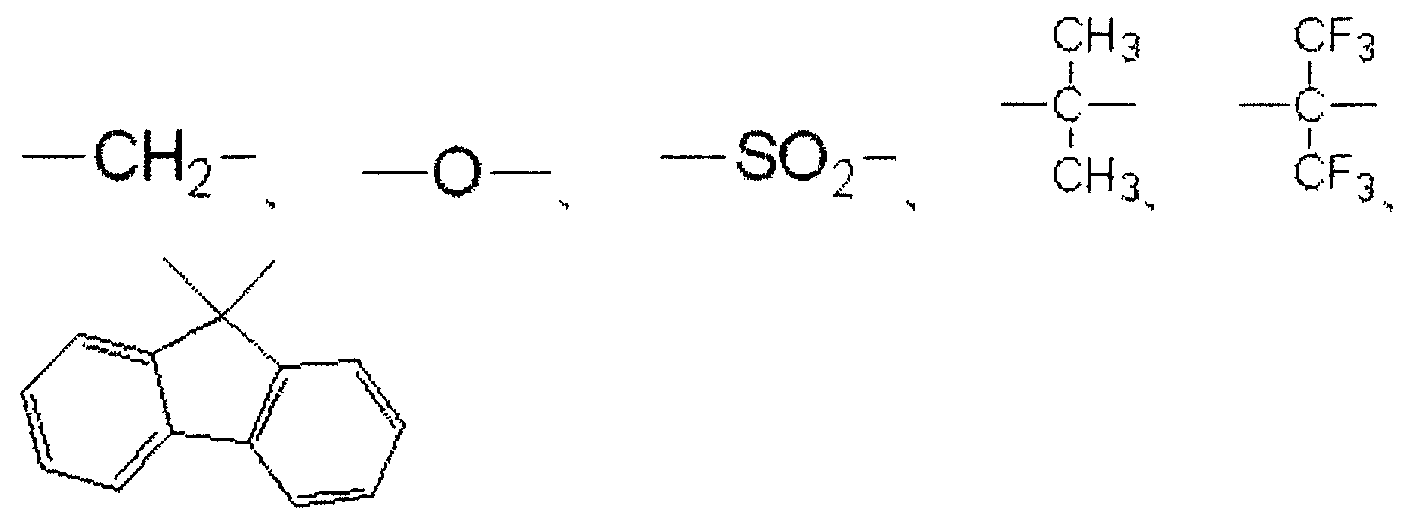
또한, B, C는 각각 독립적으로 탄소수 1 내지 4의 알킬기, 알콕시기 또는 수소 원자이고, a 및 b는 0이나 1이고, c는 0 내지 10의 정수이고, In addition, B and C are each independently an alkyl group having 1 to 4 carbon atoms, an alkoxy group or a hydrogen atom, a and b are 0 or 1, c is an integer of 0 to 10,
R1은 하기의 기로부터 서로 독립적으로 선택되는 기이다. R 1 is a group independently selected from the following groups.

단, R3은 탄소수 3 내지 34의 산소 원자 및/또는 질소 원자를 포함할 수도 있는 (메트)아크릴기, 카르복실기 및 수산기로부터 선택되는 1종 이상의 기를 갖는 1가의 기이다]Provided that R 3 is a monovalent group having at least one group selected from a (meth) acryl group, a carboxyl group and a hydroxyl group which may contain an oxygen atom and / or a nitrogen atom having 3 to 34 carbon atoms]
바람직하게는 R3은 하기 화학식으로 표시된다. Preferably, R 3 is represented by the following formula.
-R4(ORa)2 -R 4 (OR a ) 2
상기 식에 있어서, R4는 탄소수 3 내지 6의 3가 탄화수소기이고, Ra는 수소 원자, 탄소수 6 내지 14의 (메트)아크릴로일옥시이소시아네이트 잔기 및 탄소수 4 내지 14의 산 무수물 잔기로부터 서로 독립적으로 선택되는 기이다.In the above formula, R 4 is a trivalent hydrocarbon group having 3 to 6 carbon atoms, and R a is a hydrogen atom, a (meth) acryloyloxyisocyanate residue having 6 to 14 carbon atoms, and an acid anhydride residue having 4 to 14 carbon atoms. Independently selected groups.
바람직하게는 (메트)아크릴로일옥시이소시아네이트 잔기 및 산 무수물 잔기는 이하의 기이다.Preferably, the (meth) acryloyloxyisocyanate residue and the acid anhydride residue are the following groups.

바람직하게는 R4는 하기 중 어느 하나의 기이다. Preferably, R 4 is any one of the following groups.

상기 각 식에 있어서, 각 결합수(結合手)는 산소 원자에 결합되어 있다.In each said formula, each coupling | bonding water is couple | bonded with the oxygen atom.
Z는 하기 화학식 4로 표시되는 2가의 유기기이다.Z is a divalent organic group represented by following formula (4).

상기 화학식 4 중 D는 하기의 기로부터 독립적으로 선택되는 2가의 유기기이 고,In Formula 4, D is a divalent organic group independently selected from the following groups,
d, e 및 f는 0이나 1이다. d, e and f are zero or one.
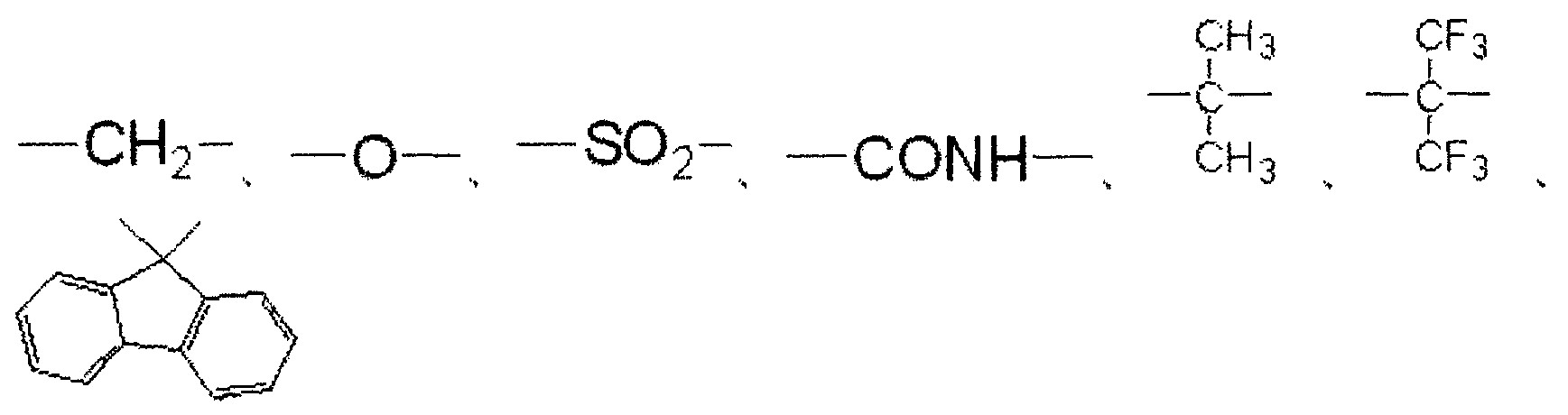
W는 하기 화학식 5로 표시되는 오르가노실록산 구조를 갖는 기이다. W is a group having an organosiloxane structure represented by the following formula (5).

상기 화학식 5 중, R2는 서로 독립적으로 탄소수 1 내지 8의 1가 탄화수소기이고, 예를 들면 메틸기, 에틸기, 프로필기, 부틸기, 펜틸기, 헥실기 등의 알킬기, 시클로펜틸기, 시클로헥실기 등의 시클로알킬기, 페닐기 등의 아릴기, 벤질기, 페네틸기 등의 아랄킬기, 비닐기, 알릴기, 프로페닐기, 이소프로페닐기, 부테닐기 등의 알케닐기, 아크릴기나 메타크릴기 등을 들 수 있다. 원료 입수의 용이성으로 인해 메틸기, 에틸기, 페닐기, 비닐기가 바람직하다. 또한, g는 1부터 80까지의 자연수이지만, 바람직하게는 3 내지 70이고, 더욱 바람직하게는 5 내지 50이다.In Formula 5, R 2 is independently a monovalent hydrocarbon group having 1 to 8 carbon atoms, for example, an alkyl group such as methyl group, ethyl group, propyl group, butyl group, pentyl group, hexyl group, cyclopentyl group, cyclohex Aralkyl groups, such as an aryl group, such as cycloalkyl groups, such as a real group, and a phenyl group, an aralkyl group, such as a benzyl group and a phenethyl group, a vinyl group, an allyl group, a propenyl group, an isopropenyl group, butenyl group, an acryl group, and a methacryl group, etc. are mentioned. Can be. The methyl group, ethyl group, phenyl group and vinyl group are preferable because of the availability of raw materials. In addition, g is a natural number from 1 to 80, preferably 3 to 70, more preferably 5 to 50.
상기 본 발명의 수지에 있어서의 Y를 포함하는 반복 단위는 이하과 같이 하여 얻어진다. 즉, R1이 페놀성 수산기 또는 카르복실기인 디아민과, 상술한 X를 유 도하기 위한 테트라카르복실산 이무수물을 통상법에 따라서 적절한 유기 용제 중에서 축합 반응시켜, 일단 폴리아믹산을 얻은 후, 이 수지 용액을 100 ℃ 이상에서 가열하고, 생성되는 물을 용액으로부터 제거함으로써 분자 중에 페놀성 수산기, 또는 카르복실기를 갖는 폴리이미드 수지 용액을 합성한다. 상기 폴리이미드 수지 용액에 페놀성 수산기 또는 카르복실기와 반응성의 기, 예를 들면 글리시딜기를 갖는 화합물, 바람직하게는 글리시돌을 소정량 첨가하고, 이 혼합 용액을 150 ℃ 정도까지 가열함으로써 알코올성 수산기를 갖는 폴리이미드 수지를 합성한다. 그 후, 상기 용액에 수산기와 반응성의 기, 예를 들면 글리시딜기, 이소시아네이트기, 할로겐기, 바람직하게는 이소시아네이트기와 (메트)아크릴기를 갖는 화합물, 예를 들면 2-메타크릴로일옥시이소시아네이트, 2-아크릴로일옥시이소시아네이트를 필요량 첨가하여 60 ℃하에서 가열함으로써, 메타크릴기 또는 아크릴기를 갖는 폴리이미드 수지를 얻을 수 있다. 상기 (메트)아크릴기를 갖는 화합물 대신에 또는 부가적으로 산 무수물, 예를 들면 헥사히드로프탈산 무수물을 필요 당량 첨가하여 50 내지 70 ℃에서 반응시킴으로써 카르복실기를 갖는 Y를 포함하는 폴리이미드 수지를 만들 수 있다.The repeating unit containing Y in resin of the said invention is obtained as follows. That is, after condensation reaction of the diamine whose R <1> is a phenolic hydroxyl group or a carboxyl group, and tetracarboxylic dianhydride for inducing X mentioned above in a suitable organic solvent in accordance with a conventional method, and a polyamic acid is obtained once, this resin solution is prepared, The polyimide resin solution which has a phenolic hydroxyl group or a carboxyl group in a molecule | numerator is synthesize | combined by heating at 100 degreeC or more, and removing the produced water from a solution. An alcoholic hydroxyl group is added to the polyimide resin solution by adding a predetermined amount of a compound having a reactive group such as a glycidyl group, for example, glycidyl group, preferably glycidol, and heating the mixed solution to about 150 ° C. A polyimide resin having a compound is synthesized. Then, a compound having a hydroxyl group and a reactive group in the solution, for example, glycidyl group, isocyanate group, halogen group, preferably isocyanate group and (meth) acryl group, for example 2-methacryloyloxyisocyanate, By adding the required amount of 2-acryloyloxyisocyanate and heating at 60 ° C, a polyimide resin having a methacryl group or an acryl group can be obtained. A polyimide resin containing Y having a carboxyl group can be made by reacting at 50 to 70 ° C by adding a required equivalent of an acid anhydride, for example, hexahydrophthalic anhydride, instead of or in addition to the compound having a (meth) acryl group. .
Z 및 W를 포함하는 반복 단위는, 각각의 말단에 아미노기가 결합된 디아민과, X를 유도하기 위한 카르복실산 이무수물을 반응시킴으로써 얻을 수 있다.The repeating unit containing Z and W can be obtained by making the diamine which the amino group couple | bonded with each terminal, and the carboxylic dianhydride for inducing X react.
본 발명은 상기 본 발명의 폴리이미드 수지(이하 「(A) 폴리이미드 수지」라 함)를 포함하는 감광성 수지 조성물에도 관한 것이다. 상기 조성물은 (A) 폴리이미드 수지에 부가적으로 (B) 광 중합 개시제 및/또는 증감제를 적어도 함유하는 것 이다.This invention relates also to the photosensitive resin composition containing the polyimide resin (henceforth "(A) polyimide resin") of the said this invention. The said composition contains (A) polyimide resin in addition to (B) photoinitiator and / or a sensitizer at least.
본 발명에서 사용되는 (B) 광 중합 개시제 및/또는 증감제는 중합을 개시하는 라디칼을 생성하거나 또는 중합성을 높이는 작용을 하는 것이다. 상기 (B) 성분으로서는 공지된 것을 사용할 수 있다. 예를 들면 벤조인이소프로필에테르, 2-메틸-[4-(메틸티오)페닐]-2-모르폴리노-1-프로파논, 1-페닐-1,2-부탄디온-2-(o-메톡시카르보닐)옥심, N-페닐글리신, 3-페닐-5-이소옥사졸론을 들 수 있다. 또한, 상기 증감제로서는, 예를 들면 4-디에틸아미노벤조산에틸, 벤조페논, 아세토페논, 안트론, 페난트렌, 니트로플루오렌, 니트로아세나프텐, P,P'-테트라메틸디아미노벤조페논, P,P'-테트라에틸디아미노벤조페논, 클로로티오크산톤, 벤즈안트라퀴논, 2,6-비스-(4-디에틸아미노벤잘)-시클로헥사논, 2,6-비스-(4-디에틸아미노벤잘)-4-메틸-시클로헥사논, 4,4'-비스(디에틸아미노)-칼콘, 2,4-디에틸티오크산톤, N-페닐-디에탄올아민, 디에틸아미노에틸메타크릴레이트, 쿠마린 화합물 벤질[예를 들면, 카르보닐비스(디에틸아미노쿠마린)], 벤조인이소프로필에테르, 1-히드록시-시클로헥실-페닐케톤, 캄포퀴논, 비이미다졸류[예를 들면, 2,2'-비스(o-클로로페닐)-4', 5'-테트라페닐-1'-비이미다졸]을 들 수 있다. 이들 광 중합 개시제 및 증감제는 각각 1종 단독으로도 2종 이상 조합하여 이용할 수도 있다. The photopolymerization initiator and / or sensitizer (B) used in the present invention is one which produces a radical that initiates polymerization or increases the polymerizability. As said (B) component, a well-known thing can be used. For example, benzoin isopropyl ether, 2-methyl- [4- (methylthio) phenyl] -2-morpholino-1-propaneone, 1-phenyl-1,2-butanedione-2- (o- Methoxycarbonyl) oxime, N-phenylglycine, 3-phenyl-5-isoxazolone. As the sensitizer, for example, 4-diethylaminobenzoic acid ethyl, benzophenone, acetophenone, anthrone, phenanthrene, nitrofluorene, nitroacenaphthene, P, P'-tetramethyldiaminobenzophenone, P , P'-tetraethyldiaminobenzophenone, chlorothioxanthone, benzanthraquinone, 2,6-bis- (4-diethylaminobenzal) -cyclohexanone, 2,6-bis- (4-diethyl Aminobenzal) -4-methyl-cyclohexanone, 4,4'-bis (diethylamino) -chalcone, 2,4-diethylthioxanthone, N-phenyl-diethanolamine, diethylaminoethylmethacryl Latex, coumarin compound benzyl [eg, carbonylbis (diethylaminocoumarin)], benzoin isopropyl ether, 1-hydroxy-cyclohexyl-phenylketone, camphorquinone, biimidazoles [eg, 2,2'-bis (o-chlorophenyl) -4 ', 5'-tetraphenyl-1'-biimidazole]. These photoinitiators and sensitizers can also be used individually by 1 type or in combination of 2 or more types, respectively.
(B) 성분의 배합량은 (A) 성분과 (B) 성분의 합계량 100 중량부에 대하여 통상 0.1 내지 20 중량부이고, 바람직하게는 0.5 내지 15 중량부, 보다 바람직하게는 0.5 내지 10 중량부이다. (B) 성분이 0.1 중량부보다 적으면 경화가 충분히 진행되지 않고, 반대로 20 중량부보다 많으면 동일하게 광 중합성이 저하되거나 보존 안정성이 현저히 악화되는 경향이 있다.The compounding quantity of (B) component is 0.1-20 weight part normally with respect to 100 weight part of total amounts of (A) component and (B) component, Preferably it is 0.5-15 weight part, More preferably, it is 0.5-10 weight part. . When (B) component is less than 0.1 weight part, hardening does not fully advance, On the contrary, when it is more than 20 weight part, there exists a tendency for photopolymerizability to fall or storage stability to deteriorate similarly.
본 발명의 감광성 수지 조성물에는, 필요에 따라서 (C) 유기 용제를 배합할 수도 있다. 유기 용제로서는, 상술한 (A) 폴리이미드 수지, (B) 광 중합 개시제가 용해 가능한 용제가 바람직하다. 그와 같은 유기 용제로서는, 예를 들면 시클로헥사논, 시클로펜타논, 메틸-2-n-아밀케톤 등의 케톤류; 3-메톡시부탄올, 3-메틸-3-메톡시부탄올, 1-메톡시-2-프로판올, 1-에톡시-2-프로판올 등의 알코올류; 프로필렌글리콜 모노메틸에테르, 에틸렌글리콜 모노메틸에테르, 프로필렌글리콜 모노에틸에테르, 에틸렌글리콜 모노에틸에테르, 프로필렌글리콜 디메틸에테르, 디에틸렌글리콜 디메틸에테르 등의 에테르류; 프로필렌글리콜 모노메틸에테르 아세테이트, 프로필렌글리콜 모노에틸에테르 아세테이트, 락트산에틸, 피루브산에틸, 아세트산부틸, 3-메톡시프로피온산메틸, 3-에톡시프로피온산에틸, 아세트산-t-부틸, 프로피온산-t-부틸, 프로필렌글리콜-모노-t-부틸에테르 아세테이트, γ-부티로락톤 등의 에스테르류, N-메틸-2-피롤리돈, N,N-디메틸아세트아미드 등의 아미드류 등을 들 수 있고, 이들 1종을 단독으로 또는 2종 이상을 병용할 수 있다.(C) The organic solvent can also be mix | blended with the photosensitive resin composition of this invention as needed. As an organic solvent, the solvent in which (A) polyimide resin mentioned above and (B) photoinitiator are melt | dissolved is preferable. As such an organic solvent, For example, ketones, such as cyclohexanone, cyclopentanone, and methyl-2-n-amyl ketone; Alcohols such as 3-methoxybutanol, 3-methyl-3-methoxybutanol, 1-methoxy-2-propanol, and 1-ethoxy-2-propanol; Ethers such as propylene glycol monomethyl ether, ethylene glycol monomethyl ether, propylene glycol monoethyl ether, ethylene glycol monoethyl ether, propylene glycol dimethyl ether and diethylene glycol dimethyl ether; Propylene glycol monomethyl ether acetate, propylene glycol monoethyl ether acetate, ethyl lactate, ethyl pyruvate, butyl acetate, methyl 3-methoxypropionate, ethyl 3-ethoxypropionate, acetic acid -t-butyl, propionic acid -t-butyl, propylene Esters such as glycol-mono-t-butylether acetate and γ-butyrolactone, and amides such as N-methyl-2-pyrrolidone and N, N-dimethylacetamide; These may be used alone or in combination of two or more.
이들 중에서도 특히, 수지의 용해성이 가장 우수한 락트산에틸, 시클로헥사논, 시클로펜타논, γ-부티로락톤, N,N-디메틸아세트아미드, 프로필렌글리콜 모노메틸에테르, 프로필렌글리콜 모노메틸에테르 아세테이트, 및 그의 혼합 용제가 바람직하다.Among these, in particular, ethyl lactate, cyclohexanone, cyclopentanone, γ-butyrolactone, N, N-dimethylacetamide, propylene glycol monomethyl ether, propylene glycol monomethyl ether acetate having the highest solubility of the resin, and their Mixed solvents are preferred.
상기 유기 용제의 사용량은 전체 고형분 100 중량부에 대하여 50 내지 2,000 중량부, 특히는 100 내지 1,000 중량부인 것이 바람직하다. 50 중량부 미만이면, 상기 각 성분(A), (B)의 상용성이 불충분해지는 경우가 있다. 반대로 2,000 중량부를 초과하여도 상용성에는 그다지 변화가 없을 뿐 아니라, 점도가 너무 낮아져서 수지의 도포에 적합하지 않게 될 우려가 있다.It is preferable that the usage-amount of the said organic solvent is 50-2,000 weight part with respect to 100 weight part of total solids, especially 100-1,000 weight part. If it is less than 50 weight part, the compatibility of each said component (A) and (B) may become inadequate. On the contrary, even if it exceeds 2,000 weight part, there will be no change in compatibility, and there exists a possibility that it may become unsuitable for application | coating of resin because a viscosity becomes too low.
또한, 본 발명에 따른 감광성 조성물에는, 감광 감도를 더욱 향상시키기 위해서 가교성 단량체 또는 올리고머를 배합할 수도 있다. 상기 단량체 또는 올리고머는 광 중합을 용이하게 하는 물질이 바람직하고, 공지된 물질이라면 특별히 한정되지 않는다. 예시하면, 1,6-헥산디올 디아크릴레이트, 네오펜틸글리콜 디아크릴레이트, 에틸렌글리콜 디아크릴레이트, 펜타에리트리톨 디아크릴레이트, 트리메틸올프로판 트리아크릴레이트, 펜타에리트리톨 트리아크릴레이트, 디펜타에리트리톨 헥사아크릴레이트, 테트라메틸올프로판 테트라아크릴레이트, 테트라에틸렌글리콜 디아크릴레이트, 1,6-헥산디올 디메타크릴레이트, 네오펜틸글리콜 디메타크릴레이트, 에틸렌글리콜 디메타크릴레이트, 펜타에리트리톨 디메타크릴레이트, 트리메틸올프로판 트리메타크릴레이트, 펜타에리트리톨 트리메타크릴레이트, 디펜타에리트리톨 헥사메타크릴레이트, 테트라메틸올프로판 테트라메타크릴레이트, 테트라에틸렌글리콜 디메타크릴레이트, 메톡시디에틸렌글리콜메타크릴레이트, 메톡시폴리에틸렌글리콜메타크릴레이트, β-메타크릴로일옥시에틸히드로젠프탈레이트, β-메타크릴로일옥시에틸히드로젠숙시네이트, 3-클로로-2-히드록시프로필메타크릴레이트, 스테아릴메타크릴레이트, 페녹시에틸아크릴레이트, 페녹시디에틸렌글리콜아크릴레이트, 페녹시폴리에틸렌글리콜아크릴레이트, β-아크릴로일옥시에틸히드로젠숙시네이트, 라우릴아크릴레이트, 에틸렌글리콜 디메타크릴레이트, 디에틸렌글리콜 디메타 크릴레이트, 트리에틸렌글리콜 디메타크릴레이트, 폴리에틸렌글리콜 디메타크릴레이트, 1,3-부틸렌글리콜 디메타크릴레이트, 폴리프로필렌글리콜 디메타크릴레이트, 2-히드록시-1,3-디메타크릴옥시프로판, 2,2-비스[4-(메타크릴옥시에톡시)페닐]프로판, 2,2-비스[4-(메타크릴옥시ㆍ디에톡시)페닐]프로판, 2,2-비스[4-(메타크릴옥시ㆍ폴리에톡시)페닐]프로판, 폴리에틸렌글리콜 디아크릴레이트, 트리프로필렌글리콜 디아크릴레이트, 폴리프로필렌글리콜 디아크릴레이트, 2,2-비스[4-(아크릴옥시ㆍ디에톡시)페닐]프로판, 2,2-비스[4-(아크릴옥시ㆍ폴리에톡시)페닐]프로판, 2-히드록시-1-아크릴옥시-3-메타크릴옥시프로판, 트리메틸올프로판 트리메타크릴레이트, 테트라메틸올메탄 트리아크릴레이트, 테트라메틸올메탄 테트라아크릴레이트, 메톡시디프로필렌글리콜메타크릴레이트, 메톡시트리에틸렌글리콜아크릴레이트, 노닐페녹시폴리에틸렌글리콜아크릴레이트, 노닐페녹시폴리프로필렌글리콜아크릴레이트, 1-아크릴로일옥시프로필-2-프탈레이트, 이소스테아릴아크릴레이트, 폴리옥시에틸렌알킬에테르아크릴레이트, 노닐페녹시에틸렌글리콜아크릴레이트, 폴리프로필렌글리콜 디메타크릴레이트, 1,4-부탄디올 디메타크릴레이트, 3-메틸-1,5-펜탄디올 디메타크릴레이트, 1,6-헥산디올 디메타크릴레이트, 1,9-노난디올 메타크릴레이트, 2,4-디에틸-1,5-펜탄디올 디메타크릴레이트, 1,4-시클로헥산디메탄올 디메타크릴레이트, 디프로필렌글리콜 디아크릴레이트, 트리시클로데칸디메탄올 디아크릴레이트, 2,2-수소 첨가 비스[4-(아크릴옥시ㆍ폴리에톡시)페닐]프로판, 2,2-비스[4-(아크릴옥시ㆍ폴리프로폭시)페닐]프로판, 2,4-디에틸-1,5-펜탄디올 디아크릴레이트, 에톡시화 트리메틸올프로판 트리아크릴레이트, 프로폭시화 트리메틸올프로판 트리아크릴레이 트, 이소시아누르산 트리(에탄아크릴레이트), 펜타에리트리톨 테트라아크릴레이트, 에톡시화 펜타에리트리톨 테트라아크릴레이트, 프로폭시화 펜타에리트리톨 테트라아크릴레이트, 디트리메틸올프로판 테트라아크릴레이트, 디펜타에리트리톨 폴리아크릴레이트 등을 들 수 있지만, 가교 밀도를 향상시키기 위해서는, 특히 2관능 이상의 물질을 사용하는 것이 바람직하다. Moreover, in order to further improve the photosensitivity, you may mix | blend a crosslinkable monomer or oligomer with the photosensitive composition which concerns on this invention. The monomer or oligomer is preferably a substance that facilitates photopolymerization, and is not particularly limited as long as it is a known substance. For example, 1,6-hexanediol diacrylate, neopentyl glycol diacrylate, ethylene glycol diacrylate, pentaerythritol diacrylate, trimethylolpropane triacrylate, pentaerythritol triacrylate, dipentaerytate Lithol hexaacrylate, tetramethylolpropane tetraacrylate, tetraethyleneglycol diacrylate, 1,6-hexanediol dimethacrylate, neopentylglycol dimethacrylate, ethylene glycol dimethacrylate, pentaerythritol di Methacrylate, trimethylolpropane trimethacrylate, pentaerythritol trimethacrylate, dipentaerythritol hexamethacrylate, tetramethylolpropane tetramethacrylate, tetraethylene glycol dimethacrylate, methoxydiethylene glycol Methacrylate, methoxy polyethylene glycol methacryl , Β-methacryloyloxyethylhydrogenphthalate, β-methacryloyloxyethylhydrogensuccinate, 3-chloro-2-hydroxypropyl methacrylate, stearyl methacrylate, phenoxyethylacrylic Phenoxydiethylene glycol acrylate, phenoxy polyethylene glycol acrylate, β-acryloyloxyethyl hydrogen succinate, lauryl acrylate, ethylene glycol dimethacrylate, diethylene glycol dimethacrylate, triethylene Glycol dimethacrylate, polyethylene glycol dimethacrylate, 1,3-butylene glycol dimethacrylate, polypropylene glycol dimethacrylate, 2-hydroxy-1,3-dimethacryloxypropane, 2, 2-bis [4- (methacryloxyethoxy) phenyl] propane, 2,2-bis [4- (methacryloxydiethoxy) phenyl] propane, 2,2-bis [4- (methacryloxy. Polyethoxy) phenyl] propane, Liethylene glycol diacrylate, tripropylene glycol diacrylate, polypropylene glycol diacrylate, 2,2-bis [4- (acryloxydiethoxy) phenyl] propane, 2,2-bis [4- (acrylic Oxypolyethoxy) phenyl] propane, 2-hydroxy-1-acryloxy-3-methacryloxypropane, trimethylolpropane trimethacrylate, tetramethylolmethane triacrylate, tetramethylolmethane tetraacrylate , Methoxy dipropylene glycol methacrylate, methoxy triethylene glycol acrylate, nonylphenoxypolyethylene glycol acrylate, nonylphenoxy polypropylene glycol acrylate, 1-acryloyloxypropyl-2-phthalate, isostearyl acryl Latex, polyoxyethylene alkyl ether acrylate, nonylphenoxyethylene glycol acrylate, polypropylene glycol dimethacrylate, 1,4-butanediol Dimethacrylate, 3-methyl-1,5-pentanediol dimethacrylate, 1,6-hexanediol dimethacrylate, 1,9-nonanediol methacrylate, 2,4-diethyl-1, 5-pentanediol dimethacrylate, 1,4-cyclohexanedimethanol dimethacrylate, dipropylene glycol diacrylate, tricyclodecanedimethanol diacrylate, 2,2-hydrogenated bis [4- (acrylic Oxypolyethoxy) phenyl] propane, 2,2-bis [4- (acryloxypolypropoxy) phenyl] propane, 2,4-diethyl-1,5-pentanediol diacrylate, ethoxylated trimethyl All propane triacrylate, propoxylated trimethylolpropane triacrylate, isocyanuric acid tri (ethane acrylate), pentaerythritol tetraacrylate, ethoxylated pentaerythritol tetraacrylate, propoxylated pentaerythritol Tetraacrylate, Ditrimethylolpropane Tetraacrylate Although a latent, dipentaerythritol polyacrylate, etc. are mentioned, In order to improve a crosslinking density, it is preferable to use especially bifunctional or more substance.
상기 단량체 또는 올리고머는 본 발명의 폴리이미드 수지 100 중량부에 대하여 0.5 내지 100 중량부 배합하는 것이 바람직하고, 1 내지 50 중량부의 범위가 보다 바람직하다. 0.5 중량부 이하이면, 목적하는 효과를 거의 얻을 수 없다. 또한, 반대로 100 중량부 이상이면, 본래 폴리이미드 수지가 갖는 특성 자체가 손상될 뿐 아니라, 현상성에 바람직하지 않은 영향을 미칠 우려가 있다. 또한, 상기 단량체 또는 올리고머로서는, 1종류의 화합물을 사용할 수도 있고, 수종을 혼합하여 사용할 수도 있다.It is preferable to mix | blend 0.5-100 weight part with respect to 100 weight part of polyimide resins of this invention, and, as for the said monomer or oligomer, the range of 1-50 weight part is more preferable. If it is 0.5 weight part or less, a desired effect can hardly be obtained. On the contrary, if it is 100 parts by weight or more, not only the property itself of the polyimide resin itself is impaired, but also there is a concern that it may have an undesirable effect on developability. Moreover, as said monomer or oligomer, one type of compound may be used and several species may be mixed and used for it.
그 밖에, 본 발명의 감광성 수지 조성물에는 상기 각 성분 이외에 첨가 성분을 더 배합할 수도 있다. 그와 같은 첨가 성분으로서는, 예를 들면 도포성을 향상시키기 위해서 관용되는 계면 활성제를 첨가할 수 있다. 계면 활성제로서는, 비이온성의 것이 바람직하고, 예를 들면 불소계 계면 활성제, 구체적으로는 퍼플루오로알킬폴리옥시에틸렌에탄올, 불소화 알킬에스테르, 퍼플루오로알킬아민옥시드, 불소 함유 오르가노실록산계 화합물 등을 들 수 있다. 이들은 시판되는 것을 사용할 수 있고, 예를 들면 플로라이드「FC-4430」(모두 스미또모 쓰리엠(주) 제조), 사프론「S-141」 및 「S-145」(모두 아사히 글래스(주) 제조), 유니다인 「DS-401」, 「 DS-4031」 및 「DS-451」(모두 다이킨 고교(주) 제조), 메가팩「F-8151」(다이니폰잉크 고교(주) 제조), 「X-70-093」(모두 신에쯔 가가꾸 고교(주) 제조) 등을 들 수 있다. 이들 중에서도 특히 「X-70-093」(신에쯔 가가꾸 고교(주) 제조) 및 플로라이드「FC-4430」(스미또모 쓰리엠(주) 제조)가 바람직하다.In addition, you may mix | blend an addition component with the photosensitive resin composition of this invention other than each said component. As such an addition component, surfactant commonly used in order to improve applicability | paintability can be added, for example. As surfactant, a nonionic thing is preferable, For example, a fluorine-type surfactant, Specifically, a perfluoroalkyl polyoxyethylene ethanol, a fluorinated alkyl ester, a perfluoroalkylamine oxide, a fluorine-containing organosiloxane type compound, etc. Can be mentioned. These can use a commercially available thing, For example, fluoride "FC-4430" (all are manufactured by Sumitomo 3M Co., Ltd.), saffron "S-141" and "S-145" (all are manufactured by Asahi Glass Co., Ltd.). ), "DS-401", "DS-4031" and "DS-451" (all are manufactured by Daikin Kogyo Co., Ltd.), mega pack "F-8151" (manufactured by Dainippon Ink High School Co., Ltd.), "X-70-093" (all are manufactured by Shin-Etsu Chemical Co., Ltd.), etc. are mentioned. Especially among these, "X-70-093" (made by Shin-Etsu Chemical Co., Ltd.) and fluoride "FC-4430" (made by Sumitomo 3M Co., Ltd.) are preferable.
또한, 밀착성 향상제로서 실란 커플링제, 예를 들면 에폭시계 실란 커플링제 KBM-403(신에쯔 가가꾸 제조), 아크릴계 실란 커플링제 KBM-503(신에쯔 가가꾸 제조), 또는 아민계 실란 커플링제 KBM-903 등을 첨가하는 것도 가능하다. 부가적으로, 본 발명의 감광성 수지 조성물을 레지스트 재료 등에 사용하는 경우에는, 레지스트 재료 등에 통상 사용될 수 있다. 그 밖의 임의의 첨가 성분을 첨가할 수 있다. 또한, 상기 첨가 성분의 첨가량은 본 발명의 효과를 방해하지 않는 범위에서 조정한다.Moreover, as an adhesive improving agent, a silane coupling agent, for example, an epoxy silane coupling agent KBM-403 (made by Shin-Etsu Chemical Co., Ltd.), an acryl-type silane coupling agent KBM-503 (made by Shin-Etsu Chemical Co., Ltd.), or an amine silane coupler It is also possible to add a ring agent KBM-903 and the like. In addition, when the photosensitive resin composition of this invention is used for a resist material etc., it can be normally used for a resist material etc. Any other optional ingredient can be added. In addition, the addition amount of the said addition component is adjusted in the range which does not prevent the effect of this invention.
본 발명의 감광성 수지 조성물의 제조는 통상적인 방법으로 행해지지만, 상기 각 성분 및 필요에 따라서 상기 유기 용제, 첨가제 등을 교반 혼합하고, 그 후 필요에 따라서 고형분을 필터 등에 의해 여과함으로써 본 발명의 감광성 수지 조성물을 제조할 수 있다.Although the manufacture of the photosensitive resin composition of this invention is performed by a conventional method, the photosensitive property of this invention is carried out by stirring-mixing the said organic solvent, an additive, etc. as needed for each said component and necessity, and filtering a solid content with a filter etc. after that as needed. A resin composition can be manufactured.
이와 동일하게 하여 제조된 본 발명의 감광성 수지 조성물은, 예를 들면 반도체 소자의 보호막, 배선의 보호막, 커버레이 필름, 솔더 레지스트, 또한 미세 가공용 포토레지스트 등의 재료로서 바람직하게 이용된다.The photosensitive resin composition of this invention manufactured similarly to this is used suitably as materials, such as a protective film of a semiconductor element, the protective film of wiring, a coverlay film, a soldering resist, and the photoresist for microprocessing, for example.
상기 감광성 수지 조성물을 이용하여 패턴을 형성하는 패턴 형성 방법으로서는, 하기의 공정을 포함하는 것이다.The pattern formation method which forms a pattern using the said photosensitive resin composition includes the following process.
(i) 상기 본 발명의 감광성 수지 조성물의 층을 기판 상에 도포하는 공정(i) Process of apply | coating layer of photosensitive resin composition of this invention on board | substrate
(ii) 소정의 패턴이 형성된 포토마스크를 이용하여 파장 240 내지 500 nm의 빛으로 감광성 수지 조성물의 층을 노광하는 공정,(ii) exposing a layer of the photosensitive resin composition with light having a wavelength of 240 to 500 nm using a photomask having a predetermined pattern formed thereon;
(iii) 감광성 수지 조성물의 층을 현상액으로 현상하는 공정(iii) Process of developing layer of photosensitive resin composition with developing solution
을 포함하는 패턴 형성 방법. Pattern forming method comprising a.
목적에 따라서, 공정(ii)과 (iii) 사이에 감광성 수지 조성물의 층을 가열하는 공정(소위 PEB 공정)을 포함할 수도 있다.According to the objective, the process (so-called PEB process) of heating the layer of the photosensitive resin composition between process (ii) and (iii) may also be included.
이상의 3 공정에 의해 패턴을 형성한 후, 또한 After forming a pattern by the above 3 processes, Furthermore,
(iv) 패턴 형성 후, 후경화를 위해 가열을 행하는 공정(iv) process of heating for post-cure after pattern formation
을 거쳐 최종 목적하는 패턴이 형성된다. The final desired pattern is formed through.
본 발명의 패턴 형성 방법에 있어서는, 우선 상기 감광성 수지 조성물을 기판 상에, 예를 들면 도포에 의해 도포한다. 상기 기판으로서는, 예를 들면 실리콘 웨이퍼, 플라스틱이나 세라믹제 회로 기판 등을 들 수 있다. 또한, 이 용액을 별도로 필름화하고, 이것을 기판에 접합시키는 방법도 이용할 수 있다. 도포법으로서는, 공지된 기술, 예를 들면 침지법, 스핀 코팅법, 롤 코팅법 등의 수법을 채용할 수 있다. 도포량은 목적에 따라서 적절하게 선택할 수 있지만, 막 두께 0.1 내지 100 ㎛로 하는 것이 바람직하다. 또한, 미리 이 조성물의 필름을 형성해두고, 그 필름을 기재에 접합시키는 것도 가능하다. 여기서, 광 경화 반응을 효율적으로 행하기 위해서 필요에 따라서 예비 가열에 의해 용제 등을 미리 휘발시켜 둘 수도 있다. 예비 가열은, 예를 들면 40 내지 140 ℃에서 1 분 내지 1 시간 정도 행할 수 있다. In the pattern formation method of this invention, the said photosensitive resin composition is apply | coated on a board | substrate, for example by application | coating first. As said board | substrate, a silicon wafer, the circuit board made from plastics or ceramics, etc. are mentioned, for example. Moreover, the method of film-forming this solution separately and bonding this to a board | substrate can also be used. As a coating method, a well-known technique, for example, immersion method, spin coating method, roll coating method, etc., can be adopted. Although the application amount can be suitably selected according to the objective, it is preferable to set it as 0.1-100 micrometers in film thickness. Moreover, it is also possible to form the film of this composition previously, and to bond the film to a base material. Here, in order to perform photocuring reaction efficiently, you may volatilize a solvent etc. previously by preheating as needed. Preliminary heating can be performed, for example at 40-140 degreeC for 1 minute-about 1 hour.
이어서, 소정의 패턴이 형성된 포토마스크를 이용하여 파장 240 내지 500 nm의 빛으로 노광하여 경화시킨다. 상기 포토마스크는, 예를 들면 원하는 패턴을 도려낸 스텐실일 수도 있다. 또한, 포토마스크의 재질은 상기 파장 240 내지 500 nm의 빛을 차폐하는 것이 바람직하고, 예를 들면 크롬 등이 바람직하게 이용되지만 이것으로 한정되는 것은 아니다. 상기 파장 240 내지 500 nm의 빛으로서는, 예를 들면 방사선 발생 장치에 의해 발생된 여러 파장의 빛, 예를 들면 g선, i선 등의 자외선 광, 원자외선 광(248 nm) 등을 들 수 있다. 노광량은, 예를 들면 10 내지 3000 mJ/cm2인 것이 바람직하다. Next, using a photomask having a predetermined pattern formed thereon, it is exposed to light having a wavelength of 240 to 500 nm and cured. The photomask may be, for example, a stencil cut out of a desired pattern. In addition, it is preferable that the material of a photomask shields light of the said wavelength 240-500 nm, For example, although chromium etc. are used preferably, it is not limited to this. Examples of the light having a wavelength of 240 to 500 nm include light having various wavelengths generated by the radiation generating device, for example, ultraviolet light such as g-ray and i-ray, far ultraviolet light (248 nm) and the like. . It is preferable that an exposure amount is 10-3000 mJ / cm <2> , for example.
목적에 따라서 노광 후에 가열 처리할 수도 있다. 상기 노광 후 가열 처리는, 예를 들면 40 내지 150 ℃에서 0.5 내지 10 분간으로 할 수 있다. 상기 노광 후 또는 노광한 후에 가열한 후, 현상액으로 현상한다. 현상액은 통상적으로 자주 사용되는 테트라메틸암모늄히드록시드 수용액이나 탄산소다 수용액을 비롯하여, 여러 가지 염기성 화합물을 물에 용해시킨 알칼리성 수용액을 이용할 수 있다. 상기 염기성 화합물로서는, 예를 들면 알칼리 금속, 알칼리 토류 금속 또는 암모늄 이온의 수산화물 또는 탄산염이나, 아민 화합물 등을 들 수 있고, 구체적으로는 2-디메틸아미노에탄올, 3-디메틸아미노-1-프로판올, 4-디메틸아미노-1-부탄올, 5-디메틸아미노-1-펜탄올, 6-디메틸아미노-1-헥산올, 2-디메틸아미노-2-메틸-1-프로판올, 3-디메틸아미노-2,2-디메틸-1-프로판올, 2-디에틸아미노에탄올, 3-디에틸아미노-1- 프로판올, 2-디이소프로필아미노에탄올, 2-디-n-부틸아미노에탄올, N,N-디벤질-2-아미노에탄올, 2-(2-디메틸아미노에톡시)에탄올, 2-(2-디에틸아미노에톡시)에탄올, 1-디메틸아미노-2-프로판올, 1-디에틸아미노-2-프로판올, N-메틸디에탄올아민, N-에틸디에탄올아민, N-n-부틸디에탄올아민, N-t-부틸디에탄올아민, N-라우릴디에탄올아민, 3-디에틸아미노-1,2-프로판디올, 트리에탄올아민, 트리이소프로판올아민, N-메틸에탄올아민, N-에틸에탄올아민, N-n-부틸에탄올아민, N-t-부틸에탄올아민, 디에탄올아민, 디이소프로판올아민, 2-아미노에탄올, 3-아미노-1-프로판올, 4-아미노-1-부탄올, 6-아미노-1-헥산올, 1-아미노-2-프로판올, 2-아미노-2,2-디메틸-1-프로판올, 1-아미노부탄올, 2-아미노-1-부탄올, N-(2-아미노에틸)에탄올아민, 2-아미노-2-메틸-1,3-프로판디올, 2-아미노-2-에틸-1,3-프로판디올, 3-아미노-1,2-프로판디올, 2-아미노-2-히드록시메틸-1,3-프로판디올, 수산화나트륨, 수산화칼륨, 수산화암모늄, 탄산나트륨, 탄산칼륨, 탄산암모늄, 탄산수소나트륨, 탄산수소칼륨, 탄산수소암모늄, 테트라메틸암모늄히드록시드, 테트라에틸암모늄히드록시드, 테트라프로필암모늄히드록시드, 테트라이소프로필암모늄히드록시드, 아미노메탄올, 2-아미노에탄올, 3-아미노프로판올, 2-아미노프로판올, 메틸아민, 에틸아민, 프로필아민, 이소프로필아민, 디메틸아민, 디에틸아민, 디프로필아민, 디이소프로필아민, 트리메틸아민, 트리에틸아민, 트리프로필아민, 트리이소프로필아민 등을 이용할 수 있다. You may heat-process after exposure according to the objective. The said post-exposure heat processing can be made into 0.5 to 10 minutes at 40-150 degreeC, for example. After heating after exposure or after exposure, development is carried out with a developer. As the developing solution, an alkaline aqueous solution obtained by dissolving various basic compounds in water, including an aqueous tetramethylammonium hydroxide solution or an aqueous solution of sodium carbonate, which is commonly used. As said basic compound, the hydroxide or carbonate of an alkali metal, alkaline-earth metal, or ammonium ion, an amine compound, etc. are mentioned, for example, 2-dimethylamino ethanol, 3-dimethylamino-1-propanol, 4 -Dimethylamino-1-butanol, 5-dimethylamino-1-pentanol, 6-dimethylamino-1-hexanol, 2-dimethylamino-2-methyl-1-propanol, 3-dimethylamino-2,2- Dimethyl-1-propanol, 2-diethylaminoethanol, 3-diethylamino-1-propanol, 2-diisopropylaminoethanol, 2-di-n-butylaminoethanol, N, N-dibenzyl-2- Aminoethanol, 2- (2-dimethylaminoethoxy) ethanol, 2- (2-diethylaminoethoxy) ethanol, 1-dimethylamino-2-propanol, 1-diethylamino-2-propanol, N-methyl Diethanolamine, N-ethyl diethanolamine, Nn-butyl diethanolamine, Nt-butyl diethanolamine, N-lauryl diethanolamine, 3-diethylamino-1,2-prop Pandiol, triethanolamine, triisopropanolamine, N-methylethanolamine, N-ethylethanolamine, Nn-butylethanolamine, Nt-butylethanolamine, diethanolamine, diisopropanolamine, 2-aminoethanol, 3-amino -1-propanol, 4-amino-1-butanol, 6-amino-1-hexanol, 1-amino-2-propanol, 2-amino-2,2-dimethyl-1-propanol, 1-aminobutanol, 2 -Amino-1-butanol, N- (2-aminoethyl) ethanolamine, 2-amino-2-methyl-1,3-propanediol, 2-amino-2-ethyl-1,3-propanediol, 3- Amino-1,2-propanediol, 2-amino-2-hydroxymethyl-1,3-propanediol, sodium hydroxide, potassium hydroxide, ammonium hydroxide, sodium carbonate, potassium carbonate, ammonium carbonate, sodium bicarbonate, potassium hydrogen carbonate , Ammonium bicarbonate, tetramethylammonium hydroxide, tetraethylammonium hydroxide, tetrapropylammonium hydroxide, tetraisopropylammonium hydroxide, Ami Nomethanol, 2-aminoethanol, 3-aminopropanol, 2-aminopropanol, methylamine, ethylamine, propylamine, isopropylamine, dimethylamine, diethylamine, dipropylamine, diisopropylamine, trimethylamine, Triethylamine, tripropylamine, triisopropylamine and the like can be used.
염기성 화합물의 농도는 통상 0.1 내지 30 중량%로 하지만, 지지 기판 등에 의한 영향 등으로 인해 0.1 내지 15 중량%로 하는 것이 바람직하다.The concentration of the basic compound is usually 0.1 to 30% by weight, but is preferably 0.1 to 15% by weight due to the influence of the support substrate or the like.
또한, 목적에 따라서 수용액 이외에 메탄올 용액이나 에탄올 용액 등의 알칼리성 알코올 용액을 이용하거나, 유기 용매를 이용하거나 할 수도 있다. 유기 용매를 이용하는 경우에는, 1종의 유기 용매를 단독으로 사용할 수도 있고, 감광성 조성물을 잘 용해시키는 양용매와 그다지 용해시키지 않는 빈용매와의 혼합계를 이용할 수도 있다.Moreover, according to the objective, alkaline alcohol solutions, such as methanol solution and ethanol solution, may be used other than aqueous solution, or an organic solvent may be used. When using an organic solvent, 1 type of organic solvents may be used independently and the mixed system of the good solvent which melt | dissolves a photosensitive composition well, and the poor solvent which does not dissolve so much can also be used.
현상은 통상적인 방법, 예를 들면 패턴 형성물을 침지하는 것 등에 의해 행할 수 있다. 그 후, 필요에 따라서 세정, 린스, 건조 등을 행하고, 원하는 패턴을 갖는 조성물 피막이 얻어진다.The development can be carried out by a conventional method, for example, immersing the pattern formation. Thereafter, washing, rinsing, drying, and the like are performed as necessary to obtain a composition film having a desired pattern.
단순한 피막을 형성하고자 하는 경우에는, 상기 포토마스크를 사용하지 않고서 전체면을 노광하는 것 이외에는 상기 패턴 형성 방법에서 서술한 것과 동일한 방법을 행할 수 있다.In the case where a simple film is to be formed, the same method as described in the pattern formation method can be performed except that the entire surface is exposed without using the photomask.
또한, 얻어진 패턴을 또한 오븐이나 핫 플레이트를 이용하여 120 내지 300 ℃에서 10 분 내지 10 시간 정도 가열함으로써 가교 밀도를 올리고, 또한 잔존하는 휘발 성분을 제거함으로써, 기재에 대한 밀착력을 향상시키며, 내열성이나 강도, 또한 전기 특성도 양호한 피막을 형성할 수 있다.In addition, the obtained pattern is further heated at 120 to 300 ° C. for 10 minutes to 10 hours using an oven or a hot plate to increase the crosslinking density and to remove the remaining volatile components, thereby improving the adhesion to the substrate, It is possible to form a film having good strength and electrical characteristics.
이렇게 하여 상기 감광성 수지 조성물로부터 얻어지는 경화 피막은 기재와의 밀착성, 내열성, 전기 절연성이 우수하고, 전기, 전자 부품, 반도체 소자 등의 보호막으로서 바람직하게 이용된다.Thus, the cured film obtained from the said photosensitive resin composition is excellent in adhesiveness with a base material, heat resistance, and electrical insulation, and is used suitably as protective films, such as an electric, an electronic component, and a semiconductor element.
실시예Example
이하, 합성예, 실시예 및 비교예를 나타내어 본 발명을 구체적으로 설명하지 만, 본 발명은 하기 예로 제한되지 않는다.Hereinafter, the present invention will be described in detail by showing synthesis examples, examples and comparative examples, but the present invention is not limited to the following examples.
A. 폴리이미드 수지 용액의 제조A. Preparation of Polyimide Resin Solution
[합성예 I]Synthesis Example I
교반기, 온도계, 질소 치환 장치 및 에스테르 어댑터를 구비한 플라스크내에 2,2'-비스(3-아미노-4-히드록시페닐)프로판 57.9 g, 용제로서 N,N-디메틸아세트아미드 500.0 g을 투입하였다. 이 용액을 교반한 후, 4,4'-옥시디프탈릭안히드리드 69.5 g을 넣고, 10 시간 교반을 계속하였다. 그 후, 반응 용액에 100.0 g의 톨루엔을 첨가하여 혼합 용액을 150 ℃로 가열하고, 6 시간 방치하였다. 그 사이, 에스테르 어댑터를 통하여 8.0 g의 물을 회수하였다. 가열 종료 후, 실온까지 냉각시키고, 화학식 (I-1): 57.9 g of 2,2'-bis (3-amino-4-hydroxyphenyl) propane and 500.0 g of N, N-dimethylacetamide were added into a flask equipped with a stirrer, a thermometer, a nitrogen substituent, and an ester adapter. . After stirring this solution, 69.5 g of 4,4'- oxydiphthalic anhydride was added and stirring was continued for 10 hours. Thereafter, 100.0 g of toluene was added to the reaction solution, and the mixed solution was heated to 150 ° C. and left for 6 hours. In the meantime, 8.0 g of water was recovered via the ester adapter. After the end of heating, the mixture was cooled to room temperature and formula (I-1):

로 표시되는 반복 단위를 포함하는 폴리이미드 수지 660.0 g(수지 고형분 17.5 %)을 포함하는 용액을 얻었다. 이 수지의 IR 스펙트럼 분석에서는, 폴리아믹산에서 유래하는 흡수는 관측되지 않고, 1780 cm-1 및 1720 cm-1에서 이미드기에 기초하는 흡수가 관측되며, 또한 3400 cm-1 부근에 페놀성 수산기에서 유래하는 흡수가 관측되었다. The solution containing 660.0 g of polyimide resin (17.5% of resin solid content) containing the repeating unit represented by was obtained. In IR spectral analysis of this resin, no absorption derived from polyamic acid was observed, but absorption based on imide groups was observed at 1780 cm −1 and 1720 cm −1 , and at phenolic hydroxyl groups near 3400 cm −1 . The resulting uptake was observed.
상기 수지 용액 200.0 g(수지 고형분 17.5 %)과 글리시돌 7.5 g을 플라스크에 넣고, 150 ℃에서 5 시간 가열하여 반응시켰다. 반응 종료 후, 실온까지 냉각 시키고, 반응 용액을 2 리터의 순수한 물 중에 투입하였다. 석출된 수지를 35 ℃에서 감압 건조시켜 34 g의 수지를 회수하였다. 이 수지를 NMR에서 관찰하면, 화학식 (I-1)의 페놀성 수산기에 대응하는 10.1 ppm의 피크가, 원료 수지의 30 %로 감소되고, 4.6 ppm과 4.8 ppm의 2 부분에서 1급과 2급 알코올성 수산기에 대응하는 피크가 관측되며, 하기의 화학식 (I-2): 200.0 g of the resin solution (17.5% of resin solid content) and 7.5 g of glycidol were placed in a flask and heated at 150 ° C for 5 hours to react. After the reaction was completed, the mixture was cooled to room temperature, and the reaction solution was poured into 2 liters of pure water. The precipitated resin was dried under reduced pressure at 35 ° C. to recover 34 g of resin. Observing this resin in NMR, the peak of 10.1 ppm corresponding to the phenolic hydroxyl group of the formula (I-1) is reduced to 30% of the raw material resin, and is classified into primary and secondary in two parts of 4.6 ppm and 4.8 ppm. A peak corresponding to the alcoholic hydroxyl group is observed, with the following formula (I-2):

로 표시되는, M이 글리시돌 유래의 기인 것과 H 원자인 것과의 비가 0.70:0.30인 수지가 얻어졌다. NMR 등의 해석으로부터, 이 수지의 1급 알코올성 수산기의 수산기 당량은 450이었다. 또한, 테트라히드로푸란을 용매로 하는 겔 투과 크로마토그래피 분석의 결과, 이 수지의 폴리스티렌 환산의 중량 평균 분자량은 38,000이었다.A resin having a ratio of 0.70: 0.30 represented by M as being derived from glycidol and being an H atom was obtained. From the analysis of NMR etc., the hydroxyl equivalent of the primary alcoholic hydroxyl group of this resin was 450. Moreover, as a result of the gel permeation chromatography analysis which used tetrahydrofuran as a solvent, the weight average molecular weight of polystyrene conversion of this resin was 38,000.
이렇게 하여 얻어진 상기 (I-2)의 수지 30 g과 N,N-디메틸아세트아미드 270 g을 플라스크에 넣고, 액체 온도를 60 ℃까지 승온시킨 후, 60 ℃하에서 메타크릴로일옥시에틸이소시아네이트(카렌즈 MOI, 쇼와 덴꼬(주) 제조) 6.1 g을 적하하고, 1 시간 교반하였다. 그 후, 계속해서 60 ℃하에서 헥사히드로프탈산 무수물 14.2 g(최종 생성물의 카르복실 당량; 540)을 첨가하고, 4 시간 더 교반함으로써 하기 화학식 (I-3): 30 g of the resin (I-2) thus obtained and 270 g of N, N-dimethylacetamide were placed in a flask, and the liquid temperature was raised to 60 ° C., followed by methacryloyloxyethyl isocyanate at 60 ° C. 6.1 g of lens MOI and the Showa Denko Co., Ltd. product were dripped, and it stirred for 1 hour. Subsequently, 14.2 g of hexahydrophthalic anhydride (carboxy equivalent of the final product; 540) were then added at 60 ° C., followed by further stirring for 4 hours, to give the following formula (I-3):

으로 표시되는 폴리이미드 수지 310 g(수지 고형분 16.1 %)의 용액을 얻었다. 또한, 이 수지의 평균 중량 분자량은 63,000이고, 아크릴 당량은 1,300이었다.The solution of 310 g (resin solid content of 16.1%) of polyimide resin represented by this was obtained. Moreover, the average weight molecular weight of this resin was 63,000 and acrylic equivalent was 1,300.
[합성예 II] Synthesis Example II
합성예 I에서 (I-2)의 수지 30 g에 반응시키는 메타크릴로일옥시에틸이소시아네이트의 양을 8.1 g, 헥사히드로프탈산 무수물의 양을 12.2 g으로 한 것 이외에는, 합성예 I과 완전히 동일하게 하여, 하기 화학식 (II-3):Except that the amount of methacryloyloxyethyl isocyanate reacted with 30 g of the resin of (I-2) in Synthesis Example I was 8.1 g and the amount of hexahydrophthalic anhydride was 12.2 g, it was exactly the same as in Synthesis Example I Thus, the following general formula (II-3):
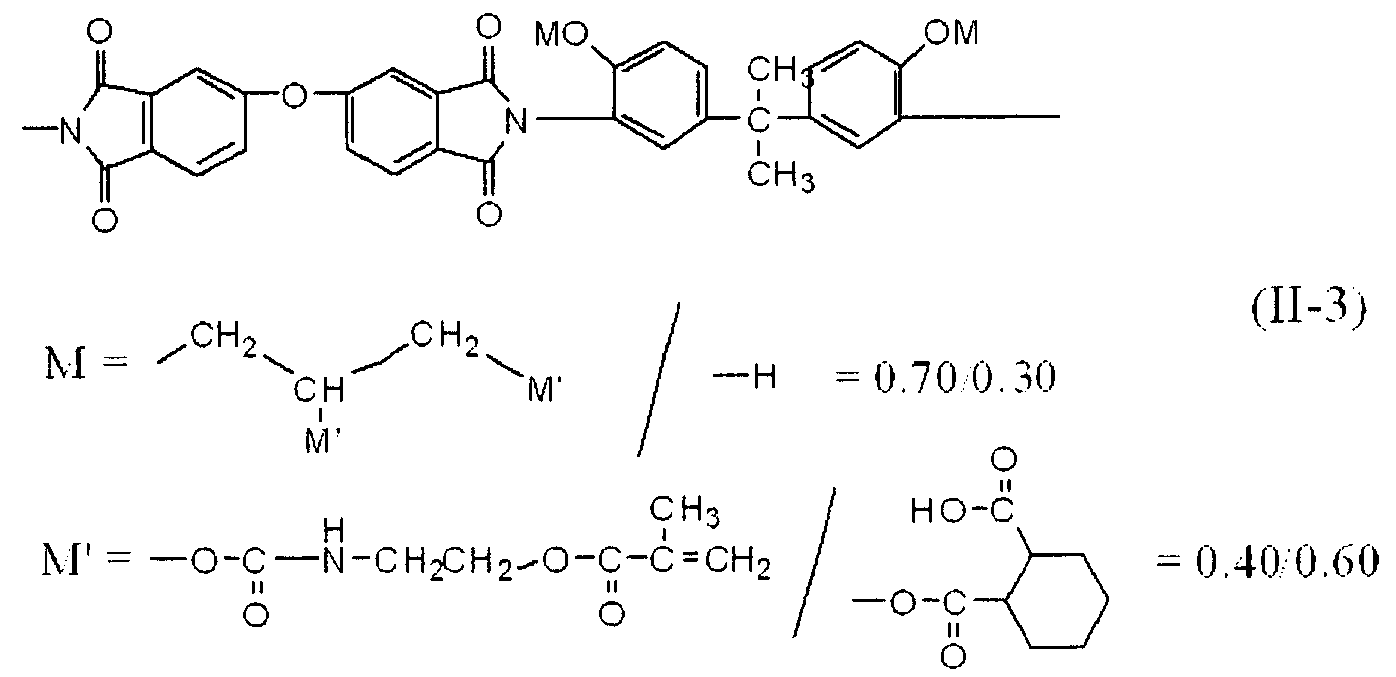
으로 표시되는 폴리이미드 수지의 용액 310 g(수지 고형분 16.1 %)을 얻었다. 이 수지의 평균 중량 분자량은 62,000이고, 아크릴 당량은 950이고, 카르복실 당량은 630이었다. 310 g (resin solid content of 16.1%) of the solution of the polyimide resin represented by this was obtained. This resin had an average weight molecular weight of 62,000, an acrylic equivalent of 950 and a carboxyl equivalent of 630.
[합성예 III] Synthesis Example III
합성예 I에 기재된 방법에 따라서 하기 화학식 (III-1) 내지 (III-3)을 얻었 다. 즉, 테트라카르복실산 이무수물로서 4,4'-옥시디프탈릭안히드리드를 31.0 g, 디아민 성분으로서 2,2'-비스(3-아미노-4-히드록시페닐)프로판 20.5 g, 2,2'-비스[4-(4-아미노페녹시)페닐]프로판 4.1 g, 화학식 5에서 g=9인 구조식을 갖는 디아미노폴리디메틸실록산 2.5 g을 사용하고, 용제로서 N,N-디메틸아세트아미드 240.0 g, 톨루엔 50.0 g을 이용하고, 합성예 I과 동일한 방법에 의해 하기 화학식 (III-1): According to the method described in Synthesis Example I, the following formulas (III-1) to (III-3) were obtained. That is, 31.0 g of 4,4'- oxydiphthalic anhydride as tetracarboxylic dianhydride, 20.5 g of 2,2'-bis (3-amino-4-hydroxyphenyl) propane as a diamine component, 2, 4.1 g of 2'-bis [4- (4-aminophenoxy) phenyl] propane and 2.5 g of diaminopolydimethylsiloxane having a structural formula of g = 9 in Chemical Formula 5 were used, and N, N-dimethylacetamide was used as a solvent. Using the same method as Synthesis Example I using 240.0 g and 50.0 g of toluene, the following Chemical Formula (III-1):

로 표시되는 페놀기 함유 폴리이미드 수지 용액 300 g(수지 고형분 18.2 %)을 얻었다. 300 g (18.2% of resin solid content) of the phenol group containing polyimide resin solution shown by this was obtained.
다음에, 이 수지 용액 300 g(수지 고형분 18.2 %)에 글리시돌 11.2 g을 첨가하고, 140 ℃에서 5 시간 가열한 후, 물 중에서 수지를 석출시킴으로써 하기 화학식 (III-2): Next, 11.2 g of glycidol was added to 300 g (18.2% of resin solid content) of this resin solution, and it heated at 140 degreeC for 5 hours, and then precipitated resin in water, and is represented by following General formula (III-2):

로 표시되는 페놀 수산기의 거의 전부에 글리시돌의 에폭시기가 반응한 수지 54 g을 얻었다. 얻어진 수지의 1급 알코올성 수산기 당량은 500이고, 중량 평균 분자량은 52,000이었다. 54 g of resin in which the epoxy group of glycidol reacted with almost all the phenol hydroxyl groups represented by was obtained. Primary alcoholic hydroxyl group equivalent of obtained resin was 500, and the weight average molecular weight was 52,000.
또한, 이렇게 하여 얻어진 상기 (III-2)의 수지 30 g과 N,N-디메틸아세트아미드 270 g을 플라스크에 넣고, 60 ℃하에서 메타크릴로일옥시에틸이소시아네이트5.8 g을 적하하여 1 시간 교반하였다. 그 후, 60 ℃하에서 헥사히드로프탈산 무수물 11.8 g을 첨가하고, 4 시간 더 교반함으로써 하기 화학식 (III-3): In addition, 30 g of the resin (III-2) obtained above and 270 g of N, N-dimethylacetamide were placed in a flask, and 5.8 g of methacryloyloxyethyl isocyanate was added dropwise at 60 ° C, followed by stirring for 1 hour. Thereafter, 11.8 g of hexahydrophthalic anhydride was added at 60 ° C, followed by further stirring for 4 hours, to give the following general formula (III-3):

으로 표시되는 폴리이미드 수지의 용액 300 g(수지 고형분 15.7 %)을 얻었다. 이 수지의 평균 중량 분자량은 81,000이고, 아크릴 당량이 1,300이고, 카르복실 당량이 600이었다.300g (resin solid content of 15.7%) of the polyimide resin represented by this was obtained. This resin had an average weight molecular weight of 81,000, an acrylic equivalent of 1,300 and a carboxyl equivalent of 600.
[합성예 IV]Synthesis Example IV
합성예 III에서 (III-2)의 수지 30 g과 반응시키는 (메트)아크릴 화합물로서, 2-아크릴로일옥시에틸이소시아네이트(카렌즈 AOI, 쇼와 덴꼬(주) 제조) 5.4 g을, 산 무수물로서 헥사히드로프탈산 무수물 대신에 무수 숙신산 8.8 g(최종 생성물의 카르복실 당량; 500)을 이용한 것 이외에는 합성예 III과 동일하게 하여, 하기 화학식 (IV-3):As a (meth) acryl compound which is made to react with 30 g of resins of (III-2) in the synthesis example III, 5.4 g of 2-acryloyloxyethyl isocyanate (Karenz AOI, Showa Denko Co., Ltd.) is acid anhydride In the same manner as in Synthesis Example III, except that 8.8 g of succinic anhydride (carboxyl equivalent of the final product; 500) was used instead of hexahydrophthalic anhydride as the following general formula (IV-3):

으로 표시되는 폴리이미드 수지의 용액 300 g(수지 고형분 14.5 %)을 얻었다. 이 수지의 평균 중량 분자량은 72,000이고, 아크릴 당량은 1,200이었다.300 g (resin solid content of 14.5%) of the polyimide resin represented by this was obtained. The average weight molecular weight of this resin was 72,000, and the acrylic equivalent was 1,200.
[합성예 V(참고 합성예)] Synthesis Example V (Reference Synthesis Example)
합성예 I에서 (I-2)의 수지 30 g에 반응시키는 메타크릴로일옥시에틸이소시아네이트의 양을 10.2 g, 헥사히드로프탈산 무수물의 양을 2.1 g으로 한 것 이외에는 합성예 I과 동일하게 하여, 하기 화학식 (V-3):Synthesis Example I was carried out in the same manner as in Synthesis Example I, except that the amount of methacryloyloxyethyl isocyanate reacted with 30 g of the resin (I-2) was 10.2 g and the amount of hexahydrophthalic anhydride was 2.1 g. Formula (V-3)

으로 표시되는 폴리이미드 수지의 용액 300 g(수지 고형분 13.9 %)을 얻었다. 또 한, 이 수지의 평균 중량 분자량은 53,000이고, 아크릴 당량은 640이고, 카르복실 당량은 3,100이었다.300g (resin solid content of 13.9%) of the polyimide resin represented by this was obtained. Moreover, the average weight molecular weight of this resin was 53,000, the acrylic equivalent was 640, and the carboxyl equivalent was 3,100.
[합성예 VI(참고 합성예)] Synthesis Example VI (Reference Synthesis Example)
합성예 I에서 (I-2)의 수지 30 g에 반응시키는 메타크릴로일옥시에틸이소시아네이트의 양을 2.1 g, 헥사히드로프탈산 무수물의 양을 10.1 g으로 한 것 이외에는 합성예 I과 완전히 동일하게 하여, 하기 화학식 (VI-3): Except that the amount of methacryloyloxyethyl isocyanate reacted with 30 g of the resin of (I-2) in Synthesis Example I was 2.1 g and the amount of hexahydrophthalic anhydride was 10.1 g, , The following general formula (VI-3):
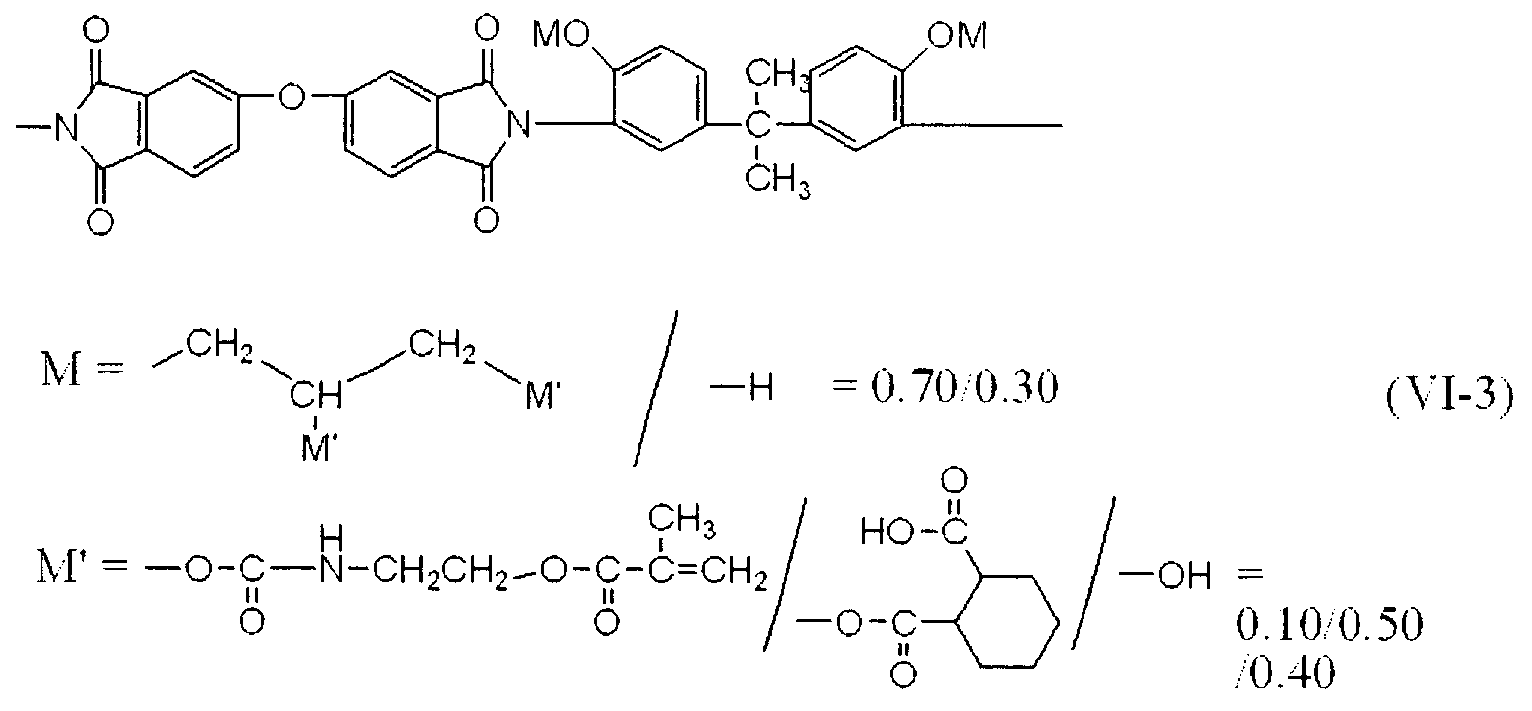
으로 표시되는 폴리이미드 수지의 용액 300 g(수지 고형분 13.9 %)을 얻었다. 이 수지의 평균 중량 분자량은 52,000이고, 아크릴 당량이 3,100이고, 카르복실 당량이 640이었다. 300g (resin solid content of 13.9%) of the polyimide resin represented by this was obtained. This resin had an average weight molecular weight of 52,000, an acrylic equivalent of 3,100 and a carboxyl equivalent of 640.
[합성예 VII(비교 합성예)] Synthesis Example VII (Comparative Synthesis Example)
합성예 I의 기재에 따라서 상기 (I-1)의 수지 200.0 g(수지 고형분 17.5 %)과 글리시돌 3.3 g을 반응시킨 후, 순수한 물 중에서 수지를 석출, 감압 건조시킴으로써 화학식 (VII-2): According to the description of Synthesis Example I, 200.0 g of the resin (I-1) (resin solid 17.5%) and 3.3 g of glycidol were reacted, and then the resin was precipitated in pure water and dried under reduced pressure to obtain the chemical formula (VII-2). :

로 표시되는 수지 26 g을 얻었다. 얻어진 수지의 1급 알코올성 수산기 당량은 1,000이고, 중량 평균 분자량은 35,000이었다.26 g of resin represented by this was obtained. Primary alcoholic hydroxyl group equivalent of obtained resin was 1,000, and the weight average molecular weight was 35,000.
또한, 이렇게 하여 얻어진 수지(VII-2) 20 g과 N,N-디메틸아세트아미드 180 g을 플라스크에 넣고, 60 ℃하에서 메타크릴로일옥시에틸이소시아네이트 6.6 g을 적하하여 1 시간 교반함으로써, 하기 화학식 (VII-3):Further, 20 g of the resin (VII-2) and 180 g of N, N-dimethylacetamide obtained in this manner were put in a flask, and 6.6 g of methacryloyloxyethyl isocyanate was added dropwise at 60 ° C, followed by stirring for 1 hour. (VII-3):

으로 표시되는 폴리이미드 수지의 용액 190 g(수지 고형분 13.9 %)을 얻었다. 또한, 이 수지의 평균 중량 분자량은 40,000이고, 아크릴 당량이 1,300이었다. 190 g (resin solids content of 13.9%) of the polyimide resin represented by this were obtained. Moreover, the average weight molecular weight of this resin was 40,000, and acrylic equivalent was 1,300.
B. 감광성 수지 조성물의 제조B. Preparation of Photosensitive Resin Composition
상기 합성예 I 내지 VII에서 합성한 폴리이미드 수지((A) 성분)의 용액을, 수지 고형분이 40 %가 되도록 농축시킨 물질에, 표 1에 기재한 조성으로 (B) 성분 및 기타 첨가물 등을 배합하고, 교반 혼합하여 용해시켰다. 이어서, 0.1 마이크로미터 유리 필터로 정밀 여과를 행하여, 실시예 1부터 8까지의 본 발명의 감광성 수 지 조성물, 및 참고예 1 내지 3 및 비교예 1의 감광성 수지 조성물을 얻었다.(B) component and other additives were added to the substance which concentrated the solution of the polyimide resin (component (A)) synthesize | combined by the said synthesis examples I-VII so that resin solid content might be 40%, and the composition shown in Table 1 It mix | blended, stirred, mixed, and melt | dissolved. Subsequently, microfiltration was performed with a 0.1 micrometer glass filter, and the photosensitive resin composition of this invention from Examples 1-8, and the photosensitive resin composition of Reference Examples 1-3 and Comparative Example 1 were obtained.
C. 감광성 수지 조성물의 평가C. Evaluation of Photosensitive Resin Composition
(1) 해상도 특성의 평가 (1) evaluation of resolution characteristics
이어서, 헥사메틸디실라잔으로 프라임 처리된 6 인치 실리콘 웨이퍼 2매와, 6 인치 실리콘 웨이퍼 전체면에 막 두께 2 마이크로미터로 전해 구리 도금된 구리 기판 1매에, 스핀 코터를 사용하여 표 중에 기재된 막 두께로 각 조성물을 코팅하였다. 용제를 제거하기 위해서 핫 플레이트에서 115 ℃/2 분간의 가열 건조시켰다. 실리콘 웨이퍼 기판 1매에 대하여, 폭 10 마이크로미터부터 50 마이크로미터까지의 라인/스페이스를 갖는 석영제 마스크를 사용하여, 표 1 중에 기재된 노광량으로 조사하였다. 또한, 노광에는 니콘 제조 스테퍼형 노광 장치 NSR-1755i7A(광원; 365 nm)를 사용하였다. 조사 후, 115 ℃/2 분간 가열하고, 계속해서 실온까지 냉각시켰다. 이어서, 상기 도포 기판에 대하여 분무 현상기를 이용하여 1 % 탄산소다 수용액에 의한 현상을 표 1에 기재된 시간 동안 행하였다. 표 1에는, 이 때 해상된 선폭과 현상 후의 막 두께를 함께 기재하였다. 현상 후의 막 두께는 90 ℃/30 초간의 가열에 의해 수분을 제거하고 나서 측정하였다. 표 1에 있어서, 해상도는 현미경 관찰에 의해 라인/스페이스가 명확하게 현상된 것의 최소 선폭을 나타낸다. Subsequently, two 6-inch silicon wafers primed with hexamethyldisilazane and a copper substrate electrolytically copper plated with a film thickness of 2 micrometers on the entire 6-inch silicon wafer surface were used with a spin coater as described in the table. Each composition was coated by film thickness. Heat-dry for 115 degreeC / 2 minutes on the hotplate in order to remove a solvent. The silicon wafer substrate was irradiated with the exposure doses described in Table 1 using a quartz mask having a line / space from a width of 10 micrometers to 50 micrometers. In addition, the Nikon stepper exposure apparatus NSR-1755i7A (light source; 365 nm) was used for exposure. After irradiation, it heated at 115 degreeC / 2 minutes, and then cooled to room temperature. Subsequently, development with a 1% aqueous solution of sodium carbonate was carried out for the time shown in Table 1 using the spray developer on the coated substrate. In Table 1, the line width resolved at this time and the film thickness after image development were described together. The film thickness after image development was measured after removing water | moisture content by heating for 90 degreeC / 30 second. In Table 1, the resolution represents the minimum line width of the line / space clearly developed by microscopic observation.
(2) 경화막의 평가(2) Evaluation of Cured Film
다른 실리콘 웨이퍼와 구리 기판 상의 각 조성물 막에 대해서는, 석영제 마스크를 사용하지 않고 기판 전체면에 광 조사, 가열한 후, 1 % 탄산소다 수용액에 의한 현상 공정을 10 분간 행하였다. 이 조작 후, 남은 피막을 220 ℃의 오븐에서 1 시간 가열하여 경화 피막을 얻었다. 이 경화 피막을 이용하여 접착성 특성과 절연 특성에 대하여 측정하였다. 결과를 표 2에 나타낸다. 접착성 평가는, 압력 용기를 이용하여 포화 2 기압(121 ℃/100 %RH) 중에 각 시험체를 24 시간 방치하고, 그 후 바둑판 눈금 박리 시험으로 박리수를 측정함으로써 행하였다. 또한, 절연 파괴 강도는 JIS C 2103에 기초하여 측정하였다.About each composition film | membrane on another silicon wafer and a copper substrate, after the light irradiation and heating to the whole board | substrate whole surface, without using a mask made from quartz, the developing process by the 1-% sodium-carbonate aqueous solution was performed for 10 minutes. After this operation, the remaining film was heated in an oven at 220 ° C. for 1 hour to obtain a cured film. It measured about adhesive characteristic and insulation characteristic using this hardened film. The results are shown in Table 2. Adhesive evaluation was performed by leaving each test body for 24 hours in saturated 2 atmospheres (121 degreeC / 100% RH) using a pressure vessel, and measuring peeling water by the checkerboard scale peeling test after that. In addition, the dielectric breakdown strength was measured based on JIS C 2103.

또한, 상기 표 1 중의 각 첨가제는 하기와 같다.In addition, each additive of the said Table 1 is as follows.
a); 2,2'-비스(o-클로로페닐)-4',5'-테트라페닐-1'-비이미다졸a); 2,2'-bis (o-chlorophenyl) -4 ', 5'-tetraphenyl-1'-biimidazole
b); 4-디에틸아미노벤조산에틸 b); 4-diethylaminobenzoate
c); N-페닐글리신 c); N-phenylglycine
d); 2,4-디에틸티오크산톤 d); 2,4-diethyl thioxanthone
e); X-70-093(불소 실리콘계 계면 활성제(신에쯔 가가꾸 고교사(주) 제조)) e); X-70-093 (Fluorinated Silicone Surfactant (manufactured by Shin-Etsu Chemical Co., Ltd.))
f); R-604(다관능 아크릴레이트, 닛본 가야꾸(주) 제조) f); R-604 (polyfunctional acrylate, the Nippon Kayaku Co., Ltd. product)
g); KBE-403(에폭시 변성 알콕시실란 접착 보조제(신에쯔 가가꾸 고교(주) 제조))g); KBE-403 (Epoxy-Modified Alkoxysilane Adhesion Aids (manufactured by Shin-Etsu Chemical Co., Ltd.))

비교예의 조성물은 카르복실기를 갖지 않아 현상을 할 수 없었다. 또한, 참고예 1의 조성물은 카르복실기의 양이 적기 때문에 용해성이 부족하였다. 참고예 2 및 3의 조성물은 카르복실기를 너무 많고, 결과적으로 아크릴의 양이 적어졌기 때문에 패턴이 용해되었다. 이들에 대하여, 소정의 아크릴 당량과 카르복실산 당량을 갖는 실시예 1 내지 8의 조성물은 탄산소다 수용액과 같은 약 알칼리성 수용액에 의해서도 양호한 현상성을 나타내고, 감광성 재료로서 충분한 특성을 갖는 것을 확인할 수 있었다. 또한, 이들의 조성물로부터의 경화막은 각종 기재에 양호한 접착성, 절연 내압을 나타내었다.The composition of the comparative example did not have a carboxyl group and thus could not be developed. In addition, the composition of Reference Example 1 lacked solubility because the amount of the carboxyl group was small. The compositions of Reference Examples 2 and 3 had too many carboxyl groups, and as a result, the amount of acryl decreased, so that the pattern was dissolved. On the other hand, the compositions of Examples 1 to 8 having a predetermined acrylic equivalent and carboxylic acid equivalent showed good developability even with a weakly alkaline aqueous solution such as an aqueous sodium carbonate solution, and it was confirmed that the composition had sufficient properties as a photosensitive material. . Moreover, the cured film from these compositions showed favorable adhesiveness and insulation breakdown voltage to various base materials.
본 발명의 폴리이미드 수지는 감광성 및 약 알칼리성 용액에 대한 용해성이 우수하고, 감광성 재료로서 바람직하다. 또한, 경화막은 회로나 전자 부품의 보호막으로서 유용하다. The polyimide resin of the present invention is excellent in solubility in photosensitive and weakly alkaline solutions and is preferable as a photosensitive material. Moreover, a cured film is useful as a protective film of a circuit or an electronic component.
Claims (13)


Applications Claiming Priority (2)
| Application Number | Priority Date | Filing Date | Title |
|---|---|---|---|
| JP2006225434A JP4386454B2 (en) | 2006-08-22 | 2006-08-22 | Photosensitive polyimide resin soluble in alkaline aqueous solution, composition containing the resin, and film obtained from the composition |
| JPJP-P-2006-00225434 | 2006-08-22 |
Publications (2)
| Publication Number | Publication Date |
|---|---|
| KR20080018122A true KR20080018122A (en) | 2008-02-27 |
| KR101367466B1 KR101367466B1 (en) | 2014-02-25 |
Family
ID=39152083
Family Applications (1)
| Application Number | Title | Priority Date | Filing Date |
|---|---|---|---|
| KR1020070083871A Expired - Fee Related KR101367466B1 (en) | 2006-08-22 | 2007-08-21 | Alkaline aqueous solution-soluble photosensitive polyimide resin, composition comprising the resin and membrane obtained from the composition |
Country Status (4)
| Country | Link |
|---|---|
| US (1) | US7638259B2 (en) |
| JP (1) | JP4386454B2 (en) |
| KR (1) | KR101367466B1 (en) |
| TW (1) | TWI389937B (en) |
Cited By (5)
| Publication number | Priority date | Publication date | Assignee | Title |
|---|---|---|---|---|
| KR20130112324A (en) * | 2012-04-03 | 2013-10-14 | 삼성에스디아이 주식회사 | Water soluble binder composition, method of producing the same and electrode for a rechargeable battery employing the same |
| WO2018093028A1 (en) * | 2016-11-21 | 2018-05-24 | 동우화인켐 주식회사 | Self-luminescent photosensitive resin composition, color filter prepared by using same, and image display device |
| JP2021085977A (en) * | 2019-11-27 | 2021-06-03 | 信越化学工業株式会社 | Photosensitive polyimide resin composition, pattern formation method, and method for manufacturing semiconductor device |
| KR20230011684A (en) | 2021-07-14 | 2023-01-25 | 한국생산기술연구원 | The polyimde, the photosensitive-polyimde, the method of synthesizing thereof, the micropattern by using the photosensitive polyimde and the method of forming micropattern by using the photosenstive polyimde |
| CN118725575A (en) * | 2024-07-15 | 2024-10-01 | 河北联缆线缆有限公司 | A high-strength, wear-resistant and high-temperature resistant wire and cable sheath material and its preparation process |
Families Citing this family (20)
| Publication number | Priority date | Publication date | Assignee | Title |
|---|---|---|---|---|
| TWI383251B (en) * | 2008-01-16 | 2013-01-21 | Eternal Chemical Co Ltd | Photosensitive polyimides |
| JP2010070604A (en) * | 2008-09-17 | 2010-04-02 | Hitachi Chem Co Ltd | Solvent-soluble imide compound having reactive double bond, resin composition comprising the compound, and electronic material using them |
| KR101674645B1 (en) * | 2008-10-23 | 2016-11-09 | 닛산 가가쿠 고교 가부시키 가이샤 | Underlayer Film for Image Formation |
| CN102532544B (en) * | 2008-12-11 | 2013-10-09 | 长兴化学工业股份有限公司 | Photosensitive polyimide |
| TWI516527B (en) * | 2009-12-10 | 2016-01-11 | 信越化學工業股份有限公司 | Photocurable resin composition, pattern forming method and substrate protective film, and film adhesive and adhesive sheet using the same |
| CN102140169B (en) * | 2010-01-28 | 2013-08-21 | 长春人造树脂厂股份有限公司 | Novel water-soluble polyimide resin as well as preparation method and application thereof |
| TWI534529B (en) * | 2010-03-01 | 2016-05-21 | 長興材料工業股份有限公司 | Photosensitive resin composition and its application |
| US8248755B2 (en) * | 2010-04-30 | 2012-08-21 | General Electric Company | Polyimides and thin films, electronic articles and capacitors comprising these, and methods of making them |
| US9187600B2 (en) * | 2010-11-01 | 2015-11-17 | Basf Se | Polyimides as dielectric |
| KR20120057467A (en) * | 2010-11-26 | 2012-06-05 | 삼성전자주식회사 | Photosensitive-Polyimide Having Silicon Modified Group, Adhesive Composition and Semiconductor Package Containing the Same |
| CN104371102B (en) * | 2014-12-11 | 2017-01-18 | 河北科技大学 | Negative photo-sensitive polyimide and method for preparing same |
| JP2018070829A (en) * | 2016-11-02 | 2018-05-10 | 東レ株式会社 | Resin composition |
| CN108575057B (en) * | 2017-03-13 | 2021-01-15 | 律胜科技股份有限公司 | Circuit board with photosensitive opening |
| WO2020017920A1 (en) * | 2018-07-20 | 2020-01-23 | 주식회사 엘지화학 | Polyimide resin and negative-type photosensitive resin composition comprising same |
| JP7592393B2 (en) * | 2019-04-09 | 2024-12-02 | 旭化成株式会社 | Negative-type photosensitive resin composition, method for producing polyimide, and method for producing cured relief pattern |
| US11294281B2 (en) | 2019-06-28 | 2022-04-05 | Hutchinson Technology Incorporated | Chain extenders and formulations thereof for improving elongation in photosensitive polyimide |
| KR102681938B1 (en) * | 2020-01-30 | 2024-07-04 | 아사히 가세이 가부시키가이샤 | Negative photosensitive resin composition and method for producing cured relief pattern |
| JP7704516B2 (en) * | 2020-10-30 | 2025-07-08 | 東京応化工業株式会社 | Varnish composition and method for producing polyimide film |
| JPWO2023013224A1 (en) * | 2021-08-03 | 2023-02-09 | ||
| WO2025249231A1 (en) * | 2024-05-31 | 2025-12-04 | 富士フイルム株式会社 | Resin composition, cured product, method for producing cured product, method for producing laminate, and method for producing semiconductor device |
Family Cites Families (23)
| Publication number | Priority date | Publication date | Assignee | Title |
|---|---|---|---|---|
| DE2326314C2 (en) | 1973-05-23 | 1983-10-27 | Siemens AG, 1000 Berlin und 8000 München | Process for the production of relief structures |
| NL177718C (en) | 1973-02-22 | 1985-11-01 | Siemens Ag | METHOD FOR MANUFACTURING RELIEF STRUCTURES FROM HEAT-RESISTANT POLYMERS |
| JPS5952822B2 (en) | 1978-04-14 | 1984-12-21 | 東レ株式会社 | Heat-resistant photosensitive material |
| JPS5545746A (en) | 1978-09-29 | 1980-03-31 | Hitachi Ltd | Reactive polymer composition |
| DE2931297A1 (en) | 1979-08-01 | 1981-02-19 | Siemens Ag | HEAT-RESISTANT POSITIVE RESISTS AND METHOD FOR PRODUCING HEAT-RESISTANT RELIEF STRUCTURES |
| JPS6446862U (en) | 1987-09-17 | 1989-03-23 | ||
| US5288588A (en) | 1989-10-27 | 1994-02-22 | Nissan Chemical Industries Ltd. | Positive photosensitive polyimide resin composition comprising an o-quinone diazide as a photosensitive compound |
| JP2906637B2 (en) | 1989-10-27 | 1999-06-21 | 日産化学工業株式会社 | Positive photosensitive polyimide resin composition |
| US5114826A (en) * | 1989-12-28 | 1992-05-19 | Ibm Corporation | Photosensitive polyimide compositions |
| US6096480A (en) * | 1995-07-28 | 2000-08-01 | Ube Industries, Ltd. | Photosensitive polyimidosiloxane compositions and insulating films made thereof |
| JP3721768B2 (en) | 1997-01-24 | 2005-11-30 | 宇部興産株式会社 | Photosensitive polyimide siloxane composition and insulating film |
| JP3232022B2 (en) | 1997-03-31 | 2001-11-26 | 信越化学工業株式会社 | Photosensitive resin composition |
| JP3478376B2 (en) | 1997-06-11 | 2003-12-15 | 住友ベークライト株式会社 | Positive photosensitive resin composition |
| EP1037112B1 (en) * | 1998-09-09 | 2004-11-24 | Toray Industries, Inc. | Positive photosensitive resin precursor composition and process for producing the same |
| JP2000147761A (en) * | 1998-11-11 | 2000-05-26 | Hitachi Ltd | Photosensitive polyimide composition and pattern forming method using the same |
| KR100780505B1 (en) | 1999-12-28 | 2007-11-29 | 가부시키가이샤 가네카 | Epoxy-modified polyimide, photosensitive composition, coverlay film, solder resist, and printed wiring board using the epoxy-modified polyimide |
| JP2001335619A (en) | 1999-12-28 | 2001-12-04 | Kanegafuchi Chem Ind Co Ltd | Epoxy-modified polyimide, photosensitive composition using the same, coverlay film, solder resist, printed wiring board |
| JP2002351073A (en) | 2001-05-25 | 2002-12-04 | Ube Ind Ltd | Photosensitive imide resin composition, insulating film and method for forming the same |
| US6686106B2 (en) | 2000-06-26 | 2004-02-03 | Ube Industries, Ltd. | Photosensitive resin compositions, insulating films, and processes for formation of the films |
| JP2004325616A (en) | 2003-04-23 | 2004-11-18 | Kanegafuchi Chem Ind Co Ltd | Photosensitive resin composition and photosensitive dry film resist developable with an alkaline aqueous solution, and use thereof |
| JP4530284B2 (en) * | 2004-10-07 | 2010-08-25 | 信越化学工業株式会社 | Polyimide-based photocurable resin composition, pattern forming method, and film for protecting substrate |
| JP2006119513A (en) * | 2004-10-25 | 2006-05-11 | Kaneka Corp | Photosensitive resin composition and photosensitive dry film resist, and printed wiring board using same |
| JP2006028533A (en) * | 2005-10-13 | 2006-02-02 | Shin Etsu Chem Co Ltd | Polyimide silicone resin and method for producing the same |
-
2006
- 2006-08-22 JP JP2006225434A patent/JP4386454B2/en not_active Expired - Fee Related
-
2007
- 2007-08-21 KR KR1020070083871A patent/KR101367466B1/en not_active Expired - Fee Related
- 2007-08-21 US US11/892,244 patent/US7638259B2/en not_active Expired - Fee Related
- 2007-08-21 TW TW096130960A patent/TWI389937B/en not_active IP Right Cessation
Cited By (5)
| Publication number | Priority date | Publication date | Assignee | Title |
|---|---|---|---|---|
| KR20130112324A (en) * | 2012-04-03 | 2013-10-14 | 삼성에스디아이 주식회사 | Water soluble binder composition, method of producing the same and electrode for a rechargeable battery employing the same |
| WO2018093028A1 (en) * | 2016-11-21 | 2018-05-24 | 동우화인켐 주식회사 | Self-luminescent photosensitive resin composition, color filter prepared by using same, and image display device |
| JP2021085977A (en) * | 2019-11-27 | 2021-06-03 | 信越化学工業株式会社 | Photosensitive polyimide resin composition, pattern formation method, and method for manufacturing semiconductor device |
| KR20230011684A (en) | 2021-07-14 | 2023-01-25 | 한국생산기술연구원 | The polyimde, the photosensitive-polyimde, the method of synthesizing thereof, the micropattern by using the photosensitive polyimde and the method of forming micropattern by using the photosenstive polyimde |
| CN118725575A (en) * | 2024-07-15 | 2024-10-01 | 河北联缆线缆有限公司 | A high-strength, wear-resistant and high-temperature resistant wire and cable sheath material and its preparation process |
Also Published As
| Publication number | Publication date |
|---|---|
| JP4386454B2 (en) | 2009-12-16 |
| TWI389937B (en) | 2013-03-21 |
| KR101367466B1 (en) | 2014-02-25 |
| TW200821340A (en) | 2008-05-16 |
| US7638259B2 (en) | 2009-12-29 |
| JP2008050401A (en) | 2008-03-06 |
| US20080057446A1 (en) | 2008-03-06 |
Similar Documents
| Publication | Publication Date | Title |
|---|---|---|
| KR101367466B1 (en) | Alkaline aqueous solution-soluble photosensitive polyimide resin, composition comprising the resin and membrane obtained from the composition | |
| JP5415861B2 (en) | Photosensitive resin composition, pattern forming method, and semiconductor device | |
| KR100462430B1 (en) | Photosensitive polyimide precursor composition, and pattern formation method using the same | |
| KR101969197B1 (en) | Positive photosensitive resin composition | |
| JP4826415B2 (en) | Photosensitive resin composition | |
| US6849385B2 (en) | Photosensitive resin composition, process of forming patterns with the same, and electronic components | |
| US5587275A (en) | Photosensitive resin composition and a process for forming a patterned polyimide film using the same | |
| JP2003084435A (en) | Negative photosensitive resin composition, method for producing pattern and electronic parts | |
| JP2004094118A (en) | Photosensitive resin composition | |
| WO2023243199A1 (en) | Photosensitive resin composition, patterned resin film, method for producing patterned resin film, and semiconductor circuit substrate | |
| US5616448A (en) | Photosensitive resin composition and a process for forming a patterned polyimide film using the same | |
| JP3165024B2 (en) | Photosensitive resin composition and method for forming patterned polyimide film using the same | |
| JPWO2019193647A1 (en) | A method for producing a polyimide precursor, a method for producing a photosensitive resin composition, a method for producing a pattern cured product, a method for producing an interlayer insulating film, a cover coat layer or a surface protective film, and a method for producing an electronic component. | |
| JPH1192660A (en) | Photosensitive resin composition | |
| JP4761989B2 (en) | Polyamic acid ester composition | |
| JP7071205B2 (en) | Positive photosensitive resin compositions, dry films, patterned coatings and electronic components | |
| CN114245882A (en) | Photosensitive resin composition, method for producing patterned cured film, interlayer insulating film, covercoat, surface protective film, and electronic component | |
| US6524770B1 (en) | Hexaaryl biimidazole compounds as photoinitiators, photosensitive composition and method of manufacturing patterns using the compounds | |
| KR101205138B1 (en) | Photosensitive Resin and a Method of Preparing the Same | |
| JP7403268B2 (en) | Photosensitive resin compositions, dry films, cured products, and electronic components | |
| JPH10195294A (en) | Photosensitive resin composition | |
| JP2000212446A (en) | Photosensitive resin composition and insulating film | |
| JPH0827537B2 (en) | Photosensitive resin composition | |
| JP2643635B2 (en) | Photosensitive resin solution composition | |
| JP3921734B2 (en) | High resolution photosensitive polyimide precursor composition |
Legal Events
| Date | Code | Title | Description |
|---|---|---|---|
| PA0109 | Patent application |
St.27 status event code: A-0-1-A10-A12-nap-PA0109 |
|
| PG1501 | Laying open of application |
St.27 status event code: A-1-1-Q10-Q12-nap-PG1501 |
|
| A201 | Request for examination | ||
| PA0201 | Request for examination |
St.27 status event code: A-1-2-D10-D11-exm-PA0201 |
|
| E902 | Notification of reason for refusal | ||
| PE0902 | Notice of grounds for rejection |
St.27 status event code: A-1-2-D10-D21-exm-PE0902 |
|
| E13-X000 | Pre-grant limitation requested |
St.27 status event code: A-2-3-E10-E13-lim-X000 |
|
| P11-X000 | Amendment of application requested |
St.27 status event code: A-2-2-P10-P11-nap-X000 |
|
| P13-X000 | Application amended |
St.27 status event code: A-2-2-P10-P13-nap-X000 |
|
| E701 | Decision to grant or registration of patent right | ||
| PE0701 | Decision of registration |
St.27 status event code: A-1-2-D10-D22-exm-PE0701 |
|
| GRNT | Written decision to grant | ||
| PR0701 | Registration of establishment |
St.27 status event code: A-2-4-F10-F11-exm-PR0701 |
|
| PR1002 | Payment of registration fee |
St.27 status event code: A-2-2-U10-U11-oth-PR1002 Fee payment year number: 1 |
|
| PG1601 | Publication of registration |
St.27 status event code: A-4-4-Q10-Q13-nap-PG1601 |
|
| FPAY | Annual fee payment |
Payment date: 20170119 Year of fee payment: 4 |
|
| PR1001 | Payment of annual fee |
St.27 status event code: A-4-4-U10-U11-oth-PR1001 Fee payment year number: 4 |
|
| FPAY | Annual fee payment |
Payment date: 20180202 Year of fee payment: 5 |
|
| PR1001 | Payment of annual fee |
St.27 status event code: A-4-4-U10-U11-oth-PR1001 Fee payment year number: 5 |
|
| FPAY | Annual fee payment |
Payment date: 20190130 Year of fee payment: 6 |
|
| PR1001 | Payment of annual fee |
St.27 status event code: A-4-4-U10-U11-oth-PR1001 Fee payment year number: 6 |
|
| FPAY | Annual fee payment |
Payment date: 20200205 Year of fee payment: 7 |
|
| PR1001 | Payment of annual fee |
St.27 status event code: A-4-4-U10-U11-oth-PR1001 Fee payment year number: 7 |
|
| PR1001 | Payment of annual fee |
St.27 status event code: A-4-4-U10-U11-oth-PR1001 Fee payment year number: 8 |
|
| R18-X000 | Changes to party contact information recorded |
St.27 status event code: A-5-5-R10-R18-oth-X000 |
|
| PR1001 | Payment of annual fee |
St.27 status event code: A-4-4-U10-U11-oth-PR1001 Fee payment year number: 9 |
|
| PC1903 | Unpaid annual fee |
St.27 status event code: A-4-4-U10-U13-oth-PC1903 Not in force date: 20230220 Payment event data comment text: Termination Category : DEFAULT_OF_REGISTRATION_FEE |
|
| PC1903 | Unpaid annual fee |
St.27 status event code: N-4-6-H10-H13-oth-PC1903 Ip right cessation event data comment text: Termination Category : DEFAULT_OF_REGISTRATION_FEE Not in force date: 20230220 |