KR102761231B1 - Memory system and operating method thereof - Google Patents
Memory system and operating method thereof Download PDFInfo
- Publication number
- KR102761231B1 KR102761231B1 KR1020160140823A KR20160140823A KR102761231B1 KR 102761231 B1 KR102761231 B1 KR 102761231B1 KR 1020160140823 A KR1020160140823 A KR 1020160140823A KR 20160140823 A KR20160140823 A KR 20160140823A KR 102761231 B1 KR102761231 B1 KR 102761231B1
- Authority
- KR
- South Korea
- Prior art keywords
- memory
- response
- controller
- program operation
- memory device
- Prior art date
- Legal status (The legal status is an assumption and is not a legal conclusion. Google has not performed a legal analysis and makes no representation as to the accuracy of the status listed.)
- Active
Links
Images




Classifications
-
- G—PHYSICS
- G06—COMPUTING OR CALCULATING; COUNTING
- G06F—ELECTRIC DIGITAL DATA PROCESSING
- G06F13/00—Interconnection of, or transfer of information or other signals between, memories, input/output devices or central processing units
- G06F13/14—Handling requests for interconnection or transfer
- G06F13/16—Handling requests for interconnection or transfer for access to memory bus
- G06F13/1668—Details of memory controller
-
- G—PHYSICS
- G06—COMPUTING OR CALCULATING; COUNTING
- G06F—ELECTRIC DIGITAL DATA PROCESSING
- G06F3/00—Input arrangements for transferring data to be processed into a form capable of being handled by the computer; Output arrangements for transferring data from processing unit to output unit, e.g. interface arrangements
- G06F3/06—Digital input from, or digital output to, record carriers, e.g. RAID, emulated record carriers or networked record carriers
- G06F3/0601—Interfaces specially adapted for storage systems
- G06F3/0602—Interfaces specially adapted for storage systems specifically adapted to achieve a particular effect
- G06F3/0604—Improving or facilitating administration, e.g. storage management
-
- G—PHYSICS
- G06—COMPUTING OR CALCULATING; COUNTING
- G06F—ELECTRIC DIGITAL DATA PROCESSING
- G06F3/00—Input arrangements for transferring data to be processed into a form capable of being handled by the computer; Output arrangements for transferring data from processing unit to output unit, e.g. interface arrangements
- G06F3/06—Digital input from, or digital output to, record carriers, e.g. RAID, emulated record carriers or networked record carriers
- G06F3/0601—Interfaces specially adapted for storage systems
- G06F3/0628—Interfaces specially adapted for storage systems making use of a particular technique
- G06F3/0655—Vertical data movement, i.e. input-output transfer; data movement between one or more hosts and one or more storage devices
- G06F3/0659—Command handling arrangements, e.g. command buffers, queues, command scheduling
-
- G—PHYSICS
- G06—COMPUTING OR CALCULATING; COUNTING
- G06F—ELECTRIC DIGITAL DATA PROCESSING
- G06F3/00—Input arrangements for transferring data to be processed into a form capable of being handled by the computer; Output arrangements for transferring data from processing unit to output unit, e.g. interface arrangements
- G06F3/06—Digital input from, or digital output to, record carriers, e.g. RAID, emulated record carriers or networked record carriers
- G06F3/0601—Interfaces specially adapted for storage systems
- G06F3/0668—Interfaces specially adapted for storage systems adopting a particular infrastructure
- G06F3/0671—In-line storage system
- G06F3/0673—Single storage device
- G06F3/0679—Non-volatile semiconductor memory device, e.g. flash memory, one time programmable memory [OTP]
-
- G—PHYSICS
- G06—COMPUTING OR CALCULATING; COUNTING
- G06F—ELECTRIC DIGITAL DATA PROCESSING
- G06F3/00—Input arrangements for transferring data to be processed into a form capable of being handled by the computer; Output arrangements for transferring data from processing unit to output unit, e.g. interface arrangements
- G06F3/06—Digital input from, or digital output to, record carriers, e.g. RAID, emulated record carriers or networked record carriers
- G06F3/0601—Interfaces specially adapted for storage systems
- G06F3/0668—Interfaces specially adapted for storage systems adopting a particular infrastructure
- G06F3/0671—In-line storage system
- G06F3/0683—Plurality of storage devices
- G06F3/0685—Hybrid storage combining heterogeneous device types, e.g. hierarchical storage, hybrid arrays
-
- G—PHYSICS
- G06—COMPUTING OR CALCULATING; COUNTING
- G06F—ELECTRIC DIGITAL DATA PROCESSING
- G06F9/00—Arrangements for program control, e.g. control units
- G06F9/06—Arrangements for program control, e.g. control units using stored programs, i.e. using an internal store of processing equipment to receive or retain programs
- G06F9/30—Arrangements for executing machine instructions, e.g. instruction decode
- G06F9/38—Concurrent instruction execution, e.g. pipeline or look ahead
- G06F9/3854—Instruction completion, e.g. retiring, committing or graduating
- G06F9/3856—Reordering of instructions, e.g. using queues or age tags
-
- G—PHYSICS
- G11—INFORMATION STORAGE
- G11C—STATIC STORES
- G11C16/00—Erasable programmable read-only memories
-
- G—PHYSICS
- G11—INFORMATION STORAGE
- G11C—STATIC STORES
- G11C16/00—Erasable programmable read-only memories
- G11C16/02—Erasable programmable read-only memories electrically programmable
- G11C16/06—Auxiliary circuits, e.g. for writing into memory
- G11C16/10—Programming or data input circuits
-
- G—PHYSICS
- G11—INFORMATION STORAGE
- G11C—STATIC STORES
- G11C5/00—Details of stores covered by group G11C11/00
- G11C5/02—Disposition of storage elements, e.g. in the form of a matrix array
- G11C5/04—Supports for storage elements, e.g. memory modules; Mounting or fixing of storage elements on such supports
-
- G—PHYSICS
- G11—INFORMATION STORAGE
- G11C—STATIC STORES
- G11C16/00—Erasable programmable read-only memories
- G11C16/02—Erasable programmable read-only memories electrically programmable
- G11C16/04—Erasable programmable read-only memories electrically programmable using variable threshold transistors, e.g. FAMOS
- G11C16/0483—Erasable programmable read-only memories electrically programmable using variable threshold transistors, e.g. FAMOS comprising cells having several storage transistors connected in series
Landscapes
- Engineering & Computer Science (AREA)
- Theoretical Computer Science (AREA)
- Physics & Mathematics (AREA)
- General Engineering & Computer Science (AREA)
- General Physics & Mathematics (AREA)
- Human Computer Interaction (AREA)
- Software Systems (AREA)
- Techniques For Improving Reliability Of Storages (AREA)
- Read Only Memory (AREA)
Abstract
본 발명의 실시 예들에 따른 메모리 시스템은, 복수의 메모리 다이(die)들을 포함하는 메모리 장치; 및 라이트 커맨드의 수신에 응답하여 상기 복수의 메모리 다이들에서의 프로그래밍의 순차적 완료를 지시하는 정보를 생성하고, 상기 라이트 커맨드와 상기 지시 정보를 상기 메모리 장치로 전달하는 컨트롤러를 포함할 수 있다.A memory system according to embodiments of the present invention may include a memory device including a plurality of memory dies; and a controller that generates information indicating sequential completion of programming in the plurality of memory dies in response to receiving a write command, and transmits the write command and the instruction information to the memory device.

Description
본 발명은 메모리 시스템 및 메모리 시스템의 동작 방법에 관한 것이다.The present invention relates to a memory system and an operating method of the memory system.
최근 컴퓨터 환경에 대한 패러다임(paradigm)이 언제, 어디서나 컴퓨터 시스템을 사용할 수 있도록 하는 유비쿼터스 컴퓨팅(ubiquitous computing)으로 전환되고 있다. 이로 인해 휴대폰, 디지털 카메라, 노트북 컴퓨터 등과 같은 휴대용 전자 장치의 사용이 급증하고 있다. 이와 같은 휴대용 전자 장치는 일반적으로 메모리 장치를 이용하는 메모리 시스템, 다시 말해 데이터 저장 장치를 사용한다. 데이터 저장 장치는 휴대용 전자 장치의 주 기억 장치 또는 보조 기억 장치로 사용된다.Recently, the paradigm of the computer environment is shifting to ubiquitous computing, which allows the use of computer systems anytime and anywhere. This has led to a rapid increase in the use of portable electronic devices such as mobile phones, digital cameras, and laptop computers. Such portable electronic devices generally use memory systems that utilize memory devices, or in other words, data storage devices. Data storage devices are used as main or auxiliary memory devices of portable electronic devices.
메모리 장치를 이용한 데이터 저장 장치는 기계적인 구동부가 없어서 안정성 및 내구성이 뛰어나며, 또한 정보의 액세스 속도가 매우 빠르고 전력 소모가 적다는 장점이 있다. 이러한 장점을 갖는 메모리 시스템의 일 예로 데이터 저장 장치는, USB(Universal Serial Bus) 메모리 장치, 다양한 인터페이스를 갖는 메모리 카드, 솔리드 스테이트 드라이브(SSD: Solid State Drive) 등을 포함한다.Data storage devices using memory devices have the advantages of excellent stability and durability because they do not have mechanical drive parts, and also have very fast information access speeds and low power consumption. Examples of memory systems with these advantages include data storage devices such as USB (Universal Serial Bus) memory devices, memory cards with various interfaces, and solid state drives (SSDs).
본 발명의 실시 예들은, 메모리 시스템의 복잡도 및 성능 저하를 최소화하며, 메모리 장치의 사용 효율을 최대화하여, 메모리 장치로 데이터를 신속하게 안정적으로 처리할 수 있는 메모리 시스템 및 메모리 시스템의 동작 방법을 제공한다.Embodiments of the present invention provide a memory system and an operating method of the memory system that can quickly and stably process data with a memory device by minimizing complexity and performance degradation of the memory system and maximizing the utilization efficiency of the memory device.
본 발명의 일 실시 예에 따르면, 메모리 시스템은 복수의 메모리 다이(die)들을 포함하는 메모리 장치; 및 라이트 커맨드의 수신에 응답하여 상기 복수의 메모리 다이들에서의 프로그래밍의 순차적 완료를 지시하는 정보를 생성하고, 상기 라이트 커맨드와 상기 지시 정보를 상기 메모리 장치로 전달하는 컨트롤러를 포함한다. According to one embodiment of the present invention, a memory system includes a memory device including a plurality of memory dies; and a controller for generating information indicating sequential completion of programming in the plurality of memory dies in response to receiving a write command, and transmitting the write command and the instruction information to the memory device.
본 발명의 일 실시 예에 따르면, 메모리 장치는 각각 복수의 메모리 블록들을 포함하는 제1 및 제2 메모리 다이(die)들을 포함한다. 상기 제1 및 제2 메모리 다이들 각각은 라이트 커맨드의 수신에 응답하여 프로그램 동작을 수행하고, 프로그래밍의 순차적 완료를 지시하는 정보에 응답하여 프로그램 동작을 완료한다. According to one embodiment of the present invention, a memory device includes first and second memory dies, each of which includes a plurality of memory blocks. Each of the first and second memory dies performs a program operation in response to receiving a write command, and completes the program operation in response to information indicating sequential completion of programming.
본 발명의 일 실시 예에 따르면, 복수의 메모리 다이(die)들을 포함하는 메모리 장치를 포함하는 메모리 시스템의 동작 방법은: 라이트 커맨드의 수신에 응답하여 상기 복수의 메모리 다이들에서의 프로그래밍의 순차적 완료를 지시하는 지시 정보를 생성하는 과정; 및 상기 라이트 커맨드와 상기 지시 정보를 상기 메모리 장치로 전달하는 과정을 포함한다. According to one embodiment of the present invention, a method of operating a memory system including a memory device including a plurality of memory dies includes: generating instruction information instructing sequential completion of programming in the plurality of memory dies in response to receiving a write command; and transmitting the write command and the instruction information to the memory device.
본 발명의 실시 예들은 시퀀스 번호를 포함하는 라이트 커맨드와 지시 신호를 이용하여 복수의 메모리 블록들에 대한 프로그램 동작 중에도 수퍼 블록의 데이터 연속성을 보장하여 유효한 데이터 상태를 보장할 수 있다. 또한, 본 발명의 실시 예들은 큐잉(queuing) 동작을 보장하여 라이트 동작에 대한 성능을 보장할 수 있다. 또한, 본 발명의 실시 예들은 컨트롤러의 지원을 통해 꼭 필요한 처리 순서를 보장할 수 있다. Embodiments of the present invention can guarantee data continuity of a super block even during a program operation for a plurality of memory blocks by using a write command and an instruction signal including a sequence number, thereby guaranteeing a valid data state. In addition, embodiments of the present invention can guarantee performance for a write operation by guaranteeing a queuing operation. In addition, embodiments of the present invention can guarantee an absolutely necessary processing order through the support of a controller.
도 1은 본 발명의 실시 예에 따른 메모리 시스템을 포함하는 데이터 처리 시스템의 일 예를 개략적으로 도시한 도면이다.
도 2는 본 발명의 실시 예에 따른 메모리 시스템에서 메모리 장치의 일 예를 개략적으로 도시한 도면이다.
도 3은 본 발명의 실시 예에 따른 메모리 장치에서 메모리 블록들의 메모리 셀 어레이 회로를 개략적으로 도시한 도면이다.
도 4는 본 발명의 실시 예에 따른 메모리 시스템에서 메모리 장치 구조를 개략적으로 도시한 도면이다.
도 5는 본 발명의 실시 예에 따른 메모리 시스템의 예를 도시한 도면이다.
도 6a 및 도 6b는 본 발명의 실시 예에 따른 메모리 장치의 예들을 도시한 도면들이다.
도 7a 및 도 7b는 본 발명의 실시 예에 따른 메모리 시스템에 의한 프로그램 동작의 예들을 도시한 도면들이다.
도 8은 본 발명의 실시 예에 따른 메모리 시스템에 의한 프로그램 동작 절차를 도시한 도면이다.
도 9는 본 발명의 실시 예에 따른 프로세서에 의한 프로그램 동작의 처리 흐름을 도시한 도면이다.
도 10은 본 발명의 실시 예에 따른 메모리 컨트롤러에 의한 프로그램 동작의 처리 흐름을 도시한 도면이다.
도 11은 본 발명의 실시 예에 따른 메모리 장치에 의한 프로그램 동작의 처리 흐름을 도시한 도면이다.
도 12a 및 도 12b는 본 발명의 실시 예에 따른 메모리 시스템에 의한 프로그램 동작의 예들을 도시한 도면들이다.
도 13 내지 도 21은 본 발명의 실시 예에 따른 메모리 시스템을 포함하는 데이터 처리 시스템의 다른 일 예들을 개략적으로 도시한 도면들이다.FIG. 1 is a schematic diagram illustrating an example of a data processing system including a memory system according to an embodiment of the present invention.
FIG. 2 is a diagram schematically illustrating an example of a memory device in a memory system according to an embodiment of the present invention.
FIG. 3 is a diagram schematically illustrating a memory cell array circuit of memory blocks in a memory device according to an embodiment of the present invention.
FIG. 4 is a diagram schematically illustrating a memory device structure in a memory system according to an embodiment of the present invention.
FIG. 5 is a diagram illustrating an example of a memory system according to an embodiment of the present invention.
FIGS. 6A and 6B are diagrams illustrating examples of memory devices according to embodiments of the present invention.
FIGS. 7A and 7B are diagrams illustrating examples of program operations by a memory system according to an embodiment of the present invention.
FIG. 8 is a diagram illustrating a program operation procedure by a memory system according to an embodiment of the present invention.
FIG. 9 is a diagram illustrating a processing flow of a program operation by a processor according to an embodiment of the present invention.
FIG. 10 is a diagram illustrating a processing flow of a program operation by a memory controller according to an embodiment of the present invention.
FIG. 11 is a diagram illustrating a processing flow of a program operation by a memory device according to an embodiment of the present invention.
FIGS. 12A and 12B are diagrams illustrating examples of program operations by a memory system according to an embodiment of the present invention.
FIGS. 13 to 21 are schematic diagrams illustrating other examples of a data processing system including a memory system according to an embodiment of the present invention.
이하, 본 발명에 따른 바람직한 실시 예를 첨부한 도면을 참조하여 상세히 설명한다. 하기의 설명에서는 본 발명에 따른 동작을 이해하는데 필요한 부분만이 설명되며 그 이외 부분의 설명은 본 발명의 요지를 흩뜨리지 않도록 생략될 것이라는 것을 유의하여야 한다.Hereinafter, a preferred embodiment according to the present invention will be described in detail with reference to the attached drawings. It should be noted that in the following description, only the parts necessary for understanding the operation according to the present invention will be described, and the description of other parts will be omitted so as not to distract from the gist of the present invention.
이하, 도면들을 참조하여 본 발명의 실시 예들에 대해서 보다 구체적으로 설명하기로 한다.Hereinafter, embodiments of the present invention will be described in more detail with reference to the drawings.
도 1은 본 발명의 실시 예에 따른 메모리 시스템을 포함하는 데이터 처리 시스템의 일 예를 개략적으로 도시한 도면이다.FIG. 1 is a schematic diagram illustrating an example of a data processing system including a memory system according to an embodiment of the present invention.
도 1을 참조하면, 데이터 처리 시스템(100)은, 호스트(Host)(102) 및 메모리 시스템(110)을 포함한다.Referring to FIG. 1, a data processing system (100) includes a host (102) and a memory system (110).
그리고, 호스트(102)는, 전자 장치, 예컨대 휴대폰, MP3 플레이어, 랩탑 컴퓨터 등과 같은 휴대용 전자 장치들, 또는 데스크탑 컴퓨터, 게임기, TV, 프로젝터 등과 같은 전자 장치들을 포함, 즉 유무선 전자 장치들을 포함한다.And, the host (102) includes electronic devices, such as portable electronic devices such as mobile phones, MP3 players, laptop computers, or electronic devices such as desktop computers, game consoles, TVs, projectors, etc., i.e., wired and wireless electronic devices.
또한, 호스트(102)는, 적어도 하나의 운영 시스템(OS: operating system)를 포함하며, 운영 시스템은, 호스트(102)의 기능 및 동작을 전반적으로 관리 및 제어하고, 데이터 처리 시스템(100) 또는 메모리 시스템(110)을 사용하는 사용자와 호스트(102) 간에 상호 동작을 제공한다. 여기서, 운영 시스템은, 사용자의 사용 목적 및 용도에 상응한 기능 및 동작을 지원하며, 예컨대, 호스트(102)의 이동성(mobility)에 따라 일반 운영 시스템과 모바일 운용 시스템으로 구분할 수 있다. 또한, 운영 시스템에서의 일반 운영 시스템 시스템은, 사용자의 사용 환경에 따라 개인용 운영 시스템과 기업용 운영 시스템으로 구분할 수 있으며, 일 예로, 개인용 운영 시스템은, 일반 사용자를 위한 서비스 제공 기능을 지원하도록 특성화된 시스템으로, 윈도우(windows) 및 크롬(chrome) 등을 포함하고, 기업용 운영 시스템은, 고성능을 확보 및 지원하도록 특성화된 시스템으로, 윈도 서버(windows server), 리눅스(linux) 및 유닉스(unix) 등을 포함할 수 있다. 아울러, 운영 시스템에서의 모바일 운영 시스템은, 사용자들에게 이동성 서비스 제공 기능 및 시스템의 절전 기능을 지원하도록 특성화된 시스템으로, 안드로이드(android), iOS, 윈도 모바일(windows mobile) 등을 포함할 수 있다. 이때, 호스트(102)는, 복수의 운영 시스템들을 포함할 수 있으며, 또한 사용자의 요청에 상응한 메모리 시스템(110)과의 동작 수행을 위해 운영 시스템을 실행한다.In addition, the host (102) includes at least one operating system (OS), and the operating system generally manages and controls the functions and operations of the host (102) and provides interaction between a user using the data processing system (100) or the memory system (110) and the host (102). Here, the operating system supports functions and operations corresponding to the user's usage purpose and use, and may be divided into a general operating system and a mobile operating system, for example, depending on the mobility of the host (102). In addition, the general operating system system in the operating system may be divided into a personal operating system and an enterprise operating system, depending on the user's usage environment. For example, the personal operating system is a system specialized to support a service provision function for general users, and may include Windows and Chrome, and the enterprise operating system is a system specialized to secure and support high performance, and may include Windows server, Linux, Unix, and the like. In addition, the mobile operating system in the operating system is a system specialized to support the function of providing mobility services to users and the power saving function of the system, and may include Android, iOS, Windows Mobile, etc. At this time, the host (102) may include a plurality of operating systems, and also executes the operating system to perform operations with the memory system (110) corresponding to the user's request.
또한, 메모리 시스템(110)은, 호스트(102)의 요청에 응답하여 동작하며, 특히 호스트(102)에 의해서 액세스되는 데이터를 저장한다. 다시 말해, 메모리 시스템(110)은, 호스트(102)의 주 기억 장치 또는 보조 기억 장치로 사용될 수 있다. 여기서, 메모리 시스템(110)은 호스트(102)와 연결되는 호스트 인터페이스 프로토콜에 따라, 다양한 종류의 저장 장치들 중 어느 하나로 구현될 수 있다. 예를 들면, 메모리 시스템(110)은, 솔리드 스테이트 드라이브(SSD: Solid State Drive), MMC, eMMC(embedded MMC), RS-MMC(Reduced Size MMC), micro-MMC 형태의 멀티 미디어 카드(MMC: Multi Media Card), SD, mini-SD, micro-SD 형태의 시큐어 디지털(SD: Secure Digital) 카드, USB(Universal Storage Bus) 저장 장치, UFS(Universal Flash Storage) 장치, CF(Compact Flash) 카드, 스마트 미디어(Smart Media) 카드, 메모리 스틱(Memory Stick) 등과 같은 다양한 종류의 저장 장치들 중 어느 하나로 구현될 수 있다.In addition, the memory system (110) operates in response to a request from the host (102), and in particular, stores data accessed by the host (102). In other words, the memory system (110) can be used as a main memory device or an auxiliary memory device of the host (102). Here, the memory system (110) can be implemented as any one of various types of storage devices according to a host interface protocol connected to the host (102). For example, the memory system (110) may be implemented as one of various types of storage devices, such as a solid state drive (SSD), a multi media card (MMC) in the form of an MMC, an embedded MMC (eMMC), a reduced size MMC (RS-MMC), a micro-MMC, a secure digital (SD) card in the form of an SD, mini-SD, or micro-SD, a universal storage bus (USB) storage device, a universal flash storage (UFS) device, a compact flash (CF) card, a smart media card, a memory stick, and the like.
아울러, 메모리 시스템(110)을 구현하는 저장 장치들은, DRAM(Dynamic Random Access Memory), SRAM(Static RAM) 등과 같은 휘발성 메모리 장치와, ROM(Read Only Memory), MROM(Mask ROM), PROM(Programmable ROM), EPROM(Erasable ROM), EEPROM(Electrically Erasable ROM), FRAM(Ferromagnetic ROM), PRAM(Phase change RAM), MRAM(Magnetic RAM), RRAM(Resistive RAM), 플래시 메모리 등과 같은 비휘발성 메모리 장치로 구현될 수 있다.In addition, storage devices implementing the memory system (110) may be implemented as volatile memory devices such as DRAM (Dynamic Random Access Memory), SRAM (Static RAM), etc., and nonvolatile memory devices such as ROM (Read Only Memory), MROM (Mask ROM), PROM (Programmable ROM), EPROM (Erasable ROM), EEPROM (Electrically Erasable ROM), FRAM (Ferromagnetic ROM), PRAM (Phase change RAM), MRAM (Magnetic RAM), RRAM (Resistive RAM), flash memory, etc.
그리고, 메모리 시스템(110)은, 호스트(102)에 의해서 액세스되는 데이터를 저장하는 메모리 장치(150), 및 메모리 장치(150)로의 데이터 저장을 제어하는 컨트롤러(130)를 포함한다.And, the memory system (110) includes a memory device (150) that stores data accessed by the host (102), and a controller (130) that controls data storage to the memory device (150).
여기서, 컨트롤러(130) 및 메모리 장치(150)는 하나의 반도체 장치로 집적될 수 있다. 일 예로, 컨트롤러(130) 및 메모리 장치(150)는 하나의 반도체 장치로 집적되어 SSD를 구성할 수 있다. 메모리 시스템(110)이 SSD로 이용되는 경우, 메모리 시스템(110)에 연결되는 호스트(102)의 동작 속도는 보다 개선될 수 있다. 아울러, 컨트롤러(130) 및 메모리 장치(150)는, 하나의 반도체 장치로 집적되어 메모리 카드를 구성할 수도 있으며, 일 예로 PC 카드(PCMCIA: Personal Computer Memory Card International Association), 컴팩트 플래시 카드(CF), 스마트 미디어 카드(SM, SMC), 메모리 스틱, 멀티미디어 카드(MMC, RS-MMC, MMCmicro), SD 카드(SD, miniSD, microSD, SDHC), 유니버설 플래시 기억 장치(UFS) 등과 같은 메모리 카드를 구성할 수 있다.Here, the controller (130) and the memory device (150) may be integrated into one semiconductor device. For example, the controller (130) and the memory device (150) may be integrated into one semiconductor device to configure an SSD. When the memory system (110) is used as an SSD, the operating speed of the host (102) connected to the memory system (110) may be further improved. In addition, the controller (130) and the memory device (150) may be integrated into one semiconductor device to configure a memory card, and for example, the controller (130) and the memory device (150) may be integrated into one semiconductor device to configure a memory card, such as a PC card (PCMCIA: Personal Computer Memory Card International Association), a compact flash card (CF), a smart media card (SM, SMC), a memory stick, a multimedia card (MMC, RS-MMC, MMCmicro), an SD card (SD, miniSD, microSD, SDHC), a universal flash memory device (UFS), etc.
또한, 다른 일 예로, 메모리 시스템(110)은, 컴퓨터, UMPC(Ultra Mobile PC), 워크스테이션, 넷북(net-book), PDA(Personal Digital Assistants), 포터블(portable) 컴퓨터, 웹 타블렛(web tablet), 태블릿 컴퓨터(tablet computer), 무선 전화기(wireless phone), 모바일 폰(mobile phone), 스마트폰(smart phone), e-북(e-book), PMP(portable multimedia player), 휴대용 게임기, 네비게이션(navigation) 장치, 블랙박스(black box), 디지털 카메라(digital camera), DMB(Digital Multimedia Broadcasting) 재생기, 3차원 텔레비전(3-dimensional television), 스마트 텔레비전(smart television), 디지털 음성 녹음기(digital audio recorder), 디지털 음성 재생기(digital audio player), 디지털 영상 녹화기(digital picture recorder), 디지털 영상 재생기(digital picture player), 디지털 동영상 녹화기(digital video recorder), 디지털 동영상 재생기(digital video player), 데이터 센터를 구성하는 스토리지, 정보를 무선 환경에서 송수신할 수 있는 장치, 홈 네트워크를 구성하는 다양한 전자 장치들 중 하나, 컴퓨터 네트워크를 구성하는 다양한 전자 장치들 중 하나, 텔레매틱스 네트워크를 구성하는 다양한 전자 장치들 중 하나, RFID(radio frequency identification) 장치, 또는 컴퓨팅 시스템을 구성하는 다양한 구성 요소들 중 하나 등을 구성할 수 있다.In addition, as another example, the memory system (110) may be used in a computer, an Ultra Mobile PC (UMPC), a workstation, a net-book, a PDA (Personal Digital Assistants), a portable computer, a web tablet, a tablet computer, a wireless phone, a mobile phone, a smart phone, an e-book, a portable multimedia player (PMP), a portable game console, a navigation device, a black box, a digital camera, a DMB (Digital Multimedia Broadcasting) player, a 3-dimensional television, a smart television, a digital audio recorder, a digital audio player, a digital picture recorder, a digital picture player, a digital video recorder, a digital video player, a storage constituting a data center, and information in a wireless environment. It may comprise a device capable of transmitting and receiving, one of various electronic devices forming a home network, one of various electronic devices forming a computer network, one of various electronic devices forming a telematics network, an RFID (radio frequency identification) device, or one of various components forming a computing system.
한편, 메모리 시스템(110)에서의 메모리 장치(150)는, 전원이 공급되지 않아도 저장된 데이터를 유지할 수 있으며, 특히 라이트(write) 동작을 통해 호스트(102)로부터 제공된 데이터를 저장하고, 리드(read) 동작을 통해 저장된 데이터를 호스트(102)로 제공한다. 여기서, 메모리 장치(150)는, 복수의 메모리 블록(memory block)들(152,154,156)을 포함하며, 각각의 메모리 블록들(152,154,156)은, 복수의 페이지들(pages)을 포함하며, 또한 각각의 페이지들은, 복수의 워드라인(WL: Word Line)들이 연결된 복수의 메모리 셀들을 포함한다. 또한, 메모리 장치(150)는, 복수의 메모리 블록들(152,154,156)이 각각 포함된 복수의 플래인들(plane)을 포함하며, 특히 복수의 플래인들이 각각 포함된 복수의 메모리 다이(memory die)들을 포함할 수 있다. 아울러, 메모리 장치(150)는, 비휘발성 메모리 장치, 일 예로 플래시 메모리가 될 수 있으며, 이때 플래시 메모리는 3차원(dimension) 입체 스택(stack) 구조가 될 수 있다.Meanwhile, the memory device (150) in the memory system (110) can maintain stored data even when power is not supplied, and in particular, stores data provided from the host (102) through a write operation, and provides the stored data to the host (102) through a read operation. Here, the memory device (150) includes a plurality of memory blocks (152, 154, 156), and each of the memory blocks (152, 154, 156) includes a plurality of pages, and further, each of the pages includes a plurality of memory cells to which a plurality of word lines (WL) are connected. In addition, the memory device (150) includes a plurality of planes each including a plurality of memory blocks (152, 154, 156), and in particular, may include a plurality of memory dies each including a plurality of planes. In addition, the memory device (150) may be a nonvolatile memory device, for example, a flash memory, and in this case, the flash memory may have a three-dimensional stack structure.
여기서, 메모리 장치(150)의 구조 및 메모리 장치(150)의 3차원 입체 스택 구조에 대해서는, 이하 도 2 내지 도 4에서 보다 구체적으로 설명하며, 복수의 메모리 블록들(152,154,156)을 각각 포함하는 복수의 플래인들, 복수의 플래인들을 각각 포함하는 복수의 메모리 다이들, 및 복수의 메모리 다이들을 포함하는 메모리 장치(150)에 대해서는, 이하 도 6a에서 보다 구체적으로 설명할 것임으로, 여기서는 그에 관한 구체적인 설명을 생략하기로 한다.Here, the structure of the memory device (150) and the three-dimensional stack structure of the memory device (150) will be described in more detail with reference to FIGS. 2 to 4 below, and the memory device (150) including a plurality of planes each including a plurality of memory blocks (152, 154, 156), a plurality of memory dies each including a plurality of planes, and a plurality of memory dies will be described in more detail with reference to FIG. 6A below, and therefore, a detailed description thereof will be omitted here.
그리고, 메모리 시스템(110)에서의 컨트롤러(130)는, 호스트(102)로부터의 요청에 응답하여 메모리 장치(150)를 제어한다. 예컨대, 컨트롤러(130)는, 메모리 장치(150)로부터 리드된 데이터를 호스트(102)로 제공하고, 호스트(102)로부터 제공된 데이터를 메모리 장치(150)에 저장하며, 이를 위해 컨트롤러(130)는, 메모리 장치(150)의 리드, 라이트, 프로그램(program), 이레이즈(erase) 등의 동작을 제어한다.And, the controller (130) in the memory system (110) controls the memory device (150) in response to a request from the host (102). For example, the controller (130) provides data read from the memory device (150) to the host (102) and stores data provided from the host (102) in the memory device (150). To this end, the controller (130) controls operations such as read, write, program, and erase of the memory device (150).
보다 구체적으로 설명하면, 컨트롤러(130)는, 호스트 인터페이스(Host I/F) 유닛(132), 프로세서(Processor)(134), 에러 정정 코드(ECC: Error Correction Code) 유닛(138), 파워 관리 유닛(PMU: Power Management Unit)(140), 낸드 플래시 컨트롤러(NFC: NAND Flash Controller)(142), 및 메모리(Memory)(144)를 포함한다.More specifically, the controller (130) includes a host interface (Host I/F) unit (132), a processor (134), an error correction code (ECC) unit (138), a power management unit (PMU) (140), a NAND flash controller (NFC) (142), and a memory (144).
또한, 호스트 인터페이스 유닛(132)은, 호스트(102)의 커맨드(command) 및 데이터를 처리하며, USB(Universal Serial Bus), MMC(Multi-Media Card), PCI-E(Peripheral Component Interconnect-Express), SAS(Serial-attached SCSI), SATA(Serial Advanced Technology Attachment), PATA(Parallel Advanced Technology Attachment), SCSI(Small Computer System Interface), ESDI(Enhanced Small Disk Interface), IDE(Integrated Drive Electronics), MIPI(Mobile Industry Processor Interface) 등과 같은 다양한 인터페이스 프로토콜들 중 적어도 하나를 통해 호스트(102)와 통신하도록 구성될 수 있다.In addition, the host interface unit (132) processes commands and data of the host (102), and may be configured to communicate with the host (102) through at least one of various interface protocols, such as Universal Serial Bus (USB), Multi-Media Card (MMC), Peripheral Component Interconnect-Express (PCI-E), Serial-attached SCSI (SAS), Serial Advanced Technology Attachment (SATA), Parallel Advanced Technology Attachment (PATA), Small Computer System Interface (SCSI), Enhanced Small Disk Interface (ESDI), Integrated Drive Electronics (IDE), and Mobile Industry Processor Interface (MIPI).
아울러, ECC 유닛(138)은, 메모리 장치(150)에 저장된 데이터를 리드할 경우, 메모리 장치(150)로부터 리드된 데이터에 포함되는 에러를 검출 및 정정한다. 다시 말해, ECC 유닛(138)은, 메모리 장치(150)로부터 리드한 데이터에 대하여 에러 정정 디코딩을 수행한 후, 에러 정정 디코딩의 성공 여부를 판단하고, 판단 결과에 따라 지시 신호, 예컨대 에러 정정 성공(success)/실패(fail) 신호를 출력하며, ECC 인코딩 과정에서 생성된 패리티(parity) 비트를 사용하여 리드된 데이터의 에러 비트를 정정할 수 있다. 이때, ECC 유닛(138)은, 에러 비트 개수가 정정 가능한 에러 비트 한계치 이상 발생하면, 에러 비트를 정정할 수 없으며, 에러 비트를 정정하지 못함에 상응하는 에러 정정 실패 신호를 출력할 수 있다.In addition, the ECC unit (138), when reading data stored in the memory device (150), detects and corrects errors included in the data read from the memory device (150). In other words, the ECC unit (138) performs error correction decoding on the data read from the memory device (150), determines whether the error correction decoding is successful, and outputs an indication signal, for example, an error correction success/fail signal, according to the determination result, and can correct error bits of the read data using parity bits generated in the ECC encoding process. At this time, if the number of error bits exceeds the correctable error bit limit, the ECC unit (138) cannot correct the error bits and can output an error correction failure signal corresponding to the failure to correct the error bits.
여기서, ECC 유닛(138)은, LDPC(low density parity check) code, BCH(Bose, Chaudhri, Hocquenghem) code, turbo code, 리드-솔로몬 코드(Reed-Solomon code), convolution code, RSC(recursive systematic code), TCM(trellis-coded modulation), BCM(Block coded modulation) 등의 코디드 모듈레이션(coded modulation)을 사용하여 에러 정정을 수행할 수 있으며, 이에 한정되는 것은 아니다. 또한, ECC 유닛(138)는 오류 정정을 위한 회로, 모듈, 시스템, 또는 장치를 모두 포함할 수 있다.Here, the ECC unit (138) can perform error correction using coded modulation such as LDPC (low density parity check) code, Bose, Chaudhri, Hocquenghem (BCH) code, turbo code, Reed-Solomon code, convolution code, RSC (recursive systematic code), TCM (trellis-coded modulation), BCM (block coded modulation), etc., but is not limited thereto. In addition, the ECC unit (138) can include all circuits, modules, systems, or devices for error correction.
그리고, PMU(140)는, 컨트롤러(130)의 파워, 즉 컨트롤러(130)에 포함된 구성 요소들의 파워를 제공 및 관리한다.And, the PMU (140) provides and manages the power of the controller (130), that is, the power of the components included in the controller (130).
또한, NFC(142)는, 컨트롤러(130)가 호스트(102)로부터의 요청에 응답하여 메모리 장치(150)를 제어하기 위해, 컨트롤러(130)와 메모리 장치(150) 간의 인터페이싱을 수행하는 메모리/스토리지(storage) 인터페이스로서, 메모리 장치(150)가 플래시 메모리, 특히 일 예로 메모리 장치(150)가 낸드 플래시 메모리일 경우에, 프로세서(134)의 제어에 따라, 메모리 장치(150)의 제어 신호를 생성하고 데이터를 처리한다. 여기서, NFC(142)는, 컨트롤러(130)와 메모리 장치(150) 간의 커맨드 및 데이터를 처리하는 인터페이스, 일 예로 낸드 플래시 인터페이스의 동작을 수행하며 수행하며, 특히 컨트롤러(130)와 메모리 장치(150) 간 데이터 입출력을 지원한다.In addition, NFC (142) is a memory/storage interface that performs interfacing between the controller (130) and the memory device (150) so that the controller (130) can control the memory device (150) in response to a request from the host (102), and when the memory device (150) is a flash memory, particularly, for example, a NAND flash memory, generates a control signal of the memory device (150) and processes data under the control of the processor (134). Here, NFC (142) performs and performs the operation of an interface that processes commands and data between the controller (130) and the memory device (150), such as a NAND flash interface, and particularly, supports data input/output between the controller (130) and the memory device (150).
아울러, 메모리(144)는, 메모리 시스템(110) 및 컨트롤러(130)의 동작 메모리로서, 메모리 시스템(110) 및 컨트롤러(130)의 구동을 위한 데이터를 저장한다. 보다 구체적으로 설명하면, 메모리(144)는, 컨트롤러(130)가 호스트(102)로부터의 요청에 응답하여 메모리 장치(150)를 제어, 예컨대 컨트롤러(130)가, 메모리 장치(150)로부터 리드된 데이터를 호스트(102)로 제공하고, 호스트(102)로부터 제공된 데이터를 메모리 장치(150)에 저장하며, 이를 위해 컨트롤러(130)가, 메모리 장치(150)의 리드, 라이트, 프로그램, 이레이즈(erase) 등의 동작을 제어할 경우, 이러한 동작을 메모리 시스템(110), 즉 컨트롤러(130)와 메모리 장치(150) 간이 수행하기 위해 필요한 데이터를 저장한다.In addition, the memory (144) stores data for driving the memory system (110) and the controller (130) as an operating memory of the memory system (110) and the controller (130). More specifically, the memory (144) stores data required for driving the memory system (110) and the controller (130) when the controller (130) controls the memory device (150) in response to a request from the host (102), for example, when the controller (130) provides data read from the memory device (150) to the host (102) and stores data provided from the host (102) in the memory device (150), and for this purpose, when the controller (130) controls operations such as read, write, program, and erase of the memory device (150), the memory system (110), i.e., the controller (130) and the memory device (150), perform these operations.
여기서, 메모리(144)는, 휘발성 메모리로 구현될 수 있으며, 예컨대 정적 랜덤 액세스 메모리(SRAM: Static Random Access Memory), 또는 동적 랜덤 액세스 메모리(DRAM: Dynamic Random Access Memory) 등으로 구현될 수 있다. 아울러, 메모리(144)는, 도 1에서 도시한 바와 같이, 컨트롤러(130)의 내부에 존재하거나, 또는 컨트롤러(130)의 외부에 존재할 수 있으며, 이때 메모리 인터페이스를 통해 컨트롤러(130)로부터 데이터가 입출력되는 외부 휘발성 메모리로 구현될 수도 있다.Here, the memory (144) may be implemented as a volatile memory, and may be implemented as, for example, a static random access memory (SRAM) or a dynamic random access memory (DRAM). In addition, the memory (144), as illustrated in FIG. 1, may exist inside the controller (130) or may exist outside the controller (130), and in this case, may be implemented as an external volatile memory in which data is input/output from the controller (130) through a memory interface.
또한, 메모리(144)는, 전술한 바와 같이, 호스트(102)와 메모리 장치(150) 간 데이터 라이트 및 리드 등의 동작을 수행하기 위해 필요한 데이터, 및 데이터 라이트 및 리드 등의 동작 수행 시의 데이터를 저장하며, 이러한 데이터 저장을 위해, 프로그램 메모리, 데이터 메모리, 라이트 버퍼(buffer)/캐시(cache), 리드 버퍼/캐시, 데이터 버퍼/캐시, 맵(map) 버퍼/캐시 등을 포함한다.In addition, the memory (144), as described above, stores data required to perform operations such as data write and read between the host (102) and the memory device (150), and data when performing operations such as data write and read, and includes a program memory, a data memory, a write buffer/cache, a read buffer/cache, a data buffer/cache, a map buffer/cache, etc. for storing such data.
그리고, 프로세서(134)는, 메모리 시스템(110)의 전체적인 동작을 제어하며, 특히 호스트(102)로부터의 라이트 요청 또는 리드 요청에 응답하여, 메모리 장치(150)에 대한 라이트 동작 또는 리드 동작을 제어한다. 여기서, 프로세서(134)는, 메모리 시스템(110)의 제반 동작을 제어하기 위해 플래시 변환 계층(FTL: Flash Translation Layer, 이하 'FTL'이라 칭하기로 함)이라 불리는 펌웨어(firmware)를 구동한다. 또한, 프로세서(134)는, 마이크로프로세서 또는 중앙 처리 장치(CPU) 등으로 구현될 수 있다.And, the processor (134) controls the overall operation of the memory system (110), and in particular, controls a write operation or a read operation for the memory device (150) in response to a write request or a read request from the host (102). Here, the processor (134) drives firmware called a flash translation layer (FTL, hereinafter referred to as 'FTL') to control the overall operation of the memory system (110). In addition, the processor (134) may be implemented as a microprocessor or a central processing unit (CPU), etc.
일 예로, 컨트롤러(130)는, 마이크로프로세서 또는 중앙 처리 장치(CPU) 등으로 구현된 프로세서(134)를 통해, 호스트(102)로부터 요청된 동작을 메모리 장치(150)에서 수행, 다시 말해 호스트(102)로부터 수신된 커맨드에 해당하는 커맨드 동작을, 메모리 장치(150)와 수행한다. 여기서, 컨트롤러(130)는, 호스트(102)로부터 수신된 커맨드에 해당하는 커맨드 동작으로 포그라운드(foreground) 동작을 수행, 예컨대 라이트 커맨드에 해당하는 프로그램 동작, 리드 커맨드에 해당하는 리드 동작, 이레이즈 커맨드(erase command)에 해당하는 이레이즈 동작, 셋 커맨드(set command)로 셋 파라미터 커맨드(set parameter command) 또는 셋 픽쳐 커맨드(set feature command)에 해당하는 파라미터 셋 동작 등을 수행할 수 있다.For example, the controller (130) performs an operation requested from the host (102) in the memory device (150) through a processor (134) implemented as a microprocessor or a central processing unit (CPU), or in other words, performs a command operation corresponding to a command received from the host (102) with the memory device (150). Here, the controller (130) may perform a foreground operation as a command operation corresponding to the command received from the host (102), for example, a program operation corresponding to a write command, a read operation corresponding to a read command, an erase operation corresponding to an erase command, a parameter set operation corresponding to a set parameter command or a set feature command as a set command, etc.
그리고, 컨트롤러(130)는, 마이크로프로세서 또는 중앙 처리 장치(CPU) 등으로 구현된 프로세서(134)를 통해, 메모리 장치(150)에 대한 백그라운드(background) 동작을 수행할 수도 있다. 여기서, 메모리 장치(150)에 대한 백그라운드 동작은, 메모리 장치(150)의 메모리 블록들(152,154,156)에서 임의의 메모리 블록에 저장된 데이터를 다른 임의의 메모리 블록으로 카피(copy)하여 처리하는 동작, 일 예로 가비지 컬렉션(GC: Garbage Collection) 동작, 메모리 장치(150)의 메모리 블록들(152,154,156) 간 또는 메모리 블록들(152,154,156)에 저장된 데이터 간을 스왑(swap)하여 처리하는 동작, 일 예로 웨어 레벨링(WL: Wear Leveling) 동작, 컨트롤러(130)에 저장된 맵 데이터를 메모리 장치(150)의 메모리 블록들(152,154,156)로 저장하는 동작, 일 예로 맵 플러시(map flush) 동작, 또는 메모리 장치(150)에 대한 배드 관리(bad management)하는 동작, 일 예로 메모리 장치(150)에 포함된 복수의 메모리 블록들(152,154,156)에서 배드 블록을 확인하여 처리하는 배드 블록 관리(bad block management) 동작 등을 포함한다.Additionally, the controller (130) may perform background operations on the memory device (150) through a processor (134) implemented as a microprocessor or a central processing unit (CPU). Here, the background operation for the memory device (150) may include an operation for copying and processing data stored in any memory block in the memory blocks (152, 154, 156) of the memory device (150) to another memory block, for example, a garbage collection (GC) operation, an operation for swapping and processing data between memory blocks (152, 154, 156) of the memory device (150) or between data stored in the memory blocks (152, 154, 156), for example, a wear leveling (WL) operation, an operation for storing map data stored in the controller (130) to memory blocks (152, 154, 156) of the memory device (150), for example, a map flush operation, or a bad management operation for the memory device (150), for example, a plurality of memory blocks included in the memory device (150). It includes bad block management operations such as checking and processing bad blocks in blocks (152, 154, 156).
특히, 본 발명의 실시 예에 따른 메모리 시스템에서는, 일 예로, 컨트롤러(130)가, 호스트(102)로부터 수신된 커맨드에 해당하는 커맨드 동작, 예컨대 라이트 커맨드에 해당하는 프로그램 동작 또는 리드 커맨드에 리드 동작을, 메모리 장치(150)와 수행하며, 아울러 메모리 장치(150)의 동작 상태, 다시 말해 메모리 장치(150)에서 커맨드 동작의 수행 완료 여부를 확인할 수 있다. 여기서, 본 발명의 실시 예에 따른 메모리 시스템에서의 커맨드 동작 및 커맨드 동작의 수행 여부를 확인하는 동작에 대해서는, 이하 도 5 내지 도 12b에서 보다 구체적으로 설명할 것이므로, 여기서는 그에 관한 구체적인 설명을 생략하기로 한다.In particular, in the memory system according to the embodiment of the present invention, for example, the controller (130) performs a command operation corresponding to a command received from the host (102), for example, a program operation corresponding to a write command or a read operation corresponding to a read command, with the memory device (150), and also checks the operating state of the memory device (150), that is, whether the memory device (150) has completed performing the command operation. Here, the command operation and the operation of checking whether the command operation has been performed in the memory system according to the embodiment of the present invention will be described in more detail with reference to FIGS. 5 to 12B below, and therefore, a detailed description thereof will be omitted here.
아울러, 컨트롤러(130)의 프로세서(134)에는, 메모리 장치(150)의 배드 관리를 수행하기 위한 관리 유닛(도시하지 않음)이 포함될 수 있으며, 관리 유닛은, 메모리 장치(150)에 포함된 복수의 메모리 블록들(152,154,156)에서 배드 블록을 확인한 후, 확인된 배드 블록을 배드 처리하는 배드 블록 관리를 수행한다. 여기서, 배드 관리는, 메모리 장치(150)가 플래시 메모리, 예컨대 낸드 플래시 메모리일 경우, 낸드의 특성으로 인해 데이터 라이트, 예컨대 데이터 프로그램(program) 시에 프로그램 실패(program fail)가 발생할 수 있으며, 프로그램 실패가 발생한 메모리 블록을 배드(bad) 처리한 후, 프로그램 실패된 데이터를 새로운 메모리 블록에 라이트, 즉 프로그램하는 것을 의미한다. 또한, 메모리 장치(150)가, 전술한 바와 같이, 3차원 입체 스택 구조를 가질 경우에는, 프로그램 실패에 따라 해당 블록을 배드 블록으로 처리하면, 메모리 장치(150)의 사용 효율 및 메모리 시스템(100)의 신뢰성이 급격하게 저하되므로, 보다 신뢰성 있는 배드 블록 관리 수행이 필요하다. 그러면 이하에서는, 도 2 내지 도 4를 참조하여 본 발명의 실시 예에 따른 메모리 시스템에서의 메모리 장치에 대해서 보다 구체적으로 설명하기로 한다.In addition, the processor (134) of the controller (130) may include a management unit (not shown) for performing bad management of the memory device (150), and the management unit performs bad block management for checking bad blocks in a plurality of memory blocks (152, 154, 156) included in the memory device (150) and then processing the checked bad blocks as bad. Here, bad management means that when the memory device (150) is a flash memory, for example, a NAND flash memory, a program fail may occur during data writing, for example, a data program, due to the characteristics of NAND, and after processing the memory block in which the program failure occurred as bad, the data in which the program failure occurred is written, i.e., programmed, in a new memory block. In addition, when the memory device (150) has a three-dimensional stereoscopic stack structure as described above, if the corresponding block is processed as a bad block due to a program failure, the usage efficiency of the memory device (150) and the reliability of the memory system (100) are rapidly degraded, so more reliable bad block management is required. Then, below, a memory device in a memory system according to an embodiment of the present invention will be described in more detail with reference to FIGS. 2 to 4.
도 2는 본 발명의 실시 예에 따른 메모리 시스템에서 메모리 장치의 일 예를 개략적으로 도시한 도면이고, 도 3은 본 발명의 실시 예에 따른 메모리 장치에서 메모리 블록들의 메모리 셀 어레이 회로를 개략적으로 도시한 도면이며, 도 4는 본 발명의 실시 예에 따른 메모리 시스템에서 메모리 장치 구조를 개략적으로 도시한 도면으로, 메모리 장치가 3차원 비휘발성 메모리 장치로 구현될 경우의 구조를 개략적으로 도시한 도면이다.FIG. 2 is a diagram schematically illustrating an example of a memory device in a memory system according to an embodiment of the present invention, FIG. 3 is a diagram schematically illustrating a memory cell array circuit of memory blocks in a memory device according to an embodiment of the present invention, and FIG. 4 is a diagram schematically illustrating a structure of a memory device in a memory system according to an embodiment of the present invention, and is a diagram schematically illustrating a structure when the memory device is implemented as a three-dimensional nonvolatile memory device.
우선, 도 2를 참조하면, 메모리 장치(150)는, 복수의 메모리 블록들, 예컨대 블록0(BLK(Block)0)(210), 블록1(BLK1)(220), 블록2(BLK2)(230), 및 블록N-1(BLKN-1)(240)을 포함하며, 각각의 블록들(210,220,230,240)은, 복수의 페이지들(Pages), 예컨대 2M개의 페이지들(2MPages)을 포함한다. 여기서, 설명의 편의를 위해, 복수의 메모리 블록들이 각각 2M개의 페이지들을 포함하는 것을 일 예로 하여 설명하지만, 복수의 메모리들은, 각각 M개의 페이지들을 포함할 수도 있다. 그리고, 각각의 페이지들은, 복수의 워드라인(WL: Word Line)들이 연결된 복수의 메모리 셀들을 포함한다.First, referring to FIG. 2, the memory device (150) includes a plurality of memory blocks, for example, block 0 (BLK (Block) 0) (210), block 1 (BLK 1) (220), block 2 (BLK 2) (230), and block N-1 (BLK N-1) (240), and each of the blocks (210, 220, 230, 240) includes a plurality of pages, for example, 2 M pages (2 M Pages). Here, for convenience of explanation, it is described as an example that the plurality of memory blocks each include 2 M pages, but the plurality of memories may each include M pages. In addition, each of the pages includes a plurality of memory cells to which a plurality of word lines (WLs) are connected.
또한, 메모리 장치(150)는, 복수의 메모리 블록들을, 하나의 메모리 셀에 저장 또는 표현할 수 있는 비트의 수에 따라, 단일 레벨 셀(SLC: Single Level Cell) 메모리 블록 및 멀티 레벨 셀(MLC: Multi Level Cell) 메모리 블록 등으로 포함할 수 있다. 여기서, SLC 메모리 블록은, 하나의 메모리 셀에 1 비트 데이터를 저장하는 메모리 셀들에 의해 구현된 복수의 페이지들을 포함하며, 데이터 연산 성능이 빠르며 내구성이 높다. 그리고, MLC 메모리 블록은, 하나의 메모리 셀에 멀티 비트 데이터(예를 들면, 2 비트 또는 그 이상의 비트)를 저장하는 메모리 셀들에 의해 구현된 복수의 페이지들을 포함하며, SLC 메모리 블록보다 큰 데이터 저장 공간을 가짐, 다시 말해 고집적화할 수 있다. 특히, 메모리 장치(150)는, MLC 메모리 블록으로, 하나의 메모리 셀에 2 비트 데이터를 저장할 수 있는 메모리 셀들에 의해 구현된 복수의 페이지들을 포함하는 MLC 메모리 블록 뿐만 아니라, 하나의 메모리 셀에 3 비트 데이터를 저장할 수 있는 메모리 셀들에 의해 구현된 복수의 페이지들을 포함하는 트리플 레벨 셀(TLC: Triple Level Cell) 메모리 블록, 하나의 메모리 셀에 4 비트 데이터를 저장할 수 있는 메모리 셀들에 의해 구현된 복수의 페이지들을 포함하는 쿼드러플 레벨 셀(QLC: Quadruple Level Cell) 메모리 블록, 또는 하나의 메모리 셀에 5 비트 또는 그 이상의 비트 데이터를 저장할 수 있는 메모리 셀들에 의해 구현된 복수의 페이지들을 포함하는 다중 레벨 셀(multiple level cell) 메모리 블록 등을 포함할 수 있다.In addition, the memory device (150) may include a plurality of memory blocks, such as a single-level cell (SLC) memory block and a multi-level cell (MLC) memory block, depending on the number of bits that can be stored or expressed in a single memory cell. Here, the SLC memory block includes a plurality of pages implemented by memory cells that store 1-bit data in a single memory cell, and has fast data operation performance and high durability. In addition, the MLC memory block includes a plurality of pages implemented by memory cells that store multi-bit data (e.g., 2 bits or more bits) in a single memory cell, and has a larger data storage space than the SLC memory block, in other words, can be highly integrated. In particular, the memory device (150) may include, as an MLC memory block, a triple level cell (TLC) memory block including a plurality of pages implemented by memory cells capable of storing 2-bit data in one memory cell, a quadruple level cell (QLC) memory block including a plurality of pages implemented by memory cells capable of storing 4-bit data in one memory cell, or a multiple level cell memory block including a plurality of pages implemented by memory cells capable of storing 5-bit or more bit data in one memory cell.
그리고, 각각의 블록들(210,220,230,240)은, 라이트 동작을 통해 호스트(102)로부터 제공된 데이터를 저장하고, 리드 동작을 통해 저장된 데이터를 호스트(102)에게 제공한다.And, each block (210, 220, 230, 240) stores data provided from the host (102) through a write operation and provides the stored data to the host (102) through a read operation.
다음으로, 도 3을 참조하면, 메모리 시스템(110)의 메모리 장치(150)에 포함된 복수의 메모리 블록들(152,154,156)에서 각 메모리 블록(330), 메모리 셀 어레이로 구현되어 비트라인들(BL0 to BLm-1)에 각각 연결된 복수의 셀 스트링들(340)을 포함할 수 있다. 각 열(column)의 셀 스트링(340)은, 적어도 하나의 드레인 선택 트랜지스터(DST)와, 적어도 하나의 소스 선택 트랜지스터(SST)를 포함할 수 있다. 선택 트랜지스터들(DST, SST) 사이에는, 복수 개의 메모리 셀들, 또는 메모리 셀 트랜지스터들(MC0 to MCn-1)이 직렬로 연결될 수 있다. 각각의 메모리 셀(MC0 to MCn-1)은, 셀 당 복수의 비트들의 데이터 정보를 저장하는 MLC로 구성될 수 있다. 셀 스트링들(340)은 대응하는 비트라인들(BL0 to BLm-1)에 각각 전기적으로 연결될 수 있다.Next, referring to FIG. 3, in a plurality of memory blocks (152, 154, 156) included in a memory device (150) of a memory system (110), each memory block (330) may include a plurality of cell strings (340) implemented as a memory cell array and respectively connected to bit lines (BL0 to BLm-1). The cell string (340) of each column may include at least one drain select transistor (DST) and at least one source select transistor (SST). Between the select transistors (DST, SST), a plurality of memory cells, or memory cell transistors (MC0 to MCn-1) may be connected in series. Each memory cell (MC0 to MCn-1) may be configured as an MLC that stores data information of a plurality of bits per cell. The cell strings (340) may be electrically connected to corresponding bit lines (BL0 to BLm-1), respectively.
여기서, 도 3은, 낸드 플래시 메모리 셀로 구성된 각 메모리 블록(330)을 일 예로 도시하고 있으나, 본 발명의 실시 예에 따른 메모리 장치(150)에 포함된 복수의 메모리 블록(152,154,156)은, 낸드 플래시 메모리에만 국한되는 것은 아니라 노어 플래시 메모리(NOR-type Flash memory), 적어도 두 종류 이상의 메모리 셀들이 혼합된 하이브리드 플래시 메모리, 메모리 칩 내에 컨트롤러가 내장된 One-NAND 플래시 메모리 등으로도 구현될 수 있다. 아울러, 본 발명의 실시 예에 따른 메모리 장치(150)는, 전하 저장층이 전도성 부유 게이트로 구성된 플래시 메모리 장치는 물론, 전하 저장층이 절연막으로 구성된 차지 트랩형 플래시(Charge Trap Flash; CTF) 메모리 장치 등으로도 구현될 수 있다.Here, FIG. 3 illustrates an example of each memory block (330) composed of NAND flash memory cells, but the plurality of memory blocks (152, 154, 156) included in the memory device (150) according to the embodiment of the present invention are not limited to NAND flash memory, but may also be implemented as a NOR flash memory, a hybrid flash memory in which at least two types of memory cells are mixed, a One-NAND flash memory in which a controller is built into the memory chip, etc. In addition, the memory device (150) according to the embodiment of the present invention may be implemented as a charge trap flash (CTF) memory device in which the charge storage layer is composed of an insulating film, as well as a flash memory device in which the charge storage layer is composed of a conductive floating gate.
그리고, 메모리 장치(150)의 전압 공급부(310)는, 동작 모드에 따라서 각각의 워드라인들로 공급될 워드라인 전압들(예를 들면, 프로그램 전압, 리드 전압, 패스 전압 등)과, 메모리 셀들이 형성된 벌크(예를 들면, 웰 영역)로 공급될 전압을 제공할 수 있으며, 이때 전압 공급 회로(310)의 전압 발생 동작은 제어 회로(도시하지 않음)의 제어에 의해 수행될 수 있다. 또한, 전압 공급부(310)는, 다수의 리드 데이터를 생성하기 위해 복수의 가변 리드 전압들을 생성할 수 있으며, 제어 회로의 제어에 응답하여 메모리 셀 어레이의 메모리 블록들(또는 섹터들) 중 하나를 선택하고, 선택된 메모리 블록의 워드라인들 중 하나를 선택할 수 있으며, 워드라인 전압을 선택된 워드라인 및 비선택된 워드라인들로 각각 제공할 수 있다.And, the voltage supply unit (310) of the memory device (150) can provide word line voltages (e.g., program voltage, read voltage, pass voltage, etc.) to be supplied to each word line according to the operation mode, and a voltage to be supplied to the bulk (e.g., well region) where the memory cells are formed, and at this time, the voltage generation operation of the voltage supply circuit (310) can be performed by the control of a control circuit (not shown). In addition, the voltage supply unit (310) can generate a plurality of variable read voltages to generate a plurality of read data, and in response to the control of the control circuit, can select one of the memory blocks (or sectors) of the memory cell array, select one of the word lines of the selected memory block, and provide the word line voltage to the selected word line and the unselected word lines, respectively.
아울러, 메모리 장치(150)의 리드/라이트(read/write) 회로(320)는, 제어 회로에 의해서 제어되며, 동작 모드에 따라 감지 증폭기(sense amplifier)로서 또는 라이트 드라이버(write driver)로서 동작할 수 있다. 예를 들면, 검증/정상 리드 동작의 경우 리드/라이트 회로(320)는, 메모리 셀 어레이로부터 데이터를 리드하기 위한 감지 증폭기로서 동작할 수 있다. 또한, 프로그램 동작의 경우 리드/라이트 회로(320)는, 메모리 셀 어레이에 저장될 데이터에 따라 비트라인들을 구동하는 라이트 드라이버로서 동작할 수 있다. 리드/라이트 회로(320)는, 프로그램 동작 시 셀 어레이에 라이트될 데이터를 버퍼(미도시)로부터 수신하고, 입력된 데이터에 따라 비트라인들을 구동할 수 있다. 이를 위해, 리드/라이트 회로(320)는, 열(column)들(또는 비트라인들) 또는 열쌍(column pair)(또는 비트라인 쌍들)에 각각 대응되는 복수 개의 페이지 버퍼들(PB)(322,324,326)을 포함할 수 있으며, 각각의 페이지 버퍼(page buffer)(322,324,326)에는 복수의 래치들(도시하지 않음)이 포함될 수 있다.In addition, the read/write circuit (320) of the memory device (150) is controlled by a control circuit and can operate as a sense amplifier or a write driver depending on the operation mode. For example, in the case of a verify/normal read operation, the read/write circuit (320) can operate as a sense amplifier for reading data from a memory cell array. In addition, in the case of a program operation, the read/write circuit (320) can operate as a write driver that drives bit lines depending on data to be stored in the memory cell array. The read/write circuit (320) can receive data to be written to the cell array during the program operation from a buffer (not shown) and drive bit lines depending on the input data. To this end, the read/write circuit (320) may include a plurality of page buffers (PB) (322, 324, 326) each corresponding to columns (or bit lines) or column pairs (or bit line pairs), and each page buffer (322, 324, 326) may include a plurality of latches (not shown).
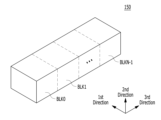
또한, 메모리 장치(150)는, 2차원 또는 3차원의 메모리 장치로 구현될 수 있으며, 특히 도 4에 도시한 바와 같이, 3차원 입체 스택 구조의 비휘발성 메모리 장치로 구현될 수 있으며, 3차원 구조로 구현될 경우, 복수의 메모리 블록들(BLK0 to BLKN-1)을 포함할 수 있다. 여기서, 도 4는, 도 1에 도시한 메모리 장치(150)의 메모리 블록들(152,154,156)을 보여주는 블록도로서, 각각의 메모리 블록들(152,154,156)은, 3차원 구조(또는 수직 구조)로 구현될 수 있다. 예를 들면, 각각의 메모리 블록들(152,154,156)은 제1방향 내지 제3방향들, 예컨대 x-축 방향, y-축 방향, 및 z-축 방향을 따라 신장된 구조물들을 포함하여, 3차원 구조로 구현될 수 있다.In addition, the memory device (150) may be implemented as a two-dimensional or three-dimensional memory device, and in particular, as illustrated in FIG. 4, may be implemented as a nonvolatile memory device having a three-dimensional stack structure, and when implemented as a three-dimensional structure, may include a plurality of memory blocks (BLK0 to BLKN-1). Here, FIG. 4 is a block diagram showing memory blocks (152, 154, 156) of the memory device (150) illustrated in FIG. 1, and each of the memory blocks (152, 154, 156) may be implemented as a three-dimensional structure (or vertical structure). For example, each of the memory blocks (152, 154, 156) may be implemented as a three-dimensional structure, including structures extending along the first to third directions, for example, the x-axis direction, the y-axis direction, and the z-axis direction.
그리고, 메모리 장치(150)에 포함된 각 메모리 블록(330)은, 제2방향을 따라 신장된 복수의 낸드 스트링들(NS)을 포함할 수 있으며, 제1방향 및 제3방향들을 따라 복수의 낸드 스트링들(NS)이 제공될 수 있다. 여기서, 각 낸드 스트링(NS)은, 비트라인(BL), 적어도 하나의 스트링 선택라인(SSL), 적어도 하나의 접지 선택라인(GSL), 복수의 워드라인들(WL), 적어도 하나의 더미 워드라인(DWL), 그리고 공통 소스라인(CSL)에 연결될 수 있으며, 복수의 트랜지스터 구조들(TS)을 포함할 수 있다.And, each memory block (330) included in the memory device (150) may include a plurality of NAND strings (NS) extended along the second direction, and a plurality of NAND strings (NS) may be provided along the first direction and the third direction. Here, each NAND string (NS) may be connected to a bit line (BL), at least one string select line (SSL), at least one ground select line (GSL), a plurality of word lines (WL), at least one dummy word line (DWL), and a common source line (CSL), and may include a plurality of transistor structures (TS).
즉, 메모리 장치(150)의 복수의 메모리 블록들(152,154,156)에서 각 메모리 블록(330)은, 복수의 비트라인들(BL), 복수의 스트링 선택라인들(SSL), 복수의 접지 선택라인들(GSL), 복수의 워드라인들(WL), 복수의 더미 워드라인들(DWL), 그리고 복수의 공통 소스라인(CSL)에 연결될 수 있으며, 그에 따라 복수의 낸드 스트링들(NS)을 포함할 수 있다. 또한, 각 메모리 블록(330)에서, 하나의 비트라인(BL)에 복수의 낸드 스트링들(NS)이 연결되어, 하나의 낸드 스트링(NS)에 복수의 트랜지스터들이 구현될 수 있다. 아울러, 각 낸드 스트링(NS)의 스트링 선택 트랜지스터(SST)는, 대응하는 비트라인(BL)과 연결될 수 있으며, 각 낸드 스트링(NS)의 접지 선택 트랜지스터(GST)는, 공통 소스라인(CSL)과 연결될 수 있다. 여기서, 각 낸드 스트링(NS)의 스트링 선택 트랜지스터(SST) 및 접지 선택 트랜지스터(GST) 사이에 메모리 셀들(MC)이 제공, 즉 메모리 장치(150)의 복수의 메모리 블록들(152,154,156)에서 각 메모리 블록(330)에는 복수의 메모리 셀들이 구현될 수 있다.That is, in the plurality of memory blocks (152, 154, 156) of the memory device (150), each memory block (330) may be connected to a plurality of bit lines (BL), a plurality of string select lines (SSL), a plurality of ground select lines (GSL), a plurality of word lines (WL), a plurality of dummy word lines (DWL), and a plurality of common source lines (CSL), and may thus include a plurality of NAND strings (NS). In addition, in each memory block (330), a plurality of NAND strings (NS) may be connected to one bit line (BL), and a plurality of transistors may be implemented in one NAND string (NS). In addition, the string select transistor (SST) of each NAND string (NS) may be connected to a corresponding bit line (BL), and the ground select transistor (GST) of each NAND string (NS) may be connected to a common source line (CSL). Here, memory cells (MC) are provided between the string select transistor (SST) and the ground select transistor (GST) of each NAND string (NS), that is, a plurality of memory cells can be implemented in each memory block (330) of a plurality of memory blocks (152, 154, 156) of the memory device (150).
그러면 이하에서, 도 5 내지 도 12b을 참조하여 본 발명의 실시 예에 따른 메모리 시스템에서의 메모리 장치로의 데이터 처리, 특히 호스트(102)로부터 수신된 커맨드에 해당하는 커맨드 동작의 수행, 및 커맨드 동작의 수행 여부를 확인하는 동작에 대해서 보다 구체적으로 설명하기로 한다.Then, below, with reference to FIGS. 5 to 12b, data processing to a memory device in a memory system according to an embodiment of the present invention, particularly, execution of a command operation corresponding to a command received from a host (102), and an operation of confirming whether or not the command operation is performed, will be described in more detail.
도 5는 본 발명의 실시 예에 따른 메모리 시스템 110의 예를 도시한 도면이다.FIG. 5 is a diagram illustrating an example of a
도 5를 참조하면, 메모리 시스템 110은 컨트롤러 130과 메모리 장치 150을 포함할 수 있다. 컨트롤러 130은 프로세서 510과 메모리 컨트롤러 520을 포함할 수 있다. 프로세서 510과 메모리 컨트롤러 520은 각각 도 1에 도시된 프로세서 134와 NFC 142에 대응하는 구성일 수 있다. 프로세서 510은 메모리 시스템 110의 전반적인 동작을 제어하기 위하여 플래시 변환 계층(Flash Translation Layer, FTL)이라 불리는 펌웨어(firmware, FW)를 구동할 수 있다. Referring to FIG. 5, the
메모리 장치 150은 복수의 메모리 다이(memory die)들을 포함할 수 있다. 예를 들어, 메모리 장치 150은 1번째 메모리 다이 Die0 610, 2번째 메모리 다이 Die1 630, (N-1)번째 메모리 다이 690을 포함하는 N개의 메모리 다이들을 포함할 수 있다. N개의 메모리 다이들 각각은 복수의 플래인(plane)들을 포함할 수 있으며, 각 플레인들은 복수의 메모리 블록들을 포함할 수 있다. 다양한 실시 예들에서, 메모리 장치 150은 NAND 타입의 플래시(Flash) 메모리로 구현될 수 있다.The
도 6a 및 도 6b는 본 발명의 실시 예에 따른 메모리 장치 150의 예들을 도시한 도면들이다. FIGS. 6A and 6B are diagrams illustrating examples of
도 6a를 참조하면, 메모리 장치 150은 복수의 메모리 다이들을 포함할 수 있다. 예컨대 메모리 장치 150은 메모리 다이0 610, 메모리 다이1 630, 메모리 다이2 650, 메모리 다이3 670을 포함한다. 각각의 메모리 다이들 610,630,650,670은 복수의 플래인(plane)들을 포함한다. 예컨대 메모리 다이0 610은 플래인0 612, 플래인1 616, 플래인2 620, 플래인3 624를 포함한다. 메모리 다이1 630은 플래인0 632, 플래인1 636, 플래인2 640, 플래인3 644를 포함한다. 메모리 다이2 650은 플래인0 652, 플래인1 656, 플래인2 660, 플래인3 664를 포함한다. 메모리 다이3 670은 플래인0 672, 플래인1 676, 플래인2 680, 플래인3 684를 포함한다. 메모리 장치 150에 포함된 메모리 다이들 610,630,650,670의 각 플래인들 612,616,620, 624,632, 636,640, 644,652,656,660,664,672,676,680,684은 복수의 메모리 블록들 614,618,622,626, 634,638, 642,646,654,658,662,666,674,678,682,686을 포함한다. 예컨대 각 플래인들은 앞서 도 2에서 설명한 바와 같이, 복수의 페이지들, 예컨대 2M개의 페이지들(2M Pages)을 포함하는 N개의 블록들 Block0, Block1, ... , Block N-1을 포함한다.Referring to FIG. 6A, the
도 6b를 참조하면, 메모리 장치 150은 복수의 메모리 다이들 610,630,650, 670을 포함할 수 있다. 각 메모리 다이들은 NAND 타입의 플래시(Flash) 메모리 또는 NAND 칩(chip)로 구현될 수 있다. 시장에서 요구되는 메모리 장치 150의 용량은 계속해서 증가되고 있기 때문에, 이 요구되는 용량을 만족시키기 위하여, 메모리 장치 150은 하나의 NAND 칩이 아닌, 복수의 NAND 칩들을 포함하는 형태로 구현되고 있다.Referring to FIG. 6b, the
한편, 메모리 시스템 110의 전반적인 동작을 제어하는 컨트롤러 130은 복수의 메모리 블록들 단위로 NAND 칩들을 제어할 필요가 있다. 예컨대 컨트롤러 130의 FTL은 논리적인 블록 개념을 필요로 하는데, 이는 소위 '수퍼블록(super block)'이라 불리운다.Meanwhile, the
다시 도 6b를 참조하면, 메모리 장치 150은 복수의 NAND Flash 칩들 610, 630, 650, 670을 포함한다. 각 칩들은 복수의 메모리 블록들 Block#0 - Block#7을 포함한다. 각 칩들의 메모리 블록들 Block#0은 수퍼블록 Super Block #0을 구성하고, 메모리 블록들 Block#1은 수퍼블록 Super Block #1을 구성하고, 메모리 블록들 Block#2는 수퍼블록 Super Block #2를 구성한다. 각각의 NAND 칩들은 독립적으로 동작할 수 있는 구조이기 때문에 각 칩들은 컨트롤러 130으로부터 전달된 요청을 즉시 처리할 수 있다. 이때 처리되는 시간은 모두 다를 수 있다. 즉, 컨트롤러 130으로부터 동일한 시점에 요청이 전달되더라도 각 칩들에서의 처리 시간은 순차적이지 않을 수 있다. Referring again to FIG. 6b, the
도 7a를 참조하면, 메모리 장치 150는 수퍼 블록 내에서 순차적인 프로그램이 이루어지지 않는다. 예를 들어, 컨트롤러 130이 특정 크기의 음성 파일(audio file)과 같은 연속적인 데이터를 메모리 장치 150으로 전달하는 경우, 메모리 장치 150에 전달된 데이터는 수퍼 블록내에서 순차적으로 프로그램되지 않을 수 있다. 컨트롤러 130은 수퍼 블록 Super Block #0, Super Block #1내에서 순차적으로 데이터가 프로그램되기를 기대하지만, 이러한 기대와 달리 프로그램은 Super Block #0 내에서는 Flash0 (610), Flash1 (630), Flash2 (650), Flash3 (670)와 같이 순차적으로 수행되지만, Super Block #1 내에서는 Flash0 (610), Flash1 (630), Flash3 (670)과 같이 비순차적으로 수행될 수 있다.Referring to FIG. 7a, the
도 7b를 참조하면, Super Block #1 내에서 프로그램의 완료는 Flash0 (610), Flash1 (630), Flash3 (670), Flash2 (650)와 같은 순서로 수행되기 때문에, 프로그램 순서는 역전될 수 있다. 이러한 상황에서 파워오프(power off)가 발생한다면 비연속적인 상태가 나타나고, 그에 따라 데이터의 유효성이 깨질 수 있다. 이 상태는 컨트롤러 130이 기대하는 구조와 다른 예외적인 구조에 해당하며, 이는 컨트롤러 130을 복잡하게 만들며 경우에 따라 불완전한 결과를 초래할 수 있다.Referring to Fig. 7b, since the completion of the program within
만약 LBA(logical block address)0 - LBA3까지 라이트되는 과정, 즉 Flash0 (610), Flash1 (630), Flash2 (650), Flash3 (670)의 순서로 프로그램이 기대되는 과정에서, 도 7a 및 도 7b에 도시된 바와 같이 Super Block #1 내에서 프로그램이 Flash0 (610), Flash1 (630), Flash3 (670), Flash2 (650)과 같이 비순차적으로 수행되었다고 가정하자. 만약 도 7a에 도시된 바와 같이 프로그램이 수행된 이후에 LBA0 - LBA3에 대해서 리드 동작을 수행하게 되면, LBA0, LBA1, LBA3에 대한 데이터는 새로운 데이터(new data)에 해당하지만, LAB2에 대한 데이터는 기존 데이터(old data)에 해당한다. 즉, 데이터의 유효성이 깨지는 경우가 발생한다.Let's assume that the program is performed non-sequentially as Flash0 (610), Flash1 (630), Flash3 (670), Flash2 (650) within
본 발명의 실시 예들은 복수의 메모리 다이들(또는 NAND Flash 칩)을 포함하는 메모리 장치에서 순차적으로 프로그래밍이 필요한 경우 처리 순서를 보장함으로써 데이터의 유효성이 깨지는 경우를 방지한다. 즉, 본 발명의 실시 예들은 복수의 메모리 다이들(또는 NAND Flash 칩)을 포함하는 메모리 장치에서 데이터의 연속성을 보장되도록 순차적 프로그래밍 기법을 제공한다. Embodiments of the present invention prevent data validity from being broken by ensuring a processing order when sequential programming is required in a memory device including a plurality of memory dies (or NAND Flash chips). That is, embodiments of the present invention provide a sequential programming technique to ensure data continuity in a memory device including a plurality of memory dies (or NAND Flash chips).
도 8은 본 발명의 실시 예에 따른 메모리 시스템에 의한 프로그램 동작 절차를 도시한 도면이다. 이 절차는 이에 제한되는 것은 아니지만, 도 5에 도시된 프로세서 510과 메모리 컨트롤러 520와 메모리 장치 150의 사이에서 수행되는 예로서 설명될 것이다. 그러나 본 발명의 실시 예는 프로세서 510과 메모리 컨트롤러 520이 단일의 프로세서 또는 컨트롤러에 의해 구현되는 경우에도 동일하게 적용될 수 있다는 사실에 유의하여야 한다.FIG. 8 is a diagram illustrating a program operation procedure by a memory system according to an embodiment of the present invention. This procedure will be described as an example performed between the
도 8을 참조하면, 프로세서 510은 라이트 커맨드(write command)를 수신한다(810). 예를 들어, 라이트 커맨드는 도 1 및 도 5에 도시된 호스트 102로부터 수신될 수 있다.Referring to FIG. 8,
라이트 커맨드의 수신에 응답하여 프로세서 510은 메모리 장치 150에 포함되는 복수의 메모리 다이들에서 순차적 프로그래밍이 필요한지 여부를 판단한다(820). 순차적 프로그래밍이 필요한 것으로 판단되는 경우, 프로세서 510은 라이트 커맨드와 프로그래밍의 순서를 나타내는 시퀀스 번호(sequence number)들을 메모리 컨트롤러 520으로 전달한다(830). 각 시퀀스 번호는 복수의 메모리 다이들(예; 도 6a의 610, 630, 650, 670) 중에서 슈퍼 블록을 구성하는 메모리 블록들에 대한 프로그래밍의 순서를 나타낸다.In response to receiving a write command, the
메모리 컨트롤러 520은 수신된 시퀀스 번호들에 기초하여 메모리 블록들에 대한 프로그래밍의 순차적 완료를 지시하는 지시 신호들(예; preceding signal)을 생성하여 복수의 메모리 다이들 각각으로 제공한다(840).The
메모리 장치 150에 포함되는 복수의 메모리 다이들 각각은 라이트 커맨드의 수신에 응답하여 프로그램 동작을 개시하고, 대응하는 지시 신호가 수신됨에 응답하여 프로그램 동작을 완료함으로써 순차적 프로그램 동작을 수행한다(850). 다양한 실시예에 따르면, 복수의 메모리 다이들 각각은, 라이트 커맨드의 수신에 응답하여 프로그램 동작을 개시하고, 상기 프로그램 동작을 미리 결정된 단계까지 수행한 후 프로그램 중지 상태(suspended state)로 천이하고, 대응하는 지시 신호가 수신됨에 응답하여 상기 중지 상태의 프로그램 동작을 재개하여 완료한다. 또한 복수의 메모리 다이들 각각은 프로그램 동작 완료를 나타내는 보고 신호를 컨트롤러 130 또는 메모리 컨트롤러 520로 전달할 수 있다.Each of a plurality of memory dies included in a
도 9는 본 발명의 실시 예에 따른 프로세서에 의한 프로그램 동작의 처리 흐름을 도시한 도면이다. 이 처리 흐름은 도 8에 도시된 프로세서 510에 의해 수행될 수 있다. FIG. 9 is a diagram illustrating a processing flow of a program operation by a processor according to an embodiment of the present invention. This processing flow can be performed by the
도 9를 참조하면, 910단계에서 프로세서 510은 라이트 커맨드가 수신되었는지 여부를 판단한다. 라이트 커맨드가 수신된 것으로 판단된 경우, 920단계에서 프로세서 510은 메모리 장치 150에 포함되는 복수의 메모리 다이들에서 순차적 프로그래밍이 필요한지 여부를 판단한다. 순차적 프로그래밍(또는 순차적 쓰기)이 필요한 것으로 판단되는 경우에는 930단계로 진행하고, 판단되지 않은 경우에는 940단계로 진행한다.Referring to FIG. 9, in
순차적 프로그래밍이 필요하지 않은 것으로 판단된 경우, 940단계에서 프로세서 510은 수신된 라이트 커맨드를 메모리 컨트롤러 520으로 전달한다. If sequential programming is determined not to be necessary, the
순차적 프로그래밍이 필요한 것으로 판단된 경우, 930단계에서 프로세서 510은 프로그래밍의 순서를 나타내는 시퀀스 번호(sequence number)들을 생성하고, 라이트 커맨드와 시퀀스 번호들을 메모리 컨트롤러 520으로 전달한다(830). 예를 들어, 프로세서 510은 후술되는 도 12a에 도시된 바와 같이 라이트 커맨드와 시퀀스 번호들을 메모리 컨트롤러 520으로 전달한다. If sequential programming is determined to be necessary, at
도 10은 본 발명의 실시 예에 따른 메모리 컨트롤러에 의한 프로그램 동작의 처리 흐름을 도시한 도면이다. 이 처리 흐름은 도 8에 도시된 메모리 컨트롤러 520에 의해 수행될 수 있다. FIG. 10 is a diagram illustrating a processing flow of a program operation by a memory controller according to an embodiment of the present invention. This processing flow can be performed by the
도 10을 참조하면, 1010단계에서 메모리 컨트롤러 520은 라이트 커맨드 및 시퀀스 번호가 수신되었는지 여부를 판단한다. 메모리 컨트롤러 520은 라이트 커맨드 및 시퀀스 번호가 모두 수신된 것으로 판단된 경우 1020단계로 진행하고, 라이트 커맨드 및 시퀀스 번호가 모두 수신되지 않은 것으로 판단된 경우 1030단계로 진행한다.Referring to FIG. 10, in
1030단계에서 메모리 컨트롤러 520은 라이트 커맨드만 수신되었는지 여부를 판단한다. 라이트 커맨드만 수신된 것으로 판단되는 경우 1040단계에서 메모리 컨트롤러 520은 라이트 커맨드를 메모리 장치 150으로 전달한다.At
1020단계에서 메모리 컨트롤러 520은 수신된 시퀀스 번호들에 기초하여 메모리 장치 150에 포함되는 메모리 블록들에 대한 프로그래밍의 순차적 완료를 지시하는 지시 신호(예; preceding signal)들을 생성한다. 다음에, 메모리 컨트롤러 520은 라이트 커맨드와 상기 생성된 지시 신호들을 복수의 메모리 다이들 각각으로 제공한다. 다양한 실시 예들에 따르면, 상기 지시 신호들의 생성 및 전달은 라이트 커맨드의 전달 시점 이후에 이루어질 수 있으며, 후술되는 도 12b에 도시된 바와 같이 서로 다를 수 있다.In
도 11은 본 발명의 실시 예에 따른 메모리 장치에 의한 프로그램 동작의 처리 흐름을 도시한 도면이다. 이 처리 흐름은 도 8에 도시된 메모리 장치 150에 포함되는 각 메모리 다이들에 의해 수행될 것이지만, 여기서는 총괄적으로 메모리 장치 150에 의해 수행되는 것으로 설명될 것이다. FIG. 11 is a diagram illustrating a processing flow of a program operation by a memory device according to an embodiment of the present invention. This processing flow will be performed by each memory die included in the
도 11을 참조하면, 1110단계에서 메모리 장치 150은 라이트 커맨드가 수신되는지 여부를 판단한다. 라이트 커맨드가 수신된 것으로 판단되는 경우, 1120단계에서 메모리 장치 150은 라이트 커맨드의 수신에 응답하여 프로그램 동작을 개시한다.Referring to FIG. 11, at
1130단계에서 메모리 장치 150은 프로그램 동작이 수행된 후 일정 단계에 도달하였는지 여부를 판단한다. 다양한 실시 예들에 따르면, 프로그램 동작이 1단계 내지 10단계로 구분되는 경우 메모리 장치 150은 프로그램 동작이 9단계에 도달하였는지 여부를 판단할 수 있다. In
프로그램 동작이 수행된 후 일정 단계에 도달한 것으로 판단되는 경우, 1140단계에서 메모리 장치 150은 프로그램 중지 상태(suspended state)로 천이한다. When it is determined that a certain stage has been reached after the program operation has been performed, the
1150단계에서 메모리 장치 150은 프로그램 완료를 지시하는 지시 신호(예; Preceding Signal)가 수신되었는지 여부를 판단한다. 프로그램 중지 상태에서 프로그램 완료를 지시하는 지시 신호가 수신된 것으로 판단되는 경우, 1160단계에서 메모리 장치 150은 상기 지시 신호가 수신됨에 응답하여 상기 중지 상태의 프로그램 동작을 재개하고, 프로그램 동작을 완료한다. 예를 들어, 프로그램 동작이 10단계로 구분되는 경우 9단계까지 프로그램 동작을 수행한 후 중지 상태로 천이한 메모리 장치 150은 상기 지시 신호에 응답하여 마지막 10단계를 수행한다. In
1170단계에서 메모리 장치 150은 프로그램 동작 완료를 나타내는 보고 신호(예; Return Signal)를 메모리 컨트롤러 520으로 전달한다. At
도 12a 및 도 12b는 본 발명의 실시 예에 따른 메모리 시스템에 의한 프로그램 동작의 예들을 도시한 도면들이다.FIGS. 12A and 12B are diagrams illustrating examples of program operations by a memory system according to an embodiment of the present invention.
도 12a를 참조하면, 프로세서 510은 펌웨어(FW)를 구동하여 프로그래밍의 순차적 완료 순서를 나타내는 시퀀스 번호를 생성하고, 이 생성된 시퀀스 번호를 라이트 커맨드에 포함시켜 메모리 컨트롤러 520으로 전달한다. 예를 들어, 메모리 다이 Die0 610과 메모리 다이 Die1 630이 비지(busy) 상태이고 메모리 다이 Die2 650과 메모리 다이 Die3 670이 아이들(idle) 상태인 경우, 프로세서 510은 메모리 다이 Die2 650에 대한 라이트 커맨드 1211과, 메모리 다이 Die3 670에 대한 라이트 커맨드 1212와, 메모리 다이 Die1 630에 대한 라이트 커맨드 1213과, 메모리 다이 Die0 610에 대한 라이트 커맨드 1214를 순차적으로 메모리 컨트롤러 520으로 전달한다. Referring to FIG. 12A, the
다양한 실시 예에 따르면, 각 라이트 커맨드에는 복수의 메모리 다이들 610,630,650,670들에 대한 프로그래밍의 순서를 나타내는 시퀀스 번호가 포함될 수 있다. 예를 들어, 메모리 다이 Die0 610에 대한 라이트 커맨드 1214에는 시퀀스 번호 Sequence0이 포함될 수 있고, 메모리 다이 Die1 630에 대한 라이트 커맨드 1213에는 시퀀스 번호 Sequence1이 포함될 수 있고, 메모리 다이 Die3 670에 대한 라이트 커맨드 1212에는 시퀀스 번호 Sequence3이 포함될 수 있고, 메모리 다이 Die2 650에 대한 라이트 커맨드 1211에는 시퀀스 번호 Sequence2가 포함될 수 있다. According to various embodiments, each write command may include a sequence number indicating an order of programming for the plurality of memory dies 610, 630, 650, and 670. For example, a
이러한 시퀀스 번호들에 대응하여 메모리 다이 Die0 610에 대한 프로그램 동작 1221이 완료되고, 다음에 메모리 다이 Die1 630에 대한 프로그램 동작 1222가 완료되고, 그 다음에 메모리 다이 Die2 650에 대한 프로그램 동작 1223이 완료되고, 마지막으로 메모리 다이 Die3 670에 대한 프로그램 동작 1224가 완료될 수 있다. Corresponding to these sequence numbers, a
도 12b를 참조하면, 메모리 컨트롤러 520은 제1 지시 신호 Preceding Signal #1을 생성하여 메모리 다이 Die0 610으로 전달한다. 메모리 다이 Die0 610은 라이트 커맨드의 수신에 응답하여 프로그램 동작을 개시하고, 상기 제1 지시 신호가 수신됨에 응답하여 프로그램 동작을 완료하고, 프로그램 동작 완료를 나타내는 제1 보고 신호 Return Signal #1을 메모리 컨트롤러 520으로 전달한다. Referring to FIG. 12B, the
제1 보고 신호 Return Signal #1이 수신됨에 응답하여 메모리 컨트롤러 520은 제2 지시 신호 Preceding Signal #2를 생성하여 메모리 다이 Die1 630으로 전달한다. 메모리 다이 Die1 630은 라이트 커맨드의 수신에 응답하여 프로그램 동작을 개시하고, 상기 제2 지시 신호가 수신됨에 응답하여 프로그램 동작을 완료하고, 프로그램 동작 완료를 나타내는 제2 보고 신호 Return Signal #2를 메모리 컨트롤러 520으로 전달한다. In response to receiving the first report signal
제2 보고 신호 Return Signal #2가 수신됨에 응답하여 메모리 컨트롤러 520은 제3 지시 신호 Preceding Signal #3을 생성하여 메모리 다이 Die2 650으로 전달한다. 메모리 다이 Die2 650은 라이트 커맨드의 수신에 응답하여 프로그램 동작을 개시하고, 상기 제3 지시 신호가 수신됨에 응답하여 프로그램 동작을 완료하고, 프로그램 동작 완료를 나타내는 제3 보고 신호 Return Signal #3을 메모리 컨트롤러 520으로 전달한다. In response to receiving the second report signal
제3 보고 신호 Return Signal #3이 수신됨에 응답하여 메모리 컨트롤러 520은 제4 지시 신호 Preceding Signal #4를 생성하여 메모리 다이 Die3 670으로 전달한다. 메모리 다이 Die3 670은 라이트 커맨드의 수신에 응답하여 프로그램 동작을 개시하고, 상기 제4 지시 신호가 수신됨에 응답하여 프로그램 동작을 완료하고, 프로그램 동작 완료를 나타내는 제4 보고 신호 Return Signal #4를 메모리 컨트롤러 520으로 전달한다. In response to receiving the third report signal
이러한 지시 신호들에 대응하여 메모리 다이 Die0 610에 대한 프로그램 동작 1231이 완료되고, 다음에 메모리 다이 Die1 630에 대한 프로그램 동작 1232가 완료되고, 그 다음에 메모리 다이 Die2 650에 대한 프로그램 동작 1233이 완료되고, 마지막으로 메모리 다이 Die3 670에 대한 프로그램 동작 1234가 완료될 수 있다. 즉, 프로그래밍 완료 순서가 제1 메모리 다이 Die0 610, 제2 메모리 다이 Die1 630, 제3 메모리 다이 Die2 650, 제4 메모리 다이 Die3 670의 순서로 결정되어 있는 경우, 복수의 메모리 다이들에 대한 프로그램 동작이 순차적으로 완료될 수 있다. In response to these instruction signals, a
전술한 바와 같이 본 발명의 실시 예들에 따르면, 프로세서 510의 펌웨어는 순차적 프로그래밍(또는 쓰기)가 필요한 경우 메모리 컨트롤러 520에게 라이트 커맨드와 함께 시퀀스 번호를 포함하여 전달한다. 메모리 컨트롤러 520는 해당 시퀀스 번호를 바탕으로 순서에 맞게 프로그래밍 완료를 지시하는 지시 신호(예; Preceding Signal)를 메모리 장치 150의 특정 메모리 다이(또는 NAND Flash)로 전달한다. 지시 신호를 수신한 메모리 다이는 라이트 동작(또는 프로그램 동작)을 완료한다. 반면에, 지시 신호를 수신하지 못한 메모리 다이는 비지(busy) 상태로 동작을 유지(holding)하고 대기한다. 이러한 상태에서 지시 신호가 수신되면 메모리 다이는 비로소 프로그램 동작을 완료하고, 프로그램 동작 완료를 나타내는 보고 신호를 메모리 컨트롤러 520으로 전달한다. 메모리 컨트롤러 520은 보고 신호를 수신하고 다음 순서의 메모리 다이에 지시 신호를 전달한다. 이러한 과정을 통하여 프로그래밍 처리 순서를 지정할 수 있으므로, 도 7b에 도시된 바와 같은 수퍼 블록의 상태가 보장될 수 있다. 즉, 본 발명의 실시 예들은 시퀀스 번호를 포함하는 라이트 커맨드와 지시 신호를 이용하여 복수의 메모리 블록들에 대한 프로그램 동작 중에도 수퍼 블록의 데이터 연속성을 보장하여 유효한 데이터 상태를 보장할 수 있다. 또한, 본 발명의 실시 예들은 큐잉(queuing) 동작을 보장하여 라이트 동작에 대한 성능을 보장할 수 있다. 또한, 본 발명의 실시 예들은 컨트롤러의 지원을 통해 꼭 필요한 처리 순서를 보장할 수 있다. As described above, according to the embodiments of the present invention, when sequential programming (or writing) is required, the firmware of the
도 13은 본 발명의 실시 예에 따른 메모리 시스템을 포함하는 데이터 처리 시스템의 다른 일 예를 개략적으로 도시한 도면이다. 여기서, 도 13은 본 발명의 실시 예에 따른 메모리 시스템이 적용된 메모리 카드 시스템을 개략적으로 도시한 도면이다.FIG. 13 is a diagram schematically illustrating another example of a data processing system including a memory system according to an embodiment of the present invention. Here, FIG. 13 is a diagram schematically illustrating a memory card system to which a memory system according to an embodiment of the present invention is applied.
도 13을 참조하면, 메모리 카드 시스템(6100)은, 메모리 컨트롤러(6120), 메모리 장치(6130), 및 커넥터(6110)를 포함한다.Referring to FIG. 13, the memory card system (6100) includes a memory controller (6120), a memory device (6130), and a connector (6110).
보다 구체적으로 설명하면, 메모리 컨트롤러(6120)는, 불휘발성 메모리로 구현된 메모리 장치(6130)와 연결되며, 메모리 장치(6130)를 액세스하도록 구현된다. 예컨대, 메모리 컨트롤러(6120)는, 메모리 장치(6130)의 리드, 라이트, 이레이즈, 및 백그라운드(background) 동작 등을 제어하도록 구현된다. 그리고, 메모리 컨트롤러(6120)는, 메모리 장치(6130) 및 호스트(Host) 사이에 인터페이스를 제공하도록 구현되며, 메모리 장치(6130)를 제어하기 위한 펌웨어(firmware)를 구동하도록 구현된다. 즉, 메모리 컨트롤러(6120)는, 도 1에서 설명한 메모리 시스템(110)에서의 컨트롤러(130)에 대응되며, 메모리 장치(6130)는, 도 1에서 설명한 메모리 시스템(110)에서의 메모리 장치(150)에 대응될 수 있다.To be more specific, the memory controller (6120) is connected to a memory device (6130) implemented as a nonvolatile memory, and is implemented to access the memory device (6130). For example, the memory controller (6120) is implemented to control read, write, erase, and background operations of the memory device (6130). In addition, the memory controller (6120) is implemented to provide an interface between the memory device (6130) and a host, and is implemented to drive firmware for controlling the memory device (6130). That is, the memory controller (6120) may correspond to the controller (130) in the memory system (110) described in FIG. 1, and the memory device (6130) may correspond to the memory device (150) in the memory system (110) described in FIG. 1.
그에 따라, 메모리 컨트롤러(6120)는, 램(RAM: Random Access Memory), 프로세싱 유닛(processing unit), 호스트 인터페이스(host interface), 메모리 인터페이스(memory interface), 에러 정정부와 같은 구성 요소들을 포함할 수 있다.Accordingly, the memory controller (6120) may include components such as a RAM (Random Access Memory), a processing unit, a host interface, a memory interface, and an error correction unit.
아울러, 메모리 컨트롤러(6120)는, 커넥터(6110)를 통해 외부 장치, 예컨대 도 1에서 설명한 호스트(102)와 통신할 수 있다. 예컨대, 메모리 컨트롤러(6120)는, 도 1에서 설명한 바와 같이, USB(Universal Serial Bus), MMC(multimedia card), eMMC(embeded MMC), PCI(peripheral component interconnection), PCIe(PCI express), ATA(Advanced Technology Attachment), Serial-ATA, Parallel-ATA, SCSI(small computer small interface), ESDI(enhanced small disk interface), IDE(Integrated Drive Electronics), 파이어와이어(Firewire), UFS(Universal Flash Storage), WIFI, Bluetooth 등과 같은 다양한 통신 규격들 중 적어도 하나를 통해 외부 장치와 통신하도록 구성될 수 있으며, 그에 따라 유선/무선 전자 기기들, 특히 모바일 전자 기기 등에 본 발명의 실시 예에 따른 메모리 시스템 및 데이터 처리 시스템이 적용될 수 있다.In addition, the memory controller (6120) can communicate with an external device, for example, the host (102) described in FIG. 1, through the connector (6110). For example, the memory controller (6120), as described in FIG. 1, can be configured to communicate with an external device through at least one of various communication standards, such as USB (Universal Serial Bus), MMC (multimedia card), eMMC (embedded MMC), PCI (peripheral component interconnection), PCIe (PCI express), ATA (Advanced Technology Attachment), Serial-ATA, Parallel-ATA, SCSI (small computer small interface), ESDI (enhanced small disk interface), IDE (Integrated Drive Electronics), Firewire, UFS (Universal Flash Storage), WIFI, Bluetooth, etc., and thus, the memory system and data processing system according to the embodiment of the present invention can be applied to wired/wireless electronic devices, particularly, mobile electronic devices.
그리고, 메모리 장치(6130)는, 불휘발성 메모리로 구현, 예컨대 EPROM(Electrically Erasable and Programmable ROM), 낸드 플래시 메모리, 노어 플래시 메모리, PRAM(Phase-change RAM), ReRAM(Resistive RAM), FRAM(Ferroelectric RAM), STT-MRAM(Spin-Torque Magnetic RAM) 등과 같은 다양한 불휘발성 메모리 소자들로 구현될 수 있다.In addition, the memory device (6130) may be implemented as a nonvolatile memory, for example, various nonvolatile memory elements such as an EPROM (Electrically Erasable and Programmable ROM), a NAND flash memory, a NOR flash memory, a PRAM (Phase-change RAM), a ReRAM (Resistive RAM), a FRAM (Ferroelectric RAM), a STT-MRAM (Spin-Torque Magnetic RAM), etc.
아울러, 메모리 컨트롤러(6120) 및 메모리 장치(6130)는, 하나의 반도체 장치로 집적될 수 있으며, 일 예로 하나의 반도체 장치로 집적되어 솔리드 스테이트 드라이브(SSD: Solid State Drive)를 구성할 수 있으며, PC 카드(PCMCIA), 컴팩트 플래시 카드(CF), 스마트 미디어 카드(SM, SMC), 메모리 스틱, 멀티미디어 카드(MMC, RS-MMC, MMCmicro, eMMC), SD 카드(SD, miniSD, microSD, SDHC), 유니버설 플래시 기억장치(UFS) 등과 같은 메모리 카드를 구성할 수 있다.In addition, the memory controller (6120) and the memory device (6130) can be integrated into a single semiconductor device, and for example, can be integrated into a single semiconductor device to configure a solid state drive (SSD), and can configure a memory card such as a PC card (PCMCIA), a compact flash card (CF), a smart media card (SM, SMC), a memory stick, a multimedia card (MMC, RS-MMC, MMCmicro, eMMC), an SD card (SD, miniSD, microSD, SDHC), a universal flash memory device (UFS), etc.
도 14는 본 발명의 실시 예에 따른 메모리 시스템을 포함하는 데이터 처리 시스템의 다른 일 예를 개략적으로 도시한 도면이다.FIG. 14 is a diagram schematically illustrating another example of a data processing system including a memory system according to an embodiment of the present invention.
도 14를 참조하면, 데이터 처리 시스템(6200)은, 적어도 하나의 불휘발성 메모리로 구현된 메모리 장치(6230), 및 메모리 장치(6230)를 제어하는 메모리 컨트롤러(6220)를 포함한다. 여기서, 도 10에 도시한 데이터 처리 시스템(6200)은, 도 1에서 설명한 바와 같이, 메모리 카드(CF, SD, microSD, 등), USB 저장 장치 등과 같은 저장 매체가 될 수 있으며, 메모리 장치(6230)는, 도 1에서 설명한 메모리 시스템(110)에서의 메모리 장치(150)에 대응되고, 메모리 컨트롤러(6220)는, 도 1에서 설명한 메모리 시스템(110)에서의 컨트롤러(130)에 대응될 수 있다.Referring to FIG. 14, the data processing system (6200) includes a memory device (6230) implemented with at least one nonvolatile memory, and a memory controller (6220) controlling the memory device (6230). Here, the data processing system (6200) illustrated in FIG. 10 may be a storage medium such as a memory card (CF, SD, microSD, etc.), a USB storage device, etc., as described in FIG. 1, and the memory device (6230) may correspond to the memory device (150) in the memory system (110) described in FIG. 1, and the memory controller (6220) may correspond to the controller (130) in the memory system (110) described in FIG. 1.
그리고, 메모리 컨트롤러(6220)는, 호스트(6210)의 요청에 응답하여 메모리 장치(6230)에 대한 리드, 라이트, 이레이즈 동작 등을 제어하며, 메모리 컨트롤러(6220)는 적어도 하나의 CPU(6221), 버퍼 메모리, 예컨대 RAM(6222), ECC 회로(6223), 호스트 인터페이스(6224), 및 메모리 인터페이스, 예컨대 NVM 인터페이스(6225)를 포함한다.And, the memory controller (6220) controls read, write, erase operations, etc. for the memory device (6230) in response to a request of the host (6210), and the memory controller (6220) includes at least one CPU (6221), a buffer memory, such as a RAM (6222), an ECC circuit (6223), a host interface (6224), and a memory interface, such as a NVM interface (6225).
여기서, CPU(6221)는, 메모리 장치(6230)에 대한 전반적인 동작, 예컨대 읽기, 쓰기, 파일 시스템 관리, 배드 페이지 관리 등)을 제어할 수 있다. 그리고, RAM(6222)는, CPU(6221)의 제어에 따라 동작하며, 워크 메모리(work memory), 버퍼 메모리(buffer memory), 캐시 메모리(cache memory) 등으로 사용될 수 있다. 여기서, RAM(6222)이 워크 메모리로 사용되는 경우에, CPU(6221)에에서 처리된 데이터가 임시 저장되며, RAM(6222)이 버퍼 메모리로 사용되는 경우에는, 호스트(6210)에서 메모리 장치(6230)로 또는 메모리 장치(6230)에서 호스트(6210)로 전송되는 데이터의 버퍼링을 위해 사용되며, RAM(6222)이 캐시 메모리로 사용되는 경우에는 저속의 메모리 장치(6230)가 고속으로 동작하도록 사용될 수 있다.Here, the CPU (6221) can control the overall operation of the memory device (6230), such as reading, writing, file system management, bad page management, etc. In addition, the RAM (6222) operates under the control of the CPU (6221) and can be used as a work memory, a buffer memory, a cache memory, etc. Here, when the RAM (6222) is used as a work memory, data processed by the CPU (6221) is temporarily stored, and when the RAM (6222) is used as a buffer memory, it is used for buffering data transmitted from the host (6210) to the memory device (6230) or from the memory device (6230) to the host (6210), and when the RAM (6222) is used as a cache memory, it can be used to allow a low-speed memory device (6230) to operate at high speed.
아울러, ECC 회로(6223)는, 도 1에서 설명한 컨트롤러(130)의 ECC 유닛(138)에 대응하며, 도 1에서 설명한 바와 같이, 메모리 장치(6230)로부터 수신된 데이터의 페일 비트(fail bit) 또는 에러 비트(error bit)를 정정하기 위한 에러 정정 코드(ECC: Error Correction Code)를 생성한다. 또한, ECC 회로(6223)는, 메모리 장치(6230)로 제공되는 데이터의 에러 정정 인코딩을 수행하여, 패리티(parity) 비트가 부가된 데이터를 형성한다. 여기서, 패리티 비트는, 메모리 장치(6230)에 저장될 수 있다. 또한, ECC 회로(6223)는, 메모리 장치(6230)로부터 출력된 데이터에 대하여 에러 정정 디코딩을 수행할 수 있으며, 이때 ECC 회로(6223)는 패리티(parity)를 사용하여 에러를 정정할 수 있다. 예컨대, ECC 회로(6223)는, 도 1에서 설명한 바와 같이, LDPC code, BCH code, turbo code, 리드-솔로몬 코드, convolution code, RSC, TCM, BCM 등의 다양한 코디드 모듈레이션(coded modulation)을 사용하여 에러를 정정할 수 있다.In addition, the ECC circuit (6223) corresponds to the ECC unit (138) of the controller (130) described in FIG. 1, and generates an error correction code (ECC) for correcting a fail bit or an error bit of data received from the memory device (6230) as described in FIG. 1. In addition, the ECC circuit (6223) performs error correction encoding of data provided to the memory device (6230) to form data with a parity bit added. Here, the parity bit can be stored in the memory device (6230). In addition, the ECC circuit (6223) can perform error correction decoding on data output from the memory device (6230), and at this time, the ECC circuit (6223) can correct an error using parity. For example, the ECC circuit (6223) can correct errors using various coded modulations such as LDPC code, BCH code, turbo code, Reed-Solomon code, convolution code, RSC, TCM, and BCM, as described in FIG. 1.
그리고, 메모리 컨트롤러(6220)는, 호스트 인터페이스(6224)를 통해 호스트(6210)와 데이터 등을 송수신하며, NVM 인터페이스(6225)를 통해 메모리 장치(6230)와 데이터 등을 송수신한다. 여기서, 호스트 인터페이스(6224)는, PATA 버스, SATA 버스, SCSI, USB, PCIe, 낸드 인터페이스 등을 통해 호스트(6210)와 연결될 수 있다. 또한, 메모리 컨트롤러(6220)는, 무선 통신 기능, 모바일 통신 규격으로 WiFi 또는 LTE(Long Term Evolution) 등이 구현되어, 외부 장치, 예컨대 호스트(6210) 또는 호스트(6210) 이외의 다른 외부 장치와 연결된 후, 데이터 등을 송수신할 수 있으며, 특히 다양한 통신 규격들 중 적어도 하나를 통해 외부 장치와 통신하도록 구성됨에 따라, 유선/무선 전자 기기들, 특히 모바일 전자 기기 등에 본 발명의 실시 예에 따른 메모리 시스템 및 데이터 처리 시스템이 적용될 수 있다.And, the memory controller (6220) transmits and receives data, etc. with the host (6210) through the host interface (6224), and transmits and receives data, etc. with the memory device (6230) through the NVM interface (6225). Here, the host interface (6224) can be connected to the host (6210) through a PATA bus, a SATA bus, SCSI, USB, PCIe, a NAND interface, etc. In addition, the memory controller (6220) implements a wireless communication function, such as WiFi or LTE (Long Term Evolution) as a mobile communication standard, so that after being connected to an external device, such as the host (6210) or an external device other than the host (6210), data, etc. can be transmitted and received, and in particular, since it is configured to communicate with the external device through at least one of various communication standards, the memory system and data processing system according to an embodiment of the present invention can be applied to wired/wireless electronic devices, particularly mobile electronic devices.
도 15는 본 발명의 실시 예에 따른 메모리 시스템을 포함하는 데이터 처리 시스템의 다른 일 예를 개략적으로 도시한 도면이다. 여기서, 도 15는 본 발명의 실시 예에 따른 메모리 시스템이 적용된 솔리드 스테이트 드라이브(SSD: Solid State Drive)를 개략적으로 도시한 도면이다.FIG. 15 is a diagram schematically illustrating another example of a data processing system including a memory system according to an embodiment of the present invention. Here, FIG. 15 is a diagram schematically illustrating a solid state drive (SSD) to which a memory system according to an embodiment of the present invention is applied.
도 15를 참조하면, SSD(6300)는, 복수의 불휘발성 메모리들을 포함하는 메모리 장치(6340) 및 컨트롤러(6320)를 포함한다. 여기서, 컨트롤러(6320)는, 도 1에서 설명한 메모리 시스템(110)에서의 컨트롤러(130)에 대응되며, 메모리 장치(6340)는, 도 1에서 설명한 메모리 시스템(110)에서의 메모리 장치(150)에 대응될 수 있다.Referring to FIG. 15, the SSD (6300) includes a memory device (6340) including a plurality of nonvolatile memories and a controller (6320). Here, the controller (6320) may correspond to the controller (130) in the memory system (110) described in FIG. 1, and the memory device (6340) may correspond to the memory device (150) in the memory system (110) described in FIG. 1.
보다 구체적으로 설명하면, 컨트롤러(6320)는, 복수의 채널들(CH1, CH2, CH3, ?, CHi)을 통해 메모리 장치(6340)와 연결된다. 그리고, 컨트롤러(6320)는, 적어도 하나의 프로세서(6321), 버퍼 메모리(6325), ECC 회로(6322), 호스트 인터페이스(6324), 및 메모리 인터페이스, 예컨대 불휘발성 메모리 인터페이스(6326)를 포함한다.More specifically, the controller (6320) is connected to the memory device (6340) through a plurality of channels (CH1, CH2, CH3, ?, CHi). And, the controller (6320) includes at least one processor (6321), a buffer memory (6325), an ECC circuit (6322), a host interface (6324), and a memory interface, such as a nonvolatile memory interface (6326).
여기서, 버퍼 메모리(6325)는, 호스트(6310)로부터 수신된 데이터 또는 메모리 장치(6340)에 포함된 복수의 플래시 메모리들(NVMs)로부터 수신된 데이터를 임시 저장하거나, 복수의 플래시 메모리들(NVMs)의 메타 데이터, 예컨대 매핑 테이블을 포함함 맵 데이터를 임시 저장한다. 또한, 버퍼 메모리(6325)는, DRAM, SDRAM, DDR SDRAM, LPDDR SDRAM, GRAM 등과 같은 휘발성 메모리 또는 FRAM, ReRAM, STT-MRAM, PRAM 등과 같은 불휘발성 메모리들로 구현될 수 있으며, 도 15에서는 설명의 편의를 위해 컨트롤러(6320) 내부에 존재하지만, 컨트롤러(6320) 외부에도 존재할 수 있다.Here, the buffer memory (6325) temporarily stores data received from the host (6310) or data received from a plurality of flash memories (NVMs) included in the memory device (6340), or temporarily stores meta data of the plurality of flash memories (NVMs), for example, map data including a mapping table. In addition, the buffer memory (6325) may be implemented as volatile memories such as DRAM, SDRAM, DDR SDRAM, LPDDR SDRAM, GRAM, etc., or nonvolatile memories such as FRAM, ReRAM, STT-MRAM, PRAM, etc., and is present inside the controller (6320) for convenience of explanation in FIG. 15, but may also exist outside the controller (6320).
그리고, ECC 회로(6322)는, 프로그램 동작에서 메모리 장치(6340)로 프로그램될 데이터의 에러 정정 코드 값을 계산하고, 리드 동작에서 메모리 장치(6340)로부터 리드된 데이터를 에러 정정 코드 값에 근거로 하여 에러 정정 동작을 수행하며, 페일된 데이터의 복구 동작에서 메모리 장치(6340)로부터 복구된 데이터의 에러 정정 동작을 수행한다.And, the ECC circuit (6322) calculates an error correction code value of data to be programmed into the memory device (6340) in a program operation, performs an error correction operation on data read from the memory device (6340) in a read operation based on the error correction code value, and performs an error correction operation on data recovered from the memory device (6340) in a failed data recovery operation.
또한, 호스트 인터페이스(6324)는, 외부의 장치, 예컨대 호스트(6310)와 인터페이스 기능을 제공하며, 불휘발성 메모리 인터페이스(6326)는, 복수의 채널들을 통해 연결된 메모리 장치(6340)와 인터페이스 기능을 제공한다.Additionally, the host interface (6324) provides an interface function with an external device, such as a host (6310), and the nonvolatile memory interface (6326) provides an interface function with a memory device (6340) connected through a plurality of channels.
아울러, 도 1에서 설명한 메모리 시스템(110)이 적용된 SSD(6300)는, 복수개가 적용되어 데이터 처리 시스템, 예컨대 RAID(Redundant Array of Independent Disks) 시스템을 구현할 수 있으며, 이때 RAID 시스템에는, 복수의 SSD(6300)들과, 복수의 SSD(6300)들을 제어하는 RAID 컨트롤러가 포함될 수 있다. 여기서, RAID 컨트롤러는, 호스트(6310)로부터 라이트 커맨드를 수신하여, 프로그램 동작을 수행할 경우, 라이트 커맨드에 해당하는 데이터를, 복수의 RAID 레벨들, 즉 복수의 SSD(6300)들에서 호스트(6310)로부터 수신된 라이트 커맨드의 RAID 레벨 정보에 상응하여, 적어도 하나의 메모리 시스템, 다시 말해 SSD(6300)을 선택한 후, 선택한 SSD(6300)로 출력할 수 있다. 또한, RAID 컨트롤러는, 호스트(6310)로부터 리드 커맨드를 수신하여 리드 동작을 수행할 경우, 복수의 RAID 레벨들, 즉 복수의 SSD(6300)들에서 호스트(6310)로부터 수신된 리드 커맨드의 RAID 레벨 정보에 상응하여, 적어도 하나의 메모리 시스템, 다시 말해 SSD(6300)을 선택한 후, 선택한 SSD(6300)로부터 데이터를 호스트(6310)로 제공할 수 있다.In addition, the SSD (6300) to which the memory system (110) described in FIG. 1 is applied may be applied in multiple numbers to implement a data processing system, for example, a RAID (Redundant Array of Independent Disks) system, and at this time, the RAID system may include a plurality of SSDs (6300) and a RAID controller that controls the plurality of SSDs (6300). Here, when the RAID controller receives a write command from the host (6310) and performs a program operation, the RAID controller may select at least one memory system, that is, an SSD (6300), in accordance with the RAID level information of the write command received from the host (6310), among the plurality of RAID levels, and then output the data corresponding to the write command to the selected SSD (6300). In addition, when the RAID controller receives a read command from the host (6310) and performs a read operation, the RAID controller may select at least one memory system, i.e., an SSD (6300), corresponding to RAID level information of the read command received from the host (6310) among a plurality of RAID levels, i.e., a plurality of SSDs (6300), and then provide data from the selected SSD (6300) to the host (6310).
도 16은 본 발명의 실시 예에 따른 메모리 시스템을 포함하는 데이터 처리 시스템의 다른 일 예를 개략적으로 도시한 도면이다. 여기서, 도 16은 본 발명의 실시 예에 따른 메모리 시스템이 적용된 eMMC(embedded multimedia card)를 개략적으로 도시한 도면이다.FIG. 16 is a diagram schematically illustrating another example of a data processing system including a memory system according to an embodiment of the present invention. Here, FIG. 16 is a diagram schematically illustrating an eMMC (embedded multimedia card) to which a memory system according to an embodiment of the present invention is applied.
도 16을 참조하면, eMMC(6400)는, 적어도 하나의 낸드 플래시 메모리로 구현된 메모리 장치(6440), 및 컨트롤러(6430)를 포함한다. 여기서, 컨트롤러(6430)는, 도 1에서 설명한 메모리 시스템(110)에서의 컨트롤러(130)에 대응되며, 메모리 장치(6440)는, 도 1에서 설명한 메모리 시스템(110)에서의 메모리 장치(150)에 대응될 수 있다.Referring to FIG. 16, the eMMC (6400) includes a memory device (6440) implemented with at least one NAND flash memory, and a controller (6430). Here, the controller (6430) may correspond to the controller (130) in the memory system (110) described in FIG. 1, and the memory device (6440) may correspond to the memory device (150) in the memory system (110) described in FIG. 1.
보다 구체적으로 설명하면, 컨트롤러(6430)는, 복수의 채널들을 통해, 메모리 장치(2100)와 연결된다. 그리고, 컨트롤러(6430)는, 적어도 하나의 코어(6432), 호스트 인터페이스(6431), 및 메모리 인터페이스, 예컨대 낸드 인터페이스(6433)를 포함한다.More specifically, the controller (6430) is connected to the memory device (2100) through a plurality of channels. And, the controller (6430) includes at least one core (6432), a host interface (6431), and a memory interface, such as a NAND interface (6433).
여기서, 코어(6432)는, eMMC(6400)의 전반적인 동작을 제어하며, 호스트 인터페이스(6431)는, 컨트롤러(6430)와 호스트(6410) 간의 인터페이스 기능을 제공하며, 낸드 인터페이스(6433)는, 메모리 장치(6440)와 컨트롤러(6430) 간의 인터페이스 기능을 제공한다. 예컨대, 호스트 인터페이스(6431)는, 도 1에서 설명한 바와 같이, 병렬 인터페이스, 일 예로 MMC 인터페이스가 될 수 있으며, 아울러 직렬 인터페이스, 일 예로 UHS((Ultra High Speed)-/UHS-Ⅱ, UFS 인터페이스가 될 수 있다.Here, the core (6432) controls the overall operation of the eMMC (6400), the host interface (6431) provides an interface function between the controller (6430) and the host (6410), and the NAND interface (6433) provides an interface function between the memory device (6440) and the controller (6430). For example, the host interface (6431) may be a parallel interface, for example, an MMC interface, as described in FIG. 1, and may also be a serial interface, for example, a UHS ((Ultra High Speed)-/UHS-Ⅱ, UFS interface.
도 17 내지 도 20은 본 발명의 실시 예에 따른 메모리 시스템을 포함하는 데이터 처리 시스템의 다른 일 예를 개략적으로 도시한 도면이다. 여기서, 도 17 내지 도 20은 본 발명의 실시 예에 따른 메모리 시스템이 적용된 UFS(Universal Flash Storage)를 개략적으로 도시한 도면이다.FIGS. 17 to 20 are schematic diagrams illustrating another example of a data processing system including a memory system according to an embodiment of the present invention. Here, FIGS. 17 to 20 are schematic diagrams illustrating a UFS (Universal Flash Storage) to which a memory system according to an embodiment of the present invention is applied.
도 17 내지 도 20을 참조하면, 각각의 UFS 시스템들(6500,6600,6700,6800)은, 호스트들(6510,6610,6710,6810), UFS 장치들(6520,6620,6720,6820), 및 UFS 카드들(6530,6630,6730,6830)을 각각 포함할 수 있다. 여기서, 각각의 호스트(6510,6610,6710,6810)은, 유선/무선 전자 기기들, 특히 모바일 전자 기기 등의 어플리케이션 프로세서가 될 수 있으며, 또한 각각의 UFS 장치들(6520,6620,6720,6820)은, 임베디드 UFS(Embedded UFS) 장치들이 되고, 아울러 각각의 UFS 카드들(6530,6630,6730,6830)은, 외부 임베디드 UFS(External Embedded UFS) 장치 또는 리무벌 UFS 카드(Removable UFS Card)가 될 수 있다.Referring to FIGS. 17 to 20, each of the UFS systems (6500, 6600, 6700, 6800) may include hosts (6510, 6610, 6710, 6810), UFS devices (6520, 6620, 6720, 6820), and UFS cards (6530, 6630, 6730, 6830), respectively. Here, each host (6510, 6610, 6710, 6810) can be an application processor of wired/wireless electronic devices, particularly, mobile electronic devices, and each UFS device (6520, 6620, 6720, 6820) can be an embedded UFS device, and each UFS card (6530, 6630, 6730, 6830) can be an external embedded UFS device or a removable UFS card.
또한, 각 UFS 시스템들(6500,6600,6700,6800)에서, 각각의 호스트들(6510,6610,6710,6810), UFS 장치들(6520,6620,6720,6820), 및 UFS 카드들(6530,6630,6730,6830) 간은, 각각 UFS 프로토콜을 통해 외부의 장치들, 예컨대 유선/무선 전자 기기들, 특히 모바일 전자 기기 등과 통신할 수 있으며, UFS 장치들(6520,6620,6720,6820)과 UFS 카드들(6530,6630,6730,6830)은, 도 1에서 설명한 메모리 시스템(110)으로 구현될 수 있다. 예컨대, 각 UFS 시스템들(6500,6600,6700,6800)에서, UFS 장치들(6520,6620,6720,6820)은, 도 14 내지 도 16에서 설명한 데이터 처리 시스템(6200), SSD(6300), 또는 eMMC(6400) 형태로 구현될 수 있으며, UFS 카드들(6530,6630,6730,6830)은, 도 13에서 설명한 메모리 카드 시스템(6100) 형태로 구현될 수 있다.In addition, in each of the UFS systems (6500, 6600, 6700, 6800), each of the hosts (6510, 6610, 6710, 6810), the UFS devices (6520, 6620, 6720, 6820), and the UFS cards (6530, 6630, 6730, 6830) can communicate with external devices, such as wired/wireless electronic devices, particularly mobile electronic devices, through the UFS protocol, and the UFS devices (6520, 6620, 6720, 6820) and the UFS cards (6530, 6630, 6730, 6830) can be implemented with the memory system (110) described in FIG. 1. For example, in each of the UFS systems (6500, 6600, 6700, 6800), the UFS devices (6520, 6620, 6720, 6820) may be implemented in the form of a data processing system (6200), an SSD (6300), or an eMMC (6400) described in FIGS. 14 to 16, and the UFS cards (6530, 6630, 6730, 6830) may be implemented in the form of a memory card system (6100) described in FIG. 13.
아울러, 각 UFS 시스템들(6500,6600,6700,6800)에서, 각각의 호스트들(6510,6610,6710,6810), UFS 장치들(6520,6620,6720,6820), 및 UFS 카드들(6530,6630,6730,6830) 간은, UFS(Universal Flash Storage) 인터페이스, 예컨대 MIPI(Mobile Industry Processor Interface)에서의 MIPI M-PHY 및 MIPI UniPro(Unified Protocol)을 통해 통신을 수행할 수 있으며, 아울러 UFS 장치들(6520,6620,6720,6820)과 UFS 카드들(6530,6630,6730,6830) 간은, UFS 프로토콜이 아닌 다른 프로토콜을 통해 통신할 수 있으며, 예컨대 다양한 카드 프로토콜, 일 예로 UFDs, MMC, SD(secure digital), mini SD, Micro SD 등을 통해 통신할 수 있다.In addition, in each of the UFS systems (6500,6600,6700,6800), the hosts (6510,6610,6710,6810), the UFS devices (6520,6620,6720,6820), and the UFS cards (6530,6630,6730,6830) can communicate through a UFS (Universal Flash Storage) interface, for example, MIPI M-PHY and MIPI UniPro (Unified Protocol) in MIPI (Mobile Industry Processor Interface), and also, the UFS devices (6520,6620,6720,6820) and the UFS cards (6530,6630,6730,6830) can communicate through a protocol other than the UFS protocol, for example, various card protocols, for example, UFDs, MMC, Communication is possible via SD (secure digital), mini SD, Micro SD, etc.
그리고, 도 17에 도시한 UFS 시스템(6500)에서, 호스트(6510), UFS 장치(6520), 및 UFS 카드(6530)에는, UniPro이 각각 존재하며, 호스트(6510)는, UFS 장치(6520) 및 UFS 카드(6530)와 각각 통신을 수행하기 위해, 스위칭(swtiching) 동작을 수행하며, 특히 호스트(6510)는, UniPro에서의 링크 레이어(Link Layer) 스위칭, 예컨대 L3 스위칭을 통해, UFS 장치(6520)와 통신을 수행하거나 또는 UFS 카드(6530)와 통신을 수행한다. 이때, UFS 장치(6520)와 UFS 카드(6530) 간은, 호스트(6510)의 UniPro에서 링크 레이어 스위칭을 통해, 통신을 수행할 수도 있다. 여기서, 본 발명의 실시 예에서는, 설명의 편의를 위해, 호스트(6510)에 각각 하나의 UFS 장치(6520) 및 UFS 카드(6530)가 연결되는 것을 일 예로 하여 설명하였지만, 복수의 UFS 장치들과 UFS 카드들이, 호스트(6410)에 병렬 형태 또는 스타 형태로 연결될 수도 있으며, 또한 복수의 UFS 카드들이, UFS 장치(6520)에, 병렬 형태 또는 스타 형태로 연결되거나 직렬 형태 또는 체인 형태로 연결될 수도 있다.And, in the UFS system (6500) illustrated in FIG. 17, the host (6510), the UFS device (6520), and the UFS card (6530) each have a UniPro, and the host (6510) performs a switching operation to perform communication with the UFS device (6520) and the UFS card (6530), respectively, and in particular, the host (6510) performs communication with the UFS device (6520) or the UFS card (6530) through link layer switching in the UniPro, for example, L3 switching. At this time, communication between the UFS device (6520) and the UFS card (6530) may also be performed through link layer switching in the UniPro of the host (6510). Here, in the embodiment of the present invention, for convenience of explanation, it has been described as an example that one UFS device (6520) and one UFS card (6530) are connected to the host (6510), but a plurality of UFS devices and UFS cards may be connected to the host (6410) in a parallel or star configuration, and a plurality of UFS cards may also be connected to the UFS device (6520) in a parallel or star configuration, or in a serial or chain configuration.
또한, 도 18에 도시한 UFS 시스템(6600)에서, 호스트(6610), UFS 장치(6620), 및 UFS 카드(6630)에는, UniPro이 각각 존재하며, 스위칭 동작을 수행하는 스위칭 모듈(6640), 특히 UniPro에서의 링크 레이어 스위칭, 예컨대 L3 스위칭 동작을 수행하는 스위칭 모듈(6640)을 통해, 호스트(6610)는, UFS 장치(6620)와 통신을 수행하거나 또는 UFS 카드(6630)와 통신을 수행한다. 이때, UFS 장치(6520)와 UFS 카드(6530) 간은, 스위칭 모듈(6640)의 UniPro에서 링크 레이어 스위칭을 통해, 통신을 수행할 수도 있다. 여기서, 본 발명의 실시 예에서는, 설명의 편의를 위해, 스위칭 모듈(6640)에 각각 하나의 UFS 장치(6620) 및 UFS 카드(6630)가 연결되는 것을 일 예로 하여 설명하였지만, 복수의 UFS 장치들과 UFS 카드들이, 스위칭 모듈(6640)에 병렬 형태 또는 스타 형태로 연결될 수도 있으며, 또한 복수의 UFS 카드들이, UFS 장치(6620)에, 병렬 형태 또는 스타 형태로 연결되거나 직렬 형태 또는 체인 형태로 연결될 수도 있다.In addition, in the UFS system (6600) illustrated in FIG. 18, the host (6610), the UFS device (6620), and the UFS card (6630) each have a UniPro, and the host (6610) communicates with the UFS device (6620) or the UFS card (6630) through the switching module (6640) that performs the switching operation, particularly the link layer switching in the UniPro, for example, the L3 switching operation. At this time, the UFS device (6520) and the UFS card (6530) may also communicate through the link layer switching in the UniPro of the switching module (6640). Here, in the embodiment of the present invention, for convenience of explanation, it has been described as an example that one UFS device (6620) and one UFS card (6630) are connected to each switching module (6640), but a plurality of UFS devices and UFS cards may be connected to the switching module (6640) in parallel or in a star configuration, and a plurality of UFS cards may also be connected to the UFS device (6620) in parallel or in a star configuration, or in a series configuration or in a chain configuration.
아울러, 도 19에 도시한 UFS 시스템(6700)에서, 호스트(6710), UFS 장치(6720), 및 UFS 카드(6730)에는, UniPro이 각각 존재하며, 스위칭 동작을 수행하는 스위칭 모듈(6740), 특히 UniPro에서의 링크 레이어 스위칭, 예컨대 L3 스위칭 동작을 수행하는 스위칭 모듈(6740)을 통해, 호스트(6710)는, UFS 장치(6720)와 통신을 수행하거나 또는 UFS 카드(6730)와 통신을 수행한다. 이때, UFS 장치(6720)와 UFS 카드(6730) 간은, 스위칭 모듈(6740)의 UniPro에서 링크 레이어 스위칭을 통해, 통신을 수행할 수도 있으며, 스위칭 모듈(6740)은, UFS 장치(6720)의 내부 또는 외부에서 UFS 장치(6720)와 하나의 모듈로 구현될 수 있다. 여기서, 본 발명의 실시 예에서는, 설명의 편의를 위해, 스위칭 모듈(6740)에 각각 하나의 UFS 장치(6620) 및 UFS 카드(6630)가 연결되는 것을 일 예로 하여 설명하였지만, 스위칭 모듈(6740)과 UFS 장치(6720)가 각각 구현된 복수의 모듈들이, 호스트(6710)에 병렬 형태 또는 스타 형태로 연결되거나, 각각의 모듈들 간이 직렬 형태 또는 체인 형태로 연결될 수도 있으며, 또한 복수의 UFS 카드들이 스위칭 모듈(6740)에 병렬 형태 또는 스타 형태로 연결될 수도 있다.In addition, in the UFS system (6700) illustrated in FIG. 19, the host (6710), the UFS device (6720), and the UFS card (6730) each have a UniPro, and the host (6710) communicates with the UFS device (6720) or the UFS card (6730) through the switching module (6740) that performs the switching operation, particularly the link layer switching in the UniPro, for example, the L3 switching operation. At this time, the UFS device (6720) and the UFS card (6730) may communicate through the link layer switching in the UniPro of the switching module (6740), and the switching module (6740) may be implemented as a single module with the UFS device (6720) inside or outside the UFS device (6720). Here, in the embodiment of the present invention, for convenience of explanation, it has been described as an example that one UFS device (6620) and one UFS card (6630) are connected to each switching module (6740), but a plurality of modules each of which implements a switching module (6740) and a UFS device (6720) may be connected to the host (6710) in a parallel or star form, or each module may be connected in a serial form or a chain form, and a plurality of UFS cards may also be connected to the switching module (6740) in a parallel or star form.
그리고, 도 20에 도시한 UFS 시스템(6800)에서, 호스트(6810), UFS 장치(6820), 및 UFS 카드(6830)에는, M-PHY 및 UniPro이 각각 존재하며, UFS 장치(6820)는, 호스트(6810) 및 UFS 카드(6830)와 각각 통신을 수행하기 위해, 스위칭 동작을 수행하며, 특히 UFS 장치(6820)는, 호스트(6810)와의 통신을 위한 M-PHY 및 UniPro 모듈과, UFS 카드(6830)와의 통신을 위한 M-PHY 및 UniPro 모듈 간, 스위칭, 예컨대 타겟(Target) ID(identifier) 스위칭을 통해, 호스트(6810)와 통신을 수행하거나 또는 UFS 카드(6830)와 통신을 수행한다. 이때, 호스트(6810)와 UFS 카드(6530) 간은, UFS 장치(6820)의 M-PHY 및 UniPro 모듈 간 타겟 ID 스위칭을 통해, 통신을 수행할 수도 있다. 여기서, 본 발명의 실시 예에서는, 설명의 편의를 위해, 호스트(6810)에 하나의 UFS 장치(6820)가 연결되고, 또한 하나의 UFS 장치(6820)에 하나의 UFS 카드(6830)가 연결되는 것을 일 예로 하여 설명하였지만, 호스트(6810)에 복수의 UFS 장치들이 병렬 형태 또는 스타 형태로 연결되거나 직렬 형태 또는 체인 형태로 연결될 수도 있으며, 하나의 UFS 장치(6820)에 복수의 UFS 카드들이 병렬 형태 또는 스타 형태로 연결되거나 직렬 형태 또는 체인 형태로 연결될 수도 있다.And, in the UFS system (6800) illustrated in FIG. 20, the host (6810), the UFS device (6820), and the UFS card (6830) each have an M-PHY and a UniPro, and the UFS device (6820) performs a switching operation to perform communication with the host (6810) and the UFS card (6830), and in particular, the UFS device (6820) performs communication with the host (6810) or the UFS card (6830) through switching, for example, target ID (identifier) switching, between the M-PHY and UniPro module for communication with the host (6810) and the M-PHY and UniPro module for communication with the UFS card (6830). At this time, communication may be performed between the host (6810) and the UFS card (6530) through target ID switching between the M-PHY and UniPro modules of the UFS device (6820). Here, in the embodiment of the present invention, for convenience of explanation, it has been described as an example that one UFS device (6820) is connected to the host (6810) and one UFS card (6830) is connected to one UFS device (6820). However, multiple UFS devices may be connected to the host (6810) in a parallel or star form, or in a serial form or a chain form, and multiple UFS cards may be connected to one UFS device (6820) in a parallel or star form, or in a serial form or a chain form.
도 21은 본 발명의 실시 예에 따른 메모리 시스템을 포함하는 데이터 처리 시스템의 또 다른 일 예를 개략적으로 도시한 도면이다. 여기서, 도 21은 본 발명에 따른 메모리 시스템이 적용된 사용자 시스템을 개략적으로 도시한 도면이다.FIG. 21 is a diagram schematically illustrating another example of a data processing system including a memory system according to an embodiment of the present invention. Here, FIG. 21 is a diagram schematically illustrating a user system to which a memory system according to the present invention is applied.
도 21을 참조하면, 사용자 시스템(6900)은, 애플리케이션 프로세서(6930), 메모리 모듈(6920), 네트워크 모듈(6940), 스토리지 모듈(6950), 및 사용자 인터페이스(6910)를 포함한다.Referring to FIG. 21, the user system (6900) includes an application processor (6930), a memory module (6920), a network module (6940), a storage module (6950), and a user interface (6910).
보다 구체적으로 설명하면, 애플리케이션 프로세서(6930)는, 사용자 시스템(6900)에 포함된 구성 요소들, 운영 시스템(OS: Operating System)을 구동시키며, 일 예로 사용자 시스템(6900)에 포함된 구성 요소들을 제어하는 컨트롤러들, 인터페이스들, 그래픽 엔진 등을 포함할 수 있다. 여기서, 애플리케이션 프로세서(6930)는 시스템-온-칩(SoC: System-on-Chip)으로 제공될 수 있다.To be more specific, the application processor (6930) may include components included in the user system (6900), an operating system (OS), and controllers, interfaces, a graphics engine, etc. that control components included in the user system (6900), for example. Here, the application processor (6930) may be provided as a system-on-chip (SoC).
그리고, 메모리 모듈(6920)은, 사용자 시스템(6900)의 메인 메모리, 동작 메모리, 버퍼 메모리, 또는 캐시 메모리로 동작할 수 있다. 여기서, 메모리 모듈(6920)은, DRAM, SDRAM, DDR SDRAM, DDR2 SDRAM, DDR3 SDRAM, LPDDR SDARM, LPDDR3 SDRAM, LPDDR3 SDRAM 등과 같은 휘발성 랜덤 액세스 메모리 또는 PRAM, ReRAM, MRAM, FRAM 등과 같은 불휘발성 랜덤 액세스 메모리를 포함할 수 있다. 예컨대, 애플리케이션 프로세서(6930) 및 메모리 모듈(6920)은, POP(Package on Package)를 기반으로 패키지화되어 실장될 수 있다.And, the memory module (6920) can operate as a main memory, an operating memory, a buffer memory, or a cache memory of the user system (6900). Here, the memory module (6920) can include a volatile random access memory such as DRAM, SDRAM, DDR SDRAM, DDR2 SDRAM, DDR3 SDRAM, LPDDR SDARM, LPDDR3 SDRAM, LPDDR3 SDRAM, etc., or a nonvolatile random access memory such as PRAM, ReRAM, MRAM, FRAM, etc. For example, the application processor (6930) and the memory module (6920) can be packaged and mounted based on a POP (Package on Package).
또한, 네트워크 모듈(6940)은, 외부 장치들과 통신을 수행할 수 있다. 예를 들어, 네트워크 모듈(6940)은, 유선 통신을 지원할뿐만 아니라, CDMA(Code Division Multiple Access), GSM(Global System for Mobile communication), WCDMA(wideband CDMA), CDMA-2000, TDMA(Time Dvision Multiple Access), LTE(Long Term Evolution), Wimax, WLAN, UWB, 블루투스, WI-DI 등과 같은 다양한 무선 통신을 지원함으로써, 유선/무선 전자 기기들, 특히 모바일 전자 기기 등과 통신을 수행할 수 있으며, 그에 따라 본 발명의 실시 예에 따른 메모리 시스템 및 데이터 처리 시스템이 유선/무선 전자 기기들에 적용될 수 있다. 여기서, 네트워크 모듈(6940)은, 애플리케이션 프로세서(6930)에 포함될 수 있다.In addition, the network module (6940) can perform communication with external devices. For example, the network module (6940) supports not only wired communication, but also various wireless communications such as CDMA (Code Division Multiple Access), GSM (Global System for Mobile communication), WCDMA (wideband CDMA), CDMA-2000, TDMA (Time Division Multiple Access), LTE (Long Term Evolution), Wimax, WLAN, UWB, Bluetooth, WI-DI, etc., thereby performing communication with wired/wireless electronic devices, particularly mobile electronic devices, and accordingly, the memory system and data processing system according to the embodiment of the present invention can be applied to wired/wireless electronic devices. Here, the network module (6940) can be included in the application processor (6930).
아울러, 스토리지 모듈(6950)은, 데이터를 저장, 예컨대 애플리케이션 프로세서(6930)로부터 수신한 데이터를 저장한 후, 스토리지 모듈(6950)에 저장된 데이터를 애플리케이션 프로세서(6930)로 전송할 수 있다. 여기서, 스토리지 모듈(6950)은, PRAM(Phasechange RAM), MRAM(Magnetic RAM), RRAM(Resistive RAM), NAND flash, NOR flash, 3차원 구조의 NAND 플래시 등과 같은 불휘발성 반도체 메모리 소자 등으로 구현될 수 있으며, 또한 사용자 시스템(6900)의 메모리 카드, 외장형 드라이브 등과 같은 탈착식 저장 매체(removable drive)로 제공될 수 있다. 즉, 스토리지 모듈(6950)은, 도 1에서 설명한 메모리 시스템(110)에 대응될 수 있으며, 아울러 도 15 내지 도 20에서 설명한 SSD, eMMC, UFS로 구현될 수도 있다.In addition, the storage module (6950) can store data, for example, store data received from the application processor (6930), and then transmit the data stored in the storage module (6950) to the application processor (6930). Here, the storage module (6950) can be implemented with a nonvolatile semiconductor memory device such as a PRAM (Phasechange RAM), an MRAM (Magnetic RAM), an RRAM (Resistive RAM), a NAND flash, a NOR flash, a NAND flash with a three-dimensional structure, and can also be provided as a removable storage medium (removable drive) such as a memory card or an external drive of the user system (6900). That is, the storage module (6950) can correspond to the memory system (110) described in FIG. 1, and can also be implemented with an SSD, an eMMC, or a UFS described in FIGS. 15 to 20.
그리고, 사용자 인터페이스(6910)는, 애플리케이션 프로세서(6930)에 데이터 또는 명령어를 입력하거나 또는 외부 장치로 데이터를 출력하는 인터페이스들을 포함할 수 있다. 예컨대, 사용자 인터페이스(6910)는, 키보드, 키패드, 버튼, 터치 패널, 터치 스크린, 터치 패드, 터치 볼, 카메라, 마이크, 자이로스코프 센서, 진동 센서, 압전 소자 등과 같은 사용자 입력 인터페이스들을 포함할 수 있으며, 아울러 LCD(Liquid Crystal Display), OLED(Organic Light Emitting Diode) 표시 장치, AMOLED(Active Matrix OLED) 표시 장치, LED, 스피커, 모터 등과 같은 사용자 출력 인터페이스들을 포함할 수 있다.And, the user interface (6910) may include interfaces for inputting data or commands into the application processor (6930) or outputting data to an external device. For example, the user interface (6910) may include user input interfaces such as a keyboard, a keypad, a button, a touch panel, a touch screen, a touch pad, a touch ball, a camera, a microphone, a gyroscope sensor, a vibration sensor, a piezoelectric element, and the like, and may also include user output interfaces such as an LCD (Liquid Crystal Display), an OLED (Organic Light Emitting Diode) display device, an AMOLED (Active Matrix OLED) display device, an LED, a speaker, a motor, and the like.
또한, 본 발명의 실시 예에 따라 도 1에서 설명한 메모리 시스템(110)이, 사용자 시스템(6900)의 모바일 전자 기기에 적용될 경우, 어플리케이션 프로세서(6930)는, 모바일 전자 기기의 전반적인 동작을 제어하며, 네트워크 모듈(6940)은, 통신 모듈로서, 전술한 바와 같이 외부 장치와의 유선/무선 통신을 제어한다. 아울러, 사용자 인터페이스(6910)는, 모바일 전자 기기의 디스플레이/터치 모듈로 어플리케이션 프로세서(6930)에서 처리된 데이터를 디스플레이하거나, 터치 패널로부터 데이터를 입력 받도록 지원한다.In addition, when the memory system (110) described in FIG. 1 according to an embodiment of the present invention is applied to a mobile electronic device of a user system (6900), the application processor (6930) controls the overall operation of the mobile electronic device, and the network module (6940) controls wired/wireless communication with an external device as a communication module as described above. In addition, the user interface (6910) supports displaying data processed by the application processor (6930) as a display/touch module of the mobile electronic device or receiving data from a touch panel.
한편, 본 발명의 상세한 설명에서는 구체적인 실시 예에 관해 설명하였으나, 본 발명의 범위에서 벗어나지 않는 한도 내에서 여러 가지 변형이 가능함은 물론이다. 그러므로, 본 발명의 범위는 설명된 실시 예에 국한되어 정해져서는 안되며 후술하는 특허청구의 범위뿐만 아니라 이 특허청구의 범위와 균등한 것들에 의해 정해져야 한다.Meanwhile, although the detailed description of the present invention has described specific embodiments, it is obvious that various modifications are possible within the scope of the present invention. Therefore, the scope of the present invention should not be limited to the described embodiments, but should be determined not only by the scope of the claims described below, but also by the equivalents of the scope of the claims.
Claims (20)
라이트 커맨드의 수신에 응답하여 상기 복수의 메모리 다이들에서의 프로그래밍의 순차적 완료를 지시하는 정보를 생성하고, 상기 라이트 커맨드와 상기 지시 정보를 상기 메모리 장치로 전달하는 컨트롤러를 포함하며,
상기 복수의 메모리 다이들 중에서 슈퍼 블록을 구성하는 메모리 블록들에 대한 프로그래밍의 순차적 완료를 지시하는 신호들을 포함하고,
상기 복수의 메모리 다이들 각각은,
상기 라이트 커맨드의 수신에 응답하여 프로그램 동작을 개시하고,
상기 프로그램 동작을 미리 결정된 단계까지 수행한 후 프로그램 중지 상태로 천이하고,
대응하는 지시 신호가 수신됨에 응답하여 상기 중지 상태의 프로그램 동작을 재개하고,
프로그램 동작 완료를 나타내는 보고 신호를 상기 컨트롤러로 전달하는
메모리 시스템.
A memory device comprising a plurality of memory dies; and
A controller for generating information instructing sequential completion of programming in said plurality of memory dies in response to receiving a write command, and transmitting said write command and said instruction information to said memory device,
Includes signals for indicating sequential completion of programming for memory blocks constituting a super block among the plurality of memory dies,
Each of the above plurality of memory dies,
Initiate program operation in response to receiving the above light command,
After performing the above program operation to a predetermined step, the program transitions to a stop state,
Resuming program operation from the suspended state in response to receiving a corresponding instruction signal;
Transmitting a report signal to the above controller indicating completion of program operation.
Memory system.
상기 메모리 블록들에 대한 프로그래밍의 순서를 나타내는 시퀀스 번호들을 생성하는 프로세서와,
상기 시퀀스 번호들에 기초하여 상기 메모리 블록들에 대한 프로그래밍의 순차적 완료를 지시하는 상기 지시 신호들을 생성하여 상기 복수의 메모리 다이들 각각으로 제공하는 메모리 컨트롤러를 포함하는 메모리 시스템.
In claim 1, the controller,
A processor that generates sequence numbers indicating the order of programming for the above memory blocks, and
A memory system including a memory controller that generates and provides to each of the plurality of memory dies the instruction signals indicating sequential completion of programming for the memory blocks based on the sequence numbers.
상기 지시 신호들 중에서 제1 지시 신호를 상기 복수의 메모리 다이들 중에서 제1 메모리 다이로 전달하고, 이후 제2 지시 신호를 생성하여 제2 메모리 다이로 전달하는 메모리 시스템.
In claim 3, the memory controller,
A memory system that transmits a first instruction signal among the above instruction signals to a first memory die among the plurality of memory dies, and then generates a second instruction signal and transmits it to a second memory die.
상기 제1 지시 신호에 대응하여 상기 제1 메모리 다이로부터 프로그램 동작 완료 보고 신호가 수신됨에 응답하여 상기 제2 지시 신호를 생성하여 제2 메모리 다이로 전달하는 메모리 시스템.
In claim 4, the memory controller,
A memory system that generates and transmits the second instruction signal to the second memory die in response to receiving a program operation completion report signal from the first memory die in response to the first instruction signal.
상기 제1 및 제2 메모리 다이들 각각은,
라이트 커맨드의 수신에 응답하여 프로그램 동작을 수행하고,
프로그래밍의 순차적 완료를 지시하는 정보에 응답하여 프로그램 동작을 완료하며,
상기 지시 정보는,
상기 제1 및 제2 메모리 다이들 중에서 슈퍼 블록을 구성하는 메모리 블록들에 대한 프로그래밍의 순차적 완료를 지시하는 신호들을 포함하고,
상기 제1 및 제2 메모리 다이들 각각은,
상기 라이트 커맨드의 수신에 응답하여 프로그램 동작을 개시하고,
상기 프로그램 동작을 미리 결정된 단계까지 수행한 후 프로그램 중지 상태로 천이하고,
대응하는 지시 신호가 수신됨에 응답하여 상기 중지 상태의 프로그램 동작을 재개하고,
프로그램 동작 완료를 나타내는 보고 신호를 컨트롤러로 전달하는
메모리 장치.
each comprising first and second memory dies including a plurality of memory blocks;
Each of the first and second memory dies,
Performs program actions in response to receiving a light command,
Completes program operations in response to information indicating the sequential completion of programming.
The above instructions are:
Including signals for indicating sequential completion of programming for memory blocks constituting a super block among the first and second memory dies,
Each of the first and second memory dies,
Initiate program operation in response to receiving the above light command,
After performing the above program operation to a predetermined step, the program transitions to a stop state,
Resuming program operation from the suspended state in response to receiving a corresponding instruction signal;
Transmits a report signal to the controller indicating completion of program operation.
Memory device.
상기 메모리 블록들에 대한 프로그래밍의 순서를 나타내는 시퀀스 번호들에 기초하여 생성되는 메모리 장치.
In claim 8, the instruction signals are:
A memory device generated based on sequence numbers indicating the order of programming for the above memory blocks.
상기 라이트 커맨드의 수신에 응답하여 프로그램 동작을 개시하고,
대응하는 지시 신호가 수신됨에 응답하여 프로그램 동작을 완료하는 메모리 장치.
In claim 10, each of the first and second memory dies,
Initiate program operation in response to receiving the above light command,
A memory device that completes a program operation in response to receiving a corresponding instruction signal.
상기 제2 메모리 다이는,
상기 제1 메모리 다이가 상기 제1 지시 신호에 응답하여 중지 상태의 프로그램 동작을 완료한 후 전달하는 보고 신호를 응답하여 상기 컨트롤러가 전달하는 상기 제2 지시 신호를 수신하는 메모리 장치.
In claim 10, each of the first and second memory dies receives a first instruction signal and a second instruction signal among the instruction signals,
The above second memory die,
A memory device that receives the second instruction signal transmitted by the controller in response to a report signal transmitted after the first memory die completes a program operation in a halt state in response to the first instruction signal.
라이트 커맨드의 수신에 응답하여 상기 복수의 메모리 다이들에서의 프로그래밍의 순차적 완료를 지시하는 지시 정보를 생성하는 과정; 및
상기 라이트 커맨드와 상기 지시 정보를 상기 메모리 장치로 전달하는 과정을 포함하며,
상기 지시 정보는,
상기 복수의 메모리 다이들 중에서 슈퍼 블록을 구성하는 메모리 블록들에 대한 프로그래밍의 순차적 완료를 지시하는 신호들을 포함하고,
상기 복수의 메모리 다이들 각각에 의해,
상기 라이트 커맨드의 수신에 응답하여 프로그램 동작을 개시하는 과정과,
대응하는 지시 신호가 수신됨에 응답하여 프로그램 동작을 완료하는 과정과,
상기 복수의 메모리 다이들 각각에 의해,
상기 라이트 커맨드의 수신에 응답하여 프로그램 동작을 개시하는 과정과,
대응하는 지시 신호가 수신됨에 응답하여 프로그램 동작을 완료하는 과정을 포함하는 방법.
A method of operating a memory system including a memory device including a plurality of memory dies:
A process of generating instruction information instructing sequential completion of programming in the plurality of memory dies in response to receiving a write command; and
A process for transmitting the above light command and the above instruction information to the memory device is included.
The above instructions are:
Includes signals for indicating sequential completion of programming for memory blocks constituting a super block among the plurality of memory dies,
By each of the above multiple memory dies,
A process for initiating program operation in response to receiving the above light command,
A process of completing a program operation in response to receiving a corresponding instruction signal,
By each of the above multiple memory dies,
A process for initiating program operation in response to receiving the above light command,
A method comprising completing a program operation in response to receiving a corresponding instruction signal.
상기 지시 정보를 생성하는 과정은,
상기 시퀀스 번호들에 기초하여 상기 메모리 블록들에 대한 프로그래밍의 순차적 완료를 지시하는 상기 지시 신호들을 생성하는 과정을 포함하는 방법.
In claim 14, the method further comprises a process of generating sequence numbers indicating the order of programming for the memory blocks,
The process of generating the above instruction information is:
A method comprising the step of generating the instruction signals indicating the sequential completion of programming for the memory blocks based on the sequence numbers.
상기 지시 신호들 중에서 제1 지시 신호를 상기 복수의 메모리 다이들 중에서 제1 메모리 다이로 전달하는 과정과,
이후 제2 지시 신호를 생성하여 상기 제2 지시 신호를 제2 메모리 다이로 전달하는 과정을 포함하는 방법.
In claim 16, the process of transmitting the light command and the instruction information to the memory device is,
A process of transmitting a first instruction signal among the above instruction signals to a first memory die among the plurality of memory dies,
A method comprising the step of generating a second instruction signal and transmitting the second instruction signal to a second memory die.
상기 제1 지시 신호에 대응하여 상기 제1 메모리 다이로부터 프로그램 동작 완료 보고 신호가 수신됨에 응답하여 상기 제2 지시 신호를 생성하여 상기 제2 메모리 다이로 전달하는 과정을 포함하는 방법.
In claim 17, the process of transmitting the second instruction signal to the second memory die comprises:
A method comprising the step of generating and transmitting the second instruction signal to the second memory die in response to receiving a program operation completion report signal from the first memory die in response to the first instruction signal.
Priority Applications (2)
| Application Number | Priority Date | Filing Date | Title |
|---|---|---|---|
| KR1020160140823A KR102761231B1 (en) | 2016-10-27 | 2016-10-27 | Memory system and operating method thereof |
| US15/609,506 US10235046B2 (en) | 2016-10-27 | 2017-05-31 | Memory system and operating method thereof |
Applications Claiming Priority (1)
| Application Number | Priority Date | Filing Date | Title |
|---|---|---|---|
| KR1020160140823A KR102761231B1 (en) | 2016-10-27 | 2016-10-27 | Memory system and operating method thereof |
Publications (2)
| Publication Number | Publication Date |
|---|---|
| KR20180046405A KR20180046405A (en) | 2018-05-09 |
| KR102761231B1 true KR102761231B1 (en) | 2025-02-05 |
Family
ID=62021469
Family Applications (1)
| Application Number | Title | Priority Date | Filing Date |
|---|---|---|---|
| KR1020160140823A Active KR102761231B1 (en) | 2016-10-27 | 2016-10-27 | Memory system and operating method thereof |
Country Status (2)
| Country | Link |
|---|---|
| US (1) | US10235046B2 (en) |
| KR (1) | KR102761231B1 (en) |
Families Citing this family (5)
| Publication number | Priority date | Publication date | Assignee | Title |
|---|---|---|---|---|
| US10853273B2 (en) * | 2018-08-01 | 2020-12-01 | Micron Technology, Inc. | Secure memory system programming |
| KR102679985B1 (en) * | 2018-10-18 | 2024-07-02 | 에스케이하이닉스 주식회사 | Memory system and operating method thereof |
| KR102649169B1 (en) | 2018-12-12 | 2024-03-20 | 에스케이하이닉스 주식회사 | Storage device and operating method thereof |
| KR102761995B1 (en) * | 2020-05-27 | 2025-02-05 | 에스케이하이닉스 주식회사 | Storage device and operating method thereof |
| KR102926261B1 (en) | 2020-08-14 | 2026-02-12 | 에스케이하이닉스 주식회사 | A memory system and a method of operating a memory device included therein |
Citations (2)
| Publication number | Priority date | Publication date | Assignee | Title |
|---|---|---|---|---|
| US20140185376A1 (en) | 2012-12-31 | 2014-07-03 | Alan Welsh Sinclair | Method and system for asynchronous die operations in a non-volatile memory |
| US20150052395A1 (en) | 2013-08-13 | 2015-02-19 | Fusion-Io, Inc. | Annotated atomic write |
Family Cites Families (2)
| Publication number | Priority date | Publication date | Assignee | Title |
|---|---|---|---|---|
| US7701764B2 (en) | 2006-05-17 | 2010-04-20 | Micron Technology, Inc. | Apparatus and method for reduced peak power consumption during common operation of multi-NAND flash memory devices |
| EP3176688B1 (en) * | 2012-12-31 | 2022-01-26 | SanDisk Technologies LLC | Method and system for asynchronous die operations in a non-volatile memory |
-
2016
- 2016-10-27 KR KR1020160140823A patent/KR102761231B1/en active Active
-
2017
- 2017-05-31 US US15/609,506 patent/US10235046B2/en active Active
Patent Citations (2)
| Publication number | Priority date | Publication date | Assignee | Title |
|---|---|---|---|---|
| US20140185376A1 (en) | 2012-12-31 | 2014-07-03 | Alan Welsh Sinclair | Method and system for asynchronous die operations in a non-volatile memory |
| US20150052395A1 (en) | 2013-08-13 | 2015-02-19 | Fusion-Io, Inc. | Annotated atomic write |
Also Published As
| Publication number | Publication date |
|---|---|
| US20180121096A1 (en) | 2018-05-03 |
| KR20180046405A (en) | 2018-05-09 |
| US10235046B2 (en) | 2019-03-19 |
Similar Documents
| Publication | Publication Date | Title |
|---|---|---|
| KR102685015B1 (en) | Memory system and operating method thereof | |
| KR102721618B1 (en) | Memory system and operating method of memory system | |
| KR102681659B1 (en) | Memory system and operating method of memory system | |
| KR102791637B1 (en) | Memory system and operating method of memory system | |
| KR102730871B1 (en) | Memory system and operating method of memory system | |
| KR102651425B1 (en) | Memory system and operating method of memory system | |
| KR102804489B1 (en) | Controller and operating method of controller | |
| KR102485812B1 (en) | Memory system and operating method thereof and data processing system including memory system | |
| KR102711037B1 (en) | Memory system and operating method of memory system | |
| KR102605609B1 (en) | Memory system and operating method of memory system | |
| KR102806800B1 (en) | Memory system and operating method for the same | |
| KR20190004094A (en) | Memory system and operating method thereof | |
| KR102430798B1 (en) | Memory system and operation method thereof | |
| KR20190040604A (en) | Memory system and operating method of memory system | |
| KR20190016191A (en) | Memory system and operation method thereof | |
| KR102322740B1 (en) | Controller including multi processor and operation method thereof | |
| KR102495539B1 (en) | Memory system and operating method thereof | |
| KR102830789B1 (en) | Memory system and operating method of memory system | |
| KR20180094724A (en) | Memory system and operating method thereof | |
| KR102583810B1 (en) | Memory system and operation method thereof | |
| KR20220086532A (en) | Memory system | |
| KR20190073824A (en) | Memory system and operating method of memory system | |
| KR102761231B1 (en) | Memory system and operating method thereof | |
| KR102200247B1 (en) | Memory system and operating method thereof | |
| KR102748647B1 (en) | Memory system and operating method thereof |
Legal Events
| Date | Code | Title | Description |
|---|---|---|---|
| PA0109 | Patent application |
Patent event code: PA01091R01D Comment text: Patent Application Patent event date: 20161027 |
|
| PG1501 | Laying open of application | ||
| A201 | Request for examination | ||
| PA0201 | Request for examination |
Patent event code: PA02012R01D Patent event date: 20211022 Comment text: Request for Examination of Application Patent event code: PA02011R01I Patent event date: 20161027 Comment text: Patent Application |
|
| E902 | Notification of reason for refusal | ||
| PE0902 | Notice of grounds for rejection |
Comment text: Notification of reason for refusal Patent event date: 20240228 Patent event code: PE09021S01D |
|
| E701 | Decision to grant or registration of patent right | ||
| PE0701 | Decision of registration |
Patent event code: PE07011S01D Comment text: Decision to Grant Registration Patent event date: 20241105 |
|
| GRNT | Written decision to grant | ||
| PR0701 | Registration of establishment |
Comment text: Registration of Establishment Patent event date: 20250123 Patent event code: PR07011E01D |
|
| PR1002 | Payment of registration fee |
Payment date: 20250124 End annual number: 3 Start annual number: 1 |
|
| PG1601 | Publication of registration |