KR102699584B1 - Control of gene expression by aptamer-mediated regulation of alternative splicing - Google Patents
Control of gene expression by aptamer-mediated regulation of alternative splicing Download PDFInfo
- Publication number
- KR102699584B1 KR102699584B1 KR1020177024523A KR20177024523A KR102699584B1 KR 102699584 B1 KR102699584 B1 KR 102699584B1 KR 1020177024523 A KR1020177024523 A KR 1020177024523A KR 20177024523 A KR20177024523 A KR 20177024523A KR 102699584 B1 KR102699584 B1 KR 102699584B1
- Authority
- KR
- South Korea
- Prior art keywords
- intron
- exon
- target gene
- vector
- expression
- Prior art date
- Legal status (The legal status is an assumption and is not a legal conclusion. Google has not performed a legal analysis and makes no representation as to the accuracy of the status listed.)
- Active
Links
Images




Classifications
-
- C—CHEMISTRY; METALLURGY
- C12—BIOCHEMISTRY; BEER; SPIRITS; WINE; VINEGAR; MICROBIOLOGY; ENZYMOLOGY; MUTATION OR GENETIC ENGINEERING
- C12N—MICROORGANISMS OR ENZYMES; COMPOSITIONS THEREOF; PROPAGATING, PRESERVING, OR MAINTAINING MICROORGANISMS; MUTATION OR GENETIC ENGINEERING; CULTURE MEDIA
- C12N15/00—Mutation or genetic engineering; DNA or RNA concerning genetic engineering, vectors, e.g. plasmids, or their isolation, preparation or purification; Use of hosts therefor
- C12N15/09—Recombinant DNA-technology
- C12N15/63—Introduction of foreign genetic material using vectors; Vectors; Use of hosts therefor; Regulation of expression
-
- A—HUMAN NECESSITIES
- A61—MEDICAL OR VETERINARY SCIENCE; HYGIENE
- A61K—PREPARATIONS FOR MEDICAL, DENTAL OR TOILETRY PURPOSES
- A61K38/00—Medicinal preparations containing peptides
- A61K38/16—Peptides having more than 20 amino acids; Gastrins; Somatostatins; Melanotropins; Derivatives thereof
- A61K38/43—Enzymes; Proenzymes; Derivatives thereof
- A61K38/44—Oxidoreductases (1)
-
- A—HUMAN NECESSITIES
- A61—MEDICAL OR VETERINARY SCIENCE; HYGIENE
- A61K—PREPARATIONS FOR MEDICAL, DENTAL OR TOILETRY PURPOSES
- A61K48/00—Medicinal preparations containing genetic material which is inserted into cells of the living body to treat genetic diseases; Gene therapy
- A61K48/0008—Medicinal preparations containing genetic material which is inserted into cells of the living body to treat genetic diseases; Gene therapy characterised by an aspect of the 'non-active' part of the composition delivered, e.g. wherein such 'non-active' part is not delivered simultaneously with the 'active' part of the composition
- A61K48/0025—Medicinal preparations containing genetic material which is inserted into cells of the living body to treat genetic diseases; Gene therapy characterised by an aspect of the 'non-active' part of the composition delivered, e.g. wherein such 'non-active' part is not delivered simultaneously with the 'active' part of the composition wherein the non-active part clearly interacts with the delivered nucleic acid
- A61K48/0033—Medicinal preparations containing genetic material which is inserted into cells of the living body to treat genetic diseases; Gene therapy characterised by an aspect of the 'non-active' part of the composition delivered, e.g. wherein such 'non-active' part is not delivered simultaneously with the 'active' part of the composition wherein the non-active part clearly interacts with the delivered nucleic acid the non-active part being non-polymeric
-
- A—HUMAN NECESSITIES
- A61—MEDICAL OR VETERINARY SCIENCE; HYGIENE
- A61K—PREPARATIONS FOR MEDICAL, DENTAL OR TOILETRY PURPOSES
- A61K48/00—Medicinal preparations containing genetic material which is inserted into cells of the living body to treat genetic diseases; Gene therapy
- A61K48/005—Medicinal preparations containing genetic material which is inserted into cells of the living body to treat genetic diseases; Gene therapy characterised by an aspect of the 'active' part of the composition delivered, i.e. the nucleic acid delivered
- A61K48/0066—Manipulation of the nucleic acid to modify its expression pattern, e.g. enhance its duration of expression, achieved by the presence of particular introns in the delivered nucleic acid
-
- A—HUMAN NECESSITIES
- A61—MEDICAL OR VETERINARY SCIENCE; HYGIENE
- A61K—PREPARATIONS FOR MEDICAL, DENTAL OR TOILETRY PURPOSES
- A61K48/00—Medicinal preparations containing genetic material which is inserted into cells of the living body to treat genetic diseases; Gene therapy
- A61K48/0075—Medicinal preparations containing genetic material which is inserted into cells of the living body to treat genetic diseases; Gene therapy characterised by an aspect of the delivery route, e.g. oral, subcutaneous
-
- A—HUMAN NECESSITIES
- A61—MEDICAL OR VETERINARY SCIENCE; HYGIENE
- A61K—PREPARATIONS FOR MEDICAL, DENTAL OR TOILETRY PURPOSES
- A61K9/00—Medicinal preparations characterised by special physical form
- A61K9/0012—Galenical forms characterised by the site of application
- A61K9/0048—Eye, e.g. artificial tears
-
- A—HUMAN NECESSITIES
- A61—MEDICAL OR VETERINARY SCIENCE; HYGIENE
- A61P—SPECIFIC THERAPEUTIC ACTIVITY OF CHEMICAL COMPOUNDS OR MEDICINAL PREPARATIONS
- A61P27/00—Drugs for disorders of the senses
- A61P27/02—Ophthalmic agents
-
- A—HUMAN NECESSITIES
- A61—MEDICAL OR VETERINARY SCIENCE; HYGIENE
- A61P—SPECIFIC THERAPEUTIC ACTIVITY OF CHEMICAL COMPOUNDS OR MEDICINAL PREPARATIONS
- A61P43/00—Drugs for specific purposes, not provided for in groups A61P1/00-A61P41/00
-
- C—CHEMISTRY; METALLURGY
- C12—BIOCHEMISTRY; BEER; SPIRITS; WINE; VINEGAR; MICROBIOLOGY; ENZYMOLOGY; MUTATION OR GENETIC ENGINEERING
- C12N—MICROORGANISMS OR ENZYMES; COMPOSITIONS THEREOF; PROPAGATING, PRESERVING, OR MAINTAINING MICROORGANISMS; MUTATION OR GENETIC ENGINEERING; CULTURE MEDIA
- C12N15/00—Mutation or genetic engineering; DNA or RNA concerning genetic engineering, vectors, e.g. plasmids, or their isolation, preparation or purification; Use of hosts therefor
- C12N15/09—Recombinant DNA-technology
- C12N15/11—DNA or RNA fragments; Modified forms thereof; Non-coding nucleic acids having a biological activity
-
- C—CHEMISTRY; METALLURGY
- C12—BIOCHEMISTRY; BEER; SPIRITS; WINE; VINEGAR; MICROBIOLOGY; ENZYMOLOGY; MUTATION OR GENETIC ENGINEERING
- C12N—MICROORGANISMS OR ENZYMES; COMPOSITIONS THEREOF; PROPAGATING, PRESERVING, OR MAINTAINING MICROORGANISMS; MUTATION OR GENETIC ENGINEERING; CULTURE MEDIA
- C12N15/00—Mutation or genetic engineering; DNA or RNA concerning genetic engineering, vectors, e.g. plasmids, or their isolation, preparation or purification; Use of hosts therefor
- C12N15/09—Recombinant DNA-technology
- C12N15/11—DNA or RNA fragments; Modified forms thereof; Non-coding nucleic acids having a biological activity
- C12N15/115—Aptamers, i.e. nucleic acids binding a target molecule specifically and with high affinity without hybridising therewith ; Nucleic acids binding to non-nucleic acids, e.g. aptamers
-
- C—CHEMISTRY; METALLURGY
- C12—BIOCHEMISTRY; BEER; SPIRITS; WINE; VINEGAR; MICROBIOLOGY; ENZYMOLOGY; MUTATION OR GENETIC ENGINEERING
- C12N—MICROORGANISMS OR ENZYMES; COMPOSITIONS THEREOF; PROPAGATING, PRESERVING, OR MAINTAINING MICROORGANISMS; MUTATION OR GENETIC ENGINEERING; CULTURE MEDIA
- C12N15/00—Mutation or genetic engineering; DNA or RNA concerning genetic engineering, vectors, e.g. plasmids, or their isolation, preparation or purification; Use of hosts therefor
- C12N15/09—Recombinant DNA-technology
- C12N15/63—Introduction of foreign genetic material using vectors; Vectors; Use of hosts therefor; Regulation of expression
- C12N15/79—Vectors or expression systems specially adapted for eukaryotic hosts
- C12N15/85—Vectors or expression systems specially adapted for eukaryotic hosts for animal cells
-
- C—CHEMISTRY; METALLURGY
- C12—BIOCHEMISTRY; BEER; SPIRITS; WINE; VINEGAR; MICROBIOLOGY; ENZYMOLOGY; MUTATION OR GENETIC ENGINEERING
- C12N—MICROORGANISMS OR ENZYMES; COMPOSITIONS THEREOF; PROPAGATING, PRESERVING, OR MAINTAINING MICROORGANISMS; MUTATION OR GENETIC ENGINEERING; CULTURE MEDIA
- C12N15/00—Mutation or genetic engineering; DNA or RNA concerning genetic engineering, vectors, e.g. plasmids, or their isolation, preparation or purification; Use of hosts therefor
- C12N15/09—Recombinant DNA-technology
- C12N15/63—Introduction of foreign genetic material using vectors; Vectors; Use of hosts therefor; Regulation of expression
- C12N15/79—Vectors or expression systems specially adapted for eukaryotic hosts
- C12N15/85—Vectors or expression systems specially adapted for eukaryotic hosts for animal cells
- C12N15/86—Viral vectors
-
- C—CHEMISTRY; METALLURGY
- C12—BIOCHEMISTRY; BEER; SPIRITS; WINE; VINEGAR; MICROBIOLOGY; ENZYMOLOGY; MUTATION OR GENETIC ENGINEERING
- C12N—MICROORGANISMS OR ENZYMES; COMPOSITIONS THEREOF; PROPAGATING, PRESERVING, OR MAINTAINING MICROORGANISMS; MUTATION OR GENETIC ENGINEERING; CULTURE MEDIA
- C12N9/00—Enzymes; Proenzymes; Compositions thereof; Processes for preparing, activating, inhibiting, separating or purifying enzymes
- C12N9/0004—Oxidoreductases (1.)
- C12N9/0012—Oxidoreductases (1.) acting on nitrogen containing compounds as donors (1.4, 1.5, 1.6, 1.7)
- C12N9/0026—Oxidoreductases (1.) acting on nitrogen containing compounds as donors (1.4, 1.5, 1.6, 1.7) acting on CH-NH groups of donors (1.5)
- C12N9/0028—Oxidoreductases (1.) acting on nitrogen containing compounds as donors (1.4, 1.5, 1.6, 1.7) acting on CH-NH groups of donors (1.5) with NAD or NADP as acceptor (1.5.1)
- C12N9/003—Dihydrofolate reductase [DHFR] (1.5.1.3)
-
- C—CHEMISTRY; METALLURGY
- C12—BIOCHEMISTRY; BEER; SPIRITS; WINE; VINEGAR; MICROBIOLOGY; ENZYMOLOGY; MUTATION OR GENETIC ENGINEERING
- C12Y—ENZYMES
- C12Y105/00—Oxidoreductases acting on the CH-NH group of donors (1.5)
- C12Y105/01—Oxidoreductases acting on the CH-NH group of donors (1.5) with NAD+ or NADP+ as acceptor (1.5.1)
- C12Y105/01003—Dihydrofolate reductase (1.5.1.3)
-
- C—CHEMISTRY; METALLURGY
- C12—BIOCHEMISTRY; BEER; SPIRITS; WINE; VINEGAR; MICROBIOLOGY; ENZYMOLOGY; MUTATION OR GENETIC ENGINEERING
- C12N—MICROORGANISMS OR ENZYMES; COMPOSITIONS THEREOF; PROPAGATING, PRESERVING, OR MAINTAINING MICROORGANISMS; MUTATION OR GENETIC ENGINEERING; CULTURE MEDIA
- C12N2310/00—Structure or type of the nucleic acid
- C12N2310/10—Type of nucleic acid
- C12N2310/16—Aptamers
-
- C—CHEMISTRY; METALLURGY
- C12—BIOCHEMISTRY; BEER; SPIRITS; WINE; VINEGAR; MICROBIOLOGY; ENZYMOLOGY; MUTATION OR GENETIC ENGINEERING
- C12N—MICROORGANISMS OR ENZYMES; COMPOSITIONS THEREOF; PROPAGATING, PRESERVING, OR MAINTAINING MICROORGANISMS; MUTATION OR GENETIC ENGINEERING; CULTURE MEDIA
- C12N2310/00—Structure or type of the nucleic acid
- C12N2310/30—Chemical structure
- C12N2310/35—Nature of the modification
- C12N2310/351—Conjugate
- C12N2310/3519—Fusion with another nucleic acid
-
- C—CHEMISTRY; METALLURGY
- C12—BIOCHEMISTRY; BEER; SPIRITS; WINE; VINEGAR; MICROBIOLOGY; ENZYMOLOGY; MUTATION OR GENETIC ENGINEERING
- C12N—MICROORGANISMS OR ENZYMES; COMPOSITIONS THEREOF; PROPAGATING, PRESERVING, OR MAINTAINING MICROORGANISMS; MUTATION OR GENETIC ENGINEERING; CULTURE MEDIA
- C12N2320/00—Applications; Uses
- C12N2320/30—Special therapeutic applications
- C12N2320/32—Special delivery means, e.g. tissue-specific
-
- C—CHEMISTRY; METALLURGY
- C12—BIOCHEMISTRY; BEER; SPIRITS; WINE; VINEGAR; MICROBIOLOGY; ENZYMOLOGY; MUTATION OR GENETIC ENGINEERING
- C12N—MICROORGANISMS OR ENZYMES; COMPOSITIONS THEREOF; PROPAGATING, PRESERVING, OR MAINTAINING MICROORGANISMS; MUTATION OR GENETIC ENGINEERING; CULTURE MEDIA
- C12N2320/00—Applications; Uses
- C12N2320/30—Special therapeutic applications
- C12N2320/33—Alteration of splicing
-
- C—CHEMISTRY; METALLURGY
- C12—BIOCHEMISTRY; BEER; SPIRITS; WINE; VINEGAR; MICROBIOLOGY; ENZYMOLOGY; MUTATION OR GENETIC ENGINEERING
- C12N—MICROORGANISMS OR ENZYMES; COMPOSITIONS THEREOF; PROPAGATING, PRESERVING, OR MAINTAINING MICROORGANISMS; MUTATION OR GENETIC ENGINEERING; CULTURE MEDIA
- C12N2750/00—MICROORGANISMS OR ENZYMES; COMPOSITIONS THEREOF; PROPAGATING, PRESERVING, OR MAINTAINING MICROORGANISMS; MUTATION OR GENETIC ENGINEERING; CULTURE MEDIA ssDNA viruses
- C12N2750/00011—Details
- C12N2750/14011—Parvoviridae
- C12N2750/14111—Dependovirus, e.g. adenoassociated viruses
- C12N2750/14141—Use of virus, viral particle or viral elements as a vector
- C12N2750/14143—Use of virus, viral particle or viral elements as a vector viral genome or elements thereof as genetic vector
-
- C—CHEMISTRY; METALLURGY
- C12—BIOCHEMISTRY; BEER; SPIRITS; WINE; VINEGAR; MICROBIOLOGY; ENZYMOLOGY; MUTATION OR GENETIC ENGINEERING
- C12N—MICROORGANISMS OR ENZYMES; COMPOSITIONS THEREOF; PROPAGATING, PRESERVING, OR MAINTAINING MICROORGANISMS; MUTATION OR GENETIC ENGINEERING; CULTURE MEDIA
- C12N2750/00—MICROORGANISMS OR ENZYMES; COMPOSITIONS THEREOF; PROPAGATING, PRESERVING, OR MAINTAINING MICROORGANISMS; MUTATION OR GENETIC ENGINEERING; CULTURE MEDIA ssDNA viruses
- C12N2750/00011—Details
- C12N2750/14011—Parvoviridae
- C12N2750/14111—Dependovirus, e.g. adenoassociated viruses
- C12N2750/14171—Demonstrated in vivo effect
-
- C—CHEMISTRY; METALLURGY
- C12—BIOCHEMISTRY; BEER; SPIRITS; WINE; VINEGAR; MICROBIOLOGY; ENZYMOLOGY; MUTATION OR GENETIC ENGINEERING
- C12N—MICROORGANISMS OR ENZYMES; COMPOSITIONS THEREOF; PROPAGATING, PRESERVING, OR MAINTAINING MICROORGANISMS; MUTATION OR GENETIC ENGINEERING; CULTURE MEDIA
- C12N2840/00—Vectors comprising a special translation-regulating system
- C12N2840/002—Vectors comprising a special translation-regulating system controllable or inducible
-
- C—CHEMISTRY; METALLURGY
- C12—BIOCHEMISTRY; BEER; SPIRITS; WINE; VINEGAR; MICROBIOLOGY; ENZYMOLOGY; MUTATION OR GENETIC ENGINEERING
- C12N—MICROORGANISMS OR ENZYMES; COMPOSITIONS THEREOF; PROPAGATING, PRESERVING, OR MAINTAINING MICROORGANISMS; MUTATION OR GENETIC ENGINEERING; CULTURE MEDIA
- C12N2840/00—Vectors comprising a special translation-regulating system
- C12N2840/44—Vectors comprising a special translation-regulating system being a specific part of the splice mechanism, e.g. donor, acceptor
Landscapes
- Health & Medical Sciences (AREA)
- Life Sciences & Earth Sciences (AREA)
- Genetics & Genomics (AREA)
- Engineering & Computer Science (AREA)
- Chemical & Material Sciences (AREA)
- Organic Chemistry (AREA)
- Bioinformatics & Cheminformatics (AREA)
- Biotechnology (AREA)
- Wood Science & Technology (AREA)
- Zoology (AREA)
- General Health & Medical Sciences (AREA)
- Biomedical Technology (AREA)
- General Engineering & Computer Science (AREA)
- Molecular Biology (AREA)
- Biochemistry (AREA)
- Medicinal Chemistry (AREA)
- Microbiology (AREA)
- Veterinary Medicine (AREA)
- Public Health (AREA)
- Animal Behavior & Ethology (AREA)
- Pharmacology & Pharmacy (AREA)
- Physics & Mathematics (AREA)
- Biophysics (AREA)
- Plant Pathology (AREA)
- Epidemiology (AREA)
- Ophthalmology & Optometry (AREA)
- General Chemical & Material Sciences (AREA)
- Nuclear Medicine, Radiotherapy & Molecular Imaging (AREA)
- Chemical Kinetics & Catalysis (AREA)
- Virology (AREA)
- Gastroenterology & Hepatology (AREA)
- Immunology (AREA)
- Proteomics, Peptides & Aminoacids (AREA)
- Medicines That Contain Protein Lipid Enzymes And Other Medicines (AREA)
- Pharmaceuticals Containing Other Organic And Inorganic Compounds (AREA)
- Measuring Or Testing Involving Enzymes Or Micro-Organisms (AREA)
- Micro-Organisms Or Cultivation Processes Thereof (AREA)
- Preparation Of Compounds By Using Micro-Organisms (AREA)
- Medicines Containing Material From Animals Or Micro-Organisms (AREA)
- Enzymes And Modification Thereof (AREA)
Abstract
본 발명은 플랫폼과 압타머 리간드 (예를 들면, 소분자)에 노출시켜, 표적 유전자의 발현 조절에 상기 플랫폼을 사용하는 방법을 제공한다. 상기 플랫폼은 상기 표적 유전자에 위치하고, 5' 인트론-선택적 엑손-3' 인트론에 위치한 합성 리보스위치를 포함하는 폴리뉴클레오티드 유전자 조절 카세트를 특징으로 한다. 상기 리보스위치는 효과기 영역과 센서 영역 (가령, 소분자 리간드에 결합하는 압타머)을 포함하여, 상기 리간드가 존재하지 않을 때, 선택적 엑손이 상기 표적 유전자에 스플라이싱되고, 이로 인하여 상기 표적 유전자의 발현은 저지된다. 상기 리간드가 존재할 때, 상기 선택적 엑손은 상기 표적 유전자 mRNA에 스플라이싱되지 않고, 이로 인하여 상기 표적 유전자는 발현된다.The present invention provides a method of using the platform to modulate expression of a target gene by exposing the platform to an aptamer ligand (e.g., a small molecule). The platform features a polynucleotide gene regulatory cassette positioned in the target gene, the polynucleotide gene regulatory cassette comprising a synthetic riboswitch positioned in a 5' intron-an optional exon-a 3' intron. The riboswitch comprises an effector region and a sensor region (e.g., an aptamer that binds a small molecule ligand), such that when the ligand is not present, the optional exon is spliced to the target gene, thereby inhibiting expression of the target gene. When the ligand is present, the optional exon is not spliced to the target gene mRNA, thereby causing expression of the target gene.
Description
관련 related 출원에 대한 교차 참조Cross-reference to application
본 출원은 2015년 2월 2일자로 제출된 미국 출원 번호 62/110,919를 우선권으로 주장하며, 이의 전문이 본 명세서의 참고자료에 편입된다.This application claims the benefit of U.S. patent application Ser. No. 62/110,919, filed February 2, 2015, the entire contents of which are incorporated herein by reference.
발명의 분야Field of invention
본 발명은 플랫폼(platform) 그리고 소분자(small molecule)에 노출시키는 것을 이용하여 표적 유전자의 발현을 제어하기 위한 상기 플렛포움을 이용하는 방법을 제공한다. 상기 플랫폼은 상기 표적 유전자 안에 위치하고, 5' 인트론-선택적 엑손-3' 인트론에 위치한 합성 리보스위치(riboswitch)를 포함하는 폴리뉴클레오티드 카세트를 특징으로 한다. 상기 리보스위치는 효과기(effector) 영역과 리간드 (가령, 소분자)에 결합하는 압타머(aptamer)를 포함하며, 그리고 상기 리간드에 노출됨으로써 표적 유전자의 발현을 제어한다.The present invention provides a platform and a method of using the platform to control expression of a target gene by exposure to a small molecule. The platform features a polynucleotide cassette comprising a synthetic riboswitch positioned within the target gene, the polynucleotide cassette comprising a 5' intron-optional exon-3' intron. The riboswitch comprises an effector region and an aptamer that binds a ligand (e.g., a small molecule), and upon exposure to the ligand, controls expression of the target gene.
스플라이싱(splicing)은 발생기 전구-메신져 RNA (pre-mRNA)에서 인트론 서열을 제거하고, 엑손들을 함께 연결시켜 mRNA를 형성하는 공정을 말한다. 스플라이싱 부위들은 엑손과 인트론 사이의 이음부로써, 상기 인트론의 5' 단부와 3' 단부 (가령, 차례로 스플라이싱 공여부 및 스플라이싱 수용부 부위)에서 상이한 콘센수스(consensus) 서열로 규정된다. 선택적 전구-mRNA 스플라이싱, 또는 선택적 스플라이싱(alternative splicing)은 다수 엑손을 함유하는 대부분의 인간 유전자에서 발생되는 만연한 공정이다. 스플라이싱복합체(spliceosome)로 불리는 다중-성분의 큰 구조에 의해 실행되며, 상기 복합체는 작은 핵 리보핵산단백질들 (snRNPs)와 다양한 보조 단백질들의 다양한 어레이의 조합이다. 다양한 시스(cis) 조절 서열을 인지함으로써, 상기 스플라이싱복합체는 엑손/인트론 경계를 특정하고, 인트론 서열들을 제거하고, 그리고 엑손들을 함께 스플라이싱시켜 최종 해독가능한 메세지 (가령, mRNA)를 만든다. 선택적 스플라이싱의 경우, 특정 엑손들이 포함되거나 또는 배제되어 최종 암호화 메세지가 바뀔 수 있으며, 이로 인하여 생성된 발현된 단백질은 변화될 수 있다.Splicing is the process by which intron sequences are removed from nascent pre-messenger RNA (pre-mRNA) and exons are joined together to form mRNA. Splice sites are defined by different consensus sequences at the junctions between exons and introns, at the 5' and 3' ends of the introns (i.e., splice donor and splice acceptor sites, respectively). Alternative pre-mRNA splicing, or alternative splicing, is a pervasive process that occurs in most human genes containing multiple exons. It is carried out by a large, multi-component structure called the spliceosome, which is a combination of small nuclear ribonucleoproteins (snRNPs) and a diverse array of accessory proteins. By recognizing various cis regulatory sequences, the splicing complex specifies exon/intron boundaries, removes intron sequences, and splices exons together to produce the final translatable message (e.g., mRNA). In alternative splicing, specific exons can be included or excluded to alter the final coded message, and thus the resulting expressed protein.
다양한 상황에서 표적 유전자 (가령, 치료요법적 이식유전자)의 발현 조절이 필요하다. 상기 유전자의 치료요법적 발현에서, 이식유전자들의 발현을 조절할 수 있는 기술은 발현 수준 및 그 시기를 조절함으로써 안전성을 강화시키는 잠재력을 갖는다. 단백질 발현을 제어하는 조절 시스템은 실질적이며, 일부 경우들에서는 안전하고, 효과적인 치료요법적 용도에 필수적인 역할을 한다.In many situations, the expression of target genes (e.g., therapeutic transgenes) needs to be regulated. In therapeutic expression of such genes, techniques that can regulate the expression of transgenes have the potential to enhance safety by controlling the level and timing of expression. Regulatory systems that control protein expression are practical and, in some cases, essential for safe and effective therapeutic applications.
한 측면에서, 본 발명은 표적 유전자의 발현 조절용 폴리뉴클레오티드 카세트를 제공하는데, 이 카세트는 (a) 리보스위치, 그리고 (b) 5' 인트론과 3' 인트론의 측면에, 대안적으로-스플라이싱된 엑손을 포함하며, 이때 상기 리보스위치는 (i) 3' 인트론의 5' 스플라이싱 부위를 포함하는 스템(stem)이 있는 효과기 영역, 그리고 (ii) 압타머를 포함하며, 이때 상기 대안적으로-스플라이싱된 엑손은 이 엑손이 표적 유전자 mRNA로 스플라이싱될 때, 상기 표적 유전자와 동일-틀(in-frame) 상에 있는 정지 코돈을 포함한다. 한 구현예에서, 상기 압타머는 특이적으로 소분자 리간드에 결합한다.In one aspect, the present invention provides a polynucleotide cassette for modulating expression of a target gene, the cassette comprising (a) a riboswitch, and (b) an alternatively-spliced exon flanked by a 5' intron and a 3' intron, wherein the riboswitch comprises (i) an effector region having a stem comprising a 5' splice site of the 3' intron, and (ii) an aptamer, wherein the alternatively-spliced exon comprises a stop codon that is in-frame with the target gene when the exon is spliced into the target gene mRNA. In one embodiment, the aptamer specifically binds a small molecule ligand.
한 구현예에서, 표적 유전자의 발현 제어용 폴리뉴클레오티드 ("유전자 조절 카세트" "조절 카세트" 또는 "폴리뉴클레오티드 카세트")는 상기 표적 유전자의 내생 인트론으로부터 유래된 5' 인트론 및 3' 인트론을 함유한다. 한 구현예에서, 상기 5' 인트론 및 3' 인트론은 상기 표적 유전자에 대하여 외생적이다. 한 구현예에서, 상기 5' 인트론 및 3' 인트론은 인간 β-글로빈 유전자의 인트론 2로부터 유래된다. 한 구현예에서, 상기 5' 인트론은 상기 표적 유전자와 동일-틀에 있는 정지 코돈를 포함한다. 한 구현예에서, 상기 5' 인트론 및 3' 인트론은 각각 독립적으로 약 50 내지 약 300개 뉴클레오티드의 길이를 갖는다. 한 구현예에서, 상기 5' 인트론 및 3' 인트론은 각각 독립적으로 약 125 내지 약 240개 뉴클레오티드의 길이를 갖는다. 한 구현예에서, 상기 5' 및/또는 3' 인트론들은 인트론 스플라이싱 인핸서, 인트론 스플라이싱 인핸서, 5' 스플라이싱 부위, 3' 스플라이싱 부위를 포함하거나, 또는 이들의 서열, 또는 분기점 서열이 변경되도록 변형되어 왔었다.In one embodiment, a polynucleotide for controlling expression of a target gene ("gene regulatory cassette", "regulatory cassette" or "polynucleotide cassette") contains a 5' intron and a 3' intron derived from an endogenous intron of the target gene. In one embodiment, the 5' intron and the 3' intron are exogenous to the target gene. In one embodiment, the 5' intron and the 3' intron are derived from
한 구현예에서, 상기 리보스위치의 효과기 영역의 효과기 영역 스템은 그 길이가 약 7 내지 약 20개 염기쌍이다. 한 구현예에서, 상기 효과기 영역 스템은 그 길이가 8 내지 11개 염기쌍이다.In one embodiment, the effector region stem of the effector region of the riboswitch is about 7 to about 20 base pairs in length. In one embodiment, the effector region stem is about 8 to 11 base pairs in length.
한 구현예에서, 상기 대안적으로-스플라이싱된 엑손은 인간 디하이드로폴레이트 환원효소 유전자 (DHFR)의 엑손 2, 돌연변이체 인간 빌름스(wilms) 종양 1 엑손 5, 마우스 칼슘/칼모둘린-의존적 단백질 키나제 II 델타 엑손 16, 또는 SIRT1 엑손 6으로부터 유래된다. 한 구현예에서, 상기 대안적으로-스플라이싱된 엑손은 서열 번호:15의 변형된 DHFR 엑손 2이다. 한 구현예에서, 상기 대안적으로-스플라이싱된 엑손은 엑손 스플라이싱 사일런서(silencer)의 서열 변경(altering), 엑손 스플라이싱 인핸서의 서열 변경, 엑손 스플라이싱 인핸서의 추가, 그리고 엑손 스플라이싱 공여부의 추가로 구성된 군에서 하나 또는 그 이상으로 변형되었다. 한 구현예에서, 상기 대안적으로-스플라이싱된 엑손은 합성된 것이다 (가령, 자연-발생된 엑손으로부터 유래된 것이 아님).In one embodiment, the alternatively-spliced exon is from
또 다른 측면에서 본 발명은 표적 유전자의 발현을 조정하는 방법을 제공하는데, 이 방법은 (a) 본 발명의 폴리뉴클레오티드 카세트(가령, 상기에서 설명되고, 그리고 본 명세서에서 설명된)를 상기 표적 유전자 안으로 삽입하고, (b) 상기 폴리뉴클레오티드 카세트가 포함된 표적 유전자를 세포 안으로 도입하고, 그리고 (c) 상기 표적 유전자의 발현을 유도하는데 효과적인 양으로 압타머에 특이적으로 결합하는 소분자 리간드에 상기 세포를 노출시키는 것을 포함한다. In another aspect, the present invention provides a method of modulating expression of a target gene, comprising: (a) inserting a polynucleotide cassette of the invention (e.g., as described above and as described herein) into the target gene, (b) introducing into a cell a target gene comprising the polynucleotide cassette, and (c) exposing the cell to a small molecule ligand that specifically binds to an aptamer in an amount effective to induce expression of the target gene.
한 구현예에서, 상기 표적 유전자의 발현은 상기 소분자 리간드가 부재할 경우 발현 수준보다, 상기 소분자 리간드가 존재할 경우 약 5-배 더 높다. 한 구현예에서, 한 구현예에서, 상기 표적 유전자의 발현은 상기 소분자 리간드가 부재할 경우 발현 수준보다, 상기 소분자 리간드가 존재할 경우 약 10-배 더 높다.In one embodiment, the expression of the target gene is about 5-fold higher when the small molecule ligand is present than the expression level in the absence of the small molecule ligand. In one embodiment, in one embodiment, the expression of the target gene is about 10-fold higher when the small molecule ligand is present than the expression level in the absence of the small molecule ligand.
한 구현예에서, 상기 폴리뉴클레오티드 카세트는 상기 표적 유전자의 단백질 암호화 영역 안으로 삽입된다. 한 구현예에서, 2개 또는 그 이상의 상기 폴리뉴클레오티드 카세트가 상기 표적 유전자 안으로 삽입된다. 한 구현예에서, 2개 또는 그 이상의 폴리뉴클레오티드 카세트는 상이한 소분자 리간드들에 특이적으로 결합하는 상이한 압타머들을 포함한다. 또 다른 구현예에서, 2개 또는 그 이상의 폴리뉴클레오티드 카세트는 동일한 리간드에 특이적으로 결합하는 상이한 압타머들의 동일한 압타머를 포함한다. In one embodiment, the polynucleotide cassette is inserted into the protein coding region of the target gene. In one embodiment, two or more of the polynucleotide cassettes are inserted into the target gene. In one embodiment, the two or more polynucleotide cassettes comprise different aptamers that specifically bind different small molecule ligands. In another embodiment, the two or more polynucleotide cassettes comprise identical aptamers of different aptamers that specifically bind the same ligand.
한 구현예에서, 상기 폴리뉴클레오티드 카세트를 포함하는 표적 유전자는 상기 표적 유전자의 발현을 위하여 벡터에 통합된다. 한 구현예에서, 상기 벡터는 바이러스성 벡터다. 추가 구현예들에서, 상기 바이러스성 벡터는 아데노바이러스 벡터, 아데노-연합된 바이러스 벡터, 그리고 렌티바이러스 벡터로 구성된 집단에서 선택된다.In one embodiment, the target gene comprising the polynucleotide cassette is integrated into a vector for expression of the target gene. In one embodiment, the vector is a viral vector. In further embodiments, the viral vector is selected from the group consisting of an adenoviral vector, an adeno-associated viral vector, and a lentiviral vector.
또 다른 측면에서 본 발명은 포유류의 눈에서 표적 유전자의 발현을 조정하는 방법을 제공하는데, 이 방법은 (a) (i) 리보스위치 및 (ii) 5' 인트론과 3' 인트론의 측면에, 대안적으로-스플라이싱된 엑손을 포함하는 폴리뉴클레오티드 카세트를 함유하는 표적 유전자를 포함하는 벡터를 상기 눈 안으로 도입시키고, 이때 상기 합성 리보스위치는 상기 3' 인트론의 5' 스플라이싱 부위를 포함하는 스템, 그리고 리간드에 특이적으로 결합하는 압타머가 포함된 효과기 영역을 포함하며, 이때 상기 대안적으로-스플라이싱된 엑손은 이 엑손이 상기 표적 유전자 mRNA 안으로 스플라이싱될 때 상기 표적 유전자의 동일-틀에 있는 정지 코돈을 포함하며; 그리고 (b) 상기 포유류에게 상기 표적 유전자의 발현을 유도하는데 효과적인 양의 상기 리간드를 제공하는 것을 포함한다. 한 구현예에서, 상기 리간드는 소분자이다.In another aspect, the present invention provides a method of modulating expression of a target gene in a mammalian eye, the method comprising: (a) introducing into the eye a vector comprising a target gene comprising a polynucleotide cassette comprising (i) a riboswitch and (ii) an alternatively-spliced exon flanked by a 5' intron and a 3' intron, wherein the synthetic riboswitch comprises a stem comprising a 5' splice site of the 3' intron and an effector region comprising an aptamer that specifically binds a ligand, wherein the alternatively-spliced exon comprises a stop codon that is in-frame of the target gene when the exon is spliced into the target gene mRNA; and (b) providing to the mammal an amount of the ligand effective to induce expression of the target gene. In one embodiment, the ligand is a small molecule.
한 구현예에서, 상기 벡터는 안구내 주사를 통하여 눈 안으로 도입된다. 한 구현예에서, 상기 벡터는 바이러스성 벡터다. 한 구현예에서, 상기 바이러스성 벡터는 아데노바이러스 벡터, 아데노-연합된 바이러스 벡터, 그리고 렌티바이러스 벡터로 구성된 집단에서 선택된다.In one embodiment, the vector is introduced into the eye via intraocular injection. In one embodiment, the vector is a viral vector. In one embodiment, the viral vector is selected from the group consisting of an adenoviral vector, an adeno-associated viral vector, and a lentiviral vector.
한 구현예에서, 한 구현예에서, 표적 유전자의 발현 제어용 폴리뉴클레오티드는 눈 안에서 상기 표적 유전자의 내생 인트론으로부터 유래된 5' 인트론 및 3' 인트론을 함유한다. 한 구현예에서, 상기 5' 인트론 및 3' 인트론은 상기 표적 유전자에 대하여 외생적이다. 한 구현예에서, 상기 5' 인트론 및 3' 인트론은 인간 β-글로빈 유전자의 인트론 2로부터 유래된다. 한 구현예에서, 상기 5' 인트론은 상기 표적 유전자와 동일-틀에 있는 정지 코돈를 포함한다. 한 구현예에서, 상기 5' 인트론 및 3' 인트론은 각각 독립적으로 약 50 내지 약 300개 뉴클레오티드의 길이를 갖는다. 한 구현예에서, 상기 5' 인트론 및 3' 인트론은 각각 독립적으로 약 125 내지 약 240개 뉴클레오티드의 길이를 갖는다. 한 구현예에서, 상기 5' 및/또는 3' 인트론들은 인트론 스플라이싱 인핸서, 인트론 스플라이싱 인핸서, 5' 스플라이싱 부위, 3' 스플라이싱 부위를 포함하거나, 또는 이들의 서열, 또는 분기점 서열이 변경되도록 변형되어 왔었다. 한 구현예에서, 상기 리보스위치의 효과기 영역의 효과기 영역 스템은 그 길이가 약 7 내지 약 20개 염기쌍이다. 한 구현예에서, 상기 효과기 영역 스템은 그 길이가 8 내지 11개 염기쌍이다. 한 구현예에서, 상기 대안적으로-스플라이싱된 엑손은 인간 디하이드로폴레이트 환원효소 유전자 (DHFR)의 엑손 2, 돌연변이체 인간 빌름스 종양 1 엑손 5, 마우스 칼슘/칼모둘린-의존적 단백질 키나제 II 델타 엑손 16, 또는 SIRT1 엑손 6으로부터 유래된다. 한 구현예에서, 상기 대안적으로-스플라이싱된 엑손은 인간 DHFR의 변형된 엑손 2, 서열 번호:15의 변형된 DHFR 엑손 2이다. 한 구현예에서, 상기 대안적으로-스플라이싱된 엑손은 엑손 스플라이싱 사일런서의 서열 변경, 엑손 스플라이싱 인핸서의 서열 변경, 엑손 스플라이싱 인핸서의 추가, 그리고 엑손 스플라이싱 공여부의 추가로 구성된 군에서 하나 또는 그 이상으로 변형되었다. 한 구현예에서, 상기 대안적으로-스플라이싱된 엑손은 합성된 것이다 (가령, 자연-발생된 엑손으로부터 유래된 것이 아님).In one embodiment, in one embodiment, the polynucleotide for controlling expression of a target gene comprises a 5' intron and a 3' intron derived from an endogenous intron of the target gene in the eye. In one embodiment, the 5' intron and the 3' intron are exogenous to the target gene. In one embodiment, the 5' intron and the 3' intron are derived from
한 측면에서, 본 발명은 상기 표적 유전자의 발현 (가령, 상기에서 설명된)조정을 위하여 상기 폴리뉴클레오티드 카세트를 함유하는 표적 유전자를 포함하는 재조합 폴리뉴클레오티드를 제공한다. 한 구현예에서, 상기 폴리뉴클레오티드 카세트는 상기 표적 유전자의 단백질 서열 안에 위치된다.In one aspect, the present invention provides a recombinant polynucleotide comprising a target gene comprising said polynucleotide cassette for modulating expression of said target gene (e.g., as described above). In one embodiment, said polynucleotide cassette is located within a protein sequence of said target gene.
한 측면에서, 본 발명은 상기 표적 유전자의 발현 (가령, 상기에서 설명된)의 조정을 위하여 상기 폴리뉴클레오티드 카세트를 함유하는 표적 유전자를 포함하는 벡터를 제공한다. 한 구현예에서, 상기 벡터는 바이러스성 벡터다. 한 구현예에서, 상기 바이러스성 벡터는 아데노바이러스 벡터, 아데노-연합된 바이러스 벡터, 그리고 렌티바이러스 벡터로 구성된 집단에서 선택된다.In one aspect, the present invention provides a vector comprising a target gene comprising the polynucleotide cassette for modulating expression of the target gene (e.g., as described above). In one embodiment, the vector is a viral vector. In one embodiment, the viral vector is selected from the group consisting of an adenoviral vector, an adeno-associated viral vector, and a lentiviral vector.
도 1a. 루시퍼라제 유전자의 암호화 서열 안에 삽입된 인간 베타-글로빈 인트론 2 (IVS2△)를 가진 스플라이싱 구조체 "Con 1" 의 개략도. 명칭 "Luci 엑손 1" 및 "Luci 엑손 2"는 루시퍼라제 유전자가 5' 및 3' 암호화 서열로 분할된 것을 지칭한다. 삽입된 인트론 서열 IVS2△의 스플라이싱으로 전장 mRNA가 생성되며, 이는 전장 단백질로 해독된다.
도 1b. 루시퍼라제 발현에서 인트론 삽입 및 스플라이싱 부위 서열의 효과. Con 1 내지 Con 7은 상이한 인트론 스플라이싱 부위들을 갖는다(표 1). Con 1은 이의 고유한 IVS2 5' 스플라이싱 부위와 3' 스플라이싱 부위 (차례로 각각 "5'ss" 및 "3'ss")가 있는 IVS2△를 갖는다. Con 2 내지 Con 7은 삽입된 IVS2△을 갖지만, 표 1에서 열거된 바와 같이 5'ss 및 3'ss 서열 차이가 있다. Con 8은 IVS2△ 인트론을 갖지 않는다. Con1 내지 Con 3은 삽입된 인트론이 없는 루시퍼라제 대조 (Con 8)와 비교하였을 때, 루시퍼라제 발현시 인트론 삽입 효과가 없음을 실증하였다. 더 약한 스플라이싱 부위들을 가진 Con 4 내지 Con 7은 감소된 루시퍼라제 발현을 나타내었다.
도 2a. 도시된 엑손 함입 (I) 및 배제 (II) 스플라이싱 패턴을 갖는 인트론-엑손-인트론 카세트의 계략도. 별표식 (★)은 DHFR 엑손 2에서 정지 코돈을 나타낸다. 상기 선택적 DHFR 엑손이 스플라이싱 (I)에 의해 상기 표적 유전자 (루시퍼라제) mRNA 안에 포함될 때, 생성된 전사체는 동일-틀(in-frame) 정지 코돈을 함유하며, 이것으로 루시퍼라제 유전자 발현은 차단된다. 상기 정지 코돈이 함유된 선택적 DHFR 엑손이 최종 mRNA에서 배제된 경우에만 상기 표적 유전자가 발현된다 (II).
도 2b. 상기 루시퍼라제 유전자의 발현에서 DHFR 선택적 엑손의 함입 또는 배제 효과. 루시퍼라제 분석은 도 2a에서 나타낸 바와 같이, 인트론-엑손-인트론 카세트가 함유된 상이한 루시퍼라제 리포터 구조체로 형질감염된 HEK 293 세포에서 실행되었다. 야생형 스플라이싱 부위 서열들을 갖는 DHFR 엑손 (DHFR_wt)은 5' ss에 돌연변이를 함유하는 DHFR 엑손 (DHFR_wt5ssC) 또는 고유의 5' ss가 더 강력한 Con 1 5'ss로 대체된 DHFR 엑손(DHFR_Con15ss), 또는 Con 4의 약한 5'ss로 대체된 DHFR 엑손(DHFR_Con45ss)과 비교하였다. 2b 및 2c의 라인 1에 이용된 구조체는 도 1 및 실시예 1에서 나타낸 Con 1이다. DHFR 엑손 2를 루시퍼라제 mRNA 안으로 삽입시키면 루시퍼라제 발현은 감소되었으며, 이러한 감소는 상기 DHFR 엑손 2의 5'ss (가령, 스플라이싱 공여부)가 돌연변이될 때 발생되지 않았다(DHFR_wt와 DHFR_wt5ssC의 비교). DHFR 엑손의 5' ss가 Con 1의 더 강력한 5' ss로 대체되었을때 (구조체 DHFR-Con1 5'ss), DHFR 엑손의 함입이 강화되었으며, Con 1과 비교하였을 때 루시퍼라제 발현은 545-배 더 낮아졌다. 약한 5'ss (Con 4, 실시예 1)를 야생형 5'ss로 대체하였을 때, 이 부위에서 감소된 스플라이싱은 DHFR 엑손 함입을 저지하였고,이로 인하여 루시퍼라제 발현은 증가되었다.
도 2c. DHFR 엑손 서열 안에 엑손 스플라이싱 인핸서 (ESE) 또는 억제인자 (ESS) 요소들은 선택적 DHRF 엑손의 스플라이싱에 영향을 주며, 상기 표적 유전자의 발현을 조절한다. DHFR 엑손 2 안에 SRp40 결합 부위의 돌연변이는 루시퍼라제 발현을 급격하게 감소시켰다: DHFR_wtmtSRp40 발현과 Con 1 (도 2c DHFR_wtmtSRp40; 표 2)간에 2,982-배 차이. 더 강력한 SC35 결합 부위 (표 2, StrSC35)를 만들기 위한 스플라이싱 인핸서 SC35의 경우 가상 결합 부위의 돌연변이는 Con 1 (도 2c, DHFR_wtStrSC35)와 비교하여 루시퍼라제 발현 (139-배)은 더욱 감소되었는데, 아마도 추측하기엔 DHFR 엑손 함입에 따른 효과 증대 때문일 것이다. 스플라이싱 인핸서 SC35에 대한 결합 부위를 스플라이싱 억제제 hnRNP A1 (표 2, SC35hnRNPA1)로 대체하면, 야생형 DHFR 엑손 2 (도 2c, DHFR_wt SC35hnRNPA1)와 비교하여 루시퍼라제 발현은 4.3-배 증가되었다.
도 3a. 상기 선택적 DHFR 엑손 2의 5'ss에서 헤어핀 구조를 포함하는 인트론-엑손-인트론 카세트의 개략도. DHFR 5'ss가 헤어핀 구조 안에 매립되어 있는 경우, DHFR 엑손은 이 전사체 안에 포함되지 않을 것이며, 따라서 루시퍼라제의 발현은 허용된다(x는 상기 헤어핀 안에 매립된 DHFR 엑손 5'ss을 나타낸다).
도 3b. 도 3a에서 설명된 인트론-엑손-인트론 카세트에서 테스트된 4가지 상이한 헤어핀의 서열 및 구조.
도 3c. 표적 유전자 발현에 있어서 DHFR 엑손 2의 5'ss에서 헤어핀 구조의 효과. Con 1 5'ss 서열을 갖는 DHFR 엑손을 함유하는 구조체는 스플라이싱된 mRNA 안에 DHFR 엑손 함입으로 인하여 (DHFR_Con15ss, 도 3c), 루시퍼라제 발현을 효과적으로 억제한다. 그러나, 상기 DHFR 엑손의 5'ss를 헤어핀 구조 안에 매립시키면 DHFR 엑손의 함입은 효과적으로 저지되며, 루시퍼라제 발현은 허용된다 (DHFR_Con15ss_HP15 도 3c). 분열된 스템을 갖는 헤어핀 서열은 루시퍼라제 발현을 복원시키지 않는다 (도 3c. DHFR_Con15ss_HP15x). DHFR_wtmtSRp40 구조체 (실시예 2)는 상기 DHFR 엑손의 5'ss가 헤어핀 구조에서 안정적으로 격리되지 않는 한 (DHFR_wtmtSRp40_HP15), 루시퍼라제를 발현시키지 않는다. 헤어핀의 불안정화는 강력한 스플라이싱 활성을 갖는 돌연변이 SRp40 결합 부위 (DHFR_wtmtSRp40_HP15x)에서 조차도 루시퍼라제 발현을 저지한다.
도 4a. 및 도 4b. 합성 리보스위치를 함유하는 인트론-엑손-인트론 조절 카세트에 의한 유전자 조절 개략도. 압타머/리간드 결합 없이, 상기 압타머 서열은 헤어핀 스템을 파괴하고, DHFR 엑손 5'ss에 접근가능하도록 하여 DHFR 엑손의 함입으로 이어지고, 따라서 해독을 저지하고, 단백질 발현은 차단된다 (도 4a). 압타머/리간드 결합이 발생되면, 상기 압타머에서 리간드-의존적 입체형태적 변화는 스템 형성을 안정화시키고, DHFR 엑손 5'ss를 격리하여, DHFR 엑손 배제와 루시퍼라제 유전자 발현이 일어난다 (도 4b).
도 4c. 상이한 연계 스템 길이를 갖는 헤어핀 스템 및 테오필린 압타머 형상. 테오필린 압타머의 스템은 상기 헤어핀의 스템에 직접 연계되어, DHFR 엑손 5'ss를 격리시키고, 20 bp 합성 스템이 생성된다. 상기 스템 서열은 절두되었고, 상이한 스템 길이들을 갖는 일련의 헤어핀이 생성된다. 차례로 20bp, 9bp, 8bp 및 7bp의 스템 길이를 갖는 DHFR_Theo1, 12, 13 및 14의 스템 구조를 나타낸다. 테오필린은 (▲)로 나타낸다.
도 4d. 테오필린 존재 하에서, 그리고 부재 하에서 표적 유전자 발현에서 테오필린 압타머를 이용한 상이한 스템 길이의 효과. 테오필린 압타머 함유 조절 카세트들을 함유하는 테오필린 압타머에 의해 조절된 루시퍼라제 발현을 보여주는 그래프는 실시예 4 (도 4c)에서 설명된 바와 같이 만들어졌다. 20 bp에서 9 bp로 하향되는 스템 길이를 갖는 구조체 Theo 1 내지 12에서, 상기 헤어핀 스템은 압타머/리간드 결합 부재하에서 안정적인 구조를 만드는데 충분한 길이를 가지고 있다. DHFR_Theo13은 리간드 부재하에 안정적 헤어핀 스템을 만든지 못하고, 따라서 DHFR 엑손 5'ss는 노출되어, DHFR 엑손의 함입이 초래되어 루시퍼라제 발현은 차단된다. 테오필린 존재하에서, 상기 헤어핀은 안정화되며, DHFR 엑손 5'ss은 스플라이싱 기전에 접근불가능하다. 이로써 DHFR 엑손의 배제가 초래되어 루시퍼라제는 발현된다. 3 mM 테오필린 존재시, DHFR_Theo_13은 비-유도된 발현 기준 수준보다 43-배 유도함을 실증한다. DHFR_Theo_14는 테오필린이 있거나 또는 없을 때 루시퍼라제 발현을 나타내지 않으며, 이와 같은 7 bp의 스템은 상기 압타머가 이의 리간드에 결합할 때에도 안정적 헤어핀을 만들기에는 너무 짧다는 것을 암시한다. 그 결과, DHFR 엑손은 전사체로 스플라이싱되며, 루시퍼라제 발현은 차단된다.
도 5a. 상기 헤어핀 스템과 상기 압타머 P1 스템의 일련의 절두에 의해 성성된 DHFR 엑손 5'ss 서열과 xpt-구아닌 압타머를 연결시키는 합성 스템의 서열. 구아닌은 (●)로 나타낸다.
도 5b. 압타머 리간드 결합에 반응하여, 루시퍼라제 발현을 조절하는 리보스위치의 능력에 있어서 스템 길이의 효과. 상이한 스템 길이의 18개 리보스위치는 조절 카세트 안으로 삽입되었으며, 500 μM 구아닌의 존재 또는 부재하에서 성장된 HEK 293 세포 안으로 이 구조체는 형질감염되었다. 구아닌 부재시, 구조체 G14 내지 G18은 조정안된 Con 1 대조와 비교하였을 때, 루시퍼라제 발현의 감소를 실증하였다. 구아닌 존재시, 루시퍼라제 발현은 다양한 정도로 복원되었다.
도 5c 및 5d. 압타머 리간드 결합에 반응하여, 루시퍼라제 발현을 조절하는 리보스위치의 능력에 있어서 스템 길이에 따른 효과의 추가 분석. 구조체 G11 내지 G18은 루시퍼라제 분석을 이용하여 입증되었다. 도 5d는 Con1에 대하여 루시퍼라제의 기본 수준과 유도된 수준을 보여준다. 구아닌 부재시, 구조체 G14 내지 G17은 압타머 리간드 (이 경우, 구아닌)에 의한 루시퍼라제 발현의 명백한 조절을 실증하였다. 구아닌 부재시, 루시퍼라제 발현 수준들은 낮다. 구아닌 존재시, 루시퍼라제 발현은 상당히 활성화된다. 도 5d는 구아닌으로 유도될 때 이들 조정된 구조체에 대하여 획득된 Con 1 대조 발현의 %를 나타낸다.
도 5e. xpt-G17 리보스위치를 함유하는 조절 카세트는 상이한 다수의 포유류 세포 유형에서 리간드에 반응하여 유전자 발현의 조절을 허용하였다. DHFR_G17은 HepG2, AML12, RD 및 C2C12 세포 계통으로 형질감염되었고, 그리고 구아닌으로 처리될 경우, 유도된 루시퍼라제 발현에 대하여 분석되었다. 세포에 구아닌의 추가없이 비-유도된 발현의 기저-수준과 비교하여, 리간드 존재하에 세포가 성장되었을 때, 루시퍼라제 발현의 유도 배수를 나타낸다.
도 5f. 바이러스성 벡터 내용에서 조절 카세트를 함유하는 xpt-G17에 의한 루시퍼라제의 조절. 상기 xpt-G17 조절 카세트를 함유하는 루시퍼라제 유전자가 있는 구조체는 AAV 벡터 골격으로 이전되었으며, 세포를 형질감염시키는데 이용되었다. 세포는 구아닌 존재 및 부재하에 성장되었다. 구아닌 존재 하에 루시퍼라제 유도 배수를 나타내며, 구아닌으로 처리할 경우 발현은 1687 배 유도되었다.
도 5g. 상기 압타머 결합 리간드에 반응하여 조절 카세트에 의한 항체의 조절. xpt-G17 리보스위치를 갖는 인트론-엑손-인트론 조절 카세트는 항-KDR 항체 서열의 리더(leader) 펩티드 서열 안으로 삽입되었고, 그리고 생성된 구조체는 HEK 293 세포로 형질감염되었다. ELISA를 이용하여 분석하였을 때, 미처리된 세포와 비교하여, 형질감염된 세포를 리간드로 처리시 항체 단백질 발현이 80-배 유도되었다. 발현의 유도된 수준은 Con 1 인트론 서열을 함유하는 대조 구조체의 약 40%에 도달하였다.
도 5h. 상기 압타머/리간드 결합에 반응하여 조절 카세트에 의해 배출된 에리트로포에틴 단백질 (EPO)의 조절. xpt-G17 리보스위치를 갖는 인트론-엑손-인트론 조절 카세트는 뮤린 에리트로포에틴 (Epo) 유전자 안에 삽입되었으며, 생성된 구조체는 HEK 293 세포 안으로 형질감염되었다. ELISA에 의해 분석되었을 때 구아닌 부재하에서 EPO의 낮은 발현 수준이 관찰되었다. 구아닌 존재시, EPO 발현은 140-배 유도됨이 관찰되었다.
도 6a 상기 조절 카세트에서 테스트된 상이한 퓨린 리보스위치 스템들의 구조. 퓨린은 ●로 나타낸다.
도 6b-6e. 상이한 압타머 기반 리보스위치(도 6a에서 설명된 리보스위치 스템)를 함유하는 조절 카세트의 구조체 용량(dose) 반응 .
도6b. 구아닌에 대한 구아닌 압타머 함유 조절 카세트 반응
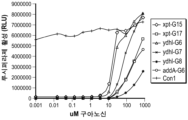
도 6c. 구아노신에 대한 구아닌 압타머 함유 조절 카세트 반응.
도 6d. 2'dG에 대한 구아닌 압타머 함유 조절 카세트 반응.
도 6e. 아데닌에 대한 아데닌 압타머 함유 조절 카세트 반응.
도 7a. 구아닌에 의한 xpt-G17 함유 조절 카세트를 갖는 EGFP의 유도. xpt-G17 리보스위치를 갖는 인트론-엑손-인트론 카세트는 EGFP 유전자 안으로 클론되었다. 상기 구조체로 안정적으로 형질감염된 HEK 293 세포는 500 μM 구아닌으로 처리되었으며, 처리 후 6시간 시점에서 GFP 발현에 대하여 유동세포분석을 통하여 분석되었다. 구아닌 처리로 EGFP 발현은 증가되었다, 도 7a, (B).
도 7b. 표적 유전자 발현은 리간드의 존재 또는 부재에 반응한다. 인트론-엑손-인트론 카세트 함유 xpt-G17 리보스위치를 갖는 EGFP로 안정적으로 형질감염된 HEK 293 세포는 500 μM 구아닌으로 3일간 처리되었으며, 그리고 3일 동안 매 24시간 동안 유동세포 분석에 의해 분석되었다. 구아닌 함유 배지는 상기 세포로부터 씻어내었고, 그리고 세포들은 구아닌 처리 없이 추가 10 일동안 성장을 지속시키고, 그리고 EGFP 발현이 모니터되었다. 구아닌이 상기 세포 배양 배지 안에 존재할 때 EGFP 발현이 증가되었다. 구아닌 EGFP을 회수할 때, 발현은 상실되었다.
도 8a. xpt-G15 함유 조절 카세트의 2개 복사체에 의해 조절된 루시퍼라제 발현. 이 그래프는 상기 표적 유전자 안으로 삽입된 단일 xpt-G17 또는 xpt-G15 함유 조절 카세트를 갖는 구조체, 그리고 xpt-G15 함유 조절 카세트의 2개 복사체 (xpt-G15 더블)를 갖는 구조체의 구아닌 용량 반응을 나타낸다.
도 8b. 조직 배양 세포에서 상이한 조절 카세트들에 의해 조절된 EGFP 발현. xpt-G17 함유 카세트 (EGFP-xpt-G17)의 한 개 복사체는 비-유도된 낮은 기선 발현을 초래하였고 (A), 그리고 EGFP-xpt-G15 구조체를 함유하는 세포와 비교하였을 때, 더 낮은 수준의 발현에 도달한다 (D). xpt-G15 함유 카세트 (EGFP-xpt-G15)의 한 개 복사체는 비-유도된 더 높은 기선 발현 (B) 뿐만 아니라 더 높은 유도된 발현을 제공한다 (E). xpt-G15 함유 카세트 (EGFP-xpt-G15 더블)의 2개 복사체를 함유하는 구조체의 경우, 비-유도된 배경 발현은 발현의 유도된 수준(F)의 감소없이 감소되었고(C), 따라서 유도 배수는 증가된다. 세포는 구아닌으로 처리되었으며, 처리후 24 hr에 촬상되었다.
도 8c. xpt-G15 및 xpt-G17 리보스위치를 함유하는 조절 카세트는 구아닌과 구아노신 모두에 반응한다. EGFP 발현 (평균 형광 강도)의 정량화는 유동세포측정에 의해 분석되었고, 그리고 구아닌 또는 구아노신 처리에 의해 획득된 평균 형광 강도 (MFI)를 처리없이 획득된 MFI로 나누어서 유도 배수가 산출되었다. 구아닌 및 구아노신으로 처리하면 유사한 수준 및 유도 배수가 획득되었다.
도 8d. xpt-G17 함유 조절 카세트의 한 개 복사체와 Ydhl-A5 함유 조절 카세트의 한 개 복사체를 함유하는 구조체로부터의 루시퍼라제 발현. 이 구조체로 형질감염된 HEK 293 세포는 구아닌 또는 아데닌, 또는 이 둘 모두로 처리되었다. 루시퍼라제의 최대 유도는 이들의 최대 농도에서 이들 두 리간드들의 복합 사용시에 볼 수 있었다.
도 9a 및 9b. xpt-G17 리보스위치를 함유하는 인트론-엑손-인트론 조절 카세트에 의해 조절된 루시퍼라제 발현에서 인트론 절두의 효과. 도 9a는 유도 배수를 나타내고, 그리고 9b는 Con 1과 비교하여 루시퍼라제 발현의 백분율을 나타낸다.
도 9c. 인트론-엑손-인트론 조절 구조체 DHFR_G17로부터 결손된 서열의 도표. 결손된 서열은 투명 막대로 표시되며, 나머지 서열은 굵은 막대로 표시된다.
도. 9d 및 9e. 도 9c에서 나타낸 바와 같이, 유전자 조절에서 상이한 인트론 결손의 효과. 선택적 DHFR 엑손 변형된 엑손 스플라이싱의 측면에 있는 인트론 안에 서열 및 상대적인 유전자 조절. 예를 들면, DHFR-G17_2IR_3은 표적 유전자 발현의 배수에서 상당한 증가를 초래하는 인트론 결손을 보여준다. 도 9d는 유도 배수를 나타내고, 반면 도 9e는 Con 1 대조와 비교하여 단백질 발견의 절대적 수준을 보여준다.
도 10a 및 10b. 상이한 엑손은 유전자 발현을 조절하기 위하여 인트론-엑손-인트론 조절 카세트에서 선택적 엑손으로 작용할 수 있다. 도 10a는 상이한 엑손들을 가진 구조체들은 루시퍼라제 발현의 다양한 비-유도된 기선 수준 및 유도된 수준 (500 μM 구아닌)을 유도한다는 것을 보여준다. 도 10b는 CaMKIId-e16를 갖는 이들 구조체의 유도 배수를 보여주는데, SRp40 활성화 돌연변이 (mtDHFR)를 갖는 DHFR 엑손에 대하여 대등한 유도 배수를 만든다.
도 11a-c. 마우스에서 생체네 루시퍼라제 발현의 조절. xpt-G15 조절 카세트의 2개 복사체 (xpt-G15 더블, 실시예 8, 도 8a)를 함유하는 구조체는 피하 주사에 의해 마우스의 간으로 전달되었다. 마우스에게 DNA 전달 후 2시간 및 12시간 시점에서 상이한 용량의 구아노신이 경구로 투여되었으며, 그리고 촬상되었다. 상기 리간드의 경구 분량은 마우스의 간에서 조절된 표적 유전자의 발현의 용량 관련 활성화를 초래하였다(도 11a 및 도 11b).
또 다른 실험에서, 구아노신은 복막으로 투여되었다 (도 11c). 구아노신 처리 전. 그리고 100 mg/kg 또는 300 mg/kg 용량으로 구아노신 처리 후 루시퍼라제 발현의 발현을 나타내는 촬상이다. 이 도표 (도 11d)에서, 상기 루시퍼라제 활성은 평균 광자/sec/mm2 ± s.d. (n=5)로 나타내었다.
도 12. 뮤린 망막에서 리보스위치-기반의 AAV 벡터에 의해 매개된 EGFP 이식유전자 발현. 형광 기저 촬영술은 망막하 주사 후 8일 시점에서 AAV2/8-GTX7에 의해 매개된 망막에서의 EGFP 이식유전자 발현을 나타낸다 (노출 시간: 30s).
도. 13a 및 13b. AAV2/8-GTX7이 주사된 뮤린의 한 쪽 눈의 망막하의 대표적인 기저 촬상은 시간의 경과에 따라 망막에서 EGFP 이식유전자 발현의 변화를 보여준다. A-E: 벡터 주사후 2, 8, 9, 10 및 12일 시점에서 200ms 노출 시간에서 백색광 조명 아래에서 찍은 촬상. 원은 정량화를 위하여 동공을 통하여 볼 수 있는 망악의 영역을 보여주는데, 정량화를 위하여 ROI로 나타낸다. F-J: 벡터 주사후 2, 8, 9, 10 및 12일 시점에서 30s 노출 시간으로 475±25nm 광 조명 아래에서 찍은 eGFP 형광을 보여주는 촬상. K-O: 벡터 주사후 2, 8, 9, 10 및 12일 시점에서 30s 노출 시간으로 475±25nm 광 조명 아래에서 찍은, ROI(원) 안에 50의 임계 강도 이상의 픽셀을 강조한 촬상. 도 13b는 유도 전 (A)과 유도 후 (B)의 고해상도 촬상을 보여준다.
도 13c. AAV2/8-GTX7의 망막하 주사 후 시간의 경과에 따라 정량화된 뮤린 망막에서의 EGFP 이식유전자 발현. 다음의 시점에서 형광 기저 사진이 촬영되었다: AAV2/8-GTX7의 망막하 주사 후 2, 8, 9, 10 및 12일차 시점. 노출 시간: 30s, 분석용 픽셀 임계 강도: 50. AAV2/8-GTX7의 망막하 주사 후 8, 9, 및 10일차 시점에서 촬상 후 복막내 유도가 실행되었다. 또한, AAV2/8-GTX7의 망막하 주사 후 11일차 시점에서 유리체내(intravitreal) 유도가 실행되었다. Dunnetts 교정과 함께 일원(1-way) ANOVA 기반의 통계학적 유의성과 대조점으로 주사 후 8 일차.
도 13d. AAV2/8-GTX5 (양성 대조)의 망막하 주사 후 시간 경과에 따라 정량화된 뮤린 망막에서의 EGFP 이식유전자 발현. 다음의 시점에서 형광 기저 사진이 촬영되었다: AAV2/8-GTX5의 망막하 주사 후 2, 8, 9, 10 및 12일차 시점. 노출 시간: 10s, 분석용 픽셀 임계 강도: 190. AAV2/8-GTX5의 망막하 주사 후 8, 9, 및 10일차 시점에서 촬상 후 구아노신의 복막내 투여가 실행되었다. 또한, AAV2/8-GTX5의 망막하 주사 후 11일차 시점에서 구아노신의 유리체내 투여가 실행되었다. Bonferroni 교정과 함께, 일원 ANOVA가 적용되었으며, 구아노신 처리에 따른 EGFP의 발견에서 통계학적으로 유의적인 차이는 없었다. Figure 1a. Schematic diagram of the splice construct "
Figure 1b. Effect of intron insertions and splice site sequences on luciferase expression.
Figure 2a. Schematic diagram of an intron-exon-intron cassette having the illustrated exon inclusion (I) and exclusion (II) splicing patterns. The asterisk (★) indicates a stop codon in
Figure 2b. Effect of inclusion or exclusion of DHFR selective exons on the expression of the luciferase gene. Luciferase assays were performed in HEK 293 cells transfected with different luciferase reporter constructs containing intron-exon-intron cassettes as shown in Figure 2a. A DHFR exon with wild-type splice site sequences (DHFR_wt) was compared to a DHFR exon containing a mutation in 5' ss (DHFR_wt5ssC) or a DHFR exon in which the native 5' ss was replaced by the
Figure 2c. Exonic splicing enhancer (ESE) or suppressor (ESS) elements within the DHFR exon sequence affect splicing of alternative DHRF exons and regulate expression of their target genes. Mutation of the SRp40 binding site within
Figure 3a. Schematic of an intron-exon-intron cassette containing a hairpin structure at the 5'ss of the
Figure 3b. Sequences and structures of four different hairpins tested in the intron-exon-intron cassette described in Figure 3a.
Figure 3c. Effect of hairpin structure at 5'ss of
Figure 4a. and Figure 4b. Schematic representation of gene regulation by intron-exon-intron regulatory cassettes containing synthetic riboswitches. In the absence of aptamer/ligand binding, the aptamer sequence disrupts the hairpin stem, making the DHFR exon 5'ss accessible, leading to inclusion of the DHFR exon, thus inhibiting translation and blocking protein expression (Figure 4a). Upon aptamer/ligand binding, ligand-dependent conformational changes in the aptamer stabilize the stem formation, sequestering the DHFR exon 5'ss, resulting in DHFR exon exclusion and luciferase gene expression (Figure 4b).
Figure 4c. Hairpin stem and theophylline aptamer geometries with different linkage stem lengths. The stem of the theophylline aptamer is directly linked to the stem of the hairpin, isolating the DHFR exon 5'ss, and generating a 20 bp synthetic stem. The stem sequence is truncated, and a series of hairpins with different stem lengths are generated. The stem structures of DHFR_Theo1, 12, 13 and 14 with stem lengths of 20 bp, 9 bp, 8 bp and 7 bp, respectively, are shown. Theophylline is indicated by (▲).
Figure 4d. Effect of different stem lengths using theophylline aptamers on target gene expression in the presence and absence of theophylline. A graph showing luciferase expression regulated by theophylline aptamers containing theophylline aptamer-containing regulatory cassettes was generated as described in Example 4 (Figure 4c). In constructs
Figure 5a. Sequence of a synthetic stem connecting the DHFR exon 5'ss sequence and the xpt-guanine aptamer, which is generated by a series of truncations of the hairpin stem and the aptamer P1 stem. Guanine is represented by (●).
Figure 5b. Effect of stem length on the ability of riboswitches to modulate luciferase expression in response to aptamer ligand binding. Eighteen riboswitches of different stem lengths were inserted into a regulatory cassette and the constructs were transfected into HEK 293 cells grown in the presence or absence of 500 μM guanine. In the absence of guanine, constructs G14 through G18 demonstrated a decrease in luciferase expression compared to the
Figures 5c and 5d. Further analysis of the effect of stem length on the ability of riboswitches to modulate luciferase expression in response to aptamer ligand binding. Constructs G11 to G18 were validated using a luciferase assay. Figure 5d shows basal and induced levels of luciferase for Con1. In the absence of guanine, constructs G14 to G17 demonstrated clear modulation of luciferase expression by the aptamer ligand (in this case, guanine). In the absence of guanine, luciferase expression levels are low. In the presence of guanine, luciferase expression is significantly activated. Figure 5d shows the % of Con1 control expression achieved for these tuned constructs when induced with guanine.
Figure 5e. Regulatory cassettes containing the xpt-G17 riboswitch allowed for regulation of gene expression in response to ligand in a number of different mammalian cell types. DHFR_G17 was transfected into HepG2, AML12, RD and C2C12 cell lines and assayed for induced luciferase expression when treated with guanine. Fold induction of luciferase expression is shown when cells were grown in the presence of ligand, compared to the basal level of non-induced expression without addition of guanine to the cells.
Figure 5f. Regulation of luciferase by xpt-G17 containing regulatory cassette in viral vector content. The construct containing the luciferase gene containing the xpt-G17 regulatory cassette was transferred to an AAV vector backbone and used to transfect cells. Cells were grown in the presence and absence of guanine. Fold induction of luciferase is shown in the presence of guanine, with expression being induced 1687-fold when treated with guanine.
Figure 5g. Regulation of antibodies by regulatory cassette in response to the aptamer-binding ligand. An intron-exon-intron regulatory cassette with the xpt-G17 riboswitch was inserted into the leader peptide sequence of the anti-KDR antibody sequence, and the resulting construct was transfected into HEK 293 cells. When analyzed using ELISA, antibody protein expression was induced 80-fold when transfected cells were treated with the ligand, compared to untreated cells. The level of induced expression reached about 40% of that of the control construct containing the
Figure 5h. Regulation of erythropoietin protein (EPO) secreted by the regulatory cassette in response to the aptamer/ligand binding. The intron-exon-intron regulatory cassette with the xpt-G17 riboswitch was inserted into the murine erythropoietin (Epo) gene, and the resulting construct was transfected into HEK 293 cells. Low expression levels of EPO were observed in the absence of guanine when analyzed by ELISA. In the presence of guanine, a 140-fold induction of EPO expression was observed.
Figure 6a Structures of different purine riboswitch stems tested in the regulatory cassette. Purines are represented by ●.
Figure 6b-6e. Construct dose response of regulatory cassettes containing different aptamer-based riboswitches (riboswitch stems illustrated in Figure 6a).
Figure 6b. Guanine aptamer-containing regulatory cassette reaction for guanine
Figure 6c. Guanine aptamer-containing regulatory cassette reaction for guanosine.
Figure 6d. Guanine aptamer-containing regulatory cassette reaction for 2'dG.
Figure 6e. Adenine aptamer-containing regulatory cassette reaction for adenine.
Figure 7a. Induction of EGFP with a regulatory cassette containing xpt-G17 by guanine. An intron-exon-intron cassette containing the xpt-G17 riboswitch was cloned into the EGFP gene. HEK 293 cells stably transfected with the construct were treated with 500 μM guanine and analyzed for GFP expression by flow cytometry 6 h after treatment. EGFP expression was increased by guanine treatment, Figure 7a, (B).
Figure 7b. Target gene expression responds to the presence or absence of ligand. HEK 293 cells stably transfected with EGFP harboring the xpt-G17 riboswitch containing the intron-exon-intron cassette were treated with 500 μM guanine for 3 days and analyzed by flow cytometry every 24 hours for 3 days. The guanine-containing medium was washed away from the cells, and the cells were allowed to grow for an additional 10 days without guanine treatment, and EGFP expression was monitored. EGFP expression was increased when guanine was present in the cell culture medium. When guanine EGFP was withdrawn, expression was lost.
Figure 8a. Luciferase expression regulated by two copies of the xpt-G15 containing regulatory cassette. This graph shows the guanine dose response of constructs having a single xpt-G17 or xpt-G15 containing regulatory cassette inserted into the target gene, and constructs having two copies of the xpt-G15 containing regulatory cassette (xpt-G15 double).
Figure 8b. EGFP expression regulated by different regulatory cassettes in tissue culture cells. One copy of the xpt-G17 containing cassette (EGFP-xpt-G17) resulted in non-induced low baseline expression (A), and reached lower levels of expression (D) compared to cells containing the EGFP-xpt-G15 construct. One copy of the xpt-G15 containing cassette (EGFP-xpt-G15) provided non-induced higher baseline expression (B) as well as higher induced expression (E). For the construct containing two copies of the xpt-G15 containing cassette (EGFP-xpt-G15 double), the non-induced background expression was reduced (C) without reducing the induced level of expression (F), thus increasing the fold induction. Cells were treated with guanine and imaged 24 hr post-treatment.
Figure 8c. Regulatory cassettes containing the xpt-G15 and xpt-G17 riboswitches respond to both guanine and guanosine. Quantification of EGFP expression (mean fluorescence intensity) was analyzed by flow cytometry, and fold induction was calculated by dividing the mean fluorescence intensity (MFI) obtained by guanine or guanosine treatment by the MFI obtained without treatment. Treatment with guanine and guanosine resulted in similar levels and fold induction.
FIG. 8d. Luciferase expression from a construct containing one copy of the regulatory cassette containing xpt-G17 and one copy of the regulatory cassette containing Ydhl-A5. HEK 293 cells transfected with this construct were treated with guanine or adenine, or both. Maximal induction of luciferase was observed with the combined use of these two ligands at their maximal concentrations.
Figure 9a and 9b. Effect of intron truncation on luciferase expression regulated by an intron-exon-intron regulatory cassette containing the xpt-G17 riboswitch. Figure 9a shows fold induction, and 9b shows the percentage of luciferase expression compared to
Figure 9c. Diagram of the deleted sequences from the intron-exon-intron regulatory structure DHFR_G17. The deleted sequences are indicated by transparent bars, and the remaining sequences are indicated by bold bars.
Fig. 9d and 9e. Effect of different intron deletions on gene regulation, as shown in Fig. 9c. Sequences within the intron flanking the alternative DHFR exon altered exon splicing and relative gene regulation. For example, DHFR-G17_2IR_3 shows an intron deletion that results in a significant increase in the fold of target gene expression. Fig. 9d shows the fold of induction, whereas Fig. 9e shows the absolute level of protein discovery compared to the
Figure 10a and 10b. Different exons can act as alternative exons in an intron-exon-intron regulatory cassette to regulate gene expression. Figure 10a shows that constructs with different exons induce various non-induced baseline levels and induced levels (500 μM guanine) of luciferase expression. Figure 10b shows the fold induction of these constructs with CaMKIId-e16, which produces comparable fold induction to a DHFR exon with a SRp40 activating mutation (mtDHFR).
Figure 11a-c. Modulation of in vivo luciferase expression in mice. A construct containing two copies of the xpt-G15 regulatory cassette (xpt-G15 double, Example 8, Figure 8a) was delivered to the liver of mice by subcutaneous injection. Different doses of guanosine were administered orally to the mice at 2 and 12 hours after DNA delivery, and imaging was performed. Oral doses of the ligand resulted in dose-related activation of expression of the regulated target gene in the liver of mice (Figures 11a and 11b).
In another experiment, Guanosine was administered intraperitoneally (Fig. 11c). Images showing the expression of luciferase before guanosine treatment and after guanosine treatment at doses of 100 mg/kg or 300 mg/kg. In this plot (Fig. 11d), the luciferase activity is expressed as the mean photons/sec/mm 2 ± sd (n = 5).
Figure 12. EGFP transgene expression mediated by riboswitch-based AAV vectors in the murine retina. Fluorescence fundus photography shows EGFP transgene expression in the retina mediated by AAV2/8-
Fig. 13a and 13b. Representative baseline images of the retina of one murine eye injected with AAV2/8-GTX7 showing changes in EGFP transgene expression in the retina over time. AE: Images taken under white light illumination with a 200 ms exposure time at 2, 8, 9, 10, and 12 days post-vector injection. Circles indicate areas of the retina visible through the pupil, indicated as ROIs for quantification. F-J: Images showing eGFP fluorescence taken under 475±25 nm light illumination with a 30 s exposure time at 2, 8, 9, 10, and 12 days post-vector injection. KO: Images highlighted in the ROI (circle) with a threshold intensity of 50 or greater, taken under 475±25 nm light illumination with a 30 s exposure time at 2, 8, 9, 10, and 12 days after vector injection. Figure 13b shows high-resolution images before (A) and after (B) induction.
Figure 13c. Quantification of EGFP transgene expression in the murine retina over time following subretinal injection of AAV2/8-GTX7. Fluorescent basal images were taken at the following time points: 2, 8, 9, 10, and 12 days after subretinal injection of AAV2/8-GTX7. Exposure time: 30 s; pixel threshold intensity for analysis: 50. Intraperitoneal induction was performed following imaging at
Figure 13d. EGFP transgene expression in the murine retina quantified over time following subretinal injection of AAV2/8-GTX5 (positive control). Fluorescent baseline photographs were taken at the following time points: 2, 8, 9, 10, and 12 days after subretinal injection of AAV2/8-GTX5. Exposure time: 10 s; pixel threshold intensity for analysis: 190. Intraperitoneal administration of guanosine was performed following imaging on
본 발명은 5' 인트론-선택적 엑손-3' 인트론 관련된 리보스위치를 포함하는 유전자 조절 카세트를 제공한다. 상기 유전자 조절 카세트는 표적 유전자의 DNA 안에 편입될 때, 전구-mRNA의 압타머/리간드 매개된 선택적 스플라이싱에 의해 상기 표적 유전자의 발현을 조절하는 능력을 제공하는 재조합 DNA 구조체를 지칭한다. 본 발명의 내용에서 리보스위치는 센서 영역 (가령, 압타머)과 효과기 영역을 함유하는데, 이들은 소분자 리간드 존재의 감지 및 선택적 엑손에 대하여 스플라이싱의 변경을 함께 담당한다. 한 구현예에서, 상기 압타머 리간드가 존재할 때, 상기 표적 유전자의 발현은 증가되며, 상기 리간드가 부재시 발현은 감소된다.The present invention provides a gene regulatory cassette comprising a 5' intron-alternative exon-3' intron associated riboswitch. The gene regulatory cassette refers to a recombinant DNA construct that, when incorporated into the DNA of a target gene, provides the ability to regulate expression of the target gene by aptamer/ligand mediated alternative splicing of pre-mRNA. In the context of the present invention, the riboswitch comprises a sensor region (e.g., an aptamer) and an effector region that together are responsible for sensing the presence of a small molecule ligand and altering splicing for an alternative exon. In one embodiment, when the aptamer ligand is present, expression of the target gene is increased, and in the absence of the ligand, expression is decreased.
리보스위치Riboswitch
본 명세서에서 이용된 용어 "리보스위치(riboswitch)"는 RNA 폴리뉴클레오티드의 조절 분절(segment)를 지칭한다. 본 발명의 내용에서 리보스위치는 센서 영역 (가령, 압타머)과 효과기 영역을 함유하는데, 이들은 리간드(가령, 소분자) 존재의 감지 및 선택적 엑손에 대하여 스플라이싱의 변경을 함께 담당한다. 한 구현예에서, 상기 리보스위치는 2개 또는 그 이상의 원천으로부터 폴리뉴클레오티드를 이용한 재조합체이다. 리보스위치 문맥에서 본 명세서에서 사용된 용어 "합성"이란 리보스위치가 자연 발생적인 것이 아닌 리보스위치를 지칭한다. 한 구현예에서, 상기 센서 영역과 효과기 영역은 폴리뉴클레오티드 링커에 의해 연결된다. 한 구현예에서, 상기 폴리뉴클레오티드 링커는 RNA 스템 (가령, 이중-가닥으로된 RNA 폴리뉴클레오티드 영역)이다.The term "riboswitch" as used herein refers to a regulatory segment of an RNA polynucleotide. In the context of the present invention, a riboswitch comprises a sensor region (e.g., an aptamer) and an effector region that together sense the presence of a ligand (e.g., a small molecule) and alter splicing for a selective exon. In one embodiment, the riboswitch is recombinant using polynucleotides from two or more sources. The term "synthetic" as used herein in the context of a riboswitch refers to a riboswitch that is not naturally occurring. In one embodiment, the sensor region and the effector region are connected by a polynucleotide linker. In one embodiment, the polynucleotide linker is an RNA stem (e.g., a double-stranded RNA polynucleotide region).
효과기 영역Effector area
한 구현예에서, 상기 효과기 영역은 3' 인트론의 5' 스플라이싱 부위 ("5'ss") 서열 (가령, 상기 선택적 엑손의 바로 3'인 인트론 스플라이싱 부위 서열)을 포함한다. 상기 효과기 영역은 3' 인트론의 5' ss 서열과 이 3' 인트론의 5' ss 서열에 상보적인 서열을 포함한다. 상기 압타머가 이의 리간드에 결합될 때, 상기 효과기 영역은 스템을 만들고, 따라서 선택적 엑손의 3' 단부에서 스플라이싱 공여부 부위에 대한 스플라이싱은 저지된다 (가령, 도 4b 참고). 특정 조건하에서 (예를 들면, 상기 압타머가 이의 리간드에 결합되지 않는 경우), 상기 효과기 영역은 상기 선택적 엑손의 3' 단부에서 상기 스플라이싱 공여부 부위에 접촉할 수 있어, 상기 표적 유전자 mRNA에서 선택적 엑손의 함입이 유도된다 (가령, 도 4a 참고).In one embodiment, the effector region comprises a 5' splice site ("5'ss") sequence of a 3' intron (e.g., an intronic splice site sequence immediately 3' of the optional exon). The effector region comprises a 5' ss sequence of the 3' intron and a sequence complementary to the 5' ss sequence of the 3' intron. When the aptamer binds to its ligand, the effector region forms a stem, thereby preventing splicing to a splice donor site at the 3' end of the optional exon ( e.g. , see FIG. 4B ). Under certain conditions (e.g., when the aptamer is not bound to its ligand), the effector region can contact the splice donor site at the 3' end of the selective exon, thereby inducing inclusion of the selective exon in the target gene mRNA (see, e.g. , Figure 4a).
효과기 영역의 스템 부분은 리간드가 상기 압타머에 결합될 때 선택적 엑손의 선택적 스플라이싱을 실질적으로 방지하는데 충분한 길이(및 GC 함량)를 가지고 있어야 하며, 한편 상기 리간드가 충분한 양으로 존재하지 않을 때 이 스플라이싱 부위에 접근을 허용해야 한다. 본 발명의 구현예들에 있어서, 상기 효과기 영역의 스템 부분은 3' 인트론의 5' ss 서열 및 이의 상보적 서열에 추가하여, 스템 서열을 포함한다. 본 발명의 구현예들에 있어서, 이와 같은 추가적인 스템 서열은 상기 압타머 스템의 서열을 포함한다. 상기 스템 부분의 길이 및 서열은 리간드가 존재하지 않을 때 표적 유전자의 수용가능한 배경 발현 수준, 및 리간드가 존재할 때 상기 표적 유전자의 수용가능한 발현 수준을 허용하는 스템을 식별해내기 위하여 공지의 기술을 이용하여 변형될 수 있다 (가령, 실시예 4 및 5, 그리고 도 4c 및 4d, 5a, 5b, 5c, 5d 참고). 예를 들면, 상기 스템이 너무 긴 경우, 리간드의 존재 또는 부재시 3' 인트론의 5' ss 서열에 대한 접근로를 숨길 수 있다. 상기 스템이 너무 짧은 경우, 상기 3' 인트론의 5' ss 서열을 격리시킬 수 있는 안정적 스템을 만들지 못할 수 있고, 그 경우 상기 선택적 엑손은 리간드의 존재 또는 부재시 상기 표적 유전자 메세지에 스플라이싱될 수 있다. 한 구현예에서, 상기 효과기 영역 스템의 총 길이는 약 7개 염기쌍 내지 약 20개 염기쌍이다. 일부 구현예들에 있어서, 상기 스템의 길이는 약 8개 염기쌍 내지 약 11개 염기쌍이다. 일부 구현예들에 있어서, 상기 스템의 길이는 8개 염기쌍 내지 11개 염기쌍이다. 상기 스템의 길이에 추가하여, 상기 스템의 GC 염기쌍 함량은 상기 스템의 안정성을 변형시키기 위하여 변경될 수 있다.The stem portion of the effector region should be of sufficient length (and GC content) to substantially prevent alternative splicing of the alternative exon when the ligand is bound to the aptamer, while allowing access to this splice site when the ligand is not present in sufficient amounts. In embodiments of the present invention, the stem portion of the effector region comprises a stem sequence in addition to the 5' ss sequence of the 3' intron and its complementary sequence. In embodiments of the present invention, this additional stem sequence comprises the sequence of the aptamer stem. The length and sequence of the stem portion can be modified using known techniques to identify a stem that allows for an acceptable background expression level of the target gene when the ligand is not present, and an acceptable expression level of the target gene when the ligand is present ( see , e.g., Examples 4 and 5, and FIGS. 4c and 4d, 5a, 5b, 5c, 5d). For example, if the stem is too long, it may obscure access to the 5' ss sequence of the 3' intron in the presence or absence of the ligand. If the stem is too short, it may not form a stable stem that can isolate the 5' ss sequence of the 3' intron, in which case the alternative exon can be spliced to the target gene message in the presence or absence of the ligand. In one embodiment, the total length of the effector region stem is about 7 base pairs to about 20 base pairs. In some embodiments, the length of the stem is about 8 base pairs to about 11 base pairs. In some embodiments, the length of the stem is 8 base pairs to 11 base pairs. In addition to the length of the stem, the GC base pair content of the stem can be altered to modify the stability of the stem.
압타머/리간드Aptamer/ligand
본 명세서에서 사용된 바와 같이, 용어 "압타머(aptamer)"는 리간드에 특이적으로 결합하는 RNA 폴리뉴클레오티드를 지칭한다. 용어 "리간드(ligand)"는 상기 압타머에 의해 특이적으로 결합하는 분자를 지칭한다. 한 구현예에서, 상기 리간드는 예를 들면, 지질, 단당류, 2차 메신져, 다른 천연 산물 및 대사물, 핵산, 뿐만 아니라 대부분의 치료요법적 약물을 포함하는 저 분자량(약 1,000 달톤 미만)이다. 한 구현예에서 상기 리간드는 2 또는 그 이상의 뉴클레오티드 염기를 갖는 폴리뉴클레오티드이다.As used herein, the term "aptamer" refers to an RNA polynucleotide that specifically binds to a ligand. The term "ligand" refers to a molecule to which the aptamer specifically binds. In one embodiment, the ligand is a low molecular weight molecule (less than about 1,000 daltons), including, for example, lipids, monosaccharides, second messengers, other natural products and metabolites, nucleic acids, as well as most therapeutic drugs. In one embodiment, the ligand is a polynucleotide having two or more nucleotide bases.
압타머는 결합 영역들을 갖는데, 이는 의도된 표적 분자 (가령, 상기 리간드)와 함께 복합체를 형성할 수 있다. 상기 결합의 특이성은 무관한 분자에 대한 상기 압타머의 해리 상수와 비교하여, 이의 리간드에 대한 상기 압타머의 비교 해리 상수 (Kd)로 규정될 수 있다. 따라서, 상기 리간드는 무관한 물질에 결합하는 것보다 상기 압타머에 더 큰 친화력으로 결합하는 분자다. 전형적으로, 무관한 분자들에 대한 상기 압타머의 Kd보다 이의 리간드에 대한 상기 압타머의 Kd는 최소한 약 10-배 더 적을 것이다. 다른 구현예들에 있어서, Kd는 최소한 약 20-배 적은, 최소한 약 50-배 적은, 최소한 약 100-배 적은, 그리고 최소한 약 200-배 적을 것이다. 압타머는 전형적으로 길이가 약 15 개 내지 약 200개 뉴클레오티드이다. 좀더 일반적으로, 압타머의 길이는 약 30 개 내지 약 100개 뉴클레오티드이다. An aptamer has binding domains that are capable of forming a complex with an intended target molecule (e.g., the ligand). The specificity of the binding can be defined by the relative dissociation constant (Kd) of the aptamer for its ligand compared to the dissociation constant of the aptamer for an unrelated molecule. Thus, the ligand is a molecule that binds to the aptamer with greater affinity than it binds to an unrelated substance. Typically, the Kd of the aptamer for its ligand will be at least about 10-fold less than the Kd of the aptamer for unrelated molecules. In other embodiments, the Kd will be at least about 20-fold less, at least about 50-fold less, at least about 100-fold less, and at least about 200-fold less. Aptamers are typically about 15 to about 200 nucleotides in length. More typically, aptamers are about 30 to about 100 nucleotides in length.
상기 리보스위치의 일부분으로 편입될 수 있는 압타머는 자연 발생적 압타머, 또는 이의 변형이거나, 또는 급격한(exponential) 농축에 의한 리간드들의 체계적 발전(SELEX)를 통하여 데노보(de novo)로 기획되거나 또는 종합적으로 스크린된 압타머일 수 있다. 소분자 리간드들에 결합하는 압타머의 예는 테오필린, 도파민, 술포로다민 B, 그리고 셀로비오스 카나마이신 A, 리비도마이신, 토브라마이신, 네오마이신 B, 비오마이신, 클로람페니콜, 스트렙토마이신, 사이토킨, 세포 표면 분자들, 그리고 대사물질을 포함하나, 이에 국한되지 않는다. 소분자를 인지하는 압타머에 대한 검토는 가령, Famulok, Science 9:324-9 (1999) 및 McKeague, M. & DeRosa, M.C. J. Nuc. Aci. 2012을 참고한다. 또 다른 구현예에서, 상기 압타머는 상보적 폴리뉴클레오티드이다.Aptamers that can be incorporated as part of the above riboswitches are either naturally occurring aptamers, or modifications thereof, or are planned de novo through systematic evolution of ligands by exponential enrichment (SELEX). Or it can be a comprehensively screened aptamer. Examples of aptamers that bind small molecule ligands include, but are not limited to, theophylline, dopamine, sulforhodamine B, and cellobiose kanamycin A, libidomycin, tobramycin, neomycin B, viomycin, chloramphenicol, streptomycin, cytokines, cell surface molecules, and metabolites. For reviews of aptamers that recognize small molecules, see, e.g., Famulok, Science 9:324-9 (1999) and McKeague, M. & DeRosa, MCJ Nuc. Aci. 2012. In another embodiment, the aptamer is a complementary polynucleotide.
한 구현예에서, 상기 압타머는 특정 소분자 리간드에 결합되도록 기획된다. 압타머를 기획하는 방법은 예를 들면 SELEX를 포함한다. SELEX를 이용하여 소분자에 대안적으로 결합하는 압타머를 기획하는 방법들은 가령, U.S. 특허 번호 5,475,096, 5,270,163, 그리고 Abdullah Ozer, 등. Nuc. Aci. 2014에서 개시되며, 이들은 참고자료로써 본 명세서에 편입된다. SELEX 공정의 변형은 U.S. 특허 번호 5,580,737 및 5,567,588에서 개시되며, 이들은 참고자료로써 본 명세서에 편입된다.In one embodiment, the aptamer is designed to bind to a particular small molecule ligand. Methods for designing aptamers include, for example, SELEX. Methods for designing aptamers that alternatively bind small molecules using SELEX are disclosed, for example, in U.S. Patent Nos. 5,475,096, 5,270,163, and Abdullah Ozer, et al. Nuc. Aci. 2014, which are incorporated herein by reference. Variations on the SELEX process are disclosed in U.S. Patent Nos. 5,580,737 and 5,567,588, which are incorporated herein by reference.
압타머를 식별하는 선택 기술은 무작위화된 또는 돌연변이화된 영역을 함유하는 원하는 길이의 DNA 또는 RNA 분자들의 큰 모둠(pool)을 준비하는 것과 일반적으로 관련된다. 예를 들면, 압타머 선택용 올리고뉴클레오티드 모둠은 약 15-25개 뉴클레오티드의 길이이며, 그리고 PCR 프라이머의 결합에 유용한 규정된 서열의 영역 측면에 있는 20-100개의 무작위화된 뉴클레오티드 영역을 포함할 것이다. 상기 올리고뉴클레오티드 모둠은 표준 PCR 기술, 또는 선택된 핵산 서열의 증폭을 허용하는 다른 기술을 이용하여 증폭된다. DNA 모둠은 RNA 압타머가 바람직한 경우 RNA 전사체 모둠을 만들기 위하여 시험관내 전사될 수 있다. 그 다음 RNA 또는 DNA 올리고뉴클레오티드의 모둠은 원하는 리간드에 특이적으로 결합하는 능력에 기초하여 선택을 거친다. 선택 기술은 예를 들면, 친화력 크로마토그래피를 포함하지만, 또 다른 분자에 특이적으로 결합하는 능력에 기초하여 핵산 선택을 허용하는 임의의 프로토콜이 이용될 수 있다. 소분자에 결합하고, 세포 안에서 기능을 하는 압타머를 식별하는 선택 기술은 세포 기반의 스크리닝 방법들과 관련될 수 있다. 친화력 크로마토그래피의 경우, 상기 올리고뉴클레오티드는 컬럼안 기질 또는 자석 비드 상에 고정된 표적 리간드에 접촉된다. 상기 올리고뉴클레오티드는 염 농도, 온도, 그리고 생리적 조건을 닮은 다른 조건들 존재하에서 리간드 결합에 대하여 바람직하게 선택된다. 리간드에 결합하는 모둠의 올리고뉴클레오티드는 컬럼 또는 비드 상에 유지되며, 비결합 서열은 씻겨나간다. 그 다음 리간드에 결합하는 올리고뉴클레오티드는 PCR(보통 용리 후)에 의해 증폭된다(RNA 전사체들이 이용되었다면, 역 전사후). 상기 선택 공정은 선택 과정을 총 약 3회 내지 10회 반복하기 위하여 선택된 서열에서 반복된다. 그 다음 상기 생성된 올리고뉴클레오티드는 표준 과정에 의해 증폭되고, 클론되고, 그리고 서열화되어 상기 표적 리간드에 결합할 수 있는 올리고뉴클레오티드의 서열을 확인한다. 일단 압타머 서열이 확인되었으면, 상기 압타머는 돌연변이된 압타머 서열을 포함하는 올리고뉴클레오티드 모둠으로부터 시작되는 추가 선택 과정을 실행함으로써 추가적으로 최적화될 수 있다. Selection techniques for identifying aptamers generally involve preparing a large pool of DNA or RNA molecules of a desired length containing randomized or mutated regions. For example, an oligonucleotide pool for aptamer selection would be about 15-25 nucleotides in length and would contain 20-100 randomized nucleotide regions flanking a region of defined sequence useful for binding PCR primers. The oligonucleotide pool is amplified using standard PCR techniques, or other techniques that allow for the amplification of the selected nucleic acid sequence. The DNA pool can be transcribed in vitro to produce a pool of RNA transcripts, if RNA aptamers are desired. The pool of RNA or DNA oligonucleotides is then subjected to selection based on their ability to specifically bind to the desired ligand. Selection techniques include, for example, affinity chromatography, but any protocol that allows for the selection of nucleic acids based on their ability to specifically bind to another molecule can be used. Selection techniques for identifying aptamers that bind small molecules and function within cells can involve cell-based screening methods. In affinity chromatography, the oligonucleotide is contacted with a target ligand immobilized on a column substrate or magnetic beads. The oligonucleotide is preferably selected for ligand binding under conditions such as salt concentration, temperature, and other conditions resembling physiological conditions. The pool of oligonucleotides that bind the ligand is retained on the column or beads, and the unbound sequences are washed away. The oligonucleotides that bind the ligand are then amplified by PCR (usually after elution) (or reverse transcription, if RNA transcripts are used). The selection process is repeated for the selected sequences for a total of about 3 to 10 repetitions of the selection process. The generated oligonucleotides are then amplified, cloned, and sequenced by standard procedures to identify the sequence of the oligonucleotide that can bind the target ligand. Once the aptamer sequence has been identified, the aptamer can be further optimized by performing additional selection processes starting from pools of oligonucleotides containing mutated aptamer sequences.
생체내 압타머 스크리닝은 1 내지 그 이상의 횟수의 시험관내 선택 (가령, SELEX)에 이어서 이용될 수 있다. 예를 들면, Konig, J. 등. (RNA. 2007, 13(4):614-622, 참고자료로 본 명세서에 편입됨)는 압타머의 생체내 선택을 위한 SELEX와 효모 3-하이브리드 시스템을 복합시키는 것을 교시한다. In vivo aptamer screening can be used following one or more rounds of in vitro selection (e.g., SELEX). For example, Konig, J. et al. (RNA. 2007, 13(4):614-622, incorporated herein by reference) teach combining SELEX and the yeast three-hybrid system for in vivo selection of aptamers.
선택적 엑손Optional exon
본 발명의 유전자 조절 폴리뉴클레오티드 카세트의 일부분인 선택적 엑손은 전구-mRNA로 전사되고, 그리고 상기 표적 유전자의 mRNA 안에 대안적으로 스플라이싱될 수 있는 임의의 폴리뉴클레오티드 서열일 수 있다. 본 발명의 유전자 조절 카세트의 일부인 선택적 엑손은 상기 선택적 엑손이 표적 유전자 mRNA에 포함되었을 때 해독을 억제하는 최소한 한 개의 서열을 함유하고, mRNA로부터 상기 표적 유전자의 발현은 저지되거나 또는 감소된다. 바람직한 구현예에서, 상기 선택적 엑손은 상기 선택적 엑손이 스플라이싱에 의해 상기 표적 유전자 mRNA 안에 포함될 때, 상기 표적 유전자와 동일-틀에 있는 정지 코돈 (TGA, TAA, TAG)을 함유한다. 구현예들에서, 상기 선택적 엑손은 정지 코돈에 추가하여, 또는 정지 코돈에 대해 대안적으로, 상기 선택적 엑손이 스플라이싱에 의해 가령, microRNA 결합 부위를 포함하는 표적 유전자 mRNA에 편입될 때 해독을 감소 또는 실질적으로 저지시켜, 상기 mRNA의 분해를 유도하는 다른 서열을 포함한다. 한 구현예에서, 상기 선택적 엑손은 mRNA의 분해를 초래하는 miRNA 결합 서열을 포함한다. 한 구현예에서, 상기 선택적 엑손은 단백질의 안정성을 감소시키는 폴리펩티드를 암호화하는데, 이때 상기 단백질은 이 폴리펩티드 서열을 함유한다. 한 구현예에서, 상기 선택적 엑손은 단백질에게 분해를 지시하는 폴리펩티드 서열을 암호화하는데, 이때 상기 단백질은 이 폴리펩티드 서열을 함유한다.The optional exon, which is part of the gene regulatory polynucleotide cassette of the present invention, can be any polynucleotide sequence that is transcribed into a pre-mRNA and can be alternatively spliced into an mRNA of the target gene. The optional exon, which is part of the gene regulatory cassette of the present invention, contains at least one sequence that inhibits translation when the optional exon is incorporated into a target gene mRNA, such that expression of the target gene from the mRNA is inhibited or reduced. In a preferred embodiment, the optional exon contains a stop codon (TGA, TAA, TAG) that is in-frame with the target gene when the optional exon is incorporated into the target gene mRNA by splicing. In embodiments, the optional exon comprises, in addition to the stop codon, or alternatively to the stop codon, another sequence that reduces or substantially inhibits translation when the optional exon is incorporated into a target gene mRNA, such as comprising a microRNA binding site, by splicing, thereby leading to degradation of the mRNA. In one embodiment, the optional exon comprises a miRNA binding sequence that causes degradation of the mRNA. In one embodiment, the optional exon encodes a polypeptide that decreases the stability of a protein, wherein the protein contains the polypeptide sequence. In one embodiment, the optional exon encodes a polypeptide sequence that directs the protein to be degraded, wherein the protein contains the polypeptide sequence.
상기 선택적 엑손의 스플라이싱의 기저 또는 배경 수준은 엑손 스플라이싱 인핸서 (ESE) 서열 및 엑손 스플라이싱 억제인자 (ESS) 서열을 변경시키거나 및/또는 ESE 또는 ESS 서열을 상기 선택적 엑손 안으로 도입시킴으로써, 최적화될 수 있다. 상기 선택적 엑손의 서열에 대하여 이와 같은 변화는 부위 지향적 돌연변이생성을 포함하나, 이에 국한되지 않는 당분야에 공지된 방법들에 의해 실현될 수 있다. 대안적으로, 소요의 서열을 갖는 올리고뉴클레오티드(가령, 상기 선택적 엑손의 일부 또는 전부를 포함하는)는 상업적 기원으로부터 획득될 수 있고, 상기 유전자 조절 카세트 안에 클론될 수 있다. ESS 및 ESE 서열들의 식별은 예를 들면 ESEfinder 3.0 (Cartegni, L. 등. ESEfinder: 엑손 스플라이싱 인핸서를 확인하기 위한 웹. Nucleic Acid Research, 2003, 31(13): 3568-3571) 및/또는 따른 이용가능한 소스를 이용하는 것을 포함하여 당분야에 공지된 방법들에 의해 실현될 수 있다. The basal or background level of splicing of the optional exon can be optimized by altering the exon splicing enhancer (ESE) sequence and the exon splicing suppressor (ESS) sequence and/or by introducing ESE or ESS sequences into the optional exon. Such changes to the sequence of the optional exon can be accomplished by methods known in the art, including but not limited to site-directed mutagenesis. Alternatively, oligonucleotides having the desired sequence (e.g., comprising part or all of the optional exon) can be obtained from commercial sources and cloned into the gene regulatory cassette. Identification of ESS and ESE sequences can be accomplished by methods known in the art, including, for example, using ESEfinder 3.0 (Cartegni, L. et al. ESEfinder: a web-based tool for identifying exonic splicing enhancers. Nucleic Acid Research, 2003, 31(13): 3568-3571) and/or other available sources.
한 구현예에서, 상기 선택적 엑손은 상기 표적 유전자에 대하여 외생적이지만, 상기 표적 유전자가 발현될 유기체로부터 기인된 서열로부터 유도될 수 있다. 한 구현예에서 상기 선택적 엑손은 합성 서열이다 (실시예 10 참고).In one embodiment, the optional exon is exogenous to the target gene, but may be derived from a sequence from an organism in which the target gene is to be expressed. In one embodiment, the optional exon is a synthetic sequence (see Example 10).
한 구현예에서, 상기 선택적 엑손은 자연-발생된 엑손이다 (실시예 10 참고). 또 다른 구현예에서, 상기 선택적 엑손은 공지의 모든 엑손 또는 이의 일부로부터 유도된다 (실시예 10 참고). 이 내용에서, "유도된(derived)"이란 자연 발생적 엑손, 또는 이의 부분에 실질적으로 상동성이지만, 다양한 돌연변이, 예를 들면, 상기 표적 유전자 서열과 동일-틀에 있는 정지 코돈을 도입하기 위한 돌연변이, 또는 엑손 스플라이싱 인핸서의 도입 또는 결손을 위한 돌연변이, 그리고/또는 엑손 스플라이싱 억제인자를 도입 또는 결손을 위한 돌연변이와 같은 다양한 돌연변이를 포함할 수 있는 서열들이 함유된 선택적 엑손을 지칭한다. 한 구현예에서, 상기 선택적 엑손은 인간 디하이드로폴레이트 환원효소 유전자 (DHFR)의 엑손 2, 돌연변이체 인간 빌름스 종양 1 엑손 5, 마우스 칼슘/칼모둘린-의존적 단백질 키나제 II 델타 엑손 16, 또는 SIRT1 엑손 6으로부터 유도된다.In one embodiment, the optional exon is a naturally-occurring exon (see Example 10). In another embodiment, the optional exon is derived from any known exon or portion thereof (see Example 10). In this context, "derived" refers to an optional exon that contains sequences that are substantially homologous to a naturally-occurring exon, or portion thereof, but that may include various mutations, such as mutations to introduce a stop codon that is in-frame with the target gene sequence, or mutations to introduce or delete an exon splicing enhancer, and/or mutations to introduce or delete an exon splicing suppressor. In one embodiment, the optional exon is derived from
5' 및 3' 인트론 서열5' and 3' intron sequences
상기 선택적 엑손은 5' 및 3' 인트론 서열의 측면에 있다. 상기 본 발명의 유전자 조절 카세트에 이용될 수 있는 5' 및 3' 인트론 서열은 상기 압타머에 결합하는 리간드 존재 또는 부재시에 따라, 표적 유전자로부터 스플라이싱되어 표적 유전자 mRNA를 만드는 임의의 서열이거나, 또는 mRNA에서 선택적 엑손을 포함하는 표적 유전자로부터 스플라이싱되는 임의의 서열일 수 있다. 상기 5' 인트론 및 3' 인트론은 각각 가령, 스플라이싱 공여부, 스플라이싱 수용부 및 분기점 서열을 만들기 위한 스플라이싱에 필수적인 서열을 갖는다. 한 구현예에서, 상기 유전자 조절 카세트의 5' 및 3' 인트론 서열은 하나 또는 그 이상의 자연 발생적 인트론 또는 이의 부분으로부터 유도된다. 한 구현예에서, 상기 5' 및 3' 인트론 서열은 절두된 인간 베타-글로빈 인트론 2 (IVS2△)로부터 유도된다. 다른 구현예들에서 상기 5' 및 3' 인트론 서열들은 SV40 mRNA 인트론 (Clonetech의 pCMV-LacZ 벡터에서 이용된), 인간 삼탄당 포스페이트 이소메라제 (TPI) 유전자의 인트론 6 (Nott Ajit, 등. RNA. 2003, 9:6070617), 또는 인간 인자 IX의 인트론 (Sumiko Kurachi 등. J. Bio. Chem. 1995, 270(10), 5276), 상기 표적 유전자의 고유 내생 인트론, 또는 조절된 스플라이싱에 충분한 요소들 (Thomas A. Cooper, Methods 2005 (37):331)을 포함하는 임의의 게놈 단편 또는 또는 합성 인트론 (Yi Lai, 등. Hum Gene Ther. 2006:17(10):1036)으로부터 유도된다.The optional exon is flanked by 5' and 3' intron sequences. The 5' and 3' intron sequences that can be used in the gene regulatory cassette of the present invention can be any sequence that is spliced from the target gene to produce the target gene mRNA, in the presence or absence of the ligand that binds the aptamer, or any sequence that is spliced from the target gene including the optional exon in the mRNA. The 5' intron and the 3' intron each have sequences essential for splicing, such as to produce a splice donor site, a splice acceptor site, and a branch point sequence. In one embodiment, the 5' and 3' intron sequences of the gene regulatory cassette are derived from one or more naturally occurring introns or portions thereof. In one embodiment, the 5' and 3' intron sequences are derived from a truncated human beta-globin intron 2 (IVS2Δ). In other embodiments, the 5' and 3' intron sequences are derived from a SV40 mRNA intron (used in Clonetech's pCMV-LacZ vector),
한 구현예에서, 본 발명의 선택적 엑손 및 리보스위치는 표적 유전자의 내생 인트론 안에 있도록 조작된다. 즉, 상기 인트론 (또는 실질적으로 유사한 인트론 서열)은 상기 표적 유전자의 그 위치에서 자연적으로 생성된다. 이 경우, 상기 선택적 엑손의 바로 상류에 있는 인트론 서열은 5' 인트론 또는 5' 인트론 서열로 지칭되며, 그리고 상기 선택적 엑손의 바로 하류에 있는 인트론 서열은 3' 인트론 또는 3' 인트론 서열로 지칭된다. 이 경우, 상기 내생 인트론은 상기 선택적 엑손의 5' 및 3' 단부의 측면에 있는 스플라이싱 수용부 서열과 스플라이싱 공여부 서열을 함유하도록 변형된다.In one embodiment, the optional exon and riboswitch of the present invention are engineered to be within an endogenous intron of the target gene. That is, the intron (or a substantially similar intron sequence) occurs naturally at that location in the target gene. In this case, the intron sequence immediately upstream of the optional exon is referred to as a 5' intron or 5' intron sequence, and the intron sequence immediately downstream of the optional exon is referred to as a 3' intron or 3' intron sequence. In this case, the endogenous intron is modified to contain a splice acceptor sequence and a splice donor sequence that flank the 5' and 3' ends of the optional exon.
본 발명의 유전자 조절 카세트에서 스플라이싱 공여부와 스플라이싱 수용부 부위들은 강화되거나 또는 약화되도록 변형될 수 있다. 즉, 상기 스플라이싱 부위들은 표준 클로닝 방법, 부위 지향적 돌연변이생성 및 이와 유사한 것들에 의해 스플라이싱 공여부 또는 수용부를 위한 콘센수스에 더 근접하도록 변형될 수 있다. 스플라이싱 콘센수스에 더욱 유사한 스플라이싱 부위들은 스플라이싱을 촉진시키는 경향이 있고, 따라서 강화된다. 스플라이싱 콘센수스에 덜 유사한 스플라이싱 부위들은 스플라이싱을 방해하는 경향이 있고, 따라서 약화된다. 인트론의 가장 흔한 부류(class)의 스플라이싱 공여부에 대한 콘센수스 (U2)는 A/C A G || G T A/G A G T (여기에서 ||는 엑손/인트론 경계를 나타낸다)이다. 상기 스플라이싱 수용부를 위한 콘센수스는 C A G || G (여기에서 ||는 엑손/인트론 경계를 나타낸다)이다. 상기 스플라이싱 공여부 부위와 수용부 부위에서 특정 뉴클레오티드의 빈도는 당분야에서 기술된다 (가령, Zhang, M.Q., Hum Mol Genet. 1988. 7(5):919-932 참고). 5'ss 및 3' 스플라이싱 부위들의 강도는 상기 선택적 엑손의 스플라이싱을 조절하도록 조정될 수 있다.In the gene regulatory cassette of the present invention, the splice donor and splice acceptor sites can be modified to be strengthened or weakened. That is, the splice sites can be modified to be closer to the consensus for the splice donor or acceptor by standard cloning methods, site-directed mutagenesis, and the like. Splice sites that are more similar to the splice consensus tend to promote splicing and are therefore strengthened. Splice sites that are less similar to the splice consensus tend to interfere with splicing and are therefore weakened. The consensus for the splice donor of the most common class of introns (U2) is A/CAG || GTA/GAGT (where || represents an exon/intron boundary). The consensus for the splice acceptor is CAG || G (where || represents an exon/intron boundary). The frequencies of specific nucleotides at the splice donor and acceptor sites are described in the art (see , e.g. , Zhang, MQ, Hum Mol Genet. 1988. 7(5):919-932). The strengths of the 5'ss and 3' splice sites can be adjusted to control splicing of the alternative exon.
스플라이싱을 조절하기 위하여, 상기 유전자 조절 카세트에서 5' 및 3' 인트론에 대하여 인트론 스플라이싱 인핸서 요소들 및/또는 인트론 스플라이싱 억제인자 요소들의 변형, 결손 및/또는 추가, 및/또는 가지 부위 서열의 변형를 포함하는 추가적인 변형이 있을 수 있다. To control splicing, additional modifications may be made in the gene regulatory cassette, including alteration, deletion and/or addition of intronic splicing enhancer elements and/or intronic splicing repressor elements, and/or alteration of branch site sequences in the 5' and 3' introns.
한 구현예에서, 상기 5' 인트론은 표적 유전자의 틀 안에 있는 정지 코돈을 함유하도록 변형되었다. 상기 5' 및 3' 인트론 서열들은 애매한 슬라이스(cryptic slice) 부위들을 제거하기 위하여 또한 변형될 수 있는데, 이런 것들은 공개된 이용가능한 소프트웨어에 의해 확인가능하다 (가령, Kapustin, Y. 등. Nucl. Acids Res. 2011. 1-8 참고). 상기 5' 및 3' 인트론 서열의 길이는 예를 들면, 바이러스 발현 구조체에 대한 크기 요구조건에 부합되도록 조정될 수 있다. 한 구현예에서, 상기 5' 및 3' 인트론 서열은 독립적으로 약 50 내지 약 300개의 뉴클레오티드 길이를 갖는다. 한 구현예에서, 상기 5' 및 3' 인트론 서열은 독립적으로 약 125 내지 약 240개의 뉴클레오티드 길이를 갖는다. In one embodiment, the 5' intron is modified to contain a stop codon within the frame of the target gene. The 5' and 3' intron sequences may also be modified to remove cryptic slice regions, which are identifiable by publicly available software (see, e.g. , Kapustin, Y. et al. Nucl. Acids Res. 2011. 1-8). The length of the 5' and 3' intron sequences may be adjusted, for example, to meet size requirements for the viral expression construct. In one embodiment, the 5' and 3' intron sequences independently have a length of about 50 to about 300 nucleotides. In one embodiment, the 5' and 3' intron sequences independently have a length of about 125 to about 240 nucleotides.
표적 유전자Target gene
본 발명의 상기 유전자 조절 카세트는 표적 세포, 조직 또는 유기체에서 발현될 수 있는 임의의 표적 유전자 발현의 조절에 이용될 수 있는 플렛포움이다. 용어 "표적 유전자"는 세포 안으로 도입되고, RNA로 전사될 수 있고, 그리고 해독되거나 및/또는 적절한 조건하에서 발현될 수 있는 폴리뉴클레오티드를 지칭한다. 대안적으로, 상기 표적 유전자는 상기 표적 세포에 내생적이며, 그리고 본 발명의 상기 유전자 조절 카세트는 상기 표적 유전자 안에 위치한다(예를 들면, 내생 표적 유전자의 기존 인트론 안에). 표적 유전자의 실례는 치료요법적 폴리펩티드를 암호화하는 폴리뉴클레오티드이다. 한 구현예에서, 상기 표적 유전자가 본 발명의 상기 유전자 조절 카세트를 이용하여 발현되는 경우, 상기 표적 유전자는 상기 선택적 엑손을 포함하는 융합 단백질로 발현되지 않는다. 상기 선택적 엑손의 함입은 가령, 상기 선택적 엑손을 함유하는 메세지의 분해를 야기함으로써 mRNA의 해독을 최소화시키거나, 또는 그렇지 않으며, 가령, 이의 미숙한 절두로 인하여 기능을 하는 표적 유전자의 발현을 방해한다. 한 구현예에서, 상기 표적 유전자는 재조합 DNA 구조체가 전사되는 세포에 외생적이다. 또 다른 구현예에서, 상기 표적 유전자는 재조합 DNA 구조체가 전사되는 세포에 내생적이다. 한 구현예에서, 상기 선택적 엑손은 상기 표적 유전자의 암호화 서열의 틀 안에 있는 정지 코돈을 함유할 수 있다. 다른 구현예들에 있어서, 상기 선택적 엑손은 전사체 분해를 유도하거나 및/또는 상기 표적 유전자의 해독을 차단하는 다른 서열들을 함유할 수 있다.The gene regulatory cassette of the present invention is a platform that can be used to regulate the expression of any target gene that can be expressed in a target cell, tissue or organism. The term "target gene" refers to a polynucleotide that can be introduced into a cell, transcribed into RNA, and translated and/or expressed under appropriate conditions. Alternatively, the target gene is endogenous to the target cell, and the gene regulatory cassette of the present invention is located within the target gene (e.g., within a pre-existing intron of the endogenous target gene). An example of a target gene is a polynucleotide encoding a therapeutic polypeptide. In one embodiment, when the target gene is expressed using the gene regulatory cassette of the present invention, the target gene is not expressed as a fusion protein comprising the optional exon. Incorporation of the optional exon minimizes translation of the mRNA, for example, by causing degradation of the message containing the optional exon, or otherwise prevents expression of the functional target gene, for example, due to its premature truncation. In one embodiment, the target gene is exogenous to the cell into which the recombinant DNA construct is transcribed. In another embodiment, the target gene is endogenous to the cell into which the recombinant DNA construct is transcribed. In one embodiment, the optional exon can contain a stop codon within the framework of the coding sequence of the target gene. In other embodiments, the optional exon can contain other sequences that induce transcript degradation and/or block translation of the target gene.
본 발명에 따른 상기 표적 유전자는 단백질을 암호화하는 유전자, 또는 비-단백질 암호화 RNA를 암호화하는 서열일 수 있다. 상기 표적 유전자는 예를 들면, 구조 단백질, 효소, 세포 신호생성 단백질, 미토콘드리아 단백질, 아연 핑거 단백질, 호르몬, 운송 단백질, 성장 인자, 사이토킨, 세포내 단백질, 세포외 단백질, 막경유 단백질, 세포질 단백질, 핵 단백질, 수용체 분자, RNA 결합 단백질, DNA 결합 단백질, 전사 인자, 해독 기전, 채널(channel) 단백질, 운동 단백질, 세포 흡착 분자, 미토콘드리아 단백질, 대사 효소, 키나제, 포스파타제, 교환 인자, 샤프론(chaperone) 단백질, 그리고 이들중 임의의 것의 조절물질들을 암호화하는 유전자일 수 있다. 구현예들에서, 상기 표적 유전자는 에리트로포에틴 (Epo), 인간 성장 호르몬 (hGH), 전사 활성물질-유사 효과기 핵산분해효소 (TALEN), 인간 인슐린, CRISPR 연합된 단백질 9 (cas9), 또는 가령, 치료요법적 항체가 포함된 면역글로블린 (또는 이의 부분)을 암호화한다.The target gene according to the present invention can be a gene encoding a protein, or a sequence encoding a non-protein encoding RNA. The target gene can be, for example, a gene encoding a structural protein, an enzyme, a cell signaling protein, a mitochondrial protein, a zinc finger protein, a hormone, a transport protein, a growth factor, a cytokine, an intracellular protein, an extracellular protein, a transmembrane protein, a cytoplasmic protein, a nuclear protein, a receptor molecule, an RNA binding protein, a DNA binding protein, a transcription factor, a translational mechanism, a channel protein, a motor protein, a cell adhesion molecule, a mitochondrial protein, a metabolic enzyme, a kinase, a phosphatase, an exchange factor, a chaperone protein, and a regulator of any of these. In embodiments, the target gene encodes erythropoietin (Epo), human growth hormone (hGH), transcription activator-like effector nuclease (TALEN), human insulin, CRISPR associated protein 9 (cas9), or an immunoglobulin (or portion thereof) comprising, for example, a therapeutic antibody.
발현 구조체Expression structure
본 발명은 표적 유전자를 암호화하고, 본 발명의 유전자 조절 카세트를 함유하는 폴리뉴클레오티드를 표적 세포 안으로 도입시키는 재조합 벡터의 사용을 고려한다. 많은 구현예들에서, 본 발명의 재조합 DNA 구조체는 숙주 세포 안에서 DNA 복제와 이 세포에서 표적 유전자를 적절한 수준으로 발현시키는DNA 분절을 포함하는 추가 DNA 요소들을 가진다. 당업자들은 발현 조절 서열 (프로모터, 인핸서, 그리고 이와 유사한 것들)은 표적 세포에서 표적 유전자의 발현을 촉진시키는 이들의 능력에 근거하여 선택된다는 것을 인지한다. "벡터"는 숙주 세포에게 생체내 또는 시험관으로 전달될 폴리뉴클레오티드를 포함하는 재조합 플라스미드, 효모 인공 염색체 (YAC), 미니 염색체, DNA 미니-환형 또는 바이러스 (바이러스 유도된 서열을 포함)를 의미한다. 한 구현예에서, 상기 재조합 벡터는 바이러스성 벡터 또는 다수 바이러스 벡터의 조합이다. The present invention contemplates the use of recombinant vectors to introduce a polynucleotide encoding a target gene and containing a gene regulatory cassette of the present invention into a target cell. In many embodiments, the recombinant DNA construct of the present invention has additional DNA elements comprising DNA segments that replicate in a host cell and express the target gene at appropriate levels in that cell. Those skilled in the art will recognize that expression regulatory sequences (such as promoters, enhancers, and the like) are selected based on their ability to promote expression of the target gene in a target cell. By "vector" is meant a recombinant plasmid, yeast artificial chromosome (YAC), minichromosome, DNA minicircle, or virus (including virus-derived sequences) comprising a polynucleotide to be delivered to a host cell in vivo or in vitro. In one embodiment, the recombinant vector is a viral vector or a combination of multiple viral vectors.
표적 세포, 조직, 또는 유기체에서 표적 유전자 발현을 위한 바이러스 벡터는 당분야에 공지되어 있으며, 아데노바이러스 (AV) 벡터, 아데노-연합된 바이러스 (AAV) 벡터, 레트로바이러스 및 렌티바이러스 벡터, 그리고 헤르페스 단순 형 1 (HSV1) 벡터를 포함한다.Viral vectors for target gene expression in target cells, tissues, or organisms are known in the art and include adenoviral (AV) vectors, adeno-associated virus (AAV) vectors, retroviral and lentiviral vectors, and herpes simplex type 1 (HSV1) vectors.
아데노바이러스 벡터는 예를 들면, E1 및 E3 영역에서 결손을 통하여 복제 결함을 만드는 인간 아데노바이러스 유형 2 및 인간 아데노바이러스 유형 5에 기반을 둔 것들을 포함한다. 상기 전사 카세트는 E1 영역 안으로 삽입되어, 재조합 E1/E3-결손된 AV 벡터가 생성될 수 있다. 아데노바이러스 벡터는 헬퍼-의존적 고-성능 아데노바이러스 벡터 (고-성능, "무기력(gutless)" 또는 "소실된(gutted)" 벡터로도 알려짐)를 또한 포함하는데, 이들은 바이러스 암호화 서열을 함유하지 않는다. 이들 벡터는 바이러스 DNA 복제 및 패키지에 요구되는 시스-작용 요소들을 함유하는데, 주로 역전 말단 반복 서열 (ITR)과 패키지 신호 (Ψ)이다. 이들 헬퍼-의존적 AV 벡터 게놈은 수백개의 염기쌍에서부터 대략적으로 최대 36 kb 범위의 외부 DNA를 운반할 수 있는 잠재력을 갖는다.Adenoviral vectors include those based on
재조합 아데노-연합된 바이러스 "rAAV" 벡터는 AAV-1, AAV-2, AAV-3, AAV-4, AAV-5, AAV-7 및 AAV-8, AAV-9, AAV-10, 그리고 이와 유사한 것들을 포함하나, 이에 국한되지 않은 임의의 아데노-연합된 바이러스 혈청형으로부터 유도된 임의의 벡터를 포함한다. rAAV 벡터는 상기 AAV 야생형 유전자중 하나 또는 그 이상, 바람직하게는 Rep 및/또는 Cap 유전자의 일부 또는 전부가 결손되지만, 기능을 하는 측면 ITR 서열을 유지할 수 있다. 기능성 ITR 서열들은 상기 AAV 게놈의 구출, 복제, 패키지 및 잠재적 염색체 편입을 위하여 유지된다. 상기 ITRs은 야생형 뉴클레오티드 서열일 필요는 없으며, 그리고 이 서열들이 기능성 구출, 복제 및 패키지를 제공할 수 있다면, 변경(가령, 뉴클레오티드의 삽입, 결손 및 치환에 의해)될 수도 있다.Recombinant adeno-associated virus "rAAV" vectors include any vector derived from any adeno-associated virus serotype, including but not limited to AAV-1, AAV-2, AAV-3, AAV-4, AAV-5, AAV-7, and AAV-8, AAV-9, AAV-10, and the like. The rAAV vectors can lack one or more of the AAV wild-type genes, preferably part or all of the Rep and/or Cap genes, but retain functional flanking ITR sequences. Functional ITR sequences are maintained for rescue, replication, packaging, and potential chromosomal integration of the AAV genome. The ITRs need not be wild-type nucleotide sequences, and may be altered (e.g., by insertions, deletions, and substitutions of nucleotides) so long as such sequences provide functional rescue, replication, and packaging.
본 발명의 구현예들에 있어서 대안적으로, 다른 시스템, 이를 테면 렌티바이러스 벡터가 이용될 수 있다. 렌티바이러스-기반 시스템은 예를 들면, CNS의 비-분할 세포를 표적으로 하는 용도에 비분할 세포 뿐만 아니라 분할 세포들을 유용하도록 변환시킬 수 있다. 렌티바이러스 벡터는 인간 면역결핍 바이러스로부터 유도되며, 그리고 그 바이러스와 같이, 숙주 게놈에 통합되어, 아주 장기적 유전자 발현에 대한 잠재력을 제공한다. Alternatively, in embodiments of the present invention, other systems, such as lentiviral vectors, may be utilized. Lentiviral-based systems can be used to transform non-dividing cells as well as dividing cells, for example, for applications targeting non-dividing cells of the CNS. Lentiviral vectors are derived from the human immunodeficiency virus, and like the virus, integrate into the host genome, providing the potential for very long-term gene expression.
플라스미드, YACs, 미니염색체 및 미니환형을 포함하고, 유전자 조절 카세트를 함유하는 표적 유전자를 운반하는 폴리뉴클레오티드는 예를 들면, 양이온 지질, 폴리머, 또는 이 둘 모두를 운반체로 이용하여 비-바이러스 벡터 시스템에 의해 세포 또는 유기체 안으로 또한 도입될 수 있다. 콘쥬게이트된 폴리-L-리신 (PLL) 폴리머와 폴리에틸렌이민 (PEI) 폴리머 시스템은 또한 상기 벡터를 세포로 전달하는데 이용될 수 있다. 상기 벡터를 세포로 전달하는 다른 방법으로는 피하 주사 및 전기천공 그리고 세포 배양 및 유기체용 모두를 위한 초음파 이용이 포함된다. 유전자 운반을 위한 바이러스 및 비-바이러스 운반 시스템에 대한 검토는 Nayerossadat, N. 등. (Adv Biomed Res. 2012; 1:27)을 참고하며, 이는 참고자료로 본 명세서에 편입된다. Polynucleotides carrying target genes, including plasmids, YACs, minichromosomes and minicircles, and containing a gene regulatory cassette, can also be introduced into cells or organisms by non-viral vector systems, for example, using cationic lipids, polymers, or both as carriers. Conjugated poly-L-lysine (PLL) polymers and polyethylenimine (PEI) polymer systems can also be used to deliver the vectors into cells. Other methods of delivering the vectors into cells include subcutaneous injection and electroporation, and the use of ultrasound for both cell culture and organism use. For a review of viral and non-viral delivery systems for gene delivery, see Nayerossadat, N. et al. (Adv Biomed Res. 2012; 1:27), which is incorporated herein by reference.
표적 유전자의 발현을 조정하는 방법Methods for modulating expression of target genes
한 측면에서, 본 발명은 표적 유전자 (가령, 치료요법적 유전자)의 발현을 조정하는 방법을 제공하는데, 이 방법은 (a) 본 발명의 상기 유전자 조절 카세트를 표적 유전자 안으로 삽입하고; (b) 상기 유전자 조절 카세트가 포함된 표적 유전자를 세포 안으로 도입시키고; 그리고 (c) 상기 세포를 압타머에 결합하는 리간드에 노출시키는 것이다. 한 구현예에서, 상기 리간드는 소분자이다. 측면들에 있어서, 표적 세포에서 상기 표적 유전자의 발현으로 이 유전자가 도입된 세포에게 원하는 성질을 부여하며, 또는 그렇지 않으면, 원하는 치료 결과를 얻게 된다. In one aspect, the invention provides a method of modulating expression of a target gene (e.g., a therapeutic gene), comprising: (a) inserting the gene regulatory cassette of the invention into the target gene; (b) introducing the target gene comprising the gene regulatory cassette into a cell; and (c) exposing the cell to a ligand that binds to an aptamer. In one embodiment, the ligand is a small molecule. In aspects, expression of the target gene in a target cell imparts a desired property to the introduced cell, or otherwise achieves a desired therapeutic outcome.
바람직한 구현예에서, 상기 유전자 조절 카세트는 상기 표적 유전자의 단백질 암호화 서열 (상기 5' 또는 3' 비해독 영역이 아닌) 안으로 삽입된다. 한 구현예에서, 단일 유전자 조절 카세트는 상기 표적 유전자 안으로 삽입된다. 다른 구현예들에 있어서 2개, 3개, 4개, 또는 그 이상의 유전자 조절 카세트가 상기 표적 유전자에 삽입된다. 한 구현예에서, 2개의 유전자 조절 카세트가 상기 표적 유전자에 삽입된다. 다수의 유전자 조절 카세트가 표적 유전자 안으로 삽입될 때, 이들 각각은 동일한 압타머를 함유하여, 단일 리간드를 이용하여 다수 카세트에서 선택적 스플라이싱을 조절할 수 있고, 이로 인하여 표적 유전자 발현이 조절된다. 다른 구현예들에 있어서, 다수의 유전자 조절 카세트가 표적 유전자 안으로 삽입되고, 각각은 상이한 압타머를 함유하여, 다수의 상이한 소분자 리간드들에 노출됨으로써 표적 유전자 발현이 조절된다. 다른 구현예들에 있어서, 다수의 유전자 조절 카세트는 표적 유전자에 삽입되고, 각각은 상이한 5' 인트론, 선택적 엑손, 그리고 3' 인트론 서열을 함유한다. 이것은 재조합을 감소시키고, 바이러스 벡터에 함입되는 용이성을 개선시키는데 유용할 수 있다.In a preferred embodiment, the gene regulatory cassette is inserted into the protein coding sequence of the target gene (not into the 5' or 3' untranslated region). In one embodiment, a single gene regulatory cassette is inserted into the target gene. In other embodiments, two, three, four, or more gene regulatory cassettes are inserted into the target gene. In one embodiment, two gene regulatory cassettes are inserted into the target gene. When multiple gene regulatory cassettes are inserted into the target gene, each of them contains the same aptamer, such that alternative splicing can be controlled at multiple cassettes using a single ligand, thereby controlling target gene expression. In other embodiments, multiple gene regulatory cassettes are inserted into the target gene, each of which contains a different aptamer, such that target gene expression is controlled by exposure to a plurality of different small molecule ligands. In other embodiments, multiple gene regulatory cassettes are inserted into the target gene, each containing different 5' intron, optional exon, and 3' intron sequences. This may be useful for reducing recombination and improving ease of incorporation into viral vectors.
처리 방법 및 약학 조성물Processing method and pharmaceutical composition
본 발명의 한 측면은 유전자 요법에 의해 전달된 치료요법적 단백질의 수준을 조정하는 방법을 제공한다. 이 구현예에서, 상기 "표적 유전자(target gene)"는 치료요법적 단백질을 암호화할 수 있다. 상기 "표적 유전자"는 세포에 내생 또는 외생적인 단백질을 암호화할 수 있다. One aspect of the present invention provides a method of modulating the level of a therapeutic protein delivered by gene therapy. In this embodiment, the "target gene" can encode a therapeutic protein. The "target gene" can encode a protein that is endogenous or exogenous to the cell.
압타머-구동된 리보스위치와 함께 조절 카세트를 함유하는 치료요법적 유전자 서열은 가령, 벡터를 통하여 체내 표적 세포로 전달된다. 상기 "표적 유전자"의 세포 특이성은 상기 벡터 안의 프로모터 또는 다른 요소들에 의해 제어될 수 있다. 상기 표적 유전자를 함유하는 벡터 구조체의 운반, 그리고 조절된 표적 유전자의 안정적인 형질감염을 초래하는 상기 표적 조직의 형질감염은 치료요법적 단백질을 생산하는 첫 단계이다.A therapeutic gene sequence containing a regulatory cassette together with an aptamer-driven riboswitch is delivered to a target cell in the body, for example, via a vector. The cell specificity of the "target gene" can be controlled by a promoter or other elements within the vector. Delivery of the vector construct containing the target gene and transfection of the target tissue resulting in stable transfection of the regulated target gene are the first steps in producing the therapeutic protein.
그러나, 상기 표적 유전자 서열 안에 조절 카세트의 존재로 인하여, 상기 표적 유전자는 유의적인 수준으로 발현되지 않는데, 가령, 이 유전자는 조절 카세트 리보스위치 안에 함유된 압타머에 결합하는 특정 리간드의 부재 하에서 "오프 상태(off state)"에 있다. 오직 상기 압타머 특이적 리간드가 투여된 경우에만, 상기 표적 유전자 발현이 활성화된다.However, due to the presence of the regulatory cassette within the target gene sequence, the target gene is not expressed at a significant level, i.e., the gene is in an "off state" in the absence of a specific ligand that binds to the aptamer contained within the regulatory cassette riboswitch. Only when the aptamer-specific ligand is administered is the target gene expression activated.
상기 표적 유전자를 함유하는 벡터 구조체의 운반과 활성화 리간드의 운반은 일반적으로 시간적으로 서로 분리된다. 상기 표적 유전자가 발현될 때, 활성화 리간드의 운반이 제어되고, 뿐만 아니라 단백질 발현의 수준도 제어될 것이다. 상기 리간드는 경구, 근육내 (IM), 정맥내 (IV), 안구내, 또는 국소적 경로를 포함하나, 이에 국한되지 않은 다수의 경로를 통하여 전달될 수 있다. Delivery of the vector construct containing the target gene and delivery of the activating ligand are generally temporally separated from each other. When the target gene is expressed, delivery of the activating ligand is controlled, as well as the level of protein expression. The ligand can be delivered by a number of routes, including but not limited to oral, intramuscular (IM), intravenous (IV), intraocular, or topical routes.
상기 리간드의 운반 시기는 상기 표적 유전자의 활성화 요구에 따라 달라질 것이다. 예를 들면, 상기 표적 유전자에 의해 암호화된 치료요법적 단백질이 지속적으로 요구된다면, 경구 소분자 리간드는 상기 표적 유전자의 지속적 활성화를 확보하기 위하여 매일, 또는 하루에 수차례 전달될 수 있고, 따라서 상기 치료요법적 단백질은 지속적으로 발현된다. 상기 표적 유전자가 장기 활성 효과를 보유한다면, 유도 리간드는 덜 빈번하게 투여될 수 있다. The timing of delivery of the ligand will vary depending on the activation requirement of the target gene. For example, if the therapeutic protein encoded by the target gene is required on a continuous basis, the oral small molecule ligand may be delivered daily or several times a day to ensure sustained activation of the target gene, thereby sustaining expression of the therapeutic protein. If the target gene has a long-term activating effect, the inducing ligand may be administered less frequently.
본 발명은 상기 조절 카세트 안에 상기 압타머에 특이적인 리간드의 일시적 투여에 의해 결정되는 방식으로, 상기 치료요법적 이식유전자 발현의 제어는 일시적으로 허용된다. 리간드 투여 시에만 치료요법적 이식유전자가 발현되면, 상기 리간드가 부재할 때 상기 표적 유전자가 오프 상태가 됨으로써, 유전자 요법 치료의 안정성은 증가된다.The present invention provides that the therapeutic transgene expression is temporarily controlled in a manner determined by the transient administration of a ligand specific for the aptamer within the regulatory cassette. When the therapeutic transgene is expressed only upon ligand administration, the target gene is turned off in the absence of the ligand, thereby increasing the stability of the gene therapy treatment.
상이한 압타머들은 상이한 리간드들이 표적 유전자를 활성화시키는데 이용될 수 있다. 본 발명의 특정 구현예들에 있어서, 조절 카세트를 함유하는 각 치료요법적 유전자는 특이적 소분자에 의해 활성화되는 카세트 안에 특이적 압타머를 가질 것이다. 각 치료요법적 유전자는 오직 그 안에 내장된 압타머에 특이적인 리간드에 의해서만 활성화된다는 것을 의미한다. 이들 구현예에서, 각각 리간드는 오직 하나의 치료요법적 유전자를 활성화시킬 것이다. 이로써, 몇 가지 상이한 "표적 유전자들"이 한 개체로 운반되고, 각 표적 유전자 안에 내장된 조절 카세트 안에 함유된 압타머에 특이적 리간드의 운반시에 각 유전자가 활성화되는 가능성을 허용한다.Different aptamers can be used to activate different ligands of a target gene. In certain embodiments of the present invention, each therapeutic gene containing a regulatory cassette will have a specific aptamer in the cassette that is activated by a specific small molecule. This means that each therapeutic gene is activated only by a ligand specific for the aptamer embedded therein. In these embodiments, each ligand will activate only one therapeutic gene. This allows for several different "target genes" to be carried in one organism, with the possibility that each gene is activated upon delivery of a ligand specific for the aptamer contained in the regulatory cassette embedded in each target gene.
본 발명은 임의의 치료요법적 단백질(이를 테면, 에리트로포에틴 (EPO) 또는 치료요법적 항체)의 유전자가 체내로 운반될 수 있고, 상기 활성화 리간드가 운반될 때 신체에서 이들이 만들어지는 것을 허용한다. 이 치료요법적 단백질 운반 방법은 체외에서 이러한 치료요법적 단백질들, 가령, 암에 이용되는 또는 염증 또는 자가면역 질환을 차단하는데 이용되는 항체를 체외에서 제작하고, 그 다음 이들을 주사 또는 주입하는 방법으로 대체될 수 있다. 조절된 표적 유전자를 함유하는 신체는 생물학적 제조 공장이 되고, 이 공장은 상기 유전자-특이적 리간드가 투여될 때, 작동된다.The present invention provides that the gene for any therapeutic protein (e.g., erythropoietin (EPO) or a therapeutic antibody) can be delivered into the body, and that the body makes them when the activating ligand is delivered. The method of delivering the therapeutic protein can be replaced by a method of manufacturing such therapeutic proteins ex vivo, e.g., antibodies used for cancer or to block inflammation or autoimmune diseases, and then injecting or infusing them. The body containing the regulated target gene becomes a biological manufacturing factory, which is activated when the gene-specific ligand is administered.
치료요법적 단백질의 투여 수준 및 투여 시기는 치료요법적 효과에 결정적일 수 있다. 예를 들면, 암의 경우 AVASTIN® (항-VEGF 항체)의 운반. 본 발명은 치료요법적 단백질 수준 및 효과를 모니터하여 이에 따른 투여분량의 용이성을 증가시킨다. The level and timing of administration of a therapeutic protein can be critical to the therapeutic effect. For example, in the case of cancer, delivery of AVASTIN® (anti-VEGF antibody). The present invention monitors therapeutic protein levels and effects, thereby increasing the ease of dosing.
한 구현예에서, 상기 표적 단백질은 특정 DNA 서열을 표적하고, 이를 편집할 수 있는 핵산분해효소가 될 수도 있다. 이러한 핵산분해효소에는 Cas9, 아연 핑거 함유 핵산분해효소, 또는 TALENs를 포함한다. 이들 핵산분해효소의 경우에 있어서, 상기 핵산분해효소 단백질은 상기 표적 내생 유전자들을 편입하는데 충분한 단지 단기간 동안만 요구될 수도 있다. 그러나, 만일 조절안된 핵산분해효소 유전자가 체내로 전달된다면, 이 단백질은 상기 세포의 남은 수명 동안 존재할 수 있다. 핵산분해효소들의 경우, 상기 핵산분해효소가 더 오래 존재하도록 편집하는 오프-타겟(off-target) 위험이 증가된다. 이러한 단백질의 발현 조절은 상당한 안전적 장점을 가진다. 이 경우에서, 조절 카세트를 함유하는 핵산분해효소 표적 유전자가 포함된 벡터는 신체의 적절한 세포로 전달될 수 있다. 상기 표적 유전자는 상기 카세트-특이적 리간드가 없을 때 "오프(off)" 상태에 있고, 따라서 핵산분해효소는 만들어지지 않는다. 오직 활성화 리간드가 투여될 때만, 상기 핵산분해효소가 생성된다. 충분한 편집이 일어나도록 충분한 시간이 경과했을 때, 상기 리간드는 회수될 것이고, 다시 투여되지 않을 것이다. 따라서, 그 이후 상기 핵산분해효소 유전자는 "오프" 상태에 있고, 더 이상의 핵산분해효소는 생성되지 않고, 편집은 중단된다. 이 방법은 CEP290에서 돌연변이에 의해 야기되는 LCA10 그리고 ABCA4에서 돌연변이에 의해 야기되는 스타르가르트(Stargardts) 질환과 같은 유전된 다수의 망막병증이 포함된 유전적 질환을 교정하는데 이용될 수 있다.In one embodiment, the target protein may be a nuclease that can target and edit a specific DNA sequence. Such nucleases include Cas9, zinc finger-containing nucleases, or TALENs. In the case of these nucleases, the nuclease protein may be required only for a short period of time, sufficient to incorporate the target endogenous genes. However, if an unregulated nuclease gene is delivered into the body, the protein may be present for the remainder of the lifespan of the cell. In the case of nucleases, there is an increased risk of off-target editing, where the nuclease is present for a longer period of time. Controlling the expression of such proteins has significant safety advantages. In this case, a vector containing a nuclease target gene containing a regulatory cassette can be delivered to the appropriate cells in the body. The target gene is in an "off" state in the absence of the cassette-specific ligand, and thus the nuclease is not produced. Only when the activating ligand is administered is the nuclease produced. When sufficient time has elapsed for sufficient editing to occur, the ligand will be withdrawn and will not be administered again. Thus, the nuclease gene is then in the "off" state, no more nuclease is produced, and editing ceases. This method can be used to correct a number of genetic diseases, including inherited retinopathies, such as LCA10 caused by mutations in CEP290 and Stargardts disease caused by mutations in ABCA4.
특이적 리간드 투여에 의해서만 활성화되는 치료요법적 단백질을 암호화하는 조절된 표적 유전자의 투여는 상이한 많은 유형의 질환, 가령, 치료요법적 항체들을 이용한 암, 면역 조절 단백질들 또는 항체들을 이용한 면역 장애, 대사 질환, 조절된 유전자로써 항-C5 항체들 또는 항체 단편으로 PNH와 같은 희귀 질환, 또는 치료요법적 항체들을 이용한 안구 혈관생성, 그리고 면역 조절 단백질들을 이용한 건조 AMD을 치료하기 위하여 치료요법적 유전자들을 조절하는데 이용될 수 있다.Administration of regulated target genes encoding therapeutic proteins that are activated only by administration of specific ligands can be used to regulate therapeutic genes to treat many different types of diseases, such as cancer using therapeutic antibodies, immune disorders using immune modulatory proteins or antibodies, metabolic diseases, rare diseases such as PNH with anti-C5 antibodies or antibody fragments as the regulated gene, or ocular angiogenesis using therapeutic antibodies, and dry AMD using immune modulatory proteins.
광범위한 다양한 특이적 질환 및 상태의 치료를 허용하는 다양한 특이적 표적 유전자들이 본 발명에 사용하기에 유용하다. 예를 들면, 인슐린 또는 인슐린 유사체 (바람직하게는 인간 인슐린 또는 인간 인슐린의 유사체)는 유형 I 당뇨병, 유형 II 당뇨병, 또는 대사 증후군을 치료하기 위한 표적 유전자로 이용될 수 있으며; 인간 성장 호르몬은 성장 질환을 갖는 어린이 또는 성장 호르몬-결핍된 성인을 치료하기 위한 표적 유전자로 이용될 수 있고; 에리트로포에틴 (바람직하게는 인간 에리트로포에틴)은 만성 신장 질환으로 인한 빈혈, 골수이형성으로 인한 빈혈, 또는 암 화학요법으로 인한 빈혈을 치료하기 위한 표적 유전자로 이용될 수 있다. A variety of specific target genes that allow for the treatment of a wide variety of specific diseases and conditions are useful for use in the present invention. For example, insulin or an insulin analogue (preferably human insulin or an analogue of human insulin) can be used as a target gene for treating type I diabetes, type II diabetes, or metabolic syndrome; human growth hormone can be used as a target gene for treating children with growth disorders or adults who are growth hormone-deficient; erythropoietin (preferably human erythropoietin) can be used as a target gene for treating anemia due to chronic kidney disease, anemia due to myelodysplasia, or anemia due to cancer chemotherapy.
본 발명은 낭성섬유증, 혈우병, 근위축병, 지중해빈혈, 또는 겸상적혈구빈혈과 같은 단일 유전자 결손으로 야기되는 질환을 치료하는데 특히 적합할 수 있다. 따라서, 인간 β-, γ-, δ-, 또는 ζ-글로빈은 β-지중해빈혈 또는 겸상적혈구빈혈을 치료하기 위한 표적 유전자로 이용될 수 있고; 인간 인자 VIII 또는 인자 IX는 A형 혈우병 또는 B형 혈우병을 치료하기 위한 표적 유전자로 이용될 수 있다.The present invention may be particularly suitable for treating diseases caused by single gene deletions, such as cystic fibrosis, hemophilia, muscular dystrophy, thalassemia, or sickle cell anemia. Thus, human β-, γ-, δ-, or ζ-globin may be used as a target gene for treating β-thalassemia or sickle cell anemia; human factor VIII or factor IX may be used as a target gene for treating hemophilia A or hemophilia B.
본 발명에 이용된 리간드들은 일반적으로 하나 또는 그 이상의 약학적으로 수용가능한 운반체와 복합되어, 환자에게 투여하는데 적합한 약학 조성물을 만든다. 약학적으로 수용가능한 운반체는 용매, 결합제, 희석제, 붕괴제, 윤활제, 분산 배지, 코팅, 항균 및 항곰팡이제, 등장성 물질 및 흡착 지연 물질, 그리고 약학 분야에서 일반적으로 이용되는 이와 유사한 것들을 포함한다. 약학 조성물은 테블릿, 알약, 캡슐, 트로키제 그리고 이와 유사한 것들의 형태로 존재할 수 있고, 의도된 투여 경로에 필적되도록 제형화된다. 투여 경로의 실례는 장관외, 가령, 정맥, 피내, 비강내, 피하, 경구, 흡입, 경피(국소), 경점막, 그리고 직장이 포함된다. The ligands utilized in the present invention are generally combined with one or more pharmaceutically acceptable carriers to form a pharmaceutical composition suitable for administration to a patient. Pharmaceutically acceptable carriers include solvents, binders, diluents, disintegrants, lubricants, dispersion media, coatings, antibacterial and antifungal agents, isotonic and adsorption delaying agents, and the like commonly used in the pharmaceutical art. The pharmaceutical composition may be in the form of tablets, pills, capsules, troches, and the like, and is formulated to be compatible with the intended route of administration. Examples of routes of administration include parenteral, e.g., intravenous, intradermal, intranasal, subcutaneous, oral, inhalational, transdermal (topical), transmucosal, and rectal.
리간드들을 포함하는 약학 조성물은 상기 표적 유전자를 원하는데로 조정하는데 충분한 양의 리간드가 환자에게 전달되도록 투여 일정에 따라 상기 환자에게 투여된다. 상기 리간드가 소분자이며, 투여형이 테블릿, 알약 또는 이와 유사한 것들인 경우, 바람직하게는 상기 약학 조성물은 0.1 mg 내지 10 g의 리간드; 0.5 mg 내지 5 g의 리간드; 1 mg 내지 1 g의 리간드; 2 mg 내지 750 mg의 리간드; 5 mg 내지 500 mg의 리간드; 또는 10 mg 내지 250 mg의 리간드를 포함한다. A pharmaceutical composition comprising ligands is administered to a patient according to a dosing schedule so that a sufficient amount of ligand is delivered to the patient to modulate the target gene as desired. When the ligand is a small molecule and the dosage form is a tablet, pill or the like, preferably the pharmaceutical composition comprises 0.1 mg to 10 g of the ligand; 0.5 mg to 5 g of the ligand; 1 mg to 1 g of the ligand; 2 mg to 750 mg of the ligand; 5 mg to 500 mg of the ligand; or 10 mg to 250 mg of the ligand.
상기 약학 조성물은 하루에 한번 또는 하루에 여러차례 (가령, 하루에 2, 3, 4, 5회, 또는 그 이상의 횟수) 투여된다. 대안적으로, 약학 조성물은 하루에 한 번 보다 더 적은 빈도 가령, 매 2, 3, 4, 5, 6, 7, 8, 9, 10, 11, 12, 13, 또는 14일 마다 한 번, 또는 한 달에 한 번 또는 몇 개월에 한 번씩 투여될 수 있다. 본 발명의 일부 구현예들에 있어서, 상기 약학 조성물은 단지 적은 횟수, 가령, 1, 2, 3 회, 등등으로 환자에게 투여될 수 있다.The pharmaceutical composition is administered once daily or multiple times daily (e.g., 2, 3, 4, 5, or more times daily). Alternatively, the pharmaceutical composition may be administered less frequently than once daily, such as once every 2, 3, 4, 5, 6, 7, 8, 9, 10, 11, 12, 13, or 14 days, or once a month or once every several months. In some embodiments of the invention, the pharmaceutical composition may be administered to the patient only a small number of times, such as once, twice, three times, etc.
본 발명은 표적 유전자에 의해 암호화된 치료요법적 단백질의 증가된 발현을 필요로 하는 환자를 치료하는 방법을 제공하는데, 이 방법은 압타머에 대한 리간드를 포함하는 약학 조성물을 상기 환자에게 투여하는 것을 포함하며, 여기에서 상기 환자는 이미 상기 표적 유전자가 포함된 재조합 DNA를 기존에 투여받았으며, 여기에서 상기 표적 유전자는 상기 표적 유전자의 전구(pre)-mRNA의 선택적 스플라이싱에 의한 상기 압타머의 리간드의 표적 유전자 발현을 조정할 수 있고, 이로 인하여 치료요법적 단백질의 발현을 증가시키는 능력을 제공하는 본 발명의 유전자 조절 카세트를 함유한다.The present invention provides a method of treating a patient in need of increased expression of a therapeutic protein encoded by a target gene, the method comprising administering to the patient a pharmaceutical composition comprising a ligand for an aptamer, wherein the patient has previously been administered a recombinant DNA comprising said target gene, wherein the target gene comprises a gene regulatory cassette of the present invention that is capable of modulating target gene expression of the ligand of the aptamer by alternative splicing of pre-mRNA of the target gene, thereby providing the ability to increase expression of the therapeutic protein.
제조물품 및 키트Manufactured Goods and Kits
본 명세서에서 설명된 방법들에 이용되는 키트 또는 제조물품이 또한 제공된다. 측면들에 있어서, 상기 키트는 적합한 패캐지 안에 본 명세서에서 설명된 조성물들(가령, 상기 유전자 조절 카세트가 함유된 표적 유전자를 포함하는 벡터 운반용 조성물)을 포함한다. 본 명세서에서 설명된 조성물에 적합한 패키지 (이를 테면, 주사용 안구 조성물)는 당분야에 공지되어 있고, 그리고 예를 들면, 바이알 (이를 테면 밀봉된 바이알), 베실(vessel), 앰플, 병, 자르(jars), 연성 패키지 (가령, 밀봉된 Mylar 또는 플라스틱 주머니), 그리고 이와 유사한 것들을 포함한다. 이들 제조 물품은 더욱 멸균 및/또는 밀봉될 수 있다.Also provided are kits or articles of manufacture for use in the methods described herein. In aspects, the kit comprises a composition described herein (e.g., a vector delivery composition comprising a target gene comprising the gene regulatory cassette) in a suitable package. Suitable packages for the compositions described herein (e.g., an ophthalmic composition for injection) are known in the art and include, for example, vials (e.g., sealed vials), vessels, ampoules, bottles, jars, flexible packages (e.g., sealed Mylar or plastic bags), and the like. These articles of manufacture may be further sterilized and/or sealed.
본 발명은 본 명세서에서 설명된 조성물을 포함하는 키트를 제공하는데, 본 명세서에서 설명된 용도와 같이, 이 조성물을 이용하는 방법들에서의 지침(들)을 더 포함한다. 본 명세서에서 설명된 키트는 판매업자 및 사용자의 관점에서 바람직한 다른 물질들, 완충액, 희석제, 필터, 바늘, 주사기 및 본 명세서에서 설명된 임의의 방법들이 포함된 투여를 실행하기 위한 지침이 기재된 포장 삽입물과 같은 다른 물질들을 더 포함할 수 있다. 예를 들면, 일부 구현예들에 있어서, 상기 키트는 본 발명의 상기 유전자 조절 카세트를 포함하는 표적 유전자 발현을 위한 rAAV, 주사용으로 적합한 약학적으로 수용가능한 운반체, 그리고 완충액, 희석제, 필터, 바늘, 주사기 및 주사를 실행하기 위한 지침이 기재된 포장 삽입물중 하나 또는 그 이상을 포함한다. 일부 구현예들에 있어서 상기 키트는 안구내 주사, 근육내 주사, 정맥 주사 그리고 이와 유사한 것들에 적합하다.The present invention provides kits comprising a composition as described herein, further comprising instructions for methods of using the composition, such as for the uses described herein. The kits described herein may further comprise other materials desirable from the standpoint of the seller and user, such as a buffer, a diluent, a filter, a needle, a syringe, and a package insert describing instructions for carrying out administration comprising any of the methods described herein. For example, in some embodiments, the kit comprises a rAAV for target gene expression comprising the gene regulation cassette of the invention, a pharmaceutically acceptable carrier suitable for injection, and one or more of a buffer, a diluent, a filter, a needle, a syringe, and a package insert describing instructions for carrying out the injection. In some embodiments, the kit is suitable for intraocular injection, intramuscular injection, intravenous injection, and the like.
본 명세서에서 이용된 "상동성(homology)" 및 "상동한(homologous)"이란 2개 폴리뉴클레오티드 서열 간에 또는 2개 폴리펩티드 서열간에 동일성 비율을 지칭한다. 한 서열과 또 다른 서열 간의 대응은 당분야에 공지된 기술에 의해 결정될 수 있다. 예를 들면, 서열 정보를 배열하고, 용이하게 이용가능한 컴퓨터 프로그램을 이용하여 2개 폴리펩티드 분자의 직접적인 비교에 의해 상동성은 결정될 수 있다. 대안적으로, 상동한 영역들간에 안정적인 듀플렉스를 형성하는 조건하에서 폴리뉴클레오티드의 혼성화, 이어서 단일-가닥으로된-특이적 핵산분해효소(들)을 이용한 절단, 그리고 절단된 단편들의 크기 결정을 함으로써, 상동성이 결정될 수 있다. 2개 폴리뉴클레오티드 또는 2개 폴리펩티드 서열은 상기 방법들을 이용하여 측정하였을 때, 적절한 삽입 또는 결손에 의해 최적으로 배열된 후, 최소한 약 80%, 최소한 약 85%, 최소한 약 90%, 그리고 최소한 약 95% 의 뉴클레오티드 또는 아미노산이 각각 그 분자의 명시된 길이에 걸쳐 정합된다면, 이들은 서로 "실질적으로 상동"하다.As used herein, the terms "homology" and "homologous" refer to the percent identity between two polynucleotide sequences or between two polypeptide sequences. The correspondence between one sequence and another can be determined by techniques known in the art. For example, homology can be determined by aligning the sequence information and directly comparing the two polypeptide molecules using readily available computer programs. Alternatively, homology can be determined by hybridizing the polynucleotides under conditions that form a stable duplex between the homologous regions, followed by cleavage with a single-stranded-specific nuclease(s), and determining the size of the cleaved fragments. Two polynucleotide or two polypeptide sequences are "substantially homologous" to one another if, when optimally aligned with appropriate insertions or deletions, at least about 80%, at least about 85%, at least about 90%, and at least about 95% of the nucleotides or amino acids, respectively, match over a specified length of the molecules, as determined using the above methods.
기준 폴리펩티드 또는 핵산 서열에 대하여 후보 서열의 "서열 동일성(identity) 백분율"은 기준 서열과 후보의 서열을 정렬하고, 서열 동일성 최대 백분율을 얻기 위하여 필요하다면 갭을 도입한 후, 기준 폴리펩티드 또는 핵산 서열에서 아미노산 잔기 또는 뉴클레오티드와 동일한 후보 서열에서 아미노산 잔기 또는 뉴클레오티드의 백분율로 정의된다. 아미노산 또는 핵산 서열 동일성 백분율 결정을 위한 정렬은 당업자에게 공지된 방식, 예를 들면, BLAST, BLAST-2, ALIGN 또는 Megalign (DNASTAR) 소프트웨어를 포함하는 공개적으로 이용가능한 컴퓨터 소프트웨어 프로그램을 이용하여 얻을 수 있다. The "percent sequence identity" of a candidate sequence with respect to a reference polypeptide or nucleic acid sequence is defined as the percentage of amino acid residues or nucleotides in the candidate sequence that are identical with the amino acid residues or nucleotides in the reference polypeptide or nucleic acid sequence, after aligning the candidate sequence with the reference sequence and introducing gaps, if necessary, to obtain the maximum percent sequence identity. Alignments for purposes of determining percent amino acid or nucleic acid sequence identity can be obtained by methods known to those of skill in the art, for example, using publicly available computer software programs including BLAST, BLAST-2, ALIGN or Megalign (DNASTAR) software.
본 명세서에서 이용된 용어 "폴리뉴클레오티드" 또는 "핵산"은 리보뉴클레오티드 또는 데옥시리보뉴클레오티드이건 임의의 길이의 뉴클레오티드의 폴리머 형태를 말한다. 따라서, 이 용어는 단일-, 이중-또는 다중-가닥으로된 DNA 또는 RNA, 게놈 DNA, cDNA, DNA-RNA 하이브리드, 또는 퓨린 및 피리미딘 염기를 포함하는 폴리머, 또는 다른 자연적, 화학적 또는 생화학적으로 변형된, 비-자연적, 또는 유도된 뉴클레오티드 염기를 포함하나, 이에 국한되지 않는다. The term "polynucleotide" or "nucleic acid" as used herein refers to a polymeric form of nucleotides of any length, whether ribonucleotides or deoxyribonucleotides. Accordingly, the term includes, but is not limited to, single-, double-, or multi-stranded DNA or RNA, genomic DNA, cDNA, DNA-RNA hybrids, or polymers comprising purine and pyrimidine bases, or other natural, chemically or biochemically modified, non-natural, or derived nucleotide bases.
"이종(heterologous)" 또는 "외생적(exogenous)"이란 비교 대상이 되는 엔터티의 나머지와, 또는 도입되거나 편입되는 엔터티의 나머지와 유전적으로 별개인 엔터티로부터 유도된다는 것을 의미한다. 예를 들면, 상이한 세포 유형 안으로 유전자 공학 기술에 의해 도입된 폴리뉴클레오티드는 이종 폴리뉴클레오티드이며, (그리고, 발현된 경우 이종 폴리펩티드를 암호화할 수 있다). 유사하게, 바이러스성 벡터 안에 편입되는 세포의 서열 (가령, 유전자 또는 이의 부분)은 상기 벡터에 대하여 이종 뉴클레오티드 서열이다."Heterologous" or "exogenous" means derived from an entity that is genetically distinct from the rest of the entity to which it is being compared, or from the rest of the entity into which it is being introduced or incorporated. For example, a polynucleotide introduced by genetic engineering techniques into a different cell type is a heterologous polynucleotide (and, if expressed, may encode a heterologous polypeptide). Similarly, a cellular sequence (e.g., a gene or portion thereof) incorporated into a viral vector is a heterologous nucleotide sequence with respect to the vector.
본원에 개시된 본 발명의 원리의 변형은 당업자에 의해 만들어질 수 있고, 그러한 변형은 본 발명의 범위 내에 포함되는 것으로 이해되어야한다. 하기 실시예들은 본 발명을 더 설명하지만, 본 발명의 범위를 어떤 식으로든 제한하는 것으로 해석되어서는 안된다. 본원에 인용된 모든 문헌은 그 전체가 본원에 참고로 편입되어있다.Modifications of the principles of the invention disclosed herein may be made by those skilled in the art, and it should be understood that such modifications are included within the scope of the invention. The following examples further illustrate the invention, but should not be construed as limiting the scope of the invention in any way. All documents cited herein are incorporated by reference in their entirety.
실시예Example
실시예 1. 조절된 유전자들의 발현에서 스플라이싱 부위 강도의 효과Example 1. Effect of splice site strength on expression of regulated genes
실험 과정Experimental process
플라스미드 구조체 : Luci-BsaI-수용부: CMV 프로모터를 함유하는 DNA 단편은 제한 효소 SpeI 및 NotI에 의해 pHAGE-CMV-eGFP-W (Harvard University) 벡터로부터 방출되었고, 그리고 이 단편은 SpeI 및 NotI으로 절단된 pHDM-G (Harvard University) 벡터 안으로 클론되었다. 생성된 벡터에서 BsmI 및 BstXI으로 절단되고, 3' 오버행(overhang)은 제거되고, 그리고 결찰됨으로써, SV40 Ori 서열을 함유하는 단편은 결손되었다. 상기 후속 벡터는 부위 지향된 돌연변이생성 (Agilent)을 거쳐 AmpR 유전자에서 BsaI 부위가 결손되었다. 그 다음 상기 생성된 벡터는 NotI 및 BamHI으로 절단되었고, NotI-BsaI-BamHI 부위를 함유하는 단편으로 결찰되어, 최종 Luci-BsaI-수용부 벡터가 생성되었다. pHDM-G는 스플라이싱에서 비-결정적인 것으로 간주되는 중간 부분이 결손된 인간 베타-글로빈 인트론 2 ("IVS2△")의 주형으로 이용되었다 (표 5, 서열 번호:1 참고). pGL3-프로모터 (Promega)는 반딧불이 루시퍼라제 유전자의 주형으로 이용되었다. 구조체 8: 루시퍼라제 유전자는 프라이머 Luc-For-BsaI 및 Luci-Rev-BsaI를 이용한 PCR에 의해 증폭되었다. 상기 PCR 산물들은 BsaI로 절단되었고, BsaI-절단된 Luci-BsaI-수용부 벡터 안으로 클론되었다. 인트론 서열의 각 단부에서 상이한 5'ss 및 3'ss를 갖는 인트론 IVS2△가 삽입된 루시퍼라제 유전자를 발현시키는 스플라이싱 구조체 1-7 (Con 1-7, 서열 번호. 1-7)는 BsaI-절단된 3개 PCR 산물을 BsaI-절단된 Luci-BsaI-수용부에 결찰시킴으로써 만들어졌다. pGL3-프로모터 벡터는 루시퍼라제 주형으로 이용되었고, 그리고 pHDM-G는 IVS2△의 주형으로 이용되었다. Con 1-7에 대한 PCR 단편들을 증폭하는데 이용된 프라이머 쌍들은 다음과 같다: Con 1: Luci-For-BsaI/Luci-Splice-Rev_1, IVS2-BsaI-For/IVS2-BsaI-Rev_1과 Luci-Splice-For_1/Luci-Rev-BsaI; Con 2: Luci-For-BsaI/Luci-Splice-Rev_2, IVS2-BsaI-For/IVS2-BsaI-Rev_2와 Luci-Splice-For_2/Luci-Rev-BsaI; Con 3: Luci-For-BsaI/Luci-Splice-Rev_3, IVS2-BsaI-For/IVS2-BsaI-Rev_3와 Luci-Splice-For_3/Luci-Rev-BsaI; Con 4: Luci-For-BsaI/Luci-Splice-Rev_4, IVS2-BsaI-For/IVS2-BsaI-Rev_1과 Luci-Splice-For_4/Luci-Rev-BsaI; Con 5: Luci-For-BsaI/Luci-Splice-Rev_1, IVS2-BsaI-For/IVS2-BsaI-Rev_1과 Luci-Splice-For_5/Luci-Rev-BsaI; Con 6: Luci-For-BsaI/Luci-Splice-Rev_1, IVS2-BsaI-For/IVS2-BsaI-Rev_1과Luci-Splice-For61/Luci-Rev-BsaI; Con 7: Luci-For-BsaI/Luci-Splice-Rev_1, IVS2-BsaI-For/IVS2-BsaI-Rev_1과 Luci-Splice-For71/Luci-Rev-BsaI. 모든 구조체는 DNA 시퀀싱에 의해 확증되었다. Plasmid construct : Luci-BsaI-acceptor: A DNA fragment containing the CMV promoter was released from pHAGE-CMV-eGFP-W (Harvard University) vector by restriction enzymes SpeI and NotI, and cloned into pHDM-G (Harvard University) vector digested with SpeI and NotI. The resulting vector was digested with BsmI and BstXI, the 3' overhang was removed, and ligated to delete the fragment containing the SV40 Ori sequence. The resulting vector was subsequently subjected to site-directed mutagenesis (Agilent) to delete the BsaI site in the AmpR gene. The resulting vector was then digested with NotI and BamHI, and ligated with a fragment containing the NotI-BsaI-BamHI sites, generating the final Luci-BsaI-acceptor vector. pHDM-G was used as a template for human beta-globin intron 2 ("IVS2△") lacking the middle portion considered non-critical for splicing (see Table 5, SEQ ID NO:1). pGL3-promoter (Promega) was used as a template for the firefly luciferase gene. Construct 8: The luciferase gene was amplified by PCR using primers Luc-For-BsaI and Luci-Rev-BsaI. The PCR products were digested with BsaI and cloned into the BsaI-digested Luci-BsaI-acceptor vector. Splice construct 1-7 (Con 1-7, SEQ ID NO. 1-7) expressing luciferase gene with intron IVS2Δ having different 5'ss and 3'ss at each end of the intron sequence was generated by ligating three BsaI-digested PCR products into BsaI-digested Luci-BsaI acceptor site. pGL3-promoter vector was used as a luciferase template, and pHDM-G was used as a template of IVS2Δ. Primer pairs used to amplify PCR fragments for Con 1-7 were as follows: Con 1: Luci-For-BsaI/Luci-Splice-Rev_1, IVS2-BsaI-For/IVS2-BsaI-Rev_1 and Luci-Splice-For_1/Luci-Rev-BsaI; Con 2: Luci-For-BsaI/Luci-Splice-Rev_2, IVS2-BsaI-For/IVS2-BsaI-Rev_2 and Luci-Splice-For_2/Luci-Rev-BsaI; Con 3: Luci-For-BsaI/Luci-Splice-Rev_3, IVS2-BsaI-For/IVS2-BsaI-Rev_3 and Luci-Splice-For_3/Luci-Rev-BsaI; Con 4: Luci-For-BsaI/Luci-Splice-Rev_4, IVS2-BsaI-For/IVS2-BsaI-Rev_1 and Luci-Splice-For_4/Luci-Rev-BsaI; Con 5: Luci-For-BsaI/Luci-Splice-Rev_1, IVS2-BsaI-For/IVS2-BsaI-Rev_1 and Luci-Splice-For_5/Luci-Rev-BsaI; Con 6: Luci-For-BsaI/Luci-Splice-Rev_1, IVS2-BsaI-For/IVS2-BsaI-Rev_1 and Luci-Splice-For61/Luci-Rev-BsaI; Con 7: Luci-For-BsaI/Luci-Splice-Rev_1, IVS2-BsaI-For/IVS2-BsaI-Rev_1 and Luci-Splice-For71/Luci-Rev-BsaI. All constructs were confirmed by DNA sequencing.

형질감염: 3.5 x10^4 HEK 293 세포를 형질감염 하루 전, 96-웰 밑 편평 플레이트에 도말하였다. 플라스미드 DNA (500 ng)를 튜브 또는 96-웰 U-자형 바닥 플레이트에 추가하였다. 별도로, TransIT-293 시약 (Mirus; 1.4 uL)을 50 μL Opti-mem I 배지 (Life Technologies)에 추가하였고, 그리고 실온 (RT)에서 5분 동안 방치해 두었다. 그 다음, 50 uL의 희석된 형질감염 시약을 DNA에 추가하고, 혼합한 후, 그리고 실온 ("RT")에서 20 분 동안 항온처리하였다. 최종적으로, 이 용액 7 μL를 96-웰 플레이트의 세포 웰에 추가하였다. Transfection: 3.5 x10^4 HEK 293 cells were plated in 96-well flat bottom plates the day before transfection. Plasmid DNA (500 ng) was added to tubes or 96-well U-bottom plates. Separately, TransIT-293 reagent (Mirus; 1.4 uL) was added to 50 μL Opti-mem I media (Life Technologies) and incubated for 5 minutes at room temperature (RT). Next, 50 uL of diluted transfection reagent was added to the DNA, mixed, and incubated for 20 minutes at room temperature (“RT”). Finally, 7 μL of this solution was added to the cell wells of a 96-well plate.
배양된 세포의 반딧불이 루시퍼라제 분석: 배지 교환 후 24 시간 시점에서 배양기로부터 플레이트를 빼내고, 실험실 벤치 위에서 몇 분간 실온이 되도록 유지하였으며, 그 다음 흡출하였다. Glo-용해 완충액 (Promega, 100μL, RT)을 추가하였으며, 그리고 상기 플레이트는 RT에서 최소한 5 분간 두었다. 그 다음 웰 내용물을 50 μL 배산제(trituration)와 함께 혼합하고, 그리고 각 시료 20 μL는 glo-용해 완충액에서 10%로 희석된 20 μL의 브라이트-glo 시약 (Promega)과 함께 혼합하였다. 불투명 백색 384-웰 플레이트 상에 96 웰이 간격을 두고 있다. RT에서 5분간 항온처리 한 후, 500 mSec 판독 시간으로 Tecan 기계를 이용하여 발광을 측정하였다. 상기 루시퍼라제 활성은 평균 상대적 광 단위 (RLU)±S.D로 나타내었다.Firefly Luciferase Assay of Cultured Cells : After 24 hours of media change, plates were removed from the incubator, kept on the lab bench at room temperature for several minutes, and then aspirated. Glo-lysis buffer (Promega, 100 μL, RT) was added, and the plates were left at RT for at least 5 minutes. The well contents were then mixed with 50 μL trituration reagent, and 20 μL of each sample was mixed with 20 μL of Brite-glo reagent (Promega) diluted to 10% in glo-lysis buffer. 96 wells were spaced apart in an opaque white 384-well plate. After 5 minutes of incubation at RT, luminescence was measured using a Tecan instrument with a 500 mSec readout time. The luciferase activity is expressed as mean relative light units (RLU) ± SD.
결과result
스플라이싱-기반의 유전자 조절 플랫폼을 구축하기 위하여, 우리는 우선 (i) 관심 대상 유전자, 이 경우에는 반딧불이 루시퍼라제 유전자의 암호화 서열 (CDS) 안으로 인트론의 삽입 효과, (도 1a), 그리고 (ii) 유전자 발현에 있어서 상이한 5' ss 및 3' ss의 효과를 테스트하였다. 각 단부에 상이한 5' ss 및 3' ss를 갖는 절두된 인간 베타-글로빈 인트론 2 (IVS2△)는 스플라이싱의 효과를 테스트하기 위하여, 반딧불이 루시퍼라제 유전자의 암호화 서열 안으로 삽입되었다. 구조체 Con 8은 IVS2△ 인트론을 보유하지 않으며, 그리고 Con 1 (서열 번호: 1)은 이의 고유의 IVS2 5' 및 3' ss 서열을 가진 IVS2△를 보유한다. 구조체 Con 2 내지 Con 7 (서열 번호: 2-7)는 표 1에서 열거된 바와 같은 상이한 5' ss 및 3' ss 서열을 갖는 IVS2△를 보유한다. 도 1b에 나타낸 바와 같이, 고유의 IVS2 스플라이싱 부위들을 갖는 IVS2△가 루시퍼라제 유전자 안으로 삽입되어도 유전자 발현에 영향을 주지 않았다 (Con 1과 Con 8의 비교). 그러나, IVS2△에서 IVS2 스플라이싱 부위를 상이한 강도의 스플라이싱 부위를 갖는 스플라이싱 부위 서열로 대체하면 루시퍼라제 발현은 상당히 손상되었다. 도 1b에 나타낸 바와 같이, 변경된 5' ss를 갖는 Con 2와 Con 3는 Con 1과 Con 8에 유사한 발현 수준을 보유하지만, 그러나 Con 4에서 5' ss 변화, 그리고 Con 5 내지 Con 7에서 3' ss 변화는 루시퍼라제 발현을 상당히 감소시켰다 (Con 4 내지 Con 7은 Con 8과 비교). 따라서, 스플라이싱 부위들에서 차이는 표적 유전자 발현에 영향을 미친다. 추가 전개에는 Con 1이 이용되었다.To build a splicing-based gene regulation platform, we first tested (i) the effect of insertion of an intron into the coding sequence (CDS) of a gene of interest, in this case the firefly luciferase gene (Fig. 1a), and (ii) the effect of different 5' ss and 3' ss on gene expression. A truncated human beta-globin intron 2 (IVS2Δ) with different 5' ss and 3' ss at each end was inserted into the coding sequence of the firefly luciferase gene to test the effect of splicing. Construct
실시예Example 2. 2. 인트론Intron -엑손--Exon- 인트론Intron 카세트 및 표적 유전자 Cassettes and target genes 발현의 조정함에 있어In adjusting the expression 서 스플라이싱에 시스-요소들의 효과.Effect of cis-elements on splicing.
실험 과정Experimental process
ESEfinder 3.0을 이용하여 가상 엑손 스플라이싱 인핸서 (ESE) 서열이 예측되었다. 고유의 5'ss (DHFR-wt; (표 2); 서열 번호: 47), C로 돌연변이된 4개 뉴클레오티드를 갖는 고유의 5'ss (DHFR-wt5ssC; (표 2); 서열 번호:48), Con 1의 5'ss 서열 (DHFR-Con 15ss; 표 2 서열 번호:49) 또는 Con4의 5'ss 서열 (DHFR-Con45ss, 서열 번호:50)중 하나의 인트론 측면 서열을 갖는 야생형 인간 디하이드로폴레이트 환원효소 (DHFR) 엑손 2가 합성되었다(IDT). DHFR 엑손 2 안에서 ESE 및 엑손 스플라이싱 억제인자 (ESS) 서열들의 효과를 테스트하기 위하여, 상이한 DHFR 엑손 2 돌연변이들이 합성되었다 (표 2에 열거됨). A hypothetical exon splicing enhancer (ESE) sequence was predicted using ESEfinder 3.0. Wild-type human dihydrofolate reductase (DHFR)
이들 상이한 DHFR 엑손 2 서열 모두 Golden Gate 클로닝 전략 (NEB)을 이용하여 Con 1 구조체에서 IVS2△ 인트론의 적절한 중심에 클론되었다. All of these
상기 구조체들은 DNA 시퀀싱 (Genewiz)에 의해 확증되었다. DNA는 HEK 293 세포에 형질감염되었다. 실시예 1에서 설명된 바와 같이 루시퍼라제 활성에 대하여 분석되었다. The constructs were confirmed by DNA sequencing (Genewiz). DNA was transfected into HEK 293 cells. Luciferase activity was assayed as described in Example 1.

결과result
야생형 인간 DHFR 엑손 2와 인접 인트론 서열 (서열 번호: 8)은 Con 1 구조체에서 IVS2△ 인트론의 적절한 중심에 삽입되었다. 이 형태는 표적 유전자의 인트론 서열 안에 외생 엑손이 선택적 엑손으로 기능하여 상기 표적 유전자의 발현은 선택적 엑손 스플라이싱의 조정을 통하여 조절되도록 하는, 플랫폼을 만든다. 이 형태에서 (도 2a), 스플라이싱 사건은 상기 표적 유전자의 5' 부분과 DHFR 엑손 사이, 뿐만 아니라 DHFR 엑손과 표적 유전자의 3' 부분 사이에서 주로 발생되어, DHFR 엑손은 상기 표적 유전자 mRNA로 함입된다. 상기 선택적 DHFR 엑손은 동일-틀 상에 미숙 정지 코돈을 포함하기 때문에, DHFR 엑손이 상기 mRNA 안에 포함될 때, 이로 인하여 루시퍼라제 유전자 발현은 감소된다. 그러나, 상기 선택적 DHFR 엑손의 5' ss (가령, 3' 인트론의 5' 단부에서 스플라이싱 공여부)가 이 부위에서 스플라이싱을 방지하기 위하여 돌연변이되거나 또는 접근불가능하게 되면, DHFR 엑손은 상기 mRNA로부터 배제되고, 그리고 상기 mRNA는 효과적으로 해독되며, 상기 표적 유전자 단백질은 발현된다 (도 2a). Wild-type
고유의 변화되지 않은 시스-요소들 뿐만 아니라 상기 5' ss 서열이 강화되거나 또는 약화된 다양한 형태를 갖는 DHFR 엑손 2의 스플라이싱을 우선 테스트하였다. DHFR_wt를 만들기 위하여 고유의 5'ss 및 3'ss를 갖는 DHFR 엑손(서열 번호:8)을 Con 1에서 인트론 서열 안으로 삽입하면, 선택적 DHFR 엑손이 없는 Con1과 비교하였을 때, 루시퍼라제 발현은 상당히 감소되었다. DHFR_wt 구조체로부터의 발현은 Con 1보다 116-배 더 낮다(도 2b). We first tested splicing of
상기 DHFR 엑손의 5' ss가 비-기능 서열 (DHFR_wt5ssC; 서열 번호: 48)로 돌연변이될 때, DHFR 엑손 함입은 차단되며, 루시퍼라제 발현은 Con 1의 수준으로 회복된다 (도 2aII, 2b, 2c) When the 5' ss of the above DHFR exon is mutated to a non-functional sequence (DHFR_wt5ssC; SEQ ID NO: 48), DHFR exon inclusion is blocked and luciferase expression is restored to the level of Con 1 (Fig. 2aII, 2b, 2c).
상기 DHFR 엑손의 5'ss가 더 강력한 5' ss로 대체될 때, 본 경우에서 Con 1 (DHFR_Con1 5ss; 서열 번호: 49)의 5'ss로 대체되면, DHFR 엑손의 함입은 증가되고, Con 1과 비교하여, 루시퍼라제 유전자 발현은 545-배 감소된다 (도 2b). 그러나, Con 4의 약한 5'ss가 이용되면(DHFR_Con4 5ss; 서열 번호: 50), DHFR 엑손은 포함되지 않고, 루시퍼라제 발현은 증가된다 (도 2b). When the 5'ss of the above DHFR exon is replaced with a stronger 5'ss, in this case the 5'ss of Con 1 (DHFR_Con1 5ss; SEQ ID NO: 49), the inclusion of the DHFR exon is increased, and compared to
엑손 스플라이싱 인핸서 (ESE) 또는 억제인자 (ESS) 요소들은 스플라이싱에서 주요 역할을 하며, 그리고 이들의 기능은 대개 상황 의존적이다. DHFR 엑손 안에 위치한 가상 스플라이싱 조절 서열들의 효과가 테스트되었다. DHFR 엑손 안에 위치한 가상 스플라이싱 인핸서, SRp40 결합 부위가 돌연변이될 때 (표 2, DHFR_mtSRp40; 서열 번호: 51), DHFR 엑손 함입은 급격히 강화되었고, Con 1과 비교하여 루시퍼라제 발현은 2982-배 감소되었다(도 2c, DHFR_wt 및 DHFR mtSRp40). Exon splicing enhancer (ESE) or suppressor (ESS) elements play a key role in splicing, and their function is largely context-dependent. The effect of putative splicing regulatory sequences located within the DHFR exon was tested. When the putative splicing enhancer, SRp40 binding site located within the DHFR exon, was mutated (Table 2, DHFR_mtSRp40; SEQ ID NO: 51), DHFR exon inclusion was dramatically enhanced, and luciferase expression was reduced 2982-fold compared to Con 1 (Fig. 2c, DHFR_wt and DHFR mtSRp40).
DHFR 엑손 안에 또 다른 스플라이싱 인핸서, SC35 결합 부위 (ESE finder에 의해 예측하였을 때)가 더 강력한 SC35 결합 서열로 돌연변이될 때 (표 2, DHFR_StrSC35; 서열 번호: 52), DHFR 엑손 함입이 강화되었고, Con 1과 비교하여 루시퍼라제 발현은 139-배 감소되었다(도 2c, DHFR_wtStrSC35). 이것은 고유의 DHFR 엑손을 함유하는 구조체에서 확인된 것보다 약간 더 큰 감소에 해당된다 (DHFR_wt 도 2b). When another splicing enhancer, the SC35 binding site (as predicted by the ESE finder) within the DHFR exon was mutated to a stronger SC35 binding sequence (Table 2, DHFR_StrSC35; SEQ ID NO: 52), DHFR exon inclusion was enhanced and luciferase expression was reduced 139-fold compared to Con 1 (Fig. 2c, DHFR_wtStrSC35). This corresponds to a slightly larger reduction than that seen in the construct containing the native DHFR exon (DHFR_wt Fig. 2b ).
상기 스플라이싱 인핸서, SC35 결합 부위가 스플라이싱 억제제 (hnRNP A1 결합 부위) (표 2, DHFR_wtSC35hnRNPA1; 서열 번호: 53)로 돌연변이될 때, DHFR 엑손의 함입은 루시퍼라제 발현 증가 유도에 있어서 덜 효과적이었다 (도 2c, DHFR_wt 및 DHFR_wtSC35hnRNPA1). When the above splicing enhancer, SC35 binding site, was mutated to a splicing inhibitor (hnRNP A1 binding site) (Table 2, DHFR_wtSC35hnRNPA1; SEQ ID NO: 53), inclusion of the DHFR exon was less effective in inducing increased luciferase expression (Fig. 2c, DHFR_wt and DHFR_wtSC35hnRNPA1).
표적 유전자, 이 경우 루시퍼라제의 발현이 선택적 엑손의 함입 또는 배제에 따라 온 또는 오프로 전환되는 인트론-엑손-인트론 카세트가 만들어졌으며, 이 경우에서 상기 선택적 DHFR 엑손은 동일-틀 안에 정지 코돈을 함유한다. 상기 선택적 엑손을 함입시키는 스플라이싱은 유전자 발현을 감소시키고, 한편 스플라이싱이 선택적 엑손을 배제할 때, 유전자 발현은 증가된다. 선택적 엑손 5' ss 뿐만 아니라 엑손 안에 있는 스플라이싱을 조정하는 서열의 강화 또는 약화는 외생적 엑손의 함입 또는 배제에 있어서 이들의 영향을 통하여 표적의 발현 수준을 변경시킨다.An intron-exon-intron cassette is created in which expression of a target gene, in this case luciferase, is switched on or off upon inclusion or exclusion of an optional exon, wherein the optional DHFR exon contains an in-frame stop codon. Splicing that incorporates the optional exon decreases gene expression, whereas when splicing excludes the optional exon, gene expression increases. Strengthening or weakening of splicing-regulating sequences within the exon as well as the
실시예Example
3. 표적 유전자 발현 3. Target gene expression
조절에 있어서In terms of regulation
선택적 엑손 5'
실험 과정Experimental process
고유의 3' 및 5' ss 서열을 갖는 DHFR 엑손 2를 함유하는 서열이 합성되었고(IDT), Golden Gate 클로닝 전략 (NEB)을 이용하여 지정된 벡터 안으로 클로닝되었으며, 이때 상기 5'ss는 헤어핀 구조 안에 매립되어 있다. 구조체는 HEK 293 세포에 형질감염되었고, 실시예 1에서 설명된 바와 같이 루시퍼라제 활성에 대하여 분석되었다.A sequence containing
결과result
DHFR 엑손의 5' ss를 헤어핀 스템 구조 안에 매립은 상기 스플라이싱과 선택적 DHFR 엑손의 함입에 영향을 줄 수 있는지, 그리고 이에 따라 표적 유전자 발현을 변경시킬 수 있는지를 테스트하였다 (도 3a에서 설명됨).We tested whether embedding the 5' ss of the DHFR exon within the hairpin stem structure could influence splicing and inclusion of alternative DHFR exons, thereby altering target gene expression (illustrated in Fig. 3a).
Con1 5' 스플라이싱 부위 서열들 갖는 선택적 DHFR 엑손 (DHFR_Con15ss; 서열 번호: 49)의 선택적 함입은 Con 1(도 3c, DHFR_Con15ss)과 비교하여 루시퍼라제 발현을 제거한다. 15개 염기쌍 (bp) 헤어핀 구조가 매립된 5' ss의 전장 서열은 DHFR_Con 15ss 안으로 조작되어, DHFR_Con 15ss_HP15 (서열 번호: 54) (도 3a)를 만들었다. 15개 bp 헤어핀 구조의 존재는 루시퍼라제 발현 수준을 Con 1의 수준으로 완벽하게 복원시키고, 상기 헤어핀은 상기 5' ss의 접근성을 없애고, 이로 인하여 상기 선택적 DHFR 엑손의 함입을 제거한다는 점을 나타낸다. (도 3c, Con 1, DHFR_Con15ss 및 DHFR_Con15ss_HP15) Alternative inclusion of an alternative DHFR exon (DHFR_Con15ss; SEQ ID NO: 49) with
대조적으로, "부러진 스템(broken stem)"을 갖는 15bp 헤어핀 (도 3b, Con15ss_15HPx; 서열 번호: 55)은 루시퍼라제 발현을 복귀시킬 수 없었으며 (도 3c, DHFR_Con15ss_HP15x), 5' 스플라이싱 부위의 접근성을 조정하고, 이로 인하여 상기 선택적 엑손의 함입 또는 배제를 결정하는데 있어서, 무손상 스템이 RNA 이차 구조의 중요한 요소임을 나타낸다.In contrast, a 15 bp hairpin with a “broken stem” (Fig. 3B, Con15ss_15HPx; SEQ ID NO: 55) was unable to restore luciferase expression (Fig. 3C, DHFR_Con15ss_HP15x), indicating that the intact stem is an important element of RNA secondary structure in modulating the accessibility of the 5′ splice site and thereby determining inclusion or exclusion of the alternative exon.
스플라이싱 효율이 증가된 돌연변이 SRp40 결합 부위를 갖는 DHFR 엑손 (DHFR_wtmtSRp40, 실시예 2 참고)을 함유하는 구조체를 이용하여 동일한 실험을 실시했다. 상기 5' ss가 헤어핀에 매립되면 루시퍼라제 발현은 복원되지만, 상기 헤어핀이 파괴되면 루시퍼라제 발현은 차단되었다(도 3c, DHFR_wtmtSRp40, DHFR_wtmtSRp40 _HP15 및 DHFR_wtmtSRp40_HP15x) The same experiment was performed using a construct containing a DHFR exon with a mutant SRp40 binding site with increased splicing efficiency (DHFR_wtmtSRp40, see Example 2). When the 5' ss was embedded in a hairpin, luciferase expression was restored, but when the hairpin was disrupted, luciferase expression was blocked (Fig. 3c, DHFR_wtmtSRp40, DHFR_wtmtSRp40 _HP15, and DHFR_wtmtSRp40_HP15x).
따라서, 선택적 엑손의 5'ss를 헤어핀 구조 안에 매립시키면 5' ss의 접근성은 차단되고, 이로 인하여 상기 선택적 엑손이 mRNA으로의 함입은 저지되고, 그리고 표적 유전자 단백질 발현이 허용됨으로써, 표적 유전자 발현은 복귀될 수 있다. 2차 RNA 구조를 통하여 외생 선택적 엑손의 5'ss의 이용성을 변경함으로써, 표적 유전자 단백질 발현이 조정될 수 있는, 유전자 발현 플렛포움이 생성되었다. Therefore, target gene expression can be restored by embedding the 5'ss of the optional exon into the hairpin structure, thereby blocking the accessibility of the 5'ss, thereby preventing the incorporation of the optional exon into mRNA, and allowing target gene protein expression. A gene expression platform was created where target gene protein expression can be modulated by altering the availability of the 5'ss of the exogenous optional exon through the secondary RNA structure.
구조체 DHFR_wtmtSRp40 (서열 번호: 58) (하기에서 "mtDHFR"로 지칭됨)는 추가 리보스위치 발달에 이용되었다.The construct DHFR_wtmtSRp40 (SEQ ID NO: 58) (hereinafter referred to as “mtDHFR”) was used for additional riboswitch development.
실시예Example 4.4. 선택적 Optional 스플라이싱을Splicing 통하여 표적 유전자 발현 조절에 테오필린 압타머의 사용.Use of theophylline aptamers to modulate target gene expression.
실험 과정Experimental process
상이한 길이의 헤어핀 스템에 부착된 압타머 서열의 클로닝을 촉진하기 위한 DHFR-수용부 벡터가 구축되었다. 이용된 테오필린 압타머 서열은 다음과 같다: ggcgatacCAGCCGAAAGGCCCTTGgcagcgtc (서열 번호:9). 5' 단부에 4개 뉴클레오티드 오버행을 갖는 테오필린 압타머 올리고뉴클레오티드 ("oligos")가 합성되었고(IDT), 어닐되었고, 그리고 BsaI-절단된 DHFR-수용부 벡터에 결찰되었다. 실시예 1에서 설명된 바와 같이, HEK 293 세포는 테오필린 압타머를 함유하는 조절 카세트를 갖는 루시퍼라제 리포터 구조체로 형질감염되었다. 형질감염 후 4시간 시점에서, 상기 배지는 흡출되었고, 그리고 3 mM 테오필린이 포함되거나, 또는 없는 새로운 배지가 추가되었고, 그리고 테오필린 처리 후 20 내지 24시간 후 루시퍼라제를 분석하였다. 유도 배수는 압타머 리간드 존재하에 획득된 루시퍼라제 활성의 몫을 상기 압타머 리간드 부재시 획득된 값으로 나누어 표현된다. 루시퍼라제 활성 수준은 루시퍼라제 유전자의 CDS에서 IVS2△ 인트론을 보유하지 않은 Con1 구조체에 의해 생성된 루시퍼라제 활성 (최대 발현으로 지칭된) 수준의 백분율로 표현된다.A DHFR-acceptor vector was constructed to facilitate the cloning of aptamer sequences attached to hairpin stems of different lengths. The theophylline aptamer sequence utilized was: ggcgatacCAGCCGAAAGGCCCTTGgcagcgtc (SEQ ID NO: 9). Theophylline aptamer oligonucleotides (“oligos”) with a 4 nucleotide overhang at the 5' end were synthesized (IDT), annealed, and ligated into the BsaI-cleaved DHFR-acceptor vector. HEK 293 cells were transfected with a luciferase reporter construct having a regulatory cassette containing theophylline aptamer as described in Example 1. Four hours after transfection, the media was aspirated and fresh media containing or without 3 mM theophylline was added, and luciferase was assayed 20 to 24 hours after theophylline treatment. The fold induction is expressed as the share of luciferase activity obtained in the presence of the aptamer ligand divided by the value obtained in the absence of the aptamer ligand. The level of luciferase activity is expressed as a percentage of the level of luciferase activity (designated as maximum expression) produced by the Con1 construct lacking the IVS2Δ intron in the CDS of the luciferase gene.
결과result
정지 코돈-함유 선택적 엑손의 5' 스플라이싱 부위의 접근성을 조절하고, 이로 인하여 표적 유전자 단백질 발현을 조절하기 위하여, 압타머 서열은 DHFR 5' ss의 인트론 부분 및 이의 상보적 서열을 매립하는 헤어핀 구조의 스템에 부착되었다. 이 형태에서 압타머 서열의 삽입은 상기 헤어핀 스템 형성을 파괴하고, DHFR 5' ss는 접근가능하게 두고, 따라서 선택적 DHFR 엑손이 함입되어 표유전자 단백질은 발현된다 (도 4a). 도 4b에서 설명된 바와 같이, 압타머/리간드 결합이 발생될 때, 리간드 결합에 의해 촉발되는 압타머의 입태형태적 변화는 안정적 스템 형성을 위한 DHFR 5' 및 이의 상보적 서열을 제공하고, 따라서 DHFR 5' ss는 가려지고, DHFR 엑손은 배제되며, 표적 유전자 단백질은 발현된다. To modulate the accessibility of the 5' splice site of the stop codon-containing alternative exon, and thereby control the target gene protein expression, the aptamer sequence was attached to the stem of a hairpin structure that embeds the intronic portion of
상기 헤어핀 스템에 더 적은 테오필린 압타머 스템을 연결시켜, 테오필린 압타머를 테스트하였다 (도 4c, DHFR_Theo1). 상기 스템이 너무 길면, 압타머/리간드 결합의 부재시에 안정적 구조를 만들 수 있고, 한편 스템이 너무 짧다면, 상기 리간드가 존재하더라도 안정적 스템은 형성되지 않을 수 있다. 따라서, 상기 스템의 길이는 안정적 2차 구조가 압타머/리간드 결합시에만 형성되도록 최적화될 필요가 있다. 리간드가 존재할 때 스템이 형성되고, 상기 리간드가 없을 때 형성되지 않도록 최적의 스템 길이를 결정하기 위하여, 테오필린 압타머가 mtDHFR에 클론된 몇 가지 구조체들을 만들었고 (실시예 2, 표2에서 설명됨) 그리고 일련의 스템 절두가 실행되었다. 도 4c는 이러한 일련의 절두로부터 얻은 4개 구조체를 나타낸다. By linking a smaller theophylline aptamer stem to the hairpin stem, the theophylline aptamer was tested (Fig. 4c, DHFR_Theo1). If the stem is too long, a stable structure can be formed in the absence of aptamer/ligand binding, whereas if the stem is too short, a stable stem may not be formed even if the ligand is present. Therefore, the length of the stem needs to be optimized so that a stable secondary structure is formed only upon aptamer/ligand binding. To determine the optimal stem length so that the stem is formed in the presence of the ligand and not in the absence of the ligand, several constructs were created in which the theophylline aptamer was cloned into mtDHFR (described in Example 2, Table 2) and a series of stem truncations were performed. Figure 4c shows four constructs resulting from this series of truncations.
도 4d는 테오필린 존재와 부재시 일련의 결손 구조체로부터 루시퍼라제 발현을 나타낸다. 20bp에서 9bp까지 짧아지는 길이의 스템을 가진 구조체 Theo 1 내지 Theo 12에서, 상기 스템 길이는 압타머/리간드 결합이 설령 없을 때에도 안정적 2차 구조를 형성하는데 충분하였다. 따라서, 루시퍼라제 발현은 테오필린 존재와 부재 모두에서 Con1과 유사한 수준으로 나타났다. Figure 4d shows luciferase expression from a series of deletion constructs in the presence and absence of theophylline. In constructs
구조체 DHFR_Theo13의 경우, 루시퍼라제 발현은 테오필린 부재시에 억제된다. 이것은 상기 선택적 DHFR 엑손의 함입과 유전자 발현의 억제로 이어지는, mtDHFR 엑손 5'ss의 가용성을 나타낸다. 그러나, 테오필린 부재시, 루시퍼라제 발현은 개시되어 테오필린이 없을 경우의 발현 수준과 비교하여 43-배 유도되며, 그리고 Con1 대조 벡터에 의해 발현된 루시퍼라제 수준의 약 56%이다. 따라서, 포유류 온(on)-리보스위치가 생성되었으며, 이는 압타머 리간드, 테오필린 존재시 표적 유전자 단백질 발현을 개시한다.For the construct DHFR_Theo13, luciferase expression is repressed in the absence of theophylline. This indicates the availability of the mtDHFR exon 5'ss, which leads to inclusion of the selective DHFR exon and repression of gene expression. However, in the absence of theophylline, luciferase expression is initiated and is induced 43-fold compared to the expression level in the absence of theophylline, and is approximately 56% of the luciferase level expressed by the Con1 control vector. Thus, a mammalian on-riboswitch has been created that initiates target gene protein expression in the presence of the aptamer ligand, theophylline.
실시예Example 5.5. 선택적 Optional 스플라이싱을Splicing 통하여 표적 유전자 발현을 조절하는데 Regulating target gene expression through xptxpt 구아닌 압타머의 사용. Use of guanine aptamers.
실험 과정Experimental process
다음의 서열을 갖는 Xpt-구아닌 압타머가 리보스위치를 구축하는데 이용되었다: cactcatataatCGCGTGGATATGGCACGCAAGTTTCTACCGGGCACCGTAAATGTCcgactatgggtg (서열 번호: 10). 구아닌 압타머의 서열과 4개 뉴클레오티드 5' 오버행을 갖는 헤어핀 스템을 함유하는 Oligos가 합성되었고 (IDT), 어닐되었고, 그리고 BsaI-절단된 DHFR-수용부 벡터에 결찰되었다. 실시예 1에서 설명된 바와 같이 HEK 293 세포는 형질감염되었다. 형질감염 후 4시간 시점에서, 상기 배지는 흡출되었고, 500 μM 구아닌이 포함되거나, 또는 없는 새로운 배지가 추가되었다. 실시예 1 및 실시예 4에서 설명된 바와 같이, 구아닌 처리후 20h 내지 24h 시점에 루시퍼라제 발현을 분석하였다. HepG2, AML12, RD 및 C2C12 (ATCC)는 ATCC에서 권장하는 프로토콜을 이용하여 배양되었다. xpt-G17 리보스위치 (서열 번호: 15)을 함유하는 인트론-엑손-인트론 카세트는 항-KDR 항체 유전자의 리더 펩티드 서열에 삽입되었고, Gibson 클로닝 전략 (NEB)을 이용하여 마우스 에리트로포에틴 유전자에서 StuI 부위로 클로닝되었다. 마우스 에리트로포에틴 (Epo)를 함유하는 구조체 또는 항-KDR 항체는 HEK 293 세포로 형질감염되었다. 형질감염 후 4시간 시점에서, 상기 배지는 흡출되었고, 500 μM 구아닌이 포함되거나, 또는 구아닌 없는 새로운 배지가 추가되었다. 상청액은 항-KDR 항체 또는 마우스 Epo (R&D 시스템)의 생산을 위하여 ELISA 분석을 거쳤다.An Xpt-guanine aptamer having the following sequence was used to construct the riboswitch: cactcatataatCGCGTGGATATGGCACGCAAGTTTCTACCGGGCACCGTAAATGTCcgactatgggtg (SEQ ID NO: 10). Oligos containing the sequence of the guanine aptamer and a hairpin stem with a 4
결과result
바실러스 서브틸리스(bacillus subtilis)로부터 유도된 xpt-구아닌 압타머를 스템 P1을 통하여 상기 헤어핀 스템에 부착시켜, 선택적 스플라이싱의 압타머-매개된 조정에 의해 표적 유전자 발현을 조절하는데 추가적인 압타머/리간드의 용도가 연구되었다 (도 5a, DHFR_G1). 실시예 4와 유사하게, 구아닌 압타머와 연계하여 헤어핀 스템의 최적 길이를 얻고, 따라서 5'ss 접근성 및 엑손 스플라이싱에 대한 압타머/리간드 결합의 소통을 허용하도록, 연결 스템의 일련의 절두 (도 5a 및 5b; DHFR-G1 내지 G18, 또한 xpt-G1 내지 G18 함유 조절 카세트로도 지칭됨)를 통하여 18개 구조체가 만들어졌다. 도 5b에서 볼 수 있는 바와 같이, 24 bp에서 12 bp로 길이가 짧아지는 스템을 갖는, 구조체 DHFR-G1 내지 G13의 경우, 상기 압타머 리간드 구아닌의 존재 또는 부재시 선택적 DHFR 엑손의 삽입과 xpt―구아닌 압타머에 의한 루시퍼라제 발현은 영향을 받지 않는다. 이것은 상기 리간드의 존재 및 부재 두 경우 모두에서 상기 스템의 길이는 안정적 구조를 형성하는데 충분하며, mRNA에서 선택적 엑손의 함입은 저지된다는 것을 암시한다. 그러나, 구조체 DHFR_G14 내지 DHFR_G18에서 추가된 구아닌이 없을 때 루시퍼라제 발현은 억제되었다. 구아닌(μM)이 추가되었을 때, 이들 구조체에서 루시퍼라제 발현이 유도되었다 (도 5b). Bacillus derived from bacillus subtilis The utility of additional aptamers/ligands to modulate target gene expression by aptamer-mediated modulation of alternative splicing was explored by attaching the xpt-guanine aptamer to the hairpin stem via stem P1 (Figure 5a, DHFR_G1). Similar to Example 4, 18 constructs were created via a series of truncations of the connecting stem (Figures 5a and 5b; DHFR-G1 to G18, also referred to as xpt-G1 to G18 containing regulatory cassettes) to obtain the optimal length of the hairpin stem in conjunction with the guanine aptamer, thus allowing communication of aptamer/ligand binding to 5'ss accessibility and exon splicing. As can be seen in Fig. 5b, for constructs DHFR-G1 to G13 having stems that are shortened from 24 bp to 12 bp in length, insertion of alternative DHFR exons and luciferase expression by xpt-guanine aptamer are not affected in the presence or absence of the aptamer ligand guanine. This suggests that the length of the stem is sufficient to form a stable structure in both the presence and absence of the ligand, and inclusion of alternative exons in mRNA is prevented. However, luciferase expression was inhibited in the absence of added guanine in constructs DHFR_G14 to DHFR_G18. When guanine (μM) was added, luciferase expression was induced in these constructs (Fig. 5b).
구조체 G11 내지 G18의 더욱 엄중한(stringent) 검증에서 구아닌 처리시 루시퍼라제 발현의 명백한 조절을 다시 보여주었다 (도 5c). xpt-G17 (서열 번호: 15) (도 5a)를 함유하는 구조체 DHFR_G17는 발현을 2000-배 유도하여, Con1에 의한 루시퍼라제 발현 수준(최대 발현 수준)의 약 65%이다. 이와 같은 높은 역동 범위의 유도는 리간드 부재시 비-유도된 매우 낮은 기선 수준으로부터 발현이 활성화되었기 때문이다. 구조체 DHFR_G16 (도 5a)은 비-유도된 기선 발현으로부터 약 800-배 유도되는데, 이는 최대 발현의 83%이었다(도 5c 및 5d). 추가적으로, 구조체 DHFR_G14 및 G15는 최대 발현의 거의 100% 수준을 보여주었는데, 더 낮은 유도 배수는 루시퍼라제의 훨씬 높은 비-유도된 기선 발현 때문이다. A more stringent validation of constructs G11 to G18 again demonstrated clear modulation of luciferase expression upon guanine treatment (Fig. 5c). Construct DHFR_G17 containing xpt-G17 (SEQ ID NO: 15) (Fig. 5a) induced expression 2000-fold, which is about 65% of the level of luciferase expression induced by Con1 (maximal expression level). This high dynamic range of induction is due to activation of expression from very low baseline levels in the absence of ligand, which is uninduced. Construct DHFR_G16 (Fig. 5a) induced expression ∼800-fold from the uninduced baseline, which is 83% of maximal expression (Figs. 5c and 5d). Additionally, constructs DHFR_G14 and G15 showed levels close to 100% of maximal expression, with a lower fold induction due to the much higher non-induced baseline expression of luciferase.
인트론-엑손-인트론 카세트에서 합성 리보스위치의 전반 기능 및 적용성을 테스트하기 위하여, 다수의 인간 및 마우스 세포 계통에 xpt-G17 함유 구조체 (DHFR_G17)를 형질감염시켰다. 이들 상이한 세포 계통에서, 구아닌 처리는 상당한 유전자 발현을 유도하였는데, HepG2 세포의 경우 500-배 이상, 그리고 다른 세포 계통에서는 더 낮은 배수로 유도하였다 (도 5e). 상이한 세포 계통에서 상이한 유도 배수는 형질감염 효율 뿐만 아니라 세포-유형 특이적 스플라이싱 조절인자 발현 프로파일에서 차이를 반영할 수 있다. 더욱이, xpt-G17 리보스위치 (DHFR_G17)를 함유하는 조절 카세트를 갖는 루시퍼라제 유전자는 AAV 골격 (도 5f)으로 전달될 때 유사한 수준의 유도를 생성하는데, 이는 유전자 조절 효과는 벡터 골격에 의존적이지 않음을 나타낸다. To test the overall functionality and applicability of the synthetic riboswitch in an intron-exon-intron cassette, multiple human and mouse cell lines were transfected with the xpt-G17 containing construct (DHFR_G17). In these different cell lines, guanine treatment induced significant gene expression, more than 500-fold in HepG2 cells and at lower folds in the other cell lines (Fig. 5e). The different fold induction in the different cell lines may reflect differences in transfection efficiency as well as in cell-type specific splicing regulator expression profiles. Furthermore, the luciferase gene with the regulatory cassette containing the xpt-G17 riboswitch ( DHFR_G17) produced similar levels of induction when delivered with an AAV backbone (Fig. 5f), indicating that the gene regulatory effect is independent of the vector backbone.
루시퍼라제 유전자의 조정에 추가하여, xpt-G17 함유 조절 카세트는 배출된 단백질, 항-KDR 항체 및 에리트로포에틴 (Epo)의 조정에서 또한 테스트되었다. 상기 xpt-G17 함유 조절 카세트는 항-KDR 항체 및 에리트로포에틴의 암호화 서열 안으로 삽입되었다. 도 5g 및 5h에서 나타낸 바와 같이, 구아닌 처리는 리간드의 부재시 세포에서 각 분자의 생산과 비교하였을 때, 항-KDR 항체 생산의 경우 80-배 유도, 그리고 Epo 생산에서 140-배 유도되었다. In addition to modulation of the luciferase gene, the xpt-G17-containing regulatory cassette was also tested in the modulation of secreted proteins, anti-KDR antibodies and erythropoietin (Epo). The xpt-G17-containing regulatory cassette was inserted into the coding sequences of anti-KDR antibodies and erythropoietin. As shown in Figures 5g and 5h, guanine treatment induced 80-fold in anti-KDR antibody production and 140-fold in Epo production, compared to production of each molecule in cells in the absence of ligand.
이들 결과는 잠재적 치료요법적 표적 유전자의 단백질 발현에서 전반적 기능 및 적용성 뿐만 아니라 AAV-매개된 유전자 운반에서 이 유전자 조절 카세트의 적용을 실증한다. 따라서, 포유류 세포에서 압타머 특이적 리간드의 존재에 반응하여 표적 유전자 단백질 발현을 개시 전환(switching on)할 수 있는 합성된 포유류 "온(on)" 리보스위치를 만들었다. These results demonstrate the overall functionality and applicability of this gene regulatory cassette in protein expression of potential therapeutic target genes, as well as the application of this gene regulatory cassette in AAV-mediated gene delivery. Thus, we have created a synthetic mammalian “on” riboswitch that can switch on target gene protein expression in response to the presence of an aptamer-specific ligand in mammalian cells.
실시예Example 6. 상이한 퓨린 6. Different Purines 압타머들은Aptamers are 선택적 Optional 스플라이싱을Splicing 통하여 표적 유전자 발현을 조절하는데 이용될 수 있다.can be used to regulate target gene expression.
실험 과정Experimental process
표 3에 열거된 다음의 압타머 서열들이 보스위치를 구축하는데 이용되었다: The following aptamer sequences listed in Table 3 were used to construct the boss switches:

결과result
우리의 유전자 조절 시스템에서 추가적으로 압타머를 테스트하기 위하여, 상이한 구아닌과 아데닌 압타머들을 인트론-mtDHFR-인트론 카세트에 연계시킴으로써 다수의 구아닌 및 아데닌 반응성 리보스위치를 만들기 위하여 기존 실시예들에서 설명된 바와 동일한 전략 및 방법을 이용하였다 (도 6a). 테스트된 구아닌 리보스위치들은 구아닌에 반응하여 루시퍼라제 유전자의 발현을 효과적으로 조절하였다 (도 6b). 추가적으로, 이들 구아닌 리보스위치는 구아닌 (도 6b)뿐만 아니라, 구아노신 (도 6c), 그리고 2'데옥시구아노신 (2'dG) (도 6d)에 반응하여 상기 표적 유전자의 발현을 조절하였다는 것을 알아냈다. To additionally test aptamers in our gene regulation system, we used the same strategy and method described in the previous examples to generate multiple guanine- and adenine-responsive riboswitches by linking different guanine and adenine aptamers to the intron-mtDHFR-intron cassette (Fig. 6a). The tested guanine riboswitches effectively regulated the expression of the luciferase gene in response to guanine (Fig. 6b). Additionally, we found that these guanine riboswitches regulated the expression of the target gene in response to not only guanine (Fig. 6b), but also guanosine (Fig. 6c), and 2'deoxyguanosine (2'dG) (Fig. 6d).
다수의 아데닌 리보스위치(도 6a)가 생성되었으며, 그리고 유전자 조절 기능이 또한 실증되었다 (도 6e). A number of adenine riboswitches (Fig. 6a) were generated, and their gene regulatory functions were also demonstrated (Fig. 6e).
상기 테스트된 상이한 압타머 함유 구조체들의 유전자 발현 조절에서의 차이는 5' ss의 접근성, 선택적 엑손 함입, 그리고 표적 유전자 발현에 영향을 줄 수 있는 압타머/리간드 결합 친화력 및 압타머 2차 구조의 차이를 반영할 수 있다. 상기 인트론-엑손-인트론 유전자 조절 카세트는 원하는 수준의 유전자 조절을 획득하기 위하여 압타머 서열을 변화시킴으로써 최적화될 수 있다.The differences in gene expression regulation of the different aptamer-containing constructs tested above may reflect differences in 5' ss accessibility, selective exon inclusion, and aptamer/ligand binding affinity and aptamer secondary structure, which may affect target gene expression. The intron-exon-intron gene regulatory cassettes can be optimized by varying the aptamer sequences to obtain a desired level of gene regulation.
실시예Example 7.7. 포유류 구아닌 Mammalian Guanine 리보스위치에On the riboswitch 의해 조절된 표적 유전자 발현의 온/오프 상태.On/off state of target gene expression regulated by.
실험 과정Experimental process
인트론-mtDHFR-압타머-인트론 카세트는 PCR 증폭되었고, Golden Gate 클로닝 전략 (NEB)을 이용하여 pEGFP-C1 벡터로 클론되었다. 리보스위치를 갖는 EGFP를 안정적으로 발현시키는 세포 계통을 획득하기 위하여, HEK-293 세포는 20 ng의 플라스미드 DNA로 전기천공되었다. 전기천공(electroporation) 후 48시간 시점에서, 세포 배양물은 상기 카세트를 안정적으로 발현시키는 세포를 2주간 800 μg/ml G418로 선택되었다. 세포는 트립신처리되었고, 세포 현탁액은 Guava EasyCyte 8HT 기계를 이용하여 GFP 형광 강도의 유동 세포분석을 받았다. 생성된 데이터는 GuavaSoft2.2.2를 이용하여 분석되었다.The intron-mtDHFR-aptamer-intron cassette was PCR amplified and cloned into the pEGFP-C1 vector using the Golden Gate cloning strategy (NEB). To obtain cell lines stably expressing EGFP with the riboswitch, HEK-293 cells were electroporated with 20 ng of plasmid DNA. Forty-eight hours after electroporation, cell cultures were selected for cells stably expressing the cassette with 800 μg/ml G418 for 2 weeks. Cells were trypsinized, and cell suspensions were subjected to flow cytometry analysis of GFP fluorescence intensity using a Guava EasyCyte 8HT instrument. The generated data were analyzed using GuavaSoft 2.2.2.
결과result
인트론-엑손-인트론 조절 카세트를 함유하는 표적 유전자의 발현이 상기 리보스위치 안에 함유된 압타머에 특이적인 리간드에 노출됨으로써 조절될 수 있음을 더 설명하기 위하여, xpt-G17 리보스위치를 함유하는 인트론-mtDHFR-인트론 카세트 (서열 번호: 15)는 EGFP 유전자로 삽입되었고, 그리고 HEK 293 세포에 안정적으로 형질감염되었다. 구아닌 존재하에서, EGFP 발현은 개시전환되었다 (도 7a). 구아닌 처리 후 빠르면 6시간 시점에 형광이 검출되었으며, 구아닌 처리 후 3일 지나면서 처리안된 세포와 비교하여 300-배 유도에 근접하였고 (도 7b), 이는 압타머 리간드 존재하에 표적 유전자 발현의 "온(on)" 상태를 나타낸다. 구아닌을 세포 배양 배지로부터 회수하였을 때, EGFP 발현은 감소되었고, 이는 상기 압타머 특이적 리간드 부재시 상기 표적 유전자 발현의 "오프(off)" 상태를 나타낸다. (도 7b). 따라서, 특이적 압타머 리간드의 존재 또는 부재에 의해 포유류 세포에서 표적 유전자의 발현 조절을 통하여 합성 리보스위치를 함유하는 인트론-엑손-인트론 카세트를 포함하는 유전자 조절 플랫폼을 만들었다.To further demonstrate that expression of a target gene containing an intron-exon-intron regulatory cassette can be regulated by exposure to a ligand specific for the aptamer contained within the riboswitch, an intron-mtDHFR-intron cassette containing the xpt-G17 riboswitch (SEQ ID NO: 15) was inserted into the EGFP gene and stably transfected into HEK 293 cells. In the presence of guanine, EGFP expression was switched on (Fig. 7a). Fluorescence was detected as early as 6 h after guanine treatment, and by 3 days after guanine treatment, it was approaching a 300-fold induction compared to untreated cells (Fig. 7b), indicating an "on" state of target gene expression in the presence of the aptamer ligand. When guanine was withdrawn from the cell culture medium, EGFP expression was reduced, indicating an "off" state of target gene expression in the absence of the aptamer-specific ligand. (Fig. 7b). Thus, we created a gene regulation platform comprising an intron-exon-intron cassette containing a synthetic riboswitch, which modulates the expression of a target gene in mammalian cells by the presence or absence of a specific aptamer ligand.
실시예 8.Example 8. 표적 유전자 발현 조절에 있어서 다수 조절 카세트의 효과.Effect of multiple regulatory cassettes in regulating target gene expression.
실험 과정Experimental process
Golden Gate 클로닝 전략 (NEB)을 이용하여 구조체들을 만들었다. HEK 293 세포는 명시된 구조체로 형질감염되었고, 형질감염 4시간 후 500 μM의 구아닌 또는 1 mM 구아노신 (Sigma)으로 처리되었다. 실시예 5에서 설명된 바와 같이 루시퍼라제 활성이 분석되었다.Constructs were generated using the Golden Gate cloning strategy (NEB). HEK 293 cells were transfected with the indicated constructs and treated with 500 μM guanine or 1 mM guanosine (Sigma) 4 h after transfection. Luciferase activity was assayed as described in Example 5.
결과result
xpt-G15 (서열 번호: 46) 함유 조절 카세트 (DHFR_G15; 실시예 5)를 갖는 구조체는 비-유도된 기저 발현 수준과 비교하여, 구아닌 처리에 반응하여 루시퍼라제 발현의 60-배 유도를 보여주었고, Con 1에 의하여 발현된 루시퍼라제 수준에 거의 100% 도달하였다 (도 8a). 이것은 높은 수준으로 요구되는 치료요법적 단백질을 조절할 때 유용한 특징이다.The construct harboring the regulatory cassette (DHFR_G15; Example 5) containing xpt-G15 (SEQ ID NO: 46) showed a 60-fold induction of luciferase expression in response to guanine treatment compared to uninduced basal expression levels, reaching nearly 100% of the luciferase levels expressed by Con 1 (Fig. 8a). This is a useful feature when regulating therapeutic proteins that are required at high levels.
대조적으로, xpt-G17 함유 조절 카세트 (DHFR_G17)를 갖는 구조체는 상당히 더 높은 2181-배의 유도 배수를 갖는데, 이는 비-유도된 더 낮은 기선 발현 때문이지만, Con1와 비교하여 유도시 발현의 최대 수준은 상당히 더 낮다(도 8a). In contrast, the construct harboring the xpt-G17-containing regulatory cassette (DHFR_G17) had a significantly higher 2181-fold induction fold, which is due to a lower baseline expression in the non-induced state, but a significantly lower maximum level of expression upon induction compared to Con1 (Fig. 8a).
xpt-G15 함유 조절 카세트 (xpt-G15 더블; 서열 번호: 64)의 2개 복사체가 유도시 루시퍼라제의 최대 발현의 절충없이 기저 수준 발현을 감소시킬 수 있는지를 테스트하기 위하여, xpt-G15 함유 조절 카세트의 2개 복사체를 루시퍼라제 유전자 안에 매립하였고, 상기 유전자 서열에서 각 복사체는 상이한 위치에 매립되었다. xpt-G15 함유 조절 카세트의 2개 복사체가 존재할 때, 비-유도된 기선 발현은 감소되어, 최대 발현 수준의 절충없이, 상당히 더 높은 유도 배수 (60-배에서 1008-배로)를 초래하였다 (도 8a). To test whether two copies of the xpt-G15-containing regulatory cassette (xpt-G15 double; SEQ ID NO: 64) could reduce basal expression without compromising maximal expression of luciferase upon induction, two copies of the xpt-G15-containing regulatory cassette were embedded within the luciferase gene, each copy embedded at different positions in the gene sequence. When two copies of the xpt-G15-containing regulatory cassette were present, non-induced baseline expression was reduced, resulting in a significantly higher fold induction (from 60-fold to 1008-fold) without compromising maximal expression levels (Fig. 8a).
xpt-G15 더블 카세트 (xpt-G15 더블; 서열 번호: 64)에 대한 구아닌의 EC50는 좀더 엄격한(stringent) xpt-G17 함유 카세트의 단일 복사체를 갖는 구조체의 경우 구아닌의 EC50보다 5배 더 낮고 (43 μM v.s. 206 μM), 따라서 리간드 반응의 민감도는 증가된다 (도 8a). The EC50 of guanine for the xpt-G15 double cassette (xpt-G15 double; SEQ ID NO: 64) is fivefold lower (43 μM v.s. 206 μM) than that of guanine for the construct with a single copy of the more stringent xpt-G17 containing cassette, thus increasing the sensitivity of the ligand response (Fig. 8a).
유도 배수 및 최대 유도된 유전자 발현을 강화하기 위하여 염격성 더 낮은 조절 카세트 2개 복사체를 이용하는 전략을 EGFP 유전자에 또한 적용하였다. 도 8b 및 8c에서 나타낸 바와 같이, 루시퍼라제 조절의 결과와 일관되게 (도 8a), EGFP 유전자에서 xpt-G15 조절 카세트의 단일 복사체 (EGFP-xpt-G15)는 구조체 ㅎ함유 t-G17 조절 카세트(EGFP-xpt-G17)와 비교하여 비-유도된 더 높은 기선 수준의 EGFP 발현을 생성하였다. 그러나, xpt-G15 조절 카세트의 2개 복사체가 상이한 위치에서 EGFP 유전자 안에 삽입될 때(EGFP-xpt-G15 더블), 비-유도된 기선 발현 수준은 EGFP-xpt-G17의 수준으로 감소되었고, EGFP의 유도된 수준은 Con1-EGFP 대조보다 훨씬 더 높다 (도 8c).The strategy of utilizing two copies of the lower-strength regulatory cassette to enhance the inducible fold and maximal induced gene expression was also applied to the EGFP gene. As shown in Figures 8b and 8c, consistent with the results of luciferase regulation (Figure 8a), a single copy of the xpt-G15 regulatory cassette in the EGFP gene (EGFP-xpt-G15) produced non-induced higher baseline levels of EGFP expression compared to the construct-containing t-G17 regulatory cassette (EGFP-xpt-G17). However, when two copies of the xpt-G15 regulatory cassette were inserted into the EGFP gene at different locations (EGFP-xpt-G15 double), the non-induced baseline expression levels were reduced to those of EGFP-xpt-G17, and the induced levels of EGFP were significantly higher than the Con1-EGFP control (Figure 8c).
더욱이, xpt-G17 함유 조절 카세트의 한 개 복사체와 Ydhl-A5 아데닌 리보스위치 함유 조절 카세트의 한 개 복사체는 루시퍼라제 유전자 안에 매립되었다. 아데닌의 추가 (25-배) 또는 구아닌 단독 추가 (120-배)에 의해 루시퍼라제 발현이 유도되었지만, 그러나, 아데닌과 구아닌을 이들 각각 이용된 최대 농도로 복합 사용시 상당히 더 높은 수준의 유도가 있었다(최대 2966-배) (도 8d). 이 결과는 표적 유전자 발현 조절에 있어서 선택적 스플라이싱 기반의 리보스위치의 조정능을 입증한다.Furthermore, one copy of the regulatory cassette containing xpt-G17 and one copy of the regulatory cassette containing the Ydhl-A5 adenine riboswitch were embedded within the luciferase gene. Luciferase expression was induced by addition of adenine (25-fold) or guanine alone (120-fold), however, there was a significantly higher level of induction (up to 2966-fold) when adenine and guanine were combined at their respective maximum concentrations (Fig. 8d). These results demonstrate the tunability of alternative splicing-based riboswitches in regulating target gene expression.
2개 또는 그 이상의 조절 카세트를 함유하는 바이러스 벡터의 생산 용이성을 증가시키고, 재조합을 감소시키기 위하여, 상이한 인트론 및 엑손 서열을 갖는 조절 카세트는 단일 표적 유전자에 이용될 수 있고, 이들은 동일한 또는 상이한 리간드 반응성 압타머들을 함유할 수 있다.To increase the ease of production of viral vectors containing two or more regulatory cassettes and to reduce recombination, regulatory cassettes with different intron and exon sequences can be used for a single target gene, which may contain identical or different ligand-responsive aptamers.
실시예Example 9.9. 압타머Aptamer -- 매개된Mediated 선택적 Optional 스플라이싱을Splicing 통하여 표적 유전자 발현 Target gene expression through 조절에 있어서In terms of regulation 인트론 크기 및 서열의 효과.Effect of intron size and sequence.
실험 과정Experimental process
Con1 구조체는 상류 또는 하류 인트론 결손을 갖는 인트론 단편의 PCR 증폭을 위한 주형으로 이용되었다. 단일 인트론 결손을 갖는 구조체를 만들기 위하여, PCR 산물들은 Golden Gate 클로닝 전략 (NEB)을 이용하여 xpt-G17 리보스위치를 함유하는 구조체 안으로 클론되었다. 상류와 하류 모두에서 인트론 결손을 갖는 구조체를 만들기 위하여, 하류 인트론 서열에서 단일 결손을 갖는 구조체로부터 EcoRI 및 BamHI에 의해 방출된 단편들은 상류 인트론 서열에서 단일 결손을 갖는 EcoRI 및 BamHI-절단된 구조체 안으로 클론되었다.The Con1 construct was used as a template for PCR amplification of intron fragments with upstream or downstream intron deletions. To generate constructs with single intron deletions, PCR products were cloned into constructs containing the xpt-G17 riboswitch using the Golden Gate cloning strategy (NEB). To generate constructs with intron deletions in both the upstream and downstream positions, fragments released by EcoRI and BamHI from the constructs with a single deletion in the downstream intron sequence were cloned into EcoRI and BamHI-digested constructs with a single deletion in the upstream intron sequence.
결과result
인트론은 엑손 스플라이싱을 촉진(인트론 스플라이싱 인핸서, ISE) 또는 억제(인트론 스플라이싱 억제인자, ISS) 하는 요소들을 포함한다. 우리가 만든 상기 모든 리보스위치중에서, xpt-G17은 상기 유도 배수 및 유도된 유전자 발현 모두에서 최고의 조절 능력을 입증하였다. 인트론-엑손-인트론 카세트에서 xpt-G17 리보스위치를 이용하여, 상기 시스템을 더 최적화시키기 위하여 인트론 서열 및 인트론 길이 그리고 스플라이싱 부위들에거 일련의 변형을 만들었다. Introns contain elements that promote (intron splicing enhancers, ISEs) or repress (intron splicing repressors, ISSs) exon splicing. Among all the riboswitches we generated, xpt-G17 demonstrated the best modulatory ability in both the induction fold and the induced gene expression. Using the xpt-G17 riboswitch in the intron-exon-intron cassette, we made a series of modifications in the intron sequence, intron length, and splice sites to further optimize the system.
우선, xpt-G17 함유 리보스위치를 갖는 mtDHFR 엑손 (도 9a, 9b)의 상류 또는 하류의 인트론 서열에 단일 결손을 도입하여, 인트론 변형의 효과를 테스트하였는데, xpt-G17-IR-1 내지 xpt-G17-IR-16의 16개 구조체가 생성되었다 (이들 구조체중 13개의 서열은 표 5에 제시됨, 서열 번호: 16-28). 그 다음, 상류 및 하류 인트론 결손은 복합되어 더 큰 인트론 결손을 만들었다(도 9c에 나타냄). 도 9d 및 9e에 나타낸 바와 같이, 2개 인트론 결손 (2IR)으로 만든 16개 구조체중 구조체 2IR-1 내지 2IR-10 (서열 번호: 29-38)는 루시퍼라제의 유도된 발현 수준의 절충없이 상당히 더 높은 유도 배수를 나타내었고, 2IR-3은 유도 배수에 있어서 최대 개선을 보유하였다 (4744-배). 추가적으로, mtDHFR 엑손의 돌연변이된 3' ss 상류를 갖고, 하류 인트론 크기가 또한 감소된 구조체를 또한 만들었다. 도 9d 및 9e (구조체 DHFR_3ssC_1 내지 5)에 나타낸 바와 같이, 이들 변형은 상대적 유도 배수를 더 개선하였지만, 그러나 이 경우에서 유도된 발현 수준의 감소가 관찰되었다 (3ssC_3의 경우 64%에서 32%로). First, the effect of intron modifications was tested by introducing single deletions in the intron sequences upstream or downstream of the mtDHFR exon with the xpt-G17-containing riboswitch (Fig. 9a, 9b), resulting in 16 constructs, xpt-G17-IR-1 to xpt-G17-IR-16 (the sequences of 13 of these constructs are shown in Table 5 , SEQ ID NOs: 16-28). Then, the upstream and downstream intron deletions were combined to create larger intron deletions (as shown in Fig. 9c ). As shown in Figures 9d and 9e, among the 16 constructs made with two intron deletions (2IR), constructs 2IR-1 to 2IR-10 (SEQ ID NOs: 29-38) exhibited significantly higher fold induction without compromising the induced expression level of luciferase, while 2IR-3 possessed the greatest improvement in fold induction (4744-fold). Additionally, constructs with a mutated 3' ss upstream of the mtDHFR exon and a reduced downstream intron size were also made. As shown in Figures 9d and 9e (constructs DHFR_3ssC_1 to 5), these modifications further improved the relative fold induction, however, a decrease in the induced expression level was observed in these cases (from 64% to 32% for 3ssC_3).
이들 결과는 원하는 수준의 유전자 조절을 얻기 위하여 선택적 엑손 측면에 있는 인트론 서열의 변형을 통하여 인트론-엑손-압타머-인트론 카세트의 유전자 조절 능력은 최적화될 수 있음을 나타낸다.These results indicate that the gene regulatory capacity of intron-exon-aptamer-intron cassettes can be optimized by modifying the intron sequences flanking selective exons to achieve the desired level of gene regulation.
실시예Example 10.10. 상기 유전자 조절 카세트에서 다수의 자연 A number of natural gene regulatory cassettes are 엑손 뿐만Exxon only 아니라 합성 엑손의 사용.No, the use of synthetic exons.
실험 과정Experimental process
돌연변이체 인간 빌름스 종양 1 엑손 5 (mutWT1-e5, 서열 번호: 61), SIRT1 엑손 6 (SIRT1-e6, 서열 번호: 62), 마우스 칼슘/칼모둘린-의존적 단백질 키나제 II 델타 엑손 16, 또는 17 (Camk2d-e16 또는 e17, 서열 번호: 59, 60), 그리고 합성 엑손 ENEEE (서열 번호: 63)의 서열들을 합성하였고 (IDT), Gibson 클로닝 키트 (NEB)를 이용하여 DHFR-G17 벡터의 DHFR 엑손 위치에 클론하였다. 플라스미드 DNA는 HEK 293 세포로 형질감염되었고, 실시예 1에서 설명된 바와 같이 500 μM 구아닌으로 처리되었고, 루시퍼라제 분석이 실행되었다. 5' 및 3' 스플라이싱 부위들을 갖는 각 엑손의 서열은 대문자로 엑손 서열과 함께 나타낸다 (표 5, 서열 번호: 59 내지 63). The sequences of mutant human Wilms'
결과result
우리의 인트론-엑손-압타머-인트론 카세트의 조정 능력이 특이적 엑손 서열에 국한되지 않음을 결정하기 위하여, 구아닌 xpt-G17 리보스위치 (DHFR-xpt-G17)를 함유하는 구조체에서 mtDHFR 엑손은 다수 상이한 자연적 엑손과 돌연변이 엑손 뿐만 아니라 공지의 엑손 스플라이싱 인핸서 서열 (ESE)을 포함하는 합성 엑손으로 대체하였다. 도 10에 나타낸 바와 같이, CamkIId-e16 엑손을 갖는 조절 카세트는 DHFR-xpt-G17와 비교하여 거의 대등한 유도 배수를 만들지만, 기저 수준과 유도된 루시퍼라제 발현은 더 낮았다. 다른 엑손들을 함유하는 카세트들 또한 다양한 기저 및 유도된 루시퍼라제 발현 수준을 보여주었다. 따라서, 상기 압타머-매개된 선택적 스플라이싱 유전자 조절 카세트는 엑손-특이적이지 않고, 그리고 mDHFR-e2 엑손에 국한되지 않는다. To determine that the regulatory capacity of our intron-exon-aptamer-intron cassette is not limited to specific exon sequences, the mtDHFR exon in the construct containing the guanine xpt-G17 riboswitch (DHFR-xpt-G17) was replaced with a number of different natural and mutant exons as well as synthetic exons containing known exonic splicing enhancer sequences (ESEs). As shown in Figure 10 , the regulatory cassette containing the CamkIId-e16 exon produced almost comparable fold induction as DHFR-xpt-G17, but the basal and induced luciferase expression was lower. Cassettes containing other exons also showed a range of basal and induced luciferase expression levels. Therefore, the aptamer-mediated alternative splicing gene regulatory cassette is not exon-specific and is not limited to mDHFR-e2 exons.
효과적인 선택적 스플라이싱 사건을 만들 수 있는 엑손은 상기 압타머-매개된 유전자 조절 카세트에 적합하다. 이들 결과는 상기 인트론-엑손-압타머-인트론 카세트의 능력을 조정하는 유전자는 상기 선택적 엑손의 서열 뿐만 아니라 주변 인트론 서열의 서열, 예를 들면 본 명세서에서 설명된 선택적 엑손의 5'ss 및 3' ss 서열 뿐만 아니라 선택적 엑손에 있는 ESE 및 ESS 서열을 변형하여 최적화될 수 있음을 추가로 나타낸다. Exons capable of generating efficient alternative splicing events are suitable for the aptamer-mediated gene regulation cassette. These results further indicate that the gene modulating ability of the intron-exon-aptamer-intron cassette can be optimized by modifying not only the sequence of the alternative exon but also the sequence of the surrounding intron sequences, for example, the 5'ss and 3'ss sequences of the alternative exon as described herein, as well as the ESE and ESS sequences in the alternative exon.
실시예Example 11.11. 마우스에서 From the mouse 생체내In vivo 압타머Aptamer -- 매개된Mediated 선택적 Optional 스플라이싱을Splicing 통한 표적 유전자 발현의 조절.Regulation of target gene expression through.
실험 과정Experimental process
피하 DNA 운반 및 약물 처리: xpt-G15 함유 조절 카세트의 2개 복사체(xpt-G15 더블, 서열 번호: 64; 실시예 8, 도 8a)를 갖고, 루시퍼라제 유전자를 함유하는, 염수에 희석된 5μg 또는 10μg의 내독소(endotoxin)-없는 플라스미드 DNA(Qiagen Endofree 키드)는 6-7 주령의 CD-1 암컷 마우스에게 5 내지 10초에 걸쳐 체중의 10% 체적으로 꼬리 정맥에 주사 투여하였다. 구아노신 (Sigma)은 새로운 물에서 0.5% 메틸셀룰로오스/0.25% Tween 80 (Sigma)에서 현탁되었고, DNA 주사후 2 hr 및 12 hr에 경구 투여되거나, 또는 DNA 운반후 5 hr, 12 hr, 16 hr 및 24 hr 시점에서 복막 주사(IP)를 통하여 전달되었다. Subcutaneous DNA Delivery and Drug Treatment: 5 μg or 10 μg of endotoxin-free plasmid DNA (Qiagen Endofree Kid) diluted in saline containing two copies of the regulatory cassette containing xpt-G15 (xpt-G15 double, SEQ ID NO: 64; Example 8, Figure 8a) and the luciferase gene was administered by tail vein injection at 10% of body weight over 5 to 10 sec to 6-7 week-old CD-1 female mice. Guanosine (Sigma) was suspended in 0.5% methylcellulose/0.25% Tween 80 (Sigma) in fresh water and administered orally 2 and 12 hr after DNA injection, or delivered via intraperitoneal injection (IP) at 5, 12, 16, and 24 hr after DNA delivery.
살아있는 동물의 비침습성 발광 촬상: 촬상 전, 마우스는 2% 이소푸루란으로 마취되며, 그리고 150 gm/체중 kg의 루시페린을 주사하고, 그리고 DNA 주사 후 표시된 시점에서 Bruker Xtreme 시스템을 이용하여 루시페린 주사 후 2 내지 5분 안에 촬상되었다. 루시퍼라제 활성은 평균 광자/sec ± s.d.로 표현되었다. 상기 유도 배수는 구아노신으로 처리된 마우스에서 얻은 광자/sec의 비율을 구아노신 처리안된 마우스에서 얻은 값으로 나누어 산출되었다. Noninvasive luminescence imaging of live animals : Before imaging, mice were anesthetized with 2% isoflurane and injected with 150 gm/kg body weight luciferin, and imaged using a Bruker Xtreme system within 2 to 5 minutes after luciferin injection at the indicated time points after DNA injection. Luciferase activity was expressed as mean photons/sec ± sd. The fold induction was calculated by dividing the ratio of photons/sec obtained in mice treated with guanosine by the value obtained in mice not treated with guanosine.
결과result
마우스에서 생체내 인트론-엑손-인트론 조절 카세트의 유전자 조절 기능을 평가하였다. 루시퍼라제 유전자에 xpt-G15 리보스위치의 2개 복사체 (xpt-G15 더블)를 함유하는 구조체의 내독소-없는 플라스미드 DNA는 피하 주사를 통하여 마우스의 간으로 전달되었으며, 구아노신은 복막으로 투여되었다. 2가지 경로의 구아노신 운반을 테스트하였다. 한 실험에서 (도 11a 및 11b) 마우스에게 DNA 운반 후 2 hr 및 12hr 시점에서 상이한 용량의 구아노신이 경구 투여되고, 그 다음 촬상되었다. 도 11a에 나타낸 바와 같이, 구아노신 처리된 마우스는 DNA 전달 후 9 시간 시점에서 더 높은 루시퍼라제 발현을 보여주었다. 구아노신 처리된 마우스에서 루시퍼라제 발현은 시간이 경과함에 따라 증가되어 DNA 주사 후 48 시간 시점에 최대 수준에 도달되며, 그 이후 발현은 감소되었다. The gene regulatory function of the intron-exon-intron regulatory cassette was evaluated in vivo in mice. Endotoxin-free plasmid DNA of the construct containing two copies of the xpt-G15 riboswitch (xpt-G15 double) in the luciferase gene was delivered to the liver of mice by subcutaneous injection, and guanosine was administered intraperitoneally. Two routes of guanosine delivery were tested. In one experiment (Figs. 11A and 11B), mice were orally administered different doses of guanosine at 2 and 12 hr after DNA delivery, and then imaged. As shown in Fig. 11A, guanosine-treated mice showed higher luciferase expression at 9 hr after DNA delivery. Luciferase expression in guanosine-treated mice increased over time, reaching a maximum level at 48 hr after DNA injection, and expression decreased thereafter.
별도의 실험 (도 11c 및 도 11d)에서, 구아노신은 복막으로 투여되었다. DNA 주사 (P.I.) 후 4시간 시점과 구아노신 처리 전, 각 집단의 마우스는 기저 루시퍼라제 활성과 유사한 수준을 나타내었다 (도 11). 그 다음, 마우스는 비이클 대조, 또는 구아노신으로 처리되었다. P.I. 11 시간 시점에서, 모든 마우스에서 루시퍼라제 활성은 증가되었고, 이는 간에서 루시퍼라제 유전자 발현은 피하 DNA 주사후 12시간 시점에 정점에 이른다는 보고와 일치된다. 그러나, 구아노신 처리된 마우스에서 처리안된 마우스와 비교하여 루시퍼라제 발현은 상당히 더 높은 수준으로, 유도안된 기선 발현되 비교하여 100 mg/kg 및 300mg/kg의 구아노신으로 처리한 경우 차례로 4.7-배와 16.2-배 유도를 볼 수 있었다. In separate experiments (Figs. 11c and 11d), guanosine was administered intraperitoneally. Four hours after DNA injection (PI) and prior to guanosine treatment, mice from each group exhibited similar levels of basal luciferase activity (Fig. 11). Mice were then treated with vehicle control, or guanosine. At 11 hours P.I., luciferase activity was increased in all mice, consistent with reports that luciferase gene expression in the liver peaks at 12 hours after subcutaneous DNA injection. However, luciferase expression was significantly higher in guanosine-treated mice compared to untreated mice, with 4.7-fold and 16.2-fold induction at 100 mg/kg and 300 mg/kg of guanosine, respectively, compared to the uninduced baseline expression.
따라서, 스플라이싱-기반의 유전자 조절 카세트는 조절 카세트 안에 포함된 압타머에 특이적인 리간드 투여에 반응하여, 용량 의존적 방식으로 동물의 생체내에서 유전자 발현을 조절하는 것을 보여주었다.Thus, splicing-based gene regulatory cassettes were shown to modulate gene expression in vivo in animals in a dose-dependent manner in response to administration of ligands specific for the aptamers contained within the regulatory cassette.
실시예Example 12. 12. 아데노Adeno 연합된 바이러스 (Allied viruses ( AAVAAV ) 벡터를 통하여 ) through vectors 뮤린Murin 망막으로 To the retina 리보스위Riboswee 치 구조체를 운반 Transporting the dental structure
실험 과정Experimental process
AAV 플라스미드 구조체: 2개 리보스위치 발현 구조체 (하기 표에서 설명됨)는 AAV 게놈으로 패키지될 수 있는 형태로 분자 클로닝을 통하여 개작되었다.AAV plasmid constructs: Two riboswitch expression constructs (described in the table below) were modified by molecular cloning into a form that can be packaged into the AAV genome.

EGFP 이식유전자 (GTX 5-7) 기반의 발현 구조체는 제한 효소 MfeI 및 NheI으로 절단되어, 리보스위치 유도성 요소 및 EGFP 이식유전자를 함유하는 ~1400bp의 DNA 단편이 방출된다. pD10 AAV 게놈 플라스미드는 MfeI 및 NheI으로 절단되어, AAV ITRs, CMV 프로모터 및 SV40 폴리아데닐화 신호를 함유하는 4475bp의 단편이 방출된다. 2개 단편은 T4 DNA 리게이즈로 결찰되어, 다음의 구조를 갖는 서열을 함유하는 플라스미드들이 생성되는데, 이들은 AAV2 게놈으로 패키지될 수 있다:The expression construct based on the EGFP transgene (GTX 5-7) is cleaved with restriction enzymes MfeI and NheI, releasing a ~1400 bp DNA fragment containing the riboswitch inducible element and the EGFP transgene. The pD10 AAV genome plasmid is cleaved with MfeI and NheI, releasing a 4475 bp fragment containing the AAV ITRs, CMV promoter, and SV40 polyadenylation signal. The two fragments are ligated with T4 DNA ligase, generating plasmids containing sequences with the following structures, which can be packaged into the AAV2 genome:
[ITR]-[CMV]-[5' EGFP]-[리보스위치 요소]-[3' EGFP]-[SV40]-[ITR][ITR]-[CMV]-[5' EGFP]-[riboswitch element]-[3' EGFP]-[SV40]-[ITR]
생성된 모든 플라스미드 구조체는 DNA 시퀀싱으로 확증되며, 다음 관례에 따라 명명되었다: pD10-GTX#. All plasmid constructs generated were confirmed by DNA sequencing and named according to the following convention: pD10-GTX#.
AAV 벡터 생산 및 적정: 아데노-연합된 바이러스 (AAV)는 HEK-293T 세포에 3개 플라스미드를 일시적 형질감염에 의해 시험관내 생산되었다. AAV vector production and titration : Adeno-associated virus (AAV) was produced in vitro by transient transfection of three plasmids into HEK-293T cells.
(i) pD10 골격 기반의 바이러스 게놈 플라스미드(i) pD10 backbone-based viral genome plasmid
(ii) AAV2 Rep78 유전자 및 바이러스성 캡시드 유전자를 함유하는 AAV 패키지 플라스미드. 캡시드 유전자 서열을 변화시키면 많은 상이한 혈청형의 AAV가 만들어질 수 있지만 이 경우 AAV8 캡시드가 이용되었다.(ii) AAV packaging plasmid containing the AAV2 Rep78 gene and the viral capsid gene. Many different serotypes of AAV can be produced by changing the capsid gene sequence, but in this case the AAV8 capsid was used.
(iii) 헬퍼 플라스미드 (pHGTI-Adeno1). 이 플라스미드는 패키지 및 어셈블리를 위하여 AAV가 요구하는 아데노바이러스 유전자들의 거의 최소한의 세트를 제공한다.(iii) Helper plasmid (pHGTI-Adeno1). This plasmid provides a minimal set of adenoviral genes required by AAV for packaging and assembly.
이들 플라스미드는 1:1:3의 비율로 HEK-293T 세포로 형질감염되었고, 80-90% 합류 150 cm2 플레이트에서 총 50 μg의 플라스미드 DNA가 형질감염되었다. 전형적인 생산 운영은 이러한 플레이트 20개로 구성된다. 이용된 형질감염 시약은 폴리에틸렌이민 (PEI)이며, PEI 와 DNA 비율이 2.25 : 1 (w/w)이다. 형질감염 후 72시간 시점에서, 플레이트로부터 물리적으로 세포를 떼어내고, 원심분리에 의해 펠렛화시키고; 상기 생성된 세포 펠렛은 20mL의 TRIS 밀도 완충액에서 재현탁되었다. 그 다음 상기 펠렛은 반복된 Freeze/Thaw/Vortex 주기에 의해 용해되었으며, 용해물에 남아있는 임의의 비-포장된 DNA는 Benzonase 절단에 의해 파괴되었다. 그 다음 상기 용해물은 막다른 여과(dead-end filtration)에 의해 정화되었으며, 최종 50 mL의 용적으로 희석되기 전 원심분리되었다. These plasmids were transfected into HEK-293T cells at a ratio of 1:1:3, and a total of 50 μg of plasmid DNA was transfected in 80-90% confluent 150 cm2 plates. A typical production run consisted of 20 such plates. The transfection reagent used was polyethylenimine (PEI) at a PEI to DNA ratio of 2.25:1 (w/w). Seventy-two hours post-transfection, cells were physically detached from the plates, pelleted by centrifugation; the resulting cell pellet was resuspended in 20 mL of TRIS density buffer. The pellet was then lysed by repeated Freeze/Thaw/Vortex cycles, and any unpackaged DNA remaining in the lysate was destroyed by Benzonase digestion. The lysate was then clarified by dead-end filtration and centrifuged before dilution to a final volume of 50 mL.
정화된 용해물은 그 다음 사전 예정된 프로토콜에 따라 AKTA Pure 기구에서 AVB 컬럼 (모두 GE Healthcare 제품)을 이용하여 친화력 기반 FPLC 과정을 통하여 정제되었다. FPLC 컬럼으로부터 최종 AAV 함유 용출물은 10,000 MW 컷오프 Vivaspin 4 원심 농축기 (GE Healthcare)에서 5000 x g로 원심분리에 의해 ~200 μL 용적으로 농축되었으며, 2 mL의 PBS-MK가 추가되었고 (높은 염 용출 완충액으로 희석시키기 위하여), 용출물은 동일한 농축기를 이용하여 ~200μL로 다시 재-농축되었다. 이 물질은 정제된 AAV 바이러스로 구성되며, 적절하게 분주되고, -80℃에서 보관되었다. The clarified lysate was then purified via an affinity-based FPLC process using an AVB column (all from GE Healthcare) on an AKTA Pure instrument according to a pre-determined protocol. The final AAV-containing eluate from the FPLC column was concentrated to ~200 μL volume by centrifugation at 5000 × g in a 10,000
벡터 역가는 정제된 벡터 시료에 직접적으로 qPCR (SV40 폴리아데닐화 신호에 대하여 표적화됨)을 이용하여 확립되었다. 생성된 주기 임계 값은 공지의 표준 곡선에 대하여 비교되었으며, mL 당 벡터 게놈의 수가 산출되었다. Vector titers were established directly on purified vector samples using qPCR (targeted to the SV40 polyadenylation signal). The resulting cycle thresholds were compared to a known standard curve, and the number of vector genomes per mL was calculated.
리보스위치 AAV 벡터는 다음 관례에 따라 명명되었다: AAV2/[캡시드 혈청형 #]-GTX#Riboswitch AAV vectors are named according to the following convention: AAV2/[capsid serotype #]-GTX#
뮤린에 망막하 주사: 5μL Hamilton 주사기 상에 탑재된 10mm, 34-가우지 수동(manually guided) 바늘을 이용하여 전신 마취하에 마우스의 망막하 공간에 벡터가 주사되었다. 바늘 끝은 수술용 현미경을 통하여 망막을 관찰하면서 주사 위치로 유도되었다. 벡터를 제공받은 모든 눈에 2 x 2μL 주사가 실행되었는데, 한 번의 주사는 눈의 상위 반구에 놓았으며, 또 다른 주사는 하위 반구에 놓았다. 주사 후, 일어난 망막 박리의 질과 주사된 물질의 임의 역류가 기록되었다. In Murin Subretinal injections : Vector was injected into the subretinal space of mice under general anesthesia using a 10 mm, 34-gauge manually guided needle mounted on a 5 μL Hamilton syringe. The needle tip was guided to the injection site while observing the retina through an operating microscope. Each eye receiving vector received 2 x 2 μL injections, one injection in the superior hemisphere and one injection in the inferior hemisphere. The quality of retinal detachment that occurred after injection and any reflux of the injected material were recorded.
형광 기저 촬영술: 망막하 주사 후, Leica DC500 디지털 카메라가 있는 슬릿 램프(SC-16, Keeler)를 이용한 기저 촬영술에 의해 EGFP 이식유전자 발현은 주기적으로 평가되었다. 전신 마취된 동물에게 1 % 국소 트로피카미드를 이용하여 동공을 확장시켰다. 결합 매질 용액 (Viscotears)으로 덮은 각막에서 커버슬립을 배치시켜 각막 굴절력을 중립화하였다. 밝은 백색 광 아래에서 장비를 조정하여 망막을 선명한 초점에 두고 광디스크가 시야의 중심에 오도록 동물을 배치한 다음, 200ms 노출 시간을 사용하여 밝은 필드 이미지를 촬영하였다. 이식유전자 (EGFP) 형광은 광원 (475±25nm)을 필터하고, 10s 및 30s 노출로 2개의 추가 이미지를 촬영하였다. Fluorescence fundus photography : After subretinal injection, EGFP transgene expression was periodically assessed by fundus photography using a slit lamp (SC-16, Keeler) with a Leica DC500 digital camera. The animals were anesthetized and the pupils were dilated with 1% topical tropicamide. A coverslip was placed over the cornea, which was covered with coupling medium solution (Viscotears) to neutralize corneal refractive power. The equipment was adjusted under bright white light to bring the retina into sharp focus and the animals were positioned so that the optic disc was centered in the field of view, and bright-field images were taken using a 200-ms exposure time. Transgene (EGFP) fluorescence was filtered off the light source (475±25 nm) and two additional images were taken with exposures of 10 and 30 s.
결과result
결찰 산물들의 DNA 시퀀싱에 의해 나타난 바와 같이, 상기 리보스위치 구조체 (표 4)는 AAV 게놈으로 패키지될 수 있는 형태로 성공적으로 클론되었다. 생성된 구조체중에서, pd10-GTX7 및 pd10-GTX5는 AAV2/8 바이러스 벡터로 추가 생성되었다. 생성된 상기 벡터는 qPCR에 의해 다음 역가를 보유하는 것으로 드러났다:As shown by DNA sequencing of the ligation products, the riboswitch constructs (Table 4) were successfully cloned in a form that could be packaged into the AAV genome. Among the resulting constructs, pd10-GTX7 and pd10-GTX5 were further generated as AAV2/8 viral vectors. The resulting vectors were shown to have the following titers by qPCR:
AAV2/8-GTX7: 1.17 x 10¹³ 벡터 게놈/mLAAV2/8-GTX7: 1.17 x 10 13 vector genomes/mL
AAV2/8-GTX5: 1.73 x 10¹³ 벡터 게놈/mLAAV2/8-GTX5: 1.73 x 10 13 vector genomes/mL
이들 두 벡터는 망막하로 주사되었으며, 형광 기저 촬영술에 의해 발현이 평가되기 전, EGFP 이식유전자 발현이 발달되도록 8일간 두었다. 도 12는 AAV2/8-GTX7가 주사된 망막에서 EGFP가 발현된다는 것을 보여준다. 이식유전자 발현은 낮았지만, AAV2/8-GTX7로부터 실질적인 발현은 리간드(추가되지 않았음)에 반응하여 압타머-매개된 선택적 스플라이싱을 통한 유도 후에만 예상될 것이다.These two vectors were injected subretinacularly and allowed to develop EGFP transgene expression for 8 days before expression was assessed by fluorescence fundus photography. Figure 12 shows that EGFP is expressed in retinas injected with AAV2/8-GTX7. Although transgene expression was low, substantial expression from AAV2/8-GTX7 would only be expected after induction via aptamer-mediated alternative splicing in response to ligand (not added).
실시예Example 13. AAV13. AAV 운반 후 After transport 뮤린Murin 망막에서 In the retina 생체내In vivo 카세트-Cassette- 매개된Mediated 선택적 스플라이싱에 의한 조절에 따른 표적 유전자 발현의 조절Regulation of target gene expression by regulation by alternative splicing
과정 procedure
형광 기저 촬영술의 정량화 ( EGFP 신호): 이미지의 모든 조작 및 분석은 GNU 이미지 조작 프로그램 (GIMP, 개방 소스)을 사용하여 수행되었다. 상기에서 설명된 바와 같이, 각 망막의 세 가지 이미지는 다음의 각 지점에서 취하였다: 백색광 (200ms), 475±25nm (10s) 및 475±25nm (30s). 우선, 이 세 이미지를 층으로 겹쳐 놓고, 백색 광 이미지를 가이드로 사용하여 관심 영역 (ROI)이 동공을 통해 보이는 전체 망막을 포괄하도록 한정시켰다. 2개의 475±25nm (EGFP 형광) 이미지에서, 임계 도구는 정의된 임계값 이상의 강도값을 가진 픽셀만 강조표시하는데 사용되었다. 임계 값은 배경에서 EGFP 신호의 명백한 분리에 근거하여 선택되었으며, 분석을 위한 적절한 동적 범위를 제공하였다. 각 이미지에 대하여 ROI 내에서 임계 값보다 높은 픽셀 수가 기록되었다. 눈에서 망막 가시 영역에서 변화를 초래하는 동공의 가변 확장을 보정하기 위해, 임계 값 이상의 높은 픽셀 수는 ROI 내의 총 픽셀 수로 나누었다. Quantification of fluorescence background imaging ( EGFP signal) : All manipulation and analysis of the images were performed using the GNU Image Manipulation Program (GIMP, open source). As described above, three images of each retina were taken at the following points: white light (200 ms), 475±25 nm (10 s), and 475±25 nm (30 s). First, these three images were superimposed, and the white light image was used as a guide to define a region of interest (ROI) that encompassed the entire retina visible through the pupil. In the two 475±25 nm (EGFP fluorescence) images, the threshold tool was used to highlight only pixels with intensity values above a defined threshold. The threshold was chosen based on the clear separation of the EGFP signal from the background and provided an adequate dynamic range for the analysis. For each image, the number of pixels above the threshold within the ROI was recorded. To correct for variable dilatation of the pupil, which causes changes in the retinal field of view in the eye, the number of pixels above the threshold was divided by the total number of pixels within the ROI.
유도: 표적 유전자 발현의 리보스위치-매개된 유도는 하기에서 설명된 바와 같이 2개 투여 경로를 통하여 실행되었다: Induction : Riboswitch-mediated induction of target gene expression was performed via two routes of administration as described below:
복막내 주사 ( I.P .): 100 μL의 [75mg/ml 구아노신 + 0.5% w/v 메틸 셀룰로오스 + 0.25% v/v Tween 80/물] 용적이 13mm, 30-가우지 바늘을 이용하여 복막으로 주사되었다. 이는 체중이 25g인 성체 마우스에게 구아노신 300mg/kg의 용량과 대등하다. Intraperitoneal injection ( IP ) : A volume of 100 μL of [75 mg/mL guanosine + 0.5% w/v methyl cellulose + 0.25% v/
유리체내 주사 (I- Vit .): 2 μL의 [1mM 구아노신 + 2.5% DMSO/PBS-MK]는 10mm, 34-가우지 수동 바늘을 이용하여 유리체 안으로 주사되었다. 주사 시 바늘끝은 광학 디스크 바로 위 렌즈 아래에 있으며, 수술용 현미경을 통하여 망막을 관찰하면서 주사 위치로 유도되었다 Intravitreal injection (I- Vit .) : 2 μL of [1 mM guanosine + 2.5% DMSO/PBS-MK] was injected into the vitreous using a 10 mm, 34-gauge manual needle. The needle tip was placed just below the lens above the optic disc during injection, and the injection site was guided while observing the retina through the surgical microscope.
결과result
실시예 12에서 설명된 바와 같이, 00일 차에 총 9개의 눈의 망막아래에 주사되었다:As described in Example 12, a total of 9 eyes were injected subretinally on day 00:
- 6개의 눈에 AAV2/8-GTX7 (G15 리보스위치 요소에 의해 조절된 CMV 프로모터로부터 EGFP 이식유전자 발현) - AAV2/8-GTX7 (expression of EGFP transgene from CMV promoter controlled by G15 riboswitch element) in 6 eyes
- 3개의 눈에 AAV2/8-GTX5 (양성 대조 구조체, CMV 프로모터로부터 조절안된 EGFP 이식유전자 발현)- AAV2/8-GTX5 (positive control construct, unregulated EGFP transgene expression from the CMV promoter) in 3 eyes
실시예 12에서 설명된 바와 같이, 형광 기저 촬영술은 02, 08, 09, 10 및 12일차에 실행되었다. As described in Example 12, basal fluorescence imaging was performed on
08, 09 및 10일차에 형광 기저 촬영술 후 복막내 주사를 통하여 모든 눈은 유도를 받았다. 11일차에 유리체내 주사를 통하여 모든 눈은 유도를 받았다. 상기에서 설명된 바와 같이 형광 신호가 정량화되었고, 예시적인 이미지는 도 13a에서 나타낸다. All eyes were induced via intraperitoneal injection on
벡터 주사후 첫 8일 동안 유도는 실행되지 않았는데, AAV2/8로부터 유전자 발현이 최대가 되는데 최장 7일이 소요되는 것으로 알려져 있기 때문이다. 따라서 8일차 발현 수준은 전구-유도 기준선으로 잡는다. 2차례의 I.P. 유도후 벡터 주사 10일 후, 도 13c와 도 13a에서 나타낸 바와 같이, (L vs N), 기선과 비교하여 이식유전자 발현은 ~3.5x 되었다 (P ≤ 0.05, 1-ANOVA, Dunnetts).No induction was performed during the first 8 days after vector injection, as it is known that it takes up to 7 days for maximum gene expression from AAV2/8 to be achieved. Therefore, the
벡터 주사 후 12일차, 유리체내 유도 후 24 시간 및 최종 I.P. 유도 후 48 시간에, 도 13c 및 도 13a에서 나타낸 바와 같이 (L vs O), 이식유전자 발현은 ~9 x 증가되었다(P ≤ 0.001, 1-원 ANOVA, Dunnetts). 유리체내 유도후 훨씬 더 큰 유도(그러나 명시적으로 나타내지는 않음)는 이 유도 경로가 복막내 주사보다 더 효과적일 수 있음을 암시한다. At 12 days post-vector injection, 24 hours post-intravitreal induction, and 48 hours post-final I.P. induction, transgene expression was increased by ~9 × (P ≤ 0.001, 1-way ANOVA, Dunnetts), as shown in Figures 13C and 13A (L vs O). The much greater induction following intravitreal induction (but not explicitly shown) suggests that this induction route may be more efficacious than intraperitoneal injection.
유도 전과 유도 후 EGFP 이식유전자 발현에서 차이를 나타내는 고해상 이미지는 도 13b에서 나타낸다.High-resolution images showing the difference in EGFP transgene expression before and after induction are shown in Figure 13b.
동일한 기간 및 동일한 유도 섭생에서 조절안된 대조 벡터 AAV2/8-GTX5에 의한 EGFP 발현 수준들은 상당히 가변적이지 않았고 (1-원 ANOVA, Bonferroni), 도 13d에 나타낸 것과 같이 거의 일정하게 유지된다. GTX7 vs GTX5에 의해 매개된 발현 수준에서 큰 차이로 인하여, 각각 이미지 세트는 상이한 노출 시간 (차례로 30s 및 10s) 및 임계 (차례로 50 및 190)를 요구하였다.EGFP expression levels by the unmodulated control vector AAV2/8-GTX5 at the same time period and under the same induction regimen were not significantly variable (1-way ANOVA, Bonferroni) and remained approximately constant as shown in Fig. 13d . Due to the large difference in expression levels mediated by GTX7 vs GTX5, each image set required different exposure times (30 s and 10 s, respectively) and thresholds (50 and 190, respectively).
이 데이터에서 G15 기반의 GTX7 구조체로부터 이식유전자 발현은 뮤린 망막에서 압타머-매개된 선택적 스플라이싱에 의해 조절되었음을 명백히 나타낸다. GTX7로부터 유도된 이식유전자 발현의 최대 수준은 유도불가한 양성 대조 구조체 GTX5에 의해 유도된 것보다 더 낮았다.These data clearly demonstrate that transgene expression from the G15-based GTX7 construct was regulated by aptamer-mediated alternative splicing in the murine retina. The maximal level of transgene expression induced by GTX7 was lower than that induced by the non-inducible positive control construct GTX5.


<110> Meiragtx Limited <120> REGULATION OF GENE EXPRESSION BY APTAMER-MEDIATED MODULATION OF ALTERNATIVE SPLICING <130> 162027.46176 <140> PCT/US2016/016234 <141> 2016-02-02 <150> US 62/110,919 <151> 2015-02-02 <160> 64 <170> KoPatentIn 3.0 <210> 1 <211> 539 <212> DNA <213> Artificial Sequence <220> <223> Luci-IVSdelta-Luci in construct Con1 Human beta-globin intron 2 containing a deletion ("IVS2delta") is in lowercase and flanking luciferase sequence is in uppercase. <400> 1 gaggttccat ctgccaggta tcagggtgag tctatgggac ccttgatgtt ttctttcccc 60 ttcttttcta tggttaagtt catgtcatag gaaggggaga agtaacaggg tacacatatt 120 gaccaaatca gggtaatttt gcatttgtaa ttttaaaaaa tgctttcttc ttttaatata 180 cttttttgtt tatcttattt ctaatacttt ccctaatctc tttctttcag ggcaataatg 240 atacaatgta tcatgcctct ttgcaccatt ctaaagaata acagtgataa tttctgggtt 300 aaggcaatag caatatttct gcatataaat atttctgcat ataaattgta actgatgtaa 360 gaggtttcat attgctaata gcagctacaa tccagctacc attctgcttt tattttatgg 420 ttgggataag gctggattat tctgagtcca agctaggccc ttttgctaat catgttcata 480 cctcttatct tcctcccaca gcaaggatat gggctcactg agactacatc agctattct 539 <210> 2 <211> 521 <212> DNA <213> Artificial Sequence <220> <223> Luci-IVSdelta-Luci in construct Con2 <400> 2 gattacaccc gagggggatg ataaagtaag cctatgggac ccttgatgtt ttctttcccc 60 ttcttttcta tggttaagtt catgtcatag gaaggggaga agtaacaggg tacacatatt 120 gaccaaatca gggtaatttt gcatttgtaa ttttaaaaaa tgctttcttc ttttaatata 180 cttttttgtt tatcttattt ctaatacttt ccctaatctc tttctttcag ggcaataatg 240 atacaatgta tcatgcctct ttgcaccatt ctaaagaata acagtgataa tttctgggtt 300 aaggcaatag caatatttct gcatataaat atttctgcat ataaattgta actgatgtaa 360 gaggtttcat attgctaata gcagctacaa tccagctacc attctgcttt tattttatgg 420 ttgggataag gctggattat tctgagtcca agctaggccc ttttgctaat catgttcata 480 cctcttatct tcctcccaca gccgggcgcg gtcggtaaag t 521 <210> 3 <211> 510 <212> DNA <213> Artificial Sequence <220> <223> Luci-IVSdelta-Luci in construct Con3 <400> 3 ttcttcgcca aaagcagtaa gtctatggga cccttgatgt tttctttccc cttcttttct 60 atggttaagt tcatgtcata ggaaggggag aagtaacagg gtacacatat tgaccaaatc 120 agggtaattt tgcatttgta attttaaaaa atgctttctt cttttaatat acttttttgt 180 ttatcttatt tctaatactt tccctaatct ctttctttca gggcaataat gatacaatgt 240 atcatgcctc tttgcaccat tctaaagaat aacagtgata atttctgggt taaggcaata 300 gcaatatttc tgcatataaa tatttctgca tataaattgt aactgatgta agaggtttca 360 tattgctaat agcagctaca atccagctac cattctgctt ttattttatg gttgggataa 420 ggctggatta ttctgagtcc aagctaggcc cttttgctaa tcatgttcat acctcttatc 480 ttcctcccac agctctgatt gacaaatacg 510 <210> 4 <211> 517 <212> DNA <213> Artificial Sequence <220> <223> Luci-IVSdelta-Luci in construct Con4 <400> 4 aagagctgtt tctgaggagg tgtggctatg ggacccttga tgttttcttt ccccttcttt 60 tctatggtta agttcatgtc ataggaaggg gagaagtaac agggtacaca tattgaccaa 120 atcagggtaa ttttgcattt gtaattttaa aaaatgcttt cttcttttaa tatacttttt 180 tgtttatctt atttctaata ctttccctaa tctctttctt tcagggcaat aatgatacaa 240 tgtatcatgc ctctttgcac cattctaaag aataacagtg ataatttctg ggttaaggca 300 atagcaatat ttctgcatat aaatatttct gcatataaat tgtaactgat gtaagaggtt 360 tcatattgct aatagcagct acaatccagc taccattctg cttttatttt atggttggga 420 taaggctgga ttattctgag tccaagctag gcccttttgc taatcatgtt catacctctt 480 atcttcctcc cacagccttc aggattacaa gattcaa 517 <210> 5 <211> 519 <212> DNA <213> Artificial Sequence <220> <223> Luci-IVSdelta-Luci in construct Con5 <400> 5 catctgccag gtatcagggt gagtctatgg gacccttgat gttttctttc cccttctttt 60 ctatggttaa gttcatgtca taggaagggg agaagtaaca gggtacacat attgaccaaa 120 tcagggtaat tttgcatttg taattttaaa aaatgctttc ttcttttaat atactttttt 180 gtttatctta tttctaatac tttccctaat ctctttcttt cagggcaata atgatacaat 240 gtatcatgcc tctttgcacc attctaaaga ataacagtga taatttctgg gttaaggcaa 300 tagcaatatt tctgcatata aatatttctg catataaatt gtaactgatg taagaggttt 360 catattgcta atagcagcta caatccagct accattctgc ttttatttta tggttgggat 420 aaggctggat tattctgagt ccaagctagg cccttttgct aatcatgttc atacccttta 480 cttctatgac tgtagcaagg atatgggctc actgagact 519 <210> 6 <211> 521 <212> DNA <213> Artificial Sequence <220> <223> Luci-IVSdelta-Luci in construct Con6 <400> 6 tccatctgcc aggtatcagg gtgagtctat gggacccttg atgttttctt tccccttctt 60 ttctatggtt aagttcatgt cataggaagg ggagaagtaa cagggtacac atattgacca 120 aatcagggta attttgcatt tgtaatttta aaaaatgctt tcttctttta atatactttt 180 ttgtttatct tatttctaat actttcccta atctctttct ttcagggcaa taatgataca 240 atgtatcatg cctctttgca ccattctaaa gaataacagt gataatttct gggttaaggc 300 aatagcaata tttctgcata taaatatttc tgcatataaa ttgtaactga tgtaagaggt 360 ttcatattgc taatagcagc tacaatccag ctaccattct gcttttattt tatggttggg 420 ataaggctgg attattctga gtccaagcta ggcccttttg ctaatcatgt tcataccgtg 480 actgtgtgta tgcacagcaa ggatatgggc tcactgagac t 521 <210> 7 <211> 518 <212> DNA <213> Artificial Sequence <220> <223> Luci-IVSdelta-Luci in construct Con7 <400> 7 atctgccagg tatcagggtg agtctatggg acccttgatg ttttctttcc ccttcttttc 60 tatggttaag ttcatgtcat aggaagggga gaagtaacag ggtacacata ttgaccaaat 120 cagggtaatt ttgcatttgt aattttaaaa aatgctttct tcttttaata tacttttttg 180 tttatcttat ttctaatact ttccctaatc tctttctttc agggcaataa tgatacaatg 240 tatcatgcct ctttgcacca ttctaaagaa taacagtgat aatttctggg ttaaggcaat 300 agcaatattt ctgcatataa atatttctgc atataaattg taactgatgt aagaggtttc 360 atattgctaa tagcagctac aatccagcta ccattctgct tttattttat ggttgggata 420 aggctggatt attctgagtc caagctaggc ccttttgcta atcatgttca taccattgtg 480 atcgcagcca atagcaagga tatgggctca ctgagact 518 <210> 8 <211> 85 <212> DNA <213> Artificial Sequence <220> <223> DHFR exon 2 with flanking intronic sequence <400> 8 gagtaacgct gtttctctaa cttgtaggaa tgaattcaga tatttccaga gaatgaccac 60 aacctcttca gtagaaggta atgtg 85 <210> 9 <211> 33 <212> DNA <213> Artificial Sequence <220> <223> Theophylline aptamer <400> 9 ggcgatacca gccgaaaggc ccttggcagc gtc 33 <210> 10 <211> 69 <212> DNA <213> Artificial Sequence <220> <223> Xpt-guanine aptamer <400> 10 cactcatata atcgcgtgga tatggcacgc aagtttctac cgggcaccgt aaatgtccga 60 ctatgggtg 69 <210> 11 <211> 63 <212> DNA <213> Artificial Sequence <220> <223> Ydhl-Guanine aptamer <400> 11 ttgtataacc tcaataatat ggtttgaggg tgtctaccag gaaccgtaaa atcctgacta 60 caa 63 <210> 12 <211> 63 <212> DNA <213> Artificial Sequence <220> <223> Ydhl-Adenine aptamer <400> 12 ttgtataacc tcaataatat ggtttgaggg tgtctaccag gaaccgtaaa atcctgatta 60 caa 63 <210> 13 <211> 63 <212> DNA <213> Artificial Sequence <220> <223> addA-Guanine aptamer <400> 13 tcatataatc ctaatgatat ggtttgggag tttctaccaa gagccttaaa ctcttgacta 60 tga 63 <210> 14 <211> 63 <212> DNA <213> Artificial Sequence <220> <223> addA-Adenine aptamer <400> 14 tcatataatc ctaatgatat ggtttgggag tttctaccaa gagccttaaa ctcttgatta 60 tga 63 <210> 15 <211> 617 <212> DNA <213> Artificial Sequence <220> <223> xpt-G17 riboswitch <400> 15 gtgagtctat gggacccttg atgttttctt tccccttctt ttctatggtt aagttcatgt 60 cataggaagg ggagaagtaa cagggtacac atattgacca aatcagggta attttgcatt 120 tgtaatttta aaaaatgctt tcttctttta atatactttt ttgtttatct tatttctaat 180 actttcccta atctctttct ttcagggcaa taatgataca atgtatcatg ccgagtaacg 240 ctgtttctct aacttgtagg aatgaattca gatatttcca gagaatgaaa aaaaaatctt 300 cagtagaagg taatgtataa tcgcgtggat atggcacgca agtttctacc gggcaccgta 360 aatgtccgac tacattacgc accattctaa agaataacag tgataatttc tgggttaagg 420 caatagcaat atttctgcat ataaatattt ctgcatataa attgtaactg atgtaagagg 480 tttcatattg ctaatagcag ctacaatcca gctaccattc tgcttttatt ttatggttgg 540 gataaggctg gattattctg agtccaagct aggccctttt gctaatcatg ttcatacctc 600 ttatcttcct cccacag 617 <210> 16 <211> 557 <212> DNA <213> Artificial Sequence <220> <223> xpt-G17-IR-1 <400> 16 gtgagtctat gggacccttg atgttttctt tccctgctca aatcagggta attttgcatt 60 tgtaatttta aaaaatgctt tcttctttta atatactttt ttgtttatct tatttctaat 120 actttcccta atctctttct ttcagggcaa taatgataca atgtatcatg ccgagtaacg 180 ctgtttctct aacttgtagg aatgaattca gatatttcca gagaatgaaa aaaaaatctt 240 cagtagaagg taatgtataa tcgcgtggat atggcacgca agtttctacc gggcaccgta 300 aatgtccgac tacattacgc accattctaa agaataacag tgataatttc tgggttaagg 360 caatagcaat atttctgcat ataaatattt ctgcatataa attgtaactg atgtaagagg 420 tttcatattg ctaatagcag ctacaatcca gctaccattc tgcttttatt ttatggttgg 480 gataaggctg gattattctg agtccaagct aggccctttt gctaatcatg ttcatacctc 540 ttatcttcct cccacag 557 <210> 17 <211> 457 <212> DNA <213> Artificial Sequence <220> <223> xpt-G17-IR-2 <400> 17 gtgagtctat gggacccttg atgttttctt tccctgctct ttcagggcaa taatgataca 60 atgtatcatg ccgagtaacg ctgtttctct aacttgtagg aatgaattca gatatttcca 120 gagaatgaaa aaaaaatctt cagtagaagg taatgtataa tcgcgtggat atggcacgca 180 agtttctacc gggcaccgta aatgtccgac tacattacgc accattctaa agaataacag 240 tgataatttc tgggttaagg caatagcaat atttctgcat ataaatattt ctgcatataa 300 attgtaactg atgtaagagg tttcatattg ctaatagcag ctacaatcca gctaccattc 360 tgcttttatt ttatggttgg gataaggctg gattattctg agtccaagct aggccctttt 420 gctaatcatg ttcatacctc ttatcttcct cccacag 457 <210> 18 <211> 582 <212> DNA <213> Artificial Sequence <220> <223> xpt-G17-IR-3 <400> 18 gtgagtctat gggacccttg atgttttctt tccccttctt ttctatggtt aagttcatgt 60 gctcaaatca gggtaatttt gcatttgtaa ttttaaaaaa tgctttcttc ttttaatata 120 cttttttgtt tatcttattt ctaatacttt ccctaatctc tttctttcag ggcaataatg 180 atacaatgta tcatgccgag taacgctgtt tctctaactt gtaggaatga attcagatat 240 ttccagagaa tgaaaaaaaa atcttcagta gaaggtaatg tataatcgcg tggatatggc 300 acgcaagttt ctaccgggca ccgtaaatgt ccgactacat tacgcaccat tctaaagaat 360 aacagtgata atttctgggt taaggcaata gcaatatttc tgcatataaa tatttctgca 420 tataaattgt aactgatgta agaggtttca tattgctaat agcagctaca atccagctac 480 cattctgctt ttattttatg gttgggataa ggctggatta ttctgagtcc aagctaggcc 540 cttttgctaa tcatgttcat acctcttatc ttcctcccac ag 582 <210> 19 <211> 482 <212> DNA <213> Artificial Sequence <220> <223> xpt-G17-IR-4 <400> 19 gtgagtctat gggacccttg atgttttctt tccccttctt ttctatggtt aagttcatgt 60 gctctttcag ggcaataatg atacaatgta tcatgccgag taacgctgtt tctctaactt 120 gtaggaatga attcagatat ttccagagaa tgaaaaaaaa atcttcagta gaaggtaatg 180 tataatcgcg tggatatggc acgcaagttt ctaccgggca ccgtaaatgt ccgactacat 240 tacgcaccat tctaaagaat aacagtgata atttctgggt taaggcaata gcaatatttc 300 tgcatataaa tatttctgca tataaattgt aactgatgta agaggtttca tattgctaat 360 agcagctaca atccagctac cattctgctt ttattttatg gttgggataa ggctggatta 420 ttctgagtcc aagctaggcc cttttgctaa tcatgttcat acctcttatc ttcctcccac 480 ag 482 <210> 20 <211> 611 <212> DNA <213> Artificial Sequence <220> <223> xpt-G17-IR-5 <400> 20 gtgagtctat gggacccttg atgttttctt tccccttctt ttctatggtt aagttcatgt 60 cataggaagg ggagaagtaa cagggtactg ctcaaatcag ggtaattttg catttgtaat 120 tttaaaaaat gctttcttct tttaatatac ttttttgttt atcttatttc taatactttc 180 cctaatctct ttctttcagg gcaataatga tacaatgtat catgccgagt aacgctgttt 240 ctctaacttg taggaatgaa ttcagatatt tccagagaat gaaaaaaaaa tcttcagtag 300 aaggtaatgt ataatcgcgt ggatatggca cgcaagtttc taccgggcac cgtaaatgtc 360 cgactacatt acgcaccatt ctaaagaata acagtgataa tttctgggtt aaggcaatag 420 caatatttct gcatataaat atttctgcat ataaattgta actgatgtaa gaggtttcat 480 attgctaata gcagctacaa tccagctacc attctgcttt tattttatgg ttgggataag 540 gctggattat tctgagtcca agctaggccc ttttgctaat catgttcata cctcttatct 600 tcctcccaca g 611 <210> 21 <211> 511 <212> DNA <213> Artificial Sequence <220> <223> xpt-G17-IR-6 <400> 21 gtgagtctat gggacccttg atgttttctt tccccttctt ttctatggtt aagttcatgt 60 cataggaagg ggagaagtaa cagggtactg ctctttcagg gcaataatga tacaatgtat 120 catgccgagt aacgctgttt ctctaacttg taggaatgaa ttcagatatt tccagagaat 180 gaaaaaaaaa tcttcagtag aaggtaatgt ataatcgcgt ggatatggca cgcaagtttc 240 taccgggcac cgtaaatgtc cgactacatt acgcaccatt ctaaagaata acagtgataa 300 tttctgggtt aaggcaatag caatatttct gcatataaat atttctgcat ataaattgta 360 actgatgtaa gaggtttcat attgctaata gcagctacaa tccagctacc attctgcttt 420 tattttatgg ttgggataag gctggattat tctgagtcca agctaggccc ttttgctaat 480 catgttcata cctcttatct tcctcccaca g 511 <210> 22 <211> 592 <212> DNA <213> Artificial Sequence <220> <223> xpt-G17-IR-7 <400> 22 gtgagtctat gggacccttg atgttttctt tccccttctt ttctatggtt aagttcatgt 60 cataggaagt gctcaaatca gggtaatttt gcatttgtaa ttttaaaaaa tgctttcttc 120 ttttaatata cttttttgtt tatcttattt ctaatacttt ccctaatctc tttctttcag 180 ggcaataatg atacaatgta tcatgccgag taacgctgtt tctctaactt gtaggaatga 240 attcagatat ttccagagaa tgaaaaaaaa atcttcagta gaaggtaatg tataatcgcg 300 tggatatggc acgcaagttt ctaccgggca ccgtaaatgt ccgactacat tacgcaccat 360 tctaaagaat aacagtgata atttctgggt taaggcaata gcaatatttc tgcatataaa 420 tatttctgca tataaattgt aactgatgta agaggtttca tattgctaat agcagctaca 480 atccagctac cattctgctt ttattttatg gttgggataa ggctggatta ttctgagtcc 540 aagctaggcc cttttgctaa tcatgttcat acctcttatc ttcctcccac ag 592 <210> 23 <211> 492 <212> DNA <213> Artificial Sequence <220> <223> xpt-G17-IR-8 <400> 23 gtgagtctat gggacccttg atgttttctt tccccttctt ttctatggtt aagttcatgt 60 cataggaagt gctctttcag ggcaataatg atacaatgta tcatgccgag taacgctgtt 120 tctctaactt gtaggaatga attcagatat ttccagagaa tgaaaaaaaa atcttcagta 180 gaaggtaatg tataatcgcg tggatatggc acgcaagttt ctaccgggca ccgtaaatgt 240 ccgactacat tacgcaccat tctaaagaat aacagtgata atttctgggt taaggcaata 300 gcaatatttc tgcatataaa tatttctgca tataaattgt aactgatgta agaggtttca 360 tattgctaat agcagctaca atccagctac cattctgctt ttattttatg gttgggataa 420 ggctggatta ttctgagtcc aagctaggcc cttttgctaa tcatgttcat acctcttatc 480 ttcctcccac ag 492 <210> 24 <211> 502 <212> DNA <213> Artificial Sequence <220> <223> xpt-G17-IR-9 <400> 24 gtgagtctat gggacccttg atgttttctt tccccttctt ttctatggtt aagttcatgt 60 cataggaagg ggagaagtaa cagggtacac atattgacca aatcagggta attttgcatt 120 tgtaatttta aaaaatgctt tcttctttta atatactttt ttgtttatct tatttctaat 180 actttcccta atctctttct ttcagggcaa taatgataca atgtatcatg ccgagtaacg 240 ctgtttctct aacttgtagg aatgaattca gatatttcca gagaatgaaa aaaaaatctt 300 cagtagaagg taatgtataa tcgcgtggat atggcacgca agtttctacc gggcaccgta 360 aatgtccgac tacattacgc accattctaa agaataacag tgataatttc tgggttaagg 420 caatagctgc tgctggatta ttctgagtcc aagctaggcc cttttgctaa tcatgttcat 480 acctcttatc ttcctcccac ag 502 <210> 25 <211> 587 <212> DNA <213> Artificial Sequence <220> <223> xpt-G17-IR-10 <400> 25 gtgagtctat gggacccttg atgttttctt tccccttctt ttctatggtt aagttcatgt 60 cataggaagg ggagaagtaa cagggtacac atattgacca aatcagggta attttgcatt 120 tgtaatttta aaaaatgctt tcttctttta atatactttt ttgtttatct tatttctaat 180 actttcccta atctctttct ttcagggcaa taatgataca atgtatcatg ccgagtaacg 240 ctgtttctct aacttgtagg aatgaattca gatatttcca gagaatgaaa aaaaaatctt 300 cagtagaagg taatgtataa tcgcgtggat atggcacgca agtttctacc gggcaccgta 360 aatgtccgac tacattacgc accattctaa agaataacag tgataatttc tgggttaagg 420 caatagcaat atttctgcat ataaatattt ctgcatataa attgtaactg atgtaagagg 480 tttcatattg ctaatagcag ctacaatcca gctgctgctg gattattctg agtccaagct 540 aggccctttt gctaatcatg ttcatacctc ttatcttcct cccacag 587 <210> 26 <211> 572 <212> DNA <213> Artificial Sequence <220> <223> xpt-G17-IR-11 <400> 26 gtgagtctat gggacccttg atgttttctt tccccttctt ttctatggtt aagttcatgt 60 cataggaagg ggagaagtaa cagggtacac atattgacca aatcagggta attttgcatt 120 tgtaatttta aaaaatgctt tcttctttta atatactttt ttgtttatct tatttctaat 180 actttcccta atctctttct ttcagggcaa taatgataca atgtatcatg ccgagtaacg 240 ctgtttctct aacttgtagg aatgaattca gatatttcca gagaatgaaa aaaaaatctt 300 cagtagaagg taatgtataa tcgcgtggat atggcacgca agtttctacc gggcaccgta 360 aatgtccgac tacattacgc accattctaa agaataacag tgataatttc tgggttaagg 420 caatagctgc tgaggtttca tattgctaat agcagctaca atccagctac cattctgctt 480 ttattttatg gttgggataa ggctggatta ttctgagtcc aagctaggcc cttttgctaa 540 tcatgttcat acctcttatc ttcctcccac ag 572 <210> 27 <211> 537 <212> DNA <213> Artificial Sequence <220> <223> xpt-G17-IR-13 <400> 27 gtgagtctat gggacccttg atgttttctt tccccttctt ttctatggtt aagttcatgt 60 cataggaagg ggagaagtaa cagggtacac atattgacca aatcagggta attttgcatt 120 tgtaatttta aaaaatgctt tcttctttta atatactttt ttgtttatct tatttctaat 180 actttcccta atctctttct ttcagggcaa taatgataca atgtatcatg ccgagtaacg 240 ctgtttctct aacttgtagg aatgaattca gatatttcca gagaatgaaa aaaaaatctt 300 cagtagaagg taatgtataa tcgcgtggat atggcacgca agtttctacc gggcaccgta 360 aatgtccgac tacattacgc accattctaa agaataacag tgataatttc tgggttaagg 420 caatagctgc tctaccattc tgcttttatt ttatggttgg gataaggctg gattattctg 480 agtccaagct aggccctttt gctaatcatg ttcatacctc ttatcttcct cccacag 537 <210> 28 <211> 552 <212> DNA <213> Artificial Sequence <220> <223> xpt-G17-IR-15 <400> 28 gtgagtctat gggacccttg atgttttctt tccccttctt ttctatggtt aagttcatgt 60 cataggaagg ggagaagtaa cagggtacac atattgacca aatcagggta attttgcatt 120 tgtaatttta aaaaatgctt tcttctttta atatactttt ttgtttatct tatttctaat 180 actttcccta atctctttct ttcagggcaa taatgataca atgtatcatg ccgagtaacg 240 ctgtttctct aacttgtagg aatgaattca gatatttcca gagaatgaaa aaaaaatctt 300 cagtagaagg taatgtataa tcgcgtggat atggcacgca agtttctacc gggcaccgta 360 aatgtccgac tacattacgc accattctaa agaataacag tgataatttc tgggttaagg 420 caatagctgc tgcagctaca atccagctac cattctgctt ttattttatg gttgggataa 480 ggctggatta ttctgagtcc aagctaggcc cttttgctaa tcatgttcat acctcttatc 540 ttcctcccac ag 552 <210> 29 <211> 442 <212> DNA <213> Artificial Sequence <220> <223> xpt-G17-2IR-1 <400> 29 gtgagtctat gggacccttg atgttttctt tccctgctca aatcagggta attttgcatt 60 tgtaatttta aaaaatgctt tcttctttta atatactttt ttgtttatct tatttctaat 120 actttcccta atctctttct ttcagggcaa taatgataca atgtatcatg ccgagtaacg 180 ctgtttctct aacttgtagg aatgaattca gatatttcca gagaatgaaa aaaaaatctt 240 cagtagaagg taatgtataa tcgcgtggat atggcacgca agtttctacc gggcaccgta 300 aatgtccgac tacattacgc accattctaa agaataacag tgataatttc tgggttaagg 360 caatagctgc tgctggatta ttctgagtcc aagctaggcc cttttgctaa tcatgttcat 420 acctcttatc ttcctcccac ag 442 <210> 30 <211> 527 <212> DNA <213> Artificial Sequence <220> <223> xpt-G17-2IR-2 <400> 30 gtgagtctat gggacccttg atgttttctt tccctgctca aatcagggta attttgcatt 60 tgtaatttta aaaaatgctt tcttctttta atatactttt ttgtttatct tatttctaat 120 actttcccta atctctttct ttcagggcaa taatgataca atgtatcatg ccgagtaacg 180 ctgtttctct aacttgtagg aatgaattca gatatttcca gagaatgaaa aaaaaatctt 240 cagtagaagg taatgtataa tcgcgtggat atggcacgca agtttctacc gggcaccgta 300 aatgtccgac tacattacgc accattctaa agaataacag tgataatttc tgggttaagg 360 caatagcaat atttctgcat ataaatattt ctgcatataa attgtaactg atgtaagagg 420 tttcatattg ctaatagcag ctacaatcca gctgctgctg gattattctg agtccaagct 480 aggccctttt gctaatcatg ttcatacctc ttatcttcct cccacag 527 <210> 31 <211> 512 <212> DNA <213> Artificial Sequence <220> <223> xpt-G17-2IR-3 <400> 31 gtgagtctat gggacccttg atgttttctt tccctgctca aatcagggta attttgcatt 60 tgtaatttta aaaaatgctt tcttctttta atatactttt ttgtttatct tatttctaat 120 actttcccta atctctttct ttcagggcaa taatgataca atgtatcatg ccgagtaacg 180 ctgtttctct aacttgtagg aatgaattca gatatttcca gagaatgaaa aaaaaatctt 240 cagtagaagg taatgtataa tcgcgtggat atggcacgca agtttctacc gggcaccgta 300 aatgtccgac tacattacgc accattctaa agaataacag tgataatttc tgggttaagg 360 caatagctgc tgaggtttca tattgctaat agcagctaca atccagctac cattctgctt 420 ttattttatg gttgggataa ggctggatta ttctgagtcc aagctaggcc cttttgctaa 480 tcatgttcat acctcttatc ttcctcccac ag 512 <210> 32 <211> 477 <212> DNA <213> Artificial Sequence <220> <223> xpt-G17-2IR-4 <400> 32 gtgagtctat gggacccttg atgttttctt tccctgctca aatcagggta attttgcatt 60 tgtaatttta aaaaatgctt tcttctttta atatactttt ttgtttatct tatttctaat 120 actttcccta atctctttct ttcagggcaa taatgataca atgtatcatg ccgagtaacg 180 ctgtttctct aacttgtagg aatgaattca gatatttcca gagaatgaaa aaaaaatctt 240 cagtagaagg taatgtataa tcgcgtggat atggcacgca agtttctacc gggcaccgta 300 aatgtccgac tacattacgc accattctaa agaataacag tgataatttc tgggttaagg 360 caatagctgc tctaccattc tgcttttatt ttatggttgg gataaggctg gattattctg 420 agtccaagct aggccctttt gctaatcatg ttcatacctc ttatcttcct cccacag 477 <210> 33 <211> 492 <212> DNA <213> Artificial Sequence <220> <223> xpt-G17-2IR-5 <400> 33 gtgagtctat gggacccttg atgttttctt tccctgctca aatcagggta attttgcatt 60 tgtaatttta aaaaatgctt tcttctttta atatactttt ttgtttatct tatttctaat 120 actttcccta atctctttct ttcagggcaa taatgataca atgtatcatg ccgagtaacg 180 ctgtttctct aacttgtagg aatgaattca gatatttcca gagaatgaaa aaaaaatctt 240 cagtagaagg taatgtataa tcgcgtggat atggcacgca agtttctacc gggcaccgta 300 aatgtccgac tacattacgc accattctaa agaataacag tgataatttc tgggttaagg 360 caatagctgc tgcagctaca atccagctac cattctgctt ttattttatg gttgggataa 420 ggctggatta ttctgagtcc aagctaggcc cttttgctaa tcatgttcat acctcttatc 480 ttcctcccac ag 492 <210> 34 <211> 467 <212> DNA <213> Artificial Sequence <220> <223> xpt-G17-2IR-6 <400> 34 gtgagtctat gggacccttg atgttttctt tccccttctt ttctatggtt aagttcatgt 60 gctcaaatca gggtaatttt gcatttgtaa ttttaaaaaa tgctttcttc ttttaatata 120 cttttttgtt tatcttattt ctaatacttt ccctaatctc tttctttcag ggcaataatg 180 atacaatgta tcatgccgag taacgctgtt tctctaactt gtaggaatga attcagatat 240 ttccagagaa tgaaaaaaaa atcttcagta gaaggtaatg tataatcgcg tggatatggc 300 acgcaagttt ctaccgggca ccgtaaatgt ccgactacat tacgcaccat tctaaagaat 360 aacagtgata atttctgggt taaggcaata gctgctgctg gattattctg agtccaagct 420 aggccctttt gctaatcatg ttcatacctc ttatcttcct cccacag 467 <210> 35 <211> 552 <212> DNA <213> Artificial Sequence <220> <223> xpt-G17-2IR-7 <400> 35 gtgagtctat gggacccttg atgttttctt tccccttctt ttctatggtt aagttcatgt 60 gctcaaatca gggtaatttt gcatttgtaa ttttaaaaaa tgctttcttc ttttaatata 120 cttttttgtt tatcttattt ctaatacttt ccctaatctc tttctttcag ggcaataatg 180 atacaatgta tcatgccgag taacgctgtt tctctaactt gtaggaatga attcagatat 240 ttccagagaa tgaaaaaaaa atcttcagta gaaggtaatg tataatcgcg tggatatggc 300 acgcaagttt ctaccgggca ccgtaaatgt ccgactacat tacgcaccat tctaaagaat 360 aacagtgata atttctgggt taaggcaata gcaatatttc tgcatataaa tatttctgca 420 tataaattgt aactgatgta agaggtttca tattgctaat agcagctaca atccagctgc 480 tgctggatta ttctgagtcc aagctaggcc cttttgctaa tcatgttcat acctcttatc 540 ttcctcccac ag 552 <210> 36 <211> 537 <212> DNA <213> Artificial Sequence <220> <223> xpt-G17-2IR-8 <400> 36 gtgagtctat gggacccttg atgttttctt tccccttctt ttctatggtt aagttcatgt 60 gctcaaatca gggtaatttt gcatttgtaa ttttaaaaaa tgctttcttc ttttaatata 120 cttttttgtt tatcttattt ctaatacttt ccctaatctc tttctttcag ggcaataatg 180 atacaatgta tcatgccgag taacgctgtt tctctaactt gtaggaatga attcagatat 240 ttccagagaa tgaaaaaaaa atcttcagta gaaggtaatg tataatcgcg tggatatggc 300 acgcaagttt ctaccgggca ccgtaaatgt ccgactacat tacgcaccat tctaaagaat 360 aacagtgata atttctgggt taaggcaata gctgctgagg tttcatattg ctaatagcag 420 ctacaatcca gctaccattc tgcttttatt ttatggttgg gataaggctg gattattctg 480 agtccaagct aggccctttt gctaatcatg ttcatacctc ttatcttcct cccacag 537 <210> 37 <211> 502 <212> DNA <213> Artificial Sequence <220> <223> xpt-G17-2IR-9 <400> 37 gtgagtctat gggacccttg atgttttctt tccccttctt ttctatggtt aagttcatgt 60 gctcaaatca gggtaatttt gcatttgtaa ttttaaaaaa tgctttcttc ttttaatata 120 cttttttgtt tatcttattt ctaatacttt ccctaatctc tttctttcag ggcaataatg 180 atacaatgta tcatgccgag taacgctgtt tctctaactt gtaggaatga attcagatat 240 ttccagagaa tgaaaaaaaa atcttcagta gaaggtaatg tataatcgcg tggatatggc 300 acgcaagttt ctaccgggca ccgtaaatgt ccgactacat tacgcaccat tctaaagaat 360 aacagtgata atttctgggt taaggcaata gctgctctac cattctgctt ttattttatg 420 gttgggataa ggctggatta ttctgagtcc aagctaggcc cttttgctaa tcatgttcat 480 acctcttatc ttcctcccac ag 502 <210> 38 <211> 517 <212> DNA <213> Artificial Sequence <220> <223> xpt-G17-2IR-10 <400> 38 gtgagtctat gggacccttg atgttttctt tccccttctt ttctatggtt aagttcatgt 60 gctcaaatca gggtaatttt gcatttgtaa ttttaaaaaa tgctttcttc ttttaatata 120 cttttttgtt tatcttattt ctaatacttt ccctaatctc tttctttcag ggcaataatg 180 atacaatgta tcatgccgag taacgctgtt tctctaactt gtaggaatga attcagatat 240 ttccagagaa tgaaaaaaaa atcttcagta gaaggtaatg tataatcgcg tggatatggc 300 acgcaagttt ctaccgggca ccgtaaatgt ccgactacat tacgcaccat tctaaagaat 360 aacagtgata atttctgggt taaggcaata gctgctgcag ctacaatcca gctaccattc 420 tgcttttatt ttatggttgg gataaggctg gattattctg agtccaagct aggccctttt 480 gctaatcatg ttcatacctc ttatcttcct cccacag 517 <210> 39 <211> 342 <212> DNA <213> Artificial Sequence <220> <223> xpt-G17-2IR-11 <400> 39 gtgagtctat gggacccttg atgttttctt tccctgctct ttcagggcaa taatgataca 60 atgtatcatg ccgagtaacg ctgtttctct aacttgtagg aatgaattca gatatttcca 120 gagaatgaaa aaaaaatctt cagtagaagg taatgtataa tcgcgtggat atggcacgca 180 agtttctacc gggcaccgta aatgtccgac tacattacgc accattctaa agaataacag 240 tgataatttc tgggttaagg caatagctgc tgctggatta ttctgagtcc aagctaggcc 300 cttttgctaa tcatgttcat acctcttatc ttcctcccac ag 342 <210> 40 <211> 377 <212> DNA <213> Artificial Sequence <220> <223> xpt-G17-2IR-12 <400> 40 gtgagtctat gggacccttg atgttttctt tccctgctct ttcagggcaa taatgataca 60 atgtatcatg ccgagtaacg ctgtttctct aacttgtagg aatgaattca gatatttcca 120 gagaatgaaa aaaaaatctt cagtagaagg taatgtataa tcgcgtggat atggcacgca 180 agtttctacc gggcaccgta aatgtccgac tacattacgc accattctaa agaataacag 240 tgataatttc tgggttaagg caatagctgc tctaccattc tgcttttatt ttatggttgg 300 gataaggctg gattattctg agtccaagct aggccctttt gctaatcatg ttcatacctc 360 ttatcttcct cccacag 377 <210> 41 <211> 367 <212> DNA <213> Artificial Sequence <220> <223> xpt-G17-2IR-13 <400> 41 gtgagtctat gggacccttg atgttttctt tccccttctt ttctatggtt aagttcatgt 60 gctctttcag ggcaataatg atacaatgta tcatgccgag taacgctgtt tctctaactt 120 gtaggaatga attcagatat ttccagagaa tgaaaaaaaa atcttcagta gaaggtaatg 180 tataatcgcg tggatatggc acgcaagttt ctaccgggca ccgtaaatgt ccgactacat 240 tacgcaccat tctaaagaat aacagtgata atttctgggt taaggcaata gctgctgctg 300 gattattctg agtccaagct aggccctttt gctaatcatg ttcatacctc ttatcttcct 360 cccacag 367 <210> 42 <211> 402 <212> DNA <213> Artificial Sequence <220> <223> xpt-G17-2IR-14 <400> 42 gtgagtctat gggacccttg atgttttctt tccccttctt ttctatggtt aagttcatgt 60 gctctttcag ggcaataatg atacaatgta tcatgccgag taacgctgtt tctctaactt 120 gtaggaatga attcagatat ttccagagaa tgaaaaaaaa atcttcagta gaaggtaatg 180 tataatcgcg tggatatggc acgcaagttt ctaccgggca ccgtaaatgt ccgactacat 240 tacgcaccat tctaaagaat aacagtgata atttctgggt taaggcaata gctgctctac 300 cattctgctt ttattttatg gttgggataa ggctggatta ttctgagtcc aagctaggcc 360 cttttgctaa tcatgttcat acctcttatc ttcctcccac ag 402 <210> 43 <211> 396 <212> DNA <213> Artificial Sequence <220> <223> xpt-G17-2IR-15 <400> 43 gtgagtctat gggacccttg atgttttctt tccccttctt ttctatggtt aagttcatgt 60 cataggaagg ggagaagtaa cagggtactg ctctttcagg gcaataatga tacaatgtat 120 catgccgagt aacgctgttt ctctaacttg taggaatgaa ttcagatatt tccagagaat 180 gaaaaaaaaa tcttcagtag aaggtaatgt ataatcgcgt ggatatggca cgcaagtttc 240 taccgggcac cgtaaatgtc cgactacatt acgcaccatt ctaaagaata acagtgataa 300 tttctgggtt aaggcaatag ctgctgctgg attattctga gtccaagcta ggcccttttg 360 ctaatcatgt tcatacctct tatcttcctc ccacag 396 <210> 44 <211> 431 <212> DNA <213> Artificial Sequence <220> <223> xpt-G17-2IR-16 <400> 44 gtgagtctat gggacccttg atgttttctt tccccttctt ttctatggtt aagttcatgt 60 cataggaagg ggagaagtaa cagggtactg ctctttcagg gcaataatga tacaatgtat 120 catgccgagt aacgctgttt ctctaacttg taggaatgaa ttcagatatt tccagagaat 180 gaaaaaaaaa tcttcagtag aaggtaatgt ataatcgcgt ggatatggca cgcaagtttc 240 taccgggcac cgtaaatgtc cgactacatt acgcaccatt ctaaagaata acagtgataa 300 tttctgggtt aaggcaatag ctgctctacc attctgcttt tattttatgg ttgggataag 360 gctggattat tctgagtcca agctaggccc ttttgctaat catgttcata cctcttatct 420 tcctcccaca g 431 <210> 45 <211> 617 <212> DNA <213> Artificial Sequence <220> <223> xpt-G17-3ssC-1 <400> 45 gtgagtctat gggacccttg atgttttctt tccccttctt ttctatggtt aagttcatgt 60 cataggaagg ggagaagtaa cagggtacac atattgacca aatcagggta attttgcatt 120 tgtaatttta aaaaatgctt tcttctttta atatactttt ttgtttatct tatttctaat 180 actttcccta atctctttct ttcagggcaa taatgataca atgtatcatg ccgagtaacg 240 ctgtttctct aacttccccg aatgaattca gatatttcca gagaatgaaa aaaaaatctt 300 cagtagaagg taatgtataa tcgcgtggat atggcacgca agtttctacc gggcaccgta 360 aatgtccgac tacattacgc accattctaa agaataacag tgataatttc tgggttaagg 420 caatagcaat atttctgcat ataaatattt ctgcatataa attgtaactg atgtaagagg 480 tttcatattg ctaatagcag ctacaatcca gctaccattc tgcttttatt ttatggttgg 540 gataaggctg gattattctg agtccaagct aggccctttt gctaatcatg ttcatacctc 600 ttatcttcct cccacag 617 <210> 46 <211> 621 <212> DNA <213> Artificial Sequence <220> <223> xpt-G15 riboswitch <400> 46 gtgagtctat gggacccttg atgttttctt tccccttctt ttctatggtt aagttcatgt 60 cataggaagg ggagaagtaa cagggtacac atattgacca aatcagggta attttgcatt 120 tgtaatttta aaaaatgctt tcttctttta atatactttt ttgtttatct tatttctaat 180 actttcccta atctctttct ttcagggcaa taatgataca atgtatcatg ccgagtaacg 240 ctgtttctct aacttgtagg aatgaattca gatatttcca gagaatgaaa aaaaaatctt 300 cagtagaagg taatgtgtat aatcgcgtgg atatggcacg caagtttcta ccgggcaccg 360 taaatgtccg actacacatt acgcaccatt ctaaagaata acagtgataa tttctgggtt 420 aaggcaatag caatatttct gcatataaat atttctgcat ataaattgta actgatgtaa 480 gaggtttcat attgctaata gcagctacaa tccagctacc attctgcttt tattttatgg 540 ttgggataag gctggattat tctgagtcca agctaggccc ttttgctaat catgttcata 600 cctcttatct tcctcccaca g 621 <210> 47 <211> 85 <212> DNA <213> Artificial Sequence <220> <223> DHFR WildType 5' single-strand <400> 47 gagtaacgct gtttctctaa cttgtaggaa tgaattcaga tatttccaga gaatgaccac 60 aacctcttca gtagaaggta atgtg 85 <210> 48 <211> 85 <212> DNA <213> Artificial Sequence <220> <223> DHFR 5' single-strandC <400> 48 gagtaacgct gtttctctaa cttgtaggaa tgaattcaga tatttccaga gaatgaccac 60 aacctcttca gtagaagccc ctgtg 85 <210> 49 <211> 85 <212> DNA <213> Artificial Sequence <220> <223> DHFR-Con1 5' single-strand <400> 49 gagtaacgct gtttctctaa cttgtaggaa tgaattcaga tatttccaga gaatgaccac 60 aacctcttca gtagagggtg agttg 85 <210> 50 <211> 85 <212> DNA <213> Artificial Sequence <220> <223> DHFR-Con4 5' single-strand <400> 50 gagtaacgct gtttctctaa cttgtaggaa tgaattcaga tatttccaga gaatgaccac 60 aacctcttca gtaggaggtg tggtg 85 <210> 51 <211> 85 <212> DNA <213> Artificial Sequence <220> <223> DHFR WildType mtSRp40 <400> 51 gagtaacgct gtttctctaa cttgtaggaa tgaattcaga tatttccaga gaatgaaaaa 60 aaaatcttca gtagaaggta atgtg 85 <210> 52 <211> 85 <212> DNA <213> Artificial Sequence <220> <223> DHFR WildType strongSC35 <400> 52 gagtaacgct gtttctctaa cttgtaggaa tggcccctga tatttccaga gaatgaccac 60 aacctcttca gtagaaggta atgtg 85 <210> 53 <211> 85 <212> DNA <213> Artificial Sequence <220> <223> DHFR WildType SC35hnRNPA1 <400> 53 gagtaacgct gtttctctaa cttgtaggaa tgtagggaga tatttccaga gaatgaccac 60 aacctcttca gtagaaggta atgtg 85 <210> 54 <211> 106 <212> DNA <213> Artificial Sequence <220> <223> DHFR-Con1 5' single-strand HP15 <400> 54 gagtaacgct gtttctctaa cttgtaggaa tgaattcaga tatttccaga gaatgaccac 60 aacctcttca gtagagggtg agttggcgaa agccaactca ccctct 106 <210> 55 <211> 106 <212> DNA <213> Artificial Sequence <220> <223> DHFR-Con1 5' single-strand HP15x <400> 55 gagtaacgct gtttctctaa cttgtaggaa tgaattcaga tatttccaga gaatgaccac 60 aacctcttca gtagagggtg agttggcgaa aaacagcata aagtat 106 <210> 56 <211> 106 <212> DNA <213> Artificial Sequence <220> <223> DHFR WildType mtSRp40 HP15 <400> 56 gagtaacgct gtttctctaa cttgtaggaa tgaattcaga tatttccaga gaatgaaaaa 60 aaaatcttca gtagaaggta atgtggcgaa agccacatta ccttct 106 <210> 57 <211> 106 <212> DNA <213> Artificial Sequence <220> <223> DHFR WildType mtSRp40 HP15X <400> 57 gagtaacgct gtttctctaa cttgtaggaa tgaattcaga tatttccaga gaatgaaaaa 60 aaaatcttca gtagaaggta atgtggcgaa aaacagaact gagtat 106 <210> 58 <211> 84 <212> DNA <213> Artificial Sequence <220> <223> Mutant DHFR-e2 (mtDHFR) <400> 58 gagtaacgct gtttctctaa cttgtaggaa tgaattcaga tatttccaga gaatgaaaaa 60 aaaatcttca gtagaaggta atgt 84 <210> 59 <211> 77 <212> DNA <213> Artificial Sequence <220> <223> Camk2d-e16 <400> 59 gagtaacgct gtttctctaa cttgtagtga gccccaaact actgtaatcc acaaccctga 60 cggaaacaag gtaatgt 77 <210> 60 <211> 83 <212> DNA <213> Artificial Sequence <220> <223> Camk2d-e17 <400> 60 gagtaacgct gtttctctaa cttgtaggag tcaactgaga gctcaaacac caccattgag 60 gatgaagacg tgaaaggtaa tgt 83 <210> 61 <211> 85 <212> DNA <213> Artificial Sequence <220> <223> mutWT1-e5 <400> 61 gagtaacgct gtttctctaa cttgtagagt tgctgctgag agctccagct cagtgaaatg 60 gacagaaggg cagagcaagt aatgt 85 <210> 62 <211> 151 <212> DNA <213> Artificial Sequence <220> <223> SIRT1-e6 <400> 62 tgtggtgtgt tcaagaaaca gaaatacttc tttaataaag catatatatg ttgtttgttt 60 ttaggttcct ttgcaacagc atcttgcctg atttgtaaat acaaagttga ctgtgaagct 120 gtacgaggag atatttttaa tcaggtaatg t 151 <210> 63 <211> 114 <212> DNA <213> Artificial Sequence <220> <223> ENEEE synthetic exon <400> 63 gagtaacgct gtttctctaa cttgtagaca atcctcgaac caaacaacca aacaaccaaa 60 caatcctcga accaaacaat cctcgaacca aacaatcctc gaaccaagta atgt 114 <210> 64 <211> 1639 <212> DNA <213> Artificial Sequence <220> <223> xpt-G15-double <400> 64 gccaagaggt tccatctgcc aggtatcagg gtgagtctat gggacccttg atgttttctt 60 tccccttctt ttctatggtt aagttcatgt cataggaagg ggagaagtaa cagggtacac 120 atattgacca aatcagggta attttgcatt tgtaatttta aaaaatgctt tcttctttta 180 atatactttt ttgtttatct tatttctaat actttcccta atctctttct ttcagggcaa 240 taatgataca atgtatcatg ccgagtaacg ctgtttctct aacttgtagg aatgaattca 300 gatatttcca gagaatgaaa aaaaaatctt cagtagaagg taatgtgtat aatcgcgtgg 360 atatggcacg caagtttcta ccgggcaccg taaatgtccg actacacatt acgcaccatt 420 ctaaagaata acagtgataa tttctgggtt aaggcaatag caatatttct gcatataaat 480 atttctgcat ataaattgta actgatgtaa gaggtttcat attgctaata gcagctacaa 540 tccagctacc attctgcttt tattttatgg ttgggataag gctggattat tctgagtcca 600 agctaggccc ttttgctaat catgttcata cctcttatct tcctcccaca gcaaggatat 660 gggctcactg agactacatc agctattctg attacacccg agggggatga taaaccgggc 720 gcggtcggta aagttgttcc attttttgaa gcgaaggttg tggatctgga taccgggaaa 780 acgctgggcg ttaatcaaag aggcgaactg tgtgtgagag gtcctatgat tatgtccggt 840 tatgtaaaca atccggaagc gaccaacgcc ttgattgaca aggatggatg gctacattct 900 ggagacatag cttactggga cgaagacgaa cacttcttca tcgttgaccg cctgaagtct 960 ctgattaagt acaaagggtg agtctatggg acccttgatg ttttctttcc ccttcttttc 1020 tatggttaag ttcatgtcat aggaagggga gaagtaacag ggtacacata ttgaccaaat 1080 cagggtaatt ttgcatttgt aattttaaaa aatgctttct tcttttaata tacttttttg 1140 tttatcttat ttctaatact ttccctaatc tctttctttc agggcaataa tgatacaatg 1200 tatcatgccg agtaacgctg tttctctaac ttgtaggaat gaattcagat atttccagag 1260 aatgaaaaaa aaatcttcag tagaaggtaa tgtgtataat cgcgtggata tggcacgcaa 1320 gtttctaccg ggcaccgtaa atgtccgact acacattacg caccattcta aagaataaca 1380 gtgataattt ctgggttaag gcaatagcaa tatttctgca tataaatatt tctgcatata 1440 aattgtaact gatgtaagag gtttcatatt gctaatagca gctacaatcc agctaccatt 1500 ctgcttttat tttatggttg ggataaggct ggattattct gagtccaagc taggcccttt 1560 tgctaatcat gttcatacct cttatcttcc tcccacagct atcaggtggc tcccgctgaa 1620 ttggaatcca tcttgctcc 1639 <110> Meiragtx Limited <120> REGULATION OF GENE EXPRESSION BY APTAMER-MEDIATED MODULATION OF ALTERNATIVE SPLICING <130> 162027.46176 <140> PCT/US2016/016234 <141> 2016-02-02 <150> US 62/110,919 <151> 2015-02-02 <160> 64 <170> KoPatentIn 3.0 <210> 1 <211> 539 <212> DNA <213> Artificial Sequence <220> <223> Luci-IVSdelta-Luci in construct Con1 Human beta-globin intron 2 containing a deletion ("IVS2delta") is in lowercase and flanking luciferase sequence is in uppercase. <400> 1 gaggttccat ctgccaggta tcagggtgag tctatgggac ccttgatgtt ttctttcccc 60 ttcttttcta tggttaagtt catgtcatag gaaggggaga agtaacaggg tacacatatt 120 gaccaaatca gggtaatttt gcatttgtaa ttttaaaaaa tgctttcttc t tttaatata 180 cttttttgtt tatcttattt ctaatacttt ccctaatctc tttctttcag ggcaataatg 240 atacaatgta tcatgcctct ttgcaccatt ctaaagaata acagtgataa tttctgggtt 300 aaggcaatag caatatttct gcatataaat atttctgcat ataaattgta actgatgtaa 360 gaggtttcat attgctaata gcagctacaa tccagctacc attctgcttt tattttatgg 420 ttgggataag gctggattat tctgagtcca agctaggccc ttttgctaat catgttcata 480 cctcttatct tcctcccaa ggatat gggctcactg agactacatc agctattct 539 <210> 2 <211> 521 <212> DNA <213> Artificial Sequence <220> <223> Luci -IVSdelta-Luci in construct Con2 <400> 2 gattacaccc gagggggatg ataaagtaag cctatgggac ccttgatgtt ttctttcccc 60 ttcttttcta tggttaagtt catgtcatag gaaggggaga agtaacaggg tacacatatt 120 gaccaaatca gggtaatttt gcatttgtaa ttttaaaaaaa tgctttcttc ttttaatata 180 cttttttgtt tatcttattt ctaatacttt cccta atctc tttctttcag ggcaataatg 240 atacaatgta tcatgcctct ttgcaccatt ctaaagaata acagtgataa tttctgggtt 300 aaggcaatag caatatttct gcatataaat atttctgcat ataaattgta actgatgtaa 360 gaggtttcat attgctaata gcagctacaa tccagctacc attctgcttt tattttatgg 420 ttgggataag gctggattat tctgagtcca agctaggccc ttttgctaat catgttcata 480 cctcttatct tcctcccaca gccgggcgcg gtcggtaaag t 521 <210> 3 <211> 51 0 <212> DNA <213> Artificial Sequence <220> <223> Luci-IVSdelta-Luci in construct Con3 <400> 3 ttcttcgcca aaagcagtaa gtctatggga cccttgatgt tttctttccc cttcttttct 60 atggttaagt tcatgtcata ggaaggggag aagtaacagg gtacacatat tgaccaaatc 120 agggtaattt tgcatttgta attttaaaaa atgctttctt cttttaatat acttttttgt 180 ttatcttatt tctaatactt tccctaatct ctttctttca gggcaataat gatacaatgt 240 atcatgcctc tttgcaccat tctaaagaat aacagtgata atttctgggt taaggcaata 300 gcaatatttc tgcatataaa tatttctgca tataaattgt aactgatgta agaggtttca 360 tattgctaat agcagctaca atccagctac cattctgctt ttattttatg gttgggataa 420 ggctggatta ttctgagtcc aagctaggcc cttttgctaa tcatgttcat acctcttatc 480 ttcctcccac agctctgatt gacaaatacg 510 <210> 4 <211> 517 <212> DNA <213> Artificial Sequence <220> <223> Luci-IVSdelta-Luci in construct Con4 > 4 aagagctgtt tctgaggagg tgtggctatg ggacccttga tgttttcttt ccccttcttt 60 tctatggtta agttcatgtc ataggaaggg gagaagtaac agggtacaca tattgaccaa 120 atcagggtaa ttttgcattt gtaattttaa aaaatgcttt cttcttttaa tatacttttt 180 tgtttatctt atttctaata ctttccctaa tctctttctt tcagggcaat aatgatacaa 240 tgtatcatgc ctctttgcac cattctaaag aataacagtg ataatttctg ggttaaggca 300 atagcaatat ttctgcatat aaatatttct gcatata aat tgtaactgat gtaagaggtt 360 tcatattgct aatagcagct acaatccagc taccattctg cttttatttt atggttggga 420 taaggctgga ttattctgag tccaagctag gcccttttgc taatcatgtt catacctctt 480 atcttcctcc cacagccttc aggattacaa gattcaa 517 <210> 5 <211> 519 <212> DNA <213> Artificial Sequence <220> <223> Luci-IVSdelta-Luci in construct Con5 <400> 5 catctgccag gtatcagggt gagtctatgg gacccttgat gttttctttc cccttctt tt 60 ctatggttaa gttcatgtca taggaagggg agaagtaaca gggtacacat attgaccaaa 120 tcagggtaat tttgcatttg taattttaaa aaatgctttc ttcttttaat atactttttt 180 gtttatctta tttctaatac tttccctaat ctctttcttt cagggcaata atgatacaat 240 gtatcatgcc tctttgcacc attctaaaga ataacagtga taatttctgg gttaaggcaa 300 tagcaatatt tctgcatata aatatttctg catataaatt gtaactgatg taagaggttt 360 catattgcta atagcagcta caatccagct accattctgc ttttatttta tggttgggat 420 aaggctggat tattctgagt ccaagctagg cccttttgct aatcatgttc atacccttta 480 cttctatgac tgtagcaagg atatgggctc actgagact 519 <210> 6 <211> 521 <212> DNA <213 > Artificial Sequence <220> <223> Luci-IVSdelta-Luci in construct Con6 <400> 6 tccatctgcc aggtatcagg gtgagtctat gggacccttg atgttttctt tccccttctt 60 ttctatggtt aagttcatgt cataggaagg ggagaagtaa cagggtacac atattgacca 120 aatcagggta attttgcatt tgtaatttta a aaaatgctt tcttctttta atatactttt 180 ttgtttatct tatttctaat actttcccta atctctttct ttcagggcaa taatgataca 240 atgtatcatg cctctttgca ccattctaaa gaataacagt gataatttct gggttaaggc 300 aatagcaata tttctgcata taaatatttc tgcatataaa ttgtaactga tgtaagaggt 360 ttcatattgc taatagcagc tacaatccag ctaccattct gcttttattt tatggttggg 420 ataaggctgg attattctga gtccaagcta ggcccttttg ctaatcatgt tcataccgtg 480 actgtgtgta tgcacagcaa ggatatgggc tcactgagac t 521 <210> 7 <211> 518 <212> DNA <213> Artificial Sequence <220> <223> Luci- IVSdelta-Luci in construct Con7 <400> 7 atctgccagg tatcagggtg agtctatggg acccttgatg ttttctttcc ccttcttttc 60 tatggttaag ttcatgtcat aggaagggga gaagtaacag ggtacacata ttgaccaaat 120 cagggtaatt ttgcatttgt aattttaaaa aatgctttct tcttttaata tacttttttg 180 tttatcttat ttctaatact ttccctaatc tctttctttc agggcaata a tgatacaatg 240 tatcatgcct ctttgcacca ttctaaagaa taacagtgat aatttctggg ttaaggcaat 300 agcaatattt ctgcatataa atatttctgc atataaattg taactgatgt aagaggtttc 360 atattgctaa tagcagctac aatccagcta ccattctgct tttattttat ggttgggata 420 aggctggatt attctgagtc caagctaggc ccttttgcta atcatgttca taccattgtg 480 atcgcagcca atagcaagga tatgggctca ctgagact 518 <210> 8 <211> 85 <212> DNA <213 > Artificial Sequence <220> <223> DHFR exon 2 with flanking intronic sequence <400> 8 gagtaacgct gtttctctaa cttgtaggaa tgaattcaga tatttccaga gaatgaccac 60 aacctcttca gtagaaggta atgtg 85 <210> 9 <211> 33 <212> DNA <213> Artificial Sequence <220> <223> Theophylline aptamer <400> 9 ggcgatacca gccgaaaggc ccttggcagc gtc 33 <210> 10 <211> 69 <212> DNA <213> Artificial Sequence <220> <223> Xpt-guanine aptamer < 400> 10 cactcatata atcgcgtgga tatggcacgc aagtttctac cgggcaccgt aaatgtccga 60 ctatgggtg 69 <210> 11 <211> 63 <212> DNA <213> Artificial Sequence <220> <223> Ydhl-Guanine aptamer <400> ttgtataacc tcaataatat ggtttgaggg tgtctaccag gaaccgtaaa atcctgacta 60 caa 63 <210> 12 <211> 63 <212> DNA <213> Artificial Sequence <220> <223> Ydhl-Adenine aptamer <400> 12 ttgtataacc tcaataatat ggtttgaggg tgtctaccag gaaccgtaaa atcctgatta 60 caa 63 <210> 13 <211> 63 <212> DNA <213> Artificial Sequence <220> <223> addA-Guanine aptamer <400> 13 tcatataatc ctaatgatat ggtttgggag tttctaccaa gagccttaaa ctcttgacta 60 tga 63 <210> 14 <211> 63 <212> DNA <213> Artificial Sequence <220> <223> addA-Adenine aptamer <400> 14 tcatataatc ctaatgatat ggtttgggag tttctaccaa gagccttaaa ctcttgatta 60 tga 63 <210> 15 1> 617 <212> DNA <213> Artificial Sequence <220> <223> aatcagggta attttgcatt 120 tgtaatttta aaaaatgctt tcttctttta atatactttt ttgtttatct tatttctaat 180 actttcccta atctctttct ttcagggcaa taatgataca atgtatcatg ccgagtaacg 240 ctgtttctct aacttgtagg aatgaattca gatatttc ca gagaatgaaa aaaaaatctt 300 cagtagaagg taatgtataa tcgcgtggat atggcacgca agtttctacc gggcaccgta 360 aatgtccgac tacattacgc accattctaa agaataacag tgataatttc tgggttaagg 420 caatagcaat atttctgcat ataaatattt ctgcatataa attgtaactg atgtaagagg 480 tttcatattg ctaatagcag ctacaatcca gctaccattc tgcttttatt ttatggttgg 540 gataaggctg gattattctg agtccaagct aggccctttt gctaatcatg ttcatacctc 600 ttatcttcct cccacag 617 <210 > 16 <211> 557 <212> DNA <213> Artificial Sequence <220> <223> xpt-G17-IR- 1 <400> 16 gtgagtctat gggacccttg atgttttctt tccctgctca aatcagggta attttgcatt 60 tgtaatttta aaaaatgctt tcttctttta atatactttt ttgtttatct tatttctaat 120 actttcccta atctctttct ttcagggcaa taatgataca atgtatcatg ccgagtaacg 180 ctgtttctct aacttgtagg aatgaattca gatatttcca gagaatgaaa aaaaaatctt 240 cagtagaagg taatgtataa tc gcgtggat atggcacgca agtttctacc gggcaccgta 300 aatgtccgac tacattacgc accattctaa agaataacag tgataatttc tgggttaagg 360 caatagcaat atttctgcat ataaatattt ctgcatataa attgtaactg atgtaagagg 420 tttcatattg ctaatagcag ctacaatcca gctaccattatc tgcttttatt ttatggttgg 480 gataaggctg gattatctg agtccaagct aggccctttt gctaatcatg ttcatacctc 540 ttatcttcct cccacag 557 <210> 17 <211> 457 <212> DNA <213> Sequence <220> <223> xpt-G17-IR-2 <400> 17 gtgagtctat gggacccttg atgttttctt tccctgctct ttcagggcaa taatgataca 60 atgtatcatg ccgagtaacg ctgtttctct aacttgtagg aatgaattca gatatttcca 120 gagaatgaaa aaaaaatctt cagtagaagg taatgtataa tcgcgtggat atggcacgca 180 agtttctacc gggcaccgta aatgtccgac tacattacgc accattctaa agaataacag 240 tgataatttc tgggttaagg caatagcaat atttctgcat ataaatattt ctgcatataa 300 attgtaactg atgta agagg tttcatattg ctaatagcag ctacaatcca gctaccattc 360 tgcttttatt ttatggttgg gataaggctg gattattctg agtccaagct aggccctttt 420 gctaatcatg ttcatacctc ttatcttcct cccacag 457 <210> 18 <211> 582 <212> DNA <213> Artificial Sequence <220> <223> ttcttc ttttaatata 120 cttttttgtt tatcttattt ctaatacttt ccctaatctc tttctttcag ggcaataatg 180 atacaatgta tcatgccgag taacgctgtt tctctaactt gtaggaatga attcagatat 240 ttccagagaa tgaaaaaaaaa atcttcagta gaaggtaatg tataatcgcg tggatatggc 300 acgcaagttt ctaccgggca ccgtaaatgt ccgactacat tacgcaccat tctaaagaat 360 aacagtgata atttctgggt taaggcaata gcaatatttc tgcatataaa tatttctgca 420 tataaattgt aactgatgta tca tattgctaat agcagctaca atccagctac 480 cattctgctt ttattttatg gttgggataa ggctggatta ttctgagtcc aagctaggcc 540 cttttgctaa tcatgttcat acctcttatc ttcctcccac ag 582 <210> 19 <211> 482 <212> DNA <213> Artificial Sequence <220> <223> ctgtt tctctaactt 120 gtaggaatga attcagatat ttccagagaa tgaaaaaaaaa atcttcagta gaaggtaatg 180 tataatcgcg tggatatggc acgcaagttt ctaccgggca ccgtaaatgt ccgactacat 240 tacgcaccat tctaaagaat aacagtgata atttctgggt taaggcaata gcaatatttc 300 tgcatataaa tatttctgca tataaattgt aactgatgta agaggtttca tattgctaat 360 agcagctaca atccagctac cattctgctt ttattttatg gttgggataa ggctggatta 420 ttctgagtcc aagctaggcc cttttgctaa tcatgttcat acctcttatc ttcctcccac 480 ag 482 <210> 20 <211> 611 <212> DNA <213> Artificial Sequence <220> <223> xpt-G17-IR-5 <400> 20 gtgagtctat gggacccttg atgttttctt tccccttctt ttctatggtt aagttcatgt 60 cataggaagg ggagaagtaa cagggtactg ctcaaatcag ggtaattttg catttgtaat 120 tttaaaaaat gctttcttct tttaatatac ttttttgttt atcttatttc taatactttc 180 cctaatctct ttctttcagg ataatga tacaatgtat catgccgagt aacgctgttt 240 ctctaacttg taggaatgaa ttcagatatt tccagagaat gaaaaaaaaa tcttcagtag 300 aaggtaatgt ataatcgcgt ggatatggca cgcaagtttc taccgggcac cgtaaatgtc 360 cgactacatt acgcaccatt ctaaagaata acagtgataa tttctgggtt aaggcaatag 420 caatatttct gcatataaat atttctgcat ataaattgta actgatgtaa gaggtttcat 480 attgctaata gcagctacaa tccagctacc attctgcttt tattttatgg ttgggataag 540 gctggattat cca agctaggccc ttttgctaat catgttcata cctcttatct 600 tcctcccaca g 611 <210> 21 <211> 511 <212> DNA <213> Artificial Sequence <220> <223> xpt-G17-IR-6 <400> 21 gtgagtctat gggacccttg atgttttctt tccccttctt ttctatggtt aagttcatgt 60 cataggaagg ggagaagtaa cagggtactg ctctttcagg gcaataatga tacaatgtat 120 catgccgagt aacgctgttt ctctaacttg taggaatgaa ttcagatatt tccagagaat 180 gaaaaa aaaa tcttcagtag aaggtaatgt ataatcgcgt ggatatggca cgcaagtttc 240 taccgggcac cgtaaatgtc cgactacatt acgcaccatt ctaaagaata acagtgataa 300 tttctgggtt aaggcaatag caatatttct gcatataaat atttctgcat ataaattgta 360 actgatgtaa gaggtttcat attgctaata gcagctacaa tccagctacc attctgcttt 420 tattttatgg ttgggataag gctggattat tctgagtcca agctaggccc ttttgctaat 480 catgttcata cctcttatct tcctcccaca g 511 <210> 22 <211> 592 < 212> DNA <213> Artificial Sequence <220> <223> xpt-G17-IR-7 < 400> 22 gtgagtctat gggacccttg atgttttctt tccccttctt ttctatggtt aagttcatgt 60 cataggaagt gctcaaatca gggtaatttt gcatttgtaa ttttaaaaaa tgctttcttc 120 ttttaatata cttttttgtt tatcttattt ctaatacttt ccctaatctc tttctttcag 180 ggcaataatg atacaatgta tcatgccgag taacgctgtt tctctaactt gtaggaatga 240 attcagatat ttccagagaa tgaaaaaaaa atct tcagta gaaggtaatg tataatcgcg 300 tggatatggc acgcaagttt ctaccgggca ccgtaaatgt ccgactacat tacgcaccat 360 tctaaagaat aacagtgata atttctgggt taaggcaata gcaatatttc tgcatataaa 420 tatttctgca tataaattgt aactgatgta agaggtttca tattgctaat agcagctaca 480 atccagctac cattctgctt ttattttatg gttgggataa ggctggatta ttctgagtcc 540 aagctaggcc cttttgctaa tcatgttcat acctcttatc ttcctcccac ag 592 <210> 3 <211> 492 <212> DNA <213> Artificial Sequence <220> <223> xpt-G17-IR-8 <400> 23 gtgagtctat gggacccttg atgttttctt tccccttctt ttctatggtt aagttcatgt 60 cataggaagt gctctttcag ggcaataatg atacaatgta tcatgccgag taacgctgtt 120 tctctaactt gtaggaatga attcagatat ttccagagaa tgaaaaaaaa atcttcagta 180 gaaggtaatg tataatcgcg tggatatggc acgcaagttt ctaccgggca ccgtaaatgt 240 ccgactacat tacgcaccat agaat aacagtgata atttctgggt taaggcaata 300 gcaatatttc tgcatataaa tatttctgca tataaattgt aactgatgta agaggtttca 360 tattgctaat agcagctaca atccagctac cattctgctt ttattttatg gttgggataa 420 ggctggatta ttctgagtcc aagctaggcc cttttgctaa tcatgttcat acctcttatc 480 ttcctcccac ag 492 <210> 24 <211> 502 <212> DNA <213> Artificial Sequence <220> <223> xpt-G17-IR-9 <400> 24 gtgagtctat ggga cccttg atgttttctt tccccttctt ttctatggtt aagttcatgt 60 cataggaagg ggagaagtaa cagggtacac atattgacca aatcagggta attttgcatt 120 tgtaatttta aaaaatgctt tcttctttta atatactttt ttgtttatct tatttctaat 180 actttcccta atctctttct ttcagggcaa taatgataca atgtatcatg ccgagtaacg 240 ctgtttctct aacttgtagg aatgaattca gatatttcca gagaatgaaa aaaaaatctt 300 cagtagaagg taatgtataa tcgcgtggat atggcacgca agtttctacc gggcaccgta 36 0 aatgtccgac tacattacgc accattctaa agaataacag tgataatttc tgggttaagg 420 caatagctgc tgctggatta ttctgagtcc aagctaggcc cttttgctaa tcatgttcat 480 acctcttatc ttcctcccac ag 502 <210> 25 <211> 587 <212> DNA <213> Artificial Sequence <220> <223> attttgcatt 120 tgtaatttta aaaaatgctt tcttctttta atatactttt ttgtttatct tatttctaat 180 actttcccta atctctttct ttcagggcaa taatgataca atgtatcatg ccgagtaacg 240 ctgtttctct aacttgtagg aatgaattca gatatttcca gagaatgaaa aaaaaatctt 300 cagtagaagg taatgtataa tcgcgtggat atggcacgca agtttctacc gggcaccgta 360 aatgtccgac tacattacgc accattctaa agaataacag tgataatttc tgggttaagg 420 caatagcaat atttctgcat ataaatattt ctgcatataa attgta actg atgtaagagg 480 tttcatattg ctaatagcag ctacaatcca gctgctgctg gattattctg agtccaagct 540 aggccctttt gctaatcatg ttcatacctc ttatcttcct cccacag 587 <210> 26 <211> 572 <212> DNA < 213> Artificial Sequence <220> <223> ctt tcttctttta atatactttt ttgtttatct tatttctaat 180 actttcccta atctctttct ttcagggcaa taatgataca atgtatcatg ccgagtaacg 240 ctgtttctct aacttgtagg aatgaattca gatatttcca gagaatgaaa aaaaaatctt 300 cagtagaagg taatgtataa tcgcgtggat atggcacgca agtttctacc gggcaccgta 360 aatgtccgac tacattacgc accattctaa agaataacag tgataatttc tgggttaagg 420 caatagctgc tgaggtttca tattgctaat agcagctaca atccagctac cattctgctt 480 g gttgggataa ggctggatta ttctgagtcc aagctaggcc cttttgctaa 540 tcatgttcat acctcttatc ttcctcccac ag 572 <210> 27 <211> 537 <212> DNA <213> Artificial Sequence < 220> <223> xpt-G17-IR-13 <400> 27 gtgagtctat gggacccttg atgttttctt tccccttctt ttctatggtt aagttcatgt 60 cataggaagg ggagaagtaa cagggtacac atattgacca aatcagggta attttgcatt 120 tgtaatttta aaaaatgctt tcttctttta atat actttt ttgtttatct tatttctaat 180 actttcccta atctctttct ttcagggcaa taatgataca atgtatcatg ccgagtaacg 240 ctgtttctct aacttgtagg aatgaattca gatatttcca gagaatgaaa aaaaaatctt 300 cagtagaagg taatgtataa tcgcgtggat atggcacgca agtttctacc gggcaccgta 360 aatgtccgac tacattacgc accattctaa agaataacag tgataatttc tgggttaagg 420 caatagctgc tctaccattc tgcttttatt ttatggttgg gataaggctg gattattctg 480 agtccaagct aggccct ttt gctaatcatg ttcatacctc ttatcttcct cccacag 537 <210> 28 <211> 552 <212> DNA <213> Artificial Sequence <220> <223> xpt -G17-IR-15 <400> 28 gtgagtctat gggacccttg atgttttctt tccccttctt ttctatggtt aagttcatgt 60 cataggaagg ggagaagtaa cagggtacac atattgacca aatcagggta attttgcatt 120 tgtaatttta aaaaatgctt tcttctttta atatactttt ttgtttatct tatttctaat 180 actttcccta atctctttct ttcagggcaa taatgataca atgtatcatg ccgagtaacg 240 ctg tttctct aacttgtagg aatgaattca gatatttcca gagaatgaaa aaaaaatctt 300 cagtagaagg taatgtataa tcgcgtggat atggcacgca agtttctacc gggcaccgta 360 aatgtccgac tacattacgc accattctaa agaataacag tgataatttc tgggttaagg 420 caatagctgc tgcagctaca atccagctac cattctgctt ttattttatg gttgggataa 480 ggctggatta ttctgagtcc aagctaggcc cttttgctaa tcatgttcat acctcttatc 540 ttcctcccac ag 552 <210> 29 <211> 44 2 <212> DNA <213> Artificial Sequence <220> <223> xpt-G17-2IR-1 < 400> 29 gtgagtctat gggacccttg atgttttctt tccctgctca aatcagggta attttgcatt 60 tgtaatttta aaaaatgctt tcttctttta atatactttt ttgtttatct tatttctaat 120 actttcccta atctctttct ttcagggcaa taatgataca atgtatcatg ccgagtaacg 180 ctgtttctct aacttgtagg aatgaattca gatatttcca gagaatgaaa aaaaaatctt 240 cagtagaagg taatgtataa tcgcgtggat atggcacgca agtttctacc gggcaccgta 300 aatgtccgac tacattacgc accattctaa agaataacag tgataatttc tgggttaagg 360 caatagctgc tgctggatta ttctgagtcc aagctaggcc cttttgctaa tcatgttcat 420 acctcttatc ttcctcccac ag 442 <210> 30 <211> 527 <212> DNA <213> Artificial Sequence <220> <223> tcttctttta atatactttt ttgtttatct tatttctaat 120 actttcccta atctctttct ttcagggcaa taatgataca atgtatcatg ccgagtaacg 180 ctgtttctct aacttgtagg aatgaattca gatatttcca gagaatgaaa aaaaaatctt 240 cagtagaagg taatgtataa tcgcgtggat atggcacgca agtttctacc gggcaccgta 300 aatgtccgac tacattacgc accattctaa agaataacag tgataatttc tgggttaagg 360 caatagcaat atttctgcat ataaatattt ctgcatataa attgtaactg atgtaagagg 420 tttcatattg ctaata gcag ctacaatcca gctgctgctg gattattctg agtccaagct 480 aggccctttt gctaatcatg ttcatacctc ttatcttcct cccacag 527 <210> 31 <211> 512 <212> DNA <213> Artificial Sequence <220> <223> xpt-G17-2IR-3 <400> 31 gtgagtctat gggacccttg atgttttctt tccctgctca aatcagggta attttgcatt 60 tgtaatttta aaaaatgctt tcttctttta atatactttt ttgtttatct tatttctaat 120 actttcccta atctctttct ttcagggcaa taatgataca atgtatcatg ccgagtaacg 180 ctgtttctct aacttgtagg aatgaattca gatatttcca gagaatgaaa aaaaaatctt 240 cagtagaagg taatgtataa tcgcgtggat atggcacgca agtttctacc gggcaccgta 300 aatgtccgac tacattacgc accattctaa agaataacag tgataatttc tgggttaagg 360 caatagctgc tgaggtttca tattgctaat agcagctaca atccagctac cattctgctt 420 ttattttatg gttgggataa ggctggatta ttctgagtcc aagctaggcc cttttgctaa 480 tcatgttcat acctcttatc ttcctcccac ag 512 <210> 32 <211> 477 <212> DNA <213> Artificial Sequence <220> <223> xpt-G17-2IR -4 <400> 32 gtgagtctat gggacccttg atgttttctt tccctgctca aatcagggta attttgcatt 60 tgtaatttta aaaaatgctt tcttctttta atatactttt ttgtttatct tatttctaat 120 actttcccta atctctttct ttcagggcaa taatgataca atgtatcatg ccgagtaacg 180 ctgtttctct aacttgtagg aatgaattca gatatttcca gagaatgaaa aaaaaatctt 240 cagtagaagg ta atgtataa tcgcgtggat atggcacgca agtttctacc gggcaccgta 300 aatgtccgac tacattacgc accattctaa agaataacag tgataatttc tgggttaagg 360 caatagctgc tctaccattc tgcttttatt ttatggttgg gataaggctg gattattctg 420 agtccaagct aggccctttt gctaatcatg ttcatacctc ttatcttcct cccacag 477 <210> 33 <211> 492 <212> DNA <213> Artificial Sequence <220> <223> xpt-G17-2IR-5 <400> 33 gtgagtctat gggacccttg at gttttctt tccctgctca aatcagggta attttgcatt 60 tgtaatttta aaaaatgctt tcttctttta atatactttt ttgtttatct tatttctaat 120 actttcccta atctctttct ttcagggcaa taatgataca atgtatcatg ccgagtaacg 180 ctgtttctct aacttgtagg aatgaattca gatatttcca gagaatgaaa aaaaaatctt 240 cagtagaagg taatgtataa tcgcgtggat atggcacgca agtttctacc gggcaccgta 300 aatgtccgac tacattacgc accattctaa agaataacag tgataatttc tgggttaagg 360 caatagctgc gctaca atccagctac cattctgctt ttattttatg gttggggataa 420 ggctggatta ttctgagtcc aagctaggcc cttttgctaa tcatgttcat acctcttatc 480 ttcctcccac ag 492 <210> 34 <211> 467 <212> DNA < 213> Artificial Sequence <220> <223> xpt-G17-2IR-6 <400> 34 gtgagtctat gggacccttg atgttttctt tccccttctt ttctatggtt aagttcatgt 60 gctcaaatca gggtaatttt gcatttgtaa ttttaaaaaa tgctttcttc ttttaatata 120 cttttttgtt tatcttattt ctaatacttt ccctaatctc tttctttcag ggcaataatg 180 atacaatgta tcatgccgag taacgctgtt tctctaactt gtaggaatga attcagatat 240 ttccagagaa tgaaaaaaaa atcttcagta gaaggtaatg tataatcgcg tggatatggc 300 acgcaagttt ctaccgggca ccgtaaatgt ccgactacat tacgcaccat tctaaagaat 360 aacagtgata atttctgggt taaggcaata gctgctgctg gattattctg agtccaagct 420 aggccctttt gctaatcatg ttcatacctc ttat cttcct cccacag 467 <210> 35 <211> 552 <212> DNA <213> Artificial Sequence <220> <223> xpt-G17- 2IR-7 <400> 35 gtgagtctat gggacccttg atgttttctt tccccttctt ttctatggtt aagttcatgt 60 gctcaaatca gggtaatttt gcatttgtaa ttttaaaaaa tgctttcttc ttttaatata 120 cttttttgtt tatcttattt ctaatacttt ccctaatctc tttctttcag ggcaataatg 180 atacaatgta tcatgccgag taacgctgtt tctctaactt gtaggaatga attcagata t 240 ttccagagaa tgaaaaaaaaa atcttcagta gaaggtaatg tataatcgcg tggatatggc 300 acgcaagttt ctaccgggca ccgtaaatgt ccgactacat tacgcaccat tctaaagaat 360 aacagtgata atttctgggt taaggcaata gcaatatttc tgcatataaa tatttctgca 420 tataaattgt aactgatgta agaggtttca tattgctaat agcagctaca atccagctgc 480 tgctggatta ttctgagtcc aagctaggcc cttttgctaa tcatgttcat acctcttatc 540 ttcctcccac ag 552 > 36 <211> 537 <212> DNA <213> Artificial Sequence <220> <223> xpt-G17-2IR- 8 <400> 36 gtgagtctat gggacccttg atgttttctt tccccttctt ttctatggtt aagttcatgt 60 gctcaaatca gggtaatttt gcatttgtaa ttttaaaaaa tgctttcttc ttttaatata 120 cttttttgtt tatcttattt ctaatacttt ccctaatctc tttctttcag ggcaataatg 180 atacaatgta tcatgccgag taacgctgtt tctctaactt gtaggaatga attcagatat 240 ttccagagaa t gaaaaaaaa atcttcagta gaaggtaatg tataatcgcg tggatatggc 300 acgcaagttt ctaccgggca ccgtaaatgt ccgactacat tacgcaccat tctaaagaat 360 aacagtgata atttctgggt taaggcaata gctgctgagg tttcatattg ctaatagcag 420 ctacaatcca gctaccattc tgcttttatt ttatggttgg gataaggctg gattatctg 480 agtccaagct aggccctttt gctaatcatg ttcatacctc ttatcttcct cccacag 537 <210> 37 <211> 502 <212> DNA <213> Sequence <220> <223> xpt-G17-2IR-9 <400> 37 gtgagtctat gggacccttg atgttttctt tccccttctt ttctatggtt aagttcatgt 60 gctcaaatca gggtaatttt gcatttgtaa ttttaaaaaaa tgctttcttc ttttaatata 120 cttttttgtt tatcttattt ctaatacttt ccctaatctc tttctttcag ggcaataatg 180 atacaatgta tcatgccgag taacgctgtt tctctaactt gtaggaatga attcagatat 240 ttccagagaa tgaaaaaaaa atcttcagta gaaggtaatg tataatcgcg t ggatatggc 300 acgcaagttt ctaccgggca ccgtaaatgt ccgactacat tacgcaccat tctaaagaat 360 aacagtgata atttctgggt taaggcaata gctgctctac cattctgctt ttattttatg 420 gttgggataa ggctggatta ttctgagtcc aagctaggcc cttttgctaa tcatgttcat 480 acctcttatc ttcctcccac ag 502 <210> 38 <211> 517 <212> DNA <213> Artificial Sequence <220> <223> xpt-G17-2IR-10 <400> 38 gtgagtctat gggacccttg at gttttctt tccccttctt ttctatggtt aagttcatgt 60 gctcaaatca gggtaatttt gcatttgtaa ttttaaaaaaa tgctttcttc ttttaatata 120 cttttttgtt tatcttattt ctaatacttt ccctaatctc tttctttcag ggcaataatg 180 atacaatgta tcatgccgag taacgctgtt tctctaactt gtaggaatga attcagatat 240 ttccagagaa tgaaaaaaaa atcttcagta gaaggtaatg tataatcgcg tggatatggc 300 acgcaagttt ctaccgggca ccgtaaatgt ccgactacat tacgcaccat tctaaagaat 3 60 aacagtgata atttctgggt taaggcaata gctgctgcag ctacaatcca gctaccattc 420 tgcttttatt ttatggttgg gataaggctg gattattctg agtccaagct aggccctttt 480 gctaatcatg ttcatacctc ttatcttcct cccacag 517 <210> 39 <211> 342 <212> DNA <213> Artificial Sequence <220> <223> tttctct aacttgtagg aatgaattca gatatttcca 120 gagaatgaaa aaaaaatctt cagtagaagg taatgtataa tcgcgtggat atggcacgca 180 agtttctacc gggcaccgta aatgtccgac tacattacgc accattctaa agaataacag 240 tgataatttc tgggttaagg caatagctgc tgctggatta ttctgagtcc aagctaggcc 300 cttttgctaa tcatgttcat acctcttatc ttcctcccac ag 342 <210> 40 <211> 377 <212> DNA <213> Artificial Sequence <220> <223> xpt-G17-2IR-12 40 gtgagtctat gggacccttg atgttttctt tccctgctct ttcagggcaa taatgataca 60 atgtatcatg ccgagtaacg ctgtttctct aacttgtagg aatgaattca gatatttcca 120 gagaatgaaa aaaaaatctt cagtagaagg taatgtataa tcgcgtggat atggcacgca 180 agtttctacc gggcaccgta aatgtccgac tacattacgc accattctaa agaataacag 240 tgataatttc tgggttaagg caatagctgc tctaccaattc tgcttttatt ttatggttgg 300 gataaggctg gattattctg agtccaagct aggccctttt gctaatcat g ttcatacctc 360 ttatcttcct cccacag 377 <210> 41 <211> 367 <212> DNA <213> Artificial Sequence <220> <223> xpt -G17-2IR-13 <400> 41 gtgagtctat gggacccttg atgttttctt tccccttctt ttctatggtt aagttcatgt 60 gctctttcag ggcaataatg atacaatgta tcatgccgag taacgctgtt tctctaactt 120 gtaggaatga attcagatat ttccagagaa tgaaaaaaaaa atcttcagta gaaggtaatg 180 tataatcgcg tggatatggc acgcaagttt ctacc gggca ccgtaaatgt ccgactacat 240 tacgcaccat tctaaagaat aacagtgata atttctgggt taaggcaata gctgctgctg 300 gattattctg agtccaagct aggccctttt gctaatcatg ttcatacctc ttatcttcct 360 cccacag 367 <210> 42 <211> 402 <212> DNA <213> Artificial Sequence <220> <223> ta tcatgccgag taacgctgtt tctctaactt 120 gtaggaatga attcagatat ttccagagaa tgaaaaaaaaa atcttcagta gaaggtaatg 180 tataatcgcg tggatatggc acgcaagttt ctaccgggca ccgtaaatgt ccgactacat 240 tacgcaccat tctaaagaat aacagtgata atttctgggt taaggcaata gctgctctac 300 cattctgctt ttattttatg gttgggataa ggctggatta ttctgagtcc aagctaggcc 360 cttttgctaa tcatgttcat acctcttatc ttcctcccac ag 402 <210> 43 <211> 396 2> DNA <213> Artificial Sequence <220> <223> xpt-G17-2IR-15 <400 > 43 gtgagtctat gggacccttg atgttttctt tccccttctt ttctatggtt aagttcatgt 60 cataggaagg ggagaagtaa cagggtactg ctctttcagg gcaataatga tacaatgtat 120 catgccgagt aacgctgttt ctctaacttg taggaatgaa ttcagatatt tccagagaat 180 gaaaaaaaaa tcttcagtag aaggtaatgt ataatcgcgt ggatatggca cgcaagtttc 240 taccgggcac cgtaaatgtc cgactacatt acgcaccatt cta aagaata acagtgataa 300 tttctgggtt aaggcaatag ctgctgctgg attattctga gtccaagcta ggcccttttg 360 ctaatcatgt tcatacctct tatcttcctc ccacag 396 <210> 44 <211> 431 <212> DNA <213> Artificial Sequence <220> <223> xpt-G17-2IR-16 <400> 44 gtgagtctat gggacccttg atgttttctt tccccttctt ttctatggtt aagttcatgt 60 cataggaagg ggagaagtaa cagggtactg ctctttcagg gcaataatga tacaatgtat 120 catgccgagt aacgctgttt ctcta acttg taggaatgaa ttcagatatt tccagagaat 180 gaaaaaaaaa tcttcagtag aaggtaatgt ataatcgcgt ggatatggca cgcaagtttc 240 taccgggcac cgtaaatgtc cgactacatt acgcaccatt ctaaagaata acagtgataa 300 tttctgggtt aaggcaatag ctgctctacc attctgcttt tattttatgg ttgggataag 360 gctggattat tctgagtcca agctaggccc ttttgctaat catgttcata cctcttatct 420 tcctcccaca g 431 <210> 45 <211> 617 <212> DNA <213> Artificial Sequence <220> 23> xpt-G17-3ssC-1 <400> 45 gtgagtctat gggacccttg atgttttctt tccccttctt ttctatggtt aagttcatgt 60 cataggaagg ggagaagtaa cagggtacac atattgacca aatcagggta attttgcatt 120 tgtaatttta aaaaatgctt tcttctttta atatactttt ttgtttatct tatttctaat 180 actttcccta atctctttct ttcagggcaa taatgataca atgtatcatg ccgagtaacg 240 ctgtttctct aacttccccg aatgaattca gatatttcca gagaatgaaa aaaaaatctt 300 cagtagaagg taatgtataa tc gcgtggat atggcacgca agtttctacc gggcaccgta 360 aatgtccgac tacattacgc accattctaa agaataacag tgataatttc tgggttaagg 420 caatagcaat atttctgcat ataaatattt ctgcatataa attgtaactg atgtaagagg 480 tttcatattg ctaatagcag ctacaatcca gctaccattatc tgcttttatt ttatggttgg 540 gataaggctg gattatctg agtccaagct aggccctttt gctaatcatg ttcatacctc 600 ttatcttcct cccacag 617 <210> 46 <211> 621 <212> DNA <213> Sequence <220> <223> xpt-G15 riboswitch <400> 46 gtgagtctat gggacccttg atgttttctt tccccttctt ttctatggtt aagttcatgt 60 cataggaagg ggagaagtaa cagggtacac atattgacca aatcagggta attttgcatt 120 tgtaatttta aaaaatgctt tcttctttta atatactttt ttgtttatct tatttctaat 180 actttcccta atctctttct ttcagggcaa taatgataca atgtatcatg ccgagtaacg 240 ctgtttctct aacttgtagg aatgaattca gatatttcca gagaatgaaa aaaaaatctt 300 cagtagaagg ta atgtgtat aatcgcgtgg atatggcacg caagtttcta ccgggcaccg 360 taaatgtccg actacacatt acgcaccatt ctaaagaata acagtgataa tttctgggtt 420 aaggcaatag caatatttct gcatataaat atttctgcat ataaattgta actgatgtaa 480 gaggtttcat attgctaata gcagctacaa tccagctacc attctgcttt tattttatgg 540 ttgggataag gctggattat tctgagtcca agctaggccc ttttgctaat catgttcata 600 cctcttatct tcctcccaca g 621 <210> 47 <211> 85 <212> DNA <2 13> Artificial Sequence <220> <223> DHFR WildType 5' single-strand <400 > 47 gagtaacgct gtttctctaa cttgtaggaa tgaattcaga tatttccaga gaatgaccac 60 aacctcttca gtagaaggta atgtg 85 <210> 48 <211> 85 <212> DNA <213> Artificial Sequence <220> <223> DHFR 5' single-strandC <400> 48 gagtaacgct gtttctctaa cttgtaggaa tgaattcaga tatttccaga gaatgaccac 60 aacctcttca gtagaagccc ctgtg 85 <210> 49 <211> 85 > DNA <213 > Artificial Sequence <220> <223> DHFR-Con1 5' single-strand <400> 49 gagtaacgct gtttctctaa cttgtaggaa tgaattcaga tatttccaga gaatgaccac 60 aacctcttca gtagagggtg agttg 85 <210> 50 <211> 85 <212> DNA <213> Artificial Sequence <220> <223> DHFR-Con4 5' single-strand <400> 50 gagtaacgct gtttctctaa cttgtaggaa tgaattcaga tatttccaga gaatgaccac 60 aacctcttca gtaggaggtg tggtg 85 <210> 51 <211> 85 2> DNA <213> Artificial Sequence <220> <223> DHFR WildType mtSRp40 <400> 51 gagtaacgct gtttctctaa cttgtaggaa tgaattcaga tatttccaga gaatgaaaaa 60 aaaatcttca gtagaaggta atgtg 85 <210> 52 <211> 85 <212> DNA <213> Artificial Sequence <220> <223> DHFR Wild strongType strongSC35 <400> 52 gagtaacgct gtttctctaa cttgtaggaa tggcccctga tatttccaga gaatgaccac 60 aacctcttca gtagaaggta atgtg 85 <210> 53 <211> 85 <212> DNA <213> Artificial Sequence <220> <223> DHFR WildType SC35hnRNPA1 <400> 53 gagtaacgct gtttctctaa cttgtaggaa tgtagggaga tatttccaga gaatgaccac 60 aacctcttca gtagaaggta atgtg 85 <210> 54 <211> 106 <212> DNA <213> Artificial Sequence <220> <223> DHFR-Con1 5' single-strand HP15 <400> 54 gagtaacgct gtttctctaa cttgtaggaa tgaattcaga tatttccaga gaatgaccac 60 aacctcttca gtagagggtg agttggcgaa agccaactca ccctct 106 <210> 55 <211> 106 <212> DNA <213> Artificial Sequence <220> <223> DHFR-Con1 5' single-strand HP15x <400> 55 gagtaacgct gtttctctaa cttgtaggaa tgaattcaga tatttccaga gaatgaccac 60 aacctcttca gtagagggtg agttggcgaa aaacagcata aagtat 106 <210> 56 <211> 106 <212> DNA <213> Artificial Sequence <220> <223> DHFR WildType mtSRp40 HP15 <400> 56 gagtaacgct gtttctctaa cttgtaggaa tgaattcaga tatttccaga gaatgaaaaa 60 aaaatcttca gtagaaggta atgtggcgaa agccacatta ccttct 106 <210 > 57 <211> 106 <212> DNA <213> Artificial Sequence <220> <223> DHFR WildType mtSRp40 HP15X <400> 57 gagtaacgct gtttctctaa cttgtaggaa tgaattcaga tatttccaga gaatgaaaaa 60 aaaatcttca gtagaaggta atgtggcgaa aaacagaact gagtat 106 <210> 58 <211> 84 <212> DNA <213> Artificial Sequence <220> <223> Mutant DHFR-e2 (mtDHFR) <400> 58 gagtaacgct ctctaa cttgtaggaa tgaattcaga tatttccaga gaatgaaaaa 60 aaaatcttca gtagaaggta atgt 84 <210> 59 <211> 77 <212> DNA <213> Artificial Sequence <220> <223> Camk2d-e16 <400> 59 gagtaacgct gtttctctaa cttgtagtga gccccaaact actgtaatcc acaaccctga 60 cggaaacaag gtaatgt 77 <210> 60 <211> 83 <212> DNA <213> Artificial Sequence <220> <223> Camk2d-e17 <400> 60 gagtaacgct gtttctctaa cttgtaggag tcaactgaga gctcaaacac caccattgag 60 gatgaagacg tgaaaggtaa tgt 83 < 210> 61 <211> 85 <212> DNA <213> Artificial Sequence <220> <223> mutWT1-e5 <400> 61 gagtaacgct gtttctctaa cttgtagagt tgctgctgag agctccagct cagtgaaatg 60 gacagaaggg cagagcaagt aatgt 85 <210> 62 <211> 151 <212> DNA <213> Artificial Sequence <220> <223> SIRT1-e6 <400> 62 tgtggtgtgt tcaagaaaca gaaatacttc tttaataaag catatatatg ttgttt gttt 60 ttaggttcct ttgcaacagc atcttgcctg atttgtaaat acaaagttga ctgtgaagct 120 gtacgaggag atatttttaa tcaggtaatg t 151 <210> 63 <211> 114 <212> DNA <213> Artificial Sequence <220> <223> ENEEE synthetic exon <400> 63 gagtaacgct gtttctctaa cttgtagaca atcctcgaac caaacaacca aacaaccaaa 60 caatcctcga accaaacaat cctcgaacca aacaatcctc gaaccaagta atgt 114 <210> 64 <211> 1639 <212> DNA <213> Artificial Sequence <220> 3> xpt-G15-double <400> 64 gccaagaggt tccatctgcc aggtatcagg gtgagtctat gggacccttg atgttttctt 60 tccccttctt ttctatggtt aagttcatgt cataggaagg ggagaagtaa cagggtacac 120 atattgacca aatcagggta attttgcatt tgtaatttta aaaaatgctt tcttctttta 180 atatactttt ttgtttatct tatttctaat actttcccta atctctttct ttcagggcaa 240 taatgataca atgtatcatg ccgagtaacg ctgtttctct aacttgtagg aatgaattca 300 gatatttcca gagaatgaaa aaaaaatctt cagtagaagg taatgtgtat aatcgcgtgg 360 atatggcacg caagtttcta ccgggcaccg taaatgtccg actacacatt acgcaccatt 420 ctaaagaata acagtgataa tttctgggtt aaggcaatag caatatttct gcatataaat 480 at ttctgcat ataaattgta actgatgtaa gaggtttcat attgctaata gcagctacaa 540 tccagctacc attctgcttt tattttatgg ttggggataag gctggattat tctgagtcca 600 agctaggccc ttttgctaat catgttcata cctcttatct tcctcccaca gcaaggatat 660 gggctcactg agactacatc agctattctg attacacccg agggggatga taaaccgggc 720 gcggtcggta aagttgttcc attttttgaa gcgaaggttg tggatctgga taccgggaaa 780 acgctgggcg ttaatcaaag aggcgaactg tgtgtgaga g gtcctaatgat tatgtccggt 840 tatgtaaaca atccggaagc gaccaacgcc ttgattgaca aggatggatg gctacattct 900 ggagacatag cttactggga cgaagacgaa cacttcttca tcgttgaccg cctgaagtct 960 ctgattaagt acaaagggtg agtctatggg acccttgatg ttttctttcc ccttcttttc 1020 tatggttaag ttcatgtcat aggaagggga gaagtaacag ggtacacata ttgaccaaat 1080 cagggtaatt ttgcatttgt aattttaaaa aatgctttct tcttttaata tacttttttg 1140 tttatcttat ttctaatact t tccctaatc tctttctttc agggcaataa tgatacaatg 1200 tatcatgccg agtaacgctg tttctctaac ttgtaggaat gaattcagat atttccagag 1260 aatgaaaaaa aaatcttcag tagaaggtaa tgtgtataat cgcgtggata tggcacgcaa 1320 gtttctaccg ggcaccgtaa atgtccgact acacattacg caccattcta aagaataaca 1380 gtgataattt ctgggttaag gcaatagcaa tatttctgca tataaatatt tctgcatata 1440 aattgtaact gatgtaagag gtttcatatt gctaatagca gctacaatcc ag ctaccat 1500 ctgcttttat tttatggttg ggataaggct ggattattct gagtccaagc taggcccttt 1560 tgctaatcat gttcatacct cttatcttcc tcccacagct atcaggtggc tcccgctgaa 1620ttggaatcca tcttgctcc 1639
Claims (46)
b. 5' 인트론 및 3' 인트론이 측면에 위치하는, 대안적으로-스플라이싱된 엑손
을 포함하되, 여기서
리보스위치는 (i) 3' 인트론의 5' 스플라이싱 부위 서열을 포함하는 스템(stem)을 포함하는 효과기 영역 및 (ii) 압타머를 포함하고,
대안적으로-스플라이싱된 엑손은, 대안적으로-스플라이싱된 엑손이 표적 유전자 mRNA에 스플라이싱된 경우에 표적 유전자와 동일-틀에 있는(in-frame) 정지 코돈을 포함하고,
효과기 영역 스템은 7 내지 12개 염기쌍 길이를 갖는, 표적 유전자의 발현 조절을 위한 폴리뉴클레오티드 카세트.a. riboswitch
b. An alternatively-spliced exon flanked by a 5' intron and a 3' intron.
Including, but not limited to,
The riboswitch comprises (i) an effector region comprising a stem comprising a 5' splice site sequence of a 3' intron, and (ii) an aptamer,
Alternatively-spliced exons include a stop codon that is in-frame with the target gene when the alternatively-spliced exon is spliced to the target gene mRNA,
A polynucleotide cassette for regulating expression of a target gene, wherein the effector region stem has a length of 7 to 12 base pairs.
a. 제1항 내지 제13항 중 어느 한 항의 폴리뉴클레오티드 카세트를 표적 유전자 안으로 삽입시키는 단계,
b. 폴리뉴클레오티드 카세트를 포함하는 표적 유전자를 세포 안으로 도입시키는 단계, 및
c. 세포를, 압타머에 특이적으로 결합하는 소분자 리간드에, 표적 유전자의 발현을 유도하는 데 효과적인 양으로 노출시키는 단계
를 포함하는, 폴리뉴클레오티드 카세트.A polynucleotide cassette for use in a method of regulating the expression of a target gene, said method comprising:
a. A step of inserting a polynucleotide cassette of any one of claims 1 to 13 into a target gene;
b. a step of introducing a target gene including a polynucleotide cassette into a cell, and
c. a step of exposing the cell to a small molecule ligand that specifically binds to the aptamer in an amount effective to induce expression of the target gene;
A polynucleotide cassette comprising:
a. 폴리뉴클레오티드 카세트를 함유하는 표적 유전자를 포함하는 벡터를 눈에 도입시키는 단계로서, 폴리뉴클레오티드 카세트가 (i) 리보스위치, 및 (ii) 5' 인트론과 3' 인트론이 측면에 위치하는, 대안적으로-스플라이싱된 엑손을 포함하고, 리보스위치가 3' 인트론의 5' 스플라이싱 부위 서열을 포함하는 스템을 포함하는 효과기 영역, 및 소분자 리간드에 결합하는 압타머를 포함하고, 대안적으로-스플라이싱된 엑손은 표적 유전자와 동일-틀에 있는 정지 코돈을 포함하는, 도입 단계, 및
b. 포유류에게, 표적 유전자의 발현을 유도하는 데 효과적인 양의 소분자 리간드를 제공하는 단계
를 포함하고,
효과기 영역 스템은 7 내지 12개 염기쌍 길이를 갖는, 벡터.A vector comprising a target gene comprising a polynucleotide cassette for use in a method of modulating the expression of a target gene in a mammalian eye, said method comprising:
a. A step of introducing into an eye a vector comprising a target gene comprising a polynucleotide cassette, wherein the polynucleotide cassette comprises (i) a riboswitch, and (ii) an alternatively-spliced exon flanked by a 5' intron and a 3' intron, wherein the riboswitch comprises an effector region comprising a stem comprising a 5' splice site sequence of the 3' intron, and an aptamer that binds a small molecule ligand, wherein the alternatively-spliced exon comprises a stop codon that is in-frame with the target gene, and
b. a step of providing a mammal with a small molecule ligand in an amount effective to induce expression of a target gene;
Including,
The effector region stem is a vector having a length of 7 to 12 base pairs.
Priority Applications (1)
| Application Number | Priority Date | Filing Date | Title |
|---|---|---|---|
| KR1020247028252A KR102892076B1 (en) | 2015-02-02 | 2016-02-02 | Regulation of gene expression by aptamer-mediated modulation of alternative splicing |
Applications Claiming Priority (3)
| Application Number | Priority Date | Filing Date | Title |
|---|---|---|---|
| US201562110919P | 2015-02-02 | 2015-02-02 | |
| US62/110,919 | 2015-02-02 | ||
| PCT/US2016/016234 WO2016126747A1 (en) | 2015-02-02 | 2016-02-02 | Regulation of gene expression by aptamer-mediated modulation of alternative splicing |
Related Child Applications (1)
| Application Number | Title | Priority Date | Filing Date |
|---|---|---|---|
| KR1020247028252A Division KR102892076B1 (en) | 2015-02-02 | 2016-02-02 | Regulation of gene expression by aptamer-mediated modulation of alternative splicing |
Publications (2)
| Publication Number | Publication Date |
|---|---|
| KR20170121745A KR20170121745A (en) | 2017-11-02 |
| KR102699584B1 true KR102699584B1 (en) | 2024-08-28 |
Family
ID=56564618
Family Applications (2)
| Application Number | Title | Priority Date | Filing Date |
|---|---|---|---|
| KR1020177024523A Active KR102699584B1 (en) | 2015-02-02 | 2016-02-02 | Control of gene expression by aptamer-mediated regulation of alternative splicing |
| KR1020247028252A Active KR102892076B1 (en) | 2015-02-02 | 2016-02-02 | Regulation of gene expression by aptamer-mediated modulation of alternative splicing |
Family Applications After (1)
| Application Number | Title | Priority Date | Filing Date |
|---|---|---|---|
| KR1020247028252A Active KR102892076B1 (en) | 2015-02-02 | 2016-02-02 | Regulation of gene expression by aptamer-mediated modulation of alternative splicing |
Country Status (27)
| Country | Link |
|---|---|
| US (4) | US10494646B2 (en) |
| EP (2) | EP3892726A1 (en) |
| JP (3) | JP6871174B2 (en) |
| KR (2) | KR102699584B1 (en) |
| CN (2) | CN114990143B (en) |
| AU (3) | AU2016215454B2 (en) |
| BR (1) | BR112017016639A2 (en) |
| CY (1) | CY1124189T1 (en) |
| DK (1) | DK3265563T3 (en) |
| EA (2) | EA202092665A3 (en) |
| ES (1) | ES2873400T3 (en) |
| HR (1) | HRP20210854T1 (en) |
| HU (1) | HUE054624T2 (en) |
| IL (2) | IL253786B (en) |
| LT (1) | LT3265563T (en) |
| MX (2) | MX390355B (en) |
| MY (1) | MY186203A (en) |
| NZ (1) | NZ735054A (en) |
| PH (2) | PH12021552268A1 (en) |
| PL (1) | PL3265563T3 (en) |
| PT (1) | PT3265563T (en) |
| RS (1) | RS61924B1 (en) |
| SG (1) | SG11201706297RA (en) |
| SI (1) | SI3265563T1 (en) |
| SM (1) | SMT202100329T1 (en) |
| WO (1) | WO2016126747A1 (en) |
| ZA (2) | ZA202301732B (en) |
Families Citing this family (52)
| Publication number | Priority date | Publication date | Assignee | Title |
|---|---|---|---|---|
| US10323236B2 (en) | 2011-07-22 | 2019-06-18 | President And Fellows Of Harvard College | Evaluation and improvement of nuclease cleavage specificity |
| US9163284B2 (en) | 2013-08-09 | 2015-10-20 | President And Fellows Of Harvard College | Methods for identifying a target site of a Cas9 nuclease |
| US9359599B2 (en) | 2013-08-22 | 2016-06-07 | President And Fellows Of Harvard College | Engineered transcription activator-like effector (TALE) domains and uses thereof |
| US9526784B2 (en) | 2013-09-06 | 2016-12-27 | President And Fellows Of Harvard College | Delivery system for functional nucleases |
| US9228207B2 (en) | 2013-09-06 | 2016-01-05 | President And Fellows Of Harvard College | Switchable gRNAs comprising aptamers |
| US9322037B2 (en) | 2013-09-06 | 2016-04-26 | President And Fellows Of Harvard College | Cas9-FokI fusion proteins and uses thereof |
| US20150165054A1 (en) | 2013-12-12 | 2015-06-18 | President And Fellows Of Harvard College | Methods for correcting caspase-9 point mutations |
| US10077453B2 (en) | 2014-07-30 | 2018-09-18 | President And Fellows Of Harvard College | CAS9 proteins including ligand-dependent inteins |
| KR102699584B1 (en) * | 2015-02-02 | 2024-08-28 | 메이라지티엑스 유케이 Ii 리미티드 | Control of gene expression by aptamer-mediated regulation of alternative splicing |
| IL310721B2 (en) | 2015-10-23 | 2025-11-01 | Harvard College | Nucleobase editors and their uses |
| AU2017213835C1 (en) | 2016-02-02 | 2024-04-18 | MeiraGTx Gene Regulation Limited | Regulation of gene expression through aptamer-modulated polyadenylation |
| CN110214183A (en) | 2016-08-03 | 2019-09-06 | 哈佛大学的校长及成员们 | Adenosine nucleobase editing machine and application thereof |
| EP3494229B1 (en) * | 2016-08-03 | 2023-10-25 | Meiragtx UK II Limited | High throughput cell-based screening for aptamers |
| WO2018031683A1 (en) | 2016-08-09 | 2018-02-15 | President And Fellows Of Harvard College | Programmable cas9-recombinase fusion proteins and uses thereof |
| US11542509B2 (en) | 2016-08-24 | 2023-01-03 | President And Fellows Of Harvard College | Incorporation of unnatural amino acids into proteins using base editing |
| KR102622411B1 (en) | 2016-10-14 | 2024-01-10 | 프레지던트 앤드 펠로우즈 오브 하바드 칼리지 | AAV delivery of nucleobase editor |
| WO2018119359A1 (en) | 2016-12-23 | 2018-06-28 | President And Fellows Of Harvard College | Editing of ccr5 receptor gene to protect against hiv infection |
| ES3024480T3 (en) * | 2017-02-21 | 2025-06-04 | Meiragtx Uk Ii Ltd | Regulation of gene expression by aptamer-mediated accessibility of polyadenylation signals |
| SG11201908043UA (en) | 2017-03-02 | 2019-09-27 | Meiragtx Uk Ii Limited | Regulation of gene expression by aptamer-modulated rnase p cleavage |
| EP3592853A1 (en) | 2017-03-09 | 2020-01-15 | President and Fellows of Harvard College | Suppression of pain by gene editing |
| US12390514B2 (en) | 2017-03-09 | 2025-08-19 | President And Fellows Of Harvard College | Cancer vaccine |
| US11542496B2 (en) | 2017-03-10 | 2023-01-03 | President And Fellows Of Harvard College | Cytosine to guanine base editor |
| KR20240116572A (en) | 2017-03-23 | 2024-07-29 | 프레지던트 앤드 펠로우즈 오브 하바드 칼리지 | Nucleobase editors comprising nucleic acid programmable dna binding proteins |
| US11560566B2 (en) | 2017-05-12 | 2023-01-24 | President And Fellows Of Harvard College | Aptazyme-embedded guide RNAs for use with CRISPR-Cas9 in genome editing and transcriptional activation |
| CN111801345A (en) | 2017-07-28 | 2020-10-20 | 哈佛大学的校长及成员们 | Methods and compositions for evolutionary base editors using phage-assisted sequential evolution (PACE) |
| EP3676376B1 (en) | 2017-08-30 | 2025-01-15 | President and Fellows of Harvard College | High efficiency base editors comprising gam |
| KR20250107288A (en) | 2017-10-16 | 2025-07-11 | 더 브로드 인스티튜트, 인코퍼레이티드 | Uses of adenosine base editors |
| US12406749B2 (en) | 2017-12-15 | 2025-09-02 | The Broad Institute, Inc. | Systems and methods for predicting repair outcomes in genetic engineering |
| MX2020008581A (en) | 2018-02-21 | 2020-09-21 | Bristol Myers Squibb Co | CALCIUM/CALMODULIN-DEPENDENT PROTEIN KINASE TYPE II DELTA ANTISENSE OLIGONUCLEOTIDES (CAMK2D) AND ITS USES. |
| US12157760B2 (en) | 2018-05-23 | 2024-12-03 | The Broad Institute, Inc. | Base editors and uses thereof |
| US12522807B2 (en) | 2018-07-09 | 2026-01-13 | The Broad Institute, Inc. | RNA programmable epigenetic RNA modifiers and uses thereof |
| WO2020092453A1 (en) | 2018-10-29 | 2020-05-07 | The Broad Institute, Inc. | Nucleobase editors comprising geocas9 and uses thereof |
| US12351837B2 (en) | 2019-01-23 | 2025-07-08 | The Broad Institute, Inc. | Supernegatively charged proteins and uses thereof |
| CN113474454A (en) * | 2019-01-30 | 2021-10-01 | 应用干细胞有限公司 | Controllable genome editing system |
| WO2020191233A1 (en) | 2019-03-19 | 2020-09-24 | The Broad Institute, Inc. | Methods and compositions for editing nucleotide sequences |
| US12473543B2 (en) | 2019-04-17 | 2025-11-18 | The Broad Institute, Inc. | Adenine base editors with reduced off-target effects |
| CN114072499B (en) * | 2019-04-30 | 2024-08-06 | Encodia公司 | Methods and related kits for preparing analytes |
| CN115279902A (en) * | 2019-08-30 | 2022-11-01 | 贝勒医学院 | System for regulating gene expression |
| US12435330B2 (en) | 2019-10-10 | 2025-10-07 | The Broad Institute, Inc. | Methods and compositions for prime editing RNA |
| WO2021087007A1 (en) * | 2019-10-28 | 2021-05-06 | University Of Florida Research Foundation, Incorporated | Gene therapy vectors |
| BR112022019284A2 (en) | 2020-03-24 | 2023-02-14 | Meiragtx Uk Ii Ltd | APTAMERS BINDING THIAMINE ANALOGS AND DERIVATIVES |
| IL297761A (en) | 2020-05-08 | 2022-12-01 | Broad Inst Inc | Methods and compositions for simultaneous editing of both strands of a target double-stranded nucleotide sequence |
| CA3239306A1 (en) * | 2021-12-15 | 2023-06-22 | Xuecui GUO | Aptamers and small molecule ligands |
| KR20240133712A (en) | 2021-12-15 | 2024-09-04 | 메이라지티엑스 유케이 Ii 리미티드 | Polycistronic expression of intestinal peptides |
| EP4514844A1 (en) | 2022-04-29 | 2025-03-05 | Broadwing Bio LLC | Complement factor h related 4-specific antibodies and uses thereof |
| KR20250018169A (en) | 2022-04-29 | 2025-02-04 | 브로드윙 바이오 엘엘씨 | Bispecific antibodies and methods for treating ocular diseases |
| WO2024044689A2 (en) * | 2022-08-24 | 2024-02-29 | University Of Florida Research Foundation, Incorporated | Small molecule-inducible gene expression switches |
| WO2024227154A1 (en) | 2023-04-28 | 2024-10-31 | Broadwing Bio Llc | Complement component 3 (c3)-specific antibodies and uses thereof |
| AU2024305450A1 (en) | 2023-06-14 | 2026-01-22 | MeiraGTx Gene Regulation Limited | Small molecule ligands and aptamers |
| WO2025027580A1 (en) | 2023-08-01 | 2025-02-06 | Meiragtx Uk Ii Limited | Riboswitch-regulated expression of chimeric antigen receptors |
| WO2025054363A1 (en) * | 2023-09-05 | 2025-03-13 | Cornell University | Minigene cassettes, recombinant polynucleotides, and methods of their use |
| WO2025065630A1 (en) * | 2023-09-28 | 2025-04-03 | 北京大学 | Nucleic acid molecule that regulates gene expression using rna splicing modulator |
Citations (2)
| Publication number | Priority date | Publication date | Assignee | Title |
|---|---|---|---|---|
| US20100221821A1 (en) | 2007-05-29 | 2010-09-02 | Yale University | Methods and compositions related to riboswitches that control alternative splicing and rna processing |
| US20130291226A1 (en) | 2012-01-23 | 2013-10-31 | The Regents Of The University Of California | P5sm suicide exon for regulating gene expression |
Family Cites Families (18)
| Publication number | Priority date | Publication date | Assignee | Title |
|---|---|---|---|---|
| ES2259800T3 (en) | 1990-06-11 | 2006-10-16 | Gilead Sciences, Inc. | PROCEDURES FOR THE USE OF NUCLEIC ACID LINKS. |
| US5567588A (en) | 1990-06-11 | 1996-10-22 | University Research Corporation | Systematic evolution of ligands by exponential enrichment: Solution SELEX |
| US5580737A (en) | 1990-06-11 | 1996-12-03 | Nexstar Pharmaceuticals, Inc. | High-affinity nucleic acid ligands that discriminate between theophylline and caffeine |
| US5270163A (en) | 1990-06-11 | 1993-12-14 | University Research Corporation | Methods for identifying nucleic acid ligands |
| US8008071B2 (en) | 1999-11-08 | 2011-08-30 | University Of South Florida | Compositions and methods for detecting intracellular glucose and analogs thereof |
| KR20020097198A (en) | 2000-03-17 | 2002-12-31 | 베니텍 오스트레일리아 리미티드 | Genetic silencing |
| US20040126882A1 (en) | 2000-06-15 | 2004-07-01 | Ellington Andrew D | Regulatable, catalytically active nucleic acids |
| EP1799825B1 (en) | 2004-10-05 | 2011-06-29 | The California Institute of Technology | Aptamer regulated nucleic acids and uses thereof |
| US20060200878A1 (en) | 2004-12-21 | 2006-09-07 | Linda Lutfiyya | Recombinant DNA constructs and methods for controlling gene expression |
| US7563601B1 (en) * | 2005-06-01 | 2009-07-21 | City Of Hope | Artificial riboswitch for controlling pre-mRNA splicing |
| US20080124760A1 (en) | 2006-07-26 | 2008-05-29 | Barbara Enenkel | Regulatory Nucleic Acid Elements |
| MX2009010081A (en) | 2007-03-22 | 2010-01-20 | Univ Yale | Methods and compositions related to riboswitches that control alternative splicing. |
| US8367815B2 (en) | 2007-08-28 | 2013-02-05 | California Institute Of Technology | Modular polynucleotides for ligand-controlled regulatory systems |
| US8604176B2 (en) * | 2009-11-10 | 2013-12-10 | California Institute Of Technology | Protein-responsive RNA control devices and uses thereof |
| AU2013266968B2 (en) * | 2012-05-25 | 2017-06-29 | Emmanuelle CHARPENTIER | Methods and compositions for RNA-directed target DNA modification and for RNA-directed modulation of transcription |
| JP6449763B2 (en) | 2012-05-31 | 2019-01-09 | ノボザイムス アクティーゼルスカブ | Improved selection in fungi |
| KR102699584B1 (en) * | 2015-02-02 | 2024-08-28 | 메이라지티엑스 유케이 Ii 리미티드 | Control of gene expression by aptamer-mediated regulation of alternative splicing |
| GB201506440D0 (en) | 2015-04-16 | 2015-06-03 | Univ Wageningen | Riboswitch-controlled screening and selection of desired biocatalysts |
-
2016
- 2016-02-02 KR KR1020177024523A patent/KR102699584B1/en active Active
- 2016-02-02 US US15/548,043 patent/US10494646B2/en active Active
- 2016-02-02 SI SI201631215T patent/SI3265563T1/en unknown
- 2016-02-02 JP JP2017559285A patent/JP6871174B2/en active Active
- 2016-02-02 RS RS20210685A patent/RS61924B1/en unknown
- 2016-02-02 PT PT167471440T patent/PT3265563T/en unknown
- 2016-02-02 NZ NZ735054A patent/NZ735054A/en unknown
- 2016-02-02 EP EP21168073.1A patent/EP3892726A1/en active Pending
- 2016-02-02 EA EA202092665A patent/EA202092665A3/en unknown
- 2016-02-02 WO PCT/US2016/016234 patent/WO2016126747A1/en not_active Ceased
- 2016-02-02 EA EA201791751A patent/EA037120B1/en unknown
- 2016-02-02 SG SG11201706297RA patent/SG11201706297RA/en unknown
- 2016-02-02 EP EP16747144.0A patent/EP3265563B1/en active Active
- 2016-02-02 BR BR112017016639-9A patent/BR112017016639A2/en active IP Right Grant
- 2016-02-02 AU AU2016215454A patent/AU2016215454B2/en active Active
- 2016-02-02 MY MYPI2017001141A patent/MY186203A/en unknown
- 2016-02-02 HU HUE16747144A patent/HUE054624T2/en unknown
- 2016-02-02 CN CN202111118573.0A patent/CN114990143B/en active Active
- 2016-02-02 PH PH1/2021/552268A patent/PH12021552268A1/en unknown
- 2016-02-02 CN CN201680020102.7A patent/CN107849563B/en active Active
- 2016-02-02 PL PL16747144T patent/PL3265563T3/en unknown
- 2016-02-02 HR HRP20210854TT patent/HRP20210854T1/en unknown
- 2016-02-02 MX MX2017009953A patent/MX390355B/en unknown
- 2016-02-02 KR KR1020247028252A patent/KR102892076B1/en active Active
- 2016-02-02 DK DK16747144.0T patent/DK3265563T3/en active
- 2016-02-02 LT LTEP16747144.0T patent/LT3265563T/en unknown
- 2016-02-02 ES ES16747144T patent/ES2873400T3/en active Active
- 2016-02-02 SM SM20210329T patent/SMT202100329T1/en unknown
-
2017
- 2017-08-01 MX MX2022002634A patent/MX2022002634A/en unknown
- 2017-08-02 IL IL253786A patent/IL253786B/en unknown
- 2017-08-02 PH PH12017501389A patent/PH12017501389A1/en unknown
-
2019
- 2019-11-22 US US16/692,928 patent/US11248239B2/en active Active
-
2021
- 2021-04-15 JP JP2021069174A patent/JP7288478B2/en active Active
- 2021-06-01 CY CY20211100471T patent/CY1124189T1/en unknown
- 2021-07-12 IL IL284796A patent/IL284796B2/en unknown
-
2022
- 2022-02-14 US US17/671,048 patent/US12416018B2/en active Active
- 2022-08-09 AU AU2022215190A patent/AU2022215190B2/en active Active
-
2023
- 2023-02-13 ZA ZA2023/01732A patent/ZA202301732B/en unknown
- 2023-02-13 ZA ZA2023/01731A patent/ZA202301731B/en unknown
- 2023-05-26 JP JP2023086977A patent/JP7623423B2/en active Active
-
2024
- 2024-10-17 AU AU2024227437A patent/AU2024227437A1/en active Pending
-
2025
- 2025-08-21 US US19/306,207 patent/US20250388931A1/en active Pending
Patent Citations (2)
| Publication number | Priority date | Publication date | Assignee | Title |
|---|---|---|---|---|
| US20100221821A1 (en) | 2007-05-29 | 2010-09-02 | Yale University | Methods and compositions related to riboswitches that control alternative splicing and rna processing |
| US20130291226A1 (en) | 2012-01-23 | 2013-10-31 | The Regents Of The University Of California | P5sm suicide exon for regulating gene expression |
Also Published As
Similar Documents
| Publication | Publication Date | Title |
|---|---|---|
| KR102699584B1 (en) | Control of gene expression by aptamer-mediated regulation of alternative splicing | |
| CA3048625A1 (en) | Regulation of gene expression via aptamer-mediated control of self-cleaving ribozymes | |
| JP2020508057A (en) | Aptamer-mediated regulation of gene expression by accessibility of polyadenylation signals | |
| HK40079456A (en) | Regulation of gene expression by aptamer-mediated modulation of alternative splicing | |
| CA2975735C (en) | Regulation of gene expression by aptamer-mediated modulation of alternative splicing | |
| HK40079456B (en) | Regulation of gene expression by aptamer-mediated modulation of alternative splicing | |
| HK40059892A (en) | Regulation of gene expression by aptamer-mediated modulation of alternative splicing | |
| HK1248760B (en) | Regulation of gene expression by aptamer-mediated modulation of alternative splicing | |
| EA052093B1 (en) | REGULATION OF GENE EXPRESSION BY APTAMER-MEDIATED MODULATION OF ALTERNATIVE SPLICING | |
| HK40001466A (en) | Regulation of gene expression via aptamer-mediated control of self-cleaving ribozymes | |
| HK40001466B (en) | Regulation of gene expression via aptamer-mediated control of self-cleaving ribozymes | |
| BR122025019861A2 (en) | Polynucleotide cassette for regulating the expression of a target gene, recombinant polynucleotide, vector comprising the same, its use and method of modulating the expression of a target gene. |
Legal Events
| Date | Code | Title | Description |
|---|---|---|---|
| PA0105 | International application |
St.27 status event code: A-0-1-A10-A15-nap-PA0105 |
|
| P11-X000 | Amendment of application requested |
St.27 status event code: A-2-2-P10-P11-nap-X000 |
|
| P13-X000 | Application amended |
St.27 status event code: A-2-2-P10-P13-nap-X000 |
|
| PG1501 | Laying open of application |
St.27 status event code: A-1-1-Q10-Q12-nap-PG1501 |
|
| A201 | Request for examination | ||
| P11-X000 | Amendment of application requested |
St.27 status event code: A-2-2-P10-P11-nap-X000 |
|
| P13-X000 | Application amended |
St.27 status event code: A-2-2-P10-P13-nap-X000 |
|
| PA0201 | Request for examination |
St.27 status event code: A-1-2-D10-D11-exm-PA0201 |
|
| E902 | Notification of reason for refusal | ||
| PE0902 | Notice of grounds for rejection |
St.27 status event code: A-1-2-D10-D21-exm-PE0902 |
|
| T11-X000 | Administrative time limit extension requested |
St.27 status event code: U-3-3-T10-T11-oth-X000 |
|
| E13-X000 | Pre-grant limitation requested |
St.27 status event code: A-2-3-E10-E13-lim-X000 |
|
| P11-X000 | Amendment of application requested |
St.27 status event code: A-2-2-P10-P11-nap-X000 |
|
| P13-X000 | Application amended |
St.27 status event code: A-2-2-P10-P13-nap-X000 |
|
| E701 | Decision to grant or registration of patent right | ||
| PE0701 | Decision of registration |
St.27 status event code: A-1-2-D10-D22-exm-PE0701 |
|
| PA0104 | Divisional application for international application |
St.27 status event code: A-0-1-A10-A18-div-PA0104 St.27 status event code: A-0-1-A10-A16-div-PA0104 |
|
| PR0701 | Registration of establishment |
St.27 status event code: A-2-4-F10-F11-exm-PR0701 |
|
| PR1002 | Payment of registration fee |
St.27 status event code: A-2-2-U10-U12-oth-PR1002 Fee payment year number: 1 |
|
| PG1601 | Publication of registration |
St.27 status event code: A-4-4-Q10-Q13-nap-PG1601 |
|
| PN2301 | Change of applicant |
St.27 status event code: A-5-5-R10-R11-asn-PN2301 |
|
| R11 | Change to the name of applicant or owner or transfer of ownership requested |
Free format text: ST27 STATUS EVENT CODE: A-5-5-R10-R11-ASN-PN2301 (AS PROVIDED BY THE NATIONAL OFFICE) |
|
| PN2301 | Change of applicant |
St.27 status event code: A-5-5-R10-R14-asn-PN2301 |
|
| R14 | Transfer of ownership recorded |
Free format text: ST27 STATUS EVENT CODE: A-5-5-R10-R14-ASN-PN2301 (AS PROVIDED BY THE NATIONAL OFFICE) |