KR102692427B1 - Organic-inorgaic hybrid polyolefin composite and preparation method thereof - Google Patents
Organic-inorgaic hybrid polyolefin composite and preparation method thereof Download PDFInfo
- Publication number
- KR102692427B1 KR102692427B1 KR1020210161559A KR20210161559A KR102692427B1 KR 102692427 B1 KR102692427 B1 KR 102692427B1 KR 1020210161559 A KR1020210161559 A KR 1020210161559A KR 20210161559 A KR20210161559 A KR 20210161559A KR 102692427 B1 KR102692427 B1 KR 102692427B1
- Authority
- KR
- South Korea
- Prior art keywords
- organic
- group
- inorganic hybrid
- weight
- polyolefin composite
- Prior art date
- Legal status (The legal status is an assumption and is not a legal conclusion. Google has not performed a legal analysis and makes no representation as to the accuracy of the status listed.)
- Active
Links
- 229920000098 polyolefin Polymers 0.000 title claims abstract description 118
- 239000002131 composite material Substances 0.000 title claims abstract description 94
- 238000002360 preparation method Methods 0.000 title description 11
- 238000004519 manufacturing process Methods 0.000 claims abstract description 32
- -1 ethylene, propylene, 1-butene Chemical class 0.000 claims description 115
- 229910010272 inorganic material Inorganic materials 0.000 claims description 96
- 239000011147 inorganic material Substances 0.000 claims description 96
- 150000001875 compounds Chemical class 0.000 claims description 75
- 239000003054 catalyst Substances 0.000 claims description 52
- 239000000203 mixture Substances 0.000 claims description 52
- VYPSYNLAJGMNEJ-UHFFFAOYSA-N Silicium dioxide Chemical compound O=[Si]=O VYPSYNLAJGMNEJ-UHFFFAOYSA-N 0.000 claims description 48
- 125000000217 alkyl group Chemical group 0.000 claims description 47
- 150000001336 alkenes Chemical class 0.000 claims description 33
- JRZJOMJEPLMPRA-UHFFFAOYSA-N olefin Natural products CCCCCCCC=C JRZJOMJEPLMPRA-UHFFFAOYSA-N 0.000 claims description 32
- 239000000178 monomer Substances 0.000 claims description 30
- 239000001257 hydrogen Substances 0.000 claims description 28
- 229910052739 hydrogen Inorganic materials 0.000 claims description 28
- 125000003118 aryl group Chemical group 0.000 claims description 26
- 239000000463 material Substances 0.000 claims description 26
- 238000000034 method Methods 0.000 claims description 26
- 239000004698 Polyethylene Substances 0.000 claims description 24
- 229920000573 polyethylene Polymers 0.000 claims description 24
- 239000000377 silicon dioxide Substances 0.000 claims description 23
- 150000002431 hydrogen Chemical class 0.000 claims description 19
- XLYOFNOQVPJJNP-UHFFFAOYSA-N water Substances O XLYOFNOQVPJJNP-UHFFFAOYSA-N 0.000 claims description 17
- 229910052736 halogen Inorganic materials 0.000 claims description 16
- 150000002367 halogens Chemical class 0.000 claims description 16
- 125000003545 alkoxy group Chemical group 0.000 claims description 15
- 125000002877 alkyl aryl group Chemical group 0.000 claims description 13
- 125000003710 aryl alkyl group Chemical group 0.000 claims description 13
- 125000004435 hydrogen atom Chemical group [H]* 0.000 claims description 13
- 125000003358 C2-C20 alkenyl group Chemical group 0.000 claims description 12
- 125000004183 alkoxy alkyl group Chemical group 0.000 claims description 12
- 238000012360 testing method Methods 0.000 claims description 12
- AFFLGGQVNFXPEV-UHFFFAOYSA-N 1-decene Chemical compound CCCCCCCCC=C AFFLGGQVNFXPEV-UHFFFAOYSA-N 0.000 claims description 9
- CRSBERNSMYQZNG-UHFFFAOYSA-N 1-dodecene Chemical compound CCCCCCCCCCC=C CRSBERNSMYQZNG-UHFFFAOYSA-N 0.000 claims description 8
- GQEZCXVZFLOKMC-UHFFFAOYSA-N 1-hexadecene Chemical compound CCCCCCCCCCCCCCC=C GQEZCXVZFLOKMC-UHFFFAOYSA-N 0.000 claims description 8
- LIKMAJRDDDTEIG-UHFFFAOYSA-N 1-hexene Chemical compound CCCCC=C LIKMAJRDDDTEIG-UHFFFAOYSA-N 0.000 claims description 8
- KWKAKUADMBZCLK-UHFFFAOYSA-N 1-octene Chemical compound CCCCCCC=C KWKAKUADMBZCLK-UHFFFAOYSA-N 0.000 claims description 8
- HFDVRLIODXPAHB-UHFFFAOYSA-N 1-tetradecene Chemical compound CCCCCCCCCCCCC=C HFDVRLIODXPAHB-UHFFFAOYSA-N 0.000 claims description 8
- WSSSPWUEQFSQQG-UHFFFAOYSA-N 4-methyl-1-pentene Chemical compound CC(C)CC=C WSSSPWUEQFSQQG-UHFFFAOYSA-N 0.000 claims description 8
- 238000009826 distribution Methods 0.000 claims description 8
- CCCMONHAUSKTEQ-UHFFFAOYSA-N octadec-1-ene Chemical compound CCCCCCCCCCCCCCCCC=C CCCMONHAUSKTEQ-UHFFFAOYSA-N 0.000 claims description 8
- YWAKXRMUMFPDSH-UHFFFAOYSA-N pentene Chemical compound CCCC=C YWAKXRMUMFPDSH-UHFFFAOYSA-N 0.000 claims description 8
- 229910052723 transition metal Inorganic materials 0.000 claims description 8
- 150000003624 transition metals Chemical class 0.000 claims description 8
- 125000004104 aryloxy group Chemical group 0.000 claims description 7
- 229920001519 homopolymer Polymers 0.000 claims description 7
- 125000002947 alkylene group Chemical group 0.000 claims description 6
- 230000008520 organization Effects 0.000 claims description 6
- 230000000379 polymerizing effect Effects 0.000 claims description 6
- CPLXHLVBOLITMK-UHFFFAOYSA-N Magnesium oxide Chemical compound [Mg]=O CPLXHLVBOLITMK-UHFFFAOYSA-N 0.000 claims description 5
- 229920001577 copolymer Polymers 0.000 claims description 5
- 125000000058 cyclopentadienyl group Chemical group C1(=CC=CC1)* 0.000 claims description 5
- ZSWFCLXCOIISFI-UHFFFAOYSA-N endo-cyclopentadiene Natural products C1C=CC=C1 ZSWFCLXCOIISFI-UHFFFAOYSA-N 0.000 claims description 5
- 229930195733 hydrocarbon Natural products 0.000 claims description 5
- 150000002430 hydrocarbons Chemical class 0.000 claims description 5
- YBYIRNPNPLQARY-UHFFFAOYSA-N 1H-indene Natural products C1=CC=C2CC=CC2=C1 YBYIRNPNPLQARY-UHFFFAOYSA-N 0.000 claims description 4
- MCMNRKCIXSYSNV-UHFFFAOYSA-N Zirconium dioxide Chemical compound O=[Zr]=O MCMNRKCIXSYSNV-UHFFFAOYSA-N 0.000 claims description 4
- 125000000304 alkynyl group Chemical group 0.000 claims description 4
- 229940069096 dodecene Drugs 0.000 claims description 4
- 125000003454 indenyl group Chemical group C1(C=CC2=CC=CC=C12)* 0.000 claims description 4
- TVMXDCGIABBOFY-UHFFFAOYSA-N n-Octanol Natural products CCCCCCCC TVMXDCGIABBOFY-UHFFFAOYSA-N 0.000 claims description 4
- XUIMIQQOPSSXEZ-UHFFFAOYSA-N Silicon Chemical group [Si] XUIMIQQOPSSXEZ-UHFFFAOYSA-N 0.000 claims description 3
- 125000001118 alkylidene group Chemical group 0.000 claims description 3
- PNEYBMLMFCGWSK-UHFFFAOYSA-N aluminium oxide Inorganic materials [O-2].[O-2].[O-2].[Al+3].[Al+3] PNEYBMLMFCGWSK-UHFFFAOYSA-N 0.000 claims description 3
- 125000005018 aryl alkenyl group Chemical group 0.000 claims description 3
- 229910052799 carbon Inorganic materials 0.000 claims description 3
- 125000001072 heteroaryl group Chemical group 0.000 claims description 3
- 239000000395 magnesium oxide Substances 0.000 claims description 3
- 229910052710 silicon Inorganic materials 0.000 claims description 3
- 239000010703 silicon Chemical group 0.000 claims description 3
- 125000001273 sulfonato group Chemical group [O-]S(*)(=O)=O 0.000 claims description 3
- OKTJSMMVPCPJKN-UHFFFAOYSA-N Carbon Chemical group [C] OKTJSMMVPCPJKN-UHFFFAOYSA-N 0.000 claims description 2
- 229910021536 Zeolite Inorganic materials 0.000 claims description 2
- 125000005055 alkyl alkoxy group Chemical group 0.000 claims description 2
- 125000003277 amino group Chemical group 0.000 claims description 2
- 125000002102 aryl alkyloxo group Chemical group 0.000 claims description 2
- HNPSIPDUKPIQMN-UHFFFAOYSA-N dioxosilane;oxo(oxoalumanyloxy)alumane Chemical compound O=[Si]=O.O=[Al]O[Al]=O HNPSIPDUKPIQMN-UHFFFAOYSA-N 0.000 claims description 2
- 229910052732 germanium Chemical group 0.000 claims description 2
- GNPVGFCGXDBREM-UHFFFAOYSA-N germanium atom Chemical group [Ge] GNPVGFCGXDBREM-UHFFFAOYSA-N 0.000 claims description 2
- 125000000592 heterocycloalkyl group Chemical group 0.000 claims description 2
- 239000010457 zeolite Substances 0.000 claims description 2
- 238000006116 polymerization reaction Methods 0.000 description 66
- VLKZOEOYAKHREP-UHFFFAOYSA-N n-Hexane Chemical compound CCCCCC VLKZOEOYAKHREP-UHFFFAOYSA-N 0.000 description 57
- YXFVVABEGXRONW-UHFFFAOYSA-N Toluene Chemical compound CC1=CC=CC=C1 YXFVVABEGXRONW-UHFFFAOYSA-N 0.000 description 36
- 125000004432 carbon atom Chemical group C* 0.000 description 26
- 230000000052 comparative effect Effects 0.000 description 21
- 125000001183 hydrocarbyl group Chemical group 0.000 description 20
- WYURNTSHIVDZCO-UHFFFAOYSA-N Tetrahydrofuran Chemical compound C1CCOC1 WYURNTSHIVDZCO-UHFFFAOYSA-N 0.000 description 18
- VGGSQFUCUMXWEO-UHFFFAOYSA-N Ethene Chemical compound C=C VGGSQFUCUMXWEO-UHFFFAOYSA-N 0.000 description 15
- 239000005977 Ethylene Substances 0.000 description 15
- 230000035484 reaction time Effects 0.000 description 15
- 239000000243 solution Substances 0.000 description 15
- 229910052782 aluminium Inorganic materials 0.000 description 14
- XAGFODPZIPBFFR-UHFFFAOYSA-N aluminium Chemical compound [Al] XAGFODPZIPBFFR-UHFFFAOYSA-N 0.000 description 14
- 229920000642 polymer Polymers 0.000 description 14
- 239000000126 substance Substances 0.000 description 14
- 239000002904 solvent Substances 0.000 description 12
- 125000000999 tert-butyl group Chemical group [H]C([H])([H])C(*)(C([H])([H])[H])C([H])([H])[H] 0.000 description 12
- 238000006243 chemical reaction Methods 0.000 description 11
- 238000005227 gel permeation chromatography Methods 0.000 description 11
- 229910001416 lithium ion Inorganic materials 0.000 description 11
- 125000004108 n-butyl group Chemical group [H]C([H])([H])C([H])([H])C([H])([H])C([H])([H])* 0.000 description 11
- 125000003808 silyl group Chemical group [H][Si]([H])([H])[*] 0.000 description 11
- HBBGRARXTFLTSG-UHFFFAOYSA-N Lithium ion Chemical compound [Li+] HBBGRARXTFLTSG-UHFFFAOYSA-N 0.000 description 10
- 239000000460 chlorine Substances 0.000 description 10
- 125000001424 substituent group Chemical group 0.000 description 10
- ZOXJGFHDIHLPTG-UHFFFAOYSA-N Boron Chemical compound [B] ZOXJGFHDIHLPTG-UHFFFAOYSA-N 0.000 description 9
- HEMHJVSKTPXQMS-UHFFFAOYSA-M Sodium hydroxide Chemical compound [OH-].[Na+] HEMHJVSKTPXQMS-UHFFFAOYSA-M 0.000 description 9
- 229910052796 boron Inorganic materials 0.000 description 9
- 125000000524 functional group Chemical group 0.000 description 9
- 125000001449 isopropyl group Chemical group [H]C([H])([H])C([H])(*)C([H])([H])[H] 0.000 description 9
- 125000002496 methyl group Chemical group [H]C([H])([H])* 0.000 description 9
- 230000000704 physical effect Effects 0.000 description 9
- 230000008569 process Effects 0.000 description 9
- YLQBMQCUIZJEEH-UHFFFAOYSA-N tetrahydrofuran Natural products C=1C=COC=1 YLQBMQCUIZJEEH-UHFFFAOYSA-N 0.000 description 9
- UFHFLCQGNIYNRP-UHFFFAOYSA-N Hydrogen Chemical compound [H][H] UFHFLCQGNIYNRP-UHFFFAOYSA-N 0.000 description 8
- 125000001495 ethyl group Chemical group [H]C([H])([H])C([H])([H])* 0.000 description 8
- 238000002156 mixing Methods 0.000 description 8
- 125000004123 n-propyl group Chemical group [H]C([H])([H])C([H])([H])C([H])([H])* 0.000 description 8
- 238000003756 stirring Methods 0.000 description 8
- 239000004480 active ingredient Substances 0.000 description 7
- 238000007334 copolymerization reaction Methods 0.000 description 7
- 239000006185 dispersion Substances 0.000 description 7
- 230000000694 effects Effects 0.000 description 7
- 125000002887 hydroxy group Chemical group [H]O* 0.000 description 7
- 230000005012 migration Effects 0.000 description 7
- 238000013508 migration Methods 0.000 description 7
- 125000001997 phenyl group Chemical group [H]C1=C([H])C([H])=C(*)C([H])=C1[H] 0.000 description 7
- 239000011148 porous material Substances 0.000 description 7
- VSZWPYCFIRKVQL-UHFFFAOYSA-N selanylidenegallium;selenium Chemical compound [Se].[Se]=[Ga].[Se]=[Ga] VSZWPYCFIRKVQL-UHFFFAOYSA-N 0.000 description 7
- GETQZCLCWQTVFV-UHFFFAOYSA-N trimethylamine Chemical compound CN(C)C GETQZCLCWQTVFV-UHFFFAOYSA-N 0.000 description 7
- YMWUJEATGCHHMB-UHFFFAOYSA-N Dichloromethane Chemical compound ClCCl YMWUJEATGCHHMB-UHFFFAOYSA-N 0.000 description 6
- MZRVEZGGRBJDDB-UHFFFAOYSA-N N-Butyllithium Chemical compound [Li]CCCC MZRVEZGGRBJDDB-UHFFFAOYSA-N 0.000 description 6
- 239000004793 Polystyrene Substances 0.000 description 6
- PBKONEOXTCPAFI-UHFFFAOYSA-N TCB Natural products ClC1=CC=C(Cl)C(Cl)=C1 PBKONEOXTCPAFI-UHFFFAOYSA-N 0.000 description 6
- 230000015572 biosynthetic process Effects 0.000 description 6
- 125000004369 butenyl group Chemical group C(=CCC)* 0.000 description 6
- 239000000945 filler Substances 0.000 description 6
- 125000004051 hexyl group Chemical group [H]C([H])([H])C([H])([H])C([H])([H])C([H])([H])C([H])([H])C([H])([H])* 0.000 description 6
- 229920006254 polymer film Polymers 0.000 description 6
- 229920002223 polystyrene Polymers 0.000 description 6
- 238000003786 synthesis reaction Methods 0.000 description 6
- 125000003342 alkenyl group Chemical group 0.000 description 5
- 229910052801 chlorine Inorganic materials 0.000 description 5
- 239000003426 co-catalyst Substances 0.000 description 5
- 229910052735 hafnium Inorganic materials 0.000 description 5
- VBJZVLUMGGDVMO-UHFFFAOYSA-N hafnium atom Chemical compound [Hf] VBJZVLUMGGDVMO-UHFFFAOYSA-N 0.000 description 5
- 238000011068 loading method Methods 0.000 description 5
- CPOFMOWDMVWCLF-UHFFFAOYSA-N methyl(oxo)alumane Chemical compound C[Al]=O CPOFMOWDMVWCLF-UHFFFAOYSA-N 0.000 description 5
- 125000001280 n-hexyl group Chemical group C(CCCCC)* 0.000 description 5
- 125000000740 n-pentyl group Chemical group [H]C([H])([H])C([H])([H])C([H])([H])C([H])([H])C([H])([H])* 0.000 description 5
- 239000002002 slurry Substances 0.000 description 5
- 125000004213 tert-butoxy group Chemical group [H]C([H])([H])C(O*)(C([H])([H])[H])C([H])([H])[H] 0.000 description 5
- RJBIEUUXYQTZNX-UHFFFAOYSA-N 1,2,4-trichlorobenzene Chemical compound ClC1=CC=C(Cl)C(Cl)=C1.ClC1=CC=C(Cl)C(Cl)=C1 RJBIEUUXYQTZNX-UHFFFAOYSA-N 0.000 description 4
- ZLRFPQPVXRIBCQ-UHFFFAOYSA-N 2-$l^{1}-oxidanyl-2-methylpropane Chemical compound CC(C)(C)[O] ZLRFPQPVXRIBCQ-UHFFFAOYSA-N 0.000 description 4
- 125000003903 2-propenyl group Chemical group [H]C([*])([H])C([H])=C([H])[H] 0.000 description 4
- ZAMOUSCENKQFHK-UHFFFAOYSA-N Chlorine atom Chemical compound [Cl] ZAMOUSCENKQFHK-UHFFFAOYSA-N 0.000 description 4
- BZLVMXJERCGZMT-UHFFFAOYSA-N Methyl tert-butyl ether Chemical compound COC(C)(C)C BZLVMXJERCGZMT-UHFFFAOYSA-N 0.000 description 4
- BOTDANWDWHJENH-UHFFFAOYSA-N Tetraethyl orthosilicate Chemical compound CCO[Si](OCC)(OCC)OCC BOTDANWDWHJENH-UHFFFAOYSA-N 0.000 description 4
- 229910007926 ZrCl Inorganic materials 0.000 description 4
- 238000004458 analytical method Methods 0.000 description 4
- 230000005540 biological transmission Effects 0.000 description 4
- 230000000295 complement effect Effects 0.000 description 4
- ZUOUZKKEUPVFJK-UHFFFAOYSA-N diphenyl Chemical compound C1=CC=CC=C1C1=CC=CC=C1 ZUOUZKKEUPVFJK-UHFFFAOYSA-N 0.000 description 4
- 238000001914 filtration Methods 0.000 description 4
- 239000004700 high-density polyethylene Substances 0.000 description 4
- 125000004344 phenylpropyl group Chemical group 0.000 description 4
- 239000000843 powder Substances 0.000 description 4
- 125000005373 siloxane group Chemical group [SiH2](O*)* 0.000 description 4
- 239000010936 titanium Substances 0.000 description 4
- IMFACGCPASFAPR-UHFFFAOYSA-O tributylazanium Chemical compound CCCC[NH+](CCCC)CCCC IMFACGCPASFAPR-UHFFFAOYSA-O 0.000 description 4
- ZMANZCXQSJIPKH-UHFFFAOYSA-O triethylammonium ion Chemical compound CC[NH+](CC)CC ZMANZCXQSJIPKH-UHFFFAOYSA-O 0.000 description 4
- YFTHZRPMJXBUME-UHFFFAOYSA-N tripropylamine Chemical compound CCCN(CCC)CCC YFTHZRPMJXBUME-UHFFFAOYSA-N 0.000 description 4
- UHOVQNZJYSORNB-UHFFFAOYSA-N Benzene Chemical compound C1=CC=CC=C1 UHOVQNZJYSORNB-UHFFFAOYSA-N 0.000 description 3
- NLZUEZXRPGMBCV-UHFFFAOYSA-N Butylhydroxytoluene Chemical compound CC1=CC(C(C)(C)C)=C(O)C(C(C)(C)C)=C1 NLZUEZXRPGMBCV-UHFFFAOYSA-N 0.000 description 3
- 239000004215 Carbon black (E152) Substances 0.000 description 3
- RTZKZFJDLAIYFH-UHFFFAOYSA-N Diethyl ether Chemical compound CCOCC RTZKZFJDLAIYFH-UHFFFAOYSA-N 0.000 description 3
- XEKOWRVHYACXOJ-UHFFFAOYSA-N Ethyl acetate Chemical compound CCOC(C)=O XEKOWRVHYACXOJ-UHFFFAOYSA-N 0.000 description 3
- DXQXWMYUGOTNGJ-UHFFFAOYSA-N [4-(trifluoromethyl)phenyl]boron Chemical compound [B]C1=CC=C(C(F)(F)F)C=C1 DXQXWMYUGOTNGJ-UHFFFAOYSA-N 0.000 description 3
- 125000005370 alkoxysilyl group Chemical group 0.000 description 3
- 150000004945 aromatic hydrocarbons Chemical class 0.000 description 3
- 125000004429 atom Chemical group 0.000 description 3
- 235000010354 butylated hydroxytoluene Nutrition 0.000 description 3
- 230000003197 catalytic effect Effects 0.000 description 3
- 230000006866 deterioration Effects 0.000 description 3
- 239000000706 filtrate Substances 0.000 description 3
- 125000003983 fluorenyl group Chemical group C1(=CC=CC=2C3=CC=CC=C3CC12)* 0.000 description 3
- 229920001903 high density polyethylene Polymers 0.000 description 3
- 229920001684 low density polyethylene Polymers 0.000 description 3
- 239000004702 low-density polyethylene Substances 0.000 description 3
- 125000004184 methoxymethyl group Chemical group [H]C([H])([H])OC([H])([H])* 0.000 description 3
- NIHNNTQXNPWCJQ-UHFFFAOYSA-N o-biphenylenemethane Natural products C1=CC=C2CC3=CC=CC=C3C2=C1 NIHNNTQXNPWCJQ-UHFFFAOYSA-N 0.000 description 3
- 239000002245 particle Substances 0.000 description 3
- 239000002244 precipitate Substances 0.000 description 3
- 125000001436 propyl group Chemical group [H]C([*])([H])C([H])([H])C([H])([H])[H] 0.000 description 3
- 230000002829 reductive effect Effects 0.000 description 3
- 239000007787 solid Substances 0.000 description 3
- 238000010998 test method Methods 0.000 description 3
- VOITXYVAKOUIBA-UHFFFAOYSA-N triethylaluminium Chemical compound CC[Al](CC)CC VOITXYVAKOUIBA-UHFFFAOYSA-N 0.000 description 3
- ALLIZEAXNXSFGD-UHFFFAOYSA-N 1-methyl-2-phenylbenzene Chemical group CC1=CC=CC=C1C1=CC=CC=C1 ALLIZEAXNXSFGD-UHFFFAOYSA-N 0.000 description 2
- 238000005160 1H NMR spectroscopy Methods 0.000 description 2
- ZCYVEMRRCGMTRW-UHFFFAOYSA-N 7553-56-2 Chemical compound [I] ZCYVEMRRCGMTRW-UHFFFAOYSA-N 0.000 description 2
- CSCPPACGZOOCGX-UHFFFAOYSA-N Acetone Chemical compound CC(C)=O CSCPPACGZOOCGX-UHFFFAOYSA-N 0.000 description 2
- IJGRMHOSHXDMSA-UHFFFAOYSA-N Atomic nitrogen Chemical compound N#N IJGRMHOSHXDMSA-UHFFFAOYSA-N 0.000 description 2
- WKBOTKDWSSQWDR-UHFFFAOYSA-N Bromine atom Chemical compound [Br] WKBOTKDWSSQWDR-UHFFFAOYSA-N 0.000 description 2
- 125000003601 C2-C6 alkynyl group Chemical group 0.000 description 2
- IMNFDUFMRHMDMM-UHFFFAOYSA-N N-Heptane Chemical compound CCCCCCC IMNFDUFMRHMDMM-UHFFFAOYSA-N 0.000 description 2
- 238000005481 NMR spectroscopy Methods 0.000 description 2
- OFBQJSOFQDEBGM-UHFFFAOYSA-N Pentane Chemical compound CCCCC OFBQJSOFQDEBGM-UHFFFAOYSA-N 0.000 description 2
- 239000004743 Polypropylene Substances 0.000 description 2
- RTAQQCXQSZGOHL-UHFFFAOYSA-N Titanium Chemical compound [Ti] RTAQQCXQSZGOHL-UHFFFAOYSA-N 0.000 description 2
- OMOVVBIIQSXZSZ-UHFFFAOYSA-N [6-(4-acetyloxy-5,9a-dimethyl-2,7-dioxo-4,5a,6,9-tetrahydro-3h-pyrano[3,4-b]oxepin-5-yl)-5-formyloxy-3-(furan-3-yl)-3a-methyl-7-methylidene-1a,2,3,4,5,6-hexahydroindeno[1,7a-b]oxiren-4-yl] 2-hydroxy-3-methylpentanoate Chemical compound CC12C(OC(=O)C(O)C(C)CC)C(OC=O)C(C3(C)C(CC(=O)OC4(C)COC(=O)CC43)OC(C)=O)C(=C)C32OC3CC1C=1C=COC=1 OMOVVBIIQSXZSZ-UHFFFAOYSA-N 0.000 description 2
- 238000007792 addition Methods 0.000 description 2
- 125000005103 alkyl silyl group Chemical group 0.000 description 2
- 238000012648 alternating copolymerization Methods 0.000 description 2
- 125000002178 anthracenyl group Chemical group C1(=CC=CC2=CC3=CC=CC=C3C=C12)* 0.000 description 2
- 125000005160 aryl oxy alkyl group Chemical group 0.000 description 2
- 230000004888 barrier function Effects 0.000 description 2
- 230000008901 benefit Effects 0.000 description 2
- 125000001797 benzyl group Chemical group [H]C1=C([H])C([H])=C(C([H])=C1[H])C([H])([H])* 0.000 description 2
- 235000010290 biphenyl Nutrition 0.000 description 2
- 239000004305 biphenyl Substances 0.000 description 2
- GDTBXPJZTBHREO-UHFFFAOYSA-N bromine Substances BrBr GDTBXPJZTBHREO-UHFFFAOYSA-N 0.000 description 2
- 229910052794 bromium Inorganic materials 0.000 description 2
- 238000011088 calibration curve Methods 0.000 description 2
- 125000001309 chloro group Chemical group Cl* 0.000 description 2
- 239000000084 colloidal system Substances 0.000 description 2
- 125000000113 cyclohexyl group Chemical group [H]C1([H])C([H])([H])C([H])([H])C([H])(*)C([H])([H])C1([H])[H] 0.000 description 2
- 125000002933 cyclohexyloxy group Chemical group C1(CCCCC1)O* 0.000 description 2
- 230000002542 deteriorative effect Effects 0.000 description 2
- 238000010586 diagram Methods 0.000 description 2
- GGSUCNLOZRCGPQ-UHFFFAOYSA-O diethyl(phenyl)azanium Chemical compound CC[NH+](CC)C1=CC=CC=C1 GGSUCNLOZRCGPQ-UHFFFAOYSA-O 0.000 description 2
- JLTDJTHDQAWBAV-UHFFFAOYSA-O dimethyl(phenyl)azanium Chemical compound C[NH+](C)C1=CC=CC=C1 JLTDJTHDQAWBAV-UHFFFAOYSA-O 0.000 description 2
- 239000003792 electrolyte Substances 0.000 description 2
- 125000005745 ethoxymethyl group Chemical group [H]C([H])([H])C([H])([H])OC([H])([H])* 0.000 description 2
- SHGOGDWTZKFNSC-UHFFFAOYSA-N ethyl(dimethyl)alumane Chemical compound CC[Al](C)C SHGOGDWTZKFNSC-UHFFFAOYSA-N 0.000 description 2
- 239000007789 gas Substances 0.000 description 2
- 230000014509 gene expression Effects 0.000 description 2
- 125000003187 heptyl group Chemical group [H]C([*])([H])C([H])([H])C([H])([H])C([H])([H])C([H])([H])C([H])([H])C([H])([H])[H] 0.000 description 2
- 125000004836 hexamethylene group Chemical group [H]C([H])([*:2])C([H])([H])C([H])([H])C([H])([H])C([H])([H])C([H])([H])[*:1] 0.000 description 2
- 239000012535 impurity Substances 0.000 description 2
- 239000011261 inert gas Substances 0.000 description 2
- 229910052740 iodine Inorganic materials 0.000 description 2
- 239000011630 iodine Substances 0.000 description 2
- 125000006229 isopropoxyethyl group Chemical group [H]C([H])([H])C([H])(OC([H])([H])C([H])([H])*)C([H])([H])[H] 0.000 description 2
- 239000011159 matrix material Substances 0.000 description 2
- 238000005259 measurement Methods 0.000 description 2
- 238000002844 melting Methods 0.000 description 2
- 230000008018 melting Effects 0.000 description 2
- 229910052751 metal Inorganic materials 0.000 description 2
- 239000002184 metal Substances 0.000 description 2
- 125000000956 methoxy group Chemical group [H]C([H])([H])O* 0.000 description 2
- 125000001624 naphthyl group Chemical group 0.000 description 2
- 125000004923 naphthylmethyl group Chemical group C1(=CC=CC2=CC=CC=C12)C* 0.000 description 2
- 125000002347 octyl group Chemical group [H]C([*])([H])C([H])([H])C([H])([H])C([H])([H])C([H])([H])C([H])([H])C([H])([H])C([H])([H])[H] 0.000 description 2
- 125000001037 p-tolyl group Chemical group [H]C1=C([H])C(=C([H])C([H])=C1*)C([H])([H])[H] 0.000 description 2
- 125000002255 pentenyl group Chemical group C(=CCCC)* 0.000 description 2
- 125000001147 pentyl group Chemical group C(CCCC)* 0.000 description 2
- 125000001792 phenanthrenyl group Chemical group C1(=CC=CC=2C3=CC=CC=C3C=CC12)* 0.000 description 2
- 125000000951 phenoxy group Chemical group [H]C1=C([H])C([H])=C(O*)C([H])=C1[H] 0.000 description 2
- 125000000286 phenylethyl group Chemical group [H]C1=C([H])C([H])=C(C([H])=C1[H])C([H])([H])C([H])([H])* 0.000 description 2
- 229920001155 polypropylene Polymers 0.000 description 2
- 125000004368 propenyl group Chemical group C(=CC)* 0.000 description 2
- QQONPFPTGQHPMA-UHFFFAOYSA-N propylene Natural products CC=C QQONPFPTGQHPMA-UHFFFAOYSA-N 0.000 description 2
- 125000004805 propylene group Chemical group [H]C([H])([H])C([H])([*:1])C([H])([H])[*:2] 0.000 description 2
- 125000005353 silylalkyl group Chemical group 0.000 description 2
- 238000001308 synthesis method Methods 0.000 description 2
- 229910052719 titanium Inorganic materials 0.000 description 2
- 125000003944 tolyl group Chemical group 0.000 description 2
- YWWDBCBWQNCYNR-UHFFFAOYSA-O trimethylphosphanium Chemical compound C[PH+](C)C YWWDBCBWQNCYNR-UHFFFAOYSA-O 0.000 description 2
- 125000000026 trimethylsilyl group Chemical group [H]C([H])([H])[Si]([*])(C([H])([H])[H])C([H])([H])[H] 0.000 description 2
- RIOQSEWOXXDEQQ-UHFFFAOYSA-O triphenylphosphanium Chemical compound C1=CC=CC=C1[PH+](C=1C=CC=CC=1)C1=CC=CC=C1 RIOQSEWOXXDEQQ-UHFFFAOYSA-O 0.000 description 2
- 238000001291 vacuum drying Methods 0.000 description 2
- 125000000391 vinyl group Chemical group [H]C([*])=C([H])[H] 0.000 description 2
- 239000003643 water by type Substances 0.000 description 2
- WCFQIFDACWBNJT-UHFFFAOYSA-N $l^{1}-alumanyloxy(2-methylpropyl)aluminum Chemical compound CC(C)C[Al]O[Al] WCFQIFDACWBNJT-UHFFFAOYSA-N 0.000 description 1
- VKMQKNJWQNCEQV-UHFFFAOYSA-N (4-methylphenyl)boron Chemical compound [B]C1=CC=C(C)C=C1 VKMQKNJWQNCEQV-UHFFFAOYSA-N 0.000 description 1
- 238000001644 13C nuclear magnetic resonance spectroscopy Methods 0.000 description 1
- SPSPIUSUWPLVKD-UHFFFAOYSA-N 2,3-dibutyl-6-methylphenol Chemical compound CCCCC1=CC=C(C)C(O)=C1CCCC SPSPIUSUWPLVKD-UHFFFAOYSA-N 0.000 description 1
- FAVZTHXOOBZCOB-UHFFFAOYSA-N 2,6-Bis(1,1-dimethylethyl)-4-methyl phenol Natural products CC(C)CC1=CC(C)=CC(CC(C)C)=C1O FAVZTHXOOBZCOB-UHFFFAOYSA-N 0.000 description 1
- YVSMQHYREUQGRX-UHFFFAOYSA-N 2-ethyloxaluminane Chemical compound CC[Al]1CCCCO1 YVSMQHYREUQGRX-UHFFFAOYSA-N 0.000 description 1
- JNTPTNNCGDAGEJ-UHFFFAOYSA-N 6-chlorohexan-1-ol Chemical compound OCCCCCCCl JNTPTNNCGDAGEJ-UHFFFAOYSA-N 0.000 description 1
- VHUUQVKOLVNVRT-UHFFFAOYSA-N Ammonium hydroxide Chemical compound [NH4+].[OH-] VHUUQVKOLVNVRT-UHFFFAOYSA-N 0.000 description 1
- 239000007848 Bronsted acid Substances 0.000 description 1
- PLGVIJOQDDMWAO-UHFFFAOYSA-N CCCCN(CCCC)CCCC.FC(C(F)=C(C([Al+2])=C1F)F)=C1F.FC(C(F)=C(C([Al+2])=C1F)F)=C1F.FC(C(F)=C(C([Al+2])=C1F)F)=C1F.FC(C(F)=C(C([Al+2])=C1F)F)=C1F Chemical compound CCCCN(CCCC)CCCC.FC(C(F)=C(C([Al+2])=C1F)F)=C1F.FC(C(F)=C(C([Al+2])=C1F)F)=C1F.FC(C(F)=C(C([Al+2])=C1F)F)=C1F.FC(C(F)=C(C([Al+2])=C1F)F)=C1F PLGVIJOQDDMWAO-UHFFFAOYSA-N 0.000 description 1
- JEVCOCKVSCRHMR-UHFFFAOYSA-N CCN(CC)C1=CC=CC=C1.FC(C(F)=C(C([Al+2])=C1F)F)=C1F.FC(C(F)=C(C([Al+2])=C1F)F)=C1F.FC(C(F)=C(C([Al+2])=C1F)F)=C1F.FC(C(F)=C(C([Al+2])=C1F)F)=C1F Chemical compound CCN(CC)C1=CC=CC=C1.FC(C(F)=C(C([Al+2])=C1F)F)=C1F.FC(C(F)=C(C([Al+2])=C1F)F)=C1F.FC(C(F)=C(C([Al+2])=C1F)F)=C1F.FC(C(F)=C(C([Al+2])=C1F)F)=C1F JEVCOCKVSCRHMR-UHFFFAOYSA-N 0.000 description 1
- HFEVWLDHPOCPTP-UHFFFAOYSA-N CCNCC.FC(C(F)=C(C([Al+2])=C1F)F)=C1F.FC(C(F)=C(C([Al+2])=C1F)F)=C1F.FC(C(F)=C(C([Al+2])=C1F)F)=C1F.FC(C(F)=C(C([Al+2])=C1F)F)=C1F Chemical compound CCNCC.FC(C(F)=C(C([Al+2])=C1F)F)=C1F.FC(C(F)=C(C([Al+2])=C1F)F)=C1F.FC(C(F)=C(C([Al+2])=C1F)F)=C1F.FC(C(F)=C(C([Al+2])=C1F)F)=C1F HFEVWLDHPOCPTP-UHFFFAOYSA-N 0.000 description 1
- PXGOKWXKJXAPGV-UHFFFAOYSA-N Fluorine Chemical compound FF PXGOKWXKJXAPGV-UHFFFAOYSA-N 0.000 description 1
- GYHNNYVSQQEPJS-UHFFFAOYSA-N Gallium Chemical compound [Ga] GYHNNYVSQQEPJS-UHFFFAOYSA-N 0.000 description 1
- 239000007818 Grignard reagent Substances 0.000 description 1
- 239000002879 Lewis base Substances 0.000 description 1
- 229920010126 Linear Low Density Polyethylene (LLDPE) Polymers 0.000 description 1
- SHPVKUQHCZKKRP-UHFFFAOYSA-N [B+2]C(C(F)=C(C(F)=C1F)F)=C1F.[B+2]C(C(F)=C(C(F)=C1F)F)=C1F.[B+2]C(C(F)=C(C(F)=C1F)F)=C1F.[B+2]C(C(F)=C(C(F)=C1F)F)=C1F.CCCCN(CCCC)CCCC Chemical compound [B+2]C(C(F)=C(C(F)=C1F)F)=C1F.[B+2]C(C(F)=C(C(F)=C1F)F)=C1F.[B+2]C(C(F)=C(C(F)=C1F)F)=C1F.[B+2]C(C(F)=C(C(F)=C1F)F)=C1F.CCCCN(CCCC)CCCC SHPVKUQHCZKKRP-UHFFFAOYSA-N 0.000 description 1
- XIBZTAIPROXEDH-UHFFFAOYSA-N [B+2]C(C(F)=C(C(F)=C1F)F)=C1F.[B+2]C(C(F)=C(C(F)=C1F)F)=C1F.[B+2]C(C(F)=C(C(F)=C1F)F)=C1F.[B+2]C(C(F)=C(C(F)=C1F)F)=C1F.CCN(CC)C1=CC=CC=C1 Chemical compound [B+2]C(C(F)=C(C(F)=C1F)F)=C1F.[B+2]C(C(F)=C(C(F)=C1F)F)=C1F.[B+2]C(C(F)=C(C(F)=C1F)F)=C1F.[B+2]C(C(F)=C(C(F)=C1F)F)=C1F.CCN(CC)C1=CC=CC=C1 XIBZTAIPROXEDH-UHFFFAOYSA-N 0.000 description 1
- RPXNIXOOFOQCKJ-UHFFFAOYSA-N [B+2]C(C(F)=C(C(F)=C1F)F)=C1F.[B+2]C(C(F)=C(C(F)=C1F)F)=C1F.[B+2]C(C(F)=C(C(F)=C1F)F)=C1F.[B+2]C(C(F)=C(C(F)=C1F)F)=C1F.CCNCC Chemical compound [B+2]C(C(F)=C(C(F)=C1F)F)=C1F.[B+2]C(C(F)=C(C(F)=C1F)F)=C1F.[B+2]C(C(F)=C(C(F)=C1F)F)=C1F.[B+2]C(C(F)=C(C(F)=C1F)F)=C1F.CCNCC RPXNIXOOFOQCKJ-UHFFFAOYSA-N 0.000 description 1
- 239000000654 additive Substances 0.000 description 1
- 230000002411 adverse Effects 0.000 description 1
- 150000001338 aliphatic hydrocarbons Chemical class 0.000 description 1
- 125000005024 alkenyl aryl group Chemical group 0.000 description 1
- 125000005234 alkyl aluminium group Chemical group 0.000 description 1
- 235000011114 ammonium hydroxide Nutrition 0.000 description 1
- 125000004653 anthracenylene group Chemical group 0.000 description 1
- 239000003125 aqueous solvent Substances 0.000 description 1
- 125000000732 arylene group Chemical group 0.000 description 1
- 125000003968 arylidene group Chemical group [H]C(c)=* 0.000 description 1
- QVGXLLKOCUKJST-UHFFFAOYSA-N atomic oxygen Chemical group [O] QVGXLLKOCUKJST-UHFFFAOYSA-N 0.000 description 1
- 125000002619 bicyclic group Chemical group 0.000 description 1
- 125000002529 biphenylenyl group Chemical group C1(=CC=CC=2C3=CC=CC=C3C12)* 0.000 description 1
- 229920001400 block copolymer Polymers 0.000 description 1
- 230000000903 blocking effect Effects 0.000 description 1
- 238000012661 block copolymerization Methods 0.000 description 1
- 229910052795 boron group element Inorganic materials 0.000 description 1
- 238000012662 bulk polymerization Methods 0.000 description 1
- 125000000484 butyl group Chemical group [H]C([*])([H])C([H])([H])C([H])([H])C([H])([H])[H] 0.000 description 1
- 239000012018 catalyst precursor Substances 0.000 description 1
- 239000007810 chemical reaction solvent Substances 0.000 description 1
- 125000006165 cyclic alkyl group Chemical group 0.000 description 1
- 125000004122 cyclic group Chemical group 0.000 description 1
- 125000001995 cyclobutyl group Chemical group [H]C1([H])C([H])([H])C([H])(*)C1([H])[H] 0.000 description 1
- 125000004976 cyclobutylene group Chemical group 0.000 description 1
- 125000000582 cycloheptyl group Chemical group [H]C1([H])C([H])([H])C([H])([H])C([H])([H])C([H])(*)C([H])([H])C1([H])[H] 0.000 description 1
- 125000004977 cycloheptylene group Chemical group 0.000 description 1
- 125000004956 cyclohexylene group Chemical group 0.000 description 1
- 125000000640 cyclooctyl group Chemical group [H]C1([H])C([H])([H])C([H])([H])C([H])([H])C([H])(*)C([H])([H])C([H])([H])C1([H])[H] 0.000 description 1
- 125000004978 cyclooctylene group Chemical group 0.000 description 1
- 125000001511 cyclopentyl group Chemical group [H]C1([H])C([H])([H])C([H])([H])C([H])(*)C1([H])[H] 0.000 description 1
- 125000004979 cyclopentylene group Chemical group 0.000 description 1
- 125000001559 cyclopropyl group Chemical group [H]C1([H])C([H])([H])C1([H])* 0.000 description 1
- 125000004980 cyclopropylene group Chemical group 0.000 description 1
- 230000003247 decreasing effect Effects 0.000 description 1
- 238000011161 development Methods 0.000 description 1
- MYBJXSAXGLILJD-UHFFFAOYSA-N diethyl(methyl)alumane Chemical compound CC[Al](C)CC MYBJXSAXGLILJD-UHFFFAOYSA-N 0.000 description 1
- SMBQBQBNOXIFSF-UHFFFAOYSA-N dilithium Chemical class [Li][Li] SMBQBQBNOXIFSF-UHFFFAOYSA-N 0.000 description 1
- ISEJRLXHKSHKPM-UHFFFAOYSA-N dimethyl(2-methylpropyl)alumane Chemical compound CC(C)C[Al](C)C ISEJRLXHKSHKPM-UHFFFAOYSA-N 0.000 description 1
- JGHYBJVUQGTEEB-UHFFFAOYSA-M dimethylalumanylium;chloride Chemical compound C[Al](C)Cl JGHYBJVUQGTEEB-UHFFFAOYSA-M 0.000 description 1
- MWNKMBHGMZHEMM-UHFFFAOYSA-N dimethylalumanylium;ethanolate Chemical compound CCO[Al](C)C MWNKMBHGMZHEMM-UHFFFAOYSA-N 0.000 description 1
- 238000004821 distillation Methods 0.000 description 1
- 238000007720 emulsion polymerization reaction Methods 0.000 description 1
- 239000004210 ether based solvent Substances 0.000 description 1
- 125000001301 ethoxy group Chemical group [H]C([H])([H])C([H])([H])O* 0.000 description 1
- 238000011156 evaluation Methods 0.000 description 1
- 238000001704 evaporation Methods 0.000 description 1
- 230000008020 evaporation Effects 0.000 description 1
- 230000001747 exhibiting effect Effects 0.000 description 1
- 239000012467 final product Substances 0.000 description 1
- 239000010419 fine particle Substances 0.000 description 1
- RMBPEFMHABBEKP-UHFFFAOYSA-N fluorene Chemical compound C1=CC=C2C3=C[CH]C=CC3=CC2=C1 RMBPEFMHABBEKP-UHFFFAOYSA-N 0.000 description 1
- 125000005567 fluorenylene group Chemical group 0.000 description 1
- 229910052731 fluorine Inorganic materials 0.000 description 1
- 239000011737 fluorine Substances 0.000 description 1
- 238000010528 free radical solution polymerization reaction Methods 0.000 description 1
- 229910052733 gallium Inorganic materials 0.000 description 1
- 239000011521 glass Substances 0.000 description 1
- 229920000578 graft copolymer Polymers 0.000 description 1
- 150000004795 grignard reagents Chemical class 0.000 description 1
- 125000001188 haloalkyl group Chemical group 0.000 description 1
- 125000005842 heteroatom Chemical group 0.000 description 1
- 230000007062 hydrolysis Effects 0.000 description 1
- 238000006460 hydrolysis reaction Methods 0.000 description 1
- 229910052738 indium Inorganic materials 0.000 description 1
- APFVFJFRJDLVQX-UHFFFAOYSA-N indium atom Chemical compound [In] APFVFJFRJDLVQX-UHFFFAOYSA-N 0.000 description 1
- 230000003993 interaction Effects 0.000 description 1
- 230000002452 interceptive effect Effects 0.000 description 1
- 125000002510 isobutoxy group Chemical group [H]C([H])([H])C([H])(C([H])([H])[H])C([H])([H])O* 0.000 description 1
- 125000000959 isobutyl group Chemical group [H]C([H])([H])C([H])(C([H])([H])[H])C([H])([H])* 0.000 description 1
- 125000003253 isopropoxy group Chemical group [H]C([H])([H])C([H])(O*)C([H])([H])[H] 0.000 description 1
- 239000003446 ligand Substances 0.000 description 1
- 229920004889 linear high-density polyethylene Polymers 0.000 description 1
- 239000011344 liquid material Substances 0.000 description 1
- 229910003002 lithium salt Inorganic materials 0.000 description 1
- 159000000002 lithium salts Chemical class 0.000 description 1
- VMRZYTKLQVKYKQ-UHFFFAOYSA-N lithium;1,9-dihydrofluoren-1-ide Chemical compound [Li+].C1=C[C-]=C2CC3=CC=CC=C3C2=C1 VMRZYTKLQVKYKQ-UHFFFAOYSA-N 0.000 description 1
- 238000000691 measurement method Methods 0.000 description 1
- 239000000155 melt Substances 0.000 description 1
- 239000012968 metallocene catalyst Substances 0.000 description 1
- BQBCXNQILNPAPX-UHFFFAOYSA-N methoxy(dimethyl)alumane Chemical compound [O-]C.C[Al+]C BQBCXNQILNPAPX-UHFFFAOYSA-N 0.000 description 1
- HRDXJKGNWSUIBT-UHFFFAOYSA-N methoxybenzene Chemical group [CH2]OC1=CC=CC=C1 HRDXJKGNWSUIBT-UHFFFAOYSA-N 0.000 description 1
- 125000002950 monocyclic group Chemical group 0.000 description 1
- 238000000465 moulding Methods 0.000 description 1
- 125000006606 n-butoxy group Chemical group 0.000 description 1
- 125000003136 n-heptyl group Chemical group [H]C([H])([H])C([H])([H])C([H])([H])C([H])([H])C([H])([H])C([H])([H])C([H])([H])* 0.000 description 1
- 125000001298 n-hexoxy group Chemical group [H]C([H])([H])C([H])([H])C([H])([H])C([H])([H])C([H])([H])C([H])([H])O* 0.000 description 1
- 125000003935 n-pentoxy group Chemical group [H]C([H])([H])C([H])([H])C([H])([H])C([H])([H])C([H])([H])O* 0.000 description 1
- 125000003506 n-propoxy group Chemical group [H]C([H])([H])C([H])([H])C([H])([H])O* 0.000 description 1
- 239000002105 nanoparticle Substances 0.000 description 1
- 125000004957 naphthylene group Chemical group 0.000 description 1
- 230000007935 neutral effect Effects 0.000 description 1
- 229910052757 nitrogen Inorganic materials 0.000 description 1
- 239000003960 organic solvent Substances 0.000 description 1
- 125000001181 organosilyl group Chemical group [SiH3]* 0.000 description 1
- 239000001301 oxygen Substances 0.000 description 1
- 229910052760 oxygen Inorganic materials 0.000 description 1
- 125000005560 phenanthrenylene group Chemical group 0.000 description 1
- 125000000843 phenylene group Chemical group C1(=C(C=CC=C1)*)* 0.000 description 1
- XYFCBTPGUUZFHI-UHFFFAOYSA-N phosphine group Chemical group P XYFCBTPGUUZFHI-UHFFFAOYSA-N 0.000 description 1
- 239000002574 poison Substances 0.000 description 1
- 231100000614 poison Toxicity 0.000 description 1
- 239000002243 precursor Substances 0.000 description 1
- 230000002265 prevention Effects 0.000 description 1
- 239000000047 product Substances 0.000 description 1
- 229920005604 random copolymer Polymers 0.000 description 1
- 239000005871 repellent Substances 0.000 description 1
- 239000011347 resin Substances 0.000 description 1
- 229920005989 resin Polymers 0.000 description 1
- 230000000717 retained effect Effects 0.000 description 1
- 239000012266 salt solution Substances 0.000 description 1
- OHUVHDUNQKJDKW-UHFFFAOYSA-N sodium;cyclopenta-1,3-diene Chemical compound [Na+].C=1C=C[CH-]C=1 OHUVHDUNQKJDKW-UHFFFAOYSA-N 0.000 description 1
- 239000011949 solid catalyst Substances 0.000 description 1
- 239000000758 substrate Substances 0.000 description 1
- 125000001174 sulfone group Chemical group 0.000 description 1
- 239000000725 suspension Substances 0.000 description 1
- 238000010557 suspension polymerization reaction Methods 0.000 description 1
- 125000003718 tetrahydrofuranyl group Chemical group 0.000 description 1
- 125000001412 tetrahydropyranyl group Chemical group 0.000 description 1
- 229910052716 thallium Inorganic materials 0.000 description 1
- BKVIYDNLLOSFOA-UHFFFAOYSA-N thallium Chemical compound [Tl] BKVIYDNLLOSFOA-UHFFFAOYSA-N 0.000 description 1
- NDUUEFPGQBSFPV-UHFFFAOYSA-N tri(butan-2-yl)alumane Chemical compound CCC(C)[Al](C(C)CC)C(C)CC NDUUEFPGQBSFPV-UHFFFAOYSA-N 0.000 description 1
- SQBBHCOIQXKPHL-UHFFFAOYSA-N tributylalumane Chemical compound CCCC[Al](CCCC)CCCC SQBBHCOIQXKPHL-UHFFFAOYSA-N 0.000 description 1
- CMHHITPYCHHOGT-UHFFFAOYSA-N tributylborane Chemical compound CCCCB(CCCC)CCCC CMHHITPYCHHOGT-UHFFFAOYSA-N 0.000 description 1
- PYLGJXLKFZZEBJ-UHFFFAOYSA-N tricyclopentylalumane Chemical compound C1CCCC1[Al](C1CCCC1)C1CCCC1 PYLGJXLKFZZEBJ-UHFFFAOYSA-N 0.000 description 1
- LALRXNPLTWZJIJ-UHFFFAOYSA-N triethylborane Chemical compound CCB(CC)CC LALRXNPLTWZJIJ-UHFFFAOYSA-N 0.000 description 1
- ORYGRKHDLWYTKX-UHFFFAOYSA-N trihexylalumane Chemical compound CCCCCC[Al](CCCCCC)CCCCCC ORYGRKHDLWYTKX-UHFFFAOYSA-N 0.000 description 1
- MCULRUJILOGHCJ-UHFFFAOYSA-N triisobutylaluminium Chemical compound CC(C)C[Al](CC(C)C)CC(C)C MCULRUJILOGHCJ-UHFFFAOYSA-N 0.000 description 1
- PZJJKWKADRNWSW-UHFFFAOYSA-N trimethoxysilicon Chemical group CO[Si](OC)OC PZJJKWKADRNWSW-UHFFFAOYSA-N 0.000 description 1
- JLTRXTDYQLMHGR-UHFFFAOYSA-N trimethylaluminium Chemical compound C[Al](C)C JLTRXTDYQLMHGR-UHFFFAOYSA-N 0.000 description 1
- WXRGABKACDFXMG-UHFFFAOYSA-N trimethylborane Chemical compound CB(C)C WXRGABKACDFXMG-UHFFFAOYSA-N 0.000 description 1
- JOJQVUCWSDRWJE-UHFFFAOYSA-N tripentylalumane Chemical compound CCCCC[Al](CCCCC)CCCCC JOJQVUCWSDRWJE-UHFFFAOYSA-N 0.000 description 1
- JQPMDTQDAXRDGS-UHFFFAOYSA-N triphenylalumane Chemical compound C1=CC=CC=C1[Al](C=1C=CC=CC=1)C1=CC=CC=C1 JQPMDTQDAXRDGS-UHFFFAOYSA-N 0.000 description 1
- CNWZYDSEVLFSMS-UHFFFAOYSA-N tripropylalumane Chemical compound CCC[Al](CCC)CCC CNWZYDSEVLFSMS-UHFFFAOYSA-N 0.000 description 1
- ZMPKTELQGVLZTD-UHFFFAOYSA-N tripropylborane Chemical compound CCCB(CCC)CCC ZMPKTELQGVLZTD-UHFFFAOYSA-N 0.000 description 1
- XDSSGQHOYWGIKC-UHFFFAOYSA-N tris(2-methylpropyl)borane Chemical compound CC(C)CB(CC(C)C)CC(C)C XDSSGQHOYWGIKC-UHFFFAOYSA-N 0.000 description 1
Classifications
-
- C—CHEMISTRY; METALLURGY
- C08—ORGANIC MACROMOLECULAR COMPOUNDS; THEIR PREPARATION OR CHEMICAL WORKING-UP; COMPOSITIONS BASED THEREON
- C08K—Use of inorganic or non-macromolecular organic substances as compounding ingredients
- C08K3/00—Use of inorganic substances as compounding ingredients
- C08K3/18—Oxygen-containing compounds, e.g. metal carbonyls
- C08K3/20—Oxides; Hydroxides
- C08K3/22—Oxides; Hydroxides of metals
-
- C—CHEMISTRY; METALLURGY
- C08—ORGANIC MACROMOLECULAR COMPOUNDS; THEIR PREPARATION OR CHEMICAL WORKING-UP; COMPOSITIONS BASED THEREON
- C08F—MACROMOLECULAR COMPOUNDS OBTAINED BY REACTIONS ONLY INVOLVING CARBON-TO-CARBON UNSATURATED BONDS
- C08F4/00—Polymerisation catalysts
- C08F4/42—Metals; Metal hydrides; Metallo-organic compounds; Use thereof as catalyst precursors
- C08F4/44—Metals; Metal hydrides; Metallo-organic compounds; Use thereof as catalyst precursors selected from light metals, zinc, cadmium, mercury, copper, silver, gold, boron, gallium, indium, thallium, rare earths or actinides
- C08F4/60—Metals; Metal hydrides; Metallo-organic compounds; Use thereof as catalyst precursors selected from light metals, zinc, cadmium, mercury, copper, silver, gold, boron, gallium, indium, thallium, rare earths or actinides together with refractory metals, iron group metals, platinum group metals, manganese, rhenium technetium or compounds thereof
- C08F4/62—Refractory metals or compounds thereof
- C08F4/64—Titanium, zirconium, hafnium or compounds thereof
- C08F4/659—Component covered by group C08F4/64 containing a transition metal-carbon bond
- C08F4/65904—Component covered by group C08F4/64 containing a transition metal-carbon bond in combination with another component of C08F4/64
-
- C—CHEMISTRY; METALLURGY
- C08—ORGANIC MACROMOLECULAR COMPOUNDS; THEIR PREPARATION OR CHEMICAL WORKING-UP; COMPOSITIONS BASED THEREON
- C08F—MACROMOLECULAR COMPOUNDS OBTAINED BY REACTIONS ONLY INVOLVING CARBON-TO-CARBON UNSATURATED BONDS
- C08F4/00—Polymerisation catalysts
- C08F4/42—Metals; Metal hydrides; Metallo-organic compounds; Use thereof as catalyst precursors
- C08F4/44—Metals; Metal hydrides; Metallo-organic compounds; Use thereof as catalyst precursors selected from light metals, zinc, cadmium, mercury, copper, silver, gold, boron, gallium, indium, thallium, rare earths or actinides
- C08F4/60—Metals; Metal hydrides; Metallo-organic compounds; Use thereof as catalyst precursors selected from light metals, zinc, cadmium, mercury, copper, silver, gold, boron, gallium, indium, thallium, rare earths or actinides together with refractory metals, iron group metals, platinum group metals, manganese, rhenium technetium or compounds thereof
- C08F4/62—Refractory metals or compounds thereof
- C08F4/64—Titanium, zirconium, hafnium or compounds thereof
- C08F4/659—Component covered by group C08F4/64 containing a transition metal-carbon bond
- C08F4/6592—Component covered by group C08F4/64 containing a transition metal-carbon bond containing at least one cyclopentadienyl ring, condensed or not, e.g. an indenyl or a fluorenyl ring
- C08F4/65922—Component covered by group C08F4/64 containing a transition metal-carbon bond containing at least one cyclopentadienyl ring, condensed or not, e.g. an indenyl or a fluorenyl ring containing at least two cyclopentadienyl rings, fused or not
- C08F4/65927—Component covered by group C08F4/64 containing a transition metal-carbon bond containing at least one cyclopentadienyl ring, condensed or not, e.g. an indenyl or a fluorenyl ring containing at least two cyclopentadienyl rings, fused or not two cyclopentadienyl rings being mutually bridged
-
- C—CHEMISTRY; METALLURGY
- C08—ORGANIC MACROMOLECULAR COMPOUNDS; THEIR PREPARATION OR CHEMICAL WORKING-UP; COMPOSITIONS BASED THEREON
- C08K—Use of inorganic or non-macromolecular organic substances as compounding ingredients
- C08K3/00—Use of inorganic substances as compounding ingredients
- C08K3/01—Use of inorganic substances as compounding ingredients characterized by their specific function
- C08K3/013—Fillers, pigments or reinforcing additives
-
- C—CHEMISTRY; METALLURGY
- C08—ORGANIC MACROMOLECULAR COMPOUNDS; THEIR PREPARATION OR CHEMICAL WORKING-UP; COMPOSITIONS BASED THEREON
- C08L—COMPOSITIONS OF MACROMOLECULAR COMPOUNDS
- C08L23/00—Compositions of homopolymers or copolymers of unsaturated aliphatic hydrocarbons having only one carbon-to-carbon double bond; Compositions of derivatives of such polymers
-
- Y—GENERAL TAGGING OF NEW TECHNOLOGICAL DEVELOPMENTS; GENERAL TAGGING OF CROSS-SECTIONAL TECHNOLOGIES SPANNING OVER SEVERAL SECTIONS OF THE IPC; TECHNICAL SUBJECTS COVERED BY FORMER USPC CROSS-REFERENCE ART COLLECTIONS [XRACs] AND DIGESTS
- Y02—TECHNOLOGIES OR APPLICATIONS FOR MITIGATION OR ADAPTATION AGAINST CLIMATE CHANGE
- Y02E—REDUCTION OF GREENHOUSE GAS [GHG] EMISSIONS, RELATED TO ENERGY GENERATION, TRANSMISSION OR DISTRIBUTION
- Y02E60/00—Enabling technologies; Technologies with a potential or indirect contribution to GHG emissions mitigation
- Y02E60/10—Energy storage using batteries
Landscapes
- Chemical & Material Sciences (AREA)
- Health & Medical Sciences (AREA)
- Chemical Kinetics & Catalysis (AREA)
- Medicinal Chemistry (AREA)
- Polymers & Plastics (AREA)
- Organic Chemistry (AREA)
- Crystallography & Structural Chemistry (AREA)
- Engineering & Computer Science (AREA)
- Materials Engineering (AREA)
- Addition Polymer Or Copolymer, Post-Treatments, Or Chemical Modifications (AREA)
Abstract
본 발명은 유무기 하이브리드 폴리올레핀 복합체 및 이를 제조하는 방법에 관한 것이다.The present invention relates to an organic-inorganic hybrid polyolefin composite and a method for producing the same.
Description
본 발명은 유무기 하이브리드 폴리올레핀 복합체 및 이를 제조하는 방법에 관한 것이다. The present invention relates to an organic-inorganic hybrid polyolefin composite and a method for producing the same.
리튬 이온 배터리 분리막(LiBS, Li-ion battery separator)는 베터리의 수명, 효율 및 안정성 등을 결정짓는 역할을 하는 중요한 소재 중 하나이다. Lithium-ion battery separator (LiBS, Li-ion battery separator) is one of the important materials that determines the lifespan, efficiency, and stability of a battery.
특히, 베터리 성능에 기여도가 높은 중요한 소재인만큼 다양한 요구 물성을 필요로 하는데, 화학적 안정성(chemical stability), 두께(thickness), 공극도(porosity), 기공 사이즈(pore size), 기계적 강도(mechanical strength), 젖음성(wettability), 치수 안정성(dimensional stability), 열폭주 차단성(shutdown), 열 수축성(thermal shrinkage) 등이 대표 요구 물성들이다. In particular, as it is an important material that contributes highly to battery performance, it requires a variety of required properties, including chemical stability, thickness, porosity, pore size, and mechanical strength. ), wettability, dimensional stability, thermal runaway shutdown, and thermal shrinkage are the representative required properties.
일반적으로 가격이 저렴하면서 화학적 안정성 및 기계적 물성을 만족시키는 폴리에틸렌과 폴리프로필렌을 적절히 혼합하여 LiBS를 만들고 있지만, 올레핀 폴리머(olefin polymer)의 한계로 인하여 젖음성, 치수 안정성, 열 폭주 차단성, 열 수축율 등의 요구 물성을 만족시키기는 힘들다. 이러한 문제를 해결하기 위하여, LiBS를 제조할 때 각종 무기 소재 및 첨가제를 투입하기는 하지만, 혼합 및 분산, 그리고 올레핀 폴리머의 마이그레이션(migration)으로 시간 경과에 따른 물성 저하 문제 등을 해결해야 하는 어려움이 있다. In general, LiBS is made by appropriately mixing polyethylene and polypropylene, which are inexpensive and satisfy chemical stability and mechanical properties, but due to the limitations of olefin polymer, wettability, dimensional stability, thermal runaway barrier properties, thermal shrinkage, etc. It is difficult to satisfy the required properties. To solve this problem, various inorganic materials and additives are added when manufacturing LiBS, but it is difficult to solve the problem of deterioration of physical properties over time due to mixing and dispersion and migration of olefin polymer. there is.
이에, 리튬 이온 배터리 분리막(LiBS) 제조시 무기 소재와 올레핀 폴리머의 혼합 및 분산 그리고 마이그레이션 문제를 해결할 수 있고, 우수한 기계적 물성, 젖음성, 치수 안정성, 열 폭주 차단성과 함께 낮은 열 수축율 등의 기능을 조절할 수 있는 폴리올레핀 소재 개발이 지속적으로 요구된다.Accordingly, it is possible to solve the mixing, dispersion and migration problems of inorganic materials and olefin polymers when manufacturing lithium-ion battery separators (LiBS), and to control functions such as excellent mechanical properties, wettability, dimensional stability, thermal runaway barrier properties, and low thermal shrinkage rate. The development of polyolefin materials that can be used continues to be required.
본 발명은, 유무기 하이브리드 폴리올레핀 복합체 및 이를 제조하는 방법을 제공하기 위한 것이다. The present invention is to provide an organic-inorganic hybrid polyolefin composite and a method for producing the same.
본 발명의 일 구현 예에서는 폴리올레핀과, 상기 폴리올레핀 중 적어도 일부와 결합된 비다공성 무기 소재를 포함하고, 상기 비다공성 무기 소재는 유무기 하이브리드 폴리올레핀 복합체 총중량을 기준으로 0.4 중량% 이상의 함량으로 포함되는, 유무기 하이브리드 폴리올레핀 복합체를 제공한다. One embodiment of the present invention includes polyolefin and a non-porous inorganic material combined with at least a portion of the polyolefin, wherein the non-porous inorganic material is contained in an amount of 0.4% by weight or more based on the total weight of the organic-inorganic hybrid polyolefin composite. An organic-inorganic hybrid polyolefin composite is provided.
또한, 본 발명의 다른 일 구현 예에서는, 상기 일 구현예에 따른 유무기 하이브리드 폴리올레핀 복합체를 제조하는 방법을 제공한다.Additionally, in another embodiment of the present invention, a method for producing an organic-inorganic hybrid polyolefin composite according to the above embodiment is provided.
또한, 본 발명의 또 다른 일 구현 예에서는, 상기 일 구현예에 따른 유무기 하이브리드 폴리올레핀 복합체를 이용하여 제조된 세퍼레이터용 소재를 제공한다.In addition, in another embodiment of the present invention, a material for a separator manufactured using the organic-inorganic hybrid polyolefin composite according to the above embodiment is provided.
본 명세서에서 사용되는 용어는 단지 예시적인 실시 예들을 설명하기 위해 사용된 것으로, 본 발명을 한정하려는 의도는 아니다. The terminology used herein is only used to describe exemplary embodiments and is not intended to limit the invention.
단수의 표현은 문맥상 명백하게 다르게 뜻하지 않는 한, 복수의 표현을 포함한다. Singular expressions include plural expressions unless the context clearly dictates otherwise.
본 명세서에서, "포함하다", "구비하다" 또는 "가지다" 등의 용어는 실시된 특징, 숫자, 단계, 구성 요소 또는 이들을 조합을 설명하기 위한 것이며, 하나 또는 그 이상의 다른 특징들이나 숫자, 단계, 구성 요소, 이들의 조합 또는 부가 가능성을 배제하는 것은 아니다. In this specification, terms such as “comprise,” “comprise,” or “have” are used to describe implemented features, numbers, steps, components, or combinations thereof, and include one or more other features, numbers, or steps. , does not exclude the possibility of components, combinations or additions thereof.
또한, 본 명세서 전체에서 사용되는 정도의 용어 "약", "실질적으로" 등은 언급된 의미에 고유한 제조 및 물질 허용오차가 제시될 때 그 수치에서 또는 그 수치에 근접한 의미로 사용되고, 본원의 이해를 돕기 위해 정확하거나 절대적인 수치가 언급된 개시 내용을 비양심적인 침해자가 부당하게 이용하는 것을 방지하기 위해 사용된다.In addition, the terms "about", "substantially", etc. used throughout this specification are used to mean at or close to that value when manufacturing and material tolerances inherent in the stated meaning are presented, and are used herein to To facilitate understanding, precise or absolute figures are mentioned and are used to prevent unscrupulous infringers from taking unfair advantage of the disclosure.
또한 본 명세서에 있어서, 각 층 또는 요소가 각 층들 또는 요소들의 "상에" 또는 "위에” 형성되는 것으로 언급되는 경우에는 각 층 또는 요소가 직접 각 층들 또는 요소들의 위에 형성되는 것을 의미하거나, 다른 층 또는 요소가 각 층 사이, 대상체, 기재 상에 추가적으로 형성될 수 있음을 의미한다. Additionally, in this specification, when each layer or element is referred to as being formed “on” or “on” each layer or element, it means that each layer or element is formed directly on each layer or element, or other This means that layers or elements can be additionally formed between each layer, on the object, or on the substrate.
또한, 본 발명에서, (공)중합체는 단독 중합체(homo-polymer)와 공중합체(co-polymer)를 모두 포함하는 의미이다. Additionally, in the present invention, (co)polymer includes both homo-polymer and co-polymer.
본 명세서에서 별도의 정의가 없는 한, "공중합"이란 블록 공중합, 랜덤 공중합, 그래프트 공중합 또는 교호 공중합을 의미할 수 있고, "공중합체"란 블록 공중합체, 랜덤 공중합체, 그래프트 공중합체 또는 교호 공중합체를 의미할 수 있다.Unless otherwise defined herein, “copolymerization” may mean block copolymerization, random copolymerization, graft copolymerization, or alternating copolymerization, and “copolymer” may mean block copolymer, random copolymer, graft copolymer, or alternating copolymerization. It can mean merging.
또한, 본 명세서에서 "중량부 (part by weight)"란 어떤 물질의 중량을 기준으로 나머지 물질의 중량을 비로 나타낸 상대적인 개념을 의미한다. 예를 들어, A 물질의 중량이 50 g이고, B 물질의 중량이 20 g이고, C 물질의 중량이 30 g으로 포함된 혼합물에서, A 물질 100 중량부 기준 B 물질 및 C 물질의 양은 각각 40 중량부 및 60 중량부인 것이다.Additionally, in this specification, “part by weight” refers to a relative concept expressed as a ratio of the weight of the remaining material based on the weight of a certain material. For example, in a mixture containing 50 g of substance A, 20 g of substance B, and 30 g of substance C, the amounts of substance B and substance C would each be 40 parts by weight based on 100 parts by weight of substance A. parts by weight and 60 parts by weight.
한편, "중량% (% by weight)" 란 전체의 중량 중 어떤 물질의 중량의 중량을 백분율로 나타낸 절대적인 개념을 의미한다. 상기 예로 든 혼합물에서, 혼합물 전체 중량 100 % 중 A 물질, B 물질, 및 C 물질의 함량은 각각 50 중량%, 20 중량%, 30 중량%인 것이다.Meanwhile, “% by weight” refers to an absolute concept expressed as a percentage of the weight of a certain material out of the total weight. In the above example mixture, the contents of material A, material B, and material C out of 100% of the total weight of the mixture are 50% by weight, 20% by weight, and 30% by weight, respectively.
본 발명은 다양한 변경을 가할 수 있고 여러 가지 형태를 가질 수 있는 바, 특정 실시 예들을 예시하고 하기에서 상세하게 설명하고자 한다. 그러나, 이는 본 발명을 특정한 개시 형태로 한정하는 것이 아니며, 본 발명의 사상 및 기술 범위에 포함되는 모든 변경, 균등물 내지 대체물을 포함하는 것으로 이해되어야 한다.Since the present invention can make various changes and take various forms, specific embodiments will be illustrated and described in detail below. However, this does not limit the present invention to the specific disclosed form, and should be understood to include all changes, equivalents, and substitutes included in the spirit and technical scope of the present invention.
이하, 본 발명을 상세하게 설명한다.Hereinafter, the present invention will be described in detail.
본 발명의 일 측면에 따르면, 리튬 이온 배터리 분리막(LiBS)을 제조시 무기 소재 및 올레핀 폴리머(olefin polymer)의 혼합 및 분산 그리고 마이그레이션(migration) 문제를 해결 할 수 있고, 무기 소재 함량에 따라 기계적 물성, 젖음성(wettability), 치수 안정성(dimensional stability), 열 폭주 차단성(shutdown), 낮은 열 수축율(thermal shrinkage) 등의 기능을 조절할 수 있는 유무기 하이브리드 폴리올레핀 복합체가 제공된다. According to one aspect of the present invention, the problems of mixing, dispersion, and migration of inorganic materials and olefin polymers can be solved when manufacturing a lithium-ion battery separator (LiBS), and mechanical properties can be improved depending on the content of inorganic materials. An organic-inorganic hybrid polyolefin composite that can control functions such as wettability, dimensional stability, thermal runaway shutdown, and low thermal shrinkage is provided.
특히, 상기 유무기 하이브리드 폴리올레핀 복합체는, 폴리올레핀과, 상기 폴리올레핀 중 적어도 일부와 결합된 비다공성 무기 소재를 포함하고, 상기 비다공성 무기 소재의 함량은 유무기 하이브리드 폴리올레핀 복합체 총중량을 기준으로 0.4 중량% 이상 또는 0.4 중량% 내지 12 중량%이다. In particular, the organic-inorganic hybrid polyolefin composite includes polyolefin and a non-porous inorganic material combined with at least a portion of the polyolefin, and the content of the non-porous inorganic material is 0.4% by weight or more based on the total weight of the organic-inorganic hybrid polyolefin composite. or 0.4% to 12% by weight.
구체적으로, 상기 폴리올레핀은, 에틸렌, 프로필렌, 1-부텐, 1-펜텐, 1-헥센, 4-메틸-1-펜텐, 1-옥텐, 1-데센, 1-도데센, 1-테트라데센, 1-헥사데센, 1-옥타데센, 및 1-에이코센으로 이루어진 군에서 선택되는 올레핀 단량체의 호모 중합체 또는 공중합체일 수 있다. 일예로, 올레핀 단량체의 호모 중합체가 될 수 있으며, 예컨대, 에틸렌 또는 프로필렌의 호모 중합체, 즉, 폴리에틸렌 또는 폴리프로필렌이 될 수 있으며, 좀더 바람직하게는 폴리에틸렌일 수 있다. Specifically, the polyolefin is ethylene, propylene, 1-butene, 1-pentene, 1-hexene, 4-methyl-1-pentene, 1-octene, 1-decene, 1-dodecene, 1-tetradecene, 1 -It may be a homopolymer or copolymer of an olefin monomer selected from the group consisting of hexadecene, 1-octadecene, and 1-eicocene. For example, it may be a homopolymer of an olefin monomer, for example, a homopolymer of ethylene or propylene, that is, polyethylene or polypropylene, and more preferably, it may be polyethylene.
또한, 상기 폴리에틸렌으로는 저밀도 폴리에틸렌(LDPE), 선형 저밀도 폴리에틸렌(LLDPE), 고밀도 폴리에틸렌(HDPE) 등이 있으며, 이 중에서 하나 또는 둘 이상의 혼합물일 수 있다. 특히, 상기 폴리에틸렌은 결정도가 높고 수지의 용융점이 높은 고밀도 폴리에틸렌이 바람직하다. 다만, 필요한 경우, 상기 폴리에틸렌은 고밀도 폴리에틸렌에 저밀도 폴리에틸렌을 블렌드한 것일 수 있다. In addition, the polyethylene includes low-density polyethylene (LDPE), linear low-density polyethylene (LLDPE), and high-density polyethylene (HDPE), and may be one or a mixture of two or more of these. In particular, the polyethylene is preferably high-density polyethylene, which has a high crystallinity and a high melting point of the resin. However, if necessary, the polyethylene may be a blend of high-density polyethylene and low-density polyethylene.
본 발명의 유무기 하이브리드 폴리올레핀 복합체는 상술한 폴리올레핀과 함께, 상기 폴리올레핀 중 적어도 일부와 결합된 비다공성 무기 소재를 포함한다. The organic-inorganic hybrid polyolefin composite of the present invention includes the above-described polyolefin and a non-porous inorganic material combined with at least a portion of the polyolefin.
구체적으로, 상기 비다공성 무기 소재의 함량은, 유무기 하이브리드 폴리올레핀 복합체 총중량을 기준으로 0.4 중량% 이상이며, 바람직하게는 0.42 중량% 이상, 또는 0.43 중량% 이상, 또는 0.44 중량% 이상, 또는 0.45 중량% 이상, 또는 0.46 중량% 이상, 또는 0.47 중량% 이상, 또는 0.48 중량% 이상, 또는 0.49 중량% 이상, 또는 0.5 중량% 이상일 수 있다. 상기 비다공성 무기 소재의 함량이 0.4 중량% 미만일때는 폴리올레핀이 결합되는 충진제로서 역할이 이뤄지지 않으며 폴리올레핀의 기게적 물성을 보완해주지 못하게 된다. 다만, 유무기 하이브리드 폴리올레핀 복합체의 기계적 물성이 저하되지 않도록 하는 측면에서, 상기 비다공성 무기 소재의 함량은 12 중량% 이하일 수 있으며, 바람직하게는 10 중량% 이하, 또는 9.8 중량% 이하, 또는 9.5 중량% 이하, 또는 9 중량% 이하, 또는 8.8 중량% 이하, 또는 8.6 중량% 이하, 또는 8.5 중량% 이하, 또는 8.4 중량% 이하, 또는 8.3 중량% 이하, 또는 8.2 중량% 이하, 또는 8.1 중량% 이하, 또는 8 중량% 이하일 수 있다. 일예로, 상기 비다공성 무기 소재의 함량이 너무 과량으로 포함되는 경우, 예컨대, 12 중량%를 초과시에는 유무기 하이브리드 폴리올레핀 복합체에서 충진제보다 불순물로서 작용하게 되어 고분자 매트릭스(matrix) 생성을 방해하여 기계적 물성을 저하하는 경향이 나타날 수 있다. 이에, 상기 비다공성 무기 소재의 함량은 생성된 유무기 하이브리드 폴리올레핀 복합체의 우수한 기계적 물성 확보 측면에서 상술한 범위로 포함되는 것이 바람직하다. Specifically, the content of the non-porous inorganic material is 0.4% by weight or more, preferably 0.42% by weight or more, or 0.43% by weight, or 0.44% by weight or more, or 0.45% by weight, based on the total weight of the organic-inorganic hybrid polyolefin composite. % or more, or at least 0.46 weight %, or at least 0.47 weight %, or at least 0.48 weight %, or at least 0.49 weight %, or at least 0.5 weight %. When the content of the non-porous inorganic material is less than 0.4% by weight, it does not function as a filler to bind polyolefin and does not complement the mechanical properties of polyolefin. However, in order to prevent the mechanical properties of the organic-inorganic hybrid polyolefin composite from deteriorating, the content of the non-porous inorganic material may be 12% by weight or less, preferably 10% by weight or less, or 9.8% by weight or less, or 9.5% by weight. % or less, or 9% or less, or 8.8% or less, or 8.6% or less, or 8.5% or less, or 8.4% or less, or 8.3% or less, or 8.2% or less, or 8.1% or less, by weight , or may be 8% by weight or less. For example, if the content of the non-porous inorganic material is included in an excessive amount, for example, exceeding 12% by weight, it acts as an impurity rather than a filler in the organic-inorganic hybrid polyolefin composite, thereby interfering with the creation of a polymer matrix, thereby deteriorating the mechanical properties. There may be a tendency to deteriorate. Accordingly, the content of the non-porous inorganic material is preferably included in the above-mentioned range in terms of securing excellent mechanical properties of the resulting organic-inorganic hybrid polyolefin composite.
특히, 본 발명의 상기 무기 소재는 비다공성(non-porous) 소재로서 기공(pore)이 전혀 없는 매끈한 표면을 갖는 소재이거나, 기공이라 볼 수 없는 약간의 요철이 표면에 구비되어 있는 소재일 수 있다. 이러한 비다공성 무기 소재는 비표면적(specific surface area)이 100 m2/g 이하 또는 2 m2/g 내지 100m2/g일 수 있다. 상기 비표면적(specific surface area)은 일반적으로 알려진 BET(Brunauer-Emmett-Teller) 식을 이용하여 계산된 값으로, 국제표준화기구 ISO 9277 방법에 따라 측정한 값일 수 있다. In particular, the inorganic material of the present invention may be a non-porous material with a smooth surface without any pores, or a material with slight irregularities on the surface that cannot be considered pores. . These non-porous inorganic materials may have a specific surface area of 100 m 2 /g or less or 2 m 2 /g to 100 m 2 /g. The specific surface area is a value calculated using the generally known BET (Brunauer-Emmett-Teller) equation, and may be a value measured according to the International Organization for Standardization ISO 9277 method.
구체적으로, 상기 비다공성 무기 소재의 비표면적(specific surface area)은, 95 m2/g 이하, 또는 85 m2/g 이하, 또는 80 m2/g 이하, 또는 70 m2/g 이하, 또는 60 m2/g 이하, 또는 55 m2/g 이하, 또는 50 m2/g 이하, 또는 45 m2/g 이하, 또는 40 m2/g 이하, 또는 35 m2/g 이하, 또는 30 m2/g 이하, 또는 25 m2/g 이하, 또는 20 m2/g 이하, 또는 18 m2/g 이하일 수 있다. 특히, 상기 비다공성 무기 소재가 올레핀 중합 공정에서도 부서지지 않고 폴리올레핀 복합체내에서 상술한 함량 범위로 포함되면서 우수한 기계적 물성을 확보하는 측면에서 상술한 비표면적을 충족할 수 있다. 다만, 무기 소재로서 가지는 실질적인 공극 특성을 감안하면 2 m2/g 이상, 또는 4 m2/g 이상, 또는 6 m2/g 이상, 또는 8 m2/g 이상, 또는 10 m2/g 이상, 또는 12 m2/g 이상일 수 있다. Specifically, the specific surface area of the non-porous inorganic material is 95 m 2 /g or less, or 85 m 2 /g or less, or 80 m 2 /g or less, or 70 m 2 /g or less, or 60 m 2 /g or less, or 55 m 2 /g or less, or 50 m 2 /g or less, or 45 m 2 /g or less, or 40 m 2 /g or less, or 35 m 2 /g or less, or 30 m It may be 2 /g or less, or 25 m 2 /g or less, or 20 m 2 /g or less, or 18 m 2 /g or less. In particular, the non-porous inorganic material is not broken during the olefin polymerization process and is included in the above-described content range in the polyolefin composite, and can satisfy the above-mentioned specific surface area in terms of securing excellent mechanical properties. However, considering the actual air gap characteristics of an inorganic material, it is 2 m 2 /g or more, or 4 m 2 /g or more, or 6 m 2 /g or more, or 8 m 2 /g or more, or 10 m 2 /g or more. , or may be more than 12 m 2 /g.
또, 상기 비다공성 무기 소재는 30 nm 내지 2 ㎛ 크기의 미세 입자일 수 있으며, 구체적으로는 입자 크기가 50 nm 이상, 또는 60 nm 이상, 또는 70 nm 이상, 또는 80 nm 이상, 또는 100 nm 이상이면서, 1.8 ㎛ 이하, 또는 1.5 ㎛ 이하, 또는 1.2 ㎛ 이하, 또는 1.0 ㎛ 이하일 수 있다. In addition, the non-porous inorganic material may be fine particles with a size of 30 nm to 2 ㎛, and specifically, the particle size is 50 nm or more, or 60 nm or more, or 70 nm or more, or 80 nm or more, or 100 nm or more. And, it may be 1.8 ㎛ or less, or 1.5 ㎛ or less, or 1.2 ㎛ or less, or 1.0 ㎛ or less.
또, 상기 비다공성 무기 소재는 입자의 크기가 균일하며, 구형이나 원형 형태를 갖는 것일 수 있다. Additionally, the non-porous inorganic material may have uniform particle size and may have a spherical or circular shape.
구체적으로, 상기 비다공성 무기 소재는 표면에 하이드록시기 또는 실록산기 중에서 1종 이상을 포함하는 것일 수 있으며, 바람직하게는 표면에 반응성이 큰 하이드록시기와 실록산기를 함유하는 것일 수 있다. 일예로, 상기 무기 소재 표면의 하이드록시기 양은 약 0.1 mmol/g 내지 약 10 mmol/g이 바람직하며, 약 0.5 mmol/g 내지 약 5 mmol/g일 때 더욱 바람직하다Specifically, the non-porous inorganic material may contain one or more of hydroxy groups or siloxane groups on the surface, and may preferably contain highly reactive hydroxy groups and siloxane groups on the surface. For example, the amount of hydroxyl groups on the surface of the inorganic material is preferably about 0.1 mmol/g to about 10 mmol/g, and more preferably about 0.5 mmol/g to about 5 mmol/g.
또, 상기 비다공성 무기 소재는 알루미나, 마그네시아, 지르코니아, 제올라이트, 및 실리카로 이루어진 군에서 선택된 하나 이상 또는 둘 이상의 혼합물일 수 있다. 일예로, 상기 비다공성 무기 소재는 실리카, 실리카-알루미나, 또는 실리카-마그네시아 등이 될 수 있고, 바람직하게는 실리카일 수 있다. Additionally, the non-porous inorganic material may be one or more selected from the group consisting of alumina, magnesia, zirconia, zeolite, and silica, or a mixture of two or more. For example, the non-porous inorganic material may be silica, silica-alumina, or silica-magnesia, and is preferably silica.
예컨대, 상기 비다공성 무기 소재가 실리카인 경우, 스퇴버법 (Stober, W. and A. Fink, Bohn, Journal of Colloid and Interface Science, 1986, 26, 62)으로 합성된 것일 수 있다. 이 방법에 따르면, 실리카 전구체인 테트라에틸 오르쏘실리케이트(tetraethyl orthosilicate, TEOS)가 알카리성 촉매를 첨가한 수성-알카리성 용매에서 가수분해되면서 실리카 나노입자가 형성된다. 여기에서 촉매로서 암모니아수(NH3), 수산화나트륨(NaOH) 등을 사용할 수 있다.For example, if the non-porous inorganic material is silica, it may be synthesized by the Stober method (Stober, W. and A. Fink, Bohn, Journal of Colloid and Interface Science, 1986, 26, 62). According to this method, silica nanoparticles are formed as tetraethyl orthosilicate (TEOS), a silica precursor, is hydrolyzed in an aqueous-alkaline solvent to which an alkaline catalyst is added. Here, ammonia water (NH 3 ), sodium hydroxide (NaOH), etc. can be used as a catalyst.
또, 본 발명의 유무기 하이브리드 폴리올레핀 복합체에서, 상기 비다공성 무기 소재는 상술한 폴리올레핀 중 적어도 일부와 화학적으로 결합된 것이다. 구체적으로, 공유 결합(covalent bond)이나 배위 결합(coordinate bond) 중 하나 이상의 화학 결합(chemical bond)을 형성한 것일 수 있다. 여기서, 공유 결합은 두 원자가 전자쌍을 공유하게 되어 생성되는 결합을 지칭하는 것이며, 배위 결합은 한쪽 원자의 고립 전자쌍이 상대 원자와 공유되어 생성되는 결합을 지칭하는 것이다. Additionally, in the organic-inorganic hybrid polyolefin composite of the present invention, the non-porous inorganic material is chemically bonded to at least some of the polyolefins described above. Specifically, it may form one or more chemical bonds, such as a covalent bond or a coordinate bond. Here, a covalent bond refers to a bond created by two atoms sharing an electron pair, and a coordination bond refers to a bond created by sharing a lone pair of electrons of one atom with the other atom.
구체적으로, 상기 비다공성 무기 소재의 표면에 존재하는 하이드록시기 또는 실록산기 등의 치환기를 통해 상술한 화학적 결합이 형성된 것일 수 있다. Specifically, the above-mentioned chemical bond may be formed through a substituent such as a hydroxy group or siloxane group present on the surface of the non-porous inorganic material.
본 발명의 유무기 하이브리드 폴리올레핀 복합체에서, 상기 비다공성 무기 소재는 상술한 폴리올레핀 중 적어도 일부와 직접 결합되거나 중합 공정에서 유래한 촉매 활성 성분 및 조촉매 중 하나 이상을 거쳐 결합된 것일 수 있다. 일예로, 상기 비다공성 무기 소재는 표면에 존재하는 하이드록시기 또는 실록산기 등의 치환기를 통해 촉매 활성 성분 및 조촉매 중 하나 이상과 화학적 결합을 형성한 후에, 상술한 폴리올레핀 중 적어도 일부와 직접적으로 화학 결합을 형성한 것일 수 있다. 예컨대, 상기 유무기 하이브리드 폴리올레핀 복합체는, 상술한 비다공성 무기 소재의 표면상에서 조촉매와 화학 결합이 형성되고, 상기 조촉매와 촉매 활성 성분과 화학 결합이 형성되고, 상기 촉매 활성 성분과 에틸렌 등의 올레핀 단량체와 배위 결합과 중합 반응으로 공유 결합이 형성된 것일 수 있다. In the organic-inorganic hybrid polyolefin composite of the present invention, the non-porous inorganic material may be directly bonded to at least some of the above-described polyolefins or bonded through one or more of a catalytically active component and a cocatalyst derived from a polymerization process. For example, the non-porous inorganic material forms a chemical bond with one or more of the catalytically active ingredient and the cocatalyst through a substituent such as a hydroxy group or a siloxane group present on the surface, and then directly with at least some of the above-described polyolefins. It may be that a chemical bond has been formed. For example, in the organic-inorganic hybrid polyolefin composite, a chemical bond is formed with a co-catalyst on the surface of the non-porous inorganic material described above, a chemical bond is formed with the co-catalyst and the catalytically active component, and the catalytically active component and ethylene are formed. A covalent bond may be formed through a coordination and polymerization reaction with an olefin monomer.
한편, 상기 유무기 하이브리드 폴리올레핀 복합체는, 시트 형상으로 성형이 가능하다면 크게 중요하지 않으나 리튬 이온 배터리 분리막(LiBS)과 같이 강한 물성 특성이 요구되는 용도의 경우 분자량이 클수록 좋다. 이러한 측면에서, 바람직한 유무기 하이브리드 폴리올레핀 복합체의 중량평균분자량은 약 300,000 g/mol 이상 또는 약 300,000 g/mol 내지 약 1,500,000 g/mol일 수 있다. 좀더 바람직하게는, 상기 유무기 하이브리드 폴리올레핀 복합체의 중량평균분자량은 약 300,500 g/mol 이상, 또는 약 300,800 g/mol 이상, 또는 약 301,000 g/mol 이상, 또는 약 301,300 g/mol 이상일 수 있다. 다만, 시트 형상으로 성형 등으로 실제적인 가공성 측면에서, 상기 유무기 하이브리드 폴리올레핀 복합체의 중량평균분자량은 약 1,400,000 g/mol 이하, 또는 약 1,250,000 g/mol 이하, 또는 약 1,100,000 g/mol 이하, 또는 약 1,000,000 g/mol 이하, 또는 약 800,000 g/mol 이하, 또는 약 600,000 g/mol 이하 또는 약 500,000 g/mol 이하일 수 있다.Meanwhile, the organic-inorganic hybrid polyolefin composite is not very important as long as it can be molded into a sheet shape, but for applications that require strong physical properties, such as lithium-ion battery separators (LiBS), the larger the molecular weight, the better. In this respect, the weight average molecular weight of a preferred organic-inorganic hybrid polyolefin composite may be about 300,000 g/mol or more, or about 300,000 g/mol to about 1,500,000 g/mol. More preferably, the weight average molecular weight of the organic-inorganic hybrid polyolefin composite may be about 300,500 g/mol or more, or about 300,800 g/mol or more, or about 301,000 g/mol or more, or about 301,300 g/mol or more. However, in terms of practical processability, such as by molding into a sheet shape, the weight average molecular weight of the organic-inorganic hybrid polyolefin composite is about 1,400,000 g/mol or less, or about 1,250,000 g/mol or less, or about 1,100,000 g/mol or less, or about It may be less than or equal to 1,000,000 g/mol, or less than or equal to about 800,000 g/mol, or less than or equal to about 600,000 g/mol, or less than or equal to about 500,000 g/mol.
또, 상기 유무기 하이브리드 폴리올레핀 복합체의 수평균분자량은 약 85,000 g/mol 이상 또는 약 85,000 g/mol 내지 약 150,000 g/mol일 수 있으며, 바람직하게는 약 86,000 g/mol 이상, 또는 약 86,500 g/mol 이상, 또는 약 87,000 g/mol 이상, 또는 87,500 g/mol 이상일 수 있다. 또한, 상기 유무기 하이브리드 폴리올레핀 복합체의 수평균분자량은 약 140,000 g/mol 이하, 또는 약 125,000 g/mol 이하, 또는 약 110,000 g/mol 이하, 또는 약 105,000 g/mol 이하, 또는 약 100,000 g/mol 이하, 또는 약 98,000 g/mol 이하 또는 약 95,000 g/mol 이하일 수 있다.In addition, the number average molecular weight of the organic-inorganic hybrid polyolefin composite may be about 85,000 g/mol or more, or about 85,000 g/mol to about 150,000 g/mol, and preferably about 86,000 g/mol or more, or about 86,500 g/mol. mol or more, or about 87,000 g/mol or more, or 87,500 g/mol or more. In addition, the number average molecular weight of the organic-inorganic hybrid polyolefin composite is about 140,000 g/mol or less, or about 125,000 g/mol or less, or about 110,000 g/mol or less, or about 105,000 g/mol or less, or about 100,000 g/mol. or less, or less than or equal to about 98,000 g/mol or less than or equal to about 95,000 g/mol.
또, 상기 유무기 하이브리드 폴리올레핀 복합체는, 분자량 분포(Mw/Mn)가 2.5 내지 4.5일 수 있으며, 구체적으로 2.7 이상, 또는 2.85 이상, 또는 3 이상 또는 3.2 이상이면서, 4.3 이하, 또는 4.0 이하, 또는 3.8 이하, 또는 3.5 이하일 수 있다. 특히, 상기 유무기 하이브리드 폴리올레핀 복합체를 리튬 이온 배터리 분리막(LiBS)으로 제조시 우수한 기계적 물성 확보 측면에서 상술한 범위를 유지하는 것이 바람직하다. In addition, the organic-inorganic hybrid polyolefin composite may have a molecular weight distribution (Mw/Mn) of 2.5 to 4.5, specifically 2.7 or more, or 2.85 or more, or 3 or more, or 3.2 or more, and 4.3 or less, or 4.0 or less, or It may be 3.8 or less, or 3.5 or less. In particular, when manufacturing the organic-inorganic hybrid polyolefin composite into a lithium-ion battery separator (LiBS), it is desirable to maintain the above-mentioned range in terms of securing excellent mechanical properties.
상기 유무기 하이브리드 폴리올레핀 복합체의 중량평균분자량, 수평균분자량, 분자량 분포는, GPC법에 의해 측정한 폴리스티렌 환산 중량평균분자량, 수평균분자량, 분자량 분포일 수 있으며, 구체적인 측정 방법은 후술되는 시험예를 참조할 수 있다. The weight average molecular weight, number average molecular weight, and molecular weight distribution of the organic-inorganic hybrid polyolefin composite may be polystyrene conversion weight average molecular weight, number average molecular weight, and molecular weight distribution measured by GPC method, and the specific measurement method is a test example described later. You can refer to it.
일예로, 상기 유무기 하이브리드 폴리올레핀 복합체의 중량평균분자량(Mw) 및 수평균분자량(Mn)은 겔 투과 크로마토그래피(GPC, gel permeation chromatography, Water사 제조)를 이용하여 측정하고, 후술되는 바와 같이 폴리스티렌 환산법으로 산측할 수 있다. 또, 상기 유무기 하이브리드 폴리올레핀 복합체의 분자량 분포(Mw/Mn)는, 이렇게 측정한 중량평균 분자량을 수평균 분자량으로 나누어 구할 수 있다. As an example, the weight average molecular weight (Mw) and number average molecular weight (Mn) of the organic-inorganic hybrid polyolefin composite were measured using gel permeation chromatography (GPC, manufactured by Water), and as described later, polystyrene It can be calculated using the conversion method. In addition, the molecular weight distribution (Mw/Mn) of the organic-inorganic hybrid polyolefin composite can be obtained by dividing the weight average molecular weight measured in this way by the number average molecular weight.
구체적으로, 겔투과 크로마토그래피(GPC) 장치로는 Waters PL-GPC220 기기를 이용하고, Polymer Laboratories PLgel MIX-B 300mm 길이 칼럼을 사용할 수 있다. 이때 측정 온도는 160 oC 이며, 1,2,4-트리클로로벤젠(1,2,4-Trichlorobenzene)을 용매로서 사용할 수 있고, 유속은 1 mL/min로 적용할 수 있다. 상기 유무기 하이브리드 폴리올레핀 복합체의 샘플은 각각 GPC 분석 기기 (PL-GP220)을 이용하여 BHT 0.0125% 포함된 트리클로로벤젠(1,2,4-Trichlorobenzene)에서 160 oC, 10 시간 동안 녹여 전처리하고, 10 mg/10mL의 농도로 조제한 다음, 200 μL의 양으로 공급하여 측정할 수 있다. 또한, 폴리스티렌 표준 시편을 이용하여 형성된 검정 곡선을 이용하여 Mw 및 Mn의 값을 유도할 수 있다. 폴리스티렌 표준 시편의 중량평균 분자량은 2000 g/mol, 10000 g/mol, 30000 g/mol, 70000 g/mol, 200000 g/mol, 700000 g/mol, 2000000 g/mol, 4000000 g/mol, 10000000 g/mol의 9종을 사용할 수 있다.Specifically, as a gel permeation chromatography (GPC) device, a Waters PL-GPC220 device can be used, and a Polymer Laboratories PLgel MIX-B 300 mm long column can be used. At this time, the measurement temperature is 160 o C, 1,2,4-trichlorobenzene can be used as a solvent, and the flow rate can be applied at 1 mL/min. Samples of the organic-inorganic hybrid polyolefin composite were pretreated by melting them in 1,2,4-Trichlorobenzene (1,2,4-Trichlorobenzene) containing 0.0125% BHT at 160 o C for 10 hours using a GPC analysis device (PL-GP220). It can be measured by preparing it at a concentration of 10 mg/10 mL and then supplying it in an amount of 200 μL. Additionally, the values of Mw and Mn can be derived using a calibration curve formed using a polystyrene standard specimen. The weight average molecular weight of polystyrene standard specimens is 2000 g/mol, 10000 g/mol, 30000 g/mol, 70000 g/mol, 200000 g/mol, 700000 g/mol, 2000000 g/mol, 4000000 g/mol, 10000000 g. Nine types of /mol can be used.
한편, 상기 유무기 하이브리드 폴리올레핀 복합체는, 미국재료시험학회규격 ASTM D 638 방법에 따라 측정한 탄성 모듈러스(Young's modulus)가 약 250 MPa 이상, 또는 약 280 MPa 이상, 또는 약 285 MPa 이상, 또는 약 290 MPa 이상, 또는 약 295 MPa 이상, 또는 약 300 MPa 이상, 또는 약 305 MPa 이상일 수 있다. 또한, 상기 탄성 모듈러스(Young's modulus)는 약 800 MPa 이하, 또는 약 750 MPa 이하, 또는 약 700 MPa 이하, 또는 약 650 MPa 이하, 또는 약 600 MPa 이하, 약 550 MPa 이하, 또는 약 500 MPa 이하일 수 있다. 특히, 상기 유무기 하이브리드 폴리올레핀 복합체는 리튬 이온 배터리 분리막(LiBS)과 같이 강한 물성 특성이 요구되는 용도의 경우 탄성 모듈러스(Young's modulus)이 클수록 좋다. 이러한 측면에서, 상기 탄성 모듈러스(Young's modulus)는 285 MPa 이상, 또는 290 MPa 이상, 또는 295 MPa 이상, 또는 300 MPa 이상, 또는 305 MPa 이상일 수 있다. Meanwhile, the organic-inorganic hybrid polyolefin composite has an elastic modulus (Young's modulus) measured according to the American Society for Testing and Materials standard ASTM D 638 method of about 250 MPa or more, or about 280 MPa or more, or about 285 MPa or more, or about 290 MPa or more. MPa or greater, or about 295 MPa or greater, or about 300 MPa or greater, or about 305 MPa or greater. Additionally, the elastic modulus (Young's modulus) may be about 800 MPa or less, or about 750 MPa or less, or about 700 MPa or less, or about 650 MPa or less, or about 600 MPa or less, about 550 MPa or less, or about 500 MPa or less. there is. In particular, the organic-inorganic hybrid polyolefin composite has a larger elastic modulus (Young's modulus) for applications that require strong physical properties, such as lithium-ion battery separators (LiBS). In this aspect, the elastic modulus (Young's modulus) may be 285 MPa or more, or 290 MPa or more, or 295 MPa or more, or 300 MPa or more, or 305 MPa or more.
또, 상기 유무기 하이브리드 폴리올레핀 복합체는, 미국재료시험학회규격 ASTM D 5946 방법에 따라 측정한 젖음성 특성(Wettability), 즉, 물에 대한 접촉각(Degree, o)이 45 o 이하 또는 15 o 내지 45 o일 수 있다. 바람직하게는, 상기 물에 대한 접촉각이 44 o 이하, 또는 43 o 이하, 또는 42 o 이하, 또는 40 o 이하일 수 있다. 상기 유무기 하이브리드 폴리올레핀 복합체는, 상술한 바와 같이 낮은 접촉각을 가지며, 이는 물에 의한 젖음성이 좋다는 것이고, 리튬 이온 배터리 분리막(LiBS) 용도로 적용시 전해질이 쉽게 침투할 수 있는 장점이 있다. 이러한 젖음성(Wettability) 측면에서, 물에 대한 접촉각은 낮을수록 좋지만 고분자 막 자체의 발수 특징에 따라 18 o 이상, 또는 20 o 이상, 또는 25 o 이상, 또는 30 o 이상일 수 있다.In addition, the organic-inorganic hybrid polyolefin composite has a wettability characteristic (Wettability) measured according to the American Society for Testing and Materials standard ASTM D 5946 method, that is, a contact angle with water (Degree, o ) of 45 o or less or 15 o to 45 o. It can be. Preferably, the contact angle with water may be 44 o or less, or 43 o or less, or 42 o or less, or 40 o or less. As described above, the organic-inorganic hybrid polyolefin composite has a low contact angle, which means it has good wettability by water, and has the advantage that electrolyte can easily penetrate when applied to a lithium-ion battery separator (LiBS). In terms of wettability, the lower the contact angle for water, the better, but depending on the water-repellent characteristics of the polymer film itself, it may be 18 o or more, or 20 o or more, or 25 o or more, or 30 o or more.
또, 상기 유무기 하이브리드 폴리올레핀 복합체는, 열수축률(Thermal shrinkage, 90 oC, 60 min)이 5% 이하, 또는 3% 이하로 우수한 치수안정성(Dimensional stability)을 갖는 것일 수 있다. 일예로, 상기 유무기 하이브리드 폴리올레핀 복합체를 사용하여, 미국재료시험학회규격 ASTM D 5946 시험법에 의거하여 필름 시편을 제조하고, 상기 필름 시편을 140 oC에서 1 시간 동안 방치하고, 방치 전과 방치후의 면적을 측정하였을 때, 필름 시편의 방치후 면적이 방치전 면적의 95% 이상, 또는 96% 이상, 또는 97% 이상일 수 있다. In addition, the organic-inorganic hybrid polyolefin composite may have excellent dimensional stability with a thermal shrinkage (90 o C, 60 min) of 5% or less, or 3% or less. As an example, using the organic-inorganic hybrid polyolefin composite, a film specimen was manufactured according to the American Society for Testing and Materials standard ASTM D 5946 test method, the film specimen was left at 140 o C for 1 hour, and the film specimen was left before and after leaving. When measuring the area, the area of the film specimen after being left may be 95% or more, 96% or more, or 97% or more of the area before leaving.
한편, 발명의 다른 일 구현예에 따르면, 상술한 유무기 하이브리드 폴리올레핀 복합체를 제조하는 방법이 제공된다.Meanwhile, according to another embodiment of the invention, a method for producing the above-described organic-inorganic hybrid polyolefin composite is provided.
특히, 본 발명에서는 리튬 이온 배터리 분리막(LiBS)을 제조시, 무기 소재에 촉매를 결합시킨 후 올레핀 중합체를 제조하는 것을 특징으로 한다. 이렇게 하였을 때, 무기 소재 및 올레핀 폴리머(olefin polymer)의 혼합 및 분산 그리고 아이그레이션(migration) 문제를 해결 할 수 있고, 무무기 소재 함량에 따라 기계적 물성, 젖음성(wettability), 치수 안정성(dimensional stability), 열 폭주 차단성(shutdown), 낮은 열 수축율(thermal shrinkage) 등의 기능을 조절할 수 있는 유무기 하이브리드 폴리올레핀 복합체를 제조할 수 있다. In particular, in the present invention, when manufacturing a lithium ion battery separator (LiBS), an olefin polymer is produced after combining a catalyst with an inorganic material. In this way, the mixing, dispersion, and migration problems of inorganic materials and olefin polymers can be solved, and the mechanical properties, wettability, and dimensional stability can be improved depending on the content of the inorganic material. ), it is possible to manufacture an organic-inorganic hybrid polyolefin composite that can control functions such as thermal runaway shutdown, low thermal shrinkage, etc.
본 발명의 유무기 하이브리드 폴리올레핀 복합체의 제조 방법은, 하기 화학식 1로 표시되는 제1 메탈로센 화합물 1종 이상; 및 하기 화학식 2로 표시되는 화합물 중에서 선택되는 제2 메탈로센 화합물 1종 이상을 포함하는 촉매 활성 성분을 비다공성 무기 소재에 결합시킨 촉매 조성물의 존재 하에서, 올레핀 단량체를 중합시키는 단계를 포함한다. The method for producing an organic-inorganic hybrid polyolefin composite of the present invention includes at least one first metallocene compound represented by the following formula (1); and polymerizing the olefin monomer in the presence of a catalyst composition in which a catalytically active component containing at least one second metallocene compound selected from the compounds represented by the following formula (2) is bonded to a non-porous inorganic material.
[화학식 1][Formula 1]
(Cp1Ra)n(Cp2Rb)M1Q1 3-n (Cp 1 R a ) n (Cp 2 R b )M 1 Q 1 3-n
상기 화학식 1에서,In Formula 1,
M1은 4족 전이금속이고;M 1 is a Group 4 transition metal;
Cp1 및 Cp2는 서로 동일하거나 상이하고, 각각 독립적으로 시클로펜타디엔닐, 인데닐, 4,5,6,7-테트라하이드로-1-인데닐, 및 플루오레닐 라디칼로 이루어진 군으로부터 선택된 어느 하나이고, 이들은 C1-20의 탄화수소로 치환되거나 비치환되며;Cp 1 and Cp 2 are the same or different from each other, and are each independently selected from the group consisting of cyclopentadienyl, indenyl, 4,5,6,7-tetrahydro-1-indenyl, and fluorenyl radical. one, and they are substituted or unsubstituted with C 1-20 hydrocarbons;
Ra 및 Rb는 서로 동일하거나 상이하고, 각각 독립적으로 수소, C1-20의 알킬, C1-20의 알콕시, C2-20의 알콕시알킬, C6-20의 아릴, C6-20의 아릴옥시, C2-20의 알케닐, C7-40의 알킬아릴, C7-40의 아릴알킬, C8-40의 아릴알케닐, 또는 C2-10의 알키닐이고, 단, Ra 및 Rb 중 적어도 하나 이상은 수소가 아니며;R a and R b are the same or different from each other, and are each independently hydrogen, C 1-20 alkyl, C 1-20 alkoxy, C 2-20 alkoxyalkyl, C 6-20 aryl, C 6-20 aryloxy, C 2-20 alkenyl, C 7-40 alkylaryl, C 7-40 arylalkyl, C 8-40 arylalkenyl, or C 2-10 alkynyl, provided that R at least one of a and R b is not hydrogen;
Q1은 할로겐, C1-20의 알킬, C2-20의 알케닐, C7-40의 알킬아릴, C7-40의 아릴알킬, C6-20의 아릴, 치환되거나 치환되지 않은 C1-20의 알킬리덴, 치환되거나 치환되지 않은 아미노기, C2-20의 알콕시알킬, C2-20의 알킬알콕시, 또는 C7-40의 아릴알콕시이고;Q 1 is halogen, C 1-20 alkyl, C 2-20 alkenyl, C 7-40 alkylaryl, C 7-40 arylalkyl, C 6-20 aryl, substituted or unsubstituted C 1 -20 alkylidene, substituted or unsubstituted amino group, C 2-20 alkoxyalkyl, C 2-20 alkylalkoxy, or C 7-40 arylalkoxy;
n은 1 또는 0 이고;n is 1 or 0;
[화학식 2][Formula 2]

상기 화학식 2에서,In Formula 2,
R1 내지 R17은 서로 동일하거나 상이하고, 각각 독립적으로 수소, 할로겐, C1-20 알킬, C2-20 알케닐, C6-20 아릴, C7-20 알킬아릴, 또는 C7-20 아릴알킬이고;R 1 to R 17 are the same as or different from each other, and are each independently hydrogen, halogen, C 1-20 alkyl, C 2-20 alkenyl, C 6-20 aryl, C 7-20 alkylaryl, or C 7-20 is arylalkyl;
L은 C1-10 직쇄 또는 분지쇄 알킬렌이며;L is C 1-10 straight or branched chain alkylene;
D는 -O-, -S-, -N(R)- 또는 -Si(R)(R')- 이고, 여기서 R 및 R'은 서로 동일하거나 상이하고, 각각 독립적으로 수소, 할로겐, C1-20 알킬, C2-20 알케닐, 또는 C6-20 아릴이며;D is -O-, -S-, -N(R)- or -Si(R)(R')-, where R and R' are the same or different from each other and are each independently hydrogen, halogen, C 1 -20 alkyl, C 2-20 alkenyl, or C 6-20 aryl;
A는 수소, 할로겐, C1-20 알킬, C2-20 알케닐, C6-20 아릴, C7-20 알킬아릴, C7-20 아릴알킬, C1-20 알콕시, C2-20 알콕시알킬, C2-20 헤테로시클로알킬, 또는 C5-20 헤테로아릴이고;A is hydrogen, halogen, C 1-20 alkyl, C 2-20 alkenyl, C 6-20 aryl, C 7-20 alkylaryl, C 7-20 arylalkyl, C 1-20 alkoxy, C 2-20 alkoxy alkyl, C 2-20 heterocycloalkyl, or C 5-20 heteroaryl;
Q는 탄소, 실리콘 또는 게르마늄이고;Q is carbon, silicon or germanium;
M2은 4족 전이금속이며;M 2 is a Group 4 transition metal;
X1 및 X2는 서로 동일하거나 상이하고, 각각 독립적으로 할로겐, C1-20 알킬, C2-20 알케닐, C6-20 아릴, 니트로기, 아미도기, C1-20 알킬실릴, C1-20 알콕시, 또는 C1-20 설포네이트기이다. X 1 and 1-20 alkoxy, or C 1-20 sulfonate group.
상기 치환기들을 보다 구체적으로 설명하면 하기와 같다.The substituents are described in more detail as follows.
하이드로카빌기는 하이드로카본으로부터 수소 원자를 제거한 형태의 1가 작용기로서, 알킬기, 알케닐기, 알키닐기, 아릴기, 아르알킬기, 아르알케닐기, 아르알키닐기, 알킬아릴기, 알케닐아릴기 및 알키닐아릴기 등을 포함할 수 있다. 그리고, C1-30의 하이드로카빌기는 C1-20 또는 C1-10의 하이드로카빌기일 수 있다. 일예로, 하이드로카빌기는 직쇄, 분지쇄 또는 고리형 알킬일 수 있다. 보다 구체적으로, C1-30의 하이드로카빌기는 메틸기, 에틸기, n-프로필기, iso-프로필기, n-부틸기, iso-부틸기, tert-부틸기, n-펜틸기, n-헥실기, n-헵틸기, 사이클로헥실기 등의 직쇄, 분지쇄 또는 고리형 알킬기; 또는 페닐, 비페닐, 나프틸, 안트라세닐, 페난트레닐, 또는 플루오레닐 등의 아릴기일 수 있다. 또한, 메틸페닐, 에틸페닐, 메틸비페닐, 메틸나프틸 등의 알킬아릴일 수 있으며, 페닐메틸, 페닐에틸, 비페닐메틸, 나프틸메틸 등의 아릴알킬일 수도 있다. 또한, 알릴, 알릴, 에테닐, 프로페닐, 부테닐, 펜테닐 등의 알케닐일 수 있다. Hydrocarbyl group is a monovalent functional group obtained by removing a hydrogen atom from hydrocarbon, and includes alkyl group, alkenyl group, alkynyl group, aryl group, aralkyl group, aralkenyl group, aralkynyl group, alkylaryl group, alkenylaryl group, and alkyl group. It may include a nylaryl group, etc. And, the C 1-30 hydrocarbyl group may be a C 1-20 or C 1-10 hydrocarbyl group. As an example, the hydrocarbyl group may be straight chain, branched chain, or cyclic alkyl. More specifically, the hydrocarbyl group of C 1-30 is methyl group, ethyl group, n-propyl group, iso-propyl group, n-butyl group, iso-butyl group, tert-butyl group, n-pentyl group, n-hexyl group. Straight-chain, branched-chain, or cyclic alkyl groups such as actual group, n-heptyl group, and cyclohexyl group; Alternatively, it may be an aryl group such as phenyl, biphenyl, naphthyl, anthracenyl, phenanthrenyl, or fluorenyl. Additionally, it may be alkylaryl such as methylphenyl, ethylphenyl, methylbiphenyl, and methylnaphthyl, and may also be arylalkyl such as phenylmethyl, phenylethyl, biphenylmethyl, and naphthylmethyl. Additionally, it may be alkenyl such as allyl, allyl, ethenyl, propenyl, butenyl, and pentenyl.
하이드로카빌옥시기는 하이드로카빌기가 산소에 결합한 작용기이다. 구체적으로, C1-30의 하이드로카빌옥시기는 C1-20 또는 C1-10의 하이드로카빌옥시기일 수 있다. 일예로, 하이드로카빌옥시기는 직쇄, 분지쇄 또는 고리형 알킬일 수 있다. 보다 구체적으로, C1-30의 하이드로카빌옥시기는 메톡시기, 에톡시기, n-프로폭시기, iso-프로폭시기, n-부톡시기, iso-부톡시기, tert-부톡시기, n-펜톡시기, n-헥톡시기, n-헵톡시기, 사이클로헥톡시기 등의 직쇄, 분지쇄 또는 고리형 알콕시기; 또는 페녹시기 또는 나프탈렌옥시(naphthalenoxy)기 등의 아릴옥시기일 수 있다. A hydrocarbyloxy group is a functional group in which a hydrocarbyl group is bonded to oxygen. Specifically, the C 1-30 hydrocarbyloxy group may be a C 1-20 or C 1-10 hydrocarbyloxy group. For example, the hydrocarbyloxy group may be straight chain, branched chain, or cyclic alkyl. More specifically, the hydrocarbyloxy group of C 1-30 is methoxy group, ethoxy group, n-propoxy group, iso-propoxy group, n-butoxy group, iso-butoxy group, tert-butoxy group, n-pentoxy group. , straight-chain, branched-chain, or cyclic alkoxy groups such as n-hexoxy group, n-heptoxy group, and cyclohexoxy group; Alternatively, it may be an aryloxy group such as a phenoxy group or a naphthalenoxy group.
하이드로카빌옥시하이드로카빌기는 하이드로카빌기의 1개 이상의 수소가 1개 이상의 하이드로카빌옥시기로 치환된 작용기이다. 구체적으로, C2-30의 하이드로카빌옥시하이드로카빌기는 C2-20 또는 C2-15의 하이드로카빌옥시하이드로카빌기일 수 있다. 일예로, 하이드로카빌옥시하이드로카빌기는 직쇄, 분지쇄 또는 고리형 알킬일 수 있다. 보다 구체적으로, C2-30의 하이드로카빌옥시하이드로카빌기는 메톡시메틸기, 메톡시에틸기, 에톡시메틸기, iso-프로폭시메틸기, iso-프로폭시에틸기, iso-프로폭시헥실기, tert-부톡시메틸기, tert-부톡시에틸기, tert-부톡시헥실기 등의 알콕시알킬기; 또는 페녹시헥실기 등의 아릴옥시알킬기일 수 있다.Hydrocarbyloxyhydrocarbyl group is a functional group in which one or more hydrogens of the hydrocarbyl group are replaced with one or more hydrocarbyloxy groups. Specifically, the C 2-30 hydrocarbyloxyhydrocarbyl group may be a C 2-20 or C 2-15 hydrocarbyloxyhydrocarbyl group. For example, the hydrocarbyloxyhydrocarbyl group may be straight chain, branched chain, or cyclic alkyl. More specifically, the hydrocarbyloxyhydrocarbyl group of C 2-30 is methoxymethyl group, methoxyethyl group, ethoxymethyl group, iso-propoxymethyl group, iso-propoxyethyl group, iso-propoxyhexyl group, tert-part Alkoxyalkyl groups such as toxymethyl group, tert-butoxyethyl group, and tert-butoxyhexyl group; Or it may be an aryloxyalkyl group such as a phenoxyhexyl group.
하이드로카빌(옥시)실릴기는 -SiH3의 1 내지 3개의 수소가 1 내지 3개의 하이드로카빌기 또는 하이드로카빌옥시기로 치환된 작용기이다. 구체적으로, C1-30의 하이드로카빌(옥시)실릴기는, C1-20, C1-15, C1-10, 또는 C1-5의 하이드로카빌(옥시)실릴기일 수 있다. 보다 구체적으로, C1-30의 하이드로카빌(옥시)실릴기는 메틸실릴기, 다이메틸실릴기, 트라이메틸실릴기, 다이메틸에틸실릴기, 다이에틸메틸실릴기 또는 다이메틸프로필실릴기 등의 알킬실릴기; 메톡시실릴기, 다이메톡시실릴기, 트라이메톡시실릴기 또는 다이메톡시에톡시실릴기 등의 알콕시실릴기; 메톡시다이메틸실릴기, 다이에톡시메틸실릴기 또는 다이메톡시프로필실릴기 등의 알콕시알킬실릴기 등일 수 있다. Hydrocarbyl (oxy)silyl group is a functional group in which 1 to 3 hydrogens of -SiH 3 are replaced with 1 to 3 hydrocarbyl groups or hydrocarbyloxy groups. Specifically, the C 1-30 hydrocarbyl (oxy) silyl group may be a C 1-20 , C 1-15 , C 1-10 , or C 1-5 hydrocarbyl (oxy) silyl group. More specifically, the hydrocarbyl (oxy)silyl group of C 1-30 is an alkyl group such as methylsilyl group, dimethylsilyl group, trimethylsilyl group, dimethylethylsilyl group, diethylmethylsilyl group, or dimethylpropylsilyl group. silyl group; Alkoxysilyl groups such as methoxysilyl group, dimethoxysilyl group, trimethoxysilyl group, or dimethoxyethoxysilyl group; It may be an alkoxyalkyl silyl group such as methoxydimethylsilyl group, diethoxymethylsilyl group, or dimethoxypropylsilyl group.
또, 탄소수 1 내지 20(C1-20)의 실릴하이드로카빌기는 하이드로카빌기의 1 이상의 수소가 실릴기로 치환된 작용기이다. 상기 실릴기는 -SiH3 또는 하이드로카빌(옥시)실릴기일 수 있다. 구체적으로, C1-20의 실릴하이드로카빌기는 C1-15 또는 C1-10의 실릴하이드로카빌기일 수 있다. 보다 구체적으로, C1-20의 실릴하이드로카빌기는 -CH2-SiH3 등의 실릴알킬기; 메틸실릴메틸기, 메틸실릴에틸기, 다이메틸실릴메틸기, 트라이메틸실릴메틸기, 다이메틸에틸실릴메틸기, 다이에틸메틸실릴메틸기 또는 다이메틸프로필실릴메틸기 등의 알킬실릴알킬기; 또는 다이메틸에톡시실릴프로필기 등의 알콕시실릴알킬기 등일 수 있다.Additionally, a silylhydrocarbyl group having 1 to 20 carbon atoms (C 1-20 ) is a functional group in which one or more hydrogens of the hydrocarbyl group are replaced with a silyl group. The silyl group may be -SiH 3 or a hydrocarbyl (oxy)silyl group. Specifically, the C 1-20 silylhydrocarbyl group may be a C 1-15 or C 1-10 silylhydrocarbyl group. More specifically, the C 1-20 silylhydrocarbyl group is a silylalkyl group such as -CH 2 -SiH 3 ; Alkylsilylalkyl groups such as methylsilylmethyl group, methylsilylethyl group, dimethylsilylmethyl group, trimethylsilylmethyl group, dimethylethylsilylmethyl group, diethylmethylsilylmethyl group, or dimethylpropylsilylmethyl group; Or it may be an alkoxysilylalkyl group such as dimethylethoxysilylpropyl group.
할로겐(halogen)은 불소(F), 염소(Cl), 브롬(Br), 또는 요오드(I)일 수 있다.Halogen may be fluorine (F), chlorine (Cl), bromine (Br), or iodine (I).
탄소수 1 내지 20(C1-20)의 알킬은 직쇄, 분지쇄 또는 고리형 알킬일 수 있다. 구체적으로, 탄소수 1 내지 20의 알킬은 탄소수 1 내지 20의 직쇄 알킬; 탄소수 1 내지 15의 직쇄 알킬; 탄소수 1 내지 5의 직쇄 알킬; 탄소수 3 내지 20의 분지쇄 또는 고리형 알킬; 탄소수 3 내지 15의 분지쇄 또는 고리형 알킬; 또는 탄소수 3 내지 10의 분지쇄 또는 고리형 알킬일 수 있다. 일예로, 상기 탄소수 1 내지 20(C1-20)의 알킬은 메틸, 에틸, 프로필, 이소프로필, n-부틸, tert-부틸, 펜틸, 헥실, 헵틸, 옥틸, 시클로프로필, 시클로부틸, 시클로펜틸, 시클로헥실, 시클로헵틸, 시클로옥틸 등을 들 수 있으나, 이에만 한정되는 것은 아니다.Alkyl having 1 to 20 carbon atoms (C 1-20 ) may be straight-chain, branched-chain, or cyclic alkyl. Specifically, alkyl having 1 to 20 carbon atoms includes straight chain alkyl having 1 to 20 carbon atoms; Straight-chain alkyl having 1 to 15 carbon atoms; Straight-chain alkyl having 1 to 5 carbon atoms; Branched chain or cyclic alkyl having 3 to 20 carbon atoms; Branched chain or cyclic alkyl having 3 to 15 carbon atoms; Alternatively, it may be branched chain or cyclic alkyl having 3 to 10 carbon atoms. For example, the alkyl having 1 to 20 carbon atoms (C 1-20 ) is methyl, ethyl, propyl, isopropyl, n-butyl, tert-butyl, pentyl, hexyl, heptyl, octyl, cyclopropyl, cyclobutyl, cyclopentyl. , cyclohexyl, cycloheptyl, cyclooctyl, etc., but is not limited thereto.
탄소수 2 내지 20(C2-20)의 알케닐로는 직쇄 또는 분지쇄의 알케닐을 포함하고, 구체적으로 알릴, 알릴, 에테닐, 프로페닐, 부테닐, 펜테닐 등을 들 수 있으나, 이에만 한정되는 것은 아니다.Alkenyl having 2 to 20 carbon atoms (C 2-20 ) includes straight or branched chain alkenyl, and specifically includes allyl, allyl, ethenyl, propenyl, butenyl, pentenyl, etc. It is not limited to this.
탄소수 1 내지 20(C1-20)의 알콕시로는 메톡시기, 에톡시, 이소프로폭시, n-부톡시, tert-부톡시, 시클로헥실옥시기 등을 들 수 있으나, 이에만 한정되는 것은 아니다.Alkoxy groups having 1 to 20 carbon atoms (C 1-20 ) include methoxy group, ethoxy, isopropoxy, n-butoxy, tert-butoxy, and cyclohexyloxy group, but are not limited thereto. .
탄소수 2 내지 20(C2-20)의 알콕시알킬기는 상술한 알킬의 1개 이상의 수소가 알콕시로 치환된 작용기이며, 구체적으로 메톡시메틸, 메톡시에틸, 에톡시메틸, iso-프로폭시메틸, iso-프로폭시에틸, iso-프로폭시프로필, iso-프로폭시헥실, tert-부톡시메틸, tert-부톡시에틸, tert-부톡시프로필, tert-부톡시헥실 등의 알콕시알킬을 들 수 있으나, 이에만 한정되는 것은 아니다.The alkoxyalkyl group having 2 to 20 carbon atoms (C 2-20 ) is a functional group in which one or more hydrogens of the above-mentioned alkyl are replaced with alkoxy, and specifically, methoxymethyl, methoxyethyl, ethoxymethyl, iso-propoxymethyl, Alkoxyalkyl such as iso-propoxyethyl, iso-propoxypropyl, iso-propoxyhexyl, tert-butoxymethyl, tert-butoxyethyl, tert-butoxypropyl, and tert-butoxyhexyl may be mentioned. It is not limited to this.
탄소수 1 내지 20(C1-20)의 알킬실릴 또는 탄소수 1 내지 20(C1-20)의 알콕시실릴기는 -SiH3의 1 내지 3개의 수소가 1 내지 3개의 상술한 바와 같은 알킬 또는 알콕시로 치환된 작용기이며, 구체적으로 메틸실릴, 디메틸실릴, 트라이메틸실릴, 디메틸에틸실릴, 디에틸메틸실릴기 또는 디메틸프로필실릴 등의 알킬실릴; 메톡시실릴, 디메톡시실릴, 트라이메톡시실릴 또는 디메톡시에톡시실릴 등의 알콕시실릴; 메톡시디메틸실릴, 디에톡시메틸실릴 또는 디메톡시프로필실릴 등의 알콕시알킬실릴을 들 수 있으나, 이에만 한정되는 것은 아니다.The alkylsilyl group having 1 to 20 carbon atoms (C 1-20 ) or the alkoxysilyl group having 1 to 20 carbon atoms (C 1-20 ) is a group in which 1 to 3 hydrogens of -SiH 3 are replaced with 1 to 3 alkyl or alkoxy as described above. It is a substituted functional group, and specifically, alkylsilyl such as methylsilyl, dimethylsilyl, trimethylsilyl, dimethylethylsilyl, diethylmethylsilyl, or dimethylpropylsilyl; Alkoxysilyl such as methoxysilyl, dimethoxysilyl, trimethoxysilyl, or dimethoxyethoxysilyl; Alkoxyalkylsilyl such as methoxydimethylsilyl, diethoxymethylsilyl, or dimethoxypropylsilyl may be included, but is not limited thereto.
탄소수 1 내지 20(C1-20)의 실릴알킬은 상술한 바와 같은 알킬의 1 이상의 수소가 실릴로 치환된 작용기이며, 구체적으로 -CH2-SiH3, 메틸실릴메틸 또는 디메틸에톡시실릴프로필 등을 들 수 있으나, 이에만 한정되는 것은 아니다.Silylalkyl having 1 to 20 carbon atoms (C 1-20 ) is a functional group in which one or more hydrogens of the above-described alkyl are replaced with silyl, and specifically, examples thereof include, but are not limited to, -CH 2 -SiH 3 , methylsilylmethyl, or dimethylethoxysilylpropyl.
또한, 탄소수 1 내지 20(C1-20)의 알킬렌 또는 알킬리덴은 2가 치환기라는 것을 제외하고는 상술한 알킬과 동일한 것으로, 구체적으로 메틸렌, 에틸렌, 프로필렌, 부틸렌, 펜틸렌, 헥실렌, 헵틸렌, 옥틸렌, 시클로프로필렌, 시클로부틸렌, 시클로펜틸렌, 시클로헥실렌, 시클로헵틸렌, 시클로옥틸렌 등을 들 수 있으나, 이에만 한정되는 것은 아니다.In addition, alkylene or alkylidene having 1 to 20 carbon atoms (C 1-20 ) is the same as the alkyl described above except that it is a divalent substituent, and specifically includes methylene, ethylene, propylene, butylene, pentylene, and hexylene. , heptylene, octylene, cyclopropylene, cyclobutylene, cyclopentylene, cyclohexylene, cycloheptylene, cyclooctylene, etc., but is not limited thereto.
탄소수 6 내지 20(C6-20)의 아릴은 모노사이클릭, 바이사이클릭 또는 트라이사이클릭 방향족 탄화수소일 수 있다. 일예로, 상기 탄소수 6 내지 20(C6-20)의 아릴은 페닐, 비페닐, 나프틸, 안트라세닐, 페난트레닐, 플루오레닐 등을 들 수 있으나, 이에만 한정되는 것은 아니다.Aryl having 6 to 20 carbon atoms (C 6-20 ) may be a monocyclic, bicyclic or tricyclic aromatic hydrocarbon. For example, the aryl having 6 to 20 carbon atoms (C 6-20 ) includes phenyl, biphenyl, naphthyl, anthracenyl, phenanthrenyl, fluorenyl, etc., but is not limited thereto.
탄소수 7 내지 20(C7-20)의 알킬아릴은 방향족 고리의 수소 중 하나 이상의 수소가 상술한 알킬에 의하여 치환된 치환기를 의미할 수 있다. 일예로, 상기 탄소수 7 내지 20(C7-20)의 알킬아릴은 메틸페닐, 에틸페닐, 메틸비페닐, 메틸나프틸 등을 들 수 있으나, 이에만 한정되는 것은 아니다Alkylaryl having 7 to 20 carbon atoms (C 7-20 ) may refer to a substituent in which one or more hydrogens of the aromatic ring are replaced by the above-mentioned alkyl. For example, the alkylaryl having 7 to 20 carbon atoms (C 7-20 ) includes methylphenyl, ethylphenyl, methylbiphenyl, methylnaphthyl, etc., but is not limited thereto.
상기 탄소수 7 내지 20(C7-20)의 아릴알킬은 상술한 알킬의 1 이상의 수소가 상술한 아릴에 의하여 치환된 치환기를 의미할 수 있다. 일예로, 상기 탄소수 7 내지 20(C7-20)의 아릴알킬은 페닐메틸, 페닐에틸, 비페닐메틸, 나프틸메틸 등을 들 수 있으나, 이에만 한정되는 것은 아니다.The arylalkyl having 7 to 20 carbon atoms (C 7-20 ) may refer to a substituent in which one or more hydrogens of the alkyl described above are replaced by the aryl described above. For example, the arylalkyl having 7 to 20 carbon atoms (C 7-20 ) includes phenylmethyl, phenylethyl, biphenylmethyl, naphthylmethyl, etc., but is not limited thereto.
또한, 탄소수 6 내지 20(C6-20)의 아릴렌 또는 아릴리덴은 2가 치환기라는 것을 제외하고는 상술한 아릴과 동일한 것으로, 구체적으로 페닐렌, 비페닐렌, 나프틸렌, 안트라세닐렌, 페난트레닐렌, 플루오레닐렌 등을 들 수 있으나, 이에만 한정되는 것은 아니다.In addition, arylene or arylidene having 6 to 20 carbon atoms (C 6-20 ) is the same as the aryl described above except that it is a divalent substituent, and is specifically phenylene, biphenylene, naphthylene, and anthracenylene. , phenanthrenylene, fluorenylene, etc., but is not limited thereto.
탄소수 6 내지 40(C6-40)의 아릴옥시로는 페녹시, 비페녹시, 나프톡시 등을 들 수 있으나, 이에만 한정되는 것은 아니다.Aryloxy having 6 to 40 carbon atoms (C 6-40 ) includes phenoxy, biphenoxy, naphthoxy, etc., but is not limited thereto.
탄소수 7 내지 40(C7-40)의 아릴옥시알킬기는 상술한 알킬의 1개 이상의 수소가 아릴옥시로 치환된 작용기이며, 구체적으로 페녹시메틸, 페녹시에틸, 페녹시헥실 등을 들 수 있으나, 이에만 한정되는 것은 아니다.The aryloxyalkyl group having 7 to 40 carbon atoms (C 7-40 ) is a functional group in which one or more hydrogens of the above-mentioned alkyl are substituted with aryloxy, and specific examples include phenoxymethyl, phenoxyethyl, and phenoxyhexyl. , but is not limited to this.
그리고, 4족 전이 금속은, 티타늄(Ti), 지르코늄(Zr), 하프늄(Hf), 또는 러더포듐(Rf)일 수 있으며, 구체적으로 티타늄(Ti), 지르코늄(Zr), 또는 하프늄(Hf) 일 수 있으며, 보다 구체적으로 지르코늄(Zr), 또는 하프늄(Hf)일 수 있으며, 이에만 한정되는 것은 아니다. And, the Group 4 transition metal may be titanium (Ti), zirconium (Zr), hafnium (Hf), or rutherphodium (Rf), and specifically, titanium (Ti), zirconium (Zr), or hafnium (Hf). It may be, and more specifically, it may be zirconium (Zr) or hafnium (Hf), but it is not limited thereto.
또한, 13족 원소는, 붕소(B), 알루미늄(Al), 갈륨(Ga), 인듐(In), 또는 탈륨(Tl)일 수 있으며, 구체적으로 붕소(B), 또는 알루미늄(Al)일 수 있으며, 이에만 한정되는 것은 아니다. Additionally, the Group 13 element may be boron (B), aluminum (Al), gallium (Ga), indium (In), or thallium (Tl), and may specifically be boron (B) or aluminum (Al). and is not limited to this.
상술한 치환기들은 목적하는 효과와 동일 내지 유사한 효과를 발휘하는 범위 내에서 임의적으로 하이드록시기; 할로겐; 하이드로카빌기; 하이드로카빌옥시기; 14족 내지 16족의 헤테로 원자들 중 하나 이상의 헤테로 원자를 포함하는 하이드로카빌기 또는 하이드로카빌옥시기; 실릴기; 하이드로카빌(옥시)실릴기; 포스파인기; 포스파이드기; 술포네이트기; 및 술폰기로 이루어진 군에서 선택된 1 이상의 치환기로 치환될 수 있다.The above-mentioned substituents are optionally hydroxy groups within the range of having the same or similar effect as the desired effect; halogen; hydrocarbyl group; hydrocarbyloxy group; A hydrocarbyl group or hydrocarbyloxy group containing one or more heteroatoms from groups 14 to 16; silyl group; Hydrocarbyl (oxy)silyl group; Phosphine group; phosphide group; Sulfonate group; and may be substituted with one or more substituents selected from the group consisting of a sulfone group.
한편, 본 발명의 유무기 하이브리드 폴리올레핀 복합체의 제조 방법에서, 상기 촉매 조성물은 저공중합성의 제1 메탈로센 화합물과 에틸렌 중합시 고분자량 특성을 갖는 제2 메탈로센 화합물을 촉매 활성 성분으로 포함하여, 올레핀 중합에 우수한 공정 안정성과 함께 높은 활성을 나타내고, 촉매 활성 성분과 비다공성 무기 소재와의 높은 결합 특성으로 기계적 물성이 우수한 폴리올레핀 복합체 제조에 유용한 특징을 갖는다. Meanwhile, in the method for producing an organic-inorganic hybrid polyolefin composite of the present invention, the catalyst composition includes a low copolymerizability first metallocene compound and a second metallocene compound having high molecular weight characteristics during ethylene polymerization as catalytically active ingredients. Therefore, it exhibits high activity along with excellent process stability in olefin polymerization, and has characteristics useful for manufacturing polyolefin composites with excellent mechanical properties due to high bonding characteristics between catalytically active ingredients and non-porous inorganic materials.
구체적으로, 상기 화학식 1에서, M1은 지르코늄(Zr) 또는 하프늄(Hf)이고, 바람직하게는 지르코늄(Zr)일 수 있다. Specifically, in Formula 1, M 1 may be zirconium (Zr) or hafnium (Hf), and preferably zirconium (Zr).
그리고, 상기 화학식 1에서, Cp1 및 Cp2는 각각 시클로펜타디엔닐, 인데닐, 또는 플루오레닐일 수 있으며, 바람직하게는 Cp1 및 Cp2 중 적어도 하나 이상은 시클로펜타디에닐 또는 인데닐이다. 좀더 바람직하게는 Cp1 및 Cp2 모두가 시클로펜타디에닐일 수 있다. And, in Formula 1, Cp 1 and Cp 2 may each be cyclopentadienyl, indenyl, or fluorenyl, and preferably at least one of Cp 1 and Cp 2 is cyclopentadienyl or indenyl. . More preferably, both Cp 1 and Cp 2 may be cyclopentadienyl.
상기 Cp1 및 Cp2는 적어도 하나 이상의 C1-20 탄화수소로 치환되거나 또는 비치환될 수 있다. 일예로, 상기 Cp1 및 Cp2는 C1-10의 하이드로카빌기, C1-10의 하이드로카빌옥시기, 또는 C1-10의 하이드로카빌옥시하이드로카빌기 중 하나 이상으로 치환될 수 있으며, 구체적으로 메틸, 에틸, n-프로필, n-부틸, tert-부틸, n-펜틸, n-헥실, tert-부톡시헥실, 부테닐, 페닐프로필, 페닐헥실, 또는 페닐 중 하나 이상으로 치환될 수 있다. Cp 1 and Cp 2 may be unsubstituted or substituted with at least one C 1-20 hydrocarbon. For example, Cp 1 and Cp 2 may be substituted with one or more of a C 1-10 hydrocarbyl group, a C 1-10 hydrocarbyloxy group, or a C 1-10 hydrocarbyloxyhydrocarbyl group, Specifically, it may be substituted with one or more of methyl, ethyl, n-propyl, n-butyl, tert-butyl, n-pentyl, n-hexyl, tert-butoxyhexyl, butenyl, phenylpropyl, phenylhexyl, or phenyl. there is.
좀더 구체적으로, 상기 제1 메탈로센 화합물에서 Cp1 및 Cp2는 서로 동일하거나 상이하고, 바람직하게는 Cp1 및 Cp2가 서로 동일하고 서로 동일한 치환기를 포함함으로써 대칭 구조를 형성할 수도 있다. More specifically, in the first metallocene compound, Cp 1 and Cp 2 may be the same or different from each other, and preferably, Cp 1 and Cp 2 may be the same as each other and include the same substituents, thereby forming a symmetrical structure.
그리고, 상기 Ra 및 Rb는 각각 수소, C1-6의 직쇄 또는 분지상 알킬, C2-6의 알키닐, C1-6의 알콕시 치환된 C1-6의 알킬, C6-12의 아릴 치환된 C1-6의 알킬, 또는 C6-12의 아릴일 수 있으며, 단, Ra 및 Rb 중 적어도 하나 이상은 수소가 아니다. 특히, 상기 Ra 및 Rb는 서로 동일하거나 상이하고, 바람직하게는 서로 동일하며 화학식 1이 대칭 구조를 갖는 형태가 될 수도 있다. 일예로, 상기 Ra 및 Rb는 각각 수소, 메틸(Me), 에틸(Et), n-프로필(n-Pr), 이소-프로필(i-Pr), n-부틸(n-Bu), tert-부틸(t-Bu), n-펜틸(n-Pt), n-헥실(n-Hex), tert-부톡시(t-Bu-O)헥실, 부테닐, 페닐프로필, 페닐헥실, 또는 페닐(Ph)일 수 있다. 바람직하게는, 상기 Ra 및 Rb 중 적어도 하나가 tert-부톡시헥실이며, 나머지는 수소, 메틸(Me), 에틸(Et), n-프로필(n-Pr), 이소-프로필(i-Pr), n-부틸(n-Bu), tert-부틸(t-Bu), n-펜틸(n-Pt), n-헥실(n-Hex), tert-부톡시(t-Bu-O)헥실, 부테닐, 페닐프로필, 페닐헥실, 또는 페닐(Ph)일 수 있다. 좀더 바람직하게는, 상기 Ra 및 Rb 각각 중 적어도 하나가 tert-부톡시헥실이며, 나머지는 수소일 수 있다.And, R a and R b are each hydrogen, C 1-6 straight-chain or branched alkyl, C 2-6 alkynyl, C 1-6 alkoxy substituted C 1-6 alkyl, C 6-12 Aryl may be substituted C 1-6 alkyl, or C 6-12 aryl, provided that at least one of R a and R b is not hydrogen. In particular, R a and R b may be the same or different from each other, preferably the same as each other, and Formula 1 may have a symmetrical structure. For example, R a and R b are each hydrogen, methyl (Me), ethyl (Et), n-propyl (n-Pr), iso-propyl (i-Pr), n-butyl (n-Bu), tert-butyl (t-Bu), n-pentyl (n-Pt), n-hexyl (n-Hex), tert-butoxy (t-Bu-O)hexyl, butenyl, phenylpropyl, phenylhexyl, or It may be phenyl (Ph). Preferably, at least one of R a and R b is tert-butoxyhexyl, and the others are hydrogen, methyl (Me), ethyl (Et), n-propyl (n-Pr), iso-propyl (i- Pr), n-butyl (n-Bu), tert-butyl (t-Bu), n-pentyl (n-Pt), n-hexyl (n-Hex), tert-butoxy (t-Bu-O) It may be hexyl, butenyl, phenylpropyl, phenylhexyl, or phenyl (Ph). More preferably, at least one of each of R a and R b may be tert-butoxyhexyl, and the remainder may be hydrogen.
그리고, 상기 화학식 1에서, Q1은 각각 할로겐일 수 있으며, 구체적으로는 염소일 수 있다. And, in Formula 1, Q 1 may each be a halogen, and specifically, may be chlorine.
그리고, 상기 화학식 1에서 n은 1 또는 0고, 바람직하게는 n은 1이다. And, in Formula 1, n is 1 or 0, and preferably n is 1.
한편, 상기 제1 메탈로센 화합물은 하기 화학식 1-1 내지 1-5 중 어느 하나로 표시되는 것일 수 있다. Meanwhile, the first metallocene compound may be represented by any one of the following formulas 1-1 to 1-5.
[화학식 1-1][Formula 1-1]

[화학식 1-2][Formula 1-2]

[화학식 1-3][Formula 1-3]

[화학식 1-4][Formula 1-4]

[화학식 1-5][Formula 1-5]

상기 화학식 1-1 내지 1-5에서, M1 및 Q1은 상기 화학식 1에서 정의한 바와 같으며, In Formulas 1-1 to 1-5, M 1 and Q 1 are as defined in Formula 1,
R' 및 R"는 서로 동일하거나 상이하고, 각각 독립적으로 수소, C1-20의 알킬, C1-20의 알콕시, C2-20의 알콕시알킬, C6-20의 아릴, C6-20의 아릴옥시, C2-20의 알케닐, C7-40의 알킬아릴, C7-40의 아릴알킬, C8-40의 아릴알케닐, 또는 C2-10의 알키닐이고, 단, R' 및 R" 중 적어도 하나 이상은 수소가 아니며;R' and R" are the same or different from each other, and are each independently hydrogen, C 1-20 alkyl, C 1-20 alkoxy, C 2-20 alkoxyalkyl, C 6-20 aryl, C 6-20 aryloxy, C 2-20 alkenyl, C 7-40 alkylaryl, C 7-40 arylalkyl, C 8-40 arylalkenyl, or C 2-10 alkynyl, provided that R At least one of ' and R" is not hydrogen;
m1은 각각 독립적으로 1 내지 8의 정수이고. m1 is each independently an integer from 1 to 8.
m2는 각각 독립적으로 1 내지 6의 정수이다. m2 is each independently an integer from 1 to 6.
좀더 바람직하게는, 상기 제1 메탈로센 화합물은 화학식 1-1로 표시되는 것일 수 있다. More preferably, the first metallocene compound may be represented by Chemical Formula 1-1.
그리고, 상기 화학식 1-1 내지 1-5에서, R' 및 R"는 각각 수소, C1-6의 직쇄 또는 분지상 알킬, C2-6의 알키닐, C1-6의 알콕시 치환된 C1-6의 알킬, C6-12의 아릴 치환된 C1-6의 알킬, 또는 C6-12의 아릴일 수 있으며, 단, R' 및 R" 중 적어도 하나 이상은 수소가 아니다. 구체적으로는, 상기 R' 및 R" 중 적어도 하나 이상은 메틸(Me), 에틸(Et), n-프로필(n-Pr), 이소-프로필(i-Pr), n-부틸(n-Bu), tert-부틸(t-Bu), n-펜틸(n-Pt), n-헥실(n-Hex), tert-부톡시(t-Bu-O)헥실, 부테닐, 페닐프로필, 페닐헥실, 또는 페닐(Ph)일 수 있으며, 나머지는 수소일 수 있다. 좀더 구체적으로는, 상기 R' 및 R" 중 적어도 하나 이상은 tert-부톡시(t-Bu-O)헥실일 수 있으며, 나머지는 수소일 수 있다.And, in the above formulas 1-1 to 1-5, R' and R" are each hydrogen, C 1-6 linear or branched alkyl, C 2-6 alkynyl, C 1-6 alkoxy substituted C It may be 1-6 alkyl, C 6-12 aryl substituted C 1-6 alkyl, or C 6-12 aryl, provided that at least one of R' and R" is not hydrogen. Specifically, at least one of R' and R" is methyl (Me), ethyl (Et), n-propyl (n-Pr), iso-propyl (i-Pr), n-butyl (n-Bu) ), tert-butyl (t-Bu), n-pentyl (n-Pt), n-hexyl (n-Hex), tert-butoxy (t-Bu-O)hexyl, butenyl, phenylpropyl, phenylhexyl , or phenyl (Ph), and the remainder may be hydrogen. More specifically, at least one of R' and R" may be tert-butoxy(t-Bu-O)hexyl, and the remainder may be hydrogen. may be hydrogen.
그리고, 상기 화학식 1-1 내지 1-5에서, m1 및 m2은 각각 1 내지 4의 정수이고, 바람직하게는 각각 1 또는 2이다. And, in the above formulas 1-1 to 1-5, m1 and m2 are each integers of 1 to 4, and are preferably 1 or 2, respectively.
구체적으로, 상기 제1 메탈로센 화합물은 하기 구조식들 중 하나로 표시되는 것일 수 있다. Specifically, the first metallocene compound may be represented by one of the following structural formulas.

상기 구조식들로 표시되는 제1 메탈로센 화합물은 공지의 반응들을 응용하여 합성될 수 있으며, 보다 상세한 합성 방법은 실시예를 참고할 수 있다.The first metallocene compounds represented by the above structural formulas can be synthesized by applying known reactions, and the examples can be referred to for more detailed synthesis methods.
한편, 본 발명의 유무기 하이브리드 폴리올레핀 복합체의 제조 방법에서, 상기 촉매 조성물은, 상술한 제1 메탈로센 화합물과 함께 상기 화학식 2로 표시되는 제2 메탈로센 화합물을 포함하는 것을 특징으로 한다. Meanwhile, in the method for producing an organic-inorganic hybrid polyolefin composite of the present invention, the catalyst composition is characterized in that it includes a second metallocene compound represented by the formula (2) together with the first metallocene compound described above.
구체적으로, 상기 화학식 2에서, M2는 지르코늄(Zr) 또는 하프늄(Hf)일 수 있으며, 바람직하게는 지르코늄(Zr)일 수 있다. 또, Q는 규소(Si)일 수 있다. Specifically, in Formula 2, M 2 may be zirconium (Zr) or hafnium (Hf), and preferably may be zirconium (Zr). Additionally, Q may be silicon (Si).
또, R1 내지 R17은 각각 수소, C1-8 알킬, C2-8 알케닐, 또는 C6-12 아릴일 수 있으며, 바람직하게는 메틸, 에틸, 프로필, 이소프로필, n-부틸, tert-부틸, 펜틸, 헥실, 헵틸, 옥틸, 또는 페닐일 수 있으나, 이에만 한정되는 것은 아니다. 구체적으로, R1 내지 R16은 수소, 또는 C1-8 알킬, C1-5 알킬, 또는 C1-3 알킬일 수 있으며, R17은 C1-8 알킬, C1-5 알킬, 또는 C1-3 알킬일 수 있다. 좀더 구체적으로, R1 내지 R16은 수소일 수 있으며, R17은 메틸일 수 있다. In addition, R 1 to R 17 may each be hydrogen, C 1-8 alkyl, C 2-8 alkenyl, or C 6-12 aryl, and are preferably methyl, ethyl, propyl, isopropyl, n-butyl, It may be tert-butyl, pentyl, hexyl, heptyl, octyl, or phenyl, but is not limited thereto. Specifically, R 1 to R 16 may be hydrogen, C 1-8 alkyl, C 1-5 alkyl, or C 1-3 alkyl, and R 17 may be C 1-8 alkyl, C 1-5 alkyl, or It may be C 1-3 alkyl. More specifically, R 1 to R 16 may be hydrogen, and R 17 may be methyl.
또, L은 C4-8의 직쇄 또는 분지쇄 알킬렌인 것이 더욱 바람직하나, 이에만 한정되는 것은 아니다. 또한, 상기 알킬렌기는 C1-20 알킬, C2-20 알케닐, 또는 C6-20 아릴로 치환 또는 비치환될 수 있다. 구체적으로, L은 C5-7의 직쇄 또는 분지쇄 알킬렌일 수 있다. 바람직하게는, L은 헥실렌일 수 있다. Additionally, L is more preferably a C 4-8 straight or branched alkylene, but is not limited thereto. Additionally, the alkylene group may be substituted or unsubstituted with C 1-20 alkyl, C 2-20 alkenyl, or C 6-20 aryl. Specifically, L may be a C 5-7 straight or branched chain alkylene. Preferably, L may be hexylene.
또, D는 -O-일 수 있다. Also, D may be -O-.
또, A는 수소, C1-6 알킬, C1-6 알콕시, C2-12 알콕시알킬, 또는 C5-12 헤테로아릴일 수 있으나, 이에만 한정되는 것은 아니다. 구체적으로, A는 수소, 메틸기, 에틸기, 프로필기, 이소프로필기, n-부틸기, tert-부틸기, 메톡시메틸기, tert-부톡시메틸기, 1-에톡시에틸기, 1-메틸-1-메톡시에틸기, 테트라하이드로피라닐기, 또는 테트라하이드로퓨라닐기일 수 있다. 바람직하게는, A는 tert-부틸기일 수 있다. Additionally, A may be hydrogen, C 1-6 alkyl, C 1-6 alkoxy, C 2-12 alkoxyalkyl, or C 5-12 heteroaryl, but is not limited thereto. Specifically, A is hydrogen, methyl group, ethyl group, propyl group, isopropyl group, n-butyl group, tert-butyl group, methoxymethyl group, tert-butoxymethyl group, 1-ethoxyethyl group, 1-methyl-1- It may be a methoxyethyl group, tetrahydropyranyl group, or tetrahydrofuranyl group. Preferably, A may be a tert-butyl group.
또, X1 및 X2은 각각 할로겐일 수 있으며, 예컨대, 염소(Cl), 브롬(Br), 또는 요오드(I)일 수 있으며, 바람직하게는 염소(Cl)일 수 있다. Additionally, X 1 and X 2 may each be a halogen, for example, chlorine (Cl), bromine (Br), or iodine (I), and preferably chlorine (Cl).
구체적으로, 상기 화학식 2로 표시되는 화합물로는 예를 들어 하기 구조식으로 표시되는 화합물일 수 있으나, 이에만 한정되는 것은 아니다.Specifically, the compound represented by Formula 2 may be, for example, a compound represented by the following structural formula, but is not limited thereto.

상기 구조식으로 표시되는 제2 메탈로센 화합물은 공지의 반응들을 응용하여 합성될 수 있으며, 보다 상세한 합성 방법은 실시예를 참고할 수 있다.The second metallocene compound represented by the above structural formula can be synthesized by applying known reactions, and the examples can be referred to for more detailed synthesis methods.
본 발명의 촉매 조성물에서, 상기 제1 메탈로센 화합물 및 상기 제2 메탈로센 화합물은 약 1:9 내지 약 9:1의 몰비로 포함될 수 있다. 상기한 혼합 몰비로 상기 제1 및 제2 메탈로센 화합물을 포함함으로써, 우수한 담지 성능, 촉매 활성 및 고공중합성을 나타낼 수 있다. 특히, 이러한 촉매 조성물 촉매 하에 슬러리 공정에서 폴리올레핀을 제조하는 경우, 공정안정성이 향상되어 종래에 발생하였던 파울링 문제를 방지할 수 있다. 특히, 상기 제1 메탈로센 화합물과 제2 메탈로센 화합물의 담지 비율이 약 9:1을 초과하면, 제1 메탈로센 화합물만 주도적으로 역할을 하여 공중합성이 저하될 수 있다. 또한, 상기 담지 비율이 약 1:9 미만이면, 제2 메탈로센 화합물만 주도적으로 역할을 하여 원하고자 하는 중합체의 분자구조를 재현하기 어려워질 수 있다In the catalyst composition of the present invention, the first metallocene compound and the second metallocene compound may be included in a molar ratio of about 1:9 to about 9:1. By including the first and second metallocene compounds in the above mixing molar ratio, excellent supporting performance, catalytic activity, and high copolymerization properties can be exhibited. In particular, when polyolefin is manufactured in a slurry process using this catalyst composition, process stability is improved and fouling problems that have occurred in the past can be prevented. In particular, if the support ratio of the first metallocene compound and the second metallocene compound exceeds about 9:1, only the first metallocene compound plays a dominant role, and copolymerization may be reduced. In addition, if the support ratio is less than about 1:9, only the second metallocene compound plays a dominant role, making it difficult to reproduce the molecular structure of the desired polymer.
구체적으로, 상기 제1 메탈로센 화합물 및 상기 제2 메탈로센 화합물이 약 1:5의 내지 약 5:1의 몰비 혹은, 혹은 약 1:4의 몰비 내지 약 4:1의 몰비, 혹은 약 1:3의 몰비 내지 약 3:1, 혹은 약 1:1.5 내지 약 2.8:1, 혹은 약 1:1.8 내지 약 2.6:1, 혹은 약 1:2 내지 약 2.5:1, 혹은 약 1:2 내지 약 2.4:1, 혹은 약 1:21 내지 약 2.3:1의 몰비로 포함하는 촉매 조성물이 폴리올레핀 중합에 높은 활성을 나타내면서도 우수한 공중합성으로 기계적 물성이 향상된 폴리올레핀을 제조하기 바람직하다. 좀더 구체적으로, 상기 제1 메탈로센 화합물 및 상기 제2 메탈로센 화합물의 몰비는 약 1:2 내지 약 2.5:1일 수 있으며, 좀더 바람직하게는 약 1:2 내지 약 2.4:1, 또는 약 1:21 내지 약 2.3:1일 수 있다. Specifically, the first metallocene compound and the second metallocene compound have a molar ratio of about 1:5 to about 5:1, or a molar ratio of about 1:4 to about 4:1, or about A molar ratio of 1:3 to about 3:1, or from about 1:1.5 to about 2.8:1, or from about 1:1.8 to about 2.6:1, or from about 1:2 to about 2.5:1, or from about 1:2 to about 1:2. A catalyst composition containing a molar ratio of about 2.4:1, or about 1:21 to about 2.3:1, is preferred for producing polyolefin with improved mechanical properties due to excellent copolymerization while exhibiting high activity in polyolefin polymerization. More specifically, the molar ratio of the first metallocene compound and the second metallocene compound may be about 1:2 to about 2.5:1, more preferably about 1:2 to about 2.4:1, or It may be about 1:21 to about 2.3:1.
즉, 상기 제1 메탈로센 화합물 및 상기 제2 메탈로센 화합물이 상기 몰 비율로 포함하는 촉매 조성물의 경우 2종 이상의 촉매의 상호 작용으로 인하여, 폴리올레핀의 필름 물성을 더욱 향상시킬 수 있다. That is, in the case of a catalyst composition containing the first metallocene compound and the second metallocene compound in the molar ratio, the film properties of polyolefin can be further improved due to the interaction of two or more catalysts.
판편, 본 발명의 유무기 하이브리드 폴리올레핀 복합체의 제조 방법에서, 후술되는 제1 메탈로센 화합물 1종 이상과 제1 메탈로센 화합물 1종 이상을 포함하는 촉매 활성 성분을 비다공성 무기 소재에 결합시킨 촉매 조성물의 존재 하에서, 올레핀 단량체를 중합시키는 것을 특징으로 하고, 상기 비다공성 무기 소재의 함량은, 유무기 하이브리드 폴리올레핀 복합체 총중량을 기준으로 약 0.4 중량% 이상 또는 약 0.4 중량% 내지 약 12 중량%이다. In the method for producing a plate, an organic-inorganic hybrid polyolefin composite of the present invention, a catalytically active component containing at least one first metallocene compound and at least one first metallocene compound described later is bonded to a non-porous inorganic material. Characterized in that olefin monomers are polymerized in the presence of a catalyst composition, and the content of the non-porous inorganic material is about 0.4% by weight or more or about 0.4% by weight to about 12% by weight based on the total weight of the organic-inorganic hybrid polyolefin composite. .
이러한 비다공성 무기 소재의 함량은, 촉매 조성물에 사용한 비다공성 무기 소재와 중합 공정에 투입하는 올레핀 단량체의 함량비를 달리하여 조절하거나, 중합 반응 조건에 따라 생성되는 폴리올레핀의 비율을 달리하여 조절할 수 있다. 일예로, 촉매 조성물에서 비다공성 무기 소재 함량과 중합 공정의 올레핀 단량체의 함량이 동일하게 적용한 경우에도, 중합 공정 조건으로 온도, 압력 및 반응 시간을 달리하여, 최종 생성되는 유무기 하이브리드 폴리올레핀 복합체 총중량 대비 비다공성 무기 소재의 함량을 상술한 범위로 최적화할 수 있다. The content of this non-porous inorganic material can be adjusted by varying the content ratio of the non-porous inorganic material used in the catalyst composition and the olefin monomer added to the polymerization process, or by varying the ratio of polyolefin produced according to the polymerization reaction conditions. . For example, even when the content of the non-porous inorganic material in the catalyst composition and the content of the olefin monomer in the polymerization process are applied the same, the temperature, pressure, and reaction time are varied according to the polymerization process conditions, compared to the total weight of the final organic-inorganic hybrid polyolefin composite produced. The content of non-porous inorganic material can be optimized to the above-mentioned range.
구체적으로, 상기 비다공성 무기 소재의 함량은, 상기 올레핀 단량체와 촉매 조성물에 포함되는 비다공성 무기 소재, 촉매 활성 성분 및 조촉매 등을 합한 전체 중량 기준으로 약 0.4 중량% 이상으로 투입하고, 바람직하게는 약 0.42 중량% 이상, 또는 약 0.43 중량% 이상, 또는 약 0.44 중량% 이상, 또는 약 0.45 중량% 이상, 또는 약 0.46 중량% 이상, 또는 약 0.47 중량% 이상, 또는 약 0.48 중량% 이상, 또는 약 0.49 중량% 이상, 또는 약 0.5 중량% 이상으로 투입할 수 있다. 상기 비다공성 무기 소재의 함량이 0.4 중량% 미만일때는 폴리올레핀이 결합되는 충진제로서 역할이 이뤄지지 않으며 폴리올레핀의 기게적 물성을 보완해주지 못하게 된다. 다만, 유무기 하이브리드 폴리올레핀 복합체의 기계적 물성이 저하되지 않도록 하는 측면에서, 상기 비다공성 무기 소재의 함량은, 상기 올레핀 단량체와 무기 소재의 전체 중량 기준으로 약 12 중량% 이하일 수 있으며, 바람직하게는 약 10 중량% 이하, 또는 약 9.8 중량% 이하, 또는 약 9.5 중량% 이하, 또는 약 9 중량% 이하, 또는 약 8.8 중량% 이하, 또는 약 8.6 중량% 이하, 또는 약 8.5 중량% 이하, 또는 약 8.4 중량% 이하, 또는 약 8.3 중량% 이하, 또는 약 8.2 중량% 이하, 또는 약 8.1 중량% 이하, 또는 약 8 중량% 이하일 수 있다. 일예로, 상기 비다공성 무기 소재의 함량이 너무 과량으로 포함되는 경우, 예를 들어, 약 12 중량%를 초과시에는 유무기 하이브리드 폴리올레핀 복합체에서 충진제보다 불순물로서 작용하게 되어 고분자 매트릭스(matrix) 생성을 방해하여 기계적 물성을 저하하는 경향이 나타날 수 있다. 이에, 상기 비다공성 무기 소재의 함량은 생성된 유무기 하이브리드 폴리올레핀 복합체의 우수한 기계적 물성 확보 측면에서 상술한 범위로 포함되는 것이 바람직하다. Specifically, the content of the non-porous inorganic material is about 0.4% by weight or more based on the total weight of the olefin monomer, non-porous inorganic material, catalytic active ingredient, and cocatalyst included in the catalyst composition, and is preferably added. is at least about 0.42% by weight, or at least about 0.43% by weight, or at least about 0.44% by weight, or at least about 0.45% by weight, or at least about 0.46% by weight, or at least about 0.47% by weight, or at least about 0.48% by weight, or It can be added in an amount of about 0.49% by weight or more, or about 0.5% by weight or more. When the content of the non-porous inorganic material is less than 0.4% by weight, it does not function as a filler to bind polyolefin and does not complement the mechanical properties of polyolefin. However, in order to prevent the mechanical properties of the organic-inorganic hybrid polyolefin composite from being deteriorated, the content of the non-porous inorganic material may be about 12% by weight or less based on the total weight of the olefin monomer and the inorganic material, and is preferably about 12% by weight or less. 10 wt% or less, or about 9.8 wt% or less, or about 9.5 wt% or less, or about 9 wt% or less, or about 8.8 wt% or less, or about 8.6 wt% or less, or about 8.5 wt% or less, or about 8.4 wt% or less. It may be less than or equal to about 8.3 weight percent, or less than or equal to about 8.2 weight percent, or less than or equal to about 8.1 weight percent, or less than or equal to about 8 weight percent. For example, when the content of the non-porous inorganic material is included in too much, for example, exceeding about 12% by weight, it acts as an impurity rather than a filler in the organic-inorganic hybrid polyolefin composite, preventing the creation of a polymer matrix. As a result, mechanical properties may tend to deteriorate. Accordingly, the content of the non-porous inorganic material is preferably included in the above-mentioned range in terms of securing excellent mechanical properties of the resulting organic-inorganic hybrid polyolefin composite.
특히, 본 발명의 상기 무기 소재는 비다공성(non-porous) 소재로서 기공(pore)이 전혀 없는 매끈한 표면을 갖는 소재이거나, 기공이라 볼 수 없는 약간의 요철이 표면에 구비되어 있는 소재일 수 있다. 이러한 비다공성 무기 소재의 특성은 앞서 유무기 하이브리드 폴리올레핀 복합체 관련하여 전술한 바와 같으며, 구체적인 설명은 생략한다. In particular, the inorganic material of the present invention may be a non-porous material with a smooth surface without any pores, or a material with slight irregularities on the surface that cannot be considered pores. . The characteristics of this non-porous inorganic material are the same as previously described in relation to the organic-inorganic hybrid polyolefin composite, and detailed description will be omitted.
또한, 본 발명의 촉매 조성물에서, 상기 제1 메탈로센 화합물의 1종 이상, 및 상기 제2 메탈로센 화합물의 1종 이상을 포함하는 촉매 활성 성분의 총량은 상술한 비다공성 무기 소재 1 g을 기준으로 0.001 mmol/g 이상, 또는 0.003 mmol/g 이상, 또는 0.005 mmol/g 이상, 또는 0.008 mmol/g 이상이면서, 1 mmol/g 이하, 또는 0.99 mmol/g 이하, 또는 0.98 mmol/g 이하, 또는 0.95 mmol/g 이하일 수 있다. 즉, 상기 메탈로센 화합물에 의한 촉매의 기여 효과를 감안하여 전술한 담지량 범위에 해당되도록 제어하는 것이 바람직하다.Additionally, in the catalyst composition of the present invention, the total amount of catalytically active ingredients including at least one type of the first metallocene compound and at least one type of the second metallocene compound is 1 g of the above-described non-porous inorganic material. Based on 0.001 mmol/g or more, or 0.003 mmol/g or more, or 0.005 mmol/g or more, or 0.008 mmol/g or more, and 1 mmol/g or less, or 0.99 mmol/g or less, or 0.98 mmol/g or less. , or may be 0.95 mmol/g or less. That is, it is desirable to control the amount to fall within the above-mentioned range, taking into account the contribution effect of the metallocene compound as a catalyst.
한편, 상기 촉매 활성 성분과 무기 소재의 결합은 촉매 조성물의 제조 공정 중 최종적으로 고형분의 촉매 조성물을 수득하는 필터 공정에서 얻어지는 여액에 대하여, 전이금속의 ICP 분석 결과가 0.1 ppm 이하, 또는 0.01 ppm 이하인 것으로 확인할 수 있다. Meanwhile, the combination of the catalytically active ingredient and the inorganic material is such that the ICP analysis result of the transition metal is 0.1 ppm or less, or 0.01 ppm or less, for the filtrate obtained in the filter process for finally obtaining the solid catalyst composition during the manufacturing process of the catalyst composition. This can be confirmed.
본 발명의 유무기 하이브리드 폴리올레핀 복합체의 제조 방법에서 상기 촉매 조성물은, 상기 제1 메탈로센 화합물의 1종 이상, 및 상기 제2 메탈로센 화합물의 1종 이상을 포함하는 촉매 활성 성분 및 무기 소재와 함께 조촉매 화합물을 포함할 수 있다. 상기 조촉매는 일반적인 메탈로센 촉매 하에 올레핀을 중합할 때 사용되는 조촉매이면 모두 사용 가능하다. 이러한 조촉매는 무기 소재에 있는 하이드록시기와 13족 전이금속 간에 결합이 생성되도록 한다. 또한, 조촉매는 무기 소재의 표면에만 존재함으로써 중합체 입자들이 반응기 벽면이나 서로 엉겨붙는 파울링 현상이 없이 본 발명의 촉매 조성물 구성이 가지는 고유특성을 확보하는데 기여할 수 있다.In the method for producing an organic-inorganic hybrid polyolefin composite of the present invention, the catalyst composition includes a catalytically active ingredient and an inorganic material comprising at least one type of the first metallocene compound and one or more types of the second metallocene compound It may include a co-catalyst compound. The cocatalyst may be any cocatalyst used when polymerizing olefins under a general metallocene catalyst. This co-catalyst causes a bond to be created between the hydroxyl group in the inorganic material and the Group 13 transition metal. In addition, since the cocatalyst exists only on the surface of the inorganic material, it can contribute to securing the unique characteristics of the catalyst composition of the present invention without fouling phenomenon in which polymer particles stick to the reactor wall or each other.
그리고, 본 발명의 촉매 조성물은, 하기 화학식 3 내지 5로 표시되는 화합물로 이루어진 군에서 선택되는 1종 이상의 조촉매를 더 포함할 수 있다. In addition, the catalyst composition of the present invention may further include one or more cocatalysts selected from the group consisting of compounds represented by the following formulas 3 to 5.
[화학식 3][Formula 3]
-[Al(R31)-O]c--[Al(R 31 )-O] c -
상기 화학식 3에서, In Formula 3 above,
R31은 각각 독립적으로 할로겐, C1-20 알킬 또는 C1-20 할로알킬이고, R 31 is each independently halogen, C 1-20 alkyl, or C 1-20 haloalkyl,
c는 2 이상의 정수이며,c is an integer greater than or equal to 2,
[화학식 4][Formula 4]
D(R41)3 D(R 41 ) 3
상기 화학식 4에서,In Formula 4 above,
D는 알루미늄 또는 보론이고, D is aluminum or boron,
R41은 각각 독립적으로, 수소, 할로겐, C1-20 하이드로카빌 또는 할로겐으로 치환된 C1-20 하이드로카빌이고,R 41 is each independently hydrogen, halogen, C 1-20 hydrocarbyl, or C 1-20 hydrocarbyl substituted with halogen,
[화학식 5][Formula 5]
[L-H]+[Q(E)4]- 또는 [L]+[Q(E)4]- [LH] + [Q(E) 4 ] - or [L] + [Q(E) 4 ] -
상기 화학식 5에서,In Formula 5 above,
L은 중성 또는 양이온성 루이스 염기이고, L is a neutral or cationic Lewis base,
Q는 B3+ 또는 Al3+이고, Q is B 3+ or Al 3+ ,
E는 각각 독립적으로 C6-40 아릴 또는 C1-20 알킬이고, 여기서 상기 C6-40 아릴 또는 C1-20 알킬은 비치환되거나 또는 할로겐, C1-20 알킬, C1-20 알콕시, 및 C6-40 아릴옥시로 구성되는 군으로부터 선택되는 하나 이상의 치환기로 치환된다.E is each independently C 6-40 aryl or C 1-20 alkyl, wherein the C 6-40 aryl or C 1-20 alkyl is unsubstituted or halogen, C 1-20 alkyl, C 1-20 alkoxy, and C 6-40 aryloxy.
구체적으로, 상기 화학식 5에서 [L-H]+는 브론스테드 산이다. Specifically, in Formula 5, [LH] + is Bronsted acid.
상기 화학식 3으로 표시되는 화합물은, 예를 들어 메틸알루미녹산(MAO), 개질메틸알루미녹산(MMAO), 에틸알루미녹산, 이소부틸알루미녹산, 부틸알루미녹산 등과 같은 알킬알루미녹산일 수 있다.The compound represented by Formula 3 may be, for example, an alkyl aluminoxane such as methylaluminoxane (MAO), modified methylaluminoxane (MMAO), ethyl aluminoxane, isobutyl aluminoxane, butyl aluminoxane, etc.
상기 화학식 4로 표시되는 알킬 금속 화합물은, 예를 들어 트리메틸알루미늄, 트리에틸알루미늄, 트리이소부틸알루미늄, 트리프로필알루미늄, 트리부틸알루미늄, 디메틸클로로알루미늄, 디메틸이소부틸알루미늄, 디메틸에틸알루미늄, 디에틸클로로알루미늄, 트리이소프로필알루미늄, 트리-s-부틸알루미늄, 트리씨클로펜틸알루미늄, 트리펜틸알루미늄, 트리이소펜틸알루미늄, 트리헥실알루미늄, 에틸디메틸알루미늄, 메틸디에틸알루미늄, 트리페닐알루미늄, 트리-p-톨릴알루미늄, 디메틸알루미늄메톡시드, 디메틸알루미늄에톡시드, 트리메틸보론, 트리에틸보론, 트리이소부틸보론, 트리프로필보론, 트리부틸보론 등일 수 있다.The alkyl metal compound represented by the formula 4 is, for example, trimethyl aluminum, triethyl aluminum, triisobutyl aluminum, tripropyl aluminum, tributyl aluminum, dimethyl chloroaluminum, dimethyl isobutyl aluminum, dimethyl ethyl aluminum, diethyl chloro. Aluminum, triisopropyl aluminum, tri-s-butyl aluminum, tricyclopentyl aluminum, tripentyl aluminum, triisopentyl aluminum, trihexyl aluminum, ethyldimethyl aluminum, methyldiethyl aluminum, triphenyl aluminum, tri-p-tolyl It may be aluminum, dimethyl aluminum methoxide, dimethyl aluminum ethoxide, trimethyl boron, triethyl boron, triisobutyl boron, tripropyl boron, tributyl boron, etc.
상기 화학식 5로 표시되는 화합물은, 예를 들어 트리에틸암모니움테트라페닐보론, 트리부틸암모니움테트라페닐보론, 트리메틸암모니움테트라페닐보론, 트리프로필암모니움테트라페닐보론, 트리메틸암모니움테트라(p-톨릴)보론, 트리프로필암모니움테트라(p-톨릴)보론, 트리에틸암모니움테트라(o,p-디메틸페닐)보론, 트리메틸암모니움테트라(o,p-디메틸페닐)보론, 트리부틸암모니움테트라(p-트리플루오로메틸페닐)보론, 트리메틸암모니움테트라(p-트리플로로메틸페닐)보론, 트리부틸암모니움테트라펜타플루오로페닐보론, N,N-디메틸아닐리니움테트라페닐 보론, N,N-디에틸아닐리니움테트라페닐보론, N,N-디에틸아닐리니움테트라펜타플루오로페닐보론, 디에틸암모니움테트라펜타플루오로페닐보론, 트리페닐포스포늄테트라페닐보론, 트리메틸포스포늄테트라페닐보론, 트리에틸암모니움테트라페닐알루미늄, 트리부틸암모니움테트라페닐알루미늄, 트리메틸암모니움테트라페닐알루미늄, 트리프로필암모니움테트라페닐알루미늄, 트리메틸암모니움테트라(p-톨릴)알루미늄, 트리프로필암모니움테트라(p-톨릴)알루미늄, 트리에틸암모니움테트라(o,p-디메틸페닐)알루미늄, 트리부틸암모니움테트라(p-트리플루오로메틸페닐)알루미늄, 트리메틸암모니움테트라(p-트리플루오로메틸페닐)알루미늄,트리부틸암모니움테트라펜타플루오로페닐알루미늄, N,N-디메틸아닐리니움테트라페닐알루미늄, N,N-디에틸아닐리니움테트라페닐알루미늄, N,N-디에틸아닐리니움테트라펜타플로로페닐알루미늄, 디에틸암모니움테트라펜타플루오로페닐알루미늄, 트리페닐포스포늄테트라페닐알루미늄, 트리메틸포스포늄테트라페닐알루미늄, 트리페닐카보니움테트라페닐보론, 트리페닐카보니움테트라페닐알루미늄, 트리페닐카보니움테트라(p-트리플로로메틸페닐)보론, 트리페닐카보니움테트라펜타플루오로페닐보론 등일 수 있다.Compounds represented by Formula 5 include, for example, triethylammonium tetraphenylboron, tributylammonium tetraphenylboron, trimethylammonium tetraphenylboron, tripropylammonium tetraphenylboron, and trimethylammonium tetra (p- Tolyl) boron, tripropylammonium tetra(p-tolyl) boron, triethylammonium tetra(o,p-dimethylphenyl)boron, trimethylammonium tetra(o,p-dimethylphenyl)boron, tributylammonium tetra (p-trifluoromethylphenyl) boron, trimethylammonium tetra (p-trifluoromethylphenyl) boron, tributylammonium tetrapentafluorophenyl boron, N, N-dimethylanilinium tetraphenyl boron, N, N -Diethylanilinium tetraphenylboron, N,N-diethylanilinium tetrapentafluorophenylboron, diethylammonium tetrapentafluorophenylboron, triphenylphosphonium tetraphenylboron, trimethylphosphonium tetraphenyl Boron, triethylammonium tetraphenylaluminum, tributylammonium tetraphenylaluminum, trimethylammonium tetraphenylaluminum, tripropylammonium tetraphenylaluminum, trimethylammonium tetra(p-tolyl)aluminum, tripropylammonium tetra( p-tolyl) aluminum, triethylammonium tetra(o,p-dimethylphenyl) aluminum, tributylammonium tetra(p-trifluoromethylphenyl) aluminum, trimethylammonium tetra(p-trifluoromethylphenyl) aluminum, Tributylammonium Tetrapentafluorophenyl Aluminum, N,N-Dimethylanilinium Tetraphenyl Aluminum, N,N-Diethylanilinium Tetraphenyl Aluminum, N,N-Diethylanilinium Tetrapentafluorophenyl Aluminum, diethylammonium tetrapentafluorophenyl aluminum, triphenylphosphonium tetraphenylaluminum, trimethylphosphonium tetraphenylaluminum, triphenylcarboniumtetraphenylboron, triphenylcarboniumtetraphenylaluminum, triphenylcarbonium It may be umtetra (p-trifluoromethylphenyl) boron, triphenylcarbonium tetrapentafluorophenyl boron, etc.
또한, 상기 촉매 조성물은 상기 조촉매와 제1 메탈로센 화합물을 약 1:1 내지 약 1:10000의 몰비로 포함할 수 있으며, 바람직하게는 약 1:1 내지 약 1: 1000의 몰비로 포함할 수 있고, 더욱 바람직하게는 약 1:10 내지 약 1:100의 몰비로 포함할 수 있다.In addition, the catalyst composition may include the cocatalyst and the first metallocene compound at a molar ratio of about 1:1 to about 1:10000, preferably at a molar ratio of about 1:1 to about 1:1000. It can be done, and more preferably, it can be included in a molar ratio of about 1:10 to about 1:100.
또한, 상기 촉매 조성물은 상기 조촉매와 제2 메탈로센 화합물 또한 약 1:1 내지 약 1:10000의 몰비로 포함할 수 있으며, 바람직하게는 약 1:1 내지 약 1: 1000의 몰비로 포함할 수 있고, 더욱 바람직하게는 약 1:10 내지 약 1:100의 몰비로 포함할 수 있다.In addition, the catalyst composition may also include the cocatalyst and the second metallocene compound at a molar ratio of about 1:1 to about 1:10000, preferably at a molar ratio of about 1:1 to about 1:1000. It can be done, and more preferably, it can be included in a molar ratio of about 1:10 to about 1:100.
이때, 상기 몰비가 약 1 미만이면 조촉매의 금속 함량이 너무 적어서 촉매 활성종이 잘 만들어지지 않아 활성이 낮아질 수 있고, 상기 몰비가 약 10000을 초과하면 조촉매의 금속이 오히려 촉매 독으로 작용할 우려가 있다.At this time, if the molar ratio is less than about 1, the metal content of the cocatalyst is too small and catalytic active species are not formed well, which may lower activity. If the molar ratio exceeds about 10,000, there is a risk that the metal in the cocatalyst may act as a catalyst poison. there is.
이러한 조촉매의 담지량은 무기 소재 1 g을 기준으로 약 5 mmol 내지 약 20 mmol일 수 있다.The amount of this co-catalyst may be from about 5 mmol to about 20 mmol based on 1 g of the inorganic material.
한편, 상기 촉매 조성물은, 무기 소재에 조촉매를 담지시키는 단계; 상기 조촉매가 담지된 무기 소재에 제1 메탈로센 화합물을 담지시키는 단계; 및 상기 조촉매 및 상기 제1 메탈로센 화합물이 담지된 무기 소재에 제2 메탈로센 화합물을 담지시키는 단계를 포함하는 제조 방법에 의해 제조될 수 있다.Meanwhile, the catalyst composition includes the steps of supporting a cocatalyst on an inorganic material; Supporting a first metallocene compound on an inorganic material supporting the cocatalyst; and supporting a second metallocene compound on an inorganic material supporting the cocatalyst and the first metallocene compound.
다르게는, 상기 촉매 조성물은, 무기 소재에 조촉매를 담지시키는 단계; 상기 조촉매가 담지된 무기 소재에 제2 메탈로센 화합물을 담지시키는 단계; 및 상기 조촉매 및 상기 제2 메탈로센 화합물이 담지된 무기 소재에 제1 메탈로센 화합물을 담지시키는 단계를 포함하는 제조 방법에 의해 제조될 수 있다.Alternatively, the catalyst composition may include the steps of supporting a cocatalyst on an inorganic material; Supporting a second metallocene compound on the inorganic material supporting the cocatalyst; and supporting the first metallocene compound on an inorganic material supporting the cocatalyst and the second metallocene compound.
또한 다르게는, 상기 촉매 조성물은, 무기 소재에 제1 메탈로센 화합물을 담지시키는 단계; 상기 제1 메탈로센 화합물이 담지된 무기 소재에 조촉매를 담지시키는 단계; 및 상기 조촉매 및 상기 제1 메탈로센 화합물이 담지된 무기 소재에 제2 메탈로센 화합물을 담지시키는 단계를 포함하는 제조 방법에 의해 제조될 수 있다.Alternatively, the catalyst composition may include the steps of supporting a first metallocene compound on an inorganic material; Supporting a cocatalyst on an inorganic material supporting the first metallocene compound; and supporting a second metallocene compound on an inorganic material supporting the cocatalyst and the first metallocene compound.
상기 방법에서, 담지 조건은 특별히 한정되지 않고 이 분야의 당업자들에게 잘 알려진 범위에서 수행할 수 있다. 예를 들면, 고온 담지 및 저온 담지를 적절히 이용하여 진행할 수 있고, 예를 들어, 담지 온도는 약 -30 oC 내지 약 150 oC의 범위에서 가능하고, 바람직하게는 약 50 oC 내지 약 98 oC, 또는 약 55 oC 내지 약 95 oC가 될 수 있다. 담지 시간은 담지하고자 하는 제1 메탈로센 화합물의 양에 따라 적절하게 조절될 수 있다. 반응시킨 담지 촉매는 반응 용매를 여과하거나 감압 증류시켜 제거하여 그대로 사용할 수 있고, 필요하면 톨루엔과 같은 방향족 탄화수소로 속실렛 필터하여 사용할 수 있다.In the above method, the loading conditions are not particularly limited and can be performed within a range well known to those skilled in the art. For example, high-temperature loading and low-temperature loading can be appropriately used. For example, the loading temperature may range from about -30 o C to about 150 o C, and preferably from about 50 o C to about 98 o C. o C, or about 55 o C to about 95 o C. The loading time can be appropriately adjusted depending on the amount of the first metallocene compound to be loaded. The reacted supported catalyst can be used as is by removing the reaction solvent by filtration or distillation under reduced pressure. If necessary, it can be used after Soxhlet filtering with an aromatic hydrocarbon such as toluene.
그리고, 상기 촉매 조성물의 제조는 용매 또는 무용매 하에 수행될 수 있다. 용매가 사용될 경우, 사용 가능한 용매로는 헥산 또는 펜탄과 같은 지방족 탄화 수소 용매, 톨루엔 또는 벤젠과 같은 방향족 탄화 수소 용매, 디클로로메탄과 같은 염소 원자로 치환된 탄화수소 용매, 디에틸에테르 또는 테트라히드로퓨란(THF)와 같은 에테르계 용매, 아세톤, 에틸아세테이트 등의 대부분 유기 용매를 들 수 있고, 헥산, 헵탄, 톨루엔, 또는 디클로로메탄이 바람직하다. 이때, 상기 용매를 소량의 알킬알루미늄 등으로 처리함으로써, 촉매에 악영향을 줄 수 있는 소량의 물 또는 공기 등을 미리 제거할 수 있다.In addition, the preparation of the catalyst composition may be performed under a solvent or without a solvent. If a solvent is used, acceptable solvents include aliphatic hydrocarbon solvents such as hexane or pentane, aromatic hydrocarbon solvents such as toluene or benzene, hydrocarbon solvents substituted with a chlorine atom such as dichloromethane, diethyl ether or tetrahydrofuran (THF). ), ether-based solvents such as acetone, and most organic solvents such as ethyl acetate, and hexane, heptane, toluene, or dichloromethane are preferred. At this time, by treating the solvent with a small amount of alkyl aluminum, etc., a small amount of water or air that may adversely affect the catalyst can be removed in advance.
한편, 본 발명의 유무기 하이브리드 폴리올레핀 복합체의 제조 방법은, 상술한 촉매 조성물의 존재 하에서, 올레핀 단량체를 중합시키는 단계를 포함한다. Meanwhile, the method for producing an organic-inorganic hybrid polyolefin composite of the present invention includes the step of polymerizing olefin monomers in the presence of the catalyst composition described above.
구체적으로, 상기 올레핀 단량체는, 에틸렌, 프로필렌, 1-부텐, 1-펜텐, 1-헥센, 4-메틸-1-펜텐, 1-옥텐, 1-데센, 1-도데센, 1-테트라데센, 1-헥사데센, 1-옥타데센, 및 1-에이코센으로 이루어진 군에서 선택되는 1종 이상일 수 있다. 바람직하게는, 에틸렌이나 프로필렌를 사용하여 단독 중합 또는 공중합을 수행할 수 있다. Specifically, the olefin monomers include ethylene, propylene, 1-butene, 1-pentene, 1-hexene, 4-methyl-1-pentene, 1-octene, 1-decene, 1-dodecene, 1-tetradecene, It may be one or more selected from the group consisting of 1-hexadecene, 1-octadecene, and 1-eicocene. Preferably, homopolymerization or copolymerization can be performed using ethylene or propylene.
상기 올레핀 단량체의 중합 반응을 위하여, 연속식 용액 중합 공정, 벌크 중합 공정, 현탁 중합 공정, 슬러리 중합 공정 또는 유화 중합 공정 등 올레핀 단량체의 중합 반응으로 알려진 다양한 중합 공정을 채용할 수 있으며, 보다 구체적으로, 상기 중합 반응이 반회분(semi-batch) 반응기에서 이루어질 수 있다.For the polymerization reaction of the olefin monomer, various polymerization processes known as the polymerization reaction of the olefin monomer, such as a continuous solution polymerization process, bulk polymerization process, suspension polymerization process, slurry polymerization process, or emulsion polymerization process, can be employed. More specifically, , the polymerization reaction can be carried out in a semi-batch reactor.
또, 상기 올레핀 단량체의 중합 반응에 있어서, 중합 반응기에서는 예를 들어, 질소와 같은 불활성 기체의 존재 하에 중합이 진행될 수 있다. 상기 불활성 기체는 중합 반응 초기에 촉매 활성 성분인 메탈로센 화합물의 급격한 반응을 억제함으로써 촉매 조성물내에 포함된 메탈로센 화합물의 반응 활성을 길게 지속시키는 역할을 할 수 있다. Additionally, in the polymerization reaction of the olefin monomer, the polymerization may proceed in the presence of an inert gas such as nitrogen in a polymerization reactor. The inert gas can play a role in maintaining the reaction activity of the metallocene compound contained in the catalyst composition for a long time by suppressing the rapid reaction of the metallocene compound, which is a catalytically active component, at the beginning of the polymerization reaction.
그리고, 상기 중합 반응에서는, 폴리올레핀의 분자량 및 분자량 분포를 조절하기 위한 목적으로 수소 기체가 사용될 수도 있다.In addition, in the polymerization reaction, hydrogen gas may be used for the purpose of controlling the molecular weight and molecular weight distribution of polyolefin.
상기 중합 반응 온도는 약 50 ℃ 내지 약 110 ℃, 또는 약 60 ℃ 내지 약 105 ℃, 또는 약 70 ℃ 내지 약 100 ℃, 혹은 약 72 ℃ 내지 약 90 ℃ 혹은 약 75 ℃ 또는 약 83 ℃가 될 수 있다. 이러한 중합 반응 온도가 지나치게 낮아지면 중합 속도 및 생산성 측면에서 적절하지 않고, 반대로 중합 반응 온도가 필요 이상으로 높아지면 반응기 내 파울링 현상이 유발될 수 있다.The polymerization reaction temperature may be about 50°C to about 110°C, or about 60°C to about 105°C, or about 70°C to about 100°C, or about 72°C to about 90°C, or about 75°C, or about 83°C. there is. If the polymerization reaction temperature is too low, it is not appropriate in terms of polymerization speed and productivity, and conversely, if the polymerization reaction temperature is higher than necessary, a fouling phenomenon within the reactor may be caused.
또, 상기 중합 반응 압력은 최적의 생산성 확보를 통한 촉매 경제성 구현을 위하여 약 1 bar 내지 약 100 bar, 또는 약 2 bar 내지 약 80 bar, 또는 약 3 bar 내지 약 50 bar, 또는 약 4 bar 내지 약 40 bar, 또는 약 5 bar 내지 약 30 bar, 또는 약 8 bar 내지 약 25 bar로 될 수 있다. 상기 중합 반응 압력은 고분자량 과다 생성에 의한 블록킹(blocking) 예방 및 생산성 최적화 측면에서 약 1 bar 이상이 될 수 있고, 고압 중합 조건하에서 올레핀 단량체의 중합 반응 단위 저하를 고려하여 약 100 bar 이하가 될 수 있다. In addition, the polymerization reaction pressure is about 1 bar to about 100 bar, or about 2 bar to about 80 bar, or about 3 bar to about 50 bar, or about 4 bar to about 4 bar to realize catalyst economy by securing optimal productivity. 40 bar, or about 5 bar to about 30 bar, or about 8 bar to about 25 bar. The polymerization reaction pressure may be about 1 bar or more in terms of preventing blocking due to excessive production of high molecular weight and optimizing productivity, and may be about 100 bar or less in consideration of the decrease in polymerization reaction units of olefin monomers under high pressure polymerization conditions. You can.
본 발명에 따른 유무기 하이브리드 폴리올레핀 복합체를 제조하는 방법에서, 올레핀 단량체의 중합 반응 시간은 상술한 바와 같은 온도 및 압력 조건에 따라 달라질 수 있으며, 중합 반응을 수행하는 올레핀 단량체의 투입량에 따라 달라질 수 있다. 다만, 일반적으로 알려진 통상의 올레핀 단량체 중합 반응, 즉, 비다공성 무기 소재와의 결합 없이 올레핀 단량체으로 이뤄지는 폴리올레핀 중합 반응보다 짧은 시간으로 중합 반응을 수행하여, 비다공성 무기 소재가 폴리올레핀이 결합되는 충진제로서 역할이 충분히 이뤄지면서 폴리올레핀의 기게적 물성을 보완해줄 수 있다. 구체적으로, 비다공성 무기 소재를 사용하지 않고 다공성 무기 소재를 사용한 촉매 조성물의 존재 하에서 올레핀 단량체를 중합하는 중합 반응 시간 대비 약 20% 이내의 짧은 시간으로 중합 공정을 수행하거나, 바람직하게는 약 17% 이내, 또는 약 15% 이내, 또는 약 14% 이내, 또는 약 13% 이내, 또는 약 12.5% 이내, 또는 약 12% 이내, 또는 약 11.7% 이내 혹은 약 5% 내지 11.7% 이내의 중합 반응 시간으로 중합 공정을 수행할 수 있다. 예컨대, 상술한 촉매 조성물에서 비다공성 무기 소재 대신에 다공성 무기 소재를 사용한 촉매 조성물의 존재 하에서 올레핀 단량체를 중합하는 중합 반응 시간을 1 시간이라고 가정할 때, 약 12 분 이내의 짧은 시간으로 중합 공정을 수행하거나, 바람직하게는 약 10 분 이내, 또는 약 8.5 분 이내, 또는 약 8 분 이내, 또는 약 7.5 분 이내, 또는 약 7 분 이내 혹은 약 3분 내지 약 7분 정도로 중합 공정을 수행할 수 있다. In the method for producing an organic-inorganic hybrid polyolefin composite according to the present invention, the polymerization reaction time of the olefin monomer may vary depending on the temperature and pressure conditions as described above, and may vary depending on the input amount of the olefin monomer to perform the polymerization reaction. . However, the polymerization reaction is performed in a shorter time than the commonly known olefin monomer polymerization reaction, that is, the polyolefin polymerization reaction consisting of olefin monomers without bonding to a non-porous inorganic material, so that the non-porous inorganic material acts as a filler to which the polyolefin is bonded. As its role is fully fulfilled, it can complement the mechanical properties of polyolefin. Specifically, the polymerization process is performed in a short time of less than about 20% of the polymerization reaction time for polymerizing olefin monomers in the presence of a catalyst composition using a porous inorganic material without using a non-porous inorganic material, or preferably about 17%. or within about 15%, or within about 14%, or within about 13%, or within about 12.5%, or within about 12%, or within about 11.7%, or within about 5% to 11.7% of the polymerization reaction time. A polymerization process can be performed. For example, assuming that the polymerization reaction time for polymerizing olefin monomers in the presence of a catalyst composition using a porous inorganic material instead of a non-porous inorganic material in the above-described catalyst composition is 1 hour, the polymerization process can be performed in a short time of about 12 minutes or less. The polymerization process may be performed, or preferably within about 10 minutes, or within about 8.5 minutes, or within about 8 minutes, or within about 7.5 minutes, or within about 7 minutes, or within about 3 minutes to about 7 minutes. .
일 예로, 상기 중합 반응은 약 50 ℃ 내지 110 ℃의 온도와 약 1 bar 내지 100 bar 압력 하에서, 촉매 조성물에 사용한 비다공성 무기 소재와 올레핀 단량체의 함량이 유무기 하이브리드 폴리올레핀 복합체 총중량을 기준으로 0.4 중량% 이상 또는 0.4 중량% 내지 12 중량%가 되도록 투입하는 조건 하에서, 중합 반응 시간을 약 120 분 이하 또는 약 1 분 내지 약 120 분으로 수행할 수 있다. 바람직하게는, 상기 중합 반응 시간은 약 120 분 이하 또는 약 1 분 내지 약 120 분이 될 수 있으며, 바람직하게는 약 100 분 이하, 또는 약 80 분 이하, 또는 약 60 분 이하, 또는 약 55 분 이하, 또는 약 50 분 이하, 또는 약 45 분 이하, 또는 약 40 분 이하, 또는 약 35 분 이하, 또는 약 30 분 이하, 또는 약 28 분 이하, 또는 약 25 분 이하, 또는 약 22 분 이하, 또는 약 20 분 이하, 또는 약 18 분 이하, 또는 약 15 분 이하, 또는 약 12 분 이하, 또는 약 10 분 이하, 또는 약 9 분 이하, 또는 약 8 분 이하, 또는 약 7 분 이하일 수 있다. 상기 중합 반응 시간이 장시간을 연장될 경우에 고분자량 과다 생성에 따라 비다공성 무기 소재가 폴리올레핀이 결합되는 충진제로서 역할이 이뤄지지 않으며 폴리올레핀의 기게적 물성을 보완해주지 못하게 된다. 이러한 측면에서 상기 중합 반응 시간은 약 120 분 이하로 수행할 수 있다. 다만, 상기 올레핀 단량체의 중합 반응을 통해 폴리올레핀의 생산성 측면에서, 상기 중합 반응 시간은 약 1 분 이상이 될 수 있으며, 바람직하게는 약 2 분 이상 또는 약 3 분 이상이 될 수 있다. 이러한 중합 반응 시간은 전술한 바와 같이, 올레핀 단량체의 투입량 및 중합 반응 온도, 압력, 수소 가스 투입 여부 등의 중합 반응 조건에 따라 달리 수행할 수도 있다. As an example, the polymerization reaction is performed at a temperature of about 50 ℃ to 110 ℃ and a pressure of about 1 bar to 100 bar, and the content of the non-porous inorganic material and olefin monomer used in the catalyst composition is 0.4 weight based on the total weight of the organic-inorganic hybrid polyolefin composite. Under the conditions of adding % or more or 0.4% to 12% by weight, the polymerization reaction time can be performed at about 120 minutes or less or about 1 minute to about 120 minutes. Preferably, the polymerization reaction time may be about 120 minutes or less, or about 1 minute to about 120 minutes, and preferably about 100 minutes or less, or about 80 minutes or less, or about 60 minutes or less, or about 55 minutes or less. , or about 50 minutes or less, or about 45 minutes or less, or about 40 minutes or less, or about 35 minutes or less, or about 30 minutes or less, or about 28 minutes or less, or about 25 minutes or less, or about 22 minutes or less, or It can be about 20 minutes or less, or about 18 minutes or less, or about 15 minutes or less, or about 12 minutes or less, or about 10 minutes or less, or about 9 minutes or less, or about 8 minutes or less, or about 7 minutes or less. When the polymerization reaction time is extended for a long time, the non-porous inorganic material does not function as a filler to which polyolefin is bonded due to excessive production of high molecular weight and does not complement the mechanical properties of polyolefin. In this respect, the polymerization reaction time can be performed at about 120 minutes or less. However, in terms of productivity of polyolefin through the polymerization reaction of the olefin monomer, the polymerization reaction time may be about 1 minute or more, and preferably about 2 minutes or more or about 3 minutes or more. As described above, the polymerization reaction time may vary depending on polymerization reaction conditions such as the amount of olefin monomer added, polymerization reaction temperature, pressure, and whether or not hydrogen gas is added.
예컨대, 상기 중합 반응은 약 75 ℃ 또는 약 83 ℃의 온도와 약 8 bar 내지 약 25 bar의 압력 하에서, 촉매 조성물에 사용한 비다공성 무기 소재와 올레핀 단량체의 함량이 유무기 하이브리드 폴리올레핀 복합체 총중량을 기준으로 0.5 중량% 내지 2.2 중량%가 되도록 투입하는 조건 하에서, 중합 반응 시간을 약 1분 내지 약 12분, 또는 약 2분 내지 약 10 분, 또는 약 2분 내지 약 8.5 분, 또는 약 3분 내지 약 8 분 이내, 또는 약 3 분 내지 약 7.5 분, 또는 약 3 분 내지 약 7 분으로 수행할 수 있다. For example, the polymerization reaction is performed at a temperature of about 75 ° C. or about 83 ° C. and a pressure of about 8 bar to about 25 bar, and the content of the non-porous inorganic material and olefin monomer used in the catalyst composition is based on the total weight of the organic-inorganic hybrid polyolefin composite. Under conditions of adding 0.5 to 2.2 wt%, the polymerization reaction time is about 1 minute to about 12 minutes, or about 2 minutes to about 10 minutes, or about 2 minutes to about 8.5 minutes, or about 3 minutes to about It can be performed in less than 8 minutes, or in about 3 minutes to about 7.5 minutes, or in about 3 minutes to about 7 minutes.
한편, 본 발명의 또 다른 일 구현 예에서는, 상기 일 구현예에 따른 유무기 하이브리드 폴리올레핀 복합체를 이용하여 제조된 세퍼레이터용 소재가 제공된다. Meanwhile, in another embodiment of the present invention, a material for a separator manufactured using the organic-inorganic hybrid polyolefin composite according to the above embodiment is provided.
바람직하게는, 상기 세퍼레이터용 소재는 리튬 이온 배터리 분리막(LiBS, Li-ion battery separator) 일 수 있다. Preferably, the material for the separator may be a lithium-ion battery separator (LiBS).
본 발명의 세퍼레이터용 소재는, 전술한 바와 같이 무기 소재를 촉매 활성 성분을 결합시킨 후 올레핀 단량체의 중합 공정을 수행하며 무기 소재의 함량을 특정함으로써, 기물 분산이 잘 되어 있고, 마이그레이션(migration)이 없어서 시간 경과에 따른 물성 저하가 없을 뿐만 아니라, 무기물 함량별 제조가 가능하여, 우수한 기계적 물성, 젖음성(wettability), 치수 안정성(dimensional stability), 열 폭주 차단성(shutdown)과 함께 낮은 열 수축율(thermal shrinkage) 등의 요구 물성을 효과적으로 조절할 수 있다. As described above, the separator material of the present invention has good material dispersion and migration by combining an inorganic material with a catalytically active component, performing a polymerization process of olefin monomer, and specifying the content of the inorganic material. Not only does it not deteriorate physical properties over time, but it can be manufactured according to inorganic content, providing excellent mechanical properties, wettability, dimensional stability, and thermal runaway shutoff, as well as low thermal shrinkage. Required properties such as shrinkage can be effectively controlled.
본 발명에 따르면, 비다공성 무기 소재를 촉매 활성 성분을 결합시킨 후 올레핀 단량체의 중합 공정을 수행함으로써, 비다공성 무기 소재와 올레핀 폴리머(olefin polymer)의 혼합 및 분산이 효과적으로 이뤄지며, 우수한 기계적 물성, 젖음성(wettability), 치수 안정성(dimensional stability), 열 폭주 차단성(shutdown)과 함께 낮은 열 수축율(thermal shrinkage)을 확보할 수 있을 뿐만 아니라, 올레핀 폴리머의 마이그레이션(migration)으로 시간 경과에 따른 물성 저하 문제를 해결할 수 있는 유무기 하이브리드 폴리올레핀 복합체를 효과적으로 제조할 수 있다.According to the present invention, by combining a non-porous inorganic material with a catalytically active component and then performing a polymerization process of olefin monomer, mixing and dispersion of the non-porous inorganic material and olefin polymer is effectively achieved, and excellent mechanical properties and wettability are achieved. In addition to ensuring low thermal shrinkage along with wettability, dimensional stability, and thermal runaway shutdown, it is also possible to address the problem of physical property deterioration over time due to migration of olefin polymer. It is possible to effectively manufacture an organic-inorganic hybrid polyolefin composite that can solve the problem.
도 1은 제조예 1의 촉매 조성물에 대하여 투과전자현미경(transmission electron microscope, TEM)으로 측정한 사진을 나타낸 것이다.
도 2는 실시예 1의 중합 공정 수행시 반응 시간별로 샘플을 채취하여 투과전자현미경(transmission electron microscope, TEM)으로 측정한 사진이다.
도 3은 실시예 내지 3 및 비교예 1 내지 2에서 얻어진 고분자 필름 표면의 물에 대한 접촉각을 측정 결과의 모식도를 나타낸 것이다.
도 4는 실시예 내지 3 및 비교예 1 내지 2에서 얻어진 고분자 필름에 대한 치수안정성(Dimensional stability) 평가시 140 oC에서 1 시간 동안 방치전과 방치후의 필름 시편에 대한 사진을 나타낸 것이다.
도 5는 실시예 내지 3 및 비교예 1 내지 2에서 얻어진 고분자 필름에 대한 열폭주 차단성(Shutdown function) 평가시 150 oC에서 1 시간 동안 방치전과 방치후의 필름 시편에 대한 사진을 나타낸 것이다. Figure 1 shows a photograph of the catalyst composition of Preparation Example 1 measured with a transmission electron microscope (TEM).
Figure 2 is a photograph of samples collected at each reaction time during the polymerization process of Example 1 and measured using a transmission electron microscope (TEM).
Figure 3 shows a schematic diagram of the results of measuring the contact angle with water on the surface of the polymer film obtained in Examples to 3 and Comparative Examples 1 to 2.
Figure 4 shows photographs of film specimens before and after being left at 140 o C for 1 hour when evaluating the dimensional stability of the polymer films obtained in Examples to 3 and Comparative Examples 1 to 2.
Figure 5 shows photographs of film specimens before and after being left at 150 o C for 1 hour when evaluating the thermal runaway function (Shutdown function) of the polymer films obtained in Examples to 3 and Comparative Examples 1 to 2.
이하, 본 발명의 구현예를 하기의 실시예에서 보다 상세하게 설명한다. 단, 하기의 실시예는 본 발명의 구현예를 예시하는 것일 뿐, 본 발명의 내용이 하기의 실시예에 의하여 한정되는 것은 아니다. Hereinafter, embodiments of the present invention will be described in more detail in the following examples. However, the following examples are merely illustrative of embodiments of the present invention, and the content of the present invention is not limited by the following examples.
[실시예][Example]
<촉매 전구체의 제조><Manufacture of catalyst precursor>
합성예 1: 제1 메탈로센 화합물 제조Synthesis Example 1: Preparation of the first metallocene compound

6-클로로헥사놀을 사용하여 문헌(Tetrahedron Lett. 2951(1988))에 기재된 방법으로 t-butyl-O-(CH2)6-Cl을 제조하고, 여기에 시클로펜타디에닐나트륨(NaCp)를 반응시켜 t-butyl-O-(CH2)6-C5H5를 얻었다(수율 60%, b.p. 80 oC/0.1 mmHg).t-butyl-O-(CH 2 ) 6 -Cl was prepared using 6-chlorohexanol by the method described in Tetrahedron Lett. 2951 (1988), and cyclopentadienyl sodium (NaCp) was added to it. By reaction, t-butyl-O-(CH 2 ) 6 -C 5 H 5 was obtained (yield 60%, bp 80 o C/0.1 mmHg).
또한, -78 oC에서 t-butyl-O-(CH2)6-C5H5를 테트라히드로퓨란(THF)에 녹이고 n-부틸리튬(n-BuLi)을 천천히 가한 후, 실온으로 승온시킨 후, 8 시간 동안 반응시켰다. 상기 용액을 다시 -78 oC에서 ZrCl4(THF)2 (170 g, 4.50 mmol)/THF(30 mL)의 서스펜젼 용액에 상기 합성된 리튬염 용액을 천천히 가하고 실온에서 6 시간 동안 더 반응시켰다. 모든 휘발성 물질을 진공 건조하여 제거하고, 얻어진 오일성 액체 물질에 헥산을 가하여 필터하였다. 필터 용액을 진공 건조한 후, 헥산을 가하여 저온(-20 oC)에서 침전물을 유도하였다. 얻어진 침전물을 저온에서 걸러내어 흰색 고체 형태의 [t-butyl-O-(CH2)6-C5H4]2ZrCl2]을 얻었다(수율 92%).In addition, t-butyl-O-(CH 2 ) 6 -C 5 H 5 was dissolved in tetrahydrofuran (THF) at -78 o C, n-butyllithium (n-BuLi) was slowly added, and the temperature was raised to room temperature. Afterwards, it was reacted for 8 hours. The synthesized lithium salt solution was slowly added to the suspension solution of ZrCl 4 (THF) 2 (170 g, 4.50 mmol)/THF (30 mL) at -78 o C and reacted at room temperature for another 6 hours. I ordered it. All volatile substances were removed by vacuum drying, and hexane was added to the obtained oily liquid material and filtered. After vacuum drying the filter solution, hexane was added to induce precipitate at low temperature (-20 o C). The obtained precipitate was filtered at low temperature to obtain [t-butyl-O-(CH 2 ) 6 -C 5 H 4 ] 2 ZrCl 2 ] in the form of a white solid (92% yield).
1H-NMR (300 MHz, CDCl3, ppm): δ 6.28 (t, J=2.6 Hz, 2H), 6.19 (t, J=2.6 Hz, 2H), 3.31 (t, 6.6 Hz, 2H), 2.62 (t, J=8 Hz), 1.7 - 1.3 (m, 8H), 1.17 (s, 9H). 1 H-NMR (300 MHz, CDCl 3 , ppm): δ 6.28 (t, J=2.6 Hz, 2H), 6.19 (t, J=2.6 Hz, 2H), 3.31 (t, 6.6 Hz, 2H), 2.62 (t, J=8 Hz), 1.7 - 1.3 (m, 8H), 1.17 (s, 9H).
13C-NMR (300 MHz, CDCl3, ppm): δ 135.09, 116.66, 112.28, 72.42, 61.52, 30.66, 30.31, 30.14, 29.18, 27.58, 26.00. 13 C-NMR (300 MHz, CDCl 3 , ppm): δ 135.09, 116.66, 112.28, 72.42, 61.52, 30.66, 30.31, 30.14, 29.18, 27.58, 26.00.
합성예 2: 제2 메탈로센 화합물 제조Synthesis Example 2: Preparation of a second metallocene compound
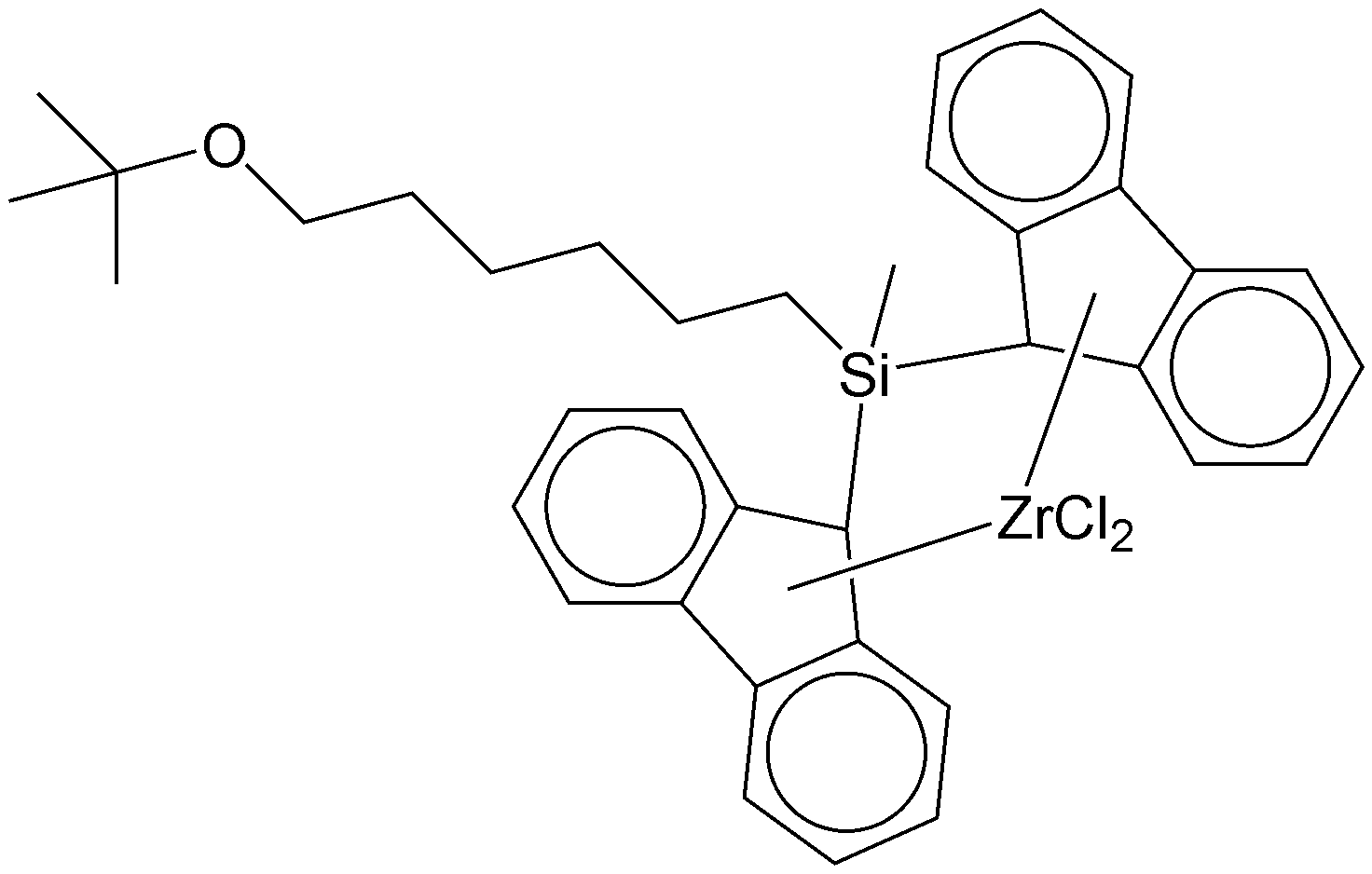
THF 용매하에서 tert-butyl-O-(CH2)6Cl 화합물과 Mg(0) 간의 반응으로부터 그리냐드(Grignard) 시약인 tert-butyl-O-(CH2)6MgCl 용액 1.0 mole을 얻었다. 상기 제조된 그리냐드 화합물을 -30 oC의 상태의 (CH3)SiCl3 화합물(176.1 mL, 1.5 mol)과 THF(2.0 mL)가 담겨있는 플라스크에 가하고, 상온에서 8 시간 이상 교반시킨 후, 걸러낸 용액을 진공 건조하여 tert-butyl-O-(CH2)6Si(CH3)Cl2의 화합물을 얻었다(수율 92%).From the reaction between tert-butyl-O-(CH 2 ) 6 Cl compound and Mg(0) in THF solvent, 1.0 mole of tert-butyl-O-(CH 2 ) 6 MgCl solution, a Grignard reagent, was obtained. The prepared Grignard compound was added to a flask containing (CH 3 )SiCl 3 compound (176.1 mL, 1.5 mol) and THF (2.0 mL) at -30 o C, and stirred at room temperature for more than 8 hours. The filtered solution was vacuum dried to obtain the compound tert-butyl-O-(CH 2 ) 6 Si(CH 3 )Cl 2 (yield 92%).
-20 oC에서 반응기에 플루오렌(Flu, fluoren, 3.33 g, 20mmol)과 헥산(100mL)와 MTBE(methyl tert-butyl ether, 1.2 mL, 10 mmol)를 넣고, 8 mL의 n-BuLi(2.5M in Hexane)을 천천히 가하고, 상온에서 6 시간 교반시켰다. 교반이 종결된 후, 반응기 온도를 -30 oC로 냉각시키고, -30 oC에서 헥산(100 mL)에 녹아있는 tert-butyl-O-(CH2)6Si(CH3)Cl2(2.7 g, 10mmol) 용액에 상기 제조된 플루오레닐 리튬 용액을 1 시간에 걸쳐 천천히 가하였다. 상온에서 8 시간 이상 교반한 후, 물을 첨가하여 추출하고, 건조(evaporation)하여 (tert-butyl-O-(CH2)6)(CH3)Si(9-C13H10)2 화합물을 얻었다(5.3g, 수율 100%). 리간드의 구조는 1H-NMR을 통해 확인하였다.Fluorene (Flu, 3.33 g, 20 mmol), hexane (100 mL), and MTBE (methyl tert-butyl ether, 1.2 mL, 10 mmol) were added to the reactor at -20 o C, and 8 mL of n-BuLi (2.5 M in Hexane) was slowly added and stirred at room temperature for 6 hours. After the stirring was terminated, the reactor temperature was cooled to -30 o C, and tert-butyl-O-(CH 2 ) 6 Si(CH 3 )Cl 2 (2.7) dissolved in hexane (100 mL) at -30 o C. g, 10 mmol) The fluorenyl lithium solution prepared above was slowly added to the solution over 1 hour. After stirring at room temperature for more than 8 hours, water was added, extracted, and dried (evaporation) to obtain (tert-butyl-O-(CH 2 ) 6 )(CH 3 )Si(9-C 13 H 10 ) 2 compound. Obtained (5.3g, yield 100%). The structure of the ligand was confirmed through 1 H-NMR.
1H NMR(500 MHz, CDCl3, ppm): δ -0.35 (CH3Si, 3H, s), 0.26 (Si-CH2, 2H, m), 0.58 (CH2, 2H, m), 0.95 (CH2, 4H, m), 1.17(tert-butyl-O, 9H, s), 1.29(CH2, 2H, m), 3.21(tert-butyl-O-CH2, 2H, t), 4.10(Flu-9H, 2H, s), 7.25(Flu-H, 4H, m), 7.35(Flu-H, 4H, m), 7.40(Flu-H, 4H, m), 7.85(Flu-H, 4H, d). 1 H NMR (500 MHz, CDCl 3 , ppm): δ -0.35 (CH 3 Si, 3H, s), 0.26 (Si-CH 2 , 2H, m), 0.58 (CH 2 , 2H, m), 0.95 ( CH 2 , 4H, m), 1.17(tert-butyl-O, 9H, s), 1.29(CH 2 , 2H, m), 3.21(tert-butyl-O-CH 2 , 2H, t), 4.10(Flu -9H, 2H, s), 7.25(Flu-H, 4H, m), 7.35(Flu-H, 4H, m), 7.40(Flu-H, 4H, m), 7.85(Flu-H, 4H, d ).
-20 oC에서 (tert-butyl-O-(CH2)6)(CH3)Si(9-C13H10)2(3.18 g, 6 mmol)/MTBE(20mL) 용액에 4.8 mL의 n-BuLi(2.5 M in Hexane)을 천천히 가하고 상온으로 올리면서 8시간 이상 반응시킨 후, -20 oC에서 상기 제조된 디리튬염(dilithium salts) 슬러리 용액을 ZrCl4(THF)2(2.26 g, 6 mmol)/헥산(20 mL)의 슬러리 용액으로 천천히 가하고 상온에서 8 시간 동안 더 반응시켰다. 침전물을 여과하고 여러 번 헥산으로 씻어내어 붉은색 고체 형태의 (tert-butyl-O-(CH2)6) (CH3)Si(9-C13H9)2ZrCl2 화합물을 얻었다(4.3 g, 수율 94.5%).4.8 mL of n in a solution of (tert-butyl-O-(CH 2 ) 6 )(CH 3 )Si(9-C 13 H 10 ) 2 (3.18 g, 6 mmol)/MTBE (20 mL) at -20 o C. -BuLi (2.5 M in Hexane) was slowly added and reacted for more than 8 hours while raising the temperature to room temperature. Then , the dilithium salts slurry solution prepared above was mixed with ZrCl 4 (THF) 2 (2.26 g, A slurry solution of 6 mmol)/hexane (20 mL) was slowly added and reacted at room temperature for further 8 hours. The precipitate was filtered and washed several times with hexane to obtain (tert-butyl-O-(CH 2 ) 6 ) (CH 3 )Si(9-C 13 H 9 ) 2 ZrCl 2 compound in the form of a red solid (4.3 g). , yield 94.5%).
1H NMR(500 MHz, C6D6, ppm): δ 1.15(tert-butyl-O, 9H, s), 1.26 (CH3Si, 3H, s), 1.58 (Si-CH2, 2H, m), 1.66 (CH2, 4H, m), 1.91(CH2, 4H, m), 3.32(tert-butyl-O-CH2, 2H, t), 6.86 (Flu-H, 2H, t), 6.90 (Flu-H, 2H, t), 7.15 (Flu-H, 4H, m), 7.60 (Flu-H, 4H, dd), 7.64(Flu-H, 2H, d), 7.77(Flu-H, 2H, d). 1 H NMR (500 MHz, C 6 D 6 , ppm): δ 1.15 (tert-butyl-O, 9H, s), 1.26 (CH 3 Si, 3H, s), 1.58 (Si-CH2, 2H, m) , 1.66 (CH2, 4H, m), 1.91(CH2, 4H, m), 3.32(tert-butyl-O-CH2, 2H, t), 6.86 (Flu-H, 2H, t), 6.90 (Flu-H , 2H, t), 7.15 (Flu-H, 4H, m), 7.60 (Flu-H, 4H, dd), 7.64(Flu-H, 2H, d), 7.77(Flu-H, 2H, d).
<촉매 조성물의 제조><Preparation of catalyst composition>
제조예 1Manufacturing Example 1
300 mL 유리 반응기에 톨루엔 50 mL를 넣고 비다공성 실리카(non-porous silica, SiO2) 10 g을 투입한 후, 반응기 온도를 40 oC로 올리면서 교반하였다. 이때, 상기 비다공성 실리카는 국제표준화기구 ISO 9277 방법에 따라 측정한 비표면적(specific surface area)가 15 m2/g 이었다. 상기 비다공성 실리카는 스퇴버법 (Stober, W. and A. Fink, Bohn, Journal of Colloid and Interface Science, 1986, 26, 62) 방법으로 테트라에틸 오르쏘실리케이트(tetraethyl orthosilicate, TEOS)를 사용하여 NaOH 촉매를 첨가한 수성 용매 조건 하에서 가수분해 공정을 통해 제조하였다. 50 mL of toluene was added to a 300 mL glass reactor, 10 g of non-porous silica (SiO 2 ) was added, and the reactor temperature was raised to 40 o C while stirring. At this time, the non-porous silica had a specific surface area measured according to the International Organization for Standardization ISO 9277 method of 15 m 2 /g. The non-porous silica is NaOH catalyst using tetraethyl orthosilicate (TEOS) by the Stober method (Stober, W. and A. Fink, Bohn, Journal of Colloid and Interface Science, 1986, 26, 62). It was prepared through a hydrolysis process under aqueous solvent conditions with the addition of .
이후에, 10 wt% 메틸알루미녹산(MAO)/톨루엔 용액(Albermarle 사)을 60 mL를 투입하고, 온도를 60 oC로 올린 후, 200 rpm으로 12 시간 교반하였다. 반응기 온도를 40 oC로 낮춘 후 교반을 중지하고 10분 동안 정치(settling)시킨 후, 반응 용액을 디캔테이션(decantation)하였다. 톨루엔을 100 mL 투입하고, 10 분간 교반한 후, 교반을 중지하고 10분동안 정치 시킨고 톨루엔 용액을 디캔테이션하였다.Afterwards, 60 mL of 10 wt% methylaluminoxane (MAO)/toluene solution (Albermarle) was added, the temperature was raised to 60 o C, and the mixture was stirred at 200 rpm for 12 hours. After lowering the reactor temperature to 40 o C, stirring was stopped and allowed to settle for 10 minutes, and then the reaction solution was decantated. 100 mL of toluene was added and stirred for 10 minutes, then stirring was stopped and allowed to stand for 10 minutes, and then the toluene solution was decantated.
이후, 반응기에 톨루엔 50 mL, 상기 합성예 2에서 제조한 메탈로센 화합물 0.0055 mmol/gSiO2과 톨루엔 10 mL 용액을 반응기에 투입하고, 200 rpm으로 1 시간 동안 교반하였다. 이후, 상기 합성예 1에서 제조한 메탈로센 화합물 0.0025 mmol/gSiO2과 톨루엔 10 mL 용액을 반응기에 투입하고 200 rpm으로 2 시간 동안 교반하였다. 이 때, 상기 합성예 1의 메탈로센 화합물과 합성예 2의 메탈로센 화합물과의 비율은 몰비 기준 1:2.2가 되었다. 이후, 톨루엔을 30 mL 투입하고, 10 분간 교반한 후, 교반을 중지하고 30분 동안 정치시킨고 톨루엔 용액을 디캔테이션하였다. Then, 50 mL of toluene, 0.0055 mmol/gSiO 2 of the metallocene compound prepared in Synthesis Example 2, and 10 mL of toluene were added to the reactor, and stirred at 200 rpm for 1 hour. Afterwards, a solution of 0.0025 mmol/gSiO 2 and 10 mL of toluene of the metallocene compound prepared in Synthesis Example 1 was added to the reactor and stirred at 200 rpm for 2 hours. At this time, the ratio between the metallocene compound of Synthesis Example 1 and the metallocene compound of Synthesis Example 2 was 1:2.2 based on the molar ratio. Afterwards, 30 mL of toluene was added, and the mixture was stirred for 10 minutes. Then, the stirring was stopped, the mixture was left to stand for 30 minutes, and the toluene solution was decantated.
반응기에 헥산 30 mL을 투입하고 헥산 슬러리를 필터 드라이로 이송하고 헥산 용액을 필터하였다. 이후에, 필터후 얻어진 고형분을 40 oC에서 4 시간 동안 감압 하에 건조하여 혼성 담지 촉매 조성물을 제조하였다. 30 mL of hexane was added to the reactor, the hexane slurry was transferred to a filter dryer, and the hexane solution was filtered. Afterwards, the solid content obtained after filtering was dried under reduced pressure at 40 o C for 4 hours to prepare a hybrid supported catalyst composition.
한편, 필터후 얻어진 여액에 대해 ICP 분석을 수행한 결과, 여액내에 남아있는 전이금속(Zr)의 함량은 0.1 ppm 이하로 분석되었다. Meanwhile, as a result of performing ICP analysis on the filtrate obtained after filtering, the content of transition metal (Zr) remaining in the filtrate was analyzed to be less than 0.1 ppm.
이렇게 제조한 촉매 조성물에 대하여 투과전자현미경(transmission electron microscope, TEM)으로 측정한 사진을 도 1에 나타내었다. 특히, 도 1 (a)는 무기 소재의 표면을 나타낸것이고, 도 1 (b)는 무기 소재에 조촉매를 담지하였을때의 사진이다. 도 1 (c)는 무기 소재에 조촉매를 담지한 후 메탈로센 화합물을 담지한 후의 사진이고, 도 1 (d)는 도 1 (c)를 확대한 사진이다. 이러한 도 1에 따르면 무기 소재 표면에 메탈로센 화합물이 결합되어 있는 것을 확인할 수 있다. A photograph of the catalyst composition prepared in this way measured with a transmission electron microscope (TEM) is shown in Figure 1. In particular, Figure 1 (a) shows the surface of an inorganic material, and Figure 1 (b) is a photograph when a cocatalyst is supported on an inorganic material. Figure 1(c) is a photograph after supporting a cocatalyst on an inorganic material and then supporting a metallocene compound, and Figure 1(d) is an enlarged photograph of Figure 1(c). According to Figure 1, it can be seen that the metallocene compound is bound to the surface of the inorganic material.
비교 제조예 1Comparative Manufacturing Example 1
상기 제조예 1과 동일한 방법으로 제조하되, 비다공성 실리카(non-porous silica, SiO2) 대신에 다공성 실리카(porous silica, W.R.Grace사의 SP9 제품)를 사용하여 혼성 담지 촉매 조성물을 제조하였다. 이때, 상기 다공성 실리카는 국제표준화기구 ISO 9277 방법에 따라 측정한 비표면적(specific surface area)가 300 m2/g 이었다. A hybrid supported catalyst composition was prepared in the same manner as Preparation Example 1, except that porous silica (SP9 product from WRGrace) was used instead of non-porous silica (SiO 2 ). At this time, the specific surface area of the porous silica measured according to the International Organization for Standardization ISO 9277 method was 300 m 2 /g.
<유무기 하이브리드 폴리올레핀 복합체의 제조><Manufacture of organic-inorganic hybrid polyolefin composite>
실시예 1Example 1
2 L 용량의 오토클레이브(Autoclave) 반응기에 트리에틸알루미늄(TEAL) 2 mL (1.0 M hexane), 상기 제조예 1의 혼성 담지 촉매 조성물과 헥산을 바이알에 담아 반응기에 투입하고, 헥산 0.8 kg을 투입한 후 500 rpm으로 교반하면서 온도를 80 oC로 승온하였다. 반응기 내부 온도가 78 oC가 되면 에틸렌 가스를 투입하고, 9 bar 하에서 500 rpm으로 교반하면서 반응시켰다. 이때, 상기 혼성 담지 촉매 조성물과 에틸렌 가스는, 실리카의 함량이 유무기 하이브리드 폴리에틸렌 복합체 총중량을 기준으로 0.5 중량%가 되도록 함량을 조절하여 투입하였다. 또한, 상기 중합 반응은 20 분 이내에서 각각 1 분, 3 분, 5 분, 7 분, 20 분으로 달리하여 수행하였다. 반응 종료 후 얻어진 폴리머는 필터를 통해 헥산을 먼저 제거한 후, 헥산으로 세척하고 필터를 통해 헥산을 다시 제거하고, 80 oC 진공 오븐에서 4 시간 동안 건조하여 파우더(powder) 형태로 에틸렌 호모 중합체가 포함된 유무기 하이브리드 폴리에틸렌 복합체를 수득하였다. In a 2 L capacity autoclave reactor, 2 mL (1.0 M hexane) of triethylaluminum (TEAL), the hybrid supported catalyst composition of Preparation Example 1, and hexane were placed in a vial and placed into the reactor, and 0.8 kg of hexane was added. Then, the temperature was raised to 80 o C while stirring at 500 rpm. When the temperature inside the reactor reached 78 o C, ethylene gas was introduced, and the reaction was performed under 9 bar and stirring at 500 rpm. At this time, the hybrid supported catalyst composition and ethylene gas were added by adjusting the silica content to 0.5% by weight based on the total weight of the organic-inorganic hybrid polyethylene composite. Additionally, the polymerization reaction was performed within 20 minutes at different times of 1 minute, 3 minutes, 5 minutes, 7 minutes, and 20 minutes, respectively. After completion of the reaction, the polymer obtained was first removed from hexane through a filter, then washed with hexane, removed again of hexane through a filter, and dried in a vacuum oven at 80 o C for 4 hours to form a powder containing ethylene homopolymer. An organic-inorganic hybrid polyethylene composite was obtained.
특히, 상술한 중합 반응 시간을 3분 내지 7분으로 수행하여 얻어진 유무기 하이브리드 폴리에틸렌 복합체를 최종 생성물로 사용하여, 하기 시험예에서와 같이 물성 평가를 수행하였다. In particular, the organic-inorganic hybrid polyethylene composite obtained by performing the above-mentioned polymerization reaction time of 3 to 7 minutes was used as the final product, and physical properties were evaluated as in the test examples below.
한편, 상술한 중합 공정 수행시 반응 시간별로 샘플을 채취하여 투과전자현미경(transmission electron microscope, TEM)으로 측정한 사진을 도 2에 나타내었다. 도 2에 나타낸 바와 같이 중합 반응 개시 후 각각 (a) 1 분, (b) 3 분, (c) 5 분, (d) 20 분 경과시 고분자가 어떠한 형상으로 자라는지 확인할 수 있으며, 비다공성 무기 소재에 결합된 메탈로센 화합물로부터 고분자가 자라는 것을 확인 할 수 있다.Meanwhile, when performing the above-described polymerization process, samples were collected at each reaction time and a photograph measured using a transmission electron microscope (TEM) is shown in FIG. 2. As shown in Figure 2, it can be seen what shape the polymer grows into (a) 1 minute, (b) 3 minutes, (c) 5 minutes, and (d) 20 minutes, respectively, after the start of the polymerization reaction, and the non-porous inorganic It can be confirmed that the polymer grows from the metallocene compound bound to the material.
실시예 2 내지 3Examples 2 to 3
상기 실시예 1과 동일한 방법으로 제조하되, 하기 표 1에 나타낸 바와 같이 실리카의 함량이 유무기 하이브리드 폴리에틸렌 복합체 총중량을 기준으로 각각 2.2 중량% 및 8.0 중량%가 되도록 상술한 혼성 담지 촉매 조성물 존재 하에서 에틸렌 중합 반응을 수행하고, 세척 건조하여 파우더(powder) 형태로 에틸렌 호모 중합체가 포함된 유무기 하이브리드 폴리에틸렌 복합체를 수득하였다. Ethylene was prepared in the same manner as in Example 1, but in the presence of the hybrid supported catalyst composition described above so that the silica content was 2.2% by weight and 8.0% by weight, respectively, based on the total weight of the organic-inorganic hybrid polyethylene composite, as shown in Table 1 below. A polymerization reaction was performed, washed and dried to obtain an organic-inorganic hybrid polyethylene composite containing ethylene homopolymer in powder form.
비교예 1Comparative Example 1
상기 실시예 1과 동일한 방법으로 제조하되, 상기 제조예 1의 혼성 담지 촉매 조성물 대신에 비교제조예 1의 혼성 담지 촉매 조성물을 사용하여 중합 공정을 수행한후에 세척 건조하여 파우더(powder) 형태로 에틸렌 호모 중합체가 포함된 유무기 하이브리드 폴리에틸렌 복합체를 수득하였다. It was prepared in the same manner as Example 1, except that the polymerization process was performed using the hybrid supported catalyst composition of Comparative Preparation Example 1 instead of the hybrid supported catalyst composition of Preparation Example 1, and then washed and dried to produce ethylene homogenate in the form of powder. An organic-inorganic hybrid polyethylene composite containing a polymer was obtained.
특히, 비교예 1의 중합 공정은 실시예 1과 동일한 조건 하에서 수행하였으나, 비다공성 실리카가 아닌 다공성 실리카를 포함한 비교제조예 1의 혼성 담지 촉매 조성물을 적용하여, 에틸렌 중합 중에 다공성 실리카가 부서지면서, 순간적으로 에틸렌 중합량이 많아지고 실리카 함량이 상대적으로 확 줄어들면서 하기 표 1에 나타낸 바와 같이 실리카의 함량이 유무기 하이브리드 폴리에틸렌 복합체 총중량을 기준으로 0.01 중량% 미만이 되었다. In particular, the polymerization process of Comparative Example 1 was performed under the same conditions as Example 1, but the hybrid supported catalyst composition of Comparative Preparation Example 1 containing porous silica rather than non-porous silica was applied, so that the porous silica broke during ethylene polymerization, As the amount of ethylene polymerization instantly increased and the silica content relatively decreased, the silica content became less than 0.01% by weight based on the total weight of the organic-inorganic hybrid polyethylene composite, as shown in Table 1 below.
비교예 2Comparative Example 2
상기 실시예 1과 동일한 방법으로 제조하되, 하기 표 1에 나타낸 바와 같이 실리카의 함량이 유무기 하이브리드 폴리에틸렌 복합체 총중량을 기준으로 0.3 중량%가 되도록 상술한 혼성 담지 촉매 조성물 존재 하에서 에틸렌 중합 반응을 수행하고, 세척 건조하여 파우더(powder) 형태로 에틸렌 호모 중합체가 포함된 유무기 하이브리드 폴리에틸렌 복합체를 수득하였다. It was prepared in the same manner as in Example 1, but the ethylene polymerization reaction was performed in the presence of the hybrid supported catalyst composition described above so that the silica content was 0.3% by weight based on the total weight of the organic-inorganic hybrid polyethylene composite, as shown in Table 1 below. , washed and dried to obtain an organic-inorganic hybrid polyethylene composite containing ethylene homopolymer in powder form.
<시험예: 유무기 하이브리드 폴리올레핀 복합체의 물성 평가><Test example: Evaluation of physical properties of organic-inorganic hybrid polyolefin composite>
상기 실시예 및 비교예에서 제조한 유무기 하이브리드 폴리에틸렌 복합체에 대해 하기와 같은 방법으로 물성을 측정하고, 그 결과를 하기 표 1에 나타내었다. The physical properties of the organic-inorganic hybrid polyethylene composites prepared in the above Examples and Comparative Examples were measured by the following method, and the results are shown in Table 1 below.
1) 탄성 모듈러스(Young's modulus) 및 항복강도(Yield strength) 1) Young's modulus and yield strength
미국재료시험학회규격 ASTM D 638 시험법에 의거하여 실시예 및 비교예에서 얻어진 고분자로 필름 시편을 제조하였고, 동일 시험법에 의거하여 UTM(Universial Tensile Machine)을 사용하여 탄성 모듈러스(Young's modulus) 및 항복강도(Yield strength)를 측정하였다. Film specimens were manufactured from the polymers obtained in Examples and Comparative Examples in accordance with the American Society for Testing and Materials standard ASTM D 638 test method, and the elastic modulus (Young's modulus) and Yield strength was measured.
2) 젖음성(Wettability, Contact Angle) 2) Wetability (Contact Angle)
미국재료시험학회규격 ASTM D 5946 시험법에 의거하여 실시예 및 비교예에서 얻어진 고분자로 필름 시편을 제조하고 필름 시편의 표면에 물을 떨어뜨려, 고분자 필름 표면의 물에 대한 접촉각(Degree, o)을 측정하였고, 젖음성(wettablility)를 확인 하였다. 접촉각 측정 장비(contact angle meter)로는 KRUSS사의 DSA 100을 사용하였다.Film specimens were manufactured from the polymers obtained in Examples and Comparative Examples in accordance with the American Society for Testing and Materials standard ASTM D 5946 test method, and water was dropped on the surface of the film specimens to determine the contact angle (Degree, o ) of the polymer film surface with water. was measured, and wettability was confirmed. DSA 100 from KRUSS was used as a contact angle meter.
이러한 실시예 및 비교예에서 얻어진 고분자 필름 표면의 물에 대한 접촉각을 측정 결과의 모식도를 도 3에 나타내었으며, 상기 실시예 1 내지 3에서 제조한 유무기 하이브리드 폴리에틸렌 복합체의 물에 대한 접촉각이 비교예 1 및 2에서 제조한 유무기 하이브리드 폴리에틸렌 복합체의 물에 대한 접촉각에 비해 현저히 낮게 나타냄을 확인할 수 있다. 접촉각이 낮다는 것은 물에 의한 젖음성이 좋다는 것이고, 리튬 이온 베터리(LiB)의 분리막으로 적용시, 전해질이 쉽게 침투할 수 있음을 알 수 있다. A schematic diagram of the results of measuring the contact angle with water of the surface of the polymer film obtained in these Examples and Comparative Examples is shown in Figure 3, and the contact angle with water of the organic-inorganic hybrid polyethylene composite prepared in Examples 1 to 3 is shown in Comparative Examples. It can be seen that the contact angle with water of the organic-inorganic hybrid polyethylene composite prepared in 1 and 2 is significantly lower than that of the water. A low contact angle means good wettability by water, and when applied as a separator for a lithium-ion battery (LiB), it can be seen that the electrolyte can easily penetrate.
3) 치수안정성(Dimensional stability)3) Dimensional stability
치수안정성(Dimensional stability)을 확인하기 위하여, 앞서 젖음성 테스트시와 동일한 방법으로 제조한 필름 시편을 140 oC에서 1 시간 동안 방치하였다. 방치 전과 방치후의 면적을 측정하여 수축률을 확인하였다. In order to check dimensional stability, film specimens prepared in the same manner as in the previous wettability test were left at 140 o C for 1 hour. The shrinkage rate was confirmed by measuring the area before and after leaving.
여기서, 상술한 바와 같이 140 oC에서 1 시간 동안 방치하여 필름의 열 수축이 나타남에 있어서, 필름 시편의 방치후 면적이 방치전 면적의 95% 이상인 경우 '좋음'으로 표시하고, 90% 이상에서 95% 미만인 경우 '보통'으로 표시하고, 90% 미만인 경우에는 '나쁨'으로 표시하였다. Here, as described above, when heat shrinkage of the film occurs when left at 140 o C for 1 hour, if the area of the film specimen after leaving is 95% or more of the area before leaving, it is marked as 'good', and if it is 90% or more, If it was less than 95%, it was marked as ‘average’, and if it was less than 90%, it was marked as ‘poor.’
이러한 치수안정성(Dimensional stability) 평가시 방치전과 방치후의 필름 시편에 대한 사진을 도 4에 나타내었으며, 상기 실시예 1 내지 3에서 제조한 유무기 하이브리드 폴리에틸렌 복합체의 치수 안정성이 비교예 1 및 2에서 제조한 유무기 하이브리드 폴리에틸렌 복합체의 치수 안정성에 비해 현저히 우수함을 알 수 있다. When evaluating dimensional stability, photographs of film specimens before and after leaving are shown in Figure 4, and the dimensional stability of the organic-inorganic hybrid polyethylene composites prepared in Examples 1 to 3 was compared to that of Comparative Examples 1 and 2. It can be seen that the dimensional stability is significantly superior to that of an organic-inorganic hybrid polyethylene composite.
4) 열폭주 차단성(Shutdown function)4) Thermal runaway prevention (Shutdown function)
열폭주 차단성(Shutdown function)을 확인하기 위하여, 앞서 젖음성 테스트시와 동일한 방법으로 제조한 필름 시편을 거름종이 위에 놓고 150 oC에서 1 시간 동안 방치하여, 필름이 녹으면서 원래의 형태를 어느 정도 유지할 수 있는가를 확인하였다. In order to check the thermal runaway function (shutdown function), a film specimen prepared in the same manner as in the previous wettability test was placed on a piece of filter paper and left at 150 o C for 1 hour. The film melted and retained its original shape to some extent. It was confirmed whether it could be maintained.
여기서, 상술한 바와 같이 150 oC에서 1 시간 동안 방치하여 필름이 녹아내리는 현상이 나타남에 있어서, 필름 시편의 형태가 고열 조건 하에서 방치후에도 방치전 초기 형태를 유지하는 경우 '좋음'으로 표시하고, 방치전 초기 형태 중 윤곽선만을 유지하는 경우 '보통'으로 표시하고, 방치전 초기 형태의 윤곽선도 제대로 확인하기 어려운 경우에는 '나쁨'으로 표시하였다. Here, as described above, when the film melts when left at 150 o C for 1 hour, if the shape of the film specimen maintains its initial shape before leaving even after leaving under high temperature conditions, it is marked as 'good'; If only the outline of the initial shape before abandonment was maintained, it was marked as 'normal', and if it was difficult to properly check the outline of the initial shape before abandonment, it was marked as 'poor'.
이러한 열폭주 차단성(Shutdown function) 평가시 방치전과 방치후의 필름 시편에 대한 사진을 도 5에 나타내었으며, 비교예 1과 비교예 2는 필름의 형태가 거의 남지 않고 거름종이에 녹아 들어 간 것을 볼 수 있는 반면에, 실시예 1 내지 3은 필름 초기 형태를 유지하면서 거름종이에도 적절히 녹아들어간 것을 확인할 수 있다. When evaluating the thermal runaway function (shutdown function), photographs of film specimens before and after being left are shown in Figure 5, and it can be seen that Comparative Example 1 and Comparative Example 2 melted into the filter paper with almost no film remaining. On the other hand, it can be confirmed that Examples 1 to 3 were properly dissolved in filter paper while maintaining the initial form of the film.
5) 분자량(Mw, Mn) 및 분자량 분포(PDI, polydispersity index)5) Molecular weight (Mw, Mn) and molecular weight distribution (PDI, polydispersity index)
겔 투과 크로마토그래피(GPC, gel permeation chromatography, Water사 제조)를 이용하여 실시예 및 비교예에서 얻어진 고분자의 중량평균 분자량(Mw)과 수평균 분자량(Mn)을 측정하고, 중량평균 분자량을 수평균 분자량으로 나누어 분자량 분포(PDI, Mw/Mn)를 계산하였다. The weight average molecular weight (Mw) and number average molecular weight (Mn) of the polymers obtained in Examples and Comparative Examples were measured using gel permeation chromatography (GPC, manufactured by Water), and the weight average molecular weight was calculated as the number average. Molecular weight distribution (PDI, Mw/Mn) was calculated by dividing by molecular weight.
구체적으로, 겔투과 크로마토그래피(GPC) 장치로는 Waters PL-GPC220 기기를 이용하고, Polymer Laboratories PLgel MIX-B 300 mm 길이 칼럼을 사용하였다. 이때 측정 온도는 160 oC이며, 1,2,4-트리클로로벤젠(1,2,4-Trichlorobenzene)을 용매로서 사용하였으며, 유속은 1 mL/min로 하였다. 실시예 및 비교예에 따른 폴리에틸렌 시료는 각각 GPC 분석 기기 (PL-GP220)을 이용하여 디부틸히드록시톨루엔 (BHT, 2,6-bis(1,1-dimethylethyl)-4-methylphenol) 0.0125% 포함된 트리클로로벤젠(1,2,4-Trichlorobenzene)에서 160 oC, 10 시간 동안 녹여 전처리하고, 10 mg/10mL의 농도로 조제한 다음, 200 μL의 양으로 공급하였다. 폴리스티렌 표준 시편을 이용하여 형성된 검정 곡선을 이용하여 Mw 및 Mn의 값을 유도하였다. 폴리스티렌 표준 시편의 중량평균 분자량은 2000 g/mol, 10000 g/mol, 30000 g/mol, 70000 g/mol, 200000 g/mol, 700000 g/mol, 2000000 g/mol, 4000000 g/mol, 10000000 g/mol의 9종을 사용하였다.Specifically, a Waters PL-GPC220 instrument was used as a gel permeation chromatography (GPC) device, and a 300 mm long column from Polymer Laboratories PLgel MIX-B was used. At this time, the measurement temperature was 160 o C, 1,2,4-trichlorobenzene was used as a solvent, and the flow rate was 1 mL/min. The polyethylene samples according to the examples and comparative examples each contained 0.0125% of dibutylhydroxytoluene (BHT, 2,6-bis(1,1-dimethylethyl)-4-methylphenol) using a GPC analysis device (PL-GP220). It was pretreated by dissolving it in 1,2,4-Trichlorobenzene at 160 o C for 10 hours, prepared at a concentration of 10 mg/10 mL, and then supplied in an amount of 200 μL. The values of Mw and Mn were derived using a calibration curve formed using a polystyrene standard specimen. The weight average molecular weight of polystyrene standard specimens is 2000 g/mol, 10000 g/mol, 30000 g/mol, 70000 g/mol, 200000 g/mol, 700000 g/mol, 2000000 g/mol, 4000000 g/mol, 10000000 g. Nine types of /mol were used.
상기 표 1에 나타난 바와 같이, 본 발명에 따른 실시예 1 내지 3의 유무기 하이브리드 폴리에틸렌 복합체는, 비다공성 실리카에 메탈로센 화합물을 결합시킨 후 에틸렌 중합 공정을 수행하며 무기 소재의 함량을 특정함으로써, 무기 소재와 올레핀 폴리머(olefin polymer)의 혼합 및 분산이 효과적으로 이뤄지며, 우수한 기계적 물성, 젖음성(wettability), 치수 안정성(dimensional stability), 열 폭주 차단성(shutdown)과 함께 낮은 열 수축율(thermal shrinkage)을 확보할 수 있을 뿐만 아니라, 올레핀 폴리머의 마이그레이션(migration)으로 시간 경과에 따른 물성 저하 문제를 해결할 수 있다.As shown in Table 1, the organic-inorganic hybrid polyethylene composite of Examples 1 to 3 according to the present invention is obtained by bonding a metallocene compound to non-porous silica, performing an ethylene polymerization process, and specifying the content of the inorganic material. , mixing and dispersion of inorganic materials and olefin polymer is achieved effectively, and has excellent mechanical properties, wettability, dimensional stability, thermal runaway shutdown, and low thermal shrinkage. Not only can this be secured, but the problem of deterioration of physical properties over time can be solved through migration of olefin polymer.
Claims (15)
상기 비다공성 무기 소재는, 국제표준화기구 ISO 9277 방법에 따라 측정한 비표면적(specific surface area)가 100 m2/g 이하이고,
상기 비다공성 무기 소재는 유무기 하이브리드 폴리올레핀 복합체 총중량을 기준으로 0.4 중량% 이상 12 중량% 이하의 함량으로 포함되는,
유무기 하이브리드 폴리올레핀 복합체.
Comprising polyolefin and a non-porous inorganic material combined with at least a portion of the polyolefin,
The non-porous inorganic material has a specific surface area measured according to the International Organization for Standardization ISO 9277 method of 100 m 2 /g or less,
The non-porous inorganic material is contained in an amount of 0.4% by weight or more and 12% by weight or less based on the total weight of the organic-inorganic hybrid polyolefin composite.
Organic-inorganic hybrid polyolefin composite.
상기 비다공성 무기 소재는 유무기 하이브리드 폴리올레핀 복합체 총중량을 기준으로 0.45 중량% 이상 10 중량% 이하의 함량으로 포함되는,
유무기 하이브리드 폴리올레핀 복합체.
According to paragraph 1,
The non-porous inorganic material is contained in an amount of 0.45% by weight or more and 10% by weight or less based on the total weight of the organic-inorganic hybrid polyolefin composite.
Organic-inorganic hybrid polyolefin composite.
상기 폴리올레핀은, 에틸렌, 프로필렌, 1-부텐, 1-펜텐, 1-헥센, 4-메틸-1-펜텐, 1-옥텐, 1-데센, 1-도데센, 1-테트라데센, 1-헥사데센, 1-옥타데센, 및 1-에이코센으로 이루어진 군에서 선택되는 올레핀 단량체의 호모 중합체 또는 공중합체인,
유무기 하이브리드 폴리올레핀 복합체.
According to paragraph 1,
The polyolefin is ethylene, propylene, 1-butene, 1-pentene, 1-hexene, 4-methyl-1-pentene, 1-octene, 1-decene, 1-dodecene, 1-tetradecene, 1-hexadecene , 1-octadecene, and 1-eicocene, which are homopolymers or copolymers of olefin monomers selected from the group consisting of,
Organic-inorganic hybrid polyolefin composite.
상기 비다공성 무기 소재는, 국제표준화기구 ISO 9277 방법에 따라 측정한 비표면적(specific surface area)가 80 m2/g 이하인,
유무기 하이브리드 폴리올레핀 복합체.
According to paragraph 1,
The non-porous inorganic material has a specific surface area measured according to the International Organization for Standardization ISO 9277 method of 80 m 2 /g or less,
Organic-inorganic hybrid polyolefin composite.
상기 비다공성 무기 소재는, 알루미나, 마그네시아, 지르코니아, 제올라이트, 및 실리카로 이루어진 군에서 선택된 1종 이상인,
유무기 하이브리드 폴리올레핀 복합체.
According to paragraph 1,
The non-porous inorganic material is one or more selected from the group consisting of alumina, magnesia, zirconia, zeolite, and silica,
Organic-inorganic hybrid polyolefin composite.
상기 비다공성 무기 소재는, 상기 폴리올레핀 중 적어도 일부와 화학적으로 결합된 것인,
유무기 하이브리드 폴리올레핀 복합체.
According to paragraph 1,
The non-porous inorganic material is chemically bonded to at least some of the polyolefin,
Organic-inorganic hybrid polyolefin composite.
중량평균분자량이 300,000 g/mol 이상인,
유무기 하이브리드 폴리올레핀 복합체.
According to paragraph 1,
Having a weight average molecular weight of 300,000 g/mol or more,
Organic-inorganic hybrid polyolefin composite.
분자량 분포(Mw/Mn)가 2.5 내지 4.5인,
유무기 하이브리드 폴리올레핀 복합체.
According to paragraph 1,
having a molecular weight distribution (Mw/Mn) of 2.5 to 4.5,
Organic-inorganic hybrid polyolefin composite.
미국재료시험학회규격 ASTM D 638 방법에 따라 측정한 탄성 모듈러스(Young's modulus)가 250 MPa 이상인,
유무기 하이브리드 폴리올레핀 복합체.
According to paragraph 1,
The elastic modulus (Young's modulus) measured according to the American Society for Testing and Materials standard ASTM D 638 is 250 MPa or more,
Organic-inorganic hybrid polyolefin composite.
미국재료시험학회규격 ASTM D 5946 방법에 따라 측정한 물에 대한 접촉각이 45 o 이하인,
유무기 하이브리드 폴리올레핀 복합체.
According to paragraph 1,
The contact angle with water is less than 45 o , as measured according to the American Society for Testing and Materials standard ASTM D 5946 method.
Organic-inorganic hybrid polyolefin composite.
상기 비다공성 무기 소재는, 국제표준화기구 ISO 9277 방법에 따라 측정한 비표면적(specific surface area)가 100 m2/g 이하이고,
상기 비다공성 무기 소재의 함량은, 유무기 하이브리드 폴리올레핀 복합체 총중량을 기준으로 0.4 중량% 이상 12 중량% 이하인,
제1항에 따른 유무기 하이브리드 폴리올레핀 복합체의 제조 방법:
[화학식 1]
(Cp1Ra)n(Cp2Rb)M1Q1 3-n
상기 화학식 1에서,
M1은 4족 전이금속이고;
Cp1 및 Cp2는 서로 동일하거나 상이하고, 각각 독립적으로 시클로펜타디엔닐, 인데닐, 4,5,6,7-테트라하이드로-1-인데닐, 및 플루오레닐 라디칼로 이루어진 군으로부터 선택된 어느 하나이고, 이들은 C1-20의 탄화수소로 치환되거나 비치환되며;
Ra 및 Rb는 서로 동일하거나 상이하고, 각각 독립적으로 수소, C1-20의 알킬, C1-20의 알콕시, C2-20의 알콕시알킬, C6-20의 아릴, C6-20의 아릴옥시, C2-20의 알케닐, C7-40의 알킬아릴, C7-40의 아릴알킬, C8-40의 아릴알케닐, 또는 C2-10의 알키닐이고, 단, Ra 및 Rb 중 적어도 하나 이상은 수소가 아니며;
Q1은 할로겐, C1-20의 알킬, C2-20의 알케닐, C7-40의 알킬아릴, C7-40의 아릴알킬, C6-20의 아릴, 치환되거나 치환되지 않은 C1-20의 알킬리덴, 치환되거나 치환되지 않은 아미노기, C2-20의 알콕시알킬, C2-20의 알킬알콕시, 또는 C7-40의 아릴알콕시이고;
n은 1 또는 0 이고;
[화학식 2]

상기 화학식 2에서,
R1 내지 R17은 서로 동일하거나 상이하고, 각각 독립적으로 수소, 할로겐, C1-20 알킬, C2-20 알케닐, C6-20 아릴, C7-20 알킬아릴, 또는 C7-20 아릴알킬이고;
L은 C1-10 직쇄 또는 분지쇄 알킬렌이며;
D는 -O-, -S-, -N(R)- 또는 -Si(R)(R')- 이고, 여기서 R 및 R'은 서로 동일하거나 상이하고, 각각 독립적으로 수소, 할로겐, C1-20 알킬, C2-20 알케닐, 또는 C6-20 아릴이며;
A는 수소, 할로겐, C1-20 알킬, C2-20 알케닐, C6-20 아릴, C7-20 알킬아릴, C7-20 아릴알킬, C1-20 알콕시, C2-20 알콕시알킬, C2-20 헤테로시클로알킬, 또는 C5-20 헤테로아릴이고;
Q는 탄소, 실리콘 또는 게르마늄이고;
M2은 4족 전이금속이며;
X1 및 X2는 서로 동일하거나 상이하고, 각각 독립적으로 할로겐, C1-20 알킬, C2-20 알케닐, C6-20 아릴, 니트로기, 아미도기, C1-20 알킬실릴, C1-20 알콕시, 또는 C1-20 설포네이트기이다.
At least one first metallocene compound represented by the following formula (1); And polymerizing olefin monomers in the presence of a catalyst composition in which a catalytically active component containing at least one second metallocene compound selected from the compounds represented by the following formula (2) is bonded to a non-porous inorganic material,
The non-porous inorganic material has a specific surface area measured according to the International Organization for Standardization ISO 9277 method of 100 m 2 /g or less,
The content of the non-porous inorganic material is 0.4% by weight or more and 12% by weight or less based on the total weight of the organic-inorganic hybrid polyolefin composite.
Method for producing the organic-inorganic hybrid polyolefin composite according to claim 1:
[Formula 1]
(Cp 1 R a ) n (Cp 2 R b )M 1 Q 1 3-n
In Formula 1,
M 1 is a Group 4 transition metal;
Cp 1 and Cp 2 are the same or different from each other, and are each independently selected from the group consisting of cyclopentadienyl, indenyl, 4,5,6,7-tetrahydro-1-indenyl, and fluorenyl radical. one, and they are substituted or unsubstituted with C 1-20 hydrocarbons;
R a and R b are the same or different from each other, and are each independently hydrogen, C 1-20 alkyl, C 1-20 alkoxy, C 2-20 alkoxyalkyl, C 6-20 aryl, C 6-20 aryloxy, C 2-20 alkenyl, C 7-40 alkylaryl, C 7-40 arylalkyl, C 8-40 arylalkenyl, or C 2-10 alkynyl, provided that R at least one of a and R b is not hydrogen;
Q 1 is halogen, C 1-20 alkyl, C 2-20 alkenyl, C 7-40 alkylaryl, C 7-40 arylalkyl, C 6-20 aryl, substituted or unsubstituted C 1 -20 alkylidene, substituted or unsubstituted amino group, C 2-20 alkoxyalkyl, C 2-20 alkylalkoxy, or C 7-40 arylalkoxy;
n is 1 or 0;
[Formula 2]
In Formula 2,
R 1 to R 17 are the same as or different from each other, and are each independently hydrogen, halogen, C 1-20 alkyl, C 2-20 alkenyl, C 6-20 aryl, C 7-20 alkylaryl, or C 7-20 is arylalkyl;
L is C 1-10 straight or branched chain alkylene;
D is -O-, -S-, -N(R)- or -Si(R)(R')-, where R and R' are the same or different from each other and are each independently hydrogen, halogen, C 1 -20 alkyl, C 2-20 alkenyl, or C 6-20 aryl;
A is hydrogen, halogen, C 1-20 alkyl, C 2-20 alkenyl, C 6-20 aryl, C 7-20 alkylaryl, C 7-20 arylalkyl, C 1-20 alkoxy, C 2-20 alkoxy alkyl, C 2-20 heterocycloalkyl, or C 5-20 heteroaryl;
Q is carbon, silicon or germanium;
M 2 is a Group 4 transition metal;
X 1 and 1-20 alkoxy, or C 1-20 sulfonate group.
상기 비다공성 무기 소재의 함량은, 유무기 하이브리드 폴리올레핀 복합체 총중량을 기준으로 0.45 중량% 이상 10 중량% 이하인,
유무기 하이브리드 폴리에틸렌 복합체의 제조 방법.
According to clause 11,
The content of the non-porous inorganic material is 0.45% by weight or more and 10% by weight or less based on the total weight of the organic-inorganic hybrid polyolefin composite.
Method for producing organic-inorganic hybrid polyethylene composite.
상기 올레핀 단량체는, 에틸렌, 프로필렌, 1-부텐, 1-펜텐, 1-헥센, 4-메틸-1-펜텐, 1-옥텐, 1-데센, 1-도데센, 1-테트라데센, 1-헥사데센, 1-옥타데센, 및 1-에이코센으로 이루어진 군에서 선택되는 1종 이상인,
유무기 하이브리드 폴리에틸렌 복합체의 제조 방법.
According to clause 11,
The olefin monomers include ethylene, propylene, 1-butene, 1-pentene, 1-hexene, 4-methyl-1-pentene, 1-octene, 1-decene, 1-dodecene, 1-tetradecene, and 1-hexadecene. At least one selected from the group consisting of decene, 1-octadecene, and 1-eicocene,
Method for producing organic-inorganic hybrid polyethylene composite.
상기 제1 메탈로센 화합물과 제2 메탈로센 화합물의 몰비는 1:9 내지 9:1인,
유무기 하이브리드 폴리올레핀 복합체의 제조 방법.
According to clause 11,
The molar ratio of the first metallocene compound and the second metallocene compound is 1:9 to 9:1,
Method for producing an organic-inorganic hybrid polyolefin composite.
Priority Applications (4)
| Application Number | Priority Date | Filing Date | Title |
|---|---|---|---|
| PCT/KR2021/017208 WO2022114710A1 (en) | 2020-11-24 | 2021-11-23 | Organic-inorganic hybrid polyolefin composite and preparation method thereof |
| US18/037,555 US20240018283A1 (en) | 2020-11-24 | 2021-11-23 | Organic-inorganic hybrid polyolefin composite and preparation method thereof |
| EP21898536.4A EP4234617A4 (en) | 2020-11-24 | 2021-11-23 | ORGANIC-INORGANIC HYBRID POLYOLEFIN COMPOSITE AND PREPARATION METHOD THEREFOR |
| CN202180077841.0A CN116529301B (en) | 2020-11-24 | 2021-11-23 | Organic-inorganic hybrid polyolefin composite material and preparation method thereof |
Applications Claiming Priority (2)
| Application Number | Priority Date | Filing Date | Title |
|---|---|---|---|
| KR20200159261 | 2020-11-24 | ||
| KR1020200159261 | 2020-11-24 |
Publications (2)
| Publication Number | Publication Date |
|---|---|
| KR20220071927A KR20220071927A (en) | 2022-05-31 |
| KR102692427B1 true KR102692427B1 (en) | 2024-08-06 |
Family
ID=81779888
Family Applications (1)
| Application Number | Title | Priority Date | Filing Date |
|---|---|---|---|
| KR1020210161559A Active KR102692427B1 (en) | 2020-11-24 | 2021-11-22 | Organic-inorgaic hybrid polyolefin composite and preparation method thereof |
Country Status (1)
| Country | Link |
|---|---|
| KR (1) | KR102692427B1 (en) |
Citations (1)
| Publication number | Priority date | Publication date | Assignee | Title |
|---|---|---|---|---|
| US20200056026A1 (en) | 2017-04-10 | 2020-02-20 | Exxonmobil Chemical Patents Inc. | Methods for Making Polyolefin Polymer Compositions |
Family Cites Families (4)
| Publication number | Priority date | Publication date | Assignee | Title |
|---|---|---|---|---|
| MXPA02006197A (en) * | 1999-12-20 | 2002-12-09 | Exxon Chemical Patents Inc | Processes for the preparation polyolefin resins using supported ionic catalysts. |
| KR20110017703A (en) * | 2009-08-14 | 2011-02-22 | 부산대학교 산학협력단 | Novel catalyst using nonporous support, preparation method thereof, and preparation method of polymer using same |
| CA2798855C (en) * | 2012-06-21 | 2021-01-26 | Nova Chemicals Corporation | Ethylene copolymers having reverse comonomer incorporation |
| KR102342780B1 (en) * | 2018-02-08 | 2021-12-23 | 주식회사 엘지화학 | Preparation method of supported hybrid metallocene catalyst |
-
2021
- 2021-11-22 KR KR1020210161559A patent/KR102692427B1/en active Active
Patent Citations (1)
| Publication number | Priority date | Publication date | Assignee | Title |
|---|---|---|---|---|
| US20200056026A1 (en) | 2017-04-10 | 2020-02-20 | Exxonmobil Chemical Patents Inc. | Methods for Making Polyolefin Polymer Compositions |
Also Published As
| Publication number | Publication date |
|---|---|
| KR20220071927A (en) | 2022-05-31 |
Similar Documents
| Publication | Publication Date | Title |
|---|---|---|
| KR102530448B1 (en) | Transition metal compound and catalyst composition comprising the same | |
| KR20200071034A (en) | Polyethylene and its chlorinated polyethylene | |
| KR102064990B1 (en) | Supported hybrid catalyst system for ethylene slurry polymerization and method for preparing ethylene polymer with the catalyst system | |
| CN112020522B (en) | Hybrid supported metallocene catalyst and method for preparing olefin polymer using the same | |
| JP7134553B2 (en) | Ethylene/1-hexene copolymer with excellent long-term physical properties and workability | |
| US10544247B2 (en) | Supported hybrid metallocene catalyst, and method for preparing polyolefin using the same | |
| CN113710711A (en) | Hybrid supported metallocene catalyst and method for preparing polyethylene copolymer using the same | |
| KR20200071036A (en) | Polyethylene and its chlorinated polyethylene | |
| KR20220009900A (en) | Transition metal compound and catalyst composition comprising the same | |
| US11091571B2 (en) | Hybrid supported catalyst | |
| CN113039217B (en) | Hybrid supported catalyst and method for preparing polyolefin using the same | |
| KR102568927B1 (en) | Transition metal compound, catalyst composition and method for preparing polypropylene using the same | |
| CN111164111B (en) | Catalyst composition and method for preparing olefin polymer using the same | |
| KR20200101874A (en) | Catalyst composition and method for preparing polyolefin using the same | |
| KR102791025B1 (en) | Polyethylene composition and blown film comprising the same | |
| KR102692427B1 (en) | Organic-inorgaic hybrid polyolefin composite and preparation method thereof | |
| JP7362192B2 (en) | Ethylene/1-hexene copolymer with excellent workability and processability | |
| KR102564398B1 (en) | Hybride supported metallocene catalyst and method for preparing polyethylene copolymer using the same | |
| EP4234617A1 (en) | Organic-inorganic hybrid polyolefin composite and preparation method thereof | |
| KR102589954B1 (en) | Polyethylene and its chlorinated polyethylene | |
| KR102550083B1 (en) | Supported hybrid catalyst and method for preparing polypropylene using the same | |
| KR20220043736A (en) | Process for preparing polyethylene composition | |
| KR20220062210A (en) | Hybride supported metallocene catalyst and process for preparing polyethylene copolymer using the same | |
| KR20220041669A (en) | Polyethylene and method for preparing the same | |
| KR102608215B1 (en) | Ethylene/1-hexene copolymer having improved flexibility and processibility |
Legal Events
| Date | Code | Title | Description |
|---|---|---|---|
| PA0109 | Patent application |
Patent event code: PA01091R01D Comment text: Patent Application Patent event date: 20211122 |
|
| PA0201 | Request for examination |
Patent event code: PA02012R01D Patent event date: 20220331 Comment text: Request for Examination of Application Patent event code: PA02011R01I Patent event date: 20211122 Comment text: Patent Application |
|
| PG1501 | Laying open of application | ||
| E902 | Notification of reason for refusal | ||
| PE0902 | Notice of grounds for rejection |
Comment text: Notification of reason for refusal Patent event date: 20240415 Patent event code: PE09021S01D |
|
| E701 | Decision to grant or registration of patent right | ||
| PE0701 | Decision of registration |
Patent event code: PE07011S01D Comment text: Decision to Grant Registration Patent event date: 20240705 |
|
| GRNT | Written decision to grant | ||
| PR0701 | Registration of establishment |
Comment text: Registration of Establishment Patent event date: 20240801 Patent event code: PR07011E01D |
|
| PR1002 | Payment of registration fee |
Payment date: 20240801 End annual number: 3 Start annual number: 1 |
|
| PG1601 | Publication of registration |