KR102635225B1 - Method for producing tetracyclic compounds - Google Patents
Method for producing tetracyclic compounds Download PDFInfo
- Publication number
- KR102635225B1 KR102635225B1 KR1020217005965A KR20217005965A KR102635225B1 KR 102635225 B1 KR102635225 B1 KR 102635225B1 KR 1020217005965 A KR1020217005965 A KR 1020217005965A KR 20217005965 A KR20217005965 A KR 20217005965A KR 102635225 B1 KR102635225 B1 KR 102635225B1
- Authority
- KR
- South Korea
- Prior art keywords
- group
- formula
- compound represented
- compound
- reaction
- Prior art date
- Legal status (The legal status is an assumption and is not a legal conclusion. Google has not performed a legal analysis and makes no representation as to the accuracy of the status listed.)
- Active
Links
Classifications
-
- C—CHEMISTRY; METALLURGY
- C07—ORGANIC CHEMISTRY
- C07D—HETEROCYCLIC COMPOUNDS
- C07D401/00—Heterocyclic compounds containing two or more hetero rings, having nitrogen atoms as the only ring hetero atoms, at least one ring being a six-membered ring with only one nitrogen atom
- C07D401/02—Heterocyclic compounds containing two or more hetero rings, having nitrogen atoms as the only ring hetero atoms, at least one ring being a six-membered ring with only one nitrogen atom containing two hetero rings
- C07D401/04—Heterocyclic compounds containing two or more hetero rings, having nitrogen atoms as the only ring hetero atoms, at least one ring being a six-membered ring with only one nitrogen atom containing two hetero rings directly linked by a ring-member-to-ring-member bond
-
- A—HUMAN NECESSITIES
- A61—MEDICAL OR VETERINARY SCIENCE; HYGIENE
- A61K—PREPARATIONS FOR MEDICAL, DENTAL OR TOILETRY PURPOSES
- A61K31/00—Medicinal preparations containing organic active ingredients
- A61K31/33—Heterocyclic compounds
- A61K31/395—Heterocyclic compounds having nitrogen as a ring hetero atom, e.g. guanethidine or rifamycins
- A61K31/535—Heterocyclic compounds having nitrogen as a ring hetero atom, e.g. guanethidine or rifamycins having six-membered rings with at least one nitrogen and one oxygen as the ring hetero atoms, e.g. 1,2-oxazines
- A61K31/5375—1,4-Oxazines, e.g. morpholine
- A61K31/5377—1,4-Oxazines, e.g. morpholine not condensed and containing further heterocyclic rings, e.g. timolol
-
- C—CHEMISTRY; METALLURGY
- C07—ORGANIC CHEMISTRY
- C07B—GENERAL METHODS OF ORGANIC CHEMISTRY; APPARATUS THEREFOR
- C07B61/00—Other general methods
-
- C—CHEMISTRY; METALLURGY
- C07—ORGANIC CHEMISTRY
- C07D—HETEROCYCLIC COMPOUNDS
- C07D413/00—Heterocyclic compounds containing two or more hetero rings, at least one ring having nitrogen and oxygen atoms as the only ring hetero atoms
- C07D413/02—Heterocyclic compounds containing two or more hetero rings, at least one ring having nitrogen and oxygen atoms as the only ring hetero atoms containing two hetero rings
- C07D413/04—Heterocyclic compounds containing two or more hetero rings, at least one ring having nitrogen and oxygen atoms as the only ring hetero atoms containing two hetero rings directly linked by a ring-member-to-ring-member bond
Landscapes
- Chemical & Material Sciences (AREA)
- Organic Chemistry (AREA)
- Health & Medical Sciences (AREA)
- Medicinal Chemistry (AREA)
- Pharmacology & Pharmacy (AREA)
- Epidemiology (AREA)
- Life Sciences & Earth Sciences (AREA)
- Animal Behavior & Ethology (AREA)
- General Health & Medical Sciences (AREA)
- Public Health (AREA)
- Veterinary Medicine (AREA)
- Pharmaceuticals Containing Other Organic And Inorganic Compounds (AREA)
- Plural Heterocyclic Compounds (AREA)
- Low-Molecular Organic Synthesis Reactions Using Catalysts (AREA)
- Nitrogen Condensed Heterocyclic Rings (AREA)
- Heterocyclic Carbon Compounds Containing A Hetero Ring Having Oxygen Or Sulfur (AREA)
Abstract
이 출원 발명은 9-에틸-6,6-디메틸-8-[4-(모르폴린-4-일)피페리딘-1-일]-11-옥소-6,11-디히드로-5H-벤조[b]카르바졸-3-카르보니트릴의 제법에 관한 것으로, 본 제법은 공업적으로 바람직하고, 종래방법보다 안전하고 또한 용이하게 목적물을 고수율로 얻는 것을 가능하게 한다.

Description
본 발명은 4환성 화합물의 제조방법에 관한 것이다.The present invention relates to a method for producing tetracyclic compounds.
역형성 림프종 키나아제(Anaplastic Lymphoma Kinase;ALK)는 인슐린 수용체 패밀리에 속하는 수용체형 티로신키나아제 중 하나로(비특허문헌 1, 비특허문헌 2), ALK의 이상을 수반하는 질환으로서, 예를 들면 암 및 암 전이(비특허문헌 1, 특허문헌 1), 우울증, 인지기능장애(비특허문헌 2) 등이 알려져 있어, ALK 저해제는 그들 질환의 치료 및 예방약으로서 유용하다. Anaplastic Lymphoma Kinase (ALK) is one of the receptor-type tyrosine kinases belonging to the insulin receptor family (Non-Patent Document 1, Non-Patent Document 2), and is a disease accompanied by abnormalities in ALK, such as cancer and cancer. Metastasis (Non-Patent Document 1, Patent Document 1), depression, cognitive dysfunction (Non-Patent Document 2), etc. are known, and ALK inhibitors are useful as treatment and preventive drugs for these diseases.
ALK 저해 작용을 갖는 화합물로서, 화합물(1)(9-에틸-6,6-디메틸-8-[4-모르폴린-4-일)피페리딘-1-일]-11-옥소-6,11-디히드로-5H-벤조[b]카르바졸-3-카르보니트릴)이 알려져 있고, 당해 화합물(1) 또는 그의 약학적으로 허용되는 염 등은, ALK 이상을 수반하는 질환에 유효한 치료, 및 예방약으로서 유용한 것이 알려져 있다(특허문헌 1, 특허문헌 2, 특허문헌 3, 특허문헌 4).As a compound having an ALK inhibitory effect, compound (1) (9-ethyl-6,6-dimethyl-8-[4-morpholine-4-yl)piperidin-1-yl]-11-oxo-6, 11-dihydro-5H-benzo[b]carbazole-3-carbonitrile) is known, and the compound (1) or a pharmaceutically acceptable salt thereof is effective in treating diseases accompanied by ALK abnormalities, and It is known to be useful as a preventive medicine (patent document 1, patent document 2, patent document 3, patent document 4).

화합물(1)의 제조방법으로서는, 예를 들면 특허문헌 1의 제조방법 III에 나타내어지는 바와 같은 방법이 알려져 있다. As a method for producing compound (1), for example, a method as shown in Production Method III of Patent Document 1 is known.
그러나, 특허문헌 1의 제조방법에는, 사용하는 용매의 환경에 대한 영향, 안전성, 부생성물이나 위치 이성체의 생성 등의 각종 문제가 있어, 추가적인 개량제법이 요망되고 있었다. However, the production method of Patent Document 1 has various problems such as the environmental impact of the solvent used, safety, and the generation of by-products and positional isomers, and additional improved methods have been desired.
본 발명은 종래방법보다 안전하고 용이하게 목적물을 고수율로 얻는 것을 가능하게 하는, 공업적으로 바람직한 제법을 제공하는 것을 목적으로 한다. The purpose of the present invention is to provide an industrially preferable production method that makes it possible to obtain the target product in high yield more safely and easily than conventional methods.
본 발명자들은 상기 과제를 해결하기 위해 예의 검토를 행한 결과, 아래의 제조방법에 의해, 용매로서 고우려물질의 사용을 회피하고, 보다 적은 노력(勞力)으로 목적물을 얻는 방법을 발견하였다. As a result of intensive studies to solve the above problems, the present inventors have discovered a method of avoiding the use of substances of high concern as solvents and obtaining the target product with less effort by using the following production method.
즉, 본 발명은 다음과 같다. That is, the present invention is as follows.
[1] 화합물(1):[1] Compound (1):

로 표시되는 화합물, 그의 약학적으로 허용되는 염, 또는 그들의 용매화물을제조하는 방법으로서, A method for producing a compound represented by, a pharmaceutically acceptable salt thereof, or a solvate thereof,
상기 방법은 식 VIIIbThe method uses formula VIIIb

[R1a는 이탈기 또는 치환되어 있어도 되는 6원 포화 환상 아미노기를 나타내고, R2는 C1-C6 알킬기를 나타낸다.][R 1a represents a leaving group or an optionally substituted 6-membered saturated cyclic amino group, and R 2 represents a C 1 -C 6 alkyl group.]
로 표시되는 화합물을, 디클로로메탄, 1,4-디옥산, 2-메틸테트라히드로푸란, 2-부타논, tert-부틸메틸에테르, 초산에틸, 초산이소프로필, 디메틸설폭시드, 테트라히드로푸란, 아세톤, 또는 아세토니트릴로부터 선택되는 용매 중, 축합제로 처리하고, The compounds represented by are dichloromethane, 1,4-dioxane, 2-methyltetrahydrofuran, 2-butanone, tert-butylmethyl ether, ethyl acetate, isopropyl acetate, dimethyl sulfoxide, tetrahydrofuran, and acetone. , or treated with a condensing agent in a solvent selected from acetonitrile,
식 IXa:Formula IXa:

로 표시되는 화합물, 그의 약학적으로 허용되는 염, 또는 그들의 용매화물을 제조하는 공정Process for producing compounds represented by, pharmaceutically acceptable salts thereof, or solvates thereof
을 포함하는 방법. How to include .
[1-2][1-2]
상기 방법에 있어서, 식 VIIIb가 6-시아노-2-[1-[4-에틸-3-(4-모르폴리노-1-피페리딜)페닐]-1-메틸-에틸]-1H-인돌-3-카르복실산이고, 식 IXa가 9-에틸-6,6-디메틸-8-[4-(모르폴린-4-일)피페리딘-1-일]-11-옥소-6,11-디히드로-5H-벤조[b]카르바졸-3-카르보니트릴인, [1]에 기재된 방법. In the above method, formula VIIIb is 6-cyano-2-[1-[4-ethyl-3-(4-morpholino-1-piperidyl)phenyl]-1-methyl-ethyl]-1H- It is indole-3-carboxylic acid, and the formula IXa is 9-ethyl-6,6-dimethyl-8-[4-(morpholine-4-yl)piperidin-1-yl]-11-oxo-6, 11-dihydro-5H-benzo[b]carbazole-3-carbonitrile, the method described in [1].
[2][2]
상기 방법이The above method
(1) 공정 1a:(1) Process 1a:
식 I:Formula I:

[식중, R1a는 이탈기 또는 치환되어 있어도 되는 6원 포화 환상 아미노기를 나타내고, R2는 C1-C6 알킬기를 나타낸다.][Wherein, R 1a represents a leaving group or an optionally substituted 6-membered saturated cyclic amino group, and R 2 represents a C 1 -C 6 alkyl group.]
으로 표시되는 화합물을 산의 존재하에서 반응시켜서, 식 II:By reacting the compound represented by in the presence of acid, Formula II:

[식중, R1a 및 R2는 상기와 동일한 정의이고, RA는 C1-C6 알킬기를 나타낸다.][Wherein, R 1a and R 2 have the same definitions as above, and R A represents a C 1 -C 6 alkyl group.]
로 표시되는 화합물을 제조하는 공정;Process for producing a compound represented by;
(2) 공정 1b:(2) Process 1b:
식 II로 표시되는 화합물을 염기 및 AcORB와 반응시켜서, 식 III:By reacting the compound represented by formula II with a base and AcOR B , formula III:

[식중, R1a, R2는 상기와 동일한 정의이고, RB는 C1-C6 알킬기를 나타낸다.][Wherein, R 1a and R 2 have the same definitions as above, and R B represents a C 1 -C 6 alkyl group.]
로 표시되는 화합물을 제조하는 공정;Process for producing a compound represented by;
(3) 공정 2a:(3) Process 2a:
식 III로 표시되는 화합물을 식 IV:The compound represented by formula III is given by formula IV:

[식중, X는 이탈기를 나타낸다.][In the formula, X represents a leaving group.]
로 표시되는 화합물과 염기를 반응시켜서, 식 V:By reacting the compound represented by with a base, formula V:

[식중, R1a, R2 및 RB는 상기와 동일한 정의이다.][Wherein, R 1a , R 2 and R B have the same definitions as above.]
로 표시되는 화합물을 제조하는 공정;Process for producing a compound represented by;
(4) 공정 2b-c:(4) Process 2b-c:
식 V로 표시되는 화합물을 환원제와 반응시켜서, 식 VI:By reacting the compound represented by formula V with a reducing agent, formula VI:
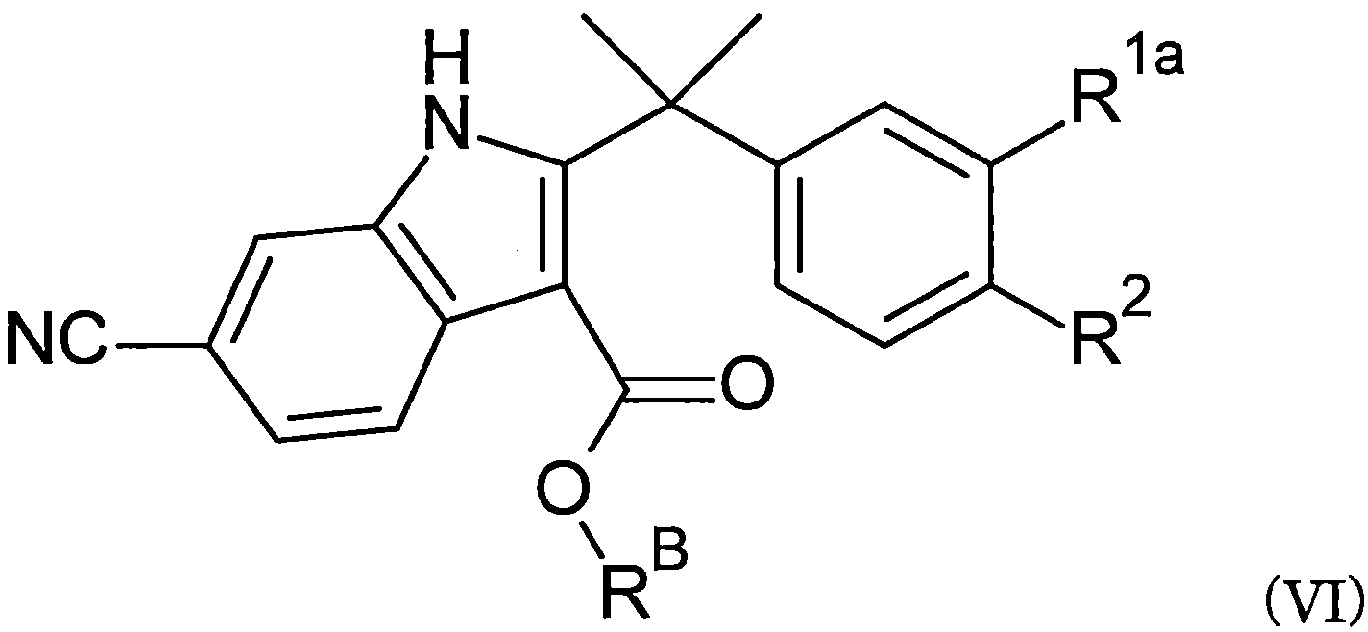
[식중, R1a, R2 및 RB는 상기와 동일한 정의이다.][Wherein, R 1a , R 2 and R B have the same definitions as above.]
로 표시되는 화합물을 제조하는 공정;Process for producing a compound represented by;
(5) 공정 3:(5) Process 3:
식 VI로 표시되는 화합물을 팔라듐 촉매 존재하, 치환되어 있어도 되는 6원 포화 환상 아민과 반응시켜서, 식 VII:The compound represented by formula VI is reacted with an optionally substituted 6-membered saturated cyclic amine in the presence of a palladium catalyst to obtain formula VII:

[식중, R1은 치환되어 있어도 되는 6원 포화 환상 아미노기를 나타내고, R2 및 RB는 상기와 동일한 정의이다.][Wherein, R 1 represents an optionally substituted 6-membered saturated cyclic amino group, and R 2 and R B have the same definitions as above.]
으로 표시되는 화합물, 또는 그의 약학적으로 허용되는 염, 또는 그들 중 어느 하나의 용매화물을 제조하는 공정;또는, A process for producing a compound represented by, or a pharmaceutically acceptable salt thereof, or a solvate of any one of them; or,
(6) 공정 4:(6) Process 4:
식 VII으로 표시되는 화합물을 산과 반응시켜서, 일반식 VIII:By reacting the compound represented by formula VII with an acid, general formula VIII:

[식중, R1 및 R2는 상기와 동일한 정의이다.][Wherein, R 1 and R 2 have the same definitions as above.]
으로 표시되는 화합물을 제조하는 공정;Process for producing a compound represented by;
중 어느 하나를 추가로 포함하는 [1]에 기재된 방법. The method described in [1] further comprising any one of the following.
[2-1][2-1]
상기 방법에 있어서, In the above method,
식 I이 2-(4-에틸-3-요오도-페닐)-2-메틸-프로판산이고, 식 II가 메틸 2-(4-에틸-3-요오도-페닐)-2-메틸-프로파노에이트이며, 식 III가 tert-부틸 4-(4-에틸-3-요오도-페닐)-4-메틸-3-옥소-펜타노에이트이고, 식 IV가 4-플루오로-3-니트로벤조니트릴이며, 식 V가 tert-부틸 6-시아노-2-[1-(4-에틸-3-요오도-페닐)-1-메틸-에틸]-1H-인돌-3-카르복실레이트이고, 식 VI가 tert-부틸 6-시아노-2-[1-(4-에틸-3-요오도-페닐)-1-메틸-에틸]-1H-인돌-3-카르복실레이트이며, 식 VII이 tert-부틸 6-시아노-2-[1-[4-에틸-3-(4-모르폴리노-1-피페리딜)페닐]-1-메틸-에틸]-1H-인돌-3-카르복실레이트이고, 식 VIII이 6-시아노-2-[1-[4-에틸-3-(4-모르폴리노-1-피페리딜)페닐]-1-메틸-에틸]-1H-인돌-3-카르복실산인, [2]에 기재된 방법. Formula I is 2-(4-ethyl-3-iodo-phenyl)-2-methyl-propanoic acid, and formula II is methyl 2-(4-ethyl-3-iodo-phenyl)-2-methyl-propanoic acid. It is a panoate, and its formula III is tert-butyl 4-(4-ethyl-3-iodo-phenyl)-4-methyl-3-oxo-pentanoate, and its formula IV is 4-fluoro-3-nitrobenzoate. It is a nitrile, and formula V is tert-butyl 6-cyano-2-[1-(4-ethyl-3-iodo-phenyl)-1-methyl-ethyl]-1H-indole-3-carboxylate, Formula VI is tert-butyl 6-cyano-2-[1-(4-ethyl-3-iodo-phenyl)-1-methyl-ethyl]-1H-indole-3-carboxylate, and Formula VII is tert-butyl 6-cyano-2-[1-[4-ethyl-3-(4-morpholino-1-piperidyl)phenyl]-1-methyl-ethyl]-1H-indole-3-carboxyl It is a boxylate, and formula VIII is 6-cyano-2-[1-[4-ethyl-3-(4-morpholino-1-piperidyl)phenyl]-1-methyl-ethyl]-1H-indole -3-carboxylic acid, the method described in [2].
[3][3]
상기 축합제가 N,N'-디이소프로필카르보디이미드 또는 클로로인산디에틸인 [1]에 기재된 방법. The method according to [1], wherein the condensing agent is N,N'-diisopropylcarbodiimide or diethyl chlorophosphate.
[4][4]
상기 용매가 테트라히드로푸란, 아세톤, 또는 아세토니트릴로부터 선택되는, [1]에 기재된 방법. The method according to [1], wherein the solvent is selected from tetrahydrofuran, acetone, or acetonitrile.
[5][5]
(1)에 있어서의 상기 산이 염화아세틸인, [2]에 기재된 방법. The method according to [2], wherein the acid in (1) is acetyl chloride.
[6][6]
(2)에 있어서의 상기 염기가 리튬헥사메틸디실라지드 또는 나트륨헥사메틸디실라지드인, [2]에 기재된 방법. The method according to [2], wherein the base in (2) is lithium hexamethyldisilazide or sodium hexamethyldisilazide.
[7][7]
(2)에 있어서의 상기 RB가 tert-부틸기인 [2]에 기재된 방법. The method according to [2], wherein R B in (2) is a tert-butyl group.
[8][8]
(3)에 있어서의 상기 이탈기가 플루오로기 또는 클로로기인, [2]에 기재된 방법. The method according to [2], wherein the leaving group in (3) is a fluoro group or a chloro group.
[9][9]
(3)에 있어서의 상기 염기가 수산화나트륨, 인산칼륨, 탄산칼륨 또는 탄산세슘이고, 반응용매가 테트라히드로푸란인, [2]에 기재된 방법. The method according to [2], wherein the base in (3) is sodium hydroxide, potassium phosphate, potassium carbonate, or cesium carbonate, and the reaction solvent is tetrahydrofuran.
[10][10]
(4)에 있어서의 상기 환원제가 하이드로설파이트 나트륨인, [2]에 기재된 방법. The method according to [2], wherein the reducing agent in (4) is sodium hydrosulfite.
[11][11]
(5)에 있어서의 상기 팔라듐 촉매가 Π-알릴팔라듐클로라이드 다이머와 2',6'-디메톡시-2-(디시클로헥실포스피노)비페닐(S-Phos)의 조합, PEPPSI-IPent, 또는 S-Phos-Pd(Crotyl)Cl이고, 상기 공정 3의 반응을 테트라히드로푸란과 1,3-디메틸-2-이미다졸리디논의 혼합용매 중에서 행하는, [2]에 기재된 방법. The palladium catalyst in (5) is a combination of Π-allylpalladium chloride dimer and 2',6'-dimethoxy-2-(dicyclohexylphosphino)biphenyl (S-Phos), PEPPSI-IPent, or The method described in [2] is S-Phos-Pd(Crotyl)Cl, and the reaction in step 3 is performed in a mixed solvent of tetrahydrofuran and 1,3-dimethyl-2-imidazolidinone.
[12][12]
(5)에 있어서의 치환되어 있어도 되는 6원 포화 환상 아민이 식:The optionally substituted 6-membered saturated cyclic amine in (5) has the formula:

으로 표시되고, R1a가 요오드기 또는 브로모기인, [2]에 기재된 방법. The method described in [2], wherein R 1a is an iodine group or a bromo group.
[13][13]
(6)의 상기 산이 트리메틸실릴클로라이드 및 2,2,2-트리플루오로에탄올인, [2]에 기재된 방법. The method according to [2], wherein the acid in (6) is trimethylsilyl chloride and 2,2,2-trifluoroethanol.
[14][14]
화합물(1)이 염산염인, [1] 내지 [13] 중 어느 하나에 기재된 방법. The method according to any one of [1] to [13], wherein compound (1) is hydrochloride.
[15][15]
화합물(1)이 염산염이고, 상기 화합물(1) 외에, 식 X:Compound (1) is hydrochloride, and in addition to the above compound (1), formula

으로 표시되는 화합물이, 상기 화합물(1)의 염산염의 중량에 대해 0.08% 이하로 생성되는, [1] 내지 [14] 중 어느 한 항에 기재된 방법. The method according to any one of [1] to [14], wherein the compound represented by is produced in an amount of 0.08% or less based on the weight of the hydrochloride salt of the compound (1).
본 발명에 의하면, 화합물(1), 및 그의 약학적으로 허용되는 염, 용매화물, 또는 염의 용매화물의 공업적 제법에 적합한 간편하고 효율적이며 견뢰성이 높은 제조방법을 제공할 수 있다. According to the present invention, it is possible to provide a simple, efficient, and highly robust production method suitable for industrial production of compound (1) and its pharmaceutically acceptable salt, solvate, or solvate of a salt.
도 1은 화합물(VIa)의 분말 X선 회절의 측정결과의 그래프이다.
도 2는 화합물(VIIa)의 분말 X선 회절의 측정결과의 그래프이다.
도 3은 화합물(VIIa)의 분말 X선 회절의 측정결과의 그래프이다.
도 4는 화합물(VIIa)의 분말 X선 회절의 측정결과의 그래프이다.
도 5는 화합물(VIIIa)의 분말 X선 회절의 측정결과의 그래프이다.
도 6은 화합물(VIIIa)의 분말 X선 회절의 측정결과의 그래프이다.
도 7은 화합물(VIIIa)의 분말 X선 회절의 측정결과의 그래프이다.
도 8은 화합물(1)의 분말 X선 회절의 측정결과의 그래프이다.
도 9는 화합물(1)의 분말 X선 회절의 측정결과의 그래프이다.
도 10은 화합물(1)의 분말 X선 회절의 측정결과의 그래프이다.
도 11은 화합물(1)의 분말 X선 회절의 측정결과의 그래프이다.
도 12는 화합물(1)의 분말 X선 회절의 측정결과의 그래프이다.Figure 1 is a graph of the powder X-ray diffraction measurement results of compound (VIa).
Figure 2 is a graph of the powder X-ray diffraction measurement results of compound (VIIa).
Figure 3 is a graph of the powder X-ray diffraction measurement results of compound (VIIa).
Figure 4 is a graph of the powder X-ray diffraction measurement results of compound (VIIa).
Figure 5 is a graph of the powder X-ray diffraction measurement results of compound (VIIIa).
Figure 6 is a graph of the powder X-ray diffraction measurement results of compound (VIIIa).
Figure 7 is a graph of the powder X-ray diffraction measurement results of compound (VIIIa).
Figure 8 is a graph of the powder X-ray diffraction measurement results of compound (1).
Figure 9 is a graph of the powder X-ray diffraction measurement results of compound (1).
Figure 10 is a graph of the powder X-ray diffraction measurement results of compound (1).
Figure 11 is a graph of the powder X-ray diffraction measurement results of compound (1).
Figure 12 is a graph of the powder X-ray diffraction measurement results of compound (1).
본 발명의 제조방법을 아래에 상세하게 설명한다. The manufacturing method of the present invention is described in detail below.
각 제조공정 및 실시예에 있어서 범용되는 약호, 화학식에 대응하는 시약이나 용매의 명칭을 아래에 기재한다. The names of reagents or solvents corresponding to the commonly used abbreviations and chemical formulas in each manufacturing process and example are listed below.
AcCl:염화아세틸AcCl: Acetyl chloride
AcOH:초산AcOH: Acetic acid
BINAP:2,2'-비스(디페닐포스피노)-1,1'-비나프틸BINAP: 2,2'-bis(diphenylphosphino)-1,1'-binaphthyl
t-BuOK:tert-부톡시칼륨t-BuOK:tert-butoxypotassium
t-BuONa:tert-부톡시나트륨t-BuONa: tert-butoxy sodium
t-Bu기:tert-부틸기t-Bu group: tert-butyl group
t-Butyl X-Phos:2-디-tert-부틸포스피노-2',4',6'-트리이소프로필비페닐t-Butyl
CDI:카르보닐디이미다졸CDI: Carbonyldiimidazole
CPME:c-펜틸메틸에테르CPME: c-pentylmethyl ether
CX-21:알릴[1,3-비스(2,6-디이소프로필페닐)이미다졸-2-일리덴]클로로팔라듐(II)CX-21: Allyl[1,3-bis(2,6-diisopropylphenyl)imidazol-2-ylidene]chloropalladium(II)
Dave Phos:2-디시클로헥실포스피노-2'-(N,N-디메틸아미노)비페닐Dave Phos: 2-dicyclohexylphosphino-2'-(N,N-dimethylamino)biphenyl
DBU:1,8-디아자비시클로[5.4.0]-7-운데센DBU: 1,8-diazabicyclo[5.4.0]-7-undecene
DIC:N,N'-디이소프로필카르보디이미드 DIC: N, N'-Diisopropylcarbodiimide
DIPEA:N,N-디이소프로필에틸아민DIPEA: N,N-diisopropylethylamine
DMA:N,N-디메틸아세트아미드DMA: N,N-dimethylacetamide
DME:1,2-디메톡시에탄DME: 1,2-dimethoxyethane
DMF:N,N-디메틸포름아미드DMF: N,N-dimethylformamide
DMI:1,3-디메틸-2-이미다졸리디논DMI: 1,3-dimethyl-2-imidazolidinone
DMSO:디메틸설폭시드DMSO: dimethyl sulfoxide
DPPF:1,1'-비스(디페닐포스피노)페로센DPPF: 1,1'-bis(diphenylphosphino)ferrocene
EtOAc:초산에틸EtOAc: Ethyl acetate
EtOH:에탄올EtOH: Ethanol
c-Hexyl John Phos:(2-비페닐)디시클로헥실포스핀c-Hexyl John Phos: (2-biphenyl) dicyclohexylphosphine
John Phos:(2-비페닐)디-t-부틸포스핀John Phos: (2-biphenyl)di-t-butylphosphine
KHMDS:칼륨헥사메틸디실라지드 KHMDS: Potassium hexamethyldisilazide
LDA:리튬디이소프로필아미드LDA: Lithium diisopropylamide
LiHMDS:리튬헥사메틸디실라지드 LiHMDS: Lithium hexamethyldisilazide
MeCN:아세토니트릴MeCN: Acetonitrile
MEK:2-부타논MEK: 2-butanone
MeOH:메탄올MeOH: methanol
2-MeTHF:2-메틸테트라히드로푸란2-MeTHF: 2-methyltetrahydrofuran
MTBE:tert-부틸메틸에테르MTBE: tert-butylmethyl ether
NaHMDS:나트륨헥사메틸디실라지드 NaHMDS: Sodium hexamethyldisilazide
NMP:N-메틸피롤리돈NMP: N-methylpyrrolidone
Pd2(dba)3:트리스(디벤질리덴아세톤)디팔라듐(0)Pd 2 (dba) 3 : Tris(dibenzylideneacetone)dipalladium (0)
PEPPSI-IPent:디클로로[1,3-비스(2,6-디-3-펜틸페닐)이미다졸-2-일리덴](3-클로로피리딜)팔라듐(II)PEPPSI-IPent: Dichloro[1,3-bis(2,6-di-3-pentylphenyl)imidazole-2-ylidene](3-chloropyridyl)palladium(II)
S-Phos:2',6'-디메톡시-2-(디시클로헥실포스피노)비페닐S-Phos: 2',6'-dimethoxy-2-(dicyclohexylphosphino)biphenyl
S-Phos-Pd(Crotyl)Cl:클로로(크로틸)(2-디시클로헥실포스피노-2',6'-디메톡시비페닐)팔라듐(II)S-Phos-Pd(Crotyl)Cl: Chloro(crotyl)(2-dicyclohexylphosphino-2',6'-dimethoxybiphenyl)palladium(II)
T3P:프로필포스폰산 무수물T3P: Propylphosphonic acid anhydride
TEA:트리에틸아민TEA: Triethylamine
TFA:트리플루오로초산TFA: Trifluoroacetic acid
TFE:2,2,2-트리플루오로에탄올TFE: 2,2,2-trifluoroethanol
THF:테트라히드로푸란THF: Tetrahydrofuran
TMSCl:트리메틸실릴클로라이드TMSCl: Trimethylsilyl chloride
TMSI:트리메틸실릴요오디드TMSI: Trimethylsilyliodide
Xantophos:4,5'-비스(디페닐포스피노)-9,9'-디메틸크산텐Xantophos: 4,5'-bis(diphenylphosphino)-9,9'-dimethylxanthene
X-Phos:2-디시클로헥실포스피노-2',4',6'-트리이소프로필비페닐X-Phos: 2-dicyclohexylphosphino-2',4',6'-triisopropylbiphenyl
본 발명에 있어서, 화합물(1)의 「약학적으로 허용되는 염」으로서는, 예를 들면, 염산염, 브롬화수소산염, 요오드화수소산염, 인산염, 포스폰산염, 황산염, 또는 메탄설폰산염, p-톨루엔설폰산염 등의 설폰산염;초산염, 구연산염, 말산염, 타르타르산염, 숙신산염, 살리실산염 등의 카르복실산염;나트륨염, 칼륨염 등의 알칼리금속염;마그네슘염, 칼슘염 등의 알칼리토류금속염;암모늄염, 알킬암모늄염, 디알킬암모늄염, 트리알킬암모늄염, 테트라알킬암모늄염 등의 암모늄염 등이 포함된다. In the present invention, the “pharmaceutically acceptable salt” of compound (1) includes, for example, hydrochloride, hydrobromide, hydroiodide, phosphate, phosphonate, sulfate, or methanesulfonate, and p-toluene. Sulfonic acid salts such as sulfonates; Carboxylic acid salts such as acetate, citrate, malate, tartrate, succinate, and salicylate; Alkaline metal salts such as sodium salts and potassium salts; Alkaline earth metal salts such as magnesium salts and calcium salts; Ammonium salts , ammonium salts such as alkylammonium salts, dialkylammonium salts, trialkylammonium salts, and tetraalkylammonium salts.
화합물(1)의 용매화물, 또는 화합물(1)의 염의 용매화물은 수화물, 비수화물 중 어느 것이어도 되고, 비수화물로서는, 알코올(예를 들면, 메탄올, 에탄올, n-프로판올), 디메틸포름아미드 등과의 용매화물을 들 수 있다. The solvate of compound (1) or the salt of compound (1) may be either a hydrate or a non-hydrate. Examples of the non-hydrate include alcohol (e.g., methanol, ethanol, n-propanol) and dimethylformamide. and solvates with the like.
「C1-C6 알킬기」란, 탄소수 1∼6의 직쇄상 및 분지쇄상의 지방족 탄화수소로부터 임의의 수소원자를 1개 제거하고 유도되는 1가의 기이다. 구체적으로는 메틸기, 에틸기, 이소프로필기, 부틸기, n-부틸기, 이소부틸기, sec-부틸기, tert-부틸기, 펜틸기, 이소펜틸기, 헥실기 등을 들 수 있다. 바람직하게는 C1-C4 알킬기이다. “C 1 -C 6 alkyl group” is a monovalent group derived from a linear or branched aliphatic hydrocarbon having 1 to 6 carbon atoms by removing one arbitrary hydrogen atom. Specifically, methyl group, ethyl group, isopropyl group, butyl group, n-butyl group, isobutyl group, sec-butyl group, tert-butyl group, pentyl group, isopentyl group, hexyl group, etc. Preferably it is a C 1 -C 4 alkyl group.
본 발명에 있어서 사용되는 「축합제」로서는, 펩티드 합성에 사용되는 축합제나 혼합산 무수물화제를 사용할 수 있고, 펩티드 합성에 사용되는 축합제로서는, 카르보닐디이미다졸(CDI), N,N'-디이소프로필카르보디이미드(DIC), 프로필포스폰산 무수물(T3P), 혼합산 무수물화제로서는, 클로로인산디에틸 등의 클로로인산디알킬 등을 들 수 있다. 축합제는 DIC나 클로로인산디에틸이 바람직하다. As the "condensing agent" used in the present invention, a condensing agent or a mixed acid anhydride agent used in peptide synthesis can be used. As a condensing agent used in peptide synthesis, carbonyldiimidazole (CDI), N, N' -Diisopropylcarbodiimide (DIC), propylphosphonic acid anhydride (T3P), and mixed acid anhydride agents include dialkyl chlorophosphates such as diethyl chlorophosphate. The condensing agent is preferably DIC or diethyl chlorophosphate.
「이탈기」란, 치환반응에 있어서 이탈되어 다른 관능기로 치환되는 기를 가리키고, 플루오로기, 클로로기, 브로모기 또는 요오드기 등의 할로겐기, 및 트리플레이트기, 메실기, 토실기 등을 들 수 있다. 바람직하게는 플루오로기, 클로로기, 브로모기 또는 요오드기이다.“Leaving group” refers to a group that leaves during a substitution reaction and is replaced by another functional group, and includes halogen groups such as fluoro group, chloro group, bromo group, or iodine group, triflate group, mesyl group, and tosyl group. You can. Preferably it is a fluoro group, chloro group, bromo group or iodine group.
「6원 포화 환상 아미노기」란, 구체적으로는 피페리딜기, 피페라지닐기, 모르폴리노기, 티오모르폴리노기 등의 질소원자를 매개로 결합하는 6원의 포화 환상기를 들 수 있고, 피페리딜기가 바람직하다. “6-membered saturated cyclic amino group” specifically includes a 6-membered saturated cyclic group bonded through a nitrogen atom such as piperidyl group, piperazinyl group, morpholino group, thiomorpholino group, etc. Dealing is preferable.
「6원 포화 환상 아미노기」의 치환기로서는, 4∼10원 헤테로시클로알킬기를 들 수 있다. 4∼10원 헤테로시클로알킬기는 헤테로원자로서 질소, 산소, 황원자를 1∼3개 갖는 4∼10원의 포화 고리를 의미하고, 피롤리디닐기, 이미다졸리디닐기, 테트라히드로푸라닐기, 피페리딜기, 피페라지닐기, 모르폴리노기, 티오모르폴리노기 등의 1가 기를 의미한다. 바람직하게는 모르폴리노기이다. 또한, 4∼10원 헤테로시클로알킬기는 1 이상의 치환기를 추가로 가지고 있어도 되고, 당해 치환기는 할로겐원자, C1-C6 알킬기, 옥소기, 수산기, 또는 중수소 등을 들 수 있다. 또한, 「6원 포화 환상 아미노기」의 치환기는 케탈기여도 되고, 디메틸케탈기와 같은 비환상 케탈기나, 1,3-디옥솔라닐기나 1,3-디옥사닐기와 같은 환상 케탈기를 들 수 있다.Substituents for the “6-membered saturated cyclic amino group” include a 4- to 10-membered heterocycloalkyl group. A 4- to 10-membered heterocycloalkyl group refers to a 4- to 10-membered saturated ring having 1 to 3 nitrogen, oxygen, and sulfur atoms as heteroatoms, and includes pyrrolidinyl group, imidazolidinyl group, tetrahydrofuranyl group, and It refers to monovalent groups such as peridyl group, piperazinyl group, morpholino group, and thiomorpholino group. Preferably it is a morpholino group. In addition, the 4- to 10-membered heterocycloalkyl group may further have one or more substituents, and the substituents include a halogen atom, C 1 -C 6 alkyl group, oxo group, hydroxyl group, or deuterium. Additionally, the substituent of the “6-membered saturated cyclic amino group” may be a ketal group, and examples include an acyclic ketal group such as dimethyl ketal group, and a cyclic ketal group such as 1,3-dioxolanyl group and 1,3-dioxanyl group. .
「6원 포화 환상 아민」이란, 구체적으로는 피페리딘, 피페라진, 모르폴린, 티오모르폴린 등의 질소원자를 매개로 결합하는 6원의 포화 환상 아민을 들 수 있고, 피페리딘이 바람직하다. “6-membered saturated cyclic amine” specifically includes 6-membered saturated cyclic amines bonded through a nitrogen atom such as piperidine, piperazine, morpholine, and thiomorpholine, with piperidine being preferred. do.
「6원 포화 환상 아민」의 치환기로서는, 4∼10원 헤테로시클로알킬기를 들 수 있다. 4∼10원 헤테로시클로알킬기는 헤테로원자로서 질소, 산소, 황원자를 1∼3개 갖는 4∼10원의 포화 고리를 의미하고, 피롤리디닐기, 이미다졸리디닐기, 테트라히드로푸라닐기, 피페리딜기, 피페라지닐기, 모르폴리노기, 티오모르폴리노기 등의 1가 기를 의미한다. 바람직하게는 모르폴리노기이다. 또한, 4∼10원 헤테로시클로알킬기는 1 이상의 치환기를 추가로 가지고 있어도 되고, 당해 치환기는 할로겐원자, C1-C6 알킬기, 옥소기, 수산기, 또는 중수소 등을 들 수 있다. 또한, 「6원 포화 환상 아민」의 치환기는 케탈기여도 되고, 디메틸케탈기와 같은 비환상 케탈기나, 1,3-디옥솔라닐기나 1,3-디옥사닐기와 같은 환상 케탈기를 들 수 있다. Examples of the substituent for the “6-membered saturated cyclic amine” include a 4- to 10-membered heterocycloalkyl group. A 4- to 10-membered heterocycloalkyl group refers to a 4- to 10-membered saturated ring having 1 to 3 nitrogen, oxygen, and sulfur atoms as heteroatoms, and includes pyrrolidinyl group, imidazolidinyl group, tetrahydrofuranyl group, and It refers to monovalent groups such as peridyl group, piperazinyl group, morpholino group, and thiomorpholino group. Preferably it is a morpholino group. In addition, the 4- to 10-membered heterocycloalkyl group may further have one or more substituents, and the substituents include a halogen atom, C 1 -C 6 alkyl group, oxo group, hydroxyl group, or deuterium. Additionally, the substituent of the “6-membered saturated cyclic amine” may be a ketal group, and examples include an acyclic ketal group such as dimethyl ketal group, and a cyclic ketal group such as 1,3-dioxolanyl group and 1,3-dioxanyl group. .
「산」으로서는, 염화아세틸, 포름산, 초산, 메탄설폰산, p-톨루엔설폰산, 벤젠설폰산, TFA, 염산, 황산, 피디디늄 p-톨루엔설포네이트, TMSCl 등을 들 수 있고, 바람직하게는 염화아세틸 또는 TMSCl이다. Examples of the “acid” include acetyl chloride, formic acid, acetic acid, methanesulfonic acid, p-toluenesulfonic acid, benzenesulfonic acid, TFA, hydrochloric acid, sulfuric acid, pididinium p-toluenesulfonate, TMSCl, etc., preferably Acetyl chloride or TMSCl.
「염기」로서는, 수산화나트륨, 수산화칼륨, 수산화리튬, 인산나트륨, 인산칼륨, 탄산나트륨, 탄산칼륨, 탄산세슘, 수소화나트륨, LiHMDS, NaHMDS, LDA, 리튬디시클로헥실아미드, 리튬 2,2,6,6-테트라메틸피롤리디드, KHMDS, t-BuOK, t-BuONa 등을 사용할 수 있고, LiHMDS나 NaHMDS, t-BuOK, DBU 등의 강염기 시약, 또는 수산화나트륨, 인산칼륨, 탄산칼륨 또는 탄산세슘 등의 무기염 시약이 바람직하다. “Base” includes sodium hydroxide, potassium hydroxide, lithium hydroxide, sodium phosphate, potassium phosphate, sodium carbonate, potassium carbonate, cesium carbonate, sodium hydride, LiHMDS, NaHMDS, LDA, lithium dicyclohexylamide, lithium 2,2,6, 6-Tetramethylpyrrolidide, KHMDS, t-BuOK, t-BuONa, etc. can be used, strong base reagents such as LiHMDS, NaHMDS, t-BuOK, DBU, or sodium hydroxide, potassium phosphate, potassium carbonate, or cesium carbonate, etc. Inorganic salt reagents are preferred.
「환원제」로서는, 철, 아연, 염화티탄(III), 염화주석(II), 또는 하이드로설파이트 나트륨을 사용할 수 있고, 바람직하게는 하이드로설파이트 나트륨이다. As the “reducing agent,” iron, zinc, titanium (III) chloride, tin (II) chloride, or sodium hydrosulfite can be used, and sodium hydrosulfite is preferred.
「팔라듐 촉매」로서는, 초산팔라듐, Pd2(dba)3, Π-알릴팔라듐클로라이드 다이머, PdCl2(CH3CN)2, PdCl2(PPh3)2, 트리알킬프로아자포스파트레인, {P(t-Bu) 3PdBr}2, PPh3, P(o-tol)3, BINAP, DPPF, P(t-Bu)3, Dave Phos, John Phos, c-Hexyl John Phos, S-Phos, X-Phos, t-Butyl X-Phos, PEPPSI-IPent, Xantphos, 4,5-비스[비스(3,5-비스트리플루오로메틸페닐)포스파닐]-9,9-디메틸-9H-크산텐, 1,3-디알릴디히드로이미다졸륨염, S-Phos-Pd(Crotyl)Cl 등으로부터 선택되는 팔라듐원과 배위자의 조합, 또는 팔라듐-리간드 복합체가 시판품으로 입수가 용이하여 품질의 편차가 적기 때문에 바람직하고, 더욱 바람직하게는 Π-알릴팔라듐클로라이드 다이머와 S-Phos, PEPPSI-IPent 또는 S-Phos-Pd(Crotyl)Cl이다. Examples of the “palladium catalyst” include palladium acetate, Pd 2 (dba) 3 , Π-allylpalladium chloride dimer, PdCl 2 (CH 3 CN) 2 , PdCl 2 (PPh 3 ) 2 , trialkylproazaphosphatrain, {P (t-Bu) 3 PdBr} 2 , PPh 3 , P(o-tol) 3 , BINAP, DPPF, P(t-Bu) 3 , Dave Phos, John Phos, c-Hexyl John Phos, S-Phos, -Phos, t-Butyl , A combination of a palladium source and a ligand selected from 3-diallyldihydroimidazolium salt, S-Phos-Pd(Crotyl)Cl, etc., or a palladium-ligand complex is preferred because it is readily available as a commercial product and has little quality variation. And, more preferably, it is Π-allylpalladium chloride dimer and S-Phos, PEPPSI-IPent or S-Phos-Pd(Crotyl)Cl.
본 발명의 일태양은 고우려물질의 사용을 회피할 수 있고, 또한, 반응의 선택성이 향상되어, 부생성물(불순물)의 생성을 억제할 수 있는 화합물(1)의 공업적 제법이다. One aspect of the present invention is an industrial production method of compound (1) that can avoid the use of substances of high concern, improves the selectivity of the reaction, and suppresses the production of by-products (impurities).

[식중, R1a는 치환되어 있어도 되는 6원 포화 환상 아미노기를 나타내고, R2는 C1-C6 알킬기를 나타낸다.][Wherein, R 1a represents an optionally substituted 6-membered saturated cyclic amino group, and R 2 represents a C 1 -C 6 alkyl group.]
본 발명은 화합물(VIIIb)의 프리델·크래프츠형 반응에 의한, 화합물(IXa)로의 환화 공정을 포함하는 방법이다. The present invention is a method comprising a step of cyclization of compound (VIIIb) into compound (IXa) by a Friedel-Crafts type reaction.
상기 반응은 화합물(VIIIb) 중의 카르복실기를 혼합산 무수물화제(클로로인산디알킬 등)나 펩티드 합성에 사용되는 축합제(CDI, DIC, T3P 등) 등의 축합제로 처리함으로써 대응하는 혼합산 무수물, 또는 활성 에스테르로 변환하여 카르복실기를 활성화함으로써 행할 수 있다. 혼합산 무수물화제는 기질에 대해 1 당량 내지 10 당량을 사용할 수 있고, 바람직하게는 1 당량 내지 5 당량이다. 축합제는 기질에 대해 1 당량 내지 10 당량을 사용할 수 있고, 바람직하게는 1 당량 내지 5 당량이다. 바람직한 혼합산 무수물화제 또는 축합제는 클로로인산디에틸 또는 DIC이고, 기질에 대해 1 당량 내지 5 당량을 사용할 수 있다. 또한, TEA, DIPEA, 피리딘 등의 유기염기를 사용해도 되고, 바람직하게는 DIPEA이다. 유기염기는 기질인 화합물(VIIIb)에 대해 1 당량 내지 10 당량을 사용할 수 있고, 바람직하게는 1 당량 내지 8 당량이다. 이 반응은 무용매, 또는 용매 중 행할 수 있다. 여기서 사용되는 용매는 톨루엔, 크실렌, 디에틸에테르, THF, CPME, 2-메틸테트라히드로푸란, MTBE, DMSO, 설포란, 1,4-디옥산, 아세톤, 아세토니트릴, 디클로로메탄, 2-부타논, 초산에틸, 또는 초산이소프로필 등의 고우려물질에 해당하지 않는 용매, 및 이들의 혼합물 등을 들 수 있고, 바람직하게는 THF, 아세톤, 또는 아세토니트릴, 및 이들의 혼합물이다. 이 반응은 0℃ 내지 용매 비점 부근의 반응온도에서 행할 수 있고, 바람직하게는 40℃ 내지 용매의 비점 부근이다. 이 반응은 일정 시간(예를 들면 0.1시간 내지 24시간, 바람직하게는 1시간 내지 6시간), 반응 혼합물을 교반함으로써 행할 수 있다. The above reaction is carried out by treating the carboxyl group in compound (VIIIb) with a condensing agent such as a mixed acid anhydride (dialkyl chlorophosphate, etc.) or a condensing agent used in peptide synthesis (CDI, DIC, T3P, etc.) to produce the corresponding mixed acid anhydride, or This can be done by converting to an active ester and activating the carboxyl group. The mixed acid anhydride may be used in the amount of 1 to 10 equivalents, preferably 1 to 5 equivalents, based on the substrate. The condensing agent can be used in the amount of 1 to 10 equivalents, preferably 1 to 5 equivalents, based on the substrate. A preferred mixed acid anhydride or condensing agent is diethyl chlorophosphate or DIC, which can be used in an amount of 1 to 5 equivalents relative to the substrate. Additionally, organic bases such as TEA, DIPEA, and pyridine may be used, and DIPEA is preferred. The organic base can be used in the amount of 1 to 10 equivalents, preferably 1 to 8 equivalents, based on the substrate compound (VIIIb). This reaction can be carried out without a solvent or in a solvent. The solvents used here are toluene, xylene, diethyl ether, THF, CPME, 2-methyltetrahydrofuran, MTBE, DMSO, sulfolane, 1,4-dioxane, acetone, acetonitrile, dichloromethane, and 2-butanone. , solvents that do not correspond to substances of high concern such as ethyl acetate, or isopropyl acetate, and mixtures thereof, and preferably THF, acetone, or acetonitrile, and mixtures thereof. This reaction can be carried out at a reaction temperature between 0°C and around the boiling point of the solvent, and preferably between 40°C and around the boiling point of the solvent. This reaction can be performed by stirring the reaction mixture for a certain period of time (for example, 0.1 to 24 hours, preferably 1 to 6 hours).
식(VIIIb)로 표시되는 카르복실산의 활성화반응 후에, Mouaddib 등의 방법(Heterocycles, 1999, 51, 2127) 등에 기재된 조건, 예를 들면 용매 중 0℃ 내지 용매 비점 부근의 반응온도에서 폴리인산 등의 산을 사용하는 환화, 또는, 추가시약 없이 용매 중, 25℃ 내지 용매의 비점 부근으로 가열하는 것에 의한 환화를 행함으로써, 화합물(IXa)를 얻을 수 있다. 이 반응은 0℃ 내지 용매 비점 부근의 온도의 범위 내에서 일정 시간(예를 들면 0.1시간 내지 24시간), 반응 혼합물을 교반함으로써 행할 수 있다. After the activation reaction of the carboxylic acid represented by formula (VIIIb), polyphosphoric acid, etc. Compound (IXa) can be obtained by cyclization using an acid or by heating in a solvent without additional reagents from 25°C to around the boiling point of the solvent. This reaction can be performed by stirring the reaction mixture for a certain period of time (for example, 0.1 to 24 hours) within a temperature range of 0°C to around the boiling point of the solvent.
또한, R1a가 4-옥소-1-피페리딜기인 경우, Borch 등의 방법(J. Am. Chem. Soc., 1971, 93, 2897)에 준하여, 모르폴린을 환원제의 존재하, 환원적 아미노화 반응의 조건으로 처리함으로써, 화합물(1)을 제조할 수 있다.In addition, when R 1a is a 4-oxo-1-piperidyl group, morpholine is reduced in the presence of a reducing agent according to the method of Borch et al. (J. Am. Chem. Soc., 1971, 93, 2897). Compound (1) can be produced by treatment under the conditions of an amination reaction.
또한, 화합물(1)의 약학적으로 허용되는 염은, 화합물(1)의 프리체와, 약학적으로 허용되는 염에 대응하는 의약품의 제조에 사용 가능한 산 또는 염기를 접촉시킴으로써 제조할 수 있다. Additionally, the pharmaceutically acceptable salt of Compound (1) can be produced by contacting the free form of Compound (1) with an acid or base that can be used in the production of drugs corresponding to the pharmaceutically acceptable salt.
화합물(1)의 용매화물, 또는, 화합물(1)의 약학적으로 허용되는 염의 용매화물은, 목적하는 용매를 사용하여 결정화함으로써 제조할 수 있다. A solvate of compound (1) or a solvate of a pharmaceutically acceptable salt of compound (1) can be produced by crystallization using the desired solvent.
또한, 본 발명의 추가적인 태양은, 일련의 공정을 포함하는 화합물(1)을 제조하는 공업적 제법에 관하여, 당해 방법은 잔류용매의 제어에 다대한 노력을 필요로 하지 않고, 또한 고수율로 화합물(1) 및 그의 합성 중간체를 얻는 것을 가능하게 한다. In addition, an additional aspect of the present invention relates to an industrial production method for producing compound (1) comprising a series of steps, wherein the method does not require great effort in controlling residual solvents and also produces the compound in high yield. (1) and its synthetic intermediates.
화합물(I)으로부터 화합물(IX)에 이르는 일련의 제법의 개요를 스킴 2에 나타내고, 각 공정별로 아래에 설명한다. 또한, 이들은 예시로, 본 발명은 공정 1∼5 중 일부를 사용하고, 그 이외는 공지의 방법을 사용해도 되며, 명시된 시약이나 조건뿐 아니라, 본 발명의 목적을 달성 가능한 범위에서 사용 가능한 것을 사용해도 된다. 또한, 화합물(1) 및 그의 합성 중간체의 합성에 사용하는 원료는 시판되고 있는 것을 사용해도, 필요에 따라 통상의 방법으로 제조하여 사용해도 된다. 제조에 사용하는 시약은 시판되고 있는 것을 사용해도, 필요에 따라 통상의 방법으로 용시 조제하여 사용해도 된다. 제조에 사용하는 용매는 특히 수분, 산소 또는 이산화탄소 등에 대해 불안정한 화합물을 취급하는 경우에는, 시판되고 있는 탈수용매나, 탈기용매를 사용해도 되고, 필요에 따라 통상의 방법으로 탈수, 탈기처리를 행한 용매를 사용해도 된다. 용매는 필요에 따라 복수의 용매를 혼합해서 사용해도 된다. 화합의 제조 시에, 수분, 산소 또는 이산화탄소 등에 대해 불안정한 화합물을 취급하는 경우는, 반응계 내를 불활성 분위기, 구체적으로는 잘 건조된 불활성 가스로 치환한 반응계에서 제조를 행함으로써, 효율적으로 목적의 화학반응을 진행시킬 수 있다. 바람직한 불활성 가스는 질소 또는 아르곤을 들 수 있다. 본 발명의 제법은 화합물의 성질이나 반응성에 따라, 반응계의 온도를 변경해서 행하여도 된다. 반응의 최적 온도는 액체질소로 냉각시킨 -100℃ 부근 내지 용매의 비점 부근의 범위 내이다. An outline of a series of production methods from compound (I) to compound (IX) is shown in Scheme 2, and each process is explained below. In addition, these are examples, and the present invention uses some of steps 1 to 5, and other known methods may be used. It's okay too. In addition, the raw materials used in the synthesis of compound (1) and its synthetic intermediates may be commercially available or, if necessary, may be manufactured by a conventional method. The reagents used in production may be commercially available or, if necessary, may be prepared for use by a conventional method. The solvent used in production may be a commercially available dehydrating solvent or degassing solvent, especially when handling compounds unstable to moisture, oxygen, or carbon dioxide, or a solvent that has been dehydrated or degassed by a conventional method as needed. You can also use . The solvent may be used by mixing a plurality of solvents as needed. When handling a compound that is unstable to moisture, oxygen, or carbon dioxide during the production of a chemical compound, the production is carried out in a reaction system replaced with an inert atmosphere, specifically a well-dried inert gas, to efficiently produce the target chemical. The reaction can proceed. Preferred inert gases include nitrogen or argon. The production method of the present invention may be performed by changing the temperature of the reaction system depending on the properties or reactivity of the compound. The optimal temperature for the reaction is within the range from around -100°C cooled with liquid nitrogen to around the boiling point of the solvent.

[식중, X는 이탈기를 나타내고, R1a는 이탈기 또는 치환되어 있어도 되는 6원 포화 환상 아미노기를 나타내며, R1은 치환되어 있어도 되는 6원 포화 환상 아미노기를 나타내고, R2는 C1-C6 알킬기를 나타내며, RB는 C1-C6 알킬기를 나타낸다.] [ Wherein , _ _ represents an alkyl group, and R B represents a C 1 -C 6 alkyl group.]
공정 1a 및 1bProcesses 1a and 1b
본 공정은 카르복실산(I)으로부터 β-케토에스테르(III)로의 변환의 공정이다. 본 공정에 있어서, 원료 화합물의 카르복실산(I)은 용매 중, 0℃ 내지 용매 비점 부근의 반응온도에서, 활성화제 존재하, 산클로라이드, 활성 에스테르, 또는 알킬에스테르 등의 활성화된 카르복실산(II)로 변환할 수 있다. 그 후, 활성화된 카르복실산(II)는 AcORB의 에놀레이트와 -20℃ 내지 용매 비점 부근의 반응온도에서 축합시킴으로써, β-케토에스테르(III)를 부여할 수 있다. This process is a conversion process from carboxylic acid (I) to β-keto ester (III). In this process, the carboxylic acid (I) of the raw material compound is an activated carboxylic acid such as acid chloride, activated ester, or alkyl ester in the presence of an activator in a solvent at a reaction temperature of 0° C. to around the boiling point of the solvent. It can be converted to (II). Afterwards, the activated carboxylic acid (II) can be condensed with the enolate of AcOR B at a reaction temperature of -20°C to around the boiling point of the solvent to give β-keto ester (III).
카르복실산(I)으로부터 산클로라이드(II, A=Cl)로의 변환반응(공정 1a)은 활성화제로서 티오닐클로라이드, 옥살릴클로라이드, 또는 옥시염화인 등을 사용하고, 카르복실산(I)에 대응하는 산클로라이드(II, A=Cl)로 변환하는 방법을 사용할 수 있다. 이 경우의 활성화제는 기질에 대해 1 당량 내지 10 당량을 사용할 수 있다. 이 반응에 사용하는 용매는 톨루엔, 크실렌, THF, CPME, MTBE, DMSO, 설포란, 1,4-디옥산 등 및 그들의 혼합물을 사용할 수 있다. 이 반응은 -20℃ 내지 용매 비점 부근의 반응온도에서 행할 수 있고, 일정 시간(예를 들면 0.1시간 내지 24시간), 반응 혼합물을 교반함으로써 행할 수 있다. The conversion reaction from carboxylic acid (I) to acid chloride (II, A = Cl) (step 1a) uses thionyl chloride, oxalyl chloride, or phosphorus oxychloride as an activator, and carboxylic acid (I) A method of converting to the corresponding acid chloride (II, A=Cl) can be used. The activator in this case can be used in the amount of 1 to 10 equivalents relative to the substrate. Solvents used in this reaction include toluene, xylene, THF, CPME, MTBE, DMSO, sulfolane, 1,4-dioxane, etc., and mixtures thereof. This reaction can be carried out at a reaction temperature of -20°C to around the boiling point of the solvent, and can be carried out by stirring the reaction mixture for a certain period of time (for example, 0.1 to 24 hours).
또한, 카르복실산(I)으로부터 활성 에스테르(II, A=이미다졸릴기)로의 변환반응(공정 1a)은 활성화제로서 CDI 등을 사용하여, 카르복실산(I)에 대응하는 활성 에스테르(II, A=이미다졸릴기)로 변환하는 방법을 사용할 수 있다. 이 경우의 활성화제는 기질에 대해 1 당량 내지 10 당량을 사용할 수 있다. 이 반응에 사용하는 용매는 톨루엔, 크실렌, THF, CPME, MTBE, DMSO, 설포란, 1,4-디옥산 등 및 그들의 혼합물을 사용할 수 있다. 이 반응은 -20℃ 내지 용매 비점 부근의 반응온도에서 행할 수 있고, 일정 시간(예를 들면 0.1시간 내지 24시간), 반응 혼합물을 교반함으로써 행할 수 있다. 활성 에스테르의 제조에는 CDI 이외에 축합제를 사용할 수 있고, 여기서 얻어진 축합제에 대응하는 활성 에스테르는, 동일하게 β-케토에스테르(III)의 제조에 사용할 수 있다. In addition, the conversion reaction from carboxylic acid (I) to active ester (II, A = imidazolyl group) (step 1a) uses CDI or the like as an activator, and the active ester corresponding to carboxylic acid (I) ( II, A = imidazolyl group) can be used. The activator in this case can be used in the amount of 1 to 10 equivalents relative to the substrate. Solvents used in this reaction include toluene, xylene, THF, CPME, MTBE, DMSO, sulfolane, 1,4-dioxane, etc., and mixtures thereof. This reaction can be carried out at a reaction temperature of -20°C to around the boiling point of the solvent, and can be carried out by stirring the reaction mixture for a certain period of time (for example, 0.1 to 24 hours). In the production of active ester, condensing agents other than CDI can be used, and the active ester corresponding to the condensing agent obtained here can be similarly used in the production of β-keto ester (III).
또한, 카르복실산(I)으로부터 알킬에스테르(II, A=ORA, RA는 C1-C6의 직쇄 또는 분기 알킬기를 나타낸다)로의 변환반응(공정 1a)은, 염화수소 가스, 또는 염화아세틸과 알코올(RAOH)의 조합을 사용하여, 카르복실산(I)에 대응하는 알킬에스테르(II, A=ORA)로 변환하는 방법을 사용해도 된다. 이 반응에 사용하는 염화수소 가스, 또는 염화아세틸은 기질에 대해 0.1 당량 내지 10 당량을 사용할 수 있고, 바람직하게는 2 당량 내지 5 당량이다. 이 반응에 사용하는 용매는 알코올(RAOH)을 사용할 수 있다. 이 반응은 -20℃ 내지 용매 비점 부근의 반응온도에서 행할 수 있고, 바람직하게는 0℃ 내지 50℃이다. 이 반응은 일정 시간(예를 들면 0.1시간 내지 24시간, 바람직하게는 1시간 내지 4시간), 반응 혼합물을 교반함으로써 행할 수 있다. In addition, the conversion reaction (step 1a) from carboxylic acid (I) to alkyl ester (II, A = OR A , R A represents a C 1 -C 6 straight chain or branched alkyl group) is performed using hydrogen chloride gas or acetyl chloride. You may use a method of converting carboxylic acid (I) into the corresponding alkyl ester (II, A=OR A ) using a combination of and alcohol (R A OH). Hydrogen chloride gas or acetyl chloride used in this reaction can be used in the amount of 0.1 to 10 equivalents, preferably 2 to 5 equivalents, based on the substrate. The solvent used in this reaction can be alcohol (R A OH). This reaction can be carried out at a reaction temperature between -20°C and around the boiling point of the solvent, and is preferably between 0°C and 50°C. This reaction can be performed by stirring the reaction mixture for a certain period of time (for example, 0.1 to 24 hours, preferably 1 to 4 hours).
카르복실산(I)으로부터 활성화된 카르복실산(II)로의 변환반응은, 바람직하게는 티오닐클로라이드에 의해 얻어지는 산클로라이드(II, A=Cl)를 사용하는 방법, CDI에 의해 얻어지는 활성 에스테르(II, A=이미다졸릴기)를 사용하는 방법, 또는 염화아세틸과 알코올의 조합에 의해 얻어지는 알킬에스테르(II, A=ORA)를 사용하는 방법이다. The conversion reaction from carboxylic acid (I) to activated carboxylic acid (II) is preferably performed using an acid chloride (II, A = Cl) obtained by thionyl chloride, or an activated ester obtained by CDI ( II, A = imidazolyl group), or an alkyl ester (II, A = OR A ) obtained by combining acetyl chloride and alcohol.
활성화된 카르복실산(II)는 단리 정제를 행하여도, 단리 정제를 행하지 않고 연속적으로 다음의 반응에 사용해도 된다.Activated carboxylic acid (II) may be isolated and purified or may be used continuously in the next reaction without isolation and purification.
활성화된 카르복실산(II)로부터 β-케토에스테르(III)로의 변환반응(공정 1b)에 사용하는 AcORB(RB는 C1-C6의 직쇄 또는 분기 알킬기를 나타낸다)의 에놀레이트는, 기질인 활성화된 카르복실산(II)에 대해 1 당량 내지 5 당량을 사용할 수 있고, 바람직하게는 1 당량 내지 2 당량이다. AcORB의 에놀레이트의 생성방법으로서는 LiHMDS나 NaHMDS, t-BuOK, DBU 등의 강염기 시약을 사용할 수 있다. 이들 강염기 시약은 기질인 활성화된 카르복실산(II)에 대해 2 당량 내지 5 당량을 사용할 수 있고, 바람직하게는 2 당량 내지 4 당량이다. 이 반응에 사용하는 용매는 톨루엔, 크실렌, THF, CPME, MTBE, DMSO, 설포란, 1,4-디옥산 등 및 그들의 혼합물을 들 수 있고, 바람직하게는 THF이다. AcORB는, 바람직하게는 초산 tert-부틸이다. 이 반응은 -40℃ 내지 용매 비점 부근에서 행할 수 있고, 바람직하게는 -10℃ 내지 25℃이다. 이 반응은 일정 시간, 예를 들면 0.1시간 내지 24시간, 바람직하게는 0.1시간 내지 2시간, 반응 혼합물을 교반함으로써 행할 수 있다. The enolate of AcOR B (R B represents a C 1 -C 6 straight or branched alkyl group) used in the conversion reaction from activated carboxylic acid (II) to β-keto ester (III) (step 1b) is, It can be used in the amount of 1 to 5 equivalents, preferably 1 to 2 equivalents, based on the activated carboxylic acid (II) as the substrate. As a method for producing the enolate of AcOR B , strong base reagents such as LiHMDS, NaHMDS, t-BuOK, and DBU can be used. These strong base reagents can be used in the amount of 2 to 5 equivalents, preferably 2 to 4 equivalents, based on the activated carboxylic acid (II) substrate. Solvents used in this reaction include toluene, xylene, THF, CPME, MTBE, DMSO, sulfolane, 1,4-dioxane, etc. and mixtures thereof, preferably THF. AcOR B is preferably tert-butyl acetate. This reaction can be carried out at -40°C to around the boiling point of the solvent, preferably -10°C to 25°C. This reaction can be performed by stirring the reaction mixture for a certain period of time, for example, 0.1 to 24 hours, preferably 0.1 to 2 hours.
공정 2aprocess 2a
본 공정은 이탈기(X)를 갖는 방향족 니트로 화합물(IV)에 β-케토에스테르(III)를, 염기의 존재하 -10℃ 내지 용매 비점 부근의 반응온도에서 작용시키는 방향족 구핵치환반응에 의해, 식 V로 표시되는 화합물로 변환하는 방법(예를 들면 Journal of Heterocyclic Chemistry, 2009, 46(2), 172―177, 또는 Organic Process Research & Development, 2014, 18(1), 89―102)이다. This process is an aromatic nucleophilic substitution reaction in which β-keto ester (III) is reacted with aromatic nitro compound (IV) having a leaving group (X) at a reaction temperature of -10°C to around the boiling point of the solvent in the presence of a base, A method of converting it into a compound represented by formula V (e.g. Journal of Heterocyclic Chemistry, 2009, 46(2), 172-177, or Organic Process Research & Development, 2014, 18(1), 89-102).
이 반응에 사용하는 염기는 수산화나트륨, 수산화칼륨, 수산화리튬, 인산나트륨, 인산칼륨, 탄산나트륨, 탄산칼륨, 탄산세슘, 수소화나트륨, LiHMDS, NaHMDS, LDA, 리튬디시클로헥실아미드, 리튬 2,2,6,6-테트라메틸피롤리디드, KHMDS, t-BuOK, t-BuONa 등을 사용할 수 있고, 바람직하게는 수산화나트륨, t-BuOK, t-BuONa, 인산칼륨, 인산나트륨, 탄산칼륨, 또는 탄산세슘이다. 염기는 적당한 용매에 용해한 용액을 사용해도 된다. 염기는 기질의 β-케토에스테르(III)에 대해 1 당량 내지 10 당량을 사용할 수 있고, 바람직하게는 2 당량 내지 7 당량이다. The bases used in this reaction are sodium hydroxide, potassium hydroxide, lithium hydroxide, sodium phosphate, potassium phosphate, sodium carbonate, potassium carbonate, cesium carbonate, sodium hydride, LiHMDS, NaHMDS, LDA, lithium dicyclohexylamide, lithium 2,2, 6,6-tetramethylpyrrolidide, KHMDS, t-BuOK, t-BuONa, etc. can be used, preferably sodium hydroxide, t-BuOK, t-BuONa, potassium phosphate, sodium phosphate, potassium carbonate, or carbonic acid. It's cesium. A solution dissolved in an appropriate solvent may be used as the base. The base can be used in the amount of 1 to 10 equivalents, preferably 2 to 7 equivalents, based on the β-keto ester (III) of the substrate.
이 반응에 사용하는 용매는 톨루엔, 크실렌, MeCN, THF, 2-메틸테트라히드로푸란, CPME, MTBE, DMSO, 설포란, 1,4-디옥산, 아세톤, 2-부타논, 또는 물 등 및 그들의 조합을 들 수 있고, 바람직하게는 THF, 물 및 그들의 조합이다. 이 반응은 -10℃ 내지 용매 비점 부근의 반응온도에서 행할 수 있고, 바람직하게는 0℃ 내지 25℃이다. 이 반응은 일정 시간(예를 들면 0.1시간 내지 24시간, 바람직하게는 2시간 내지 8시간), 반응 혼합물을 교반함으로써 행할 수 있다. 방향족 니트로 화합물(IV)의 이탈기(X)로서는 플루오로기, 클로로기, 브로모기 또는 요오드기 등의 할로겐기, 및 트리플레이트기, 메실기, 토실기 등을 사용할 수 있고, 바람직하게는 플루오로기 또는 클로로기이다. 방향족 니트로 화합물(IV)는 기질의 β-케토에스테르(III)에 대해 1 당량 내지 3 당량을 사용할 수 있다. Solvents used in this reaction include toluene, xylene, MeCN, THF, 2-methyltetrahydrofuran, CPME, MTBE, DMSO, sulfolane, 1,4-dioxane, acetone, 2-butanone, water, etc. and their Combinations may be mentioned, preferably THF, water, and combinations thereof. This reaction can be carried out at a reaction temperature between -10°C and around the boiling point of the solvent, and is preferably between 0°C and 25°C. This reaction can be performed by stirring the reaction mixture for a certain period of time (for example, 0.1 to 24 hours, preferably 2 to 8 hours). As the leaving group (X) of the aromatic nitro compound (IV), halogen groups such as fluoro group, chloro group, bromo group or iodine group, triflate group, mesyl group, tosyl group, etc. can be used, preferably fluorine group. It is a ro group or a chloro group. The aromatic nitro compound (IV) can be used in the amount of 1 to 3 equivalents based on the β-keto ester (III) of the substrate.
또한, 화합물이 용해되지 않는 용매의 조합으로 반응을 행하는 경우, 상간 이동 촉매를 사용하는 것도 가능하고, 테트라메틸암모늄클로라이드, 테트라메틸암모늄브로마이드, 테트라메틸암모늄히드록시드, 테트라에틸암모늄클로라이드, 테트라에틸암모늄브로마이드, 테트라에틸암모늄히드록시드, 테트라부틸암모늄클로라이드, 테트라부틸암모늄브로마이드, 테트라부틸암모늄히드록시드 등을 사용할 수 있다. 상간 이동 촉매는 기질에 대해 0.01 당량 내지 0.99 당량 사용할 수 있고, 바람직하게는 0.1 당량 내지 0.4 당량이다. Additionally, when the reaction is carried out using a combination of solvents in which the compound does not dissolve, it is also possible to use a phase transfer catalyst, such as tetramethylammonium chloride, tetramethylammonium bromide, tetramethylammonium hydroxide, tetraethylammonium chloride, tetraethyl Ammonium bromide, tetraethylammonium hydroxide, tetrabutylammonium chloride, tetrabutylammonium bromide, tetrabutylammonium hydroxide, etc. can be used. The phase transfer catalyst can be used in an amount of 0.01 to 0.99 equivalents, preferably 0.1 to 0.4 equivalents, based on the substrate.
공정 2b-cProcess 2b-c
본 공정은 니트로기의 환원에 이어서 인돌 고리의 형성을 행하는 환원적 환화공정이다. 본 반응은 식 V로 표시되는 화합물에 환원제를 0℃ 내지 용매 비점 부근의 반응온도에서 작용시켜서 니트로기의 환원을 행함으로써 실시 가능하다. 반응에 사용하는 환원제는 철(Synthesis, 2008, (18), 2943-2952), 아연(Tetrahedron, 2008, 64(40), 9607-9618), 염화티탄(III)(Organic&Biomolecular Chemistry, 2005, 3(2), 213-215), 염화주석(II)(Journal of Organic Chemistry, 1993, 58(19), 5209-5220), 하이드로설파이트 나트륨(Gazzetta Chimica Italiana, 1991, 121(11), 499-504) 등을 들 수 있고, 가장 바람직한 환원제는 하이드로설파이트 나트륨이다. 환원제는 기질인 식 V로 표시되는 화합물에 대해 1 당량 내지 20 당량을 사용할 수 있고, 바람직하게는 2 당량 내지 6 당량이다. 이 반응에 사용하는 용매는 메탄올이나 에탄올 등의 단쇄 알킬 알코올, THF, 또는 물 등 및 그들의 조합으로, 이들 유기용매와 물의 혼합비율은 1:5 내지 1:0.2이다. 이 반응은 0℃ 내지 용매 비점 부근의 반응온도에서 행할 수 있고, 바람직하게는 10℃ 내지 35℃이다. 이 반응은 일정 시간(예를 들면 0.1시간 내지 24시간, 바람직하게는 1시간 내지 5시간), 반응 혼합물을 교반함으로써 행할 수 있다. This process is a reductive cyclization process that involves reduction of the nitro group followed by formation of an indole ring. This reaction can be carried out by reacting a reducing agent to the compound represented by formula V at a reaction temperature of 0°C to around the boiling point of the solvent to reduce the nitro group. The reducing agents used in the reaction are iron (Synthesis, 2008, (18), 2943-2952), zinc (Tetrahedron, 2008, 64(40), 9607-9618), and titanium(III) chloride (Organic&Biomolecular Chemistry, 2005, 3( 2), 213-215), tin(II) chloride (Journal of Organic Chemistry, 1993, 58(19), 5209-5220), sodium hydrosulfite (Gazzetta Chimica Italiana, 1991, 121(11), 499-504) ), etc., and the most preferred reducing agent is sodium hydrosulfite. The reducing agent can be used in the amount of 1 to 20 equivalents, preferably 2 to 6 equivalents, based on the compound represented by formula V, which is the substrate. The solvent used in this reaction is short-chain alkyl alcohol such as methanol or ethanol, THF, water, or a combination thereof, and the mixing ratio of these organic solvents and water is 1:5 to 1:0.2. This reaction can be carried out at a reaction temperature of 0°C to around the boiling point of the solvent, and is preferably 10°C to 35°C. This reaction can be performed by stirring the reaction mixture for a certain period of time (for example, 0.1 to 24 hours, preferably 1 to 5 hours).
또한, 접촉 환원반응 등에 의한 니트로기의 환원에 사용되는 조건(Synlett, 2008, (17), 2689-2691)을 사용할 수 있다. Additionally, the conditions used for reduction of nitro groups by catalytic reduction reaction, etc. (Synlett, 2008, (17), 2689-2691) can be used.
공정 3process 3
본 공정은 이탈기(R1a)를 갖는 식 VI로 표시되는 화합물을 사용한 아릴-질소원자 결합반응으로, 예를 들면, Buchwald 등의 방법(Organic synthesis, 78, 23; Coll. Vol.10:423)에 준하여 행할 수 있다. 이 반응은 식 VI로 표시되는 화합물이나 시약류에 대해 불활성인 적당한 용매 중, R1에 상당하는 치환되어 있어도 되는 6원 포화 환상 아민과 염기의 존재하, 0℃ 내지 용매 비점 부근의 반응온도에서 행할 수 있고, 바람직하게는 5℃ 내지 55℃이다. 또한, 이탈기(R1a)를 R1으로 치환하는 반응은 당해 공정 3 외에, 공정 1, 공정 2, 공정 4, 공정 5 또는 이탈기(R1a)를 갖는 화합물(IXa)로부터 화합물(1)에 이르는 최종 단계에서, 반응에 악영향을 미치지 않는 범위에서 행하여도 된다. 식 VI로 표시되는 화합물 중의 이탈기(R1a)는 할로겐기, 또는 트리플레이트기 등이 사용 가능하고, 바람직하게는 브로모기 또는 요오드기이다. 이 반응에 사용되는 염기는, 예를 들면 t-BuONa, t-BuOK, LiHMDS, NaHMDS, KHMDS, DBU, 인산칼륨, 탄산나트륨, 탄산칼륨, 탄산세슘 등을 사용할 수 있다. 염기는 기질에 대해 1 당량 내지 5 당량을 사용할 수 있다. 염기는 적당한 용매에 용해한 용액을 사용해도 된다. 이 반응에 사용되는 용매는, 예를 들면 톨루엔, n-헥산, EtOAc, DMI, DMSO, THF, 1,4-디옥산 등 및 그들의 혼합물을 사용할 수 있다. 본 공정은 촉매 및 배위자를 사용해서 행하는 것도 가능하고, 촉매 및 배위자(또는 촉매와 배위자의 복합체)는, 예를 들면 초산팔라듐, Pd2(dba)3, Π-알릴팔라듐클로라이드 다이머, PdCl2(CH3CN)2, PdCl2(PPh3)2, 트리알킬프로아자포스파트레인, {P(t-Bu)3PdBr}2, PPh3, P(o-tol)3, BINAP, DPPF, P(t-Bu)3, Dave Phos, John Phos, c-Hexyl John Phos, S-Phos, X-Phos, t-Butyl X-Phos, Xantphos, 4,5-비스[비스(3,5-비스트리플루오로메틸페닐)포스파닐]-9,9-디메틸-9H-크산텐, 1,3-디알릴디히드로이미다졸륨염 등을 사용할 수 있다. 촉매 및 배위자는 기질에 대해 0.001 당량 내지 0.99 당량을 사용할 수 있고, 바람직하게는 0.003 당량 내지 0.1 당량, 더욱 바람직하게는 0.003 당량 내지 0.05 당량이다. 이탈기(R1a)는 할로겐기가 바람직하고, 더욱 바람직하게는 브로모기 또는 요오드기이다. 이 반응에서 사용하는 치환되어 있어도 되는 6원 포화 환상 아민은, 바람직하게는 4-(4-피페리딜)모르폴린, 피페리딘-4-온, 또는 피페리딘-4-온의 케탈체이다. 치환되어 있어도 되는 6원 포화 환상 아민은 기질에 대해 1 당량 내지 5 당량, 더욱 바람직하게는 1 당량 내지 3 당량 사용할 수 있다. 이 반응은 0℃ 내지 용매 비점 부근의 반응온도에서 행할 수 있고, 바람직하게는 5℃ 내지 40℃이다. 이 반응은 상기에 나타낸 온도의 범위 내에서 일정 시간(예를 들면 0.1시간 내지 24시간, 바람직하게는 0.5시간 내지 2시간), 반응 혼합물을 교반함으로써 행할 수 있다. This process is an aryl-nitrogen atom bonding reaction using a compound represented by formula VI having a leaving group (R 1a ), for example, by the method of Buchwald et al. (Organic synthesis, 78, 23; Coll. Vol. 10:423) ) can be done in accordance with. This reaction is carried out in a suitable solvent inert to the compound represented by formula VI or reagents, in the presence of an optionally substituted 6-membered saturated cyclic amine corresponding to R 1 and a base, at a reaction temperature of 0° C. to around the boiling point of the solvent. It can be, preferably 5°C to 55°C. In addition, the reaction of substituting a leaving group (R 1a ) with R 1 may be performed in Step 1, Step 2, Step 4, Step 5, or Compound (1) from Compound (IXa) having a leaving group (R 1a ), in addition to Step 3. In the final step leading to , it may be carried out in a range that does not adversely affect the reaction. The leaving group (R 1a ) in the compound represented by formula VI can be a halogen group or a triflate group, and is preferably a bromo group or an iodine group. Bases used in this reaction include, for example, t-BuONa, t-BuOK, LiHMDS, NaHMDS, KHMDS, DBU, potassium phosphate, sodium carbonate, potassium carbonate, and cesium carbonate. The base can be used in the amount of 1 to 5 equivalents based on the substrate. A solution dissolved in an appropriate solvent may be used as the base. Solvents used in this reaction include, for example, toluene, n-hexane, EtOAc, DMI, DMSO, THF, 1,4-dioxane, and mixtures thereof. This process can also be performed using a catalyst and a ligand, and the catalyst and the ligand (or complex of the catalyst and the ligand) are, for example, palladium acetate, Pd 2 (dba) 3 , Π-allylpalladium chloride dimer, PdCl 2 ( CH 3 CN) 2 , PdCl 2 (PPh 3 ) 2 , trialkylproazaphosphatrain, {P(t-Bu )3 PdBr} 2 , PPh 3 , P(o-tol) 3 , BINAP, DPPF, P (t-Bu) 3 , Dave Phos, John Phos, c-Hexyl John Phos, S-Phos, X-Phos, t-Butyl Fluoromethylphenyl)phosphanyl]-9,9-dimethyl-9H-xanthene, 1,3-diallyldihydroimidazolium salt, etc. can be used. The catalyst and ligand can be used in an amount of 0.001 to 0.99 equivalents, preferably 0.003 to 0.1 equivalents, more preferably 0.003 to 0.05 equivalents, relative to the substrate. The leaving group (R 1a ) is preferably a halogen group, and more preferably a bromo group or an iodine group. The optionally substituted 6-membered saturated cyclic amine used in this reaction is preferably 4-(4-piperidyl)morpholine, piperidin-4-one, or a ketal form of piperidin-4-one. am. The optionally substituted 6-membered saturated cyclic amine can be used in the amount of 1 to 5 equivalents, more preferably 1 to 3 equivalents, based on the substrate. This reaction can be carried out at a reaction temperature of 0°C to around the boiling point of the solvent, and is preferably 5°C to 40°C. This reaction can be performed by stirring the reaction mixture for a certain period of time (for example, 0.1 to 24 hours, preferably 0.5 to 2 hours) within the temperature range indicated above.
또한, 본 공정에 있어서는 식 VII으로 표시되는 화합물의 염으로 하는 것이 바람직하다. 식 VII으로 표시되는 화합물의 염은 식 VII으로 표시되는 화합물의 프리체를, 소정의 염, 바람직하게는 약학적으로 허용되는 염에 대응하는 의약품의 제조에 사용 가능한 산 또는 염기를 접촉시킴으로써 제조할 수 있다. 바람직하게는 식 VII으로 표시되는 화합물의 염산염이다. Additionally, in this step, it is preferable to use a salt of the compound represented by formula VII. The salt of the compound represented by formula VII can be prepared by contacting the free form of the compound represented by formula VII with an acid or base that can be used in the production of a drug corresponding to a predetermined salt, preferably a pharmaceutically acceptable salt. You can. Preferably it is the hydrochloride salt of the compound represented by formula VII.
공정 4process 4
본 공정은 식 VII으로 표시되는 화합물의 에스테르 보호기(RB)의 탈보호 공정에 의해, 식 VIII으로 표시되는 화합물로 변환시키는 반응으로, RB는 전술과 동일한 정의이다. 에스테르 보호기(RB)는, 예를 들면 C1-C6 알킬기 등을 사용할 수 있는데, 바람직하게는 tert-부틸기이다. 이들의 탈보호는 예를 들면, 「Greene and Wuts, “Protective Groups in Organic Sythesis”(제5판, John Wiley & Sons 2014년)」에 기재된 방법을 들 수 있고, 이들을 반응 조건에 따라 적당히 사용하면 된다. 에스테르 보호기(RB)가 tert-부틸기인 경우, 탈보호 시약은 예를 들면 TMSI, TMSCl, BF3·OEt2 등을 사용할 수 있다. 탈보호 시약은 기질에 대해 1 당량 내지 10 당량을 사용할 수 있고, 바람직하게는 1.5 당량 내지 3 당량이다. 이 반응에서 사용하는 용매는 톨루엔, 크실렌, 디에틸에테르, THF, CPME, MTBE, DMSO, 설포란, 1,4-디옥산, 2,2,2-트리플루오로에탄올 등 및 이들의 혼합물을 들 수 있고, 바람직하게는 THF, 또는 2,2,2-트리플루오로에탄올, 및 이들의 혼합물이다. 이 반응은 -20℃ 내지 용매 비점 부근의 반응온도에서 행할 수 있고, 바람직하게는 0℃ 내지 35℃이다. 이 반응은 상기에 나타낸 온도의 범위 내에서 일정 시간(예를 들면 0.1시간 내지 24시간, 바람직하게는 1시간 내지 8시간), 반응 혼합물을 교반함으로써 행할 수 있다. This process is a reaction to convert the compound represented by formula VII into the compound represented by formula VIII through a deprotection process of the ester protecting group (R B ), where R B has the same definition as above. The ester protecting group (R B ) can be, for example, a C 1 -C 6 alkyl group, and is preferably a tert-butyl group. For example, the method described in “Greene and Wuts, “Protective Groups in Organic Synthesis” (5th edition, John Wiley & Sons, 2014)” can be used for deprotection, and if these are used appropriately according to the reaction conditions, do. When the ester protecting group (R B ) is a tert-butyl group, for example, TMSI, TMSCl, BF 3 ·OEt 2 , etc. can be used as a deprotection reagent. The deprotection reagent can be used in the amount of 1 to 10 equivalents, preferably 1.5 to 3 equivalents, based on the substrate. Solvents used in this reaction include toluene, xylene, diethyl ether, THF, CPME, MTBE, DMSO, sulfolane, 1,4-dioxane, 2,2,2-trifluoroethanol, and mixtures thereof. It can be used, preferably THF, 2,2,2-trifluoroethanol, and mixtures thereof. This reaction can be carried out at a reaction temperature between -20°C and around the boiling point of the solvent, and is preferably between 0°C and 35°C. This reaction can be performed by stirring the reaction mixture for a certain period of time (for example, 0.1 to 24 hours, preferably 1 to 8 hours) within the temperature range indicated above.
공정 5는 앞서 설명한 스킴 1의 공정이다. Process 5 is the process of Scheme 1 described above.
화합물(1)의 염산염은 화합물(1)과 염화수소를 접촉시킴으로써 제조할 수 있다. Hydrochloride salt of compound (1) can be produced by contacting compound (1) with hydrogen chloride.
화합물(1)을 적당한 용매에 용해시키고, 염화수소를 첨가하여 화합물(1)의 염산염의 용액을 조정한다. 이어서, 필요에 따라 이 용액에 다른 빈용매를 첨가함으로써, 화합물(1)의 염산염을 정석시켜서, 화합물(1)의 염산염을 제조할 수 있다. 또한, 화합물(1)의 용액과 염화수소를 혼합함으로써, 화합물(1)의 염산염을 석출시켜서, 화합물(1)의 염산염을 제조할 수 있다.Compound (1) is dissolved in an appropriate solvent, and hydrogen chloride is added to prepare a solution of the hydrochloride salt of compound (1). Next, by adding other poor solvents to this solution as needed, the hydrochloride salt of compound (1) can be crystallized to produce the hydrochloride salt of compound (1). Additionally, the hydrochloride salt of compound (1) can be produced by mixing the solution of compound (1) with hydrogen chloride to precipitate the hydrochloride salt of compound (1).
화합물(1)을 용해시키는 데 적합한 용매로서, 아세톤, 2-부타논, 테트라히드로푸란, 디메틸포름아미드, 디메틸아세트아미드, N-메틸피롤리돈, 디메틸설폭시드, 초산, 물, 또는 이들로부터 선택되는 혼합용매를 사용할 수 있다. 바람직하게는 2-부타논, 초산, 및 물의 혼합용매이다.A suitable solvent for dissolving compound (1) is acetone, 2-butanone, tetrahydrofuran, dimethylformamide, dimethylacetamide, N-methylpyrrolidone, dimethyl sulfoxide, acetic acid, water, or selected from these. Any mixed solvent can be used. Preferably it is a mixed solvent of 2-butanone, acetic acid, and water.
염화수소의 첨가방법으로서, 염화수소 가스를 첨가하는 방법, 염화수소를 용해시킨 염산용액을 첨가하는 방법을 들 수 있다. 염화수소를 용해시킨 염산용액으로서, 염산수용액, 염산메탄올용액, 염산에탄올용액, 염산초산에틸용액 및 염산테트라히드로푸란용액 등을 들 수 있다. 바람직하게는 염산에탄올용액이다.Methods for adding hydrogen chloride include adding hydrogen chloride gas and adding a hydrochloric acid solution in which hydrogen chloride is dissolved. Examples of the hydrochloric acid solution in which hydrogen chloride is dissolved include an aqueous hydrochloric acid solution, a methanol hydrochloric acid solution, an ethanol hydrochloric acid solution, an ethyl hydrochloric acid acetate solution, and a tetrahydrofuran hydrochloric acid solution. Preferably it is a hydrochloric acid ethanol solution.
화합물(1)의 염산염을 정석시키기 위해 첨가하는 빈용매로서, 헥산, 헵탄, 석유에테르, 에탄올, 물 등이 예시된다. Examples of poor solvents added to crystallize the hydrochloride salt of compound (1) include hexane, heptane, petroleum ether, ethanol, and water.
또한, 화합물(1)을 용해시킨 용액에 염화수소를 용해시킨 염산용액을 첨가함으로써 화합물(1)의 염산염을 제조하는 것이나, 염화수소를 용해시킨 염산용액에에 화합물(1)을 용해시킨 용액을 첨가함으로써 화합물(1)의 염산염을 제조하는 것도 가능하다. 또한, 화합물(1)을 용해시킨 용액 중의 불용물을 제거 후, 화합물(1)의 염산염의 제조에 사용하는 것도 가능하다. 불용물의 제거방법은 여과 또는 원심분리를 들 수 있는데, 이들의 방법에 한정되지 않는다. In addition, the hydrochloride salt of compound (1) is prepared by adding a hydrochloric acid solution in which hydrogen chloride is dissolved to a solution in which compound (1) is dissolved, or by adding a solution in which compound (1) is dissolved in a hydrochloric acid solution in which hydrogen chloride is dissolved. It is also possible to prepare the hydrochloride salt of compound (1). In addition, it is also possible to remove the insoluble matter in the solution in which Compound (1) is dissolved and then use it to produce the hydrochloride salt of Compound (1). Methods for removing insoluble matter include filtration or centrifugation, but are not limited to these methods.
화합물(1)의 염산염은 무수물이어도 되고, 수화물 등의 용매화물을 형성하고 있어도 된다. 여기에서 말하는 「용매화」란, 용액 중에서 용질분자 또는 이온이 그것에 근접해 있는 분자를 강하게 끌어당겨서, 하나의 분자집단을 만드는 현상을 말하고, 예를 들면 용매가 물이면 수화라고 하고, 수화에 의해 얻어진 물질을 수화물이라고 한다. 용매화물은 수화물, 비수화물 중 어느 것이어도 된다. 비수화물로서는, 알코올(예를 들면, 메탄올, 에탄올, n-프로판올, 2-프로판올), 테트라히드로푸란, 디메틸설폭시드 등이 포함된 용매화물이 존재한다. The hydrochloride salt of compound (1) may be anhydrous or may form a solvate such as hydrate. “Solvation” as used herein refers to a phenomenon in which a solute molecule or ion in a solution strongly attracts molecules adjacent to it to form a group of molecules. For example, if the solvent is water, it is called hydration, and the molecule obtained by hydration is called hydration. The substance is called a hydrate. The solvate may be either a hydrate or a non-hydrate. As non-hydrates, solvates containing alcohols (e.g., methanol, ethanol, n-propanol, 2-propanol), tetrahydrofuran, dimethyl sulfoxide, etc. exist.
보다 구체적인 제조법은 일본국 특허 제4588121호, 일본국 특허 제4918630호, 일본국 특허공개 제2012-126711에 기재되어 있다. More specific manufacturing methods are described in Japanese Patent No. 4588121, Japanese Patent No. 4918630, and Japanese Patent Publication No. 2012-126711.
본 발명에 의해 종래방법에 있어서의 각종 문제점을 해결할 수 있다. The present invention can solve various problems in conventional methods.
구체적으로는, 아래의 점에 있어서 이 출원 발명의 제법은 특히 유용하다. Specifically, the manufacturing method of this application is particularly useful in the following respect.
(1) 특허문헌 1에 있어서 바람직한 환원제로서 기재되어 있는 하이드로설파이트 나트륨(공정 2b-c)을 사용한 환원반응에서는, 원약까지 잔존하는 부생성물인 불순물(X)가 동시에 생성되기 때문에, 원약의 안전성 보장의 필요상, 잔존량의 컨트롤이 필수로, 다대한 노력이 필요하였다.(1) In the reduction reaction using sodium hydrosulfite (steps 2b-c), which is described as a preferred reducing agent in Patent Document 1, impurities ( Due to the need for guarantees, control of the remaining amount was essential and required great effort.
불순물(X)는 화합물(1)로 표시되는 화합물, 그의 약학적으로 허용되는 염, 또는 그들의 용매화물, 또는 그들의 의약 조성물에 약학적으로 허용 가능한 불순물로서, 화합물(1)(염 또는 용매화물인 경우에는, 화합물(1)의 염 또는 용매화물)의 중량에 대해 최대 0.15%까지 허용되는 것이 규정되어 있는데, 이에 대해 이 출원 발명의 제법에서는, 통상 약 0.08% 이하, 구체적으로는 0.001% 내지 약 0.08%의 범위, 바람직하게는 약 0.001% 내지 약 0.08%의 범위, 바람직하게는 약 0.001% 내지 약 0.05%의 범위의 양으로 억제할 수 있다. 또한, 화합물(X)는 규정되는 비율의 범위 내에 있어서 의약 조성물로서의 약리학적인 특성에 영향을 미치는 것은 아니다. 또한, 불순물(X)는 이 출원 발명의 제법에 의해 화합물(1)이 제조된 것을 나타내는 명확한 특징(핑거 프린트)이 될 수 있다. Impurity (X) is a pharmaceutically acceptable impurity in the compound represented by compound (1), its pharmaceutically acceptable salt, or solvate, or their pharmaceutical composition, and is In this case, it is stipulated that up to 0.15% of the weight of the salt or solvate of compound (1) is allowed, but in the production method of this application, it is usually about 0.08% or less, specifically 0.001% to about 0.001%. It can be suppressed in an amount in the range of 0.08%, preferably in the range of about 0.001% to about 0.08%, and preferably in the range of about 0.001% to about 0.05%. Additionally, Compound (X) does not affect the pharmacological properties of the pharmaceutical composition within the specified ratio range. Additionally, the impurity (X) can become a clear characteristic (fingerprint) indicating that compound (1) was produced by the production method of the present application.

(2) 특허문헌 1의 공정 5에서 나타내어진 프리델·크래프츠형 반응은, 반응 중에 부생하는 화합물(1)의 위치 이성체인 불순물(Y)에 의해 생성물 수율이 저하되기 때문에, 공업적으로 실시하는 경우에 생산성의 저하의 원인이 되고 있었다. (2) When the Friedel-Crafts-type reaction shown in step 5 of Patent Document 1 is carried out industrially, the product yield is reduced due to the impurity (Y), which is a positional isomer of compound (1), produced by-product during the reaction. was causing a decline in productivity.

이 출원 발명에서는, 프리델·크래프츠형 반응의 반응 활성제로서 펩티드 합성에 사용되는 축합제를 사용함으로써, 수율의 저하 요인이 되고 있었던 불순물(Y)의 생성을 크게 저하시키는 것이 가능해졌다. In this applied invention, by using a condensing agent used in peptide synthesis as a reaction activator for the Friedel-Crafts type reaction, it became possible to significantly reduce the production of impurities (Y), which had been a factor in lowering the yield.
(3) 특허문헌 1에 있어서 바람직한 용매로서 기재되어 있는 DME나, DMF, DMA 등의 아미드계 용매는 최근이 되어 발암성, 최기형성 등의 우려가 있는 것이 보고되어, 유럽의 화학물질 규제 규칙인 REACH 규칙에 있어서, 고우려물질(Substance of very concern:SVHC)로서 정의되어, 그 취급에 대해서 제한을 받을 가능성이 있다. (3) It has recently been reported that amide-based solvents such as DME, DMF, and DMA, which are described as preferred solvents in Patent Document 1, have concerns of carcinogenicity and teratogenicity, and are subject to REACH, the European chemical substance regulation rule. In the rules, it is defined as a substance of very concern (SVHC), and its handling may be subject to restrictions.
또한, ICHQ3C(의약품의 잔류용매 가이드라인)에서는, DME나, DMF, DMA 등의 아미드계 용매의 원약으로의 잔류 허용량이 엄격하게 규제되어 있다. 실제 생산기술에서는 잔류용매량을 규제량 이하로 하기 위한 잔류용매의 제어에 다대한 노력을 필요로 하고 있다. In addition, ICHQ3C (Guidelines for residual solvents in pharmaceuticals) strictly regulates the residual amount of amide-based solvents such as DME, DMF, and DMA in raw drugs. In actual production technology, great efforts are required to control the residual solvent to keep the amount of residual solvent below the regulated amount.
이에 대해 이 출원 발명의 제법은 고우려물질(SVHC)을 사용하지 않는 제법으로, 잔류용매의 제어가 보다 용이하다. In contrast, the manufacturing method of the present invention is a manufacturing method that does not use substances of high concern (SVHC), and it is easier to control the residual solvent.
(4) 특허문헌 1에 있어서 바람직한 촉매계로서 기재되어 있는 Pd-카르벤 착체를 사용한 촉매반응(공정 3)에서는, 반응계에 포함되는 수분 또는 알코올 함량이 반응성에 크게 악영향을 미친다. 반응의 재현성을 유지하기 위해, 반응계에 포함되는 수분 또는 알코올의 함유량 조절에 다대한 노력을 필요로 하고 있었다. 이에 대해, 이 출원 발명의 제법은 반응계에 포함되는 수분 또는 알코올 함량의 영향을 받기 어려운 촉매반응으로, 재현성이 높은 촉매반응, 즉 견뢰성이 높은 반응이다.(4) In the catalytic reaction (step 3) using the Pd-carbene complex described as a preferred catalyst system in Patent Document 1, the moisture or alcohol content contained in the reaction system greatly adversely affects the reactivity. In order to maintain the reproducibility of the reaction, great effort was required to control the content of water or alcohol contained in the reaction system. In contrast, the production method of this application is a catalytic reaction that is difficult to be influenced by the moisture or alcohol content contained in the reaction system, and is a highly reproducible catalytic reaction, that is, a highly robust reaction.
실시예Example
아래에 본 발명을 실시예에 의해 구체적으로 설명하는데, 이들은 각각 일례로, 본 발명은 이들에 한정되는 것은 아니다. The present invention will be described in detail below by way of examples, which are each examples, and the present invention is not limited thereto.
HPLC 순도는 Waters 제조 H-Class 시스템, Alliance 시스템 또는 시마즈 제작소 제조 LC-10 시스템을 사용해서 분석을 행하였다. 칼럼에 대해서는, Waters 제조 X-Bridge(BEH 4.6 ㎜ ID×150 ㎜ 또는 BEH 4.6 ㎜ ID×50 ㎜), Sunfire(4.6 ㎜ ID×150 ㎜ 또는 4.6 ㎜ ID×50 ㎜) 등의 범용되고 있는 칼럼을 사용해서 측정하였다. 각 화합물의 검출은 광 다이오드 어레이 검출기를 사용해서 실시하였는데, 질량 분석계, 증발 광산란 검출 등의 다른 수법을 사용해도 된다. 잔류용매는 시마즈 제작소 제조 GC2010을 사용해서 내부 표준법으로 분석을 행하였다. 수분량은 미츠비시 케미컬 애널리텍 제조 수분 측정장치(CA-200)를 사용해서, 카를 피셔법(전해법)을 사용해서 측정하였다. NMR은 핵자기공명장치 JNM-ECP-500(JEOL 제조)을 사용해서 측정하였다. 분말 X선 회절 분석은 X선 회절장치 Empyrean(PANalytical 제조)을 사용해서 측정하였다. HPLC purity was analyzed using the H-Class system manufactured by Waters, the Alliance system, or the LC-10 system manufactured by Shimadzu Corporation. Regarding the column, use widely used columns such as Waters' X-Bridge (BEH 4.6 mm ID It was measured using Detection of each compound was performed using a photodiode array detector, but other methods such as mass spectrometry and evaporative light scattering detection may be used. The residual solvent was analyzed by the internal standard method using GC2010 manufactured by Shimadzu Corporation. The moisture content was measured using the Karl Fischer method (electrolysis method) using a moisture measuring device (CA-200) manufactured by Mitsubishi Chemical Analytech. NMR was measured using a nuclear magnetic resonance device JNM-ECP-500 (manufactured by JEOL). Powder X-ray diffraction analysis was measured using an X-ray diffractometer Empyrean (manufactured by PANalytical).
각 공정의 생성물은 아래의 분석법으로 분석하고, 평가하였다. The products of each process were analyzed and evaluated using the analysis method below.

분말 X선 회절분석은 아래의 조건에서 취득하였다. Powder X-ray diffraction analysis was obtained under the following conditions.
대음극:Cu, 관전압:45 kV, 관전류:40 mA Anticathode: Cu, tube voltage: 45 kV, tube current: 40 mA
주사방식:연속, 스텝 폭:0.0262606° Scanning method: Continuous, Step width: 0.0262606°
주사축:2θ, 스텝당 샘플링시간:5.100초 Scanning axis: 2θ, sampling time per step: 5.100 seconds
주사범위:3∼25° Scanning range: 3 to 25°
실시예 1Example 1
tert-부틸 4-(4-에틸-3-요오도-페닐)-4-메틸-3-옥소-펜타노에이트(IIIa)의 합성방법Method for synthesizing tert-butyl 4-(4-ethyl-3-iodo-phenyl)-4-methyl-3-oxo-pentanoate (IIIa)
(1) tert-부틸 4-(4-에틸-3-요오도-페닐)-4-메틸-3-옥소-펜타노에이트(IIIa)의 합성[공정 1](1) Synthesis of tert-butyl 4-(4-ethyl-3-iodo-phenyl)-4-methyl-3-oxo-pentanoate (IIIa) [Step 1]
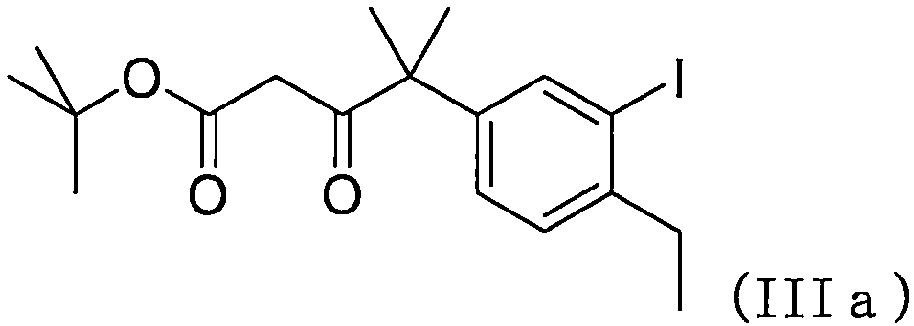
질소 기류하, 2-(4-에틸-3-요오도-페닐)-2-메틸-프로판산(Ia, 80 g, 251 ㎜ol)을 메탄올(240 ㎖)에 용해하였다. 반응액의 내온을 -3℃로 냉각하고, 이 반응액에 염화아세틸(79 g, 1.01 mol)을, 반응액의 내온이 20℃를 초과하지 않도록 첨가하였다. 첨가 종료 후, 반응액을 내온 40℃로 가온하여, 2시간 교반하였다. 얻어진 용액을 160 ㎖까지 농축하고, MTBE(400 ㎖)와 식염수(10 wt%, 320 ㎖)를 첨가하여, 유기층을 분리하였다. 얻어진 유기층은 추가로 탄산수소나트륨 수용액(5 wt%, 320 ㎖)으로 세정하였다. 얻어진 유기층을 160 ㎖까지 농축하고, THF(400 ㎖)를 첨가하고 재차 160 ㎖까지 농축하여, 메틸 2-(4-에틸-3-요오도-페닐)-2-메틸-프로파노에이트(IIa)의 조생성물의 농축물을 얻었다. Under a nitrogen stream, 2-(4-ethyl-3-iodo-phenyl)-2-methyl-propanoic acid (Ia, 80 g, 251 mmol) was dissolved in methanol (240 ml). The internal temperature of the reaction solution was cooled to -3°C, and acetyl chloride (79 g, 1.01 mol) was added to the reaction solution so that the internal temperature of the reaction solution did not exceed 20°C. After completion of addition, the reaction solution was heated to an internal temperature of 40°C and stirred for 2 hours. The obtained solution was concentrated to 160 ml, MTBE (400 ml) and saline solution (10 wt%, 320 ml) were added, and the organic layer was separated. The obtained organic layer was further washed with an aqueous sodium bicarbonate solution (5 wt%, 320 mL). The obtained organic layer was concentrated to 160 mL, THF (400 mL) was added and concentrated again to 160 mL, and methyl 2-(4-ethyl-3-iodo-phenyl)-2-methyl-propanoate (IIa) was obtained. A concentrate of the crude product was obtained.
얻어진 농축물에 THF(80 ㎖)를 첨가하고, 반응액의 내온을 -6℃까지 냉각하였다. LiHMDS(THF용액, 1.3 mol/L, 464 ㎖)를 반응액의 내온이 5℃를 초과하지 않도록 첨가하고, 계속해서 반응액을 -3℃로 승온하였다. 이 용액에 초산 tert-부틸(32 g, 277 ㎜ol)을 반응액의 내온이 15℃를 초과하지 않도록 첨가하고, 같은 온도에서 1시간 교반하였다. THF (80 ml) was added to the obtained concentrate, and the internal temperature of the reaction solution was cooled to -6°C. LiHMDS (THF solution, 1.3 mol/L, 464 mL) was added so that the internal temperature of the reaction solution did not exceed 5°C, and the temperature of the reaction solution was subsequently raised to -3°C. To this solution, tert-butyl acetate (32 g, 277 mmol) was added so that the internal temperature of the reaction solution did not exceed 15°C, and the mixture was stirred at the same temperature for 1 hour.
얻어진 반응액에 6 mol/L 염산(210 ㎖, 1.3 mol)을, 반응액의 내온이 20℃를 초과하지 않도록 첨가하고, 30분 교반 후, 정치하여 수층을 배출하였다. 얻어진 유기층을 추가로 탄산수소나트륨 수용액(5 wt%, 160 ㎖)으로 세정하고, 160 ㎖까지 농축하였다. 얻어진 농축물에 THF(400 ㎖)를 첨가하고, 160 ㎖까지 농축하여, IIIa의 조생성물의 농축물을 얻었다. 얻어진 농축물을 그대로 다음 공정에 사용하였다. 6 mol/L hydrochloric acid (210 mL, 1.3 mol) was added to the obtained reaction liquid so that the internal temperature of the reaction liquid did not exceed 20°C, and after stirring for 30 minutes, the mixture was allowed to stand and the aqueous layer was discharged. The obtained organic layer was further washed with an aqueous sodium bicarbonate solution (5 wt%, 160 mL) and concentrated to 160 mL. THF (400 ml) was added to the obtained concentrate, and the mixture was concentrated to 160 ml to obtain a concentrate of the crude product IIIa. The obtained concentrate was used as is in the next process.
HPLC 순도:99.13%HPLC purity: 99.13%
(2) tert-부틸 6-시아노-2-[1-(4-에틸-3-요오도-페닐)-1-메틸-에틸]-1H-인돌-3-카르복실레이트(VIa)의 합성[공정 2](2) Synthesis of tert-butyl 6-cyano-2-[1-(4-ethyl-3-iodo-phenyl)-1-methyl-ethyl]-1H-indole-3-carboxylate (VIa) [Process 2]

공정 1에서 얻어진 tert-부틸 4-(4-에틸-3-요오도-페닐)-4-메틸-3-옥소-펜타노에이트(IIIa)의 THF용액(약 160 ㎖)과 4-플루오로-3-니트로벤조니트릴(IVa, 54.3 g, 327 ㎜ol)을 혼합하고, 추가로 THF(742 ㎖)를 첨가하여, 반응액의 내온을 5℃로 냉각하였다. 이 반응액에 8 mol/L 수산화나트륨 수용액(210 ㎖, 1680 ㎜ol)을, 반응액의 내온이 15℃를 초과하지 않도록 첨가하고, 같은 온도에서 4시간 교반하였다. 반응액에 6 mol/L 염산(293 ㎖, 1758 ㎜ol)을 첨가하여, 반응액의 내온을 25℃로 승온한 후, 수층을 배출하였다. 얻어진 유기층에 하이드로설파이트 나트륨(253.9 g, 1260 ㎜ol)을 첨가하고, 물(1000 ㎖)을 30분에 걸쳐 적하하였다. 적하 종료 후, 반응액을 내온 25℃에서 3시간 교반하고, MTBE(314 ㎖)를 첨가 후, 수층을 배출하였다. 얻어진 유기층에 1 mol/L 염산(126 ㎖, 126 ㎜ol)을 첨가하여 25℃에서 1시간 교반 후, 1 mol/L 수산화나트륨 수용액(293 ㎖, 293 ㎜ol)을 첨가하여, 교반 후 수층을 배출하였다. 얻어진 유기층을 0.5 mol/L 수산화나트륨 수용액(419 ㎖, 209.5 ㎜ol)으로 세정하였다. 세정 후의 유기층을 약 160 ㎖까지 농축하고, 에탄올(314 ㎖)을 첨가하여 재차 160 ㎖까지 농축하는 작업을 2회 반복하였다. 얻어진 농축 혼합물에 에탄올(1000 ㎖)을 첨가하고, 반응액의 내온을 60℃까지 승온함으로써 용해시켜, 물(115 ㎖)을 15분에 걸쳐 첨가하고, 이어서 WO2010143664에 기재된 제조법으로 얻어진 화합물 VIa(524 ㎎)를 종정으로서 첨가하였다. 결정의 석출을 확인하고, 1시간 같은 온도에서 교반하였다. 같은 온도에서 슬러리에 물(230 ㎖)을 2시간에 걸쳐 적하 후, 반응액의 내온을 20℃까지 4시간에 걸쳐 냉각하였다. 냉각 후 1시간 교반하고, 여과에 의해 습성 분말을 취득 후, 에탄올, 물의 혼합용매(에탄올:물=10:3, 계 520 ㎖)로 습성 분말을 세정하였다. 습성 분말을 감압하 외온 50℃에서 건조를 행하여, tert-부틸 6-시아노-2-[1-(4-에틸-3-요오도-페닐)-1-메틸-에틸]-1H-인돌-3-카르복실레이트(VIa)를 95.96 g(수율 74.2%)으로 얻었다. A THF solution (about 160 mL) of tert-butyl 4-(4-ethyl-3-iodo-phenyl)-4-methyl-3-oxo-pentanoate (IIIa) obtained in step 1 and 4-fluoro- 3-Nitrobenzonitrile (IVa, 54.3 g, 327 mmol) was mixed, THF (742 ml) was further added, and the internal temperature of the reaction solution was cooled to 5°C. An 8 mol/L aqueous sodium hydroxide solution (210 mL, 1680 mmol) was added to this reaction solution so that the internal temperature of the reaction solution did not exceed 15°C, and the mixture was stirred at the same temperature for 4 hours. 6 mol/L hydrochloric acid (293 mL, 1758 mmol) was added to the reaction liquid to raise the internal temperature of the reaction liquid to 25°C, and then the aqueous layer was discharged. Sodium hydrosulfite (253.9 g, 1260 mmol) was added to the obtained organic layer, and water (1000 mL) was added dropwise over 30 minutes. After completion of the dropwise addition, the reaction solution was stirred at an internal temperature of 25°C for 3 hours, MTBE (314 ml) was added, and the aqueous layer was discharged. To the obtained organic layer, 1 mol/L hydrochloric acid (126 mL, 126 ㎜ol) was added and stirred at 25°C for 1 hour, then 1 mol/L sodium hydroxide aqueous solution (293 mL, 293 ㎜ol) was added, and after stirring, the aqueous layer was discharged. The obtained organic layer was washed with 0.5 mol/L aqueous sodium hydroxide solution (419 mL, 209.5 mmol). The organic layer after washing was concentrated to about 160 ml, ethanol (314 ml) was added, and concentration was repeated twice to 160 ml. Ethanol (1000 ml) was added to the obtained concentrated mixture, dissolved by raising the internal temperature of the reaction solution to 60°C, water (115 ml) was added over 15 minutes, and then compound VIa (524) obtained by the production method described in WO2010143664 mg) was added as a seed tablet. Precipitation of crystals was confirmed, and the mixture was stirred at the same temperature for 1 hour. Water (230 ml) was added dropwise to the slurry over 2 hours at the same temperature, and the internal temperature of the reaction solution was cooled to 20°C over 4 hours. After cooling, the mixture was stirred for 1 hour, the wet powder was obtained by filtration, and the wet powder was washed with a mixed solvent of ethanol and water (ethanol: water = 10:3, total 520 ml). The wet powder was dried at an external temperature of 50°C under reduced pressure, and tert-butyl 6-cyano-2-[1-(4-ethyl-3-iodo-phenyl)-1-methyl-ethyl]-1H-indole- 95.96 g (74.2% yield) of 3-carboxylate (VIa) was obtained.
HPLC 순도:99.52%HPLC purity: 99.52%
분말 X선 회절 분석:화합물(VIa)는 도 1에 나타내어지는 바와 같은 패턴을 나타내었다. Powder X-ray diffraction analysis: Compound (VIa) showed a pattern as shown in Figure 1.
(3) tert-부틸 6-시아노-2-[1-[4-에틸-3-(4-모르폴리노-1-피페리딜)페닐]-1-메틸-에틸]-1H-인돌-3-카르복실레이트 염산염(VIIa 염산염)의 제조[공정 3](3) tert-butyl 6-cyano-2-[1-[4-ethyl-3-(4-morpholino-1-piperidyl)phenyl]-1-methyl-ethyl]-1H-indole- 3-Manufacture of carboxylate hydrochloride (VIIa hydrochloride) [Process 3]

질소 분위기하, Π-알릴팔라듐클로라이드 다이머(0.453 g, 2.48 ㎜ol)와 S-Phos(1.02 g, 2.48 ㎜ol)를 THF(275 ㎖)에 용해하고, 반응용기 내의 질소 치환을 행하였다. 얻어진 혼합물에 공정 2에서 얻어진 tert-부틸 6-시아노-2-[1-(4-에틸-3-요오도-페닐)-1-메틸-에틸]-1H-인돌-3-카르복실레이트(VIa, 85 g, 165 ㎜ol), 4-(4-피페리디닐)-모르폴린(33.8 g, 198 ㎜ol), 1,3-디메틸-2-이미다졸리디논(149 ㎖)을 첨가하고, 재차 반응용기 내를 질소 치환하였다. 혼합물을 내온 0℃로 냉각하고, NaHMDS(40% THF용액, 280 ㎖, 545 ㎜ol)를 반응액의 내온이 20℃를 초과하지 않도록 첨가하였다. 첨가 종료 후, 반응액의 내온을 25℃로 설정하고, 1시간 교반하였다. 초산이소프로필(340 ㎖), 염화암모늄 수용액(15%, 255 g)을 첨가하고, 반응액의 내온을 50℃로 가온하여, 같은 온도에서 1시간 교반하였다. 수층을 배출하고, 얻어진 유기층을 외온 50℃에서 감압하, 유기층이 약 210 ㎖에 도달할 때까지 농축하였다. 초산이소프로필(340 ㎖)을 첨가하여 같은 온도에서 감압하 약 210 ㎖가 될 때까지 농축 후, 잔사를 아세톤(255 ㎖)에 용해하였다. 용액을 1 ㎛ 메시 사이즈의 여과지로 여과를 행하여, 얻어진 여액에 아세톤(935 ㎖)을 첨가하고, 용액의 내온을 35℃로 승온 후, 피리딘 염산염(21 g, 182 ㎜ol)의 에탄올용액(21.3 ㎖)과 아세톤(42.5 ㎖)의 혼합용액을 1시간에 걸쳐 적하하고, 목적물을 결정화시켰다. 얻어진 슬러리를 1시간에 걸쳐 내온 -4℃까지 냉각하고, 여과에 의해 습성 분말을 취득 후, 아세톤(425 ㎖)으로 세정하였다. 습성 분말을 감압하 외온 40℃에서 건조를 행하여, tert-부틸 6-시아노-2-[1-[4-에틸-3-(4-모르폴리노-1-피페리딜)페닐]-1-메틸-에틸]-1H-인돌-3-카르복실레이트 염산염(VIIa 염산염) 97.1 g을 얻었다. (수율:91%)Under a nitrogen atmosphere, Π-allylpalladium chloride dimer (0.453 g, 2.48 mmol) and S-Phos (1.02 g, 2.48 mmol) were dissolved in THF (275 ml), and the reaction vessel was replaced with nitrogen. To the obtained mixture was added tert-butyl 6-cyano-2-[1-(4-ethyl-3-iodo-phenyl)-1-methyl-ethyl]-1H-indole-3-carboxylate (obtained in step 2) VIa, 85 g, 165 mmol), 4-(4-piperidinyl)-morpholine (33.8 g, 198 mmol), and 1,3-dimethyl-2-imidazolidinone (149 ml) were added. , the inside of the reaction vessel was purged with nitrogen again. The mixture was cooled to an internal temperature of 0°C, and NaHMDS (40% THF solution, 280 mL, 545 mmol) was added so that the internal temperature of the reaction solution did not exceed 20°C. After completion of addition, the internal temperature of the reaction solution was set to 25°C and stirred for 1 hour. Isopropyl acetate (340 ml) and ammonium chloride aqueous solution (15%, 255 g) were added, the internal temperature of the reaction solution was heated to 50°C, and the mixture was stirred at the same temperature for 1 hour. The aqueous layer was discharged, and the obtained organic layer was concentrated under reduced pressure at an external temperature of 50°C until the organic layer reached about 210 ml. Isopropyl acetate (340 ml) was added and concentrated to about 210 ml under reduced pressure at the same temperature, and the residue was dissolved in acetone (255 ml). The solution was filtered through a 1 ㎛ mesh filter paper, acetone (935 ml) was added to the obtained filtrate, the internal temperature of the solution was raised to 35°C, and then pyridine hydrochloride (21 g, 182 mmol) was added to an ethanol solution (21.3). mL) and acetone (42.5 mL) were added dropwise over 1 hour to crystallize the target product. The obtained slurry was cooled to an internal temperature of -4°C over 1 hour, and the wet powder was obtained by filtration and washed with acetone (425 ml). The wet powder was dried at an external temperature of 40°C under reduced pressure to obtain tert-butyl 6-cyano-2-[1-[4-ethyl-3-(4-morpholino-1-piperidyl)phenyl]-1. 97.1 g of -methyl-ethyl]-1H-indole-3-carboxylate hydrochloride (VIIa hydrochloride) was obtained. (Yield: 91%)
HPLC 순도:99.13%HPLC purity: 99.13%
아세톤 함량:7.8%Acetone content: 7.8%
분말 X선 회절 분석:화합물(VIIa)는 도 2, 도 3, 도 4에 나타내어지는 패턴을 나타낸다. Powder X-ray diffraction analysis: Compound (VIIa) exhibits the patterns shown in FIGS. 2, 3, and 4.
실시예 2Example 2
시약·용매종에 따른 반응 선택성·반응률의 비교Comparison of reaction selectivity and reaction rate according to reagent and solvent species
표 1에 나타내는 용매 및 촉매의 조합을 사용하여, 실시예 1에 기재한 방법을 실시하고, 목적물(화합물 VIIa)과 불순물(Z)의 수량(收量)을 측정하였다. Using the combination of solvent and catalyst shown in Table 1, the method described in Example 1 was carried out, and the quantities of the target compound (Compound VIIa) and the impurity (Z) were measured.
시약·용매종에 따른 반응 선택성·반응률의 비교를 표 1에 나타낸다. Table 1 shows a comparison of reaction selectivity and reaction rate according to reagent and solvent species.
또한, 불순물(Z)는 이탈기인 요오드기가 수소원자로 치환된 아래에 나타내는 화합물이다. Additionally, the impurity (Z) is a compound shown below in which the iodine group, which is a leaving group, is replaced with a hydrogen atom.


이상의 결과로부터, 고우려물질인 DME 대신에, THF 단독 또는 DMI와의 혼합용매 및 소정의 촉매를 사용함으로써 DME와 동등 이상의 선택성으로 목적물을 얻을 수 있는 것을 알 수 있었다. From the above results, it was found that the target product could be obtained with a selectivity equal to or better than that of DME by using THF alone or a mixed solvent with DMI and a given catalyst instead of DME, which is a substance of high concern.
실시예 3Example 3
(1) 6-시아노-2-[1-[4-에틸-3-(4-모르폴리노-1-피페리딜)페닐]-1-메틸-에틸]-1H-인돌-3-카르복실산(VIIIa)의 제조[공정 4](1) 6-cyano-2-[1-[4-ethyl-3-(4-morpholino-1-piperidyl)phenyl]-1-methyl-ethyl]-1H-indole-3-carboxylic Production of boxylic acid (VIIIa) [Process 4]
A. 결정 세정법으로서 아세톤과 물의 혼합물을 사용하는 합성법A. Synthesis method using a mixture of acetone and water as a crystal cleaning method

질소 분위기하, tert-부틸 6-시아노-2-[1-[4-에틸-3-(4-모르폴리노-1-피페리딜)페닐]-1-메틸-에틸]-1H-인돌-3-카르복실레이트 염산염(VIIa, 80 g, 135 ㎜ol)을 TFE(400 ㎖)에 현탁하고, 반응액을 내온 25℃에서 교반하였다. 트리메틸실릴클로라이드(24.9 g, 229 ㎜ol)를, 반응액의 내온이 30℃를 초과하지 않도록 첨가하고, 같은 온도에서 2시간 교반하였다. 반응액의 내온을 8℃로 냉각하고, 아세톤(320 ㎖)을 반응액의 내온이 12℃를 초과하지 않도록 첨가하였다. 얻어진 용액에 1 mol/L 수산화나트륨 수용액(241 ㎖)을, 반응액의 내온이 8℃를 초과하지 않도록 첨가하고, 결정 석출 후, 반응액에 10% 인산수소이칼륨 수용액(80 g)을 추가하고, 같은 온도에서 1시간 반 교반하였다. 얻어진 고체를 여과에 의해 습성 분말로서 취득 후, 습성 분말을 아세톤, 물의 혼합용액(아세톤:물=1:1, 계 320 ㎖)으로 세정하였다. 습성 분말을 감압하 외온 50℃에서 건조를 행하여, 6-시아노-2-[1-[4-에틸-3-(4-모르폴리노-1-피페리딜)페닐]-1-메틸-에틸]-1H-인돌-3-카르복실산(VIIIa, 64.138 g)을 얻었다. (수율 91%)Under nitrogen atmosphere, tert-butyl 6-cyano-2-[1-[4-ethyl-3-(4-morpholino-1-piperidyl)phenyl]-1-methyl-ethyl]-1H-indole -3-Carboxylate hydrochloride (VIIa, 80 g, 135 mmol) was suspended in TFE (400 mL), and the reaction solution was stirred at an internal temperature of 25°C. Trimethylsilyl chloride (24.9 g, 229 mmol) was added so that the internal temperature of the reaction solution did not exceed 30°C, and the mixture was stirred at the same temperature for 2 hours. The internal temperature of the reaction solution was cooled to 8°C, and acetone (320 ml) was added so that the internal temperature of the reaction solution did not exceed 12°C. A 1 mol/L aqueous sodium hydroxide solution (241 mL) was added to the obtained solution so that the internal temperature of the reaction solution did not exceed 8°C, and after precipitation of crystals, a 10% aqueous dipotassium hydrogen phosphate solution (80 g) was added to the reaction solution. , and stirred at the same temperature for 1 and a half hours. The obtained solid was collected as wet powder by filtration, and the wet powder was washed with a mixed solution of acetone and water (acetone:water = 1:1, total 320 ml). The wet powder was dried at an external temperature of 50°C under reduced pressure, and 6-cyano-2-[1-[4-ethyl-3-(4-morpholino-1-piperidyl)phenyl]-1-methyl- Ethyl]-1H-indole-3-carboxylic acid (VIIIa, 64.138 g) was obtained. (yield 91%)
HPLC 순도;99.71%HPLC purity;99.71%
TFE 함량:1.7%TFE content: 1.7%
아세톤 함량:1.3%Acetone content: 1.3%
수분량:0.4%Moisture content: 0.4%
B. 결정 세정법으로서 물과 아세톤을 사용하는 합성법B. Synthesis method using water and acetone as a crystal cleaning method
질소 분위기하, tert-부틸 6-시아노-2-[1-[4-에틸-3-(4-모르폴리노-1-피페리딜)페닐]-1-메틸-에틸]-1H-인돌-3-카르복실레이트 염산염(VIIa, 20 g, 34 ㎜ol)을 TFE(100 ㎖)에 현탁시켜, 반응액을 내온 25℃에서 교반하였다. 트리메틸실릴클로라이드(6.2 g, 57 ㎜ol)를, 반응액의 내온이 30℃를 초과하지 않도록 첨가하고, 같은 온도에서 3시간 교반하였다. 반응액의 내온을 8℃로 냉각하고, 아세톤(80 ㎖)을 반응액의 내온이 12℃를 초과하지 않도록 첨가하였다. 얻어진 용액에 1 mol/L 수산화나트륨 수용액(61 ㎖)을, 반응액의 내온이 12℃를 초과하지 않도록 첨가하고, 결정 석출 후, 반응액에 10% 인산수소이칼륨 수용액(20 g)을 추가하고, 같은 온도에서 1시간 반 교반하였다. 얻어진 고체를 여과에 의해 습성 분말로서 취득 후, 습성 분말을 물(80 ㎖)로 세정하고, 추가로 아세톤(80 ㎖)으로 세정하였다. 습성 분말을 감압하 외온 50℃에서 건조를 행하여, 6-시아노-2-[1-[4-에틸-3-(4-모르폴리노-1-피페리딜)페닐]-1-메틸-에틸]-1H-인돌-3-카르복실산(VIIIa, 15.8 g)을 얻었다. (수율 93%)Under nitrogen atmosphere, tert-butyl 6-cyano-2-[1-[4-ethyl-3-(4-morpholino-1-piperidyl)phenyl]-1-methyl-ethyl]-1H-indole -3-Carboxylate hydrochloride (VIIa, 20 g, 34 mmol) was suspended in TFE (100 ml), and the reaction solution was stirred at an internal temperature of 25°C. Trimethylsilyl chloride (6.2 g, 57 mmol) was added so that the internal temperature of the reaction solution did not exceed 30°C, and the mixture was stirred at the same temperature for 3 hours. The internal temperature of the reaction solution was cooled to 8°C, and acetone (80 ml) was added so that the internal temperature of the reaction solution did not exceed 12°C. A 1 mol/L aqueous sodium hydroxide solution (61 mL) was added to the obtained solution so that the internal temperature of the reaction solution did not exceed 12°C, and after precipitation of crystals, a 10% aqueous dipotassium hydrogen phosphate solution (20 g) was added to the reaction solution. , and stirred at the same temperature for 1 and a half hours. After collecting the obtained solid as wet powder by filtration, the wet powder was washed with water (80 ml) and further washed with acetone (80 ml). The wet powder was dried at an external temperature of 50°C under reduced pressure, and 6-cyano-2-[1-[4-ethyl-3-(4-morpholino-1-piperidyl)phenyl]-1-methyl- Ethyl]-1H-indole-3-carboxylic acid (VIIIa, 15.8 g) was obtained. (yield 93%)
HPLC 순도;99.76%HPLC purity;99.76%
TFE 함량:1.6%TFE content: 1.6%
아세톤 함량:2.3%Acetone content: 2.3%
수분량:0.4%Moisture content: 0.4%
분말 X선 회절 분석:화합물(VIIIa)는 도 5, 도 6, 도 7에 나타내어지는 바와 같은 패턴을 나타낸다. Powder X-ray diffraction analysis: Compound (VIIIa) shows patterns as shown in FIGS. 5, 6, and 7.
(2) 9-에틸-6,6-디메틸-8-[4-(모르폴린-4-일)피페리딘-1-일]-11-옥소-6,11-디히드로-5H-벤조[b]카르바졸-3-카르보니트릴(1)의 제조[공정 5](2) 9-ethyl-6,6-dimethyl-8-[4-(morpholine-4-yl)piperidin-1-yl]-11-oxo-6,11-dihydro-5H-benzo[ b] Production of carbazole-3-carbonitrile (1) [Step 5]
A. N,N'-디이소프로필카르보디이미드를 사용한 제조방법A. Manufacturing method using N,N'-diisopropylcarbodiimide

질소 분위기하, 6-시아노-2-[1-[4-에틸-3-(4-모르폴리노-1-피페리딜)페닐]-1-메틸-에틸]-1H-인돌-3-카르복실산(VIIIa, 50 g, 100 ㎜ol)을 아세톤(500 ㎖)에 현탁하고, N,N'-디이소프로필카르보디이미드(25.2 g, 200 ㎜ol), 디이소프로필에틸아민(12.9 g, 100 ㎜ol)을 첨가하여, 반응액의 내온을 55℃ 이상으로 승온하였다. 같은 온도에서 4시간 교반 후, 반응액의 내온을 40℃로 냉각하였다. 이 단계에서 석출된 결정은 도 8에 나타내는 패턴을 나타내었다. 반응액에 메탄올(450 ㎖)을 30분에 걸쳐 적하 후, 같은 온도에서 30분간 교반하였다. 이 단계에서 석출된 결정은 도 9에 나타내는 패턴을 나타내었다. 물(200 ㎖)을 30분에 걸쳐 현탁액에 첨가하고, 추가로 같은 온도에서 1시간 교반을 행하였다. 이 단계에서 석출된 결정은 도 10에 나타내는 패턴을 나타내었다. 생성된 결정을 여과에 의해 습성 분말로서 취득 후, 메탄올, 물의 혼합용액(메탄올:물=12:5, 계 425 ㎖)으로 세정하였다. 이 단계에서 얻어진 습성 분말은 도 11에 나타내는 패턴을 나타내었다. 습성 분말을 감압하 외온 50℃에서 건조를 행하여, 9-에틸-6,6-디메틸-8-[4-(모르폴린-4-일)피페리딘-1-일]-11-옥소-6,11-디히드로-5H-벤조[b]카르바졸-3-카르보니트릴(화합물(1), 42.734 g)을 얻었다. (수율:89%)Under nitrogen atmosphere, 6-cyano-2-[1-[4-ethyl-3-(4-morpholino-1-piperidyl)phenyl]-1-methyl-ethyl]-1H-indole-3- Carboxylic acid (VIIIa, 50 g, 100 mmol) was suspended in acetone (500 mL), N,N'-diisopropylcarbodiimide (25.2 g, 200 mmol), and diisopropylethylamine (12.9 g, 100 mmol) was added to raise the internal temperature of the reaction solution to 55°C or higher. After stirring at the same temperature for 4 hours, the internal temperature of the reaction solution was cooled to 40°C. The crystals precipitated at this stage showed the pattern shown in FIG. 8. Methanol (450 ml) was added dropwise to the reaction solution over 30 minutes, and then stirred at the same temperature for 30 minutes. The crystals precipitated at this stage showed the pattern shown in FIG. 9. Water (200 ml) was added to the suspension over 30 minutes, and stirring was further performed at the same temperature for 1 hour. The crystals precipitated at this stage showed the pattern shown in FIG. 10. The resulting crystals were collected as wet powder by filtration and washed with a mixed solution of methanol and water (methanol:water=12:5, total 425 ml). The wet powder obtained in this step showed the pattern shown in Figure 11. The wet powder was dried at an external temperature of 50°C under reduced pressure to obtain 9-ethyl-6,6-dimethyl-8-[4-(morpholine-4-yl)piperidin-1-yl]-11-oxo-6. , 11-dihydro-5H-benzo[b]carbazole-3-carbonitrile (Compound (1), 42.734 g) was obtained. (Yield: 89%)
HPLC 순도:99.85%HPLC purity: 99.85%
수분량:3.7%Moisture content: 3.7%
분말 X선 회절 분석:상기 수법으로 얻어지는 화합물(1)은 도 12에 나타내어지는 패턴을 나타낸다. Powder X-ray diffraction analysis: Compound (1) obtained by the above method shows the pattern shown in FIG. 12.
B. 클로로인산디에틸을 사용한 제법(1)B. Preparation method using diethyl chlorophosphate (1)
질소 분위기하, 6-시아노-2-[1-[4-에틸-3-(4-모르폴리노-1-피페리딜)페닐]-1-메틸-에틸]-1H-인돌-3-카르복실산(VIIIa, 1.0 g, 2.0 ㎜ol)을 THF(20 ㎖)에 현탁하고, 클로로인산디에틸(1.155 ㎖, 8.0 ㎜ol), 디이소프로필에틸아민(2.4 ㎖, 14.0 ㎜ol)을 첨가하여, 반응액의 내온을 68℃로 승온하였다. 같은 온도에서 반응액을 2시간 교반하고, 반응액의 내온을 40℃로 냉각하였다. 얻어진 반응액에 메탄올(7.5 ㎖)을 첨가 후, 반응액의 내온을 35℃로 냉각하였다. 물(12.5 ㎖)을 1시간에 걸쳐 현탁액에 첨가하고, 반응액의 내온을 30℃에서 1시간 교반을 행하였다. 얻어진 고체를 여과에 의해 습성 분말로서 취득 후, 메탄올, 물의 혼합용액(메탄올:물=5:8.7, 계 13.7 ㎖)으로 세정하였다. 습성 분말을 감압하 50℃에서 건조를 행하여, 9-에틸-6,6-디메틸-8-[4-(모르폴린-4-일)피페리딘-1-일]-11-옥소-6,11-디히드로-5H-벤조[b]카르바졸-3-카르보니트릴(화합물(1), 0.7225 g)을 얻었다. (수율:75%)Under nitrogen atmosphere, 6-cyano-2-[1-[4-ethyl-3-(4-morpholino-1-piperidyl)phenyl]-1-methyl-ethyl]-1H-indole-3- Carboxylic acid (VIIIa, 1.0 g, 2.0 ㎜ol) was suspended in THF (20 ㎜ol), diethyl chlorophosphate (1.155 ㎖, 8.0 ㎜ol), and diisopropylethylamine (2.4 ㎖, 14.0 ㎜ol). By addition, the internal temperature of the reaction solution was raised to 68°C. The reaction solution was stirred at the same temperature for 2 hours, and the internal temperature of the reaction solution was cooled to 40°C. After adding methanol (7.5 ml) to the obtained reaction liquid, the internal temperature of the reaction liquid was cooled to 35°C. Water (12.5 ml) was added to the suspension over 1 hour, and the internal temperature of the reaction solution was stirred at 30°C for 1 hour. The obtained solid was collected as a wet powder by filtration and washed with a mixed solution of methanol and water (methanol:water=5:8.7, total 13.7 ml). The wet powder was dried at 50°C under reduced pressure to obtain 9-ethyl-6,6-dimethyl-8-[4-(morpholine-4-yl)piperidin-1-yl]-11-oxo-6, 11-dihydro-5H-benzo[b]carbazole-3-carbonitrile (Compound (1), 0.7225 g) was obtained. (Yield: 75%)
HPLC 순도:99.87%HPLC purity: 99.87%
수분량:3.8%Moisture content: 3.8%
C. 클로로인산디에틸을 사용한 제법(2)C. Preparation method using diethyl chlorophosphate (2)
질소 분위기하, 6-시아노-2-[1-[4-에틸-3-(4-모르폴리노-1-피페리딜)페닐]-1-메틸-에틸]-1H-인돌-3-카르복실산(VIIIa, 1.0 g, 2.0 ㎜ol)을 아세토니트릴(20 ㎖)에 현탁하고, 클로로인산디에틸(1.15 ㎖, 8.0 ㎜ol), 디이소프로필에틸아민(2.4 ㎖, 14.0 ㎜ol)을 첨가하여, 반응액의 내온을 69℃로 승온하였다. 반응액을 같은 온도에서 2시간 교반하고, 반응액의 내온을 40℃로 냉각 후, 메탄올(7.5 ㎖)을 첨가하고, 반응액의 내온을 35℃로 냉각하였다. 얻어진 현탁액에 물(12.5 ㎖)을 1시간에 걸쳐 첨가하고, 내온 30℃에서 1시간 교반하였다. 얻어진 고체를 여과에 의해 습성 분말로서 취득 후, 메탄올, 물의 혼합용액(메탄올:물=5:8.7, 계 13.7 ㎖)으로 세정하였다. 습성 분말을 감압하 50℃에서 건조를 행하여, 9-에틸-6,6-디메틸-8-[4-(모르폴린-4-일)피페리딘-1-일]-11-옥소-6,11-디히드로-5H-벤조[b]카르바졸-3-카르보니트릴(화합물(1), 0.8107 g)을 얻었다. (수율:84%)Under nitrogen atmosphere, 6-cyano-2-[1-[4-ethyl-3-(4-morpholino-1-piperidyl)phenyl]-1-methyl-ethyl]-1H-indole-3- Carboxylic acid (VIIIa, 1.0 g, 2.0 ㎜ol) was suspended in acetonitrile (20 ㎜ol), diethyl chlorophosphate (1.15 ㎖, 8.0 ㎜ol), and diisopropylethylamine (2.4 ㎖, 14.0 ㎜ol). was added to increase the internal temperature of the reaction solution to 69°C. The reaction solution was stirred at the same temperature for 2 hours, and the internal temperature of the reaction solution was cooled to 40°C. Then, methanol (7.5 ml) was added, and the internal temperature of the reaction solution was cooled to 35°C. Water (12.5 ml) was added to the obtained suspension over 1 hour, and stirred at an internal temperature of 30°C for 1 hour. The obtained solid was collected as a wet powder by filtration and washed with a mixed solution of methanol and water (methanol:water=5:8.7, total 13.7 ml). The wet powder was dried at 50°C under reduced pressure to obtain 9-ethyl-6,6-dimethyl-8-[4-(morpholine-4-yl)piperidin-1-yl]-11-oxo-6, 11-dihydro-5H-benzo[b]carbazole-3-carbonitrile (Compound (1), 0.8107 g) was obtained. (Yield: 84%)
HPLC 순도:99.5%HPLC purity: 99.5%
수분량:3.8%Moisture content: 3.8%
D. 무수초산을 사용한 제법(1)D. Manufacturing method using acetic anhydride (1)
질소 분위기하, 6-시아노-2-[1-[4-에틸-3-(4-모르폴리노-1-피페리딜)페닐]-1-메틸-에틸]-1H-인돌-3-카르복실산(VIIIa, 1.0 g, 2.0 ㎜ol)을 2―메틸테트라히드로푸란(15 ㎖)에 현탁하고, 무수초산(0.75 ㎖, 8.0 ㎜ol), 디이소프로필에틸아민(2.4 ㎖, 14.0 ㎜ol)을 첨가하여, 반응액의 내온을 80℃로 승온하였다. 반응액을 같은 온도에서 6시간 교반하고, 반응액의 내온을 40℃로 냉각 후, 메탄올(4.5 ㎖)을 첨가하고, 반응액의 내온을 35℃로 냉각하였다. 얻어진 현탁액에 물(4.5 ㎖)을 0.5시간에 걸쳐 첨가하고, 내온 10℃ 이하에서 1시간 교반하였다. 얻어진 고체를 여과에 의해 습성 분말로서 취득 후, 메탄올, 물의 혼합용액(메탄올:물=5:8.7, 계 13.7 ㎖)으로 세정하였다. 습성 분말을 감압하 40℃에서 건조를 행하여, 9-에틸-6,6-디메틸-8-[4-(모르폴린-4-일)피페리딘-1-일]-11-옥소-6,11-디히드로-5H-벤조[b]카르바졸-3-카르보니트릴(화합물(1), 0.673 g)을 얻었다. (수율:70%)Under nitrogen atmosphere, 6-cyano-2-[1-[4-ethyl-3-(4-morpholino-1-piperidyl)phenyl]-1-methyl-ethyl]-1H-indole-3- Carboxylic acid (VIIIa, 1.0 g, 2.0 ㎜ol) was suspended in 2-methyltetrahydrofuran (15 ㎜), acetic anhydride (0.75 ㎖, 8.0 ㎜ol), and diisopropylethylamine (2.4 ㎖, 14.0 ㎜ol). ol) was added, and the internal temperature of the reaction solution was raised to 80°C. The reaction solution was stirred at the same temperature for 6 hours, and the internal temperature of the reaction solution was cooled to 40°C. Then, methanol (4.5 ml) was added, and the internal temperature of the reaction solution was cooled to 35°C. Water (4.5 ml) was added to the obtained suspension over 0.5 hours, and stirred for 1 hour at an internal temperature of 10°C or lower. The obtained solid was collected as a wet powder by filtration and washed with a mixed solution of methanol and water (methanol:water=5:8.7, total 13.7 ml). The wet powder was dried at 40°C under reduced pressure to obtain 9-ethyl-6,6-dimethyl-8-[4-(morpholine-4-yl)piperidin-1-yl]-11-oxo-6, 11-dihydro-5H-benzo[b]carbazole-3-carbonitrile (Compound (1), 0.673 g) was obtained. (Yield: 70%)
HPLC 순도:99.77%HPLC purity: 99.77%
E. 무수초산을 사용한 제법(2)E. Manufacturing method using acetic anhydride (2)
D에서 사용한 2-메틸테트라히드로푸란 대신에, 용매로서 N,N-디메틸아세트아미드를 사용하고, 동일한 조작을 행하여 화합물(1)을 얻었다. (수율:85%)Instead of 2-methyltetrahydrofuran used in D, N,N-dimethylacetamide was used as a solvent, and the same operation was performed to obtain compound (1). (Yield: 85%)
HPLC 순도:99.8%HPLC purity: 99.8%
실시예 4Example 4
시약·용매종에 따른 환화반응의 선택성·수율의 비교Comparison of selectivity and yield of cyclization reaction according to reagent and solvent species
표 2에 나타내는 시약 및 용매의 조합을 사용하여, 실시예 3에 기재한 방법을 실시하여, 목적물(화합물(1))과 불순물(Y)의 생성비를 측정하였다. 목적물(화합물(1))과 불순물(Y)의 생성비(환화반응의 선택성)는, 시마즈 제작소 제조 LC-10 시스템을 사용하여, Sunfire(4.6 ㎜ ID×50 ㎜) 칼럼에 의한 반응 혼합물의 HPLC 분석의 피크 면적을 토대로 산출하였다. HPLC 분석은 0.05% 트리플루오로초산 수용액(A)와 0.05% 트리플루오로초산의 아세토니트릴용액(B)를 사용한 직선적 그라디언트법(표 3, 유속 1 ㎖/분)을 사용해서 행하고, 230 ㎚에서의 흡수 피크 면적을 사용해서 계산하였다. 각 화합물의 유지시간은 목적물(화합물(1))이 약 6.8분, 불순물(Y)가 약 3.8분이었다. Using the combination of reagents and solvents shown in Table 2, the method described in Example 3 was carried out to measure the production ratio of the target substance (compound (1)) and the impurity (Y). The production ratio (selectivity of the cyclization reaction) of the target compound (compound (1)) and the impurity (Y) was determined by HPLC of the reaction mixture using a Sunfire (4.6 mm ID x 50 mm) column using an LC-10 system manufactured by Shimadzu Corporation. Calculation was made based on the peak area of the analysis. HPLC analysis was performed using a linear gradient method (Table 3, flow rate 1 mL/min) using a 0.05% aqueous trifluoroacetic acid solution (A) and an acetonitrile solution of 0.05% trifluoroacetic acid (B), at 230 nm. It was calculated using the absorption peak area of . The retention time for each compound was about 6.8 minutes for the target (compound (1)) and about 3.8 minutes for the impurity (Y).
시약·용매종에 따른 환화반응의 선택성·수율의 비교를 표 2에 나타낸다. Table 2 shows a comparison of selectivity and yield of cyclization reaction according to reagent and solvent species.
또한, 불순물(Y)는 목적물(화합물(1))과는 다른 치환 위치에서 프리델·크래프츠형 반응에 의해 환화된 아래 화합물이다.In addition, the impurity (Y) is the following compound cyclized by a Friedel-Crafts type reaction at a substitution position different from that of the target (compound (1)).


이상의 결과로부터, 목적물의 선택성에 대해서는 무수초산 대신에, 클로로인산디에틸이나 N,N'-디이소프로필카르보디이미드(DIC)를 사용함으로써, 반응 선택성이 크게 향상되는 것을 알 수 있었다. 또한, N,N'-디이소프로필카르보디이미드와 아세톤을 조합해서 사용함으로써 목적물의 수율이 크게 향상되는 것을 알 수 있었다. From the above results, it was found that the reaction selectivity for the target product was greatly improved by using diethyl chlorophosphate or N,N'-diisopropylcarbodiimide (DIC) instead of acetic anhydride. In addition, it was found that the yield of the target product was greatly improved by using a combination of N,N'-diisopropylcarbodiimide and acetone.

A율:0.05% 트리플루오로초산 수용액의 총 유량에 대한 비율A rate: Ratio to the total flow rate of 0.05% trifluoroacetic acid aqueous solution
B율:0.05% 트리플루오로초산의 아세토니트릴용액의 총 유량에 대한 비율B rate: 0.05% ratio of trifluoroacetic acid to the total flow rate of acetonitrile solution
실시예 5Example 5
9-에틸-6,6-디메틸-8-[4-(모르폴린-4-일)피페리딘-1-일]-11-옥소-6,11-디히드로-5H-벤조[b]카르바졸-3-카르보니트릴 염산염(화합물(1)의 염산염)의 제조[공정 6]9-ethyl-6,6-dimethyl-8-[4-(morpholine-4-yl)piperidin-1-yl]-11-oxo-6,11-dihydro-5H-benzo[b]car Production of Bazol-3-carbonitrile hydrochloride (hydrochloride of Compound (1)) [Step 6]
질소 분위기하, 9-에틸-6,6-디메틸-8-[4-(모르폴린-4-일)피페리딘-1-일]-11-옥소-6,11-디히드로-5H-벤조[b]카르바졸-3-카르보니트릴(화합물(1), 35 g, 72.5 ㎜ol)에, 2-부타논(350 ㎖), 물(122.5 ㎖), 및 초산(105 ㎖)을 첨가하고, 외온 35℃에서 용해하였다. 이 용액을 내온 60℃로 가열한 2 mol/L 염산(70 ㎖)과 에탄올(350 ㎖)의 혼합액에, 혼합액 온도를 60℃로 유지하면서 적하하였다. 추가로, 2-부타논(70 ㎖), 물(24.5 ㎖), 및 초산(21 ㎖)의 혼합용매를 혼합액 온도를 60℃로 유지하면서 적하하였다. 반응액을 같은 온도에서 1시간 교반한 후, 반응액의 내온 20℃까지 2시간에 걸쳐 냉각하였다. 반응액을 30분 교반 후, 생성된 고체를 여과하여 모으고, 얻어진 습성 분말을 에탄올(350 ㎖)로 세정하였다. 습성 분말을 감압하 외온 40℃에서 건조를 행하여, 9-에틸-6,6-디메틸-8-[4-(모르폴린-4-일)피페리딘-1-일]-11-옥소-6,11-디히드로-5H-벤조[b]카르바졸-3-카르보니트릴 염산염(화합물(1) 염산염, 31.15 g)을 얻었다. (수율:82.8%)Under nitrogen atmosphere, 9-ethyl-6,6-dimethyl-8-[4-(morpholine-4-yl)piperidin-1-yl]-11-oxo-6,11-dihydro-5H-benzo [b] To carbazole-3-carbonitrile (compound (1), 35 g, 72.5 mmol), 2-butanone (350 ml), water (122.5 ml), and acetic acid (105 ml) were added, It was dissolved at an external temperature of 35°C. This solution was added dropwise to a mixture of 2 mol/L hydrochloric acid (70 mL) and ethanol (350 mL) heated to an internal temperature of 60°C while maintaining the temperature of the mixture at 60°C. Additionally, a mixed solvent of 2-butanone (70 ml), water (24.5 ml), and acetic acid (21 ml) was added dropwise while maintaining the mixed solution temperature at 60°C. The reaction solution was stirred at the same temperature for 1 hour, and then cooled to the internal temperature of 20°C over 2 hours. After stirring the reaction solution for 30 minutes, the resulting solid was collected by filtration, and the obtained wet powder was washed with ethanol (350 ml). The wet powder was dried at an external temperature of 40°C under reduced pressure to obtain 9-ethyl-6,6-dimethyl-8-[4-(morpholine-4-yl)piperidin-1-yl]-11-oxo-6. , 11-dihydro-5H-benzo[b]carbazole-3-carbonitrile hydrochloride (Compound (1) hydrochloride, 31.15 g) was obtained. (Yield: 82.8%)
HPLC 순도:99.95%HPLC purity: 99.95%
화합물(1) 염산염을 화합물 Ia로부터 제조하는 과정에서 생성되는 불순물(X)Compound (1) Impurities (X) generated during the production of hydrochloride from compound Ia
3-시아노-9-에틸-6,6-디메틸-8-(4-모르폴리노-1-피페리딜)-11-옥소-5H-벤조[b]카르바졸-2-설폰산3-cyano-9-ethyl-6,6-dimethyl-8-(4-morpholino-1-piperidyl)-11-oxo-5H-benzo[b]carbazole-2-sulfonic acid
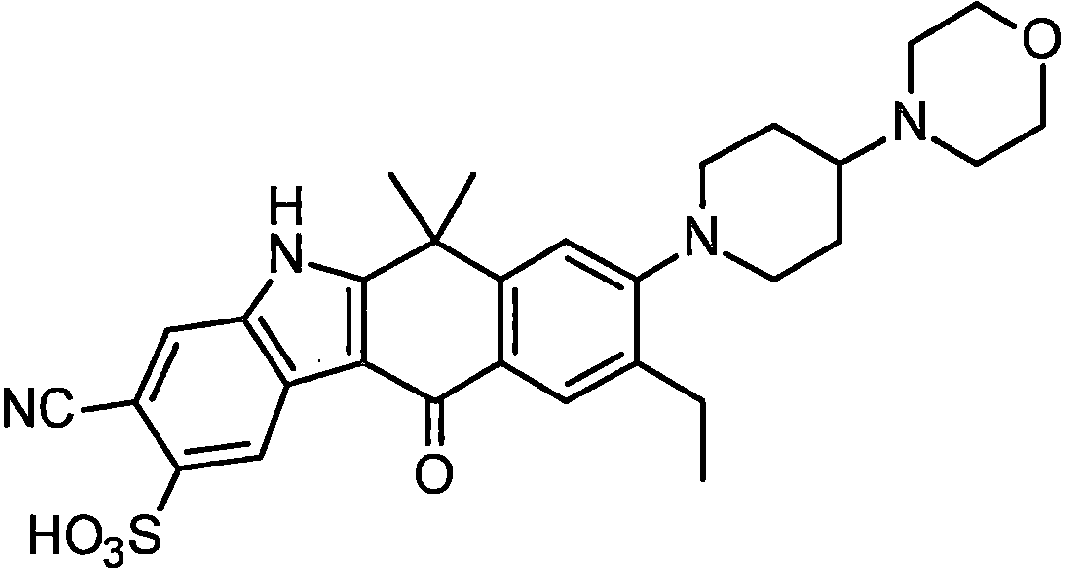
본 발명에 의해, 환경 부하·작업자의 건강에 우려가 있는 용매를 사용하지 않고, 또한, 불순물의 조절을 용이하게 함으로써, 의약품의 제조에 있어서 보다 견뢰성·지속성이 높은 프로세스로 구성된, 고수율의 화합물(1)의 제조방법이 제공된다. According to the present invention, a process with higher fastness and sustainability in the production of pharmaceuticals is achieved by eliminating the use of solvents that pose a risk to the environment and the health of workers, and by facilitating the control of impurities. A method for preparing compound (1) is provided.
Claims (15)

로 표시되는 화합물, 또는 그의 약학적으로 허용되는 염을 제조하는 방법으로서,
상기 방법은 식 VIIIb

[R1a는 4-(모르폴린-4-일)피페리딘-1-일기를 나타내고, R2는 에틸기를 나타낸다.]
로 표시되는 화합물을, 디클로로메탄, 1,4-디옥산, 2-메틸테트라히드로푸란, 2-부타논, tert-부틸메틸에테르, 초산에틸, 초산이소프로필, 디메틸설폭시드, 테트라히드로푸란, 아세톤, 또는 아세토니트릴로부터 선택되는 용매 중, N,N'-디이소프로필카르보디이미드 또는 클로로인산디에틸로부터 선택되는 축합제로 처리하고,
식 IXa:

[식중, R1a 및 R2는 상기와 동일한 정의이다.]
로 표시되는 화합물, 또는 그의 약학적으로 허용되는 염을 제조하는 공정
을 포함하는 방법. Compound (1):
A method for producing a compound represented by, or a pharmaceutically acceptable salt thereof,
The method uses formula VIIIb
[R 1a represents a 4-(morpholin-4-yl)piperidin-1-yl group, and R 2 represents an ethyl group.]
The compounds represented by are dichloromethane, 1,4-dioxane, 2-methyltetrahydrofuran, 2-butanone, tert-butylmethyl ether, ethyl acetate, isopropyl acetate, dimethyl sulfoxide, tetrahydrofuran, and acetone. , or treated with a condensing agent selected from N,N'-diisopropylcarbodiimide or diethyl chlorophosphate in a solvent selected from acetonitrile,
Formula IXa:
[Wherein, R 1a and R 2 have the same definition as above.]
Process for producing a compound represented by, or a pharmaceutically acceptable salt thereof
How to include .
상기 방법이
(1) 공정 1a:
식 I:

[식중, R1a는 4-(모르폴린-4-일)피페리딘-1-일기, 요오드기 또는 브로모기를 나타내고, R2는 에틸이다.]
로 표시되는 화합물을 산의 존재하에서 반응시켜서, 식 II:
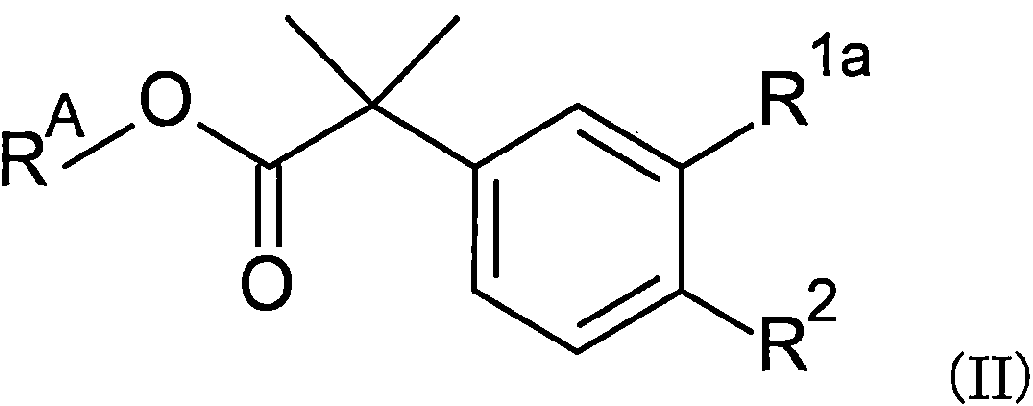
[식중, R1a 및 R2는 상기와 동일한 정의이고, RA는 C1-C6 알킬기를 나타낸다.]
로 표시되는 화합물을 제조하는 공정;
(2) 공정 1b:
식 II로 표시되는 화합물을 염기 및 AcORB와 반응시켜서, 식 III:

[식중, R1a, R2는 상기와 동일한 정의이고, RB는 C1-C6 알킬기를 나타낸다.]
로 표시되는 화합물을 제조하는 공정;및
(3) 공정 2a:
식 III로 표시되는 화합물을 식 IV:

[식중, X는 이탈기를 나타낸다.]
로 표시되는 화합물과 염기를 반응시켜서, 식 V:

[식중, R1a, R2 및 RB는 상기와 동일한 정의이다.]
로 표시되는 화합물을 제조하는 공정;및, 아래 (4) 또는 (5) 중 어느 하나의 공정;
(4) 공정 2b-c:
R1a가 4-(모르폴린-4-일)피페리딘-1-일기인 식 V로 표시되는 화합물을 환원제와 반응시켜서, 식 VII:

[식중, R1은 4-(모르폴린-4-일)피페리딘-1-일기를 나타내고, R2 및 RB는 상기와 동일한 정의이다.]
으로 표시되는 화합물을 제조하는 공정;
(5) 공정 3:
R1a가 요오드기 또는 브로모기인 식 V로 표시되는 화합물을 환원제와 반응시켜서, 식 VI:

[식중, R1a는 요오드기 또는 브로모기를 나타내고, R2 및 RB는 상기와 동일한 정의이다.]
로 표시되는 화합물을 제조하는 공정;
당해 식 VI로 표시되는 화합물을 팔라듐 촉매 존재하, 4-(4-피페리디닐)모르폴린과 반응시켜서, 식 VII:

[식중, R1은 4-(모르폴린-4-일)피페리딘-1-일기를 나타내고, R2 및 RB는 상기와 동일한 정의이다.]
으로 표시되는 화합물, 또는 그의 약학적으로 허용되는 염을 제조하는 공정;및,
(6) 공정 4:
식 VII으로 표시되는 화합물을 산과 반응시켜서, 일반식 VIII:
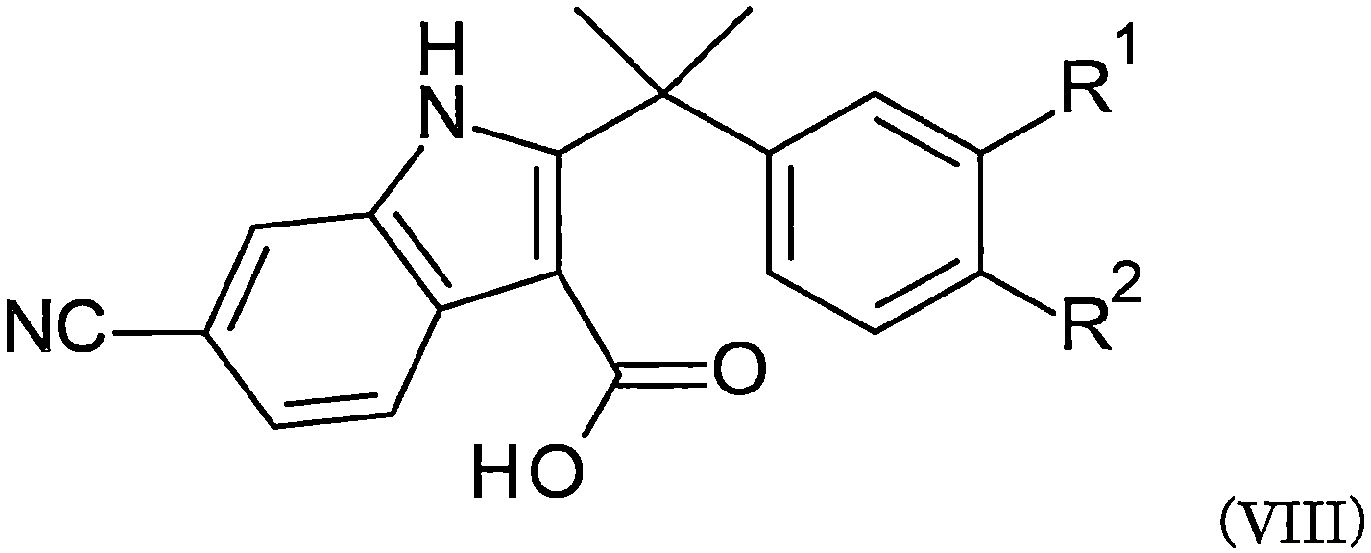
[식중, R1 및 R2는 상기와 동일한 정의이다.]
으로 표시되는 화합물을 제조하는 공정;
을 추가로 포함하는 방법. According to paragraph 1,
The above method
(1) Process 1a:
Formula I:
[Wherein, R 1a represents 4-(morpholine-4-yl)piperidine-1-yl group, iodine group, or bromo group, and R 2 is ethyl.]
By reacting the compound represented by in the presence of acid, Formula II:
[Wherein, R 1a and R 2 have the same definitions as above, and R A represents a C 1 -C 6 alkyl group.]
Process for producing a compound represented by;
(2) Process 1b:
By reacting the compound represented by formula II with a base and AcOR B , formula III:
[Wherein, R 1a and R 2 have the same definitions as above, and R B represents a C 1 -C 6 alkyl group.]
A process for producing a compound represented by; and
(3) Process 2a:
The compound represented by formula III is given by formula IV:
[In the formula, X represents a leaving group.]
By reacting the compound represented by with a base, Formula V:
[Wherein, R 1a , R 2 and R B have the same definitions as above.]
A process for producing a compound represented by; And, any of the processes in (4) or (5) below;
(4) Process 2b-c:
The compound represented by formula V, wherein R 1a is 4-(morpholine-4-yl)piperidine-1-yl group, is reacted with a reducing agent to obtain formula VII:
[Wherein, R 1 represents a 4-(morpholin-4-yl)piperidine-1-yl group, and R 2 and R B have the same definitions as above.]
Process for producing a compound represented by;
(5) Process 3:
The compound represented by formula V, wherein R 1a is an iodine group or a bromo group, is reacted with a reducing agent to obtain formula VI:
[Wherein, R 1a represents an iodine group or a bromo group, and R 2 and R B have the same definitions as above.]
Process for producing a compound represented by;
The compound represented by the formula VI is reacted with 4-(4-piperidinyl)morpholine in the presence of a palladium catalyst to obtain formula VII:
[Wherein, R 1 represents a 4-(morpholin-4-yl)piperidine-1-yl group, and R 2 and R B have the same definitions as above.]
A process for producing a compound represented by, or a pharmaceutically acceptable salt thereof; And,
(6) Process 4:
By reacting the compound represented by formula VII with an acid, general formula VIII:
[Wherein, R 1 and R 2 have the same definitions as above.]
Process for producing a compound represented by;
How to additionally include .
상기 용매가 테트라히드로푸란, 아세톤, 또는 아세토니트릴로부터 선택되는, 방법. According to paragraph 1,
The method of claim 1, wherein the solvent is selected from tetrahydrofuran, acetone, or acetonitrile.
(1)에 있어서의 상기 산이 염화아세틸인, 방법. According to paragraph 2,
The method of (1), wherein the acid is acetyl chloride.
(2)에 있어서의 상기 염기가 리튬헥사메틸디실라지드 또는 나트륨헥사메틸디실라지드인, 방법. According to paragraph 2,
The method in (2) wherein the base is lithium hexamethyldisilazide or sodium hexamethyldisilazide.
(2)에 있어서의 상기 RB가 tert-부틸기인 방법. According to paragraph 2,
The method in (2) wherein R B is a tert-butyl group.
(3)에 있어서의 상기 이탈기가 플루오로기 또는 클로로기인, 방법. According to paragraph 2,
The method according to (3), wherein the leaving group is a fluoro group or a chloro group.
(3)에 있어서의 상기 염기가 수산화나트륨, 인산칼륨, 탄산칼륨, 또는 탄산세슘이고, 반응용매가 테트라히드로푸란인, 방법. According to paragraph 2,
The method in (3), wherein the base is sodium hydroxide, potassium phosphate, potassium carbonate, or cesium carbonate, and the reaction solvent is tetrahydrofuran.
(4)에 있어서의 상기 환원제가 하이드로설파이트 나트륨인, 방법. According to paragraph 2,
The method of (4), wherein the reducing agent is sodium hydrosulfite.
(5)에 있어서의 상기 팔라듐 촉매가 Π-알릴팔라듐클로라이드 다이머와 2',6'-디메톡시-2-(디시클로헥실포스피노)비페닐(S-Phos)의 조합, 디클로로[1,3-비스(2,6-디-3-펜틸페닐)이미다졸-2-일리덴](3-클로로피리딜)팔라듐(II)(PEPPSI-IPent), 또는 S-Phos-Pd(Crotyl)Cl이고, 상기 공정 3의 반응을 테트라히드로푸란과 1,3-디메틸-2-이미다졸리디논의 혼합용매 중에서 행하는, 방법. According to paragraph 2,
The palladium catalyst in (5) is a combination of Π-allylpalladium chloride dimer and 2',6'-dimethoxy-2-(dicyclohexylphosphino)biphenyl (S-Phos), dichloro[1,3 -Bis(2,6-di-3-pentylphenyl)imidazol-2-ylidene](3-chloropyridyl)palladium(II)(PEPPSI-IPent), or S-Phos-Pd(Crotyl)Cl. , a method in which the reaction in step 3 above is carried out in a mixed solvent of tetrahydrofuran and 1,3-dimethyl-2-imidazolidinone.
(6)의 상기 산이 트리메틸실릴클로라이드 및 2,2,2-트리플루오로에탄올인, 방법. According to paragraph 2,
The method of (6), wherein the acid is trimethylsilylchloride and 2,2,2-trifluoroethanol.
화합물(1)이 염산염인, 방법. According to any one of claims 1, 2, and 4 to 12,
A method wherein compound (1) is hydrochloride salt.
화합물(1)이 염산염이고, 상기 화합물(1) 외에, 식 X:

으로 표시되는 화합물이, 상기 화합물(1)의 염산염의 중량에 대해 0.08% 이하로 생성되는, 방법. According to any one of claims 1, 2, and 4 to 12,
Compound (1) is hydrochloride, and in addition to the above compound (1), formula
A method in which the compound represented by is produced in an amount of 0.08% or less based on the weight of the hydrochloride salt of the compound (1).
Applications Claiming Priority (3)
| Application Number | Priority Date | Filing Date | Title |
|---|---|---|---|
| JP2018165313 | 2018-09-04 | ||
| JPJP-P-2018-165313 | 2018-09-04 | ||
| PCT/JP2019/034543 WO2020050241A1 (en) | 2018-09-04 | 2019-09-03 | Method of producing tetracyclic compound |
Publications (2)
| Publication Number | Publication Date |
|---|---|
| KR20210053890A KR20210053890A (en) | 2021-05-12 |
| KR102635225B1 true KR102635225B1 (en) | 2024-02-07 |
Family
ID=69722303
Family Applications (1)
| Application Number | Title | Priority Date | Filing Date |
|---|---|---|---|
| KR1020217005965A Active KR102635225B1 (en) | 2018-09-04 | 2019-09-03 | Method for producing tetracyclic compounds |
Country Status (18)
| Country | Link |
|---|---|
| US (1) | US11939322B2 (en) |
| EP (1) | EP3848361B1 (en) |
| JP (1) | JP7167171B2 (en) |
| KR (1) | KR102635225B1 (en) |
| CN (1) | CN112585126B (en) |
| AR (1) | AR116113A1 (en) |
| AU (1) | AU2019337018B2 (en) |
| BR (1) | BR112021001145A2 (en) |
| CA (1) | CA3107270A1 (en) |
| ES (1) | ES3010145T3 (en) |
| HR (1) | HRP20250284T1 (en) |
| HU (1) | HUE070227T2 (en) |
| IL (1) | IL281079B2 (en) |
| MX (1) | MX2021002311A (en) |
| PL (1) | PL3848361T3 (en) |
| SG (1) | SG11202100983XA (en) |
| TW (1) | TWI825163B (en) |
| WO (1) | WO2020050241A1 (en) |
Families Citing this family (4)
| Publication number | Priority date | Publication date | Assignee | Title |
|---|---|---|---|---|
| US20240115578A1 (en) | 2021-01-29 | 2024-04-11 | Chugai Seiyaku Kabushiki Kaisha | Drug composition for treating pediatric cancers |
| CN117024410A (en) * | 2023-08-15 | 2023-11-10 | 上海药坦药物研究开发有限公司 | Airotinib intermediate and preparation method thereof |
| WO2025067412A1 (en) * | 2023-09-28 | 2025-04-03 | 重庆博腾制药科技股份有限公司 | Preparation method for anti-tumor drug intermediate |
| CN120081779A (en) * | 2025-02-19 | 2025-06-03 | 江苏天士力帝益药业有限公司 | Alectinib impurity 01A and control method thereof |
Family Cites Families (50)
| Publication number | Priority date | Publication date | Assignee | Title |
|---|---|---|---|---|
| JPS506987B1 (en) | 1970-02-17 | 1975-03-19 | ||
| JPS4918630B1 (en) | 1970-07-29 | 1974-05-11 | ||
| JPS5859712U (en) | 1981-10-16 | 1983-04-22 | ニチバン株式会社 | label pasting machine |
| JPH0892090A (en) | 1994-07-26 | 1996-04-09 | Tanabe Seiyaku Co Ltd | Pharmaceutical composition |
| DK0695755T3 (en) | 1994-08-04 | 1999-06-28 | Hoffmann La Roche | pyrrolocarbazoles |
| IL126762A0 (en) | 1996-05-01 | 1999-08-17 | Lilly Co Eli | Halo-substituted protein kinase c inhibitors |
| HUP0104657A3 (en) | 1998-12-24 | 2002-07-29 | Astellas Pharma Inc Chuo Ku | Imidazole compounds and pharmaceutical compositions containing them |
| CA2372032A1 (en) | 1999-05-14 | 2000-11-23 | Rodney W. Rickards | Compounds and therapeutic methods |
| GB0030417D0 (en) | 2000-12-13 | 2001-01-24 | Pharma Mar Sa | An anticancer lead compound isolated from a New Zealand ascidian |
| FR2841138B1 (en) | 2002-06-25 | 2005-02-25 | Cll Pharma | SOLID PHARMACEUTICAL COMPOSITION COMPRISING A LIPOPHILIC ACTIVE INGREDIENT, ITS PREPARATION PROCESS |
| JP2007501857A (en) | 2003-02-28 | 2007-02-01 | イノテック ファーマシューティカルズ コーポレーション | Tetracyclic benzamide derivatives and methods of use thereof |
| EP1454992B1 (en) | 2003-03-07 | 2006-05-31 | Istituto Nazionale Per Lo Studio E La Cura Dei Tumori | Anaplastic lymphoma kinase assay, reagents and compositions thereof |
| GB0305929D0 (en) | 2003-03-14 | 2003-04-23 | Novartis Ag | Organic compounds |
| JP4836788B2 (en) | 2003-07-23 | 2011-12-14 | エグゼリクシス, インコーポレイテッド | Undifferentiated lymphoma kinase modulators and methods of use thereof |
| US7378414B2 (en) | 2003-08-25 | 2008-05-27 | Abbott Laboratories | Anti-infective agents |
| DE602004014969D1 (en) | 2003-11-21 | 2008-08-21 | Novartis Ag | 1H-IMIDAZOCHINOLINE DERIVATIVES AS PROTEIN KINASE INHIBITORS |
| CA2548600A1 (en) | 2003-12-12 | 2005-06-23 | Merck Frosst Canada & Co. | Cathepsin cysteine protease inhibitors |
| US20090155903A1 (en) | 2004-03-19 | 2009-06-18 | Myriad Genetics, Incorporated | Pharmaceutical composition and method |
| JP4927704B2 (en) | 2004-03-19 | 2012-05-09 | シュペーデル・エクスペリメンタ・アーゲー | Organic compounds |
| EP1730128A1 (en) | 2004-03-31 | 2006-12-13 | Exelixis, Inc. | Anaplastic lymphoma kinase modulators and methods of use |
| KR20070038496A (en) | 2004-06-02 | 2007-04-10 | 파마시클릭스,인코포레이티드 | BA factor inhibitor |
| BR122020017756B1 (en) | 2004-08-26 | 2022-02-15 | Pfizer Inc | Use of enantiomerically pure aminoetheroaryl compounds in the preparation of a drug for the treatment of abnormal cell growth in a mammal |
| US7091202B2 (en) | 2004-09-15 | 2006-08-15 | Bristol-Myers Squibb Company | 4-arylspirocycloalkyl-2-aminopyrimidine carboxamide KCNQ potassium channel modulators |
| GB0517329D0 (en) | 2005-08-25 | 2005-10-05 | Merck Sharp & Dohme | Stimulation of neurogenesis |
| CA2626446A1 (en) | 2005-11-07 | 2007-05-18 | Irm Llc | Compounds and compositions as ppar modulators |
| US7601716B2 (en) | 2006-05-01 | 2009-10-13 | Cephalon, Inc. | Pyridopyrazines and derivatives thereof as ALK and c-Met inhibitors |
| US8063225B2 (en) | 2006-08-14 | 2011-11-22 | Chembridge Corporation | Tricyclic compound derivatives useful in the treatment of neoplastic diseases, inflammatory disorders and immunomodulatory disorders |
| CN101535276B (en) | 2006-10-23 | 2013-08-28 | 赛福伦公司 | 2,4-Diaminopyrimidine-fused bicyclic derivatives as ALK and c-MET inhibitors |
| US8546394B2 (en) | 2007-04-17 | 2013-10-01 | Bristol-Myers Squibb Company | Substituted [1,2,4]triazolo[4,3-A]pyrazine 11-beta-hydroxysteroid dehydrogenase inhibitors |
| TWI389893B (en) | 2007-07-06 | 2013-03-21 | Astellas Pharma Inc | Di (arylamino) ary1 compound |
| PH12013501594A1 (en) | 2007-07-20 | 2014-05-12 | Nerviano Medical Sciences Srl | Substituted indazole derivatives active as kinase inhibitors |
| JP5583592B2 (en) | 2007-11-30 | 2014-09-03 | ニューリンク ジェネティクス コーポレイション | IDO inhibitor |
| ES2510866T3 (en) | 2008-03-13 | 2014-10-21 | Daiichi Sankyo Company, Limited | Improvement of the solubility of a preparation containing olmesartan medoxomil |
| CN102574830A (en) | 2009-05-07 | 2012-07-11 | 阿斯利康(瑞典)有限公司 | Substituted 1-cyanoethylheterocyclylcarboxamide compounds 750 |
| GB0910046D0 (en) | 2009-06-10 | 2009-07-22 | Glaxosmithkline Biolog Sa | Novel compositions |
| EP3613729A1 (en) | 2009-06-10 | 2020-02-26 | Chugai Seiyaku Kabushiki Kaisha | Tetracyclic compounds |
| US8609097B2 (en) | 2009-06-10 | 2013-12-17 | Hoffmann-La Roche Inc. | Use of an anti-Tau pS422 antibody for the treatment of brain diseases |
| CA2808210C (en) | 2010-08-20 | 2019-10-01 | Chugai Seiyaku Kabushiki Kaisha | Tetracyclic compounds having alk inhibitory activity and compositions thereof |
| JP5006987B2 (en) | 2010-11-22 | 2012-08-22 | 中外製薬株式会社 | Medicine containing tetracyclic compound |
| SI2902029T1 (en) | 2012-09-25 | 2018-11-30 | Chugai Seiyaku Kabushiki Kaisha | Ret inhibitor |
| WO2015163447A1 (en) | 2014-04-25 | 2015-10-29 | 中外製薬株式会社 | Novel crystal of tetracyclic compound |
| WO2015163448A1 (en) | 2014-04-25 | 2015-10-29 | 中外製薬株式会社 | Preparation containing tetracyclic compound at high dose |
| EP3157569B1 (en) | 2014-06-18 | 2019-07-24 | F.Hoffmann-La Roche Ag | New pharmaceutical composition comprising non-ionic surfactants |
| TWI831347B (en) | 2014-08-08 | 2024-02-01 | 日商中外製藥股份有限公司 | Solid dispersion containing amorphous body of tetracyclic compound and preparation |
| CN104402862B (en) * | 2014-11-12 | 2016-10-05 | 苏州明锐医药科技有限公司 | Ai Li is for the preparation method of Buddhist nun |
| US9573932B2 (en) * | 2015-03-02 | 2017-02-21 | Yong Xu | Synthesis of intermediates in the preparation of ALK inhibitor |
| WO2017073706A1 (en) * | 2015-10-30 | 2017-05-04 | 中外製薬株式会社 | DIHYDRONAPHTHO[2,3-b]BENZOFURAN DERIVATIVE |
| CN106928184B (en) | 2017-04-21 | 2019-09-20 | 湖南博奥德药业有限公司 | A kind of Ai Le replaces the preparation method of Buddhist nun |
| CN106928185B (en) | 2017-04-21 | 2019-09-20 | 湖南博奥德药业有限公司 | A kind of Ai Le replaces the preparation method of Buddhist nun |
| CN107033124B (en) * | 2017-04-21 | 2019-09-20 | 湖南博奥德药业有限公司 | A kind of Ai Le replaces the preparation method of Buddhist nun |
-
2019
- 2019-09-03 BR BR112021001145-5A patent/BR112021001145A2/en unknown
- 2019-09-03 WO PCT/JP2019/034543 patent/WO2020050241A1/en not_active Ceased
- 2019-09-03 HU HUE19856540A patent/HUE070227T2/en unknown
- 2019-09-03 EP EP19856540.0A patent/EP3848361B1/en active Active
- 2019-09-03 MX MX2021002311A patent/MX2021002311A/en unknown
- 2019-09-03 CA CA3107270A patent/CA3107270A1/en active Pending
- 2019-09-03 SG SG11202100983XA patent/SG11202100983XA/en unknown
- 2019-09-03 PL PL19856540.0T patent/PL3848361T3/en unknown
- 2019-09-03 ES ES19856540T patent/ES3010145T3/en active Active
- 2019-09-03 CN CN201980056366.1A patent/CN112585126B/en active Active
- 2019-09-03 HR HRP20250284TT patent/HRP20250284T1/en unknown
- 2019-09-03 TW TW108131697A patent/TWI825163B/en active
- 2019-09-03 AR ARP190102518A patent/AR116113A1/en unknown
- 2019-09-03 US US17/271,437 patent/US11939322B2/en active Active
- 2019-09-03 JP JP2020541220A patent/JP7167171B2/en active Active
- 2019-09-03 AU AU2019337018A patent/AU2019337018B2/en active Active
- 2019-09-03 IL IL281079A patent/IL281079B2/en unknown
- 2019-09-03 KR KR1020217005965A patent/KR102635225B1/en active Active
Also Published As
| Publication number | Publication date |
|---|---|
| AU2019337018A1 (en) | 2021-03-18 |
| IL281079B2 (en) | 2024-12-01 |
| EP3848361B1 (en) | 2025-01-22 |
| JPWO2020050241A1 (en) | 2021-08-30 |
| IL281079B1 (en) | 2024-08-01 |
| CA3107270A1 (en) | 2020-03-12 |
| IL281079A (en) | 2021-04-29 |
| MX2021002311A (en) | 2021-04-28 |
| EP3848361C0 (en) | 2025-01-22 |
| WO2020050241A1 (en) | 2020-03-12 |
| ES3010145T3 (en) | 2025-04-01 |
| EP3848361A4 (en) | 2022-06-15 |
| PL3848361T3 (en) | 2025-07-07 |
| BR112021001145A2 (en) | 2021-04-20 |
| US20220372025A1 (en) | 2022-11-24 |
| CN112585126B (en) | 2024-05-07 |
| AR116113A1 (en) | 2021-03-31 |
| US11939322B2 (en) | 2024-03-26 |
| JP7167171B2 (en) | 2022-11-08 |
| AU2019337018B2 (en) | 2024-03-07 |
| HRP20250284T1 (en) | 2025-04-25 |
| CN112585126A (en) | 2021-03-30 |
| HUE070227T2 (en) | 2025-05-28 |
| TWI825163B (en) | 2023-12-11 |
| TW202024050A (en) | 2020-07-01 |
| EP3848361A1 (en) | 2021-07-14 |
| SG11202100983XA (en) | 2021-03-30 |
| KR20210053890A (en) | 2021-05-12 |
Similar Documents
| Publication | Publication Date | Title |
|---|---|---|
| KR102635225B1 (en) | Method for producing tetracyclic compounds | |
| JP6392436B2 (en) | Process for the preparation of substituted 5-fluoro-1H-pyrazolopyridines | |
| JP6234471B2 (en) | Synthesis of spirocyclic isoxazoline derivatives | |
| JP7759167B2 (en) | Process for the preparation of 1-[(3R,4S)-4-cyanotetrahydropyran-3-yl]-3-[(2-fluoro-6-methoxy-4-pyridyl)amino]pyrazole-4-carboxamide | |
| ES2892161T3 (en) | Preparation of 2-([1,2,3]triazol-2-yl)-benzoic acid derivatives | |
| JP2019529378A (en) | Method for producing indole carboxamide compound | |
| CN104837817B (en) | Synthetic route for preparation of 3-amino-piperidine compounds | |
| BRPI0708560A2 (en) | process for preparing a compound, and, compound | |
| WO2020118597A1 (en) | Process for making 1- [ (3r, 4s) -4-cyanotetrahydropyran-3-yl] -3- [ (2-fluoro-6-methoxy-4-pyridyl) amino] pyrazole-4-carboxamide | |
| JP7532420B2 (en) | Alternative method for preparing 4-phenyl-5-alkoxycarbonyl-2-thiazol-2-yl-1,4-dihydropyrimidin-6-yl]methyl]-3-oxo-5,6,8,8a-tetrahydro-1H-imidazo[1,5-a]pyrazin-2-yl]-carboxylic acid | |
| HK40051429A (en) | Method of producing tetracyclic compound | |
| HK40051429B (en) | Method of producing tetracyclic compound | |
| WO2008097483A2 (en) | Methods for preparing aryl-substituted ketophosphonates | |
| JP7279134B2 (en) | Method for producing prolinamide compound | |
| KR102204267B1 (en) | Substituted (r)-3-(4-methylcarbamoyl-3-fluorophenylamino)tetrahydrofuran-3-ene-carboxylic acid(variants) and ester thereof, method for producing and using same | |
| RU2282632C1 (en) | Method for preparing derivatives of 3,5-dihydro-1,11-dimethylfuro[2',3':3,4]cyclohepta[c]isoquinoline-5-one | |
| BR122025003253B1 (en) | PROCESS FOR PREPARING AN INTERMEDIATE COMPOUND OF 1-[(3R,4S)-4-CYANOTETRAHYDROPYRAN-3-YL]-3-[(2-FLUORO-6-METHOXY-4-PYRIDYL)AMINO]PYRAZOL-4-CARBOXAMIDE | |
| BR122025003245B1 (en) | PROCESS FOR PREPARING AN INTERMEDIATE COMPOUND OF 1-[(3R,4S)-4-CYANOTETRAHYDROPYRAN-3-YL]-3-[(2-FLUORO-6-METHOXY-4-PYRIDYL)AMINO]PYRAZOL-4-CARBOXAMIDE | |
| BR122025003245A2 (en) | PROCESS FOR PREPARING INTERMEDIATE COMPOUND OF 1-[(3R,4S)-4-CYANOTETRAHYDROPYRAN-3-YL]-3-[(2-FLUORO-6-METHOXY-4-PYRIDYL)AMINO]PYRAZOLE-4-CARBOXAMIDE | |
| BR122025003253A2 (en) | PROCESS FOR PREPARING INTERMEDIATE COMPOUND OF 1-[(3R,4S)-4-CYANOTETRAHYDROPYRAN-3-YL]-3-[(2-FLUORO-6-METHOXY-4-PYRIDYL)AMINO]PYRAZOLE-4-CARBOXAMIDE | |
| BR112021011084B1 (en) | PROCESSES FOR PREPARING 1-[(3R,4S)-4-CYANOTETRAHYDROPYRAN-3-YL]-3-[(2-FLUORO-6-METHOXY-4-PYRIDYL)AMINO]PYRAZOLE-4-CARBOXAMIDE AND ITS INTERMEDIATE, AS WELL AS INTERMEDIATE COMPOUNDS OF SAID COMPOUND | |
| ITMI20111672A1 (en) | EFFICIENT METHOD FOR THE PREPARATION OF DRONEDARONE CHLORIDRATO |
Legal Events
| Date | Code | Title | Description |
|---|---|---|---|
| PA0105 | International application |
Patent event date: 20210226 Patent event code: PA01051R01D Comment text: International Patent Application |
|
| PG1501 | Laying open of application | ||
| A201 | Request for examination | ||
| PA0201 | Request for examination |
Patent event code: PA02012R01D Patent event date: 20220811 Comment text: Request for Examination of Application |
|
| E902 | Notification of reason for refusal | ||
| PE0902 | Notice of grounds for rejection |
Comment text: Notification of reason for refusal Patent event date: 20230811 Patent event code: PE09021S01D |
|
| E701 | Decision to grant or registration of patent right | ||
| PE0701 | Decision of registration |
Patent event code: PE07011S01D Comment text: Decision to Grant Registration Patent event date: 20231214 |
|
| GRNT | Written decision to grant | ||
| PR0701 | Registration of establishment |
Comment text: Registration of Establishment Patent event date: 20240205 Patent event code: PR07011E01D |
|
| PR1002 | Payment of registration fee |
Payment date: 20240205 End annual number: 3 Start annual number: 1 |
|
| PG1601 | Publication of registration |