KR102538080B1 - Apparatus and method for learning iris image - Google Patents
Apparatus and method for learning iris image Download PDFInfo
- Publication number
- KR102538080B1 KR102538080B1 KR1020210068263A KR20210068263A KR102538080B1 KR 102538080 B1 KR102538080 B1 KR 102538080B1 KR 1020210068263 A KR1020210068263 A KR 1020210068263A KR 20210068263 A KR20210068263 A KR 20210068263A KR 102538080 B1 KR102538080 B1 KR 102538080B1
- Authority
- KR
- South Korea
- Prior art keywords
- iris
- series data
- iris image
- image
- time
- Prior art date
- Legal status (The legal status is an assumption and is not a legal conclusion. Google has not performed a legal analysis and makes no representation as to the accuracy of the status listed.)
- Active
Links
Images










Classifications
-
- G—PHYSICS
- G06—COMPUTING OR CALCULATING; COUNTING
- G06V—IMAGE OR VIDEO RECOGNITION OR UNDERSTANDING
- G06V40/00—Recognition of biometric, human-related or animal-related patterns in image or video data
- G06V40/10—Human or animal bodies, e.g. vehicle occupants or pedestrians; Body parts, e.g. hands
- G06V40/18—Eye characteristics, e.g. of the iris
-
- G—PHYSICS
- G06—COMPUTING OR CALCULATING; COUNTING
- G06N—COMPUTING ARRANGEMENTS BASED ON SPECIFIC COMPUTATIONAL MODELS
- G06N20/00—Machine learning
-
- G06T5/001—
-
- G—PHYSICS
- G06—COMPUTING OR CALCULATING; COUNTING
- G06V—IMAGE OR VIDEO RECOGNITION OR UNDERSTANDING
- G06V10/00—Arrangements for image or video recognition or understanding
- G06V10/70—Arrangements for image or video recognition or understanding using pattern recognition or machine learning
- G06V10/77—Processing image or video features in feature spaces; using data integration or data reduction, e.g. principal component analysis [PCA] or independent component analysis [ICA] or self-organising maps [SOM]; Blind source separation
- G06V10/774—Generating sets of training patterns; Bootstrap methods, e.g. bagging or boosting
Landscapes
- Engineering & Computer Science (AREA)
- Theoretical Computer Science (AREA)
- General Physics & Mathematics (AREA)
- Physics & Mathematics (AREA)
- Software Systems (AREA)
- Health & Medical Sciences (AREA)
- Multimedia (AREA)
- General Health & Medical Sciences (AREA)
- Human Computer Interaction (AREA)
- Medical Informatics (AREA)
- Evolutionary Computation (AREA)
- Computing Systems (AREA)
- Computer Vision & Pattern Recognition (AREA)
- Ophthalmology & Optometry (AREA)
- Artificial Intelligence (AREA)
- Databases & Information Systems (AREA)
- Data Mining & Analysis (AREA)
- General Engineering & Computer Science (AREA)
- Mathematical Physics (AREA)
- Collating Specific Patterns (AREA)
- Measurement Of The Respiration, Hearing Ability, Form, And Blood Characteristics Of Living Organisms (AREA)
Abstract
홍채 이미지 학습 장치 및 방법이 개시된다. 본 발명의 일실시예에 따른 홍채 이미지 학습 장치는 대상의 홍채를 포함하는 눈동자가 촬영된 홍채 이미지를 입력 받는 입력부; 상기 홍채 이미지에서 동공의 중심부터 눈동자와 흰자 사이의 경계까지 방사형으로 뻗어나가는 복수개의 가상 직선들 상의 밝기 크기를 샘플링하여 시계열 데이터를 생성하는 데이터 생성부 및 상기 시계열 데이터를 특징 이미지(FEATURE IMAGE)로 변환하고, 상기 특징 이미지를 학습하는 학습부를 포함한다.An iris image learning apparatus and method are disclosed. An iris image learning apparatus according to an embodiment of the present invention includes an input unit for receiving an iris image in which a pupil including an iris of a target is photographed; A data generator that generates time-series data by sampling brightness levels on a plurality of virtual straight lines extending radially from the center of the pupil to the boundary between the pupil and the white of the iris in the iris image, and converts the time-series data into a feature image (FEATURE IMAGE). and a learning unit for converting and learning the feature image.
Description
본 발명은 홍채 인식 기술에 관한 것으로, 보다 상세하게는 머신 러닝을 이용한 홍채 인식 기술에 관한 것이다. The present invention relates to iris recognition technology, and more particularly, to iris recognition technology using machine learning.
최근 COVID-19로 인해 사람들은 점점 개인 건강에 관심이 늘고 있다.Recently, due to COVID-19, people are increasingly interested in personal health.
스마트워치의 경우, 개인 건강 체크할 수 있는 건강관리 어플리케이션을 제공하고 있다. 스마트워치의 건강관리 어플리케이션은 심전도, 혈당관리, 운동관리 등 다양한 진단 기능을 제공하고 있고, 이러한 진단 결과는 원격진료 자료로 사용되고 있으며, 개인건강기록 (PHR: Personal Health Record) 시장으로까지 확대되고 있다.In the case of smart watches, health management applications that can check personal health are provided. The health management application of the smart watch provides various diagnostic functions such as electrocardiogram, blood sugar management, and exercise management, and these diagnosis results are used as remote medical treatment data and are expanding to the personal health record (PHR) market. .
또한, COVID-19로 지문 인식은 퇴출당하고 있고, 얼굴인식은 마스크 착용에 대한 기술적 한계로 시장은 새로운 생체인식 기술로 홍채 인식 기술이 주목 받고 있다.In addition, fingerprint recognition is being phased out due to COVID-19, and iris recognition technology is attracting attention as a new biometric technology in the market due to the technical limitations of face recognition for wearing a mask.
그러나, 스마트워치(스마트폰 Wearable Smart IoT 디바이스 등)와 같은 경량의 디바이스에 홍채 인식 알고리즘을 적용시키기 어렵다는 단점이 있다.However, there is a disadvantage in that it is difficult to apply the iris recognition algorithm to lightweight devices such as smart watches (smartphones, wearable smart IoT devices, etc.).
예를 들어, 종래 범용 홍채인식 알고리즘(Neurotechnology 사 VeriEye 알고르리즘)은 8,000-copy 일시불 구매 시 €16이고 1-copy 구매 시 €76로 경량 디바이스에 적용시키기 위해서는 너무 큰 비용이 필요하다는 단점이 있다.For example, the conventional general-purpose iris recognition algorithm (Neurotechnology's VeriEye algorithm) costs €16 for a lump sum purchase of 8,000-copy and €76 for 1-copy purchase, which requires too much cost to apply to a lightweight device. .
따라서, 스마트워치(스마트폰 Wearable Smart IoT 디바이스 등)와 같은 경량의 디바이스에서 간편하게 사용할 수 있는 경량화 된 홍채 인식 알고리즘 개발이 필수적이다.Therefore, it is essential to develop a lightweight iris recognition algorithm that can be easily used in lightweight devices such as smart watches (smartphones, Wearable Smart IoT devices, etc.).
한편, 한국등록특허 제 10-1969766 호“홍채인식 장치 및 방법”는 홍채 이미지를 획득하는 이미지 센서의 오차 개선과 최적화에 관하여 개시하고 있다.Meanwhile, Korean Registered Patent No. 10-1969766 “Iris Recognition Apparatus and Method” discloses error improvement and optimization of an image sensor acquiring an iris image.
본 발명은 경량화된 디바이스에서 사용할 수 있는 머신 러닝 기반의 홍채 인식 알고리즘을 개발할 수 있다.The present invention can develop an iris recognition algorithm based on machine learning that can be used in a lightweight device.
또한, 본 발명은 홍채 이미지의 정보를 손실하지 않으면서 홍채 인식의 정확도를 향상시킬 수 있다.In addition, the present invention can improve the accuracy of iris recognition without losing iris image information.
상기한 목적을 달성하기 위한 본 발명의 일실시예에 따른 홍채 이미지 학습 장치는 대상의 홍채를 포함하는 눈동자가 촬영된 홍채 이미지를 입력 받는 입력부; 상기 홍채 이미지에서 동공의 중심부터 눈동자와 흰자 사이의 경계까지 방사형으로 뻗어나가는 복수개의 가상 직선들 상의 밝기 크기를 샘플링하여 시계열 데이터를 생성하는 데이터 생성부 및 상기 시계열 데이터를 특징 이미지(FEATURE IMAGE)로 변환하고, 상기 특징 이미지를 학습하는 학습부를 포함한다.An iris image learning apparatus according to an embodiment of the present invention for achieving the above object includes an input unit for receiving an iris image in which a pupil including an iris of a target is photographed; A data generator that generates time-series data by sampling brightness levels on a plurality of virtual straight lines extending radially from the center of the pupil to the boundary between the pupil and the white of the iris in the iris image, and converts the time-series data into a feature image (FEATURE IMAGE). and a learning unit for converting and learning the feature image.
이 때, 상기 데이터 생성부는 상기 복수개의 가상 직선들 상에서 상기 밝기 크기의 변화가 기설정된 값 이상 발생하는 지점을 특징점으로 설정할 수 있다.In this case, the data generating unit may set a point at which a change in the brightness level exceeds a predetermined value on the plurality of virtual straight lines as a feature point.
이 때, 상기 데이터 생성부는 FFT(FAST FOURIER TRANSFORM) 알고리즘을 이용하여 상기 특징점에서의 밝기 크기의 변화로부터 주파수 데이터를 생성할 수 있다.In this case, the data generation unit may generate frequency data from a change in brightness at the feature point using a FFT (FAST FOURIER TRANSFORM) algorithm.
이 때, 상기 데이터 생성부는 상기 시계열 데이터와 상기 주파수 데이터를 비교하여 상기 밝기 크기의 오차를 보정할 수 있다.In this case, the data generator may compare the time-series data and the frequency data to correct an error in the brightness level.
이 때, 상기 학습부는 리커런스 플롯(RECURRENCE PLOT) 기법을 이용하여 상기 시계열 데이터를 상기 특징 이미지로 변환할 수 있다.In this case, the learning unit may convert the time-series data into the feature image using a recall plot (RECURRENCE PLOT) technique.
이 때, 상기 특징 이미지는 상기 시계열 데이터에서 홍채 구간의 밝기 크기 만을 이용하여 생성될 수 있다.In this case, the feature image may be generated using only the brightness of the iris section in the time-series data.
이 때, 상기 복수개의 가상 직선들의 개수는 사전에 360/N 개로 설정되고(N은 2 이상의 정수), 상기 복수개의 가상 직선들 사이의 각도는 N 도로 동일하게 설정될 수 있다.In this case, the number of the plurality of virtual straight lines may be set to 360/N in advance (N is an integer of 2 or more), and the angle between the plurality of virtual straight lines may be set equal to N degrees.
또한, 상기한 목적을 달성하기 위한 본 발명의 일실시예에 따른 홍채 이미지 학습 방법은 홍채 이미지 학습 장치의 홍채 이미지 학습 방법에 있어서, 대상의 홍채를 포함하는 눈동자가 촬영된 홍채 이미지를 입력 받는 단계; 상기 홍채 이미지에서 동공의 중심부터 눈동자와 흰자 사이의 경계까지 방사형으로 뻗어나가는 복수개의 가상 직선들 상의 밝기 크기를 샘플링하여 시계열 데이터를 생성하는 단계 및 상기 시계열 데이터를 특징 이미지(FEATURE IMAGE)로 변환하고, 상기 특징 이미지를 학습하는 단계를 포함한다.In addition, an iris image learning method according to an embodiment of the present invention for achieving the above object is an iris image learning method of an iris image learning device, comprising the steps of receiving an iris image in which a pupil including an iris of a target is photographed. ; Generating time-series data by sampling brightness levels on a plurality of virtual straight lines extending radially from the center of the pupil to the boundary between the pupil and the white of the iris in the iris image, and converting the time-series data into a feature image (FEATURE IMAGE), , learning the feature image.
이 때, 상기 시계열 데이터를 생성하는 단계는 상기 복수개의 가상 직선들 상에서 상기 밝기 크기의 변화가 기설정된 값 이상 발생하는 지점을 특징점으로 설정할 수 있다.In this case, in the generating of the time-series data, a point at which a change in the brightness level occurs at a predetermined value or more on the plurality of virtual straight lines may be set as a feature point.
이 때, 상기 시계열 데이터를 생성하는 단계는 FFT(FAST FOURIER TRANSFORM) 알고리즘을 이용하여 상기 특징점에서의 밝기 크기의 변화로부터 주파수 데이터를 생성할 수 있다.In this case, in the generating of the time series data, frequency data may be generated from a change in brightness at the feature point using a FFT (FAST FOURIER TRANSFORM) algorithm.
이 때, 상기 시계열 데이터를 생성하는 단계는 상기 시계열 데이터와 상기 주파수 데이터를 비교하여 상기 밝기 크기의 오차를 보정할 수 있다.In this case, the generating of the time-series data may compare the time-series data with the frequency data to correct an error in the brightness level.
이 때, 상기 학습하는 단계는 리커런스 플롯(RECURRENCE PLOT) 기법을 이용하여 상기 시계열 데이터를 상기 특징 이미지로 변환할 수 있다.In this case, the learning step may convert the time-series data into the feature image using a recall plot (RECURRENCE PLOT) technique.
이 때, 상기 특징 이미지는 시계열 데이터에서 홍채 구간의 밝기 크기 만을 이용하여 생성될 수 있다.In this case, the feature image may be generated using only the brightness of the iris section in the time series data.
상기 복수개의 가상 직선들의 개수는 사전에 360/N 개로 설정되고(N은 2 이상의 정수), 상기 복수개의 가상 직선들 사이의 각도는 N 도로 동일하게 설정될 수 있다.The number of the plurality of virtual straight lines may be previously set to 360/N (where N is an integer greater than or equal to 2), and an angle between the plurality of virtual straight lines may be set equal to N degrees.
본 발명은 경량화된 디바이스에서 사용할 수 있는 머신 러닝 기반의 홍채 인식 알고리즘을 개발할 수 있다.The present invention can develop an iris recognition algorithm based on machine learning that can be used in a lightweight device.
또한, 본 발명은 홍채 이미지의 정보를 손실하지 않으면서 홍채 인식의 정확도를 향상시킬 수 있다.In addition, the present invention can improve the accuracy of iris recognition without losing iris image information.
도 1은 본 발명의 일실시예에 따른 홍채 이미지 학습 장치를 나타낸 블록도이다.
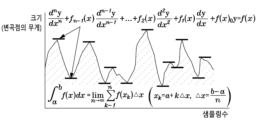
도 2 및 도3은 본 발명의 일실시예에 따른 홍채 이미지의 밝기 크기를 검출하는 과정을 나타낸 도면이다.
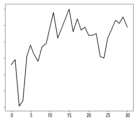
도 4 및 도 5는 본 발명의 일실시예에 따른 시계열 데이터의 FFT 알고리즘 적용 결과 나타낸 그래프이다.
도 6 내지 도 11은 본 발명의 일실시예에 따른 시계열 데이터의 특징 이미지 변환 결과를 나타낸 도면이다.
도 12는 본 발명의 일실시예에 따른 시계열 데이터를 2차원 공간 궤적으로 변환한 결과를 나타낸 도면이다.
도 13은 도 12에서 도시된 2차원 공간 궤적으로부터 특징 이미지를 생성한 결과를 나타낸 도면이다.
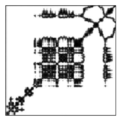
도 14 내지 도 21은 본 발명의 일실시예에 따른 리커런스 플롯 기법을 이용하여 시계열 데이터를 특징 이미지로 변환한 결과를 나타낸 도면이다.
도 22는 본 발명의 일실시예에 따른 시계열 데이터의 홍채 구간의 밝기 크기로부터 특징 이미지를 생성하는 과정을 나타낸 도면이다.
도 23은 본 발명의 일실시예에 따른 딥러닝 구조를 나타낸 도면이다.
도 24 및 도 25는 도 23의 딥러닝 구조를 이용하여 생성된 특징 맵을 나타낸 도면이다.
도 26은 본 발명의 일실시예에 따른 홍채 이미지 학습 방법을 나타낸 동작흐름도이다.
도 27은 본 발명의 일실시예에 따른 홍채 이미지 학습을 통한 홍채 이미지 인식 방법을 나타낸 동작흐름도이다.
도 28은 본 발명의 일실시예에 따른 컴퓨터 시스템을 나타낸 도면이다.1 is a block diagram illustrating an iris image learning apparatus according to an embodiment of the present invention.
2 and 3 are diagrams illustrating a process of detecting a brightness level of an iris image according to an embodiment of the present invention.
4 and 5 are graphs showing results of applying the FFT algorithm to time series data according to an embodiment of the present invention.
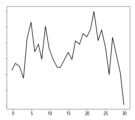
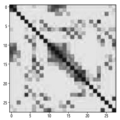
6 to 11 are diagrams illustrating results of feature image conversion of time-series data according to an embodiment of the present invention.
12 is a diagram showing a result of converting time-series data into a two-dimensional spatial trajectory according to an embodiment of the present invention.
FIG. 13 is a diagram showing a result of generating a feature image from the 2D space trajectory shown in FIG. 12 .
14 to 21 are diagrams illustrating results of converting time-series data into feature images using a recall plot technique according to an embodiment of the present invention.
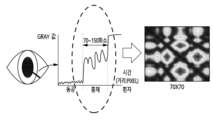
22 is a diagram illustrating a process of generating a feature image from the brightness level of an iris section of time-series data according to an embodiment of the present invention.
23 is a diagram showing a deep learning structure according to an embodiment of the present invention.
24 and 25 are diagrams illustrating feature maps generated using the deep learning structure of FIG. 23 .
26 is an operational flowchart illustrating a method for learning an iris image according to an embodiment of the present invention.
27 is an operational flowchart illustrating a method for recognizing an iris image through iris image learning according to an embodiment of the present invention.
28 is a diagram showing a computer system according to an embodiment of the present invention.
본 발명을 첨부된 도면을 참조하여 상세히 설명하면 다음과 같다. 여기서, 반복되는 설명, 본 발명의 요지를 불필요하게 흐릴 수 있는 공지 기능, 및 구성에 대한 상세한 설명은 생략한다. 본 발명의 실시형태는 당 업계에서 평균적인 지식을 가진 자에게 본 발명을 보다 완전하게 설명하기 위해서 제공되는 것이다. 따라서, 도면에서의 요소들의 형상 및 크기 등은 보다 명확한 설명을 위해 과장될 수 있다.The present invention will be described in detail with reference to the accompanying drawings. Here, repeated descriptions, well-known functions that may unnecessarily obscure the subject matter of the present invention, and detailed descriptions of configurations are omitted. Embodiments of the present invention are provided to more completely explain the present invention to those skilled in the art. Accordingly, the shapes and sizes of elements in the drawings may be exaggerated for clarity.
명세서 전체에서, 어떤 부분이 어떤 구성요소를 "포함"한다고 할 때, 이는 특별히 반대되는 기재가 없는 한 다른 구성요소를 제외하는 것이 아니라 다른 구성요소를 더 포함할 수 있는 것을 의미한다.Throughout the specification, when a certain component is said to "include", it means that it may further include other components without excluding other components unless otherwise stated.
이하, 본 발명에 따른 바람직한 실시예를 첨부된 도면을 참조하여 상세하게 설명한다.Hereinafter, preferred embodiments according to the present invention will be described in detail with reference to the accompanying drawings.
도 1은 본 발명의 일실시예에 따른 홍채 이미지 학습 장치를 나타낸 블록도이다.1 is a block diagram illustrating an iris image learning apparatus according to an embodiment of the present invention.
도 1을 참조하면, 본 발명의 일실시예에 따른 홍채 이미지 학습 장치는 입력부(110), 데이터 생성부(120), 학습부(130) 및 분석부(140)를 포함한다.Referring to FIG. 1 , an iris image learning apparatus according to an embodiment of the present invention includes an
입력부(110)는 대상의 홍채를 포함하는 눈동자가 촬영된 홍채 이미지를 입력 받을 수 있다.The
이 때, 상기 복수개의 가상 직선들의 개수는 사전에 360/N 개로 설정되고(N은 2 이상의 정수), 상기 복수개의 가상 직선들 사이의 각도는 N 도로 동일하게 설정될 수 있다.In this case, the number of the plurality of virtual straight lines may be set to 360/N in advance (N is an integer of 2 or more), and the angle between the plurality of virtual straight lines may be set equal to N degrees.
데이터 생성부(120)는 상기 홍채 이미지에서 동공의 중심부터 눈동자와 흰자 사이의 경계까지 방사형으로 뻗어나가는 복수개의 가상 직선들 상의 밝기 크기를 샘플링하여 시계열 데이터를 생성할 수 있다.The
이 때, 데이터 생성부(120)는 상기 복수개의 가상 직선들 상에서 상기 밝기 크기의 변화가 기설정된 값 이상 발생하는 지점을 특징점으로 설정할 수 있다.At this time, the
이 때, 데이터 생성부(120)는 FFT(FAST FOURIER TRANSFORM) 알고리즘을 이용하여 상기 특징점에서의 밝기 크기의 변화로부터 주파수 데이터를 생성할 수 있다.At this time, the
이 때, 데이터 생성부(120)는 상기 시계열 데이터와 상기 주파수 데이터를 비교하여 상기 밝기 크기의 오차를 보정할 수 있다.At this time, the
이 때, 데이터 생성부(120)는 AF 5MP 카메라 모듈과 고출력 IR-LED을 이용하여 외부조명에 둔감한 선명한 홍채 이미지를 입력받으면, 보다 정확하게 방사형 변곡점의 특징을 feature와 hypothesis 인자로 결합시켜 밝기 크기의 오차를 보정할 수 있다.At this time, when the
학습부(130)는 상기 시계열 데이터를 특징 이미지(FEATURE IMAGE)로 변환하고, 상기 특징 이미지를 학습할 수 있다.The
이 때, 학습부(130)는 리커런스 플롯(RECURRENCE PLOT) 기법을 이용하여 상기 시계열 데이터를 상기 특징 이미지로 변환할 수 있다.At this time, the
이 때, 상기 특징 이미지는 상기 시계열 데이터에서 홍채 구간의 밝기 크기 만을 이용하여 생성될 수 있다.In this case, the feature image may be generated using only the brightness of the iris section in the time-series data.
이 때, 학습부(130)는 상기 특징 이미지를 학습하여 홍채 인식용 딥러닝 모델을 생성할 수 있다.At this time, the
이 때, 학습부(130)는 머신 러닝 기반의 VGG16 모델을 이용하여 전처리 프로세서를 개발하여 선명하고 정확한 홍채이미지를 capture한 후 여러 가지 딥러닝 기법을 검토한 후에 최종적으로 딥러닝 모델을 생성할 수도 있다.At this time, the
이 때, 학습부(130)는 상기 특징 이미지를 학습하여 홍채 인식용 딥러닝 모델을 학습 및 갱신시킬 수 있다.At this time, the
이 때, 학습부(130)는 상기 특징 이미지에 대한 대상자의 사용자 정보를 함께 학습할 수 있다.At this time, the
분석부(140)는 홍채 인식을 위해 입력된 인식용 홍채 이미지로부터 생성된 특징 이미지와 학습부(130)에서 생성된 홍채 인식용 딥러닝 모델을 이용하여 인식용 홍채 이미지의 대상을 인식하고 사용자 정보를 획득할 수 있다.The
이 때, 분석부(140)는 인식용 홍채 이미지로부터 생성된 시계열 데이터로부터 커널필터(3x3)의 feature map들을 정의하면 각 방사형 위의 가상 직선상의 변곡점을 찾을 수 있다.At this time, the
도 2 및 도3은 본 발명의 일실시예에 따른 홍채 이미지의 밝기 크기를 검출하는 과정을 나타낸 도면이다.2 and 3 are diagrams illustrating a process of detecting a brightness level of an iris image according to an embodiment of the present invention.
도 2를 참조하면, 홍채 이미지로부터 방사형으로 가상 직선들을 설정하고, 가상 직선들 상의 밝기 크기의 변화가 기설정된 값 이상인 지점인 변곡점을 특징점으로 추출하는 것을 알 수 있다.Referring to FIG. 2 , it can be seen that virtual straight lines are radially set from an iris image, and an inflection point, which is a point where a change in brightness on the virtual straight lines is greater than a predetermined value, is extracted as a feature point.
도 3을 참조하면, 동공의 중심부터 바깥쪽으로의 가상 직선상의 밝기 크기를 시계열 데이터로 나타낸 것을 알 수 있다.Referring to FIG. 3 , it can be seen that the magnitude of brightness on a virtual straight line from the center of the pupil to the outside is expressed as time-series data.
이 때, 밝기 크기가 변화하는 지점을 시계열 분석 기법을 통해 추출하고, 추출된 지점을 특징점으로 설정하는 것을 알 수 있다.At this time, it can be seen that a point where the brightness size changes is extracted through a time series analysis technique, and the extracted point is set as a feature point.
이 때, 각각의 직선상의 위치에 대해서 나타난 변곡점을 신호로 해석하여 수학식 1의 FFT 모델링을 적용할 수 있다.At this time, the FFT modeling of
[수학식 1][Equation 1]

샘플링 개수의 1/2 개의 주파수 성분이 추출될 수 있다.1/2 frequency components of the sampling number may be extracted.
도 4 및 도 5는 본 발명의 일실시예에 따른 시계열 데이터의 FFT 알고리즘 적용 결과 나타낸 그래프이다.4 and 5 are graphs showing results of applying the FFT algorithm to time series data according to an embodiment of the present invention.
도 4를 참조하면, 시계열 데이터의 FFT 알고리즘을 적용한 결과를 주파수 스팩트럼(주파수, 진폭)으로 나타낸 것을 알 수 있다.Referring to FIG. 4 , it can be seen that the result of applying the FFT algorithm to time series data is expressed as a frequency spectrum (frequency, amplitude).
도 5를 참조하면, 시계열 데이터의 FFT 알고리즘을 적용한 결과를 복소 평면에 나타낸 것을 알 수 있다.Referring to FIG. 5 , it can be seen that the result of applying the FFT algorithm of time series data is shown on a complex plane.
FFT 알고리즘을 사용하여 홍채인식을 사용하는 중요한 이유 중의 하나는 원래 신호가 x축 또는 time 축에 대해서 shift 된 신호에 대해서도 동일한, 진폭이 발생하기 때문이다.One of the important reasons for using the iris recognition using the FFT algorithm is that the same amplitude occurs even for the original signal shifted with respect to the x-axis or the time-axis.
예를 들어, 사람들이 홍채를 찍으려고 카메라에 접근해서 자세를 잡을 때 미세하게 얼굴의 각도가 달라질 수 있는데 이 때 홍채의 데이터가 미세하게 틀어지게 되고 밝기 변화가 생기지만, FFT 알고리즘을 적용하면 수학식 2의 특성에 따라 동일한 홍채에 대해서는 동일한 진폭 결과를 얻을 수 있다.For example, when people approach the camera to take a picture of the iris, the angle of the face may change slightly. At this time, the iris data is slightly distorted and the brightness changes, but when the FFT algorithm is applied, mathematics According to the characteristics of
[수학식 2][Equation 2]

즉, 사람마다 다른 홍채 무늬에 대해서 가장 밝기 변화가 큰 변곡점의 특징점은 주파수 영역에서 크기의 차이가 최소가 될 수 있으므로, FFT 알고리즘을 사용하여 생성된 주파수 데이터로부터 시계열 데이터를 보정할 수 있다.That is, since the feature point of the inflection point with the largest brightness change for each person's iris pattern can have a minimum difference in size in the frequency domain, time series data can be corrected from frequency data generated using the FFT algorithm.
동공의 중심점을 잘못 찾아 변곡점의 위치가 shift된 경우, 주변 조명 영향으로 주변 gray 값에 일부 변곡점이 묻혀 나타나지 않는 경우가 있을 수 있다. 이런 경우 변곡점 위치에서 신호에 대해 FFT를 통해 time 축의 진폭을 찾아 오차를 보정해주는 hypothesis을 정의하면, 딥러닝(CNN)을 이용한 A.I. 홍채 패턴 인식(매칭)알고리즘 만들 수 있다.If the location of the inflection point is shifted by finding the center point of the pupil incorrectly, there may be cases where some inflection points are buried in the surrounding gray value due to the influence of ambient lighting. In this case, if a hypothesis is defined that corrects the error by finding the amplitude of the time axis through FFT for the signal at the inflection point, A.I. An iris pattern recognition (matching) algorithm can be created.
또한, 본 발명은 사용자가 홍채인식을 시도하는 경우 항상 LCD(거울)을 정면을 보도록 유도하여 가능한 홍채의 각도가 미세하게만 틀어지도록 유도할 수도 있다.In addition, when the user attempts iris recognition, the present invention induces the user to always look at the front of the LCD (mirror) so that the angle of the iris is only slightly distorted.
도 6 내지 도 11은 본 발명의 일실시예에 따른 시계열 데이터의 특징 이미지 변환 결과를 나타낸 도면이다.6 to 11 are diagrams illustrating results of feature image conversion of time-series data according to an embodiment of the present invention.
도 6 및 도 7을 참조하면, 도 6에 도시된 시계열 데이터에 리커런스 플롯 기법을 적용하여 도 7과 같은 특징 이미지가 생성된 결과를 나타낸 것을 알 수 있다.Referring to FIGS. 6 and 7 , it can be seen that a feature image as shown in FIG. 7 is generated by applying a recall plot technique to the time series data shown in FIG. 6 .
도 8 및 도 9를 참조하면, 도 8에 도시된 시계열 데이터에 리커런스 플롯 기법을 적용하여 도 9와 같은 특징 이미지가 생성된 결과를 나타낸 것을 알 수 있다.Referring to FIGS. 8 and 9 , it can be seen that a feature image as shown in FIG. 9 is generated by applying a recurrence plot technique to the time series data shown in FIG. 8 .
도 10 및 도 11을 참조하면, 도 10에 도시된 시계열 데이터에 리커런스 플롯 기법을 적용하여 도 11과 같은 특징 이미지가 생성된 결과를 나타낸 것을 알 수 있다.Referring to FIGS. 10 and 11 , it can be seen that a feature image as shown in FIG. 11 is generated by applying a recurrence plot technique to the time series data shown in FIG. 10 .
도 12는 본 발명의 일실시예에 따른 시계열 데이터를 2차원 공간 궤적으로 변환한 결과를 나타낸 도면이다. 도 13은 도 12에서 도시된 2차원 공간 궤적으로부터 특징 이미지를 생성한 결과를 나타낸 도면이다.12 is a diagram showing a result of converting time-series data into a two-dimensional spatial trajectory according to an embodiment of the present invention. FIG. 13 is a diagram showing a result of generating a feature image from the 2D spatial trajectory shown in FIG. 12 .
도 12 및 도 13에 나타낸 특징 이미지 생성 과정은 2017년 발표된 논문 "Classification of Time-Series Images Using Deep Convolutional Neural Networks"에 개시 된 것으로 시계열 데이터에 리커런스 플롯 기법을 적용하여 2차원 공간 궤적을 생성하고, 2차원 공간 궤적으로부터 특징 이미지를 나타낸 것을 알 수 있다.The feature image generation process shown in FIGS. 12 and 13 is disclosed in the paper "Classification of Time-Series Images Using Deep Convolutional Neural Networks" published in 2017, and generates a two-dimensional spatial trajectory by applying a recall plot technique to time-series data And it can be seen that the feature image is expressed from the two-dimensional space trajectory.
도 14 내지 도 21은 본 발명의 일실시예에 따른 리커런스 플롯 기법을 이용하여 시계열 데이터를 특징 이미지로 변환한 결과를 나타낸 도면이다.14 to 21 are diagrams illustrating results of converting time-series data into feature images using a recall plot technique according to an embodiment of the present invention.
도 14 및 도 15를 참조하면, 도 14의 화이트 노이즈의 시계열 데이터로부터 리커런스 플롯 기법을 이용하여 도 15의 특징 이미지로 변환한 결과를 나타낸 것을 알 수 있다.Referring to FIGS. 14 and 15 , it can be seen that the result of converting the time-series data of the white noise of FIG. 14 to the feature image of FIG. 15 using a recall plot technique is shown.
도 16 및 도 17을 참조하면, 도 16의 고조파 진동의 시계열 데이터로부터 리커런스 플롯 기법을 이용하여 도 17의 특징 이미지로 변환한 결과를 나타낸 것을 알 수 있다.Referring to FIGS. 16 and 17 , it can be seen that the result of converting the time-series data of the harmonic vibration of FIG. 16 into the feature image of FIG. 17 using a recall plot technique.
도 18 및 도 19를 참조하면, 도 18의 선형 추세의 카오스 계열의 시계열 데이터로부터 리커런스 플롯 기법을 이용하여 도 19의 특징 이미지로 변환한 결과를 나타낸 것을 알 수 있다.Referring to FIGS. 18 and 19 , it can be seen that the result of converting the linear trend chaotic time series data of FIG. 18 into the feature image of FIG. 19 using a recall plot technique is shown.
도 20 및 도 21를 참조하면, 도 20의 자동 회귀 프로세스(auto-regressive process)의 시계열 데이터로부터 리커런스 플롯 기법을 이용하여 도 21의 특징 이미지로 변환한 결과를 나타낸 것을 알 수 있다.Referring to FIGS. 20 and 21 , it can be seen that the result of converting the time-series data of the auto-regressive process of FIG. 20 into the feature image of FIG. 21 using a recall plot technique is shown.
이 때, 시계열 데이터의 직선은 단순한 이미지의 11x11 매트릭스로 표현될 수 있다.At this time, straight lines of time series data can be expressed as an 11x11 matrix of simple images.
이 때, 특징 이미지를 행렬 R이라 할 때 Ri,j는 수학식 3과 같이 나타낼 수 있다.In this case, when the feature image is a matrix R, Ri,j can be expressed as in
[수학식 3][Equation 3]
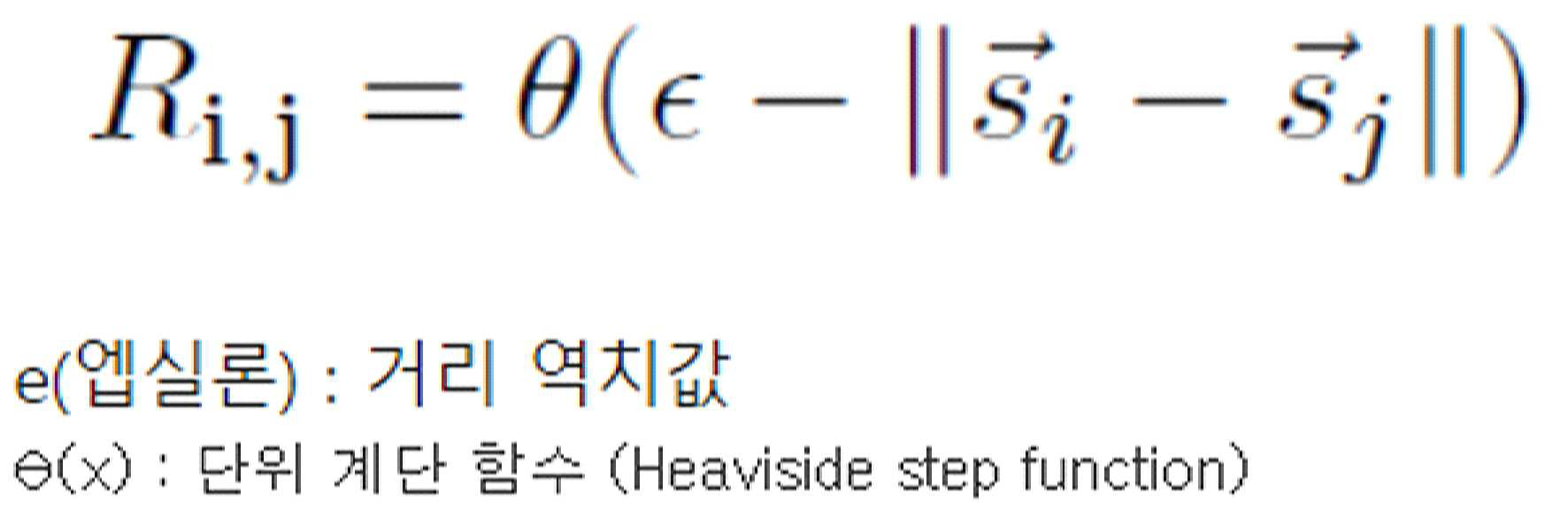
수학식 3은 Ri,j는 Si의 거리를 의미로 다만 거리에 최소 기준치(e)을 반올림을 취했을 뿐 그냥 두 S간의 거리를 행렬로 표시될 수 있다.In
예를 들어, 행렬의 R의 (1,1)의 값은 S1(0.1)과 S1의 거리는 0이지만 R(1,2)의 경우 S1(0,1)과 S2(1,2)의 거리는 단순하게 계산하면 수학식 4와 같이 나타낼 수 있다.For example, the value of (1,1) of R in the matrix is that the distance between S1(0.1) and S1 is 0, but for R(1,2), the distance between S1(0,1) and S2(1,2) is simple. When calculated, it can be expressed as in
[수학식 4][Equation 4]

상기와 같이 모든 조합의 S간 거리를 기록한 것으로부터 리커런스 플롯 행렬을 생성할 수 있다. 이 때, 특징 이미지를 1 과 0 의 이진 값으로 표현하면 수학식 5와 같이 나타낼 수 있다.As described above, a recursive plot matrix can be generated from recording the distance between S of all combinations. At this time, if the feature image is expressed as a binary value of 1 and 0, it can be expressed as in
[수학식 5][Equation 5]

도 22는 본 발명의 일실시예에 따른 시계열 데이터의 홍채 구간의 밝기 크기로부터 특징 이미지를 생성하는 과정을 나타낸 도면이다. 도 23은 본 발명의 일실시예에 따른 딥러닝 모델을 나타낸 도면이다. 도 24 및 도 25는 도 23의 딥러닝 모델을 이용하여 생성된 특징 맵을 나타낸 도면이다.22 is a diagram illustrating a process of generating a feature image from the brightness level of an iris section of time-series data according to an embodiment of the present invention. 23 is a diagram showing a deep learning model according to an embodiment of the present invention. 24 and 25 are diagrams illustrating feature maps generated using the deep learning model of FIG. 23 .
도 22를 참조하면, 홍채 이미지로부터 획득한 시계열 데이터에서 홍채 구간에 해당하는 시계열 데이터만을 이용하여 특징 이미지(70x70)를 생성하고, Referring to FIG. 22, a feature image (70x70) is created using only time-series data corresponding to an iris section from time-series data obtained from an iris image,
도 23에 도시된 CNN(Convolution Neural Network) 구조의 딥러닝 모델을 이용하여 특징 이미지를 학습하고, 학습모델을 생성하는 과정을 나타낸 것을 알 수 잇다.It can be seen that a process of learning a feature image and generating a learning model using the deep learning model of the CNN (Convolution Neural Network) structure shown in FIG. 23 is shown.
도 24 및 도 25를 참조하면, 상기 특징 맵을 학습한 딥러닝 모델로부터 생성된 특징 맵(feature map)을 나타낸 것을 알 수 있다.Referring to FIGS. 24 and 25 , it can be seen that a feature map generated from a deep learning model that has learned the feature map is shown.
도 26은 본 발명의 일실시예에 따른 홍채 이미지 학습 방법을 나타낸 동작흐름도이다.26 is an operational flowchart illustrating a method for learning an iris image according to an embodiment of the present invention.
도 26을 참조하면, 본 발명의 일실시예에 따른 홍채 이미지 학습 방법은 홍채 이미지를 입력 받을 수 있다(S210).Referring to FIG. 26 , the iris image learning method according to an embodiment of the present invention may receive an iris image (S210).
즉, 단계(S210)는 대상의 홍채를 포함하는 눈동자가 촬영된 홍채 이미지를 입력 받을 수 있다.That is, in step S210, an iris image in which a pupil including an iris of the target is photographed may be input.
이 때, 상기 복수개의 가상 직선들의 개수는 사전에 360/N 개로 설정되고(N은 2 이상의 정수), 상기 복수개의 가상 직선들 사이의 각도는 N 도로 동일하게 설정될 수 있다.In this case, the number of the plurality of virtual straight lines may be set to 360/N in advance (N is an integer of 2 or more), and the angle between the plurality of virtual straight lines may be set equal to N degrees.
또한, 본 발명의 일실시예에 따른 홍채 이미지 학습 방법은 시계열 데이터를 생성할 수 있다(S220).In addition, the iris image learning method according to an embodiment of the present invention may generate time-series data (S220).
즉, 단계(S220)는 상기 홍채 이미지에서 동공의 중심부터 눈동자와 흰자 사이의 경계까지 방사형으로 뻗어나가는 복수개의 가상 직선들 상의 밝기 크기를 샘플링하여 시계열 데이터를 생성할 수 있다.That is, in step S220, time-series data may be generated by sampling brightness levels on a plurality of virtual straight lines extending radially from the center of the pupil to the boundary between the pupil and the white of the iris in the iris image.
이 때, 단계(S220)는 상기 복수개의 가상 직선들 상에서 상기 밝기 크기의 변화가 기설정된 값 이상 발생하는 지점을 특징점으로 설정할 수 있다.At this time, in step S220, a point at which a change in the brightness level occurs at a predetermined value or more on the plurality of virtual straight lines may be set as a feature point.
이 때, 단계(S220)는 FFT(FAST FOURIER TRANSFORM) 알고리즘을 이용하여 상기 특징점에서의 밝기 크기의 변화로부터 주파수 데이터를 생성할 수 있다.At this time, in step S220, frequency data may be generated from a change in brightness at the feature point using a FFT (FAST FOURIER TRANSFORM) algorithm.
이 때, 단계(S220)는 상기 시계열 데이터와 상기 주파수 데이터를 비교하여 상기 밝기 크기의 오차를 보정할 수 있다.At this time, in step S220, the error in brightness may be corrected by comparing the time series data with the frequency data.
이 때, 단계(S220)는 AF 5MP 카메라 모듈과 고출력 IR-LED을 이용하여 외부조명에 둔감한 선명한 홍채 이미지를 입력받으면, 보다 정확하게 방사형 변곡점의 특징을 feature와 hypothesis 인자로 결합시켜 밝기 크기의 오차를 보정할 수 있다.At this time, step S220 receives a clear iris image that is insensitive to external light using the AF 5MP camera module and high-power IR-LED, and more accurately combines the characteristics of the radial inflection point with a feature and a hypothesis factor to reduce the error in brightness. can be corrected.
또한, 본 발명의 일실시예에 따른 홍채 이미지 학습 방법은 특징 이미지를 학습할 수 있다(S230).In addition, the iris image learning method according to an embodiment of the present invention may learn feature images (S230).
즉, 단계(S230)는 상기 시계열 데이터를 특징 이미지(FEATURE IMAGE)로 변환하고, 상기 특징 이미지를 학습할 수 있다.That is, in step S230, the time-series data may be converted into a feature image, and the feature image may be learned.
이 때, 단계(S230)는 리커런스 플롯(RECURRENCE PLOT) 기법을 이용하여 상기 시계열 데이터를 상기 특징 이미지로 변환할 수 있다.At this time, in step S230, the time-series data may be converted into the feature image using a recursive plot technique.
이 때, 상기 특징 이미지는 상기 시계열 데이터에서 홍채 구간의 밝기 크기 만을 이용하여 생성될 수 있다.In this case, the feature image may be generated using only the brightness of the iris section in the time-series data.
이 때, 단계(S230)는 상기 특징 이미지를 학습하여 홍채 인식용 딥러닝 모델을 생성할 수 있다.At this time, in step S230, a deep learning model for iris recognition may be generated by learning the feature image.
이 때, 단계(S230)는 상기 특징 이미지를 학습하여 홍채 인식용 딥러닝 모델을 학습 및 갱신시킬 수 있다.At this time, in step S230, a deep learning model for iris recognition may be learned and updated by learning the feature image.
이 때, 단계(S230)는 상기 특징 이미지에 대한 대상자의 사용자 정보를 입력 받아 함께 학습할 수 있다.At this time, in step S230, user information of the target person for the feature image may be received and learned together.
이 때, 단계(S230)는 머신 러닝 기반의 VGG16 모델을 이용하여 전처리 프로세서를 개발하여 선명하고 정확한 홍채이미지를 capture한 후 여러 가지 딥러닝 기법을 검토한 후에 최종적으로 딥러닝 모델을 생성할 수도 있다.At this time, in step S230, a preprocessor is developed using the machine learning-based VGG16 model to capture a clear and accurate iris image, and after reviewing various deep learning techniques, a deep learning model may be finally generated. .
도 27은 본 발명의 일실시예에 따른 홍채 이미지 학습을 통한 홍채 이미지 인식 방법을 나타낸 동작흐름도이다.27 is an operational flowchart illustrating a method for recognizing an iris image through iris image learning according to an embodiment of the present invention.
도 27을 참조하면, 본 발명의 일실시예에 따른 홍채 이미지 학습을 통한 홍채 이미지 인식 방법은 인식용 홍채 이미지를 입력 받을 수 있다(S310).Referring to FIG. 27 , the method for recognizing an iris image through iris image learning according to an embodiment of the present invention may receive an iris image for recognition (S310).
즉, 단계(S310)는 대상의 홍채를 포함하는 눈동자가 촬영된 인식용 홍채 이미지를 입력 받을 수 있다.That is, in step S310, an iris image for recognition in which a pupil including the subject's iris is photographed may be input.
또한, 본 발명의 일실시예에 따른 홍채 이미지 학습을 통한 홍채 이미지 인식 방법은 시계열 데이터를 생성할 수 있다(S320).In addition, the iris image recognition method through iris image learning according to an embodiment of the present invention may generate time-series data (S320).
즉, 단계(S320)는 단계(S220)과 동일한 방식으로 상기 인식용 홍채 이미지로부터 시계열 데이터를 생성할 수 있다.That is, in step S320, time-series data may be generated from the iris image for recognition in the same manner as in step S220.
또한, 본 발명의 일실시예에 따른 홍채 이미지 학습을 통한 홍채 이미지 인식 방법은 대상의 홍채를 인식할 수 있다(S330).In addition, the iris image recognition method through iris image learning according to an embodiment of the present invention may recognize the iris of the target (S330).
즉, 단계(S330)는 단계(S230)과 동일한 방식으로 상기 시계열 데이터를 특징 이미지(FEATURE IMAGE)로 변환할 수 있다.That is, in step S330, the time-series data may be converted into a feature image (FEATURE IMAGE) in the same manner as in step S230.
이 때, 단계(S330)는 인식용 홍채 이미지로부터 생성된 시계열 데이터로부터 커널필터(3x3)의 feature map들을 정의하면 각 방사형 위의 가상 직선상의 변곡점을 찾을 수 있다.At this time, in step S330, if the feature maps of the kernel filter (3x3) are defined from the time-series data generated from the iris image for recognition, an inflection point on a virtual straight line on each radial shape can be found.
이 때, 단계(S330)는 기생성된 홍채 인식용 딥러닝 모델을 이용하여 인식용 홍채 이미지의 대상을 인식하고 사용자 정보를 획득할 수 있다.At this time, in step S330, an object of an iris image for recognition may be recognized using a pre-generated deep learning model for iris recognition, and user information may be acquired.
도 28은 본 발명의 일실시예에 따른 컴퓨터 시스템을 나타낸 도면이다.28 is a diagram showing a computer system according to an embodiment of the present invention.
도 28을 참조하면, 본 발명의 일실시예에 따른 홍채 이미지 학습 장치는 컴퓨터로 읽을 수 있는 기록매체와 같은 컴퓨터 시스템(1100)에서 구현될 수 있다. 도 28에 도시된 바와 같이, 컴퓨터 시스템(1100)은 버스(1120)를 통하여 서로 통신하는 하나 이상의 프로세서(1110), 메모리(1130), 사용자 인터페이스 입력 장치(1140), 사용자 인터페이스 출력 장치(1150) 및 스토리지(1160)를 포함할 수 있다. 또한, 컴퓨터 시스템(1100)은 네트워크(1180)에 연결되는 네트워크 인터페이스(1170)를 더 포함할 수 있다. 프로세서(1110)는 중앙 처리 장치 또는 메모리(1130)나 스토리지(1160)에 저장된 프로세싱 인스트럭션들을 실행하는 반도체 장치일 수 있다. 메모리(1130) 및 스토리지(1160)는 다양한 형태의 휘발성 또는 비휘발성 저장 매체일 수 있다. 예를 들어, 메모리는 ROM(1131)이나 RAM(1132)을 포함할 수 있다.Referring to FIG. 28 , an iris image learning apparatus according to an embodiment of the present invention may be implemented in a
본 발명의 일실시예에 따른 홍채 이미지 학습 장치 및 방법은 동공의 중심에서 180(=360도/2)개의 방사형 라인을 시계열로 표시하여 변곡점을 리커런스 플롯(Recurrence Plot) 기법을 이용하여 특징 이미지를 생성할 수 있다.An iris image learning apparatus and method according to an embodiment of the present invention displays 180 (=360 degrees/2) radial lines in time series from the center of the pupil, and uses a recurrence plot technique to determine the inflection point as a feature image. can create
또한, 본 발명의 일실시예에 따른 홍채 이미지 학습 장치 및 방법은 CNN 알고리즘을 이용하며 특징 이미지를 학습시켜 학습 모델을 생성할 수 있다.In addition, the iris image learning apparatus and method according to an embodiment of the present invention may generate a learning model by learning a feature image using a CNN algorithm.
또한, 본 발명의 일실시예에 따른 홍채 이미지 학습 장치 및 방법은 CNN 알고리즘을 이용하며 인식용 홍채 이미지로부터 생성된 시계열 데이터로부터 커널필터(3x3)의 feature map들을 정의하면 각 방사형 위의 가상 직선상의 변곡점을 찾을 수 있다.In addition, the iris image learning apparatus and method according to an embodiment of the present invention uses a CNN algorithm and defines feature maps of a kernel filter (3x3) from time-series data generated from an iris image for recognition on a virtual straight line on each radial. An inflection point can be found.
또한, 본 발명의 일실시예에 따른 홍채 이미지 학습 장치 및 방법은 계산량이 줄어 ARM A72 class의 프로세스를 이용한 임베디드 시스템에서 1초 이내 1,000 정도는 변별력 있는 머신 러닝 기반 홍채 인식 알고리즘 개발할 수 있다.In addition, the iris image learning apparatus and method according to an embodiment of the present invention can develop a machine learning-based iris recognition algorithm with discrimination of about 1,000 within 1 second in an embedded system using an ARM A72 class process with a reduced amount of calculation.
이상에서와 같이 본 발명의 일실시예에 따른 홍채 이미지 학습 장치 및 방법은 상기한 바와 같이 설명된 실시예들의 구성과 방법이 한정되게 적용될 수 있는 것이 아니라, 상기 실시예들은 다양한 변형이 이루어질 수 있도록 각 실시예들의 전부 또는 일부가 선택적으로 조합되어 구성될 수도 있다.As described above, in the iris image learning apparatus and method according to an embodiment of the present invention, the configuration and method of the embodiments described above are not limitedly applicable, but the embodiments can be modified in various ways. All or part of each embodiment may be configured by selectively combining them.
110: 입력부 120: 데이터 생성부
130: 학습부 140: 분석부
1100: 컴퓨터 시스템 1110: 프로세서
1120: 버스 1130: 메모리
1131: 롬 1132: 램
1140: 사용자 인터페이스 입력 장치
1150: 사용자 인터페이스 출력 장치
1160: 스토리지 1170: 네트워크 인터페이스
1180: 네트워크110: input unit 120: data generation unit
130: learning unit 140: analysis unit
1100: computer system 1110: processor
1120: bus 1130: memory
1131: Rom 1132: Ram
1140: user interface input device
1150: user interface output device
1160: storage 1170: network interface
1180: Network
Claims (14)
상기 홍채 이미지에서 동공의 중심부터 눈동자와 흰자 사이의 경계까지 방사형으로 뻗어나가는 복수개의 가상 직선들 상의 밝기 크기를 기설정된 단위 마다 추출하여 시계열 데이터를 생성하는 데이터 생성부; 및
상기 시계열 데이터를 특징 이미지(FEATURE IMAGE)로 변환하고, 상기 특징 이미지를 학습하는 학습부
를 포함하고,
상기 시계열 데이터는
상기 복수개의 가상 직선들 상에서 상기 기설정된 단위 마다 추출된 밝기 크기의 값들을 포함하는 것을 특징으로 하는 홍채 이미지 학습 장치.an input unit for receiving an iris image in which a pupil including an iris of a subject is photographed;
a data generation unit generating time-series data by extracting brightness levels on a plurality of virtual straight lines radially extending from the center of the pupil to the boundary between the pupil and the white of the iris in the iris image for each predetermined unit; and
A learning unit that converts the time series data into a feature image and learns the feature image.
including,
The time series data is
The iris image learning device characterized in that it includes values of the brightness size extracted for each predetermined unit on the plurality of virtual straight lines.
상기 데이터 생성부는
상기 복수개의 가상 직선들 상에서 상기 밝기 크기의 변화가 기설정된 값 이상 발생하는 지점을 특징점으로 설정하는 것을 특징으로 하는 홍채 이미지 학습 장치.The method of claim 1,
The data generator
An iris image learning device, characterized in that setting a point where a change in the brightness size exceeds a predetermined value on the plurality of virtual straight lines as a feature point.
상기 데이터 생성부는
FFT(FAST FOURIER TRANSFORM) 알고리즘을 이용하여 상기 특징점에서의 밝기 크기의 변화로부터 주파수 데이터를 생성하는 것을 특징으로 하는 홍채 이미지 학습 장치.The method of claim 2,
The data generator
An iris image learning device characterized in that for generating frequency data from a change in brightness at the feature point using a FFT (FAST FOURIER TRANSFORM) algorithm.
상기 데이터 생성부는
상기 시계열 데이터와 상기 주파수 데이터를 비교하여 상기 밝기 크기의 오차를 보정하는 것을 특징으로 하는 홍채 이미지 학습 장치.The method of claim 3,
The data generator
The iris image learning device, characterized in that for correcting the error of the brightness size by comparing the time series data with the frequency data.
상기 학습부는
리커런스 플롯(RECURRENCE PLOT) 기법을 이용하여 상기 시계열 데이터를 상기 특징 이미지로 변환하는 것을 특징으로 하는 홍채 이미지 학습 장치.The method of claim 4,
The learning department
An iris image learning device, characterized in that for converting the time-series data into the feature image using a recall plot (RECURRENCE PLOT) technique.
상기 특징 이미지는
시계열 데이터에서 홍채 구간의 밝기 크기 만을 이용하여 생성되는 것을 특징으로 하는 홍채 이미지 학습 장치.The method of claim 5,
The feature image is
An iris image learning device characterized in that it is generated using only the brightness size of the iris section in time series data.
상기 복수개의 가상 직선들의 개수는
사전에 360/N 개로 설정되고(N은 2 이상의 정수), 상기 복수개의 가상 직선들 사이의 각도는 N 도로 동일하게 설정되는 것을 특징으로 하는 홍채 이미지 학습 장치.The method of claim 1,
The number of the plurality of virtual straight lines is
An iris image learning device, characterized in that it is set to 360/N in advance (N is an integer of 2 or more), and the angle between the plurality of virtual straight lines is set equal to N degrees.
대상의 홍채를 포함하는 눈동자가 촬영된 홍채 이미지를 입력 받는 단계;
상기 홍채 이미지에서 동공의 중심부터 눈동자와 흰자 사이의 경계까지 방사형으로 뻗어나가는 복수개의 가상 직선들 상의 밝기 크기를 기설정된 단위 마다 추출하여 시계열 데이터를 생성하는 단계; 및
상기 시계열 데이터를 특징 이미지(FEATURE IMAGE)로 변환하고, 상기 특징 이미지를 학습하는 단계
를 포함하고,
상기 시계열 데이터는
상기 복수개의 가상 직선들 상에서 상기 기설정된 단위 마다 추출된 밝기 크기의 값들을 포함하는 것을 특징으로 하는 홍채 이미지 학습 방법.In the iris image learning method of the iris image learning device,
receiving an iris image in which a pupil including an iris of a subject is photographed;
generating time-series data by extracting brightness levels on a plurality of virtual straight lines radially extending from the center of the pupil to the boundary between the pupil and the white of the iris in the iris image for each predetermined unit; and
Converting the time series data into a feature image and learning the feature image
including,
The time series data is
An iris image learning method comprising values of brightness magnitudes extracted for each predetermined unit on the plurality of virtual straight lines.
상기 시계열 데이터를 생성하는 단계는
상기 복수개의 가상 직선들 상에서 상기 밝기 크기의 변화가 기설정된 값 이상 발생하는 지점을 특징점으로 설정하는 것을 특징으로 하는 홍채 이미지 학습 방법.The method of claim 8,
Generating the time series data
The iris image learning method, characterized in that setting a point on the plurality of virtual straight lines at which the change in the brightness size exceeds a predetermined value occurs as a feature point.
상기 시계열 데이터를 생성하는 단계는
FFT(FAST FOURIER TRANSFORM) 알고리즘을 이용하여 상기 특징점에서의 밝기 크기의 변화로부터 주파수 데이터를 생성하는 것을 특징으로 하는 홍채 이미지 학습 방법.The method of claim 9,
Generating the time series data
An iris image learning method characterized by generating frequency data from a change in brightness at the feature point using a FFT (FAST FOURIER TRANSFORM) algorithm.
상기 시계열 데이터를 생성하는 단계는
상기 시계열 데이터와 상기 주파수 데이터를 비교하여 상기 밝기 크기의 오차를 보정하는 것을 특징으로 하는 홍채 이미지 학습 방법.The method of claim 10,
Generating the time series data
The iris image learning method, characterized in that by comparing the time series data and the frequency data to correct the error of the brightness size.
상기 학습하는 단계는
리커런스 플롯(RECURRENCE PLOT) 기법을 이용하여 상기 시계열 데이터를 상기 특징 이미지로 변환하는 것을 특징으로 하는 홍채 이미지 학습 방법.The method of claim 11,
The learning step is
An iris image learning method, characterized in that for converting the time-series data into the feature image using a recall plot (RECURRENCE PLOT) technique.
상기 특징 이미지는
시계열 데이터에서 홍채 구간의 밝기 크기 만을 이용하여 생성되는 것을 특징으로 하는 홍채 이미지 학습 방법.The method of claim 12,
The feature image is
An iris image learning method characterized in that it is generated using only the brightness size of the iris section in time series data.
상기 복수개의 가상 직선들의 개수는
사전에 360/N 개로 설정되고(N은 2 이상의 정수), 상기 복수개의 가상 직선들 사이의 각도는 N 도로 동일하게 설정되는 것을 특징으로 하는 홍채 이미지 학습 방법.The method of claim 8,
The number of the plurality of virtual straight lines is
An iris image learning method, characterized in that it is set to 360/N in advance (N is an integer of 2 or more), and the angle between the plurality of virtual straight lines is set equal to N degrees.
Priority Applications (1)
| Application Number | Priority Date | Filing Date | Title |
|---|---|---|---|
| KR1020210068263A KR102538080B1 (en) | 2021-05-27 | 2021-05-27 | Apparatus and method for learning iris image |
Applications Claiming Priority (1)
| Application Number | Priority Date | Filing Date | Title |
|---|---|---|---|
| KR1020210068263A KR102538080B1 (en) | 2021-05-27 | 2021-05-27 | Apparatus and method for learning iris image |
Publications (2)
| Publication Number | Publication Date |
|---|---|
| KR20220160272A KR20220160272A (en) | 2022-12-06 |
| KR102538080B1 true KR102538080B1 (en) | 2023-05-30 |
Family
ID=84407232
Family Applications (1)
| Application Number | Title | Priority Date | Filing Date |
|---|---|---|---|
| KR1020210068263A Active KR102538080B1 (en) | 2021-05-27 | 2021-05-27 | Apparatus and method for learning iris image |
Country Status (1)
| Country | Link |
|---|---|
| KR (1) | KR102538080B1 (en) |
Family Cites Families (2)
| Publication number | Priority date | Publication date | Assignee | Title |
|---|---|---|---|---|
| KR102648770B1 (en) * | 2016-07-14 | 2024-03-15 | 매직 립, 인코포레이티드 | Deep neural network for iris identification |
| KR20200004939A (en) * | 2018-07-04 | 2020-01-15 | 노경수 | Smartphone-based health care method and apparatus via iris |
-
2021
- 2021-05-27 KR KR1020210068263A patent/KR102538080B1/en active Active
Also Published As
| Publication number | Publication date |
|---|---|
| KR20220160272A (en) | 2022-12-06 |
Similar Documents
| Publication | Publication Date | Title |
|---|---|---|
| Malgheet et al. | Iris recognition development techniques: a comprehensive review | |
| CN110136103B (en) | Medical image interpretation method, device, computer equipment and storage medium | |
| US20230021661A1 (en) | Forgery detection of face image | |
| US10891473B2 (en) | Method and device for use in hand gesture recognition | |
| KR101901591B1 (en) | Face recognition apparatus and control method for the same | |
| JP6544900B2 (en) | Object identification device, object identification method and program | |
| CN110705392A (en) | A face image detection method and device, and storage medium | |
| US20160162673A1 (en) | Technologies for learning body part geometry for use in biometric authentication | |
| US10866635B2 (en) | Systems and methods for capturing training data for a gaze estimation model | |
| WO2022127112A1 (en) | Cross-modal face recognition method, apparatus and device, and storage medium | |
| KR102434703B1 (en) | Method of processing biometric image and apparatus including the same | |
| US10869617B2 (en) | Gait pathology detection and monitoring system, and method | |
| CN111898571A (en) | Action recognition system and method | |
| Alaslni et al. | Transfer learning with convolutional neural networks for iris recognition | |
| CN110909561A (en) | Eye state detection system and operation method of eye state detection system | |
| CN109523570B (en) | Motion parameter calculation method and device | |
| CN111353325A (en) | Key point detection model training method and device | |
| CN115082996A (en) | Face key point detection method and device, terminal equipment and storage medium | |
| CN114882308B (en) | Biological feature extraction model training method and image segmentation method | |
| CN116704066A (en) | Training method, training device, training terminal and training storage medium for image generation model | |
| KR102538080B1 (en) | Apparatus and method for learning iris image | |
| KR20220027126A (en) | Face identification method, and device and program using the same | |
| CN119206383B (en) | Target detection method, electronic device and computer-readable storage medium | |
| CN118315030A (en) | Medical image processing method, device and equipment based on privacy protection | |
| WO2024166600A1 (en) | Learning model generating device, learning model generating method, and computer-readable recording medium |
Legal Events
| Date | Code | Title | Description |
|---|---|---|---|
| PA0109 | Patent application |
St.27 status event code: A-0-1-A10-A12-nap-PA0109 |
|
| PA0201 | Request for examination |
St.27 status event code: A-1-2-D10-D11-exm-PA0201 |
|
| P22-X000 | Classification modified |
St.27 status event code: A-2-2-P10-P22-nap-X000 |
|
| PN2301 | Change of applicant |
St.27 status event code: A-3-3-R10-R13-asn-PN2301 St.27 status event code: A-3-3-R10-R11-asn-PN2301 |
|
| PE0902 | Notice of grounds for rejection |
St.27 status event code: A-1-2-D10-D21-exm-PE0902 |
|
| P11-X000 | Amendment of application requested |
St.27 status event code: A-2-2-P10-P11-nap-X000 |
|
| P13-X000 | Application amended |
St.27 status event code: A-2-2-P10-P13-nap-X000 |
|
| PG1501 | Laying open of application |
St.27 status event code: A-1-1-Q10-Q12-nap-PG1501 |
|
| P22-X000 | Classification modified |
St.27 status event code: A-2-2-P10-P22-nap-X000 |
|
| E701 | Decision to grant or registration of patent right | ||
| PE0701 | Decision of registration |
St.27 status event code: A-1-2-D10-D22-exm-PE0701 |
|
| GRNT | Written decision to grant | ||
| PR0701 | Registration of establishment |
St.27 status event code: A-2-4-F10-F11-exm-PR0701 |
|
| PR1002 | Payment of registration fee |
St.27 status event code: A-2-2-U10-U11-oth-PR1002 Fee payment year number: 1 |
|
| P14-X000 | Amendment of ip right document requested |
St.27 status event code: A-5-5-P10-P14-nap-X000 |
|
| PG1601 | Publication of registration |
St.27 status event code: A-4-4-Q10-Q13-nap-PG1601 |
|
| P16-X000 | Ip right document amended |
St.27 status event code: A-5-5-P10-P16-nap-X000 |
|
| Q16-X000 | A copy of ip right certificate issued |
St.27 status event code: A-4-4-Q10-Q16-nap-X000 |
|
| P22-X000 | Classification modified |
St.27 status event code: A-4-4-P10-P22-nap-X000 |
|
| P22-X000 | Classification modified |
St.27 status event code: A-4-4-P10-P22-nap-X000 |