KR102522745B1 - Binuclear metal complexes and electronic devices containing the metal complexes, in particular organic electroluminescent devices - Google Patents
Binuclear metal complexes and electronic devices containing the metal complexes, in particular organic electroluminescent devices Download PDFInfo
- Publication number
- KR102522745B1 KR102522745B1 KR1020197013248A KR20197013248A KR102522745B1 KR 102522745 B1 KR102522745 B1 KR 102522745B1 KR 1020197013248 A KR1020197013248 A KR 1020197013248A KR 20197013248 A KR20197013248 A KR 20197013248A KR 102522745 B1 KR102522745 B1 KR 102522745B1
- Authority
- KR
- South Korea
- Prior art keywords
- formula
- group
- occurrence
- carbon atoms
- radicals
- Prior art date
- Legal status (The legal status is an assumption and is not a legal conclusion. Google has not performed a legal analysis and makes no representation as to the accuracy of the status listed.)
- Active
Links
Classifications
-
- C—CHEMISTRY; METALLURGY
- C07—ORGANIC CHEMISTRY
- C07F—ACYCLIC, CARBOCYCLIC OR HETEROCYCLIC COMPOUNDS CONTAINING ELEMENTS OTHER THAN CARBON, HYDROGEN, HALOGEN, OXYGEN, NITROGEN, SULFUR, SELENIUM OR TELLURIUM
- C07F15/00—Compounds containing elements of Groups 8, 9, 10 or 18 of the Periodic Table
- C07F15/0006—Compounds containing elements of Groups 8, 9, 10 or 18 of the Periodic Table compounds of the platinum group
- C07F15/0033—Iridium compounds
-
- C—CHEMISTRY; METALLURGY
- C07—ORGANIC CHEMISTRY
- C07F—ACYCLIC, CARBOCYCLIC OR HETEROCYCLIC COMPOUNDS CONTAINING ELEMENTS OTHER THAN CARBON, HYDROGEN, HALOGEN, OXYGEN, NITROGEN, SULFUR, SELENIUM OR TELLURIUM
- C07F15/00—Compounds containing elements of Groups 8, 9, 10 or 18 of the Periodic Table
- C07F15/0006—Compounds containing elements of Groups 8, 9, 10 or 18 of the Periodic Table compounds of the platinum group
- C07F15/0073—Rhodium compounds
-
- C—CHEMISTRY; METALLURGY
- C09—DYES; PAINTS; POLISHES; NATURAL RESINS; ADHESIVES; COMPOSITIONS NOT OTHERWISE PROVIDED FOR; APPLICATIONS OF MATERIALS NOT OTHERWISE PROVIDED FOR
- C09K—MATERIALS FOR MISCELLANEOUS APPLICATIONS, NOT PROVIDED FOR ELSEWHERE
- C09K11/00—Luminescent materials, e.g. electroluminescent or chemiluminescent
- C09K11/06—Luminescent materials, e.g. electroluminescent or chemiluminescent containing organic luminescent materials
-
- H—ELECTRICITY
- H10—SEMICONDUCTOR DEVICES; ELECTRIC SOLID-STATE DEVICES NOT OTHERWISE PROVIDED FOR
- H10K—ORGANIC ELECTRIC SOLID-STATE DEVICES
- H10K50/00—Organic light-emitting devices
-
- H—ELECTRICITY
- H10—SEMICONDUCTOR DEVICES; ELECTRIC SOLID-STATE DEVICES NOT OTHERWISE PROVIDED FOR
- H10K—ORGANIC ELECTRIC SOLID-STATE DEVICES
- H10K85/00—Organic materials used in the body or electrodes of devices covered by this subclass
- H10K85/30—Coordination compounds
- H10K85/341—Transition metal complexes, e.g. Ru(II)polypyridine complexes
- H10K85/342—Transition metal complexes, e.g. Ru(II)polypyridine complexes comprising iridium
-
- H—ELECTRICITY
- H10—SEMICONDUCTOR DEVICES; ELECTRIC SOLID-STATE DEVICES NOT OTHERWISE PROVIDED FOR
- H10K—ORGANIC ELECTRIC SOLID-STATE DEVICES
- H10K85/00—Organic materials used in the body or electrodes of devices covered by this subclass
- H10K85/30—Coordination compounds
- H10K85/361—Polynuclear complexes, i.e. complexes comprising two or more metal centers
-
- C—CHEMISTRY; METALLURGY
- C09—DYES; PAINTS; POLISHES; NATURAL RESINS; ADHESIVES; COMPOSITIONS NOT OTHERWISE PROVIDED FOR; APPLICATIONS OF MATERIALS NOT OTHERWISE PROVIDED FOR
- C09K—MATERIALS FOR MISCELLANEOUS APPLICATIONS, NOT PROVIDED FOR ELSEWHERE
- C09K2211/00—Chemical nature of organic luminescent or tenebrescent compounds
- C09K2211/18—Metal complexes
- C09K2211/185—Metal complexes of the platinum group, i.e. Os, Ir, Pt, Ru, Rh or Pd
-
- H—ELECTRICITY
- H10—SEMICONDUCTOR DEVICES; ELECTRIC SOLID-STATE DEVICES NOT OTHERWISE PROVIDED FOR
- H10K—ORGANIC ELECTRIC SOLID-STATE DEVICES
- H10K2101/00—Properties of the organic materials covered by group H10K85/00
- H10K2101/10—Triplet emission
-
- H—ELECTRICITY
- H10—SEMICONDUCTOR DEVICES; ELECTRIC SOLID-STATE DEVICES NOT OTHERWISE PROVIDED FOR
- H10K—ORGANIC ELECTRIC SOLID-STATE DEVICES
- H10K50/00—Organic light-emitting devices
- H10K50/10—OLEDs or polymer light-emitting diodes [PLED]
- H10K50/11—OLEDs or polymer light-emitting diodes [PLED] characterised by the electroluminescent [EL] layers
-
- H—ELECTRICITY
- H10—SEMICONDUCTOR DEVICES; ELECTRIC SOLID-STATE DEVICES NOT OTHERWISE PROVIDED FOR
- H10K—ORGANIC ELECTRIC SOLID-STATE DEVICES
- H10K71/00—Manufacture or treatment specially adapted for the organic devices covered by this subclass
- H10K71/10—Deposition of organic active material
- H10K71/12—Deposition of organic active material using liquid deposition, e.g. spin coating
- H10K71/15—Deposition of organic active material using liquid deposition, e.g. spin coating characterised by the solvent used
Landscapes
- Chemical & Material Sciences (AREA)
- Organic Chemistry (AREA)
- Engineering & Computer Science (AREA)
- Materials Engineering (AREA)
- Inorganic Chemistry (AREA)
- Physics & Mathematics (AREA)
- High Energy & Nuclear Physics (AREA)
- Crystallography & Structural Chemistry (AREA)
- Electroluminescent Light Sources (AREA)
- Optics & Photonics (AREA)
Abstract
본 발명은 이핵성 금속 착물 및 상기 금속 착물을 함유하는 전자 디바이스, 특히 유기 전계발광 디바이스에 관한 것이다.The present invention relates to binuclear metal complexes and electronic devices containing said metal complexes, particularly organic electroluminescent devices.
Description
본 발명은 유기 전계발광 디바이스에서 에미터로서 사용하기에 적합한 이핵성 금속 착물에 관한 것이다.The present invention relates to binuclear metal complexes suitable for use as emitters in organic electroluminescent devices.
선행 기술에 따르면, 인광성 유기 전계발광 디바이스 (OLED) 에서 사용되는 삼중항 에미터는 특히 방향족 리간드를 갖는 비스- 및 트리스-오르토-금속화된 이리듐 착물이고, 여기서 리간드는 음으로 하전된 탄소 원자 및 비하전된 질소 원자를 통해 또는 음으로 하전된 탄소 원자 및 비하전된 카르벤 탄소 원자를 통해 금속에 결합한다. 이러한 착물의 예는 트리스(페닐피리딜)이리듐(III) 및 이의 유도체이며, 여기서 사용된 리간드는 예를 들어 1- 또는 3-페닐이소퀴놀린, 2-페닐퀴놀린 또는 페닐카르벤이다. 이 경우, 이들 이리듐 착물은 일반적으로 1μs보다 상당히 긴 정도로 긴 발광 수명을 갖는다. 그러나, OLED에서의 사용을 위해서는, 낮은 롤-오프 특성을 갖는 고휘도에서 OLED를 동작시킬 수 있도록 짧은 발광 수명이 요구된다. 적색 인광성 에미터의 효율 개선은 여전히 필요하다. 통상적인 적색-인광성 에미터의 경우 낮은 삼중항 준위 T1 의 결과로서, 특히 착물이 높은 발광 수명을 갖는 경우, 낮은 T1 으로, 비방사성 채널은 또한 더 큰 역할을 하기 때문에, 광발광 양자 수율은 종종 이론적으로 가능한 값보다 훨씬 낮다. 방사성 준위의 증가에 의한 개선이 여기에서는 바람직하며, 이것은 결국 광발광 수명의 감소에 의해 달성될 수 있다. According to the prior art, triplet emitters used in phosphorescent organic electroluminescent devices (OLEDs) are in particular bis- and tris-ortho-metallated iridium complexes with aromatic ligands, wherein the ligands are negatively charged carbon atoms and It bonds to metals through uncharged nitrogen atoms or through negatively charged carbon atoms and uncharged carbene carbon atoms. Examples of such complexes are tris(phenylpyridyl)iridium(III) and its derivatives, wherein the ligands used are, for example, 1- or 3-phenylisoquinoline, 2-phenylquinoline or phenylcarbene. In this case, these iridium complexes generally have a long luminous lifetime to the extent of considerably longer than 1 μs. However, for use in OLEDs, a short luminous lifetime is required to enable OLEDs to operate at high luminance with low roll-off characteristics. There is still a need to improve the efficiency of red phosphorescent emitters. As a result of the low triplet level T 1 for conventional red-phosphorescent emitters, especially if the complex has a high luminescence lifetime, with a low T 1 , since the non-radiative channel also plays a larger role, the photoluminescence quantum Yields are often much lower than theoretically possible values. Improvement by increasing the radiative level is preferred here, which in turn can be achieved by reducing the photoluminescence lifetime.
착물의 안정성의 개선은 예를 들어 WO 2004/081017, US 7,332,232 및 WO 2016/124304 에 기재된 바와 같이, 폴리포달 리간드의 사용에 의해 달성되었다. 이들 착물은 개별 리간드가 폴리포달 브리징을 갖지 않는다는 점을 제외하고는 동일한 리간드 구조를 갖는 착물에 비해 이점을 나타내지만, 여전히 개선될 필요가 있다. 따라서, 폴리포달 리간드를 갖는 착물의 경우에도, 유기 전계발광 소자에서의 사용시 특성과 관련하여, 특히 여기 상태의 발광 수명, 효율, 전압 및/또는 수명과 관련하여 여전히 개선이 바람직하다.Improvements in the stability of complexes have been achieved by the use of polypodal ligands, as described for example in WO 2004/081017, US 7,332,232 and WO 2016/124304. These complexes show advantages over complexes with identical ligand structures except that the individual ligands do not have polypodal bridging, but still need to be improved. Therefore, even in the case of complexes having polypodal ligands, improvements are still desirable with respect to properties when used in organic electroluminescent devices, in particular with respect to luminous lifetime in an excited state, efficiency, voltage and/or lifetime.
US 2003/0152802는 양 금속에 배위 결합하는 브리징 리간드를 갖는 바이메탈 이리듐 착물을 개시한다. 이러한 착물은 여러 단계로 합성되며, 이는 합성 단점을 구성한다. 또한, 면-자오선 (facial-meridional) 이성질체화 및 리간드 스크램블링이 이러한 착물에서 가능하며, 이는 마찬가지로 불리하다. US 2003/0152802 discloses bimetallic iridium complexes with bridging ligands coordinating to both metals. These complexes are synthesized in several steps, which constitutes a synthetic disadvantage. In addition, facial-meridional isomerization and ligand scrambling are possible in these complexes, which are equally disadvantageous.
따라서, 본 발명의 목적은 OLED에 사용하기 위한 에미터로서 적합한 신규한 금속 착물를 제공하는 것이다. 효율, 동작 전압 및/또는 수명과 관련하여 개선된 특성을 나타내는 에미터를 제공하는 것이 특정 목적이다. It is therefore an object of the present invention to provide novel metal complexes suitable as emitters for use in OLEDs. It is a particular object to provide an emitter that exhibits improved characteristics in terms of efficiency, operating voltage and/or lifetime.
놀랍게도, 하기에 기재된 이핵성 로듐 및 이리듐 착물은 상응하는 단핵 착물과 비교하여 광물리적 특성의 뚜렷한 개선을 나타내며, 따라서 유기 전계발광 디바이스에 사용될 때 개선된 특성을 유도하는 것으로 밝혀졌다. 보다 구체적으로, 본 발명의 화합물은 개선된 광발광 양자 수율 및 뚜렷하게 감소된 발광 수명을 갖는다. 발광 수명이 짧으면 유기 전계발광 디바이스의 롤-오프 특성이 개선된다. 본 발명은 이들 착물 및 이들 착물를 포함하는 유기 전계발광 소자를 제공한다. Surprisingly, it has been found that the binuclear rhodium and iridium complexes described below exhibit marked improvements in photophysical properties compared to the corresponding mononuclear complexes, thus leading to improved properties when used in organic electroluminescent devices. More specifically, the compounds of the present invention have an improved photoluminescence quantum yield and a markedly reduced luminescence lifetime. A short luminous lifetime improves the roll-off characteristics of organic electroluminescent devices. The present invention provides these complexes and organic electroluminescent devices comprising these complexes.
따라서, 본 발명은 하기 화학식 (1) 의 화합물을 제공한다: Accordingly, the present invention provides compounds of formula (1):
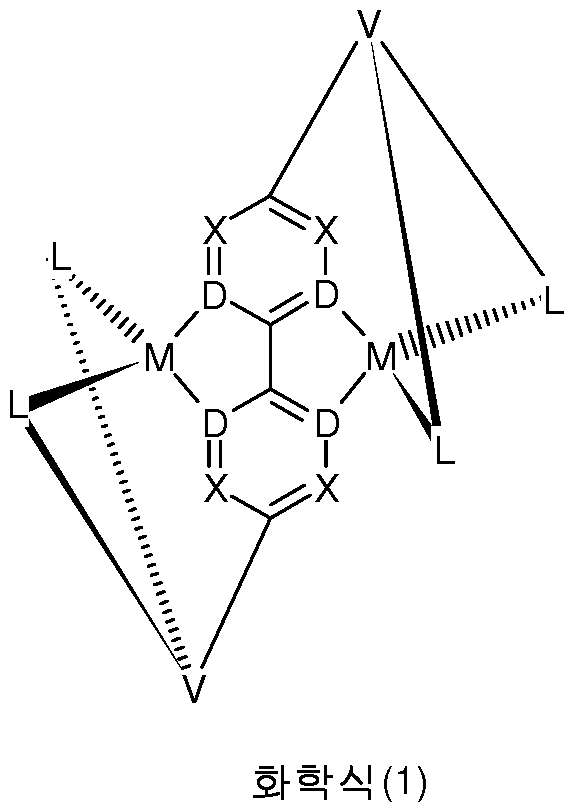
여기서 사용된 기호는 다음과 같으며:The symbols used here are:
M 은 각각의 경우에 동일하거나 상이하며 이리듐 또는 로듐이고;M is the same or different at each occurrence and is iridium or rhodium;
D 는 각각의 경우에 동일하거나 상이하며 C 또는 N이고, 다만 하나의 C 및 하나의 N은 2 개의 M 각각에 배위되고; D is the same or different at each occurrence and is C or N, provided that one C and one N are coordinated to each of the two Ms;
M 은 각각의 경우에 동일하거나 상이하며 CR 또는 N이고;M is the same or different at each occurrence and is CR or N;
V 는 각각의 경우에 동일하거나 상이하며 다음의 화학식 (2) 또는 화학식 (3)의 기이고:V is the same or different at each occurrence and is a group of formula (2) or formula (3):

여기서 점선 결합 중 하나는 화학식 (1)에 나타낸 상응하는 6-원 아릴 또는 헤테로아릴기에 대한 결합을 나타내고, 2 개의 다른 점선 결합은 각각 서브-리간드 L에 대한 결합을 나타내며;wherein one of the dotted-line bonds represents a bond to the corresponding 6-membered aryl or heteroaryl group shown in formula (1), and the two other dotted-line bonds each represent a bond to the sub-ligand L;
L 은 각각의 경우에 동일하거나 상이하며 두자리 모노음이온성 서브-리간드이고;L is the same or different at each occurrence and is a bidentate monoanionic sub-ligand;
X1 은 각각의 경우에 동일하거나 상이하며 CR 또는 N이고;X 1 is the same or different at each occurrence and is CR or N;
A1 은 각각의 경우에 동일하거나 상이하며 C(R)2 또는 O이고;A 1 is the same or different at each occurrence and is C(R) 2 or O;
A2 는 각각의 경우에 동일하거나 상이하며 CR, P(=O), B 또는 SiR이고, 다만 A2 = P(=O), B 또는 SiR 인 때, 기호 A1 은 O 이고 이 A2 에 결합된 기호 A는 -C(=O)-NR'- 또는 -C(=O)-O-이 아니고;A 2 is the same or different at each occurrence and is CR, P(=0), B or SiR, provided that when A 2 = P(=0), B or SiR, then the symbol A 1 is O and this A 2 the associated symbol A is not -C(=O)-NR'- or -C(=O)-O-;
A 는 각각의 경우에 동일하거나 상이하며 -CR=CR-, -C(=O)-NR'-, -C(=O)-O-, -CR2-CR2-, -CR2-O- 또는 하기 화학식 (4)의 기이고: A is the same or different at each occurrence and -CR=CR-, -C(=O)-NR'-, -C(=O)-O-, -CR 2 -CR 2 -, -CR 2 -O - or a group of formula (4):

여기서 점선 결합은 이 구조에 대한 두자리 서브-리간드 L 또는 화학식 (1)에 나타낸 상응하는 6-원 아릴 또는 헤테로아릴 기의 결합 위치를 나타내고, *는 화학식 (4) 의 단위의 중심 환형기, 즉 화학식 (2) 또는 (3)에 명시된 기에 대한 연결의 위치를 나타내고;wherein the dotted bond indicates the binding position of the bidentate sub-ligand L or the corresponding 6-membered aryl or heteroaryl group shown in formula (1) for this structure, and * is the central cyclic group of the unit of formula (4), i.e. indicates the position of the linkage to the group specified in formula (2) or (3);
X2 는 각각의 경우에 동일하거나 상이하며 CR 또는 N 이거나 또는 인접한 2 개의 X2 기는 함께 NR, O 또는 S이어서 5-원 고리를 형성하고 나머지 X2 는 각각의 경우에 동일하거나 상이하게 CR 또는 N이며; 또는 인접한 2 개의 X2 기는 함께 그 환에서의 X3 기 중 하나가 N 인 경우 CR 또는 N이어서 5-원 고리를 형성하며; 다만 2 개 이하의 인접하는 X2 기는 N이고; X 2 is the same or different at each occurrence and is CR or N, or two adjacent X 2 groups together are NR, O or S to form a 5-membered ring, and the remaining X 2 is at each occurrence, identically or differently, CR or is N; or two adjacent X 2 groups are CR or N together if one of the X 3 groups in the ring is N to form a 5-membered ring; provided that no more than two adjacent X 2 groups are N;
X3 은 각각의 경우 C 이거나 또는 동일한 환에서 하나의 X3 기는 N 이고 다른 X3 기는 C 이고; 다만 2 개의 인접하는 X2 기는 함께 그 환에서의 X3 기 중 하나가 N 인 경우 CR 또는 N이고;X 3 is at each occurrence C or one X 3 group is N and the other X 3 group is C in the same ring; provided that two adjacent X 2 groups together are CR or N if one of the X 3 groups in the ring is N;
R 은 각각의 경우에 동일하거나 상이하며 H, D, F, Cl, Br, I, N(R1)2, CN, NO2, OR1, SR1, COOH, C(=O)N(R1)2, Si(R1)3, B(OR1)2, C(=O)R1, P(=O)(R1)2, S(=O)R1, S(=O)2R1, OSO2R1, COO(양이온), SO3(양이온), OSO3(양이온), OPO3(양이온)2, O(양이온), N(R1)3(음이온), P(R1)3(음이온), 1 내지 20 개의 탄소 원자를 갖는 직쇄 알킬기 또는 2 내지 20 개의 탄소 원자를 갖는 알케닐 또는 알키닐기 또는 3 내지 20 개의 탄소 원자를 갖는 분지형 또는 환형 알킬기 (알킬, 알케닐 또는 알키닐기는 각각의 경우 하나 이상의 R1 라디칼로 치환될 수 있고, 하나 이상의 비인접 CH2 기는 Si(R1)2, C=O, NR1, O, S 또는 CONR1 로 대체될 수 있음), 또는 5 내지 40 개의 방향족 고리 원자를 갖고 각각의 경우 하나 이상의 R1 라디칼로 치환될 수 있는 방향족 또는 헤테로방향족 고리계이고; 동시에, 2 개의 R 라디칼은 또한 함께 고리계를 형성할 수 있으며; R is the same or different at each occurrence and is H, D, F, Cl, Br, I, N(R 1 ) 2 , CN, NO 2 , OR 1 , SR 1 , COOH, C(=0)N(R 1 ) 2 , Si(R 1 ) 3 , B(OR 1 ) 2 , C(=O)R 1 , P(=O)(R 1 ) 2 , S(=O)R 1 , S(=O) 2 R 1 , OSO 2 R 1 , COO (cation), SO 3 (cation), OSO 3 (cation), OPO 3 (cation) 2 , O (cation), N(R 1 ) 3 (anion), P( R 1 ) 3 (anion), a straight chain alkyl group having 1 to 20 carbon atoms or an alkenyl or alkynyl group having 2 to 20 carbon atoms or a branched or cyclic alkyl group having 3 to 20 carbon atoms (alkyl, alkynyl) A kenyl or alkynyl group may in each case be substituted by one or more R 1 radicals, and one or more non-adjacent CH 2 groups may be replaced by Si(R 1 ) 2 , C=O, NR 1 , O, S or CONR 1 . present), or an aromatic or heteroaromatic ring system having from 5 to 40 aromatic ring atoms, which in each case may be substituted by one or more R 1 radicals; At the same time, two R radicals may also form a ring system together;
R' 는 각각의 경우에 동일하거나 또는 상이하고 H, D, 1 내지 20 개의 탄소 원자를 갖는 직쇄 알킬기 또는 3 내지 20 개의 탄소 원자를 갖는 분지형 또는 환형 알킬기 (알킬기는 각각의 경우에 하나 이상의 R1 라디칼로 치환될 수 있고, 하나 이상의 비인접 CH2 기는 Si(R1)2 로 대체될 수 있음), 또는 5 내지 40 개의 방향족 고리 원자를 갖고 각각의 경우 하나 이상의 R1 라디칼로 치환될 수 있는 방향족 또는 헤테로방향족 고리계이고; R' is the same or different at each occurrence and is H, D, a straight-chain alkyl group having 1 to 20 carbon atoms or a branched or cyclic alkyl group having 3 to 20 carbon atoms (an alkyl group at each occurrence is one or more R 1 radical, and one or more non-adjacent CH 2 groups may be replaced by Si(R 1 ) 2 ), or having 5 to 40 aromatic ring atoms and in each case substituted by one or more R 1 radicals. an aromatic or heteroaromatic ring system;
R1 은 각각의 경우에 동일하거나 상이하며 H, D, F, Cl, Br, I, N(R2)2, CN, NO2, OR2, SR2, Si(R2)3, B(OR2)2, C(=O)R2, P(=O)(R2)2, S(=O)R2, S(=O)2R2, OSO2R2, COO(양이온), SO3(양이온), OSO3(양이온), OPO3(양이온)2, O(양이온), N(R2)3(음이온), P(R2)3(음이온), 1 내지 20 개의 탄소 원자를 갖는 직쇄 알킬기 또는 2 내지 20 개의 탄소 원자를 갖는 알케닐 또는 알키닐기 또는 3 내지 20 개의 탄소 원자를 갖는 분지형 또는 환형 알킬기 (알킬, 알케닐 또는 알키닐기는 각각의 경우 하나 이상의 R2 라디칼로 치환될 수 있고, 하나 이상의 비인접 CH2 기는 Si(R2)2, C=O, NR2, O, S 또는 CONR2 로 대체될 수 있음), 또는 5 내지 40 개의 방향족 고리 원자를 갖고 각각의 경우 하나 이상의 R2 라디칼로 치환될 수 있는 방향족 또는 헤테로방향족 고리계이고; 동시에, 2 개 이상의 R1 라디칼은 함께 고리계를 형성할 수 있으며; R 1 is the same or different at each occurrence and is H, D, F, Cl, Br, I, N(R 2 ) 2 , CN, NO 2 , OR 2 , SR 2 , Si(R 2 ) 3 , B( OR 2 ) 2 , C(=O)R 2 , P(=O)(R 2 ) 2 , S(=O)R 2 , S(=O) 2 R 2 , OSO 2 R 2 , COO(cation) , SO 3 (cation), OSO 3 (cation), OPO 3 (cation) 2 , O (cation), N(R 2 ) 3 (anion), P(R 2 ) 3 (anion), 1 to 20 carbons A straight-chain alkyl group having 2 to 20 carbon atoms or an alkenyl or alkynyl group having 2 to 20 carbon atoms or a branched or cyclic alkyl group having 3 to 20 carbon atoms (an alkyl, alkenyl or alkynyl group in each case represents one or more R 2 radicals). , and one or more non-adjacent CH 2 groups may be replaced by Si(R 2 ) 2 , C=O, NR 2 , O, S or CONR 2 ), or has 5 to 40 aromatic ring atoms; an aromatic or heteroaromatic ring system which may in each case be substituted by one or more R 2 radicals; At the same time, two or more R 1 radicals together may form a ring system;
R2 는 각각의 경우에 동일하거나 상이하며 H, D, F 또는 1 내지 20 개의 탄소 원자를 갖는 지방족, 방향족 또는 헤테로방향족 유기 라디칼, 특히 히드로카르빌 라디칼이며, 여기서 하나 이상의 수소 원자는 또한 F 로 대체될 수 있고;R 2 is identical or different on each occurrence and is H, D, F or an aliphatic, aromatic or heteroaromatic organic radical having 1 to 20 carbon atoms, in particular a hydrocarbyl radical, wherein at least one hydrogen atom is also represented by F can be replaced;
양이온은 각각의 경우에 동일하거나 상이하고 양성자, 중수소, 알칼리 금속 이온, 알칼리 토금속 이온, 암모늄, 테트라알킬암모늄 및 테트라알킬포스포늄으로 이루어지는 그룹으로부터 선택되며;the cations are the same or different in each case and are selected from the group consisting of protons, deuterium, alkali metal ions, alkaline earth metal ions, ammonium, tetraalkylammonium and tetraalkylphosphonium;
음이온은 각각의 경우에 동일하거나 또는 상이하고 할로겐화물, 카르복실레이트 R2-COO-, 시안화물, 시아네이트, 이소시아네이트, 티오시아네이트, 티오이소시아네이트, 수산화물, BF4 -, PF6 -, B(C6F5)4 -, 탄산염 및 술폰산염으로 이루어지는 그룹으로부터 선택된다.Anions are the same or different in each case and are halides, carboxylates R 2 -COO - , cyanides, cyanates, isocyanates, thiocyanates, thioisocyanates, hydroxides, BF 4 - , PF 6 - , B( C 6 F 5 ) 4 - is selected from the group consisting of carbonates and sulfonates.
2 개의 R 또는 R1 라디칼이 함께 고리계를 형성하는 경우, 그것은 단환 또는 다환이고, 그리고 지방족, 헤테로지방족, 방향족 또는 헤테로방향족일 수 있다. 이 경우, 함께 고리계를 형성하는 라디칼은 인접할 수 있으며, 이것은 이들 라디칼이 동일 탄소 원자와 결합되거나, 또는 직접 서로 결합된 탄소 원자와 결합되거나, 또는 이들이 추가로 서로로부터 제거될 수도 있다는 것을 의미한다 When two R or R 1 radicals together form a ring system, they are monocyclic or polycyclic and may be aliphatic, heteroaliphatic, aromatic or heteroaromatic. In this case, radicals which together form a ring system may be adjacent, meaning that these radicals may be bonded to the same carbon atom, or to carbon atoms directly bonded to one another, or they may further be removed from one another. do
본 명세서의 문맥에서 2 개 이상의 라디칼이 함께 고리를 형성할 수 있다는 표현은, 특히 2 개의 라디칼이 2 개의 수소 원자의 공식적 제거를 통해 화학 결합에 의해 서로 조인되어 있음을 의미하는 것으로 이해해야 한다. 이것은 다음 스킴으로 설명된다:In the context of the present specification, the expression that two or more radicals together can form a ring is to be understood to mean, in particular, that the two radicals are joined to one another by means of a chemical bond through the formal removal of two hydrogen atoms. This is illustrated by the following scheme:

또한, 하지만, 상기 언급된 표현은 2 개의 라디칼 중 하나가 수소인 경우, 제 2 라디칼은 수소 원자가 결합된 위치에 결합하여 고리를 형성함을 의미하는 것으로 이해해야 한다. 이것은 다음 스킴으로 설명되어야 한다: Also, however, the above-mentioned expression should be understood to mean that, when one of the two radicals is hydrogen, the second radical bonds to the position where the hydrogen atom is bonded to form a ring. This should be illustrated by the following scheme:

방향족 고리계의 형성은 다음 스킴으로 설명되어야 한다:The formation of an aromatic ring system should be described by the following scheme:

이러한 종류의 고리 형성은 서로 직접 결합된 탄소 원자에 결합된 라디칼에서, 또는 추가로 제거된 탄소 원자에 결합된 라디칼에서 가능하다. 서로 직접 결합된 탄소 원자 또는 동일한 탄소 원자에 결합된 라디칼에서 이러한 종류의 고리 형성이 바람직하다.Ring formation of this kind is possible from radicals bonded to carbon atoms bonded directly to each other, or from radicals bonded to carbon atoms which are further removed. Preferred is this kind of ring formation on carbon atoms directly bonded to each other or radicals bonded to the same carbon atom.
본 발명의 문맥에서 아릴기는 6 내지 40 개의 탄소 원자를 함유하고; 본 발명의 문맥에서 헤테로아릴기는 2 내지 40 개의 탄소 원자 및 적어도 하나의 헤테로원자를 함유하고, 다만 탄소 원자 및 헤테로원자의 총합은 적어도 5 이다. 헤테로원자는 바람직하게는 N, O 및/또는 S 에서 선택된다. 여기서, 아릴기 또는 헤테로아릴기는 단순한 방향족 환, 즉, 벤젠, 또는 단순한 헤테로방향족 환, 예를 들어 피리딘, 피리미딘, 티오펜 등, 또는 축합 아릴 또는 헤테로아릴기, 예를 들어 나프탈렌, 안트라센, 페난트렌, 퀴놀린, 이소퀴놀린 등을 의미하는 것으로 이해된다. An aryl group in the context of this invention contains from 6 to 40 carbon atoms; Heteroaryl groups in the context of this invention contain from 2 to 40 carbon atoms and at least one heteroatom, provided that the sum of carbon atoms and heteroatoms is at least 5. Heteroatoms are preferably selected from N, O and/or S. Here, the aryl group or heteroaryl group is a simple aromatic ring, that is, benzene, or a simple heteroaromatic ring, such as pyridine, pyrimidine, thiophene, etc., or a condensed aryl or heteroaryl group, such as naphthalene, anthracene, phenan It is understood to mean threne, quinoline, isoquinoline and the like.
본 발명의 문맥에서 방향족 고리계는 고리계에 6 내지 40 개의 탄소 원자를 함유한다. 본 발명의 문맥에서 헤테로방향족 고리계는 고리계에 1 내지 40 개의 탄소 원자 및 적어도 하나의 헤테로원자를 함유하지만, 다만 탄소 원자 및 헤테로원자의 총합은 적어도 5 개이다. 헤테로원자는 바람직하게는 N, O 및/또는 S 에서 선택된다. 본 발명의 문맥에서의 방향족 또는 헤테로방향족 고리계는, 반드시 아릴 또는 헤테로아릴기만을 함유하는 것은 아니며, 또한 복수의 아릴 또는 헤테로아릴기에 비방향족 단위 (바람직하게는, H 이외의 10% 미만의 원자), 예를 들어 탄소, 질소 또는 산소 원자 또는 카르보닐기가 삽입되는 것이 가능한 계를 의미하는 것으로 이해되어야 한다. 예를 들어, 9,9'-스피로비플루오렌, 9,9-디아릴플루오렌, 트리아릴아민, 디아릴 에테르, 스틸벤 등과 같은 계는 또한 본 발명의 문맥에서의 방향족 고리계, 및 마찬가지로 2 개 이상의 아릴기에, 예를 들어 선형 또는 환형 알킬기 또는 실릴기가 삽입되는 계로서 간주되어야 한다. 또한, 2 개 이상의 아릴 또는 헤테로아릴기가 서로 연결되는 계, 예를 들어, 비페닐, 터페닐 또는 쿼터페닐 또는 비피리딘도 마찬가지로 방향족 또는 헤테로방향족 고리계로 간주되어야 한다. An aromatic ring system in the context of the present invention contains 6 to 40 carbon atoms in the ring system. A heteroaromatic ring system in the context of the present invention contains 1 to 40 carbon atoms and at least one heteroatom in the ring system, provided that the sum of carbon atoms and heteroatoms is at least 5. Heteroatoms are preferably selected from N, O and/or S. An aromatic or heteroaromatic ring system in the context of the present invention does not necessarily contain aryl or heteroaryl groups, but also contains a plurality of aryl or heteroaryl groups in addition to non-aromatic units (preferably less than 10% atoms other than H). ), for example a system in which a carbon, nitrogen or oxygen atom or a carbonyl group can be inserted. Systems such as, for example, 9,9'-spirobifluorenes, 9,9-diarylfluorenes, triarylamines, diaryl ethers, stilbenes and the like are also aromatic ring systems in the context of the present invention, and likewise It should be regarded as a system in which two or more aryl groups are intercalated, for example linear or cyclic alkyl groups or silyl groups. Also, systems in which two or more aryl or heteroaryl groups are linked to each other, for example biphenyl, terphenyl or quaterphenyl or bipyridine, are likewise to be regarded as aromatic or heteroaromatic ring systems.
본 발명의 문맥에서의 환형 알킬기는 단환, 이환 또는 다환 기를 의미하는 것으로 이해된다. A cyclic alkyl group in the context of the present invention is understood to mean a monocyclic, bicyclic or polycyclic group.
본 발명의 문맥에서, 개별적인 수소 원자 또는 CH2 기가 또한 상술한 기에 의해 대체될 수 있는 C1- 내지 C20-알킬기는 예를 들어, 메틸, 에틸, n-프로필, i-프로필, 시클로프로필, n-부틸, i-부틸, s-부틸, t-부틸, 시클로부틸, 2-메틸부틸, n-펜틸, s-펜틸, t-펜틸, 2-펜틸, 네오펜틸, 시클로펜틸, n-헥실, s-헥실, t-헥실, 2-헥실, 3-헥실, 네오헥실, 시클로헥실, 1-메틸시클로펜틸, 2-메틸펜틸, n-헵틸, 2-헵틸, 3-헵틸, 4-헵틸, 시클로헵틸, 1-메틸시클로헥실, n-옥틸, 2-에틸헥실, 시클로옥틸, 1-비시클로[2.2.2]옥틸, 2-비시클로[2.2.2]옥틸, 2-(2,6-디메틸)옥틸, 3-(3,7-디메틸)옥틸, 아다만틸, 트리플루오로메틸, 펜타플루오로에틸, 2,2,2-트리플루오로에틸, 1,1-디메틸-n-헥스-1-일, 1,1-디메틸-n-헵트-1-일, 1,1-디메틸-n-옥트-1-일, 1,1-디메틸-n-데크-1-일, 1,1-디메틸-n-도데크-1-일, 1,1-디메틸-n-테트라데크-1-일, 1,1-디메틸-n-헥사데크-1-일, 1,1-디메틸-n-옥타데크-1-일, 1,1-디에틸-n-헥스-1-일, 1,1-디에틸-n-헵트-1-일, 1,1-디에틸-n-옥트-1-일, 1,1-디에틸-n-데크-1-일, 1,1-디에틸-n-도데크-1-일, 1,1-디에틸-n-테트라데크-1-일, 1,1-디에틸-n-헥사데크-1-일, 1,1-디에틸-n-옥타데크-1-일, 1-(n-프로필)시클로헥스-1-일, 1-(n-부틸)시클로헥스-1-일, 1-(n-헥실)시클로헥스-1-일, 1-(n-옥틸)시클로헥스-1-일 및 1-(n-데실)시클로헥스-1-일 라디칼을 의미하는 것으로 이해된다. 알케닐기는 예를 들어, 에테닐, 프로페닐, 부테닐, 펜테닐, 시클로펜테닐, 헥세닐, 시클로헥세닐, 헵테닐, 시클로헵테닐, 옥테닐, 시클로옥테닐 또는 시클로옥타디에닐을 의미하는 것으로 이해된다. 알키닐기는 예를 들어, 에티닐, 프로피닐, 부티닐, 펜티닐, 헥시닐, 헵티닐 또는 옥티닐을 의미하는 것으로 이해된다. OR1 또는 OR2 에 대해 존재하는 것으로서 C1- 내지 C20-알콕시기는 예를 들어, 메톡시, 트리플루오로메톡시, 에톡시, n-프로폭시, i-프로폭시, n-부톡시, i-부톡시, s-부톡시, t-부톡시 또는 2-메틸부톡시를 의미하는 것으로 이해된다. In the context of the present invention, C 1 - to C 20 -alkyl groups, in which individual hydrogen atoms or CH 2 groups can also be replaced by the aforementioned groups, are, for example, methyl, ethyl, n-propyl, i-propyl, cyclopropyl, n-butyl, i-butyl, s-butyl, t-butyl, cyclobutyl, 2-methylbutyl, n-pentyl, s-pentyl, t-pentyl, 2-pentyl, neopentyl, cyclopentyl, n-hexyl, s-hexyl, t-hexyl, 2-hexyl, 3-hexyl, neohexyl, cyclohexyl, 1-methylcyclopentyl, 2-methylpentyl, n-heptyl, 2-heptyl, 3-heptyl, 4-heptyl, cyclo Heptyl, 1-methylcyclohexyl, n-octyl, 2-ethylhexyl, cyclooctyl, 1-bicyclo[2.2.2]octyl, 2-bicyclo[2.2.2]octyl, 2-(2,6-dimethyl ) Octyl, 3-(3,7-dimethyl)octyl, adamantyl, trifluoromethyl, pentafluoroethyl, 2,2,2-trifluoroethyl, 1,1-dimethyl-n-hex-1 -yl, 1,1-dimethyl-n-hept-1-yl, 1,1-dimethyl-n-oct-1-yl, 1,1-dimethyl-n-dec-1-yl, 1,1-dimethyl -n-dodec-1-yl, 1,1-dimethyl-n-tetradec-1-yl, 1,1-dimethyl-n-hexadec-1-yl, 1,1-dimethyl-n-octadec -1-yl, 1,1-diethyl-n-hex-1-yl, 1,1-diethyl-n-hept-1-yl, 1,1-diethyl-n-oct-1-yl, 1,1-diethyl-n-dec-1-yl, 1,1-diethyl-n-dodec-1-yl, 1,1-diethyl-n-tetradec-1-yl, 1,1 -Diethyl-n-hexadec-1-yl, 1,1-diethyl-n-octadec-1-yl, 1-(n-propyl)cyclohex-1-yl, 1-(n-butyl) Cyclohex-1-yl, 1-(n-hexyl)cyclohex-1-yl, 1-(n-octyl)cyclohex-1-yl and 1-(n-decyl)cyclohex-1-yl radicals understood to mean An alkenyl group means, for example, ethenyl, propenyl, butenyl, pentenyl, cyclopentenyl, hexenyl, cyclohexenyl, heptenyl, cycloheptenyl, octenyl, cyclooctenyl or cyclooctadienyl. It is understood to do An alkynyl group is understood to mean, for example, ethynyl, propynyl, butynyl, pentynyl, hexynyl, heptynyl or octynyl. A C 1 - to C 20 -alkoxy group as present for OR 1 or OR 2 is, for example, methoxy, trifluoromethoxy, ethoxy, n-propoxy, i-propoxy, n-butoxy, i -butoxy, s-butoxy, t-butoxy or 2-methylbutoxy.
5 내지 40 개의 방향족 고리 원자를 가지며 또한 각각의 경우 상술한 라디칼에 의해 치환될 수 있고 임의의 원하는 위치를 통해 방향족 또는 헤테로방향족계에 연결될 수 있는 방향족 또는 헤테로방향족 고리계는 예를 들어, 벤젠, 나프탈렌, 안트라센, 벤즈안트라센, 페난트렌, 벤조페난트렌, 피렌, 크리센, 페릴렌, 플루오르안텐, 벤조플루오르안텐, 나프타센, 펜타센, 벤조피렌, 비페닐, 비페닐렌, 터페닐, 터페닐렌, 플루오렌, 스피로비플루오렌, 디히드로페난트렌, 디히드로피렌, 테트라히드로피렌, 시스-또는 트랜스-인데노플루오렌, 시스-또는 트랜스-모노벤조인데노플루오렌, 시스-또는 트랜스-디벤조인데노플루오렌, 트룩센, 이소트룩센, 스피로트룩센, 스피로이소트룩센, 푸란, 벤조푸란, 이소벤조푸란, 디벤조푸란, 티오펜, 벤조티오펜, 이소벤조티오펜, 디벤조티오펜, 피롤, 인돌, 이소인돌, 카르바졸, 인돌로카르바졸, 인데노카르바졸, 피리딘, 퀴놀린, 이소퀴놀린, 아크리딘, 페난트리딘, 벤조-5,6-퀴놀린, 벤조-6,7-퀴놀린, 벤조-7,8-퀴놀린, 페노티아진, 페녹사진, 피라졸, 인다졸, 이미다졸, 벤즈이미다졸, 나프티미다졸, 페난트리미다졸, 피리디미다졸, 피라지니미다졸, 퀴녹살리니미다졸, 옥사졸, 벤족사졸, 나프톡사졸, 안트록사졸, 페난트록사졸, 이속사졸, 1,2-티아졸, 1,3-티아졸, 벤조티아졸, 피리다진, 벤조피리다진, 피리미딘, 벤조피리미딘, 퀴녹살린, 1,5-디아자안트라센, 2,7-디아자피렌, 2,3-디아자피렌, 1,6-디아자피렌, 1,8-디아자피렌, 4,5-디아자피렌, 4,5,9,10-테트라아자페릴렌, 피라진, 페나진, 페녹사진, 페노티아진, 플루오루빈, 나프티리딘, 아자카르바졸, 벤조카르볼린, 페난트롤린, 1,2,3-트리아졸, 1,2,4-트리아졸, 벤조트리아졸, 1,2,3-옥사디아졸, 1,2,4-옥사디아졸, 1,2,5-옥사디아졸, 1,3,4-옥사디아졸, 1,2,3-티아디아졸, 1,2,4-티아디아졸, 1,2,5-티아디아졸, 1,3,4-티아디아졸, 1,3,5-트리아진, 1,2,4-트리아진, 1,2,3-트리아진, 테트라졸, 1,2,4,5-테트라진, 1,2,3,4-테트라진, 1,2,3,5-테트라진, 퓨린, 프테리딘, 인돌리진 및 벤조티아디아졸에서 유래하는 기를 의미하는 것으로 이해된다.Aromatic or heteroaromatic ring systems having from 5 to 40 aromatic ring atoms and which may in each case be substituted by the aforementioned radicals and which may be linked to the aromatic or heteroaromatic system through any desired position are, for example, benzene, Naphthalene, anthracene, benzanthracene, phenanthrene, benzophenanthrene, pyrene, chrysene, perylene, fluoroanthene, benzofluoroanthene, naphthacene, pentacene, benzopyrene, biphenyl, biphenylene, terphenyl, terphenylene , fluorene, spirobifluorene, dihydrophenanthrene, dihydropyrene, tetrahydropyrene, cis- or trans-indenofluorene, cis- or trans-monobenzoindenofluorene, cis- or trans-di Benzoindenofluorene, truxen, isotruxen, spirotruxen, spiroisotruxen, furan, benzofuran, isobenzofuran, dibenzofuran, thiophene, benzothiophene, isobenzothiophene, dibenzothiophene , pyrrole, indole, isoindole, carbazole, indolocarbazole, indenocarbazole, pyridine, quinoline, isoquinoline, acridine, phenanthridine, benzo-5,6-quinoline, benzo-6,7- Quinoline, benzo-7,8-quinoline, phenothiazine, phenoxazine, pyrazole, indazole, imidazole, benzimidazole, naphthymidazole, phenanthrimidazole, pyridimidazole, pyrazinimidazole, quinox salinimidazole, oxazole, benzoxazole, naphtoxazole, anthroxazole, phenanthroxazole, isoxazole, 1,2-thiazole, 1,3-thiazole, benzothiazole, pyridazine, benzopyridazine, Pyrimidine, benzopyrimidine, quinoxaline, 1,5-diazaanthracene, 2,7-diazapyrene, 2,3-diazapyrene, 1,6-diazapyrene, 1,8-diazapyrene, 4,5-diazapyrene, 4,5,9,10-tetraazaperylene, pyrazine, phenazine, phenoxazine, phenothiazine, fluororubin, naphthyridine, azacarbazole, benzocarboline, phenanthroline , 1,2,3-triazole, 1,2,4-triazole, benzotriazole, 1,2,3-oxadiazole, 1,2,4-oxadiazole, 1,2,5-oxa Diazole, 1,3,4-oxadiazole, 1,2,3-thiadiazole, 1,2,4-thiadiazole, 1,2,5-thiadiazole, 1,3,4-thiazole Diazole, 1,3,5-Triazine, 1,2,4-Triazine, 1,2,3-Triazine, Tetrazole, 1,2,4,5-Tetrazine, 1,2,3, It is understood to mean groups derived from 4-tetrazine, 1,2,3,5-tetrazine, purine, pteridine, indolizine and benzothiadiazole.
화합물의 추가의 설명을 위해, 화학식 (1)의 하나의 간단한 구조가 하기에서 상세히 설명된다: For further elucidation of the compound, one simple structure of formula (1) is detailed below:

이 구조에서, 본 경우에 두 금속 M, 이리듐에 배위하는 서브-리간드는 2-페닐피리미딘기이다. 화학식 (2) 의 하나의 기는 페닐기 및 피리미딘기 각각에 결합되며, 즉 이 구조에서 V는 화학식 (2) 의 그룹이다. 그 중심 환은 각각의 경우에 페닐기이고, 3 개의 A 기는 각각 -HC=CH-, 즉 시스-알케닐기이다. 화학식 (2)의 이 기에는 또한 각각의 경우에 2 개의 서브-리간드 L이 결합되어 있으며, 상기 구조에서 2 개의 서브-리간드 L 은 각각 페닐피리딘이다. 따라서, 두 금속 M의 각각은 전술한 구조에서 각각의 경우 2 개의 페닐피리딘 리간드 및 1 개의 페닐피리미딘 리간드에 배위되며, 여기서 페닐피리미딘의 페닐기 및 피리미딘기는 각각 두 금속 M에 배위한다. 서브-리간드는 여기서 각각 화학식 (2)의 기에 의해 조인되어 폴리포달 시스템을 형성한다.In this structure, the sub-ligand coordinating to the two metals M, iridium in this case, is a 2-phenylpyrimidine group. One group of formula (2) is bonded to each of a phenyl group and a pyrimidine group, i.e., V in this structure is a group of formula (2). Its central ring is in each case a phenyl group, and each of the three A groups is -HC=CH-, i.e. a cis-alkenyl group. Attached to this group of formula (2) are also two sub-ligands L in each case, wherein each of the two sub-ligands L in the structure is phenylpyridine. Thus, each of the two metals M is coordinated to two phenylpyridine ligands and one phenylpyrimidine ligand in each case in the structure described above, wherein the phenyl group and the pyrimidine group of the phenylpyrimidine are each coordinated to the two metals M. The sub-ligands here are each joined by a group of formula (2) to form a polypodal system.
본원의 문맥에서 L에 대한 "두자리 서브-리간드"의 표현은 화학식 (2) 또는 (3) 의 기가 존재하지 않는 경우 이 단위가 두자리 리간드가 될 것임을 의미한다. 그러나, 이 두자리 리간드에서의 수소 원자의 공식적인 추출 및 화학식 (2) 또는 (3)의 브릿지 내의 연결의 결과로서, 이는 별도의 리간드가 아니고, 이로써 발생하는 12 자리 리간드, 즉 총 12 개의 배위 자리를 갖는 리간드의 일 부분이며, 따라서 "서브-리간드"라는 용어가 사용된다.The expression “bidentate sub-ligand” for L in the context of the present application means that the unit will be a bidentate ligand if the group of formula (2) or (3) is not present. However, as a result of the formal extraction of hydrogen atoms from this bidentate ligand and linkage within the bridge of formula (2) or (3), it is not a separate ligand, but the resulting 12-dentate ligand, i.e. a total of 12 coordination sites. part of a ligand having, hence the term "sub-ligand" is used.
금속 M에 대한 리간드의 결합은 배위 결합 또는 공유 결합일 수 있거나, 또는 결합의 공유 분율은 리간드에 따라 변할 수 있다. 본원에서, 리간드 또는 서브-리간드가 M에 배위되거나 결합하는 것으로 언급될 때, 이것은 본원의 문맥에서 결합의 공유 분율에 관계없이 M에 대한 리간드 또는 서브-리간드의 임의의 종류의 결합을 지칭한다. The binding of the ligand to the metal M may be coordinative or covalent, or the covalent fraction of binding may vary depending on the ligand. As used herein, when a ligand or sub-ligand is referred to as coordinating or binding to M, this refers in the context of this application to any kind of binding of the ligand or sub-ligand to M, regardless of the covalent fraction of binding.
본 발명의 화합물은 하전되지 않는 것이 바람직하며, 이는 전기적으로 중성인 것을 의미한다. 이것은 Rh 또는 Ir이 각각의 경우에 +III 산화 상태에 있다는 점에서 달성된다. 이 경우 금속 각각은 2 개의 모노음이온성 두자리 서브-리간드 및 하나의 네자리 이음이온성 서브-리간드에 의해 배위되며, 이로써 서브-리간드는 착화된 금속 원자의 전하를 보상한다. The compounds of the present invention are preferably uncharged, which means they are electrically neutral. This is achieved in that either Rh or Ir is in the +III oxidation state in each case. In this case each metal is coordinated by two monoanionic bidentate sub-ligands and one tetradentate dianionic sub-ligand, whereby the sub-ligands compensate for the charge of the complexed metal atom.
전술한 바와 같이, 본 발명의 화합물에서 2 개의 금속 M은 동일하거나 상이할 수 있으며 바람직하게는 +III 산화 상태이다. 따라서, 가능한 조합은 Ir/Ir, Ir/Rh 및 Rh/Rh이다. 본 발명의 바람직한 실시형태에서, 두 금속 M은 Ir(III)이다.As noted above, the two metals M in the compounds of the present invention may be the same or different and are preferably in the +III oxidation state. Thus, possible combinations are Ir/Ir, Ir/Rh and Rh/Rh. In a preferred embodiment of the present invention both metals M are Ir(III).
본 발명의 바람직한 실시형태에서, 화학식 (1) 의 화합물은 하기 화학식 (1') 의 화합물로부터 선택된다:In a preferred embodiment of the present invention, the compound of formula (1) is selected from compounds of formula (1′):

여기서, 명백하게 도시된 D 에 대해 오르토 위치에 있는 R 라디칼 각각은 각각의 경우에 동일하거나 상이하며 H, D, F, CH3 및 CD3 로 이루어지는 그룹에서 선택되고 바람직하게 H 이며, 그리고 사용된 다른 기호는 상술된 정의를 갖는다. wherein each of the R radicals ortho to D shown explicitly is identical or different in each case and is preferably H selected from the group consisting of H, D, F, CH 3 and CD 3 , and any other used Symbols have the definitions described above.
상기한 바와 같이, 각각의 금속은 중앙 서브-리간드의 하나의 탄소 원자 및 하나의 질소 원자에 의해 배위되고 또한 각각의 경우에 2 개의 서브-리간드 L에 의해 배위된다. 따라서, 화학식 (1) 의 화합물은 하기 화학식 (1a) 또는 (1b) 중 하나의 구조를 갖고, 바람직하게는 하기 화학식 (1a') 또는 (1b') 중 하나의 구조를 갖는다:As mentioned above, each metal is coordinated by one carbon atom and one nitrogen atom of the central sub-ligand and also by two sub-ligands L in each case. Accordingly, the compound of formula (1) has a structure of one of the formulas (1a) or (1b), and preferably has a structure of one of the formulas (1a') or (1b'):

여기서, 명백하게 도시된 R 라디칼 각각은 각각의 경우에 동일하거나 상이하며 H, D, F, CH3 및 CD3 로 이루어지는 그룹에서 선택되고, 그리고 사용된 다른 기호는 상기에 주어진 정의를 갖는다. 보다 바람직하게, 화학식 (1a') 및 (1b') 에 명백하게 도시된 R 라디칼은 H이다. 구조식 (1b) 및 (1b') 가 특히 바람직하다.wherein each of the R radicals explicitly shown is in each case identical or different and is selected from the group consisting of H, D, F, CH 3 and CD 3 , and the other symbols used have the definitions given above. More preferably, the R radical shown explicitly in formulas (1a') and (1b') is H. Structural formulas (1b) and (1b') are particularly preferred.
이하에, V에 대한 바람직한 실시형태, 즉 화학식 (2) 또는 (3)의 기가 인용된다. Hereinafter, preferred embodiments for V, namely groups of formula (2) or (3), are cited.
식 (3)에서 A2 가 CR인 경우, 특히 모든 A2 가 CR 인 경우, 매우 특히, 추가로, A1 의 0, 1, 2 또는 3 개, 특히 3개가 CR2 인 경우, 즉 그것이 시클로헥산기인 경우, A2 상의 R 라디칼은 구성에 따라 다른 위치를 상정할 수 있다. 여기서 H 또는 D와 같은 작은 R 라디칼이 바람직하다. 이들은 모두 금속으로부터 멀리 향하게 되는 것 (에피칼 (apical)) 또는 모두 금속을 향하여 내측으로 향하게 되는 것 (엔도헤드랄 (endohedral)) 이 바람직하다. 이는 A 기가 각각 오르토-페닐렌기인 예에 의해 설명된다. When A 2 in formula (3) is CR, in particular when all A 2 are CR, very particularly, furthermore, when 0, 1, 2 or 3, especially 3, of A 1 are CR 2 , ie it is cyclo In the case of a hexane group, the R radical on A 2 may assume a different position depending on the configuration. Small R radicals such as H or D are preferred here. They are preferably all directed away from the metal (apical) or all directed inward towards the metal (endohedral). This is illustrated by an example in which the A groups are each an ortho-phenylene group.

두 금속 M에 배위하는 제 3 서브-리간드는 명료성을 위해 도시되지 않았지만, 단지 점선 결합으로 표시된다. 따라서 두 가지 구성 중 적어도 하나를 가정할 수 있는 착물이 선호된다. 이들은 3 개의 모든 서브-리간드가 중앙 고리에 적도적으로 배열되는 착물이다.A third sub-ligand that coordinates the two metals M is not shown for clarity, but is only shown as a dotted bond. Therefore, complexes that can assume at least one of the two configurations are preferred. These are complexes in which all three sub-ligands are equatorially arranged in the central ring.
화학식 (2)의 기의 적합한 실시형태는 하기 화학식 (5) 내지 (8)의 구조이고, 그리고 화학식 (3)의 기의 적합한 실시형태는 하기 화학식 (9) 내지 (13)의 구조이다:Suitable embodiments of groups of formula (2) are structures of formulas (5) to (8), and suitable embodiments of groups of formula (3) are structures of formulas (9) to (13):


여기서 기호는 위에 주어진 정의를 갖는다. where the symbol has the definition given above.
화학식 (5) 내지 (13)에서의 바람직한 R 라디칼은 하기와 같다:Preferred R radicals in formulas (5) to (13) are:
R 은 각각의 경우에서 동일하거나 상이하며 H, D, F, CN, OR1, 1 내지 10 개의 탄소 원자를 갖는 직쇄 알킬기 또는 2 내지 10 개의 탄소 원자를 갖는 알케닐기 또는 3 내지 10 개의 탄소 원자를 갖는 분지형 또는 환형 알킬기 (그 각각은 하나 이상의 R1 라디칼로 치환될 수 있음), 또는 5 내지 24 개의 방향족 고리 원자를 갖고 각각의 경우 하나 이상의 R1 라디칼로 치환될 수 있는 방향족 또는 헤테로방향족 고리계이고; R is the same or different at each occurrence and is H, D, F, CN, OR 1 , a straight-chain alkyl group having 1 to 10 carbon atoms or an alkenyl group having 2 to 10 carbon atoms or 3 to 10 carbon atoms branched or cyclic alkyl groups, each of which may be substituted by one or more R 1 radicals, or aromatic or heteroaromatic rings having from 5 to 24 aromatic ring atoms, which in each case may be substituted by one or more R 1 radicals. is a system;
R1 은 각각의 경우에 동일하거나 상이하며 H, D, F, CN, OR2, 1 내지 10 개의 탄소 원자를 갖는 직쇄 알킬기 또는 2 내지 10 개의 탄소 원자를 갖는 알케닐기 또는 3 내지 10 개의 탄소 원자를 갖는 분지형 또는 환형 알킬기 (그 각각은 하나 이상의 R2 라디칼로 치환될 수 있음), 또는 5 내지 24 개의 방향족 고리 원자를 갖고 각각의 경우 하나 이상의 R2 라디칼로 치환될 수 있는 방향족 또는 헤테로방향족 고리계이고; 동시에, 2개 이상의 인접하는 R1 라디칼은 함께 고리계를 형성할 수 있고; R 1 is the same or different at each occurrence and is H, D, F, CN, OR 2 , a straight-chain alkyl group having 1 to 10 carbon atoms or an alkenyl group having 2 to 10 carbon atoms or 3 to 10 carbon atoms branched or cyclic alkyl groups, each of which may be substituted by one or more R 2 radicals, or aromatic or heteroaromatic groups having from 5 to 24 aromatic ring atoms, each of which may be substituted by one or more R 2 radicals. is a cyclic system; At the same time, two or more adjacent R 1 radicals together may form a ring system;
R2 는 각각의 경우에 동일하거나 상이하며 H, D, F 또는 1 내지 20 개의 탄소 원자를 갖는 지방족, 방향족 또는 헤테로방향족 유기 라디칼이며, 여기서 하나 이상의 수소 원자는 또한 F 로 대체될 수 있다. R 2 is identical or different at each occurrence and is H, D, F or an aliphatic, aromatic or heteroaromatic organic radical having 1 to 20 carbon atoms, wherein one or more hydrogen atoms may also be replaced by F.
화학식 (5) 내지 (13)에서의 특히 바람직한 R 라디칼은 하기와 같다:Particularly preferred R radicals in formulas (5) to (13) are:
R 은 각각의 경우에 동일하거나 상이하며 H, D, F, CN, 1 내지 4 개의 탄소 원자를 갖는 직쇄 알킬기 또는 3 내지 6 개의 탄소 원자를 갖는 분지형 또는 환형 알킬기 (그 각각은 하나 이상의 R1 라디칼로 치환될 수 있음), 또는 6 내지 12 개의 방향족 고리 원자를 갖고 각각의 경우 하나 이상의 R1 라디칼로 치환될 수 있는 방향족 또는 헤테로방향족 고리계이고; R is the same or different at each occurrence and is H, D, F, CN, a straight-chain alkyl group having 1 to 4 carbon atoms or a branched or cyclic alkyl group having 3 to 6 carbon atoms, each of which is one or more R 1 radical), or an aromatic or heteroaromatic ring system having from 6 to 12 aromatic ring atoms and in each case being substituted by one or more R 1 radicals;
R1 은 각각의 경우에 동일하거나 상이하며 H, D, F, CN, 1 내지 4 개의 탄소 원자를 갖는 직쇄 알킬기 또는 3 내지 6 개의 탄소 원자를 갖는 분지형 또는 환형 알킬기 (그 각각은 하나 이상의 R2 라디칼로 치환될 수 있음), 또는 6 내지 12 개의 방향족 고리 원자를 갖고 각각의 경우 하나 이상의 R2 라디칼로 치환될 수 있는 방향족 또는 헤테로방향족 고리계이고; 동시에, 2개 이상의 인접하는 R1 라디칼은 함께 고리계를 형성할 수 있고; R 1 is the same or different at each occurrence and is H, D, F, CN, a straight-chain alkyl group having 1 to 4 carbon atoms or a branched or cyclic alkyl group having 3 to 6 carbon atoms, each of which is one or more R 2 radicals), or an aromatic or heteroaromatic ring system having from 6 to 12 aromatic ring atoms and in each case being substituted by one or more R 2 radicals; At the same time, two or more adjacent R 1 radicals together may form a ring system;
R2 는 각각의 경우에 동일하거나 상이하며 H, D, F 또는 1 내지 12개의 탄소 원자를 갖는 지방족 또는 방향족 하이드로카르빌 라디칼이다.R 2 is the same or different at each occurrence and is H, D, F or an aliphatic or aromatic hydrocarbyl radical having 1 to 12 carbon atoms.
본 발명의 바람직한 실시형태에서, 화학식 (2) 의 기에서 모든 X1 기는 CR이고, 따라서 화학식 (2) 의 중심 3가 환은 벤젠이다. 보다 바람직하게, 모든 X1 기는 CH 또는 CD, 특히 CH이다. 본 발명의 또 다른 바람직한 실시형태에서, 모든 X1 기는 질소 원자이며, 따라서 화학식 (2)의 중심 3가 환은 트리아진이다. 따라서, 화학식 (2)의 바람직한 실시형태는 상기에 나타낸 화학식 (5) 및 (6)의 구조이다. 보다 바람직하게, 화학식 (5)의 구조는 하기 화학식 (5')의 구조이다:In a preferred embodiment of the present invention, all X 1 groups in the group of formula (2) are CR, and thus the central trivalent ring of formula (2) is benzene. More preferably, all X 1 groups are CH or CD, especially CH. In another preferred embodiment of the present invention, all X 1 groups are nitrogen atoms and thus the central trivalent ring of formula (2) is a triazine. Accordingly, preferred embodiments of formula (2) are the structures of formulas (5) and (6) shown above. More preferably, the structure of formula (5) is of formula (5'):

여기서 기호는 위에 주어진 정의를 갖는다.where the symbol has the definition given above.
본 발명의 또 다른 바람직한 실시형태에서, 화학식 (3)의 기에서 모든 A2 기는 CR이다. 보다 바람직하게, 모든 A2 기는 CH이다. 따라서, 화학식 (3)의 바람직한 실시형태는 상기에 나타낸 화학식 (9) 의 구조이다. 보다 바람직하게, 화학식 (9)의 구조는 하기 화학식 (9') 또는 (9") 의 구조이다:In another preferred embodiment of the present invention, all A 2 groups in the group of formula (3) are CR. More preferably, all A 2 groups are CH. Accordingly, a preferred embodiment of formula (3) is the structure of formula (9) shown above. More preferably, the structure of formula (9) is of formula (9') or (9"):

여기서 기호는 상기 주어진 정의를 가지며 R은 바람직하게는 H이다.wherein the symbols have the definitions given above and R is preferably H.
화학식 (2) 및 (3) 및 (5) 내지 (13)의 구조에서 발생하는 것으로 바람직한 A 기의 설명이 뒤따른다. A 기는 각각의 경우에 동일하거나 상이할 수 있으며, 화학식 (4) 의 알케닐기, 아미드기, 에스테르기, 알킬렌기, 메틸렌 에테르기 또는 오르토-결합된 아릴렌 또는 헤테로아릴렌기일 수 있다. A가 알케닐기인 경우, 이는 시스-결합된 알케닐기이다. 비대칭 A 기의 경우, 기의 임의의 배향이 가능하다. 이는 이후 A = -C(=O)-O-의 예에 의해 개략적으로 도시된다. 이는 A의 다음의 가능한 배향을 야기하며, 이들 모두는 본 발명에 의해 포함된다:A description of groups A, which are preferred to occur in the structures of formulas (2) and (3) and (5) to (13), follows. The group A may be the same or different in each case and may be an alkenyl group, an amide group, an ester group, an alkylene group, a methylene ether group or an ortho-linked arylene or heteroarylene group of formula (4). When A is an alkenyl group, it is a cis-linked alkenyl group. In the case of an asymmetric A group, any orientation of the group is possible. This is illustrated schematically by the example of A = -C(=0)-0- hereinafter. This leads to the following possible orientations of A, all of which are encompassed by the present invention:

본 발명의 바람직한 실시형태에서, A는 각각의 경우에 동일하거나 상이하며, 바람직하게는 동일하고, 그리고 -C(=O)-O-, -C(=O)-NR'- 및 화학식 (4) 의 기로 이루어지는 그룹으로부터 선택된다. 더욱 바람직하게는, 2 개의 A 기는 동일하고 또한 동일한 치환도를 갖고, 그리고 제 3 의 A 기는 처음 2 개의 A 기와 상이하거나 모든 3 개의 A 기가 동일하고 또한 동일한 치환도를 갖는다. 화학식 (2) 또는 (3) 의 3 개의 A 기에 대한 바람직한 조합 및 바람직한 실시형태는 다음과 같다:In a preferred embodiment of the present invention, A is the same or different at each occurrence, preferably the same, and -C(=0)-0-, -C(=0)-NR'- and formula (4 ) is selected from the group consisting of groups of More preferably, the two A groups are identical and have the same degree of substitution, and the third A group is different from the first two A groups or all three A groups are identical and have the same degree of substitution. Preferred combinations and preferred embodiments for the three A groups of formula (2) or (3) are as follows:

A 가 -C(=O)-NR'-인 경우, R'는 바람직하게 각각의 경우에 동일하거나 상이하며, 1 내지 10개의 탄소 원자를 갖는 직쇄 알킬기 또는 3 내지 10개의 탄소 원자를 갖는 분지형 또는 환형 알킬기 또는 6 내지 24 개의 방향족 고리 원자를 갖고 각각의 경우 하나 이상의 R1 라디칼에 의해 치환될 수 있는 방향족 또는 헤테로방향족 고리계이다. 보다 바람직하게, R'는 각각의 경우에 동일하거나 상이하며, 1 내지 5개의 탄소 원자를 갖는 직쇄 알킬기 또는 3 내지 6개의 탄소 원자를 갖는 분지형 또는 환형 알킬기 또는 6 내지 12 개의 방향족 고리 원자를 갖고 각각의 경우 하나 이상의 R1 라디칼에 의해 치환될 수 있는, 하지만 비치환되는 것이 바람직한, 방향족 또는 헤테로방향족 고리계이다.When A is -C(=O)-NR'-, R' is preferably the same or different at each occurrence, and is a straight-chain alkyl group having 1 to 10 carbon atoms or a branched chain having 3 to 10 carbon atoms. or a cyclic alkyl group or an aromatic or heteroaromatic ring system having from 6 to 24 aromatic ring atoms and which may in each case be substituted by one or more R 1 radicals. More preferably, R' is the same or different at each occurrence and is a straight-chain alkyl group having 1 to 5 carbon atoms or a branched or cyclic alkyl group having 3 to 6 carbon atoms or an aromatic ring atom having 6 to 12 carbon atoms and It is an aromatic or heteroaromatic ring system, which in each case may be substituted by one or more R 1 radicals, but which is preferably unsubstituted.
화학식 (4)의 기의 바람직한 실시형태는 하기에 기재되어 있다. 화학식 (4)의 기는 헤테로방향족 5원 고리 또는 방향족 또는 헤테로방향족 6원 고리를 나타낼 수 있다. 본 발명의 바람직한 실시형태에서, 화학식 (4) 의 기는 방향족 또는 헤테로방향족 단위에서 2 개 이하의 헤테로 원자를 포함하고, 보다 바람직하게 1 개 이하의 헤테로원자를 포함한다. 이것은, 이러한 기에 결합되는 임의의 치환기가 또한 헤테로원자를 포함할 수 없다는 것을 의미하는 것은 아니다. 또한, 이러한 정의는, 치환기에 의한 고리 형성이 예를 들어 나프탈렌, 벤즈이미다졸 등과 같은 축합 방향족 또는 헤테로방향족 구조를 야기하지 않는다는 것을 의미하는 것은 아니다. Preferred embodiments of the group of formula (4) are described below. The group of formula (4) can represent a heteroaromatic 5-membered ring or an aromatic or heteroaromatic 6-membered ring. In a preferred embodiment of the present invention, the group of formula (4) contains no more than 2 heteroatoms, more preferably no more than 1 heteroatom in the aromatic or heteroaromatic unit. This does not mean that any substituent attached to such a group cannot also contain heteroatoms. Also, this definition does not imply that ring formation by substituents does not result in condensed aromatic or heteroaromatic structures such as, for example, naphthalene, benzimidazole, and the like.
화학식 (4) 에서의 2 개의 X3 기가 탄소 원자인 경우, 화학식 (4) 의 기의 바람직한 실시형태는 하기 화학식 (14) 내지 (30)의 구조이고, 그리고 동일한 환에서 하나의 X3 기가 탄소 원자이고 다른 X3 기가 질소 원자인 경우, 화학식 (4) 의 기의 바람직한 실시형태는 하기 화학식 (31) 내지 (38)의 구조이다: When two X 3 groups in formula (4) are carbon atoms, preferred embodiments of groups in formula (4) are structures of formulas (14) to (30) below, and one X 3 group in the same ring is a carbon atom. atom and when the other X 3 group is a nitrogen atom, preferred embodiments of the groups of formula (4) are the structures of formulas (31) to (38):


여기서 기호는 위에 주어진 정의를 갖는다. where the symbol has the definition given above.
상기 화학식 (14) 내지 (18)의 6 원 방향족 고리 및 헤테로방향족 고리가 특히 바람직하다. 매우 특히 바람직한 것은 오르토-페닐렌, 즉 상기 언급된 화학식 (14)의 기이다. Six-membered aromatic rings and heteroaromatic rings of the above formulas (14) to (18) are particularly preferred. Very particular preference is given to ortho-phenylene, ie the group of formula (14) mentioned above.
동시에, 인접한 치환기 R 은 함께 고리계를 또한 형성할 수 있어서, 축합 아릴 및 헤테로아릴기, 예컨대 나프탈렌, 퀴놀린, 벤즈이미다졸, 카르바졸, 디벤조푸란 또는 디벤조티오펜을 포함한 축합 구조를 형성할 수 있다. 이러한 고리 형성은 상기 화학식 (14) 의 기에서 아래에 개략적으로 도시되며, 이는 예를 들어 하기 화학식 (14a) 내지 (14j) 의 기를 유도할 수 있다.At the same time, adjacent substituents R together may also form a ring system, forming condensed structures including condensed aryl and heteroaryl groups such as naphthalene, quinoline, benzimidazole, carbazole, dibenzofuran or dibenzothiophene. can This ring formation is shown schematically below in groups of formula (14) above, which can lead, for example, to groups of formulas (14a) to (14j) below.


여기서 기호는 위에 주어진 정의를 갖는다.where the symbol has the definition given above.
일반적으로, 축합된 기는 화학식 (14a) 내지 (14c) 에서 축합된 벤조기에 의해 나타낸 바와 같이 화학식 (4) 의 단위의 임의 위치에서 축합될 수 있다. 따라서 화학식 (14d) 내지 (14j) 에서 화학식 (4) 의 단위 상에 축합된 기는 또한 화학식 (4) 의 단위의 다른 위치에서 축합될 수도 있다. In general, the condensed group may be condensed at any position of the unit of formula (4) as shown by the condensed benzo group in formulas (14a) to (14c). Therefore, groups condensed on the unit of formula (4) in formulas (14d) to (14j) may also be condensed at other positions of the unit of formula (4).
화학식 (2)의 기는 보다 바람직하게 하기 화학식 (2a) 내지 (2m)으로 표시될 수 있고, 그리고 화학식 (3) 의 기는 보다 바람직하게 하기 화학식 (3a) 내지 (3m)으로 표시될 수 있다:The group of formula (2) may more preferably be represented by the following formulas (2a) to (2m), and the group of formula (3) may more preferably be represented by the following formulas (3a) to (3m):


여기서 기호는 위에 주어진 정의를 갖는다. 바람직하게, X2 는 각각의 경우에 동일하거나 상이하며 CR이다. where the symbol has the definition given above. Preferably, X 2 is the same or different at each occurrence and is CR.
본 발명의 바람직한 실시형태에서, 화학식 (2a) 내지 (2m) 의 기는 화학식 (5a') 내지 (5m') 의 기로부터 선택되고 화학식 (3a) 내지 (3m) 의 기는 화학식 (9a') 내지 (9m) 의 기로부터 선택되며:In a preferred embodiment of the present invention, the groups of formulas (2a) to (2m) are selected from groups of formulas (5a') to (5m') and the groups of formulas (3a) to (3m) are of formulas (9a') to ( 9m) is selected from the groups of:


여기서 기호는 위에 주어진 정의를 갖는다. 바람직하게, X2 는 각각의 경우에 동일하거나 상이하며 CR이다. where the symbol has the definition given above. Preferably, X 2 is the same or different at each occurrence and is CR.
화학식 (2) 의 기의 특히 바람직한 실시형태는 하기 화학식 (5a") 의 기이고:A particularly preferred embodiment of the group of formula (2) is the group of formula (5a")

여기서 기호는 위에 주어진 정의를 갖는다.where the symbol has the definition given above.
보다 바람직하게, 상기 언급한 화학식의 R 기는 동일하거나 상이하며, H, D 또는 1 내지 4 개의 탄소 원자를 갖는 알킬기이다. 가장 바람직하게, R = H이다. 따라서, 하기 화학식 (5a"') 의 구조가 매우 특히 바람직하다.More preferably, the R groups in the above-mentioned formulas are the same or different and are H, D or an alkyl group having 1 to 4 carbon atoms. Most preferably, R = H. Accordingly, structures of formula (5a"') below are very particularly preferred.

여기서 기호는 위에 주어진 정의를 갖는다.where the symbol has the definition given above.
보다 바람직하게, 상기 언급한 화학식의 R 기는 동일하거나 상이하며, H, D 또는 1 내지 4 개의 탄소 원자를 갖는 알킬기이다. 가장 바람직하게, R = H이다. 따라서, 하기 화학식 (5a"') 의 구조가 매우 특히 바람직하다.More preferably, the R groups in the above-mentioned formulas are the same or different and are H, D or an alkyl group having 1 to 4 carbon atoms. Most preferably, R = H. Accordingly, structures of formula (5a"') below are very particularly preferred.
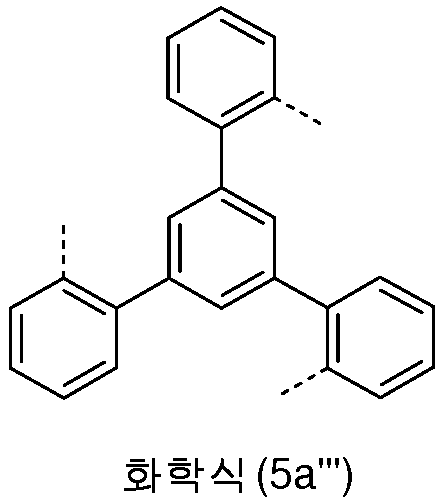
여기서 기호는 위에 주어진 정의를 갖는다.where the symbol has the definition given above.
두자리 모노음이온성 서브-리간드 L에 대한 설명이 뒤따른다. 서브-리간드 L은 동일하거나 상이할 수 있다. 여기서, 동일한 금속 M에 배위하는 2 개의 서브-리간드 L이 각각 동일하고 또한 동일한 치환도를 갖는 경우가 바람직하다. 이러한 선호에 대한 이유는 상응하는 리간드의 보다 간단한 합성이다. A description of the bidentate monoanionic sub-ligand L follows. The sub-ligands L may be the same or different. Here, it is preferable that the two sub-ligands L coordinating to the same metal M are respectively the same and have the same degree of substitution. The reason for this preference is the simpler synthesis of the corresponding ligand.
추가의 바람직한 실시형태에서, 4 개 모두의 두자리 서브-리간드 L은 동일하고 또한 동일한 치환도를 갖는다. In a further preferred embodiment, all four bidentate sub-ligands L are identical and have the same degree of substitution.
본 발명의 추가의 바람직한 실시형태에서, 두자리 서브-리간드 L의 배위 원자는 각각의 경우에 동일하거나 상이하게 C, N, P, O, S 및/또는 B, 보다 바람직하게는 C, N 및/또는 O, 및 가장 바람직하게는 C 및/또는 N으로부터 선택된다. 이들 두자리 서브-리간드 L은 바람직하게는 하나의 탄소 원자 및 하나의 질소 원자 또는 2 개의 탄소 원자 또는 2 개의 질소 원자 또는 2 개의 산소 원자 또는 하나의 산소 원자 및 하나의 질소 원자를 배위 원자로 갖는다. 이 경우, 각각의 서브-리간드 L의 배위 원자는 동일할 수 있거나, 또는 상이할 수 있다. 바람직하게, 동일한 금속 M에 배위하는 2 개의 두자리 서브-리간드 L 중 적어도 하나는 배위 원자로서 하나의 탄소 원자 및 하나의 질소 원자 또는 2 개의 탄소 원자, 특히 하나의 탄소 원자 및 하나의 질소 원자를 갖는다. 보다 바람직하게는, 적어도 모든 두자리 서브-리간드는 배위 원자로서 하나의 탄소 원자 및 하나의 질소 원자 또는 2 개의 탄소 원자, 특히 하나의 탄소 원자 및 하나의 질소 원자를 갖는다. 따라서, 모든 서브-리간드가 오르토-금속화된 금속 착물, 즉 적어도 하나의 금속-탄소 결합이 존재하는 금속 M과 메탈라사이클 (metallacycle) 을 형성하는 금속 착물이 특히 바람직하다. In a further preferred embodiment of the invention, the coordinating atoms of the bidentate sub-ligand L are in each case identically or differently C, N, P, O, S and/or B, more preferably C, N and/or B. or O, and most preferably C and/or N. These bidentate sub-ligands L preferably have one carbon atom and one nitrogen atom or two carbon atoms or two nitrogen atoms or two oxygen atoms or one oxygen atom and one nitrogen atom as coordinating atoms. In this case, the coordinating atoms of each sub-ligand L may be the same or different. Preferably, at least one of the two bidentate sub-ligands L coordinating to the same metal M has as coordinating atoms one carbon atom and one nitrogen atom or two carbon atoms, in particular one carbon atom and one nitrogen atom. . More preferably, at least all bidentate sub-ligands have one carbon atom and one nitrogen atom or two carbon atoms, in particular one carbon atom and one nitrogen atom, as coordinating atoms. Accordingly, metal complexes in which all sub-ligands are ortho-metallated, ie metal complexes forming a metallacycle with a metal M in which at least one metal-carbon bond is present, are particularly preferred.
금속 M 및 두자리 서브-리간드 L 로부터 형성되는 메탈라사이클이 5원 고리인 경우가 더욱 바람직하며, 배위 원자가 C 및 N, N 및 N 또는 N 및 O 인 경우가 특히 바람직하다. 배위 원자가 O 인 경우, 6원 메탈라사이클 고리가 또한 바람직할 수 있다. 이것은 이하에 개략적으로 도시된다:It is more preferable when the metallacycle formed from the metal M and the bidentate sub-ligand L is a 5-membered ring, and it is particularly preferable when the coordinating atoms are C and N, N and N or N and O. When the coordinating atom is O, a 6-membered metallacyclic ring may also be preferred. This is schematically shown below:

여기서 N 은 배위 질소 원자이고, C 는 배위 탄소 원자이고, 그리고 O 는 배위 산소 원자를 나타내고, 도시된 탄소 원자는 두자리 서브-리간드 L 의 원자이다. wherein N is a coordinating nitrogen atom, C is a coordinating carbon atom, and O represents a coordinating oxygen atom, and the carbon atoms shown are those of the bidentate sub-ligand L.
본 발명의 바람직한 실시형태에서, 금속 M 당 두자리 서브-리간드 L의 적어도 하나, 보다 바람직하게는 모든 두자리 서브-리간드는 각각의 경우에 동일하거나 상이하고, 하기 화학식 (L-1), (L-2) 및 (L-3) 의 구조로부터 선택된다:In a preferred embodiment of the present invention, at least one, more preferably all of the bidentate sub-ligands L per metal M are identical or different in each case and are of the formulas (L-1), (L- 2) and structures of (L-3):

여기서 점선 결합은 서브-리간드 L의 화학식 (2) 또는 (3) 의 기에 대한 결합을 나타내거나 또는 바람직한 실시형태 및 사용된 다른 기호는 다음과 같다:The dotted line bond here represents a bond to a group of formula (2) or (3) of sub-ligand L or preferred embodiments and other symbols used are as follows:
CyC 는 각각의 경우에 동일하거나 상이하며, 5 내지 14 개의 방향족 고리 원자를 갖고 탄소 원자를 통해 M에 배위하며, 그리고 공유 결합을 통해 CyD 에 결합되는, 치환 또는 비치환 아릴 또는 헤테로아릴기이고; CyC is the same or different at each occurrence, a substituted or unsubstituted aryl or heteroaryl group having 5 to 14 aromatic ring atoms, coordinating to M via a carbon atom, and bonded to CyD via a covalent bond;
CyD 는 각각의 경우에 동일하거나 상이하며, 5 내지 14 개의 방향족 고리 원자를 갖고 질소 원자를 통해 또는 카르벤 탄소 원자를 통해 M에 배위하며, 그리고 공유 결합을 통해 CyC 에 결합되는, 치환 또는 비치환 헤테로아릴기이고;CyD is the same or different in each case, has 5 to 14 aromatic ring atoms, coordinates to M through a nitrogen atom or through a carbene carbon atom, and is bonded to CyC through a covalent bond, substituted or unsubstituted a heteroaryl group;
동시에, 2 개 이상의 임의의 치환기는 함께 고리계를 형성할 수 있고; 또한, 임의의 라디칼은 바람직하게는 상기 언급한 R 라디칼로부터 선택된다.At the same time, two or more optional substituents together may form a ring system; Also, the optional radical is preferably selected from the aforementioned R radicals.
동시에, 화학식 (L-1) 및 (L-2)의 서브-리간드에서의 CyD는 바람직하게는 비하전된 질소 원자를 통해 또는 카르벤 탄소 원자를 통해 배위하고, 특히 비하전된 질소 원자를 통해 배위한다. 더욱 바람직하게는, 화학식 (L-3)의 리간드 중 2 개의 CyD 기 중 하나는 비하전된 질소 원자를 통해 배위하고, 다른 2 개의 CyD 기는 음이온성 질소 원자를 통해 배위한다. 더욱 바람직하게는, 화학식 (L-1) 및 (L-2)의 서브-리간드에서의 CyC는 음이온성 탄소 원자를 통해 배위한다.At the same time, CyD in the sub-ligands of formulas (L-1) and (L-2) preferably coordinates via an uncharged nitrogen atom or via a carbene carbon atom, in particular via an uncharged nitrogen atom. stomach More preferably, one of the two CyD groups of the ligand of formula (L-3) coordinates through an uncharged nitrogen atom and the other two CyD groups coordinate through an anionic nitrogen atom. More preferably, CyC in the sub-ligands of formula (L-1) and (L-2) coordinates via an anionic carbon atom.
2 개 이상의 치환기, 특히 2 개 이상의 R 라디칼이 함께 고리계를 형성하는 경우, 직접 인접한 탄소 원자에 결합되는 치환기로부터 고리계의 형성이 가능하다. 게다가, 화학식 (L-1) 및 화학식 (L-2) 에서 CyC 및 CyD 상의 치환기 또는 화학식 (L-3) 에서 2 개의 CyD 기 상의 치환기가 함께 고리를 형성하여, 그 결과 CyC 및 CyD 또는 2 개의 CyD 기가 함께 또한 단일 축합된 아릴 또는 헤테로아릴기를 두자리 리간드로서 형성할 수 있는 경우가 또한 가능하다.When two or more substituents, especially two or more R radicals together form a ring system, formation of a ring system is possible from substituents bonded to directly adjacent carbon atoms. Furthermore, substituents on CyC and CyD in formula (L-1) and formula (L-2) or substituents on two CyD groups in formula (L-3) form a ring together, so that CyC and CyD or two It is also possible that the CyD groups together can also form mono-condensed aryl or heteroaryl groups as bidentate ligands.
본 발명의 바람직한 실시형태에서, CyC 는 6 내지 13 개의 방향족 고리 원자를 갖는, 보다 바람직하게는 6 내지 10 개의 방향족 고리 원자를 갖는, 가장 바람직하게는 6 개의 방향족 고리 원자를 갖는 아릴 또는 헤테로아릴기이며, 특히 페닐기이며, 이들은 금속에 탄소 원자를 통해 배위되고, 하나 이상의 R 라디칼로 치환될 수 있고, 공유 결합을 통해 CyD에 결합된다. In a preferred embodiment of the present invention, CyC is an aryl or heteroaryl group having 6 to 13 aromatic ring atoms, more preferably having 6 to 10 aromatic ring atoms, most preferably having 6 aromatic ring atoms , in particular phenyl groups, which are coordinated to the metal through a carbon atom, may be substituted with one or more R radicals, and are bonded to CyD via a covalent bond.
CyC 기의 바람직한 실시형태는 하기 화학식 (CyC-1) 내지 (CyC-20)의 구조이다: Preferred embodiments of CyC groups are structures of formulas (CyC-1) to (CyC-20):

CyC 가 각각의 경우에 #로 표시된 CyD의 위치에 결합하고 *로 표시된 위치의 금속에 배위하며, R은 위에 주어진 정의를 가지며 사용되는 추가 기호는 다음과 같다:Where CyC binds to the position of CyD indicated by # in each case and coordinates to the metal at the position indicated by *, R has the definition given above and the additional symbols used are:
X 는 각각의 경우 동일하거나 상이하고, CR 또는 N 이며, 다만 환당 2 개 이하의 기호 X는 N 이고;X is the same or different at each occurrence and is CR or N, provided that at most two symbols X per ring are N;
W 는 NR, O 또는 S이고;W is NR, O or S;
다만, 서브-리간드 L이 화학식 (2) 또는 (3)의 기 내에서 CyC를 통해 결합되는 경우, 하나의 기호 X는 C이고, 화학식 (2) 또는 (3) 의 브릿지 또는 바람직한 실시형태는 이 탄소 원자에 결합된다. 서브-리간드 L이 CyC기를 통해 화학식 (2) 또는 (3)의 기에 결합되는 경우, 상기에 나타낸 화학식에서 "o"로 표시된 위치를 통한 결합이 바람직하고, 그 경우 "o"로 표시한 기호 X는 바람직하게 C이다. "o"로 표시한 어떠한 기호 X도 포함하지 않는 상술한 구조는 바람직하게 화학식 (2) 또는 (3)의 기에 결합되지 않는데, 그 이유는 이 브릿지에 대한 결합은 입체적인 이유로 유리하지 않기 때문이다. However, when the sub-ligand L is bonded via CyC within the group of formula (2) or (3), one symbol X is C, and a bridge or preferred embodiment of formula (2) or (3) is bonded to carbon atoms. When the sub-ligand L is bonded to a group of formula (2) or (3) through a CyC group, the bond through the position indicated by "o" in the formula shown above is preferred, in which case the symbol X indicated by "o" is preferably C. The structure described above, which does not contain any symbol X, denoted by "o", is preferably not bonded to a group of formula (2) or (3), since bonding to this bridge is not favorable for steric reasons.
바람직하게는, CyC의 2 개 이하의 기호 X의 총합은 N이고, 보다 바람직하게는 CyC의 1 개 이하의 기호 X는 N이고, 가장 바람직하게는 모든 기호 X는 CR이며, 다만 CyC가 화학식 (2) 또는 (3)의 기 내에서 직접 결합되는 경우 하나의 기호 X는 C이며, 화학식 (2) 또는 (3) 또는 바람직한 실시형태의 브릿지는 이 탄소 원자에 결합된다.Preferably, the sum of at most two symbols X of CyC is N, more preferably at most one symbol X of CyC is N, and most preferably all symbols X are CR, provided that CyC has the formula ( One symbol X is C when bonded directly within the group of 2) or (3), and the bridge of formula (2) or (3) or a preferred embodiment is bonded to this carbon atom.
특히 바람직한 CyC 기는 하기 화학식 (CyC-1a) 내지 (CyC-20a)의 기이다:Particularly preferred CyC groups are those of the formulas (CyC-1a) to (CyC-20a):


여기서 기호는 상기에 주어진 정의를 가지며, CyC가 화학식 (2) 또는 (3) 의 기 내에서 직접 결합되는 경우, 하나의 R 라디칼은 존재하지 않고 화학식 (2) 또는 (3) 또는 바람직한 실시형태의 기는 상응하는 탄소 원자에 결합된다. CyC 기가 화학식 (2) 또는 (3)의 기에 직접 결합되는 경우, 결합은 바람직하게는 상기에 나타낸 화학식에서 "o"로 표시되는 위치를 통한 것이고, 따라서 이 경우 이 위치에서의 R 라디칼은 존재하지 않는 것이 바람직하다. "o"로 표시된 임의의 탄소 원자를 함유하지 않는 상술한 구조는 바람직하게는 화학식 (2) 또는 (3) 의 기에 직접 결합되지 않는다. wherein the symbol has the definition given above, and when CyC is bonded directly within a group of formula (2) or (3), one R radical is not present and the formula (2) or (3) or a preferred embodiment A group is bonded to the corresponding carbon atom. When the CyC group is bonded directly to the group of formula (2) or (3), the bond is preferably through the position indicated by "o" in the formula shown above, so in this case the R radical at this position is not present It is preferable not to The above-mentioned structure not containing any carbon atom denoted by "o" is preferably not directly bonded to a group of formula (2) or (3).
(CyC-1) 내지 (CyC-20) 기 중에서 바람직한 기는 (CyC-1), (CyC-3), (CyC-8), (CyC-10), (CyC-12), (CyC-13) 및 (CyC-16) 기이고, 특히 바람직한 것은 (CyC-1a), (CyC-3a), (CyC-8a), (CyC-10a), (CyC-12a), (CyC-13a) 및 (CyC-16a) 기이다. Among the groups (CyC-1) to (CyC-20), preferred groups are (CyC-1), (CyC-3), (CyC-8), (CyC-10), (CyC-12), (CyC-13) and (CyC-16) groups, particularly preferred are (CyC-1a), (CyC-3a), (CyC-8a), (CyC-10a), (CyC-12a), (CyC-13a) and (CyC-13a). -16a) It is a group.
본 발명의 추가의 바람직한 구현예에서, CyD 는 5 내지 13 개의 방향족 고리 원자를 갖는, 보다 바람직하게는 6 내지 10 개의 방향족 고리 원자를 갖는 헤테로아릴기이고, 이들은 비하전된 질소 원자를 통해 금속에 배위하고 하나 이상의 R 라디칼에 의해 치환될 수 있고 또는 카르벤 탄소 원자를 통해 배위될 수 있고, 하나 이상의 라디칼 R 로 치환될 수 있고, CyC 에 공유 결합을 통해 결합된다. In a further preferred embodiment of the present invention, CyD is a heteroaryl group having 5 to 13 aromatic ring atoms, more preferably 6 to 10 aromatic ring atoms, which are attached to the metal via an uncharged nitrogen atom. and may be substituted by one or more R radicals or coordinated through a carbene carbon atom, substituted with one or more radicals R , and bonded to CyC via a covalent bond.
CyD 기의 바람직한 실시형태는 하기 화학식 (CyD-1) 내지 (CyD-14)의 구조이다: Preferred embodiments of CyD groups are structures of formulas (CyD-1) to (CyD-14):

CyD 기가 각각의 경우에 #로 표시된 위치에서 CyC에 결합하고 *로 표시된 위치에서 금속에 배위하는 경우, 그리고 X, W 및 R이 상기에 주어진 정의를 가지는 경우, 다만 CyD가 화학식 (2) 또는 (3) 의 기 내에서 직접 결합되지 않는 경우, 하나의 기호 X는 C이고 화학식 (2) 또는 (3) 또는 바람직한 실시형태의 브릿지는 이 탄소 원자에 결합된다. CyD 기가 화학식 (2) 또는 (3)의 기에 직접 결합되는 경우, 결합은 바람직하게는 상기 화학식에서 "o"로 표시되는 위치를 통한 것이고, 그래서 "o"로 표시된 기호 X는 그 경우 C 인 것이 바람직하다. "o"로 표시한 어떠한 기호 X도 포함하지 않는 상술한 구조는 바람직하게 화학식 (2) 또는 (3)의 기에 결합되지 않는데, 그 이유는 이 브릿지에 대한 결합은 입체적인 이유로 유리하지 않기 때문이다. When the CyD group bonds to CyC at the position indicated by # in each case and coordinates to the metal at the position indicated by *, and X, W and R have the definitions given above, provided that CyD is represented by formula (2) or ( If not directly bonded within the group of 3), one symbol X is C and the bridge of formula (2) or (3) or a preferred embodiment is bonded to this carbon atom. When the CyD group is bonded directly to a group of formula (2) or (3), the bond is preferably through a position represented by "o" in the above formula, so that the symbol X represented by "o" is C in that case. desirable. The structure described above, which does not contain any symbol X, denoted by "o", is preferably not bonded to a group of formula (2) or (3), since bonding to this bridge is not favorable for steric reasons.
이 경우, (CyD-1) 내지 (CyD-4), (CyD-7) 내지 (CyD-10), (CyD-13) 및 (CyD-14) 기는 비하전된 질소 원자를 통해 금속에 배위하고, 그리고 (CyD-5) 및 (CyD-6) 기는 카르벤 탄소 원자를 통해 및 (CyD-11) 및 (CyD-12) 기는 음이온성 질소 원자를 통해 배위한다.In this case, the (CyD-1) to (CyD-4), (CyD-7) to (CyD-10), (CyD-13) and (CyD-14) groups coordinate to the metal via an uncharged nitrogen atom and , and the (CyD-5) and (CyD-6) groups coordinate through a carbene carbon atom and the (CyD-11) and (CyD-12) groups through an anionic nitrogen atom.
바람직하게는, CyD의 2 개 이하의 기호 X의 총합은 N이고, 보다 바람직하게는 CyD의 1 개 이하의 기호 X는 N이고, 특히 바람직하게는 모든 기호 X는 CR이며, 다만 CyD가 화학식 (2) 또는 (3)의 기 내에서 직접 결합되는 경우 하나의 기호 X는 C이며, 화학식 (2) 또는 (3) 또는 바람직한 실시형태의 브릿지는 이 탄소 원자에 결합된다. Preferably, the sum of at most two symbols X of CyD is N, more preferably at most one symbol X of CyD is N, and particularly preferably all symbols X are CR, provided that CyD is of the formula ( One symbol X is C when bonded directly within the group of 2) or (3), and the bridge of formula (2) or (3) or a preferred embodiment is bonded to this carbon atom.
특히 바람직한 CyD 기는 하기 화학식 (CyD-1a) 내지 (CyD-14b)의 기이다:Particularly preferred CyD groups are those of the formulas (CyD-1a) to (CyD-14b):

여기서 사용된 기호는 상기에 주어진 정의를 가지며, CyD가 화학식 (2) 또는 (3) 의 기 내에서 직접 결합되는 경우, 하나의 R 라디칼은 존재하지 않고 화학식 (2) 또는 (3) 또는 바람직한 실시형태의 브릿지는 상응하는 탄소 원자에 결합된다. CyD 기가 화학식 (2) 또는 (3)의 기에 직접 결합되는 경우, 결합은 바람직하게는 상기에 나타낸 화학식에서 "o"로 표시되는 위치를 통한 것이고, 따라서 그 경우 이 위치에서의 R 라디칼은 존재하지 않는 것이 바람직하다. "o"로 표시된 임의의 탄소 원자를 함유하지 않는 상술한 구조는 바람직하게는 화학식 (2) 또는 (3) 의 기에 직접 결합되지 않는다. The symbols used herein have the definitions given above, and when CyD is bonded directly within a group of formula (2) or (3), one R radical is not present and formula (2) or (3) or a preferred embodiment A bridge of the form is bonded to the corresponding carbon atom. When the CyD group is bonded directly to a group of formula (2) or (3), the bond is preferably through the position represented by "o" in the formulas shown above, so in that case the R radical at this position is not present It is preferable not to The above-mentioned structure not containing any carbon atom denoted by "o" is preferably not directly bonded to a group of formula (2) or (3).
(CyD-1) 내지 (CyD-14) 기 중에서 바람직한 기는 (CyD-1), (CyD-2), (CyD-3), (CyD-4), (CyD-5) 및 (CyD-6) 기이고, 특히 (CyD-1), (CyD-2) 및 (CyD-3) 이고, 특히 바람직한 것은 (CyD-1a), (CyD-2a), (CyD-3a), (CyD-4a), (CyD-5a) 및 (CyD-6a) 기이고, 특히 (CyD-1a), (CyD-2a) 및 (CyD-3a) 이다.Among the groups (CyD-1) to (CyD-14), preferred groups are (CyD-1), (CyD-2), (CyD-3), (CyD-4), (CyD-5) and (CyD-6) groups, especially (CyD-1), (CyD-2) and (CyD-3), particularly preferred are (CyD-1a), (CyD-2a), (CyD-3a), (CyD-4a), (CyD-5a) and (CyD-6a) groups, in particular (CyD-1a), (CyD-2a) and (CyD-3a).
본 발명의 바람직한 실시형태에서, CyC는 6 내지 13 개의 방향족 고리 원자를 갖는 아릴 또는 헤테로아릴기이며, 동시에 CyD는 5 내지 13 개의 방향족 고리 원자를 갖는 헤테로아릴기이다. 보다 바람직하게, CyC는 6 내지 10 개의 방향족 고리 원자를 갖는 아릴 또는 헤테로아릴기이며, 동시에 CyD는 5 내지 10 개의 방향족 고리 원자를 갖는 헤테로아릴기이다. 가장 바람직하게, CyC는 6 개의 방향족 고리 원자, 특히 페닐을 갖는 아릴 또는 헤테로아릴기이고, CyD는 6 내지 10 개의 방향족 고리 원자를 갖는 헤테로아릴 기이다. 동시에, CyC 및 CyD는 하나 이상의 R 라디칼로 치환될 수 있다.In a preferred embodiment of the present invention, CyC is an aryl or heteroaryl group having 6 to 13 aromatic ring atoms, while CyD is a heteroaryl group having 5 to 13 aromatic ring atoms. More preferably, CyC is an aryl or heteroaryl group having 6 to 10 aromatic ring atoms, while CyD is a heteroaryl group having 5 to 10 aromatic ring atoms. Most preferably, CyC is an aryl or heteroaryl group having 6 aromatic ring atoms, especially phenyl, and CyD is a heteroaryl group having 6 to 10 aromatic ring atoms. At the same time, CyC and CyD may be substituted with one or more R radicals.
상기 바람직한 (CyC-1) 내지 (CyC-20) 및 (CyD-1) 내지 (CyD-14) 기는 화학식 (L-1) 및 (L-2)의 서브-리간드에서 원하는대로 서로 조합될 수 있고, 다만 CyC 또는 CyD 기 중 적어도 하나는 화학식 (2) 또는 (3) 의 기에 대한 적합한 부착 부위를 가지며, 적합한 부착 부위는 상기에 주어진 화학식에서 "o"로 표시된다. 위에서 특히 바람직한 것으로 지정된 CyC 및 CyD 기, 즉 화학식 (CyC-1a) 내지 (CyC-20a) 의 기 및 화학식 (CyD-1a) 내지 (CyD-14b) 의 기가 서로 조합되는 경우가 특히 바람직하며, 다만 바람직한 CyC 또는 CyD 기 중 적어도 하나는 화학식 (2) 또는 (3) 의 기에 대한 적합한 부착 부위를 가지며, 적합한 부착 부위는 상기에 주어진 화학식에서 "o" 로 지정된다. 따라서, CyC 도 CyD도 화학식 (2) 또는 (3) 의 브릿지에 적합한 부착 부위를 갖지 않는 조합은 바람직하지 않다. The preferred (CyC-1) to (CyC-20) and (CyD-1) to (CyD-14) groups may be combined with each other as desired in the sub-ligands of formulas (L-1) and (L-2), , provided that at least one of the CyC or CyD groups has a suitable attachment site to a group of formula (2) or (3), the suitable attachment site being indicated by "o" in the formulas given above. Particular preference is given to the CyC and CyD groups designated as particularly preferred above, i.e. groups of formulas (CyC-1a) to (CyC-20a) and groups of formulas (CyD-1a) to (CyD-14b) in combination with each other, provided that At least one of the preferred CyC or CyD groups has a suitable attachment site for a group of formula (2) or (3), the suitable attachment site being designated as "o" in the formula given above. Accordingly, a combination in which neither CyC nor CyD has a suitable attachment site for a bridge of formula (2) or (3) is undesirable.
(CyC-1), (CyC-3), (CyC-8), (CyC-10), (CyC-12), (CyC-13) 및 (CyC-16) 기, 특히 (CyC-1a), (CyC-3a), (CyC-8a), (CyC-10a), (CyC-12a), (CyC-13a) 및 (CyC-16a) 기 중 하나가, (CyD-1), (CyD-2) 및 (CyD-3) 기 중 하나와, 특히 (CyD-1a), (CyD-2a) 및 (CyD-3a) 기 중 하나와 조합되는 경우가 매우 특히 바람직하다.(CyC-1), (CyC-3), (CyC-8), (CyC-10), (CyC-12), (CyC-13) and (CyC-16) groups, in particular (CyC-1a), (CyC-3a), (CyC-8a), (CyC-10a), (CyC-12a), (CyC-13a) and (CyC-16a) groups, (CyD-1), (CyD-2 ) and (CyD-3), in particular with one of the (CyD-1a), (CyD-2a) and (CyD-3a) groups.
바람직한 서브-리간드 (L-1) 는 하기 화학식 (L-1-1) 및 (L-1-2)의 구조이고, 바람직한 서브-리간드 (L-2) 는 하기 화학식 (L-2-1) 내지 (L-2-3) 의 구조이다:Preferred sub-ligands (L-1) are structures of formulas (L-1-1) and (L-1-2), and preferred sub-ligands (L-2) are structures of formula (L-2-1) to (L-2-3):

여기서 사용된 기호는 상기에 주어진 정의를 가지며, *는 이리듐에 대한 배위의 위치를 나타내고, "o"는 화학식 (2) 또는 (3) 의 기에 대한 결합의 위치를 나타낸다.The symbols used herein have the definitions given above, where * represents the position of coordination to iridium and "o" represents the position of bond to the group of formula (2) or (3).
특히 바람직한 서브-리간드 (L-1) 는 하기 화학식 (L-1-1a) 및 (L-1-2b) 의 구조이고, 특히 바람직한 서브-리간드 (L-2) 는 하기 화학식 (L-2-1a) 내지 (L-2-3a) 의 구조이다:Particularly preferred sub-ligands (L-1) are structures of the following formulas (L-1-1a) and (L-1-2b), and particularly preferred sub-ligands (L-2) are structures of the following formulas (L-2- 1a) to (L-2-3a) are the structures:

사용된 기호는 위에 주어진 정의를 갖고, "o"는 화학식 (2) 또는 (3) 의 기에 대한 결합의 위치를 나타낸다.The symbols used have the definitions given above, and "o" represents the position of the bond to the group of formula (2) or (3).
마찬가지로, 화학식 (L-3) 의 서브-리간드에서의 상기 언급된 바람직한 CyD 기는, 비하전된 CyD 기, 즉 (CyD-1) 내지 (CyD-10), (CyD-13) 또는 (CyD-14) 기를, 음이온성 CyD 기, 즉 (CyD-11) 또는 (CyD-12) 기와 조합함으로써, 원하는대로 서로 조합될 수 있으며, 다만 바람직한 CyD 기 중 적어도 하나는 화학식 (2) 또는 (3) 의 기에 대한 적합한 부착 부위를 가지며, 적합한 부착 부위는 상기에 주어진 식에서 "o" 로 지정된다. Likewise, the aforementioned preferred CyD groups in the sub-ligands of formula (L-3) are uncharged CyD groups, namely (CyD-1) to (CyD-10), (CyD-13) or (CyD-14 ) group with an anionic CyD group, i.e. (CyD-11) or (CyD-12) group, can be combined with each other as desired, provided that at least one of the preferred CyD groups is a group of formula (2) or (3) and a suitable attachment site is designated as "o" in the formula given above.
2 개의 R 라디칼 (이 중 하나는 CyC 에 결합되고 다른 하나는 화학식 (L-1) 및 화학식 (L-2) 에서의 CyD 에 결합되거나 또는 이 중 하나는 하나의 CyD 기에 결합되고 다른 하나는 화학식 (L-3) 에서의 다른 CyD 기에 결합됨) 이 서로 방향족 고리계를 형성하는 경우에, 이것은 가교된 서브-리간드 및 또한 전체적으로 단일의 더 큰 헤테로아릴기, 예컨대, 벤조[h]퀴놀린 등을 나타내는 서브-리간드를 초래할 수 있다. 화학식 (L-1) 및 화학식 (L-2) 에서 CyC 및 CyD 상의 치환기 사이의 또는 화학식 (L-3) 에서 2 개의 CyD 기 상의 치환기 사이의 고리 형성은 바람직하게는 하기 화학식 (39) 내지 화학식 (48) 중 하나에 따른 기를 통해 일어난다: two R radicals, one of which is bonded to CyC and the other to CyD in formula (L-1) and formula (L-2), or one of which is bonded to one CyD group and the other to bonded to other CyD groups in (L-3)) form an aromatic ring system with each other, it forms a bridged sub-ligand and also a single larger heteroaryl group as a whole, such as benzo[h]quinoline and the like. It can result in sub-ligands that represent The ring formation between substituents on CyC and CyD in formula (L-1) and formula (L-2) or between substituents on two CyD groups in formula (L-3) is preferably through a group according to one of (48):

여기서 R1 은 상기에 주어진 정의를 갖고, 점선 결합은 CyC 또는 CyD에 대한 결합을 특정한다. 동시에, 상기 언급된 것들 중에서 비대칭적 기는 두 개의 가능한 배향의 각각에서 혼입될 수 있으며; 예를 들어 화학식 (48) 의 기의 경우에 산소 원자는 CyC 기에, 카르보닐기는 CyD 기에 결합될 수 있거나, 또는 산소 원자는 CyD 기에, 카르보닐기는 CyC 기에 결합될 수 있다.wherein R 1 has the definition given above, and the dotted line bonds specify binding to CyC or CyD. At the same time, asymmetric groups among those mentioned above may be incorporated in each of the two possible orientations; For example, in the case of a group of formula (48), an oxygen atom may be bonded to a CyC group and a carbonyl group to a CyD group, or an oxygen atom may be bonded to a CyD group and a carbonyl group to a CyC group.
동시에, 화학식 (45) 의 기는, 예를 들어, 화학식 (L-22) 및 (L-23) 에 의해 아래에 도시된 바와 같이, 6원 고리를 제공하는 고리 형성을 초래하는 경우에 특히 바람직하다. At the same time, groups of formula (45) are particularly preferred if they lead to ring formation giving a six-membered ring, as shown below by formulas (L-22) and (L-23), for example. .
상이한 환에서 2 개의 R 라디칼 사이의 고리 형성을 통해 발생하는 바람직한 리간드는 아래 도시된 화학식 (L-4) 내지 (L-31)의 구조이다:Preferred ligands that arise through ring formation between two R radicals on different rings are the structures of formulas (L-4) to (L-31) shown below:


사용된 기호는 상기에 주어진 정의를 갖고, "o"는 이 서브-리간드가 화학식 (2) 또는 (3) 의 기에 조인되는 위치를 나타낸다.The symbols used have the definitions given above, and "o" represents the position at which this sub-ligand is joined to a group of formula (2) or (3).
화학식 (L-4) 내지 화학식 (L-31) 의 서브-리간드의 바람직한 실시형태에서, 총 1 개의 기호 X 는 N 이고 다른 기호 X 는 CR 이거나, 또는 모든 기호 X 는 CR 이다.In a preferred embodiment of the sub-ligands of formula (L-4) to formula (L-31), a total of one symbol X is N and the other symbols X are CR, or all symbols X are CR.
본 발명의 추가의 실시형태에서, 기 (CyC-1) 내지 (CyC-20) 또는 (CyD-1) 내지 (CyD-14) 에서 또는 서브-리간드 (L-1-1) 내지 (L-2-3), (L-4) 내지 (L-31) 에서, 원자 X 중 하나는 N 인 것이 바람직하다 (이러한 질소에 인접하는 치환기로서 결합된 R 기가 수소 또는 중수소가 아닌 경우). 이는 바람직한 구조 (CyC-1a) 내지 (CyC-20a) 또는 (CyD-1a) 내지 (CyD-14b) 에도 유사하게 적용되며, 여기에서 비-배위 질소 원자에 인접하여 결합된 치환기는 바람직하게 수소 또는 중수소가 아닌 R 기이다. 이 경우, 이러한 치환기 R 은 바람직하게는 CF3, OR1 (여기서 R1 은 1 내지 10 개의 탄소 원자를 갖는 알킬기임), 1 내지 10 개의 탄소 원자를 갖는 알킬기, 특히 3 내지 10 개의 탄소 원자를 갖는 분지형 또는 환형 알킬기, 2 내지 10 개의 탄소 원자를 갖는 디알킬아미노기, 방향족 또는 헤테로방향족 고리계 또는 아르알킬 또는 헤테로아르알킬기로부터 선택된다. 이들 기는 입체적으로 부피가 큰 기이다. 더욱 바람직하게, 이러한 R 라디칼은 또한 인접한 R 라디칼과 환을 형성할 수도 있다. In a further embodiment of the invention, in the groups (CyC-1) to (CyC-20) or (CyD-1) to (CyD-14) or in the sub-ligands (L-1-1) to (L-2 -3), in (L-4) to (L-31), it is preferred that one of the atoms X is N (if the R group bonded as a substituent adjacent to such nitrogen is not hydrogen or deuterium). This applies analogously to the preferred structures (CyC-1a) to (CyC-20a) or (CyD-1a) to (CyD-14b), wherein the substituent bonded adjacent to the non-coordinating nitrogen atom is preferably hydrogen or It is an R group that is not deuterium. In this case, these substituents R are preferably CF 3 , OR 1 (where R 1 is an alkyl group having 1 to 10 carbon atoms), an alkyl group having 1 to 10 carbon atoms, in particular 3 to 10 carbon atoms. branched or cyclic alkyl groups having 2 to 10 carbon atoms, dialkylamino groups having 2 to 10 carbon atoms, aromatic or heteroaromatic ring systems, or aralkyl or heteroaralkyl groups. These groups are sterically bulky groups. More preferably, these R radicals may also form rings with adjacent R radicals.
추가의 적합한 두자리 서브-리간드는 하기 화학식 (L-32) 또는 (L-33)의 서브-리간드이다:A further suitable bidentate sub-ligand is a sub-ligand of formula (L-32) or (L-33):

여기서 R 은 위에 주어진 정의를 갖고, * 는 금속에 대한 배위 위치를 나타내고, "o" 는 화학식 (2) 또는 (3) 의 기에 대한 서브-리간드의 연결의 위치를 나타내며 사용된 다른 기호는 다음과 같다: where R has the definition given above, * represents the coordination position to the metal, "o" represents the position of the linkage of the sub-ligand to the group of formula (2) or (3) and the other symbols used are: same:
X 는 각각의 경우에 동일하거나 상이하며 CR 또는 N이며, 다만 환당 하나 이하의 기호 X는 N이고, 추가로 하나의 기호 X는 C이고 서브-리간드는 화학식 (2) 또는 (3) 의 기 내에서 이 탄소 원자를 통해 결합된다. X is the same or different at each occurrence and is CR or N, provided that at most one symbol X per ring is N, in addition one symbol X is C and the sub-ligand is in the group of formula (2) or (3) is bonded through this carbon atom.
서브-리간드 (L-32) 및 (L-33) 에서 인접한 탄소 원자에 결합되는 2 개의 R 라디칼이 서로 방향족 환을 형성하는 경우에, 이러한 환은 2 개의 인접한 탄소 원자와 함께 바람직하게는 하기 화학식 (49) 의 구조이다:When two R radicals bonded to adjacent carbon atoms in sub-ligands (L-32) and (L-33) form an aromatic ring with each other, these rings together with the two adjacent carbon atoms are preferably of the formula ( 49) is the structure of:

여기서 점선 결합은 서브-리간드 내에서의 이러한 기의 연결을 나타내고, Y 는 각각의 경우 동일하거나 상이하게, CR1 또는 N 이고, 바람직하게는 1 개 이하의 기호 Y 는 N 이다. 서브-리간드 (L-32) 또는 (L-33) 의 바람직한 실시형태에서, 1 개 이하의 화학식 (50) 의 기가 존재한다. 본 발명의 바람직한 실시형태에서, 화학식 (L-32 내지 (L-33) 의 서브-리간드에 있어서, 기호 X 및 존재한다면 Y의 총 0, 1 또는 2 개는 N이다. 보다 바람직하게는, 기호 X 및 존재하는 경우, Y의 총 0 또는 1 개는 N이다. The dotted bond here represents the linkage of these groups within the sub-ligand, where Y is, identically or differently, in each case CR 1 or N, preferably no more than one symbol Y is N. In a preferred embodiment of sub-ligand (L-32) or (L-33) at most one group of formula (50) is present. In a preferred embodiment of the present invention, in the sub-ligands of formula (L-32 to (L-33), the symbol X and, if present, Y in total 0, 1 or 2 are N. More preferably, the symbol A total of 0 or 1 of X and, if present, Y is N.
추가의 적합한 두자리 서브-리간드는 하기 화학식 (L-34) 내지 (L-38)의 구조이며, 바람직하게는 금속당 2 개의 두자리 서브-리간드 L 중 하나 이하가 이들 구조 중 하나이고,Further suitable bidentate sub-ligands are structures of formulas (L-34) to (L-38), preferably no more than one of the two bidentate sub-ligands L per metal is one of these structures,

서브-리간드 (L-34) 내지 (L-36) 각각이 명시적으로 도시된 질소 원자 및 음으로 하전된 산소 원자를 통해 금속에 배위하고, 서브-리간드 (L-37) 및 (L-38) 이 2 개의 산소 원자를 통해 금속에 배위하는 경우, X 는 상기에 주어진 정의를 가지며, 그리고 "o" 는 서브-리간드 L이 화학식 (2) 또는 화학식 (3) 의 기에 조인되는 위치를 나타낸다.Sub-ligands (L-34) to (L-36) each coordinate to the metal via an explicitly shown nitrogen atom and a negatively charged oxygen atom, and sub-ligands (L-37) and (L-38 ) coordinates to the metal through two oxygen atoms, X has the definition given above, and "o" represents the position at which the sub-ligand L is joined to the group of formula (2) or formula (3).
X 의 상기 언급된 바람직한 실시형태는 또한 화학식 (L-34) 내지 화학식 (L-36) 의 서브-리간드에 대해 바람직하다. The above-mentioned preferred embodiments of X are also preferred for sub-ligands of formula (L-34) to formula (L-36).
따라서, 화학식 (L-34) 내지 화학식 (L-36) 의 바람직한 서브-리간드는 하기 화학식 (L-34a) 내지 (L-36a) 의 서브-리간드이다:Accordingly, preferred sub-ligands of formulas (L-34) to (L-36) are those of formulas (L-34a) to (L-36a):

사용된 기호는 상기에 주어진 정의를 갖고, "o"는 이 서브-리간드 L이 화학식 (2) 또는 (3) 의 기에 조인되는 위치를 나타낸다.The symbols used have the definitions given above, and "o" represents the position at which this sub-ligand L is joined to a group of formula (2) or (3).
보다 바람직하게는, 이들 식에서, R은 수소이고, "o"는 화학식 (2) 또는 (3) 또는 바람직한 실시형태의 기 내에서 서브-리간드 L이 결합되는 위치를 나타내며, 그래서 구조는 하기 화학식 (L-34b) 내지 (L-36b)의 것이 바람직하다.More preferably, in these formulas, R is hydrogen and "o" represents the position to which the sub-ligand L is bonded within the group of formula (2) or (3) or a preferred embodiment, so that the structure is of the formula ( L-34b) to (L-36b) are preferred.

여기서 사용된 기호는 위에 주어진 정의를 갖는다.The symbols used herein have the definitions given above.
상술한 서브-리간드뿐만 아니라 A (A가 화학식 (4) 의 기인 경우) 에도 존재할 수도 있는 바람직한 치환기의 설명이 뒤따른다. A description follows of preferred substituents which may be present in A (when A is a group of formula (4)) as well as in the sub-ligands described above.
본 발명의 바람직한 실시형태에서, 본 발명의 화합물은 인접한 탄소 원자에 결합되어 함께 후술되는 화학식 중 하나에 따른 지방족 고리를 형성하는, 2 개의 R 치환기를 함유한다. 이 경우, 이 지방족 고리를 형성하는 2 개의 R 치환기는 화학식 (2) 또는 화학식 (3) 또는 바람직한 실시형태의 브릿지 상에 및/또는 하나 이상의 두자리 서브-리간드 L 상에 존재할 수 있다. 2 개의 R 치환기에 의해 함께 고리 형성에 의해 형성되는 지방족 고리는 바람직하게 하기 화학식 (50) 내지 화학식 (56) 중 하나에 의해 기재된다: In a preferred embodiment of the present invention, the compounds of the present invention contain two R substituents, bonded to adjacent carbon atoms, together forming an aliphatic ring according to one of the formulas described below. In this case, the two R substituents forming this aliphatic ring may be present on formula (2) or formula (3) or on the bridge of preferred embodiments and/or on one or more bidentate sub-ligands L. An aliphatic ring formed by ringing together by two R substituents is preferably represented by one of formulas (50) to (56):

여기서 R1 및 R2 는 위에서 주어진 정의를 가지며, 점선 결합은 리간드의 두 탄소 원자의 연결을 특정하며, 또한:wherein R 1 and R 2 have the definitions given above, the dotted bond specifies the connection of the two carbon atoms of the ligand, and also:
Z1, Z3 은 각각의 경우 동일하거나 상이하게 C(R3)2, O, S, NR3 또는 C(=O) 이고;Z 1 , Z 3 are at each occurrence identically or differently C(R 3 ) 2 , O, S, NR 3 or C(=0);
Z2 는 C(R1)2, O, S, NR3 또는 C(=O) 이고;Z 2 is C(R 1 ) 2 , O, S, NR 3 or C(=0);
G 는 1, 2 또는 3 개의 탄소 원자를 가지며 하나 이상의 R2 라디칼, -CR2=CR2- 또는 5 내지 14 개의 방향족 고리 원자를 가지며 하나 이상의 R2 라디칼들에 의해 치환될 수 있는 오르토 결합된 아릴렌 또는 헤테로아릴렌기로 치환될 수 있는 알킬렌기이고; G has 1, 2 or 3 carbon atoms and has one or more R 2 radicals, -CR 2 =CR 2 - or an ortho bonded group having 5 to 14 aromatic ring atoms and which may be substituted by one or more R 2 radicals. an alkylene group which may be substituted with an arylene or heteroarylene group;
R3 은 각각의 경우 동일하거나 상이하게, H, F, 1 내지 10 개의 탄소 원자를 갖는 직쇄 알킬 또는 알콕시기, 3 내지 10 개의 탄소 원자를 갖는 분지형 또는 환형 알킬 또는 알콕시기이고 (여기서 알킬 또는 알콕시기는 각각의 경우 하나 이상의 R2 라디칼에 의해 치환될 수 있고, 하나 이상의 비인접하는 CH2 기는 R2C=CR2, C≡C, Si(R2)2, C=O, NR2, O, S 또는 CONR2 로 치환될 수 있음), 5 내지 24 개의 방향족 고리 원자를 갖고 각각의 경우 하나 이상의 R2 라디칼에 의해 치환될 수 있는 방향족 또는 헤테로방향족 고리계, 또는 5 내지 24 개의 방향족 고리 원자를 갖고 각각의 경우 하나 이상의 R2 라디칼에 의해 치환될 수 있는 아릴옥시 또는 헤테로아릴옥시기이고; 동시에 동일한 탄소 원자에 함께 결합된 2 개의 R3 라디칼은 지방족 또는 방향족 고리계를 형성하여 스피로 계를 형성할 수 있고; 또한 인접한 R 또는 R1 라디칼과 R3 은 지방족 고리계를 형성할 수 있고;R 3 is, identically or differently, at each occurrence H, F, a straight-chain alkyl or alkoxy group having 1 to 10 carbon atoms, a branched or cyclic alkyl or alkoxy group having 3 to 10 carbon atoms, wherein alkyl or An alkoxy group may in each case be substituted by one or more R 2 radicals, and one or more non-adjacent CH 2 groups may be R 2 C=CR 2 , C≡C, Si(R 2 ) 2 , C=O, NR 2 , O , S or CONR 2 ), an aromatic or heteroaromatic ring system having 5 to 24 aromatic ring atoms, which in each case may be substituted by one or more R 2 radicals, or 5 to 24 aromatic ring atoms. is an aryloxy or heteroaryloxy group which may in each case be substituted by one or more R 2 radicals; Two R 3 radicals bonded together on the same carbon atom at the same time can form an aliphatic or aromatic ring system to form a spiro system; Also adjacent R or R 1 radicals and R 3 may form an aliphatic ring system;
다만 이들 기에서 어떠한 2 개의 헤테로 원자도 서로 직접 결합되지 않고 어떠한 2 개의 C=O 기도 서로 직접 결합되지 않는다.However, no two heteroatoms in these groups are directly bonded to each other, and no two C=O groups are directly bonded to each other.
본 발명의 바람직한 실시형태에서, R3은 H가 아니다. In a preferred embodiment of the present invention R 3 is not H.
화학식 (50) 내지 화학식 (56) 의 전술한 구조 및 바람직한 것으로 특정된 이들 구조의 추가 실시형태에서, 이중 결합은 2 개의 탄소 원자 사이에서 형식적으로 도시된다. 이것은 이들 2 개의 탄소 원자가 방향족 또는 헤테로방향족 계에 혼입되어 이 2 개의 탄소 원자 사이의 결합이 단일 결합의 결합 수준과 이중 결합의 결합 수준 사이에서 형식적으로 존재하는 경우 화학 구조를 단순화한 것이다. 따라서 형식적인 이중 결합의 묘사는 구조를 제한하도록 해석되어서는 안되며; 대신에, 이것이 방향족 결합이라는 것이 당업자에게 명백할 것이다. In the aforementioned structures of formulas (50) to (56) and further embodiments of these structures specified as preferred, a double bond is formally depicted between two carbon atoms. This is a simplified chemical structure where these two carbon atoms are incorporated into an aromatic or heteroaromatic system so that the bond between these two carbon atoms formally exists between the bonding level of a single bond and that of a double bond. Therefore, the depiction of a formal double bond should not be construed as limiting the structure; Instead, it will be clear to those skilled in the art that it is an aromatic bond.
본 발명의 구조에서의 인접한 라디칼이 지방족 고리계를 형성하는 경우, 후자가 임의의 산성 벤질성 양성자를 갖지 않는 경우가 바람직하다. 벤질성 양성자는 리간드에 직접 결합된 탄소 원자에 결합하는 양성자를 의미하는 것으로 이해된다. 이는 완전히 치환되고 임의의 결합된 수소 원자를 함유하지 않는 아릴 또는 헤테로아릴기에 직접 결합하는 지방족 고리계의 탄소 원자에 의해 달성될 수 있다. 따라서, 화학식 (50) 내지 화학식 (52) 에서 산성 벤질성 양성자의 부재는 Z1 및 Z3 이 C(R3)2 일 때 R3 이 수소가 아니도록 정의됨으로써 Z1 및 Z3 에 의해 달성된다. 이는 또한 이환 또는 다환 구조의 다리목 (bridgehead) 인 아릴 또는 헤테로아릴기에 직접 결합하는 지방족 고리계의 탄소 원자에 의해 달성될 수 있다. 다리목 탄소 원자에 결합된 양성자는 이환 또는 다환의 공간 구조 때문에 이환 또는 다환 구조 내에서 결합되지 않은 탄소 원자 상의 벤질성 양성자보다 상당히 산성이 낮으며 본 발명의 문맥에서 비산성 양성자로 간주된다. 따라서, 화학식 (53) 내지 화학식 (56) 에서 산성 벤질성 양성자의 부재는 이것이 이환 구조인 것에 의해 달성되므로, 그 결과 R1 이 H 일 때 R1 은 벤질성 양성자보다 훨씬 덜 산성이며, 그 이유는 이환 구조의 상응하는 음이온이 메소머로 안정화되지 않기 때문이다. 따라서, 화학식 (53) 내지 화학식 (56) 중의 R1 이 H 인 경우에도, 이것은 본원의 문맥에서 비산성 양성자이다. When adjacent radicals in the structure of the present invention form an aliphatic ring system, it is preferred if the latter does not have any acidic benzylic protons. A benzylic proton is understood to mean a proton that binds to a carbon atom directly bonded to the ligand. This can be achieved by the carbon atom of the aliphatic ring system directly bonded to an aryl or heteroaryl group that is fully substituted and does not contain any bonded hydrogen atoms. Thus, the absence of acidic benzylic protons in Formulas (50)-(52) is achieved by Z 1 and Z 3 by defining that R 3 is not hydrogen when Z 1 and Z 3 are C(R 3 ) 2 . do. This can also be achieved by the carbon atom of the aliphatic ring system directly bonded to the aryl or heteroaryl group that is the bridgehead of the bicyclic or polycyclic structure. A proton bonded to a bridge neck carbon atom is significantly less acidic than a benzylic proton on a carbon atom not bonded within the bicyclic or polycyclic structure because of the bicyclic or polycyclic spatial structure and is considered a non-acidic proton in the context of the present invention. Thus, the absence of acidic benzylic protons in formulas (53) to (56) is achieved by being a bicyclic structure, so that when R 1 is H, R 1 is much less acidic than benzylic protons, because is because the corresponding anion of the bicyclic structure is not mesomerically stabilized. Accordingly, even when R 1 in formulas (53) to (56) is H, it is a non-acidic proton in the context of the present application.
화학식 (50) 내지 화학식 (56) 의 구조의 바람직한 실시형태에서, Z1, Z2 및 Z3 기 중 하나 이하는 헤테로원자이고, 특히 O 또는 NR3 이고, 다른 기는 C(R3)2 또는 C(R1)2이거나, 또는 Z1 및 Z3 은 각각의 경우 동일하거나 상이하게 O 또는 NR3 이고 Z2 는 C(R1)2 이다. 본 발명의 특히 바람직한 실시형태에서, Z1 및 Z3 은 각각의 경우 동일하거나 상이하게 C(R3)2 이고, Z2 는 C(R1)2 이고 보다 바람직하게는 C(R3)2 또는 CH2 이다. In a preferred embodiment of structures of formula (50) to formula (56), at most one of the Z 1 , Z 2 and Z 3 groups is a heteroatom, in particular O or NR 3 , and the other group is C(R 3 ) 2 or C(R 1 ) 2 , or Z 1 and Z 3 are in each case identically or differently O or NR 3 and Z 2 is C(R 1 ) 2 . In a particularly preferred embodiment of the invention, Z 1 and Z 3 are at each occurrence, identically or differently, C(R 3 ) 2 , Z 2 is C(R 1 ) 2 and more preferably C(R 3 ) 2 or CH 2 .
따라서, 화학식 (50) 의 바람직한 실시형태는 화학식 (50-A), 화학식 (50-B), 화학식 (50-C) 및 화학식 (50-D) 의 구조이고, 화학식 (50-A) 의 특히 바람직한 실시형태는 화학식 (50-E) 및 화학식 (50-F)의 구조이다:Thus, preferred embodiments of formula (50) are structures of formula (50-A), formula (50-B), formula (50-C) and formula (50-D), and in particular of formula (50-A) Preferred embodiments are structures of formula (50-E) and formula (50-F):

여기서 R1 및 R3 은 위에 주어진 정의를 가지며 Z1, Z2 및 Z3 은 각각의 경우 동일하거나 상이하게 O 또는 NR3 이다.wherein R 1 and R 3 have the definitions given above and Z 1 , Z 2 and Z 3 are in each case identically or differently O or NR 3 .
화학식 (51) 의 바람직한 실시형태는 하기 화학식 (51-A) 내지 (51-F) 의 구조이다:Preferred embodiments of formula (51) are structures of formulas (51-A) to (51-F):

여기서 R1 및 R3 은 위에 주어진 정의를 가지며 Z1, Z2 및 Z3 은 각각의 경우 동일하거나 상이하게 O 또는 NR3 이다.wherein R 1 and R 3 have the definitions given above and Z 1 , Z 2 and Z 3 are in each case identically or differently O or NR 3 .
화학식 (52) 의 바람직한 실시형태는 하기 화학식 (52-A) 내지 (52-E) 의 구조이다:Preferred embodiments of formula (52) are structures of formulas (52-A) to (52-E):

여기서 R1 및 R3 은 위에 주어진 정의를 가지며 Z1, Z2 및 Z3 은 각각의 경우 동일하거나 상이하게 O 또는 NR3 이다.wherein R 1 and R 3 have the definitions given above and Z 1 , Z 2 and Z 3 are in each case identically or differently O or NR 3 .
화학식 (53)의 구조의 바람직한 실시형태에서, 다리목에 결합된 라디칼 R1 은 H, D, F 또는 CH3 이다. 더욱 바람직하게는, Z2 는 C(R1)2 또는 O이고, 보다 바람직하게는 C(R3)2 이다. 따라서, 화학식 (53) 의 바람직한 실시형태는 화학식 (53-A) 및 화학식 (53-B) 의 구조이고, 화학식 (53-A) 의 특히 바람직한 실시형태는 화학식 (53-C)의 구조이다:In a preferred embodiment of the structure of formula (53), the radical R 1 bonded to the leg neck is H, D, F or CH 3 . More preferably, Z 2 is C(R 1 ) 2 or O, more preferably C(R 3 ) 2 . Thus, a preferred embodiment of formula (53) is the structure of formula (53-A) and formula (53-B), and a particularly preferred embodiment of formula (53-A) is the structure of formula (53-C):

여기서 사용된 기호는 위에 주어진 정의를 갖는다.The symbols used herein have the definitions given above.
화학식 (54), (55) 및 (56) 의 구조의 바람직한 실시형태에서, 다리목에 결합된 라디칼 R1 은 H, D, F 또는 CH3 이다. 더욱 바람직하게는, Z2 는 C(R1)2 이다. 따라서, 화학식 (54), (55) 및 (56)의 바람직한 실시형태는 화학식 (54-A), (55-A) 및 (56-A)의 구조이다.In a preferred embodiment of structures of formulas (54), (55) and (56), the radical R 1 bonded to the leg neck is H, D, F or CH 3 . More preferably, Z 2 is C(R 1 ) 2 . Thus, preferred embodiments of formulas (54), (55) and (56) are structures of formulas (54-A), (55-A) and (56-A).

여기서 사용된 기호는 위에 주어진 정의를 갖는다.The symbols used herein have the definitions given above.
더욱 바람직하게, 화학식 (53), (53-A), (53-B), (53-C), (54), (54-A), (55), (55-A), (56) 및 (56-A) 에서의 G 기는 하나 이상의 R2 라디칼로 치환될 수 있는 1,2-에틸렌기이고, R2 는 바람직하게 각각의 경우 동일하거나 상이하게 H 또는 1 내지 4 개의 탄소 원자를 갖는 알킬기이거나, 또는 탄소수 6 내지 10 이고 하나 이상의 R2 라디칼로 치환될 수 있는 오르토-아릴렌기이나, 바람직하게는 비치환되며, 특히 하나 이상의 R2 라디칼로 치환될 수 있는 오르토-페닐렌기이지만, 바람직하게는 비치환된다. More preferably, formulas (53), (53-A), (53-B), (53-C), (54), (54-A), (55), (55-A), (56) and the G group in (56-A) is a 1,2-ethylene group which may be substituted with one or more R 2 radicals, and R 2 is preferably, identically or differently in each occurrence, H or having 1 to 4 carbon atoms. It is an alkyl group or an ortho-arylene group having 6 to 10 carbon atoms and which may be substituted by one or more R 2 radicals, preferably unsubstituted, in particular an ortho-phenylene group which may be substituted by one or more R 2 radicals, but preferably It is irreplaceable.
본 발명의 더욱 바람직한 실시형태에서, 화학식 (50) 내지 (56) 의 기에서 및 바람직한 실시형태에서의 R3 은 각각의 경우 동일하거나 상이하게 F, 1 내지 10 개의 탄소 원자를 갖는 직쇄 알킬기, 또는 3 내지 20 개의 탄소 원자를 갖는 분지형 또는 환형 알킬기 (하나 이상의 비인접하는 CH2 기는 각각의 경우 R2C=CR2 로 대체될 수 있고 하나 이상의 수소 원자는 D 또는 F 로 대체될 수 있음), 또는 5 내지 14 개의 방향족 고리 원자를 갖고 각각의 경우 하나 이상의 R2 라디칼로 치환될 수 있는 방향족 또는 헤테로방향족 고리계이고; 동시에, 동일한 탄소 원자에 결합되는 2 개의 R3 라디칼은 함께 지방족 또는 방향족 고리계를 형성하여 스피로계를 형성할 수 있고; 추가하여 R3 은 인접한 R 또는 R1 라디칼과 지방족 고리계를 형성할 수 있다.In a more preferred embodiment of the present invention, R 3 in groups of formulas (50) to (56) and in preferred embodiments is identically or differently in each case F, a straight-chain alkyl group having 1 to 10 carbon atoms, or branched or cyclic alkyl groups having 3 to 20 carbon atoms (one or more non-adjacent CH 2 groups may in each case be replaced by R 2 C=CR 2 and one or more hydrogen atoms may be replaced by D or F); or an aromatic or heteroaromatic ring system having 5 to 14 aromatic ring atoms and which may in each case be substituted by one or more R 2 radicals; At the same time, two R 3 radicals bonded to the same carbon atom may together form an aliphatic or aromatic ring system to form a spiro system; In addition, R 3 may form an aliphatic ring system with an adjacent R or R 1 radical.
본 발명의 특히 바람직한 실시형태에서, 화학식 (50) 내지 화학식 (56) 의 기에서 및 바람직한 실시형태에서의 R3 은 각각의 경우 동일하거나 상이하게 F, 1 내지 3 개의 탄소 원자를 갖는 직쇄 알킬기, 특히 메틸이거나, 또는 5 내지 12 개의 방향족 고리 원자를 갖고 각각의 경우 하나 이상의 R2 라디칼로 치환되지만 바람직하게는 비치환될 수 있는 방향족 또는 헤테로방향족 고리계이며; 동시에, 동일한 탄소 원자에 결합되는 2 개의 R3 라디칼은 함께 지방족 또는 방향족 고리계를 형성하여 스피로계를 형성할 수 있고; 추가하여 R3 은 인접한 R 또는 R1 라디칼과 지방족 고리계를 형성할 수 있다.In a particularly preferred embodiment of the present invention, R 3 in the groups of formula (50) to formula (56) and in preferred embodiments is identically or differently in each case F, a straight-chain alkyl group having 1 to 3 carbon atoms, is in particular methyl or an aromatic or heteroaromatic ring system having from 5 to 12 aromatic ring atoms and in each case substituted by one or more R 2 radicals, which may preferably be unsubstituted; At the same time, two R 3 radicals bonded to the same carbon atom may together form an aliphatic or aromatic ring system to form a spiro system; In addition, R 3 may form an aliphatic ring system with an adjacent R or R 1 radical.
화학식 (50) 의 특히 적합한 기의 예는 아래에 나타낸 기이다: Examples of particularly suitable groups of formula (50) are the groups shown below:

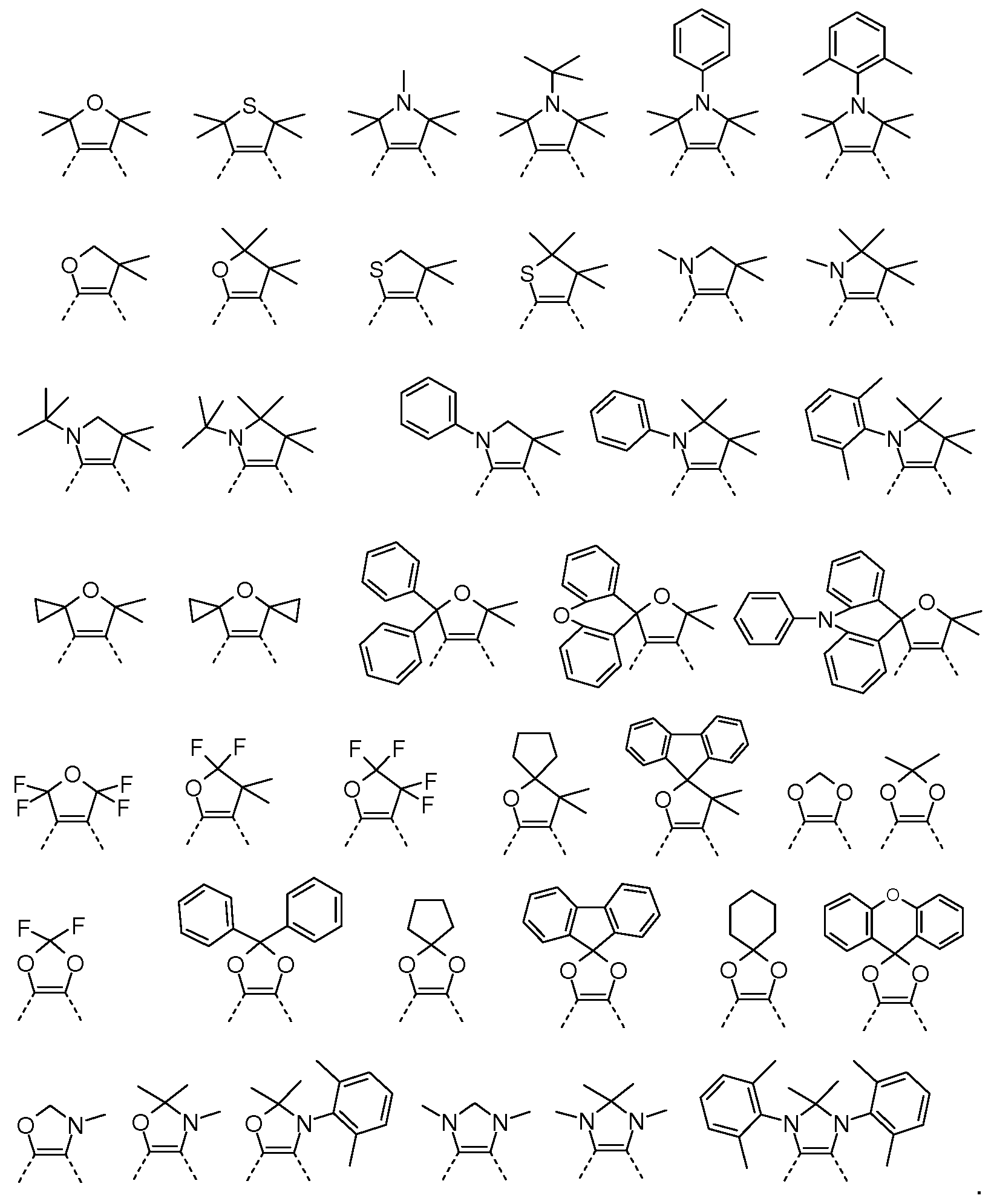
화학식 (51) 의 특히 적합한 기의 예는 아래에 나타낸 기이다:Examples of particularly suitable groups of formula (51) are the groups shown below:

화학식 (52), (55) 및 (56) 의 특히 적합한 기의 예는 아래에 나타낸 기이다:Examples of particularly suitable groups of formulas (52), (55) and (56) are the groups shown below:

화학식 (53) 의 특히 적합한 기의 예는 아래에 나타낸 기이다:Examples of particularly suitable groups of formula (53) are the groups shown below:


화학식 (54) 의 특히 적합한 기의 예는 아래에 나타낸 기이다:Examples of particularly suitable groups of formula (54) are the groups shown below:

R 라디칼이 두자리 서브-리간드 또는 리간드 내에서 또는 화학식 (2) 내지 (3) 또는 바람직한 실시형태 내에서 결합된 화학식 (4) 의 2가 아릴렌 또는 헤테로아릴렌기 내에서 결합되는 경우, 이들 R 라디칼은 각각의 경우 동일하거나 상이하게, 바람직하게는 H, D, F, Br, I, N(R1)2, CN, Si(R1)3, B(OR1)2, C(=O)R1, 1 내지 10 개의 탄소 원자를 갖는 직쇄 알킬기, 또는 2 내지 10 개의 탄소 원자를 갖는 알케닐기, 또는 3 내지 10 개의 탄소 원자를 갖는 분지형 또는 환형 알킬기 (알킬 또는 알케닐기는 각각의 경우 하나 이상의 R1 라디칼로 치환될 수 있음), 또는 5 내지 30 개의 방향족 고리 원자를 갖는 방향족 또는 헤테로방향족 고리계 (이들은 각각의 경우 하나 이상의 R1 라디칼로 치환될 수 있음) 로 이루어지는 군에서 선택되며; 동시에, 인접한 2 개의 R 라디칼이 함께 또는 R1 과 R 이 함께 모노- 또는 폴리시클릭, 지방족 또는 방향족 고리계를 또한 형성할 수 있다. 보다 바람직하게, 이들 R 라디칼은 각각의 경우 동일하거나 상이하게, H, D, F, N(R1)2, 1 내지 6 개의 탄소 원자를 갖는 직쇄 알킬기, 또는 3 내지 10 개의 탄소 원자를 갖는 분지형 또는 환형 알킬기 (하나 이상의 수소 원자는 D 또는 F 로 대체될 수 있음), 또는 5 내지 24 개의 방향족 고리 원자를 갖는 방향족 또는 헤테로방향족 고리계 (이들은 각각의 경우 하나 이상의 R1 라디칼로 치환될 수 있음) 로 이루어지는 군에서 선택되고; 동시에, 인접한 2 개의 R 라디칼이 함께 또는 R1 과 R 이 함께 모노- 또는 폴리시클릭, 지방족 또는 방향족 고리계를 또한 형성할 수 있다. If the R radical is bonded within a bidentate sub-ligand or ligand or within a divalent arylene or heteroarylene group of formula (4) bound within formulas (2) to (3) or within a preferred embodiment, these R radicals are identical or different in each case, preferably H, D, F, Br, I, N(R 1 ) 2 , CN, Si(R 1 ) 3 , B(OR 1 ) 2 , C(=O) R 1 , a straight-chain alkyl group having 1 to 10 carbon atoms, or an alkenyl group having 2 to 10 carbon atoms, or a branched or cyclic alkyl group having 3 to 10 carbon atoms (an alkyl or alkenyl group in each case is one optionally substituted by one or more R 1 radicals), or aromatic or heteroaromatic ring systems having 5 to 30 aromatic ring atoms, which in each case may be substituted by one or more R 1 radicals; At the same time, two adjacent R radicals together or R 1 and R together may also form a mono- or polycyclic, aliphatic or aromatic ring system. More preferably, these R radicals, identically or differently in each case, are H, D, F, N(R 1 ) 2 , a straight-chain alkyl group having 1 to 6 carbon atoms, or a group having 3 to 10 carbon atoms Terrain or cyclic alkyl groups (one or more hydrogen atoms may be replaced by D or F), or aromatic or heteroaromatic ring systems having 5 to 24 aromatic ring atoms, which in each case may be substituted by one or more R 1 radicals. In) is selected from the group consisting of; At the same time, two adjacent R radicals together or R 1 and R together may also form a mono- or polycyclic, aliphatic or aromatic ring system.
R 에 결합되는 바람직한 R1 라디칼들은 각각의 경우 동일하거나 상이하게, H, D, F, N(R2)2, CN, 1 내지 10 개의 탄소 원자를 갖는 직쇄 알킬기, 또는 2 내지 10 개의 탄소 원자를 갖는 알케닐기, 또는 3 내지 10 개의 탄소 원자를 갖는 분지형 또는 환형 알킬기 (알킬기는 각각의 경우 하나 이상의 R2 라디칼로 치환될 수 있음), 또는 5 내지 24 개의 방향족 고리 원자를 갖는 방향족 또는 헤테로방향족 고리계 (이들은 각각의 경우 하나 이상의 R2 라디칼로 치환될 수 있음) 로 이루어지는 군에서 선택되며; 동시에, 인접한 2 개 이상의 R1 라디칼이 함께 모노- 또는 폴리시클릭 지방족 고리계를 형성할 수 있다. R 에 결합되는 특히 바람직한 R1 라디칼들은 각각의 경우 동일하거나 상이하게, H, F, CN, 1 내지 5 개의 탄소 원자를 갖는 직쇄 알킬기, 또는 3 내지 5 개의 탄소 원자를 갖는 분지형 또는 환형 알킬기 (그 각각은 하나 이상의 R2 라디칼로 치환될 수 있음), 또는 5 내지 13 개의 방향족 고리 원자를 갖는 방향족 또는 헤테로방향족 고리계 (이들은 각각의 경우 하나 이상의 R2 라디칼로 치환될 수 있음) 이며; 동시에, 인접한 2 개 이상의 R1 라디칼이 함께 모노- 또는 폴리시클릭 지방족 고리계를 형성할 수 있다. Preferred R 1 radicals bonded to R are, identically or differently in each case, H, D, F, N(R 2 ) 2 , CN, a straight-chain alkyl group having 1 to 10 carbon atoms, or a straight-chain alkyl group having 2 to 10 carbon atoms. or a branched or cyclic alkyl group having 3 to 10 carbon atoms (the alkyl group may in each case be substituted by one or more R 2 radicals), or an aromatic or heterocyclic group having 5 to 24 aromatic ring atoms. aromatic ring systems, which in each case may be substituted by one or more R 2 radicals; At the same time, two or more adjacent R 1 radicals together may form a mono- or polycyclic aliphatic ring system. Particularly preferred R 1 radicals bonded to R are, identically or differently in each case, H, F, CN, a straight-chain alkyl group having 1 to 5 carbon atoms, or a branched or cyclic alkyl group having 3 to 5 carbon atoms ( each of which may be substituted by one or more R 2 radicals, or an aromatic or heteroaromatic ring system having 5 to 13 aromatic ring atoms, which in each case may be substituted by one or more R 2 radicals; At the same time, two or more adjacent R 1 radicals together may form a mono- or polycyclic aliphatic ring system.
바람직한 R2 라디칼은 각각의 경우 동일하거나 상이하게, H, F 또는 1 내지 5 개의 탄소 원자를 갖는 지방족 히드로카르빌 라디칼 또는 6 내지 12 개의 탄소 원자를 갖는 방향족 히드로카르빌 라디칼이고; 동시에, 2 개 이상의 R2 치환기가 함께 모노- 또는 폴리시클릭 지방족 고리계를 또한 형성할 수 있다.Preferred R 2 radicals, identically or differently in each case, are H, F or aliphatic hydrocarbyl radicals having 1 to 5 carbon atoms or aromatic hydrocarbyl radicals having 6 to 12 carbon atoms; At the same time, two or more R 2 substituents together may also form a mono- or polycyclic aliphatic ring system.
상기 바람직한 실시형태는 원하는 경우 서로 조합될 수 있다. 본 발명의 특히 바람직한 실시형태에 있어서, 상기 바람직한 실시형태는 동시에 적용된다.The above preferred embodiments can be combined with each other if desired. In a particularly preferred embodiment of the present invention, the above preferred embodiments are applied simultaneously.
본 발명의 화합물은 키랄 구조이다. 착물 및 리간드의 정확한 구조에 따라, 부분 입체 이성질체 및 몇 쌍의 거울상 이성질체의 형성이 가능하다. 이 경우, 본 발명의 착물은 상이한 부분 입체 이성체 또는 상응하는 라세메이트의 혼합물 및 개개의 단리된 부분 입체 이성질체 또는 거울상 이성질체 모두를 포함한다.The compounds of the present invention have a chiral structure. Depending on the exact structure of the complex and ligand, the formation of diastereomers and several pairs of enantiomers is possible. In this case, the complexes of the invention include both different diastereomers or mixtures of the corresponding racemates and individual isolated diastereomers or enantiomers.
본 발명의 적합한 화합물의 예는 하기 표에 도시된 구조이다.Examples of suitable compounds of the present invention are the structures shown in the table below.


리간드의 오르토-금속화 반응에서, 대응하는 이금속 착물은 전형적으로 ΛΛ 및 ΔΔ 이성질체 및 ΔΛ 및 ΛΔ 이성질체의 혼합물로서 수득된다. ΛΛ 및 ΔΔ 이성질체는 ΔΛ 및 ΛΔ 이성질체와 마찬가지로 한 쌍의 거울상 이성질체를 형성한다. 부분 입체 이성질체 쌍은 통상적인 방법에 의해, 예를 들어 크로마토그래피에 의해 또는 분별 결정에 의해 분리될 수 있다. 리간드의 대칭성에 따르면, 입체 중심이 일치할 수 있으므로, 중간 형태도 가능한다. 예를 들어, C2v- 또는 Cs-대칭 리간드의 오르토-메탈화는 ΛΛ 및 ΔΔ 이성질체 (라세메이트, C2-대칭) 와 ΛΔ 이성질체 (메소 화합물, CS-대칭) 를 제공한다. 다음의 실시예에서 부분 입체 이성질체 쌍의 제조 및 분리를 설명할 것이다.In ortho-metallation reactions of ligands, the corresponding bimetallic complexes are typically obtained as ΛΛ and ΔΔ isomers and mixtures of ΔΛ and ΛΔ isomers. The ΛΛ and ΔΔ isomers form a pair of enantiomers, just like the ΔΛ and ΛΔ isomers. Diastereomeric pairs can be separated by conventional methods, for example by chromatography or by fractional crystallization. Depending on the symmetry of the ligand, stereogenic centers can coincide, so intermediate conformations are also possible. For example, ortho-metalation of C 2v - or C s -symmetric ligands gives ΛΛ and ΔΔ isomers (racemates, C 2 -symmetric) and ΛΔ isomers (meso compounds, CS -symmetric). The preparation and separation of diastereomeric pairs will be described in the following examples.

ΔΔ 및 ΛΛ 이성질체의 라세메이트 분리는 통상적인 방법에 의해 키랄 컬럼 상에서 또는 부분 입체 이성질체 쌍의 염의 분별 결정화를 통해 수행될 수 있다. 이 목적의 하나의 옵션은 비하전된 Ir(III) 착물을 (예를 들어 과산화물 또는 H2O2 로 또는 전기화학적 수단에 의해) 산화하고, 전기화학적으로 순수한 모노음이온성 염기 (키랄 염기) 의 염을 양이온 Ir(III)/Ir(IV) 착물에 첨가하여 이양이온 Ir(IV)/Ir(IV) 착물을 생성하고, 부분 입체 이성질체 염을 분리하여 부분 결정화에 의해 생성하고, 그리고 그후 환원제 (아연, 히드라진 수화물, 아스코르브산 등) 의 도움으로 이들을 환원시켜 거울상 이성질체적으로 순수한 비하전된 착물을 제공하며, 아래에 개략적으로 도시된 바와 같다:Racemate separation of the ΔΔ and ΛΛ isomers can be performed on a chiral column by conventional methods or through fractional crystallization of the salts of the diastereomeric pair. One option for this purpose is to oxidize the uncharged Ir(III) complex (eg with a peroxide or H 2 O 2 or by electrochemical means) and obtain an electrochemically pure monoanionic base (chiral base). A salt is added to the cation Ir(III)/Ir(IV) complex to form a cation Ir(IV)/Ir(IV) complex, the diastereomeric salt is separated and produced by partial crystallization, and then a reducing agent ( zinc, hydrazine hydrate, ascorbic acid, etc.) to give enantiomerically pure uncharged complexes, as shown schematically below:

거울상 이성질체적으로 순수한 착물은 또한 하기 스킴에 도시된 바와 같이 선택적으로 합성될 수 있다. 이를 위해, 상술한 바와 같이, 오르토-메탈화에서 형성된 부분 입체 이성질체 쌍이 분리되고, 브롬화된 다음 교차 커플링 반응을 통해 키랄 R* 라디칼을 포함하는 보론산 R*A-B(OH)2 (거울상 이성질체 초과, 바람직하게는 > 99%) 과 반응한다. 형성된 부분 입체 이성질체 쌍은 실리카 겔 상의 크로마토그래피 또는 통상적인 방법에 의한 분별 결정화에 의해 분리될 수 있다. 이러한 방식으로, 거울상 이성질체적으로 풍부하거나 거울상 이성질체적으로 순수한 착물이 얻어진다. 이어서, 키랄기는 선택적으로 제거되거나 또는 분자 내에 잔류할 수 있다.Enantiomerically pure complexes can also be selectively synthesized as shown in the scheme below. To this end, as described above, the diastereomeric pair formed in the ortho-metallization is separated, brominated and then via a cross-coupling reaction to form a boronic acid R*AB(OH) 2 (enantiomeric over-enantiomer) containing a chiral R* radical , preferably >99%). The diastereomeric pairs formed can be separated by chromatography on silica gel or by fractional crystallization by conventional methods. In this way, enantiomerically enriched or enantiomerically pure complexes are obtained. The chiral group can then be selectively removed or remain in the molecule.


전형적으로, 오르토-금속화에서의 착물은 부분 입체 이성질체 쌍의 혼합물로서 얻어진다. 그러나, 부분 입체 이성질체 쌍 중 하나만을 선택적으로 합성하는 것이 가능한데, 다른 하나는 리간드 구조에 따라, 입체적인 이유로 단지 소량으로 형성되기 때문이다. 이것은 다음의 실시예에 의해 보여질 것이다.Typically, complexes in ortho-metallation are obtained as mixtures of diastereomeric pairs. However, it is possible to selectively synthesize only one of the diastereomer pairs, since the other is only formed in small amounts for steric reasons, depending on the ligand structure. This will be shown by the following example.

(직사각형 경계를 갖는) 피리딘 고리 상의 5 위치의 페닐기를 (마찬가지로 직사각형 경계를 갖는) 다른 서브-리간드 중 하나의 머리에 있는 페닐기와 불리한 상호작용을 한 결과, 메소 화합물은 소량 정도로 발생한다. 라세메이트는 우선적으로 또는 독점적으로 형성된다.As a result of the unfavorable interaction of the phenyl group at position 5 on the pyridine ring (with a rectangular border) with the phenyl group on the head of one of the other sub-ligands (also with a rectangular border), meso compounds arise to a small extent. Racemates are preferentially or exclusively formed.
본 발명의 착물은 특히 하기에 기술된 경로에 의해 제조될 수 있다. 이 목적을 위해, 12-자리 리간드가 제조된 다음 오르토-금속화 반응에 의해 금속 M에 배위된다. 일반적으로, 이 목적을 위해, 이리듐 염 또는 로듐 염은 상응하는 자유 리간드와 반응한다.The complexes of the present invention can be prepared in particular by the routes described below. For this purpose, a 12-dentate ligand is prepared and then coordinated to the metal M by an ortho-metalation reaction. Generally, for this purpose, an iridium salt or a rhodium salt reacts with the corresponding free ligand.
따라서, 본 발명은 상응하는 자유 리간드를 화학식 (57) 의 금속 알콕시드와, 화학식 (58) 의 금속 케토케톤산염과, 화학식 (59) 의 금속 할라이드와, 또는 화학식 (60) 의 금속 카르복실레이트와 반응시킴으로써 본 발명의 화합물을 제조하는 방법을 추가로 제공한다. Accordingly, the present invention relates to combining the corresponding free ligand with a metal alkoxide of formula (57), a metal ketoketonate of formula (58), a metal halide of formula (59), or a metal carboxylate of formula (60) It further provides a method for preparing the compound of the present invention by reacting with.

여기서 M 및 R 은 상기에 주어진 정의를 갖고, Hal = F, Cl, Br 또는 I 이고, 이리듐 반응물 또는 로듐 반응물은 또한 상응하는 수화물의 형태를 취할 수 있다. R 은 여기서 바람직하게는 1 내지 4 개의 탄소 원자를 갖는 알킬기이다.wherein M and R have the definitions given above, Hal = F, Cl, Br or I, and the iridium reactant or rhodium reactant may also take the form of the corresponding hydrate. R here is preferably an alkyl group having 1 to 4 carbon atoms.
마찬가지로, 알콕시드 및/또는 할라이드 및/또는 히드록실 라디칼 및 케토케토네이트 라디칼을 모두 갖는 이리듐 화합물 또는 로듐 화합물을 사용하는 것이 가능하다. 이들 화합물은 또한 하전될 수 있다. 반응물로서 특히 적합한 상응하는 이리듐 화합물은 WO 2004/085449 에 개시되어 있다. [IrCl2(acac)2]─, 예를 들어 Na[IrCl2(acac)2], 리간드로서 아세틸아세토네이트 유도체와의 금속 착물, 예를 들어 Ir(acac)3 또는 트리스(2,2,6,6-테트라메틸헵탄-3,5-디오네이토)이리듐, 및 IrCl3·xH2O (x 는 전형적으로 2 내지 4 의 수이다) 를 갖는 금속 착물이 특히 적합하다. Likewise, it is possible to use iridium compounds or rhodium compounds which have both alkoxides and/or halides and/or hydroxyl radicals and ketoketonate radicals. These compounds can also be charged. Corresponding iridium compounds particularly suitable as reactants are disclosed in WO 2004/085449. [IrCl 2 (acac) 2 ] — eg Na[IrCl 2 (acac) 2 ], a metal complex with an acetylacetonate derivative as a ligand, eg Ir(acac) 3 or tris(2,2,6 Metal complexes with ,6-tetramethylheptane-3,5-dionato)iridium and IrCl 3 .xH 2 O (x is typically a number from 2 to 4) are particularly suitable.
착물의 합성은 바람직하게는 WO 2002/060910 및 WO 2004/085449에 기재된 바와 같이 수행된다. 이 경우, 합성은 또한, 예를 들어 열적 또는 광화학적 수단에 의해 및/또는 마이크로파 방사선에 의해 활성화될 수 있다. 또한, 합성은 승압 및/또는 승온에서 오토클레이브에서 또한 수행될 수 있다. The synthesis of the complex is preferably carried out as described in WO 2002/060910 and WO 2004/085449. In this case, the synthesis can also be activated, for example by thermal or photochemical means and/or by means of microwave radiation. In addition, the synthesis can also be carried out in an autoclave at elevated pressure and/or elevated temperature.
반응은 o-금속화되는 상응하는 리간드의 용융물에 용매 또는 용융 보조제를 첨가하지 않고서 수행할 수 있다. 임의로, 용매 또는 용융 보조제를 첨가하는 것이 가능하다. 적합한 용매는 지방족 및/또는 방향족 알코올 (메탄올, 에탄올, 이소프로판올, t-부탄올 등), 올리고- 및 폴리알코올 (에틸렌 글리콜, 프로판-1,2-디올, 글리세롤 등), 알코올 에테르 (에톡시에탄올, 디에틸렌 글리콜, 트리에틸렌 글리콜, 폴리에틸렌 글리콜 등), 에테르 (디- 및 트리에틸렌 글리콜 디메틸 에테르, 디페닐 에테르 등), 방향족, 헤테로방향족 및/또는 지방족 탄화수소 (톨루엔, 크실렌, 메시틸렌, 클로로벤젠, 피리딘, 루티딘, 퀴놀린, 이소퀴놀린, 트리데칸, 헥사데칸 등), 아미드 (DMF, DMAC 등), 락탐 (NMP), 술폭시드 (DMSO) 또는 술폰 (디메틸 술폰, 술폴란 등) 과 같은 양성자성 또는 비양성자성 용매이다. 적합한 용융 보조제는, 실온에서 고체 형태이지만, 반응 혼합물을 가열하고, 균일한 용융물을 형성하도록 반응물을 용해시킬 때 용융되는 화합물이다. 비페닐, m-터페닐, 트리페닐, R- 또는 S-비나프톨 또는 달리 상응하는 라세미체, 1,2-, 1,3- 또는 1,4-비스페녹시벤젠, 트리페닐포스핀 옥사이드, 18-크라운-6, 페놀, 1-나프톨, 히드로퀴논 등이 특히 적합하다. 여기서는 히드로퀴논의 사용이 특히 바람직하다.The reaction can be carried out without adding solvents or melting aids to the melt of the corresponding ligand to be o-metallated. Optionally, it is possible to add solvents or melting aids. Suitable solvents include aliphatic and/or aromatic alcohols (methanol, ethanol, isopropanol, t-butanol, etc.), oligo- and polyalcohols (ethylene glycol, propane-1,2-diol, glycerol, etc.), alcohol ethers (ethoxyethanol, diethylene glycol, triethylene glycol, polyethylene glycol, etc.), ethers (di- and triethylene glycol dimethyl ether, diphenyl ether, etc.), aromatic, heteroaromatic and/or aliphatic hydrocarbons (toluene, xylene, mesitylene, chlorobenzene, Protic substances such as pyridine, lutidine, quinoline, isoquinoline, tridecane, hexadecane, etc.), amides (DMF, DMAC, etc.), lactams (NMP), sulfoxides (DMSO) or sulfones (dimethyl sulfone, sulfolane, etc.) or an aprotic solvent. A suitable melting aid is a compound that is in solid form at room temperature, but melts when the reaction mixture is heated and the reactants are dissolved to form a uniform melt. biphenyl, m-terphenyl, triphenyl, R- or S-binaphthol or otherwise corresponding racemates, 1,2-, 1,3- or 1,4-bisphenoxybenzene, triphenylphosphine Oxide, 18-crown-6, phenol, 1-naphthol, hydroquinone and the like are particularly suitable. The use of hydroquinone is particularly preferred here.
이들 공정 이후에, 필요에 따라서 정제, 예를 들어 재결정화 또는 승화에 의해서, 본 발명의 화학식 (1) 의 화합물을 고순도, 바람직하게는 99% 초과 (1H NMR 및/또는 HPLC 로 결정) 로 수득하는 것이 가능하다.After these steps, if necessary, by purification, for example recrystallization or sublimation, the compound of formula (1) of the present invention is obtained in high purity, preferably greater than 99% (determined by 1 H NMR and/or HPLC). it is possible to obtain
본 발명의 금속 착물은 또한 예를 들어 비교적 긴 알킬기 (약 4 내지 20 개의 탄소 원자), 특히 분지형 알킬기, 또는 임의로 치환되는 아릴기, 예를 들어 크실릴, 메시틸 또는 분지형 터페닐 또는 쿼터페닐기로의 적합한 치환에 의해 가용성이 될 수 있다. 금속 착물의 용해도의 뚜렷한 개선을 가져오는 또 다른 특정 방법은, 예를 들어, 상기 화학식 (50) 내지 화학식 (56) 으로 나타낸 바와 같이, 축합된 지방족 기를 사용하는 것이다. 그러면, 이러한 화합물은 표준 유기 용매, 예를 들어 톨루엔 또는 크실렌에서, 용액으로부터 착물을 프로세싱할 수 있도록 실온에서 충분한 농도로 용해된다. 이들 가용성 화합물은, 예를 들어 프린팅 방법에 의해 용액으로부터 프로세싱하기에 특히 양호한 적합성을 가진다. The metal complexes of the present invention may also comprise, for example, relatively long alkyl groups (about 4 to 20 carbon atoms), especially branched alkyl groups, or optionally substituted aryl groups, such as xylyl, mesityl or branched terphenyls or quarters. It can be made soluble by suitable substitution with a phenyl group. Another particular method that results in marked improvement in the solubility of metal complexes is the use of condensed aliphatic groups, as shown, for example, in formulas (50) to (56) above. These compounds are then dissolved in a standard organic solvent, such as toluene or xylene, at room temperature in sufficient concentrations to allow processing of the complex from solution. These soluble compounds have a particularly good suitability for processing from solution, for example by printing methods.
본 발명의 금속 착물을 액상으로부터, 예를 들어 스핀-코팅에 의해 또는 프린팅 방법에 의해 프로세싱하기 위해서, 본 발명의 금속 착물의 제형이 요구된다. 이러한 제형은 예를 들어 용액, 분산액 또는 유화액일 수 있다. 이러한 목적을 위해, 둘 이상의 용매의 혼합물을 사용하는 것이 바람직할 수 있다. 적합하고 바람직한 용매는 예를 들어, 톨루엔, 아니솔, o-, m-또는 p-자일렌, 메틸 벤조에이트, 메시틸렌, 테트랄린, 베라트롤, THF, 메틸-THF, THP, 클로로벤젠, 디옥산, 페녹시톨루엔, 특히 3-페녹시톨루엔, (-)-펜촌, 1,2,3,5-테트라메틸벤젠, 1,2,4,5-테트라메틸벤젠, 1-메틸나프탈렌, 2-메틸벤조티아졸, 2-페녹시에탄올, 2-피롤리디논, 3-메틸아니솔, 4-메틸아니솔, 3,4-디메틸아니솔, 3,5-디메틸아니솔, 아세토페논, αa-테르피네올, 벤조티아졸, 부틸 벤조에이트, 쿠멘, 시클로헥산올, 시클로헥사논, 시클로헥실벤젠, 데칼린, 도데실벤젠, 에틸 벤조에이트, 인단, 메틸 벤조에이트, NMP, p-시멘, 페네톨, 1,4-디이소프로필벤젠, 디벤질 에테르, 디에틸렌 글리콜 부틸 메틸 에테르, 트리에틸렌 글리콜 부틸 메틸 에테르, 디에틸렌 글리콜 디부틸 에테르, 트리에틸렌 글리콜 디메틸 에테르, 디에틸렌 글리콜 모노부틸 에테르, 트리프로필렌 글리콜 디메틸 에테르, 테트라에틸렌 글리콜 디메틸 에테르, 2-이소프로필나프탈렌, 펜틸벤젠, 헥실벤젠, 헵틸벤젠, 옥틸벤젠, 1,1-비스(3,4-디메틸페닐)에탄, 헥사메틸인단 또는 이들 용매의 혼합물이다. In order to process the metal complex of the invention from the liquid phase, for example by spin-coating or by a printing method, a formulation of the metal complex of the invention is required. Such formulations may be, for example, solutions, dispersions or emulsions. For this purpose, it may be desirable to use a mixture of two or more solvents. Suitable and preferred solvents are, for example, toluene, anisole, o-, m- or p-xylene, methyl benzoate, mesitylene, tetralin, veratrol, THF, methyl-THF, THP, chlorobenzene, Dioxane, phenoxytoluene, especially 3-phenoxytoluene, (-)-Penchon, 1,2,3,5-tetramethylbenzene, 1,2,4,5-tetramethylbenzene, 1-methylnaphthalene, 2 -Methylbenzothiazole, 2-phenoxyethanol, 2-pyrrolidinone, 3-methylanisole, 4-methylanisole, 3,4-dimethylanisole, 3,5-dimethylanisole, acetophenone, αa -Terpineol, benzothiazole, butyl benzoate, cumene, cyclohexanol, cyclohexanone, cyclohexylbenzene, decalin, dodecylbenzene, ethyl benzoate, indan, methyl benzoate, NMP, p-cymene, phenol Nethol, 1,4-diisopropylbenzene, dibenzyl ether, diethylene glycol butyl methyl ether, triethylene glycol butyl methyl ether, diethylene glycol dibutyl ether, triethylene glycol dimethyl ether, diethylene glycol monobutyl ether, tri Propylene glycol dimethyl ether, tetraethylene glycol dimethyl ether, 2-isopropylnaphthalene, pentylbenzene, hexylbenzene, heptylbenzene, octylbenzene, 1,1-bis(3,4-dimethylphenyl)ethane, hexamethylindane or these solvents is a mixture of
따라서 본 발명은 본 발명의 적어도 하나의 화합물 및 적어도 하나의 추가 화합물을 포함하는 제형을 추가로 제공한다. 추가 화합물은 예를 들어 용매, 특히 상술한 용매 중 하나 또는 이들 용매의 혼합물일 수 있다. 추가의 화합물은 대안적으로 전자 디바이스에서 마찬가지로 사용되는 추가 유기 또는 무기 화합물, 예를 들어 매트릭스 재료일 수 있다. 이러한 추가 화합물은 또한 중합체성일 수 있다.Accordingly, the present invention further provides formulations comprising at least one compound of the present invention and at least one further compound. The further compound may be, for example, a solvent, in particular one of the solvents mentioned above or a mixture of these solvents. The further compounds may alternatively be further organic or inorganic compounds which are likewise used in electronic devices, for example matrix materials. These additional compounds may also be polymeric.
본 발명의 상술한 금속 착물 또는 상술한 바람직한 실시형태는 전자 디바이스에서 활성 성분으로서 또는 산소 증감제로서 사용될 수 있다. 따라서, 본 발명은 또한 산소 증감제로서의 또는 전자 디바이스에서의 본 발명의 화합물의 용도를 제공한다. 본 발명은 또한 본 발명의 적어도 하나의 화합물을 포함하는 전자 디바이스를 제공한다. The above described metal complex or the above described preferred embodiment of the present invention can be used as an active ingredient or as an oxygen sensitizer in an electronic device. Accordingly, the present invention also provides the use of the compounds of the present invention as oxygen sensitizers or in electronic devices. The present invention also provides an electronic device comprising at least one compound of the present invention.
전자 디바이스는 애노드, 캐소드, 및 하나 이상의 유기 또는 유기금속 화합물을 포함하는 하나 이상의 층을 포함하는 임의의 디바이스를 의미하는 것으로 이해된다. 따라서, 본 발명의 전자 디바이스는 애노드, 캐소드, 및 하나 이상의 본 발명의 금속 착물을 포함하는 하나 이상의 층을 포함한다. 바람직한 전자 디바이스는 하나 이상의 층에 하나 이상의 본 발명의 금속 착물을 포함하는, 유기 전계발광 디바이스 (OLED, PLED), 유기 집적 회로 (O-IC), 유기 전계-효과 트랜지스터 (O-FET), 유기 박막 트랜지스터 (O-TFT), 유기 발광 트랜지스터 (O-LET), 유기 태양 전지 (O-SC) (이는 순수 유기 태양 전지와 염료 감응형 태양 전지 (그레첼 전지) 모두를 의미하는 것으로 이해됨), 유기 광 검출기, 유기 광 수용체, 유기 전계-켄치 디바이스 (O-FQD), 발광 전기화학 전지 (LEC), 산소 센서 및 유기 레이저 다이오드 (O-laser) 로 이루어지는 그룹에서 선택된다. 유기 전계발광 디바이스가 특히 바람직하다. 활성 성분은 일반적으로 애노드와 캐소드 사이에 도입된 유기 또는 무기 재료, 예를 들어 전하 주입, 전자 수송 또는 전하 차단제 재료, 특히 방출 재료 및 매트릭스 재료이다. 본 발명의 화합물은 유기 전계발광 디바이스에서 발광 재료로서 특히 양호한 특성을 나타낸다. 그러므로, 본 발명의 바람직한 실시형태는 유기 전계발광 디바이스이다. 또한, 본 발명의 화합물은 단일항 산소의 생성 또는 광촉매 작용에 사용될 수 있다. An electronic device is understood to mean any device comprising an anode, a cathode and one or more layers comprising one or more organic or organometallic compounds. Accordingly, the electronic device of the present invention comprises an anode, a cathode, and one or more layers comprising one or more metal complexes of the present invention. Preferred electronic devices include organic electroluminescent devices (OLEDs, PLEDs), organic integrated circuits (O-ICs), organic field-effect transistors (O-FETs), organic electroluminescent devices (OLEDs, PLEDs) comprising one or more inventive metal complexes in one or more layers. Thin-film transistor (O-TFT), organic light-emitting transistor (O-LET), organic solar cell (O-SC) (this is understood to mean both pure organic solar cells and dye-sensitized solar cells (Gretzel cells)) , organic photodetectors, organic photoreceptors, organic field-quench devices (O-FQDs), light emitting electrochemical cells (LECs), oxygen sensors and organic laser diodes (O-lasers). Organic electroluminescent devices are particularly preferred. Active components are generally organic or inorganic materials introduced between the anode and cathode, for example charge injection, electron transport or charge blocker materials, in particular emissive materials and matrix materials. The compounds of the present invention exhibit particularly good properties as light emitting materials in organic electroluminescent devices. Therefore, a preferred embodiment of the present invention is an organic electroluminescent device. In addition, the compounds of the present invention can be used for generation of singlet oxygen or photocatalysis.
유기 전계발광 디바이스는 캐소드, 애노드 및 적어도 하나의 방출층을 포함한다. 이러한 층 외에, 이는 추가 층, 예를 들어 각각의 경우 하나 이상의 정공 주입층, 정공 수송층, 정공 차단제 층, 전자 수송층, 전자 주입층, 여기자 차단제 층, 전자 차단제 층, 전하 발생층 및/또는 유기 또는 무기 p/n 접합부를 포함할 수 있다. 동시에, 하나 이상의 정공 수송층이, 예를 들어 금속 산화물 예컨대 MoO3 또는 WO3, 또는 (퍼)플루오르화 전자-결핍 방향족계로 p-도핑되고/되거나, 하나 이상의 전자 수송층이 n-도핑되는 것이 가능하다. 마찬가지로, 예를 들어 여기자 차단 기능을 갖고/갖거나 전계발광 디바이스에서의 전하 균형을 제어하는 중간층 (Interlayer) 이 2 개의 방출층 사이에 도입될 수 있다. 그러나, 이들 층 모두가 반드시 존재해야할 필요는 없다는 점이 언급되어야 한다. An organic electroluminescent device includes a cathode, an anode and at least one emissive layer. Besides these layers, these may be further layers, for example in each case one or more hole injection layers, hole transport layers, hole blocker layers, electron transport layers, electron injection layers, exciton blocker layers, electron blocker layers, charge generation layers and/or organic or Inorganic p/n junctions may be included. At the same time, it is possible that one or more hole transport layers are p-doped and/or one or more electron transport layers are n-doped, for example with a metal oxide such as MoO 3 or WO 3 , or (per)fluorinated electron-deficient aromatic systems. . Likewise, an interlayer may be introduced between the two emissive layers, for example having an exciton blocking function and/or controlling the charge balance in the electroluminescent device. However, it should be mentioned that not all of these layers have to be present.
이러한 경우, 유기 전계발광 디바이스는 하나의 방출층을 함유할 수 있거나, 또는 복수의 방출층을 함유할 수 있다. 복수의 방출층이 존재하는 경우, 이들은 바람직하게는 380 ㎚ 와 750 ㎚ 사이에 전체적으로 여러 방출 최대치를 가지며, 전체 결과는 백색 방출이고; 즉, 형광 또는 인광을 나타낼 수 있는 다양한 방출 화합물이 방출층에 사용된다. 청색, 녹색 및 주황색 또는 적색 방출을 나타내는 3 층 시스템이 특히 바람직하거나, 또는 4 개 이상의 방출 층을 갖는 시스템이 특히 바람직하다. 탠덤 OLED가 더욱 바람직하다. 시스템은 또한, 하나 이상의 층이 형광을 나타내고 하나 이상의 다른 층이 인광을 나타내는 하이브리드 시스템일 수 있다. 백색 방출 유기 전계발광 디바이스는 조명 용도로 또는 그밖에 컬러 디스플레이용 컬러 필터와 함께 사용될 수 있다.In this case, the organic electroluminescent device may contain one emissive layer, or may contain a plurality of emissive layers. If a plurality of emission layers are present, they preferably have several emission maxima overall between 380 nm and 750 nm, the overall result being white emission; That is, various emitting compounds capable of exhibiting fluorescence or phosphorescence are used in the emitting layer. Three-layer systems exhibiting blue, green and orange or red emission are particularly preferred, or systems with four or more emission layers are particularly preferred. A tandem OLED is more preferred. The system can also be a hybrid system in which one or more layers are fluorescent and one or more other layers are phosphorescent. White emitting organic electroluminescent devices can be used for lighting purposes or else with color filters for color displays.
본 발명의 바람직한 실시형태에서, 유기 전계발광 디바이스는 하나 이상의 방출층에 방출 화합물로서 본 발명의 금속 착물을 포함한다. In a preferred embodiment of the present invention, the organic electroluminescent device comprises the metal complex of the present invention as an emissive compound in at least one emissive layer.
본 발명의 금속 착물이 방출층에서 방출 화합물로서 사용되는 경우, 이것은 바람직하게는 하나 이상의 매트릭스 재료와 조합하여 사용된다. 본 발명의 금속 착물과 매트릭스 재료의 혼합물은 에미터와 매트릭스 재료의 전체 혼합물을 기준으로, 0.1 중량%와 99 중량% 사이, 바람직하게는 1 중량%와 90 중량% 사이, 보다 바람직하게는 3 중량%와 40 중량% 사이 및 특히 5 중량%와 15 중량% 사이의 본 발명의 금속 착물을 함유한다. 그에 상응하여, 혼합물은 에미터와 매트릭스 재료의 전체 혼합물을 기준으로, 99.9 중량%와 1 중량% 사이, 바람직하게는 99 중량%와 10 중량% 사이, 보다 바람직하게는 97 중량%와 60 중량% 사이, 및 특히 95 중량%와 75 중량% 사이의 매트릭스 재료를 함유한다. When the metal complex of the present invention is used as an emitting compound in an emitting layer, it is preferably used in combination with one or more matrix materials. The mixture of the metal complex and matrix material of the present invention is between 0.1% and 99% by weight, preferably between 1% and 90% by weight, more preferably 3% by weight, based on the total mixture of emitter and matrix material. % and 40% by weight and in particular between 5% and 15% by weight of the metal complex of the present invention. Correspondingly, the mixture is between 99.9% and 1% by weight, preferably between 99% and 10% by weight, more preferably between 97% and 60% by weight, based on the total mixture of emitter and matrix materials. between, and in particular between 95% and 75% by weight of matrix material.
사용된 매트릭스 재료는 일반적으로 선행 기술에 따른 목적을 위해 공지된 임의의 재료일 수 있다. 매트릭스 재료의 삼중항 레벨은 바람직하게는 에미터의 삼중항 레벨보다 높다.The matrix material used may generally be any material known for the purpose according to the prior art. The triplet level of the matrix material is preferably higher than the triplet level of the emitter.
본 발명의 화합물에 적합한 매트릭스 재료는, 예를 들어 WO 2004/013080, WO 2004/093207, WO 2006/005627 또는 WO 2010/006680 에 따른 케톤, 포스핀 옥사이드, 술폭시드 및 술폰, 트리아릴아민, 카르바졸 유도체, 예를 들어 CBP (N,N-비스카르바졸릴비페닐), m-CBP 또는 WO 2005/039246, US 2005/0069729, JP 2004/288381, EP 1205527, WO 2008/086851 또는 US 2009/0134784 에 개시된 카르바졸 유도체, 예를 들어 WO 2007/063754 또는 WO 2008/056746 에 따른 인돌로카르바졸 유도체, 예를 들어 WO 2010/136109 또는 WO 2011/000455 에 따른 인데노카르바졸 유도체, 예를 들어 EP 1617710, EP 1617711, EP 1731584, JP 2005/347160 에 따른 아자카르바졸, 예를 들어 WO 2007/137725 에 따른 양극성 매트릭스 재료, 예를 들어 WO 2005/111172 에 따른 실란, 예를 들어 WO 2006/117052 에 따른 아자보롤 또는 보론산 에스테르, 예를 들어 WO 2010/054729 에 따른 디아자실롤 유도체, 예를 들어 WO 2010/054730 에 따른 디아자포스폴 유도체, 예를 들어 WO 2010/015306, WO 2007/063754 또는 WO 2008/056746 에 따른 트리아진 유도체, 예를 들어 EP 652273 또는 WO 2009/062578 에 따른 아연 착물, 예를 들어 WO 2009/148015 또는 WO 2015/169412 에 따른 디벤조푸란 유도체, 예를 들어 US 2009/0136779, WO 2010/050778, 또는 US 2009/0136779, WO 2010/050778, WO 2011/042107 또는 WO 2011/088877 에 따른 가교 카르바졸 유도체이다. Matrix materials suitable for the compounds of the present invention are ketones, phosphine oxides, sulfoxides and sulfones, triarylamines, sulfones, for example according to WO 2004/013080, WO 2004/093207, WO 2006/005627 or WO 2010/006680. Bazole derivatives, for example CBP (N,N-biscarbazolylbiphenyl), m-CBP or WO 2005/039246, US 2005/0069729, JP 2004/288381, EP 1205527, WO 2008/086851 or US 2009/ 0134784, for example indolocarbazole derivatives according to WO 2007/063754 or WO 2008/056746, for example indenocarbazole derivatives according to WO 2010/136109 or WO 2011/000455, for example Azacarbazoles according to EP 1617710, EP 1617711, EP 1731584, JP 2005/347160, eg bipolar matrix materials according to WO 2007/137725, eg silanes according to WO 2005/111172, eg WO 2006/117052 azabolol or boronic acid esters according to, for example diazasilol derivatives according to WO 2010/054729, for example diazaphosphole derivatives according to WO 2010/054730, for example WO 2010/015306, WO 2007/063754 or Triazine derivatives according to WO 2008/056746, for example zinc complexes according to EP 652273 or WO 2009/062578, for example dibenzofuran derivatives according to WO 2009/148015 or WO 2015/169412, for example US 2009/ 0136779, WO 2010/050778, or US 2009/0136779, WO 2010/050778, WO 2011/042107 or WO 2011/088877.
하기에 기술된 것은 본 발명의 화합물에 대한 매트릭스 재료로서 적합한 화합물의 예이다. Described below are examples of compounds suitable as matrix materials for the compounds of the present invention.
전자 수송성 매트릭스 재료로서 사용될 수 있는 트리아진 및 피리미딘의 예는 하기 화합물이다:Examples of triazines and pyrimidines that can be used as electron transporting matrix materials are the following compounds:


전자 수송성 매트릭스 재료로서 사용될 수 있는 락탐의 예는 하기 화합물이다:Examples of lactams that can be used as electron transporting matrix materials are the following compounds:


전자 수송성 매트릭스 재료로서 사용될 수 있는 케톤의 예는 하기 화합물이다:Examples of ketones that can be used as the electron transporting matrix material are the following compounds:


전자 수송성 매트릭스 재료로서 사용될 수 있는 금속 착물의 예는 하기 화합물이다:Examples of metal complexes that can be used as electron transporting matrix materials are the following compounds:


전자 수송성 매트릭스 재료로서 사용될 수 있는 포스핀 산화물의 예는 하기 화합물이다:Examples of phosphine oxides that can be used as electron transporting matrix materials are the following compounds:


치환 패턴에 따라 정공- 또는 전자-수송성 매트릭스 재료로서 사용될 수 있는 가장 넓은 의미에서의 인돌로- 및 인데노카르바졸 유도체의 예는 하기 화합물이다:Examples of indolo- and indenocarbazole derivatives in the broadest sense which can be used as hole- or electron-transporting matrix materials depending on the substitution pattern are the following compounds:


치환 패턴에 따라 정공- 또는 전자-수송성 매트릭스 재료로서 사용될 수 있는 카르바졸 유도체의 예는 하기 화합물이다:Examples of carbazole derivatives which can be used as hole- or electron-transporting matrix materials depending on the substitution pattern are the following compounds:


정공 수송성 매트릭스 재료로서 사용될 수 있는 가교된 카르바졸 유도체의 예는 하기 화합물이다:Examples of cross-linked carbazole derivatives that can be used as hole-transporting matrix materials are the following compounds:


정공 수송성 매트릭스 재료로서 사용될 수 있는 비스카르바졸의 예는 하기 화합물이다:Examples of biscarbazoles that can be used as hole-transporting matrix materials are the following compounds:


정공 수송성 매트릭스 재료로서 사용될 수 있는 아민의 예는 하기 화합물이다:Examples of amines that can be used as hole transporting matrix materials are the following compounds:


넓은 밴드갭 매트릭스 재료로서 사용될 수 있는 재료의 예는 하기 화합물이다:Examples of materials that can be used as wide bandgap matrix materials are the following compounds:

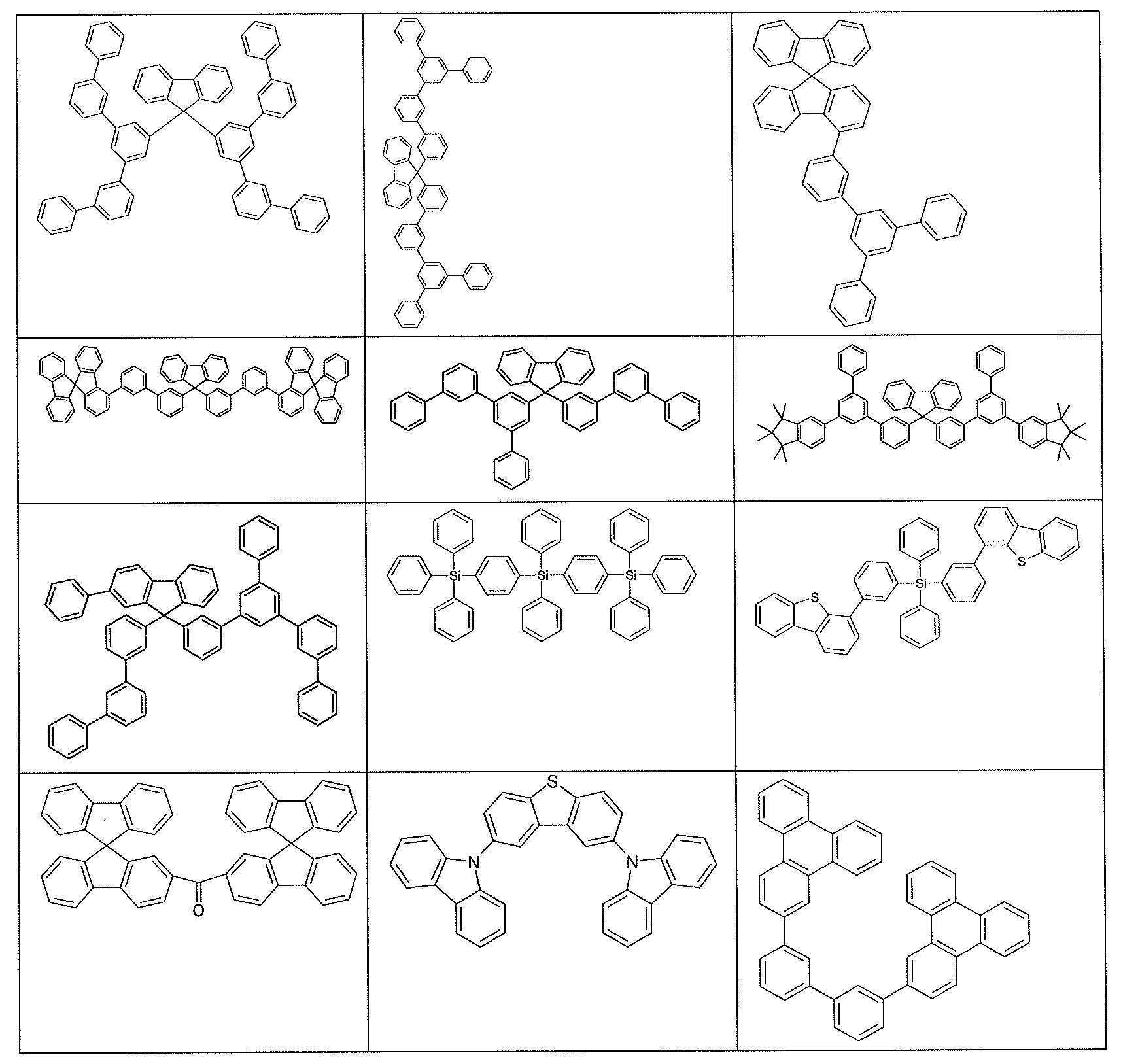
매트릭스와 함께 둘 이상의 삼중항 에미터의 혼합물을 사용하는 것이 더 바람직하다. 이러한 경우, 더 짧은 파장 방출 스펙트럼을 갖는 삼중항 에미터는 더 긴 파장 방출 스펙트럼을 갖는 삼중항 에미터에 대한 코-매트릭스로서 역할을 한다. 예를 들어, 장파장 방출 (longer-wave-emitting) 삼중항 에미터, 예를 들어 녹색 또는 적색 방출 삼중항 에미터에 대한 코-매트릭스로서 본 발명의 금속 착물을 사용하는 것이 가능하다. 이 경우, 단파장 및 장파장 금속 착물 모두가 본 발명의 화합물인 경우가 바람직할 수 있다. 이러한 목적을 위한 적합한 화합물은 또한 특히 WO 2016/124304 및 WO 2017/032439에 개시된 화합물이다.It is more preferred to use a mixture of two or more triplet emitters together with a matrix. In this case, triplet emitters with shorter wavelength emission spectra serve as a co-matrix for triplet emitters with longer wavelength emission spectra. For example, it is possible to use the metal complexes of the present invention as a co-matrix for longer-wave-emitting triplet emitters, for example green or red-emitting triplet emitters. In this case, it may be preferred if both the short-wavelength and long-wavelength metal complexes are compounds of the present invention. Suitable compounds for this purpose are also those disclosed in particular in WO 2016/124304 and WO 2017/032439.
본 발명의 화합물에 대한 코-도펀트로서 사용될 수 있는 적합한 삼중항 에미터의 예는 하기 표에 기재되어 있다.Examples of suitable triplet emitters that can be used as co-dopants for the compounds of the present invention are listed in the table below.


또한 혼합물로서 복수의 상이한 매트릭스 재료를, 특히 적어도 하나의 전자-전도 매트릭스 재료 및 적어도 하나의 정공-전도 매트릭스 재료를 사용하는 것이 바람직할 수 있다. 바람직한 조합은, 예를 들면, 방향족 케톤, 트리아진 유도체 또는 포스핀 옥사이드 유도체와 트리아릴아민 유도체 또는 카르바졸 유도체의, 본 발명의 금속 착물에 대한 혼합 매트릭스로서의 사용이다. 마찬가지로, 예를 들어 WO 2010/108579 에서 기재하는 바와 같이, 존재시, 전하 수송에 상당한 정도로 참여하지 않는 전기적 불활성 매트릭스 재료 및 전하-수송 매트릭스 재료의 혼합물을 사용하는 것이 바람직하다. 마찬가지로, 예를 들어 WO 2014/094964에 기술된 바와 같이 2 개의 전자 수송성 매트릭스 재료, 예를 들어 트리아진 유도체 및 락탐 유도체의 사용이 바람직하다.It may also be desirable to use a plurality of different matrix materials as a mixture, in particular at least one electron-conducting matrix material and at least one hole-conducting matrix material. A preferred combination is, for example, the use of an aromatic ketone, triazine derivative or phosphine oxide derivative with a triarylamine derivative or carbazole derivative as a mixing matrix for the metal complexes of the present invention. Likewise, preference is given to using mixtures of charge-transporting matrix materials and electrically inert matrix materials which, when present, do not participate to any appreciable extent in charge transport, as described for example in WO 2010/108579. Likewise, preference is given to the use of two electron-transporting matrix materials, for example triazine derivatives and lactam derivatives, as described for example in WO 2014/094964.
매트릭스와 함께 2 이상의 삼중항 에미터의 혼합물을 사용하는 것이 또한 바람직하다. 단파장 (shorter-wave) 방출 스펙트럼을 갖는 삼중항 에미터는 장파장 (longer-wave) 방출 스펙트럼을 갖는 삼중항 에미터에 대한 코-매트릭스로서 역할을 한다. 예를 들어, 본 발명의 금속 착물은 이로써 장파장 방출 삼중항 에미터, 예를 들어 녹색 또는 적색 방출 삼중항 에미터에 대한 코-매트릭스로서 사용될 수 있다. 단파장 및 장파장 금속 착물 모두가 본 발명의 화합물인 경우가 여기서 바람직할 수도 있다. 코-매트릭스로서 사용될 수 있는 금속 착물의 예로는 WO 2016/124304 및 WO 2017/032439에 개시된 금속 착물이 있다.It is also preferred to use a mixture of two or more triplet emitters together with the matrix. Triplet emitters with shorter-wave emission spectra serve as a co-matrix for triplet emitters with longer-wave emission spectra. For example, the metal complexes of the present invention can thus be used as a co-matrix for long-wavelength emitting triplet emitters, for example green or red emitting triplet emitters. It may be preferred here if both short-wavelength and long-wavelength metal complexes are compounds of the present invention. Examples of metal complexes that can be used as a co-matrix are those disclosed in WO 2016/124304 and WO 2017/032439.
본 발명의 금속 착물은 또한, 전자 디바이스에서 다른 기능으로, 예를 들어 정공 주입 또는 수송층에서의 정공 수송 재료로서, 전하 발생 재료로서, 전자 차단제 재료로서, 정공 차단제 재료로서 또는 예를 들어, 전자 수송층에서의 전자 수송 재료로서 사용될 수 있다. 마찬가지로, 방출층에서의 다른 인광성 금속 착물에 대한 매트릭스 재료로서 본 발명의 금속 착물을 사용하는 것이 가능하다.The metal complex of the present invention also serves other functions in electronic devices, for example as a hole transport material in a hole injection or transport layer, as a charge generating material, as an electron blocking material, as a hole blocking material or for example in an electron transport layer. It can be used as an electron transport material in Likewise, it is possible to use the metal complex of the present invention as a matrix material for other phosphorescent metal complexes in the emissive layer.
바람직한 캐소드는 낮은 일함수를 갖는 금속, 각종 금속, 예를 들어 알칼리 토금속, 알칼리 금속, 주족 금속 또는 란탄족원소 (예를 들어 Ca, Ba, Mg, Al, In, Mg, Yb, Sm 등) 로 구성되는 금속 합금 또는 다중층 구조이다. 추가적으로 적합한 것은 알칼리 금속 또는 알칼리 토금속 및 은으로 구성되는 합금, 예를 들어 마그네슘 및 은으로 구성되는 합금이다. 다중층 구조의 경우, 언급된 금속에 추가로, 비교적 높은 일 함수를 갖는 추가의 금속, 예를 들어 Ag 를 또한 사용할 수 있는데, 이 경우 예를 들어 Mg/Ag, Ca/Ag 또는 Ba/Ag 와 같은 금속의 조합이 일반적으로 사용된다. 또한 금속 캐소드와 유기 반도체 사이에 높은 유전 상수를 갖는 재료의 얇은 중간층을 도입하는 것이 바람직할 수 있다. 이러한 목적을 위해 유용한 재료의 예는 알칼리 금속 또는 알칼리 토금속 플루오라이드 뿐 아니라, 또한 상응하는 옥시드 또는 카르보네이트 (예를 들어, LiF, Li2O, BaF2, MgO, NaF, CsF, Cs2CO3 등) 이다. 마찬가지로, 이러한 목적을 위해 유용한 것은 유기 알칼리 금속 착물, 예를 들어 LiQ (리튬 퀴놀리네이트) 이다. 이러한 층의 층 두께는 바람직하게는 0.5 내지 5 nm 이다.Preferred cathodes are metals having a low work function, various metals such as alkaline earth metals, alkali metals, main group metals or lanthanoids (eg Ca, Ba, Mg, Al, In, Mg, Yb, Sm, etc.) It is a metal alloy or multi-layer structure composed of. Further suitable are alloys composed of an alkali or alkaline earth metal and silver, for example an alloy composed of magnesium and silver. In the case of multilayer structures, in addition to the metals mentioned, further metals having a relatively high work function, for example Ag, can also be used, in this case for example Mg/Ag, Ca/Ag or Ba/Ag Combinations of the same metals are commonly used. It may also be desirable to introduce a thin interlayer of a material with a high dielectric constant between the metal cathode and the organic semiconductor. Examples of materials useful for this purpose are alkali metal or alkaline earth metal fluorides, but also the corresponding oxides or carbonates (eg LiF, Li 2 O, BaF 2 , MgO, NaF, CsF, Cs 2 CO 3 , etc.). Likewise useful for this purpose are organic alkali metal complexes, for example LiQ (lithium quinolinate). The layer thickness of this layer is preferably between 0.5 and 5 nm.
바람직한 애노드는 높은 일 함수를 갖는 재료이다. 바람직하게는, 애노드는 진공에 비해 4.5 eV 초과의 일 함수를 갖는다. 첫 번째로, 높은 산화환원 전위를 갖는 금속, 예를 들어 Ag, Pt 또는 Au 가 이러한 목적을 위해 적합하다. 두 번째로, 금속/금속 산화물 전극 (예를 들어 Al/Ni/NiOx, Al/PtOx) 이 또한 바람직할 수 있다. 일부 응용에 대해, 전극 중 적어도 하나는 유기 재료의 조사 (O-SC) 또는 광의 방출 (OLED/PLED, O-레이저) 이 가능하도록 투명하거나 부분적으로 투명해야만 한다. 여기서 바람직한 애노드 재료는 전도성 혼합 금속 산화물이다. 인듐 주석 산화물 (ITO) 또는 인듐 아연 산화물 (IZO) 이 특히 바람직하다. 전도성의 도핑된 유기 재료, 특히 전도성의 도핑된 중합체, 예를 들어 PEDOT, PANI 또는 이러한 중합체의 유도체가 추가로 바람직하다. p-도핑된 정공 수송 재료가 정공 주입층으로서 애노드에 적용되는 경우가 또한 바람직한데, 이러한 경우 적합한 p-도펀트는 금속 산화물, 예를 들어 MoO3 또는 WO3, 또는 (퍼)플루오르화 전자-결핍 방향족계이다. 추가로 적합한 p-도펀트는 HAT-CN (헥사시아노헥사아자트리페닐렌) 또는 화합물 NPD9 (Novaled사제) 이다. 이러한 층은 낮은 HOMO (즉, 규모 면에서 큰 HOMO) 를 갖는 재료 내로의 정공 주입을 간소화시킨다. A preferred anode is a material with a high work function. Preferably, the anode has a work function greater than 4.5 eV relative to vacuum. Firstly, metals with a high redox potential are suitable for this purpose, for example Ag, Pt or Au. Second, metal/metal oxide electrodes (eg Al/Ni/NiO x , Al/PtO x ) may also be preferred. For some applications, at least one of the electrodes must be transparent or partially transparent to allow irradiation of organic materials (O-SC) or emission of light (OLED/PLED, O-laser). Preferred anode materials here are conductive mixed metal oxides. Indium tin oxide (ITO) or indium zinc oxide (IZO) is particularly preferred. Further preference is given to conductive doped organic materials, in particular conductive doped polymers, for example PEDOT, PANI or derivatives of these polymers. It is also preferred if a p-doped hole transport material is applied to the anode as a hole injection layer, in which case suitable p-dopants are metal oxides such as MoO 3 or WO 3 , or (per)fluorides electron-deficient. is aromatic. Further suitable p-dopants are HAT-CN (hexacyanohexaazatriphenylene) or the compound NPD9 from Novaled. Such a layer simplifies hole injection into a material having a low HOMO (ie, a large HOMO in terms of scale).
다른 층에서, 일반적으로, 층에 대해 선행 기술에 따라 사용되는 바와 같은 임의의 재료를 사용할 수 있으며, 당업자는 발명적 기술을 발휘하지 않고 전자 디바이스에서 본 발명의 재료와 임의의 이러한 재료를 조합할 수 있다.In the other layers, in general, any material as used according to the prior art for layers can be used, and a person skilled in the art can combine any such material with the materials of the present invention in an electronic device without resorting to inventive skills. can
디바이스의 수명이 물 및/또는 공기의 존재 하에 심각하게 단축되므로, 이러한 디바이스는 상응하게 (본 출원에 따라) 구조화되고, 접촉-연결되고 최종적으로 기밀식으로 밀봉된다. Since the lifetime of the device is severely shortened in the presence of water and/or air, such a device is correspondingly (according to the present application) structured, contact-connected and finally hermetically sealed.
추가적으로 바람직한 것은, 하나 이상의 층이 승화 방법에 의해 코팅되는 것을 특징으로 하는 유기 전계발광 디바이스이다. 이러한 경우, 재료는 통상 10-5 mbar 미만, 바람직하게는 10-6 mbar 미만의 초기 압력에서 진공 승화 시스템에서의 증착에 의해 형성된다. 초기 압력은 또한 심지어 더 낮거나 더 높을 수 있으며, 예를 들어 10-7 mbar 미만일 수 있다.Further preferred are organic electroluminescent devices characterized in that at least one layer is coated by a sublimation method. In this case, the material is usually formed by vapor deposition in a vacuum sublimation system at an initial pressure of less than 10 −5 mbar, preferably less than 10 −6 mbar. The initial pressure can also be even lower or higher, for example less than 10 −7 mbar.
마찬가지로, 하나 이상의 층이 OVPD (유기 기상 증착) 방법에 의해 또는 캐리어 가스 승화의 도움으로 코팅되는 것을 특징으로 하는 유기 전계발광 디바이스가 바람직하다. 이러한 경우, 재료는 10-5 mbar 내지 1 bar 의 압력에서 형성된다. 이 방법의 특별한 경우는, 재료가 노즐에 의해 직접 적용되어 구조화되는 OVJP (유기 증기 제트 프린팅) 방법이다.Likewise preferred is an organic electroluminescent device, characterized in that one or more layers are coated by means of the OVPD (Organic Vapor Deposition) method or with the aid of carrier gas sublimation. In this case, the material is formed at a pressure of 10 −5 mbar to 1 bar. A special case of this method is the OVJP (organic vapor jet printing) method in which the material is applied directly by means of a nozzle to be structured.
추가적으로, 하나 이상의 층이 용액으로부터, 예를 들어 스핀-코팅에 의해, 또는 임의의 프린팅 방법, 예를 들어 스크린 프린팅, 플렉소그래피 프린팅, 오프셋 프린팅 또는 노즐 프린팅, 그러나 보다 바람직하게는 LITI (광-유도 열 이미징, 열 전사 프린팅) 또는 잉크젯 프린팅에 의해 제조되는 것을 특징으로 하는 유기 전계발광 디바이스가 바람직하다. 이러한 목적을 위해, 예를 들어 적합한 치환을 통해 수득되는 가용성 화합물이 필요하다. 본 발명의 바람직한 실시형태에서, 본 발명의 화합물을 포함하는 층은 용액으로부터 도포된다.Additionally, one or more layers may be formed from solution, eg by spin-coating, or by any printing method, eg screen printing, flexographic printing, offset printing or nozzle printing, but more preferably LITI (light- Preference is given to organic electroluminescent devices characterized in that they are manufactured by inductive thermal imaging, thermal transfer printing) or inkjet printing. For this purpose, soluble compounds obtained, for example, through suitable substitution are required. In a preferred embodiment of the present invention, a layer comprising a compound of the present invention is applied from solution.
유기 전계발광 디바이스는 또한 하나 이상의 층을 용액으로부터 도포하고, 하나 이상의 다른 층을 증착에 의해 형성하여 혼성 시스템으로서 제조할 수 있다. 예를 들어, 본 발명의 금속 착물 및 매트릭스 재료를 포함하는 발광층을 용액으로부터 도포하고, 이것에 정공 차단층 및/또는 전자 수송층을 감압하에서 증착에 의해 형성하는 것이 가능하다.Organic electroluminescent devices can also be fabricated as hybrid systems by applying one or more layers from solution and forming one or more other layers by vapor deposition. For example, it is possible to apply a light emitting layer containing the metal complex of the present invention and a matrix material from a solution, and form a hole blocking layer and/or an electron transporting layer thereto by vapor deposition under reduced pressure.
이들 방법은 일반적으로 당업자에게 공지되어 있고, 화학식 (1) 또는 (2)의 화합물 또는 상기 상세한 바람직한 실시형태의 화합물을 포함하는 유기 전계발광 디바이스에 어려움없이 적용될 수 있다.These methods are generally known to those skilled in the art and can be applied without difficulty to organic electroluminescent devices comprising compounds of formula (1) or (2) or compounds of the preferred embodiments detailed above.
본 발명의 전자 디바이스, 특히 유기 전계발광 디바이스는, 하기의 놀라운 이점 중 하나 이상으로 선행 기술에 비해 주목받을만 하다: The electronic devices of the present invention, in particular organic electroluminescent devices, are notable over the prior art for one or more of the following surprising advantages:
1. 본 발명의 화합물은 매우 높은 광발광 양자 수율을 갖는다. 유기 전계발광 디바이스에 사용될 때, 이것은 우수한 효율을 유도한다. 1. The compounds of the present invention have a very high photoluminescent quantum yield. When used in organic electroluminescent devices, this leads to excellent efficiencies.
2. 본 발명의 화합물은 매우 짧은 발광 수명을 갖는다. 유기 전계발광 디바이스에서 사용될 때, 이는 개선된 롤-오프 특성을 유도하고, 또한 비방사성 이완 채널을 회피함으로써 더 높은 발광 양자 수율을 유도한다. 2. The compounds of the present invention have a very short luminescence lifetime. When used in organic electroluminescent devices, it leads to improved roll-off characteristics and also leads to higher luminescence quantum yields by avoiding non-radiative relaxation channels.
이러한 상술한 이점은 추가의 전자적 특성에 있어서 저하를 동반하지 않는다. These above mentioned advantages are not accompanied by degradation in further electronic properties.
그에 의해 제한하려는 어떠한 의도도 없이, 하기의 실시예에 의해서 본 발명을 더 상세하게 설명한다. 당업자는 발명적 기술을 발휘하지 않고 주어진 세부사항을 사용하고, 본 발명의 추가 전자 디바이스를 제조하고, 그에 따라 청구된 전체 범주에 걸쳐 본 발명을 실행할 수 있을 것이다.Without any intention of limiting thereby, the present invention is illustrated in more detail by the following examples. A person skilled in the art will be able to use the details given, manufacture further electronic devices of the invention, and thus implement the invention throughout the full scope of the claims, without exerting inventive skill.
실시예:Example:
달리 지시하지 않는 한, 건조 용매 중에서 보호 가스 분위기 하에 하기의 합성을 수행한다. 금속 착물은 빛을 제외하거나 황색 빛 아래에서 추가로 처리된다. 용매 및 시약은 예를 들어 Sigma-ALDRICH 또는 ABCR에서 구입할 수 있다. 대괄호 안의 각 숫자 또는 개별 화합물에 인용된 숫자는 문헌에서 알려진 화합물의 CAS 번호와 관련이 있다.Unless otherwise indicated, the following syntheses are carried out in a dry solvent and under a protective gas atmosphere. Metal complexes are further processed under yellow light or without light. Solvents and reagents can be purchased, for example, from Sigma-ALDRICH or ABCR. Each number in square brackets or the number cited for an individual compound relates to the CAS number of the compound known in the literature.
A: 합성 수지의 합성 A: synthesis of synthetic resins
실시예 B1:Example B1:

31.4g (100 mmol) 의 5,5'-디브로모-2,2'-비피리딘 [15862-18-7], 54.6 g (215 mmol) 의 비스(피나콜라토)디보란 [73183-34-3], 58.9 g (600 mmol) 의 아세트산 칼륨, 2.3 g (8 mmol) 의 SPhos [657408-07-6], 1.3 mg (6 mmol) 의 아세트산 팔라듐(II) 및 900 ml 의 1,4-디옥산의 혼합물을 환류하에서 16 시간 동안 가열한다. 디옥산을 회전 증발기에서 제거하고, 검은색 잔류물을 분액 깔대기에서 1000ml 의 에틸 아세테이트 및 500ml 의 물로 추출하여 후처리한다. 유기상을 300 ml의 물로 1 회 및 150 ml의 포화 염화 나트륨 용액으로 1 회 세척하고 실리카 겔 베드를 통해 여과한다. 실리카 겔을 2 x 250 ml의 에틸 아세테이트로 세척한다. 여액을 황산 나트륨 상에서 건조시키고 농축시킨다. 잔류물을 400ml의 n-헵탄과 혼합하고, 현탁액을 1 시간 동안 가열 환류시킨다. 냉각 후, 고체를 여과하고 매회 n-헵탄 30ml로 2 회 세척한다. 수율: 33.1 g (81 mmol), 81%. 순도: 1H NMR 에 의해 약 98%.31.4 g (100 mmol) of 5,5'-dibromo-2,2'-bipyridine [15862-18-7], 54.6 g (215 mmol) of bis(pinacolato)diborane [73183-34 -3], 58.9 g (600 mmol) of potassium acetate, 2.3 g (8 mmol) of SPhos [657408-07-6], 1.3 mg (6 mmol) of palladium(II) acetate and 900 ml of 1,4- The mixture of dioxane is heated under reflux for 16 hours. Dioxane is removed on a rotary evaporator, and the black residue is worked up by extraction in a separatory funnel with 1000 ml of ethyl acetate and 500 ml of water. The organic phase is washed once with 300 ml of water and once with 150 ml of saturated sodium chloride solution and filtered through a bed of silica gel. The silica gel is washed with 2 x 250 ml of ethyl acetate. The filtrate is dried over sodium sulfate and concentrated. The residue is mixed with 400 ml of n-heptane and the suspension is heated to reflux for 1 hour. After cooling, the solid is filtered and washed twice with 30 ml of n-heptane each time. Yield: 33.1 g (81 mmol), 81%. Purity: about 98% by 1 H NMR.
실시예 B2:Example B2:

화합물 B2는 5,5'-디브로모-2,2'-비피리딘 대신 5-브로모-2-(4-브로모페닐)피리미딘 [1263061-48-8]을 사용하여 B1로부터의 절차와 유사하게 제조할 수 있다.Compound B2 was obtained from the procedure from B1 using 5-bromo-2-(4-bromophenyl)pyrimidine [1263061-48-8] instead of 5,5′-dibromo-2,2′-bipyridine. can be prepared similarly.
실시예 B3:Example B3:

40.8g (100mmol) 의 B1, 56.6g (200mmol) 의 1-브로모-2-요오드 벤젠 [583-55-1], 63.6g (600mmol) 의 탄산 나트륨, 5.8g (5mmol) 의 테트라키스(트리페닐포스핀)팔라듐(0) [14221-01-3], 1000 ml의 1,2-디메톡시에탄 및 500 ml의 물의 혼합물을 환류하에 60 시간 동안 가열한다. 냉각 이후, 침전된 고체를 흡입 여과하고 100ml의 에탄올로 3 회 세척한다. 조 생성물을 1000 ml의 디클로로메탄 (DCM) 에 용해시키고, DCM 슬러리 형태의 실리카 겔 베드를 통해 여과한다. 실리카 겔을 에틸 아세테이트 각각 100ml로 3 회 세척한다. 디클로로메탄을 50℃의 욕조 온도에서 500 mbar까지 회전식 증발기에서 제거한다. 잔류 에틸 아세테이트로부터 침전된 고체를 여과하고 20 ml 의 에틸 아세테이트로 2 회 세척한다. 수득된 고체를 끓는점에서 에틸 아세테이트로부터 다시 한번 재결정화한다. 수율 25.6 g (55 mmol), 55%, 1H NMR 에 의해 95%.40.8 g (100 mmol) of B1, 56.6 g (200 mmol) of 1-bromo-2-iodobenzene [583-55-1], 63.6 g (600 mmol) of sodium carbonate, 5.8 g (5 mmol) of tetrakis(tri A mixture of phenylphosphine)palladium(0) [14221-01-3], 1000 ml of 1,2-dimethoxyethane and 500 ml of water is heated under reflux for 60 hours. After cooling, the precipitated solid is suction filtered and washed three times with 100 ml of ethanol. The crude product is dissolved in 1000 ml of dichloromethane (DCM) and filtered through a silica gel bed in the form of a DCM slurry. The silica gel is washed three times with 100 ml each of ethyl acetate. Dichloromethane is removed on a rotary evaporator to 500 mbar at a bath temperature of 50°C. The solid precipitated from the residual ethyl acetate is filtered off and washed twice with 20 ml of ethyl acetate. The obtained solid is once again recrystallized from ethyl acetate at boiling point. Yield 25.6 g (55 mmol), 55%, 95% by 1 H NMR.
실시예 B4:Example B4:

화합물 B4는 단위 B1 대신에 오히려 B2를 사용하는 것을 제외하고는 B3의 절차와 유사하게 제조될 수 있다. 수율: 52%Compound B4 can be prepared similarly to the procedure for B3, except using B2 instead of unit B1. Yield: 52%
실시예 B5:Example B5:

1-브로모-2-요오도벤젠 대신에 오히려 1-브로모-2-클로로벤젠 [694-80-4]을 사용하는 것을 제외하고는, 화합물 B5를 B3의 절차와 유사하게 제조할 수 있다. 정제는 Axel-Semrau의 Torrent 자동화 플래시 컬럼 시스템에서 크로마토그래피에 의해 수행된다. 수율: 67%Compound B5 can be prepared similarly to the procedure for B3, except instead of 1-bromo-2-iodobenzene, rather 1-bromo-2-chlorobenzene [694-80-4] is used. . Purification is performed by chromatography on Axel-Semrau's Torrent automated flash column system. Yield: 67%
실시예 B6:Example B6:

1-브로모-2-요오도벤젠 대신에 오히려 1-브로모-2-클로로벤젠을 사용하는 것을 제외하고는, 화합물 B6을 B4의 절차와 유사하게 제조할 수 있다. 정제는 Axel-Semrau의 Torrent 자동화 플래시 컬럼 시스템에서 크로마토그래피에 의해 수행된다. 수율: 70%Compound B6 can be prepared similarly to the procedure for B4, except that 1-bromo-2-chlorobenzene is used instead of 1-bromo-2-iodobenzene. Purification is performed by chromatography on Axel-Semrau's Torrent automated flash column system. Yield: 70%
실시예 B8: Example B8:

18.1 g (100mmol) 의 6-클로로테트랄론 [26673-31-4], 16.5 g (300 mmol) 의 프로파르길아민 [2450-71-7], 796 mg [2 mmol] 의 나트륨 테트라클로로아우레이트(III) 이수화물 및 200 ml 의 에탄올을 120 ℃의 오토클레이브에서 24 시간동안 교반한다. 냉각 후, 에탄올을 감압하에서 제거하고, 잔류물을 200 ml 의 에틸 아세테이트에 넣고, 용액을 200 ml 의 물로 3 회 및 100 ml 의 포화 염화 나트륨 용액으로 1 회 세척하고 황산 마그네슘 상에서 건조한 다음, 황산 마그네슘을 슬러리 형태로 실리카 겔 베드를 이용하여 여과한다. 에틸 아세테이트를 감압하에서 제거한 후, 잔류물을 n-헵탄/에틸 아세테이트 (1:2 v/v) 를 사용하여 실리카 겔상에서 크로마토그래피한다. 수율: 9.7 g (45 mmol), 45%. 순도: 1H NMR 에 의해 약 98%.18.1 g (100 mmol) of 6-chlorotetralone [26673-31-4], 16.5 g (300 mmol) of propargylamine [2450-71-7], 796 mg [2 mmol] of sodium tetrachloroau Late (III) dihydrate and 200 ml of ethanol are stirred in an autoclave at 120° C. for 24 hours. After cooling, ethanol was removed under reduced pressure, the residue was taken up in 200 ml of ethyl acetate, the solution was washed three times with 200 ml of water and once with 100 ml of saturated sodium chloride solution, dried over magnesium sulfate, then magnesium sulfate is filtered in the form of a slurry using a silica gel bed. After removal of ethyl acetate under reduced pressure, the residue is chromatographed on silica gel using n-heptane/ethyl acetate (1:2 v/v). Yield: 9.7 g (45 mmol), 45%. Purity: about 98% by 1 H NMR.
실시예 B9:Example B9:

25.1 g (100 mmol) 의 2,5-디브로모-4-메틸피리딘 [3430-26-0], 15.6 g (100 mmol) 의 4-클로로페닐보론산 [1679-18-1], 27.6 g (200 mmol) 의 탄산 칼륨, 1.57 g (6 mmol) 의 트리페닐포스핀 [603-35-0], 676 mg (3 mmol) 의 팔라듐(II) 아세테이트 [3375-31-3], 200 g 의 유리 비드 (직경 3 mm), 200 ml 의 아세토니트릴 및 100 ml 의 에탄올을 48 시간동안 환류하에서 가열한다. 냉각 후, 용매를 감압하에서 제거하고, 500 ml 의 톨루엔을 첨가하고, 혼합물을 매회 300 ml 의 물로 2 회 및 200 ml 의 포화 염화 나트륨 용액으로 1 회 세척하고, 황산 마그네슘 상에서 건조시키고, 300 ml 의 톨루엔을 통해 세척되는 슬러리 형태의 실리카 겔 베드를 통해 여과시킨다. 톨루엔을 감압하에서 제거한 후, 메탄올/에탄올 (1:1 v/v) 으로부터 1 회 및 n-헵탄으로부터 1 회 재결정화한다. 수율: 17.3 g (61 mmol), 61%. 순도: 1H NMR 에 의해 약 95%.25.1 g (100 mmol) of 2,5-dibromo-4-methylpyridine [3430-26-0], 15.6 g (100 mmol) of 4-chlorophenylboronic acid [1679-18-1], 27.6 g (200 mmol) of potassium carbonate, 1.57 g (6 mmol) of triphenylphosphine [603-35-0], 676 mg (3 mmol) of palladium(II) acetate [3375-31-3], 200 g of Glass beads (3 mm in diameter), 200 ml of acetonitrile and 100 ml of ethanol are heated under reflux for 48 hours. After cooling, the solvent was removed under reduced pressure, 500 ml of toluene was added, the mixture was washed twice with 300 ml of water each time and once with 200 ml of saturated sodium chloride solution, dried over magnesium sulfate, and 300 ml of Filter through a bed of silica gel in the form of a slurry washed through toluene. After removing toluene under reduced pressure, recrystallization is performed once from methanol/ethanol (1:1 v/v) and once from n-heptane. Yield: 17.3 g (61 mmol), 61%. Purity: about 95% by 1 H NMR.
실시예 B10:Example B10:

B10은 실시예 B9에 대해 기재된 절차와 유사하게 제조될 수 있다. 이를 위해, 2,5-디브로모-4-메틸피리딘보다는 4-브로모-6-tert-부틸피리미딘 [19136-36-8]이 사용된다. 수율: 70%B10 can be prepared similarly to the procedure described for Example B9. For this, 4-bromo-6-tert-butylpyrimidine [19136-36-8] is used rather than 2,5-dibromo-4-methylpyridine. Yield: 70%
실시예 B11:Example B11:

28.3 g (100 mmol) 의 B9, 12.8 g (105 mmol) 의 페닐보론산, 31.8 g (300 mmol) 의 탄산 나트륨, 787 mg (3 mmol) 의 트리페닐포스핀, 225 mg (1 mmol) 의 팔라듐(II) 아세테이트, 300 ml 의 톨루엔, 150 ml 의 에탄올 및 300 ml 의 물의 혼합물을 환류하에서 48 h 동안 가열한다. 냉각 후, 혼합물을 300 ml 의 톨루엔을 이용하여 증량하고, 유기상을 제거하고, 300 ml 의 물로 1 회 및 200 ml 의 포화 염화 나트륨 용액으로 1 회 세척하고, 황산 마그네슘 상에서 건조시킨다. 용매를 제거시킨 후, 잔류물을 실리카겔 (톨루엔/에틸 아세테이트, 9:1 v/v) 상에서 크로마토그래피한다. 수율: 17.1 g (61 mmol), 61%. 순도: 1H NMR 에 의해 약 97%.28.3 g (100 mmol) of B9, 12.8 g (105 mmol) of phenylboronic acid, 31.8 g (300 mmol) of sodium carbonate, 787 mg (3 mmol) of triphenylphosphine, 225 mg (1 mmol) of palladium (II) A mixture of acetate, 300 ml of toluene, 150 ml of ethanol and 300 ml of water is heated under reflux for 48 h. After cooling, the mixture is extended with 300 ml of toluene, the organic phase is removed, washed once with 300 ml of water and once with 200 ml of saturated sodium chloride solution and dried over magnesium sulfate. After removal of the solvent, the residue is chromatographed on silica gel (toluene/ethyl acetate, 9:1 v/v). Yield: 17.1 g (61 mmol), 61%. Purity: about 97% by 1 H NMR.
유사한 방식으로, 하기 화합물을 합성하는 것이 가능하다:In a similar way, it is possible to synthesize the following compounds:

실시예 B15:Example B15:

164.2 g (500 mmol) 의 2-(1,1,2,2,3,3-헥사메틸인단-5-일)-4,4,5,5-테트라메틸-[1,3,2]디옥사보롤란 [152418-16-9] (보론산을 유사하게 사용할 수 있음), 142.0 g (500 mmol) 의 5-브로모-2-요오도피리딘 [223463-13-6], 159.0 g (1.5 mol) 의 탄산 나트륨, 5.8 g (5 mmol) 의 테트라키스(트리페닐포스피노)팔라듐(0), 700 ml 의 톨루엔, 300 ml 의 에탄올 및 700 ml 의 물의 혼합물을 16 h 동안 잘 교반하면서 환류하에서 가열한다. 냉각 후, 1000 ml 의 톨루엔을 첨가하고, 유기상을 제거하여, 수성상을 300 ml 의 톨루엔으로 재추출한다. 조합한 유기상을 500 ml 의 포화 염화 나트륨 용액으로 1 회 세척한다. 유기상을 황산나트륨 상에서 건조시키고, 용매를 감압하에서 제거한 후, 조 생성물을 약 300 ml 의 EtOH 로 2 회 재결정화한다. 수율: 130.8 g (365 mmol), 73%. 순도: 1H NMR 에 의해 약 95%.164.2 g (500 mmol) of 2-(1,1,2,2,3,3-hexamethylindan-5-yl)-4,4,5,5-tetramethyl-[1,3,2]di Oxaborolane [152418-16-9] (boronic acids can similarly be used), 142.0 g (500 mmol) of 5-bromo-2-iodopyridine [223463-13-6], 159.0 g (1.5 mol) of sodium carbonate, 5.8 g (5 mmol) of tetrakis(triphenylphosphino)palladium(0), 700 ml of toluene, 300 ml of ethanol and 700 ml of water under reflux with good stirring for 16 h. heat up After cooling, 1000 ml of toluene are added, the organic phase is removed and the aqueous phase is re-extracted with 300 ml of toluene. The combined organic phases are washed once with 500 ml of saturated sodium chloride solution. After drying the organic phase over sodium sulfate and removing the solvent under reduced pressure, the crude product is recrystallized twice with about 300 ml of EtOH. Yield: 130.8 g (365 mmol), 73%. Purity: about 95% by 1 H NMR.
이하의 화합물을 제조하는 것도 유사하게 가능하다. 여기에서 사용된 피리딘 유도체는 일반적으로 5-브로모-2-요오도피리딘 ([223463-13-6])이며, 이는 하기 표에서 별도로 열거되지 않으며; 단지 상이한 피리딘 유도체만이 표에 명시적으로 열거되어 있다. 재결정화는 에틸 아세테이트, 시클로헥산, 톨루엔, 아세토니트릴, n-헵탄, 에탄올 또는 메탄올과 같은 용매를 사용하여 수행할 수 있다. 열 추출을 위해 이러한 용매를 사용하거나, 또는 자동화 컬럼 시스템 (Axel Semrau의 Torrent) 에서의 실리카겔 상에서 크로마토그래피로 정제하는 것도 가능하다.It is similarly possible to prepare the following compounds. The pyridine derivative used herein is generally 5-bromo-2-iodopyridine ([223463-13-6]), which is not separately listed in the table below; Only the different pyridine derivatives are explicitly listed in the table. Recrystallization can be performed using a solvent such as ethyl acetate, cyclohexane, toluene, acetonitrile, n-heptane, ethanol or methanol. It is also possible to use these solvents for thermal extraction, or chromatographic purification on silica gel in an automated column system (Torrent, Axel Semrau).


실시예 B24: Example B24:
변형예 A:Variant A:

35.8 g (100 mmol) 의 B15, 25.4 g (100 mmol) 의 비스(피나콜라토)디보란 [73183-34-3], 49.1 g (500 mmol) 의 아세트산 칼륨, 1.5 g (2 mmol) 의 1,1-비스(디페닐포스피노)페로센디클로로팔라듐(II) 의 DCM 과의 착물 [95464-05-4], 200 g 의 유리 비드 (직경 3 mm), 700 ml 의 1,4-디옥산 및 700 ml 의 톨루엔의 혼합물을 환류 하에서 16 h 동안 가열한다. 냉각 후, 현탁액을 셀라이트 (Celite) 베드를 통해 여과하고, 용매를 감압하에서 제거한다. 흑색 잔류물을 1000 ml 의 고온 n-헵탄, 시클로헥산 또는 톨루엔으로 분해시키고, 여전히 고온 상태에서 셀라이트 베드를 통해 여과하고, 다음 약 200 ml 까지 농축시키고, 그 과정에서 생성물은 결정화되기 시작한다. 대안적으로, 에틸 아세테이트를 이용한 열 추출이 가능하다. 결정화를 냉장고에서 밤새 완결하고, 결정을 여과하고, 소량의 n-헵탄으로 세척한다. 모액으로부터 2 번째 분별 생성물을 수득할 수 있다. 수율: 31.6 g (78 mmol), 78%. 순도: 1H NMR 에 의해 약 95%.35.8 g (100 mmol) of B15, 25.4 g (100 mmol) of bis(pinacolato)diborane [73183-34-3], 49.1 g (500 mmol) of potassium acetate, 1.5 g (2 mmol) of 1 , 1-bis (diphenylphosphino) ferrocendichloropalladium (II) complex with DCM [95464-05-4], 200 g of glass beads (diameter 3 mm), 700 ml of 1,4-dioxane and A mixture of 700 ml of toluene is heated under reflux for 16 h. After cooling, the suspension is filtered through a Celite bed and the solvent is removed under reduced pressure. The black residue is digested with 1000 ml of hot n-heptane, cyclohexane or toluene, filtered through a celite bed while still hot, and then concentrated to about 200 ml, during which the product begins to crystallize. Alternatively, thermal extraction with ethyl acetate is possible. Crystallization is completed overnight in the refrigerator, and the crystals are filtered and washed with a small amount of n-heptane. A second fractionation product can be obtained from the mother liquor. Yield: 31.6 g (78 mmol), 78%. Purity: about 95% by 1 H NMR.
변형예 B: 아릴 염화물의 변환Variant B: Conversion of Aryl Chloride
1,1-비스(디페닐포스피노)-페로센디클로로팔라듐(II) 의 DCM 과의 착물 대신에 오히려, 2 mmol 의 SPhos [657408-07-6] 및 1 mmol 의 팔라듐(II) 아세테이트를 사용하는 것을 제외하고는, 변형예 A 와 같다. Rather, instead of the complex of 1,1-bis(diphenylphosphino)-ferrocendichloropalladium(II) with DCM, 2 mmol of SPhos [657408-07-6] and 1 mmol of palladium(II) acetate were used. Except for that, it is the same as Modification A.
유사한 방식으로, 하기 화합물들을 제조할 수 있고, 그리고 n-헵탄 대신에 오히려 정제를 위해 시클로헥산, 톨루엔, 아세토니트릴 또는 상기 용매의 혼합물을 또한 사용할 수 있다:In a similar way, the following compounds can be prepared, and instead of n-heptane, cyclohexane, toluene, acetonitrile or mixtures of these solvents can also be used for purification:


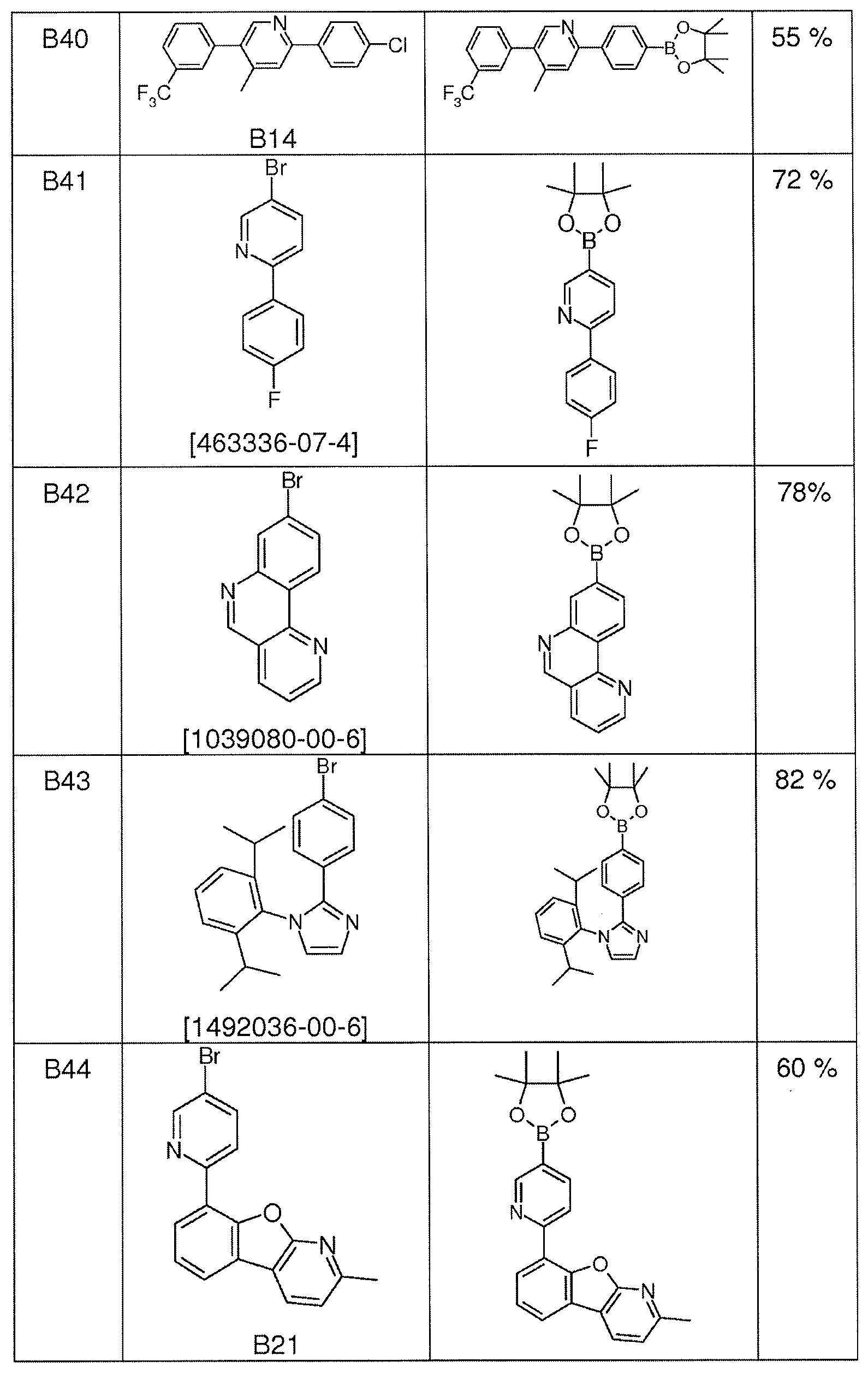
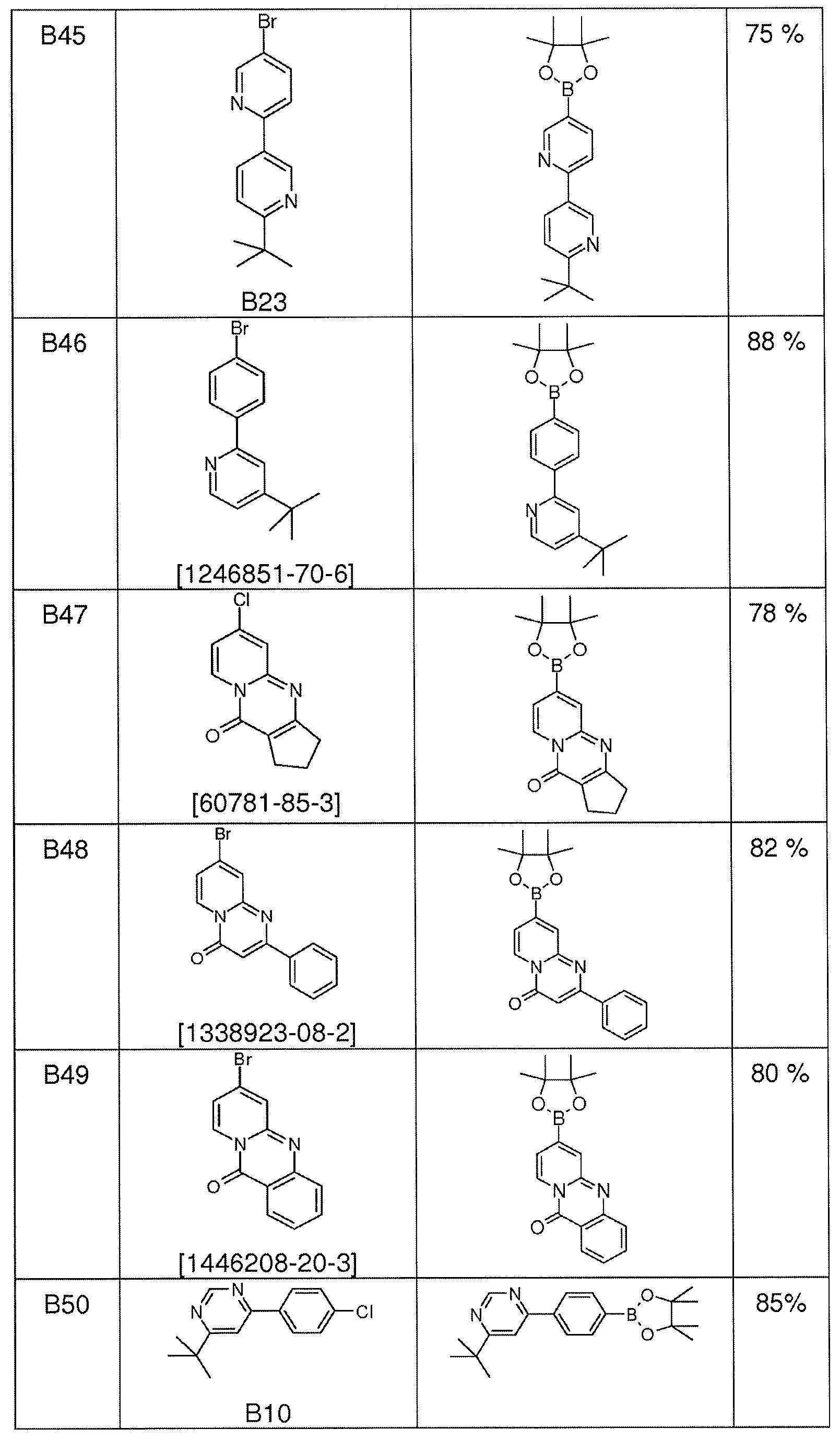

실시예 B56:Example B56:

28.1 g (100 mmol) 의 B25, 28.2 g (100 mmol) 의 1-브로모-2-요오도벤젠 [583-55-1], 31.8 g (300 mmol) 의 탄산나트륨, 787 mg (3 mmol) 의 트리페닐포스핀, 225 mg (1 mmol) 의 팔라듐(II) 아세테이트, 300 ml 의 톨루엔, 150 ml 의 에탄올 및 300 ml 의 물의 혼합물을 환류 하에서 24 h 동안 가열한다. 냉각 후, 혼합물을 500 ml 의 톨루엔을 이용하여 증량하고, 유기상을 제거하고, 500 ml 의 물로 1 회 및 500 ml 의 포화 염화 나트륨 용액으로 1 회 세척하고, 황산 마그네슘 상에서 건조시킨다. 용매를 제거한 후, 잔류물을 에틸 아세테이트/n-헵탄으로부터 재결정화하거나 실리카겔 상에서 크로마토그래피 (톨루엔/에틸 아세테이트, 9:1 v/v) 한다. 수율: 22.7 g (73 mmol), 73%. 순도: 1H NMR 에 의해 약 97%.28.1 g (100 mmol) of B25, 28.2 g (100 mmol) of 1-bromo-2-iodobenzene [583-55-1], 31.8 g (300 mmol) of sodium carbonate, 787 mg (3 mmol) of A mixture of triphenylphosphine, 225 mg (1 mmol) of palladium(II) acetate, 300 ml of toluene, 150 ml of ethanol and 300 ml of water is heated under reflux for 24 h. After cooling, the mixture is extended with 500 ml of toluene, the organic phase is removed, washed once with 500 ml of water and once with 500 ml of saturated sodium chloride solution and dried over magnesium sulfate. After removal of the solvent, the residue is recrystallized from ethyl acetate/n-heptane or chromatographed on silica gel (toluene/ethyl acetate, 9:1 v/v). Yield: 22.7 g (73 mmol), 73%. Purity: about 97% by 1 H NMR.
하기 화합물은 유사한 방식으로 제조될 수 있고, 예를 들어 에틸 아세테이트, 시클로헥산, 톨루엔, 아세토니트릴, n-헵탄, 에탄올 또는 메탄올과 같은 용매를 사용하여 재결정화할 수 있다. 열 추출을 위해 이러한 용매를 사용하거나, 또는 자동화 컬럼 시스템 (Axel Semrau의 Torrent) 에서의 실리카겔 상에서 크로마토그래피로 정제하는 것도 가능하다.The following compounds can be prepared in a similar manner and can be recrystallized, for example using solvents such as ethyl acetate, cyclohexane, toluene, acetonitrile, n-heptane, ethanol or methanol. It is also possible to use these solvents for thermal extraction, or chromatographic purification on silica gel in an automated column system (Torrent, Axel Semrau).


실시예 B81:Example B81:

36.4 g (100 mmol) 의 2,2'-(5-클로로-1,3-페닐렌)비스[4,4,5,5-테트라메틸-1,3,2-디옥사보롤란] [1417036-49-7], 65.2 g (210 mmol) 의 B56, 42.4 g (400 mmol) 의 탄산 나트륨, 1.57 g (6 mmol) 의 트리페닐포스핀, 500 mg (2 mmol) 의 팔라듐(II) 아세테이트, 500 ml 의 톨루엔, 200 ml 의 에탄올 및 500 ml 의 물의 혼합물을 환류 하에서 48 h 동안 가열한다. 냉각 후, 혼합물을 500 ml 의 톨루엔을 이용하여 증량하고, 유기상을 제거하고, 500 ml 의 물로 1 회 및 500 ml 의 포화 염화 나트륨 용액으로 1 회 세척하고, 황산 마그네슘 상에서 건조시킨다. 용매를 제거시킨 후, 잔류물을 실리카겔 (n-헵탄/에틸 아세테이트, 2:1 v/v) 상에서 크로마토그래피한다. 수율: 41.4 g (68 mmol), 68%. 순도: 1H NMR 에 의해 약 95%.36.4 g (100 mmol) of 2,2′-(5-chloro-1,3-phenylene)bis[4,4,5,5-tetramethyl-1,3,2-dioxaborolane] [1417036 -49-7], 65.2 g (210 mmol) of B56, 42.4 g (400 mmol) of sodium carbonate, 1.57 g (6 mmol) of triphenylphosphine, 500 mg (2 mmol) of palladium(II) acetate, A mixture of 500 ml of toluene, 200 ml of ethanol and 500 ml of water is heated under reflux for 48 h. After cooling, the mixture is extended with 500 ml of toluene, the organic phase is removed, washed once with 500 ml of water and once with 500 ml of saturated sodium chloride solution and dried over magnesium sulfate. After removal of the solvent, the residue is chromatographed on silica gel (n-heptane/ethyl acetate, 2:1 v/v). Yield: 41.4 g (68 mmol), 68%. Purity: about 95% by 1 H NMR.
하기 화합물은 유사한 방식으로 제조될 수 있고, 예를 들어 에틸 아세테이트, 시클로헥산, 톨루엔, 아세토니트릴, n-헵탄, 에탄올 또는 메탄올과 같은 용매를 사용하여 재결정화할 수 있다. 열 추출을 위해 이러한 용매를 사용하거나, 또는 자동화 컬럼 시스템 (Axel Semrau의 Torrent) 에서의 실리카겔 상에서 크로마토그래피로 정제하는 것도 가능하다.The following compounds can be prepared in a similar manner and can be recrystallized, for example using solvents such as ethyl acetate, cyclohexane, toluene, acetonitrile, n-heptane, ethanol or methanol. It is also possible to use these solvents for thermal extraction, or chromatographic purification on silica gel in an automated column system (Torrent, Axel Semrau).
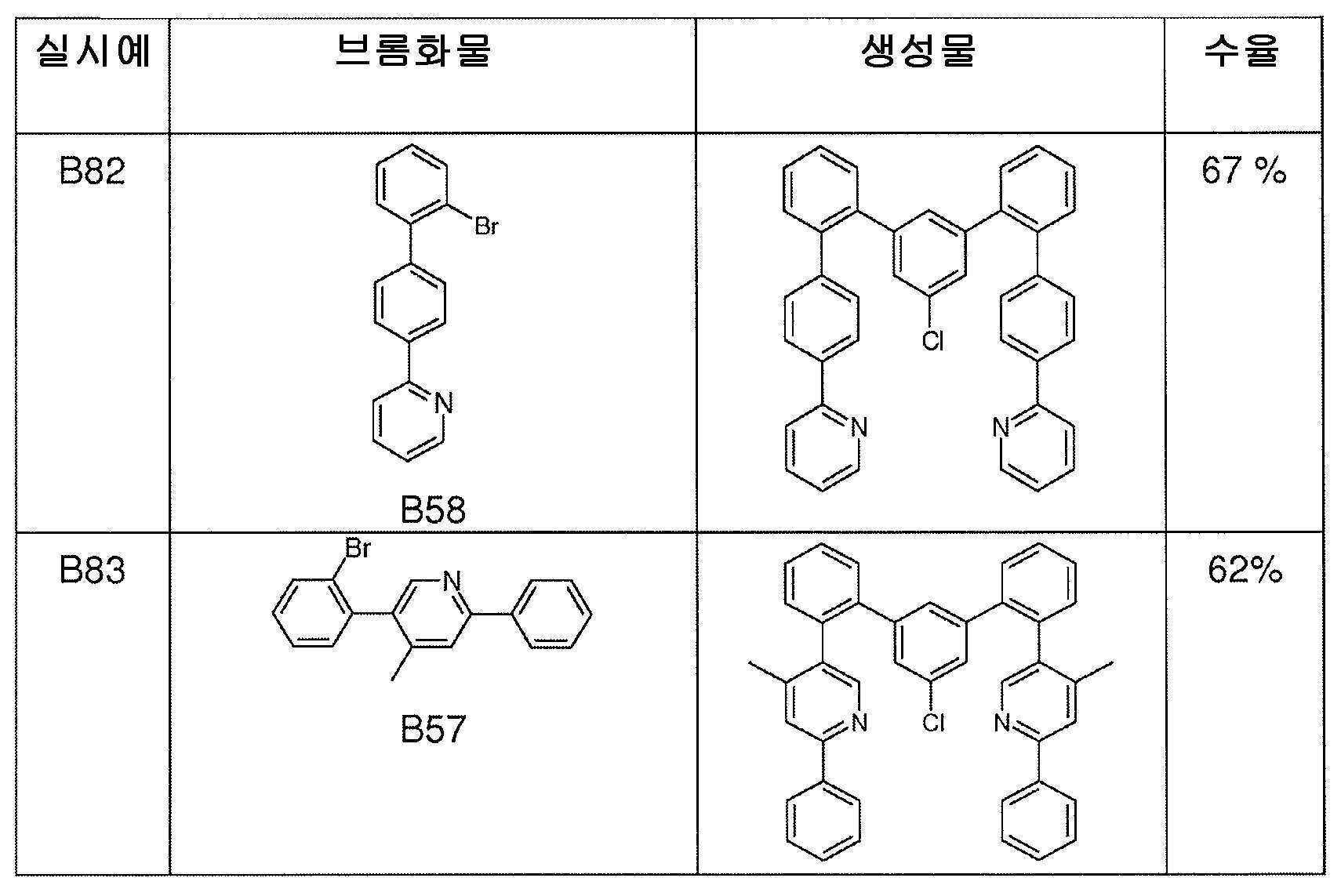


실시예 B93:Example B93:

17.1 g (100 mmol) 의 4-(2-피리딜)페놀 [51035-40-6] 및 12.9 g (100 mmol) 의 디이소프로필에틸아민 [7087-68-5]의 혼합물을 400ml의 디클로로메탄에서 10 분동안 실온에서 교반한다. 30 ml의 디클로로메탄에 용해된 6.2 ml (40 mmol) 의 5-클로로이소프탈로일 클로라이드 [2855-02-9]를 적가하고, 반응 혼합물을 실온에서 14 시간 동안 교반한다. 이어서, 10ml의 물을 적가하고, 반응 혼합물을 분별 깔대기로 옮긴다. 유기상을 100ml의 물로 2 회 및 50ml의 포화 NaCl 용액으로 1 회 세척하고, 황산 나트륨 상에서 건조시키고, 농축 건조시킨다. 수율: 18.0 g (38 mmol), 95%. 순도: 1H NMR 에 의해 약 95%.A mixture of 17.1 g (100 mmol) of 4-(2-pyridyl)phenol [51035-40-6] and 12.9 g (100 mmol) of diisopropylethylamine [7087-68-5] was dissolved in 400 ml of dichloromethane. stirred at room temperature for 10 minutes. 6.2 ml (40 mmol) of 5-chloroisophthaloyl chloride [2855-02-9] dissolved in 30 ml of dichloromethane are added dropwise, and the reaction mixture is stirred at room temperature for 14 hours. 10 ml of water is then added dropwise and the reaction mixture is transferred to a separatory funnel. The organic phase is washed twice with 100 ml of water and once with 50 ml of saturated NaCl solution, dried over sodium sulfate and concentrated to dryness. Yield: 18.0 g (38 mmol), 95%. Purity: about 95% by 1 H NMR.
하기 화합물은 유사한 방식으로 제조될 수 있다; 사용된 반응물의 몰량은 B93을 위한 절차에서 설명된 것과 다를 경우에 특정된다.The following compounds can be prepared in a similar manner; The molar amounts of reactants used are specified where different from those described in the procedure for B93.


실시예 B101:Example B101:

2.0 g (50 mmol) 의 수소화 나트륨 (파라핀 오일 중 60% 분산액) [7646-69-7] 을 300ml 의 THF에서 현탁시키고, 이어서 5.0 g (10 mmol) 의 B95 를 첨가하고, 그리고 그 현탁액을 실온에서 30 분동안 교반한다. 이어서, 1.2 ml의 요오드메탄 (50 mmol) [74-88-4]을 첨가하고, 반응 혼합물을 실온에서 50 시간 동안 교반한다. 20 ml의 농축 암모니아 용액을 첨가하고, 혼합물을 추가로 30 분 동안 교반하고, 그리고 용매를 감압하에서 대량 뽑아낸다. 잔류물을 300 ml의 디클로로메탄에서 취하고, 200 ml 의 5 중량% 암모니아수로 1회, 물을 매회 100 ml 씩 2 회 및 100 ml 의 포화 염화 나트륨 용액으로 1 회 세척한 후, 황산 마그네슘 상에서 건조시킨다. 디클로로메탄을 감압하에서 제거하고, 조 생성물을 에틸 아세테이트/메탄올로부터 재결정화한다. 수율: 4.3 g (8 mmol), 80%. 순도: 1H NMR 에 의해 약 98%.2.0 g (50 mmol) of sodium hydride (60% dispersion in paraffin oil) [7646-69-7] was suspended in 300 ml of THF, then 5.0 g (10 mmol) of B95 was added, and the suspension was brought to room temperature stirred for 30 minutes. Then 1.2 ml of iodomethane (50 mmol) [74-88-4] are added and the reaction mixture is stirred at room temperature for 50 hours. 20 ml of concentrated ammonia solution is added, the mixture is stirred for a further 30 minutes, and the solvent is extracted in bulk under reduced pressure. The residue is taken up in 300 ml of dichloromethane, washed once with 200 ml of 5% by weight aqueous ammonia, twice with 100 ml each time of water and once with 100 ml of saturated sodium chloride solution, then dried over magnesium sulfate. . Dichloromethane is removed under reduced pressure and the crude product is recrystallized from ethyl acetate/methanol. Yield: 4.3 g (8 mmol), 80%. Purity: about 98% by 1 H NMR.
유사한 방식으로, 하기 화합물을 제조하는 것이 가능하다:In a similar way, it is possible to prepare the following compounds:

실시예 B105:Example B105:

36.4 g (100 mmol) 의 2,2'-(5-클로로-1,3-페닐렌)비스[4,4,5,5-테트라메틸-1,3,2-디옥사보롤란] [1417036-49-7], 70.6 g (210 mmol) 의 B69, 42.4 g (400 mmol) 의 탄산나트륨, 2.3 g (2 mmol) 의 테트라키스(트리페닐포스핀)팔라듐(0), 1000 ml 의 1,2-디메톡시에탄 및 500 ml 의 물을 환류하에서 48 시간 동안 가열한다. 냉각 후, 침전된 고체를 흡입 여과하고 20ml 의 에탄올로 2 회 세척한다. 고체를 500 ml의 디클로로메탄에 용해시키고 셀라이트 베드를 통해 여과한다. 여액을 100 ml까지 농축시키고, 이어서 400 ml의 에탄올을 첨가하고 침전된 고체를 흡입 여과한다. 조 생성물을 에틸 아세테이트로부터 한번 재결정화한다. 수율: 43.6 g (70 mmol), 70%. 순도: 1H NMR 에 의해 약 96%.36.4 g (100 mmol) of 2,2′-(5-chloro-1,3-phenylene)bis[4,4,5,5-tetramethyl-1,3,2-dioxaborolane] [1417036 -49-7], 70.6 g (210 mmol) of B69, 42.4 g (400 mmol) of sodium carbonate, 2.3 g (2 mmol) of tetrakis(triphenylphosphine)palladium(0), 1000 ml of 1,2 -Dimethoxyethane and 500 ml of water are heated under reflux for 48 hours. After cooling, the precipitated solid was filtered with suction and washed twice with 20 ml of ethanol. The solid is dissolved in 500 ml of dichloromethane and filtered through a celite bed. The filtrate is concentrated to 100 ml, then 400 ml of ethanol is added and the precipitated solid is filtered with suction. The crude product is recrystallized once from ethyl acetate. Yield: 43.6 g (70 mmol), 70%. Purity: about 96% by 1 H NMR.
하기 화합물은 유사한 방식으로 제조될 수 있고, 예를 들어 에틸 아세테이트, 시클로헥산, 톨루엔, 아세토니트릴, n-헵탄, 에탄올 또는 메탄올과 같은 용매를 사용하여 재결정화를 달성할 수 있다. 열 추출을 위해 이러한 용매를 사용하거나, 또는 자동화 컬럼 시스템 (Axel Semrau의 Torrent) 에서의 실리카겔 상에서 크로마토그래피로 정제하는 것도 가능하다.The following compounds can be prepared in a similar manner, and recrystallization can be achieved using solvents such as, for example, ethyl acetate, cyclohexane, toluene, acetonitrile, n-heptane, ethanol or methanol. It is also possible to use these solvents for thermal extraction, or chromatographic purification on silica gel in an automated column system (Torrent, Axel Semrau).


실시예 B119:Example B119:
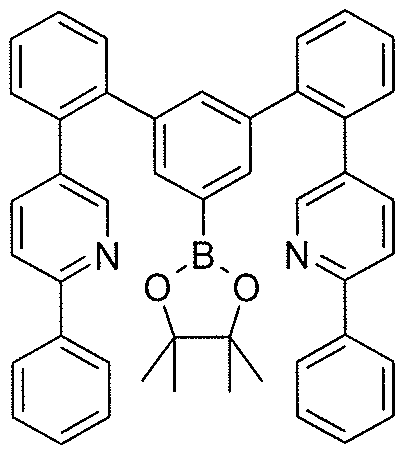
57.1 g (100 mmol) 의 B81, 25.4 g (100 mmol) 의 비스(피나콜라토)디보란 [73183-34-3], 49.1 g (500 mmol) 의 아세트산 칼륨, 2 mmol 의 SPhos [657408-07-6], 1 mmol 의 팔라듐(II) 아세테이트, 200g 의 유리 비드 (직경 3mm) 및 700ml의 1,4-디옥산의 혼합물을 교반하면서 16 시간 동안 가열 환류시킨다. 냉각 후, 현탁액을 셀라이트 베드를 통해 여과하고, 용매를 감압하에서 제거한다. 흑색 잔류물을 1000 ml 의 고온 에틸 아세테이트로 분해시키고, 여전히 고온 상태에서 셀라이트 베드를 통해 여과하고, 다음 약 200 ml 까지 농축시키고, 그 과정에서 생성물은 결정화되기 시작한다. 결정화를 냉장고에서 밤새 완결하고, 결정을 여과하고, 소량의 에틸 아세테이트로 세척한다. 모액으로부터 2 번째 분별 생성물을 수득할 수 있다. 수율: 31.6 g (78 mmol), 78%. 순도: 1H NMR 에 의해 약 95%.57.1 g (100 mmol) of B81, 25.4 g (100 mmol) of bis(pinacolato)diborane [73183-34-3], 49.1 g (500 mmol) of potassium acetate, 2 mmol of SPhos [657408-07 -6], a mixture of 1 mmol of palladium(II) acetate, 200 g of glass beads (3 mm in diameter) and 700 ml of 1,4-dioxane was heated to reflux for 16 hours while stirring. After cooling, the suspension is filtered through a celite bed and the solvent is removed under reduced pressure. The black residue is digested with 1000 ml of hot ethyl acetate, filtered through a celite bed while still hot, then concentrated to about 200 ml, during which time the product starts to crystallize. Crystallization is completed overnight in the refrigerator, and the crystals are filtered and washed with a small amount of ethyl acetate. A second fractionation product can be obtained from the mother liquor. Yield: 31.6 g (78 mmol), 78%. Purity: about 95% by 1 H NMR.
하기 화합물은 유사한 방식으로 제조될 수 있으며, 난용성인 경우에는 재결정화 또는 열 추출을 위해 에틸 아세테이트 대신에 오히려 톨루엔, n-헵탄, 시클로헥산, 디클로로메탄 또는 아세토니트릴을 사용할 수 있다:The following compounds can be prepared in a similar manner, and in the case of sparingly soluble toluene, n-heptane, cyclohexane, dichloromethane or acetonitrile can be used instead of ethyl acetate for recrystallization or thermal extraction:


실시예 B152:Example B152:

G. Markopoulos et al., Angew. Chem, Int. Ed., 2012, 51, 12884 에 따른 제조. G. Markopoulos et al., Angew. Chem, Int. Ed., 2012, 51, 12884.

JP 2000-169400에 따른 절차. 건조 아세톤 300 ml 에서, 36.6 g (100 mmol) 의 1,3-비스(2-브로모페닐)-2-프로펜-1-온 [126824-93-9] 에, 5.7 g [105 mmol] 의 나트륨 메톡시드를 조금씩 첨가한 다음, 그 혼합물을 40℃에서 12 시간 동안 교반한다. 용매를 감압하에 제거하고, 잔류물을 에틸 아세테이트에서 취하고, 매회 200 ml의 물로 3 회 세척하고, 매회 포화 염화 나트륨 용액 200 ml로 2 회 세척하고, 그리고 황산 마그네슘 상에서 건조시킨다. 감압하에 용매를 제거한 후 얻은 오일을 플래시 크로마토그래피 (Torrent CombiFlash, Axel Semrau 제품) 로 처리한다. 수율: 17.9 g (44 mmol), 44%. 순도: 1H NMR 에 의해 약 97%.Procedure according to JP 2000-169400. In 300 ml of dry acetone, to 36.6 g (100 mmol) of 1,3-bis(2-bromophenyl)-2-propen-1-one [126824-93-9], 5.7 g [105 mmol] of Sodium methoxide is added in small portions and then the mixture is stirred at 40° C. for 12 hours. The solvent is removed under reduced pressure, and the residue is taken up in ethyl acetate, washed three times with 200 ml of water each time, twice with 200 ml of saturated sodium chloride solution each time, and dried over magnesium sulfate. After solvent removal under reduced pressure, the oil obtained is subjected to flash chromatography (Torrent CombiFlash, product of Axel Semrau). Yield: 17.9 g (44 mmol), 44%. Purity: about 97% by 1 H NMR.

200 ml의 디-n-부틸 에테르 중 2-클로로페닐마그네슘 브롬화물 (200 mmol) [36692-27-0]의 용액에, 0℃에서 2.4 g (2.4 mmol) 의 무수 구리(I) 염화물 [7758-89-6]을 첨가하고, 그 혼합물을 추가로 30 분 동안 교반한다. 그후, 200 ml의 톨루엔 중의 단계 b)의 40.6 g (100 mmol) 의 용액을 30 분에 걸쳐 적가하고, 그 혼합물을 0℃에서 추가로 5 h 동안 교반한다. 반응 혼합물을 100 ml의 물 및 그후 220 ml의 1N 염산을 조심스럽게 첨가하여 켄칭시킨다. 유기상을 분리하고 물을 매회 200ml 씩으로 2 회, 200 ml 의 포화 탄산 수소 나트륨 용액으로 1 회, 그리고 200 ml 의 포화 염화 나트륨 용액으로 1 회 세척하고, 그리고 황산 마그네슘 상에서 건조시킨다. 감압 하에서 용매를 제거한 후 얻은 오일을 실리카겔을 통해 톨루엔으로 여과한다. 이렇게 수득된 조 생성물을 추가의 정제없이 추가로 변환시킨다. 수율: 49.8 g (96 mmol), 96%. 순도: 1H NMR 에 의해 약 90-95%.2.4 g (2.4 mmol) of anhydrous copper(I) chloride [7758 -89-6] is added, and the mixture is stirred for an additional 30 minutes. Then, a solution of 40.6 g (100 mmol) of step b) in 200 ml of toluene is added dropwise over 30 minutes, and the mixture is stirred at 0° C. for a further 5 h. The reaction mixture is quenched by carefully adding 100 ml of water and then 220 ml of IN hydrochloric acid. The organic phase is separated and washed twice with 200 ml of water each time, once with 200 ml of saturated sodium hydrogen carbonate solution and once with 200 ml of saturated sodium chloride solution, and dried over magnesium sulfate. After removal of the solvent under reduced pressure, the oil obtained is filtered through silica gel with toluene. The crude product thus obtained is further transformed without further purification. Yield: 49.8 g (96 mmol), 96%. Purity: about 90-95% by 1 H NMR.

0℃로 냉각된, 500 ml의 디클로로메탄 (DCM) 중 51.9 g (100 mmol) 의 단계 c)의 용액에, 1.0 ml의 트리플루오로메탄술폰산을 첨가한 다음, 50 g의 오산화 인을 조금씩 첨가한다. 혼합물을 실온으로 가온시키고, 추가 2 시간 동안 교반한다. 오산화 인을 디켄팅하고 200 ml의 DCM에 현탁시키고, 다시 디켄팅한다. 조합한 DCM 상을 물로 2 회, 포화 염화 나트륨 용액으로 1 회 세척하고, 그리고 황산 마그네슘 상에서 건조시킨다. 감압하에 용매를 제거한 후 얻은 오일을 플래시 크로마토그래피 (Torrent CombiFlash, Axel Semrau 제품) 로 처리한다. 수율: 31.5 g (63 mmol), 63 %, 이성질체 혼합물. 순도: 1H NMR 에 의해 약 90-95%.To a solution of 51.9 g (100 mmol) of step c) in 500 ml of dichloromethane (DCM), cooled to 0° C., 1.0 ml of trifluoromethanesulfonic acid are added, followed by 50 g of phosphorus pentoxide portionwise. do. The mixture is warmed to room temperature and stirred for an additional 2 hours. Phosphorus pentoxide is decanted and suspended in 200 ml of DCM and decanted again. The combined DCM phases are washed twice with water, once with saturated sodium chloride solution, and dried over magnesium sulfate. After solvent removal under reduced pressure, the oil obtained is subjected to flash chromatography (Torrent CombiFlash, product of Axel Semrau). Yield: 31.5 g (63 mmol), 63 %, mixture of isomers. Purity: about 90-95% by 1 H NMR.

25.0 g (50 mmol) 의 단계 d), 2g의 Pd/C (10%), 200 ml 의 메탄올, 및 300 ml 의 에틸 아세테이트의 혼합물을 교반된 오토클레이브에서 3 bar의 수소와 접촉시키고, 수소화를 수소 흡수가 끝날 때까지 30℃에서 수행한다. 혼합물을 에틸 아세테이트 슬러리 형태의 셀라이트 베드를 통해 여과하고, 여액을 농축 건조시킨다. 이렇게 얻은 오일을 플래시 크로마토그래피 (Torrent CombiFlash, Axel Semrau 제품) 로 처리한다. 수율: 17.2 g (34 mmol), 68%. 순도: 1H NMR 에 의해 약 95% (cis,cis 이성질체).A mixture of 25.0 g (50 mmol) of step d), 2 g of Pd/C (10%), 200 ml of methanol, and 300 ml of ethyl acetate was contacted with 3 bar of hydrogen in a stirred autoclave and the hydrogenation Carry out at 30 °C until hydrogen absorption is over. The mixture is filtered through a bed of celite in the form of an ethyl acetate slurry and the filtrate is concentrated to dryness. The oil thus obtained is subjected to flash chromatography (Torrent CombiFlash, product of Axel Semrau). Yield: 17.2 g (34 mmol), 68%. Purity: about 95% by 1 H NMR (cis,cis isomers).
하기 화합물을 유사한 방식으로 제조한다:The following compounds are prepared in a similar manner:


실시예 B156:Example B156:

750 ml 의 톨루엔, 300 ml의 디옥산 및 500 ml의 물 중의 54.5 g (100 mmol) 의 B152, 59.0 g (210 mmol) 의 2-페닐-5-(4,4,5,5-테트라메틸-[1,3,2]디옥사보로란-2-일)피리딘 [879291-27-7], 127.4 g (600 mmol) 의 트리칼륨 인산염, 1.57 g (6 mmol) 의 트리페닐포스핀 및 449mg (2 mmol) 의 팔라듐(II) 아세테이트의 혼합물을 30 시간 동안 환류하에 가열한다. 냉각시킨 후, 유기상을 분리하고, 매회 300 ml의 물로 2 회 및 300 ml의 포화 염화 나트륨 용액으로 1 회 세척하고, 황산 마그네슘 상에서 건조시킨다. 황산 마그네슘을 톨루엔 슬러리 형태의 셀 라이트 베드를 사용하여 여과하고, 여액을 감압하에 농축 건조시키고, 나머지 폼을 아세토니트릴/에틸 아세테이트로부터 재결정화한다. 수율: 41.8 g (64 mmol), 64%. 순도: 1H NMR 에 의해 약 95%.54.5 g (100 mmol) of B152 in 750 ml of toluene, 300 ml of dioxane and 500 ml of water, 59.0 g (210 mmol) of 2-phenyl-5-(4,4,5,5-tetramethyl- [1,3,2]dioxaborolan-2-yl)pyridine [879291-27-7], 127.4 g (600 mmol) tripotassium phosphate, 1.57 g (6 mmol) triphenylphosphine and 449 mg (2 mmol) of palladium(II) acetate is heated under reflux for 30 hours. After cooling, the organic phase is separated, washed twice with 300 ml of water each time and once with 300 ml of saturated sodium chloride solution and dried over magnesium sulfate. Magnesium sulfate is filtered using a celite bed in the form of a toluene slurry, the filtrate is concentrated to dryness under reduced pressure, and the remaining foam is recrystallized from acetonitrile/ethyl acetate. Yield: 41.8 g (64 mmol), 64%. Purity: about 95% by 1 H NMR.
하기 화합물을 유사한 방식으로 제조한다:The following compounds are prepared in a similar manner:


B: 리간드의 합성:B: Synthesis of ligands:
실시예 L1:Example L1:
변형예 A:Variant A:

7.0 g (15 mmol) 의 B3, 19.9 g (30.0 mmol) 의 B120, 9.5 g (90 mmol) 의 탄산나트륨, 340 mg (1.3 mmol) 의 트리페닐포스핀, 98 mg (0.44 mmol) 의 팔라듐(II) 아세테이트, 200ml의 톨루엔, 100ml의 에탄올 및 200ml의 물의 혼합물을 환류하에 40 시간 동안 가열한다. 냉각시킨 후, 침전된 고체를 흡입 여과하고, 매회 30 ml의 에탄올로 2 회 세척한다. 조 생성물을 300 ml의 디클로로메탄에 용해시키고 실리카 겔 베드를 통해 여과한다. 실리카 겔 베드를 매회 200 ml의 디클로로메탄/에틸 아세테이트 1:1 로 3 회 세척한다. 여액을 물로 2 회, 포화 염화 나트륨 용액으로 1 회 세척하고, 그리고 황산나트륨 상에서 건조시킨다. 여액을 농축 건조시킨다. 잔류물을 실리카 겔 (Axel Semrau 제조의 자동화된 플래시 컬럼 시스템) 상에서 에틸 아세테이트/헵탄 용리 혼합물로 크로마토그래피한다. 수율: 10.7 g (7.8 mmol), 52%. 순도: 1H NMR 에 의해 약 98%.7.0 g (15 mmol) of B3, 19.9 g (30.0 mmol) of B120, 9.5 g (90 mmol) of sodium carbonate, 340 mg (1.3 mmol) of triphenylphosphine, 98 mg (0.44 mmol) of palladium(II) A mixture of acetate, 200 ml of toluene, 100 ml of ethanol and 200 ml of water is heated under reflux for 40 hours. After cooling, the precipitated solid is filtered with suction and washed twice with 30 ml of ethanol each time. The crude product is dissolved in 300 ml of dichloromethane and filtered through a bed of silica gel. The silica gel bed is washed three times with 200 ml of dichloromethane/ethyl acetate 1:1 each time. The filtrate is washed twice with water, once with saturated sodium chloride solution, and dried over sodium sulfate. The filtrate is concentrated to dryness. The residue is chromatographed on silica gel (automated flash column system from Axel Semrau) with an ethyl acetate/heptane elution mixture. Yield: 10.7 g (7.8 mmol), 52%. Purity: about 98% by 1 H NMR.
변형예 B:Variant B:
5.7 g (15 mmol) 의 B5, 19.9 g (30.0 mmol) 의 B120, 13.8 g (60 mmol) 의 인산 칼륨 일수화물, 507 mg (0.6 mmol) 의 XPhos palladacycle Gen. 3 [1445085-55-1], 200 ml 의 THF 및 100 ml의 물을 환류하에 20 시간 동안 가열한다. 냉각시킨 후, 침전된 고체를 흡입 여과하고, 매회 30 ml의 물로 2 회 세척하고, 매회 30 ml의 에탄올로 2 회 세척한다. 정제는 변형예 A에 기술된 바와 같이 수행된다. 수율: 13.2 g (9.6 mmol), 64%. 순도: 1H NMR 에 의해 약 99%.5.7 g (15 mmol) of B5, 19.9 g (30.0 mmol) of B120, 13.8 g (60 mmol) of potassium phosphate monohydrate, 507 mg (0.6 mmol) of XPhos palladacycle Gen. 3 [1445085-55-1], 200 ml of THF and 100 ml of water are heated under reflux for 20 hours. After cooling, the precipitated solid is filtered with suction, washed twice with 30 ml of water each time and twice with 30 ml of ethanol each time. Purification is performed as described in Variant A. Yield: 13.2 g (9.6 mmol), 64%. Purity: about 99% by 1 H NMR.
하기 화합물은 L1에 대해 기재된 절차 (변형예 A 또는 B) 와 유사하게 제조될 수 있다. 이 경우, 톨루엔, 시클로헥산, 에틸 아세테이트 또는 디메틸포름아미드를 재결정 또는 열 추출에 의한 정제에 사용할 수도 있다. 대안으로, 리간드는 크로마토그래피로 정제할 수 있다.The following compounds can be prepared analogously to the procedure described for L1 (variant A or B). In this case, toluene, cyclohexane, ethyl acetate or dimethylformamide may be used for purification by recrystallization or thermal extraction. Alternatively, ligands can be purified chromatographically.


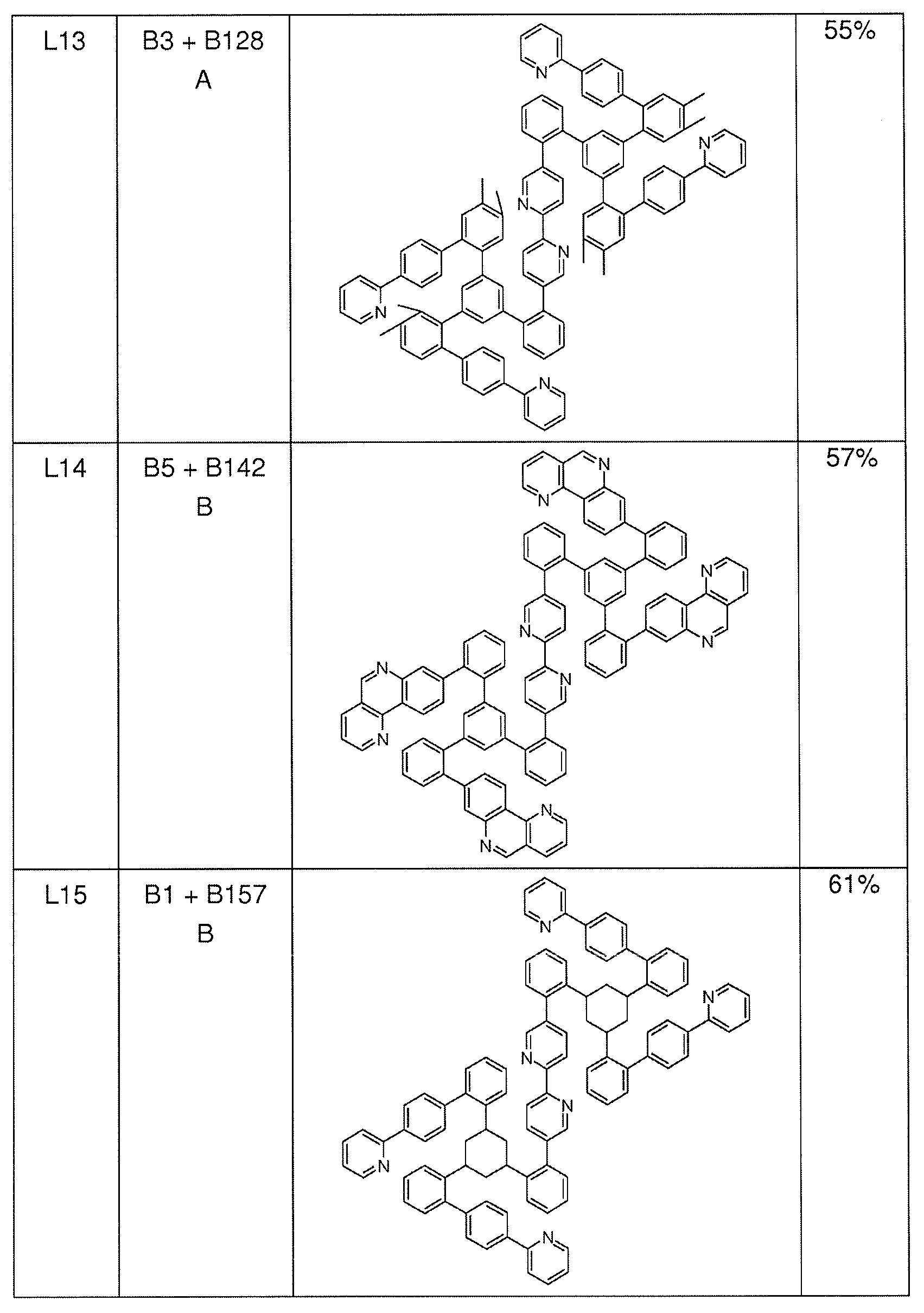


C: 금속 착물의 합성:C: Synthesis of metal complexes:
변형예 A: I1-IrVariant A: I1-Ir 22 (L1) 및 I2- Ir(L1) and I2-Ir 22 (L1) 타입의 C-N- 또는 C-O- 공여체 세트를 갖는 착물(L1) complexes with C-N- or C-O-donor sets of type

13.8 g (10 mmol) 의 리간드 L1, 9.8 g (20 mmol) 의 트리스아세틸아세토나토이리듐(III) [15635-87-7] 및 100 g의 하이드로퀴논 [123-31-9]의 혼합물을 먼저 유리를 입힌 자성 막대가 있는 1000 ml 의 2구 둥근 바닥 플라스크에 투입한다. 플라스크에는 물 분리기 (물보다 저밀도의 매질을 위함) 및 아르곤 블랭킷을 갖는 공기 응축기가 장착되고 금속 가열 배쓰에 놓여진다. 15 분 동안 아르곤 블랭킷을 통해 위로부터 아르곤으로 장치를 퍼지하여, 아르곤이 2구 플라스크의 측면 구(neck) 밖으로 흘려지게 한다. 2구 플라스크의 측면 구를 통해, 유리를 입힌 Pt-100 열전대를 플라스크에 도입하고, 그 끝을 자성 교반기 막대 바로 위에 위치시킨다. 그후 가정용 알루미늄 호일의 여러 느슨한 와인딩에 의해 장치를 단열시키고, 단열은 물 분리기의 상승 튜브의 중간까지 향한다. 그후 가열된 실험실 교반기 시스템으로 장치를 250℃ 로 급속 가열시키고, 용융된 교반되는 반응 혼합물에 침지된 Pt-100 온도 센서로 측정한다. 다음 2 시간 동안, 반응 혼합물은 250 ℃로 유지되며, 그 과정에서 소량의 응축물이 증류되어 물 분리기에 수집된다. 반응 혼합물을 190℃로 냉각시킨 후, 에틸렌 글리콜 100ml를 적가한다. 혼합물을 80℃로 더 냉각시킨 후 메탄올 500ml를 적가한다; 그 혼합물을 환류하에서 1 시간 동안 가열한다. 이렇게 수득된 현탁액을 양 말단 프릿을 통해 여과하고, 고체를 50 ml의 메탄올로 2 회 세척한 후, 감압하에서 건조시킨다. 이렇게 수득된 고체를 200 ml 의 디클로로메탄에 용해시키고 어두운 곳에서 공기를 배제하여 약 1 kg 의 디클로로메탄 슬러리 형태의 실리카 겔 (컬럼 직경 약 18 cm) 을 통해 여과하여, 초기에 어두운 색상의 성분을 남긴다. 코어 분별물을 잘라내어 회전식 증발기 상에서 농축시키고, 결정화될 때까지 MeOH 를 동시에 연속적으로 적가한다. 흡인으로 제거하고, 약간의 MeOH로 세척하고, 감압하에서 건조시킨 후, 부분 입체 이성질체 생성물 혼합물을 추가로 정제한다.A mixture of 13.8 g (10 mmol) of ligand L1, 9.8 g (20 mmol) of trisacetylacetonatoiridium(III) [15635-87-7] and 100 g of hydroquinone [123-31-9] was first liberated into a 1000 ml two-necked round bottom flask equipped with a coated magnetic rod. The flask was equipped with a water separator (for media less dense than water) and an air condenser with an argon blanket and placed in a metal heating bath. The apparatus is purged with argon from above through an argon blanket for 15 minutes, allowing the argon to flow out of the side neck of the two-necked flask. Through the side mouth of the two-necked flask, a glass-lined Pt-100 thermocouple is introduced into the flask and its tip positioned directly over the magnetic stirrer rod. The device is then insulated by several loose windings of household aluminum foil, the insulation going up to the middle of the riser tube of the water separator. The apparatus is then rapidly heated to 250° C. with a heated laboratory stirrer system and measured with a Pt-100 temperature sensor immersed in the molten stirred reaction mixture. During the next 2 hours, the reaction mixture is maintained at 250 °C, during which a small amount of condensate is distilled off and collected in a water separator. After cooling the reaction mixture to 190 DEG C, 100 ml of ethylene glycol was added dropwise. After the mixture was further cooled to 80° C., 500 ml of methanol was added dropwise; The mixture is heated under reflux for 1 hour. The suspension thus obtained is filtered through a frit at both ends, and the solid is washed twice with 50 ml of methanol and then dried under reduced pressure. The solid thus obtained was dissolved in 200 ml of dichloromethane and filtered through silica gel (column diameter of about 18 cm) in the form of about 1 kg of dichloromethane slurry by excluding air in a dark place to obtain an initially dark color component. leave The core fraction is cut off and concentrated on a rotary evaporator, and MeOH is added dropwise simultaneously and continuously until crystallization. After removal by suction, washing with some MeOH and drying under reduced pressure, the diastereomeric product mixture is further purified.
ΔΔ 및 ΛΛ 이성질체 (라세믹) 및 ΛΔ 이성질체 (메소) 를 포함하는 부분 입체 이성질체 금속 착물 혼합물 및 추가로 작은 비율의 자오선 (meridional) 이성질체를 300 ml의 디클로로메탄에 용해시키고, 100 g의 실리카 겔에 도포하고, 그리고 톨루엔 슬러리 형태의 실리카 겔 컬럼을 사용하여 크로마토그래피 분리한다 (실리카 겔의 양은 약 1.7 kg). 사용된 용리액은 처음에는 톨루엔이고, 나중에는작은 비율의 에틸 아세테이트를 갖는 톨루엔이다. 이하에서 이성체 1 (I1)이라고 하는, 보다 빨리 용리되는 이성질체 5.1g 및 이하에서 이성질체 2 (I2)라고 하는, 나중에 용리되는 이성질체 5.3g을 얻는다. 이성질체 1 (I1) 및 이성질체 2 (I2) 는 공기와 빛을 조심스럽게 배제하면서 이성질체 1 에 대해서는 n-부틸 아세테이트로 및 이성질체 2 에 대해서는 톨루엔으로 4회 열 추출로 분리하여 추가 정제한다 (각각의 경우 처음 투입된 양은 약 150 ml, 추출 골무: Whatman 사의 셀룰로오스로 만든 표준 속슬렛 골무). 마지막으로 제품을 280℃에서 고진공하에 열처리한다. 수율: 이성질체 1 (I1) 3.7g의 적색 고체 (2.1mmol), 사용된 리간드의 양을 기준으로 21%. 순도: HPLC 에 의해 > 99.7%; 이성질체 2 (I2) 3.7g의 적색 고체 (2.1mmol), 사용된 리간드의 양을 기준으로 21%. HPLC에 의한 순도 99.8 %. 금속 착물은 최종적으로 250℃의 고진공 (10-6 mbar) 하에서 열처리된다.A diastereomeric metal complex mixture comprising the ΔΔ and ΛΛ isomers (racemic) and the ΛΔ isomer (meso) and an additional small proportion of the meridional isomer were dissolved in 300 ml of dichloromethane and dissolved in 100 g of silica gel. and chromatographic separation using a silica gel column in the form of a toluene slurry (the amount of silica gel is about 1.7 kg). The eluent used is first toluene, then toluene with a small proportion of ethyl acetate. 5.1 g of the earlier eluting isomer, hereinafter referred to as Isomer 1 (I1), and 5.3 g of the later eluting isomer, hereinafter referred to as Isomer 2 (I2), are obtained. Isomer 1 (I1) and Isomer 2 (I2) are further purified by separation by thermal extraction four times with n-butyl acetate for isomer 1 and with toluene for isomer 2, carefully excluding air and light (in each case The first dose is about 150 ml, extraction thimble: standard Soxhlet thimble made of cellulose from Whatman). Finally, the product is heat treated under high vacuum at 280°C. Yield: 3.7 g of isomer 1 (I1) as a red solid (2.1 mmol), 21% based on the amount of ligand used. Purity: >99.7% by HPLC; Isomer 2 (I2) 3.7 g of a red solid (2.1 mmol), 21% based on the amount of ligand used. Purity 99.8% by HPLC. The metal complex is finally heat treated under high vacuum (10 −6 mbar) at 250° C.
이성질체 1 (I1) 또는 이성질체 2 (I2) 의 보고된 수율은 항상 사용된 리간드의 양을 기준으로 한다.The reported yield of isomer 1 (I1) or isomer 2 (I2) is always based on the amount of ligand used.
이하에 나타낸 착물의 이미지는 단지 하나의 이성질체만을 항상 나타낸다. 이성질체 혼합물은 분리될 수 있지만, OLED 디바이스에서 이성질체 혼합물로서 동등하게 잘 사용될 수 있다. 이후에 나타낸 금속 착물은 원칙적으로 크로마토그래피 (전형적으로 자동화된 칼럼 시스템 (Axel Semrau 제조의 Torrent)), 재결정 또는 열 추출의 사용에 의해 정제될 수 있다. 잔류 용매는 일반적으로 250-330℃의 고진공 하에서 열처리하여 제거될 수 있다. 하기 화합물은 유사하게 합성될 수 있다. 반응 조건은 이성질체 1 (I1)의 예로서 특정된다. 전형적으로 수득된 부분 입체 이성질체 혼합물의 크로마토그래피 분리는 자동화 컬럼 시스템 (Axel Semrau 제조의 Torrent) 에서 플래시 실리카 겔 상에서 수행된다.The images of complexes shown below always show only one isomer. The isomeric mixture can be separated, but equally well used as an isomeric mixture in an OLED device. The metal complexes shown hereinafter can in principle be purified by use of chromatography (typically automated column systems (Torrent from Axel Semrau)), recrystallization or thermal extraction. Residual solvents can be removed by heat treatment under high vacuum, generally at 250-330°C. The following compounds can be similarly synthesized. Reaction conditions are specified as examples of isomer 1 (I1). Chromatographic separation of diastereomeric mixtures typically obtained is carried out on flash silica gel in an automated column system (Torrent from Axel Semrau).
유사하게, 처음 10 mmol 의 Ir(acac)3 을 순차적으로 첨가하고 250℃에서 1 시간 반응시키고, 그후 10 mmol 의 Rh(acac)3 [14284-92-5] 를 첨가하고 250℃에서 1 시간 더 반응시키고 상기에 특정된 후속 후처리 및 정제를 하여, 혼합 금속 Rh-Ir 착물을 수득할 수 있다.Similarly, first 10 mmol of Ir(acac) 3 were sequentially added and reacted at 250°C for 1 hour, then 10 mmol of Rh(acac) 3 [14284-92-5] was added and further stirred at 250°C for 1 hour. Reacted and subjected to the subsequent work-up and purification specified above, a mixed metal Rh-Ir complex can be obtained.
변형예 B: C-C- 공여체 세트가 있는 착물, 카르벤 착물Variant B: Complexes with C-C-donor sets, carbene complexes
300 ml 의 디옥산 중의 10 mmol 의 카르벤 리간드 및 40 mmol 의 Ag2O 의 현탁액을 30℃ 에서 12 h 동안 교반한다. 그후 20 mmol 의 [Ir(COD)Cl]2 [12112-67-3] 를 첨가하고 혼합물을 12 h 동안 환류하에서 가열한다. 혼합물이 여전히 고온일 때 고체를 여과하고, 이들을 매회 50 ml 의 고온 디옥산으로 3 회 세척하고, 여액을 조합하고, 그리고 감압하에서 농축 건조시킨다. 이렇게 수득된 조 생성물을 에틸 아세테이트/사이클로헥산 또는 톨루엔으로 염기성 알루미나 상에서 2 회 크로마토그래피한다. 공기와 빛을 조심스럽게 배제하면서 생성물을 아세토니트릴로 5 회 연속 열 추출하고 에틸 아세테이트/아세토니트릴로 2 회 열 추출함으로써 더욱 정제된다 (각각의 경우 처음 투입된 양은 약 200 ml, 추출 골무: Whatman 사의 셀룰로오스로 만든 표준 속슬렛 골무). 마지막으로, 생성물을 승화시키고 및/또는 고진공하에서 가열 처리한다. 순도: HPLC에 의해 > 99.8 %.A suspension of 10 mmol of carbene ligand and 40 mmol of Ag 2 O in 300 ml of dioxane is stirred at 30° C. for 12 h. Then 20 mmol of [Ir(COD)Cl] 2 [12112-67-3] are added and the mixture is heated under reflux for 12 h. Filter the solids while the mixture is still hot, wash them three times with 50 ml of hot dioxane each time, combine the filtrates, and concentrate to dryness under reduced pressure. The crude product thus obtained is chromatographed twice over basic alumina with ethyl acetate/cyclohexane or toluene. The product is further purified by 5 successive thermal extractions with acetonitrile and 2 thermal extractions with ethyl acetate/acetonitrile while carefully excluding air and light (in each case the first dose is about 200 ml, extraction thimble: cellulose from Whatman) standard soxhlet thimble). Finally, the product is sublimated and/or heat treated under high vacuum. Purity: >99.8% by HPLC.


D: 금속 착물의 관능화:D: Functionalization of metal complexes:
1) 이리듐 착물의 할로겐화:1) Halogenation of iridium complexes:
금속 착물의 용해도에 따라 500 ml 내지 2000 ml 의 디클로로메탄 중에서 두자리 서브-리간드에서 이리듐에 대한 파라 위치에 A x C-H 기 (이때 A = 1-4) 를 갖는 10 mmol 의 착물의 용액 또는 현탁액에, 어두운 곳에서 공기를 배제하며, -30 내지 +30 ℃ 에서, A x 10.5 mmol 의 N-할로숙신이미드 (할로겐: Cl, Br, I) 를 첨가하고, 혼합물을 20 시간 동안 교반한다. DCM 에서 낮은 용해도를 갖는 착물은 또한 기타 용매 (TCE, THF, DMF, 클로로벤젠 등) 에서 및 승온에서 변환될 수 있다. 이어서, 용매는 실질적으로 감압하에서 제거된다. 잔류물을 100 ml 의 메탄올로 비등 추출하고, 고체를 흡입 여과하고, 30 ml 의 메탄올로 3 회 세척하고, 다음 감압하에서 건조시킨다. 이것은 이리듐에 대한 파라 위치에서 브롬화된/할로겐화된 이리듐 착물을 제공한다. 약 -5.1 내지 -5.0 eV 및 그 보다 작은 크기의 HOMO (CV) 를 갖는 착물은 산화 (Ir(III) → Ir(IV)) 하는 경향이 있고, 산화제는 NBS 에서 유리된 브롬이다. 이 산화 반응은 에미터의 기타 황색 내지 적색 용액/현탁액에서의 선명한 녹색 색조 또는 갈색 색조로부터 명백해진다. 이러한 경우에, 1-2 추가 당량의 NBS 가 첨가된다. 후처리를 위해, 300-500 ml 의 메탄올 및 환원제로서의 4 ml 의 히드라진 수화물을 첨가하여, 녹색 또는 갈색 용액/현탁액이 황색 또는 적색 (환원 Ir(IV) → Ir(III)) 으로 변하게 한다. 그후, 용매를 감압하에서 실질적으로 제거하고, 300 ml 의 메탄올을 첨가하고, 고체를 흡입 여과하고, 매회 100 ml 의 메탄올로 3 회 세척하고, 감압하에서 건조시킨다. In a solution or suspension of 10 mmol of a complex having an A x C-H group in the para position to the iridium in the bidentate sub-ligand (where A = 1-4) in 500 ml to 2000 ml of dichloromethane, depending on the solubility of the metal complex, At −30 to +30° C. in the dark, excluding air, A×10.5 mmol of N-halosuccinimide (halogen: Cl, Br, I) is added, and the mixture is stirred for 20 hours. Complexes with low solubility in DCM can also be transformed in other solvents (TCE, THF, DMF, chlorobenzene, etc.) and at elevated temperatures. The solvent is then removed substantially under reduced pressure. The residue is subjected to boiling extraction with 100 ml of methanol, and the solid is filtered with suction, washed three times with 30 ml of methanol, and then dried under reduced pressure. This gives a brominated/halogenated iridium complex in the para position relative to iridium. Complexes with a HOMO (CV) of about -5.1 to -5.0 eV and smaller tend to oxidize (Ir(III)→Ir(IV)), and the oxidizing agent is bromine liberated from NBS. This oxidation reaction is evident from a vivid green or brown tint in other yellow to red solutions/suspensions of the emitter. In this case, 1-2 additional equivalents of NBS are added. For work-up, 300-500 ml of methanol and 4 ml of hydrazine hydrate as reducing agent are added, turning the green or brown solution/suspension into yellow or red (reduced Ir(IV)→Ir(III)). Thereafter, the solvent is substantially removed under reduced pressure, 300 ml of methanol is added, and the solid is suction filtered, washed three times with 100 ml of methanol each time, and dried under reduced pressure.
이리듐 원자에 대한 파라 위치에 4개의 C-H 기를 갖는 착물의 반화학양론적 브롬화, 예를 들어 일- 및 이브롬화는 보통 화학양론적 브롬화에 비해 덜 선택적으로 진행된다. 이러한 브롬화의 조 생성물은 크로마토그래피 (A. Semrau 제조의 CombiFlash Torrent) 에 의해 분리될 수 있다.Semi-stoichiometric bromination of complexes having four C-H groups para to the iridium atom, for example mono- and dibromination, usually proceed less selectively than stoichiometric bromination. This crude product of bromination can be separated by chromatography (CombiFlash Torrent from A. Semrau).
IrIr 22 (L1-4Br) 의 합성:Synthesis of (L1-4Br):

2000 ml 의 DCM 중의 17.6 g (10 mmol) 의 I1-Ir2(L1)의 현탁액에 5.0 g (45 mmol) 의 N-브로모숙신이미드를 일괄 첨가한 다음, 혼합물을 실온에서 20 시간 동안 교반한다. 2ml의 히드라진 수화물 및 그후 300ml의 MeOH를 첨가한다. 감압하에 약 1900ml의 DCM을 제거한 후, 적색 고체를 흡입 여과하고 약 50ml의 메탄올로 3 회 세척한 다음 감압하에 건조시킨다. 수율: 18.6 g (9.0 mmol), 90%; 순도: NMR에 의해 > 98.0 %.To a suspension of 17.6 g (10 mmol) of I1-Ir 2 (L1) in 2000 ml of DCM was added 5.0 g (45 mmol) of N-bromosuccinimide in one batch, and then the mixture was stirred at room temperature for 20 hours. do. 2 ml of hydrazine hydrate and then 300 ml of MeOH are added. After removing about 1900 ml of DCM under reduced pressure, the red solid was suction filtered, washed three times with about 50 ml of methanol and dried under reduced pressure. Yield: 18.6 g (9.0 mmol), 90%; Purity: >98.0% by NMR.
하기 화합물을 유사한 방식으로 제조한다:The following compounds are prepared in a similar manner:


2) 브롬화 이리듐 착물과의 스즈키 커플링:2) Suzuki coupling with an iridium bromide complex:
변형예 A, 2상 반응 혼합물:Variant A, two-phase reaction mixture:
톨루엔 300ml, 디옥산 100ml 및 물 300ml 의 혼합물 중의 10 mmol의 브롬화 착물, Br 관능당 12-20 mmol의 보론산 또는 보론산 에스테르 및 60-100 mmol 의 인산 삼칼륨의 현탁액에, 0.6 mmol 의 트리-o-톨릴포스핀 및 이어서 0.1 mmol의 팔라듐(II) 아세테이트를 첨가하고, 그 혼합물을 환류하에 16 시간 동안 가열한다. 냉각 이후, 물 500ml 및 톨루엔 200ml를 첨가하여, 수성상을 제거하고 유기상을 물 200ml로 3 회, 염화나트륨 포화 용액 200ml로 1 회 세척하고 황산 마그네슘 상에서 건조시킨다. 혼합물을 셀라이트 베드를 통해 여과하고 톨루엔으로 세척하고, 톨루엔을 감압하에 거의 완전히 제거하고, 메탄올 300ml를 첨가하고, 침전된 조 생성물을 흡입 여과하고, 메탄올을 매회 50ml 씩 3 회 세척하고, 그리고 메탄올로 세척하고 감압하에 건조시킨다. 조 생성물을 자동화 칼럼 시스템 (Semrau의 Torrent) 에서 실리카 겔 상에서 컬럼으로 정제한다. 이어서, 착물은 에틸 아세테이트, 톨루엔, 디옥산, 아세토니트릴, 시클로헥산, 오르토- 또는 파라-크실렌, n-부틸 아세테이트 등과 같은 용매 중에서 열 추출에 의해 추가로 정제된다. 대안적으로, 이들 용매들 및 디메틸포름아미드, 디메틸 술폭시드 또는 메시틸렌과 같은 보일러들로부터 재결정화할 수 있다. 금속 착물은 최종적으로 열처리된다. 열 처리는 약 200-300 ℃의 온도 범위 내에서 고진공 하에서 수행된다 (p 약 10-6 mbar).0.6 mmol of tri- o-Tolylphosphine and then 0.1 mmol of palladium(II) acetate are added and the mixture is heated under reflux for 16 hours. After cooling, 500 ml water and 200 ml toluene are added, the aqueous phase is removed and the organic phase is washed three times with 200 ml water, once with 200 ml saturated sodium chloride solution and dried over magnesium sulfate. The mixture was filtered through a celite bed and washed with toluene, the toluene was almost completely removed under reduced pressure, 300 ml of methanol was added, the precipitated crude product was suction filtered, washed with methanol three times with 50 ml each time, and methanol washed and dried under reduced pressure. The crude product is purified columnarly on silica gel in an automated column system (Semrau's Torrent). The complex is then further purified by thermal extraction in solvents such as ethyl acetate, toluene, dioxane, acetonitrile, cyclohexane, ortho- or para-xylene, n-butyl acetate and the like. Alternatively, recrystallization from these solvents and boilers such as dimethylformamide, dimethyl sulfoxide or mesitylene is possible. The metal complex is finally heat treated. Heat treatment is carried out under high vacuum within the temperature range of about 200-300 ° C (p about 10 -6 mbar).
변형예 B, 단상 반응 혼합물:Variant B, single-phase reaction mixture:
100-500ml 의 비양자성 용매 (THF, 디옥산, 자일렌, 메시틸렌, 디메틸아세트아미드, NMP, DMSO 등) 중의 10 mmol 의 브롬화 착물, Br 관능당 12-20 mmol의 보론산 또는 보론산 에스테르 및 100-180 mmol 의 염기 (불화 칼륨, 인산 삼칼륨 (무수물, 일수화물 또는 삼수화물), 탄산 칼륨, 탄산 세슘 등) 및 50 g의 유리 비드 (직경 3 mm) 의 현탁액에, 0.2 mmol 의 테트라키스(트리페닐포스핀)팔라듐(0) [14221-01-3]을 첨가하고, 그리고 혼합물을 환류하에 24 시간 동안 가열한다. 대안으로, Pd(OAc)2 와 조합하여 트리페닐포스핀, 트리-tert-부틸포스핀, SPhos, XPhos, RuPhos, XanthPhos 등과 같은 다른 포스핀을 사용할 수 있고, 이들 포스핀의 경우 바람직한 포스핀:팔라듐 비율은 3:1 내지 1.2:1이다. 용매를 감압하에서 제거하고, 생성물을 적합한 용매 (톨루엔, 디클로로메탄, 에틸 아세테이트 등) 에 용해시키고 변형예 A에 기재된 바와 같이 정제를 수행한다.10 mmol of brominated complex, 12-20 mmol of boronic acid or boronic acid ester per Br function in 100-500 ml of aprotic solvent (THF, dioxane, xylene, mesitylene, dimethylacetamide, NMP, DMSO, etc.) 0.2 mmol of tetrakis (Triphenylphosphine)palladium(0) [14221-01-3] is added, and the mixture is heated under reflux for 24 hours. Alternatively, it is possible to use other phosphines such as triphenylphosphine, tri-tert-butylphosphine, SPhos, XPhos, RuPhos, XanthPhos and the like in combination with Pd(OAc) 2 , for these phosphines preferred phosphines: The palladium ratio is between 3:1 and 1.2:1. The solvent is removed under reduced pressure, the product is dissolved in a suitable solvent (toluene, dichloromethane, ethyl acetate, etc.) and purification is carried out as described in Variation A.
IrIr 22 100의 합성:Composition of 100:

변형예 B:Variant B:
20.7g (10.0mmol) 의 I1-Ir (L1-4Br), 9.75g (80.0mmol) 의 페닐보론산 [98-80-6], 27.6 g (120 mmol) 의 인산 삼칼륨 일수화물, 116 mg (0.1 mmol) 의 테트라키스(트리페닐포스핀)팔라듐(0) 및 500 ml의 무수 디메틸 술폭시드 (100℃, 16 시간) 를 사용한다. 톨루엔/헵탄 (자동화 컬럼 시스템, Axel Semrau의 Torrent) 으로 실리카 겔에서 크로마토그래피 분리하고, 이어서 톨루엔으로 열 추출을 5 회한다. 수율: 9.5g (5.6 mmol), 46%; 순도: HPLC로 약 99.8%.20.7 g (10.0 mmol) of I1-Ir (L1-4Br), 9.75 g (80.0 mmol) of phenylboronic acid [98-80-6], 27.6 g (120 mmol) of tripotassium phosphate monohydrate, 116 mg ( 0.1 mmol) of tetrakis(triphenylphosphine)palladium(0) and 500 ml of anhydrous dimethyl sulfoxide (100° C., 16 hours) are used. Chromatographic separation on silica gel with toluene/heptanes (automated column system, Torrent from Axel Semrau) followed by five thermal extractions with toluene. Yield: 9.5 g (5.6 mmol), 46%; Purity: about 99.8% by HPLC.
유사한 방식으로, 하기 화합물을 제조하는 것이 가능하다:In a similar way, it is possible to prepare the following compounds:


3) Ir 착물의 중수소화3) Deuteration of Ir complexes
실시예: IrExample: Ir 22 (L7-D12)(L7-D12)

1 mmol 의 Ir2(L7), 1 mmol 의 나트륨 에톡사이드, 5 ml 의 메탄올-D4 및 80 ml 의 DMSO-D6 의 혼합물을 120℃로 2 시간 동안 가열한다. 50℃로 냉각시킨 이후, 1 ml의 DCI (10% 수용액) 을 첨가한다. 용매를 감압하에 제거하고, 잔류물을 실리카 겔 상의 DCM으로 크로마토그래피한다. 수율: 0.95 mmol, 95%, 중수소 레벨 > 95%.A mixture of 1 mmol of Ir 2 (L7), 1 mmol of sodium ethoxide, 5 ml of methanol-D4 and 80 ml of DMSO-D6 is heated to 120° C. for 2 hours. After cooling to 50° C., 1 ml of DCI (10% aqueous solution) is added. The solvent is removed under reduced pressure and the residue is chromatographed with DCM on silica gel. Yield: 0.95 mmol, 95%, deuterium level > 95%.
유사한 방식으로, 화합물 Ir2(L11), Ir2(L12) 및 Ir2(L20) 을 테트라듀터레이트 (etradeuterate) 하는 것이 가능하다: In a similar way, it is possible to tetradeuterate the compounds Ir 2 (L11), Ir 2 (L12) and Ir 2 (L20):
디바이스 예:Device example:
OLED의 제조Manufacturing of OLEDs
본 발명의 착물은 용액으로부터 프로세싱되어, 진공 처리된 OLED와 비교하여 그럼에도 불구하고 우수한 특성을 갖는 훨씬 더 쉽게 제조가능한 OLED로 유도한다. 문헌, 예를 들어, WO 2004/037887에는 완전히 용액 기반인 OLED의 제조에 대한 설명이 이미 많이 있다. WO 2004/058911을 포함하여, 진공 기반 OLED의 제조에 대한 많은 이전의 설명이 마찬가지로 있었다. 이하에 논의되는 예에서, 용액-기반 및 진공-기반 방식으로 도포된 층은 OLED 내에서 조합되며, 따라서 방출층까지 방출층을 포함하는 프로세싱은 용액으로부터 및 후속층 (정공 블로커 층 및 전자 수송 층) 은 진공으로부터 수행된다. 이를 위해, 앞서 설명한 일반적인 방법은 여기에 설명된 상황 (층 두께 변화, 재료) 에 매칭되고 다음과 같이 조합된다. 일반적인 구조는 다음과 같다: 기판/ITO (50 nm)/정공 주입층 (HIL)/정공 수송층 (HTL)/방출층 (EML)/정공 블로커 층/전자 수송층/캐소드 (알루미늄, 100 nm). 사용된 기판은 두께가 50 nm 인 구조화된 ITO (인듐 주석 산화물) 로 코팅된 유리판이다. 더 나은 프로세싱을 위해, PEDOT:PSS (폴리(3,4-에틸렌디옥시-2,5-티오펜) 폴리스티렌술포네이트, 독일의 Heraeus Precious Metals GmbH & Co. KG로부터 구입) 로 코팅한다. PEDOT:PSS는 공기하 수중에서 회전된 이후, 잔류 수분을 제거하기 위해 180 ℃에서 10 분 동안 공기하에서 베이크된다. 정공 수송층 및 방출층은 이들 코팅된 유리판에 도포된다. 사용된 정공 수송층은 가교결합성이다. WO 2010/097155 또는 WO 2013/156130에 따라 합성될 수 있는, 하기에 나타낸 구조의 중합체가 사용된다: The inventive complexes are processed from solution, leading to a much more easily manufacturable OLED with nonetheless superior properties compared to vacuum processed OLEDs. There are already many descriptions of the production of completely solution-based OLEDs in the literature, for example WO 2004/037887. There have likewise been many previous descriptions of the fabrication of vacuum-based OLEDs, including WO 2004/058911. In the examples discussed below, the layers applied in solution-based and vacuum-based manners are combined within the OLED, so processing including the release layer up to the release layer is carried out from solution and subsequent layers (hole blocker layer and electron transport layer). ) is performed from vacuum. To this end, the general method described above is matched to the situation described here (layer thickness variation, material) and combined as follows. A typical structure is as follows: substrate/ITO (50 nm)/hole injection layer (HIL)/hole transport layer (HTL)/emissive layer (EML)/hole blocker layer/electron transport layer/cathode (aluminum, 100 nm). The substrate used is a glass plate coated with structured ITO (indium tin oxide) with a thickness of 50 nm. For better processing, it is coated with PEDOT:PSS (poly(3,4-ethylenedioxy-2,5-thiophene) polystyrenesulfonate, purchased from Heraeus Precious Metals GmbH & Co. KG, Germany). PEDOT:PSS was spun in water under air and then baked under air at 180 °C for 10 minutes to remove residual moisture. Hole transport and emission layers are applied to these coated glass plates. The hole transport layer used is cross-linkable. Polymers of the structure shown below are used, which can be synthesized according to WO 2010/097155 or WO 2013/156130:

정공 수송 중합체는 톨루엔에 용해된다. 여기에서와 같이 디바이스의 전형적인 20 nm의 층 두께는 스핀 코팅에 의해 달성되어야 하는 경우, 이러한 용액의 전형적인 고형분은 약 5 g/l 이다. 층들은 불활성 가스 분위기, 본 경우에는 아르곤에서 스핀되고, 180℃에서 60 분 동안 베이킹된다. Hole transport polymers are soluble in toluene. If, as here, the typical layer thickness of 20 nm for a device is to be achieved by spin coating, the typical solids content of such a solution is about 5 g/l. The layers are spun in an inert gas atmosphere, in this case argon, and baked at 180° C. for 60 minutes.
방출층은 항상 적어도 하나의 매트릭스 재료 (호스트 재료) 및 방출 도펀트 (에미터) 로 구성된다. 또한, 복수의 매트릭스 재료 및 공-도펀트의 혼합물이 발생할 수 있다. TMM-A (92%):도펀트 (8%) 와 같은 형태로 주어진 세부 사항은 여기서, 재료 TMM-A가 92%의 중량비로 방출층에 존재하고 도펀트가 8%의 중량비로 존재함을 의미한다. 방출층을 위한 혼합물은 톨루엔 또는 선택적으로 클로로벤젠에 용해된다. 여기에서와 같이 디바이스의 전형적인 60 nm의 층 두께는 스핀 코팅에 의해 달성되어야 하는 경우, 이러한 용액의 전형적인 고형분은 약 17 g/l 이다. 층들은 불활성 가스 분위기, 본 경우에는 아르곤에서 스핀되고, 150℃에서 10 분 동안 베이킹된다. 본 경우에 사용된 재료는 표 1에 나타낸다. The emissive layer always consists of at least one matrix material (host material) and an emissive dopant (emitter). Also, mixtures of multiple matrix materials and co-dopants may occur. Details given in the form TMM-A (92%):dopant (8%) mean here that the material TMM-A is present in the release layer in a weight ratio of 92% and the dopant is present in a weight ratio of 8%. . The mixture for the release layer is soluble in toluene or optionally in chlorobenzene. If the typical layer thickness of 60 nm for devices, as here, is to be achieved by spin coating, the typical solids content of this solution is about 17 g/l. The layers are spun in an inert gas atmosphere, in this case argon, and baked at 150° C. for 10 minutes. The materials used in this case are shown in Table 1.

정공 블로커 층 및 전자 수송층을 위한 재료는 진공 챔버에서의 열 증착에 의해 도포된다. 예를 들어, 전자 수송층은 하나 초과의 재료로 구성될 수 있으며, 재료는 특정 비율의 부피로 공증발시킴으로써 서로에 첨가된다. ETM1:ETM2 (50%:50%) 와 같은 형태로 주어지는 세부 사항은 ETM1 및 ETM2 재료가 각각 50% 부피비로 층에 존재함을 의미한다. 본 경우에 사용된 재료는 표 2에 나타낸다.Materials for the hole blocker layer and electron transport layer are applied by thermal evaporation in a vacuum chamber. For example, the electron transport layer may be composed of more than one material, the materials being added to each other by co-evaporation in a specific volume ratio. Details given in the form ETM1:ETM2 (50%:50%) mean that the ETM1 and ETM2 materials are present in the layer in a 50% volume ratio respectively. The materials used in this case are shown in Table 2.

캐소드는 100 nm 알루미늄 층의 열 증착에 의해 형성된다. OLED는 표준 방식으로 특성화된다. 조사된 OLED 컴포넌트의 EML 혼합물 및 구조가 표 3 및 표 4에 나타내진다. 해당 결과는 표 5에 나와 있다.The cathode is formed by thermal evaporation of a 100 nm aluminum layer. OLEDs are characterized in a standard way. The EML mixtures and structures of the investigated OLED components are shown in Tables 3 and 4. The results are shown in Table 5.


실시예 E-4 (표 3) 와 유사하게, 이하에 열거된 본 발명의 화합물을 사용하여 OLED 디바이스를 제조하는 것도 가능하다: Similar to Example E-4 (Table 3), it is also possible to prepare OLED devices using the compounds of the present invention listed below:
I1-Rh2(L1), I2-Rh2(L1), I1-Ir2(L2), I2-Ir2(L2), I1-Ir2(L3), I2-Ir2(L3), I1-Ir2(L4), I2-Ir2(L4), I1-Ir2(L5), I2-Ir2(L5), I1-Ir2(L6), I2-Ir2(L6), I1-Ir2(L7), I2-Ir2(L7), I1-Ir2(L8), I2-Ir2(L8), I1Ir2(L9), I2-Ir2(L9), I1-Ir2(L10), I2-Ir2(L10), Ir2(L11), Ir2(L12), I1-Ir2(L13), I2-Ir2(L13), I1-Ir2(L14), I2-Ir2(L14), I1-Ir2(L15), I2-Ir2(L15), I1-Ir2(L16), I2-Ir2(L16), I1-Ir2(L17), I2Ir2(L17), I1-Ir2(L18), I2-Ir2(L18), I2-Ir2(L19), Ir2(L20), I1-Ir2(L21), I2Ir2(L21), I1-Ir2(L22), I2-Ir2(L22), I1-Ir2(L23), I2-Ir2(L23), I1-Ir2(L24), I2-Ir2(L24), I1 Ir2(L25), I2-Ir2(L25), I1-Ir2(L26), I2-Ir2(L26), I1-Ir2(L27), I2-Ir2(L27), Ir2(L28), Ir2(L29), Ir2(L7-D12), Ir2101, Rh2100, Ir2102, Ir2103, Ir2105, Ir2106, Ir2107.I1-Rh 2 (L1), I2-Rh 2 (L1), I1-Ir 2 (L2), I2-Ir 2 (L2), I1-Ir 2 (L3), I2-Ir 2 (L3), I1- Ir 2 (L4), I2-Ir 2 (L4), I1-Ir 2 (L5), I2-Ir 2 (L5), I1-Ir 2 (L6), I2-Ir 2 (L6), I1-Ir 2 (L7), I2-Ir 2 (L7), I1-Ir 2 (L8), I2-Ir 2 (L8), I1Ir 2 (L9), I2-Ir 2 (L9), I1-Ir 2 (L10), I2-Ir 2 (L10), Ir 2 (L11), Ir 2 (L12), I1-Ir 2 (L13), I2-Ir 2 (L13), I1-Ir 2 (L14), I2-Ir 2 (L14) ), I1-Ir 2 (L15), I2-Ir 2 (L15), I1-Ir 2 (L16), I2-Ir 2 (L16), I1-Ir 2 (L17), I2-Ir 2 (L17), I1- Ir 2 (L18), I2-Ir 2 (L18), I2-Ir 2 (L19), Ir 2 (L20), I1-Ir 2 (L21), I2Ir 2 (L21), I1-Ir 2 (L22), I2-Ir 2 (L22), I1-Ir 2 (L23), I2-Ir 2 (L23), I1-Ir 2 (L24), I2-Ir 2 (L24), I1- Ir 2 ( L25), I2-Ir 2 (L25), I1-Ir 2 (L26), I2-Ir 2 (L26), I1-Ir 2 (L27), I2-Ir 2 (L27), Ir 2 (L28), Ir 2 (L29), Ir 2 (L7-D12), Ir 2 101, Rh 2 100, Ir 2 102, Ir 2 103, Ir 2 105, Ir 2 106, Ir 2 107.
이 OLED 디바이스는 강렬하고 오래 지속되는 황색 내지 적색의 일렉트로루미네선스를 나타낸다. This OLED device exhibits intense, long lasting yellow to red electroluminescence.
Claims (14)

여기서 화학식 (1a') 또는 화학식 (1b') 에 명백하게 도시된 R 라디칼 각각은 각각의 경우에 동일하거나 상이하며 H, D, F, CH3 및 CD3 로 이루어지는 그룹에서 선택되고, 그리고 사용된 다른 기호는 다음과 같으며:
M 은 각각의 경우에 동일하거나 상이하며 이리듐 또는 로듐이고;
V 는 각각의 경우에 동일하거나 상이하며 화학식 (5) 또는 화학식 (9')의 기이고:


여기서 점선 결합 중 하나는 화학식 (1a') 또는 (1b') 에 나타낸 상응하는 6-원 아릴 또는 헤테로아릴기에 대한 결합을 나타내고, 2 개의 다른 점선 결합은 각각 서브-리간드 L에 대한 결합을 나타내며;
L 은 각각의 경우에 동일하거나 상이하며 화학식 (L-1) 또는 (L-2) 의 구조로부터 선택되는 두자리 모노음이온성 서브-리간드이고,

여기서 점선 결합은 상기 서브-리간드 L의 화학식 (5) 또는 (9') 의 기에 대한 결합을 나타내고, 직선 결합은 공유 결합을 나타내며, 사용된 다른 기호는 다음과 같으며:
CyC 는 각각의 경우에 동일하거나 상이하며, 5 내지 14 개의 방향족 고리 원자를 갖고 탄소 원자를 통해 M에 배위하며, 하나 이상의 R 로 치환될 수 있는, 아릴 또는 헤테로아릴기이고;
CyD 는 각각의 경우에 동일하거나 상이하며, 5 내지 14 개의 방향족 고리 원자를 갖고 질소 원자를 통해 또는 카르벤 탄소 원자를 통해 M에 배위하며, 하나 이상의 R 로 치환될 수 있는, 헤테로아릴기이고;
A 는 각각의 경우에 동일하거나 상이하며 -C(=O)-NR'-, -C(=O)-O-, -CR2-CR2- 또는 하기 화학식 (14) 의 기이고:
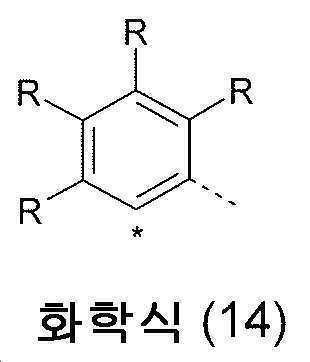
여기서 점선 결합은 이 구조에 대한 두자리 서브-리간드 L 또는 화학식 (1a') 또는 (1b') 에 나타낸 상응하는 6-원 아릴 또는 헤테로아릴 기의 결합 위치를 나타내고, *는 화학식 (14) 의 단위의 중심 환형기, 즉 화학식 (5) 또는 화학식 (9')에 명백하게 도시된 기에 대한 연결의 위치를 나타내고;
화학식 (5), 화학식 (9'), CyC, CyD, A 및 화학식 (14) 의 R 은 각각의 경우에 동일하거나 상이하며 H, D, F, CN, OR1, 1 내지 6 개의 탄소 원자를 갖는 직쇄 알킬기 또는 2 내지 10 개의 탄소 원자를 갖는 알케닐 기 또는 3 내지 20 개의 탄소 원자를 갖는 분지형 또는 환형 알킬기 (여기서 알킬 또는 알케닐 기는 각각의 경우에 하나 이상의 R1 라디칼에 의해 치환될 수 있음), 또는 5 내지 24 개의 방향족 고리 원자를 가지며 각각의 경우 하나 이상의 R1 라디칼로 치환될 수 있는 방향족 또는 헤테로방향족 고리계이고; 동시에, 2 이상의 R 라디칼은 함께 고리계를 형성할 수 있고;
R' 는 각각의 경우에 동일하거나 또는 상이하고 H, D, 1 내지 5 개의 탄소 원자를 갖는 직쇄 알킬기 또는 3 내지 6 개의 탄소 원자를 갖는 분지형 또는 환형 알킬기 (알킬기는 각각의 경우에 하나 이상의 R1 라디칼로 치환될 수 있음), 또는 6 내지 12 개의 방향족 고리 원자를 갖고 각각의 경우 하나 이상의 R1 라디칼로 치환될 수 있는 방향족 또는 헤테로방향족 고리계이고;
R1 은 각각의 경우에 동일하거나 상이하며 H, D, F, CN, 1 내지 5 개의 탄소 원자를 갖는 직쇄 알킬기 또는 3 내지 5 개의 탄소 원자를 갖는 분지형 또는 고리형 알킬기 (여기서 알킬기는 각각의 경우에 하나 이상의 R2 라디칼에 의해 치환될 수 있음), 또는 5 내지 13 개의 방향족 고리 원자를 가지며 각각의 경우 하나 이상의 R2 라디칼로 치환될 수 있는 방향족 또는 헤테로방향족 고리계이고; 동시에, 2 이상의 R1 라디칼은 함께 고리계를 형성할 수 있고;
R2 는 각각의 경우에 동일하거나 상이하며 H, D, F 또는 1 내지 5 개의 탄소 원자를 갖는 지방족 히드로카르빌 라디칼 또는 6 내지 12 개의 탄소 원자를 갖는 방향족 히드로카르빌 라디칼인, 화합물.As a compound of formula (1a') or (1b'),
wherein each of the R radicals explicitly shown in formula (1a') or formula (1b') is identical or different at each occurrence and is selected from the group consisting of H, D, F, CH 3 and CD 3 , and the other used The symbols are:
M is the same or different at each occurrence and is iridium or rhodium;
V is the same or different at each occurrence and is a group of formula (5) or formula (9'):
wherein one of the dotted-line bonds represents a bond to the corresponding 6-membered aryl or heteroaryl group shown in formula (1a') or (1b'), and the two other dotted-line bonds each represent a bond to sub-ligand L;
L is the same or different at each occurrence and is a bidentate monoanionic sub-ligand selected from structures of formula (L-1) or (L-2),
wherein the dotted bond represents a bond to a group of formula (5) or (9') of the sub-ligand L, the straight bond represents a covalent bond, and other symbols used are:
CyC is the same or different at each occurrence, an aryl or heteroaryl group having 5 to 14 aromatic ring atoms and coordinating to M via a carbon atom, which may be substituted with one or more R;
CyD is the same or different at each occurrence, a heteroaryl group having 5 to 14 aromatic ring atoms and coordinating to M via a nitrogen atom or via a carbene carbon atom, which may be substituted with one or more R;
A is the same or different at each occurrence and is -C(=0)-NR'-, -C(=0)-O-, -CR 2 -CR 2 - or a group of formula (14)
wherein the dotted bond indicates the binding position of the bidentate sub-ligand L or the corresponding 6-membered aryl or heteroaryl group shown in formula (1a') or (1b') for this structure, and * is a unit of formula (14) indicates the position of the linkage to the central cyclic group of, i.e. the group explicitly shown in formula (5) or formula (9');
R of formula (5), formula (9'), CyC, CyD, A and formula (14) are the same or different in each case and represent H, D, F, CN, OR 1 , a straight-chain alkyl group having 1 to 6 carbon atoms or an alkenyl group having 2 to 10 carbon atoms or 3 to 20 carbon atoms a branched or cyclic alkyl group having 5 to 24 aromatic ring atoms, wherein the alkyl or alkenyl group may in each case be substituted by one or more R 1 radicals, and in each case substituted by one or more R 1 radicals; an aromatic or heteroaromatic ring system that may be; At the same time, two or more R radicals together may form a ring system;
R' is the same or different at each occurrence and is H, D, a straight chain alkyl group having 1 to 5 carbon atoms or a branched or cyclic alkyl group having 3 to 6 carbon atoms (an alkyl group at each occurrence is one or more R 1 radical), or an aromatic or heteroaromatic ring system having 6 to 12 aromatic ring atoms and in each case substituted by one or more R 1 radicals;
R 1 is the same or different at each occurrence and is H, D, F, CN, a straight-chain alkyl group having 1 to 5 carbon atoms or a branched or cyclic alkyl group having 3 to 5 carbon atoms, wherein the alkyl group is each optionally substituted by one or more R 2 radicals), or an aromatic or heteroaromatic ring system having from 5 to 13 aromatic ring atoms, which in each case may be substituted by one or more R 2 radicals; At the same time, two or more R 1 radicals together may form a ring system;
R 2 is the same or different at each occurrence and is H, D, F or an aliphatic hydrocarbyl radical having 1 to 5 carbon atoms or an aromatic hydrocarbyl radical having 6 to 12 carbon atoms.
2 개의 금속 M이 Ir(III)이고 화합물이 비하전된 것을 특징으로 하는 화합물. According to claim 1,
A compound characterized in that the two metals M are Ir(III) and the compound is uncharged.
상기 화학식 (5) 의 기가 각각의 경우에 동일하거나 상이하며 화학식 (5') 의 구조로부터 선택되며,

여기서 기호는 제 1 항의 화학식 (5) 에 주어진 정의를 갖는 것을 특징으로 하는 화합물. According to claim 1,
wherein the groups of formula (5) are the same or different at each occurrence and are selected from structures of formula (5');
A compound characterized in that the symbol here has the definition given in formula (5) of claim 1.
상기 화학식 (5) 의 기는 각각의 경우에 동일하거나 상이하며 화학식 (2a) 내지 화학식 (2m) 의 구조로부터 선택되고, 그리고 상기 화학식 (9')의 기는 각각의 경우 동일하거나 상이하며 화학식 (3a) 내지 (3m) 의 구조로부터 선택되며:


여기서 X1 및 X2 는 CR 이고, A1 은 CR2 이고, A2 는 CR 이고, R 은 제 1 항의 화학식 (5) 에 주어진 정의를 갖고, 다른 기호는 제 1 항에 주어진 정의를 갖는 것을 특징으로 하는 화합물. According to claim 1,
The groups of formula (5) are the same or different on each occurrence and are selected from structures of formula (2a) to formula (2m), and the groups of formula (9′) are identical or different on each occurrence and are selected from structures of formula (3a) is selected from the structures of (3m) to:
wherein X 1 and X 2 are CR, A 1 is CR 2 , A 2 is CR, R has the definition given in formula (5) in claim 1, and the other symbols have the definition given in claim 1. characterized compounds.
V는 각각의 경우에 동일하거나 상이하며 화학식 (5a") 또는 화학식 (5a"')의 구조로부터 선택되고,

여기서 기호는 제 1 항의 화학식 (5) 에 주어진 정의를 갖는 것을 특징으로 하는 화합물.According to claim 1,
V is the same or different at each occurrence and is selected from structures of formula (5a") or formula (5a"');
A compound characterized in that the symbol here has the definition given in formula (5) of claim 1.
제 1 항 내지 제 5 항 중 어느 한 항에 기재된 화합물에서 M 을 제외한 구조를 가지는 리간드를 화학식 (57)의 금속 알콕사이드와, 화학식 (58)의 금속 케토케톤산염과, 화학식 (59)의 금속 할로겐화물과, 화학식 (60)의 금속 카르복실레이트와, 또는 알콕시드, 할라이드 및 히드록실에서 선택되는 하나 이상의 라디칼 및 케토케토네이트 라디칼을 모두 갖는 이리듐 화합물 또는 로듐 화합물과 반응시켜 화합물을 제조하고

여기서 M 은 이리듐 또는 로듐이고, R 은 제 1 항의 화학식 (5) 에 주어진 정의를 갖고, Hal = F, Cl, Br 또는 I이고, 리간드와 반응하는 이리듐 또는 로듐 반응물은 또한 수화물 형태를 취할 수 있는, 화합물을 제조하는 방법. A method for producing the compound according to any one of claims 1 to 5,
A ligand having a structure other than M in the compound according to any one of claims 1 to 5 is a metal alkoxide of formula (57), a metal ketoketonate of formula (58), and a metal halide of formula (59) reacting a cargo with a metal carboxylate of formula (60) or with an iridium compound or rhodium compound having both a ketoketonate radical and at least one radical selected from alkoxides, halides and hydroxyls to prepare a compound;
wherein M is iridium or rhodium, R has the definition given in formula (5) of claim 1, Hal = F, Cl, Br or I, and the iridium or rhodium reactant reacting with the ligand may also take the form of a hydrate. , How to prepare the compound.
상기 화합물은 전자 디바이스에서 또는 산소 증감제로서 사용되는, 화합물. As the compound according to any one of claims 1 to 5,
The compound is used in electronic devices or as an oxygen sensitizer.
상기 전자 디바이스는 유기 전계발광 디바이스이고, 상기 화합물이 하나 이상의 방출층에 방출 화합물로서 존재하는, 전자 디바이스.According to claim 9,
wherein the electronic device is an organic electroluminescent device, and wherein the compound is present as an emissive compound in one or more emissive layers.
Applications Claiming Priority (3)
| Application Number | Priority Date | Filing Date | Title |
|---|---|---|---|
| EP16193521 | 2016-10-12 | ||
| EP16193521.8 | 2016-10-12 | ||
| PCT/EP2017/075580 WO2018069196A1 (en) | 2016-10-12 | 2017-10-09 | Binuclear metal complexes and electronic devices, in particular organic electroluminescent devices containing said metal complexes |
Publications (2)
| Publication Number | Publication Date |
|---|---|
| KR20190058638A KR20190058638A (en) | 2019-05-29 |
| KR102522745B1 true KR102522745B1 (en) | 2023-04-17 |
Family
ID=57130284
Family Applications (1)
| Application Number | Title | Priority Date | Filing Date |
|---|---|---|---|
| KR1020197013248A Active KR102522745B1 (en) | 2016-10-12 | 2017-10-09 | Binuclear metal complexes and electronic devices containing the metal complexes, in particular organic electroluminescent devices |
Country Status (6)
| Country | Link |
|---|---|
| US (1) | US11430962B2 (en) |
| EP (1) | EP3526227B1 (en) |
| JP (1) | JP7064488B2 (en) |
| KR (1) | KR102522745B1 (en) |
| CN (1) | CN109803975A (en) |
| WO (1) | WO2018069196A1 (en) |
Families Citing this family (48)
| Publication number | Priority date | Publication date | Assignee | Title |
|---|---|---|---|---|
| TWI776926B (en) | 2017-07-25 | 2022-09-11 | 德商麥克專利有限公司 | Metal complexes |
| TW202030902A (en) | 2018-09-12 | 2020-08-16 | 德商麥克專利有限公司 | Electroluminescent devices |
| TWI826522B (en) | 2018-09-12 | 2023-12-21 | 德商麥克專利有限公司 | Electroluminescent devices |
| EP3850055A1 (en) | 2018-09-12 | 2021-07-21 | Merck Patent GmbH | Materials for organic electroluminescent devices |
| KR20260019662A (en) | 2018-09-27 | 2026-02-10 | 메르크 파텐트 게엠베하 | Compounds that can be used in an organic electronic device as active compounds |
| CN112771024A (en) | 2018-09-27 | 2021-05-07 | 默克专利有限公司 | Process for preparing sterically hindered nitrogen-containing heteroaromatics |
| US11917906B2 (en) | 2018-11-05 | 2024-02-27 | Merck Patent Gmbh | Compounds that can be used in an organic electronic device |
| KR20210091769A (en) | 2018-11-14 | 2021-07-22 | 메르크 파텐트 게엠베하 | Compounds that can be used in the manufacture of organic electronic devices |
| US20220127286A1 (en) | 2019-03-04 | 2022-04-28 | Merck Patent Gmbh | Ligands for nano-sized materials |
| US12351594B2 (en) | 2019-04-11 | 2025-07-08 | Merck Patent Gmbh | Materials for organic electroluminescent devices |
| CN114144421A (en) | 2019-07-22 | 2022-03-04 | 默克专利有限公司 | Method for preparing vicinal metallized metal compounds |
| WO2021078831A1 (en) | 2019-10-25 | 2021-04-29 | Merck Patent Gmbh | Compounds that can be used in an organic electronic device |
| US12593607B2 (en) | 2019-11-04 | 2026-03-31 | Udc Ireland Limited | Materials for organic electroluminescent devices |
| TW202134252A (en) | 2019-11-12 | 2021-09-16 | 德商麥克專利有限公司 | Materials for organic electroluminescent devices |
| TW202136181A (en) | 2019-12-04 | 2021-10-01 | 德商麥克專利有限公司 | Materials for organic electroluminescent devices |
| JP7620631B2 (en) | 2019-12-18 | 2025-01-23 | メルク パテント ゲゼルシャフト ミット ベシュレンクテル ハフツング | Aromatic Compounds for Organic Electroluminescent Devices |
| US12552818B2 (en) | 2019-12-19 | 2026-02-17 | Merck Patent Gmbh | Polycyclic compounds for organic electroluminescent devices |
| EP4097090A1 (en) | 2020-01-29 | 2022-12-07 | Merck Patent GmbH | Benzimidazole derivatives |
| CN115135741A (en) | 2020-02-25 | 2022-09-30 | 默克专利有限公司 | Use of heterocyclic compounds in organic electronic devices |
| WO2021175706A1 (en) | 2020-03-02 | 2021-09-10 | Merck Patent Gmbh | Use of sulfone compounds in an organic electronic device |
| EP4121432A1 (en) | 2020-03-17 | 2023-01-25 | Merck Patent GmbH | Heteroaromatic compounds for organic electroluminescent devices |
| EP4122028B1 (en) | 2020-03-17 | 2024-10-16 | Merck Patent GmbH | Heterocyclic compounds for organic electroluminescent devices |
| KR20220157456A (en) | 2020-03-23 | 2022-11-29 | 메르크 파텐트 게엠베하 | Materials for organic electroluminescent devices |
| KR20220158771A (en) | 2020-03-26 | 2022-12-01 | 메르크 파텐트 게엠베하 | Cyclic compounds for organic electroluminescent devices |
| EP4132939B1 (en) | 2020-04-06 | 2024-01-31 | Merck Patent GmbH | Polycyclic compounds for organic electroluminescent devices |
| WO2021239772A1 (en) | 2020-05-29 | 2021-12-02 | Merck Patent Gmbh | Organic electroluminescent apparatus |
| EP4168397B1 (en) | 2020-06-18 | 2025-08-20 | Merck Patent GmbH | Indenoazanaphthalenes |
| KR102914927B1 (en) | 2020-06-23 | 2026-01-19 | 메르크 파텐트 게엠베하 | Method for preparing the mixture |
| KR20230029927A (en) | 2020-06-29 | 2023-03-03 | 메르크 파텐트 게엠베하 | Heteroaromatic compounds for organic electroluminescent devices |
| KR20230028315A (en) | 2020-06-29 | 2023-02-28 | 메르크 파텐트 게엠베하 | Heterocyclic compounds for organic electroluminescent devices |
| TW202229215A (en) | 2020-09-30 | 2022-08-01 | 德商麥克專利有限公司 | Compounds for structuring of functional layers of organic electroluminescent devices |
| TW202222748A (en) | 2020-09-30 | 2022-06-16 | 德商麥克專利有限公司 | Compounds usable for structuring of functional layers of organic electroluminescent devices |
| WO2022079068A1 (en) | 2020-10-16 | 2022-04-21 | Merck Patent Gmbh | Heterocyclic compounds for organic electroluminescent devices |
| CN116406414A (en) | 2020-10-16 | 2023-07-07 | 默克专利有限公司 | Compounds containing heteroatoms for organic electroluminescent devices |
| US20240101560A1 (en) | 2020-12-18 | 2024-03-28 | Merck Patent Gmbh | Nitrogenous heteroaromatic compounds for organic electroluminescent devices |
| US20240114782A1 (en) | 2020-12-18 | 2024-04-04 | Merck Patent Gmbh | Indolo[3.2.1-jk]carbazole-6-carbonitrile derivatives as blue fluorescent emitters for use in oleds |
| WO2022129114A1 (en) | 2020-12-18 | 2022-06-23 | Merck Patent Gmbh | Nitrogenous compounds for organic electroluminescent devices |
| KR20220129145A (en) * | 2021-03-15 | 2022-09-23 | 삼성디스플레이 주식회사 | Organometallic compound and light emitting device including same |
| CN117425655A (en) | 2021-04-30 | 2024-01-19 | 默克专利有限公司 | Nitrogen-containing heterocyclic compounds for organic electroluminescent devices |
| KR20240012506A (en) | 2021-05-21 | 2024-01-29 | 메르크 파텐트 게엠베하 | Method for continuous purification of at least one functional substance and device for continuous purification of at least one functional substance |
| CN117980439A (en) | 2021-09-14 | 2024-05-03 | 默克专利有限公司 | Boron-containing heterocyclic compounds for organic electroluminescent devices |
| KR20240091021A (en) | 2021-10-27 | 2024-06-21 | 메르크 파텐트 게엠베하 | Boron and nitrogen heterocyclic compounds for organic electroluminescent devices |
| EP4719022A3 (en) | 2022-02-23 | 2026-04-15 | UDC Ireland Limited | Nitrogen-containing heterocycles for organic electroluminescent devices |
| EP4482843A1 (en) | 2022-02-23 | 2025-01-01 | Merck Patent GmbH | Aromatic hetreocycles for organic electroluminescent devices |
| WO2023247663A1 (en) | 2022-06-24 | 2023-12-28 | Merck Patent Gmbh | Composition for organic electronic devices |
| US20250386665A1 (en) | 2022-06-24 | 2025-12-18 | Merck Patent Gmbh | Composition for organic electronic devices |
| KR20250110873A (en) | 2022-11-17 | 2025-07-21 | 메르크 파텐트 게엠베하 | Materials for organic electroluminescent devices |
| EP4486099B1 (en) | 2023-06-30 | 2026-04-29 | UDC Ireland Limited | Compounds for organic electroluminescent devices |
Citations (2)
| Publication number | Priority date | Publication date | Assignee | Title |
|---|---|---|---|---|
| WO2015117718A1 (en) | 2014-02-05 | 2015-08-13 | Merck Patent Gmbh | Metal complexes |
| WO2016124304A1 (en) | 2015-02-03 | 2016-08-11 | Merck Patent Gmbh | Metal complexes |
Family Cites Families (49)
| Publication number | Priority date | Publication date | Assignee | Title |
|---|---|---|---|---|
| JPH07133483A (en) | 1993-11-09 | 1995-05-23 | Shinko Electric Ind Co Ltd | Organic light emitting material for EL device and EL device |
| JP2000169400A (en) | 1998-12-09 | 2000-06-20 | Sumika Chemical Analysis Service Ltd | Production of styrene trimer |
| US6660410B2 (en) | 2000-03-27 | 2003-12-09 | Idemitsu Kosan Co., Ltd. | Organic electroluminescence element |
| DE10104426A1 (en) | 2001-02-01 | 2002-08-08 | Covion Organic Semiconductors | Process for the production of high-purity, tris-ortho-metallated organo-iridium compounds |
| JP4310077B2 (en) * | 2001-06-19 | 2009-08-05 | キヤノン株式会社 | Metal coordination compound and organic light emitting device |
| ITRM20020411A1 (en) | 2002-08-01 | 2004-02-02 | Univ Roma La Sapienza | SPIROBIFLUORENE DERIVATIVES, THEIR PREPARATION AND USE. |
| DE10249723A1 (en) | 2002-10-25 | 2004-05-06 | Covion Organic Semiconductors Gmbh | Conjugated polymers containing arylamine units, their preparation and use |
| EP1578885A2 (en) | 2002-12-23 | 2005-09-28 | Covion Organic Semiconductors GmbH | Organic electroluminescent element |
| DE10310887A1 (en) * | 2003-03-11 | 2004-09-30 | Covion Organic Semiconductors Gmbh | Matallkomplexe |
| JP4411851B2 (en) | 2003-03-19 | 2010-02-10 | コニカミノルタホールディングス株式会社 | Organic electroluminescence device |
| DE10314102A1 (en) | 2003-03-27 | 2004-10-14 | Covion Organic Semiconductors Gmbh | Process for the production of high-purity organo-iridium compounds |
| EP1717291A3 (en) | 2003-04-15 | 2007-03-21 | Merck Patent GmbH | Mixtures of matrix materials and organic semiconductors capable of emission, use of the same and electronic components containing said mixtures |
| EP1617711B1 (en) | 2003-04-23 | 2016-08-17 | Konica Minolta Holdings, Inc. | Organic electroluminescent device and display |
| US20050171207A1 (en) * | 2003-09-26 | 2005-08-04 | Myriad Genetics, Incorporated | Method and composition for combination treatment of neurodegenerative disorders |
| US7795801B2 (en) | 2003-09-30 | 2010-09-14 | Konica Minolta Holdings, Inc. | Organic electroluminescent element, illuminator, display and compound |
| US7332232B2 (en) | 2004-02-03 | 2008-02-19 | Universal Display Corporation | OLEDs utilizing multidentate ligand systems |
| US7790890B2 (en) | 2004-03-31 | 2010-09-07 | Konica Minolta Holdings, Inc. | Organic electroluminescence element material, organic electroluminescence element, display device and illumination device |
| DE102004023277A1 (en) | 2004-05-11 | 2005-12-01 | Covion Organic Semiconductors Gmbh | New material mixtures for electroluminescence |
| JP4862248B2 (en) | 2004-06-04 | 2012-01-25 | コニカミノルタホールディングス株式会社 | Organic electroluminescence element, lighting device and display device |
| ITRM20040352A1 (en) | 2004-07-15 | 2004-10-15 | Univ Roma La Sapienza | OLIGOMERIC DERIVATIVES OF SPIROBIFLUORENE, THEIR PREPARATION AND THEIR USE. |
| DE102004034517A1 (en) * | 2004-07-16 | 2006-02-16 | Covion Organic Semiconductors Gmbh | metal complexes |
| EP1888706B1 (en) | 2005-05-03 | 2017-03-01 | Merck Patent GmbH | Organic electroluminescent device and boric acid and borinic acid derivatives used therein |
| EP1956022B1 (en) | 2005-12-01 | 2012-07-25 | Nippon Steel Chemical Co., Ltd. | Compound for organic electroluminescent element and organic electroluminescent element |
| KR100783711B1 (en) * | 2006-01-06 | 2007-12-07 | 삼성전자주식회사 | Metal compound and organic electroluminescent device comprising same |
| DE102006025777A1 (en) | 2006-05-31 | 2007-12-06 | Merck Patent Gmbh | New materials for organic electroluminescent devices |
| EP2080762B1 (en) | 2006-11-09 | 2016-09-14 | Nippon Steel & Sumikin Chemical Co., Ltd. | Compound for organic electroluminescent device and organic electroluminescent device |
| DE102007002714A1 (en) | 2007-01-18 | 2008-07-31 | Merck Patent Gmbh | New materials for organic electroluminescent devices |
| DE102007053771A1 (en) | 2007-11-12 | 2009-05-14 | Merck Patent Gmbh | Organic electroluminescent devices |
| US7862908B2 (en) | 2007-11-26 | 2011-01-04 | National Tsing Hua University | Conjugated compounds containing hydroindoloacridine structural elements, and their use |
| US8221905B2 (en) | 2007-12-28 | 2012-07-17 | Universal Display Corporation | Carbazole-containing materials in phosphorescent light emitting diodes |
| JP5357150B2 (en) | 2008-06-05 | 2013-12-04 | 出光興産株式会社 | Halogen compound, polycyclic compound, and organic electroluminescence device using the same |
| DE102008033943A1 (en) | 2008-07-18 | 2010-01-21 | Merck Patent Gmbh | New materials for organic electroluminescent devices |
| DE102008036982A1 (en) | 2008-08-08 | 2010-02-11 | Merck Patent Gmbh | Organic electroluminescent device |
| KR101506919B1 (en) | 2008-10-31 | 2015-03-30 | 롬엔드하스전자재료코리아유한회사 | Novel compounds for organic electronic material and organic electronic device using the same |
| DE102008056688A1 (en) | 2008-11-11 | 2010-05-12 | Merck Patent Gmbh | Materials for organic electroluminescent devices |
| JP5701766B2 (en) | 2008-11-11 | 2015-04-15 | メルク パテント ゲーエムベーハー | Organic electroluminescent device |
| JP5556017B2 (en) | 2009-01-14 | 2014-07-23 | コニカミノルタ株式会社 | ORGANIC ELECTROLUMINESCENT ELEMENT, DISPLAY DEVICE, LIGHTING DEVICE, AND ORGANIC ELECTROLUMINESCENT ELEMENT MATERIAL |
| WO2010097155A1 (en) | 2009-02-27 | 2010-09-02 | Merck Patent Gmbh | Polymer having aldehyde groups, converting and cross-linking of said polymer, cross-linked polymer, and electroluminescent device comprising said polymer |
| DE102009014513A1 (en) | 2009-03-23 | 2010-09-30 | Merck Patent Gmbh | Organic electroluminescent device |
| DE102009023155A1 (en) | 2009-05-29 | 2010-12-02 | Merck Patent Gmbh | Materials for organic electroluminescent devices |
| DE102009031021A1 (en) | 2009-06-30 | 2011-01-05 | Merck Patent Gmbh | Materials for organic electroluminescent devices |
| DE102009048791A1 (en) | 2009-10-08 | 2011-04-14 | Merck Patent Gmbh | Materials for organic electroluminescent devices |
| DE102010005697A1 (en) | 2010-01-25 | 2011-07-28 | Merck Patent GmbH, 64293 | Connections for electronic devices |
| WO2013156125A1 (en) | 2012-04-17 | 2013-10-24 | Merck Patent Gmbh | Cross-linkable and cross-linked polymers, methods for the production thereof, and use thereof |
| CN104871329B (en) | 2012-12-18 | 2017-10-24 | 默克专利有限公司 | Organic electroluminescence device |
| KR102048555B1 (en) | 2013-04-17 | 2019-11-26 | 덕산네오룩스 주식회사 | Compound for organic electronic element, organic electronic element using the same, and an electronic device thereof |
| KR102048035B1 (en) | 2013-06-03 | 2019-11-25 | 덕산네오룩스 주식회사 | An organic electronic element using compound for organic electronic element, and an electronic device thereof |
| JP6890975B2 (en) | 2014-05-05 | 2021-06-18 | メルク パテント ゲーエムベーハー | Materials for OLED devices |
| US11031562B2 (en) | 2015-08-25 | 2021-06-08 | Merck Patent Gmbh | Metal complexes |
-
2017
- 2017-10-09 KR KR1020197013248A patent/KR102522745B1/en active Active
- 2017-10-09 US US16/341,757 patent/US11430962B2/en active Active
- 2017-10-09 JP JP2019519684A patent/JP7064488B2/en active Active
- 2017-10-09 CN CN201780059562.5A patent/CN109803975A/en active Pending
- 2017-10-09 EP EP17791589.9A patent/EP3526227B1/en active Active
- 2017-10-09 WO PCT/EP2017/075580 patent/WO2018069196A1/en not_active Ceased
Patent Citations (2)
| Publication number | Priority date | Publication date | Assignee | Title |
|---|---|---|---|---|
| WO2015117718A1 (en) | 2014-02-05 | 2015-08-13 | Merck Patent Gmbh | Metal complexes |
| WO2016124304A1 (en) | 2015-02-03 | 2016-08-11 | Merck Patent Gmbh | Metal complexes |
Also Published As
| Publication number | Publication date |
|---|---|
| US20200052213A1 (en) | 2020-02-13 |
| JP2019536752A (en) | 2019-12-19 |
| WO2018069196A1 (en) | 2018-04-19 |
| JP7064488B2 (en) | 2022-05-10 |
| CN109803975A (en) | 2019-05-24 |
| EP3526227B1 (en) | 2020-06-03 |
| EP3526227A1 (en) | 2019-08-21 |
| US11430962B2 (en) | 2022-08-30 |
| KR20190058638A (en) | 2019-05-29 |
Similar Documents
| Publication | Publication Date | Title |
|---|---|---|
| KR102522745B1 (en) | Binuclear metal complexes and electronic devices containing the metal complexes, in particular organic electroluminescent devices | |
| KR102464513B1 (en) | Binuclear metal complexes for use as emitters in organic electroluminescent devices | |
| KR102853928B1 (en) | metal complexes | |
| KR102472249B1 (en) | metal complex | |
| KR102472248B1 (en) | metal complex | |
| TWI750213B (en) | Metal complexes | |
| KR102455107B1 (en) | Binuclear and oligonuclear metal complexes containing tripodal bidentate moiety ligands and their use in electronic devices | |
| KR102653759B1 (en) | metal complex | |
| KR102432968B1 (en) | metal complex | |
| KR102664605B1 (en) | metal complex | |
| KR102554987B1 (en) | Metal complexes | |
| JP6651469B2 (en) | Metal complex | |
| CN106573947B (en) | Metal complex | |
| CN104870459B (en) | Metal complex | |
| KR20200120698A (en) | Metal complex | |
| KR102522226B1 (en) | metal complex |
Legal Events
| Date | Code | Title | Description |
|---|---|---|---|
| PA0105 | International application |
St.27 status event code: A-0-1-A10-A15-nap-PA0105 |
|
| PG1501 | Laying open of application |
St.27 status event code: A-1-1-Q10-Q12-nap-PG1501 |
|
| A201 | Request for examination | ||
| P11-X000 | Amendment of application requested |
St.27 status event code: A-2-2-P10-P11-nap-X000 |
|
| P13-X000 | Application amended |
St.27 status event code: A-2-2-P10-P13-nap-X000 |
|
| PA0201 | Request for examination |
St.27 status event code: A-1-2-D10-D11-exm-PA0201 |
|
| R18-X000 | Changes to party contact information recorded |
St.27 status event code: A-3-3-R10-R18-oth-X000 |
|
| E902 | Notification of reason for refusal | ||
| PE0902 | Notice of grounds for rejection |
St.27 status event code: A-1-2-D10-D21-exm-PE0902 |
|
| E13-X000 | Pre-grant limitation requested |
St.27 status event code: A-2-3-E10-E13-lim-X000 |
|
| P11-X000 | Amendment of application requested |
St.27 status event code: A-2-2-P10-P11-nap-X000 |
|
| P13-X000 | Application amended |
St.27 status event code: A-2-2-P10-P13-nap-X000 |
|
| P22-X000 | Classification modified |
St.27 status event code: A-2-2-P10-P22-nap-X000 |
|
| E902 | Notification of reason for refusal | ||
| PE0902 | Notice of grounds for rejection |
St.27 status event code: A-1-2-D10-D21-exm-PE0902 |
|
| P22-X000 | Classification modified |
St.27 status event code: A-2-2-P10-P22-nap-X000 |
|
| P11-X000 | Amendment of application requested |
St.27 status event code: A-2-2-P10-P11-nap-X000 |
|
| P13-X000 | Application amended |
St.27 status event code: A-2-2-P10-P13-nap-X000 |
|
| E701 | Decision to grant or registration of patent right | ||
| PE0701 | Decision of registration |
St.27 status event code: A-1-2-D10-D22-exm-PE0701 |
|
| GRNT | Written decision to grant | ||
| PR0701 | Registration of establishment |
St.27 status event code: A-2-4-F10-F11-exm-PR0701 |
|
| PR1002 | Payment of registration fee |
St.27 status event code: A-2-2-U10-U12-oth-PR1002 Fee payment year number: 1 |
|
| PG1601 | Publication of registration |
St.27 status event code: A-4-4-Q10-Q13-nap-PG1601 |
|
| R17-X000 | Change to representative recorded |
St.27 status event code: A-5-5-R10-R17-oth-X000 |
|
| PN2301 | Change of applicant |
St.27 status event code: A-5-5-R10-R11-asn-PN2301 |
|
| PN2301 | Change of applicant |
St.27 status event code: A-5-5-R10-R14-asn-PN2301 |
|
| PR1001 | Payment of annual fee |
St.27 status event code: A-4-4-U10-U11-oth-PR1001 Fee payment year number: 4 |
|
| U11 | Full renewal or maintenance fee paid |
Free format text: ST27 STATUS EVENT CODE: A-4-4-U10-U11-OTH-PR1001 (AS PROVIDED BY THE NATIONAL OFFICE) Year of fee payment: 4 |