KR102268147B1 - aqueous polymer dispersion - Google Patents
aqueous polymer dispersion Download PDFInfo
- Publication number
- KR102268147B1 KR102268147B1 KR1020197033226A KR20197033226A KR102268147B1 KR 102268147 B1 KR102268147 B1 KR 102268147B1 KR 1020197033226 A KR1020197033226 A KR 1020197033226A KR 20197033226 A KR20197033226 A KR 20197033226A KR 102268147 B1 KR102268147 B1 KR 102268147B1
- Authority
- KR
- South Korea
- Prior art keywords
- polymer
- monomer
- weight
- aqueous
- water
- Prior art date
- Legal status (The legal status is an assumption and is not a legal conclusion. Google has not performed a legal analysis and makes no representation as to the accuracy of the status listed.)
- Active
Links
Classifications
-
- C—CHEMISTRY; METALLURGY
- C09—DYES; PAINTS; POLISHES; NATURAL RESINS; ADHESIVES; COMPOSITIONS NOT OTHERWISE PROVIDED FOR; APPLICATIONS OF MATERIALS NOT OTHERWISE PROVIDED FOR
- C09D—COATING COMPOSITIONS, e.g. PAINTS, VARNISHES OR LACQUERS; FILLING PASTES; CHEMICAL PAINT OR INK REMOVERS; INKS; CORRECTING FLUIDS; WOODSTAINS; PASTES OR SOLIDS FOR COLOURING OR PRINTING; USE OF MATERIALS THEREFOR
- C09D133/00—Coating compositions based on homopolymers or copolymers of compounds having one or more unsaturated aliphatic radicals, each having only one carbon-to-carbon double bond, and at least one being terminated by only one carboxyl radical, or of salts, anhydrides, esters, amides, imides, or nitriles thereof; Coating compositions based on derivatives of such polymers
- C09D133/04—Homopolymers or copolymers of esters
- C09D133/06—Homopolymers or copolymers of esters of esters containing only carbon, hydrogen and oxygen, the oxygen atom being present only as part of the carboxyl radical
- C09D133/08—Homopolymers or copolymers of acrylic acid esters
-
- C—CHEMISTRY; METALLURGY
- C08—ORGANIC MACROMOLECULAR COMPOUNDS; THEIR PREPARATION OR CHEMICAL WORKING-UP; COMPOSITIONS BASED THEREON
- C08F—MACROMOLECULAR COMPOUNDS OBTAINED BY REACTIONS ONLY INVOLVING CARBON-TO-CARBON UNSATURATED BONDS
- C08F283/00—Macromolecular compounds obtained by polymerising monomers on to polymers provided for in subclass C08G
- C08F283/06—Macromolecular compounds obtained by polymerising monomers on to polymers provided for in subclass C08G on to polyethers, polyoxymethylenes or polyacetals
-
- C—CHEMISTRY; METALLURGY
- C08—ORGANIC MACROMOLECULAR COMPOUNDS; THEIR PREPARATION OR CHEMICAL WORKING-UP; COMPOSITIONS BASED THEREON
- C08F—MACROMOLECULAR COMPOUNDS OBTAINED BY REACTIONS ONLY INVOLVING CARBON-TO-CARBON UNSATURATED BONDS
- C08F2/00—Processes of polymerisation
- C08F2/12—Polymerisation in non-solvents
- C08F2/16—Aqueous medium
- C08F2/22—Emulsion polymerisation
-
- C—CHEMISTRY; METALLURGY
- C08—ORGANIC MACROMOLECULAR COMPOUNDS; THEIR PREPARATION OR CHEMICAL WORKING-UP; COMPOSITIONS BASED THEREON
- C08F—MACROMOLECULAR COMPOUNDS OBTAINED BY REACTIONS ONLY INVOLVING CARBON-TO-CARBON UNSATURATED BONDS
- C08F2/00—Processes of polymerisation
- C08F2/12—Polymerisation in non-solvents
- C08F2/16—Aqueous medium
- C08F2/22—Emulsion polymerisation
- C08F2/24—Emulsion polymerisation with the aid of emulsifying agents
- C08F2/26—Emulsion polymerisation with the aid of emulsifying agents anionic
-
- C—CHEMISTRY; METALLURGY
- C08—ORGANIC MACROMOLECULAR COMPOUNDS; THEIR PREPARATION OR CHEMICAL WORKING-UP; COMPOSITIONS BASED THEREON
- C08F—MACROMOLECULAR COMPOUNDS OBTAINED BY REACTIONS ONLY INVOLVING CARBON-TO-CARBON UNSATURATED BONDS
- C08F212/00—Copolymers of compounds having one or more unsaturated aliphatic radicals, each having only one carbon-to-carbon double bond, and at least one being terminated by an aromatic carbocyclic ring
- C08F212/02—Monomers containing only one unsaturated aliphatic radical
- C08F212/04—Monomers containing only one unsaturated aliphatic radical containing one ring
- C08F212/06—Hydrocarbons
- C08F212/08—Styrene
-
- C—CHEMISTRY; METALLURGY
- C08—ORGANIC MACROMOLECULAR COMPOUNDS; THEIR PREPARATION OR CHEMICAL WORKING-UP; COMPOSITIONS BASED THEREON
- C08F—MACROMOLECULAR COMPOUNDS OBTAINED BY REACTIONS ONLY INVOLVING CARBON-TO-CARBON UNSATURATED BONDS
- C08F220/00—Copolymers of compounds having one or more unsaturated aliphatic radicals, each having only one carbon-to-carbon double bond, and only one being terminated by only one carboxyl radical or a salt, anhydride ester, amide, imide or nitrile thereof
- C08F220/02—Monocarboxylic acids having less than ten carbon atoms; Derivatives thereof
- C08F220/04—Acids; Metal salts or ammonium salts thereof
- C08F220/06—Acrylic acid; Methacrylic acid; Metal salts or ammonium salts thereof
-
- C—CHEMISTRY; METALLURGY
- C08—ORGANIC MACROMOLECULAR COMPOUNDS; THEIR PREPARATION OR CHEMICAL WORKING-UP; COMPOSITIONS BASED THEREON
- C08F—MACROMOLECULAR COMPOUNDS OBTAINED BY REACTIONS ONLY INVOLVING CARBON-TO-CARBON UNSATURATED BONDS
- C08F220/00—Copolymers of compounds having one or more unsaturated aliphatic radicals, each having only one carbon-to-carbon double bond, and only one being terminated by only one carboxyl radical or a salt, anhydride ester, amide, imide or nitrile thereof
- C08F220/02—Monocarboxylic acids having less than ten carbon atoms; Derivatives thereof
- C08F220/10—Esters
- C08F220/12—Esters of monohydric alcohols or phenols
- C08F220/14—Methyl esters, e.g. methyl (meth)acrylate
-
- C—CHEMISTRY; METALLURGY
- C08—ORGANIC MACROMOLECULAR COMPOUNDS; THEIR PREPARATION OR CHEMICAL WORKING-UP; COMPOSITIONS BASED THEREON
- C08F—MACROMOLECULAR COMPOUNDS OBTAINED BY REACTIONS ONLY INVOLVING CARBON-TO-CARBON UNSATURATED BONDS
- C08F220/00—Copolymers of compounds having one or more unsaturated aliphatic radicals, each having only one carbon-to-carbon double bond, and only one being terminated by only one carboxyl radical or a salt, anhydride ester, amide, imide or nitrile thereof
- C08F220/02—Monocarboxylic acids having less than ten carbon atoms; Derivatives thereof
- C08F220/10—Esters
- C08F220/12—Esters of monohydric alcohols or phenols
- C08F220/16—Esters of monohydric alcohols or phenols of phenols or of alcohols containing two or more carbon atoms
- C08F220/18—Esters of monohydric alcohols or phenols of phenols or of alcohols containing two or more carbon atoms with acrylic or methacrylic acids
-
- C—CHEMISTRY; METALLURGY
- C08—ORGANIC MACROMOLECULAR COMPOUNDS; THEIR PREPARATION OR CHEMICAL WORKING-UP; COMPOSITIONS BASED THEREON
- C08F—MACROMOLECULAR COMPOUNDS OBTAINED BY REACTIONS ONLY INVOLVING CARBON-TO-CARBON UNSATURATED BONDS
- C08F220/00—Copolymers of compounds having one or more unsaturated aliphatic radicals, each having only one carbon-to-carbon double bond, and only one being terminated by only one carboxyl radical or a salt, anhydride ester, amide, imide or nitrile thereof
- C08F220/02—Monocarboxylic acids having less than ten carbon atoms; Derivatives thereof
- C08F220/10—Esters
- C08F220/12—Esters of monohydric alcohols or phenols
- C08F220/16—Esters of monohydric alcohols or phenols of phenols or of alcohols containing two or more carbon atoms
- C08F220/18—Esters of monohydric alcohols or phenols of phenols or of alcohols containing two or more carbon atoms with acrylic or methacrylic acids
- C08F220/1804—C4-(meth)acrylate, e.g. butyl (meth)acrylate, isobutyl (meth)acrylate or tert-butyl (meth)acrylate
-
- C—CHEMISTRY; METALLURGY
- C08—ORGANIC MACROMOLECULAR COMPOUNDS; THEIR PREPARATION OR CHEMICAL WORKING-UP; COMPOSITIONS BASED THEREON
- C08F—MACROMOLECULAR COMPOUNDS OBTAINED BY REACTIONS ONLY INVOLVING CARBON-TO-CARBON UNSATURATED BONDS
- C08F230/00—Copolymers of compounds having one or more unsaturated aliphatic radicals, each having only one carbon-to-carbon double bond, and containing phosphorus, selenium, tellurium or a metal
- C08F230/02—Copolymers of compounds having one or more unsaturated aliphatic radicals, each having only one carbon-to-carbon double bond, and containing phosphorus, selenium, tellurium or a metal containing phosphorus
-
- C—CHEMISTRY; METALLURGY
- C08—ORGANIC MACROMOLECULAR COMPOUNDS; THEIR PREPARATION OR CHEMICAL WORKING-UP; COMPOSITIONS BASED THEREON
- C08L—COMPOSITIONS OF MACROMOLECULAR COMPOUNDS
- C08L71/00—Compositions of polyethers obtained by reactions forming an ether link in the main chain; Compositions of derivatives of such polymers
- C08L71/02—Polyalkylene oxides
-
- C—CHEMISTRY; METALLURGY
- C09—DYES; PAINTS; POLISHES; NATURAL RESINS; ADHESIVES; COMPOSITIONS NOT OTHERWISE PROVIDED FOR; APPLICATIONS OF MATERIALS NOT OTHERWISE PROVIDED FOR
- C09D—COATING COMPOSITIONS, e.g. PAINTS, VARNISHES OR LACQUERS; FILLING PASTES; CHEMICAL PAINT OR INK REMOVERS; INKS; CORRECTING FLUIDS; WOODSTAINS; PASTES OR SOLIDS FOR COLOURING OR PRINTING; USE OF MATERIALS THEREFOR
- C09D133/00—Coating compositions based on homopolymers or copolymers of compounds having one or more unsaturated aliphatic radicals, each having only one carbon-to-carbon double bond, and at least one being terminated by only one carboxyl radical, or of salts, anhydrides, esters, amides, imides, or nitriles thereof; Coating compositions based on derivatives of such polymers
- C09D133/04—Homopolymers or copolymers of esters
- C09D133/14—Homopolymers or copolymers of esters of esters containing halogen, nitrogen, sulfur or oxygen atoms in addition to the carboxy oxygen
- C09D133/16—Homopolymers or copolymers of esters containing halogen atoms
-
- C—CHEMISTRY; METALLURGY
- C09—DYES; PAINTS; POLISHES; NATURAL RESINS; ADHESIVES; COMPOSITIONS NOT OTHERWISE PROVIDED FOR; APPLICATIONS OF MATERIALS NOT OTHERWISE PROVIDED FOR
- C09D—COATING COMPOSITIONS, e.g. PAINTS, VARNISHES OR LACQUERS; FILLING PASTES; CHEMICAL PAINT OR INK REMOVERS; INKS; CORRECTING FLUIDS; WOODSTAINS; PASTES OR SOLIDS FOR COLOURING OR PRINTING; USE OF MATERIALS THEREFOR
- C09D151/00—Coating compositions based on graft polymers in which the grafted component is obtained by reactions only involving carbon-to-carbon unsaturated bonds; Coating compositions based on derivatives of such polymers
- C09D151/08—Coating compositions based on graft polymers in which the grafted component is obtained by reactions only involving carbon-to-carbon unsaturated bonds; Coating compositions based on derivatives of such polymers grafted on to macromolecular compounds obtained otherwise than by reactions only involving carbon-to-carbon unsaturated bonds
-
- C—CHEMISTRY; METALLURGY
- C09—DYES; PAINTS; POLISHES; NATURAL RESINS; ADHESIVES; COMPOSITIONS NOT OTHERWISE PROVIDED FOR; APPLICATIONS OF MATERIALS NOT OTHERWISE PROVIDED FOR
- C09D—COATING COMPOSITIONS, e.g. PAINTS, VARNISHES OR LACQUERS; FILLING PASTES; CHEMICAL PAINT OR INK REMOVERS; INKS; CORRECTING FLUIDS; WOODSTAINS; PASTES OR SOLIDS FOR COLOURING OR PRINTING; USE OF MATERIALS THEREFOR
- C09D5/00—Coating compositions, e.g. paints, varnishes or lacquers, characterised by their physical nature or the effects produced; Filling pastes
- C09D5/02—Emulsion paints including aerosols
-
- C—CHEMISTRY; METALLURGY
- C09—DYES; PAINTS; POLISHES; NATURAL RESINS; ADHESIVES; COMPOSITIONS NOT OTHERWISE PROVIDED FOR; APPLICATIONS OF MATERIALS NOT OTHERWISE PROVIDED FOR
- C09D—COATING COMPOSITIONS, e.g. PAINTS, VARNISHES OR LACQUERS; FILLING PASTES; CHEMICAL PAINT OR INK REMOVERS; INKS; CORRECTING FLUIDS; WOODSTAINS; PASTES OR SOLIDS FOR COLOURING OR PRINTING; USE OF MATERIALS THEREFOR
- C09D5/00—Coating compositions, e.g. paints, varnishes or lacquers, characterised by their physical nature or the effects produced; Filling pastes
- C09D5/02—Emulsion paints including aerosols
- C09D5/022—Emulsions, e.g. oil in water
-
- C—CHEMISTRY; METALLURGY
- C09—DYES; PAINTS; POLISHES; NATURAL RESINS; ADHESIVES; COMPOSITIONS NOT OTHERWISE PROVIDED FOR; APPLICATIONS OF MATERIALS NOT OTHERWISE PROVIDED FOR
- C09D—COATING COMPOSITIONS, e.g. PAINTS, VARNISHES OR LACQUERS; FILLING PASTES; CHEMICAL PAINT OR INK REMOVERS; INKS; CORRECTING FLUIDS; WOODSTAINS; PASTES OR SOLIDS FOR COLOURING OR PRINTING; USE OF MATERIALS THEREFOR
- C09D7/00—Features of coating compositions, not provided for in group C09D5/00; Processes for incorporating ingredients in coating compositions
- C09D7/40—Additives
- C09D7/66—Additives characterised by particle size
Landscapes
- Chemical & Material Sciences (AREA)
- Organic Chemistry (AREA)
- Chemical Kinetics & Catalysis (AREA)
- Polymers & Plastics (AREA)
- Health & Medical Sciences (AREA)
- Medicinal Chemistry (AREA)
- Wood Science & Technology (AREA)
- Materials Engineering (AREA)
- Engineering & Computer Science (AREA)
- Life Sciences & Earth Sciences (AREA)
- Dispersion Chemistry (AREA)
- Oil, Petroleum & Natural Gas (AREA)
- Paints Or Removers (AREA)
- Polymerisation Methods In General (AREA)
- Compositions Of Macromolecular Compounds (AREA)
Abstract
수성 중합체 분산액, 이러한 수성 중합체 분산액을 제조하는 방법, 이러한 수성 중합체 분산액을 포함하는 수성 코팅 조성물, 및 친수성 방오성을 손상시키지 않으면서 개선된 발수성 및/또는 개선된 소수성 방오성을 갖는 코팅을 형성하는 방법이 제공된다.Aqueous polymer dispersions, methods of making such aqueous polymer dispersions, aqueous coating compositions comprising such aqueous polymer dispersions, and methods of forming coatings having improved water repellency and/or improved hydrophobic antifouling properties without compromising hydrophilic soil repellency are provided. is provided
Description
본 발명은 수성 중합체 분산액 및 이를 포함하는 수성 코팅 조성물에 관한 것이다.The present invention relates to aqueous polymer dispersions and aqueous coating compositions comprising same.
소수성 방오성 및 친수성 방오성을 포함하여 방오성은 코팅 필름에 대한 주된 성능 요건 중 하나이다. 방오성은 얼룩(stain)에 의해 습윤되는 것에 대한 코팅 필름의 저항성, 코팅 필름 상에 얼룩이 부착되는 것에 대한 코팅 필름의 저항성, 및 얼룩이 얼마나 쉽게 제거될 수 있는지를 포함하여 얼룩에 대한 코팅 필름의 저항성이다.Antifouling properties, including hydrophobic antifouling properties and hydrophilic antifouling properties, are one of the main performance requirements for coating films. Antifouling properties are the resistance of the coating film to stains, including the resistance of the coating film to wetting by the stain, the resistance of the coating film to adhesion of the stain onto the coating film, and how easily the stain can be removed. .
발수성으로도 지칭되는 비딩 효과(beading effect)는 첨가제를 첨가하여 코팅 필름의 표면 장력을 감소시킴으로써 달성된다. 코팅 산업에서, 발수성을 개선하기 위해 보편적으로 사용되는 첨가제 중 하나는 왁스이다. 왁스는 건조 코팅 필름의 표면으로 이동하는 경향이 있고, 표면 장력을 감소시켜, 이로써 발수성을 개선한다. US 2013/0035430 A1은 35% 내지 110%의 임계 안료 부피 농도(critical pigment volume concentration) 분율을 갖고, (i) 안료 조성물의 건조 중량을 기준으로 한 중량 백분율에서 15 중량% 내지 100 중량%의 중합체-캡슐화된 안료; 및 안료 조성물의 건조 중량을 기준으로 한 중량 백분율에서 0 중량% 내지 85 중량%의 비-캡슐화된 안료를 포함하는, 안료 조성물; 및 (ii) 수성 코팅 조성물의 습식 중량을 기준으로 건조 중량 백분율에서 0.01 중량% 내지 5 중량%의 적어도 하나의 파라핀 왁스 에멀젼을 포함하는 수성 코팅 조성물에 관한 것이다. 그러나, 왁스의 첨가는 코팅 필름의 소수성 방오성을 손상시키는 경향이 있다. 계면활성제의 첨가는 코팅 필름의 표면의 친수성을 증가시키는 데 유용하며, 따라서 소수성 방오성을 개선하지만, 보통 코팅의 친수성 방오성 및 발수성을 해친다.The beading effect, also referred to as water repellency, is achieved by adding additives to reduce the surface tension of the coating film. In the coatings industry, one of the additives commonly used to improve water repellency is wax. The wax tends to migrate to the surface of the dry coating film and reduces the surface tension, thereby improving water repellency. US 2013/0035430 A1 has a critical pigment volume concentration fraction of 35% to 110%, and (i) 15% to 100% by weight of a polymer in weight percentages based on the dry weight of the pigment composition -encapsulated pigments; and 0 wt % to 85 wt % of a non-encapsulated pigment in weight percentages based on the dry weight of the pigment composition; and (ii) from 0.01% to 5% by weight of at least one paraffin wax emulsion in dry weight percentages based on the wet weight of the aqueous coating composition. However, the addition of wax tends to impair the hydrophobic antifouling properties of the coating film. The addition of surfactants is useful for increasing the hydrophilicity of the surface of the coating film, thus improving the hydrophobic antifouling property, but usually impairs the hydrophilic antifouling and water repellency of the coating.
따라서, 친수성 방오성을 손상시키지 않으면서, 개선된 발수성 및/또는 개선된 소수성 방오성을 갖는 수성 코팅 조성물로부터 제조된 코팅 필름을 제공할 수 있는 수성 코팅 조성물을 제공하는 것이 바람직하다.Accordingly, it would be desirable to provide an aqueous coating composition capable of providing a coating film prepared from the aqueous coating composition having improved water repellency and/or improved hydrophobic antifouling properties without impairing hydrophilic antifouling properties.
본 발명은 폴리(부틸렌 옥사이드) 중합체를 특이적인 에멀젼 중합체와 조합함으로써 신규 수성 중합체 분산액을 제공한다. 이러한 수성 중합체 분산액을 포함하는 수성 코팅 조성물은 친수성 방오성을 손상시키지 않으면서 개선된 발수성 및/또는 개선된 소수성 방오성을 갖는 코팅을 제공한다.The present invention provides novel aqueous polymer dispersions by combining poly(butylene oxide) polymers with specific emulsion polymers. Aqueous coating compositions comprising such aqueous polymer dispersions provide coatings with improved water repellency and/or improved hydrophobic antifouling properties without compromising hydrophilic antifouling properties.
제1 양태에서, 본 발명은 수성 중합체 분산액을 제조하는 방법이다. 상기 방법은:In a first aspect, the present invention is a process for preparing an aqueous polymer dispersion. The method is:
수성 매질 내에서 폴리(부틸렌 옥사이드) 중합체의 존재 하에 단량체 조성물을 중합하여, 에멀젼 중합체를 수득하는 단계를 포함하며,polymerizing the monomer composition in the presence of a poly(butylene oxide) polymer in an aqueous medium to obtain an emulsion polymer,
여기서, 상기 단량체 조성물은 에틸렌계 불포화된 인-함유 단량체를 포함하고,wherein the monomer composition comprises an ethylenically unsaturated phosphorus-containing monomer;
상기 폴리(부틸렌 옥사이드) 중합체는 화학식 I의 구조를 가지며,The poly(butylene oxide) polymer has the structure of formula (I),

상기 화학식 I에서, R1 및 R2는 각각 독립적으로 수소 원자, 또는 1 내지 22개의 탄소 원자를 갖는 직선형, 분지형 또는 환형, 포화된 또는 불포화된 알킬기를 나타내고; n은 5 내지 300의 정수이다.In the above formula (I), R 1 and R 2 each independently represent a hydrogen atom or a straight, branched or cyclic, saturated or unsaturated alkyl group having 1 to 22 carbon atoms; n is an integer from 5 to 300;
제2 양태에서, 본 발명은 제1 양태의 방법으로부터 수득되는 수성 중합체 분산액이다.In a second aspect, the present invention is an aqueous polymer dispersion obtained from the process of the first aspect.
제3 양태에서, 본 발명은 수성 중합체 분산액이며, 상기 분산액은:In a third aspect, the present invention is an aqueous polymer dispersion, said dispersion comprising:
에틸렌계 불포화된 인-함유 단량체를 중합되는 단위로서 포함하는 에멀젼 중합체; 및emulsion polymers comprising an ethylenically unsaturated phosphorus-containing monomer as polymerized units; and
화학식 I의 구조를 갖는 폴리(부틸렌 옥사이드) 중합체를 포함하고,a poly(butylene oxide) polymer having the structure of formula (I);

상기 화학식 I에서, R1 및 R2는 각각 독립적으로 수소 원자, 또는 1 내지 22개의 탄소 원자를 갖는 직선형, 분지형 또는 환형, 포화된 또는 불포화된 알킬기를 나타내고; n은 5 내지 300의 정수이다.In the above formula (I), R 1 and R 2 each independently represent a hydrogen atom or a straight, branched or cyclic, saturated or unsaturated alkyl group having 1 to 22 carbon atoms; n is an integer from 5 to 300;
제4 양태에서, 본 발명은 제2 또는 제3 양태의 수성 중합체 분산액을 포함하는 수성 코팅 조성물이다.In a fourth aspect, the present invention is an aqueous coating composition comprising the aqueous polymer dispersion of the second or third aspect.
본 발명에서 "아크릴" 은 (메트)아크릴산, (메트)알킬 아크릴레이트, (메트)아크릴아미드, (메트)아크릴로나이트릴 및 예컨대 (메트)하이드록시알킬 아크릴레이트와 같은 이들의 변형된 형태를 포함한다. 본 명세서 전반에서, 용어의 일부 "(메트)아크릴"은 "메타크릴"과 "아크릴" 둘 모두를 지칭한다. 예를 들어, (메트)아크릴산은 메타크릴산과 아크릴산 둘 모두를 지칭하고, 메틸 (메트)아크릴레이트는 메틸 메타크릴레이트와 메틸 아크릴레이트 둘 모두를 지칭한다.In the present invention, "acrylic" refers to (meth)acrylic acid, (meth)alkyl acrylate, (meth)acrylamide, (meth)acrylonitrile and their modified forms, such as (meth)hydroxyalkyl acrylate. include Throughout this specification, some of the terms “(meth)acryl” refer to both “methacryl” and “acryl”. For example, (meth)acrylic acid refers to both methacrylic acid and acrylic acid, and methyl (meth)acrylate refers to both methyl methacrylate and methyl acrylate.
본원에 사용된 바와 같이 "유리 전이 온도" 또는 "Tg"는 예를 들어 시차 주사 열량계("DSC") 또는 Fox 방정식을 사용한 계산을 포함하여 다양한 기술에 의해 측정될 수 있다. 예를 들어, 단량체 a, b 및 c의 중합되는 단위를 포함하는 에멀젼 중합체의 Tg는 하기 Fox 방정식에 따라 결정되며:“Glass transition temperature” or “T g ” as used herein can be measured by a variety of techniques including, for example, differential scanning calorimetry (“DSC”) or calculations using the Fox equation. For example, the T g of an emulsion polymer comprising units to be polymerized of monomers a, b and c is determined according to the Fox equation:
1/T1/T gg (calc.)=w(M(calc.)=w(M aa )/T)/T gg (M(M aa )+w(M)+w(M bb )/T)/T gg (M(M bb )+w(M)+w(M cc )/T)/T gg (M(M cc ))
여기서, Tg(calc.)는 중합체에 대해 계산된 유리 전이 온도를 지칭하며; Tg(Ma), Tg(Mb) 및 Tg(Mc)는 단량체 a의 동종중합체, 단량체 b의 동종중합체 및 단량체 c의 동종중합체 각각의 Tg를 지칭하고; w(Ma), w(Mb) 및 w(Mc)는 총 단량체의 중량을 기준으로, 에멀젼 중합체를 제조하는 데 사용된 단량체 a, 단량체 b 및 단량체 c의 중량 분획을 각각 지칭한다. 동종중합체의 유리 전이 온도는 예를 들어, 문헌["Polymer Handbook", edited by J. Brandrup and E. H. Immergut, Interscience Publishers]에서 확인할 수 있다.where T g (calc.) refers to the calculated glass transition temperature for the polymer; T g (M a ), T g (M b ) and T g (M c ) refer to the T g of each of the homopolymer of monomer a, the homopolymer of monomer b and the homopolymer of monomer c; w(M a ), w(M b ) and w(M c ) refer to the weight fractions of monomer a, monomer b and monomer c, respectively, used to prepare the emulsion polymer, based on the weight of the total monomers. The glass transition temperature of homopolymers can be found, for example, in "Polymer Handbook", edited by J. Brandrup and EH Immergut, Interscience Publishers.
본 발명에서 "수성 중합체 분산액"은 수성 매질에 분산된 중합체 입자를 의미한다. 본 발명에서 "수성 매질"은 물, 및 매질의 중량을 기준으로 0 내지 30 중량%의 수-혼화성 화합물(들), 예컨대 알코올, 글리콜, 글리콜 에테르, 글리콜 에스테르 등을 의미한다.As used herein, "aqueous polymer dispersion" means polymer particles dispersed in an aqueous medium. As used herein, "aqueous medium" means water and 0 to 30% by weight of water-miscible compound(s), based on the weight of the medium, such as alcohols, glycols, glycol ethers, glycol esters, and the like.
본 발명의 수성 중합체 분산액은The aqueous polymer dispersion of the present invention comprises
에틸렌계 불포화된 인-함유 단량체를 중합되는 단위로서 포함하는 에멀젼 중합체; 및emulsion polymers comprising an ethylenically unsaturated phosphorus-containing monomer as polymerized units; and
화학식 I의 구조를 갖는 폴리(부틸렌 옥사이드) 중합체를 포함할 수 있으며,poly(butylene oxide) polymer having the structure of formula (I),

상기 화학식 I에서, R1 및 R2는 각각 독립적으로 수소 원자, 또는 1 내지 22개의 탄소 원자를 갖는 직선형, 분지형 또는 환형, 포화된 또는 불포화된 알킬기를 나타내고; n은 5 내지 300의 정수이다.In the above formula (I), R 1 and R 2 each independently represent a hydrogen atom or a straight, branched or cyclic, saturated or unsaturated alkyl group having 1 to 22 carbon atoms; n is an integer from 5 to 300;
본 발명의 수성 중합체 분산액은 에멀젼 중합체를 포함한다. 에멀젼 중합체는 수성 매질 내에서 폴리(부틸렌 옥사이드) 중합체의 존재 하에 단량체 조성물의 중합, 예를 들어 에멀젼 중합에 의해 제조될 수 있다.The aqueous polymer dispersion of the present invention comprises an emulsion polymer. Emulsion polymers can be prepared by polymerization of a monomer composition in the presence of a poly(butylene oxide) polymer in an aqueous medium, for example by emulsion polymerization.
본 발명에 유용한 단량체 조성물은 하나 이상의 에틸렌계 불포화된 인-함유 단량체를 포함할 수 있다. 에틸렌계 불포화된 인-함유 단량체는 알코올의 디하이드로겐 포스페이트 에스테르일 수 있으며, 여기서, 알코올은 중합 가능한 비닐 또는 올레핀 기를 함유하거나 이로 치환된다. 에틸렌계 불포화된 인-함유 단량체는 포스포알킬 (메트)아크릴레이트, 예컨대 포스포에틸 (메트)아크릴레이트, 포스포프로필 (메트)아크릴레이트, 포스포부틸 (메트)아크릴레이트, 이들의 염 및 이들의 혼합물; CH2=C(R)-C(O)-O-(RpO)n-P(O)(OH)2로서, 여기서, R=H 또는 CH3이고, Rp=알킬이며, 예컨대 모두 Solvay사로부터 입수 가능한 SIPOMER PAM-100, SIPOMER PAM-200 및 SIPOMER PAM-300; 포스포알콕시 (메트)아크릴레이트, 예컨대 포스포 에틸렌 글리콜 (메트)아크릴레이트, 포스포 디-에틸렌 글리콜 (메트)아크릴레이트, 포스포 트리-에틸렌 글리콜 (메트)아크릴레이트, 포스포 프로필렌 글리콜 (메트)아크릴레이트, 포스포 디-프로필렌 글리콜 (메트)아크릴레이트, 포스포 트리-프로필렌 글리콜 (메트)아크릴레이트, 이들의 염 및 이들의 혼합물을 포함할 수 있다. 바람직한 에틸렌계 불포화된 인-함유 단량체는 포스포에틸 (메트)아크릴레이트, 포스포프로필 (메트)아크릴레이트, 포스포부틸 (메트)아크릴레이트 및 이들의 염으로 구성된 군으로부터 선택되고; 보다 바람직하게는, 포스포에틸 메트아크릴레이트(PEM)이다. 에틸렌계 불포화된 인-함유 단량체는 단량체 조성물의 총 중량을 기준으로, 0.1 중량% 이상, 0.5 중량% 이상 또는 심지어 1 중량% 이상, 및 동시에, 10 중량% 이하, 5 중량% 이하, 또는 심지어 3.5 중량% 이하로 존재할 수 있다.The monomer compositions useful in the present invention may include one or more ethylenically unsaturated phosphorus-containing monomers. The ethylenically unsaturated phosphorus-containing monomer may be a dihydrogen phosphate ester of an alcohol, wherein the alcohol contains or is substituted with a polymerizable vinyl or olefin group. Ethylenically unsaturated phosphorus-containing monomers include phosphoalkyl (meth)acrylates such as phosphoethyl (meth)acrylate, phosphopropyl (meth)acrylate, phosphobutyl (meth)acrylate, salts thereof and mixtures thereof; CH 2 =C(R)-C(O)-O-(R p O) n -P(O)(OH) 2 , where R=H or CH 3 and R p =alkyl, such as all SIPOMER PAM-100, SIPOMER PAM-200 and SIPOMER PAM-300 available from Solvay; Phosphoalkoxy (meth)acrylates such as phospho ethylene glycol (meth)acrylate, phosphodi-ethylene glycol (meth)acrylate, phosphotri-ethylene glycol (meth)acrylate, phosphopropylene glycol (meth) ) acrylate, phospho di-propylene glycol (meth) acrylate, phospho tri-propylene glycol (meth) acrylate, salts thereof, and mixtures thereof. Preferred ethylenically unsaturated phosphorus-containing monomers are selected from the group consisting of phosphoethyl (meth)acrylate, phosphopropyl (meth)acrylate, phosphobutyl (meth)acrylate and salts thereof; More preferably, it is phosphoethyl methacrylate (PEM). The ethylenically unsaturated phosphorus-containing monomer is at least 0.1 wt%, at least 0.5 wt% or even at least 1 wt%, and at the same time, up to 10 wt%, up to 5 wt%, or even 3.5 wt%, based on the total weight of the monomer composition % by weight or less.
본 발명에 유용한 단량체 조성물은 또한, 카르복실, 카르복실 무수물, 설포네이트 및 설페이트로 구성된 군으로부터 선택되는 적어도 하나의 작용기를 운반하는 하나 이상의 에틸렌계 불포화된 이온성 단량체를 포함할 수 있다. 본원에서 "이온성 단량체"는 pH=1 내지 14에서 이온성 전하를 갖는 단량체를 지칭한다. 적어도 하나의 작용기를 운반하는 적합한 에틸렌계 불포화된 이온성 단량체는 예를 들어, α, β-에틸렌계 불포화된 카르복실산 또는 이의 무수물, 예컨대 (메트)아크릴산, 이타콘산(IA), 푸마르산, (메트)아크릴 무수물, 말레 무수물 또는 이들의 혼합물; 소듐 스티렌 설포네이트(SSS), 소듐 비닐 설포네이트(SVS), 2-아크릴아미도-2-메틸프로판설폰산(AMPS) 또는 이들의 혼합물을 포함할 수 있다. 적어도 하나의 작용기를 운반하는 바람직한 에틸렌계 불포화된 이온성 단량체는 소듐 스티렌 설포네이트, 아크릴산 및 메트아크릴산으로 구성된 군으로부터 선택된다. 단량체 조성물은 상기 단량체 조성물의 총 중량을 기준으로, 0 중량% 이상, 0.1 중량% 이상, 0.2 중량% 이상 또는 심지어 0.3 중량% 이상, 및 동시에, 50 중량% 이하, 10 중량% 이하, 5 중량% 이하, 또는 심지어3 중량% 이하의 적어도 하나의 작용기를 운반하는 에틸렌계 불포화된 이온성 단량체를 포함할 수 있다.The monomer compositions useful in the present invention may also include one or more ethylenically unsaturated ionic monomers carrying at least one functional group selected from the group consisting of carboxyl, carboxyl anhydride, sulfonate and sulfate. As used herein, “ionic monomer” refers to a monomer having an ionic charge at pH=1 to 14. Suitable ethylenically unsaturated ionic monomers carrying at least one functional group are, for example, α, β-ethylenically unsaturated carboxylic acids or anhydrides thereof, such as (meth)acrylic acid, itaconic acid (IA), fumaric acid, ( meth)acrylic anhydride, maleic anhydride, or mixtures thereof; sodium styrene sulfonate (SSS), sodium vinyl sulfonate (SVS), 2-acrylamido-2-methylpropanesulfonic acid (AMPS), or mixtures thereof. Preferred ethylenically unsaturated ionic monomers carrying at least one functional group are selected from the group consisting of sodium styrene sulfonate, acrylic acid and methacrylic acid. The monomer composition comprises at least 0 wt%, at least 0.1 wt%, at least 0.2 wt% or even at least 0.3 wt%, and at the same time, at least 50 wt%, up to 10 wt%, 5 wt%, based on the total weight of the monomer composition up to, or even up to 3% by weight of ethylenically unsaturated ionic monomers carrying at least one functional group.
본 발명에 유용한 단량체 조성물은 또한, 하나 이상의 모노에틸렌계 불포화된 비이온성 단량체를 포함할 수 있다. 본원에서 "비이온성 단량체"는 pH= 1 내지 14에서 이온 전하를 갖지 않는 단량체를 지칭한다. 적합한 모노에틸렌계 불포화된 비이온성 단량체는 예를 들어, (메틸) 아크릴산의 알킬 에스테르, 예컨대 메틸 아크릴레이트, 에틸 아크릴레이트, 부틸 아크릴레이트, 2-에틸헥실 아크릴레이트, 데실 아크릴레이트, 라우릴 아크릴레이트, 메틸 메트아크릴레이트, 부틸 메트아크릴레이트, 이소데실 메트아크릴레이트, 라우릴 메트아크릴레이트, 하이드록시에틸 메트아크릴레이트, 하이드록시프로필 메트아크릴레이트, 또는 이들의 조합; (메트)아크릴로니트릴; (메트)아크릴아미드; 아미노-작용성 및 우레이도-작용성 단량체, 예컨대 하이드록시에틸 에틸렌 우레아 메트아크릴레이트; 아세토아세테이트-작용기를 갖는 단량체, 예컨대 아세토아세톡시에틸 메트아크릴레이트(AAEM); 카르보닐-함유 기를 갖는 단량체, 예컨대 디아세톤 아크릴아미드(DAAM); 스티렌 및 치환된 스티렌, 예컨대 .알파.-메틸 스티렌, p-메틸 스티렌, t-부틸 스티렌, 비닐톨루엔 또는 이들의 혼합물을 포함하는 비닐 방향족 단량체; 부타디엔; α-올레핀, 예컨대 에틸렌, 프로필렌 및 1-데센; 비닐 아세테이트, 비닐 부티레이트, 비닐 베르세테이트 및 다른 비닐 에스테르; 글리시딜 (메트)아크릴레이트; 또는 이들의 조합을 포함할 수 있다. 바람직한 모노에틸렌계 불포화된 비이온성 단량체는 메틸 메트아크릴레이트, 에틸 아크릴레이트, 부틸 아크릴레이트, 2-에틸헥실 아크릴레이트 및 스티렌으로 구성된 군으로부터 선택된다. 단량체 조성물은 상기 단량체 조성물의 총 중량을 기준으로, 50 중량% 이상, 60 중량% 이상, 90 중량% 이상 또는 심지어 95 중량% 이상, 및 동시에, 99.5 중량% 이하, 99 중량% 이하, 또는 심지어98 중량% 이하의 모노에틸렌계 불포화된 비이온성 단량체를 포함할 수 있다.The monomer compositions useful in the present invention may also include one or more monoethylenically unsaturated nonionic monomers. As used herein, “nonionic monomer” refers to a monomer that does not have an ionic charge at pH=1 to 14. Suitable monoethylenically unsaturated nonionic monomers are, for example, alkyl esters of (methyl) acrylic acid such as methyl acrylate, ethyl acrylate, butyl acrylate, 2-ethylhexyl acrylate, decyl acrylate, lauryl acrylate , methyl methacrylate, butyl methacrylate, isodecyl methacrylate, lauryl methacrylate, hydroxyethyl methacrylate, hydroxypropyl methacrylate, or combinations thereof; (meth)acrylonitrile; (meth)acrylamide; amino-functional and ureido-functional monomers such as hydroxyethyl ethylene urea methacrylate; acetoacetate-functional monomers such as acetoacetoxyethyl methacrylate (AAEM); monomers having carbonyl-containing groups such as diacetone acrylamide (DAAM); vinyl aromatic monomers including styrene and substituted styrenes such as .alpha.-methyl styrene, p-methyl styrene, t-butyl styrene, vinyltoluene or mixtures thereof; butadiene; α-olefins such as ethylene, propylene and 1-decene; vinyl acetate, vinyl butyrate, vinyl bersetate and other vinyl esters; glycidyl (meth)acrylate; or a combination thereof. Preferred monoethylenically unsaturated nonionic monomers are selected from the group consisting of methyl methacrylate, ethyl acrylate, butyl acrylate, 2-ethylhexyl acrylate and styrene. The monomer composition comprises at least 50 wt%, at least 60 wt%, at least 90 wt% or even at least 95 wt%, and at the same time, up to 99.5 wt%, up to 99 wt%, or even 98 wt%, based on the total weight of the monomer composition. up to weight percent of monoethylenically unsaturated nonionic monomers.
본 발명에 유용한 단량체 조성물은 하나 이상의 멀티에틸렌계 불포화된 단량체를 추가로 포함할 수 있다. 적합한 멀티에틸렌계 불포화된 단량체는 알킬렌 글리콜 디아크릴레이트 및 디메트아크릴레이트, 예를 들어, 에틸렌 글리콜 디(메트)아크릴레이트, 부틸렌 글리콜 디(메트)아크릴레이트, 1,1,1-트리메틸올 프로판 디(메트)아크릴레이트 또는 펜타에리트리톨 트리메트아크릴레이트; 디비닐 벤젠, 비닐 (메트)아크릴레이트; 알릴(메트)아크릴레이트, N, N-메틸렌 비스아크릴아미드 등; 또는 이들의 혼합물을 포함할 수 있다. 단량체 조성물은 상기 단량체 조성물의 총 중량을 기준으로, 0 중량% 이상, 0.1 중량% 이상 또는 심지어 0.2 중량% 이상, 및 동시에, 5 중량% 이하, 4 중량% 이하, 또는 심지어3 중량% 이하의 멀티에틸렌계 불포화된 단량체를 포함할 수 있다.The monomer compositions useful in the present invention may further comprise one or more multiethylenically unsaturated monomers. Suitable multiethylenically unsaturated monomers are alkylene glycol diacrylates and dimethacrylates such as ethylene glycol di(meth)acrylate, butylene glycol di(meth)acrylate, 1,1,1-trimethyl all propane di(meth)acrylate or pentaerythritol trimethacrylate; divinyl benzene, vinyl (meth)acrylate; allyl (meth)acrylate, N,N-methylene bisacrylamide, and the like; or mixtures thereof. The monomer composition comprises at least 0 wt%, at least 0.1 wt% or even at least 0.2 wt%, and at the same time, up to 5 wt%, up to 4 wt%, or even up to 3 wt%, based on the total weight of the monomer composition. ethylenically unsaturated monomers.
에틸렌 중합체를 제조하기 위한 단량체 조성물에서 상기 기재된 단량체의 총 중량 농도는 100%와 동일할 수 있다. 에멀젼 중합체는 상기 기재된 하나 이상의 에틸렌계 불포화된 인-함유 단량체를 중합되는 단위로서 포함할 수 있다. 에멀젼 중합체는 적어도 하나의 작용기를 운반하는 하나 이상의 에틸렌계 불포화된 이온성 단량체, 하나 이상의 모노에틸렌계 불포화된 비이온성 단량체, 하나 이상의 멀티에틸렌계 불포화된 단량체 또는 이들의 혼합물을 중합되는 단위로서 추가로 포함할 수 있다. 이들 단량체는 단량체 조성물에서 상기 기재된 바와 같은 것이다. 에멀젼 중합체의 고체 중량을 기준으로, 에멀젼 중합체에서 중합되는 단위로서 이들 단량체 각각의 양은, 단량체 조성물의 총 중량을 기준으로 이러한 단량체의 상기 기재된 용량과 실질적으로 동일하다. 상기 기재된 단량체의 유형 및 수준은 상이한 적용에 적합한 유리 전이 온도(Tg)를 갖는 수득된 에멀젼 중합체를 제공하도록 선택될 수 있다. 에멀젼 중합체는 -60℃ 내지 100℃, -20℃ 내지 50℃, -10℃ 내지 30℃의 Tg를 가질 수 있다.The total weight concentration of the above-described monomers in the monomer composition for preparing the ethylene polymer may be equal to 100%. The emulsion polymer may comprise one or more ethylenically unsaturated phosphorus-containing monomers described above as polymerized units. The emulsion polymer further comprises as units polymerized one or more ethylenically unsaturated ionic monomers carrying at least one functional group, one or more monoethylenically unsaturated nonionic monomers, one or more multiethylenically unsaturated monomers or mixtures thereof. may include These monomers are as described above in the monomer composition. The amount of each of these monomers as units polymerized in the emulsion polymer, based on the solids weight of the emulsion polymer, is substantially equal to the above-described dose of such monomers based on the total weight of the monomer composition. The types and levels of monomers described above can be selected to provide the resulting emulsion polymers with suitable glass transition temperatures (T g ) for different applications. The emulsion polymer may have a T g of -60°C to 100°C, -20°C to 50°C, -10°C to 30°C.
본 발명의 수성 중합체 분산액은 또한, 하나 이상의 폴리(부틸렌 옥사이드) 중합체를 포함한다. 본 발명에 유용한 폴리(부틸렌 옥사이드) 중합체는 화학식 I의 구조를 가질 수 있으며,The aqueous polymer dispersions of the present invention also include one or more poly(butylene oxide) polymers. Poly(butylene oxide) polymers useful in the present invention may have the structure of Formula I,

상기 화학식 I에서, R1 및 R2는 각각 독립적으로 수소 원자, 또는 1 내지 22개의 탄소 원자를 갖는 직선형, 분지형 또는 환형, 포화된 또는 불포화된 알킬기를 나타내고, n은 5 내지 300의 정수이다. R1 및 R2는 각각 독립적으로 1 내지 22개, 1 내지 10개, 또는 1 내지 6개의 탄소 원자를 갖는 직선형, 분지형 또는 환형, 포화된 또는 불포화된 알킬기, 예를 들어, 메틸, 에틸, 페닐일 수 있다. 바람직한 R1 및 R2는 H이다. 화학식 (I)에서 n은 5 내지 300, 15 내지 150, 또는 25 내지 110일 수 있다.In the above formula (I), R 1 and R 2 each independently represent a hydrogen atom or a straight, branched or cyclic, saturated or unsaturated alkyl group having 1 to 22 carbon atoms, and n is an integer from 5 to 300 . R 1 and R 2 are each independently a straight, branched or cyclic, saturated or unsaturated alkyl group having 1 to 22, 1 to 10, or 1 to 6 carbon atoms, such as methyl, ethyl, It may be phenyl. Preferred R 1 and R 2 are H. In formula (I), n may be 5-300, 15-150, or 25-110.
본 발명에 유용한 폴리(부틸렌 옥사이드) 중합체는 400 이상, 700 이상, 800 이상, 900 이상, 1,000 이상 또는 심지어 2,000 이상, 및 동시에, 20,000 이하, 15,000 이하, 10,000 이하, 8,000 이하, 또는 심지어6,000 이하의 분자량을 가질 수 있다. 본원에서 분자량은 하기 실시예 섹션에 기재된 바와 같이 겔 투과 크로마토그래피(GPC)에 의해 결정된 중량 평균 분자량을 지칭한다.Poly(butylene oxide) polymers useful in the present invention may be at least 400, at least 700, at least 800, at least 900, at least 1,000, or even at least 2,000, and at the same time, no more than 20,000, no more than 15,000, no more than 10,000, no more than 8,000, or even no more than 6,000. may have a molecular weight of Molecular weight herein refers to the weight average molecular weight determined by gel permeation chromatography (GPC) as described in the Examples section below.
폴리(부틸렌 옥사이드) 중합체는 단량체 조성물의 총 중량(즉, 에멀젼 중합체의 고체 중량)을 기준으로, 1.5 중량% 이상, 2 중량% 이상, 3 중량% 이상, 4 중량% 이상 또는 심지어 5 중량% 이상, 및 동시에, 30 중량% 이하, 20 중량% 이하, 15 중량% 이하, 12 중량% 이하, 또는 심지어10 중량% 이하의 양으로 존재할 수 있다.The poly(butylene oxide) polymer is at least 1.5 wt%, at least 2 wt%, at least 3 wt%, at least 4 wt% or even at least 5 wt%, based on the total weight of the monomer composition (i.e., the solid weight of the emulsion polymer). or more, and at the same time, 30 wt% or less, 20 wt% or less, 15 wt% or less, 12 wt% or less, or even 10 wt% or less.
본 발명에 유용한 수성 중합체 분산액은 30 내지 500 나노미터(nm), 50 내지 300 nm, 또는 80 내지 200 nm의 평균 입자 크기를 갖는 입자를 포함할 수 있다. 본원에서 입자 크기는 부피 평균 입자 크기를 지칭하고, Brookhaven BI-90 Plus 입자 크기 분석기에 의해 측정될 수 있다.Aqueous polymer dispersions useful in the present invention may comprise particles having an average particle size of 30 to 500 nanometers (nm), 50 to 300 nm, or 80 to 200 nm. Particle size herein refers to volume average particle size and may be measured by a Brookhaven BI-90 Plus particle size analyzer.
본 발명의 수성 중합체 분산액은 상기 기재된 단량체 조성물의 중합, 바람직하게는 에멀젼 중합에 의해 제조될 수 있다. 수성 중합체 분산액을 제조하는 방법은 수성 매질 내에서 폴리(부틸렌 옥사이드) 중합체의 존재 하에 단량체 조성물을 중합하는 단계를 포함할 수 있다. 상기 단량체 조성물은 순수하게(neat) 또는 수중의 에멀젼으로 첨가될 수 있거나; 또는 에멀젼 중합체를 제조하는 반응 기간에 걸쳐 하나 이상의 첨가로 또는 연속적으로, 선형 또는 비선형으로 첨가될 수 있다. 폴리(부틸렌 옥사이드) 중합체는 단량체 조성물의 중합 전 또는 동안에, 또는 이들의 조합 시에 첨가될 수 있다. 폴리(부틸렌 옥사이드) 중합체는 단량체 조성물 내로 첨가되거나, 반응기 내로 쏘아지는(shot) 중합체 시드(seed)(예를 들어 폴리스티렌 시드) 내로 첨가되거나, 또는 단량체 조성물 내에 분산될 수 있다. 일 실시형태에서, 폴리(부틸렌 옥사이드) 중합체는 단량체 조성물의 중합 전에 단량체 조성물과 혼합된다.The aqueous polymer dispersion of the present invention can be prepared by polymerization, preferably emulsion polymerization, of the monomer composition described above. A method of preparing an aqueous polymer dispersion may comprise polymerizing a monomer composition in the presence of a poly(butylene oxide) polymer in an aqueous medium. The monomer composition may be added neat or as an emulsion in water; or in one or more additions or continuously, linearly or non-linearly, throughout the reaction period to prepare the emulsion polymer. The poly(butylene oxide) polymer may be added prior to or during polymerization of the monomer composition, or a combination thereof. The poly(butylene oxide) polymer may be added into the monomer composition, added into a polymer seed that is shot into the reactor (eg polystyrene seeds), or dispersed within the monomer composition. In one embodiment, the poly(butylene oxide) polymer is mixed with the monomer composition prior to polymerization of the monomer composition.
단량체 조성물의 중합에 적합한 온도는 100℃ 미만, 30 내지 95℃의 범위, 또는 50 내지 92℃의 범위일 수 있다. 상기 기재된 단량체 조성물을 사용한 다단계 에멀젼 중합이 사용될 수 있으며, 이는 적어도 2개의 단계에서 순차적으로 형성되고, 보통 적어도 2개의 중합체 조성물을 포함하는 다단계 중합체의 형성을 초래한다.A suitable temperature for polymerization of the monomer composition may be less than 100°C, in the range of 30-95°C, or in the range of 50-92°C. Multistage emulsion polymerizations using the monomer compositions described above may be used, which result in the formation of a multistage polymer that is formed sequentially in at least two stages, usually comprising at least two polymer compositions.
단량체 조성물의 중합에서, 자유 라디칼 개시제가 사용될 수 있다. 중합 공정은 열 개시 또는 산화환원 개시 에멀젼 중합일 수 있다. 적합한 자유 라디칼 개시제의 예는 하이드로겐퍼옥사이드, t-부틸 하이드로퍼옥사이드, 큐멘 하이드로퍼옥사이드, 암모늄 및/또는 알칼리 금속 퍼설페이트, 소듐 퍼보레이트, 과인산 및 이들의 염; 포타슘 퍼망가네이트, 및 과산화이황산의 암모늄 또는 알칼리 금속염을 포함한다. 자유 라디칼 개시제는 전형적으로, 단량체 조성물의 총 중량을 기준으로 0.01 내지 3.0 중량%의 수준에서 사용될 수 있다. 적합한 환원제와 커플링된 상기 기재된 개시제를 포함하는 산화환원 시스템이 중합 공정에 사용될 수 있다. 적합한 환원제의 예는 소듐 설폭실레이트 포름알데하이드, 아스코르브산, 이소아스코르브산, 황-함유 산의 알칼리 금속 및 암모늄 염, 예컨대 소듐 설파이트, 비설파이트(bisulfite), 티오설페이트, 하이드로설파이트, 설파이드, 하이드로설파이드 또는 디티오나이트, 포름아딘설핀산, 아세톤 비설파이트, 글리콜산, 하이드록시메탄설폰산, 글리옥실산 하이드레이트, 락트산, 글리세르산, 말산, 타르타르산 및 이들 산의 염을 포함한다. 철, 구리, 망간, 은, 백금, 바나듐, 니켈, 크롬, 팔라듐 또는 코발트의 금속염이 산화환원 반응을 촉매화하는 데 사용될 수 있다. 금속용 킬레이트제가 선택적으로 사용될 수 있다.In the polymerization of the monomer composition, free radical initiators may be used. The polymerization process may be thermally initiated or redox initiated emulsion polymerization. Examples of suitable free radical initiators include hydrogen peroxide, t-butyl hydroperoxide, cumene hydroperoxide, ammonium and/or alkali metal persulfates, sodium perborate, superphosphate and salts thereof; potassium permanganate, and ammonium or alkali metal salts of peroxydisulfuric acid. The free radical initiator can typically be used at a level of 0.01 to 3.0 weight percent, based on the total weight of the monomer composition. A redox system comprising the initiator described above coupled with a suitable reducing agent may be used in the polymerization process. Examples of suitable reducing agents include sodium sulfoxylate formaldehyde, ascorbic acid, isoascorbic acid, alkali metal and ammonium salts of sulfur-containing acids such as sodium sulfite, bisulfite, thiosulfate, hydrosulfite, sulfide, hydrosulfide or dithionite, formadinesulfinic acid, acetone bisulfite, glycolic acid, hydroxymethanesulfonic acid, glyoxylic acid hydrate, lactic acid, glyceric acid, malic acid, tartaric acid and salts of these acids. Metal salts of iron, copper, manganese, silver, platinum, vanadium, nickel, chromium, palladium or cobalt may be used to catalyze the redox reaction. A chelating agent for metals may optionally be used.
단량체 조성물의 중합에서, 계면활성제가 사용될 수 있다. 계면활성제는 단량체의 중합 전 또는 동안에, 또는 이들의 조합 시에 첨가될 수 있다. 계면활성제의 일부는 또한, 중합 후에 첨가될 수 있다. 이들 계면활성제는 음이온성 및/또는 비이온성 유화제를 포함할 수 있다. 계면활성제는 반응성 계면활성제, 예를 들어 중합 가능한 계면활성제일 수 있다. 적합한 계면활성제의 예는 알킬, 아릴 또는 알킬아릴 설페이트, 설포네이트 또는 포스페이트의 알칼리 금속 또는 암모늄 염; 알킬 설폰산; 설포숙시네이트 염; 지방산; 및 에톡실화된 알코올 또는 페놀을 포함한다. 바람직하게는, 알킬, 아릴 또는 알킬아릴 설페이트의 알칼리 금속 또는 암모늄 염이 사용된다. 사용되는 계면활성제는 보통 상기 단량체 조성물의 총 중량을 기준으로, 0 내지 10 중량%, 0.5% 내지 3 중량%, 또는 0.8% 내지 1.5 중량%이다.In the polymerization of the monomer composition, a surfactant may be used. Surfactants may be added before or during polymerization of the monomers, or upon combinations thereof. A portion of the surfactant may also be added after polymerization. These surfactants may include anionic and/or nonionic emulsifiers. The surfactant may be a reactive surfactant, for example a polymerizable surfactant. Examples of suitable surfactants include alkali metal or ammonium salts of alkyl, aryl or alkylaryl sulfates, sulfonates or phosphates; alkyl sulfonic acids; sulfosuccinate salts; fatty acid; and ethoxylated alcohols or phenols. Preferably, alkali metal or ammonium salts of alkyl, aryl or alkylaryl sulfates are used. The surfactant used is usually 0 to 10% by weight, 0.5% to 3% by weight, or 0.8% to 1.5% by weight, based on the total weight of the monomer composition.
단량체 조성물의 중합 공정에서, 사슬 이동제가 사용될 수 있다. 적합한 사슬 이동제의 예는 3-머캅토프로피온산, n-도데실 머캅탄, 메틸 3-머캅토프로피오네이트, 부틸 3-머캅토프로피오네이트, 벤젠티올, 아젤라익 알킬 머캅탄(azelaic alkyl mercaptan) 또는 이들의 혼합물을 포함한다. 사슬 이동제는 에멀젼 중합체의 분자량을 조절하기에 효과적인 양으로 사용될 수 있다. 사슬 이동제는 상기 단량체 조성물의 총 중량을 기준으로, 0 중량% 내지 5 중량%, 0.05 중량% 내지 1 중량%, 또는 0.1 중량% 내지 0.3 중량%의 양으로 사용될 수 있다.In the polymerization process of the monomer composition, a chain transfer agent may be used. Examples of suitable chain transfer agents are 3-mercaptopropionic acid, n-dodecyl mercaptan, methyl 3-mercaptopropionate, butyl 3-mercaptopropionate, benzenethiol, azelaic alkyl mercaptan. or mixtures thereof. The chain transfer agent may be used in an amount effective to control the molecular weight of the emulsion polymer. The chain transfer agent may be used in an amount of 0 wt% to 5 wt%, 0.05 wt% to 1 wt%, or 0.1 wt% to 0.3 wt%, based on the total weight of the monomer composition.
단량체 조성물의 중합 공정을 완료한 후, 수득된 수성 중합체 분산액을 하나 이상의 염기에 의해 예를 들어, 적어도 7, 또는 7 내지 10, 또는 8 내지 9의 pH 값까지 중화시킬 수 있다. 적합한 염기의 예는 암모니아; 알칼리 금속 또는 알칼리 토금속 화합물, 예를 들어, 소듐 하이드록사이드, 포타슘 하이드록사이드, 칼슘 하이드록사이드, 아연 옥사이드, 마그네슘 옥사이드, 소듐 카르보네이트;1급, 2급 및 3급 아민, 예를 들어, 트리에틸아민, 에틸아민, 프로필아민, 모노이소프로필아민, 모노부틸아민, 헥실아민, 에탄올아민, 디에틸아민, 디메틸아민, 디-n-프로필아민, 트리부틸아민, 트리에탄올아민, 디메톡시에틸아민, 2-에톡시에틸아민, 3-에톡시프로필아민, 디메틸에탄올아민, 디이소프로판올아민, 모르폴린, 에틸렌디아민, 2-디에틸아미노에틸아민, 2,3-디아미노프로판, 1,2-프로필렌디아민, 네오펜탄디아민, 디메틸아미노프로필아민, 헥사메틸렌디아민, 4,9-디옥사도데칸-1,12-디아민, 폴리에틸렌이민 또는 폴리비닐아민; 알루미늄 하이드록사이드; 또는 이들의 혼합물을 포함한다. 본 발명의 수성 중합체 분산액은 20 중량% 내지 70 중량%, 또는 40 중량% 내지 60 중량%의 고체 함량을 가질 수 있다.After completing the polymerization process of the monomer composition, the aqueous polymer dispersion obtained can be neutralized with one or more bases, for example, to a pH value of at least 7, or from 7 to 10, or from 8 to 9. Examples of suitable bases include ammonia; alkali metal or alkaline earth metal compounds such as sodium hydroxide, potassium hydroxide, calcium hydroxide, zinc oxide, magnesium oxide, sodium carbonate; primary, secondary and tertiary amines such as , triethylamine, ethylamine, propylamine, monoisopropylamine, monobutylamine, hexylamine, ethanolamine, diethylamine, dimethylamine, di-n-propylamine, tributylamine, triethanolamine, dimethoxyethyl Amine, 2-ethoxyethylamine, 3-ethoxypropylamine, dimethylethanolamine, diisopropanolamine, morpholine, ethylenediamine, 2-diethylaminoethylamine, 2,3-diaminopropane, 1,2- propylenediamine, neopentanediamine, dimethylaminopropylamine, hexamethylenediamine, 4,9-dioxadodecane-1,12-diamine, polyethyleneimine or polyvinylamine; aluminum hydroxide; or mixtures thereof. The aqueous polymer dispersions of the present invention may have a solids content of from 20% to 70% by weight, alternatively from 40% to 60% by weight.
본 발명의 수성 중합체 분산액은 안정하며, 예를 들어 수성 중합체 분산액은 실온(23±2℃)에서 7일 이상, 14일 이상, 1개월 이상, 2개월 이상, 또는 심지어 3개월 이상 저장한 후; 또는 50℃에서 10일 동안 가열한 후, 육안으로 관찰 시 수성 중합체 분산액의 표면 상에서 폴리(부틸렌 옥사이드) 중합체의 유출을 보여주지 않는다. 본 발명의 수성 중합체 분산액은 발수성, 친수성 방오성 및 소수성 방오성을 포함하는 특성이 바람직한 적용에 사용하기에 유용하다. 특히, 수성 중합체 분산액은, 상기 기재된 폴리(부틸렌 옥사이드) 중합체 또는 에멀젼 중합체를 포함하지 않는 의무적인(incumbent) 수성 중합체 분산액과 비교하여, 친수성 방오성을 손상시키지 않으면서 개선된 발수성 및/또는 개선된 소수성 방오성을 갖는 코팅을 제공할 수 있다.The aqueous polymer dispersions of the present invention are stable, for example, the aqueous polymer dispersions may be prepared after storage at room temperature (23±2° C.) for at least 7 days, at least 14 days, at least 1 month, at least 2 months, or even at least 3 months; or after heating at 50° C. for 10 days, it does not show any leakage of poly(butylene oxide) polymer on the surface of the aqueous polymer dispersion when visually observed. The aqueous polymer dispersions of the present invention are useful for use in applications where properties including water repellency, hydrophilic antifouling properties and hydrophobic antifouling properties are desirable. In particular, the aqueous polymer dispersion has improved water repellency and/or improved water repellency without compromising hydrophilic antifouling properties, compared to incumbent aqueous polymer dispersions not comprising the poly(butylene oxide) polymer or emulsion polymer described above. It is possible to provide a coating having hydrophobic antifouling properties.
본 발명은 또한, 상기 기재되거나 수성 중합체 분산액을 제조하는 방법으로부터 수득된 수성 중합체 분산액을 포함하는 수성 코팅 조성물에 관한 것이다. 수성 중합체 분산액은 수성 코팅 조성물의 총 중량을 기준으로 고체 중량에 의해, 5% 내지 35%, 7% 내지30%, 또는 10% 내지 25% 양으로 존재할 수 있다.The present invention also relates to an aqueous coating composition comprising an aqueous polymer dispersion as described above or obtained from a process for preparing an aqueous polymer dispersion. The aqueous polymer dispersion may be present in an amount of 5% to 35%, 7% to 30%, or 10% to 25% by solids weight based on the total weight of the aqueous coating composition.
본 발명의 수성 코팅 조성물은 또한, 하나 이상의 안료를 포함할 수 있다. 본원에 사용된 바와 같이, 용어 "안료"는 코팅의 불투명도 또는 은닉능(hiding capability)에 물질적으로 기여할 수 있는 미립자 무기 물질을 지칭한다. 이러한 물질은 전형적으로, 1.8 초과의 굴절률을 가지고, 무기 안료 및 유기 안료를 포함한다. 적합한 무기 안료의 예로는, 티타늄 디옥사이드(TiO2), 아연 옥사이드, 아연 설파이드, 철 옥사이드, 바륨 설페이트, 바륨 카르보네이트 또는 이들의 혼합물이 있다. 본 발명에 사용되는 바람직한 안료는 TiO2이다. TiO2는 또한, 농축된 분산액 형태로 입수 가능할 수 있다. 수성 코팅 조성물은 또한, 하나 이상의 증량제를 포함할 수 있다. 용어 "증량제"는 1.3 초과 내지 1.8 이하의 굴절률을 갖는 미립자 무기 물질을 지칭한다. 적합한 증량제의 예로는, 칼슘 카르보네이트, 알루미늄 옥사이드(Al2O3), 점토(clay), 칼슘 설페이트, 알루미노실리케이트, 실리케이트, 제올라이트, 운모, 규조토, 고형(solid) 또는 중공 유리, 세라믹 비드 및 불투명 중합체, 예컨대 The Dow Chemical Company사로부터 입수 가능한 ROPAQUE™ Ultra E(ROPAQUE는 The Dow Chemical Company사의 상표명임) 또는 이들의 혼합물이 있다. 수성 코팅 조성물은 20% 내지 75%, 30% 내지 65%, 또는 35% 내지 60%의 안료 부피 농도(PVC)를 가질 수 있다. 코팅 조성물의 PVC는 하기 방정식에 따라 결정될 수 있다:The aqueous coating composition of the present invention may also include one or more pigments. As used herein, the term “pigment” refers to particulate inorganic materials that can materially contribute to the opacity or hiding capability of a coating. Such materials typically have a refractive index greater than 1.8 and include inorganic and organic pigments. Examples of suitable inorganic pigments are titanium dioxide (TiO 2 ), zinc oxide, zinc sulfide, iron oxide, barium sulfate, barium carbonate or mixtures thereof. A preferred pigment for use in the present invention is TiO 2 . TiO 2 may also be available in concentrated dispersion form. The aqueous coating composition may also include one or more bulking agents. The term “extending agent” refers to a particulate inorganic material having an index of refraction greater than 1.3 and less than or equal to 1.8. Examples of suitable extenders include calcium carbonate, aluminum oxide (Al 2 O 3 ), clay, calcium sulfate, aluminosilicate, silicate, zeolite, mica, diatomaceous earth, solid or hollow glass, ceramic beads. and opaque polymers such as ROPAQUE™ Ultra E available from The Dow Chemical Company (ROPAQUE is a trade name of The Dow Chemical Company) or mixtures thereof. The aqueous coating composition may have a pigment volume concentration (PVC) of 20% to 75%, 30% to 65%, or 35% to 60%. The PVC of the coating composition can be determined according to the following equation:

본 발명의 수성 코팅 조성물은 하나 이상의 매팅제를 포함할 수 있다. 본원에서 "매팅제"는 매트 효과를 제공하는 임의의 무기 또는 유기 입자를 지칭한다. 매팅제는 실리카 매팅제, 디아토메이트, 폴리우레아 매팅제, 폴리아크릴레이트, 폴리에틸렌, 폴리테트라플루오로에텐 또는 이들의 혼합물로부터 선택될 수 있다. 적합한 상업적으로 입수 가능한 매팅제는 예를 들어, World Minerals Co. Ltd사로부터 입수 가능한 CILITE 499, 둘 모두가 Evonik사로부터 입수 가능한 ACEMATT TS-100 및 ACEMATT OK520 실리카 매팅제, Deuteron사로부터 입수 가능한 DEUTERON MK 폴리우레아 매팅제, 둘 모두가 BYK사로부터 입수 가능한 미분화된 왁스 첨가제 CERAFLOUR 929 및 CERAFLOUR 920, Grace Davison사로부터 입수 가능한 SYLOID 실리카 7000 매팅제; 또는 이들의 혼합물을 포함할 수 있다. 매팅제는 수성 코팅 조성물의 총 중량을 기준으로 고형 중량에 의해, 0 내지 10%, 0.1% 내지 8%, 또는 0.5% 내지 5%로 존재할 수 있다.The aqueous coating composition of the present invention may comprise one or more matting agents. As used herein, “matting agent” refers to any inorganic or organic particle that provides a matting effect. The matting agent may be selected from silica matting agents, diatomates, polyurea matting agents, polyacrylates, polyethylene, polytetrafluoroethene, or mixtures thereof. Suitable commercially available matting agents include, for example, World Minerals Co. Ltd., ACEMATT TS-100 and ACEMATT OK520 silica matting agents, both available from Evonik, DEUTERON MK polyurea matting agents available from Deuteron, micronized waxes, both available from BYK. Additives CERAFLOUR 929 and CERAFLOUR 920, SYLOID Silica 7000 Matting Agents available from Grace Davison; or mixtures thereof. The matting agent may be present at 0 to 10%, 0.1% to 8%, or 0.5% to 5% by solids weight based on the total weight of the aqueous coating composition.
본 발명의 수성 코팅 조성물은 하나 이상의 소포제를 추가로 포함할 수 있다. 본원에서 "소포제"는 발포체의 형성을 감소시키고 방해하는 화학적 첨가제를 의미한다. 소포제는 실리콘계 소포제, 광유계 소포제, 에틸렌 옥사이드/프로필렌 옥사이드계 소포제, 알킬 폴리아크릴레이트, 또는 이들의 혼합물일 수 있다. 소포제는 수성 코팅 조성물의 총 중량을 기준으로, 일반적으로 0.05 중량% 내지 2 중량%, 0.1 중량% 내지 1.5 중량%, 또는 0.2 중량% 내지 1 중량%로 존재할 수 있다.The aqueous coating composition of the present invention may further comprise one or more anti-foaming agents. As used herein, "anti-foaming agent" means a chemical additive that reduces and interferes with the formation of foam. The anti-foaming agent may be a silicone-based anti-foaming agent, a mineral oil-based anti-foaming agent, an ethylene oxide/propylene oxide-based defoaming agent, an alkyl polyacrylate, or a mixture thereof. The anti-foam agent may be present, generally from 0.05% to 2%, from 0.1% to 1.5%, or from 0.2% to 1% by weight, based on the total weight of the aqueous coating composition.
본 발명의 수성 코팅 조성물은 하나 이상의 증점제("레올로지 변형제(rheology modifier)"로도 공지됨)를 추가로 포함할 수 있다. 증점제는 폴리비닐 알코올(PVA), 점토 물질, 산 유도체, 산 공중합체, 우레탄 회합(associate) 증점제(UAT), 폴리에테르 우레아 폴리우레탄(PEUPU), 폴리에테르 폴리우레탄(PEPU) 또는 이들의 혼합물을 포함할 수 있다. 적합한 증점제의 예는 알칼리 팽윤성 에멀젼(ASE), 예를 들어 나트륨 또는 암모늄 중화된 아크릴산 중합체; 소수성으로 변형된 알칼리 팽윤성 에멀젼(HASE), 예를 들어 소수성으로 변형된 아크릴산 공중합체; 회합성 증점제, 예를 들어 소수성으로 변형된 에톡실화된 우레탄(HEUR); 및 셀룰로스 증점제, 예를 들어, 메틸 셀룰로스 에테르, 하이드록시메틸 셀룰로스(HMC), 하이드록시에틸 셀룰로스(HEC), 소수성으로 변형된 하이드록시에틸 셀룰로스(HMHEC), 소듐 카르복시메틸 셀룰로스(SCMC), 소듐 카르복시메틸 2-하이드록시에틸 셀룰로스, 2-하이드록시프로필 메틸 셀룰로스, 2-하이드록시에틸 메틸 셀룰로스, 2-하이드록시부틸 메틸 셀룰로스, 2-하이드록시에틸 에틸 셀룰로스 및 2-하이드록시프로필 셀룰로스를 포함한다. 바람직한 증점제는 HEUR을 기초로 한다. 증점제는 수성 코팅 조성물의 총 중량을 기준으로, 0.1 중량% 내지 4 중량%, 0.2 중량% 내지 3 중량%, 또는 0.3 중량% 내지 2 중량%로 존재할 수 있다.The aqueous coating composition of the present invention may further comprise one or more thickening agents (also known as "rheology modifiers"). Thickeners include polyvinyl alcohol (PVA), clay substances, acid derivatives, acid copolymers, urethane associate thickeners (UAT), polyether urea polyurethane (PEUPU), polyether polyurethane (PEPU) or mixtures thereof. may include Examples of suitable thickeners include alkali swellable emulsions (ASEs) such as sodium or ammonium neutralized acrylic acid polymers; hydrophobically modified alkali swellable emulsions (HASE), such as hydrophobically modified acrylic acid copolymers; associative thickeners such as hydrophobically modified ethoxylated urethanes (HEUR); and cellulose thickeners such as methyl cellulose ether, hydroxymethyl cellulose (HMC), hydroxyethyl cellulose (HEC), hydrophobically modified hydroxyethyl cellulose (HMHEC), sodium carboxymethyl cellulose (SCMC), sodium carboxy methyl 2-hydroxyethyl cellulose, 2-hydroxypropyl methyl cellulose, 2-hydroxyethyl methyl cellulose, 2-hydroxybutyl methyl cellulose, 2-hydroxyethyl ethyl cellulose and 2-hydroxypropyl cellulose. Preferred thickeners are based on HEUR. The thickener may be present in an amount of 0.1% to 4%, 0.2% to 3%, or 0.3% to 2% by weight, based on the total weight of the aqueous coating composition.
본 발명의 수성 코팅 조성물은 물을 추가로 포함할 수 있다. 물의 농도는 수성 코팅 조성물의 총 중량을 기준으로, 30 중량% 내지 90 중량%, 35 중량% 내지 80 중량%, 또는 40 중량% 내지 70 중량%일 수 있다.The aqueous coating composition of the present invention may further comprise water. The concentration of water may be from 30% to 90% by weight, from 35% to 80% by weight, or from 40% to 70% by weight, based on the total weight of the aqueous coating composition.
상기 기재된 구성성분 외에도, 본 발명의 수성 코팅 조성물은 하기 첨가제 중 임의의 하나 또는 조합을 추가로 포함할 수 있다: 완충제, 중화제, 분산제, 습윤제, 살생물제, 안티-스키닝제(anti-skinning agent), 착색제, 유동제, 항산화제, 가소제, 평활제(leveling agent), 요변제(thixotropic agent), 접착 촉진제, 스크래치 방지제, 및 그라인드 비히클(grind vehicle). 이들 첨가제는 존재하는 경우, 수성 코팅 조성물의 총 중량을 기준으로, 0내지 10 중량%, 0.1 중량 % 내지 6 중량 %, 또는 0.2 중량 % 내지 4 중량 %의 조합된 양으로 존재할 수 있다.In addition to the components described above, the aqueous coating composition of the present invention may further comprise any one or combination of the following additives: buffering agents, neutralizing agents, dispersing agents, wetting agents, biocides, anti-skinning agents. ), colorants, flow agents, antioxidants, plasticizers, leveling agents, thixotropic agents, adhesion promoters, scratch inhibitors, and grind vehicles. These additives, if present, may be present in a combined amount of 0 to 10 weight %, 0.1 weight % to 6 weight %, or 0.2 weight % to 4 weight %, based on the total weight of the aqueous coating composition.
본 발명의 수성 코팅 조성물은 코팅 분야에 공지된 기술을 이용하여 제조될 수 있다. 수성 코팅 조성물을 제조하는 방법은 수성 중합체 분산액을 상기 기재된 바와 같은 다른 선택적인 구성성분과 혼합하는 단계를 포함할 수 있다. 상기 수성 코팅 조성물 내의 구성성분은 본 발명의 수성 코팅 조성물을 제공하기 위해 임의의 순서로 혼합될 수 있다. 상기 언급된 선택적인 구성성분 중 임의의 구성성분은 또한, 수성 코팅 조성물을 형성하기 위한 혼합 전 또는 혼합 후에 조성물에 첨가될 수 있다.The aqueous coating composition of the present invention may be prepared using techniques known in the coating art. A method of preparing the aqueous coating composition may comprise mixing the aqueous polymer dispersion with other optional ingredients as described above. The components in the aqueous coating composition may be mixed in any order to provide the aqueous coating composition of the present invention. Any of the optional ingredients mentioned above may also be added to the composition before or after mixing to form the aqueous coating composition.
본 발명의 수성 코팅 조성물은 브러싱, 침지, 압연 및 분무를 포함하는 필요한 수단에 의해 기판에 도포될 수 있다. 상기 수성 코팅 조성물은 바람직하게는 분무에 의해 도포된다. 분무용 표준 분무 기술 및 장비, 예를 들어 공기-원자화 분무, 공기 분무, 무공기 분무, 고용량 저압 분무 및 정전 분무, 예를 들어 정전 벨 적용, 및 수동 또는 자동 방법이 사용될 수 있다. 수성 코팅 조성물이 기판에 적용된 후, 상기 수성 코팅 조성물은 5℃ 내지 25℃, 또는 승온, 예를 들어 35℃ 내지 60℃에서 건조되거나 건조되도록 허용되어, 필름(즉, 코팅)을 형성할 수 있다. 본 발명의 수성 코팅 조성물은 본 발명의 수성 중합체 분산액을 포함하지 않는 코팅 조성물과 비교하여, 친수성 방오성을 손상시키지 않으면서 개선된 발수성 및 더 양호한 소수성 방오성을 갖는 상기 조성물로부터 제조된 코팅을 제공할 수 있다.The aqueous coating composition of the present invention may be applied to a substrate by any necessary means including brushing, dipping, rolling and spraying. The aqueous coating composition is preferably applied by spraying. Standard atomization techniques and equipment for atomization may be used, such as air-atomizing atomization, air atomization, airless atomization, high capacity low pressure atomization and electrostatic atomization, such as electrostatic bell application, and manual or automatic methods. After the aqueous coating composition is applied to the substrate, the aqueous coating composition can be dried or allowed to dry at 5°C to 25°C, or at an elevated temperature, for example 35°C to 60°C, to form a film (i.e., coating). . The aqueous coating composition of the present invention can provide a coating prepared from the composition having improved water repellency and better hydrophobic antifouling properties without compromising hydrophilic antifouling properties, compared to coating compositions not comprising the aqueous polymer dispersion of the present invention. have.
본 발명의 수성 코팅 조성물은 다양한 기판에 도포되고 접착될 수 있다. 적합한 기판의 예로는, 콘크리트, 시멘트 기판, 목재, 금속, 암석, 탄성중합체성 기판, 유리 또는 패브릭이 있다. 코팅 조성물은 다양한 코팅 적용, 예컨대 건축 코팅, 해양 및 보호용 코팅, 자동차 코팅, 목재 코팅, 코일 코팅, 및 토목 공학 코팅에 적합하다. 수성 코팅 조성물은 단독으로 또는 다른 코팅과 조합되어 사용되어, 다층 코팅을 형성할 수 있다.The aqueous coating composition of the present invention can be applied and adhered to a variety of substrates. Examples of suitable substrates are concrete, cement substrates, wood, metal, rock, elastomeric substrates, glass or fabric. The coating composition is suitable for a variety of coating applications, such as architectural coatings, marine and protective coatings, automotive coatings, wood coatings, coil coatings, and civil engineering coatings. Aqueous coating compositions can be used alone or in combination with other coatings to form multilayer coatings.
실시예Example
본 발명의 일부 실시형태는 이제 하기 실시예에서 기재될 것이며, 여기서 모든 부(part) 및 퍼센트는 다르게 명시되지 않는 한 중량 기준이다.Some embodiments of the present invention will now be described in the following examples, wherein all parts and percentages are by weight unless otherwise specified.
메틸 메트아크릴레이트(MMA), 스티렌(ST), 부틸 아크릴레이트(BA) 및 아크릴산(AA)은 모두 Shanghai Lang Yuan Chemical Co., Ltd사로부터 입수 가능하다.Methyl methacrylate (MMA), styrene (ST), butyl acrylate (BA) and acrylic acid (AA) are all available from Shanghai Lang Yuan Chemical Co., Ltd.
소듐 p-스티렌 설포네이트(SSS)는 Shanghai Chemical Reagent Co., Ltd사로부터 입수 가능하다.Sodium p-styrene sulfonate (SSS) is available from Shanghai Chemical Reagent Co., Ltd.
포스포에틸 메트아크릴레이트(PEM)는 Solvay사로부터 입수 가능하다.Phosphoethyl methacrylate (PEM) is available from Solvay.
The Dow Chemical Company사로부터 입수 가능한 폴리글리콜 P-4000("P-4000")은 4000의 분자량을 갖는 폴리프로필렌 글리콜이다.Polyglycol P-4000 (“P-4000”), available from The Dow Chemical Company, is a polypropylene glycol having a molecular weight of 4000.
GPC 분석에 의해 측정된 바와 같이 3830의 중량 평균 분자량을 갖는 폴리부틸렌 글리콜("B-4000")은 The Dow Chemical Company사로부터 입수 가능하다.Polybutylene glycol (“B-4000”) having a weight average molecular weight of 3830 as determined by GPC analysis is available from The Dow Chemical Company.
폴리(부틸렌 옥사이드4000-코-에틸렌 옥사이드200)("BE05") 및 폴리(부틸렌 옥사이드4000-코-에틸렌 옥사이드400)("BE10")를 하기 기재된 바와 같이 제조하였다.Poly(butylene oxide 4000 - co -ethylene oxide 200 ) (“BE05”) and poly(butylene oxide 4000 - co -ethylene oxide 400 ) (“BE10”) were prepared as described below.
Cognis사로부터 입수 가능한 MARANIL A19 IS 계면활성제("A-19 계면활성제", 고형분: 19%)는 소듐 도데실(선형) 벤젠 설포네이트이다.MARANIL A19 IS surfactant (“A-19 surfactant”, solids: 19%) available from Cognis is sodium dodecyl (linear) benzene sulfonate.
개시제로서 사용되는 암모니아 퍼설페이트("APS"), 공동공급 활성제(cofeed activator)로서 사용되는 NaBS(소듐 비설페이트, 고형분: 99.8%), 추적 촉매(chaser catalyst)로서 사용되는 tert-부틸 하이드로퍼옥사이드("t-BHP")(고형분: 70%), 및 추적 활성제(chase activator)로서 사용되는 이소아스코르브산("IAA")은 모두 Shanghai Chemical Reagent Co., Ltd사로부터 입수 가능하다.Ammonia persulfate (“APS”) used as initiator, NaBS (sodium bisulfate, solids: 99.8%) used as cofeed activator, tert-butyl hydroperoxide used as chaser catalyst ("t-BHP") (solids: 70%), and isoascorbic acid ("IAA") used as a chase activator are all available from Shanghai Chemical Reagent Co., Ltd.
암모니아(25%)는 중화제로서 사용된다.Ammonia (25%) is used as a neutralizing agent.
TEGO 825 소포제는 Evonik사로부터 입수 가능하다.TEGO 825 antifoam is available from Evonik.
Ashland Aqualon Company사로부터 입수 가능한 NATROSOL 250 HBR("250 HBR")은 레올로지 변형제이다.NATROSOL 250 HBR (“250 HBR”), available from Ashland Aqualon Company, is a rheology modifier.
Nopco NXZ 소포제는 Nopco Company사로부터 입수 가능하다.Nopco NXZ antifoam is available from Nopco Company.
사로부터 입수 가능한 OROTAN™ CA-2500 분산제("CA-2500")는 소수성 유형 분산제이다.OROTAN™ CA-2500 dispersant (“CA-2500”), available from the company, is a hydrophobic type dispersant.
ANGUS Chemical Company 사로부터 입수 가능한 AMP-95는 2-아미노-2-메틸-1-프로판올이고, 중화제로서 사용된다.AMP-95, available from ANGUS Chemical Company, is 2-amino-2-methyl-1-propanol and is used as a neutralizing agent.
The Chemours Company 사로부터 입수 가능한 Ti-Pure R-706은 티타늄 디옥사이드(TiO2)이다.Ti-Pure R-706, available from The Chemours Company, is titanium dioxide (TiO 2 ).
Guangfu Building Materials Group(중국 소재)사로부터 입수 가능한 CC-1500은 칼슘 카르보네이트이다.CC-1500, available from Guangfu Building Materials Group (China), is calcium carbonate.
Eastman Chemical Company사로부터 입수 가능한 텍사놀 에스테르 알코올은 트리메틸펜탄디올 이소부티레이트이다.A texanol ester alcohol available from Eastman Chemical Company is trimethylpentanediol isobutyrate.
ROPAQUE Ultra E Opaque 중합체("Ultra E 중합체")는The Dow Chemical Company사로부터 입수 가능하다.ROPAQUE Ultra E Opaque polymers (“Ultra E polymers”) are available from The Dow Chemical Company.
The Dow Chemical Company사로부터 입수 가능한 ACRYSOL™ RM-8W("RM-8W") 및 ACRYSOL RM-2020("RM-2020") 레올로지 변형제는 둘 모두가 소수성으로 변형된 에틸렌 옥사이드 우레탄 레올로지 변형제이다.ACRYSOL™ RM-8W (“RM-8W”) and ACRYSOL RM-2020 (“RM-2020”) rheology modifiers available from The Dow Chemical Company are ethylene oxide urethane rheology modifiers in which both are hydrophobically modified. it's jay
ACRYSOL 및 OROTAN은 The Dow Chemical Company사의 상표명이다.ACRYSOL and OROTAN are trademarks of The Dow Chemical Company.
하기 표준 분석 장치 및 방법이 실시예에서 사용된다.The following standard analytical equipment and methods are used in the Examples.
건조 코팅의 발수성Water repellency of dry coating
발수성은 물에 대한 코팅 표면의 습윤의 어려움을 평가한다. 발수성을 평가하기 위해, 시험 도료를 블랙 비닐 차트 P-121-10N(Leneta), 또는 세라믹, 금속, 플라스틱 및 시멘트 패널의 기판 상에 캐스팅(cast)하고, 20℃ 내지 25℃에서 각각 다양한 시간(예를 들어 2시간 또는 3일) 동안 건조하였다. 코팅된 차트를 수직으로 유지시켜, 물방울을 차트의 코팅된 표면의 상부면으로부터 하부면으로 유동하게 하였다. 발수성을 육안으로 관찰하고, 하기 표 1에 제시된 발수성 점수로 표시하였다. 점수가 높을수록, 발수성이 양호하다.Water repellency evaluates the difficulty of wetting the coating surface with water. To evaluate the water repellency, the test paint was cast on a black vinyl chart P-121-10N (Leneta), or a substrate of ceramic, metal, plastic, and cement panels, and each at 20°C to 25°C for various times ( for example 2 hours or 3 days). The coated chart was held vertically, allowing water droplets to flow from the top side to the bottom side of the coated surface of the chart. The water repellency was observed with the naked eye and expressed by the water repellency score shown in Table 1 below. The higher the score, the better the water repellency.

방오성antifouling
코팅의 방오성 성능을 시험하기 위해, 시험 도료를 Leneta P-121-10N 블랙 비닐 차트 상에 7 Mil의 습식 필름 두께로 코팅하였다. 코팅 필름을 항온실(CTR, 25℃, 50% 상대 습도)에서 7일 동안 건조하였다. 그 후에, 상이한 얼룩(표 5 및 6에 열거된 친수성 및 소수성 얼룩 포함)을 코팅 필름의 표면에 걸쳐 각각 도포하여, 얼룩이 3시간 동안 상기 필름 내로 침지되도록 하였다. 그 후에, 오염 제거 시험을 1% 가정용 세제 용액으로 포화된 3M 상업용 스펀지로 충전된 보트(boat)와 함께 변형된 스크럽 기계 상에서 수행하였다. 1 킬로그램 웨이트(weight)를 상기 보트 상에 두어, 모든 시료를 동일한 압력 하에 시험되도록 보장하였다. 각각의 시료를 상기 기재된 3M 스펀지를 사용하여 100 사이클 동안 세척하였다. 방오성에 대해 순위를 매기기 전에, 시료 차트를 물로 헹구고, 뒤이어 실온에서 완전히 건조하였다. 표 2에 기재된 표준을 기초로, 문질러지지 않은 면과 비교함으로써 얼룩 제거의 백분율을 시각적으로 순위를 매김으로써 얼룩 성능을 평가하였다.To test the antifouling performance of the coating, the test paint was coated on a Leneta P-121-10N black vinyl chart with a wet film thickness of 7 mils. The coating film was dried in a constant temperature room (CTR, 25° C., 50% relative humidity) for 7 days. Thereafter, different stains (including the hydrophilic and hydrophobic stains listed in Tables 5 and 6) were respectively applied across the surface of the coating film, allowing the stains to soak into the film for 3 hours. Decontamination tests were then performed on a modified scrub machine with a boat filled with 3M commercial sponge saturated with 1% household detergent solution. A one kilogram weight was placed on the boat to ensure that all samples were tested under the same pressure. Each sample was washed for 100 cycles using the 3M sponge described above. Prior to ranking for antifouling properties, the sample charts were rinsed with water and then thoroughly dried at room temperature. Based on the standards listed in Table 2, stain performance was assessed by visually ranking the percentage of stain removal by comparison to the unscrubbed side.

폴리(부틸렌 옥사이드poly(butylene oxide) 4000 4000 - - 코nose - 에틸렌 - ethylene 옥사이드oxide 200200 )("BE05)의 합성) ("BE05) synthesis
B-4000 폴리부틸렌 글리콜(1424.6 g) 및 촉매로서 KOH(50% 수용액, 6.0 g)를 반응기에 첨가하고, 60℃까지 교반하면서 가열하였다. 그 후에, 60℃ 내지 80℃까지 점차적으로 증가된 온도에서 1시간 동안 교반하면서, 뒤이어 115℃ 까지 가열하면서 진공 하에 탈수를 수행하였다. 에틸렌 옥사이드(70 g)를 반응기에 공급하고, 상기 반응기 내의 압력이 2시간 동안 안정하게 될 때까지 반응을 계속 수행하였다. 반응 온도를 60℃까지 저하시켜, BE05 중합체(790.5 g)를 수득하였다.B-4000 polybutylene glycol (1424.6 g) and KOH as a catalyst (50% aqueous solution, 6.0 g) were added to a reactor and heated with stirring to 60°C. Thereafter, dehydration was carried out under vacuum with stirring at a gradually increased temperature from 60° C. to 80° C. for 1 hour, followed by heating to 115° C. Ethylene oxide (70 g) was fed to the reactor, and the reaction was continued until the pressure in the reactor became stable for 2 hours. The reaction temperature was lowered to 60° C. to obtain a BE05 polymer (790.5 g).
폴리(부틸렌 옥사이드poly(butylene oxide) 4000 4000 - - 코 nose - 에틸렌 옥사이드- ethylene oxide 400400 )("BE10")의 합성) ("BE10") synthesis
반응기 내의 상기 수득된 BE05 중합체를 120℃까지 가열하였다. 그 후에, 에틸렌 옥사이드(40 g)를 반응기 내에 공급하였다. 반응기 내의 압력이 2시간 동안 안정하게 될 때까지 반응을 계속 수행하였다. 그 후에, 반응기를 60℃까지 냉각시키고, 뒤이어 질소를 반응기 내로 퍼지하여, 임의의 흔적량의 미반응된 에틸렌 옥사이드를 제거하였다. 그 후에, 반응기를 40℃까지 냉각시켜, BE10 중합체를 수득하였다.The obtained BE05 polymer in the reactor was heated to 120°C. Thereafter, ethylene oxide (40 g) was fed into the reactor. The reaction was continued until the pressure in the reactor became stable for 2 hours. Thereafter, the reactor was cooled to 60° C., followed by purging nitrogen into the reactor to remove any trace amounts of unreacted ethylene oxide. After that, the reactor was cooled to 40° C. to obtain a BE10 polymer.
겔 투과 크로마토그래피(GPC)Gel Permeation Chromatography (GPC)
시료(예를 들어 폴리글리콜, 폴리올 등)의 분자량을 GPC에 의해 결정하였다. GPC 분석을 폴리올 혼합물(테트라하이드로푸란(THF) 중 1.5 중량%)을 사용하여 보정(calibrate)하고, 보정된 분자량 Mw 계산은 광범위한 표준 방법을 기초로 하였다. 15 밀리그램의 VORANOL™ CP6001, VORANOL CP4100, VORANOL P2000 및 VORANOL CP1000(모두 The Dow Chemical Company사로부터 입수 가능함)을 1 g의 THF(VORANOL은 The Dow Chemical Company사의 상표명임)에 첨가함으로써, 폴리올 혼합물을 수득하였다.The molecular weight of the sample (eg polyglycol, polyol, etc.) was determined by GPC. The GPC analysis was calibrated using a polyol mixture (1.5 wt % in tetrahydrofuran (THF)) and calibrated molecular weight Mw calculations were based on a wide range of standard methods. 15 milligrams of VORANOL™ CP6001, VORANOL CP4100, VORANOL P2000 and VORANOL CP1000 (all available from The Dow Chemical Company) were added to 1 g of THF (VORANOL is a trade name of The Dow Chemical Company) to obtain a polyol mixture did.
150 ± 20 mg의 시료를 20 mL 바이얼 내로 칭량하고, 10 mL THF(HPLC 등급, LabScan)를 첨가하였다. 바이얼을 부틸 고무 스펙트럼으로 밀봉하고, 상기 바이얼을 흔들었다. 장비 조건은 하기 표에 주어져 있다:A 150±20 mg sample was weighed into a 20 mL vial and 10 mL THF (HPLC grade, LabScan) was added. The vial was sealed with a butyl rubber spectrum and the vial was shaken. Equipment conditions are given in the table below:
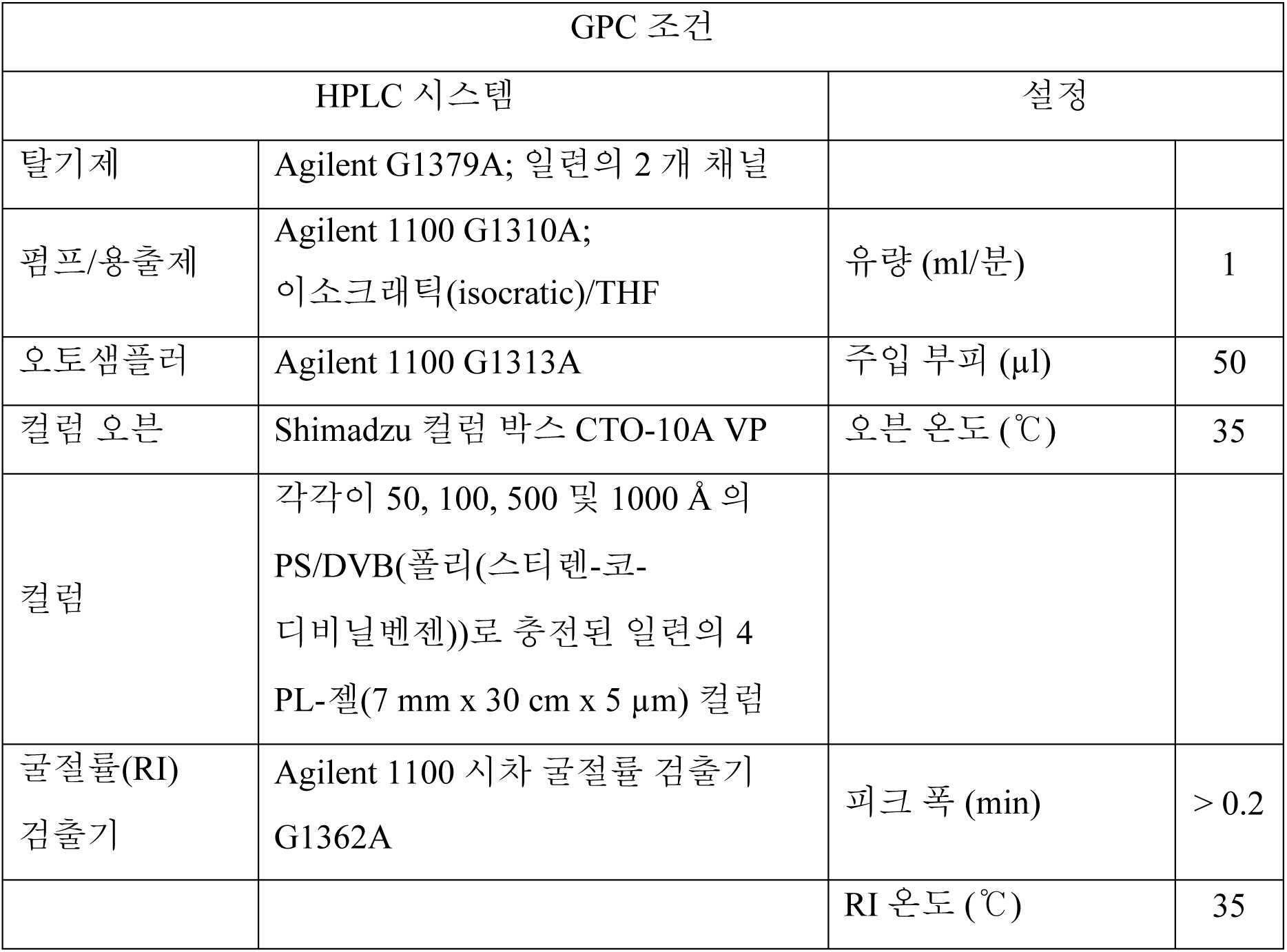
실시예Example (Ex) 1(Ex) 1
처음에, 502.00 그램(g)의 탈이온수(DI), 91.88 g의 A-19 계면활성제(19%), 5.39 g의 SSS(90.5%), 914.65 g의 BA, 668.98 g의 MMA, 24.75 g의 AA 및 11.70 g의 PEM을 혼합함으로써, 단량체 혼합물을 제조하였다.Initially, 502.00 grams (g) of deionized water (DI), 91.88 grams of A-19 surfactant (19%), 5.39 grams of SSS (90.5%), 914.65 grams of BA, 668.98 grams of MMA, 24.75 grams of A monomer mixture was prepared by mixing AA and 11.70 g of PEM.
환류 축합기, 첨가 깔때기 및 교반기가 장착된 1 갤런 용기 내에, 초기 물 충전물을 130 rpm에서 교반하면서 첨가하였다. 반응 용기를 88℃까지 가열하였다. 6.18 g의 A-19 계면활성제(19%)를 용기 내에 첨가하였다. 81.26 g의 B-4000을 98.58 g의 상기 단량체 혼합물과 혼합하였다. 그 후에, 생성된 혼합물 및 초기 촉매 용액(16.65 g의 DI 수 중 5.81 g의 APS)을 반응 용기에 충전하였다. 반응 혼합물을 시드 형성을 위해 82℃ 내지 88℃에서 5분 동안 유지시켰다. 그 후에, 단량체 혼합물 중 나머지, 촉매(63.11 g의 DI 수 중 2.32 g의 APS) 및 활성화제(63.11 g의 DI 수 중 2.46 g의 NaBS)를 85℃ 내지 87℃의 온도에서90분의 기간에 걸쳐 첨가하였다. 단량체 혼합물, 촉매 및 활성화제의 첨가를 완료한 후, 반응 용기 내의 내용물을 실온까지 냉각시켰다. 냉각 동안, 25.84 g의 DI 수 중 3.80 g의 t-BHP와 28.20 g의 DI 수 중 1.80 g의 IAA의 혼합물을 온도가 65℃일 때 첨가하였다. 용기 온도가 50℃ 이하에 도달했을 때, 16.15 g의 암모니아를 첨가하여, 수득된 분산액의 pH를 7에 걸쳐 조정하였다. 생성된 중합체 분산액은 단량체의 총 중량을 기준으로 한 중량에 의해, 5.00%의 B-4000 및 41.48%MMA/56.00%BA/0.72%PEM/0.30%SSS/1.50%AA의 중합체를 함유하였다.Into a 1 gallon vessel equipped with a reflux condenser, addition funnel and stirrer, an initial water charge was added with stirring at 130 rpm. The reaction vessel was heated to 88°C. 6.18 g of A-19 surfactant (19%) was added into the vessel. 81.26 g of B-4000 was mixed with 98.58 g of the above monomer mixture. The resulting mixture and initial catalyst solution (5.81 g APS in 16.65 g DI water) were then charged to a reaction vessel. The reaction mixture was held at 82° C. to 88° C. for 5 minutes for seed formation. Thereafter, the remainder of the monomer mixture, the catalyst (2.32 g of APS in 63.11 g of DI water) and the activator (2.46 g of NaBS in 63.11 g of DI water) were added at a temperature of 85°C to 87°C in a period of 90 minutes. added over. After the addition of the monomer mixture, catalyst and activator was complete, the contents in the reaction vessel were cooled to room temperature. During cooling, a mixture of 3.80 g t-BHP in 25.84 g DI water and 1.80 g IAA in 28.20 g DI water was added when the temperature was 65°C. When the vessel temperature reached 50° C. or lower, the pH of the obtained dispersion was adjusted over 7 by adding 16.15 g of ammonia. The resulting polymer dispersion contained 5.00% B-4000 and 41.48% MMA/56.00%BA/0.72%PEM/0.30%SSS/1.50%AA polymer by weight based on the total weight of monomers.
실시예 2Example 2
처음에, 502.00 g의 DI 수, 91.88 g의 A-19 계면활성제(19%), 5.39 g의 SSS(90.5%), 914.65 g의 BA, 668.98 g의 MMA, 24.75 g의 AA, 11.70 g의 PEM 및 81.26 g의 B-4000을 혼합함으로써 단량체 혼합물을 제조하였다.Initially, 502.00 g of DI water, 91.88 g of A-19 surfactant (19%), 5.39 g of SSS (90.5%), 914.65 g of BA, 668.98 g of MMA, 24.75 g of AA, 11.70 g of PEM. and 81.26 g of B-4000 to prepare a monomer mixture.
환류 축합기, 첨가 깔때기 및 교반기가 장착된 1 갤런 용기 내에, 초기 물 충전물을 130 rpm에서 교반하면서 첨가하였다. 반응 용기를 88℃까지 가열하였다. 6.18 g의 A-19 계면활성제(19%)를 용기 내에 첨가하였다. 101.64 g의 단량체 혼합물 및 초기 촉매 용액(16.65 g의 DI 수 중 5.81 g의 APS)을 반응 용기에 충전하였다. 반응 혼합물을 시드 형성을 위해 82℃ 내지 88℃에서 5분 동안 유지시켰다. 그 후에, 단량체 혼합물 중 나머지, 촉매(63.11 g의 DI 수 중 2.32 g의 APS) 및 활성화제(63.11 g의 DI 수 중 2.46 g의 NaBS)를 85℃ 내지 87℃의 온도에서90분의 기간에 걸쳐 첨가하였다. 단량체 혼합물, 촉매 및 활성화제의 첨가를 완료한 후, 반응 용기 내의 내용물을 실온까지 냉각시켰다. 냉각 동안, 25.84 g의 DI 수 중 3.80 g의 t-BHP와 28.20 g의 DI 수 중 1.80 g의 IAA의 혼합물을 온도가 65℃일 때 첨가하였다. 용기 온도가 50℃ 이하에 도달했을 때, 16.15 g의 암모니아를 첨가하여, 수득된 분산액의 pH를 7에 걸쳐 조정하였다. 생성된 중합체 분산액은 단량체의 총 중량을 기준으로 한 중량에 의해, 5.00%의 B-4000 및 41.48%MMA/56.00%BA/0.72%PEM/0.30%SSS/1.50%의 중합체를 함유하였다.Into a 1 gallon vessel equipped with a reflux condenser, addition funnel and stirrer, an initial water charge was added with stirring at 130 rpm. The reaction vessel was heated to 88°C. 6.18 g of A-19 surfactant (19%) was added into the vessel. 101.64 g of the monomer mixture and the initial catalyst solution (5.81 g of APS in 16.65 g of DI water) were charged to a reaction vessel. The reaction mixture was held at 82° C. to 88° C. for 5 minutes for seed formation. Thereafter, the remainder of the monomer mixture, catalyst (2.32 g APS in 63.11 g DI water) and activator (2.46 g NaBS in 63.11 g DI water) was added at a temperature of 85°C to 87°C in a period of 90 minutes added over. After the addition of the monomer mixture, catalyst and activator was complete, the contents in the reaction vessel were cooled to room temperature. During cooling, a mixture of 3.80 g t-BHP in 25.84 g DI water and 1.80 g IAA in 28.20 g DI water was added when the temperature was 65°C. When the vessel temperature reached 50° C. or lower, the pH of the obtained dispersion was adjusted over 7 by adding 16.15 g of ammonia. The resulting polymer dispersion contained 5.00% B-4000 and 41.48%MMA/56.00%BA/0.72%PEM/0.30%SSS/1.50% polymer by weight based on the total weight of monomers.
실시예 3Example 3
처음에, 502.00 g의 DI 수, 91.88 g의 A-19 계면활성제(19%), 5.39 g의 SSS(90.5%), 914.65 g의 BA, 668.98 g의 MMA, 24.75 g의 AA, 11.70 g의 PEM 및 162.52 g의 B-4000 을 혼합함으로써 단량체 혼합물을 제조하였다.Initially, 502.00 g of DI water, 91.88 g of A-19 surfactant (19%), 5.39 g of SSS (90.5%), 914.65 g of BA, 668.98 g of MMA, 24.75 g of AA, 11.70 g of PEM. and 162.52 g of B-4000 to prepare a monomer mixture.
환류 축합기, 첨가 깔때기 및 교반기가 장착된 1 갤런 용기 내에, 초기 물 충전물을 130 rpm에서 교반하면서 첨가하였다.반응 용기를 88℃까지 가열하였다. 6.18 g의 A-19 계면활성제(19%)를 용기 내에 첨가하였다. 105.22 g의 단량체 혼합물 및 초기 촉매 용액(16.65 g의 DI 수 중 5.81 g의 APS)을 반응 용기에 충전하였다. 반응 혼합물을 시드 형성을 위해 82℃ 내지 88℃에서 5분 동안 유지시켰다. 그 후에, 단량체 혼합물 중 나머지, 촉매(63.11 g의 DI 수 중 2.32 g의 APS) 및 활성화제(63.11 g의 DI 수 중 2.46 g의 NaBS)를 85℃ 내지 87℃의 온도에서90분의 기간에 걸쳐 첨가하였다. 단량체 혼합물, 촉매 및 활성화제의 첨가를 완료한 후, 반응 용기 내의 내용물을 실온까지 냉각시켰다. 냉각 동안, 25.84 g의 DI 수 중 3.80 g의 t-BHP와 28.20 g의 DI 수 중 1.80 g의 IAA의 혼합물을 온도가 65℃일 때 첨가하였다. 용기 온도가 50℃ 이하에 도달했을 때, 16.15 g의 암모니아를 첨가하여, 수득된 분산액의 pH를 7에 걸쳐 조정하였다. 생성된 중합체 분산액은 단량체의 총 중량을 기준으로 한 중량에 의해, 10.00%의 B-4000 및 41.48%MMA/56.00%BA/0.72%PEM/0.30%SSS/1.50%AA의 중합체를 함유하였다.Into a 1 gallon vessel equipped with a reflux condenser, addition funnel and stirrer, an initial water charge was added with stirring at 130 rpm. The reaction vessel was heated to 88°C. 6.18 g of A-19 surfactant (19%) was added into the vessel. 105.22 g of the monomer mixture and the initial catalyst solution (5.81 g of APS in 16.65 g of DI water) were charged to a reaction vessel. The reaction mixture was held at 82° C. to 88° C. for 5 minutes for seed formation. Thereafter, the remainder of the monomer mixture, the catalyst (2.32 g of APS in 63.11 g of DI water) and the activator (2.46 g of NaBS in 63.11 g of DI water) were added at a temperature of 85°C to 87°C in a period of 90 minutes. added over. After the addition of the monomer mixture, catalyst and activator was complete, the contents in the reaction vessel were cooled to room temperature. During cooling, a mixture of 3.80 g t-BHP in 25.84 g DI water and 1.80 g IAA in 28.20 g DI water was added when the temperature was 65°C. When the vessel temperature reached 50° C. or lower, the pH of the obtained dispersion was adjusted over 7 by adding 16.15 g of ammonia. The resulting polymer dispersion contained 10.00% B-4000 and 41.48% MMA/56.00%BA/0.72%PEM/0.30%SSS/1.50%AA polymer by weight based on the total weight of monomers.
실시예 4Example 4
처음에, 502.00 g의 DI 수, 91.88 g의 A-19 계면활성제(19%), 5.39 g의 SSS(90.5%), 914.65 g의 BA, 668.98 g의 MMA, 24.75 g의 AA, 11.70 g의 PEM 및 325.04 g의 B-4000 을 혼합함으로써 단량체 혼합물을 제조하였다.Initially, 502.00 g of DI water, 91.88 g of A-19 surfactant (19%), 5.39 g of SSS (90.5%), 914.65 g of BA, 668.98 g of MMA, 24.75 g of AA, 11.70 g of PEM. and 325.04 g of B-4000 to prepare a monomer mixture.
환류 축합기, 첨가 깔때기 및 교반기가 장착된 1 갤런 용기 내에, 초기 물 충전물을 130 rpm에서 교반하면서 첨가하였다. 반응 용기를 88℃까지 가열하였다. 6.18 g의 A-19 계면활성제(19%)를 용기 내에 첨가하였다. 112.37 g의 단량체 혼합물 및 초기 촉매 용액(16.65 g의 DI 수 중 5.81 g의 APS)을 반응 용기에 충전하였다. 반응 혼합물을 시드 형성을 위해 82℃ 내지 88℃에서 5분 동안 유지시켰다. 그 후에, 단량체 혼합물 중 나머지, 촉매(63.11 g의 DI 수 중 2.32 g의 APS) 및 활성화제(63.11 g의 DI 수 중 2.46 g의 NaBS)를 85℃ 내지 87℃의 온도에서90분의 기간에 걸쳐 첨가하였다. 단량체 혼합물, 촉매 및 활성화제의 첨가를 완료한 후, 반응 용기 내의 내용물을 실온까지 냉각시켰다. 냉각 동안, 25.84 g의 DI 수 중 3.80 g의 t-BHP와 28.20 g의 DI 수 중 1.80 g의 IAA의 혼합물을 온도가 65℃일 때 첨가하였다. 용기 온도가 50℃ 이하에 도달했을 때, 16.15 g의 암모니아를 첨가하여, 수득된 분산액의 pH를 7에 걸쳐 조정하였다. 생성된 중합체 분산액은 단량체의 총 중량을 기준으로 한 중량에 의해, 20.00%의 B-4000 및 41.48%MMA/56.00%BA/0.72%PEM/0.30%SSS/1.50%AA의 중합체를 함유하였다.Into a 1 gallon vessel equipped with a reflux condenser, addition funnel and stirrer, an initial water charge was added with stirring at 130 rpm. The reaction vessel was heated to 88°C. 6.18 g of A-19 surfactant (19%) was added into the vessel. 112.37 g of the monomer mixture and the initial catalyst solution (5.81 g of APS in 16.65 g of DI water) were charged to a reaction vessel. The reaction mixture was held at 82° C. to 88° C. for 5 minutes for seed formation. Thereafter, the remainder of the monomer mixture, the catalyst (2.32 g of APS in 63.11 g of DI water) and the activator (2.46 g of NaBS in 63.11 g of DI water) were added at a temperature of 85°C to 87°C in a period of 90 minutes. added over. After the addition of the monomer mixture, catalyst and activator was complete, the contents in the reaction vessel were cooled to room temperature. During cooling, a mixture of 3.80 g t-BHP in 25.84 g DI water and 1.80 g IAA in 28.20 g DI water was added when the temperature was 65°C. When the vessel temperature reached 50° C. or lower, the pH of the obtained dispersion was adjusted over 7 by adding 16.15 g of ammonia. The resulting polymer dispersion contained 20.00% B-4000 and 41.48% MMA/56.00%BA/0.72%PEM/0.30%SSS/1.50%AA polymer by weight based on the total weight of monomers.
실시예 5Example 5
처음에, 502.00 g의 DI 수, 91.88 g의 A-19 계면활성제(19%), 5.39 g의 SSS(90.5%), 914.65 g의 BA, 668.98 g의 ST, 24.75 g의 AA, 11.70 g의 PEM 및 81.26 g의 B-4000 을 혼합함으로써 단량체 혼합물을 제조하였다.Initially, 502.00 g DI water, 91.88 g A-19 surfactant (19%), 5.39 g SSS (90.5%), 914.65 g BA, 668.98 g ST, 24.75 g AA, 11.70 g PEM. and 81.26 g of B-4000 to prepare a monomer mixture.
환류 축합기, 첨가 깔때기 및 교반기가 장착된 1 갤런 용기 내에, 초기 물 충전물을 130 rpm에서 교반하면서 첨가하였다. 반응 용기를 88℃까지 가열하였다. 6.18 g의 A-19 계면활성제(19%)를 용기 내에 첨가하였다. 101.64 g의 단량체 혼합물 및 초기 촉매 용액(16.65 g의 DI 수 중 5.81 g의 APS)을 반응 용기에 충전하였다. 반응 혼합물을 시드 형성을 위해 82℃ 내지 88℃에서 5분 동안 유지시켰다. 그 후에, 단량체 혼합물 중 나머지, 촉매(63.11 g의 DI 수 중 2.32 g의 APS) 및 활성화제(63.11 g의 DI 수 중 2.46 g의 NaBS)를 85℃ 내지 87℃의 온도로 120분의 기간에 걸쳐 첨가하였다. 단량체 혼합물, 촉매 및 활성화제의 첨가를 완료한 후, 반응 용기 내의 내용물을 실온까지 냉각시켰다. 냉각 동안, 25.84 g의 DI 수 중 3.80 g의 t-BHP와 28.20 g의 DI 수 중 1.80 g의 IAA의 혼합물을 온도가 65℃일 때 첨가하였다. 용기 온도가 50℃ 이하에 도달했을 때, 16.15 g의 암모니아를 첨가하여, 수득된 분산액의 pH를 7에 걸쳐 조정하였다. 생성된 중합체 분산액은 단량체의 총 중량을 기준으로 한 중량에 의해, 5.00%의 B-4000 및 41.48%ST/56.00%BA/0.72%PEM/0.30%SSS/1.50%AA의 중합체를 함유하였다.Into a 1 gallon vessel equipped with a reflux condenser, addition funnel and stirrer, an initial water charge was added with stirring at 130 rpm. The reaction vessel was heated to 88°C. 6.18 g of A-19 surfactant (19%) was added into the vessel. 101.64 g of the monomer mixture and the initial catalyst solution (5.81 g of APS in 16.65 g of DI water) were charged to a reaction vessel. The reaction mixture was held at 82° C. to 88° C. for 5 minutes for seed formation. Thereafter, the remainder of the monomer mixture, the catalyst (2.32 g of APS in 63.11 g of DI water) and activator (2.46 g of NaBS in 63.11 g of DI water) were added at a temperature of 85°C to 87°C in a period of 120 minutes. added over. After the addition of the monomer mixture, catalyst and activator was complete, the contents in the reaction vessel were cooled to room temperature. During cooling, a mixture of 3.80 g t-BHP in 25.84 g DI water and 1.80 g IAA in 28.20 g DI water was added when the temperature was 65°C. When the vessel temperature reached 50° C. or lower, the pH of the obtained dispersion was adjusted over 7 by adding 16.15 g of ammonia. The resulting polymer dispersion contained 5.00% B-4000 and 41.48%ST/56.00%BA/0.72%PEM/0.30%SSS/1.50%AA polymer by weight based on the total weight of monomers.
비교(Comp)예 AComparison Example A
처음에, 502.00 g의 DI 수, 91.88 g의 A-19 계면활성제(19%), 5.39 g의 SSS(90.5%), 914.65 g의 BA, 668.98 g의 MMA, 24.75 g의 AA 및 11.70 g의 PEM 을 혼합함으로써 단량체 혼합물을 제조하였다.Initially, 502.00 g DI water, 91.88 g A-19 surfactant (19%), 5.39 g SSS (90.5%), 914.65 g BA, 668.98 g MMA, 24.75 g AA and 11.70 g PEM. A monomer mixture was prepared by mixing.
환류 축합기, 첨가 깔때기 및 교반기가 장착된 1 갤런 용기 내에, 초기 물 충전물을 130 rpm에서 교반하면서 첨가하였다. 반응 용기를 88℃까지 가열하였다. 6.18 g의 A-19 계면활성제(19%)를 용기 내에 첨가하였다. 98.58 g의 단량체 혼합물 및 초기 촉매 용액(16.65 g의 DI 수 중 5.81 g의 APS)을 반응 용기에 충전하였다. 반응 혼합물을 시드 형성을 위해 82℃ 내지 88℃에서 5분 동안 유지시켰다. 그 후에, 단량체 혼합물 중 나머지, 촉매(63.11 g의 DI 수 중 2.32 g의 APS) 및 활성화제(63.11 g의 DI 수 중 2.46 g의 NaBS)를 85℃ 내지 87℃의 온도에서90분의 기간에 걸쳐 첨가하였다. 단량체 혼합물, 촉매 및 활성화제의 첨가를 완료한 후, 반응 용기 내의 내용물을 실온까지 냉각시켰다. 냉각 동안, 25.84 g의 DI 수 중 3.80 g의 t-BHP와 28.20 g의 DI 수 중 1.80 g의 IAA의 혼합물을 온도가 65℃일 때 첨가하였다. 용기 온도가 50℃ 이하에 도달했을 때, 16.15 g의 암모니아를 첨가하여, 수득된 분산액의 pH를 7에 걸쳐 조정하였다. 생성된 중합체 분산액은 단량체의 총 중량을 기준으로 한 중량에 의해, 41.48%MMA/56.00%BA/0.72%PEM/0.30%SSS/1.50%AA의 중합체를 함유하였다.Into a 1 gallon vessel equipped with a reflux condenser, addition funnel and stirrer, an initial water charge was added with stirring at 130 rpm. The reaction vessel was heated to 88°C. 6.18 g of A-19 surfactant (19%) was added into the vessel. 98.58 g of the monomer mixture and the initial catalyst solution (5.81 g of APS in 16.65 g of DI water) were charged to a reaction vessel. The reaction mixture was held at 82° C. to 88° C. for 5 minutes for seed formation. Thereafter, the remainder of the monomer mixture, the catalyst (2.32 g of APS in 63.11 g of DI water) and the activator (2.46 g of NaBS in 63.11 g of DI water) were added at a temperature of 85°C to 87°C in a period of 90 minutes. added over. After the addition of the monomer mixture, catalyst and activator was complete, the contents in the reaction vessel were cooled to room temperature. During cooling, a mixture of 3.80 g t-BHP in 25.84 g DI water and 1.80 g IAA in 28.20 g DI water was added when the temperature was 65°C. When the vessel temperature reached 50° C. or lower, the pH of the obtained dispersion was adjusted over 7 by adding 16.15 g of ammonia. The resulting polymer dispersion contained 41.48% MMA/56.00% BA/0.72% PEM/0.30% SSS/1.50% AA of polymer by weight based on the total weight of monomers.
비교예 BComparative Example B
비교예 B 분산액을, 실시예 1의 B-4000을 P-4000에 의해 대체한 점을 제외하고는, 실시예 1 분산액의 제조에서 상기 기재된 바와 같이 동일한 절차에 따라 제조하였다. 생성된 중합체 분산액은 단량체의 총 중량을 기준으로 한 중량에 의해, 5.00%의 P-4000 및 41.48%MMA/56.00%BA/0.72%PEM/0.30%SSS/1.50%AA의 중합체를 함유하였다.A dispersion of Comparative Example B was prepared according to the same procedure as described above for the preparation of dispersion of Example 1, except that B-4000 of Example 1 was replaced by P-4000. The resulting polymer dispersion contained 5.00% P-4000 and 41.48%MMA/56.00%BA/0.72%PEM/0.30%SSS/1.50%AA polymer by weight based on the total weight of monomers.
비교예 CComparative Example C
비교예 C 분산액을, 실시예 2의 B-4000을 P-4000에 의해 대체한 점을 제외하고는, 실시예 2 분산액의 제조에서 상기 기재된 바와 같이 동일한 절차에 따라 제조하였다. 생성된 중합체 분산액은 단량체의 총 중량을 기준으로 한 중량에 의해, 5.00%의 P-4000 및 41.48%MMA/56.00%BA/0.72%PEM/0.30%SSS/1.50%AA의 중합체를 함유하였다.A dispersion of Comparative Example C was prepared according to the same procedure as described above for the preparation of the dispersion of Example 2, except that B-4000 of Example 2 was replaced by P-4000. The resulting polymer dispersion contained 5.00% P-4000 and 41.48%MMA/56.00%BA/0.72%PEM/0.30%SSS/1.50%AA polymer by weight based on the total weight of monomers.
비교예 DComparative Example D
처음에, 2개의 단량체 혼합물을 하기와 같이 제조하였다,Initially, two monomer mixtures were prepared as follows:
단량체 혼합물 I: 251.00 g의 DI 수, 45.94 g의 A-19 계면활성제(19%), 2.7 g의 SSS(90.5%), 457.33 g의 BA, 334.49 g의 MMA, 12.38 g의 AA, 5.85 g의 PEM 및 81.26 g의 P-4000을 혼합하였다.Monomer mixture I: 251.00 g DI water, 45.94 g A-19 surfactant (19%), 2.7 g SSS (90.5%), 457.33 g BA, 334.49 g MMA, 12.38 g AA, 5.85 g PEM and 81.26 g of P-4000 were mixed.
단량체 혼합물 II: 251.00 g의 DI 수, 45.94 g의 A-19 계면활성제(19%), 2.7 g의 SSS(90.5%), 457.33 g의 BA, 334.49 g의 MMA, 12.38 g의 AA및 5.85 g의 PEM을 혼합하였다.Monomer mixture II: 251.00 g DI water, 45.94 g A-19 surfactant (19%), 2.7 g SSS (90.5%), 457.33 g BA, 334.49 g MMA, 12.38 g AA and 5.85 g PEM was mixed.
환류 축합기, 첨가 깔때기 및 교반기가 장착된 1 갤런 용기 내에, 초기 물 충전물을 130 rpm에서 교반하면서 첨가하였다. 반응 용기를 88℃까지 가열하였다. 6.18 g의 A-19 계면활성제(19%)를 용기 내에 첨가하였다. 103.50 g의 단량체 혼합물 I 및 초기 촉매 용액(16.65 g의 DI 수 중 5.81 g의 APS)을 반응 용기에 충전하였다. 반응 혼합물을 시드 형성을 위해 82℃ 내지 88℃에서 5분 동안 유지시켰다. 그 후에, 단량체 혼합물 중 나머지 I, 제1 50%의 촉매(63.11 g의 DI 수 중 2.32 g의 APS) 및 제1 50%의 활성화제(63.11 g의 DI 수 중 2.46 g의 NaBS)를 85℃ 내지 87℃의 온도로 45분의 기간에 걸쳐 첨가하였다. 단량체 혼합물 I의 첨가를 완료한 후, 제2 50%의 촉매 및 활성화제와 더불어 단량체 혼합물 II를 85℃ 내지 87℃의 온도로 또 다른 45분의 기간에 걸쳐 첨가하였다. 단량체 혼합물 II의 첨가를 완료한 후, 반응 용기 내의 내용물을 실온까지 냉각시켰다. 냉각 동안, 온도가 65℃였을 때, 25.84 g의 DI 수 중 3.80 g의 t-BHP와 28.20 g의 DI 수 중 1.80 g의 IAA의 혼합물을 첨가하였다. 용기 온도가 50℃ 이하에 도달했을 때, 16.15 g의 암모니아를 첨가하여, 수득된 분산액의 pH를 7에 걸쳐 조정하였다. 생성된 중합체 분산액은 단량체의 총 중량을 기준으로 한 중량에 의해, 5.00%의 P-4000 및 41.48%MMA/56.00%BA/0.72%PEM/0.30%SSS/1.50%AA의 중합체를 함유하였다.Into a 1 gallon vessel equipped with a reflux condenser, addition funnel and stirrer, an initial water charge was added with stirring at 130 rpm. The reaction vessel was heated to 88°C. 6.18 g of A-19 surfactant (19%) was added into the vessel. 103.50 g of monomer mixture I and initial catalyst solution (5.81 g of APS in 16.65 g of DI water) were charged to a reaction vessel. The reaction mixture was held at 82° C. to 88° C. for 5 minutes for seed formation. Thereafter, the remaining I in the monomer mixture, the first 50% of the catalyst (2.32 g of APS in 63.11 g of DI water) and the first 50% of the activator (2.46 g of NaBS in 63.11 g of DI water) were mixed at 85° C. to 87° C. over a period of 45 minutes. After the addition of monomer mixture I was complete, monomer mixture II along with a second 50% catalyst and activator was added over a period of another 45 minutes at a temperature of 85°C to 87°C. After the addition of monomer mixture II was complete, the contents in the reaction vessel were cooled to room temperature. During cooling, when the temperature was 65° C., a mixture of 3.80 g t-BHP in 25.84 g DI water and 1.80 g IAA in 28.20 g DI water was added. When the vessel temperature reached 50° C. or lower, the pH of the obtained dispersion was adjusted over 7 by adding 16.15 g of ammonia. The resulting polymer dispersion contained 5.00% P-4000 and 41.48%MMA/56.00%BA/0.72%PEM/0.30%SSS/1.50%AA polymer by weight based on the total weight of monomers.
비교예 EComparative Example E
처음에, 502.00 g의 DI 수, 91.88 g의 A-19 계면활성제(19%), 5.39 g의 SSS(90.5%), 914.65 g의 BA, 680.33 g의 MMA, 32.99 g의 AA 및 81.26 g의 B-4000을 혼합함으로써 단량체 혼합물을 제조하였다.Initially, 502.00 g DI water, 91.88 g A-19 surfactant (19%), 5.39 g SSS (90.5%), 914.65 g BA, 680.33 g MMA, 32.99 g AA and 81.26 g B A monomer mixture was prepared by mixing -4000.
환류 축합기, 첨가 깔때기 및 교반기가 장착된 1 갤런 용기 내에, 초기 물 충전물을 130 rpm에서 교반하면서 첨가하였다. 반응 용기를 88℃까지 가열하였다. 8.55 g의 A-19 계면활성제(19%)를 용기 내에 첨가하였다. 100.13 g의 단량체 혼합물 및 초기 촉매 용액(16.65 g의 DI 수 중 5.81 g의 APS)을 반응 용기에 충전하였다. 반응 혼합물을 시드 형성을 위해 82℃ 내지 88℃에서 5분 동안 유지시켰다. 그 후에, 단량체 혼합물 중 나머지, 촉매(63.11 g의 DI 수 중 2.32 g의 APS) 및 활성화제(63.11 g의 DI 수 중 2.46 g의 NaBS)를 85℃ 내지 87℃의 온도에서90분의 기간에 걸쳐 첨가하였다. 단량체 혼합물, 촉매 및 활성화제의 첨가를 완료한 후, 반응 용기 내의 내용물을 실온까지 냉각시켰다. 냉각 동안, 25.84 g의 DI 수 중 3.80 g의 t-BHP와 28.20 g의 DI 수 중 1.80 g의 IAA의 혼합물을 온도가 65℃일 때 첨가하였다. 용기 온도가 50℃ 이하에 도달했을 때, 16.15 g의 암모니아를 첨가하여, 수득된 분산액의 pH를 7에 걸쳐 조정하였다. 생성된 중합체 분산액은 단량체의 총 중량을 기준으로 한 중량에 의해, 5.00%의 B-4000 및 41.70%MMA/56.00%BA/0.30%SSS/2.00%AA의 중합체를 함유하였다.Into a 1 gallon vessel equipped with a reflux condenser, addition funnel and stirrer, an initial water charge was added with stirring at 130 rpm. The reaction vessel was heated to 88°C. 8.55 g of A-19 surfactant (19%) was added into the vessel. 100.13 g of the monomer mixture and the initial catalyst solution (5.81 g of APS in 16.65 g of DI water) were charged to a reaction vessel. The reaction mixture was held at 82° C. to 88° C. for 5 minutes for seed formation. Thereafter, the remainder of the monomer mixture, the catalyst (2.32 g of APS in 63.11 g of DI water) and the activator (2.46 g of NaBS in 63.11 g of DI water) were added at a temperature of 85°C to 87°C in a period of 90 minutes. added over. After the addition of the monomer mixture, catalyst and activator was complete, the contents in the reaction vessel were cooled to room temperature. During cooling, a mixture of 3.80 g t-BHP in 25.84 g DI water and 1.80 g IAA in 28.20 g DI water was added when the temperature was 65°C. When the vessel temperature reached 50° C. or lower, the pH of the obtained dispersion was adjusted over 7 by adding 16.15 g of ammonia. The resulting polymer dispersion contained 5.00% B-4000 and 41.70%MMA/56.00%BA/0.30%SSS/2.00%AA polymer by weight based on the total weight of monomers.
비교예 FComparative Example F
비교예 F 분산액을, 실시예 2의 B-4000을 BE05에 의해 대체한 점을 제외하고는, 실시예 2 분산액을 제조하는 데 있어서 상기 기재된 바와 같이 동일한 절차에 따라 제조하였다. 생성된 중합체 분산액은 단량체의 총 중량을 기준으로 한 중량에 의해, 5.00%의 BE05 및 41.48%MMA/56.00%BA/0.72%PEM/0.30%SSS/1.50%AA의 중합체를 함유하였다.Comparative Example F A dispersion was prepared according to the same procedure as described above for preparing the Example 2 dispersion, except that B-4000 in Example 2 was replaced by BE05. The resulting polymer dispersion contained 5.00% BE05 and 41.48%MMA/56.00%BA/0.72%PEM/0.30%SSS/1.50%AA polymer by weight based on the total weight of monomers.
비교예 GComparative Example G
비교예 G 분산액을, 실시예 2의 B-4000을 BE10에 의해 대체한 점을 제외하고는, 실시예 2 분산액을 제조하는 데 있어서 상기 기재된 바와 같이 동일한 절차에 따라 제조하였다. 생성된 중합체 분산액은 단량체의 총 중량을 기준으로 한 중량에 의해, 5.00%의 BE10 및 41.48%MMA/56.00%BA/0.72%PEM/0.30%SSS/1.50%AA의 중합체를 함유하였다.Comparative Example G A dispersion was prepared according to the same procedure as described above for preparing the Example 2 dispersion, except that B-4000 in Example 2 was replaced by BE10. The resulting polymer dispersion contained 5.00% BE10 and 41.48%MMA/56.00%BA/0.72%PEM/0.30%SSS/1.50%AA polymer by weight based on the total weight of monomers.
수득된 분산액의 특성을 표 3에 제공한다. 실시예 1 내지 5의 분산액은, 실온에서 1개월 이상 동안 저장한 후, 또는 심지어 50℃에서 10일 동안 가열한 후, 표면 상에서 B-4000의 유출이 관찰되지 않은 점에서 모두 균질하고 안정하였다.The properties of the dispersions obtained are given in Table 3. The dispersions of Examples 1 to 5 were all homogeneous and stable in that no efflux of B-4000 was observed on the surface after storage at room temperature for at least 1 month, or even after heating at 50° C. for 10 days.

도료 제제paint formulation
상기 수득된 분산액을 도료 제제를 제조하는 데 있어서 결합제로서 사용하였다. 이들 도료 제제(45% PVC)를 표 4 및 5에 제공된 제제에 기초하여 제조하였다. 도료를 2-단계 공정을 통해 제조하였다. 제1 분쇄 단계에서, 물, 분산제, 습윤제, 소포제 및 증점제를 캔에 첨가하고, 그 후에 TiO2 및 다른 증량제를 고속 분산을 이용하여 점차적으로 첨가하였다. 그라인드 내의 모든 물질을 첨가한 후, 그라인드를 2000 rpm에서 또 다른 2 내지 4시간 동안 분산시켜, 양호하게 분산된 슬러리를 수득하였다. 제2 렛다운 단계에서, 결합제, 응고제, 소포제 및 다른 첨가제를 슬러리 내에 첨가하였다. 수득된 도료를 상기 기재된 시험 방법에 따라 발수성 및 방오성 특성에 대해 평가하였으며, 표 6 및 7에 제공한다.The dispersion obtained above was used as a binder in preparing a paint formulation. These paint formulations (45% PVC) were prepared based on the formulations provided in Tables 4 and 5. The paint was prepared through a two-step process. In the first grinding step, water, dispersant, wetting agent, defoaming agent and thickening agent were added to the can, after which TiO 2 and other extenders were added gradually using high speed dispersion. After adding all the material in the grind, the grind was dispersed at 2000 rpm for another 2-4 hours to obtain a well-dispersed slurry. In the second letdown step, binder, coagulant, antifoam and other additives were added into the slurry. The obtained paints were evaluated for water repellency and antifouling properties according to the test methods described above, and are given in Tables 6 and 7.


표 6 및 7에 제시된 바와 같이, 본 발명의 결합제를 포함하는 도료(도료 1 내지 5)는 모든 비교 도료보다 양호한 발수성(3-일 건조 후)을 보여주었다. 또한, 폴리(부틸렌 옥사이드)와 PEM의 중합된 단위 둘 모두를 포함하는 결합제는 PEM의 중합된 단위 또는 폴리(부틸렌 옥사이드) 단독을 포함하는 결합제(도료 A 및 E)와 비교하여 친수성 방오성을 손상시키지 않으면서 유의하게 개선된 소수성 방오성을 갖는 도료를 제공하였다. 대조적으로, 폴리프로필렌 옥사이드와 PEM의 중합된 단위 둘 모두를 포함하는 결합제는 허용 가능한 방오성 성능에도 불구하고 불량한 발수성을 갖는 도료(도료 B 내지 D)를 제공하였다. 상이한 BO/EO 비를 갖는 부틸렌 옥사이드(BO)와 에틸렌 옥사이드(EO)의 공중합체 내로의 혼입(도료 F 및 G)은 발수성과 소수성 방오성 둘 모두를 유의하게 손상시켰다. 폴리(부틸렌 옥사이드)와 PEM의 중합된 단위의 조합은 발수성과 방오성 둘 모두를 개선하는 데 있어서 상승 효과를 갖는다는 것이 명백하다.As shown in Tables 6 and 7, the paints containing the binder of the present invention (Paints 1 to 5) showed better water repellency (after 3-day drying) than all the comparative paints. In addition, binders comprising both poly(butylene oxide) and polymerized units of PEM have hydrophilic antifouling properties compared to binders comprising polymerized units of PEM or poly(butylene oxide) alone (Paints A and E). A paint having a significantly improved hydrophobic antifouling property without damage was provided. In contrast, binders comprising both polypropylene oxide and polymerized units of PEM gave paints (Paints B to D) with poor water repellency despite acceptable antifouling performance. The incorporation into copolymers of butylene oxide (BO) and ethylene oxide (EO) with different BO/EO ratios (Paints F and G) significantly impaired both water repellency and hydrophobic antifouling properties. It is clear that the combination of polymerized units of poly(butylene oxide) with PEM has a synergistic effect in improving both water repellency and antifouling properties.


또한, 은닉능, L, a 및 b 값, 및 광택 특성을 또한 일부 도료에 대해 평가하였으며, 그 결과를 표 8에 제공한다. 표 8에 제시된 바와 같이, 폴리(부틸렌 옥사이드)와 PEM의 중합된 단위 둘 모두를 포함하는 결합제(실시예 1 내지 2)는 도료 A 내지 D의 결합제와 비교하여, 비교할 만한 은닉능, L, a 및 b 값, 및 광택 성능을 제공하였다. 이는, 결합제에서 중합 동안 폴리(부틸렌 옥사이드)의 혼입은 수득된 도료의 이들 특성(예를 들어, 은닉능, 착색 및 광택)을 해치지 않았음을 가리킨다.In addition, hiding ability, L, a and b values, and gloss properties were also evaluated for some paints, and the results are provided in Table 8. As shown in Table 8, the binders comprising both poly(butylene oxide) and polymerized units of PEM (Examples 1 to 2) compared with the binders of Paints A to D, had comparable hiding capacity, L, a and b values, and gloss performance are given. This indicates that the incorporation of poly(butylene oxide) during polymerization in the binder did not impair these properties (eg hiding capacity, coloration and gloss) of the obtained paint.

비교예comparative example H H
B-4000을, 비교예 A 결합제의 고형분 중량을 기준으로 5 중량%의 양으로 실온에서 30분 동안 교반하면서 비교예 A 결합제 내로 첨가하였다. B-4000의 다량의 유출은 표면 상에서 즉시 관찰되었으며(즉, 표면 상에 부유된 폴리부틸렌 글리콜), 이는 B-4000이 결합제 내에서 양호하게 분산될 수 없음을 가리킨다.B-4000 was added into the Comparative Example A binder with stirring at room temperature for 30 minutes in an amount of 5% by weight, based on the solids weight of the Comparative Example A binder. A large amount of leakage of B-4000 was immediately observed on the surface (ie, polybutylene glycol suspended on the surface), indicating that B-4000 could not be well dispersed in the binder.
비교예 IComparative Example I
B-4000을, 비교예 A 결합제의 고형분 중량을 기준으로 5 중량%의 양으로 50℃에서 30분 동안 교반하면서 비교예 A 결합제 내로 첨가하고, 그 후에 실온까지 밤새 냉각시켰다. 그 후에, B-4000의 다량의 유출은 표면 상에서 즉시 관찰되었으며(즉, 표면 상에 부유된 폴리부틸렌 글리콜), 이는 B-4000이 결합제 내에서 양호하게 분산될 수 없음을 가리킨다.B-4000 was added into the Comparative Example A binder with stirring at 50° C. for 30 minutes in an amount of 5% by weight, based on the solids weight of the Comparative Example A binder, after which it was cooled to room temperature overnight. After that, a large amount of leakage of B-4000 was immediately observed on the surface (ie, polybutylene glycol suspended on the surface), indicating that B-4000 could not be well dispersed in the binder.
비교예 JComparative Example J
B-4000을, 비교예 A 결합제의 고형분 중량을 기준으로 5 중량%의 양으로 실온에서 30분 동안 교반하면서 도료 A 내로 첨가하고, 밤새 방치하였다. 그 후에, B-4000의 다량의 유출은 표면 상에서 즉시 관찰되었으며(즉, 표면 상에 부유된 폴리부틸렌 글리콜), 이는 B-4000이 결합제 내에서 양호하게 분산될 수 없음을 가리킨다.B-4000 was added into Paint A with stirring at room temperature for 30 minutes at room temperature in an amount of 5% by weight, based on the solids weight of the Comparative Example A binder, and left overnight. After that, a large amount of leakage of B-4000 was immediately observed on the surface (ie, polybutylene glycol suspended on the surface), indicating that B-4000 could not be well dispersed in the binder.
비교예 H 내지 J에 제시된 바와 같이, B-4000을 첨가한 후 결합제의 중합 방법 후에, 균질하고 안정한 분산액 또는 도료를 수득하는 것이 어려웠다.As shown in Comparative Examples H to J, after the polymerization method of the binder after adding B-4000, it was difficult to obtain a homogeneous and stable dispersion or paint.
Claims (11)
수성 매질 내에서 폴리(부틸렌 옥사이드) 중합체의 존재 하에 단량체 조성물을 중합하여, 에멀젼 중합체를 수득하는 단계를 포함하고,
여기서, 상기 단량체 조성물은 에틸렌계 불포화된 인-함유 단량체를 포함하고,
상기 폴리(부틸렌 옥사이드) 중합체는 화학식 I의 구조를 가지며,

상기 화학식 I에서, R1 및 R2는 각각 독립적으로 수소 원자, 또는 1 내지 22개의 탄소 원자를 갖는 직선형, 분지형 또는 환형, 포화된 또는 불포화된 알킬기를 나타내고; n은 5 내지 300의 정수인, 방법.A method for preparing an aqueous polymer dispersion comprising the steps of:
polymerizing the monomer composition in the presence of a poly(butylene oxide) polymer in an aqueous medium to obtain an emulsion polymer,
wherein the monomer composition comprises an ethylenically unsaturated phosphorus-containing monomer;
The poly(butylene oxide) polymer has the structure of formula (I),
In the above formula (I), R 1 and R 2 each independently represent a hydrogen atom or a straight, branched or cyclic, saturated or unsaturated alkyl group having 1 to 22 carbon atoms; n is an integer from 5 to 300.
에틸렌계 불포화된 인-함유 단량체를 중합되는 단위로서 포함하는 에멀젼 중합체; 및
화학식 I의 구조를 갖는 폴리(부틸렌 옥사이드) 중합체를 포함하고,

상기 화학식 I에서, R1 및 R2는 각각 독립적으로 수소 원자, 또는 1 내지 22개의 탄소 원자를 갖는 직선형, 분지형 또는 환형, 포화된 또는 불포화된 알킬기를 나타내고; n은 5 내지 300의 정수인, 수성 중합체 분산액.An aqueous polymer dispersion comprising:
emulsion polymers comprising an ethylenically unsaturated phosphorus-containing monomer as polymerized units; and
a poly(butylene oxide) polymer having the structure of formula (I);
In the above formula (I), R 1 and R 2 each independently represent a hydrogen atom or a straight, branched or cyclic, saturated or unsaturated alkyl group having 1 to 22 carbon atoms; n is an integer from 5 to 300;
Applications Claiming Priority (1)
| Application Number | Priority Date | Filing Date | Title |
|---|---|---|---|
| PCT/CN2017/081588 WO2018195680A1 (en) | 2017-04-24 | 2017-04-24 | Aqueous polymer dispersion |
Publications (2)
| Publication Number | Publication Date |
|---|---|
| KR20190137871A KR20190137871A (en) | 2019-12-11 |
| KR102268147B1 true KR102268147B1 (en) | 2021-06-22 |
Family
ID=63920175
Family Applications (1)
| Application Number | Title | Priority Date | Filing Date |
|---|---|---|---|
| KR1020197033226A Active KR102268147B1 (en) | 2017-04-24 | 2017-04-24 | aqueous polymer dispersion |
Country Status (8)
| Country | Link |
|---|---|
| US (1) | US10851186B2 (en) |
| EP (1) | EP3615581B1 (en) |
| KR (1) | KR102268147B1 (en) |
| CN (1) | CN110494461A (en) |
| AU (1) | AU2017412145B2 (en) |
| BR (1) | BR112019021671B1 (en) |
| CA (1) | CA3060327C (en) |
| WO (1) | WO2018195680A1 (en) |
Families Citing this family (3)
| Publication number | Priority date | Publication date | Assignee | Title |
|---|---|---|---|---|
| EP3867314B1 (en) | 2018-10-16 | 2024-05-29 | Dow Global Technologies LLC | Aqueous dispersion of polymeric particles |
| CN109748999B (en) * | 2018-12-21 | 2022-08-05 | 万华化学(宁波)有限公司 | Acrylate emulsion and preparation method and application thereof |
| KR20220118471A (en) | 2019-12-18 | 2022-08-25 | 다우 글로벌 테크놀로지스 엘엘씨 | Aqueous dispersion of occluded polymer particles |
Citations (2)
| Publication number | Priority date | Publication date | Assignee | Title |
|---|---|---|---|---|
| WO2007059857A1 (en) | 2005-11-26 | 2007-05-31 | Allessachemie Gmbh | Polymer dispersions, process for their preparation and use |
| WO2013016402A1 (en) | 2011-07-26 | 2013-01-31 | Rohm And Haas Company | Preparation of a multistage latex polymer |
Family Cites Families (9)
| Publication number | Priority date | Publication date | Assignee | Title |
|---|---|---|---|---|
| JPH06248038A (en) * | 1993-02-24 | 1994-09-06 | Denki Kagaku Kogyo Kk | Polyethereal graft resin and its production |
| DE19624148A1 (en) | 1995-06-22 | 1997-01-02 | Henkel Kgaa | Adhesive, sealing and coating compsn. based on styrene] copolymer |
| US20030209695A1 (en) | 2000-02-09 | 2003-11-13 | Toshitaka Tsuzuki | Dispersant composition |
| CN1209425C (en) | 2001-07-04 | 2005-07-06 | 三菱丽阳株式会社 | Plastic sol composition, gel film and product |
| DE10332527A1 (en) | 2003-07-17 | 2005-02-10 | Wacker Polymer Systems Gmbh & Co. Kg | Use of polyalkylene oxides to prevent the thickening of protective colloid-stabilized polymer dispersions |
| EP2077301B1 (en) * | 2008-01-02 | 2016-10-19 | Rohm and Haas Company | Scrub and stain-resistant coating |
| CN102964898B (en) | 2011-08-05 | 2016-05-25 | 罗门哈斯公司 | There is the water-based paint compositions of improved hydrophilic spot repellency |
| KR101803902B1 (en) | 2011-09-16 | 2017-12-04 | (주)아모레퍼시픽 | Composition for skin external application containing ceramide |
| CN102863594A (en) * | 2012-09-14 | 2013-01-09 | 苏州飞翔新材料研究院有限公司 | Polymer latex and application thereof |
-
2017
- 2017-04-24 BR BR112019021671-5A patent/BR112019021671B1/en active IP Right Grant
- 2017-04-24 AU AU2017412145A patent/AU2017412145B2/en active Active
- 2017-04-24 KR KR1020197033226A patent/KR102268147B1/en active Active
- 2017-04-24 US US16/490,977 patent/US10851186B2/en active Active
- 2017-04-24 EP EP17907994.2A patent/EP3615581B1/en active Active
- 2017-04-24 WO PCT/CN2017/081588 patent/WO2018195680A1/en not_active Ceased
- 2017-04-24 CA CA3060327A patent/CA3060327C/en active Active
- 2017-04-24 CN CN201780089550.7A patent/CN110494461A/en active Pending
Patent Citations (2)
| Publication number | Priority date | Publication date | Assignee | Title |
|---|---|---|---|---|
| WO2007059857A1 (en) | 2005-11-26 | 2007-05-31 | Allessachemie Gmbh | Polymer dispersions, process for their preparation and use |
| WO2013016402A1 (en) | 2011-07-26 | 2013-01-31 | Rohm And Haas Company | Preparation of a multistage latex polymer |
Also Published As
| Publication number | Publication date |
|---|---|
| US20200031956A1 (en) | 2020-01-30 |
| BR112019021671A2 (en) | 2020-05-12 |
| CA3060327A1 (en) | 2018-11-01 |
| CA3060327C (en) | 2024-06-18 |
| WO2018195680A1 (en) | 2018-11-01 |
| AU2017412145B2 (en) | 2020-10-08 |
| US10851186B2 (en) | 2020-12-01 |
| EP3615581A1 (en) | 2020-03-04 |
| AU2017412145A1 (en) | 2019-11-28 |
| EP3615581A4 (en) | 2020-12-02 |
| BR112019021671B1 (en) | 2022-08-30 |
| EP3615581B1 (en) | 2021-12-08 |
| KR20190137871A (en) | 2019-12-11 |
| CN110494461A (en) | 2019-11-22 |
Similar Documents
| Publication | Publication Date | Title |
|---|---|---|
| AU2018447046B2 (en) | Aqueous dispersion and aqueous coating composition | |
| KR102604755B1 (en) | Aqueous polymer dispersions and aqueous coating compositions comprising the same | |
| KR20210031700A (en) | Aqueous polymer dispersion and method for preparing the same | |
| KR20200037260A (en) | Aqueous coating composition | |
| AU2019427275B2 (en) | Aqueous coating composition | |
| KR102623032B1 (en) | Aqueous dispersions of multistage polymer particles and processes for their preparation | |
| KR102268147B1 (en) | aqueous polymer dispersion | |
| CN112739768B (en) | Aqueous dispersions of polymeric particles | |
| JP7461465B2 (en) | Aqueous dispersion of polymer particles | |
| KR20220059499A (en) | aqueous polymer dispersion |
Legal Events
| Date | Code | Title | Description |
|---|---|---|---|
| PA0105 | International application |
St.27 status event code: A-0-1-A10-A15-nap-PA0105 |
|
| R17-X000 | Change to representative recorded |
St.27 status event code: A-3-3-R10-R17-oth-X000 |
|
| PG1501 | Laying open of application |
St.27 status event code: A-1-1-Q10-Q12-nap-PG1501 |
|
| P22-X000 | Classification modified |
St.27 status event code: A-2-2-P10-P22-nap-X000 |
|
| R18-X000 | Changes to party contact information recorded |
St.27 status event code: A-3-3-R10-R18-oth-X000 |
|
| R18-X000 | Changes to party contact information recorded |
St.27 status event code: A-3-3-R10-R18-oth-X000 |
|
| A201 | Request for examination | ||
| PA0201 | Request for examination |
St.27 status event code: A-1-2-D10-D11-exm-PA0201 |
|
| E902 | Notification of reason for refusal | ||
| PE0902 | Notice of grounds for rejection |
St.27 status event code: A-1-2-D10-D21-exm-PE0902 |
|
| P11-X000 | Amendment of application requested |
St.27 status event code: A-2-2-P10-P11-nap-X000 |
|
| P13-X000 | Application amended |
St.27 status event code: A-2-2-P10-P13-nap-X000 |
|
| E701 | Decision to grant or registration of patent right | ||
| PE0701 | Decision of registration |
St.27 status event code: A-1-2-D10-D22-exm-PE0701 |
|
| GRNT | Written decision to grant | ||
| PR0701 | Registration of establishment |
St.27 status event code: A-2-4-F10-F11-exm-PR0701 |
|
| PR1002 | Payment of registration fee |
St.27 status event code: A-2-2-U10-U12-oth-PR1002 Fee payment year number: 1 |
|
| PG1601 | Publication of registration |
St.27 status event code: A-4-4-Q10-Q13-nap-PG1601 |
|
| P22-X000 | Classification modified |
St.27 status event code: A-4-4-P10-P22-nap-X000 |
|
| PR1001 | Payment of annual fee |
St.27 status event code: A-4-4-U10-U11-oth-PR1001 Fee payment year number: 4 |
|
| PR1001 | Payment of annual fee |
St.27 status event code: A-4-4-U10-U11-oth-PR1001 Fee payment year number: 5 |
|
| U11 | Full renewal or maintenance fee paid |
Free format text: ST27 STATUS EVENT CODE: A-4-4-U10-U11-OTH-PR1001 (AS PROVIDED BY THE NATIONAL OFFICE) Year of fee payment: 5 |