KR102240743B1 - Non-woven Cellulose Fiber Fabric with Customized Liquid Wicking Capability - Google Patents
Non-woven Cellulose Fiber Fabric with Customized Liquid Wicking Capability Download PDFInfo
- Publication number
- KR102240743B1 KR102240743B1 KR1020197032538A KR20197032538A KR102240743B1 KR 102240743 B1 KR102240743 B1 KR 102240743B1 KR 1020197032538 A KR1020197032538 A KR 1020197032538A KR 20197032538 A KR20197032538 A KR 20197032538A KR 102240743 B1 KR102240743 B1 KR 102240743B1
- Authority
- KR
- South Korea
- Prior art keywords
- fiber
- fibers
- fabric
- different
- cellulosic
- Prior art date
- Legal status (The legal status is an assumption and is not a legal conclusion. Google has not performed a legal analysis and makes no representation as to the accuracy of the status listed.)
- Active
Links
Images




Classifications
-
- D—TEXTILES; PAPER
- D04—BRAIDING; LACE-MAKING; KNITTING; TRIMMINGS; NON-WOVEN FABRICS
- D04H—MAKING TEXTILE FABRICS, e.g. FROM FIBRES OR FILAMENTARY MATERIAL; FABRICS MADE BY SUCH PROCESSES OR APPARATUS, e.g. FELTS, NON-WOVEN FABRICS; COTTON-WOOL; WADDING ; NON-WOVEN FABRICS FROM STAPLE FIBRES, FILAMENTS OR YARNS, BONDED WITH AT LEAST ONE WEB-LIKE MATERIAL DURING THEIR CONSOLIDATION
- D04H3/00—Non-woven fabrics formed wholly or mainly of yarns or like filamentary material of substantial length
- D04H3/013—Regenerated cellulose series
-
- B—PERFORMING OPERATIONS; TRANSPORTING
- B32—LAYERED PRODUCTS
- B32B—LAYERED PRODUCTS, i.e. PRODUCTS BUILT-UP OF STRATA OF FLAT OR NON-FLAT, e.g. CELLULAR OR HONEYCOMB, FORM
- B32B27/00—Layered products comprising a layer of synthetic resin
- B32B27/12—Layered products comprising a layer of synthetic resin next to a fibrous or filamentary layer
-
- B—PERFORMING OPERATIONS; TRANSPORTING
- B32—LAYERED PRODUCTS
- B32B—LAYERED PRODUCTS, i.e. PRODUCTS BUILT-UP OF STRATA OF FLAT OR NON-FLAT, e.g. CELLULAR OR HONEYCOMB, FORM
- B32B27/00—Layered products comprising a layer of synthetic resin
- B32B27/32—Layered products comprising a layer of synthetic resin comprising polyolefins
-
- B—PERFORMING OPERATIONS; TRANSPORTING
- B32—LAYERED PRODUCTS
- B32B—LAYERED PRODUCTS, i.e. PRODUCTS BUILT-UP OF STRATA OF FLAT OR NON-FLAT, e.g. CELLULAR OR HONEYCOMB, FORM
- B32B27/00—Layered products comprising a layer of synthetic resin
- B32B27/36—Layered products comprising a layer of synthetic resin comprising polyesters
-
- B—PERFORMING OPERATIONS; TRANSPORTING
- B32—LAYERED PRODUCTS
- B32B—LAYERED PRODUCTS, i.e. PRODUCTS BUILT-UP OF STRATA OF FLAT OR NON-FLAT, e.g. CELLULAR OR HONEYCOMB, FORM
- B32B5/00—Layered products characterised by the non- homogeneity or physical structure, i.e. comprising a fibrous, filamentary, particulate or foam layer; Layered products characterised by having a layer differing constitutionally or physically in different parts
- B32B5/02—Layered products characterised by the non- homogeneity or physical structure, i.e. comprising a fibrous, filamentary, particulate or foam layer; Layered products characterised by having a layer differing constitutionally or physically in different parts characterised by structural features of a fibrous or filamentary layer
- B32B5/022—Non-woven fabric
-
- B—PERFORMING OPERATIONS; TRANSPORTING
- B32—LAYERED PRODUCTS
- B32B—LAYERED PRODUCTS, i.e. PRODUCTS BUILT-UP OF STRATA OF FLAT OR NON-FLAT, e.g. CELLULAR OR HONEYCOMB, FORM
- B32B5/00—Layered products characterised by the non- homogeneity or physical structure, i.e. comprising a fibrous, filamentary, particulate or foam layer; Layered products characterised by having a layer differing constitutionally or physically in different parts
- B32B5/02—Layered products characterised by the non- homogeneity or physical structure, i.e. comprising a fibrous, filamentary, particulate or foam layer; Layered products characterised by having a layer differing constitutionally or physically in different parts characterised by structural features of a fibrous or filamentary layer
- B32B5/06—Layered products characterised by the non- homogeneity or physical structure, i.e. comprising a fibrous, filamentary, particulate or foam layer; Layered products characterised by having a layer differing constitutionally or physically in different parts characterised by structural features of a fibrous or filamentary layer characterised by a fibrous or filamentary layer mechanically connected, e.g. by needling to another layer, e.g. of fibres, of paper
-
- B—PERFORMING OPERATIONS; TRANSPORTING
- B32—LAYERED PRODUCTS
- B32B—LAYERED PRODUCTS, i.e. PRODUCTS BUILT-UP OF STRATA OF FLAT OR NON-FLAT, e.g. CELLULAR OR HONEYCOMB, FORM
- B32B5/00—Layered products characterised by the non- homogeneity or physical structure, i.e. comprising a fibrous, filamentary, particulate or foam layer; Layered products characterised by having a layer differing constitutionally or physically in different parts
- B32B5/22—Layered products characterised by the non- homogeneity or physical structure, i.e. comprising a fibrous, filamentary, particulate or foam layer; Layered products characterised by having a layer differing constitutionally or physically in different parts characterised by the presence of two or more layers which are next to each other and are fibrous, filamentary, formed of particles or foamed
- B32B5/24—Layered products characterised by the non- homogeneity or physical structure, i.e. comprising a fibrous, filamentary, particulate or foam layer; Layered products characterised by having a layer differing constitutionally or physically in different parts characterised by the presence of two or more layers which are next to each other and are fibrous, filamentary, formed of particles or foamed one layer being a fibrous or filamentary layer
- B32B5/26—Layered products characterised by the non- homogeneity or physical structure, i.e. comprising a fibrous, filamentary, particulate or foam layer; Layered products characterised by having a layer differing constitutionally or physically in different parts characterised by the presence of two or more layers which are next to each other and are fibrous, filamentary, formed of particles or foamed one layer being a fibrous or filamentary layer another layer next to it also being fibrous or filamentary
-
- B—PERFORMING OPERATIONS; TRANSPORTING
- B32—LAYERED PRODUCTS
- B32B—LAYERED PRODUCTS, i.e. PRODUCTS BUILT-UP OF STRATA OF FLAT OR NON-FLAT, e.g. CELLULAR OR HONEYCOMB, FORM
- B32B7/00—Layered products characterised by the relation between layers; Layered products characterised by the relative orientation of features between layers, or by the relative values of a measurable parameter between layers, i.e. products comprising layers having different physical, chemical or physicochemical properties; Layered products characterised by the interconnection of layers
- B32B7/02—Physical, chemical or physicochemical properties
-
- B—PERFORMING OPERATIONS; TRANSPORTING
- B32—LAYERED PRODUCTS
- B32B—LAYERED PRODUCTS, i.e. PRODUCTS BUILT-UP OF STRATA OF FLAT OR NON-FLAT, e.g. CELLULAR OR HONEYCOMB, FORM
- B32B7/00—Layered products characterised by the relation between layers; Layered products characterised by the relative orientation of features between layers, or by the relative values of a measurable parameter between layers, i.e. products comprising layers having different physical, chemical or physicochemical properties; Layered products characterised by the interconnection of layers
- B32B7/02—Physical, chemical or physicochemical properties
- B32B7/022—Mechanical properties
-
- B—PERFORMING OPERATIONS; TRANSPORTING
- B32—LAYERED PRODUCTS
- B32B—LAYERED PRODUCTS, i.e. PRODUCTS BUILT-UP OF STRATA OF FLAT OR NON-FLAT, e.g. CELLULAR OR HONEYCOMB, FORM
- B32B7/00—Layered products characterised by the relation between layers; Layered products characterised by the relative orientation of features between layers, or by the relative values of a measurable parameter between layers, i.e. products comprising layers having different physical, chemical or physicochemical properties; Layered products characterised by the interconnection of layers
- B32B7/02—Physical, chemical or physicochemical properties
- B32B7/023—Optical properties
-
- B—PERFORMING OPERATIONS; TRANSPORTING
- B32—LAYERED PRODUCTS
- B32B—LAYERED PRODUCTS, i.e. PRODUCTS BUILT-UP OF STRATA OF FLAT OR NON-FLAT, e.g. CELLULAR OR HONEYCOMB, FORM
- B32B7/00—Layered products characterised by the relation between layers; Layered products characterised by the relative orientation of features between layers, or by the relative values of a measurable parameter between layers, i.e. products comprising layers having different physical, chemical or physicochemical properties; Layered products characterised by the interconnection of layers
- B32B7/04—Interconnection of layers
- B32B7/06—Interconnection of layers permitting easy separation
-
- B—PERFORMING OPERATIONS; TRANSPORTING
- B32—LAYERED PRODUCTS
- B32B—LAYERED PRODUCTS, i.e. PRODUCTS BUILT-UP OF STRATA OF FLAT OR NON-FLAT, e.g. CELLULAR OR HONEYCOMB, FORM
- B32B7/00—Layered products characterised by the relation between layers; Layered products characterised by the relative orientation of features between layers, or by the relative values of a measurable parameter between layers, i.e. products comprising layers having different physical, chemical or physicochemical properties; Layered products characterised by the interconnection of layers
- B32B7/04—Interconnection of layers
- B32B7/08—Interconnection of layers by mechanical means
-
- B—PERFORMING OPERATIONS; TRANSPORTING
- B32—LAYERED PRODUCTS
- B32B—LAYERED PRODUCTS, i.e. PRODUCTS BUILT-UP OF STRATA OF FLAT OR NON-FLAT, e.g. CELLULAR OR HONEYCOMB, FORM
- B32B7/00—Layered products characterised by the relation between layers; Layered products characterised by the relative orientation of features between layers, or by the relative values of a measurable parameter between layers, i.e. products comprising layers having different physical, chemical or physicochemical properties; Layered products characterised by the interconnection of layers
- B32B7/04—Interconnection of layers
- B32B7/12—Interconnection of layers using interposed adhesives or interposed materials with bonding properties
-
- D—TEXTILES; PAPER
- D04—BRAIDING; LACE-MAKING; KNITTING; TRIMMINGS; NON-WOVEN FABRICS
- D04H—MAKING TEXTILE FABRICS, e.g. FROM FIBRES OR FILAMENTARY MATERIAL; FABRICS MADE BY SUCH PROCESSES OR APPARATUS, e.g. FELTS, NON-WOVEN FABRICS; COTTON-WOOL; WADDING ; NON-WOVEN FABRICS FROM STAPLE FIBRES, FILAMENTS OR YARNS, BONDED WITH AT LEAST ONE WEB-LIKE MATERIAL DURING THEIR CONSOLIDATION
- D04H1/00—Non-woven fabrics formed wholly or mainly of staple fibres or like relatively short fibres
- D04H1/04—Non-woven fabrics formed wholly or mainly of staple fibres or like relatively short fibres from fleeces or layers composed of fibres having existing or potential cohesive properties, e.g. natural fibres, prestretched or fibrillated artificial fibres
- D04H1/28—Regenerated cellulose series
-
- D—TEXTILES; PAPER
- D04—BRAIDING; LACE-MAKING; KNITTING; TRIMMINGS; NON-WOVEN FABRICS
- D04H—MAKING TEXTILE FABRICS, e.g. FROM FIBRES OR FILAMENTARY MATERIAL; FABRICS MADE BY SUCH PROCESSES OR APPARATUS, e.g. FELTS, NON-WOVEN FABRICS; COTTON-WOOL; WADDING ; NON-WOVEN FABRICS FROM STAPLE FIBRES, FILAMENTS OR YARNS, BONDED WITH AT LEAST ONE WEB-LIKE MATERIAL DURING THEIR CONSOLIDATION
- D04H1/00—Non-woven fabrics formed wholly or mainly of staple fibres or like relatively short fibres
- D04H1/40—Non-woven fabrics formed wholly or mainly of staple fibres or like relatively short fibres from fleeces or layers composed of fibres without existing or potential cohesive properties
- D04H1/42—Non-woven fabrics formed wholly or mainly of staple fibres or like relatively short fibres from fleeces or layers composed of fibres without existing or potential cohesive properties characterised by the use of certain kinds of fibres insofar as this use has no preponderant influence on the consolidation of the fleece
- D04H1/425—Cellulose series
- D04H1/4258—Regenerated cellulose series
-
- D—TEXTILES; PAPER
- D04—BRAIDING; LACE-MAKING; KNITTING; TRIMMINGS; NON-WOVEN FABRICS
- D04H—MAKING TEXTILE FABRICS, e.g. FROM FIBRES OR FILAMENTARY MATERIAL; FABRICS MADE BY SUCH PROCESSES OR APPARATUS, e.g. FELTS, NON-WOVEN FABRICS; COTTON-WOOL; WADDING ; NON-WOVEN FABRICS FROM STAPLE FIBRES, FILAMENTS OR YARNS, BONDED WITH AT LEAST ONE WEB-LIKE MATERIAL DURING THEIR CONSOLIDATION
- D04H3/00—Non-woven fabrics formed wholly or mainly of yarns or like filamentary material of substantial length
- D04H3/02—Non-woven fabrics formed wholly or mainly of yarns or like filamentary material of substantial length characterised by the method of forming fleeces or layers, e.g. reorientation of yarns or filaments
- D04H3/03—Non-woven fabrics formed wholly or mainly of yarns or like filamentary material of substantial length characterised by the method of forming fleeces or layers, e.g. reorientation of yarns or filaments at random
-
- D—TEXTILES; PAPER
- D04—BRAIDING; LACE-MAKING; KNITTING; TRIMMINGS; NON-WOVEN FABRICS
- D04H—MAKING TEXTILE FABRICS, e.g. FROM FIBRES OR FILAMENTARY MATERIAL; FABRICS MADE BY SUCH PROCESSES OR APPARATUS, e.g. FELTS, NON-WOVEN FABRICS; COTTON-WOOL; WADDING ; NON-WOVEN FABRICS FROM STAPLE FIBRES, FILAMENTS OR YARNS, BONDED WITH AT LEAST ONE WEB-LIKE MATERIAL DURING THEIR CONSOLIDATION
- D04H3/00—Non-woven fabrics formed wholly or mainly of yarns or like filamentary material of substantial length
- D04H3/08—Non-woven fabrics formed wholly or mainly of yarns or like filamentary material of substantial length characterised by the method of strengthening or consolidating
-
- B—PERFORMING OPERATIONS; TRANSPORTING
- B32—LAYERED PRODUCTS
- B32B—LAYERED PRODUCTS, i.e. PRODUCTS BUILT-UP OF STRATA OF FLAT OR NON-FLAT, e.g. CELLULAR OR HONEYCOMB, FORM
- B32B2250/00—Layers arrangement
- B32B2250/02—2 layers
-
- B—PERFORMING OPERATIONS; TRANSPORTING
- B32—LAYERED PRODUCTS
- B32B—LAYERED PRODUCTS, i.e. PRODUCTS BUILT-UP OF STRATA OF FLAT OR NON-FLAT, e.g. CELLULAR OR HONEYCOMB, FORM
- B32B2250/00—Layers arrangement
- B32B2250/03—3 layers
-
- B—PERFORMING OPERATIONS; TRANSPORTING
- B32—LAYERED PRODUCTS
- B32B—LAYERED PRODUCTS, i.e. PRODUCTS BUILT-UP OF STRATA OF FLAT OR NON-FLAT, e.g. CELLULAR OR HONEYCOMB, FORM
- B32B2250/00—Layers arrangement
- B32B2250/20—All layers being fibrous or filamentary
-
- B—PERFORMING OPERATIONS; TRANSPORTING
- B32—LAYERED PRODUCTS
- B32B—LAYERED PRODUCTS, i.e. PRODUCTS BUILT-UP OF STRATA OF FLAT OR NON-FLAT, e.g. CELLULAR OR HONEYCOMB, FORM
- B32B2260/00—Layered product comprising an impregnated, embedded, or bonded layer wherein the layer comprises an impregnation, embedding, or binder material
- B32B2260/02—Composition of the impregnated, bonded or embedded layer
- B32B2260/021—Fibrous or filamentary layer
- B32B2260/023—Two or more layers
-
- B—PERFORMING OPERATIONS; TRANSPORTING
- B32—LAYERED PRODUCTS
- B32B—LAYERED PRODUCTS, i.e. PRODUCTS BUILT-UP OF STRATA OF FLAT OR NON-FLAT, e.g. CELLULAR OR HONEYCOMB, FORM
- B32B2262/00—Composition or structural features of fibres which form a fibrous or filamentary layer or are present as additives
- B32B2262/02—Synthetic macromolecular fibres
-
- B—PERFORMING OPERATIONS; TRANSPORTING
- B32—LAYERED PRODUCTS
- B32B—LAYERED PRODUCTS, i.e. PRODUCTS BUILT-UP OF STRATA OF FLAT OR NON-FLAT, e.g. CELLULAR OR HONEYCOMB, FORM
- B32B2262/00—Composition or structural features of fibres which form a fibrous or filamentary layer or are present as additives
- B32B2262/04—Cellulosic plastic fibres, e.g. rayon
-
- B—PERFORMING OPERATIONS; TRANSPORTING
- B32—LAYERED PRODUCTS
- B32B—LAYERED PRODUCTS, i.e. PRODUCTS BUILT-UP OF STRATA OF FLAT OR NON-FLAT, e.g. CELLULAR OR HONEYCOMB, FORM
- B32B2262/00—Composition or structural features of fibres which form a fibrous or filamentary layer or are present as additives
- B32B2262/06—Vegetal fibres
- B32B2262/062—Cellulose fibres, e.g. cotton
-
- B—PERFORMING OPERATIONS; TRANSPORTING
- B32—LAYERED PRODUCTS
- B32B—LAYERED PRODUCTS, i.e. PRODUCTS BUILT-UP OF STRATA OF FLAT OR NON-FLAT, e.g. CELLULAR OR HONEYCOMB, FORM
- B32B2262/00—Composition or structural features of fibres which form a fibrous or filamentary layer or are present as additives
- B32B2262/06—Vegetal fibres
- B32B2262/062—Cellulose fibres, e.g. cotton
- B32B2262/067—Wood fibres
-
- B—PERFORMING OPERATIONS; TRANSPORTING
- B32—LAYERED PRODUCTS
- B32B—LAYERED PRODUCTS, i.e. PRODUCTS BUILT-UP OF STRATA OF FLAT OR NON-FLAT, e.g. CELLULAR OR HONEYCOMB, FORM
- B32B2262/00—Composition or structural features of fibres which form a fibrous or filamentary layer or are present as additives
- B32B2262/14—Mixture of at least two fibres made of different materials
-
- B—PERFORMING OPERATIONS; TRANSPORTING
- B32—LAYERED PRODUCTS
- B32B—LAYERED PRODUCTS, i.e. PRODUCTS BUILT-UP OF STRATA OF FLAT OR NON-FLAT, e.g. CELLULAR OR HONEYCOMB, FORM
- B32B2264/00—Composition or properties of particles which form a particulate layer or are present as additives
- B32B2264/10—Inorganic particles
- B32B2264/107—Ceramic
- B32B2264/108—Carbon, e.g. graphite particles
-
- B—PERFORMING OPERATIONS; TRANSPORTING
- B32—LAYERED PRODUCTS
- B32B—LAYERED PRODUCTS, i.e. PRODUCTS BUILT-UP OF STRATA OF FLAT OR NON-FLAT, e.g. CELLULAR OR HONEYCOMB, FORM
- B32B2307/00—Properties of the layers or laminate
- B32B2307/10—Properties of the layers or laminate having particular acoustical properties
- B32B2307/102—Insulating
-
- B—PERFORMING OPERATIONS; TRANSPORTING
- B32—LAYERED PRODUCTS
- B32B—LAYERED PRODUCTS, i.e. PRODUCTS BUILT-UP OF STRATA OF FLAT OR NON-FLAT, e.g. CELLULAR OR HONEYCOMB, FORM
- B32B2307/00—Properties of the layers or laminate
- B32B2307/20—Properties of the layers or laminate having particular electrical or magnetic properties, e.g. piezoelectric
- B32B2307/202—Conductive
-
- B—PERFORMING OPERATIONS; TRANSPORTING
- B32—LAYERED PRODUCTS
- B32B—LAYERED PRODUCTS, i.e. PRODUCTS BUILT-UP OF STRATA OF FLAT OR NON-FLAT, e.g. CELLULAR OR HONEYCOMB, FORM
- B32B2307/00—Properties of the layers or laminate
- B32B2307/30—Properties of the layers or laminate having particular thermal properties
- B32B2307/304—Insulating
-
- B—PERFORMING OPERATIONS; TRANSPORTING
- B32—LAYERED PRODUCTS
- B32B—LAYERED PRODUCTS, i.e. PRODUCTS BUILT-UP OF STRATA OF FLAT OR NON-FLAT, e.g. CELLULAR OR HONEYCOMB, FORM
- B32B2307/00—Properties of the layers or laminate
- B32B2307/30—Properties of the layers or laminate having particular thermal properties
- B32B2307/306—Resistant to heat
- B32B2307/3065—Flame resistant or retardant, fire resistant or retardant
-
- B—PERFORMING OPERATIONS; TRANSPORTING
- B32—LAYERED PRODUCTS
- B32B—LAYERED PRODUCTS, i.e. PRODUCTS BUILT-UP OF STRATA OF FLAT OR NON-FLAT, e.g. CELLULAR OR HONEYCOMB, FORM
- B32B2307/00—Properties of the layers or laminate
- B32B2307/40—Properties of the layers or laminate having particular optical properties
- B32B2307/402—Coloured
- B32B2307/4026—Coloured within the layer by addition of a colorant, e.g. pigments, dyes
-
- B—PERFORMING OPERATIONS; TRANSPORTING
- B32—LAYERED PRODUCTS
- B32B—LAYERED PRODUCTS, i.e. PRODUCTS BUILT-UP OF STRATA OF FLAT OR NON-FLAT, e.g. CELLULAR OR HONEYCOMB, FORM
- B32B2307/00—Properties of the layers or laminate
- B32B2307/40—Properties of the layers or laminate having particular optical properties
- B32B2307/422—Luminescent, fluorescent, phosphorescent
-
- B—PERFORMING OPERATIONS; TRANSPORTING
- B32—LAYERED PRODUCTS
- B32B—LAYERED PRODUCTS, i.e. PRODUCTS BUILT-UP OF STRATA OF FLAT OR NON-FLAT, e.g. CELLULAR OR HONEYCOMB, FORM
- B32B2307/00—Properties of the layers or laminate
- B32B2307/50—Properties of the layers or laminate having particular mechanical properties
-
- B—PERFORMING OPERATIONS; TRANSPORTING
- B32—LAYERED PRODUCTS
- B32B—LAYERED PRODUCTS, i.e. PRODUCTS BUILT-UP OF STRATA OF FLAT OR NON-FLAT, e.g. CELLULAR OR HONEYCOMB, FORM
- B32B2307/00—Properties of the layers or laminate
- B32B2307/50—Properties of the layers or laminate having particular mechanical properties
- B32B2307/538—Roughness
-
- B—PERFORMING OPERATIONS; TRANSPORTING
- B32—LAYERED PRODUCTS
- B32B—LAYERED PRODUCTS, i.e. PRODUCTS BUILT-UP OF STRATA OF FLAT OR NON-FLAT, e.g. CELLULAR OR HONEYCOMB, FORM
- B32B2307/00—Properties of the layers or laminate
- B32B2307/50—Properties of the layers or laminate having particular mechanical properties
- B32B2307/546—Flexural strength; Flexion stiffness
-
- B—PERFORMING OPERATIONS; TRANSPORTING
- B32—LAYERED PRODUCTS
- B32B—LAYERED PRODUCTS, i.e. PRODUCTS BUILT-UP OF STRATA OF FLAT OR NON-FLAT, e.g. CELLULAR OR HONEYCOMB, FORM
- B32B2307/00—Properties of the layers or laminate
- B32B2307/70—Other properties
- B32B2307/706—Anisotropic
-
- B—PERFORMING OPERATIONS; TRANSPORTING
- B32—LAYERED PRODUCTS
- B32B—LAYERED PRODUCTS, i.e. PRODUCTS BUILT-UP OF STRATA OF FLAT OR NON-FLAT, e.g. CELLULAR OR HONEYCOMB, FORM
- B32B2307/00—Properties of the layers or laminate
- B32B2307/70—Other properties
- B32B2307/714—Inert, i.e. inert to chemical degradation, corrosion
- B32B2307/7145—Rot proof, resistant to bacteria, mildew, mould, fungi
-
- B—PERFORMING OPERATIONS; TRANSPORTING
- B32—LAYERED PRODUCTS
- B32B—LAYERED PRODUCTS, i.e. PRODUCTS BUILT-UP OF STRATA OF FLAT OR NON-FLAT, e.g. CELLULAR OR HONEYCOMB, FORM
- B32B2307/00—Properties of the layers or laminate
- B32B2307/70—Other properties
- B32B2307/716—Degradable
- B32B2307/7163—Biodegradable
-
- B—PERFORMING OPERATIONS; TRANSPORTING
- B32—LAYERED PRODUCTS
- B32B—LAYERED PRODUCTS, i.e. PRODUCTS BUILT-UP OF STRATA OF FLAT OR NON-FLAT, e.g. CELLULAR OR HONEYCOMB, FORM
- B32B2307/00—Properties of the layers or laminate
- B32B2307/70—Other properties
- B32B2307/718—Weight, e.g. weight per square meter
-
- B—PERFORMING OPERATIONS; TRANSPORTING
- B32—LAYERED PRODUCTS
- B32B—LAYERED PRODUCTS, i.e. PRODUCTS BUILT-UP OF STRATA OF FLAT OR NON-FLAT, e.g. CELLULAR OR HONEYCOMB, FORM
- B32B2307/00—Properties of the layers or laminate
- B32B2307/70—Other properties
- B32B2307/726—Permeability to liquids, absorption
-
- B—PERFORMING OPERATIONS; TRANSPORTING
- B32—LAYERED PRODUCTS
- B32B—LAYERED PRODUCTS, i.e. PRODUCTS BUILT-UP OF STRATA OF FLAT OR NON-FLAT, e.g. CELLULAR OR HONEYCOMB, FORM
- B32B2307/00—Properties of the layers or laminate
- B32B2307/70—Other properties
- B32B2307/73—Hydrophobic
-
- B—PERFORMING OPERATIONS; TRANSPORTING
- B32—LAYERED PRODUCTS
- B32B—LAYERED PRODUCTS, i.e. PRODUCTS BUILT-UP OF STRATA OF FLAT OR NON-FLAT, e.g. CELLULAR OR HONEYCOMB, FORM
- B32B2307/00—Properties of the layers or laminate
- B32B2307/70—Other properties
- B32B2307/732—Dimensional properties
-
- B—PERFORMING OPERATIONS; TRANSPORTING
- B32—LAYERED PRODUCTS
- B32B—LAYERED PRODUCTS, i.e. PRODUCTS BUILT-UP OF STRATA OF FLAT OR NON-FLAT, e.g. CELLULAR OR HONEYCOMB, FORM
- B32B2405/00—Adhesive articles, e.g. adhesive tapes
-
- B—PERFORMING OPERATIONS; TRANSPORTING
- B32—LAYERED PRODUCTS
- B32B—LAYERED PRODUCTS, i.e. PRODUCTS BUILT-UP OF STRATA OF FLAT OR NON-FLAT, e.g. CELLULAR OR HONEYCOMB, FORM
- B32B2410/00—Agriculture-related articles
-
- B—PERFORMING OPERATIONS; TRANSPORTING
- B32—LAYERED PRODUCTS
- B32B—LAYERED PRODUCTS, i.e. PRODUCTS BUILT-UP OF STRATA OF FLAT OR NON-FLAT, e.g. CELLULAR OR HONEYCOMB, FORM
- B32B2413/00—Belts
-
- B—PERFORMING OPERATIONS; TRANSPORTING
- B32—LAYERED PRODUCTS
- B32B—LAYERED PRODUCTS, i.e. PRODUCTS BUILT-UP OF STRATA OF FLAT OR NON-FLAT, e.g. CELLULAR OR HONEYCOMB, FORM
- B32B2419/00—Buildings or parts thereof
-
- B—PERFORMING OPERATIONS; TRANSPORTING
- B32—LAYERED PRODUCTS
- B32B—LAYERED PRODUCTS, i.e. PRODUCTS BUILT-UP OF STRATA OF FLAT OR NON-FLAT, e.g. CELLULAR OR HONEYCOMB, FORM
- B32B2419/00—Buildings or parts thereof
- B32B2419/04—Tiles for floors or walls
-
- B—PERFORMING OPERATIONS; TRANSPORTING
- B32—LAYERED PRODUCTS
- B32B—LAYERED PRODUCTS, i.e. PRODUCTS BUILT-UP OF STRATA OF FLAT OR NON-FLAT, e.g. CELLULAR OR HONEYCOMB, FORM
- B32B2419/00—Buildings or parts thereof
- B32B2419/06—Roofs, roof membranes
-
- B—PERFORMING OPERATIONS; TRANSPORTING
- B32—LAYERED PRODUCTS
- B32B—LAYERED PRODUCTS, i.e. PRODUCTS BUILT-UP OF STRATA OF FLAT OR NON-FLAT, e.g. CELLULAR OR HONEYCOMB, FORM
- B32B2432/00—Cleaning articles, e.g. mops or wipes
-
- B—PERFORMING OPERATIONS; TRANSPORTING
- B32—LAYERED PRODUCTS
- B32B—LAYERED PRODUCTS, i.e. PRODUCTS BUILT-UP OF STRATA OF FLAT OR NON-FLAT, e.g. CELLULAR OR HONEYCOMB, FORM
- B32B2433/00—Closed loop articles
- B32B2433/02—Conveyor belts
-
- B—PERFORMING OPERATIONS; TRANSPORTING
- B32—LAYERED PRODUCTS
- B32B—LAYERED PRODUCTS, i.e. PRODUCTS BUILT-UP OF STRATA OF FLAT OR NON-FLAT, e.g. CELLULAR OR HONEYCOMB, FORM
- B32B2437/00—Clothing
-
- B—PERFORMING OPERATIONS; TRANSPORTING
- B32—LAYERED PRODUCTS
- B32B—LAYERED PRODUCTS, i.e. PRODUCTS BUILT-UP OF STRATA OF FLAT OR NON-FLAT, e.g. CELLULAR OR HONEYCOMB, FORM
- B32B2437/00—Clothing
- B32B2437/02—Gloves, shoes
-
- B—PERFORMING OPERATIONS; TRANSPORTING
- B32—LAYERED PRODUCTS
- B32B—LAYERED PRODUCTS, i.e. PRODUCTS BUILT-UP OF STRATA OF FLAT OR NON-FLAT, e.g. CELLULAR OR HONEYCOMB, FORM
- B32B2439/00—Containers; Receptacles
- B32B2439/02—Open containers
- B32B2439/06—Bags, sacks, sachets
-
- B—PERFORMING OPERATIONS; TRANSPORTING
- B32—LAYERED PRODUCTS
- B32B—LAYERED PRODUCTS, i.e. PRODUCTS BUILT-UP OF STRATA OF FLAT OR NON-FLAT, e.g. CELLULAR OR HONEYCOMB, FORM
- B32B2439/00—Containers; Receptacles
- B32B2439/70—Food packaging
-
- B—PERFORMING OPERATIONS; TRANSPORTING
- B32—LAYERED PRODUCTS
- B32B—LAYERED PRODUCTS, i.e. PRODUCTS BUILT-UP OF STRATA OF FLAT OR NON-FLAT, e.g. CELLULAR OR HONEYCOMB, FORM
- B32B2451/00—Decorative or ornamental articles
-
- B—PERFORMING OPERATIONS; TRANSPORTING
- B32—LAYERED PRODUCTS
- B32B—LAYERED PRODUCTS, i.e. PRODUCTS BUILT-UP OF STRATA OF FLAT OR NON-FLAT, e.g. CELLULAR OR HONEYCOMB, FORM
- B32B2471/00—Floor coverings
- B32B2471/02—Carpets
-
- B—PERFORMING OPERATIONS; TRANSPORTING
- B32—LAYERED PRODUCTS
- B32B—LAYERED PRODUCTS, i.e. PRODUCTS BUILT-UP OF STRATA OF FLAT OR NON-FLAT, e.g. CELLULAR OR HONEYCOMB, FORM
- B32B2471/00—Floor coverings
- B32B2471/04—Mats
-
- B—PERFORMING OPERATIONS; TRANSPORTING
- B32—LAYERED PRODUCTS
- B32B—LAYERED PRODUCTS, i.e. PRODUCTS BUILT-UP OF STRATA OF FLAT OR NON-FLAT, e.g. CELLULAR OR HONEYCOMB, FORM
- B32B2479/00—Furniture
-
- B—PERFORMING OPERATIONS; TRANSPORTING
- B32—LAYERED PRODUCTS
- B32B—LAYERED PRODUCTS, i.e. PRODUCTS BUILT-UP OF STRATA OF FLAT OR NON-FLAT, e.g. CELLULAR OR HONEYCOMB, FORM
- B32B2509/00—Household appliances
-
- B—PERFORMING OPERATIONS; TRANSPORTING
- B32—LAYERED PRODUCTS
- B32B—LAYERED PRODUCTS, i.e. PRODUCTS BUILT-UP OF STRATA OF FLAT OR NON-FLAT, e.g. CELLULAR OR HONEYCOMB, FORM
- B32B2535/00—Medical equipment, e.g. bandage, prostheses or catheter
-
- B—PERFORMING OPERATIONS; TRANSPORTING
- B32—LAYERED PRODUCTS
- B32B—LAYERED PRODUCTS, i.e. PRODUCTS BUILT-UP OF STRATA OF FLAT OR NON-FLAT, e.g. CELLULAR OR HONEYCOMB, FORM
- B32B2555/00—Personal care
-
- B—PERFORMING OPERATIONS; TRANSPORTING
- B32—LAYERED PRODUCTS
- B32B—LAYERED PRODUCTS, i.e. PRODUCTS BUILT-UP OF STRATA OF FLAT OR NON-FLAT, e.g. CELLULAR OR HONEYCOMB, FORM
- B32B2555/00—Personal care
- B32B2555/02—Diapers or napkins
-
- B—PERFORMING OPERATIONS; TRANSPORTING
- B32—LAYERED PRODUCTS
- B32B—LAYERED PRODUCTS, i.e. PRODUCTS BUILT-UP OF STRATA OF FLAT OR NON-FLAT, e.g. CELLULAR OR HONEYCOMB, FORM
- B32B2590/00—Signboards, advertising panels, road signs
-
- B—PERFORMING OPERATIONS; TRANSPORTING
- B32—LAYERED PRODUCTS
- B32B—LAYERED PRODUCTS, i.e. PRODUCTS BUILT-UP OF STRATA OF FLAT OR NON-FLAT, e.g. CELLULAR OR HONEYCOMB, FORM
- B32B2601/00—Upholstery
-
- B—PERFORMING OPERATIONS; TRANSPORTING
- B32—LAYERED PRODUCTS
- B32B—LAYERED PRODUCTS, i.e. PRODUCTS BUILT-UP OF STRATA OF FLAT OR NON-FLAT, e.g. CELLULAR OR HONEYCOMB, FORM
- B32B2605/00—Vehicles
-
- B—PERFORMING OPERATIONS; TRANSPORTING
- B32—LAYERED PRODUCTS
- B32B—LAYERED PRODUCTS, i.e. PRODUCTS BUILT-UP OF STRATA OF FLAT OR NON-FLAT, e.g. CELLULAR OR HONEYCOMB, FORM
- B32B2605/00—Vehicles
- B32B2605/003—Interior finishings
-
- B—PERFORMING OPERATIONS; TRANSPORTING
- B32—LAYERED PRODUCTS
- B32B—LAYERED PRODUCTS, i.e. PRODUCTS BUILT-UP OF STRATA OF FLAT OR NON-FLAT, e.g. CELLULAR OR HONEYCOMB, FORM
- B32B2605/00—Vehicles
- B32B2605/08—Cars
-
- B—PERFORMING OPERATIONS; TRANSPORTING
- B32—LAYERED PRODUCTS
- B32B—LAYERED PRODUCTS, i.e. PRODUCTS BUILT-UP OF STRATA OF FLAT OR NON-FLAT, e.g. CELLULAR OR HONEYCOMB, FORM
- B32B2607/00—Walls, panels
- B32B2607/02—Wall papers, wall coverings
-
- D—TEXTILES; PAPER
- D10—INDEXING SCHEME ASSOCIATED WITH SUBLASSES OF SECTION D, RELATING TO TEXTILES
- D10B—INDEXING SCHEME ASSOCIATED WITH SUBLASSES OF SECTION D, RELATING TO TEXTILES
- D10B2201/00—Cellulose-based fibres, e.g. vegetable fibres
- D10B2201/20—Cellulose-derived artificial fibres
- D10B2201/22—Cellulose-derived artificial fibres made from cellulose solutions
-
- D—TEXTILES; PAPER
- D10—INDEXING SCHEME ASSOCIATED WITH SUBLASSES OF SECTION D, RELATING TO TEXTILES
- D10B—INDEXING SCHEME ASSOCIATED WITH SUBLASSES OF SECTION D, RELATING TO TEXTILES
- D10B2401/00—Physical properties
- D10B2401/02—Moisture-responsive characteristics
- D10B2401/022—Moisture-responsive characteristics hydrophylic
Landscapes
- Engineering & Computer Science (AREA)
- Textile Engineering (AREA)
- Mechanical Engineering (AREA)
- Nonwoven Fabrics (AREA)
- Artificial Filaments (AREA)
- Woven Fabrics (AREA)
- Absorbent Articles And Supports Therefor (AREA)
- Spinning Methods And Devices For Manufacturing Artificial Fibers (AREA)
- Treatments For Attaching Organic Compounds To Fibrous Goods (AREA)
- Materials For Medical Uses (AREA)
- Chemical Or Physical Treatment Of Fibers (AREA)
Abstract
라이오셀 방사 용액 (104)으로부터 직접 제조된 부직포 셀룰로오스 섬유 직물 (102)이 개시된다. 직물 (102)는 실질적으로 무한 섬유 (108)의 네트워크를 포함한다. 직물 (102)은 다음 특징 중 하나 이상을 특징으로 한다:
(i) 액체 확산 속도는 5분 내에 3000 mm2 이상이며;
(ii) 물 흡수 능력은 직물 1g 및 1 초당 당 물 0.25g 이상의 위킹 속도에 의해 특징지어진다. 이러한 직물 (102)을 제조하기 위한 방법 및 장치, 이러한 직물을 포함하는 제품 또는 복합재, 및 이러한 직물 (102)에 대한 다양한 용도의 응용이 추가로 개시된다. A nonwoven cellulosic fiber fabric 102 made directly from the lyocell spinning solution 104 is disclosed. Fabric 102 comprises a network of substantially endless fibers 108. Fabric 102 is characterized by one or more of the following features:
(i) the liquid diffusion rate is at least 3000 mm 2 in 5 minutes;
(ii) The water absorption capacity is characterized by a wicking rate of at least 0.25 grams of water per gram of fabric and per second. Further disclosed are methods and apparatus for making such fabrics 102, products or composites comprising such fabrics, and applications of various uses to such fabrics 102.
Description
본 발명은 부직포 셀룰로오스 섬유 직물, 부직포 셀룰로오스 섬유 직물 제조 방법, 부직포 셀룰로오스 섬유 직물 제조 장치, 제품 또는 복합재 및 이러한 직물의 사용 방법에 관한 것이다.The present invention relates to a nonwoven cellulosic fiber fabric, a nonwoven cellulosic fiber fabric production method, a nonwoven cellulosic fiber fabric production apparatus, a product or a composite material, and a method of using such a fabric.
라이오셀 기술은 셀룰로오스 목재 펄프 또는 다른 셀룰로오스-기반 공급원료를 극성 용매 (예를 들어, "아민 옥사이드" 또는 "AO"로 또한 표시될 수 있는, n-메틸 모폴린 n-옥사이드)에 직접 용해하여, 다양한 유용한 셀룰로오스-기반 물질로 변형될 수 있는 점성이 높은 전단 박하 용액(shear-thinning soulution)을 생성하는 것과 관련이 있다. 상업적으로 상기 기술은 텍스타일 산업에서 널리 사용되는 셀룰로오스 스테플 섬유 (오스트리아, 렌징의 Lenzing AG에서 상표로 TENCEL®로 시판)를 제조하는데 사용된다. 라이오셀 기술의 다른 셀룰로오스 제품도 사용되었다.Lyocell technology dissolves cellulosic wood pulp or other cellulosic-based feedstock directly in a polar solvent (eg, n-methyl morpholine n-oxide, which may also be denoted as “amine oxide” or “AO”) , Associated with the creation of a highly viscous shear-thinning soulution that can be transformed into a variety of useful cellulosic-based materials. Commercially, the technology is used to make cellulose staple fibers (available under the trademark TENCEL® by Lenzing AG of Lenzing, Austria) widely used in the textile industry. Other cellulose products from Lyocell technology were also used.
셀룰로오스 스테플 섬유는 부직포 웹으로의 전환을 위한 성분으로서 오랫동안 사용되어 왔다. 그러나 부직포 웹을 직접 제조하기 위한 라이오셀 기술의 적용은 최근 셀룰로오스 웹 제품으로는 불가능한 특성 및 성능에 접근할 수 있다. 중요한 기술적 차이로 인해 합성 폴리머 기술을 라이오셀에 직접 적용하는 것은 불가능하지만, 합성 섬유 산업에서 널리 사용되는 멜트블로우(meltblow) 및 스펀본드(spunbond) 기술의 셀룰로오스 버전으로 간주될 수 있다.Cellulose staple fibers have long been used as a component for conversion into nonwoven webs. However, the application of lyocell technology to directly manufacture nonwoven webs can approach properties and performances that are not possible with recent cellulose web products. Although it is not possible to apply synthetic polymer technology directly to lyocells due to significant technical differences, it can be considered a cellulose version of the meltblow and spunbond technologies widely used in the synthetic fiber industry.
라이오셀 용액으로부터 직접 셀룰로오스 웹을 형성하는 기술을 개발하기 위해 많은 연구가 수행되었다(특히, WO 98/26122, WO 99/47733, WO 98/07911, US 6,197,230, WO 99/64649, WO 05/106085, EP 1 358 369, EP 2 013 390). 추가의 기술은 WO 07/124521 A1 및 WO 07/124522 A1에 개시되어 있다. Many studies have been conducted to develop a technology for forming a cellulose web directly from a lyocell solution (in particular, WO 98/26122, WO 99/47733, WO 98/07911, US 6,197,230, WO 99/64649, WO 05/106085 , EP 1 358 369, EP 2 013 390). Further techniques are disclosed in WO 07/124521 A1 and WO 07/124522 A1.
다른 셀룰로오스 물질과 마찬가지로, 부직포 셀룰로오스 섬유 직물은 액체, 특히 물 또는 수용액 또는 분산액을 흡수하기 위한 제한 속도를 가진다. 그러나, 웹과 같은 부직포 셀룰로오스 섬유 직물의 많은 응용에서, 높은 액체를 흡수하는 속도 또는 액체 흡수 속도가 바람직하다. Like other cellulosic materials, nonwoven cellulosic fibrous fabrics have a limiting rate for absorbing liquids, especially water or aqueous solutions or dispersions. However, in many applications of nonwoven cellulosic fibrous fabrics such as webs, high liquid absorption rates or liquid absorption rates are desirable.
발명의 요약Summary of the invention
부직포 셀룰로오스 섬유 직물의 수단으로 액체를 흡수하기 위한 속도를 개선할 필요가 있을 수 있다. It may be necessary to improve the rate for absorbing liquid by means of non-woven cellulosic fibrous fabrics.
이 요구는 독립 청구항에 따른 주제에 의해 충족될 수 있다. 본 발명의 유리한 실시 형태는 종속항에 의해 설명된다. This requirement can be satisfied by the subject matter according to the independent claims. Advantageous embodiments of the invention are illustrated by the dependent claims.
본 발명의 제1 측면에 따르면, 특히 라이오셀 방사 용액으로부터 직접 제조될 수 있는 부직포 셀룰로오스 섬유 직물이 제공된다. 제공된 직물은 실질적으로 무한 섬유(endless fiber)의 네트워크를 포함한다. 제공된 직물은 5분 내에 3000 mm2 이상의 확산 속도를 가지는 흡수 능력을 나타낸다. 대안으로 또는 조합하여 직물은 24시간 내에 3500 mm2 이상의 액체 확산 속도를 가지는 흡수 성능을 나타낼 수 있다. According to a first aspect of the invention, there is provided a non-woven cellulosic fibrous fabric, which can be prepared in particular directly from a lyocell spinning solution. The fabric provided comprises a network of substantially endless fibers. The fabric provided exhibits an absorption capacity with a diffusion rate of 3000 mm 2 or higher within 5 minutes. Alternatively or in combination, the fabric can exhibit absorbent performance with a liquid diffusion rate of 3500 mm 2 or higher within 24 hours.
제공된 직물은 이하에서 종종 간단히 "직물"로 지칭되며, 라이오셀 방사 용액으로부터 특히 직접 직물을 제조하기 위한 적절한 공정 파라미터를 사용함으로써, 적어도 알려진 셀룰로오스 제품과 비교하여 테스트 액체 물에 대한 매우 높은 비율의 액체 확산에 의해 반영되는 증가된 수분 흡수 능력을 나타내는 부직포 셀룰로오스 섬유 직물 또는 섬유 웹이 제공될 수 있다는 아이디어에 기초한다. 이는 많은 응용을 위해 상응하는 부직포 셀룰로오스 섬유 직물 제품의 효율을 증가시키거나 새로운 응용을 위해 부직포 셀룰로오스 섬유 직물 제품을 개방한다. The fabric provided hereinafter is often referred to simply as "fabric", and by using the appropriate process parameters for producing fabrics specifically directly from lyocell spinning solutions, a very high proportion of liquid to test liquid water, at least compared to known cellulosic products. It is based on the idea that nonwoven cellulosic fibrous fabrics or fibrous webs can be provided that exhibit increased moisture absorption capacity reflected by diffusion. This increases the efficiency of the corresponding non-woven cellulosic fibrous fabric product for many applications or opens the non-woven cellulosic fibrous fabric product for new applications.
본 문서에 개시된 액체 확산 속도 값은 피펫으로 0.5 ml의 테스트 유체가 (a의 표면) 샘플 즉, 각각의 직물 상에 조심스럽게 각각 천천히 공급되는 "액체 확산 속도 테스트"와 관련이 있다. 테스트 중인 샘플은 "단위 면적당 질량"을 가지며, 종종 평량으로 표시된다. 테스트 유체는 리터 당 2g의 농도로 녹색 염료를 포함하는 증류수이다. 독일어의 사용된 염료는 "Sulfacidebrilliantgrun"으로 표시된다. 염료는 시중에서 구할 수 있는 카메라, 예컨대 ixus 타입의 캐논 카메라로 "확산 속도" 측정을 정량적으로 평가할 수 있다. 카메라로 액체 확산을 감지할 수 있는 일반적인 시점은 테스트 유체 공급 후 5분, 테스트 유체를 테스트 중인 샘플(의 표면)에 공급한 후 24시간이다. The liquid diffusion rate values disclosed in this document relate to a "liquid diffusion rate test" in which 0.5 ml of test fluid with a pipette is carefully fed each slowly onto a sample (surface of a), ie each fabric. The sample under test has a "mass per unit area" and is often expressed as a basis weight. The test fluid is distilled water containing green dye at a concentration of 2 grams per liter. The dye used in German is denoted as "Sulfacidebrilliantgrun". The dye can be quantitatively evaluated for "diffusion rate" measurements with commercially available cameras, such as Canon cameras of the ixus type. A typical time point at which liquid diffusion can be detected by a camera is 5 minutes after supplying the test fluid and 24 hours after supplying the test fluid to the sample under test (the surface of).
"액체 확산 속도 테스트"의 경우, 테스트를 시작하기 전에 완전히 건조된 상태에서 직물을 조절해야 한다. 따라서, "완전 건조"는 직물을 제조한 후 (건조 절차를 포함함), 직물이 온도 23 ℃ ± 2 ℃, 상대 습도 50% ± 5%로 정의된 표준 기후에서 24시간 동안 직물이 컨디셔닝 되었음을 의미한다. 별도의 언급이 없는 한, 모든 측정은 이 표준 기후 하에서 수행되었다. 이와 대조적으로, 용어 "완전 습윤"은 직물이 물로 완전히 로딩되어, 즉 물이 더이상 흡수되지 않음을 의미할 수 있다.In the case of the "liquid diffusion rate test", the fabric must be adjusted in a completely dry condition before starting the test. Thus, "complete drying" means that after fabrication (including drying procedures), the fabric has been conditioned for 24 hours in a standard climate defined as a temperature of 23 °C ± 2 °C and a relative humidity of 50% ± 5%. do. Unless otherwise noted, all measurements were carried out under this standard climate. In contrast, the term “fully wet” can mean that the fabric is fully loaded with water, ie the water is no longer absorbed.
특정 이론에 구속되지 않으면서, 부직포 셀룰로오스 섬유 직물의 모세관 현상은 수분 흡수 능력, 및 특히 상기 명시된 액체 확산 속도와 관련된 수분 흡수 속도에 강한 영향을 미치는 것으로 현재 여겨진다. 구체적으로 모세관 현상은 공동이 물 입자에 대해 다소 적절한 수용 공간을 제공하는 이웃하는 섬유 사이에 형성된 (마이크로) 공동 또는 채널의 수 및 크기와 관련된다. Without wishing to be bound by any particular theory, it is currently believed that the capillary phenomenon of the nonwoven cellulosic fibrous fabric has a strong influence on the moisture absorption capacity, and in particular the moisture absorption rate related to the liquid diffusion rate specified above. Specifically, the capillary phenomenon relates to the number and size of (micro) cavities or channels formed between neighboring fibers in which the cavities provide more or less suitable accommodation space for water particles.
또한, 부직포 셀룰로오스 섬유 직물의 제조 공정에 대한 실험적인 연구는 적절한 공정 파라미터를 사용함으로써, 적어도 셀룰로오스 제품 또는 중합체 섬유로 제조된 제품과 비교하여, 흡수되는 물에 대한 액체 확산 속도가 증가된 부직포 셀룰로오스 섬유 직물 또는 섬유 웹이 제조될 수 있음을 밝혀냈다. 이는 많은 응용 분야에서 상응하는 부직포 셀룰로오스 섬유 직물 제품의 효율을 증가시키거나 새로운 응용을 위해 부직포 셀룰로오스 섬유 직물 제품을 개방한다. In addition, experimental studies on the manufacturing process of non-woven cellulosic fibrous fabrics show that by using appropriate process parameters, non-woven cellulosic fibers with an increased rate of liquid diffusion to absorbed water compared to products made of at least cellulosic products or polymer fibers. It has been found that woven or fibrous webs can be made. This increases the efficiency of the corresponding non-woven cellulosic fibrous fabric product in many applications or opens up the non-woven cellulosic fibrous fabric product for new applications.
액체 확산에 대해 큰 값이 요구될 때 무한 섬유가 사용된다는 사실은 매우 중요할 수 있다고 지적된다. 비교적 짧은 스테플 섬유로 제조된 공지된 직물과 대조적으로 본 명세서에 개시된 직물은 훨씬 더 긴 (실질적으로 무한한) 섬유로 제조된다. 결과적으로, 개시된 섬유 내의 섬유 말단의 밀도는 섬유를 따라 이동하는 액체에 대한 장벽을 감소시키기 위해 상당히 작다. 본 문맥에서, 섬유 말단과 관련된 모든 간극(gap)은 직물을 통한 액체 전파용 장벽에 기여한다. It is pointed out that the fact that endless fibers are used when large values are required for liquid diffusion can be very important. In contrast to known fabrics made from relatively short staple fibers, the fabrics disclosed herein are made from much longer (substantially infinite) fibers. As a result, the density of the fiber ends in the disclosed fibers is considerably small to reduce the barrier to liquid moving along the fiber. In this context, any gaps associated with the fiber ends contribute to a barrier for liquid propagation through the fabric.
또한, 합성 중합체 무한 섬유와 대조적으로, 개시된 직물에 사용된 무한 셀룰로오스 섬유는 액체 흡수 시에 팽윤을 나타낸다. 이러한 팽윤은 액체 확산과 관련하여 직물의 능력을 증진시키는 서브마이크론 채널에 영향을 미친다. 또한, 상이한 섬유들 사이의 병합 지점은 액체의 흡수시 팽윤하는 재료로 구성된다. 따라서 또한, 병합 지점은 액체 확산을 촉진시킨다. 결과적으로, 병합 인자를 적응시키는 것은 또한 원하는 값을 향해 액체 확산 속도를 맞추기 위한 척도로 사용될 수 있다. 병합 지점에 대한 추가의 세부 사항은 추가로 하기에 설명된다. In addition, in contrast to synthetic polymer endless fibers, endless cellulosic fibers used in the disclosed fabric show swelling upon absorption of liquid. This swelling affects the submicron channel which enhances the fabric's ability to disperse the liquid. In addition, the point of merging between the different fibers is composed of a material that swells upon absorption of the liquid. Thus, also, the merging point promotes liquid diffusion. Consequently, adapting the merging factor can also be used as a measure to tailor the liquid diffusion rate towards a desired value. Further details of the merge point are described further below.
특히, 단위 면적당 작은 질량을 가지는 직물에 대해 흡수되는 물에 대한 액체 확산을 개선하는 것은 기재된 직물, 예를 들어 얇은 와이프를 필요로 하는 많이 다양한 용도에 사용될 수 있다는 이점을 가질 수 있다. 이와 관련하여, 높은 물 흡수 속도를 가지는 직물은 또한 다른 액체에 대한 높은 흡수 능력을 가질 수 있다고 언급된다. 특히, 물 기반 액체, 즉 물이 용매로 작용하는 액체에 적용된다. In particular, improving the liquid diffusion into the water absorbed for fabrics having a small mass per unit area can have the advantage of being able to be used in many different applications requiring the described fabrics, for example thin wipes. In this regard, it is mentioned that fabrics with high water absorption rates may also have high absorption capacity for other liquids. In particular, it applies to water-based liquids, ie liquids in which water acts as a solvent.
본 출원의 문맥에서, 용어 "셀룰로오스 섬유 부직포" (또한, 셀룰로오스 필라멘트 부직포로 지칭될 수 있음)은 특히, 복수의 실질적으로 무한 섬유로 구성된 의복재료 또는 웹(web)을 의미할 수 있다. 용어 "실질적으로 무한 섬유"는 특히 종래의 스테플 섬유보다 상당히 더 긴 길이를 가지는 필라멘트 섬유의 의미를 가진다. 대안적인 어구에서, 용어 "실질적으로 무한 섬유"는 특히, 종래의 스테플 섬유보다 부피당 상당히 작은 양의 섬유 말단을 가지는 필라멘트 섬유로 형성된 웹의 의미를 가질 수 있다. 특히, 본 발명의 예시적인 실시 형태에 따른 의복재료의 무한 섬유는 부피당 섬유 말단의 양이 10,000 말단/cm3 미만, 특히 5,000 말단/cm3 미만일 수 있다. 예를 들어, 스테플 섬유를 면의 대체제로 사용되는 경우, 길이는 38 mm일 수 있다(전형적인 천연 면 섬유의 길이에 상응). 이와 대조적으로, 셀룰로오스 섬유 부직포의 실질적으로 무한 섬유는 200 mm 이상, 특히 1000 mm 이상의 길이를 가질 수 있다. 그러나, 당업자는 무한 셀룰로오스 섬유조차도 섬유 형성 동안 및/또는 후에 공정에 의해 형성될 수 있는 중단이 있을 수 있다는 사실을 알 것이다. 결과적으로, 실질적으로 무한 셀룰로오스 섬유로 제조된 셀룰로오스 섬유 부직포는 동일한 데니어의 스테플 섬유로 제조된 부직포에 비하여 질량당 섬유수가 상당히 적다. 셀룰로오스 섬유 부직포는 복수의 섬유를 방사하고, 후방을 바람직하게는 이동하는 섬유 지지 유닛을 향해 감쇄 또는 신장시킴으로써 제조될 수 있다. 이에 의해, 셀룰로오스 섬유 부직포는 구성하는 셀룰로오스 섬유의 3차원 네트워크 또는 웹이 형성된다. 의복재료는 주요 또는 유일한 성분으로서 셀룰로오스로 제조될 수 있다.In the context of the present application, the term “cellulosic fibrous nonwoven” (which may also be referred to as cellulose filamentary nonwoven) may in particular mean a garment material or web composed of a plurality of substantially endless fibers. The term “substantially endless fibers” has the meaning of filament fibers, which in particular have significantly longer lengths than conventional staple fibers. In an alternative phrase, the term “substantially endless fibers” may in particular mean a web formed of filament fibers having a significantly smaller amount of fiber ends per volume than conventional staple fibers. In particular, the endless fibers of the garment material according to an exemplary embodiment of the present invention may have an amount of fiber ends per volume of less than 10,000 ends/cm 3 , in particular less than 5,000 ends/cm 3 . For example, if staple fibers are used as a substitute for cotton, the length may be 38 mm (corresponding to the length of a typical natural cotton fiber). In contrast, the substantially endless fibers of the cellulosic nonwoven may have a length of 200 mm or more, in particular 1000 mm or more. However, one of ordinary skill in the art will appreciate that even endless cellulosic fibers may have interruptions that may be formed by the process during and/or after fiber formation. As a result, the cellulosic fiber nonwoven fabric made of substantially infinite cellulosic fibers has significantly fewer fibers per mass compared to the nonwoven fabric made from staple fibers of the same denier. Cellulose fibrous nonwovens can be produced by spinning a plurality of fibers and attenuating or stretching the rearward preferably toward a moving fiber support unit. Thereby, a three-dimensional network or web of cellulose fibers constituting the cellulose fiber nonwoven fabric is formed. Garment materials can be made of cellulose as the main or sole component.
본 출원의 문맥에서, 용어 "라이오셀 방사 용액"은 특히, 셀룰로오스 (예를 들어, 목재 펄프 또는 다른 셀룰로오스-기반 공급원료)가 용해된 용매 (예를 들어, N-메틸-모폴린, NMMO, "아민 옥사이드" 또는 "AO"와 같은 극성 물질의 용매)를 나타낼 수 있다. 라이오셀 방사 용액은 융해물(melt) 보다는 용액이다. 셀룰로오스 필라멘트는 용매의 농도를 감소시킴으로써, 예를 들어 필라멘트를 물과 접촉시킴으로써 라이오셀 방사 용액으로부터 생성될 수 있다. 라이오셀 방사 용액으로부터 셀룰로오스의 섬유의 초기 생성 과정은 응고로 기술될 수 있다. In the context of the present application, the term “lyocell spinning solution” is in particular a solvent in which cellulose (eg wood pulp or other cellulose-based feedstock) is dissolved (eg N-methyl-morpholine, NMMO, Solvents of polar substances such as "amine oxide" or "AO"). The lyocell spinning solution is a solution rather than a melt. Cellulosic filaments can be produced from lyocell spinning solutions by reducing the concentration of the solvent, for example by contacting the filaments with water. The initial production process of cellulose fibers from the lyocell spinning solution can be described as coagulation.
본 출원의 문맥에서, 용어 "가스 유동"은 라이오셀 방사 용액을 떠나거나 방사구를 떠난 동안 및/또는 후에 셀룰로오스 섬유 또는 이의 프리폼(preform) (즉, 라이오셀 방사 용액)의 이동 방향에 실질적으로 평행한 공기과 같은 가스 흐름을 특히 나타낼 수 있다. In the context of this application, the term "gas flow" is substantially in the direction of movement of the cellulose fibers or their preforms (i.e., lyocell spinning solutions) during and/or after leaving the lyocell spinning solution or leaving the spinnerette. Gas flows such as parallel air can be shown in particular.
본 출원의 문맥에서, 용어 "응고 유체"는 특히, 셀룰로오스 섬유가 라이오셀 필라멘트로부터 형성될 정도로 라이오셀 방사용액을 희석하고 용매와 교환할 수 있는 능력을 갖는 비-용매 유체 (즉, 선택적으로 고체 입자를 포함하는, 가스 및/또는 유체)를 나타낼 수 있다. 예를 들어, 이러한 응고 유체는 워터 미스트일 수 있다. In the context of the present application, the term “coagulation fluid” is in particular a non-solvent fluid (i.e., optionally solid) having the ability to dilute and exchange a lyocell spinning solution to such an extent that cellulose fibers are formed from the lyocell filaments. Gas and/or fluid), including particles. For example, this coagulating fluid can be a water mist.
본 출원의 문맥에서, 용어 "공정 파라미터"는 특히 섬유 및/또는 직물의 특성, 특히, 섬유 직경 및 또는 섬유 직경 분포에 영향을 미칠 수 있는 부직포 셀룰로오스 섬유 직물을 제조하는데 사용되는 모든 물리적 파라미터 및/또는 화학적 파라미터 및/또는 물질의 장치 파라미터 및/또는 장치 구성요소를 나타낼 수 있다. 이러한 공정 파라미터는 제어 유닛에 의해 자동으로 및/또는 사용자에 의해 수동으로 조정되어 부직포 셀룰로오스 섬유 직물의 섬유 특성을 조율 또는 조정할 수 있다. 섬유의 특성 (특히, 이들의 직경 또는 직경 분포)에 영향을 줄 수 있는 물리적 파라미터는 공정 (예를 들어 라이오셀 방사 용액, 응고 유체, 가스 유동 등)에 관련된 다양한 매체의 온도, 압력 및/또는 밀도일 수 있다. 화학적 파라미터는 관련된 매체 (예를 들어 라이오셀 방사 용액, 응고 유체 등)의 농도, 양, pH 값일 수 있다. 장치 파라미터는 오리피스 사이의 크기 및/또는 거리, 오리피스와 섬유 지지 유닛 사이의 거리, 섬유 지지 유닛의 이동 속도, 하나 이상의 선택적인 문맥 후공정 유닛 제공, 가스 흐름 등일 수 있다. In the context of the present application, the term “process parameter” refers to all physical parameters used to make nonwoven cellulosic fibrous fabrics that can affect the properties of fibers and/or fabrics, in particular fiber diameters and/or fiber diameter distributions in particular and/or Or chemical parameters and/or device parameters and/or device components of a substance. These process parameters can be adjusted automatically by the control unit and/or manually by the user to tune or adjust the fiber properties of the nonwoven cellulosic fiber fabric. The physical parameters that can affect the properties of the fibers (especially their diameter or diameter distribution) are the temperature, pressure and/or temperature of the various media involved in the process (e.g. lyocell spinning solution, coagulation fluid, gas flow, etc.). It can be density. The chemical parameter may be the concentration, amount, and pH value of the medium involved (eg, lyocell spinning solution, coagulation fluid, etc.). The device parameters may be the size and/or distance between the orifices, the distance between the orifices and the fiber support unit, the speed of movement of the fiber support unit, the provision of one or more optional contextual post-processing units, gas flow, and the like.
용어 "섬유"는 특히 셀룰로오스, 예를 들어 단면에서 대략적으로 둥글거나 비정형으로 형성되고, 선택적으로 다른 섬유와 꼬인 셀룰로오스를 포함하는 연장된 재료 조각을 나타낼 수 있다. 섬유는 10 초과, 특히, 100 초과, 보다 특히 1000 초과의 종횡비를 가질 수 있다. 종횡비는 섬유의 길이와 섬유의 직경 사이의 비이다. 섬유는 병합 (통합된 다중-섬유 구조가 형성되도록) 또는 마찰 (섬유는 서로 분리되어 있지만, 서로 물리적으로 접촉하고 있는 섬유를 서로 이동할 때 발생하는 마찰력에 의해 약하게 기계적으로 결합되도록)에 의해 상호 연결되어 네트워크를 형성할 수 있다. 섬유는 직선, 구부러지거나, 뒤틀린, 또는 꺽일 수 있는 실질적으로 원통형 형태를 가질 수 있다. 섬유는 단일 균질 물질(즉, 셀룰로오스)로 구성될 수 있다. 그러나, 상기 섬유는 또한 하나 이상의 첨가제를 포함할 수 있다. 섬유 사이에 물 또는 오일과 같은 액체 물질이 축적될 수 있다. The term “fiber” may in particular denote an elongated piece of material comprising cellulose, for example cellulose formed approximately round or irregular in cross section, and optionally twisted with other fibers. The fibers may have an aspect ratio greater than 10, in particular greater than 100, and more particularly greater than 1000. The aspect ratio is the ratio between the length of the fiber and the diameter of the fiber. Fibers are interconnected by merging (so that an integrated multi-fiber structure is formed) or by friction (the fibers are separated from each other, but weakly mechanically bonded by the frictional forces that occur when the fibers in physical contact with each other move with each other) To form a network. The fibers can have a substantially cylindrical shape that can be straight, bent, warped, or bent. Fibers can be composed of a single homogeneous material (ie, cellulose). However, the fibers may also contain one or more additives. Liquid substances such as water or oil may accumulate between the fibers.
본 발명의 일 실시 형태에 따르면, 5분 내의 액체 확산 속도는 4000 mm2, 특히, 5000 mm2, 더욱 특히 5500 mm2 이상이다. 대안으로 또는 조합하여, 24 시간 내의 액체 확산 속도는 4500 mm2, 특히, 5500 mm2, 나아가 특히 6000 mm2 이상이다. According to one embodiment of the invention, the liquid diffusion rate within 5 minutes is 4000 mm 2 , in particular 5000 mm 2 , more particularly 5500 mm 2 or more. Alternatively or in combination, the liquid diffusion rate within 24 hours is 4500 mm 2 , in particular 5500 mm 2 , further especially 6000 mm 2 or more.
본 발명의 추가적인 실시 형태에 따르면, 직물 내의 제1 방향을 따라 액체 확산 속도는 제1 값을 가지며, 직물 내의 제2 방향을 따라 액체 확산 속도는 제2 값을 가지고, 제2 방향은 제1 방향 값에 수직이다. 제1 값과 제2 값은 20% 미만, 특히, 10% 미만으로 서로 상이하다. 이는 본 실시 형태에서 개시된 직물이 액체 확산 속도와 관련하여 적어도 대략 등방성 거동을 나타낸다는 것을 가리킨다. 위킹 속도의 등방성 거동에 대해서도 동일하게 적용될 수 있다고 언급되어 있다. According to a further embodiment of the present invention, the liquid diffusion rate along the first direction in the fabric has a first value, the liquid diffusion rate along the second direction in the fabric has a second value, and the second direction is in the first direction. Is perpendicular to the value. The first value and the second value differ from each other by less than 20%, in particular less than 10%. This indicates that the fabric disclosed in this embodiment exhibits at least approximately isotropic behavior with respect to the liquid diffusion rate. It is stated that the same can be applied to the isotropic behavior of the wicking velocity.
본 발명의 추가적인 실시 형태에 따르면, 직물 내의 제1 방향을 따라 액체 확산 속도는 제1 값을 가지며, 직물 내의 제2 방향을 따라 액체 확산 속도는 제2 값을 가지고, 제2 방향은 제1 방향 값에 수직이다. 제1 값과 제2 값은 20% 초과, 특히, 30% 초과, 및 나아가 특히 40% 초과로 서로 상이하다. 이는 본 실시 형태에서 개시된 직물이 액체 확산 속도와 관련하여 현저한 이방성 거동을 나타낸다는 것을 가리킨다. 위킹 속도의 이방성 거동에 대해서도 동일하게 적용될 수 있다고 언급되어 있다. According to a further embodiment of the present invention, the liquid diffusion rate along the first direction in the fabric has a first value, the liquid diffusion rate along the second direction in the fabric has a second value, and the second direction is in the first direction. Is perpendicular to the value. The first value and the second value differ from each other by more than 20%, in particular more than 30%, and even more than 40% in particular. This indicates that the fabric disclosed in this embodiment exhibits remarkable anisotropic behavior with respect to the liquid diffusion rate. It is stated that the same can be applied to the anisotropic behavior of the wicking velocity.
본 명세서에서 용어 "X% 만큼 서로 상이한"은 특히, 제1값과 제2 값 사이의 비에 100%를 곱한 값을 나타내며, 여기서 수득된 결과로부터 100%를 뺀 값은 X%의 값을 제공한다. The term "different from each other by X%" as used herein specifically refers to a value obtained by multiplying the ratio between the first value and the second value by 100%, wherein the value obtained by subtracting 100% from the result obtained gives a value of X%. do.
본 발명의 이 실시 형태는 섬유 지지 유닛, 특히 컨베이어 벨트 상에 방적 섬유를 올려놓은 섬유 지지 유닛의 이송 방향과 관련하여 실질적으로 무한 섬유의 (평균) 배향과 관련하여 적어도 어느 정도의 바람직한 방향이 존재한다는 생각에 의존한다. 그러나, 바람직한 방향의 정도, 즉, 수송 방향에 대한 섬유의 각도 확산은 라이오셀 방사 용액 공정의 적어도 일부의 공정 파라미터를 적절히 설정함으로써 조정될 수 있다. In this embodiment of the present invention, there is at least some degree of preferred orientation with respect to the (average) orientation of the substantially endless fibers with respect to the transport direction of the fiber support unit, in particular the fiber support unit having the spun fibers on the conveyor belt. Depends on the idea of doing. However, the degree of the desired direction, that is, the angular diffusion of the fibers with respect to the transport direction, can be adjusted by appropriately setting at least some process parameters of the lyocell spinning solution process.
이와 관련하여, 섬유의 각도 확산에 대한 효과를 쉽게 이해할 수 있는 하나의 공정 파라미터는 (a) 라이오셀 방사 용액이 압출되는 오리피스 및 (b) 섬유 지지 유닛의 상부 표면 사이에서 연장되는 응고 영역 내의 가스 난류의 잠재적 장치이다. In this regard, one process parameter from which the effect on the angular diffusion of the fibers can be easily understood is: (a) the orifice through which the lyocell spinning solution is extruded and (b) the gas in the coagulation region extending between the upper surface of the fiber support unit. It is a potential device of turbulence.
셀룰로오스 직물에 의한 액체 퍼짐은 특히 인접한 섬유 사이에 위치한 마이크로 공동 내에 생성된 모세관력에 기초한다. 따라서 바람직한 (평균) 섬유 방향의 확산 (정도)를 조정함으로써 공간 등방성은 각각 직물 내 위킹 속도 방향에 대한 공간 이방성을 조정할 수 있다. Liquid spreading by cellulosic fabrics is based in particular on the capillary forces created in microcavities located between adjacent fibers. Therefore, by adjusting the diffusion (degree) of the desired (average) fiber direction, the spatial isotropy can be adjusted for each intra-fabric wicking velocity direction.
본 발명의 추가의 측면에 따르면, 특히 라이오셀 방사 용액으로부터 직접 제조된 부직포 셀룰로오스 섬유 직물이 제공된다. 직물은 실질적으로 무한 섬유의 네트워크를 포함한다. 제공된 직물은 직물 1g 및 1 초당 당 물 0.25g 이상의 위킹 속도를 가지는 흡수 성능을 나타낸다. According to a further aspect of the invention, there is provided a nonwoven cellulosic fiber fabric, in particular made directly from a lyocell spinning solution. The fabric comprises a network of substantially endless fibers. The fabric provided exhibits absorption performance with a wicking rate of at least 0.25 grams of water per gram of fabric and per second.
또한, 본 발명의 이러한 추가적인 측면에 따른 개시된 직물은 특히, 라이오셀 방사 용액으로부터 직접 직물을 제조하기 위한 적절한 공정 파라미터를 사용함으로써, 적어도 알려진 셀룰로오스 제품과 비교하여 테스트 액체인 물에 대한 매우 높은 위킹 속도에 의해 반영되는 증가된 수분 흡수 능력을 나타내는 부직포 셀룰로오스 섬유 직물 또는 섬유 웹이 제공될 수 있다는 아이디어에 기초한다. 이는 많은 응용을 위해 상응하는 부직포 셀룰로오스 섬유 직물 제품의 효율을 증가시키거나 새로운 응용을 위해 부직포 셀룰로오스 섬유 직물 제품을 개방한다. In addition, the disclosed fabrics according to this additional aspect of the invention have a very high wicking rate for water as the test liquid, at least compared to known cellulosic products, especially by using suitable process parameters for making fabrics directly from lyocell spinning solutions. It is based on the idea that non-woven cellulosic fibrous fabrics or fibrous webs can be provided that exhibit the increased moisture absorption capacity reflected by. This increases the efficiency of the corresponding non-woven cellulosic fibrous fabric product for many applications or opens the non-woven cellulosic fibrous fabric product for new applications.
본 명세서에 개시된 위킹 속도의 값은 테스트 중인 샘플 (즉, 각각의 직물)이 완전히 건조된 상태로 조절되는 "위킹 속도 테스트"와 관련이 있다. 이 완전 건조 상태는 액체 확산 테스트의 설명과 관련하여 이미 위에서 정의하였다. The value of the wicking rate disclosed herein relates to a “wicking rate test” in which the sample under test (ie, each fabric) is controlled to be completely dry. This completely dry state has already been defined above in connection with the description of the liquid diffusion test.
"위킹 속도 테스트"에서 테스트 중인 샘플은 테스트 테이블에 배치된다. 중앙에서 테스트 테이블은 개구부를 통해 액체 저장소가 있는 채널과 연결된다. 액체 저장소는 증류수로 채워진다. 테스트 테이블의 높이는 액체 저장소 내 물의 채워진 높이와 정확하게 상응한다. 이에 의해, 수압이 없이도 테스트 중인 샘플의 흡인력에 의해 각각 테스트 중인 샘플의 위킹의 흡입이 독점적으로 발생하는 것이 보장된다. In "Wicking Speed Test", the sample under test is placed on a test table. In the center, the test table is connected to the channel with the liquid reservoir through an opening. The liquid reservoir is filled with distilled water. The height of the test table exactly corresponds to the filled height of the water in the liquid reservoir. Thereby, it is ensured that the suction of the wicking of the sample under test occurs exclusively by the suction force of the sample under test even without water pressure.
실제 "위킹 속도 테스트" 동안 테스트 중인 샘플에 의해 흡수된 물의 부피는 주사기를 사용하여 액체 저장소로 지속적으로 재충전된다. 이는 액체 레벨이 항상 일정하게 유지됨을 의미한다. 보충된 물의 부피는 보충된 물의 질량으로 변환된다(증류수의 알려진 밀도를 통해). 이 절차를 사용하면 흡수된 물에 의해 야기된 테스트 중인 샘플의 "흡수 부하"가 증가함에 따라 테스트 중인 샘플의 흡입력이 감소하기 때문에 위킹 속도가 시간에 따라 감소한다는 것이 명백하다. 물 보충을 위해 20 초당 0.005g의 임계값에 도달할 때까지 재충전 절차를 계속한다. 시간의 함수로서 첨가된 물의 질량을 나타내는 측정 곡선이 기록되고 평가된다. 본 명세서에서 위킹 속도는 실제 테스트의 시작부터 시작하여 첫 번째 타임 슬롯이 10초인 측정 곡선의 기울기이다. 측정된 값은 각 직물 1g당 정규화된다. During the actual “wicking rate test” the volume of water absorbed by the sample under test is continuously refilled into the liquid reservoir using a syringe. This means that the liquid level is always kept constant. The volume of replenished water is converted to the mass of replenished water (via a known density of distilled water). It is clear that using this procedure the wicking rate decreases with time because the suction force of the sample under test decreases as the “absorption load” of the sample under test caused by the absorbed water increases. The refilling procedure continues until a threshold of 0.005 g per 20 seconds is reached for water replenishment. A measurement curve representing the mass of water added as a function of time is recorded and evaluated. In this specification, the wicking speed is the slope of the measurement curve in which the first time slot is 10 seconds starting from the start of the actual test. The measured values are normalized per gram of each fabric.
위킹 속도는 또한 DIN53924에 의해 개시된 방법, 특히 본 출원의 우선일에 발회된 최신 버젼에 따라 측정될 수 있다. 본 발명의 일 실시 형태에 따른 직물은 DIN53924에 따라 하나 이상의 방향으로 300초에서 >130 mm의 위킹 속도를 포함할 수 있다. The wicking rate can also be measured according to the method disclosed by DIN53924, in particular the latest version issued on the priority date of this application. The fabric according to an embodiment of the present invention may comprise a wicking speed of >130 mm in 300 seconds in one or more directions according to DIN53924.
위킹 속도에 대한 큰 파라미터 값이 요구될 때, 무한 섬유가 사용된다는 사실도 매우 중요할 수 있다는 것이 지적된다. 더 짧은 스테플 섬유로 제조된 직물과 대조적으로 본 명세서에 개시된 직물은 훨씬 더 긴 (실질적으로 무한한) 섬유로 제조된다. 결과적으로 개시된 직물 내에서 섬유 말단의 밀도 및 결과적으로 섬유를 따라 이동하는 액체에 대한 장벽은 상당히 작다. It is pointed out that when large parameter values for the wicking rate are required, the fact that endless fibers are used can also be very important. In contrast to fabrics made from shorter staple fibers, fabrics disclosed herein are made from much longer (substantially infinite) fibers. As a result, the density of the fiber ends and consequently the barrier to liquid moving along the fiber in the disclosed fabric is quite small.
나아가, 개시된 직물에 사용된 셀룰로오스 무한 섬유는 액체 흡수 시 팽윤을 나타낸다. 이러한 팽윤은 위킹 능력을 촉진하는 서브마이크론 채널의 형성 및/또는 크기에 영향을 미친다. 또한, 상이한 섬유들 사이의 병합 지점은 액체 흡수시 판매되는 재료로 구성된다. 따라서 또한 병합 지점은 액체 확산 및 위킹을 촉진시킨다. 결과적으로 병합 인자는 또한 원하는 값을 향해 위킹 속도를 맞추기 위한 파라미터일 수 있다. Furthermore, the cellulose endless fibers used in the disclosed fabric exhibit swelling upon absorption of liquid. This swelling affects the size and/or formation of submicron channels that promote wicking ability. Also, the point of merging between the different fibers is made up of the material sold upon absorption of the liquid. Thus also the merging point promotes liquid diffusion and wicking. Consequently, the merge factor may also be a parameter for tailoring the wicking rate towards a desired value.
본 발명의 일 실시 형태에 따르면, 개시된 직물의 위킹 속도는 직물 1 g 및 1 초당 물 0.35 g 이상, 특히, 직물 1 g 및 1 초당 물 0.35 g 이상, 더욱 특히 직물 1 g 및 1 초당 물 0.40 g 이상이다. According to one embodiment of the present invention, the disclosed fabric has a wicking rate of at least 1 g of fabric and 0.35 g of water per second, in particular, at least 1 g of fabric and 0.35 g of water per second, more particularly 1 g of fabric and 0.40 g of water per second. That's it.
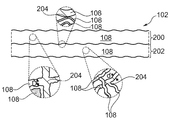
본 발명의 추가의 실시 형태에 따르면, 섬유 108의 적어도 일부는 병합 위치에서 일체로 병합된다. 특히 또는 바람직하게는, 섬유의 병합 인자는 0.2% 내지 100% 사이, 특히 0.5% 내지 15% 사이의 범위에 있다. According to a further embodiment of the invention, at least some of the
본 명세서에서, 용어 "병합"은 특히 각각의 병합 위치에서 상이한 섬유의 완전한 상호 연결을 나타내며, 이는 이전에 분리된 섬유 프리폼으로 구성된 하나의 일체형으로 연결된 섬유 구조의 형성을 초래한다. 병합은 병합된 섬유들 중 하나, 일부 또는 전부의 응집 동안 확립되는 섬유-섬유 연결로 표시될 수 있다. 상호 연결된 섬유는 공통 구조를 형성하기 위해 상이한 추가 재료 (예컨대, 별도의 접착제) 없이 각각의 병합 위치에서 서로 강하게 접착될 수 있다. 병합된 섬유의 분리는 섬유 네트워크 또는 그 일부의 파괴를 요구할 수 있다.As used herein, the term “merging” specifically refers to the complete interconnection of the different fibers at each merged position, which results in the formation of one integrally connected fiber structure composed of previously separated fiber preforms. Merging can be represented by a fiber-to-fiber connection that is established during agglomeration of one, some or all of the merged fibers. The interconnected fibers can be strongly bonded to each other at each merge location without different additional materials (eg, separate adhesives) to form a common structure. Separation of the merged fibers may require destruction of the fiber network or portions thereof.
직물의 병합 인자 (면적 병합 인자라고도 함)를 결정하기 위해, 하기의 결정 공정이 수행될 수 있다: 직물의 정사각형 샘플이 광학적으로 분석될 수 있다. 정사각형 샘플 내부에 완전히 남아있어야 하는 직경을 가진 원은 정사각형 샘플의 대각선 중 하나 이상을 교차하는 섬유의 각 병합 위치 (특히, 병합지점 또는 병합 라인) 주위에 그려진다. 원의 크기는 원이 병합된 섬유들 사이의 병합 영역을 포함하도록 결정된다. 결정된 원의 직경 값의 산술 평균이 계산된다. 병합 인자는 평균 직경 값과 정사각형 샘플의 대각선 길이 사이의 비율로 계산되며, 백분율로 표시될 수 있다. To determine the merging factor of the fabric (also referred to as the area merging factor), the following determination process can be performed: A square sample of the fabric can be analyzed optically. A circle with a diameter that must remain completely inside the square sample is drawn around each merge location (especially the merge point or merge line) of the fibers intersecting one or more of the diagonals of the square sample. The size of the circle is determined so that the circle contains the merged area between the merged fibers. The arithmetic mean of the determined circle diameter values is calculated. The merge factor is calculated as the ratio between the average diameter value and the diagonal length of the square sample, and can be expressed as a percentage.
부직포 셀룰로오스 섬유 직물의 제조 방법의 공정 파라미터의 상응하는 제어에 의해 병합이 유발될 수 있다. 특히, 이들 필라멘트 사이의 제1 접촉이 아직 침전된 고체 섬유 상태에 있지 않은 후에 라이오셀 방사 용액의 필라멘트의 응고가 유발 (또는 적어도 완료)될 수 있다. 이에 의해, 여전히 용액 상에 있는 동안 및 또는 그 후에 응고에 의해 이들 필라멘트를 고체-상태 상으로 전환시키면서 이들 필라멘트 사이의 상호 작용은 병합 특성을 적절히 조절할 수 있게 한다. 병합 정도는 제조된 직물의 특성을 조정하는 데 사용할 수 있는 강력한 매개 변수이다. 특히, 네트워크의 기계적 안정성은 병합 위치의 밀도가 높을수록 더 크다. 직물의 부피에 걸쳐 병합 위치의 불균일한 분포에 의해, 기계적 안정성이 높은 영역 및 기계적 안정성이 낮은 다른 영역을 조정하는 것도 가능하다. 예를 들어, 분리된 부분으로 직물의 분리는 적은 수의 병합 위치를 가지는 기계적으로 약한 영역에서 국부적으로 발생하도록 정확하게 정의될 수 있다. 바람직한 실시 형태에서, 섬유 사이의 병합은 라이오셀 방사 용액 형태의 상이한 섬유 프리폼을 응고 전에 서로 직접 접촉시킴으로써 유발된다. 이러한 응고 공정에 의해, 섬유의 단일 재료 공통 석출이 수행되고, 이에 의해 병합 위치가 형성된다.Consolidation can be caused by the corresponding control of the process parameters of the method of making the nonwoven cellulosic fibrous fabric. In particular, coagulation of the filaments of the lyocell spinning solution may be induced (or at least complete) after the first contact between these filaments is not yet in a precipitated solid fibrous state. Thereby, the interaction between these filaments while still in the solution phase and after or after converting these filaments to the solid-state phase by solidification makes it possible to properly control the merging properties. The degree of merging is a powerful parameter that can be used to tune the properties of the fabric produced. In particular, the mechanical stability of the network is greater as the density of the merged sites increases. By the non-uniform distribution of the merging positions over the volume of the fabric, it is also possible to adjust the areas of high mechanical stability and other areas of low mechanical stability. For example, the separation of the fabric into separate parts can be precisely defined to occur locally in mechanically weak areas with a small number of merging positions. In a preferred embodiment, the coalescence between the fibers is caused by direct contact of the different fiber preforms in the form of a lyocell spinning solution with each other prior to solidification. By this solidification process, a single material common precipitation of fibers is performed, thereby forming a merged position.
개시된 병합 인자는 직물의 섬유 네트워크의 상이한 섬유 사이의 네트워킹을 위한 매우 특성적인 파라미터이다. 0%의 병합 인자는 병합 지점이 없는 직물, 즉 마찰에 의해서만 서로 작용하는 완전히 분리된 섬유에 해당한다. 병합 인자의 100%는 병합 지점으로 구성된 직물, 즉, 필름과 같이 연속 구조를 형성하는 완전 일체형 섬유에 해당한다. 병합 인자를 조정함으로써, 상응하는 섬유의 물리적 특성 (특히 기계적 안정성)이 정확하게 조정될 수 있다. The disclosed coalescing factor is a very characteristic parameter for networking between different fibers of the fiber network of a fabric. A merge factor of 0% corresponds to fabrics with no merge points, i.e. completely separated fibers that act on each other only by friction. 100% of the merging factor corresponds to a fabric composed of merging points, that is, a fully integral fiber forming a continuous structure like a film. By adjusting the merging factor, the physical properties (especially mechanical stability) of the corresponding fibers can be accurately adjusted.
특정 구조 및 특히 병합 인자에 따라 병합 위치는 (a) 섬유가 점 접촉(point contact)과 병합되는 병합 지점; (b) 섬유가 이의 길이의 적어도 일부에 걸쳐 서로 나란히 정렬되어 상위 섬유 구조를 형성하는 병합 라인을 포함할 수 있다. 병합 지점은 상호 연결된 섬유와 동일한 재료로 만들어진 도트-형 구조일 수 있다. 병합 라인은 병합 라인을 따라 연결된 섬유의 직경보다 상당히 큰 장방형(oblong shpae)의 라인을 가지는 병합 위치로 간주될 수 있다. 병합 라인은 따라서 섬유가 평행하거나 나란히 연장되는 섹션을 따라 섬유를 연결하는 확장된 구조일 수 있다.Depending on the specific structure and in particular the merging factor, the merging location may be (a) a merging point at which the fibers merge with a point contact; (b) The fibers may include merge lines that are aligned with each other over at least a portion of their length to form an upper fiber structure. The merge point may be a dot-like structure made of the same material as the interconnected fibers. The merging line can be considered as a merging location having a line of oblong shpae that is significantly larger than the diameter of the fibers connected along the merging line. The merge line may thus be an extended structure connecting the fibers along a section in which the fibers extend parallel or side by side.
본 발명의 추가의 실시 형태에 따르면, 섬유의 상이한 것은 상이한 식별가능한 층에 적어도 부분적으로 위치되며, 직물은 하기 특징 중 하나 이상을 포함한다: (a) 상이한 층의 섬유는 층 사이의 하나 이상의 위치에서 일체로 연결된다; (b) 상이한 층에 적어도 부분적으로 위치된 섬유의 상이한 것은 섬유 직경에 대해, 특히 평균 섬유 직경에 대해 상이하다; (c) 상이한 층의 섬유는 동일한 섬유 직경, 특히 실질적으로 동일한 평균 섬유 직경을 갖는다; (d) 상이한 층의 섬유 네트워크는 상이한 기능성을 제공하며, 상기 상이한 기능성은 특히, 상이한 위킹, 상이한 이방성 거동, 상이한 액체 흡수 능력, 상이한 세정성, 상이한 광학 특성, 상이한 거칠기, 상이한 평활도, 및 상이한 기계적 특성으로 이루어진 군 중 하나 이상을 포함한다. According to a further embodiment of the invention, different of the fibers are at least partially located in different identifiable layers, and the fabric comprises one or more of the following features: (a) the fibers of different layers are at least one position between the layers. Are integrally connected in; (b) the different of the fibers located at least partially in different layers differ with respect to the fiber diameter, in particular with respect to the average fiber diameter; (c) the fibers of the different layers have the same fiber diameter, in particular substantially the same average fiber diameter; (d) Different layers of fiber networks provide different functionality, the different functionality, in particular, different wicking, different anisotropic behavior, different liquid absorption capacity, different detergency, different optical properties, different roughness, different smoothness, and different mechanical properties. Includes one or more of the group consisting of traits.
본 명세서의 문맥에서 "섬유의 상이한 것은 상이한 식별 가능한 층에 적어도 부분적으로 위치되는"은 각각의 층이 적어도 캡쳐된, 예컨대 전자 현미경에 의해, 이미지 내에서 적어도 층들 사이에서 가시적인 분리 또는 계면 영역을 나타내는 것을 의미할 수 있다. 특징 (a)로 특정된 바와 같이, 상이한 층은 하나 이상의 병합 위치에서 일체로 연결될 수 있다. 따라서, 예를 들어, 두 개(또는 그 이상)의 상이한 층의 직물은 라이오셀 방사 용액이 응고 및 섬유 형성을 위해 압출되는 오리피스와 두 개 (또는 그 이상)의 제트를 연속적으로 정렬시킴으로써 형성될 수 있다. 이러한 배열이 이동 가능한 (컨베이어 벨트 타입) 섬유 지지 유닛과 결합될 때, 제1 제트에 의해 제1 섬유 층이 섬유지지 유닛 상에 형성되고, 제2 제트는 이동 섬유지지 유닛이 제2 제트의 위치에 도달할 때 제1 층 상에 제2 섬유 층을 형성한다. 위에서 이미 언급한 바와 같이, "병합"은 각각의 병합 지점에서 상이한 섬유의 상호 연결을 나타내며, 이는 이전에 상이한 층들과 관련되었던 이전의 두 개의 분리된 섬유로 구성된 하나의 일체형으로 연결된 섬유 구조의 형성을 초래한다. 특히, 응고에 의해 아직 완전히 경화되거나 고화(solidified)되지 않은 형성중인 제2 층의 섬유는 예를 들어 여전히 액체 라이오셀 용액 상에 있고 아직 완전히 경화된 고체 상태가 아닌 외부 피부 또는 표면 영역을 여전히 가질 수 있다. 이러한 예비-섬유 구조가 서로 접촉하고, 그 후에 고체 섬유 상태로 완전히 경화될 때, 이는 각각 다른 인접한 층들 사이에 위치하는 영역의 계면에서 2 개의 합쳐진 섬유를 형성할 수 있다.In the context of the present specification “different of fibers are at least partially located in a different identifiable layer” means that each layer is at least captured, e.g., by electron microscopy, at least in the image of a visible separation or interfacial area between the layers. It can mean to represent. As specified by feature (a), different layers may be integrally connected at one or more merging locations. Thus, for example, two (or more) different layers of fabric would be formed by successively aligning two (or more) jets with an orifice through which the lyocell spinning solution was extruded for coagulation and fiber formation. I can. When this arrangement is combined with a movable (conveyor belt type) fiber support unit, a first fiber layer is formed on the fiber support unit by the first jet, and the second jet is the movable fiber support unit at the position of the second jet. When it reaches, it forms a second fibrous layer on the first layer. As already mentioned above, "merging" refers to the interconnection of different fibers at each point of merging, which is the formation of an integrally connected fiber structure consisting of two previously separated fibers that were previously associated with different layers. Results. In particular, fibers of the forming second layer that are not yet fully cured or solidified by coagulation, for example, are still in a liquid lyocell solution and will still have external skin or surface areas that are not yet fully cured solid. I can. When these pre-fibrous structures are in contact with each other, and then completely cured into a solid fibrous state, it can form two joined fibers at the interface of the regions located between each of the other adjacent layers.
상기 특징 (b)로 특정된 바와 같이, 상이한 층들에 적어도 부분적으로 위치된 섬유의 상이한 것은 섬유 직경에 대해, 특히 평균 섬유 직경에 대해 상이하다. 개시된 직물의 상이한 층이 상이한 (평균) 섬유 직경을 가지는 섬유로 형성되는 경우, 상이한 층의 기계적 특성은 개별적으로 조정될 수 있다. 예를 들어, 비교적 큰 섬유 직경을 가지는 섬유를 사용하여 층들 중 하나에 강성 특성이 제공될 수 있으며, 반면, 다른 층은 (예를 들어, 상대적으로 낮은 섬유 직경을 가지는 섬유를 사용함으로써) 매끄럽거나 탄성적인 특성이 제공될 수 있다. 예를 들어, 더러움을 기계적으로 제거하기 위해 비교적 거친 표면을 가지고, 와이핑을 위해 비교적 매끄러운 표면을 가지는, 즉, 세정될 표면으로부터 물 또는 유사한 것들을 흡수하도록 구성된 와이프가 제조될 수 있다. As specified by feature (b) above, the different of the fibers located at least partially in different layers differ with respect to the fiber diameter, in particular with respect to the average fiber diameter. When different layers of the disclosed fabric are formed from fibers having different (average) fiber diameters, the mechanical properties of the different layers can be adjusted individually. For example, fibers with a relatively large fiber diameter can be used to provide stiffness properties to one of the layers, while the other layer is smooth (e.g., by using fibers with a relatively low fiber diameter). Or elastic properties may be provided. For example, a wipe can be made that has a relatively rough surface to mechanically remove dirt and a relatively smooth surface for wiping, ie, configured to absorb water or the like from the surface to be cleaned.
그러나, 상기 특징 (c)로 특정된 바와 같이, 상이한 층의 섬유가 동일한 직경, 특히 동일한 평균 직경을 갖는 것이 또한 가능하다. 이러한 실시 형태에서, 인접한 층은 유사하거나 또는 동일한 물리적 특성을 가질 수 있다. 이들은 그 사이의 병합 지점에서 강하거나 또는 약하게 상호 연결될 수 있다. 인터페이스 영역당 이러한 병합 지점의 수는 인접한 층들 사이의 결합 강도를 정의할 수 있다. 작은 결합 강도로, 층은 사용자에 의해 쉽게 분리될 수 있다. 높은 기계적 강도로, 층들은 서로 영구적으로 부착된 채로 남아있을 수 있다. However, as specified by the above feature (c), it is also possible for the fibers of different layers to have the same diameter, in particular the same average diameter. In such embodiments, adjacent layers may have similar or identical physical properties. They can be strongly or weakly interconnected at the point of merging between them. The number of these merging points per interface area can define the strength of the bond between adjacent layers. With small bonding strength, the layers can be easily separated by the user. With high mechanical strength, the layers can remain permanently attached to each other.
개시된 다층 구조 내의 이웃 층을 상호 부착하기 위해, 바인더와 같은 임의의 추가 접착 물질이 필요하지 않다고 언급된다. 결과적으로 액체는 어떤 방해 없이 각각의 층 계면을 통해 분산될 수 있다. It is stated that no additional adhesive material, such as a binder, is required to adhere to each other the neighboring layers within the disclosed multilayer structure. As a result, the liquid can be dispersed through each layer interface without any interference.
본 발명의 추가적인 실시 형태에 따르면, 섬유 네트워크는 다음 특징 중 하나 이상을 포함한다:According to a further embodiment of the present invention, the fiber network includes one or more of the following features:
(a) 동일한 섬유 내에서 상이한 섬유 섹션은 이 섬유의 최소 직경과 관련하여 50% 초과만큼 관련 섬유 직경이 차이가 난다;(a) different fiber sections within the same fiber differ in the associated fiber diameter by more than 50% with respect to the minimum diameter of the fiber;
(b) 상이한 섬유는 섬유의 하나의 최소 직경과 관련하여 50% 초과만큼 관련 섬유 직경이 차이가 난다;(b) different fibers differ in the associated fiber diameter by more than 50% with respect to one minimum diameter of the fiber;
본 명세서에서 용어 "최소 직경과 관련하여 50% 초과만큼 관련 섬유 직경이 상이한"은 특히, 최대 섬유 직경과 최소 섬유 직경 사이의 비에 100을 곱한 값을 나타내며, 여기서 100%는 얻어진 결과에서 뺀 값이 50% 보다 큰 값을 제공한다. "최소 직경과 관련하여 50% 초과만큼 관련 섬유 직경이 상이한"은 최대 섬유 직경 및 최소 섬유 직경 사이의 비가 1.5를 초과함을 의미할 수 있다. As used herein, the term "different in relation to the smallest diameter by more than 50% of the associated fiber diameter" refers in particular to the ratio between the largest and smallest fiber diameters multiplied by 100, where 100% is the value subtracted from the result obtained. This gives a value greater than 50%. “The associated fiber diameter differs by more than 50% with respect to the minimum diameter” may mean that the ratio between the maximum fiber diameter and the minimum fiber diameter is greater than 1.5.
상기 주어진 특징 (a)로 특정된 동일한 섬유 내에서 그러한 섬유 직경의 변화가 큰 경우, 직경에 대한 불균일성은 섬유 내부 직경 변화를 나타내는 것으로 간주될 수 있다. 특정 이론에 구속되기를 원하지 않으면서, 섬유가 직물에서 네트워크를 형성할 때, 각각의 섬유 직경의 불균일성은 직물 내에서 다양한 섬유를 서로에 대해 이동할 때 극복되어야 하는 마찰력을 증가시키는 것으로 현재 여겨진다. 이 효과의 결과로 직물의 기계적 안정성이 향상된다. When such a change in fiber diameter is large within the same fiber specified by the feature (a) given above, the non-uniformity with respect to the diameter can be regarded as indicating a change in the fiber inner diameter. Without wishing to be bound by any theory, it is currently believed that when fibers form a network in a fabric, the non-uniformity of each fiber diameter increases the friction that must be overcome when moving the various fibers relative to each other within the fabric. As a result of this effect, the mechanical stability of the fabric is improved.
상기 주어진 특징 (b)로 특정된 상이한 섬유들 사이에서 그러한 섬유 직경의 변화가 큰 경우, 직경 면에서 불균일은 섬유 간 직경 변화로 표시될 수 있다. 이러한 실시 형태에서, 각각의 섬유 자체는 직경 균질성 또는 비균질성을 나타낼 수 있지만, 섬유 비교에 의해 상이한 섬유는 섬유에서 직경에 대해 상이하다. 이러한 시나리오(scenario)에서 상이한 직경 또는 상이한 직경 분포의 섬유의 상호작용은 더 얇은 섬유의 더 강한 굽힘 및 더 두꺼운 섬유의 약간 굽힘을 초래할 수 있다. 상이한 직경의 이러한 섬유가 직물에서 네트워크를 형성할 때, 증가된 장애는 서로에 대한 상이한 섬유의 상호 운동을 억제한다. 이 현상의 결과로 직물의 안정성이 향상된다. When such a change in fiber diameter is large between the different fibers specified by the feature (b) given above, the non-uniformity in diameter can be expressed as a change in the diameter between fibers. In this embodiment, each fiber itself may exhibit diameter homogeneity or heterogeneity, but by fiber comparison different fibers are different for diameter in the fiber. The interaction of fibers of different diameters or different diameter distributions in this scenario can lead to stronger bending of thinner fibers and slight bending of thicker fibers. When these fibers of different diameters form a network in the fabric, the increased impediment inhibits the mutual motion of the different fibers with respect to each other. As a result of this phenomenon, the stability of the fabric is improved.
본 발명의 추가의 실시 형태에 따르면, 섬유 네트워크는 다음 특징 중 적어도 하나를 포함한다:According to a further embodiment of the invention, the fiber network comprises at least one of the following features:
(a) 섬유의 3% 이상, 특히 5% 이상이 90% 이하의 진원도를 가지는 비원형 단면 형상을 가짐; (a) at least 3%, in particular at least 5%, of the fibers have a non-circular cross-sectional shape with a roundness of 90% or less;
(b) 섬유의 1% 이상, 특히 3%이상이 80% 이하, 특히 70% 이하의 진원도를 가지는 비원형 단면 형상을 가짐.(b) 1% or more, especially 3% or more of the fibers have a non-circular cross-sectional shape with a roundness of 80% or less, particularly 70% or less.
이와 관련하여, 용어 "진원도"는 특히 섬유 단면의 내접원과 외접원 사이의 비율, 즉, 섬유의 단면을 각각 둘러싸거나 포위하기 위해 섬유의 단면에 내에 각각적합하기에 충분한 원의 최대 크기를 나타낼 수 있다. 진원도를 결정하기 위해, 섬유의 연장 방향에 수직인 단면은 섬유와 교차될 수 있다. 따라서, 진원도는 각 섬유의 단면 형상이 진원도 100%인 원의 단면 형상에 얼마나 근접한지를 나타내는 척도로 나타낼 수 있다. In this regard, the term "roundness" may in particular denote the ratio between the inscribed and circumscribed circles of the fiber cross-section, ie the maximum size of a circle sufficient to each fit within the cross-section of the fiber to surround or enclose the fiber cross-section, respectively. . To determine the roundness, a cross section perpendicular to the direction of extension of the fiber may intersect with the fiber. Accordingly, the roundness can be expressed as a measure of how close the cross-sectional shape of each fiber is to the cross-sectional shape of a circle having a roundness of 100%.
예를 들어, 섬유의 단면은 타원형 (특히 타원) 형상을 갖거나 다각형 형상을 가질 수 있다. 보다 일반적으로 섬유의 단면의 외부 한계를 정의하는 궤적은 원으로부터의 편차를 나타내는 임의의 폐쇄 평면 선일 수 있다. 섬유의 단면은 전체적으로 둥글거나, 하나 이상의 날카로운 또는 둥근 모서리를 가질 수 있다. For example, the cross section of the fiber may have an oval (especially an ellipse) shape or a polygonal shape. More generally, the trajectory defining the outer limit of the cross section of the fiber can be any closed plane line that represents the deviation from the circle. The cross section of the fiber may be generally round, or may have one or more sharp or rounded edges.
기술적으로 말하면, 이 실시 형태로 설명된 직물의 섬유는 완전히 원형인 원통형과 상당한 편차를 보인다. 기계적 관점에서, 이것은 기계적 하중의 존재 하에서 섬유의 바람직한 굽힘 방향이 섬유의 단면 설계에 의해 정의된다는 것을 나타낸다. 예를 들어, 섬유가 상이한 길이를 가지는 2 개의 주축 (즉, 장축 및 단축)을 가지는 타원 단면 형상을 갖는 경우, 가해진 힘의 존재하에 굽힘은 주로 단축이 굽힘 선으로서 발생한다. 따라서, 이러한 섬유 직물의 굽힘 특성은 더 이상 통계적이고 예측할 수 없지만, 부직포 셀룰로오스 섬유 직물의 정의된 순서를 증가시킨다. (적어도 방향에서) 직물의 기계적 안정성에 강한 영향을 주는 것 이외에도 (평균) 굽힘 반경은 또한 상이한 섬유 사이에 형성될 수 있는 공동의 크기 및 형상과 하나의 섬유 내부 구조에 형성된 미세 공동의 크기 및 형상에 영향을 미치는 파라미터이다. Technically speaking, the fibers of the fabric described in this embodiment exhibit significant deviations from a completely circular cylinder. From a mechanical point of view, this indicates that the preferred bending direction of the fiber in the presence of a mechanical load is defined by the cross-sectional design of the fiber. For example, if the fiber has an elliptical cross-sectional shape with two major axes (i.e., major axis and minor axis) having different lengths, bending in the presence of an applied force occurs mainly as a bending line with the minor axis. Thus, the bending properties of these fibrous fabrics are no longer statistical and unpredictable, but increase the defined order of non-woven cellulosic fibrous fabrics. In addition to having a strong impact on the mechanical stability of the fabric (at least in the direction), the (average) bend radius is also the size and shape of the cavities that can be formed between different fibers and the size and shape of the microcavities formed in one fiber internal structure. It is a parameter that affects.
따라서, 물 흡수 능력에 대한 공동(cavity)의 수, 크기 및/또는 모양의 영향에 관한 상기 주어진 고려 사항을 고려할 때, (진원도에 의존하는) 평균 굽힙도 또한 물 분산 및 위킹 능력에 강한 영향을 미친다는 것이 명백해야 한다. Therefore, given the considerations given above regarding the influence of the number, size and/or shape of cavities on the water absorption capacity, the average bending (depending on the roundness) also has a strong effect on the water dispersion and wicking capacity. It should be obvious that you are crazy.
본 발명의 다른 실시 형태에 따르면, 섬유는 5 ppm 미만의 구리 함량 및/또는 2 ppm 미만의 니켈 함량을 갖는다.According to another embodiment of the present invention, the fiber has a copper content of less than 5 ppm and/or a nickel content of less than 2 ppm.
본 명세서에서 언급된 ppm 값은 모두 (부피가 아닌) 질량과 관련이 있다. 이와 별도로, 섬유 또는 직물의 중금속 오염은 각각의 개별 중금속 원소에 대해 10 ppm 이하일 수 있다. 무한 섬유 기반 직물 (특히, N- 메틸-모폴린, NMMO와 같은 용매를 포함하는 경우)을 형성하기 위한 기초로서 라이오셀 방사 용액을 사용하기 때문에, (사용자의 알레르기 반응을 일으킬 수 있는) 구리나 니켈과 같은 중금속에 의한 직물의 오염은 매우 작게 유지될 수 있다.All of the ppm values referred to herein are related to mass (not volume). Separately, the heavy metal contamination of the fiber or textile may be 10 ppm or less for each individual heavy metal element. Since we use a lyocell spinning solution as the basis for forming endless fiber-based fabrics (especially if they contain solvents such as N-methyl-morpholine, NMMO), copper or copper (which can cause allergic reactions in users) is used. Contamination of fabrics by heavy metals such as nickel can be kept very small.
섬유 직경 및/또는 섬유 내 및/또는 섬유 간 직경 불균일성 및/또는 섬유 밀도의 값 또는 정도에 따라 활성 섬유 표면은 물론 인접한 섬유 사이의 간극(gap)의 부피 및 간격이 조정될 수 있다. 이는 예를 들어 모세관 효과의 영향 하에서 액체가 간극에 축적되는 능력에 영향을 미친다. The volume and spacing of the active fiber surface as well as the gaps between adjacent fibers can be adjusted depending on the fiber diameter and/or the value or degree of diameter non-uniformity within and/or between fibers and/or fiber density. This affects, for example, the ability of liquid to accumulate in the gap under the influence of the capillary effect.
보다 상세하게는, 개시된 액체 흡수 능력은 부직포 섬유 직물 또는 섬유 웹이 다양한 인접 섬유 사이에 공동 또는 공극을 포함하는 구조로 간주될 수 있다는 사실에 기초할 수 있다. 직물은 침지되지 않은 원래 상태에서, 이들 공극은 공기로 채워진다. 직물이 액체를 흡수하면, 공극은 액체 (물, 에멀젼, 오일)로 채워진다. More specifically, the disclosed liquid absorption capabilities may be based on the fact that a nonwoven fibrous fabric or fibrous web can be considered a structure comprising voids or voids between various adjacent fibers. In the original state, where the fabric was not immersed, these voids were filled with air. When the fabric absorbs liquid, the pores are filled with liquid (water, emulsion, oil).
본 발명의 추가의 측면에 따르면, 라이오셀 방사 용액으로부터 직접 부직포 셀룰로오스 섬유 직물, 특히 상기 개시된 직물을 제조하는 방법이 제공된다. 제공된 방법은 (a) 가스 유동에 의해 지지되는 오리피스를 가지는 제트를 통해 라이오셀 방사 용액을 응고 유체 분위기(atmosphere)로 압출하여 실질적으로 무한 섬유를 형성하는 것; (b) 섬유 지지 유닛 상에 섬유를 수집하여 직물을 형성하는 것; 및 (c) 직물이 하기의 특징 중 하나 이상에 의해 특징짓도록 공정 파라미터를 조정하는 것을 포함한다:According to a further aspect of the present invention there is provided a method of making a nonwoven cellulosic fiber fabric, in particular the disclosed fabric, directly from a lyocell spinning solution. The provided method comprises (a) extruding a lyocell spinning solution through a jet having an orifice supported by a gas flow into a coagulating fluid atmosphere to form substantially endless fibers; (b) collecting fibers on a fiber support unit to form a fabric; And (c) adjusting the process parameters such that the fabric is characterized by one or more of the following characteristics:
(i) 액체 확산 속도는 5분 내에 적어도 3000 mm2 이다;(i) the liquid diffusion rate is at least 3000 mm 2 in 5 minutes;
(ii) 물 흡수 능력은 직물 1g 및 1 초당 당 물 0.25g 이상의 위킹 속도를 특징으로 한다. 대안으로 또는 조합하여 액체 확산 속도는 직물은 24시간 내에 3500 mm2 이상일 수 있다. (ii) The water absorption capacity is characterized by a wicking rate of at least 0.25 grams of water per gram of fabric and per second. Alternatively or in combination, the liquid diffusion rate may be at least 3500 mm 2 within 24 hours of the fabric.
또한, 개시된 방법은 공정 파라미터의 적절한 선택에 의해 전술한 바와 같은 개선된 부직포 셀룰로오스 섬유 직물이 효과적이고 신뢰할 수 있는 방식으로 제조될 수 있다는 아이디어에 기초한다.In addition, the disclosed method is based on the idea that the improved non-woven cellulosic fiber fabric as described above can be produced in an effective and reliable manner by appropriate selection of process parameters.
파라미터에 대한 주어진 값과 관련하여, "액체 확산 속도" 및 "위킹 속도"는 상기 설명을 참조한다. With respect to a given value for the parameter, the "liquid diffusion rate" and "wicking rate" refer to the above description.
본 명세서의 문맥에서 "오리피스를 가진 제트" (예를 들어 "오리피스의 배열"로 표시될 수 있음)는 일렬로 배열된 오리피스의 배열을 포함하는 임의의 구조일 수 있다. A "jet with orifices" in the context of this specification (which may be denoted for example as an "arrangement of orifices") can be any structure including an arrangement of orifices arranged in a row.
상이한 섬유의 직경의 변화는 섬유의 응고를 제어함으로써 생성되는 것으로 언급된다. 다시 말해서, 적어도 대략 평행한 방향으로 배열된 적어도 2개의 상이한 섬유는 (일반적인 병합 라인을 따라) 서로 병합되어 상당히 증가된 직경을 가지는 섬유가 생성될 수 있다. 공정 파라미터(의 값)를 제어함으로써 그러한 긴 섬유 병합의 확률이 선택될 수 있다. 결과적으로, 병합된 (두꺼운) 섬유 및 원래 (얇은) 섬유 사이의 비는 예를 들어 점성 라이오셀 방사 용액이 압출되는 제트의 인접한 오리피스 사이의 거리를 조정함으로써 조정될 수 있다. 이와 관련하여, 거리가 작을수록 두 섬유 사이의 병합 가능성이 더 높다는 것이 명백하여야 한다. It is said that the change in the diameter of the different fibers is produced by controlling the coagulation of the fibers. In other words, at least two different fibers arranged in at least approximately parallel directions can be merged together (along a general merging line) to produce fibers with significantly increased diameter. By controlling the process parameters (value of) the probability of such long fiber merging can be selected. Consequently, the ratio between the merged (thick) fibers and the original (thin) fibers can be adjusted, for example, by adjusting the distance between adjacent orifices of the jets from which the viscous lyocell spinning solution is extruded. In this regard, it should be clear that the smaller the distance, the higher the probability of merging between the two fibers.
난류의 응고 유체 스트림을 사용하면, 상이한 아직 (완전히) 응고되지 않은 섬유들 사이의 공간 거리를 교란시킬 수 있다. 결과적으로, 제트에서 섬유 지지 유닛으로 가는 도중에 두 개의 섬유가 서로 만나는 확률이 증가될 수 있다. Using a turbulent coagulating fluid stream, it is possible to disturb the spatial distance between different yet (fully) uncoagulated fibers. As a result, the probability of two fibers meeting each other on the way from the jet to the fiber support unit can be increased.
또한, 세 개 이상의 개별섬유로부터의 병합도 실현될 수 있다고 언급된다. 결과적으로 섬유 직경 변화가 증가되도록 더 두꺼운 섬유가 제조될 수 있다. It is also mentioned that merging from three or more individual fibers can also be realized. As a result, thicker fibers can be produced such that the change in fiber diameter is increased.
본 명세서에 개시된 직물의 주요 특성에 대한 "병합"의 관련성과 관련하여 즉, "액체 확산 속도" 및/또는 "위킹 속도"와 관련하여 물 흡수 능력은 상기 주요 특성의 병합으로부터의 의존성에 대한 예시적인 물리 이론을 설명하는 상기 섹션을 참조한다. With respect to the relevance of “merging” to the key properties of the fabrics disclosed herein, ie in terms of “liquid diffusion rate” and/or “wicking rate”, the water absorption capacity is an example of the dependence from the incorporation of these key properties. See the section above that describes the classical physics theory.
본 발명의 다른 측면에 따르면, 라이오셀 방사 용액으로부터 직접 부직포 셀룰로오스 섬유 직물을 제조하기 위한 장치, 특히, 상기 개시된 바와 같은 직물을 제조하기 위한 장치가 제공된다. 제공된 장치는 (a) 가스 유동에 의해 지지되는 라이오셀 방사 용액을 압출하도록 구성된 오리피스를 가지는 제트; (b) 압출된 라이오셀 방사 용액에 응고 유체 분위기를 제공하여 실질적으로 무한 섬유를 형성하도록 구성된 응고 유닛; (c) 섬유를 수집하여 직물을 형성하도록 구성된 섬유 지지 유닛; 및 (d) 직물이 하기의 특징 중 하나 이상을 특징짓도록 공정 파라미터를 조정하도록 구성된 제어 유닛: According to another aspect of the present invention, there is provided an apparatus for producing a nonwoven cellulosic fiber fabric directly from a lyocell spinning solution, in particular, an apparatus for producing a fabric as disclosed above. The provided apparatus comprises: (a) a jet having an orifice configured to extrude a lyocell spinning solution supported by a gas flow; (b) a coagulation unit configured to provide a coagulating fluid atmosphere to the extruded lyocell spinning solution to form substantially infinite fibers; (c) a fiber support unit configured to collect fibers to form a fabric; And (d) a control unit configured to adjust the process parameters such that the fabric characterizes one or more of the following characteristics:
(i) 액체 확산 속도는 5분 내에 적어도 3000 mm2 이다;(i) the liquid diffusion rate is at least 3000 mm 2 in 5 minutes;
(ii) 물 흡수 능력은 직물 1g 및 1 초당 당 물 0.25g 이상의 위킹 속도를 특징으로 한다. 대안으로 또는 조합하여 액체 확산 속도는 직물은 24시간 내에 3500 mm2 이상일 수 있다. (ii) The water absorption capacity is characterized by a wicking rate of at least 0.25 grams of water per gram of fabric and per second. Alternatively or in combination, the liquid diffusion rate may be at least 3500 mm 2 within 24 hours of the fabric.
개시된 장치는 제어 유닛이 전술한 추가 부직포 셀룰로오스 섬유 직물의 제조하기 위한 방법을 신뢰할 수 있는 방식으로 수행할 수 있다는 아이디어에 기초한다. The disclosed apparatus is based on the idea that the control unit can perform in a reliable manner the method for producing the additional nonwoven cellulosic fibrous fabric described above.
본 발명의 예시적인 실시 형태에 따른 부직포 셀룰로오스 섬유 직물은 또한 하나 이상의 다른 재료와 조합 (예를 들어, 그 자리 (in situ)에서 또는 후속 공정에서)되어 본 발명의 일 실시 형태에 따른 복합재를 형성할 수 있다. 이러한 복합재를 형성하기 위해 직물과 조합될 수 있는 예시적인 재료는 하기 재료 또는 이들의 조합을 포함하지만, 이들로 제한되지 않는 군으로부터 선택될 수도 있다: 플러프 펄프, 섬유 현탁액, 습식 부직포, 에어레이드 부직포, 스펀본드 웹, 멜트프로운 웹, 카디드 스펀레이스드 또는 니틀 펀치드 웹 또는 다양한 재료로 제조된 다른 시트와 같은 구조. 일 실시 형태에서, 상이한 재료들 사이의 연결은 하기 공정 중 하나 또는 그 조합에 의해 (비제한적으로) 수행될 수 있다: 병합, 수력얽힘, 니들 펀칭, 수소 결합, 열접착, 바인더에 의한 접착, 라미네이팅 및/또는 캘린더링.The non-woven cellulosic fibrous fabric according to an exemplary embodiment of the present invention is also combined with one or more other materials (e.g., in situ or in a subsequent process) to form a composite according to an embodiment of the present invention. can do. Exemplary materials that can be combined with fabrics to form such composites may be selected from the group including, but not limited to, the following materials or combinations thereof: fluff pulp, fiber suspension, wet nonwoven fabric, airlaid. Structures such as nonwovens, spunbond webs, melt spun webs, carded spunlaced or nipple punched webs, or other sheets made of a variety of materials. In one embodiment, the connection between different materials can be (but not limited to) by one or a combination of the following processes: merging, hydraulic entanglement, needle punching, hydrogen bonding, thermal bonding, bonding with a binder, Laminating and/or calendering.
본 발명의 추가적인 양태에 따르면, 와이프(wipe), 가정용 시트, 필터, 위생 용품, 의학적 적용 용품, 지오텍스타일, 아그로텍스타일, 의류, 건축 기술 용품, 자동차 용품, 가구, 산업 용품, 레저, 미용, 스포츠 또는 여행 관련 용품 및 학교 또는 사무실 관련 용품으로 이루어진 군 중 하나 이상에 대해 상기 개시된 부직포 셀룰로오스 섬유 직물을 사용하는 방법이 제공된다. According to a further aspect of the invention, wipes, household sheets, filters, hygiene products, medical applications, geotextiles, agrotextiles, clothing, building technical supplies, automotive supplies, furniture, industrial products, leisure, beauty, sports Or there is provided a method of using the nonwoven cellulosic fibrous fabric disclosed above for one or more of the group consisting of travel-related supplies and school or office-related supplies.
본 발명의 다른 측면에 따르면, 상기한 바와 같은 부직포 셀룰루오스 섬유 직물을 포함하는 제품 또는 복합재가 제공된다.According to another aspect of the present invention, there is provided a product or composite material comprising the non-woven cellulose fiber fabric as described above.
웹의 특정 용도, 100% 셀룰로오스 섬유 웹 또는 예를 들어, 둘 이상의 섬유를 포함하거나 이로 구성된 웹, 또는 항균 재료, 이온 교환 재료, 활성 탄소, 나노 입자, 로션, 의료 약제 또는 난연제와 같은 화학적으로 개질된 섬유 또는 혼입된 재료를 가지는 섬유, 또는 이성분 섬유는 다음과 같을 수 있다:Certain uses of the web, 100% cellulosic fibrous webs, or webs comprising or consisting of, for example, two or more fibers, or chemically modified, such as antibacterial materials, ion exchange materials, activated carbon, nanoparticles, lotions, medical drugs or flame retardants Fibers or fibers with incorporated materials, or bicomponent fibers may be:
본 발명의 예시적인 실시 형태에 따른 부직포 셀룰로오스 섬유 직물은 아기, 부엌, 물티슈, 화장품, 위생, 의료, 청소, 연마 (자동차, 가구), 먼지, 산업, 먼지털이 및 대걸레 와이프과 같은 와이프 제조에 사용될 수 있다. The non-woven cellulose fiber fabric according to the exemplary embodiment of the present invention can be used in the manufacture of wipes such as baby, kitchen, wet wipes, cosmetics, hygiene, medical care, cleaning, polishing (automobile, furniture), dust, industry, duster and mop wipes. have.
또 다른 예시적인 실시 형태에 따른 부직포 셀룰로오스 섬유 직물이 필터를 제조하는데 사용되는 것이 또한 가능하다. 예를 들어, 이러한 필터는 에어 필터, HVAC, 에어컨 필터, 연도 가스 필터, 액체 필터, 커피 필터, 티백, 커피 백, 식품 필터, 정수 필터, 혈액 필터, 담배 필터; 캐빈 필터, 오일 필터, 카트리지 필터, 진공 필터, 진공 청소기 백, 먼지 필터, 유압 필터, 주방 필터, 팬 필터, 수분 교환 필터, 화분 필터, HEVAC/HEPA/ULPA 필터, 맥주 필터, 우유 필터, 액체 냉각수 필터 및 과일 주스 필터일 수 있다. It is also possible for a nonwoven cellulosic fiber fabric according to another exemplary embodiment to be used to manufacture the filter. For example, such filters include air filters, HVAC, air conditioning filters, flue gas filters, liquid filters, coffee filters, tea bags, coffee bags, food filters, water filters, blood filters, cigarette filters; Cabin filter, oil filter, cartridge filter, vacuum filter, vacuum cleaner bag, dust filter, hydraulic filter, kitchen filter, fan filter, water exchange filter, planter filter, HEVAC/HEPA/ULPA filter, beer filter, milk filter, liquid coolant It can be a filter and a fruit juice filter.
또 다른 실시 형태에서, 부직포 셀룰로오스 섬유 직물은 흡수 위생 제품을 제조하는데 사용될 수 있다. 그 예는 포획층, 커버스톡, 분배층, 흡수 커버, 위생 패드, 탑시트, 백시트, 레그 커프스, 플러셔블 용품, 패드, 간호 패드, 처리 속옷, 트레이닝 팬츠, 페이스 마스크, 뷰티 페이셜 마스크, 코스메틱 리무벌 패드, 수건, 기저귀, 및 활성 성분 (예컨대, 텍스타일 소프트너)을 방출하는 세탁 건조기용 시트이다.In yet another embodiment, non-woven cellulosic fibrous fabrics can be used to make absorbent hygiene products. Examples include capture layer, cover stock, distribution layer, absorbent cover, sanitary pad, top sheet, back sheet, leg cuff, flushable article, pad, nursing pad, treatment underwear, training pants, face mask, beauty facial mask, cosmetic remover. Bee pads, towels, diapers, and sheets for laundry dryers that release active ingredients (eg, textile softeners).
또 다른 실시 형태에서, 부직포 셀룰로오스 섬유 직물은 의료적 적용 제품을 제조하는데 사용될 수 있다. 예를 들어, 이러한 의료적 적용 제품은 일회용 캡, 가운, 마스크 및 신발 커버, 상처 관리 용품, 멸균 포장 용품, 커버스톡 용품, 드레싱 재료, 편도 의류, 투석 용품, 비강 스트립, 덴탈 플레이트용 접착제, 처리 속옷, 드레이프, 랩 및 팩, 스폰지, 드레싱 및 와이프, 베드 린넨, 경피 약물 전달, 슈라우드, 언더 패드, 시술 팩, 히트 팩, 오스토미 백 라이너, 고정 테이프 및 인큐베이터 매트리스일 수 있다. In yet another embodiment, non-woven cellulosic fibrous fabrics can be used to make medical application products. For example, these medical applications include disposable caps, gowns, mask and shoe covers, wound care supplies, sterile packaging supplies, coverstock supplies, dressing materials, tonsil clothing, dialysis supplies, nasal strips, adhesives for dental plates, treatments. Underwear, drape, wraps and packs, sponges, dressings and wipes, bed linen, transdermal drug delivery, shrouds, under pads, treatment packs, heat packs, Ostomy bag liners, fixation tapes and incubator mattresses.
또 다른 실시 형태에서, 부직포 셀룰로오스 섬유 직물은 지오텍스타일을 제조하는데 사용될 수 있다. 여기에는 작물 보호 덮개의 생산, 모세관 매트, 정수, 관개 제어, 아스팔트 오버레이, 토양 안정화, 배수, 침강 및 침식 제어, 연못 라이너, 함침 기반, 배수 채널 라이너, 토양 안정화, 구덩이 안감, 종자 블랭킷, 잡초 방제 직물, 온실 차양, 뿌리 주머니 및 생분해성 식물 화분이 포함될 수 있다. 식물 포일에 부직포 셀룰로오스 섬유 직물을 사용하는 것도 가능하다 (예를 들어, 식물에 대한 광 보호 및/또는 기계적 보호를 제공 및/또는 거름 또는 종자를 식물 또는 토양에 제공).In yet another embodiment, non-woven cellulosic fibrous fabrics can be used to make geotextiles. These include the production of crop protection covers, capillary mats, water purification, irrigation control, asphalt overlay, soil stabilization, drainage, sedimentation and erosion control, pond liners, impregnation bases, drainage channel liners, soil stabilization, pit linings, seed blankets, weed control. Textiles, greenhouse shades, root bags, and biodegradable plant pots may be included. It is also possible to use non-woven cellulosic fibrous fabrics for plant foils (eg, to provide light and/or mechanical protection to plants and/or to provide manure or seeds to plants or soil).
또 다른 실시 형태에서, 부직포 셀룰로오스 섬유 직물은 의복 제조에 사용될 수 있다. 예를 들어, 심지 (interlinings), 의류 단열 및 보호, 핸드백 구성요소, 신발 구성요소, 벨트 라이너, 산업용 모자/식품복, 일회용 작업복, 의류 및 신발 주머니 및 단열재는 이러한 직물을 기반으로 제조될 수 있다. In yet another embodiment, non-woven cellulosic fibrous fabrics can be used to make garments. For example, interlinings, clothing insulation and protection, handbag components, shoe components, belt liners, industrial hat/food apparel, disposable coveralls, clothing and shoe pockets and insulation can be made based on these fabrics. .
또 다른 실시 형태에서, 부직포 셀룰로오스 섬유 직물은 건축 기술에 사용되는 제품의 제조에 사용될 수 있다. 예를 들어, 지붕 및 기와 받침, 언더슬레이팅, 열 및 소리 절연재, 하우스 랩, 석고 보드용 페이싱, 파이프 랩, 콘크리트 몰딩 레이어, 기초 및 지면 안정화, 수직 배수장치, 슁글스(shingles), 루핑 펠트(roofing felts), 소음 제거, 보강재, 실링재, 및 댐핑재 (기계식)는 이러한 직물을 사용하여 제조될 수 있다. In another embodiment, non-woven cellulosic fibrous fabrics can be used in the manufacture of products used in building technology. For example, roof and tile support, underslating, heat and sound insulation, house wrap, facing for gypsum board, pipe wrap, concrete molding layer, foundation and ground stabilization, vertical drainage, shingles, roofing felt. (roofing felts), noise reduction, reinforcing materials, sealing materials, and damping materials (mechanical) can be manufactured using such fabrics.
또 다른 실시 형태에서, 부직포 셀룰로오스 섬유 직물은 자동차 용품을 제조하는데 사용될 수 있다. 예컨대, 캐빈 필터, 부트 라이너, 소화물 선반(parcel shelves), 히트 쉴드, 쉘프 트림, 성형 보닛 라이너, 부트 플로어 커버링, 오일 필터, 헤드라이너, 후방 소화물 선반, 장식 직물(decorative fabrics), 에어백, 소음기 패드, 단열재, 차량 커버, 언더패딩, 차량 매트, 테이프, 백킹 및 터프트 카펫, 시트 커버, 도어 트림, 니들레드 카펫(needled carpet) 및 오토 카펫 백킹이다. In yet another embodiment, the non-woven cellulosic fiber fabric can be used to make automotive products. For example, cabin filters, boot liners, parcel shelves, heat shields, shelf trims, molded bonnet liners, boot floor coverings, oil filters, headliners, rear parcel shelves, decorative fabrics, air bags, silencer pads. , Insulation, vehicle cover, underpadding, vehicle mat, tape, backing and tuft carpet, seat cover, door trim, needled carpet and auto carpet backing.
본 발명의 예시적인 실시 형태에 따라 제조된 직물의 또 다른 적용 분야는 예컨대 가구, 건축물, 팔 및 등의 절연재, 쿠션 티킹(cushion thicking), 먼지 커버, 안감, 스티치 보강재, 가장자리 트림 재료, 침대 구조물, 이불 뒷감, 스프링 랩, 매트리스 패드 구성재, 매트리스 커버, 창문 커튼, 벽 덮개, 카펫 뒷감, 램프갓, 매트리스 부품, 스프링 절연재, 실링재, 베개 티킹(pillow ticking) 및 매트리스 티킹 (mattress ticking)과 같은 세간이다. Another field of application of the fabric produced according to an exemplary embodiment of the present invention is, for example, insulation of furniture, buildings, arms and back, cushion thicking, dust cover, lining, stitch reinforcement, edge trim materials, bed structures. , Quilt backing, spring wrap, mattress pad components, mattress covers, window curtains, wall coverings, carpet backing, lamp shades, mattress parts, spring insulation, sealing materials, items such as pillow ticking and mattress ticking to be.
또 다른 실시 형태에서, 부직포 셀룰로오스 섬유 직물은 산업 용품을 제조하는데 사용될 수 있다. 전자 제품, 플로피 디스크 라이너, 케이블 절연재, 연마재, 절연 테이프, 컨베이어 벨트, 소음 흡수층, 공기 조절(air conditioning), 배터리 분리기, 산 시스템, 미끄럼 방지 매트 얼룩 제거제, 식품 포장재, 접착 테이프, 소세지 포장, 치즈 포장, 인조 가죽, 오일 회수 붐 및 양말, 및 제지용 펠트가 포함될 수 있다. In yet another embodiment, non-woven cellulosic fiber fabrics can be used to make industrial products. Electronics, floppy disk liner, cable insulation, abrasive, insulation tape, conveyor belt, noise absorbing layer, air conditioning, battery separator, acid system, non-slip mat stain remover, food packaging, adhesive tape, sausage packaging, cheese Packaging, artificial leather, oil recovery booms and socks, and paper felts may be included.
본 발명의 예시적인 실시 형태에 따른 부직포 셀룰로오스 섬유 직물은 또한 레저 및 여행과 관련된 용품의 제조에도 적합하다. 이러한 적용의 예로는 침낭, 텐트, 짐가방(luggage), 핸드백, 쇼핑백, 항공사 머리받침, CD-보호물, 베갯잇 및 샌드위치 포장재가 있다. The non-woven cellulosic fibrous fabric according to an exemplary embodiment of the present invention is also suitable for the manufacture of leisure and travel related articles. Examples of such applications are sleeping bags, tents, luggage, handbags, shopping bags, airline headrests, CD-protections, pillowcases and sandwich packaging.
본 발명의 예시적인 실시 형태의 또 다른 적용 분야는 학교 및 사무실 용품에 관한 것이다. 예를 들어, 책 표지, 우편 봉투, 지도, 표지판 및 페넌트, 타월, 및 깃발이 언급된다. Another field of application of the exemplary embodiments of the present invention relates to school and office supplies. For example, book covers, mailing envelopes, maps, signs and pennants, towels, and flags are mentioned.
본 발명의 실시 형태는 상이한 주제를 참조하여 설명되었다는 것에 주목하여야 한다. 특히, 일부 실시 형태는 장치 유형 청구항을 참조하여 설명되었지만, 다른 실시 형태는 방법 유형 청구항을 참조하여 설명되었다. 그러나, 별다른 언급이 없는한, 당업자는 한 유형 주제에 속하는 특징들의 조합에 추가하여 상이한 주제에 관한 특징들 사이, 특히, 장치 유형 청구항의 특징과 방법 청구항의 특징 사이의 임의의 조합이 본 명세서에 개시된 것으로 간주되는 상기 설명 및 하기 설명으로부터 수집할 것이다. It should be noted that embodiments of the present invention have been described with reference to different subjects. In particular, some embodiments have been described with reference to device type claims, while other embodiments have been described with reference to method type claims. However, unless otherwise stated, those skilled in the art will refer to any combination of features relating to different subjects, in particular between features of device type claims and features of method claims, in addition to combinations of features belonging to one type of subject. It will be collected from the above and below descriptions which are considered to be disclosed.
상기 정의된 양상들 및 본 발명의 다른 양상은 후술될 실시 형태의 예를 참고하여 설명된다. 이하, 실시 형태를 참조하여 본 발명을 보다 상세하게 설명하지만 본 발명이 이에 제한되는 것은 아니다.The above-defined aspects and other aspects of the present invention will be described with reference to examples of embodiments to be described later. Hereinafter, the present invention will be described in more detail with reference to embodiments, but the present invention is not limited thereto.
도 1은 본 발명의 예시적인 일 실시형태에 따른 응고 유체에 의해 응고되는 라이오셀 방사 용액으로부터 직접 형성된 부직포 셀룰로오스 섬유 직물의 제조 장치를 도시한다.
도 2 내지 도 4는 개별 섬유의 병합이 특정 공정 제어에 의해 달성된 본 발명의 예시적인 실시 형태에 따른 부직포 셀룰로오스 섬유 직물의 실험적으로 캡쳐된 이미지를 도시한다.
도 5 및 도 6은 섬유의 팽윤이 달성된 본 발명의 예시적인 실시 형태에 따른 부직포 셀룰로오스 섬유 직물의 실험적으로 캡쳐된 이미지를 도시하며, 여기서, 도 5는 건조 비-팽윤 상태의 섬유 직물을 나타내고, 도 6은 습윤 팽윤 상태의 섬유 직물을 도시한다.
도 7은 두 개의 연속하는 노즐 바를 구현하는 특정 공정에 의해 두 개의 중첩된 섬유층의 형성이 달성된 본 발명의 예시적인 실시 형태에 따른 부직포 셀룰로오스 섬유 직물의 실험적으로 캡쳐된 이미지를 도시한다.
도 8은 모세관 직경의 함수로서 물의 모세관 높이에 의해 주어진 모세관 힘의 일반적인 의존성을 도시한다.
도 9는 액체 확산 속도에 대한 이방성 값을 가지는 직물에 의해 흡수된 액체의 비-등방성 확산을 도시한 개략도를 도시한다.
도 10은 내부 구조가 복수의 피브릴 구조 및 그에 따른 서브마이크론 규모의 채널을 갖는 단일 섬유의 실험적으로 캡쳐된 이미지를 도시한다.
도 11은 실질적으로 평행한 방식으로 응고된 섬유 및, 상이한 크기 및 형상의 공동에서 꼬입, 섬유내 직경 변화, 섬유간 직경 변화를 가지는 부직포 셀룰로오스 섬유 직물의 실험적으로 캡쳐된 이미지를 도시한다.
도 12는 섬유들 사이의 상이한 유형의 병합 위치 및 섬유들 사이의 교차위치가 도시된 부직포 셀룰로오스 섬유 직물의 개략도를 도시한다.
도 13은 두 개의 적층 및 병합된 섬유 네트워크 층을 포함하는 부직포 셀룰로오스 섬유 직물의 개략도를 도시한다.
도 14는 본 발명의 예시적인 실시 형태에 따라 원형 단면에서 벗어난 단면을 가지는 섬유의 진원도가 섬유 단면의 내접원과 외접원 사이의 비율로 어떻게 계산될 수 있는지를 도시한다.
도 15는 3개의 네트워크 층을 포함하는 부직포 셀룰로오스 섬유 직물을 도시한다.
도 16은 본 발명의 예시적인 일 실시형태에 따른 무한 셀룰로오스 섬유 웹의 두 개의 적층된 층으로 구성된 부직포 셀룰로오스 섬유 직물을 제조하기 위한 장치의 일부를 도시한다. 1 shows an apparatus for manufacturing a non-woven cellulose fiber fabric formed directly from a lyocell spinning solution solidified by a coagulating fluid according to an exemplary embodiment of the present invention.
2-4 show experimentally captured images of a nonwoven cellulosic fiber fabric according to an exemplary embodiment of the present invention in which the merging of individual fibers is achieved by means of specific process controls.
5 and 6 show experimentally captured images of a non-woven cellulosic fibrous fabric according to an exemplary embodiment of the present invention in which swelling of the fibers is achieved, wherein Fig. 5 shows the fibrous fabric in a dry non-swelling state. , FIG. 6 shows a fibrous fabric in a wet swollen state.
7 shows an experimentally captured image of a non-woven cellulosic fibrous fabric according to an exemplary embodiment of the present invention in which the formation of two superimposed fibrous layers is achieved by a specific process implementing two successive nozzle bars.
8 shows the general dependence of the capillary force given by the capillary height of water as a function of the capillary diameter.
9 shows a schematic diagram showing the non-isotropic diffusion of a liquid absorbed by a fabric having an anisotropic value for the liquid diffusion rate.
Fig. 10 shows an experimentally captured image of a single fiber whose internal structure has a plurality of fibril structures and thus submicron-scale channels.
FIG. 11 shows an experimentally captured image of a fiber solidified in a substantially parallel manner and a nonwoven cellulosic fibrous fabric with twisting in cavities of different sizes and shapes, a change in diameter within a fiber, a change in diameter between fibers.
12 shows a schematic view of a non-woven cellulosic fiber fabric with different types of merged positions between fibers and cross positions between fibers shown.
13 shows a schematic diagram of a nonwoven cellulosic fiber fabric comprising two laminated and merged fiber network layers.
14 shows how the roundness of a fiber having a cross section deviating from a circular cross section can be calculated as a ratio between an inscribed circle and an circumscribed circle of the fiber cross section according to an exemplary embodiment of the present invention.
15 shows a non-woven cellulosic fiber fabric comprising three network layers.
16 shows a portion of an apparatus for manufacturing a nonwoven cellulosic fiber fabric composed of two laminated layers of an endless cellulosic fiber web according to an exemplary embodiment of the present invention.
도면의 상세한 설명Detailed description of the drawings
도면의 그림은 개략적이다. 상이한 도에서 유사하거나 또는 동일한 요소 또는 특징에는 동일한 참조 부호가 제공된다는 점에 유의한다. 불필요한 반복을 피하기 위해, 이전에 설명된 실시 형태와 관련하여 이미 개시된 요소 또는 특징은 명세서의 뒷부분에서 다시 기술되지 않는다. The figure in the drawing is schematic. It is noted that similar or identical elements or features in different degrees are provided with the same reference numerals. In order to avoid unnecessary repetition, elements or features already disclosed in connection with the previously described embodiments are not described again later in the specification.
또한, "앞" 및 "뒤", "위" 및 "아래", "왼쪽" 및 "오른쪽" 등과 같은 공간적으로 상대적인 용어는 도면에 도시된 바와 같이, 다른 요소(들)에 대한 요소의 관계를 설명하기 위해 사용된다. 따라서, 공간적으로 상대적인 용어는 도면에 도시된 방향과 상이하게 사용 중인 방향에 적용될 수 있다. 명백하게, 이러한 공간적으로 상대적인 모든 용어는 설명의 편의를 위해 단지 도면에 도시된 방향을 지칭하며, 본 발명의 실시 형태에 따른 장치가 사용시에 도면에 도시된 것과 다른 방향을 가정할 수 있으므로, 반드시 제한적인 것은 아니다. In addition, spatially relative terms such as "front" and "back", "top" and "bottom", "left" and "right", etc., refer to the relationship of an element to other element(s), as shown in the figure. Used to illustrate. Accordingly, terms relative to space may be applied to a direction in use different from the direction shown in the drawings. Obviously, all of these spatially relative terms refer to the directions shown in the drawings only for convenience of description, and since the device according to the embodiment of the present invention may assume a direction different from that shown in the drawings when in use, it must be limited. It is not an enemy.
도 1은 라이오셀 방사 용액 104 로부터 직접 형성된 부직포 셀룰로오스 섬유 직물 102를 제조하기 위한 본 발명의 예시적인 실시 형태에 따른 장치 100을 도시한다. 후자는 유체 응고 106에 의해 적어도 부분적으로 응고되어 부분적으로 형성된 셀룰로오스 섬유 108로 변환된다. 장치 100에 의해, 본 발명의 일 예시적인 실시형태에 따른 라이오셀 용액 취입 공정이 수행될 수 있다. 본 출원의 문맥에서, 용어 "라이오셀 용액 취입 공정"은 특히 수득되는 불연속 길이의 본질적으로 무한 필라멘트 또는 섬유 108 또는 불연속 길이의 무한 필라멘트와 섬유의 혼합물을 야기할 수 있는 공정을 포함할 수 있다. 하기에서 더 설명되는 바와 같이, 셀룰로오스 용액 또는 라이오셀 방사 용액 104가 이를 통해 본 발명의 예시적인 실시 형태에 따른 부직포 셀룰로오스 섬유 직물 102를 제조하기 위해 가스 스트림 또는 가스 유동 146과 함께 배출되는 오리피스 126를 각각 가지는 노즐이 제공된다. 1 shows an
도 1로부터 알 수 있는 바와 같이, 목재 펄프 110, 다른 셀룰로오스-기반 공급 원료 등은 계량 유닛 113을 통해 저장 탱크 114에 공급될 수 있다. 물 용기 112로부터의 물은 또한 계량 유닛 113을 통해 저장 탱크 114로 공급된다. 따라서 계량 유닛 113은, 이하에서 더욱 상세히 설명되는 제어 유닛 140의 제어 하에서 저장 탱크 114에 공급될 물 및 목재 펄프 110의 상대적 양을 정의할 수 있다. 용매 용기 116에 수용된 용매 (예를 들어, N-메틸-모폴린, NMMO)는 농축 유닛 118에서 농축될 수 있고, 이어서 혼합 유닛 119에서 물 및 목재 펄프 110의 혼합물 또는 규정 가능한 상대량을 가진 다른 셀룰로오스-기반 공급 원료로 혼합될 수 있다. 또한, 혼합 유닛 119는 제어 유닛 140에 의해 제어될 수 있다. 이에 의해, 수목 펄프 110 매질은 조정 가능한 상대량으로 용해 유닛 120에서 농축 용매에 용해되고, 이에 의해 라이오셀 방사 용액 104를 얻는다. 수성 라이오셀 방사 용액 104는 목재 펄프 110 및 (예를 들어 85 질량% 내지 95 질량%) 용매를 포함하는 (예를 들어 5 질량% 내지 15 질량%) 셀룰로오스로 구성된 허니-비스코스 매질일 수 있다. As can be seen from FIG. 1,
라이오셀 방사 용액 104는 섬유 형성 유닛 124로 전달된다 (이것은 다수의 방사 빔 또는 제트 122로 구현되거나 이를 포함할 수 있음). 예를 들어, 제트 122의 오리피스 126의 수는 50 초과, 특히 100 초과일 수 있다. 일 실시 형태에서, 제트 122의 오리피스 126의 섬유 형성 유닛 124 (다수의 제트 122의 방사구를 포함할 수 있음)의 모든 오리피스 126은 동일한 크기 및/또는 형상을 가질 수 있다. 대안으로, 하나의 제트 122의 상이한 오리피스 126 및/또는 상이한 제트 122 (다층 직물을 형성하기 위해 연속적으로 배열될 수 있음)의 오리피스 126의 크기 및/또는 형상은 상이할 수 있다. 오리피스 126은 오리피스 126의 1차원 정렬로 배열될 수 있다.The
라이오셀 방사 용액 104가 제트 122의 오리피스 126을 통과할 때, 라이오셀 방사 용액 104의 복수의 평행 가닥으로 분할된다. 즉, 방사 방향에 실질적으로 평행하게 배향되는 수직 방향의 가스 유동은 라이오셀 방사 용액 104를 강제하여, 제어 유닛 140의 제어 하에 공정 조건을 변화시킴으로써 조정될 수 있는 더욱더 길고 얇은 가닥으로 변형된다. 가스 유동은 오리피스 126로부터 섬유 지지 유닛 132으로의 경로의 적어도 일부를 따라 라이오셀 방사 용액 104를 가속화할 수 있다. When the
라이오셀 방사 용액 104가 제트 122를 통해 더 아래쪽으로 이동하는 동안 라이오셀 방사 용액 104의 길고 얇은 가닥은 비-용매 응고 유체 106과 상호 작용한다. 응고 유체 106은 유리하게는 증기 미스트, 예를 들어 수성 미스트로서 구현된다. 응고 유체 106의 공정 관련 특성은 하나 이상의 응고 유닛 128에 의해 제어되어 응고 유체 106에 조정 가능한 특성을 제공한다. 응고 유닛 128은 차례로 제어 유닛 140에 의해 제어된다. 바람직하게는, 각각의 응고 유닛 128은 제조되는 직물 102의 각각의 층의 특성을 개별적으로 조정하기 위해 개별 노즐 또는 오리피스 126 사이에 제공된다. 바람직하게는, 각각의 제트 122는 각각의 측면으로부터 하나씩 두 개의 할당된 응고 유닛 128을 가질 수 있다. 따라서 개별 제트 122는 제조된 직물 102의 상이한 층의 상이한 제어 특성을 가지도록 조정될 수 있는 라이오셀 방사 용액 104의 개별 부분이 제공될 수 있다. The long, thin strands of the
응고 유체 106 (예를 들어 물)과 상호 작용할 때, 라이오셀 방사 용액 104의 용매 농도가 감소되며, 앞의 셀룰로오스, 예를 들어 목재 펄프 110 (또는 다른 공급원료)는 길고 얇은 셀룰로오스 섬유 108 (여전히 잔류 용매 및 물을 함유할 수 있음)로서 적어도 부분적으로 응고된다. When interacting with the coagulation fluid 106 (e.g. water), the solvent concentration of the
압출된 라이오셀 방사 용액 104로부터 개별 셀룰로오스 섬유 108의 초기 형성 동안 또는 이후에, 셀룰로오스 섬유 108은 섬유 지지 유닛 132 상에 침착되며, 이는 여기서 평면 섬유 수용 표면을 갖는 컨베이어 벨트로서 구현된다. 셀룰로오스 섬유 102는 부직포 셀룰로오스 섬유 직물 108을 형성한다 (도 1에만 개략적으로 도시됨). 부직포 셀룰로오스 섬유 직물 102는 연속적이고 실질적으로 무한 필라멘트 또는 섬유 108로 구성된다. During or after the initial formation of the
도 1에는 도시되지 않았지만, 응고 유닛 128에 의한 응고 및 세척 유닛 180에서의 세척에서 제거된 라이오셀 방사 용액 104의 용매는 적어도 부분적으로 재순환될 수 있다. Although not shown in FIG. 1, the solvent of the
섬유 지지 유닛 132를 따라 이송되는 동안, 부직포 셀룰로오스 섬유 직물 102는 세척액을 공급하는 세척 유닛 180에 의해 세척되어 잔류 용매를 제거한 다음 건조될 수 있다. 선택적이지만 유리한 추가 처리 유닛 134에 의해 추가로 처리될 수 있다. 예를 들어, 이러한 추가 처리는 수력 얽힘, 니들 펀칭, 함침, 가압스팀으로 스팀 처리, 캘린더링 등을 포함할 수 있다. While being conveyed along the
섬유 지지 유닛 132는 또한 부직포 셀룰로오스 섬유 직물 102이 실질적으로 무한 시트로서 수집될 수 있는 와인더 136로 부직포 셀룰로오스 섬유 직물 102를 운반할 수 있다. 부직포 셀룰로오스 섬유 직물 102는 이어서 부직포 셀룰로오스 섬유 직물 102에 기초하여 와이프 또는 텍스타일과 같은 엔티티 제조 용품에 롤-제품으로서 운송될 수 있다. The
도 1에 도시된 바와 같이, 상술된 공정은 제어 유닛 140 (예컨대, 프로세서, 일부 프로세서 또는 복수의 프로세서)에 의해 제어된다. 제어 유닛 140은 도 1에 도시된 다양한 유닛 특히, 계량 유닛 113, 혼합 유닛 119, 섬유 형성 유닛 124, 응고 유닛(들) 128, 추가 처리 유닛 134, 용해 유닛 120, 세척 유닛 118 등의 하나 이상의 동작을 제어하도록 구성된다. 따라서 제어 유닛 140은 (예를 들어 컴퓨터 실행가능 프로그램 코드를 실행함으로써 및/또는 사용자에 의해 정의된 제어 명령을 실행함으로써) 부직포 셀룰로오스 섬유 직물 102가 제조되는 것에 따라 공정 파라미터를 정확하고 유연하게 정의할 수 있다. 본 문맥에서, 설계 파라미터는 오리피스 126을 따른 공기 유동, 응고 유체 106의 특성, 섬유 지지 유닛 132의 구동 속도, 라이오셀 방사 용액 104의 조성, 온도 및/또는 압력 등이다. 부직포 셀룰로오스 섬유 직물 102의 특성을 조정하기 위해 조정될 수 있는 추가의 설계 파라미터는 오리피스 126의 수 및/또는 상호 거리, 및/또는 기하학적 배열, 라이오셀 방사 용액 104의 화학적 조성 및 농도의 정도 등이다. 이에 의해, 부직포 셀룰로오스 섬유 직물 102의 특성은 후술하는 바와 같이 적절히 조정될 수 있다. 이러한 조정 가능한 특성 (아래의 상세한 설명 참조)은 다음 특성 중 하나 이상을 포함할 수 있다: 섬유 108의 직경 및/또는 직경 분포, 섬유 108 사이의 병합량 및/또는 영역, 섬유 108의 순도 수준, 다층 직물 102의 특성, 직물 102의 광학 특성, 직물 102의 유체 보유 및/또는 유체 방출 특성, 직물 102의 기계적 안정성, 직물 102의 표면 평활도, 섬유 108의 단면 형상 등.As shown in Fig. 1, the above-described process is controlled by a control unit 140 (eg, a processor, some processors, or a plurality of processors). The
도시되지는 않았지만, 각각의 방사 제트 122는 라이오셀 방사 용액 104가 제트 122에 공급되는 것을 통해 중합체 용액 유입구를 포함할 수 있다. 공기 유입구를 통해 가스 유동 146은 라이오셀 방사 용액 104에 적용될 수 있다. 제트 122의 내부에서 상호 작용 챔버로부터 출발하여 제트 케이싱에 의해 한정된, 라이오셀 방사 용액 104는 각각의 오리피스 126을 통해 아래쪽으로 (가스 흐름 146이 라이오셀 방사 용액 104를 아래쪽으로 잡아 당김으로써) 이동하거나 가속되고, 라이오셀 방사 용액 104가 응고 유체 106의 환경에서 가스 유동 146과 함께 하향으로 이동할 때, 연속적으로 점점 작아지는(tapering) 셀룰로오스 필라멘트 또는 셀룰로오스 섬유 108이 형성되도록 가스 흐름 146의 영향 하에 측면 방향으로 좁아진다.Although not shown, each spinning
따라서, 도 1을 참조하여 설명된 제조방법에 수반되는 공정은 셀룰로오스 용액이 성형되어 액체 가닥 또는 잠재 필라멘트를 형성하도록 나타내어 질 수 있는 라이오셀 방사 용액 104를 포함할 수 있으며, 이는 가스 유동 146에 의해 끌어당겨지고, 직경이 현저히 감소하고 길이가 증가한다. 섬유 지지 유닛 132 상의 웹 형성 이전 또는 도중에 응고 유체 106에 의한 잠재 필라민트 또는 섬유 108 (또는 이의 프리폼(preform))의 부분 응고가 또한 수반될 수 있다. 필라멘트 또는 섬유 108은 직물 102과 같은 웹으로 형성되고, 세척되고, 건조되며, 필요에 따라 추가 처리될 수 있다(추가 처리 유닛 134 참조). 필라멘트 또는 섬유 108은 예를 들어 회전 드럼 또는 벨트 상에 수집되어 웹이 형성될 수 있다.Accordingly, the process involved in the manufacturing method described with reference to FIG. 1 may include a
기재된 제조 공정 및 특히, 사용된 용매의 선택의 결과로서, 섬유 108은 5 ppm 미만의 구리 함량을 가지고, 2 ppm 미만의 니켈 함량을 갖는다. 이는 직물 102의 순도를 유리하게 개선시킨다. As a result of the described manufacturing process and, in particular, the choice of solvent used,
본 발명의 예시적인 실시 형태에 따른 라이오셀 방사 취입 웹 (즉, 부직포 셀룰로오스 섬유 직물 102)은 바람직하게는 다음 특성 중 하나 이상을 나타낸다:The lyocell spun blown web (i.e., non-woven cellulosic fiber fabric 102) according to an exemplary embodiment of the present invention preferably exhibits one or more of the following properties:
(i) 웹의 건조 중량은 5 내지 300 g/m2, 바람직하게는 10-80 g/m2임(i) the dry weight of the web is 5 to 300 g/m 2 , preferably 10-80 g/m 2
(ii) 표준 WSP120.6, 개별 DIN29073에 따른 웹의 (특히, 본 특허 출원의 우선일에 발효된 최신 버전) 두께는 0.05 내지 10.0 mm, 바람직하게는 0.1 내지 2.5 mm임(ii) the thickness of the web according to the standard WSP120.6, the individual DIN29073 (in particular, the latest version which entered into force on the priority date of this patent application) is 0.05 to 10.0 mm, preferably 0.1 to 2.5 mm
(iii) EN29073-3, 개별 ISO9073-3 (특히, 본 특허 출원의 우선일에 발효된 최신 버전)에 따른 MD에서의 웹의 비인성(specifc tenacity)는 0.1 내지 3.0 Nm2/g, 바람직하게는 0.4 내지 2.3 Nm2/g 범위임(iii) The specifc tenacity of the web in the MD according to EN29073-3, individual ISO9073-3 (in particular, the latest version effective on the priority date of this patent application) is 0.1 to 3.0 Nm 2 /g, preferably Is in the range of 0.4 to 2.3 Nm 2 /g
(iv) EN29073-3에 따른 웹의 평균 신장, 각각 ISO9073-3 (특히, 본 특허 출원의 우선일에 발효된 최신 버전)은 0.5 내지 100%, 바람직하게는 4 내지 50% 범위임(iv) the average elongation of the web according to EN29073-3, each ISO9073-3 (in particular, the latest version that entered into force on the priority date of this patent application) ranges from 0.5 to 100%, preferably from 4 to 50%
(v) 웹의 MD/CD 강도(tenacity) 비는 1 내지 12임(v) the MD/CD tenacity ratio of the web is 1 to 12
(vi) DIN 53814 (특히, 본 특허 출원의 우선일에 발효된 최신 버전)에 따른 웹의 수분 유지율은 1 내지 250%, 바람직하게는 30 내지 150%임(vi) The water retention rate of the web according to DIN 53814 (in particular, the latest version that entered into force on the priority date of this patent application) is 1 to 250%, preferably 30 to 150%.
(vii) DIN 53923 (특히, 본 특허 출원의 우선일에 발효된 최신 버전)에 따른 웹의 수분 보유 용량은 90 내지 2000%, 특히 400 내지 1100%의 범위임(vii) The water retention capacity of the web according to DIN 53923 (in particular, the latest version that entered into force on the priority date of this patent application) ranges from 90 to 2000%, in particular from 400 to 1100%.
(viii) 5 ppm 미만의 구리 함량 및 2 ppm 미만의 니켈 함량의 금속 잔류 수준임(viii) Metal residual level with copper content less than 5 ppm and nickel content less than 2 ppm
가장 바람직하게는, 라이오셀 용액-취입 웹은 상기 언급된 (i) 내지 (viii)의 모든 특성을 나타낸다.Most preferably, the lyocell solution-blown web exhibits all the properties of (i) to (viii) mentioned above.
기재된 바와 같이, 부직포 셀룰로오스 섬유 직물 102를 제조하는 방법은 바람직하게는 하기를 포함한다:As described, the method of making the non-woven cellulosic
(a) 하나 이상의 제트 122의 오리피스 126를 통해 NMMO에 용해된 셀룰로오스를 포함하는 용액 (참조번호 104 참조)을 압출하여 라이오셀 방사 용액 104의 필라멘트를 형성하는 것, (a) extruding a solution containing cellulose dissolved in NMMO (see reference number 104) through an
(b)기체 스트림에 의해 라이오셀 방사 용액 104의 상기 필라멘트를 신장시키는 것 (참조번호 146 참조),(b) stretching the filaments of
(c) 바람직하게는 물을 함유하는 증기 미스트 (참조번호 106 참조)와 상기 필라멘트를 접촉시킴으로써 상기 섬유 108을 적어도 부분적으로 침전시키는 것, 결과적으로 필라멘트 또는 섬유 108은 웹 또는 부직포 셀룰로오스 섬유 직물 102를 형성하기 전에 부분적으로 침전됨, (c) at least partially precipitating the
(d) 웹 또는 부직포 셀룰로오스 섬유 직물 102를 형성하기 위해 상기 필라멘트 또는 섬유 108를 수집 및 침전시키는 것, (d) collecting and precipitating said filaments or
(e) 세척 라인에서 용매를 제거하는 것 (세척유닛 180 참조),(e) removing the solvent from the washing line (see washing unit 180),
(f) 수력얽힘, 니들 펀칭 등을 통해 선택적으로 접착하는 것 (추가 처리 유닛 134 참조),(f) selective bonding through hydraulic entanglement, needle punching, etc. (see additional processing unit 134),
(g) 건조 및 롤 수집. (g) Drying and collecting rolls.
부직포 셀룰로오스 섬유 직물 102의 구성 성분은 병합, 혼합, 수소 결합, 수력얽힘 또는 니들 펀칭과 같은 물리적 결합 및/또는 화학적 결합에 의해 결합될 수 있다. The constituents of the nonwoven cellulosic
추가로 처리하기 위해, 부직포 셀룰로오스 섬유 직물 102는 예를 들어 (도시되지 않은) 합성 중합체의 층, 셀룰로오스 플러프 펄프, 셀룰로오스 또는 합성 중합체 섬유의 부직포 웹, 이성분 섬유, 에어 레이드 또는 습식 펄프와 같은 셀룰로오스 펄프 웹, 고 인성(high tenacity) 섬유의 웹 또는 직물, 소수성 물질, 고성능 섬유 (예컨대 내열성 재료 또는 난연성 재료), 최종 제품에 변경된 기계적 성질을 부여하는 층(예를 들어 폴리프로필렌 또는 폴리에스테르 층), 생분해성 물질 (예 필름, 폴리 락트산의 섬유 또는 웹) 및 또는 하이 벌크 물질 같은 동일한 및/또는 다른 재료의 하나 이상의 층과 조합될 수 있다.For further processing, the non-woven cellulosic
예를 들어, 도 7을 참조하면 부직포 셀룰로오스 섬유 직물 102의 몇몇 구별 가능한 층을 조합하는 것도 가능하다.For example, referring to FIG. 7 it is also possible to combine several distinct layers of non-woven cellulosic
부직포 셀룰로오스 섬유 직물 102는 본질적으로 셀룰로오스 단독으로 구성될 수 있다. 대안으로, 부직포 셀룰로오스 섬유 직물 102는 셀룰로오스와 하나 이상의 다른 섬유 재료의 혼합물을 포함할 수 있다. 부직포 셀룰로오스 섬유 직물 102는 더욱이 이성분 섬유 재료를 포함할 수 있다. 부직포 셀룰로오스 섬유 직물 102의 섬유 재료는 개질 물질을 적어도 부분적으로 포함할 수 있다. 개질 물질은 예를 들어, 중합체 수지, 무기 수지, 무기 안료, 항균성 제품, 나노입자, 로션, 난연성 제품, 초흡수성 수지 같은 흡수성 개선 첨가제, 이온교환 수지, 활성 탄소, 그라파이트, 전기 전도성용 탄소와 같은 탄소 화합물, X-선 조영 물질, 발광 안료, 및 염료 물질로 이루어진 군으로부터 선택될 수 있다. The non-woven cellulosic
결론적으로, 라이오셀 방사 용액 104로부터 직접 제조된 셀룰로오스 부직포 웹 또는 부직포 셀룰로오스 섬유 직물 102는 스테플 섬유 경로를 통해 불가능한 부가적인 웹 성능의 가치에 엑세스 할 수 있게 한다. 이는 균일한 경량 웹을 형성하고, 마이크로섬유 제품을 제조하고, 및 웹을 형성하는 연속 필라멘트 또는 섬유 108을 제조할 수 있는 가능성을 포함한다. 또한, 스테플 섬유의 웹에 비해 몇 가지 제조절차가 더 이상 필요하지 않다. 또한, 본 발명의 예시적인 실시 형태에 따른 부직포 셀룰로오스 섬유 직물 102는 생분해 가능하고 지속 가능하게 공급되는 원료 (즉, 목재 펄프 110 등)으로부터 제조된다. 또한, 순도 및 흡수성 측면에서도 이점이 있다. 이외에도 조절 가능한 기계적 강도, 강성 및 부드러움을 가진다. 또한, 본 발명의 예시적인 실시 형태에 따른 부직포 셀룰로오스 섬유 직물 102는 면적당 낮은 중량 (예를 들어 10 내지 30 g/m2)으로 제조될 수 있다. 이 기술을 이용하여 직경이 5 ㎛ 이하, 특히, 3 ㎛ 이하인 매우 미세한 필라멘트까지 제조될 수 있다. 또한, 본 발명의 예시적인 실시 형태에 따른 부직포 셀룰로오스 섬유 직물 102는 예를 들어, 플랫 크리스피 필름 같은 방식, 종이 같은 방식, 또는 부드럽고 유연한 직물과 같은 방식으로 광범위한 웹 미학으로 형성될 수 있다. 개시된 공정의 공정 파라미터를 조정함으로써, 부직포 셀룰로오스 섬유 직물 102의 단단함 (stiffness) 및 기계적 강직성 (rigidity) 또는 유연성 (flexibility) 및 부드러움을 정확하게 조절하는 것이 또한 가능하다. 이는 예를 들어 다수의 병합 위치 또는 층 수를 조정하거나, 후공정 (예를 들어 니들 펀칭, 수력얽힘 및/또는 캘린더링)에 의해 조정될 수 있다. 10 g/m2 이하의 비교적 낮은 평량을 가지는 부직포 셀룰로오스 섬유 직물 102를 제조하여 매우 작은 직경 (예를 들어 3 내지 5 μm 이하)의 필라멘트 또는 섬유 108 등을 얻는 것이 특히 가능하다. In conclusion, the cellulose non-woven web or non-woven
도 2, 도 3 및 도 4는 개별 섬유 108의 병합이 상응하는 공정 제어에 의해 달성된 본 발명의 예시적인 실시 형태에 따른 부직포 셀룰로오스 섬유 직물 102의 실험적으로 캡쳐된 이미지를 도시한다. 도 2 내지 도 4의 타원형 마커는 다수의 섬유 108이 서로 일체로 연결된 그러한 병합 영역을 도시한다. 이러한 병합 지점에서 둘 이상의 섬유 108은 상호 연결되어 일체형 구조를 형성할 수 있다. 2, 3 and 4 show experimentally captured images of a non-woven cellulosic
도 5 및 도 6은 섬유 108의 팽윤이 달성된 본 발명의 예시적인 실시 형태에 따른 부직포 셀룰로오스 섬유 직물 102의 실험적으로 캡쳐된 이미지를 도시하며, 여기서, 도 5는 건조 비-팽윤 상태의 섬유 직물 102를 도시하고, 도 6은 습한 팽윤 상태의 섬유 직물 102를 도시한다. 기공의 직경은 도 5 및 도 6의 상태 양쪽 모두에서 측정될 수 있고, 서로 비교될 수 있다. 30회 측정의 평균값을 계산할 때, 수성 매질에서 섬유 108을 이들의 초기 직경의 47%까지 팽윤시킴으로써 기공 크기의 감소가 결정될 수 있었다. 5 and 6 show an experimentally captured image of a non-woven
도 7은 섬유 108의 두 개의 중첩된 층 200, 202의 형성이 상응하는 공정 설계, 즉 다중 방사구의 연속되는 배열에 의해 달성된 본 발명의 예시적인 실시 형태에 따른 부직포 셀룰로오스 섬유 직물 102의 실험적으로 캡쳐된 이미지를 도시한다. 두 개의 개별적이지만 연결된 층 200, 202는 도 7에서 수평선으로 표시되어 있다. 예를 들어, n-층 직물 102 (n≥2)은 기계 방향을 따라 n 방사구 또는 제트 122를 연속적으로 배열함으로써 제조될 수 있다. 7 is an experimental view of a nonwoven cellulosic
본 발명의 특정한 예시적인 실시 형태가 하기에서 보다 상세하게 설명될 것이다:Certain exemplary embodiments of the present invention will be described in more detail below:
도 8은 평행 원통형 튜브 다발의 모세관 유동을 설명하는 공지된 워시번 방정식에 따라 모세관 직경의 함수로서 물의 모세관 높이에 의해 주어진 모세관 힘의 일반적 의존성을 도시한다. 워시번 방정식(Washburn equation)은 다음과 같다: 8 shows the general dependence of the capillary force given by the capillary height of water as a function of the capillary diameter according to the known Washburn equation describing the capillary flow of a bundle of parallel cylindrical tubes. The Washburn equation is:

따라서, t는 동적 점도 η(에타) 및 표면 장력 γ (감마)를 가지는 액체가 직경 D를 가지는 튜브 내로 거리 L을 침투하는 시간이다. 과학에서 워시번 방정식 (1)이 다공성 물질의 모세관 효과에 대해 적어도 대략 적용되는 것으로 논의되었지만, 워시번 방정식 (1)이 또한 부직포 셀룰로오스 섬유 직물에서 적어도 적용된다는 것을 발견한 것은 본 발명자들이다. 따라서, 직경 D는 섬유 사이에 형성된 공극의 평균 공간 확장에 의해 주어진다. Thus, t is the time for a liquid with a dynamic viscosity η (eta) and a surface tension γ (gamma) to penetrate the distance L into a tube with a diameter D. While in science it has been discussed that Washburn equation (1) applies at least roughly to the capillary effect of porous materials, it is the inventors who have found that Washburn equation (1) also applies at least in nonwoven cellulosic fibrous fabrics. Thus, the diameter D is given by the average spatial expansion of the voids formed between the fibers.
도 8에 도시된 그래프는 수직 방향으로 즉, 중력 방향에 평행하게 연장된 복수의 튜브를 이용한 모세관 실험 결과를 도시하며, 모세관 힘에 응답하여 테스트 액체가 흡수된다. 모세관력은 시간 t의 특정 양 내에 달성되는 모세관 높이에 정비례한다. The graph shown in FIG. 8 shows the result of a capillary experiment using a plurality of tubes extending in a vertical direction, that is, parallel to the direction of gravity, and the test liquid is absorbed in response to the capillary force. The capillary force is directly proportional to the capillary height achieved within a certain amount of time t.
테스트 액체 물을 양호하게 흡수하는 부직포 셀룰로오스 섬유 직물의 경우, 물의 표면 장력과 관련된 동적 점도 η는 상수로 간주될 수 있다. 직물 내의 복수의 상이한 크기의 공극 또는 공동 각각의 "제공"으로 인해, 일부 공극은 큰 위킹 속도를 생성하는 반면, 다른 공극은 더 작은 위킹 속도를 생성한다. 그러나, 부직포 셀룰로오스 섬유 직물의 벌크 물질 전체에 걸쳐 이러한 상이한 위킹 속도는 의미를 갖는다. 이와 관련하여, 부직포 셀룰로오스 섬유 직물 내의 공극의 평균 크기는 위킹 속도에 중요한 파라미터라는 것을 이해하여야 한다. 따라서, 라이오셀 방사 공정에 적합한 파라미터를 선택함으로써 각각의 부직포 셀룰로오스 섬유 직물의 기공의 평균 크기 및 위킹 속도가 조정될 수 있다. For non-woven cellulosic fiber fabrics that absorb test liquid water well, the dynamic viscosity η related to the surface tension of the water can be considered a constant. Due to the "providing" of each of a plurality of different sized voids or cavities in the fabric, some voids create a large wicking rate, while others create a smaller wicking rate. However, these different wicking rates throughout the bulk material of the non-woven cellulosic fibrous fabric make sense. In this regard, it should be understood that the average size of the voids in the nonwoven cellulosic fibrous fabric is an important parameter for the wicking rate. Accordingly, the average pore size and wicking speed of each nonwoven cellulosic fiber fabric can be adjusted by selecting appropriate parameters for the lyocell spinning process.
위킹 속도와 관련하여, 컨베이어 벨트-타입 섬유 지지 유닛 (도 1의 참조 번호 132 참조)의 이동 속도는 중요한 파라미터라는 것이 지적된다. 이 파라미터를 제어함으로써 적절한 위킹 속도를 얻을 수 있다. 특정 이론에 구속되지 않으면서, 이동 속도가 증가함에 따라 컨베이어 벨트-타입 섬유 지지 유닛 상의 응고된 섬유의 레이다운은 지지 유닛의 운동 방향을 향해 지지 유닛 상의 섬유 배향 분포가 "좁아질" 것으로 여겨진다. 바람직한 위킹 방향이 셀룰로오스 섬유 길이 방향을 따른다는 것을 고려할 때, 지지 유닛의 속도를 조절함으로써 일반적인 위킹 속도를 제어할 수 있을 뿐만 아니라 직물 내의 상이한 방향을 따라 상이한 위킹 속도를 달성할 수 있다. 상이한 위킹 속도와 관련하여, 1:2, 1:5 또는 심지어 1:10의 이방성이 달성될 수 있다. Regarding the wicking speed, it is pointed out that the moving speed of the conveyor belt-type fiber support unit (see
위킹 속도의 이방성 거동은 예를 들어 기저귀 또는 냅킨에 유리한 방식으로 사용될 수 있다. 이와 관련하여 기저귀는 적어도 직사각형이며, 정사각형 직물이 아닌것으로 보일 수 있다. 그 후, 이방성 거동은 특히 직물의 측면 길이의 비에 상응하는 방식으로 컨베이어 벨트-타입 섬유 지지 유닛의 속도를 조정함으로써 조정될 수 있다. 이러한 문맥에서, 더 큰 위킹속도는 더 긴 측면의 길이와 관련이 있다는 것이 명백해야 한다. 이는 직물의 전체 영역이 (빠른) 수분 흡수를 위해 활용될 수 있다는 이점을 제공할 수 있다. The anisotropic behavior of the wicking rate can be used in an advantageous manner, for example for diapers or napkins. In this regard, the diaper is at least rectangular and can be seen as non-square fabric. Thereafter, the anisotropic behavior can be adjusted in particular by adjusting the speed of the conveyor belt-type fiber support unit in a manner corresponding to the ratio of the side lengths of the fabric. In this context, it should be clear that the greater the wicking rate is related to the length of the longer side. This can provide the advantage that the entire area of the fabric can be utilized for (fast) moisture absorption.
상기 제시된 물리적 사진에서 액체 확산 속도에 대해서도 동일한 고려 사항이 또한 적용된다고 언급되어 있다. It is noted that the same considerations also apply to the liquid diffusion rate in the physical picture presented above.
도 9는 액체 확산 속도에 대한 이방성 값을 가지는 직물에 의해 흡수된 액체의 비-등방성 확산을 도시한 개략도이다. 도면은 흡수될 유색 액체가 "X"로 표시된 위치에서 직물 102 상에 침착되는 실험에 해당된다. 시간의 함수로서 직물 내에 침착된 액체의 전파가 관찰된다. 액체 침착 시작 후 미리 결정된 시간에 액체 확산의 이미지가 카메라에 의해 캡쳐된다. 이러한 측정 절차에 관한 추가 세부사항은 이미 위에서 설명되었다. 9 is a schematic diagram showing non-isotropic diffusion of a liquid absorbed by a fabric having an anisotropic value for the liquid diffusion rate. The figure corresponds to an experiment in which the colored liquid to be absorbed is deposited on the
점선 원은 액체 확산 및/ 또는 위킹 속도와 관련하여 등방성 거동을 가지는 직물 102 내에서 발생하는 (직물 102의 표면에서 볼 수 있는 바와 같이) 액체 확산의 가장자리를 나타낸다. 이에 의해, 액체의 전파 속도 v는 직물의 평면 내에서 모든 방향에 대해 동일하다. 이것은 동일한 길이 v를 갖는 두 개의 점선 화살표로 도 9에 도시되어 있다. The dashed circle represents the edge of the liquid diffusion (as seen at the surface of the fabric 102) occurring within the
실선으로 도시된 타원은 액체 확산 및/또는 위킹 속도와 관련한 이방성의 거동의 실시예이다. 이에 의해, 액체의 전파 속도는 직물 102의 평면 내에서 상이한 방향에 대해 상이하다. 이것은 실선으로 표시된 두개의 화살표로 도 9에 도시되어 있다. 구체적으로, 타원의 더 긴 연장은 더 빠른 전파 속도 v2에 대응하고, 타원의 더 짧은 연장은 더 느린 전파속도 v1에 대응한다. The ellipse shown by the solid line is an example of the anisotropy behavior with respect to liquid diffusion and/or wicking rate. Thereby, the speed of propagation of the liquid is different for different directions within the plane of the
도 10은 단일 섬유 108 및 이의 내부 구조의 실험적으로 캡쳐된 이미지를 도시한다. 곡선 108b는 섬유108의 쉘이다. 섬유의 내부 구조는 복수의 피브릴 108a를 포함한다. 피브릴 108a의 존재로 인해, 섬유 108의 내부 구조는 액체 흡수 능력에 상당한 기여를 제공할 수 있는 서브마이크론 규모의 채널을 갖는 피브릴 구조를 나타내는 것으로 간주될 수 있다. 10 shows an experimentally captured image of a
실험적 연구는 놀랍게도 개시된 (서브마이크론) 피브릴 구조가 특히 라이오셀 방사 절차에 의해 생성된 무한 섬유의 현저한 특징인 것으로 밝혀졌다. 구체적으로 섬유 108 내의 피브릴 구조의 높은 균질성이 달성될 수 있다. 섬유 응고가 방금 일어난 위치에서 섬유 응고 공정을 위한 층류 가스 유동은 특히 액체를 수용하기에 적합한 피브릴 구조의 형성을 촉진한다는 것이 밝혀졌다. Experimental studies have surprisingly found that the disclosed (submicron) fibril structure is a prominent feature of endless fibers, especially produced by the lyocell spinning procedure. Specifically, high homogeneity of the fibril structure in the
이 시점에서 섬유의 내부 구조 내 액체 흡수는 섬유의 팽윤 과정과 함께 진행된다고 언급되어 있다. 열가소성 물질과 비교하여 신중하게 생산된 라이오셀 섬유는 내부에서 비교적 균일한 피브릴의 모세관 시스템을 나타내며, 이 시스템은 섬유를 따라 연장된다. 이 모세관 시스템은 액체 흡수 시 팽윤한다. 하기에 보다 상세히 설명되는 바와 같이, 이 팽윤은 액체 확산 속도 및/또는 위킹 속도에 대한 파라미터 값에 대해 현저한 증가를 가져온다.At this point, it is stated that the absorption of liquid in the internal structure of the fiber proceeds with the swelling process of the fiber. Compared to thermoplastics, carefully produced lyocell fibers exhibit a relatively uniform fibril capillary system within, which system extends along the fibers. This capillary system swells upon absorption of liquid. As explained in more detail below, this swelling results in a significant increase in parameter values for the liquid diffusion rate and/or wicking rate.
도 11은 본 발명의 일 실시예에 따른 부직포 셀룰로오스 섬유 직물 102의 실험적으로 캡쳐된 이미지를 도시한다. 이는 섬유 네트워크가 직경/역가(titer) 및/또는 형상의 상이한 변형을 특징으로 하는 섬유 108을 포함한다는 것을 보여준다. 이것은 실질적으로 평행한 방식으로 응고된 섬유 108에서의 꼬임, 섬유내 직경 변화, 섬유간 직경 변화 및 상이한 공동 크기 및 형상을 포함한다. 평균 섬유 직경의 변화, 섬유의 병합 및 비틀림에 의해 생성된 직물의 모세관 특성 및 이에 따른 위킹 속도 및 액체 분산 속도가 제어될 수 있다. 11 shows an experimentally captured image of a non-woven
더 얇고 더 두꺼운 섬유의 혼합물은 직물 102의 몇몇 환영 특성을 제공할 수 있다고 언급된다. 예를 들어, 얇은 섬유는 인접한 섬유들 사이의 높은 모세관을 형성할 수 있으며, 이는 특히 위킹 속도 및 액체 확산 속도와 관련하여 특히 액체 흡수 능력을 향상시킨다. 두꺼운 섬유는 3차원 섬유 직물 구조의 높은 기계적 안정성에 기여할 수 있다. 섬유 네트워크 내에서 개발된 소위 마이크로 기공이 특히 상이한 섬유들 사이의 접착력으로 인해 붕괴되지 않는 경우, 이러한 증가된 안정성은 필요할 수 있다. 이러한 문맥에서, 이러한 미세 기공의 붕괴는 액체 흡수 능력을 감소시킬 것이라는 것이 명백해야 한다. 물론 기공, 챔버, 공극, 간극, 또는 기공은 모세관력으로 인해 직물 102의 액체 흡수 능력에 어느 정도 강한 기여를 제공한다. It is mentioned that a mixture of thinner and thicker fibers can provide some of the phantom properties of
꼬임은 나선형 방식으로 서로 꼬인 적어도 두 개의 개별 섬유에 의해 주어질 수 있다. 또한, 비-원형 단면을 가지고, (그 자체로) 꼬인 단일 섬유 108이 그러한 꼬임을 나타내는 것으로 간주될 수 있다. The twist can be given by at least two individual fibers twisted together in a helical manner. In addition, a
라이오셀 방사 절차에서, 각각의 평균 섬유 직경, 섬유 역가는 예를 들어 각각의 라이오셀 섬유가 압출되는 오리피스의 크기를 변화시킴으로써 조정될 수 있다. 또한, 아직 응고되지 않은 섬유를 (컨베이어 벨트-타입) 섬유 지지 유닛 132 (도 1의 참조번호 12 참조) 쪽으로 끌어당기는 가스 유동 (도 1의 참조번호 146 참조)의 변형이 섬유 108의 직경 내 및/또는 직경 간 변형을 형성하기 위해 사용될 수 있다. In the lyocell spinning procedure, each average fiber diameter, fiber titer can be adjusted, for example, by varying the size of the orifice from which each lyocell fiber is extruded. In addition, the deformation of the gas flow (see
섬유 길이에 따른 변형은 예를 들어, 압출된 라이오셀 방사 용액을 컨베이어 타입 섬유 지지 유닛 (도 1의 참조번호 132 참조)을 향해 가속시키는 가스 유동의 압력 및/또는 속도 변화에 의해 생성될 수 있다. Deformation along the fiber length can be created, for example, by a change in pressure and/or velocity of the gas flow accelerating the extruded lyocell spinning solution towards a conveyor type fiber support unit (see
이들 측정에 의해, 직경이 5 μm (=5 × 10⁻⁶ m) 미만인 셀룰로오스 섬유가 특히 기계적 안정화를 위해 더 큰 직경의 섬유를 가지는 직물 내에 포함될 수 있다. 이러한 기계적 안정화 기능은 예를 들어 (컨베이어 벨트-타입) 섬유 지지 유닛 (도 1의 참조 번호 132 참조)의 표면에서 음성 압력의 수단에 의해 흡입될 때 직물 자체 중량의 하중 및/또는 외부 하중의 존재하에 직물의 모세관 구조가 적어도 부분적으로 붕괴되는 것을 방지할 수 있다. By these measurements, cellulosic fibers with a diameter of less than 5 μm (=5×10 −6 m) can be incorporated into fabrics with larger diameter fibers, especially for mechanical stabilization. This mechanical stabilization function is for example a load of the fabric's own weight and/or the presence of an external load when sucked by means of negative pressure at the surface of the (conveyor belt-type) fiber support unit (see
본 명세서에는 기재된 직물의 섬유 네트워크의 모세관 치수를 예측 가능한 방식으로 적용시키기 위한 몇몇 제어 가능한 파라미터가 기재되어 있다. 이와 관련하여, 특히 위킹 속도 및/또는 액체 확산 속도와 관련하여 물을 흡수하는 메커니즘은 모세관 시스템의 구조 및 공간 치수에 크게 좌우된다고 언급되어 있다. 수분 흡수 공정의 시작에서, 모세관 위킹 속도 및/또는 액체 확산의 모세관 속도는 다소 미세한 모세관 구조의 직경 및/또는 모세관 반경에 크게 의존한다. Several controllable parameters are described herein for applying the capillary dimensions of the fiber networks of the described fabrics in a predictable manner. In this connection, it is mentioned that the mechanism by which water is absorbed, in particular with respect to the wicking rate and/or the rate of liquid diffusion, is highly dependent on the structure and spatial dimensions of the capillary system. At the beginning of the moisture absorption process, the capillary wicking rate and/or the capillary rate of liquid diffusion is highly dependent on the diameter and/or the capillary radius of the rather fine capillary structure.
액체 확산 속도 및/또는 위킹 속도에 대한 도달 가능한 파라미터 값과 관련하여, 본 명세서에 개시된 직물이 실질적으로 무한 섬유를 포함한다는 사실이 더욱 중요할 수 있다. 적어도 스테플 섬유로 제조된 공지의 직물과 비교하여 본 명세서에 개시된 직물은 연속적인 섬유로 제조된다. 따라서, 개시된 직물 내에서 섬유 말단의 수는 상당히 더 작다. 이는 개시된 직물 내에서 상이한 섬유 또는 섬유 말단 사이에서 연장되는 간극의 수가 상당히 더 작다는 것을 의미한다. 이와 관련하여 모든 간극은 직물 내에서 액체 "이동"에 대한 특정 장벽을 야기한다. 결과적으로 무한 섬유는 액체 표면 분산 및/또는 위킹 속도의 상당한 증가에 기여한다. Regarding the values of the achievable parameters for the liquid diffusion rate and/or the wicking rate, the fact that the fabrics disclosed herein comprise substantially endless fibers may be more important. The fabrics disclosed herein are made of continuous fibers, at least compared to known fabrics made of staple fibers. Thus, the number of fiber ends in the disclosed fabric is significantly smaller. This means that the number of gaps extending between different fibers or fiber ends in the disclosed fabric is significantly smaller. All gaps in this regard create a certain barrier to liquid "migration" within the fabric. As a result, infinite fibers contribute to a significant increase in liquid surface dispersion and/or wicking rate.
나아가, 고분자 무한 섬유와 달리, 셀룰로오스 무한 섬유는 액체 흡수 시 팽윤을 나타낸다. 이러한 팽윤은 액체 확산 및 위킹과 관련하여 직물의 능력을 증진시키는 서브마이크론 채널(도 10 참조)에 영향을 미친다. 더욱이, 또한 병합 지점은 액체 흡수 시 팽윤하는 재료로 구성된다. 따라서 또한 병합 지점은 액체 확산 및 위킹을 촉진시킨다. 결과적으로, 병합 인자의 개작은 액체 확산 속도 및/또는 위킹 속도를 원하는 값으로 맞추기 위한 척도로 또한 사용될 수 있다. Furthermore, unlike polymer endless fibers, cellulose endless fibers exhibit swelling upon absorption of liquid. This swelling affects the submicron channels (see FIG. 10) which enhance the fabric's ability to diffuse and wick the liquid. Moreover, also the merging point consists of a material that swells upon absorption of the liquid. Thus also the merging point promotes liquid diffusion and wicking. Consequently, adaptation of the merging factor can also be used as a measure for fitting the liquid diffusion rate and/or wicking rate to a desired value.
도 12는 한편으로 섬유 108 사이의 상이한 유형의 병합 위치 204 및 한편으로 섬유 108 사이의 병합되지 않은 교차 위치 220가 도시된 본 발명의 예시적인 실시 형태에 따른 부직포 셀룰로오스 섬유 직물 102의 개략도를 도시한다. 12 shows a schematic view of a non-woven
복수의 병합 위치 204는 병합 지점(여기서 적어도 두개의 다른 섬유는 각각 교차하며) 및 상이함 섬유 108이 전체 병합 라인을 따라 증가하는 직경을 가진 상위 섬유 구조 206을 형성하도록 그들의 길이의 일부에 걸쳐 나란히 상호 정렬되는 병합 라인을 포함한다. 섬유 108은 병합 위치 204에서 일체로 연결되고, 섬유 네트워크를 파괴함으로써만 분리될 수 있지만, 다른 섬유 108은 교차 위치 220에서 단지 서로 마찰 접촉할 뿐이며, 서로에 대해 자유롭게 이동할 수 있다. 각각의 두 개의 섬유 108 사이의 병합 및 교차가 도 12에 도시되어 있으며, 병합 및/또는 교차는 또한 적어도 3개의 각각의 섬유 108 사이에서 발생할 수도 있다. The plurality of merging
특정 이론에 구속되지 않으면서, 비-병합에서 병합이 없거나 또는 열악하거나 교차 위치에서의 열악한 병합은 하나의 섬유에서 다른 섬유로 이동하는 액체에 대한 장벽을 나타내는 것으로 현재 알려져있다. 적어도 두개 사이의 강한 병합(예를 들어 도 12의 참조)의 경우, 관련된 섬유 사이의 액체 전달이 더 쉽고 특히 더 빠르다. 직물 내에서 섬유의 바람직하지 않은 공간 경로의 경우에도 모든 섬유는 액체 입자를 수용하여 팽윤하고 액체 흡수 능력에 기여할 수 있다. Without wishing to be bound by any particular theory, it is currently known that no merging in non-merging or poor or poor merging at the cross position represents a barrier to liquid migrating from one fiber to another. In the case of a strong merge between at least two (see for example Fig. 12), the liquid transfer between the fibers involved is easier and particularly faster. Even in the case of undesired spatial paths of the fibers within the fabric, all fibers can accommodate and swell the liquid particles and contribute to the liquid absorption capacity.
도 13은 본 발명의 예시적인 실시 형태에 따라 상호 연결된 섬유 108의 2개의 적층 및 병합된 네트워크 층을 포함하는 부직포 셀룰로오스 섬유 직물 102의 개략적인 단면도를 도시한다. 제1 섬유 108을 포함하는 제1 네트워크 층은 참조번호 200으로 표시되어 있다. 제2 섬유 108을 포함하는 제2 네트워크 층은 참조번호 202로 표시되어 있다. 상이한 공정 파라미터 (값)으로 인해, 제1 섬유 108은 하나 이상의 물리적 및/또는 화학적 특성에서 제2 섬유 108과 상이하다. 13 shows a schematic cross-sectional view of a nonwoven cellulosic
명세서에 개시된 예시적인 실시 형태에 따르면 제1 섬유 108의 (평균) 직경은 제2 섬유 108의 (평균) 직경보다 크다. 이는 하기 도 12의 두 세부사항으로 표시된다. 층들 200, 202 사이의 계면에서 중요한 특성이 도 12의 상단에 상세하게 도시되어 있으며, 계면에서 직물 102의 안정성을 증가시키기 위한 계면에서 층 200, 202 양쪽 모두의 섬유 108를 일체로 결합시키는 층내 병합 지점 204가 보인다. 추가적으로, 상이한 층 200, 202에 위치된 상이한 섬유 108의 상이한 것은 적어도 하나의 각각의 내부층 병합 위치 204에서 일체로 연결된다. (도 13의 2개의 하부 세부사항 참조).According to exemplary embodiments disclosed in the specification, the (average) diameter of the
상이한 섬유 네트워크 층 200, 202 내에 위치되고, 상이한 평균 직경으로 형성된 섬유 108는 상이한 기능을 가지도록 제공될 수 있다. 이러한 상이한 기능성은 상이한 평균 직경에 의해 지지될 수 있지만, 각각의 코팅 또는 이와 유사한 것에 의해 추가로 촉진될 수도 있다. 이러한 상이한 기능성은 예를 들어 위킹, 이방성 거동 상이한 오일 흡수능력, 상이한 흡수 성능, 상이한 세정성 및/또는 상이한 거칠기의 관점에서 상이한 거동일 수 있다.
도 14는 원형 단면으로부터 이탈된 단면을 가지는 섬유 108의 진원도가 본 발명의 예시적인 실시 형태에 따른 섬유 108의 단면의 내접원 280과 외접원 282 사이의 비로서 어떻게 계산될 수 있는지를 도시한다. 14 shows how the roundness of a
이 정의에 의해 최소 외접원 282는 도 14에 도시된 섬유 108의 단면의 진원도 프로파일 전체를 둘러싸는 최소 원으로 정의된다. 최대 내접원 280은 도 14에 도시된 바와 같이, 섬유 108의 단면의 진원도 프로파일 내애 새겨질 수 있는 최대 원으로 정의된다. 본 명세서의 문맥에서, 진원도는 내접원 280의 반경 r을 외접면 282의 반경 R로 나눈 비율로 정의될 수 있다. 진원도는 결과 백분율 값으로 표시될 수 있다. 본 실시예에서, 섬유 108의 R 
도면 평면 내에서 셀룰로오스 섬유의 외부 쉘의 굽힘, 즉, 섬유의 종방향 연장에 적어도 실질적으로 직각은, 또한 전체 모세관력에 영향을 미칠 수 있고 수성 기반 및/또는 유성 기반 액체의 액체 입자를 수용할 수 있는 (작은 공동)의 형성에 또한 기여한다. 결과적으로, 원형 단면으로부터의 편차는 직물이 큰 액체 흡수 능력을 나타내는 것을 도울 수 있다. The bending of the outer shell of the cellulosic fibers within the drawing plane, i.e., at least substantially perpendicular to the longitudinal extension of the fibers, may also affect the total capillary force and will accommodate liquid particles of aqueous and/or oil based liquids. It also contributes to the formation of can (small cavities). As a result, deviations from the circular cross section can help the fabric exhibit a large liquid absorption capacity.
섬유의 특정 단면이 주어지면, 외부 섬유 표면은 원형 단면으로부터 편차가 증가함에 따라 각각 진원도가 감소함에 따라 증가한다. 따라서, 진원도는 모세관 (표면) 강도, 결과적으로 또한 직물 102의 액체 흡수 능력에 있어서, 특히 위킹 속도 및/또는 액체 확산 속도와 관련하여 영향을 미치는 중요한 파라미터라는 것이 명백해야 한다.Given a specific cross-section of the fiber, the outer fiber surface increases with decreasing roundness, respectively, as the deviation from the circular cross-section increases. Accordingly, it should be clear that roundness is an important parameter affecting the capillary (surface) strength, and consequently also on the liquid absorption capacity of the
섬유 108의 단면 형상은 예를 들어 라이오셀 방사 용액의 각각의 부분이 압출되는 오리피스 (도 1에서 참조번호 126으로 표시됨)의 상응하는 단면 형상에 의해 조정될 수 있다. 그러나 각각의 오리피스의 다른 구조적 치수는 또한 최종 섬유 108의 단면 형상에 영향을 미칠 수 있다. 구체적으로 가장 작은 굽힘 반경을 가지는 단면 형상의 부분은, 즉 도 14의 좌측에서 섬유 108의 표면이 내접원 280과 일치하는 경우, 단면 형상 컨디셔닝에 의해 형성된 모세관 채널의 적어도 일부로서 보여질 수 있다.The cross-sectional shape of the
도 15는 본 발명의 일 실시 형태에 따른 세 개의 네트워크 층을 포함하는 부직포 셀룰로오스 섬유 직물 102를 도시한다. 제1 (하부) 섬유 네트워크 층은 참조번호 200으로 표시된다. 제1 섬유 네트워크 층 200의 상부에 형성된 제2 (중앙부) 섬유 네트워크는 참조번호 202로 표시된다. 제2 섬유 네트워크 층 202의 상부에 형성된 추가 (상단) 섬유 네트워크 층은 참조번호 202'으로 표시된다. 위에서 이미 언급한 바와 같이, 직물 102는 세개 이상의 적층된 섬유 네트워크 층을 포함할 수 있다. 15 shows a nonwoven cellulosic
도 15로부터 더 알 수 있는 바와 같이, 명세서에 설명된 예시적인 실시 형태에 따르면 세개의 섬유 네트워크 층 200, 202, 202'는 상이한 두께를 갖는다. 제1 섬유 네트워크층 200은 제1 두께 t을 갖는다. 제2 섬유네트워크 층 202는 제2 두께 t2를 갖는다. 추가의 섬유 네트워크층 202'은 제3 두께 t3을 갖는다. As can further be seen from FIG. 15, according to the exemplary embodiment described in the specification, the three fiber network layers 200, 202, 202' have different thicknesses. The first
전술한 바와 같이, 각각의 층은 개별적으로 연관될 수 있으며 개별 기능을 포함할 수 있다. 상이한 기능은 다양한 섬유 네트워크의 특성, 예컨대, 특히 (평균) 섬유 직경 및/또는 각 층의 병합 인자에 의해 야기될 수 있다. 나아가 적절한 층간 병합으로, 인접 층의 상호 부착을 위한 임의의 추가 접착 물질이 필요로 하지 않는다. 따라서 기술된 직물은 환경적으로 호환 가능한 방식으로 실현될 수 있다. 구체적으로 기재된 다층 직물은 완전 생분해성 제품에 사용될 수 있다. As noted above, each layer may be individually associated and may contain individual functions. Different functions can be caused by the properties of the various fiber networks, such as in particular the (average) fiber diameter and/or the merging factor of each layer. Furthermore, with proper interlayer merging, no additional adhesive material is required for the mutual adhesion of adjacent layers. Thus, the described fabric can be realized in an environmentally compatible manner. The specifically described multilayer fabrics can be used in fully biodegradable products.
도 15에 개략적으로 도시된 바와 같이 다층 직물은 특정 햅틱 특성을 요구하는 적용에 특히 적합할 수 있다. 개시된 직물로 제조된 섬유질 웹의 적합한 특정 기본 특성은 특정 응용에 맞춰질 수 있다. 이러한 특정 기본 특성은 예를 들어, 직물의 커버층의 소프트 햅틱 특성과 결합된 특정 액체 흡수 및/또는 방출 관리일 수 있다. 특히 섬유 직경 변화의 적절한 설계 파라미터는 유연도, 기계적 안정성, 액체 흡수 능력 위킹 (속도) 등의 원하는 조합을 생성할 수 있게 한다.As schematically shown in FIG. 15, multilayer fabrics may be particularly suitable for applications requiring specific haptic properties. Certain suitable basic properties of fibrous webs made from the disclosed fabrics can be tailored to specific applications. This particular basic property can be, for example, a specific liquid absorption and/or release management combined with the soft haptic properties of the cover layer of the fabric. In particular, the appropriate design parameters of fiber diameter variation make it possible to create a desired combination of flexibility, mechanical stability, liquid absorption capacity wicking (rate), and the like.
구체적으로, 본 발명의 예시적인 실시 형태에 따른 다층 직물은 큰 액체 흡수 및/또는 액체 보유 능력을 가지는 하나 이상의 내부 또는 중간 층을 포함할 수 있다. 이 내부 또는 중간 층은 각각의 섬유 직물 제품, 예컨대, 페이셜 마스크, 청소용 천 등에 적용 동안 액체에 침지될 수 있으며, 방출을 지지할 수 있다. 커버 층들 중 적어도 하나는 (시간 및/또는 공간에 걸친) 균일한 액체 분배가 되도록 구성된다. 다층 직물의 이러한 설계는 예를 들어 전체 직물 내의 적절한 섬유 직경 변화에 의해 달성될 수 있다.Specifically, a multilayer fabric according to an exemplary embodiment of the present invention may include one or more inner or intermediate layers having high liquid absorption and/or liquid retention capabilities. This inner or intermediate layer may be immersed in the liquid during application to the respective fibrous textile product, such as facial masks, cleaning cloths, etc., and may support release. At least one of the cover layers is configured for uniform liquid distribution (over time and/or space). This design of a multilayer fabric can be achieved, for example, by changing the appropriate fiber diameter within the entire fabric.
도 16은 본 발명의 예시적인 실시 형태에 따른 무한 셀룰로오스 섬유 108의 두 개의 적층된 층 200, 202로 구성된 부직포 셀룰로오스 섬유 직물을 제조하기 위한 장치 100의 일부를 도시한다. 도 16에 도시된 장치 100과 도 1에 도시된 장치 100의 차이점은 도 16에 따른 장치 100이 전술한 바와 같이 두 개의 연속적으로 정렬된 제트 122 및 각각 할당된 응고 유닛 128을 포함한다는 것이다. 여기에 기술된 실시 형태에서, 두 개의 응고 유닛 128이 제트 122의 각각에 할당된다. 도 16에서, 하나의 응고 유닛 128은 제트 122와 섬유 지지 유닛 132 사이에서 연장되는 라이오셀 방사 용액 104의 경로의 좌측에 위치되고, 다른 응고 유닛 128은 이 경로의 각각의 우측에 위치된다. 컨베이어 벨트-타입 섬유 지지 유닛 132의 가동 섬유 수용 표면의 관점에서, 도 16의 좌측의 상류 제트 122는 층 200를 생성한다. 층 202은 하류 제트 122 (도 16의 우측 참조)에 의해 제조되고, 직물 102의 이중층 200, 202이 얻어지도록 미리 형성된 층 202의 상부 주 표면에 부착된다. 16 shows a portion of an
도 16에 따르면, 제어 유닛 140 (제트 122 및 모든 응고 유닛 128의 제어)은 상이한 층 200, 202의 섬유 108이 최소 직경과 관련하여 관련 섬유 직경이 50% 초과만큼 상이하도록 공정 파라미터를 조정하도록 구성된다. 제어 유닛 140에 의해 층 200, 202의 섬유 108의 섬유 직경을 조정하는 것은 라이오셀 방사 용액 104와 상호 작용하는 응고 유체 106의 양을 조정하는 것을 포함할 수 있다. 또한, 도 16의 실시 형태는 이동 가능한 섬유 지지 유닛 132를 따라 (선택적으로 상이한 특성을 가진) 오리피스 126 를 갖는 다수의 제트 122를 연속적으로 배열함으로써 섬유 직경을 조정하기 위한 공정 파라미터를 조정한다. 예를 들어, 이러한 상이한 특성은 상이한 오리피스 126 직경, 상이한 가스 유동 속도 146, 상이한 가스 유동 146의 양 및/또는 상이한 가스 유동 146 압력일 수 있다. 도 16에 도시되지는 않았지만, 예를 들어 수력-얽힘(hydro-entanglement), 니들 펀칭, 함침, 가압 스팀으로 스팀 처리 및/또는 캘린더링에 의해 섬유 지지 유닛 132 상에 수집된 후, 섬유 108를 추가로 처리하는 것이 가능하다. According to FIG. 16, the control unit 140 (control of
여전히 도 16에 도시된 실시 형태를 참조하면, 하나 이상의 추가 노즐 바 또는 제트 122가 제공될 수 있고, 섬유 지지 유닛 132의 이송 방향을 따라 연속적으로 배열될 수 있다. 다수의 제트 122는 바람직하게는 층 200 및/또는 층 202의 섬유 108의 응고 또는 경화 공정이 완전히 완료되기 전에, 섬유 108의 추가 층 200이 이전에 형성된 층 200의 상부에 증착되어 병합을 유발할 수 있도록 배열될 수 있다. 공정 파라미터를 적절히 조절할 때, 이는 다층 직물 102의 특성 측면에서 유리한 효과를 가질 수 있다.Still referring to the embodiment shown in FIG. 16, one or more additional nozzle bars or
특정 이론에 구속되지 않으면서, 현재 제2 층 202는 제1 층 200의 강화물로서 간주될 수 있고, 이는 생성되는 직물 102의 균질성을 증가시킨다. 이러한 기계적 안정성의 증가는 섬유 직경 변화 (특히, 개별적인 섬유 108의 섬유간 직경 변화 및/또는 섬유 내 종방향 직경 변화)에 의해 추가로 개선될 수 있다. 더 깊은 (특히, 엄수되는) 압력 (예를 들어, 공기 또는 물에 의해 제공)을 가할 때, 섬유 108의 단면 형상은 의도적으로 추가적으로 왜곡될 수 있으며, 이는 유리하게는 추가적으로 증가된 기계적 안정성을 초래할 수 있다. Without wishing to be bound by any particular theory, at present the
한편, 도 16에 따른 직물 102의 섬유 108 사이에 의도된 병합은 직물 102의 기계적 안정성을 추가로 증진시키기 위해 유발될 수 있다. On the other hand, the intended merging between the
용어 "포함하는"은 다른 요소 또는 단계를 배제하지 않으며, "일" 또는 "하나"이라는 용어의 사용은 복수를 배제하지 않음에 유의해야 한다. 다른 실시 형태와 관련하여 설명된 요소들이 결합될 수도 있다. 또한 청구 범위의 참조 부호는 청구 범위의 범위를 제한하는 것으로 해석되어서는 안된다. It should be noted that the term “comprising” does not exclude other elements or steps, and the use of the term “one” or “a” does not exclude a plurality. Elements described in connection with other embodiments may be combined. Also, reference signs in the claims should not be construed as limiting the scope of the claims.
참조 부호 목록:List of reference signs:
100 부직포 셀룰로오스 섬유 직물을 제조하기 위한 장치Apparatus for manufacturing 100 non-woven cellulosic fibrous fabrics
102 부직포 셀룰로오스 섬유 직물 / 직물과 같은 웹102 Non-woven Cellulose Fiber Fabric/Web like woven fabric
104 라이오셀 방사 용액104 Lyocell spinning solution
106 응고 유체106 Coagulation fluid
108 섬유108 fibers
108a 피브릴108a fibril
108b 섬유 쉘108b fiber shell
110 목재 펄프110 wood pulp
112 물 용기112 water container
113 계량 유닛113 Weighing Unit
114 저장 탱크114 storage tank
116 용매 용기116 solvent container
118 세정 유닛118 cleaning unit
119 혼합 유닛119 mixing units
120 용해 유닛120 melting units
122 제트122 jet
124 섬유 형성 유닛124 fiber forming unit
126 오리피스126 Orifice
128 응고 유닛128 coagulation units
132 (컨베이어 벨트-형) 섬유 지지 유닛132 (conveyor belt-type) fiber support unit
134 추가 공정 유닛134 additional processing units
136 롤136 rolls
140 제어 유닛140 control unit
146 가스 유동146 gas flow
200 병합 층 / 제1 네트워크 층200 merged layer / first network layer
202 병합 층 / 제2 네트워크 층202 merge layer / second network layer
202' 병합 층 / 추가 네트워크 층202' merge layer / additional network layer
204 층내 병합 위치 / 층간 병합 위치 / 층간 병합 라인204 In-floor merging position / inter-floor merging position / inter-floor merging line
206 상위 섬유 구조206 upper fiber structure
220 비병합된 교차 위치220 unmerged crossover positions
280 내접원280 inscribed circle
282 외접원282 circumscribed
r, R 각각의 내접원 외접원 반경 R, R each inscribed circle circumscribed circle radius
t1, t2, t3 층 두께t1, t2, t3 layer thickness
하기에서, 병합 인자의 변동을 생성하기 위한 예가 아래 표에 기술되고 시각화되어있다. 일정한 방사 용액 (즉, 일정한 일관성을 가지는 방사 용액), 특히 라이오셀 방사 용액 및 일정한 가스 유동 (예컨대 공기 처리량)을 사용하면서 응고 스프레이 흐름을 변화시킴으로써 셀룰로오스 섬유 직물의 상이한 병합 인자가 달성될 수 있다. 이에 의해, 응고 스프레이 유량과 병합 인자의 관계, 즉 병합 거동 경향 (응고 스프레이 유량이 높을수록 병합 인자가 낮아짐)이 관찰될 수 있다. 여기서, MD는 기계 방향을 나타내고, CD는 교차 방향을 나타낸다. In the following, examples for generating fluctuations in the merge factor are described and visualized in the table below. Different consolidation factors of cellulosic fiber fabrics can be achieved by varying the coagulation spray flow while using a constant spinning solution (i.e., a spinning solution having a constant consistency), in particular a lyocell spinning solution and a constant gas flow (such as air throughput). Thereby, the relationship between the coagulation spray flow rate and the coagulation factor, that is, the tendency of coagulation behavior (the higher the coagulation spray flow rate, the lower the coagulation factor) can be observed. Here, MD represents the machine direction and CD represents the cross direction.

부드러움은 위에서 기술한 병합 추세를 따를 수 있다 (부직포 표준 WSP90.3 특히, 본 특허 출원의 우선일에 발효된 최신 버전에 기초하여 소위 "핸들-O-미터(Handle-O-Meter)"로 측정된 공지된 특정 핸드 측정 기술에 의해 설명됨). 인성 (Fmax로 기술됨), 예를 들어 EN29073-3, 각각 ISO9073-3에 따른, 특히 본 특허 출원의 우선일에 발효된 최신 버전은 전술한 병합 추세를 따를 수 있다. 따라서, 생성된 부직포 셀룰로오스 섬유 직물의 부드러움 및 인성은 (병합 인자에 의해 특정된 바와 같이) 병합 정도에 따라 조정될 수 있다. The softness can follow the merging trend described above (measured with the so-called "Handle-O-Meter" based on the non-woven standard WSP90.3, in particular, the latest version that entered into force on the priority date of this patent application. As described by a known specific hand measurement technique). Toughness (described as Fmax), for example according to EN29073-3, respectively ISO9073-3, in particular the latest version which entered into force on the priority date of this patent application, may follow the aforementioned merger trend. Thus, the softness and toughness of the resulting nonwoven cellulosic fibrous fabric can be adjusted according to the degree of merging (as specified by the merging factor).
Claims (13)
셀룰로오스 섬유 부직포 (102)는 5분 내에 3000 mm2 이상의 액체 확산 속도를 나타내거나,
셀룰로오스 섬유 부직포 (102)는 부직포 1g 및 1 초당 물 0.25g 이상의 위킹 속도를 나타내거나, 또는
셀룰로오스 섬유 부직포 (102)는 5분 내에 3000 mm2 이상의 액체 확산 속도를 나타내고 셀룰로오스 섬유 부직포 (102)는 부직포 1g 및 1 초당 물 0.25g 이상의 위킹 속도를 나타내며;
동일한 섬유 (108) 내에서, 상이한 섬유 섹션은 이 섬유 (108)의 가장 최소 직경과 관련하여 관련 섬유 직경이 50% 초과만큼 관련 섬유 직경이 상이한 것인, 셀룰로오스 섬유 부직포 (102). Cellulose fiber nonwoven fabric 102, made directly from lyocell spinning solution 104, wherein the cellulosic fiber nonwoven fabric 102 comprises a network of endless fibers 108, wherein:
Cellulose fiber nonwoven fabric 102 exhibits a liquid diffusion rate of 3000 mm 2 or more within 5 minutes, or
Cellulose fiber non-woven fabric 102 exhibits a wicking rate of 1 g of non-woven fabric and 0.25 g of water per second or more, or
Cellulose fiber nonwoven fabric 102 exhibits a liquid diffusion rate of 3000 mm 2 or more within 5 minutes and cellulosic fiber nonwoven fabric 102 exhibits a wicking rate of 1 g of nonwoven and 0.25 g of water per second or more;
Within the same fiber 108, different fiber sections differ in the associated fiber diameter by more than 50% with respect to the smallest diameter of the fiber 108.
상기 셀룰로오스 섬유 부직포 (102) 내의 제1 방향을 따라서 액체 확산 속도는 제1 값을 가지며, 및
상기 셀룰로오스 섬유 부직포 (102)내의 제2 방향을 따라서 액체 확산 속도는 제2 값을 가지며, 상기 제2 방향은 상기 제1 방향 값에 수직이고,
제1 값과 제2 값은 서로 20% 미만으로 상이하거나, 또는
제1 값과 제2 값은 서로 20% 초과로 상이한 것인, 셀룰로오스 섬유 부직포 (102).The method of claim 1,
The liquid diffusion rate along the first direction in the cellulose fiber nonwoven fabric 102 has a first value, and
The liquid diffusion rate along the second direction in the cellulose fiber nonwoven fabric 102 has a second value, the second direction is perpendicular to the first direction value,
The first value and the second value are different from each other by less than 20%, or
Cellulose fiber nonwoven fabric (102), wherein the first value and the second value are different from each other by more than 20%.
상기 위킹 속도는 부직포 1 g 및 1 초당 물 0.30g 이상인, 셀룰로오스 섬유 부직포 (102).The method of claim 1,
The wicking rate is 1 g of the non-woven fabric and 0.30 g of water per second or more, the cellulose fiber non-woven fabric (102).
섬유 (108)의 적어도 일부는 병합 위치 (204)에서 일체로 병합되는, 셀룰로오스 섬유 부직포 (102).The method of claim 1,
Cellulose fiber nonwoven (102), wherein at least a portion of the fibers (108) are integrally incorporated at the merge location (204).
섬유 (108) 중 상이한 것은 상이한 구별 가능한 층들 (200, 202)에 적어도 부분적으로 위치하며,상기 셀룰로오스 섬유 부직포는 하기 특징 중 하나를 포함하는 셀룰로오스 섬유 부직포 (102):
상이한 층들 (200, 202)의 섬유 (108)는 층들 (200, 202) 사이의 하나 이상의 층간 병합 위치 (204)에서 일체로 연결되고,
상이한 층들 (200, 202)에 적어도 부분적으로 위치된 섬유 (108)의 상이한 것은 섬유 직경에 대하여 상이하고;
상이한 층들 (200, 202)의 섬유 (108)는 동일한 섬유 직경을 가지고;
상이한 층들 (200, 202)의 섬유 (108) 네트워크는 상이한 기능성을 제공하며, 상기 상이한 기능성이란, 상이한 위킹(wicking), 상이한 이방성 거동, 상이한 액체 흡수 능력, 상이한 세정성, 상이한 광학 특성, 상이한 거칠기, 상이한 평활도, 및 상이한 기계적 특성으로 이루어진 군 중 하나 이상을 포함함.The method of claim 1,
Different of the fibers 108 are at least partially located in different distinguishable layers 200, 202, the cellulosic fiber nonwoven comprising one of the following features:
The fibers 108 of the different layers 200, 202 are integrally connected at one or more interlayer merge locations 204 between the layers 200, 202, and
The different of the fibers 108 located at least partially in the different layers 200, 202 are different with respect to the fiber diameter;
The fibers 108 of the different layers 200, 202 have the same fiber diameter;
The networks of fibers 108 of different layers 200 and 202 provide different functionality, which means different wicking, different anisotropic behavior, different liquid absorption capacity, different detergency, different optical properties, different roughness. , Different smoothness, and different mechanical properties.
상기 섬유 네트워크는 하기 특징 중 하나 이상을 포함하는 것인 셀룰로오스 섬유 부직포 (102):
섬유 (108)의 3% 이상은 90% 이하의 진원도(roundness)를 갖는 비원형 단면 형상을 가지고,
섬유 (108)의 1% 이상은 80% 이하의 진원도를 갖는 비원형 단면 형상을 가짐.The method of claim 1,
Cellulose fiber nonwoven fabric 102, wherein the fiber network comprises one or more of the following features:
At least 3% of the fibers 108 have a non-circular cross-sectional shape with a roundness of 90% or less,
At least 1% of the fibers 108 have a non-circular cross-sectional shape with a roundness of 80% or less.
상기 섬유는 5 pm 미만의 구리 함량 및/또는 2 ppm 미만의 니켈 함량을 갖는, 셀룰로오스 섬유 부직포 (102).The method of claim 1,
The cellulosic fiber nonwoven (102), wherein the fibers have a copper content of less than 5 pm and/or a nickel content of less than 2 ppm.
가스 유동 (146)에 의해 지지되는 오리피스 (126)를 가지는 제트 (122)를 통해 라이오셀 방사 용액 (104)을 응고 유체 (106) 분위기로 압출하여 무한 섬유 (108)를 형성하는 것;
섬유 지지 유닛 (132)상에 섬유 (108)를 수집하여 셀룰로오스 섬유 부직포 (102)를 형성하는 것; 및
제조 공정의 공정 파라미터를 조정하는 것;을 포함하는 방법으로서,
동일한 섬유 (108) 내에서, 상이한 섬유 섹션은 이 섬유 (108)의 가장 최소 직경과 관련하여 관련 섬유 직경이 50% 초과만큼 관련 섬유 직경이 상이하고; 및
셀룰로오스 섬유 부직포 (102)는 5분 내에 3000 mm2 이상의 액체 확산 속도를 나타내거나,
셀룰로오스 섬유 부직포 (102)는 부직포 1g 및 1 초당 물 0.25g 이상의 위킹 속도를 나타내거나, 또는
셀룰로오스 섬유 부직포 (102)는 5분 내에 3000 mm2 이상의 액체 확산 속도를 나타내고 셀룰로오스 섬유 부직포 (102)는 부직포 1g 및 1 초당 물 0.25g 이상의 위킹 속도를 나타내도록;
제조 공정의 공정 파라미터를 조정하는 것인, 방법.As a method of manufacturing a cellulose fiber nonwoven fabric 102 directly from the lyocell spinning solution 104, the method
Extruding the lyocell spinning solution 104 through a jet 122 having an orifice 126 supported by a gas flow 146 into a coagulating fluid 106 atmosphere to form endless fibers 108;
Collecting the fibers 108 on the fiber support unit 132 to form a cellulosic fiber nonwoven 102; And
As a method comprising; adjusting process parameters of the manufacturing process,
Within the same fiber 108, the different fiber sections differ in the associated fiber diameter by more than 50% of the associated fiber diameter with respect to the smallest diameter of the fiber 108; And
Cellulose fiber nonwoven fabric 102 exhibits a liquid diffusion rate of 3000 mm 2 or more within 5 minutes, or
Cellulose fiber non-woven fabric 102 exhibits a wicking rate of 1 g of non-woven fabric and 0.25 g of water per second or more, or
The cellulosic fiber nonwoven fabric 102 exhibits a liquid diffusion rate of 3000 mm 2 or more within 5 minutes and the cellulosic fiber nonwoven fabric 102 exhibits a wicking rate of 1 g of nonwoven and 0.25 g of water per second or more;
Adjusting process parameters of the manufacturing process.
가스 유동 (146)에 의해 지지되는 라이오셀 방사 용액 (104)을 압출하도록 구성된 오리피스 (126)를 갖는 제트 (122);
압출된 라이오셀 방사 용액 (104)에 응고 유체 (106) 분위기를 제공하여 무한 섬유 (108)을 형성하도록 구성된 응고 유닛 (128);
섬유 (108)를 수집하여 셀룰로오스 섬유 부직포 (102)를 형성하도록 구성된 섬유 지지 유닛 (132); 및
공정 파라미터를 조정하도록 구성된 제어 유닛 (140)을 포함하는 것인, 장치로서,
동일한 섬유 (108) 내에서, 상이한 섬유 섹션은 이 섬유 (108)의 가장 최소 직경과 관련하여 관련 섬유 직경이 50% 초과만큼 관련 섬유 직경이 상이하고; 및
셀룰로오스 섬유 부직포 (102)는 5분 내에 3000 mm2 이상의 액체 확산 속도를 나타내거나,
셀룰로오스 섬유 부직포 (102)는 부직포 1g 및 1 초당 물 0.25g 이상의 위킹 속도를 나타내거나, 또는
셀룰로오스 섬유 부직포 (102)는 5분 내에 3000 mm2 이상의 액체 확산 속도를 나타내고 셀룰로오스 섬유 부직포 (102)는 부직포 1g 및 1 초당 물 0.25g 이상의 위킹 속도를 나타내도록 공정 파라미터를 조정하도록 구성된 제어 유닛인 것인, 장치 (100).As an apparatus 100 for manufacturing a cellulose fiber nonwoven fabric 102 directly from the lyocell spinning solution 104, the apparatus 100,
A jet 122 having an orifice 126 configured to extrude a lyocell spinning solution 104 supported by a gas flow 146;
A coagulation unit 128 configured to provide an atmosphere of coagulation fluid 106 to the extruded lyocell spinning solution 104 to form endless fibers 108;
A fiber support unit 132 configured to collect the fibers 108 to form a cellulosic fiber nonwoven 102; And
An apparatus comprising a control unit 140 configured to adjust a process parameter,
Within the same fiber 108, the different fiber sections differ in the associated fiber diameter by more than 50% of the associated fiber diameter with respect to the smallest diameter of the fiber 108; And
Cellulose fiber nonwoven fabric 102 exhibits a liquid diffusion rate of 3000 mm 2 or more within 5 minutes, or
Cellulose fiber non-woven fabric 102 exhibits a wicking rate of 1 g of non-woven fabric and 0.25 g of water per second or more, or
Cellulose fiber non-woven fabric 102 is a control unit configured to adjust the process parameters to exhibit a liquid diffusion rate of 3000 mm 2 or more within 5 minutes and cellulosic fiber non-woven fabric 102 to show a wicking rate of 1 g of non-woven and 0.25 g of water per second Phosphorus, device 100.
Applications Claiming Priority (3)
| Application Number | Priority Date | Filing Date | Title |
|---|---|---|---|
| EP17164623.5A EP3385433A1 (en) | 2017-04-03 | 2017-04-03 | Nonwoven cellulose fiber fabric with tailored liquid wicking capability |
| EP17164623.5 | 2017-04-03 | ||
| PCT/EP2018/057885 WO2018184932A1 (en) | 2017-04-03 | 2018-03-28 | Nonwoven cellulose fiber fabric with tailored liquid wicking capability |
Publications (2)
| Publication Number | Publication Date |
|---|---|
| KR20190130653A KR20190130653A (en) | 2019-11-22 |
| KR102240743B1 true KR102240743B1 (en) | 2021-04-15 |
Family
ID=58489205
Family Applications (1)
| Application Number | Title | Priority Date | Filing Date |
|---|---|---|---|
| KR1020197032538A Active KR102240743B1 (en) | 2017-04-03 | 2018-03-28 | Non-woven Cellulose Fiber Fabric with Customized Liquid Wicking Capability |
Country Status (11)
| Country | Link |
|---|---|
| US (1) | US20180282921A1 (en) |
| EP (2) | EP3385433A1 (en) |
| JP (1) | JP7005740B2 (en) |
| KR (1) | KR102240743B1 (en) |
| CN (1) | CN110651077B (en) |
| BR (1) | BR112019020741B1 (en) |
| ES (1) | ES2935133T3 (en) |
| FI (1) | FI3607129T3 (en) |
| PL (1) | PL3607129T3 (en) |
| TW (1) | TWI811210B (en) |
| WO (1) | WO2018184932A1 (en) |
Families Citing this family (13)
| Publication number | Priority date | Publication date | Assignee | Title |
|---|---|---|---|---|
| TW202031950A (en) * | 2018-12-05 | 2020-09-01 | 奧地利商蘭仁股份有限公司 | Method for solvent and cellulose recycling in the manufacture of cellulosic spunbonded nonwovens |
| TW202031958A (en) * | 2018-12-05 | 2020-09-01 | 奧地利商蘭仁股份有限公司 | Method and device for producing tubular cellulosic spunbonded nonwoven fabrics |
| EP3747614A1 (en) * | 2019-06-04 | 2020-12-09 | Lenzing Aktiengesellschaft | Method for providing a prepared cellulose-comprising material with predetermined fibre length distribution |
| EP3730111A1 (en) | 2019-10-02 | 2020-10-28 | Lenzing Aktiengesellschaft | Liquid permeable topsheet and absorbent hygiene article containing said topsheet |
| EP3730112A1 (en) | 2019-10-02 | 2020-10-28 | Lenzing Aktiengesellschaft | Acquisition/distribution layer and absorbent hygiene article containing said acquisition/distribution layer |
| EP3812489A1 (en) * | 2019-10-23 | 2021-04-28 | Lenzing Aktiengesellschaft | Roller surface used in lyocell filament production |
| DE102020122864A1 (en) * | 2020-01-10 | 2021-07-15 | Trützschler GmbH & Co Kommanditgesellschaft | Plant and process for the production of a single or multi-layer fleece |
| CN112461411A (en) * | 2020-10-29 | 2021-03-09 | 扬州大学 | Bionic skin based on liquid core organic piezoelectric fiber |
| TR202021062A1 (en) | 2020-12-21 | 2023-01-23 | Bahcesehir Ueniversitesi | PRODUCTION OF DENTAL FLOSS FROM WOOD FIBERS |
| CN112813580A (en) * | 2021-02-05 | 2021-05-18 | 上海精发实业股份有限公司 | Completely biodegradable wiping non-woven fabric |
| EP4215170A1 (en) | 2022-01-20 | 2023-07-26 | Lenzing Aktiengesellschaft | Nonwoven layer comprising a network of substantially continuous regenerated cellulosic fibers |
| EP4293148A1 (en) | 2022-06-15 | 2023-12-20 | Lenzing Aktiengesellschaft | Nonwoven layer comprising a network of substantially continuous regenerated cellulosic fibers |
| US20240237591A1 (en) * | 2023-01-18 | 2024-07-18 | Samuel Edward Wortman | Biodegradable layered composite |
Family Cites Families (20)
| Publication number | Priority date | Publication date | Assignee | Title |
|---|---|---|---|---|
| FR2735794B1 (en) | 1995-06-26 | 1997-09-19 | Elysees Balzac Financiere | PROCESS FOR THE PREPARATION OF A MIXTURE OF CELLULOSIC FIBERS AND MICROFIBERS |
| US6210801B1 (en) | 1996-08-23 | 2001-04-03 | Weyerhaeuser Company | Lyocell fibers, and compositions for making same |
| US6221487B1 (en) * | 1996-08-23 | 2001-04-24 | The Weyerhauser Company | Lyocell fibers having enhanced CV properties |
| CA2641972C (en) | 1996-08-23 | 2012-11-13 | Weyerhaeuser Company | Lyocell fibers and process for their preparation |
| GB9625634D0 (en) | 1996-12-10 | 1997-01-29 | Courtaulds Fibres Holdings Ltd | Method of manufacture of nonwoven fabric |
| GB2337957A (en) | 1998-06-05 | 1999-12-08 | Courtaulds Fibres | Method of manufacture of a nonwoven fabric |
| US6685856B2 (en) | 1999-02-24 | 2004-02-03 | Weyerhaeuser Company | Use of thinnings and other low specific gravity wood for lyocell products method |
| JP4023996B2 (en) | 2000-12-01 | 2007-12-19 | 花王株式会社 | Absorbent article surface sheet |
| DE10065859B4 (en) | 2000-12-22 | 2006-08-24 | Gerking, Lüder, Dr.-Ing. | Method and apparatus for producing substantially endless fine threads |
| MXPA05005755A (en) * | 2002-12-20 | 2005-08-16 | Procter & Gamble | Tufted fibrous web. |
| US6790527B1 (en) * | 2003-04-16 | 2004-09-14 | Weyerhaeuser Company | Lyocell fiber from unbleached pulp |
| WO2005106085A1 (en) | 2004-04-26 | 2005-11-10 | Biax Fiberfilm Corporation | Apparatus , product and process forming micro-fiber cellulosic nonwoven webs |
| AT503625B1 (en) * | 2006-04-28 | 2013-10-15 | Chemiefaser Lenzing Ag | WATER-IRRADIZED PRODUCT CONTAINING CELLULASIC FIBERS |
| WO2007124522A1 (en) | 2006-04-28 | 2007-11-08 | Lenzing Aktiengesellschaft | Nonwoven melt-blown product |
| US8263506B2 (en) * | 2008-06-30 | 2012-09-11 | Weyerhaeuser Nr Company | Nonwoven lyocell fiber webs for filtration |
| US20100167029A1 (en) * | 2008-12-31 | 2010-07-01 | Weyerhaeuser Company | Lyocell Web Product |
| JP2009297535A (en) | 2009-09-07 | 2009-12-24 | Asahi Kasei Fibers Corp | Cosmetic base material and skin cleansing sheet using this |
| JP2013124435A (en) | 2011-12-16 | 2013-06-24 | Asahi Kasei Fibers Corp | Cosmetic sheet |
| JP2013159880A (en) | 2012-02-06 | 2013-08-19 | Asahi Kasei Fibers Corp | Nonwoven fabric |
| KR102205529B1 (en) | 2014-03-31 | 2021-01-20 | 코오롱인더스트리 주식회사 | Lyocell Fiber |
-
2017
- 2017-04-03 EP EP17164623.5A patent/EP3385433A1/en not_active Withdrawn
-
2018
- 2018-03-28 WO PCT/EP2018/057885 patent/WO2018184932A1/en not_active Ceased
- 2018-03-28 FI FIEP18713925.8T patent/FI3607129T3/en active
- 2018-03-28 PL PL18713925.8T patent/PL3607129T3/en unknown
- 2018-03-28 US US15/938,473 patent/US20180282921A1/en not_active Abandoned
- 2018-03-28 KR KR1020197032538A patent/KR102240743B1/en active Active
- 2018-03-28 ES ES18713925T patent/ES2935133T3/en active Active
- 2018-03-28 TW TW107110766A patent/TWI811210B/en active
- 2018-03-28 JP JP2020503092A patent/JP7005740B2/en active Active
- 2018-03-28 CN CN201880023903.8A patent/CN110651077B/en active Active
- 2018-03-28 BR BR112019020741-4A patent/BR112019020741B1/en active IP Right Grant
- 2018-03-28 EP EP18713925.8A patent/EP3607129B1/en active Active
Non-Patent Citations (1)
| Title |
|---|
| LENZINGER BERICHTE 86 |
Also Published As
| Publication number | Publication date |
|---|---|
| CN110651077B (en) | 2022-03-25 |
| US20180282921A1 (en) | 2018-10-04 |
| EP3607129A1 (en) | 2020-02-12 |
| WO2018184932A1 (en) | 2018-10-11 |
| BR112019020741A2 (en) | 2020-04-28 |
| CN110651077A (en) | 2020-01-03 |
| ES2935133T3 (en) | 2023-03-01 |
| JP7005740B2 (en) | 2022-01-24 |
| PL3607129T3 (en) | 2023-03-20 |
| FI3607129T3 (en) | 2023-01-31 |
| EP3385433A1 (en) | 2018-10-10 |
| BR112019020741B1 (en) | 2024-02-27 |
| EP3607129B1 (en) | 2022-11-02 |
| KR20190130653A (en) | 2019-11-22 |
| TWI811210B (en) | 2023-08-11 |
| TW201900966A (en) | 2019-01-01 |
| JP2020515737A (en) | 2020-05-28 |
Similar Documents
| Publication | Publication Date | Title |
|---|---|---|
| KR102240743B1 (en) | Non-woven Cellulose Fiber Fabric with Customized Liquid Wicking Capability | |
| KR102240773B1 (en) | Non-woven cellulosic fiber fabric with increased water retention and low basis weight | |
| KR102240716B1 (en) | Non-woven Cellulose Fiber Fabric with Improved Oil Absorption Capacity | |
| KR102240699B1 (en) | Non-woven cellulosic fibrous fabric with homogeneously merged fibers | |
| KR102240780B1 (en) | Non-woven Cellulose Fiber Fabric with Fiber Diameter Distribution | |
| KR102240667B1 (en) | Non-woven cellulosic fiber fabrics with different sets of pores | |
| HK40012564B (en) | Nonwoven cellulose fiber fabric with tailored liquid wicking capability | |
| HK40012564A (en) | Nonwoven cellulose fiber fabric with tailored liquid wicking capability | |
| HK40017963A (en) | Nonwoven cellulose fiber fabric with increased water holding capability and low basis weight | |
| HK40017963B (en) | Nonwoven cellulose fiber fabric with increased water holding capability and low basis weight | |
| HK40012570A (en) | Nonwoven cellulose fiber fabric with increased oil absorbing capability | |
| HK40012570B (en) | Nonwoven cellulose fiber fabric with increased oil absorbing capability |
Legal Events
| Date | Code | Title | Description |
|---|---|---|---|
| A201 | Request for examination | ||
| PA0105 | International application |
Patent event date: 20191101 Patent event code: PA01051R01D Comment text: International Patent Application |
|
| PA0201 | Request for examination | ||
| PG1501 | Laying open of application | ||
| E902 | Notification of reason for refusal | ||
| PE0902 | Notice of grounds for rejection |
Comment text: Notification of reason for refusal Patent event date: 20200910 Patent event code: PE09021S01D |
|
| E701 | Decision to grant or registration of patent right | ||
| PE0701 | Decision of registration |
Patent event code: PE07011S01D Comment text: Decision to Grant Registration Patent event date: 20210301 |
|
| GRNT | Written decision to grant | ||
| PR0701 | Registration of establishment |
Comment text: Registration of Establishment Patent event date: 20210409 Patent event code: PR07011E01D |
|
| PR1002 | Payment of registration fee |
Payment date: 20210409 End annual number: 3 Start annual number: 1 |
|
| PG1601 | Publication of registration |