KR102237226B1 - Foreign object detection method and apparatus in a wireless power transmission system - Google Patents
Foreign object detection method and apparatus in a wireless power transmission system Download PDFInfo
- Publication number
- KR102237226B1 KR102237226B1 KR1020150142596A KR20150142596A KR102237226B1 KR 102237226 B1 KR102237226 B1 KR 102237226B1 KR 1020150142596 A KR1020150142596 A KR 1020150142596A KR 20150142596 A KR20150142596 A KR 20150142596A KR 102237226 B1 KR102237226 B1 KR 102237226B1
- Authority
- KR
- South Korea
- Prior art keywords
- power
- wireless power
- temperature
- transmitter
- amount
- Prior art date
- Legal status (The legal status is an assumption and is not a legal conclusion. Google has not performed a legal analysis and makes no representation as to the accuracy of the status listed.)
- Active
Links
Images


Classifications
-
- H—ELECTRICITY
- H02—GENERATION; CONVERSION OR DISTRIBUTION OF ELECTRIC POWER
- H02J—ELECTRIC POWER NETWORKS; CIRCUIT ARRANGEMENTS OR SYSTEMS FOR SUPPLYING OR DISTRIBUTING ELECTRIC POWER; SYSTEMS FOR STORING ELECTRIC ENERGY
- H02J50/00—Circuit arrangements or systems for wireless supply or distribution of electric power
-
- H02J7/025—
Landscapes
- Engineering & Computer Science (AREA)
- Charge And Discharge Circuits For Batteries Or The Like (AREA)
- Computer Networks & Wireless Communication (AREA)
- Power Engineering (AREA)
Abstract
본 발명은 무선 전력 전송 시스템에서 전력 전달 제어 방법 및 장치에 관한 것이다. 본 발명의 일 실시예에 따른 무선 전력 송신기의 제어 방법은, 제1측정기간에서의 상기 무선 전력 송신기의 송신 전력과 무선 전력 수신기의 수신 전력 간의 전력차의 제1평균값을 산출하는 단계; 제2측정기간에서의 상기 전력차의 제2평균값을 산출하는 단계; 상기 제1평균값과 상기 제2평균값에 기반하여 전력차 변화량을 산출하는 단계; 상기 제1측정기간에서의 상기 무선 전력 송신기의 내부 평균 온도와 상기 제2측정기간에서의 상기 내부 평균 온도에 기반하여 온도 변화량을 산출하는 단계; 상기 전력차 변화량과 상기 온도 변화량을 고려하여 전력 전달 중단 여부를 판단하는 단계; 및 상기 전력 전달 중단 판단에 의해 전력 전달을 중단하는 단계; 를 포함하는 것을 특징으로 한다.
따라서 무선 전력 전송 시스템에서 전력 전달 제어 방법 및 장치에 의해 무선 전력 송신기는 미세한 이물질 검출하여 전력 전송을 원활히 수행할 수 있다.The present invention relates to a method and apparatus for controlling power transfer in a wireless power transmission system. A method of controlling a wireless power transmitter according to an embodiment of the present invention includes: calculating a first average value of a power difference between a transmission power of the wireless power transmitter and a received power of the wireless power receiver in a first measurement period; Calculating a second average value of the power difference in a second measurement period; Calculating a change in electric power difference based on the first average value and the second average value; Calculating a temperature change amount based on the internal average temperature of the wireless power transmitter in the first measurement period and the internal average temperature in the second measurement period; Determining whether to stop power transmission in consideration of the amount of change in the electric power difference and the amount of change in temperature; And stopping power transfer by determining the power transfer stop. It characterized in that it comprises a.
Accordingly, in the wireless power transmission system, the wireless power transmitter detects fine foreign matters by the method and apparatus for controlling power transmission, and thus power transmission can be smoothly performed.
Description
본 발명은 무선 전력 전송 시스템에 관한 것으로, 상세하게는 무선 전력 전송 시스템에서 이물질 검출에 따른 전력 전달 제어 방법 및 장치에 관한 것이다.The present invention relates to a wireless power transmission system, and more particularly, to a method and apparatus for controlling power transmission according to foreign matter detection in a wireless power transmission system.
휴대폰, 노트북과 같은 휴대용 단말은 전력을 저장하는 배터리와 배터리의 충전 및 방전을 위한 회로를 포함한다. 이러한 단말의 배터리가 충전되려면, 외부의 충전기로부터 전력을 공급받아야 한다. Portable terminals such as mobile phones and notebook computers include batteries for storing power and circuits for charging and discharging the batteries. In order to charge the battery of such a terminal, power must be supplied from an external charger.
일반적으로 배터리에 전력을 충전시키기 위한 충전장치와 배터리 간의 전기적 연결방식의 일 예로, 상용전원을 공급받아 배터리에 대응하는 전압 및 전류로 변환하여 해당 배터리의 단자를 통해 배터리로 전기에너지를 공급하는 단자공급방식을 들 수 있다. 이러한 단자공급방식은 물리적인 케이블(cable) 또는 전선의 사용이 동반된다. 따라서 단자공급방식의 장비들을 많이 취급하는 경우, 많은 케이블들이 상당한 작업 공간을 차지하고 정리가 곤란하며 외관상으로도 좋지 않다. 또한 단자공급방식은 단자들간의 서로 다른 전위차로 인한 순간방전현상, 이물질에 의한 소손 및 화재 발생, 자연방전, 배터리의 수명 및 성능 저하 등의 문제점을 야기할 수 있다.In general, as an example of an electrical connection method between a charging device for charging power to a battery and a battery, a terminal that receives commercial power and converts it into a voltage and current corresponding to the battery, and supplies electrical energy to the battery through the terminal of the battery. The supply method is mentioned. This terminal supply method is accompanied by the use of physical cables or wires. Therefore, when a lot of terminal-supplying equipment is handled, many cables take up considerable work space, are difficult to organize, and are not good in appearance. In addition, the terminal supply method may cause problems such as instantaneous discharge due to different potential differences between terminals, burnout and fire, natural discharge, and deterioration of battery life and performance.
최근 이와 같은 문제점을 해결하기 위하여, 무선으로 전력을 전송하는 방식을 이용한 충전시스템(이하 무선 충전 시스템)과 제어방법들이 제시되고 있다. 또한, 무선 충전 시스템이 과거에는 일부 단말에 기본 장착되지 않고 소비자가 별도 무선 충전 수신기 액세서리를 별도로 구매해야 했기에 무선 충전 시스템에 대한 수요가 낮았으나 무선 충전 사용자가 급격히 늘어날 것으로 예상되며 향후 단말 제조사에서도 무선충전 기능을 기본 탑재할 것으로 예상된다. Recently, in order to solve such a problem, a charging system (hereinafter, referred to as a wireless charging system) and a control method using a method of transmitting power wirelessly have been proposed. In addition, wireless charging systems were not installed in some terminals in the past and consumers had to purchase separate wireless charging receiver accessories, so the demand for wireless charging systems was low, but the number of wireless charging users is expected to increase rapidly. It is expected to be equipped with a charging function as standard.
일반적으로 무선 충전 시스템은 무선 전력 전송 방식으로 전기에너지를 공급하는 무선 전력 송신기와 무선 전력 송신기로부터 공급되는 전기에너지를 수신하여 배터리를 충전하는 무선 전력 수신기로 구성된다. In general, a wireless charging system includes a wireless power transmitter that supplies electric energy through a wireless power transmission method and a wireless power receiver that charges a battery by receiving electric energy supplied from the wireless power transmitter.
한편, 충전 단자를 구성으로 하지 않는 무선 충전 시스템은 무선 전력 송신기와 수신기 간에 이물질과 같은 충전을 방해하는 장해요인을 가질 가능성이 높다. 장해요인은 전력 전송을 원활히 이루어지게 못하게 하며, 무선 전력 송신기 및 수신기에 과부화를 유발하며, 이물질 발열로 인한 소손 및 폭발의 문제점을 발생시킨다.On the other hand, a wireless charging system not configured with a charging terminal is likely to have obstacles that interfere with charging such as foreign substances between the wireless power transmitter and the receiver. Obstacles prevent smooth power transmission, cause overload in wireless power transmitters and receivers, and cause burnout and explosion due to heat generation of foreign substances.
이에, 무선 전력 송신기와 수신기 간의 송수신 전력량 차이를 산출하여 이물질이 끼었는지 판단하는 기술이 고안되었다. 다만, 무선 전력 송신부와 수신부 사이에 낀 이물질은 이물질의 특성에 따라 전력량의 차이를 발생시키지 않지만, 이물질의 고도 발열을 유발하여 사용자에게 상해를 입히거나 불편함을 유발할 수 있다.Accordingly, a technique for determining whether a foreign substance is caught by calculating a difference in the amount of transmission/reception power between the wireless power transmitter and the receiver has been devised. However, the foreign matter between the wireless power transmitter and the receiver does not generate a difference in the amount of power according to the characteristics of the foreign matter, but may cause high heat generation of the foreign matter, causing injury or discomfort to the user.
따라서, 무선 전력 송신기와 수신기 간에 낀 이물질의 존재를 판단하기 위한 방법을 더욱 다양화하여 미세한 이물질을 감지함으로써 고온 발열하는 이물질로 인한 불편함과 상해를 최소화 할 수 있도록 무선 전력 전달 방법을 개선하고자 한다.Therefore, by further diversifying the method for determining the presence of foreign substances between the wireless power transmitter and the receiver, it is intended to improve the wireless power delivery method to minimize discomfort and injury due to foreign substances that generate high temperature by detecting fine foreign substances. .
본 발명은 상술한 종래 기술의 문제점을 해결하기 위해 고안된 것으로, 본 발명의 목적은 무선 전력 전송 시스템에서 전력 전달 제어 방법 및 장치를 제공하는 것이다.The present invention has been devised to solve the problems of the prior art, and an object of the present invention is to provide a method and apparatus for controlling power transfer in a wireless power transmission system.
본 발명은 무선 전력 송신기와 수신기 사이에 낀 이물질의 존재를 판단하기 위한 방법에 있어서, 송수신 전력량의 차이뿐만 아니라 송수신 전력량 차이의 변화량 및 송신기의 온도 변화량을 이용하여 무선 전력 전송 시스템에서 전력 전달 제어 방법 및 장치를 제공하는 것이다.In the present invention, in a method for determining the existence of a foreign substance stuck between a wireless power transmitter and a receiver, a method of controlling power transfer in a wireless power transmission system using a difference in a difference in transmission and reception power as well as a change in a difference in transmission and reception power and a change in temperature of a transmitter And a device.
본 발명에서 이루고자 하는 기술적 과제들은 이상에서 언급한 기술적 과제들로 제한되지 않으며, 언급하지 않은 또 다른 기술적 과제들은 아래의 기재로부터 본 발명이 속하는 기술 분야에서 통상의 지식을 가진 자에게 명확하게 이해될 수 있을 것이다.The technical problems to be achieved in the present invention are not limited to the technical problems mentioned above, and other technical problems that are not mentioned will be clearly understood by those of ordinary skill in the technical field to which the present invention belongs from the following description. I will be able to.
상기와 같은 기술적 과제를 해결하기 위하여, 본 발명의 일 실시예에 따른 무선 전력 송신기의 제어 방법은, 제1측정기간에서의 상기 무선 전력 송신기의 송신 전력과 무선 전력 수신기의 수신 전력 간의 전력차의 제1평균값을 산출하는 단계; 제2측정기간에서의 상기 전력차의 제2평균값을 산출하는 단계; 상기 제1평균값과 상기 제2평균값에 기반하여 전력차 변화량을 산출하는 단계; 상기 제1측정기간에서의 상기 무선 전력 송신기의 내부 평균 온도와 상기 제2측정기간에서의 상기 내부 평균 온도에 기반하여 온도 변화량을 산출하는 단계; 상기 전력차 변화량과 상기 온도 변화량을 고려하여 전력 전달 중단 여부를 판단하는 단계; 및 상기 전력 전달 중단 판단에 의해 전력 전달을 중단하는 단계; 를 포함할 수 있다.In order to solve the above technical problem, the control method of the wireless power transmitter according to an embodiment of the present invention is a power difference between the transmission power of the wireless power transmitter and the received power of the wireless power receiver in a first measurement period. Calculating a first average value; Calculating a second average value of the power difference in a second measurement period; Calculating a change in electric power difference based on the first average value and the second average value; Calculating a temperature change amount based on the internal average temperature of the wireless power transmitter in the first measurement period and the internal average temperature in the second measurement period; Determining whether to stop power transmission in consideration of the amount of change in the electric power difference and the amount of change in temperature; And stopping power transfer by determining the power transfer stop. It may include.
실시예에 따라, 상기 수신 전력과 상기 송신 전력 간의 전력차를 임계 전력차와 비교하여, 상기 전력차가 상기 임계 전력차 이상인 경우 전력 전달을 중단하는 단계; 를 더 포함할 수 있다.According to an embodiment, comparing a power difference between the received power and the transmission power with a threshold power difference, and stopping power transfer when the power difference is greater than or equal to the threshold power difference; It may further include.
실시예에 따라, 상기 전력차가 상기 임계 전력차 미만인 경우, 상기 무선 전력 송신기의 내부 송신 코일의 온도를 임계 온도와 비교하여, 상기 내부 송신 코일의 온도가 상기 임계 온도 이상인 경우 전력 전달을 중단하는 단계; 를 더 포함할 수 있다.According to an embodiment, when the power difference is less than the threshold power difference, comparing the temperature of the internal transmission coil of the wireless power transmitter with a threshold temperature, stopping power transmission when the temperature of the internal transmission coil is higher than the threshold temperature. ; It may further include.
실시예에 따라, 상기 송신 코일의 온도가 상기 임계 온도 미만인 경우, 상기 전력차 변화량과 상기 온도 변화량을 고려하여 전력 전달 중단 여부를 판단하는 단계; 가 수행될 수 있다.According to an embodiment, when the temperature of the transmission coil is less than the threshold temperature, determining whether to stop power transmission in consideration of the amount of change in the power difference and the amount of temperature change; Can be performed.
실시예에 따라, 상기 무선 전력 전송 송신기가 전력 전달을 중단하는 경우, 알림 장치가 전력 전달 중단 알림을 출력하는 단계; 를 더 포함할 수 있다.According to an embodiment, when the wireless power transmission transmitter stops power transmission, the notification device outputting a power transmission stop notification; It may further include.
실시예에 따라, 상기 판단하는 단계는, 상기 전력차 변화량 또는 상기 온도 변화량에 대해 각각의 가중치를 고려하여 전력 전달 중단 여부 판단을 수행할 수 있다.According to an exemplary embodiment, the determining may include determining whether to stop power transmission by considering respective weights for the amount of change in the power difference or the amount of temperature change.
실시예에 따라, 상기 판단하는 단계는, 상기 가중치가 고려된 상기 전력차 변화량과 상기 온도 변화량을 더한 결과를 임계 변화량과 비교하여 전력 전달 중단 여부 판단을 수행할 수 있다.According to an exemplary embodiment, the determining may perform a determination of whether to stop power transmission by comparing a result of adding the amount of change in the power difference and the amount of temperature in which the weight is considered and the amount of change in temperature to a threshold amount of change.
실시예에 따라, 상기 제1측정기간은 충전 시작 후 미리 설정된 특정 시간 이후부터 시작하며, 상기 제2측정기간은 제1측정기간의 종료와 함께 시작할 수 있다.According to an embodiment, the first measurement period starts after a predetermined specific time after starting charging, and the second measurement period may start with the end of the first measurement period.
실시예에 따라, 상기 무선 전력 송신기의 내부 평균 온도는 상기 무선 전력 송신기의 내부 송신 코일의 온도를 고려하여 산출될 수 있다.According to an embodiment, the internal average temperature of the wireless power transmitter may be calculated in consideration of the temperature of an internal transmission coil of the wireless power transmitter.
실시예에 따라, 상기 무선 전력 전송 송신기와 상기 무선 전력 수신기는 양방향 통신이 가능할 수 있다.According to an embodiment, the wireless power transmission transmitter and the wireless power receiver may perform bidirectional communication.
실시예에 따라, 본 발명은 상기 기재된 방법을 실행시키기 위한 프로그램을 기록한 컴퓨터로 읽을 수 있는 기록매체를 제공할 수 있다.According to an embodiment, the present invention can provide a computer-readable recording medium in which a program for executing the method described above is recorded.
또한, 본 발명의 일 실시예에 따른 무선 전력 송신기의 제어 장치는, 제1측정기간에서의 송신 전력과 무선 전력 수신기의 수신 전력 간의 전력차의 제1평균값, 제2측정기간에서의 상기 전력차의 제2평균값 및 상기 제1평균값과 상기 제2평균값에 기반하여 전력차 변화량을 산출하는 전력변화량산출부; 상기 제1측정기간에서의 상기 무선 전력 송신기의 내부 평균 온도와 상기 제2측정기간에서의 상기 내부 평균 온도에 기반하여 온도 변화량을 산출하는 온도변화량산출부; 상기 전력차 변화량과 상기 온도 변화량을 고려하여 전력 전달 중단 여부를 판단하는 중단판단부; 및 상기 전력 전달 중단 판단에 의해 전력 전달을 중단하는 제어부; 를 포함할 수 있다.In addition, the apparatus for controlling a wireless power transmitter according to an embodiment of the present invention includes a first average value of a power difference between a transmit power in a first measurement period and a received power in a wireless power receiver, and the power difference in a second measurement period. A power change amount calculator configured to calculate a power difference change amount based on the second average value of and the first average value and the second average value; A temperature change amount calculator configured to calculate a temperature change amount based on an internal average temperature of the wireless power transmitter in the first measurement period and the internal average temperature in the second measurement period; An interruption determination unit determining whether to stop power transmission in consideration of the amount of change in the electric power difference and the amount of change in temperature; And a control unit for stopping power transfer by determining the power transfer stop. It may include.
실시예에 따라, 상기 제어부는, 상기 무선 전력 수신기의 수신 전력과 상기 무선 전력 송신기의 송신 전력 간의 전력차를 임계 전력차와 비교하여, 상기 전력차가 상기 임계 전력차 이상인 경우 전력 전달을 중단할 수 있다.According to an embodiment, the control unit may compare a power difference between the received power of the wireless power receiver and the transmission power of the wireless power transmitter with a threshold power difference, and stop power delivery when the power difference is greater than or equal to the threshold power difference. have.
실시예에 따라, 상기 제어부는, 상기 전력차가 상기 임계 전력차 미만인 경우, 상기 무선 전력 송신기의 내부 송신 코일의 온도를 임계 온도와 비교하여, 상기 내부 송신 코일의 온도가 상기 임계 온도 이상인 경우 전력 전달을 중단할 수 있다.According to an embodiment, when the power difference is less than the threshold power difference, the control unit compares the temperature of the internal transmission coil of the wireless power transmitter with a threshold temperature, and transmits power when the temperature of the internal transmission coil is higher than the threshold temperature. Can be stopped.
실시예에 따라, 상기 중단판단부는, 상기 송신 코일의 온도가 상기 임계 온도 미만인 경우, 상기 전력차 변화량과 상기 온도 변화량을 고려하여 전력 전달 중단 여부를 판단할 수 있다.According to an embodiment, when the temperature of the transmission coil is less than the threshold temperature, the interruption determination unit may determine whether to stop power transmission in consideration of the amount of change in the power difference and the amount of temperature change.
실시예에 따라, 상기 무선 전력 전송 송신기가 전력 전달을 중단하는 경우, 알림 장치가 전력 전달 중단 알림을 출력하는 출력부; 를 더 포함할 수 있다.According to an embodiment, when the wireless power transmission transmitter stops power transmission, an output unit for outputting a power transmission stop notification by the notification device; It may further include.
실시예에 따라, 상기 중단판단부는, 상기 전력차 변화량 또는 상기 온도 변화량에 대해 각각의 가중치를 고려하여 전력 전달 중단 여부를 판단할 수 있다.According to an embodiment, the interruption determination unit may determine whether to stop power delivery by considering respective weights for the amount of change in the power difference or the amount of temperature change.
실시예에 따라, 상기 중단판단부는, 상기 가중치가 고려된 상기 전력차 변화량과 상기 온도 변화량을 더한 결과를 임계 변화량과 비교하여 전력 전달 중단 여부를 판단할 수 있다.According to an exemplary embodiment, the interruption determination unit may determine whether to stop power delivery by comparing a result of adding the amount of change in the power difference and the amount of temperature change in which the weight is considered with a threshold amount of change.
실시예에 따라, 상기 제1측정기간은 충전 시작 후 미리 설정된 특정 시간 이후부터 시작하며, 상기 제2측정기간은 제1측정기간의 종료와 함께 시작할 수 있다.According to an embodiment, the first measurement period starts after a predetermined specific time after starting charging, and the second measurement period may start with the end of the first measurement period.
실시예에 따라, 상기 무선 전력 송신기의 내부 평균 온도는 상기 무선 전력 송신기의 내부 송신 코일의 온도를 고려하여 산출될 수 있다.According to an embodiment, the internal average temperature of the wireless power transmitter may be calculated in consideration of the temperature of an internal transmission coil of the wireless power transmitter.
실시예에 따라, 상기 무선 전력 전송 송신기와 상기 무선 전력 수신기 사이 양방향 통신이 가능한 통신부; 를 더 포함할 수 있다.According to an embodiment, a communication unit capable of bidirectional communication between the wireless power transmission transmitter and the wireless power receiver; It may further include.
본 발명에 따른 무선 전력 전송 시스템에서 전력 전달 제어 방법 및 장치에 대한 효과를 설명하면 다음과 같다.In the wireless power transmission system according to the present invention, an effect of the method and apparatus for controlling power transfer will be described as follows.
첫째, 본 발명은 무선 전력 송신기와 수신기 간에 이물질을 검출함으로써 전력 전송을 원활히 이루어지게 하여 전력 낭비를 줄일 수 있다. First, according to the present invention, by detecting foreign substances between the wireless power transmitter and the receiver, power transmission can be performed smoothly, thereby reducing power waste.
둘째, 본 발명은 무선 전력 송수신기 간의 송수신 전력차의 변화량 및 송신기의 온도 변화량을 이용함으로써, 이물질 검출 시간을 줄일 수 있다. Second, according to the present invention, a time for detecting a foreign matter can be reduced by using a change amount of a difference in transmission/reception power between wireless power transceivers and a temperature change amount of a transmitter.
셋째, 본 발명은 이물질에 의한 무선 전력 송수신기의 과부화 및 발열에 의한 소손을 방지할 수 있다. Third, the present invention can prevent overloading of the wireless power transmitter/receiver due to foreign substances and burnout due to heat generation.
넷째, 본 발명은 이물질이 미세하여 송수신 전력차이에 의한 이물질 검출이 불가능한 경우에도 전력차 변화량과 온도 변화량에 의해 미세 이물질을 검출할 수 있다. Fourth, in the present invention, even when the foreign matter is fine and it is impossible to detect the foreign matter due to the difference in transmission/reception power, the minute foreign matter can be detected by the amount of change in power difference and the amount of temperature change.
본 발명에서 얻을 수 있는 효과는 이상에서 언급한 효과들로 제한되지 않으며, 언급하지 않은 또 다른 효과들은 아래의 기재로부터 본 발명이 속하는 기술분야에서 통상의 지식을 가진 자에게 명확하게 이해될 수 있을 것이다.The effects that can be obtained in the present invention are not limited to the above-mentioned effects, and other effects not mentioned can be clearly understood by those of ordinary skill in the art from the following description. will be.
이하에 첨부되는 도면들은 본 발명에 관한 이해를 돕기 위한 것으로, 상세한 설명과 함께 본 발명에 대한 실시예들을 제공한다. 다만, 본 발명의 기술적 특징이 특정 도면에 한정되는 것은 아니며, 각 도면에서 개시하는 특징들은 서로 조합되어 새로운 실시예로 구성될 수 있다.
도 1은 무선 충전을 수행 때 발생하는 문제점을 설명하기 위한 무선 충전 시스템의 구성도이다.
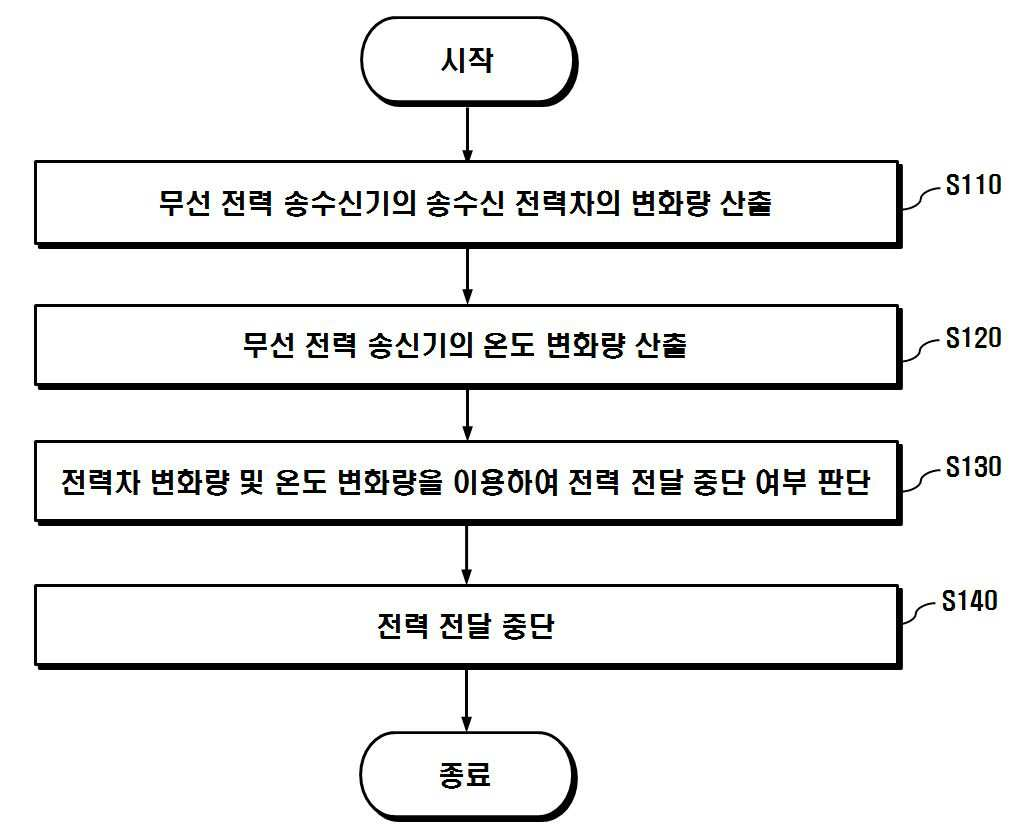
도 2는 본 발명의 일 실시예에 따른 무선 전력 송신기의 제어 방법을 설명하기 위한 순서도이다.
도 3는 본 발명의 일 실시예에 따른 무선 전력 송신기의 제어 장치의 구조를 설명하기 위한 구성도이다.
도 4은 본 발명의 일 실시예에 따른 무선 전력 전송 시스템에서 전력 전달 제어 방법 및 장치의 효과를 설명하기 위한 도면이다.BRIEF DESCRIPTION OF THE DRAWINGS The accompanying drawings are provided to aid understanding of the present invention, and provide embodiments of the present invention together with a detailed description. However, the technical features of the present invention are not limited to a specific drawing, and features disclosed in each drawing may be combined with each other to constitute a new embodiment.
1 is a block diagram of a wireless charging system for explaining a problem that occurs when performing wireless charging.
2 is a flowchart illustrating a method of controlling a wireless power transmitter according to an embodiment of the present invention.
3 is a block diagram illustrating a structure of an apparatus for controlling a wireless power transmitter according to an embodiment of the present invention.
4 is a view for explaining the effect of a power transfer control method and apparatus in a wireless power transmission system according to an embodiment of the present invention.
이하, 본 발명의 실시예들이 적용되는 장치 및 다양한 방법들에 대하여 도면을 참조하여 보다 상세하게 설명한다. 이하의 설명에서 사용되는 구성요소에 대한 접미사 "모듈" 및 "부"는 명세서 작성의 용이함만이 고려되어 부여되거나 혼용되는 것으로서, 그 자체로 서로 구별되는 의미 또는 역할을 갖는 것은 아니다.Hereinafter, an apparatus and various methods to which embodiments of the present invention are applied will be described in more detail with reference to the drawings. The suffixes "module" and "unit" for constituent elements used in the following description are given or used interchangeably in consideration of only the ease of preparation of the specification, and do not have meanings or roles that are distinguished from each other by themselves.
그리고 본 발명을 설명함에 있어서 관련된 공지기술에 대하여 이 분야의 기술자에게 자명한 사항으로서 본 발명의 요지를 불필요하게 흐릴 수 있다고 판단되는 경우에는 그 상세한 설명을 생략한다.In the following description of the present invention, when it is determined that the subject matter of the present invention may be unnecessarily obscured as matters apparent to those skilled in the art with respect to related known technologies, a detailed description thereof will be omitted.
실시예의 설명에 있어서, 무선 전력 충전 시스템상에서 무선 전력을 송신하는 장치는 설명의 편의를 위해 무선 전력 송신기, 무선 전력 송신 장치, 무선 전력 송신 장치, 무선 전력 송신기, 송신단, 송신기, 송신 장치, 송신측, 무선 전력 전송 장치, 무선 전력 전송기, 무선충전장치 등을 혼용하여 사용하기로 한다. 또한, 무선 전력 송신 장치로부터 무선 전력을 수신하는 장치에 대한 표현으로 설명의 편의를 위해 무선 전력 수신 장치, 무선 전력 수신기, 무선 전력 수신 장치, 무선 전력 수신기, 수신 단말기, 수신측, 수신 장치, 수신기 단말 등이 혼용되어 사용될 수 있다.In the description of the embodiment, the apparatus for transmitting wireless power on the wireless power charging system is a wireless power transmitter, a wireless power transmitter, a wireless power transmitter, a wireless power transmitter, a transmitter, a transmitter, a transmitter, a transmitter for convenience of description. , Wireless power transmission device, wireless power transmitter, wireless charging device, etc. will be used in combination. In addition, as an expression for a device that receives wireless power from a wireless power transmission device, for convenience of description, a wireless power receiving device, a wireless power receiver, a wireless power receiving device, a wireless power receiver, a receiving terminal, a receiving side, a receiving device, a receiver Terminals and the like may be used interchangeably.
본 발명에 따른 무선충전장치는 패드 형태, 거치대 형태, AP(Access Point) 형태, 소형 기지국 형태, 스텐드 형태, 천장 매립 형태, 벽걸이 형태 등으로 구성될 수 있으며, 하나의 송신기는 복수의 무선 전력 수신 장치에 전력을 전송할 수도 있다. 이를 위해, 단말은 적어도 하나의 무선 전력 전송 수단을 구비할 수도 있다. 여기서, 무선 전력 전송 수단은 전력 송신단 코일에서 자기장을 발생시켜 그 자기장의 영향으로 수신단 코일에서 전기가 유도되는 전자기유도 원리를 이용하여 충전하는 전자기 유도 방식에 기반한 다양한 무전 전력 전송 표준이 사용될 수 있다. 여기서, 무선전력 전송 수단은 무선 충전 기술 표준 기구인 WPC(Wireless Power Consortium) 및 PMA(Power Matters Alliance)에서 정의된 전자기 유도 방식의 무선 충전 기술을 포함할 수 있다.The wireless charging device according to the present invention may be composed of a pad type, a cradle type, an AP (Access Point) type, a small base station type, a stand type, a ceiling embedding type, a wall mounting type, etc., and one transmitter receives a plurality of wireless power. It can also transmit power to the device. To this end, the terminal may be provided with at least one wireless power transmission means. Here, the wireless power transmission means may use various wireless power transmission standards based on an electromagnetic induction method in which a magnetic field is generated in a power transmitting end coil and charged using an electromagnetic induction principle in which electricity is induced from the receiving end coil under the influence of the magnetic field. Here, the wireless power transmission means may include a wireless charging technology of an electromagnetic induction method defined by Wireless Power Consortium (WPC) and Power Matters Alliance (PMA), which are wireless charging technology standard organizations.
본 발명에 따른 단말은 휴대폰(mobile phone), 스마트폰(smart phone), 노트북 컴퓨터(laptop computer), 디지털방송용 단말기, PDA(Personal Digital Assistants), PMP(Portable Multimedia Player), 네비게이션, MP3 player, 전동 칫솔, 전자 태그, 조명 장치, 리모콘, 낚시찌 등의 소형 전자 기기 등에 사용될 수 있으나, 이에 국한되지는 아니하며 본 발명에 따른 무선 전력 수신 수단이 장착되어 배터리 충전이 가능한 기기라면 족하다. The terminal according to the present invention is a mobile phone, a smart phone, a laptop computer, a digital broadcasting terminal, a personal digital assistant (PDA), a portable multimedia player (PMP), a navigation system, an MP3 player, and an electric device. It can be used for small electronic devices such as toothbrushes, electronic tags, lighting devices, remote controls, floats, etc., but is not limited thereto, and a device capable of charging a battery by mounting a wireless power receiving means according to the present invention is sufficient.
도1 에서 무선 충전 시스템의 구조를 설명하고, 일반적인 무선 충전 시스템에서 발생하는 문제점에 대해 검토한다. In FIG. 1, the structure of the wireless charging system will be described, and problems occurring in a general wireless charging system will be reviewed.
이후, 도2에서는 본 발명에 따른 일 실시예로서, 무선 전력 전송 시스템에서 전력 전달 제어 방법을 간략하게 설명하고, 도 3에서 전력 전달 제어 장치의 구조와 각 구성의 기능을 상세하게 설명한다. 도 4에서 무선 전력 전송 시스템에서 전력 전달 제어 방법 및 장치의 효과에 대해 설명한다. Hereinafter, in FIG. 2, as an embodiment according to the present invention, a power transfer control method in a wireless power transfer system is briefly described, and in FIG. 3, a structure of the power transfer control device and functions of each component will be described in detail. In FIG. 4, an effect of a method and apparatus for controlling power transmission in a wireless power transmission system will be described.
도 1은 무선 충전을 수행 때 발생하는 문제점을 설명하기 위한 무선 충전 시스템의 구성도이다. 1 is a block diagram of a wireless charging system for explaining a problem that occurs when performing wireless charging.
도 1을 참조하면, 무선 충전 시스템은 무선 전력 송신 장치(100)와 무선 전력 수신 장치(200)를 포함한다.Referring to FIG. 1, a wireless charging system includes a wireless
무선 전력 송신 장치(100)와 무선 전력 수신 장치(200)는 인밴드 통신을 통해 제어 신호 또는 정보를 교환할 수도 있다. 여기서, 인밴드 통신은 펄스 폭 변조(Pulse Width Modulation) 방식, 주파수 변조 방식 등으로 수행될 수 있다. 일 예로, 무선 전력 수신 장치(200)는 수신 코일을 통해 유도된 전류를 소정 패턴으로 ON/OFF 스위칭하여 궤환 신호(feedback signal)를 생성함으로써 무선 전력 송신 장치(100)에 각종 제어 신호 및 정보를 전송할 수 있다.The wireless
무선 전력 수신 장치(200)에 의해 전송되는 정보는 수신 전력 세기 정보를 포함할 수 있다. 이때, 무선 전력 송신 장치(100)는 수신 전력 세기 정보에 기반하여 충전 효율 또는 전력 전송 효율을 산출할 수 있다.Information transmitted by the wireless
다시 말해서, 일반적으로 무선 전력 송신 장치(100)는 무선 전력 수신 장치(200)로부터 수신한 전력량에 대한 제어 신호를 이용하여 송신 전력과의 전력차를 산출할 수 있고, 전력차에 기반하여 무선 전력 송신 장치(100)와 무선 전력 수신 장치(200) 사이에 이물질이 끼었는지 검출할 수 있다.In other words, in general, the wireless
이 경우, 무선 전력 송신 장치(100)와 무선 전력 수신 장치(200) 사이에 낀 이물질은 자신의 특성에 따라 송수신 전력차를 많이 발생시키지 않지만, 고도의 발열을 유발시킬 수 있다.In this case, the foreign matter trapped between the wireless
예를 들어, 이물질이 500원 동전인 경우 무선 전력 송신 장치(100)와 무선 전력 수신 장치(200) 사이의 전력 전송에 큰 차이를 만들어 이물질이 끼었음을 짧은 시간내에 판단할 수 있으며 이로 인해 500원 짜리 동전은 고온으로 상승하지 않는다. 그러나 미세한 10원 동전(또는 50원 동전, 작은 금속 키(key))인 경우 무선 전력 송신 장치(100)와 무선 전력 수신 장치(200) 사이의 전력 전송에 큰 차이를 만들지 못해 충전이 유지되며 10원 동전의 온도가 상승하여 사용자가 불편함 또는 상해를 입을 정도의 온도가 되어서야 이물질이라 판단할 수 있는 무선 전력 송신 장치(100)와 무선 전력 수신 장치(200) 사이의 전력량 차이를 만들게 된다. For example, if the foreign matter is a 500 won coin, it can be determined within a short time that the foreign matter is caught by making a large difference in power transmission between the
따라서, 무선 전력 송신 장치(100)와 무선 전력 수신 장치(200) 사이에 낀 이물질의 존재를 판단하기 위한 방법을 더욱 다양화할 필요가 있고, 송수신 전력량 차이뿐만 아니라 송수신 전력량의 변화량 및 무선 전력 송신 장치(100)의 온도 변화량을 통해 이물질을 검출하는 방법을 도 2에서 설명한다.Accordingly, there is a need to further diversify a method for determining the existence of a foreign matter trapped between the wireless
도 2는 본 발명의 일 실시예에 따른 무선 전력 송신기의 제어 방법을 설명하기 위한 순서도이다. 2 is a flowchart illustrating a method of controlling a wireless power transmitter according to an embodiment of the present invention.
무선 전력 송신기의 제어 방법은 무선 전력 전송 송신기와 무선 전력 수신기 사이 양방향 통신에 기반하여 수행되는 것을 전제로 한다. 무선 전력 수신기는 양방향 통신에 의해 앞서 설명한 바와 같이 전력 효율을 산출하기 위한 정보를 전달할 수 있다. 전력 효율을 산출하기 위한 정보는 무선 전력 수신기의 수신 전력을 포함할 수 있다.The control method of the wireless power transmitter is based on a two-way communication between the wireless power transmission transmitter and the wireless power receiver. The wireless power receiver may deliver information for calculating power efficiency as described above through bidirectional communication. The information for calculating the power efficiency may include the received power of the wireless power receiver.
도2를 참조하면, 무선 전력 송신기는 무선 전력 수신기로부터 수신 전력에 대한 신호를 전달 받아, 송신 전력과 수신 전력 사이의 전력차를 산출한다. 실제적으로 무선 전력 송신기가 전력차를 산출하는데 있어 전력차를 산출하는 각 주기 마다 전력차의 차이가 크다. 이는 무선 전력 수신기가 수신하는 전력이 일정하지 않고, 무선 전력 송신기가 수신하는 정보량이 일정하지 않기 때문이다. 따라서 무선 전력 송신기는 제1측정기간 동안 전력차의 제1평균값을 산출하고, 제2측정구간 동안 전력차의 제2평균값을 산출하여 전력차의 변화량을 산출한다(S110).Referring to FIG. 2, the wireless power transmitter receives a signal for received power from the wireless power receiver and calculates a power difference between the transmit power and the received power. Actually, in calculating the power difference by the wireless power transmitter, the difference in the power difference is large in each cycle of calculating the power difference. This is because the power received by the wireless power receiver is not constant, and the amount of information received by the wireless power transmitter is not constant. Therefore, the wireless power transmitter calculates a first average value of the power difference during the first measurement period and calculates a second average value of the power difference during the second measurement period to calculate the amount of change in the power difference (S110).
제1측정구간은 충전 시작 후 미리 설정된 특정 시간 이후부터 시작할 수 있는데, 이는 무선 충전 시스템에 있어서 무선 전력 송신기 상에 물체가 존재하는지 감지하는 핑 단계(Ping Phase)를 고려한 것이다.The first measurement period may start after a predetermined time after starting charging, which takes into account the ping phase of detecting whether an object exists on the wireless power transmitter in the wireless charging system.
무선 전력 송신기는 전력차의 변화량을 산출함과 병렬적으로 제1측정기간 및 제2측정기간 동안 내부 평균 온도를 산출하여, 제1측정기간 및 제2측정기간의 온도 변화량을 산출한다(S112).The wireless power transmitter calculates the amount of change in the power difference and calculates the internal average temperature during the first measurement period and the second measurement period in parallel to calculate the amount of temperature change in the first measurement period and the second measurement period (S112). .
무선 전력 송신기의 내부 온도 변화량은 내부의 송신 코일의 온도를 고려하여 산출될 수 있다. 무선 전력 송신기가 내부 온도 변화량을 산출하는데 있어, 추가적으로 고온으로 발열하는 이물질과의 접촉에 의한 온도도 고려될 수 있다. 미세한 금속 이물질의 경우, 사용자에게 화상을 줄 수 있는 온도인 대략 80 ℃까지 발열이 발생할 수 있기 때문이다.The amount of change in the internal temperature of the wireless power transmitter may be calculated in consideration of the temperature of the internal transmission coil. In calculating the internal temperature change amount of the wireless power transmitter, additionally, the temperature due to contact with a foreign material that generates heat at a high temperature may be considered. This is because, in the case of a fine metallic foreign material, heat may be generated up to approximately 80°C, which is a temperature that can give an image to a user.
무선 전력 송신기는 전력차 변화량과 온도 변화량을 이용하여 전력 전달을 중지할지 여부를 판단한다(S130).The wireless power transmitter determines whether to stop power delivery using the amount of change in the power difference and the amount of temperature change (S130).
일 실시예로, 전력차 변화량 또는 온도 변화량에 대해 각각의 가중치를 고려하여, 가중치가 반영된 전력차 변화량과 온도 변화량을 더한 결과를 임계 변화량과 비교하여 중단 여부를 판단할 수 있다.In one embodiment, it is possible to determine whether to stop by comparing the result of adding the amount of change in the power difference and the amount of temperature change to which the weight is reflected in consideration of each weight for the amount of change in the power difference or the amount of temperature change with the threshold amount of change.
전력차 변화량 또는 온도 변화량 각각에 가중치를 두는 이유는 임계 변화량과의 비교에 있어 유효치를 반영하기 위함이다.The reason for weighting each of the electric power difference change amount or the temperature change amount is to reflect the effective value in comparison with the critical change amount.
무선 전력 송신기가 가중치 반영된 전력차 변화량과 온도 변화량을 더한 결과를 임계 변화량과 비교하여 중단하기로 판단하면 전력 전달을 중단한다(S140).When the wireless power transmitter compares the result of adding the weight-reflected power difference change amount and the temperature change amount with the threshold change amount and determines to stop, power transmission is stopped (S140).
이에 도2에서의 전력 전달 중단 제어와 병렬적으로 본 발명의 일 실시예는 무선 전력 송수신기 간의 전력차를 일정 주기로 산출하여 전력차가 임계 전력차 이상인 경우 전력을 즉각 중단하는 제어를 가질 수 있다.Accordingly, in parallel with the power transfer interruption control in FIG. 2, an embodiment of the present invention may have a control to immediately stop power when the power difference is greater than or equal to a threshold power difference by calculating a power difference between wireless power transceivers at a predetermined period.
예를 들어, 무선 전력 수신기는 수신 전력을 3초마다 무선 전력 송신기에 송신해주고, 무선 전력 송신기는 송수신 전력차가 1,400(mW)이상인 경우, 즉시 이물질을 감지할 수 있다.For example, the wireless power receiver transmits received power to the wireless power transmitter every 3 seconds, and the wireless power transmitter can immediately detect a foreign matter when the difference in transmission and reception power is 1,400 (mW) or more.
또한, 전력차가 임계 전력차 미만인 경우라도, 무선 전력 송신기의 내부 송신 코일의 온도가 임계 온도 이상인 경우 전력을 중단하는 제어를 병렬적으로 가질 수 있다.In addition, even when the power difference is less than the threshold power difference, a control for stopping power when the temperature of the internal transmission coil of the wireless power transmitter is greater than or equal to the threshold temperature may be provided in parallel.
이하, 무선 전력 송신기의 제어 방법을 수행하기 위한 제어 장치에 대해서 설명한다.Hereinafter, a control device for performing a control method of a wireless power transmitter will be described.
도 3는 본 발명의 일 실시예에 따른 무선 전력 송신기의 제어 장치의 구조를 설명하기 위한 구성도이다. 3 is a block diagram illustrating a structure of an apparatus for controlling a wireless power transmitter according to an embodiment of the present invention.
도 3을 참조하면, 무선 전력 송신기의 제어 장치(100)는 통신부(110), 전력변화량산출부(120), 온도변화량산출부(130), 중단판단부(140), 메모리(150), 출력부(160) 및 제어부(170)을 포함할 수 있다.Referring to FIG. 3, the
도 3에 도시된 구성요소들이 필수적인 것은 아니어서, 그보다 많은 구성요소들을 갖거나 그보다 적은 구성 요소들을 갖는, 무선 전력 송신기의 제어 장치(100)가 구현될 수도 있다.Since the components shown in FIG. 3 are not essential, the
이하, 상기 구성 요소들에 대해 상세히 살펴보기로 한다.Hereinafter, the above components will be described in detail.
통신부(110)은 무선 전력 충전 시스템을 구성하는 무선 전력 수신기와 신호 및 데이터를 주고 받는다. 즉, 인밴드를 통해 특정 제어 신호 및 상태 정보를 송출하거나 수신하는 기능을 수행할 수 있다.The
본 발명의 일 실시예에서는, 무선 통신 표준에 기반한 핑 신호 전송 및 무선 전력 수신기로부터 수신 전력에 대한 정보를 수신하는 기능을 수행한다.In an embodiment of the present invention, a function of transmitting a ping signal based on a wireless communication standard and receiving information on received power from a wireless power receiver is performed.
전력변화량산출부(120)은 제1측정기간에서의 송신 전력과 무선 전력 수신기의 수신 전력 간의 전력차의 제1평균값, 제2측정기간에서의 상기 전력차의 제2평균값 및 상기 제1평균값과 상기 제2평균값에 기반하여 전력차 변화량을 산출한다.The power change
온도변화량산출부(130)는 무선 전력 송신기의 내부 송신 코일의 온도를 고려하여 제1측정기간에서의 무선 전력 송신기의 내부 평균 온도와 제2측정기간에서의 상기 내부 평균 온도에 기반하여 온도 변화량을 산출한다.The temperature change
일 실시예로, 무선 전력 송신기는 온도 변화량을 산출하기 위해 내부에 온도 센서를 더 포함할 수 있다.In an embodiment, the wireless power transmitter may further include a temperature sensor therein to calculate a temperature change amount.
중단판단부(140) 전력차 변화량과 온도 변화량을 고려하여 전력 전달 중단 여부를 판단한다.The
일 실시예로, 전력차 변화량 또는 상기 온도 변화량에 대해 각각의 가중치를 고려하여, 가중치가 반영된 상기 전력차 변화량과 상기 온도 변화량을 더한 결과를 임계 변화량과 비교하여 충전 중단 여부를 판단할 수 있다.In one embodiment, it is possible to determine whether to stop charging by comparing a result of adding the amount of change of the power difference and the amount of temperature change to which the weight is reflected, with respect to the amount of change in power difference or the amount of temperature change in consideration of respective weights for the amount of change in power difference or the amount of temperature change.
메모리(150)는 무선 전력 송신기의 제어 장치(100)의 전반적인 동작을 제어하기 위한 소정의 프로그램 코드와 상기 프로그램 코드에 의한 동작이 수행될 때 입/출력되는 데이터 등이 저장되는 공간 및/또는 저장 영역의 총칭으로서, EEPROM(Electrically Erasable and Programmable Read Only Memory), FM(Flash Memory), 하드 디스크 드라이브(Hard Disk Drive)등의 형태로 제공된다.The
출력부(160)는 무선 전력 송신기가 전력 전달을 중단하는 경우, 전력 전달 중단 알림을 출력한다.When the wireless power transmitter stops transmitting power, the
일 실시예로, 출력부(160)는 알림 기능을 수행하기 위해 무선 전력 송신기 내부에 진동장치를 구비할 수 있고, 알림음을 출력하기 위한 스피커를 포함할 수 있으며, 적색 불빛을 출력하기 위한 디스플레이 장치를 구비할 수 있다.In one embodiment, the
제어부(170)는 무선 전력 송신기의 제어 장치(100)의 전체적인 동작을 제어하기 위해 데이터 처리 및 연산을 수행할 수 있고, 일 실시예로 전력 전달 중단 판단에 의해 전력 전달 중단을 제어할 수 있다.The
일 실시예로, 제어부(170)은 무선 전력 수신기의 수신 전력과 무선 전력 송신기의 송신 전력 간의 전력차를 임계 전력차와 비교하여, 전력차가 상기 임계 전력차 이상인 경우 전력 전달 중단을 제어할 수 있고, 전력차가 임계 전력차 미만인 경우, 무선 전력 송신기의 내부 송신 코일의 온도를 임계 온도와 비교하여, 내부 송신 코일의 온도가 임계 온도 이상인 경우 전력 전달 중단을 제어할 수 있다. In one embodiment, the
도 4은 본 발명의 일 실시예에 따른 무선 전력 전송 시스템에서 전력 전달 제어 방법 및 장치의 효과를 설명하기 위한 도면이다.4 is a view for explaining the effect of a power transfer control method and apparatus in a wireless power transmission system according to an embodiment of the present invention.
도 4에서 X축은 시간(분)축이며 Y축은 전력 손실 및 무선 전력 송신기의 온도를 나타낸다.In FIG. 4, the X axis is the time (minute) axis and the Y axis is the power loss and the temperature of the wireless power transmitter.
A와 B는 이물질이 없는 경우로서, 이물질이 있는 C와 D의 기준이 된다. 다만 A와 B를 비교해 보면, 무선 전력 송신기와 수신기 사이의 거리인 편심에서 차이가 있고, 편심이 Omm인 A보다 10mm 인 B에서 전력 손실이 많고 손실량이 많은 만큼 무선 전력 송신기의 온도가 높은 경향이 나타난다. A and B are the case where there is no foreign substance, and they are the criteria for C and D with foreign substances. However, if you compare A and B, there is a difference in the eccentricity, which is the distance between the wireless power transmitter and the receiver, and the temperature of the wireless power transmitter tends to be high as the power loss is higher and the amount of loss is higher in B, which is 10mm than A, which has an eccentricity of Omm. appear.
C 및 D에서 전력 손실량은 8분이 지나서야 1,000(mW) 및 1,300(mW)에 이르며, 온도는 사용자에 불쾌감을 줄 수 있는 29~30℃에 이른다. 이물질에 의해 사용자에게 불쾌감을 줄 수 있는 고온 발열이 유발되고 있지만, 전력 손실량이 크지 않기 때문에 이물질을 감지하지 못할 수 있다.In C and D, the amount of power loss reaches 1,000 (mW) and 1,300 (mW) only after 8 minutes, and the temperature reaches 29 to 30°C, which can cause discomfort to the user. High-temperature heat generation, which may cause discomfort to the user, is caused by the foreign material, but the foreign material may not be detected because the amount of power loss is not large.
본 발명의 일 실시예에서는, C 및 D와 같은 환경에서도 임계 변화량을 조절함으로써 미세한 이물질을 감지할 수 있다.In an embodiment of the present invention, even in environments such as C and D, minute foreign matter can be detected by adjusting the critical change amount.
본 발명의 일 실시예로서, 도4에서는 이물질을 감지하기 위한 로직으로 As an embodiment of the present invention, in FIG. 4, logic for detecting a foreign substance
(δp2 - δp1)×0.1 + (T2 - T1) ≥ α을 만족하는 경우, 무선 전력 전달을 중지하도록 하였다.When (δp2-δp1) × 0.1 + (T2-T1) ≥ α is satisfied, the wireless power transfer is stopped.
δp2는 ‘t-1분’부터 ‘t초’까지(제1측정기간) 송신기의 송신전력과 수신기의 수신 전력의 전력차의 평균 값(제1평균값)을 나타내며, δp1는 t-2분’부터 ‘t-1분’까지(제2측정기간) 송신기의 송신전력과 수신기의 수신 전력의 전력차의 평균 값(제2평균값)을 나타낸다. 따라서 (δp2 - δp1)는 제1측정기간과 제2측정기간의 전력차 평균값의 변화량을 나타낸다.δp2 represents the average value (first average value) of the power difference between the transmit power of the transmitter and the received power of the receiver from't-1 minute' to't seconds' (the first measurement period), and δp1 is t-2 minutes' It represents the average value (second average value) of the power difference between the transmit power of the transmitter and the received power of the receiver from't-1 minute' (second measurement period). Therefore, (δp2-δp1) represents the amount of change in the average value of the power difference between the first measurement period and the second measurement period.
't초'는 충전 시작 후 3초인 시각이며, 3초 이후부터 제1측정기간이 시작하는 이유는 앞서 설명한 바와 같이, 무선 전력 송신기가 수신기를 인식하는 핑 단계를 거치기 때문이다. 't seconds' is a time of 3 seconds after the start of charging, and the reason that the first measurement period starts after 3 seconds is because, as described above, the wireless power transmitter goes through a ping step to recognize the receiver.
(T2 - T1)는 제1측정기간과 제2측정기간의 무선 전력 송신기 내부 평균 온도의 변화량을 나타낸다.(T2-T1) represents the amount of change in the average temperature inside the wireless power transmitter during the first measurement period and the second measurement period.
전력차 평균값에 0.1의 가중치가 반영되어 있는 것은 앞서 설명한 바, 임계 변화량(α)와 비교에 있어 유효치를 고려한 것이다. The weight of 0.1 is reflected in the average value of the power difference, as described above, in consideration of the effective value in comparison with the critical change amount α.
임계 변화량(α)을 정하는 방법과 관련하여 본 발명의 일 실시예에서는, 이물질이 있는 경우의 최고값과 이물질이 없는 경우의 최소값 사이의 값으로 (α)를 선정하였다. Regarding the method of determining the critical change amount α, in an embodiment of the present invention, (α) is selected as a value between the maximum value when there is a foreign material and the minimum value when there is no foreign material.
상술한 실시예에 따른 방법은 컴퓨터에서 실행되기 위한 프로그램으로 제작되어 컴퓨터가 읽을 수 있는 기록 매체에 저장될 수 있으며, 컴퓨터가 읽을 수 있는 기록 매체의 예로는 ROM, RAM, CD-ROM, 자기 테이프, 플로피디스크, 광 데이터 저장장치 등이 있으며, 또한 캐리어 웨이브(예를 들어 인터넷을 통한 전송)의 형태로 구현되는 것도 포함한다.The method according to the above-described embodiment may be produced as a program for execution in a computer and stored in a computer-readable recording medium. Examples of computer-readable recording media include ROM, RAM, CD-ROM, and magnetic tape. , Floppy disks, optical data storage devices, and the like, and also include those implemented in the form of a carrier wave (for example, transmission through the Internet).
컴퓨터가 읽을 수 있는 기록 매체는 네트워크로 연결된 컴퓨터 시스템에 분산되어, 분산방식으로 컴퓨터가 읽을 수 있는 코드가 저장되고 실행될 수 있다. 그리고, 상술한 방법을 구현하기 위한 기능적인(function) 프로그램, 코드 및 코드 세그먼트들은 실시예가 속하는 기술분야의 프로그래머들에 의해 용이하게 추론될 수 있다.The computer-readable recording medium is distributed over a computer system connected through a network, so that computer-readable codes can be stored and executed in a distributed manner. In addition, functional programs, codes, and code segments for implementing the above-described method can be easily inferred by programmers in the technical field to which the embodiment belongs.
본 발명은 본 발명의 정신 및 필수적 특징을 벗어나지 않는 범위에서 다른 특정한 형태로 구체화될 수 있음은 당업자에게 자명하다. It is apparent to those skilled in the art that the present invention can be embodied in other specific forms without departing from the spirit and essential features of the present invention.
따라서, 상기의 상세한 설명은 모든 면에서 제한적으로 해석되어서는 아니되고 예시적인 것으로 고려되어야 한다. 본 발명의 범위는 첨부된 청구항의 합리적 해석에 의해 결정되어야 하고, 본 발명의 등가적 범위 내에서의 모든 변경은 본 발명의 범위에 포함된다.Therefore, the detailed description above should not be construed as restrictive in all respects and should be considered as illustrative. The scope of the present invention should be determined by reasonable interpretation of the appended claims, and all changes within the equivalent scope of the present invention are included in the scope of the present invention.
100 : 무선 전력 송신 장치
200 : 무선 전력 수신 장치
110 : 통신부
120 : 전력변화량산출부
130 : 온도변화량산출부
140 : 중단판단부
150 : 메모리
160 : 출력부
170 : 제어부100: wireless power transmission device
200: wireless power receiving device
110: communication department
120: power change amount calculation unit
130: temperature change amount calculation unit
140: Interruption judgment part
150: memory
160: output
170: control unit
Claims (21)
제1측정기간에서의 상기 무선 전력 송신기의 송신 전력과 무선 전력 수신기의 수신 전력 간의 전력차의 제1평균값을 산출하는 단계;
제2측정기간에서의 상기 전력차의 제2평균값을 산출하는 단계;
상기 제1평균값과 상기 제2평균값에 기반하여 전력차 변화량을 산출하는 단계;
상기 제1측정기간에서의 상기 무선 전력 송신기의 내부 평균 온도와 상기 제2측정기간에서의 상기 내부 평균 온도에 기반하여 온도 변화량을 산출하는 단계;
상기 전력차 변화량과 상기 온도 변화량을 고려하여 전력 전달 중단 여부를 판단하는 단계; 및
상기 전력 전달 중단 판단에 의해 전력 전달을 중단하는 단계;
를 포함하는,
무선 전력 송신기의 제어 방법.In the control method of a wireless power transmitter,
Calculating a first average value of a power difference between the transmission power of the wireless power transmitter and the received power of the wireless power receiver in a first measurement period;
Calculating a second average value of the power difference in a second measurement period;
Calculating a change in electric power difference based on the first average value and the second average value;
Calculating a temperature change amount based on the internal average temperature of the wireless power transmitter in the first measurement period and the internal average temperature in the second measurement period;
Determining whether to stop power transmission in consideration of the amount of change in the electric power difference and the amount of change in temperature; And
Stopping power transfer by determining the power transfer stop;
Containing,
Control method of wireless power transmitter.
상기 수신 전력과 상기 송신 전력 간의 전력차를 임계 전력차와 비교하여, 상기 전력차가 상기 임계 전력차 이상인 경우 전력 전달을 중단하는 단계;
를 더 포함하는,
무선 전력 송신기의 제어 방법.The method of claim 1,
Comparing a power difference between the received power and the transmission power with a threshold power difference, and stopping power transfer when the power difference is greater than or equal to the threshold power difference;
Further comprising,
Control method of wireless power transmitter.
상기 전력차가 상기 임계 전력차 미만인 경우, 상기 무선 전력 송신기의 내부 송신 코일의 온도를 임계 온도와 비교하여, 상기 내부 송신 코일의 온도가 상기 임계 온도 이상인 경우 전력 전달을 중단하는 단계;
를 더 포함하는,
무선 전력 송신기의 제어 방법. The method of claim 2,
When the power difference is less than the threshold power difference, comparing a temperature of an internal transmission coil of the wireless power transmitter with a threshold temperature, and stopping power transmission when the temperature of the internal transmission coil is greater than or equal to the threshold temperature;
Further comprising,
Control method of wireless power transmitter.
상기 송신 코일의 온도가 상기 임계 온도 미만인 경우,
상기 전력차 변화량과 상기 온도 변화량을 고려하여 전력 전달 중단 여부를 판단하는 단계;
가 수행되는,
무선 전력 송신기의 제어 방법.The method of claim 3,
When the temperature of the transmitting coil is less than the threshold temperature,
Determining whether to stop power transmission in consideration of the amount of change in the electric power difference and the amount of change in temperature;
Is being carried out,
Control method of wireless power transmitter.
상기 무선 전력 전송 송신기가 전력 전달을 중단하는 경우, 알림 장치가 전력 전달 중단 알림을 출력하는 단계;
를 더 포함하는
무선 전력 송신기의 제어 방법.The method of claim 4,
Outputting, by a notification device, a power transmission stop notification when the wireless power transmission transmitter stops power transmission;
Further comprising
Control method of wireless power transmitter.
상기 판단하는 단계는,
상기 전력차 변화량 또는 상기 온도 변화량에 대해 각각의 가중치를 고려하여 전력 전달 중단 여부 판단을 수행하는,
무선 전력 송신기의 제어 방법.The method of claim 4,
The determining step,
To determine whether to stop power delivery in consideration of respective weights for the amount of change in the electric power difference or the amount of change in temperature,
Control method of wireless power transmitter.
상기 판단하는 단계는,
상기 가중치가 고려된 상기 전력차 변화량과 상기 온도 변화량을 더한 결과를 임계 변화량과 비교하여 전력 전달 중단 여부 판단을 수행하는,
무선 전력 송신기의 제어 방법.The method of claim 6,
The determining step,
Comparing a result of adding the amount of change in the power difference and the amount of temperature change in consideration of the weight with a threshold amount of change to determine whether to stop power delivery,
Control method of wireless power transmitter.
상기 제1측정기간은 충전 시작 후 미리 설정된 특정 시간 이후부터 시작하며,
상기 제2측정기간은 제1측정기간의 종료와 함께 시작하는,
무선 전력 송신기의 제어 방법.The method of claim 4,
The first measurement period starts after a predetermined time after starting charging,
The second measurement period starts with the end of the first measurement period,
Control method of wireless power transmitter.
상기 무선 전력 송신기의 내부 평균 온도는 상기 무선 전력 송신기의 내부 송신 코일의 온도를 고려하여 산출되는,
무선 전력 송신기의 제어 방법.The method of claim 4,
The internal average temperature of the wireless power transmitter is calculated in consideration of the temperature of the internal transmission coil of the wireless power transmitter,
Control method of wireless power transmitter.
상기 무선 전력 전송 송신기와 상기 무선 전력 수신기는 양방향 통신이 가능한,
무선 전력 송신기의 제어 방법.The method of claim 1,
The wireless power transmission transmitter and the wireless power receiver are capable of bidirectional communication,
Control method of wireless power transmitter.
상기 제1측정기간에서의 상기 무선 전력 송신기의 내부 평균 온도와 상기 제2측정기간에서의 상기 내부 평균 온도에 기반하여 온도 변화량을 산출하는 온도변화량산출부;
상기 전력차 변화량과 상기 온도 변화량을 고려하여 전력 전달 중단 여부를 판단하는 중단판단부; 및
상기 전력 전달 중단 판단에 의해 전력 전달을 중단하는 제어부;
를 포함하는,
무선 전력 송신기의 제어 장치.Power based on the first average value of the power difference between the transmission power in the first measurement period and the received power of the wireless power receiver, the second average value of the power difference in the second measurement period, and the first average value and the second average value. A power change amount calculation unit that calculates a difference amount of difference;
A temperature change amount calculating unit calculating a temperature change amount based on an internal average temperature of the wireless power transmitter in the first measurement period and the internal average temperature in the second measurement period;
An interruption determination unit determining whether to stop power transmission in consideration of the amount of change in the electric power difference and the amount of change in temperature; And
A control unit for stopping power transfer according to the determination of the power transfer stop;
Containing,
The control unit of the wireless power transmitter.
상기 제어부는,
상기 무선 전력 수신기의 수신 전력과 상기 무선 전력 송신기의 송신 전력 간의 전력차를 임계 전력차와 비교하여, 상기 전력차가 상기 임계 전력차 이상인 경우 전력 전달을 중단하는,
무선 전력 송신기의 제어 장치.The method of claim 12,
The control unit,
Comparing a power difference between the received power of the wireless power receiver and the transmission power of the wireless power transmitter with a threshold power difference, and stopping power transmission when the power difference is greater than or equal to the threshold power difference
The control unit of the wireless power transmitter.
상기 제어부는,
상기 전력차가 상기 임계 전력차 미만인 경우, 상기 무선 전력 송신기의 내부 송신 코일의 온도를 임계 온도와 비교하여, 상기 내부 송신 코일의 온도가 상기 임계 온도 이상인 경우 전력 전달을 중단하는,
무선 전력 송신기의 제어 장치. The method of claim 13,
The control unit,
When the power difference is less than the threshold power difference, comparing the temperature of the internal transmission coil of the wireless power transmitter with a threshold temperature, stopping power transmission when the temperature of the internal transmission coil is greater than or equal to the threshold temperature,
The control unit of the wireless power transmitter.
상기 중단판단부는,
상기 송신 코일의 온도가 상기 임계 온도 미만인 경우,
상기 전력차 변화량과 상기 온도 변화량을 고려하여 전력 전달 중단 여부를 판단하는,
무선 전력 송신기의 제어 장치.The method of claim 14,
The interruption determination unit,
When the temperature of the transmitting coil is less than the threshold temperature,
Determining whether to stop power delivery in consideration of the amount of change in the electric power difference and the amount of change in temperature,
The control unit of the wireless power transmitter.
상기 무선 전력 전송 송신기가 전력 전달을 중단하는 경우, 알림 장치가 전력 전달 중단 알림을 출력하는 출력부;
를 더 포함하는
무선 전력 송신기의 제어 장치.The method of claim 15,
An output unit for outputting a power transmission stop notification by the notification device when the wireless power transmission transmitter stops power transmission;
Further comprising
The control unit of the wireless power transmitter.
상기 중단판단부는,
상기 전력차 변화량 또는 상기 온도 변화량에 대해 각각의 가중치를 고려하여 전력 전달 중단 여부를 판단하는,
무선 전력 송신기의 제어 장치.The method of claim 15,
The interruption determination unit,
Determining whether to stop power delivery in consideration of respective weights for the amount of change in the power difference or the amount of change in temperature,
The control unit of the wireless power transmitter.
상기 중단판단부는,
상기 가중치가 고려된 상기 전력차 변화량과 상기 온도 변화량을 더한 결과를 임계 변화량과 비교하여 전력 전달 중단 여부를 판단하는,
무선 전력 송신기의 제어 장치.The method of claim 17,
The interruption determination unit,
Comparing a result of adding the amount of change in the power difference and the amount of temperature change in which the weight is taken into account with a threshold amount of change to determine whether to stop power delivery,
The control unit of the wireless power transmitter.
상기 제1측정기간은 충전 시작 후 미리 설정된 특정 시간 이후부터 시작하며,
상기 제2측정기간은 제1측정기간의 종료와 함께 시작하는,
무선 전력 송신기의 제어 장치.The method of claim 15,
The first measurement period starts after a predetermined time after starting charging,
The second measurement period starts with the end of the first measurement period,
The control unit of the wireless power transmitter.
상기 무선 전력 송신기의 내부 평균 온도는 상기 무선 전력 송신기의 내부 송신 코일의 온도를 고려하여 산출되는,
무선 전력 송신기의 제어 장치.The method of claim 15,
The internal average temperature of the wireless power transmitter is calculated in consideration of the temperature of the internal transmission coil of the wireless power transmitter,
The control unit of the wireless power transmitter.
상기 무선 전력 전송 송신기와 상기 무선 전력 수신기 사이 양방향 통신이 가능한 통신부;
를 더 포함하는,
무선 전력 송신기의 제어 장치.The method of claim 12,
A communication unit capable of bidirectional communication between the wireless power transmission transmitter and the wireless power receiver;
Further comprising,
Control unit of the wireless power transmitter.
Priority Applications (1)
| Application Number | Priority Date | Filing Date | Title |
|---|---|---|---|
| KR1020150142596A KR102237226B1 (en) | 2015-10-13 | 2015-10-13 | Foreign object detection method and apparatus in a wireless power transmission system |
Applications Claiming Priority (1)
| Application Number | Priority Date | Filing Date | Title |
|---|---|---|---|
| KR1020150142596A KR102237226B1 (en) | 2015-10-13 | 2015-10-13 | Foreign object detection method and apparatus in a wireless power transmission system |
Publications (2)
| Publication Number | Publication Date |
|---|---|
| KR20170043189A KR20170043189A (en) | 2017-04-21 |
| KR102237226B1 true KR102237226B1 (en) | 2021-04-07 |
Family
ID=58705347
Family Applications (1)
| Application Number | Title | Priority Date | Filing Date |
|---|---|---|---|
| KR1020150142596A Active KR102237226B1 (en) | 2015-10-13 | 2015-10-13 | Foreign object detection method and apparatus in a wireless power transmission system |
Country Status (1)
| Country | Link |
|---|---|
| KR (1) | KR102237226B1 (en) |
Families Citing this family (3)
| Publication number | Priority date | Publication date | Assignee | Title |
|---|---|---|---|---|
| KR20190011087A (en) * | 2017-07-24 | 2019-02-01 | 엘지이노텍 주식회사 | Apparatus and method for temperature control for wireless charging |
| KR20190013219A (en) * | 2017-08-01 | 2019-02-11 | 엘지이노텍 주식회사 | A method for controlling a wireless power transmitter and a wireless power transmitter |
| WO2023068515A1 (en) * | 2021-10-22 | 2023-04-27 | 삼성전자 주식회사 | Electronic device for controlling charging of battery on basis of change in temperature, and method therefor |
Family Cites Families (3)
| Publication number | Priority date | Publication date | Assignee | Title |
|---|---|---|---|---|
| KR101962667B1 (en) * | 2012-07-12 | 2019-03-27 | 삼성전자주식회사 | Wireless power transmitter, wireless power receiver and method for controlling each thereof |
| KR102051682B1 (en) * | 2013-03-15 | 2019-12-03 | 지이 하이브리드 테크놀로지스, 엘엘씨 | Apparatus and method for detecting foreign object in wireless power transmitting system |
| KR101742553B1 (en) * | 2013-04-12 | 2017-06-15 | 주식회사 한림포스텍 | Method for controlling power transmission in wireless power transmission apparatus and wireless power transmission apparatus thereof |
-
2015
- 2015-10-13 KR KR1020150142596A patent/KR102237226B1/en active Active
Also Published As
| Publication number | Publication date |
|---|---|
| KR20170043189A (en) | 2017-04-21 |
Similar Documents
| Publication | Publication Date | Title |
|---|---|---|
| US20250379475A1 (en) | Apparatus and method for detecting foreign objects in wireless power transmission system | |
| US10020664B2 (en) | Wireless communication controlled battery charging station | |
| CN102395983B (en) | Optimization of Wireless Power Devices for Charging Batteries | |
| KR101812437B1 (en) | Devices for conveying wireless power and methods of operation thereof | |
| KR101683651B1 (en) | Noise reducing apparatus and method of the wireless charging device | |
| JP5681167B2 (en) | Wireless power transmission scheduling | |
| CN102918741B (en) | For the temperature sensor interface of wireless and wired charging | |
| US20150050881A1 (en) | Wireless power charger | |
| US20120025624A1 (en) | Low power detection of wireless power devices | |
| CN101447684A (en) | Wireless power charging system | |
| KR102237226B1 (en) | Foreign object detection method and apparatus in a wireless power transmission system | |
| US9252607B2 (en) | Communication terminal, charge control program and charge control method | |
| JP2012205485A (en) | Electronic equipment, charging system and charging abnormality notification method | |
| KR102136667B1 (en) | Apparatus and method for detecting foreign object in wireless power transmitting system | |
| KR20240163585A (en) | Apparatus and method for detecting foreign object in wireless power transmitting system |
Legal Events
| Date | Code | Title | Description |
|---|---|---|---|
| PA0109 | Patent application |
St.27 status event code: A-0-1-A10-A12-nap-PA0109 |
|
| R18-X000 | Changes to party contact information recorded |
St.27 status event code: A-3-3-R10-R18-oth-X000 |
|
| PG1501 | Laying open of application |
St.27 status event code: A-1-1-Q10-Q12-nap-PG1501 |
|
| P22-X000 | Classification modified |
St.27 status event code: A-2-2-P10-P22-nap-X000 |
|
| P22-X000 | Classification modified |
St.27 status event code: A-2-2-P10-P22-nap-X000 |
|
| R18-X000 | Changes to party contact information recorded |
St.27 status event code: A-3-3-R10-R18-oth-X000 |
|
| A201 | Request for examination | ||
| PA0201 | Request for examination |
St.27 status event code: A-1-2-D10-D11-exm-PA0201 |
|
| D13-X000 | Search requested |
St.27 status event code: A-1-2-D10-D13-srh-X000 |
|
| R17-X000 | Change to representative recorded |
St.27 status event code: A-3-3-R10-R17-oth-X000 |
|
| D14-X000 | Search report completed |
St.27 status event code: A-1-2-D10-D14-srh-X000 |
|
| E902 | Notification of reason for refusal | ||
| PE0902 | Notice of grounds for rejection |
St.27 status event code: A-1-2-D10-D21-exm-PE0902 |
|
| P11-X000 | Amendment of application requested |
St.27 status event code: A-2-2-P10-P11-nap-X000 |
|
| P13-X000 | Application amended |
St.27 status event code: A-2-2-P10-P13-nap-X000 |
|
| E701 | Decision to grant or registration of patent right | ||
| PE0701 | Decision of registration |
St.27 status event code: A-1-2-D10-D22-exm-PE0701 |
|
| GRNT | Written decision to grant | ||
| PR0701 | Registration of establishment |
St.27 status event code: A-2-4-F10-F11-exm-PR0701 |
|
| PR1002 | Payment of registration fee |
St.27 status event code: A-2-2-U10-U11-oth-PR1002 Fee payment year number: 1 |
|
| PG1601 | Publication of registration |
St.27 status event code: A-4-4-Q10-Q13-nap-PG1601 |
|
| P22-X000 | Classification modified |
St.27 status event code: A-4-4-P10-P22-nap-X000 |
|
| PR1001 | Payment of annual fee |
St.27 status event code: A-4-4-U10-U11-oth-PR1001 Fee payment year number: 4 |
|
| PR1001 | Payment of annual fee |
St.27 status event code: A-4-4-U10-U11-oth-PR1001 Fee payment year number: 5 |
|
| P22-X000 | Classification modified |
St.27 status event code: A-4-4-P10-P22-nap-X000 |
|
| PR1001 | Payment of annual fee |
St.27 status event code: A-4-4-U10-U11-oth-PR1001 Fee payment year number: 6 |
|
| U11 | Full renewal or maintenance fee paid |
Free format text: ST27 STATUS EVENT CODE: A-4-4-U10-U11-OTH-PR1001 (AS PROVIDED BY THE NATIONAL OFFICE) Year of fee payment: 6 |