KR102200496B1 - Image recognizing method and server using deep learning - Google Patents
Image recognizing method and server using deep learning Download PDFInfo
- Publication number
- KR102200496B1 KR102200496B1 KR1020180155922A KR20180155922A KR102200496B1 KR 102200496 B1 KR102200496 B1 KR 102200496B1 KR 1020180155922 A KR1020180155922 A KR 1020180155922A KR 20180155922 A KR20180155922 A KR 20180155922A KR 102200496 B1 KR102200496 B1 KR 102200496B1
- Authority
- KR
- South Korea
- Prior art keywords
- image
- images
- learning
- channel
- neural network
- Prior art date
- Legal status (The legal status is an assumption and is not a legal conclusion. Google has not performed a legal analysis and makes no representation as to the accuracy of the status listed.)
- Active
Links
Images



Classifications
-
- G06K9/46—
-
- G—PHYSICS
- G06—COMPUTING OR CALCULATING; COUNTING
- G06T—IMAGE DATA PROCESSING OR GENERATION, IN GENERAL
- G06T7/00—Image analysis
- G06T7/0002—Inspection of images, e.g. flaw detection
- G06T7/0004—Industrial image inspection
-
- G—PHYSICS
- G06—COMPUTING OR CALCULATING; COUNTING
- G06V—IMAGE OR VIDEO RECOGNITION OR UNDERSTANDING
- G06V10/00—Arrangements for image or video recognition or understanding
- G06V10/40—Extraction of image or video features
-
- G—PHYSICS
- G06—COMPUTING OR CALCULATING; COUNTING
- G06N—COMPUTING ARRANGEMENTS BASED ON SPECIFIC COMPUTATIONAL MODELS
- G06N20/00—Machine learning
-
- G—PHYSICS
- G06—COMPUTING OR CALCULATING; COUNTING
- G06N—COMPUTING ARRANGEMENTS BASED ON SPECIFIC COMPUTATIONAL MODELS
- G06N3/00—Computing arrangements based on biological models
- G06N3/02—Neural networks
- G06N3/04—Architecture, e.g. interconnection topology
- G06N3/045—Combinations of networks
-
- G—PHYSICS
- G06—COMPUTING OR CALCULATING; COUNTING
- G06N—COMPUTING ARRANGEMENTS BASED ON SPECIFIC COMPUTATIONAL MODELS
- G06N3/00—Computing arrangements based on biological models
- G06N3/02—Neural networks
- G06N3/04—Architecture, e.g. interconnection topology
- G06N3/0464—Convolutional networks [CNN, ConvNet]
-
- G—PHYSICS
- G06—COMPUTING OR CALCULATING; COUNTING
- G06N—COMPUTING ARRANGEMENTS BASED ON SPECIFIC COMPUTATIONAL MODELS
- G06N3/00—Computing arrangements based on biological models
- G06N3/02—Neural networks
- G06N3/08—Learning methods
-
- G—PHYSICS
- G06—COMPUTING OR CALCULATING; COUNTING
- G06N—COMPUTING ARRANGEMENTS BASED ON SPECIFIC COMPUTATIONAL MODELS
- G06N3/00—Computing arrangements based on biological models
- G06N3/02—Neural networks
- G06N3/08—Learning methods
- G06N3/084—Backpropagation, e.g. using gradient descent
-
- G—PHYSICS
- G06—COMPUTING OR CALCULATING; COUNTING
- G06N—COMPUTING ARRANGEMENTS BASED ON SPECIFIC COMPUTATIONAL MODELS
- G06N3/00—Computing arrangements based on biological models
- G06N3/02—Neural networks
- G06N3/08—Learning methods
- G06N3/09—Supervised learning
-
- G—PHYSICS
- G06—COMPUTING OR CALCULATING; COUNTING
- G06T—IMAGE DATA PROCESSING OR GENERATION, IN GENERAL
- G06T3/00—Geometric image transformations in the plane of the image
- G06T3/40—Scaling of whole images or parts thereof, e.g. expanding or contracting
-
- G—PHYSICS
- G06—COMPUTING OR CALCULATING; COUNTING
- G06T—IMAGE DATA PROCESSING OR GENERATION, IN GENERAL
- G06T3/00—Geometric image transformations in the plane of the image
- G06T3/60—Rotation of whole images or parts thereof
-
- G—PHYSICS
- G06—COMPUTING OR CALCULATING; COUNTING
- G06T—IMAGE DATA PROCESSING OR GENERATION, IN GENERAL
- G06T2207/00—Indexing scheme for image analysis or image enhancement
- G06T2207/20—Special algorithmic details
- G06T2207/20081—Training; Learning
-
- G—PHYSICS
- G06—COMPUTING OR CALCULATING; COUNTING
- G06T—IMAGE DATA PROCESSING OR GENERATION, IN GENERAL
- G06T2207/00—Indexing scheme for image analysis or image enhancement
- G06T2207/20—Special algorithmic details
- G06T2207/20084—Artificial neural networks [ANN]
Landscapes
- Engineering & Computer Science (AREA)
- Theoretical Computer Science (AREA)
- Physics & Mathematics (AREA)
- General Physics & Mathematics (AREA)
- Software Systems (AREA)
- Computing Systems (AREA)
- Artificial Intelligence (AREA)
- Mathematical Physics (AREA)
- Data Mining & Analysis (AREA)
- Evolutionary Computation (AREA)
- General Engineering & Computer Science (AREA)
- Biomedical Technology (AREA)
- Molecular Biology (AREA)
- General Health & Medical Sciences (AREA)
- Computational Linguistics (AREA)
- Biophysics (AREA)
- Life Sciences & Earth Sciences (AREA)
- Health & Medical Sciences (AREA)
- Computer Vision & Pattern Recognition (AREA)
- Quality & Reliability (AREA)
- Multimedia (AREA)
- Medical Informatics (AREA)
- Image Analysis (AREA)
Abstract
본 발명의 일 실시예에 따르면, 검사 대상물의 양불 판단을 위한 이미지 인식 방법으로서, 검사 대상물에 대해 획득된 N개의 이미지를 1개 이상의 채널 공간에 치환하여 배치함으로써 새로운 이미지를 생성하는 단계; 및 상기 새로운 이미지를 채널별로 분리하여 획득된 N개의 이미지에 대한 학습을 통해 특징값을 추출하는 단계를 포함하는, 이미지 인식 방법이 제공된다.According to an embodiment of the present invention, there is provided an image recognition method for determining whether or not an inspection object is good or bad, the method comprising: generating a new image by replacing and disposing N images obtained for the inspection object in one or more channel spaces; And extracting a feature value through learning about N images obtained by dividing the new image for each channel.

Description
본 발명은 딥러닝을 이용한 이미지 인식 방법 및 서버에 관한 것이다. The present invention relates to an image recognition method and server using deep learning.
최근, 다양한 공정에서, 검사 대상물을 촬영한 후, 촬영된 이미지에 기반하여 양불 판단을 하는 프로세스가 활용되고 있다.Recently, in various processes, after photographing an object to be inspected, a process of determining good or bad based on the photographed image has been utilized.
기존에는, 검사 대상물에 대해 촬영된 한 장의 이미지를 통해 특징을 찾아내고, 특징에 해당하는 픽셀값을 사용자가 정의한 레시피로 기준값과 비교하여 검사 대상물의 양불 판단을 했었다. Previously, a feature was found through a single image taken of an object to be inspected, and a pixel value corresponding to the feature was compared with a reference value with a recipe defined by the user to determine whether the object to be inspected is good or bad.
이러한 방법에 따르면, 당해 획득된 이미지와 기준값을 비교하더라도 사용자가 한번 더 검사를 진행하여야 했었고, 획득된 이미지들의 관계성을 고려한 불량 유형 분류는 불가능하였다. According to this method, even if the acquired image and the reference value were compared, the user had to perform another inspection, and it was impossible to classify the defect type considering the relationship between the acquired images.
또한, 상기 기준값 역시 사용자의 주관적 판단이 적용될 수밖에 없으므로, 검사 대상물에 대한 양불 판단의 신뢰성은 저하될 수밖에 없었다. In addition, since the user's subjective judgment is inevitably applied to the reference value, the reliability of the judgment of the acceptance or failure of the inspection object is inevitably lowered.
따라서, 검사 대상물의 양불 판단에 있어서, 획득된 이미지 간 관계성에 기반한 자동화된 판단 기술이 필요한 실정이다. Therefore, in determining whether or not an inspection object is good or bad, an automated judgment technology based on the relationship between acquired images is required.
본 발명은 전술한 종래기술의 문제점을 해결하기 위한 것으로, 자동화된 이미지 인식 기반 양불 판단 방법을 제공하는 것을 그 목적으로 한다. The present invention is to solve the problems of the prior art, and an object of the present invention is to provide an automated image recognition based method for determining good or bad.
본 발명의 다른 목적은, 복수의 이미지 간 관계성에 기초한 학습법을 이용하여 정확성 높은 양불 판단 방법을 제공하는 것이다. Another object of the present invention is to provide a method of determining good or bad with high accuracy using a learning method based on a relationship between a plurality of images.
본 발명의 또 다른 목적은, 새로운 유형의 불량에도 강건한 양불 판단 모델 생성을 가능하게 하는 것이다. Another object of the present invention is to enable the generation of a good or bad judgment model that is robust even for new types of defects.
본 발명의 또 다른 목적은 검사 대상물 불량 검출 오류를 최소화하여 생산성을 향상시키는 것이다. Another object of the present invention is to improve productivity by minimizing an error in detecting defects of an inspection object.
본 발명의 목적들은 이상에서 언급한 목적들로 제한되지 않으며, 언급되지 않은 또 다른 목적들은 아래의 기재로부터 명확하게 이해될 수 있을 것이다.The objects of the present invention are not limited to the above-mentioned objects, and other objects that are not mentioned will be clearly understood from the following description.
상술한 목적을 달성하기 위한 본 발명의 일 실시예에 따르면, 검사 대상물의 양불 판단을 위한 이미지 인식 방법으로서, 검사 대상물에 대해 획득된 N개의 이미지를 1개 이상의 채널 공간에 치환하여 배치함으로써 새로운 이미지를 생성하는 단계; 및 상기 새로운 이미지를 채널별로 분리하여 획득된 N개의 이미지에 대한 학습을 통해 특징값을 추출하는 단계를 포함하는, 이미지 인식 방법. 이 제공된다.According to an embodiment of the present invention for achieving the above object, as an image recognition method for determining whether or not an object to be inspected is good or bad, a new image is obtained by replacing N images obtained for the object to be inspected in one or more channel spaces. Generating a; And extracting feature values through learning about N images obtained by dividing the new image for each channel. Is provided.
상기 방법은, 상기 새로운 이미지를 생성하는 단계 이후에, 상기 새로운 이미지를 변형시켜 복수개의 변형 이미지를 생성하는 단계를 더 포함할 수 있다. The method may further include, after generating the new image, generating a plurality of transformed images by transforming the new image.
상기 변형 이미지를 생성하는 단계는, 상기 새로운 이미지를 다양한 각도로 회전시킨 이미지 및 회전된 이미지들을 좌우 대칭 변환시킨 복수개의 변형 이미지를 생성하는 단계를 포함할 수 있다. The generating of the deformed image may include generating an image in which the new image is rotated at various angles and a plurality of deformed images in which the rotated images are symmetrically transformed.
상기 특징값을 추출하는 단계는, 상기 복수개의 변형 이미지를 각각 채널별로 분리하여 학습을 수행하는 단계를 포함할 수 있다. The extracting the feature value may include performing learning by separating the plurality of transformed images for each channel.
상기 채널 공간은 N개로 구성될 수 있다. The channel space may be composed of N number.
상기 검사 대상물에 대해 획득된 N개의 이미지는 그레이스케일 이미지일 수 있다. The N images acquired for the object to be inspected may be grayscale images.
상기 N은 3일 수 있다. N may be 3.
상기 새로운 이미지를 생성하는 단계는, 검사 대상물에 대해 획득된 서로 다른 너비와 높이를 갖는 N개의 이미지를 N채널 공간에 쌓아 특정 너비와 높이를 갖는 새로운 이미지를 생성하는 단계를 포함할 수 있다. The generating of the new image may include generating a new image having a specific width and height by stacking N images having different widths and heights obtained for the inspection object in an N-channel space.
상기 특징값을 추출하는 단계는, 1개 이상의 마스터 신경망 구조 내에서 슬래이브 콘볼루션 신경망을 정의하는 단계; 및 상기 채널별로 분리하여 획득된 N개의 이미지에 대해 각각의 슬래이브 콘볼루션 신경망을 적용하는 단계를 포함할 수 있다. The extracting of the feature values may include: defining a slave convolutional neural network within at least one master neural network structure; And applying each of the slave convolutional neural networks to the N images obtained by separating each channel.
상기 특징값을 추출하는 단계는, 슬래이브 콘볼루션 신경망 적용에 의해 추출된 특징값을 다시 스택(stack) 또는 컨캣(concat)하는 과정을 반복하는 단계를 더 포함할 수 있다. The step of extracting the feature values may further include repeating a process of stacking or concating the feature values extracted by applying the slave convolutional neural network again.
상기 특징값을 추출하는 단계는, 슬레이브 콘볼루션 신경망을 적용함에 있어서, 역전파 과정이 수행되도록 하는 단계를 더 포함할 수 있다. The step of extracting the feature value may further include performing a backpropagation process in applying the slave convolutional neural network.
본 발명의 다른 실시예에 따르면, 검사 대상물의 양불 판단을 위한 이미지 인식 서버로서, 검사 대상물에 대해 획득된 N개의 이미지를 1개 이상의 채널 공간에 치환하여 배치함으로써 새로운 이미지를 생성하는 이미지 생성부; 및 상기 새로운 이미지를 채널별로 분리하여 획득된 N개의 이미지에 대한 학습을 통해 특징값을 추출하는 이미지 학습부를 포함하는, 이미지 인식 서버가 제공된다. According to another embodiment of the present invention, there is provided an image recognition server for determining whether or not an object to be inspected is good or bad, comprising: an image generator configured to generate a new image by replacing and disposing N images obtained for the object to be inspected in one or more channel spaces; And an image learning unit for extracting feature values through learning about N images obtained by dividing the new images for each channel.
상기 이미지 인식 서버는, 상기 새로운 이미지를 변형시켜 복수개의 변형 이미지를 생성하는 학습 데이터 생성부를 더 포함할 수 있다. The image recognition server may further include a learning data generator configured to generate a plurality of transformed images by transforming the new image.
상기 학습 데이터 생성부는, 상기 새로운 이미지를 다양한 각도로 회전시킨 이미지 및 회전된 이미지들을 좌우 대칭 변환시킨 복수개의 변형 이미지를 생성할 수 있다.The learning data generator may generate an image in which the new image is rotated at various angles and a plurality of deformed images in which the rotated images are symmetrically transformed.
상기 이미지 학습부는, 상기 복수개의 변형 이미지를 각각 채널별로 분리하여 학습을 수행하는 단계를 포함할 수 있다. The image learning unit may include performing learning by separating the plurality of transformed images for each channel.
상기 채널 공간은 N개로 구성될 수 있다. The channel space may be composed of N number.
상기 검사 대상물에 대해 획득된 N개의 이미지는 그레이스케일 이미지일 수 있다. The N images acquired for the object to be inspected may be grayscale images.
상기 N은 3일 수 있다. N may be 3.
상기 이미지 생성부는, 검사 대상물에 대해 획득된 서로 다른 너비와 높이를 갖는 N개의 이미지를 N채널 공간에 쌓아 특정 너비와 높이를 갖는 새로운 이미지를 생성할 수 있다. The image generator may generate a new image having a specific width and height by stacking N images having different widths and heights obtained with respect to the inspection object in an N-channel space.
상기 이미지 학습부는, 1개 이상의 마스터 신경망 구조 내에서 슬래이브 콘볼루션 신경망을 정의하고, 상기 채널별로 분리하여 획득된 N개의 이미지에 대해 각각의 슬래이브 콘볼루션 신경망을 적용하여 특징값을 추출할 수 있다. The image learning unit may define a slave convolutional neural network within one or more master neural network structures, and extract feature values by applying each of the slave convolutional neural networks to the N images obtained by separating each channel. have.
상기 이미지 학습부는, 슬래이브 콘볼루션 신경망 적용에 의해 추출된 특징값을 다시 스택(stack) 또는 컨캣(concat)하는 과정을 반복할 수 있다. The image learning unit may repeat a process of re-stacking or concating feature values extracted by applying a slave convolutional neural network.
상기 이미지 학습부는, 슬레이브 콘볼루션 신경망을 적용함에 있어서, 역전파 과정이 수행되도록 할 수 있다.The image learning unit may perform a backpropagation process when applying a slave convolutional neural network.
본 발명의 일 실시예에 따르면, 분량 유형 분류 모델 생성을 위한 이미지 생성 시, N개의 그레이스케일 이미지를 N채널 공간으로 치환하고, 이미지 변환 후 해당 이미지들을 다시 채널별로 분리하여, 동시에 학습을 시키기 때문에, 학습 시 N개 이미지 간 관련성에 기반한 학습이 가능해지며, 양불 판단을 위한 특징값 추출의 정확성이 향상될 수 있다.According to an embodiment of the present invention, when generating an image for generating a quantity type classification model, N grayscale images are replaced with an N-channel space, and after image conversion, the corresponding images are separated for each channel, so that simultaneous learning is performed. , When learning, learning based on the relevance between N images becomes possible, and the accuracy of feature value extraction for determination of good or bad can be improved.
또한, 본 발명의 실시예에 따르면, 생성된 이미지를 인위적으로 변형시켜 복수개의 이미지를 추가적으로 생성하고, 이를 통해 학습을 하기 때문에, 새로운 유형의 불량에도 강건한 모델 생성이 가능해진다. In addition, according to an embodiment of the present invention, since a plurality of images are additionally generated by artificially deforming the generated image, and learning is performed through this, it is possible to create a robust model even for new types of defects.
한편, 본 발명의 실시예에 따르면, 검사 대상물 불량 검출 오류를 최소화하여 생산성을 향상시킬 수 있다. On the other hand, according to an embodiment of the present invention, it is possible to improve productivity by minimizing an error in detecting a defect in an inspection object.
본 발명의 효과는 상기한 효과로 한정되는 것은 아니며, 본 발명의 상세한 설명 또는 특허청구범위에 기재된 발명의 구성으로부터 추론 가능한 모든 효과를 포함하는 것으로 이해되어야 한다.The effects of the present invention are not limited to the above effects, and should be understood to include all effects that can be inferred from the configuration of the invention described in the detailed description or claims of the present invention.
도 1은 본 발명의 일 실시예에 따른 딥러닝 기반 이미지 인식 시스템의 구성을 개략적으로 도시한 도면이다.
도 2는 일 실시예에 따른 이미지 인식 서버의 구성을 설명하기 위한 도면이다.
도 3은 일 실시예에 따라 획득된 그레이스케일 이미지의 일례를 나타내는 도면이다.
도 4는 일 실시예에 따른 3채널 공간을 설명하기 위한 도면이다.
도 5는 일 실시예에 따라 3개의 그레이스케일 이미지가 3채널 공간으로 치환되는 과정을 설명하기 위한 도면이다.
도 6은 일 실시예에 따라, 3개의 그레이스케일 이미지가 3채널 공간으로 치환되어 생성된 새로운 이미지의 일례를 나타낸다.
도 7은 일 실시예에 따라 3채널 공간으로 치환된 이미지의 변형예를 나타내는 도면이다.
도 8은 일 실시예에 따른 이미지 학습 과정을 설명하기 위한 도면이다.1 is a diagram schematically showing a configuration of a deep learning-based image recognition system according to an embodiment of the present invention.
2 is a diagram illustrating a configuration of an image recognition server according to an embodiment.
3 is a diagram illustrating an example of a grayscale image obtained according to an exemplary embodiment.
4 is a diagram illustrating a 3-channel space according to an embodiment.
FIG. 5 is a diagram for explaining a process in which three grayscale images are replaced with a three-channel space according to an exemplary embodiment.
6 shows an example of a new image generated by replacing three grayscale images with a three-channel space, according to an embodiment.
7 is a diagram illustrating a modified example of an image replaced with a 3-channel space according to an exemplary embodiment.
8 is a diagram for describing an image learning process according to an exemplary embodiment.
이하에서는 첨부한 도면을 참조하여 본 발명을 설명하기로 한다. 그러나 본 발명은 여러 가지 상이한 형태로 구현될 수 있으며, 따라서 여기에서 설명하는 실시예로 한정되는 것은 아니다. 그리고 도면에서 본 발명을 명확하게 설명하기 위해서 설명과 관계없는 부분은 생략하였으며, 명세서 전체를 통하여 유사한 부분에 대해서는 유사한 도면 부호를 붙였다.Hereinafter, the present invention will be described with reference to the accompanying drawings. However, the present invention may be implemented in various different forms, and therefore is not limited to the embodiments described herein. In the drawings, parts irrelevant to the description are omitted in order to clearly describe the present invention, and similar reference numerals are assigned to similar parts throughout the specification.
명세서 전체에서, 어떤 부분이 다른 부분과 "연결"되어 있다고 할 때, 이는 "직접적으로 연결"되어 있는 경우뿐 아니라, 그 중간에 다른 부재를 사이에 두고 "간접적으로 연결"되어 있는 경우도 포함한다. 또한 어떤 부분이 어떤 구성요소를 "포함"한다고 할 때, 이는 특별히 반대되는 기재가 없는 한 다른 구성요소를 제외하는 것이 아니라 다른 구성요소를 더 구비할 수 있다는 것을 의미한다.Throughout the specification, when a part is said to be "connected" to another part, this includes not only "directly connected" but also "indirectly connected" with another member interposed therebetween. . In addition, when a part "includes" a certain component, it means that other components may be further provided, rather than excluding other components unless specifically stated to the contrary.
이하 첨부된 도면을 참고하여 본 발명의 실시예를 상세히 설명하기로 한다.Hereinafter, embodiments of the present invention will be described in detail with reference to the accompanying drawings.
도 1은 본 발명의 일 실시예에 따른 딥러닝 기반 이미지 인식 시스템의 구성을 개략적으로 도시한 도면이다.1 is a diagram schematically showing a configuration of a deep learning-based image recognition system according to an embodiment of the present invention.
도 1을 참조하면, 본 발명의 일 실시예에 따른 딥러닝 기반 이미지 인식 시스템은 검사 설비(100), 이미지 인식 서버(200), 사용자 단말기(300)를 포함한다. Referring to FIG. 1, a deep learning-based image recognition system according to an embodiment of the present invention includes an
검사 설비(100)는 검사 대상물에 광을 조사하여 복수의 이미지를 획득한다. 광은 검사 대상물을 기준으로 다양한 각도로 조사될 수 있으며, 예를 들면, 레이저 광이 조사될 수 있다. 참고적으로, 검사 대상물은, 유리 기판, LCD, LED, OLED, QLED, 반도체용 기판 또는 웨이퍼(wafer) 등일 수 있으나, 이에 제한되지 않음은 물론이다. The
다양한 각도에서 조사된 광에 의해 서로 다른 검사 대상물의 이미지가 획득되며, 획득된 복수의 이미지는 이미지 인식 서버(200)로 전송된다. Images of different objects to be inspected are acquired by light irradiated from various angles, and the acquired plurality of images are transmitted to the
이미지 인식 서버(200)는 검사 설비(100)로부터 전송된 N개의 이미지를 1개 이상의 채널 공간, 바람직하게는, N채널(N 차원) 공간에 쌓아 새로운 이미지를 생성해낸다. 그 후, 생성된 이미지를 인위적으로 변형시켜 데이터를 확장시킨다. 데이터 확장으로 이미지의 수가 M배 많아지게 되는데, 이를 통해 새로운 유형의 불량에도 강건한 모델 생성이 가능해진다. 이미지 인식 서버(200)는 신경망 구조를 이용하여 생성된 새로운 이미지를 학습한 후, 이미지 분류 모델을 생성해낸다. The
사용자 단말기(300)는 이미지 인식 서버(200)에 접속하여, 이미지 분류 모델을 확인하고, 이미지 분류 모델에 의해 수행된 불량 여부 판단의 결과를 수신할 수 있다. 사용자 단말기(300)는 휴대폰, 스마트폰, PDA(Personal Digital Assistant), PMP(Portable Multimedia Player), 태블릿 PC 등과 같이 무선 통신망을 통하여 외부 서버와 연결될 수 있는 모든 종류의 통신 장치를 포함할 수 있으며, 이 외에도 데스크탑 PC, 태블릿 PC, 랩탑 PC, 셋탑 박스를 포함하는 IPTV와 같이, 네트워크를 통하여 외부 서버와 연결될 수 있는 통신 장치도 포함할 수 있다.The user terminal 300 may access the
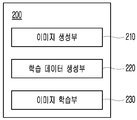
도 2는 일 실시예에 따른 이미지 인식 서버의 구성을 설명하기 위한 도면이다. 2 is a diagram illustrating a configuration of an image recognition server according to an embodiment.
도 2를 참조하면, 이미지 인식 서버(200)는 이미지 생성부(210), 학습 데이터 생성부(220), 이미지 학습부(230)를 포함할 수 있다. Referring to FIG. 2, the
이미지 생성부(210), 학습 데이터 생성부(220), 이미지 학습부(230)는 외부 장치와 통신할 수 있는 프로그램 모듈 또는 하드웨어들일 수 있다. 이러한 프로그램 모듈 또는 하드웨어는 운영 시스템, 응용 프로그램 모듈 및 기타 프로그램 모듈의 형태로 이미지 인식 서버(200) 또는 이와 통신 가능한 다른 장치에 포함될 수 있으며, 물리적으로는 여러 가지 공지의 기억 장치 상에 저장될 수 있다. 한편, 이러한 프로그램 모듈 또는 하드웨어들은 본 발명에 따라 후술할 특정 업무를 수행하거나 특정 추상 데이터 유형을 실행하는 루틴, 서브루틴, 프로그램, 오브젝트, 컴포넌트, 데이터 구조 등을 포괄하지만, 이에 제한되지는 않는다.The
이미지 생성부(210)는 검사 설비(100)로부터 수신한 N개의 이미지를 N 채널 공간에 쌓는다. 예를 들면, 3개의 이미지를 3채널 공간에 쌓아 새로운 이미지를 생성할 수 있다. 전술한 바와 같이, 검사 설비(100)는 검사 대상물에 대해 다양한 각도로 광을 조사한 후, 촬영 장치를 이용하여 복수개의 이미지를 획득할 수 있다. 검사 대상물이 유리기판인 경우를 가정하면, 레이저 광을 투영 또는 투과시키는 방법에 따라서 굴절에 의한 그림자의 모양, 크기, 위치, 명암 등이 달리 나타날 수 있는데, 상기 투영 또는 투과의 방법을 달리하여, 서로 다른 굴절 그림자 이미지를 3개 획득할 수 있다. 획득된 이미지는 복수개의 그레이스케일(Grayscale) 이미지일 수 있으며, 이러한 이미지는 이미지 인식 서버(200)에 전송된다. The
그레이스케일 이미지는 0~255값으로 흑백을 표현한 이미지로서, 예를 들면, 도 3에 도시된 바와 같이, 5×5의 매트릭스에 0~255의 값이 채워진 형태일 수 있다. The grayscale image is an image representing black and white with a value of 0 to 255. For example, as shown in FIG. 3, a value of 0 to 255 may be filled in a 5×5 matrix.
이미지 생성부(210)는 특정 검사 대상물에 대해 획득된 N개의 그레이스케일 이미지를 N채널 공간에 쌓아 새로운 이미지를 생성할 수 있는데, 수신된 그레이스케일 이미지가 도 3에 도시된 바와 같은 형태라면, 1채널에는 5×5의 크기를 갖는 그레이스케일 이미지가 놓일 수 있다. The
한편, N채널 공간이란 도 4에 도시된 바와 같이, 채널 × 너비 × 높이의 값으로 표현할 수 있는 공간을 의미한다. Meanwhile, the N-channel space means a space that can be expressed as a value of channel × width × height, as shown in FIG. 4.
예를 들면, RGB 컬러 이미지는 0~255의 숫자 값으로 총 3개의 채널로 표현될 수 있으며, 이 경우, R 채널, G 채널, B 채널이 각각 1개씩 포함될 수 있다. For example, an RGB color image may be represented by a total of three channels with a numeric value of 0 to 255, and in this case, one R channel, one G channel, and one B channel may be included.
검사 대상물의 이미지로서 3개의 그레이스케일 이미지가 수신된다고 가정하면, 도 5에 도시된 바와 같이, 각각 R 채널, G 채널, B 채널, 즉, 총 3개의 채널에 치환되어 놓일 수 있는데, 이렇게 함으로써, 그레이스케일 이미지가 3채널 공간으로 치환될 수 있다. Assuming that three grayscale images are received as the image of the object to be inspected, as shown in FIG. 5, each of the R channel, G channel, and B channel, that is, a total of 3 channels, can be replaced. By doing so, Grayscale images can be replaced with 3-channel space.
이하에서는, 그레이스케일 이미지가 3개이고, 이러한 3개의 그레이스케일 이미지가 3채널 공간으로 치환되는 경우를 가정하여 설명하나, 그레이스케일 이미지의 개수 및 채널의 개수는 이와 달라질 수 있다. Hereinafter, it is assumed that there are three grayscale images, and the three grayscale images are replaced with a three-channel space. However, the number of grayscale images and the number of channels may vary.
도 6은 3개의 그레이스케일 이미지가 3채널 공간으로 치환되어 생성된 새로운 이미지의 일례를 나타낸다. 6 shows an example of a new image generated by replacing three grayscale images with a three-channel space.
도 6을 참조하면, 3개의 그레이스케일 이미지는 각기 다른 너비와 높이를 가질 수 있는데, 3개의 그레이스케일 이미지(Original Image)가 3채널 공간으로 치환됨으로써 일정 높이와 너비를 갖는 새로운 이미지(Image Stack to 3Channel)가 생성될 수 있다.Referring to FIG. 6, three grayscale images may have different widths and heights. As three grayscale images are replaced with a three-channel space, a new image having a certain height and width (Image Stack to 3Channel) can be created.
학습 데이터 생성부(220)는 이미지 생성부(210)에 의해 생성된 이미지를 변형시켜 새로운 학습 데이터를 생성하는 기능을 수행한다. The learning
도 7은 이미지 생성부(210)에 의해 생성된 이미지의 다양한 변형예를 나타낸다. 7 shows various modified examples of an image generated by the
도 7을 참조하면, 이미지 생성부(210)에 의해 생성된 이미지(Original Image)를 90도, 180도, 270도 회전시킴으로써, 3개의 이미지가 더 생성될 수 있고, 원래의 이미지와 상기 새롭게 생성된 3개의 이미지를 각각 좌우 대칭 이미지로 변환함으로써, 4개의 이미지가 추가적으로 더 생성될 수 있다. 즉, 상기 프로세스로 총 7개의 이미지가 더 생성될 수 있다. Referring to FIG. 7, by rotating the original image generated by the
학습 데이터 생성부(220)는 상기와 같은 방식으로 이미지를 회전 및 대칭 변환함으로써, N배(상기 예에서는 8배) 많은 이미지를 생성해낼 수 있다. The training
이미지 학습부(230)는 학습 데이터 생성부(220)에 의해 생성된 이미지를 신경망 구조를 통해 학습하는 기능을 수행한다. 학습 데이터 생성부(220)에 의해 생성된 이미지는 이미지 생성부(210)에 의해 생성된 이미지를 회전 또는 대칭 변환 시킨 이미지이므로, 3채널로 구성된 이미지일 수 있다. 따라서, 학습 데이터 생성부(220)에 의해 생성된 3채널 이미지는 각각의 채널로 분리시킬 수 있다.The
본 발명은 머신러닝(Machine Learning)의 일종인 딥러닝(Deep Learning) 기술을 이용한 학습 방법을 채택하고 있는데, 머신러닝은 인공지능의 한 분야로 패턴인식과 컴퓨터 학습 이론의 연구로부터 진화한 분야이다. The present invention adopts a learning method using deep learning technology, which is a kind of machine learning, and machine learning is a field of artificial intelligence that has evolved from the study of pattern recognition and computer learning theory. .
머신러닝은 주위 환경을 학습 요소로서 사용하여 지식베이스를 개선한다. 개선된 지식베이스를 이용하여 특정 작업을 수행하게 되고, 작업을 수행하는 동안에 얻은 정보는 다시 학습 요소에 반영된다. 머신러닝은 이러한 방식으로 경험적 데이터를 기반으로 학습을 하고 예측을 수행하며 스스로의 성능을 향상시키는 시스템과 이를 위한 알고리즘을 연구하고 구축하는 기술이다. 머신러닝의 알고리즘들은 입력 데이터를 기반으로 예측이나 결정을 이끌어내기 위해 특정한 모델을 구축하는 방식을 사용한다.Machine learning improves the knowledge base by using the surrounding environment as a learning element. A specific task is performed using the improved knowledge base, and the information obtained while performing the task is reflected back to the learning element. Machine learning is a technology that studies and builds a system that improves its own performance by learning and predicting based on empirical data in this way and algorithms for it. Machine learning algorithms build specific models to derive predictions or decisions based on input data.
머신러닝은 학습 전략에 따라 암기 학습과 새로운 지식을 직접적으로 부여하는 방식, 지도 학습 방식, 유추에 의한 학습 방식, 귀납적 학습 방식 등으로 분류될 수 있다. Machine learning can be classified into memorized learning, a method of directly granting new knowledge, a supervised learning method, a learning method by analogy, and an inductive learning method according to a learning strategy.
암기 학습과 새로운 지식의 직접적인 부여 방식은 추론이나 지식의 변형이 필요치 않다. 이러한 학습 방식의 변형으로는, 외부 객체 또는 프로그램에 의해 구축 및 변경되는 학습방식, 주어진 사실이나 데이터에 대한 기억으로만 학습이 이루어지고 입력 정보 위한 추론이 없는 방식 등이 있다. Memorization learning and direct assignment of new knowledge do not require reasoning or transformation of knowledge. Such variations of the learning method include a learning method constructed and changed by an external object or program, a method in which learning is performed only with a memory of a given fact or data and there is no reasoning for input information.
지도 학습 방식은 입력된 정보들을 내부적인 표현 기법으로 변환시키고, 새로운 정보는 기존의 원천적 지식과 통합하는 방식이다. 외부에서는 머신러닝 시스템의 지식을 증식시키기 위해 정보들을 적절히 조합하여 머신러닝 시스템에 부여한다. 여러 가지 지도를 실행 프로그램으로 변형하기 위해서는, 지도를 요구하는 요구 단계, 외부의 지도를 내부 표현으로 변환하는 해석 단계, 지도의 수준과 실행 요소가 적용하는 수준의 차이를 줄이기 위해 연산자로 변환하는 연산자화 단계, 기존의 지식과 새로운 지식을 합병하는 합병 단계, 새롭게 만들어진 지식을 평가하는 평가 단계를 거쳐야 한다. The supervised learning method converts input information into an internal expression technique, and integrates new information with existing original knowledge. Externally, information is appropriately combined and given to the machine learning system in order to proliferate the knowledge of the machine learning system. In order to transform various maps into an executable program, a requesting step for a map, an analysis step for converting an external map into an internal representation, an operator that converts the map into an operator to reduce the difference between the level of the map and the level applied by the execution element It must go through the stage of conversion, the merger stage of merging existing knowledge and new knowledge, and the evaluation stage of evaluating newly created knowledge.
유추 학습 방식은 이미 존재하는 정보를 변형 또는 증식시켜 새로운 사실을 습득하는 방식으로서, 지식의 변형 과정에서 원하는 새로운 개념이나 기술에 대한 강한 유사성을 도출하여 이것을 새로운 상황에서 유용하게 이용하는 방식이다. 이미 만들어진 컴퓨터 프로그램을 원래 설계된 것과는 다르게 운용되는 프로그램으로 변형하는 데 이용될 수 있을 것이다. 이는 암기 학습 또는 지도 학습 방식에 비해 좀 더 많은 추론이 요구되는 방식이다. The analogy learning method is a method of acquiring new facts by transforming or proliferating existing information. In the process of transforming knowledge, a strong similarity to a desired new concept or technology is derived and this is usefully used in a new situation. It could be used to transform an already created computer program into a program that operates differently than originally designed. This is a method that requires more reasoning than the memorization learning or supervised learning method.
귀납적 학습 방식은 어떤 개념에 대해서 그 개념을 잘 설명하는 예(긍정적 예, positive example)와 개념을 부정하는 예(부정적 예, counterexample 또는 negative example)들의 집합이 주어질 때, 부정적인 예들의 성질을 배제하면서 모든 긍정적인 예들의 성질을 잘 묘사하는 일반적인 개념 묘사를 추론해낸다. 이 학습 방식은 인공 지능 분야에서 가장 많이 연구되어 왔던 방식이다. 추론에 드는 노력은 지도 학습 방식보다 훨씬 많으며, 외부에서 일반적인 개념이 주어지지 않는다면 유추에 의한 학습보다도 추론에 드는 노력이 더 많아지게 된다. 이 방식은, 외부에서 예를 제공하는 방식, 시스템 내에서 예를 생성하여 제공하는 방식, 외부 환경에서 예제들을 제공하는 방식, 긍정적인 예제들만 이용하는 방식, 긍정적/부정적 예제들을 모두 이용하는 방식 등으로 분류될 수 있다. The inductive learning method excludes the nature of negative examples when given a set of examples (positive examples) and examples that negate the concept (negative examples, counterexamples or negative examples) for a certain concept. Infer a general conceptual description that well describes the nature of all positive examples. This learning method has been studied the most in the field of artificial intelligence. The effort for reasoning is much more than the supervised learning method, and if a general concept is not given from the outside, the effort for reasoning is more than the learning by analogy. This method is classified into a method of providing examples from the outside, a method of creating and providing examples within the system, a method of providing examples from an external environment, a method of using only positive examples, and a method of using both positive and negative examples, etc. Can be.
딥러닝은 신경망 기반의 복잡도가 큰 모델이다. 기존의 신경망 모델이 한 개의 은닉층을 사용한 비교적 단순한 모델인 것에 비해서 딥러닝 모델은 아주 많은 수의 은닉층을 사용한다. 인간 뇌의 시각피질에서도 V1, V2, V4 등 점차적으로 복잡한 정보를 추출하는 일련의 신경층들이 발견되며 딥러닝은 이러한 구조를 모사한 머신러닝 모델이다. 예를 들어, 하위층에서는 비교적 단순한 정보처리(예, 라인 탐지)를 수행하고, 상위층으로 갈수록 점차 복잡한 정보(예, 에지 검출과 물체 인식)를 추출하는 구조를 사용하는 것으로 알려져 있다.Deep learning is a neural network-based model with high complexity. While the existing neural network model is a relatively simple model using one hidden layer, the deep learning model uses a very large number of hidden layers. In the visual cortex of the human brain, a series of neural layers that gradually extract complex information such as V1, V2, and V4 are found, and deep learning is a machine learning model that mimics this structure. For example, it is known to use a structure in which relatively simple information processing (eg, line detection) is performed in the lower layer, and gradually more complex information (eg, edge detection and object recognition) is extracted as it goes to the upper layer.
딥러닝의 핵심 아이디어는 기존에는 복잡한 문제를 풀기 위해서 특징 추출과 패턴 분류의 두 단계로 분리하여 문제를 해결하던 방식을 하나의 단계로 통합하여 해결하는 자동화로 볼 수 있다. 기존에는 먼저 데이터 전처리 및 가공을 통해서 문제 해결에 적합한 특징들을 추출한 다음, 이를 학습 데이터로 하여 패턴 분류기를 훈련시키는 두 개의 단계로 문제를 해결하였다. 딥러닝 구조는 특징 추출을 위한 전처리 단계를 전체 학습 프로세스에 포함시킴으로써 가공되지 않은 원래 데이터를 직접 학습하도록 하는 통합된 문제해결 방식을 취한다. 딥러닝 구조는 특히 영상 데이터와 같이 차원수가 아주 크고 복잡한 데이터의 경우에 전처리 과정을 통해서 손실될 수도 있는 정보를 기계가 자동으로 추출해서 활용할 수 있다. 즉 기존의 전처리 방법이나 소위 feature engineering을 통해 배제되었던 해의 영역 조차도 탐색함으로써 더욱 유용한 정보를 추출하여 활용할 수 있다.The core idea of deep learning can be seen as an automation that combines and solves a problem by separating it into two stages of feature extraction and pattern classification to solve complex problems in the past. Previously, the problem was solved in two steps, first extracting features suitable for problem solving through data preprocessing and processing, and then training a pattern classifier using these as training data. The deep learning architecture takes an integrated problem-solving method that directly learns raw raw data by including the preprocessing step for feature extraction in the entire learning process. In the deep learning structure, especially in the case of very large and complex data such as image data, information that may be lost through preprocessing can be automatically extracted and utilized by the machine. That is, more useful information can be extracted and utilized by searching even the area of the solution that was excluded through the existing preprocessing method or so-called feature engineering.
딥러닝 모델의 성과가 향상될 수 있었던 것은 대규모 데이터로 대규모 모델을 학습시킬 수 있었기 때문이며, 이에 크게 기여한 것이 본 발명이 채택한 콘볼루션 신경망이다. The reason that the performance of the deep learning model could be improved is that it was possible to train a large-scale model with large-scale data, and the convolutional neural network adopted by the present invention greatly contributed to this.
콘볼루션 신경망은 영상과 같이 차원수가 아주 높은 데이터로부터 유용한 특징과 표현을 자동으로 추출하기 위해 컨볼루션 커널(convolution kernels)을 사용하고, 이를 통해 위치가 달라도 같은 파라미터값을 갖게 되며, 파라미터의 수를 줄임으로써 학습해야 하는 차원의 수를 줄일 수 있다. 콘볼루션 신경망 모델을 사용함으로써 과다학습이 방지되고 유용한 특징이 추출될 수 있다. Convolutional neural networks use convolution kernels to automatically extract useful features and expressions from very high-dimensional data such as images, and through this, they have the same parameter values even if the positions are different, and the number of parameters is By reducing it, you can reduce the number of dimensions you need to learn. By using a convolutional neural network model, over-learning is prevented and useful features can be extracted.
콘볼루션 신경망은 기본적으로 감독학습 문제를 풀도록 설계되어 있고, 입력데이터를 분류하기 위한 변별적 학습에 초점이 맞춰져 있다. 이는 패턴 분류 성능을 향상시킬 수 있고, 아주 많은 수의 뉴런층을 사용하여 복잡한 특징과 표현을 스스로 구축할 수 있다. 콘볼루션 신경망은 종래의 신경망이 가지는 은닉 계층(Hidden layer)의 완전 접속 계층(Fully connected layer)에 콘볼루션 계층(Convolution layer) 및 보조 표본화 계층(Sub-sampling layer)을 추가하고 구조적으로 세분화하여 성능을 향상시킨 신경망 이다. 이러한 콘볼루션 신경망을 활용한 딥러닝은 다른 기법들과 비교하여 매우 우수한 정확도를 보인다.The convolutional neural network is basically designed to solve supervised learning problems and focuses on discriminatory learning to classify input data. This can improve pattern classification performance, and build complex features and expressions by themselves using a very large number of neuron layers. The convolutional neural network adds a convolution layer and a sub-sampling layer to the fully connected layer of the hidden layer of the conventional neural network and structurally subdivides the performance. Is an improved neural network. Deep learning using such a convolutional neural network shows very good accuracy compared to other techniques.
콘볼루션 신경망은 특징추출을 콘볼루션으로 하고, 분류 행위를 신경망으로 수행한다. 영상처리에서 콘볼루션이란 가중치를 갖는 마스크를 이용하여 영상처리를 하는 것을 의미하는데, 입력 영상에 마스크를 씌운 후, 입력 영상의 픽셀값과 마스크의 가중치를 각각 곱한 후 그 합을 출력 영상의 픽셀값으로 정하는 과정이다. 영상처리에 사용되는 마스크를 필터, 윈도우 또는 커널이라고 한다. The convolutional neural network performs feature extraction as convolution and the classification behavior as a neural network. In image processing, convolution refers to image processing using a mask having a weight. After covering the input image with a mask, multiplying the pixel value of the input image and the weight of the mask, respectively, the sum of the pixel values of the output image It is a process determined by. Masks used in image processing are called filters, windows, or kernels.
입력 영상에 윈도우를 씌운 후 이를 이동시켜가며 콘볼루션 값을 계산하는데, 이는 영상에서의 특징 추출이 목적이다. 특징 추출 시에는 여러장에 대한 추출을 수행하여 영상 왜곡 또는 변형 등과 같은 환경에 잘 적응하는 강인한 특징을 유도한다. A window is placed on the input image and then the convolution value is calculated by moving it. This is the purpose of extracting features from the image. When feature extraction is performed, several images are extracted to induce robust features that are well adapted to the environment such as image distortion or transformation.
콘볼루션과 서브샘플링(subsampling)을 반복하면, 추출된 특징이 남게 되고, 신경망의 각 입력단자에 입력하면, 학습이 이루어지게 된다. When convolution and subsampling are repeated, the extracted features remain, and when input to each input terminal of the neural network, learning is performed.
딥러닝에서 활용하는 콘볼루션 신경망은 이미지를 이해하고 이로부터 고수준의 추상화된 정보, 예를 들면, 특징값을 추출하거나 또는 새로운 질감을 가진 이미지를 생성하는 등 다양한 영상 처리, 컴퓨터 비전 분야에서 연구되고 있는 인공 신경망이다. 본 발명은 지도 학습 (Supervised Learning) 알고리즘을 채택하고, 콘볼루션 신경망을 구조화하여 신경망 내에 다시 하위 신경망을 넣는 방식을 적용하고 있다.The convolutional neural network used in deep learning understands images and is studied in various image processing and computer vision fields, such as extracting high-level abstracted information, for example, feature values, or generating images with new textures. Is an artificial neural network. In the present invention, a supervised learning algorithm is adopted, a convolutional neural network is structured, and a lower level neural network is placed in the neural network again.
본 발명의 실시예에서는, 하나의 마스터 신경망(Deep Neural Network) 구조 내에서 채널 개수(3개)와 동일한 수의 슬래이브 콘볼루션 신경망(Deep CNN: Deep Convolutional Neural Network)을 정의할 수 있는데(도 8 참조), 하나의 이미지로부터 채널별로 분리된 이미지들이 동시에 각각의 슬래이브 콘볼루션 신경망을 통해 학습되어, 채널별 이미지에 대한 특징값이 생성될 수 있다. In an embodiment of the present invention, it is possible to define a deep convolutional neural network (Deep CNN) having the same number as the number of channels (three) within a single master neural network structure (Fig. 8), images separated for each channel from one image are simultaneously learned through each slave convolutional neural network, so that feature values for each channel image may be generated.
채널별 분리는, N채널 이미지를 채널 축을 기준으로 축별로 절단하는 방식으로 수행된다. 학습 시 높은 분류 정확도를 갖는 분류 모델을 생성하기 위해, 역전파(Backpropagation) 과정이 더 수행될 수 있다. 구체적으로, 분리된 이미지에 대해 특징값을 추출하고, 해당 특징값으로부터 어떠한 종류의 불량인지 분류하였을 때, 정답과 틀릴 경우에는 다시 정답을 찾아내기 위해, 에러를 줄여야 하는데, 이를 위해 역전파 과정을 더 수행할 수 있다. 도 8에서 파선으로 표시된 화살표들이 역전파 과정을 나타낸다.Separation for each channel is performed by cutting the N-channel image for each axis based on the channel axis. In order to generate a classification model having high classification accuracy during training, a backpropagation process may be further performed. Specifically, when the feature value is extracted from the separated image and the type of defect is classified from the feature value, the error must be reduced in order to find the correct answer again when it is incorrect from the correct answer. You can do more. Arrows indicated by broken lines in FIG. 8 indicate a backpropagation process.
이미지 학습부(230)는 상기의 과정으로 생성된 특징값들에 대해 다시 스택(stack) 또는 컨캣(concat)하는 과정을 반복 수행한다. The
최종적으로 생성된 특징값들은 다시 3채널 공간으로 치환될 수 있으며, 이렇게 학습된 결과를 통해 검사 대상물의 불량 유형을 분류해낼 수 있다. The finally generated feature values can be replaced with a 3-channel space again, and the defect type of the inspection object can be classified through the learned result.
아래의 표는 유리기판에 대한 기존의 비전검사 방식과 본 발명의 실시예에 따른 방식의 불량유형 분류 성능을 시험한 결과이다. The table below is a result of testing the defect type classification performance of the conventional vision inspection method for the glass substrate and the method according to the embodiment of the present invention.
상기 표를 참조하면, 본 발명의 실시예에 따를 시, 불량유형 1에 대한 분류 성능이 28.7%(대략 30%) 개선되었고, 그 이외의 불량유형에 대해서는 분류 성능이 10% 이상 개선되었다는 것을 알 수 있다. Referring to the above table, according to the embodiment of the present invention, it can be seen that the classification performance for
한편, 아래의 그래프를 참조하면, 본 발명의 실시예에 따를 시 기존 방식에 비해 완제품에 대한 불량률이 전체 1.5% 개선되었다는 것을 알 수 있다. Meanwhile, referring to the graph below, it can be seen that the total defect rate for the finished product is improved by 1.5% compared to the existing method when the embodiment of the present invention is followed.

본 발명의 실시예에 따르면, 분량 유형 분류 모델 생성을 위한 이미지 생성 시, N개의 그레이스케일 이미지를 N채널 공간으로 치환하고, 이미지 변환 후 해당 이미지들을 다시 채널별로 분리하여, 동시에 학습을 시키기 때문에, 학습 시 N개 이미지 간 관련성에 기반한 학습이 가능해지며, 양불 판단을 위한 특징값 추출의 정확성이 향상될 수 있다. According to an embodiment of the present invention, when generating an image for generating a quantity type classification model, N grayscale images are replaced with an N-channel space, and after image conversion, the corresponding images are separated for each channel, so that learning is performed at the same time. During learning, learning based on the relevance between N images becomes possible, and the accuracy of feature value extraction for determination of good or bad can be improved.
또한, 생성된 이미지를 인위적으로 변형시켜 복수개의 이미지를 추가적으로 생성하고, 이를 통해 학습을 하기 때문에, 새로운 유형의 불량에도 강건한 모델 생성이 가능해진다. In addition, since the generated image is artificially deformed to additionally generate a plurality of images and learn through this, it is possible to create a robust model even for new types of defects.
한편, 본 발명의 실시예에 따르면, 검사 대상물 불량 검출 오류를 최소화하여 생산성을 향상시킬 수 있다. On the other hand, according to an embodiment of the present invention, it is possible to improve productivity by minimizing an error in detecting a defect in an inspection object.
전술한 본 발명의 설명은 예시를 위한 것이며, 본 발명이 속하는 기술분야의 통상의 지식을 가진 자는 본 발명의 기술적 사상이나 필수적인 특징을 변경하지 않고서 다른 구체적인 형태로 쉽게 변형이 가능하다는 것을 이해할 수 있을 것이다. 그러므로 이상에서 기술한 실시예들은 모든 면에서 예시적인 것이며 한정적이 아닌 것으로 이해해야만 한다. 예를 들어, 단일형으로 설명되어 있는 각 구성 요소는 분산되어 실시될 수도 있으며, 마찬가지로 분산된 것으로 설명되어 있는 구성 요소들도 결합된 형태로 실시될 수 있다.The above description of the present invention is for illustrative purposes only, and those of ordinary skill in the art to which the present invention pertains will be able to understand that it can be easily modified into other specific forms without changing the technical spirit or essential features of the present invention. will be. Therefore, it should be understood that the embodiments described above are illustrative and non-limiting in all respects. For example, each component described as a single type may be implemented in a distributed manner, and similarly, components described as being distributed may also be implemented in a combined form.
본 발명의 범위는 후술하는 특허청구범위에 의하여 나타내어지며, 특허청구범위의 의미 및 범위 그리고 그 균등 개념으로부터 도출되는 모든 변경 또는 변형된 형태가 본 발명의 범위에 포함되는 것으로 해석되어야 한다.The scope of the present invention is indicated by the claims to be described later, and all changes or modified forms derived from the meaning and scope of the claims and their equivalent concepts should be interpreted as being included in the scope of the present invention.
Claims (22)
검사 대상물에 대해 획득된 N개(N≥2)의 제 1 이미지를 복수개의 채널 공간에 치환하여 배치함으로써 새로운 이미지를 생성하는 단계; 및
상기 새로운 이미지를 채널별로 분리하여 획득된 N개의 제 2 이미지에 대한 학습을 통해 특징값을 추출하는 단계를 포함하는, 이미지 인식 방법. As an image recognition method for determining the good or bad of an inspection object,
Generating a new image by displacing and disposing the N (N≥2) first images obtained for the inspection object in a plurality of channel spaces; And
And extracting a feature value through learning about N second images obtained by dividing the new image for each channel.
상기 새로운 이미지를 생성하는 단계 이후에,
상기 새로운 이미지를 변형시켜 복수개의 변형 이미지를 생성하는 단계를 더 포함하는, 이미지 인식 방법. The method of claim 1,
After the step of generating the new image,
The image recognition method further comprising the step of generating a plurality of transformed images by transforming the new image.
상기 변형 이미지를 생성하는 단계는,
상기 새로운 이미지를 다양한 각도로 회전시킨 이미지 및 회전된 이미지들을 좌우 대칭 변환시킨 복수개의 변형 이미지를 생성하는 단계를 포함하는, 이미지 인식 방법. The method of claim 2,
Generating the modified image,
And generating an image in which the new image is rotated at various angles and a plurality of transformed images obtained by symmetrically transforming the rotated images.
상기 특징값을 추출하는 단계는,
상기 복수개의 변형 이미지를 각각 채널별로 분리하여 학습을 수행하는 단계를 포함하는, 이미지 인식 방법. The method of claim 2,
The step of extracting the feature value,
And performing learning by separating the plurality of modified images for each channel.
상기 채널 공간은 N개로 구성되는, 이미지 인식 방법. The method of claim 1,
The channel space is composed of N, the image recognition method.
상기 검사 대상물에 대해 획득된 N개의 제 1 이미지는 그레이스케일 이미지인, 이미지 인식 방법. The method of claim 1,
The N first images acquired for the inspection object are grayscale images.
상기 N은 3인, 이미지 인식 방법.The method of claim 5 or 6,
N is 3, image recognition method.
상기 새로운 이미지를 생성하는 단계는,
검사 대상물에 대해 획득된 서로 다른 너비와 높이를 갖는 N개의 제 1 이미지를 N채널 공간에 쌓아 특정 너비와 높이를 갖는 새로운 이미지를 생성하는 단계를 포함하는, 이미지 인식 방법. The method of claim 1,
The step of generating the new image,
Comprising the step of generating a new image having a specific width and height by stacking N first images having different widths and heights obtained with respect to the inspection object in the N-channel space.
상기 특징값을 추출하는 단계는,
1개 이상의 마스터 신경망 구조 내에서 슬래이브 콘볼루션 신경망을 정의하는 단계; 및
상기 채널별로 분리하여 획득된 N개의 제 2 이미지에 대해 각각의 슬래이브 콘볼루션 신경망을 적용하는 단계를 포함하는, 이미지 인식 방법. The method according to any one of claims 1 to 6 and 8,
The step of extracting the feature value,
Defining a slave convolutional neural network within at least one master neural network structure; And
And applying each slave convolutional neural network to the N second images obtained by separating each channel.
상기 특징값을 추출하는 단계는,
슬래이브 콘볼루션 신경망 적용에 의해 추출된 특징값을 다시 스택(stack) 또는 컨캣(concat)하는 과정을 반복하는 단계를 더 포함하는, 이미지 인식 방법.The method of claim 9,
The step of extracting the feature value,
The image recognition method further comprising repeating a process of stacking or concating the feature values extracted by applying the slave convolutional neural network again.
상기 특징값을 추출하는 단계는,
슬레이브 콘볼루션 신경망을 적용함에 있어서, 역전파 과정이 수행되도록 하는 단계를 더 포함하는, 이미지 인식 방법. The method of claim 9,
The step of extracting the feature value,
In applying the slave convolutional neural network, the image recognition method further comprising the step of performing a backpropagation process.
검사 대상물에 대해 획득된 N개(N≥2)의 제 1 이미지를 복수개의 채널 공간에 치환하여 배치함으로써 새로운 이미지를 생성하는 이미지 생성부; 및
상기 새로운 이미지를 채널별로 분리하여 획득된 N개의 제 2 이미지에 대한 학습을 통해 특징값을 추출하는 이미지 학습부를 포함하는, 이미지 인식 서버. As an image recognition server for determining whether or not the inspection object is good or bad,
An image generator configured to generate a new image by displacing and disposing N first images (N≥2) acquired for the inspection object in a plurality of channel spaces; And
An image recognition server comprising: an image learning unit for extracting a feature value through learning about N second images obtained by dividing the new image for each channel.
상기 새로운 이미지를 변형시켜 복수개의 변형 이미지를 생성하는 학습 데이터 생성부를 더 포함하는, 이미지 인식 서버. The method of claim 12,
The image recognition server further comprising a learning data generating unit for generating a plurality of transformed images by transforming the new image.
상기 학습 데이터 생성부는,
상기 새로운 이미지를 다양한 각도로 회전시킨 이미지 및 회전된 이미지들을 좌우 대칭 변환시킨 복수개의 변형 이미지를 생성하는, 이미지 인식 서버. The method of claim 13,
The learning data generation unit,
An image recognition server for generating an image in which the new image is rotated at various angles and a plurality of transformed images in which the rotated images are symmetrically converted.
상기 이미지 학습부는,
상기 복수개의 변형 이미지를 각각 채널별로 분리하여 학습을 수행하는 단계를 포함하는, 이미지 인식 서버. The method of claim 13,
The image learning unit,
And performing learning by separating the plurality of transformed images for each channel.
상기 채널 공간은 N개로 구성되는, 이미지 인식 서버. The method of claim 12,
The channel space is composed of N, the image recognition server.
상기 검사 대상물에 대해 획득된 N개의 제 1 이미지는 그레이스케일 이미지인, 이미지 인식 서버. The method of claim 12,
The N first images acquired for the inspection object are grayscale images.
상기 N은 3인, 이미지 인식 서버.The method of claim 16 or 17,
N is 3, the image recognition server.
상기 이미지 생성부는,
검사 대상물에 대해 획득된 서로 다른 너비와 높이를 갖는 N개의 제 1 이미지를 N채널 공간에 쌓아 특정 너비와 높이를 갖는 제 3 이미지를 생성하는, 이미지 인식 서버. The method of claim 12,
The image generating unit,
An image recognition server for generating a third image having a specific width and height by stacking N first images having different widths and heights obtained with respect to the inspection object in an N-channel space.
상기 이미지 학습부는,
1개 이상의 마스터 신경망 구조 내에서 슬래이브 콘볼루션 신경망을 정의하고, 상기 채널별로 분리하여 획득된 N개의 제 2 이미지에 대해 각각의 슬래이브 콘볼루션 신경망을 적용하여 특징값을 추출하는, 이미지 인식 서버. The method according to any one of claims 12 to 17 and 19,
The image learning unit,
An image recognition server that defines a slave convolutional neural network within one or more master neural network structures, and extracts feature values by applying each slave convolutional neural network to the N second images obtained by separating each channel. .
상기 이미지 학습부는,
슬래이브 콘볼루션 신경망 적용에 의해 추출된 특징값을 다시 스택(stack) 또는 컨캣(concat)하는 과정을 반복하는, 이미지 인식 서버.The method of claim 20,
The image learning unit,
An image recognition server that repeats the process of re-stacking or concating feature values extracted by applying a slave convolutional neural network.
상기 이미지 학습부는,
슬레이브 콘볼루션 신경망을 적용함에 있어서, 역전파 과정이 수행되도록 하는, 이미지 인식 서버.The method of claim 20,
The image learning unit,
In applying the slave convolutional neural network, the image recognition server to perform a backpropagation process.
Priority Applications (4)
| Application Number | Priority Date | Filing Date | Title |
|---|---|---|---|
| KR1020180155922A KR102200496B1 (en) | 2018-12-06 | 2018-12-06 | Image recognizing method and server using deep learning |
| CN201910181152.9A CN111291766A (en) | 2018-12-06 | 2019-03-11 | Image recognition method and server using deep learning |
| US16/354,626 US11195265B2 (en) | 2018-12-06 | 2019-03-15 | Server and method for recognizing image using deep learning |
| EP19000167.7A EP3664021A1 (en) | 2018-12-06 | 2019-04-04 | Server and method for recognizing image using deep learning |
Applications Claiming Priority (1)
| Application Number | Priority Date | Filing Date | Title |
|---|---|---|---|
| KR1020180155922A KR102200496B1 (en) | 2018-12-06 | 2018-12-06 | Image recognizing method and server using deep learning |
Publications (2)
| Publication Number | Publication Date |
|---|---|
| KR20200075050A KR20200075050A (en) | 2020-06-26 |
| KR102200496B1 true KR102200496B1 (en) | 2021-01-08 |
Family
ID=66101787
Family Applications (1)
| Application Number | Title | Priority Date | Filing Date |
|---|---|---|---|
| KR1020180155922A Active KR102200496B1 (en) | 2018-12-06 | 2018-12-06 | Image recognizing method and server using deep learning |
Country Status (4)
| Country | Link |
|---|---|
| US (1) | US11195265B2 (en) |
| EP (1) | EP3664021A1 (en) |
| KR (1) | KR102200496B1 (en) |
| CN (1) | CN111291766A (en) |
Cited By (1)
| Publication number | Priority date | Publication date | Assignee | Title |
|---|---|---|---|---|
| KR102599753B1 (en) | 2023-07-21 | 2023-11-08 | 주식회사 카비 | YUV Image Processing Method and System Using A Neural Network Composed Of Dual-Path Blocks |
Families Citing this family (5)
| Publication number | Priority date | Publication date | Assignee | Title |
|---|---|---|---|---|
| US12051188B2 (en) * | 2019-07-26 | 2024-07-30 | Fuji Corporation | Substrate work system |
| CN112347952B (en) * | 2020-11-11 | 2021-05-11 | 哈尔滨市科佳通用机电股份有限公司 | Railway wagon coupler tail frame supporting plate falling-off identification method |
| JP7579130B2 (en) * | 2020-12-17 | 2024-11-07 | 日立Astemo株式会社 | Visual inspection device and visual inspection method |
| EP4046594A1 (en) | 2021-02-18 | 2022-08-24 | Ivoclar Vivadent AG | Method for determining a tooth colour |
| KR20230084967A (en) | 2021-12-06 | 2023-06-13 | 삼성전자주식회사 | Methods for training a semiconductor process image generator |
Citations (1)
| Publication number | Priority date | Publication date | Assignee | Title |
|---|---|---|---|---|
| US20180322623A1 (en) | 2017-05-08 | 2018-11-08 | Aquifi, Inc. | Systems and methods for inspection and defect detection using 3-d scanning |
Family Cites Families (10)
| Publication number | Priority date | Publication date | Assignee | Title |
|---|---|---|---|---|
| KR20160083127A (en) * | 2013-11-30 | 2016-07-11 | 베이징 센스타임 테크놀로지 디벨롭먼트 컴퍼니 리미티드 | Method and system for face image recognition |
| US9524450B2 (en) * | 2015-03-04 | 2016-12-20 | Accenture Global Services Limited | Digital image processing using convolutional neural networks |
| US10395368B2 (en) * | 2015-12-18 | 2019-08-27 | Abbott Laboratories | Methods and systems for assessing histological stains |
| WO2017200524A1 (en) * | 2016-05-16 | 2017-11-23 | United Technologies Corporation | Deep convolutional neural networks for crack detection from image data |
| US11580398B2 (en) * | 2016-10-14 | 2023-02-14 | KLA-Tenor Corp. | Diagnostic systems and methods for deep learning models configured for semiconductor applications |
| US10546085B2 (en) * | 2017-04-12 | 2020-01-28 | Anchor Semiconductor Inc. | Pattern centric process control |
| KR101863196B1 (en) * | 2017-07-24 | 2018-06-01 | 한국생산기술연구원 | An Apparatus and A Method For Detecting A Defect On Surfaces Based On Deep Learning |
| CN108288035A (en) * | 2018-01-11 | 2018-07-17 | 华南理工大学 | The human motion recognition method of multichannel image Fusion Features based on deep learning |
| CN108875787B (en) * | 2018-05-23 | 2020-07-14 | 北京市商汤科技开发有限公司 | Image recognition method and device, computer equipment and storage medium |
| CN108648495A (en) * | 2018-06-08 | 2018-10-12 | 华南理工大学 | A kind of method and system of the intelligence real-time display bus degree of crowding |
-
2018
- 2018-12-06 KR KR1020180155922A patent/KR102200496B1/en active Active
-
2019
- 2019-03-11 CN CN201910181152.9A patent/CN111291766A/en active Pending
- 2019-03-15 US US16/354,626 patent/US11195265B2/en active Active
- 2019-04-04 EP EP19000167.7A patent/EP3664021A1/en active Pending
Patent Citations (1)
| Publication number | Priority date | Publication date | Assignee | Title |
|---|---|---|---|---|
| US20180322623A1 (en) | 2017-05-08 | 2018-11-08 | Aquifi, Inc. | Systems and methods for inspection and defect detection using 3-d scanning |
Cited By (1)
| Publication number | Priority date | Publication date | Assignee | Title |
|---|---|---|---|---|
| KR102599753B1 (en) | 2023-07-21 | 2023-11-08 | 주식회사 카비 | YUV Image Processing Method and System Using A Neural Network Composed Of Dual-Path Blocks |
Also Published As
| Publication number | Publication date |
|---|---|
| US11195265B2 (en) | 2021-12-07 |
| US20200184629A1 (en) | 2020-06-11 |
| EP3664021A1 (en) | 2020-06-10 |
| KR20200075050A (en) | 2020-06-26 |
| CN111291766A (en) | 2020-06-16 |
Similar Documents
| Publication | Publication Date | Title |
|---|---|---|
| KR102200496B1 (en) | Image recognizing method and server using deep learning | |
| CN110728209B (en) | Gesture recognition method and device, electronic equipment and storage medium | |
| US11176408B2 (en) | Tire image recognition method and tire image recognition device | |
| CN105447473B (en) | A kind of any attitude facial expression recognizing method based on PCANet-CNN | |
| KR101688458B1 (en) | Image inspection apparatus for manufactured articles using deep neural network training method and image inspection method of manufactured articles thereby | |
| Weimer et al. | Design of deep convolutional neural network architectures for automated feature extraction in industrial inspection | |
| CN105825511B (en) | A kind of picture background clarity detection method based on deep learning | |
| CN117422936B (en) | Remote sensing image classification method and system | |
| CN110163258A (en) | A kind of zero sample learning method and system reassigning mechanism based on semantic attribute attention | |
| Maschler et al. | Distributed cooperative deep transfer learning for industrial image recognition | |
| Zhang | Application of artificial intelligence recognition technology in digital image processing | |
| CN114881934A (en) | Flexible IC substrate surface defect hierarchical classification method based on neural network | |
| Zuchniak | Multi-teacher knowledge distillation as an effective method for compressing ensembles of neural networks | |
| Chen-McCaig et al. | Convolutional neural networks for texture recognition using transfer learning | |
| Jo et al. | Semi-supervised learning with wafer-specific augmentations for wafer defect classification | |
| CN113052799A (en) | Osteosarcoma and osteochondroma prediction method based on Mask RCNN network | |
| US12277699B2 (en) | Method for determining quality of inspection data using machine learning model, information processing apparatus, and non-transitory computer readable storage medium storing computer program | |
| Metzner et al. | Automated optical inspection of soldering connections in power electronics production using convolutional neural networks | |
| Songara et al. | Visual question answering in remote sensing with cross-attention and multimodal information bottleneck | |
| CN117953275B (en) | Self-adaptive teaching quality assessment system based on AI analysis | |
| KR102178238B1 (en) | Apparatus and method of defect classification using rotating kernel based on machine-learning | |
| CN116993639B (en) | Visible light and infrared image fusion method based on structure reparameterization | |
| Zhang et al. | Key technologies of smart factory machine vision based on efficient deep network model | |
| CN118865165A (en) | A lightweight transmission line multi-type defect detection method | |
| KR20210035535A (en) | Method of learning brain connectivity and system threrfor |
Legal Events
| Date | Code | Title | Description |
|---|---|---|---|
| PA0109 | Patent application |
St.27 status event code: A-0-1-A10-A12-nap-PA0109 |
|
| PA0201 | Request for examination |
St.27 status event code: A-1-2-D10-D11-exm-PA0201 |
|
| D13-X000 | Search requested |
St.27 status event code: A-1-2-D10-D13-srh-X000 |
|
| D14-X000 | Search report completed |
St.27 status event code: A-1-2-D10-D14-srh-X000 |
|
| PE0902 | Notice of grounds for rejection |
St.27 status event code: A-1-2-D10-D21-exm-PE0902 |
|
| T11-X000 | Administrative time limit extension requested |
St.27 status event code: U-3-3-T10-T11-oth-X000 |
|
| P11-X000 | Amendment of application requested |
St.27 status event code: A-2-2-P10-P11-nap-X000 |
|
| P13-X000 | Application amended |
St.27 status event code: A-2-2-P10-P13-nap-X000 |
|
| P22-X000 | Classification modified |
St.27 status event code: A-2-2-P10-P22-nap-X000 |
|
| PG1501 | Laying open of application |
St.27 status event code: A-1-1-Q10-Q12-nap-PG1501 |
|
| E701 | Decision to grant or registration of patent right | ||
| PE0701 | Decision of registration |
St.27 status event code: A-1-2-D10-D22-exm-PE0701 |
|
| GRNT | Written decision to grant | ||
| PR0701 | Registration of establishment |
St.27 status event code: A-2-4-F10-F11-exm-PR0701 |
|
| PR1002 | Payment of registration fee |
St.27 status event code: A-2-2-U10-U11-oth-PR1002 Fee payment year number: 1 |
|
| PG1601 | Publication of registration |
St.27 status event code: A-4-4-Q10-Q13-nap-PG1601 |
|
| P22-X000 | Classification modified |
St.27 status event code: A-4-4-P10-P22-nap-X000 |
|
| PR1001 | Payment of annual fee |
St.27 status event code: A-4-4-U10-U11-oth-PR1001 Fee payment year number: 4 |
|
| P22-X000 | Classification modified |
St.27 status event code: A-4-4-P10-P22-nap-X000 |
|
| P22-X000 | Classification modified |
St.27 status event code: A-4-4-P10-P22-nap-X000 |
|
| PR1001 | Payment of annual fee |
St.27 status event code: A-4-4-U10-U11-oth-PR1001 Fee payment year number: 5 |
|
| PR1001 | Payment of annual fee |
St.27 status event code: A-4-4-U10-U11-oth-PR1001 Fee payment year number: 6 |
|
| U11 | Full renewal or maintenance fee paid |
Free format text: ST27 STATUS EVENT CODE: A-4-4-U10-U11-OTH-PR1001 (AS PROVIDED BY THE NATIONAL OFFICE) Year of fee payment: 6 |