KR102169523B1 - Display apparatus and control method thereof - Google Patents
Display apparatus and control method thereof Download PDFInfo
- Publication number
- KR102169523B1 KR102169523B1 KR1020140001812A KR20140001812A KR102169523B1 KR 102169523 B1 KR102169523 B1 KR 102169523B1 KR 1020140001812 A KR1020140001812 A KR 1020140001812A KR 20140001812 A KR20140001812 A KR 20140001812A KR 102169523 B1 KR102169523 B1 KR 102169523B1
- Authority
- KR
- South Korea
- Prior art keywords
- image
- user
- tag
- display
- communication
- Prior art date
- Legal status (The legal status is an assumption and is not a legal conclusion. Google has not performed a legal analysis and makes no representation as to the accuracy of the status listed.)
- Active
Links
Images


Classifications
-
- H—ELECTRICITY
- H04—ELECTRIC COMMUNICATION TECHNIQUE
- H04N—PICTORIAL COMMUNICATION, e.g. TELEVISION
- H04N7/00—Television systems
- H04N7/14—Systems for two-way working
- H04N7/15—Conference systems
-
- H—ELECTRICITY
- H04—ELECTRIC COMMUNICATION TECHNIQUE
- H04N—PICTORIAL COMMUNICATION, e.g. TELEVISION
- H04N21/00—Selective content distribution, e.g. interactive television or video on demand [VOD]
- H04N21/40—Client devices specifically adapted for the reception of or interaction with content, e.g. set-top-box [STB]; Operations thereof
- H04N21/41—Structure of client; Structure of client peripherals
- H04N21/422—Input-only peripherals, i.e. input devices connected to specially adapted client devices, e.g. global positioning system [GPS]
- H04N21/4223—Cameras
-
- H—ELECTRICITY
- H04—ELECTRIC COMMUNICATION TECHNIQUE
- H04N—PICTORIAL COMMUNICATION, e.g. TELEVISION
- H04N21/00—Selective content distribution, e.g. interactive television or video on demand [VOD]
- H04N21/40—Client devices specifically adapted for the reception of or interaction with content, e.g. set-top-box [STB]; Operations thereof
- H04N21/43—Processing of content or additional data, e.g. demultiplexing additional data from a digital video stream; Elementary client operations, e.g. monitoring of home network or synchronising decoder's clock; Client middleware
- H04N21/442—Monitoring of processes or resources, e.g. detecting the failure of a recording device, monitoring the downstream bandwidth, the number of times a movie has been viewed, the storage space available from the internal hard disk
- H04N21/44213—Monitoring of end-user related data
- H04N21/44218—Detecting physical presence or behaviour of the user, e.g. using sensors to detect if the user is leaving the room or changes his face expression during a TV programme
-
- H—ELECTRICITY
- H04—ELECTRIC COMMUNICATION TECHNIQUE
- H04N—PICTORIAL COMMUNICATION, e.g. TELEVISION
- H04N21/00—Selective content distribution, e.g. interactive television or video on demand [VOD]
- H04N21/40—Client devices specifically adapted for the reception of or interaction with content, e.g. set-top-box [STB]; Operations thereof
- H04N21/47—End-user applications
- H04N21/478—Supplemental services, e.g. displaying phone caller identification, shopping application
- H04N21/4788—Supplemental services, e.g. displaying phone caller identification, shopping application communicating with other users, e.g. chatting
-
- H—ELECTRICITY
- H04—ELECTRIC COMMUNICATION TECHNIQUE
- H04N—PICTORIAL COMMUNICATION, e.g. TELEVISION
- H04N7/00—Television systems
- H04N7/14—Systems for two-way working
- H04N7/141—Systems for two-way working between two video terminals, e.g. videophone
- H04N7/147—Communication arrangements, e.g. identifying the communication as a video-communication, intermediate storage of the signals
Landscapes
- Engineering & Computer Science (AREA)
- Multimedia (AREA)
- Signal Processing (AREA)
- Health & Medical Sciences (AREA)
- General Health & Medical Sciences (AREA)
- Social Psychology (AREA)
- General Engineering & Computer Science (AREA)
- Computer Networks & Wireless Communication (AREA)
- Databases & Information Systems (AREA)
- Two-Way Televisions, Distribution Of Moving Picture Or The Like (AREA)
Abstract
본 발명의 실시예에 따른 디스플레이장치는, 디스플레이장치의 제1사용자를 촬영하는 카메라와; 제2사용자의 외부장치와 통신하는 통신부와; 제1사용자 및 제2사용자 사이의 화상통신이 수행되게 처리하는 신호처리부와; 화상통신의 영상을 표시하는 디스플레이와; 화상통신이 수행되는 동안에 카메라에 의한 제1사용자의 촬영영상로부터 제1사용자의 얼굴의 변화에 대응하는 변화 정보를 생성하며, 제1사용자를 나타내는 제1사용자이미지가 외부장치에 표시될 때에 제1사용자이미지에서 제1사용자의 얼굴이 변화되도록 변화 정보를 외부장치에 전송하는 제어부를 포함하는 것을 특징으로 한다.A display device according to an embodiment of the present invention includes a camera for photographing a first user of the display device; A communication unit for communicating with an external device of a second user; A signal processing unit that processes image communication between the first user and the second user to be performed; A display for displaying an image of image communication; During image communication, change information corresponding to the change in the face of the first user is generated from the image captured by the first user by the camera, and the first user image representing the first user is displayed on the external device. It characterized in that it comprises a control unit for transmitting change information to the external device so that the face of the first user is changed in the user image.
Description
본 발명은 네트워크 접속을 통해 외부장치와 데이터의 송수신이 가능한 디스플레이장치 및 그 제어방법에 관한 것으로서, 상세하게는 쌍방간에 화상통신을 수행하기 위해 디스플레이장치의 사용자를 촬영한 영상 데이터를 외부장치에 전송함에 있어서, 이 영상 데이터의 전송 대역폭을 줄일 수 있는 구조의 디스플레이장치 및 그 제어방법에 관한 것이다.The present invention relates to a display device capable of transmitting/receiving data to and from an external device through a network connection, and a control method thereof, and in particular, to transmit image data photographing a user of the display device to an external device in order to perform image communication between both parties. In this regard, the present invention relates to a display apparatus having a structure capable of reducing a transmission bandwidth of image data and a control method thereof.
영상 데이터를 처리하여 최종적으로 영상으로 표시되도록 처리하는 영상처리장치는, 기본적으로 디스플레이 패널을 구비함으로써 처리된 영상신호를 자체적으로 영상으로 표시하는 방식이 있고, 패널을 구비하지 않고서 영상신호를 처리하여 타 장치에 출력하는 방식이 있다. 특히 전자의 방식은 디스플레이장치로 지칭하며, 사용자가 쉽게 접할 수 있는 예시로는 TV가 있다.An image processing apparatus that processes image data so that it is finally displayed as an image basically has a method of displaying the processed image signal as an image by having a display panel, and processes the image signal without having a panel. There is a method of outputting to other devices. In particular, the former method is referred to as a display device, and an example that a user can easily access is a TV.
TV 등으로 구현되는 디스플레이장치는 방송국의 송출장비로부터 전송되는 방송신호를 처리하여 방송 영상을 표시하는 기본적인 기능 이외에도, 기술의 발전, 컨텐츠의 증가, 사용자의 요구 등에 따라서, 단순히 방송 영상을 제공하는 수준을 넘어서 보다 다양하고 복잡한 기능을 제공한다. 예를 들면, 디스플레이장치는 네트워크를 통해 하나 이상의 타 디스플레이장치와 데이터의 송수신이 가능하도록 통신 접속할 수 있으며, 이러한 구조를 기반으로 하여 각 디스플레이장치의 사용자들 간에 의사를 교환할 수 있는 환경을 제공할 수 있다. 이러한 환경의 예시로는 채팅(chatting)이나 화상통신이 있다.In addition to the basic function of displaying a broadcast image by processing a broadcast signal transmitted from a broadcasting station's transmission equipment, a display device implemented as a TV, etc., is a level that simply provides a broadcast image according to the development of technology, the increase of content, and the needs of users. Beyond that, it provides more diverse and complex functions. For example, a display device can communicate with one or more other display devices through a network so that data can be transmitted and received, and based on this structure, an environment in which users of each display device can exchange opinions can be provided. I can. Examples of such environments include chatting or video communication.
채팅은 상호 통신 가능하게 접속된 각 디스플레이장치의 사용자들 각각 의사를 텍스트화하고 이 텍스트화된 데이터를 상호 교환하여 디스플레이장치들 상에 표시하는 방법이다. 화상통신은 이보다 한층 더 나아가서, 사용자의 의사를 텍스트화시킨 데이터 뿐만 아니라 사용자를 직접 촬영한 영상 데이터를 상대측 디스플레이장치에 실시간으로 제공함으로써, 상대측 디스플레이장치에서 영상 데이터 및 텍스트 데이터가 함께 표시되도록 하는 방법이다. 이와 같이, 화상통신은 통신하는 상대측 사용자를 직접 육안으로 확인할 수 있는 장점이 있다.Chat is a method of textualizing the intentions of users of each display device connected to each other so as to communicate with each other, and exchanging the textual data to display on the display devices. Video communication is a method of further displaying the image data and text data on the opposite display device by providing not only the textualized data of the user's intention, but also the image data taken directly of the user to the opposite display device in real time. to be. As described above, image communication has the advantage of being able to directly visually check a user on the other side to communicate with.
다만, 화상통신은 사용자를 촬영한 영상 데이터가 디스플레이장치들 사이에서 송수신되어야 하므로, 전송 대역폭과 같은 네트워크 자원이나, 데이터 처리를 위한 시스템 자원 등이 상대적으로 많이 소모된다. 따라서, 사용 환경에 따라서 해당 자원에 의한 지원이 충분하지 않을 때에는, 화상통신의 품질이 저하되는 상황이 발생할 수도 있다.However, image communication requires a relatively large amount of network resources such as transmission bandwidth or system resources for data processing, since image data photographed by a user must be transmitted and received between display devices. Therefore, depending on the usage environment, when support by the corresponding resource is insufficient, a situation in which the quality of image communication is deteriorated may occur.
본 발명의 실시예에 따른 디스플레이장치는, 상기 디스플레이장치의 제1사용자를 촬영하는 카메라와; 제2사용자의 외부장치와 통신하는 통신부와; 상기 제1사용자 및 상기 제2사용자 사이의 화상통신이 수행되게 처리하는 신호처리부와; 상기 화상통신의 영상을 표시하는 디스플레이와; 상기 화상통신이 수행되는 동안에 상기 카메라에 의한 상기 제1사용자의 촬영영상로부터 상기 제1사용자의 얼굴의 변화에 대응하는 변화 정보를 생성하며, 상기 제1사용자를 나타내는 제1사용자이미지가 상기 외부장치에 표시될 때에 상기 제1사용자이미지에서 상기 제1사용자의 얼굴이 변화되도록 상기 변화 정보를 상기 외부장치에 전송하는 제어부를 포함하는 것을 특징으로 한다.A display device according to an embodiment of the present invention includes a camera for photographing a first user of the display device; A communication unit for communicating with an external device of a second user; A signal processing unit that processes image communication between the first user and the second user to be performed; A display for displaying an image of the image communication; During the image communication, change information corresponding to the change of the face of the first user is generated from the photographed image of the first user by the camera, and the first user image representing the first user is the external device And a control unit for transmitting the change information to the external device so that the face of the first user is changed in the first user image when displayed in.
여기서, 상기 제어부는, 상기 촬영영상 내에서 상기 제1사용자의 얼굴 윤곽을 형성하는 하나 이상의 영역에 대해 태그를 설정하고, 상기 제1사용자의 얼굴 표정 및 모습 중 적어도 어느 하나의 변화에 대응하여 상기 촬영영상 내에서 발생하는 상기 태그의 변화값을 상기 변화 정보로 도출할 수 있다.Here, the control unit sets a tag for at least one area forming the facial contour of the first user in the photographed image, and in response to a change in at least one of the facial expression and appearance of the first user, the A change value of the tag occurring in the captured image may be derived as the change information.
여기서, 상기 제어부는, 상기 화상통신을 개시하는 시점에서 상기 제1사용자이미지의 상기 얼굴 윤곽에 대해 상기 태그를 대응시키기 위한 상기 태그에 관련된 설정 정보를 상기 외부장치에 전송할 수 있다.Here, the control unit may transmit, to the external device, setting information related to the tag for matching the tag to the face contour of the first user image at a time when the image communication is started.
여기서, 상기 태그에 관련된 설정 정보는, 각각의 상기 태그 사이의 상대적인 위치 관계 및 각각의 상기 태그 사이의 비율을 나타내는 정보를 포함할 수 있다.Here, the setting information related to the tags may include information indicating a relative positional relationship between each of the tags and a ratio between each of the tags.
또한, 상기 태그의 변화값은, 상기 제1사용자의 촬영영상 내의 각 영상프레임 단위로 나타나는 상기 태그의 이동방향 및 이동량을 포함할 수 있다.In addition, the change value of the tag may include a movement direction and a movement amount of the tag displayed in units of each image frame in the captured image of the first user.
또한, 상기 제어부는, 상기 제1사용자이미지가 상기 디스플레이에 표시되게 제어하며, 상기 태그의 변화값에 기초하여 상기 디스플레이에 표시된 상기 제1사용자이미지의 표시 상태를 조정할 수 있다.In addition, the controller may control the first user image to be displayed on the display, and may adjust a display state of the first user image displayed on the display based on a change value of the tag.
또한, 상기 제어부는, 상기 제2사용자를 나타내는 제2사용자이미지가 상기 디스플레이에 표시되게 제어하며, 상기 외부장치로부터 상기 제2사용자의 얼굴의 변화에 대응하여 발생하는 상기 태그의 변화값을 수신하면, 상기 수신된 변화값에 기초하여 상기 제2사용자이미지의 표시 상태를 조정할 수 있다.In addition, the controller controls a second user image representing the second user to be displayed on the display, and when receiving a change value of the tag generated in response to a change in the face of the second user from the external device , The display state of the second user image may be adjusted based on the received change value.
여기서, 상기 통신부는 하나 이상의 기 설정된 그래픽 이미지를 제공하는 서버와 통신하며, 상기 제어부는, 상기 서버가 제공하는 상기 그래픽 이미지를 상기 제2사용자이미지로 선택하여 표시할 수 있다.Here, the communication unit communicates with a server that provides one or more preset graphic images, and the controller may select and display the graphic image provided by the server as the second user image.
또한, 상기 제어부는, 상기 외부장치로부터 상기 제2사용자이미지를 수신하여 상기 디스플레이에 표시되게 제어할 수 있다.In addition, the control unit may control to receive the second user image from the external device and display it on the display.
또한, 상기 제어부는, 상기 외부장치로부터 수신되는 상기 제2사용자의 얼굴 자세의 각도 정보에 기초하여 상기 제2사용자이미지를 조정할 수 있다.In addition, the controller may adjust the second user image based on angle information of the face posture of the second user received from the external device.
또한, 상기 제어부는, 상기 화상통화에 참여하는 상기 외부장치의 수가 기 설정된 문턱값을 초과하면, 복수의 상기 외부장치에 대응하는 각각의 상기 제2사용자이미지의 디테일 감소 및 각각의 상기 제2사용자이미지에 대해 처리하는 상기 태그 수의 감소 중 적어도 어느 하나를 수행할 수 있다.In addition, when the number of the external devices participating in the video call exceeds a preset threshold, the control unit reduces the details of each of the second user images corresponding to the plurality of external devices and the second user At least one of reduction in the number of tags processed for an image may be performed.
또한, 상기 통신부는 하나 이상의 기 설정된 그래픽 이미지를 제공하는 서버와 통신하며, 상기 제1사용자이미지 및 상기 제2사용자이미지 중 적어도 어느 하나는 상기 서버가 제공하는 상기 그래픽 이미지에서 선택될 수 있다.In addition, the communication unit communicates with a server that provides one or more preset graphic images, and at least one of the first user image and the second user image may be selected from the graphic image provided by the server.
또한, 하나 이상의 기 설정된 그래픽 이미지가 저장된 저장부를 더 포함하며, 상기 제1사용자이미지 및 상기 제2사용자이미지 중 적어도 어느 하나는 상기 저장부에 저장된 상기 그래픽 이미지에서 선택될 수 있다.In addition, it further includes a storage unit in which one or more preset graphic images are stored, and at least one of the first user image and the second user image may be selected from the graphic image stored in the storage unit.
여기서, 상기 제어부는, 상기 저장부에 저장된 상기 그래픽 이미지에서 상기 제1사용자이미지를 선택하면, 상기 화상통신 동안에 상기 제1사용자이미지를 상기 외부장치가 표시하도록 상기 외부장치에 전송할 수 있다.Here, when the first user image is selected from the graphic image stored in the storage unit, the control unit may transmit the first user image to the external device for display by the external device during the video communication.
또한, 상기 제어부는, 상기 제1사용자이미지 내의 상기 태그의 위치 및 비율과, 상기 제1사용자이미지의 디테일 중 적어도 어느 하나를 사용자가 조정 가능하도록 마련된 유아이 영상이 상기 디스플레이에 표시되게 제어하며, 상기 유아이 영상을 통해 조정된 상기 제1사용자이미지를 상기 외부장치에 전송할 수 있다.In addition, the control unit controls to display an infant image provided to allow a user to adjust at least one of a position and a ratio of the tag in the first user image and a detail of the first user image to be displayed on the display, and the The first user image adjusted through the image can be transmitted to the external device.
또한, 상기 제어부는, 상기 제1사용자이미지에서 음영이 나타나도록 상기 제1사용자를 조명하는 광원의 위치 정보를 생성할 수 있다.In addition, the controller may generate location information of a light source that illuminates the first user so that a shadow appears in the first user image.
또한, 본 발명의 실시예에 따른 디스플레이장치의 제어방법은, 제1사용자가 사용하는 디스플레이장치 및 제2사용자가 사용하는 외부장치 사이의 화상통신 동안에 상기 제1사용자를 촬영하는 단계와; 상기 제1사용자의 촬영영상로부터 상기 제1사용자의 얼굴의 변화에 대응하는 변화 정보를 생성하는 단계와; 상기 제1사용자를 나타내는 제1사용자이미지가 상기 외부장치에 표시될 때에 상기 제1사용자이미지에서 상기 제1사용자의 얼굴이 변화되도록 상기 변화 정보를 상기 외부장치에 전송하는 단계를 포함하는 것을 특징으로 한다.In addition, a method for controlling a display device according to an embodiment of the present invention includes the steps of photographing the first user during image communication between a display device used by a first user and an external device used by a second user; Generating change information corresponding to a change in the face of the first user from the photographed image of the first user; And transmitting the change information to the external device so that the face of the first user is changed in the first user image when the first user image representing the first user is displayed on the external device. do.
여기서, 상기 변화 정보를 생성하는 단계는, 상기 촬영영상 내에서 상기 제1사용자의 얼굴 윤곽을 형성하는 하나 이상의 영역에 대해 태그를 설정하는 단계와; 상기 제1사용자의 얼굴 표정 및 모습 중 적어도 어느 하나의 변화에 대응하여 상기 촬영영상 내에서 발생하는 상기 태그의 변화값을 상기 변화 정보로 도출하는 단계를 포함할 수 있다.Here, the generating of the change information includes: setting a tag for at least one area in the photographed image that forms an outline of the face of the first user; And deriving a change value of the tag occurring in the captured image as the change information in response to a change in at least one of the facial expression and appearance of the first user.
여기서, 상기 화상통신을 개시하는 시점에서 상기 제1사용자이미지의 상기 얼굴 윤곽에 대해 상기 태그를 대응시키기 위한 상기 태그에 관련된 설정 정보를 상기 외부장치에 전송하는 단계를 더 포함할 수 있다.Here, the method may further include transmitting, to the external device, setting information related to the tag for matching the tag to the face contour of the first user image at the time when the image communication is started.
여기서, 상기 태그에 관련된 설정 정보는, 각각의 상기 태그 사이의 상대적인 위치 관계 및 각각의 상기 태그 사이의 비율을 나타내는 정보를 포함할 수 있다.Here, the setting information related to the tags may include information indicating a relative positional relationship between each of the tags and a ratio between each of the tags.
또한, 상기 태그의 변화값은, 상기 제1사용자의 촬영영상 내의 각 영상프레임 단위로 나타나는 상기 태그의 이동방향 및 이동량을 포함할 수 있다.In addition, the change value of the tag may include a movement direction and a movement amount of the tag displayed in units of each image frame in the captured image of the first user.
또한, 상기 제1사용자이미지를 상기 디스플레이장치에 표시하는 단계와; 상기 태그의 변화값에 기초하여 상기 디스플레이장치에 표시된 상기 제1사용자이미지의 표시 상태를 조정하는 단계를 더 포함할 수 있다.In addition, displaying the first user image on the display device; The method may further include adjusting a display state of the first user image displayed on the display device based on the change value of the tag.
또한, 상기 제2사용자를 나타내는 제2사용자이미지를 상기 디스플레이장치에 표시하는 단계와; 상기 외부장치로부터 상기 제2사용자의 얼굴의 변화에 대응하여 발생하는 상기 태그의 변화값을 수신하면, 상기 수신된 변화값에 기초하여 상기 제2사용자이미지의 표시 상태를 조정하는 단계를 더 포함할 수 있다.In addition, displaying a second user image representing the second user on the display device; When receiving a change value of the tag generated in response to a change of the face of the second user from the external device, adjusting the display state of the second user image based on the received change value. I can.
여기서, 상기 제2사용자이미지를 상기 디스플레이장치에 표시하는 단계는, 하나 이상의 기 설정된 그래픽 이미지를 제공하는 서버로부터 상기 그래픽 이미지를 제공받아 상기 제2사용자이미지로 선택하여 표시하는 단계를 포함할 수 있다.Here, the displaying of the second user image on the display device may include receiving the graphic image from a server providing one or more preset graphic images and selecting and displaying the second user image. .
또한, 상기 상기 제2사용자이미지를 상기 디스플레이장치에 표시하는 단계는, 상기 외부장치로부터 상기 제2사용자이미지를 수신하여 표시하는 단계를 포함할 수 있다.In addition, displaying the second user image on the display device may include receiving and displaying the second user image from the external device.
또한, 상기 제2사용자이미지의 표시 상태를 조정하는 단계는, 상기 외부장치로부터 수신되는 상기 제2사용자의 얼굴 자세의 각도 정보에 기초하여 상기 제2사용자이미지를 조정하는 단계를 포함할 수 있다.In addition, adjusting the display state of the second user image may include adjusting the second user image based on angle information of the face posture of the second user received from the external device.
또한, 상기 상기 제2사용자이미지의 표시 상태를 조정하는 단계는, 상기 화상통화에 참여하는 상기 외부장치의 수가 기 설정된 문턱값을 초과하면, 복수의 상기 외부장치에 대응하는 각각의 상기 제2사용자이미지의 디테일 감소 및 각각의 상기 제2사용자이미지에 대해 처리하는 상기 태그 수의 감소 중 적어도 어느 하나를 수행하는 단계를 포함할 수 있다.In addition, adjusting the display state of the second user image may include, when the number of the external devices participating in the video call exceeds a preset threshold, each of the second users corresponding to the plurality of external devices It may include performing at least one of reducing the detail of the image and reducing the number of tags processed for each of the second user images.
또한, 상기 제1사용자이미지 및 상기 제2사용자이미지 중 적어도 어느 하나는 하나 이상의 기 설정된 그래픽 이미지를 제공하는 서버로부터 선택될 수 있다.In addition, at least one of the first user image and the second user image may be selected from a server that provides one or more preset graphic images.
또한, 상기 제1사용자이미지 및 상기 제2사용자이미지 중 적어도 어느 하나는 상기 디스플레이장치에 기 저장된 하나 이상의 그래픽 이미지에서 선택될 수 있다.In addition, at least one of the first user image and the second user image may be selected from one or more graphic images previously stored in the display device.
여기서, 상기 디스플레이장치에 기 저장된 상기 그래픽 이미지에서 상기 제1사용자이미지를 선택하면, 상기 화상통신 동안에 상기 제1사용자이미지를 상기 외부장치가 표시하도록 상기 외부장치에 전송하는 단계를 더 포함할 수 있다.Here, when the first user image is selected from the graphic image previously stored in the display device, the step of transmitting the first user image to the external device for display by the external device during the video communication may be further included. .
또한, 상기 제1사용자이미지 내의 상기 태그의 위치 및 비율과, 상기 제1사용자이미지의 디테일 중 적어도 어느 하나를 사용자가 조정 가능하도록 마련된 유아이 영상을 상기 디스플레이장치에 표시하는 단계와; 상기 유아이 영상을 통해 조정된 상기 제1사용자이미지를 상기 외부장치에 전송하는 단계를 더 포함할 수 있다.In addition, displaying on the display device an image of an infant provided so that a user can adjust at least one of a position and a ratio of the tag in the first user image and a detail of the first user image; The method may further include transmitting the first user image adjusted through the infant image to the external device.
또한, 상기 제1사용자이미지에서 음영이 나타나도록 상기 제1사용자를 조명하는 광원의 위치 정보를 생성하는 단계를 더 포함할 수 있다.In addition, the method may further include generating location information of a light source that illuminates the first user so that a shadow appears in the first user image.
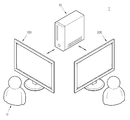
도 1은 본 발명의 실시예에 따른 시스템의 예시도,
도 2는 도 1의 시스템에서, 영상송신장치의 구성 블록도,
도 3은 종래의 경우에, 영상수신장치에 표시되는 영상송신장치의 사용자의 이미지 및 코멘트의 표시 모습을 간략히 나타낸 예시도,
도 4는 도 1의 시스템에서, 영상송신장치 및 영상수신장치 사이의 신호 전송 관계를 나타내는 예시도,
도 5는 도 1의 영상송신장치에서 감지된 사용자의 이미지 상에 태그를 부여하는 실시예를 나타내는 예시도,
도 6은 도 1의 영상송신장치에서 이미지를 조정하는 결과를 나타내는 예시도,
도 7은 도 1의 영상송신장치에서 사용자를 촬영한 이미지 내의 n번째 프레임 및 n+1번째 프레임 사이의 특정 태그의 변화를 나타내는 예시도,
도 8은 도 1의 영상송신장치에서 사용자를 촬영한 이미지 내의 n번째 프레임 및 n+1번째 프레임 사이에서 사용자의 자세 변화를 나타내는 예시도,
도 9는 도 1의 영상수신장치에 표시되는 화상통신 영상의 구현 모습을 간략히 나타낸 예시도,
도 10은 도 1의 영상송신장치에 표시되는 화상통신 영상의 구현 모습을 간략히 나타낸 예시도,
도 11은 도 2의 이미지 제공 서버가 제공하는 이미지를 선택 가능하게 마련된 유아이 영상의 예시도,
도 12는 본 발명의 제2실시예에 따른 시스템의 예시도,
도 13은 도 12의 시스템에서 영상송신장치의 구성 블록도이다.1 is an exemplary diagram of a system according to an embodiment of the present invention;
2 is a block diagram showing a configuration of an image transmission apparatus in the system of FIG. 1;
3 is an exemplary view briefly showing a display state of a user's image and comments of an image transmission device displayed on an image receiving device in a conventional case;
4 is an exemplary diagram showing a signal transmission relationship between an image transmitting device and an image receiving device in the system of FIG. 1;
FIG. 5 is an exemplary view showing an embodiment of attaching a tag on an image of a user detected by the image transmission device of FIG. 1;
6 is an exemplary view showing a result of adjusting an image in the image transmission apparatus of FIG. 1;
FIG. 7 is an exemplary view showing a change in a specific tag between an nth frame and an n+1th frame in an image photographed by a user in the image transmission device of FIG. 1;
8 is an exemplary view showing a change in a user's posture between an n-th frame and an n+1-th frame in an image photographed by the image transmission device of FIG. 1;
9 is an exemplary view schematically showing an implementation of an image communication image displayed on the image receiving device of FIG. 1;
FIG. 10 is an exemplary view schematically showing an implementation of an image communication image displayed on the image transmission device of FIG. 1;
FIG. 11 is an exemplary diagram of an image provided to allow selection of an image provided by the image providing server of FIG. 2;
12 is an exemplary diagram of a system according to a second embodiment of the present invention;
13 is a block diagram showing the configuration of an image transmission apparatus in the system of FIG. 12.
이하에서는 첨부도면을 참조하여 본 발명에 대해 상세히 설명한다. 이하 실시예에서는 본 발명의 사상과 직접적인 관련이 있는 구성들에 관해서만 설명하며, 그 외의 구성에 관해서는 설명을 생략한다. 그러나, 본 발명의 사상이 적용된 장치 또는 시스템을 구현함에 있어서, 이와 같이 설명이 생략된 구성이 불필요함을 의미하는 것이 아님을 밝힌다.Hereinafter, the present invention will be described in detail with reference to the accompanying drawings. In the following embodiments, only configurations directly related to the spirit of the present invention will be described, and descriptions of other configurations will be omitted. However, in implementing an apparatus or system to which the spirit of the present invention is applied, it should be noted that this does not mean that a configuration omitted from the description is unnecessary.
도 1은 본 발명의 실시예에 따른 시스템(1)의 예시도이다.1 is an exemplary diagram of a
도 1에 도시된 바와 같이, 본 실시예의 시스템(1)은 네트워크를 통해 서버(10)에 통신 가능하게 접속된 클라이언트로서의 영상송신장치(100) 및 영상수신장치(200)를 포함한다. 시스템(1)은 영상송신장치(100) 및 영상수신장치(200) 사이의 화상통신이 제공되는 단위이다.As shown in Fig. 1, the
여기서, 영상송신장치(100) 및 영상수신장치(200)라는 각각의 명칭은 다음과 같이 부여된 것이다. 화상통신이 구현되는 환경 내에서, 데이터를 송신하는 측을 영상송신장치(100)로, 해당 데이터를 수신하는 측을 영상수신장치(200)로 각각 지칭한다. 따라서, 영상송신장치(100) 및 영상수신장치(200)는 화상통신 과정에서 그 역할을 서로 교환하여 수행할 수도 있다.Here, the names of the
또한, 본 실시예에서 영상송신장치(100) 및 영상수신장치(200)는 TV로 구현된 디스플레이장치인 것으로 설명하나, 본 발명의 사상이 이에 한정되지 않는다. 영상송신장치(100) 및 영상수신장치(200)는 사용자에게 화상통신 환경을 제공할 수 있는 다양한 방식의 디스플레이장치, 예를 들면 컴퓨터본체 및 이에 로컬 접속된 모니터에 의한 컴퓨터 세트, 휴대용 멀티미디어 플레이어, 태블릿 컴퓨터, 모바일 폰 등으로 구현될 수 있다.Further, in the present embodiment, the
본 실시예에서는 시스템(1) 내의 하나의 영상송신장치(100) 및 하나의 영상수신장치(200) 사이의 화상통신에 관하여 설명한다. 그러나, 이는 실시예를 간결하고 명확히 설명하기 위하여 편의상 적용한 것으로서, 시스템(1) 내에서는 1대 1의 화상통신 뿐만 아니라 1대 n, n대 n의 화상통신도 가능하다. 즉, 하나의 영상송신장치(100)로부터 송신되는 데이터는 복수의 영상수신장치(200)가 수신하여 처리할 수 있으며, 하나의 영상수신장치(200)는 복수의 영상송신장치(100) 각각으로부터 수신되는 데이터를 처리할 수도 있다. 다만, 1대 n 및 n대 n의 화상통신의 경우는 본 실시예를 응용 및 확장함으로써 달성될 수 있는 사항인 바, 이에 관한 자세한 설명은 생략한다.In this embodiment, image communication between one
시스템(1) 내에서 수행되는 화상통신은 서버(10)에 각기 접속한 영상송신장치(100) 및 영상수신장치(200) 사이에서, 서버(10)를 경유하여 수행된다. 그러나, 화상통신이 반드시 서버(10)을 경유한 방식만이 있는 것은 아니며, 서버(10)를 경유하지 않고 영상송신장치(100) 및 영상수신장치(200) 사이에 다이렉트로 통신 접속한 상태에서 화상통신이 수행되는 방식도 가능하다.The image communication performed in the
영상송신장치(100) 및 영상수신장치(200)가 화상통신을 수행할 때에 영상송신장치(100)가 영상수신장치(200)에 송신하는 데이터는, 사용자(U)의 이미지(image) 데이터 및 사용자(U)의 코멘트(comment) 데이터의 두 가지가 있다. 본 실시예에서의 사용자(U)는 특별한 언급이 없는 한 영상송신장치(100)의 사용자를 지칭하는 것임을 밝힌다.When the
사용자(U)의 이미지 데이터는 영상송신장치(100)의 카메라(미도시)에 의해 사용자(U)를 촬영함으로써 생성된다. 화상통화에서 사용자(U)의 이미지 데이터는 기본적으로 사용자(U)의 얼굴의 이미지를 포함한다.The image data of the user U is generated by photographing the user U by a camera (not shown) of the
사용자(U)의 코멘트 데이터는 사용자의 의사에 따른 단어 또는 문장으로서, 영상송신장치(100)에 입력된 사용자의 발화에 따른 음성신호가 텍스트로 변환됨으로써 생성되거나, 또는 사용자가 키보드(미도시)와 같은 문자입력 디바이스를 통해 직접 영상송신장치(100)에 텍스트를 입력함으로써 생성된다.The comment data of the user U is a word or sentence according to the user's intention, and is generated by converting an audio signal according to the user's utterance input to the
영상수신장치(200)는 영상송신장치(100)로부터 수신되는 사용자(U)의 이미지 데이터 및 코멘트 데이터를 처리하여 표시한다. 영상수신장치(200) 또한 영상송신장치(100)에 대해 상기와 같은 동작의 역할을 바꾸어 수행함으로써, 최종적으로 영상송신장치(100) 및 영상수신장치(200) 사이의 화상통신이 구현된다.The
이하, 영상송신장치(100) 및 영상수신장치(200)의 구체적인 구성에 관해 도 2를 참조하여 설명한다.Hereinafter, a detailed configuration of the
도 2는 영상송신장치(100)의 구성 블록도이다.2 is a block diagram showing the configuration of the
도 2에 도시된 바와 같이, 영상송신장치(100)는 서버(10)를 비롯한 영상송신장치(100) 이외의 타 장치들과 다양한 신호/정보/데이터를 송수신하기 위한 통신 인터페이스(110)와, 통신 인터페이스(110)를 통해 수신되는 데이터를 처리하는 프로세서(120)와, 프로세서(120)에 의해 처리되는 데이터의 영상을 표시하는 디스플레이(130)와, 사용자를 비롯한 영상송신장치(100)의 외부 환경을 촬영하는 카메라(140)와, 사용자의 음성을 비롯한 영상송신장치(100) 외부의 다양한 소리를 입력받는 마이크로폰(150)과, 데이터/정보가 저장되는 스토리지(storage)(170)와, 영상송신장치(100)의 제반 구성의 동작을 제어하는 컨트롤러(160)를 포함한다.As shown in FIG. 2, the
여기서, 서버(10)는 화상통신을 위해 영상송신장치(100) 및 영상수신장치(200) 사이를 통신 접속시키는 통신 서버를 지칭한다. 만일 영상송신장치(100) 및 영상수신장치(200) 사이에 다이렉트로 화상통신이 수행되는 경우에, 서버(10)를 통한 중계는 수행되지 않을 수 있다.Here, the
통신 인터페이스(110)는 서버(10), 또는 서버(10)를 경유하여 영상수신장치(200)와 양방향 통신 가능하게 접속한다. 통신 인터페이스(110)는 컨트롤러(160)로부터 전달받은 데이터를 영상수신장치(200)로 전달하거나, 또는 영상수신장치(200)로부터 수신되는 데이터를 컨트롤러(160)에 전달할 수 있다. 영상송신장치(100) 및 영상수신장치(200) 사이에 화상통신이 구현되어 있는 경우에, 통신 인터페이스(110)는 영상송신장치(100)의 사용자 관련 데이터를 영상수신장치(200)에 전달하며, 또한 영상수신장치(200)로부터 수신되는 영상수신장치(200)의 사용자 관련 데이터를 컨트롤러(160)에 전달한다. 이 과정에서, 서버(10)가 중계 역할을 수행할 수 있으며, 또는 통신 프로토콜에 따라서 통신 인터페이스(110)가 영상수신장치(200)에 다이렉트로 접속될 수도 있다.The
통신 인터페이스(110)는 서버(10) 또는 영상수신장치(200) 이외에도 다양한 형식의 외부장치/주변장치와 접속할 수 있으며, 각 장치 별 접속포트 또는 접속모듈의 집합체에 의해 구현될 수 있다. 여기서, 통신 인터페이스(110)는 영상송신장치(100)에 내장된 형태일 수 있으며, 설계 방식에 따라서 통신 인터페이스(110)의 구성 전체 또는 일부의 구성이 애드온(add-on)/동글(dongle) 형태로 영상송신장치(100)에 추가 설치되는 형식도 가능하다.In addition to the
통신 인터페이스(110)는 접속된 각 장치 별로 지정된 프로토콜에 따라서 데이터의 송수신이 이루어지는 바, 접속된 각 장치에 대해 개별적인 접속 프로토콜 기반으로 데이터를 송수신할 수 있다. 예를 들면, 통신 인터페이스(110)는 RF(radio frequency)신호, 컴포지트(composite)/컴포넌트(component) 비디오, 슈퍼 비디오(super video), SCART, HDMI(high definition multimedia interface), 디스플레이포트(DisplayPort), UDI(unified display interface), 또는 와이어리스(wireless) HD 등 다양한 규격을 기반으로 신호의 송수신이 가능하다.Since the
프로세서(120)는 데이터에 대해 다양한 프로세스를 반영하여 처리한다. 프로세서(120)는 이러한 프로세스가 반영된 데이터를 통신 인터페이스(110)에 전달함으로써, 해당 데이터가 영상수신장치(200)에 전달되도록 한다.The
프로세서(120)가 수행하는 프로세스의 종류는 한정되지 않는다. 영상 컨텐츠 데이터의 예를 들면, 프로세스는 인코딩(encoding), 디코딩(decoding), 디인터레이싱(de-interlacing), 프레임 리프레시 레이트(frame refresh rate) 변환, 영상 화질 개선을 위한 노이즈 감소(noise reduction), 디테일 강화(detail enhancement) 등을 포함할 수 있다. 또는, 음성 데이터의 예를 들면, 프로세스는 음성신호에 대한 필터링, 증폭, 볼륨조정 등을 포함할 수 있다.The type of process performed by the
프로세서(120)는 이러한 각 프로세스를 독자적으로 수행할 수 있는 개별적 칩셋이나, 또는 여러 기능을 통합시킨 SOC(system-on-chip)가 장착된 영상처리보드로 구현된다.The
디스플레이(130)는 프로세서(120)로부터 출력되는 영상 데이터에 기초하여 영상을 표시한다. 디스플레이(130)는 액정(liquid crystal), 플라즈마(plasma), 발광 다이오드(light-emitting diode), 유기발광 다이오드(organic light-emitting diode), 면전도 전자총(surface-conduction electron-emitter), 탄소 나노 튜브(carbon nano-tube), 나노 크리스탈(nano-crystal) 등의 다양한 디스플레이 방식으로 구현될 수 있다.The
디스플레이(130)는 그 구현 방식에 따라서 부가적 구성을 포함할 수 있다. 예를 들면, 액정 방식의 패널이 적용되는 경우에, 디스플레이(130)는 액정 디스플레이 패널(미도시)에 광을 공급하는 백라이트유닛(미도시)과, 패널을 구동시키는 패널구동기판(미도시)을 포함한다.The
카메라(140)는 영상송신장치(100)의 외부 환경에 대한 대한 동영상/정지영상을 촬영/촬상한다. 카메라(140)는 영상송신장치(100)를 기준으로 소정 방향, 예를 들면 영상송신장치(100)의 전방에 위치한 사용자와 같은 다양한 피사체를 촬영 또는 촬상한다. 카메라(140)는 사용자를 촬영함으로써 사용자의 이미지를 프레임 단위로 포함하는 동영상 데이터를 생성하며, 생성한 데이터를 컨트롤러(160)에 전달한다.The
스토리지(170)는 컨트롤러(160)의 제어에 따라서 다양한 데이터가 저장된다. 스토리지(170)는 시스템 전원의 제공 유무와 무관하게 데이터를 보존할 수 있도록, 플래시메모리(flash-memory), 하드디스크 드라이브(hard-disc drive)와 같은 비휘발성 메모리로 구현된다. 스토리지(170)는 컨트롤러(160)에 의해 억세스(access)됨으로써, 기 저장된 데이터의 독취, 기록, 수정, 삭제, 갱신 등이 수행된다.The
컨트롤러(160)는 이러한 구조 하에서, 카메라(140), 마이크로폰(150), 통신 인터페이스(110) 등에 수신되는 다양한 종류의 데이터의 처리 동작을 제어한다. 화상통화의 예를 들면, 컨트롤러(160)는 카메라(140)로부터 전달되는 사용자의 이미지 데이터 및 마이크로폰(150)으로부터 전달되는 사용자의 음성에 대응하는 코멘트 데이터가 영상수신장치(200)에 전송되도록 제어한다. 또한, 컨트롤러(160)는 영상수신장치(200)의 사용자의 이미지 데이터 및 코멘트 데이터가 통신 인터페이스(110)에 수신되면, 이러한 데이터가 디스플레이(130)에 표시되도록 프로세서(120)를 제어한다.The
여기서, 마이크로폰(150)에 입력된 사용자의 음성이 텍스트로 변환되는 방법은 여러 가지 경우가 가능하다. 하나는, 마이크로폰(150)으로부터의 음성신호가 프로세서(120)에 의해 텍스트 변환 처리가 될 수 있다. 다른 하나는, 마이크로폰(150)으로부터의 음성신호가 통신 인터페이스(110)를 통해 STT(speech-to-text) 서버(미도시)에 전달되고, STT 서버(미도시)에서 해당 음성신호가 텍스트로 변환될 수도 있다.Here, a method of converting the user's voice input into the
한편, 영상송신장치(100) 및 영상수신장치(200)는 통신 중계를 위한 서버(10) 이외에, 기 설정된 그래픽 이미지를 제공하는 이미지 제공 서버(20)와 통신할 수 있다. 이에 관한 자세한 내용은 후술한다.Meanwhile, the
영상수신장치(200) 또한 영상송신장치(100)의 상기 설명한 구성에 준하는 구성을 포함한다. 영상수신장치(200)의 구체적인 구성에 관해서는 영상송신장치(100)의 내용을 응용할 수 있는 바, 자세한 설명을 생략한다.The
도 3은 종래의 경우에 영상수신장치(200)에 표시되는 영상송신장치(100)의 사용자의 이미지 및 코멘트의 표시 모습을 간략히 나타낸 예시도이다.FIG. 3 is an exemplary view briefly showing a display of a user's image and comments of the
도 3에 도시된 바와 같이, 종래의 화상통신의 경우에 영상송신장치(100)는 사용자의 이미지를 촬영한 이미지 데이터 및 사용자의 코멘트 데이터를 실시간으로 영상수신장치(200)에 전송한다.As shown in FIG. 3, in the case of conventional image communication, the
이에, 영상수신장치(200)는 소정의 컨텐츠 영상(310)과 함께, 영상송신장치(100)로부터 수신된 사용자의 이미지(320)와, 코멘트의 텍스트(330)를 표시한다. 본 도면에서는 영상송신장치(100)의 사용자의 이미지(320) 및 텍스트(330)만이 표시되는 것으로 나타내고 있으나, 영상수신장치(200)의 사용자의 이미지 및 텍스트가 추가적으로 표시될 수도 있다.Accordingly, the
영상송신장치(100)는 사용자의 이미지 데이터를 h.264 등과 같은 코덱(codec)을 사용하여 인코딩하고, 이 인코딩된 데이터를 영상수신장치(200)에 전송한다. 그리고, 영상수신장치(200)는 영상송신장치(100)로부터 수신된 인코딩된 데이터를 디코딩 처리한다.The
종래의 경우에 영상송신장치(100)가 사용자의 이미지 데이터를 보내는 형태는, 640x480과 같이 기 설정된 해상도의 사각형 형태의 프레임 단위로 전송한다. 따라서, 영상수신장치(200)에 표시되는 사용자의 이미지(320)는 사용자의 모습(321)과 사용자의 뒤쪽 배경(322)을 함께 포함하게 된다.In the conventional case, the
그런데, 이와 같은 화상통신방법에 따르면 다음과 같은 문제들이 발생할 수도 있다.However, according to such a video communication method, the following problems may occur.
우선, 영상수신장치(200)는 영상송신장치(100)로부터 수신되는 이미지 데이터가 특정 코덱에 의해 인코딩되어 있으므로, 이를 표시하기 위해서는 디코딩 과정이 필요하다. 그런데, 코덱의 압축률이 높은 경우나, 영상수신장치(200)가 다수의 영상송신장치(100)로부터 각기 이미지 데이터를 수신하는 경우에는, 영상수신장치(200)의 시스템 자원에 대한 요구 레벨이 높아지게 된다. 만일 영상수신장치(200)의 하드웨어/소프트웨어 사양이 이러한 요구 레벨을 충족시키지 못하면, 화상통화의 구현 품질이 떨어지게 된다.First, since the image data received from the
설사 영상수신장치(200)의 사양이 요구 레벨을 충족시킨다고 하더라도, 영상수신장치(200)가 소정의 시간 동안에 화상통화만을 수행한다고 한정할 수 없다. 영상수신장치(200)는 기본적으로 멀티스레딩(multi-threading) 또는 멀티태스킹(multi-tasking)을 지원하는 바, 예를 들면 도 3에 나타난 바와 같이 컨텐츠 영상(310)과 화상통신 영상(320, 330)을 함께 표시할 수 있다. 이 경우에, 영상수신장치(200)는 컨텐츠 영상(310)을 표시하기 위한 프로세스와 화상통신 영상(320, 330)을 표시하기 위한 프로세스를 병행하여 처리하여야 하므로, 멀티스레딩/멀티태스킹의 수행 상태에 따라서 어느 시점에서의 영상수신장치(200)의 사양이 요구 레벨을 충족시키지 못할 수도 있다.Even if the specification of the
두 번째로, 데이터가 영상송신장치(100)로부터 영상수신장치(200)로 전송되는 과정에서, 데이터의 용량에 따라서는 데이터의 전송 대역폭이 많이 소요될 수 있다. 이는, 데이터의 전송 대역폭이 많이 소요되는 경우에, 영상송신장치(100) 및 영상수신장치(200) 사이의 통신 환경이 나쁘면 데이터의 전송에 악영향이 미치게 된다.Second, in a process in which data is transmitted from the
예를 들면, 영상송신장치(100)가 H.264 코덱을 사용하여 인코딩된 30fps(frame per second)의 640x480 해상도의 화면을 가진 이미지 데이터를, 프레임 당 3kbyte로 전송할 수 있다. 이러한 이미지 데이터가 정상적으로 영상수신장치(200)에 전송되기 위해서는 약 1.3Mbps의 대역폭이 필요하다. 만일, 통신 환경이 이러한 조건을 충족시키지 못한다면, 영상수신장치(200)에서 이미지 데이터의 일부 프레임이 손실되어 표시되는 프레임 드롭(frame drop) 현상이 발생하게 된다.For example, the
세 번째로, 영상수신장치(200)에 표시되는 사용자의 이미지(320)는 사용자의 얼굴 뿐만 아니라 사용자 뒤의 배경(322)도 포함한다. 따라서, 영상송신장치(100)의 사용자가 있는 현재 환경이 영상수신장치(200)의 사용자에게 그대로 노출되는 바, 프라이버시(privacy) 측면에서 문제점이 발생할 수 있다. 또한, 이미지(320)는 사용자의 상반신을 포함할 수도 있으므로, 해당 사용자가 정상적인 복장을 취하지 않은 경우에는 그 모습이 그대로 영상수신장치(200)의 사용자에게 보일 수 있다.Third, the user's
이러한 문제점들을 고려하여, 본 실시예에 따르면 다음과 같은 방법이 제안된다.In consideration of these problems, the following method is proposed according to this embodiment.
도 4는 본 실시예에 따른 영상송신장치(100) 및 영상수신장치(200) 사이의 신호 전송 관계를 나타내는 예시도이다.4 is an exemplary diagram showing a signal transmission relationship between the
도 4에 도시된 바와 같이, 영상송신장치(100)는 영상수신장치(200)와의 화상통화를 개시하는 시점에서(S100), 사용자의 얼굴에 대한 감지, 즉 사용자의 얼굴에 대한 촬영을 개시한다(S110). 영상송신장치(100)는 촬영된 사용자의 얼굴의 윤곽을 따라서 설정된 복수의 위치에 각기 대응하는 복수의 태그(tag)의 설정 정보를 영상수신장치(200)에 전송한다(S120).As shown in FIG. 4, the
영상수신장치(200)는 영상송신장치(100)의 사용자의 얼굴을 나타내는 이미지를 표시한다(S130).The
여기서, 영상수신장치(200)가 표시하는 영상송신장치(100)의 사용자의 얼굴을 나타내는 이미지는 다음과 같은 다양한 방법에 따라서 마련될 수 있다.Here, the image representing the user's face of the
한 가지 방법으로서, 영상송신장치(100)는 사용자에 대응하는 그래픽 이미지를 영상수신장치(200)에 전송하며, 영상수신장치(200)는 이 수신된 그래픽 이미지를 영상송신장치(100)의 사용자의 얼굴을 나타내는 이미지로서 화상통신 동안에 표시한다. 이러한 그래픽 이미지는 영상송신장치(100)가 영상송신장치(100)의 스토리지(170, 도 2 참조)에 기 저장되어 있는 것을 선택하거나, 또는 이미지 제공 서버(20, 도 2 참조)로부터 제공받음으로써 마련될 수 있다.As one method, the
영상송신장치(100)는 사용자의 선택에 따라서 어느 한 그래픽 이미지를 선택하거나, 또는 사전에 지정된 다양한 조건에 따라서 자동으로 어느 한 그래픽 이미지를 선택할 수도 있다.The
스토리지(170) 또는 이미지 제공 서버(20)에 저장되어 있는 그래픽 이미지는 사람의 얼굴 형상을 나타내는 이미지로서 다양한 형태를 가질 수 있는 바, 그 구체적인 형태가 한정되지 않는다.The graphic image stored in the
다른 한 가지 방법으로서, 영상수신장치(200)는 영상송신장치(100)의 사용자에 대응하는 그래픽 이미지를 영상송신장치(100)로부터 수신하지 않고, 화상통신 개시 시점에서 자체적으로 저장된 그래픽 이미지를 사용하거나, 또는 영상수신장치(200)가 이미지 제공 서버(20)로부터 제공받을 수도 있다.As another method, the
다른 한 가지 방법으로서, 영상수신장치(200)는 영상송신장치(100)로부터 수신되는 복수의 태그의 설정 정보에 기초하여 사용자의 이미지를 생성할 수도 있다. S120 단계에서 수신되는 설정 정보는 영상송신장치(100)의 사용자의 얼굴 윤곽에 따른 각 위치에 복수의 태그를 대응시키기 위한 정보로서, 각각의 태그 사이의 상대적인 위치 관계 및 각 태그 사이의 비율을 나타내는 정보를 포함한다. 따라서, 영상수신장치(200)는 이러한 설정 정보에 따라서 개략적인 사용자의 모습을 형상화시켜 나타낼 수 있다.As another method, the
그리고, 영상수신장치(200)에 영상송신장치(100)의 사용자의 이미지가 표시되고 화상통화가 진행되는 동안, 영상송신장치(100)는 연속적으로 사용자를 촬영한다(S140). 그리고, 영상송신장치(100)는 사용자의 얼굴의 위치변화에 대응하는 각 태그의 변화값을 영상수신장치(200)에 실시간으로 전송한다(S150).Then, while the image of the user of the
이에, 영상수신장치(200)는 영상송신장치(100)로부터 수신되는 각 태그의 변화값에 따라서, 기 표시된 렌더링 이미지의 표시 상태를 변화시킨다(S160). 예를 들면, 영상수신장치(200)는 태그의 변화값에 따라서 렌더링 이미지 상의 해당 태그 위치를 조정할 수 있다.Accordingly, the
각 태그의 변화값은, 프레임 단위로 각 태그의 이동방향 및 이동량의 정보를 포함한다.The change value of each tag includes information on the movement direction and movement amount of each tag in a frame unit.
이로써, 사용자의 이미지 데이터를 영상송신장치(100)로부터 영상수신장치(200)로 전송함에 있어서, 소요되는 전송 대역폭을 줄일 수 있다. 또한, 영상수신장치(200)에서도 최초 이미지를 표시한 이후에, 화상통신이 진행되는 동안에는 태그 정보의 변화값에 따라서 이미지 상의 각 태그 위치를 조정하기만 하면 되므로, 종래의 프레임 디코딩 방법에 비해 시스템 자원을 절약할 수 있다. 또한, 영상수신장치(200)에서 사용자의 배경을 배제하여 표시할 수 있는 바, 프라이버시 측면에서도 유리하다.Accordingly, in transmitting the image data of the user from the
이하, 영상송신장치(100)에서 사용자의 이미지에 대해 태그(410) 정보를 부여하는 방법에 관해 도 5를 참조하여 설명한다.Hereinafter, a method of assigning
도 5는 영상송신장치(100)에서 감지된 사용자의 이미지 상에 태그(410)를 부여하는 실시예를 나타내는 예시도이다.5 is an exemplary diagram illustrating an embodiment of attaching a
도 5에 도시된 바와 같이, 영상송신장치(100)는 사용자의 얼굴을 포함하는 이미지(400)를 취득하면, 이미지(400) 상에서 사용자의 얼굴을 판단한다.As shown in FIG. 5, when the
영상송신장치(100)는 사용자의 얼굴 내에서, 얼굴을 구성하는 윤곽선을 판별한다. 사람의 얼굴은 기본적으로 눈, 눈썹, 코, 입술, 귀, 얼굴 외형선 등으로 구성되는 바, 얼굴을 구성하는 윤곽선은 이러한 구성요소들의 윤곽선을 의미한다.The
영상송신장치(100)는 얼굴을 구성하는 윤곽선 상의 기 설정된 복수의 위치에 각기 태그(410)를 지정한다. 즉, 태그(410)는 윤곽선 상에서 특정 위치 또는 영역을 나타내는 일종의 플래그(flag)이다.The
여기서, 윤곽선 상의 소정 위치의 태그(410)는 도면에서 포인트(point)로 나타나 있으며, 도면 상에서는 실제 장치에서 구현되는 예시보다 적은 수의 포인트만을 표시한 것임을 밝힌다. 윤곽선 상에서 태그(410)가 지정되는 위치는 다양한 방법으로 결정될 수 있는 바, 예를 들면 눈의 양쪽 끝, 눈동자에서 검은자, 코의 끝, 콧날, 콧구멍, 입술의 좌우 끝, 인중, 귀의 위쪽 끝, 귓불 끝, 얼굴의 외곽선 등의 위치가 가능하다.Here, it is revealed that the
또한, 본 실시예에서는 태그(410)가 포인트인 것으로 나타나 있으나, 태그(410)는 소정 개수의 픽셀을 포함하는 영역일 수도 있다.Further, in the present embodiment, the
일반적인 한 사람의 얼굴의 경우에, 태그(410)의 수는 60여개 내지 80여개 범위 내에서 결정된다. 이 정도의 수는, 사람의 얼굴의 윤곽 및 얼굴 표정의 변화를 개략적으로 구현할 수 있는 수치범위이다.In the case of a typical person's face, the number of
여기서, 이미지(400) 상에 각 태그(410)가 지정됨에 따라서 각 태그(410) 사이의 거리 및 방향 등의 관계가 결정된다. 태그(410)는 사용자의 얼굴의 윤곽선 상에 지정되므로, 태그(410) 사이의 관계가 결정되면 얼굴 윤곽에 관한 상대적인 위치, 얼굴 특정 부위에 대한 비율, 얼굴 특정 부위들 사이의 상대적 관계가 결정된다. 즉, 태그(410) 사이의 거리 및 방향 등의 관계에 따라서 사용자의 얼굴을 구현할 수 있다.Here, as each
여기서, 태그(410)의 수는 영상송신장치(100)에 기본적으로 지정된 디폴트 값이 결정될 수 있고, 또는 영상송신장치(100)에서 사용자가 조정하도록 마련될 수도 있다. 태그(410)의 수가 많다는 것은 사용자의 표정 또는 위치 변화를 보다 세밀하게 표현할 수 있는 것에 비해, 처리 및 전송할 정보량이 많아진다. 반면, 태그(410)의 수가 적다는 것은 처리 및 전송할 정보량이 적어지는 것에 비해, 사용자의 표정 변화를 미세하게 표현하는 것이 보다 불리해진다.Here, the number of
영상송신장치(100)는 이와 같은 복수의 태그(410) 정보와 함께, 사용자의 이미지(400)의 데이터를 영상수신장치(200)에 전송한다. 영상수신장치(200)는 수신된 이미지(400) 및 태그(410) 정보에 따라서, 새로운 이미지를 렌더링하여 표시한다.The
여기서, 앞서 영상송신장치(100)가 태그(410)를 부여하기 위해 사용한 이미지(400)는 카메라(140)에 의해 촬영된 일 프레임의 이미지이며, 영상수신장치(200)가 태그(410) 정보에 기초하여 렌더링하는 렌더링 이미지는 CG(computer graphic)에 의한 벡터(vector) 이미지이다.Here, the
영상수신장치(200)에서 표시되는 사용자 이미지의 렌더링은 영상수신장치(200)에서 수행할 수 있지만, 영상송신장치(100)가 사용자 이미지를 렌더링하여 영상수신장치(200)에 제공할 수도 있다.The rendering of the user image displayed by the
또는, 영상송신장치(100)는 촬영한 일 프레임의 이미지(400)가 아닌, 서버(10) 등으로부터 별도로 제공되는 CG 이미지를 영상수신장치(200)에 전송할 수도 있다. 영상수신장치(200)는 영상송신장치(100)로부터 수신된 CG 이미지를 표시하되, 각 태그(410) 정보를 해당 CG 이미지의 얼굴 상에 대응하게 매칭시켜 처리한다.Alternatively, the
또는, 영상수신장치(200)는 영상송신장치(100)로부터 태그(410) 정보만 수신하고, 서버(10)로부터 CG 이미지를 직접 수신하여 사용할 수도 있다.Alternatively, the
한편, 영상송신장치(100)가 사용자 이미지를 영상수신장치(200)에 전송할 때에, 영상송신장치(100)는 이미지를 사용자가 조정하도록 제공할 수도 있다.Meanwhile, when the
도 6은 이미지를 조정하는 결과를 나타내는 예시도이다.6 is an exemplary diagram showing a result of adjusting an image.
도 6에 도시된 바와 같이, 이미지(510)를 사용자가 조정할 수 있는 방향은 deformation 및 simplicity의 2가지 방향이 있다. As shown in FIG. 6, there are two directions in which the
deformation은 이미지(510)의 디테일 및 태그 수는 그대로 유지하되, 태그 사이의 거리 또는 비율을 조정하는 방법이다. 이미지(520)는 이미지(510)의 상하 비율을 그대로 두되, 좌우 비율을 소정 수치만큼 늘린 결과물이다.Deformation is a method of maintaining the details of the
simplicity는 이미지(510)의 디테일을 줄이고, 태그 수를 줄이는 방법이다. 이미지(530)는 이미지(510)의 눈, 코, 입술 등의 윤곽을 보다 간단히 하여 형성된 바, 결과적으로 이미지(510)에 비해 태그 수가 많을 필요가 없다.The simplicity is a method of reducing the detail of the
영상송신장치(100)는 이미지(510)를 기준으로 deformation 또는 simplicity의 방법이 적용된 복수의 이미지(520, 530) 세트를 사용자가 선택 가능하게 제공하는 UI 영상을 표시할 수 있다.The
또한, 상기한 구성은 영상수신장치(200)에도 적용될 수 있다. 즉, 영상수신장치(200)는 이미지(510)가 생성되면, 해당 이미지(510)를 조정 가능한 환경을 영상수신장치(200)의 사용자에게 제공할 수도 있다.In addition, the above-described configuration can be applied to the
한편, 이미지의 디테일과 관련하여, 영상수신장치(200)는 영상송신장치(100)가 태그의 수를 지정할 수 있는 것과 유사하게, 영상송신장치(100)로부터 수신하는 태그의 수를 사용자가 지정하도록 제공하거나 또는 기 설정된 조건에 따라서 자동으로 조정할 수 있다.On the other hand, with respect to the detail of the image, the
자동으로 조정하는 조건에 관해, 영상수신장치(200)는 화상통화에 참여하는 영상송신장치(100)의 수가 많아질수록 처리해야 할 데이터의 양이 늘어난다. 또는, 영상수신장치(200)는 현재 해당 시스템의 처리상태에 따라서, 화상통화 관련 데이터를 처리하기 위한 시스템 자원이 충분하지 않을 수도 있다.Regarding the condition to be automatically adjusted, the amount of data to be processed increases as the number of the
이에, 영상수신장치(200)는 화상통화에 참여하는 영상송신장치(100)의 수가 기 설정된 문턱값을 초과하면, 각 영상송신장치(100)에 대응하는 각각의 사용자의 이미지의 디테일 감소 및 이 각각의 사용자의 이미지에 대해 처리하는 태그 수의 감소 중 적어도 어느 하나를 수행한다.Accordingly, when the number of
또는, 영상수신장치(200)는 컨트롤러(미도시) 또는 프로세서(미도시) 등의 작업 점유율과 같이 현재 소모되고 있는 영상수신장치(200)의 시스템 자원이 많다고 판단하면, 각 영상송신장치(100)로부터의 사용자 이미지 내에서 처리 대상의 태그의 수를 줄이고, 표시하는 이미지의 디테일을 줄일 수 있다.Alternatively, if the
물론, 영상수신장치(200)는 화상통화에 참여하는 영상송신장치(100)의 수가 상기한 문턱값 미만으로 변화하거나 또는 시스템 자원이 충분히 확보된 것으로 판단하면, 처리 대상의 태그의 수 및 이미지의 디테일을 복귀시킬 수 있다.Of course, if the number of
이하, 화상통신이 수행되는 동안에 영상송신장치(100)가 영상수신장치(200)에 전송하는 각 태그(611)의 변화값에 관해 설명한다.Hereinafter, a change value of each
도 7은 영상송신장치(100)에서 사용자를 촬영한 이미지 내의 n번째 프레임(610) 및 n+1번째 프레임(620) 사이의 특정 태그(611)의 변화를 나타내는 예시도이다. 본 도면에서는 하나의 태그(611)에 관해서만 설명하지만, 실제로는 이미지 내의 모든 태그(611)에 대해 동일한 원리가 적용된다.7 is an exemplary view showing a change in a
도 7에 도시된 바와 같이, 영상수신장치(200)에 영상송신장치(100)의 사용자의 렌더링 이미지가 표시된 상태에서 화상통신이 진행됨에 따라서, 영상송신장치(100)는 연속적으로 사용자의 모습을 촬영하고, 프레임 단위로 각 태그(611)의 위치변화를 도출한다.As shown in FIG. 7, as image communication proceeds in a state in which the rendered image of the user of the
태그(611)가 사용자의 왼쪽 눈 바깥쪽의 위치에 지정되어 있는 경우에, n번째 프레임(610)에서 태그(611)의 위치 좌표는 X-Y 2차원 평면 상에서 (x0, y0)라고 한다.When the
여기서, 사용자가 움직이게 되면 태그(611)의 위치 또한 변화한다. n+1번째 프레임(620)에서의 태그(611)의 위치 좌표는 (x0, y0)에서 (x1, y1)으로 변화한다.Here, when the user moves, the position of the
이와 같이 태그(611)의 위치 좌표가 (x0, y0)에서 (x1, y1)으로 변화함에 따라서, n번째 프레임(610)에서 n+1번째 프레임(620)으로 진행하는 동안에 태그(611)의 이동방향 및 이동량, 즉 태그(611)의 변화값이 산출된다. 즉, 2차원의 X-Y 평면 상에서 시작점 및 도착점의 두 좌표가 있으면, 수학적으로 벡터값이 산출될 수 있다.In this way, as the position coordinate of the
여기서, 이동방향의 표현은 다양한 방법이 적용될 수 있는 바, 통상적인 벡터 차원의 표현방식을 사용하거나, 또는 시작점의 좌표 (x0, y0)를 중심으로 하는 360도 각도차원 상의 각도로 나타낼 수도 있다.Here, since various methods can be applied to the expression of the moving direction, a conventional vector-dimensional expression method may be used, or an angle on the 360 degree angular dimension centered on the coordinates (x0, y0) of the starting point may be expressed.
또한, 이동량의 표현은 다양한 방법이 적용될 수 있는 바, 픽셀의 개수를 사용하거나, 기타 길이단위를 사용할 수도 있다.In addition, since various methods can be applied to express the amount of movement, the number of pixels or other length units may be used.
영상송신장치(100)는 이와 같이 산출된 태그(611)의 변화값을 프레임 단위 또는 기 설정된 주기마다 영상수신장치(200)에 전송한다.The
영상수신장치(200)는 영상송신장치(100)로부터 수신되는 태그(611)의 변화값에 기초하여, 기 표시된 이미지의 표시상태를 조정한다. 즉, 영상수신장치(200)는 이미지 내에서 해당 태그(611)의 위치를 수신된 변화값에 대응하게 조정함으로써, 사용자의 표정 또는 위치 변화를 실시간으로 표현할 수 있다.The
여기서, 영상수신장치(200)가 이미지 내에서 태그(611)의 위치를 조정하는 정도는 영상송신장치(100)로부터 수신된 태그(611)의 변화값에 대응하지만, 이 변화값과 수치상으로 반드시 동일할 필요는 없다. 예를 들면, 영상수신장치(200)는 수신된 태그(611)의 변화값과 동일한 값을 이미지의 조정에 반영할 수 있지만, 방향 또는 양에 대한 게인(gain)을 원래의 값에 오프셋(offset)하여 적용할 수도 있다. 이는 영상수신장치(200)가 이미지를 렌더링하는 방식에 따라서 다양한 설계 변경이 가능한 사항이다.Here, the degree to which the
이상 설명한 바에 따르면, 본 실시예에 따르면 영상송신장치(100)가 사용자를 촬영한 전체 이미지 프레임을 전송하는 것이 아닌, 각 프레임 단위의 태그(611)의 변화값만을 전송할 수 있으므로, 종래의 경우에 비해 상대적으로 적은 데이터량으로 사용자의 표정 및 위치 변화를 실시간으로 표시할 수 있다.As described above, according to this embodiment, since the
한편, 설계 방식에 따라서, 영상송신장치(100)는 태그의 변화값 이외에도 추가적인 정보를 영상수신장치(200)에 전송함으로써, 이미지에 반영되도록 할 수도 있다.Meanwhile, according to the design method, the
도 8은 n번째 프레임(630) 및 n+1번째 프레임(640) 사이에서 사용자의 자세 변화를 나타내는 예시도이다.FIG. 8 is an exemplary diagram showing a change in a user's posture between an n-
도 8에 도시된 바와 같이, 사용자가 고개를 한쪽으로 돌리는 경우를 고려한다. 이 경우에, 만일 n번째 프레임(630)에서 사용자가 정면을 보고 있는 상태일 때, n+1번째 프레임(640)에서는 사용자가 한쪽으로 고개를 돌린 상태로 나타난다.As shown in FIG. 8, consider a case where the user turns his head to one side. In this case, if the user is looking at the front in the
사용자의 코를 따라서 축선 S1를 설정하면, 사용자가 고개를 돌리는 동작에 따라서 축선 S1는 소정의 회전중심 S0을 기준으로 회전한다. 여기서, n번째 프레임(630)에서 n+1번째 프레임(640)으로 변화함에 따라서, 축선 S1은 회전중심 S0을 중심으로 각도 R만큼 회전한다.If the axis line S1 is set along the user's nose, the axis line S1 rotates based on a predetermined rotation center S0 according to the motion of the user turning his head. Here, as it changes from the
영상송신장치(100)는 n번째 프레임(630) 및 n+1번째 프레임(640)을 분석하여 각도 R을 산출하며, 영상수신장치(200)는 영상송신장치(100)로부터 수신되는 각도 R에 기초하여 이미지를 조정할 수 있다.The
또는, 영상송신장치(100)는 촬영된 사용자 이미지 내에서의 광원 위치를 나타내는 정보를 도출하여, 이 광원 위치 정보를 영상수신장치(200)에 전송할 수 있다. 영상수신장치(200)는 수신되는 광원 위치 정보에 따라서, 이미지에 쉐이딩(shading) 처리를 할 수도 있다.Alternatively, the
예를 들면, 광원 위치가 사용자의 오른쪽 위에 있다고 하면, 사용자의 얼굴에서 나타나는 음영은 오른쪽 위가 가장 밝으며, 이로부터 멀어질수록 점점 어두워질 것이다. 영상수신장치(200)는 이미지에서 그라데이션(gradation) 처리를 적용함으로써, 이러한 음영 효과를 반영할 수 있다.For example, if the location of the light source is on the upper right of the user, the shadow appearing on the user's face is the brightest at the upper right, and the farther away from it, the darker it will be. The
도 9는 영상수신장치(200)에 표시되는 화상통신 영상의 구현 모습을 간략히 나타낸 예시도이다.9 is an exemplary diagram schematically showing an implementation of an image communication image displayed on the
도 9에 도시된 바와 같이, 앞서 설명한 실시예들에 따라서, 영상수신장치(200)는 소정의 컨텐츠 영상(710)과 함께 화상통신 영상(720)을 표시한다. 화상통신 영상(720)은 영상송신장치(100)의 사용자에 대한 이미지(721) 및 코멘트의 텍스트(722)를 포함한다.As shown in FIG. 9, according to the above-described embodiments, the
영상수신장치(200)는 이미지(721)를 표시함에 있어서, 그 크기, 배치 등을 설계 방식에 따라서 자유로이 지정할 수 있다. 영상수신장치(200)는 화상통신에 참가하는 하나 이상의 영상송신장치(100)의 사용자의 이미지(721)를 표시하며, 또한 영상수신장치(200)의 사용자의 이미지도 추가적으로 표시할 수도 있다.When the
본 도면에서는 컨텐츠 영상(710) 및 화상통신 영상(720)가 상호 오버레이되지 않게 표시되는 것으로 표현하나, 본 발명의 구현 방식은 이에 한정되지 않는다. 예를 들면, 이미지(721) 또는 코멘트(722)가 컨텐츠 영상(710) 위에 적어도 일부가 오버레이되어 표시될 수도 있다.In this drawing, the
도 10은 영상송신장치(100)에 표시되는 화상통신 영상의 구현 모습을 간략히 나타낸 예시도이다.10 is an exemplary diagram briefly showing an implementation of an image communication image displayed on the
도 10에 도시된 바와 같이, 영상송신장치(100)는 소정의 컨텐츠 영상(810)과 함께 화상통신 영상(820)을 표시한다. 편의상 영상송신장치(100)의 사용자를 제1사용자로, 영상수신장치(200)의 사용자를 제2사용자로 지칭할 때, 화상통신 영상(820)은 제2사용자를 나타내는 제2사용자이미지(821)와 함께, 제1사용자를 나타내는 제1사용자이미지(831) 또한 포함한다. 즉, 화상통신 동안에 제1사용자이미지(831)는 영상수신장치(200)에 표시되어 있을 뿐만 아니라, 영상송신장치(100)에도 표시될 수 있다.As shown in FIG. 10, the
영상송신장치(100)는 영상수신장치(200)에 표시되어 있는 제1사용자이미지(831)의 표시 상태를 조정하도록 태그의 위치 변화값을 영상수신장치(200)에 전송한다. 이 때, 영상송신장치(100)는 상기한 태그의 위치 변화값에 기초하여, 자체적으로 표시하고 있는 제1사용자이미지(831)의 표시 상태도 조정한다.The
이로써, 제1사용자이미지(831)가 영상송신장치(100) 및 영상수신장치(200) 각각에 표시되어 있을 때에, 제1사용자의 표정 또는 자세의 변화에 대응하여 각각의 제1사용자이미지(831)의 모습이 변화한다.Accordingly, when the
도 11은 이미지 제공 서버(20)가 제공하는 이미지(910)를 선택 가능하게 마련된 유아이 영상(900)의 예시도이다.FIG. 11 is an exemplary diagram of an
도 11에 도시된 바와 같이, 영상송신장치(100) 또는 영상수신장치(200)는 이미지 제공 서버(20, 도 2 참조)에 접속함으로써 이미지 제공 서버(20)로부터 화상통신 시에 사용자의 이미지로 사용하기 위한 다양한 이미지(910)를 제공받을 수 있다. 이를 위하여 이미지 제공 서버(20)는 사람의 얼굴을 형상화한 이미지(910)를 선택 가능하게 마련된 유아이 영상(900)을 제공한다. 영상송신장치(100) 또는 영상수신장치(200)의 사용자들은 유아이 영상(900)을 통해 어느 하나의 이미지(910)를 선택함으로써, 선택한 이미지(910)를 영상송신장치(100)의 사용자의 이미지 또는 영상수신장치(200)의 사용자의 이미지로 사용할 수 있다.As shown in FIG. 11, the
영상송신장치(100)는 화상통신을 개시할 때에 이미지 제공 서버(20)로부터 이미지(910)를 선택하여 영상수신장치(200)에 전달하거나, 사전에 이미지 제공 서버(20)로부터 이미지(910)를 선택 및 저장한 이후에 화상통신 개시 시에 영상수신장치(200)에 전달할 수 있다. 또는, 영상송신장치(100)는 영상수신장치(200)가 이미지 제공 서버(20)로부터 이미지를 선택하도록 영상수신장치(200)에 통지할 수도 있다.The
이상 설명한 바와 같이, 본 실시예에 따른 영상송신장치(100)는 화상통신이 수행되는 동안에 카메라(140)에 의한 사용자의 촬영영상로부터 사용자의 얼굴의 변화에 대응하는 변화 정보를 생성하며, 해당 사용자를 나타내는 사용자이미지가 영상수신장치(200)에 표시될 때에 이 사용자이미지에서 사용자의 얼굴이 변화되도록 해당 변화 정보를 영상수신장치(200)에 전송한다.As described above, the
영상송신장치(100)는 화상통신을 개시하는 시점에서, 사용자의 얼굴 윤곽을 따른 복수의 위치에 각기 대응하게 설정된 복수의 태그 관련 정보를 영상수신장치(200)에 전송한다. 이에, 영상수신장치(200)는 수신된 복수의 태그 관련 정보에 기초하여 렌더링된 렌더링 이미지를 표시한다.The
그리고, 영상송신장치(100)는 영상수신장치(200)에 렌더링 이미지가 표시되고 화상통신이 진행되는 동안, 사용자 얼굴의 위치변화에 대응하는 각 태그의 변화값을 영상수신장치(200)에 전송한다. 이에, 영상수신장치(200)는 수신되는 각 태그의 변화값에 기초하여 렌더링 이미지의 표시 상태를 조정한다.In addition, the
한편, 앞선 실시예에서는 영상송신장치(100) 및 영상수신장치(200)가 서버(10)를 경유하여 화상통신을 수행하는 실시예에 관해 설명하였다. 그러나, 적어도 둘 이상의 디스플레이장치가 화상통신을 수행함에 있어서 반드시 서버(10)의 중계가 필요한 경우만 있는 것은 아니다.Meanwhile, in the previous embodiment, an embodiment in which the
도 12는 본 발명의 제2실시예에 따른 시스템의 예시도이다.12 is an exemplary diagram of a system according to a second embodiment of the present invention.
도 12에 도시된 바와 같이, 본 시스템은 상호간에 화상통신을 수행하기 위한 영상송신장치(1100) 및 영상수신장치(1200)를 포함한다. 영상송신장치(1100) 및 영상수신장치(1200)는 각각 디스플레이장치로 구현되며, 영상송신장치(1100)의 사용자는 영상수신장치(1200)의 사용자와 화상통신을 수행할 수 있다.As shown in FIG. 12, the present system includes an
여기서, 영상송신장치(1100) 및 영상수신장치(1200)는 상호간에 다이렉트로 통신 가능하게 접속된 상태에서 화상통신을 수행할 수 있으며, 이 경우에 영상송신장치(1100) 및 영상수신장치(1200)는 데이터를 어떠한 중계장치 없이도 상호 교환할 수 있다. 이와 같은 통신 방식은 와이파이 다이렉트(Wi-Fi Direct)와 같은 peer-to-peer 방식의 어떠한 프로토콜도 적용 가능한 바, 구체적인 예시에 의해 한정되지 않는다.Here, the
도 13은 도 12의 시스템에서 영상송신장치(1100)의 구성 블록도이다.13 is a block diagram of an
도 13에 도시된 바와 같이, 영상송신장치(1100)는 통신 인터페이스(1110), 프로세서(1120), 디스플레이(1130), 카메라(1140), 마이크로폰(1150), 컨트롤러(1160) 및 스토리지(1170)를 포함한다. 이들 각 구성은 앞선 제1실시예에서의 동일 명칭의 구성과 실질적으로 동일한 동작을 수행하는 바, 자세한 설명을 생략한다. 또한, 영상수신장치(1200)는 영상송신장치(1100)와 동일한 디스플레이장치이므로, 영상송신장치(1100)의 구성을 응용하여 적용할 수 있다.As shown in FIG. 13, the
통신 인터페이스(1110)는 앞선 제1실시예의 경우와 같이 서버(10, 도 1 참조)와 같은 별도의 중계장치를 통해 영상수신장치(1200)와 통신 접속할 수 있지만, 통신 프로토콜에 따라서는 영상수신장치(1200)와 다이렉트로 통신 접속하는 것도 가능하다.The
이러한 영상송신장치(1100) 및 영상수신장치(1200)의 동작은 앞선 제1실시예를 응용할 수 있다.The operation of the
상기한 실시예는 예시적인 것에 불과한 것으로, 당해 기술 분야의 통상의 지식을 가진 자라면 다양한 변형 및 균등한 타 실시예가 가능하다. 따라서, 본 발명의 진정한 기술적 보호범위는 하기의 특허청구범위에 기재된 발명의 기술적 사상에 의해 정해져야 할 것이다.The above-described embodiments are merely exemplary, and various modifications and equivalent other embodiments are possible for those of ordinary skill in the art. Therefore, the true technical protection scope of the present invention should be determined by the technical idea of the invention described in the following claims.
1 : 시스템
10 : 서버
100 : 영상송신장치
110 : 통신 인터페이스
120 : 프로세서
130 : 디스플레이
140 : 카메라
150 : 마이크로폰
160 : 컨트롤러
200 : 영상수신장치1: system
10: server
100: video transmission device
110: communication interface
120: processor
130: display
140: camera
150: microphone
160: controller
200: image receiving device
Claims (32)
상기 디스플레이장치의 제1사용자를 촬영하는 카메라와;
제2사용자의 외부장치와 통신하는 통신부와;
상기 제1사용자 및 상기 제2사용자 사이의 화상통신이 수행되게 처리하는 신호처리부와;
상기 화상통신의 영상을 표시하는 디스플레이와;
상기 화상통신이 수행되는 동안에 상기 카메라에 의한 상기 제1사용자의 촬영영상로부터 상기 제1사용자의 얼굴의 변화에 대응하는 변화 정보를 생성하며, 상기 제1사용자를 나타내는 제1사용자이미지가 상기 외부장치에 표시될 때에 상기 제1사용자이미지에서 상기 제1사용자의 얼굴이 변화되도록 상기 변화 정보를 상기 외부장치에 전송하는 제어부를 포함하며,
상기 제어부는, 상기 촬영영상 내에서 상기 제1사용자의 얼굴 윤곽을 형성하는 하나 이상의 영역에 대해 태그를 설정하고, 상기 제1사용자의 얼굴의 변화에 대응하여 상기 촬영영상 내에서 발생하는 상기 태그의 변화값을 도출하고,
상기 태그의 변화값은, 상기 제1사용자의 촬영영상 내의 기 설정된 단위로 나타나는 상기 태그의 이동방향 및 이동량을 포함하는 것을 특징으로 하는 디스플레이장치.In the display device,
A camera for photographing a first user of the display device;
A communication unit for communicating with an external device of a second user;
A signal processing unit that processes image communication between the first user and the second user to be performed;
A display for displaying an image of the image communication;
During the image communication, change information corresponding to the change of the face of the first user is generated from the photographed image of the first user by the camera, and the first user image representing the first user is the external device And a control unit for transmitting the change information to the external device so that the face of the first user is changed in the first user image when displayed in,
The control unit sets a tag for one or more regions forming the face contour of the first user in the photographed image, and the tag generated in the photographed image in response to a change in the face of the first user. Derive the change value,
The change value of the tag includes a movement direction and a movement amount of the tag indicated by a preset unit in the photographed image of the first user.
상기 제어부는, 상기 화상통신을 개시하는 시점에서 상기 제1사용자이미지의 상기 얼굴 윤곽에 대해 상기 태그를 대응시키기 위한 상기 태그에 관련된 설정 정보를 상기 외부장치에 전송하는 것을 특징으로 하는 디스플레이장치.The method of claim 1,
And the control unit transmits, to the external device, setting information related to the tag for matching the tag to the face contour of the first user image at a time when the image communication is started.
상기 태그에 관련된 설정 정보는, 각각의 상기 태그 사이의 상대적인 위치 관계 및 각각의 상기 태그 사이의 비율을 나타내는 정보를 포함하는 것을 특징으로 하는 디스플레이장치.The method of claim 3,
The setting information related to the tags includes information indicating a relative positional relationship between each of the tags and a ratio between each of the tags.
상기 태그의 변화값은, 상기 제1사용자의 촬영영상 내의 각 영상프레임 단위로 나타나는 것을 특징으로 하는 디스플레이장치.The method of claim 1,
The change value of the tag is displayed in units of each image frame in the captured image of the first user.
상기 제어부는, 상기 제1사용자이미지가 상기 디스플레이에 표시되게 제어하며, 상기 태그의 변화값에 기초하여 상기 디스플레이에 표시된 상기 제1사용자이미지의 표시 상태를 조정하는 것을 특징으로 하는 디스플레이장치.The method of claim 1,
Wherein the controller controls the first user image to be displayed on the display, and adjusts a display state of the first user image displayed on the display based on a change value of the tag.
상기 제어부는, 상기 제2사용자를 나타내는 제2사용자이미지가 상기 디스플레이에 표시되게 제어하며, 상기 외부장치로부터 상기 제2사용자의 얼굴의 변화에 대응하여 발생하는 상기 태그의 변화값을 수신하면, 상기 수신된 변화값에 기초하여 상기 제2사용자이미지의 표시 상태를 조정하는 것을 특징으로 하는 디스플레이장치.The method of claim 1,
The controller controls a second user image representing the second user to be displayed on the display, and when receiving a change value of the tag generated in response to a change of the face of the second user from the external device, the A display apparatus comprising: adjusting a display state of the second user image based on the received change value.
상기 통신부는 하나 이상의 기 설정된 그래픽 이미지를 제공하는 서버와 통신하며,
상기 제어부는, 상기 서버가 제공하는 상기 그래픽 이미지를 상기 제2사용자이미지로 선택하여 표시하는 것을 특징으로 하는 디스플레이장치.The method of claim 7,
The communication unit communicates with a server that provides one or more preset graphic images,
The control unit, the display device, characterized in that the display by selecting the graphic image provided by the server as the second user image.
상기 제어부는, 상기 외부장치로부터 상기 제2사용자이미지를 수신하여 상기 디스플레이에 표시되게 제어하는 것을 특징으로 하는 디스플레이장치.The method of claim 7,
Wherein the control unit receives the second user image from the external device and controls it to be displayed on the display.
상기 제어부는, 상기 외부장치로부터 수신되는 상기 제2사용자의 얼굴 자세의 각도 정보에 기초하여 상기 제2사용자이미지를 조정하는 것을 특징으로 하는 디스플레이장치.The method of claim 7,
And the control unit adjusts the second user image based on angle information of the face posture of the second user received from the external device.
상기 제어부는, 상기 화상통신에 참여하는 상기 외부장치의 수가 기 설정된 문턱값을 초과하면, 복수의 상기 외부장치에 대응하는 각각의 상기 제2사용자이미지의 디테일 감소 및 각각의 상기 제2사용자이미지에 대해 처리하는 상기 태그 수의 감소 중 적어도 어느 하나를 수행하는 것을 특징으로 하는 디스플레이장치.The method of claim 7,
When the number of the external devices participating in the image communication exceeds a preset threshold, the control unit reduces the details of each of the second user images corresponding to the plurality of external devices and the second user image And at least one of a reduction in the number of tags to be processed.
상기 통신부는 하나 이상의 기 설정된 그래픽 이미지를 제공하는 서버와 통신하며,
상기 제1사용자이미지 및 상기 제2사용자이미지 중 적어도 어느 하나는 상기 서버가 제공하는 상기 그래픽 이미지에서 선택되는 것을 특징으로 하는 디스플레이장치.The method of claim 7,
The communication unit communicates with a server that provides one or more preset graphic images,
At least one of the first user image and the second user image is selected from the graphic image provided by the server.
하나 이상의 기 설정된 그래픽 이미지가 저장된 저장부를 더 포함하며,
상기 제1사용자이미지 및 상기 제2사용자이미지 중 적어도 어느 하나는 상기 저장부에 저장된 상기 그래픽 이미지에서 선택되는 것을 특징으로 하는 디스플레이장치.The method of claim 7,
Further comprising a storage unit in which one or more preset graphic images are stored,
At least one of the first user image and the second user image is selected from the graphic image stored in the storage unit.
상기 제어부는, 상기 저장부에 저장된 상기 그래픽 이미지에서 상기 제1사용자이미지를 선택하면, 상기 화상통신 동안에 상기 제1사용자이미지를 상기 외부장치가 표시하도록 상기 외부장치에 전송하는 것을 특징으로 하는 디스플레이장치.The method of claim 13,
The controller, when selecting the first user image from the graphic image stored in the storage unit, transmits the first user image to the external device for display by the external device during the video communication. .
상기 제어부는, 상기 제1사용자이미지 내의 상기 태그의 위치 및 비율과, 상기 제1사용자이미지의 디테일 중 적어도 어느 하나를 사용자가 조정 가능하도록 마련된 유아이 영상이 상기 디스플레이에 표시되게 제어하며, 상기 유아이 영상을 통해 조정된 상기 제1사용자이미지를 상기 외부장치에 전송하는 것을 특징으로 하는 디스플레이장치.The method of claim 1,
The control unit controls to display on the display an infant image provided to allow a user to adjust at least one of the position and ratio of the tag in the first user image and the detail of the first user image, and the infant image The display device, characterized in that transmitting the first user image adjusted through the external device.
상기 제어부는, 상기 제1사용자이미지에서 음영이 나타나도록 상기 제1사용자를 조명하는 광원의 위치 정보를 생성하는 것을 특징으로 하는 디스플레이장치.The method of claim 1,
And the control unit generates location information of a light source that illuminates the first user so that a shadow appears in the first user image.
카메라에 의해, 제1사용자가 사용하는 디스플레이장치 및 제2사용자가 사용하는 외부장치 사이의 화상통신 동안에 상기 제1사용자를 촬영하는 단계와;
제어부에 의해, 상기 제1사용자의 촬영영상으로부터 상기 제1사용자의 얼굴의 변화에 대응하는 변화 정보를 생성하는 단계와;
상기 제1사용자를 나타내는 제1사용자이미지가 상기 외부장치에 표시될 때에 상기 제1사용자이미지에서 상기 제1사용자의 얼굴이 변화되도록, 통신부에 의해, 상기 변화 정보를 상기 외부장치에 전송하는 단계를 포함하며,
상기 변화 정보를 생성하는 단계는,
상기 제어부에 의해, 상기 촬영영상 내에서 상기 제1사용자의 얼굴 윤곽을 형성하는 하나 이상의 영역에 대해 태그를 설정하는 단계와;
상기 제어부에 의해, 상기 제1사용자의 얼굴의 변화에 대응하여 상기 촬영영상 내에서 발생하는 상기 태그의 변화값을 도출하는 단계를 포함하고,
상기 태그의 변화값은, 상기 제1사용자의 촬영영상 내의 기 설정된 단위로 나타나는 상기 태그의 이동방향 및 이동량을 포함하는 것을 특징으로 하는 디스플레이장치의 제어방법.In the control method of the display device,
Photographing, by a camera, the first user during image communication between a display device used by a first user and an external device used by a second user;
Generating, by a control unit, change information corresponding to a change in the face of the first user from the photographed image of the first user;
Transmitting the change information to the external device by a communication unit so that the face of the first user is changed in the first user image when the first user image representing the first user is displayed on the external device. Includes,
The step of generating the change information,
Setting, by the control unit, a tag for at least one area forming an outline of the face of the first user in the captured image;
And deriving, by the control unit, a change value of the tag occurring in the captured image in response to a change of the face of the first user,
The change value of the tag includes a movement direction and a movement amount of the tag indicated by a predetermined unit in the photographed image of the first user.
상기 화상통신을 개시하는 시점에서 상기 제1사용자이미지의 상기 얼굴 윤곽에 대해 상기 태그를 대응시키기 위한 상기 태그에 관련된 설정 정보를 상기 통신부에 의해 상기 외부장치에 전송하는 단계를 더 포함하는 것을 특징으로 하는 디스플레이장치의 제어방법.The method of claim 17,
And transmitting, by the communication unit, setting information related to the tag for matching the tag with the face contour of the first user image to the external device at the time of starting the image communication. How to control the display device.
상기 태그에 관련된 설정 정보는, 각각의 상기 태그 사이의 상대적인 위치 관계 및 각각의 상기 태그 사이의 비율을 나타내는 정보를 포함하는 것을 특징으로 하는 디스플레이장치의 제어방법.The method of claim 19,
The setting information related to the tag includes information indicating a relative positional relationship between each of the tags and a ratio between each of the tags.
상기 태그의 변화값은, 상기 제1사용자의 촬영영상 내의 각 영상프레임 단위로 나타나는 것을 특징으로 하는 디스플레이장치의 제어방법.The method of claim 17,
The change value of the tag is displayed in units of each image frame in the captured image of the first user.
상기 제어부에 의해, 상기 제1사용자이미지를 상기 디스플레이장치에 표시하는 단계와;
상기 제어부에 의해, 상기 태그의 변화값에 기초하여 상기 디스플레이장치에 표시된 상기 제1사용자이미지의 표시 상태를 조정하는 단계를 더 포함하는 것을 특징으로 하는 디스플레이장치의 제어방법.The method of claim 17,
Displaying the first user image on the display device by the control unit;
And adjusting, by the controller, a display state of the first user image displayed on the display device based on the change value of the tag.
상기 제어부에 의해, 상기 제2사용자를 나타내는 제2사용자이미지를 상기 디스플레이장치에 표시하는 단계와;
상기 통신부에 의해 상기 외부장치로부터 상기 제2사용자의 얼굴의 변화에 대응하여 발생하는 상기 태그의 변화값을 수신하면, 상기 제어부에 의해, 상기 수신된 변화값에 기초하여 상기 제2사용자이미지의 표시 상태를 조정하는 단계를 더 포함하는 것을 특징으로 하는 디스플레이장치의 제어방법.The method of claim 17,
Displaying, by the control unit, a second user image representing the second user on the display device;
When a change value of the tag generated in response to a change in the face of the second user is received from the external device by the communication unit, the control unit displays the second user image based on the received change value. A method of controlling a display device, further comprising the step of adjusting a state.
상기 제2사용자이미지를 상기 디스플레이장치에 표시하는 단계는,
상기 제어부에 의해, 하나 이상의 기 설정된 그래픽 이미지를 제공하는 서버로부터 상기 그래픽 이미지를 제공받아 상기 제2사용자이미지로 선택하여 표시하는 단계를 포함하는 것을 특징으로 하는 디스플레이장치의 제어방법.The method of claim 23,
Displaying the second user image on the display device,
And receiving, by the control unit, the graphic image from a server that provides one or more preset graphic images, selecting and displaying the second user image.
상기 제2사용자이미지를 상기 디스플레이장치에 표시하는 단계는,
상기 외부장치로부터 상기 제2사용자이미지를 수신하여 표시하는 단계를 포함하는 것을 특징으로 하는 디스플레이장치의 제어방법.The method of claim 23,
Displaying the second user image on the display device,
And receiving and displaying the second user image from the external device.
상기 제2사용자이미지의 표시 상태를 조정하는 단계는,
상기 제어부에 의해, 상기 외부장치로부터 수신되는 상기 제2사용자의 얼굴 자세의 각도 정보에 기초하여 상기 제2사용자이미지를 조정하는 단계를 포함하는 것을 특징으로 하는 디스플레이장치의 제어방법.The method of claim 23,
Adjusting the display state of the second user image,
And adjusting, by the controller, the second user image based on angle information of the face posture of the second user received from the external device.
상기 상기 제2사용자이미지의 표시 상태를 조정하는 단계는,
상기 화상통신에 참여하는 상기 외부장치의 수가 기 설정된 문턱값을 초과하면, 상기 제어부에 의해, 복수의 상기 외부장치에 대응하는 각각의 상기 제2사용자이미지의 디테일 감소 및 각각의 상기 제2사용자이미지에 대해 처리하는 상기 태그 수의 감소 중 적어도 어느 하나를 수행하는 단계를 포함하는 것을 특징으로 하는 디스플레이장치의 제어방법.The method of claim 23,
Adjusting the display state of the second user image,
When the number of the external devices participating in the video communication exceeds a preset threshold, the control unit reduces the details of each of the second user images corresponding to the plurality of external devices and each second user image And performing at least one of the reduction of the number of tags processed for the display device.
상기 제1사용자이미지 및 상기 제2사용자이미지 중 적어도 어느 하나는 하나 이상의 기 설정된 그래픽 이미지를 제공하는 서버로부터 선택되는 것을 특징으로 하는 디스플레이장치의 제어방법.The method of claim 23,
At least one of the first user image and the second user image is selected from a server providing one or more preset graphic images.
상기 제1사용자이미지 및 상기 제2사용자이미지 중 적어도 어느 하나는 상기 디스플레이장치에 기 저장된 하나 이상의 그래픽 이미지에서 선택되는 것을 특징으로 하는 디스플레이장치의 제어방법.The method of claim 23,
At least one of the first user image and the second user image is selected from one or more graphic images pre-stored in the display device.
상기 디스플레이장치에 기 저장된 상기 그래픽 이미지에서 상기 제1사용자이미지를 선택하면, 상기 화상통신 동안에 상기 제1사용자이미지를 상기 외부장치가 표시하도록 상기 통신부에 의해 상기 외부장치에 전송하는 단계를 더 포함하는 것을 특징으로 하는 디스플레이장치의 제어방법.The method of claim 29,
When selecting the first user image from the graphic image previously stored in the display device, transmitting the first user image to the external device by the communication unit so that the external device displays the first user image during the video communication A method of controlling a display device, characterized in that.
상기 제어부에 의해, 상기 제1사용자이미지 내의 상기 태그의 위치 및 비율과, 상기 제1사용자이미지의 디테일 중 적어도 어느 하나를 사용자가 조정 가능하도록 마련된 유아이 영상을 상기 디스플레이장치에 표시하는 단계와;
상기 통신부에 의해, 상기 유아이 영상을 통해 조정된 상기 제1사용자이미지를 상기 외부장치에 전송하는 단계를 더 포함하는 것을 특징으로 하는 디스플레이장치의 제어방법.The method of claim 17,
Displaying, by the control unit, on the display device an image of a child provided so that a user can adjust at least one of a position and a ratio of the tag in the first user image and a detail of the first user image;
And transmitting, by the communication unit, the first user image adjusted through the infant image to the external device.
상기 제어부에 의해, 상기 제1사용자이미지에서 음영이 나타나도록 상기 제1사용자를 조명하는 광원의 위치 정보를 생성하는 단계를 더 포함하는 것을 특징으로 하는 디스플레이장치의 제어방법.The method of claim 17,
And generating, by the control unit, location information of a light source that illuminates the first user so that a shadow appears in the first user image.
Priority Applications (4)
| Application Number | Priority Date | Filing Date | Title |
|---|---|---|---|
| US14/272,997 US9596432B2 (en) | 2013-05-31 | 2014-05-08 | Display apparatus and control method thereof |
| PCT/KR2014/004062 WO2014193093A1 (en) | 2013-05-31 | 2014-05-09 | Display apparatus and control method thereof |
| CN201480031053.8A CN105264884B (en) | 2013-05-31 | 2014-05-09 | Display device and control method thereof |
| EP14803587.6A EP3005691B1 (en) | 2013-05-31 | 2014-05-09 | Display apparatus and control method thereof |
Applications Claiming Priority (2)
| Application Number | Priority Date | Filing Date | Title |
|---|---|---|---|
| KR20130062893 | 2013-05-31 | ||
| KR1020130062893 | 2013-05-31 |
Publications (2)
| Publication Number | Publication Date |
|---|---|
| KR20140141419A KR20140141419A (en) | 2014-12-10 |
| KR102169523B1 true KR102169523B1 (en) | 2020-10-23 |
Family
ID=52458942
Family Applications (1)
| Application Number | Title | Priority Date | Filing Date |
|---|---|---|---|
| KR1020140001812A Active KR102169523B1 (en) | 2013-05-31 | 2014-01-07 | Display apparatus and control method thereof |
Country Status (5)
| Country | Link |
|---|---|
| US (1) | US9596432B2 (en) |
| EP (1) | EP3005691B1 (en) |
| KR (1) | KR102169523B1 (en) |
| CN (1) | CN105264884B (en) |
| WO (1) | WO2014193093A1 (en) |
Families Citing this family (6)
| Publication number | Priority date | Publication date | Assignee | Title |
|---|---|---|---|---|
| KR102302327B1 (en) * | 2014-12-08 | 2021-09-15 | 엘지전자 주식회사 | Terminal device, information display system and controlling method thereof |
| CN107770481A (en) * | 2016-08-15 | 2018-03-06 | 常州海图电子科技有限公司 | CMOS compatible inputs and the video information transmission system of HDMI inputs |
| CN109712065A (en) * | 2017-10-25 | 2019-05-03 | 丽宝大数据股份有限公司 | Body information analysis device and face shape simulation method thereof |
| JP7099925B2 (en) * | 2018-09-27 | 2022-07-12 | 富士フイルム株式会社 | Image processing equipment, image processing methods, programs and recording media |
| WO2020262870A1 (en) * | 2019-06-26 | 2020-12-30 | Samsung Electronics Co., Ltd. | Display apparatus and the controlling method thereof |
| WO2024263168A1 (en) * | 2023-06-23 | 2024-12-26 | Innopeak Technology, Inc. | Reconstruction of user avatars in virtual apparel assistant |
Citations (1)
| Publication number | Priority date | Publication date | Assignee | Title |
|---|---|---|---|---|
| JP7014208B2 (en) * | 2019-06-26 | 2022-02-01 | 富士フイルムビジネスイノベーション株式会社 | Image forming device |
Family Cites Families (32)
| Publication number | Priority date | Publication date | Assignee | Title |
|---|---|---|---|---|
| US5760752A (en) * | 1993-07-15 | 1998-06-02 | Nec Corporation | Image display apparatus for displaying an image corresponding to an image state at the transmitting end |
| US5805745A (en) * | 1995-06-26 | 1998-09-08 | Lucent Technologies Inc. | Method for locating a subject's lips in a facial image |
| US5818463A (en) * | 1997-02-13 | 1998-10-06 | Rockwell Science Center, Inc. | Data compression for animated three dimensional objects |
| JP3389102B2 (en) | 1998-06-04 | 2003-03-24 | 日本電気株式会社 | Network conference image processing device |
| US8487956B2 (en) | 2005-11-29 | 2013-07-16 | Kyocera Corporation | Communication terminal, system and display method to adaptively update a displayed image |
| TW200805197A (en) * | 2006-07-10 | 2008-01-16 | Imagetech Co Ltd | Video generation system and method thereof |
| US7751599B2 (en) * | 2006-08-09 | 2010-07-06 | Arcsoft, Inc. | Method for driving virtual facial expressions by automatically detecting facial expressions of a face image |
| JP2008067078A (en) | 2006-09-07 | 2008-03-21 | Toshiba Corp | Mobile terminal device |
| US20080151786A1 (en) * | 2006-12-21 | 2008-06-26 | Motorola, Inc. | Method and apparatus for hybrid audio-visual communication |
| US8139818B2 (en) | 2007-06-28 | 2012-03-20 | Toshiba Tec Kabushiki Kaisha | Trajectory processing apparatus and method |
| KR101352206B1 (en) | 2007-08-14 | 2014-01-15 | 삼성전자주식회사 | Apparatus and method for taking pictures after adjusting composition of the pictures automatically |
| JP5128880B2 (en) | 2007-08-30 | 2013-01-23 | オリンパスイメージング株式会社 | Image handling device |
| JP2009246408A (en) | 2008-03-28 | 2009-10-22 | Toshiba Corp | Interaction device, image processing module, image processing method, and program |
| JP2009294728A (en) * | 2008-06-02 | 2009-12-17 | Sony Ericsson Mobilecommunications Japan Inc | Display processor, display processing method, display processing program, and portable terminal device |
| US9445045B2 (en) * | 2008-06-23 | 2016-09-13 | Alcatel Lucent | Video conferencing device for a communications device and method of manufacturing and using the same |
| JP4720880B2 (en) * | 2008-09-04 | 2011-07-13 | ソニー株式会社 | Image processing apparatus, imaging apparatus, image processing method, and program |
| US20100156907A1 (en) * | 2008-12-23 | 2010-06-24 | Microsoft Corporation | Display surface tracking |
| JP2010171690A (en) | 2009-01-22 | 2010-08-05 | Nippon Telegr & Teleph Corp <Ntt> | Television conference system and video communication method |
| KR101170338B1 (en) * | 2009-09-05 | 2012-08-02 | 에스케이플래닛 주식회사 | Method For Video Call And System thereof |
| KR101598632B1 (en) | 2009-10-01 | 2016-02-29 | 마이크로소프트 테크놀로지 라이센싱, 엘엘씨 | Mobile terminal and its tag editing method |
| KR20110040590A (en) | 2009-10-14 | 2011-04-20 | 삼성전자주식회사 | Data communication method and system of mobile terminal |
| US8416277B2 (en) * | 2009-12-10 | 2013-04-09 | Apple Inc. | Face detection as a metric to stabilize video during video chat session |
| KR20110090164A (en) | 2010-02-03 | 2011-08-10 | 삼성전자주식회사 | Image data transmission method, and display device and display method using same |
| JP2011170565A (en) | 2010-02-17 | 2011-09-01 | Toshiba Tec Corp | Customer behavior collection method, device, and program |
| US8917632B2 (en) | 2010-04-07 | 2014-12-23 | Apple Inc. | Different rate controller configurations for different cameras of a mobile device |
| KR20110131404A (en) | 2010-05-31 | 2011-12-07 | 이윤열 | How to Shop for Clothing Using 3D Avatar on Smartphone |
| US20110304541A1 (en) * | 2010-06-11 | 2011-12-15 | Navneet Dalal | Method and system for detecting gestures |
| KR101733246B1 (en) | 2010-11-10 | 2017-05-08 | 삼성전자주식회사 | Apparatus and method for composition of picture for video call using face pose |
| KR101811607B1 (en) | 2010-11-19 | 2017-12-26 | 엘지전자 주식회사 | Operation control method of mobile terminal |
| JP5805503B2 (en) * | 2011-11-25 | 2015-11-04 | 京セラ株式会社 | Portable terminal, display direction control program, and display direction control method |
| US9654743B2 (en) * | 2012-08-29 | 2017-05-16 | Kyocera Corporation | Electronic device, information providing system, control method, and control program |
| US9094576B1 (en) * | 2013-03-12 | 2015-07-28 | Amazon Technologies, Inc. | Rendered audiovisual communication |
-
2014
- 2014-01-07 KR KR1020140001812A patent/KR102169523B1/en active Active
- 2014-05-08 US US14/272,997 patent/US9596432B2/en active Active
- 2014-05-09 WO PCT/KR2014/004062 patent/WO2014193093A1/en not_active Ceased
- 2014-05-09 EP EP14803587.6A patent/EP3005691B1/en active Active
- 2014-05-09 CN CN201480031053.8A patent/CN105264884B/en active Active
Patent Citations (1)
| Publication number | Priority date | Publication date | Assignee | Title |
|---|---|---|---|---|
| JP7014208B2 (en) * | 2019-06-26 | 2022-02-01 | 富士フイルムビジネスイノベーション株式会社 | Image forming device |
Also Published As
| Publication number | Publication date |
|---|---|
| CN105264884B (en) | 2019-04-26 |
| EP3005691B1 (en) | 2019-07-03 |
| US20140354760A1 (en) | 2014-12-04 |
| EP3005691A4 (en) | 2016-11-23 |
| EP3005691A1 (en) | 2016-04-13 |
| CN105264884A (en) | 2016-01-20 |
| KR20140141419A (en) | 2014-12-10 |
| US9596432B2 (en) | 2017-03-14 |
| WO2014193093A1 (en) | 2014-12-04 |
Similar Documents
| Publication | Publication Date | Title |
|---|---|---|
| US11765541B2 (en) | Audio spatialization | |
| US11741616B2 (en) | Expression transfer across telecommunications networks | |
| KR102169523B1 (en) | Display apparatus and control method thereof | |
| US12217368B2 (en) | Extended field of view generation for split-rendering for virtual reality streaming | |
| US20200045261A1 (en) | Gaze-correct video conferencing systems and methods | |
| CN112235626B (en) | Video rendering method and device, electronic equipment and storage medium | |
| CN103999096B (en) | Picture quality for the reduction of video data background area | |
| US10976808B2 (en) | Body position sensitive virtual reality | |
| US20120092248A1 (en) | method, apparatus, and system for energy efficiency and energy conservation including dynamic user interface based on viewing conditions | |
| WO2022252924A1 (en) | Image transmission and display method and related device and system | |
| WO2021147465A1 (en) | Image rendering method, electronic device, and system | |
| WO2018120657A1 (en) | Method and device for sharing virtual reality data | |
| US10572764B1 (en) | Adaptive stereo rendering to reduce motion sickness | |
| WO2019082366A1 (en) | Conference system | |
| US11048325B2 (en) | Wearable augmented reality head mounted display device for phone content display and health monitoring | |
| US12333205B2 (en) | Display configuration determination for connected display devices | |
| EP4352950B1 (en) | Using simple masks for online expression | |
| US20140330957A1 (en) | Widi cloud mode | |
| US20240107086A1 (en) | Multi-layer Foveated Streaming | |
| US12541857B2 (en) | Synthesizing images from the perspective of the dominant eye | |
| US20250259341A1 (en) | Systems and methods for managing and displaying handheld objects in video capture | |
| CN118900312A (en) | Conference interface display method, conference data processing method and electronic device |
Legal Events
| Date | Code | Title | Description |
|---|---|---|---|
| PA0109 | Patent application |
St.27 status event code: A-0-1-A10-A12-nap-PA0109 |
|
| PG1501 | Laying open of application |
St.27 status event code: A-1-1-Q10-Q12-nap-PG1501 |
|
| A201 | Request for examination | ||
| PA0201 | Request for examination |
St.27 status event code: A-1-2-D10-D11-exm-PA0201 |
|
| E902 | Notification of reason for refusal | ||
| PE0902 | Notice of grounds for rejection |
St.27 status event code: A-1-2-D10-D21-exm-PE0902 |
|
| E13-X000 | Pre-grant limitation requested |
St.27 status event code: A-2-3-E10-E13-lim-X000 |
|
| P11-X000 | Amendment of application requested |
St.27 status event code: A-2-2-P10-P11-nap-X000 |
|
| P13-X000 | Application amended |
St.27 status event code: A-2-2-P10-P13-nap-X000 |
|
| E90F | Notification of reason for final refusal | ||
| PE0902 | Notice of grounds for rejection |
St.27 status event code: A-1-2-D10-D21-exm-PE0902 |
|
| P11-X000 | Amendment of application requested |
St.27 status event code: A-2-2-P10-P11-nap-X000 |
|
| P13-X000 | Application amended |
St.27 status event code: A-2-2-P10-P13-nap-X000 |
|
| E701 | Decision to grant or registration of patent right | ||
| PE0701 | Decision of registration |
St.27 status event code: A-1-2-D10-D22-exm-PE0701 |
|
| GRNT | Written decision to grant | ||
| PR0701 | Registration of establishment |
St.27 status event code: A-2-4-F10-F11-exm-PR0701 |
|
| PR1002 | Payment of registration fee |
St.27 status event code: A-2-2-U10-U11-oth-PR1002 Fee payment year number: 1 |
|
| PG1601 | Publication of registration |
St.27 status event code: A-4-4-Q10-Q13-nap-PG1601 |
|
| L13-X000 | Limitation or reissue of ip right requested |
St.27 status event code: A-2-3-L10-L13-lim-X000 |
|
| PR1001 | Payment of annual fee |
St.27 status event code: A-4-4-U10-U11-oth-PR1001 Fee payment year number: 4 |
|
| PR1001 | Payment of annual fee |
St.27 status event code: A-4-4-U10-U11-oth-PR1001 Fee payment year number: 5 |
|
| PR1001 | Payment of annual fee |
St.27 status event code: A-4-4-U10-U11-oth-PR1001 Fee payment year number: 6 |
|
| U11 | Full renewal or maintenance fee paid |
Free format text: ST27 STATUS EVENT CODE: A-4-4-U10-U11-OTH-PR1001 (AS PROVIDED BY THE NATIONAL OFFICE) Year of fee payment: 6 |