KR102126855B1 - Method and apparatus for coding mode decision - Google Patents
Method and apparatus for coding mode decision Download PDFInfo
- Publication number
- KR102126855B1 KR102126855B1 KR1020130016448A KR20130016448A KR102126855B1 KR 102126855 B1 KR102126855 B1 KR 102126855B1 KR 1020130016448 A KR1020130016448 A KR 1020130016448A KR 20130016448 A KR20130016448 A KR 20130016448A KR 102126855 B1 KR102126855 B1 KR 102126855B1
- Authority
- KR
- South Korea
- Prior art keywords
- mode
- encoding
- block
- distortion
- coding
- Prior art date
- Legal status (The legal status is an assumption and is not a legal conclusion. Google has not performed a legal analysis and makes no representation as to the accuracy of the status listed.)
- Expired - Fee Related
Links
Images


Classifications
-
- H—ELECTRICITY
- H04—ELECTRIC COMMUNICATION TECHNIQUE
- H04N—PICTORIAL COMMUNICATION, e.g. TELEVISION
- H04N19/00—Methods or arrangements for coding, decoding, compressing or decompressing digital video signals
- H04N19/10—Methods or arrangements for coding, decoding, compressing or decompressing digital video signals using adaptive coding
- H04N19/102—Methods or arrangements for coding, decoding, compressing or decompressing digital video signals using adaptive coding characterised by the element, parameter or selection affected or controlled by the adaptive coding
- H04N19/103—Selection of coding mode or of prediction mode
-
- H—ELECTRICITY
- H04—ELECTRIC COMMUNICATION TECHNIQUE
- H04N—PICTORIAL COMMUNICATION, e.g. TELEVISION
- H04N19/00—Methods or arrangements for coding, decoding, compressing or decompressing digital video signals
- H04N19/10—Methods or arrangements for coding, decoding, compressing or decompressing digital video signals using adaptive coding
- H04N19/134—Methods or arrangements for coding, decoding, compressing or decompressing digital video signals using adaptive coding characterised by the element, parameter or criterion affecting or controlling the adaptive coding
- H04N19/146—Data rate or code amount at the encoder output
- H04N19/147—Data rate or code amount at the encoder output according to rate distortion criteria
-
- H—ELECTRICITY
- H04—ELECTRIC COMMUNICATION TECHNIQUE
- H04N—PICTORIAL COMMUNICATION, e.g. TELEVISION
- H04N19/00—Methods or arrangements for coding, decoding, compressing or decompressing digital video signals
- H04N19/10—Methods or arrangements for coding, decoding, compressing or decompressing digital video signals using adaptive coding
- H04N19/169—Methods or arrangements for coding, decoding, compressing or decompressing digital video signals using adaptive coding characterised by the coding unit, i.e. the structural portion or semantic portion of the video signal being the object or the subject of the adaptive coding
- H04N19/17—Methods or arrangements for coding, decoding, compressing or decompressing digital video signals using adaptive coding characterised by the coding unit, i.e. the structural portion or semantic portion of the video signal being the object or the subject of the adaptive coding the unit being an image region, e.g. an object
- H04N19/176—Methods or arrangements for coding, decoding, compressing or decompressing digital video signals using adaptive coding characterised by the coding unit, i.e. the structural portion or semantic portion of the video signal being the object or the subject of the adaptive coding the unit being an image region, e.g. an object the region being a block, e.g. a macroblock
-
- H—ELECTRICITY
- H04—ELECTRIC COMMUNICATION TECHNIQUE
- H04N—PICTORIAL COMMUNICATION, e.g. TELEVISION
- H04N19/00—Methods or arrangements for coding, decoding, compressing or decompressing digital video signals
- H04N19/50—Methods or arrangements for coding, decoding, compressing or decompressing digital video signals using predictive coding
- H04N19/593—Methods or arrangements for coding, decoding, compressing or decompressing digital video signals using predictive coding involving spatial prediction techniques
Landscapes
- Engineering & Computer Science (AREA)
- Multimedia (AREA)
- Signal Processing (AREA)
- Compression Or Coding Systems Of Tv Signals (AREA)
Abstract
부호화 모드 결정 방법 및 장치가 개시된다. 상기 부호화 모드 결정 방법은 현재 부호화 블록(Coding Block; CB)에 후보 부호화 모드로 부호화 시 발생하는 왜곡(distortion)값과 비트량을 예측하여 추정된 추정 율-왜곡(Rate-Distortion; RD) 비용(cost)을 도출하는 단계, 상기 현재 부호화 블록으로부터 도출된 최소 율-왜곡 비용과 상기 추정 율-왜곡 비용을 비교하여, 상기 후보 부호화 모드에 대한 부호화 연산을 생략할지 여부를 판단하는 단계 및 상기 최소 율-왜곡 비용을 기초로 상기 현재 부호화 블록에 대한 최종 부호화 모드를 결정하는 단계를 포함한다. Disclosed is a method and apparatus for determining an encoding mode. The method for determining the encoding mode estimates a distortion-distortion (RD) cost estimated by predicting a distortion value and a bit amount that occur when encoding a candidate coding mode in the current coding block (CB) ( cost), comparing the minimum rate-distortion cost derived from the current coding block with the estimated rate-distortion cost, determining whether to omit the encoding operation for the candidate encoding mode, and the minimum rate And determining a final coding mode for the current coding block based on a distortion cost.
Description
본 발명은 영상 부호화 및 복호화 기술에 관한 것으로, 보다 구체적으로는 부호화 모드 결정 방법 및 장치에 관한 것이다. The present invention relates to an image encoding and decoding technique, and more particularly, to a method and apparatus for determining an encoding mode.
최근 HD(High Definition) 해상도를 가지는 방송 서비스가 국내뿐만 아니라 세계적으로 확대되고 있다. 이에 따라서, 많은 사용자들이 고해상도, 고화질의 영상에 익숙해지고 있으며, 많은 기관들이 차세대 영상기기의 개발에 박차를 가하고 있다. 또한, HDTV와 더불어 HDTV의 4배 이상의 해상도를 갖는 UHD(Ultra High Definition)에 대한 관심이 증대되면서 보다 높은 해상도, 고화질의 영상에 대한 압축 기술이 요구되고 있다. Recently, broadcast services having high definition (HD) resolution have been expanded not only in Korea but also worldwide. Accordingly, many users are accustomed to high-resolution and high-definition images, and many organizations are accelerating the development of next-generation imaging devices. In addition, as interest in UHD (Ultra High Definition) having a resolution four times higher than that of HDTV has increased along with HDTV, there is a demand for a compression technique for higher resolution and higher quality images.
영상 압축을 위해, 현재 픽처의 픽셀 정보를 예측에 의해 부호화할 수 있다. 예컨대, 시간적으로 이전 및/또는 이후의 픽처로부터 현재 픽처에 포함된 픽셀값을 예측하는 인터(inter) 예측 기술, 현재 픽처 내의 픽셀 정보를 이용하여 현재 픽처에 포함된 픽셀값을 예측하는 인트라(intra) 예측 기술이 적용될 수 있다. For image compression, pixel information of the current picture can be encoded by prediction. For example, an inter prediction technique for predicting a pixel value included in a current picture from temporally previous and/or subsequent pictures, an intra predicting a pixel value included in the current picture using pixel information in the current picture ) Forecasting techniques can be applied.
또한, 출현 빈도가 높은 심볼(symbol)에 짧은 부호를 할당하고 출현 빈도가 낮은 심볼에 긴 부호를 할당하는 엔트로피 부호화 기술을 적용하여, 부호화 효율을 높이고 전송되는 정보량을 줄일 수 있다. In addition, an entropy encoding technique that allocates a short code to a symbol with a high frequency of appearance and a long code to a symbol with a low frequency of appearance can be applied to increase encoding efficiency and reduce the amount of information transmitted.
본 발명은 영상 부호화 및 복호화 효율을 향상시킬 수 있는 영상 부호화 및복호화 방법 및 장치를 제공한다.The present invention provides an image encoding and decoding method and apparatus capable of improving image encoding and decoding efficiency.
본 발명은 영상의 부호화 및 복호화 효율을 향상시킬 수 있는 부호화 모드 결정 방법 및 장치를 제공한다. The present invention provides a method and apparatus for determining an encoding mode capable of improving the encoding and decoding efficiency of an image.
본 발명의 일 양태에 따르면, 부호화 모드 결정 방법이 제공된다. 상기 방법은 현재 부호화 블록(Coding Block; CB)에 후보 부호화 모드로 부호화 시 발생하는 왜곡(distortion)값과 비트량을 예측하여 추정된 추정 율-왜곡(Rate-Distortion; RD) 비용(cost)을 도출하는 단계, 상기 현재 부호화 블록으로부터 도출된 최소 율-왜곡 비용과 상기 추정 율-왜곡 비용을 비교하여, 상기 후보 부호화 모드에 대한 부호화 연산을 생략할지 여부를 판단하는 단계 및 상기 최소 율-왜곡 비용을 기초로 상기 현재 부호화 블록에 대한 최종 부호화 모드를 결정하는 단계를 포함한다. According to an aspect of the present invention, a method for determining an encoding mode is provided. The method estimates the estimated rate-distortion (RD) cost by predicting a distortion value and a bit amount that occur when encoding a candidate coding mode in a current coding block (CB). Deriving, comparing the minimum rate-distortion cost derived from the current coding block with the estimated rate-distortion cost, and determining whether to omit the encoding operation for the candidate encoding mode and the minimum rate-distortion cost And determining a final encoding mode for the current coding block based on.
상기 후보 부호화 모드는 상기 현재 부호화 블록이 가질 수 있는 부호화 모드 중 하나이며, 상기 최소 율-왜곡 비용은 상기 현재 부호화 블록이 가질 수 있는 부호화 모드 중 적어도 하나를 기반으로 상기 현재 부호화 블록의 부호화 시 발생된 최소의 율-왜곡 비용이다. The candidate encoding mode is one of the encoding modes of the current encoding block, and the minimum rate-distortion cost occurs when encoding the current encoding block based on at least one of the encoding modes of the current encoding block. Minimum rate-distortion cost.
부호화 블록에서 부호화 모드로 부호화 시 발생하는 왜곡값과 비트량을 예측하여 고속으로 부호화 블록의 최적 부호화 모드를 결정함으로써, 부호화 성능의 손실을 크게 발생시키지 않고 부호화 시간을 단축시킬 수 있다. By predicting a distortion value and a bit amount that occur when encoding in an encoding mode in an encoding block, the optimal encoding mode of the encoding block is determined at a high speed, so that encoding time can be shortened without significant loss of encoding performance.
도 1은 본 발명이 적용되는 영상 부호화 장치의 일 실시예에 따른 구성을 나타내는 블록도이다.
도 2는 본 발명이 적용되는 영상 복호화 장치의 일 실시예에 따른 구성을 나타낸 블록도이다.
도 3은 쿼드트리(Quadtree) 구조로 분할된 CB(Coding Block)의 일예를 나타내는 도면이다.
도 4는 CB(Coding Block)에 적용되는 부호화 모드의 일예를 나타내는 도면이다.
도 5는 최소의 율-왜곡 비용을 갖는 쿼드트리 기반의 부호화 과정을 개략적으로 나타내는 흐름도이다.
도 6은 CTB에서 최소의 율-왜곡 비용을 갖는 쿼드트리 구조의 일예를 나타내는 도면이다.
도 7은 현재 부호화 대상 CTB, 주변 CTB 및 부호화된 프레임에서 현재 부호화 대상 CTB와 동일한 위치에 있는 CTB를 나타내는 도면이다.
도 8은 본 발명의 실시예에 따른 최적의 부호화 모드를 결정하는 방법을 개략적으로 나타낸 순서도이다.
도 9는 본 발명의 실시예에 따른 최적의 부호화 모드를 결정하는 방법의 일예를 나타낸 도면이다.1 is a block diagram showing a configuration according to an embodiment of an image encoding apparatus to which the present invention is applied.
2 is a block diagram showing a configuration according to an embodiment of an image decoding apparatus to which the present invention is applied.
FIG. 3 is a diagram illustrating an example of a coding block (CB) divided into a quadtree structure.
4 is a diagram illustrating an example of an encoding mode applied to a coding block (CB).
5 is a flowchart schematically illustrating a quadtree-based encoding process with a minimum rate-distortion cost.
6 is a diagram illustrating an example of a quadtree structure having a minimum rate-distortion cost in CTB.
FIG. 7 is a diagram showing a current CTB, a peripheral CTB, and a CTB at the same position as the current CTB in the encoded frame.
8 is a flowchart schematically illustrating a method of determining an optimal encoding mode according to an embodiment of the present invention.
9 is a diagram showing an example of a method for determining an optimal encoding mode according to an embodiment of the present invention.
이하, 도면을 참조하여 본 발명의 실시예에 대하여 구체적으로 설명한다. 본 명세서의 실시예를 설명함에 있어, 관련된 공지 구성 또는 기능에 대한 구체적인 설명이 본 명세서의 요지를 흐릴 수 있다고 판단되는 경우에는 해당 설명을 생략할 수도 있다.Hereinafter, embodiments of the present invention will be described in detail with reference to the drawings. In describing the embodiments of the present specification, when it is determined that a detailed description of a related known configuration or function may obscure the subject matter of the present specification, the corresponding description may be omitted.
본 명세서에서 어떤 구성 요소가 다른 구성 요소에 "연결되어" 있다거나 "접속되어" 있다고 언급된 때에는, 그 다른 구성 요소에 직접적으로 연결되어 있거나 또는 접속되어 있는 것을 의미할 수도 있고, 중간에 다른 구성 요소가 존재하는 것을 의미할 수도 있다. 아울러, 본 명세서에서 특정 구성을 "포함" 한다고 기술하는 내용은 해당 구성 이외의 구성을 배제하는 것이 아니며, 추가적인 구성이 본 발명의 실시 또는 본 발명의 기술적 사상의 범위에 포함될 수 있음을 의미한다.When a component is referred to as being “connected” or “connected” to another component in the present specification, it may mean that it is directly connected to or connected to the other component, and another component in the middle. It may mean that an element is present. In addition, description of "including" a specific configuration in this specification does not exclude configurations other than the corresponding configuration, and means that additional configurations may be included in the scope of the present invention or the technical spirit of the present invention.
제1, 제2 등의 용어는 다양한 구성들을 설명하는데 사용될 수 있지만, 상기 구성들은 상기 용어에 의해 한정되지 않는다. 상기 용어들은 하나의 구성을 다른 구성으로부터 구별하는 목적으로 사용된다. 예를 들어, 본 발명의 권리 범위를 벗어나지 않으면서 제1 구성은 제2 구성으로 명명될 수 있고, 유사하게 제2 구성도 제1 구성으로 명명될 수 있다.Terms such as first and second may be used to describe various configurations, but the configurations are not limited by the terms. The terms are used to distinguish one component from another component. For example, the first configuration may be referred to as the second configuration without departing from the scope of the present invention, and similarly, the second configuration may also be referred to as the first configuration.
또한 본 발명의 실시예에 나타나는 구성부들은 서로 다른 특징적인 기능을 나타내기 위해 독립적으로 도시되는 것으로, 각 구성부들이 분리된 하드웨어나 하나의 소프트웨어 구성 단위로 이루어짐을 의미하지 않는다. 즉, 각 구성부는 설명의 편의상 각각의 구성부로 나열하여 포함한 것으로 각 구성부 중 적어도 두 개의 구성부가 하나의 구성부를 이루거나, 하나의 구성부가 복수 개의 구성부로 나뉘어져 기능을 수행할 수 있다. 각 구성부의 통합된 실시예 및 분리된 실시예도 본 발명의 본질에서 벗어나지 않는 한 본 발명의 권리 범위에 포함된다.In addition, the components shown in the embodiments of the present invention are shown independently to indicate different characteristic functions, and do not mean that each component is composed of separate hardware or one software component unit. That is, for convenience of description, each component is listed and included as each component, and at least two components of each component may form one component, or one component may be divided into a plurality of components to perform a function. The integrated and separate embodiments of each component are also included in the scope of the present invention without departing from the essence of the present invention.
또한, 일부의 구성 요소는 본 발명에서 본질적인 기능을 수행하는 필수적인 구성 요소는 아니고 단지 성능을 향상시키기 위한 선택적 구성 요소일 수 있다. 본 발명은 단지 성능 향상을 위해 사용되는 구성 요소를 제외한 본 발명의 본질을 구현하는데 필수적인 구성부만을 포함하여 구현될 수 있고, 단지 성능 향상을 위해 사용되는 선택적 구성 요소를 제외한 필수 구성 요소만을 포함한 구조도 본 발명의 권리범위에 포함된다.In addition, some of the components are not essential components for performing essential functions in the present invention, but may be optional components for improving performance. The present invention can be implemented by including only components necessary for realizing the essence of the present invention, except components used for performance improvement, and structures including only essential components excluding optional components used for performance improvement. Also included in the scope of the present invention.
도 1은 본 발명이 적용되는 영상 부호화 장치의 일 실시예에 따른 구성을 나타내는 블록도이다. 1 is a block diagram showing a configuration according to an embodiment of an image encoding apparatus to which the present invention is applied.
도 1을 참조하면, 상기 영상 부호화 장치(100)는 움직임 예측부(111), 움직임 보상부(112), 인트라 예측부(120), 스위치(115), 감산기(125), 변환부(130), 양자화부(140), 엔트로피 부호화부(150), 역양자화부(160), 역변환부(170), 가산기(175), 필터부(180) 및 참조 영상 버퍼(190)를 포함한다.Referring to FIG. 1, the
영상 부호화 장치(100)는 입력 영상에 대해 인트라(intra) 모드 또는 인터(inter) 모드로 부호화를 수행하고 비트스트림을 출력할 수 있다. 인트라 예측은 화면 내 예측, 인터 예측은 화면 간 예측을 의미한다. 인트라 모드인 경우 스위치(115)가 인트라로 전환되고, 인터 모드인 경우 스위치(115)가 인터로 전환될 수 있다. 영상 부호화 장치(100)는 입력 영상의 입력 블록에 대한 예측 블록을 생성한 후, 입력 블록과 예측 블록의 차분(residual)을 부호화할 수 있다. 이때, 입력 영상은 원 영상(original picture)를 의미할 수 있다.The image encoding
인트라 모드인 경우, 인트라 예측부(120)는 현재 블록 주변의 이미 부호화된 블록의 픽셀값을 이용하여 공간적 예측을 수행하여 예측 블록을 생성할 수 있다.In the intra mode, the
인터 모드인 경우, 움직임 예측부(111)는, 움직임 예측 과정에서 참조 영상 버퍼(190)에 저장되어 있는 참조 영상에서 입력 블록과 가장 매치가 잘 되는 영역을 찾아 움직임 벡터를 구할 수 있다. 움직임 보상부(112)는 움직임 벡터를 이용하여 움직임 보상을 수행함으로써 예측 블록을 생성할 수 있다. 여기서, 움직임 벡터는 인터 예측에 사용되는 2차원 벡터이며, 현재 블록과 참조 영상 내 블록 사이의 오프셋을 나타낼 수 있다.In the case of the inter mode, the
도 1의 실시예에서, 움직임 예측부(111), 움직임 보상부(112) 및 인트라 예측부(120)는 각각 별개의 구성으로 도시되어 있으나, 본 발명이 이에 한정되는 것은 아니다. 예컨대, 움직임 예측부(111) 및 움직임 보상부(112)는 하나의 인터 예측부를 구성할 수도 있으며, 움직임 예측부(111), 움직임 보상부(112) 및 인트라 예측부(120)는 하나의 예측부를 구성할 수도 있다. In the embodiment of FIG. 1, the
감산기(125)는 입력 블록과 생성된 예측 블록의 차분에 의해 잔차 블록(residual block)을 생성할 수 있다. 변환부(130)는 잔차 블록에 대해 변환(transform)을 수행하여 변환 계수(transform coefficient)를 출력할 수 있다. 그리고 양자화부(140)는 입력된 변환 계수를 양자화 파라미터에 따라 양자화하여 양자화된 계수(quantized coefficient)를 출력할 수 있다. The
엔트로피 부호화부(150)는, 양자화부(140)에서 산출된 값들 또는 부호화 과정에서 산출된 부호화 파라미터 값 등을 기초로 엔트로피 부호화를 수행하여 비트스트림(bit stream)을 출력할 수 있다.The
엔트로피 부호화가 적용되는 경우, 높은 발생 확률을 갖는 심볼(symbol)에 적은 수의 비트가 할당되고 낮은 발생 확률을 갖는 심볼에 많은 수의 비트가 할당되어 심볼이 표현됨으로써, 부호화 대상 심볼들에 대한 비트열의 크기가 감소될 수 있다. 따라서 엔트로피 부호화를 통해서 영상 부호화의 압축 성능이 높아질 수 있다. 엔트로피 부호화부(150)는 엔트로피 부호화를 위해 지수-골롬 코드(Exponential-Golomb Code), CAVLC(Context-Adaptive Variable Length Coding), CABAC(Context-Adaptive Binary Arithmetic Coding)과 같은 부호화 방법을 사용할 수 있다.When entropy encoding is applied, a small number of bits are allocated to a symbol having a high probability of occurrence and a large number of bits are allocated to a symbol having a low probability of occurrence, so that a symbol is represented, thereby representing bits for symbols to be encoded. The size of the heat can be reduced. Therefore, compression performance of image encoding may be improved through entropy encoding. The
도 1의 실시예에 따른 영상 부호화 장치는 인터 예측 부호화, 즉 화면 간 예측 부호화를 수행하므로, 현재 부호화된 영상은 참조 영상으로 사용되기 위해 복호화되어 저장될 필요가 있다. 따라서 양자화된 계수는 역양자화부(160)에서 역양자화되고 역변환부(170)에서 역변환된다. 역양자화 및 역변환된 계수는 복원된 잔차 블록이 되어 가산기(175)를 통해 예측 블록과 더해지고 복원 블록이 생성된다.Since the image encoding apparatus according to the embodiment of FIG. 1 performs inter prediction encoding, that is, inter prediction encoding, the currently encoded image needs to be decoded and stored in order to be used as a reference image. Therefore, the quantized coefficients are inversely quantized by the
복원 블록은 필터부(180)를 거치고, 필터부(180)는 디블록킹 필터(deblocking filter), SAO(Sample Adaptive Offset), ALF(Adaptive Loop Filter) 중 적어도 하나 이상을 복원 블록 또는 복원 픽처에 적용할 수 있다. 필터부(180)는 인루프(in-loop) 필터로 불릴 수도 있다. 디블록킹 필터는 블록 간의 경계에 생긴 블록 왜곡 및/또는 블록킹 아티팩트(blocking artifact)를 제거할 수 있다. SAO는 코딩 에러를 보상하기 위해 픽셀값에 적정 오프셋(offset) 값을 더해줄 수 있다. ALF는 복원된 영상과 원래의 영상을 비교한 값을 기초로 필터링을 수행할 수 있다. 필터부(180)를 거친 복원 블록은 참조 영상 버퍼(190)에 저장될 수 있다.The restoration block passes through the
도 2는 본 발명이 적용되는 영상 복호화 장치의 일 실시예에 따른 구성을 나타낸 블록도이다. 2 is a block diagram showing a configuration according to an embodiment of an image decoding apparatus to which the present invention is applied.
도 2를 참조하면, 상기 영상 복호화 장치(200)는 엔트로피 복호화부(210), 역양자화부(220), 역변환부(230), 인트라 예측부(240), 움직임 보상부(250), 가산기(255), 필터부(260) 및 참조 영상 버퍼(270)를 포함한다.Referring to FIG. 2, the
영상 복호화 장치(200)는 부호화기에서 출력된 비트스트림을 입력 받아 인트라 모드 또는 인터 모드로 복호화를 수행하고 재구성된 영상, 즉 복원 영상을 출력할 수 있다. 인트라 모드인 경우 스위치가 인트라로 전환되고, 인터 모드인 경우 스위치가 인터로 전환될 수 있다. 영상 복호화 장치(200)는 입력 받은 비트스트림으로부터 복원된 잔차 블록(reconstructed residual block)을 얻고 예측 블록을 생성한 후 복원된 잔차 블록과 예측 블록을 더하여 재구성된 블록, 즉 복원 블록을 생성할 수 있다.The
엔트로피 복호화부(210)는, 입력된 비트스트림을 확률 분포에 따라 엔트로피 복호화하여, 양자화된 계수(quantized coefficient) 형태의 심볼을 포함한 심볼들을 생성할 수 있다. 엔트로피 복호화 방법은 상술한 엔트로피 부호화 방법과 유사하다.The
엔트로피 복호화 방법이 적용되는 경우, 높은 발생 확률을 갖는 심볼에 적은 수의 비트가 할당되고 낮은 발생 확률을 갖는 심볼에 많은 수의 비트가 할당되어 심볼이 표현됨으로써, 각 심볼들에 대한 비트열의 크기가 감소될 수 있다.When the entropy decoding method is applied, a small number of bits are allocated to a symbol having a high probability of occurrence, and a large number of bits are allocated to a symbol having a low probability of occurrence, so that the symbol is expressed, so that the size of the bit string for each symbol is reduced. Can be reduced.
양자화된 계수는 역양자화부(220)에서 양자화 파라미터를 이용해서 역양자화되고 역변환부(230)에서 역변환되며, 양자화된 계수가 역양자화/역변환된 결과, 복원된 잔차 블록이 생성될 수 있다.The quantized coefficients are inversely quantized using the quantization parameter in the
인트라 모드인 경우, 인트라 예측부(240)는 현재 블록 주변의 이미 복호화된 블록의 픽셀값을 이용하여 공간적 예측을 수행하여 예측 블록을 생성할 수 있다. 인터 모드인 경우, 움직임 보상부(250)는 움직임 벡터 및 참조 영상 버퍼(270)에 저장되어 있는 참조 영상을 이용하여 움직임 보상을 수행함으로써 예측 블록을 생성할 수 있다.In the case of the intra mode, the
도 2의 실시예에서, 인트라 예측부(240) 및 움직임 보상부(250)는 각각 별개의 구성으로 도시되어 있으나, 본 발명이 이에 한정되는 것은 아니다. 예컨대, 인트라 예측부(240) 및 움직임 보상부(250)는 하나의 예측부를 구성할 수도 있다. In the embodiment of FIG. 2, the
복원된 잔차 블록과 예측 블록은 가산기(255)를 통해 더해지고, 더해진 블록은 필터부(260)를 거칠 수 있다. 필터부(260)는 디블록킹 필터, SAO, ALF 중 적어도 하나 이상을 복원 블록 또는 복원 픽처에 적용할 수 있다. 필터부(260)는 재구성된 영상, 즉 복원 영상을 출력할 수 있다. 복원 영상은 참조 영상 버퍼(270)에 저장되어 인터 예측에 사용될 수 있다.The reconstructed residual block and the prediction block may be added through the
이하, 블록은 부호화 및 복호화의 단위를 의미한다. 부호화 및/또는 복호화 과정에서, 영상은 소정의 크기로 분할되어 부호화 및/또는 복호화된다. 따라서, 블록은 매크로 블록(MB; Macro Block), 부호화 유닛(CU; Coding Unit), 예측 유닛(PU; Prediction Unit), 변환 유닛(TU; Transform Unit) 등으로 불릴 수도 있으며, 하나의 블록은 더 작은 크기의 하위 블록으로 분할될 수도 있다. Hereinafter, a block means a unit of encoding and decoding. In the encoding and/or decoding process, an image is divided into a predetermined size and then encoded and/or decoded. Accordingly, the block may be referred to as a macro block (MB), a coding unit (CU), a prediction unit (PU), a transform unit (TU), etc. It may be divided into small sized sub-blocks.
한편, 국제 비디오 압축 표준화 단체인 JCT-VC(Joint Collaborative Team on Video Coding)에서는 AVC/H.264 대비 동일한 화질에서 2배 이상의 부호화 효율 달성을 목표로 HEVC(High Efficiency Video Coding) 비디오 부호화 표준 기술 개발을 진행하고 있다. Meanwhile, JCT-VC (Joint Collaborative Team on Video Coding), an international video compression standardization group, develops HEVC (High Efficiency Video Coding) video encoding standard technology with the goal of achieving more than double the encoding efficiency at the same image quality as AVC/H.264. Is going on.
HEVC 기술에서는 높은 부호화 성능을 달성하기 위해서 많은 기술들이 추가되었고, 이로 인해 부호화기의 복잡도가 크게 증가하였다. 따라서, HEVC 기술이 시장에서 활용되기 위해서는 부호화기의 복잡도를 감소시키고, 이에 따른 부호화 속도 개선이 필요하다. In HEVC technology, many technologies have been added to achieve high encoding performance, and this significantly increases the complexity of the encoder. Therefore, in order for HEVC technology to be utilized in the market, it is necessary to reduce the complexity of the encoder and to improve the encoding speed accordingly.
전통적인 비디오 부호화기에서는 16x16 크기의 픽셀로 이루어진 매크로 블록을 기반으로 부호화가 이루어졌지만, HEVC 부호화기에서는 CTB(Coding Tree Block)를 기반으로 부호화가 이루어진다. CTB는 64x64, 32x32, 16x16의 크기를 가질 수 있으며, 일반적으로 64x64 크기를 많이 사용하고 있다. 이러한 CTB를 기반으로 쿼드트리 부호화(Quadtree Coding)가 이루어지게 되며, CTB 내에서 쿼드트리 형태로 나누어진 각 블록에 해당하는 CB(Coding Block)를 기반으로 예측 및 변환 부호화가 이루어진다. CB는 64x64, 32x32, 16x16, 8x8의 크기를 가질 수 있으며, CTB 내에서 쿼드트리 구조를 가지면서 율-왜곡(Rate-Distortion; RD) 비용을 최소화시킬 수 있는 형태로 구성된다. In a conventional video encoder, encoding is performed based on a macro block of 16x16 pixels, whereas in a HEVC encoder, encoding is performed based on a CTB (Coding Tree Block). CTBs can have sizes of 64x64, 32x32, and 16x16, and generally use 64x64 sizes. Quadtree coding is performed based on the CTB, and prediction and transform coding is performed based on a coding block (CB) corresponding to each block divided into quadtrees within the CTB. CB may have a size of 64x64, 32x32, 16x16, and 8x8, and has a quadtree structure in CTB, and is configured in a form that minimizes rate-distortion (RD) costs.
도 3은 쿼드트리(Quadtree) 구조로 분할된 CB(Coding Block)의 일예를 나타내는 도면이다. FIG. 3 is a diagram illustrating an example of a coding block (CB) divided into a quadtree structure.
CTB를 기반으로 부호화가 이루어질 경우, 최소의 율-왜곡 비용을 갖는 부호화 구조를 찾기 위해서 CTB는 쿼드트리 구조를 기반으로 분할될 수 있다. 쿼드트리 구조는 재귀적인(recursive) 트리 구조로, 하나의 CTB를 루트 노드로 하여 4개의 자식 노드로 분할되며, 분할된 4개의 자식 노드를 부모 노드로 하여 각 부모 노드에 대해 다시 4개의 자식 노드로 분할이 이루어질 수 있다. When coding is performed based on the CTB, the CTB may be split based on the quadtree structure in order to find the coding structure having the minimum rate-distortion cost. The quadtree structure is a recursive tree structure, which is divided into 4 child nodes with one CTB as the root node, and 4 child nodes for each parent node again with 4 child nodes divided as the parent node. Splitting can be done.
예를 들어, YUV 4:2:0 포맷(format)을 가지는 64x64 크기의 CTB에서 Y 성분에 대해 최적의 부호화 구조를 찾는 경우, 도 3에 도시된 바와 같이 64x64 크기의 CTB는 쿼드트리 구조로 분할되어 1개 64x64 크기의 CB(310), 4개 32x32 크기의 CB(320), 16개 16x16 크기의 CB(330), 64개 8x8 크기의 CB(340)로 이루어질 수 있다. 이때, 각 크기의 CB에 대해, CB가 가질 수 있는 부호화 모드로 부호화를 수행하여 최소의 율-왜곡 비용을 갖는 부호화 구조를 찾을 수 있다. For example, when an optimal coding structure for a Y component is found in a CTB of 64x64 size having a YUV 4:2:0 format, a CTB of 64x64 size is divided into a quadtree structure as shown in FIG. 3. It can be made of one
한편, HEVC 기술에서 사용되는 부호화 모드로는 화면간 예측을 수행하는 인터 모드(inter mode)와 화면내 예측을 수행하는 인트라 모드(intra mode)가 있다. Meanwhile, an encoding mode used in HEVC technology includes an inter mode for performing inter-frame prediction and an intra mode for performing intra-frame prediction.
인터 모드에는, 화면간 예측에서 모션 벡터(Motion Vector; MV)와 참조 픽처(reference picture) 값에 대한 후보 인덱스 정보를 부호화 하는 모드인 스킵 모드(skip mode), 화면간 예측에서 모션 벡터와 참조 픽처 값에 대한 후보 인덱스 정보와 잔차(residual) 정보를 부호화 하는 모드인 머지 모드(merge mode)가 있다. 또한, 스킵 모드와 머지 모드 이외에, 화면간 예측에서 모션 벡터와 참조 픽처 값에 대한 정보와 잔차 정보를 부호화하거나, 머지 모드와의 조합으로 구성되는 인터 모드가 있다. In the inter mode, a skip mode, which is a mode for encoding candidate index information for a motion vector (MV) and a reference picture value in inter prediction, a motion vector and a reference picture in inter prediction There is a merge mode, which is a mode of encoding candidate index information and residual information for a value. In addition, in addition to the skip mode and the merge mode, there is an inter mode composed of information about motion vectors and reference picture values and residual information in inter prediction, or configured in combination with the merge mode.
도 4는 CB(Coding Block)에 적용되는 부호화 모드의 일예를 나타내는 도면이다. 4 is a diagram illustrating an example of an encoding mode applied to a coding block (CB).
도 3에서 상술한 바와 같이, CTB는 쿼드트리 구조로 분할되어 예컨대, 64x64, 32x32, 16x16, 8x8의 크기를 가지는 CB로 구성될 수 있으며, 상기 각 크기의 CB는 스킵(skip) 모드, 머지(merge) 모드, 인터(inter) 모드, 인트라(intra) 모드 중에서 최소의 율-왜곡 비용을 갖는 모드로 부호화될 수 있다. 이때, 상기 각 크기의 CB는 부호화 모드에 따라 파티션(partition)된 블록 모양으로 부호화될 수 있다.As described above in FIG. 3, the CTB is divided into a quadtree structure, and may be composed of CBs having a size of, for example, 64x64, 32x32, 16x16, and 8x8, and the CB of each size is a skip mode, merge ( It may be encoded in a mode having a minimum rate-distortion cost among a merge mode, an inter mode, and an intra mode. At this time, the CB of each size may be encoded in a partitioned block shape according to an encoding mode.
도 4에 도시된 바와 같이, 스킵 모드 또는 머지 모드의 경우, CB는 파티션된 블록 모양 없이 해당 크기에 대해서 스킵 모드 또는 머지 모드로 부호화될 수 있다. 인터 모드의 경우, CB는 최대 8가지의 파티션된 블록 모양으로 부호화될 수 있다. 인트라 모드의 경우, CB는 최대 2가지의 파티션된 블록 모양으로 부호화될 수 있다. As shown in FIG. 4, in the case of the skip mode or the merge mode, the CB may be encoded in a skip mode or a merge mode for a corresponding size without a partitioned block shape. In the case of the inter mode, CB can be encoded in up to 8 partitioned block shapes. In the case of the intra mode, the CB can be encoded in up to two partitioned block shapes.
예컨대, 2Nx2N 크기를 갖는 하나의 CB에 대해 최소의 율-왜곡 비용을 갖는 최적의 부호화 모드를 결정하기 위해서는, 2Nx2N 블록 모양의 스킵 모드 또는 머지 모드(410), 2Nx2N 블록 모양의 인터 모드(420), 2NxN 블록 모양의 인터 모드(421), Nx2N 블록 모양의 인터 모드(422), NxN 블록 모양의 인터 모드(423), 2NxnU 블록 모양의 인터 모드(424), 2NxnD 블록 모양의 인터 모드(425), nLx2N 블록 모양의 인터 모드(426), nRx2N 블록 모양의 인터 모드(427), 2Nx2N 블록 모양의 인트라 모드(430), NxN 블록 모양의 인트라 모드(431) 등의 부호화 모드를 적용할 수 있다. For example, in order to determine an optimal encoding mode having a minimum rate-distortion cost for one CB having a size of 2Nx2N, a skip mode or merge
도 5는 최소의 율-왜곡 비용을 갖는 쿼드트리 기반의 부호화 과정을 개략적으로 나타내는 흐름도이다. 5 is a flowchart schematically illustrating a quadtree-based encoding process with a minimum rate-distortion cost.
CTB 및 CB은 부호화 과정이 진행되면서 CTB 및 CB에 대응하는 신택스(syntax)가 더해지게 되며, CTB에 해당 신택스가 더해진 것을 CTU(Coding Tree Unit)라 하고, CB에 해당 신택스가 더해진 것을 CU(Coding Unit)라 한다. As the encoding process of CTB and CB proceeds, syntax corresponding to CTB and CB is added, and the syntax added to the CTB is called a coding tree unit (CTU), and the syntax added to the CB is CU (coding) Unit).
도 5를 참조하면, 부호화기는 입력 영상에 대해 CTB 기반으로 부호화할 수 있다(S510). 예컨대, 입력 영상은 64x64, 32x32, 16x16의 크기를 가지는 CTB로 분할되어 각 CTB에 대해 최소의 율-왜곡 비용을 갖는 쿼드트리 구조를 찾을 수 있다. Referring to FIG. 5, the encoder may encode an input image based on CTB (S510). For example, the input image is divided into CTBs having a size of 64x64, 32x32, and 16x16 to find a quadtree structure having a minimum rate-distortion cost for each CTB.
부호화기는 CTB(예를 들어, 64x64 크기의 CTB)를 기반으로 쿼드트리 구조로 분할을 수행하여 예컨대, 도 3에 도시된 바와 같은 64x64, 32x32, 16x16, 8x8의 크기를 가지는 CB를 생성할 수 있다(S520). The encoder may perform a split into a quadtree structure based on a CTB (for example, a CTB having a size of 64x64) to generate a CB having a size of 64x64, 32x32, 16x16, and 8x8 as shown in FIG. 3, for example. (S520).
부호화기는 CB에 대해 머지 모드, 스킵 모드, 인터 모드 및 인트라 모드를 적용하여 부호화를 수행하고, 각 부호화 모드에서의 율-왜곡 비용을 계산할 수 있다(S530). The encoder may perform encoding by applying merge mode, skip mode, inter mode, and intra mode to the CB, and calculate a rate-distortion cost in each encoding mode (S530).
예컨대, 도 4에서 상술한 바와 같이, 2Nx2N 크기를 갖는 하나의 CB(또는 CU)에 대해 2Nx2N 블록 모양의 스킵 모드 또는 머지 모드, 2Nx2N 블록 모양의 인터 모드, 2NxN 블록 모양의 인터 모드, Nx2N 블록 모양의 인터 모드, NxN 블록 모양의 인터 모드, 2NxnU 블록 모양의 인터 모드, 2NxnD 블록 모양의 인터 모드, nLx2N 블록 모양의 인터 모드, nRx2N 블록 모양의 인터 모드, 2Nx2N 블록 모양의 인트라 모드, NxN 블록 모양의 인트라 모드를 모두 적용하여 부호화를 수행할 수 있다. 이때, 각 부호화 모드에서의 율-왜곡 비용을 계산하고, 계산된 율-왜곡 비용 값 중 최소값을 갖는 파티션된 블록 모양과 부호화 모드를 해당 CB(또는 CU)의 최적 부호화 모드로 결정할 수 있다. For example, as described above in FIG. 4, for one CB (or CU) having a size of 2Nx2N, a skip mode or merge mode of a 2Nx2N block shape, an inter mode of a 2Nx2N block shape, an inter mode of a 2NxN block shape, an Nx2N block shape Inter mode, NxN block shaped inter mode, 2NxnU block shaped inter mode, 2NxnD block shaped inter mode, nLx2N block shaped inter mode, nRx2N block shaped inter mode, 2Nx2N block shaped intra mode, NxN block shaped Coding can be performed by applying both intra modes. At this time, the rate-distortion cost in each encoding mode may be calculated, and a partitioned block shape and a encoding mode having a minimum value among the calculated rate-distortion cost values may be determined as an optimal encoding mode of the corresponding CB (or CU).
여기서, 율-왜곡 비용(J)은 아래 수학식 1과 같이 계산될 수 있다. Here, the rate-distortion cost J may be calculated as shown in
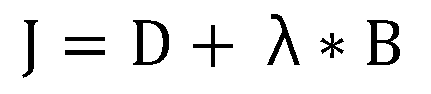
여기서, D는 원영상과 복원영상 간의 차이에 대한 SSE(Sum of Square Error) 값이고, λ는 라그랑지안(Lagrangian) 상수이고, B는 부호화 시 발생한 비트량을 나타낸다. 라그랑지안 상수 값은 QPI, 슬라이스 타입(slice type), GOP 구조 등의 변수에 의해서 결정될 수 있다. Here, D is a sum of square error (SSE) value for a difference between an original image and a reconstructed image, λ is a Lagrangian constant, and B represents a bit amount generated during encoding. The Lagrangian constant value can be determined by variables such as QPI, slice type, and GOP structure.
부호화기는 CB(또는 CU)가 쿼드트리 구조로 분할된 최소 크기의 CB(또는 CU)인지 판단할 수 있다(S540). 예컨대, 상술한 바와 같이, CTB가 쿼드트리 구조로 분할되어 64x64, 32x32, 16x16, 8x8의 크기를 가진 CB로 구성될 수 있으므로, 부호화기는 CB(또는 CU)가 최소 크기인 8x8 CB(또는 CU)인지를 판단할 수 있다. The encoder may determine whether the CB (or CU) is the smallest CB (or CU) divided into a quadtree structure (S540). For example, as described above, since the CTB is divided into a quadtree structure and can be configured as a CB having a size of 64x64, 32x32, 16x16, and 8x8, the encoder has 8x8 CB (or CU) in which the CB (or CU) is the minimum size. You can judge cognition.
만일, CB(또는 CU)가 최소 크기의 CB(또는 CU)가 아닌 경우, 부호화기는 해당 CB(또는 CU)에 대해 재귀적으로 쿼드트리 구조로 분할을 수행하고, 각 분할된 CB(또는 CU)를 단계 S530과 같은 방법으로 부호화할 수 있다(S550). If the CB (or CU) is not the smallest CB (or CU), the encoder recursively splits the CB (or CU) into a quadtree structure, and each divided CB (or CU) Can be encoded in the same way as in step S530 (S550).
도 6은 CTB에서 최소의 율-왜곡 비용을 갖는 쿼드트리 구조의 일예를 나타내는 도면이다. 6 is a diagram illustrating an example of a quadtree structure having a minimum rate-distortion cost in CTB.
예를 들어, 64x64 크기의 CTB가 도 5에서 상술한 바와 같은 쿼드트리 기반의 부호화 과정을 수행하면, 도 6에 도시된 바와 같이 64x64 크기의 CTB 내에서 쿼드트리 구조를 가지면서 율-왜곡 비용을 최소화시킬 수 있는 형태로 도출될 수 있다. For example, if a CTB of 64x64 size performs a quadtree-based encoding process as described above in FIG. 5, as shown in FIG. 6, a rate-distortion cost is obtained while having a quadtree structure in a CTB of 64x64 size. It can be derived in a form that can be minimized.
상기와 같이 CTB를 기반으로 최소의 율-왜곡 비용을 갖는 쿼드트리 구조를 찾는 과정은 매우 복잡하며, 이로 인해 부호화기의 복잡도에 상당한 영향을 미치게 된다. 따라서, 이를 해결하기 위해서 다양한 방법들이 제안되고 있다. As described above, the process of finding a quadtree structure having the smallest rate-distortion cost based on CTB is very complex, and thus has a significant influence on the complexity of the encoder. Therefore, various methods have been proposed to solve this.
도 4에서 상술한 바와 같이, CB에 적용되는 부호화 모드들 중에서 최소의 율-왜곡 비용을 갖는 최적의 부호화 모드를 빨리 찾기 위해서 제안된 방법으로는 HEVC 참조 소프트웨어에 적용되어 있는 JCTVC-F045와 JCTVC-G543가 있다. 4, JCTVC-F045 and JCTVC- which are applied to HEVC reference software as a proposed method to quickly find an optimal coding mode having a minimum rate-distortion cost among coding modes applied to CB There is G543.
JCTVC-F045에서는 CB의 최적 부호화 모드를 결정하기 위한 과정 중에서 인터 예측(inter prediction)이 이루어질 때, Y, U, V의 CBF(Coded Block Flag) 값이 모두 0이면 인터 모드 내 나머지 파티션된 블록 모양에 대한 율-왜곡 비용 계산을 생략하는 방법을 제안하였다. JCTVC-G543에서는 CB의 최적 부호화 모드를 결정하기 위한 과정에 있어서, CB의 크기로 인터 예측 모드(2Nx2N 블록 모양의 인터 모드)를 먼저 수행한 후에 DMV(Differential Motion Vector) 및 CBF가 모두 0이면 다른 모드에 대한 연산은 생략하는 방법을 제안하였다. In JCTVC-F045, when inter prediction is performed in the process of determining the optimal coding mode of CB, if all of the coded block flag (CBF) values of Y, U, and V are 0, the remaining partitioned block shape in inter mode A method was proposed to omit the rate-distortion cost calculation for. In the process for determining the optimal coding mode of CB in JCTVC-G543, the inter prediction mode (inter mode of 2Nx2N block shape) is first performed with the size of CB, and then if the differential motion vector (DMV) and CBF are both 0, other We proposed to omit the operation on the mode.
이외에도 전통적으로 많이 사용하는 방법으로 율-왜곡 비용 값의 시·공간적 연관성을 이용한 부호화 모드의 조기 결정 방법이 있다. 하지만, 비디오 코딩을 위한 기본 단위가 매크로 블록에서 CTB로 변화되면서 문제가 발생하게 된다. In addition, there is a method of early determination of an encoding mode using temporal and spatial associations of rate-distortion cost values as a traditionally used method. However, a problem occurs when the basic unit for video coding is changed from a macro block to a CTB.
도 7은 현재 부호화 대상 CTB, 주변 CTB 및 부호화된 프레임에서 현재 부호화 대상 CTB와 동일한 위치에 있는 CTB를 나타내는 도면이다. FIG. 7 is a diagram illustrating a current encoding target CTB, a neighboring CTB, and a CTB at the same position as the current encoding target CTB in the encoded frame.
도 7을 참조하면, 64x64의 크기를 가지는 현재 부호화 대상 CTB(710)(이하, '현재 CTB'라 함) 내에서 좌상단에 위치한 32x32 크기의 CB(711)의 최적 부호화 모드를 결정하기 위해서, 현재 CTB(710)의 주변에 위치한 주변 CTB(720)를 이용하여 예측하는 경우, 이미 부호화된 주변 CTB(720) 내 좌상단에 위치한 CU의 크기가 32x32 크기가 아닐 가능성이 존재할 수 있다. 또는, 이전에 부호화된 프레임(730) 내에서 현재 CTB(710)와 동일한 위치에 있는 CTB(731)를 이용하여 예측하는 경우에도, 상기 CTB(731) 내 좌상단에 위치한 CU의 크기가 32x32 크기가 아닐 가능성이 존재할 수 있다.Referring to FIG. 7, in order to determine an optimal encoding mode of a
따라서, 최적의 부호화 모드를 결정하기 위해서는 64x64, 32x32, 16x16, 8x8의 크기를 가지는 CB에 대해 모두 부호화를 해보아야 하므로, 이미 부호화가 완료된 64x64 크기의 CTB의 율-왜곡 비용을 이용하여 적절하게 스케일링해서 예측에 사용하는 것이 한가지 방법이 될 수 있다. 하지만, 이로 인해 예측의 정확도를 떨어뜨리게 되고, 결과적으로 BD-bitrate의 손실을 가져오게 된다. Therefore, in order to determine the optimal encoding mode, since all CBs having sizes of 64x64, 32x32, 16x16, and 8x8 must be coded, scaling is appropriately performed by using the rate-distortion cost of the already encoded 64x64 size CTB. Therefore, it can be used for prediction. However, this decreases the accuracy of prediction, resulting in loss of BD-bitrate.
상기와 같은 문제점들을 해결하기 위해서, 본 발명에서는 CTB를 기반으로 최소의 율-왜곡 비용을 갖는 최적의 부호화 모드를 조기에 결정하는 방법을 제공한다. In order to solve the above problems, the present invention provides a method for early determining an optimal coding mode having a minimum rate-distortion cost based on CTB.
도 8은 본 발명의 실시예에 따른 최적의 부호화 모드를 결정하는 방법을 개략적으로 나타낸 순서도이다. 8 is a flowchart schematically illustrating a method of determining an optimal encoding mode according to an embodiment of the present invention.
도 8을 참조하면, 부호화기는 현재 부호화 블록(Coding Block; CB)에 대한 후보 부호화 모드로 부호화 시 발생하는 왜곡(distortion)값과 비트량을 예측한다(S810). 예컨대, 64x64 크기의 CTB를 부호화하는 경우, 도 3에서 상술한 바와 같이 64x64 크기의 CTB가 쿼드트리 구조로 분할되어 1개 64x64 크기의 CB, 4개 32x32 크기의 CB, 16개 16x16 크기의 CB, 64개 8x8 크기의 CB로 이루어질 수 있다. 이때, 각 CB에 대해 최소의 율-왜곡 비용을 갖는 부호화 모드를 결정하며, 이를 위해 각 CB에 대해 단계 S810 ~ 단계 S840까지 수행될 수 있다. Referring to FIG. 8, the encoder predicts a distortion value and a bit amount generated when encoding in a candidate encoding mode for a current coding block (CB) (S810). For example, when encoding a CTB having a size of 64x64, the CTB having a size of 64x64 is divided into a quadtree structure, as described above in FIG. 3, one 64x64 sized CB, four 32x32 sized CBs, 16 16x16 sized CBs, It can consist of 64 8x8 CBs. At this time, an encoding mode having a minimum rate-distortion cost is determined for each CB, and steps S810 to S840 may be performed for each CB.
후보 부호화 모드는 현재 부호화 블록이 가질 수 있는 부호화 모드 중 하나이며, 현재 부호화 블록이 가질 수 있는 부호화 모드는 스킵 모드, 머지 모드, 인터 모드 및 인트라 모드 중 적어도 하나일 수 있다. 예컨대, 도 4에서 상술한 바와 같이, 2Nx2N 블록 모양의 스킵 모드 또는 머지 모드, 2Nx2N 블록 모양의 인터 모드, 2NxN 블록 모양의 인터 모드, Nx2N 블록 모양의 인터 모드, NxN 블록 모양의 인터 모드, 2NxnU 블록 모양의 인터 모드, 2NxnD 블록 모양의 인터 모드, nLx2N 블록 모양의 인터 모드, nRx2N 블록 모양의 인터 모드, 2Nx2N 블록 모양의 인트라 모드, NxN 블록 모양의 인트라 모드 중 적어도 하나일 수 있다. The candidate encoding mode is one of encoding modes that the current encoding block can have, and the encoding mode that the current encoding block can have may be at least one of skip mode, merge mode, inter mode, and intra mode. For example, as described above in FIG. 4, 2Nx2N block-shaped skip mode or merge mode, 2Nx2N block-shaped inter mode, 2NxN block-shaped inter mode, Nx2N block-shaped inter mode, NxN block-shaped inter mode, 2NxnU block It may be at least one of a shape inter mode, a 2NxnD block shape inter mode, an nLx2N block shape inter mode, an nRx2N block shape inter mode, a 2Nx2N block shape intra mode, and an NxN block shape intra mode.
현재 부호화 블록에 대한 후보 부호화 모드로 부호화될 때 예측되는 왜곡값(Dpred)은 아래 수학식 2와 같이 도출될 수 있다. The predicted distortion value D pred when encoded in the candidate coding mode for the current coding block may be derived as shown in Equation 2 below.

여기서, D-1은 직전에 부호화된 화면에서 현재 부호화 블록이 포함된 CTU와 동일한 위치에 존재하는 CTU의 왜곡값이다. Here, D -1 is a distortion value of the CTU existing in the same position as the CTU including the current coding block in the immediately coded picture.
상기 수학식 2에 따르면, 현재 부호화 블록의 왜곡값(Dpred)은 직전에 부호화된 화면에서 현재 부호화 블록과 대응되는 CTU가 가지는 왜곡값(D-1)을 현재 부호화 블록의 크기를 고려하여 스케일링하는 방법으로 예측될 수 있다. According to Equation 2, the distortion value D pred of the current coding block is scaled by taking into account the size of the current coding block the distortion value D- 1 of the CTU corresponding to the current coding block in the immediately coded picture. Can be predicted.
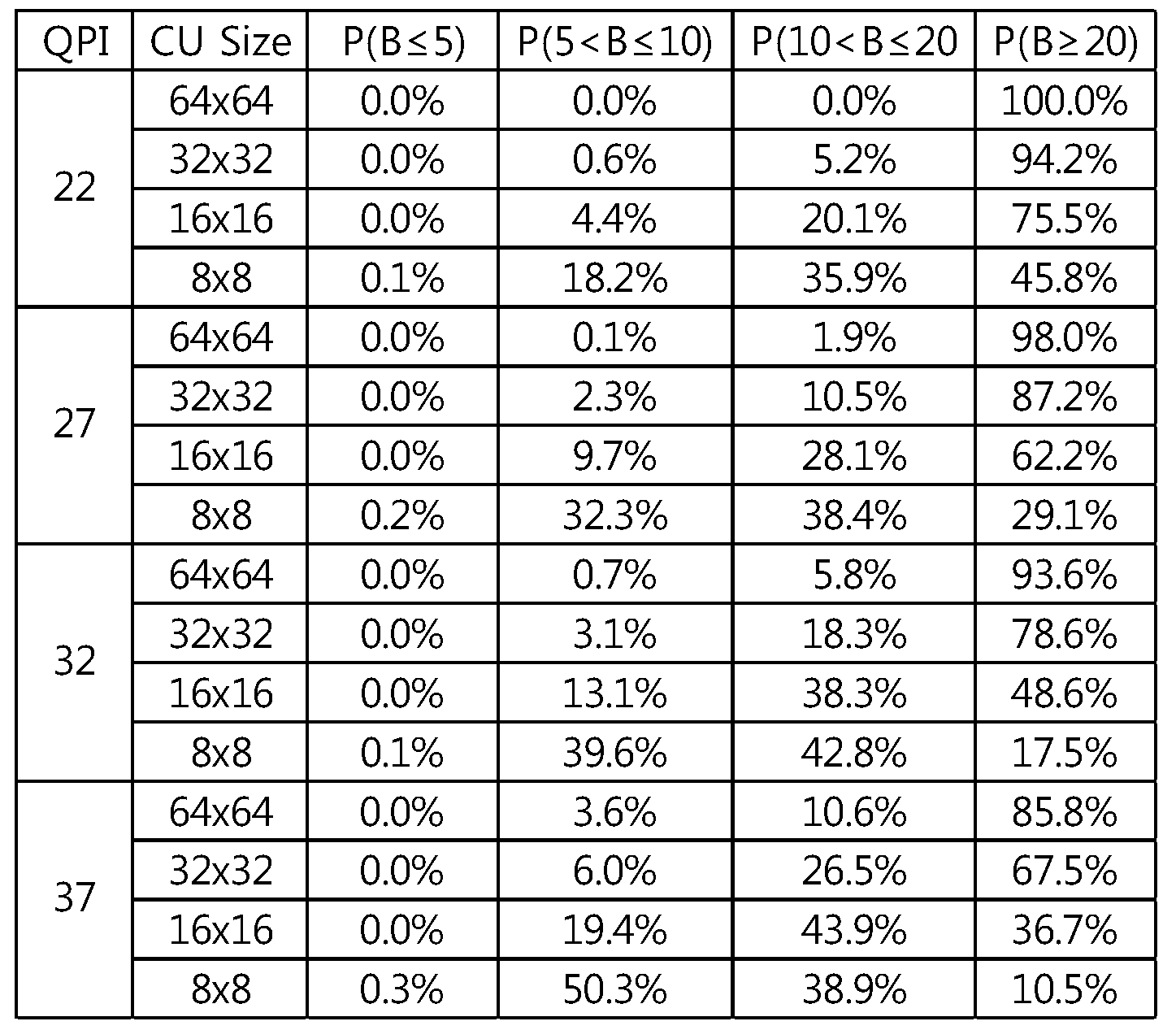
현재 부호화 블록에 대한 후보 부호화 모드로 부호화될 때 예측되는 비트량(Bpred)은 통계적으로 추정된 값을 사용할 수 있다. 예를 들어, 416x240 해상도의 RaceHorses 영상 9장을 부호화하여 QPI와 CU의 크기별로 발생한 비트량에 대한 통계를 이용할 수 있다. 표 1은 416x240 해상도의 RaceHorses 영상에 대해 인터 모드 및 머지 모드로 부호화한 경우 발생한 비트량에 대한 통계를 나타낸 것이고, 표 2는 416x240 해상도의 RaceHorses 영상에 대해 인트라 모드로 부호화한 경우 발생한 비트량에 대한 통계를 나타낸 것이다. 아래 표 1 및 표 2를 참조하면, 거의 99% 이상 5비트 이상의 비트량이 발생되었다. 따라서, 현재 부호화 블록에 대한 후보 부호화 모드로 부호화될 때 예측되는 비트량(Bpred)은 5비트 이상의 값을 사용할 수 있다. A statistically estimated value may be used as a predicted bit amount B pred when encoded in a candidate coding mode for a current coding block. For example, 9 RaceHorses images with 416x240 resolution can be encoded to use statistics on the amount of bits generated for each QPI and CU size. Table 1 shows statistics on the amount of bits generated when InterH and Merge modes were encoded for RaceHorses images with 416x240 resolution. It shows statistics. Referring to Table 1 and Table 2 below, a bit amount of more than 99% and more than 5 bits was generated. Therefore, a value of 5 bits or more may be used as a predicted bit amount B pred when encoded in a candidate coding mode for a current coding block.

부호화기는 현재 부호화 블록이 후보 부호화 모드로 부호화될 때 예측된 왜곡값과 비트량을 기반으로 추정 율-왜곡 비용을 도출한다(S820). 추정 율-왜곡 비용(Jpred)은 아래 수학식 3과 같이 도출될 수 있다. The encoder derives an estimated rate-distortion cost based on the predicted distortion value and bit amount when the current coding block is encoded in the candidate coding mode (S820). The estimated rate-distortion cost (J pred ) can be derived as shown in Equation 3 below.

여기서, Dpred는 현재 부호화 블록이 후보 부호화 모드로 부호화될 때 예측된 왜곡값이고, Bpred는 현재 부호화 블록이 후보 부호화 모드로 부호화될 때 예측된 비트량이고, λ는 현재 부호화 블록이 가지는 라그랑지안(Lagrangian) 상수이다. 라그랑지안 상수 값은 QPI, 슬라이스 타입, GOP 구조 등의 변수에 의해서 결정될 수 있다.Here, D pred is the distortion value predicted when the current coding block is coded in the candidate coding mode, B pred is the amount of bit predicted when the current coding block is coded in the candidate coding mode, and λ is the Lagrangian of the current coding block. (Lagrangian) is a constant. The Lagrangian constant value can be determined by variables such as QPI, slice type, and GOP structure.
부호화기는 현재 부호화 블록으로부터 현재까지 도출된 최소 율-왜곡 비용과 추정 율-왜곡 비용을 비교하고, 비교 결과에 따라 후보 부호화 모드에 대한 부호화 연산을 생략할지 여부를 판단한다(S830). 최소 율-왜곡 비용은 현재 부호화 블록이 가질 수 있는 부호화 모드 중 현재까지 후보 부호화 모드로 선택된 적어도 하나의 모드로부터 도출된 최소의 율-왜곡 비용 값일 수 있다. The encoder compares the minimum rate-distortion cost and the estimated rate-distortion cost derived from the current coding block to the present, and determines whether to omit the encoding operation for the candidate encoding mode according to the comparison result (S830). The minimum rate-distortion cost may be a minimum rate-distortion cost value derived from at least one mode selected as a candidate encoding mode to date among the encoding modes that the current coding block may have.
예를 들어, 추정 율-왜곡 비용이 현재까지 도출된 최소 율-왜곡 비용을 초과하는 경우, 해당 후보 부호화 모드에 대한 부호화 연산을 생략할 수 있다. 그렇지 않은 경우, 해당 후보 부호화 모드로 부호화될 때 발생되는 율-왜곡 비용을 도출할 수 있다. 이때, 율-왜곡 비용은 상술한 수학식 1과 같은 방법으로 도출될 수 있다. 그리고 상기 도출된 율-왜곡 비용을 현재까지 도출된 최소 율-왜곡 비용과 비교하여, 그 비교 결과에 따라 최소 율-왜곡 비용을 갱신할 수도 있다. For example, when the estimated rate-distortion cost exceeds the minimum rate-distortion cost derived to date, an encoding operation for the corresponding candidate encoding mode may be omitted. Otherwise, the rate-distortion cost incurred when being coded in the corresponding candidate coding mode can be derived. At this time, the rate-distortion cost may be derived in the same manner as in
부호화기는 최소 율-왜곡 비용을 근거로 현재 부호화 블록에 대한 최종 부호화 모드를 결정한다(S840). 즉, 부호화기는 현재 부호화 블록이 가질 수 있는 부호화 모드에 대해 차례로 후보 부호화 모드로 선택하여 단계 S810 ~ 단계 S830까지 수행하여 도출된 최종 율-왜곡 비용을 기반으로 현재 부호화 블록에 대한 최적의 부호화 모드를 결정할 수 있다. The encoder determines the final coding mode for the current coding block based on the minimum rate-distortion cost (S840). That is, the encoder selects the candidate coding mode for the coding mode that the current coding block may have in sequence, and performs steps S810 to S830 to determine the optimal coding mode for the current coding block based on the derived final rate-distortion cost. Can decide.
아래 표 3은 상기 표 1 및 표 2의 통계 결과를 활용하여, 상술한 본 발명에 따른 왜곡값(Dpred)과 비트량(Bpred)을 예측하여 고속으로 부호화 모드를 결정한 경우에 대한 실험 결과를 나타낸다. Table 3 below shows the experimental results for the case where the encoding mode is determined at high speed by predicting the distortion value (D pred ) and the bit amount (B pred ) according to the present invention using the statistical results of Tables 1 and 2 above. Indicates.

표 3을 참조하면, Class B 및 Class C는 HEVC 표준화에서 사용되는 테스트 영상으로, Class B는 1920x1080 해상도를 가지는 영상 5개로 구성되어 있고 Class C는 832x480 해상도를 가지는 영상 4개로 구성되어 있다. 상기 표 3에 도시된 실험 결과는 Random Access main configuration으로 100 프레임을 부호화 했을 경우를 나타낸다. Bpred는 현재 부호화 블록에서의 QP, CB의 크기, 예측 모드, GOP 구조 등을 고려하여 적절하게 조정하여 사용될 수 있다. △Enc T는 아래 수학식 4로 계산되는 값일 수 있다. Referring to Table 3, Class B and Class C are test images used in HEVC standardization, Class B consists of 5 images with 1920x1080 resolution, and Class C consists of 4 images with 832x480 resolution. The results of the experiment shown in Table 3 indicate a case in which 100 frames are encoded with a random access main configuration. B pred may be used by appropriately adjusting QP, CB size, prediction mode, and GOP structure in the current coding block. ΔEnc T may be a value calculated by Equation 4 below.

여기서, T1은 상술한 본 발명의 실시예에 따른 최적의 부호화 모드를 결정하는 방법에 따라 부호화한 경우 소요된 시간이고, T2는 상술한 본 발명의 실시예에 따른 최적의 부호화 모드를 결정하는 방법을 사용하지 않고 기존의 방법을 사용하여 부호화한 경우 소요된 시간이다. 예를 들어, 기존 방법은 참조 소프트웨어의 기본 환경 설정(configuration)일 수 있으며, 이를 사용하여 부호화 하는데 소요된 시간을 T2로 결정할 수 있다. Here, T1 is the time taken when coding according to the method for determining the optimal coding mode according to the embodiment of the present invention described above, T2 is the method for determining the optimal coding mode according to the embodiment of the present invention described above It is the time taken when coding using the existing method without using. For example, the existing method may be a basic configuration of the reference software, and the time taken for encoding may be determined as T2 using this.
상기 표 3에 도시된 실험 결과로 확인할 수 있듯이, 본 발명에 따른 최적의 부호화 모드 결정 방법을 사용하면 부호화기의 부호화 성능 손실이 크게 발생하지 않으며, 부호화 시간을 상당히 단축시킬 수 있다. As can be seen from the experimental results shown in Table 3, if the optimal encoding mode determination method according to the present invention is used, the encoding performance loss of the encoder does not occur significantly, and the encoding time can be significantly shortened.
아래 표 4는 기존의 최적 부호화 모드 결정 방법(JCTVC-F045와 JCTVC-G543)에 대한 실험 결과를 나타낸다. Table 4 below shows the experimental results for the existing optimal coding mode determination methods (JCTVC-F045 and JCTVC-G543).

상기 표 3과 상기 표 4를 비교해 보면, 본 발명에서 제안된 최적 부호화 모드 결정 방법이 부호화 성능 저하가 적으면서도 부호화 속도는 더 빠르다는 것을 확인할 수 있다. Comparing Table 3 and Table 4, it can be seen that the method for determining the optimal encoding mode proposed in the present invention has a lower encoding performance and a faster encoding speed.
도 9는 본 발명의 실시예에 따른 최적의 부호화 모드를 결정하는 방법의 일예를 나타낸 도면이다. 9 is a diagram showing an example of a method for determining an optimal encoding mode according to an embodiment of the present invention.
현재 부호화 블록(Coding Block; CB)이 가질 수 있는 부호화 모드가 도 4에서 상술한 바와 같이, 2Nx2N 블록 모양의 스킵 모드, 2Nx2N 블록 모양의 머지 모드, 2Nx2N 블록 모양의 인터 모드, 2NxN 블록 모양의 인터 모드, Nx2N 블록 모양의 인터 모드, NxN 블록 모양의 인터 모드, 2NxnU 블록 모양의 인터 모드, 2NxnD 블록 모양의 인터 모드, nLx2N 블록 모양의 인터 모드, nRx2N 블록 모양의 인터 모드, 2Nx2N 블록 모양의 인트라 모드, NxN 블록 모양의 인트라 모드라고 가정한다. As described above with reference to FIG. 4, a coding mode that a current coding block (CB) may have, a 2Nx2N block shape skip mode, a 2Nx2N block shape merge mode, a 2Nx2N block shape inter mode, and a 2NxN block shape inter Mode, Nx2N block shaped inter mode, NxN block shaped inter mode, 2NxnU block shaped inter mode, 2NxnD block shaped inter mode, nLx2N block shaped inter mode, nRx2N block shaped inter mode, 2Nx2N block shaped intra mode , It is assumed that the NxN block-shaped intra mode.
도 9를 참조하면, 부호화기는 현재 부호화 블록이 가질 수 있는 부호화 모드 중 하나를 선택한다(S910). 상기 선택된 부호화 모드를 후보 부호화 모드라 한다. Referring to FIG. 9, the encoder selects one of encoding modes that the current encoding block may have (S910). The selected encoding mode is called a candidate encoding mode.
여기서, x는 현재 부호화 블록이 가질 수 있는 부호화 모드에 대한 인덱스 값일 수 있고, M(x)는 상기 인덱스 값에 해당하는 부호화 모드를 의미할 수 있다. 각 인덱스 값에 따른 부호화 모드는 아래와 같을 수 있다. Here, x may be an index value for an encoding mode that the current encoding block may have, and M(x) may mean an encoding mode corresponding to the index value. The encoding mode according to each index value may be as follows.
x가 1일 경우, 부호화 모드는 2Nx2N 블록 모양의 스킵 모드일 수 있다.When x is 1, the encoding mode may be a 2Nx2N block-shaped skip mode.
x가 2일 경우, 부호화 모드는 2Nx2N 블록 모양의 머지 모드일 수 있다.When x is 2, the encoding mode may be a merge mode of 2Nx2N block shape.
x가 3일 경우, 부호화 모드는 2Nx2N 블록 모양의 인터 모드일 수 있다.When x is 3, the encoding mode may be a 2Nx2N block-shaped inter mode.
x가 4일 경우, 부호화 모드는 2NxN 블록 모양의 인터 모드일 수 있다.When x is 4, the encoding mode may be a 2NxN block-shaped inter mode.
x가 5일 경우, 부호화 모드는 Nx2N 블록 모양의 인터 모드일 수 있다.When x is 5, the encoding mode may be an Nx2N block-shaped inter mode.
x가 6일 경우, 부호화 모드는 NxN 블록 모양의 인터 모드일 수 있다.When x is 6, the encoding mode may be an NxN block-shaped inter mode.
x가 7일 경우, 부호화 모드는 2NxnU 블록 모양의 인터 모드일 수 있다.When x is 7, the encoding mode may be a 2NxnU block-shaped inter mode.
x가 8일 경우, 부호화 모드는 2NxnD 블록 모양의 인터 모드일 수 있다.When x is 8, the encoding mode may be a 2NxnD block-shaped inter mode.
x가 9일 경우, 부호화 모드는 nLx2N 블록 모양의 인터 모드일 수 있다.When x is 9, the encoding mode may be an nLx2N block-shaped inter mode.
x가 10일 경우, 부호화 모드는 nRx2N 블록 모양의 인터 모드일 수 있다.When x is 10, the encoding mode may be an nRx2N block-shaped inter mode.
x가 11일 경우, 부호화 모드는 2Nx2N 블록 모양의 인트라 모드일 수 있다.When x is 11, the encoding mode may be a 2Nx2N block-shaped intra mode.
x가 12일 경우, 부호화 모드는 NxN 블록 모양의 인트라 모드일 수 있다.When x is 12, the encoding mode may be an NxN block-shaped intra mode.
예컨대, 부호화기는 먼저 현재 부호화 블록이 가질 수 있는 부호화 모드 중인덱스 값(x)이 1인 부호화 모드부터 후보 부호화 모드로 선택할 수 있다. For example, the encoder may first select a candidate encoding mode from an encoding mode in which the index value (x) of the current encoding block may have one.
부호화기는 선택된 후보 부호화 모드로 현재 부호화 블록에 대한 부호화를 수행하여 율-왜곡 비용을 계산한다(S920). The encoder calculates the rate-distortion cost by performing encoding on the current coding block with the selected candidate coding mode (S920).
이때, 부호화기는 현재 부호화 블록이 가질 수 있는 부호화 모드에 대한 인덱스 값(x)이 1인지를 판단하고(S930), 상기 인덱스 값(x)이 1이면 인덱스 값(x)이 1인 부호화 모드로 부호화 되었을 때 발생한 율-왜곡 비용(J(x))을 최소 율-왜곡 비용(Jbest)로 결정할 수 있다(S940). 이러한 과정은 최소 율-왜곡 비용의 초기값을 설정하는 과정일 수 있다. At this time, the encoder determines whether the index value (x) for the encoding mode that the current coding block can have is 1 (S930), and when the index value (x) is 1, the encoding value is the encoding mode where the index value (x) is 1. The rate-distortion cost (J(x)) incurred when encoded may be determined as the minimum rate-distortion cost (J best ) (S940). This process may be a process of setting an initial value of the minimum rate-distortion cost.
상기 인덱스 값(x)이 1이 아니면 단계 S920에서 계산된 후보 부호화 모드에 대한 율-왜곡 비용(J(x))과 최소 율-왜곡 비용(Jbest)을 비교한다(S950). 즉, 이전에 선택된 후보 부호화 모드를 기반으로 도출된 최소 율-왜곡 비용(Jbest)과 현재 후보 부호화 모드로부터 도출된 율-왜곡 비용(J(x))을 비교한다. If the index value (x) is not 1, the rate-distortion cost (J(x)) and the minimum rate-distortion cost (J best ) for the candidate encoding mode calculated in step S920 are compared (S950 ). That is, the minimum rate-distortion cost (J best ) derived based on the previously selected candidate coding mode is compared with the rate-distortion cost (J(x)) derived from the current candidate coding mode.
만일, 후보 부호화 모드에 대한 율-왜곡 비용(J(x))이 현재까지 도출된 최소 율-왜곡 비용(Jbest)보다 작으면, 최소 율-왜곡 비용(Jbest)을 상기 후보 부호화 모드에 대한 율-왜곡 비용(J(x))으로 갱신한다(S940). 그렇지 않으면, 다음 단계를 수행한다.If, rate for the candidate coding mode is smaller than the distortion cost (J best), the minimum rate - minimum distortion cost (J (x)) is derived from the current rate distortion cost (J best) in the candidate coding mode The rate-distortion cost (J(x)) is updated (S940). Otherwise, perform the next step.
부호화기는 현재 부호화 블록이 가질 수 있는 부호화 모드에 대한 부호화 연산을 모두 수행하였는지 여부를 판단한다(S960). The encoder determines whether all encoding operations for an encoding mode that the current encoding block can have are performed (S960).
만일, 현재 부호화 블록이 가질 수 있는 부호화 모드에 대한 부호화 연산을 모두 수행하지 않은 경우, 현재 부호화 블록이 가질 수 있는 부호화 모드 중 현재까지 후보 부호화 모드로 선택되지 않은 부호화 모드를 하나 선택한다(S970). 상기 단계 S970에서 선택된 부호화 모드를 후보 부호화 모드로 재설정할 수 있다. If all of the encoding operations for the encoding mode that the current encoding block can have are not performed, one encoding mode that is not selected as a candidate encoding mode to date is selected from among encoding modes that the current encoding block may have (S970). . The encoding mode selected in step S970 may be reset to a candidate encoding mode.
이때, 부호화기는 단계 S970에 의해 선택된 후보 부호화 모드로 현재 부호화 블록을 부호화할 때 발생하는 왜곡값(Dpred(x))과 비트량(Bpred(x))을 예측하여 추정 율-왜곡 비용을 도출하고, 도출된 추정 율-왜곡 비용과 최소 율-왜곡 비용(Jbest)을 비교한다(S980). At this time, the encoder estimates the distortion rate-distortion cost by predicting the distortion value (D pred (x)) and the bit amount (B pred (x)) that occur when encoding the current coding block with the candidate coding mode selected in step S970. Derive, and compare the derived estimated rate-distortion cost with the minimum rate-distortion cost (J best ) (S980).
여기서, 현재 부호화 블록에 대해 후보 부호화 모드로 부호화될 때 예측되는 왜곡값(Dpred(x))은 상술한 수학식 2와 같이 추정될 수 있고, 현재 부호화 블록에 대해 후보 부호화 모드로 부호화될 때 예측되는 비트량(Bpred(x))은 상술한 바와 같이 통계적으로 추정된 값을 사용할 수 있다. 추정 율-왜곡 비용은 상술한 수학식 3과 같이 계산될 수 있다. Here, the predicted distortion value (D pred (x)) when encoded in the candidate encoding mode for the current coding block may be estimated as in Equation 2 above, and when the current coding block is encoded in the candidate coding mode The predicted bit amount (B pred (x)) may use a statistically estimated value as described above. The estimated rate-distortion cost can be calculated as in Equation 3 above.
만일, 추정 율-왜곡 비용이 최소 율-왜곡 비용(Jbest)보다 큰 경우, 단계 S970에 의해 선택된 후보 부호화 모드에 대한 부호화 연산을 생략할 수 있으며, 단계 S960을 수행할 수 있다. If the estimated rate-distortion cost is greater than the minimum rate-distortion cost (J best ), the encoding operation for the candidate encoding mode selected by step S970 may be omitted, and step S960 may be performed.
반면, 추정 율-왜곡 비용이 최소 율-왜곡 비용(Jbest)보다 작거나 같은 경우, 후보 부호화 모드에 대한 부호화 연산을 수행하는 과정(단계 S920 ~ 단계 S980)을 반복 수행한다. On the other hand, if the estimated rate-distortion cost is less than or equal to the minimum rate-distortion cost (J best ), a process of performing an encoding operation for a candidate encoding mode (steps S920 to S980) is repeatedly performed.
한편, 현재 부호화 블록이 가질 수 있는 부호화 모드에 대한 부호화 연산을 모두 수행한 경우, 부호화기는 최소 율-왜곡 비용을 기초로 현재 부호화 블록에 대한 최종 부호화 모드를 도출하고 상기 과정을 종료한다. On the other hand, when all of the encoding operations for the encoding mode that the current encoding block can have are performed, the encoder derives the final encoding mode for the current encoding block based on the minimum rate-distortion cost and ends the process.
상술한 실시예들에서, 방법들은 일련의 단계 또는 블록으로서 순서도를 기초로 설명되고 있으나, 본 발명은 단계들의 순서에 한정되는 것은 아니며, 어떤 단계는 상술한 바와 다른 단계와 다른 순서로 또는 동시에 발생할 수 있다. 또한, 당해 기술 분야에서 통상의 지식을 가진 자라면 순서도에 나타난 단계들이 배타적이지 않고, 다른 단계가 포함되거나, 순서도의 하나 또는 그 이상의 단계가 본 발명의 범위에 영향을 미치지 않고 삭제될 수 있음을 이해할 수 있을 것이다.In the above-described embodiments, the methods are described based on a flowchart as a series of steps or blocks, but the present invention is not limited to the order of steps, and some steps may occur in a different order than the steps described above or simultaneously. You can. In addition, those skilled in the art may recognize that the steps in the flowchart are not exclusive, other steps may be included, or one or more steps in the flowchart may be deleted without affecting the scope of the present invention. You will understand.
이상의 설명은 본 발명의 기술 사상을 예시적으로 설명한 것에 불과한 것으로서, 본 발명이 속하는 기술 분야에서 통상의 지식을 가진 자라면 본 발명의 본질적인 특성에서 벗어나지 않는 범위에서 다양한 수정 및 변형이 가능할 것이다. 따라서, 본 발명에 개시된 실시 예들은 본 발명의 기술 사상을 한정하기 위한 것이 아니라 설명하기 위한 것이고, 이러한 실시 예에 의하여 본 발명의 기술 사상의 범위가 한정되는 것은 아니다. 본 발명의 보호범위는 특허청구범위에 의하여 해석되어야 하며, 그와 동등한 범위 내에 있는 모든 기술 사상은 본 발명의 권리범위에 포함되는 것으로 해석되어야 할 것이다. The above description is merely illustrative of the technical idea of the present invention, and those skilled in the art to which the present invention pertains may make various modifications and variations without departing from the essential characteristics of the present invention. Therefore, the embodiments disclosed in the present invention are not intended to limit the technical spirit of the present invention, but to explain, and the scope of the technical spirit of the present invention is not limited by these embodiments. The scope of protection of the present invention should be interpreted by the claims, and all technical spirits within the scope equivalent thereto should be interpreted as being included in the scope of the present invention.
Claims (10)
상기 현재 부호화 블록으로부터 도출된 최소 율-왜곡 비용과 상기 추정 율-왜곡 비용을 비교하여, 상기 후보 부호화 모드에 대한 부호화 연산을 생략할지 여부를 판단하는 단계; 및
상기 최소 율-왜곡 비용을 기초로 상기 현재 부호화 블록에 대한 최종 부호화 모드를 결정하는 단계를 포함하며,
상기 후보 부호화 모드는 상기 현재 부호화 블록이 가질 수 있는 부호화 모드 중 하나이며, 상기 최소 율-왜곡 비용은 상기 후보 부호화 모드를 이용하여 상기 현재 부호화 블록의 부호화를 수행함으로써 계산된 현재까지의 율-왜곡 비용 중 최소값인 것을 특징으로 하는 부호화 모드 결정 방법.Deriving an estimated rate-distortion (RD) cost by predicting a distortion value and a bit amount generated when encoding in a candidate coding mode in a current coding block (CB) ;
Comparing a minimum rate-distortion cost derived from the current coding block with the estimated rate-distortion cost, and determining whether to omit an encoding operation for the candidate encoding mode; And
And determining a final encoding mode for the current coding block based on the minimum rate-distortion cost,
The candidate coding mode is one of the coding modes that the current coding block can have, and the minimum rate-distortion cost is a rate-distortion up to the current calculated by performing coding of the current coding block using the candidate coding mode. A method for determining an encoding mode, characterized in that it is a minimum value among costs.
상기 현재 부호화 블록이 가질 수 있는 부호화 모드는,
스킵 모드, 머지 모드, 인터 모드 및 인트라 모드 중 적어도 하나인 것을 특징으로 하는 부호화 모드 결정 방법.According to claim 1,
The current encoding block may have an encoding mode,
A method for determining an encoding mode, characterized in that it is at least one of a skip mode, a merge mode, an inter mode, and an intra mode.
상기 왜곡값은, 현재 부호화 블록의 이전에 부호화된 화면에서 현재 부호화 블록에 대응되는 부호화 트리 유닛(Coding Tree Unit; CTU)이 가지는 왜곡값을 현재 부호화 블록의 크기를 고려하여 스케일링 함으로써 예측되는 것을 특징으로 하는 부호화 모드 결정 방법.According to claim 1,
The distortion value is predicted by scaling a distortion value of a coding tree unit (CTU) corresponding to the current coding block in a previously coded screen of the current coding block in consideration of the size of the current coding block. Coding mode determination method.
상기 비트량은, QPI 값 및 부호화 유닛(Coding Unit, CU) 크기 중 적어도 하나에 기초하여 유도되는 것을 특징으로 하는 부호화 모드 결정 방법.According to claim 1,
The bit amount is derived based on at least one of a QPI value and a coding unit (CU) size.
상기 후보 부호화 모드에 대한 부호화 연산을 생략할지 여부를 판단하는 단계는,
상기 추정 율-왜곡 비용이 상기 최소 율-왜곡 비용보다 크면 상기 후보 부호화 모드에 대한 부호화 연산을 생략하는 단계; 및
상기 추정 율-왜곡 비용이 상기 최소 율-왜곡 비용보다 작으면 상기 후보 부호화 모드에 대한 부호화 연산을 수행하는 단계를 포함하는 부호화 모드 결정 방법.According to claim 1,
The step of determining whether to omit the encoding operation for the candidate encoding mode is:
Omitting an encoding operation for the candidate encoding mode when the estimated rate-distortion cost is greater than the minimum rate-distortion cost; And
And if the estimated rate-distortion cost is less than the minimum rate-distortion cost, performing an encoding operation on the candidate encoding mode.
상기 부호화 모드 결정 장치는,
현재 부호화 블록(Coding Block; CB)에 후보 부호화 모드로 부호화 시 발생하는 왜곡(distortion)값과 비트량을 예측하여 추정된 추정 율-왜곡(Rate-Distortion; RD) 비용(cost)을 도출하고, 상기 현재 부호화 블록으로부터 도출된 최소 율-왜곡 비용과 상기 추정 율-왜곡 비용을 비교하여, 상기 후보 부호화 모드에 대한 부호화 연산을 생략할지 여부를 판단하고, 상기 최소 율-왜곡 비용을 기초로 상기 현재 부호화 블록에 대한 최종 부호화 모드를 결정하며,
상기 후보 부호화 모드는 상기 현재 부호화 블록이 가질 수 있는 부호화 모드 중 하나이며, 상기 최소 율-왜곡 비용은 상기 후보 부호화 모드를 이용하여 상기 현재 부호화 블록의 부호화를 수행함으로써 계산된 현재까지의 율-왜곡 비용 중 최소값인 것을 특징으로 하는 부호화 모드 결정 장치.In the encoding mode determining device,
The encoding mode determining device,
Estimated distortion-distortion (RD) cost is derived by predicting a distortion value and a bit amount generated when encoding in a candidate coding mode in a current coding block (CB), The minimum rate-distortion cost derived from the current coding block is compared with the estimated rate-distortion cost to determine whether to omit the encoding operation for the candidate encoding mode, and based on the minimum rate-distortion cost Determine the final encoding mode for the coding block,
The candidate coding mode is one of the coding modes that the current coding block can have, and the minimum rate-distortion cost is a rate-distortion up to the current calculated by performing coding of the current coding block using the candidate coding mode. An apparatus for determining an encoding mode, characterized in that it is a minimum value among costs.
상기 현재 부호화 블록이 가질 수 있는 부호화 모드는,
스킵 모드, 머지 모드, 인터 모드 및 인트라 모드 중 적어도 하나인 것을 특징으로 하는 부호화 모드 결정 장치.The method of claim 6,
The current encoding block may have an encoding mode,
An encoding mode determining apparatus, characterized in that it is at least one of a skip mode, a merge mode, an inter mode, and an intra mode.
상기 왜곡값은, 현재 부호화 블록의 이전에 부호화된 화면에서 현재 부호화 블록에 대응되는 부호화 트리 유닛(Coding Tree Unit; CTU)이 가지는 왜곡값을 현재 부호화 블록의 크기를 고려하여 스케일링 함으로써 예측되는 것을 특징으로 하는 부호화 모드 결정 장치.The method of claim 6,
The distortion value is predicted by scaling a distortion value of a coding tree unit (CTU) corresponding to the current coding block in a previously coded screen of the current coding block in consideration of the size of the current coding block. Encoding mode determining device.
상기 비트량은, QPI 값 및 부호화 유닛(Coding Unit, CU) 크기 중 적어도 하나에 기초하여 유도되는 것을 특징으로 하는 부호화 모드 결정 장치.The method of claim 6,
And the bit amount is derived based on at least one of a QPI value and a coding unit (CU) size.
상기 부호화 모드 결정 장치는,
상기 추정 율-왜곡 비용이 상기 최소 율-왜곡 비용보다 크면 상기 후보 부호화 모드에 대한 부호화 연산을 생략하고, 상기 추정 율-왜곡 비용이 상기 최소 율-왜곡 비용보다 작으면 상기 후보 부호화 모드에 대한 부호화 연산을 수행하는, 부호화 모드 결정 장치.The method of claim 6,
The encoding mode determining device,
If the estimated rate-distortion cost is greater than the minimum rate-distortion cost, the encoding operation for the candidate encoding mode is omitted. If the estimated rate-distortion cost is smaller than the minimum rate-distortion cost, encoding for the candidate encoding mode is omitted. An apparatus for determining an encoding mode, which performs an operation.
Priority Applications (1)
| Application Number | Priority Date | Filing Date | Title |
|---|---|---|---|
| KR1020130016448A KR102126855B1 (en) | 2013-02-15 | 2013-02-15 | Method and apparatus for coding mode decision |
Applications Claiming Priority (1)
| Application Number | Priority Date | Filing Date | Title |
|---|---|---|---|
| KR1020130016448A KR102126855B1 (en) | 2013-02-15 | 2013-02-15 | Method and apparatus for coding mode decision |
Publications (2)
| Publication Number | Publication Date |
|---|---|
| KR20140104064A KR20140104064A (en) | 2014-08-28 |
| KR102126855B1 true KR102126855B1 (en) | 2020-06-26 |
Family
ID=51748031
Family Applications (1)
| Application Number | Title | Priority Date | Filing Date |
|---|---|---|---|
| KR1020130016448A Expired - Fee Related KR102126855B1 (en) | 2013-02-15 | 2013-02-15 | Method and apparatus for coding mode decision |
Country Status (1)
| Country | Link |
|---|---|
| KR (1) | KR102126855B1 (en) |
Cited By (1)
| Publication number | Priority date | Publication date | Assignee | Title |
|---|---|---|---|---|
| WO2026019073A1 (en) * | 2024-07-15 | 2026-01-22 | 현대자동차주식회사 | Image encoding/decoding method and apparatus, and recording medium having bitstream stored therein |
Families Citing this family (4)
| Publication number | Priority date | Publication date | Assignee | Title |
|---|---|---|---|---|
| KR101517182B1 (en) * | 2013-10-30 | 2015-05-04 | 인하대학교 산학협력단 | depth-of-interest based bypass coding method for inter-prediction in high-efficiency video coding |
| KR101790671B1 (en) * | 2016-01-05 | 2017-11-20 | 한국전자통신연구원 | Apparatus and method for performing rate-distortion optimization based on cost on hadamard-quantization cost |
| KR102817085B1 (en) | 2017-11-09 | 2025-06-05 | 삼성전자주식회사 | Apparatus and method for encoding image based on motion vector resolution, and apparatus and method for decoding image |
| CN119766996A (en) * | 2024-12-20 | 2025-04-04 | 北京达佳互联信息技术有限公司 | Video encoding method, device, electronic device and storage medium |
Family Cites Families (3)
| Publication number | Priority date | Publication date | Assignee | Title |
|---|---|---|---|---|
| WO2008136828A1 (en) * | 2007-05-04 | 2008-11-13 | Qualcomm Incorporated | Video coding mode selection using estimated coding costs |
| KR101359496B1 (en) * | 2008-08-06 | 2014-02-11 | 에스케이 텔레콤주식회사 | Encoding Mode Determination Method and Apparatus and Video Encoding Apparatus Using Same |
| US9955155B2 (en) * | 2010-12-31 | 2018-04-24 | Electronics And Telecommunications Research Institute | Method for encoding video information and method for decoding video information, and apparatus using same |
-
2013
- 2013-02-15 KR KR1020130016448A patent/KR102126855B1/en not_active Expired - Fee Related
Cited By (1)
| Publication number | Priority date | Publication date | Assignee | Title |
|---|---|---|---|---|
| WO2026019073A1 (en) * | 2024-07-15 | 2026-01-22 | 현대자동차주식회사 | Image encoding/decoding method and apparatus, and recording medium having bitstream stored therein |
Also Published As
| Publication number | Publication date |
|---|---|
| KR20140104064A (en) | 2014-08-28 |
Similar Documents
| Publication | Publication Date | Title |
|---|---|---|
| KR102718160B1 (en) | Method and apparatus for encoding/decoding of intra prediction mode signaling | |
| JP7809753B2 (en) | Image decoding method, image encoding method, and transmission method | |
| KR102329587B1 (en) | Method for intra prediction and apparatus thereof | |
| US11683475B2 (en) | Method and apparatus for image encoding/decoding | |
| US11107253B2 (en) | Image processing method, and image decoding and encoding method using same | |
| KR102424418B1 (en) | Method and apparatus for processing a video signal | |
| KR20230115281A (en) | Method and apparatus for encoding/decoding image, recording medium for stroing bitstream | |
| KR102412934B1 (en) | Method for intra prediction and apparatus thereof | |
| KR101530774B1 (en) | Method, apparatus and system for image encoding and decoding | |
| KR20150048637A (en) | Method and apparatus for inter color component prediction | |
| US12244801B2 (en) | Image encoding method/device, image decoding method/device and recording medium having bitstream stored therein | |
| KR102126855B1 (en) | Method and apparatus for coding mode decision | |
| KR20240161064A (en) | Filtering method and apparatus | |
| KR20210008886A (en) | Method and apparatus for image encoding/decoding | |
| KR102378803B1 (en) | A method of decoding a video signal and an apparatus having the same | |
| US20230328250A1 (en) | Method for processing image providing improved arithmetic encoding, method for decoding and encoding image using same, and apparatus for same | |
| KR20210035062A (en) | Method and apparatus for encoding/decoding image and recording medium for storing bitstream | |
| CN111052741A (en) | Image encoding/decoding method and apparatus based on efficiently transmitted differential quantization parameter | |
| KR102419589B1 (en) | Method and apparatus for deciding boundary filtering strength of deblocking filtering | |
| KR20170132038A (en) | Method of Adaptive Loof Filtering based on block for processing video, video encoding and decoding thereof | |
| KR20160110589A (en) | Method and apparatus of adaptive coding mode ordering for early mode decision of hevc | |
| KR102183366B1 (en) | Method for determining coding mode and apparatus thereof | |
| KR102955353B1 (en) | Method and apparatus for encoding/decoding image and recording medium for storing bitstream | |
| KR20170021677A (en) | Apparatus and method for video transform encoding | |
| KR20150093969A (en) | Method and apparatus for early mode decision of video |
Legal Events
| Date | Code | Title | Description |
|---|---|---|---|
| PA0109 | Patent application |
St.27 status event code: A-0-1-A10-A12-nap-PA0109 |
|
| PG1501 | Laying open of application |
St.27 status event code: A-1-1-Q10-Q12-nap-PG1501 |
|
| PN2301 | Change of applicant |
St.27 status event code: A-3-3-R10-R13-asn-PN2301 St.27 status event code: A-3-3-R10-R11-asn-PN2301 |
|
| P22-X000 | Classification modified |
St.27 status event code: A-2-2-P10-P22-nap-X000 |
|
| R17-X000 | Change to representative recorded |
St.27 status event code: A-3-3-R10-R17-oth-X000 |
|
| P22-X000 | Classification modified |
St.27 status event code: A-2-2-P10-P22-nap-X000 |
|
| A201 | Request for examination | ||
| P11-X000 | Amendment of application requested |
St.27 status event code: A-2-2-P10-P11-nap-X000 |
|
| P13-X000 | Application amended |
St.27 status event code: A-2-2-P10-P13-nap-X000 |
|
| PA0201 | Request for examination |
St.27 status event code: A-1-2-D10-D11-exm-PA0201 |
|
| D13-X000 | Search requested |
St.27 status event code: A-1-2-D10-D13-srh-X000 |
|
| D14-X000 | Search report completed |
St.27 status event code: A-1-2-D10-D14-srh-X000 |
|
| E902 | Notification of reason for refusal | ||
| PE0902 | Notice of grounds for rejection |
St.27 status event code: A-1-2-D10-D21-exm-PE0902 |
|
| P11-X000 | Amendment of application requested |
St.27 status event code: A-2-2-P10-P11-nap-X000 |
|
| P13-X000 | Application amended |
St.27 status event code: A-2-2-P10-P13-nap-X000 |
|
| E701 | Decision to grant or registration of patent right | ||
| PE0701 | Decision of registration |
St.27 status event code: A-1-2-D10-D22-exm-PE0701 |
|
| GRNT | Written decision to grant | ||
| PR0701 | Registration of establishment |
St.27 status event code: A-2-4-F10-F11-exm-PR0701 |
|
| PR1002 | Payment of registration fee |
St.27 status event code: A-2-2-U10-U11-oth-PR1002 Fee payment year number: 1 |
|
| PG1601 | Publication of registration |
St.27 status event code: A-4-4-Q10-Q13-nap-PG1601 |
|
| PC1903 | Unpaid annual fee |
St.27 status event code: A-4-4-U10-U13-oth-PC1903 Not in force date: 20230620 Payment event data comment text: Termination Category : DEFAULT_OF_REGISTRATION_FEE |
|
| PC1903 | Unpaid annual fee |
St.27 status event code: N-4-6-H10-H13-oth-PC1903 Ip right cessation event data comment text: Termination Category : DEFAULT_OF_REGISTRATION_FEE Not in force date: 20230620 |