KR102115602B1 - Lithium secondary battery - Google Patents
Lithium secondary battery Download PDFInfo
- Publication number
- KR102115602B1 KR102115602B1 KR1020180070931A KR20180070931A KR102115602B1 KR 102115602 B1 KR102115602 B1 KR 102115602B1 KR 1020180070931 A KR1020180070931 A KR 1020180070931A KR 20180070931 A KR20180070931 A KR 20180070931A KR 102115602 B1 KR102115602 B1 KR 102115602B1
- Authority
- KR
- South Korea
- Prior art keywords
- lithium
- negative electrode
- secondary battery
- current collector
- group
- Prior art date
- Legal status (The legal status is an assumption and is not a legal conclusion. Google has not performed a legal analysis and makes no representation as to the accuracy of the status listed.)
- Active
Links
Images




Classifications
-
- H—ELECTRICITY
- H01—ELECTRIC ELEMENTS
- H01M—PROCESSES OR MEANS, e.g. BATTERIES, FOR THE DIRECT CONVERSION OF CHEMICAL ENERGY INTO ELECTRICAL ENERGY
- H01M4/00—Electrodes
- H01M4/02—Electrodes composed of, or comprising, active material
- H01M4/13—Electrodes for accumulators with non-aqueous electrolyte, e.g. for lithium-accumulators; Processes of manufacture thereof
-
- H—ELECTRICITY
- H01—ELECTRIC ELEMENTS
- H01M—PROCESSES OR MEANS, e.g. BATTERIES, FOR THE DIRECT CONVERSION OF CHEMICAL ENERGY INTO ELECTRICAL ENERGY
- H01M4/00—Electrodes
- H01M4/02—Electrodes composed of, or comprising, active material
- H01M4/13—Electrodes for accumulators with non-aqueous electrolyte, e.g. for lithium-accumulators; Processes of manufacture thereof
- H01M4/134—Electrodes based on metals, Si or alloys
-
- H—ELECTRICITY
- H01—ELECTRIC ELEMENTS
- H01M—PROCESSES OR MEANS, e.g. BATTERIES, FOR THE DIRECT CONVERSION OF CHEMICAL ENERGY INTO ELECTRICAL ENERGY
- H01M10/00—Secondary cells; Manufacture thereof
- H01M10/05—Accumulators with non-aqueous electrolyte
- H01M10/052—Li-accumulators
-
- H—ELECTRICITY
- H01—ELECTRIC ELEMENTS
- H01M—PROCESSES OR MEANS, e.g. BATTERIES, FOR THE DIRECT CONVERSION OF CHEMICAL ENERGY INTO ELECTRICAL ENERGY
- H01M4/00—Electrodes
- H01M4/02—Electrodes composed of, or comprising, active material
- H01M4/04—Processes of manufacture in general
- H01M4/0438—Processes of manufacture in general by electrochemical processing
- H01M4/044—Activating, forming or electrochemical attack of the supporting material
- H01M4/0445—Forming after manufacture of the electrode, e.g. first charge, cycling
- H01M4/0447—Forming after manufacture of the electrode, e.g. first charge, cycling of complete cells or cells stacks
-
- H—ELECTRICITY
- H01—ELECTRIC ELEMENTS
- H01M—PROCESSES OR MEANS, e.g. BATTERIES, FOR THE DIRECT CONVERSION OF CHEMICAL ENERGY INTO ELECTRICAL ENERGY
- H01M4/00—Electrodes
- H01M4/02—Electrodes composed of, or comprising, active material
- H01M4/36—Selection of substances as active materials, active masses, active liquids
- H01M4/362—Composites
- H01M4/366—Composites as layered products
-
- H—ELECTRICITY
- H01—ELECTRIC ELEMENTS
- H01M—PROCESSES OR MEANS, e.g. BATTERIES, FOR THE DIRECT CONVERSION OF CHEMICAL ENERGY INTO ELECTRICAL ENERGY
- H01M4/00—Electrodes
- H01M4/02—Electrodes composed of, or comprising, active material
- H01M4/36—Selection of substances as active materials, active masses, active liquids
- H01M4/38—Selection of substances as active materials, active masses, active liquids of elements or alloys
- H01M4/381—Alkaline or alkaline earth metals elements
- H01M4/382—Lithium
-
- H—ELECTRICITY
- H01—ELECTRIC ELEMENTS
- H01M—PROCESSES OR MEANS, e.g. BATTERIES, FOR THE DIRECT CONVERSION OF CHEMICAL ENERGY INTO ELECTRICAL ENERGY
- H01M4/00—Electrodes
- H01M4/02—Electrodes composed of, or comprising, active material
- H01M4/36—Selection of substances as active materials, active masses, active liquids
- H01M4/48—Selection of substances as active materials, active masses, active liquids of inorganic oxides or hydroxides
- H01M4/485—Selection of substances as active materials, active masses, active liquids of inorganic oxides or hydroxides of mixed oxides or hydroxides for inserting or intercalating light metals, e.g. LiTi2O4 or LiTi2OxFy
-
- H—ELECTRICITY
- H01—ELECTRIC ELEMENTS
- H01M—PROCESSES OR MEANS, e.g. BATTERIES, FOR THE DIRECT CONVERSION OF CHEMICAL ENERGY INTO ELECTRICAL ENERGY
- H01M4/00—Electrodes
- H01M4/02—Electrodes composed of, or comprising, active material
- H01M4/36—Selection of substances as active materials, active masses, active liquids
- H01M4/48—Selection of substances as active materials, active masses, active liquids of inorganic oxides or hydroxides
- H01M4/50—Selection of substances as active materials, active masses, active liquids of inorganic oxides or hydroxides of manganese
- H01M4/505—Selection of substances as active materials, active masses, active liquids of inorganic oxides or hydroxides of manganese of mixed oxides or hydroxides containing manganese for inserting or intercalating light metals, e.g. LiMn2O4 or LiMn2OxFy
-
- H—ELECTRICITY
- H01—ELECTRIC ELEMENTS
- H01M—PROCESSES OR MEANS, e.g. BATTERIES, FOR THE DIRECT CONVERSION OF CHEMICAL ENERGY INTO ELECTRICAL ENERGY
- H01M4/00—Electrodes
- H01M4/02—Electrodes composed of, or comprising, active material
- H01M4/36—Selection of substances as active materials, active masses, active liquids
- H01M4/48—Selection of substances as active materials, active masses, active liquids of inorganic oxides or hydroxides
- H01M4/52—Selection of substances as active materials, active masses, active liquids of inorganic oxides or hydroxides of nickel, cobalt or iron
- H01M4/525—Selection of substances as active materials, active masses, active liquids of inorganic oxides or hydroxides of nickel, cobalt or iron of mixed oxides or hydroxides containing iron, cobalt or nickel for inserting or intercalating light metals, e.g. LiNiO2, LiCoO2 or LiCoOxFy
-
- H—ELECTRICITY
- H01—ELECTRIC ELEMENTS
- H01M—PROCESSES OR MEANS, e.g. BATTERIES, FOR THE DIRECT CONVERSION OF CHEMICAL ENERGY INTO ELECTRICAL ENERGY
- H01M4/00—Electrodes
- H01M4/02—Electrodes composed of, or comprising, active material
- H01M4/62—Selection of inactive substances as ingredients for active masses, e.g. binders, fillers
-
- H—ELECTRICITY
- H01—ELECTRIC ELEMENTS
- H01M—PROCESSES OR MEANS, e.g. BATTERIES, FOR THE DIRECT CONVERSION OF CHEMICAL ENERGY INTO ELECTRICAL ENERGY
- H01M4/00—Electrodes
- H01M4/02—Electrodes composed of, or comprising, active material
- H01M4/62—Selection of inactive substances as ingredients for active masses, e.g. binders, fillers
- H01M4/628—Inhibitors, e.g. gassing inhibitors, corrosion inhibitors
-
- H—ELECTRICITY
- H01—ELECTRIC ELEMENTS
- H01M—PROCESSES OR MEANS, e.g. BATTERIES, FOR THE DIRECT CONVERSION OF CHEMICAL ENERGY INTO ELECTRICAL ENERGY
- H01M4/00—Electrodes
- H01M4/02—Electrodes composed of, or comprising, active material
- H01M4/64—Carriers or collectors
- H01M4/66—Selection of materials
- H01M4/661—Metal or alloys, e.g. alloy coatings
-
- H—ELECTRICITY
- H01—ELECTRIC ELEMENTS
- H01M—PROCESSES OR MEANS, e.g. BATTERIES, FOR THE DIRECT CONVERSION OF CHEMICAL ENERGY INTO ELECTRICAL ENERGY
- H01M4/00—Electrodes
- H01M4/02—Electrodes composed of, or comprising, active material
- H01M4/64—Carriers or collectors
- H01M4/66—Selection of materials
- H01M4/665—Composites
- H01M4/667—Composites in the form of layers, e.g. coatings
-
- Y—GENERAL TAGGING OF NEW TECHNOLOGICAL DEVELOPMENTS; GENERAL TAGGING OF CROSS-SECTIONAL TECHNOLOGIES SPANNING OVER SEVERAL SECTIONS OF THE IPC; TECHNICAL SUBJECTS COVERED BY FORMER USPC CROSS-REFERENCE ART COLLECTIONS [XRACs] AND DIGESTS
- Y02—TECHNOLOGIES OR APPLICATIONS FOR MITIGATION OR ADAPTATION AGAINST CLIMATE CHANGE
- Y02E—REDUCTION OF GREENHOUSE GAS [GHG] EMISSIONS, RELATED TO ENERGY GENERATION, TRANSMISSION OR DISTRIBUTION
- Y02E60/00—Enabling technologies; Technologies with a potential or indirect contribution to GHG emissions mitigation
- Y02E60/10—Energy storage using batteries
-
- Y02E60/12—
Landscapes
- Chemical & Material Sciences (AREA)
- Chemical Kinetics & Catalysis (AREA)
- Electrochemistry (AREA)
- General Chemical & Material Sciences (AREA)
- Engineering & Computer Science (AREA)
- Materials Engineering (AREA)
- Manufacturing & Machinery (AREA)
- Composite Materials (AREA)
- Inorganic Chemistry (AREA)
- Battery Electrode And Active Subsutance (AREA)
- Secondary Cells (AREA)
Abstract
본 발명은 음극 프리 전지로 제조되어 충전에 의해 음극 집전체 상에 리튬 금속을 형성한 리튬 이차전지에 관한 것이다.
상기 리튬 이차전지는 대기와 차단된 상태에서 리튬 금속을 형성하여, 종래 음극 상에 형성되는 표면 산화막(native layer)의 생성이 원천적으로 일어나지 않아, 이에 따른 전지의 효율 및 수명 특성 저하를 방지할 수 있다.The present invention relates to a lithium secondary battery made of a negative electrode free battery and forming lithium metal on a negative electrode current collector by charging.
The lithium secondary battery forms a lithium metal in a state of being blocked from the atmosphere, so that the generation of a surface native layer formed on a conventional negative electrode does not occur at the source, thereby preventing degradation of efficiency and life characteristics of the battery. have.
Description
본 발명은 금속 입자를 이용한 음극 프리(Anode free) 구조의 리튬 이차전지에 관한 것이다.The present invention relates to a lithium secondary battery having an anode free structure using metal particles.
최근 휴대 전화, 무선 가전 기기, 전기 자동차에 이르기까지 전지를 필요로 하는 다양한 기기들이 개발되고 있으며, 이러한 기기들의 개발에 따라 이차 전지에 대한 수요 역시 증가하고 있다. 특히, 전자 제품의 소형화 경향과 더불어 이차 전지도 경량화 및 소형화되고 있는 추세이다.Recently, various devices that require batteries, such as mobile phones, wireless home appliances, and electric vehicles, have been developed, and according to the development of these devices, demand for secondary batteries is also increasing. In particular, in addition to the trend of miniaturization of electronic products, secondary batteries are also becoming lighter and smaller.
이러한 추세에 부합하여 최근 리튬 금속을 활물질로 적용하는 리튬 이차전지가 각광을 받고 있다. 리튬 금속은 산화환원전위가 낮고(표준수소전극에 대해 -3.045V) 중량 에너지 밀도가 크다는(3,860mAhg-1) 특성을 가지고 있어 고용량 이차전지의 음극 재료로 기대되고 있다.In line with this trend, lithium secondary batteries using lithium metal as an active material have recently been spotlighted. Lithium metal has the characteristics of low redox potential (-3.045V for standard hydrogen electrode) and high weight energy density (3,860mAhg -1 ), and is expected to be a negative electrode material for high capacity secondary batteries.
그러나 리튬 금속을 전지 음극으로 이용하는 경우 일반적으로 평면상의 집전체 상에 리튬 호일을 부착시킴으로써 전지를 제조하는데, 리튬은 알칼리 금속으로서 반응성이 크기 때문에 물과 폭발적으로 반응하고, 대기 중의 산소와도 반응하므로 일반적인 환경에서 제조 및 이용이 어려운 단점이 있다. 특히, 리튬 금속이 대기에 노출될 때 산화의 결과로 LiOH, Li2O, Li2CO3 등의 산화막을 갖는다. 표면 산화막(native layer)이 표면에 존재할 때, 산화막이 절연막으로 작용하여 전기 전도도가 낮아지고, 리튬 이온의 원활한 이동을 저해하여 전기 저항이 증가하는 문제가 발생한다.However, when lithium metal is used as a battery negative electrode, a battery is generally prepared by attaching a lithium foil to a planar current collector. As lithium is an alkali metal, it is highly reactive and reacts explosively with water and reacts with oxygen in the atmosphere. There is a disadvantage that it is difficult to manufacture and use in a general environment. In particular, when lithium metal is exposed to the atmosphere, it has an oxide film such as LiOH, Li 2 O, Li 2 CO 3 as a result of oxidation. When a native oxide layer is present on the surface, the oxide film acts as an insulating film to lower electrical conductivity and inhibit smooth movement of lithium ions, thereby increasing electrical resistance.
이와 같은 이유로, 리튬 음극을 형성하는데 진공 증착 공정을 수행하여 리튬 금속의 반응성으로 인한 표면 산화막 형성 문제점이 일부 개선되었으나, 여전히 전지 조립 과정에서는 대기에 노출되며, 표면 산화막 형성의 원천적인 억제는 불가능한 실정이다. 이에, 리튬 금속을 사용하여 에너지 효율을 높이면서도 리튬의 반응성 문제를 해결할 수 있고 공정을 보다 더 간단하게 할 수 있는 리튬 금속 전극의 개발이 요구된다.For this reason, the problem of forming a surface oxide film due to the reactivity of lithium metal has been partially improved by performing a vacuum deposition process to form a lithium anode, but it is still exposed to the atmosphere during the battery assembly process, and it is impossible to fundamentally suppress the formation of a surface oxide film. to be. Accordingly, there is a need to develop a lithium metal electrode that can solve the reactivity problem of lithium and further simplify the process while increasing energy efficiency using lithium metal.
상기한 문제를 해결하기 위해 본 발명자들은 다각적으로 연구를 수행한 결과, 전지 조립시 리튬 금속의 대기와의 접촉을 원천적으로 차단할 수 있도록 전지 조립 이후 충전에 의해 양극 활물질로부터 이송된 리튬 이온에 의해 음극 집전체 상에 리튬 금속층을 형성할 수 있는 음극 프리(Anode free) 전지 구조를 설계하였으며, 상기 리튬 금속층을 안정적으로 형성할 수 있는 양극 활물질의 조성을 개발하였다.In order to solve the above-mentioned problems, the present inventors conducted various studies, and as a result of battery assembly, lithium is transported from the positive electrode active material by charging after the battery assembly, so that the lithium metal can be contacted with the atmosphere. An anode-free battery structure capable of forming a lithium metal layer on a current collector was designed, and a composition of a positive electrode active material capable of stably forming the lithium metal layer was developed.
이에 본 발명의 목적은 리튬 금속의 반응성에 의한 문제와 조립 과정에서 발생하는 문제점을 해결하여 성능 및 수명이 향상된 리튬 이차전지를 제공하는 데 있다.Accordingly, an object of the present invention is to provide a lithium secondary battery with improved performance and lifespan by solving problems caused by reactivity of lithium metal and problems occurring during assembly.
상기 목적을 달성하기 위해, 본 발명은 양극, 음극 및 이들 사이에 개재된 분리막 및 전해질을 포함하는 리튬 이차전지에 있어서, 상기 음극은 음극 집전체 상에 금속 입자가 형성되며, 충전에 의해 상기 양극으로부터 이동되어 음극 내 음극 집전체 상에 리튬 금속을 형성하는, 리튬 이차전지를 제공한다.In order to achieve the above object, the present invention is a lithium secondary battery comprising a positive electrode, a negative electrode and a separator and an electrolyte interposed therebetween, wherein the negative electrode is formed of metal particles on a negative electrode current collector, and the positive electrode is charged. It provides a lithium secondary battery, which is moved from to form a lithium metal on the negative electrode current collector in the negative electrode.
이때 상기 음극 집전체 상에 형성되는 리튬 금속은 4.5 V 내지 2.5 V의 전압으로 1 회 충전을 통해 형성된다.At this time, the lithium metal formed on the negative electrode current collector is formed through one charge at a voltage of 4.5 V to 2.5 V.
또한, 상기 음극 집전체는 분리막과 접하는 측면에 보호막을 더욱 구비할 수 있다.In addition, the negative electrode current collector may further include a protective film on the side in contact with the separator.
본 발명에 따른 리튬 이차전지는 음극 집전체 상에 리튬 금속층이 형성되는 과정을 통해 대기와 차단된 상태로 코팅되므로, 따라서 리튬 금속의 대기 중 산소 및 수분으로 인한 표면 산화막의 형성을 억제할 수 있으며, 결과적으로 사이클 수명 특성 향상되는 효과가 있다. The lithium secondary battery according to the present invention is coated in a state of being blocked from the atmosphere through the process of forming a lithium metal layer on the negative electrode current collector, so it is possible to suppress the formation of a surface oxide film due to oxygen and moisture in the atmosphere of the lithium metal, , As a result, there is an effect of improving the cycle life characteristics.
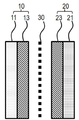
도 1은 본 발명의 제1 구현예에 따라 제조된 리튬 이차전지의 모식도이다.
도 2는 본 발명의 제1 구현예에 따라 제조된 리튬 이차전지의 초기 충전시, 리튬 이온(Li+)의 이동을 나타내는 모식도이다.
도 3은 본 발명의 제1 구현예에 따라 제조된 리튬 이차전지의 초기 충전이 완료된 후의 모식도이다.
도 4는 본 발명의 제2 구현예에 따라 제조된 리튬 이차전지의 모식도이다.
도 5는 본 발명의 제2 구현예에 따라 제조된 리튬 이차전지의 초기 충전시, 리튬 이온(Li+)의 이동을 나타내는 모식도이다.
도 6은 본 발명의 제2 구현예에 따라 제조된 리튬 이차전지의 초기 충전이 완료된 후의 모식도이다.
도 7 내지 도 10은 실시예 1, 실시예 2, 실시예 3 및 비교예 1에서 제조된 리튬 금속층의 정면 주사전자현미경 이미지이다.1 is a schematic diagram of a lithium secondary battery manufactured according to the first embodiment of the present invention.
2 is a schematic diagram showing the movement of lithium ions (Li + ) during initial charging of a lithium secondary battery manufactured according to the first embodiment of the present invention.
3 is a schematic diagram after initial charging of a lithium secondary battery manufactured according to the first embodiment of the present invention is completed.
4 is a schematic diagram of a lithium secondary battery manufactured according to a second embodiment of the present invention.
5 is a schematic diagram showing the movement of lithium ions (Li + ) during initial charging of a lithium secondary battery manufactured according to a second embodiment of the present invention.
6 is a schematic view after the initial charging of the lithium secondary battery manufactured according to the second embodiment of the present invention is completed.
7 to 10 are front scanning electron microscope images of the lithium metal layers prepared in Example 1, Example 2, Example 3, and Comparative Example 1.
이하, 본 발명이 속하는 기술 분야에서 통상의 지식을 가진 자가 용이하게 실시할 수 있도록 첨부한 도면을 참고로 하여 상세히 설명한다. 그러나 본 발명은 여러 가지 상이한 형태로 구현될 수 있으며, 본 명세서에 한정되지 않는다.Hereinafter, with reference to the accompanying drawings to be easily carried out by those of ordinary skill in the art to which the present invention pertains will be described in detail. However, the present invention can be implemented in many different forms, and is not limited to this specification.
도면에서는 본 발명을 명확하게 설명하기 위해서 설명과 관계없는 부분을 생략하였고, 명세서 전체를 통해 유사한 부분에 대해서는 유사한 도면 부호를 사용하였다. 또한, 도면에서 표시된 구성요소의 크기 및 상대적인 크기는 실제 축척과는 무관하며, 설명의 명료성을 위해 축소되거나 과장된 것일 수 있다.In the drawings, parts not related to the description are omitted in order to clearly describe the present invention, and similar reference numerals are used for similar parts throughout the specification. In addition, the size and relative size of the components indicated in the drawings are independent of the actual scale, and may be reduced or exaggerated for clarity of explanation.
도 1은 본 발명의 제1구현예에 따라 제조된 리튬 이차전지의 단면도로, 양극 집전체(11) 및 양극 합제(12)를 포함하는 양극(10); 음극 집전체(21)를 포함하는 음극(20); 및 이들 사이에 개재되는 분리막(30) 및 전해질(미도시)을 구비한다.1 is a cross-sectional view of a lithium secondary battery manufactured according to a first embodiment of the present invention, a
리튬 이차전지의 음극은 음극 집전체(21) 상에 음극이 형성되는 것이 통상적이나, 본 발명에서는 표면에 금속 입자(27)가 형성된 음극 집전체(21)만으로 사용하여 음극 프리 전지 구조로 조립한 후, 충전에 의해 양극 합제(13)로부터 방출되는 리튬 이온이 음극 집전체(21) 상에 음극 합제로서 리튬 금속층(미도시)을 형성함에 따라 공지의 음극 집전체/음극 합체의 구성을 갖는 음극을 형성하여 통상의 리튬 이차전지의 구성을 이룬다. The negative electrode of the lithium secondary battery is usually formed with a negative electrode on the negative electrode
즉, 본 발명에 있어서 음극 프리 전지 함은, 최초 조립 시에는 음극 집전체 상에 음극이 형성되지 않는 음극 프리인 전지일 수 있고, 사용에 따라서 음극 집전체 상에 음극이 형성되어 음극이 있을 수도 있는 전지를 모두 포함하는 개념일 수 있다.That is, in the present invention, the negative electrode free battery box may be a negative electrode-free battery in which a negative electrode is not formed on the negative electrode current collector during initial assembly, or a negative electrode may be formed on the negative electrode current collector depending on use. It may be a concept that includes all of the cells.
또한, 본 발명의 음극에 있어서, 음극 집전체 상에 음극 합제로서 형성되는 리튬 금속의 형태는, 리튬 금속이 층으로 형성된 형태와, 리튬 금속이 층으로 형성된 것이 아닌 구조(예를 들어 리튬 금속이 입자 형태로 뭉쳐진 구조)를 모두 포함한다. Further, in the negative electrode of the present invention, the shape of the lithium metal formed as a negative electrode mixture on the negative electrode current collector is a shape in which the lithium metal is formed in a layer and a structure in which the lithium metal is not formed in a layer (for example, lithium metal is It includes all of the structures aggregated in the form of particles.
이하, 본 발명에서는 리튬 금속이 층으로 형성된 리튬금속층(23)의 형태를 기준으로 설명하나, 이러한 설명이 리튬 금속이 층으로 형성된 것이 아닌 구조를 제외하는 것은 아니라는 점은 명확하다.Hereinafter, the present invention will be described based on the shape of the
도 2는 본 발명의 제1 구현예에 따라 제조된 리튬 이차전지의 초기 충전시, 리튬 이온(Li+)의 이동을 나타내는 모식도이고, 도 3은 본 발명의 제1 구현예에 따라 제조된 리튬 이차전지의 초기 충전이 완료된 후의 모식도이다.2 is a schematic view showing the movement of lithium ions (Li + ) during initial charging of a lithium secondary battery prepared according to the first embodiment of the present invention, and FIG. 3 is lithium prepared according to the first embodiment of the present invention It is a schematic diagram after the initial charging of the secondary battery is completed.
도 2와 도 3을 참고하여 설명하면, 음극 프리 전지 구조를 갖는 리튬 이차전지에 일정 수준 이상의 전압을 인가하여 충전을 진행하면, 양극(10) 내 양극 합제(13)로부터 리튬 이온이 탈리되고, 이는 분리막(30)을 통과하여 음극 집전체(21) 측으로 이동하고, 상기 음극 집전체(21) 상에 순수하게 리튬으로만 이루어진 리튬 금속층(23)을 형성하여 음극(20)을 이룬다. 특히, 리튬과 합금을 형성할 수 있는 금속 또는 준금속으로 이루어진 금속 입자(27)를 사용하여 상기 리튬 금속층(23)의 형성을 보다 용이하게 하며, 보다 조밀한 박막 구조를 형성할 수 있다.2 and 3, when charging is performed by applying a voltage above a certain level to a lithium secondary battery having a negative electrode free battery structure, lithium ions are desorbed from the
이러한 충전을 통한 리튬 금속층(23)의 형성은 종래 음극 집전체(21) 상에 리튬 금속층(23)을 스퍼터링하거나 리튬 호일과 음극 집전체(21)를 합지하는 음극과 비교할 때, 박막의 층을 형성할 수 있으며, 계면 특성의 조절이 매우 용이하다는 이점이 있다. 또한, 음극 집전체(21)에 적층되는 리튬 금속층(23)의 결합 세기가 크고 안정하기 때문에 방전을 통해 다시 이온화 상태로 인해 음극 집전체(21)로부터 제거되는 문제가 발생하지 않는다. Formation of the
특히, 음극 프리 전지 구조로 형성하여 전지 조립 과정 중 리튬 금속이 대기 중에 노출이 전혀 발생하지 않아, 종래 리튬 자체의 높은 반응성으로 인한 표면의 산화막 형성 및 이에 따른 리튬 이차전지의 수명 저하와 같은 문제를 원천적으로 차단할 수 있다. Particularly, since the lithium metal is formed in a negative electrode free battery structure and there is no exposure to lithium metal in the air during the battery assembly process, problems such as the formation of an oxide film on the surface due to the high reactivity of the lithium itself and the decrease in the life of the lithium secondary battery accordingly. It can be blocked at the source.
특히, 본 발명의 음극 프리 전지 구조에서 음극을 구성하는 음극 집전체(21)는 3 ㎛ 내지 500 ㎛의 두께를 가지며, 그 표면에 금속 입자(27)가 형성된 것을 사용한다. 음극 프리 전극으로 충전을 통해 리튬 금속층의 형성시 음극 집전체의 재질에 따라 Li nucleation over potential 이 발생할 수 있으며, 이와 같은 저항으로 인해 초기 쿨롱 효율의 저감이 발생할 우려가 있다. 이에 금속 입자(27)를 형성할 경우, 금속 입자(27)의 재질에 따라 전하 이동에 의해 Li 이온이 Li으로 석출 시 Li nucleation over potential이 거의 없을 수 있다.In particular, the negative electrode
금속 입자(27)는 리튬과 합금 가능한 금속 또는 준금속일 수 있으며, 이는 알루미늄, 금, 비스무트, 게르마늄, 마그네슘, 망간, 몰리브덴, 나트륨, 니켈, 오스뮴, 인, 납, 팔라듐, 백금, 플루토늄, 루비듐, 로듐, 루테늄, 황, 안티몬, 셀레늄, 규소, 주석, 스트론튬, 탄탈륨, 텔레늄, 티타늄, 우라늄, 바나듐, 텅스텐, 아연 및 지르코늄으로 이루어진 군에서 선택된 1종 이상이 가능하고, 바람직하기로는 은 또는 금을 사용한다. The metal particles 27 may be a metal or a metal that is alloyable with lithium, which may be aluminum, gold, bismuth, germanium, magnesium, manganese, molybdenum, sodium, nickel, osmium, phosphorus, lead, palladium, platinum, plutonium, rubidium , Rhodium, ruthenium, sulfur, antimony, selenium, silicon, tin, strontium, tantalum, telenium, titanium, uranium, vanadium, tungsten, zinc and zirconium. Use gold.
상기 금속 입자(27)는 집전체에 대비하여 0.1 내지 40 중량%의 함량으로 포함될 수 있고, 바람직하게는 1 내지 20 중량%의 함량으로 포함될 수 있다. The metal particles 27 may be included in an amount of 0.1 to 40% by weight relative to the current collector, and preferably in an amount of 1 to 20% by weight.
상기 금속 입자(27)의 함량이 0.1 중량%에 미달하면 입자가 균일하게 형성이 되지 않아 Li 금속의 도금 효율이 떨어지며, 40 중량%를 초과하면 집전체의 중량이 커져 전지 에너지 밀도가 낮아지거나 금속이 입자가 아닌 layer로 형성될 수 있다.When the content of the metal particles 27 is less than 0.1% by weight, the particles are not uniformly formed, and thus the plating efficiency of Li metal decreases. If the content exceeds 40% by weight, the weight of the current collector increases, resulting in a decrease in battery energy density or metal. It may be formed of a layer other than these particles.
상기 금속 입자(27)의 형성은 본 발명에서 특별히 한정하지 않으며, 공지의 방법이 사용될 수 있다. 일례로, 화학 기상 증착법(CVD), 스퍼터링법(sputtering), e-빔 증착법(e-beam evaporation), 원자 박막 증착법(ALD:Atomic Layer Deposition), 진공 증착법 등의 건식 방법이 수행될 수 있다. 또한, 금속 입자(27)의 금속을 포함하는 전구체를 코팅 후 열처리를 통해 형성할 수 있다. 이때 상기 전구체는 염화물, 질화물 등 공지의 전구체가 사용될 수 있다. 상기 열처리를 통해 물질의 표면 에너지의 변화 및 물질 고유의 특성인 응집 현상에 의해 디웨팅(dewetting)이 일어나고 이에 의해 코팅층은 나노 도트 형태로 변하게 된다. 일반적으로 약 250℃의 온도로 10분간 열처리 시 촉매 물질 코팅층은 금속 입자 형태로 변한다.The formation of the metal particles 27 is not particularly limited in the present invention, and a known method can be used. For example, dry methods such as chemical vapor deposition (CVD), sputtering, e-beam evaporation, atomic thin film deposition (ALD), and vacuum deposition may be performed. In addition, the precursor containing the metal of the metal particles 27 may be formed through coating and heat treatment. At this time, the precursor may be a known precursor such as chloride, nitride. Through the heat treatment, dewetting occurs due to a change in the surface energy of the material and a coagulation phenomenon, which is an inherent property of the material, whereby the coating layer is changed into a “nano” dot form. In general, when the heat treatment is performed at a temperature of about 250 ° C. for 10 minutes, the coating layer of the catalytic material changes to a form of metal particles.
이러한 금속 입자(27)는 양극으로부터 이송되어온 리튬 이온이 리튬 금속층(23)으로 성장하기 위한 시드(seed)로서 역할을 한다. 이로 인해, 형성된 리튬 금속층(23)이 음극 집전체(21) 상에 균일하면서도 조밀한 미세 구조를 갖는다. The metal particles 27 serve as seeds for growing lithium ions transferred from the positive electrode to the
또한, 금속 입자(27)는 시드로서의 역할을 위해 음극 집전체(21) 상에 코팅층의 연속적인 층이 아닌 아일랜드(island) 형태로 존재한다. 이때 금속 입자(27)은 음극 집전체(21) 상에 1 nm 이상 10㎛ 미만의 간극으로, 바람직하게는 1 nm 이상 2㎛ 미만의 간극으로 이격하여 형성된다.In addition, the metal particles 27 are present in the form of an island on the anode
음극 집전체(21)는 충전에 의해 리튬 금속층(23)이 형성될 수 있는 음극 집전체(21)는 리튬 이차전지에 화학적 변화를 유발하지 않으면서 도전성을 가진 것이라면 특별히 제한되지 않는다. 그 예시로서 구리, 스테인리스 스틸, 알루미늄, 니켈, 티탄, 소성 탄소, 구리나 스테인리스 스틸의 표면에 카본, 니켈, 티탄, 은 등으로 표면 처리한 것, 알루미늄-카드뮴 합금 등이 사용될 수 있다. The negative electrode
또한, 상기 음극 집전체(21)는 양극 집전체(11)와 마찬가지로, 표면에 미세한 요철이 형성된 필름, 시트, 호일, 네트, 다공질체, 발포체, 부직포체 등 다양한 형태가 사용될 수 있다.In addition, the negative electrode
이러한 금속 입자(27)가 형성된 음극 집전체(21)를 구비한 음극 프리 구조의 리튬 이차전지의 구현은 다양한 방법으로서 구현이 가능하나, 본 발명에서는 양극 합제(13)에 사용하는 조성을 제어함으로써 확보한다.The implementation of the lithium secondary battery having a negative electrode-free structure having the negative electrode
양극 합제(13)는 전지 종류에 따라 다양한 양극 활물질을 사용할 수 있으며, 본 발명에서 사용되는 양극 활물질은 양극 활물질은 리튬 이온을 흡장, 방출할 수 있는 물질이면 특별히 제한되지 않으나, 현재 수명 특성 및 충방전 효율이 우수한 전지를 구현할 수 있는 양극 활물질에 포함되는 리튬 전이금속 화합물로서 리튬 전이금속 산화물이 대표적으로 사용되고 있다.The
리튬 전이금속 산화물로서, 2 이상의 전이금속을 포함하고, 예를 들어, 하나 이상의 전이금속으로 치환된 리튬 코발트산화물(LiCoO2), 리튬 니켈 산화물(LiNiO2) 등의 층상 화합물; 하나 이상의 전이금속으로 치환된 리튬 망간 산화물, 리튬 니켈계 산화물, 스피넬계 리튬 니켈 망간 복합 산화물, 화학식의 Li 일부가 알칼리 토금속 이온으로 치환된 스피넬계 리튬 망간 산화물, 올리빈계 리튬 금속 포스페이트 등을 포함할 수 있으나, 이들만으로 한정되는 것은 아니다.As a lithium transition metal oxide, a layered compound such as lithium cobalt oxide (LiCoO 2 ) and lithium nickel oxide (LiNiO 2 ) containing two or more transition metals and substituted with one or more transition metals; Lithium manganese oxide substituted with one or more transition metals, lithium nickel-based oxide, spinel-based lithium nickel-manganese composite oxide, spinel-based lithium manganese oxide in which part of Li of the formula is substituted with alkaline earth metal ions, olivine-based lithium metal phosphate, etc. However, it is not limited to these.
리튬 함유 전이금속 산화물을 사용하는 것이 바람직하며, 예를 들면 LiCoO2, LiNiO2, LiMnO2, LiMn2O4, Li(NiaCobMnc)O2(0<a<1, 0<b<1, 0<c<1, a+b+c=1), LiNi1-YCoYO2, LiCo1 - YMnYO2, LiNi1 - YMnYO2 (여기에서, 0≤Y<1), Li(NiaCobMnc)O4(0<a<2, 0<b<2, 0<c<2, a+b+c=2), LiMn2 - zNizO4, LiMn2 - zCozO4(여기에서, 0<Z<2), LixMyMn2-yO4-zAz (여기에서, 0.9≤x≤1.2, 0<y<2, 0≤z<0.2, M= Al, Mg, Ni, Co, Fe, Cr, V, Ti, Cu, B, Ca, Zn, Zr, Nb, Mo, Sr, Sb, W, Ti 및 Bi 중 하나 이상, A는 -1 또는 -2가의 하나 이상의 음이온), Li1 + aNibM'1 - bO2 - cA'c (0≤a≤0.1, 0≤b≤0.8, 0≤c<0.2이고, M'은 Mn, Co, Mg, Al 등 6배위의 안정한 원소로 이루어진 군에서 선택되는 1종 이상이고 A'는 -1 또는 -2가의 하나 이상의 음이온이다.), LiCoPO4, 및 LiFePO4 로 이루어진 군으로부터 1종 이상 선택되는 것을 사용할 수 있으며, 바람직하게 LiCoO2를 사용한다. 또한, 이러한 산화물(oxide) 외에 황화물(sulfide), 셀렌화물(selenide) 및 할로겐화물(halide) 등도 사용할 수 있다. It is preferable to use a lithium-containing transition metal oxide, for example, LiCoO 2 , LiNiO 2 , LiMnO 2 , LiMn 2 O 4 , Li (Ni a Co b Mn c ) O 2 (0 <a <1, 0 <b <1, 0 <c <1, a + b + c = 1), LiNi 1-Y Co Y O 2 , LiCo 1 - Y MnYO 2 , LiNi 1 - Y MnYO 2 (here, 0≤Y <1) , Li (NiaCobMnc) O 4 (0 <a <2, 0 <b <2, 0 <c <2, a + b + c = 2), LiMn 2 - z Ni z O 4 , LiMn 2 - z Co z O 4 (here, 0 <Z <2), Li x M y Mn 2-y O 4-z A z (where 0.9≤x≤1.2, 0 <y <2, 0≤z <0.2, M = Al, Mg, Ni, Co, Fe, Cr, V, Ti, Cu, B, Ca, Zn, Zr, Nb, Mo, Sr, Sb, W, one or more of Ti and Bi, A is -1 or- Divalent one or more anions), Li 1 + a NibM ' 1 - b O 2 - c A' c (0≤a≤0.1, 0≤b≤0.8, 0≤c <0.2, M 'is Mn, Co, 1 or more selected from the group consisting of stable elements of 6 coordination such as Mg and Al, and A 'is -1 or -2 or more anions.), LiCoPO 4 , and LiFePO 4 or more. It can be used, preferably LiCoO 2 is used. In addition, sulfide, selenide, and halide may be used in addition to the oxide.
또한, 본 발명에서는 리튬 전이금속 산화물에 리튬 소스를 제공할 수 있는 첨가제로서, 리튬 금속 화합물을 함께 사용할 수 있다.In addition, in the present invention, a lithium metal compound may be used as an additive capable of providing a lithium source to a lithium transition metal oxide.
본 발명에서 제시하는 리튬 금속 화합물은 하기 화학식 1 내지 화학식 8로 표시되는 화합물이 가능하다. The lithium metal compound presented in the present invention may be a compound represented by the following Chemical Formulas 1 to 8.
[화학식 1][Formula 1]
Li2Ni1-aM1 aO2 Li 2 Ni 1-a M 1 a O 2
(상기 식에서, a는 0≤a<1이고, M1은 Mn, Fe, Co, Cu, Zn, Mg 및 Cd로 이루어진 군에서 선택된 1종 이상의 원소이다.)(In the above formula, a is 0≤a <1, and M 1 is one or more elements selected from the group consisting of Mn, Fe, Co, Cu, Zn, Mg and Cd.)
[화학식 2][Formula 2]
Li2+bNi1-cM2 cO2+d Li 2 + b Ni 1-c M 2 c O 2 + d
(상기 식에서, -0.5≤b<0.5, 0≤c≤1, 0≤d<0.3, M2는 P, B, C, Al, Sc, Sr, Ti, V, Zr, Mn, Fe, Co, Cu, Zn, Cr, Mg, Nb, Mo 및 Cd로 이루어진 군에서 선택된 1종 이상의 원소이다.)(In the above formula, -0.5≤b <0.5, 0≤c≤1, 0≤d <0.3, M 2 is P, B, C, Al, Sc, Sr, Ti, V, Zr, Mn, Fe, Co, It is one or more elements selected from the group consisting of Cu, Zn, Cr, Mg, Nb, Mo and Cd.)
[화학식 3][Formula 3]
LiM3 eMn1-eO2(e는 0≤e<0.5이고, M3는 Cr, Al, Ni, Mn 및 Co로 이루어진 군에서 선택된 1종 이상의 원소이다.), LiM 3 e Mn 1-e O 2 (e is 0≤e <0.5, M 3 is one or more elements selected from the group consisting of Cr, Al, Ni, Mn and Co.),
[화학식 4][Formula 4]
Li2M4O2 Li 2 M 4 O 2
(상기 식에서, M4는 Cu, Ni로 이루어진 군에서 선택된 1종 이상의 원소이다.)(In the formula, M 4 is one or more elements selected from the group consisting of Cu and Ni.)
[화학식 5][Formula 5]
Li3+fNb1-gM5 gS4-h Li 3 + f Nb 1-g M 5 g S 4-h
(상기 식에서, -0.1≤f≤1, 0≤g≤0.5, -0.1≤h≤0.5이고, M5는 Mn, Fe, Co, Cu, Zn, Mg 및 Cd로 이루어진 군에서 선택된 1종 이상의 원소이다)(In the above formula, -0.1≤f≤1, 0≤g≤0.5, -0.1≤h≤0.5, M 5 is one or more elements selected from the group consisting of Mn, Fe, Co, Cu, Zn, Mg and Cd to be)
[화학식 6][Formula 6]
LiM6 iMn1-iO2 LiM 6 i Mn 1-i O 2
(상기 식에서, i는 0.05≤i<0.5이고, M6는 Cr, Al, Ni, Mn, 및 Co로 이루어진 군으로부터 선택된 1종 이상의 원소이다.)(In the above formula, i is 0.05≤i <0.5, and M 6 is one or more elements selected from the group consisting of Cr, Al, Ni, Mn, and Co.)
[화학식 7][Formula 7]
LiM7 2jMn2-2jO4 LiM 7 2j Mn 2-2j O 4
(상기 식에서, j는 0.05≤j<0.5이고, M7은 Cr, Al, Ni, Mn, 및 Co로 이루어진 군으로부터 선택된 1종 이상의 원소이다.)(In the above formula, j is 0.05≤j <0.5, and M 7 is one or more elements selected from the group consisting of Cr, Al, Ni, Mn, and Co.)
[화학식 8] [Formula 8]
Lik-M8 m-Nn Li k -M 8 m -N n
(상기 식에서, M8은 알칼리토류 금속을 나타내고, k/(k+m+n)은 0.10 내지 0.40이고, m/(k+m+n)은 0.20 내지 0.50이고, n/(k+m+n)은 0.20 내지 0.50이다.)(In the above formula, M 8 represents an alkaline earth metal, k / (k + m + n) is 0.10 to 0.40, m / (k + m + n) is 0.20 to 0.50, and n / (k + m + n) is 0.20 to 0.50.)
상기한 화학식 1 내지 화학식 8의 리튬 금속 화합물은 그 구조에 따라 비가역 용량에 차이가 있으며, 이들은 단독 또는 혼합하여 사용할 수 있으며, 양극 활물질의 비가역 용량을 높이는 역할을 한다.The lithium metal compounds of Chemical Formulas 1 to 8 have different irreversible capacity depending on their structure, and they can be used alone or in combination, and serve to increase the irreversible capacity of the positive electrode active material.
일례로, 화학식 1 및 3으로 표시되는 고비가역 물질은 그 종류에 따라 비가역 용량이 다르며, 일례로 하기 표 1에 나타낸 바와 같은 수치를 갖는다.For example, the high irreversible materials represented by Chemical Formulas 1 and 3 have different irreversible capacities depending on their types, and have numerical values as shown in Table 1 below as an example.
또한, 화학식 2의 리튬 금속 화합물은 공간군 Immm에 속하는 것이 바람직하고, 그 중 Ni, M 복합 산화물(composite oxide)이 평면사배위(Ni, M)O4를 형성하며 평면사배위 구조가 마주 대하는 변(O-O으로 형성된 변)을 공유하며 1차 쇄를 형성하고 있는 것이 더욱 바람직하다. 상기 화학식 2의 화합물의 결정 격자 상수는 a = 3.7±0.5 Å, b = 2.8±0.5 Å, c = 9.2±0.5 Å, α= 90°, β= 90°, γ= 90°인 것이 바람직하다.In addition, it is preferable that the lithium metal compound of Formula 2 belongs to the space group Immm, of which Ni, M composite oxide forms a planar coordination (Ni, M) O4, and the plane coordination structure faces the opposite side. It is more preferable to share a (side formed of OO) and form a primary chain. The crystal lattice constant of the compound of Formula 2 is preferably a = 3.7 ± 0.5 ±, b = 2.8 ± 0.5 Å, c = 9.2 ± 0.5 Å, α = 90 °, β = 90 °, γ = 90 °.
또한, 화학식 8의 리튬 금속 화합물은 알칼리토류 금속의 함량이 30 내지 45 원자%이고, 질소의 함량은 30 내지 45 원자%이다. 이때 상기 알칼리토류 금속의 함량 및 질소의 함량이 상기 범위일 때, 상기 화학식 1의 화합물의 열적 특성 및 리튬 이온 전도 특성이 우수하다. 그리고, 상기 화학식 8에서 k/(k+m+n)은 0.15 내지 0.35, 예를 들어 0.2 내지 0.33이고, m/(k+m+n)은 0.30 내지 0.45, 예를 들어 0.31 내지 0.33이고, n/(k+m+n)은 0.30 내지 0.45, 예를 들어 0.31 내지 0.33이다.In addition, the lithium metal compound of the formula (8) has an alkaline earth metal content of 30 to 45 atomic%, and a nitrogen content of 30 to 45 atomic%. At this time, when the content of the alkaline earth metal and the content of nitrogen are in the above range, the thermal properties and lithium ion conduction properties of the compound of Formula 1 are excellent. And, in the formula (8), k / (k + m + n) is 0.15 to 0.35, for example 0.2 to 0.33, m / (k + m + n) is 0.30 to 0.45, for example 0.31 to 0.33, n / (k + m + n) is 0.30 to 0.45, for example 0.31 to 0.33.
상기 화학식 1의 전극 활물질은 일구현예에 따르면 a는 0.5 내지 1, b는 1, c는 1이다.According to an embodiment of the electrode active material of Chemical Formula 1, a is 0.5 to 1, b is 1, and c is 1.
상기 화학식 1 내지 8 중 어느 하나의 화합물로 된 코팅막을 형성하면, 전극 활물질은 리튬 이온이 지속적으로 삽입, 탈착되는 환경에서도 낮은 저항 특성을 유지하면서 안정적인 특성을 나타낸다. 본 발명의 일구현예에 따른 전극 활물질에서 코팅막의 두께는 1 내지 100nm이다. 상기 코팅막의 두께가 상기 범위일 때 양극 활물질의 이온 전도 특성이 우수하다.When a coating film of any one of the above Chemical Formulas 1 to 8 is formed, the electrode active material exhibits stable characteristics while maintaining low resistance characteristics even in an environment where lithium ions are continuously inserted and desorbed. The thickness of the coating film in the electrode active material according to an embodiment of the present invention is 1 to 100nm. When the thickness of the coating film is within the above range, the ion conducting properties of the positive electrode active material are excellent.
또한, 양극 활물질의 평균 입경은 1 내지 30㎛, 일구현예에 따르면, 8 내지 12㎛이다. 양극 활물질의 평균 입경이 상기 범위일 때, 전지의 용량 특성이 우수하다.In addition, the average particle diameter of the positive electrode active material is 1 to 30 μm, and according to one embodiment, 8 to 12 μm. When the average particle diameter of the positive electrode active material is within the above range, the capacity characteristics of the battery are excellent.
상기 알칼리토류 금속이 도핑된 코어 활물질은 예를 들어 마그네슘이 도핑된 LiCoO2를 들 수 있다. 상기 마그네슘의 함량은 코어 활물질 100 중량부를 기준으로 하여 0.01 내지 3 중량부이다.The core active material doped with the alkaline earth metal may be, for example, LiCoO 2 doped with magnesium. The magnesium content is 0.01 to 3 parts by weight based on 100 parts by weight of the core active material.
상기한 리튬 전이금속 산화물은 양극 활물질로서 바인더 및 도전재 등과 함께 양극 합제(13)에 사용한다. 본 발명의 음극 프리 전지 구조에서 리튬 금속층(23)을 형성하기 위한 리튬 소스(source)는 상기 리튬 전이금속 산화물이 된다. 즉, 리튬 전이금속 산화물 내 리튬 이온은 특정 범위의 전압 범위에서 충전을 수행할 경우 리튬 이온이 탈리되어 음극 집전체(21) 상에 리튬 금속층(23)을 형성한다.The above-described lithium transition metal oxide is used as a positive electrode
본 발명에서 리튬 금속층(23)을 형성하기 위한 충전 범위는 4.5V ~ 2.5V의 전압 범위에서 0.01 내지 0.2C로 1회의 충전을 수행 한다. 만약, 충전을 상기 범위 이하에서 수행할 경우 리튬 금속층(23)의 형성이 어렵게 되며, 이와 반대로 상기 범위를 초과할 경우 전지(cell)의 손상(damage)이 일어나 과방전이 일어난 후에 충방전이 제대로 진행되지 않는다.In the present invention, the charging range for forming the
상기 형성된 리튬 금속층(23)은 음극 집전체(21) 상에 균일한 연속 또는 불연속적인 층을 형성한다. 일례로, 음극 집전체(21)가 호일 형태인 경우 연속적인 박막 형태를 가질 수 있으며, 음극 집전체(21)가 3차원 다공성 구조를 가질 경우 리튬 금속층(23)은 불연속적으로 형성될 수 있다. 즉, 불연속적인 층은 불연속적으로 분포하는 형태로, 특정 영역 내에 리튬 금속층(23)이 존재하는 영역과 존재하지 않는 영역이 존재하되, 리튬 금속층(23)이 존재하지 않는 영역이 리튬 화합물이 존재하는 영역을 아일랜드형(island type)과 같이 고립, 단절 또는 분리하도록 분포함으로써, 리튬 금속층(23)이 존재하는 영역이 연속성 없이 분포하는 것을 의미한다. The formed
이러한 충방전을 통해 형성된 리튬 금속층(23)은 음극으로서의 기능을 위해 최소 50 nm 이상, 100 ㎛ 이하, 바람직하기로 1㎛m 내지 50㎛의 두께를 갖는다. 만약 그 두께가 상기 범위 미만이면 전지 충방전 효율이 급격히 감소하며, 이와 반대로 상기 범위를 초과할 경우 수명 특성 등은 안정하나, 전지의 에너지밀도가 낮아지는 문제가 있다.The
특히, 본 발명에서 제시하는 리튬 금속층(23)은 전지 조립시에는 리튬 금속이 없는 음극 프리 전지로 제조함으로써, 종래 리튬 호일을 사용하여 조립된 리튬 이차전지와 비교하여 조립 과정에서 발생하는 리튬의 높은 반응성으로 인해 리튬 금속층(23) 상에 산화층이 전혀 또는 거의 형성되지 않는다. 이로 인해 상기 산화층에 의한 전지의 수명 퇴화 현상을 방지할 수 있다. In particular, the
또한, 리튬 금속층(23)은 고비가역 물질의 충전에 의해 이동하고, 이는 양극 상에 리튬 금속층(23)을 형성하는 것과 비교하여 보다 안정적인 리튬 금속층(23)을 형성할 수 있다. 양극 상에 리튬 금속을 부착할 경우, 양극과 리튬 금속의 화학 반응이 일어날 수 있다.In addition, the
상기한 양극 활물질과 리튬 금속 화합물을 포함하여 양극 합제(13)를 구성하며, 이때 상기 양극 합제(13)는 추가로 리튬 이차전지에서 통상적으로 사용하는 도전재, 바인더, 및 기타 첨가제를 더욱 포함할 수 있다.The
도전재는 전극 활물질의 도전성을 더욱 향상시키기 위해 사용한다. 이러한 도전재는 당해 전지에 화학적 변화를 유발하지 않으면서 도전성을 가진 것이라면 특별히 제한되는 것은 아니며, 예를 들어, 천연 흑연이나 인조 흑연 등의 흑연; 카본 블랙, 아세틸렌 블랙, 케첸 블랙, 채널 블랙, 퍼니스 블랙, 램프 블랙, 써멀 블랙 등의 카본블랙; 탄소 섬유나 금속 섬유 등의 도전성 섬유; 불화 카본, 알루미늄, 니켈 분말 등의 금속 분말; 산화아연, 티탄산 칼륨 등의 도전성 휘스커; 산화티탄 등의 도전성 금속 산화물; 폴리페닐렌 유도체 등이 사용될 수 있다.The conductive material is used to further improve the conductivity of the electrode active material. The conductive material is not particularly limited as long as it has conductivity without causing a chemical change in the battery. For example, graphite such as natural graphite or artificial graphite; Carbon black such as carbon black, acetylene black, ketjen black, channel black, furnace black, lamp black, and thermal black; Conductive fibers such as carbon fibers and metal fibers; Metal powders such as carbon fluoride, aluminum, and nickel powders; Conductive whiskers such as zinc oxide and potassium titanate; Conductive metal oxides such as titanium oxide; Polyphenylene derivatives and the like can be used.
상기 양극 활물질, 리튬 금속 화합물 및 도전재의 결합과 집전체에 대한 결합을 위하여 바인더를 더 포함할 수 있다. 상기 바인더는 열가소성 수지 또는 열경화성 수지를 포함할 수 있다. 예를 들어, 폴리에틸렌, 폴리프로필렌, 폴리테트라플루오로 에틸렌(PTFE), 폴리비닐리덴 플루오라이드(PVDF), 스티렌-부타디엔 고무, 테트라플루오로에틸렌-퍼플루오로 알킬비닐에테르 공중합체, 불화비닐리덴-헥사 플루오로프로필렌 공중합체, 불화비닐리덴-클로로트리플루오로에틸렌 공중합체, 에틸렌-테트라플루오로에틸렌 공중합체, 폴리클로로트리플루오로에틸렌, 불화비닐리덴-펜타플루오로 프로필렌 공중합체, 프로필렌-테트라플루오로에틸렌 공중합체, 에틸렌-클로로트리플루오로에틸렌 공중합체, 불화비닐리덴-헥사플루오로프로필렌-테트라 플루오로에틸렌 공중합체, 불화비닐리덴-퍼플루오로메틸비닐에테르-테트라플루오로 에틸렌 공중합체, 에틸렌-아크릴산 공중합제 등을 단독 또는 혼합하여 사용할 수 있으나, 반드시 이들로 한정되지 않으며 당해 기술분야에서 바인더로 사용될 수 있는 것이라면 모두 가능하다.A binder may be further included to bond the positive electrode active material, the lithium metal compound, and the conductive material to the current collector. The binder may include a thermoplastic resin or a thermosetting resin. For example, polyethylene, polypropylene, polytetrafluoro ethylene (PTFE), polyvinylidene fluoride (PVDF), styrene-butadiene rubber, tetrafluoroethylene-perfluoro alkylvinyl ether copolymer, vinylidene fluoride- Hexa fluoropropylene copolymer, vinylidene fluoride-chlorotrifluoroethylene copolymer, ethylene-tetrafluoroethylene copolymer, polychlorotrifluoroethylene, vinylidene fluoride-pentafluoropropylene copolymer, propylene-tetrafluoro Roethylene copolymer, ethylene-chlorotrifluoroethylene copolymer, vinylidene fluoride-hexafluoropropylene-tetra fluoroethylene copolymer, vinylidene fluoride-perfluoromethylvinyl ether-tetrafluoro ethylene copolymer, ethylene -Acrylic acid copolymers and the like can be used alone or in combination, but are not necessarily limited to these and can be used as long as it can be used as a binder in the art.
기타 첨가제의 예로 충진제가 있다. 상기 충진제는 전극의 팽창을 억제하는 성분으로서 선택적으로 사용되며, 당해 전지에 화학적 변화를 유발하지 않으면서 섬유상 재료라면 특별히 제한되는 것은 아니다. 예를 들어, 폴리에틸렌, 폴리프로필렌 등의 올리핀계 중합체나 유리섬유, 탄소섬유 등의 섬유상 물질이 사용된다.Examples of other additives are fillers. The filler is selectively used as a component that suppresses the expansion of the electrode, and is not particularly limited as long as it is a fibrous material without causing a chemical change in the battery. For example, olefinic polymers such as polyethylene and polypropylene, or fibrous materials such as glass fibers and carbon fibers are used.
본 발명의 양극 합제(13)는 양극 집전체(11) 상에 형성된다.The
양극 집전제는 일반적으로 3 ㎛ 내지 500 ㎛의 두께로 만든다. 이러한 양극 집전체(11)는 리튬 이차전지에 화학적 변화를 유발하지 않으면서 높은 도전성을 가지는 것이라면 특별히 제한되지 않으며, 그 예시로서 스테인리스 스틸, 알루미늄, 니켈, 티탄, 소성 탄소, 또는 알루미늄이나 스테인리스 스틸의 표면에 카본, 니켈, 티탄, 은 등으로 표면 처리한 것 등이 사용될 수 있다. 이때, 상기 양극 집전체(11)는 양극 활물질과의 접착력을 높일 수도 있도록, 표면에 미세한 요철이 형성된 필름, 시트, 호일, 네트, 다공질체, 발포체, 부직포체 등의 다양한 형태로 사용될 수 있다.The positive electrode current collector is generally made to a thickness of 3 µm to 500 µm. The positive electrode
양극 합제(13)를 집전체 상에 도포하는 방법은, 전극 합제 슬러리를 집전체 위에 분배시킨 후 닥터 블레이드(doctor blade) 등을 사용하여 균일하게 분산시키는 방법, 다이 캐스팅(die casting), 콤마 코팅(comma coating), 스크린 프린팅(screen printing) 등의 방법 등을 들 수 있다. 또한, 별도의 기재(substrate) 위에 성형한 후 프레싱 또는 라미네이션 방법에 의해 전극 합제 슬러리를 집전체와 접합시킬 수도 있으나, 이에 제한되는 것은 아니다.The method of applying the
한편, 본 발명의 제2구현예에 따른 리튬 이차전지는 음극 중 분리막(60)과 접하는 면에 보호막(55)이 추가로 형성될 수 있다. 구체적으로, 보호막(55)을 형성할 경우 리튬 금속층(23)은 도 4에 나타낸 바와 같이, 양극 합제(43)로부터 이송된 리튬 이온이 보호막(55)을 통과하여 음극 집전체(51) 상에 형성하되, 금속 입자(57)로부터 성장한다.Meanwhile, in the lithium secondary battery according to the second embodiment of the present invention, a
이에 보호막(55)은 리튬 이온의 전달이 원활히 이뤄질 수 있는 것이면 어느 것이든 가능하고, 리튬 이온 전도성 고분자 및/또는 무기 고체 전해질에 사용하는 재질이 사용될 수 있으며, 필요한 경우 리튬염을 더욱 포함할 수 있다. Accordingly, the
리튬 이온 전도성 고분자로서, 예컨대 폴리에틸렌옥사이드(PEO), 폴리아크릴로니트릴(PAN), 폴리메틸메타크릴레이트(PMMA), 폴리비닐리덴 풀루오라이드(PVDF), 폴리비닐리덴 풀루오라이드-헥사풀루오로프로필렌(PVDF-HFP), LiPON, Li3N, LixLa1-xTiO3(0 < x < 1) 및 Li2S-GeS-Ga2S3로 이루어진 군으로부터 선택된 어느 하나 또는 이들 중 2종 이상의 혼합물로 이루어질 수 있으나, 이에 한정되는 것은 아니고, 리튬 이온 전도성을 지닌 고분자라면 제한되지 않고 사용이 가능하다.As a lithium ion conductive polymer, for example, polyethylene oxide (PEO), polyacrylonitrile (PAN), polymethyl methacrylate (PMMA), polyvinylidene fluoride (PVDF), polyvinylidene fluoride-hexapool Lopropylene (PVDF-HFP), LiPON, Li 3 N, LixLa 1-x TiO 3 (0 <x <1) and any one selected from the group consisting of Li 2 S-GeS-Ga 2 S 3 or two of them It may be made of the above mixture, but is not limited thereto, and any polymer having lithium ion conductivity may be used without limitation.
리튬 이온 전도성 고분자를 이용한 보호막(55)의 형성은 상기 리튬 이온 전도성 고분자를 용매에 용해 또는 팽윤시킨 코팅액을 제조한 다음 음극 집전체(51) 상에 금속 입자(57)를 포함하도록 도포한다. The formation of the
도포하는 방법으로는 재료의 특성 등을 감안하여 공지 방법 중에서 선택하거나 새로운 적절한 방법으로 행할 수 있다. 예를 들어, 상기 고분자 보호층 조성물을 집전체 위에 분배시킨 후 닥터 블레이드(doctor blade) 등을 사용하여 균일하게 분산시키는 것이 바람직하다. 경우에 따라서는, 분배와 분산 과정을 하나의 공정으로 실행하는 방법을 사용할 수도 있다. 이 밖에도, 딥 코팅(dip coating), 그라비어 코팅(gravure coating), 슬릿 다이 코팅(slit die coating), 스핀 코팅(spin coating), 콤마 코팅(comma coating), 바 코팅(bar coating), 리버스 롤 코팅(reverse roll coating), 스크린 코팅(screen coating), 캡 코팅(cap coating) 방법 등을 수행하여 제조할 수 있다. 이때 상기 음극 집전체(51)는 앞서 설명한 바와 동일하다.As a coating method, it is possible to select from known methods in consideration of the properties of the material or the like, or to perform it in a new appropriate method. For example, it is preferable to distribute the polymer protective layer composition over the current collector and then uniformly disperse it using a doctor blade or the like. In some cases, a method of performing the distribution and dispersion process in one process may be used. In addition, dip coating, gravure coating, slit die coating, spin coating, comma coating, bar coating, reverse roll coating (reverse roll coating), screen coating (screen coating), can be prepared by performing a cap coating (cap coating) method. At this time, the negative electrode
이후 음극 집전체(51) 위에 형성된 보호막(55)에 대해 건조 공정이 실시될 수 있으며, 이때 건조 공정은 상기 리튬 이온 전도성 고분자에서 사용된 용매의 종류에 따라 80 내지 120℃의 온도에서의 가열처리 또는 열풍 건조 등의 방법에 의해 실시될 수 있다.Thereafter, a drying process may be performed on the
이때 적용되는 용매는 리튬 이온 전도성 고분자와 용해도 지수가 유사하며, 끓는점(boiling point)이 낮은 것이 바람직하다. 이는 혼합이 균일하게 이루어질 수 있으며, 이후 용매를 용이하게 제거할 수 있기 때문이다. 구체적으로, N,N'-디메틸아세트아미드(N,N-dimethylacetamide: DMAc), 디메틸설폭사이드(dimethyl sulfoxide: DMSO), N,N-디메틸포름아미드(N,N-dimethylformamide: DMF), 아세톤(acetone), 테트라하이드로퓨란(tetrahydrofuran), 메틸렌클로라이드(methylene chloride), 클로로포름(chloroform), 디메틸포름아미드(dimethylformamide), N-메틸-2-피롤리돈(N-methyl-2-pyrrolidone, NMP), 시클로헥산(cyclohexane), 물 또는 이들의 혼합물을 용매로 사용할 수 있다.At this time, the solvent to be applied has a similar solubility index to the lithium ion conductive polymer, and it is preferable that the boiling point is low. This is because the mixing can be made uniform, and then the solvent can be easily removed. Specifically, N, N'-dimethylacetamide (DMAc), dimethyl sulfoxide (DMSO), N, N-dimethylformamide (DMF), acetone ( acetone), tetrahydrofuran, methylene chloride, chloroform, dimethylformamide, N-methyl-2-pyrrolidone (NMP), Cyclohexane, water, or mixtures thereof can be used as a solvent.
상기 리튬 이온 전도성 고분자를 사용할 경우 리튬 이온 전도도를 더욱 높이기 위해, 이러한 목적으로 사용되는 물질을 더욱 포함할 수 있다.When using the lithium ion conductive polymer, in order to further increase the lithium ion conductivity, a material used for this purpose may be further included.
일례로, LiCl, LiBr, LiI, LiClO4, LiBF4, LiB10Cl10, LiPF6, LiCF3SO3, LiCF3CO2, LiAsF6, LiSbF6, LiAlCl4, CH3SO3Li, CF3SO3Li, LiSCN, LiC(CF3SO2)3, (CF3SO2)2NLi, (FSO2)2NLi, 클로로 보란 리튬, 저급 지방족 카르본산 리튬, 4-페닐 붕산 리튬, 리튬이미드 등의 리튬염을 더욱 포함할 수 있다.For example, LiCl, LiBr, LiI, LiClO 4 , LiBF 4 , LiB 10 Cl 10 , LiPF 6 , LiCF 3 SO 3 , LiCF 3 CO 2 , LiAsF 6 , LiSbF 6 , LiAlCl 4 , CH 3 SO 3 Li, CF 3 SO 3 Li, LiSCN, LiC (CF 3 SO 2 ) 3 , (CF 3 SO 2 ) 2 NLi, (FSO 2 ) 2 NLi, chloroborane lithium, lower aliphatic lithium carboxylate, 4-phenyl lithium borate, lithium imide Lithium salt, such as can be further included.
무기 고체 전해질은 세라믹 계열의 재료로, 결정성 또는 비결정성 재질이 사용될 수 있으며, Thio-LISICON(Li3.25Ge0.25P0.75S4), Li2S-SiS2, LiI-Li2S-SiS2, LiI-Li2S-P2S5, LiI-Li2S-P2O5, LiI-Li3PO4-P2S5, Li2S-P2S5, Li3PS4, Li7P3S11, Li2O-B2O3, Li2O-B2O3-P2O5, Li2O-V2O5-SiO2, Li2O-B2O3, Li3PO4, Li2O-Li2WO4-B2O3, LiPON, LiBON, Li2O-SiO2, LiI, Li3N, Li5La3Ta2O12, Li7La3Zr2O12, Li6BaLa2Ta2O12, Li3PO(4-3w/2)Nw (w는 w<1), Li3.6Si0.6P0.4O4 등의 무기 고체 전해질이 가능하다. 이때 무기 고체 전해질의 사용시 필요한 경우 리튬염을 더욱 포함할 수 있다.The inorganic solid electrolyte is a ceramic-based material, and a crystalline or amorphous material can be used. Thio-LISICON (Li 3.25 Ge 0.25 P 0.75 S 4 ), Li 2 S-SiS 2 , LiI-Li 2 S-SiS 2 , LiI-Li 2 SP 2 S 5 , LiI-Li 2 SP 2 O 5 , LiI-Li 3 PO 4 -P 2 S 5 , Li 2 SP 2 S 5 , Li 3 PS 4 , Li 7 P 3 S 11 , Li 2 OB 2 O 3 , Li 2 OB 2 O 3 -P 2 O 5 , Li 2 OV 2 O 5 -SiO 2 , Li 2 OB 2 O 3 , Li 3 PO 4 , Li 2 O-Li 2 WO 4- B 2 O 3 , LiPON, LiBON, Li 2 O-SiO 2 , LiI, Li 3 N, Li 5 La 3 Ta 2 O12, Li 7 La 3 Zr 2 O 12 , Li 6 BaLa 2 Ta 2 O 12 , Li 3 Inorganic solid electrolytes such as PO (4-3w / 2) N w (w is w <1) and Li 3.6 Si 0.6 P 0.4 O 4 are possible. At this time, when using an inorganic solid electrolyte, it may further include a lithium salt.
상기 무기 고체 전해질은 바인더 등의 공지의 물질들과 혼합하여 슬러리 코팅을 통해 후막 형태로 적용할 수 있다. 또한, 필요한 경우, 스퍼터링 등의 증착 공정을 통해 박막 형태의 적용이 가능하다. 상기 사용하는 슬러리 코팅 방식은 상기 리튬 이온 전도성 고분자에서 언급한 바의 코팅 방법, 건조 방법 및 용매의 내용에 의거하여 적절히 선택할 수 있다.The inorganic solid electrolyte may be mixed with known materials such as a binder and applied in a thick film form through slurry coating. In addition, if necessary, a thin film form may be applied through a deposition process such as sputtering. The slurry coating method used may be appropriately selected on the basis of the coating method, drying method and content of the solvent as mentioned in the lithium ion conductive polymer.
전술한 바의 리튬 이온 전도성 고분자 및/또는 무기 고체 전해질을 포함하는 보호막(55)은 리튬 이온 전달 속도를 높여 리튬 금속층(23)의 형성을 용이하게 하는 것과 동시에, 리튬 금속층(23)/음극 집전체(51)를 음극으로 사용할 경우 발생하는 리튬 덴드라이트의 생성을 억제 또는 방지하는 효과를 동시에 확보할 수 있다. The
상기 효과를 확보하기 위해, 보호막(55)의 두께 한정이 필요하다. In order to secure the above effect, it is necessary to limit the thickness of the
보호막(55)의 두께가 낮을수록 전지의 출력특성에 유리하나, 일정 두께 이상으로 형성되어야만 이후 음극 집전체(51) 상에 형성되는 리튬과 전해질과의 부반응을 억제할 수 있고, 나아가 덴드라이트 성장을 효과적으로 차단할 수 있다. 본 발명에서는, 상기 보호막(55)의 두께는 바람직하게 10nm 내지 50 ㎛일 수 있다. 보호막(55)의 두께가 상기 범위 미만이면 과충전 또는 고온 저장 등의 조건에서 증가되는 리튬과 전해질 간의 부반응 및 발열반응을 효과적으로 억제하지 못하여 안전성 향상을 이룰 수 없고, 또 상기 범위를 초과할 경우, 리튬 이온 전도성 고분자의 경우 보호막(55)의 조성이 전해액에 의해 함침 또는 팽윤되는데 장시간이 요구되고, 리튬 이온의 이동이 저하되어 전체적인 전지 성능 저하의 우려가 있다. The lower the thickness of the
상기 제2 구현예의 리튬 이차전지는 보호막(55)을 제외한 나머지 구성에 대해서는, 제1 구현예에서 언급한 내용을 따른다.Lithium secondary battery of the second embodiment, for the rest of the configuration except for the
한편, 도 3 및 도 6의 구조에서 보여주는 바와 같이, 리튬 이차 전지는 양극(40), 음극(50) 및 이들 사이에 개재된 분리막(30, 60) 및 전해질(미도시)을 포함하고, 전지의 종류에 따라 상기 분리막(30, 60)은 제외될 수 있다. On the other hand, as shown in the structure of Figures 3 and 6, the lithium secondary battery includes a
이때 분리막(30, 60)은 다공성 기재로 이루어질 수 있는데, 상기 다공성 기재는, 통상적으로 전기화학소자에 사용되는 다공성 기재라면 모두 사용이 가능하고, 예를 들면 폴리올레핀계 다공성 막 또는 부직포를 사용할 수 있으나, 이에 특별히 한정되는 것은 아니다.At this time, the
본 발명에 따른 분리막(30, 60)은 특별히 그 재질을 한정하지 않으며, 양극과 음극을 물리적으로 분리하고, 전해질 및 이온 투과능을 갖는 것으로서, 통상적으로 리튬 이차전지에서 분리막(30, 60)으로 사용되는 것이라면 특별한 제한 없이 사용 가능하나, 다공성이고 비전도성 또는 절연성인 물질로서, 특히 전해액의 이온 이동에 대하여 저저항이면서 전해액 함습 능력이 우수한 것이 바람직하다. 예컨대 폴리올레핀계 다공성막(membrane) 또는 부직포를 사용할 수 있으나, 이에 특별히 한정되는 것은 아니다.The
상기 폴리올레핀계 다공성 막의 예로는, 고밀도 폴리에틸렌, 선형 저밀도 폴리에틸렌, 저밀도 폴리에틸렌, 초고분자량 폴리에틸렌과 같은 폴리에틸렌, 폴리프로필렌, 폴리부틸렌, 폴리펜텐 등의 폴리올레핀계 고분자를 각각 단독으로 또는 이들을 혼합한 고분자로 형성한 막을 들 수 있다.Examples of the polyolefin-based porous membrane include polyolefin-based polymers such as polyethylene, polypropylene, polybutylene, and polypentene, such as high-density polyethylene, linear low-density polyethylene, low-density polyethylene, and ultra-high-molecular-weight polyethylene, respectively, or formed of polymers thereof. One act can be mentioned.
상기 부직포는 전술한 폴리올레핀계 부직포 외에 예컨대, 폴리페닐렌옥사이드(polyphenyleneoxide), 폴리이미드(polyimide), 폴리아미드(polyamide), 폴리카보네이트(polycarbonate), 폴리에틸렌테레프탈레이트(polyethyleneterephthalate), 폴리에틸렌나프탈레이트(polyethylenenaphthalate), 폴리부틸렌테레프탈레이트(polybutyleneterephthalate), 폴리페닐렌설파이드(polyphenylenesulfide), 폴리아세탈(polyacetal), 폴리에테르설폰(polyethersulfone), 폴리에테르에테르케톤(polyetheretherketone), 폴리에스테르(polyester) 등을 각각 단독으로 또는 이들을 혼합한 고분자로 형성한 부직포가 가능하며, 이러한 부직포는 다공성 웹(web)을 형성하는 섬유 형태로서, 장섬유로 구성된 스폰본드(spunbond) 또는 멜트블로운(meltblown) 형태를 포함한다.The nonwoven fabric is, for example, polyphenylene oxide, polyimide, polyamide, polycarbonate, polyethylene terephthalate, polyethylenenaphthalate, etc. , Polybutylene terephthalate, polyphenylenesulfide, polyacetal, polyethersulfone, polyetheretherketone, polyester, or the like, respectively, or Non-woven fabrics formed of polymers mixed with them are possible, and these non-woven fabrics are in the form of fibers forming a porous web, and include a spunbond or meltblown form composed of long fibers.
상기 분리막(30, 60)의 두께는 특별히 제한되지는 않으나, 1 내지 100 ㎛ 범위가 바람직하며, 더욱 바람직하게는 5 내지 50 ㎛ 범위이다. 상기 분리막(30, 60)의 두께가 1 ㎛ 미만인 경우에는 기계적 물성을 유지할 수 없으며, 100 ㎛를 초과하는 경우에는 상기 분리막(30, 60)이 저항층으로 작용하게 되어 전지의 성능이 저하된다.The thickness of the
상기 분리막(30, 60)의 기공 크기 및 기공도는 특별히 제한되지는 않으나, 기공 크기는 0.1 내지 50 ㎛이고, 기공도는 10 내지 95%인 것이 바람직하다. 상기 분리막(30, 60)의 기공 크기가 0.1 ㎛ 미만이거나 기공도가 10% 미만이면 분리막(30, 60)이 저항층으로 작용하게 되며, 기공 크기가 50 ㎛를 초과하거나 기공도가 95%를 초과하는 경우에는 기계적 물성을 유지할 수 없다.The pore size and porosity of the
상기 리튬 이차 전지의 전해질은 리튬염 함유 전해액으로 비수계 유기용매 전해액과 리튬염으로 이루어진 비수계 전해질이며, 이외에 유기 고체 전해질 또는 무기 고체 전해질 등이 포함될 수 있지만 이들만으로 한정되는 것은 아니다.The electrolyte of the lithium secondary battery is a lithium salt-containing electrolyte, which is a non-aqueous electrolyte composed of a non-aqueous organic solvent electrolyte and a lithium salt, and may include, but is not limited to, an organic solid electrolyte or an inorganic solid electrolyte.
비수계 유기용매는, 예를 들어, N-메틸-2-피롤리디논, 프로필렌 카보네이트, 에틸렌 카보네이트, 부틸렌 카보네이트, 디메틸 카보네이트, 디에틸 카보네이트, 에틸메틸 카보네이트, 감마-부티로락톤, 1,2-디메톡시 에탄, 1,2-디에톡시 에탄, 테트라하이드록시 프랑(franc), 2-메틸 테트라하이드로푸란, 디메틸술폭시드, 1,3-디옥솔란, 4-메틸-1,3-디옥센, 디에틸에테르, 포름아마이드, 디메틸포름아마이드, 디옥솔란, 아세토니트릴, 니트로메탄, 포름산메틸, 초산메틸, 인산 트리에스테르, 트리메톡시 메탄, 디옥솔란 유도체, 설포란, 메틸설포란, 1,3-디메틸-2-이미다졸리디논, 프로필렌 카보네이트 유도체, 테트라하이드로푸란 유도체, 에테르, 프로피온산 메틸, 프로피온산 에틸 등의 비양자성 유기용매가 사용될 수 있다.Non-aqueous organic solvents are, for example, N-methyl-2-pyrrolidinone, propylene carbonate, ethylene carbonate, butylene carbonate, dimethyl carbonate, diethyl carbonate, ethylmethyl carbonate, gamma-butyrolactone, 1,2 -Dimethoxy ethane, 1,2-diethoxy ethane, tetrahydroxy franc, 2-methyl tetrahydrofuran, dimethyl sulfoxide, 1,3-dioxolane, 4-methyl-1,3-dioxene, Diethyl ether, formamide, dimethylformamide, dioxolane, acetonitrile, nitromethane, methyl formate, methyl acetate, phosphoric acid triester, trimethoxy methane, dioxolane derivatives, sulfolane, methyl sulfolane, 1,3- Aprotic organic solvents such as dimethyl-2-imidazolidinone, propylene carbonate derivatives, tetrahydrofuran derivatives, ethers, methyl propionate, and ethyl propionate can be used.
상기 비수 전해액에 포함되는 전해질 염은 리튬염이다. 상기 리튬염은 리튬 이차전지용 전해액에 통상적으로 사용되는 것들이 제한 없이 사용될 수 있다. 예를 들어 상기 리튬염의 음이온으로는 F-, Cl-, Br-, I-, NO3 -, N(CN)2 -, BF4 -, ClO4-, PF6 -, (CF3)2PF4 -, (CF3)3PF3 -, (CF3)4PF2 -, (CF3)5PF-, (CF3)6P-, CF3SO3 -, CF3CF2SO3 -, (CF3SO2)2N-, (FSO2)2N-, CF3CF2(CF3)2CO-, (CF3SO2)2CH-, (SF5)3C-, (CF3SO2)3C-, CF3(CF2)7SO3 -, CF3CO2 -, CH3CO2 -, SCN- 및 (CF3CF2SO2)2N-로 이루어진 군으로부터 선택되는 어느 하나 또는 이들 중 2종 이상을 포함할 수 있다.The electrolyte salt contained in the non-aqueous electrolyte solution is a lithium salt. The lithium salt may be used without limitation those commonly used in lithium secondary battery electrolyte. For example is the above lithium salt anion F -, Cl -, Br - , I -, NO 3 -, N (CN) 2 -, BF 4 -, ClO 4 -, PF 6 -, (CF 3) 2 PF 4 -, (CF 3) 3 PF 3 -, (CF 3) 4 PF 2 -, (CF 3) 5 PF -, (CF 3) 6 P -, CF 3 SO 3 -, CF 3 CF 2 SO 3 - , (CF 3 SO 2) 2 N -, (FSO 2) 2 N -, CF 3 CF 2 (CF 3) 2 CO -, (CF 3 SO 2) 2 CH -, (SF 5) 3 C -, ( CF 3 SO 2) 3 C - from the group consisting of -, CF 3 (CF 2) 7 SO 3 -, CF 3 CO 2 -, CH 3 CO 2 -, SCN - , and (CF 3 CF 2 SO 2) 2 N It can include any one selected or two or more of them.
상기 비수 전해액에 포함되는 유기 용매로는 리튬 이차전지용 전해질에 통상적으로 사용되는 것들을 제한 없이 사용할 수 있으며, 예를 들면 에테르, 에스테르, 아미드, 선형 카보네이트, 환형 카보네이트 등을 각각 단독으로 또는 2종 이상 혼합하여 사용할 수 있다. 그 중에서 대표적으로는 환형 카보네이트, 선형 카보네이트, 또는 이들의 혼합물인 카보네이트 화합물을 포함할 수 있다.As the organic solvent contained in the non-aqueous electrolyte, those commonly used for electrolytes for lithium secondary batteries can be used without limitation, for example, ether, ester, amide, linear carbonate, cyclic carbonate, etc., alone or in combination of two or more, respectively. Can be used. Among them, a carbonate compound which is representatively a cyclic carbonate, a linear carbonate, or a mixture thereof may be included.
상기 환형 카보네이트 화합물의 구체적인 예로는 에틸렌 카보네이트(ethylene carbonate, EC), 프로필렌 카보네이트(propylene carbonate, PC), 1,2-부틸렌 카보네이트, 2,3-부틸렌 카보네이트, 1,2-펜틸렌 카보네이트, 2,3-펜틸렌 카보네이트, 비닐렌 카보네이트, 비닐에틸렌 카보네이트 및 이들의 할로겐화물로 이루어진 군에서 선택되는 어느 하나 또는 이들 중 2종 이상의 혼합물이 있다. 이들의 할로겐화물로는 예를 들면, 플루오로에틸렌 카보네이트(fluoroethylene carbonate, FEC) 등이 있으며, 이에 한정되는 것은 아니다.Specific examples of the cyclic carbonate compound include ethylene carbonate (EC), propylene carbonate (PC), 1,2-butylene carbonate, 2,3-butylene carbonate, 1,2-pentylene carbonate, 2,3-pentylene carbonate, vinylene carbonate, vinylethylene carbonate, and any one selected from the group consisting of halides or mixtures of two or more of them. Examples of these halides include, but are not limited to, fluoroethylene carbonate (FEC).
또한 상기 선형 카보네이트 화합물의 구체적인 예로는 디메틸 카보네이트(DMC), 디에틸 카보네이트(DEC), 디프로필 카보네이트, 에틸메틸 카보네이트(EMC), 메틸프로필 카보네이트 및 에틸프로필 카보네이트로 이루어진 군에서 선택되는 어느 하나 또는 이들 중 2종 이상의 혼합물 등이 대표적으로 사용될 수 있으나, 이에 한정되는 것은 아니다.In addition, specific examples of the linear carbonate compound may be any one selected from the group consisting of dimethyl carbonate (DMC), diethyl carbonate (DEC), dipropyl carbonate, ethylmethyl carbonate (EMC), methylpropyl carbonate and ethylpropyl carbonate or these Among them, a mixture of two or more kinds may be representatively used, but is not limited thereto.
특히, 상기 카보네이트계 유기 용매 중 환형 카보네이트인 에틸렌 카보네이트 및 프로필렌 카보네이트는 고점도의 유기 용매로서 유전율이 높아 전해질 내의 리튬염을 보다 더 잘 해리시킬 수 있으며, 이러한 환형 카보네이트에 디메틸 카보네이트 및 디에틸 카보네이트와 같은 저점도, 저유전율 선형 카보네이트를 적당한 비율로 혼합하여 사용하면 보다 높은 전기 전도율을 갖는 전해액을 만들 수 있다.Particularly, among the carbonate-based organic solvents, ethylene carbonate and propylene carbonate, which are cyclic carbonates, are high-viscosity organic solvents and have higher dielectric constants, so that lithium salts in the electrolyte can be better dissociated, such as dimethyl carbonate and diethyl carbonate. When a low-viscosity, low-permittivity linear carbonate is mixed and used in an appropriate ratio, an electrolyte having a higher electrical conductivity can be prepared.
또한, 상기 유기 용매 중 에테르로는 디메틸 에테르, 디에틸 에테르, 디프로필 에테르, 메틸에틸 에테르, 메틸프로필 에테르 및 에틸프로필 에테르로 이루어진 군에서 선택되는 어느 하나 또는 이들 중 2종 이상의 혼합물을 사용할 수 있으나, 이에 한정되는 것은 아니다.In addition, as the ether of the organic solvent, any one selected from the group consisting of dimethyl ether, diethyl ether, dipropyl ether, methylethyl ether, methylpropyl ether and ethylpropyl ether, or a mixture of two or more of them may be used. , But is not limited thereto.
그리고 상기 유기 용매 중 에스테르로는 메틸 아세테이트, 에틸 아세테이트, 프로필 아세테이트, 메틸 프로피오 네이트, 에틸 프로피오네이트, 프로필 프로피오네이트, γ-부티로락톤, γ-발레로락톤, γ-카프로락톤, σ-발레로락톤 및 ε-카프로락톤으로 이루어진 군에서 선택되는 어느 하나 또는 이들 중 2종 이상의 혼합물을 사용할 수 있으나, 이에 한정되는 것은 아니다.And among the organic solvents, esters include methyl acetate, ethyl acetate, propyl acetate, methyl propionate, ethyl propionate, propyl propionate, γ-butyrolactone, γ-valerolactone, γ-caprolactone, σ -Any one or a mixture of two or more selected from the group consisting of valerolactone and ε-caprolactone may be used, but is not limited thereto.
상기 비수 전해액의 주입은 최종 제품의 제조 공정 및 요구 물성에 따라, 전기화학소자의 제조 공정 중 적절한 단계에서 행해질 수 있다. 즉, 전기화학소자 조립 전 또는 전기화학소자 조립 최종 단계 등에서 적용될 수 있다.The injection of the non-aqueous electrolyte may be performed at an appropriate step in the manufacturing process of the electrochemical device, depending on the manufacturing process of the final product and the required physical properties. That is, it can be applied before the assembly of the electrochemical device or at the final stage of the assembly of the electrochemical device.
상기 유기 고체 전해질로는, 예를 들어, 폴리에틸렌 유도체, 폴리에틸렌 옥사이드 유도체, 폴리프로필렌 옥사이드 유도체, 인산 에스테르 폴리머, 폴리 에지테이션 리신(agitation lysine), 폴리에스테르 술파이드, 폴리비닐알코올, 폴리 불화 비닐리덴, 이온성 해리기를 포함하는 중합체 등이 사용될 수 있다.Examples of the organic solid electrolyte include polyethylene derivatives, polyethylene oxide derivatives, polypropylene oxide derivatives, phosphoric acid ester polymers, poly agitation lysine, polyester sulfide, polyvinyl alcohol, polyvinylidene fluoride, Polymers including ionic dissociative groups and the like can be used.
상기 무기 고체 전해질로는, 예를 들어, Li3N, LiI, Li5NI2, Li3N-LiI-LiOH, LiSiO4, LiSiO4-LiI-LiOH, Li2SiS3, Li4SiO4, Li4SiO4-LiI-LiOH, Li3PO4-Li2S-SiS2 등의 Li의 질화물, 할로겐화물, 황산염 등이 사용될 수 있다.The inorganic solid electrolyte is, for example, Li 3 N, LiI, Li 5 NI 2 , Li 3 N-LiI-LiOH, LiSiO 4 , LiSiO 4 -LiI-LiOH, Li 2 SiS 3 , Li 4 SiO 4 , Li 4 nitrides such as Li 4 SiO 4 -LiI-LiOH, Li 3 PO 4 -Li 2 S-SiS 2 , halides, sulfates, and the like can be used.
또한, 비수계 전해질에는 충방전 특성, 난연성 등의 개선을 목적으로, 예를 들어, 피리딘, 트리에틸포스파이트, 트리에탄올아민, 환상 에테르, 에틸렌 디아민, n-글라임(glyme), 헥사 인산 트리 아마이드, 니트로벤젠 유도체, 유황, 퀴논 이민 염료, N-치환 옥사졸리디논, N,N-치환 이미다졸리딘, 에틸렌 글리콜 디알킬 에테르, 암모늄염, 피롤, 2-메톡시 에탄올, 삼염화 알루미늄 등이 첨가될 수도 있다. 경우에 따라서는, 불연성을 부여하기 위하여, 사염화탄소, 삼불화에틸렌 등의 할로겐 함유 용매를 더 포함시킬 수도 있고, 고온 보존 특성을 향상시키기 위하여 이산화탄산 가스를 더 포함시킬 수도 있다.In addition, non-aqueous electrolytes have the purpose of improving charge / discharge characteristics, flame retardancy, etc., for example, pyridine, triethylphosphite, triethanolamine, cyclic ether, ethylene diamine, n-glyme, hexaphosphate triamide , Nitrobenzene derivative, sulfur, quinone imine dye, N-substituted oxazolidinone, N, N-substituted imidazolidine, ethylene glycol dialkyl ether, ammonium salt, pyrrole, 2-methoxy ethanol, aluminum trichloride, etc. can be added It might be. In some cases, in order to impart non-flammability, a halogen-containing solvent such as carbon tetrachloride or ethylene trifluoride may be further included, or carbon dioxide gas may be further included to improve high temperature storage characteristics.
전술한 바의 리튬 이차 전지의 형태는 특별히 제한되지 않으며, 예를 들어 젤리-롤형, 스택형, 스택-폴딩형(스택-Z-폴딩형 포함), 또는 라미네이션-스택 형일 수 있으며, 바람직하기로 스택-폴딩형일 수 있다.The shape of the lithium secondary battery as described above is not particularly limited, and may be, for example, a jelly-roll type, a stack type, a stack-folding type (including a stack-Z-folding type), or a lamination-stack type, preferably It may be a stack-folding type.
이러한 상기 양극, 분리막, 및 음극이 순차적으로 적층된 전극 조립체를 제조한 후, 이를 전지 케이스에 넣은 다음, 케이스의 상부에 전해액을 주입하고 캡 플레이트 및 가스켓으로 밀봉하여 조립하여 리튬 이차 전지를 제조한다.After manufacturing the electrode assembly in which the positive electrode, the separator, and the negative electrode are sequentially stacked, they are placed in a battery case, and then an electrolyte is injected into the upper portion of the case, sealed with a cap plate and a gasket, and assembled to produce a lithium secondary battery. .
이때 리튬 이차 전지는 사용하는 양극 재질 및 분리막의 종류에 따라 리튬-황 전지, 리튬-공기 전지, 리튬-산화물 전지, 리튬 전고체 전지 등 다양한 전지로 분류가 가능하고, 형태에 따라 원통형, 각형, 코인형, 파우치형 등으로 분류될 수 있으며, 사이즈에 따라 벌크 타입과 박막 타입으로 나눌 수 있다. 이들 전지의 구조와 제조 방법은 이 분야에 널리 알려져 있으므로 상세한 설명은 생략한다.At this time, the lithium secondary battery can be classified into various batteries such as a lithium-sulfur battery, a lithium-air battery, a lithium-oxide battery, and a lithium solid-state battery, depending on the type of positive electrode material and separator used. It can be classified into coin type, pouch type, etc. and can be divided into bulk type and thin film type according to size. The structure and manufacturing method of these batteries are well known in the art, so detailed descriptions thereof are omitted.
본 발명에 따른 리튬 이차 전지는 고용량 및 높은 레이트 특성 등이 요구되는 디바이스의 전원으로 사용될 수 있다. 상기 디바이스의 구체적인 예로는 전지적 모터에 의해 동력을 받아 움직이는 파워 툴(power tool); 전기자동차 (Electric Vehicle, EV), 하이브리드 전기자동차(Hybrid Electric Vehicle, HEV), 플러그-인 하이브리드 전기 자동차(Plug-in Hybrid Electric Vehicle, PHEV) 등을 포함하는 전기차; 전기 자전거(E-bike), 전기스쿠터(Escooter)를 포함하는 전기 이륜차; 전기 골프 카트(electric golf cart); 전력저장용 시스템 등을 들 수 있으나, 이에 한정되는 것은 아니다.The lithium secondary battery according to the present invention can be used as a power source for devices requiring high capacity and high rate characteristics. As a specific example of the device, a power tool moving by being powered by an omni-directional motor is provided; Electric vehicles including electric vehicles (EVs), hybrid electric vehicles (HEVs), and plug-in hybrid electric vehicles (PHEVs); An electric two-wheeled vehicle including an electric bicycle (E-bike) and an electric scooter (Escooter); Electric golf carts; And a power storage system, but is not limited thereto.
이하, 본 발명의 이해를 돕기 위하여 바람직한 실시예를 제시하나, 하기 실시예는 본 발명을 예시하는 것일 뿐 본 발명의 범주 및 기술사상 범위 내에서 다양한 변경 및 수정이 가능함은 당업자에게 있어서 명백한 것이며, 이러한 변형 및 수정이 첨부된 특허청구범위에 속하는 것도 당연한 것이다.Hereinafter, a preferred embodiment is provided to help the understanding of the present invention, but the following examples are only illustrative of the present invention, and it is apparent to those skilled in the art that various changes and modifications are possible within the scope and technical scope of the present invention. It is natural that such modifications and corrections fall within the scope of the appended claims.
[실시예][Example]
실시예Example 1: 음극 1: Cathode 프리free 전지 제조 Battery manufacturing
(1) 양극의 제조(1) Preparation of anode
N-메틸피롤리돈 (N-Methyl-2-pyrrolidone) 30 ml에 LCO(LiCoO2):수퍼-P:바인더(PVdF)를 95:2.5:2.5의 중량비로 혼합한 후 페이스트 페이스 믹서로 30분간 혼합하여 슬러리 조성물을 제조하였다. 이 때 첨가된 LCO의 중량은 15g 이었다.After mixing LCO (LiCoO 2 ): super-P: binder (PVdF) in 30 ml of N-methylpyrrolidone (N-Methyl-2-pyrrolidone) at a weight ratio of 95: 2.5: 2.5, paste paste mixer for 30 minutes. The slurry composition was prepared by mixing. The weight of LCO added at this time was 15 g.
이어서 상기 제조된 슬러리 조성물을 집전체(Al Foil, 두께 20 ㎛) 상에 코팅하고 130℃에서 12시간 동안 건조하여 양극을 제조하였다. Subsequently, the prepared slurry composition was coated on a current collector (Al Foil, thickness of 20 μm) and dried at 130 ° C. for 12 hours to prepare an anode.
(2) Au (2) Au 금속 입자Metal particles 형성 음극 Forming cathode 집전체의Whole 제조 Produce
구리 집전체 상에 원자층 증착 방법을 이용하여 Au 금속 입자를 형성하였다. 이때 Au 금속 입자는 평균입경이 50nm 로 측정되었으며, 전자주사 현미경(JSM-7610F, JEOL)의 원소 함량 분석 시 Cu 중량 대비 8 중량%로 관측되었다.Au metal particles were formed on the copper current collector using an atomic layer deposition method. At this time, the average particle diameter of the Au metal particles was measured to be 50 nm, and the element content analysis of the electron scanning microscope (JSM-7610F, JEOL) was observed to be 8% by weight relative to Cu weight.
(3) 음극 (3) Cathode 프리free 전지 제조 Battery manufacturing
상기 (1)에서 제조된 양극과 (2)의 음극 집전체 사이에 다공성 폴리에틸렌의 분리막을 개재하여 전극 조립체를 제조하고, 상기 전극 조립체를 케이스 내부에 위치시킨 후, 전해질을 주입하여 리튬 이차전지를 제조하였다. 이때 전해질은 EC(ethylene carbonate):DEC(diethyl carbonate) : DMC(dimethyl carbonate)가 1 : 2 : 1의 부피비로 이루어진 유기 용매에 1M의 LiPF6와 2 중량%의 VC(Vinylene Carbonate)를 용해시켜 제조한 것을 사용하였다.An electrode assembly is manufactured by interposing a separator of porous polyethylene between the positive electrode prepared in (1) and the negative electrode current collector in (2), and after placing the electrode assembly in a case, an electrolyte is injected to supply a lithium secondary battery. It was prepared. At this time, the electrolyte is dissolved in 1 M of LiPF 6 and 2% by weight of VC (Vinylene Carbonate) in an organic solvent in which the volume ratio of EC (ethylene carbonate): DEC (diethyl carbonate): DMC (dimethyl carbonate) is 1: 2: 1. What was prepared was used.
실시예Example 2: 음극 2: Cathode 프리free 전지 제조 Battery manufacturing
(1) 양극의 제조(1) Preparation of anode
N-메틸피롤리돈 (N-Methyl-2-pyrrolidone) 30 ml에 LCO(LiCoO2):수퍼-P:바인더(PVdF)를 95:2.5:2.5의 중량비로 혼합한 후 페이스트 페이스 믹서로 30분간 혼합하여 슬러리 조성물을 제조하였다. 이 때 첨가된 LCO의 중량은 15g 이었다.After mixing LCO (LiCoO 2 ): super-P: binder (PVdF) in 30 ml of N-methylpyrrolidone (N-Methyl-2-pyrrolidone) at a weight ratio of 95: 2.5: 2.5, paste paste mixer for 30 minutes. The slurry composition was prepared by mixing. The weight of LCO added at this time was 15 g.
이어서 상기 제조된 슬러리 조성물을 집전체(Al Foil, 두께 20 ㎛) 상에 코팅하고 130℃에서 12시간 동안 건조하여 양극을 제조하였다. Subsequently, the prepared slurry composition was coated on a current collector (Al Foil, thickness of 20 μm) and dried at 130 ° C. for 12 hours to prepare an anode.
(2) (2) AgAg 금속 입자Metal particles 형성 음극 Forming cathode 집전체의Whole 제조 Produce
구리 집전체 상에 원자층 증착 방법을 이용하여 Ag 금속 입자를 형성하였다. 이때 Ag 금속 입자는 평균입경이 50nm 로 측정되었으며, 전자주사 현미경 (JSM-7610F, JEOL)으로 분석한 결과, Cu 중량 대비 15 중량%로 관측되었다.Ag metal particles were formed on the copper current collector using an atomic layer deposition method. At this time, the Ag metal particles had an average particle diameter of 50 nm, and were analyzed with an electron scanning microscope (JSM-7610F, JEOL).
(3) 음극 (3) Cathode 프리free 전지 제조 Battery manufacturing
상기 (1)에서 제조된 양극과 (2)의 음극 집전체 사이에 다공성 폴리에틸렌의 분리막을 개재하여 전극 조립체를 제조하고, 상기 전극 조립체를 케이스 내부에 위치시킨 후, 전해질을 주입하여 리튬 이차전지를 제조하였다. 이때 전해질은 EC(ethylene carbonate):DEC(diethyl carbonate) : DMC(dimethyl carbonate)가 1 : 2 : 1의 부피비로 이루어진 유기 용매에 1M의 LiPF6와 2 중량%의 VC(Vinylene Carbonate)를 용해시켜 제조한 것을 사용하였다.An electrode assembly is manufactured by interposing a separator of porous polyethylene between the positive electrode prepared in (1) and the negative electrode current collector in (2), and after placing the electrode assembly in a case, an electrolyte is injected to supply a lithium secondary battery. It was prepared. At this time, the electrolyte is dissolved in 1 M of LiPF 6 and 2% by weight of VC (Vinylene Carbonate) in an organic solvent in which the volume ratio of EC (ethylene carbonate): DEC (diethyl carbonate): DMC (dimethyl carbonate) is 1: 2: 1. What was prepared was used.
실시예Example 3: 음극 3: Cathode 프리free 전지 제조 Battery manufacturing
(1) 양극의 제조(1) Preparation of anode
N-메틸피롤리돈 (N-Methyl-2-pyrrolidone) 30 ml에 LCO(LiCoO2):수퍼-P:바인더(PVdF)를 95:2.5:2.5의 중량비로 혼합한 후 페이스트 페이스 믹서로 30분간 혼합하여 슬러리 조성물을 제조하였다. 이 때 첨가된 LCO의 중량은 15g 이었다.After mixing LCO (LiCoO 2 ): super-P: binder (PVdF) in 30 ml of N-methylpyrrolidone (N-Methyl-2-pyrrolidone) at a weight ratio of 95: 2.5: 2.5, paste paste mixer for 30 minutes. The slurry composition was prepared by mixing. The weight of LCO added at this time was 15 g.
이어서 상기 제조된 슬러리 조성물을 집전체(Al Foil, 두께 20 ㎛) 상에 코팅하고 130℃에서 12시간 동안 건조하여 양극을 제조하였다. Subsequently, the prepared slurry composition was coated on a current collector (Al Foil, thickness of 20 μm) and dried at 130 ° C. for 12 hours to prepare an anode.
(2) Zn (2) Zn 금속 입자Metal particles 형성 음극 Forming cathode 집전체의Whole 제조 Produce
구리 집전체 상에 원자층 증착 방법을 이용하여 Zn 금속 입자를 형성하였다. 이때 Zn 금속 입자는 평균입경이 50nm 로 측정되었으며, 전자주사 현미경 (JSM-7610F, JEOL)으로 분석한 결과, Cu 중량 대비 15 중량% 로 관측되었다.Zn metal particles were formed on the copper current collector using an atomic layer deposition method. At this time, the average particle diameter of the Zn metal particles was measured as 50 nm. As a result of analysis by an electron scanning microscope (JSM-7610F, JEOL), it was observed to be 15% by weight relative to the weight of Cu.
(3) 음극 (3) Cathode 프리free 전지 제조 Battery manufacturing
상기 (1)에서 제조된 양극과 (2)의 음극 집전체 사이에 다공성 폴리에틸렌의 분리막을 개재하여 전극 조립체를 제조하고, 상기 전극 조립체를 케이스 내부에 위치시킨 후, 전해질을 주입하여 리튬 이차전지를 제조하였다. 이때 전해질은 EC(ethylene carbonate):DEC(diethyl carbonate) : DMC(dimethyl carbonate)가 1 : 2 : 1의 부피비로 이루어진 유기 용매에 1M의 LiPF6와 2 중량%의 VC(Vinylene Carbonate)를 용해시켜 제조한 것을 사용하였다.An electrode assembly is manufactured by interposing a separator of porous polyethylene between the positive electrode prepared in (1) and the negative electrode current collector in (2), and after placing the electrode assembly in a case, an electrolyte is injected to supply a lithium secondary battery. It was prepared. At this time, the electrolyte is dissolved in 1 M of LiPF 6 and 2% by weight of VC (Vinylene Carbonate) in an organic solvent in which the volume ratio of EC (ethylene carbonate): DEC (diethyl carbonate): DMC (dimethyl carbonate) is 1: 2: 1. What was prepared was used.
실시예Example 4: 4: PEOPEO 보호막 구비 Shielded LiLi 프리free 전지 제조 Battery manufacturing
(1) 양극의 제조(1) Preparation of anode
N-메틸피롤리돈 (N-Methyl-2-pyrrolidone) 30 ml에 LCO(LiCoO2):수퍼-P:바인더(PVdF)를 95:2.5:2.5의 중량비로 혼합한 후 페이스트 페이스 믹서로 30분간 혼합하여 슬러리 조성물을 제조하였다. 이 때 첨가된 LCO의 중량은 15g 이었다.After mixing LCO (LiCoO 2 ): super-P: binder (PVdF) in 30 ml of N-methylpyrrolidone (N-Methyl-2-pyrrolidone) at a weight ratio of 95: 2.5: 2.5, paste paste mixer for 30 minutes. The slurry composition was prepared by mixing. The weight of LCO added at this time was 15 g.
이어서 상기 제조된 슬러리 조성물을 집전체(Al Foil, 두께 20 ㎛) 상에 코팅하고 130℃에서 12시간 동안 건조하여 양극을 제조하였다. Subsequently, the prepared slurry composition was coated on a current collector (Al Foil, thickness of 20 μm) and dried at 130 ° C. for 12 hours to prepare an anode.
(2) 보호막이 형성된 음극 (2) Cathode with protective film 집전체Whole house 제조 Produce
구리 집전체 상에 원자층 증착 방법을 이용하여 Au 금속 입자를 형성하였다. 이때 Au 금속 입자는 평균입경이 50nm 로 측정되었으며, 전자주사 현미경(JSM-7610F, JEOL)의 원소 함량 분석 시 Cu 중량 대비 8 중량%로 관측되었다.Au metal particles were formed on the copper current collector using an atomic layer deposition method. At this time, the average particle diameter of the Au metal particles was measured to be 50 nm, and the element content analysis of the electron scanning microscope (JSM-7610F, JEOL) was observed to be 8% by weight relative to Cu weight.
아세토니트릴 용매에 폴리에틸렌옥사이드(MV: 4,000,000)와 리튬 비스(트리 플루오로메탄술포닐)이미드 (LiTFSI, ((CF3SO2)2NLi)를 EO:Li=9:1 (EO : PEO의 반복단위)이 되도록 혼합하여 보호막 형성용 용액을 제조하였다.Polyethylene oxide (MV: 4,000,000) and lithium bis (trifluoromethanesulfonyl) imide (LiTFSI, ((CF 3 SO 2 ) 2 NLi)) in acetonitrile solvent were EO: Li = 9: 1 (EO: PEO Repeating unit) to prepare a solution for forming a protective film.
상기 보호막 형성용 용액을 상기 제조된 구리 집전체 상에 코팅한 후 80℃에서 6시간 동안 건조하여 구리 집전체 상에 보호막(두께: 10㎛)을 형성하였다.The protective film forming solution was coated on the prepared copper current collector, and then dried at 80 ° C. for 6 hours to form a protection film (thickness: 10 μm) on the copper current collector.
(3) 음극 (3) Cathode 프리free 전지 제조 Battery manufacturing
상기 (1)에서 제조된 양극과 (2)의 음극 집전체 사이에 다공성 폴리에틸렌의 분리막을 개재하여 전극 조립체를 제조하고, 상기 전극 조립체를 케이스 내부에 위치시킨 후, 전해질을 주입하여 음극 프리 전지를 제조하였다. 이때 전해질은 EC(ethylene carbonate):DEC(diethyl carbonate) : DMC(dimethyl carbonate)가 1 : 2 : 1의 부피비로 이루어진 유기 용매에 1M의 LiPF6와 2 중량%의 VC(Vinylene Carbonate)를 용해시켜 제조한 것을 사용하였다.An electrode assembly was prepared by interposing a separator of porous polyethylene between the positive electrode prepared in (1) and the negative electrode current collector in (2), and after placing the electrode assembly in a case, an electrolyte was injected to supply a negative electrode free battery. It was prepared. At this time, the electrolyte is dissolved in 1 M of LiPF 6 and 2% by weight of VC (Vinylene Carbonate) in an organic solvent in which the volume ratio of EC (ethylene carbonate): DEC (diethyl carbonate): DMC (dimethyl carbonate) is 1: 2: 1. What was prepared was used.
실시예Example 5: 5: LiPONLiPON 보호막 구비 Shielded LiLi 프리free 전지 제조 Battery manufacturing
(1) 양극의 제조(1) Preparation of anode
N-메틸피롤리돈 (N-Methyl-2-pyrrolidone) 30 ml에 LCO(LiCoO2):수퍼-P:바인더(PVdF)를 95:2.5:2.5의 중량비로 혼합한 후 페이스트 페이스 믹서로 30분간 혼합하여 슬러리 조성물을 제조하였다. 이 때 첨가된 LCO의 중량은 15g 이었다.After mixing LCO (LiCoO 2 ): super-P: binder (PVdF) in 30 ml of N-methylpyrrolidone (N-Methyl-2-pyrrolidone) at a weight ratio of 95: 2.5: 2.5, paste paste mixer for 30 minutes. The slurry composition was prepared by mixing. The weight of LCO added at this time was 15 g.
이어서 상기 제조된 슬러리 조성물을 집전체(Al Foil, 두께 20 ㎛) 상에 코팅하고 130℃에서 12시간 동안 건조하여 양극을 제조하였다. Subsequently, the prepared slurry composition was coated on a current collector (Al Foil, thickness of 20 μm) and dried at 130 ° C. for 12 hours to prepare an anode.
(2) (2) LiPONLiPON 보호막이 형성된 음극 Cathode with protective film 집전체Whole house (21) 제조(21) Manufacturing
구리 집전체 상에 원자층 증착 방법을 이용하여 Au 금속 입자를 형성하였다. 이때 Au 금속 입자는 평균입경이 50nm 로 측정되었으며, 전자주사 현미경(JSM-7610F, JEOL)의 원소 함량 분석 시 Cu 중량 대비 8 중량%로 관측되었다.Au metal particles were formed on the copper current collector using an atomic layer deposition method. At this time, the average particle diameter of the Au metal particles was measured to be 50 nm, and the element content analysis of the electron scanning microscope (JSM-7610F, JEOL) was observed to be 8% by weight relative to Cu weight.
이 후, N2 분위기의 진공 챔버에서 Li3PO4 타겟을 사용하여 25분 동안 스파터링하여 상기 구리 집전체 상에 LiPON 코팅층을 형성하였다. 증착 시간에 따라 표면 코팅층의 두께가 조절됨을 확인하였으며, 구리 집전체 상에 보호막(두께: 0.2㎛)을 형성하였다.Thereafter, a LiPON coating layer was formed on the copper current collector by sputtering for 25 minutes using a Li 3 PO 4 target in a vacuum chamber of N 2 atmosphere. It was confirmed that the thickness of the surface coating layer was adjusted according to the deposition time, and a protective film (thickness: 0.2 µm) was formed on the copper current collector.
(3) 리튬 이차전지 제조(3) Lithium secondary battery manufacturing
상기 (1)에서 제조된 양극과 (2)의 음극 집전체(21) 사이에 다공성 폴리에틸렌의 분리막을 개재하여 전극 조립체를 제조하고, 상기 전극 조립체를 케이스 내부에 위치시킨 후, 전해질을 주입하여 음극 프리 전지를 제조하였다. 이때 전해질은 EC(ethylene carbonate):DEC(diethyl carbonate) : DMC(dimethyl carbonate)가 1 : 2 : 1의 부피비로 이루어진 유기 용매에 1M의 LiPF6와 2 중량%의 VC(Vinylene Carbonate)를 용해시켜 제조한 것을 사용하였다.An electrode assembly is manufactured by interposing a separator of porous polyethylene between the positive electrode prepared in (1) and the negative electrode
비교예Comparative example 1: 리튬 이차 전지 제조 1: lithium secondary battery manufacturing
L2N의 사용 없이 통상의 양극을 구비한 음극 프리 전지를 제작하였다. An anode-free battery having a conventional anode was prepared without the use of L2N.
(1) 양극의 제조(1) Preparation of anode
N-메틸피롤리돈 (N-Methyl-2-pyrrolidone) 30 ml에 LCO(LiCoO2):수퍼-P:바인더(PVdF)를 95:2.5:2.5의 중량비로 혼합한 후 페이스트 페이스 믹서로 30분간 혼합하여 슬러리 조성물을 제조하였다. 이 때 첨가된 LCO의 중량은 15g 이었다.After mixing LCO (LiCoO 2 ): super-P: binder (PVdF) in 30 ml of N-methylpyrrolidone (N-Methyl-2-pyrrolidone) at a weight ratio of 95: 2.5: 2.5, paste paste mixer for 30 minutes. The slurry composition was prepared by mixing. The weight of LCO added at this time was 15 g.
이어서 상기 제조된 슬러리 조성물을 집전체(Al Foil, 두께 20 ㎛) 상에 코팅하고 130℃에서 12시간 동안 건조하여 양극을 제조하였다. Subsequently, the prepared slurry composition was coated on a current collector (Al Foil, thickness of 20 μm) and dried at 130 ° C. for 12 hours to prepare an anode.
(2) 음극의 제조(2) Preparation of cathode
음극 집전체(21)로 구리 집전체를 사용하였다.A copper current collector was used as the negative electrode
(3) 리튬 이차전지 제조(3) Lithium secondary battery manufacturing
상기 (1)에서 제조된 양극과 음극 사이에 다공성 폴리에틸렌의 분리막을 개재하여 전극 조립체를 제조하고, 상기 전극 조립체를 케이스 내부에 위치시킨 후, 전해질을 주입하여 리튬 이차전지를 제조하였다. . 이때 전해질은 EC(ethylene carbonate):DEC(diethyl carbonate) : DMC(dimethyl carbonate)가 1 : 2 : 1의 부피비로 이루어진 유기 용매에 1M의 LiPF6와 2 중량%의 VC(Vinylene Carbonate)를 용해시켜 제조한 것을 사용하였다.An electrode assembly was prepared by interposing a separator of porous polyethylene between the positive electrode and the negative electrode prepared in (1), and after placing the electrode assembly in a case, an electrolyte was injected to prepare a lithium secondary battery. . At this time, the electrolyte EC (ethylene carbonate): DEC (diethyl carbonate): DMC (dimethyl carbonate) was prepared by dissolving 1M LiPF 6 and 2% by weight of VC (Vinylene Carbonate) in an organic solvent having a volume ratio of 1: 2: 1. Used.
비교예Comparative example 2: 음극 2: Cathode 프리free 전지 제조 Battery manufacturing
KR 공개 제2016-0138120호에 기재된 실시예 1 및 4에 의거하여 양극은 LiFePO4를 사용하고, 불소를 포함하는 유기화합물 플루오로에틸렌카보네이트와 무기염 사플루오린화붕산리튬을 전해액에 포함하는 리튬 이차전지를 제작하였다. According to Examples 1 and 4 described in KR Publication No. 2016-0138120, a positive electrode uses LiFePO 4 and lithium secondary containing an organic compound fluoroethylene carbonate containing fluorine and an inorganic salt lithium tetrafluoride borate in an electrolyte. A battery was produced.
- 양극: LiFePO4, 아세틸렌 블랙 및 PVDF를 90:5:5 의 비율로 배합하고, 용매로 NMP를 사용하여 양극용 슬러리를 제작하였다. -Anode: LiFePO4, acetylene black and PVDF were mixed at a ratio of 90: 5: 5, and NMP was used as a solvent to prepare a slurry for the anode.
- 음극: 음극 집전체 (압연동박 집전체)를 사용하였다.-Cathode: A cathode current collector (rolled copper foil current collector) was used.
- 전해액: KR 공개 제2016-0138120호의 실시예 4에 기재된 전해액 (PC, LiBF4 1M, FEC 20%)를 사용하였다.-Electrolyte: The electrolyte (PC, LiBF4 1M,
실험예Experimental Example 1: 리튬 1: lithium 금속층Metal layer 물성 분석 Physical property analysis
리튬 금속층 형성시 금속 입자의 종류 및 충전 조건에 따른 리튬 금속층의 물성 변화를 확인하였다.When the lithium metal layer was formed, changes in physical properties of the lithium metal layer were confirmed according to the type of metal particles and charging conditions.
상기 제작된 음극 프리 전지를 충전 0.2C, 4.25V의 CC/CV(5% current cut at 1C), 방전 0.5C CC 3V의 조건으로 충방전을 수행하여 리튬 금속층이 형성된 리튬 이차전지를 제작하였다. The prepared negative electrode free battery was charged and discharged under the conditions of charging 0.2C, 4.25V CC / CV (5% current cut at 1C), and discharging 0.5C CC 3V to prepare a lithium secondary battery having a lithium metal layer.
도 7 내지 도 10은 실시예 1, 실시예 2, 실시예 3 및 비교예 1에서 제조된 리튬 금속층의 정면 주사전자현미경 이미지이다.7 to 10 are front scanning electron microscope images of lithium metal layers prepared in Example 1, Example 2, Example 3, and Comparative Example 1.
도 7을 보면, 실시예 1의 리튬 금속층은 비교예 1(도 10 참조)의 리튬에 비해 입자 형상이 균일하고 수지상의 리튬이 사라지며 표면이 균일함을 알 수 있다. 도 8 및 도 9(실시예 2 및 3)를 보면, Ag인 경우 동일 조건에서 리튬의 입자 크기 역시 굵어짐을 알 수 있다. 이와 비교하여, 비교예 1(도 10 참조)의 경우, 금속 입자가 없는 경우 리튬 금속층이 균일하게 형성될 수 없음을 알 수 있다.Referring to FIG. 7, it can be seen that the lithium metal layer of Example 1 has a more uniform particle shape, a resinous lithium disappears, and a uniform surface compared to lithium of Comparative Example 1 (see FIG. 10). 8 and 9 (Examples 2 and 3), it can be seen that in the case of Ag, the particle size of lithium also becomes thick under the same conditions. In comparison, in Comparative Example 1 (see FIG. 10), it can be seen that the lithium metal layer cannot be uniformly formed when there are no metal particles.
실험예Experimental Example 2: 리튬 이차전지 특성 분석 2: Analysis of lithium secondary battery characteristics
상기 실시예 1 내지 5 및 비교예 1 내지 2의 전지를 0.2C, 4.25V의 CC/CV(5% current cut at 1C), 방전 0.5C CC 3V의 조건으로 충방전을 수행하여 리튬 금속층이 형성된 리튬 이차전지를 제작하였다. 이어, 상기 리튬 이차전지의 초기 충방전 및 쿨롱효율을 측정한 다음, 그 결과를 하기 표 2에 나타내었다.The lithium metal layer was formed by performing the charging and discharging of the batteries of Examples 1 to 5 and Comparative Examples 1 to 2 under conditions of 0.2C, 4.25V CC / CV (5% current cut at 1C), and discharge 0.5C CC 3V. A lithium secondary battery was produced. Then, after measuring the initial charge and discharge and coulomb efficiency of the lithium secondary battery, the results are shown in Table 2 below.
상기 실험예 2의 결과를 통하여, 금속 입자를 형성하지 않은 비교예 1 및 2에 비하여, 실시예 1 내지 5의 초기 방전 능력 및 초기 쿨롱 효율이 모두 향상되는 것을 알 수 있었다.Through the results of Experimental Example 2, it can be seen that, compared to Comparative Examples 1 and 2 in which no metal particles were formed, both the initial discharge capability and the initial coulomb efficiency of Examples 1 to 5 were improved.
10,40: 양극
11, 41: 양극 집전체
13, 43: 양극 합제
20, 50: 음극
21, 51: 음극 집전체
23, 53: 음극 합제
30, 60: 분리막
55: 보호막10,40: anode
11, 41: anode current collector
13, 43: anode mixture
20, 50: cathode
21, 51: cathode current collector
23, 53: cathode mixture
30, 60: separator
55: protective film
Claims (14)
상기 음극은 분리막과 접하는 면에 보호막이 추가로 형성되고,
상기 보호막은 리튬 이온 전도성 고분자 및 무기 고체 전해질 중 어느 하나 이상과, 리튬염을 포함하고,
상기 음극은 음극 집전체 상에 금속 입자가 형성되며, 충전에 의해 상기 양극으로부터 이동되어 음극 내 음극 집전체 상에 리튬 금속을 형성하는, 리튬 이차전지.In the lithium secondary battery comprising an anode, a cathode, a separator interposed therebetween, and an electrolyte,
The cathode is further formed with a protective film on the surface in contact with the separator,
The protective film includes at least one of a lithium ion conductive polymer and an inorganic solid electrolyte, and a lithium salt,
The negative electrode is formed of metal particles on the negative electrode current collector, and is moved from the positive electrode by charging to form lithium metal on the negative electrode current collector in the negative electrode.
상기 음극 집전체 상에 형성되는 리튬 금속은 4.5V ~ 2.5V 의 전압 범위에서 1회의 충전을 통해 형성되는, 리튬 이차전지.According to claim 1,
The lithium metal formed on the negative electrode current collector is formed through one charge in a voltage range of 4.5V to 2.5V, a lithium secondary battery.
상기 금속 입자는 알루미늄, 금, 비스무트, 게르마늄, 마그네슘, 망간, 몰리브덴, 나트륨, 니켈, 오스뮴, 인, 납, 팔라듐, 백금, 플루토늄, 루비듐, 로듐, 루테늄, 황, 안티몬, 셀레늄, 규소, 주석, 스트론튬, 탄탈륨, 텔레늄, 티타늄, 우라늄, 바나듐, 텅스텐, 아연 및 지르코늄으로 이루어진 군에서 선택된 1종 이상인, 리튬 이차전지. According to claim 1,
The metal particles are aluminum, gold, bismuth, germanium, magnesium, manganese, molybdenum, sodium, nickel, osmium, phosphorus, lead, palladium, platinum, plutonium, rubidium, rhodium, ruthenium, sulfur, antimony, selenium, silicon, tin, A lithium secondary battery of at least one selected from the group consisting of strontium, tantalum, telenium, titanium, uranium, vanadium, tungsten, zinc and zirconium.
상기 금속 입자는 음극 집전체 대비 0.1 내지 40 중량%의 함량으로 포함되는 것인, 리튬 이차전지.According to claim 1,
The metal particles are contained in an amount of 0.1 to 40% by weight compared to the negative electrode current collector, lithium secondary battery.
상기 금속 입자는 음극 집전체 상에 1 nm 이상 10㎛ 미만의 간극으로 이격하여 형성된 것인, 리튬 이차전지.According to claim 1,
The metal particles are formed to be spaced apart with a gap of 1 nm or more and less than 10 μm on the negative electrode current collector.
상기 양극은 LiCoO2, LiNiO2, LiMnO2, LiMn2O4, Li(NiaCobMnc)O2(0<a<1, 0<b<1, 0<c<1, a+b+c=1), LiNi1-YCoYO2, LiCo1-YMnYO2, LiNi1-YMnYO2 (여기에서, 0≤Y<1), Li(NiaCobMnc)O4(0<a<2, 0<b<2, 0<c<2, a+b+c=2), LiMn2-zNizO4, LiMn2-zCozO4(여기에서, 0<Z<2), LixMyMn2-yO4-zAz (여기에서, 0.9≤x≤1.2, 0<y<2, 0≤z<0.2, M= Al, Mg, Ni, Co, Fe, Cr, V, Ti, Cu, B, Ca, Zn, Zr, Nb, Mo, Sr, Sb, W, Ti 및 Bi 중 하나 이상, A는 -1 또는 -2가의 하나 이상의 음이온), Li1+aNibM'1-bO2-cA'c (0≤a≤0.1, 0≤b≤0.8, 0≤c<0.2이고, M'은 Mn, Co, Mg, Al 등 6배위의 안정한 원소로 이루어진 군에서 선택되는 1종 이상이고 A'는 -1 또는 -2가의 하나 이상의 음이온이다.), LiCoPO4, 및 LiFePO4 로 이루어진 군으로부터 1종 이상의 양극활물질을 포함하는, 리튬 이차전지.According to claim 1,
The positive electrode is LiCoO 2 , LiNiO 2 , LiMnO 2 , LiMn 2 O 4 , Li (Ni a Co b Mn c ) O 2 (0 <a <1, 0 <b <1, 0 <c <1, a + b + c = 1), LiNi 1-Y Co Y O 2 , LiCo 1-Y MnYO 2 , LiNi 1-Y MnYO 2 (where 0≤Y <1), Li (Ni a Co b Mn c ) O 4 (0 <a <2, 0 <b <2, 0 <c <2, a + b + c = 2), LiMn 2-z Ni z O 4 , LiMn 2-z Co z O 4 (here, 0 <Z <2), Li x M y Mn 2-y O 4-z A z (where 0.9≤x≤1.2, 0 <y <2, 0≤z <0.2, M = Al, Mg, Ni, One or more of Co, Fe, Cr, V, Ti, Cu, B, Ca, Zn, Zr, Nb, Mo, Sr, Sb, W, Ti, and Bi, A is -1 or -2 or more anions) Li 1 + a Ni b M ' 1-b O 2-c A' c (0≤a≤0.1, 0≤b≤0.8, 0≤c <0.2, M 'is Mn, Co, Mg, Al, etc. 6 Lithium containing at least one positive electrode active material from the group consisting of LiCoPO 4 , and LiFePO 4 , wherein at least one selected from the group consisting of coordinating stable elements and A 'is -1 or -2 is one or more anions. Secondary battery.
상기 양극은 하기 화학식 1 내지 8 중 어느 하나로 표시되는 리튬 금속 화합물을 포함하는 것인, 리튬 이차전지:
[화학식 1]
Li2Ni1-aM1 aO2
(상기 식에서, a는 0≤a<1이고, M1은 Mn, Fe, Co, Cu, Zn, Mg 및 Cd로 이루어진 군에서 선택된 1종 이상의 원소이다.)
[화학식 2]
Li2+bNi1-cM2 cO2+d
(상기 식에서, -0.5≤b≤0.5, 0≤c≤1, 0≤d<0.3, M2는 P, B, C, Al, Sc, Sr, Ti, V, Zr, Mn, Fe, Co, Cu, Zn, Cr, Mg, Nb, Mo 및 Cd로 이루어진 군에서 선택된 1종 이상의 원소이다.)
[화학식 3]
LiM3 eMn1-eO2(e는 0≤e<0.5이고, M3는 Cr, Al, Ni, Mn, 및 Co로 이루어진 군에서 선택된 1종 이상의 원소이다.),
[화학식 4]
Li2M4O2
(상기 식에서, M4는 Cu, Ni로 이루어진 군에서 선택된 1종 이상의 원소이다.)
[화학식 5]
Li3+fNb1-gM5 gS4-h
(상기 식에서, -0.1≤f≤1, 0≤g≤0.5, -0.1≤h≤0.5이고, M5는 Mn, Fe, Co, Cu, Zn, Mg 및 Cd로 이루어진 군에서 선택된 1종 이상의 원소이다)
[화학식 6]
LiM6 iMn1-iO2
(상기 식에서, i는 0.05≤i<0.5이고, M6는 Cr, Al, Ni, Mn, 및 Co로 이루어진 군으로부터 선택된 1종 이상의 원소이다.)
[화학식 7]
LiM7 2jMn2-2jO4
(상기 식에서, j는 0.05≤j<0.5이고, M7은 Cr, Al, Ni, Mn, 및 Co로 이루어진 군으로부터 선택된 1종 이상의 원소이다.)
[화학식 8]
Lik-M8 m-Nn
(상기 식에서, M8은 알칼리토류 금속을 나타내고, k/(k+m+n)은 0.10 내지 0.40이고, m/(k+m+n)은 0.20 내지 0.50이고, n/(k+m+n)은 0.20 내지 0.50이다.)According to claim 1,
The positive electrode comprises a lithium metal compound represented by any one of the following formulas 1 to 8, lithium secondary battery:
[Formula 1]
Li 2 Ni 1-a M 1 a O 2
(In the above formula, a is 0≤a <1, and M 1 is one or more elements selected from the group consisting of Mn, Fe, Co, Cu, Zn, Mg and Cd.)
[Formula 2]
Li 2 + b Ni 1-c M 2 c O 2 + d
(In the above formula, -0.5≤b≤0.5, 0≤c≤1, 0≤d <0.3, M 2 is P, B, C, Al, Sc, Sr, Ti, V, Zr, Mn, Fe, Co, It is one or more elements selected from the group consisting of Cu, Zn, Cr, Mg, Nb, Mo and Cd.)
[Formula 3]
LiM 3 e Mn 1-e O 2 (e is 0≤e <0.5, M 3 is one or more elements selected from the group consisting of Cr, Al, Ni, Mn, and Co.),
[Formula 4]
Li 2 M 4 O 2
(In the formula, M 4 is one or more elements selected from the group consisting of Cu and Ni.)
[Formula 5]
Li 3 + f Nb 1-g M 5 g S 4-h
(In the above formula, -0.1≤f≤1, 0≤g≤0.5, -0.1≤h≤0.5, M 5 is one or more elements selected from the group consisting of Mn, Fe, Co, Cu, Zn, Mg and Cd to be)
[Formula 6]
LiM 6 i Mn 1-i O 2
(In the above formula, i is 0.05≤i <0.5, and M 6 is one or more elements selected from the group consisting of Cr, Al, Ni, Mn, and Co.)
[Formula 7]
LiM 7 2j Mn 2-2j O 4
(In the above formula, j is 0.05≤j <0.5, and M 7 is one or more elements selected from the group consisting of Cr, Al, Ni, Mn, and Co.)
[Formula 8]
Li k -M 8 m -N n
(In the above formula, M 8 represents an alkaline earth metal, k / (k + m + n) is 0.10 to 0.40, m / (k + m + n) is 0.20 to 0.50, and n / (k + m + n) is 0.20 to 0.50.)
상기 리튬 금속은 50 nm 내지 100 ㎛의 두께를 갖는 금속층인, 리튬 이차전지.According to claim 1,
The lithium metal is a metal layer having a thickness of 50 nm to 100 μm, lithium secondary battery.
상기 리튬 이온 전도성 고분자는 폴리에틸렌옥사이드(PEO), 폴리아크릴로니트릴(PAN), 폴리메틸메타크릴레이트(PMMA), 폴리비닐리덴 풀루오라이드(PVDF), 폴리비닐리덴 풀루오라이드-헥사풀루오로프로필렌(PVDF-HFP), LiPON, Li3N, LixLa1-xTiO3(0 < x < 1) 및 Li2S-GeS-Ga2S3로 이루어진 군으로부터 선택된 1종 이상인, 리튬 이차전지.According to claim 1,
The lithium ion conductive polymer is polyethylene oxide (PEO), polyacrylonitrile (PAN), polymethyl methacrylate (PMMA), polyvinylidene fluoride (PVDF), polyvinylidene fluoride-hexafluoro Lithium secondary, at least one selected from the group consisting of propylene (PVDF-HFP), LiPON, Li 3 N, Li x La 1-x TiO 3 (0 <x <1) and Li 2 S-GeS-Ga 2 S 3 battery.
상기 무기 고체 전해질은 Thio-LISICON(Li3.25Ge0.25P0.75S4), Li2S-SiS2, LiI-Li2S-SiS2, LiI-Li2S-P2S5, LiI-Li2S-P2O5, LiI-Li3PO4-P2S5, Li2S-P2S5, Li3PS4, Li7P3S11, Li2O-B2O3, Li2O-B2O3-P2O5, Li2O-V2O5-SiO2, Li2O-B2O3, Li3PO4, Li2O-Li2WO4-B2O3, LiPON, LiBON, Li2O-SiO2, LiI, Li3N, Li5La3Ta2O12, Li7La3Zr2O12, Li6BaLa2Ta2O12, Li3PO(4-3w/2)Nw (w는 w<1), 및 Li3.6Si0.6P0.4O4로 이루어진 군에서 선택된 1종 이상인, 리튬 이차전지.According to claim 1,
The inorganic solid electrolyte is Thio-LISICON (Li 3.25 Ge 0.25 P 0.75 S 4 ), Li 2 S-SiS 2 , LiI-Li 2 S-SiS 2 , LiI-Li 2 SP 2 S 5 , LiI-Li 2 SP 2 O 5 , LiI-Li 3 PO 4 -P 2 S 5 , Li 2 SP 2 S 5 , Li 3 PS 4 , Li 7 P 3 S 11 , Li 2 OB 2 O 3 , Li 2 OB 2 O 3 -P 2 O 5 , Li 2 OV 2 O 5 -SiO 2 , Li 2 OB 2 O 3 , Li 3 PO 4 , Li 2 O-Li 2 WO 4 -B 2 O 3 , LiPON, LiBON, Li 2 O-SiO 2 , LiI, Li 3 N, Li 5 La 3 Ta 2 O12, Li 7 La 3 Zr 2 O 12 , Li 6 BaLa 2 Ta 2 O 12 , Li 3 PO (4-3w / 2) N w (w is w <1 ), And Li 3.6 Si 0.6 P 0.4 O 4 or more selected from the group consisting of, lithium secondary battery.
상기 리튬염은 LiCl, LiBr, LiI, LiClO4, LiBF4, LiB10Cl10, LiPF6, LiCF3SO3, LiCF3CO2, LiAsF6, LiSbF6, LiAlCl4, CH3SO3Li, CF3SO3Li, LiSCN, LiC(CF3SO2)3, (CF3SO2)2NLi, (FSO2)2NLi, 클로로 보란 리튬, 저급 지방족 카르본산 리튬, 4-페닐 붕산 리튬 및 리튬이미드로 이루어진 군에서 선택된 1종 이상인, 리튬 이차전지. According to claim 1,
The lithium salt is LiCl, LiBr, LiI, LiClO 4 , LiBF 4 , LiB 10 Cl 10 , LiPF 6 , LiCF 3 SO 3 , LiCF 3 CO 2 , LiAsF 6 , LiSbF 6 , LiAlCl 4 , CH 3 SO 3 Li, CF 3 SO 3 Li, LiSCN, LiC (CF 3 SO 2 ) 3 , (CF 3 SO 2 ) 2 NLi, (FSO 2 ) 2 NLi, chloroborane lithium, lower aliphatic lithium carboxylate, 4-phenyl lithium borate and lithium One or more lithium secondary batteries selected from the group consisting of mid.
상기 보호막은 두께가 10 nm 내지 50 ㎛인, 리튬 이차전지.According to claim 1,
The protective film has a thickness of 10 nm to 50 ㎛, lithium secondary battery.
Priority Applications (5)
| Application Number | Priority Date | Filing Date | Title |
|---|---|---|---|
| PCT/KR2018/007040 WO2018236166A1 (en) | 2017-06-21 | 2018-06-21 | Lithium secondary battery |
| EP18819672.9A EP3540825B1 (en) | 2017-06-21 | 2018-06-21 | Lithium secondary battery |
| CN201880020721.5A CN110495021B (en) | 2017-06-21 | 2018-06-21 | Lithium secondary battery |
| US16/467,186 US11063290B2 (en) | 2017-06-21 | 2018-06-21 | Lithium secondary battery |
| JP2019530009A JP7037016B2 (en) | 2017-06-21 | 2018-06-21 | Lithium secondary battery |
Applications Claiming Priority (2)
| Application Number | Priority Date | Filing Date | Title |
|---|---|---|---|
| KR1020170078615 | 2017-06-21 | ||
| KR20170078615 | 2017-06-21 |
Publications (2)
| Publication Number | Publication Date |
|---|---|
| KR20180138548A KR20180138548A (en) | 2018-12-31 |
| KR102115602B1 true KR102115602B1 (en) | 2020-05-26 |
Family
ID=64959741
Family Applications (1)
| Application Number | Title | Priority Date | Filing Date |
|---|---|---|---|
| KR1020180070931A Active KR102115602B1 (en) | 2017-06-21 | 2018-06-20 | Lithium secondary battery |
Country Status (5)
| Country | Link |
|---|---|
| US (1) | US11063290B2 (en) |
| EP (1) | EP3540825B1 (en) |
| JP (1) | JP7037016B2 (en) |
| KR (1) | KR102115602B1 (en) |
| CN (1) | CN110495021B (en) |
Cited By (2)
| Publication number | Priority date | Publication date | Assignee | Title |
|---|---|---|---|---|
| US12034146B2 (en) | 2022-11-22 | 2024-07-09 | Sk On Co., Ltd. | Electrode for lithium secondary battery and lithium secondary battery including the same |
| KR20250035651A (en) | 2023-09-05 | 2025-03-13 | 한국공학대학교산학협력단 | Lithium secondary batteries and manufacturing methode thereof |
Families Citing this family (38)
| Publication number | Priority date | Publication date | Assignee | Title |
|---|---|---|---|---|
| KR102268176B1 (en) * | 2017-08-28 | 2021-06-22 | 주식회사 엘지에너지솔루션 | Lithium Secondary Battery |
| JP7378033B2 (en) * | 2019-01-31 | 2023-11-13 | パナソニックIpマネジメント株式会社 | lithium metal secondary battery |
| CN113646391B (en) | 2019-04-08 | 2024-03-05 | 魁北克电力公司 | Protective materials for lithium metal anodes, preparation methods and uses thereof |
| CN110504444B (en) * | 2019-08-19 | 2022-05-13 | 漳州明德工贸有限公司 | Scandium-vanadium-lithium-manganese oxide serving as positive electrode material of lithium battery and preparation method of scandium-vanadium-lithium-manganese oxide |
| US12412887B2 (en) * | 2019-08-30 | 2025-09-09 | Panasonic Intellectual Property Management Co., Ltd. | Lithium secondary battery |
| DE102019216015A1 (en) * | 2019-10-17 | 2021-04-22 | Robert Bosch Gmbh | Method of adjusting an anode overvoltage of a lithium-ion battery, method of improving a capacity aging condition of the lithium-ion battery |
| KR102324692B1 (en) * | 2019-10-31 | 2021-11-09 | 주식회사 포스코 | Negative electrode for lithium secondary battery, method of preparing the saem, and lithium secondary battery using the same |
| WO2021192278A1 (en) * | 2020-03-27 | 2021-09-30 | TeraWatt Technology株式会社 | Solid-state battery |
| CN115362588A (en) * | 2020-03-27 | 2022-11-18 | 特拉沃特科技株式会社 | Method for manufacturing solid-state battery and solid-state battery |
| EP3902052A1 (en) | 2020-04-22 | 2021-10-27 | Solvay SA | Anode-less lithium battery |
| EP4027413A4 (en) * | 2020-05-08 | 2024-03-13 | Lg Energy Solution, Ltd. | Anode current collector for lithium-free battery, electrode assembly including same and lithium-free battery |
| KR20230009460A (en) | 2020-05-12 | 2023-01-17 | 테라와트 테크놀로지 가부시키가이샤 | Battery and its manufacturing method |
| KR20250152682A (en) | 2020-05-12 | 2025-10-23 | 테라와트 테크놀로지 가부시키가이샤 | Secondary battery |
| JP7680766B2 (en) * | 2020-06-10 | 2025-05-21 | TeraWatt Technology株式会社 | Secondary battery and its manufacturing method |
| EP4175117A4 (en) | 2020-06-26 | 2023-08-02 | Terawatt Technology K.K. | BATTERY SYSTEM, CONTROL DEVICE AND CONTROL METHOD |
| WO2022038670A1 (en) | 2020-08-18 | 2022-02-24 | TeraWatt Technology株式会社 | Lithium secondary battery |
| TWI771125B (en) * | 2020-09-07 | 2022-07-11 | 國立臺灣科技大學 | A composite modified layer and anode-free lithium metal battery application thereof |
| JP7565624B2 (en) | 2020-09-14 | 2024-10-11 | TeraWatt Technology株式会社 | Lithium secondary battery |
| CN115989604A (en) | 2020-09-14 | 2023-04-18 | 特拉沃特科技株式会社 | lithium secondary battery |
| CN112259743A (en) * | 2020-10-25 | 2021-01-22 | 南开大学 | Preparation method and application of copper-based current collector for lithium metal battery |
| EP4239715B1 (en) | 2020-11-02 | 2026-01-28 | Terawatt Technology K.K. | Lithium secondary battery |
| US20230378476A1 (en) * | 2020-11-05 | 2023-11-23 | Lg Energy Solution, Ltd. | Negative electrode including coating layer and ion transport layer, and lithium secondary battery including the same |
| KR102874125B1 (en) | 2020-11-13 | 2025-10-20 | 테라와트 테크놀로지 가부시키가이샤 | lithium secondary battery |
| JP7340303B2 (en) * | 2021-01-28 | 2023-09-07 | TeraWatt Technology株式会社 | Lithium secondary battery and its manufacturing method |
| CN113013417A (en) * | 2021-02-26 | 2021-06-22 | 山东大学 | Non-negative-electrode lithium metal battery, negative-electrode current collector and preparation method thereof |
| JP7618297B2 (en) * | 2021-06-04 | 2025-01-21 | TeraWatt Technology株式会社 | Lithium secondary battery |
| CN113871725B (en) * | 2021-09-28 | 2024-09-20 | 洛阳储变电系统有限公司 | Non-negative electrode lithium secondary battery |
| CN116264321B (en) * | 2021-12-13 | 2025-07-01 | 宁德国泰华荣新材料有限公司 | A non-aqueous lithium battery electrolyte and a lithium battery |
| CN118435367A (en) * | 2021-12-24 | 2024-08-02 | 松下知识产权经营株式会社 | Negative electrode for nonaqueous electrolyte secondary battery and nonaqueous electrolyte secondary battery |
| KR20230124179A (en) * | 2022-02-18 | 2023-08-25 | 현대자동차주식회사 | Anodeless lithium secondary battery and manufacturing method thereof |
| JP7751264B2 (en) * | 2022-07-26 | 2025-10-08 | 国立大学法人東海国立大学機構 | Secondary battery, electrode for secondary battery, method for manufacturing secondary battery, and method for manufacturing electrode for secondary battery |
| TWI850861B (en) | 2022-11-18 | 2024-08-01 | 財團法人工業技術研究院 | Composite metal foil and method of manufacturing the same |
| EP4601049A4 (en) * | 2022-12-09 | 2026-03-18 | Lg Energy Solution Ltd | Negative Electrode Current Collector and Method for its Production |
| CN120476474A (en) * | 2022-12-23 | 2025-08-12 | 可替代能源Cic研究合作中心基金会 | Anode-less electrochemical cell |
| TWI848497B (en) * | 2022-12-30 | 2024-07-11 | 南亞塑膠工業股份有限公司 | Manufacturing method of composite copper foil |
| CN115863533A (en) * | 2023-01-11 | 2023-03-28 | 上海屹锂新能源科技有限公司 | Lithium metal cathode protection process for sulfide-based all-solid-state battery by using LBO self-supporting film |
| TWI890996B (en) * | 2023-04-19 | 2025-07-21 | 國立臺灣科技大學 | A solvent of electrolyte with modifiable solvation ability, production method and applications thereof |
| CN121394300A (en) * | 2025-12-19 | 2026-01-23 | 浙江久功新能源科技有限公司 | Lithium-free negative electrode, preparation method and all-solid-state lithium-free negative electrode battery |
Citations (1)
| Publication number | Priority date | Publication date | Assignee | Title |
|---|---|---|---|---|
| JP2002237293A (en) * | 2000-07-06 | 2002-08-23 | Japan Storage Battery Co Ltd | Non-aqueous electrolyte secondary battery and method of manufacturing the same |
Family Cites Families (21)
| Publication number | Priority date | Publication date | Assignee | Title |
|---|---|---|---|---|
| EP1170816A2 (en) * | 2000-07-06 | 2002-01-09 | Japan Storage Battery Company Limited | Non-aqueous electrolyte secondary battery and process for the preparation thereof |
| JP2002093463A (en) | 2000-09-11 | 2002-03-29 | Japan Storage Battery Co Ltd | Non-aqueous electrolyte battery |
| JP2002093464A (en) * | 2000-09-18 | 2002-03-29 | Sony Corp | Rechargeable battery |
| JP4037229B2 (en) | 2002-09-30 | 2008-01-23 | 日立マクセル株式会社 | Lithium secondary battery electrode and lithium secondary battery using this as a negative electrode |
| JP2004303597A (en) * | 2003-03-31 | 2004-10-28 | Sanyo Electric Co Ltd | Lithium secondary battery and manufacturing method of the same |
| KR100508945B1 (en) | 2003-04-17 | 2005-08-17 | 삼성에스디아이 주식회사 | Negative electrode for lithium battery, method of preparing same, and lithium battery comprising same |
| KR100497249B1 (en) * | 2003-04-28 | 2005-06-23 | 삼성에스디아이 주식회사 | Lithium ion secondary battery |
| JP2010165542A (en) | 2009-01-15 | 2010-07-29 | Sony Corp | Electrolyte and secondary battery |
| KR101383360B1 (en) * | 2012-04-04 | 2014-04-14 | 전자부품연구원 | Positive active material for lithium ion capacitor and preparation method thereof |
| CN104981885A (en) * | 2013-02-08 | 2015-10-14 | Lg电子株式会社 | Graphene lithium ion capacitor |
| WO2014134019A1 (en) | 2013-02-26 | 2014-09-04 | Treadstone Technologies, Inc. | Corrosion resistance metallic components for batteries |
| JP2014203715A (en) | 2013-04-05 | 2014-10-27 | パナソニック株式会社 | Method for manufacturing negative electrode of nonaqueous electrolyte secondary battery, and nonaqueous electrolyte secondary battery |
| KR101621410B1 (en) * | 2013-09-11 | 2016-05-16 | 주식회사 엘지화학 | Lithium electrode and lithium secondary battery including the same |
| KR101503807B1 (en) | 2013-10-30 | 2015-03-19 | (주) 퓨리켐 | A manufacture method of lithium ion capacitor using lithium metal powder |
| JPWO2015145288A1 (en) | 2014-03-24 | 2017-04-13 | 株式会社半導体エネルギー研究所 | Lithium ion secondary battery |
| KR102161626B1 (en) * | 2014-05-13 | 2020-10-05 | 삼성에스디아이 주식회사 | Negative electrode and lithium battery including the same |
| KR101771320B1 (en) | 2014-10-29 | 2017-08-24 | 주식회사 엘지화학 | Lithium electrode and lithium battery compring the same |
| KR101539906B1 (en) * | 2015-01-19 | 2015-07-28 | 성균관대학교산학협력단 | Electrode structure for lithium secondary battery and lithium secondary battery having the electrode structure |
| KR101892177B1 (en) | 2015-06-30 | 2018-08-28 | 전자부품연구원 | Additive material for high power energy storage device, and high power energy storage device comprising the same |
| KR102467809B1 (en) | 2016-03-29 | 2022-11-17 | 비나텍주식회사 | Lithium ion capacitor |
| WO2018224334A1 (en) * | 2017-06-09 | 2018-12-13 | Robert Bosch Gmbh | Battery cell with anode protective layer |
-
2018
- 2018-06-20 KR KR1020180070931A patent/KR102115602B1/en active Active
- 2018-06-21 JP JP2019530009A patent/JP7037016B2/en active Active
- 2018-06-21 US US16/467,186 patent/US11063290B2/en active Active
- 2018-06-21 EP EP18819672.9A patent/EP3540825B1/en active Active
- 2018-06-21 CN CN201880020721.5A patent/CN110495021B/en active Active
Patent Citations (1)
| Publication number | Priority date | Publication date | Assignee | Title |
|---|---|---|---|---|
| JP2002237293A (en) * | 2000-07-06 | 2002-08-23 | Japan Storage Battery Co Ltd | Non-aqueous electrolyte secondary battery and method of manufacturing the same |
Cited By (2)
| Publication number | Priority date | Publication date | Assignee | Title |
|---|---|---|---|---|
| US12034146B2 (en) | 2022-11-22 | 2024-07-09 | Sk On Co., Ltd. | Electrode for lithium secondary battery and lithium secondary battery including the same |
| KR20250035651A (en) | 2023-09-05 | 2025-03-13 | 한국공학대학교산학협력단 | Lithium secondary batteries and manufacturing methode thereof |
Also Published As
| Publication number | Publication date |
|---|---|
| CN110495021A (en) | 2019-11-22 |
| JP2019537226A (en) | 2019-12-19 |
| EP3540825A4 (en) | 2020-01-15 |
| JP7037016B2 (en) | 2022-03-16 |
| KR20180138548A (en) | 2018-12-31 |
| US20200075990A1 (en) | 2020-03-05 |
| EP3540825A1 (en) | 2019-09-18 |
| CN110495021B (en) | 2022-10-28 |
| US11063290B2 (en) | 2021-07-13 |
| EP3540825B1 (en) | 2021-10-13 |
Similar Documents
| Publication | Publication Date | Title |
|---|---|---|
| KR102115602B1 (en) | Lithium secondary battery | |
| JP7250078B2 (en) | lithium secondary battery | |
| KR102268176B1 (en) | Lithium Secondary Battery | |
| KR102093972B1 (en) | Lithium secondary battery | |
| KR102567964B1 (en) | Lithium secondary battery | |
| KR102864154B1 (en) | Lithium secondary battery | |
| KR20200049673A (en) | Lithium secondary battery | |
| US12230782B2 (en) | Lithium secondary battery | |
| KR102791146B1 (en) | Lithium secondary battery | |
| KR102639661B1 (en) | Lithium Secondary Battery |
Legal Events
| Date | Code | Title | Description |
|---|---|---|---|
| A201 | Request for examination | ||
| PA0109 | Patent application |
Patent event code: PA01091R01D Comment text: Patent Application Patent event date: 20180620 |
|
| PA0201 | Request for examination | ||
| PG1501 | Laying open of application | ||
| E902 | Notification of reason for refusal | ||
| PE0902 | Notice of grounds for rejection |
Comment text: Notification of reason for refusal Patent event date: 20190911 Patent event code: PE09021S01D |
|
| E701 | Decision to grant or registration of patent right | ||
| PE0701 | Decision of registration |
Patent event code: PE07011S01D Comment text: Decision to Grant Registration Patent event date: 20200423 |
|
| GRNT | Written decision to grant | ||
| PR0701 | Registration of establishment |
Comment text: Registration of Establishment Patent event date: 20200520 Patent event code: PR07011E01D |
|
| PR1002 | Payment of registration fee |
Payment date: 20200520 End annual number: 3 Start annual number: 1 |
|
| PG1601 | Publication of registration | ||
| PR1001 | Payment of annual fee |
Payment date: 20240319 Start annual number: 5 End annual number: 5 |