KR102067235B1 - Amide derivatives as ttx-s blockers - Google Patents
Amide derivatives as ttx-s blockers Download PDFInfo
- Publication number
- KR102067235B1 KR102067235B1 KR1020147032516A KR20147032516A KR102067235B1 KR 102067235 B1 KR102067235 B1 KR 102067235B1 KR 1020147032516 A KR1020147032516 A KR 1020147032516A KR 20147032516 A KR20147032516 A KR 20147032516A KR 102067235 B1 KR102067235 B1 KR 102067235B1
- Authority
- KR
- South Korea
- Prior art keywords
- ethyl
- trifluoroethoxy
- methylpyridin
- nicotinamide
- methyl
- Prior art date
- Legal status (The legal status is an assumption and is not a legal conclusion. Google has not performed a legal analysis and makes no representation as to the accuracy of the status listed.)
- Active
Links
Classifications
-
- C—CHEMISTRY; METALLURGY
- C07—ORGANIC CHEMISTRY
- C07D—HETEROCYCLIC COMPOUNDS
- C07D213/00—Heterocyclic compounds containing six-membered rings, not condensed with other rings, with one nitrogen atom as the only ring hetero atom and three or more double bonds between ring members or between ring members and non-ring members
- C07D213/02—Heterocyclic compounds containing six-membered rings, not condensed with other rings, with one nitrogen atom as the only ring hetero atom and three or more double bonds between ring members or between ring members and non-ring members having three double bonds between ring members or between ring members and non-ring members
- C07D213/04—Heterocyclic compounds containing six-membered rings, not condensed with other rings, with one nitrogen atom as the only ring hetero atom and three or more double bonds between ring members or between ring members and non-ring members having three double bonds between ring members or between ring members and non-ring members having no bond between the ring nitrogen atom and a non-ring member or having only hydrogen or carbon atoms directly attached to the ring nitrogen atom
- C07D213/60—Heterocyclic compounds containing six-membered rings, not condensed with other rings, with one nitrogen atom as the only ring hetero atom and three or more double bonds between ring members or between ring members and non-ring members having three double bonds between ring members or between ring members and non-ring members having no bond between the ring nitrogen atom and a non-ring member or having only hydrogen or carbon atoms directly attached to the ring nitrogen atom with hetero atoms or with carbon atoms having three bonds to hetero atoms with at the most one bond to halogen, e.g. ester or nitrile radicals, directly attached to ring carbon atoms
- C07D213/72—Nitrogen atoms
- C07D213/75—Amino or imino radicals, acylated by carboxylic or carbonic acids, or by sulfur or nitrogen analogues thereof, e.g. carbamates
-
- A—HUMAN NECESSITIES
- A61—MEDICAL OR VETERINARY SCIENCE; HYGIENE
- A61K—PREPARATIONS FOR MEDICAL, DENTAL OR TOILETRY PURPOSES
- A61K31/00—Medicinal preparations containing organic active ingredients
- A61K31/33—Heterocyclic compounds
- A61K31/395—Heterocyclic compounds having nitrogen as a ring hetero atom, e.g. guanethidine or rifamycins
- A61K31/435—Heterocyclic compounds having nitrogen as a ring hetero atom, e.g. guanethidine or rifamycins having six-membered rings with one nitrogen as the only ring hetero atom
- A61K31/44—Non condensed pyridines; Hydrogenated derivatives thereof
-
- A—HUMAN NECESSITIES
- A61—MEDICAL OR VETERINARY SCIENCE; HYGIENE
- A61K—PREPARATIONS FOR MEDICAL, DENTAL OR TOILETRY PURPOSES
- A61K31/00—Medicinal preparations containing organic active ingredients
- A61K31/33—Heterocyclic compounds
- A61K31/395—Heterocyclic compounds having nitrogen as a ring hetero atom, e.g. guanethidine or rifamycins
- A61K31/435—Heterocyclic compounds having nitrogen as a ring hetero atom, e.g. guanethidine or rifamycins having six-membered rings with one nitrogen as the only ring hetero atom
- A61K31/44—Non condensed pyridines; Hydrogenated derivatives thereof
- A61K31/4427—Non condensed pyridines; Hydrogenated derivatives thereof containing further heterocyclic ring systems
- A61K31/4439—Non condensed pyridines; Hydrogenated derivatives thereof containing further heterocyclic ring systems containing a five-membered ring with nitrogen as a ring hetero atom, e.g. omeprazole
-
- A—HUMAN NECESSITIES
- A61—MEDICAL OR VETERINARY SCIENCE; HYGIENE
- A61K—PREPARATIONS FOR MEDICAL, DENTAL OR TOILETRY PURPOSES
- A61K31/00—Medicinal preparations containing organic active ingredients
- A61K31/33—Heterocyclic compounds
- A61K31/395—Heterocyclic compounds having nitrogen as a ring hetero atom, e.g. guanethidine or rifamycins
- A61K31/435—Heterocyclic compounds having nitrogen as a ring hetero atom, e.g. guanethidine or rifamycins having six-membered rings with one nitrogen as the only ring hetero atom
- A61K31/44—Non condensed pyridines; Hydrogenated derivatives thereof
- A61K31/4427—Non condensed pyridines; Hydrogenated derivatives thereof containing further heterocyclic ring systems
- A61K31/444—Non condensed pyridines; Hydrogenated derivatives thereof containing further heterocyclic ring systems containing a six-membered ring with nitrogen as a ring heteroatom, e.g. amrinone
-
- A—HUMAN NECESSITIES
- A61—MEDICAL OR VETERINARY SCIENCE; HYGIENE
- A61K—PREPARATIONS FOR MEDICAL, DENTAL OR TOILETRY PURPOSES
- A61K31/00—Medicinal preparations containing organic active ingredients
- A61K31/33—Heterocyclic compounds
- A61K31/395—Heterocyclic compounds having nitrogen as a ring hetero atom, e.g. guanethidine or rifamycins
- A61K31/435—Heterocyclic compounds having nitrogen as a ring hetero atom, e.g. guanethidine or rifamycins having six-membered rings with one nitrogen as the only ring hetero atom
- A61K31/44—Non condensed pyridines; Hydrogenated derivatives thereof
- A61K31/445—Non condensed piperidines, e.g. piperocaine
- A61K31/4523—Non condensed piperidines, e.g. piperocaine containing further heterocyclic ring systems
-
- A—HUMAN NECESSITIES
- A61—MEDICAL OR VETERINARY SCIENCE; HYGIENE
- A61K—PREPARATIONS FOR MEDICAL, DENTAL OR TOILETRY PURPOSES
- A61K31/00—Medicinal preparations containing organic active ingredients
- A61K31/33—Heterocyclic compounds
- A61K31/395—Heterocyclic compounds having nitrogen as a ring hetero atom, e.g. guanethidine or rifamycins
- A61K31/435—Heterocyclic compounds having nitrogen as a ring hetero atom, e.g. guanethidine or rifamycins having six-membered rings with one nitrogen as the only ring hetero atom
- A61K31/44—Non condensed pyridines; Hydrogenated derivatives thereof
- A61K31/445—Non condensed piperidines, e.g. piperocaine
- A61K31/4523—Non condensed piperidines, e.g. piperocaine containing further heterocyclic ring systems
- A61K31/4545—Non condensed piperidines, e.g. piperocaine containing further heterocyclic ring systems containing a six-membered ring with nitrogen as a ring hetero atom, e.g. pipamperone, anabasine
-
- A—HUMAN NECESSITIES
- A61—MEDICAL OR VETERINARY SCIENCE; HYGIENE
- A61K—PREPARATIONS FOR MEDICAL, DENTAL OR TOILETRY PURPOSES
- A61K31/00—Medicinal preparations containing organic active ingredients
- A61K31/33—Heterocyclic compounds
- A61K31/395—Heterocyclic compounds having nitrogen as a ring hetero atom, e.g. guanethidine or rifamycins
- A61K31/435—Heterocyclic compounds having nitrogen as a ring hetero atom, e.g. guanethidine or rifamycins having six-membered rings with one nitrogen as the only ring hetero atom
- A61K31/47—Quinolines; Isoquinolines
- A61K31/4709—Non-condensed quinolines and containing further heterocyclic rings
-
- A—HUMAN NECESSITIES
- A61—MEDICAL OR VETERINARY SCIENCE; HYGIENE
- A61K—PREPARATIONS FOR MEDICAL, DENTAL OR TOILETRY PURPOSES
- A61K31/00—Medicinal preparations containing organic active ingredients
- A61K31/33—Heterocyclic compounds
- A61K31/395—Heterocyclic compounds having nitrogen as a ring hetero atom, e.g. guanethidine or rifamycins
- A61K31/495—Heterocyclic compounds having nitrogen as a ring hetero atom, e.g. guanethidine or rifamycins having six-membered rings with two or more nitrogen atoms as the only ring heteroatoms, e.g. piperazine or tetrazines
- A61K31/4965—Non-condensed pyrazines
- A61K31/497—Non-condensed pyrazines containing further heterocyclic rings
-
- A—HUMAN NECESSITIES
- A61—MEDICAL OR VETERINARY SCIENCE; HYGIENE
- A61K—PREPARATIONS FOR MEDICAL, DENTAL OR TOILETRY PURPOSES
- A61K31/00—Medicinal preparations containing organic active ingredients
- A61K31/33—Heterocyclic compounds
- A61K31/395—Heterocyclic compounds having nitrogen as a ring hetero atom, e.g. guanethidine or rifamycins
- A61K31/495—Heterocyclic compounds having nitrogen as a ring hetero atom, e.g. guanethidine or rifamycins having six-membered rings with two or more nitrogen atoms as the only ring heteroatoms, e.g. piperazine or tetrazines
- A61K31/50—Pyridazines; Hydrogenated pyridazines
- A61K31/501—Pyridazines; Hydrogenated pyridazines not condensed and containing further heterocyclic rings
-
- A—HUMAN NECESSITIES
- A61—MEDICAL OR VETERINARY SCIENCE; HYGIENE
- A61K—PREPARATIONS FOR MEDICAL, DENTAL OR TOILETRY PURPOSES
- A61K31/00—Medicinal preparations containing organic active ingredients
- A61K31/33—Heterocyclic compounds
- A61K31/395—Heterocyclic compounds having nitrogen as a ring hetero atom, e.g. guanethidine or rifamycins
- A61K31/495—Heterocyclic compounds having nitrogen as a ring hetero atom, e.g. guanethidine or rifamycins having six-membered rings with two or more nitrogen atoms as the only ring heteroatoms, e.g. piperazine or tetrazines
- A61K31/505—Pyrimidines; Hydrogenated pyrimidines, e.g. trimethoprim
- A61K31/506—Pyrimidines; Hydrogenated pyrimidines, e.g. trimethoprim not condensed and containing further heterocyclic rings
-
- A—HUMAN NECESSITIES
- A61—MEDICAL OR VETERINARY SCIENCE; HYGIENE
- A61K—PREPARATIONS FOR MEDICAL, DENTAL OR TOILETRY PURPOSES
- A61K31/00—Medicinal preparations containing organic active ingredients
- A61K31/33—Heterocyclic compounds
- A61K31/395—Heterocyclic compounds having nitrogen as a ring hetero atom, e.g. guanethidine or rifamycins
- A61K31/535—Heterocyclic compounds having nitrogen as a ring hetero atom, e.g. guanethidine or rifamycins having six-membered rings with at least one nitrogen and one oxygen as the ring hetero atoms, e.g. 1,2-oxazines
- A61K31/5375—1,4-Oxazines, e.g. morpholine
- A61K31/5377—1,4-Oxazines, e.g. morpholine not condensed and containing further heterocyclic rings, e.g. timolol
-
- A—HUMAN NECESSITIES
- A61—MEDICAL OR VETERINARY SCIENCE; HYGIENE
- A61P—SPECIFIC THERAPEUTIC ACTIVITY OF CHEMICAL COMPOUNDS OR MEDICINAL PREPARATIONS
- A61P1/00—Drugs for disorders of the alimentary tract or the digestive system
-
- A—HUMAN NECESSITIES
- A61—MEDICAL OR VETERINARY SCIENCE; HYGIENE
- A61P—SPECIFIC THERAPEUTIC ACTIVITY OF CHEMICAL COMPOUNDS OR MEDICINAL PREPARATIONS
- A61P1/00—Drugs for disorders of the alimentary tract or the digestive system
- A61P1/04—Drugs for disorders of the alimentary tract or the digestive system for ulcers, gastritis or reflux esophagitis, e.g. antacids, inhibitors of acid secretion, mucosal protectants
-
- A—HUMAN NECESSITIES
- A61—MEDICAL OR VETERINARY SCIENCE; HYGIENE
- A61P—SPECIFIC THERAPEUTIC ACTIVITY OF CHEMICAL COMPOUNDS OR MEDICINAL PREPARATIONS
- A61P1/00—Drugs for disorders of the alimentary tract or the digestive system
- A61P1/12—Antidiarrhoeals
-
- A—HUMAN NECESSITIES
- A61—MEDICAL OR VETERINARY SCIENCE; HYGIENE
- A61P—SPECIFIC THERAPEUTIC ACTIVITY OF CHEMICAL COMPOUNDS OR MEDICINAL PREPARATIONS
- A61P1/00—Drugs for disorders of the alimentary tract or the digestive system
- A61P1/18—Drugs for disorders of the alimentary tract or the digestive system for pancreatic disorders, e.g. pancreatic enzymes
-
- A—HUMAN NECESSITIES
- A61—MEDICAL OR VETERINARY SCIENCE; HYGIENE
- A61P—SPECIFIC THERAPEUTIC ACTIVITY OF CHEMICAL COMPOUNDS OR MEDICINAL PREPARATIONS
- A61P13/00—Drugs for disorders of the urinary system
- A61P13/10—Drugs for disorders of the urinary system of the bladder
-
- A—HUMAN NECESSITIES
- A61—MEDICAL OR VETERINARY SCIENCE; HYGIENE
- A61P—SPECIFIC THERAPEUTIC ACTIVITY OF CHEMICAL COMPOUNDS OR MEDICINAL PREPARATIONS
- A61P15/00—Drugs for genital or sexual disorders; Contraceptives
-
- A—HUMAN NECESSITIES
- A61—MEDICAL OR VETERINARY SCIENCE; HYGIENE
- A61P—SPECIFIC THERAPEUTIC ACTIVITY OF CHEMICAL COMPOUNDS OR MEDICINAL PREPARATIONS
- A61P19/00—Drugs for skeletal disorders
- A61P19/02—Drugs for skeletal disorders for joint disorders, e.g. arthritis, arthrosis
-
- A—HUMAN NECESSITIES
- A61—MEDICAL OR VETERINARY SCIENCE; HYGIENE
- A61P—SPECIFIC THERAPEUTIC ACTIVITY OF CHEMICAL COMPOUNDS OR MEDICINAL PREPARATIONS
- A61P25/00—Drugs for disorders of the nervous system
-
- A—HUMAN NECESSITIES
- A61—MEDICAL OR VETERINARY SCIENCE; HYGIENE
- A61P—SPECIFIC THERAPEUTIC ACTIVITY OF CHEMICAL COMPOUNDS OR MEDICINAL PREPARATIONS
- A61P25/00—Drugs for disorders of the nervous system
- A61P25/02—Drugs for disorders of the nervous system for peripheral neuropathies
-
- A—HUMAN NECESSITIES
- A61—MEDICAL OR VETERINARY SCIENCE; HYGIENE
- A61P—SPECIFIC THERAPEUTIC ACTIVITY OF CHEMICAL COMPOUNDS OR MEDICINAL PREPARATIONS
- A61P25/00—Drugs for disorders of the nervous system
- A61P25/04—Centrally acting analgesics, e.g. opioids
-
- A—HUMAN NECESSITIES
- A61—MEDICAL OR VETERINARY SCIENCE; HYGIENE
- A61P—SPECIFIC THERAPEUTIC ACTIVITY OF CHEMICAL COMPOUNDS OR MEDICINAL PREPARATIONS
- A61P25/00—Drugs for disorders of the nervous system
- A61P25/06—Antimigraine agents
-
- A—HUMAN NECESSITIES
- A61—MEDICAL OR VETERINARY SCIENCE; HYGIENE
- A61P—SPECIFIC THERAPEUTIC ACTIVITY OF CHEMICAL COMPOUNDS OR MEDICINAL PREPARATIONS
- A61P25/00—Drugs for disorders of the nervous system
- A61P25/08—Antiepileptics; Anticonvulsants
-
- A—HUMAN NECESSITIES
- A61—MEDICAL OR VETERINARY SCIENCE; HYGIENE
- A61P—SPECIFIC THERAPEUTIC ACTIVITY OF CHEMICAL COMPOUNDS OR MEDICINAL PREPARATIONS
- A61P25/00—Drugs for disorders of the nervous system
- A61P25/18—Antipsychotics, i.e. neuroleptics; Drugs for mania or schizophrenia
-
- A—HUMAN NECESSITIES
- A61—MEDICAL OR VETERINARY SCIENCE; HYGIENE
- A61P—SPECIFIC THERAPEUTIC ACTIVITY OF CHEMICAL COMPOUNDS OR MEDICINAL PREPARATIONS
- A61P25/00—Drugs for disorders of the nervous system
- A61P25/22—Anxiolytics
-
- A—HUMAN NECESSITIES
- A61—MEDICAL OR VETERINARY SCIENCE; HYGIENE
- A61P—SPECIFIC THERAPEUTIC ACTIVITY OF CHEMICAL COMPOUNDS OR MEDICINAL PREPARATIONS
- A61P25/00—Drugs for disorders of the nervous system
- A61P25/24—Antidepressants
-
- A—HUMAN NECESSITIES
- A61—MEDICAL OR VETERINARY SCIENCE; HYGIENE
- A61P—SPECIFIC THERAPEUTIC ACTIVITY OF CHEMICAL COMPOUNDS OR MEDICINAL PREPARATIONS
- A61P25/00—Drugs for disorders of the nervous system
- A61P25/28—Drugs for disorders of the nervous system for treating neurodegenerative disorders of the central nervous system, e.g. nootropic agents, cognition enhancers, drugs for treating Alzheimer's disease or other forms of dementia
-
- A—HUMAN NECESSITIES
- A61—MEDICAL OR VETERINARY SCIENCE; HYGIENE
- A61P—SPECIFIC THERAPEUTIC ACTIVITY OF CHEMICAL COMPOUNDS OR MEDICINAL PREPARATIONS
- A61P29/00—Non-central analgesic, antipyretic or antiinflammatory agents, e.g. antirheumatic agents; Non-steroidal antiinflammatory drugs [NSAID]
-
- A—HUMAN NECESSITIES
- A61—MEDICAL OR VETERINARY SCIENCE; HYGIENE
- A61P—SPECIFIC THERAPEUTIC ACTIVITY OF CHEMICAL COMPOUNDS OR MEDICINAL PREPARATIONS
- A61P29/00—Non-central analgesic, antipyretic or antiinflammatory agents, e.g. antirheumatic agents; Non-steroidal antiinflammatory drugs [NSAID]
- A61P29/02—Non-central analgesic, antipyretic or antiinflammatory agents, e.g. antirheumatic agents; Non-steroidal antiinflammatory drugs [NSAID] without antiinflammatory effect
-
- A—HUMAN NECESSITIES
- A61—MEDICAL OR VETERINARY SCIENCE; HYGIENE
- A61P—SPECIFIC THERAPEUTIC ACTIVITY OF CHEMICAL COMPOUNDS OR MEDICINAL PREPARATIONS
- A61P43/00—Drugs for specific purposes, not provided for in groups A61P1/00-A61P41/00
-
- A—HUMAN NECESSITIES
- A61—MEDICAL OR VETERINARY SCIENCE; HYGIENE
- A61P—SPECIFIC THERAPEUTIC ACTIVITY OF CHEMICAL COMPOUNDS OR MEDICINAL PREPARATIONS
- A61P9/00—Drugs for disorders of the cardiovascular system
-
- A—HUMAN NECESSITIES
- A61—MEDICAL OR VETERINARY SCIENCE; HYGIENE
- A61P—SPECIFIC THERAPEUTIC ACTIVITY OF CHEMICAL COMPOUNDS OR MEDICINAL PREPARATIONS
- A61P9/00—Drugs for disorders of the cardiovascular system
- A61P9/06—Antiarrhythmics
-
- C—CHEMISTRY; METALLURGY
- C07—ORGANIC CHEMISTRY
- C07D—HETEROCYCLIC COMPOUNDS
- C07D213/00—Heterocyclic compounds containing six-membered rings, not condensed with other rings, with one nitrogen atom as the only ring hetero atom and three or more double bonds between ring members or between ring members and non-ring members
- C07D213/02—Heterocyclic compounds containing six-membered rings, not condensed with other rings, with one nitrogen atom as the only ring hetero atom and three or more double bonds between ring members or between ring members and non-ring members having three double bonds between ring members or between ring members and non-ring members
- C07D213/04—Heterocyclic compounds containing six-membered rings, not condensed with other rings, with one nitrogen atom as the only ring hetero atom and three or more double bonds between ring members or between ring members and non-ring members having three double bonds between ring members or between ring members and non-ring members having no bond between the ring nitrogen atom and a non-ring member or having only hydrogen or carbon atoms directly attached to the ring nitrogen atom
- C07D213/60—Heterocyclic compounds containing six-membered rings, not condensed with other rings, with one nitrogen atom as the only ring hetero atom and three or more double bonds between ring members or between ring members and non-ring members having three double bonds between ring members or between ring members and non-ring members having no bond between the ring nitrogen atom and a non-ring member or having only hydrogen or carbon atoms directly attached to the ring nitrogen atom with hetero atoms or with carbon atoms having three bonds to hetero atoms with at the most one bond to halogen, e.g. ester or nitrile radicals, directly attached to ring carbon atoms
- C07D213/78—Carbon atoms having three bonds to hetero atoms, with at the most one bond to halogen, e.g. ester or nitrile radicals
- C07D213/81—Amides; Imides
-
- C—CHEMISTRY; METALLURGY
- C07—ORGANIC CHEMISTRY
- C07D—HETEROCYCLIC COMPOUNDS
- C07D213/00—Heterocyclic compounds containing six-membered rings, not condensed with other rings, with one nitrogen atom as the only ring hetero atom and three or more double bonds between ring members or between ring members and non-ring members
- C07D213/02—Heterocyclic compounds containing six-membered rings, not condensed with other rings, with one nitrogen atom as the only ring hetero atom and three or more double bonds between ring members or between ring members and non-ring members having three double bonds between ring members or between ring members and non-ring members
- C07D213/04—Heterocyclic compounds containing six-membered rings, not condensed with other rings, with one nitrogen atom as the only ring hetero atom and three or more double bonds between ring members or between ring members and non-ring members having three double bonds between ring members or between ring members and non-ring members having no bond between the ring nitrogen atom and a non-ring member or having only hydrogen or carbon atoms directly attached to the ring nitrogen atom
- C07D213/60—Heterocyclic compounds containing six-membered rings, not condensed with other rings, with one nitrogen atom as the only ring hetero atom and three or more double bonds between ring members or between ring members and non-ring members having three double bonds between ring members or between ring members and non-ring members having no bond between the ring nitrogen atom and a non-ring member or having only hydrogen or carbon atoms directly attached to the ring nitrogen atom with hetero atoms or with carbon atoms having three bonds to hetero atoms with at the most one bond to halogen, e.g. ester or nitrile radicals, directly attached to ring carbon atoms
- C07D213/78—Carbon atoms having three bonds to hetero atoms, with at the most one bond to halogen, e.g. ester or nitrile radicals
- C07D213/81—Amides; Imides
- C07D213/82—Amides; Imides in position 3
-
- C—CHEMISTRY; METALLURGY
- C07—ORGANIC CHEMISTRY
- C07D—HETEROCYCLIC COMPOUNDS
- C07D401/00—Heterocyclic compounds containing two or more hetero rings, having nitrogen atoms as the only ring hetero atoms, at least one ring being a six-membered ring with only one nitrogen atom
- C07D401/02—Heterocyclic compounds containing two or more hetero rings, having nitrogen atoms as the only ring hetero atoms, at least one ring being a six-membered ring with only one nitrogen atom containing two hetero rings
- C07D401/04—Heterocyclic compounds containing two or more hetero rings, having nitrogen atoms as the only ring hetero atoms, at least one ring being a six-membered ring with only one nitrogen atom containing two hetero rings directly linked by a ring-member-to-ring-member bond
-
- C—CHEMISTRY; METALLURGY
- C07—ORGANIC CHEMISTRY
- C07D—HETEROCYCLIC COMPOUNDS
- C07D401/00—Heterocyclic compounds containing two or more hetero rings, having nitrogen atoms as the only ring hetero atoms, at least one ring being a six-membered ring with only one nitrogen atom
- C07D401/02—Heterocyclic compounds containing two or more hetero rings, having nitrogen atoms as the only ring hetero atoms, at least one ring being a six-membered ring with only one nitrogen atom containing two hetero rings
- C07D401/12—Heterocyclic compounds containing two or more hetero rings, having nitrogen atoms as the only ring hetero atoms, at least one ring being a six-membered ring with only one nitrogen atom containing two hetero rings linked by a chain containing hetero atoms as chain links
-
- C—CHEMISTRY; METALLURGY
- C07—ORGANIC CHEMISTRY
- C07D—HETEROCYCLIC COMPOUNDS
- C07D401/00—Heterocyclic compounds containing two or more hetero rings, having nitrogen atoms as the only ring hetero atoms, at least one ring being a six-membered ring with only one nitrogen atom
- C07D401/14—Heterocyclic compounds containing two or more hetero rings, having nitrogen atoms as the only ring hetero atoms, at least one ring being a six-membered ring with only one nitrogen atom containing three or more hetero rings
-
- C—CHEMISTRY; METALLURGY
- C07—ORGANIC CHEMISTRY
- C07D—HETEROCYCLIC COMPOUNDS
- C07D417/00—Heterocyclic compounds containing two or more hetero rings, at least one ring having nitrogen and sulfur atoms as the only ring hetero atoms, not provided for by group C07D415/00
- C07D417/02—Heterocyclic compounds containing two or more hetero rings, at least one ring having nitrogen and sulfur atoms as the only ring hetero atoms, not provided for by group C07D415/00 containing two hetero rings
- C07D417/12—Heterocyclic compounds containing two or more hetero rings, at least one ring having nitrogen and sulfur atoms as the only ring hetero atoms, not provided for by group C07D415/00 containing two hetero rings linked by a chain containing hetero atoms as chain links
Landscapes
- Health & Medical Sciences (AREA)
- Chemical & Material Sciences (AREA)
- Organic Chemistry (AREA)
- Life Sciences & Earth Sciences (AREA)
- Veterinary Medicine (AREA)
- Public Health (AREA)
- General Health & Medical Sciences (AREA)
- Medicinal Chemistry (AREA)
- Animal Behavior & Ethology (AREA)
- Pharmacology & Pharmacy (AREA)
- Epidemiology (AREA)
- Nuclear Medicine, Radiotherapy & Molecular Imaging (AREA)
- General Chemical & Material Sciences (AREA)
- Chemical Kinetics & Catalysis (AREA)
- Bioinformatics & Cheminformatics (AREA)
- Engineering & Computer Science (AREA)
- Neurology (AREA)
- Neurosurgery (AREA)
- Biomedical Technology (AREA)
- Pain & Pain Management (AREA)
- Rheumatology (AREA)
- Psychiatry (AREA)
- Cardiology (AREA)
- Heart & Thoracic Surgery (AREA)
- Urology & Nephrology (AREA)
- Orthopedic Medicine & Surgery (AREA)
- Physical Education & Sports Medicine (AREA)
- Endocrinology (AREA)
- Reproductive Health (AREA)
- Hospice & Palliative Care (AREA)
- Immunology (AREA)
- Pyridine Compounds (AREA)
- Pharmaceuticals Containing Other Organic And Inorganic Compounds (AREA)
- Plural Heterocyclic Compounds (AREA)
- Hydrogenated Pyridines (AREA)
- Acyclic And Carbocyclic Compounds In Medicinal Compositions (AREA)
- Medicines That Contain Protein Lipid Enzymes And Other Medicines (AREA)
Abstract
본 발명은 TTX-S 채널에 해당하는 전위개구형 나트륨 채널에 대하여 차단 작용을 보이며, 전위개구형 나트륨 채널에 기인하는 질환 및 질병을 치료 또는 예방하는 데 유용한 아미드 유도체에 관한다. 본 발명은 또한, 이들 화합물을 포함하는 약제학적 조성물과, 전위개구형 나트륨 채널에 기인하는 해당 질병의 예방 및 치료에 있어서의 이들 화합물 및 상기 조성물의 용도에 관한 것이다.

Description
본 발명은 나트륨 채널 차단제이며 수많은 치료적 적용성, 특히 통증 치료에서의 적용성을 갖는 아미드 유도체에 관한 것이다.The present invention relates to amide derivatives which are sodium channel blockers and have numerous therapeutic applicability, in particular, in pain treatment.
본 발명의 아미드 유도체는 나트륨 채널 차단제이며 수많은 치료적 적용성, 특히 통증 치료에서의 적용성을 갖는다. 더욱 상세하게, 본 발명의 아미드 유도체는 선택적인 테트로도톡신-감응성(TTX-S) 차단제이다. 후술되는 논의에서, 본 발명은 TTX-S 채널로서 Nav1 .3 또는 Nav1 .7 채널의 억제에 대한 참조에 의해 예시된다. 이들은 테트로도톡신-저항성(TTX-R) 나트륨 채널인 Nav1 .5 채널에 대한 친화성 보다 훨씬 더 큰, Nav1 .3 또는 Nav1 .7 채널에 대한 친화성을 나타낸다. 본 발명의 아미드 유도체는 Nav1 .5 채널과 비교하여 Nav1 .3 또는 Nav1 .7 채널에 대해 양호한 선택성을 나타낸다.Amide derivatives of the present invention are sodium channel blockers and have numerous therapeutic applicability, in particular in pain treatment. More specifically, the amide derivatives of the present invention are selective tetrodotoxin-sensitive (TTX-S) blockers. In the discussion that follows, the invention is illustrated by reference to the inhibition of Na v1 .3 or Na v1 .7 channels as TTX-S channels. They show an affinity for Na v1 .3 or Na v1 .7 channels, which is much greater than the affinity for Na v1 .5 channels, which are tetrodotoxin-resistant (TTX-R) sodium channels. The amide derivatives of the present invention exhibit good selectivity for Na v1 .3 or Na v1 .7 channels as compared to Na v1 .5 channels.
래트의 Nav1 .3 채널과 인간의 Nav1 .3 채널이 각각 1988, 1998 및 2000년에 클로닝(cloning)되었다 (NPL 1, NPL 2 및 NPL 3). Nav1 .3 채널은 이전에 뇌 타입 III 나트륨 채널로 알려져 있었다. Nav1 .3은 래트 배아의 신경계에는 상대적으로 높은 수준으로 존재하지만 성체 래트에서의 거의 검출할 수 없다. Nav1 .3은 척수신경결찰(SNL), 만성협착손상(CCI), 및 당뇨병성신경병증 모델(NPL 4, NPL 5, NPL 6, 및 NPL 7)에 있어 축색절단(axotomy) 시행 후 상향조절된다(up-regulation). Nav1 .3 채널의 상향조절은 작은 후근신경절(DRG) 뉴런(NPL 3)에서의 나트륨 전류가 신속하게 리프라이밍(repriming)되도록 하는데 기여한다. 이러한 관측들은 Nav1 .3이 뉴런의 과흥분성(neuronal hyperexcitability)에 중요하게 기여할 수 있음을 제시한다.Na v1 .3 channel and human Na v1 .3 channel of the rats have been cloned (cloning) respectively to 1988, 1998 and 2000 (NPL 1, NPL 2 and NPL 3). Na v1 .3 channels were previously known as brain type III sodium channels. Na v1 .3 is present at relatively high levels in the nervous system of rat embryos but is hardly detectable in adult rats. Na v1 .3 is upregulated after axotomy in spinal nerve ligation (SNL), chronic stenosis (CCI), and diabetic neuropathy models (NPL 4, NPL 5, NPL 6, and NPL 7). Up-regulation. Upregulation of Na v1 .3 channels contributes to rapid repriming of sodium currents in small dorsal root ganglion (DRG) neurons (NPL 3). These observations suggest that Na v1 .3 may contribute significantly to the neuronal hyperexcitability.
통증 상태에서의 Nav1 .3 나트륨 채널의 기여를 증명하기 위하여, 특정의 안티센스 올리고뉴클로에티드(ASO)를 동물 통증 모델에 사용하였다. Nav1 .3 나트륨 채널 ASO 처리로 CCI 수술 후 통증-관련 행동들이 현저하게 약화되었다. 이러한 발견들은 Nav1 .3 나트륨 채널 길항제가 신경병증적 통증 상태를 치료하는데 유용할 수 있음을 제시한다.To demonstrate the contribution of Na v1 .3 sodium channels in pain conditions, certain antisense oligonucleotides (ASOs) were used in animal pain models. Na v1 .3 sodium channel ASO treatment significantly attenuated pain-related behaviors after CCI surgery. These findings suggest that Na v1 .3 sodium channel antagonists may be useful for treating neuropathic pain conditions.
Nav1 .7 채널은 최상의 '증명된' 통증 표적물인 것 같다. Nav1 .7에 대해 가장 흥분되는 발견은 인간 유전자 연구로부터 나왔다. Cox 등(NPL 9)은 파키스탄인인 세가족에서 Nav1 .7 기능 소실을 일으키는 SCN9A 돌연변이를 발견하였다. Nav1 .7 채널이 인간의 통증수용에 있어서 필수적인 참가자임을 나타내는 증거에 더하여, 이들의 관측은 Nav1 .7 기능의 소실을 선천적인 통증 경험 불능성과 연결시킨다.The Na v1 .7 channel seems to be the best 'proven' pain target. The most exciting findings for Na v1 .7 came from human genetic studies. Cox et al. (NPL 9) found a SCN9A mutation in the Pakistani family that caused Na v1 .7 loss of function. In addition to evidence indicating that the Na v1 .7 channel is an essential participant in human pain tolerance, their observations link the loss of Na v1 .7 function with inherent pain inability.
반대로, 기능획득 돌연변이(Gain-of-function) 돌연변이 또한 통증, 예를 들어, 한 경우에는 원발성 피부홍통증(primary erythermalgia)이고 다른 경우에는 발작성인 극심한 통증 질환을 증진시키는 것으로 기재된 바 있다. 환자에 있어서 이러한 기능획득 돌연변이는 Nav1 .7 나트륨 전류에 있어서 상이한 타입의 통문(gating) 및, 흥미롭게는, 특정 나트륨 채널 차단 약물의 효과의 상이한 정도에 이르게 하였다. 이러한 발견들로부터의 결과는 선택적인 Nav1 .7 차단제가 사람에서의 통증에 대한 효과적인 치료법일 수 있다는 것이다.Conversely, gain-of-function mutations have also been described to promote severe pain disorders such as primary erythermalgia in one case and paroxysmal in other cases. These gain-of-function mutations in patients led to different types of gating and, interestingly, different degrees of effectiveness of certain sodium channel blocking drugs in Na v1 .7 sodium currents. The result from these findings is that selective Na v1 .7 blockers may be an effective treatment for pain in humans.
국소 마취제인 리도카인과 휘발성 마취제인 할로탄은 TTX-R 및 TTX-S 나트륨 채널 둘 다에 대해 불량한 선택성과 낮은 효능(50 μM 내지 10 mM 범위의 IC50 값)으로 작용하는 것으로 알려져 있다. 높은 전신성 농도의 이러한 마취제들은 엄청난 부작용, 예를 들면, 마비(paralysis) 및 심장마비(cardiac arrest)를 일으킬 수 있다. 그러나, 낮은 농도로 리도카인을 전신 투여하는 것이 만성 통증을 치료하는데 효과적이다 (NPL 10). 래트에서, 매우 낮은 투여량의 TTX를 L5 척수 신경의 손상된 절편의 DRG에 투여하면 기계적인 이질통 행위가 현저하게 감소된다 (NPL 11). 이는 나트륨 채널의 TTX-S 서브타입이 신경병증성 통증의 동물 모델에 있어서 이질통 행위를 유지하는데 있어서 중요한 역할을 한다는 것은 제시한다.Lidocaine, a local anesthetic, and halotan, a volatile anesthetic, are known to act with poor selectivity and low efficacy (IC 50 values in the range of 50 μM to 10 mM) for both TTX-R and TTX-S sodium channels. These anesthetics at high systemic concentrations can cause tremendous side effects, such as paralysis and cardiac arrest. However, systemic administration of lidocaine at low concentrations is effective in treating chronic pain (NPL 10). In rats, administration of very low doses of TTX to DRG of damaged sections of L5 spinal nerves significantly reduces mechanical allodynia behavior (NPL 11). This suggests that the TTX-S subtype of sodium channel plays an important role in maintaining allodynia behavior in animal models of neuropathic pain.
Nav1 .5 채널도 TTX-저항성 나트륨 채널의 일원이다. Nav1 .5 채널은 거의 심장 조직에서만 발현되며 여러가지 심부정맥 및 전도장애(conduction disorders)의 근간을 이루는 것으로 밝혀졌다.The Na v1 .5 channel is also a member of the TTX-resistant sodium channel. The Na v1 .5 channel is expressed almost exclusively in cardiac tissue and has been found to be the basis of various deep vein and conduction disorders.
본 발명의 목적은 약물로서 유용한 신규의 TTX-S 차단제를 제공하는 것이다. 바람직한 화합물은 TTX-S(Nav1 .3 및/또는 Nav1 .7) 채널에 강력하게 결합하는 반면, 다른 나트륨 채널, 특히 Nav1 .5 채널에 대한 친화성은 거의 나타내지 않아야 한다. 이들은 위장관으로부터 잘 흡수되어야 하며, 대사적으로 안정하고 유리한 약력학적 특성을 가져야 한다. 이들은 비-독성이고 부작용이 거의 없는 것으로 입증되어야 한다. 또한, 이상적인 약물은 안정하고, 비-흡습성이며 용이하게 제형화되는 물리적 형태로 존재한다.It is an object of the present invention to provide novel TTX-S blockers useful as drugs. Preferred compounds bind strongly to TTX-S (Na v1 .3 and / or Na v1 .7 ) channels, while showing little affinity for other sodium channels, especially Na v1 .5 channels. They must be well absorbed from the gastrointestinal tract, metabolically stable and have favorable pharmacodynamic properties. They should be proved to be non-toxic and have few side effects. In addition, the ideal drug is in physical form that is stable, non-hygroscopic and easily formulated.
특히, 본 발명의 아미드 유도체는 TTX-S 채널에 대해 Nav1 .5 채널보다 선택적이어서, 부작용 프로필이 개선된다.In particular, the amide derivatives of the present invention are more selective than the Na v1 .5 channel for the TTX-S channel, thereby improving the side effect profile.
따라서, 본 발명의 아미드 유도체는 암통증, 요통, 구강안면 통증 및 화학요법-유발된 통증을 포함한, 광범위한 질환, 특히 통증, 급성 통증, 만성 통증, 신경병증성 통증, 염증성 통증, 내장의 통증, 수술후 통증을 포함한 통각 통증, 및 내장, 위장관, 뇌 구조, 근골격계, 척추, 비뇨생식계, 심혈관계 및 CNS를 포함하는 혼합된 통증 타입의 치료에 유용하다.Thus, the amide derivatives of the present invention can be used in a wide variety of diseases, including cancer pain, back pain, oral facial pain and chemotherapy-induced pain, in particular pain, acute pain, chronic pain, neuropathic pain, inflammatory pain, pain in the intestines, It is useful for the treatment of pain pain, including postoperative pain, and mixed pain types, including visceral, gastrointestinal tract, brain structure, musculoskeletal system, spine, urogenital system, cardiovascular system and CNS.
본 발명의 아미드 유도체로 치료할 수 있는 다른 질환으로는 다발성경화증(multiple sclerosis), 신경퇴행성질환(neurodegenerative disorders), 과민성장질환(irritable bowel syndrome), 골관절염(osteoarthritis), 류마티스성 관절염(rheumatoid arthritis), 신경병리학적 질환(neuropathological disorders), 기능성장질환(functional bowel disorders), 염증성장질환(inflammatory bowel diseases), 월경곤란증 관련 통증(pain associated with dysmenorrhea), 골반통(pelvic pain), 방광염(cystitis), 췌장염(pancreatitis), 편두통(migraine), 군발 및 긴장성두통(cluster and tension headaches), 당뇨병성 신경병증(diabetic neuropathy), 말초신경병증성 통증(peripheral neuropathic pain), 좌골신경통(sciatica), 섬유근육통(fibromyalgia), 크론씨병(Crohn's disease), 간질 또는 간질성 질환(epilepsy or epileptic conditions), 양극성 우울증(bipolar depression), 빈맥성부정맥(tachyarrhythmias), 기분장애(mood disorder), 양극성 질환(bipolar disorder), 불안증(anxiety) 및 우울증(depression)과 같은 정신병, 근긴장증(myotonia), 부정맥(arrhythmia), 운동장애(movement disorders), 신경내분비질환(neuroendocrine disorders), 운동실조증(ataxia), 실금(incontinence), 내장통증(visceral pain), 삼차신경통(trigeminal neuralgia), 대상포진성신경통(herpetic neuralgia), 일반신경통(general neuralgia), 대상포진후신경통(postherpetic neuralgia), 방사통(radicular pain), 좌골신경통(sciatica), 요통(back pain), 머리 또는 목의 통증, 극심한 또는 다루기 힘든 통증, 돌발성 통증(breakthrough pain), 수술후 통증(postsurgical pain), 뇌졸증(stroke), 암통증(cancer pain), 발작질환(seizure disorder), 작열통(causalgia), 화학요법-유발된 통증(chemo-induced pain) 및 이들의 복합증이 있다.Other diseases that can be treated with the amide derivatives of the present invention include multiple sclerosis, neurorodegenerative disorders, irritable bowel syndrome, osteoarthritis, rheumatoid arthritis, Neuropathological disorders, functional bowel disorders, inflammatory bowel diseases, pain associated with dysmenorrhea, pelvic pain, cystitis, pancreatitis (pancreatitis), migraine, cluster and tension headaches, diabetic neuropathy, peripheral neuropathic pain, sciatica, fibromyalgia ), Crohn's disease, epilepsy or epileptic conditions, bipolar depression, tachyarrhyt psychosis, such as hmias, mood disorders, bipolar disorders, anxiety and depression, myotonia, arrhythmia, movement disorders, neuroendocrine Diseases (neuroendocrine disorders), ataxia, incontinence, visceral pain, trigeminal neuralgia, herpetic neuralgia, general neuralgia, post shingles Neuralgia, postherpetic neuralgia, radicular pain, sciatica, back pain, head or neck pain, extreme or intractable pain, breakthrough pain, postsurgical pain, Stroke, cancer pain, seizure disorder, causalgia, chemo-induced pain and combinations thereof.
본 발명의 화합물은 Nav1 .3 또는 Nav1 .7 채널에 대한 활성을 나타냈다. 또한, 이들은 Nav1 .5 채널과 비교하여 Nav1 .3 또는 Nav1 .7 채널에 대한 선택성을 나타냈다.Compounds of the present invention showed activity on Na v1 .3 or Na v1 .7 channels. In addition, they showed selectivity for Na v1 .3 or Na v1 .7 channels compared to Na v1 .5 channels.
당해 분야에 개시되어 있는 다른 화합물에 비해, 본 발명의 화합물은 낮은 독성, 양호한 흡수 및 분배, 양호한 용해도, 낮은 혈장 단백질 결합, 낮은 약물-약물 상호반응, 양호한 대사 안정성, HERG채널에서 감소된 억제활성, 및/또는 감소된 QT 연장을 나타낼 수 있다.Compared to other compounds disclosed in the art, the compounds of the present invention have low toxicity, good absorption and distribution, good solubility, low plasma protein binding, low drug-drug interactions, good metabolic stability, reduced inhibitory activity in HERG channels , And / or reduced QT prolongation.
[1]본 발명은 TTX-S 채널 차단제가 연루되는 질환 또는 질병의 치료를 위한 약제의 제조를 위한 하기 화학식(I)의 화합물 또는 이의 약제학적으로 허용되는 염, 프로드럭, 용매화물 또는 조성물을 제공한다:[1] The present invention provides a compound of formula (I) or a pharmaceutically acceptable salt, prodrug, solvate or composition thereof for the manufacture of a medicament for the treatment of a disease or disorder involving a TTX-S channel blocker. to provide:

상기 식에서:Where:
A는 아릴이고;A is aryl;
B는 화학결합, -CH=CH-, -C1 - 6알킬렌-, -C3 - 7사이클로알킬렌, -O-C1 - 6알킬렌-, -C1-6알킬렌-NR7-, -NR7-, 및 -C1 - 6알킬렌-O-로 이루어진 군으로부터 선택되며;B is a chemical bond, -CH = CH-, -C 1 - 6 alkylene -, -C 3 - 7 cycloalkylene, -OC 1 - 6 alkylene -, -C 1-6 alkylene -NR 7 -, -NR 7 -, and -C 1 - 6 is selected from the group consisting of alkylene -O-;
W는 수소, 또는 C1 - 6알킬이고;W is hydrogen, or C 1 - 6 alkyl, and;
Z는 질소 원자 또는 CH이며;Z is nitrogen atom or CH;
R1은 불소화된 치환체이고;R 1 is a fluorinated substituent;
R2는 (1)수소, (2)할로겐, (3)하이드록실, (4)-On-C1 - 6알킬 (여기서, 상기 알킬은 비치환되거나 R7로부터 독립적으로 선택되는 치환체 1개 이상으로 치환된다), (5) -On-C3 - 6사이클로알킬 (여기서, 상기 사이클로알킬은 비치환되거나 R7로부터 독립적으로 선택되는 치환체 1개 이상으로 치환된다), (6) -On-C2 - 6알케닐 (여기서, 상기 알케닐은 비치환되거나 R7로부터 독립적으로 선택되는 치환체 1개 이상으로 치환된다), (7) -On-페닐 또는 -On-나프틸 (여기서, 상기 페닐 또는 나프틸은 비치환되거나 R7로부터 독립적으로 선택되는 치환체 1개 이상으로 치환된다), (8) -On-헤테로사이클릭기 (여기서, 상기 헤테로사이클릭기는 비치환되거나 R7로부터 독립적으로 선택되는 치환체 1개 이상으로 치환된다), (9) -(C=O)-NR8R9, (10) -NR8R9, (11) -S(O)2-NR8R9, (12) -NR8-S(O)2R9, (13) -S(O)t-R9, (여기서 t는 0, 1 또는 2이다), (14) -NR8(C=O)R9, (15) -CN, 및 (16) -NO2로 이루어진 군으로부터 독립적으로 선택되며;R 2 is (1) hydrogen, (2) halogen, (3) hydroxyl, (4) -O n -C 1 - 6 alkyl substituents (wherein the alkyl is unsubstituted or independently selected from R 7 1 gae is substituted with at least), (5) -O n -C 3 - 6 cycloalkyl (wherein the cycloalkyl is unsubstituted or substituted with R or more substituents independently selected from the 17), (6) -O alkenyl Al 6 (where the alkenyl is unsubstituted or R 7 is a substituent one or more independently selected from substituted), (7) -O n - - n -C 2 -phenyl or -O n - naphthyl ( Wherein the phenyl or naphthyl is unsubstituted or substituted with one or more substituents independently selected from R 7 ), (8) —O n -heterocyclic group, wherein the heterocyclic group is unsubstituted or Substituted with one or more substituents independently selected from 7 ), (9)-(C = O) -NR 8 R 9 , (10) -NR 8 R 9 , (11) -S (O) 2 -NR 8 R 9 , (12) -NR 8 -S (O) 2 R 9 , (13) -S (O) t -R 9 , where t is 0, 1 or 2, (14) -NR 8 (C = O ) R 9 , (15) -CN, and (16) -NO 2 are independently selected from the group consisting of;
이때, n은 0 또는 1인데; n이 0일 때, 화학결합이 -On- 대신 존재하고;Where n is 0 or 1; when n is 0, a chemical bond is present instead of -O n- ;
p는 1, 2, 3 또는 4인데; p가 2 이상일 때, R2는 동일하거나 상이할 수 있으며;p is 1, 2, 3 or 4; when p is 2 or more, R 2 may be the same or different;
R3 및 R4는 독립적으로 수소 또는 비치환되거나 할로겐, 하이드록실, 및 -O-C1-6알킬로부터 독립적으로 선택되는 치환체 1개 이상으로 치환된 C1 - 6알킬이거나;R 3 and R 4 are independently hydrogen or an unsubstituted or halogen, hydroxyl, and with one or more substituents independently selected from -OC 1-6 alkyl-substituted C 1 - 6 alkyl;
R3은 질소 원자, 산소 원자, 황 원자 또는 이중결합을 함유할 수 있는 R4와 함께 3 내지 7원환을 형성하며, 여기서 상기 3 내지 7원환은 (1)수소, (2) 하이드록실, (3)할로겐, (4) 비치환되거나 R10로부터 독립적으로 선택되는 치환체 1개 이상으로 치환되는 C1 - 6알킬, (5) 비치환되거나 R10로부터 독립적으로 선택되는 치환체 1개 이상으로 치환되는 C3 - 6사이클로알킬, (6) 비치환되거나 R10로부터 독립적으로 선택되는 치환체 1개 이상으로 치환되는 -O-C1 - 6알킬, 및 (7) 비치환되거나 R10로부터 독립적으로 선택되는 치환체 1개 이상으로 치환되는 -O-C3 - 6사이클로알킬로 이루어진 군으로부터 독립적으로 선택되는 치환체 1 내지 6개로 임의로 치환되고;R 3 together with R 4 , which may contain a nitrogen atom, an oxygen atom, a sulfur atom or a double bond, forms a 3-7 membered ring, wherein the 3-7 membered ring is (1) hydrogen, (2) hydroxyl, ( 3) halogen, (4) unsubstituted or substituted by R 10 to be a one or more substituents selected independently substituted from C 1 - 6 alkyl, (5) unsubstituted or substituted by R 10 to be a one or more substituents selected independently substituted from C 3 - 6 cycloalkyl, (6) -OC Beach 1 is unsubstituted or with one or more substituents independently selected from the substituted R 10 - 6 alkyl, and (7) substituent is unsubstituted or independently selected from R 10 1 -OC 3 is substituted with one or more - 6 cycloalkyl substituent and the open-circuit 1-6 are selected independently from the group consisting of optionally substituted;
R5 는 (1)수소, (2)할로겐, (3)-On-C1 - 6알킬 (여기서, 상기 알킬은 비치환되거나 R7로부터 독립적으로 선택되는 치환체 1개 이상으로 치환된다), (4) -On-C3 - 6사이클로알킬 (여기서, 상기 사이클로알킬은 비치환되거나 R7로부터 독립적으로 선택되는 치환체 1개 이상으로 치환된다), 및 (5) -On-C2 - 4알케닐 (여기서, 상기 알케닐은 비치환되거나 R7로부터 독립적으로 선택되는 치환체 1개 이상으로 치환된다)로 이루어진 군으로부터 독립적으로 선택되며;R 5 is (1) hydrogen, (2) halogen, (3) -O n -C 1 - ( substituted with, where the alkyl is unsubstituted or substituted with at least R 1 substituent independently selected from 7) 6-alkyl, (4) -O n -C 3 - 6 cycloalkyl (wherein the cycloalkyl is unsubstituted or substituted with R or more substituents independently selected from the 17), and (5) -O n -C 2 - 4 alkenyl, wherein the alkenyl is independently selected from the group consisting of unsubstituted or substituted with one or more substituents independently selected from R 7 ;
이때, n은 0 또는 1인데; n이 0일 때, 화학결합이 -On- 대신 존재하고;Where n is 0 or 1; when n is 0, a chemical bond is present instead of -O n- ;
q는 1, 2, 또는 3인데; q가 2 이상일 때, R5는 동일하거나 상이할 수 있으며;q is 1, 2, or 3; when q is 2 or more, R 5 may be the same or different;
R6는 독립적으로 수소, C1 - 6알킬, C2 - 6알케닐, C3 - 7사이클로알킬, 또는 아릴로, 이들은 비치환되거나 할로겐, 하이드록실, C1 - 6알킬, -O-C1 - 6알킬, -C3 - 7사이클로알킬, 및 -O-C3 - 7사이클로알킬로부터 독립적으로 선택되는 치환체 1개 이상으로 치환되고;R 6 is independently hydrogen, C 1 - 6 alkyl, C 2 - 6 alkenyl, C 3 - 7 cycloalkyl-alkyl, or aryl, all of which are unsubstituted or substituted by halogen, hydroxyl, C 1 - 6 alkyl, -OC 1 - 6 alkyl, -C 3 - 7 cycloalkyl, and -OC 3 - is replaced by at least one substituent independently selected from 7 cycloalkyl dog;
R7은 (1)수소, (2)할로겐, (3)하이드록실, (4)-(C=O)m-Ol-C1 - 6알킬 (여기서, 상기 사이클로알킬은 비치환되거나 R10으로부터 독립적으로 선택되는 치환체 1개 이상으로 치환된다), (5) -Ol-C1 - 3퍼플루오로알킬, (6) -(C=O)m-Ol-C3 - 6사이클로알킬 (여기서, 상기 알킬은 비치환되거나 R10으로부터 독립적으로 선택되는 치환체 1개 이상으로 치환된다), (7) -(C=O)m-Ol-C2 - 4알케닐 (여기서, 상기 알케닐은 비치환되거나 R10으로부터 독립적으로 선택되는 치환체 1개 이상으로 치환된다), (8) -(C=O)m-Ol-페닐 또는 -(C=O)m-Ol-나프틸 (여기서, 상기 페닐 또는 나프틸은 비치환되거나 R10으로부터 독립적으로 선택되는 치환체 1개 이상으로 치환된다), (9) -(C=O)m-Ol-헤테로사이클릭기 (여기서, 상기 헤테로사이클릭기는 비치환되거나 R10으로부터 독립적으로 선택되는 치환체 1개 이상으로 치환된다), (10) -(C=O)-NR8R9, (11) -NR8R9, (12) -S(O)2-NR8R9, (13) -S(O)t-R8, (여기서 t는 0, 1 또는 2이다), (14) -CO2H, (15) -CN, 및 (16) -NO2로 이루어진 군으로부터 선택되며;R 7 is (1) hydrogen, (2) halogen, (3) hydroxyl, (4) - (C = O) m -O l -C 1 - 6 alkyl (wherein said cycloalkyl is unsubstituted or substituted by R 10 is substituted with from at least one substituent independently selected), (5) -O l -C 1 - 3 perfluoroalkyl, (6) - (C = O) m -O l -C 3 - 6 cycloalkyl (wherein the alkyl is unsubstituted or substituted from the beach is R 10 as a substituent at least one independently selected), (7) - (C = O) m -O l -C 2 - 4 alkenyl (wherein the Al Kenyl is unsubstituted or substituted with one or more substituents independently selected from R 10 ), (8)-(C = O) m -O 1 -phenyl or-(C = O) m -O 1 -naphthyl Wherein the phenyl or naphthyl is unsubstituted or substituted with one or more substituents independently selected from R 10 , (9) — (C═O) m —O 1 -heterocyclic group , wherein heterocyclic group is unsubstituted or independently from the line R 10 Is substituted with at least one substituent that is), (10) - (C = O) -NR 8 R 9, (11) -NR 8 R 9, (12) -S (O) 2 -NR 8 R 9, ( 13) -S (O) t -R 8 , wherein t is 0, 1 or 2, (14) -CO 2 H, (15) -CN, and (16) -NO 2 Become;
이때, l은 0 또는 1이고 m은 0 또는 1인데; l이 0이거나 m이 0일 때, 화학결합이 -Ol- 또는 -(C=O)m-Ol- 대신 존재하고, l이 0이고 m이 0일 때, 화학결합이 -(C=O)m-Ol- 대신 존재하며;Wherein l is 0 or 1 and m is 0 or 1; l is 0, or when m is 0, a chemical bond is -O l - or - (C = O) m -O l - instead exists and, l is 0 and m is zero, a chemical bond is - (C = O) m -O 1 -is present instead;
R8 및 R9는 독립적으로 수소, 비치환되거나 할로겐, 하이드록실, C1 - 6알킬, -O-C1-6알킬, C3 - 7사이클로알킬, 및 -O-C3 - 7사이클로알킬로부터 독립적으로 선택되는 치환체 1개 이상으로 치환된 C1 - 6알킬, C2 - 6알케닐, C3 - 7사이클로알킬, 또는 아릴이거나;R 8 and R 9 are independently hydrogen, unsubstituted or substituted with halogen, hydroxyl, C 1 - 6 alkyl, -OC 1-6 alkyl, C 3 - 7 cycloalkyl, and -OC 3 - 7 cycloalkyl independently selected from as a substituent at least one substituted C 1 - 6 alkyl, C 2 - 6 alkenyl, C 3 - 7 cycloalkyl, or aryl;
R8은 질소 원자, 산소 원자, 황 원자 또는 이중결합을 함유할 수 있는 R9와 함께 4 내지 7원환을 형성하며, 여기서 상기 4 내지 7원환은 (1)수소, (2) 하이드록실, (3)할로겐, (4) 비치환되거나 R10로부터 독립적으로 선택되는 치환체 1개 이상으로 치환되는 C1 - 6알킬, (5) 비치환되거나 R10로부터 독립적으로 선택되는 치환체 1개 이상으로 치환되는 C3 - 6사이클로알킬, (6) 비치환되거나 R10로부터 독립적으로 선택되는 치환체 1개 이상으로 치환되는 -O-C1 - 6알킬, 및 (7) 비치환되거나 R10로부터 독립적으로 선택되는 치환체 1개 이상으로 치환되는 -O-C3 - 6사이클로알킬로 이루어진 군으로부터 독립적으로 선택되는 치환체 1 내지 6개로 임의로 치환되고;R 8 together with R 9 , which may contain a nitrogen atom, an oxygen atom, a sulfur atom or a double bond, forms a 4 to 7 membered ring, wherein the 4 to 7 membered ring is (1) hydrogen, (2) hydroxyl, ( 3) halogen, (4) unsubstituted or substituted by R 10 to be a one or more substituents selected independently substituted from C 1 - 6 alkyl, (5) unsubstituted or substituted by R 10 to be a one or more substituents selected independently substituted from C 3 - 6 cycloalkyl, (6) -OC Beach 1 is unsubstituted or with one or more substituents independently selected from the substituted R 10 - 6 alkyl, and (7) substituent is unsubstituted or independently selected from R 10 1 -OC 3 is substituted with one or more - 6 cycloalkyl substituent and the open-circuit 1-6 are selected independently from the group consisting of optionally substituted;
R10은 (1)수소, (2)하이드록실, (3)할로겐, (4) C1 - 6알킬, (5) -C3 - 6사이클로알킬, (6) -O-C1 - 6알킬, (7) -O(C=O)-C1 - 6알킬, (8) -NH-C1 - 6알킬, (9) 페닐, (10) 헤테로사이클릭기, 및 (11) -CN으로 이루어진 군으로부터 독립적으로 선택된다.R 10 is (1) hydrogen, (2) hydroxyl, (3) halogen, (4) C 1 - 6 alkyl, (5) -C 3 - 6 cycloalkyl, (6) -OC 1 - 6 alkyl, ( 7) -O (C = O) -C 1 - 6 alkyl, (8) -NH-C 1 - 6 alkyl, (9) phenyl, (10) a heterocyclic group, and (11) the group consisting of -CN Independently from.
[2]본 발명은 B가 화학결합인 상기 화학식 (I)로 나타내는 화합물 또는 이의 약제학적으로 허용되는 염을 제공한다.[2] The present invention provides a compound represented by formula (I) or a pharmaceutically acceptable salt thereof, wherein B is a chemical bond.
[3]본 발명의 바람직한 화합물 또는 이의 약제학적으로 허용되는 염은 하기 화학식(II)로 나타낸다:[3] Preferred compounds of the present invention or pharmaceutically acceptable salts thereof are represented by the following formula (II):

상기 식에서In the above formula
X는 질소원자, 또는 CH이고;X is a nitrogen atom or CH;
Y는 질소원자, 또는 CH이며;Y is nitrogen atom or CH;
Z는 질소원자, 또는 CH이고;Z is nitrogen atom or CH;
W는 수소, 또는 C1 - 6알킬이며;W is hydrogen, or C 1 - 6 alkyl;
R1은 -CF3, -CHF2, -OCF3, -OCHF2, -OCH2CHF2, -OCH2CF3, -OCF2CHF2, -OCF2CF3, -OCH2CH2CF3, -OCH(CH3)CF3, -OCH2C(CH3)F2, -OCH2CF2CHF2, -OCH2CF2CF3, -OCH2CH2OCH2CF3, -NHCH2CF3, -SCF3, -SCH2CF3, -CH2CF3, -C(CH3)2CF3, -CH2CH2CF3, -CH2OCH2CF3, -OCH2CH2OCF3, 4,4-디플루오로피페리디노, 및 (4-플루오로벤질)옥시로 이루어진 군으로부터 독립적으로 선택되는 불소화된 치환체이고;R 1 is -CF 3, -CHF 2, -OCF 3 , -OCHF 2, -OCH 2 CHF 2, -OCH 2 CF 3, -OCF 2 CHF 2, -OCF 2 CF 3, -OCH 2 CH 2 CF 3 , -OCH (CH 3 ) CF 3 , -OCH 2 C (CH 3 ) F 2 , -OCH 2 CF 2 CHF 2 , -OCH 2 CF 2 CF 3 , -OCH 2 CH 2 OCH 2 CF 3 , -NHCH 2 CF 3 , -SCF 3 , -SCH 2 CF 3 , -CH 2 CF 3 , -C (CH 3 ) 2 CF 3 , -CH 2 CH 2 CF 3 , -CH 2 OCH 2 CF 3 , -OCH 2 CH 2 Fluorinated substituents independently selected from the group consisting of OCF 3 , 4,4-difluoropiperidino, and (4-fluorobenzyl) oxy;
R2는 (1)수소, (2)할로겐, (3)하이드록실, (4)-On-C1 - 6알킬 (여기서, 상기 알킬은 비치환되거나 R7로부터 독립적으로 선택되는 치환체 1개 이상으로 치환된다), (5) -On-C3 - 6사이클로알킬 (여기서, 상기 사이클로알킬은 비치환되거나 R7로부터 독립적으로 선택되는 치환체 1개 이상으로 치환된다), (6) -On-C2 - 4알케닐 (여기서, 상기 알케닐은 비치환되거나 R7로부터 독립적으로 선택되는 치환체 1개 이상으로 치환된다), (7) -On-페닐 또는 -On-나프틸 (여기서, 상기 페닐 또는 나프틸은 비치환되거나 R7로부터 독립적으로 선택되는 치환체 1개 이상으로 치환된다), (8) -On-헤테로사이클릭기 (여기서, 상기 헤테로사이클릭기는 비치환되거나 R7로부터 독립적으로 선택되는 치환체 1개 이상으로 치환된다), (9) -(C=O)-NR8R9, (10) -NR8R9, (11) -S(O)2-NR8R9, (12) -NR8-S(O)2R9, (13) -S(O)t-R9, (여기서 t는 0, 1 또는 2이다), (14) -NR8(C=O)R9, (15) -CN, 및 (16) -NO2로 이루어진 군으로부터 독립적으로 선택되며;R 2 is (1) hydrogen, (2) halogen, (3) hydroxyl, (4) -O n -C 1 - 6 alkyl substituents (wherein the alkyl is unsubstituted or independently selected from R 7 1 gae is substituted with at least), (5) -O n -C 3 - 6 cycloalkyl (wherein the cycloalkyl is unsubstituted or substituted with R or more substituents independently selected from the 17), (6) -O alkenyl Al 4 (where the alkenyl is unsubstituted or R 7 is a substituent one or more independently selected from substituted), (7) -O n - - n -C 2 -phenyl or -O n - naphthyl ( Wherein the phenyl or naphthyl is unsubstituted or substituted with one or more substituents independently selected from R 7 ), (8) —O n -heterocyclic group, wherein the heterocyclic group is unsubstituted or Substituted with one or more substituents independently selected from 7 ), (9)-(C = O) -NR 8 R 9 , (10) -NR 8 R 9 , (11) -S (O) 2 -NR 8 R 9 , (12) -NR 8 -S (O) 2 R 9 , (13) -S (O) t -R 9 , where t is 0, 1 or 2, (14) -NR 8 (C = O ) R 9 , (15) -CN, and (16) -NO 2 are independently selected from the group consisting of;
이때, n은 0 또는 1인데; n이 0일 때, 화학결합이 -On- 대신 존재하고;Where n is 0 or 1; when n is 0, a chemical bond is present instead of -O n- ;
p는 1, 2, 3 또는 4인데; p가 2 이상일 때, R2는 동일하거나 상이할 수 있으며;p is 1, 2, 3 or 4; when p is 2 or more, R 2 may be the same or different;
R3 및 R4는 독립적으로 수소 또는 비치환되거나 할로겐, 하이드록실, 및 -O-C1-6알킬로부터 독립적으로 선택되는 치환체 1개 이상으로 치환된 C1 - 6알킬이고;R 3 and R 4 are independently hydrogen or an unsubstituted or halogen, hydroxyl, and -OC 1-6 alkyl, C 1 to one or more substituents independently selected from the substituted-6-alkyl;
R5 는 (1)수소, (2)할로겐, (3)-On-C1 - 6알킬 (여기서, 상기 알킬은 비치환되거나 R7로부터 독립적으로 선택되는 치환체 1개 이상으로 치환된다), (4) -On-C3 - 6사이클로알킬 (여기서, 상기 사이클로알킬은 비치환되거나 R7로부터 독립적으로 선택되는 치환체 1개 이상으로 치환된다), 및 (5) -On-C2 - 4알케닐 (여기서, 상기 알케닐은 비치환되거나 R7로부터 독립적으로 선택되는 치환체 1개 이상으로 치환된다)로 이루어진 군으로부터 독립적으로 선택되며;R 5 is (1) hydrogen, (2) halogen, (3) -O n -C 1 - ( substituted with, where the alkyl is unsubstituted or substituted with at least R 1 substituent independently selected from 7) 6-alkyl, (4) -O n -C 3 - 6 cycloalkyl (wherein the cycloalkyl is unsubstituted or substituted with R or more substituents independently selected from the 17), and (5) -O n -C 2 - 4 alkenyl, wherein the alkenyl is independently selected from the group consisting of unsubstituted or substituted with one or more substituents independently selected from R 7 ;
이때, n은 0 또는 1인데; n이 0일 때, 화학결합이 -On- 대신 존재하고;Where n is 0 or 1; when n is 0, a chemical bond is present instead of -O n- ;
q는 1, 2, 또는 3인데; q가 2 이상일 때, R5는 동일하거나 상이할 수 있으며;q is 1, 2, or 3; when q is 2 or more, R 5 may be the same or different;
R6는 독립적으로 수소, C1 - 6알킬, C2 - 6알케닐, C3 - 7사이클로알킬, 또는 아릴로, 이들은 비치환되거나 할로겐, 하이드록실, C1 - 6알킬, -O-C1 - 6알킬, -C3 - 7사이클로알킬, 및 -O-C3 - 7사이클로알킬로부터 독립적으로 선택되는 치환체 1개 이상으로 치환되고;R 6 is independently hydrogen, C 1 - 6 alkyl, C 2 - 6 alkenyl, C 3 - 7 cycloalkyl-alkyl, or aryl, all of which are unsubstituted or substituted by halogen, hydroxyl, C 1 - 6 alkyl, -OC 1 - 6 alkyl, -C 3 - 7 cycloalkyl, and -OC 3 - is replaced by at least one substituent independently selected from 7 cycloalkyl dog;
R7은 (1)수소, (2)할로겐, (3)하이드록실, (4)-(C=O)m-Ol-C1 - 6알킬 (여기서, 상기 알킬은 비치환되거나 R10으로부터 독립적으로 선택되는 치환체 1개 이상으로 치환된다), (5) -Ol-C1 - 3퍼플루오로알킬, (6) -(C=O)m-Ol-C3 - 6사이클로알킬 (여기서, 상기 사이클로알킬은 비치환되거나 R10으로부터 독립적으로 선택되는 치환체 1개 이상으로 치환된다), (7) -(C=O)m-Ol-C2 - 4알케닐 (여기서, 상기 알케닐은 비치환되거나 R10으로부터 독립적으로 선택되는 치환체 1개 이상으로 치환된다), (8) -(C=O)m-Ol-페닐 또는 -(C=O)m-Ol-나프틸 (여기서, 상기 페닐 또는 나프틸은 비치환되거나 R10으로부터 독립적으로 선택되는 치환체 1개 이상으로 치환된다), (9) -(C=O)m-Ol-헤테로사이클릭기 (여기서, 상기 헤테로사이클릭기는 비치환되거나 R10으로부터 독립적으로 선택되는 치환체 1개 이상으로 치환된다), (10) -(C=O)-NR8R9, (11) -NR8R9, (12) -S(O)2-NR8R9, (13) -S(O)t-R8, (여기서 t는 0, 1 또는 2이다), (14) -CO2H, (15) -CN, 및 (16) -NO2로 이루어진 군으로부터 선택되며;R 7 is (1) hydrogen, (2) halogen, (3) hydroxyl, (4) - (C = O) m -O l -C 1 - 6 alkyl (wherein the alkyl is unsubstituted or substituted by from R 10 is substituted with one or more substituents independently selected), (5) -O l -C 1 - to 3-perfluoroalkyl, (6) - (C = O) m -O l -C 3 - 6 cycloalkyl ( where the cycloalkyl is unsubstituted or substituted with at least one substituent independently selected from R 10 beach), (7) - (C = O) m -O l -C 2 - 4 alkenyl (wherein the Al Kenyl is unsubstituted or substituted with one or more substituents independently selected from R 10 ), (8)-(C = O) m -O 1 -phenyl or-(C = O) m -O 1 -naphthyl Wherein the phenyl or naphthyl is unsubstituted or substituted with one or more substituents independently selected from R 10 , (9) — (C═O) m —O 1 -heterocyclic group , wherein heterocyclic group is unsubstituted or independently from the line R 10 Is substituted with at least one substituent that is), (10) - (C = O) -NR 8 R 9, (11) -NR 8 R 9, (12) -S (O) 2 -NR 8 R 9, ( 13) -S (O) t -R 8 , wherein t is 0, 1 or 2, (14) -CO 2 H, (15) -CN, and (16) -NO 2 Become;
이때, l은 0 또는 1이고 m은 0 또는 1인데; l이 0이거나 m이 0일 때, 화학결합이 -Ol- 또는 -(C=O)m-Ol- 대신 존재하고, l이 0이고 m이 0일 때, 화학결합이 -(C=O)m-Ol- 대신 존재하며;Wherein l is 0 or 1 and m is 0 or 1; l is 0, or when m is 0, a chemical bond is -O l - or - (C = O) m -O l - instead exists and, l is 0 and m is zero, a chemical bond is - (C = O) m -O 1 -is present instead;
R8 및 R9는 독립적으로 수소, 비치환되거나 할로겐, 하이드록실, C1 - 6알킬, -O-C1-6알킬, C3 - 7사이클로알킬, 및 -O-C3 - 7사이클로알킬로부터 독립적으로 선택되는 치환체 1개 이상으로 치환된 C1 - 6알킬, C2 - 6알케닐, C3 - 7사이클로알킬, 또는 아릴이거나;R 8 and R 9 are independently hydrogen, unsubstituted or substituted with halogen, hydroxyl, C 1 - 6 alkyl, -OC 1-6 alkyl, C 3 - 7 cycloalkyl, and -OC 3 - 7 cycloalkyl independently selected from as a substituent at least one substituted C 1 - 6 alkyl, C 2 - 6 alkenyl, C 3 - 7 cycloalkyl, or aryl;
R8은 질소 원자, 산소 원자, 황 원자 또는 이중결합을 함유할 수 있는 R9와 함께 4 내지 7원환을 형성하며, 여기서 상기 4 내지 7원환은 (1)수소, (2) 하이드록실, (3)할로겐, (4) 비치환되거나 R10로부터 독립적으로 선택되는 치환체 1개 이상으로 치환되는 C1 - 6알킬, (5) 비치환되거나 R10로부터 독립적으로 선택되는 치환체 1개 이상으로 치환되는 C3 - 6사이클로알킬, (6) 비치환되거나 R10로부터 독립적으로 선택되는 치환체 1개 이상으로 치환되는 -O-C1 - 6알킬, 및 (7) 비치환되거나 R10로부터 독립적으로 선택되는 치환체 1개 이상으로 치환되는 -O-C3 - 6사이클로알킬로 이루어진 군으로부터 독립적으로 선택되는 치환체 1 내지 6개로 임의로 치환되고;R 8 together with R 9 , which may contain a nitrogen atom, an oxygen atom, a sulfur atom or a double bond, forms a 4 to 7 membered ring, wherein the 4 to 7 membered ring is (1) hydrogen, (2) hydroxyl, ( 3) halogen, (4) unsubstituted or substituted by R 10 to be a one or more substituents selected independently substituted from C 1 - 6 alkyl, (5) unsubstituted or substituted by R 10 to be a one or more substituents selected independently substituted from C 3 - 6 cycloalkyl, (6) -OC Beach 1 is unsubstituted or with one or more substituents independently selected from the substituted R 10 - 6 alkyl, and (7) substituent is unsubstituted or independently selected from R 10 1 -OC 3 is substituted with one or more - 6 cycloalkyl substituent and the open-circuit 1-6 are selected independently from the group consisting of optionally substituted;
R10은 (1)수소, (2)하이드록실, (3)할로겐, (4) -C1 - 6알킬, (5) -C3 - 6사이클로알킬, (6) -O-C1 - 6알킬, (7) -O(C=O)-C1 - 6알킬, (8) -NH-C1 - 6알킬, (9) 페닐, (10) 헤테로사이클릭기, 및 (11) -CN으로 이루어진 군으로부터 독립적으로 선택된다.R 10 is (1) hydrogen, (2) hydroxyl, (3) halogen, (4) -C 1 - 6 alkyl, (5) -C 3 - 6 cycloalkyl, (6) -OC 1 - 6 alkyl, (7) -O (C = O ) -C 1 - 6 alkyl, (8) -NH-C 1 - 6 alkyl, (9) phenyl, (10) a heterocyclic group, and (11) consisting of -CN Independently from the group.
[4] Z가 CH인 화학식(II)의 화합물 또는 이의 약제학적으로 허용되는 염이 또한 바람직하다.[4] Also preferred are compounds of formula (II), wherein Z is CH, or a pharmaceutically acceptable salt thereof.
또한, R1이 -CF3, -OCF3, -OCH2CHF2, -OCH2C(CH3)F2, -CH2CH2CF3, -OCF2CHF2, -OCF2CF3, -OCH2CF2CF3, -OCH2CF2CHF2 및 -OCH2CF3로 이루어진 군으로부터 선택되고;In addition, R 1 is -CF 3, -OCF 3, -OCH 2 CHF 2, -OCH 2 C (CH 3) F 2, -CH 2 CH 2 CF 3, -OCF 2 CHF 2, -OCF 2 CF 3, -OCH 2 CF 2 CF 3 , -OCH 2 CF 2 CHF 2 and -OCH 2 CF 3 ;
R2는 (1) 수소, (2) 할로겐, (3) 메틸, 및 (4) 메톡시로 이루어진 군으로부터 독립적으로 선택되며;R 2 is independently selected from the group consisting of (1) hydrogen, (2) halogen, (3) methyl, and (4) methoxy;
p가 1이고;p is 1;
R3은 수소이며;R 3 is hydrogen;
R4는 수소 또는 메틸이고;R 4 is hydrogen or methyl;
W는 수소이며;W is hydrogen;
R6는 메틸, 에틸, 이소프로필, 및 사이클로프로필로부터 선택되는 화학식(II)의 화합물 또는 이의 약제학적으로 허용되는 염이 또한 특히 바람직하다.Particular preference is also given to compounds of the formula (II) wherein R 6 is selected from methyl, ethyl, isopropyl, and cyclopropyl, or a pharmaceutically acceptable salt thereof.
[6] 본 발명의 적합한 각 화합물 또는 이의 프로드럭 또는 이의 약제학적으로 허용되는 염은 다음과 같다:[6] Each suitable compound of the present invention or prodrug thereof or pharmaceutically acceptable salt thereof is as follows:
N-((2-아세트아미도피리딘-4-일)메틸)-6-(2,2,2-트리플루오로에톡시)니코틴아미드;N-((2-acetamidopyridin-4-yl) methyl) -6- (2,2,2-trifluoroethoxy) nicotinamide;
N-((2-프로피온아미도피리딘-4-일)메틸)-6-(2,2,2-트리플루오로에톡시)니코틴아미드;N-((2-propionamidopyridin-4-yl) methyl) -6- (2,2,2-trifluoroethoxy) nicotinamide;
N-((2-(사이클로프로판카르복스아미도)피리딘-4-일)메틸)-6-(2,2,2-트리플루오로에톡시)니코틴아미드;N-((2- (cyclopropanecarboxamido) pyridin-4-yl) methyl) -6- (2,2,2-trifluoroethoxy) nicotinamide;
N-((2-벤즈아미도피리딘-4-일)메틸)-6-(2,2,2-트리플루오로에톡시)니코틴아미드;N-((2-benzamidopyridin-4-yl) methyl) -6- (2,2,2-trifluoroethoxy) nicotinamide;
5-메틸-N-((2-프로피온아미도피리딘-4-일)메틸)-6-(2,2,2-트리플루오로에톡시)니코틴아미드;5-methyl-N-((2-propionamidopyridin-4-yl) methyl) -6- (2,2,2-trifluoroethoxy) nicotinamide;
5-클로로-N-((2-프로피온아미도피리딘-4-일)메틸)-6-(2,2,2-트리플루오로에톡시)니코틴아미드;5-chloro-N-((2-propionamidopyridin-4-yl) methyl) -6- (2,2,2-trifluoroethoxy) nicotinamide;
N-((2-프로피온아미도피리딘-4-일)메틸)-4-(2,2,2-트리플루오로에톡시)벤즈아미드;N-((2-propionamidopyridin-4-yl) methyl) -4- (2,2,2-trifluoroethoxy) benzamide;
N-((2-이소부티르아미도피리딘-4-일)메틸)-6-(2,2,2-트리플루오로에톡시)니코틴아미드;N-((2-isobutyramidopyridin-4-yl) methyl) -6- (2,2,2-trifluoroethoxy) nicotinamide;
N-((2-(사이클로부탄카르복스아미도)피리딘-4-일)메틸)-6-(2,2,2-트리플루오로에톡시)니코틴아미드;N-((2- (cyclobutanecarboxamido) pyridin-4-yl) methyl) -6- (2,2,2-trifluoroethoxy) nicotinamide;
N-((2-프로피온아미도피리딘-4-일)메틸)-6-(3,3,3-트리플루오로프로폭시)니코틴아미드;N-((2-propionamidopyridin-4-yl) methyl) -6- (3,3,3-trifluoropropoxy) nicotinamide;
2-메톡시-N-((2-프로피온아미도피리딘-4-일)메틸)-6-(2,2,2-트리플루오로에톡시)니코틴아미드;2-methoxy-N-((2-propionamidopyridin-4-yl) methyl) -6- (2,2,2-trifluoroethoxy) nicotinamide;
N-((2-메틸-6-프로피온아미도피리딘-4-일)메틸)-6-(2,2,2-트리플루오로에톡시)니코틴아미드;N-((2-methyl-6-propionamidopyridin-4-yl) methyl) -6- (2,2,2-trifluoroethoxy) nicotinamide;
5-메틸-N-((2-메틸-6-프로피온아미도피리딘-4-일)메틸)-6-(2,2,2-트리플루오로에톡시)니코틴아미드;5-methyl-N-((2-methyl-6-propionamidopyridin-4-yl) methyl) -6- (2,2,2-trifluoroethoxy) nicotinamide;
5-클로로-N-((2-메틸-6-프로피온아미도피리딘-4-일)메틸)-6-(2,2,2-트리플루오로에톡시)니코틴아미드;5-chloro-N-((2-methyl-6-propionamidopyridin-4-yl) methyl) -6- (2,2,2-trifluoroethoxy) nicotinamide;
5-플루오로-N-((2-메틸-6-프로피온아미도피리딘-4-일)메틸)-6-(2,2,2-트리플루오로에톡시)니코틴아미드;5-fluoro-N-((2-methyl-6-propionamidopyridin-4-yl) methyl) -6- (2,2,2-trifluoroethoxy) nicotinamide;
N-((2-(사이클로프로판카르복스아미도)피리딘-4-일)메틸)-6-(3,3,3-트리플루오로프로폭시)니코틴아미드;N-((2- (cyclopropanecarboxamido) pyridin-4-yl) methyl) -6- (3,3,3-trifluoropropoxy) nicotinamide;
4-메틸-N-((2-메틸-6-프로피온아미도피리딘-4-일)메틸)-6-(2,2,2-트리플루오로에톡시)니코틴아미드;4-methyl-N-((2-methyl-6-propionamidopyridin-4-yl) methyl) -6- (2,2,2-trifluoroethoxy) nicotinamide;
2-메톡시-N-((2-메틸-6-프로피온아미도피리딘-4-일)메틸)-6-(2,2,2-트리플루오로에톡시)니코틴아미드;2-methoxy-N-((2-methyl-6-propionamidopyridin-4-yl) methyl) -6- (2,2,2-trifluoroethoxy) nicotinamide;
N-((2-프로피온아미도피리딘-4-일)메틸)-5-(2,2,2-트리플루오로에톡시)피콜린아미드;N-((2-propionamidopyridin-4-yl) methyl) -5- (2,2,2-trifluoroethoxy) picolinamide;
N-((2-메틸-6-프로피온아미도피리딘-4-일)메틸)-5-(2,2,2-트리플루오로에톡시)피콜린아미드;N-((2-methyl-6-propionamidopyridin-4-yl) methyl) -5- (2,2,2-trifluoroethoxy) picolinamide;
N-(1-(2-아세트아미도피리딘-4-일)에틸)-6-(2,2,2-트리플루오로에톡시)니코틴아미드;N- (1- (2-acetamidopyridin-4-yl) ethyl) -6- (2,2,2-trifluoroethoxy) nicotinamide;
N-(1-(2-프로피온아미도피리딘-4-일)에틸)-6-(2,2,2-트리플루오로에톡시)니코틴아미드;N- (1- (2-propionamidopyridin-4-yl) ethyl) -6- (2,2,2-trifluoroethoxy) nicotinamide;
N-(1-(2-(사이클로프로판카르복스아미도)피리딘-4-일)에틸)-6-(2,2,2-트리플루오로에톡시)니코틴아미드;N- (1- (2- (cyclopropanecarboxamido) pyridin-4-yl) ethyl) -6- (2,2,2-trifluoroethoxy) nicotinamide;
N-(1-(2-이소부티르아미도피리딘-4-일)에틸)-6-(2,2,2-트리플루오로에톡시)니코틴아미드;N- (1- (2-isobutyramidopyridin-4-yl) ethyl) -6- (2,2,2-trifluoroethoxy) nicotinamide;
N-(1-(2-아세트아미도피리딘-4-일)에틸)-5-메틸-6-(2,2,2-트리플루오로에톡시)니코틴아미드;N- (1- (2-acetamidopyridin-4-yl) ethyl) -5-methyl-6- (2,2,2-trifluoroethoxy) nicotinamide;
5-메틸-N-(1-(2-프로피온아미도피리딘-4-일)에틸)-6-(2,2,2-트리플루오로에톡시)니코틴아미드;5-methyl-N- (1- (2-propionamidopyridin-4-yl) ethyl) -6- (2,2,2-trifluoroethoxy) nicotinamide;
N-(1-(2-(사이클로프로판카르복스아미도)피리딘-4-일)에틸)-5-메틸-6-(2,2,2-트리플루오로에톡시)니코틴아미드;N- (1- (2- (cyclopropanecarboxamido) pyridin-4-yl) ethyl) -5-methyl-6- (2,2,2-trifluoroethoxy) nicotinamide;
N-(1-(2-이소부티르아미도피리딘-4-일)에틸)-5-메틸-6-(2,2,2-트리플루오로에톡시)니코틴아미드;N- (1- (2-isobutyramidopyridin-4-yl) ethyl) -5-methyl-6- (2,2,2-trifluoroethoxy) nicotinamide;
N-(1-(2-아세트아미도-6-메틸피리딘-4-일)에틸)-5-(2,2,2-트리플루오로에톡시)피콜린아미드;N- (1- (2-acetamido-6-methylpyridin-4-yl) ethyl) -5- (2,2,2-trifluoroethoxy) picolinamide;
N-(1-(2-메틸-6-프로피온아미도피리딘-4-일)에틸)-5-(2,2,2-트리플루오로에톡시)피콜린아미드;N- (1- (2-methyl-6-propionamidopyridin-4-yl) ethyl) -5- (2,2,2-trifluoroethoxy) picolinamide;
N-(1-(2-이소부티르아미도-6-메틸피리딘-4-일)에틸)-5-(2,2,2-트리플루오로에톡시)피콜린아미드;N- (1- (2-isobutyramido-6-methylpyridin-4-yl) ethyl) -5- (2,2,2-trifluoroethoxy) picolinamide;
N-(1-(2-이소부티르아미도-6-메틸피리미딘-4-일)에틸)-6-(2,2,2-트리플루오로에톡시)니코틴아미드;N- (1- (2-isobutyramido-6-methylpyrimidin-4-yl) ethyl) -6- (2,2,2-trifluoroethoxy) nicotinamide;
N-(1-(2-이소부티르아미도-6-메틸피리미딘-4-일)에틸)-5-메틸-6-(2,2,2-트리플루오로에톡시)니코틴아미드;N- (1- (2-isobutyramido-6-methylpyrimidin-4-yl) ethyl) -5-methyl-6- (2,2,2-trifluoroethoxy) nicotinamide;
N-(1-(2-아세트아미도-6-메틸피리미딘-4-일)에틸)-6-(2,2,2-트리플루오로에톡시)니코틴아미드;N- (1- (2-acetamido-6-methylpyrimidin-4-yl) ethyl) -6- (2,2,2-trifluoroethoxy) nicotinamide;
N-(1-(6-메틸-2-프로피온아미도피리미딘-4-일)에틸)-6-(2,2,2-트리플루오로에톡시)니코틴아미드;N- (1- (6-methyl-2-propionamidopyrimidin-4-yl) ethyl) -6- (2,2,2-trifluoroethoxy) nicotinamide;
N-(1-(2-(사이클로프로판카르복스아미도)-6-메틸피리미딘-4-일)에틸)-6-(2,2,2-트리플루오로에톡시)니코틴아미드;N- (1- (2- (cyclopropanecarboxamido) -6-methylpyrimidin-4-yl) ethyl) -6- (2,2,2-trifluoroethoxy) nicotinamide;
N-(1-(2-아세트아미도-6-메틸피리미딘-4-일)에틸)-5-메틸-6-(2,2,2-트리플루오로에톡시)니코틴아미드;N- (1- (2-acetamido-6-methylpyrimidin-4-yl) ethyl) -5-methyl-6- (2,2,2-trifluoroethoxy) nicotinamide;
N-(1-(2-(사이클로프로판카르복스아미도)-6-메틸피리미딘-4-일)에틸)-5-메틸-6-(2,2,2-트리플루오로에톡시)니코틴아미드;N- (1- (2- (cyclopropanecarboxamido) -6-methylpyrimidin-4-yl) ethyl) -5-methyl-6- (2,2,2-trifluoroethoxy) nicotin amides;
5-메틸-N-(1-(6-메틸-2-프로피온아미도피리미딘-4-일)에틸)-6-(2,2,2-트리플루오로에톡시)니코틴아미드;5-methyl-N- (1- (6-methyl-2-propionamidopyrimidin-4-yl) ethyl) -6- (2,2,2-trifluoroethoxy) nicotinamide;
N-(1-(2-아세트아미도-6-메틸피리딘-4-일)에틸)-6-(2,2,2-트리플루오로에톡시)니코틴아미드;N- (1- (2-acetamido-6-methylpyridin-4-yl) ethyl) -6- (2,2,2-trifluoroethoxy) nicotinamide;
N-(1-(2-메틸-6-프로피온아미도피리딘-4-일)에틸)-6-(2,2,2-트리플루오로에톡시)니코틴아미드;N- (1- (2-methyl-6-propionamidopyridin-4-yl) ethyl) -6- (2,2,2-trifluoroethoxy) nicotinamide;
N-(1-(2-(사이클로프로판카르복스아미도)-6-메틸피리딘-4-일)에틸)-6-(2,2,2-트리플루오로에톡시)니코틴아미드;N- (1- (2- (cyclopropanecarboxamido) -6-methylpyridin-4-yl) ethyl) -6- (2,2,2-trifluoroethoxy) nicotinamide;
N-(1-(2-이소부티르아미도-6-메틸피리딘-4-일)에틸)-6-(2,2,2-트리플루오로에톡시)니코틴아미드;N- (1- (2-isobutyramido-6-methylpyridin-4-yl) ethyl) -6- (2,2,2-trifluoroethoxy) nicotinamide;
N-(1-(2-아세트아미도-6-메틸피리딘-4-일)에틸)-6-(3,3,3-트리플루오로프로필)니코틴아미드;N- (1- (2-acetamido-6-methylpyridin-4-yl) ethyl) -6- (3,3,3-trifluoropropyl) nicotinamide;
N-(1-(2-아세트아미도-6-메틸피리딘-4-일)에틸)-5-클로로-6-(2,2,2-트리플루오로에톡시)니코틴아미드;N- (1- (2-acetamido-6-methylpyridin-4-yl) ethyl) -5-chloro-6- (2,2,2-trifluoroethoxy) nicotinamide;
N-(1-(2-아세트아미도-6-메틸피리딘-4-일)에틸)-6-(3,3,3-트리플루오로프로폭시)니코틴아미드;N- (1- (2-acetamido-6-methylpyridin-4-yl) ethyl) -6- (3,3,3-trifluoropropoxy) nicotinamide;
N-(1-(2-아세트아미도-6-메틸피리딘-4-일)에틸)-5-메틸-6-(2,2,2-트리플루오로에톡시)니코틴아미드;N- (1- (2-acetamido-6-methylpyridin-4-yl) ethyl) -5-methyl-6- (2,2,2-trifluoroethoxy) nicotinamide;
N-(1-(2-아세트아미도-6-메틸피리딘-4-일)에틸)-2-메톡시-6-(2,2,2-트리플루오로에톡시)니코틴아미드;N- (1- (2-acetamido-6-methylpyridin-4-yl) ethyl) -2-methoxy-6- (2,2,2-trifluoroethoxy) nicotinamide;
N-(1-(2-아세트아미도-6-메틸피리딘-4-일)에틸)-4-(트리플루오로메톡시)벤즈아미드;N- (1- (2-acetamido-6-methylpyridin-4-yl) ethyl) -4- (trifluoromethoxy) benzamide;
N-(1-(2-아세트아미도-6-메틸피리딘-4-일)에틸)-4-(2,2,2-트리플루오로에톡시)벤즈아미드;N- (1- (2-acetamido-6-methylpyridin-4-yl) ethyl) -4- (2,2,2-trifluoroethoxy) benzamide;
N-(1-(2-아세트아미도-6-메틸피리딘-4-일)에틸)-4-(1,1,2,2-테트라플루오로에톡시)벤즈아미드;N- (1- (2-acetamido-6-methylpyridin-4-yl) ethyl) -4- (1,1,2,2-tetrafluoroethoxy) benzamide;
N-(1-(2-아세트아미도-6-메틸피리딘-4-일)에틸)-3-클로로-4-(2,2,2-트리플루오로에톡시)벤즈아미드;N- (1- (2-acetamido-6-methylpyridin-4-yl) ethyl) -3-chloro-4- (2,2,2-trifluoroethoxy) benzamide;
N-(1-(2-아세트아미도-6-메틸피리딘-4-일)에틸)-4-(2,2-디플루오로에톡시)-3-메틸벤즈아미드;N- (1- (2-acetamido-6-methylpyridin-4-yl) ethyl) -4- (2,2-difluoroethoxy) -3-methylbenzamide;
N-(1-(2-아세트아미도-6-메틸피리딘-4-일)에틸)-6-(2,2-디플루오로에톡시)-5-메틸니코틴아미드;N- (1- (2-acetamido-6-methylpyridin-4-yl) ethyl) -6- (2,2-difluoroethoxy) -5-methylnicotinamide;
N-(1-(2-아세트아미도-6-메틸피리딘-4-일)에틸)-5-메틸-6-(2,2,3,3-테트라플루오로프로폭시)니코틴아미드;N- (1- (2-acetamido-6-methylpyridin-4-yl) ethyl) -5-methyl-6- (2,2,3,3-tetrafluoropropoxy) nicotinamide;
N-(1-(2-이소부티르아미도피리딘-4-일)에틸)-2-메톡시-6-(2,2,2-트리플루오로에톡시)니코틴아미드;N- (1- (2-isobutyramidopyridin-4-yl) ethyl) -2-methoxy-6- (2,2,2-trifluoroethoxy) nicotinamide;
6-(2,2-디플루오로에톡시)-N-(1-(2-이소부티르아미도피리딘-4-일)에틸)-5-메틸니코틴아미드;6- (2,2-difluoroethoxy) -N- (1- (2-isobutyramidopyridin-4-yl) ethyl) -5-methylnicotinamide;
N-(1-(2-이소부티르아미도피리딘-4-일)에틸)-6-(3,3,3-트리플루오로프로폭시)니코틴아미드;N- (1- (2-isobutyramidopyridin-4-yl) ethyl) -6- (3,3,3-trifluoropropoxy) nicotinamide;
N-(1-(2-이소부티르아미도피리딘-4-일)에틸)-6-(2,2,3,3,3-펜타플루오로프로폭시)니코틴아미드;N- (1- (2-isobutyramidopyridin-4-yl) ethyl) -6- (2,2,3,3,3-pentafluoropropoxy) nicotinamide;
N-(1-(2-이소부티르아미도피리딘-4-일)에틸)-5-메틸-6-(2,2,3,3-테트라플루오로프로폭시)니코틴아미드;N- (1- (2-isobutyramidopyridin-4-yl) ethyl) -5-methyl-6- (2,2,3,3-tetrafluoropropoxy) nicotinamide;
N-(1-(2-이소부티르아미도피리딘-4-일)에틸)-5-(2,2,2-트리플루오로에톡시)피콜린아미드;N- (1- (2-isobutyramidopyridin-4-yl) ethyl) -5- (2,2,2-trifluoroethoxy) picolinamide;
N-(1-(2-이소부티르아미도피리딘-4-일)에틸)-4-(트리플루오로메톡시)벤즈아미드;N- (1- (2-isobutyramidopyridin-4-yl) ethyl) -4- (trifluoromethoxy) benzamide;
N-(1-(2-이소부티르아미도피리딘-4-일)에틸)-4-(1,1,2,2-테트라플루오로에톡시)벤즈아미드;N- (1- (2-isobutyramidopyridin-4-yl) ethyl) -4- (1,1,2,2-tetrafluoroethoxy) benzamide;
N-(1-(2-이소부티르아미도피리딘-4-일)에틸)-4-(2,2,2-트리플루오로에톡시)벤즈아미드;N- (1- (2-isobutyramidopyridin-4-yl) ethyl) -4- (2,2,2-trifluoroethoxy) benzamide;
N-(1-(2-이소부티르아미도피리딘-4-일)에틸)-6-(2,2,2-트리플루오로에톡시)피콜린아미드;N- (1- (2-isobutyramidopyridin-4-yl) ethyl) -6- (2,2,2-trifluoroethoxy) picolinamide;
N-(1-(2-이소부티르아미도피리딘-4-일)에틸)-6-(3,3,3-트리플루오로프로필)니코틴아미드;N- (1- (2-isobutyramidopyridin-4-yl) ethyl) -6- (3,3,3-trifluoropropyl) nicotinamide;
N-(4-(1-(2-(4-(트리플루오로메틸)페닐)아세트아미도)에틸)피리딘-2-일)이소부티르아미드;N- (4- (1- (2- (4- (trifluoromethyl) phenyl) acetamido) ethyl) pyridin-2-yl) isobutyramide;
N-(4-(1-(2-(4-(트리플루오로메톡시)페닐)아세트아미도)에틸)피리딘-2-일)이소부티르아미드;N- (4- (1- (2- (4- (trifluoromethoxy) phenyl) acetamido) ethyl) pyridin-2-yl) isobutyramide;
N-(4-(1-(2-(4-(트리플루오로메틸)페녹시)아세트아미도)에틸)피리딘-2-일)이소부티르아미드;N- (4- (1- (2- (4- (trifluoromethyl) phenoxy) acetamido) ethyl) pyridin-2-yl) isobutyramide;
N-(4-(1-(2-(2-(트리플루오로메틸)페녹시)아세트아미도)에틸)피리딘-2-일)이소부티르아미드;N- (4- (1- (2- (2- (trifluoromethyl) phenoxy) acetamido) ethyl) pyridin-2-yl) isobutyramide;
N-(1-(2-이소부티르아미도피리딘-4-일)에틸)-4-(퍼플루오로에톡시)벤즈아미드;N- (1- (2-isobutyramidopyridin-4-yl) ethyl) -4- (perfluoroethoxy) benzamide;
N-(4-(1-(3-(4-(트리플루오로메톡시)페닐)우레이도)에틸)피리딘-2-일)이소부티르아미드;N- (4- (1- (3- (4- (trifluoromethoxy) phenyl) ureido) ethyl) pyridin-2-yl) isobutyramide;
5-클로로-N-(1-(2-(사이클로프로판카르복스아미도)피리딘-4-일)에틸)-6-(2,2,2-트리플루오로에톡시)니코틴아미드;5-chloro-N- (1- (2- (cyclopropanecarboxamido) pyridin-4-yl) ethyl) -6- (2,2,2-trifluoroethoxy) nicotinamide;
N-(1-(2-(사이클로프로판카르복스아미도)피리딘-4-일)에틸)-5-플루오로-6-(2,2,2-트리플루오로에톡시)니코틴아미드;N- (1- (2- (cyclopropanecarboxamido) pyridin-4-yl) ethyl) -5-fluoro-6- (2,2,2-trifluoroethoxy) nicotinamide;
N-(1-(2-(사이클로프로판카르복스아미도)피리딘-4-일)에틸)-2-메톡시-6-(2,2,2-트리플루오로에톡시)니코틴아미드;N- (1- (2- (cyclopropanecarboxamido) pyridin-4-yl) ethyl) -2-methoxy-6- (2,2,2-trifluoroethoxy) nicotinamide;
N-(1-(2-(사이클로프로판카르복스아미도)피리딘-4-일)에틸)-5-(2,2,2-트리플루오로에톡시)피콜린아미드;N- (1- (2- (cyclopropanecarboxamido) pyridin-4-yl) ethyl) -5- (2,2,2-trifluoroethoxy) picolinamide;
N-(1-(2-(사이클로프로판카르복스아미도)피리딘-4-일)에틸)-4-(2,2,2-트리플루오로에톡시)벤즈아미드;N- (1- (2- (cyclopropanecarboxamido) pyridin-4-yl) ethyl) -4- (2,2,2-trifluoroethoxy) benzamide;
N-(1-(2-(사이클로프로판카르복스아미도)피리딘-4-일)에틸)-6-(3,3,3-트리플루오로프로폭시)니코틴아미드;N- (1- (2- (cyclopropanecarboxamido) pyridin-4-yl) ethyl) -6- (3,3,3-trifluoropropoxy) nicotinamide;
N-(1-(2-(사이클로프로판카르복스아미도)피리딘-4-일)에틸)-6-(3,3,3-트리플루오로프로필)니코틴아미드;N- (1- (2- (cyclopropanecarboxamido) pyridin-4-yl) ethyl) -6- (3,3,3-trifluoropropyl) nicotinamide;
N-(1-(2-(사이클로프로판카르복스아미도)피리딘-4-일)에틸)-6-(2,2,2-트리플루오로에톡시)피콜린아미드;N- (1- (2- (cyclopropanecarboxamido) pyridin-4-yl) ethyl) -6- (2,2,2-trifluoroethoxy) picolinamide;
N-(1-(2-(사이클로프로판카르복스아미도)피리딘-4-일)에틸)-3-(2,2,2-트리플루오로에톡시)벤즈아미드;N- (1- (2- (cyclopropanecarboxamido) pyridin-4-yl) ethyl) -3- (2,2,2-trifluoroethoxy) benzamide;
N-(1-(2-(사이클로프로판카르복스아미도)피리딘-4-일)에틸)-4-(1,1,2,2-테트라플루오로에톡시)벤즈아미드;N- (1- (2- (cyclopropanecarboxamido) pyridin-4-yl) ethyl) -4- (1,1,2,2-tetrafluoroethoxy) benzamide;
N-(1-(2-(사이클로프로판카르복스아미도)피리딘-4-일)에틸)-5-메틸-6-(2,2,3,3-테트라플루오로프로폭시)니코틴아미드;N- (1- (2- (cyclopropanecarboxamido) pyridin-4-yl) ethyl) -5-methyl-6- (2,2,3,3-tetrafluoropropoxy) nicotinamide;
N-(1-(2-(사이클로프로판카르복스아미도)피리딘-4-일)에틸)-6-(2,2,3,3,3-펜타플루오로프로폭시)니코틴아미드;N- (1- (2- (cyclopropanecarboxamido) pyridin-4-yl) ethyl) -6- (2,2,3,3,3-pentafluoropropoxy) nicotinamide;
N-(1-(2-(사이클로프로판카르복스아미도)피리딘-4-일)에틸)-4-(트리플루오로메톡시)벤즈아미드;N- (1- (2- (cyclopropanecarboxamido) pyridin-4-yl) ethyl) -4- (trifluoromethoxy) benzamide;
N-(4-(1-(2-(4-(트리플루오로메틸)페닐)아세트아미도)에틸)피리딘-2-일)사이클로프로판카르복스아미드;N- (4- (1- (2- (4- (trifluoromethyl) phenyl) acetamido) ethyl) pyridin-2-yl) cyclopropanecarboxamide;
N-(4-(1-(2-(4-(트리플루오로메틸)페녹시)아세트아미도)에틸)피리딘-2-일)사이클로프로판카르복스아미드;N- (4- (1- (2- (4- (trifluoromethyl) phenoxy) acetamido) ethyl) pyridin-2-yl) cyclopropanecarboxamide;
N-(1-(2-(사이클로프로판카르복스아미도)피리딘-4-일)에틸)-2-(1,1,1-트리플루오로-2-메틸프로판-2-일)퀴놀린-6-카르복스아미드;N- (1- (2- (cyclopropanecarboxamido) pyridin-4-yl) ethyl) -2- (1,1,1-trifluoro-2-methylpropan-2-yl) quinoline-6 Carboxamides;
N-(1-(2-(사이클로프로판카르복스아미도)피리딘-4-일)에틸)-5-(트리플루오로메톡시)-1H-인돌-2-카르복스아미드;N- (1- (2- (cyclopropanecarboxamido) pyridin-4-yl) ethyl) -5- (trifluoromethoxy) -1H-indole-2-carboxamide;
N-(1-(2-(사이클로프로판카르복스아미도)피리딘-4-일)에틸)-6-(트리플루오로메톡시)-1H-인다졸-3-카르복스아미드;N- (1- (2- (cyclopropanecarboxamido) pyridin-4-yl) ethyl) -6- (trifluoromethoxy) -1H-indazole-3-carboxamide;
N-(1-(2-아세트아미도-6-메틸피리딘-4-일)에틸)-6-(2,2,2-트리플루오로에톡시)피콜린아미드;N- (1- (2-acetamido-6-methylpyridin-4-yl) ethyl) -6- (2,2,2-trifluoroethoxy) picolinamide;
N-(1-(2-아세트아미도-6-메틸피리딘-4-일)에틸)-3-(2,2,2-트리플루오로에톡시)벤즈아미드;N- (1- (2-acetamido-6-methylpyridin-4-yl) ethyl) -3- (2,2,2-trifluoroethoxy) benzamide;
N-(1-(2-아세트아미도-6-메틸피리딘-4-일)에틸)-6-(2,2,3,3,3-펜타플루오로프로폭시)니코틴아미드;N- (1- (2-acetamido-6-methylpyridin-4-yl) ethyl) -6- (2,2,3,3,3-pentafluoropropoxy) nicotinamide;
N-(1-(2-아세트아미도-6-메틸피리딘-4-일)에틸)-4-(퍼플루오로에톡시)벤즈아미드;N- (1- (2-acetamido-6-methylpyridin-4-yl) ethyl) -4- (perfluoroethoxy) benzamide;
N-(1-(2-아세트아미도-6-메틸피리딘-4-일)에틸)-2-(4-(트리플루오로메틸)페녹시)아세트아미드;N- (1- (2-acetamido-6-methylpyridin-4-yl) ethyl) -2- (4- (trifluoromethyl) phenoxy) acetamide;
N-(1-(6-메틸-2-프로피온아미도피리미딘-4-일)에틸)-5-(2,2,2-트리플루오로에톡시)피콜린아미드;N- (1- (6-methyl-2-propionamidopyrimidin-4-yl) ethyl) -5- (2,2,2-trifluoroethoxy) picolinamide;
N-(1-(2-이소부티르아미도-6-메틸피리미딘-4-일)에틸)-5-(2,2,2-트리플루오로에톡시)피콜린아미드;N- (1- (2-isobutyramido-6-methylpyrimidin-4-yl) ethyl) -5- (2,2,2-trifluoroethoxy) picolinamide;
N-(1-(2-프로피온아미도피리딘-4-일)에틸)-5-(2,2,2-트리플루오로에톡시)피콜린아미드;N- (1- (2-propionamidopyridin-4-yl) ethyl) -5- (2,2,2-trifluoroethoxy) picolinamide;
5-클로로-N-(1-(2-프로피온아미도피리딘-4-일)에틸)-6-(2,2,2-트리플루오로에톡시)니코틴아미드;5-chloro-N- (1- (2-propionamidopyridin-4-yl) ethyl) -6- (2,2,2-trifluoroethoxy) nicotinamide;
5-플루오로-N-(1-(2-프로피온아미도피리딘-4-일)에틸)-6-(2,2,2-트리플루오로에톡시)니코틴아미드;5-fluoro-N- (1- (2-propionamidopyridin-4-yl) ethyl) -6- (2,2,2-trifluoroethoxy) nicotinamide;
6-(2,2-디플루오로에톡시)-5-메틸-N-(1-(2-프로피온아미도피리딘-4-일)에틸)니코틴아미드;6- (2,2-difluoroethoxy) -5-methyl-N- (1- (2-propionamidopyridin-4-yl) ethyl) nicotinamide;
2-메톡시-N-(1-(2-프로피온아미도피리딘-4-일)에틸)-6-(2,2,2-트리플루오로에톡시)니코틴아미드;2-methoxy-N- (1- (2-propionamidopyridin-4-yl) ethyl) -6- (2,2,2-trifluoroethoxy) nicotinamide;
N-(1-(2-프로피온아미도피리딘-4-일)에틸)-4-(2,2,2-트리플루오로에톡시)벤즈아미드;N- (1- (2-propionamidopyridin-4-yl) ethyl) -4- (2,2,2-trifluoroethoxy) benzamide;
N-(1-(2-프로피온아미도피리딘-4-일)에틸)-6-(3,3,3-트리플루오로프로폭시)니코틴아미드;N- (1- (2-propionamidopyridin-4-yl) ethyl) -6- (3,3,3-trifluoropropoxy) nicotinamide;
N-(1-(2-프로피온아미도피리딘-4-일)에틸)-6-(3,3,3-트리플루오로프로필)니코틴아미드;N- (1- (2-propionamidopyridin-4-yl) ethyl) -6- (3,3,3-trifluoropropyl) nicotinamide;
4-(퍼플루오로에톡시)-N-(1-(2-프로피온아미도피리딘-4-일)에틸)벤즈아미드;4- (perfluoroethoxy) -N- (1- (2-propionamidopyridin-4-yl) ethyl) benzamide;
N-(1-(2-프로피온아미도피리딘-4-일)에틸)-3-(2,2,2-트리플루오로에톡시)벤즈아미드;N- (1- (2-propionamidopyridin-4-yl) ethyl) -3- (2,2,2-trifluoroethoxy) benzamide;
N-(1-(2-프로피온아미도피리딘-4-일)에틸)-4-(1,1,2,2-테트라플루오로에톡시)벤즈아미드;N- (1- (2-propionamidopyridin-4-yl) ethyl) -4- (1,1,2,2-tetrafluoroethoxy) benzamide;
5-메틸-N-(1-(2-프로피온아미도피리딘-4-일)에틸)-6-(2,2,3,3-테트라플루오로프로폭시)니코틴아미드;5-methyl-N- (1- (2-propionamidopyridin-4-yl) ethyl) -6- (2,2,3,3-tetrafluoropropoxy) nicotinamide;
6-(2,2,3,3,3-펜타플루오로프로폭시)-N-(1-(2-프로피온아미도피리딘-4-일)에틸)니코틴아미드;6- (2,2,3,3,3-pentafluoropropoxy) -N- (1- (2-propionamidopyridin-4-yl) ethyl) nicotinamide;
N-(1-(2-프로피온아미도피리딘-4-일)에틸)-4-(트리플루오로메톡시)벤즈아미드;N- (1- (2-propionamidopyridin-4-yl) ethyl) -4- (trifluoromethoxy) benzamide;
4-(2,2-디플루오로에톡시)-3-메틸-N-(1-(2-프로피온아미도피리딘-4-일)벤즈아미드;4- (2,2-difluoroethoxy) -3-methyl-N- (1- (2-propionamidopyridin-4-yl) benzamide;
N-(1-(2-사이클로프로판카르복스아미도)피리딘-4-일)에틸)-6-메틸-2-(2,2,2-트리플루오로에톡시)니코틴아미드;N- (1- (2-cyclopropanecarboxamido) pyridin-4-yl) ethyl) -6-methyl-2- (2,2,2-trifluoroethoxy) nicotinamide;
N-(1-(2-(사이클로프로판카르복스아미도)피리딘-4-일)에틸)-4-((2,2,2-트리플루오로에톡시)메틸)벤즈아미드;N- (1- (2- (cyclopropanecarboxamido) pyridin-4-yl) ethyl) -4-((2,2,2-trifluoroethoxy) methyl) benzamide;
N-(1-(2-아세트아미도-6-메틸피리딘-4-일)에틸)-4-((2,2,2-트리플루오로에톡시)메틸)벤즈아미드;N- (1- (2-acetamido-6-methylpyridin-4-yl) ethyl) -4-((2,2,2-trifluoroethoxy) methyl) benzamide;
N-(1-(2-(3-메틸부탄아미도)피리딘-4-일)에틸)-6-(2,2,2-트리플루오로에톡시)니코틴아미드;N- (1- (2- (3-methylbutanamido) pyridin-4-yl) ethyl) -6- (2,2,2-trifluoroethoxy) nicotinamide;
2-플루오로-N-(1-(2-이소부티르아미도피리딘-4-일)에틸)-4-(2,2,2-트리플루오로에톡시)벤즈아미드;2-fluoro-N- (1- (2-isobutyramidopyridin-4-yl) ethyl) -4- (2,2,2-trifluoroethoxy) benzamide;
N-(1-(2-이소부티르아미도피리딘-4-일)에틸)-6-(2,2,2-트리플루오로에톡시)피리다진-3-카르복스아미드;N- (1- (2-isobutyramidopyridin-4-yl) ethyl) -6- (2,2,2-trifluoroethoxy) pyridazine-3-carboxamide;
N-(1-(2-아세트아미도-6-메틸피리미딘-4-일)에틸)-2-메톡시-6-(2,2,2-트리플루오로에톡시)니코틴아미드;N- (1- (2-acetamido-6-methylpyrimidin-4-yl) ethyl) -2-methoxy-6- (2,2,2-trifluoroethoxy) nicotinamide;
2-메톡시-N-(1-(6-메틸-2-프로피온아미도피리미딘-4-일)에틸)-6-(2,2,2-트리플루오로에톡시)니코틴아미드;2-methoxy-N- (1- (6-methyl-2-propionamidopyrimidin-4-yl) ethyl) -6- (2,2,2-trifluoroethoxy) nicotinamide;
N-(1-(2-(사이클로프로판카르복스아미도)-6-메틸피리미딘-4-일)에틸)-2-메톡시-6-(2,2,2-트리플루오로에톡시)니코틴아미드;N- (1- (2- (cyclopropanecarboxamido) -6-methylpyrimidin-4-yl) ethyl) -2-methoxy-6- (2,2,2-trifluoroethoxy) Nicotinamide;
N-(1-(2-이소부티르아미도-6-메틸피리미딘-4-일)에틸)-2-메톡시-6-(2,2,2-트리플루오로에톡시)니코틴아미드;N- (1- (2-isobutyramido-6-methylpyrimidin-4-yl) ethyl) -2-methoxy-6- (2,2,2-trifluoroethoxy) nicotinamide;
N-(1-(2-이소부티르아미도피리딘-4-일)에틸)-5-(3,3,3-트리플루오로프로폭시)피콜린아미드;N- (1- (2-isobutyramidopyridin-4-yl) ethyl) -5- (3,3,3-trifluoropropoxy) picolinamide;
N-(1-(2-이소부티르아미도피리딘-4-일)에틸)-5-(2,2,3,3,3-펜타플루오로프로폭시)피콜린아미드;N- (1- (2-isobutyramidopyridin-4-yl) ethyl) -5- (2,2,3,3,3-pentafluoropropoxy) picolinamide;
N-(1-(2-이소부티르아미도피리딘-4-일)에틸)-5-(2,2,3,3-테트라플루오로프로폭시)피콜린아미드;N- (1- (2-isobutyramidopyridin-4-yl) ethyl) -5- (2,2,3,3-tetrafluoropropoxy) picolinamide;
N-(1-(2-이소부티르아미도피리딘-4-일)에틸)-2-(4-(트리플루오로메틸)페녹시)프로판아미드;N- (1- (2-isobutyramidopyridin-4-yl) ethyl) -2- (4- (trifluoromethyl) phenoxy) propanamide;
6-(2,2,3,3,3-펜타플루오로프로폭시)-N-(1-(2-프로피온아미도피리딘-4-일)에틸)피리다진-3-카르복스아미드;6- (2,2,3,3,3-pentafluoropropoxy) -N- (1- (2-propionamidopyridin-4-yl) ethyl) pyridazine-3-carboxamide;
N-(1-(2-(사이클로프로판카르복스아미도)피리딘-4-일)에틸)-6-(2,2,3,3,3-펜타플루오로프로폭시)피리다진-3-카르복스아미드;N- (1- (2- (cyclopropanecarboxamido) pyridin-4-yl) ethyl) -6- (2,2,3,3,3-pentafluoropropoxy) pyridazine-3-car Boxamide;
N-(1-(2-이소부티르아미도피리딘-4-일)에틸)-6-(2,2,3,3,3-펜타플루오로프로폭시)피리다진-3-카르복스아미드;N- (1- (2-isobutyramidopyridin-4-yl) ethyl) -6- (2,2,3,3,3-pentafluoropropoxy) pyridazine-3-carboxamide;
N-(1-(2-프로피온아미도피리딘-4-일)에틸)-6-(2,2,2-트리플루오로에톡시)피리다진-3-카르복스아미드;N- (1- (2-propionamidopyridin-4-yl) ethyl) -6- (2,2,2-trifluoroethoxy) pyridazine-3-carboxamide;
N-(1-(2-(사이클로프로판카르복스아미도)피리딘-4-일)에틸)-6-(2,2,2-트리플루오로에톡시)피리다진-3-카르복스아미드;N- (1- (2- (cyclopropanecarboxamido) pyridin-4-yl) ethyl) -6- (2,2,2-trifluoroethoxy) pyridazine-3-carboxamide;
N-(1-(2-아세트아미도-6-메틸피리딘-4-일)에틸)-6-(2,2,2-트리플루오로에톡시)피리다진-3-카르복스아미드;N- (1- (2-acetamido-6-methylpyridin-4-yl) ethyl) -6- (2,2,2-trifluoroethoxy) pyridazine-3-carboxamide;
N-(1-(2-아세트아미도-6-메틸피리딘-4-일)에틸)-6-(2,2,3,3,3-펜타플루오로프로폭시)피리다진-3-카르복스아미드;N- (1- (2-acetamido-6-methylpyridin-4-yl) ethyl) -6- (2,2,3,3,3-pentafluoropropoxy) pyridazine-3-carbox amides;
N-(1-(2-아세트아미도-6-메틸피리딘-4-일)에틸)-6-(2,2,3,3-테트라플루오로프로폭시)피리다진-3-카르복스아미드;N- (1- (2-acetamido-6-methylpyridin-4-yl) ethyl) -6- (2,2,3,3-tetrafluoropropoxy) pyridazine-3-carboxamide;
N-(1-(2-프로피온아미도피리딘-4-일)에틸)-6-(2,2,3,3-테트라플루오로프로폭시)피리다진-3-카르복스아미드;N- (1- (2-propionamidopyridin-4-yl) ethyl) -6- (2,2,3,3-tetrafluoropropoxy) pyridazine-3-carboxamide;
N-(1-(2-(사이클로프로판카르복스아미도)피리딘-4-일)에틸)-6-(2,2,3,3-테트라플루오로프로폭시)피리다진-3-카르복스아미드;N- (1- (2- (cyclopropanecarboxamido) pyridin-4-yl) ethyl) -6- (2,2,3,3-tetrafluoropropoxy) pyridazine-3-carboxamide ;
N-(1-(2-이소부티르아미도피리딘-4-일)에틸)-6-(2,2,3,3-테트라플루오로프로폭시)피리다진-3-카르복스아미드;N- (1- (2-isobutyramidopyridin-4-yl) ethyl) -6- (2,2,3,3-tetrafluoropropoxy) pyridazine-3-carboxamide;
N-(1-(2-이소부티르아미도피리딘-4-일)에틸)-4-(2,2,2-트리플루오로에톡시)피콜린아미드;N- (1- (2-isobutyramidopyridin-4-yl) ethyl) -4- (2,2,2-trifluoroethoxy) picolinamide;
N-(1-(2-이소부티르아미도피리미딘-4-일)에틸)-2-메톡시-6-(2,2,2-트리플루오로에톡시)니코틴아미드;N- (1- (2-isobutyramidopyrimidin-4-yl) ethyl) -2-methoxy-6- (2,2,2-trifluoroethoxy) nicotinamide;
N-(1-(2-(사이클로부탄카르복스아미도)피리딘-4-일)에틸)-6-(2,2,2-트리플루오로에톡시)니코틴아미드;N- (1- (2- (cyclobutanecarboxamido) pyridin-4-yl) ethyl) -6- (2,2,2-trifluoroethoxy) nicotinamide;
N-(1-(2-아크릴아미도피리딘-4-일)에틸)-6-(2,2,2-트리플루오로에톡시)니코틴아미드;N- (1- (2-acrylamidopyridin-4-yl) ethyl) -6- (2,2,2-trifluoroethoxy) nicotinamide;
N-(1-(2-이소부티르아미도피리딘-4-일)에틸)-4-(3,3,3-트리플루오로프로폭시)벤즈아미드;N- (1- (2-isobutyramidopyridin-4-yl) ethyl) -4- (3,3,3-trifluoropropoxy) benzamide;
N-(1-(2-이소부티르아미도피리딘-4-일)에틸)-5-메틸-6-(3,3,3-트리플루오로프로폭시)니코틴아미드;N- (1- (2-isobutyramidopyridin-4-yl) ethyl) -5-methyl-6- (3,3,3-trifluoropropoxy) nicotinamide;
N-(1-(2-아세트아미도-6-메틸피리딘-4-일)에틸)-4-(3,3,3-트리플루오로프로폭시)벤즈아미드;N- (1- (2-acetamido-6-methylpyridin-4-yl) ethyl) -4- (3,3,3-trifluoropropoxy) benzamide;
N-(1-(2-아세트아미도-6-메틸피리딘-4-일)에틸)-3-(3,3,3-트리플루오로프로폭시)벤즈아미드;N- (1- (2-acetamido-6-methylpyridin-4-yl) ethyl) -3- (3,3,3-trifluoropropoxy) benzamide;
N-(1-(2-아세트아미도-6-메틸피리딘-4-일)에틸)-5-메틸-6-(3,3,3-트리플루오로프로폭시)니코틴아미드;N- (1- (2-acetamido-6-methylpyridin-4-yl) ethyl) -5-methyl-6- (3,3,3-trifluoropropoxy) nicotinamide;
N-(1-(2-메틸-6-프로피온아미도피리딘-4-일)에틸)-6-(2,2,2-트리플루오로에톡시)피리다진-3-카르복스아미드;N- (1- (2-methyl-6-propionamidopyridin-4-yl) ethyl) -6- (2,2,2-trifluoroethoxy) pyridazine-3-carboxamide;
N-(1-(2-(사이클로프로판카르복스아미도)-6-메틸피리딘-4-일)에틸)-6-(2,2,2-트리플루오로에톡시)피리다진-3-카르복스아미드;N- (1- (2- (cyclopropanecarboxamido) -6-methylpyridin-4-yl) ethyl) -6- (2,2,2-trifluoroethoxy) pyridazine-3-car Boxamide;
N-(1-(2-이소부티르아미도-6-메틸피리딘-4-일)에틸)-6-(2,2,2-트리플루오로에톡시)피리다진-3-카르복스아미드;N- (1- (2-isobutyramido-6-methylpyridin-4-yl) ethyl) -6- (2,2,2-trifluoroethoxy) pyridazine-3-carboxamide;
N-(1-(2-이소부티르아미도피리딘-4-일)에틸)-3-메틸-4-(2,2,2-트리플루오로에톡시)벤즈아미드;N- (1- (2-isobutyramidopyridin-4-yl) ethyl) -3-methyl-4- (2,2,2-trifluoroethoxy) benzamide;
N-(1-(2-아세트아미도-6-메틸피리딘-4-일)에틸)-3-메틸-4-(2,2,2-트리플루오로에톡시)벤즈아미드;N- (1- (2-acetamido-6-methylpyridin-4-yl) ethyl) -3-methyl-4- (2,2,2-trifluoroethoxy) benzamide;
5-(2,2,3,3,3-펜타플루오로프로폭시)-N-(1-(2-프로피온아미도피리딘-4-일)에틸)피콜린아미드;5- (2,2,3,3,3-pentafluoropropoxy) -N- (1- (2-propionamidopyridin-4-yl) ethyl) picolinamide;
N-(1-(2-(사이클로프로판카르복스아미도)피리딘-4-일)에틸)-5-(2,2,3,3,3-펜타플루오로프로폭시)피콜린아미드;N- (1- (2- (cyclopropanecarboxamido) pyridin-4-yl) ethyl) -5- (2,2,3,3,3-pentafluoropropoxy) picolinamide;
N-(1-(2-아세트아미도-6-메틸피리딘-4-일)에틸)-5-(2,2,3,3,3-펜타플루오로프로폭시)피콜린아미드;N- (1- (2-acetamido-6-methylpyridin-4-yl) ethyl) -5- (2,2,3,3,3-pentafluoropropoxy) picolinamide;
N-(1-(2-프로피온아미도피리딘-4-일)에틸)-5-(2,2,3,3-테트라플루오로프로폭시)피콜린아미드;N- (1- (2-propionamidopyridin-4-yl) ethyl) -5- (2,2,3,3-tetrafluoropropoxy) picolinamide;
N-(1-(2-(사이클로프로판카르복스아미도)피리딘-4-일)에틸)-5-(2,2,3,3-테트라플루오로프로폭시)피콜린아미드;N- (1- (2- (cyclopropanecarboxamido) pyridin-4-yl) ethyl) -5- (2,2,3,3-tetrafluoropropoxy) picolinamide;
N-(1-(2-아세트아미도-6-메틸피리딘-4-일)에틸)-5-(2,2,3,3-테트라플루오로프로폭시)피콜린아미드;N- (1- (2-acetamido-6-methylpyridin-4-yl) ethyl) -5- (2,2,3,3-tetrafluoropropoxy) picolinamide;
N-(1-(2-(사이클로부탄카르복스아미도)피리딘-4-일)에틸)-5-(2,2,2-트리플루오로에톡시)피콜린아미드;N- (1- (2- (cyclobutanecarboxamido) pyridin-4-yl) ethyl) -5- (2,2,2-trifluoroethoxy) picolinamide;
N-(1-(2-아크릴아미도피리딘-4-일)에틸)-5-(2,2,2-트리플루오로에톡시)피콜린아미드;N- (1- (2-acrylamidopyridin-4-yl) ethyl) -5- (2,2,2-trifluoroethoxy) picolinamide;
N-(1-(2-(사이클로헥산카르복스아미도)피리딘-4-일)에틸)-5-(2,2,2-트리플루오로에톡시)피콜린아미드;N- (1- (2- (cyclohexanecarboxamido) pyridin-4-yl) ethyl) -5- (2,2,2-trifluoroethoxy) picolinamide;
N-(1-(2-피발아미도피리딘-4-일)에틸)-5-(2,2,2-트리플루오로에톡시)피콜린아미드;N- (1- (2-pivalamidopyridin-4-yl) ethyl) -5- (2,2,2-trifluoroethoxy) picolinamide;
N-(1-(2-아세트아미도피리딘-4-일)에틸)-5-(2,2,2-트리플루오로에톡시)피콜린아미드;N- (1- (2-acetamidopyridin-4-yl) ethyl) -5- (2,2,2-trifluoroethoxy) picolinamide;
N-(1-(2-부티르아미도피리딘-4-일)에틸)-5-(2,2,2-트리플루오로에톡시)피콜린아미드;N- (1- (2-butyramidopyridin-4-yl) ethyl) -5- (2,2,2-trifluoroethoxy) picolinamide;
N-(4-(1-(3-(3-(트리플루오로메틸)페닐)우레이도)에틸)피리딘-2-일)이소부티르아미드;N- (4- (1- (3- (3- (trifluoromethyl) phenyl) ureido) ethyl) pyridin-2-yl) isobutyramide;
N-(4-(1-(3-(4-(트리플루오로메틸)페닐)우레이도)에틸)피리딘-2-일)이소부티르아미드;N- (4- (1- (3- (4- (trifluoromethyl) phenyl) ureido) ethyl) pyridin-2-yl) isobutyramide;
N-(6-메틸-4-(1-(3-(4-(트리플루오로메톡시)페닐)우레이도)에틸)피리딘-2-일)아세트아미드;N- (6-methyl-4- (1- (3- (4- (trifluoromethoxy) phenyl) ureido) ethyl) pyridin-2-yl) acetamide;
N-(1-(2-아세트아미도피리딘-4-일)에틸)-2-메톡시-6-(2,2,2-트리플루오로에톡시)니코틴아미드;N- (1- (2-acetamidopyridin-4-yl) ethyl) -2-methoxy-6- (2,2,2-trifluoroethoxy) nicotinamide;
N-(1-(2-(사이클로부탄카르복스아미도)피리딘-4-일)에틸)-2-메톡시-6-(2,2,2-트리플루오로에톡시)니코틴아미드;N- (1- (2- (cyclobutanecarboxamido) pyridin-4-yl) ethyl) -2-methoxy-6- (2,2,2-trifluoroethoxy) nicotinamide;
N-(1-(2-아세트아미도-6-메틸피리딘-4-일)에틸)-6-(2,2-디플루오로프로폭시)니코틴아미드;N- (1- (2-acetamido-6-methylpyridin-4-yl) ethyl) -6- (2,2-difluoropropoxy) nicotinamide;
6-(2,2-디플루오로프로폭시)-N-(1-(2-프로피온아미도피리딘-4-일)에틸)니코틴아미드;6- (2,2-difluoropropoxy) -N- (1- (2-propionamidopyridin-4-yl) ethyl) nicotinamide;
N-(1-(2-(사이클로프로판카르복스아미도)피리딘-4-일)에틸)-6-(2,2-디플루오로프로폭시)니코틴아미드;N- (1- (2- (cyclopropanecarboxamido) pyridin-4-yl) ethyl) -6- (2,2-difluoropropoxy) nicotinamide;
6-(2,2-디플루오로프로폭시)-N-(1-(2-이소부티르아미도피리딘-4-일)에틸)니코틴아미드;6- (2,2-difluoropropoxy) -N- (1- (2-isobutyramidopyridin-4-yl) ethyl) nicotinamide;
2-하이드록시-N-(1-(2-이소부티르아미도피리딘-4-일)에틸)-4-(트리플루오로메틸)벤즈아미드;2-hydroxy-N- (1- (2-isobutyramidopyridin-4-yl) ethyl) -4- (trifluoromethyl) benzamide;
N-(1-(2-이소부티르아미도피리딘-4-일)에틸)-2-메톡시-6-(3,3,3-트리플루오로프로폭시)니코틴아미드;N- (1- (2-isobutyramidopyridin-4-yl) ethyl) -2-methoxy-6- (3,3,3-trifluoropropoxy) nicotinamide;
N-(1-(2-(사이클로프로판카르복스아미도)피리딘-4-일)에틸)-2-메톡시-6-(3,3,3-트리플루오로프로폭시)니코틴아미드;N- (1- (2- (cyclopropanecarboxamido) pyridin-4-yl) ethyl) -2-methoxy-6- (3,3,3-trifluoropropoxy) nicotinamide;
N-(1-(2-아세트아미도-6-메틸피리딘-4-일)에틸)-2-메톡시-6-(3,3,3-트리플루오로프로폭시)니코틴아미드;N- (1- (2-acetamido-6-methylpyridin-4-yl) ethyl) -2-methoxy-6- (3,3,3-trifluoropropoxy) nicotinamide;
N-(1-(2-아세트아미도-6-메틸피리딘-4-일)에틸)-6-(2,2-디플루오로에톡시)-2-메톡시니코틴아미드;N- (1- (2-acetamido-6-methylpyridin-4-yl) ethyl) -6- (2,2-difluoroethoxy) -2-methoxynicotinamide;
N-(1-(2-(사이클로프로판카르복스아미도)피리딘-4-일)에틸)-6-(2,2-디플루오로에톡시)-2-메톡시니코틴아미드;N- (1- (2- (cyclopropanecarboxamido) pyridin-4-yl) ethyl) -6- (2,2-difluoroethoxy) -2-methoxynicotinamide;
6-(2,2-디플루오로에톡시)-N-(1-(2-이소부티르아미도피리딘-4-일)에틸)-2-메톡시니코틴아미드;6- (2,2-difluoroethoxy) -N- (1- (2-isobutyramidopyridin-4-yl) ethyl) -2-methoxynicotinamide;
N-(1-(2-이소부티르아미도피리딘-4-일)에틸)-6-(트리플루오로메틸)-3,4-디하이드로이소퀴놀린-2(1H)-카르복스아미드;N- (1- (2-isobutyramidopyridin-4-yl) ethyl) -6- (trifluoromethyl) -3,4-dihydroisoquinoline-2 (1H) -carboxamide;
N-(1-(2-아세트아미도-6-메틸피리딘-4-일)에틸)-1-메틸-5-(2,2,2-트리플루오로에톡시)-1H-피라졸-3-카르복스아미드;N- (1- (2-acetamido-6-methylpyridin-4-yl) ethyl) -1-methyl-5- (2,2,2-trifluoroethoxy) -1H-pyrazole-3 Carboxamides;
N-(1-(2-아세트아미도피리딘-4-일)에틸)-6-메틸-5-(2,2,2-트리플루오로에톡시)피콜린아미드;N- (1- (2-acetamidopyridin-4-yl) ethyl) -6-methyl-5- (2,2,2-trifluoroethoxy) picolinamide;
N-(1-(2-(사이클로프로판카르복스아미도)피리딘-4-일)에틸)-6-메틸-5-(2,2,2-트리플루오로에톡시)피콜린아미드;N- (1- (2- (cyclopropanecarboxamido) pyridin-4-yl) ethyl) -6-methyl-5- (2,2,2-trifluoroethoxy) picolinamide;
N-(1-(2-이소부티르아미도피리딘-4-일)에틸)-6-메틸-5-(2,2,2-트리플루오로에톡시)피콜린아미드;N- (1- (2-isobutyramidopyridin-4-yl) ethyl) -6-methyl-5- (2,2,2-trifluoroethoxy) picolinamide;
N-(1-(2-이소부티르아미도-6-메틸피리딘-4-일)에틸)-6-(2,2,2-트리플루오로에톡시)피콜린아미드;N- (1- (2-isobutyramido-6-methylpyridin-4-yl) ethyl) -6- (2,2,2-trifluoroethoxy) picolinamide;
N-(1-(2-이소부티르아미도-6-메틸피리딘-4-일)에틸)-5-메틸-6-(2,2,2-트리플루오로에톡시)니코틴아미드;N- (1- (2-isobutyramido-6-methylpyridin-4-yl) ethyl) -5-methyl-6- (2,2,2-trifluoroethoxy) nicotinamide;
N-(1-(2-이소부티르아미도-6-메틸피리딘-4-일)에틸)-2-메톡시-6-(2,2,2-트리플루오로에톡시)니코틴아미드;N- (1- (2-isobutyramido-6-methylpyridin-4-yl) ethyl) -2-methoxy-6- (2,2,2-trifluoroethoxy) nicotinamide;
N-(1-(2-이소부티르아미도-6-메틸피리딘-4-일)에틸)-6-메틸-5-(2,2,2-트리플루오로에톡시)피콜린아미드;N- (1- (2-isobutyramido-6-methylpyridin-4-yl) ethyl) -6-methyl-5- (2,2,2-trifluoroethoxy) picolinamide;
N-(1-(2-이소부티르아미도-6-메틸피리딘-4-일)에틸)-5-(2,2,3,3,3-펜타플루오로프로폭시)피콜린아미드;N- (1- (2-isobutyramido-6-methylpyridin-4-yl) ethyl) -5- (2,2,3,3,3-pentafluoropropoxy) picolinamide;
N-(1-(2-이소부티르아미도-6-메틸피리딘-4-일)에틸)-5-(2,2,3,3-테트라플루오로프로폭시)피콜린아미드;N- (1- (2-isobutyramido-6-methylpyridin-4-yl) ethyl) -5- (2,2,3,3-tetrafluoropropoxy) picolinamide;
N-(1-(2-이소부티르아미도-6-메틸피리딘-4-일)에틸)-6-(3,3,3-트리플루오로프로폭시)니코틴아미드;N- (1- (2-isobutyramido-6-methylpyridin-4-yl) ethyl) -6- (3,3,3-trifluoropropoxy) nicotinamide;
N-(1-(2-이소부티르아미도-6-메틸피리딘-4-일)에틸)-5-메틸-6-(3,3,3-트리플루오로프로폭시)니코틴아미드;N- (1- (2-isobutyramido-6-methylpyridin-4-yl) ethyl) -5-methyl-6- (3,3,3-trifluoropropoxy) nicotinamide;
N-(1-(2-이소부티르아미도-6-메틸피리딘-4-일)에틸)-6-(3,3,3-트리플루오로프로필)니코틴아미드;N- (1- (2-isobutyramido-6-methylpyridin-4-yl) ethyl) -6- (3,3,3-trifluoropropyl) nicotinamide;
N-(1-(2-이소부티르아미도-6-메틸피리딘-4-일)에틸)-6-(2,2,3,3,3-펜타플루오로프로폭시)니코틴아미드;N- (1- (2-isobutyramido-6-methylpyridin-4-yl) ethyl) -6- (2,2,3,3,3-pentafluoropropoxy) nicotinamide;
N-(1-(2-이소부티르아미도-6-메틸피리딘-4-일)에틸)-5-메틸-6-(2,2,3,3-테트라플루오로프로폭시)니코틴아미드;N- (1- (2-isobutyramido-6-methylpyridin-4-yl) ethyl) -5-methyl-6- (2,2,3,3-tetrafluoropropoxy) nicotinamide;
6-(2,2-디플루오로에톡시)-N-(1-(2-이소부티르아미도-6-메틸피리딘-4-일)에틸)-2-메톡시니코틴아미드;6- (2,2-difluoroethoxy) -N- (1- (2-isobutyramido-6-methylpyridin-4-yl) ethyl) -2-methoxynicotinamide;
N-(1-(2-이소부티르아미도-6-메틸피리딘-4-일)에틸)-2-메톡시-6-(3,3,3-트리플루오로프로폭시)니코틴아미드;N- (1- (2-isobutyramido-6-methylpyridin-4-yl) ethyl) -2-methoxy-6- (3,3,3-trifluoropropoxy) nicotinamide;
6-(2,2-디플루오로프로폭시)-N-(1-(2-이소부티르아미도-6-메틸피리딘-4-일)에틸)니코틴아미드;6- (2,2-difluoropropoxy) -N- (1- (2-isobutyramido-6-methylpyridin-4-yl) ethyl) nicotinamide;
N-(1-(2-이소부티르아미도-6-메틸피리딘-4-일)에틸)-6-(2,2,3,3,3-펜타플루오로프로폭시)피리다진-3-카르복스아미드;N- (1- (2-isobutyramido-6-methylpyridin-4-yl) ethyl) -6- (2,2,3,3,3-pentafluoropropoxy) pyridazine-3-car Boxamide;
N-(1-(2-이소부티르아미도-6-메틸피리딘-4-일)에틸)-4-(2,2,2-트리플루오로에톡시)벤즈아미드;N- (1- (2-isobutyramido-6-methylpyridin-4-yl) ethyl) -4- (2,2,2-trifluoroethoxy) benzamide;
2-플루오로-N-(1-(2-이소부티르아미도-6-메틸피리딘-4-일)에틸)-4-(2,2,2-트리플루오로에톡시)벤즈아미드;2-fluoro-N- (1- (2-isobutyramido-6-methylpyridin-4-yl) ethyl) -4- (2,2,2-trifluoroethoxy) benzamide;
N-(1-(2-이소부티르아미도-6-메틸피리딘-4-일)에틸)-3-메틸-4-(2,2,2-트리플루오로에톡시)벤즈아미드;N- (1- (2-isobutyramido-6-methylpyridin-4-yl) ethyl) -3-methyl-4- (2,2,2-trifluoroethoxy) benzamide;
3-클로로-N-(1-(2-이소부티르아미도-6-메틸피리딘-4-일)에틸)-4-(2,2,2-트리플루오로에톡시)벤즈아미드;3-chloro-N- (1- (2-isobutyramido-6-methylpyridin-4-yl) ethyl) -4- (2,2,2-trifluoroethoxy) benzamide;
4-(2,2-디플루오로에톡시)-N-(1-(2-이소부티르아미도-6-메틸피리딘-4-일)에틸)-3-메틸벤즈아미드;4- (2,2-difluoroethoxy) -N- (1- (2-isobutyramido-6-methylpyridin-4-yl) ethyl) -3-methylbenzamide;
N-(1-(2-이소부티르아미도-6-메틸피리딘-4-일)에틸)-4-(3,3,3-트리플루오로프로폭시)벤즈아미드;N- (1- (2-isobutyramido-6-methylpyridin-4-yl) ethyl) -4- (3,3,3-trifluoropropoxy) benzamide;
N-(1-(2-이소부티르아미도-6-메틸피리딘-4-일)에틸)-4-(트리플루오로메톡시)벤즈아미드;N- (1- (2-isobutyramido-6-methylpyridin-4-yl) ethyl) -4- (trifluoromethoxy) benzamide;
N-(1-(2-이소부티르아미도-6-메틸피리딘-4-일)에틸)-4-(퍼플루오로에톡시)벤즈아미드;N- (1- (2-isobutyramido-6-methylpyridin-4-yl) ethyl) -4- (perfluoroethoxy) benzamide;
N-(1-(2-아세트아미도-6-메틸피리딘-4-일)에틸)-2-(피페리딘-1-일)-6-(2,2,2-트리플루오로에톡시)니코틴아미드;N- (1- (2-acetamido-6-methylpyridin-4-yl) ethyl) -2- (piperidin-1-yl) -6- (2,2,2-trifluoroethoxy ) Nicotinamide;
N-(1-(2-이소부티르아미도피리딘-4-일)에틸)-2-(피페리딘-1-일)-6-(2,2,2-트리플루오로에톡시)니코틴아미드;N- (1- (2-isobutyramidopyridin-4-yl) ethyl) -2- (piperidin-1-yl) -6- (2,2,2-trifluoroethoxy) nicotinamide ;
N-(1-(2-아세트아미도-6-메틸피리딘-4-일)에틸)-2-모르폴리노-6-(2,2,2-트리플루오로에톡시)니코틴아미드;N- (1- (2-acetamido-6-methylpyridin-4-yl) ethyl) -2-morpholino-6- (2,2,2-trifluoroethoxy) nicotinamide;
N-(1-(2-이소부티르아미도피리딘-4-일)에틸)-2-모르폴리노-6-(2,2,2-트리플루오로에톡시)니코틴아미드;N- (1- (2-isobutyramidopyridin-4-yl) ethyl) -2-morpholino-6- (2,2,2-trifluoroethoxy) nicotinamide;
N-(1-(2-이소부티르아미도-6-메틸피리딘-4-일)에틸)-2-모르폴리노-6-(2,2,2-트리플루오로에톡시)니코틴아미드;N- (1- (2-isobutyramido-6-methylpyridin-4-yl) ethyl) -2-morpholino-6- (2,2,2-trifluoroethoxy) nicotinamide;
N-(1-(2-아세트아미도-6-메틸피리딘-4-일)에틸)-2-(4-메톡시피페리딘-1-일)-6-(2,2,2-트리플루오로에톡시)니코틴아미드;N- (1- (2-acetamido-6-methylpyridin-4-yl) ethyl) -2- (4-methoxypiperidin-1-yl) -6- (2,2,2-trifluoro Roethoxy) nicotinamide;
N-(1-(2-이소부티르아미도피리딘-4-일)에틸)-2-(4-메톡시피페리딘-1-일)-6-(2,2,2-트리플루오로에톡시)니코틴아미드;N- (1- (2-isobutyramidopyridin-4-yl) ethyl) -2- (4-methoxypiperidin-1-yl) -6- (2,2,2-trifluoroethoxy ) Nicotinamide;
N-(1-(2-이소부티르아미도-6-메틸피리딘-4-일)에틸)-2-(4-메톡시피페리딘-1-일)-6-(2,2,2-트리플루오로에톡시)니코틴아미드;N- (1- (2-isobutyramido-6-methylpyridin-4-yl) ethyl) -2- (4-methoxypiperidin-1-yl) -6- (2,2,2-tri Fluoroethoxy) nicotinamide;
N-(1-(2-아세트아미도-6-메틸피리딘-4-일)에틸)-2-((2-메톡시에틸)(메틸)아미노)-6-(2,2,2-트리플루오로에톡시)니코틴아미드;N- (1- (2-acetamido-6-methylpyridin-4-yl) ethyl) -2-((2-methoxyethyl) (methyl) amino) -6- (2,2,2-tri Fluoroethoxy) nicotinamide;
N-(1-(2-이소부티르아미도피리딘-4-일)에틸)-2-((2-메톡시에틸)(메틸)아미노)-6-(2,2,2-트리플루오로에톡시)니코틴아미드;N- (1- (2-isobutyramidopyridin-4-yl) ethyl) -2-((2-methoxyethyl) (methyl) amino) -6- (2,2,2-trifluoro Oxy) nicotinamide;
N-(1-(2-아세트아미도-6-메틸피리딘-4-일)에틸)-2,6-비스(2,2,2-트리플루오로에톡시)니코틴아미드;N- (1- (2-acetamido-6-methylpyridin-4-yl) ethyl) -2,6-bis (2,2,2-trifluoroethoxy) nicotinamide;
N-(1-(2-이소부티르아미도피리딘-4-일)에틸)-2,6-비스(2,2,2-트리플루오로에톡시)니코틴아미드;N- (1- (2-isobutyramidopyridin-4-yl) ethyl) -2,6-bis (2,2,2-trifluoroethoxy) nicotinamide;
N-(1-(2-이소부티르아미도-6-메틸피리딘-4-일)에틸)-2,6-비스(2,2,2-트리플루오로에톡시)니코틴아미드;N- (1- (2-isobutyramido-6-methylpyridin-4-yl) ethyl) -2,6-bis (2,2,2-trifluoroethoxy) nicotinamide;
N-(1-(2-아세트아미도-6-메틸피리딘-4-일)에틸)-2-(2-메톡시에톡시)-6-(2,2,2-트리플루오로에톡시)니코틴아미드;N- (1- (2-acetamido-6-methylpyridin-4-yl) ethyl) -2- (2-methoxyethoxy) -6- (2,2,2-trifluoroethoxy) Nicotinamide;
N-(1-(2-이소부티르아미도피리딘-4-일)에틸)-2-(2-메톡시에톡시)-6-(2,2,2-트리플루오로에톡시)니코틴아미드;N- (1- (2-isobutyramidopyridin-4-yl) ethyl) -2- (2-methoxyethoxy) -6- (2,2,2-trifluoroethoxy) nicotinamide;
N-(1-(2-이소부티르아미도-6-메틸피리딘-4-일)에틸)-2-(2-메톡시에톡시)-6-(2,2,2-트리플루오로에톡시)니코틴아미드;N- (1- (2-isobutyramido-6-methylpyridin-4-yl) ethyl) -2- (2-methoxyethoxy) -6- (2,2,2-trifluoroethoxy ) Nicotinamide;
N-(1-(2-아세트아미도-6-메틸피리딘-4-일)에틸)-2-(2,2-디플루오로에톡시)-6-(2,2,2-트리플루오로에톡시)니코틴아미드;N- (1- (2-acetamido-6-methylpyridin-4-yl) ethyl) -2- (2,2-difluoroethoxy) -6- (2,2,2-trifluoro Ethoxy) nicotinamide;
2-(2,2-디플루오로에톡시)-N-(1-(2-이소부티르아미도피리딘-4-일)에틸)-6-(2,2,2-트리플루오로에톡시)니코틴아미드;2- (2,2-difluoroethoxy) -N- (1- (2-isobutyramidopyridin-4-yl) ethyl) -6- (2,2,2-trifluoroethoxy) Nicotinamide;
2-(2,2-디플루오로에톡시)-N-(1-(2-이소부티르아미도-6-메틸피리딘-4-일)에틸)-6-(2,2,2-트리플루오로에톡시)니코틴아미드;2- (2,2-difluoroethoxy) -N- (1- (2-isobutyramido-6-methylpyridin-4-yl) ethyl) -6- (2,2,2-trifluoro Roethoxy) nicotinamide;
N-(1-(2-아세트아미도-6-메틸피리딘-4-일)에틸)-3-메톡시-4-(2,2,2-트리플루오로에톡시)벤즈아미드;N- (1- (2-acetamido-6-methylpyridin-4-yl) ethyl) -3-methoxy-4- (2,2,2-trifluoroethoxy) benzamide;
N-(1-(2-이소부티르아미도피리딘-4-일)에틸)-3-메톡시-4-(2,2,2-트리플루오로에톡시)벤즈아미드;N- (1- (2-isobutyramidopyridin-4-yl) ethyl) -3-methoxy-4- (2,2,2-trifluoroethoxy) benzamide;
N-(1-(2-이소부티르아미도-6-메틸피리딘-4-일)에틸)-3-메톡시-4-(2,2,2-트리플루오로에톡시)벤즈아미드;N- (1- (2-isobutyramido-6-methylpyridin-4-yl) ethyl) -3-methoxy-4- (2,2,2-trifluoroethoxy) benzamide;
N-(1-(2-아세트아미도-6-메틸피리딘-4-일)에틸)-2-하이드록시-4-(트리플루오로메틸)벤즈아미드;N- (1- (2-acetamido-6-methylpyridin-4-yl) ethyl) -2-hydroxy-4- (trifluoromethyl) benzamide;
2-하이드록시-N-(1-(2-이소부티르아미도-6-메틸피리딘-4-일)에틸)-4-(트리플루오로메틸)벤즈아미드;2-hydroxy-N- (1- (2-isobutyramido-6-methylpyridin-4-yl) ethyl) -4- (trifluoromethyl) benzamide;
2-하이드록시-N-(1-(2-이소부티르아미도피리딘-4-일)에틸)-4-(2,2,2-트리플루오로에톡시)벤즈아미드;2-hydroxy-N- (1- (2-isobutyramidopyridin-4-yl) ethyl) -4- (2,2,2-trifluoroethoxy) benzamide;
2-하이드록시-N-(1-(2-이소부티르아미도-6-메틸피리딘-4-일)에틸)-4-(2,2,2-트리플루오로에톡시)벤즈아미드;2-hydroxy-N- (1- (2-isobutyramido-6-methylpyridin-4-yl) ethyl) -4- (2,2,2-trifluoroethoxy) benzamide;
N-(1-(2-아세트아미도-6-메틸피리딘-4-일)에틸)-2-(4-플루오로페녹시)-6-(2,2,2-트리플루오로에톡시)니코틴아미드;N- (1- (2-acetamido-6-methylpyridin-4-yl) ethyl) -2- (4-fluorophenoxy) -6- (2,2,2-trifluoroethoxy) Nicotinamide;
2-(4-플루오로페녹시)-N-(1-(2-이소부티르아미도피리딘-4-일)에틸)-6-(2,2,2-트리플루오로에톡시)니코틴아미드;2- (4-fluorophenoxy) -N- (1- (2-isobutyramidopyridin-4-yl) ethyl) -6- (2,2,2-trifluoroethoxy) nicotinamide;
2-(4-플루오로페녹시)-N-(1-(2-이소부티르아미도-6-메틸피리딘-4-일)에틸)-6-(2,2,2-트리플루오로에톡시)니코틴아미드;2- (4-fluorophenoxy) -N- (1- (2-isobutyramido-6-methylpyridin-4-yl) ethyl) -6- (2,2,2-trifluoroethoxy ) Nicotinamide;
N-(1-(2-아세트아미도-6-메틸피리딘-4-일)에틸)-2-메톡시-4-(2,2,2-트리플루오로에톡시)벤즈아미드;N- (1- (2-acetamido-6-methylpyridin-4-yl) ethyl) -2-methoxy-4- (2,2,2-trifluoroethoxy) benzamide;
N-(1-(2-이소부티르아미도피리딘-4-일)에틸)-2-메톡시-4-(2,2,2-트리플루오로에톡시)벤즈아미드;N- (1- (2-isobutyramidopyridin-4-yl) ethyl) -2-methoxy-4- (2,2,2-trifluoroethoxy) benzamide;
N-(1-(2-이소부티르아미도-6-메틸피리딘-4-일)에틸)-2-메톡시-4-(2,2,2-트리플루오로에톡시)벤즈아미드;N- (1- (2-isobutyramido-6-methylpyridin-4-yl) ethyl) -2-methoxy-4- (2,2,2-trifluoroethoxy) benzamide;
N-(1-(2-(사이클로프로판카르복스아미도)-6-메톡시피리딘-4-일)에틸)-5-(2,2,2-트리플루오로에톡시)피콜린아미드;N- (1- (2- (cyclopropanecarboxamido) -6-methoxypyridin-4-yl) ethyl) -5- (2,2,2-trifluoroethoxy) picolinamide;
N-(1-(2-이소부티르아미도-6-메톡시피리딘-4-일)에틸)-5-(2,2,2-트리플루오로에톡시)피콜린아미드;N- (1- (2-isobutyramido-6-methoxypyridin-4-yl) ethyl) -5- (2,2,2-trifluoroethoxy) picolinamide;
N-(1-(2-이소부티르아미도피리딘-4-일)에틸)-4-((2,2,2-트리플루오로에톡시)메틸)벤즈아미드;N- (1- (2-isobutyramidopyridin-4-yl) ethyl) -4-((2,2,2-trifluoroethoxy) methyl) benzamide;
N-(1-(2-이소부티르아미도-6-메틸피리딘-4-일)에틸)-4-((2,2,2-트리플루오로에톡시)메틸)벤즈아미드;N- (1- (2-isobutyramido-6-methylpyridin-4-yl) ethyl) -4-((2,2,2-trifluoroethoxy) methyl) benzamide;
N-(1-(2-(2-하이드록시-2-메틸프로판아미도)-6-메틸피리딘-4-일)에틸)-2-메톡시-6-(2,2,2-트리플루오로에톡시)니코틴아미드;N- (1- (2- (2-hydroxy-2-methylpropaneamido) -6-methylpyridin-4-yl) ethyl) -2-methoxy-6- (2,2,2-trifluoro Roethoxy) nicotinamide;
N-(1-(2-(2-하이드록시-2-메틸프로판아미도)-6-메틸피리딘-4-일)에틸)-5-(2,2,3,3,3-펜타플루오로프로폭시)피콜린아미드;N- (1- (2- (2-hydroxy-2-methylpropaneamido) -6-methylpyridin-4-yl) ethyl) -5- (2,2,3,3,3-pentafluoro Propoxy) picolinamide;
N-(1-(2-(2-하이드록시-2-메틸프로판아미도)-6-메틸피리딘-4-일)에틸)-2-(피페리딘-1-일)-6-(2,2,2-트리플루오로에톡시)니코틴아미드;N- (1- (2- (2-hydroxy-2-methylpropaneamido) -6-methylpyridin-4-yl) ethyl) -2- (piperidin-1-yl) -6- (2 , 2,2-trifluoroethoxy) nicotinamide;
N-(1-(2-(2-하이드록시-2-메틸프로판아미도)-6-메틸피리딘-4-일)에틸)-2-모르폴리노-6-(2,2,2-트리플루오로에톡시)니코틴아미드;N- (1- (2- (2-hydroxy-2-methylpropaneamido) -6-methylpyridin-4-yl) ethyl) -2-morpholino-6- (2,2,2-tri Fluoroethoxy) nicotinamide;
2-(4-플루오로페녹시)-N-(1-(2-(2-하이드록시-2-메틸프로판아미도)-6-메틸피리딘-4-일)에틸)-6-(2,2,2-트리플루오로에톡시)니코틴아미드;2- (4-fluorophenoxy) -N- (1- (2- (2-hydroxy-2-methylpropaneamido) -6-methylpyridin-4-yl) ethyl) -6- (2, 2,2-trifluoroethoxy) nicotinamide;
N-(1-(2-(2-하이드록시-2-메틸프로판아미도)-6-메틸피리딘-4-일)에틸)-2-(2-메톡시에톡시)-6-(2,2,2-트리플루오로에톡시)니코틴아미드;N- (1- (2- (2-hydroxy-2-methylpropaneamido) -6-methylpyridin-4-yl) ethyl) -2- (2-methoxyethoxy) -6- (2, 2,2-trifluoroethoxy) nicotinamide;
N-(1-(2-(2-하이드록시-2-메틸프로판아미도)-6-메틸피리딘-4-일)에틸)-2,6-비스(2,2,2-트리플루오로에톡시)니코틴아미드;N- (1- (2- (2-hydroxy-2-methylpropaneamido) -6-methylpyridin-4-yl) ethyl) -2,6-bis (2,2,2-trifluoro Oxy) nicotinamide;
2-(2,2-디플루오로에톡시)-N-(1-(2-(2-하이드록시-2-메틸프로판아미도)-6-메틸피리딘-4-일)에틸)-6-(2,2,2-트리플루오로에톡시)니코틴아미드;2- (2,2-difluoroethoxy) -N- (1- (2- (2-hydroxy-2-methylpropaneamido) -6-methylpyridin-4-yl) ethyl) -6- (2,2,2-trifluoroethoxy) nicotinamide;
N-(1-(2-(2-하이드록시-2-메틸프로판아미도)-6-메틸피리딘-4-일)에틸)-2-(4-(트리플루오로메틸)페닐)티아졸-4-카르복스아미드;N- (1- (2- (2-hydroxy-2-methylpropaneamido) -6-methylpyridin-4-yl) ethyl) -2- (4- (trifluoromethyl) phenyl) thiazole- 4-carboxamide;
3-클로로-N-(1-(2-이소부티르아미도피리딘-4-일)에틸)-4-(트리플루오로메톡시)벤즈아미드;3-chloro-N- (1- (2-isobutyramidopyridin-4-yl) ethyl) -4- (trifluoromethoxy) benzamide;
3-클로로-N-(1-(2-이소부티르아미도-6-메틸피리딘-4-일)에틸)-4-(트리플루오로메톡시)벤즈아미드;3-chloro-N- (1- (2-isobutyramido-6-methylpyridin-4-yl) ethyl) -4- (trifluoromethoxy) benzamide;
N-(1-(2-아세트아미도-6-메틸피리딘-4-일)에틸)-3-클로로-4-(트리플루오로메톡시)벤즈아미드;N- (1- (2-acetamido-6-methylpyridin-4-yl) ethyl) -3-chloro-4- (trifluoromethoxy) benzamide;
N-(1-(2-아세트아미도-6-메틸피리딘-4-일)에틸)-2-하이드록시-4-(2,2,2-트리플루오로에톡시)벤즈아미드;N- (1- (2-acetamido-6-methylpyridin-4-yl) ethyl) -2-hydroxy-4- (2,2,2-trifluoroethoxy) benzamide;
N-(1-(2-이소부티르아미도피리딘-4-일)에틸)-2-(4-메틸피페라진-1-일)-6-(2,2,2-트리플루오로에톡시)니코틴아미드;N- (1- (2-isobutyramidopyridin-4-yl) ethyl) -2- (4-methylpiperazin-1-yl) -6- (2,2,2-trifluoroethoxy) Nicotinamide;
2-(4-하이드록시피페리딘-1-일)-N-(1-(2-이소부티르아미도피리딘-4-일)에틸)-6-(2,2,2-트리플루오로에톡시)니코틴아미드;2- (4-hydroxypiperidin-1-yl) -N- (1- (2-isobutyramidopyridin-4-yl) ethyl) -6- (2,2,2-trifluoro Oxy) nicotinamide;
2-(4-하이드록시피페리딘-1-일)-N-(1-(2-이소부티르아미도-6-메틸피리딘-4-일)에틸)-6-(2,2,2-트리플루오로에톡시)니코틴아미드;2- (4-hydroxypiperidin-1-yl) -N- (1- (2-isobutyramido-6-methylpyridin-4-yl) ethyl) -6- (2,2,2- Trifluoroethoxy) nicotinamide;
2-(4-플루오로페닐)-N-(1-(2-이소부티르아미도-6-메틸피리딘-4-일)에틸)-6-(2,2,2-트리플루오로에톡시)니코틴아미드;2- (4-fluorophenyl) -N- (1- (2-isobutyramido-6-methylpyridin-4-yl) ethyl) -6- (2,2,2-trifluoroethoxy) Nicotinamide;
N-(1-(2-아세트아미도-6-메틸피리딘-4-일)에틸)-2-(4-플루오로페닐)-6-(2,2,2-트리플루오로에톡시)니코틴아미드;N- (1- (2-acetamido-6-methylpyridin-4-yl) ethyl) -2- (4-fluorophenyl) -6- (2,2,2-trifluoroethoxy) nicotin amides;
N-(1-(2-이소부티르아미도피리딘-4-일)에틸)-2-(3-메톡시프로폭시)-6-(2,2,2-트리플루오로에톡시)니코틴아미드;N- (1- (2-isobutyramidopyridin-4-yl) ethyl) -2- (3-methoxypropoxy) -6- (2,2,2-trifluoroethoxy) nicotinamide;
N-(1-(2-이소부티르아미도-6-메틸피리딘-4-일)에틸)-2-(3-메톡시프로폭시)-6-(2,2,2-트리플루오로에톡시)니코틴아미드;N- (1- (2-isobutyramido-6-methylpyridin-4-yl) ethyl) -2- (3-methoxypropoxy) -6- (2,2,2-trifluoroethoxy ) Nicotinamide;
N-(1-(2-아세트아미도-6-메틸피리딘-4-일)에틸)-2-(3-메톡시프로폭시)-6-(2,2,2-트리플루오로에톡시)니코틴아미드;N- (1- (2-acetamido-6-methylpyridin-4-yl) ethyl) -2- (3-methoxypropoxy) -6- (2,2,2-trifluoroethoxy) Nicotinamide;
2-하이드록시-N-(1-(2-(2-하이드록시-2-메틸프로판아미도)-6-메틸피리딘-4-일)에틸)-4-(2,2,2-트리플루오로에톡시)벤즈아미드;2-hydroxy-N- (1- (2- (2-hydroxy-2-methylpropaneamido) -6-methylpyridin-4-yl) ethyl) -4- (2,2,2-trifluoro Roethoxy) benzamide;
N-(1-(2-이소부티르아미도-6-메틸피리딘-4-일)에틸)-6-(2,2,3,3-테트라플루오로프로폭시)피리다진-3-카르복스아미드;N- (1- (2-isobutyramido-6-methylpyridin-4-yl) ethyl) -6- (2,2,3,3-tetrafluoropropoxy) pyridazine-3-carboxamide ;
N-(1-(2-이소부티르아미도피리딘-4-일)에틸)-2-(2-(2-옥소피롤리딘-1-일)에톡시)-6-(2,2,2-트리플루오로에톡시)니코틴아미드;N- (1- (2-isobutyramidopyridin-4-yl) ethyl) -2- (2- (2-oxopyrrolidin-1-yl) ethoxy) -6- (2,2,2 -Trifluoroethoxy) nicotinamide;
N-(1-(2-이소부티르아미도-6-메틸피리딘-4-일)에틸)-2-(2-(2-옥소피롤리딘-1-일)에톡시)-6-(2,2,2-트리플루오로에톡시)니코틴아미드;N- (1- (2-isobutyramido-6-methylpyridin-4-yl) ethyl) -2- (2- (2-oxopyrrolidin-1-yl) ethoxy) -6- (2 , 2,2-trifluoroethoxy) nicotinamide;
N-(1-(2-아세트아미도-6-메틸피리딘-4-일)에틸)-1-메틸-5-(2,2,3,3,3-펜타플루오로프로폭시)-1H-피라졸-3-카르복스아미드;N- (1- (2-acetamido-6-methylpyridin-4-yl) ethyl) -1-methyl-5- (2,2,3,3,3-pentafluoropropoxy) -1H- Pyrazole-3-carboxamide;
N-(1-(2-이소부티르아미도-6-메틸피리딘-4-일)에틸)-1-메틸-5-(2,2,3,3,3-펜타플루오로프로폭시)-1H-피라졸-3-카르복스아미드;N- (1- (2-isobutyramido-6-methylpyridin-4-yl) ethyl) -1-methyl-5- (2,2,3,3,3-pentafluoropropoxy) -1H -Pyrazole-3-carboxamide;
1-메틸-5-(2,2,3,3,3-펜타플루오로프로폭시)-N-(1-(2-프로피온아미도피리딘-4-일)에틸)-1H-피라졸-3-카르복스아미드;1-methyl-5- (2,2,3,3,3-pentafluoropropoxy) -N- (1- (2-propionamidopyridin-4-yl) ethyl) -1H-pyrazole-3 Carboxamides;
N-(1-(2-아세트아미도-6-메틸피리딘-4-일)에틸)-2-메톡시-4-(트리플루오로메톡시)벤즈아미드;N- (1- (2-acetamido-6-methylpyridin-4-yl) ethyl) -2-methoxy-4- (trifluoromethoxy) benzamide;
N-(1-(2-이소부티르아미도피리딘-4-일)에틸)-2-메톡시-4-(트리플루오로메톡시)벤즈아미드;N- (1- (2-isobutyramidopyridin-4-yl) ethyl) -2-methoxy-4- (trifluoromethoxy) benzamide;
N-(1-(2-이소부티르아미도-6-메틸피리딘-4-일)에틸)-2-메톡시-4-(트리플루오로메톡시)벤즈아미드;N- (1- (2-isobutyramido-6-methylpyridin-4-yl) ethyl) -2-methoxy-4- (trifluoromethoxy) benzamide;
N-(1-(2-아세트아미도-6-메틸피리딘-4-일)에틸)-2-하이드록시-4-(트리플루오로메톡시)벤즈아미드;N- (1- (2-acetamido-6-methylpyridin-4-yl) ethyl) -2-hydroxy-4- (trifluoromethoxy) benzamide;
2-하이드록시-N-(1-(2-이소부티르아미도피리딘-4-일)에틸)-4-(트리플루오로메톡시)벤즈아미드;2-hydroxy-N- (1- (2-isobutyramidopyridin-4-yl) ethyl) -4- (trifluoromethoxy) benzamide;
2-하이드록시-N-(1-(2-이소부티르아미도-6-메틸피리딘-4-일)에틸)-4-(트리플루오로메톡시)벤즈아미드;2-hydroxy-N- (1- (2-isobutyramido-6-methylpyridin-4-yl) ethyl) -4- (trifluoromethoxy) benzamide;
N-(1-(2-이소부티르아미도피리딘-4-일)에틸)-2-(2-모르폴리노에톡시)-6-(2,2,2-트리플루오로에톡시)니코틴아미드;N- (1- (2-isobutyramidopyridin-4-yl) ethyl) -2- (2-morpholinoethoxy) -6- (2,2,2-trifluoroethoxy) nicotinamide ;
N-(1-(2-이소부티르아미도-6-메틸피리딘-4-일)에틸)-2-(2-모르폴리노에톡시)-6-(2,2,2-트리플루오로에톡시)니코틴아미드;N- (1- (2-isobutyramido-6-methylpyridin-4-yl) ethyl) -2- (2-morpholinoethoxy) -6- (2,2,2-trifluoro Oxy) nicotinamide;
N-(1-(2-아세트아미도-6-메틸피리딘-4-일)에틸)-2-(2-모르폴리노에톡시)-6-(2,2,2-트리플루오로에톡시)니코틴아미드;N- (1- (2-acetamido-6-methylpyridin-4-yl) ethyl) -2- (2-morpholinoethoxy) -6- (2,2,2-trifluoroethoxy ) Nicotinamide;
N-(1-(2-아세트아미도-6-메틸피리딘-4-일)에틸)-3-플루오로-4-(트리플루오로메톡시)벤즈아미드;N- (1- (2-acetamido-6-methylpyridin-4-yl) ethyl) -3-fluoro-4- (trifluoromethoxy) benzamide;
N-(1-(2-아세트아미도-6-메틸피리딘-4-일)에틸)-5-메틸-6-(2,2,2-트리플루오로에톡시)피리다진-3-카르복스아미드;N- (1- (2-acetamido-6-methylpyridin-4-yl) ethyl) -5-methyl-6- (2,2,2-trifluoroethoxy) pyridazine-3-carbox amides;
N-(1-(2-이소부티르아미도피리딘-4-일)에틸)-5-메틸-6-(2,2,2-트리플루오로에톡시)피리다진-3-카르복스아미드;N- (1- (2-isobutyramidopyridin-4-yl) ethyl) -5-methyl-6- (2,2,2-trifluoroethoxy) pyridazine-3-carboxamide;
N-(1-(2-이소부티르아미도-6-메틸피리딘-4-일)에틸)-5-메틸-6-(2,2,2-트리플루오로에톡시)피리다진-3-카르복스아미드;N- (1- (2-isobutyramido-6-methylpyridin-4-yl) ethyl) -5-methyl-6- (2,2,2-trifluoroethoxy) pyridazine-3-car Boxamide;
N-(1-(2-(사이클로프로판카르복스아미도)피리딘-4-일)에틸)-5-메틸-6-(2,2,2-트리플루오로에톡시)피리다진-3-카르복스아미드;N- (1- (2- (cyclopropanecarboxamido) pyridin-4-yl) ethyl) -5-methyl-6- (2,2,2-trifluoroethoxy) pyridazine-3-car Boxamide;
N-(1-(2-아세트아미도-6-메틸피리딘-4-일)에틸)-4-메틸-5-(2,2,2-트리플루오로에톡시)피콜린아미드;N- (1- (2-acetamido-6-methylpyridin-4-yl) ethyl) -4-methyl-5- (2,2,2-trifluoroethoxy) picolinamide;
N-(1-(2-이소부티르아미도피리딘-4-일)에틸)-4-메틸-5-(2,2,2-트리플루오로에톡시)피콜린아미드;N- (1- (2-isobutyramidopyridin-4-yl) ethyl) -4-methyl-5- (2,2,2-trifluoroethoxy) picolinamide;
N-(1-(2-이소부티르아미도-6-메틸피리딘-4-일)에틸)-4-메틸-5-(2,2,2-트리플루오로에톡시)피콜린아미드;N- (1- (2-isobutyramido-6-methylpyridin-4-yl) ethyl) -4-methyl-5- (2,2,2-trifluoroethoxy) picolinamide;
N-(1-(2-(사이클로프로판카르복스아미도)피리딘-4-일)에틸)-4-메틸-5-(2,2,2-트리플루오로에톡시)피콜린아미드;N- (1- (2- (cyclopropanecarboxamido) pyridin-4-yl) ethyl) -4-methyl-5- (2,2,2-trifluoroethoxy) picolinamide;
N-(1-(2-아세트아미도피리딘-4-일)에틸)-4-메틸-5-(2,2,2-트리플루오로에톡시)피콜린아미드;N- (1- (2-acetamidopyridin-4-yl) ethyl) -4-methyl-5- (2,2,2-trifluoroethoxy) picolinamide;
4-메틸-N-(1-(2-프로피온아미도피리딘-4-일)에틸)-5-(2,2,2-트리플루오로에톡시)피콜린아미드;4-methyl-N- (1- (2-propionamidopyridin-4-yl) ethyl) -5- (2,2,2-trifluoroethoxy) picolinamide;
5-메틸-N-(1-(2-프로피온아미도피리딘-4-일)에틸)-6-(2,2,2-트리플루오로에톡시)피리다진-3-카르복스아미드;5-methyl-N- (1- (2-propionamidopyridin-4-yl) ethyl) -6- (2,2,2-trifluoroethoxy) pyridazine-3-carboxamide;
N-(1-(2-아세트아미도피리딘-4-일)에틸)-5-메틸-6-(2,2,2-트리플루오로에톡시)피리다진-3-카르복스아미드;N- (1- (2-acetamidopyridin-4-yl) ethyl) -5-methyl-6- (2,2,2-trifluoroethoxy) pyridazine-3-carboxamide;
N-(1-(2-아세트아미도-6-메틸피리딘-4-일)에틸)-6-메틸-5-(2,2,2-트리플루오로에톡시)피라진-2-카르복스아미드;N- (1- (2-acetamido-6-methylpyridin-4-yl) ethyl) -6-methyl-5- (2,2,2-trifluoroethoxy) pyrazine-2-carboxamide ;
N-(1-(2-이소부티르아미도-6-메틸피리딘-4-일)에틸)-6-메틸-5-(2,2,2-트리플루오로에톡시)피라진-2-카르복스아미드;N- (1- (2-isobutyramido-6-methylpyridin-4-yl) ethyl) -6-methyl-5- (2,2,2-trifluoroethoxy) pyrazine-2-carbox amides;
N-(1-(2-아세트아미도-6-메틸피리딘-4-일)에틸)-5-메틸-6-((2,2,2-트리플루오로에틸)아미노)니코틴아미드;N- (1- (2-acetamido-6-methylpyridin-4-yl) ethyl) -5-methyl-6-((2,2,2-trifluoroethyl) amino) nicotinamide;
N-(1-(2-아세트아미도-6-메틸피리딘-4-일)에틸)-5-메틸-6-(2-(2,2,2-트리플루오로에톡시)에톡시)니코틴아미드;N- (1- (2-acetamido-6-methylpyridin-4-yl) ethyl) -5-methyl-6- (2- (2,2,2-trifluoroethoxy) ethoxy) nicotin amides;
N-(1-(2-이소부티르아미도-6-메틸피리딘-4-일)에틸)-5-메틸-6-(2-(2,2,2-트리플루오로에톡시)에톡시)니코틴아미드;N- (1- (2-isobutyramido-6-methylpyridin-4-yl) ethyl) -5-methyl-6- (2- (2,2,2-trifluoroethoxy) ethoxy) Nicotinamide;
N-(1-(2-아세트아미도-6-메틸피리딘-4-일)에틸)-6-(2,2-디플루오로프로폭시)-5-메틸니코틴아미드;N- (1- (2-acetamido-6-methylpyridin-4-yl) ethyl) -6- (2,2-difluoropropoxy) -5-methylnicotinamide;
6-(2,2-디플루오로프로폭시)-N-(1-(2-이소부티르아미도-6-메틸피리딘-4-일)에틸)-5-메틸니코틴아미드;6- (2,2-difluoropropoxy) -N- (1- (2-isobutyramido-6-methylpyridin-4-yl) ethyl) -5-methylnicotinamide;
N-(1-(2-아세트아미도-6-메틸피리딘-4-일)에틸)-5-(2,2-디플루오로에톡시)-4-메틸피콜린아미드;N- (1- (2-acetamido-6-methylpyridin-4-yl) ethyl) -5- (2,2-difluoroethoxy) -4-methylpicolinamide;
5-(2,2-디플루오로에톡시)-N-(1-(2-이소부티르아미도-6-메틸피리딘-4-일)에틸)-4-메틸피콜린아미드;5- (2,2-difluoroethoxy) -N- (1- (2-isobutyramido-6-methylpyridin-4-yl) ethyl) -4-methylpicolinamide;
N-(1-(2-아세트아미도-6-메틸피리딘-4-일)에틸)-4-메틸-5-(3,3,3-트리플루오로프로폭시)피콜린아미드;N- (1- (2-acetamido-6-methylpyridin-4-yl) ethyl) -4-methyl-5- (3,3,3-trifluoropropoxy) picolinamide;
N-(1-(2-이소부티르아미도-6-메틸피리딘-4-일)에틸)-4-메틸-5-(3,3,3-트리플루오로프로폭시)피콜린아미드;N- (1- (2-isobutyramido-6-methylpyridin-4-yl) ethyl) -4-methyl-5- (3,3,3-trifluoropropoxy) picolinamide;
N-(1-(2-아세트아미도-6-메틸피리딘-4-일)에틸)-3-메틸-4-(트리플루오로메톡시)벤즈아미드;N- (1- (2-acetamido-6-methylpyridin-4-yl) ethyl) -3-methyl-4- (trifluoromethoxy) benzamide;
N-(1-(2-이소부티르아미도-6-메틸피리딘-4-일)에틸)-3-메틸-4-(트리플루오로메톡시)벤즈아미드;N- (1- (2-isobutyramido-6-methylpyridin-4-yl) ethyl) -3-methyl-4- (trifluoromethoxy) benzamide;
N-(1-(2-아세트아미도-6-메틸피리딘-4-일)에틸)-1-(2,2,2-트리플루오로에톡시)이소퀴놀린-4-카르복스아미드;N- (1- (2-acetamido-6-methylpyridin-4-yl) ethyl) -1- (2,2,2-trifluoroethoxy) isoquinoline-4-carboxamide;
N-(1-(2-아세트아미도-6-메틸피리딘-4-일)에틸)-5-메틸-6-((2,2,2-트리플루오로에톡시)메틸)니코틴아미드;N- (1- (2-acetamido-6-methylpyridin-4-yl) ethyl) -5-methyl-6-((2,2,2-trifluoroethoxy) methyl) nicotinamide;
N-(1-(2-아세트아미도-6-메틸피리딘-4-일)에틸)-5-메틸-6-(3,3,3-트리플루오로프로필)니코틴아미드;N- (1- (2-acetamido-6-methylpyridin-4-yl) ethyl) -5-methyl-6- (3,3,3-trifluoropropyl) nicotinamide;
N-(1-(2-이소부티르아미도-6-메틸피리딘-4-일)에틸)-5-메틸-6-(3,3,3-트리플루오로프로필)니코틴아미드;N- (1- (2-isobutyramido-6-methylpyridin-4-yl) ethyl) -5-methyl-6- (3,3,3-trifluoropropyl) nicotinamide;
N-(1-(2-아세트아미도-6-메틸피리딘-4-일)에틸)-5-클로로-6-(3,3,3-트리플루오로프로폭시)니코틴아미드;N- (1- (2-acetamido-6-methylpyridin-4-yl) ethyl) -5-chloro-6- (3,3,3-trifluoropropoxy) nicotinamide;
5-클로로-N-(1-(2-이소부티르아미도-6-메틸피리딘-4-일)에틸)-6-(3,3,3-트리플루오로프로폭시)니코틴아미드;5-chloro-N- (1- (2-isobutyramido-6-methylpyridin-4-yl) ethyl) -6- (3,3,3-trifluoropropoxy) nicotinamide;
N-(1-(2-아세트아미도-6-메틸피리딘-4-일)에틸)-5-클로로-6-(2,2-디플루오로프로폭시)니코틴아미드;N- (1- (2-acetamido-6-methylpyridin-4-yl) ethyl) -5-chloro-6- (2,2-difluoropropoxy) nicotinamide;
5-클로로-6-(2,2-디플루오로프로폭시)-N-(1-(2-이소부티르아미도-6-메틸피리딘-4-일)에틸)니코틴아미드;5-chloro-6- (2,2-difluoropropoxy) -N- (1- (2-isobutyramido-6-methylpyridin-4-yl) ethyl) nicotinamide;
N-(1-(2-아세트아미도-6-메틸피리딘-4-일)에틸)-6-((4-플루오로벤질)옥시)-5-메틸니코틴아미드;N- (1- (2-acetamido-6-methylpyridin-4-yl) ethyl) -6-((4-fluorobenzyl) oxy) -5-methylnicotinamide;
6-((4-플루오로벤질)옥시)-N-(1-(2-이소부티르아미도-6-메틸피리딘-4-일)에틸)-5-메틸니코틴아미드;6-((4-fluorobenzyl) oxy) -N- (1- (2-isobutyramido-6-methylpyridin-4-yl) ethyl) -5-methylnicotinamide;
N-(1-(2-아세트아미도-6-메틸피리딘-4-일)에틸)-4-메틸-5-(2,2,3,3-테트라플루오로프로폭시)피콜린아미드;N- (1- (2-acetamido-6-methylpyridin-4-yl) ethyl) -4-methyl-5- (2,2,3,3-tetrafluoropropoxy) picolinamide;
N-(1-(2-이소부티르아미도-6-메틸피리딘-4-일)에틸)-4-메틸-5-(2,2,3,3-테트라플루오로프로폭시)피콜린아미드;N- (1- (2-isobutyramido-6-methylpyridin-4-yl) ethyl) -4-methyl-5- (2,2,3,3-tetrafluoropropoxy) picolinamide;
N-(1-(2-아세트아미도-6-메틸피리딘-4-일)에틸)-6-(4,4-디플루오로피페리딘-1-일)-5-메틸니코틴아미드;N- (1- (2-acetamido-6-methylpyridin-4-yl) ethyl) -6- (4,4-difluoropiperidin-1-yl) -5-methylnicotinamide;
6-(4,4-디플루오로피페리딘-1-일)-N-(1-(2-이소부티르아미도-6-메틸피리딘-4-일)에틸)-5-메틸니코틴아미드;6- (4,4-difluoropiperidin-1-yl) -N- (1- (2-isobutyramido-6-methylpyridin-4-yl) ethyl) -5-methylnicotinamide;
N-(1-(2-아세트아미도피리딘-4-일)에틸)-5-메틸-6-(2,2,3,3-테트라플루오로프로폭시)니코틴아미드;N- (1- (2-acetamidopyridin-4-yl) ethyl) -5-methyl-6- (2,2,3,3-tetrafluoropropoxy) nicotinamide;
N-(1-(2-아세트아미도피리딘-4-일)에틸)-5-(2,2,3,3,3-펜타플루오로프로폭시)피콜린아미드;N- (1- (2-acetamidopyridin-4-yl) ethyl) -5- (2,2,3,3,3-pentafluoropropoxy) picolinamide;
N-(1-(2-아세트아미도피리딘-4-일)에틸)-6-메틸-5-(2,2,2-트리플루오로에톡시)피라진-2-카르복스아미드;N- (1- (2-acetamidopyridin-4-yl) ethyl) -6-methyl-5- (2,2,2-trifluoroethoxy) pyrazine-2-carboxamide;
N-(1-(2-아세트아미도피리딘-4-일)에틸)-6-(2,2-디플루오로프로폭시)-5-메틸니코틴아미드;N- (1- (2-acetamidopyridin-4-yl) ethyl) -6- (2,2-difluoropropoxy) -5-methylnicotinamide;
N-(1-(2-아세트아미도피리딘-4-일)에틸)-5-클로로-6-(3,3,3-트리플루오로프로폭시)니코틴아미드;N- (1- (2-acetamidopyridin-4-yl) ethyl) -5-chloro-6- (3,3,3-trifluoropropoxy) nicotinamide;
N-(1-(2-아세트아미도피리딘-4-일)에틸)-6-(트리플루오로메틸)-1H-벤조[d]이미다졸-2-카르복스아미드;N- (1- (2-acetamidopyridin-4-yl) ethyl) -6- (trifluoromethyl) -1H-benzo [d] imidazole-2-carboxamide;
N-(1-(2-아세트아미도피리딘-4-일)에틸)-6-((4-플루오로벤질)옥시)-5-메틸니코틴아미드;N- (1- (2-acetamidopyridin-4-yl) ethyl) -6-((4-fluorobenzyl) oxy) -5-methylnicotinamide;
N-(1-(2-이소부티르아미도피리딘-4-일)에틸)-6-메틸-5-(2,2,2-트리플루오로에톡시)피라진-2-카르복스아미드;N- (1- (2-isobutyramidopyridin-4-yl) ethyl) -6-methyl-5- (2,2,2-trifluoroethoxy) pyrazine-2-carboxamide;
6-(2,2-디플루오로프로폭시)-N-(1-(2-이소부티르아미도피리딘-4-일)에틸)-5-메틸니코틴아미드;6- (2,2-difluoropropoxy) -N- (1- (2-isobutyramidopyridin-4-yl) ethyl) -5-methylnicotinamide;
N-(1-(2-이소부티르아미도피리딘-4-일)에틸)-6-(트리플루오로메틸)-1H-벤조[d]이미다졸-2-카르복스아미드;N- (1- (2-isobutyramidopyridin-4-yl) ethyl) -6- (trifluoromethyl) -1H-benzo [d] imidazole-2-carboxamide;
6-((4-플루오로벤질)옥시)-N-(1-(2-이소부티르아미도피리딘-4-일)에틸)-5-메틸니코틴아미드;6-((4-fluorobenzyl) oxy) -N- (1- (2-isobutyramidopyridin-4-yl) ethyl) -5-methylnicotinamide;
N-(1-(2-이소부티르아미도피리딘-4-일)에틸)-4-메틸-5-(2,2,3,3-테트라플루오로프로폭시)피콜린아미드;N- (1- (2-isobutyramidopyridin-4-yl) ethyl) -4-methyl-5- (2,2,3,3-tetrafluoropropoxy) picolinamide;
N-(1-(2-아세트아미도피리딘-4-일)에틸)-5-(2,2-디플루오로에톡시)-4-메틸피콜린아미드;N- (1- (2-acetamidopyridin-4-yl) ethyl) -5- (2,2-difluoroethoxy) -4-methylpicolinamide;
5-(2,2-디플루오로에톡시)-N-(1-(2-이소부티르아미도피리딘-4-일)에틸)-4-메틸피콜린아미드;5- (2,2-difluoroethoxy) -N- (1- (2-isobutyramidopyridin-4-yl) ethyl) -4-methylpicolinamide;
N-(1-(2-아세트아미도피리딘-4-일)에틸)-4-메틸-5-(3,3,3-트리플루오로프로폭시)피콜린아미드;N- (1- (2-acetamidopyridin-4-yl) ethyl) -4-methyl-5- (3,3,3-trifluoropropoxy) picolinamide;
N-(1-(2-이소부티르아미도피리딘-4-일)에틸)-4-메틸-5-(3,3,3-트리플루오로프로폭시)피콜린아미드;N- (1- (2-isobutyramidopyridin-4-yl) ethyl) -4-methyl-5- (3,3,3-trifluoropropoxy) picolinamide;
N-(1-(2-아세트아미도피리딘-4-일)에틸)-5-메틸-6-(3,3,3-트리플루오로프로폭시)니코틴아미드;N- (1- (2-acetamidopyridin-4-yl) ethyl) -5-methyl-6- (3,3,3-trifluoropropoxy) nicotinamide;
N-(1-(2-아세트아미도피리딘-4-일)에틸)-2-(4-플루오로페녹시)-6-(2,2,2-트리플루오로에톡시)니코틴아미드;N- (1- (2-acetamidopyridin-4-yl) ethyl) -2- (4-fluorophenoxy) -6- (2,2,2-trifluoroethoxy) nicotinamide;
N-(1-(2-아세트아미도피리딘-4-일)에틸)-4-메틸-5-(2,2,3,3-테트라플루오로프로폭시)피콜린아미드;N- (1- (2-acetamidopyridin-4-yl) ethyl) -4-methyl-5- (2,2,3,3-tetrafluoropropoxy) picolinamide;
N-(1-(2-아세트아미도피리딘-4-일)에틸)-5-메틸-6-(2,2,3,3-테트라플루오로프로폭시)피리다진-3-카르복스아미드;N- (1- (2-acetamidopyridin-4-yl) ethyl) -5-methyl-6- (2,2,3,3-tetrafluoropropoxy) pyridazine-3-carboxamide;
N-(1-(2-아세트아미도-6-메틸피리딘-4-일)에틸)-5-메틸-6-(2,2,3,3-테트라플루오로프로폭시)피리다진-3-카르복스아미드;N- (1- (2-acetamido-6-methylpyridin-4-yl) ethyl) -5-methyl-6- (2,2,3,3-tetrafluoropropoxy) pyridazine-3- Carboxamides;
N-(1-(2-이소부티르아미도피리딘-4-일)에틸)-5-메틸-6-(2,2,3,3-테트라플루오로프로폭시)피리다진-3-카르복스아미드;N- (1- (2-isobutyramidopyridin-4-yl) ethyl) -5-methyl-6- (2,2,3,3-tetrafluoropropoxy) pyridazine-3-carboxamide ;
N-(1-(2-이소부티르아미도-6-메틸피리딘-4-일)에틸)-5-메틸-6-(2,2,3,3-테트라플루오로프로폭시)피리다진-3-카르복스아미드;N- (1- (2-isobutyramido-6-methylpyridin-4-yl) ethyl) -5-methyl-6- (2,2,3,3-tetrafluoropropoxy) pyridazine-3 Carboxamides;
N-(1-(2-아세트아미도피리딘-4-일)에틸)-5-((4-플루오로벤질)옥시)-4-메틸피콜린아미드;N- (1- (2-acetamidopyridin-4-yl) ethyl) -5-((4-fluorobenzyl) oxy) -4-methylpicolinamide;
5-((4-플루오로벤질)옥시)-N-(1-(2-이소부티르아미도피리딘-4-일)에틸)-4-메틸피콜린아미드;5-((4-fluorobenzyl) oxy) -N- (1- (2-isobutyramidopyridin-4-yl) ethyl) -4-methylpicolinamide;
N-(1-(2-아세트아미도피리딘-4-일)에틸)-5-(2,2-디플루오로프로폭시)-4-메틸피콜린아미드;N- (1- (2-acetamidopyridin-4-yl) ethyl) -5- (2,2-difluoropropoxy) -4-methylpicolinamide;
N-(1-(2-아세트아미도-6-메틸피리딘-4-일)에틸)-5-(2,2-디플루오로프로폭시)-4-메틸피콜린아미드;N- (1- (2-acetamido-6-methylpyridin-4-yl) ethyl) -5- (2,2-difluoropropoxy) -4-methylpicolinamide;
5-(2,2-디플루오로프로폭시)-N-(1-(2-이소부티르아미도피리딘-4-일)에틸)-4-메틸피콜린아미드;5- (2,2-difluoropropoxy) -N- (1- (2-isobutyramidopyridin-4-yl) ethyl) -4-methylpicolinamide;
5-(2,2-디플루오로프로폭시)-N-(1-(2-이소부티르아미도-6-메틸피리딘-4-일)에틸)-4-메틸피콜린아미드;5- (2,2-difluoropropoxy) -N- (1- (2-isobutyramido-6-methylpyridin-4-yl) ethyl) -4-methylpicolinamide;
N-(1-(2-아세트아미도피리딘-4-일)에틸)-5-메틸-6-(2-트리플루오로메톡시)에톡시)니코틴아미드;N- (1- (2-acetamidopyridin-4-yl) ethyl) -5-methyl-6- (2-trifluoromethoxy) ethoxy) nicotinamide;
N-(1-(2-이소부티르아미도피리딘-4-일)에틸)-5-메틸-6-(2-(트리플루오로메톡시)에톡시)니코틴아미드;N- (1- (2-isobutyramidopyridin-4-yl) ethyl) -5-methyl-6- (2- (trifluoromethoxy) ethoxy) nicotinamide;
N-(1-(2-이소부티르아미도-6-메틸피리딘-4-일)에틸)-5-메틸-6-(2-(트리플루오로메톡시)에톡시)니코틴아미드;N- (1- (2-isobutyramido-6-methylpyridin-4-yl) ethyl) -5-methyl-6- (2- (trifluoromethoxy) ethoxy) nicotinamide;
N-(1-(2-이소부티르아미도-6-메틸피리딘-4-일)에틸)-5-메틸-6-(트리플루오로메틸)니코틴아미드;N- (1- (2-isobutyramido-6-methylpyridin-4-yl) ethyl) -5-methyl-6- (trifluoromethyl) nicotinamide;
N-(1-(2-아세트아미도피리딘-4-일)에틸)-4-(2,2-디플루오로프로폭시)-3-(메틸벤즈아미드;N- (1- (2-acetamidopyridin-4-yl) ethyl) -4- (2,2-difluoropropoxy) -3- (methylbenzamide;
4-(2,2-디플루오로프로폭시)-N-(1-(2-이소부티르아미도피리딘-4-일)에틸)-3-메틸벤즈아미드;4- (2,2-difluoropropoxy) -N- (1- (2-isobutyramidopyridin-4-yl) ethyl) -3-methylbenzamide;
4-(2,2-디플루오로프로폭시)-N-(1-(2-이소부티르아미도-6-메틸피리딘-4-일)에틸)-3-메틸벤즈아미드;4- (2,2-difluoropropoxy) -N- (1- (2-isobutyramido-6-methylpyridin-4-yl) ethyl) -3-methylbenzamide;
N-(1-(2-아세트아미도피리딘-4-일)에틸)-3-클로로-4-(2,2-디플루오로프로폭시)벤즈아미드;N- (1- (2-acetamidopyridin-4-yl) ethyl) -3-chloro-4- (2,2-difluoropropoxy) benzamide;
3-클로로-4-(2,2-디플루오로프로폭시)-N-(1-(2-이소부티르아미도피리딘-4-일)에틸)벤즈아미드; 및3-chloro-4- (2,2-difluoropropoxy) -N- (1- (2-isobutyramidopyridin-4-yl) ethyl) benzamide; And
3-클로로-4-(2,2-디플루오로프로폭시)-N-(1-(2-이소부티르아미도-6-메틸피리딘-4-일)에틸)벤즈아미드.3-chloro-4- (2,2-difluoropropoxy) -N- (1- (2-isobutyramido-6-methylpyridin-4-yl) ethyl) benzamide.
본 발명의 더욱 적합한 각 화합물 또는 이의 프로드럭 또는 이의 약제학적으로 허용되는 염은 다음과 같다:Each more suitable compound of the present invention or prodrug thereof or a pharmaceutically acceptable salt thereof is as follows:
5-메틸-N-((2-메틸-6-프로피온아미도피리딘-4-일)메틸)-6-(2,2,2-트리플루오로에톡시)니코틴아미드;5-methyl-N-((2-methyl-6-propionamidopyridin-4-yl) methyl) -6- (2,2,2-trifluoroethoxy) nicotinamide;
2-메톡시-N-((2-메틸-6-프로피온아미도피리딘-4-일)메틸)-6-(2,2,2-트리플루오로에톡시)니코틴아미드;2-methoxy-N-((2-methyl-6-propionamidopyridin-4-yl) methyl) -6- (2,2,2-trifluoroethoxy) nicotinamide;
N-(1-(2-프로피온아미도피리딘-4-일)에틸)-6-(2,2,2-트리플루오로에톡시)니코틴아미드;N- (1- (2-propionamidopyridin-4-yl) ethyl) -6- (2,2,2-trifluoroethoxy) nicotinamide;
N-(1-(2-이소부티르아미도피리딘-4-일)에틸)-6-(2,2,2-트리플루오로에톡시)니코틴아미드;N- (1- (2-isobutyramidopyridin-4-yl) ethyl) -6- (2,2,2-trifluoroethoxy) nicotinamide;
N-(1-(2-아세트아미도피리딘-4-일)에틸)-5-메틸-6-(2,2,2-트리플루오로에톡시)니코틴아미드;N- (1- (2-acetamidopyridin-4-yl) ethyl) -5-methyl-6- (2,2,2-trifluoroethoxy) nicotinamide;
N-(1-(2-아세트아미도-6-메틸피리딘-4-일)에틸)-5-(2,2,2-트리플루오로에톡시)피콜린아미드;N- (1- (2-acetamido-6-methylpyridin-4-yl) ethyl) -5- (2,2,2-trifluoroethoxy) picolinamide;
N-(1-(2-이소부티르아미도-6-메틸피리딘-4-일)에틸)-5-(2,2,2-트리플루오로에톡시)피콜린아미드;N- (1- (2-isobutyramido-6-methylpyridin-4-yl) ethyl) -5- (2,2,2-trifluoroethoxy) picolinamide;
N-(1-(2-이소부티르아미도-6-메틸피리딘-4-일)에틸)-6-(2,2,2-트리플루오로에톡시)니코틴아미드;N- (1- (2-isobutyramido-6-methylpyridin-4-yl) ethyl) -6- (2,2,2-trifluoroethoxy) nicotinamide;
N-(1-(2-아세트아미도-6-메틸피리딘-4-일)에틸)-5-메틸-6-(2,2,3,3-테트라플루오로프로폭시)니코틴아미드;N- (1- (2-acetamido-6-methylpyridin-4-yl) ethyl) -5-methyl-6- (2,2,3,3-tetrafluoropropoxy) nicotinamide;
N-(1-(2-이소부티르아미도피리딘-4-일)에틸)-2-메톡시-6-(2,2,2-트리플루오로에톡시)니코틴아미드;N- (1- (2-isobutyramidopyridin-4-yl) ethyl) -2-methoxy-6- (2,2,2-trifluoroethoxy) nicotinamide;
N-(1-(2-이소부티르아미도피리딘-4-일)에틸)-6-(2,2,3,3,3-펜타플루오로프로폭시)니코틴아미드;N- (1- (2-isobutyramidopyridin-4-yl) ethyl) -6- (2,2,3,3,3-pentafluoropropoxy) nicotinamide;
N-(1-(2-이소부티르아미도피리딘-4-일)에틸)-5-(2,2,2-트리플루오로에톡시)피콜린아미드;N- (1- (2-isobutyramidopyridin-4-yl) ethyl) -5- (2,2,2-trifluoroethoxy) picolinamide;
N-(1-(2-이소부티르아미도피리딘-4-일)에틸)-6-(3,3,3-트리플루오로프로필)니코틴아미드;N- (1- (2-isobutyramidopyridin-4-yl) ethyl) -6- (3,3,3-trifluoropropyl) nicotinamide;
N-(1-(2-아세트아미도-6-메틸피리딘-4-일)에틸)-4-(퍼플루오로에톡시)벤즈아미드;N- (1- (2-acetamido-6-methylpyridin-4-yl) ethyl) -4- (perfluoroethoxy) benzamide;
N-(1-(2-이소부티르아미도피리딘-4-일)에틸)-5-(2,2,3,3,3-펜타플루오로프로폭시)피콜린아미드;N- (1- (2-isobutyramidopyridin-4-yl) ethyl) -5- (2,2,3,3,3-pentafluoropropoxy) picolinamide;
N-(1-(2-이소부티르아미도피리딘-4-일)에틸)-5-(2,2,3,3-테트라플루오로프로폭시)피콜린아미드;N- (1- (2-isobutyramidopyridin-4-yl) ethyl) -5- (2,2,3,3-tetrafluoropropoxy) picolinamide;
N-(1-(2-아세트아미도-6-메틸피리딘-4-일)에틸)-6-(2,2,2-트리플루오로에톡시)피리다진-3-카르복스아미드;N- (1- (2-acetamido-6-methylpyridin-4-yl) ethyl) -6- (2,2,2-trifluoroethoxy) pyridazine-3-carboxamide;
N-(1-(2-아세트아미도-6-메틸피리딘-4-일)에틸)-6-(2,2,3,3,3-펜타플루오로프로폭시)피리다진-3-카르복스아미드;N- (1- (2-acetamido-6-methylpyridin-4-yl) ethyl) -6- (2,2,3,3,3-pentafluoropropoxy) pyridazine-3-carbox amides;
N-(1-(2-이소부티르아미도-6-메틸피리딘-4-일)에틸)-6-(2,2,2-트리플루오로에톡시)피리다진-3-카르복스아미드;N- (1- (2-isobutyramido-6-methylpyridin-4-yl) ethyl) -6- (2,2,2-trifluoroethoxy) pyridazine-3-carboxamide;
N-(1-(2-이소부티르아미도-6-메틸피리딘-4-일)에틸)-6-(2,2,3,3,3-펜타플루오로프로폭시)니코틴아미드;N- (1- (2-isobutyramido-6-methylpyridin-4-yl) ethyl) -6- (2,2,3,3,3-pentafluoropropoxy) nicotinamide;
N-(1-(2-이소부티르아미도-6-메틸피리딘-4-일)에틸)-6-(2,2,3,3,3-펜타플루오로프로폭시)피리다진-3-카르복스아미드;N- (1- (2-isobutyramido-6-methylpyridin-4-yl) ethyl) -6- (2,2,3,3,3-pentafluoropropoxy) pyridazine-3-car Boxamide;
N-(1-(2-이소부티르아미도-6-메틸피리딘-4-일)에틸)-4-(퍼플루오로에톡시)벤즈아미드;N- (1- (2-isobutyramido-6-methylpyridin-4-yl) ethyl) -4- (perfluoroethoxy) benzamide;
2-하이드록시-N-(1-(2-이소부티르아미도피리딘-4-일)에틸)-4-(2,2,2-트리플루오로에톡시)벤즈아미드;2-hydroxy-N- (1- (2-isobutyramidopyridin-4-yl) ethyl) -4- (2,2,2-trifluoroethoxy) benzamide;
2-(2,2-디플루오로에톡시)-N-(1-(2-(2-하이드록시-2-메틸프로판아미도)-6-메틸피리딘-4-일)에틸)-6-(2,2,2-트리플루오로에톡시)니코틴아미드;2- (2,2-difluoroethoxy) -N- (1- (2- (2-hydroxy-2-methylpropaneamido) -6-methylpyridin-4-yl) ethyl) -6- (2,2,2-trifluoroethoxy) nicotinamide;
N-(1-(2-아세트아미도-6-메틸피리딘-4-일)에틸)-2-하이드록시-4-(2,2,2-트리플루오로에톡시)벤즈아미드;N- (1- (2-acetamido-6-methylpyridin-4-yl) ethyl) -2-hydroxy-4- (2,2,2-trifluoroethoxy) benzamide;
N-(1-(2-이소부티르아미도-6-메틸피리딘-4-일)에틸)-6-(2,2,3,3-테트라플루오로프로폭시)피리다진-3-카르복스아미드;N- (1- (2-isobutyramido-6-methylpyridin-4-yl) ethyl) -6- (2,2,3,3-tetrafluoropropoxy) pyridazine-3-carboxamide ;
N-(1-(2-아세트아미도-6-메틸피리딘-4-일)에틸)-5-메틸-6-(2,2,2-트리플루오로에톡시)피리다진-3-카르복스아미드;N- (1- (2-acetamido-6-methylpyridin-4-yl) ethyl) -5-methyl-6- (2,2,2-trifluoroethoxy) pyridazine-3-carbox amides;
N-(1-(2-이소부티르아미도피리딘-4-일)에틸)-4-메틸-5-(2,2,2-트리플루오로에톡시)피콜린아미드;N- (1- (2-isobutyramidopyridin-4-yl) ethyl) -4-methyl-5- (2,2,2-trifluoroethoxy) picolinamide;
N-(1-(2-아세트아미도피리딘-4-일)에틸)-4-메틸-5-(2,2,2-트리플루오로에톡시)피콜린아미드;N- (1- (2-acetamidopyridin-4-yl) ethyl) -4-methyl-5- (2,2,2-trifluoroethoxy) picolinamide;
5-메틸-N-(1-(2-프로피온아미도피리딘-4-일)에틸)-6-(2,2,2-트리플루오로에톡시)피리다진-3-카르복스아미드;5-methyl-N- (1- (2-propionamidopyridin-4-yl) ethyl) -6- (2,2,2-trifluoroethoxy) pyridazine-3-carboxamide;
N-(1-(2-아세트아미도피리딘-4-일)에틸)-5-메틸-6-(2,2,2-트리플루오로에톡시)피리다진-3-카르복스아미드;N- (1- (2-acetamidopyridin-4-yl) ethyl) -5-methyl-6- (2,2,2-trifluoroethoxy) pyridazine-3-carboxamide;
N-(1-(2-아세토아미도-6-메틸피리딘-4-일)에틸)-6-(2,2-디플루오로프로폭시)-5-메틸니코틴아미드;N- (1- (2-acetoamido-6-methylpyridin-4-yl) ethyl) -6- (2,2-difluoropropoxy) -5-methylnicotinamide;
N-(1-(2-아세토아미도-6-메틸피리딘-4-일)에틸)-5-클로로-6-(3,3,3-트리플루오로프로폭시)니코틴아미드;N- (1- (2-acetoamido-6-methylpyridin-4-yl) ethyl) -5-chloro-6- (3,3,3-trifluoropropoxy) nicotinamide;
N-(1-(2-아세토아미도-6-메틸피리딘-4-일)에틸)-5-클로로-6-(2,2-디플루오로프로폭시)니코틴아미드;N- (1- (2-acetoamido-6-methylpyridin-4-yl) ethyl) -5-chloro-6- (2,2-difluoropropoxy) nicotinamide;
N-(1-(2-아세트아미도피리딘-4-일)에틸)-5-메틸-6-(2,2,3,3-테트라플루오로프로폭시)니코틴아미드;N- (1- (2-acetamidopyridin-4-yl) ethyl) -5-methyl-6- (2,2,3,3-tetrafluoropropoxy) nicotinamide;
N-(1-(2-아세트아미도피리딘-4-일)에틸)-6-(트리플루오로메틸)-1H-벤조[d]이미다졸-2-카르복스아미드;N- (1- (2-acetamidopyridin-4-yl) ethyl) -6- (trifluoromethyl) -1H-benzo [d] imidazole-2-carboxamide;
N-(1-(2-아세트아미도피리딘-4-일)에틸)-6-((4-플루오로벤질)옥시)-5-메틸니코틴아미드;N- (1- (2-acetamidopyridin-4-yl) ethyl) -6-((4-fluorobenzyl) oxy) -5-methylnicotinamide;
N-(1-(2-이소부티르아미도피리딘-4-일)에틸)-6-(트리플루오로메틸)-1H-벤조[d]이미다졸-2-카르복스아미드;N- (1- (2-isobutyramidopyridin-4-yl) ethyl) -6- (trifluoromethyl) -1H-benzo [d] imidazole-2-carboxamide;
N-(1-(2-이소부티르아미도피리딘-4-일)에틸)-4-메틸-5-(2,2,3,3-테트라플루오로프로폭시)피콜린아미드;N- (1- (2-isobutyramidopyridin-4-yl) ethyl) -4-methyl-5- (2,2,3,3-tetrafluoropropoxy) picolinamide;
N-(1-(2-아세트아미도피리딘-4-일)에틸)-4-메틸-5-(3,3,3-트리플루오로프로폭시)피콜린아미드;N- (1- (2-acetamidopyridin-4-yl) ethyl) -4-methyl-5- (3,3,3-trifluoropropoxy) picolinamide;
N-(1-(2-아세트아미도피리딘-4-일)에틸)-4-메틸-5-(2,2,3,3-테트라플루오로프로폭시)피콜린아미드;N- (1- (2-acetamidopyridin-4-yl) ethyl) -4-methyl-5- (2,2,3,3-tetrafluoropropoxy) picolinamide;
N-(1-(2-아세트아미도피리딘-4-일)에틸)-5-메틸-6-(2,2,3,3-테트라플루오로프로폭시)피리다진-3-카르복스아미드;N- (1- (2-acetamidopyridin-4-yl) ethyl) -5-methyl-6- (2,2,3,3-tetrafluoropropoxy) pyridazine-3-carboxamide;
N-(1-(2-아세트아미도-6-메틸피리딘-4-일)에틸)-5-메틸-6-(2,2,3,3-테트라플루오로프로폭시)피리다진-3-카르복스아미드;N- (1- (2-acetamido-6-methylpyridin-4-yl) ethyl) -5-methyl-6- (2,2,3,3-tetrafluoropropoxy) pyridazine-3- Carboxamides;
N-(1-(2-이소부티르아미도-6-메틸피리딘-4-일)에틸)-5-메틸-6-(2,2,3,3-테트라플루오로프로폭시)피리다진-3-카르복스아미드;N- (1- (2-isobutyramido-6-methylpyridin-4-yl) ethyl) -5-methyl-6- (2,2,3,3-tetrafluoropropoxy) pyridazine-3 Carboxamides;
N-(1-(2-아세트아미도피리딘-4-일)에틸)-5-(2,2-디플루오로프로폭시)-4-메틸피콜린아미드;N- (1- (2-acetamidopyridin-4-yl) ethyl) -5- (2,2-difluoropropoxy) -4-methylpicolinamide;
5-(2,2-디플루오로프로폭시)-N-(1-(2-이소부티르아미도피리딘-4-일)에틸)-4-메틸피콜린아미드;5- (2,2-difluoropropoxy) -N- (1- (2-isobutyramidopyridin-4-yl) ethyl) -4-methylpicolinamide;
N-(1-(2-아세트아미도피리딘-4-일)에틸)-5-메틸-6-(2-트리플루오로메톡시)에톡시)니코틴아미드;N- (1- (2-acetamidopyridin-4-yl) ethyl) -5-methyl-6- (2-trifluoromethoxy) ethoxy) nicotinamide;
N-(1-(2-아세트아미도피리딘-4-일)에틸)-4-(2,2-디플루오로프로폭시)-3-메틸벤즈아미드; 및N- (1- (2-acetamidopyridin-4-yl) ethyl) -4- (2,2-difluoropropoxy) -3-methylbenzamide; And
4-(2,2-디플루오로프로폭시)-N-(1-(2-이소부티르아미도-6-메틸피리딘-4-일)에틸)-3-메틸벤즈아미드.4- (2,2-difluoropropoxy) -N- (1- (2-isobutyramido-6-methylpyridin-4-yl) ethyl) -3-methylbenzamide.
본 발명은 [1] 내지 [7] 중 어느 하나에 기재된 바와 같은 화합물 또는 이의 프로드럭 또는 이의 약제학적으로 허용되는 염과, 약제학적으로 허용되는 담체를 포함하는 약제학적 조성물을 제공한다.The present invention provides a pharmaceutical composition comprising a compound as described in any one of [1] to [7] or a prodrug thereof or a pharmaceutically acceptable salt thereof, and a pharmaceutically acceptable carrier.
[9] 본 발명은 다른 약리학적 활성 물질을 추가로 포함하는, [8]에 기재된 바와 같은 약제학적 조성물을 제공한다.[9] The present invention provides a pharmaceutical composition as described in [8], further comprising another pharmacologically active substance.
[10] 본 발명은 치료 유효량의, [1] 내지 [7] 중 어느 하나에 기재된 바와 같은 화합물 또는 이의 프로드럭 또는 이의 약제학적으로 허용되는 염을, TTX-S 채널 차단제가 연루되어 있는 질환 또는 질병의 치료를 필요로 하는, 인간을 포함하여, 동물에게 투여함을 특징으로 하여, 그러한 질환 또는 질병을 치료하는 방법을 제공한다.[10] The present invention provides a therapeutically effective amount of a compound as described in any one of [1] to [7] or a prodrug thereof or a pharmaceutically acceptable salt thereof for a disease in which a TTX-S channel blocker is involved or A method of treating such a disease or disorder is provided by administering to an animal, including a human, in need thereof.
[11] 본 발명은 상기 질환 또는 질병이 통증, 급성 통증, 만성 통증, 신경병증성 통증, 염증성 통증, 내장 통증, 통각 통증, 다발성 경화증, 다발성경화증(multiple sclerosis), 신경퇴행성질환(neurodegenerative disorders), 과민성장질환(irritable bowel syndrome), 골관절염(osteoarthritis), 류마티스성 관절염(rheumatoid arthritis), 신경병리학적 질환(neuropathological disorders), 기능성장질환(functional bowel disorders), 염증성장질환(inflammatory bowel diseases), 월경곤란증 관련 통증(pain associated with dysmenorrhea), 골반통(pelvic pain), 방광염(cystitis), 췌장염(pancreatitis), 편두통(migraine), 군발 및 긴장성두통(cluster and tension headaches), 당뇨병성 신경병증(diabetic neuropathy), 말초신경병증성 통증(peripheral neuropathic pain), 좌골신경통(sciatica), 섬유근육통(fibromyalgia), 크론씨병(Crohn's disease), 간질 또는 간질성 질환(epilepsy or epileptic conditions), 양극성 우울증(bipolar depression), 빈맥성부정맥(tachyarrhythmias), 기분장애(mood disorder), 양극성 질환(bipolar disorder), 불안증(anxiety) 및 우울증(depression)과 같은 정신병, 근긴장증(myotonia), 부정맥(arrhythmia), 운동장애(movement disorders), 신경내분비질환(neuroendocrine disorders), 운동실조증(ataxia), 실금(incontinence), 내장통증(visceral pain), 삼차신경통(trigeminal neuralgia), 대상포진성신경통(herpetic neuralgia), 일반신경통(general neuralgia), 대상포진후신경통(postherpetic neuralgia), 방사통(radicular pain), 좌골신경통(sciatica), 요통(back pain), 머리 또는 목의 통증, 극심한 또는 다루기 힘든 통증, 돌발성 통증(breakthrough pain), 수술후 통증(postsurgical pain), 뇌졸증(stroke), 암통증(cancer pain), 발작질환(seizure disorder), 작열통(causalgia), 화학요법-유발된 통증(chemo-induced pain) 및 이들의 복합증으로 이루어진 군으로부터 선택되는 것인, [10]에 기재된 바와 같은 방법을 제공한다.[11] The present invention is a pain or acute pain, chronic pain, neuropathic pain, inflammatory pain, visceral pain, pain pain, multiple sclerosis, multiple sclerosis, neurodegenerative disorders , Irritable bowel syndrome, osteoarthritis, rheumatoid arthritis, neuropathological disorders, functional bowel disorders, inflammatory bowel diseases, Pain associated with dysmenorrhea, pelvic pain, cystitis, pancreatitis, migraine, cluster and tension headaches, diabetic neuropathy ), Peripheral neuropathic pain, sciatica, fibromyalgia, Crohn's disease, epilepsy or epilepsy Psychosis such as psy or epileptic conditions, bipolar depression, tachyarrhythmias, mood disorders, bipolar disorders, anxiety and depression, and myotonia myotonia, arrhythmia, movement disorders, neuroendocrine disorders, ataxia, incontinence, visceral pain, trigeminal neuralgia, shingles Herpetic neuralgia, general neuralgia, postherpetic neuralgia, radicular pain, sciatica, back pain, head or neck pain, extreme or dealing Hard pain, breakthrough pain, postsurgical pain, stroke, cancer pain, seizure disorder, causalgia, chemotherapy-induced pain induced pain and their stomach Which is selected from the group consisting of authentication, there is provided a method as set forth in [10].
[12] 본 발명은 TTX-S 채널 차단제가 연루되어 있는 질환 또는 질병의 치료용 약제의 제조를 위한, [1] 내지 [7] 중 어느 하나에 기재된 바와 같은 화합물 또는 이의 프로드럭 또는 이의 약제학적으로 허용되는 염의 용도를 제공한다.[12] The present invention provides a compound as described in any one of [1] to [7], a prodrug thereof, or a pharmaceutical thereof for the manufacture of a medicament for the treatment of a disease or disorder involving a TTX-S channel blocker. It provides the use of acceptable salts.
[13] 본 발명은 상기 질환 또는 질병이 통증, 급성 통증, 만성 통증, 신경병증성 통증, 염증성 통증, 내장 통증, 통각 통증, 다발성 경화증, 다발성경화증(multiple sclerosis), 신경퇴행성질환(neurodegenerative disorders), 과민성장질환(irritable bowel syndrome), 골관절염(osteoarthritis), 류마티스성 관절염(rheumatoid arthritis), 신경병리학적 질환(neuropathological disorders), 기능성장질환(functional bowel disorders), 염증성장질환(inflammatory bowel diseases), 월경곤란증 관련 통증(pain associated with dysmenorrhea), 골반통(pelvic pain), 방광염(cystitis), 췌장염(pancreatitis), 편두통(migraine), 군발 및 긴장성두통(cluster and tension headaches), 당뇨병성 신경병증(diabetic neuropathy), 말초신경병증성 통증(peripheral neuropathic pain), 좌골신경통(sciatica), 섬유근육통(fibromyalgia), 크론씨병(Crohn's disease), 간질 또는 간질성 질환(epilepsy or epileptic conditions), 양극성 우울증(bipolar depression), 빈맥성부정맥(tachyarrhythmias), 기분장애(mood disorder), 양극성 질환(bipolar disorder), 불안증(anxiety) 및 우울증(depression)과 같은 정신병, 근긴장증(myotonia), 부정맥(arrhythmia), 운동장애(movement disorders), 신경내분비질환(neuroendocrine disorders), 운동실조증(ataxia), 실금(incontinence), 내장통증(visceral pain), 삼차신경통(trigeminal neuralgia), 대상포진성신경통(herpetic neuralgia), 일반신경통(general neuralgia), 대상포진후신경통(postherpetic neuralgia), 방사통(radicular pain), 좌골신경통(sciatica), 요통(back pain), 머리 또는 목의 통증, 극심한 또는 다루기 힘든 통증, 돌발성 통증(breakthrough pain), 수술후 통증(postsurgical pain), 뇌졸증(stroke), 암통증(cancer pain), 발작질환(seizure disorder), 작열통(causalgia), 화학요법-유발된 통증(chemo-induced pain) 및 이들의 복합증으로 이루어진 군으로부터 선택되는 것인, [12]에 기재된 바와 같은 용도를 제공한다.[13] The present invention is a pain, acute pain, chronic pain, neuropathic pain, inflammatory pain, visceral pain, pain pain, multiple sclerosis, multiple sclerosis, neurodegenerative disorders , Irritable bowel syndrome, osteoarthritis, rheumatoid arthritis, neuropathological disorders, functional bowel disorders, inflammatory bowel diseases, Pain associated with dysmenorrhea, pelvic pain, cystitis, pancreatitis, migraine, cluster and tension headaches, diabetic neuropathy ), Peripheral neuropathic pain, sciatica, fibromyalgia, Crohn's disease, epilepsy or epilepsy Psychosis such as psy or epileptic conditions, bipolar depression, tachyarrhythmias, mood disorders, bipolar disorders, anxiety and depression, and myotonia myotonia, arrhythmia, movement disorders, neuroendocrine disorders, ataxia, incontinence, visceral pain, trigeminal neuralgia, shingles Herpetic neuralgia, general neuralgia, postherpetic neuralgia, radicular pain, sciatica, back pain, head or neck pain, extreme or dealing Hard pain, breakthrough pain, postsurgical pain, stroke, cancer pain, seizure disorder, causalgia, chemotherapy-induced pain induced pain and their stomach Which is selected from the group consisting of authentication, provides the use as described in [12].
[14] 본 발명은 TTX-S 채널 차단제가 연루되어 있는 질환 또는 질병의 치료하는데 사용하기 위한, [1] 내지 [7] 중 어느 하나에 기재된 바와 같은 화합물을 제공한다.[14] The present invention provides a compound as described in any one of [1] to [7] for use in the treatment of a disease or disorder involving a TTX-S channel blocker.
[15] 본 발명은 [1] 내지 [7] 중 어느 하나에 기재된 바와 같은 화합물 또는 이의 약제학적으로 허용되는 염 또는 이의 프로드럭과 약제학적으로 허용되는 담체 또는 부형제를 혼합함을 특징으로 하는, 약제학적 조성물의 제조 방법을 제공한다.[15] The present invention is characterized by mixing a compound as described in any one of [1] to [7] or a pharmaceutically acceptable salt or prodrug thereof with a pharmaceutically acceptable carrier or excipient, Provided are methods for the preparation of a pharmaceutical composition.
본 발명의 아미드 유도체는 나트륨 채널 차단제이며 수많은 치료적 적용성, 특히 통증의 치료에서의 적용성을 갖는다.Amide derivatives of the present invention are sodium channel blockers and have numerous therapeutic applicability, especially in the treatment of pain.
더욱 상세하게, 본 발명의 아미드 유도체는 선택적인 테트로도톡신-감응성(TTX-S) 차단제이다. 후술되는 논의에서, 본 발명은 TTX-S 채널로서 Nav1 .3 또는 Nav1.7 채널의 억제에 대한 참조에 의해 예시된다. 이들은 테트로도톡신-저항성(TTX-R) 나트륨 채널인 Nav1 .5 채널에 대한 친화성 보다 훨씬 더 큰, Nav1 .3 또는 Nav1.7 채널에 대한 친화성을 나타낸다. 본 발명의 아미드 유도체는 Nav1 .5 채널과 비교하여 Nav1 .3 또는 Nav1 .7 채널에 대해 양호한 선택성을 나타낸다.More specifically, the amide derivatives of the present invention are selective tetrodotoxin-sensitive (TTX-S) blockers. In the discussion that follows, the invention is illustrated by reference to the inhibition of Na v1 .3 or Na v1.7 channels as TTX-S channels. These show an affinity for the Na v1 .3 or Na v1.7 channel, which is much greater than the affinity for the Na v1 .5 channel, a tetrodotoxin-resistant (TTX-R) sodium channel. The amide derivatives of the present invention exhibit good selectivity for Na v1 .3 or Na v1 .7 channels as compared to Na v1 .5 channels.
특히, 본 발명의 아미드 유도체는 Nav1 .5 채널보다 TTX-S 채널에 대해 선택적이어서, 부작용 프로필을 개선시킨다.In particular, the amide derivatives of the present invention are more selective for the TTX-S channel than the Na v1 .5 channel, improving the side effect profile.
따라서, 본 발명의 아미드 유도체는 암통증, 요통, 구강안면 통증 및 화학요법-유발된 통증을 포함한, 광범위한 질환, 특히 통증, 급성 통증, 만성 통증, 신경병증성 통증, 염증성 통증, 내장의 통증, 수술후 통증을 포함한 통각 통증, 및 내장, 위장관, 뇌 구조, 근골격계, 척추, 비뇨생식계, 심혈관계 및 CNS를 포함하는 혼합된 통증 타입의 치료에 유용하다.Thus, the amide derivatives of the present invention can be used in a wide variety of diseases, including cancer pain, back pain, oral facial pain and chemotherapy-induced pain, in particular pain, acute pain, chronic pain, neuropathic pain, inflammatory pain, pain in the intestines, It is useful for the treatment of pain pain, including postoperative pain, and mixed pain types, including visceral, gastrointestinal tract, brain structure, musculoskeletal system, spine, urogenital system, cardiovascular system and CNS.
본 발명의 아미드 유도체로 치료할 수 있는 다른 질환으로는 다발성경화증(multiple sclerosis), 신경퇴행성질환(neurodegenerative disorders), 과민성장질환(irritable bowel syndrome), 골관절염(osteoarthritis), 류마티스성 관절염(rheumatoid arthritis), 신경병리학적 질환(neuropathological disorders), 기능성장질환(functional bowel disorders), 염증성장질환(inflammatory bowel diseases), 월경곤란증 관련 통증(pain associated with dysmenorrhea), 골반통(pelvic pain), 방광염(cystitis), 췌장염(pancreatitis), 편두통(migraine), 군발 및 긴장성두통(cluster and tension headaches), 당뇨병성 신경병증(diabetic neuropathy), 말초신경병증성 통증(peripheral neuropathic pain), 좌골신경통(sciatica), 섬유근육통(fibromyalgia), 크론씨병(Crohn's disease), 간질 또는 간질성 질환(epilepsy or epileptic conditions), 양극성 우울증(bipolar depression), 빈맥성부정맥(tachyarrhythmias), 기분장애(mood disorder), 양극성 질환(bipolar disorder), 불안증(anxiety) 및 우울증(depression)과 같은 정신병, 근긴장증(myotonia), 부정맥(arrhythmia), 운동장애(movement disorders), 신경내분비질환(neuroendocrine disorders), 운동실조증(ataxia), 실금(incontinence), 내장통증(visceral pain), 삼차신경통(trigeminal neuralgia), 대상포진성신경통(herpetic neuralgia), 일반신경통(general neuralgia), 대상포진후신경통(postherpetic neuralgia), 방사통(radicular pain), 좌골신경통(sciatica), 요통(back pain), 머리 또는 목의 통증, 극심한 또는 다루기 힘든 통증, 돌발성 통증(breakthrough pain), 수술후 통증(postsurgical pain), 뇌졸증(stroke), 암통증(cancer pain), 발작질환(seizure disorder), 작열통(causalgia), 화학요법-유발된 통증(chemo-induced pain) 및 이들의 복합증이 있다.Other diseases that can be treated with the amide derivatives of the present invention include multiple sclerosis, neurorodegenerative disorders, irritable bowel syndrome, osteoarthritis, rheumatoid arthritis, Neuropathological disorders, functional bowel disorders, inflammatory bowel diseases, pain associated with dysmenorrhea, pelvic pain, cystitis, pancreatitis (pancreatitis), migraine, cluster and tension headaches, diabetic neuropathy, peripheral neuropathic pain, sciatica, fibromyalgia ), Crohn's disease, epilepsy or epileptic conditions, bipolar depression, tachyarrhyt psychosis, such as hmias, mood disorders, bipolar disorders, anxiety and depression, myotonia, arrhythmia, movement disorders, neuroendocrine Diseases (neuroendocrine disorders), ataxia, incontinence, visceral pain, trigeminal neuralgia, herpetic neuralgia, general neuralgia, post shingles Neuralgia, postherpetic neuralgia, radicular pain, sciatica, back pain, head or neck pain, extreme or intractable pain, breakthrough pain, postsurgical pain, Stroke, cancer pain, seizure disorder, causalgia, chemo-induced pain and combinations thereof.
TTX-S 채널에 의해 매개되는 질환 또는 질병의 예로는, 비제한적으로, TTX-S 채널 관련 질환이 있다. 본 발명의 화합물은 TTX-S 채널 차단 활성을 나타낸다. 본 발명의 화합물은 낮은 독성, 양호한 흡수 및 분배, 양호한 용해도, 낮은 혈장 단백질 결합, 낮은 약물-약물 상호반응, 양호한 대사 안정성, HERG채널에서 감소된 억제활성, 및/또는 감소된 QT 연장을 나타낼 수 있다.Examples of diseases or disorders mediated by TTX-S channels include, but are not limited to, TTX-S channel related disorders. Compounds of the invention exhibit TTX-S channel blocking activity. The compounds of the present invention may exhibit low toxicity, good absorption and distribution, good solubility, low plasma protein binding, low drug-drug interactions, good metabolic stability, reduced inhibitory activity in the HERG channel, and / or reduced QT prolongation. have.
당해 분야의 숙련가에 의해 인식되는 바와 같이, 본 명세서에서 사용되는 바와 같은 "할로겐" 또는 "할로"는 플루오로, 클로로, 브로모 및 요오도를 포함시키고자 한다. 유사하게, C1 -6에서와 같이, 1-6은 번호를 1, 2, 3, 4, 5 또는 6을 갖는 것으로 확인하도록 정의된다. 상기 정의에 따라서, 예를 들어, C1 - 6알킬에서와 같이, C1 -6은 알킬기가 탄소를 1, 2, 3, 4, 5 또는 6을 갖는 것으로 확인하도록 정의된다. 유사하게, C2 - 6알케닐은 알케닐기가 탄소를 2, 3, 4, 5 또는 6을 갖는 것으로 확인하도록 정의된다.As will be appreciated by those skilled in the art, "halogen" or "halo" as used herein is intended to include fluoro, chloro, bromo and iodo. Similarly, as in C 1 -6, 1-6, it is defined so as to determine the number to have 1, 2, 3, 4, 5 or 6. Depending on the definition, for example, C 1 - 6 alkyl, such as, is C 1 -6 alkyl group that is defined so as to make the carbon having the 1, 2, 3, 4, 5 or 6. Similarly, C 2 - 6 alkenyl is defined so as to determine that an alkenyl group having a carbon two, three, four, five or six.
치환체로 독립적으로 치환되는 것으로 표시되는 기는 다수의 그러한 치환체로 독립적으로 치환될 수 있다.Groups indicated as being independently substituted by substituents may be independently substituted by a number of such substituents.
본 명세서에서 사용되는 바와 같은, 용어 "불소화된 치환체"는 불소화된 알킬, 불소화된 알콕시, 불소화된 알킬티오, 불소화된 알콕시아킬, 불소화된 알콕시알콕시, 불소화된 알킬아미노, 불소화된 아릴알콕시, 비제한적으로, , -CF3, -CHF2, -OCF3, -OCHF2, -OCH2CHF2, -OCH2CF3, -OCF2CHF2, -OCF2CF3, -OCH2CH2CF3, -OCH(CH3)CF3, -OCH2C(CH3)F2, -OCH2CF2CHF2, -OCH2CF2CF3, -OCH2CH2OCH2CF3, -NHCH2CF3, -SCF3, -SCH2CF3, -CH2CF3, -C(CH3)2CF3, -CH2CH2CF3, -CH2OCH2CF3, -OCH2CH2OCF3, 4,4-디플루오로피페리디노, (4-플루오로벤질)옥시 등을 의미한다.As used herein, the term “fluorinated substituent” refers to fluorinated alkyl, fluorinated alkoxy, fluorinated alkylthio, fluorinated alkoxyacyl, fluorinated alkoxyalkoxy, fluorinated alkylamino, fluorinated arylalkoxy, without limitation a,, -CF 3, -CHF 2, -OCF 3, -OCHF 2, -OCH 2 CHF 2, -OCH 2 CF 3, -OCF 2 CHF 2, -OCF 2 CF 3, -OCH 2 CH 2 CF 3 , -OCH (CH 3 ) CF 3 , -OCH 2 C (CH 3 ) F 2 , -OCH 2 CF 2 CHF 2 , -OCH 2 CF 2 CF 3 , -OCH 2 CH 2 OCH 2 CF 3 , -NHCH 2 CF 3 , -SCF 3 , -SCH 2 CF 3 , -CH 2 CF 3 , -C (CH 3 ) 2 CF 3 , -CH 2 CH 2 CF 3 , -CH 2 OCH 2 CF 3 , -OCH 2 CH 2 OCF 3 , 4,4-difluoropiperidino, (4-fluorobenzyl) oxy, and the like.
본 명세서에서 사용되는 바와 같은, 용어 "알킬"은 탄소원자 1 내지 6개를 갖는 직쇄 포화 1가 탄화수소 라디칼 또는 탄소원자 3 내지 6개를 갖는 분지된 포화 1가 탄화수소 라디칼, 예를 들어, 메틸, 에틸, 프로필, 2-프로필, 부틸(모든 이성체 형태 포함), 펜틸(모든 이성체 형태 포함) 등을 의미한다.As used herein, the term “alkyl” refers to a straight chain saturated monovalent hydrocarbon radical having 1 to 6 carbon atoms or a branched saturated monovalent hydrocarbon radical having 3 to 6 carbon atoms such as methyl, Ethyl, propyl, 2-propyl, butyl (including all isomeric forms), pentyl (including all isomeric forms), and the like.
본 명세서에서 사용되는 바와 같은, 용어 "알콕시"는 -O-알킬, 비제한적으로, 메톡시, 에톡시, 프로폭시, 또는 2-프로폭시, 부톡시(모든 이성체 형태 포함) 등을 의미한다.As used herein, the term "alkoxy" means -O-alkyl, including but not limited to methoxy, ethoxy, propoxy, or 2-propoxy, butoxy (including all isomeric forms) and the like.
본 명세서에서 사용되는 바와 같은, 용어 "알킬티오"은 -S-알킬, 비제한적으로, 메틸티오, 에틸티오 등을 의미한다.As used herein, the term "alkylthio" refers to -S-alkyl, including but not limited to methylthio, ethylthio, and the like.
본 명세서에서 사용되는 바와 같은, 용어 "알킬아미노"는 -NH-알킬, 비제한적으로, 메틸아미노, 에틸아미노, 프로필아미노, 2-프로필아미노 등을 의미한다.As used herein, the term "alkylamino" refers to -NH-alkyl, including but not limited to methylamino, ethylamino, propylamino, 2-propylamino, and the like.
본 명세서에서 사용되는 바와 같은, 용어 "알케닐"은 E- 또는 Z-배열일 수 있는, 이중결합을 적어도 1개 갖는 탄화수소 라디칼을 의미하는 것으로, 비제한적으로, 에테닐, 프로페닐, 1-부테닐, 2-부테닐 등을 포함한다.As used herein, the term "alkenyl" refers to a hydrocarbon radical having at least one double bond, which may be E- or Z-configuration, including but not limited to ethenyl, propenyl, 1- Butenyl, 2-butenyl and the like.
본 명세서에서 사용되는 바와 같은, 용어 "사이클로알킬"은 모노- 또는 바이사이클릭 환, 비제한적으로, 사이클로프로필, 사이클로부틸, 사이클로펜틸, 사이클로헥실, 사이클로헵틸, 노르보라닐, 아다만틸기 등을 의미한다.As used herein, the term "cycloalkyl" refers to mono- or bicyclic rings, including but not limited to cyclopropyl, cyclobutyl, cyclopentyl, cyclohexyl, cycloheptyl, norbornanyl, adamantyl groups, and the like. it means.
본 명세서에서 사용되는 바와 같은, 용어 "알킬렌"은 탄소원자 1 내지 6개를 갖는 직쇄 포화 2가 탄화수소 라디칼 또는 탄소원자 3 내지 6개를 갖는 분지된 포화 2가 탄화수소 라디칼, 예를 들어, 메틸렌, 에틸렌, 프로필렌, 1-메틸프로필렌, 2-메틸프로필렌, 부틸렌, 펜틸렌 등을 의미한다.As used herein, the term "alkylene" refers to a straight chain saturated divalent hydrocarbon radical having 1 to 6 carbon atoms or a branched saturated divalent hydrocarbon radical having 3 to 6 carbon atoms, for example methylene , Ethylene, propylene, 1-methylpropylene, 2-methylpropylene, butylene, pentylene and the like.
본 명세서에서 사용되는 바와 같은, 용어 "사이클로알킬렌"은 모노- 또는 바이사이클릭기, 비제한적으로, 사이클로프로필렌, 사이클로부틸렌, 사이클로펜틸렌, 사이클로헥실렌, 사이클로헵틸렌 등을 의미한다.As used herein, the term "cycloalkylene" refers to mono- or bicyclic groups, including but not limited to cyclopropylene, cyclobutylene, cyclopentylene, cyclohexylene, cycloheptylene and the like.
본 명세서에서 사용되는 바와 같은, 용어 "아릴"은 모노- 또는 바이-카르보사이클릭 또는 O, N 및 S로부터 선택되는 헤테로원자 0 내지 4개를 함유할 수 있는 모노- 또는 바이-헤테로사이클릭 환, 비제한적으로, 페닐, 나프틸, 벤조푸라닐, 벤조푸라자닐, 벤즈이미다졸로닐, 벤조이미다졸릴, 벤조이소티아졸릴, 벤조이속사졸릴, 벤조티아디아졸릴, 벤조티아졸릴, 벤즈옥사디아졸릴, 벤즈옥사졸로닐, 벤즈옥사졸릴, 벤조티오페닐, 벤조트리아졸릴, 카르바졸릴, 카르볼리닐, 크로마닐, 신놀리닐, 2,3-디옥소인돌릴, 푸라닐, 프라자닐, 푸로피리딜, 푸로피롤릴, 이미다졸릴, 이미다조피라지닐, 이미다조피리디닐, 이미다조피리미디닐, 이미다조티아졸릴, 인다졸릴, 인돌라지닐, 인돌리닐, 인돌릴, 이소벤조푸라닐, 이소크로마닐, 이소인돌릴, 이소퀴놀릴, 이속사졸로피리딜, 이속사졸리닐, 이속사졸릴, 이소티아졸릴, 나프티리디닐, 옥사졸리닐, 옥사디아졸릴, 옥사졸릴, 옥세타닐, 2-옥소인돌릴, 프탈라질, 피라졸로피리딜, 피라졸로피리미디닐, 피라졸릴, 피라지닐, 피리딜, 피리미딜, 피리다지닐, 피리도피리미디닐, 피롤로피리딜, 피롤릴, 퀴나졸리닐, 퀴놀릴, 퀴녹살리닐, 테트라졸로피리딜, 테트라졸릴, 티아디아졸릴, 티아조릴ㄹ, 티오페닐, 티에노피라지닐, 티에노피라졸릴, 티에노피리딜, 티에노피롤릴, 트리아졸로피리미디닐, 트리아졸릴, 4-옥소-1,4-디하이드로퀴놀릴, 2-옥소-1,2-디하이드로피리딜, 4-옥소-1,4-디하이드로피리미딜, 2-옥소-1,2-디하이드로퀴놀릴, 4-옥소-4H-피리도[1,2-a]피리미딜, 4-옥소-1,4-디하이드로-1,8-나프티리딜, 및 이들의 N-옥사이드를 의미한다.As used herein, the term “aryl” is a mono- or bi-heterocyclic ring which may contain 0 to 4 heteroatoms selected from mono- or bi-carbocyclic or O, N and S Phenyl, naphthyl, benzofuranyl, benzofurazanyl, benzimidazoloyl, benzoimidazolyl, benzoisothiazolyl, benzoisoxazolyl, benzothiadiazolyl, benzothiazolyl, benzothiadiazol Zolyl, Benzoxazolonyl, Benzoxazolyl, Benzothiophenyl, Benzotriazolyl, Carbazolyl, Carbolinyl, Chromanil, Cinolinyl, 2,3-dioxoindolinyl, Furanyl, Prazanyl, Furo Pyridyl, furopyrylyl, imidazolyl, imidazopyrazinyl, imidazopyridinyl, imidazopyrimidinyl, imidazothiazolyl, indazolyl, indolazinyl, indolinyl, indolyl, isobenzofuranyl , Isochromenyl, isoindoleyl, isoquinolyl, isoxazole Ropyridyl, isoxazolinyl, isoxazolyl, isothiazolyl, naphthyridinyl, oxazolinyl, oxdiazolyl, oxazolyl, oxetanyl, 2-oxoindolinyl, phthalazyl, pyrazolopyridyl , Pyrazolopyrimidinyl, pyrazolyl, pyrazinyl, pyridyl, pyrimidyl, pyridazinyl, pyridopyrimidinyl, pyrrolopyridyl, pyrrolyl, quinazolinyl, quinolyl, quinoxalinyl, tetrazolo Pyridyl, tetrazolyl, thiadiazolyl, thiazolyl, thiophenyl, thienopyrazinyl, thienopyrazolyl, thienopyridyl, thienopyrrolyl, triazolopyrimidinyl, triazolyl, 4-oxo-1 , 4-dihydroquinolyl, 2-oxo-1,2-dihydropyridyl, 4-oxo-1,4-dihydropyrimidyl, 2-oxo-1,2-dihydroquinolyl, 4-oxo -4H-pyrido [1,2-a] pyrimidyl, 4-oxo-1,4-dihydro-1,8-naphthyridyl, and N-oxides thereof.
본 명세서에서 사용되는 바아 같은 용어 "헤테로사이클릴기"는 불포화 및 포화 헤테로사이클릭 잔기 둘 다를 포함하며, 여기서 상기 불포화 헤테로사이클릭 잔기 (즉, "헤테로아릴")은 벤조푸라닐, 벤조푸라자닐, 벤즈이미다졸로닐, 벤조이미다졸릴, 벤조이소티아졸릴, 벤조이속사졸릴, 벤조티아디아졸릴, 벤조티아졸릴, 벤즈옥사디아졸릴, 벤즈옥사졸로닐, 벤즈옥사졸릴, 벤조티오페닐, 벤조트리아졸릴, 카르바졸릴, 카르볼리닐, 크로마닐, 신놀리닐, 2,3-디옥소인돌릴, 푸라닐, 프라자닐, 푸로피리딜, 푸로피롤릴, 이미다졸릴, 이미다조피라지닐, 이미다조피리디닐, 이미다조피리미디닐, 이미다조티아졸릴, 인다졸릴, 인돌라지닐, 인돌리닐, 인돌릴, 이소벤조푸라닐, 이소크로마닐, 이소인돌릴, 이소퀴놀릴, 이속사졸로피리딜, 이속사졸리닐, 이속사졸릴, 이소티아졸릴, 나프티리디닐, 옥사졸리닐, 옥사디아졸릴, 옥사졸릴, 옥세타닐, 2-옥소인돌릴, 옥소이소인돌릴, 프탈라질, 피라졸릴, 피라졸로피리딜, 피라졸로피리미디닐, 피라지닐, 피리딜, 피리미딜, 피리다지닐, 피리도피리미디닐, 피롤로피리딜, 피롤릴, 퀴나졸리닐, 퀴놀릴, 퀴녹살리닐, 테트라졸로피리딜, 테트라졸릴, 티아디아졸레일, 티아졸릴, 티오페닐, 티에노피라지닐, 티에노피라졸릴, 티에노피리딜, 티에노피롤릴, 트리아졸로피리미디닐, 트리아졸릴, 4-옥소-1,4-디하이드로퀴놀릴, 2-옥소-1,2-디하이드로피리딜, 4-옥소-1,4-디하이드로피리미딜, 2-옥소-1,2-디하이드로퀴놀릴, 4-옥소-4H-피리도[1,2-a]피리미딜, 4-옥소-1,4-디하이드로-1,8-나프티리딜, 및 이들의 N-옥사이드를 포함하며, 여기서 상기 포화 헤테로사이클릭 잔기는 아제티디닐, 1,4-디옥사닐, 헥사하이드로아제피닐, 피페라지닐, 피페리디닐, 피리딘-2-오닐, 피롤리디닐, 모르폴리닐, 테트라하이드로푸라닐, 티오모르폴리닐, 트리아졸로피리미딜, 테트라하이드로티에닐, 3,4-디하이드로-2H-피리도[3,2-b][1,4]옥사지닐, 2-옥소-2,5,6,7-테트라하이드로-1H-사이클로펜타피리딜, 4,5,6,7-테트라하이드로-인다졸릴, 5,6,7,8-테트라하이드로-1,6-나프티리딜, 및 이들의 N-옥사이드 및 이들의 S-옥사이드를 포함한다.As used herein, the term “heterocyclyl group” includes both unsaturated and saturated heterocyclic moieties, wherein the unsaturated heterocyclic moiety (ie, “heteroaryl”) is selected from benzofuranyl, benzofurazanyl, Benzimidazoloyl, benzoimidazolyl, benzoisothiazolyl, benzoisoxazolyl, benzothiadiazolyl, benzothiazolyl, benzoxadiazolyl, benzoxazoloyl, benzoxazolyl, benzothiophenyl, benzotriazolyl , Carbazolyl, carbolinyl, chromanyl, cinnaolinyl, 2,3-dioxoindoleyl, furanyl, prazanyl, furopyridyl, furopyryl, imidazolyl, imidazopyrazinyl, imida Zopyridinyl, imidazopyrimidinyl, imidazothiazolyl, indazolyl, indolazinyl, indolinyl, indolyl, isobenzofuranyl, isochromenyl, isoindoleyl, isoquinolyl, isoxazolopyridyl , Isoxazolinyl, isoxazolyl, Isothiazolyl, naphthyridinyl, oxazolinyl, oxadizolyl, oxazolyl, oxetanyl, 2-oxoindolyl, oxoisoindoleyl, phthalazyl, pyrazolyl, pyrazolopyridyl, pyrazolopyrimidinyl , Pyrazinyl, pyridyl, pyrimidyl, pyridazinyl, pyridopyrimidinyl, pyrrolopyridyl, pyrrolyl, quinazolinyl, quinolyl, quinoxalinyl, tetrazolopyridyl, tetrazolyl, thiadiazole Rail, thiazolyl, thiophenyl, thienopyrazinyl, thienopyrazolyl, thienopyridyl, thienopyrrolyl, triazolopyrimidinyl, triazolyl, 4-oxo-1,4-dihydroquinolyl, 2 -Oxo-1,2-dihydropyridyl, 4-oxo-1,4-dihydropyrimidyl, 2-oxo-1,2-dihydroquinolyl, 4-oxo-4H-pyrido [1,2 -a] pyrimidyl, 4-oxo-1,4-dihydro-1,8-naphthyridyl, and N-oxides thereof, wherein the saturated heterocyclic moiety is azetidinyl, 1,4- Dioxa , Hexahydroazinyl, piperazinyl, piperidinyl, pyridin-2-onyl, pyrrolidinyl, morpholinyl, tetrahydrofuranyl, thiomorpholinyl, triazolopyrimidyl, tetrahydrothienyl, 3 , 4-dihydro-2H-pyrido [3,2-b] [1,4] oxazinyl, 2-oxo-2,5,6,7-tetrahydro-1H-cyclopentapyridyl, 4,5 , 6,7-tetrahydro-indazolyl, 5,6,7,8-tetrahydro-1,6-naphthyridyl, and their N-oxides and their S-oxides.
본 명세서에서 사용되는 바와 같은 용어 "C0"는 직접결합을 의미한다.The term "C 0 " as used herein refers to a direct bond.
본 명세서에서 사용되는 바와 같은 용어 "보호기"는 하기 문헌에 기재된 전형적인 하이드록시 또는 아미노 보호기로부터 선택되는 하이드록시 또는 아미노 보호기를 의미한다: Protective Groups in Organic Synthesis edited by T. W. Greene et al. (John Wiley & Sons, 2007). As used herein, the term “protecting group” means a hydroxy or amino protecting group selected from typical hydroxy or amino protecting groups described in the following literature: Protective Groups in Organic Synthesis edited by TW Greene et al . (John Wiley & Sons, 2007).
본 명세서에서 사용되는 바와 같은 용어 "치료하다" 또는 "치료"는 존재하는 증상 또는 질병의 진행 또는 심화도를 금지(prohibiting), 저지(restraining), 둔화(slowing), 정지(stopping) 또는 역전(reversing)시키는 것을 포함한다. 본 명세서에서 사용되는 바와 같은 용어 "예방하다" 또는 "예방하는 것"은 증상 또는 질병의 발생정도 또는 발생을 금지, 저지 도는 억제(inhibiting)시키는 것을 포함한다.As used herein, the term “treat” or “treatment” prohibits, inhibits, slows, stops, or reverses the progress or severity of an existing symptom or disease. reversing). The term "prevent" or "preventing" as used herein includes inhibiting, inhibiting or inhibiting the incidence or incidence of symptoms or diseases.
본 명세서에서 사용되는 바와 같은 관사 "a" 또는 "an"은 달리 표시되지 않는 한 이들이 언급하는 개체의 단수와 복수 형태를 모두 언급하는 것이다.The article “a” or “an” as used herein refers to both singular and plural forms of the subject to which they refer unless otherwise indicated.
"본 발명의 화합물"의 범주내에는 화학식(I)의 화합물의 모든 염, 용매화물, 수화물, 복합체, 다형태(polymorphs), 프로드럭(prodrugs), 방사성표지된 유도체, 입체이성체 및 광학 이성체가 포함된다.Within the scope of “compounds of the invention” are all salts, solvates, hydrates, complexes, polymorphs, prodrugs, radiolabeled derivatives, stereoisomers and optical isomers of the compounds of formula (I). Included.
화학식(I)의 화합물은 이의 산부가염을 형성할 수 있다. 화학식(I)의 화합물의 염을 약제에 사용하기 위해서는 약제학적으로 허용가능하여야 한 것으로 인식되어 있다. 적합한 약제학적으로 허용되는 염은 당해 분야의 숙련가에게 자명하며 문헌: J. Pharm. Sci, 1977, 66, 1-19에 기재된 것들, 예로서, 무기산, 예를 들면, 염산, 브롬화수소산, 황산, 질산 또는 인산; 및 유기산, 예를 들면, 숙신산(succinic), 말레산(maleic), 포름산(formic), 아세트산(acetic), 트리플루오로아세트산(trifluoroacetic), 프로피온산(propionic), 푸마르산(fumaric), 시트르산(citric), 타르타르산(tartaric), 벤조산(benzoic), p-톨루엔술폰산(p-toluenesulfonic), 메탄술폰산(methanesulfonic) 또는 나프탈렌술폰산(naphthalenesulfonic acid)과 형성된 산부가염을 포함한다. 화학식(I)의 특정 화합물은 상기 산의 등가물(equivalents) 1개 이상과 산부가염을 형성할 수 있다. 또한, 카르복시와 같은 산성 작용을 함유하는 특정 화합물은 이들의 무기염의 형태로 분리되리 수 있는데, 여기서 카운터 이온이 나트륨, 칼륨, 리튬, 칼슘, 마그네슘 등, 뿐만 아니라 트리에틸아민과 같은 유기 염기로부터 선택될 수 있다.Compounds of formula (I) may form acid addition salts thereof. It is recognized that the salts of the compounds of formula (I) must be pharmaceutically acceptable for use in the medicament. Suitable pharmaceutically acceptable salts are apparent to those skilled in the art and are described in J. Pharm. Those described in Sci, 1977, 66, 1-19, such as inorganic acids such as hydrochloric acid, hydrobromic acid, sulfuric acid, nitric acid or phosphoric acid; And organic acids such as succinic, maleic, formic, acetic, trifluoroacetic, propionic, fumaric, citric , Acid addition salts formed with tartaric acid, benzoic acid, benzoic acid, p-toluenesulfonic acid, methanesulfonic acid or naphthalenesulfonic acid. Certain compounds of formula (I) may form acid addition salts with one or more equivalents of the acids. In addition, certain compounds containing acidic activities such as carboxy can be separated in the form of their inorganic salts, where the counter ions are selected from sodium, potassium, lithium, calcium, magnesium, etc., as well as organic bases such as triethylamine Can be.
본 발명의 범주내에 화학식(I)의 화합물의, 소위 "프로드럭"이 또한 포함된다. 따라서, 자체의 약리학적 활성은 거의 없거나 없을 수 있는 화학식(I)의 화합물의 특정 유도체가 신체내 또는 신체상에 투여될 경우, 예를 들어, 가수분해적 또는 가수분해 절단(cleavage)에 의해, 목적하는 활성을 갖는 화학식(I)의 화합물로 전환될 수 있다. 그러한 유도체를 "프로드럭"이라 언급한다. 프로드럭의 용도에 대한 추가적인 정보는 하기 문헌에서 찾을 수 있다: Pro-drugs as Novel Delivery Systems, Vol. 14, ACS Symposium Series (T Higuchi and W Stella) and Bioreversible Carriers in Drug Design, Pergamon Press, 1987 (ed. E B Roche, American Pharmaceutical Association).Also included within the scope of the invention are the so-called "prodrugs" of the compounds of formula (I). Thus, when certain derivatives of the compound of formula (I), which may have little or no pharmacological activity, are administered into or on the body, for example, by hydrolytic or hydrolytic cleavage, It can be converted into a compound of formula (I) having the activity to. Such derivatives are referred to as "prodrugs". Additional information on the use of prodrugs can be found in the following literature: Pro-drugs as Novel Delivery Systems, Vol. 14, ACS Symposium Series (T Higuchi and W Stella) and Bioreversible Carriers in Drug Design, Pergamon Press, 1987 (ed.E B Roche, American Pharmaceutical Association).
본 명세서에서 사용되는 바와 같은 용어 "동물"은 포유동물 개체 또는 비-포유동물개체를 포함한다. 적합한 포유동물 개체의 예로는, 제한없이, 인간, 설치류, 반려동물, 가축, 및 영장류을 포함할 수 있다. 적합한 설치류는, 비제한적으로, 마우스, 래트, 햄스터, 저빌(gerbil), 및 기니피그를 포함할 수 있다. 적합한 반려동물은 비제한적으로, 고양이, 개, 토끼, 및 페릿(ferrets)을 포함할 수 있다. 적합한 가축은 비제한적으로, 말, 염소, 양, 돼지, 소, 리마(llamas), 및 알파카(alpacas)를 포함할 수 있다. 적합한 영장류는 비제한적으로, 침팬지, 여우원숭이(lemurs), 마카크(macaques), 마모셋(marmosets), 거미원숭이(spider monkeys), 다람쥐원숭이(squirrel monkeys), 및 버빗원숭이(verbet monkeys)를 포함할 수 있다. 적합한 비-포유동물 개체의 예는, 비제한적으로, 조류, 파충류, 양서류, 및 어류를 포함할 수 있다. 조류의 비제한적인 예로는 닭, 칠면조, 오리, 및 거위가 있다. 바람직한 포유동물 개체는 인간이다.The term "animal" as used herein includes mammalian or non-mammalian subjects. Examples of suitable mammalian subjects can include, without limitation, humans, rodents, pets, livestock, and primates. Suitable rodents can include, but are not limited to mice, rats, hamsters, gerbils, and guinea pigs. Suitable pets can include, but are not limited to, cats, dogs, rabbits, and ferrets. Suitable livestock may include, but are not limited to, horses, goats, sheep, pigs, cattle, llamas, and alpacas. Suitable primates include, but are not limited to, chimpanzees, lemurs, macaques, marmosets, spider monkeys, squirrel monkeys, and verbet monkeys. can do. Examples of suitable non-mammalian subjects can include, but are not limited to, birds, reptiles, amphibians, and fish. Non-limiting examples of algae include chickens, turkeys, ducks, and geese. Preferred mammalian subjects are humans.
본 발명에 따르는 프로드럭은 예를 들어, 화학식(I)의 화합물에 존재하는 적절한 작용성을 당해 분야의 숙련가에게, 예를 들어, 문헌: Design of Prodrugs by H Bundgaard (Elsevier, 1985)에 기재된 바와 같은 '프로-잔기(pro-moieties)'로 대체시킴으로써 생산될 수 있다. 본 발명에 따르는 프로드럭 중 일부 예는 다음과 같다:Prodrugs according to the invention can be prepared by the person skilled in the art, for example, as described in Design of Prodrugs by H Bundgaard (Elsevier, 1985). It can be produced by replacing it with the same 'pro-moieties'. Some examples of prodrugs according to the present invention are as follows:
(i) 화학식(I)의 화합물이 알코올 작용성(-OH)을 함유하는 경우, 하이드록시기가 생체내에서 하이드록시기로 전환될 수 있는 잔기로 대체된 화합물. 생체내에서 하이드록시기로 전환될 수 있는 상기 잔기는 예를 들어, 가수분해 및/또는 효소, 예를 들면, 에스테라제(esterase)에 의해 하이드록실기로 전환될 수 있는 잔기를 의미한다. 상기 잔기의 예로는, 비제한적으로, 생체내에서 용이하게 가수분해될 수 있는 에스테르 및 에테르기가 있다. 하이드록시기의 수소가 아크릴옥시알킬, 1-(알콕시카르보닐옥시)알킬, 프탈리딜 및 아크릴옥시알킬옥시카르보닐, 예로서 피발로일옥시메틸옥시카르보닐로 대체된 잔기가 바람직하다; 및(i) When the compound of formula (I) contains an alcohol functional (-OH), the compound in which the hydroxy group is replaced with a residue which can be converted into a hydroxyl group in vivo. The moiety that can be converted to a hydroxyl group in vivo means a moiety that can be converted to a hydroxyl group by, for example, hydrolysis and / or enzymes such as esterases. Examples of such moieties include, but are not limited to, ester and ether groups that can be readily hydrolyzed in vivo. Preference is given to residues in which the hydrogen of the hydroxy group is replaced by acryloxyalkyl, 1- (alkoxycarbonyloxy) alkyl, phthalidyl and acryloxyalkyloxycarbonyl, such as pivaloyloxymethyloxycarbonyl; And
(ii) 화학식(I)의 화합물이 아미노기를 함유하는 경우, 적합한 산 할로겐화물 또는 적합한 산 무수물과의 반응에 의해 제조되는 아미드 유도체가 프로드럭으로 예시된다. 프로드럭으로서 특히 적합한 아미드 유도체는 -NHCO(CH2)2OCH3, -NHCOCH(NH2)CH3 등이다.(ii) When the compound of formula (I) contains an amino group, amide derivatives prepared by reaction with a suitable acid halide or a suitable acid anhydride are exemplified as prodrugs. Particularly suitable amide derivatives as prodrugs are -NHCO (CH 2 ) 2 OCH 3 , -NHCOCH (NH 2 ) CH 3, and the like.
전술한 예시 및 다른 프로드럭 타입의 예시에 따르는 대체기(replacement group)의 추가적인 예는 전술한 참고문헌으로부터 알 수 있다.Additional examples of replacement groups in accordance with the foregoing examples and examples of other prodrug types can be found in the aforementioned references.
화학식(I)의 화합물 및 이의 염은 결정형 또는 비-결정형으로 제조될 수 있으며, 결정형일 경우, 임의로 수화 또는 용매화시킬 수 있다. 본 발명은 이의 범주내에 화학량론적 수화물 또는 용매화물 뿐만 아니라 가변량의 물 및/또는 용매를 함유하는 화합물을 포함한다.The compounds of formula (I) and salts thereof can be prepared in crystalline or non-crystalline form and, if crystalline, can be optionally hydrated or solvated. The present invention includes within its scope compounds containing stoichiometric hydrates or solvates as well as varying amounts of water and / or solvents.
비-약제학적으로 허용되는 카운터-이온 또는 관련 용매를 갖는 염 및 용매화물은 예를 들어, 화학식(I)의 다른 화합물 및 이의 약제학적으로 허용되는 염의 제조에 있어서 중간체로서 사용하기 위하여, 본 발명의 범주내에 포함된다.Salts and solvates having non-pharmaceutically acceptable counter-ions or related solvents can be used, for example, for use as intermediates in the preparation of other compounds of formula (I) and pharmaceutically acceptable salts thereof. It is included in the category of.
화학식(I)의 화합물은 결정형태로 다형태(polymorphs)를 가질 수 있으며, 이는 본 발명의 범주내에 포함된다.Compounds of formula (I) may have polymorphs in crystalline form, which are included within the scope of the present invention.
또한, 화학식(I)의 화합물은 프로드럭으로 투여될 수 있다. 본 명세서에서 사용되는 바와 같은, 화학식(I)의 화합물의 "프로드럭"은 환자에게 투여시, 생체내에서 궁극적으로 화학식(I)의 화합물을 방출시키는, 화합물의 작용성 유도체이다. 프로드럭으로서 화학식(I)의 화합물을 투여하는 것은 숙련가가 다음 중 하나를 수행할 수 있도록 할 수 있다: (a) 생체내에서 상기 화합물의 작용의 개시를 조작(modify); (b) 생체내에서 상기 화합물의 작용의 지속기간을 조작; (c) 생체내에서 상기 화합물의 운반 또는 분배를 조작; (d) 생체내에서 상기 화합물의 용해도를 조작; 및 (e) 상기 화합물에 대해 맞딱드리게되는 부작용 또는 기타 난점을 극복. 프로드럭을 제조하는데 사용되는 전형적인 작용성 유도체는 생체내에서 화학적 또는 효소적으로 절단되는 화합물의 조작을 포함한다. 포스페이트, 아미드, 에스테르, 티오에스테르, 카르보네이트 및 카르바메이트의 제조를 포함한, 그러한 조작은 당해 분야의 숙련가에게 숙지되어 있다.In addition, the compounds of formula (I) may be administered by prodrugs. As used herein, a “prodrug” of a compound of formula (I) is a functional derivative of a compound that, when administered to a patient, ultimately releases the compound of formula (I) in vivo. Administering a compound of formula (I) as a prodrug may enable one of skill in the art to: (a) modify the initiation of the action of the compound in vivo; (b) manipulating the duration of the action of the compound in vivo; (c) manipulating the delivery or distribution of said compound in vivo; (d) manipulating the solubility of the compound in vivo; And (e) overcome side effects or other difficulties encountered with the compound. Typical functional derivatives used to prepare prodrugs include the manipulation of compounds that are chemically or enzymatically cleaved in vivo. Such manipulations, including the preparation of phosphates, amides, esters, thioesters, carbonates and carbamates, are known to those skilled in the art.
화학식(I)의 특정 화합물에는, 1개 이상의 키랄 탄소 원자가 있을 수 있다. 그러한 경우, 화학식(I)의 화합물은 입체이성체(stereoisomers)로 존재한다. 본 발명은 에난티오머, 부분입체이성체 및 이들의 혼합물, 예로서, 라세미체(racemates)를 포함하여, 화학식(I)의 화합물의 입체이성체 형태와 같은 모든 광학 이성체까지 확대된다. 상이한 입체이성체 형태는 통상적인 방법에 의해 다른 것으로부터 분리 또는 분해될 수 있거나 임의의 제시된 이성체는 통상의 입체선택적 또는 비대칭적 합성에 의해 수득될 수 있다.In certain compounds of formula (I), there may be one or more chiral carbon atoms. In such cases, the compound of formula (I) exists as stereoisomers. The present invention extends to all optical isomers such as stereoisomeric forms of the compounds of formula (I), including enantiomers, diastereomers and mixtures thereof such as racemates. Different stereoisomeric forms may be separated or resolved from others by conventional methods or any given isomer may be obtained by conventional stereoselective or asymmetric synthesis.
본 명세서에서 특정 화합물은 여러가지 호변이성체 형태로 존재할 수 있으며 본 발명은 그러한 모든 호변이성체 형태를 포괄하는 것으로 이해되어야 한다.Certain compounds herein can exist in various tautomeric forms and the invention is to be understood to encompass all such tautomeric forms.
본 발명은 또한 동위원소적으로-표지된 화합물을 포함하며, 이 화합물들이 본 명세서에 개시된 것들과 동일하지만, 사실, 1개 이상의 원자가 자연에서 통상적으로 발견되는 원자량 또는 질량수와 상이한 원자량 또는 질량수를 갖는 원자로 대체된다. 본 발명의 화합물에 포함될 수 있는 동위원소의 예로는 수소, 탄소, 산소, 인, 불소, 요오드, 및 염소의 동위원소, 예로서, 2H, 3H, 11C, 13C, 14C, 18F, 123I 및 125I가 있다. 상기 언급한 동위원소 및/또는 다른 원자의 다른 동위원소를 함유하는 본 발명의 화합물은 본 발명의 범주내에 포함된다. 동위원소적으로-표지된 본 발명의 화합물, 예를 들어, 3H, 14C와 같은 방사성 동위원소가 포함되어 있는 것들은 약물 및/또는 기질 조직 분포 검정법에 유용하다. 삼중수소, 즉, 3H, 및 탄소-14, 즉, 14C, 동위원소가 이들의 제조 용이성 및 검출성 면에서 특히 바람직하다. 11C 및 18F는 PET(position emission tomography; 양전자방출단층촬영)에 특히 유용하며, 123I 동위원소는 SPECT(single photon emission computerized tomography; 단일광자방출단층촬영)에 특히 유용하며, 이들 모두 뇌 영상화에 유용하다. 또한, 중수소, 즉, 2H와 같이 더 무거운 동위원소로 치환함으로써 특정한 치료적 장점을 제공할 수 있어 더 큰 대사 안정성, 예를 들면, 연장된 생체내 반감기 또는 감소된 투여 요구량을 가능케하여, 어떤 경우 바람직할 수 있다. 동위원소적으로 표지된 본 발명의 화합물은 일반적으로 이후의 반응도식 및/또는 실시예에 개시되어 있는 공정을 수행한 다음, 비-동위원소적으로 표지된 시약을 입수가 용이한 동위원소적으로 표지된 시약으로 대체시킴으로써 제조할 수 있다.The present invention also encompasses isotopically-labeled compounds, which compounds are identical to those disclosed herein, but in fact, one or more atoms have an atomic or mass number that is different from the atomic or mass number typically found in nature. Replaced by an atom Examples of isotopes that may be included in the compounds of the invention include isotopes of hydrogen, carbon, oxygen, phosphorus, fluorine, iodine, and chlorine, such as 2 H, 3 H, 11 C, 13 C, 14 C, 18 F, 123 I and 125 I. Compounds of the present invention containing the above-mentioned isotopes and / or other isotopes of other atoms are included within the scope of the present invention. Isotopically-labeled compounds of the present invention, for example those containing radioisotopes such as 3 H, 14 C, are useful for drug and / or matrix tissue distribution assays. Tritium, ie 3 H, and carbon-14, ie 14 C, isotopes are particularly preferred in view of their ease of preparation and detectability. 11 C and 18 F are particularly useful for position emission tomography (PET) and 123 I isotopes are particularly useful for single photon emission computerized tomography (SPECT), both of which are brain imaging Useful for Also, deuterium, i.e., to allow for more greater metabolic stability, for example, the in vivo half-life or reduced extension dosage requirements it is possible to provide certain therapeutic benefits by substitution with heavier isotopes such as 2 H, any Case may be preferred. Isotopically labeled compounds of the present invention generally undergo a process described in the following schemes and / or examples, followed by isotopically labeled reagents that are readily available. It can be prepared by replacing with a labeled reagent.
당해 분야에 개시되어 있는 다른 화합물의 경우, 특정 화합물은 예기치못한 특성, 예로서 작용기간 및/또는 대사작용에 있어, 증가된 대사 안정성, 향상된 경구적 생물학적 이용가능성 또는 흡수성, 및/또는 감소된 약물-약물 상호반응과 같은 특성을 나타낸다.For other compounds disclosed in the art, certain compounds may have unexpected properties such as increased duration and / or metabolism, increased metabolic stability, improved oral bioavailability or absorption, and / or reduced drug It exhibits the same characteristics as drug interactions.
Nav1 .3 및/또는 Nav1 .7 채널 차단제인, 화학식(I)의 화합물은 많은 질병의 치료에 상당히 유용하다. 통증, 특히 만성, 염증성, 신경병증성, 통증수용성 및 내장 통증의 치료에 바람직하게 사용된다.Compounds of formula (I), which are Na v1 .3 and / or Na v1 .7 channel blockers, are quite useful for the treatment of many diseases. It is preferably used for the treatment of pain, especially chronic, inflammatory, neuropathic, pain-receptive and visceral pain.
생리학적 통증은 외부 환경으로부터의 잠재적으로 해로운 자극으로부터의 위험을 경고하도록 고안된 중요한 보호적 메카니즘이다. 이 시스템은 특이적인 일차감각뉴런(primary sensory neurones) 세트를 통하여 작동하며 말초 전달 메카니즘(peripheral transducing mechanism; Millan, 1999, Prog. Neurobiol., 57., 1-164 참조)을 통한 유해 자극에 의해 활성화된다. 이들 감각 섬유질은 통각수용기로 알려져 있으며 전도속도가 느린, 특징적으로 직경이 작은 축삭(axons)이다. 통각수용기는 유해 자극의 강도, 지속기간 및 품질을 암호화하며 척수에 대해 이들의 국소해부학적으로 조직화된 보호 작용에 의해, 자극의 위치를 암호화한다. 통각수용기는 통각수용성 신경 섬유상에서 발견되는데 여기에는 2종의 주요 타입, A-δ 섬유(골수가 있는; 유수(有髓)) 및 C 섬유 (골수가 없는)가 있다. 상기 기호 δ는 이후 "델타"로 표기된다. 통각수용기 입력에 의해 발생된 활성은 배측각에서 복합 가공된 후, 직접, 또는 뇌줄기 중계핵을 통하여, 복저시상(ventrobasal thalamus)으로 전달된 다음, 피질로 전달되는데, 여기서 통증 감각이 발생된다.Physiological pain is an important protective mechanism designed to warn of the danger from potentially harmful stimuli from the external environment. The system works through a set of specific primary sensory neurones and is activated by noxious stimulation through a peripheral transducing mechanism (see Millan, 1999, Prog. Neurobiol., 57., 1-164). do. These sensory fibers are known as nociceptors and are slow axons, characteristically small axons. Nociceptors encode the intensity, duration and quality of noxious stimuli and, by their local anatomically organized protective action against the spinal cord, encode the location of the stimuli. Nociceptors are found on nociceptive nerve fibers, with two main types: A-δ fibers (with bone marrow; flowing water) and C fibers (without bone marrow). The symbol δ is hereafter designated "delta". Activity generated by nociceptor input is complex processed at the dorsal angle and then transmitted directly to the ventrobasal thalamus, or via the brain stem transit nucleus, and then to the cortex where pain sensation occurs.
통증은 일반적으로 급성 또는 만성으로 분류될 수 있다. 급성 통증은 갑작스럽게 시작되며 오래가지 않는다 (통상적으로 12주 이하). 이는 통상적으로 특이적인 상해와 같은 특이적 원인과 연관되어 있으며 흔히 급격하고 극심하다. 이는 수술, 치과치료, 압박 또는 염좌로부터 발생되는 특이적 상해 후 발생할 수 있는 통증의 일종이다. 급성 통증은 일반적으로 지속적인 정신적 반응을 발생시키지 않는다. 반대로, 만성 통증은 장기적인 통증으로, 전형적으로 3개월 이상 지속되며 확실한 정신적이고 정서적인 문제를 가져온다. 만성 통증의 일반적인 예로 신경병증적 통증 (예, 고통스러운 당뇨병성 신경병증, 대상포진후 신경통), 손목 터널 증후군, 요통, 두통, 암통증, 관절염성 통증 및 만성 수술후 통증이 있다.Pain can generally be classified as acute or chronic. Acute pain begins suddenly and does not last long (usually 12 weeks or less). It is usually associated with specific causes such as specific injuries and is often rapid and severe. This is a type of pain that can occur after specific injury resulting from surgery, dental care, compression or sprains. Acute pain generally does not cause a lasting mental reaction. In contrast, chronic pain is long-term pain, which typically lasts longer than three months and leads to certain mental and emotional problems. Common examples of chronic pain include neuropathic pain (eg, painful diabetic neuropathy, post shingles neuralgia), carpal tunnel syndrome, back pain, headache, cancer pain, arthritis pain, and chronic postoperative pain.
질병 또는 트라우마를 통하여, 신체 조직에 실제적인 상해가 발생될 경우, 통각수용기 활성화의 특성이 변화되어 주변부에서, 상해 주위에 국소적이고 통각수용기가 종결되는 곳을 중심으로 민감하게 된다. 이러한 효과로 통증의 감각이 최고조에 이르게 된다. 급성 통증에서는 회복 공정(repair process)이 더 잘 일어날 수 있도록 할 수 있는 방위행위를 증진시키는데 있어서 이들 메카니즘이 유용할 수 있다. 통상적으로는, 일단 상해가 치유되면 민감성이 정상으로 되돌아올것으로 예상된다. 그러나, 여러가지 만성 통증 상태에서는, 신경계 상해로 인하여 흔히 과민성이 치유 과정보다 훨씬 더 오래간다. 이런 상해는 흔히 부적응 및 일탈행위와 관련된 감각 신경 섬유에서의 비정상을 불러 온다 (Woolf & Salter, 2000, Science, 288, 1765-1768).When a disease or trauma causes actual injury to body tissues, the characteristics of nociceptor activation change and become sensitive at the periphery, around the area where the nociceptor is terminated around the injury. This effect leads to a peak in pain. In acute pain, these mechanisms may be useful in promoting defense behavior that may allow the repair process to occur better. Typically, once the injury is cured, the sensitivity is expected to return to normal. However, in various chronic pain conditions, hypersensitivity often results in hypersensitivity much longer than the healing process. These injuries often lead to abnormalities in sensory nerve fibers associated with maladjustment and deviation (Woolf & Salter, 2000, Science, 288, 1765-1768).
임상적인 통증은 환자의 증상중에 불편하고 비정상적인 민감성 특징이 있을 때 존재한다. 환자는 상당히 이질적인 경향을 보이며 다양한 통증 증상을 나타낼 수 있다. 그러한 증상으로 다음과 같은 것들이 있다: 1) 둔탁한, 타는 듯한, 또는 찌르는 듯한 것일 수 있는 자발통; 2) 유해자극에 대한 과장된 통증 반응 (통각과민); 및 3) 정상적인 무해 자극에 의해 발생되는 통증 (이질통 - Meyer et al., 1994, Textbook of Pain, 13-44). 다양한 형태의 급성 및 만성통증으로 고생하는 환자가 유사한 증상을 가질 수도 있지만, 기본이 되는 메커니즘이 상이할 수 있으며, 따라서, 상이한 치료전략이 필요할 수 있다. 그러므로, 통증은 또한 통각수용성, 염증성 및 신경병증성 통증을 포함하여, 병리학의 차이에 따라서 수많은 상이한 서브타입으로 구분될 수 있다.Clinical pain is present when the patient's symptoms are uncomfortable and have unusual sensitivity characteristics. Patients tend to be quite heterogeneous and can exhibit a variety of pain symptoms. Such symptoms include: 1) spontaneous pain, which may be dull, burning, or stabbing; 2) exaggerated pain response to noxious stimulation (hyperalgesia); And 3) pain caused by normal harmless stimulation (allodynia—Meyer et al., 1994, Textbook of Pain, 13-44). Patients suffering from various forms of acute and chronic pain may have similar symptoms, but the underlying mechanisms may be different and therefore different treatment strategies may be required. Therefore, pain can also be subdivided into a number of different subtypes according to differences in pathology, including nociceptive, inflammatory and neuropathic pain.
통각수용성 통증은 조직 상해에 의해서 또는 상이를 일으킬 잠재성이 있는 강한 자극에 의해 유발된다. 통증 도입성(導入性)은 상해 부위에서 통각수용기에 의해 자극이 전달됨으로써 활성화되어 척수의 뉴런을 이들의 터미네이션 수준으로 활성화시킨다. 이후, 이는 척수로에서 뇌로 전달되는데 여기서 통증이 감지된다 (Meyer et al., 1994, Textbook of Pain, 13-44). 통각수용기의 활성화는 2가지 타입의 구심성 신경 섬유를 활성화시킨다. 골수가 있는 A-델타 섬유는 신속하게 전도되어 급격하고 찌르는 듯한 통증 느낌에 관여하는 반면, 골수가 없는 C 섬유는 더 느린 속도로 전도되어 둔탁하거나 아픈 통증을 전달한다. 중간 내지 극심한 급성 통각수용성 통증은 중추신경계 외상, 압박/염좌, 화상, 심근경색 및 급성 췌장염, 수술후 통증 (임의의 타입의 외과적 시술 후 통증), 콩팥산통, 암통증 및 요통으로 부터의 통증의 주요 특징이다. 암통증은 종양 관련 통증 (예, 골 통증, 두통, 안면 통증, 또는 내장 통증) 또는 암치료요법 관련 통증 )예, 화학요법후 증후군, 만성적인 수술후 통증 증후군 또는 방사선요법후 증후군)과 같은 만성 통증일 수 있다. 암통증은 또한 화학요법, 면역요법, 호르몬요법 또는 방사선요법에 대한 반응으로 일어날 수 있다. 요통은 탈출 또는 파열된 추간판 디스크 또는 척추 후관절, 천장관절, 경추주위 근육 또는 후종인대의 비정상이 원인일 수 있다. 요통은 자연적으로 해결될 수 있지만 12주 넘도록 지속되는 일부 환자에서는, 특히 쇠약해질 수 있는 만성 질환이 된다.Nociceptive pain is caused by tissue injury or by a strong stimulus with the potential to cause differentiation. Pain introduction is activated by the transmission of stimuli by nociceptors at the site of injury, activating neurons in the spinal cord to their termination levels. It is then transmitted from the spinal cord to the brain where pain is detected (Meyer et al., 1994, Textbook of Pain, 13-44). Activation of nociceptors activates two types of afferent nerve fibers. The bone marrow A-delta fibers are inverted rapidly and participate in a sharp, stabbing pain feel, while the bone marrow C fibers are inverted at a slower rate to deliver dull or painful pain. Moderate to severe acute nociceptive pain includes pain from central nervous system trauma, compression / strain, burns, myocardial infarction and acute pancreatitis, postoperative pain (pain after any type of surgical procedure), kidney pain, cancer pain and back pain. It is the main feature. Cancer pain can be chronic pain such as tumor-related pain (eg, bone pain, headache, facial pain, or visceral pain) or cancer therapy-related pain), eg, chemotherapy syndrome, chronic postoperative pain syndrome or post-radiotherapy syndrome). Can be. Cancer pain can also occur in response to chemotherapy, immunotherapy, hormonal therapy or radiotherapy. Low back pain may be due to a prolapsed or ruptured intervertebral disc or a vertebral joint, a sacroiliac joint, a paraspinal muscle, or a posterior ligament ligament. Low back pain can be resolved naturally, but in some patients lasting more than 12 weeks, it becomes a chronic disease that can be especially debilitating.
신경병증성 통증은 현재 신경계의 원발병소 또는 이기능(dysfunction)에 의해 시작되거나 일어나는 통증으로 정의된다. 신경 손상(nerve damage)은 외상 및 질병으로 인해 일어날 수 있으며 따라서 상기 용어 '신경병증성 통증'은 다양한 병원학을 갖는 수많은 질환을 포함한다. 이들로는 비제한적으로, 말초신경병증(peripheral neuropathy), 당뇨병성 신경병증(diabetic neuropathy), 대상포진후 신경통(post herpetic neuralgia), 삼차신경통(trigeminal neuralgia), 요통(back pain), 암신경병증(cancer neuropathy), HIV 신경병증, 환상통(phantom limb pain), 손목터널증후군(carpal tunnel syndrome), 중풍후 중추성 통증 및 알코올중독, 갑상선기능저하증(hypothyroidism), 요독증(uremia), 다발성경화증(multiple sclerosis), 척수상해(spinal cord injury), 파킨슨씨병(Parkinson's disease), 간질(epilepsy) 및 비타민 결핍증 관련 통증이 있다. 신경병증성 통증은 보호 역할이 없는 병리학적인 것이다. 이는 흔히 본래의 원인이 소멸된 후에도 존재하며, 통상적으로 수년간 지속되고, 환자의 삶의 질을 현저하게 떨어뜨린다 (Woolf and Mannion, 1999, Lancet, 353, 1959-1964). 신경병증성 통증의 증상은 동일한 질병을 앓고 있는 환자 사이에서도 흔히 이질적이기 때문에 치료하기 어렵다 (Woolf & Decosterd, 1999, Pain Supp., 6, S141-S147; Woolf and Mannion, 1999, Lancet, 353, 1959-1964). 이들은 연속적일 수 있는 자발통(spontaneous pain), 및 발작성 또는 비정상적으로 발생된 통증, 예로서 통각과민 (유해자극에 대해 증가된 민감성) 및 이질통 (통상적으로 무해자극에 대한 민감성)을 포함한다.Neuropathic pain is currently defined as pain that is initiated or caused by a primary lesion or dysfunction of the nervous system. Nerve damage can occur due to trauma and disease and thus the term 'neuropathic pain' encompasses a number of diseases with various pathologies. These include, but are not limited to, peripheral neuropathy, diabetic neuropathy, post herpetic neuralgia, trigeminal neuralgia, back pain, cancer neuropathy (cancer neuropathy), HIV neuropathy, phantom limb pain, carpal tunnel syndrome, post-parallel central pain and alcoholism, hypothyroidism, uremia, multiple sclerosis pain associated with multiple sclerosis, spinal cord injury, Parkinson's disease, epilepsy and vitamin deficiency. Neuropathic pain is pathological without a protective role. It is often present after the original cause has disappeared, and typically lasts for years, significantly reducing the quality of life of the patient (Woolf and Mannion, 1999, Lancet, 353, 1959-1964). Symptoms of neuropathic pain are often difficult to treat because they are often heterogeneous among patients with the same disease (Woolf & Decosterd, 1999, Pain Supp., 6, S141-S147; Woolf and Mannion, 1999, Lancet, 353, 1959). -1964). These include spontaneous pain, which may be continuous, and paroxysmal or abnormally occurring pain, such as hyperalgesia (increased sensitivity to harmful stimuli) and allodynia (usually sensitive to harmless stimuli).
염증 과정(inflammatory process)은 복잡한 일련의 생화학적인 세포의 이벤트(events)로, 부기(swelling)와 통증을 일으키는, 조직 상해 또는 외래 물질의 존재에 대한 반응으로 활성화된다 (Levine and Taiwo, 1994, Textbook of Pain, 45-56). 관절염 통증은 가장 통상적인 염증성 통증이다. 류마티스성 질환은 선진국에서 가장 흔한 만성 염증성 질환이며 류마티스성 관절염은 신체적 장애의 통상적인 원인이다. 류마티스성 관절염의 정확한 병원학은 알려져 있지 않지만, 현재의 가설은 유전적 및 미생물 인자 둘다 중요할 수 있음을 제시하고 있다 (Grennan & Jayson, 1994, Textbook of Pain, 397-407). 거의 천육백만명의 미국인이 증상을 보이는 골관절염(OA) 또는 퇴행성 관절 질환을 앓고 있으며, 그들 중 대부분은 60세가 넘으며, 이는 인구의 연령이 증가됨에 따라 사천만명 까지 증가할 것으로 예측되어, 엄청난 규모의 공중 건강 문제가 될 것으로 추정하고 있다 (Houge & Mersfelder, 2002, Ann Pharmacother., 36, 679-686; McCarthy et al., 1994, Textbook of Pain, 387-395). 골관절염 환자의 대부분은 연관된 통증 때문에 의학적 치료를 찾는다. 관절염은 정신적 및 신체적 기능에 중대한 영향을 주며 후생(later life)에서의 장애의 원인이 되는 것으로 알려져 있다. 강직성 척추염도 척추 및 천장관절의 관절염을 일으키는 류마티스성 질환이다. 이는 생애를 통해 일어나는 간헐적 에피소드의 요통에서부터 척추, 관절 및 다른 신체 기관을 공격하는 심각한 만성 질환에 이르기 까지 다양하다.The inflammatory process is a complex series of biochemical cell events that are activated in response to tissue injury or the presence of foreign substances, causing swelling and pain (Levine and Taiwo, 1994, Textbook). of Pain, 45-56). Arthritis pain is the most common inflammatory pain. Rheumatoid disease is the most common chronic inflammatory disease in developed countries and rheumatoid arthritis is a common cause of physical disorders. The exact pathology of rheumatoid arthritis is unknown, but current hypotheses suggest that both genetic and microbial factors can be important (Grennan & Jayson, 1994, Textbook of Pain, 397-407). Nearly 16 million Americans have symptomatic osteoarthritis (OA) or degenerative joint disease, most of them over 60 years old, estimated to increase to 40 million as the age of the population increases. (Houge & Mersfelder, 2002, Ann Pharmacother., 36, 679-686; McCarthy et al., 1994, Textbook of Pain, 387-395). Most osteoarthritis patients seek medical attention because of the pain involved. Arthritis is known to have a significant effect on mental and physical function and to cause disorders in later life. Ankylosing spondylitis is also a rheumatic disease that causes arthritis of the spine and sacroiliac joints. These range from low back pain in intermittent episodes throughout the life to serious chronic diseases that attack the spine, joints and other body organs.
다른 타입의 염증성 통증은 내장 통증으로 이는 염증성장질환(IBD)과 관련된 통증을 포함한다. 내장 통증은 복강의 기관을 포함하는, 내장과 관련된 통증이다. 이들 기관은 성 기관, 비장 및 소화계의 일부를 포함한다. 내장과 관련된 통증은 소화성 내장 통증과 비-소화성 내장 통증으로 나누어질 수 있다. 통증을 일으키는, 통상적으로 맞닥뜨리게 되는 위장(GI) 질환으로는 기능성 장질환(FBD)과 염증성 장질환(IBD)이 있다. 이들 GI 질환은 FBD의 경우, 소아 위식도 역류, 소화불량, 과민성 장질환(IBS) 및 기능성 복부 통증 증후군, 및 IBD의 경우, 크론씨병, 회장염 및 궤양성 대장염을 포함한, 현재 중간정도로만 조정되는 광범위한 질병 상태를 포함하며, 이들은 모두 일반적으로 내장 통증을 발생시킨다. 다른 타입의 내장 통증에는 월경곤란증, 방광염 및 췌장염과 관련된 통증과 골반통이 있다.Another type of inflammatory pain is visceral pain, which includes pain associated with inflammatory bowel disease (IBD). Visceral pain is pain associated with the intestines, including organs of the abdominal cavity. These organs include the sex organs, spleen and parts of the digestive system. Pain associated with the viscera can be divided into digestive visceral pain and non-digestive visceral pain. Commonly encountered gastrointestinal (GI) diseases that cause pain include functional bowel disease (FBD) and inflammatory bowel disease (IBD). These GI disorders are currently moderately broad-regulated, including pediatric gastroesophageal reflux, indigestion, irritable bowel disease (IBS) and functional abdominal pain syndrome for FBD, and Crohn's disease, ileitis and ulcerative colitis in IBD Disease states, all of which generally cause visceral pain. Other types of visceral pain include pain and pelvic pain associated with dysmenorrhea, cystitis and pancreatitis.
일부 타입의 통증은 다발성경화증을 가지며 따라서 1개 이상의 영역으로 분류될 수 있는데, 예를 들면, 요통과 암통증이 둘다 통각수용성 및 신경병증성 요소를 둘 다 갖는다.Some types of pain have multiple sclerosis and thus can be classified into one or more areas, for example, both back pain and cancer pain have both nociceptive and neuropathic components.
다른 타입의 통증으로는 다음과 같은 것들이 있다:Other types of pain include:
(i) 근육통(myalgia), 섬유근육통(fibromyalgia), 척추염(spondylitis), 혈청인자음성 (비-류마티드성) 관절증(arthropathies), 비관절성 류마티즘(non-articular rheumatism), 근이영양증(dystrophinopathy), 글리코겐분해(glycogenolysis), 다발성근염(polymyositis) 및 화농성근염(pyomyositis)을 포함한, 근골격 질환으로부터 발생되는 통증;(i) myalgia, fibromyalgia, spondylitis, serofactorial (non-rheumatous) arthropathies, non-articular rheumatism, dystrophinopathy, Pain resulting from musculoskeletal disorders, including glycogenolysis, polymyositis and pyomyositis;
(ii) 협심증(angina), 심근경색(myocardial infarction), 승모판막 협착증(mitral stenosis), 심낭염(pericarditis), 레이노증후군(Raynaud's phenomenon), 경화부종(scleredema) 및 골격근 허혈증(skeletal muscle ischemia)에 의해 발생되는 통증을 포함한, 심혈관 통증;(ii) by angina, myocardial infarction, mitral stenosis, pericarditis, Raynaud's phenomenon, scleredema and skeletal muscle ischemia Cardiovascular pain, including pain occurring;
(iii) 편두통(아우라(aura)가 있는 편두통 및 아우라가 없는 편두통 포함), 군발성 두통, 긴장형 두통, 혼합된 두통 및 혈관질환 관련 두통과 같은 두부 통증; 및(iii) head pain such as migraine (including migraine with aura and migraine without aura), cluster headache, tension headache, mixed headache and headache associated with vascular disease; And
(vi) 치과 통증, 귀의 통증(otic pain), 구강작열감증후군 및 악관절 근막동통을 포함한, 구강안면 통증.(vi) Oral facial pain, including dental pain, otic pain, oral burning syndrome, and temporomandibular pain.
화학식(I)의 화합물은 또한 다발성경화증의 치료에 유용할 것으로 기대된다.Compounds of formula (I) are also expected to be useful in the treatment of multiple sclerosis.
본 발명은 또한 신경퇴행성 질환의 증상을 치료하거나 완화시키기 위한 약제로서 화학식(I)의 화합물의 치료적 용도에 관한 것이다. 상기와 같은 신경퇴행성 질환의 예로는, 알쯔하이머병(Alzheimer's disease), 헌팅톤병(Huntington's disease), 파킨슨씨병(Parkinson's disease), 및 근위축성 측색 경화증(Amyotrophic Lateral Sclerosis)이 있다. 본 발명은 또한 급성 뇌 상해로 명명된 신경퇴행성 질환의 치료를 포괄한다. 이들로는 비제한적으로: 뇌졸증, 두부 외상, 및 가사(假死; asphyxia)가 있다. 뇌졸증은 뇌혈관 질환을 언급하는 것으로 뇌혈관 사고(CVA)로도 언급될 수 있으며 급성 혈전색전성 뇌졸증을 포함한다. 뇌졸증은 병소(focal) 및 전뇌허혈 둘 다 포함한다. 또한, 일과성뇌허혈증 및 뇌허혈에 의해 수반되는 다른 뇌혈관 문제점이 포함된다.이들 혈관질환은 상세하게는 경동맥 내막제거술 또는 일반적으로 뇌혈관 또는 혈관의외과적 시술, 또는 뇌혈관 조영검사를 포함한 진단용 혈관 시술 등을 받는 중인 환자에서 일어날 수 있다. 다른 사건(incidents)은 머리 외상, 척수 외상, 또는 일반적인 산소결핍증, 저산소증, 저혈당증, 저혈압으로부터의 상해 뿐만 아니라 함입(陷入; emboly), 과관류, 및 저산소증으로부터의 시술중 나타내는 유사한 상해가 있다. 본 발명은 수많은 사건, 예를 들어, 심장 바이패스 수술중의 사건, 두개내출혈의 사건, 주산기 가사(perinatal asphyxia), 심장마비, 및 간질 상태에 유용하다.The invention also relates to the therapeutic use of a compound of formula (I) as a medicament for treating or alleviating the symptoms of a neurodegenerative disease. Examples of such neurodegenerative diseases include Alzheimer's disease, Huntington's disease, Parkinson's disease, and Amyotrophic Lateral Sclerosis. The invention also encompasses the treatment of neurodegenerative diseases termed acute brain injury. These include, but are not limited to: stroke, head trauma, and asphyxia. Stroke refers to cerebrovascular disease and may also be referred to as cerebrovascular accident (CVA) and includes acute thromboembolic stroke. Stroke includes both focal and whole cerebral ischemia. Also included are transient cerebellar ischemia and other cerebrovascular problems associated with cerebral ischemia. These vascular diseases are specifically carotid endometrial removal or generally surgical vascular procedures including cerebrovascular or vascular surgical procedures, or cerebrovascular angiography. It can happen in a patient receiving a back. Other incidents include head trauma, spinal cord trauma, or injuries from general oxygen deficiency, hypoxia, hypoglycemia, hypotension, as well as similar injuries during procedures from emboly, perfusion, and hypoxia. The present invention is useful in a number of events, such as events during cardiac bypass surgery, events of intracranial hemorrhage, perinatal asphyxia, heart failure, and epilepsy conditions.
숙련된 임상의는 예를 들어, 환자가 뇌졸증에 걸리기 쉽거나 뇌졸증 위험이 있을 뿐만 아니라 뇌졸증으로 고생하는 환자에게 투여하기에 적절한 상황을 본 발명의 방법으로 결정할 수 있다.The skilled clinician can, for example, determine with the method of the present invention a situation suitable for administration to a patient suffering from stroke as well as prone to or at risk of stroke.
TTX-S 나트륨 채널은 수많은 생물학적 기능에 연루되어 있다. 이는 인간 또는 다른 종에서 다양한 질병 과정에서 이들 수용체에 대한 잠재적인 역할을 제시한다. 본 발명의 화합물은 다음과 같은 질환 또는 질병 중 하나 이상을 포함하여, TTX-S 나트륨 채널과 관련있는 다양한 신경학 및 정신의학적 질환의 위험을 치료, 예방, 완화, 조절 또는 감소시키는데 있어서 유용성을 갖는다: 통증, 급성 통증, 만성 통증, 신경병증성 통증, 염증성 통증, 내장 통증, 통각 통증, 다발성 경화증, 다발성경화증(multiple sclerosis), 신경퇴행성질환(neurodegenerative disorders), 과민성장질환(irritable bowel syndrome), 골관절염(osteoarthritis), 류마티스성 관절염(rheumatoid arthritis), 신경병리학적 질환(neuropathological disorders), 기능성장질환(functional bowel disorders), 염증성장질환(inflammatory bowel diseases), 월경곤란증 관련 통증(pain associated with dysmenorrhea), 골반통(pelvic pain), 방광염(cystitis), 췌장염(pancreatitis), 편두통(migraine), 군발 및 긴장성두통(cluster and tension headaches), 당뇨병성 신경병증(diabetic neuropathy), 말초신경병증성 통증(peripheral neuropathic pain), 좌골신경통(sciatica), 섬유근육통(fibromyalgia), 크론씨병(Crohn's disease), 간질 또는 간질성 질환(epilepsy or epileptic conditions), 양극성 우울증(bipolar depression), 빈맥성부정맥(tachyarrhythmias), 기분장애(mood disorder), 양극성 질환(bipolar disorder), 불안증(anxiety) 및 우울증(depression)과 같은 정신병, 근긴장증(myotonia), 부정맥(arrhythmia), 운동장애(movement disorders), 신경내분비질환(neuroendocrine disorders), 운동실조증(ataxia), 실금(incontinence), 내장통증(visceral pain), 삼차신경통(trigeminal neuralgia), 대상포진성신경통(herpetic neuralgia), 일반신경통(general neuralgia), 대상포진후신경통(postherpetic neuralgia), 방사통(radicular pain), 좌골신경통(sciatica), 요통(back pain), 머리 또는 목의 통증, 극심한 또는 다루기 힘든 통증, 돌발성 통증(breakthrough pain), 수술후 통증(postsurgical pain), 뇌졸증(stroke), 암통증(cancer pain), 발작질환(seizure disorder), 작열통(causalgia), 및 화학요법-유발된 통증(chemo-induced pain).TTX-S sodium channels are involved in numerous biological functions. This suggests a potential role for these receptors in various disease processes in humans or other species. Compounds of the present invention have utility in treating, preventing, mitigating, controlling or reducing the risk of various neurological and psychiatric diseases associated with TTX-S sodium channels, including one or more of the following diseases or conditions: Pain, acute pain, chronic pain, neuropathic pain, inflammatory pain, visceral pain, pain pain, multiple sclerosis, multiple sclerosis, neurodegenerative disorders, irritable bowel syndrome, osteoarthritis (osteoarthritis), rheumatoid arthritis, neuropathological disorders, functional bowel disorders, inflammatory bowel diseases, pain associated with dysmenorrhea, Pelvic pain, cystitis, pancreatitis, migraine, cluster and tension heada ches, diabetic neuropathy, peripheral neuropathic pain, sciatica, fibromyalgia, Crohn's disease, epilepsy or epileptic disease psychosis, myotonia, conditions such as conditions, bipolar depression, tachyarrhythmias, mood disorders, bipolar disorders, anxiety and depression Arrhythmia, movement disorders, neuroendocrine disorders, ataxia, incontinence, visceral pain, trigeminal neuralgia, shingles neuralgia herpetic neuralgia, general neuralgia, postherpetic neuralgia, radicular pain, sciatica, back pain, head or neck pain, extreme or intractable pain,Breakthrough pain, postsurgical pain, stroke, cancer pain, seizure disorder, causalgia, and chemo-induced pain ).
본 발명의 조성물 중 활성 성분의 투여량은 변화될 수 있지만, 활성 성분의 양이 적합한 투여형이 수득되도록 하여야 하는 것이 필수적이다. 활성 성분은 최적의 약제학적 효과를 제공하는 투여량으로 그러한 치료를 필요로 한는 환자 (동물 및 인간)에게 투여될 수 있다.The dosage of the active ingredient in the compositions of the present invention may vary, but it is essential that the amount of active ingredient be such that a suitable dosage form is obtained. The active ingredient can be administered to patients (animals and humans) in need of such treatment at a dosage that provides the optimum pharmaceutical effect.
선택된 투여량은 목적하는 치료 효과, 투여 경로, 및 치료 기간에 따른다. 투여량(dose)은 질병의 특성 및 심화도, 환자의 체중, 환자가 따르는 이후의 특별한 식이(diets), 병행 투약(concurrent medication), 및 당해 분야의 숙련가가 인식하는 기타 인자에 따라 환자마다 변화된다.The dosage chosen depends on the desired therapeutic effect, route of administration, and duration of treatment. Dosage varies from patient to patient, depending on the nature and severity of the disease, the patient's weight, the particular diet that the patient follows, concurrent medications, and other factors recognized by those skilled in the art. do.
인간인 환자에게 투여할 경우, 본 발명 화합물의 전체 일일 투여량은 전형적으로, 물론, 투여 방식에 따라, 0.1 mg 내지 1000 mg 범위이다. 예를 들어, 경구 투여는 1 mg 내지 1000 mg의 전체 일일 투여량을 필요로 할 수 있는 반면, 정맥내 투여량은 단지 0.1 mg 내지 100 mg만을 필요로 할 수 있다. 전체 일일 투여량은 단일 또는 분할 투여량으로 투여될 수 있으며, 의사의 재량으로, 본 명세서에 제시된 전형적인 범위를 벗어날 수 있다.When administered to a human patient, the total daily dose of the compound of the invention typically ranges from 0.1 mg to 1000 mg, depending, of course, on the mode of administration. For example, oral administration may require a total daily dose of 1 mg to 1000 mg, while intravenous doses may require only 0.1 mg to 100 mg. The total daily dose may be administered in single or divided doses and, at the discretion of the physician, may deviate from the typical ranges set forth herein.
이들 투여량은 체중이 약 60 kg 내지 70 kg인 평균적인 인간 개체를 기준으로 한 것이다. 의사는 유아와 연세가 드신 분들과 같이, 체중이 상기 범위를 벗어난 개체에 대한 투여량을 용이하게 결정할 수 있다.These dosages are based on the average human individual weighing about 60 kg to 70 kg. Doctors can easily determine dosages for individuals whose weight is outside this range, such as infants and older people.
하나의 양태로, 상기 투여량 범위가 환자당 일일 약 0.5 mg 내지 500 mg이며; 다른 양태로, 환자당 일일 약 0.5 mg 내지 200 mg이고; 또 다른 양태로 환자당 일일 약 1 mg 내지 100 mg이며; 또 다른 양태로, 환자당 일일 약 5 mg 내지 50 mg이고; 또 다른 양태로, 환자당 일일 약 1 mg 내지 30 mg이다. 본 발명의 약제학적 조성물은 활성 성분을 약 0.5 mg 내지 500 mg 포함하거나, 활성 성분을 약 1 mg 내지 250 mg을 포함하는 것과 같은 고체 투여량 제형으로 제공될 수 있다. 상기 약제학적 조성물은 활성 성분을 약 1 mg, 5 mg, 10 mg, 25 mg, 50 mg, 100 mg, 200 mg 또는 250 mg 포함하는 고체 투여량 제형으로 제공될 수 있다. 경구 투여의 경우, 상기 조성물은 치료할 환자에 대한 투여량의 대증 조정(symptomatic adjustment)을 위하여 활성 성분을 1, 5, 10, 15, 20, 25, 50, 75, 100, 150, 200, 250, 300, 400, 500, 600, 750, 800, 900, 및 1000 mg과 같이, 활성 성분을 0.1 내지 1000 mg 함유하는 정제의 형태로 제공될 수 있다. 상기 화합물은 일일 1회 또는 2회와 같이, 일일 1 내지 4회의 섭생(regimen)으로 투여될 수 있다.In one embodiment, the dosage range is about 0.5 mg to 500 mg per patient per day; In another embodiment, from about 0.5 mg to 200 mg per patient per day; In another embodiment, from about 1 mg to 100 mg per patient per day; In another embodiment, from about 5 mg to 50 mg per patient per day; In another embodiment, about 1 mg to 30 mg per patient per day. The pharmaceutical composition of the present invention may be provided in a solid dosage form such as containing about 0.5 mg to 500 mg of the active ingredient or comprising about 1 mg to 250 mg of the active ingredient. The pharmaceutical composition may be provided in a solid dosage form comprising about 1 mg, 5 mg, 10 mg, 25 mg, 50 mg, 100 mg, 200 mg or 250 mg of the active ingredient. For oral administration, the composition may contain 1, 5, 10, 15, 20, 25, 50, 75, 100, 150, 200, 250, It may be provided in the form of tablets containing 0.1 to 1000 mg of active ingredient, such as 300, 400, 500, 600, 750, 800, 900, and 1000 mg. The compound may be administered in one to four regimens per day, such as once or twice daily.
본 발명의 화합물은 본 발명의 화합물 또는 다른 약물이 유용성을 가질 수 있는 질병 또는 질환의 위험을 치료, 예방, 제어, 완화, 또는 감소시키는데 다른 약물 1종 이상과 함께 사용될 수 있는데, 여기서 약물을 함께 조합하는 것이 약물을 단독으로 사용하는 것 보다 더 안전하거나 더 효과적이다. 그러한 다른 약물(들)은 통상적으로 사용되는 경로 및 양으로, 본 발명의 화합물과 동시에 또는 이어서 투여될 수 있다. 본 발명의 화합물이 1종 이상의 다른 약물과 동시에 사용될 경우, 그러한 다른 약물과 본 발명의 화합물을 함유하는 단위 투여형중의 약제학적 조성물이 구상된다. 그러나, 조합 요법은 또한 본 발명의 화합물과 1종 이상의 다른 약물을 상이한 중첩 스케쥴로 투여하는 요법을 또한 포함할 수 있다. 1종 이상의 다른 활성 성분과 함께 사용할 경우, 본 발명의 화합물과 다른 활성 성분은 각각을 단독으로 사용하는 경우 보다 더 낮은 투여량으로 사용할 수 있음이 또한 고려된다.The compounds of the present invention may be used in combination with one or more other drugs to treat, prevent, control, alleviate, or reduce the risk of a disease or condition for which a compound of the present invention or another drug may have utility, wherein the drug is used together Combination is safer or more effective than using the drug alone. Such other drug (s) may be administered simultaneously or subsequently with the compounds of the present invention in the routes and amounts commonly employed. When a compound of the invention is used simultaneously with one or more other drugs, pharmaceutical compositions in unit dosage forms containing such other drugs and compounds of the invention are envisioned. However, combination therapies may also include therapies for administering the compounds of the invention and one or more other drugs on different overlapping schedules. When used in combination with one or more other active ingredients, it is also contemplated that the compounds of the invention and other active ingredients may be used in lower dosages than if each were used alone.
따라서, 본 발명의 약제학적 조성물은 본 발명의 화합물 외에, 1종 이상의 다른 활성 성분을 함유하는 것을 포함한다. 상기 조합은 본 발명의 화합물과 1종의 다른 활성 화합물과의 조합 뿐만 아니라, 2종 이상의 다른 활성 화합물과의 조합도 포함한다.Accordingly, the pharmaceutical compositions of the present invention include those which contain one or more other active ingredients in addition to the compounds of the present invention. Such combinations include combinations of the compounds of the invention with one other active compound, as well as with two or more other active compounds.
마찬가지로, 본 발명의 화합물은 본 발명의 화합물이 유용한 질병 또는 질환의 위험을 예방, 치료, 제어, 완화, 또는 감소시키는데 사용되는 다른 약물과 함께 사용될 수 있다. 그러한 다른 약물들은 통상적으로 사용되는 경로 및 양으로, 본 발명의 화합물과 동시에 또는 이어서 투여될 수 있다. 본 발명의 화합물이 1종 이상의 다른 약물과 동시에 사용될 경우, 본 발명의 화합물 외에 그러한 다른 약물을 함유하는 단위 투여형중의 약제학적 조성물이 구상된다. 따라서, 본 발명의 약제학적 조성물은 본 발명의 화합물 외에, 1종 이상의 다른 활성 성분을 또한 함유하는 것을 포함한다.Likewise, the compounds of the present invention can be used with other drugs in which the compounds of the present invention are used to prevent, treat, control, alleviate, or reduce the risk of a useful disease or condition. Such other drugs may be administered simultaneously or subsequently with the compounds of the present invention in the routes and amounts commonly used. When a compound of the invention is used simultaneously with one or more other drugs, pharmaceutical compositions in unit dosage forms containing such other drugs in addition to the compounds of the invention are envisioned. Accordingly, the pharmaceutical compositions of the present invention include those which, in addition to the compounds of the present invention, also contain one or more other active ingredients.
본 발명의 화합물 대 제2의 활성 성분의 중량비는 변화될 수 있으며 각 성분의 유효 투여량에 따른다. 일반적으로, 각각의 유효 투여량을 사용한다. 따라서, 예를 들어, 본 발명의 화합물을 다른 약제와 배합할 경우, 본 발명의 화합물 대 다른 약제의 중량비는 약 200:1 내지 약 1:200을 포함하여, 일반적으로 약 1000:1 내지 약 1:1000의 범위이다. 본 발명의 화합물과 다른 활성 성분의 조합물이 또한 상기 언급한 범위내에 있지만, 각 경우, 각 활성 성분의 유효 투여량이 사용되어야 한다. 그러한 조합물에서 본 발명의 화합물과 다른 활성 약제는 별개로 또는 함께 투여될 수 있다. 또한, 한 성분을 다른 약제(들)의 투여에 선행해서, 이와 동시에, 또는 이에 이어서 투여할 수 있다.The weight ratio of the compound of the invention to the second active ingredient may vary and depends on the effective dosage of each ingredient. In general, each effective dosage is used. Thus, for example, when combining a compound of the present invention with another agent, the weight ratio of the compound of the present invention to another agent is generally between about 1000: 1 and about 1, including from about 200: 1 to about 1: 200. The range is: 1000. Combinations of compounds of the present invention with other active ingredients are also within the aforementioned ranges, but in each case an effective dosage of each active ingredient should be used. In such combinations the compounds of the invention and other active agents may be administered separately or together. In addition, one component may be administered prior to, simultaneously with, or subsequent to the administration of the other agent (s).
TTX-S 나트륨 채널 차단제는 다른 약리학적 활성 화합물과 함께, 또는 2종 이상의 다른 약리학적 활성 화합물과 함께, 특히 염증성 통증 및 비교기과 질병 또는 질환의 치료에 있어서 유용하게 배합될 수 있다. 예를 들어, TTX-S 나트륨 채널 차단제, 특히 상기 정의된 바와 같은 화학식(I)의 화합물, 또는 이의 프로드럭 또는 이의 약제학적으로 허용되는 염 또는 이의 용매화물은 하기로부터 선택되는 1종 이상의 약제와 함께 동시에, 연속해서 또는 별도로 투여될 수 있다:TTX-S sodium channel blockers may be usefully combined with other pharmacologically active compounds or in combination with two or more other pharmacologically active compounds, in particular in the treatment of inflammatory pain and comparator diseases or disorders. For example, a TTX-S sodium channel blocker, in particular a compound of formula (I) as defined above, or a prodrug thereof or a pharmaceutically acceptable salt or solvate thereof, may be combined with one or more agents selected from It may be administered simultaneously, sequentially or separately:
- 마취성 진통제, 예를 들면, 모르핀(morphine), 헤로인(heroin), 하이드로모르폰(hydromorphone), 옥시모르폰(oxymorphone), 레볼파놀(levorphanol), 레발로르판(levallorphan), 메타돈(methadone), 메페리딘(meperidine), 펜타닐(fentanyl), 코카인(cocaine), 코데인(codeine), 디하이드로코데인(dihydrocodeine), 옥시코돈(oxycodone), 하이드로코돈(hydrocodone), 프로폭시펜(propoxyphene), 날메펜(nalmefene), 날로르핀(nalorphine), 날록손(naloxone), 날트렉손(naltrexone), 부프레노르핀(buprenorphine), 부토르파놀(butorphanol), 날부핀(nalbuphine) 또는 펜타조신(pentazocine);Narcotic analgesics, for example morphine, heroin, hydromorphone, oxymorphone, levolphanol, levalorphan, methadone Meperidine, fentanyl, cocaine, cocaine, codeine, dihydrocodeine, oxycodone, hydrocodone, propoxyphene, nalmefene nalmefene, nalorphine, naloxone, naltrexone, buprenorphine, butorphanol, nalbuphine or pentazocine;
- 비스테로이드성 소염제(NSAID), 예를 들면, 아스피린(aspirin), 디클로페낙(diclofenac), 디플루시날(diflusinal), 에토돌락(etodolac), 펜부펜(fenbufen), 페노프로펜(fenoprofen), 플루페니살(flufenisal), 플루비프로펜(flurbiprofen), 이부프로펜(ibuprofen), 인도메타신(indomethacin), 케토프로펜(ketoprofen), 케토롤락(ketorolac), 메클로페남산(meclofenamic acid), 메페남산(mefenamic acid), 멜록시캄(meloxicam), 나부메톤(nabumetone), 나프록센(naproxen), 니메술라이드(nimesulide), 니트로플루르비프로펜(nitroflurbiprofen), 올살라진(olsalazine), 옥사프로진(oxaprozin), 페닐부타존(phenylbutazone), 피록시캄(piroxicam), 술파살라진(sulfasalazine), 술린닥(sulindac), 톨메틴(tolmetin) 또는 조메피락(zomepirac);Nonsteroidal anti-inflammatory agents (NSAIDs), for example aspirin, diclofenac, diflusinal, etodolac, fenbufen, fenbufen, fenoprofen, Flufenisal, flubiprofen, ibuprofen, ibuprofen, indomethacin, ketoprofen, ketorolac, meclofenamic acid, mefefenamic acid Mefenamic acid, meloxicam, nabumetone, naproxen, nimesulide, nitroflurbiprofen, olsalazine, oxalazine Oxaprozin, phenylbutazone, pyroxicam, sulfasalazine, sulindac, tolmetin or zomepirac;
- 바르비투레이트 진정제, 예를 들면, 아모바르비탈(amobarbital), 아프로바르비탈(aprobarbital), 부타바르비탈(butabarbital), 부타비탈(butabital), 메포바르비탈(mephobarbital), 메타르비탈(metharbital), 메토헥시탈(methohexital), 펜토바르비탈(pentobarbital), 페노바르비탈(phenobartital), 세코바르비탈(secobarbital), 탈부탈(talbutal), 테아밀알(theamylal) 또는 티오펜탈(thiopental);Barbiturate sedatives, for example amobarbital, aprobarbital, butabarbital, butabital, mephobarbital, metabital , Metohexital, pentobarbital, penobarbital, phenobartital, secobarbital, talbutal, theamylal or thiopental;
- 진정 활성을 갖는 벤조디아제핀, 예를 들면, 클로르디아제폭사이드(chlordiazepoxide), 클로라제페이트(clorazepate), 디아제팜(diazepam), 플루라제팜(flurazepam), 로라제팜(lorazepam), 옥사제팜(oxazepam), 테마제팜(temazepam) 또는 트리아졸람(triazolam);Benzodiazepines with sedating activity, for example chlordiazepoxide, clorazepate, diazepam, flurazepam, lorazepam, oxazepam, Temazepam or triazolam;
- 진정 활성을 갖는 H1 길항제, 예를 들면, 디펜하이드라민(diphenhydramine), 피릴아민(pyrilamine), 프로메타진(promethazine), 클로르페니라민(chlorpheniramine) 또는 클로르사이를리진(chlorcyclizine);H1 antagonists with sedating activity, for example diphenhydramine, pyrilamine, promethazine, chlorpheniramine or chlorcyclizine;
- 글루테티미드, 메프로바메이트, 메타쿠알론 또는 디클로랄페나존과 같은 진정제;Sedatives such as glutetimide, meprobamate, metaqualon or dichloralfenazone;
- 골격근 이완제, 예를 들면, 바클로펜(baclofen), 카리소프로돌(carisoprodol), 클로르족사존(chlorzoxazone), 사이클로벤자프린(cyclobenzaprine), 메토카르바몰(methocarbamol) 또는 오르프레나딘(orphrenadine);Skeletal muscle relaxants, eg, baclofen, carisoprodol, chlorzoxazone, cyclobenzaprine, metocarbamol or orphrenadine );
- NMDA 수용체 길항제, 예를 들면, 덱스트로메토르판(dextromethorphan) ((+)-3-하이드록시-N-메틸모르피난) 또는 이의 대사산물 덱스트로판(dextrorphan) ((+)-3-하이드록시-N-메틸모르피난), 케타민(ketamine), 메만틴(memantine), 피롤로퀴놀린 퀴닌(pyrroloquinoline quinine), 시스-4-(포스포노메틸)-2-피페리딘카르복실산, 부디핀(budipine), EN-3231 (MorphiDexTM, 모르핀과 덱스트로메토르판의 조합 제제), 토피라메이트(topiramate), 네라멕산(neramexane) 또는 NR2B 길항제, 예를 들어, 이펜프로딜(ifenprodil), 트락소프로딜(traxoprodil) 또는 (-)-(R)-6-{2-[4-(3-플루오로페닐)-4-하이드록시-1-피페리디닐]-1-하이드록시에틸-3,4-디하이드로-2(1H)-퀴놀리논을 포함하여 페르진포텔(perzinfotel);NMDA receptor antagonists such as dextromethorphan ((+)-3-hydroxy-N-methylmorphinan) or its metabolite dextrorphan ((+)-3- Hydroxy-N-methylmorphinan), ketamine, memantine, pyrroloquinoline quinine, cis-4- (phosphonomethyl) -2-piperidinecarboxylic acid, please Budipine, EN-3231 (MorphiDex ™ , a combination of morphine and dextromethorphan), topiramate, neramexane or NR2B antagonist such as ifenprodil , Traxoprodil or (-)-( R ) -6- {2- [4- (3-fluorophenyl) -4-hydroxy-1-piperidinyl] -1-hydroxyethyl Perzinfotel including -3,4-dihydro-2 (1H) -quinolinone;
- 알파-교감신경성, 예를 들면, 독사조신(doxazosin), 탐술로신(tamsulosin), 클로니딘(clonidine), 구안파신(guanfacine), 덱스메데토미딘(dexmedetomidine), 모다피닐(modafinil), 또는 4-아미노-6,7-디메톡시-2-(5-메탄술폰아미도-1,2,3,4-테트라하이드로이소퀴놀-2-일)-5-(2-피리딜)퀴나졸린;Alpha-sympathetic neurons, eg doxazosin, tamsulosin, clonidine, guanfacine, dexmedetomidine, modafinil, or 4- Amino-6,7-dimethoxy-2- (5-methanesulfonamido-1,2,3,4-tetrahydroisoquinol-2-yl) -5- (2-pyridyl) quinazolin;
- 삼환계항우울제, 예를 들면, 데시프라민(desipramine), 이미프라민(imipramine), 아미트립틸린(amitriptyline) 또는 노르트립틸린(nortriptyline);Tricyclic antidepressants, for example desipramine, imipramine, amitriptyline or nortriptyline;
- 항경련제, 예를 들면, 카르바마제핀(carbamazepine), 라모트리긴(lamotrigine), 토피라트메이트(topiratmate) 또는 발프로에이트(valproate);Anticonvulsants, for example carbamazepine, lamotrigine, topiratmate or valproate;
- 타키키닌 길항제(tachykinin (NK) antagonist), 특히 NK-3, NK-2 또는 NK-길항제, 예를 들면, 알파R,9R)-7-[3,5-비스(트리플루오로메틸)벤질]-8,9,10,11-테트라하이드로-9-메틸-5-(4-메틸페닐)-7H-[1,4]디아조시노[2,1-g][1,7]나프티리딘-6,3-디온 (TAK-637), 5-[[(2R,3S)-2-[(1R)-1-[3,5-비스(트리플루오로메틸)페닐]에톡시-3-(4-플루오로페닐)-4-모르폴리닐]메틸]-1,2-디하이드로-3H-1,2,4-트리아졸-3-온 (MK-869), 아프레피탄트(aprepitant), 라네피탄트(lanepitant), 다피탄트(dapitant) 또는 3-[[2-메톡시-5-(트리플루오로메톡시)페닐]메틸아미노]-2-페닐피페리딘(2S,3S);Tachykinin (NK) antagonists, in particular NK-3, NK-2 or NK-antagonists such as alpha R, 9R) -7- [3,5-bis (trifluoromethyl) Benzyl] -8,9,10,11-tetrahydro-9-methyl-5- (4-methylphenyl) -7H- [1,4] diazocino [2,1-g] [1,7] naphthyridine -6,3-dione (TAK-637), 5-[[(2 R , 3 S ) -2-[(1 R ) -1- [3,5-bis (trifluoromethyl) phenyl] ethoxy -3- (4-fluorophenyl) -4-morpholinyl] methyl] -1,2-dihydro-3H-1,2,4-triazol-3-one (MK-869), aprepitant (aprepitant), Raney projectile agent (lanepitant), the projectile agent (dapitant) or 3 - [[2-methoxy-5- (trifluoromethoxy) phenyl] methyl] -2-phenyl-piperidine (2 S , 3 S );
- 무스카린성 길항제(muscarinic antagonist), 예를 들면, 옥시부티닌(oxybutynin), 톨테로딘(tolterodine), 프로피베린(propiverine), 트로스퓸 클로라이드(trospium chloride), 다리페나신(darifenacin), 솔리페나신(solifenacin), 테미베린(temiverine) 및 이프라트로퓸(ipratropium);Muscarinic antagonists, for example oxybutynin, tolterodine, propirine, trospium chloride, darifenacin, soli Phenasin (solifenacin), temiverine and ipratropium;
- a COX-2 선택적 억제제, 예를 들면, 셀레콕시브(celecoxib), 로페콕시브(rofecoxib), 파레콕시브(parecoxib), 발데콕시브(valdecoxib), 데라콕시브(deracoxib), 에토리콕시브(etoricoxib), 또는 루미라콕시브(lumiracoxib);a COX-2 selective inhibitor, for example celecoxib, rofecoxib, parecoxib, valdecoxib, deracoxib, etoricox Etoricoxib, or lumiracoxib;
- 콜타르 진통제(coal-tar analgesic), 특히 파라세타몰(paracetamol);Coal-tar analgesic, in particular paracetamol;
- 신경이완제(neuroleptic), 예로서 드로페리돌(droperidol), 클로르프로마진(chlorpromazine), 할로페리돌(haloperidol), 페르페나진(perphenazine), 티오리다진(thioridazine), 메소리다진(mesoridazine), 트리프루오페라진(trifluoperazine), 플루페나진(fluphenazine), 클로자핀(clozapine), 올란자핀(olanzapine), 리스페리돈(risperidone), 지프라시돈(ziprasidone), 퀘티아핀(quetiapine), 세르틴돌(sertindole), 아리피프라졸(aripiprazole), 소네피프라졸(sonepiprazole), 블로난세린(blonanserin), 일로페리돈(iloperidone), 페로스피론(perospirone), 라클로프라이드(raclopride), 조테핀(zotepine), 비페프루녹스(bifeprunox), 아세나핀(asenapine), 루라시돈(lurasidone), 아미술프라이드(amisulpride), 발라페리돈(balaperidone), 팔린도르(palindore), 에플리반세린(eplivanserin), 오사네탄트(osanetant), 리모나반트(rimonabant), 메클리네르탄트(meclinertant), MiraxionTM 또는 사리조탄(sarizotan);Neuroloeptics such as droperidol, chlorpromazine, haloperidol, perphenazine, thiolidazine, meridazine, tree Trifluoperazine, Fluphenazine, Clozapine, Clozapine, Olanzapine, Risperidone, Ziprasidone, Quetiapine, Quetiapine, Sertinindole, Aripiprazole (aripiprazole), sonipiprazole, blonanserin, iloperidone, peropyrone, perospirone, raclopride, zotepine, bifepronox ( bifeprunox, asenapine, asulapine, lurasidone, amisulfpride, balaperidone, palindore, eplivanserin, osanetant , Limonabant, meclinertant, Miraxion TM Or sarizotan;
- 바닐로이드 수용체 효능제 (예를 들면, 레시니페라톡신(resiniferatoxin) 또는 길항제 (예를 들면, 카프사제핀(capsazepine));Vanilloid receptor agonists (for example resiniferatoxin or antagonists (for example capsazepine);
- 일과성 수용체 잠재 양이온 채널 서브타입 (V1, V2, V3, V4, M8, M2, A1) 효능제 또는 길항제; Transient receptor latent cation channel subtypes (V1, V2, V3, V4, M8, M2, A1) agonists or antagonists;
- 베타-교감신경성, 예로서 프로프라놀올(propranolol);Beta-sympathetic, eg propranolol;
- 국소 마취제, 예로서 멕실레틴(mexiletine);Local anesthetics, eg mexiletine;
- 코르티코스테로이드, 예로서 덱사메타손(dexamethasone);Corticosteroids, eg dexamethasone;
- 5-HT 수용체 효능제 또는 길항제, 특히 5-HT1B/1D 효능제, 예로서 엘레트립탄(eletriptan), 수마트립탄(sumatriptan), 나라트립탄(naratriptan), 졸미트립탄(zolmitriptan) 또는 리자트립탄(rizatriptan); 5-HT receptor agonists or antagonists, in particular 5-HT1B / 1D agonists such as eletriptan, sumatriptan, naratriptan, zolmitriptan or liztriptan (rizatriptan);
- a 5-HT2A 수용체 길항제, 예로서 R(+)-알파-(2,3-디메톡시-페닐)-1-[2-(4-플루오로페닐에틸)]-4-피페리딘메탄올(MDL-100907)a 5-HT2A receptor antagonist, for example R (+)-alpha- (2,3-dimethoxy-phenyl) -1- [2- (4-fluorophenylethyl)]-4-piperidinemethanol ( MDL-100907)
- 콜린성 (니코틴성) 진통제, 예로스 이스프로니클린(ispronicline) (TC-1734), (E)-N-메틸-4-(3-피리디닐)-3-부텐-1-아민 (RJR-2403), (R)-5-(2-아제티디닐메톡시)-2-클로로피리딘 (ABT-594) 또는 니코틴;Cholinergic (nicotinic) analgesics, eg ispronicline (TC-1734), (E) -N -methyl-4- (3-pyridinyl) -3-buten-1-amine (RJR- 2403), ( R ) -5- (2-azetidinylmethoxy) -2-chloropyridine (ABT-594) or nicotine;
-TramadolTM;-Tramadol TM ;
- PDEV 억제제, 예로서 5-[2-에톡시-5-(4-메틸-1-피페라지닐술포닐)페닐]-1-메틸-3-n-프로필-1,6-디하이드로-7H-피라졸로[4,3-d]피리미딘-7-온 (실데나필; sildenafil), PDEV inhibitors, such as 5- [2-ethoxy-5- (4-methyl-1-piperazinylsulfonyl) phenyl] -1-methyl-3-n-propyl-1,6-dihydro-7H -Pyrazolo [4,3-d] pyrimidin-7-one (sildenafil; sildenafil),
(6R,12aR)-2,3,6,7,12,12a-헥사하이드로-2-메틸-6-(3,4-메틸렌디옥시페닐)피라지노[2',1':6,1]피리도[3,4]인돌-1,4-디온(IC-351 또는 타달라필:tadalafil), (6R, 12aR) -2,3,6,7,12,12a-hexahydro-2-methyl-6- (3,4-methylenedioxyphenyl) pyrazino [2 ', 1': 6,1] Pyrido [3,4] indole-1,4-dione (IC-351 or tadalafil),
2-[2-에톡시-5-(4-에틸-피페라진-1-일-술포닐)페닐]-5-메틸-7-프로필-3H-이미다조[5,1-f][1,2,4]트리아진-4-온(바르데나필: vardenafil);2- [2-ethoxy-5- (4-ethyl-piperazin-1-yl-sulfonyl) phenyl] -5-methyl-7-propyl-3H-imidazo [5,1-f] [1, 2,4] triazin-4-one (vardenafil);
5-(5-아세틸-2-부톡시-3-피리디닐)-3-에틸-2-(1-에틸-3-아제티디닐)-2,6-디하이드로-7H-피라졸로[4,3-d]피리미딘-7-온; 5- (5-acetyl-2-butoxy-3-pyridinyl) -3-ethyl-2- (1-ethyl-3-azetidinyl) -2,6-dihydro-7H-pyrazolo [4, 3-d] pyrimidin-7-one;
5-(5-아세틸-2-프로폭시-3-피리디닐)-3-에틸-2-(1-이소프로필-3-아제티디닐)-2,6-디하이드로-7H-피라졸로[4,3-d]피리미딘-7-온, 5- (5-acetyl-2-propoxy-3-pyridinyl) -3-ethyl-2- (1-isopropyl-3-azetidinyl) -2,6-dihydro-7H-pyrazolo [4 , 3-d] pyrimidin-7-one,
5-[2-에톡시-5-(4-에틸피페라진-1-일술포닐)피리딘-3-일]-3-에틸-2-[2-메톡시에틸]-2,6-디하이드로-7H-피라졸로[4,3-d]피리미딘-7-온, 5- [2-ethoxy-5- (4-ethylpiperazin-1-ylsulfonyl) pyridin-3-yl] -3-ethyl-2- [2-methoxyethyl] -2,6-dihydro- 7H-pyrazolo [4,3-d] pyrimidin-7-one,
4-[(3-클로로-4-메톡시벤질)아미노]-2-[(2S)-2-(하이드록시메틸)피롤리딘-1-일]-N-(피리디민-2-일메틸)피리미딘-5-카르복스아미드,4 - [(3-chloro-4-methoxybenzyl) amino] -2 - [(2 S) -2- ( hydroxymethyl) pyrrolidin-1-yl] - N - (pyrimidin-2-yl dimin Methyl) pyrimidine-5-carboxamide,
3-(1-메틸-7-옥소-3-프로필-6,7-디하이드로-1H-피라졸로[4,3-d]피리미딘-5-일)-N-[2-(1-메틸피롤리딘-2-일에틸]-4-프로폭시벤젠술폰아미드;3- (1-methyl-7-oxo-3-propyl-6,7-dihydro-1H-pyrazolo [4,3-d] pyrimidin-5-yl) -N- [2- (1-methyl Pyrrolidin-2-ylethyl] -4-propoxybenzenesulfonamide;
- 알파-2-델타 리간드, 예로서 가바펩틴(gabapentin), 프레가발린(pregabalin), 3-메틸가바펜틴, (3-(아미노메틸)바이사이클로[3.2.0]헵트-3-일)아세트산, (3S,5R)-3-(아미노메틸)-5-메틸헵타노산, (3S,5R)-3-아미노-5-메틸헵타노산, (3S,5R)-3-아미노-5-메틸옥타노산, (2S,4S)-4-(3-클로로페녹시)프롤린, (2S,4S)-4-(3-플루오로벤질)프롤린, Alpha-2-delta ligands such as gabapentin, pregabalin, 3-methylgabapentin, (3- (aminomethyl) bicyclo [3.2.0] hept-3-yl) acetic acid, (3S, 5R) -3- (Aminomethyl) -5-methylheptanoic acid, (3S, 5R) -3-amino-5-methylheptanoic acid, (3S, 5R) -3-amino-5-methyloctanoic acid , (2 S , 4 S ) -4- (3-chlorophenoxy) proline, (2S, 4S) -4- (3-fluorobenzyl) proline,
[(1R,5R,6S)-6-(아미노메틸)바이사이클로[3.2.0]헵트-6-일]아세트산, [(1 R, 5 R, 6 S) -6- ( aminomethyl) bicyclo [3.2.0] hept-6-yl] acetic acid,
3-((1-(아미노메틸)사이클로헥실)메틸)-4H-[1,2,4]옥사디아졸-5-온, 3-((1- (aminomethyl) cyclohexyl) methyl) -4H- [1,2,4] oxadiazol-5-one,
C-[1-((1H-테트라졸-5-일)메틸)사이클로헵틸]메틸아민, C- [1-((1H-tetrazol-5-yl) methyl) cycloheptyl] methylamine,
(3S,4S)-(1-(아미노메틸)-3,4-디메틸사이클로펜틸)아세트산, (3S, 4S)-(1- (aminomethyl) -3,4-dimethylcyclopentyl) acetic acid,
(3S,5R)-3-(아미노메틸)-5-메틸옥타노산, (3S,5R)-3-아미노-5-메틸노나노산, (3S,5R)-3-아미노-5-메틸옥타노산, (3R,4R,5R)-3-아미노-4,5-디메틸헵타노산, 및 (3R,4R,5R)-3-아미노-4,5-디메틸옥타노산;(3S, 5R) -3- (Aminomethyl) -5-methyloctanoic acid, (3S, 5R) -3-amino-5-methylnonanoic acid, (3S, 5R) -3-amino-5-methyloctanoic acid , (3R, 4R, 5R) -3-amino-4,5-dimethylheptanoic acid, and (3R, 4R, 5R) -3-amino-4,5-dimethyloctanoic acid;
- 카나비노이드(cannabinoid);Cannabinoids;
- 대사형 글루타메이트 서브타입 1 수용체 (mGluR1) 길항제;Metabolic glutamate subtype 1 receptor (mGluR1) antagonists;
- 세로토닌 재흡수 억제제, 예로서 세르트랄린(sertraline), 세르트랄린 대사물질 데메틸세르트랄린, 플루옥세틴(fluoxetine), 노르플루옥세틴(norfluoxetine)(플루옥세틴 데스메틸 대사물질:fluoxetine desmethyl metabolite), 플루복사민(fluvoxamine), 파록세틴(paroxetine), 시탈로프람(citalopram), 시탈로프람 대사물질 데스메틸시탈로프람(citalopram metabolite desmethylcitalopram), 에스시탈로프람(escitalopram), d,l-펜플루라민(fenfluramine), 페목세틴(femoxetine), 이폭세틴(ifoxetine), 시아노도티에핀(cyanodothiepin), 리톡세틴(litoxetine), 다폭세틴(dapoxetine), 네파조돈(nefazodone), 세리클라민(cericlamine) 및 트라조돈(trazodone); Serotonin reuptake inhibitors such as sertraline, sertraline, sertraline metabolite demethylsertraline, fluoxetine, norfluoxetine (fluoxetine desmethyl metabolite, fluvoxa) Fluvoxamine, paroxetine, citalopram, citalopram, citalopram metabolite desmethylcitalopram, escitalopram, d, l-fenfluramine ), Femoxetine, ifoxetine, cyanodothiepin, litoxetine, dapoxetine, nefazodone, cericlamine and trazodone ( trazodone);
- 노르아드레날린 (노르에핀프린: norepinephrine) 재흡수 억제제, 예로서 마프로틸린(maprotiline), 로페프라민(lofepramine), 미트라자핀(mirtazapine), 옥사프로틸린(oxaprotiline), 페졸라민(fezolamine), 토목세틴(tomoxetine), 미안세린(mianserin), 부프로프리온(buproprion), 부프로프리온 대사물질 하이드록시부프로프리온, 노미펜신(nomifensine) 및 빌록사진 (VivalanTM), 특히 선택적인 노르아드레날린 재흡수 억제제, 예로서 레복세틴(reboxetine), 특히, (S,S)-레복세틴;Noradrenaline (norepinephrine) reuptake inhibitors such as maprotiline, lofepramine, mirtazapine, oxaprotiline, fezolamine , Tomoxetine, mianserin, buproprion, buproprion metabolite hydroxybuproprion, nomifensine and biloxazine (Vivalan TM ), in particular selective noradrenaline ash Absorption inhibitors, such as reboxetine, in particular ( S , S ) -reboxetine;
- 이중 세로토닌-노르아드레날린 재흡수 억제제, 예로서 벤라팍신(venlafaxine), 벤라팍신 대사물질 O-데스메틸벤라팍신, 클로미프라민(clomipramine), 클로미프라민 대사물질 데스메틸클로미프라민, 듈록세틴(duloxetine), 밀나시프란(milnacipran) 및 이미프라민;Dual serotonin-noradrenaline reuptake inhibitors such as venlafaxine, venlafaxine metabolite O-desmethylvenlafaxine, clomipramine, clomipramine metabolite desmethylclomipramine, duloxetine ( duloxetine), milnacipran and imipramine;
- 유도성 일산화질소 합성효소 (iNOS) 억제제, 예로서 Inducible nitric oxide synthase (iNOS) inhibitors, eg
S-[2-[(1-이미노에틸)아미노]에틸]-L-호모시스테인, S- [2-[(1-iminoethyl) amino] ethyl] -L-homocysteine,
S-[2-[(1-이미노에틸)-아미노]에틸]-4,4-디옥소-L-시스테인, S- [2-[(1-iminoethyl) -amino] ethyl] -4,4-dioxo-L-cysteine,
S-[2-[(1-이미노에틸)아미노]에틸]-2-메틸-L-시스테인, S- [2-[(1-iminoethyl) amino] ethyl] -2-methyl-L-cysteine,
(2S,5Z)-2-아미노-2-메틸-7-[(1-이미노에틸)아미노]-5-헵타노산,(2 S, 5Z) -2-amino-2-methyl-7 - [(1-Iminoethyl) amino] -5-heptanoic acid,
2-[[(1R,3S)-3-아미노-4-하이드록시-1-(5-티아졸릴)-부틸]티오]-5-클로로-3-피리딘카르보니트릴; 2 - [[(1 R, 3 S) -3- amino-4-hydroxy-1- (5-thiazolyl) -butyl] thio] -5-chloro-pyridine-3-carbonitrile;
2-[[(1R,3S)-3-아미노-4-하이드록시-1-(5-티아졸릴)부틸]티오]-4-클로로벤조니트릴, 2 - [[(1 R, 3 S) -3- amino-4-hydroxy-1- (5-thiazolyl) butyl] thio] -4-chlorobenzonitrile,
(2S,4R)-2-아미노-4-[[2-클로로-5-(트리플루오로메틸)페닐]티온]-5-티아졸부탄올,( 2S , 4R ) -2-amino-4-[[2-chloro-5- (trifluoromethyl) phenyl] thione] -5-thiazolebutanol,
2-[[(1R,3S)-3-아미노-4-하이드록시-1-(5-티아졸릴)부틸]티오]-6-(트리플루오로메틸)-3 피리딘카르보니트릴, 2 - [[(1 R, 3 S) -3- amino-4-hydroxy-1- (5-thiazolyl) butyl] thio] (trifluoromethyl) pyridine -3-6-carbonitrile,
2-[[(1R,3S)-3-아미노-4-하이드록시-1-(5-티아졸릴)부틸]티온]-5-클로로벤조니트릴, 2 - [[(1 R, 3 S) -3- amino-4-hydroxy-1- (5-thiazolyl) butyl] thione] -5-chloro-benzonitrile,
N-[4-[2-(3-벤질아미노)에틸]페닐]티오펜-2-카르복스아미딘, 또는 N- [4- [2- (3-benzylamino) ethyl] phenyl] thiophene-2-carboxamidine, or
구아니디노에틸디술파이드;Guanidinoethyl disulfide;
- 아세틸콜린에스테라제 억제제, 예로서 도네페질(donepezil);Acetylcholinesterase inhibitors, eg donepezil;
- 프로스타글란딘 E2 서브타입 4 (EP4) 길항제, 예로서Prostaglandin E2 subtype 4 (EP4) antagonists, eg
N-[({2-[4-(2-에틸-4,6-디메틸-1H-이미다조[4,5-c]피리딘-1-일)페닐]에틸}아미노)카르보닐]-4-메틸벤젠술폰아미드 또는 N -[({2- [4- (2-ethyl-4,6-dimethyl-1H-imidazo [4,5-c] pyridin-1-yl) phenyl] ethyl} amino) carbonyl] -4- Methylbenzenesulfonamide or
4-[(1S)-1-({[5-클로로-2-(3-플루오로페녹시)피리딘-3-일]카르보닐}아미노)에틸]벤조산;4-[( 1S ) -1-({[5-chloro-2- (3-fluorophenoxy) pyridin-3-yl] carbonyl} amino) ethyl] benzoic acid;
- 류코트리엔 B4 길항제; 예로서 Leukotriene B4 antagonists; As an example
1-(3-비페닐-4-일메틸-4-하이드록시-크로만-7-일)사이클로펜탄카르복실산 (CP-105696), 1- (3-biphenyl-4-ylmethyl-4-hydroxy-chroman-7-yl) cyclopentanecarboxylic acid (CP-105696),
5-[2-(2-카르복시에틸)-3-[6-(4-메톡시페닐)-5E-헥세닐]옥시페녹시]발레르산 (ONO-4057) 또는 DPC-11870,5- [2- (2-carboxyethyl) -3- [6- (4-methoxyphenyl) -5E-hexenyl] oxyphenoxy] valeric acid (ONO-4057) or DPC-11870,
- 5-리폭시게나제 억제제, 예로서 질레우톤(zileuton), 5-lipoxygenase inhibitors, such as zileuton,
6-[(3-플루오로-5-[4-메톡시-3,4,5,6-테트라하이드로-2H-피란-4-일])페녹시메틸]-1-메틸-2-퀴놀론 (ZD-2138), 또는 2,3,5-트리메틸-6-(3-피리딜메틸)-1,4-벤조퀴논 (CV-6504);6-[(3-fluoro-5- [4-methoxy-3,4,5,6-tetrahydro-2H-pyran-4-yl]) phenoxymethyl] -1-methyl-2-quinolone ( ZD-2138), or 2,3,5-trimethyl-6- (3-pyridylmethyl) -1,4-benzoquinone (CV-6504);
- 나트륨 채널 차단제, 예로서 리도카인(lidocaine);Sodium channel blockers, eg lidocaine;
- 칼슘 채널 차단제, 예로서 지코노티드(ziconotide), 조니사미드(zonisamide), 미베프라딜(mibefradil);Calcium channel blockers such as ziconotide, zonisamide, mibefradil;
- 5-HT3 길항제, 예로서 온단세트론(ondansetron);5-HT3 antagonists, for example ondansetron;
- 화학요법 약물, 예로서 옥살리플라틴(oxaliplatin), 5-플루오로우라실, 류코볼린(leucovolin), 파클리탁셀(paclitaxel);Chemotherapeutic drugs such as oxaliplatin, 5-fluorouracil, leucovolin, paclitaxel;
- 칼시토닌 유전자 관련 펩타이드 (CGRP) 길항제;Calcitonin gene related peptide (CGRP) antagonists;
- 브라디키닌(bradykinin) (BK1 및 BK2) 길항제;Bradykinin (BK1 and BK2) antagonists;
- 전압 개폐식 나트륨 의존성 채널 차단제 (Nav1 .3, Nav1 .7, Nav1 .8);Voltage-gated sodium dependent channel blockers (Na v1 .3 , Na v1 .7 , Na v1 .8 );
- 전압 의존성 칼슘 채널 차단제 (N-타입, T-타입);Voltage dependent calcium channel blockers (N-type, T-type);
- a P2X (이온 채널 타입 ATP 수용체) 길항제;a P2X (ion channel type ATP receptor) antagonist;
- 산-감지 이온 채널 (acid-sensing ion channel) (ASIC1a, ASIC3) 길항제;Acid-sensing ion channel (ASIC1a, ASIC3) antagonists;
- 안지오텐신 AT2 길항제;Angiotensin AT2 antagonist;
- 케모킨(Chemokine) CCR2B 수용체 길항제;Chemokine CCR2B receptor antagonists;
- 카텝신(Cathepsin) (B, S, K) 억제제;Catepsin (B, S, K) inhibitors;
- 시그마1 수용체 효능제 또는 길항제;Sigma receptor agonists or antagonists;
및 이들의 약제학적으로 허용되는 염 및 용매화물.And pharmaceutically acceptable salts and solvates thereof.
상기와 같은 조합물들은 치료요법에 있어서, 시너지 활성을 포함한, 확실한 장점을 제공하다.Such combinations offer certain advantages in therapy, including synergistic activity.
적합하게는, 주위 온도 및 상압에서 혼합에 의해 제조될 수 있는, 본 발명의 약제학적 조성물은 통상적으로 경구, 비경구 또는 직장 투여에 맞춰져 있으며, 그러한 것으로서, 정제, 캡슐제, 경구용 액체 제제, 산제, 입제, 로젠지, 재구성가능 산제, 주사용 또는 주입용 액제 또는 현탁제 또는 좌제의 형태로 존재할 수 있다. 경구적으로 투여가능한 조성물이 일반적으로 바람직하다. 경구 투여용 정제 및 캡슐제는 단위 투여형으로 존재할 수 있으며, 통상적인 부형제, 예로서 결합제 (예, 미리 젤라틴화시킨 옥수수 전분, 폴리비닐피롤리돈 또는 하이드록시프로필 메틸셀룰로오스); 충전재 (예, 락토오스, 미세결정 셀룰로오스 또는 인산수소칼슘); 타정 윤활제 (예, 마그네슘 스테아레이트, 탈크 또는 실리카); 붕해제 (예, 감자 전분 또는 나트륨 전분 글리콜레이트); 및 허용가능한 습윤제 (예, 나트륨 라우릴 술페이트)를 함유할 수 있다. 정제는 통상의 제약 관행에 숙지되어 있는 방법에 따라서 코팅시킬 수 있다.Suitably, the pharmaceutical compositions of the present invention, which may be prepared by mixing at ambient temperature and atmospheric pressure, are conventionally adapted for oral, parenteral or rectal administration, as such tablets, capsules, oral liquid formulations, It may be in the form of powders, granules, lozenges, reconstitutable powders, injectable or injectable solutions or suspensions or suppositories. Orally administrable compositions are generally preferred. Tablets and capsules for oral administration may be in unit dosage form, and include conventional excipients such as binders (eg, pregelatinized corn starch, polyvinylpyrrolidone or hydroxypropyl methylcellulose); Fillers (eg lactose, microcrystalline cellulose or calcium hydrogen phosphate); Tableting lubricants (eg, magnesium stearate, talc or silica); Disintegrants (eg, potato starch or sodium starch glycolate); And acceptable wetting agents (eg, sodium lauryl sulfate). Tablets may be coated according to methods known to conventional pharmaceutical practice.
경구용 액체 제제는 예를 들어, 수성 또는 오일성 현탁제, 용액제, 유액제, 시럽 또는 엘릭서의 형태로 존재할 수 있거나, 사용전에 물 또는 다른 적합한 비히클로 재구성하기 위한 무수 생성물의 형태로 존재할 수 있다. 그러한 액체 제제는 통상의 첨가제, 예로서 현탁화제 (예, 솔비톨 시럽, 셀룰로오스 유도체 또는 수소화된 식용 지방), 유화제 (예, 레시틴 또는 아카시아), 비-수성 비히클 (이는 식용 오일, 예를 들면, 아몬드 오일, 오일성 에스테르, 에틸 알코올 또는 분획화된 식물성 오일), 방부제 (예, 메틸 또는 프로필-p-하이드록시벤조에이트 또는 소르브산), 및 필요에 따라, 통상의 방향제 또는 색소, 완충제 염 및 경우에 따라, 감미제를 함유할 수 있다. 경구 투여용 제제는 활성 화합물 또는 이의 약제학적으로 허용되는 염의 방출이 제어되도록 적합하게 제형화될 수 있다.Oral liquid formulations may be present, for example, in the form of aqueous or oily suspensions, solutions, emulsions, syrups or elixirs, or in the form of anhydrous products for reconstitution with water or other suitable vehicle prior to use. . Such liquid preparations are conventional additives such as suspending agents (eg sorbitol syrup, cellulose derivatives or hydrogenated edible fats), emulsifiers (eg lecithin or acacia), non-aqueous vehicles (which are edible oils such as almonds) Oils, oily esters, ethyl alcohols or fractionated vegetable oils), preservatives (eg methyl or propyl-p-hydroxybenzoate or sorbic acid), and, if desired, conventional fragrances or pigments, buffer salts and Thus, sweeteners may be contained. Formulations for oral administration may be suitably formulated to control the release of the active compound or pharmaceutically acceptable salt thereof.
비경구 투여용의 경우, 화학식(I)의 화합물 또는 이의 약제학적으로 허용되는 염과 멸균 비히클을 사용하여 유체 단위 투여형을 제조한다. 주사용 제형은 단위 투여형으로, 예를 들면, 앰플 또는 다중-투여량의 형태로, 화학식(I)의 화합물 또는 이의 약제학적으로 허용되는 염과 멸균 비히클을 사용하여, 임의로는 방부제를 첨가하여 제조할 수 있다. 상기 조성물은 오일성 또는 수성 비히클중의 현탁제, 용액제 또는 유제와 같은 형태를 취할 수 있으며, 현탁화제, 안정화제 및/또는 분산제와 같은 제형화제를 함유할 수 있다. 달리, 활성 성분이 적합한 비히킬, 예를 들면, 멸균 파이로겐(pyrogen)이 없는 물을 사용하여 사용전에 조제하기 위한 분말의 형태로 존재할 수 있다. 사용되는 비히클 및 농도에 따라서 상기 화합물을 비히클에 현탁 또는 용해시킬 수 있다. 용액제 제조시, 상기 화합물을 주사를 위하여 용해시키고 적합한 바이알 또는 앰플에 충전하기 전에 멸균 여과하고 밀봉한다. 유리하게는, 국소 마취제, 방부제 및 완충제와 같은 애주번트를 비히클에 용해시킨다. 안정성을 향상시키기 위하여, 본 조성물을 바이알에 충전시킨 후 냉동시켜 진공하에저 물을 제거할 수 있다. 비경구적 현탁제는 실질젝어로 동일한 방법으로 제조하는데, 단 화합물을 용해시키는 대신 비히클에 현탁시키고 멸균화를 여과에 의해서 수행할 수 없다는 점이 예외이다. 본 화합물은 멸균 비히클에 현탁시키기 전에 에틸렌 옥사이드에 노출시킴으로써 멸균시킬 수 있다. 유리하게는, 계면활성제 또는 습윤제를 상기 조성물에 포함시켜 화합물이 균일하게 분배되도록 한다.For parenteral administration, a fluid unit dosage form is prepared using a sterile vehicle with a compound of formula (I) or a pharmaceutically acceptable salt thereof. Injectable formulations are in unit dosage form, eg, in the form of ampoules or multi-dose, using a compound of formula (I) or a pharmaceutically acceptable salt thereof and a sterile vehicle, optionally with the addition of preservatives It can manufacture. The composition may take the form of a suspending agent, solution or emulsion in an oily or aqueous vehicle and may contain formulating agents such as suspending, stabilizing and / or dispersing agents. Alternatively, the active ingredient may be present in the form of a powder for preparation prior to use using a suitable vehicle, eg sterile pyrogen-free water. Depending on the vehicle and concentration used, the compounds may be suspended or dissolved in the vehicle. In preparing solutions, the compounds are dissolved for injection and sterile filtered and sealed before filling into suitable vials or ampoules. Advantageously, adjuvant such as local anesthetics, preservatives and buffers are dissolved in the vehicle. In order to improve stability, the composition can be filled into vials and then frozen to remove low water under vacuum. Parenteral suspensions are prepared in the same manner as immersion, except that the compounds are not suspended but suspended in the vehicle and sterilization cannot be carried out by filtration. The compound can be sterilized by exposure to ethylene oxide prior to suspension in a sterile vehicle. Advantageously, a surfactant or humectant is included in the composition so that the compound is evenly distributed.
로션은 수성 또는 오일성 기재로 조제될 수 있으며 일반적으로 1종 이상의 유화제, 안정화제, 분산제, 현탁제, 농후제, 또는 색소를 또한 함유한다. 드롭(drops)은 수성 또는 비-수성 기재를 사용하여 제조될 수 있으며, 1종 이상의 분산제, 안정화제, 가용화제 또는 현탁제를 또한 포함한다. 이들은 또한 방부제를 함유할 수 있다.Lotions may be formulated with an aqueous or oily base and generally also contain one or more emulsifiers, stabilizers, dispersants, suspending agents, thickening agents, or pigments. Drops can be made using an aqueous or non-aqueous substrate and also include one or more dispersants, stabilizers, solubilizers or suspending agents. They may also contain preservatives.
화학식(I)의 화합물 또는 이의 약제학적으로 허용되는 염은 또한 예를 들어, 코코아 버터 또는 기타 글리세라이드와 같은 통상의 좌제용 기재를 함유하는, 좌제 또는 정체관장(retention enemas)과 같은 직장용 조성물로 제형화될 수 있다.Compounds of formula (I) or pharmaceutically acceptable salts thereof also contain rectal compositions such as suppositories or retention enemas, which contain, for example, conventional suppository bases such as cocoa butter or other glycerides. It can be formulated as.
화학식(I)의 화합물 또는 이의 약제학적으로 허용되는 염은 또한 데포제(depot preparation)로 조제될 수 있다. 그러한 장기간 작용하는 제형은 이식(예를 들면, 피하 또는 근육내로) 또는 근육내 주사에 의해 투여될 수 있다. 따라서, 예를 들어, 화학식(I)의 화합물 또는 이의 약제학적으로 허용되는 염은 적합한 중합체성 또는 소수성 물질 (예를 들면, 허용되는 오일 중 유액으로서) 또는 이온 교환 수지를 사용하여, 또는 약간 가용성인 유도체, 예를 들어, 약간 가용성인 염으로서 조제할 수 있다.The compound of formula (I) or a pharmaceutically acceptable salt thereof may also be formulated as a depot preparation. Such long acting formulations may be administered by implantation (eg, subcutaneously or intramuscularly) or by intramuscular injection. Thus, for example, the compound of formula (I) or a pharmaceutically acceptable salt thereof may be prepared using a suitable polymeric or hydrophobic material (eg, as an emulsion in an acceptable oil) or ion exchange resin, or slightly soluble It may be formulated as a phosphorus derivative, for example a slightly soluble salt.
비강내 투여용의 경우, 화학식(I)의 화합물 또는 이의 약제학적으로 허용되는 염을 적합하게 계량되는 또는 단일 투여 장치를 통하여 투여하기 위한 용액제로 또는 달리 적합한 운반 장치를 사용한 투여에 적합한 담체와의 분말 믹스로 조제될 수 있다. 따라서 화학식(I)의 화합물 또는 이의 약제학적으로 허용되는 염은 경구용, 볼내(buccal), 비경구용, 국소적(눈 및 비강 포함), 데포(depot) 또는 직장 투여용으로 또는 흡입 또는 통기(insufflation)에 의한 (입 또는 코를 통하여) 투여에 적합한 형태로 조제될 수 있다. 화학식(I)의 화합물 및 이의 약제학적으로 허용되는 염은 연고, 크림, 겔, 로션, 페사리, 에어로졸 또는 드롭 (예, 눈, 귀 또는 코의 드롭)의 형태로 국소 투여용으로 조제될 수 있다. 연고와 크림은 예를 들어, 수성 또는 오일성 기재를 사용하여 적합한 농후제 및/또는 겔화제를 첨가하여 조제될 수 있다. 눈에 투여하기 위한 연고는 멸균시킨 성분을 사용하여 멸균식으로 제조할 수 있다.For intranasal administration, a compound of formula (I) or a pharmaceutically acceptable salt thereof with a carrier suitable for administration in a suitable metered or solution for administration via a single administration device or otherwise using a suitable carrier device It can be formulated into a powder mix. Thus, the compound of formula (I) or a pharmaceutically acceptable salt thereof may be used for oral, buccal, parenteral, topical (including eye and nasal), depot or rectal administration or by inhalation or aeration ( in a form suitable for administration by insufflation (via mouth or nose). The compounds of formula (I) and their pharmaceutically acceptable salts can be formulated for topical administration in the form of ointments, creams, gels, lotions, pessaries, aerosols or drops (eg drops of eyes, ears or nose). have. Ointments and creams may be formulated, for example, using an aqueous or oily base with the addition of suitable thickening and / or gelling agents. Ointments for ophthalmic administration may be prepared sterile using sterile ingredients.
일반적인 합성법General synthesis
본원을 통하여, 다음과 같은 약어가 하기와 같은 의미로 사용된다:Throughout this application, the following abbreviations are used with the following meanings:
DCM 디클로로메탄DCM dichloromethane
DMF N,N-디메틸포름아미드DMF N , N -dimethylformamide
DMA N,N-디메틸아세트아미드DMA N , N -dimethylacetamide
DME 1,2-디메톡시에탄 DME 1,2-dimethoxyethane
DMSO 디메틸 술폭사이드DMSO dimethyl sulfoxide
EDC 1-에틸-3-(3-디메틸아미노프로필)카르보디이미드 하이드로클로라이드EDC 1-ethyl-3- (3-dimethylaminopropyl) carbodiimide hydrochloride
ESI 전기분무 이온화ESI Electrospray Ionization
EtOAc 에틸 아세테이트EtOAc ethyl acetate
EtOH 에탄올EtOH Ethanol
HOBT 1-하이드록시벤즈트리아졸HOBT 1-hydroxybenztriazole
HBTU O-(벤조트리아졸-1-일)-N,N,N',N'-테트라메틸우로늄 헥사플루오로포스페이트HBTU O- (benzotriazol-1-yl) -N , N , N ', N' -tetramethyluronium hexafluorophosphate
HPLC 고성능 액체 크로마토그라피HPLC High Performance Liquid Chromatography
LC 액체 크로마토그라피 LC Liquid Chromatography
LG 이탈기LG leaving machine
MeCN 아세토니트릴MeCN acetonitrile
MeOH 메탄올MeOH Methanol
MHz 메가헤르츠 MHz megahertz
MS 질량 분석법MS mass spectrometry
NMR 핵자기공명 NMR nuclear magnetic resonance
PG 보호기PG protector
rt 실온rt room temperature
TFA 트리플루오로아세트산 TFA trifluoroacetic acid
THF 테트라하이드로푸란THF tetrahydrofuran
TLC 박층 크로마토그라피TLC thin layer chromatography
tR 체류시간tR dwell time
UV 자외선UV ultraviolet
용어 "염기"는 염기의 특성에 대한 특별한 제한없이 똑같이 사용되며, 이런 타입의 반응에 통상적으로 사용되는 임의의 염기와 대등하게 여기서 사용될 수 있다. 그러한 염기의 예로는 다음과 같은 것들이 있다: 알칼리 금속 수산화물, 예로서 수산화리튬, 수산화나트륨, 수산화칼륨, 인산칼륨, 및 수산화바륨; 알칼리 금속 수소화물, 예로서 수소화리튬, 수소화나트륨, 및 수소화칼륨; 알칼리 금속 알콕사이드, 예로서 나트륨 메톡사이드, 나트륨 에톡사이드, 및 칼륨 t-부톡사이드; 알칼리 금속 탄산염, 예로서 탄산리튬, 탄산나트륨, 탄산칼륨, 및 탄산세슘; 알칼리 금속 탄산수소염, 예로서, 탄산수소리튬, 탄산수소나트륨, 및 탄산수소칼륨; 아민, 예로서 N-메틸모르폴린, 트리에틸아민, 트리프로필아민, 트리부틸아민, 디이소프로필에틸아민, N-메틸피페리딘, 피리딘, 4-피롤리디노피리딘, 피콜린, 2,6-디(t-부틸)-4-메틸피리딘, 퀴놀린, N,N-디메틸아닐린, N,N-디에틸아닐린, 1,5-디아자비사이클로[4.3.0]논-5-엔(DBN), 1,4-디아자비사이클로[2.2.2]옥탄(DABCO), 1,8-디아자비사이클로[5.4.0]운데크-7-엔(DBU), 루티딘, 및 콜리딘; 알칼리 금속 아미드, 예로서 리튬 아미드, 나트륨 아미드, 칼륨 아미드, 리튬 디이소프로필 아미드, 칼륨 디이소프로필 아미드, 나트륨 디이소프로필 아미드, 리튬 비스(트리메틸실릴)아미드 및 칼륨 비스(트리메틸실릴)아미드. 이들 중에서, 트리에틸아민, 디이소프로필에틸아민, DBU, DBN, DABCO, 피리딘, 루티딘, 콜리딘, 탄산나트륨, 탄산수소나트륨, 수산화나트륨, 탄산칼륨, 탄산수소칼륨, 수산화칼륨, 인산칼륨, 수산화바륨, 및 탄산세슘이 바람직하다.The term “base” is used equally without particular limitation on the nature of the base, and can be used here to be equivalent to any base commonly used for this type of reaction. Examples of such bases include: alkali metal hydroxides such as lithium hydroxide, sodium hydroxide, potassium hydroxide, potassium phosphate, and barium hydroxide; Alkali metal hydrides such as lithium hydride, sodium hydride, and potassium hydride; Alkali metal alkoxides such as sodium methoxide, sodium ethoxide, and potassium t-butoxide; Alkali metal carbonates such as lithium carbonate, sodium carbonate, potassium carbonate, and cesium carbonate; Alkali metal hydrogencarbonates, such as lithium bicarbonate, sodium bicarbonate, and potassium bicarbonate; Amines such as N-methylmorpholine, triethylamine, tripropylamine, tributylamine, diisopropylethylamine, N-methylpiperidine, pyridine, 4-pyrrolidinopyridine, picoline, 2,6 -Di (t-butyl) -4-methylpyridine, quinoline, N, N-dimethylaniline, N, N-diethylaniline, 1,5-diazabicyclo [4.3.0] non-5-ene (DBN) , 1,4-diazabicyclo [2.2.2] octane (DABCO), 1,8-diazabicyclo [5.4.0] undec-7-ene (DBU), lutidine, and collidine; Alkali metal amides such as lithium amide, sodium amide, potassium amide, lithium diisopropyl amide, potassium diisopropyl amide, sodium diisopropyl amide, lithium bis (trimethylsilyl) amide and potassium bis (trimethylsilyl) amide. Among them, triethylamine, diisopropylethylamine, DBU, DBN, DABCO, pyridine, lutidine, collidine, sodium carbonate, sodium bicarbonate, sodium hydroxide, potassium carbonate, potassium hydrogen carbonate, potassium hydroxide, potassium phosphate, hydroxide Barium and cesium carbonate are preferred.
상기 반응은 불활성 용매중에서 통상적이고 바람직하게 수행된다. 사용할 용매의 특성에 대한 특별한 제한은 없지만, 단 관련된 반응 또는 반응물에 나쁜 영향이 없어야 하며 반응물을 적어도 어느 정도 용해시킬 수 있어야 한다. 적합한 용매의 예로는, 비제한적으로: 할로겐화된 탄화수소, 예로서 디클로로메탄, 클로로포름, 사염화탄소, 및 디클로로에탄; 에테르, 예로서 디에틸 에테르, 디이소프로필 에테르, THF, 및 디옥산; 방향족 탄화수소, 예로서 벤젠, 톨루엔 및 니트로벤젠; 아미드, 예로서 DMF, DMA, 및 헥사메틸포르포르 트리아미드; 아민, 예로서 N-메틸모르폴린, 트리에틸아민, 트리프로필아민, 트리부틸아민, 디이소프로필에틸아민, N-메틸피페리딘, 피리딘, 4-피롤리디노피리딘, N,N-디메틸아닐린, 및 N,N-디에틸아닐린; 알코올, 예로서 메탄올, 에탄올, 프로판올, 이소프로판올, 및 부탄올; 니트릴, 예로서 아세토니트릴 및 벤조니트릴; 술폭사이드, 예로서 DMSO 및 술폴란; 케톤, 예로서 아세톤 및 디에틸케톤이 있다. 이들 용매중에서, 비제한적으로 DMF, DMA, DMSO, THF, 디에틸 에테르, 디이소프로필 에테르, DME, MeCN, DCM, 디클로로에탄 및 클로로포름이 바람직하다.The reaction is carried out conventionally and preferably in an inert solvent. There is no particular limitation on the nature of the solvent to be used, provided that there is no adverse effect on the reaction or reactants involved and at least to some degree that the reactants can be dissolved. Examples of suitable solvents include, but are not limited to: halogenated hydrocarbons such as dichloromethane, chloroform, carbon tetrachloride, and dichloroethane; Ethers such as diethyl ether, diisopropyl ether, THF, and dioxane; Aromatic hydrocarbons such as benzene, toluene and nitrobenzene; Amides such as DMF, DMA, and hexamethylformor triamide; Amines such as N-methylmorpholine, triethylamine, tripropylamine, tributylamine, diisopropylethylamine, N-methylpiperidine, pyridine, 4-pyrrolidinopyridine, N, N-dimethylaniline And N, N-diethylaniline; Alcohols such as methanol, ethanol, propanol, isopropanol, and butanol; Nitriles such as acetonitrile and benzonitrile; Sulfoxides such as DMSO and sulfolane; Ketones such as acetone and diethyl ketone. Among these solvents, preference is given to, but not limited to, DMF, DMA, DMSO, THF, diethyl ether, diisopropyl ether, DME, MeCN, DCM, dichloroethane and chloroform.
실시예Example
본 발명은 다음과 같은 비-제한 실시예에서 설명되며, 여기서 달리 언급되지 않는 한, 모든 시약은 상업적으로 입수가능하며, 모든 공정은 실온 또는 주위 온도에서, 즉, 약 18 내지 25 ℃의 범위에서 수행되고; 용매의 증발은 약 60 ℃ 이하의 욕 온도로 감압하의 회전 증발기를 사용하여 수행하고; 반응은 박층 크로마토그라피(TLC)로 모니터하며 반응 시간은 단지 설명을 위하여 제시되고; 모든 분리된 화합물의 구조 및 순도는 다음과 같은 기술 중 적어도 하나로 확인한 것이다: TLC (Merck silica gel 60 F254 precoated TLC plates or Merck NH2 F254 precoated HPTLC plates), 질량분석법 또는 NMR. 수율은 단지 설명을 목적으로 제시된다. 플래쉬 컬럼 크로마토그라피는 Merck silica gel 60 (230-400 mesh ASTM), Fuji Silysia Chromatorex (registered trade mark) DU3050 (Amino Type), Wako Wakogel C300-HG, Biotage silica KP-Sil, Yamazen Hi-FLASH column, YMC DispoPack-SIL, 또는 Biotage amino bounded silica KP-NH을 사용하여 수행한다. HPLC(예비 LC-MS)를 사용한 화합물의 정제는 다음과 같은 장치 및 조건으로 수행한다.The present invention is illustrated in the following non-limiting examples, where all reagents are commercially available unless otherwise stated, and all processes are at room temperature or ambient temperature, ie in the range of about 18-25 ° C. Performed; Evaporation of the solvent is carried out using a rotary evaporator under reduced pressure to a bath temperature of about 60 ° C. or less; The reaction is monitored by thin layer chromatography (TLC) and the reaction time is shown for illustrative purposes only; The structure and purity of all isolated compounds were confirmed by at least one of the following techniques: Merck silica gel 60 F 254 precoated TLC plates or Merck NH 2 F 254 precoated HPTLC plates, mass spectrometry or NMR. Yields are presented for illustrative purposes only. Flash column chromatography includes Merck silica gel 60 (230-400 mesh ASTM), Fuji Silysia Chromatorex (registered trade mark) DU3050 (Amino Type), Wako Wakogel C300-HG, Biotage silica KP-Sil, Yamazen Hi-FLASH column, YMC This is done using DispoPack-SIL, or Biotage amino bounded silica KP-NH. Purification of the compound using HPLC (preparative LC-MS) is carried out with the following equipment and conditions.
장치; Waters MS-trigger AutoPurification(trademark) system Device; Waters MS-trigger AutoPurification (trademark) system
컬럼; Waters XTerra C18, 19X50 mm, 5 마이크로미터 입자 column; Waters XTerra C18, 19X50 mm, 5 micrometer particles
조건 A: 메탄올 또는 아세토니트릴 / 0.01%(v/v) 암모니아 수용액Condition A: methanol or acetonitrile / 0.01% (v / v) aqueous ammonia solution
조건 B: 메탄올 또는 아세토니트릴 / 0.05%(v/v) 포름산 수용액 Condition B: Methanol or acetonitrile / 0.05% (v / v) formic acid solution
해상도가 낮은 질량 스펙트럼 데이타 (ESI)는 다음과 같은 장치와 조건으로 수득한다: 장치; Waters Alliance HPLC system on ZQ 또는 ZMD 질량분석계 및 UV 검출기. Low resolution mass spectral data (ESI) is obtained with the following apparatus and conditions: apparatus; Waters Alliance HPLC system on ZQ or ZMD mass spectrometer and UV detector.
NMR 데이타는 달리 나타내지 않는 한, 270 MHz (JEOL JNM-LA 270 spectrometer) 또는 300 MHz (JEOL JNM-LA300)에서 용매로서 중수소화된 크로로포름 (99.9% D) 또는 디메틸술폭사이드 (99.9% D)를 사용하여내부 표준으로서 테트라메틸실란(TMS)에 대해 백만당부(ppm)로 측정하고; 사용되는 통상의 약어는 다음과 같다: s=단일, d=이중, t=삼중, q=사중, m=다중, br=광역 등. 화학 기호는 이들의 통상적인 의미를 갖는다; M (리터당 몰(들)), L(리터(들)), mL (밀리리터(들)), g (그램(들)), mg(밀리그램(들)), mol (몰), mmol (밀리몰).NMR data are deuterated chloroform (99.9% D) or dimethylsulfoxide (99.9% D) as solvent at 270 MHz (JEOL JNM-LA 270 spectrometer) or 300 MHz (JEOL JNM-LA300) unless otherwise indicated. Measured in parts per million (ppm) against tetramethylsilane (TMS) as an internal standard using; Common abbreviations used are as follows: s = single, d = double, t = triple, q = quad, m = multi, br = wide, and the like. Chemical symbols have their usual meanings; M (mole (s) per liter), L (liter (s)), mL (milliliter (s)), g (gram (s)), mg (milligram (s)), mol (mol), mmol (millimoles) .
각각의 제조된 화합물은 일반적으로 ChemBioDraw (Ultra, version 12.0, CambridgeSoft)에 의해 명명된다.Each prepared compound is generally named by ChemBioDraw (Ultra, version 12.0, CambridgeSoft).
HPLC 체류시간을 측정하기 위한 조건: Conditions for measuring HPLC retention time :
방법: How to :
장치: TUV 검출기와 ZQ 질량분석계가 장착되어 있는 Waters ACQUITY Ultra Performance LC Instrument: Waters ACQUITY Ultra Performance LC with TUV detector and ZQ mass spectrometer
컬럼: Waters ACQUITY C18, 2.1 x 100 mm, 1.7 마이크로미터 입자 크기 Column: Waters ACQUITY C18, 2.1 x 100 mm, 1.7 micrometer particle size
컬럼 온도: 60 ℃ Column temperature: 60 ℃
유속: 0.7 mL/분 Flow rate: 0.7 mL / min
수행시간: 3 분 Running time: 3 minutes
UV 검출: 210 nm UV detection: 210 nm
MS 검출: ESI 포지티브/네가티브 방식 MS Detection: ESI Positive / Negative
이동상: Mobile phase:
A1: 10 mM 암모늄 아세테이트 A1: 10 mM ammonium acetate
B1: 아세토니트릴 B1: acetonitrile
구배 프로그램: Gradient Program:

*(Time(min): 시간(분))* (Time (min): minutes)
화학식(I)의 모든 아미드 유도체는 하기에 제시되는 일반적인 방법에 기재된 공법으로 또는 실시예 합성 부분 및 중간체 합성 부분에 기재된 특정 방법에 의해, 또는 이들의 통상의 변형법에 의해 제조될 수 있다. 본 발명은 또한 여기에 사용되는 신규한 중간체 외에, 화학식(I)의 아미드 유도체를 제조하기 위한 하나 이상의 이들 공법을 포함한다.All amide derivatives of formula (I) can be prepared by the methods described in the general methods set forth below, or by the specific methods described in the example synthesis moieties and intermediate synthesis moieties, or by conventional modifications thereof. The present invention also encompasses one or more of these processes for preparing amide derivatives of formula (I), in addition to the novel intermediates used herein.
하기 일반적인 방법에서, 설명어는 달리 언급되지 않는 한 화학식(I)의 아미드 유도체에 대해 앞서 정의된 바와 같다.In the following general methods, the descriptors are as defined above for the amide derivatives of formula (I) unless otherwise stated.
<반응도식 A>Scheme A

단계 A에서, 화학식(I)의 화합물은 적합한 축합제, 예로서 HBTU 및 EDC-HOBT를 사용하여, 바람직하게는 염기, 예로서 트리에틸아민 및 N,N-디이소프로필에틸아민의 존재하에 적합한 용매, 예로서 DMF, DMA 및 디클로로메탄중 약 5 내지 60 ℃의 온도에서 약 1 내지 24시간 동안 화학식(III)의 화합물로 아미드화시킴으로써 화학식(IV)의 화합물로부터 제조할 수 있다. 또한, 화학식(I)의 화합물은 또한 티오닐 클로라이드 또는 옥살릴 클로라이드를 사용하여, 바람직하게는 염기, 예로서 트리에틸아민, 피리딘, 및 N,N-디이소프로필에틸아민의 존재하에 적합한 용매, 예로서 디클로로메탄중 약 5 내지 40 ℃의 온도에서 약 1 내지 24시간 동안 화학식(III)의 화합물로부터 제조된 산 할로겐화물로 아미드화시킴으로써 화학식(IV)의 화합물로부터 제조할 수 있다.In step A, the compounds of formula (I) are suitable using suitable condensing agents, for example HBTU and EDC-HOBT, preferably in the presence of bases such as triethylamine and N, N-diisopropylethylamine It can be prepared from a compound of formula (IV) by amidating with a compound of formula (III) for about 1 to 24 hours at a temperature of about 5 to 60 ° C. in a solvent such as DMF, DMA and dichloromethane. In addition, the compounds of formula (I) are also suitable solvents using thionyl chloride or oxalyl chloride, preferably in the presence of bases such as triethylamine, pyridine, and N, N-diisopropylethylamine, For example, it may be prepared from a compound of formula (IV) by amidating with an acid halide prepared from a compound of formula (III) for about 1 to 24 hours at a temperature of about 5 to 40 ° C. in dichloromethane.
<반응도식 B><Schematic B>

단계 B에서, 화학식(VI)의 화합물은 단계 A에서 화학식(I)의 화합물의 제조에 기재된 바와 같이 제조될 수 있다.In step B, the compound of formula (VI) can be prepared as described in the preparation of compound of formula (I) in step A.
이어서, 화학식(I)의 화합물을 단계 B-b에서, 적합한 염기, 예로서 피리딘과 적합한 용매, 예로서 DMA를 사용하여 약 5 내지 120 ℃의 온도에서 약 1 내지 24시간 동안 적합한 산 할로겐화물로 아실화시켜 제조할 수 있다. 적합한 산 할로겐화물의 예로는, 비제한적으로, 아세틸 클로라이드, 프로피오닐 클로라이드, 이소부티릴 클로라이드, 및 사이클로프로판카르보닐 클로라이드와 같은 산 할로겐화물이 있다.The compound of formula (I) is then acylated in step Bb with a suitable acid halide for about 1 to 24 hours at a temperature of about 5 to 120 ° C. using a suitable base such as pyridine and a suitable solvent such as DMA Can be prepared. Examples of suitable acid halides include, but are not limited to, acid halides such as acetyl chloride, propionyl chloride, isobutyryl chloride, and cyclopropanecarbonyl chloride.
<반응도식 C><Schematic C>

단계 C-a에서, 화학식(VIII)의 화합물은 단계 A에서 화학식(I)의 화합물의 제조에 기재된 바와 같이 제조될 수 있다.In step C-a, the compound of formula (VIII) may be prepared as described in the preparation of compound of formula (I) in step A.
단계 C-b에서, 화학식(VIII)의 이탈기가 O-트리플루오로메탄술포네이트, O-토실레이트, O-메실레이트, 요오다이드, 브로마이드, 및 클로라이드와 같은 것일 경우, 화학식(I)의 화합물은 화학식(VIII)의 화합물을 적합한 카르복스아미드로 적합한 유기 용매 중 적합한 전이금속 촉매의 존재 및 염기의 존재 또는 부재하에의 커플링 조건하에서 커플링시킴으로써 제조될 수 있다. 적합한 전이금속 촉매의 예로는 다음과 같은 것들이 있다: 테트라키스(트리페닐포스핀)팔라듐(0), 비스(트리페닐포스핀)팔라듐(II) 클로라이드, 구리(0), 구리(I) 아세테이트, 구리(I) 브로마이드, 구리(I) 클로라이드, 구리(I) 요오다이드, 구리(I)옥사이드, 구리(II) 트리플루오로메탄술포네이트, 구리(II)아세테이트, 구리(II)브로마이드, 구리(II)클로라이드, 구리(II)요오다이드, 구리(II)옥사이드, 구리(II)트리플루오로메탄술포네이트, 팔라듐(II)아세테이트, 팔라듐(II)클로라이드, 비스(아세토니트릴)디클로로팔라듐(II), 비스(디벤질리덴아세톤)팔라듐(0), 트리스(디벤질리덴아세톤)디팔라듐(0) 및 [1,1'-비스(디페닐포스피노)페로센]팔라듐(II)클로라이드가 있다. 바람직한 촉매는 테트라키스(트리페닐포스핀)팔라듐(0), 비스(트리페닐포스핀)팔라듐(II) 클로라이드, 팔라듐(II)아세테이트, 팔라듐(II)클로라이드, 비스(아세토니트릴)디클로로팔라듐(II), 비스(디벤질리덴아세톤)팔라듐(0), 트리스(디벤질리덴아세톤)디팔라듐(0) 및 [1,1'-비스(디페닐포스피노)페로센]팔라듐(II)클로라이드이다. 적합한 카르복스아미드의 예로는, 비제한적으로, 아세트아미드, 프로피온아미드, 이소부티르아미드 및 사이클로프로판카르복스아미드와 같은 카르복스아미드가 있다. 적합한 유기 용매의 예는 다음과 같다: 염기, 예로서 인산삼칼륨, 중탄산나트륨, 탄산나트륨 또는 탄산칼륨과 같은 염기의 존재 또는 부재하에서; THF; 1,4-디옥산; DMF; MeCN; 알코올, 예로서 메탄올 또는 에탄올; 할로겐화된 탄화수소, 예로서 DCM, 1,2-디클로로에탄, 클로로포름 또는 사염화탄소; 및 디에틸 에테르. 상기 반응은 적합한 첨가제의 존재하에서 수행할 수 있다. 그러한 첨가제의 예는 다음과 같다: 4,5-비스(디페닐포스피노)-9,9-디메틸크산텐, 트리페닐포스핀, 트리-tert-부틸포스핀, 1,1'-비스(디페닐포스피노)페로센, 트리-2-푸릴포스핀, 트리-o-톨릴포스핀, 2-(디클로로헥실포스피노)비페닐, 트리페닐아르신. 상기 반응은 약 50 내지 200 ℃, 더욱 바람직하게는 약 80 내지 170 ℃의 온도에서 수행할 수 있다. 반응 시간은 일반적으로 약 5분 내지 48시간, 더욱 바람직하게는 약 30분 내지 24시간이다. 다른 경우에는, 상기 반응을 마이크로파 시스템을 사용하여 수행할 수 있다. 상기 반응은 약 100 내지 200 ℃, 더욱 바람직하게는 약 120 내지 170 ℃의 온도에서 수행할 수 있다. 반응 시간은 일반적으로 약 10분 내지 3시간, 더욱 바람직하게는 약 15분 내지 1시간이다.In step Cb, when the leaving group of formula (VIII) is such as O-trifluoromethanesulfonate, O-tosylate, O-mesylate, iodide, bromide, and chloride, the compound of formula (I) Compounds of formula (VIII) may be prepared by coupling to a suitable carboxamide under coupling conditions in the presence of a suitable transition metal catalyst in a suitable organic solvent and in the presence or absence of a base. Examples of suitable transition metal catalysts are the following: tetrakis (triphenylphosphine) palladium (0), bis (triphenylphosphine) palladium (II) chloride, copper (0), copper (I) acetate, Copper (I) Bromide, Copper (I) Chloride, Copper (I) Iodide, Copper (I) Oxide, Copper (II) Trifluoromethanesulfonate, Copper (II) Acetate, Copper (II) Bromide, Copper (II) chloride, copper (II) iodide, copper (II) oxide, copper (II) trifluoromethanesulfonate, palladium (II) acetate, palladium (II) chloride, bis (acetonitrile) dichloropalladium ( II), bis (dibenzylideneacetone) palladium (0), tris (dibenzylideneacetone) dipalladium (0) and [1,1'-bis (diphenylphosphino) ferrocene] palladium (II) chloride . Preferred catalysts are tetrakis (triphenylphosphine) palladium (0), bis (triphenylphosphine) palladium (II) chloride, palladium (II) acetate, palladium (II) chloride, bis (acetonitrile) dichloropalladium (II ), Bis (dibenzylideneacetone) palladium (0), tris (dibenzylideneacetone) dipalladium (0) and [1,1'-bis (diphenylphosphino) ferrocene] palladium (II) chloride. Examples of suitable carboxamides include, but are not limited to, carboxamides such as acetamide, propionamide, isobutyramide and cyclopropanecarboxamide. Examples of suitable organic solvents are as follows: in the presence or absence of a base such as tripotassium phosphate, sodium bicarbonate, sodium carbonate or potassium carbonate; THF; 1,4-dioxane; DMF; MeCN; Alcohols such as methanol or ethanol; Halogenated hydrocarbons such as DCM, 1,2-dichloroethane, chloroform or carbon tetrachloride; And diethyl ether. The reaction can be carried out in the presence of a suitable additive. Examples of such additives are: 4,5-bis (diphenylphosphino) -9,9-dimethylxanthene, triphenylphosphine, tri-tert-butylphosphine, 1,1'-bis (di Phenylphosphino) ferrocene, tri-2-furylphosphine, tri-o-tolylphosphine, 2- (dichlorohexylphosphino) biphenyl, triphenylarcin. The reaction can be carried out at a temperature of about 50 to 200 ℃, more preferably about 80 to 170 ℃. The reaction time is generally about 5 minutes to 48 hours, more preferably about 30 minutes to 24 hours. In other cases, the reaction can be carried out using a microwave system. The reaction can be carried out at a temperature of about 100 to 200 ℃, more preferably about 120 to 170 ℃. The reaction time is generally about 10 minutes to 3 hours, more preferably about 15 minutes to 1 hour.
<반응도식 D><Schematic D>

단계 D에서, 화학식(X)의 화합물은 적합한 염기, 예로서 N,N-디이소프로필에틸아민, 트리에틸아민, 및 피리딘과 적합한 용매, 예로서 DMA, DMF, 톨루엔, THF, 및 DCM을 사용하여 약 -20 내지 120 ℃의 온도에서 약 1 내지 24시간 동안, 화학식(IX)의 이소시아네이트와 화학식(IV)의 아민으로부터 제조할 수 있다.In step D, the compound of formula (X) uses a suitable base such as N, N-diisopropylethylamine, triethylamine, and pyridine with a suitable solvent such as DMA, DMF, toluene, THF, and DCM Can be prepared from isocyanates of formula (IX) and amines of formula (IV) for about 1 to 24 hours at temperatures of about -20 to 120 ° C.
화학식(IV) 및 (VII)의 중요한 중간체 아민은 다음과 같은 일반적인 합성 경로인 반응도식 E 및 F에 의해 제조될 수 있다.Important intermediate amines of formulas (IV) and (VII) can be prepared by Schemes E and F, the following general synthetic routes:
<반응도식 E>Scheme E

단계 E-a에서, 화학식(XII)의 화합물은 단계 A에 기재된 방법에 의해 화학식(XI)의 산과 N,O-디메틸하이드록실아민으로부터 제조할 수 있다 (Weinreb 아미드 형성).In step E-a, the compound of formula (XII) can be prepared from the acid of formula (XI) and N, O-dimethylhydroxylamine by the method described in step A (weinreb amide formation).
단계 E-b에서, 화학식(XIII)의 화합물은 불활성 용매중에서 적합한 알킬-금속 시약으로 처리함으로써 화학식(XII)의 화합물로부터 제조할 수 있다. 적합한 알킬-금속 시약의 예로는 비제한적으로, 메틸리튬, 에틸리튬, 메틸마그네슘 클로라이드, 메틸마그네슘 브로마이드, 메틸마그네슘 요오다이드와 같은 것들이 있다. 불활성 용매의 예로는, 비제한적으로, THF, DME, 및 ,4-디옥산과 같은 것들이 있다. 상기 반응은 약 -40 내지 100 ℃, 더욱 바람직하게는 약 0 내지 50 ℃의 온도에서 수행될 수 있다. 반응 시간은 일반적으로 약 5분 내지 48시간, 더욱 바람직하게는 약 30분 내지 24시간이다.In steps E-b, compounds of formula (XIII) can be prepared from compounds of formula (XII) by treatment with a suitable alkyl-metal reagent in an inert solvent. Examples of suitable alkyl-metal reagents include, but are not limited to, methyllithium, ethyllithium, methylmagnesium chloride, methylmagnesium bromide, methylmagnesium iodide. Examples of inert solvents include, but are not limited to, THF, DME, and, 4-dioxane. The reaction can be carried out at a temperature of about -40 to 100 ℃, more preferably about 0 to 50 ℃. The reaction time is generally about 5 minutes to 48 hours, more preferably about 30 minutes to 24 hours.
단계 E-c에서, 화학식(XIV)의 화합물은 화학식(XIII)의 카르보닐 화합물 및 키랄 tert-부탄술핀아미드로부터 당해 분야의 숙련가에게 공지되어 있는 통상의 방법(Pure Appl . Chem ., 75, 39-46, 2003; Tetrahedron Lett ., 45, 6641-6643, 2004)에 의해 단일 부분입체이성체로서 제조될 수 있다. 다음과 같은 중간체 및 실시예 섹션에서, 화학식(XIV)의 화합물명은 (R) 또는 (S) 이성체로 기재되는데, 이는 황원자의 배치를 나타낸다.In step Ec, a conventional method, which is a compound of formula (XIV) are known to those skilled in the art from a carbonyl compound and a chiral tert- butane sulfinic amide of formula (XIII) (Pure Appl . Chem . , 75, 39-46, 2003; Tetrahedron Lett . , 45, 6641-6643, 2004) as single diastereomers. In the following intermediate and example sections, the compound names of formula (XIV) are described as (R) or (S) isomers, indicating the arrangement of sulfur atoms.
단계 E-d에서, 화학식(XV)의 화합물은 화학식(XIV)의 화합물로부터 당해 분야의 숙련가에게 공지되어 있는 통상의 방법(Pure Appl . Chem ., 75, 39-46, 2003; Tetrahedron Lett ., 45, 6641-6643, 2004)에 의해 산성 조건으로 처리함으로써 단일 부분입체이성체로서 제조될 수 있다.In step Ed, a usual method which is a compound of formula (XV) it is known to those skilled in the art from compounds of formula (XIV) (Pure Appl . Chem . , 75, 39-46, 2003; Tetrahedron Lett . , 45, 6641-6643, 2004) can be prepared as a single diastereomer by treatment in acidic conditions.
단계 E-e에서, 보호기가 당해 분야의 숙련가에게 공지되어 있는 통상의 방법에 의해 도입될 수 있다 ( "Protective Groups in Organic Synthesis Forth Edition" edited by T. W. Greene et al . (John Wiley & Sons, 2007)에 기재되어 있는 전형적인 아미노 보호기).In step Ee, protecting groups can be introduced by conventional methods known to those skilled in the art ("Protective Groups in Organic Synthesis Forth Edition" edited by TW Greene et al . (Typical amino protecting groups described in John Wiley & Sons, 2007).
단계 E-f에서, 화학식(XVII)의 화합물은 화학식(XVI)의 화합물과 적합한 카르복스아미드로부터 단계 C-b에 기재된 방법에 의해 제조될 수 있다.In steps E-f, the compound of formula (XVII) can be prepared by the process described in step C-b from a suitable carboxamide with a compound of formula (XVI).
단계 E-g에서, 화학식(XVIII)의 화합물은 당해 분야의 숙련가에게 공지되어 있는 통상의 방법에 의해 화학식(XVII)의 화합물을 탈-보호시킴으로써 제조될 수 있다 ( "Protective Groups in Organic Synthesis Forth Edition" edited by T. W. Greene et al . (John Wiley & Sons, 2007)에 기재되어 있는 전형적인 아미노 보호기).In step Eg, the compound of formula (XVIII) can be prepared by de-protecting the compound of formula (XVII) by conventional methods known to those skilled in the art ("Protective Groups in Organic Synthesis Forth Edition" edited by TW Greene et al . (Typical amino protecting groups described in John Wiley & Sons, 2007).
중요한 중간체(IV) 또는 (VII)이 W가 C1 - 6알킬인 경우, C1 - 6알킬기는 화학식(XVI)의 화합물을 알킬화 시약으로 적합한 염기의 존재하에 불활성 용매중에서 N-알킬화시킴으로써 도입될 수 있다. 적합한 염기의 예로는, 비제한적으로, 수소화나트륨, 탄산칼륨, 탄산세슘, 칼륨 tert-부톡사이드와 같은 것들이 있다. 적합한 유기 용매의 예로는 THF, 1,4-디옥산, DMF, MeCN, DMA, 및 톨루엔과 같은 것들이 있다. 상기 반응은 약 -20 내지 150 ℃, 더욱 바람직하게는 약 0 내지 100 ℃의 온도에서 수행될 수 있다. 반응 시간은 일반적으로 약 30분 내지 48시간, 더욱 바람직하게는 약 30분 내지 24시간이다.When the 6-alkyl, C 1 - - Key intermediates (IV) or (VII) yi W is C 1 6 alkyl group may be introduced by N- alkylation in an inert solvent in the presence of a suitable base a compound of formula (XVI) by alkylating reagents Can be. Examples of suitable bases include, but are not limited to, sodium hydride, potassium carbonate, cesium carbonate, potassium tert-butoxide. Examples of suitable organic solvents are those such as THF, 1,4-dioxane, DMF, MeCN, DMA, and toluene. The reaction can be carried out at a temperature of about -20 to 150 ℃, more preferably about 0 to 100 ℃. The reaction time is generally about 30 minutes to 48 hours, more preferably about 30 minutes to 24 hours.
<반응도식 F>Scheme F

단계 F-a에서, 화학식(XX)의 화합물은 단계 C-b에 기재된 방법에 의해 화학식(XIX)의 화합물과 적합한 카르복스아미드로부터 제조될 수 있다.In step F-a, the compound of formula (XX) can be prepared from a compound of formula (XIX) and a suitable carboxamide by the method described in step C-b.
단계 F-b에서, 화학식(XXI)의 화합물은 공지되어 있는 가수소분해 조건, 예를 들면, 적합한 금속 촉매의 존재하에 수소 대기하에서, 또는 포름산 또는 암모늄 포르메이트와 같은 수소 공급원의 존재하에, 불활성 용매중에서 화학식(XX)의 화합물의 수소화반응에 의해 제조될 수 있다. 필요에 따라, 상기 반응을 산성 조건, 예를 들어, 염산 또는 아세트산의 존재하에서 수행한다. 바람직한 금속 촉매는 예를 들어, 라니니켈과 같은 니켈 촉매, Pd-C, 수산화팔라듐-탄소, 산화백금, 백금-탄소, 루테늄-탄소, Fe, Zn, Sn, 및 SnCl2로 부터 선택된다. 적합한 불활성 수성 또는 비-수성 유기 용매의 예로는, 비제한적으로, 알코올, 예로서 메탄올, 에탄올 또는 암모니아성 메탄올; 에테르, 예로서 THF 또는 1,4-디옥산; 아세톤; DMF; 할로겐화된 탄화수소, 예로서 DCM, 1,2-디클로로에탄 또는 클로로포름; 및 아세트산; 또는 이들의 혼합물이 있다. 상기 반응은 약 20 내지 150 ℃, 더욱 바람직하게는 약 20 내지 80 ℃의 온도에서 수행될 수 있다. 반응 시간은 일반적으로 약 10분 내지 4일, 더욱 바람직하게는 약 30분 내지 24시간이다. 상기 반응은 약 1 내지 100 atms, 바람직하게는 약 1 내지 5 atms의 수소 대기하에서 수행할 수 있다.In step Fb, the compound of formula (XXI) is prepared in an inert solvent in known hydrogenolysis conditions, for example in the presence of a suitable metal catalyst in a hydrogen atmosphere or in the presence of a hydrogen source such as formic acid or ammonium formate. It may be prepared by hydrogenation of a compound of formula (XX). If desired, the reaction is carried out in acidic conditions, for example in the presence of hydrochloric acid or acetic acid. Preferred metal catalysts are selected from, for example, nickel catalysts such as Ranickel, Pd-C, palladium hydroxide-carbon, platinum oxide, platinum-carbon, ruthenium-carbon, Fe, Zn, Sn, and SnCl 2 . Examples of suitable inert aqueous or non-aqueous organic solvents include, but are not limited to, alcohols such as methanol, ethanol or ammoniacal methanol; Ethers such as THF or 1,4-dioxane; Acetone; DMF; Halogenated hydrocarbons such as DCM, 1,2-dichloroethane or chloroform; And acetic acid; Or mixtures thereof. The reaction can be carried out at a temperature of about 20 to 150 ℃, more preferably about 20 to 80 ℃. The reaction time is generally about 10 minutes to 4 days, more preferably about 30 minutes to 24 hours. The reaction can be carried out under a hydrogen atmosphere of about 1 to 100 atms, preferably about 1 to 5 atms.
하기 일반적인 합성에서의 출발 물질들은 모두 중간체 합성 부분에서 표기되기 않는 한, 상업적으로 입수가능하거나 당해 분야의 숙련가에게 공지되어 있는 통상의 방법으로 수득할 수 있다.Starting materials in the following general synthesis can all be obtained by conventional methods which are either commercially available or known to those skilled in the art, unless indicated in the intermediate synthesis portion.
중간체 합성 부분Intermediate composite part
<아민 부분><Amine part>
아민1Amine 1 : N-(4-N- (4- 아미노메틸Aminomethyl )피리딘-2-일)Pyridin-2-yl) 아세트아미드Acetamide
<단계-1>: N-(4-<Step-1>: N- (4- 시아노피리딘Cyanopyridine -2-일)-2 days) 아세트아미드Acetamide
디옥산(15 mL) 중 2-클로로이소니코티노니트릴 (1.50 g, 10.8 mmol), 아세트아미드 (1.28 g, 21.7 mmol), 트리스(디벤질리덴아세톤)디팔라듐(0) (198 mg, 0.22 mmol), 4,5-비스(디페닐포스피노)-9,9-디메틸크산텐(376 mg, 0.65 mmol), 및 인산삼칼륨(2.76 g, 13.0 mmol)의 혼합물을 150 ℃에서 1시간 동안 마이크로파 조사하에서 교반시킨다. 생성된 혼합물을 셀라이트대를 통하여 여과하고, 여액을 진공하에서 농축시킨다. 잔사를 헥산/EtOAc(2:1 내지 1:2)로 용출시키는 실리카겔상에서 컬럼 크로마토그라피로 정제하여 담황색 고체로서 표제 화합물 950 mg (수율 54%)을 수득한다.2-chloroisonicotinonitrile (1.50 g, 10.8 mmol), acetamide (1.28 g, 21.7 mmol) in dioxane (15 mL), tris (dibenzylideneacetone) dipalladium (0) (198 mg, 0.22 mmol ), A mixture of 4,5-bis (diphenylphosphino) -9,9-dimethylxanthene (376 mg, 0.65 mmol), and tripotassium phosphate (2.76 g, 13.0 mmol) at 150 ° C. for 1 hour Stir under irradiation. The resulting mixture is filtered through a celite zone and the filtrate is concentrated in vacuo. The residue is purified by column chromatography on silica gel eluting with hexanes / EtOAc (2: 1 to 1: 2) to give 950 mg (54% yield) of the title compound as a pale yellow solid.
1H-NMR (300 MHz, CDCl3) delta 8.52 (1H, s), 8.42 (1H, d, J = 5.1 Hz), 8.03 (1H, br s), 7.25 (1H, d, J = 5.1 Hz), 2.25 (3H, s), MS (ESI) m/z: 162 (M+H)+. 1 H-NMR (300 MHz, CDCl 3 ) delta 8.52 (1H, s), 8.42 (1H, d, J = 5.1 Hz), 8.03 (1H, br s), 7.25 (1H, d, J = 5.1 Hz) , 2.25 (3H, s), MS (ESI) m / z: 162 (M + H) + .
<단계-2>: N-(4-(<Step-2>: N- (4- ( 아미노메틸Aminomethyl )피리딘-2-일)Pyridin-2-yl) 아세트아미드Acetamide
MeOH (25 mL) 중 4M 암모니아 용액중에서 N-(4-시아노피리딘-2-일)아세트아미드(900 mg, 단계-1) 및 라니-니켈(약 2 mL)의 혼합물을 실온에서 1시간 동안 수소 대기(1 atm)하에서 교반시킨다. 혼합물을 셀라이트대를 통하여 여과하고, 여액을 진공하에서 농축시킨다. 잔사를 DCM/MeOH(100:1)로 용출시키는 NH-겔상에서 컬럼 크로마토그라피로 정제하여 황색 오일로서 표제 화합물 244 mg (수율 26%)을 수득한다.A mixture of N- (4-cyanopyridin-2-yl) acetamide (900 mg, step-1) and Raney-nickel (ca. 2 mL) in 4M ammonia solution in MeOH (25 mL) was stirred at room temperature for 1 hour Stir under hydrogen atmosphere (1 atm). The mixture is filtered through a celite zone and the filtrate is concentrated in vacuo. The residue is purified by column chromatography on NH-gel eluting with DCM / MeOH (100: 1) to give 244 mg (yield 26%) of the title compound as a yellow oil.
1H-NMR (300 MHz, CDCl3) delta 8.58 (1H, br), 8.20 (1H, d, J = 5.1 Hz), 7.04 (1H, d, J = 5.1 Hz), 3.91 (2H, s), 2.20 (3H, s), MS (ESI) m/z: 166 (M+H)+. 1 H-NMR (300 MHz, CDCl 3 ) delta 8.58 (1H, br), 8.20 (1H, d, J = 5.1 Hz), 7.04 (1H, d, J = 5.1 Hz), 3.91 (2H, s), 2.20 (3H, s), MS (ESI) m / z: 166 (M + H) + .
아민-2 내지 7을 아민-1에서 기재된 것과 유사한 공법에 따라서 2-클로로이소니코티노니트릴과 적합한 출발 물질들을 사용하여 제조한다.Amine-2-7 are prepared using 2-chloroisonicotinonitrile and suitable starting materials according to a similar procedure as described for amine-1.
아민-2: N-(4-(Amine-2: N- (4- ( 아미노메틸Aminomethyl )피리딘-2-일)Pyridin-2-yl) 프로피온아미드Propionamide
1H-NMR (300 MHz, CDCl3) delta 8.33 (1H, br), 8.20 (1H, d, J = 5.1 Hz), 7.03 (1H, d, J = 5.1 Hz), 3.91 (2H, s), 2.43 (2H, q, J = 8.1 Hz), 1.25 (3H, t, J = 8.1 Hz), MS (ESI) m/z: 180 (M+H)+. 1 H-NMR (300 MHz, CDCl 3 ) delta 8.33 (1H, br), 8.20 (1H, d, J = 5.1 Hz), 7.03 (1H, d, J = 5.1 Hz), 3.91 (2H, s), 2.43 (2H, q, J = 8.1 Hz), 1.25 (3H, t, J = 8.1 Hz), MS (ESI) m / z: 180 (M + H) + .
아민-3: N-(4-(Amine-3: N- (4- ( 아미노메틸Aminomethyl )피리딘-2-일)Pyridin-2-yl) 사이클로프로판카르복스아미드Cyclopropanecarboxamide
MS (ESI) m/z: 192 (M+H)+.MS (ESI) m / z: 192 (M + H) + .
아민-4: N-(4-(Amine-4: N- (4- ( 아미노메틸Aminomethyl )피리딘-2-일)Pyridin-2-yl) 벤즈아미드Benzamide
MS (ESI) m/z: 228 (M+H)+.MS (ESI) m / z: 228 (M + H) + .
아민-5: N-(4-(Amine-5: N- (4- ( 아미노메틸Aminomethyl )피리딘-2-일)Pyridin-2-yl) 이소부티르아미드Isobutyrylamide
MS (ESI) m/z: 194 (M+H)+.MS (ESI) m / z: 194 (M + H) + .
아민-6: N-(4-(Amine-6: N- (4- ( 아미노메틸Aminomethyl )피리딘-2-일)Pyridin-2-yl) 사이클로부탄카르복스아미드Cyclobutanecarboxamide
MS (ESI) m/z: 206 (M+H)+.MS (ESI) m / z: 206 (M + H) + .
아민-7: N-(4-(Amine-7: N- (4- ( 아미노메틸Aminomethyl )-6-) -6- 메틸피리딘Methylpyridine -2-일)-2 days) 프로피온아미드Propionamide
MS (ESI) m/z: 194 (M+H)+.MS (ESI) m / z: 194 (M + H) + .
아민-8: N-(4-(1-Amine-8: N- (4- (1- 아미노에틸Aminoethyl )-6-) -6- 메틸피리딘Methylpyridine -2-일)-2 days) 아세트아미드Acetamide 하이드로클로Hydroclaw 라이드 (단일 Ride (single 에난티오머Enantiomers ))
<단계-1>: 2-<Step-1>: 2- 클로로Chloro -N--N- 메톡시Methoxy -N,6--N, 6- 디메틸이소니코틴아미드Dimethylisonicotinamide
DMF (58 mL) 중 2-클로로-6-메틸이소니코틴산 (2.00 g, 11.7 mmol), N,O-디메틸하이드록실아민 하이드로클로라이드 (1.19 g, 12.2 mmol), 및 트리에틸아민 (6.50 mL, 46.6 mmol)의 혼합물에, HOBT 수화물 (2.68 g, 17.5 mmol) 및 EDC (3.35 g, 17.5 mmol)을 가한다. 60 ℃에서 2시간 동안 교반시킨 후, 상기 혼합물을 물(200 mL)에 붓는다. 수층을 EtOAc-톨루엔(1:1, 150 mL x 3)으로 추출한다. 유기층을 합하여 물 및 염수로 세척하고, 황산나트륨상에서 건조시켜, 진공하에서 농축시킨다. 잔사를 헥산/EtOAc(5:1)로 용출시키는 실리카겔상에서 컬럼 크로마토그라피로 정제하여 무색 오일로서 표제 화합물 2.50 g(수율 93%)을 수득한다.2-Chloro-6-methylisonicotinic acid (2.00 g, 11.7 mmol), N, O-dimethylhydroxylamine hydrochloride (1.19 g, 12.2 mmol), and triethylamine (6.50 mL, 46.6 in DMF (58 mL) To a mixture of mmol), HOBT hydrate (2.68 g, 17.5 mmol) and EDC (3.35 g, 17.5 mmol) are added. After stirring for 2 h at 60 ° C, the mixture is poured into water (200 mL). The aqueous layer is extracted with EtOAc-toluene (1: 1, 150 mL x 3). The combined organic layers are washed with water and brine, dried over sodium sulfate and concentrated in vacuo. The residue was purified by column chromatography on silica gel eluting with hexanes / EtOAc (5: 1) to afford 2.50 g (yield 93%) of the title compound as a colorless oil.
1H-NMR (300 MHz, CDCl3) delta 7.36 (1H, s), 7.29 (1H, s), 3.56 (3H, s), 3.36 (3H, s), 2.59 (3H, s), MS (ESI) m/z: 215 (M+H)+. 1 H-NMR (300 MHz, CDCl 3 ) delta 7.36 (1H, s), 7.29 (1H, s), 3.56 (3H, s), 3.36 (3H, s), 2.59 (3H, s), MS (ESI ) m / z: 215 (M + H) + .
<단계-2>: 1-(2-<Step-2>: 1- (2- 클로로Chloro -6--6- 메틸피리딘Methylpyridine -4-일)-4- days) 에탄온Ethanon
THF(120 mL) 중 2-클로로-N-메톡시-N,6-디메틸이소니코틴아미드(2.50 g, 11.7 mmol, 단계-1)의 용액에 THF 중 메틸마그네슘 브로마이드의 용액 (0.99M, 23.5 mL, 23.3 mmol)을 0 ℃에서 적가한다. 동일 온도에서 교반시킨 후, 상기 혼합물을 물(200 mL)에 붓고, 수층을 EtOAc(200 mLx2)로 추출한다. 유기층을 합하여 염수로 세척하고, 황산나트륨상에서 건조시켜, 진공하에서 농축시켜 황색 오일로서 표제 화합물 1.90 g(수율 96%)을 수득한다. 이는 다음 단계에서 정제없이 사용된다.A solution of methylmagnesium bromide in THF (0.99M, 23.5 mL) in a solution of 2-chloro-N-methoxy-N, 6-dimethylisonicotinamide (2.50 g, 11.7 mmol, step-1) in THF (120 mL) , 23.3 mmol) is added dropwise at 0 ° C. After stirring at the same temperature, the mixture is poured into water (200 mL) and the aqueous layer is extracted with EtOAc (200 mLx2). The combined organic layers are washed with brine, dried over sodium sulfate and concentrated in vacuo to yield 1.90 g (yield 96%) of the title compound as a yellow oil. It is used without purification in the next step.
1H-NMR (300 MHz, CDCl3) delta 7.57 (1H, s), 7.51 (1H, s), 2.62 (3H, s), 2.60 (3H, s), MS (ESI) m/z: 170 (M+H)+. 1 H-NMR (300 MHz, CDCl 3 ) delta 7.57 (1H, s), 7.51 (1H, s), 2.62 (3H, s), 2.60 (3H, s), MS (ESI) m / z: 170 ( M + H) + .
<단계-3>: (S)-N-(1-(2-<Step-3>: (S) -N- (1- (2- 클로로Chloro -6--6- 메틸피리딘Methylpyridine -4-일)에틸)-2--4-yl) ethyl) -2- 메틸프로판Methylpropane -2--2- 술핀아미드Sulfinamide (단일 (single 디아스테레오머Diastereomer ))
THF (60 mL) 중 1-(2-클로로-6-메틸피리딘-4-일)에탄온 (1.90 g, 11.2 mmol, 단계-1), (S)-2-메틸프로판-2-술핀아미드 (1.36 g, 11.2 mmol), 및 티타늄(IV) 에톡사이드 (3.83 g, 16.8 mmol)의 혼합물을 교반시키면서 12시간 동안 환류시킨다. 0 ℃로 냉각시킨 후, 붕수소화나트륨 (848 mg, 22.4 mmol)을 상기 혼합물에 가한다. 실온에서 1시간 동안 교반시킨 후, 중탄산나트륨 포화수용액으로 상기 반응을 중단시키고, 혼합물을 EtOAc 및 물로 희석시킨다. 생성된 슬러리를 셀라이트대를 통하여 여과하고, 여액을 EtOAc로 추출한다. 유기층을 황산나트륨상에서 건조시키고 진공하에서 농축시킨다. 잔사를 헥산/EtOAc(1:1 내지 EtOAc 만으로)로 용출시키는 실리카겔상에서 컬럼 크로마토그라피로 정제하여 무색 오일로서 표제 화합물 2.09 g(수율 68%)을 수득한다.1- (2-chloro-6-methylpyridin-4-yl) ethanone (1.90 g, 11.2 mmol, step-1), (S) -2-methylpropane-2-sulfinamide in THF (60 mL) ( 1.36 g, 11.2 mmol), and a mixture of titanium (IV) ethoxide (3.83 g, 16.8 mmol) are refluxed for 12 hours with stirring. After cooling to 0 ° C., sodium borohydride (848 mg, 22.4 mmol) is added to the mixture. After stirring for 1 hour at room temperature, the reaction is stopped with saturated aqueous sodium bicarbonate solution and the mixture is diluted with EtOAc and water. The resulting slurry is filtered through a celite zone and the filtrate is extracted with EtOAc. The organic layer is dried over sodium sulfate and concentrated in vacuo. The residue was purified by column chromatography on silica gel eluting with hexanes / EtOAc (1: 1 to EtOAc only) to afford 2.09 g (68% yield) of the title compound as a colorless oil.
1H-NMR (300 MHz, CDCl3) delta 7.12 (1H, s), 7.06 (1H, s), 4.50-4.42 (1H, m), 3.44 (1H, d, J = 3.7 Hz), 2.54 (3H, s), 1.50 (3H, d, J = 6.6 Hz), 1.25 (9H, s), MS (ESI) m/z: 275 (M+H)+. 1 H-NMR (300 MHz, CDCl 3 ) delta 7.12 (1H, s), 7.06 (1H, s), 4.50-4.42 (1H, m), 3.44 (1H, d, J = 3.7 Hz), 2.54 (3H , s), 1.50 (3H, d, J = 6.6 Hz), 1.25 (9H, s), MS (ESI) m / z: 275 (M + H) + .
<단계-4>: 1-(2-<Step-4>: 1- (2- 클로로Chloro -6--6- 메틸피리딘Methylpyridine -4-일)-4- days) 에탄아민Ethanamine 하이드로클로라이드Hydrochloride (단일 (single 에난티오머Enantiomers ))
디옥산 (10 mL) 중 (S)-N-(1-(2-클로로-6-메틸피리딘-4-일)에틸)-2-메틸프로판-2-술핀아미드(단일 디아스테레오머)(2.09 g, 7.61 mmol, 단계-3) 및 4M 염화수소의 혼합물을 실온에서 30분간 교반시킨다. 증발시킨 후, 잔류 고체를 디이소프로필 에테르로 세척하여 담황색 고체로서 표제 화합물 2.07 g을 수득한다. 이는 다음 단계에서 추가 정제없이 사용된다.(S) -N- (1- (2-chloro-6-methylpyridin-4-yl) ethyl) -2-methylpropane-2-sulfinamide (single diastereomer) (2.09) in dioxane (10 mL) g, 7.61 mmol, step-3) and a mixture of 4M hydrogen chloride are stirred at room temperature for 30 minutes. After evaporation, the residual solid is washed with diisopropyl ether to give 2.07 g of the title compound as a pale yellow solid. It is used without further purification in the next step.
1H-NMR (300 MHz, DMSO-d6) delta 8.88 (3H, br), 7.54 (1H, s), 7.46 (1H, s), 4.5-4.3 (1H, m), 2.44 (3H, s), 1.48 (3H, d, J = 6.6 Hz), MS (ESI) m/z: 171 (M+H)+. 1 H-NMR (300 MHz, DMSO-d 6 ) delta 8.88 (3H, br), 7.54 (1H, s), 7.46 (1H, s), 4.5-4.3 (1H, m), 2.44 (3H, s) , 1.48 (3H, doublet, J = 6.6 Hz), MS (ESI) m / z: 171 (M + H) + .
<단계-5>: <Step-5>: terttert -부틸 (1-(2--Butyl (1- (2- 클로로Chloro -6--6- 메틸피리딘Methylpyridine -4-일)에틸)-4-yl) ethyl) 카르바메이트Carbamate (단일 (single 에난티오머Enantiomers ))
1-(2-클로로-6-메틸피리딘-4-일)에틸아민 하이드로클로라이드(단일 에난티오머)(700 mg, 2.87 mmol, 단계-4) 및 트리에틸아민(1.60 mL, 11.5 mmol)의 용액에, 디-tert-부틸 디카르보네이트(753 mg, 3.45 mmol)를 가한다. 실온에서 1시간 동안 교반시킨 후, 용매를 진공하에서 제거한다. 잔사를 탄산나트륨 포화수용액에 붓고, 수층을 EtOAc로 추출한다 (2회). 유기층을 합하여 염수로 세척하고, 황산나트륨상에서 건조시키고, 진공하에서 농축시켜 담황색 고체로서 표제 화합물 868 mg을 수득한다. 이는 다음 단계에서 정제없이 사용된다.Solution of 1- (2-chloro-6-methylpyridin-4-yl) ethylamine hydrochloride (single enantiomer) (700 mg, 2.87 mmol, step-4) and triethylamine (1.60 mL, 11.5 mmol) To this, di-tert-butyl dicarbonate (753 mg, 3.45 mmol) is added. After stirring for 1 hour at room temperature, the solvent is removed in vacuo. The residue is poured into saturated aqueous sodium carbonate solution and the aqueous layer is extracted with EtOAc (twice). The combined organic layers are washed with brine, dried over sodium sulfate and concentrated in vacuo to give 868 mg of the title compound as a pale yellow solid. It is used without purification in the next step.
1H-NMR (300 MHz, CDCl3) delta 7.06 (1H, s), 6.99 (1H, s), 4.82 (1H, br s), 2.52 (3H, s), 1.53 (3H, s), 1.29 (9H, s), MS (ESI) m/z: 271 (M+H)+. 1 H-NMR (300 MHz, CDCl 3 ) delta 7.06 (1H, s), 6.99 (1H, s), 4.82 (1H, br s), 2.52 (3H, s), 1.53 (3H, s), 1.29 ( 9H, s), MS (ESI) m / z: 271 (M + H) + .
<단계-6>: <Step-6>: terttert -부틸 (1-(2--Butyl (1- (2- 아세트아미도Acetamido -6--6- 메틸피리딘Methylpyridine -4-일)에틸)-4-yl) ethyl) 카르바메이트Carbamate (단일 (single 에난티오머Enantiomers ))
표제 화합물을 tert-부틸 (1-(2-클로로-6-메틸피리딘-4-일)에틸)카르바메이트 (단일 에난티오머) (850 mg, 2.87 mmol, 단계-5)로부터 아민-1의 단계-1에서와 유사한 방법으로 82% 수율(689 mg, 황색 고체)로 제조한다.The title compound was prepared from tert-butyl (1- (2-chloro-6-methylpyridin-4-yl) ethyl) carbamate (single enantiomer) (850 mg, 2.87 mmol, step-5). Prepare in 82% yield (689 mg, yellow solid) in a similar manner as in step-1.
1H-NMR (300 MHz, CDCl3) delta 8.00 (1H, br s), 7.94 (1H, s), 6.83 (1H, s), 4.90 (1H, brs), 2.42, (3H, s), 2.18 (3H, s), 1.43 (9H, s), 1.40 (3H, s), MS (ESI) m/z: 294 (M+H)+. 1 H-NMR (300 MHz, CDCl 3 ) delta 8.00 (1H, br s), 7.94 (1H, s), 6.83 (1H, s), 4.90 (1H, brs), 2.42, (3H, s), 2.18 (3H, s), 1.43 (9H, s), 1.40 (3H, s), MS (ESI) m / z: 294 (M + H) + .
<단계-7>: N-(4-(1-<Step-7>: N- (4- (1- 아미노에틸Aminoethyl )-6-) -6- 메틸피리딘Methylpyridine -2-일)-2 days) 아세트아미드Acetamide 하이드로클로라이드(단일 Hydrochloride (single 에난티오머Enantiomers ))
디옥산 (10 mL) 중 tert-부틸 (1-(2-클로로-6-메틸피리딘-4-일)에틸)카르바메이트(단일 에난티오머)(680 mg, 2.15 mmol, 단계-6) 및 4M 염화수소의 혼합물을 실온에서 1시간 동안 교반시킨다. 용매를 증발시킨 후, 디이소프로필 에테르를 잔사에 가한다. 형성된 고체를 여과 수집하여 담황색 고체로서 표제 화합물 572 mg을 수득한다.Tert-butyl (1- (2-chloro-6-methylpyridin-4-yl) ethyl) carbamate (single enantiomer) in dioxane (10 mL) (680 mg, 2.15 mmol, step-6) and The mixture of 4M hydrogen chloride is stirred at room temperature for 1 hour. After evaporating the solvent, diisopropyl ether is added to the residue. The solid formed was collected by filtration to give 572 mg of the title compound as a pale yellow solid.
1H-NMR (300 MHz, DMSO-d6) delta 10.9 (1H, brs), 8.85 (3H, brs), 7.97 (1H, s), 7.34 (1H, s), 4.39 (1H, brs), 2.46 (3H, s), 2.13 (3H, s), 1.50 (3H, d, J = 6.6 Hz), MS (ESI) m/z: 194 (M+H)+. 1 H-NMR (300 MHz, DMSO-d 6 ) delta 10.9 (1H, brs), 8.85 (3H, brs), 7.97 (1H, s), 7.34 (1H, s), 4.39 (1H, brs), 2.46 (3H, s), 2.13 (3H, s), 1.50 (3H, d, J = 6.6 Hz), MS (ESI) m / z: 194 (M + H) + .
아민-9 내지 29는 적합한 출발물질과 시약을 사용하여, 아민-8에 기재된 공법과 유사한 공법에 따라서 키랄 보조제로서 (S)-2-메틸프로판-2-술핀아미드를 사용하여 단일 에난티오머로 제조한다.Amine-9 to 29 are prepared as a single enantiomer using (S) -2-methylpropane-2-sulpinamide as chiral adjuvant, according to a process analogous to that described in amine-8, using suitable starting materials and reagents. do.
아민-9: N-(4-(1-Amine-9: N- (4- (1- 아미노에틸Aminoethyl )피리딘-2-일)Pyridin-2-yl) 아세트아미드Acetamide 하이드로클로라이드Hydrochloride (단일 (single 에난티오머Enantiomers ))
MS (ESI) m/z: 180 (M+H)+.MS (ESI) m / z: 180 (M + H) + .
아민-10: N-(4-(1-Amine-10: N- (4- (1- 아미노에틸Aminoethyl )피리딘-2-일)Pyridin-2-yl) 프로피온아미드Propionamide 하이드로클로라이Hydroclaw 드 (단일 De (single 에난티오머Enantiomers ))
1H-NMR (300 MHz, DMSO-d6) delta 10.82 (1H, s), 8.70 (2H, br s), 8.36 (1H, d, J = 5.1 Hz), 8.15 (1H, s), 7.33 (1H, d, J = 5.1 Hz), 4.50-4.36 (1H, m), 2.43 (2H, q, J = 7.3 Hz), 1.50 (3H, d, J = 6.6 Hz), 1.08 (3H, t, J = 7.3 Hz), MS (ESI) m/z: 194 (M+H)+. 1 H-NMR (300 MHz, DMSO-d 6 ) delta 10.82 (1H, s), 8.70 (2H, br s), 8.36 (1H, d, J = 5.1 Hz), 8.15 (1H, s), 7.33 ( 1H, d, J = 5.1 Hz), 4.50-4.36 (1H, m), 2.43 (2H, q, J = 7.3 Hz), 1.50 (3H, d, J = 6.6 Hz), 1.08 (3H, t, J = 7.3 Hz), MS (ESI) m / z: 194 (M + H) + .
아민-11: N-(4-(1-Amine-11: N- (4- (1- 아미노에틸Aminoethyl )피리딘-2-일)Pyridin-2-yl) 사이클로프로판카르복스아미드Cyclopropanecarboxamide 하Ha 이드로클로라이드 (단일 Irochloride (Single 에난티오머Enantiomers ))
1H-NMR (300 MHz, DMSO-d6) delta 11.03 (1H, br s), 8.58 (2H, br s), 8.37 (1H, d, J = 5.1 Hz), 8.17 (1H, s), 7.26 (1H, d, J = 5.1 Hz), 4.48-4.36 (1H, m), 2.21-1.98 (1H, m), 1.48 (3H, d, J = 7.0 Hz), 0.87-0.79 (4H, m), MS (ESI) m/z: 206 (M+H)+. 1 H-NMR (300 MHz, DMSO-d 6 ) delta 11.03 (1H, br s), 8.58 (2H, br s), 8.37 (1H, d, J = 5.1 Hz), 8.17 (1H, s), 7.26 (1H, d, J = 5.1 Hz), 4.48-4.36 (1H, m), 2.21-1.98 (1H, m), 1.48 (3H, d, J = 7.0 Hz), 0.87-0.79 (4H, m), MS (ESI) m / z: 206 (M + H) + .
아민-12: N-(4-(1-Amine-12: N- (4- (1- 아미노에틸Aminoethyl )피리딘-2-일)Pyridin-2-yl) 이소부티르아미드Isobutyrylamide 하이드로클로라Hydrochlora 이드 (단일 Droid (single 에난티오머Enantiomers ))
1H-NMR (300 MHz, DMSO-d6) delta 11.23 (1H, br s), 8.76 (2H, br s), 8.37 (1H, d, J = 5.5 Hz), 8.06 (1H, s), 7.41 (1H, d, J = 5.5 Hz), 4.52-4.38 (1H, m), 2.82-2.71 (1H, m), 1.49 (3H, d, J = 7.0 Hz), 1.09 (6H, d, J = 7.0 Hz), MS (ESI) m/z: 208 (M+H)+. 1 H-NMR (300 MHz, DMSO-d 6 ) delta 11.23 (1H, br s), 8.76 (2H, br s), 8.37 (1H, d, J = 5.5 Hz), 8.06 (1H, s), 7.41 (1H, d, J = 5.5 Hz), 4.52-4.38 (1H, m), 2.82-2.71 (1H, m), 1.49 (3H, d, J = 7.0 Hz), 1.09 (6H, d, J = 7.0 Hz), MS (ESI) m / z: 208 (M + H) + .
아민-13: N-(4-(1-Amine-13: N- (4- (1- 아미노에틸Aminoethyl )-6-) -6- 메틸피리딘Methylpyridine -2-일)-2 days) 프로피온아미드Propionamide 하이드로클로라이드Hydrochloride (단일 (single 에난티오머Enantiomers ))
MS (ESI) m/z: 208 (M+H)+.MS (ESI) m / z: 208 (M + H) + .
아민-14: N-(4-(1-Amine-14: N- (4- (1- 아미노에틸Aminoethyl )-6-) -6- 메틸피리딘Methylpyridine -2-일)-2 days) 이소부티르아미드Isobutyrylamide 하이드로클로라이드Hydrochloride (단일 (single 에난티오머Enantiomers ))
1H-NMR (300 MHz, DMSO-d6) delta 10.64 (1H, s), 8.63 (2H, br s), 8.05 (1H, s), 7.18 (1H, s), 4.42-4.27 (1H, m), 2.77 (1H, septet, J = 7.3 Hz), 2.43 (3H, s), 1.48 (3H, d, J = 7.3 Hz), 1.09 (6H, d, J = 7.3 Hz), MS (ESI) m/z: 222 (M+H)+. 1 H-NMR (300 MHz, DMSO-d 6 ) delta 10.64 (1H, s), 8.63 (2H, br s), 8.05 (1H, s), 7.18 (1H, s), 4.42-4.27 (1H, m ), 2.77 (1H, septet, J = 7.3 Hz), 2.43 (3H, s), 1.48 (3H, d, J = 7.3 Hz), 1.09 (6H, d, J = 7.3 Hz), MS (ESI) m / z: 222 (M + H) + .
아민-15: N-(4-(1-Amine-15: N- (4- (1- 아미노에틸Aminoethyl )-6-) -6- 메틸피리미딘Methylpyrimidine -2-일)-2 days) 이소부티르아미드Isobutyrylamide 하이드로클로라이드Hydrochloride (단일 (single 에난티오머Enantiomers ))
MS (ESI) m/z: 223 (M+H)+.MS (ESI) m / z: 223 (M + H) + .
아민-16: N-(4-(1-Amine-16: N- (4- (1- 아미노에틸Aminoethyl )-6-) -6- 메틸피리미딘Methylpyrimidine -2-일)-2 days) 아세트아미드Acetamide 하이드로Hydro 클로라이드 (단일 Chloride (single 에난티오머Enantiomers ))
MS (ESI) m/z: 195 (M+H)+.MS (ESI) m / z: 195 (M + H) + .
아민-17: N-(4-(1-Amine-17: N- (4- (1- 아미노에틸Aminoethyl )-6-) -6- 메틸피리미딘Methylpyrimidine -2-일)-2 days) 프로피온아미드Propionamide 하이드Hyde 로클로라이드 (단일 Rhochloride (single 에난티오머Enantiomers ))
MS (ESI) m/z: 209 (M+H)+.MS (ESI) m / z: 209 (M + H) + .
아민-18: N-(4-(1-Amine-18: N- (4- (1- 아미노에틸Aminoethyl )-6-) -6- 메틸피리미딘Methylpyrimidine -2-일)-2 days) 사이클로프로판카르복스Cyclopropanecarbox 아미드 amides 하이드로클로라이드Hydrochloride (단일 (single 에난티오머Enantiomers ))
MS (ESI) m/z: 221 (M+H)+.MS (ESI) m / z: 221 (M + H) + .
아민-19: N-(4-(1-Amine-19: N- (4- (1- 아미노에틸Aminoethyl )-6-) -6- 메틸피리딘Methylpyridine -2-일)-2 days) 사이클로프로판카르복스아Cyclopropanecarboxa 미드 mid 하이드로클로라이드Hydrochloride (단일 (single 에난티오머Enantiomers ))
MS (ESI) m/z: 220 (M+H)+.MS (ESI) m / z: 220 (M + H) + .
아민-20: N-(4-(1-Amine-20: N- (4- (1- 아미노에틸Aminoethyl )피리딘-2-일)-3-Pyridin-2-yl) -3- 메틸부탄아미드Methylbutanamide 하이드로클로Hydroclaw 라이드 (단일 Ride (single 에난티오머Enantiomers ))
MS (ESI) m/z: 222 (M+H)+.MS (ESI) m / z: 222 (M + H) + .
아민-21: N-(4-(1-Amine-21: N- (4- (1- 아미노에틸Aminoethyl )피리미딘-2-일)Pyrimidin-2-yl) 이소부티르아미드Isobutyrylamide 하이드로클로Hydroclaw 라이드 (단일 Ride (single 에난티오머Enantiomers ))
MS (ESI) m/z: 209 (M+H)+.MS (ESI) m / z: 209 (M + H) + .
아민-22: N-(4-(1-Amine-22: N- (4- (1- 아미노에틸Aminoethyl )피리딘-2-일)Pyridin-2-yl) 사이클로부탄카르복스아미드Cyclobutanecarboxamide 하이Hi 드로클로라이드 (단일 Drochloride (Single 에난티오머Enantiomers ))
MS (ESI) m/z: 220 (M+H)+.MS (ESI) m / z: 220 (M + H) + .
아민-23: N-(4-(1-Amine-23: N- (4- (1- 아미노에틸Aminoethyl )피리딘-2-일)Pyridin-2-yl) 아크릴아미드Acrylamide 하이드로클로라이드Hydrochloride (단일 (single 에난티오머Enantiomers ))
MS (ESI) m/z: 192 (M+H)+.MS (ESI) m / z: 192 (M + H) + .
아민-24: N-(4-(1-Amine-24: N- (4- (1- 아미노에틸Aminoethyl )피리딘-2-일)Pyridin-2-yl) 부티르아미드Butyramide 하이드로클로라이드Hydrochloride (단일 (single 에난티오머Enantiomers ))
MS (ESI) m/z: 208 (M+H)+.MS (ESI) m / z: 208 (M + H) + .
아민-25: N-(4-(1-Amine-25: N- (4- (1- 아미노에틸Aminoethyl )피리딘-2-일)Pyridin-2-yl) 사이클로헥산카르복스아미드Cyclohexanecarboxamide 하이드로클로라이드Hydrochloride (단일 (single 에난티오머Enantiomers ))
MS (ESI) m/z: 248 (M+H)+.MS (ESI) m / z: 248 (M + H) + .
아민-26: N-(4-(1-Amine-26: N- (4- (1- 아미노에틸Aminoethyl )피리딘-2-일)Pyridin-2-yl) 피발아미드Pivalamide 하이드로클로라이드Hydrochloride (단일 (single 에난티오머Enantiomers ))
MS (ESI) m/z: 222 (M+H)+.MS (ESI) m / z: 222 (M + H) + .
아민-27: N-(4-(1-Amine-27: N- (4- (1- 아미노에틸Aminoethyl )-6-) -6- 메톡시피리딘Methoxypyridine -2-일)-2 days) 사이클로프로판카르복스Cyclopropanecarbox 아미드 amides 하이드로클로라이드Hydrochloride (단일 (single 에난티오머Enantiomers ))
dMS (ESI) m/z: 236 (M+H)+.dMS (ESI) m / z: 236 (M + H) + .
아민-28: N-(4-(1-Amine-28: N- (4- (1- 아미노에틸Aminoethyl )-6-) -6- 메톡시피리딘Methoxypyridine -2-일)-2 days) 이소부티르아미드Isobutyrylamide 하이Hi 드로클로라이드 (단일 Drochloride (Single 에난티오머Enantiomers ))
MS (ESI) m/z: 238 (M+H)+.MS (ESI) m / z: 238 (M + H) + .
아민-29: N-(4-(1-Amine-29: N- (4- (1- 아미노에틸Aminoethyl )-6-) -6- 메틸피리딘Methylpyridine -2-일)-2--2- days) -2- 하이드록시Hydroxy -2--2- 메틸프로Methylprop 판아미드 Panamide 하이드로클로라이드Hydrochloride (단일 (single 에난티오머Enantiomers ))
MS (ESI) m/z: 238 (M+H)+.MS (ESI) m / z: 238 (M + H) + .
<카르복실산 부분><Carboxylic acid part>
카르복실산Carboxylic acid -1: 5--1: 5- 메틸methyl -6-(2,2,2--6- (2,2,2- 트리플루오로에톡시Trifluoroethoxy )니코틴산Nicotinic acid
DMA (48 mL) 중 수소화나트륨 (광유 중 60%, 1.16 g, 29.0 mmol)의 현탁액에 2,2,2-트리플루오로에탄올(1.39 mL, 19.3 mmol)을 실온에서 가한다. 실온에서 20분간 교반시킨 후, 6-플루오로-5-메틸니코틴산 (1.50 g, 9.67 mmol)을 상기 현탁액에 가하고, 혼합물을 90 ℃에서 18시간 동안 교반시킨다. 실온으로 냉각시킨 후, 혼합물을 2M 염산(200 mL)에 붓고, 수층을 EtOAc-헥산(2:1, 300 mL)으로 추출한다. 유기층을 합하여 황산나트륨 상에서 건조시키고 진공하에서 농축시켜 황색 오일로서 표제 화합물 2.27 g을 수득한다. 이는 다음 단계에서 추가 정제없이 사용된다.To a suspension of sodium hydride (60% in mineral oil, 1.16 g, 29.0 mmol) in DMA (48 mL) is added 2,2,2-trifluoroethanol (1.39 mL, 19.3 mmol) at room temperature. After stirring for 20 minutes at room temperature, 6-fluoro-5-methylnicotinic acid (1.50 g, 9.67 mmol) is added to the suspension and the mixture is stirred at 90 ° C. for 18 hours. After cooling to room temperature, the mixture is poured into 2M hydrochloric acid (200 mL) and the aqueous layer is extracted with EtOAc-hexane (2: 1, 300 mL). The combined organic layers were dried over sodium sulphate and concentrated in vacuo to yield 2.27 g of the title compound as a yellow oil. It is used without further purification in the next step.
MS (ESI) m/z: 234 (M-H)- MS (ESI) m / z: 234 (M − H) −
카르복실산-2 내지 8을 적합한 출발물질 및 시약을 사용하여, 카르복실산-1에 기재된 공법과 유사한 공법에 따라서 제조한다.Carboxylic acids-2 to 8 are prepared according to procedures analogous to those described for carboxylic acid-1, using suitable starting materials and reagents.
카르복실산Carboxylic acid -2: 4--2: 4- 메틸methyl -6-(2,2,2--6- (2,2,2- 트리플루오로에톡시Trifluoroethoxy )니코틴산Nicotinic acid
1H-NMR (300 MHz, DMSO-d6) delta 13.06 (1H, br s), 8.63 (1H, s), 6.95 (1H, s), 5.04 (2H, q, J = 9.2 Hz), 2.53 (3H, s), MS (ESI) m/z: 236 (M+H)+. 1 H-NMR (300 MHz, DMSO-d 6 ) delta 13.06 (1H, br s), 8.63 (1H, s), 6.95 (1H, s), 5.04 (2H, q, J = 9.2 Hz), 2.53 ( 3H, s), MS (ESI) m / z: 236 (M + H) + .
카르복실산Carboxylic acid -3: 6-(2,2--3: 6- (2,2- 디플루오로에톡시Difluoroethoxy )-5-) -5- 메틸니코틴산Methylnicotinic acid
1H-NMR (300 MHz, DMSO-d6) delta 13.09 (1H, br s), 8.56 (1H, d, J = 2.2 Hz), 8.07 (1H, d, J = 2.2 Hz), 6.42 (1H, tt, J = 54.3, 3.7 Hz), 4.66 (2H, td, J = 14.7, 3.7 Hz), 2.21 (3H, s), MS (ESI) m/z: 218 (M+H)+. 1 H-NMR (300 MHz, DMSO-d 6 ) delta 13.09 (1H, br s), 8.56 (1H, d, J = 2.2 Hz), 8.07 (1H, d, J = 2.2 Hz), 6.42 (1H, tt, J = 54.3, 3.7 Hz), 4.66 (2H, td, J = 14.7, 3.7 Hz), 2.21 (3H, s), MS (ESI) m / z: 218 (M + H) + .
카르복실산Carboxylic acid -4: 5--4: 5- 메틸methyl -6-(2,2,3,3--6- (2,2,3,3- 테트라플루오로프로폭시Tetrafluoropropoxy )니코틴산Nicotinic acid
1H-NMR (300 MHz, CDCl3) delta 8.74 (1H, d, J = 2.2 Hz), 8.09 (1H, d, J = 2.2 Hz), 6.00 (1H, tt, J = 52.7, 3.7 Hz), 4.84 (2H, t, J = 12.5 Hz), 2.28 (3H, s) (COOH로 인하여 신호가 관측되지 않는다), MS (ESI) m/z: 268 (M+H)+, 266 (M-H)-. 1 H-NMR (300 MHz, CDCl 3 ) delta 8.74 (1H, d, J = 2.2 Hz), 8.09 (1H, d, J = 2.2 Hz), 6.00 (1H, tt, J = 52.7, 3.7 Hz), 4.84 (2H, t, J = 12.5 Hz), 2.28 (3H, s) (no signal observed due to CO H ), MS (ESI) m / z: 268 (M + H) + , 266 (MH) - .
카르복실산Carboxylic acid -5: 5--5: 5- 메틸methyl -6-(3,3,3--6- (3,3,3- 트리플루오로프로폭시Trifluoropropoxy )니코틴산Nicotinic acid
1H-NMR (300 MHz, CDCl3) delta 8.73 (1H, d, J = 2.2 Hz), 8.04 (1H, d, J = 2.2 Hz), 4.66 (2H, t, J = 6.6 Hz), 2.75-2.55 (2H, m), 2.24 (3H, s) (COOH로 인하여 신호가 관측되지 않는다), MS (ESI) m/z: 248 (M-H)-. 1 H-NMR (300 MHz, CDCl 3 ) delta 8.73 (1H, d, J = 2.2 Hz), 8.04 (1H, d, J = 2.2 Hz), 4.66 (2H, t, J = 6.6 Hz), 2.75- 2.55 (2H, m), 2.24 (3H, s) (no signal observed due to CO H ), MS (ESI) m / z: 248 (MH) - .
카르복실산Carboxylic acid -6: 6-(2,2--6: 6- (2,2- 디플루오로프로폭시Difluoropropoxy )니코틴산Nicotinic acid
MS (ESI) m/z: 216 (M-H)-.MS (ESI) m / z: 216 (M − H) − .
카르복실산Carboxylic acid -7: 5--7: 5- 클로로Chloro -6-(3,3,3--6- (3,3,3- 트리플루오로프로폭시Trifluoropropoxy )니코틴산Nicotinic acid
1H-NMR (300 MHz, CDCl3) delta 8.77 (1H, d, J = 2.2 Hz), 8.29 (1H, d, J = 1.5 Hz), 4.72 (2H, t, J = 6.6 Hz), 2.78-2.63 (2H, m) (COOH로 인하여 신호가 관측되지 않는다), MS (ESI) m/z: 270 (M+H) +. 1 H-NMR (300 MHz, CDCl 3 ) delta 8.77 (1H, d, J = 2.2 Hz), 8.29 (1H, d, J = 1.5 Hz), 4.72 (2H, t, J = 6.6 Hz), 2.78- 2.63 (2H, m) (no signal observed due to CO H ), MS (ESI) m / z: 270 (M + H) + .
카르복실산Carboxylic acid -8: 5--8: 5- 클로로Chloro -6-(2,2--6- (2,2- 디플루오로프로폭시Difluoropropoxy )니코틴산Nicotinic acid
1H-NMR (300 MHz, CDCl3) delta 8.77 (1H, d, J = 2.2 Hz), 8.31 (1H, d, J = 2.2 Hz), 4.64 (2H, t, J = 11.7 Hz), 1.80 (3H, t, J = 18.3 Hz) (COOH로 인하여 신호가 관측되지 않는다), MS (ESI) m/z: 252 (M+H) +. 1 H-NMR (300 MHz, CDCl 3 ) delta 8.77 (1H, d, J = 2.2 Hz), 8.31 (1H, d, J = 2.2 Hz), 4.64 (2H, t, J = 11.7 Hz), 1.80 ( 3H, t, J = 18.3 Hz) (no signal observed due to CO H ), MS (ESI) m / z: 252 (M + H) + .
카르복실산Carboxylic acid -9: 2--9: 2- 메톡시Methoxy -6-(2,2,2--6- (2,2,2- 트리플루오로에톡시Trifluoroethoxy )니코틴산Nicotinic acid
<단계-1>: 2,2,2-<Step-1>: 2,2,2- 트리플루오로에틸Trifluoroethyl 2- 2- 클로로Chloro -6-(2,2,2--6- (2,2,2- 트리플루오로에톡시Trifluoroethoxy )니코티네이트Nicotinate
DMA (100 mL) 중 2-클로로-6-하이드록시니코틴산 (5.00 g, 23.1 mmol) 및 탄산세슘 (18.8 g, 57.6 mmol)의 혼합물에 2,2,2-트리플루오로에틸 트리플루오로메탄술포네이트 (6.65 mL, 46.1 mmol)을 0 ℃에서 적가한다. 0 ℃에서 4시간 동안 교반시킨 후, 혼합물을 물 (300 mL)에 붓고, 수층을 EtOAc-톨루엔 (2:1, 150 mLx3)으로 추출한다. 유기층을 합하여 황산나트륨상에서 건조시키고 진공하에서 농축시킨다. 잔사를 헥산/EtOAc (5:1)로 용출시키는 실리카겔상에서 컬럼 크로마토그라피로 정제하여 백색 고체로서 표제 화합물 4.81 g (수율 63%)을 수득한다.2,2,2-trifluoroethyl trifluoromethanesulfo in a mixture of 2-chloro-6-hydroxynicotinic acid (5.00 g, 23.1 mmol) and cesium carbonate (18.8 g, 57.6 mmol) in DMA (100 mL) Nate (6.65 mL, 46.1 mmol) is added dropwise at 0 ° C. After stirring for 4 h at 0 ° C., the mixture is poured into water (300 mL) and the aqueous layer is extracted with EtOAc-toluene (2: 1, 150 mL × 3). The combined organic layers are dried over sodium sulfate and concentrated in vacuo. The residue is purified by column chromatography on silica gel eluting with hexanes / EtOAc (5: 1) to afford 4.81 g (yield 63%) of the title compound as a white solid.
1H-NMR (300 MHz, CDCl3) delta 8.26 (1H, d, J = 8.4 Hz), 6.89 (1H, d, J = 8.4 Hz), 4.81 (2H, q, J = 8.4 Hz), 4.69 (2H, q, J = 8.4 Hz). 1 H-NMR (300 MHz, CDCl 3 ) delta 8.26 (1H, d, J = 8.4 Hz), 6.89 (1H, d, J = 8.4 Hz), 4.81 (2H, q, J = 8.4 Hz), 4.69 ( 2H, q, J = 8.4 Hz).
<단계-2>: <Step-2>: 메틸methyl 2- 2- 메톡시Methoxy -6-(2,2,2--6- (2,2,2- 트리플루오로에톡시Trifluoroethoxy )) 니코티네이트Nicotinate
THF (37 mL) 중 2,2,2-트리플루오로에틸 2-클로로-6-(2,2,2-트리플루오로에톡시)니코티네이트 (2.5 g, 7.41 mmol, 단계-1)의 교반시킨 용액에 나트륨 메톡사이드 (1.20 g, 22.2 mmol)을 실온에서 가한다. 실온에서 2시간 동안 교반시킨 후, 상기 혼합물을 염화암모늄 포화 수용액 (100 mL)에 붓고, 수층을 EtOAc (150 mLx3)으로 추출한다. 유기층을 합하여 염수로 세척하고, 황산나트륨 상에서 건조시킨 다음, 진공하에서 농축시켜 표제 화합물 1.90 g (97%)을 수득한다. 이는 다음 단계에서 추가 정제없이 사용된다.Of 2,2,2-trifluoroethyl 2-chloro-6- (2,2,2-trifluoroethoxy) nicotinate (2.5 g, 7.41 mmol, step-1) in THF (37 mL) To the stirred solution is added sodium methoxide (1.20 g, 22.2 mmol) at room temperature. After stirring for 2 hours at room temperature, the mixture is poured into saturated aqueous ammonium chloride solution (100 mL) and the aqueous layer is extracted with EtOAc (150 mLx3). The combined organic layers are washed with brine, dried over sodium sulphate and concentrated in vacuo to yield 1.90 g (97%) of the title compound. It is used without further purification in the next step.
1H-NMR (300 MHz, CDCl3) delta 8.21 (1H, d, J = 8.0 Hz), 6.47 (1H, d, J = 8.0 Hz), 4.79 (2H, q, J = 8.8 Hz), 4.07 (3H, s), 3.87 (3H, s), MS (ESI) m/z: 266 (M+H) +. 1 H-NMR (300 MHz, CDCl 3 ) delta 8.21 (1H, d, J = 8.0 Hz), 6.47 (1H, d, J = 8.0 Hz), 4.79 (2H, q, J = 8.8 Hz), 4.07 ( 3H, s), 3.87 (3H, s), MS (ESI) m / z: 266 (M + H) + .
<단계-3>: 2-<Step-3>: 2- 메톡시Methoxy -6-(2,2,2--6- (2,2,2- 트리플루오로에톡시Trifluoroethoxy )니코틴산Nicotinic acid
THF (10 mL) 중 메틸 2-메톡시-6-(2,2,2-트리플루오로에톡시)니코티네이트 (600 mg, 2.26 mmol, 단계-2) 및 수산화나트륨 2M 수용액 (2 mL)의 혼합물을 60 ℃에서 12시간 동안 교반시킨다. 실온으로 냉각시킨 후, 상기 혼합물을 2M 염산으로 중화시킨다. 이를 물(30 mL)에 붓고, 수층을 EtOAc (30 mLx3)으로 추출한다. 유기층을 합하여 황산나트륨 상에서 건조시킨 다음 진공하에서 농축시켜 백색 고체로서 표제 화합물 535 mg (94%)을 수득한다.Methyl 2-methoxy-6- (2,2,2-trifluoroethoxy) nicotinate (600 mg, 2.26 mmol, step-2) and sodium hydroxide 2M aqueous solution (2 mL) in THF (10 mL) The mixture is stirred at 60 ° C for 12 h. After cooling to room temperature, the mixture is neutralized with 2M hydrochloric acid. It is poured into water (30 mL) and the aqueous layer is extracted with EtOAc (30 mLx3). The combined organic layers were dried over sodium sulfate and then concentrated in vacuo to yield 535 mg (94%) of the title compound as a white solid.
1H-NMR (300 MHz, DMSO-d6) delta 8.41 (1H, d, J = 8.8 Hz), 6.62 (1H, d, J = 8.8 Hz), 4.81 (2H, q, J = 8.0 Hz), 4.17 (3H, s) (COOH로 인하여 신호가 관측되지 않는다), MS (ESI) m/z: 252 (M+H)+. 1 H-NMR (300 MHz, DMSO-d 6 ) delta 8.41 (1H, d, J = 8.8 Hz), 6.62 (1H, d, J = 8.8 Hz), 4.81 (2H, q, J = 8.0 Hz), 4.17 (3H, s) (no signal observed due to CO H ), MS (ESI) m / z: 252 (M + H) + .
카르복실산-10 내지 18은 적합한 출발물질 및 시약을 사용하여, 카르복실산-9에 기재된 공법과 유사한 공법에 따라서 제조한다.Carboxylic acids-10 to 18 are prepared according to procedures analogous to those described for carboxylic acid-9, using suitable starting materials and reagents.
카르복실산Carboxylic acid -10: 2--10: 2- 메톡시Methoxy -6-(3,3,3--6- (3,3,3- 트리플루오로프로폭시Trifluoropropoxy )니코틴산Nicotinic acid
1H-NMR (300 MHz, DMSO-d6) delta 7.92 (1H, d, J = 8.1 Hz), 6.30 (1H, d, J = 8.1 Hz), 4.51 (2H, t, J = 5.9 Hz), 3.84 (3H, s), 2.86-2.74 (2H, m) (COOH로 인하여 신호가 관측되지 않는다), MS (ESI) m/z: 264 (M-H)-. 1 H-NMR (300 MHz, DMSO-d 6 ) delta 7.92 (1H, d, J = 8.1 Hz), 6.30 (1H, d, J = 8.1 Hz), 4.51 (2H, t, J = 5.9 Hz), 3.84 (3H, s), 2.86-2.74 (2H, m) (no signal observed due to CO H ), MS (ESI) m / z: 264 (MH) - .
카르복실산Carboxylic acid -11: 6-(2,2--11: 6- (2,2- 디플루오로에톡시Difluoroethoxy )-2-)-2- 메톡시니코틴산Methoxynicotinic acid
1H-NMR (300 MHz, CDCl3) delta 8.39 (1H, d, J = 8.8 Hz), 6.59 (1H, d, J = 8.0 Hz), 6.12 (1H, tt, J = 54.9, 3.7 Hz), 4.60 (2H, td, J = 13.2, 4.4 Hz), 4.17 (3H, s) (COOH로 인하여 신호가 관측되지 않는다), MS (ESI) m/z: 234 (M+H)+. 1 H-NMR (300 MHz, CDCl 3 ) delta 8.39 (1H, d, J = 8.8 Hz), 6.59 (1H, d, J = 8.0 Hz), 6.12 (1H, tt, J = 54.9, 3.7 Hz), 4.60 (2H, td, J = 13.2, 4.4 Hz), 4.17 (3H, s) (no signal observed due to CO H ), MS (ESI) m / z: 234 (M + H) + .
카르복실산Carboxylic acid -12: 2,6--12: 2,6- 비스(2,2,2-트리플루오로에톡시)니코틴산Bis (2,2,2-trifluoroethoxy) nicotinic acid
1H-NMR (300 MHz, CDCl3) delta 8.38 (1H, d, J = 8.1 Hz), 6.64 (1H, d, J = 8.1 Hz), 6.44 (1H, br s), 4.90-4.65 (4H, m), MS (ESI) m/z: 320 (M+H)+. 1 H-NMR (300 MHz, CDCl 3 ) delta 8.38 (1H, d, J = 8.1 Hz), 6.64 (1H, d, J = 8.1 Hz), 6.44 (1H, br s), 4.90-4.65 (4H, m), MS (ESI) m / z: 320 (M + H) + .
카르복실산Carboxylic acid -13: 2-(2--13: 2- (2- 메톡시에톡시Methoxyethoxy )-6-(2,2,2-) -6- (2,2,2- 트리플루오로에톡시Trifluoroethoxy )니코틴산Nicotinic acid
1H-NMR (300 MHz, CDCl3) delta 8.42 (1H, d, J = 8.8 Hz), 6.65 (1H, d, J = 8.1 Hz), 4.77 (2H, q, J = 8.8 Hz), 4.68-4.65 (2H, m), 3.86-3.78 (2H, m), 3.45 (3H, s) (COOH로 인하여 신호가 관측되지 않는다), MS (ESI) m/z: 296 (M+H)+. 1 H-NMR (300 MHz, CDCl 3 ) delta 8.42 (1H, d, J = 8.8 Hz), 6.65 (1H, d, J = 8.1 Hz), 4.77 (2H, q, J = 8.8 Hz), 4.68- 4.65 (2H, m), 3.86-3.78 (2H, m), 3.45 (3H, s) (no signal observed due to CO H ), MS (ESI) m / z: 296 (M + H) + .
카르복실산Carboxylic acid -14: 2-(2,2--14: 2- (2,2- 디플루오로에톡시Difluoroethoxy )-6-(2,2,2-) -6- (2,2,2- 트리플루오로에톡시Trifluoroethoxy )니코틴산Nicotinic acid
1H-NMR (300 MHz, CDCl3) delta 8.42 (1H, d, J = 8.8 Hz), 6.67 (1H, d, J = 8.8 Hz), 6.18 (1H, tt, J = 55.0, 4.4 Hz), 4.81-4.70 (4H, m) (COOH로 인하여 신호가 관측되지 않는다), MS (ESI) m/z: 302 (M+H)+. 1 H-NMR (300 MHz, CDCl 3 ) delta 8.42 (1H, d, J = 8.8 Hz), 6.67 (1H, d, J = 8.8 Hz), 6.18 (1H, tt, J = 55.0, 4.4 Hz), 4.81-4.70 (4H, m) (no signal observed due to CO H ), MS (ESI) m / z: 302 (M + H) + .
카르복실산Carboxylic acid -15: 2-(4--15: 2- (4- 플루오로페녹시Fluorophenoxy )-6-(2,2,2-) -6- (2,2,2- 트리플루오로에톡시Trifluoroethoxy )니코틴산Nicotinic acid
1H-NMR (270 MHz, CDCl3) delta 8.45 (1H, d, J = 8.6 Hz), 7.13 (4H, d, J = 6.6 Hz), 6.66 (1H, d, J = 8.6 Hz), 4.36 (2H, q, J = 8.6 Hz) (COOH로 인하여 신호가 관측되지 않는다), MS (ESI) m/z: 332 (M+H)+. 1 H-NMR (270 MHz, CDCl 3 ) delta 8.45 (1H, d, J = 8.6 Hz), 7.13 (4H, d, J = 6.6 Hz), 6.66 (1H, d, J = 8.6 Hz), 4.36 ( 2H, q, J = 8.6 Hz) (no signal observed due to CO H ), MS (ESI) m / z: 332 (M + H) + .
카르복실산Carboxylic acid -16: 2-(3--16: 2- (3- 메톡시프로폭시Methoxypropoxy )-6-(2,2,2-) -6- (2,2,2- 트리플루오로에톡시Trifluoroethoxy )니코틴산Nicotinic acid
1H-NMR (300 MHz, DMSO-d6) delta 12.61 (1H, br s), 8.14 (1H, d, J = 8.4 Hz), 6.56 (1H, d, J = 8.4 Hz), 5.05 (2H, q, J = 9.2 Hz), 4.40 (2H, t, J = 6.2 Hz), 3.47 (2H, t, J = 6.2 Hz), 3.22 (3H, s), 1.94 (2H, quintet, J = 6.2 Hz), MS (ESI) m/z: 310 (M+H)+. 1 H-NMR (300 MHz, DMSO-d 6 ) delta 12.61 (1H, br s), 8.14 (1H, d, J = 8.4 Hz), 6.56 (1H, d, J = 8.4 Hz), 5.05 (2H, q, J = 9.2 Hz), 4.40 (2H, t, J = 6.2 Hz), 3.47 (2H, t, J = 6.2 Hz), 3.22 (3H, s), 1.94 (2H, quintet, J = 6.2 Hz) , MS (ESI) m / z: 310 (M + H) + .
카르복실산Carboxylic acid -17: 2-(2-(2--17: 2- (2- (2- 옥소피롤리딘Oxopyrrolidine -1-일)-1 day) 에톡시Ethoxy )-6-(2,2,2-) -6- (2,2,2- 트리플루오로에톡시Trifluoroethoxy )니코틴산Nicotinic acid
1H-NMR (300 MHz, DMSO-d6) delta 8.09 (1H, d, J = 8.2 Hz), 6.53 (1H, d, J = 8.2 Hz), 5.04 (2H, q, J = 8.8 Hz), 4.42 (2H, t, J = 5.5 Hz), 3.56-3.22 (4H, m), 2.18 (2H, t, J = 8.0 Hz), 1.93-1.81 (2H, m) (COOH로 인하여 신호가 관측되지 않는다), MS (ESI) m/z: 349 (M+H)+. 1 H-NMR (300 MHz, DMSO-d 6 ) delta 8.09 (1H, d, J = 8.2 Hz), 6.53 (1H, d, J = 8.2 Hz), 5.04 (2H, q, J = 8.8 Hz), 4.42 (2H, t, J = 5.5 Hz), 3.56-3.22 (4H, m), 2.18 (2H, t, J = 8.0 Hz), 1.93-1.81 (2H, m) (no signal due to CO H MS (ESI) m / z: 349 (M + H) + .
카르복실산Carboxylic acid -18: 2-(2--18: 2- (2- 모르폴리노에톡시Morpholinoethoxy )-6-(2,2,2-) -6- (2,2,2- 트리플루오로에톡시Trifluoroethoxy )니코틴산Nicotinic acid
1H-NMR (300 MHz, DMSO-d6) delta 8.20 (1H, d, J = 8.0 Hz), 6.66 (1H, d, J = 8.0 Hz), 5.09 (2H, q, J = 8.8 Hz), 4.85-4.72 (2H, m), 3.95-3.75 (4H, m), 3.56-3.05 (6H, m) (COOH로 인하여 신호가 관측되지 않는다), MS (ESI) m/z: 351 (M+H)+. 1 H-NMR (300 MHz, DMSO-d 6 ) delta 8.20 (1H, d, J = 8.0 Hz), 6.66 (1H, d, J = 8.0 Hz), 5.09 (2H, q, J = 8.8 Hz), 4.85-4.72 (2H, m), 3.95-3.75 (4H, m), 3.56-3.05 (6H, m) (no signal observed due to CO H ), MS (ESI) m / z: 351 (M + H) + .
카르복실산Carboxylic acid -19: 5--19: 5- 플루오로Fluoro -6-(2,2,2--6- (2,2,2- 트리플루오로에톡시Trifluoroethoxy )니코틴산Nicotinic acid
<단계-1>: 2-<Step-1>: 2- 클로로Chloro -5--5- 플루오로Fluoro -6-(2,2,2--6- (2,2,2- 트리플루오로에톡시Trifluoroethoxy )니코틴산Nicotinic acid
물 (600 mL) 중 2,6-디클로로-5-플루오로니코틴산 (25.0 g, 119 mmol), 2,2,2-트리플루오로에탄올 (17.1 mL, 238 mmol) 및 수산화나트륨 (14.3 g, 1.36 mol)의 혼합물을 40시간 동안 80 ℃에서 교반시킨다. 0 ℃로 냉각시킨 후, 2M 염산을 가하여 상기 혼합물을 산성화시켜 백색 현탁액을 수득하고, 이를 여과 수거하여 백색 고체로서 표제 화합물 32.2 g (수율 99%)을 수득한다. 이는 다음 단계에 추가 정제없이 사용된다.2,6-dichloro-5-fluoronicotinic acid (25.0 g, 119 mmol) in water (600 mL), 2,2,2-trifluoroethanol (17.1 mL, 238 mmol) and sodium hydroxide (14.3 g, 1.36 mol) mixture is stirred at 80 ° C. for 40 h. After cooling to 0 ° C., 2M hydrochloric acid is added to acidify the mixture to give a white suspension, which is collected by filtration to give 32.2 g (99% yield) of the title compound as a white solid. It is used without further purification in the next step.
MS (ESI) m/z: 274 (M+H)+.MS (ESI) m / z: 274 (M + H) + .
<단계-2>: 5-<Step-2>: 5- 플루오로Fluoro -6-(2,2,2--6- (2,2,2- 트리플루오로에톡시Trifluoroethoxy )니코틴산Nicotinic acid
에탄올 (600 mL) 중 2-클로로-5-플루오로-6-(2,2,2-트리플루오로에톡시)니코틴산 (32.2 g, 118 mmol, 단계-1), 트리에틸아민 (23.0 mL, 165 mmol), 및 활성탄상 10% 팔라듐 (1.0 g)의 혼합물을 실온에서 5시간 동안 수소 대기 (1 atm)하에허 교반시킨다. 상기 혼합물을 셀라이트대를 통하여 여과하고, 여액을 진공하에서 농축시킨다. 잔사를 물 (300 mL)에 용해시키고 2M 염산으로 산성화시킨다. 형성된 침전물을 여과 수거하여 백색 고체로서 표제 화합물 21.0 g (75%)을 수득한다.2-Chloro-5-fluoro-6- (2,2,2-trifluoroethoxy) nicotinic acid (32.2 g, 118 mmol, step-1), triethylamine (23.0 mL, 165 mmol), and a mixture of 10% palladium (1.0 g) on activated carbon are stirred under hydrogen atmosphere (1 atm) for 5 hours at room temperature. The mixture is filtered through a celite zone and the filtrate is concentrated in vacuo. The residue is dissolved in water (300 mL) and acidified with 2M hydrochloric acid. The precipitate formed is collected by filtration to give 21.0 g (75%) of the title compound as a white solid.
1H-NMR (300 MHz, DMSO-d6) delta 13.40 (1H, br), 8.55 (1H, d, J = 1.8 Hz), 8.13 (1H, dd, J = 10.3, 1.8 Hz), 5.16 (2H, q, J = 9.2 Hz), MS (ESI) m/z: 238 (M-H) -. 1 H-NMR (300 MHz, DMSO-d 6 ) delta 13.40 (1H, br), 8.55 (1H, d, J = 1.8 Hz), 8.13 (1H, dd, J = 10.3, 1.8 Hz), 5.16 (2H , q, J = 9.2 Hz), MS (ESI) m / z: 238 (M − H) − .
카르복실산Carboxylic acid -20: 6-(3,3,3--20: 6- (3,3,3- 트리플루오로프로필Trifluoropropyl )니코틴산Nicotinic acid
<< StepStep -1>: (3,3,3--1>: (3,3,3- 트리플루오로프로필Trifluoropropyl )마그네슘 브로마이드Magnesium bromide
마그네슘 (0.30 g, 12.4 mmol)을 화염 건조시킨 플라스크에 가한다. 상기 플라스크에 THF (11 mL) 중 3-브로모-1,1,1-트리플루오로프로판 (1.2 mL, 11.3 mmol)의 용액을 가하고, 상기 혼합물을 교반시키면서 2시간 동안 환류시킨다. 이 물질을 다음 단계에서 사용한다.Magnesium (0.30 g, 12.4 mmol) is added to the flame dried flask. To the flask is added a solution of 3-bromo-1,1,1-trifluoropropane (1.2 mL, 11.3 mmol) in THF (11 mL) and refluxed for 2 hours with stirring of the mixture. This material is used in the next step.
<< StepStep -2>: -2>: 메틸methyl 6-(3,3,3- 6- (3,3,3- 트리플루오로프로필Trifluoropropyl )) 니코티네이트Nicotinate
THF (23 mL) 중 메틸 6-클로로니코티네이트 (0.70 g, 4.08 mL), 철(III) 아세틸아세토네이트 (0.14 g, 0.41 mmol) 및 1-메틸-2-피롤리디논 (0.23 mL, 2.39 mmol)의 용액에 (3,3,3-트리플루오로프로필)마그네슘 브로마이드 (8.16 mL, 8.16 mmol, 단계-1)을 가하고, 상기 혼합물을 실온에서 30분간 교반시킨다. 상기 반응 혼합물을 물에 붓고, 수층을 EtOAc로 추출한다. 분리된 유기층을 황산나트륨 상에서 건조시키고 진공에서 농축시킨다. 잔사를 헥산/EtOAc (3:1)로 용출시키는 실리카겔상에서 컬럼 크로마토그라피로 정제하여 백색 고체로서 표제 화합물 0.95 g (수율 99%)을 수득한다.Methyl 6-chloronicotinate (0.70 g, 4.08 mL), iron (III) acetylacetonate (0.14 g, 0.41 mmol) and 1-methyl-2-pyrrolidinone (0.23 mL, 2.39 in THF (23 mL) (3,3,3-trifluoropropyl) magnesium bromide (8.16 mL, 8.16 mmol, step-1) is added to the solution of mmol) and the mixture is stirred at room temperature for 30 minutes. The reaction mixture is poured into water and the aqueous layer is extracted with EtOAc. The separated organic layer is dried over sodium sulfate and concentrated in vacuo. The residue is purified by column chromatography on silica gel eluting with hexanes / EtOAc (3: 1) to afford 0.95 g (99% yield) of the title compound as a white solid.
1H-NMR (300 MHz, CDCl3) delta 9.14 (1H, d, J = 2.2 Hz), 8.22 (1H, dd, J = 8.1, 2.2 Hz), 7.27 (1H, d, J = 8.1 Hz), 3.95 (3H, s), 3.13-3.08 (2H, m), 2.71-2.55 (2H, m), MS (ESI) m/z: 234 (M+H)+. 1 H-NMR (300 MHz, CDCl 3 ) delta 9.14 (1H, d, J = 2.2 Hz), 8.22 (1H, dd, J = 8.1, 2.2 Hz), 7.27 (1H, d, J = 8.1 Hz), 3.95 (3H, s), 3.13-3.08 (2H, m), 2.71-2.55 (2H, m), MS (ESI) m / z: 234 (M + H) + .
<단계-3>: 6-(3,3,3-<Step-3>: 6- (3,3,3- 트리플루오로프로필Trifluoropropyl )니코틴산Nicotinic acid
표제 화합물을 메틸 6-(3,3,3-트리플루오로프로필)니코티네이트 (949 mg, 단계-2)로부터 카르복실산-9의 단계-3과 유사한 방법으로 정량적인 수율로 (987 mg, 백색 고체) 제조한다.The title compound was purified from methyl 6- (3,3,3-trifluoropropyl) nicotinate (949 mg, step-2) in a quantitative yield similar to step-3 of carboxylic acid-9 (987 mg , White solid).
MS (ESI) m/z: 220 (M+H)+.MS (ESI) m / z: 220 (M + H) + .
카르복실산-21은 적합한 출발물질과 시약을 사용하여, 카르복실산-20에 기재된 공법과 유사한 공법에 따라서 제조한다.Carboxylic acid-21 is prepared according to procedures analogous to those described for carboxylic acid-20, using suitable starting materials and reagents.
카르복실산Carboxylic acid -21: 5--21: 5- 메틸methyl -6-(3,3,3--6- (3,3,3- 트리플루오로프로필Trifluoropropyl )니코틴산Nicotinic acid
1H-NMR (300 MHz, DMSO-d6) delta 8.82 (1H, s), 8.04 (1H, s), 3.05-3.00 (2H, m), 2.83-2.70 (2H, m), 2.34 (3H, s) (COOH로 인하여 신호가 관측되지 않는다), MS (ESI) m/z: 232 (M-H)-. 1 H-NMR (300 MHz, DMSO-d 6 ) delta 8.82 (1H, s), 8.04 (1H, s), 3.05-3.00 (2H, m), 2.83-2.70 (2H, m), 2.34 (3H, s) (no signal observed due to CO H ), MS (ESI) m / z: 232 (MH) - .
카르복실산Carboxylic acid -22: 4-(2,3--22: 4- (2,3- 디플루오로에톡시Difluoroethoxy )-3-) -3- 메틸벤조산Methylbenzoic acid
<단계-1>: <Step-1>: 메틸methyl 4-(2,3- 4- (2,3- 디플루오로에톡시Difluoroethoxy )-3-) -3- 메틸벤조에이트Methylbenzoate
THF (40 mL) 중 메틸-4-하이드록시-3-메틸벤조에이트 (1.50 g, 9.03 mmol), 2,2-디플루오로에탄올 (889 mg, 10.8 mmol), 및 트리페닐포스핀 (3.55 g, 13.5 mmol)의 용액에 디에틸 아조디카르복실레이트 (톨루엔중 40% 용액, 4.92 mL, 10.8 mmol)를 0 ℃에서 적가한다. 상기 혼합물을 실온에서 30분간 교반시킨 다음, 60 ℃에서 2시간 동안 교반시킨다. 용매를 제거한 후, 잔사를 헥산/EtOAc (18:1)로 용출시키는 실리카겔상에서 컬럼 크로마토그라피로 정제하여 백색 고체로서 표제 화합물 1.86 g (수율 90%)을 수득한다.Methyl-4-hydroxy-3-methylbenzoate (1.50 g, 9.03 mmol), 2,2-difluoroethanol (889 mg, 10.8 mmol), and triphenylphosphine (3.55 g) in THF (40 mL) 13.5 mmol) was added dropwise at 0 ° C. diethyl azodicarboxylate (40% solution in toluene, 4.92 mL, 10.8 mmol). The mixture is stirred at room temperature for 30 minutes and then at 60 ° C. for 2 hours. After removal of the solvent, the residue was purified by column chromatography on silica gel eluting with hexanes / EtOAc (18: 1) to afford 1.86 g (90% yield) of the title compound as a white solid.
1H-NMR (300 MHz, CDCl3) delta 7.90-7.85 (2H, m), 6.79 (1H, d, J = 8.8 Hz), 6.13 (1H, tt, J = 54.9, 4.4 Hz), 4.24 (2H, dt, J = 12.5, 3.7 Hz), 3.89 (3H, s), 2.27 (3H, s). 1 H-NMR (300 MHz, CDCl 3 ) delta 7.90-7.85 (2H, m), 6.79 (1H, d, J = 8.8 Hz), 6.13 (1H, tt, J = 54.9, 4.4 Hz), 4.24 (2H , dt, J = 12.5, 3.7 Hz), 3.89 (3H, s), 2.27 (3H, s).
<단계-2>: 4-(2,2-<Step-2>: 4- (2,2- 디플루오로에톡시Difluoroethoxy )-3-) -3- 메틸벤조산Methylbenzoic acid
표제 화합물을 메틸 4-(2.2-디플루오로프로필)-3-메틸벤조에이트 (1.0 g, 단계-1)로부터 카르복실산-9의 단계-3과 유사한 방법으로 정량적인 수율로 (1.06 g, 백색 고체) 제조한다.The title compound was purified from methyl 4- (2.2-difluoropropyl) -3-methylbenzoate (1.0 g, step-1) in a quantitative yield similar to step-3 of carboxylic acid-9 (1.06 g, White solid).
1H-NMR (300 MHz, CDCl3) delta 7.97-7.90 (2H, m), 6.83 (1H, d, J = 8.1 Hz), 6.14 (1H, tt, J = 54.9, 4.4 Hz), 4.26 (2H, dt, J = 12.5, 4.4 Hz), 2.28 (3H, s) (COOH로 인하여 신호가 관측되지 않는다), MS (ESI) m/z: 215 (M-H) -. 1 H-NMR (300 MHz, CDCl 3 ) delta 7.97-7.90 (2H, m), 6.83 (1H, d, J = 8.1 Hz), 6.14 (1H, tt, J = 54.9, 4.4 Hz), 4.26 (2H , dt, J = 12.5, 4.4 Hz, 2.28 (3H, s) (no signal observed due to CO H ), MS (ESI) m / z: 215 (MH) - .
카르복실산-23 내지 26은 적합한 출발물질과 시약을 사용하여, 카르복실산-22에 기재된 공법과 유사한 공법에 따라서 제조한다.Carboxylic acids-23 to 26 are prepared according to procedures analogous to those described for carboxylic acids-22, using suitable starting materials and reagents.
카르복실산Carboxylic acid -23: 5-(3,3,3--23: 5- (3,3,3- 트리플루오로프로폭시Trifluoropropoxy )피콜린산Picolinic acid
MS (ESI) m/z: 234 (M-H)-. MS (ESI) m / z: 234 (M − H) − .
카르복실산Carboxylic acid -24: 3-(3,3,3--24: 3- (3,3,3- 트리플루오로프로폭시Trifluoropropoxy )벤조산Benzoic acid
MS (ESI) m/z: 233 (M-H)-.MS (ESI) m / z: 233 (M − H) − .
카르복실산Carboxylic acid -25: 3--25: 3- 메톡시Methoxy -4-(2,2,2--4- (2,2,2- 트리플루오로에톡시Trifluoroethoxy )벤조산Benzoic acid
MS (ESI) m/z: 249 (M-H)-.MS (ESI) m / z: 249 (M − H) − .
카르복실산Carboxylic acid -26: 2--26: 2- 메톡시Methoxy -4-(2,2,2--4- (2,2,2- 트리플루오로에톡시Trifluoroethoxy )벤조산Benzoic acid
1H-NMR (270 MHz, CDCl3) delta 8.19 (1H, d, J = 8.2 Hz), 6.66-6.62 (2H, m), 4.43 (2H, q, J = 7.9 Hz), 4.07 (3H, s) (COOH로 인하여 신호가 관측되지 않는다), MS (ESI) m/z: 251 (M+H)+. 1 H-NMR (270 MHz, CDCl 3 ) delta 8.19 (1H, d, J = 8.2 Hz), 6.66-6.62 (2H, m), 4.43 (2H, q, J = 7.9 Hz), 4.07 (3H, s ) (No signal observed due to CO H ), MS (ESI) m / z: 251 (M + H) + .
카르복실산Carboxylic acid -27: 6-(2,2,3,3,3--27: 6- (2,2,3,3,3- 펜타플루오로프로폭시Pentafluoropropoxy )니코틴산Nicotinic acid
<단계-1>:<Step-1>: 메틸methyl 6-(2,2,3,3,3- 6- (2,2,3,3,3- 펜타플루오로프로폭시Pentafluoropropoxy )) 니코티네이트Nicotinate
DMA (100 mL) 중 수소화나트륨 (4.9g, 120 mmol, 오일중 60%)의 교반된 현탁액에 2,2,3,3,3-펜타플루오로프로판-1-올 (8.1 mL, 82 mmol)을 0 ℃에서 적가한다. 10분간 교반시킨 후, DMA (120 mL) 중 메틸 6-클로로니코티네이트 (7.0 g, 41 mmol)의 용액을 상기 현탁액에 0 ℃에서 적가하고, 혼합물을 30분간 실온에서 교반시킨다. 이어서, 상기 혼합물을 90 ℃에서 2시간 동안 교반시킨다. 실온으로 냉각시킨 후, 2M 수산화나트륨 수용액을 가한다 (pH 는 대략 6이다). 상기 혼합물을 헥산/EtOAc (1:2, 200 mL)로 추출한다. 유기층을 물, 염수로 세척하고, 황산나트륨상에서 건조시킨다. 유기 용매를 감압하에서 농축시켜 조 생성물 (부산물로서 2,2,3,3,3-펜타플루오로프로필 6-(2,2,3,3,3-펜타플루오로프로폭시)니코티네이트를 포함한다)로서 표제 화합물 8.4 g을 수득한다. 잔사는 다음 단계에서 추가 정제없이 사용된다.To a stirred suspension of sodium hydride (4.9 g, 120 mmol, 60% in oil) in DMA (100 mL) add 2,2,3,3,3-pentafluoropropan-1-ol (8.1 mL, 82 mmol) Add dropwise at 0 ° C. After stirring for 10 minutes, a solution of methyl 6-chloronicotinate (7.0 g, 41 mmol) in DMA (120 mL) is added dropwise to the suspension at 0 ° C. and the mixture is stirred at room temperature for 30 minutes. The mixture is then stirred at 90 ° C. for 2 hours. After cooling to room temperature, 2M aqueous sodium hydroxide solution is added (pH is approximately 6). The mixture is extracted with hexanes / EtOAc (1: 2, 200 mL). The organic layer is washed with water, brine and dried over sodium sulfate. The organic solvent was concentrated under reduced pressure to include crude product (2,2,3,3,3-pentafluoropropyl 6- (2,2,3,3,3-pentafluoropropoxy) nicotinate as a byproduct 8.4 g of the title compound are obtained. The residue is used without further purification in the next step.
MS (ESI) m/z: 286 (M+H)+.MS (ESI) m / z: 286 (M + H) + .
<단계-2>:6-(2,2,3,3,3-<Step-2>: 6- (2,2,3,3,3- 펜타플루오로프로폭시Pentafluoropropoxy )니코틴산Nicotinic acid
표제 화합물을 메틸 6-(2,2,3,3,3-펜타플루오로프로폭시)니코티네이트 (8.4 g, 단계-1로부터의 조 생성물)로부터 카르복실산-9의 단계-3과 유사한 방법으로 62% 수율 (6.8 g, 오염된 백색 고체, 수율은 메틸 6-클로로니코티네이트를 기준으로 한다)로 제조한다.The title compound was similar to step-3 of carboxylic acid-9 from methyl 6- (2,2,3,3,3-pentafluoropropoxy) nicotinate (8.4 g, crude product from step-1). By 62% yield (6.8 g, contaminated white solid, yield based on methyl 6-chloronicotinate).
1H-NMR (300 MHz, CDCl3) delta 8.90 (1H, d, J = 2.2 Hz), 8.29 (1H, dd, J = 8.8, 2.2 Hz), 6.94 (1H, d, J = 8.8 Hz), 4.93 (2H, t, J = 11.7 Hz) (COOH로 인하여 신호가 관측되지 않는다), MS (ESI) m/z: 270 (M-H)-. 1 H-NMR (300 MHz, CDCl 3 ) delta 8.90 (1H, d, J = 2.2 Hz), 8.29 (1H, dd, J = 8.8, 2.2 Hz), 6.94 (1H, d, J = 8.8 Hz), 4.93 (2H, t, J = 11.7 Hz) (no signal observed due to CO H ), MS (ESI) m / z: 270 (MH) - .
카르복실산-28은 적합한 출발물질과 시약을 사용하여, 카르복실산-27에 기재된 공법과 유사한 공법에 따라서 제조한다.Carboxylic acid-28 is prepared according to procedures analogous to those described for carboxylic acid-27, using suitable starting materials and reagents.
카르복실산Carboxylic acid -28: 1-(2,2,2--28: 1- (2,2,2- 트리플루오로에톡시Trifluoroethoxy )이소퀴놀린-4-Isoquinoline-4- 카르복실산Carboxylic acid
MS (ESI) m/z: 272 (M+H) +.MS (ESI) m / z: 272 (M + H) + .
카르복실산Carboxylic acid -29: 2--29: 2- 플루오로Fluoro -4-(2,2,2--4- (2,2,2- 트리플루오로에톡시Trifluoroethoxy )벤조산Benzoic acid
<단계-1>: 2,2,2-<Step-1>: 2,2,2- 트리플루오로에틸Trifluoroethyl 2- 2- 플루오로Fluoro -4-(2,2,2--4- (2,2,2- 트리플루오로에톡시Trifluoroethoxy )) 벤조에이트Benzoate
DMF (8 mL) 중 2-플루오로-4-하이드록시벤조산 (500 mg, 3.20 mmol) 및 탄산칼륨 (2.21 g, 16.0 mmol)의 혼합물에 2,2,2-트리플루오로에틸 트리플루오로메탄술포네이트 (2.23 g, 9.61 mmol)을 가하고, 혼합물을 80 ℃에서 2시간 동안 교반시킨다. 실온으로 냉각시킨 후, 상기 혼합물을 물 (100 mL)에 붓고, 수층을 EtOAc (100 mLx2)로 추출한다. 유기층을 합하여 황산나트륨상에서 건조시키고 진공하에서 농축시킨다. 잔사를 헥산/EtOAc (10:1)로 용출시키는 실리카겔상에서 컬럼 크로마토그라피로 정제하여 무색 오일로서 표제 화합물 792 mg (수율 77%)을 수득한다.2,2,2-trifluoroethyl trifluoromethane in a mixture of 2-fluoro-4-hydroxybenzoic acid (500 mg, 3.20 mmol) and potassium carbonate (2.21 g, 16.0 mmol) in DMF (8 mL) Sulfonate (2.23 g, 9.61 mmol) is added and the mixture is stirred at 80 ° C for 2 h. After cooling to rt, the mixture is poured into water (100 mL) and the aqueous layer is extracted with EtOAc (100 mL × 2). The combined organic layers are dried over sodium sulfate and concentrated in vacuo. The residue is purified by column chromatography on silica gel eluting with hexanes / EtOAc (10: 1) to give 792 mg (yield 77%) of the title compound as a colorless oil.
1H-NMR (300 MHz, CDCl3) delta 7.99 (1H, t, J = 8.8 Hz), 6.81 (1H, dd, J = 8.8, 2.9 Hz), 6.73 (1H, dd, J = 11.7, 2.9 Hz), 4.69 (2H, q, J = 8.1 Hz), 4.41 (2H, q, J = 8.1 Hz). 1 H-NMR (300 MHz, CDCl 3 ) delta 7.99 (1H, t, J = 8.8 Hz), 6.81 (1H, dd, J = 8.8, 2.9 Hz), 6.73 (1H, dd, J = 11.7, 2.9 Hz ), 4.69 (2H, q, J = 8.1 Hz), 4.41 (2H, q, J = 8.1 Hz).
<단계-2>: 2-<Step-2>: 2- 플루오로Fluoro -4-(2,2,2--4- (2,2,2- 트리플루오로에톡시Trifluoroethoxy )벤조산Benzoic acid
표제 화합물을 2,2,2-트리플루오로에틸 2-플루오로-4-(2,2,2-트리플루오로에톡시)벤조에이트 (790 mg, 단계-1)로부터 카르복실산-9의 단계-3과 유사한 방법으로 89% 수율 (525mg, 백색 고체)로 제조한다.The title compound was prepared from 2,2,2-trifluoroethyl 2-fluoro-4- (2,2,2-trifluoroethoxy) benzoate (790 mg, step-1). Prepared in 89% yield (525 mg, white solid) in a similar manner to Step-3.
1H-NMR (300 MHz, DMSO-d6) delta 7.87 (1H, t, J = 8.8 Hz), 7.09 (1H, dd, J = 13.2, 2.9 Hz), 6.99 (1H, dd, J = 8.8 Hz), 4.89 (2H, q, J = 8.8 Hz) (COOH로 인하여 신호가 관측되지 않는다), MS (ESI) m/z: 237 (M-H)-. 1 H-NMR (300 MHz, DMSO-d 6 ) delta 7.87 (1H, t, J = 8.8 Hz), 7.09 (1H, dd, J = 13.2, 2.9 Hz), 6.99 (1H, dd, J = 8.8 Hz ), 4.89 (2H, q, J = 8.8 Hz) (no signal observed due to CO H ), MS (ESI) m / z: 237 (MH) − .
카르복실산-30 내지 32는 적합한 출발물질과 시약을 사용하여, 카르복실산-29에 기재된 공법과 유사한 공법에 따라서 제조한다.Carboxylic acids-30 to 32 are prepared according to procedures analogous to those described for carboxylic acid-29, using suitable starting materials and reagents.
카르복실산Carboxylic acid -30: 3--30: 3- 메틸methyl -4-(2,2,2--4- (2,2,2- 트리플루오로에톡시Trifluoroethoxy )벤조산Benzoic acid
1H-NMR (300 MHz, CDCl3) delta 7.98-7.90 (2H, m), 6.83 (1H, d, J = 8.0Hz), 4.43 (2H, q, J = 7.3Hz), 2.31 (3H, s) (COOH로 인하여 신호가 관측되지 않는다), MS (ESI) m/z: 233 (M-H) -. 1 H-NMR (300 MHz, CDCl 3 ) delta 7.98-7.90 (2H, m), 6.83 (1H, d, J = 8.0 Hz), 4.43 (2H, q, J = 7.3 Hz), 2.31 (3H, s ) (No signal observed due to CO H ), MS (ESI) m / z: 233 (M − H) − .
카르복실산Carboxylic acid -31: 4-(2,2--31: 4- (2,2- 디플루오로프로폭시Difluoropropoxy )-3-) -3- 메틸벤조산Methylbenzoic acid
1H-NMR (300 MHz, DMSO-d6) delta 12.67 (1H, br s), 7.80-7.76 (2H, m), 7.08 (1H, d, J = 8.1 Hz), 4.37 (2H, t, J = 12.5 Hz), 2.21 (3H, s), 1.77 (3H, t, J = 19.1 Hz), MS (ESI) m/z: 231 (M+H) +. 1 H-NMR (300 MHz, DMSO-d 6 ) delta 12.67 (1H, br s), 7.80-7.76 (2H, m), 7.08 (1H, d, J = 8.1 Hz), 4.37 (2H, t, J = 12.5 Hz), 2.21 (3H, s), 1.77 (3H, t, J = 19.1 Hz), MS (ESI) m / z: 231 (M + H) + .
카르복실산Carboxylic acid -32: 3--32: 3- 클로로Chloro -4-(2,2--4- (2,2- 디플루오로프로폭시Difluoropropoxy )벤조산Benzoic acid
1H-NMR (300 MHz, DMSO-d6) delta 7.92 (1H, d, J = 1.8 Hz), 7.88 (1H, dd, J = 8.4, 1.8 Hz), 7.32 (1H, d, J = 8.4 Hz), 4.48 (2H, t, J = 12.4 Hz), 1.76 (3H, t, J = 19.4 Hz), MS (ESI) m/z: 249 (M-H) -. 1 H-NMR (300 MHz, DMSO-d 6 ) delta 7.92 (1H, d, J = 1.8 Hz), 7.88 (1H, dd, J = 8.4, 1.8 Hz), 7.32 (1H, d, J = 8.4 Hz ), 4.48 (2H, t, J = 12.4 Hz), 1.76 (3H, t, J = 19.4 Hz), MS (ESI) m / z: 249 (MH) - .
카르복실산Carboxylic acid -33: 6-(2,2,2--33: 6- (2,2,2- 트리플루오로에톡시Trifluoroethoxy )) 피리다진Pyridazine -3--3- 카르복실산Carboxylic acid
<단계-1>: <Step-1>: 메틸methyl 6-(2,2,2- 6- (2,2,2- 트리플루오로에톡시Trifluoroethoxy )) 피리다진Pyridazine -3--3- 카르복실레이트Carboxylate
DMF 중 수소화나트륨 (광유중 60%, 232 mg, 5.79 mmol)의 현탁액에 2,2,2-트리플루오로에탄올 (580 mg, 5.79 mmol)을 0 ℃에서 가하고, 상기 혼합물을 실온에서 15분간 교반시킨다. 이후, 메틸 6-클로로피리다진-3-카르복실레이트 (500 mg, 2.90 mmol)를 가하고, 혼합물을 1시간 동안 실온에서 교반시킨다. 이어서, 상기 혼합물을 물 (100 mL)에 붓고, 수층을 EtOAc (100 mLx2)로 추출한다. 유기층을 합하여 황산나트륨 상에서 건조시키고 진공하에서 농축시킨다. 잔사를 헥산/EtOAc (3:1 내지 1:1)로 용출시키는 실리카겔상에서 컬럼 크로마토그라피로 정제하여 무색 고체로서 표제 화합물 159 mg (수율 23%)을 수득한다.To a suspension of sodium hydride (60% in mineral oil, 232 mg, 5.79 mmol) in DMF was added 2,2,2-trifluoroethanol (580 mg, 5.79 mmol) at 0 ° C. and the mixture was stirred at room temperature for 15 minutes. Let it be. Methyl 6-chloropyridazine-3-carboxylate (500 mg, 2.90 mmol) is then added and the mixture is stirred at rt for 1 h. The mixture is then poured into water (100 mL) and the aqueous layer is extracted with EtOAc (100 mLx2). The combined organic layers are dried over sodium sulphate and concentrated in vacuo. The residue is purified by column chromatography on silica gel eluting with hexanes / EtOAc (3: 1 to 1: 1) to give 159 mg (yield 23%) of the title compound as a colorless solid.
1H-NMR (300 MHz, CDCl3) delta 8.17 (1H, d, J = 8.8 Hz), 7.23 (1H, d, J = 8.8 Hz), 5.03 (2H, q, J = 8.0 Hz), 4.06 (3H, s), MS (ESI) m/z: 237 (M+H)+. 1 H-NMR (300 MHz, CDCl 3 ) delta 8.17 (1H, d, J = 8.8 Hz), 7.23 (1H, d, J = 8.8 Hz), 5.03 (2H, q, J = 8.0 Hz), 4.06 ( 3H, s), MS (ESI) m / z: 237 (M + H) + .
<단계-2>: 6-(2,2,2-<Step-2>: 6- (2,2,2- 트리플루오로에톡시Trifluoroethoxy )) 피리다진Pyridazine -3--3- 카르복실산Carboxylic acid
표제 화합물을 메틸 6-(2,2,2-트리플루오로에톡시)피리다진-3-카르복실레이트 (155 mg, 단계-1)로부터 카르복실산-9의 단계-3과 유사한 방법으로 99% 수율 (145mg, 백색 고체)로 제조한다.The title compound was prepared in a similar manner to step 3 of carboxylic acid-9 from methyl 6- (2,2,2-trifluoroethoxy) pyridazine-3-carboxylate (155 mg, step-1). Prepared in% yield (145 mg, white solid).
1H-NMR (300 MHz, DMSO-d6) delta 8.18 (1H, d, J = 8.8 Hz), 7.55 (1H, d, J = 8.1 Hz), 5.28 (2H, q, J = 8.8 Hz) (COOH로 인하여 신호가 관측되지 않는다), MS (ESI) m/z: 221 (M-H)-. 1 H-NMR (300 MHz, DMSO-d 6 ) delta 8.18 (1H, d, J = 8.8 Hz), 7.55 (1H, d, J = 8.1 Hz), 5.28 (2H, q, J = 8.8 Hz) ( No signal is observed due to COO H ), MS (ESI) m / z: 221 (MH) − .
카르복실산-34 및 35는 적합한 출발물질과 시약을 사용하여, 카르복실산-33에 기재된 공법과 유사한 공법에 따라서 제조한다.Carboxylic acids-34 and 35 are prepared according to procedures analogous to those described for carboxylic acids-33, using suitable starting materials and reagents.
카르복실산Carboxylic acid -34: 6-(2,2,3,3,3--34: 6- (2,2,3,3,3- 펜타플루오로프로폭시Pentafluoropropoxy )) 피리다진Pyridazine -3--3- 카르복실산Carboxylic acid
1H-NMR (300 MHz, DMSO-d6) delta 13.8 (1H, brs), 8.19 (1H, d, J = 9.51 Hz), 7.55 (1H, d, J = 9.51 Hz), 5.39 (2H, t, J = 12.4 Hz), MS (ESI) m/z: 273 (M+H) +. 1 H-NMR (300 MHz, DMSO-d 6 ) delta 13.8 (1H, brs), 8.19 (1H, d, J = 9.51 Hz), 7.55 (1H, d, J = 9.51 Hz), 5.39 (2H, t , J = 12.4 Hz), MS (ESI) m / z: 273 (M + H) + .
카르복실산Carboxylic acid -35: 6-(2,2,3,3--35: 6- (2,2,3,3- 테트라플루오로프로폭시Tetrafluoropropoxy )) 피리다진Pyridazine -3--3- 카르복실산Carboxylic acid
1H-NMR (300 MHz, DMSO-d6) delta 8.15 (1H, d, J = 8.8 Hz), 7.45 (1H, d, J = 8.8 Hz), 6.74 (1H, dt, J = 51.2, 5.9 Hz), 5.14 (2H, t, J = 13.9 Hz) (COOH로 인하여 신호가 관측되지 않는다), MS (ESI) m/z: 253 (M-H)-. 1 H-NMR (300 MHz, DMSO-d 6 ) delta 8.15 (1H, d, J = 8.8 Hz), 7.45 (1H, d, J = 8.8 Hz), 6.74 (1H, dt, J = 51.2, 5.9 Hz ), 5.14 (2H, t, J = 13.9 Hz) (no signal observed due to CO H ), MS (ESI) m / z: 253 (MH) − .
카르복실산Carboxylic acid -36: 1--36: 1- 메틸methyl -5-(2,2,2--5- (2,2,2- 트리플루오로에톡시Trifluoroethoxy )-1H-) -1H- 피라졸Pyrazole -3--3- 카르복실산Carboxylic acid
<단계-1>: <Step-1>: 메틸methyl 1- One- 메틸methyl -5-(2,2,2--5- (2,2,2- 트리플루오로에톡시Trifluoroethoxy )-1H-) -1H- 피라졸Pyrazole -3--3- 카르복실레이트Carboxylate
표제 화합물을 메틸 5-하이드록시-1-메틸-1H-피라졸-3-카르복실레이트 (200 mg, 1.28 mmol)로부터 카르복실산-29의 단계-1과 유사한 방법으로 95% 수율 (290mg, 백색 고체)로 제조한다.The title compound was obtained in 95% yield (290 mg, in a similar manner to step-1 of carboxylic acid-29 from methyl 5-hydroxy-1-methyl-1H-pyrazole-3-carboxylate (200 mg, 1.28 mmol). White solid).
1H-NMR (300 MHz, CDCl3) delta 6.16 (1H, s), 4.43 (2H, q, J = 7.3 Hz), 3.92 (3H, s), 3.78 (3H, s), MS (ESI) m/z: 239 (M+H)+. 1 H-NMR (300 MHz, CDCl 3 ) delta 6.16 (1H, s), 4.43 (2H, q, J = 7.3 Hz), 3.92 (3H, s), 3.78 (3H, s), MS (ESI) m / z: 239 (M + H) + .
<단계-2>: 1-<Step-2>: 1- 메틸methyl -5-(2,2,2--5- (2,2,2- 트리플루오로에톡시Trifluoroethoxy )-1H-) -1H- 피라졸Pyrazole -3--3- 카르복실산Carboxylic acid
표제 화합물을 메틸 1-메틸-5-(2,2,2-트리플루오로에톡시)-1H-피라졸-3-카르복실레이트 (290 mg, 1.22 mmol)로부터 카르복실산-9의 단계-3과 유사한 방법으로 정량적인 수율 (290mg, 백색 고체)로 제조한다.The title compound was prepared by the step of carboxylic acid-9 from methyl 1-methyl-5- (2,2,2-trifluoroethoxy) -1H-pyrazole-3-carboxylate (290 mg, 1.22 mmol). Prepare in quantitative yield (290 mg, white solid) in a similar manner as 3.
1H-NMR (300 MHz, DMSO-d6) delta 6.33 (1H, s), 4.94 (2H, q, J = 8.8 Hz), 3.65 (3H, s) (COOH로 인하여 신호가 관측되지 않는다), MS (ESI) m/z: 223 (M-H)-. 1 H-NMR (300 MHz, DMSO-d 6 ) delta 6.33 (1H, s), 4.94 (2H, q, J = 8.8 Hz), 3.65 (3H, s) (no signal observed due to CO H ) , MS (ESI) m / z: 223 (M − H) − .
카르복실산-37은 적합한 출발물질과 시약을 사용하여, 카르복실산-36에 기재된 공법과 유사한 공법에 따라서 제조한다.Carboxylic acid-37 is prepared according to procedures analogous to those described for carboxylic acid-36, using suitable starting materials and reagents.
카르복실산 -37: 1- 메틸 -5-(2,2,3,3,3-펜타플루오로프로폭시)-1H-피라졸-3- 카르복실산 Carboxylic Acid- 37: 1- Methyl -5- (2,2,3,3,3- pentafluoropropoxy ) -1H- pyrazole- 3 -carboxylic acid
1H-NMR (300 MHz, DMSO-d6) delta 12.7 (1H, brs), 6.39 (1H, s), 5.05 (2H, t, J = 13.2 Hz), 3.64 (3H, s), MS (ESI) m/z: 273 (M-H)-. 1 H-NMR (300 MHz, DMSO-d 6 ) delta 12.7 (1H, brs), 6.39 (1H, s), 5.05 (2H, t, J = 13.2 Hz), 3.64 (3H, s), MS (ESI m / z: 273 (M − H) − .
카르복실산Carboxylic acid -38: 6--38: 6- 메틸methyl -5-(2,2,2--5- (2,2,2- 트리플루오로에톡시Trifluoroethoxy )피콜린산Picolinic acid
<단계-1>: 6-<Step-1>: 6- 요오도Iodo -2--2- 메틸methyl -3-(2,2,2--3- (2,2,2- 트리플루오로에톡시Trifluoroethoxy )피리딘Pyridine
표제 화합물을 6-요오도-2-메틸피리딘-3-올 (2.10 g, 8.91 mmol)로부터 카르복실산-29의 단계-1과 유사한 방법으로 정량적인 수율 (2.96 g, 무색 오일)로 제조한다.The title compound is prepared from 6-iodo-2-methylpyridin-3-ol (2.10 g, 8.91 mmol) in quantitative yield (2.96 g, colorless oil) in a similar manner to step-1 of carboxylic acid-29. .
1H-NMR (300 MHz, CDCl3) delta 7.57 (1H, d, J = 8.79 Hz), 6.79 (1H, d, J = 8.04 Hz), 4.33 (2H, q, J = 8.07 Hz), 2.49 (3H, s), MS (ESI) m/z: 317 (M+H) +. 1 H-NMR (300 MHz, CDCl 3 ) delta 7.57 (1H, d, J = 8.79 Hz), 6.79 (1H, d, J = 8.04 Hz), 4.33 (2H, q, J = 8.07 Hz), 2.49 ( 3H, s), MS (ESI) m / z: 317 (M + H) + .
<단계-2>: 에틸 6-<Step-2>: ethyl 6- 메틸methyl -5-(2,2,2--5- (2,2,2- 트리플루오로에톡시Trifluoroethoxy )) 피콜리네이트Picolinate
에탄올-DMF (1:1, 40 mL) 중 6-요오도-2-메틸-3-(2,2,2-트리플루오로에톡시)피리딘 (2.95 g, 9.30 mmol, 단계-1), 팔라듐(II)아세테이트 (209 mg, 0.93 mmol), 1,1'-비스(디페닐포스피노)페로센 (1.03 g, 1.86 mmol), 및 트리에틸아민 (2.59 mL, 18.6 mmol)의 혼합물을 60 ℃에서 12시간 동안 일산화탄소 대기하에서 교반시킨다. 실온으로 냉각시킨 후, 혼합물을 셀라이트대를 통하여 여과하고, 여액을 진공하에서 농축시킨다. 잔사를 헥산/EtOAc (10:1)로 용출시키는 실리카겔상에서 컬럼 크로마토그라피로 정제하여 갈색 고체로서 표제 화합물 2.29 g (수율 93%)을 수득한다.6-iodo-2-methyl-3- (2,2,2-trifluoroethoxy) pyridine (2.95 g, 9.30 mmol, step-1) in ethanol-DMF (1: 1, 40 mL), palladium (II) A mixture of acetate (209 mg, 0.93 mmol), 1,1'-bis (diphenylphosphino) ferrocene (1.03 g, 1.86 mmol), and triethylamine (2.59 mL, 18.6 mmol) was added at 60 ° C. Stir under carbon monoxide atmosphere for 12 hours. After cooling to room temperature, the mixture is filtered through a celite zone and the filtrate is concentrated in vacuo. The residue is purified by column chromatography on silica gel eluting with hexanes / EtOAc (10: 1) to afford 2.29 g (yield 93%) of the title compound as a brown solid.
1H-NMR (300 MHz, CDCl3) delta 8.01 (1H, d, J = 8.8 Hz), 7.13 (1H, d, J = 8.0 Hz), 4.46 (2H, q, J = 7.3 Hz), 4.44 (2H, q, J = 7.3 Hz), 2.60 (3H, s), 1.43 (3H, t, J = 7.3 Hz), MS (ESI) m/z: 264 (M+H)+. 1 H-NMR (300 MHz, CDCl 3 ) delta 8.01 (1H, d, J = 8.8 Hz), 7.13 (1H, d, J = 8.0 Hz), 4.46 (2H, q, J = 7.3 Hz), 4.44 ( 2H, q, J = 7.3 Hz), 2.60 (3H, s), 1.43 (3H, t, J = 7.3 Hz), MS (ESI) m / z: 264 (M + H) + .
<단계-3>: 6-<Step-3>: 6- 메틸methyl -5-(2,2,2--5- (2,2,2- 트리플루오로에톡시Trifluoroethoxy )피콜린산Picolinic acid
표제 화합물을 에틸 6-메틸-5-(2,2,2-트리플루오로에톡시)피콜리네이트 (2.29 g, 8.70 mmol, 단계-2)로부터 카르복실산-9의 단계-3과 유사한 방법으로 91% 수율 (1.86 g, 백색 고체)로 제조한다.The title compound was prepared in a similar manner to step-3 of carboxylic acid-9 from ethyl 6-methyl-5- (2,2,2-trifluoroethoxy) picolinate (2.29 g, 8.70 mmol, step-2). To 91% yield (1.86 g, white solid).
1H-NMR (300 MHz, DMSO-d6) delta 7.93 (1H, d, J = 8.1 Hz), 7.56 (1H, d, J = 8.8 Hz), 4.92 (2H, q, J = 8.8 Hz), 2.42 (3H, s) (COOH로 인하여 신호가 관측되지 않는다), MS (ESI) m/z: 234 (M-H)-. 1 H-NMR (300 MHz, DMSO-d 6 ) delta 7.93 (1H, d, J = 8.1 Hz), 7.56 (1H, d, J = 8.8 Hz), 4.92 (2H, q, J = 8.8 Hz), 2.42 (3H, s) (no signal observed due to CO H ), MS (ESI) m / z: 234 (MH) - .
카르복실산Carboxylic acid -39: 6--39: 6- 메틸methyl -2-(2,2,2--2- (2,2,2- 트리플루오로에톡시Trifluoroethoxy )니코틴산Nicotinic acid
<단계-1>: 6-<Step-1>: 6- 클로로Chloro -2-(2,2,2--2- (2,2,2- 트리플루오로에톡시Trifluoroethoxy )니코틴산Nicotinic acid
2,6-디클로로니코틴산 (3.00 g, 15.6 mmol), 칼륨 tert-부톡사이드 (5.26 g, 46.9 mmol), 및 2,2,2-트리플루오로에탄올 (52 mL)의 혼합물을 교반시키면서 5일간 환류시킨다. 실온으로 냉각시킨 후, 과량의 2,2,2-트리플루오로에탄올을 진공하에서 증발시킨다. 잔사를 물에 붓고, 혼합물을 2M 염산으로 산성화시킨다. 형성된 침전물을 여과 수거하여 표제 화합물 4.08 g을 수득하는데, 이는 2-클로로-6-(2,2,2-트리플루오로에톡시)니코틴산을 함유한다. 이는 다음 단계에서 추가 정제없이 사용된다.Reflux for 5 days with stirring mixture of 2,6-dichloronicotinic acid (3.00 g, 15.6 mmol), potassium tert-butoxide (5.26 g, 46.9 mmol), and 2,2,2-trifluoroethanol (52 mL) Let's do it. After cooling to room temperature, excess 2,2,2-trifluoroethanol is evaporated under vacuum. The residue is poured into water and the mixture is acidified with 2M hydrochloric acid. The precipitate formed is collected by filtration to give 4.08 g of the title compound, which contains 2-chloro-6- (2,2,2-trifluoroethoxy) nicotinic acid. It is used without further purification in the next step.
MS (ESI) m/z: 256 (M+H)+.MS (ESI) m / z: 256 (M + H) + .
<단계-2>: <Step-2>: 메틸methyl 6- 6- 클로로Chloro -2-(2,2,2--2- (2,2,2- 트리플루오로에톡시Trifluoroethoxy )) 니코티네이트Nicotinate
MeOH (50 mL) 중 6-클로로-2-(2,2,2-트리플루오로에톡시)니코틴산 (4.08 g, 단계-1)의 용액에 티오닐 클로라이드 (4.66 mL, 63.9 mmol)을 0 ℃에서 가한다. 혼합물을 교반시키면서 2.5시간 동안 환류시킨다. 실온으로 냉각시킨 후, 용매를 진공하에서 증발시킨다. 잔사를 헥산/EtOAc (20:1)로 용출시키는 실리카겔상에서 컬럼 크로마토그라피로 정제하여 표제 화합물 2.90 g을 수득하는데, 이는 2-클로로-6-(2,2,2-트리플루오로에톡시)니코티네이트를 함유한다. 이는 다음 단계에서 추가 정제없이 사용된다.To a solution of 6-chloro-2- (2,2,2-trifluoroethoxy) nicotinic acid (4.08 g, step-1) in MeOH (50 mL) add thionyl chloride (4.66 mL, 63.9 mmol) to 0 ° C. Add from The mixture is refluxed for 2.5 hours with stirring. After cooling to room temperature, the solvent is evaporated under vacuum. The residue is purified by column chromatography on silica gel eluting with hexanes / EtOAc (20: 1) to afford 2.90 g of the title compound, which is 2-chloro-6- (2,2,2-trifluoroethoxy) nico Contains tinate. It is used without further purification in the next step.
1H-NMR (300 MHz, CDCl3) delta 8.22 (1H, d, J = 8.0 Hz), 7.09 (1H, d, J = 8.0 Hz), 4.83 (2H, q, J = 8.4 Hz), 3.92 (3H, s), MS (ESI) m/z: 270 (M+H)+. 1 H-NMR (300 MHz, CDCl 3 ) delta 8.22 (1H, d, J = 8.0 Hz), 7.09 (1H, d, J = 8.0 Hz), 4.83 (2H, q, J = 8.4 Hz), 3.92 ( 3H, s), MS (ESI) m / z: 270 (M + H) + .
<단계-3>: <Step-3>: 메틸methyl 6- 6- 메틸methyl -2-(2,2,2--2- (2,2,2- 트리플루오로에톡시Trifluoroethoxy )) 니코티네이트Nicotinate
디옥산 (50 mL) 중 메틸 6-클로로-2-(2,2,2-트리플루오로에톡시)니코티네이트 (2.70 g, 단계-1) 및 [1,1'-비스(디페닐포스피노)페로센]디클로로팔라듐(II) 디클로로메탄 착화합물 (816 mg, 1,0 mmol)의 용액에 디메틸아연의 용액 (1.0M 헥산 용액, 40.0 mL)을 실온에서 적가한다. 상기 혼합물을 75 ℃에서 1시간 동안 교반시킨다. 실온으로 냉각시킨 후, 반응을 물로 조심스럽게 중단시킨다. 상기 혼합물을 EtOAc 및 물로 희석시키고, 셀라이트대를 통하여 여과한다. 여액을 EtOAc로 추출한다. 유기층을 합하여 물로 세척하고, 황산나트륨상에서 건조시켜 진공하에서 농축시킨다. 잔사를 헥산/EtOAc (20:1)로 용출시키는 실리카겔상에서 컬럼 크로마토그라피로 정제하여 백색 고체로서 표제 화합물 1.51 g (2,6-디클로로니코틴산으로부터 39%)을 수득한다.Methyl 6-chloro-2- (2,2,2-trifluoroethoxy) nicotinate (2.70 g, step-1) and [1,1'-bis (diphenylforce) in dioxane (50 mL) To a solution of pino) ferrocene] dichloropalladium (II) dichloromethane complex (816 mg, 1,0 mmol) is added dropwise a solution of dimethylzinc (1.0M hexane solution, 40.0 mL) at room temperature. The mixture is stirred at 75 ° C. for 1 hour. After cooling to room temperature, the reaction is carefully stopped with water. The mixture is diluted with EtOAc and water and filtered through a celite zone. The filtrate is extracted with EtOAc. The combined organic layers are washed with water, dried over sodium sulfate and concentrated in vacuo. The residue is purified by column chromatography on silica gel eluting with hexanes / EtOAc (20: 1) to give 1.51 g (39% from 2,6-dichloronicotinic acid) of the title compound as a white solid.
1H-NMR (300 MHz, CDCl3) delta 8.13 (1H, d, J = 7.7 Hz), 6.89 (1H, d, J = 7.7 Hz), 4.85 (2H, q, J = 8.6 Hz), 3.89 (3H, s), 2.48 (3H, s), MS (ESI) m/z: 250 (M+H)+. 1 H-NMR (300 MHz, CDCl 3 ) delta 8.13 (1H, d, J = 7.7 Hz), 6.89 (1H, d, J = 7.7 Hz), 4.85 (2H, q, J = 8.6 Hz), 3.89 ( 3H, s), 2.48 (3H, s), MS (ESI) m / z: 250 (M + H) + .
<단계-4>: 6-<Step-4>: 6- 메틸methyl -2-(2,2,2--2- (2,2,2- 트리플루오로에톡시Trifluoroethoxy )니코틴산Nicotinic acid
표제 화합물을 메틸 6-메틸-2-(2,2,2-트리플루오로에톡시)니코티네이트 (100 mg, 0.40 mmol, 단계-3)로부터 카르복실산-9의 단계-3과 유사한 방법으로 정량적인 수율 (94 mg, 백색 고체)로 제조한다.The title compound was prepared in a similar manner to step-3 of carboxylic acid-9 from methyl 6-methyl-2- (2,2,2-trifluoroethoxy) nicotinate (100 mg, 0.40 mmol, step-3). To quantitative yield (94 mg, white solid).
MS (ESI) m/z: 236 (M+H)+.MS (ESI) m / z: 236 (M + H) + .
카르복실산Carboxylic acid -40: 2--40: 2- 모르폴리노Morpholino -6-(2,2,2--6- (2,2,2- 트리플루오로에톡시Trifluoroethoxy )니코틴산 Nicotinic acid
<단계-1>: 2,2,2-<Step-1>: 2,2,2- 트리플루오로에틸Trifluoroethyl -2--2- 모르폴리노Morpholino -6-(2,2,2--6- (2,2,2- 트리플루오로에톡시Trifluoroethoxy )) 니코티네이트Nicotinate
THF (2 mL) 중 2,2,2-트리플루오로에틸 2-클로로-6-(2,2,2-트리플루오로에톡시)니코티네이트 (0.30 g, 0.89 mmol, 카르복실산-9의 단계-1), 모르폴린 (0.77 mL, 8.89 mmol) 및 트리에틸아민 (0.62 mL, 4.44 mmol)의 혼합물을 140 ℃에서 10분간 마이크로파 조사하에서 교반시킨다. 반응 혼합물을 물에 붓고, 수층을 EtOAc로 추출한다. 유기층을 황산나트륨상에서 건조시키고 진공하에서 농축시켜 황색 고체로서 표제 화합물 0.35 g (>99% 수율)을 수득한다. 이 물질은 다음 단계에서 추가 정제없이 사용된다.2,2,2-trifluoroethyl 2-chloro-6- (2,2,2-trifluoroethoxy) nicotinate (0.30 g, 0.89 mmol, carboxylic acid-9 in THF (2 mL) Step-1), a mixture of morpholine (0.77 mL, 8.89 mmol) and triethylamine (0.62 mL, 4.44 mmol) is stirred at 140 ° C. under microwave irradiation for 10 minutes. The reaction mixture is poured into water and the aqueous layer is extracted with EtOAc. The organic layer is dried over sodium sulfate and concentrated in vacuo to yield 0.35 g (> 99% yield) of the title compound as a yellow solid. This material is used without further purification in the next step.
1H-NMR (300 MHz, CDCl3) delta 8.16 (1H, d, J = 8.4 Hz), 6.33 (1H, d, J = 8.4 Hz), 4.72 (2H, q, J = 8.4 Hz), 4.63 (2H, q, J = 8.4 Hz ), 3.82 (4H, t, J = 4.8 Hz), 3.44 (4H, t, J = 4.8 Hz), MS (ESI) m/z: 389 (M+H)+. 1 H-NMR (300 MHz, CDCl 3 ) delta 8.16 (1H, d, J = 8.4 Hz), 6.33 (1H, d, J = 8.4 Hz), 4.72 (2H, q, J = 8.4 Hz), 4.63 ( 2H, q, J = 8.4 Hz), 3.82 (4H, t, J = 4.8 Hz), 3.44 (4H, t, J = 4.8 Hz), MS (ESI) m / z: 389 (M + H) + .
<단계-2>: 2-<Step-2>: 2- 모르폴리노Morpholino -6-(2,2,2--6- (2,2,2- 트리플루오로에톡시Trifluoroethoxy )니코틴산Nicotinic acid
표제 화합물을 2,2,2-트리플루오로에틸-2-모르폴리노-6-(2,2,2-트리플루오로에톡시)니코티네이트 (230 mg, 단계-1)로부터 카르복실산-9의 단계-3과 유사한 방법으로 정량적인 수율로 제조한다.The title compound was prepared from 2,2,2-trifluoroethyl-2-morpholino-6- (2,2,2-trifluoroethoxy) nicotinate (230 mg, step-1). Prepare in quantitative yield in a similar manner to Step-3 of -9.
MS (ESI) m/z: 307 (M+H)+.MS (ESI) m / z: 307 (M + H) + .
카르복실산-41 내지 45는 적합한 출발물질과 시약을 사용하여, 카르복실산-40에 기재된 공법과 유사한 공법에 따라서 제조한다.Carboxylic acids-41 to 45 are prepared according to procedures analogous to those described for carboxylic acid-40, using suitable starting materials and reagents.
카르복실산Carboxylic acid -41: 2-(피페리딘-1-일)-6-(2,2,2--41: 2- (piperidin-1-yl) -6- (2,2,2- 트리플루오로에톡시Trifluoroethoxy )니코틴산Nicotinic acid
MS (ESI) m/z: 305 (M+H)+.MS (ESI) m / z: 305 (M + H) + .
카르복실산Carboxylic acid -42: 2-(4--42: 2- (4- 메톡시피레리딘Methoxypyridine -1-일)-6-(2,2,2--1-yl) -6- (2,2,2- 트리플루오로에톡시Trifluoroethoxy )니코틴산Nicotinic acid
MS (ESI) m/z: 335 (M+H)+.MS (ESI) m / z: 335 (M + H) + .
카르복실산Carboxylic acid -43: 2-((2--43: 2-((2- 메톡시에틸Methoxyethyl )() ( 메틸methyl )아미노)-6-(2,2,2-) Amino) -6- (2,2,2- 트리플루오로에톡시Trifluoroethoxy )니코틴산Nicotinic acid
MS (ESI) m/z: 309 (M+H)+.MS (ESI) m / z: 309 (M + H) + .
카르복실산Carboxylic acid -44: 2-(4--44: 2- (4- 메틸피페라진Methylpiperazine -1-일)-6-(2,2,2--1-yl) -6- (2,2,2- 트리플루오로에톡시Trifluoroethoxy )니코틴산Nicotinic acid
MS (ESI) m/z: 320 (M+H)+.MS (ESI) m / z: 320 (M + H) + .
카르복실산Carboxylic acid -45: 2-(4--45: 2- (4- 하이드록시피페리딘Hydroxypiperidine -1-일)-6-(2,2,2--1-yl) -6- (2,2,2- 트리플루오로에톡시Trifluoroethoxy )니코틴산Nicotinic acid
MS (ESI) m/z: 321 (M+H)+.MS (ESI) m / z: 321 (M + H) + .
카르복실산Carboxylic acid -46: 2-(4--46: 2- (4- 플루오로페닐Fluorophenyl )-6-(2,2,2-) -6- (2,2,2- 트리플루오로에톡시Trifluoroethoxy )니코틴산Nicotinic acid
DME (12 mL) 중 2,2,2-트리플루오로에틸 2-클로로-6-(2,2,2-트리플루오로에톡시)니코티네이트 (200 mg, 0.59 mmol, 카르복실산-9의 단계-1), 4-플루오로페닐보론산 (166 mg, 1.19 mmol), 테트라키스(트리페닐포스핀)팔라듐(0) (137 mg, 0.12 mmol), 및 중탄산나트륨 포화수용액 (3 mL)의 혼합물을 교반시키면서 16시간 동안 환류시킨다. 실온으로 냉각시킨 후, 혼합물을 셀라이트대를 통하여 여과한다. 여액을 진공하에서 농축시킨다. 잔사를 물에 붓고, 혼합물을 2M 염산으로 산성화시키고, EtOAc로 추출한다. 분리된 유기층을 물로 세척하고 황산나트륨 상에서 건조시켜, 진공하에서 농축시킨다. 잔류하는 고체를 헥산으로 세척하여 백색 고체로서 표제 화합물 146 mg (78%)을 수득한다.2,2,2-trifluoroethyl 2-chloro-6- (2,2,2-trifluoroethoxy) nicotinate (200 mg, 0.59 mmol, carboxylic acid-9 in DME (12 mL) Step-1), 4-fluorophenylboronic acid (166 mg, 1.19 mmol), tetrakis (triphenylphosphine) palladium (0) (137 mg, 0.12 mmol), and saturated aqueous sodium bicarbonate solution (3 mL) The mixture of was refluxed for 16 hours with stirring. After cooling to room temperature, the mixture is filtered through a celite zone. The filtrate is concentrated in vacuo. The residue is poured into water, the mixture is acidified with 2M hydrochloric acid and extracted with EtOAc. The separated organic layer is washed with water, dried over sodium sulfate and concentrated in vacuo. The remaining solid is washed with hexane to give 146 mg (78%) of the title compound as a white solid.
1H-NMR (300 MHz, DMSO-d6) delta 13.09 (1H, br s), 8.15 (1H, d, J = 8.4 Hz), 7.66-7.58 (2H, m), 7.31-7.23 (2H, m), 7.04 (1H, d, J = 8.4 Hz), 5.08 (2H, q, J = 8.8 Hz), MS (ESI) m/z: 316 (M+H)+. 1 H-NMR (300 MHz, DMSO-d 6 ) delta 13.09 (1H, br s), 8.15 (1H, d, J = 8.4 Hz), 7.66-7.58 (2H, m), 7.31-7.23 (2H, m ), 7.04 (1H, d, J = 8.4 Hz), 5.08 (2H, q, J = 8.8 Hz), MS (ESI) m / z: 316 (M + H) + .
카르복실산Carboxylic acid -47: 5--47: 5- 메틸methyl -6-(2,2,2--6- (2,2,2- 트리플루오로에톡시Trifluoroethoxy )) 피리다진Pyridazine -3--3- 카르복실산Carboxylic acid
<단계-1>: 6-<Step-1>: 6- 클로로Chloro -4--4- 메틸methyl -3-(2,2,2--3- (2,2,2- 트리플루오로에톡시Trifluoroethoxy )) 피리다진과Pyridazine 3- 3- 클로로Chloro -4--4- 메틸methyl -6-(2,2,2--6- (2,2,2- 트리플루오로에톡시Trifluoroethoxy )) 피리다진의Pyridazine 혼합물 (2:1) Mixture (2: 1)
2,2,2-트리플루오로에탄올 (2.03 g, 20.2 mmol), DMF (20 mL) 및 THF (10 mL)의 교반 용액에 60% 수소화나트륨 (0.78 g, 20.2 mmol)를 0 ℃에서 조심스럽게 가한다. 실온에서 1시간 동안 교반시킨 후, 상기 용액을 DMF (20 mL) 중 3,6-디클로로-4-메틸피리다진 (3.00 g, 18.4 mmol)의 용액에 0 ℃에서 천천히 가한다. 생성된 혼합물을 실온에서 1시간 동안 교반시킨다. 혼합물을 빙-수에 붓고, 수층을 EtOAc (200 mL)로 추출한다. 유기층을 물(200 mLx2)로 세척하고, 황산나트륨 상에서 건조시킨다. 유기 용매를 제거한 후, 잔사를 n-헥산/EtOAc (9:1)로 용출시키는 실리카겔상에서 컬럼 크로마토그라피로 정제하여 백색 고체로 표제 화합물의 혼합물 3.40 g (81% 수율)을 수득한다.To a stirred solution of 2,2,2-trifluoroethanol (2.03 g, 20.2 mmol), DMF (20 mL) and THF (10 mL) carefully add 60% sodium hydride (0.78 g, 20.2 mmol) at 0 ° C. Add. After stirring for 1 hour at room temperature, the solution is slowly added to a solution of 3,6-dichloro-4-methylpyridazine (3.00 g, 18.4 mmol) in DMF (20 mL) at 0 ° C. The resulting mixture is stirred at room temperature for 1 hour. The mixture is poured into ice-water and the aqueous layer is extracted with EtOAc (200 mL). The organic layer is washed with water (200 mLx2) and dried over sodium sulfate. After removing the organic solvent, the residue is purified by column chromatography on silica gel eluting with n-hexane / EtOAc (9: 1) to give 3.40 g (81% yield) of the title compound as a white solid.
MS (ESI) m/z: 227 (M+H) +. MS (ESI) m / z: 227 (M + H) + .
<단계-2>: 에틸 5-<Step-2>: ethyl 5- 메틸methyl -6-(2,2,2--6- (2,2,2- 트리플루오로에톡시Trifluoroethoxy )) 피리다진Pyridazine -3--3- 카르복실레이트와With carboxylate 에틸 4- Ethyl 4- 메틸methyl -6-(2,2,2--6- (2,2,2- 트리플루오로에톡시Trifluoroethoxy )) 피리다진Pyridazine -3--3- 카르복실레이트Carboxylate
6-클로로-4-메틸-3-(2,2,2-트리플루오로에톡시)피리다진과 3-클로로-4-메틸-6-(2,2,2-트리플루오로에톡시)피리다진의 혼합물 (3.40 g, 15.0 mmol, 단계-1), 팔라듐(II)아세테이트 (0.34 g, 1.50 mmol), 1,3-비스(디페닐포스피노)프로판 (1.24 g, 3.00 mmol), 트리에틸아민 (6.27 mL, 45.0 mmol), DMF (40 mL), 및 EtOH (20 mL)을 80 ℃에서 일산화탄소 대기 (1 atm)하에서 20시간 동안 교반시킨다. 실온으로 냉각시킨 후, 혼합물을 EtOAc (200 mL)로 희석시킨다. 유기층을 물(200 mLx2)로 세척하고, 유기층을 황산나트륨 상에서 건조시킨다. 유기 용매를 제거한 후, 잔사를 n-헥산/EtOAc (8:1 내지 5:1)로 용출시키는 실리카겔상에서 컬럼 크로마토그라피로 정제하여 오염된 백색 고체로서 에틸 5-메틸-6-(2,2,2-트리플루오로에톡시)피리다진-3-카르복실레이트 (54% 수율, 극성이 더 큰 생성물) 및 담황색 오일로서 에틸 4-메틸-6-(2,2,2-트리플루오로에톡시)피리다진-3-카르복실레이트 (16% 수율, 극성이 더 작은 생성물)를 수득한다.6-chloro-4-methyl-3- (2,2,2-trifluoroethoxy) pyridazine and 3-chloro-4-methyl-6- (2,2,2-trifluoroethoxy) pyrid Mixture of chopped (3.40 g, 15.0 mmol, step-1), palladium (II) acetate (0.34 g, 1.50 mmol), 1,3-bis (diphenylphosphino) propane (1.24 g, 3.00 mmol), triethyl Amine (6.27 mL, 45.0 mmol), DMF (40 mL), and EtOH (20 mL) are stirred at 80 ° C. under carbon monoxide atmosphere (1 atm) for 20 hours. After cooling to rt, the mixture is diluted with EtOAc (200 mL). The organic layer is washed with water (200 mL × 2) and the organic layer is dried over sodium sulfate. After removal of the organic solvent, the residue was purified by column chromatography on silica gel eluting with n-hexane / EtOAc (8: 1 to 5: 1) to give ethyl 5-methyl-6- (2,2, 2-trifluoroethoxy) pyridazine-3-carboxylate (54% yield, more polar product) and ethyl 4-methyl-6- (2,2,2-trifluoroethoxy as light yellow oil Pyridazine-3-carboxylate (16% yield, less polar product) is obtained.
에틸 5-Ethyl 5- 메틸methyl -6-(2,2,2--6- (2,2,2- 트리플루오로에톡시Trifluoroethoxy )) 피리다진Pyridazine -3--3- 카르복실레이트Carboxylate (극성이 더 큰 것) (More polar)
1H-NMR (300 MHz, CDCl3) delta 7.99 (1H, d, J = 1.5 Hz), 5.02 (2H, q, J = 8.1 Hz), 4.50 (2H, q, J = 7.3 Hz), 2.36 (3H, s), 1.46 (3H, t, J = 7.3 Hz), MS (ESI) m/z: 265 (M+H) +. 1 H-NMR (300 MHz, CDCl 3 ) delta 7.99 (1H, d, J = 1.5 Hz), 5.02 (2H, q, J = 8.1 Hz), 4.50 (2H, q, J = 7.3 Hz), 2.36 ( 3H, s), 1.46 (3H, t, J = 7.3 Hz), MS (ESI) m / z: 265 (M + H) + .
에틸 4-Ethyl 4- 메틸methyl -6-(2,2,2--6- (2,2,2- 트리플루오로에톡시Trifluoroethoxy )) 피리다진Pyridazine -3--3- 카르복실레이트Carboxylate (극성이 더 작은 것)(Polarity is smaller)
1H-NMR (300 MHz, CDCl3) delta 7.00 (1H, s), 4.99 (2H, q, J = 8.1 Hz), 4.49 (2H, q, J = 7.3 Hz), 2.58 (3H, s), 1.46 (3H, t, J = 7.3 Hz), MS (ESI) m/z: 265 (M+H) +. 1 H-NMR (300 MHz, CDCl 3 ) delta 7.00 (1H, s), 4.99 (2H, q, J = 8.1 Hz), 4.49 (2H, q, J = 7.3 Hz), 2.58 (3H, s), 1.46 (3H, t, J = 7.3 Hz), MS (ESI) m / z: 265 (M + H) + .
<단계-3>:5-<Step-3>: 5- 메틸methyl -6-(2,2,2--6- (2,2,2- 트리플루오로에톡시Trifluoroethoxy )) 피리다진Pyridazine -3--3- 카르복실산Carboxylic acid
표제 화합물을 에틸 5-메틸-6-(2,2,2-트리플루오로에톡시)피리다진-3-카르복실레이트 (1.32 g, 5.00 mmol, 단계-2)로부터 카르복실산-9의 단계-3과 유사한 방법으로 >99% 수율(1.17 g, 담갈색 고체)로 제조한다.The title compound was converted to carboxylic acid-9 from ethyl 5-methyl-6- (2,2,2-trifluoroethoxy) pyridazine-3-carboxylate (1.32 g, 5.00 mmol, step-2). Prepared in> 99% yield (1.17 g, pale brown solid) in a similar manner to -3.
1H -NMR (300 MHz, CDCl3) delta 7.98 (1H, s), 5.19 (2H, q, J = 8.8 Hz), 2.23 (3H, s) (COOH로 인하여 신호가 관측되지 않는다), MS (ESI) m/z: 237 (M+H) +. 1 H -NMR (300 MHz, CDCl 3 ) delta 7.98 (1H, s), 5.19 (2H, q, J = 8.8 Hz), 2.23 (3H, s) (no signal observed due to CO H ), MS (ESI) m / z: 237 (M + H) + .
카르복실산-48은 적합한 출발물질과 시약을 사용하여, 카르복실산-47에 기재된 공법과 유사한 공법에 따라서 제조한다.Carboxylic acid-48 is prepared according to procedures analogous to those described for carboxylic acid-47, using suitable starting materials and reagents.
카르복실산Carboxylic acid -48: 5--48: 5- 메틸methyl -6-(2,2,3,3--6- (2,2,3,3- 테트라플루오로프로폭시Tetrafluoropropoxy )) 피리다진Pyridazine -3--3- 카르복실산Carboxylic acid
1H-NMR (300 MHz, DMSO-d6) delta 8.09 (1H, s), 6.76 (1H, tt, J = 51.9, 5.1 Hz), 5.14 (2H, t, 13.2 Hz), 2.29 (3H, s) (COOH로 인하여 신호가 관측되지 않는다), MS (ESI) m/z: 267 (M-H) -. 1 H-NMR (300 MHz, DMSO-d 6 ) delta 8.09 (1H, s), 6.76 (1H, tt, J = 51.9, 5.1 Hz), 5.14 (2H, t, 13.2 Hz), 2.29 (3H, s ) (No signal observed due to CO H ), MS (ESI) m / z: 267 (MH) − .
카르복실산Carboxylic acid -49: 4--49: 4- 메틸methyl -5-(2,2,2--5- (2,2,2- 트리플루오로에톡시Trifluoroethoxy )피콜린산Picolinic acid
<단계-1>:2-<Step-1>: 2- 클로로Chloro -4--4- 메틸methyl -5-(2,2,2--5- (2,2,2- 트리플루오로에톡시Trifluoroethoxy )피리딘Pyridine
DMF (40 mL) 중 6-클로로-4-메틸피리딘-3-올 (2.00 g, 13.9 mmol) 및 탄산세슘 (6.81 g, 20.9 mmol)의 혼합물에 2,2,2-트리플루오로에틸 트리플루오로메탄술포네이트 (3.56 g, 15.3 mmol)을 0 ℃에서 적가한다. 실온에서 1시간 동안 교반시킨 후, 혼합물을 물(300 mL)에 붓는다. 수층을 EtOAc (300mL)로 추출한다. 분리된 유기층을 물(200 mL)로 세척하고, 황산나트륨 상에서 건조시켜, 진공하에서 농축시킨다. 잔사를 n-헥산/EtOAc (9:1)로 용출시키는 실리카겔상에서 컬럼 크로마토그라피로 정제하여 백색 고체로서 표제 화합물 3.00 g(95% 수율)을 수득한다.2,2,2-trifluoroethyl trifluoro in a mixture of 6-chloro-4-methylpyridin-3-ol (2.00 g, 13.9 mmol) and cesium carbonate (6.81 g, 20.9 mmol) in DMF (40 mL) Rhomethanesulfonate (3.56 g, 15.3 mmol) is added dropwise at 0 ° C. After stirring for 1 hour at room temperature, the mixture is poured into water (300 mL). The aqueous layer is extracted with EtOAc (300 mL). The separated organic layer is washed with water (200 mL), dried over sodium sulphate and concentrated in vacuo. The residue is purified by column chromatography on silica gel eluting with n-hexane / EtOAc (9: 1) to afford 3.00 g (95% yield) of the title compound as a white solid.
1H-NMR (300 MHz, CDCl3) delta 7.90 (1H, s), 7.17 (1H, s), 4.43 (2H, q, J = 7.3 Hz), 2.28 (3H, s), MS (ESI) m/z: 226 (M+H) +. 1 H-NMR (300 MHz, CDCl 3 ) delta 7.90 (1H, s), 7.17 (1H, s), 4.43 (2H, q, J = 7.3 Hz), 2.28 (3H, s), MS (ESI) m / z: 226 (M + H) + .
<단계-2>:에틸 4-<Step-2>: ethyl 4- 메틸methyl -5-(2,2,2--5- (2,2,2- 트리플루오로에톡시Trifluoroethoxy )) 피콜리네이트Picolinate
표제 화합물을 2-클로로-4-메틸-5-(2,2,2-트리플루오로에톡시)피리딘 (3.00 g, 13.3 mmol, 단계-1)로부터 카르복실산-47의 단계-2와 유사한 방법으로 90% 수율(3.14 g, 백색 고체)로 제조한다.The title compound is similar to step-2 of carboxylic acid-47 from 2-chloro-4-methyl-5- (2,2,2-trifluoroethoxy) pyridine (3.00 g, 13.3 mmol, step-1). Prepared in 90% yield (3.14 g, white solid) by the method.
1H-NMR (300 MHz, CDCl3) delta 8.24 (1H, s), 8.00 (1H, s), 4.57-4.42 (4H, m), 2.35 (3H, s), 1.44 (3H, t, J = 6.6 Hz), MS (ESI) m/z: 264 (M+H) +. 1 H-NMR (300 MHz, CDCl 3 ) delta 8.24 (1H, s), 8.00 (1H, s), 4.57-4.42 (4H, m), 2.35 (3H, s), 1.44 (3H, t, J = 6.6 Hz), MS (ESI) m / z: 264 (M + H) + .
<단계-3>: 4-<Step-3>: 4- 메틸methyl -5-(2,2,2--5- (2,2,2- 트리플루오로에톡시Trifluoroethoxy )피콜린산Picolinic acid
표제 화합물을 에틸 4-메틸-5-(2,2,2-트리플루오로에톡시)피콜리네이트 (3.30 g, 12.5 mmol, 단계-1)로부터 카르복실산-9의 단계-3과 유사한 방법으로 90% 수율(2.72 g, 백색 고체)로 제조한다.The title compound was prepared in a similar manner to step-3 of carboxylic acid-9 from ethyl 4-methyl-5- (2,2,2-trifluoroethoxy) picolinate (3.30 g, 12.5 mmol, step-1). To 90% yield (2.72 g, white solid).
1H-NMR (300 MHz, CDCl3) delta 8.12 (1H, s), 8.09 (1H, s), 4.55 (2H, q, J = 7.6 Hz), 2.39 (3H, s) (COOH로 인하여 신호가 관측되지 않는다), MS (ESI) m/z: 236 (M+H) +, 234 (M-H) -.Signal due to 1 H-NMR (300 MHz, CDCl 3 ) delta 8.12 (1H, s), 8.09 (1H, s), 4.55 (2H, q, J = 7.6 Hz), 2.39 (3H, s) (COO H Is not observed), MS (ESI) m / z: 236 (M + H) +, 234 (MH) − .
카르복실산-50 내지 53은 적합한 출발물질과 시약을 사용하여, 카르복실산-49에 기재된 공법과 유사한 공법에 따라서 제조한다.Carboxylic acids-50 to 53 are prepared according to procedures analogous to those described for carboxylic acid-49, using suitable starting materials and reagents.
카르복실산Carboxylic acid -50: 5-(2,2--50: 5- (2,2- 디플루오로에톡시Difluoroethoxy )-4-)-4- 메틸피콜린산Methylpicolinic acid
1H -NMR (300 MHz, DMSO-d6) delta 8.41 (1H, s), 7.93 (1H, s), 6.45 (1H, tt, J = 54.2, 3.3 Hz), 4.58 (2H, td, J = 14.7, 2.9 Hz), 2.25 (3H, s), MS (ESI) m/z: 218 (M+H) +. 1 H-NMR (300 MHz, DMSO-d 6 ) delta 8.41 (1H, s), 7.93 (1H, s), 6.45 (1H, tt, J = 54.2, 3.3 Hz), 4.58 (2H, td, J = 14.7, 2.9 Hz), 2.25 (3H, s), MS (ESI) m / z: 218 (M + H) + .
카르복실산Carboxylic acid -51: 4--51: 4- 메틸methyl -5-(3,3,3--5- (3,3,3- 트리플루오로프로폭시Trifluoropropoxy )피콜린산Picolinic acid
1H -NMR (300 MHz, DMSO-d6) delta 8.43 (1H, s), 8.04 (1H, s), 4.50 (2H, t, J = 5.1 Hz), 3.0-2.8 (2H, m), 2.28 (3H, s) (COOH로 인하여 신호가 관측되지 않는다), MS (ESI) m/z: 250 (M+H) +. 1 H -NMR (300 MHz, DMSO-d 6 ) delta 8.43 (1H, s), 8.04 (1H, s), 4.50 (2H, t, J = 5.1 Hz), 3.0-2.8 (2H, m), 2.28 (3H, s) (no signal observed due to CO H ), MS (ESI) m / z: 250 (M + H) + .
카르복실산Carboxylic acid -52: 5-((4--52: 5-((4- 플루오로벤질Fluorobenzyl )) 옥시Oxy )-4-)-4- 메틸피콜린산Methylpicolinic acid
1H-NMR (300 MHz, DMSO-d6) delta 8.42 (1H, s), 7.92 (1H, s), 7.59-7.51 (2H, m), 7.28-7.21 (2H, m), 5.35 (2H, s), 2.26 (3H, s), MS (ESI) m/z: 262 (M+H) +. 1 H-NMR (300 MHz, DMSO-d 6 ) delta 8.42 (1H, s), 7.92 (1H, s), 7.59-7.51 (2H, m), 7.28-7.21 (2H, m), 5.35 (2H, s), 2.26 (3H, s), MS (ESI) m / z: 262 (M + H) + .
카르복실산Carboxylic acid -53: 5-(2,2--53: 5- (2,2- 디플루오로프로폭시Difluoropropoxy )-4-)-4- 메틸피콜린산Methylpicolinic acid
1H-NMR (270 MHz, DMSO-d6) delta 8.40 (1H, s), 7.93 (1H, s), 4.56 (2H, t, J = 12.5 Hz), 2.26 (3H, s), 1.78 (3H, t, J = 19.1 Hz), MS (ESI) m/z: 232 (M+H) +. 1 H-NMR (270 MHz, DMSO-d 6 ) delta 8.40 (1H, s), 7.93 (1H, s), 4.56 (2H, t, J = 12.5 Hz), 2.26 (3H, s), 1.78 (3H , t, J = 19.1 Hz), MS (ESI) m / z: 232 (M + H) + .
카르복실산Carboxylic acid -54: 6--54: 6- 메틸methyl -5-(2,2,2--5- (2,2,2- 트리플루오로에톡시Trifluoroethoxy )피라진-2-Pyrazine-2- 카르복실산Carboxylic acid
<단계-1>: <Step-1>: 메틸methyl 6- 6- 메틸methyl -5-(2,2,2--5- (2,2,2- 트리플루오로에톡시Trifluoroethoxy )피라진-2-Pyrazine-2- 카르복실레이트Carboxylate
DMF (30 mL) 중 메틸 5-클로로-6-메틸피라진-2-카르복실레이트 (3.00 g, 16.1 mmol), 2,2,2-트리플루오로에탄올 (32.2 g, 322 mmol), 및 탄산칼륨 (3.33 g, 24.1 mmol)의 혼합물을 60 ℃에서 2시간 동안 교반시킨다. 실온으로 냉각시킨 후, 상기 혼합물을 여과하고, 여액을 EtOAc (300 mL)로 희석시킨다. 유기층을 물(100 mLx3)로 세척하고 황산나트륨 상에서 건조시킨다. 여과 후, 여액을 진공하에서 농축시킨다. 잔사를 EtOAc로 용출시키는 실리카겔상에서 컬럼 크로마토그라피로 정제하여 백색 고체로서 표제 화합물 3.91 g(97% 수율)을 수득한다.Methyl 5-chloro-6-methylpyrazine-2-carboxylate (3.00 g, 16.1 mmol), 2,2,2-trifluoroethanol (32.2 g, 322 mmol), and potassium carbonate in DMF (30 mL) (3.33 g, 24.1 mmol) is stirred at 60 ° C. for 2 hours. After cooling to rt, the mixture is filtered and the filtrate is diluted with EtOAc (300 mL). The organic layer is washed with water (100 mL × 3) and dried over sodium sulfate. After filtration, the filtrate is concentrated in vacuo. The residue is purified by column chromatography on silica gel eluting with EtOAc to give 3.91 g (97% yield) of the title compound as a white solid.
MS (ESI) m/z: 251 (M+H) +. MS (ESI) m / z: 251 (M + H) + .
<단계-2>: 6-<Step-2>: 6- 메틸methyl -5-(2,2,2--5- (2,2,2- 트리플루오로에톡시Trifluoroethoxy )피라진-2-Pyrazine-2- 카르복실산Carboxylic acid
표제 화합물을 메틸 6-메틸-5-(2,2,2-트리플루오로에톡시)피라진-2-카르복실레이트 (3.91 g, 15.6 mmol, 단계-1)로부터 카르복실산-9의 단계-3과 유사한 방법으로 66% 수율(2.44 g, 백색 고체)로 제조한다.The title compound was converted to methyl 6-methyl-5- (2,2,2-trifluoroethoxy) pyrazine-2-carboxylate (3.91 g, 15.6 mmol, step-1)- Prepared in 66% yield (2.44 g, white solid) in a similar manner to 3.
1H-NMR (300 MHz, DMSO-d6) delta 13.36 (1H, br s), 8.67 (1H, s), 5.11 (2H, q, J = 8.8 Hz), 2.48 (3H, s), MS (ESI) m/z: 235 (M-H) -. 1 H-NMR (300 MHz, DMSO-d 6 ) delta 13.36 (1H, br s), 8.67 (1H, s), 5.11 (2H, q, J = 8.8 Hz), 2.48 (3H, s), MS ( ESI) m / z: 235 (M − H) − .
카르복실산Carboxylic acid -55: 5--55: 5- 메틸methyl -6-((2,2,2--6-((2,2,2- 트리플루오로에틸Trifluoroethyl )아미노)니코틴산) Amino) nicotinic acid
N-메틸피롤리돈 (24 mL) 중 메틸 6-플루오로-5-메틸니코티네이트 (2.00 g, 11.8 mmol) 및 2,2,2-트리플루오로에탄아민 (9.37 g, 95 mmol)의 혼합물을 220 ℃에서 2.5시간 동안 마이크로파 조사하에서 교반시킨다. 상기 혼합물을 MeOH (30 mL)로 희석시키고, 2M 수산화나트륨 수용액 (15 mL)을 상기 혼합물에 가한다. 50 ℃에서 1시간 동안 교반시킨 후, 상기 혼합물을 2M 염산으로 산성화시키고, EtOAc/헥산 (100 mLx3)으로 추출한다. 유기층을 합하여 물(100 mL)로 세척하고, 황산나트륨 상에서 건조시킨다. 여과 후, 여액을 진공하에서 농축시킨다. 잔사를 디이소프로필 에테르로부터 결정화하여 옅은 분홍색 고체로서 표제 화합물 884 mg (32%)을 수득한다.Of methyl 6-fluoro-5-methylnicotinate (2.00 g, 11.8 mmol) and 2,2,2-trifluoroethanamine (9.37 g, 95 mmol) in N-methylpyrrolidone (24 mL) The mixture is stirred at 220 ° C. for 2.5 hours under microwave irradiation. The mixture is diluted with MeOH (30 mL) and 2M aqueous sodium hydroxide solution (15 mL) is added to the mixture. After stirring at 50 ° C. for 1 h, the mixture is acidified with 2M hydrochloric acid and extracted with EtOAc / hexane (100 mL × 3). The combined organic layers are washed with water (100 mL) and dried over sodium sulfate. After filtration, the filtrate is concentrated in vacuo. The residue is crystallized from diisopropyl ether to give 884 mg (32%) of the title compound as a pale pink solid.
1H-NMR (300 MHz, DMSO-d6) delta 8.49 (1H, s), 7.78 (1H, s), 7.17 (1H, t, J = 6.6 Hz), 4.35-4.21 (2H, m), 2.14 (3H, s) (COOH로 인하여 신호가 관측되지 않는다), MS (ESI) m/z: 233 (M-H) -. 1 H-NMR (300 MHz, DMSO-d 6 ) delta 8.49 (1H, s), 7.78 (1H, s), 7.17 (1H, t, J = 6.6 Hz), 4.35-4.21 (2H, m), 2.14 (3H, s) (no signal observed due to CO H ), MS (ESI) m / z: 233 (MH) - .
카르복실산Carboxylic acid -56: 5--56: 5- 메틸methyl -6-(2-(2,2,2--6- (2- (2,2,2- 트리플루오로에톡시Trifluoroethoxy )) 에톡시Ethoxy )니코틴산Nicotinic acid
DMF (30 mL) 중 2-(2,2,2-트리플루오로에톡시)에탄올 (1.64 g, 11.4 mmol) 및 칼륨 tert-부톡사이드 (1.38 g, 12.3 mmol)의 혼합물에 6-플루오로-5-메틸니코티네이트 (1.60 g, 9.46 mmol)을 0 ℃에서 가하고, 혼합물을 실온에서 1시간 동안 교반시킨다. 이후, MeOH (30 mL) 및 0.7M 수산화나트륨 수용액 (45 mL)을 상기 혼합물에 가한다. 실온에서 1시간 동안 교반시킨 후, MeOH를 진공하에서 증발시킨다. 잔류하는 수상을 2M 염산으로 산성화시키고, 형성된 침전물을 여과 수거하여 백색 고체로서 표제 화합물 1.95 g (74%)을 수득한다.6-fluoro- in a mixture of 2- (2,2,2-trifluoroethoxy) ethanol (1.64 g, 11.4 mmol) and potassium tert-butoxide (1.38 g, 12.3 mmol) in DMF (30 mL). 5-methylnicotinate (1.60 g, 9.46 mmol) is added at 0 ° C. and the mixture is stirred at rt for 1 h. MeOH (30 mL) and 0.7 M aqueous sodium hydroxide solution (45 mL) are then added to the mixture. After stirring for 1 hour at room temperature, MeOH is evaporated in vacuo. The remaining aqueous phase is acidified with 2M hydrochloric acid and the formed precipitate is collected by filtration to give 1.95 g (74%) of the title compound as a white solid.
1H-NMR (300 MHz, DMSO-d3) delta 12.98 (1H, br s), 8.55 (1H, s), 8.01 (1H, s), 4.52-4.49 (2H, m), 4.16 (2H, q, J = 9.5 Hz), 3.98-3.95 (2H, m), 2.19 (3H, s), MS (ESI) m/z: 280 (M+H) +. 1 H-NMR (300 MHz, DMSO-d 3 ) delta 12.98 (1H, br s), 8.55 (1H, s), 8.01 (1H, s), 4.52-4.49 (2H, m), 4.16 (2H, q , J = 9.5 Hz), 3.98-3.95 (2H, m), 2.19 (3H, s), MS (ESI) m / z: 280 (M + H) + .
카르복실산-57 내지 60은 적합한 출발물질과 시약을 사용하여, 카르복실산-56에 기재된 공법과 유사한 공법에 따라서 제조한다.Carboxylic acids-57 to 60 are prepared according to procedures analogous to those described for carboxylic acids-56, using suitable starting materials and reagents.
카르복실산Carboxylic acid -57: 6-(2,2--57: 6- (2,2- 디플루오로프로폭시Difluoropropoxy )-5-) -5- 메틸니코틴산Methylnicotinic acid
1H-NMR (300 MHz, DMSO-d6) delta 8.56 (1H, d, J = 1.5 Hz), 8.07 (1H, d, J = 1.5 Hz), 4.64 (2H, t, J = 13.2 Hz), 2.22 (3H, s), 1.75 (3H, t, J = 19.1 Hz) (COOH로 인하여 신호가 관측되지 않는다), MS (ESI) m/z: 230 (M-H) -. 1 H-NMR (300 MHz, DMSO-d 6 ) delta 8.56 (1H, d, J = 1.5 Hz), 8.07 (1H, d, J = 1.5 Hz), 4.64 (2H, t, J = 13.2 Hz), 2.22 (3H, s), 1.75 (3H, t, J = 19.1 Hz) (no signal observed due to CO H ), MS (ESI) m / z: 230 (MH) - .
카르복실산Carboxylic acid -58: 6-((4--58: 6-((4- 플루오로벤질Fluorobenzyl )) 옥시Oxy )-5-) -5- 메틸니코틴산Methylnicotinic acid
1H-NMR (300 MHz, CDCl3/DMSO-d6) delta 8.69 (1H, d, J = 2.2 Hz), 8.01 (1H, d, J = 2.2 Hz), 7.45 (2H, dd, J = 8.0, 5.1 Hz), 7.06 (2H, t, J = 8.8 Hz), 5.43 (2H, s), 2.24 (3H, s) (COOH로 인하여 신호가 관측되지 않는다), MS (ESI) m/z: 260 (M-H)-. 1 H-NMR (300 MHz, CDCl 3 / DMSO-d 6 ) delta 8.69 (1H, d, J = 2.2 Hz), 8.01 (1H, d, J = 2.2 Hz), 7.45 (2H, dd, J = 8.0 , 5.1 Hz), 7.06 (2H, t, J = 8.8 Hz), 5.43 (2H, s), 2.24 (3H, s) (no signal observed due to CO H ), MS (ESI) m / z: 260 (MH) - .
카르복실산Carboxylic acid -59: 4--59: 4- 메틸methyl -5-(2,2,3,3--5- (2,2,3,3- 테트라플루오로프로폭시Tetrafluoropropoxy )피콜린산Picolinic acid
1H-NMR (300 MHz, DMSO-d6) delta 8.43 (1H, s), 7.92 (1H, s), 6.71 (1H, tt, J = 51.6, 5.5 Hz), 4.86 (2H, t, J = 13.0 Hz), 2.24 (3H, s) (COOH로 인하여 신호가 관측되지 않는다), MS (ESI) m/z: 268 (M+H) +. 1 H-NMR (300 MHz, DMSO-d 6 ) delta 8.43 (1H, s), 7.92 (1H, s), 6.71 (1H, tt, J = 51.6, 5.5 Hz), 4.86 (2H, t, J = 13.0 Hz), 2.24 (3H, s) (no signal observed due to CO H ), MS (ESI) m / z: 268 (M + H) + .
카르복실산Carboxylic acid -60: 5--60: 5- 메틸methyl -6-(2-(-6- (2- ( 트리플루오로메톡시Trifluoromethoxy )) 에톡시Ethoxy )니코틴산Nicotinic acid
1H-NMR (300 MHz, DMSO-d6) delta 13.03 (1H, br s), 8.55 (1H, s), 8.04 (1H, s), 4.65-4.57 (2H, m), 4.47-4.42 (2H, m), 2.19 (3H, s), MS (ESI) m/z: 266 (M+H) +. 1 H-NMR (300 MHz, DMSO-d 6 ) delta 13.03 (1H, br s), 8.55 (1H, s), 8.04 (1H, s), 4.65-4.57 (2H, m), 4.47-4.42 (2H , m), 2.19 (3H, s), MS (ESI) m / z: 266 (M + H) + .
카르복실산Carboxylic acid -61: 5--61: 5- 메틸methyl -6-((2,2,2--6-((2,2,2- 트리플루오로에톡시Trifluoroethoxy )) 메틸methyl )니코틴산Nicotinic acid
<단계-1>:<Step-1>: 디에틸Diethyl 3- 3- 메틸피리딘Methylpyridine -2,5--2,5- 디카르복실레이트Dicarboxylate
표제 화합물을 2,5-디브로모-3-메틸피리딘 (3.00 g, 12.0 mmol)로부터 카르복실산-47의 단계 2와 유사한 방법으로 72% 수율 (2.05 g, 황색 오일)로 제조한다.The title compound is prepared from 2,5-dibromo-3-methylpyridine (3.00 g, 12.0 mmol) in 72% yield (2.05 g, yellow oil) in a similar manner to step 2 of carboxylic acid-47.
1H-NMR (300 MHz, CDCl3) delta 9.10 (1H, d, J = 1.5 Hz), 8.21 (1H, s), 4.52-4.39 (4H, m), 2.62 (3H, s), 1.48-1.40 (6H, m), MS (ESI) m/z: 238 (M+H) +. 1 H-NMR (300 MHz, CDCl 3 ) delta 9.10 (1H, d, J = 1.5 Hz), 8.21 (1H, s), 4.52-4.39 (4H, m), 2.62 (3H, s), 1.48-1.40 (6H, m), MS (ESI) m / z: 238 (M + H) + .
<단계-2>:에틸 6-(<Step-2>: ethyl 6- ( 하이드록시메틸Hydroxymethyl )-5-) -5- 메틸니코티네이트Methylnicotinate
THF-EtOH (1:1, 50 mL) 중 디에틸 3-메틸피리딘-2,5-디카르복실레이트 (2.05 g, 8.63 mmol, 단계-1) 및 염화칼슘 (3.83 g, 34.5 mmol)의 혼합물을 붕수소화나트륨 (816 mg, 21.6 mmol)을 0 ℃에서 적가한다. 실온에서 18시간 동안 교반시킨 후, 상기 반응을 염화암모늄 포화수용액 (300 mL)으로 조심스럽게 중단시키고, 수층을 DCM (300 mL)으로 추출한다. 분리된 유기층을 황산나트륨 상에서 건조시키고 진공하에서 농축시킨다. 잔사를 헥산/EtOAc (1:1)로 용출시키는 실리카겔상에서 컬럼 크로마토그라피로 정제하여 담황색 고체로서 표제 화합물 1.25 g (74%)을 수득한다.A mixture of diethyl 3-methylpyridine-2,5-dicarboxylate (2.05 g, 8.63 mmol, step-1) and calcium chloride (3.83 g, 34.5 mmol) in THF-EtOH (1: 1, 50 mL) Sodium borohydride (816 mg, 21.6 mmol) is added dropwise at 0 ° C. After 18 hours of stirring at room temperature, the reaction is carefully quenched with saturated aqueous ammonium chloride solution (300 mL) and the aqueous layer is extracted with DCM (300 mL). The separated organic layer is dried over sodium sulfate and concentrated in vacuo. The residue is purified by column chromatography on silica gel eluting with hexanes / EtOAc (1: 1) to afford 1.25 g (74%) of the title compound as a pale yellow solid.
1H-NMR (300 MHz, CDCl3) delta 9.02 (1H, s), 8.08 (1H, s), 4.74 (2H, s), 4.42 (2H, q, J = 7.3 Hz), 2.28 (3H, s), 1.42 (3H, t, J = 7.3 Hz), MS (ESI) m/z: 196 (M+H) +. 1 H-NMR (300 MHz, CDCl 3 ) delta 9.02 (1H, s), 8.08 (1H, s), 4.74 (2H, s), 4.42 (2H, q, J = 7.3 Hz), 2.28 (3H, s ), 1.42 (3H, t, J = 7.3 Hz), MS (ESI) m / z: 196 (M + H) + .
<단계-3>:에틸 6-(<Step-3>: ethyl 6- ( 클로로메틸Chloromethyl )-5-) -5- 메틸니코티네이트Methylnicotinate 하이드로클로라이드Hydrochloride
DCM (25 mL) 중 에틸 6-(하이드록시메틸)-5-메틸니코티네이트 (1.25 g, 6.40 mmol, 단계-2)의 용액에 티오닐 클로라이드 (0.93 mL, 12.8 mmol)을 0 ℃에서 가한다. 실온에서 1시간 동안 교반시킨 후, 용매를 진공하에서 제거하여 담황색 고체로서 표제 화합물 1.37 g (정량적 수율)을 수득한다.To a solution of ethyl 6- (hydroxymethyl) -5-methylnicotinate (1.25 g, 6.40 mmol, step-2) in DCM (25 mL) was added thionyl chloride (0.93 mL, 12.8 mmol) at 0 ° C. do. After stirring for 1 hour at room temperature, the solvent is removed in vacuo to yield 1.37 g (quantitative yield) of the title compound as a pale yellow solid.
MS (ESI) m/z: 214 (M+H) +.MS (ESI) m / z: 214 (M + H) + .
<단계-4>:5-<Step-4>: 5- 메틸methyl -6-((2,2,2--6-((2,2,2- 트리플루오로에톡시Trifluoroethoxy )) 메틸methyl )니코틴산Nicotinic acid
DMF (20 mL) 중 21,2,2-트리플루오로에탄올 (3.84 g, 38.4 mmol) 및 탄산세슘 (8.33 g, 25.6 mmol)의 혼합물에 에틸 6-(클로로메틸)-5-메틸니코티네이트 하이드로클로라이드 (1.37 g, 6.39 mmol, 단계-3)을 가한다. 40 ℃에서 20시간 동안 교반시킨 후, 2M 수산화나트륨 수용액 (20 mL), 물 (20 mL), THF (20 mL), 및 EtOH (20 mL)를 상기 혼합물에 가한다. 60 ℃에서 3시간 동안 교반시킨 후, 상기 혼합물을 2M 염산으로 산성화시킨다 (pH는 대략 4이다.). 유기 용매를 증발 제거하고, 잔류하는 수층을 EtOAc/헥산으로 추출한다. 분리된 유기층을 물로 세척하고, 황산나트륨 상에서 건조시켜, 진공하에서 농축시킨다. 잔사를 헥산으로부터 결정화시켜 백색 고체로서 표제 화합물 1.06 g (66%)을 수득한다.Ethyl 6- (chloromethyl) -5-methylnicotinate to a mixture of 21,2,2-trifluoroethanol (3.84 g, 38.4 mmol) and cesium carbonate (8.33 g, 25.6 mmol) in DMF (20 mL) Hydrochloride (1.37 g, 6.39 mmol, step-3) is added. After 20 hours of stirring at 40 ° C., 2M aqueous sodium hydroxide solution (20 mL), water (20 mL), THF (20 mL), and EtOH (20 mL) are added to the mixture. After stirring for 3 hours at 60 ° C., the mixture is acidified with 2M hydrochloric acid (pH is approximately 4.). The organic solvent is evaporated off and the remaining aqueous layer is extracted with EtOAc / hexanes. The separated organic layer is washed with water, dried over sodium sulfate and concentrated in vacuo. The residue is crystallized from hexane to give 1.06 g (66%) of the title compound as a white solid.
1H-NMR (300 MHz, DMSO-d6) delta 8.85 (1H, d, J = 1.5 Hz), 8.11 (1H, s), 4.84 (2H, s), 4.22-4.12 (2H, m), 2.40 (3H, s) (COOH로 인하여 신호가 관측되지 않는다), MS (ESI) m/z: 248 (M-H) -. 1 H-NMR (300 MHz, DMSO-d 6 ) delta 8.85 (1H, d, J = 1.5 Hz), 8.11 (1H, s), 4.84 (2H, s), 4.22-4.12 (2H, m), 2.40 (3H, s) (no signal observed due to CO H ), MS (ESI) m / z: 248 (MH) - .
카르복실산Carboxylic acid -62: 6-(4,4--62: 6- (4,4- 디플루오로피페리딘Difluoropiperidine -1-일)-5--1-yl) -5- 메틸니코틴산Methylnicotinic acid
DMF 중 메틸 6-플루오로-5-메틸니코티네이트 (2.00 g, 11.8 mmol), 4,4-디플루오로피페리딘 하이드로클로라이드 (4.66 g, 29.6 mmol), 및 탄산세슘 (13.5 g, 41.4 mmol)의 혼합물을 120 ℃에서 16시간 동안 교반시킨다. 실온으로 냉각시킨 후, 1M 수산화나트륨 수용액 (50 mL) 및 MeOH (50 mL)를 상기 생성된 혼합물에 가한다. 60 ℃에서 3시간 동안 교반시킨 후, 상기 혼합물을 2M 염산으로 산성화시키고 (pH는 대략 4이다), MeOH는 진공하에서 제거한다. 형성된 백색 침전물을 여과 수거하여 백색 고체로서 표제 화합물 1.17 g (39%)을 수득한다.Methyl 6-fluoro-5-methylnicotinate (2.00 g, 11.8 mmol) in DMF, 4,4-difluoropiperidine hydrochloride (4.66 g, 29.6 mmol), and cesium carbonate (13.5 g, 41.4 mmol) is stirred at 120 ° C. for 16 h. After cooling to room temperature, 1M aqueous sodium hydroxide solution (50 mL) and MeOH (50 mL) are added to the resulting mixture. After stirring for 3 hours at 60 ° C., the mixture is acidified with 2M hydrochloric acid (pH is approximately 4) and MeOH is removed under vacuum. The white precipitate formed was collected by filtration to give 1.17 g (39%) of the title compound as a white solid.
1H-NMR (300 MHz, DMSO-d6) delta 8.60 (1H, s), 7.95 (1H, s), 3.60-3.20 (4H, m), 2.30 (3H, s), 2.19-2.02 (4H, m), MS (ESI) m/z: 257 (M+H) +. 1 H-NMR (300 MHz, DMSO-d 6 ) delta 8.60 (1H, s), 7.95 (1H, s), 3.60-3.20 (4H, m), 2.30 (3H, s), 2.19-2.02 (4H, m), MS (ESI) m / z: 257 (M + H) + .
실시예Example 합성 부분 Composite part
실시예Example 5: 5:
5-5- 메틸methyl -N-((2--N-((2- 프로피온아미도피리딘Propionamidopyridine -4-일)-4- days) 메틸methyl )-6-(2,2,2-) -6- (2,2,2- 트리플루오로에톡시Trifluoroethoxy )) 니코틴아미드Nicotinamide
DMF (0.5 mL) 중 N-(4-(아미노메틸)피리딘-2-일)프로피온아미드 (20 mg, 0.11 mmol, 아민-2), 5-메틸-6-(2,2,2-트리플루오로에톡시)니코틴산 (29 mg, 0.12 mmol, 카르복실산-1) 및 N,N-디이소프로필에틸아민 (0.078 mL, 0.45 mmol)의 혼합물에 DMF (0.5 mL) 중 HBTU (51 mg, 0.13 mmol)의 용액을 실온에서 가한다. 실온에서 3일간 교반시킨 후, 혼합물을 EtOAc (6 mL)로 희석시키고, 물로 세척하여, 황산나트륨 상에서 건조시킨다. 유기층을 EtOAc로 용출시키는 NH-실리카겔 상에서 컬럼 크로마토그라피한 다음 예비 LC-MS로 정제하여 표제 화합물 3.6 mg을 수득한다.N- (4- (aminomethyl) pyridin-2-yl) propionamide (20 mg, 0.11 mmol, amine-2), 5-methyl-6- (2,2,2-trifluoro in DMF (0.5 mL) To a mixture of roethoxy) nicotinic acid (29 mg, 0.12 mmol, carboxylic acid-1) and N, N-diisopropylethylamine (0.078 mL, 0.45 mmol) in HBTU (51 mg, 0.13) in DMF (0.5 mL) mmol) is added at room temperature. After stirring for 3 days at room temperature, the mixture is diluted with EtOAc (6 mL), washed with water and dried over sodium sulfate. The organic layer is column chromatographed on NH-silica gel eluting with EtOAc and purified by preparative LC-MS to give 3.6 mg of the title compound.
하기 기재되는 별도의 경로를 제외한 실시예는 실시예 5에 기재된 공법과 유사한 공법에 따라서, 적절한 아민과 카르복실산 (표 1 참조)을 사용하여 제조한다. 반응물질들은 달리 중간체 합성 부분에서 표시되지 않는 하, 상업적으로 입수가능한 물질이거나 당해 분야의 숙련가에게 공지되어 있는 통상의 방법으로 수득한다.Examples, except for the separate route described below, are prepared using appropriate amines and carboxylic acids (see Table 1), in accordance with processes analogous to those described in Example 5. Reactants are obtained either by commercially available materials or by conventional methods known to those skilled in the art, unless otherwise indicated in the intermediate synthesis section.
별개의 경로에 대한 공법이 이후 기재된다.Techniques for separate routes are described below.
실시예Example 1: One:
N-((2-N-((2- 아세트아미도피리딘Acetamidopyridine -4-일)-4- days) 메틸methyl )-6-(2,2,2-) -6- (2,2,2- 트리플루오로에톡시Trifluoroethoxy )) 니코틴아미드Nicotinamide
<단계-1>: N-((2-<Step-1>: N-((2- 아미노피리딘Aminopyridine -4-일)-4- days) 메틸methyl )-6-(2,2,2-) -6- (2,2,2- 트리플루오로에톡시Trifluoroethoxy )) 니코틴아미드Nicotinamide
DMF (6 mL) 중 6-(2,2,2-트리플루오로에톡시)니코틴산 (300 mg, 1.36 mmol), 4-(아미노메틸)피리딘-2-아민 (167 mg, 1.36 mmol), 및 N,N-디이소프로필에틸아민 (0.95 mL, 5.43 mmol)의 교반된 용액에 HBTU (772 mg, 2.04 mmol)을 실온에서 가한다. 60 ℃에서 2시간 동안 교반시킨 후, 혼합물을 EtOAc (50 mL)로 희석시키고, 물 (50 mLx2)로 세척하여, 황산나트륨 상에서 건조시킨다. 용매를 제거한 후, 잔사를 DCM/MeOH (50:1 내지 10:1)로 용출시키는 실리카겔상에서 컬럼 크로마토그라피로 정제하여 백색 고체로서 표제 화합물 330 mg (75%)을 수득한다.6- (2,2,2-trifluoroethoxy) nicotinic acid (300 mg, 1.36 mmol), 4- (aminomethyl) pyridin-2-amine (167 mg, 1.36 mmol) in DMF (6 mL), and To a stirred solution of N, N-diisopropylethylamine (0.95 mL, 5.43 mmol) is added HBTU (772 mg, 2.04 mmol) at room temperature. After stirring for 2 h at 60 ° C., the mixture is diluted with EtOAc (50 mL), washed with water (50 mL × 2) and dried over sodium sulfate. After removal of the solvent, the residue is purified by column chromatography on silica gel eluting with DCM / MeOH (50: 1 to 10: 1) to give 330 mg (75%) of the title compound as a white solid.
1H-NMR (300 MHz, DMSO-d6) delta 9.11 (1H, t, J = 5.9 Hz), 8.74 (1H, d, J = 2.2 Hz), 8.26 (1H, dd, J = 8.8 및 2.2 Hz), 7.81 (1H, d, J = 5.1 Hz), 7.11 (1H, d, J = 8.8 Hz), 6.42 (1H, d, J = 5.1 Hz), 6.34 (1H, s), 5.87 (2H, s), 5.08 (2H, q, J = 8.8 Hz), 4.35 (1H, s), 4.33 (1H, s), MS (ESI) m/z: 327 (M+H)+. 1 H-NMR (300 MHz, DMSO-d 6 ) delta 9.11 (1H, t, J = 5.9 Hz), 8.74 (1H, d, J = 2.2 Hz), 8.26 (1H, dd, J = 8.8 and 2.2 Hz ), 7.81 (1H, d, J = 5.1 Hz), 7.11 (1H, d, J = 8.8 Hz), 6.42 (1H, d, J = 5.1 Hz), 6.34 (1H, s), 5.87 (2H, s ), 5.08 (2H, q, J = 8.8 Hz), 4.35 (1H, s), 4.33 (1H, s), MS (ESI) m / z: 327 (M + H) + .
<단계-2>: <Step-2>:
N-((2-N-((2- 아세트아미도피리딘Acetamidopyridine -4-일)-4- days) 메틸methyl -6-(2,2,2--6- (2,2,2- 트리플루오로에톡시Trifluoroethoxy )) 니코틴아미드Nicotinamide
DMA (1 mL) 중 N-((2-아미노피리딘-4-일)메틸)-6-(2,2,2-트리플루오로에톡시)니코틴아미드 (25 mg, 0.077 mmol, 단계-1) 및 피리딘 (0.037 mL, 0.46 mmol)의 교반시킨 용액에 아세틸 크롤라이드 (0.016 mL, 0.23 mmol)을 실온에서 가한다. 1시간 후, 상기 혼합물을 EtOAc (3 mL)로 희석시키고, 물 (3 mL)로 세척하여, 황산나트륨 상에서 건조시킨다. 유기층을 EtOAc로 용출시키는 NH-실리카겔상에서 컬럼 크로마토그라피, 이어서 예비 LC-MS로 정제하여 표제 화합물 6.9 mg을 수득한다.N-((2-aminopyridin-4-yl) methyl) -6- (2,2,2-trifluoroethoxy) nicotinamide (25 mg, 0.077 mmol, step-1) in DMA (1 mL) And to a stirred solution of pyridine (0.037 mL, 0.46 mmol) was added acetyl crawlide (0.016 mL, 0.23 mmol) at room temperature. After 1 h, the mixture is diluted with EtOAc (3 mL), washed with water (3 mL) and dried over sodium sulfate. The organic layer is purified by column chromatography on NH-silica gel eluting with EtOAc followed by preparative LC-MS to give 6.9 mg of the title compound.
MS (ESI) m/z: 367 (M-H)-. MS (ESI) m / z: 367 (M − H) − .
실시예 2, 3, 4, 및 9는 실시예 1에 기재된 공법과 유사한 공법에 따라서, 적합한 산 클로라이드를 사용하여 제조한다.Examples 2, 3, 4, and 9 are prepared using suitable acid chlorides, according to a similar procedure to that described in Example 1.
실시예Example 72: 72:
N-(4-(1-(3-(4-(N- (4- (1- (3- (4- ( 트리플루오로메톡시Trifluoromethoxy )) 페닐Phenyl )) 우레이도Ureido )에틸)피리딘-2-일)) Ethyl) pyridin-2-yl) 이소부티르아미드Isobutyrylamide (단일 (single 에난티오머Enantiomers ))
DMA 중 1-이소시아네이토-4-(트리플루오로메톡시)벤젠 (19 mg, 0.092 mmol) 및 N-(4-(1-아미노에틸)피리딘-2-일)이소부티르아미드 하이드로클로라이드 (단일 에난티오머) (15 mg, 0.062 mmol, 아민-12), 및 N,N-디이소프로필에틸아민 (0.021 mL, 0.12 mmol)의 혼합물을 60 ℃에서 2시간 동안 교반시킨다. 실온으로 냉각시킨 후, 혼합물을 EtOAc (3 mL)로 희석시키고, 물 (3 mL)로 세척하여, 황산나트륨 상에서 건조시키고, 농축시킨다. 잔사를 MeOH (4 mL)로 희석시키고 강력한 양이온 교환 카트리지 (BondElute(registered trademark)SCX, 1 g/6 mL, Varian Inc.)에 인가하여, 고체상 매트릭스를 MeOH (5 mL)로 세정한다. 조 혼합물을 MeOH 중 1M 암모니아 (5 mL)로 용출시켜 농축시킨다. 이를 예비 LC-MS로 정제하여 표제 화합물 15.4 mg (61% 수율)을 수득한다.1-isocyanato-4- (trifluoromethoxy) benzene (19 mg, 0.092 mmol) and N- (4- (1-aminoethyl) pyridin-2-yl) isobutyramide hydrochloride in DMA (single Enantiomer) (15 mg, 0.062 mmol, amine-12), and N, N-diisopropylethylamine (0.021 mL, 0.12 mmol) are stirred at 60 ° C. for 2 hours. After cooling to rt, the mixture is diluted with EtOAc (3 mL), washed with water (3 mL), dried over sodium sulphate and concentrated. The residue is diluted with MeOH (4 mL) and applied to a strong cation exchange cartridge (BondElute (registered trademark) SCX, 1 g / 6 mL, Varian Inc.) to wash the solid phase matrix with MeOH (5 mL). The crude mixture is concentrated by eluting with 1M ammonia in MeOH (5 mL). It is purified by preparative LC-MS to give 15.4 mg (61% yield) of the title compound.
MS (ESI) m/z: 411 (M+H)+. MS (ESI) m / z: 411 (M + H) + .
실시예 164, 165, 및 166은 실시예 72에 기재된 공법과 유사한 공법에 따라서 제조한다. 실시예 164는 1-시아네이토-3-(트리플루오로메틸)벤젠 및 N-(4-(1-아미노에틸)피리딘-2-일)이소부티르아미드 하이드로클로라이드 (단일 에난티오머)(아민-12)로부터 제조한다. 실시예 165는 1-시아네이토-4-(트리플루오로메틸)벤젠 및 N-(4-(1-아미노에틸)피리딘-2-일)이소부티르아미드 하이드로클로라이드 (단일 에난티오머)(아민-12)로부터 제조한다. 실시예 166은 1-시아네이토-4-(트리플루오로메톡시)벤젠 및 N-(4-(1-아미노에틸)-6-메틸피리딘-2-일)아세트아미드 하이드로클로라이드 (단일 에난티오머)(아민-8)로부터 제조한다.Examples 164, 165, and 166 are prepared according to methods similar to those described in Example 72. Example 164 shows 1-cyanato-3- (trifluoromethyl) benzene and N- (4- (1-aminoethyl) pyridin-2-yl) isobutyramide hydrochloride (single enantiomer) (amine -12). Example 165 shows 1-cyanato-4- (trifluoromethyl) benzene and N- (4- (1-aminoethyl) pyridin-2-yl) isobutyramide hydrochloride (single enantiomer) (amine -12). Example 166 shows 1-cyanato-4- (trifluoromethoxy) benzene and N- (4- (1-aminoethyl) -6-methylpyridin-2-yl) acetamide hydrochloride (single enantiomer (Amine-8).
실시예Example 180: 180:
N-(1-(2-N- (1- (2- 이소부티르아미도피리딘Isobutyramidopyridine -4-일)에틸)-6-(-4-yl) ethyl) -6- ( 트리플루오로메틸Trifluoromethyl )-3,4-) -3,4- 디하이드로이소퀴놀린Dihydroisoquinoline -2(1H)--2 (1H)- 카르복스아미드Carboxamide (단일 (single 에난티오머Enantiomers ))
DCM (1 mL) 중 N-(4-(1-아미노에틸)피리딘-2-일)이소부티르아미드 하이드로클로라이드 (20 mg, 0.082 mmol, 아민-12), 4-니트로페닐 클로로포르메이트 (18 mg, 0.090 mmol), 및 트리에틸아민 (0.034 mL, 0.25 mmol)의 혼합물을 실온에서 1시간 동안 교반시킨다. 이후, 6-(트리플루오로메틸)-1,2,3,4-테트라하이드로이소퀴놀린 하이드로클로라이드 (20 mg, 0.082 mmol) 및 DBU (25 mg, 0.16 mmol)을 가한다. 실온에서 교반시킨 후, 혼합물을 EtOAc (3 mL)로 희석시키고, 물 (3 mL)로 세척하여, 황산나트륨 상에서 건조시키고, 농축시킨다. 잔사를 MeOH (4 mL)로 희석시키고 강력한 양이온 교환 카트리지 (BondElute(registered trademark)SCX, 1 g/6 mL, Varian Inc.)에 인가하여, 고체상 매트릭스를 MeOH (5 mL)로 세정한다. 조 혼합물을 MeOH 중 1M 암모니아 (5 mL)로 용출시켜 농축시킨다. 이를 예비 LC-MS로 정제하여 표제 화합물 9.4 mg (26% 수율)을 수득한다.N- (4- (1-aminoethyl) pyridin-2-yl) isobutyramide hydrochloride (20 mg, 0.082 mmol, amine-12), 4-nitrophenyl chloroformate (18 mg) in DCM (1 mL) , 0.090 mmol), and triethylamine (0.034 mL, 0.25 mmol) are stirred at rt for 1 h. 6- (trifluoromethyl) -1,2,3,4-tetrahydroisoquinoline hydrochloride (20 mg, 0.082 mmol) and DBU (25 mg, 0.16 mmol) are then added. After stirring at room temperature, the mixture is diluted with EtOAc (3 mL), washed with water (3 mL), dried over sodium sulphate and concentrated. The residue is diluted with MeOH (4 mL) and applied to a strong cation exchange cartridge (BondElute (registered trademark) SCX, 1 g / 6 mL, Varian Inc.) to wash the solid phase matrix with MeOH (5 mL). The crude mixture is concentrated by eluting with 1M ammonia in MeOH (5 mL). It is purified by preparative LC-MS to give 9.4 mg (26% yield) of the title compound.
MS (ESI) m/z: 435 (M+H)+. MS (ESI) m / z: 435 (M + H) + .
모든 실시예의 LC-MS에 의해 관측된 MS (포지티브 또는 네가티브 방식) 및 체류시간을 표 2에 기재하였다. 실시예의 합성에 대한 아민 부분의 각각의 화학적 구조는 표 1에 유리-염기로서 기재하였다. 실시예 31, 61, 및 49의 1H-NMR 은 표 3에 기재하였다.The MS (positive or negative mode) and residence time observed by LC-MS of all examples are listed in Table 2. Each chemical structure of the amine moiety for the synthesis of the examples is described in Table 1 as free-base. 1 H-NMR of Examples 31, 61, and 49 are listed in Table 3.
[표 1-1]Table 1-1

[표 1-2]TABLE 1-2

[표 1-3]Table 1-3

[표 1-4]Table 1-4

[표 1-5]Table 1-5

[표 1-6]Table 1-6

[표 1-7]Table 1-7

[표 1-8]Table 1-8

[표 1-9]Table 1-9

[표 1-10]Table 1-10

[표 1-11]Table 1-11

[표 1-12]Table 1-12

[표 1-13]Table 1-13

[표 1-14]Table 1-14

[표 1-15]Table 1-15

[표 1-16]Table 1-16

[표 1-17]Table 1-17

[표 1-18]Table 1-18

[표 1-19]Table 1-19

[표 1-20]Table 1-20

[표 1-21]TABLE 1-21

[표 1-22]TABLE 1-22
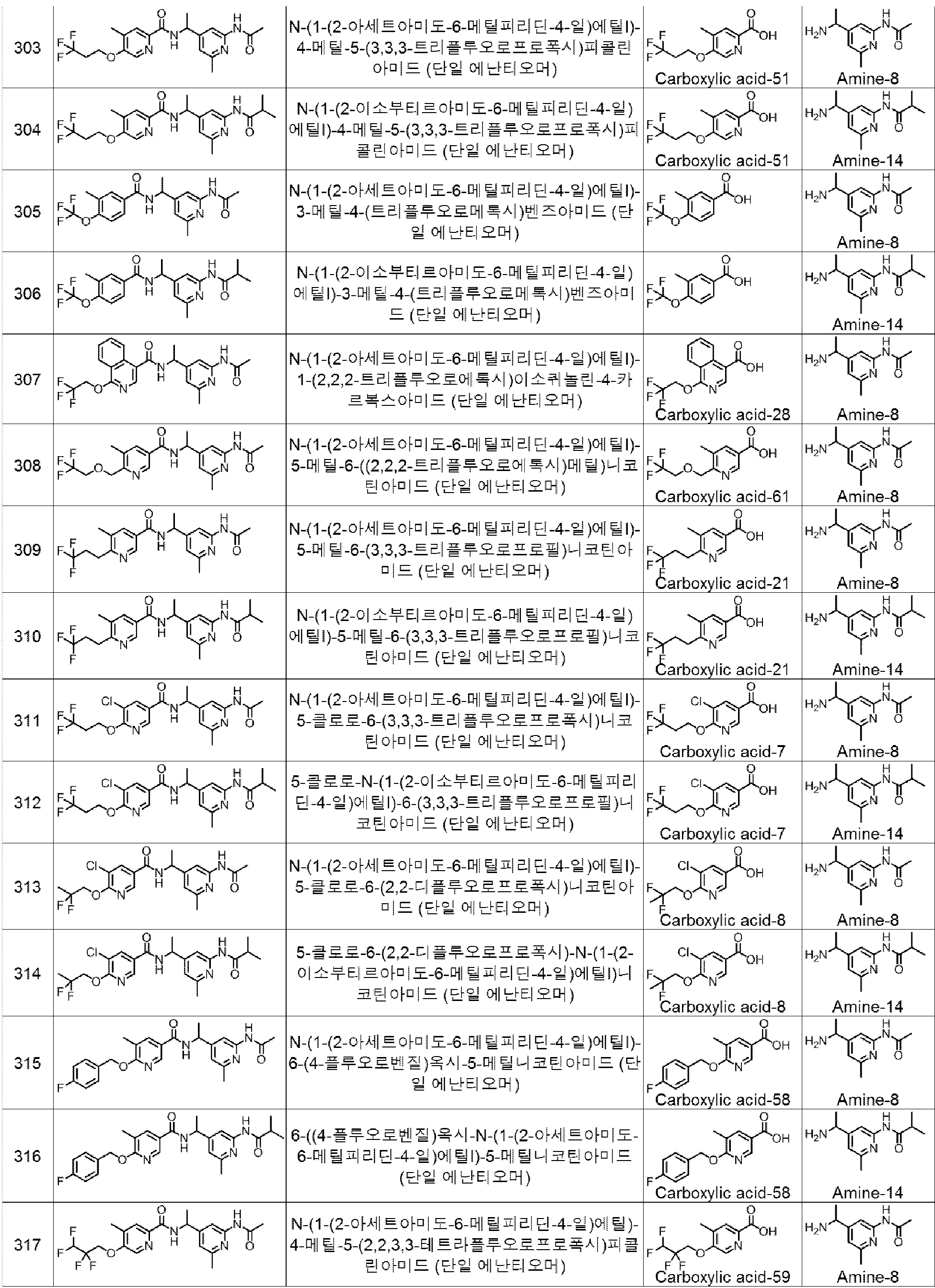
[표 1-23]TABLE 1-23

[표 1-24]TABLE 1-24

[표 1-25]Table 1-25

[표 2-1]TABLE 2-1

[표 2-2]Table 2-2

[표 2-3]TABLE 2-3

[표 3]TABLE 3

약리학적 검정Pharmacological Assay
시험관내In vitro 인간의 전압 개폐 나트륨 채널 활성 Human Voltage-gated Sodium Channel Activation
전압 개폐 나트륨 채널에 대한 화합물의 억제 활성은 당해 분야에 숙지되어 있는 방법론으로 측정한다.Inhibitory activity of compounds on voltage-gated sodium channels is determined by methodologies known in the art.
Nav1 .3, Nav1 .7 및 Nav1 .5를 억제하는, 화학식(I)의 아미드 유도체의 활성은 형광 공명 에너지 변환기 (Fluorescence Resonance Energy Transfer (FRET)) 검정법 및 전기생리학 검정법으로 측정한다.The activity of the amide derivative of formula (I), which inhibits Na v1 .3 , Na v1 .7 and Na v1 .5 , is determined by Fluorescence Resonance Energy Transfer (FRET) assay and electrophysiology assay.
FRETFRET 검정법 Assay
이 스크린을 사용하여 인간의 Nav1 .3, 인간의 Nav1 .7 및 인간의 Nav1 .5에 대한 화합물의 효과를 측정하는데, FDSS (Hamamatsu Photonics) 플랫폼상에 96-웰 플레이트 포맷으로 전기장 자극 (EFS) 시스템을 이용한다. 막전위의 변화는 FRET 염료쌍, 옥소놀 (DiSBAC2(3)) 및 코우마린 (CC2-DMPE)으로 모니터한다.This screen is used to measure the effects of compounds on human Na v1 .3 , human Na v1 .7, and human Na v1 .5 , which stimulates the electric field in 96-well plate format on a FDSS (Hamamatsu Photonics) platform. Use an (EFS) system. Changes in membrane potential are monitored by FRET dye pairs, oxonol (DiSBAC2 (3)) and coumarin (CC2-DMPE).
세포 유지:Cell maintenance:
인간의 Nav1 .3 채널을 발현시키는 각각의 HEK293 세포와 인간의 Nav1 .5 채널을 발현시키는 HEK293 세포를 5% CO2 습화된 배양기중에 T225 플라스크에서 약 80% 융합도(confluence)로 성장시킨다. 배지 조성은 듈베코 개량된 이글 배지(Dulbecco's Modified Eagle Medium (high glucose)), 10% FCS, 100 units/mL 페닐실린, 100 microgram/mL 스트렙토마이신 및 500 microgram/mL GeneticinTM으로 구성되어 있다.Each HEK293 cell expressing human Na v1 .3 channels and HEK293 cell expressing human Na v1 .5 channels are grown to about 80% confluence in a T225 flask in a 5% CO 2 wetted incubator. . The medium composition consists of Dulbecco's Modified Eagle Medium (high glucose), 10% FCS, 100 units / mL phenylsilin, 100 microgram / mL streptomycin and 500 microgram / mL Geneticin ™ .
인간의 Nav1 .7 채널을 발현시키는 CHO 세포를 5% CO2 습화된 배양기중에 T225 플라스크에서 약 80% 융합도(confluence)로 성장시킨다. 배지 조성은 HAM/F12 with Glutamax I, 10% FCS, 100 units/mL 페니실린 및 100 microgram/mL 하이그로마이신으로 구성되어 있다.CHO cells expressing human Na v1 .7 channels are grown to about 80% confluence in a T225 flask in a 5% CO 2 wetted incubator. The medium composition consists of HAM / F12 with Glutamax I, 10% FCS, 100 units / mL penicillin and 100 microgram / mL hygromycin.
프로토콜:protocol:
- 실험 전에 각각의 세포주 (1x10⁵ 세포/웰)를 폴리-D-리신 코팅된 96-웰 플레이트에 씨딩(seeding)한다.Each cell line (1 × 10 5 cells / well) is seeded in a poly-D-lysine coated 96-well plate before the experiment.
- 5% CO2 중의 37 ℃에서 24시간 동안 배양시킨다.Incubate at 37 ° C. in 5% CO 2 for 24 hours.
- 각각의 웰을 검정용 완충액 (140 mM NaCl, 4.5 mM KCl, 10 mM D-글루코오스, 2 mM CaCl2, 1 mM MgCl2, 10 mM 4-(2-하이드록시에틸)-1-피페라진에탄술폰산 (HEPES), NaOH로 pH 7.4로 조정)으로 2회 세척한다.Each well was assayed for buffer (140 mM NaCl, 4.5 mM KCl, 10 mM D-glucose, 2 mM CaCl 2 , 1 mM MgCl 2 , 10 mM 4- (2-hydroxyethyl) -1-piperazineethane Wash twice with sulfonic acid (HEPES), adjusted to pH 7.4 with NaOH).
- 10 μM CC2-DMPE 및 0.06% 플루로닌(Pluronic) F-127을 함유하는 1차 부하액을 검정용 완충액에 가한다.Add primary load containing 10 μΜ CC2-DMPE and 0.06% Pluronic F-127 to assay buffer.
- 상기 플레이트를 실온에 암실에서 1시간 동안 배양시킨다.Incubate the plate for 1 hour in the dark at room temperature.
- 1차 부하액을 제거하고 15 μM DiSBAC2(3), 0.555 mM VABSC-1 및 0.004 % 플루로닉(Pluronic) F-127 를 함유하는 2차 부하액을 검정용 완충액에 가한다.Remove the primary load and add a secondary load containing 15 μM DiSBAC2 (3), 0.555 mM VABSC-1 and 0.004% Pluronic F-127 to the assay buffer.
- 상기 플레이트를 암실에 실온에서 25분간 놓는다.Place the plate in the dark for 25 minutes at room temperature.
- 화합물 용액을 상기 검정용 플레이트에 가한다.Compound solution is added to the assay plate.
- 상기 검정용 플레이트를 FDSS에 셋팅하여 플레이트상에 EFS 장치를 놓는다.Set the assay plate on FDSS to place the EFS device on the plate.
- FDSS로 EFS-유발된 형광 공명을 측정한다.Measure EFS-induced fluorescence resonance with FDSS.
상기 데이타를 분석하여 440 nm에서 측정된 강도의 정상화 비율로 기록한다. 이들 비율의 계산 공정은 다음과 같이 수행한다:The data is analyzed and recorded as the normalization rate of intensity measured at 440 nm. The process of calculating these ratios is carried out as follows:
[수학식 1][Equation 1]
FIR = 형광 집적 비율 = 기준선으로 정상화시킨 비율의 적분 (EFS 전)FIR = fluorescence integration ratio = integral of the ratio normalized to baseline (before EFS)
억제% (Inh.로 축약) = {1 - (각 웰의 FIR - 100% Inh.에서 배지의 FIR)/(0% Inh.에서 배지의 FIR - 100% Inh.에서 배지의 FIR)} x 100% Inhibition (abbreviated to Inh.) = {1-(FIR of medium at 100% Inh. Of each well) / (FIR of medium at 100% Inh. Of medium at 0% Inh.)} X 100
이 분석은 FDSS 생성된 데이타용으로 고안된 컴퓨터화된 특정 프로그램을 사용하여 수행한다. 형광 비율 값은 XLfitTM을 사용하여 플로팅하여 각 화합물에 대한 IC50 값을 측정한다.This analysis is performed using specific computerized programs designed for FDSS generated data. Fluorescence ratio values are plotted using XLfit ™ to determine IC 50 values for each compound.
시험한 모든 화합물은 상기 검정법에서 Nav1 .3 및/또는 Nav1 .7에 대해 약 3 μM 미만의 IC50을 나타낸다. 바람직한 화합물은 상기 검정법에서 Nav1 .3 및/또는 Nav1 .7에 대해 약 1 μM 미만의 IC50을 나타낸다.All compounds tested exhibit an IC 50 of less than about 3 μM for Na v1 .3 and / or Na v1 .7 in this assay. Preferred compounds exhibit an IC 50 of less than about 1 μM for Na v1 .3 and / or Na v1 .7 in this assay.
Nav1 .3 에 대해 <1 μM 및/또는 Nav1 .7 에 대해 <1 μM인 IC50을 갖는 화합물은 다음과 같다: Compounds having an IC 50 of <1 μM for Na v1 .3 and / or <1 μM for Na v1 .7 are as follows:
실시예 3, 12, 13, 14, 18, 20, 22, 23, 24, 25, 26, 29, 30, 31, 32, 37, 40, 42, 43, 46, 50, 54, 55, 56, 59, 60, 61, 64, 66, 67, 68, 75, 76, 78, 80, 84, 85, 89, 93, 94, 95, 102, 109, 110, 115, 118, 120, 122, 124, 125, 127, 128, 129, 132, 133, 136, 146, 147, 149, 150, 151, 152, 153, 154, 163, 167, 172, 174, 175, 176, 177, 179, 180, 181, 186, 187, 189, 190, 191, 192, 194, 195, 196, 197, 198, 199, 200, 207, 208, 209, 210, 211, 212, 213, 214, 215, 216, 218, 219, 220, 221, 222, 223, 224, 226, 229, 230, 231, 232, 233, 234, 235, 236, 239, 241, 242, 243, 244, 245, 248, 250, 251, 252, 253, 255, 256, 260, 261, 262, 263, 264, 266, 269, 270, 274, 275, 276, 277, 278, 279, 282, 283, 284, 286, 287, 288, 289, 290, 291, 292, 293, 294, 295, 298, 299, 300, 301, 302, 303, 307, 309, 310, 311, 313, 315, 316, 317, 318, 319, 321, 322, 324, 325, 326, 327, 330, 331, 332, 335, 336, 337, 338, 339, 340, 341, 342, 343, 344, 345, 346, 347, 348, 349, 350, 351, 353, 354, 356, 및 359.Examples 3, 12, 13, 14, 18, 20, 22, 23, 24, 25, 26, 29, 30, 31, 32, 37, 40, 42, 43, 46, 50, 54, 55, 56, 59, 60, 61, 64, 66, 67, 68, 75, 76, 78, 80, 84, 85, 89, 93, 94, 95, 102, 109, 110, 115, 118, 120, 122, 124, 125, 127, 128, 129, 132, 133, 136, 146, 147, 149, 150, 151, 152, 153, 154, 163, 167, 172, 174, 175, 176, 177, 179, 180, 181, 186, 187, 189, 190, 191, 192, 194, 195, 196, 197, 198, 199, 200, 207, 208, 209, 210, 211, 212, 213, 214, 215, 216, 218, 219, 220, 221, 222, 223, 224, 226, 229, 230, 231, 232, 233, 234, 235, 236, 239, 241, 242, 243, 244, 245, 248, 250, 251, 252, 253, 255, 256, 260, 261, 262, 263, 264, 266, 269, 270, 274, 275, 276, 277, 278, 279, 282, 283, 284, 286, 287, 288, 289, 290, 291, 292, 293, 294, 295, 298, 299, 300, 301, 302, 303, 307, 309, 310, 311, 313, 315, 316, 317, 318, 319, 321, 322, 324, 325, 326, 327, 330, 331, 332, 335, 336, 337, 338, 339, 340, 341, 342, 343, 344, 345, 346, 347, 348, 349, 350, 351, 353, 354, 356, and 359 .
시험한 모든 화합물에 대해서, Nav1 .5 대 Nav1 .3 또는 Nav1 .7에 대한 활성의 비율은 3배 이상이다. 예를 들어, Nav1 .5, Nav1 .3 및 Nav1 .7에 대한 실시예 12의 활성은 각각 30 μM, 0.51 μM, 및 1.0 μM 이상이다.For all compounds tested, the ratio of activity for Na v1 .5 to Na v1 .3 or Na v1 .7 is at least threefold. For example, the activity of Example 12 on Na v1 .5 , Na v1 .3 and Na v1 .7 is at least 30 μM, 0.51 μM, and 1.0 μM, respectively.
NavsNavs 에 대한 전기생리학 검정Electrophysiology test for
전세포 패치 고정 기록(whole cell patch clamp recording)을 사용하여 인간의 Nav1 .3 (hSCN3A) 발현 HEK293 세포 또는 인간의 Nav1 .7 (hSCN9A) 발현 CHO 세포에 대한 Na 채널 차단제의 효과 또는 선택도를 평가한다. 인간의 Nav1 .3 발현 HEK293 세포를 다음을 함유하는 성장 배지에서 성장시킨다: : 듈베코의 인산염-완충된 염수 (Dulbecco's Phosphate-Buffered Saline; DMEM), 10% 열-불활성화된 태소 혈청 (FBS) (Hyclone Laboratories Inc), 100 microgram/mL 페니실린/100U/mL 스트렙토마이신, 150 microgram/mL 제오신(Zeocin), 3 microgram/mL 제넥신(Geneticin). 인간의 Nav1 .7 발현 CHO 세포를 다음을 함유하는 성장 배지에서 성장시킨다: HAM/F-12, 9% 열-불활성화된 FBS (Hyclone Laboratories Inc) 및 100 microgram/mL 페니실린/100U/mL 스트렙토마이신, 100 microgram/mL 하이드로마이신(Hygromycin).Effect or selectivity of Na channel blocker on human Na v1 .3 (hSCN3A) expressing HEK293 cells or human Na v1 .7 (hSCN9A) expressing CHO cells using whole cell patch clamp recording Evaluate. Human Na v1 .3 expressing HEK293 cells are grown in growth medium containing: Dulbecco's Phosphate-Buffered Saline (DMEM), 10% heat-inactivated fetal bovine serum (FBS) ) (Hyclone Laboratories Inc), 100 microgram / mL penicillin / 100U / mL streptomycin, 150 microgram / mL Zeocin, 3 microgram / mL Genexin. Human Na v1 .7 expressing CHO cells are grown in growth medium containing: HAM / F-12, 9% heat-inactivated FBS (Hyclone Laboratories Inc) and 100 microgram / mL penicillin / 100 U / mL strepto Mycin, 100 microgram / mL Hydromycin.
Na 채널 발현 세포를 0.05% 트립신-EDTA로 분리시킨 다음, 커버 유리 위에 24 내지 48시간 동안 씨딩시킨다.Na channel expressing cells are separated with 0.05% trypsin-EDTA and then seeded on cover glass for 24 to 48 hours.
유리 피펫을 피펫 풀러(pipette puller)상에서 1 내지 2 ㎛의 팁 직경으로 끌어당긴다. 상기 피펫을 세포내 용액으로 충진하고 염소화된 은 와이어(siver wire)를 길이 방향으로 삽입하는데, 이는 이후 전압고정 증폭기 (Axon Instruments or HEKA elektronik)의 머리 부분에 연결한다. 세포외 기록 용액은 다음으로 구성되어 있다(mM): 140 NaCl, 5 KCl, 2 CaCl2, 1 MgCl2, 10 HEPES, 및 10 Glucose, NaOH로 pH 7.4로 조정됨. The glass pipette is pulled to a tip diameter of 1-2 μm on a pipette puller. The pipette is filled with intracellular solution and a chlorinated silver wire is inserted longitudinally, which is then connected to the head of a voltage-locked amplifier (Axon Instruments or HEKA elektronik). The extracellular recording solution consists of (mM): 140 NaCl, 5 KCl, 2 CaCl 2 , 1 MgCl 2 , 10 HEPES, and 10 Glucose, adjusted to pH 7.4 with NaOH.
내부 용액은 다음으로 구성되어 있다(mM): 120 CsF, 15 NaCl, 10 EGTA, 10 HEPES, CsOH로 pH 7.2로 조정됨; 피펫 팁을 욕(bath)에 삽입시, 피펫 저항을 기록한다 (허용 범위는 1 내지 3 메가옴(megaohm)이다). 피펫과 욕액(bath solution)간의 접전전위(junction potential)를 증폭기상에서 0(zero)으로 맞춘다. 전-세포 배치를 확고히한 후, 기록전에 대략 10분간 피펫 용액이 세포내에서 평형되도록 한다. 전류는 2 내지 5 kHz 사이에서 저역통과(lowpass) 필터링시키고 10 kHz에서 디지탈식으로 샘플링한다.The internal solution consists of (mM): adjusted to pH 7.2 with 120 CsF, 15 NaCl, 10 EGTA, 10 HEPES, CsOH; When the pipette tip is inserted into the bath, the pipette resistance is recorded (the allowable range is 1-3 megaohms). The junction potential between the pipette and the bath solution is set to zero on the amplifier. After confirming the whole-cell placement, the pipette solution is allowed to equilibrate intracellular for approximately 10 minutes prior to recording. The current is lowpass filtered between 2 and 5 kHz and digitally sampled at 10 kHz.
정상화된 안정-상태 불활성화 곡선은 상이한 전위에 대한 2초(비히클의 경우) 또는 60초(약물의 경우) 컨디셔닝 펄스에 이어 즉시 -10 mV로 시험 펄스를 사용하여 그린다. 피크 전류는 Nav1 .3의 경우 -120 mV 내지 -40 mV 범위 및 Nav1.7의 경우 -130 mV 내지 -60 mV 범위의 컨디셔닝 전위에서의 최대 전류의 비율(fraction)로 플로팅된다. V1/2 또는 k값은 Boltzmann fits로부터 산정하였다. 휴지 상태(resting state)의 Na 채널에 대한 약물의 친화도 (Kresting 또는 Kr)은 -120 또는 -130 mV의 네가티브 유지 전위(negative holding potential)로부터의 30 msec 시험 펄스로 평가하는데, 이때 모든 채널은 사실상 휴지 상태에 있다. Kr 값은 통상적인 1:1 결합 모델로 계산한다.Normalized steady-state inactivation curves are drawn using test pulses at -10 mV immediately following 2 sec (for vehicle) or 60 sec (for drug) conditioning pulses for different potentials. The peak current is plotted as the fraction of the maximum current at the conditioning potential in the range -120 mV to -40 mV for Na v1 .3 and in the range -130 mV to -60 mV for Na v1.7 . V1 / 2 or k values were calculated from Boltzmann fits. Drug affinity (K resting or K r ) for the Na channel in the resting state is assessed by a 30 msec test pulse from a negative holding potential of -120 or -130 mV, with all The channel is actually at rest. K r values are calculated using a conventional 1: 1 coupling model.
Kresting (Kr) = {[약물]Imax,약물/(Imax, 대조-Imax, 약물)}K resting (K r ) = {[drug] I max , drug / (I max , control-I max , drug)}
여기서, Kresting (Kr)은 휴지 상태에 대한 해리상수이며 [약물]은 화합물 농도이다. Imax, 대조 및 Imax, 약물은 각각 화합물이 부재 및 존재하에서의 피크 전류이다.Where K resting (K r ) is the dissociation constant for the resting state and [drug] is the compound concentration. I max , control and I max , the drug are the peak currents in the absence and presence of the compound, respectively.
Na 채널의 불활성화된 상태에 대한 약물의 친화도 (Kinact 또는 Ki) 는 화합물에 의한 유효성 곡선의 쉬프트(shift)로부터 산정한다. 불활성화된 상태에서 화합물과 채널간의 상호반응은 다음식으로 평가한다:The affinity of the drug (K inact or K i ) for the inactivated state of the Na channel is estimated from the shift of the efficacy curve by the compound. The interaction between compound and channel in the inactivated state is evaluated by the following equation:
[수학식 2][Equation 2]
Kinact (Ki) = {[약물]/((1+[약물]/Kr)*exp(-ΔV/k)-1)}K inact (K i ) = {[drug] / ((1+ [drug] / K r ) * exp (-ΔV / k) -1)}
여기서, Kinact (Ki) 는 불활성화된 상태에 대한 해리상수이다. ΔV는 볼츠만 곡선(Boltzmann curve)의 최대 전압 절반의 화합물-유발된 전압 쉬프트이며 k는 화합물의 존재에 대한 슬롭 팩터(slop factor)이다.Where K inact (K i ) is the dissociation constant for the inactivated state. ΔV is the compound-induced voltage shift of the maximum voltage half of the Boltzmann curve and k is the slop factor for the presence of the compound.
본 발명의 시험된 모든 화합물은 이 모델에서 강력한 활성을 나타낸다. 예를 들어, Nav1 .7에 대한 실시예 29의 활성(Ki)은 0.95 μM이다.All compounds tested of the invention exhibit potent activity in this model. For example, the activity (K i ) of Example 29 against Na v1 .7 is 0.95 μM.
생체내In vivo 검정 black
래트에서In the rat 만성협착손상( Chronic stenosis injury CCICCI )-유발된 정적 ) -Induced static 이질통Allodynia
7주령의 수컷 스프래규-다울리(Sparague-Dawley) 래트를 Charles River Japan Inc.로부터 구입하여 12시간 명/암 사이클 (07:00에 불이 켜짐)하의 케이지당 2마리의 군으로 넣고, 사료와 물에는 자유롭게 접근하도록 한다. CCI-유발된 정적 이질통은 von Frey hair(VFH) 시험법으로 평가한다. 수술은 Bennett GJ and Xie YK (Pain 1988, 33: 87-107)의 방법에 따라서 수행한다. 펜토바르비탈 나트륨을 복강내 주사하여 동물을 마취시킨다. 좌측의 총좌골신경(common sciatic nerve)을 넓적다리의 중간 정도로 노출시켜, 부착조직을 제거하고, 4-0 실크실을 사용하여 이 주변을 4개의 결찰사로 느슨하게 묶는다. 절개부를 봉합하고, 소프트베딩이 있는 케이지에서 래트를 회복시킨다. 좌골신경 결찰을 제외하고는 동일한 방법으로 샴수술(sham operation)을 수행한다. 시험일 전에 1시간 동안 동물을 개별적으로 고가(高架)의 그리드상의 Plexiglas 시험 챔버에 넣어 순응시킨다. 수술후 14 내지 28일째 (POD)에, 0.4, 0.6, 1, 2, 4, 6, 8 및 15 g 포스(force)로 눈금을 매긴 VFH(Semmes-Winstein monofilaments) 시리즈를 사용하여 평가한다. 2 g 포스로 시작하는 VFH를 Chaplan SR et al. (J Neurosci Methods 1994, 53: 55-63)에 기재된 개량된 Dixon up-down 방법에 따라 상승 또는 하강식으로 인가한다. 각각의 VFH는 대략 6초간 구부러질 때 까지 일정하게 증가하는 압력으로 수술한 발바닥의 평편한 표면에 대해 주어진다. 발빼기 동작이 없는 경우, 더 강한 자극을 준다. 발빼기가 있을 때, 다음에는 더 약한 자극을 선택한다. 포지티브에서 네가티브 또는 역순으로 초기 변화시킨 후, 4회 이상 자극을 가한다. 포지티브 및 네가티브 반응의 6-점 패턴을 하기식을 사용하여 50% 발빼기 동작 역치(PWT)로 전환시킨다:Seven-week-old male Sparague-Dawley rats were purchased from Charles River Japan Inc. and placed in groups of two per cage under a 12 hour light / dark cycle (lights up at 07:00) Keep free access to water and water. CCI-induced static allodynia is assessed by the von Frey hair (VFH) assay. Surgery is performed according to the method of Bennett GJ and Xie YK (Pain 1988, 33: 87-107). Animals are anesthetized by intraperitoneal injection of pentobarbital sodium. The left side of the common sciatic nerve is exposed to the middle of the thigh, the adherent tissue is removed, and 4-4 silk threads are loosely tied around the four ligations. The incision is closed and the rat is recovered in a cage with softbedding. Sham operation is performed in the same manner except for sciatic nerve ligation. Animals are individually acclimated in a Plexiglas test chamber on an expensive grid for 1 hour before the test day. At 14-28 days postoperatively (POD), assessments are made using the Series-Semmes-Winstein monofilaments (VFH) scaled with 0.4, 0.6, 1, 2, 4, 6, 8 and 15 g forces. VFH starting with 2 g force was converted to Chaplan SR et al . It is applied up or down according to the improved Dixon up-down method described in (J Neurosci Methods 1994, 53: 55-63). Each VFH is given against the flat surface of the operative sole with a constant increasing pressure until it flexes for approximately 6 seconds. If there is no pulling out, it gives a stronger stimulus. When you have a squeeze, then choose a weaker stimulus. After an initial change from positive to negative or vice versa, four or more stimuli are applied. The six-point pattern of positive and negative response is converted to 50% minus motion threshold (PWT) using the following equation:
50% PWT(g) = (10[ Xf +κδ])/10,00050% PWT (g) = (10 [ Xf + κδ] ) / 10,000
여기에서, Xf는 사용된 최종 VFH의 값 (로그 단위)이고, κ는 포지티브/네가티브 반응의 패턴에 대한 표로 나타낸 값이며 δ는 로그 단위 자극간의 평균차이다 (여기서는 0.224).Where Xf is the value of the final VFH used (log units), κ is a tabulated value of the pattern of positive / negative responses and δ is the average difference between log unit stimuli (here 0.224).
시종일관 자극 스펙트럼의 끝까지 연속적인 포지티브 또는 네가티브 반응이 관찰되는 경우, 각각 0.25 및 15 g의 값이 배정된다. CCI 수술에 의해 정적 이질통을 나타내는 동물(<3g의 50% PWT)을 평가용으로 선택하고 모든 그룹에 걸쳐서 거의 대등하게 평균 50% PWT가 되도록 랜덤화시킨다. 본 발명의 화합물 또는 이들의 비히클을 전신 투여한다. 각 측정전에 래트를 적어도 20분간 챔버에 길들인다. 50% PWT는 화합물 투여후 적절한 시간에 측정한다.If a continuous positive or negative response is observed until the end of the consistent stimulus spectrum, values of 0.25 and 15 g are assigned, respectively. Animals showing static allodynia (<3 g of 50% PWT) were selected for evaluation by CCI surgery and randomized to an average of 50% PWT almost equally across all groups. Systemic administration of a compound of the invention or a vehicle thereof is carried out. Rats are tamed in the chamber for at least 20 minutes before each measurement. 50% PWT is measured at the appropriate time after compound administration.
본 발명의 모든 시험된 화합물은 이 모델에서 강력한 활성을 나타낸다.All tested compounds of the invention exhibit potent activity in this model.
래트에서In the rat 완전 very 프로인트Freud 애주번트Adjuvant (( CompleteComplete Freund'sFreund's AdjuvantAdjuvant : : CFACFA )-유발된 열통각과민() -Induced hypersensitivity hypersensitivity ( thermalthermal hyperalgesiahyperalgesia ))
6주령의 수컷 스프래규-다울리(Sparague-Dawley) 래트를 Charles River Japan Inc.로부터 구입하여 12시간 명/암 사이클 (07:00에 불이 켜짐)하의 케이지당 2마리의 군으로 넣고, 사료와 물에는 자유롭게 접근하도록 한다. CFA-유발된 열통각과민은 Hargreaves K et al. (Pain 1988, 32: 77-88)에 기재된 바와 같은 발바닥 시험 장치 (Ugo Basile)를 사용하여 평가한다. 고가(高架)의 유리 테이블상의 개별 시험 박스로 이루어져 있는 장치에 동물을 넣고 적어도 10분간 순응시킨다. 습관화시킨 다음, 이동식 복사열 공급원을 상기 테이블 아래에 배치하고 오른쪽 발바닥의 표면에 열 자극을 인가한다. 발바닥을 제거하는데 걸리는 반응시간(latency)을 발빼기 반응시간(PWL)(초)으로 정의한다. 컷-오프 포인트는 조직 손상을 피하기 위하여 30초로 정한다. CFA는 액체 파라핀중에 2 내지 3 mg/L의 마이코박테리움 튜베르쿨로시스(Mycobacterium tuberculosis) H37 RA의 농도로 제조한다. 70% 에탄올로 소독한 후, 래트의 오른쪽 발바닥에 100 마이크로리터의 CFA (200 내지 300 마이크로그램)을 발바닥 주사한다. CFA 주사한지 2일 후, 상기 언급한 바와 동일한 방법으로 PWL을 측정한다. CFA 주사에 의해 PWL(통각과민)의 감소를 나타내는 동물을 평가용으로 선택하고 모든 그룹에 걸쳐서 거의 대등한 평균 PWL이 되도록 랜덤화시킨다. 본 발명의 화합물 또는 이들의 비히클을 전신 투여한다. 각 측정전에 래트를 적어도 10분간 장치에 길들인다. PWL는 화합물 투여후 적절한 시간에 측정한다.Six-week-old male Sparague-Dawley rats were purchased from Charles River Japan Inc. and placed in groups of two per cage under a 12-hour light / dark cycle (lighted up at 07:00). Keep free access to water and water. CFA-induced febrile hyperalgesia is known as Hargreaves K et. al . Evaluation is performed using the Ugo Basile as described in (Pain 1988, 32: 77-88). Animals are placed in a device consisting of individual test boxes on an expensive glass table and allowed to acclimate for at least 10 minutes. After habituation, a mobile radiant heat source is placed under the table and heat stimulation is applied to the surface of the right foot. The response time for removing the sole of the foot is defined as the pull-out reaction time (PWL) in seconds. The cut-off point is set at 30 seconds to avoid tissue damage. CFA is 2 to 3 mg / L Mycobacterium tuberculosis in liquid paraffin. tuberculosis ) is prepared at a concentration of H37 RA. After sterilization with 70% ethanol, 100 L of CFA (200-300 micrograms) is injected into the rat's right foot. Two days after CFA injection, PWL is measured in the same manner as mentioned above. Animals showing a decrease in PWL (hyperalgesia) by CFA injection are selected for evaluation and randomized to an almost equivalent mean PWL across all groups. Systemic administration of a compound of the invention or a vehicle thereof is carried out. Rats are tamed in the device for at least 10 minutes before each measurement. PWL is measured at the appropriate time after compound administration.
본 발명의 모든 시험된 화합물은 이 모델에서 강력한 활성을 나타낸다.All tested compounds of the invention exhibit potent activity in this model.
래트에서In the rat CFACFA -유발된 체중부하 결함-Induced weight deficiency
7주령의 수컷 스프래규-다울리(Sparague-Dawley) 래트를 Charles River Japan Inc.로부터 구입하여 12시간 명/암 사이클 (07:00에 불이 켜짐)하의 케이지당 2마리의 군으로 넣고, 사료와 물에는 자유롭게 접근하도록 한다. CFA-유발된 체중부하(WB) 결함은 Incapacitance tester TM (Linton Instrumentation)를 사용하여 평가한다. CFA 주사일 전에 Incapacitance tester가 딸려 있는 플라스틱 케이스에 동물을 길들인다. CFA 주사일에, 각 발바닥의 체중 분포를 상기 테스터를 사용하여 래트당 3회 측정하고, 오른쪽 (주사한) 발에 대한 체중에서 왼쪽 (주사하지 않은) 발에 대한 체중을 뺀, 체중분포 차를 WB 결함 수치(g)로 정의한다. 각 측정의 지속시간은 3초로 조정한다. CFA는 액체 파라핀중에 2 내지 3 mg/L의 마이코박테리움 튜베르쿨로시스(Mycobacterium tuberculosis) H37 RA의 농도로 제조한다. 70% 에탄올로 소독한 후, 래트의 오른쪽 발바닥에 100 마이크로리터의 CFA (200 내지 300 마이크로그램)을 발바닥 주사한다. CFA 주사한지 2일 후, 각 발바닥의 체중 분포를 측정하고 상기 언급한 바와 동일한 방법으로 WB 결함값을 측정한다. CFA 주사에 의해 WB 결함의 감소(>30%)를 나타내는 동물을 평가용으로 선택하고 모든 그룹에 걸쳐서 거의 대등해지도록 랜덤화시킨다. 본 발명의 화합물 또는 이들의 비히클을 전신 투여한다. 화합물 투여 후 적절한 시간에 각 발바닥의 체중 분포를 측정하고, WB 결함값은 상기 설명된 바와 같이 계산한다.Seven-week-old male Sparague-Dawley rats were purchased from Charles River Japan Inc. and placed in groups of two per cage under a 12 hour light / dark cycle (lights up at 07:00) Keep free access to water and water. CFA-induced body weight (WB) defects are assessed using Incapacitance tester ™ (Linton Instrumentation). Animals are domesticated in a plastic case with an Incapacitance tester prior to CFA injection. On the day of CFA injection, the weight distribution of each plantar was measured three times per rat using the tester, and the weight distribution difference was subtracted from the weight for the right (injected) foot minus the weight for the left (injected) foot. WB defect number (g) is defined. The duration of each measurement is adjusted to 3 seconds. CFA is 2 to 3 mg / L Mycobacterium tuberculosis in liquid paraffin. tuberculosis ) is prepared at a concentration of H37 RA. After sterilization with 70% ethanol, 100 L of CFA (200-300 micrograms) is injected into the rat's right foot. Two days after CFA injection, the weight distribution of each plantar is measured and the WB defect value is measured in the same manner as mentioned above. Animals showing a reduction in WB defects (> 30%) by CFA injection are selected for evaluation and randomized to be nearly equivalent across all groups. Systemic administration of a compound of the invention or a vehicle thereof is carried out. The weight distribution of each plantar is measured at the appropriate time after compound administration and the WB defect values are calculated as described above.
본 발명의 모든 시험된 화합물은 이 모델에서 강력한 활성을 나타낸다.All tested compounds of the invention exhibit potent activity in this model.
래트에서In the rat 발 절개-유발된 정적 Foot incision-induced static 이질통Allodynia
7주령의 수컷 스프래규-다울리(Sparague-Dawley) 래트를 Charles River Japan Inc.로부터 구입하여 12시간 명/암 사이클 (07:00에 불이 켜짐)하의 케이지당 2마리의 군으로 넣고, 사료와 물에는 자유롭게 접근하도록 한다. 발 절개-유발된 정적 이질통은 VFH 시험으로 평가한다. 수술은 Brennan et al. (Pain 1996, 64: 493-501)에 기재된 공정에 따라서 수행한다. 동물을 먼저 마취 챔버에서 3 내지 4% 이소플루란/O2 혼합물로 마취시키고 노즈콘(nose cone)을 통하여 운반되는 2 내지 3%로 유지시킨다. 오른쪽 발바닥의 표면을 7.5% 포비돈-요오딘 용액으로 살균한다. 발의 발바닥면의 피부와 근막을 통하여, 뒷꿈침의 근위말단으로부터 0.5 cm에서 시작하여 발끝쪽으로 연장되도록, 11호 칼로 1-cm 길이방향으로 절개한다. 겸자(forceps)을 사용하여 발바닥 근육을 들어올려 수축시킨다. 근육 오리진(origin)과 인셜션(insertion)은 온전한 상태로 유지한다. 부드럽게 압력을 가하여 지혈시킨 후, 5-0 나일론으로 2번 봉합하여 피부를 덧붙인다. 손상된 부위에 테라마이신 연고를 바르고, 소프트 베딩이 있는 케이지에서 래트를 회복시킨다. 수술일 전에 1시간 동안 동물을 개별적으로 고가(高架)의 그리드상의 Plexiglas 시험 챔버에 넣어 순응시킨다. POD1일에, 눈금을 매긴 VFH 시리즈 (0.008, 0.02, 0.04, 0.07, 0.16, 0.4, 0.6, 1, 1.4, 2, 4, 6, 8, 10, 15 및 26 g)를 사용하여 평가를 수행한다. 상승 또는 하강식으로 0.16 g 포스로 시작하여, 각각의 VFH는 대략 6초간 구부러질 때 까지 일정하게 증가하는 압력으로 측면 발꿈치 근처의 손상부위의 근위 말단에 대해 주어진다. 발빼기 동작이 없는 경우(네가티브 반응), 더 강한 자극을 준다. 발빼기가 있을 때(포지티브 반응), 다음에는 더 약한 자극을 선택한다. 2개의 포지티브 반응을 도출시키는데 필요한 최소량의 힘을 PWT(g)로 정의한다. 시종일관 자극 스펙트럼의 끝까지 연속적인 포지티브 또는 네가티브 반응이 관찰되는 경우, 각각 0.008 및 26 g의 값이 배정된다. 절개 수술에 의해 <1.4 g의 PWT를 나타내는 동물을 평가용으로 선택하고 모든 그룹에 걸쳐서 거의 대등하게 중간값의 PWT가 되도록 랜덤화시킨다. 본 발명의 화합물 또는 이들의 비히클을 전신 투여한다. 각 측정전에 래트를 적어도 20분간 챔버에 길들인다. PWT는 화합물 투여후 적절한 시간에 측정한다.Seven-week-old male Sparague-Dawley rats were purchased from Charles River Japan Inc. and placed in groups of two per cage under a 12 hour light / dark cycle (lights up at 07:00) Keep free access to water and water. Foot incision-induced static allodynia is assessed by the VFH test. Surgery was performed by Brennan et al . (Pain 1996, 64: 493-501). Animals are first anesthetized with a 3-4% isoflurane / O 2 mixture in an anesthesia chamber and maintained at 2-3% carried through a nose cone. The surface of the right foot is sterilized with 7.5% povidone-iodine solution. Through the skin and fascia of the plantar surface of the foot, a 1-cm longitudinal incision is made with a No. 11 knife so as to extend from the proximal end of the heel to the toe. Forceps are used to lift and contract the plantar muscles. Muscle origin and insertion remain intact. Gently hemostatically pressurize, then suture twice with 5-0 nylon to add skin. Terramycin ointment is applied to the damaged area and the rats are recovered in a cage with soft bedding. Animals are individually acclimated in a Plexiglas test chamber on an expensive grid for 1 hour prior to the surgery day. On day POD1, the evaluation is carried out using graduated VFH series (0.008, 0.02, 0.04, 0.07, 0.16, 0.4, 0.6, 1, 1.4, 2, 4, 6, 8, 10, 15 and 26 g). . Starting with a 0.16 g force, either up or down, each VFH is given against the proximal end of the injury near the heel at a constant increasing pressure until it flexes for approximately 6 seconds. If there is no pulling out (negative reaction), it gives a stronger stimulus. When there's an exhale (positive response), the next weaker stimulus is chosen. The minimum amount of force needed to derive two positive responses is defined as PWT (g). If a continuous positive or negative response is observed until the end of the consistent stimulus spectrum, values of 0.008 and 26 g are assigned, respectively. Animals showing <1.4 g of PWT by incision surgery are selected for evaluation and randomized to nearly equal median PWT across all groups. Systemic administration of a compound of the invention or a vehicle thereof is carried out. Rats are tamed in the chamber for at least 20 minutes before each measurement. PWT is measured at appropriate times after compound administration.
본 발명의 모든 시험된 화합물은 이 모델에서 강력한 활성을 나타낸다.All tested compounds of the invention exhibit potent activity in this model.
래트에서In the rat 파클리탁셀Paclitaxel (( PaclitaxelPaclitaxel )-유발된 정적 ) -Induced static 이질통Allodynia
7주령의 수컷 스프래규-다울리(Sparague-Dawley) 래트를 Charles River Japan Inc.로부터 구입하여 12시간 명/암 사이클 (07:00에 불이 켜짐)하의 케이지당 2마리의 군으로 넣고, 사료와 물에는 자유롭게 접근하도록 한다. 파클리탁셀-유발된 정적 이질통은 VFH 시험으로 평가한다. 파클리탁셀 처리는 Polomano RC 등의 방법(Pain 2001, 94:293-304)에 따라서 수행한다. 파클릭탁셀(2 mg)은 4번의 다른 날(1일차, 3일차, 5일차 및 7일차)에 1 mL/kg의 용량으로 복강내 주사한다. 누적투여량은 8 mg/kg이다. 샴 그룹에서는, 비히클(염수중 16.7 % CremophorTM EL 과 16.7 % 에탄올의 혼합물)을 동일한 스케쥴로 처리한다. 시험일 전에 1시간 동안 동물을 개별적으로 고가(高架)의 그리드상의 Plexiglas 시험 챔버에 넣어 순응시킨다. 15 내지 29째 날에, 0.4, 0.6, 1, 2, 4, 6, 8 및 15 g 포스(force)로 눈금을 매긴 VFH 시리즈를 사용하여 평가한다. 2 g 포스로 시작하는 VFH를 Chaplan SR et al. (J Neurosci Methods 1994, 53: 55-63)에 기재된 개량된 Dixon up-down 방법에 따라 상승 또는 하강식으로 인가한다. 각각의 VFH는 대략 6초간 구부러질 때 까지 일정하게 증가하는 압력으로 수술한 발바닥의 평편한 표면에 대해 주어진다. 발빼기 동작이 없는 경우, 더 강한 자극을 준다. 발빼기가 있을 때, 다음에는 더 약한 자극을 선택한다. 포지티브에서 네가티브 또는 역순으로 초기 변화시킨 후, 4회 이상 자극을 가한다. 포지티브 및 네가티브 반응의 6-점 패턴을 하기식을 사용하여 50% PWT로 전환시킨다:Seven-week-old male Sparague-Dawley rats were purchased from Charles River Japan Inc. and placed in groups of two per cage under a 12 hour light / dark cycle (lights up at 07:00) Keep free access to water and water. Paclitaxel-induced static allodynia is assessed by the VFH test. Paclitaxel treatment is performed according to the method of Polomano RC et al. (Pain 2001, 94: 293-304). Paclicktaxel (2 mg) is injected intraperitoneally at a dose of 1 mL / kg on four different days (day 1, day 3, day 5 and day 7). Cumulative dose is 8 mg / kg. In the Siamese group, the vehicle (a mixture of 16.7% Cremophor ™ EL and 16.7% ethanol in saline) is treated on the same schedule. Animals are individually acclimated in a Plexiglas test chamber on an expensive grid for 1 hour before the test day. On days 15-29, assessments are made using the VFH series, calibrated with 0.4, 0.6, 1, 2, 4, 6, 8, and 15 g forces. VFH starting with 2 g force was converted to Chaplan SR et al . It is applied up or down according to the improved Dixon up-down method described in (J Neurosci Methods 1994, 53: 55-63). Each VFH is given against the flat surface of the operative sole with a constant increasing pressure until it flexes for approximately 6 seconds. If there is no pulling out, it gives a stronger stimulus. When you have a squeeze, then choose a weaker stimulus. After an initial change from positive to negative or vice versa, four or more stimuli are applied. The six-point pattern of positive and negative reactions is converted to 50% PWT using the following formula:
50% PWT(g) = (10[ Xf +κδ])/10,00050% PWT (g) = (10 [ Xf + κδ] ) / 10,000
여기에서, Xf는 사용된 최종 VFH의 값 (로그 단위)이고, κ는 포지티브/네가티브 반응의 패턴에 대한 표로 나타낸 값이며 δ는 로그 단위 자극간의 평균차이다 (여기서는 0.224).Where Xf is the value of the final VFH used (log units), κ is a tabulated value of the pattern of positive / negative responses and δ is the average difference between log unit stimuli (here 0.224).
시종일관 자극 스펙트럼의 끝까지 연속적인 포지티브 또는 네가티브 반응이 관찰되는 경우, 각각 0.25 및 15 g의 값이 배정된다. 파클리탁셀 처치에 의해 정적 이질통을 나타내는 동물(<4g의 50% PWT)을 평가용으로 선택하고 모든 그룹에 걸쳐서 거의 대등하게 평균 50% PWT가 되도록 랜덤화시킨다. 본 발명의 화합물 또는 이들의 비히클을 전신 투여한다. 측정전에 래트를 적어도 20분간 챔버에 길들인다. 50% PWT는 화합물 투여후 적절한 시간에 측정한다. 통계적 분석은 비히클 군과 비교하여 짝을 이루지 않은 unpaired t-검정법 또는 Dunnett's 포스트-hoc 시험법으로 수행한다. If a continuous positive or negative response is observed until the end of the consistent stimulus spectrum, values of 0.25 and 15 g are assigned, respectively. By paclitaxel treatment, animals showing static allodynia (<4 g of 50% PWT) are selected for evaluation and randomized to an average of 50% PWT almost equally across all groups. Systemic administration of a compound of the invention or a vehicle thereof is carried out. Rats are tamed in the chamber for at least 20 minutes prior to measurement. 50% PWT is measured at the appropriate time after compound administration. Statistical analysis is performed by unpaired t-test or Dunnett's post-hoc test compared to vehicle group.
본 발명의 모든 시험된 화합물은 이 모델에서 강력한 활성을 나타낸다.All tested compounds of the invention exhibit potent activity in this model.
래트에서In the rat 포르말린-유발된 통각행위 Formalin-induced pain
6주령의 수컷 스프래규-다울리(Sparague-Dawley) 래트를 Charles River Japan Inc.로부터 구입하여 12시간 명/암 사이클 (07:00에 불이 켜짐)하의 케이지당 2마리의 군으로 넣고, 사료와 물에는 자유롭게 접근하도록 한다. 포르말린 시험은 광주기(light cycle) 동안 수행한다. 포르말린 주사전 적어도 30분간 동물을 시험 챔버에 순응시킨다. 챔버의 뒤 및/또는 아래에 거울을 놓아 관찰이 용이하도록 한다. 50 μM의 5% 포르말린 용액을 오른쪽 발바닥 표면에 피하 주사한다. 주사후 즉시, 래트를 개별적으로 챔버에 넣고, 통증-관련 행위를 기록한다. 시험 후, 주사된 발을 핥고/핥거나 무는데 소요되는 시간을 포르말린 처리 후 45분간 5-분 단위로 계수한다. 0분 내지 5분의 핥기/물기에 소용되는 시간의 합(초단위)을 초기상(early phase)으로 간주하는 한편, 후기상(late phase)은 전형적으로 15분 내지 45분의 핥기/물기에 소용되는 시간의 합으로 간주된다. 포르말린 주사전 적절한 싯점에 본 발명의 화합물 또는 이들의 비히클을 전신 투여한다. 통계적 분석은 비히클 군과 비교하여 짝을 이루지 않은 unpaired t-검정법 또는 Dunnett's 포스트-hoc 시험법으로 수행한다. Six-week-old male Sparague-Dawley rats were purchased from Charles River Japan Inc. and placed in groups of two per cage under a 12 hour light / dark cycle (lights up at 07:00) Keep free access to water and water. The formalin test is performed during the light cycle. Animals are allowed to acclimate to the test chamber for at least 30 minutes prior to formalin injection. Mirrors are placed behind and / or under the chamber to facilitate viewing. 50 μM of 5% formalin solution is injected subcutaneously on the right plantar surface. Immediately after injection, rats are individually placed in chambers and pain-related behaviors are recorded. After the test, the time spent licking and / or biting the injected foot is counted in 5-minute increments for 45 minutes after formalin treatment. The sum of the time (in seconds) used to lick / bite from 0 to 5 minutes is considered the early phase, while the late phase is typically 15 to 45 minutes to lick / bite. It is considered the sum of the time spent. Systemic administration of a compound of the invention or a vehicle thereof is at an appropriate point prior to formalin injection. Statistical analysis is performed by unpaired t-test or Dunnett's post-hoc test compared to vehicle group.
본 발명의 모든 시험된 화합물은 이 모델에서 강력한 활성을 나타낸다.All tested compounds of the invention exhibit potent activity in this model.
인간의 human's 도페틸라이드Dofetilide (( dofetilidedofetilide ) 결합 검정) Binding test
인간의 HERG 형질감염된 HEK293S 세포를 제조하여 실내에서 성장시킨다. 수집한 세포를 50 mM Tris-HCl (4 ℃에서 pH 7.4)에 현탁시키고 최대 동력에 맞춘 소형 Polytron PT 1200 파쇄기를 사용하여 빙상에서 20초간 균질화시킨다. 상기 균질물을 4 ℃에서 48,000 x g로 20분간 원심분리시킨다. 이어서 펠릿을 다시 현탁시키고, 균질화시킨 다음, 동일한 방법으로 1회 이상 원심분리시킨다. 최종 펠릿을 적절한 용적의 50 mM Tris-HCl, 10 mM KCl, 1 mM MgCl2 (pH 7.4 at 4 ℃)에 다시 현탁시켜, 균질화시키고, 분취하여 사용할 때 까지 -80 ℃에 보관한다. 분취량의 막 분획물을, BCA 단백질 검정 키트 (PIERCE) 및 ARVOsx 플레이트 판독기 (Wallac)를 사용한 단백질 농도 측정용으로 사용한다. 결합 검정은 384-웰 플레이트에서 30 ㎕의 총용적으로 수행한다. 활성은 PHERAstar (BMG LABTECH)으로 형광 편광 기술을 이용하여 측정한다. 10 ㎕의 시험 화합물을 10 ㎕의 형광 리간드 (6 nM Cy3B 태깅된 도페틸라이드 유도체) 및 10 ㎕의 막 균질물 (단백질 6 ㎍)과 함께 120분간 실온에서 배양시킨다. 비특이적 결합은 최종 농도에서 10 μM E4031로 측정한다.Human HERG transfected HEK293S cells are prepared and grown indoors. The collected cells are suspended in 50 mM Tris-HCl (pH 7.4 at 4 ° C.) and homogenized on ice for 20 seconds using a small Polytron PT 1200 crusher at maximum power. The homogenate is centrifuged at 48,000 xg for 20 minutes at 4 ° C. The pellet is then suspended again, homogenized and centrifuged one or more times in the same manner. The final pellet is resuspended in an appropriate volume of 50 mM Tris-HCl, 10 mM KCl, 1 mM MgCl 2 (pH 7.4 at 4 ° C), homogenized, aliquoted and stored at -80 ° C until use. Aliquots of membrane fractions are used for protein concentration determination using the BCA Protein Assay Kit (PIERCE) and ARVOsx Plate Reader (Wallac). Binding assays are performed in a total volume of 30 μl in 384-well plates. Activity is measured using fluorescence polarization technology with PHERAstar (BMG LABTECH). 10 μl of test compound is incubated with 10 μl of fluorescent ligand (6 nM Cy3B tagged dofetilide derivative) and 10 μl of membrane homogenate (6 μg of protein) at room temperature for 120 minutes. Nonspecific binding is measured at 10 μM E4031 at final concentration.
본 발명의 시험된 모든 화합물은 Nav1 .3 또는 Nav1 .7 FRET 검정에서의 IC50값 보다 더 높은 인간의 도페틸라이드 결합에서의 IC50값을 나타낸다. 인간의 도페틸라이드 결합에서의 높은 IC50값은 심혈관 부작용 위험을 감소시킨다.All compounds tested of the invention exhibit IC 50 values at human dofetilide binding higher than IC 50 values in Na v1 .3 or Na v1 .7 FRET assays. High IC 50 values in human dofetilide binding reduce the risk of cardiovascular side effects.
대사 안정성 검정:Metabolic Stability Assay:
인간의 간 마이크로좀(HLM)에서의 반감기Half-Life in Human Liver Microsomes (HLM)
시험 화합물 (1 μM)을 3.3 mM MgCl2 및 0.78 mg/mL HLM (HL101) 또는 0.74 mg/mL HLM (Gentest UltraPool 150)와 함께 100 mM 인산칼륨 완충액 (pH 7.4) 중, 37 ℃에 96-심부 웰 플레이트상에서 배양시킨다. 반응 혼합물을 2개의 그룹, 비-P450 그룹과 P450 그룹으로 나눈다. 니코틴아미드 아데닌 디뉴클레오티드 포스페이트 (NADPH)는 P450 그룹의 반응 혼합물에만 가한다. (NADPH 발생 시스템을 또한 NADPH 대신 사용한다). P450 그룹의 샘플 분취량을 0, 10, 30, 및 60분 싯점에서 수집하는데, 여기서 0분 시점은 NADPH가 P450 그룹의 반응 혼합물에 첨가될 때의 시간을 나타낸다. 비-P450 그룹의 샘플 분취량은 -10분 및 65분 싯점에서 수집한다. 수집한 분취량은 내부 기준물질을 함유하는 아세토니트릴 용액으로 추출한다. 침전된 단백질을 원심분리기(2000 rpm, 15분)에서 스핀다운시킨다 (spin down). 상등액중 화합물 농도를 LC/MS/MS 시스템으로 측정한다.Test compounds (1 μM) were 96-deep at 37 ° C. in 100 mM potassium phosphate buffer (pH 7.4) with 3.3 mM MgCl 2 and 0.78 mg / mL HLM (HL101) or 0.74 mg / mL HLM (Gentest UltraPool 150). Incubate on well plates. The reaction mixture is divided into two groups, the non-P450 group and the P450 group. Nicotinamide adenine dinucleotide phosphate (NADPH) is added only to the reaction mixture of the P450 group. (NADPH generation system is also used instead of NADPH). Sample aliquots of the P450 group are collected at the 0, 10, 30, and 60 minute points, where the 0 minute time point represents the time when NADPH is added to the reaction mixture of the P450 group. Sample aliquots of the non-P450 group are collected at the −10 and 65 minute points. Collected aliquots are extracted with acetonitrile solution containing internal reference. Precipitated protein is spun down in a centrifuge (2000 rpm, 15 minutes). Compound concentration in the supernatant is measured by LC / MS / MS system.
반감기 값은 화합물/내부 기준물질의 피크 면적비 대 시간의 자연대수를 플로팅하여 수득한다. 점들을 통한 최상의 핏(best fit)인 선의 기울기로 대사작용의 속도(k)를 산출한다. 이를 다음식을 사용하여 반감기 값으로 전환시킨다: 반감기 = ln 2/kHalf-life values are obtained by plotting the natural logarithm of the peak area ratio versus time of the compound / internal reference. The slope of the line, the best fit through the points, yields the rate of metabolism (k). Convert it to a half-life value using the following equation: half-life = ln 2 / k
본 발명의 화합물은 바람직한 안정성을 나타내며, 이는 상기 언급한 실제적 용도를 나타낸다.The compounds of the present invention exhibit desirable stability, which indicates the practical use mentioned above.
약물-약물 상호반응 검정Drug-Drug Interaction Assay
이 방법은 3 μM의 각 화합물에서 프로브(tacrine (Sigma A3773-1G) 2 microM, dextromethorphan (Sigma D-9684) 5 microM, diclofenac (Sigma D-6899-10G) 5 microM, 및 midazolam(ULTRAFINE UC-429) 2 microM)로부터 대사물질 형성의 억제%를 측정하는 것을 필수적으로 포함한다.This method uses 3 micromolar probes for each compound (tacrine (Sigma A3773-1G) 2 microM, dextromethorphan (Sigma D-9684) 5 microM, diclofenac (Sigma D-6899-10G) 5 microM, and midazolam (ULTRAFINE UC-429). Essentially measuring the percent inhibition of metabolite formation from 2 microM).
더욱 상세하게 설명하면, 이 검정을 다음과 같이 수행한다. 본 발명의 화합물 (60 μM, 10 μM)을 0.1 mg 단백질/mL 인간의 간 마이크로좀, 100 mM 인산칼륨 완충액(pH 7.4), 1 mM MgCl2 및 기질로서 프로브를 포함하는 170 μL의 혼합물 중에서 5분간 미리-배양시킨다. 20 μL의 10 mM NADPH (10 mM NADP+, 50 mM DL-이소시트르산 및 10 U/mL 이소시트르산 데하이드로게나제로 구성되어 있는, 20 μL의 NADPH 발생 시스템을 또한 사용할 수 있다)를 첨가함으로써 반응이 시작된다. 검정 플레이트(assay plate)를 37 ℃에서 배양한다. 아세토니트릴을 상기 배양 용액에 적절한 싯점 (예, 8분)에 가한다.In more detail, this assay is performed as follows. Compounds of the invention (60 μM, 10 μM) were added in a mixture of 0.1 μg protein / mL human liver microsomes, 100 mM potassium phosphate buffer (pH 7.4), 1 mM MgCl 2 and 170 μL containing the probe as substrate 5 Pre-incubate for minutes. By adding 20 μL of 10 mM NADPH (20 μL of NADPH generating system, also consisting of 10 mM NADP + , 50 mM DL-isocitric acid and 10 U / mL isocitric acid dehydrogenase, can also be used). Begins. Assay plates are incubated at 37 ° C. Acetonitrile is added to the culture solution at an appropriate point (eg, 8 minutes).
상등액중 대사물질의 농도는 LC/MS 시스템으로 측정한다. 약물 약물 상호반응의 정도는 시험 화합물의 존재 또는 부재하에서의 대사물의 발생%를 기준으로 히해된다.The concentration of metabolite in the supernatant is measured by LC / MS system. Drug The degree of drug interaction is compromised based on the percentage of metabolites present in the presence or absence of the test compound.
본 발명의 화합물은 바람직한 결과를 나타내는데, 이는 상기 언급한 실제적 용도를 나타낸다.The compounds of the present invention show desirable results, which indicate the practical use mentioned above.
혈장 단백질 결합 검정Plasma protein binding assay
시험 화합물(1 μM)의 혈장 단백질 결합은 96-웰 플레이트 타입 장치를 사용하여 평형 투석법으로 측정한다. HTD96a (등록상표), 재생된 셀룰로오스막 (분자량 컷-오프 12,000-14,000, 22 mm x 120 mm)을 밤새 증류수에 침지시킨 다음, 30% 에탄올에 15분간, 마지막으로 투석 완충액(듈베코의 인산염 완충된 염수, pH 7.4)에 20분간 침지시킨다. 인간, 스프라규 다울리 래트, 및 비글 개의 냉동된 혈장을 사용한다. 투석 장치를 조립하고 150 μL의 화합물-강화된 혈장을 각 웰의 한편에 가하고 각 웰의 다른편에는 150 μL의 투석 완충액을 가한다. 37 ℃에서 150 rpm으로 4시간 동안 배양시킨 후, 혈장과 완충액의 분취량을 샘플링한다. 혈장과 완충액 중 화합물은 분석용 내부 기준물질 화합물을 함유하는, 300 μL의 아세토니트릴로 추출한다. 화합물의 농도는 LC/MS/MS 분석으로 측정한다.Plasma protein binding of test compounds (1 μM) is measured by equilibrium dialysis using a 96-well plate type device. HTD96a®, a regenerated cellulose membrane (molecular weight cut-off 12,000-14,000, 22 mm x 120 mm) was immersed in distilled water overnight, then in 30% ethanol for 15 minutes, and finally dialysis buffer (phosphate buffer in Dulbecco) In brine, pH 7.4) for 20 minutes. Frozen plasma of human, Sprague Dawley rats, and Beagle dogs are used. The dialysis device is assembled and 150 μL of compound-enhanced plasma is added on one side of each well and 150 μL of dialysis buffer on the other side of each well. After 4 hours of incubation at 37 ° C. at 150 rpm, aliquots of plasma and buffer are sampled. Compounds in plasma and buffer are extracted with 300 μL of acetonitrile containing the internal reference compound for analysis. The concentration of the compound is determined by LC / MS / MS analysis.
미결합 화합물의 분획은 다음식 (A) 또는 (B)로 계산한다.The fraction of unbound compound is calculated by the following formula (A) or (B).
[수학식 4][Equation 4]
(A) fu = 1-{ ( [혈장]eq - ) / ( [혈장]eq)}(A) fu = 1- {([plasma] eq- ) / ([plasma] eq )}
여기에서, [혈장]eq 및 [완충액]eq 는 각각 혈장 및 완충액 중 화합물의 농도이다. Wherein [plasma] eq and [buffer] eq are the concentrations of the compound in plasma and buffer, respectively.
[수학식 5][Equation 5]

여기에서, Cp는 혈장 샘플중 화합물의 피크면적이고;Wherein Cp is the peak area of the compound in the plasma sample;
Cis,p는 혈장 샘플중 내부 기준물질의 피크면적이며;Cis, p is the peak area of the internal reference in the plasma sample;
Cb는 완충액 샘플중 화합물의 피크면적이고;Cb is the peak area of the compound in the buffer sample;
Cis,b는 완충액 샘플중 내부 기준물질의 피크면적이며;Cis, b is the peak area of the internal reference in the buffer sample;
4 및 4/3은 각각 혈장 및 완충액의 희석비율의 역수이다.4 and 4/3 are the inverse of the dilution ratios of plasma and buffer, respectively.
본 발명의 화합물은 바람직한 혈장 단백질 결합을 나타내는데, 이는 상기 언급한 실제적 용도를 나타낸다.The compounds of the present invention exhibit desirable plasma protein binding, which represents the practical use mentioned above.
평형 수성 용해성 연구Equilibrium Aqueous Solubility Study
각 화합물의 DMSO 용액 (2 μL, 30 mM)을 96-웰 유리바닥 플레이트이 각 웰에 분배한다. 인산칼륨 완충 용액 (50 mM, 198 μL, pH 6.5)을 각 웰에 가하고, 혼합물을 24시간 동안 회전 진탕시키면서 37 ℃에서 배양시킨다. 2000g에서 5분간 원심분리시킨 후, 상등액을 폴리카르보네이트 Isopore™Membrane을 통하여 여과한다. 샘플의 농도는 일반 구배 HPLC 방법으로 측정한다 (J. Pharm . Sci., 2006, 95, 2115-2122).DMSO solution (2 μL, 30 mM) of each compound is dispensed into each well by 96-well glass bottom plates. Potassium phosphate buffer solution (50 mM, 198 μL, pH 6.5) is added to each well and the mixture is incubated at 37 ° C. with rotary shaking for 24 hours. After centrifugation at 2000 g for 5 minutes, the supernatant is filtered through polycarbonate Isopore ™ Membrane. The concentration of the sample is measured by the normal gradient HPLC method ( J. Pharm . Sci ., 2006, 95, 2115-2122).
비제한적으로, 허여된 특허, 특허원, 및 저널 논문을 포함하여, 본원에 인용된 모든 간행물들은 각각 본 명세서에서 전체적으로 참고로 포함된다. 본 발명이 개시된 양태를 참고로 상기 설명되었으나, 당해 분야의 숙련가들은 상세하게 설명된 특정 실험은 본 발명을 설명할 뿐이라는 것을 용이하게 인식할 것이다. 본 발명의 정신으로부터 벗어나지 않게 다양한 개량이 이루어질 수 있다는 것을 알아야 한다. 따라서, 본 발명은 다음과 같은 특허청구의 범위에 의해서만 제한된다.Without limitation, all publications cited herein, including granted patents, patent applications, and journal articles, are each incorporated herein by reference in their entirety. While the present invention has been described above with reference to the disclosed embodiments, those skilled in the art will readily recognize that the specific experiments described in detail only illustrate the invention. It should be understood that various improvements may be made without departing from the spirit of the invention. Accordingly, the invention is limited only by the following claims.
[산업적 적용가능성][Industry Applicability]
본 발명의 아미드 유도체는 암통증, 요통, 구강안면 통증 및 화학요법-유발된 통증을 포함한, 많은 질환, 특히 통증, 급성 통증, 만성 통증, 신경병증성 통증, 염증성 통증, 내장 통증, 수술후 통증을 포함한 통각 통증, 및 내장, 위장관, 두개 구조, 근골격계, 척추, 비뇨생식계, 심혈관계 및 CNS와 관련한 혼합된 통증 타입의 치료에 유용하다.
The amide derivatives of the present invention are effective in treating many diseases, especially pain, acute pain, chronic pain, neuropathic pain, inflammatory pain, visceral pain, postoperative pain, including cancer pain, low back pain, oral facial pain and chemotherapy-induced pain. It is useful for the treatment of pain pain, including pain, and mixed pain types associated with the intestines, gastrointestinal tract, cranial structures, musculoskeletal system, spine, urogenital system, cardiovascular system and CNS.
Claims (15)

상기 식에서:
A는 페닐, 벤조이미다졸일, 디하이드로이소퀴놀일, 인돌일, 인다졸일, 피라졸일, 파라진일, 피리다진일, 피리딜, 퀴놀일, 이소퀴놀일 및 티아졸일로 이루어진 군으로부터 선택되고;
B는 화학결합, -C1-6알킬렌-, -O-C1-6알킬렌-, 및 -NR7-로 이루어진 군으로부터 선택되며;
W는 수소, 또는 C1-6알킬이고;
Z는 질소 원자 또는 CH이며;
R1은 -CF3, -CHF2, -OCF3, -OCHF2, -OCH2CHF2, -OCH2CF3, -OCF2CHF2, -OCF2CF3, -OCH2CH2CF3, -OCH(CH3)CF3, -OCH2C(CH3)F2, -OCH2CF2CHF2, -OCH2CF2CF3, -OCH2CH2OCH2CF3, -NHCH2CF3, -SCF3, -SCH2CF3, -CH2CF3, -C(CH3)2CF3, -CH2CH2CF3, -CH2OCH2CF3, -OCH2CH2OCF3, 4,4-디플루오로피페리디노, 및 (4-플루오로벤질)옥시로 이루어진 군으로부터 선택되고;
R2는 (1) 수소, (2) 할로겐, (3) 하이드록실, (4) -On-C1-6알킬 (여기서, 상기 알킬은 비치환되거나 R7로부터 독립적으로 선택되는 치환체 1개 이상으로 치환된다), (5) -On-C3-6사이클로알킬 (여기서, 상기 사이클로알킬은 비치환되거나 R7로부터 독립적으로 선택되는 치환체 1개 이상으로 치환된다), (7) -On-페닐 또는 -On-나프틸 (여기서, 상기 페닐 또는 나프틸은 비치환되거나 R7로부터 독립적으로 선택되는 치환체 1개 이상으로 치환된다), (8) -On-헤테로사이클릭기 (여기서, 상기 헤테로사이클릭기는 비치환되거나 R7로부터 독립적으로 선택되는 치환체 1개 이상으로 치환된다), 및 (10) -NR8R9로 이루어진 군으로부터 독립적으로 선택되며;
이때, n은 0 또는 1인데; n이 0일 때, 화학결합이 -On- 대신 존재하고;
p는 1, 2, 3 또는 4인데; p가 2 이상일 때, R2는 동일하거나 상이할 수 있으며;
R3 및 R4는 독립적으로 수소 또는 C1-6알킬이고;
R5 는 (1) 수소, (2) 할로겐, 및 (3) -On-C1-6알킬 (여기서, 상기 알킬은 비치환되거나 R7로부터 독립적으로 선택되는 치환체 1개 이상으로 치환된다)로 이루어진 군으로부터 독립적으로 선택되며;
이때, n은 0 또는 1인데; n이 0일 때, 화학결합이 -On- 대신 존재하고;
q는 1, 2, 또는 3인데; q가 2 이상일 때, R5는 동일하거나 상이할 수 있으며;
R6는 독립적으로 수소, C1-6알킬, C2-6알케닐, C3-7사이클로알킬, 또는 아릴로, 이들은 비치환되거나 할로겐, 하이드록실, C1-6알킬, 및 -O-C1-6알킬로부터 독립적으로 선택되는 치환체 1개 이상으로 치환되고;
R7은 (1) 수소, (2) 할로겐, (3) 하이드록실, (4) -(C=O)m-Ol-C1-6알킬 (여기서, 상기 알킬은 비치환되거나 R10으로부터 독립적으로 선택되는 치환체 1개 이상으로 치환된다), (9) -(C=O)m-Ol-헤테로사이클릭기 (여기서, 상기 헤테로사이클릭기는 비치환되거나 R10으로부터 독립적으로 선택되는 치환체 1개 이상으로 치환된다), 및 (11) -NR8R9로 이루어진 군으로부터 선택되며;
이때, l은 0 또는 1이고 m은 0 또는 1인데; l이 0이거나 m이 0일 때, 화학결합이 -Ol- 또는 -(C=O)m- 대신 존재하고, l이 0이고 m이 0일 때, 화학결합이 -(C=O)m-Ol- 대신 존재하며;
R8 및 R9는 독립적으로 수소, 또는 비치환되거나 할로겐, 하이드록실, C1-6알킬, 및 -O-C1-6알킬로부터 독립적으로 선택되는 치환체 1개 이상으로 치환된 C1-6알킬이거나;
R8은 R9와 함께 질소 원자, 산소 원자, 황 원자, 카르보닐 또는 이중결합을 함유할 수 있는 4 내지 7원환을 형성하며, 여기서 상기 4 내지 7원환은 (1) 수소, (2) 하이드록실, (3) 할로겐, (4) 비치환되거나 R10로부터 독립적으로 선택되는 치환체 1개 이상으로 치환되는 C1-6알킬, 및 (6) 비치환되거나 R10로부터 독립적으로 선택되는 치환체 1개 이상으로 치환되는 -O-C1-6알킬로 이루어진 군으로부터 독립적으로 선택되는 치환체 1 내지 6개로 임의로 치환되고;
R10은 (1) 수소, (2) 하이드록실, 및 (3) 할로겐으로 이루어진 군으로부터 독립적으로 선택된다.A compound of formula (I) or a pharmaceutically acceptable salt thereof:
Where:
A is selected from the group consisting of phenyl, benzimidazolyl, dihydroisoquinolyl, indolyl, indazolyl, pyrazolyl, parazinyl, pyridazinyl, pyridyl, quinolyl, isoquinolyl and thiazolyl;
B is selected from the group consisting of a chemical bond, -C 1-6 alkylene-, -OC 1-6 alkylene-, and -NR 7- ;
W is hydrogen, or C 1-6 alkyl;
Z is nitrogen atom or CH;
R 1 is -CF 3, -CHF 2, -OCF 3 , -OCHF 2, -OCH 2 CHF 2, -OCH 2 CF 3, -OCF 2 CHF 2, -OCF 2 CF 3, -OCH 2 CH 2 CF 3 , -OCH (CH 3 ) CF 3 , -OCH 2 C (CH 3 ) F 2 , -OCH 2 CF 2 CHF 2 , -OCH 2 CF 2 CF 3 , -OCH 2 CH 2 OCH 2 CF 3 , -NHCH 2 CF 3 , -SCF 3 , -SCH 2 CF 3 , -CH 2 CF 3 , -C (CH 3 ) 2 CF 3 , -CH 2 CH 2 CF 3 , -CH 2 OCH 2 CF 3 , -OCH 2 CH 2 OCF 3 , 4,4-difluoropiperidino, and (4-fluorobenzyl) oxy;
R 2 is (1) hydrogen, (2) halogen, (3) hydroxyl, (4) -O n -C 1-6 alkyl, wherein the alkyl is one substituent which is unsubstituted or independently selected from R 7 (5) -O n -C 3-6 cycloalkyl, wherein the cycloalkyl is unsubstituted or substituted with one or more substituents independently selected from R 7 , and (7) -O n -phenyl or -O n -naphthyl, wherein the phenyl or naphthyl is unsubstituted or substituted with one or more substituents independently selected from R 7 , (8) -O n -heterocyclic group ( Wherein said heterocyclic group is unsubstituted or substituted with one or more substituents independently selected from R 7 ), and (10) —NR 8 R 9 ;
Where n is 0 or 1; when n is 0, a chemical bond is present instead of -O n- ;
p is 1, 2, 3 or 4; when p is 2 or more, R 2 may be the same or different;
R 3 and R 4 are independently hydrogen or C 1-6 alkyl;
R 5 is (1) hydrogen, (2) halogen, and (3) -O n -C 1-6 alkyl, wherein said alkyl is unsubstituted or substituted with one or more substituents independently selected from R 7 Independently selected from the group consisting of;
Where n is 0 or 1; when n is 0, a chemical bond is present instead of -O n- ;
q is 1, 2, or 3; when q is 2 or more, R 5 may be the same or different;
R 6 is independently hydrogen, C 1-6 alkyl, C 2-6 alkenyl, C 3-7 cycloalkyl, or aryl, which are unsubstituted or halogen, hydroxyl, C 1-6 alkyl, and —OC 1 Is substituted with one or more substituents independently selected from -6 alkyl;
R 7 is (1) hydrogen, (2) halogen, (3) hydroxyl, (4)-(C = O) m -O 1 -C 1-6 alkyl, wherein the alkyl is unsubstituted or from R 10 is independently substituted with one or more substituents selected), (9) - (C = O) m -O l - a heterocyclic group (wherein the heterocyclic group is a cyclic substituent that is unsubstituted or independently selected from R 10 One or more substituted), and (11) -NR 8 R 9 ;
Wherein l is 0 or 1 and m is 0 or 1; When l is 0 or m is 0, a chemical bond exists instead of -O l -or-(C = O) m -and when l is 0 and m is 0, the chemical bond is-(C = O) m -O l -is present instead;
R 8 and R 9 are independently hydrogen, or unsubstituted or halogen, hydroxyl, C 1-6 alkyl, and -OC 1-6 or C 1-6 alkyl substituted with one or more substituents independently selected from alkyl ;
R 8 together with R 9 form a 4 to 7 membered ring which may contain a nitrogen atom, an oxygen atom, a sulfur atom, carbonyl or a double bond, wherein the 4 to 7 membered ring is (1) hydrogen, (2) hydro hydroxyl, (3) halogen, (4) unsubstituted or substituted by R 10 from C 1-6 -alkyl substituted with one or more substituents independently selected, and (6) unsubstituted or substituted by substituents from R 10 independently selected one Optionally substituted with 1 to 6 substituents independently selected from the group consisting of -OC 1-6 alkyl, substituted above;
R 10 is independently selected from the group consisting of (1) hydrogen, (2) hydroxyl, and (3) halogen.

상기 식에서
X는 질소원자, 또는 CH이고;
Y는 질소원자, 또는 CH이며;
Z는 질소원자, 또는 CH이고;
W는 수소, 또는 C1-6알킬이며;
R1은 -CF3, -CHF2, -OCF3, -OCHF2, -OCH2CHF2, -OCH2CF3, -OCF2CHF2, -OCF2CF3, -OCH2CH2CF3, -OCH(CH3)CF3, -OCH2C(CH3)F2, -OCH2CF2CHF2, -OCH2CF2CF3, -OCH2CH2OCH2CF3, -NHCH2CF3, -SCF3, -SCH2CF3, -CH2CF3, -C(CH3)2CF3, -CH2CH2CF3, -CH2OCH2CF3, -OCH2CH2OCF3, 4,4-디플루오로피페리디노, 및 (4-플루오로벤질)옥시로 이루어진 군으로부터 독립적으로 선택되는 불소화된 치환체이고;
R2는 (1) 수소, (2) 할로겐, (3) 하이드록실, (4) -On-C1-6알킬 (여기서, 상기 알킬은 비치환되거나 R7로부터 독립적으로 선택되는 치환체 1개 이상으로 치환된다), (5) -On-C3-6사이클로알킬 (여기서, 상기 사이클로알킬은 비치환되거나 R7로부터 독립적으로 선택되는 치환체 1개 이상으로 치환된다), (7) -On-페닐 또는 -On-나프틸 (여기서, 상기 페닐 또는 나프틸은 비치환되거나 R7로부터 독립적으로 선택되는 치환체 1개 이상으로 치환된다), (8) -On-헤테로사이클릭기 (여기서, 상기 헤테로사이클릭기는 비치환되거나 R7로부터 독립적으로 선택되는 치환체 1개 이상으로 치환된다), 및 (10) -NR8R9로 이루어진 군으로부터 독립적으로 선택되며;
이때, n은 0 또는 1인데; n이 0일 때, 화학결합이 -On- 대신 존재하고;
p는 1, 2, 3 또는 4인데; p가 2 이상일 때, R2는 동일하거나 상이할 수 있으며;
R3 및 R4는 독립적으로 수소 또는 C1-6알킬이고;
R5 는 (1) 수소, (2) 할로겐, 및 (3) -On-C1-6알킬 (여기서, 상기 알킬은 비치환되거나 R7로부터 독립적으로 선택되는 치환체 1개 이상으로 치환된다)로 이루어진 군으로부터 독립적으로 선택되며;
이때, n은 0 또는 1인데; n이 0일 때, 화학결합이 -On- 대신 존재하고;
q는 1, 2, 또는 3인데; q가 2 이상일 때, R5는 동일하거나 상이할 수 있으며;
R6는 독립적으로 수소, C1-6알킬, C2-6알케닐, C3-7사이클로알킬, 또는 아릴로, 이들은 비치환되거나 할로겐, 하이드록실, C1-6알킬, 및 -O-C1-6알킬로부터 독립적으로 선택되는 치환체 1개 이상으로 치환되고;
R7은 (1) 수소, (2) 할로겐, (3) 하이드록실, (4) -(C=O)m-Ol-C1-6알킬 (여기서, 상기 알킬은 비치환되거나 R10으로부터 독립적으로 선택되는 치환체 1개 이상으로 치환된다), (9) -(C=O)m-Ol-헤테로사이클릭기 (여기서, 상기 헤테로사이클릭기는 비치환되거나 R10으로부터 독립적으로 선택되는 치환체 1개 이상으로 치환된다), 및 (11) -NR8R9로 이루어진 군으로부터 선택되며;
이때, l은 0 또는 1이고 m은 0 또는 1인데; l이 0이거나 m이 0일 때, 화학결합이 -Ol- 또는 -(C=O)m- 대신 존재하고, l이 0이고 m이 0일 때, 화학결합이 -(C=O)m-Ol- 대신 존재하며;
R8 및 R9는 독립적으로 수소, 또는 비치환되거나 할로겐, 하이드록실, C1-6알킬, 및 -O-C1-6알킬로부터 독립적으로 선택되는 치환체 1개 이상으로 치환된 C1-6알킬이거나;
R8은 R9와 함께 질소 원자, 산소 원자, 황 원자, 카르보닐 또는 이중결합을 함유할 수 있는 4 내지 7원환을 형성하며, 여기서 상기 4 내지 7원환은 (1) 수소, (2) 하이드록실, (3) 할로겐, (4) 비치환되거나 R10로부터 독립적으로 선택되는 치환체 1개 이상으로 치환되는 C1-6알킬, 및 (6) 비치환되거나 R10로부터 독립적으로 선택되는 치환체 1개 이상으로 치환되는 -O-C1-6알킬로 이루어진 군으로부터 독립적으로 선택되는 치환체 1 내지 6개로 임의로 치환되고;
R10은 (1) 수소, (2) 하이드록실, 및 (3) 할로겐으로 이루어진 군으로부터 독립적으로 선택된다.A compound according to claim 1 or a pharmaceutically acceptable salt thereof, wherein the compound of formula (I) is a compound of formula (II)
In the above formula
X is a nitrogen atom or CH;
Y is nitrogen atom or CH;
Z is nitrogen atom or CH;
W is hydrogen, or C 1-6 alkyl;
R 1 is -CF 3, -CHF 2, -OCF 3 , -OCHF 2, -OCH 2 CHF 2, -OCH 2 CF 3, -OCF 2 CHF 2, -OCF 2 CF 3, -OCH 2 CH 2 CF 3 , -OCH (CH 3 ) CF 3 , -OCH 2 C (CH 3 ) F 2 , -OCH 2 CF 2 CHF 2 , -OCH 2 CF 2 CF 3 , -OCH 2 CH 2 OCH 2 CF 3 , -NHCH 2 CF 3 , -SCF 3 , -SCH 2 CF 3 , -CH 2 CF 3 , -C (CH 3 ) 2 CF 3 , -CH 2 CH 2 CF 3 , -CH 2 OCH 2 CF 3 , -OCH 2 CH 2 Fluorinated substituents independently selected from the group consisting of OCF 3 , 4,4-difluoropiperidino, and (4-fluorobenzyl) oxy;
R 2 is (1) hydrogen, (2) halogen, (3) hydroxyl, (4) -O n -C 1-6 alkyl, wherein the alkyl is one substituent which is unsubstituted or independently selected from R 7 (5) -O n -C 3-6 cycloalkyl, wherein the cycloalkyl is unsubstituted or substituted with one or more substituents independently selected from R 7 , and (7) -O n -phenyl or -O n -naphthyl, wherein the phenyl or naphthyl is unsubstituted or substituted with one or more substituents independently selected from R 7 , (8) -O n -heterocyclic group ( Wherein said heterocyclic group is unsubstituted or substituted with one or more substituents independently selected from R 7 ), and (10) —NR 8 R 9 ;
Where n is 0 or 1; when n is 0, a chemical bond is present instead of -O n- ;
p is 1, 2, 3 or 4; when p is 2 or more, R 2 may be the same or different;
R 3 and R 4 are independently hydrogen or C 1-6 alkyl;
R 5 is (1) hydrogen, (2) halogen, and (3) -O n -C 1-6 alkyl, wherein said alkyl is unsubstituted or substituted with one or more substituents independently selected from R 7 Independently selected from the group consisting of;
Where n is 0 or 1; when n is 0, a chemical bond is present instead of -O n- ;
q is 1, 2, or 3; when q is 2 or more, R 5 may be the same or different;
R 6 is independently hydrogen, C 1-6 alkyl, C 2-6 alkenyl, C 3-7 cycloalkyl, or aryl, which are unsubstituted or halogen, hydroxyl, C 1-6 alkyl, and —OC 1 Is substituted with one or more substituents independently selected from -6 alkyl;
R 7 is (1) hydrogen, (2) halogen, (3) hydroxyl, (4)-(C = O) m -O 1 -C 1-6 alkyl, wherein the alkyl is unsubstituted or from R 10 is independently substituted with one or more substituents selected), (9) - (C = O) m -O l - a heterocyclic group (wherein the heterocyclic group is a cyclic substituent that is unsubstituted or independently selected from R 10 One or more substituted), and (11) -NR 8 R 9 ;
Wherein l is 0 or 1 and m is 0 or 1; When l is 0 or m is 0, a chemical bond exists instead of -O l -or-(C = O) m -and when l is 0 and m is 0, the chemical bond is-(C = O) m -O l -is present instead;
R 8 and R 9 are independently hydrogen, or unsubstituted or halogen, hydroxyl, C 1-6 alkyl, and -OC 1-6 or C 1-6 alkyl substituted with one or more substituents independently selected from alkyl ;
R 8 together with R 9 form a 4 to 7 membered ring which may contain a nitrogen atom, an oxygen atom, a sulfur atom, carbonyl or a double bond, wherein the 4 to 7 membered ring is (1) hydrogen, (2) hydro hydroxyl, (3) halogen, (4) unsubstituted or substituted by R 10 from C 1-6 -alkyl substituted with one or more substituents independently selected, and (6) unsubstituted or substituted by substituents from R 10 independently selected one Optionally substituted with 1 to 6 substituents independently selected from the group consisting of -OC 1-6 alkyl, substituted above;
R 10 is independently selected from the group consisting of (1) hydrogen, (2) hydroxyl, and (3) halogen.
R1이 -CF3, -OCF3, -OCH2CHF2, -OCH2C(CH3)F2, -CH2CH2CF3, -OCF2CHF2, -OCF2CF3, -OCH2CF2CF3, -OCH2CF2CHF2 및 -OCH2CF3로 이루어진 군으로부터 선택되고;
R2는 (1) 수소, (2) 할로겐, (3) 메틸, 및 (4) 메톡시로 이루어진 군으로부터 독립적으로 선택되며;
p가 1이고;
R3은 수소이며;
R4는 수소 또는 메틸이고;
W는 수소이며;
R6는 메틸, 에틸, 이소프로필, 및 사이클로프로필로부터 선택되는 것인 화합물 또는 이의 약제학적으로 허용되는 염.The method of claim 4, wherein
R 1 is -CF 3, -OCF 3, -OCH 2 CHF 2, -OCH 2 C (CH 3) F 2, -CH 2 CH 2 CF 3, -OCF 2 CHF 2, -OCF 2 CF 3, -OCH 2 CF 2 CF 3 , -OCH 2 CF 2 CHF 2 and -OCH 2 CF 3 ;
R 2 is independently selected from the group consisting of (1) hydrogen, (2) halogen, (3) methyl, and (4) methoxy;
p is 1;
R 3 is hydrogen;
R 4 is hydrogen or methyl;
W is hydrogen;
R 6 is selected from methyl, ethyl, isopropyl, and cyclopropyl, or a pharmaceutically acceptable salt thereof.
N-((2-아세트아미도피리딘-4-일)메틸)-6-(2,2,2-트리플루오로에톡시)니코틴아미드;
N-((2-프로피온아미도피리딘-4-일)메틸)-6-(2,2,2-트리플루오로에톡시)니코틴아미드;
N-((2-(사이클로프로판카르복스아미도)피리딘-4-일)메틸)-6-(2,2,2-트리플루오로에톡시)니코틴아미드;
N-((2-벤즈아미도피리딘-4-일)메틸)-6-(2,2,2-트리플루오로에톡시)니코틴아미드;
5-메틸-N-((2-프로피온아미도피리딘-4-일)메틸)-6-(2,2,2-트리플루오로에톡시)니코틴아미드;
5-클로로-N-((2-프로피온아미도피리딘-4-일)메틸)-6-(2,2,2-트리플루오로에톡시)니코틴아미드;
N-((2-프로피온아미도피리딘-4-일)메틸)-4-(2,2,2-트리플루오로에톡시)벤즈아미드;
N-((2-이소부티르아미도피리딘-4-일)메틸)-6-(2,2,2-트리플루오로에톡시)니코틴아미드;
N-((2-(사이클로부탄카르복스아미도)피리딘-4-일)메틸)-6-(2,2,2-트리플루오로에톡시)니코틴아미드;
N-((2-프로피온아미도피리딘-4-일)메틸)-6-(3,3,3-트리플루오로프로폭시)니코틴아미드;
2-메톡시-N-((2-프로피온아미도피리딘-4-일)메틸)-6-(2,2,2-트리플루오로에톡시)니코틴아미드;
N-((2-메틸-6-프로피온아미도피리딘-4-일)메틸)-6-(2,2,2-트리플루오로에톡시)니코틴아미드;
5-메틸-N-((2-메틸-6-프로피온아미도피리딘-4-일)메틸)-6-(2,2,2-트리플루오로에톡시)니코틴아미드;
5-클로로-N-((2-메틸-6-프로피온아미도피리딘-4-일)메틸)-6-(2,2,2-트리플루오로에톡시)니코틴아미드;
5-플루오로-N-((2-메틸-6-프로피온아미도피리딘-4-일)메틸)-6-(2,2,2-트리플루오로에톡시)니코틴아미드;
N-((2-(사이클로프로판카르복스아미도)피리딘-4-일)메틸)-6-(3,3,3-트리플루오로프로폭시)니코틴아미드;
4-메틸-N-((2-메틸-6-프로피온아미도피리딘-4-일)메틸)-6-(2,2,2-트리플루오로에톡시)니코틴아미드;
2-메톡시-N-((2-메틸-6-프로피온아미도피리딘-4-일)메틸)-6-(2,2,2-트리플루오로에톡시)니코틴아미드;
N-((2-프로피온아미도피리딘-4-일)메틸)-5-(2,2,2-트리플루오로에톡시)피콜린아미드;
N-((2-메틸-6-프로피온아미도피리딘-4-일)메틸)-5-(2,2,2-트리플루오로에톡시)피콜린아미드;
N-(1-(2-아세트아미도피리딘-4-일)에틸)-6-(2,2,2-트리플루오로에톡시)니코틴아미드;
N-(1-(2-프로피온아미도피리딘-4-일)에틸)-6-(2,2,2-트리플루오로에톡시)니코틴아미드;
N-(1-(2-(사이클로프로판카르복스아미도)피리딘-4-일)에틸)-6-(2,2,2-트리플루오로에톡시)니코틴아미드;
N-(1-(2-이소부티르아미도피리딘-4-일)에틸)-6-(2,2,2-트리플루오로에톡시)니코틴아미드;
N-(1-(2-아세트아미도피리딘-4-일)에틸)-5-메틸-6-(2,2,2-트리플루오로에톡시)니코틴아미드;
5-메틸-N-(1-(2-프로피온아미도피리딘-4-일)에틸)-6-(2,2,2-트리플루오로에톡시)니코틴아미드;
N-(1-(2-(사이클로프로판카르복스아미도)피리딘-4-일)에틸)-5-메틸-6-(2,2,2-트리플루오로에톡시)니코틴아미드;
N-(1-(2-이소부티르아미도피리딘-4-일)에틸)-5-메틸-6-(2,2,2-트리플루오로에톡시)니코틴아미드;
N-(1-(2-아세트아미도-6-메틸피리딘-4-일)에틸)-5-(2,2,2-트리플루오로에톡시)피콜린아미드;
N-(1-(2-메틸-6-프로피온아미도피리딘-4-일)에틸)-5-(2,2,2-트리플루오로에톡시)피콜린아미드;
N-(1-(2-이소부티르아미도-6-메틸피리딘-4-일)에틸)-5-(2,2,2-트리플루오로에톡시)피콜린아미드;
N-(1-(2-이소부티르아미도-6-메틸피리미딘-4-일)에틸)-6-(2,2,2-트리플루오로에톡시)니코틴아미드;
N-(1-(2-이소부티르아미도-6-메틸피리미딘-4-일)에틸)-5-메틸-6-(2,2,2-트리플루오로에톡시)니코틴아미드;
N-(1-(2-아세트아미도-6-메틸피리미딘-4-일)에틸)-6-(2,2,2-트리플루오로에톡시)니코틴아미드;
N-(1-(6-메틸-2-프로피온아미도피리미딘-4-일)에틸)-6-(2,2,2-트리플루오로에톡시)니코틴아미드;
N-(1-(2-(사이클로프로판카르복스아미도)-6-메틸피리미딘-4-일)에틸)-6-(2,2,2-트리플루오로에톡시)니코틴아미드;
N-(1-(2-아세트아미도-6-메틸피리미딘-4-일)에틸)-5-메틸-6-(2,2,2-트리플루오로에톡시)니코틴아미드;
N-(1-(2-(사이클로프로판카르복스아미도)-6-메틸피리미딘-4-일)에틸)-5-메틸-6-(2,2,2-트리플루오로에톡시)니코틴아미드;
5-메틸-N-(1-(6-메틸-2-프로피온아미도피리미딘-4-일)에틸)-6-(2,2,2-트리플루오로에톡시)니코틴아미드;
N-(1-(2-아세트아미도-6-메틸피리딘-4-일)에틸)-6-(2,2,2-트리플루오로에톡시)니코틴아미드;
N-(1-(2-메틸-6-프로피온아미도피리딘-4-일)에틸)-6-(2,2,2-트리플루오로에톡시)니코틴아미드;
N-(1-(2-(사이클로프로판카르복스아미도)-6-메틸피리딘-4-일)에틸)-6-(2,2,2-트리플루오로에톡시)니코틴아미드;
N-(1-(2-이소부티르아미도-6-메틸피리딘-4-일)에틸)-6-(2,2,2-트리플루오로에톡시)니코틴아미드;
N-(1-(2-아세트아미도-6-메틸피리딘-4-일)에틸)-6-(3,3,3-트리플루오로프로필)니코틴아미드;
N-(1-(2-아세트아미도-6-메틸피리딘-4-일)에틸)-5-클로로-6-(2,2,2-트리플루오로에톡시)니코틴아미드;
N-(1-(2-아세트아미도-6-메틸피리딘-4-일)에틸)-6-(3,3,3-트리플루오로프로폭시)니코틴아미드;
N-(1-(2-아세트아미도-6-메틸피리딘-4-일)에틸)-5-메틸-6-(2,2,2-트리플루오로에톡시)니코틴아미드;
N-(1-(2-아세트아미도-6-메틸피리딘-4-일)에틸)-2-메톡시-6-(2,2,2-트리플루오로에톡시)니코틴아미드;
N-(1-(2-아세트아미도-6-메틸피리딘-4-일)에틸)-4-(트리플루오로메톡시)벤즈아미드;
N-(1-(2-아세트아미도-6-메틸피리딘-4-일)에틸)-4-(2,2,2-트리플루오로에톡시)벤즈아미드;
N-(1-(2-아세트아미도-6-메틸피리딘-4-일)에틸)-4-(1,1,2,2-테트라플루오로에톡시)벤즈아미드;
N-(1-(2-아세트아미도-6-메틸피리딘-4-일)에틸)-3-클로로-4-(2,2,2-트리플루오로에톡시)벤즈아미드;
N-(1-(2-아세트아미도-6-메틸피리딘-4-일)에틸)-4-(2,2-디플루오로에톡시)-3-메틸벤즈아미드;
N-(1-(2-아세트아미도-6-메틸피리딘-4-일)에틸)-6-(2,2-디플루오로에톡시)-5-메틸니코틴아미드;
N-(1-(2-아세트아미도-6-메틸피리딘-4-일)에틸)-5-메틸-6-(2,2,3,3-테트라플루오로프로폭시)니코틴아미드;
N-(1-(2-이소부티르아미도피리딘-4-일)에틸)-2-메톡시-6-(2,2,2-트리플루오로에톡시)니코틴아미드;
6-(2,2-디플루오로에톡시)-N-(1-(2-이소부티르아미도피리딘-4-일)에틸)-5-메틸니코틴아미드;
N-(1-(2-이소부티르아미도피리딘-4-일)에틸)-6-(3,3,3-트리플루오로프로폭시)니코틴아미드;
N-(1-(2-이소부티르아미도피리딘-4-일)에틸)-6-(2,2,3,3,3-펜타플루오로프로폭시)니코틴아미드;
N-(1-(2-이소부티르아미도피리딘-4-일)에틸)-5-메틸-6-(2,2,3,3-테트라플루오로프로폭시)니코틴아미드;
N-(1-(2-이소부티르아미도피리딘-4-일)에틸)-5-(2,2,2-트리플루오로에톡시)피콜린아미드;
N-(1-(2-이소부티르아미도피리딘-4-일)에틸)-4-(트리플루오로메톡시)벤즈아미드;
N-(1-(2-이소부티르아미도피리딘-4-일)에틸)-4-(1,1,2,2-테트라플루오로에톡시)벤즈아미드;
N-(1-(2-이소부티르아미도피리딘-4-일)에틸)-4-(2,2,2-트리플루오로에톡시)벤즈아미드;
N-(1-(2-이소부티르아미도피리딘-4-일)에틸)-6-(2,2,2-트리플루오로에톡시)피콜린아미드;
N-(1-(2-이소부티르아미도피리딘-4-일)에틸)-6-(3,3,3-트리플루오로프로필)니코틴아미드;
N-(4-(1-(2-(4-(트리플루오로메틸)페닐)아세트아미도)에틸)피리딘-2-일)이소부티르아미드;
N-(4-(1-(2-(4-(트리플루오로메톡시)페닐)아세트아미도)에틸)피리딘-2-일)이소부티르아미드;
N-(4-(1-(2-(4-(트리플루오로메틸)페녹시)아세트아미도)에틸)피리딘-2-일)이소부티르아미드;
N-(4-(1-(2-(2-(트리플루오로메틸)페녹시)아세트아미도)에틸)피리딘-2-일)이소부티르아미드;
N-(1-(2-이소부티르아미도피리딘-4-일)에틸)-4-(퍼플루오로에톡시)벤즈아미드;
N-(4-(1-(3-(4-(트리플루오로메톡시)페닐)우레이도)에틸)피리딘-2-일)이소부티르아미드;
5-클로로-N-(1-(2-(사이클로프로판카르복스아미도)피리딘-4-일)에틸)-6-(2,2,2-트리플루오로에톡시)니코틴아미드;
N-(1-(2-(사이클로프로판카르복스아미도)피리딘-4-일)에틸)-5-플루오로-6-(2,2,2-트리플루오로에톡시)니코틴아미드;
N-(1-(2-(사이클로프로판카르복스아미도)피리딘-4-일)에틸)-2-메톡시-6-(2,2,2-트리플루오로에톡시)니코틴아미드;
N-(1-(2-(사이클로프로판카르복스아미도)피리딘-4-일)에틸)-5-(2,2,2-트리플루오로에톡시)피콜린아미드;
N-(1-(2-(사이클로프로판카르복스아미도)피리딘-4-일)에틸)-4-(2,2,2-트리플루오로에톡시)벤즈아미드;
N-(1-(2-(사이클로프로판카르복스아미도)피리딘-4-일)에틸)-6-(3,3,3-트리플루오로프로폭시)니코틴아미드;
N-(1-(2-(사이클로프로판카르복스아미도)피리딘-4-일)에틸)-6-(3,3,3-트리플루오로프로필)니코틴아미드;
N-(1-(2-(사이클로프로판카르복스아미도)피리딘-4-일)에틸)-6-(2,2,2-트리플루오로에톡시)피콜린아미드;
N-(1-(2-(사이클로프로판카르복스아미도)피리딘-4-일)에틸)-3-(2,2,2-트리플루오로에톡시)벤즈아미드;
N-(1-(2-(사이클로프로판카르복스아미도)피리딘-4-일)에틸)-4-(1,1,2,2-테트라플루오로에톡시)벤즈아미드;
N-(1-(2-(사이클로프로판카르복스아미도)피리딘-4-일)에틸)-5-메틸-6-(2,2,3,3-테트라플루오로프로폭시)니코틴아미드;
N-(1-(2-(사이클로프로판카르복스아미도)피리딘-4-일)에틸)-6-(2,2,3,3,3-펜타플루오로프로폭시)니코틴아미드;
N-(1-(2-(사이클로프로판카르복스아미도)피리딘-4-일)에틸)-4-(트리플루오로메톡시)벤즈아미드;
N-(4-(1-(2-(4-(트리플루오로메틸)페닐)아세트아미도)에틸)피리딘-2-일)사이클로프로판카르복스아미드;
N-(4-(1-(2-(4-(트리플루오로메틸)페녹시)아세트아미도)에틸)피리딘-2-일)사이클로프로판카르복스아미드;
N-(1-(2-(사이클로프로판카르복스아미도)피리딘-4-일)에틸)-2-(1,1,1-트리플루오로-2-메틸프로판-2-일)퀴놀린-6-카르복스아미드;
N-(1-(2-(사이클로프로판카르복스아미도)피리딘-4-일)에틸)-5-(트리플루오로메톡시)-1H-인돌-2-카르복스아미드;
N-(1-(2-(사이클로프로판카르복스아미도)피리딘-4-일)에틸)-6-(트리플루오로메톡시)-1H-인다졸-3-카르복스아미드;
N-(1-(2-아세트아미도-6-메틸피리딘-4-일)에틸)-6-(2,2,2-트리플루오로에톡시)피콜린아미드;
N-(1-(2-아세트아미도-6-메틸피리딘-4-일)에틸)-3-(2,2,2-트리플루오로에톡시)벤즈아미드;
N-(1-(2-아세트아미도-6-메틸피리딘-4-일)에틸)-6-(2,2,3,3,3-펜타플루오로프로폭시)니코틴아미드;
N-(1-(2-아세트아미도-6-메틸피리딘-4-일)에틸)-4-(퍼플루오로에톡시)벤즈아미드;
N-(1-(2-아세트아미도-6-메틸피리딘-4-일)에틸)-2-(4-(트리플루오로메틸)페녹시)아세트아미드;
N-(1-(6-메틸-2-프로피온아미도피리미딘-4-일)에틸)-5-(2,2,2-트리플루오로에톡시)피콜린아미드;
N-(1-(2-이소부티르아미도-6-메틸피리미딘-4-일)에틸)-5-(2,2,2-트리플루오로에톡시)피콜린아미드;
N-(1-(2-프로피온아미도피리딘-4-일)에틸)-5-(2,2,2-트리플루오로에톡시)피콜린아미드;
5-클로로-N-(1-(2-프로피온아미도피리딘-4-일)에틸)-6-(2,2,2-트리플루오로에톡시)니코틴아미드;
5-플루오로-N-(1-(2-프로피온아미도피리딘-4-일)에틸)-6-(2,2,2-트리플루오로에톡시)니코틴아미드;
6-(2,2-디플루오로에톡시)-5-메틸-N-(1-(2-프로피온아미도피리딘-4-일)에틸)니코틴아미드;
2-메톡시-N-(1-(2-프로피온아미도피리딘-4-일)에틸)-6-(2,2,2-트리플루오로에톡시)니코틴아미드;
N-(1-(2-프로피온아미도피리딘-4-일)에틸)-4-(2,2,2-트리플루오로에톡시)벤즈아미드;
N-(1-(2-프로피온아미도피리딘-4-일)에틸)-6-(3,3,3-트리플루오로프로폭시)니코틴아미드;
N-(1-(2-프로피온아미도피리딘-4-일)에틸)-6-(3,3,3-트리플루오로프로필)니코틴아미드;
4-(퍼플루오로에톡시)-N-(1-(2-프로피온아미도피리딘-4-일)에틸)벤즈아미드;
N-(1-(2-프로피온아미도피리딘-4-일)에틸)-3-(2,2,2-트리플루오로에톡시)벤즈아미드;
N-(1-(2-프로피온아미도피리딘-4-일)에틸)-4-(1,1,2,2-테트라플루오로에톡시)벤즈아미드;
5-메틸-N-(1-(2-프로피온아미도피리딘-4-일)에틸)-6-(2,2,3,3-테트라플루오로프로폭시)니코틴아미드;
6-(2,2,3,3,3-펜타플루오로프로폭시)-N-(1-(2-프로피온아미도피리딘-4-일)에틸)니코틴아미드;
N-(1-(2-프로피온아미도피리딘-4-일)에틸)-4-(트리플루오로메톡시)벤즈아미드;
4-(2,2-디플루오로에톡시)-3-메틸-N-(1-(2-프로피온아미도피리딘-4-일)벤즈아미드;
N-(1-(2-사이클로프로판카르복스아미도)피리딘-4-일)에틸)-6-메틸-2-(2,2,2-트리플루오로에톡시)니코틴아미드;
N-(1-(2-(사이클로프로판카르복스아미도)피리딘-4-일)에틸)-4-((2,2,2-트리플루오로에톡시)메틸)벤즈아미드;
N-(1-(2-아세트아미도-6-메틸피리딘-4-일)에틸)-4-((2,2,2-트리플루오로에톡시)메틸)벤즈아미드;
N-(1-(2-(3-메틸부탄아미도)피리딘-4-일)에틸)-6-(2,2,2-트리플루오로에톡시)니코틴아미드;
2-플루오로-N-(1-(2-이소부티르아미도피리딘-4-일)에틸)-4-(2,2,2-트리플루오로에톡시)벤즈아미드;
N-(1-(2-이소부티르아미도피리딘-4-일)에틸)-6-(2,2,2-트리플루오로에톡시)피리다진-3-카르복스아미드;
N-(1-(2-아세트아미도-6-메틸피리미딘-4-일)에틸)-2-메톡시-6-(2,2,2-트리플루오로에톡시)니코틴아미드;
2-메톡시-N-(1-(6-메틸-2-프로피온아미도피리미딘-4-일)에틸)-6-(2,2,2-트리플루오로에톡시)니코틴아미드;
N-(1-(2-(사이클로프로판카르복스아미도)-6-메틸피리미딘-4-일)에틸)-2-메톡시-6-(2,2,2-트리플루오로에톡시)니코틴아미드;
N-(1-(2-이소부티르아미도-6-메틸피리미딘-4-일)에틸)-2-메톡시-6-(2,2,2-트리플루오로에톡시)니코틴아미드;
N-(1-(2-이소부티르아미도피리딘-4-일)에틸)-5-(3,3,3-트리플루오로프로폭시)피콜린아미드;
N-(1-(2-이소부티르아미도피리딘-4-일)에틸)-5-(2,2,3,3,3-펜타플루오로프로폭시)피콜린아미드;
N-(1-(2-이소부티르아미도피리딘-4-일)에틸)-5-(2,2,3,3-테트라플루오로프로폭시)피콜린아미드;
N-(1-(2-이소부티르아미도피리딘-4-일)에틸)-2-(4-(트리플루오로메틸)페녹시)프로판아미드;
6-(2,2,3,3,3-펜타플루오로프로폭시)-N-(1-(2-프로피온아미도피리딘-4-일)에틸)피리다진-3-카르복스아미드;
N-(1-(2-(사이클로프로판카르복스아미도)피리딘-4-일)에틸)-6-(2,2,3,3,3-펜타플루오로프로폭시)피리다진-3-카르복스아미드;
N-(1-(2-이소부티르아미도피리딘-4-일)에틸)-6-(2,2,3,3,3-펜타플루오로프로폭시)피리다진-3-카르복스아미드;
N-(1-(2-프로피온아미도피리딘-4-일)에틸)-6-(2,2,2-트리플루오로에톡시)피리다진-3-카르복스아미드;
N-(1-(2-(사이클로프로판카르복스아미도)피리딘-4-일)에틸)-6-(2,2,2-트리플루오로에톡시)피리다진-3-카르복스아미드;
N-(1-(2-아세트아미도-6-메틸피리딘-4-일)에틸)-6-(2,2,2-트리플루오로에톡시)피리다진-3-카르복스아미드;
N-(1-(2-아세트아미도-6-메틸피리딘-4-일)에틸)-6-(2,2,3,3,3-펜타플루오로프로폭시)피리다진-3-카르복스아미드;
N-(1-(2-아세트아미도-6-메틸피리딘-4-일)에틸)-6-(2,2,3,3-테트라플루오로프로폭시)피리다진-3-카르복스아미드;
N-(1-(2-프로피온아미도피리딘-4-일)에틸)-6-(2,2,3,3-테트라플루오로프로폭시)피리다진-3-카르복스아미드;
N-(1-(2-(사이클로프로판카르복스아미도)피리딘-4-일)에틸)-6-(2,2,3,3-테트라플루오로프로폭시)피리다진-3-카르복스아미드;
N-(1-(2-이소부티르아미도피리딘-4-일)에틸)-6-(2,2,3,3-테트라플루오로프로폭시)피리다진-3-카르복스아미드;
N-(1-(2-이소부티르아미도피리딘-4-일)에틸)-4-(2,2,2-트리플루오로에톡시)피콜린아미드;
N-(1-(2-이소부티르아미도피리미딘-4-일)에틸)-2-메톡시-6-(2,2,2-트리플루오로에톡시)니코틴아미드;
N-(1-(2-(사이클로부탄카르복스아미도)피리딘-4-일)에틸)-6-(2,2,2-트리플루오로에톡시)니코틴아미드;
N-(1-(2-아크릴아미도피리딘-4-일)에틸)-6-(2,2,2-트리플루오로에톡시)니코틴아미드;
N-(1-(2-이소부티르아미도피리딘-4-일)에틸)-4-(3,3,3-트리플루오로프로폭시)벤즈아미드;
N-(1-(2-이소부티르아미도피리딘-4-일)에틸)-5-메틸-6-(3,3,3-트리플루오로프로폭시)니코틴아미드;
N-(1-(2-아세트아미도-6-메틸피리딘-4-일)에틸)-4-(3,3,3-트리플루오로프로폭시)벤즈아미드;
N-(1-(2-아세트아미도-6-메틸피리딘-4-일)에틸)-3-(3,3,3-트리플루오로프로폭시)벤즈아미드;
N-(1-(2-아세트아미도-6-메틸피리딘-4-일)에틸)-5-메틸-6-(3,3,3-트리플루오로프로폭시)니코틴아미드;
N-(1-(2-메틸-6-프로피온아미도피리딘-4-일)에틸)-6-(2,2,2-트리플루오로에톡시)피리다진-3-카르복스아미드;
N-(1-(2-(사이클로프로판카르복스아미도)-6-메틸피리딘-4-일)에틸)-6-(2,2,2-트리플루오로에톡시)피리다진-3-카르복스아미드;
N-(1-(2-이소부티르아미도-6-메틸피리딘-4-일)에틸)-6-(2,2,2-트리플루오로에톡시)피리다진-3-카르복스아미드;
N-(1-(2-이소부티르아미도피리딘-4-일)에틸)-3-메틸-4-(2,2,2-트리플루오로에톡시)벤즈아미드;
N-(1-(2-아세트아미도-6-메틸피리딘-4-일)에틸)-3-메틸-4-(2,2,2-트리플루오로에톡시)벤즈아미드;
5-(2,2,3,3,3-펜타플루오로프로폭시)-N-(1-(2-프로피온아미도피리딘-4-일)에틸)피콜린아미드;
N-(1-(2-(사이클로프로판카르복스아미도)피리딘-4-일)에틸)-5-(2,2,3,3,3-펜타플루오로프로폭시)피콜린아미드;
N-(1-(2-아세트아미도-6-메틸피리딘-4-일)에틸)-5-(2,2,3,3,3-펜타플루오로프로폭시)피콜린아미드;
N-(1-(2-프로피온아미도피리딘-4-일)에틸)-5-(2,2,3,3-테트라플루오로프로폭시)피콜린아미드;
N-(1-(2-(사이클로프로판카르복스아미도)피리딘-4-일)에틸)-5-(2,2,3,3-테트라플루오로프로폭시)피콜린아미드;
N-(1-(2-아세트아미도-6-메틸피리딘-4-일)에틸)-5-(2,2,3,3-테트라플루오로프로폭시)피콜린아미드;
N-(1-(2-(사이클로부탄카르복스아미도)피리딘-4-일)에틸)-5-(2,2,2-트리플루오로에톡시)피콜린아미드;
N-(1-(2-아크릴아미도피리딘-4-일)에틸)-5-(2,2,2-트리플루오로에톡시)피콜린아미드;
N-(1-(2-(사이클로헥산카르복스아미도)피리딘-4-일)에틸)-5-(2,2,2-트리플루오로에톡시)피콜린아미드;
N-(1-(2-피발아미도피리딘-4-일)에틸)-5-(2,2,2-트리플루오로에톡시)피콜린아미드;
N-(1-(2-아세트아미도피리딘-4-일)에틸)-5-(2,2,2-트리플루오로에톡시)피콜린아미드;
N-(1-(2-부티르아미도피리딘-4-일)에틸)-5-(2,2,2-트리플루오로에톡시)피콜린아미드;
N-(4-(1-(3-(3-(트리플루오로메틸)페닐)우레이도)에틸)피리딘-2-일)이소부티르아미드;
N-(4-(1-(3-(4-(트리플루오로메틸)페닐)우레이도)에틸)피리딘-2-일)이소부티르아미드;
N-(6-메틸-4-(1-(3-(4-(트리플루오로메톡시)페닐)우레이도)에틸)피리딘-2-일)아세트아미드;
N-(1-(2-아세트아미도피리딘-4-일)에틸)-2-메톡시-6-(2,2,2-트리플루오로에톡시)니코틴아미드;
N-(1-(2-(사이클로부탄카르복스아미도)피리딘-4-일)에틸)-2-메톡시-6-(2,2,2-트리플루오로에톡시)니코틴아미드;
N-(1-(2-아세트아미도-6-메틸피리딘-4-일)에틸)-6-(2,2-디플루오로프로폭시)니코틴아미드;
6-(2,2-디플루오로프로폭시)-N-(1-(2-프로피온아미도피리딘-4-일)에틸)니코틴아미드;
N-(1-(2-(사이클로프로판카르복스아미도)피리딘-4-일)에틸)-6-(2,2-디플루오로프로폭시)니코틴아미드;
6-(2,2-디플루오로프로폭시)-N-(1-(2-이소부티르아미도피리딘-4-일)에틸)니코틴아미드;
2-하이드록시-N-(1-(2-이소부티르아미도피리딘-4-일)에틸)-4-(트리플루오로메틸)벤즈아미드;
N-(1-(2-이소부티르아미도피리딘-4-일)에틸)-2-메톡시-6-(3,3,3-트리플루오로프로폭시)니코틴아미드;
N-(1-(2-(사이클로프로판카르복스아미도)피리딘-4-일)에틸)-2-메톡시-6-(3,3,3-트리플루오로프로폭시)니코틴아미드;
N-(1-(2-아세트아미도-6-메틸피리딘-4-일)에틸)-2-메톡시-6-(3,3,3-트리플루오로프로폭시)니코틴아미드;
N-(1-(2-아세트아미도-6-메틸피리딘-4-일)에틸)-6-(2,2-디플루오로에톡시)-2-메톡시니코틴아미드;
N-(1-(2-(사이클로프로판카르복스아미도)피리딘-4-일)에틸)-6-(2,2-디플루오로에톡시)-2-메톡시니코틴아미드;
6-(2,2-디플루오로에톡시)-N-(1-(2-이소부티르아미도피리딘-4-일)에틸)-2-메톡시니코틴아미드;
N-(1-(2-이소부티르아미도피리딘-4-일)에틸)-6-(트리플루오로메틸)-3,4-디하이드로이소퀴놀린-2(1H)-카르복스아미드;
N-(1-(2-아세트아미도-6-메틸피리딘-4-일)에틸)-1-메틸-5-(2,2,2-트리플루오로에톡시)-1H-피라졸-3-카르복스아미드;
N-(1-(2-아세트아미도피리딘-4-일)에틸)-6-메틸-5-(2,2,2-트리플루오로에톡시)피콜린아미드;
N-(1-(2-(사이클로프로판카르복스아미도)피리딘-4-일)에틸)-6-메틸-5-(2,2,2-트리플루오로에톡시)피콜린아미드;
N-(1-(2-이소부티르아미도피리딘-4-일)에틸)-6-메틸-5-(2,2,2-트리플루오로에톡시)피콜린아미드;
N-(1-(2-이소부티르아미도-6-메틸피리딘-4-일)에틸)-6-(2,2,2-트리플루오로에톡시)피콜린아미드;
N-(1-(2-이소부티르아미도-6-메틸피리딘-4-일)에틸)-5-메틸-6-(2,2,2-트리플루오로에톡시)니코틴아미드;
N-(1-(2-이소부티르아미도-6-메틸피리딘-4-일)에틸)-2-메톡시-6-(2,2,2-트리플루오로에톡시)니코틴아미드;
N-(1-(2-이소부티르아미도-6-메틸피리딘-4-일)에틸)-6-메틸-5-(2,2,2-트리플루오로에톡시)피콜린아미드;
N-(1-(2-이소부티르아미도-6-메틸피리딘-4-일)에틸)-5-(2,2,3,3,3-펜타플루오로프로폭시)피콜린아미드;
N-(1-(2-이소부티르아미도-6-메틸피리딘-4-일)에틸)-5-(2,2,3,3-테트라플루오로프로폭시)피콜린아미드;
N-(1-(2-이소부티르아미도-6-메틸피리딘-4-일)에틸)-6-(3,3,3-트리플루오로프로폭시)니코틴아미드;
N-(1-(2-이소부티르아미도-6-메틸피리딘-4-일)에틸)-5-메틸-6-(3,3,3-트리플루오로프로폭시)니코틴아미드;
N-(1-(2-이소부티르아미도-6-메틸피리딘-4-일)에틸)-6-(3,3,3-트리플루오로프로필)니코틴아미드;
N-(1-(2-이소부티르아미도-6-메틸피리딘-4-일)에틸)-6-(2,2,3,3,3-펜타플루오로프로폭시)니코틴아미드;
N-(1-(2-이소부티르아미도-6-메틸피리딘-4-일)에틸)-5-메틸-6-(2,2,3,3-테트라플루오로프로폭시)니코틴아미드;
6-(2,2-디플루오로에톡시)-N-(1-(2-이소부티르아미도-6-메틸피리딘-4-일)에틸)-2-메톡시니코틴아미드;
N-(1-(2-이소부티르아미도-6-메틸피리딘-4-일)에틸)-2-메톡시-6-(3,3,3-트리플루오로프로폭시)니코틴아미드;
6-(2,2-디플루오로프로폭시)-N-(1-(2-이소부티르아미도-6-메틸피리딘-4-일)에틸)니코틴아미드;
N-(1-(2-이소부티르아미도-6-메틸피리딘-4-일)에틸)-6-(2,2,3,3,3-펜타플루오로프로폭시)피리다진-3-카르복스아미드;
N-(1-(2-이소부티르아미도-6-메틸피리딘-4-일)에틸)-4-(2,2,2-트리플루오로에톡시)벤즈아미드;
2-플루오로-N-(1-(2-이소부티르아미도-6-메틸피리딘-4-일)에틸)-4-(2,2,2-트리플루오로에톡시)벤즈아미드;
N-(1-(2-이소부티르아미도-6-메틸피리딘-4-일)에틸)-3-메틸-4-(2,2,2-트리플루오로에톡시)벤즈아미드;
3-클로로-N-(1-(2-이소부티르아미도-6-메틸피리딘-4-일)에틸)-4-(2,2,2-트리플루오로에톡시)벤즈아미드;
4-(2,2-디플루오로에톡시)-N-(1-(2-이소부티르아미도-6-메틸피리딘-4-일)에틸)-3-메틸벤즈아미드;
N-(1-(2-이소부티르아미도-6-메틸피리딘-4-일)에틸)-4-(3,3,3-트리플루오로프로폭시)벤즈아미드;
N-(1-(2-이소부티르아미도-6-메틸피리딘-4-일)에틸)-4-(트리플루오로메톡시)벤즈아미드;
N-(1-(2-이소부티르아미도-6-메틸피리딘-4-일)에틸)-4-(퍼플루오로에톡시)벤즈아미드;
N-(1-(2-아세트아미도-6-메틸피리딘-4-일)에틸)-2-(피페리딘-1-일)-6-(2,2,2-트리플루오로에톡시)니코틴아미드;
N-(1-(2-이소부티르아미도피리딘-4-일)에틸)-2-(피페리딘-1-일)-6-(2,2,2-트리플루오로에톡시)니코틴아미드;
N-(1-(2-아세트아미도-6-메틸피리딘-4-일)에틸)-2-모르폴리노-6-(2,2,2-트리플루오로에톡시)니코틴아미드;
N-(1-(2-이소부티르아미도피리딘-4-일)에틸)-2-모르폴리노-6-(2,2,2-트리플루오로에톡시)니코틴아미드;
N-(1-(2-이소부티르아미도-6-메틸피리딘-4-일)에틸)-2-모르폴리노-6-(2,2,2-트리플루오로에톡시)니코틴아미드;
N-(1-(2-아세트아미도-6-메틸피리딘-4-일)에틸)-2-(4-메톡시피페리딘-1-일)-6-(2,2,2-트리플루오로에톡시)니코틴아미드;
N-(1-(2-이소부티르아미도피리딘-4-일)에틸)-2-(4-메톡시피페리딘-1-일)-6-(2,2,2-트리플루오로에톡시)니코틴아미드;
N-(1-(2-이소부티르아미도-6-메틸피리딘-4-일)에틸)-2-(4-메톡시피페리딘-1-일)-6-(2,2,2-트리플루오로에톡시)니코틴아미드;
N-(1-(2-아세트아미도-6-메틸피리딘-4-일)에틸)-2-((2-메톡시에틸)(메틸)아미노)-6-(2,2,2-트리플루오로에톡시)니코틴아미드;
N-(1-(2-이소부티르아미도피리딘-4-일)에틸)-2-((2-메톡시에틸)(메틸)아미노)-6-(2,2,2-트리플루오로에톡시)니코틴아미드;
N-(1-(2-아세트아미도-6-메틸피리딘-4-일)에틸)-2,6-비스(2,2,2-트리플루오로에톡시)니코틴아미드;
N-(1-(2-이소부티르아미도피리딘-4-일)에틸)-2,6-비스(2,2,2-트리플루오로에톡시)니코틴아미드;
N-(1-(2-이소부티르아미도-6-메틸피리딘-4-일)에틸)-2,6-비스(2,2,2-트리플루오로에톡시)니코틴아미드;
N-(1-(2-아세트아미도-6-메틸피리딘-4-일)에틸)-2-(2-메톡시에톡시)-6-(2,2,2-트리플루오로에톡시)니코틴아미드;
N-(1-(2-이소부티르아미도피리딘-4-일)에틸)-2-(2-메톡시에톡시)-6-(2,2,2-트리플루오로에톡시)니코틴아미드;
N-(1-(2-이소부티르아미도-6-메틸피리딘-4-일)에틸)-2-(2-메톡시에톡시)-6-(2,2,2-트리플루오로에톡시)니코틴아미드;
N-(1-(2-아세트아미도-6-메틸피리딘-4-일)에틸)-2-(2,2-디플루오로에톡시)-6-(2,2,2-트리플루오로에톡시)니코틴아미드;
2-(2,2-디플루오로에톡시)-N-(1-(2-이소부티르아미도피리딘-4-일)에틸)-6-(2,2,2-트리플루오로에톡시)니코틴아미드;
2-(2,2-디플루오로에톡시)-N-(1-(2-이소부티르아미도-6-메틸피리딘-4-일)에틸)-6-(2,2,2-트리플루오로에톡시)니코틴아미드;
N-(1-(2-아세트아미도-6-메틸피리딘-4-일)에틸)-3-메톡시-4-(2,2,2-트리플루오로에톡시)벤즈아미드;
N-(1-(2-이소부티르아미도피리딘-4-일)에틸)-3-메톡시-4-(2,2,2-트리플루오로에톡시)벤즈아미드;
N-(1-(2-이소부티르아미도-6-메틸피리딘-4-일)에틸)-3-메톡시-4-(2,2,2-트리플루오로에톡시)벤즈아미드;
N-(1-(2-아세트아미도-6-메틸피리딘-4-일)에틸)-2-하이드록시-4-(트리플루오로메틸)벤즈아미드;
2-하이드록시-N-(1-(2-이소부티르아미도-6-메틸피리딘-4-일)에틸)-4-(트리플루오로메틸)벤즈아미드;
2-하이드록시-N-(1-(2-이소부티르아미도피리딘-4-일)에틸)-4-(2,2,2-트리플루오로에톡시)벤즈아미드;
2-하이드록시-N-(1-(2-이소부티르아미도-6-메틸피리딘-4-일)에틸)-4-(2,2,2-트리플루오로에톡시)벤즈아미드;
N-(1-(2-아세트아미도-6-메틸피리딘-4-일)에틸)-2-(4-플루오로페녹시)-6-(2,2,2-트리플루오로에톡시)니코틴아미드;
2-(4-플루오로페녹시)-N-(1-(2-이소부티르아미도피리딘-4-일)에틸)-6-(2,2,2-트리플루오로에톡시)니코틴아미드;
2-(4-플루오로페녹시)-N-(1-(2-이소부티르아미도-6-메틸피리딘-4-일)에틸)-6-(2,2,2-트리플루오로에톡시)니코틴아미드;
N-(1-(2-아세트아미도-6-메틸피리딘-4-일)에틸)-2-메톡시-4-(2,2,2-트리플루오로에톡시)벤즈아미드;
N-(1-(2-이소부티르아미도피리딘-4-일)에틸)-2-메톡시-4-(2,2,2-트리플루오로에톡시)벤즈아미드;
N-(1-(2-이소부티르아미도-6-메틸피리딘-4-일)에틸)-2-메톡시-4-(2,2,2-트리플루오로에톡시)벤즈아미드;
N-(1-(2-(사이클로프로판카르복스아미도)-6-메톡시피리딘-4-일)에틸)-5-(2,2,2-트리플루오로에톡시)피콜린아미드;
N-(1-(2-이소부티르아미도-6-메톡시피리딘-4-일)에틸)-5-(2,2,2-트리플루오로에톡시)피콜린아미드;
N-(1-(2-이소부티르아미도피리딘-4-일)에틸)-4-((2,2,2-트리플루오로에톡시)메틸)벤즈아미드;
N-(1-(2-이소부티르아미도-6-메틸피리딘-4-일)에틸)-4-((2,2,2-트리플루오로에톡시)메틸)벤즈아미드;
N-(1-(2-(2-하이드록시-2-메틸프로판아미도)-6-메틸피리딘-4-일)에틸)-2-메톡시-6-(2,2,2-트리플루오로에톡시)니코틴아미드;
N-(1-(2-(2-하이드록시-2-메틸프로판아미도)-6-메틸피리딘-4-일)에틸)-5-(2,2,3,3,3-펜타플루오로프로폭시)피콜린아미드;
N-(1-(2-(2-하이드록시-2-메틸프로판아미도)-6-메틸피리딘-4-일)에틸)-2-(피페리딘-1-일)-6-(2,2,2-트리플루오로에톡시)니코틴아미드;
N-(1-(2-(2-하이드록시-2-메틸프로판아미도)-6-메틸피리딘-4-일)에틸)-2-모르폴리노-6-(2,2,2-트리플루오로에톡시)니코틴아미드;
2-(4-플루오로페녹시)-N-(1-(2-(2-하이드록시-2-메틸프로판아미도)-6-메틸피리딘-4-일)에틸)-6-(2,2,2-트리플루오로에톡시)니코틴아미드;
N-(1-(2-(2-하이드록시-2-메틸프로판아미도)-6-메틸피리딘-4-일)에틸)-2-(2-메톡시에톡시)-6-(2,2,2-트리플루오로에톡시)니코틴아미드;
N-(1-(2-(2-하이드록시-2-메틸프로판아미도)-6-메틸피리딘-4-일)에틸)-2,6-비스(2,2,2-트리플루오로에톡시)니코틴아미드;
2-(2,2-디플루오로에톡시)-N-(1-(2-(2-하이드록시-2-메틸프로판아미도)-6-메틸피리딘-4-일)에틸)-6-(2,2,2-트리플루오로에톡시)니코틴아미드;
N-(1-(2-(2-하이드록시-2-메틸프로판아미도)-6-메틸피리딘-4-일)에틸)-2-(4-(트리플루오로메틸)페닐)티아졸-4-카르복스아미드;
3-클로로-N-(1-(2-이소부티르아미도피리딘-4-일)에틸)-4-(트리플루오로메톡시)벤즈아미드;
3-클로로-N-(1-(2-이소부티르아미도-6-메틸피리딘-4-일)에틸)-4-(트리플루오로메톡시)벤즈아미드;
N-(1-(2-아세트아미도-6-메틸피리딘-4-일)에틸)-3-클로로-4-(트리플루오로메톡시)벤즈아미드;
N-(1-(2-아세트아미도-6-메틸피리딘-4-일)에틸)-2-하이드록시-4-(2,2,2-트리플루오로에톡시)벤즈아미드;
N-(1-(2-이소부티르아미도피리딘-4-일)에틸)-2-(4-메틸피페라진-1-일)-6-(2,2,2-트리플루오로에톡시)니코틴아미드;
2-(4-하이드록시피페리딘-1-일)-N-(1-(2-이소부티르아미도피리딘-4-일)에틸)-6-(2,2,2-트리플루오로에톡시)니코틴아미드;
2-(4-하이드록시피페리딘-1-일)-N-(1-(2-이소부티르아미도-6-메틸피리딘-4-일)에틸)-6-(2,2,2-트리플루오로에톡시)니코틴아미드;
2-(4-플루오로페닐)-N-(1-(2-이소부티르아미도-6-메틸피리딘-4-일)에틸)-6-(2,2,2-트리플루오로에톡시)니코틴아미드;
N-(1-(2-아세트아미도-6-메틸피리딘-4-일)에틸)-2-(4-플루오로페닐)-6-(2,2,2-트리플루오로에톡시)니코틴아미드;
N-(1-(2-이소부티르아미도피리딘-4-일)에틸)-2-(3-메톡시프로폭시)-6-(2,2,2-트리플루오로에톡시)니코틴아미드;
N-(1-(2-이소부티르아미도-6-메틸피리딘-4-일)에틸)-2-(3-메톡시프로폭시)-6-(2,2,2-트리플루오로에톡시)니코틴아미드;
N-(1-(2-아세트아미도-6-메틸피리딘-4-일)에틸)-2-(3-메톡시프로폭시)-6-(2,2,2-트리플루오로에톡시)니코틴아미드;
2-하이드록시-N-(1-(2-(2-하이드록시-2-메틸프로판아미도)-6-메틸피리딘-4-일)에틸)-4-(2,2,2-트리플루오로에톡시)벤즈아미드;
N-(1-(2-이소부티르아미도-6-메틸피리딘-4-일)에틸)-6-(2,2,3,3-테트라플루오로프로폭시)피리다진-3-카르복스아미드;
N-(1-(2-이소부티르아미도피리딘-4-일)에틸)-2-(2-(2-옥소피롤리딘-1-일)에톡시)-6-(2,2,2-트리플루오로에톡시)니코틴아미드;
N-(1-(2-이소부티르아미도-6-메틸피리딘-4-일)에틸)-2-(2-(2-옥소피롤리딘-1-일)에톡시)-6-(2,2,2-트리플루오로에톡시)니코틴아미드;
N-(1-(2-아세트아미도-6-메틸피리딘-4-일)에틸)-1-메틸-5-(2,2,3,3,3-펜타플루오로프로폭시)-1H-피라졸-3-카르복스아미드;
N-(1-(2-이소부티르아미도-6-메틸피리딘-4-일)에틸)-1-메틸-5-(2,2,3,3,3-펜타플루오로프로폭시)-1H-피라졸-3-카르복스아미드;
1-메틸-5-(2,2,3,3,3-펜타플루오로프로폭시)-N-(1-(2-프로피온아미도피리딘-4-일)에틸)-1H-피라졸-3-카르복스아미드;
N-(1-(2-아세트아미도-6-메틸피리딘-4-일)에틸)-2-메톡시-4-(트리플루오로메톡시)벤즈아미드;
N-(1-(2-이소부티르아미도피리딘-4-일)에틸)-2-메톡시-4-(트리플루오로메톡시)벤즈아미드;
N-(1-(2-이소부티르아미도-6-메틸피리딘-4-일)에틸)-2-메톡시-4-(트리플루오로메톡시)벤즈아미드;
N-(1-(2-아세트아미도-6-메틸피리딘-4-일)에틸)-2-하이드록시-4-(트리플루오로메톡시)벤즈아미드;
2-하이드록시-N-(1-(2-이소부티르아미도피리딘-4-일)에틸)-4-(트리플루오로메톡시)벤즈아미드;
2-하이드록시-N-(1-(2-이소부티르아미도-6-메틸피리딘-4-일)에틸)-4-(트리플루오로메톡시)벤즈아미드;
N-(1-(2-이소부티르아미도피리딘-4-일)에틸)-2-(2-모르폴리노에톡시)-6-(2,2,2-트리플루오로에톡시)니코틴아미드;
N-(1-(2-이소부티르아미도-6-메틸피리딘-4-일)에틸)-2-(2-모르폴리노에톡시)-6-(2,2,2-트리플루오로에톡시)니코틴아미드;
N-(1-(2-아세트아미도-6-메틸피리딘-4-일)에틸)-2-(2-모르폴리노에톡시)-6-(2,2,2-트리플루오로에톡시)니코틴아미드;
N-(1-(2-아세트아미도-6-메틸피리딘-4-일)에틸)-3-플루오로-4-(트리플루오로메톡시)벤즈아미드;
N-(1-(2-아세트아미도-6-메틸피리딘-4-일)에틸)-5-메틸-6-(2,2,2-트리플루오로에톡시)피리다진-3-카르복스아미드;
N-(1-(2-이소부티르아미도피리딘-4-일)에틸)-5-메틸-6-(2,2,2-트리플루오로에톡시)피리다진-3-카르복스아미드;
N-(1-(2-이소부티르아미도-6-메틸피리딘-4-일)에틸)-5-메틸-6-(2,2,2-트리플루오로에톡시)피리다진-3-카르복스아미드;
N-(1-(2-(사이클로프로판카르복스아미도)피리딘-4-일)에틸)-5-메틸-6-(2,2,2-트리플루오로에톡시)피리다진-3-카르복스아미드;
N-(1-(2-아세트아미도-6-메틸피리딘-4-일)에틸)-4-메틸-5-(2,2,2-트리플루오로에톡시)피콜린아미드;
N-(1-(2-이소부티르아미도피리딘-4-일)에틸)-4-메틸-5-(2,2,2-트리플루오로에톡시)피콜린아미드;
N-(1-(2-이소부티르아미도-6-메틸피리딘-4-일)에틸)-4-메틸-5-(2,2,2-트리플루오로에톡시)피콜린아미드;
N-(1-(2-(사이클로프로판카르복스아미도)피리딘-4-일)에틸)-4-메틸-5-(2,2,2-트리플루오로에톡시)피콜린아미드;
N-(1-(2-아세트아미도피리딘-4-일)에틸)-4-메틸-5-(2,2,2-트리플루오로에톡시)피콜린아미드;
4-메틸-N-(1-(2-프로피온아미도피리딘-4-일)에틸)-5-(2,2,2-트리플루오로에톡시)피콜린아미드;
5-메틸-N-(1-(2-프로피온아미도피리딘-4-일)에틸)-6-(2,2,2-트리플루오로에톡시)피리다진-3-카르복스아미드;
N-(1-(2-아세트아미도피리딘-4-일)에틸)-5-메틸-6-(2,2,2-트리플루오로에톡시)피리다진-3-카르복스아미드;
N-(1-(2-아세트아미도-6-메틸피리딘-4-일)에틸)-6-메틸-5-(2,2,2-트리플루오로에톡시)피라진-2-카르복스아미드;
N-(1-(2-이소부티르아미도-6-메틸피리딘-4-일)에틸)-6-메틸-5-(2,2,2-트리플루오로에톡시)피라진-2-카르복스아미드;
N-(1-(2-아세트아미도-6-메틸피리딘-4-일)에틸)-5-메틸-6-((2,2,2-트리플루오로에틸)아미노)니코틴아미드;
N-(1-(2-아세트아미도-6-메틸피리딘-4-일)에틸)-5-메틸-6-(2-(2,2,2-트리플루오로에톡시)에톡시)니코틴아미드;
N-(1-(2-이소부티르아미도-6-메틸피리딘-4-일)에틸)-5-메틸-6-(2-(2,2,2-트리플루오로에톡시)에톡시)니코틴아미드;
N-(1-(2-아세트아미도-6-메틸피리딘-4-일)에틸)-6-(2,2-디플루오로프로폭시)-5-메틸니코틴아미드;
6-(2,2-디플루오로프로폭시)-N-(1-(2-이소부티르아미도-6-메틸피리딘-4-일)에틸)-5-메틸니코틴아미드;
N-(1-(2-아세트아미도-6-메틸피리딘-4-일)에틸)-5-(2,2-디플루오로에톡시)-4-메틸피콜린아미드;
5-(2,2-디플루오로에톡시)-N-(1-(2-이소부티르아미도-6-메틸피리딘-4-일)에틸)-4-메틸피콜린아미드;
N-(1-(2-아세트아미도-6-메틸피리딘-4-일)에틸)-4-메틸-5-(3,3,3-트리플루오로프로폭시)피콜린아미드;
N-(1-(2-이소부티르아미도-6-메틸피리딘-4-일)에틸)-4-메틸-5-(3,3,3-트리플루오로프로폭시)피콜린아미드;
N-(1-(2-아세트아미도-6-메틸피리딘-4-일)에틸)-3-메틸-4-(트리플루오로메톡시)벤즈아미드;
N-(1-(2-이소부티르아미도-6-메틸피리딘-4-일)에틸)-3-메틸-4-(트리플루오로메톡시)벤즈아미드;
N-(1-(2-아세트아미도-6-메틸피리딘-4-일)에틸)-1-(2,2,2-트리플루오로에톡시)이소퀴놀린-4-카르복스아미드;
N-(1-(2-아세트아미도-6-메틸피리딘-4-일)에틸)-5-메틸-6-((2,2,2-트리플루오로에톡시)메틸)니코틴아미드;
N-(1-(2-아세트아미도-6-메틸피리딘-4-일)에틸)-5-메틸-6-(3,3,3-트리플루오로프로필)니코틴아미드;
N-(1-(2-이소부티르아미도-6-메틸피리딘-4-일)에틸)-5-메틸-6-(3,3,3-트리플루오로프로필)니코틴아미드;
N-(1-(2-아세트아미도-6-메틸피리딘-4-일)에틸)-5-클로로-6-(3,3,3-트리플루오로프로폭시)니코틴아미드;
5-클로로-N-(1-(2-이소부티르아미도-6-메틸피리딘-4-일)에틸)-6-(3,3,3-트리플루오로프로폭시)니코틴아미드;
N-(1-(2-아세트아미도-6-메틸피리딘-4-일)에틸)-5-클로로-6-(2,2-디플루오로프로폭시)니코틴아미드;
5-클로로-6-(2,2-디플루오로프로폭시)-N-(1-(2-이소부티르아미도-6-메틸피리딘-4-일)에틸)니코틴아미드;
N-(1-(2-아세트아미도-6-메틸피리딘-4-일)에틸)-6-((4-플루오로벤질)옥시)-5-메틸니코틴아미드;
6-((4-플루오로벤질)옥시)-N-(1-(2-이소부티르아미도-6-메틸피리딘-4-일)에틸)-5-메틸니코틴아미드;
N-(1-(2-아세트아미도-6-메틸피리딘-4-일)에틸)-4-메틸-5-(2,2,3,3-테트라플루오로프로폭시)피콜린아미드;
N-(1-(2-이소부티르아미도-6-메틸피리딘-4-일)에틸)-4-메틸-5-(2,2,3,3-테트라플루오로프로폭시)피콜린아미드;
N-(1-(2-아세트아미도-6-메틸피리딘-4-일)에틸)-6-(4,4-디플루오로피페리딘-1-일)-5-메틸니코틴아미드;
6-(4,4-디플루오로피페리딘-1-일)-N-(1-(2-이소부티르아미도-6-메틸피리딘-4-일)에틸)-5-메틸니코틴아미드;
N-(1-(2-아세트아미도피리딘-4-일)에틸)-5-메틸-6-(2,2,3,3-테트라플루오로프로폭시)니코틴아미드;
N-(1-(2-아세트아미도피리딘-4-일)에틸)-5-(2,2,3,3,3-펜타플루오로프로폭시)피콜린아미드;
N-(1-(2-아세트아미도피리딘-4-일)에틸)-6-메틸-5-(2,2,2-트리플루오로에톡시)피라진-2-카르복스아미드;
N-(1-(2-아세트아미도피리딘-4-일)에틸)-6-(2,2-디플루오로프로폭시)-5-메틸니코틴아미드;
N-(1-(2-아세트아미도피리딘-4-일)에틸)-5-클로로-6-(3,3,3-트리플루오로프로폭시)니코틴아미드;
N-(1-(2-아세트아미도피리딘-4-일)에틸)-6-(트리플루오로메틸)-1H-벤조[d]이미다졸-2-카르복스아미드;
N-(1-(2-아세트아미도피리딘-4-일)에틸)-6-((4-플루오로벤질)옥시)-5-메틸니코틴아미드;
N-(1-(2-이소부티르아미도피리딘-4-일)에틸)-6-메틸-5-(2,2,2-트리플루오로에톡시)피라진-2-카르복스아미드;
6-(2,2-디플루오로프로폭시)-N-(1-(2-이소부티르아미도피리딘-4-일)에틸)-5-메틸니코틴아미드;
N-(1-(2-이소부티르아미도피리딘-4-일)에틸)-6-(트리플루오로메틸)-1H-벤조[d]이미다졸-2-카르복스아미드;
6-((4-플루오로벤질)옥시)-N-(1-(2-이소부티르아미도피리딘-4-일)에틸)-5-메틸니코틴아미드;
N-(1-(2-이소부티르아미도피리딘-4-일)에틸)-4-메틸-5-(2,2,3,3-테트라플루오로프로폭시)피콜린아미드;
N-(1-(2-아세트아미도피리딘-4-일)에틸)-5-(2,2-디플루오로에톡시)-4-메틸피콜린아미드;
5-(2,2-디플루오로에톡시)-N-(1-(2-이소부티르아미도피리딘-4-일)에틸)-4-메틸피콜린아미드;
N-(1-(2-아세트아미도피리딘-4-일)에틸)-4-메틸-5-(3,3,3-트리플루오로프로폭시)피콜린아미드;
N-(1-(2-이소부티르아미도피리딘-4-일)에틸)-4-메틸-5-(3,3,3-트리플루오로프로폭시)피콜린아미드;
N-(1-(2-아세트아미도피리딘-4-일)에틸)-5-메틸-6-(3,3,3-트리플루오로프로폭시)니코틴아미드;
N-(1-(2-아세트아미도피리딘-4-일)에틸)-2-(4-플루오로페녹시)-6-(2,2,2-트리플루오로에톡시)니코틴아미드;
N-(1-(2-아세트아미도피리딘-4-일)에틸)-4-메틸-5-(2,2,3,3-테트라플루오로프로폭시)피콜린아미드;
N-(1-(2-아세트아미도피리딘-4-일)에틸)-5-메틸-6-(2,2,3,3-테트라플루오로프로폭시)피리다진-3-카르복스아미드;
N-(1-(2-아세트아미도-6-메틸피리딘-4-일)에틸)-5-메틸-6-(2,2,3,3-테트라플루오로프로폭시)피리다진-3-카르복스아미드;
N-(1-(2-이소부티르아미도피리딘-4-일)에틸)-5-메틸-6-(2,2,3,3-테트라플루오로프로폭시)피리다진-3-카르복스아미드;
N-(1-(2-이소부티르아미도-6-메틸피리딘-4-일)에틸)-5-메틸-6-(2,2,3,3-테트라플루오로프로폭시)피리다진-3-카르복스아미드;
N-(1-(2-아세트아미도피리딘-4-일)에틸)-5-((4-플루오로벤질)옥시)-4-메틸피콜린아미드;
5-((4-플루오로벤질)옥시)-N-(1-(2-이소부티르아미도피리딘-4-일)에틸)-4-메틸피콜린아미드;
N-(1-(2-아세트아미도피리딘-4-일)에틸)-5-(2,2-디플루오로프로폭시)-4-메틸피콜린아미드;
N-(1-(2-아세트아미도-6-메틸피리딘-4-일)에틸)-5-(2,2-디플루오로프로폭시)-4-메틸피콜린아미드;
5-(2,2-디플루오로프로폭시)-N-(1-(2-이소부티르아미도피리딘-4-일)에틸)-4-메틸피콜린아미드;
5-(2,2-디플루오로프로폭시)-N-(1-(2-이소부티르아미도-6-메틸피리딘-4-일)에틸)-4-메틸피콜린아미드;
N-(1-(2-아세트아미도피리딘-4-일)에틸)-5-메틸-6-(2-(트리플루오로메톡시)에톡시)니코틴아미드;
N-(1-(2-이소부티르아미도피리딘-4-일)에틸)-5-메틸-6-(2-(트리플루오로메톡시)에톡시)니코틴아미드;
N-(1-(2-이소부티르아미도-6-메틸피리딘-4-일)에틸)-5-메틸-6-(2-(트리플루오로메톡시)에톡시)니코틴아미드;
N-(1-(2-이소부티르아미도-6-메틸피리딘-4-일)에틸)-5-메틸-6-(트리플루오로메틸)니코틴아미드;
N-(1-(2-아세트아미도피리딘-4-일)에틸)-4-(2,2-디플루오로프로폭시)-3-(메틸벤즈아미드;
4-(2,2-디플루오로프로폭시)-N-(1-(2-이소부티르아미도피리딘-4-일)에틸)-3-메틸벤즈아미드;
4-(2,2-디플루오로프로폭시)-N-(1-(2-이소부티르아미도-6-메틸피리딘-4-일)에틸)-3-메틸벤즈아미드;
N-(1-(2-아세트아미도피리딘-4-일)에틸)-3-클로로-4-(2,2-디플루오로프로폭시)벤즈아미드;
3-클로로-4-(2,2-디플루오로프로폭시)-N-(1-(2-이소부티르아미도피리딘-4-일)에틸)벤즈아미드; 및
3-클로로-4-(2,2-디플루오로프로폭시)-N-(1-(2-이소부티르아미도-6-메틸피리딘-4-일)에틸)벤즈아미드.The compound according to claim 1, or a pharmaceutically acceptable salt thereof, selected from:
N-((2-acetamidopyridin-4-yl) methyl) -6- (2,2,2-trifluoroethoxy) nicotinamide;
N-((2-propionamidopyridin-4-yl) methyl) -6- (2,2,2-trifluoroethoxy) nicotinamide;
N-((2- (cyclopropanecarboxamido) pyridin-4-yl) methyl) -6- (2,2,2-trifluoroethoxy) nicotinamide;
N-((2-benzamidopyridin-4-yl) methyl) -6- (2,2,2-trifluoroethoxy) nicotinamide;
5-methyl-N-((2-propionamidopyridin-4-yl) methyl) -6- (2,2,2-trifluoroethoxy) nicotinamide;
5-chloro-N-((2-propionamidopyridin-4-yl) methyl) -6- (2,2,2-trifluoroethoxy) nicotinamide;
N-((2-propionamidopyridin-4-yl) methyl) -4- (2,2,2-trifluoroethoxy) benzamide;
N-((2-isobutyramidopyridin-4-yl) methyl) -6- (2,2,2-trifluoroethoxy) nicotinamide;
N-((2- (cyclobutanecarboxamido) pyridin-4-yl) methyl) -6- (2,2,2-trifluoroethoxy) nicotinamide;
N-((2-propionamidopyridin-4-yl) methyl) -6- (3,3,3-trifluoropropoxy) nicotinamide;
2-methoxy-N-((2-propionamidopyridin-4-yl) methyl) -6- (2,2,2-trifluoroethoxy) nicotinamide;
N-((2-methyl-6-propionamidopyridin-4-yl) methyl) -6- (2,2,2-trifluoroethoxy) nicotinamide;
5-methyl-N-((2-methyl-6-propionamidopyridin-4-yl) methyl) -6- (2,2,2-trifluoroethoxy) nicotinamide;
5-chloro-N-((2-methyl-6-propionamidopyridin-4-yl) methyl) -6- (2,2,2-trifluoroethoxy) nicotinamide;
5-fluoro-N-((2-methyl-6-propionamidopyridin-4-yl) methyl) -6- (2,2,2-trifluoroethoxy) nicotinamide;
N-((2- (cyclopropanecarboxamido) pyridin-4-yl) methyl) -6- (3,3,3-trifluoropropoxy) nicotinamide;
4-methyl-N-((2-methyl-6-propionamidopyridin-4-yl) methyl) -6- (2,2,2-trifluoroethoxy) nicotinamide;
2-methoxy-N-((2-methyl-6-propionamidopyridin-4-yl) methyl) -6- (2,2,2-trifluoroethoxy) nicotinamide;
N-((2-propionamidopyridin-4-yl) methyl) -5- (2,2,2-trifluoroethoxy) picolinamide;
N-((2-methyl-6-propionamidopyridin-4-yl) methyl) -5- (2,2,2-trifluoroethoxy) picolinamide;
N- (1- (2-acetamidopyridin-4-yl) ethyl) -6- (2,2,2-trifluoroethoxy) nicotinamide;
N- (1- (2-propionamidopyridin-4-yl) ethyl) -6- (2,2,2-trifluoroethoxy) nicotinamide;
N- (1- (2- (cyclopropanecarboxamido) pyridin-4-yl) ethyl) -6- (2,2,2-trifluoroethoxy) nicotinamide;
N- (1- (2-isobutyramidopyridin-4-yl) ethyl) -6- (2,2,2-trifluoroethoxy) nicotinamide;
N- (1- (2-acetamidopyridin-4-yl) ethyl) -5-methyl-6- (2,2,2-trifluoroethoxy) nicotinamide;
5-methyl-N- (1- (2-propionamidopyridin-4-yl) ethyl) -6- (2,2,2-trifluoroethoxy) nicotinamide;
N- (1- (2- (cyclopropanecarboxamido) pyridin-4-yl) ethyl) -5-methyl-6- (2,2,2-trifluoroethoxy) nicotinamide;
N- (1- (2-isobutyramidopyridin-4-yl) ethyl) -5-methyl-6- (2,2,2-trifluoroethoxy) nicotinamide;
N- (1- (2-acetamido-6-methylpyridin-4-yl) ethyl) -5- (2,2,2-trifluoroethoxy) picolinamide;
N- (1- (2-methyl-6-propionamidopyridin-4-yl) ethyl) -5- (2,2,2-trifluoroethoxy) picolinamide;
N- (1- (2-isobutyramido-6-methylpyridin-4-yl) ethyl) -5- (2,2,2-trifluoroethoxy) picolinamide;
N- (1- (2-isobutyramido-6-methylpyrimidin-4-yl) ethyl) -6- (2,2,2-trifluoroethoxy) nicotinamide;
N- (1- (2-isobutyramido-6-methylpyrimidin-4-yl) ethyl) -5-methyl-6- (2,2,2-trifluoroethoxy) nicotinamide;
N- (1- (2-acetamido-6-methylpyrimidin-4-yl) ethyl) -6- (2,2,2-trifluoroethoxy) nicotinamide;
N- (1- (6-methyl-2-propionamidopyrimidin-4-yl) ethyl) -6- (2,2,2-trifluoroethoxy) nicotinamide;
N- (1- (2- (cyclopropanecarboxamido) -6-methylpyrimidin-4-yl) ethyl) -6- (2,2,2-trifluoroethoxy) nicotinamide;
N- (1- (2-acetamido-6-methylpyrimidin-4-yl) ethyl) -5-methyl-6- (2,2,2-trifluoroethoxy) nicotinamide;
N- (1- (2- (cyclopropanecarboxamido) -6-methylpyrimidin-4-yl) ethyl) -5-methyl-6- (2,2,2-trifluoroethoxy) nicotin amides;
5-methyl-N- (1- (6-methyl-2-propionamidopyrimidin-4-yl) ethyl) -6- (2,2,2-trifluoroethoxy) nicotinamide;
N- (1- (2-acetamido-6-methylpyridin-4-yl) ethyl) -6- (2,2,2-trifluoroethoxy) nicotinamide;
N- (1- (2-methyl-6-propionamidopyridin-4-yl) ethyl) -6- (2,2,2-trifluoroethoxy) nicotinamide;
N- (1- (2- (cyclopropanecarboxamido) -6-methylpyridin-4-yl) ethyl) -6- (2,2,2-trifluoroethoxy) nicotinamide;
N- (1- (2-isobutyramido-6-methylpyridin-4-yl) ethyl) -6- (2,2,2-trifluoroethoxy) nicotinamide;
N- (1- (2-acetamido-6-methylpyridin-4-yl) ethyl) -6- (3,3,3-trifluoropropyl) nicotinamide;
N- (1- (2-acetamido-6-methylpyridin-4-yl) ethyl) -5-chloro-6- (2,2,2-trifluoroethoxy) nicotinamide;
N- (1- (2-acetamido-6-methylpyridin-4-yl) ethyl) -6- (3,3,3-trifluoropropoxy) nicotinamide;
N- (1- (2-acetamido-6-methylpyridin-4-yl) ethyl) -5-methyl-6- (2,2,2-trifluoroethoxy) nicotinamide;
N- (1- (2-acetamido-6-methylpyridin-4-yl) ethyl) -2-methoxy-6- (2,2,2-trifluoroethoxy) nicotinamide;
N- (1- (2-acetamido-6-methylpyridin-4-yl) ethyl) -4- (trifluoromethoxy) benzamide;
N- (1- (2-acetamido-6-methylpyridin-4-yl) ethyl) -4- (2,2,2-trifluoroethoxy) benzamide;
N- (1- (2-acetamido-6-methylpyridin-4-yl) ethyl) -4- (1,1,2,2-tetrafluoroethoxy) benzamide;
N- (1- (2-acetamido-6-methylpyridin-4-yl) ethyl) -3-chloro-4- (2,2,2-trifluoroethoxy) benzamide;
N- (1- (2-acetamido-6-methylpyridin-4-yl) ethyl) -4- (2,2-difluoroethoxy) -3-methylbenzamide;
N- (1- (2-acetamido-6-methylpyridin-4-yl) ethyl) -6- (2,2-difluoroethoxy) -5-methylnicotinamide;
N- (1- (2-acetamido-6-methylpyridin-4-yl) ethyl) -5-methyl-6- (2,2,3,3-tetrafluoropropoxy) nicotinamide;
N- (1- (2-isobutyramidopyridin-4-yl) ethyl) -2-methoxy-6- (2,2,2-trifluoroethoxy) nicotinamide;
6- (2,2-difluoroethoxy) -N- (1- (2-isobutyramidopyridin-4-yl) ethyl) -5-methylnicotinamide;
N- (1- (2-isobutyramidopyridin-4-yl) ethyl) -6- (3,3,3-trifluoropropoxy) nicotinamide;
N- (1- (2-isobutyramidopyridin-4-yl) ethyl) -6- (2,2,3,3,3-pentafluoropropoxy) nicotinamide;
N- (1- (2-isobutyramidopyridin-4-yl) ethyl) -5-methyl-6- (2,2,3,3-tetrafluoropropoxy) nicotinamide;
N- (1- (2-isobutyramidopyridin-4-yl) ethyl) -5- (2,2,2-trifluoroethoxy) picolinamide;
N- (1- (2-isobutyramidopyridin-4-yl) ethyl) -4- (trifluoromethoxy) benzamide;
N- (1- (2-isobutyramidopyridin-4-yl) ethyl) -4- (1,1,2,2-tetrafluoroethoxy) benzamide;
N- (1- (2-isobutyramidopyridin-4-yl) ethyl) -4- (2,2,2-trifluoroethoxy) benzamide;
N- (1- (2-isobutyramidopyridin-4-yl) ethyl) -6- (2,2,2-trifluoroethoxy) picolinamide;
N- (1- (2-isobutyramidopyridin-4-yl) ethyl) -6- (3,3,3-trifluoropropyl) nicotinamide;
N- (4- (1- (2- (4- (trifluoromethyl) phenyl) acetamido) ethyl) pyridin-2-yl) isobutyramide;
N- (4- (1- (2- (4- (trifluoromethoxy) phenyl) acetamido) ethyl) pyridin-2-yl) isobutyramide;
N- (4- (1- (2- (4- (trifluoromethyl) phenoxy) acetamido) ethyl) pyridin-2-yl) isobutyramide;
N- (4- (1- (2- (2- (trifluoromethyl) phenoxy) acetamido) ethyl) pyridin-2-yl) isobutyramide;
N- (1- (2-isobutyramidopyridin-4-yl) ethyl) -4- (perfluoroethoxy) benzamide;
N- (4- (1- (3- (4- (trifluoromethoxy) phenyl) ureido) ethyl) pyridin-2-yl) isobutyramide;
5-chloro-N- (1- (2- (cyclopropanecarboxamido) pyridin-4-yl) ethyl) -6- (2,2,2-trifluoroethoxy) nicotinamide;
N- (1- (2- (cyclopropanecarboxamido) pyridin-4-yl) ethyl) -5-fluoro-6- (2,2,2-trifluoroethoxy) nicotinamide;
N- (1- (2- (cyclopropanecarboxamido) pyridin-4-yl) ethyl) -2-methoxy-6- (2,2,2-trifluoroethoxy) nicotinamide;
N- (1- (2- (cyclopropanecarboxamido) pyridin-4-yl) ethyl) -5- (2,2,2-trifluoroethoxy) picolinamide;
N- (1- (2- (cyclopropanecarboxamido) pyridin-4-yl) ethyl) -4- (2,2,2-trifluoroethoxy) benzamide;
N- (1- (2- (cyclopropanecarboxamido) pyridin-4-yl) ethyl) -6- (3,3,3-trifluoropropoxy) nicotinamide;
N- (1- (2- (cyclopropanecarboxamido) pyridin-4-yl) ethyl) -6- (3,3,3-trifluoropropyl) nicotinamide;
N- (1- (2- (cyclopropanecarboxamido) pyridin-4-yl) ethyl) -6- (2,2,2-trifluoroethoxy) picolinamide;
N- (1- (2- (cyclopropanecarboxamido) pyridin-4-yl) ethyl) -3- (2,2,2-trifluoroethoxy) benzamide;
N- (1- (2- (cyclopropanecarboxamido) pyridin-4-yl) ethyl) -4- (1,1,2,2-tetrafluoroethoxy) benzamide;
N- (1- (2- (cyclopropanecarboxamido) pyridin-4-yl) ethyl) -5-methyl-6- (2,2,3,3-tetrafluoropropoxy) nicotinamide;
N- (1- (2- (cyclopropanecarboxamido) pyridin-4-yl) ethyl) -6- (2,2,3,3,3-pentafluoropropoxy) nicotinamide;
N- (1- (2- (cyclopropanecarboxamido) pyridin-4-yl) ethyl) -4- (trifluoromethoxy) benzamide;
N- (4- (1- (2- (4- (trifluoromethyl) phenyl) acetamido) ethyl) pyridin-2-yl) cyclopropanecarboxamide;
N- (4- (1- (2- (4- (trifluoromethyl) phenoxy) acetamido) ethyl) pyridin-2-yl) cyclopropanecarboxamide;
N- (1- (2- (cyclopropanecarboxamido) pyridin-4-yl) ethyl) -2- (1,1,1-trifluoro-2-methylpropan-2-yl) quinoline-6 Carboxamides;
N- (1- (2- (cyclopropanecarboxamido) pyridin-4-yl) ethyl) -5- (trifluoromethoxy) -1H-indole-2-carboxamide;
N- (1- (2- (cyclopropanecarboxamido) pyridin-4-yl) ethyl) -6- (trifluoromethoxy) -1H-indazole-3-carboxamide;
N- (1- (2-acetamido-6-methylpyridin-4-yl) ethyl) -6- (2,2,2-trifluoroethoxy) picolinamide;
N- (1- (2-acetamido-6-methylpyridin-4-yl) ethyl) -3- (2,2,2-trifluoroethoxy) benzamide;
N- (1- (2-acetamido-6-methylpyridin-4-yl) ethyl) -6- (2,2,3,3,3-pentafluoropropoxy) nicotinamide;
N- (1- (2-acetamido-6-methylpyridin-4-yl) ethyl) -4- (perfluoroethoxy) benzamide;
N- (1- (2-acetamido-6-methylpyridin-4-yl) ethyl) -2- (4- (trifluoromethyl) phenoxy) acetamide;
N- (1- (6-methyl-2-propionamidopyrimidin-4-yl) ethyl) -5- (2,2,2-trifluoroethoxy) picolinamide;
N- (1- (2-isobutyramido-6-methylpyrimidin-4-yl) ethyl) -5- (2,2,2-trifluoroethoxy) picolinamide;
N- (1- (2-propionamidopyridin-4-yl) ethyl) -5- (2,2,2-trifluoroethoxy) picolinamide;
5-chloro-N- (1- (2-propionamidopyridin-4-yl) ethyl) -6- (2,2,2-trifluoroethoxy) nicotinamide;
5-fluoro-N- (1- (2-propionamidopyridin-4-yl) ethyl) -6- (2,2,2-trifluoroethoxy) nicotinamide;
6- (2,2-difluoroethoxy) -5-methyl-N- (1- (2-propionamidopyridin-4-yl) ethyl) nicotinamide;
2-methoxy-N- (1- (2-propionamidopyridin-4-yl) ethyl) -6- (2,2,2-trifluoroethoxy) nicotinamide;
N- (1- (2-propionamidopyridin-4-yl) ethyl) -4- (2,2,2-trifluoroethoxy) benzamide;
N- (1- (2-propionamidopyridin-4-yl) ethyl) -6- (3,3,3-trifluoropropoxy) nicotinamide;
N- (1- (2-propionamidopyridin-4-yl) ethyl) -6- (3,3,3-trifluoropropyl) nicotinamide;
4- (perfluoroethoxy) -N- (1- (2-propionamidopyridin-4-yl) ethyl) benzamide;
N- (1- (2-propionamidopyridin-4-yl) ethyl) -3- (2,2,2-trifluoroethoxy) benzamide;
N- (1- (2-propionamidopyridin-4-yl) ethyl) -4- (1,1,2,2-tetrafluoroethoxy) benzamide;
5-methyl-N- (1- (2-propionamidopyridin-4-yl) ethyl) -6- (2,2,3,3-tetrafluoropropoxy) nicotinamide;
6- (2,2,3,3,3-pentafluoropropoxy) -N- (1- (2-propionamidopyridin-4-yl) ethyl) nicotinamide;
N- (1- (2-propionamidopyridin-4-yl) ethyl) -4- (trifluoromethoxy) benzamide;
4- (2,2-difluoroethoxy) -3-methyl-N- (1- (2-propionamidopyridin-4-yl) benzamide;
N- (1- (2-cyclopropanecarboxamido) pyridin-4-yl) ethyl) -6-methyl-2- (2,2,2-trifluoroethoxy) nicotinamide;
N- (1- (2- (cyclopropanecarboxamido) pyridin-4-yl) ethyl) -4-((2,2,2-trifluoroethoxy) methyl) benzamide;
N- (1- (2-acetamido-6-methylpyridin-4-yl) ethyl) -4-((2,2,2-trifluoroethoxy) methyl) benzamide;
N- (1- (2- (3-methylbutanamido) pyridin-4-yl) ethyl) -6- (2,2,2-trifluoroethoxy) nicotinamide;
2-fluoro-N- (1- (2-isobutyramidopyridin-4-yl) ethyl) -4- (2,2,2-trifluoroethoxy) benzamide;
N- (1- (2-isobutyramidopyridin-4-yl) ethyl) -6- (2,2,2-trifluoroethoxy) pyridazine-3-carboxamide;
N- (1- (2-acetamido-6-methylpyrimidin-4-yl) ethyl) -2-methoxy-6- (2,2,2-trifluoroethoxy) nicotinamide;
2-methoxy-N- (1- (6-methyl-2-propionamidopyrimidin-4-yl) ethyl) -6- (2,2,2-trifluoroethoxy) nicotinamide;
N- (1- (2- (cyclopropanecarboxamido) -6-methylpyrimidin-4-yl) ethyl) -2-methoxy-6- (2,2,2-trifluoroethoxy) Nicotinamide;
N- (1- (2-isobutyramido-6-methylpyrimidin-4-yl) ethyl) -2-methoxy-6- (2,2,2-trifluoroethoxy) nicotinamide;
N- (1- (2-isobutyramidopyridin-4-yl) ethyl) -5- (3,3,3-trifluoropropoxy) picolinamide;
N- (1- (2-isobutyramidopyridin-4-yl) ethyl) -5- (2,2,3,3,3-pentafluoropropoxy) picolinamide;
N- (1- (2-isobutyramidopyridin-4-yl) ethyl) -5- (2,2,3,3-tetrafluoropropoxy) picolinamide;
N- (1- (2-isobutyramidopyridin-4-yl) ethyl) -2- (4- (trifluoromethyl) phenoxy) propanamide;
6- (2,2,3,3,3-pentafluoropropoxy) -N- (1- (2-propionamidopyridin-4-yl) ethyl) pyridazine-3-carboxamide;
N- (1- (2- (cyclopropanecarboxamido) pyridin-4-yl) ethyl) -6- (2,2,3,3,3-pentafluoropropoxy) pyridazine-3-car Boxamide;
N- (1- (2-isobutyramidopyridin-4-yl) ethyl) -6- (2,2,3,3,3-pentafluoropropoxy) pyridazine-3-carboxamide;
N- (1- (2-propionamidopyridin-4-yl) ethyl) -6- (2,2,2-trifluoroethoxy) pyridazine-3-carboxamide;
N- (1- (2- (cyclopropanecarboxamido) pyridin-4-yl) ethyl) -6- (2,2,2-trifluoroethoxy) pyridazine-3-carboxamide;
N- (1- (2-acetamido-6-methylpyridin-4-yl) ethyl) -6- (2,2,2-trifluoroethoxy) pyridazine-3-carboxamide;
N- (1- (2-acetamido-6-methylpyridin-4-yl) ethyl) -6- (2,2,3,3,3-pentafluoropropoxy) pyridazine-3-carbox amides;
N- (1- (2-acetamido-6-methylpyridin-4-yl) ethyl) -6- (2,2,3,3-tetrafluoropropoxy) pyridazine-3-carboxamide;
N- (1- (2-propionamidopyridin-4-yl) ethyl) -6- (2,2,3,3-tetrafluoropropoxy) pyridazine-3-carboxamide;
N- (1- (2- (cyclopropanecarboxamido) pyridin-4-yl) ethyl) -6- (2,2,3,3-tetrafluoropropoxy) pyridazine-3-carboxamide ;
N- (1- (2-isobutyramidopyridin-4-yl) ethyl) -6- (2,2,3,3-tetrafluoropropoxy) pyridazine-3-carboxamide;
N- (1- (2-isobutyramidopyridin-4-yl) ethyl) -4- (2,2,2-trifluoroethoxy) picolinamide;
N- (1- (2-isobutyramidopyrimidin-4-yl) ethyl) -2-methoxy-6- (2,2,2-trifluoroethoxy) nicotinamide;
N- (1- (2- (cyclobutanecarboxamido) pyridin-4-yl) ethyl) -6- (2,2,2-trifluoroethoxy) nicotinamide;
N- (1- (2-acrylamidopyridin-4-yl) ethyl) -6- (2,2,2-trifluoroethoxy) nicotinamide;
N- (1- (2-isobutyramidopyridin-4-yl) ethyl) -4- (3,3,3-trifluoropropoxy) benzamide;
N- (1- (2-isobutyramidopyridin-4-yl) ethyl) -5-methyl-6- (3,3,3-trifluoropropoxy) nicotinamide;
N- (1- (2-acetamido-6-methylpyridin-4-yl) ethyl) -4- (3,3,3-trifluoropropoxy) benzamide;
N- (1- (2-acetamido-6-methylpyridin-4-yl) ethyl) -3- (3,3,3-trifluoropropoxy) benzamide;
N- (1- (2-acetamido-6-methylpyridin-4-yl) ethyl) -5-methyl-6- (3,3,3-trifluoropropoxy) nicotinamide;
N- (1- (2-methyl-6-propionamidopyridin-4-yl) ethyl) -6- (2,2,2-trifluoroethoxy) pyridazine-3-carboxamide;
N- (1- (2- (cyclopropanecarboxamido) -6-methylpyridin-4-yl) ethyl) -6- (2,2,2-trifluoroethoxy) pyridazine-3-car Boxamide;
N- (1- (2-isobutyramido-6-methylpyridin-4-yl) ethyl) -6- (2,2,2-trifluoroethoxy) pyridazine-3-carboxamide;
N- (1- (2-isobutyramidopyridin-4-yl) ethyl) -3-methyl-4- (2,2,2-trifluoroethoxy) benzamide;
N- (1- (2-acetamido-6-methylpyridin-4-yl) ethyl) -3-methyl-4- (2,2,2-trifluoroethoxy) benzamide;
5- (2,2,3,3,3-pentafluoropropoxy) -N- (1- (2-propionamidopyridin-4-yl) ethyl) picolinamide;
N- (1- (2- (cyclopropanecarboxamido) pyridin-4-yl) ethyl) -5- (2,2,3,3,3-pentafluoropropoxy) picolinamide;
N- (1- (2-acetamido-6-methylpyridin-4-yl) ethyl) -5- (2,2,3,3,3-pentafluoropropoxy) picolinamide;
N- (1- (2-propionamidopyridin-4-yl) ethyl) -5- (2,2,3,3-tetrafluoropropoxy) picolinamide;
N- (1- (2- (cyclopropanecarboxamido) pyridin-4-yl) ethyl) -5- (2,2,3,3-tetrafluoropropoxy) picolinamide;
N- (1- (2-acetamido-6-methylpyridin-4-yl) ethyl) -5- (2,2,3,3-tetrafluoropropoxy) picolinamide;
N- (1- (2- (cyclobutanecarboxamido) pyridin-4-yl) ethyl) -5- (2,2,2-trifluoroethoxy) picolinamide;
N- (1- (2-acrylamidopyridin-4-yl) ethyl) -5- (2,2,2-trifluoroethoxy) picolinamide;
N- (1- (2- (cyclohexanecarboxamido) pyridin-4-yl) ethyl) -5- (2,2,2-trifluoroethoxy) picolinamide;
N- (1- (2-pivalamidopyridin-4-yl) ethyl) -5- (2,2,2-trifluoroethoxy) picolinamide;
N- (1- (2-acetamidopyridin-4-yl) ethyl) -5- (2,2,2-trifluoroethoxy) picolinamide;
N- (1- (2-butyramidopyridin-4-yl) ethyl) -5- (2,2,2-trifluoroethoxy) picolinamide;
N- (4- (1- (3- (3- (trifluoromethyl) phenyl) ureido) ethyl) pyridin-2-yl) isobutyramide;
N- (4- (1- (3- (4- (trifluoromethyl) phenyl) ureido) ethyl) pyridin-2-yl) isobutyramide;
N- (6-methyl-4- (1- (3- (4- (trifluoromethoxy) phenyl) ureido) ethyl) pyridin-2-yl) acetamide;
N- (1- (2-acetamidopyridin-4-yl) ethyl) -2-methoxy-6- (2,2,2-trifluoroethoxy) nicotinamide;
N- (1- (2- (cyclobutanecarboxamido) pyridin-4-yl) ethyl) -2-methoxy-6- (2,2,2-trifluoroethoxy) nicotinamide;
N- (1- (2-acetamido-6-methylpyridin-4-yl) ethyl) -6- (2,2-difluoropropoxy) nicotinamide;
6- (2,2-difluoropropoxy) -N- (1- (2-propionamidopyridin-4-yl) ethyl) nicotinamide;
N- (1- (2- (cyclopropanecarboxamido) pyridin-4-yl) ethyl) -6- (2,2-difluoropropoxy) nicotinamide;
6- (2,2-difluoropropoxy) -N- (1- (2-isobutyramidopyridin-4-yl) ethyl) nicotinamide;
2-hydroxy-N- (1- (2-isobutyramidopyridin-4-yl) ethyl) -4- (trifluoromethyl) benzamide;
N- (1- (2-isobutyramidopyridin-4-yl) ethyl) -2-methoxy-6- (3,3,3-trifluoropropoxy) nicotinamide;
N- (1- (2- (cyclopropanecarboxamido) pyridin-4-yl) ethyl) -2-methoxy-6- (3,3,3-trifluoropropoxy) nicotinamide;
N- (1- (2-acetamido-6-methylpyridin-4-yl) ethyl) -2-methoxy-6- (3,3,3-trifluoropropoxy) nicotinamide;
N- (1- (2-acetamido-6-methylpyridin-4-yl) ethyl) -6- (2,2-difluoroethoxy) -2-methoxynicotinamide;
N- (1- (2- (cyclopropanecarboxamido) pyridin-4-yl) ethyl) -6- (2,2-difluoroethoxy) -2-methoxynicotinamide;
6- (2,2-difluoroethoxy) -N- (1- (2-isobutyramidopyridin-4-yl) ethyl) -2-methoxynicotinamide;
N- (1- (2-isobutyramidopyridin-4-yl) ethyl) -6- (trifluoromethyl) -3,4-dihydroisoquinoline-2 (1H) -carboxamide;
N- (1- (2-acetamido-6-methylpyridin-4-yl) ethyl) -1-methyl-5- (2,2,2-trifluoroethoxy) -1H-pyrazole-3 Carboxamides;
N- (1- (2-acetamidopyridin-4-yl) ethyl) -6-methyl-5- (2,2,2-trifluoroethoxy) picolinamide;
N- (1- (2- (cyclopropanecarboxamido) pyridin-4-yl) ethyl) -6-methyl-5- (2,2,2-trifluoroethoxy) picolinamide;
N- (1- (2-isobutyramidopyridin-4-yl) ethyl) -6-methyl-5- (2,2,2-trifluoroethoxy) picolinamide;
N- (1- (2-isobutyramido-6-methylpyridin-4-yl) ethyl) -6- (2,2,2-trifluoroethoxy) picolinamide;
N- (1- (2-isobutyramido-6-methylpyridin-4-yl) ethyl) -5-methyl-6- (2,2,2-trifluoroethoxy) nicotinamide;
N- (1- (2-isobutyramido-6-methylpyridin-4-yl) ethyl) -2-methoxy-6- (2,2,2-trifluoroethoxy) nicotinamide;
N- (1- (2-isobutyramido-6-methylpyridin-4-yl) ethyl) -6-methyl-5- (2,2,2-trifluoroethoxy) picolinamide;
N- (1- (2-isobutyramido-6-methylpyridin-4-yl) ethyl) -5- (2,2,3,3,3-pentafluoropropoxy) picolinamide;
N- (1- (2-isobutyramido-6-methylpyridin-4-yl) ethyl) -5- (2,2,3,3-tetrafluoropropoxy) picolinamide;
N- (1- (2-isobutyramido-6-methylpyridin-4-yl) ethyl) -6- (3,3,3-trifluoropropoxy) nicotinamide;
N- (1- (2-isobutyramido-6-methylpyridin-4-yl) ethyl) -5-methyl-6- (3,3,3-trifluoropropoxy) nicotinamide;
N- (1- (2-isobutyramido-6-methylpyridin-4-yl) ethyl) -6- (3,3,3-trifluoropropyl) nicotinamide;
N- (1- (2-isobutyramido-6-methylpyridin-4-yl) ethyl) -6- (2,2,3,3,3-pentafluoropropoxy) nicotinamide;
N- (1- (2-isobutyramido-6-methylpyridin-4-yl) ethyl) -5-methyl-6- (2,2,3,3-tetrafluoropropoxy) nicotinamide;
6- (2,2-difluoroethoxy) -N- (1- (2-isobutyramido-6-methylpyridin-4-yl) ethyl) -2-methoxynicotinamide;
N- (1- (2-isobutyramido-6-methylpyridin-4-yl) ethyl) -2-methoxy-6- (3,3,3-trifluoropropoxy) nicotinamide;
6- (2,2-difluoropropoxy) -N- (1- (2-isobutyramido-6-methylpyridin-4-yl) ethyl) nicotinamide;
N- (1- (2-isobutyramido-6-methylpyridin-4-yl) ethyl) -6- (2,2,3,3,3-pentafluoropropoxy) pyridazine-3-car Boxamide;
N- (1- (2-isobutyramido-6-methylpyridin-4-yl) ethyl) -4- (2,2,2-trifluoroethoxy) benzamide;
2-fluoro-N- (1- (2-isobutyramido-6-methylpyridin-4-yl) ethyl) -4- (2,2,2-trifluoroethoxy) benzamide;
N- (1- (2-isobutyramido-6-methylpyridin-4-yl) ethyl) -3-methyl-4- (2,2,2-trifluoroethoxy) benzamide;
3-chloro-N- (1- (2-isobutyramido-6-methylpyridin-4-yl) ethyl) -4- (2,2,2-trifluoroethoxy) benzamide;
4- (2,2-difluoroethoxy) -N- (1- (2-isobutyramido-6-methylpyridin-4-yl) ethyl) -3-methylbenzamide;
N- (1- (2-isobutyramido-6-methylpyridin-4-yl) ethyl) -4- (3,3,3-trifluoropropoxy) benzamide;
N- (1- (2-isobutyramido-6-methylpyridin-4-yl) ethyl) -4- (trifluoromethoxy) benzamide;
N- (1- (2-isobutyramido-6-methylpyridin-4-yl) ethyl) -4- (perfluoroethoxy) benzamide;
N- (1- (2-acetamido-6-methylpyridin-4-yl) ethyl) -2- (piperidin-1-yl) -6- (2,2,2-trifluoroethoxy ) Nicotinamide;
N- (1- (2-isobutyramidopyridin-4-yl) ethyl) -2- (piperidin-1-yl) -6- (2,2,2-trifluoroethoxy) nicotinamide ;
N- (1- (2-acetamido-6-methylpyridin-4-yl) ethyl) -2-morpholino-6- (2,2,2-trifluoroethoxy) nicotinamide;
N- (1- (2-isobutyramidopyridin-4-yl) ethyl) -2-morpholino-6- (2,2,2-trifluoroethoxy) nicotinamide;
N- (1- (2-isobutyramido-6-methylpyridin-4-yl) ethyl) -2-morpholino-6- (2,2,2-trifluoroethoxy) nicotinamide;
N- (1- (2-acetamido-6-methylpyridin-4-yl) ethyl) -2- (4-methoxypiperidin-1-yl) -6- (2,2,2-trifluoro Roethoxy) nicotinamide;
N- (1- (2-isobutyramidopyridin-4-yl) ethyl) -2- (4-methoxypiperidin-1-yl) -6- (2,2,2-trifluoroethoxy ) Nicotinamide;
N- (1- (2-isobutyramido-6-methylpyridin-4-yl) ethyl) -2- (4-methoxypiperidin-1-yl) -6- (2,2,2-tri Fluoroethoxy) nicotinamide;
N- (1- (2-acetamido-6-methylpyridin-4-yl) ethyl) -2-((2-methoxyethyl) (methyl) amino) -6- (2,2,2-tri Fluoroethoxy) nicotinamide;
N- (1- (2-isobutyramidopyridin-4-yl) ethyl) -2-((2-methoxyethyl) (methyl) amino) -6- (2,2,2-trifluoro Oxy) nicotinamide;
N- (1- (2-acetamido-6-methylpyridin-4-yl) ethyl) -2,6-bis (2,2,2-trifluoroethoxy) nicotinamide;
N- (1- (2-isobutyramidopyridin-4-yl) ethyl) -2,6-bis (2,2,2-trifluoroethoxy) nicotinamide;
N- (1- (2-isobutyramido-6-methylpyridin-4-yl) ethyl) -2,6-bis (2,2,2-trifluoroethoxy) nicotinamide;
N- (1- (2-acetamido-6-methylpyridin-4-yl) ethyl) -2- (2-methoxyethoxy) -6- (2,2,2-trifluoroethoxy) Nicotinamide;
N- (1- (2-isobutyramidopyridin-4-yl) ethyl) -2- (2-methoxyethoxy) -6- (2,2,2-trifluoroethoxy) nicotinamide;
N- (1- (2-isobutyramido-6-methylpyridin-4-yl) ethyl) -2- (2-methoxyethoxy) -6- (2,2,2-trifluoroethoxy ) Nicotinamide;
N- (1- (2-acetamido-6-methylpyridin-4-yl) ethyl) -2- (2,2-difluoroethoxy) -6- (2,2,2-trifluoro Ethoxy) nicotinamide;
2- (2,2-difluoroethoxy) -N- (1- (2-isobutyramidopyridin-4-yl) ethyl) -6- (2,2,2-trifluoroethoxy) Nicotinamide;
2- (2,2-difluoroethoxy) -N- (1- (2-isobutyramido-6-methylpyridin-4-yl) ethyl) -6- (2,2,2-trifluoro Roethoxy) nicotinamide;
N- (1- (2-acetamido-6-methylpyridin-4-yl) ethyl) -3-methoxy-4- (2,2,2-trifluoroethoxy) benzamide;
N- (1- (2-isobutyramidopyridin-4-yl) ethyl) -3-methoxy-4- (2,2,2-trifluoroethoxy) benzamide;
N- (1- (2-isobutyramido-6-methylpyridin-4-yl) ethyl) -3-methoxy-4- (2,2,2-trifluoroethoxy) benzamide;
N- (1- (2-acetamido-6-methylpyridin-4-yl) ethyl) -2-hydroxy-4- (trifluoromethyl) benzamide;
2-hydroxy-N- (1- (2-isobutyramido-6-methylpyridin-4-yl) ethyl) -4- (trifluoromethyl) benzamide;
2-hydroxy-N- (1- (2-isobutyramidopyridin-4-yl) ethyl) -4- (2,2,2-trifluoroethoxy) benzamide;
2-hydroxy-N- (1- (2-isobutyramido-6-methylpyridin-4-yl) ethyl) -4- (2,2,2-trifluoroethoxy) benzamide;
N- (1- (2-acetamido-6-methylpyridin-4-yl) ethyl) -2- (4-fluorophenoxy) -6- (2,2,2-trifluoroethoxy) Nicotinamide;
2- (4-fluorophenoxy) -N- (1- (2-isobutyramidopyridin-4-yl) ethyl) -6- (2,2,2-trifluoroethoxy) nicotinamide;
2- (4-fluorophenoxy) -N- (1- (2-isobutyramido-6-methylpyridin-4-yl) ethyl) -6- (2,2,2-trifluoroethoxy ) Nicotinamide;
N- (1- (2-acetamido-6-methylpyridin-4-yl) ethyl) -2-methoxy-4- (2,2,2-trifluoroethoxy) benzamide;
N- (1- (2-isobutyramidopyridin-4-yl) ethyl) -2-methoxy-4- (2,2,2-trifluoroethoxy) benzamide;
N- (1- (2-isobutyramido-6-methylpyridin-4-yl) ethyl) -2-methoxy-4- (2,2,2-trifluoroethoxy) benzamide;
N- (1- (2- (cyclopropanecarboxamido) -6-methoxypyridin-4-yl) ethyl) -5- (2,2,2-trifluoroethoxy) picolinamide;
N- (1- (2-isobutyramido-6-methoxypyridin-4-yl) ethyl) -5- (2,2,2-trifluoroethoxy) picolinamide;
N- (1- (2-isobutyramidopyridin-4-yl) ethyl) -4-((2,2,2-trifluoroethoxy) methyl) benzamide;
N- (1- (2-isobutyramido-6-methylpyridin-4-yl) ethyl) -4-((2,2,2-trifluoroethoxy) methyl) benzamide;
N- (1- (2- (2-hydroxy-2-methylpropaneamido) -6-methylpyridin-4-yl) ethyl) -2-methoxy-6- (2,2,2-trifluoro Roethoxy) nicotinamide;
N- (1- (2- (2-hydroxy-2-methylpropaneamido) -6-methylpyridin-4-yl) ethyl) -5- (2,2,3,3,3-pentafluoro Propoxy) picolinamide;
N- (1- (2- (2-hydroxy-2-methylpropaneamido) -6-methylpyridin-4-yl) ethyl) -2- (piperidin-1-yl) -6- (2 , 2,2-trifluoroethoxy) nicotinamide;
N- (1- (2- (2-hydroxy-2-methylpropaneamido) -6-methylpyridin-4-yl) ethyl) -2-morpholino-6- (2,2,2-tri Fluoroethoxy) nicotinamide;
2- (4-fluorophenoxy) -N- (1- (2- (2-hydroxy-2-methylpropaneamido) -6-methylpyridin-4-yl) ethyl) -6- (2, 2,2-trifluoroethoxy) nicotinamide;
N- (1- (2- (2-hydroxy-2-methylpropaneamido) -6-methylpyridin-4-yl) ethyl) -2- (2-methoxyethoxy) -6- (2, 2,2-trifluoroethoxy) nicotinamide;
N- (1- (2- (2-hydroxy-2-methylpropaneamido) -6-methylpyridin-4-yl) ethyl) -2,6-bis (2,2,2-trifluoro Oxy) nicotinamide;
2- (2,2-difluoroethoxy) -N- (1- (2- (2-hydroxy-2-methylpropaneamido) -6-methylpyridin-4-yl) ethyl) -6- (2,2,2-trifluoroethoxy) nicotinamide;
N- (1- (2- (2-hydroxy-2-methylpropaneamido) -6-methylpyridin-4-yl) ethyl) -2- (4- (trifluoromethyl) phenyl) thiazole- 4-carboxamide;
3-chloro-N- (1- (2-isobutyramidopyridin-4-yl) ethyl) -4- (trifluoromethoxy) benzamide;
3-chloro-N- (1- (2-isobutyramido-6-methylpyridin-4-yl) ethyl) -4- (trifluoromethoxy) benzamide;
N- (1- (2-acetamido-6-methylpyridin-4-yl) ethyl) -3-chloro-4- (trifluoromethoxy) benzamide;
N- (1- (2-acetamido-6-methylpyridin-4-yl) ethyl) -2-hydroxy-4- (2,2,2-trifluoroethoxy) benzamide;
N- (1- (2-isobutyramidopyridin-4-yl) ethyl) -2- (4-methylpiperazin-1-yl) -6- (2,2,2-trifluoroethoxy) Nicotinamide;
2- (4-hydroxypiperidin-1-yl) -N- (1- (2-isobutyramidopyridin-4-yl) ethyl) -6- (2,2,2-trifluoro Oxy) nicotinamide;
2- (4-hydroxypiperidin-1-yl) -N- (1- (2-isobutyramido-6-methylpyridin-4-yl) ethyl) -6- (2,2,2- Trifluoroethoxy) nicotinamide;
2- (4-fluorophenyl) -N- (1- (2-isobutyramido-6-methylpyridin-4-yl) ethyl) -6- (2,2,2-trifluoroethoxy) Nicotinamide;
N- (1- (2-acetamido-6-methylpyridin-4-yl) ethyl) -2- (4-fluorophenyl) -6- (2,2,2-trifluoroethoxy) nicotin amides;
N- (1- (2-isobutyramidopyridin-4-yl) ethyl) -2- (3-methoxypropoxy) -6- (2,2,2-trifluoroethoxy) nicotinamide;
N- (1- (2-isobutyramido-6-methylpyridin-4-yl) ethyl) -2- (3-methoxypropoxy) -6- (2,2,2-trifluoroethoxy ) Nicotinamide;
N- (1- (2-acetamido-6-methylpyridin-4-yl) ethyl) -2- (3-methoxypropoxy) -6- (2,2,2-trifluoroethoxy) Nicotinamide;
2-hydroxy-N- (1- (2- (2-hydroxy-2-methylpropaneamido) -6-methylpyridin-4-yl) ethyl) -4- (2,2,2-trifluoro Roethoxy) benzamide;
N- (1- (2-isobutyramido-6-methylpyridin-4-yl) ethyl) -6- (2,2,3,3-tetrafluoropropoxy) pyridazine-3-carboxamide ;
N- (1- (2-isobutyramidopyridin-4-yl) ethyl) -2- (2- (2-oxopyrrolidin-1-yl) ethoxy) -6- (2,2,2 -Trifluoroethoxy) nicotinamide;
N- (1- (2-isobutyramido-6-methylpyridin-4-yl) ethyl) -2- (2- (2-oxopyrrolidin-1-yl) ethoxy) -6- (2 , 2,2-trifluoroethoxy) nicotinamide;
N- (1- (2-acetamido-6-methylpyridin-4-yl) ethyl) -1-methyl-5- (2,2,3,3,3-pentafluoropropoxy) -1H- Pyrazole-3-carboxamide;
N- (1- (2-isobutyramido-6-methylpyridin-4-yl) ethyl) -1-methyl-5- (2,2,3,3,3-pentafluoropropoxy) -1H -Pyrazole-3-carboxamide;
1-methyl-5- (2,2,3,3,3-pentafluoropropoxy) -N- (1- (2-propionamidopyridin-4-yl) ethyl) -1H-pyrazole-3 Carboxamides;
N- (1- (2-acetamido-6-methylpyridin-4-yl) ethyl) -2-methoxy-4- (trifluoromethoxy) benzamide;
N- (1- (2-isobutyramidopyridin-4-yl) ethyl) -2-methoxy-4- (trifluoromethoxy) benzamide;
N- (1- (2-isobutyramido-6-methylpyridin-4-yl) ethyl) -2-methoxy-4- (trifluoromethoxy) benzamide;
N- (1- (2-acetamido-6-methylpyridin-4-yl) ethyl) -2-hydroxy-4- (trifluoromethoxy) benzamide;
2-hydroxy-N- (1- (2-isobutyramidopyridin-4-yl) ethyl) -4- (trifluoromethoxy) benzamide;
2-hydroxy-N- (1- (2-isobutyramido-6-methylpyridin-4-yl) ethyl) -4- (trifluoromethoxy) benzamide;
N- (1- (2-isobutyramidopyridin-4-yl) ethyl) -2- (2-morpholinoethoxy) -6- (2,2,2-trifluoroethoxy) nicotinamide ;
N- (1- (2-isobutyramido-6-methylpyridin-4-yl) ethyl) -2- (2-morpholinoethoxy) -6- (2,2,2-trifluoro Oxy) nicotinamide;
N- (1- (2-acetamido-6-methylpyridin-4-yl) ethyl) -2- (2-morpholinoethoxy) -6- (2,2,2-trifluoroethoxy ) Nicotinamide;
N- (1- (2-acetamido-6-methylpyridin-4-yl) ethyl) -3-fluoro-4- (trifluoromethoxy) benzamide;
N- (1- (2-acetamido-6-methylpyridin-4-yl) ethyl) -5-methyl-6- (2,2,2-trifluoroethoxy) pyridazine-3-carbox amides;
N- (1- (2-isobutyramidopyridin-4-yl) ethyl) -5-methyl-6- (2,2,2-trifluoroethoxy) pyridazine-3-carboxamide;
N- (1- (2-isobutyramido-6-methylpyridin-4-yl) ethyl) -5-methyl-6- (2,2,2-trifluoroethoxy) pyridazine-3-car Boxamide;
N- (1- (2- (cyclopropanecarboxamido) pyridin-4-yl) ethyl) -5-methyl-6- (2,2,2-trifluoroethoxy) pyridazine-3-car Boxamide;
N- (1- (2-acetamido-6-methylpyridin-4-yl) ethyl) -4-methyl-5- (2,2,2-trifluoroethoxy) picolinamide;
N- (1- (2-isobutyramidopyridin-4-yl) ethyl) -4-methyl-5- (2,2,2-trifluoroethoxy) picolinamide;
N- (1- (2-isobutyramido-6-methylpyridin-4-yl) ethyl) -4-methyl-5- (2,2,2-trifluoroethoxy) picolinamide;
N- (1- (2- (cyclopropanecarboxamido) pyridin-4-yl) ethyl) -4-methyl-5- (2,2,2-trifluoroethoxy) picolinamide;
N- (1- (2-acetamidopyridin-4-yl) ethyl) -4-methyl-5- (2,2,2-trifluoroethoxy) picolinamide;
4-methyl-N- (1- (2-propionamidopyridin-4-yl) ethyl) -5- (2,2,2-trifluoroethoxy) picolinamide;
5-methyl-N- (1- (2-propionamidopyridin-4-yl) ethyl) -6- (2,2,2-trifluoroethoxy) pyridazine-3-carboxamide;
N- (1- (2-acetamidopyridin-4-yl) ethyl) -5-methyl-6- (2,2,2-trifluoroethoxy) pyridazine-3-carboxamide;
N- (1- (2-acetamido-6-methylpyridin-4-yl) ethyl) -6-methyl-5- (2,2,2-trifluoroethoxy) pyrazine-2-carboxamide ;
N- (1- (2-isobutyramido-6-methylpyridin-4-yl) ethyl) -6-methyl-5- (2,2,2-trifluoroethoxy) pyrazine-2-carbox amides;
N- (1- (2-acetamido-6-methylpyridin-4-yl) ethyl) -5-methyl-6-((2,2,2-trifluoroethyl) amino) nicotinamide;
N- (1- (2-acetamido-6-methylpyridin-4-yl) ethyl) -5-methyl-6- (2- (2,2,2-trifluoroethoxy) ethoxy) nicotin amides;
N- (1- (2-isobutyramido-6-methylpyridin-4-yl) ethyl) -5-methyl-6- (2- (2,2,2-trifluoroethoxy) ethoxy) Nicotinamide;
N- (1- (2-acetamido-6-methylpyridin-4-yl) ethyl) -6- (2,2-difluoropropoxy) -5-methylnicotinamide;
6- (2,2-difluoropropoxy) -N- (1- (2-isobutyramido-6-methylpyridin-4-yl) ethyl) -5-methylnicotinamide;
N- (1- (2-acetamido-6-methylpyridin-4-yl) ethyl) -5- (2,2-difluoroethoxy) -4-methylpicolinamide;
5- (2,2-difluoroethoxy) -N- (1- (2-isobutyramido-6-methylpyridin-4-yl) ethyl) -4-methylpicolinamide;
N- (1- (2-acetamido-6-methylpyridin-4-yl) ethyl) -4-methyl-5- (3,3,3-trifluoropropoxy) picolinamide;
N- (1- (2-isobutyramido-6-methylpyridin-4-yl) ethyl) -4-methyl-5- (3,3,3-trifluoropropoxy) picolinamide;
N- (1- (2-acetamido-6-methylpyridin-4-yl) ethyl) -3-methyl-4- (trifluoromethoxy) benzamide;
N- (1- (2-isobutyramido-6-methylpyridin-4-yl) ethyl) -3-methyl-4- (trifluoromethoxy) benzamide;
N- (1- (2-acetamido-6-methylpyridin-4-yl) ethyl) -1- (2,2,2-trifluoroethoxy) isoquinoline-4-carboxamide;
N- (1- (2-acetamido-6-methylpyridin-4-yl) ethyl) -5-methyl-6-((2,2,2-trifluoroethoxy) methyl) nicotinamide;
N- (1- (2-acetamido-6-methylpyridin-4-yl) ethyl) -5-methyl-6- (3,3,3-trifluoropropyl) nicotinamide;
N- (1- (2-isobutyramido-6-methylpyridin-4-yl) ethyl) -5-methyl-6- (3,3,3-trifluoropropyl) nicotinamide;
N- (1- (2-acetamido-6-methylpyridin-4-yl) ethyl) -5-chloro-6- (3,3,3-trifluoropropoxy) nicotinamide;
5-chloro-N- (1- (2-isobutyramido-6-methylpyridin-4-yl) ethyl) -6- (3,3,3-trifluoropropoxy) nicotinamide;
N- (1- (2-acetamido-6-methylpyridin-4-yl) ethyl) -5-chloro-6- (2,2-difluoropropoxy) nicotinamide;
5-chloro-6- (2,2-difluoropropoxy) -N- (1- (2-isobutyramido-6-methylpyridin-4-yl) ethyl) nicotinamide;
N- (1- (2-acetamido-6-methylpyridin-4-yl) ethyl) -6-((4-fluorobenzyl) oxy) -5-methylnicotinamide;
6-((4-fluorobenzyl) oxy) -N- (1- (2-isobutyramido-6-methylpyridin-4-yl) ethyl) -5-methylnicotinamide;
N- (1- (2-acetamido-6-methylpyridin-4-yl) ethyl) -4-methyl-5- (2,2,3,3-tetrafluoropropoxy) picolinamide;
N- (1- (2-isobutyramido-6-methylpyridin-4-yl) ethyl) -4-methyl-5- (2,2,3,3-tetrafluoropropoxy) picolinamide;
N- (1- (2-acetamido-6-methylpyridin-4-yl) ethyl) -6- (4,4-difluoropiperidin-1-yl) -5-methylnicotinamide;
6- (4,4-difluoropiperidin-1-yl) -N- (1- (2-isobutyramido-6-methylpyridin-4-yl) ethyl) -5-methylnicotinamide;
N- (1- (2-acetamidopyridin-4-yl) ethyl) -5-methyl-6- (2,2,3,3-tetrafluoropropoxy) nicotinamide;
N- (1- (2-acetamidopyridin-4-yl) ethyl) -5- (2,2,3,3,3-pentafluoropropoxy) picolinamide;
N- (1- (2-acetamidopyridin-4-yl) ethyl) -6-methyl-5- (2,2,2-trifluoroethoxy) pyrazine-2-carboxamide;
N- (1- (2-acetamidopyridin-4-yl) ethyl) -6- (2,2-difluoropropoxy) -5-methylnicotinamide;
N- (1- (2-acetamidopyridin-4-yl) ethyl) -5-chloro-6- (3,3,3-trifluoropropoxy) nicotinamide;
N- (1- (2-acetamidopyridin-4-yl) ethyl) -6- (trifluoromethyl) -1H-benzo [d] imidazole-2-carboxamide;
N- (1- (2-acetamidopyridin-4-yl) ethyl) -6-((4-fluorobenzyl) oxy) -5-methylnicotinamide;
N- (1- (2-isobutyramidopyridin-4-yl) ethyl) -6-methyl-5- (2,2,2-trifluoroethoxy) pyrazine-2-carboxamide;
6- (2,2-difluoropropoxy) -N- (1- (2-isobutyramidopyridin-4-yl) ethyl) -5-methylnicotinamide;
N- (1- (2-isobutyramidopyridin-4-yl) ethyl) -6- (trifluoromethyl) -1H-benzo [d] imidazole-2-carboxamide;
6-((4-fluorobenzyl) oxy) -N- (1- (2-isobutyramidopyridin-4-yl) ethyl) -5-methylnicotinamide;
N- (1- (2-isobutyramidopyridin-4-yl) ethyl) -4-methyl-5- (2,2,3,3-tetrafluoropropoxy) picolinamide;
N- (1- (2-acetamidopyridin-4-yl) ethyl) -5- (2,2-difluoroethoxy) -4-methylpicolinamide;
5- (2,2-difluoroethoxy) -N- (1- (2-isobutyramidopyridin-4-yl) ethyl) -4-methylpicolinamide;
N- (1- (2-acetamidopyridin-4-yl) ethyl) -4-methyl-5- (3,3,3-trifluoropropoxy) picolinamide;
N- (1- (2-isobutyramidopyridin-4-yl) ethyl) -4-methyl-5- (3,3,3-trifluoropropoxy) picolinamide;
N- (1- (2-acetamidopyridin-4-yl) ethyl) -5-methyl-6- (3,3,3-trifluoropropoxy) nicotinamide;
N- (1- (2-acetamidopyridin-4-yl) ethyl) -2- (4-fluorophenoxy) -6- (2,2,2-trifluoroethoxy) nicotinamide;
N- (1- (2-acetamidopyridin-4-yl) ethyl) -4-methyl-5- (2,2,3,3-tetrafluoropropoxy) picolinamide;
N- (1- (2-acetamidopyridin-4-yl) ethyl) -5-methyl-6- (2,2,3,3-tetrafluoropropoxy) pyridazine-3-carboxamide;
N- (1- (2-acetamido-6-methylpyridin-4-yl) ethyl) -5-methyl-6- (2,2,3,3-tetrafluoropropoxy) pyridazine-3- Carboxamides;
N- (1- (2-isobutyramidopyridin-4-yl) ethyl) -5-methyl-6- (2,2,3,3-tetrafluoropropoxy) pyridazine-3-carboxamide ;
N- (1- (2-isobutyramido-6-methylpyridin-4-yl) ethyl) -5-methyl-6- (2,2,3,3-tetrafluoropropoxy) pyridazine-3 Carboxamides;
N- (1- (2-acetamidopyridin-4-yl) ethyl) -5-((4-fluorobenzyl) oxy) -4-methylpicolinamide;
5-((4-fluorobenzyl) oxy) -N- (1- (2-isobutyramidopyridin-4-yl) ethyl) -4-methylpicolinamide;
N- (1- (2-acetamidopyridin-4-yl) ethyl) -5- (2,2-difluoropropoxy) -4-methylpicolinamide;
N- (1- (2-acetamido-6-methylpyridin-4-yl) ethyl) -5- (2,2-difluoropropoxy) -4-methylpicolinamide;
5- (2,2-difluoropropoxy) -N- (1- (2-isobutyramidopyridin-4-yl) ethyl) -4-methylpicolinamide;
5- (2,2-difluoropropoxy) -N- (1- (2-isobutyramido-6-methylpyridin-4-yl) ethyl) -4-methylpicolinamide;
N- (1- (2-acetamidopyridin-4-yl) ethyl) -5-methyl-6- (2- (trifluoromethoxy) ethoxy) nicotinamide;
N- (1- (2-isobutyramidopyridin-4-yl) ethyl) -5-methyl-6- (2- (trifluoromethoxy) ethoxy) nicotinamide;
N- (1- (2-isobutyramido-6-methylpyridin-4-yl) ethyl) -5-methyl-6- (2- (trifluoromethoxy) ethoxy) nicotinamide;
N- (1- (2-isobutyramido-6-methylpyridin-4-yl) ethyl) -5-methyl-6- (trifluoromethyl) nicotinamide;
N- (1- (2-acetamidopyridin-4-yl) ethyl) -4- (2,2-difluoropropoxy) -3- (methylbenzamide;
4- (2,2-difluoropropoxy) -N- (1- (2-isobutyramidopyridin-4-yl) ethyl) -3-methylbenzamide;
4- (2,2-difluoropropoxy) -N- (1- (2-isobutyramido-6-methylpyridin-4-yl) ethyl) -3-methylbenzamide;
N- (1- (2-acetamidopyridin-4-yl) ethyl) -3-chloro-4- (2,2-difluoropropoxy) benzamide;
3-chloro-4- (2,2-difluoropropoxy) -N- (1- (2-isobutyramidopyridin-4-yl) ethyl) benzamide; And
3-chloro-4- (2,2-difluoropropoxy) -N- (1- (2-isobutyramido-6-methylpyridin-4-yl) ethyl) benzamide.
5-메틸-N-((2-메틸-6-프로피온아미도피리딘-4-일)메틸)-6-(2,2,2-트리플루오로에톡시)니코틴아미드;
2-메톡시-N-((2-메틸-6-프로피온아미도피리딘-4-일)메틸)-6-(2,2,2-트리플루오로에톡시)니코틴아미드;
N-(1-(2-프로피온아미도피리딘-4-일)에틸)-6-(2,2,2-트리플루오로에톡시)니코틴아미드;
N-(1-(2-이소부티르아미도피리딘-4-일)에틸)-6-(2,2,2-트리플루오로에톡시)니코틴아미드;
N-(1-(2-아세트아미도피리딘-4-일)에틸)-5-메틸-6-(2,2,2-트리플루오로에톡시)니코틴아미드;
N-(1-(2-아세트아미도-6-메틸피리딘-4-일)에틸)-5-(2,2,2-트리플루오로에톡시)피콜린아미드;
N-(1-(2-이소부티르아미도-6-메틸피리딘-4-일)에틸)-5-(2,2,2-트리플루오로에톡시)피콜린아미드;
N-(1-(2-이소부티르아미도-6-메틸피리딘-4-일)에틸)-6-(2,2,2-트리플루오로에톡시)니코틴아미드;
N-(1-(2-아세트아미도-6-메틸피리딘-4-일)에틸)-5-메틸-6-(2,2,3,3-테트라플루오로프로폭시)니코틴아미드;
N-(1-(2-이소부티르아미도피리딘-4-일)에틸)-2-메톡시-6-(2,2,2-트리플루오로에톡시)니코틴아미드;
N-(1-(2-이소부티르아미도피리딘-4-일)에틸)-6-(2,2,3,3,3-펜타플루오로프로폭시)니코틴아미드;
N-(1-(2-이소부티르아미도피리딘-4-일)에틸)-5-(2,2,2-트리플루오로에톡시)피콜린아미드;
N-(1-(2-이소부티르아미도피리딘-4-일)에틸)-6-(3,3,3-트리플루오로프로필)니코틴아미드;
N-(1-(2-아세트아미도-6-메틸피리딘-4-일)에틸)-4-(퍼플루오로에톡시)벤즈아미드;
N-(1-(2-이소부티르아미도피리딘-4-일)에틸)-5-(2,2,3,3,3-펜타플루오로프로폭시)피콜린아미드;
N-(1-(2-이소부티르아미도피리딘-4-일)에틸)-5-(2,2,3,3-테트라플루오로프로폭시)피콜린아미드;
N-(1-(2-아세트아미도-6-메틸피리딘-4-일)에틸)-6-(2,2,2-트리플루오로에톡시)피리다진-3-카르복스아미드;
N-(1-(2-아세트아미도-6-메틸피리딘-4-일)에틸)-6-(2,2,3,3,3-펜타플루오로프로폭시)피리다진-3-카르복스아미드;
N-(1-(2-이소부티르아미도-6-메틸피리딘-4-일)에틸)-6-(2,2,2-트리플루오로에톡시)피리다진-3-카르복스아미드;
N-(1-(2-이소부티르아미도-6-메틸피리딘-4-일)에틸)-6-(2,2,3,3,3-펜타플루오로프로폭시)니코틴아미드;
N-(1-(2-이소부티르아미도-6-메틸피리딘-4-일)에틸)-6-(2,2,3,3,3-펜타플루오로프로폭시)피리다진-3-카르복스아미드;
N-(1-(2-이소부티르아미도-6-메틸피리딘-4-일)에틸)-4-(퍼플루오로에톡시)벤즈아미드;
2-하이드록시-N-(1-(2-이소부티르아미도피리딘-4-일)에틸)-4-(2,2,2-트리플루오로에톡시)벤즈아미드;
2-(2,2-디플루오로에톡시)-N-(1-(2-(2-하이드록시-2-메틸프로판아미도)-6-메틸피리딘-4-일)에틸)-6-(2,2,2-트리플루오로에톡시)니코틴아미드;
N-(1-(2-아세트아미도-6-메틸피리딘-4-일)에틸)-2-하이드록시-4-(2,2,2-트리플루오로에톡시)벤즈아미드;
N-(1-(2-이소부티르아미도-6-메틸피리딘-4-일)에틸)-6-(2,2,3,3-테트라플루오로프로폭시)피리다진-3-카르복스아미드;
N-(1-(2-아세트아미도-6-메틸피리딘-4-일)에틸)-5-메틸-6-(2,2,2-트리플루오로에톡시)피리다진-3-카르복스아미드;
N-(1-(2-이소부티르아미도피리딘-4-일)에틸)-4-메틸-5-(2,2,2-트리플루오로에톡시)피콜린아미드;
N-(1-(2-아세트아미도피리딘-4-일)에틸)-4-메틸-5-(2,2,2-트리플루오로에톡시)피콜린아미드;
5-메틸-N-(1-(2-프로피온아미도피리딘-4-일)에틸)-6-(2,2,2-트리플루오로에톡시)피리다진-3-카르복스아미드;
N-(1-(2-아세트아미도피리딘-4-일)에틸)-5-메틸-6-(2,2,2-트리플루오로에톡시)피리다진-3-카르복스아미드;
N-(1-(2-아세토아미도-6-메틸피리딘-4-일)에틸)-6-(2,2-디플루오로프로폭시)-5-메틸니코틴아미드;
N-(1-(2-아세토아미도-6-메틸피리딘-4-일)에틸)-5-클로로-6-(3,3,3-트리플루오로프로폭시)니코틴아미드;
N-(1-(2-아세토아미도-6-메틸피리딘-4-일)에틸)-5-클로로-6-(2,2-디플루오로프로폭시)니코틴아미드;
N-(1-(2-아세트아미도피리딘-4-일)에틸)-5-메틸-6-(2,2,3,3-테트라플루오로프로폭시)니코틴아미드;
N-(1-(2-아세트아미도피리딘-4-일)에틸)-6-(트리플루오로메틸)-1H-벤조[d]이미다졸-2-카르복스아미드;
N-(1-(2-아세트아미도피리딘-4-일)에틸)-6-((4-플루오로벤질)옥시)-5-메틸니코틴아미드;
N-(1-(2-이소부티르아미도피리딘-4-일)에틸)-6-(트리플루오로메틸)-1H-벤조[d]이미다졸-2-카르복스아미드;
N-(1-(2-이소부티르아미도피리딘-4-일)에틸)-4-메틸-5-(2,2,3,3-테트라플루오로프로폭시)피콜린아미드;
N-(1-(2-아세트아미도피리딘-4-일)에틸)-4-메틸-5-(3,3,3-트리플루오로프로폭시)피콜린아미드;
N-(1-(2-아세트아미도피리딘-4-일)에틸)-4-메틸-5-(2,2,3,3-테트라플루오로프로폭시)피콜린아미드;
N-(1-(2-아세트아미도피리딘-4-일)에틸)-5-메틸-6-(2,2,3,3-테트라플루오로프로폭시)피리다진-3-카르복스아미드;
N-(1-(2-아세트아미도-6-메틸피리딘-4-일)에틸)-5-메틸-6-(2,2,3,3-테트라플루오로프로폭시)피리다진-3-카르복스아미드;
N-(1-(2-이소부티르아미도-6-메틸피리딘-4-일)에틸)-5-메틸-6-(2,2,3,3-테트라플루오로프로폭시)피리다진-3-카르복스아미드;
N-(1-(2-아세트아미도피리딘-4-일)에틸)-5-(2,2-디플루오로프로폭시)-4-메틸피콜린아미드;
5-(2,2-디플루오로프로폭시)-N-(1-(2-이소부티르아미도피리딘-4-일)에틸)-4-메틸피콜린아미드;
N-(1-(2-아세트아미도피리딘-4-일)에틸)-5-메틸-6-(2-트리플루오로메톡시)에톡시)니코틴아미드;
N-(1-(2-아세트아미도피리딘-4-일)에틸)-4-(2,2-디플루오로프로폭시)-3-메틸벤즈아미드; 및
4-(2,2-디플루오로프로폭시)-N-(1-(2-이소부티르아미도-6-메틸피리딘-4-일)에틸)-3-메틸벤즈아미드.The compound according to claim 1, or a pharmaceutically acceptable salt thereof, selected from:
5-methyl-N-((2-methyl-6-propionamidopyridin-4-yl) methyl) -6- (2,2,2-trifluoroethoxy) nicotinamide;
2-methoxy-N-((2-methyl-6-propionamidopyridin-4-yl) methyl) -6- (2,2,2-trifluoroethoxy) nicotinamide;
N- (1- (2-propionamidopyridin-4-yl) ethyl) -6- (2,2,2-trifluoroethoxy) nicotinamide;
N- (1- (2-isobutyramidopyridin-4-yl) ethyl) -6- (2,2,2-trifluoroethoxy) nicotinamide;
N- (1- (2-acetamidopyridin-4-yl) ethyl) -5-methyl-6- (2,2,2-trifluoroethoxy) nicotinamide;
N- (1- (2-acetamido-6-methylpyridin-4-yl) ethyl) -5- (2,2,2-trifluoroethoxy) picolinamide;
N- (1- (2-isobutyramido-6-methylpyridin-4-yl) ethyl) -5- (2,2,2-trifluoroethoxy) picolinamide;
N- (1- (2-isobutyramido-6-methylpyridin-4-yl) ethyl) -6- (2,2,2-trifluoroethoxy) nicotinamide;
N- (1- (2-acetamido-6-methylpyridin-4-yl) ethyl) -5-methyl-6- (2,2,3,3-tetrafluoropropoxy) nicotinamide;
N- (1- (2-isobutyramidopyridin-4-yl) ethyl) -2-methoxy-6- (2,2,2-trifluoroethoxy) nicotinamide;
N- (1- (2-isobutyramidopyridin-4-yl) ethyl) -6- (2,2,3,3,3-pentafluoropropoxy) nicotinamide;
N- (1- (2-isobutyramidopyridin-4-yl) ethyl) -5- (2,2,2-trifluoroethoxy) picolinamide;
N- (1- (2-isobutyramidopyridin-4-yl) ethyl) -6- (3,3,3-trifluoropropyl) nicotinamide;
N- (1- (2-acetamido-6-methylpyridin-4-yl) ethyl) -4- (perfluoroethoxy) benzamide;
N- (1- (2-isobutyramidopyridin-4-yl) ethyl) -5- (2,2,3,3,3-pentafluoropropoxy) picolinamide;
N- (1- (2-isobutyramidopyridin-4-yl) ethyl) -5- (2,2,3,3-tetrafluoropropoxy) picolinamide;
N- (1- (2-acetamido-6-methylpyridin-4-yl) ethyl) -6- (2,2,2-trifluoroethoxy) pyridazine-3-carboxamide;
N- (1- (2-acetamido-6-methylpyridin-4-yl) ethyl) -6- (2,2,3,3,3-pentafluoropropoxy) pyridazine-3-carbox amides;
N- (1- (2-isobutyramido-6-methylpyridin-4-yl) ethyl) -6- (2,2,2-trifluoroethoxy) pyridazine-3-carboxamide;
N- (1- (2-isobutyramido-6-methylpyridin-4-yl) ethyl) -6- (2,2,3,3,3-pentafluoropropoxy) nicotinamide;
N- (1- (2-isobutyramido-6-methylpyridin-4-yl) ethyl) -6- (2,2,3,3,3-pentafluoropropoxy) pyridazine-3-car Boxamide;
N- (1- (2-isobutyramido-6-methylpyridin-4-yl) ethyl) -4- (perfluoroethoxy) benzamide;
2-hydroxy-N- (1- (2-isobutyramidopyridin-4-yl) ethyl) -4- (2,2,2-trifluoroethoxy) benzamide;
2- (2,2-difluoroethoxy) -N- (1- (2- (2-hydroxy-2-methylpropaneamido) -6-methylpyridin-4-yl) ethyl) -6- (2,2,2-trifluoroethoxy) nicotinamide;
N- (1- (2-acetamido-6-methylpyridin-4-yl) ethyl) -2-hydroxy-4- (2,2,2-trifluoroethoxy) benzamide;
N- (1- (2-isobutyramido-6-methylpyridin-4-yl) ethyl) -6- (2,2,3,3-tetrafluoropropoxy) pyridazine-3-carboxamide ;
N- (1- (2-acetamido-6-methylpyridin-4-yl) ethyl) -5-methyl-6- (2,2,2-trifluoroethoxy) pyridazine-3-carbox amides;
N- (1- (2-isobutyramidopyridin-4-yl) ethyl) -4-methyl-5- (2,2,2-trifluoroethoxy) picolinamide;
N- (1- (2-acetamidopyridin-4-yl) ethyl) -4-methyl-5- (2,2,2-trifluoroethoxy) picolinamide;
5-methyl-N- (1- (2-propionamidopyridin-4-yl) ethyl) -6- (2,2,2-trifluoroethoxy) pyridazine-3-carboxamide;
N- (1- (2-acetamidopyridin-4-yl) ethyl) -5-methyl-6- (2,2,2-trifluoroethoxy) pyridazine-3-carboxamide;
N- (1- (2-acetoamido-6-methylpyridin-4-yl) ethyl) -6- (2,2-difluoropropoxy) -5-methylnicotinamide;
N- (1- (2-acetoamido-6-methylpyridin-4-yl) ethyl) -5-chloro-6- (3,3,3-trifluoropropoxy) nicotinamide;
N- (1- (2-acetoamido-6-methylpyridin-4-yl) ethyl) -5-chloro-6- (2,2-difluoropropoxy) nicotinamide;
N- (1- (2-acetamidopyridin-4-yl) ethyl) -5-methyl-6- (2,2,3,3-tetrafluoropropoxy) nicotinamide;
N- (1- (2-acetamidopyridin-4-yl) ethyl) -6- (trifluoromethyl) -1H-benzo [d] imidazole-2-carboxamide;
N- (1- (2-acetamidopyridin-4-yl) ethyl) -6-((4-fluorobenzyl) oxy) -5-methylnicotinamide;
N- (1- (2-isobutyramidopyridin-4-yl) ethyl) -6- (trifluoromethyl) -1H-benzo [d] imidazole-2-carboxamide;
N- (1- (2-isobutyramidopyridin-4-yl) ethyl) -4-methyl-5- (2,2,3,3-tetrafluoropropoxy) picolinamide;
N- (1- (2-acetamidopyridin-4-yl) ethyl) -4-methyl-5- (3,3,3-trifluoropropoxy) picolinamide;
N- (1- (2-acetamidopyridin-4-yl) ethyl) -4-methyl-5- (2,2,3,3-tetrafluoropropoxy) picolinamide;
N- (1- (2-acetamidopyridin-4-yl) ethyl) -5-methyl-6- (2,2,3,3-tetrafluoropropoxy) pyridazine-3-carboxamide;
N- (1- (2-acetamido-6-methylpyridin-4-yl) ethyl) -5-methyl-6- (2,2,3,3-tetrafluoropropoxy) pyridazine-3- Carboxamides;
N- (1- (2-isobutyramido-6-methylpyridin-4-yl) ethyl) -5-methyl-6- (2,2,3,3-tetrafluoropropoxy) pyridazine-3 Carboxamides;
N- (1- (2-acetamidopyridin-4-yl) ethyl) -5- (2,2-difluoropropoxy) -4-methylpicolinamide;
5- (2,2-difluoropropoxy) -N- (1- (2-isobutyramidopyridin-4-yl) ethyl) -4-methylpicolinamide;
N- (1- (2-acetamidopyridin-4-yl) ethyl) -5-methyl-6- (2-trifluoromethoxy) ethoxy) nicotinamide;
N- (1- (2-acetamidopyridin-4-yl) ethyl) -4- (2,2-difluoropropoxy) -3-methylbenzamide; And
4- (2,2-difluoropropoxy) -N- (1- (2-isobutyramido-6-methylpyridin-4-yl) ethyl) -3-methylbenzamide.
상기 질환 또는 질병이 통증, 급성 통증, 만성 통증, 신경병증성 통증, 염증성 통증, 내장 통증, 통각 통증, 다발성 경화증, 다발성경화증(multiple sclerosis), 신경퇴행성질환(neurodegenerative disorders), 과민성장질환(irritable bowel syndrome), 골관절염(osteoarthritis), 류마티스성 관절염(rheumatoid arthritis), 신경병리학적 질환(neuropathological disorders), 기능성장질환(functional bowel disorders), 염증성장질환(inflammatory bowel diseases), 월경곤란증 관련 통증(pain associated with dysmenorrhea), 골반통(pelvic pain), 방광염(cystitis), 췌장염(pancreatitis), 편두통(migraine), 군발 및 긴장성두통(cluster and tension headaches), 당뇨병성 신경병증(diabetic neuropathy), 말초신경병증성 통증(peripheral neuropathic pain), 좌골신경통(sciatica), 섬유근육통(fibromyalgia), 크론씨병(Crohn's disease), 간질 또는 간질성 질환(epilepsy or epileptic conditions), 양극성 우울증(bipolar depression), 빈맥성부정맥(tachyarrhythmias), 기분장애(mood disorder), 양극성 질환(bipolar disorder), 불안증(anxiety) 및 우울증(depression)과 같은 정신병, 근긴장증(myotonia), 부정맥(arrhythmia), 운동장애(movement disorders), 신경내분비질환(neuroendocrine disorders), 운동실조증(ataxia), 실금(incontinence), 내장통증(visceral pain), 삼차신경통(trigeminal neuralgia), 대상포진성신경통(herpetic neuralgia), 일반신경통(general neuralgia), 대상포진후신경통(postherpetic neuralgia), 방사통(radicular pain), 좌골신경통(sciatica), 요통(back pain), 머리 또는 목의 통증, 극심한 또는 다루기 힘든 통증, 돌발성 통증(breakthrough pain), 수술후 통증(postsurgical pain), 뇌졸증(stroke), 암통증(cancer pain), 발작질환(seizure disorder), 작열통(causalgia), 화학요법-유발된 통증(chemo-induced pain) 및 이들의 복합증으로 이루어진 군으로부터 선택되는 약제학적 조성물.For the treatment of a disease or disorder involving a TTX-S channel blocker comprising a compound as described in any one of claims 1 to 7 or a pharmaceutically acceptable salt thereof and a pharmaceutically acceptable carrier. As a pharmaceutical composition,
The disease or condition may be pain, acute pain, chronic pain, neuropathic pain, inflammatory pain, visceral pain, pain pain, multiple sclerosis, multiple sclerosis, neurorodegenerative disorders, irritable disease bowel syndrome, osteoarthritis, rheumatoid arthritis, neuropathological disorders, functional bowel disorders, inflammatory bowel diseases, pain associated with dysmenorrhea associated with dysmenorrhea, pelvic pain, cystitis, pancreatitis, migraine, cluster and tension headaches, diabetic neuropathy, peripheral neuropathy Pain (peripheral neuropathic pain), sciatica, fibromyalgia, Crohn's disease, epilepsy or epileptic con psychosis such as ditions, bipolar depression, tachyarrhythmias, mood disorders, bipolar disorders, anxiety and depression, myotonia, Arrhythmia, movement disorders, neuroendocrine disorders, ataxia, incontinence, visceral pain, trigeminal neuralgia, shingles neuralgia herpetic neuralgia, general neuralgia, postherpetic neuralgia, radicular pain, sciatica, back pain, head or neck pain, extreme or intractable pain, Breakthrough pain, postsurgical pain, stroke, cancer pain, seizure disorder, causalgia, chemo-induced pain And combinations thereof The pharmaceutical composition is selected from the group true.
Applications Claiming Priority (3)
| Application Number | Priority Date | Filing Date | Title |
|---|---|---|---|
| US201261638108P | 2012-04-25 | 2012-04-25 | |
| US61/638,108 | 2012-04-25 | ||
| PCT/JP2013/002812 WO2013161308A1 (en) | 2012-04-25 | 2013-04-25 | Amide derivatives as ttx-s blockers |
Publications (2)
| Publication Number | Publication Date |
|---|---|
| KR20150013180A KR20150013180A (en) | 2015-02-04 |
| KR102067235B1 true KR102067235B1 (en) | 2020-01-16 |
Family
ID=49482650
Family Applications (1)
| Application Number | Title | Priority Date | Filing Date |
|---|---|---|---|
| KR1020147032516A Active KR102067235B1 (en) | 2012-04-25 | 2013-04-25 | Amide derivatives as ttx-s blockers |
Country Status (13)
| Country | Link |
|---|---|
| US (1) | US9701658B2 (en) |
| EP (1) | EP2841421B1 (en) |
| JP (1) | JP6175673B2 (en) |
| KR (1) | KR102067235B1 (en) |
| CN (1) | CN104364235B (en) |
| BR (1) | BR112014026399B1 (en) |
| CA (1) | CA2870992C (en) |
| ES (1) | ES2743402T3 (en) |
| IN (1) | IN2014MN01982A (en) |
| MX (1) | MX366308B (en) |
| RU (1) | RU2632899C2 (en) |
| TW (1) | TWI599562B (en) |
| WO (1) | WO2013161308A1 (en) |
Families Citing this family (14)
| Publication number | Priority date | Publication date | Assignee | Title |
|---|---|---|---|---|
| CN106715418A (en) * | 2014-07-07 | 2017-05-24 | 基因泰克公司 | Therapeutic compounds and methods of use thereof |
| JP6759514B2 (en) | 2014-08-01 | 2020-09-23 | ヌエヴォリューション・アクティーゼルスカブNuevolution A/S | Compounds active against bromodomain |
| EP3265445B1 (en) | 2015-03-06 | 2021-05-05 | Pharmakea, Inc. | Lysyl oxidase-like 2 inhibitors and uses thereof |
| AU2016229268B2 (en) | 2015-03-06 | 2020-09-10 | Pharmakea, Inc. | Fluorinated lysyl oxidase-like 2 inhibitors and uses thereof |
| MX388576B (en) | 2016-06-07 | 2025-03-20 | Jacobio Pharmaceuticals Co Ltd | NOVEL HETEROCYCLIC DERIVATIVES USEFUL AS SHP2 INHIBITORS. |
| WO2018048942A1 (en) | 2016-09-07 | 2018-03-15 | Pharmakea, Inc. | Uses of a lysyl oxidase-like 2 inhibitor |
| CA3036064A1 (en) | 2016-09-07 | 2018-03-15 | Pharmakea, Inc. | Crystalline forms of a lysyl oxidase-like 2 inhibitor and methods of making |
| EA202190196A1 (en) | 2017-03-23 | 2021-08-31 | Джакобио Фармасьютикалс Ко., Лтд. | NEW HETEROCYCLIC DERIVATIVES USED AS SHP2 INHIBITORS |
| PT3487839T (en) * | 2017-06-20 | 2021-02-11 | Raqualia Pharma Inc | Amide derivatives as nav1.7 and nav1.8 blockers |
| EP3676248A4 (en) | 2017-08-31 | 2021-04-14 | RaQualia Pharma Inc. | Biaryloxy derivatives as ttx-s blockers |
| US20210393623A1 (en) | 2018-09-26 | 2021-12-23 | Jacobio Pharmaceuticals Co., Ltd. | Novel Heterocyclic Derivatives Useful as SHP2 Inhibitors |
| CN113164461A (en) * | 2018-12-26 | 2021-07-23 | 拉夸里亚创药株式会社 | Heterocyclic derivatives as Nav1.7 and Nav1.8 blockers |
| CN115210229A (en) | 2020-01-03 | 2022-10-18 | 博格有限责任公司 | Polycyclic amides as UBE2K modulators for the treatment of cancer |
| WO2022150962A1 (en) | 2021-01-12 | 2022-07-21 | Westlake Pharmaceutical (Hangzhou) Co., Ltd. | Protease inhibitors, preparation, and uses thereof |
Citations (1)
| Publication number | Priority date | Publication date | Assignee | Title |
|---|---|---|---|---|
| WO2012053186A1 (en) | 2010-10-18 | 2012-04-26 | Raqualia Pharma Inc. | Arylamide derivatives as ttx-s blockers |
Family Cites Families (6)
| Publication number | Priority date | Publication date | Assignee | Title |
|---|---|---|---|---|
| WO2003037274A2 (en) * | 2001-11-01 | 2003-05-08 | Icagen, Inc. | Pyrazole-amides and-sulfonamides |
| EP1995241B1 (en) * | 2007-03-23 | 2010-03-17 | ICAgen, Inc. | Inhibitors of ion channels |
| CA2684105C (en) * | 2007-05-03 | 2011-09-06 | Pfizer Limited | Pyridine derivatives |
| WO2010035166A1 (en) * | 2008-09-23 | 2010-04-01 | Pfizer Limited | Benzamide derivatives |
| CN105254557A (en) * | 2009-05-29 | 2016-01-20 | 拉夸里亚创药株式会社 | Aryl substituted carboxamide derivatives as calcium or sodium channel blockers |
| WO2012020567A1 (en) * | 2010-08-09 | 2012-02-16 | Raqualia Pharma Inc. | Acyl piperazine derivatives as ttx-s blockers |
-
2013
- 2013-04-25 IN IN1982MUN2014 patent/IN2014MN01982A/en unknown
- 2013-04-25 TW TW102114785A patent/TWI599562B/en active
- 2013-04-25 US US14/391,241 patent/US9701658B2/en active Active
- 2013-04-25 MX MX2014012916A patent/MX366308B/en active IP Right Grant
- 2013-04-25 KR KR1020147032516A patent/KR102067235B1/en active Active
- 2013-04-25 WO PCT/JP2013/002812 patent/WO2013161308A1/en not_active Ceased
- 2013-04-25 JP JP2014551474A patent/JP6175673B2/en active Active
- 2013-04-25 RU RU2014147191A patent/RU2632899C2/en active
- 2013-04-25 CA CA2870992A patent/CA2870992C/en active Active
- 2013-04-25 CN CN201380020120.1A patent/CN104364235B/en active Active
- 2013-04-25 BR BR112014026399-0A patent/BR112014026399B1/en active IP Right Grant
- 2013-04-25 EP EP13781524.7A patent/EP2841421B1/en active Active
- 2013-04-25 ES ES13781524T patent/ES2743402T3/en active Active
Patent Citations (1)
| Publication number | Priority date | Publication date | Assignee | Title |
|---|---|---|---|---|
| WO2012053186A1 (en) | 2010-10-18 | 2012-04-26 | Raqualia Pharma Inc. | Arylamide derivatives as ttx-s blockers |
Also Published As
| Publication number | Publication date |
|---|---|
| TWI599562B (en) | 2017-09-21 |
| BR112014026399B1 (en) | 2022-11-01 |
| BR112014026399A2 (en) | 2017-06-27 |
| TW201348208A (en) | 2013-12-01 |
| MX366308B (en) | 2019-07-04 |
| EP2841421A1 (en) | 2015-03-04 |
| CA2870992C (en) | 2020-07-14 |
| HK1207380A1 (en) | 2016-01-29 |
| CN104364235B (en) | 2017-07-04 |
| JP2015514680A (en) | 2015-05-21 |
| US9701658B2 (en) | 2017-07-11 |
| RU2014147191A (en) | 2016-06-10 |
| CA2870992A1 (en) | 2013-10-31 |
| MX2014012916A (en) | 2014-11-25 |
| EP2841421A4 (en) | 2015-11-18 |
| IN2014MN01982A (en) | 2015-07-10 |
| CN104364235A (en) | 2015-02-18 |
| RU2632899C2 (en) | 2017-10-11 |
| KR20150013180A (en) | 2015-02-04 |
| ES2743402T3 (en) | 2020-02-19 |
| US20150105393A1 (en) | 2015-04-16 |
| JP6175673B2 (en) | 2017-08-09 |
| EP2841421B1 (en) | 2019-06-05 |
| BR112014026399A8 (en) | 2018-01-16 |
| WO2013161308A1 (en) | 2013-10-31 |
Similar Documents
| Publication | Publication Date | Title |
|---|---|---|
| KR102067235B1 (en) | Amide derivatives as ttx-s blockers | |
| US9302991B2 (en) | Arylamide derivatives as TTX-S blockers | |
| RU2768149C2 (en) | Amide derivatives as nav1.7 and nav1.8 blockers | |
| US9187475B2 (en) | Pyrrolopyridinone derivatives as TTX-S blockers | |
| WO2012020567A1 (en) | Acyl piperazine derivatives as ttx-s blockers | |
| US9944634B2 (en) | Pyrazolopyridine derivatives as TTX-S blockers | |
| CA3059687C (en) | Amide derivatives as nav1.7 and nav1.8 blockers | |
| HK1207380B (en) | Amide derivatives as ttx-s blockers | |
| HK1188600B (en) | Arylamide derivatives as ttx-s blockers | |
| HK1188600A (en) | Arylamide derivatives as ttx-s blockers |
Legal Events
| Date | Code | Title | Description |
|---|---|---|---|
| PA0105 | International application |
Patent event date: 20141120 Patent event code: PA01051R01D Comment text: International Patent Application |
|
| PG1501 | Laying open of application | ||
| A201 | Request for examination | ||
| PA0201 | Request for examination |
Patent event code: PA02012R01D Patent event date: 20180405 Comment text: Request for Examination of Application |
|
| E902 | Notification of reason for refusal | ||
| PE0902 | Notice of grounds for rejection |
Comment text: Notification of reason for refusal Patent event date: 20191008 Patent event code: PE09021S01D |
|
| E701 | Decision to grant or registration of patent right | ||
| PE0701 | Decision of registration |
Patent event code: PE07011S01D Comment text: Decision to Grant Registration Patent event date: 20191218 |
|
| GRNT | Written decision to grant | ||
| PR0701 | Registration of establishment |
Comment text: Registration of Establishment Patent event date: 20200110 Patent event code: PR07011E01D |
|
| PR1002 | Payment of registration fee |
Payment date: 20200110 End annual number: 3 Start annual number: 1 |
|
| PG1601 | Publication of registration | ||
| FPAY | Annual fee payment |
Payment date: 20221118 Year of fee payment: 4 |
|
| PR1001 | Payment of annual fee |
Payment date: 20221118 Start annual number: 4 End annual number: 4 |
|
| PR1001 | Payment of annual fee |
Payment date: 20231128 Start annual number: 5 End annual number: 7 |