KR102043337B1 - Glycosidase inhibitors - Google Patents
Glycosidase inhibitors Download PDFInfo
- Publication number
- KR102043337B1 KR102043337B1 KR1020177008043A KR20177008043A KR102043337B1 KR 102043337 B1 KR102043337 B1 KR 102043337B1 KR 1020177008043 A KR1020177008043 A KR 1020177008043A KR 20177008043 A KR20177008043 A KR 20177008043A KR 102043337 B1 KR102043337 B1 KR 102043337B1
- Authority
- KR
- South Korea
- Prior art keywords
- mmol
- compound
- formula
- disease
- hal
- Prior art date
- Legal status (The legal status is an assumption and is not a legal conclusion. Google has not performed a legal analysis and makes no representation as to the accuracy of the status listed.)
- Active
Links
Classifications
-
- C—CHEMISTRY; METALLURGY
- C07—ORGANIC CHEMISTRY
- C07D—HETEROCYCLIC COMPOUNDS
- C07D513/00—Heterocyclic compounds containing in the condensed system at least one hetero ring having nitrogen and sulfur atoms as the only ring hetero atoms, not provided for in groups C07D463/00, C07D477/00 or C07D499/00 - C07D507/00
- C07D513/02—Heterocyclic compounds containing in the condensed system at least one hetero ring having nitrogen and sulfur atoms as the only ring hetero atoms, not provided for in groups C07D463/00, C07D477/00 or C07D499/00 - C07D507/00 in which the condensed system contains two hetero rings
- C07D513/04—Ortho-condensed systems
-
- A—HUMAN NECESSITIES
- A61—MEDICAL OR VETERINARY SCIENCE; HYGIENE
- A61K—PREPARATIONS FOR MEDICAL, DENTAL OR TOILETRY PURPOSES
- A61K31/00—Medicinal preparations containing organic active ingredients
- A61K31/33—Heterocyclic compounds
- A61K31/395—Heterocyclic compounds having nitrogen as a ring hetero atom, e.g. guanethidine or rifamycins
- A61K31/435—Heterocyclic compounds having nitrogen as a ring hetero atom, e.g. guanethidine or rifamycins having six-membered rings with one nitrogen as the only ring hetero atom
- A61K31/44—Non condensed pyridines; Hydrogenated derivatives thereof
- A61K31/445—Non condensed piperidines, e.g. piperocaine
- A61K31/4523—Non condensed piperidines, e.g. piperocaine containing further heterocyclic ring systems
- A61K31/454—Non condensed piperidines, e.g. piperocaine containing further heterocyclic ring systems containing a five-membered ring with nitrogen as a ring hetero atom, e.g. pimozide, domperidone
-
- A—HUMAN NECESSITIES
- A61—MEDICAL OR VETERINARY SCIENCE; HYGIENE
- A61K—PREPARATIONS FOR MEDICAL, DENTAL OR TOILETRY PURPOSES
- A61K31/00—Medicinal preparations containing organic active ingredients
- A61K31/33—Heterocyclic compounds
- A61K31/395—Heterocyclic compounds having nitrogen as a ring hetero atom, e.g. guanethidine or rifamycins
- A61K31/495—Heterocyclic compounds having nitrogen as a ring hetero atom, e.g. guanethidine or rifamycins having six-membered rings with two or more nitrogen atoms as the only ring heteroatoms, e.g. piperazine or tetrazines
- A61K31/496—Non-condensed piperazines containing further heterocyclic rings, e.g. rifampin, thiothixene or sparfloxacin
-
- A—HUMAN NECESSITIES
- A61—MEDICAL OR VETERINARY SCIENCE; HYGIENE
- A61K—PREPARATIONS FOR MEDICAL, DENTAL OR TOILETRY PURPOSES
- A61K31/00—Medicinal preparations containing organic active ingredients
- A61K31/33—Heterocyclic compounds
- A61K31/395—Heterocyclic compounds having nitrogen as a ring hetero atom, e.g. guanethidine or rifamycins
- A61K31/495—Heterocyclic compounds having nitrogen as a ring hetero atom, e.g. guanethidine or rifamycins having six-membered rings with two or more nitrogen atoms as the only ring heteroatoms, e.g. piperazine or tetrazines
- A61K31/4965—Non-condensed pyrazines
- A61K31/497—Non-condensed pyrazines containing further heterocyclic rings
-
- A—HUMAN NECESSITIES
- A61—MEDICAL OR VETERINARY SCIENCE; HYGIENE
- A61K—PREPARATIONS FOR MEDICAL, DENTAL OR TOILETRY PURPOSES
- A61K31/00—Medicinal preparations containing organic active ingredients
- A61K31/33—Heterocyclic compounds
- A61K31/395—Heterocyclic compounds having nitrogen as a ring hetero atom, e.g. guanethidine or rifamycins
- A61K31/495—Heterocyclic compounds having nitrogen as a ring hetero atom, e.g. guanethidine or rifamycins having six-membered rings with two or more nitrogen atoms as the only ring heteroatoms, e.g. piperazine or tetrazines
- A61K31/498—Pyrazines or piperazines ortho- and peri-condensed with carbocyclic ring systems, e.g. quinoxaline, phenazine
-
- A—HUMAN NECESSITIES
- A61—MEDICAL OR VETERINARY SCIENCE; HYGIENE
- A61K—PREPARATIONS FOR MEDICAL, DENTAL OR TOILETRY PURPOSES
- A61K31/00—Medicinal preparations containing organic active ingredients
- A61K31/33—Heterocyclic compounds
- A61K31/395—Heterocyclic compounds having nitrogen as a ring hetero atom, e.g. guanethidine or rifamycins
- A61K31/495—Heterocyclic compounds having nitrogen as a ring hetero atom, e.g. guanethidine or rifamycins having six-membered rings with two or more nitrogen atoms as the only ring heteroatoms, e.g. piperazine or tetrazines
- A61K31/50—Pyridazines; Hydrogenated pyridazines
- A61K31/501—Pyridazines; Hydrogenated pyridazines not condensed and containing further heterocyclic rings
-
- A—HUMAN NECESSITIES
- A61—MEDICAL OR VETERINARY SCIENCE; HYGIENE
- A61K—PREPARATIONS FOR MEDICAL, DENTAL OR TOILETRY PURPOSES
- A61K31/00—Medicinal preparations containing organic active ingredients
- A61K31/33—Heterocyclic compounds
- A61K31/395—Heterocyclic compounds having nitrogen as a ring hetero atom, e.g. guanethidine or rifamycins
- A61K31/495—Heterocyclic compounds having nitrogen as a ring hetero atom, e.g. guanethidine or rifamycins having six-membered rings with two or more nitrogen atoms as the only ring heteroatoms, e.g. piperazine or tetrazines
- A61K31/505—Pyrimidines; Hydrogenated pyrimidines, e.g. trimethoprim
- A61K31/506—Pyrimidines; Hydrogenated pyrimidines, e.g. trimethoprim not condensed and containing further heterocyclic rings
-
- A—HUMAN NECESSITIES
- A61—MEDICAL OR VETERINARY SCIENCE; HYGIENE
- A61K—PREPARATIONS FOR MEDICAL, DENTAL OR TOILETRY PURPOSES
- A61K31/00—Medicinal preparations containing organic active ingredients
- A61K31/33—Heterocyclic compounds
- A61K31/395—Heterocyclic compounds having nitrogen as a ring hetero atom, e.g. guanethidine or rifamycins
- A61K31/495—Heterocyclic compounds having nitrogen as a ring hetero atom, e.g. guanethidine or rifamycins having six-membered rings with two or more nitrogen atoms as the only ring heteroatoms, e.g. piperazine or tetrazines
- A61K31/505—Pyrimidines; Hydrogenated pyrimidines, e.g. trimethoprim
- A61K31/517—Pyrimidines; Hydrogenated pyrimidines, e.g. trimethoprim ortho- or peri-condensed with carbocyclic ring systems, e.g. quinazoline, perimidine
-
- A—HUMAN NECESSITIES
- A61—MEDICAL OR VETERINARY SCIENCE; HYGIENE
- A61K—PREPARATIONS FOR MEDICAL, DENTAL OR TOILETRY PURPOSES
- A61K31/00—Medicinal preparations containing organic active ingredients
- A61K31/33—Heterocyclic compounds
- A61K31/395—Heterocyclic compounds having nitrogen as a ring hetero atom, e.g. guanethidine or rifamycins
- A61K31/495—Heterocyclic compounds having nitrogen as a ring hetero atom, e.g. guanethidine or rifamycins having six-membered rings with two or more nitrogen atoms as the only ring heteroatoms, e.g. piperazine or tetrazines
- A61K31/505—Pyrimidines; Hydrogenated pyrimidines, e.g. trimethoprim
- A61K31/519—Pyrimidines; Hydrogenated pyrimidines, e.g. trimethoprim ortho- or peri-condensed with heterocyclic rings
-
- A—HUMAN NECESSITIES
- A61—MEDICAL OR VETERINARY SCIENCE; HYGIENE
- A61K—PREPARATIONS FOR MEDICAL, DENTAL OR TOILETRY PURPOSES
- A61K31/00—Medicinal preparations containing organic active ingredients
- A61K31/33—Heterocyclic compounds
- A61K31/395—Heterocyclic compounds having nitrogen as a ring hetero atom, e.g. guanethidine or rifamycins
- A61K31/535—Heterocyclic compounds having nitrogen as a ring hetero atom, e.g. guanethidine or rifamycins having six-membered rings with at least one nitrogen and one oxygen as the ring hetero atoms, e.g. 1,2-oxazines
- A61K31/5375—1,4-Oxazines, e.g. morpholine
- A61K31/5377—1,4-Oxazines, e.g. morpholine not condensed and containing further heterocyclic rings, e.g. timolol
-
- A—HUMAN NECESSITIES
- A61—MEDICAL OR VETERINARY SCIENCE; HYGIENE
- A61K—PREPARATIONS FOR MEDICAL, DENTAL OR TOILETRY PURPOSES
- A61K45/00—Medicinal preparations containing active ingredients not provided for in groups A61K31/00 - A61K41/00
- A61K45/06—Mixtures of active ingredients without chemical characterisation, e.g. antiphlogistics and cardiaca
-
- A—HUMAN NECESSITIES
- A61—MEDICAL OR VETERINARY SCIENCE; HYGIENE
- A61P—SPECIFIC THERAPEUTIC ACTIVITY OF CHEMICAL COMPOUNDS OR MEDICINAL PREPARATIONS
- A61P21/00—Drugs for disorders of the muscular or neuromuscular system
-
- A—HUMAN NECESSITIES
- A61—MEDICAL OR VETERINARY SCIENCE; HYGIENE
- A61P—SPECIFIC THERAPEUTIC ACTIVITY OF CHEMICAL COMPOUNDS OR MEDICINAL PREPARATIONS
- A61P21/00—Drugs for disorders of the muscular or neuromuscular system
- A61P21/02—Muscle relaxants, e.g. for tetanus or cramps
-
- A—HUMAN NECESSITIES
- A61—MEDICAL OR VETERINARY SCIENCE; HYGIENE
- A61P—SPECIFIC THERAPEUTIC ACTIVITY OF CHEMICAL COMPOUNDS OR MEDICINAL PREPARATIONS
- A61P21/00—Drugs for disorders of the muscular or neuromuscular system
- A61P21/04—Drugs for disorders of the muscular or neuromuscular system for myasthenia gravis
-
- A—HUMAN NECESSITIES
- A61—MEDICAL OR VETERINARY SCIENCE; HYGIENE
- A61P—SPECIFIC THERAPEUTIC ACTIVITY OF CHEMICAL COMPOUNDS OR MEDICINAL PREPARATIONS
- A61P25/00—Drugs for disorders of the nervous system
-
- A—HUMAN NECESSITIES
- A61—MEDICAL OR VETERINARY SCIENCE; HYGIENE
- A61P—SPECIFIC THERAPEUTIC ACTIVITY OF CHEMICAL COMPOUNDS OR MEDICINAL PREPARATIONS
- A61P25/00—Drugs for disorders of the nervous system
- A61P25/14—Drugs for disorders of the nervous system for treating abnormal movements, e.g. chorea, dyskinesia
-
- A—HUMAN NECESSITIES
- A61—MEDICAL OR VETERINARY SCIENCE; HYGIENE
- A61P—SPECIFIC THERAPEUTIC ACTIVITY OF CHEMICAL COMPOUNDS OR MEDICINAL PREPARATIONS
- A61P25/00—Drugs for disorders of the nervous system
- A61P25/14—Drugs for disorders of the nervous system for treating abnormal movements, e.g. chorea, dyskinesia
- A61P25/16—Anti-Parkinson drugs
-
- A—HUMAN NECESSITIES
- A61—MEDICAL OR VETERINARY SCIENCE; HYGIENE
- A61P—SPECIFIC THERAPEUTIC ACTIVITY OF CHEMICAL COMPOUNDS OR MEDICINAL PREPARATIONS
- A61P25/00—Drugs for disorders of the nervous system
- A61P25/20—Hypnotics; Sedatives
-
- A—HUMAN NECESSITIES
- A61—MEDICAL OR VETERINARY SCIENCE; HYGIENE
- A61P—SPECIFIC THERAPEUTIC ACTIVITY OF CHEMICAL COMPOUNDS OR MEDICINAL PREPARATIONS
- A61P25/00—Drugs for disorders of the nervous system
- A61P25/24—Antidepressants
-
- A—HUMAN NECESSITIES
- A61—MEDICAL OR VETERINARY SCIENCE; HYGIENE
- A61P—SPECIFIC THERAPEUTIC ACTIVITY OF CHEMICAL COMPOUNDS OR MEDICINAL PREPARATIONS
- A61P25/00—Drugs for disorders of the nervous system
- A61P25/28—Drugs for disorders of the nervous system for treating neurodegenerative disorders of the central nervous system, e.g. nootropic agents, cognition enhancers, drugs for treating Alzheimer's disease or other forms of dementia
-
- A—HUMAN NECESSITIES
- A61—MEDICAL OR VETERINARY SCIENCE; HYGIENE
- A61P—SPECIFIC THERAPEUTIC ACTIVITY OF CHEMICAL COMPOUNDS OR MEDICINAL PREPARATIONS
- A61P25/00—Drugs for disorders of the nervous system
- A61P25/30—Drugs for disorders of the nervous system for treating abuse or dependence
-
- A—HUMAN NECESSITIES
- A61—MEDICAL OR VETERINARY SCIENCE; HYGIENE
- A61P—SPECIFIC THERAPEUTIC ACTIVITY OF CHEMICAL COMPOUNDS OR MEDICINAL PREPARATIONS
- A61P29/00—Non-central analgesic, antipyretic or antiinflammatory agents, e.g. antirheumatic agents; Non-steroidal antiinflammatory drugs [NSAID]
-
- A—HUMAN NECESSITIES
- A61—MEDICAL OR VETERINARY SCIENCE; HYGIENE
- A61P—SPECIFIC THERAPEUTIC ACTIVITY OF CHEMICAL COMPOUNDS OR MEDICINAL PREPARATIONS
- A61P3/00—Drugs for disorders of the metabolism
- A61P3/08—Drugs for disorders of the metabolism for glucose homeostasis
- A61P3/10—Drugs for disorders of the metabolism for glucose homeostasis for hyperglycaemia, e.g. antidiabetics
-
- A—HUMAN NECESSITIES
- A61—MEDICAL OR VETERINARY SCIENCE; HYGIENE
- A61P—SPECIFIC THERAPEUTIC ACTIVITY OF CHEMICAL COMPOUNDS OR MEDICINAL PREPARATIONS
- A61P35/00—Antineoplastic agents
-
- A—HUMAN NECESSITIES
- A61—MEDICAL OR VETERINARY SCIENCE; HYGIENE
- A61P—SPECIFIC THERAPEUTIC ACTIVITY OF CHEMICAL COMPOUNDS OR MEDICINAL PREPARATIONS
- A61P35/00—Antineoplastic agents
- A61P35/02—Antineoplastic agents specific for leukemia
-
- A—HUMAN NECESSITIES
- A61—MEDICAL OR VETERINARY SCIENCE; HYGIENE
- A61P—SPECIFIC THERAPEUTIC ACTIVITY OF CHEMICAL COMPOUNDS OR MEDICINAL PREPARATIONS
- A61P39/00—General protective or antinoxious agents
- A61P39/02—Antidotes
-
- A—HUMAN NECESSITIES
- A61—MEDICAL OR VETERINARY SCIENCE; HYGIENE
- A61P—SPECIFIC THERAPEUTIC ACTIVITY OF CHEMICAL COMPOUNDS OR MEDICINAL PREPARATIONS
- A61P43/00—Drugs for specific purposes, not provided for in groups A61P1/00-A61P41/00
-
- A—HUMAN NECESSITIES
- A61—MEDICAL OR VETERINARY SCIENCE; HYGIENE
- A61P—SPECIFIC THERAPEUTIC ACTIVITY OF CHEMICAL COMPOUNDS OR MEDICINAL PREPARATIONS
- A61P9/00—Drugs for disorders of the cardiovascular system
-
- A—HUMAN NECESSITIES
- A61—MEDICAL OR VETERINARY SCIENCE; HYGIENE
- A61P—SPECIFIC THERAPEUTIC ACTIVITY OF CHEMICAL COMPOUNDS OR MEDICINAL PREPARATIONS
- A61P9/00—Drugs for disorders of the cardiovascular system
- A61P9/10—Drugs for disorders of the cardiovascular system for treating ischaemic or atherosclerotic diseases, e.g. antianginal drugs, coronary vasodilators, drugs for myocardial infarction, retinopathy, cerebrovascula insufficiency, renal arteriosclerosis
-
- A—HUMAN NECESSITIES
- A61—MEDICAL OR VETERINARY SCIENCE; HYGIENE
- A61P—SPECIFIC THERAPEUTIC ACTIVITY OF CHEMICAL COMPOUNDS OR MEDICINAL PREPARATIONS
- A61P9/00—Drugs for disorders of the cardiovascular system
- A61P9/14—Vasoprotectives; Antihaemorrhoidals; Drugs for varicose therapy; Capillary stabilisers
-
- C—CHEMISTRY; METALLURGY
- C07—ORGANIC CHEMISTRY
- C07D—HETEROCYCLIC COMPOUNDS
- C07D277/00—Heterocyclic compounds containing 1,3-thiazole or hydrogenated 1,3-thiazole rings
- C07D277/02—Heterocyclic compounds containing 1,3-thiazole or hydrogenated 1,3-thiazole rings not condensed with other rings
- C07D277/20—Heterocyclic compounds containing 1,3-thiazole or hydrogenated 1,3-thiazole rings not condensed with other rings having two or three double bonds between ring members or between ring members and non-ring members
- C07D277/32—Heterocyclic compounds containing 1,3-thiazole or hydrogenated 1,3-thiazole rings not condensed with other rings having two or three double bonds between ring members or between ring members and non-ring members with hetero atoms or with carbon atoms having three bonds to hetero atoms with at the most one bond to halogen, e.g. ester or nitrile radicals, directly attached to ring carbon atoms
- C07D277/38—Nitrogen atoms
- C07D277/44—Acylated amino or imino radicals
- C07D277/46—Acylated amino or imino radicals by carboxylic acids, or sulfur or nitrogen analogues thereof
-
- C—CHEMISTRY; METALLURGY
- C07—ORGANIC CHEMISTRY
- C07D—HETEROCYCLIC COMPOUNDS
- C07D285/00—Heterocyclic compounds containing rings having nitrogen and sulfur atoms as the only ring hetero atoms, not provided for by groups C07D275/00 - C07D283/00
- C07D285/01—Five-membered rings
- C07D285/02—Thiadiazoles; Hydrogenated thiadiazoles
- C07D285/04—Thiadiazoles; Hydrogenated thiadiazoles not condensed with other rings
- C07D285/12—1,3,4-Thiadiazoles; Hydrogenated 1,3,4-thiadiazoles
- C07D285/125—1,3,4-Thiadiazoles; Hydrogenated 1,3,4-thiadiazoles with oxygen, sulfur or nitrogen atoms, directly attached to ring carbon atoms, the nitrogen atoms not forming part of a nitro radical
- C07D285/135—Nitrogen atoms
-
- C—CHEMISTRY; METALLURGY
- C07—ORGANIC CHEMISTRY
- C07D—HETEROCYCLIC COMPOUNDS
- C07D401/00—Heterocyclic compounds containing two or more hetero rings, having nitrogen atoms as the only ring hetero atoms, at least one ring being a six-membered ring with only one nitrogen atom
- C07D401/02—Heterocyclic compounds containing two or more hetero rings, having nitrogen atoms as the only ring hetero atoms, at least one ring being a six-membered ring with only one nitrogen atom containing two hetero rings
- C07D401/12—Heterocyclic compounds containing two or more hetero rings, having nitrogen atoms as the only ring hetero atoms, at least one ring being a six-membered ring with only one nitrogen atom containing two hetero rings linked by a chain containing hetero atoms as chain links
-
- C—CHEMISTRY; METALLURGY
- C07—ORGANIC CHEMISTRY
- C07D—HETEROCYCLIC COMPOUNDS
- C07D403/00—Heterocyclic compounds containing two or more hetero rings, having nitrogen atoms as the only ring hetero atoms, not provided for by group C07D401/00
- C07D403/02—Heterocyclic compounds containing two or more hetero rings, having nitrogen atoms as the only ring hetero atoms, not provided for by group C07D401/00 containing two hetero rings
- C07D403/12—Heterocyclic compounds containing two or more hetero rings, having nitrogen atoms as the only ring hetero atoms, not provided for by group C07D401/00 containing two hetero rings linked by a chain containing hetero atoms as chain links
-
- C—CHEMISTRY; METALLURGY
- C07—ORGANIC CHEMISTRY
- C07D—HETEROCYCLIC COMPOUNDS
- C07D405/00—Heterocyclic compounds containing both one or more hetero rings having oxygen atoms as the only ring hetero atoms, and one or more rings having nitrogen as the only ring hetero atom
- C07D405/02—Heterocyclic compounds containing both one or more hetero rings having oxygen atoms as the only ring hetero atoms, and one or more rings having nitrogen as the only ring hetero atom containing two hetero rings
- C07D405/12—Heterocyclic compounds containing both one or more hetero rings having oxygen atoms as the only ring hetero atoms, and one or more rings having nitrogen as the only ring hetero atom containing two hetero rings linked by a chain containing hetero atoms as chain links
-
- C—CHEMISTRY; METALLURGY
- C07—ORGANIC CHEMISTRY
- C07D—HETEROCYCLIC COMPOUNDS
- C07D405/00—Heterocyclic compounds containing both one or more hetero rings having oxygen atoms as the only ring hetero atoms, and one or more rings having nitrogen as the only ring hetero atom
- C07D405/14—Heterocyclic compounds containing both one or more hetero rings having oxygen atoms as the only ring hetero atoms, and one or more rings having nitrogen as the only ring hetero atom containing three or more hetero rings
-
- C—CHEMISTRY; METALLURGY
- C07—ORGANIC CHEMISTRY
- C07D—HETEROCYCLIC COMPOUNDS
- C07D413/00—Heterocyclic compounds containing two or more hetero rings, at least one ring having nitrogen and oxygen atoms as the only ring hetero atoms
- C07D413/02—Heterocyclic compounds containing two or more hetero rings, at least one ring having nitrogen and oxygen atoms as the only ring hetero atoms containing two hetero rings
- C07D413/12—Heterocyclic compounds containing two or more hetero rings, at least one ring having nitrogen and oxygen atoms as the only ring hetero atoms containing two hetero rings linked by a chain containing hetero atoms as chain links
-
- C—CHEMISTRY; METALLURGY
- C07—ORGANIC CHEMISTRY
- C07D—HETEROCYCLIC COMPOUNDS
- C07D413/00—Heterocyclic compounds containing two or more hetero rings, at least one ring having nitrogen and oxygen atoms as the only ring hetero atoms
- C07D413/14—Heterocyclic compounds containing two or more hetero rings, at least one ring having nitrogen and oxygen atoms as the only ring hetero atoms containing three or more hetero rings
-
- C—CHEMISTRY; METALLURGY
- C07—ORGANIC CHEMISTRY
- C07D—HETEROCYCLIC COMPOUNDS
- C07D417/00—Heterocyclic compounds containing two or more hetero rings, at least one ring having nitrogen and sulfur atoms as the only ring hetero atoms, not provided for by group C07D415/00
- C07D417/02—Heterocyclic compounds containing two or more hetero rings, at least one ring having nitrogen and sulfur atoms as the only ring hetero atoms, not provided for by group C07D415/00 containing two hetero rings
- C07D417/12—Heterocyclic compounds containing two or more hetero rings, at least one ring having nitrogen and sulfur atoms as the only ring hetero atoms, not provided for by group C07D415/00 containing two hetero rings linked by a chain containing hetero atoms as chain links
-
- C—CHEMISTRY; METALLURGY
- C07—ORGANIC CHEMISTRY
- C07D—HETEROCYCLIC COMPOUNDS
- C07D417/00—Heterocyclic compounds containing two or more hetero rings, at least one ring having nitrogen and sulfur atoms as the only ring hetero atoms, not provided for by group C07D415/00
- C07D417/14—Heterocyclic compounds containing two or more hetero rings, at least one ring having nitrogen and sulfur atoms as the only ring hetero atoms, not provided for by group C07D415/00 containing three or more hetero rings
-
- C—CHEMISTRY; METALLURGY
- C07—ORGANIC CHEMISTRY
- C07D—HETEROCYCLIC COMPOUNDS
- C07D487/00—Heterocyclic compounds containing nitrogen atoms as the only ring hetero atoms in the condensed system, not provided for by groups C07D451/00 - C07D477/00
- C07D487/02—Heterocyclic compounds containing nitrogen atoms as the only ring hetero atoms in the condensed system, not provided for by groups C07D451/00 - C07D477/00 in which the condensed system contains two hetero rings
- C07D487/04—Ortho-condensed systems
-
- A—HUMAN NECESSITIES
- A61—MEDICAL OR VETERINARY SCIENCE; HYGIENE
- A61K—PREPARATIONS FOR MEDICAL, DENTAL OR TOILETRY PURPOSES
- A61K2300/00—Mixtures or combinations of active ingredients, wherein at least one active ingredient is fully defined in groups A61K31/00 - A61K41/00
Landscapes
- Chemical & Material Sciences (AREA)
- Health & Medical Sciences (AREA)
- Organic Chemistry (AREA)
- Veterinary Medicine (AREA)
- Public Health (AREA)
- General Health & Medical Sciences (AREA)
- Animal Behavior & Ethology (AREA)
- Life Sciences & Earth Sciences (AREA)
- Medicinal Chemistry (AREA)
- Pharmacology & Pharmacy (AREA)
- Epidemiology (AREA)
- Bioinformatics & Cheminformatics (AREA)
- Nuclear Medicine, Radiotherapy & Molecular Imaging (AREA)
- Chemical Kinetics & Catalysis (AREA)
- General Chemical & Material Sciences (AREA)
- Engineering & Computer Science (AREA)
- Neurology (AREA)
- Biomedical Technology (AREA)
- Neurosurgery (AREA)
- Orthopedic Medicine & Surgery (AREA)
- Physical Education & Sports Medicine (AREA)
- Diabetes (AREA)
- Pain & Pain Management (AREA)
- Psychiatry (AREA)
- Heart & Thoracic Surgery (AREA)
- Cardiology (AREA)
- Psychology (AREA)
- Hematology (AREA)
- Vascular Medicine (AREA)
- Rheumatology (AREA)
- Addiction (AREA)
- Obesity (AREA)
- Emergency Medicine (AREA)
- Toxicology (AREA)
- Hospice & Palliative Care (AREA)
- Anesthesiology (AREA)
- Endocrinology (AREA)
- Urology & Nephrology (AREA)
- Oncology (AREA)
- Pharmaceuticals Containing Other Organic And Inorganic Compounds (AREA)
Abstract
화학식 (Ⅰ)의 화합물:

화학식 (Ⅰ)
상기 식에서, A, R, W, Q, n 및 m은 그 중에서도 타우병증 및 알츠하이머 병의 치료를 위해 채용될 수 있는 청구항에 따른 의미를 가진다.Compound of Formula (I):
Formula (I)
Wherein A, R, W, Q, n and m have the meaning according to the claims which can be employed, inter alia, for the treatment of tau and Alzheimer's disease.
Description
본 발명은 화학식 (Ⅰ)의 화합물 및/또는 이의 생리학적으로 허용가능한 염, 호변체, 용매화물, 입체이성질체 및 유도체를 포함하는 약제에 관한 것이다:The present invention relates to a medicament comprising a compound of formula (I) and / or physiologically acceptable salts, tautomers, solvates, stereoisomers and derivatives thereof:

화학식 (Ⅰ)Formula (I)
상기 식에서, A, R, W, Q, n 및 m은 청구항에 따른 의미를 갖는다. 상기 화학식 (Ⅰ)의 화합물은 글리코시다제 저해제로서 이용될 수 있다. 본 발명의 목적은 또한 상기 화학식 (Ⅰ)의 화합물을 포함하는 약학적 조성물 및 하나 이상의 타우병증 및 알츠하이머병의 치료를 위한 화학식 (Ⅰ)의 화합물의 용도이다.Wherein A, R, W, Q, n and m have the meaning according to the claims. The compound of formula (I) may be used as a glycosidase inhibitor. It is also an object of the present invention to use a pharmaceutical composition comprising said compound of formula (I) and the use of a compound of formula (I) for the treatment of at least one tau disease and Alzheimer's disease.
광범위한 핵 및 세포질적 세포적 단백질은 O-글리코시딕 연결을 통해 부착되는 모노사카리드 2-아세트아미도-2-데옥시-β-D-글루코피라노시드 (β-N-아세틸 글루코사민)의 첨가에 의해서 후-번역적으로 변경(modify)된다. 이러한 변경은 일반적으로 O-연결된 N-아세틸글루코사민 또는 O-GlcNAc으로서 언급된다. 수많은 핵세포질 단백질의 특이적 세린 또는 트레오닌 잔기로 β-N-아세틸글루코사민 (GIcNAc)을 후-번역적으로 연결시키는 역할을 하는 이 효소는 O-GIcNAc 트란스퍼라제 (OGTase)이다. O-GlcNAcase로 알려진 두 번째 효소는 이러한 후-번역적 변경을 제거하여 단백질을 방출시켜, 단백질 수명동안 여러번 발생하는 O-GlcNAc-변경 동적 순환을 만든다.A wide range of nuclear and cytoplasmic cellular proteins are available from monosaccharide 2-acetamido-2-deoxy-β-D-glucopyranoside (β-N-acetyl glucosamine) attached via O-glycosidic linkages. Modification is post-translationally by addition. Such alterations are generally referred to as O-linked N-acetylglucosamine or O-GlcNAc. O-GIcNAc transferase (OGTase) is an enzyme that serves to post-translationally link β-N-acetylglucosamine (GIcNAc) with specific serine or threonine residues of numerous nuclear cytoplasmic proteins. The second enzyme, known as O-GlcNAcase, eliminates these post-translational alterations to release proteins, creating an O-GlcNAc-modified dynamic cycle that occurs many times during protein life.
O-GlcNAc-변경된 단백질은 예를 들어 전사, 프로테아좀 분해 및 세포 신호 전달을 포함하는 광범위한 생체 세포 기능을 조절한다. O-GlcNAc은 또한 많은 구조적 단백질 상에 발견된다. 예를 들어, 이는 신경필라멘트 단백질, 시냅신, 시냅신-특이적 클라트린 조립 단백질인 AP-3 및 안키린-G를 포함하는 많은 세포골격 단백질 상에 발견된다. O-GlcNAc 변경은 뇌에 풍부한 것으로 발견되었다. 이는 또한 타우병증, 알츠하이머 병 (AD), 파킨슨 병, 및 암을 포함한 여러 질병의 병인에 명확하게 관여하는 단백질 상에서도 발견되었다.O-GlcNAc-modified proteins regulate a wide range of biological cell functions, including, for example, transcription, proteasome degradation, and cellular signal transduction. O-GlcNAc is also found on many structural proteins. For example, it is found on many cytoskeleton proteins including neurofilament proteins, synapsin, synapsin-specific clathrin assembly proteins AP-3 and ankyrin-G. O-GlcNAc alterations were found to be abundant in the brain. It has also been found on proteins that are clearly involved in the pathogenesis of several diseases including tau disease, Alzheimer's disease (AD), Parkinson's disease, and cancer.
예를 들어, AD 및 진행성 핵상 마비 (Progressive Supranuclear Palsy; PSP), 다운 증후군, 픽 병, 니만-픽 C 형 질환 및 근위축성 측상 경화증 (Amyotrophic lateral sclerosis; ALS)을 포함한 수많은 관련된 타우병증이 신경섬유 엉킴 (neurofibrillary tangle; NFT)의 발달이 부분적으로 특징인 것이 잘 확립되어있다. 이러한 NFT는 쌍을 이루는 나선형 필라멘트 (PHF)의 응집체이며 세포골격 단백질인 "타우(tau)"의 비정상적 형태로 구성된다. 정상적으로, 타우는 뉴런 내에서 단백질 및 영양소를 분배하는데 필수적인 미세소관의 주요 세포적 네트워크를 안정화시킨다. 그러나, AD 환자에서, 타우가 과인산화되어 이의 정상적인 기능을 방해하고, PHF를 형성하고, 궁극적으로 응집하여 NFT를 형성한다. 타우의 6 가지 이소형이 인간의 뇌에서 발견된다. AD 환자에서, 타우의 6 가지 이소형 모두가 NFT에서 발견되고, 모두 현저히 과인산화되어 있다. 건강한 뇌 조직에서의 타우는 단지 2 또는 3 개의 인산기를 가지고 있는 반면, AD 환자의 뇌에서 발견되는 것은 평균적으로 8 개의 인산기를 가진다. AD 환자의 뇌에서의 NFT 수준 및 치매의 심각성 사이의 명백한 평행은 AD에서의 타우 기능장애의 중요한 역할을 강력히 지지한다. 이러한 타우의 과인산화의 정확한 원인은 파악되지 않은 채 남아있다. 따라서, 하기에 대해 상당한 노력을 기울여왔다: a) 타우 과인산화의 분자 생리학적 기초를 밝힘; 및 b) 타우병증 및 알츠하이머 병의 진행을 멈추거나 또는 심지어 역전시킬 수 있기를 희망하며 타우 과인산화를 제한할 수 있는 전략을 밝힘. 몇 가지 증거들은 많은 키나제의 상향 조절이 타우의 과인산화에 수반될 수 있음을 제안하고 있으나, 최근에, 이러한 과인산화에 대한 대안적인 기반이 제기되고 있다.For example, AD and Progressive Supranuclear Palsy (PSP), Down's Syndrome, Pick's Disease, Neiman-Pick Type C Disease, and Amyotrophic lateral sclerosis (ALS) are associated with many neurofibroblasts. It is well established that the development of a neurofibrillary tangle (NFT) is partly characterized. This NFT is an aggregate of paired helical filaments (PHFs) and consists of an abnormal form of the "skeleton" cytoskeleton protein. Normally, tau stabilizes the major cellular network of microtubules essential for distributing proteins and nutrients within neurons. However, in AD patients, tau hyperphosphorylates to interfere with its normal functioning, to form PHFs, and eventually to aggregate to form NFTs. Six isotypes of tau are found in the human brain. In AD patients, all six isoforms of tau are found in the NFT and all are markedly overphosphorylated. Tau in healthy brain tissue has only two or three phosphates, whereas those found in the brains of AD patients have on average eight phosphates. The apparent parallel between NFT levels in the brain of AD patients and the severity of dementia strongly supports the important role of tau dysfunction in AD. The exact cause of this overphosphorylation of tau remains unknown. Therefore, considerable effort has been made on: a) revealing the molecular physiological basis of tau hyperphosphorylation; And b) identify strategies to limit tau hyperphosphorylation, hoping to be able to stop or even reverse the progression of tau and Alzheimer's disease. Some evidence suggests that upregulation of many kinases may be involved in hyperphosphorylation of tau, but in recent years, an alternative basis for such hyperphosphorylation has been raised.
특히, 타우의 인산 수준이 타우 상의 O-GlcNAc의 수준에 의해 조절된다는 것이 최근에 나타났다. 타우 상의 O-GlcNAc의 존재는 O-GlcNAc 수준을 타우 인산화 수준과 연관시키는 연구를 촉진시켰다. 이 분야에 대한 최근의 관심은 많은 단백질 상에 O-GlcNAc 변경이 인산화도 되는 것으로 알려진 아미노산 잔기에서 일어나는 것으로 밝혀진 관찰에 기인한다. 이러한 관찰과 일치하여, 인산화 수준의 증가는 감소된 O-GlcNAc 수준을 초래하고 반대로 증가된 O-GlcNAc 수준은 감소된 인산화 수준과 관련이 있음이 밝혀졌다. O-GlcNAc와 인산화 사이의 이러한 상호관계는 "음양 가설(Yin-Yang hypothesis)"로 불렸으며 효소 OGTase가 단백질로부터 인산기를 제거하는 작용을 하는 포스파타제와 함께 기능적 복합체를 형성한다는 최근 발견에 의해 강력한 생화학적 지지를 얻었다. 인산화와 같이, O-GlcNAc은 단백질의 수명동안 여러번 제거 및 재설치될 수 있는 동적 변경이다. 제안적으로, 상기 O-GlcNAcase를 인코딩하는 유전자는 AD에 연결된 염색체 자리에 맵핑되어 있다. 인간 AD 뇌에서 과인산화된 타우는 건강한 사람의 뇌에서 발견되는 것보다 O-GlcNA의 수준이 현저히 낮다. 아주 최근에, AD에 영향받은 인간 뇌로부터의 용해성 타우 단백질의 O-GlcNAc 수준은 건강한 뇌로부터의 것 보다 현저하게 낮다는 것이 밝혀졌다. 게다가, 병에 걸린 뇌로부터의 PHF는 O-GlcNAc 변경이 전혀 존재하지 않는 것으로 제안되었다. 이러한 타우의 당화의 분자적 기초는 알려져 있지 않지만, 이는 키나제의 증가된 활성 및/또는 O-GlcNAc를 처리하는데 수반되는 한 효소의 기능 장애로부터 기인할 수 있다. 이러한 후자의 견해를 지지하면서, PC-12 신경 세포 및 마우스의 뇌 조직 절편 모두에서, 비선택적인 N-아세틸글루코사미니다제 저해제가 타우 O-GlcNAc 수준을 증가시키는데 사용되며, 이 때 인산화 수준이 감소하는 것으로 관찰되었다. 게다가, 상기 타우의 O-GlcNAc 변경은 타우 모노머의 입체적 특성을 동요시키기지 않으면서 이의 응집을 직접적으로 저해하는 것이 설명되었다. 이러한 집단적 결과의 의미는 O-GlcNAcase (OGA)의 활성을 저해하는 것과 같이, AD 환자에서 건강한 O-GlcNAc 수준을 유지함으로써, 타우의 과인산화, 및 NFT의 형성 및 하류 효과를 포함하여 타우 과인산화의 모든 관련된 효과를 차단할 수 있어야 한다는 것이다. 그러나, 리소좀적 β-헥소사미니다제의 적절한 기능이 중요하기 때문에, O-GlcNAcase의 작용을 억제하는 AD의 치료를 위한 임의의 잠재적 치료적 개입은 리소좀적 헥소사미니다제 A 및 B의 동시적 억제는 피해야한다.In particular, it has recently been shown that the phosphoric acid level of tau is regulated by the level of O-GlcNAc on tau. The presence of O-GlcNAc on tau facilitated the study of correlating O-GlcNAc levels with tau phosphorylation levels. Recent interest in this field is due to the observation that O-GlcNAc alterations on many proteins have been found to occur at amino acid residues that are also known to be phosphorylated. Consistent with these observations, it was found that increasing phosphorylation levels resulted in decreased O-GlcNAc levels and conversely, increased O-GlcNAc levels were associated with decreased phosphorylation levels. This interrelationship between O-GlcNAc and phosphorylation was called the "Yin-Yang hypothesis" and a powerful biochemistry by recent discoveries that the enzyme OGTase forms a functional complex with phosphatase that acts to remove phosphate groups from proteins. Gained enemy support. Like phosphorylation, O-GlcNAc is a dynamic alteration that can be removed and reinstalled many times over the lifetime of a protein. Proposedly, the gene encoding the O-GlcNAcase is mapped to a chromosome site linked to AD. Superphosphorylated tau in the human AD brain has significantly lower levels of O-GlcNA than is found in the brains of healthy humans. Very recently, it has been found that O-GlcNAc levels of soluble tau protein from human brains affected by AD are significantly lower than those from healthy brains. In addition, PHF from diseased brains has been suggested to be devoid of O-GlcNAc alterations at all. The molecular basis of the saccharification of these tau is unknown, but it may be due to the increased activity of kinases and / or the dysfunction of the enzymes involved in processing O-GlcNAc. In support of this latter view, in both PC-12 neurons and brain tissue sections of mice, non-selective N-acetylglucosaminase inhibitors are used to increase tau O-GlcNAc levels, where phosphorylation levels are increased. It was observed to decrease. Furthermore, it has been described that O-GlcNAc alteration of the tau directly inhibits its aggregation without disturbing the steric properties of the tau monomer. The significance of this collective result is that by maintaining healthy O-GlcNAc levels in AD patients, such as inhibiting the activity of O-GlcNAcase (OGA), tau hyperphosphorylation, including hyperphosphorylation of tau, and the formation and downstream effects of NFT Is to be able to block all of the related effects. However, because the proper function of lysosomal β-hexosaminidase is important, any potential therapeutic intervention for the treatment of AD that inhibits the action of O-GlcNAcase is the simultaneous of lysosomal hexosaminidase A and B. Inhibition should be avoided.
헥소사민 생합성 경로의 알려진 특성, O-GlcNAc 트란스퍼라제 (OGTase)의 효소적 특성, 및 O-GlcNAc 및 인산화 간의 상호 관계(reciprocal relationship)와 일치하여, 뇌에서의 감소된 포도당 가용성이 타우 과인산화를 유도한다는 것이 밝혀졌다. 포도당 수송 및 대사의 점진적 손상은 감소된 O-GlcNAc 및 타우 (및 다른 단백질)의 과인산화를 유도한다. 따라서, 상기 O-GlcNAcase의 저해는 AD 또는 관련된 신경변성 질환을 앓는 환자뿐 아니라 건강한 개인의 뇌 내에서 포도당 대사의 노화-관련 손상을 보상할 것이다.Consistent with the known properties of the hexosamine biosynthetic pathway, the enzymatic properties of O-GlcNAc transferase (OGTase), and the reciprocal relationship between O-GlcNAc and phosphorylation, reduced glucose availability in the brain is tau superphosphate It was found to induce anger. Gradual impairment of glucose transport and metabolism leads to reduced phosphorylation of O-GlcNAc and tau (and other proteins). Thus, inhibition of the O-GlcNAcase will compensate for aging-related damage of glucose metabolism in the brain of healthy individuals as well as patients with AD or related neurodegenerative diseases.
이러한 결과는 타우 O-GlcNAc 수준을 조절하는 메커니즘에서의 오작동이 NFT 및 관련된 신경 변성의 형성에서 매우 중요할 수 있음을 시사한다. 치료적으로 유용한 개입으로서 타우 과인산화를 차단하는 것에 대한 우수한 지지는 인간 타우를 갖는 유전자이식 마우스를 키나제 저해제로 처리하였을 때, 이들이 전형적인 운동 장애를 발전시키기 않으며, 다른 경우에는 불용성 타우의 감소된 수준을 보여주는 연구로부터 비롯된다. 이러한 연구는 이러한 질병의 쥐 모델에서 타우 인산화 수준을 낮추는 것과 AD-유사 행동 증상을 완화시키는 것 사이의 명확한 연관성을 제공한다.These results suggest that malfunctions in mechanisms that regulate tau O-GlcNAc levels can be very important in the formation of NFT and related neuronal degeneration. Good support for blocking tau hyperphosphorylation as a therapeutically useful intervention is that when transgenic mice with human tau are treated with kinase inhibitors, they do not develop typical motor impairment, and in other cases reduced levels of insoluble tau Results from research showing. These studies provide a clear link between lowering tau phosphorylation levels and alleviating AD-like behavioral symptoms in a rat model of this disease.
또한, O-GlcNAc 단백질 변경의 증가된 수준이 허혈, 출혈, 혈량과다 쇼크, 및 칼슘 파라독스(calcium paradox)를 포함하여, 심장 조직 스트레스의 질병발생적 효과에 대한 보호를 제공함을 나타내는 많은 증거가 있다. 예를 들어, 글로코사민 투여에 의한 헥소사민 생합성 경로 (hexosamine biosynthetic pathway; HBP)의 활성화는 허혈/재관류, 외상 출혈, 혈량과다 쇼크 및 칼슘 파라독스의 동물 모델에서 보호 효과를 발휘하는 것으로 입증되었다. 게다가, 강력한 증거가 이러한 심장보호 효과는 단백질 O-GlcNAc 변경의 상승된 수준에 의해 매개된다는 것을 나타낸다. 또한, O-GlcNAc 변경은 파킨슨병 및 관련된 시뉴클레인병증(synucleinopathy), 및 헌팅턴병을 포함하는, 다양한 신경변성 질환에서 역할을 한다는 증거가 있다.In addition, there is a great deal of evidence indicating that increased levels of O-GlcNAc protein alteration provide protection against the pathogenic effects of cardiac tissue stress, including ischemia, bleeding, hypervolume shock, and calcium paradox. For example, activation of the hexosamine biosynthetic pathway (HBP) by administration of glocosamine has been shown to exert protective effects in animal models of ischemia / reperfusion, traumatic bleeding, hypervolemia and calcium paradox. In addition, strong evidence indicates that this cardioprotective effect is mediated by elevated levels of protein O-GlcNAc alteration. There is also evidence that O-GlcNAc alterations play a role in a variety of neurodegenerative diseases, including Parkinson's disease and related synucleinopathy, and Huntington's disease.
인간은 당포합체(glycoconjugate)로부터 말단 β-N-아세틸-글루코사민 잔기를 절단하는 효소를 인코딩하는 3 개의 유전자를 갖는다. 이러한 것 중 첫 번째는 효소 O-당단백-2-아세트아미도-2-데옥시-β-글루코피라노시다제 (O-glycoprotein-2-acetamido-2-deoxy-β-D-glucopyranosidase; O-GlcNAcase)를 인코딩한다. O-GlcNAcase는 글리코시드 가수분해효소의 패밀리 84의 구성원이다. O-GlcNAcase는 후-번역적으로 변경된 단백질의 세린 및 트레오닌 잔기의 O-GlcNAc을 가수분해시키는 작용을 한다. 많은 세포 내 단백질 상에 O-GlcNAc의 존재와 일치하여, 상기 효소 O-GlcNAcase는 2형 당뇨병, AD 및 암을 포함한 여러 질환의 병인에서 역할을 갖는 것으로 보인다. O-GlcNAcase가 일찍이 단리되었을 가능성이 있지만, 단백질의 세린 및 트레오닌 잔기로부터 O-GlcNAc을 절단하는 작용에 있어서 이의 생화학적 역할이 이해되기까지 약 20년이 경과되었다. 보다 최근에 O-GlcNAcase가 복제되었고, 부분적으로 특징화되었고, 히스톤 아세틸트란스퍼라제로서 추가적 활성을 갖는 것으로 제안되었다.Humans have three genes encoding enzymes that cleave terminal β-N-acetyl-glucosamine residues from glycoconjugates. The first of these is the enzyme O-glycoprotein-2-acetamido-2-deoxy-β-glucopyranosidase (O-glycoprotein-2-acetamido-2-deoxy-β-D-glucopyranosidase; O- GlcNAcase). O-GlcNAcase is a member of family 84 of glycoside hydrolase. O-GlcNAcase acts to hydrolyze O-GlcNAc of serine and threonine residues of post-translationally altered proteins. Consistent with the presence of O-GlcNAc on many intracellular proteins, the enzyme O-GlcNAcase appears to have a role in the pathogenesis of several diseases including type 2 diabetes, AD and cancer. Although O-GlcNAcase may have been isolated early, about 20 years have elapsed before its biochemical role in the cleavage of O-GlcNAc from the serine and threonine residues of the protein is understood. More recently O-GlcNAcase has been cloned, partially characterized, and proposed to have additional activity as histone acetyltransferase.
그러나, O-GlcNAcase를 포함하는 포유류 글리코시다제의 기능을 차단하기 위한 저해제를 개발하는데 있어 주요한 도전은 고등 진핵세포의 조직에 존재하는 다수의 기능적으로 관련된 효소이다. 따라서, 복잡한 표현형이 그러한 기능적으로 관련된 효소의 동시적 저해로부터 발생되므로, 하나의 특정 효소의 세포적 및 유기 생리학적 역할을 연구하는데 비-선택적 저해제의 이용은 복잡하다. β-N-아세틸글루코사미니다제의 경우, O-GlcNAcase 기능을 차단하는 역할을 하는 기존의 화합물은 비-선택적이고 리소좀적 β-헥소사미니다제를 강력히 저해하는 역할을 한다.However, a major challenge in developing inhibitors to block the function of mammalian glycosidase, including O-GlcNAcase, is the number of functionally related enzymes present in the tissues of higher eukaryotic cells. Thus, since complex phenotypes arise from simultaneous inhibition of such functionally related enzymes, the use of non-selective inhibitors to study the cellular and organic physiological roles of one particular enzyme is complex. In the case of β-N-acetylglucosaminidases, existing compounds that act to block O-GlcNAcase function are strongly selective for non-selective and lysosomal β-hexosaminidase.
저분자량 OGA 저해제는 예를 들어, 국제 출원 WO 2008/025170 및 WO 2014/032187에 개시되어 있다. 그러나, 어떠한 OGA 저해제도 아직 상업화에 도달하지 않았다. 따라서, OGA를 선택적으로 저해하는 저분자량 분자가 여전히 필요하다.Low molecular weight OGA inhibitors are disclosed, for example, in international applications WO 2008/025170 and WO 2014/032187. However, no OGA inhibitors have yet reached commercialization. Thus, there is still a need for low molecular weight molecules that selectively inhibit OGA.
US 3489757은 하기의 화합물을 언급한다:US 3489757 mentions the following compounds:


(1-[1-(1,3-벤조디옥솔-5-일)에틸]-4-(4-메틸-2-티아졸일)-피페라진 (실시예 144) 및 2-(4-(1-(2,3-디히드로벤조[b][1,4]디옥신-6-일)에틸)피페라진-1-일)-4-메틸티아졸).(1- [1- (1,3-benzodioxol-5-yl) ethyl] -4- (4-methyl-2-thiazolyl) -piperazine (Example 144) and 2- (4- (1 -(2,3-dihydrobenzo [b] [1,4] dioxin-6-yl) ethyl) piperazin-1-yl) -4-methylthiazole).
US 3485757은 고혈압 치료를 위한 각각의 화합물을 교시하고 신경변성 질환, 스트레스, 암, 또는 당뇨의 치료에서의 용도, 또는 OGA 저해제 활성과 관련이 없다.US 3485757 teaches each compound for the treatment of hypertension and is not associated with its use in the treatment of neurodegenerative diseases, stress, cancer, or diabetes, or OGA inhibitor activity.
US 3299067은 약제로서, 구체적으로 말초 혈관확장제, 진통제 및 항-염증제로서의 화합물을 개시한다. US 3299067은 OGA 저해제 활성을 전혀 개시하지 않는다. 상기 US 3299067의 화합물은 가교 위치에 메틸렌기를 갖는다. US 3299067은 임의의 OGA 저해제 활성을 전혀 언급하지 않는다.US 3299067 discloses compounds as medicaments, specifically as peripheral vasodilators, analgesics and anti-inflammatory agents. US 3299067 discloses no OGA inhibitor activity. The compound of US 3299067 has a methylene group at a crosslinking position. US 3299067 does not mention any OGA inhibitor activity at all.
WO 99/21850은 도파민 D4 수용체 이소형에 결합하고, 다양한 신경심리적 장애의 치료에 유용하다고 언급된 화합물을 개시한다. 그러나, 상기 화합물을 OGA 저해제로서 작용하지 않는다. 예를 들어, 본 출원의 실시예 B01 (인간 O-GlcNAcase 효소 저해 분석)에 따라 측정할 때, WO 99/21850의 화합물 5는 하기의 데이터를 나타낸다:WO 99/21850 discloses compounds that bind to dopamine D4 receptor isotypes and are said to be useful for the treatment of various neuropsychological disorders. However, the compound does not act as an OGA inhibitor. For example, when measured according to Example B01 (Human O-GlcNAcase Enzyme Inhibition Assay) of the present application, Compound 5 of WO 99/21850 shows the following data:

MCH 수용체에 대한 MCH 결합을 조절하는 화합물이 WO 2005/110982에 제시되어 있다. 상기 화합물은 본 발명의 적응증과 무관한 섭식 장애, 성적 장애, 당뇨병, 심장 질환, 및 뇌졸중의 치료에 유용하다고 언급된다. 상기 화합물은 OGA 저해제로서 작용하지 않는다. 예를 들어, 본 출원의 실시예 B01에 따라 측정할 때, 상기 WO 2005/110982의 실시예 72의 화합물은 하기의 데이터를 나타낸다:Compounds that modulate MCH binding to MCH receptors are shown in WO 2005/110982. The compounds are said to be useful for the treatment of eating disorders, sexual disorders, diabetes mellitus, heart disease, and stroke unrelated to the indications of the present invention. The compound does not act as an OGA inhibitor. For example, when measured according to Example B01 of the present application, the compound of Example 72 of WO 2005/110982 shows the following data:

WO 2009/053373은 신경변성 질환과 같은 PARP-매개된 질환의 치료를 위한 분자를 개시한다. 상기 WO 2009/053373의 분자는 OGA 저해제로서 유용하지 않다. 예를 들어, 본 출원의 실시예 B01에 따라 측정할 때, 상기 WO 99/21850의 실시예 56의 화합물은 하기의 데이터를 나타낸다:WO 2009/053373 discloses molecules for the treatment of PARP-mediated diseases such as neurodegenerative diseases. The molecules of WO 2009/053373 are not useful as OGA inhibitors. For example, when measured according to Example B01 of the present application, the compound of Example 56 of WO 99/21850 shows the following data:

본 발명은 가치있는 특성을 갖는 신규한 화합물, 구체적으로 약제의 제조에 이용될 수 있는 것을 발견하는 것을 목적으로 한다.The present invention aims to find novel compounds having valuable properties, in particular those which can be used in the preparation of medicaments.
놀랍게도, 본 발명에 따른 화합물 및 이의 염은 매우 가치있는 약리학적 특성을 갖는 것으로 밝혀졌다. 본 발명은 모든 비율로 이들의 혼합물 및 하나 이상의 H 원자가 D (중수소)로 교체된 화학식 (Ⅰ)의 화합물을 포함하는, 하기의 화학식 (Ⅰ)의 화합물 및 이의 약학적으로 이용가능한 유도체, 용매화물, 염, 호변체(tautomer), 거울상이성질체, 라세미체 및 입체이성질체에 관한 것이다:Surprisingly, the compounds according to the invention and their salts have been found to have very valuable pharmacological properties. The present invention includes compounds of formula (I) and pharmaceutically usable derivatives, solvates thereof, including compounds of formula (I) in which all mixtures thereof and at least one H atom is replaced with D (deuterium) in all proportions , Salts, tautomers, enantiomers, racemates and stereoisomers:

화학식 (Ⅰ)Formula (I)
상기 식에서,Where
R은 1 내지 6 개의 탄소 원자를 갖는 직쇄 또는 분지된 알킬로서, 1 내지 5 개의 수소 원자는 Hal 또는 OH로 교체될 수 있다. 바람직하게는 R은 메틸, CH2OH, CF3, CHF2, 또는 CH2F이다;R is straight or branched alkyl having 1 to 6 carbon atoms, wherein 1 to 5 hydrogen atoms can be replaced with Hal or OH. Preferably R is methyl, CH 2 OH, CF 3 , CHF 2 , or CH 2 F;
W는 CH 또는 N, 바람직하게는 N이다;W is CH or N, preferably N;
A는 하기의 기(group) 중 하나를 나타낸다:A represents one of the following groups:


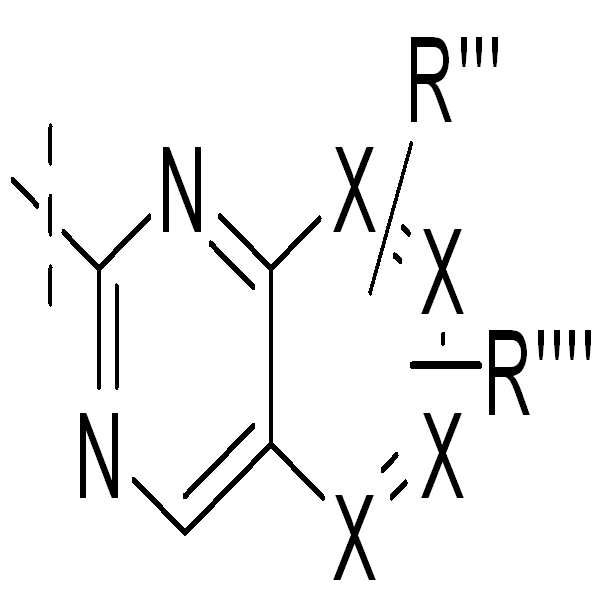
X는 N 또는 CR"'이다. 바람직하게는, 기에서 모든 또는 하나 또는 두 개의 X는 CH이다;X is N or CR ″ '. Preferably, all or one or two X in the group are CH;
X1 또는 X2는 N 또는 CR"'이다;X 1 or X 2 is N or CR ″ ′;
X3는 N 또는 CR""'이다;X 3 is N or CR ""';
Y는 O, S, SO 또는 SO2이다. 바람직하게는, Y는 O 또는 S이다;Y is O, S, SO or SO 2 . Preferably, Y is O or S;
R' 또는 R"는 각 독립적으로 H, Hal 또는 1 내지 12 개의 탄소 원자를 갖는 직쇄 또는 분지된 알킬을 나타낸다. 바람직하게는 둘 모두 H, F, 또는 메틸이다;R ′ or R ″ each independently represents H, Hal or straight or branched alkyl having 1 to 12 carbon atoms. Preferably both are H, F, or methyl;
R"' 또는 R""는 독립적으로 H, Hal, NR3R4, CHR3R4, OR3, CN, 또는 1 내지 3 개의 CH2-기가 O, NR3, S, SO, SO2, CO, COO, OCO, CONR3, 및 NR3CO로부터 선택된 기로 치환될 수 있고, 1 내지 5 개의 수소 원자가 Hal, NR3R4 또는 NO2로 교체될 수 있는 1 내지 12 개의 탄소 원자를 갖는 직쇄 또는 분지된 알킬을 나타낸다. 바람직하게는 R"' 및/또는 R""은 H, Hal, NR3R4, CHR3R4, OR3, CN 또는 알킬이다;R ″ 'or R ″ ″ is independently H, Hal, NR 3 R 4 , CHR 3 R 4 , OR 3 , CN, or one to three CH 2 -groups are O, NR 3 , S, SO, SO 2 , Straight chain with 1 to 12 carbon atoms, which may be substituted with groups selected from CO, COO, OCO, CONR 3 , and NR 3 CO, and 1 to 5 hydrogen atoms may be replaced with Hal, NR 3 R 4 or NO 2 Or branched alkyl. Preferably R ″ 'and / or R ″ ″ are H, Hal, NR 3 R 4 , CHR 3 R 4 , OR 3 , CN or alkyl;
R""'는 H, Hal, NR3R4, CHR3R4, CN, 또는 1 내지 3 개의 CH2-기가 O, NR3, S, SO, SO2, CO, COO, OCO, CONR3, 및 NR3CO로부터 선택된 기로 치환될 수 있고, 1 내지 5 개의 수소 원자가 Hal, NR3R4 또는 NO2로 치환될 수 있는 1 내지 12 개의 탄소 원자를 갖는 직쇄 또는 분지된 알킬을 나타내고, 바람직하게는, R""'는 H, Hal 또는 알킬이다;R ″ ″ ′ is H, Hal, NR 3 R 4 , CHR 3 R 4 , CN, or 1 to 3 CH 2 -groups O, NR 3 , S, SO, SO 2 , CO, COO, OCO, CONR 3 , And straight or branched alkyl having 1 to 12 carbon atoms which may be substituted with a group selected from NR 3 CO, and 1 to 5 hydrogen atoms may be substituted with Hal, NR 3 R 4 or NO 2 , and are preferred. Preferably, R ""'is H, Hal or alkyl;
R3 또는 R4는 각 독립적으로 H 또는 1 내지 12 개의 탄소 원자를 갖는 직쇄 또는 분지된 알킬기를 나타내고, 바람직하게는 H, 메틸, 또는 에틸이다;R 3 or R 4 each independently represent H or a straight or branched alkyl group having 1 to 12 carbon atoms, preferably H, methyl, or ethyl;
Q는 하기의 기 중 하나를 나타낸다:Q represents one of the following groups:


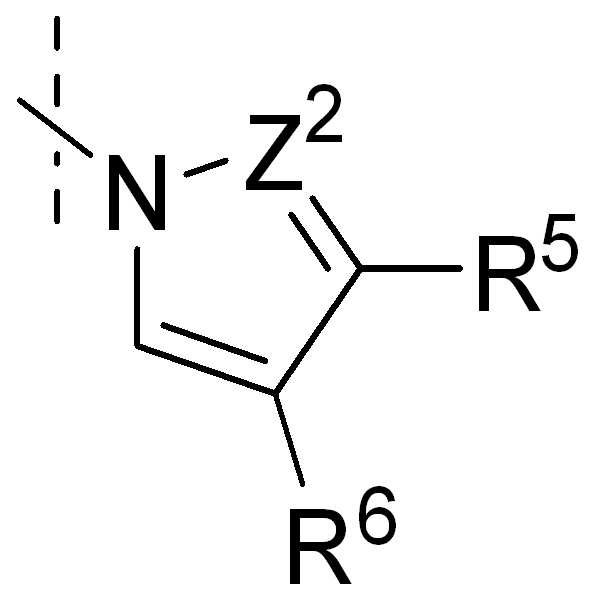


Z1은 S, O, 또는 NR3이다;Z 1 is S, O, or NR 3 ;
Z2 또는 Z3는 독립적으로 CR5, 또는 N을 나타낸다;Z 2 or Z 3 independently represents CR 5 , or N;
Z2'는 CR5' 또는 N이다;Z 2 'CR 5 ' Or N;
T는 N, CH 또는 CR7이다;T is N, CH or CR 7 ;
R5, R6, 또는 R7은 독립적으로 H, Hal, NR3R4, NO2, 또는 1 내지 3 개의 CH2-기가 O, NR3, S, SO, SO2, CO, COO, OCO, CONR3, 및 NR3CO로부터 선택된 기로 치환될 수 있고, 1 내지 5 개의 수소가 Hal, NR3R4, NO2, OR3, Het, Ar, 또는 Cyc으로 치환될 수 있는 1 내지 12 개의 탄소 원자를 갖는 직쇄 또는 분지된 알킬을 나타내거나, 또는 Ar, Het 또는 Cyc을 나타낸다;R 5 , R 6 , or R 7 are independently H, Hal, NR 3 R 4 , NO 2 , or one to three CH 2 -groups O, NR 3 , S, SO, SO 2 , CO, COO, OCO , CONR 3 , and 1 to 12 hydrogens which may be substituted with a group selected from NR 3 CO and 1 to 5 hydrogens may be substituted with Hal, NR 3 R 4 , NO 2 , OR 3 , Het, Ar, or Cyc Linear or branched alkyl having a carbon atom, or Ar, Het or Cyc;
R5'은 H, Hal, NR3R4, NO2, 2 내지 12 개의 탄소 원자를 갖는 직쇄 또는 분지된 알킬, 또는 1 내지 3 개의 CH2-기가 O, NR3, S, SO, SO2, CO, COO, OCO, CONR3, 및 NR3CO로부터 선택된 기로 치환될 수 있거나 및/또는 1 내지 5 개의 수소가 Hal, NR3R4, NO2, OR3, Het, Ar, 또는 Cyc으로 치환될 수 있는 1 내지 12 개의 탄소 원자를 갖는 직쇄 또는 분지된 알킬을 나타내거나, 또는 R5'은 Ar, Het 또는 Cyc을 나타내고; 또한 R이 메틸이 아니거나(other than) 및/또는 W가 CH이거나 및/또는 A가R 5 ′ is H, Hal, NR 3 R 4 , NO 2 , a straight or branched alkyl having 2 to 12 carbon atoms, or 1 to 3 CH 2 -groups O, NR 3 , S, SO, SO 2 , CO, COO, OCO, CONR 3 , and NR 3 CO can be substituted and / or 1 to 5 hydrogen to Hal, NR 3 R 4 , NO 2 , OR 3 , Het, Ar, or Cyc Represents straight or branched alkyl having 1 to 12 carbon atoms which may be substituted, or R 5 ′ represents Ar, Het or Cyc; And R is not methyl and / or W is CH and / or A is


R8은 H, 메틸 또는 1 내지 3 개의 CH2-기가 O, NR3, S, SO, SO2, CO, COO, OCO, CONR3, 및 NR3CO로 이루어진 군으로부터 선택된 기로 치환될 수 있고, 1 내지 5 개의 수소 원자가 Hal, NR3R4 또는 NO2로 치환될 수 있는 2 내지 12 개의 탄소 원자를 갖는 직쇄 또는 분지된 알킬을 나타낸다;R 8 may be substituted with a group selected from the group consisting of H, methyl or 1 to 3 CH 2 -groups O, NR 3 , S, SO, SO 2 , CO, COO, OCO, CONR 3 , and NR 3 CO , Straight or branched alkyl having 2 to 12 carbon atoms which 1 to 5 hydrogen atoms may be substituted with Hal, NR 3 R 4 or NO 2 ;
Hal은 F, Cl, Br 또는 I, 바람직하게는 F, Cl, 또는 Br을 나타낸다;Hal represents F, Cl, Br or I, preferably F, Cl, or Br;
Het은 모노시클릭 또는 비시클릭 또는 융합된-비시클릭(fused-bicyclic)이고 3- 내지 8-원을 갖고 N, O 및 S로부터 선택된 1 내지 4 개의 헤테로원자를 포함하는 포화, 불포화 또는 방향성 고리를 나타내고, 상기 고리는 R5, Hal, 및 OR3으로부터 선택된 1 내지 3개의 치환기로 치환될 수 있다;Het is a monocyclic or bicyclic or fused-bicyclic, saturated, unsaturated or aromatic ring having 3 to 8 members and comprising 1 to 4 heteroatoms selected from N, O and S Wherein the ring may be substituted with 1 to 3 substituents selected from R 5 , Hal, and OR 3 ;
Ar은 R5, OR3 및 Hal로부터 독립적으로 선택된 1 내지 3 개의 치환기로 선택적으로 치환된 6-원 카보시클릭 방향성 고리 또는 융합되거나 또는 비융합된 비시클릭 방향성 고리를 나타낸다;Ar represents a 6-membered carbocyclic aromatic ring optionally substituted with 1 to 3 substituents independently selected from R 5 , OR 3 and Hal or a fused or unfused bicyclic aromatic ring;
Cyc은 R5 또는 Hal 또는 OH로부터 독립적으로 선택된 1 내지 3 개의 치환기로 선택적으로 치환된 3 내지 8 개의 탄소 원자를 갖는 포화된 카보시클릭 고리를 나타낸다;Cyc represents a saturated carbocyclic ring having 3 to 8 carbon atoms optionally substituted with 1 to 3 substituents independently selected from R 5 or Hal or OH;
m 및 n은 독립적으로 서로 0, 1, 2 또는 3을 나타낸다.m and n independently represent 0, 1, 2 or 3 with each other.
특히, 화학식 (Ⅰ)은 하기의 화학식 (Ⅰa) 및 (Ⅰb)의 화합물의 두 가지 거울상이성질체를 포함한다:In particular, formula (I) comprises two enantiomers of the compounds of formulas (Ia) and (Ib):


상기 식에서, Where
A, R, W, Q, n 및 m은 상기에 주어진 의미를 갖는다.A, R, W, Q, n and m have the meanings given above.
명세서 전체에 걸쳐, 화학식 (Ⅰ), (Ⅰa) 및 (Ⅰb)의 R은 바람직하게는 메틸이다. 화학식 (Ⅰ), (Ⅰa) 및 (Ⅰb)에서 지표 m 및 n은 바람직하게는 동시에 1이다.Throughout the specification, R in formulas (I), (Ia) and (Ib) is preferably methyl. The indicators m and n in the formulas (I), (Ia) and (Ib) are preferably 1 at the same time.
가장 바람직하게는, 화학식 (Ⅰ)의 화합물은 화학식 (A) 및 (B)의 화합물이다:Most preferably, the compound of formula (I) is a compound of formula (A) and (B):


T와 같은 개별적인 기가 화학식 (Ⅰ)의 화합물에서 1회 초과하여 나타나는 경우, 그 기의 개별적인 정의에 따라 동일하거나 또는 상이한 의미를 가질 수 있다.If an individual group, such as T, appears more than once in the compound of formula (I), it may have the same or different meanings depending on the individual definition of the group.
본 발명의 바람직한 화합물은 바람직하게는 이들의 비-라세믹 형태, 즉 거울상이성질체적으로 순수한 화합물 또는 이들의 거울상이성질체적으로 풍부한 상기 이성질체의 혼합물로서 사용된다. 만약 R이 메틸, 에틸, n-프로필 또는 이소-부틸과 같은 1 내지 6 개 탄소 원자를 갖는 비치환된 직쇄 또는 분지된 알킬인 경우, 화학식 (Ⅰ)의 화합물의 S-거울상이성질체가 바람직하다. 화학식 (Ⅰb) 및 (B)가 매우 바람직하다.Preferred compounds of the invention are preferably used in their non-racemic form, i.e. enantiomerically pure compounds or mixtures of these enantiomerically rich isomers thereof. If R is an unsubstituted straight or branched alkyl having 1 to 6 carbon atoms, such as methyl, ethyl, n-propyl or iso-butyl, the S-enantiomer of the compound of formula (I) is preferred. Very preferred are the formulas (Ib) and (B).
일반적으로, 화학식 (Ⅰ)의 화합물은 R' 내지 R""' 또는 R3 내지 R7, 또는 m 또는 n과 같은 지표와 같은 하나 이상의 바람직한 기를 포함하는 것이 바람직하다. 화학식 (Ⅰ)의 화합물이 보다 바람직할 수록, 이들은 보다 바람직한 기 또는 지표를 포함한다.In general, the compounds of formula (I) preferably comprise one or more preferred groups such as R ′ to R ″ ″ ′ or R 3 to R 7 , or an indicator such as m or n. The more preferred are compounds of formula (I), they contain more preferred groups or indicators.
상기 기 R8과 같은 치환체가 헤테로 원자를 통해 상기 분자의 나머지(remainder)에 연결된 경우, 상기 개별적인 기에서 연결 원자는 바람직하게는 탄소 원자이거나 또는 상기 개별적인 기는 H이다.When a substituent, such as the group R 8 , is linked to the remainder of the molecule via a hetero atom, the linking atom in the individual group is preferably a carbon atom or the individual group is H.
본 발명은 또한 약제로서 화학식 (Ⅰ)의 화합물의 용도에 관한 것이다.The invention also relates to the use of a compound of formula (I) as a medicament.
본 발명의 의미에서, 상기 화합물은 모든 비율로 이들의 혼합물을 포함하여, 이의 약학적으로 이용가능한 유도체, 용매화물, 전구약물, 호변체(tautomer), 거울상이성질체, 라세미체 및 입체이성질체를 포함하는 것으로 정의된다.In the sense of the present invention, the compounds include pharmaceutically available derivatives, solvates, prodrugs, tautomers, enantiomers, racemates and stereoisomers thereof, including mixtures thereof in all ratios. Is defined as:
용어 "약학적으로 이용가능한 유도체(pharmaceutically usable derivatives)"는 예를 들어, 본 발명에 따른 화합물의 염 및 또한 소위 전구약물 화합물을 의미하는 것으로 간주된다. 용어 상기 화합물의 "용매화물(solvates)"은 상기 화합물 상에 불활성 용매 분자의 이들의 상호 흡착력(attractive force)으로 인해 형성되는 상기 화합물 상으로의 첨가를 의미하는 것으로 간주된다. 예를 들어, 용매화물은 모노- 또는 디히드레이트 또는 알콕시드이다. 본 발명은 또한 본 발명에 따른 상기 화합물의 염의 용매화물을 포함한다. 용어 "전구약물(prodrug)"은 예를 들어, 알킬 또는 아실기, 당 또는 올리고펩티드의 수단으로써 변경되고, 기관에서 빠르게 절단되어 본 발명의 효과적인 화합물을 형성하는 본 발명에 따른 화합물을 의미하는 것으로 간주된다. 이들은 또한 본 발명에 따른 상기 화합물의 생분해가 가능한 폴리머 유도체를 포함한다. 마찬가지로, 본 발명의 화합물은 예를 들어 에스테르, 카보네이트, 카바메이트, 유레아, 아미드 또는 포스페이트와 같은 임의의 바람직한 전구약물의 형태일 수 있으며, 실제로 생물학적으로 활성인 형태는 대사를 통해서만 방출된다. 인비보에서 전환되어 생물활성 제제(즉, 본 발명의 화합물)를 제공할 수 있는 임의의 화합물은 본 발명의 범위 및 사상 내에서 전구약물이다. 다양한 형태의 전구약물이 당업계에 잘 알려져있다. 또한 바람직한 생물학적 효과를 유도하는 것과 같이 적절할 수 있는 몸에서 화학물질이 대사물질, 경우에 따라 심지어 더 뚜렷한 형태로 전환된다는 것이 알려져있다. 대사작용에 의해서 인 비보에서 본 발명의 임의의 화합물로부터 전환된 임의의 생물학적으로 활성인 화합물은 본 발명의 범위 및 사상 내에서 대사산물이다.The term "pharmaceutically usable derivatives" is for example considered to mean salts of the compounds according to the invention and also so-called prodrug compounds. The term “solvates” of the compounds is considered to mean the addition of inert solvent molecules on the compounds onto the compounds formed due to their mutual adsorptive forces. For example, the solvate is mono- or dihydrate or alkoxide. The invention also includes solvates of the salts of the compounds according to the invention. The term "prodrug" is intended to mean a compound according to the invention which is altered by means of, for example, alkyl or acyl groups, sugars or oligopeptides and which is rapidly cleaved in the organ to form effective compounds of the invention. Is considered. They also include biodegradable polymer derivatives of the compounds according to the invention. Likewise, the compounds of the present invention may be in the form of any desired prodrug such as, for example, esters, carbonates, carbamates, ureas, amides or phosphates, in which the biologically active form is only released via metabolism. Any compound that can be converted in vivo to provide a bioactive agent (ie, a compound of the invention) is a prodrug within the scope and spirit of the invention. Various forms of prodrugs are well known in the art. It is also known that chemicals in the body, which may be appropriate, such as inducing desirable biological effects, are converted into metabolites, and sometimes even more pronounced forms. Any biologically active compound converted from any compound of the invention in vivo by metabolism is a metabolite within the scope and spirit of the invention.
본 발명의 화합물은 순수한 E 또는 Z 이성질체로서 이들의 이중 결합 이성질체의 형태, 또는 이들의 이중 결합 이성질체의 혼합물의 형태로 존재할 수 있다. 가능한 경우, 본 발명의 화합물은 케토-엔올 호변체와 같은, 상기 호변체의 형태일 수 있다. 본 발명의 화합물의 모든 입체이성질체는 혼합물 또는 순수하거나 또는 실질적으로 순수한 형태로 생각된다. 본 발명의 화합물은 임의의 탄소 원자에서 비대칭 중심을 가질 수 있다. 결과적으로, 이들은 이들의 라세미체, 순수한 거울상이성질체 및/또는 부분입체이성질체 또는 이들의 거울상이성질체 및/또는 부분입체이성질체의 혼합물 형태로 존재할 수 있다. 상기 혼합물은 상기 입체이성질체의 임의의 바람직한 혼합 비율을 가질 수 있다. 따라서, 예를 들어, 하나 이상의 키랄성 중심을 갖고 라세미체로서 또는 부분입체이성질체 혼합물로서 발생하는 본 발명의 화합물은 이들의 광학적 순수 이성질체, 즉 입체이성질체 또는 부분입체이성질체로 공지된 방법에 의해서 그 자체로 분획화될 수 있다. 본 발명의 화합물의 분리는 키랄 또는 비-키랄 상에서 컬럼 분리, 또는 선택적으로 광학적으로 활성인 용매로부터 또는 광학적으로 활성인 산 또는 염기로 재-결정화에 의해서, 또는 예를 들어 광학적으로 활성인 알콜과 같은 광학적으로 활성인 제제로 유도체화하여, 라디칼을 순차적 제거함으로써 수행될 수 있다. The compounds of the present invention may exist as pure E or Z isomers in the form of their double bond isomers, or in the form of mixtures of their double bond isomers. Where possible, the compounds of the present invention may be in the form of such tautomers, such as keto-enol tautomers. All stereoisomers of the compounds of the present invention are considered to be in mixture or in pure or substantially pure form. Compounds of the present invention may have an asymmetric center at any carbon atom. As a result, they may exist in the form of their racemates, pure enantiomers and / or diastereomers or mixtures of their enantiomers and / or diastereomers. The mixture may have any desired mixing ratio of the stereoisomers. Thus, for example, the compounds of the invention having one or more chiral centers and occur as racemates or as diastereomeric mixtures are themselves per se by means known as their optically pure isomers, ie stereoisomers or diastereomers. Can be fractionated. Separation of the compounds of the invention can be effected by column separation on chiral or non-chiral, or optionally by re-crystallization from an optically active solvent or with an optically active acid or base, or for example with an optically active alcohol. Derivatization with the same optically active agent can be performed by sequential removal of radicals.
본 발명은 또한 예를 들어, 두 부분이성질체의 혼합물이, 예를 들어, 1:1, 1:2, 1:3, 1:4, 1:5, 1:10, 1:100 또는 1:1000 비율인 본 발명에 따른 화합물의 혼합물의 용도에 관한 것이다. 이들은 구체적으로 바람직하게는 입체이성질체 화합물의 혼합물이다. The present invention also provides a mixture of two diastereomers, for example 1: 1, 1: 2, 1: 3, 1: 4, 1: 5, 1:10, 1: 100 or 1: 1000. It relates to the use of a mixture of compounds according to the invention in proportion. These are specifically preferably mixtures of stereoisomeric compounds.
거울상이성질체적으로 풍부한(enriched) 혼합물은, 화학식 (Ⅰ) 또는 당업자에게 잘 알려진 방법으로 측정할 때, 10% 이상, 바람직하게는 50% 이상, 및 보다 바람직하게는 95% 초과의 거울상이성질체 과량을 갖는 관련된 화학식의 화합물을 나타낸다. 가장 바람직한 거울상이성질체적으로 풍부한 혼합물은 화학식 (Ⅰ) 또는 98% 초과의 거울상이성질체 과량을 갖는 관련된 화학식의 화합물을 나타낸다.Enantiomerically enriched mixtures have an enantiomeric excess of at least 10%, preferably at least 50%, and more preferably more than 95%, as measured by formula (I) or by methods well known to those skilled in the art. To a compound of the related formula. Most preferred enantiomerically enriched mixtures represent compounds of formula (I) or related formulas having enantiomeric excess of greater than 98%.
화합물, 특히 본 발명에 따른 화합물을 정의하기 위해서 본 명세서에서 사용된 바와 같은 명명법(nomenclature)은 일반적으로 화학적 화합물 및 특히 유기 화합물에 대한 IUPAC-조직의 규칙에 기초한다. 본 발명의 화합물은 프로그램 AutoNom 2000 또는 ACD Lab Version 12.01에서 사용된 표준에 따라 명명되었다. 입체화학 (S) 또는 (R)의 결정은 당업자에게 잘 알려진 명명법의 표준 규칙을 이용하여 수행된다. 본 발명의 상기 화합물의 설명에 대해 제시된 용어는 발명의 설명 또는 청구항에서 달리 표시되지 않는 한 항상 하기와 같은 의미를 갖는다:The nomenclature as used herein to define compounds, in particular compounds according to the invention, is generally based on the rules of the IUPAC-tissue for chemical compounds and in particular organic compounds. The compounds of the present invention were named according to the standard used in the program AutoNom 2000 or ACD Lab Version 12.01. Determination of stereochemistry (S) or (R) is carried out using standard rules of nomenclature well known to those skilled in the art. The terms given for the description of the compounds of the invention always have the following meanings unless indicated otherwise in the description or claims of the invention:
용어 "비치환된(unsubstituted)"은 상응하는 라디칼, 기 또는 모이어티가 치환체를 갖지 않는 것을 의미한다. 용어 "치환된(substituted)"은 상응하는 라디칼, 기 또는 모이어티가 하나 이상의 치환체를 갖는 것을 의미한다. 라디칼이 복수의 치환체를 갖고, 다양한 치환체의 선택이 특정되는 경우, 상기 치환체는 서로 독립적으로 선택되고 동일할 필요는 없다. 라디칼이 복수의 특이적-지정된 치환체를 가지더라도 그러한 치환체의 표현은 서로 상이할 수 있다 (예를 들어, 메틸 및 에틸). 따라서, 본 발명의 임의의 라디칼에 의한 다중 치환은 동일하거나 또는 상이한 라디칼을 포함할 수 있음을 이해해야 한다. 그러므로, 화합물 내에서 개별적 라디칼이 여러번 발생하면, 상기 라디칼은 서로 독립적으로 표시된 의미를 채택한다.The term "unsubstituted" means that the corresponding radical, group or moiety has no substituent. The term "substituted" means that the corresponding radical, group or moiety has one or more substituents. If the radical has a plurality of substituents and the choice of the various substituents is specified, the substituents are selected independently of one another and need not be identical. Even if a radical has a plurality of specific-specified substituents, the expression of such substituents may differ from one another (eg, methyl and ethyl). Thus, it should be understood that multiple substitutions by any radical of the present invention may involve the same or different radicals. Therefore, when individual radicals occur several times in a compound, the radicals adopt the meaning indicated independently of one another.
용어 "알킬(alkyl)" 또는 "알킬기(alkyl group)"는 분지된 또는 직쇄이고 바람직하게는 1, 2, 3, 4, 5, 6, 7, 8, 9 또는 10 개의 탄소 원자를 갖는, 비고리형 포화 또는 불포화된 탄화수소 라디칼, 즉, C1-C10-알카닐을 의미한다. 적합한 알킬 라디칼의 예는 메틸, 에틸, n-프로필, 이소프로필, 1,1-, 1,2- 또는 2,2-디메틸프로필, 1-에틸프로필, 1-에틸-1-메틸-프로필, 1-에틸-2-메틸프로필, 1,1,2- 또는 1,2,2-트리-메틸프로필, n-부틸, 이소부틸, sec-부틸, tert-부틸, 1-, 2- 또는 3-메틸부틸, 1,1-, 1,2-, 1,3-, 2,2-, 2,3- 또는 3,3-디메틸부틸, 1- 또는 2-에틸부틸, n-펜틸, 이소-펜틸, neo-펜틸, tert-펜틸, 1-, 2-, 3- 또는 -메틸-펜틸, n-헥실, 2-헥실, 이소헥실, n-헵틸, n-옥틸, n-노닐, n-데실, n-운데실, n-도데실, n-테트라데실, n-헥사데실, n-옥타데실, n-이코사닐, 또는 n-도코사닐이다.The term "alkyl" or "alkyl group" is branched or straight chain, preferably having 1, 2, 3, 4, 5, 6, 7, 8, 9 or 10 carbon atoms; Li-type saturated or unsaturated hydrocarbon radicals, ie, C 1 -C 10 -alkanyl. Examples of suitable alkyl radicals are methyl, ethyl, n-propyl, isopropyl, 1,1-, 1,2- or 2,2-dimethylpropyl, 1-ethylpropyl, 1-ethyl-1-methyl-propyl, 1 -Ethyl-2-methylpropyl, 1,1,2- or 1,2,2-tri-methylpropyl, n-butyl, isobutyl, sec-butyl, tert-butyl, 1-, 2- or 3-methyl Butyl, 1,1-, 1,2-, 1,3-, 2,2-, 2,3- or 3,3-dimethylbutyl, 1- or 2-ethylbutyl, n-pentyl, iso-pentyl, neo-pentyl, tert-pentyl, 1-, 2-, 3- or -methyl-pentyl, n-hexyl, 2-hexyl, isohexyl, n-heptyl, n-octyl, n-nonyl, n-decyl, n -Undecyl, n-dodecyl, n-tetradecyl, n-hexadecyl, n-octadecyl, n-icosanyl, or n-docosanyl.
본 발명의 구체예에서, A는 1 내지 10 개의 C 원자를 갖고, 1 내지 7 개의 H 원자가 독립적으로 하나 이상의 Hal에 의해 교체될 수 있는, 비분지 또는 분지된 알킬을 나타낸다. A의 바람직한 구체예는 1 내지 6 개의 C 원자를 갖고, 1 내지 4 개의 H 원자가 독립적으로 하나 이상의 Hal에 의해 치환될 수 있는, 비분지 또는 분지된 알킬을 나타낸다. 본 발명의 보다 바람직한 구체예에서, A는 1 내지 4 개의 C 원자를 갖고, 1 내지 3 개의 H 원자가 독립적으로 하나 이상의 Hal, 구체적으로 F 및/또는 Cl에 의해 교체될 수 있는, 비분지 또는 분지된 알킬을 나타낸다. A가 1 내지 6 개의 C 원자를 갖는 비분지 또는 분지된 알킬을 나타내는 것이 가장 바람직하다. C1-4-알킬이 매우 바람직하다. C1-4-알킬 라디칼은 예를 들어 메틸, 에틸, 프로필, 이소프로필, 부틸, 이소부틸, tert-부틸, sec-부틸, tert-부틸, 플루오로메틸, 디플루오로메틸, 트리플루오로메틸, 펜타플루오로에틸, 1,1,1-트리플루오로에틸 또는 브로모메틸, 특히 메틸, 에틸, 프로필 또는 트리플루오로메틸이다. 상기 A의 개별적인 표시는 본 발명의 임의의 라디칼에서 서로 독립적인 것으로 이해되어야 한다.In an embodiment of the invention, A represents unbranched or branched alkyl, having 1 to 10 C atoms, wherein 1 to 7 H atoms can be independently replaced by one or more Hal. Preferred embodiments of A represent unbranched or branched alkyl having 1 to 6 C atoms and wherein 1 to 4 H atoms can be independently substituted by one or more Hal. In a more preferred embodiment of the invention, A has 1 to 4 C atoms and unbranched or branched, wherein 1 to 3 H atoms can be independently replaced by one or more Hal, in particular F and / or Cl Alkyl is represented. Most preferably, A represents unbranched or branched alkyl having 1 to 6 C atoms. Very preferred are C 1-4 -alkyl. C 1-4 -alkyl radicals are for example methyl, ethyl, propyl, isopropyl, butyl, isobutyl, tert-butyl, sec-butyl, tert-butyl, fluoromethyl, difluoromethyl, trifluoromethyl , Pentafluoroethyl, 1,1,1-trifluoroethyl or bromomethyl, especially methyl, ethyl, propyl or trifluoromethyl. It is to be understood that the individual representations of A are independent of each other in any radical of the invention.
본 발명의 목적을 위한, 용어 "시클로알킬(cycloalkyl)" 또는 "Cyc"은 3 내지 20 개, 바람직하게는 3 내지 12 개, 보다 바람직하게는 3 내지 9 개의 탄소 원자를 함유하는 1 내지 3개의 고리를 갖는, 포화되고 부분적으로 불포화된 비방향성 고리형 탄화수소 기/라디칼을 의미한다. 상기 시클로알킬 라디칼은 또한 비(bi) 또는 폴리시클릭 계의 부분일 수 있고, 예를 들어, 상기 시클로알킬 라디칼은 본 명세서에서 임의의 가능하고 바람직한 고리 원(member)으로써 정의되는 바와 같은 아릴, 헤테로아릴 또는 헤테로시크릴로 융합된다. 상기 일반식 (Ⅰ)의 화합물로의 결합은 시클로알킬 라디칼의 임의의 가능한 고리원을 통해 영향받을 수 있다. 적합한 시클로알킬 라디칼의 예는 시클로프로필, 시클로부틸, 시클로펜틸, 시클로헥실, 시클로헵틸, 시클로옥틸, 시클로데실, 시클로헥세닐, 시클로펜테닐 및 시클로옥타디에닐이다. 본 발명의 구체예에서, Cyc은 3 내지 7 개의 C 원자를 갖고, 1 내지 4 개의 H 원자가 서로 독립적으로 Hal로 교체될 수 있는 시클로알킬로 나타낸다. C3-C7-시클로알킬이 바람직하다. C4-C7-시클로알킬이 보다 바람직하다. C5-C7-시클로알킬, 즉, 시클로펜틸, 시클로헥실 또는 시클로헵틸이 바람직하고, 시클로헥실이 매우 바람직하다. 상기 Cyc의 개별적인 표시는 본 발명의 임의의 라디칼에서 서로 독립적인 것으로 이해되어야 한다.For the purposes of the present invention, the term "cycloalkyl" or "Cyc" refers to 1 to 3 containing 3 to 20, preferably 3 to 12, more preferably 3 to 9 carbon atoms By saturated, partially unsaturated, non-aromatic cyclic hydrocarbon groups / radicals are meant. The cycloalkyl radical may also be part of a bi or polycyclic system, for example the cycloalkyl radical is an aryl, hetero as defined herein as any possible and preferred ring member. Fused to aryl or heterocyclyl. The linkage to the compound of general formula (I) may be effected via any possible ring member of the cycloalkyl radical. Examples of suitable cycloalkyl radicals are cyclopropyl, cyclobutyl, cyclopentyl, cyclohexyl, cycloheptyl, cyclooctyl, cyclodecyl, cyclohexenyl, cyclopentenyl and cyclooctadienyl. In an embodiment of the invention, Cyc is represented by cycloalkyl having from 3 to 7 C atoms and from 1 to 4 H atoms can be independently replaced with Hal. C 3 -C 7 -cycloalkyl is preferred. More preferred are C 4 -C 7 -cycloalkyl. Preference is given to C 5 -C 7 -cycloalkyl, ie cyclopentyl, cyclohexyl or cycloheptyl, very preferred cyclohexyl. It is to be understood that the individual indicia of Cyc are independent of each other in any radical of the invention.
본 발명의 목적을 위한, 용어 "아릴(aryl)" 또는 "카르보아릴(carboaryl)"은 선택적으로 치환될 수 있는, 3 내지 14 개, 바람직하게는 3 내지 12 개, 보다 바람직하게는 4 내지 12 개, 가장 바람직하게는 5 내지 10 개, 매우 바람직하게는 6 내지 8 개의 탄소 원자를 갖는 모노- 또는 폴리시클릭 방향성 탄화수소계를 의미한다. 용어 "아릴(aryl)"은 또한 상기 방향성 고리가 비- 또는 폴리시클릭의 포화된, 부분적으로 불포화된 및/또는 방향성 계의 부분인 계를 포함하고, 예를 들어, 상기 방향성 고리는 상기 아릴 라디칼의 임의의 바람직하고 가능한 고리 원을 통해 본 명세서에서 정의된 바와 같은 아릴, 시클로알킬, 헤테로아릴 또는 헤테로시크릴에 결합된다. 상기 일반식 (Ⅰ)의 화합물에 대한 결합은 상기 아릴 라디칼의 임의의 가능한 고리 원을 통해 영향받을 수 있다. 적합한 아릴 라디칼의 예는 페닐, 비페닐, 나프틸, 1-나프틸, 2-나프틸 및 안트라세닐이지만, 마찬가지로 인다닐, 인데닐 또는 1,2,3,4-테트라히드로나프틸이다. 본 발명의 바람직한 카르보아릴은 선택적으로 치환된 페닐, 나프틸 및 비페닐, 바람직하게는 6 내지 8 개의 C 원자를 갖는 선택적으로 치환된 모노시크릭(monocylic) 카르보아릴, 가장 바람직하게는 선택적으로 치환된 페닐이다.For the purposes of the present invention, the term "aryl" or "carboaryl" is 3 to 14, preferably 3 to 12, more preferably 4 to 4, which may be optionally substituted By 12, most preferably 5 to 10, very preferably 6 to 8 carbon atoms are meant mono- or polycyclic aromatic hydrocarbon systems. The term "aryl" also includes systems in which the aromatic ring is part of a non- or polycyclic saturated, partially unsaturated and / or aromatic system, for example, the aromatic ring is the aryl radical To any aryl, cycloalkyl, heteroaryl or heterocyclyl as defined herein via any preferred and possible ring member of. The bond to the compound of formula (I) may be affected through any possible ring member of the aryl radical. Examples of suitable aryl radicals are phenyl, biphenyl, naphthyl, 1-naphthyl, 2-naphthyl and anthracenyl, but likewise indanyl, indenyl or 1,2,3,4-tetrahydronaphthyl. Preferred carboaryls of the present invention are optionally substituted phenyl, naphthyl and biphenyl, optionally substituted monocyclic carboaryls having 6 to 8 C atoms, most preferably optional Phenyl substituted by
Ar 및 아릴은 바람직하게는 하기의 기로부터 선택된다: 페닐, o-, m- 또는 p-토릴, o-, m- 또는 p-에틸페닐, o-, m- 또는 p-프로필페닐, o-, m- 또는 p-이소프로필페닐, o-, m- 또는 p-tert.-부틸페닐, o-, m- 또는 p-히드록시페닐, o-, m- 또는 p-메톡시페닐, o-, m- 또는 p-에톡시페닐, o-, m- 또는 p-플루오로-페닐, o-, m- 또는 p-브로모페닐, o-, m- 또는 p-클로로페닐, o-, m- 또는 p-술폰아미도페닐, o-, m- 또는 p-(N-메틸-술폰아미도)페닐, o-, m- 또는 p-(N,N-디메틸-술폰아미도)-페닐, o-, m- 또는 p-(N-에틸-N-메틸-술폰아미도)페닐, o-, m- 또는 p-(N,N-디에틸-술폰아미도)-페닐, 구체적으로, 2,3-, 2,4-, 2,5-, 2,6-, 3,4- 또는 3,5-디플루오로페닐, 2,3-, 2,4-, 2,5-, 2,6-, 3,4- 또는 3,5-디클로로페닐, 2,3-, 2,4-, 2,5-, 2,6-, 3,4- 또는 3,5-디브로모페닐, 2,3,4-, 2,3,5-, 2,3,6-, 2,4,6- 또는 3,4,5-트리클로로페닐, 2,4,6-트리메톡시페닐, 2-히드록시-3,5-디클로로페닐, p-이오도페닐, 4-플루오로-3-클로로페닐, 2-플루오로-4-브로모페닐, 2,5-디플루오로-4-브로모페닐, 3-브로모-6-메톡시페닐, 3-클로로-6-메톡시페닐 또는 2,5-디메틸-4-클로로페닐.Ar and aryl are preferably selected from the following groups: phenyl, o-, m- or p-tolyl, o-, m- or p-ethylphenyl, o-, m- or p-propylphenyl, o- , m- or p-isopropylphenyl, o-, m- or p-tert.-butylphenyl, o-, m- or p-hydroxyphenyl, o-, m- or p-methoxyphenyl, o- , m- or p-ethoxyphenyl, o-, m- or p-fluoro-phenyl, o-, m- or p-bromophenyl, o-, m- or p-chlorophenyl, o-, m Or p-sulfonamidophenyl, o-, m- or p- (N-methyl-sulfonamido) phenyl, o-, m- or p- (N, N-dimethyl-sulfonamido) -phenyl, o-, m- or p- (N-ethyl-N-methyl-sulfonamido) phenyl, o-, m- or p- (N, N-diethyl-sulfonamido) -phenyl, specifically, 2 , 3-, 2,4-, 2,5-, 2,6-, 3,4- or 3,5-difluorophenyl, 2,3-, 2,4-, 2,5-, 2, 6-, 3,4- or 3,5-dichlorophenyl, 2,3-, 2,4-, 2,5-, 2,6-, 3,4- or 3,5-dibromophenyl, 2 , 3,4-, 2,3,5-, 2,3,6-, 2,4,6- or 3,4,5-trichlorophenyl, 2,4,6-trimethoxyfe , 2-hydroxy-3,5-dichlorophenyl, p-iodophenyl, 4-fluoro-3-chlorophenyl, 2-fluoro-4-bromophenyl, 2,5-difluoro-4- Bromophenyl, 3-bromo-6-methoxyphenyl, 3-chloro-6-methoxyphenyl or 2,5-dimethyl-4-chlorophenyl.
추가의 치환과 무관하게, Het은 바람직하게는 2- 또는 3-푸릴, 2- 또는 3-티에닐, 1-, 2- 또는 3-피롤일, 1-, 2, 4- 또는 5-이미다졸일, 1-, 3-, 4- 또는 5-피라졸일, 2-, 4- 또는 5-옥사졸일, 3-, 4- 또는 5-이소옥사졸일, 2-, 4- 또는 5-티아졸일, 3-, 4- 또는 5-이소티아졸일, 2-, 3- 또는 4-피리딜, 2-, 4-, 5- 또는 6-피리미디닐, 더욱 바람직하게는 1,2,3-트리아조M-, -4- 또는 -5-일, 1,2,4-트리아조-, -3- 또는 5-일, 1- 또는 5-테트라졸일, 1,2,3-옥사디아졸-4- 또는 -5-일, 1,2,4-옥사디아졸-3- 또는 -5-일, 1,3,4- 티아디아졸-2- 또는 -5-일, 1,2,4-티아디아졸-3- 또는 -5-일, 1,2,3-티아디아졸-4- 또는 -5-일, 3- 또는 4-피리다지닐, 피라지닐, 1-, 2-, 3-, 4-, 5-, 6- 또는 7-인돌일, 4- 또는 5-이소-5인도일, 인다졸일, 1-, 2-, 4- 또는 5-벤즈이미다졸일, 1-, 3-, 4-, 5-, 6- 또는 7-벤조- 피라졸일, 2-, 4-, 5-, 6- 또는 7-벤족사졸일, 3-, 4-, 5-, 6- 또는 7-벤즈이소옥사졸일, 2-, 4-, 5-, 6- 또는 7-벤조티아졸일, 2-, 4-, 5-, 6- 또는 7-벤즈이소티아졸일, 4-, 5-, 6- 또는 7-벤즈-2,1,3-옥사디아졸일, 2-, 3-, 4-, 5-, 6-, 7- 또는 8-퀴놀일, 1-, 3-, 4-, 5-, 6-, 7- 또는 8-이소퀴놀일, 3-, 4-, 5-, 6-, 7- 또는 8-신놀리닐, 2-, 4-, 5-, 6-, 7- 또는 8-퀴나졸리닐, 5- 또는 6-퀴녹사리닐, 2-, 3-, 5-, 6-, 7- 또는 8-2H-벤조-1,4-옥사지닐, 더욱 바람직하게는 1,3-벤조디옥솔-5-일, 1,4-벤조디옥산-6-일, 2,1,3-벤조티아디아졸-4-, -5-일 또는 2,1,3-벤독사디아졸-5-일, 아자비시클로-[3.2.1]옥틸 또는 디벤조푸라닐을 나타낸다.Regardless of further substitution, Het is preferably 2- or 3-furyl, 2- or 3-thienyl, 1-, 2- or 3-pyrroyl, 1-, 2, 4- or 5-imide Zolyl, 1-, 3-, 4- or 5-pyrazolyl, 2-, 4- or 5-oxazolyl, 3-, 4- or 5-isoxazolyl, 2-, 4- or 5-thiazolyl, 3-, 4- or 5-isothiazolyl, 2-, 3- or 4-pyridyl, 2-, 4-, 5- or 6-pyrimidinyl, more preferably 1,2,3-triazo M-,-4- or -5-yl, 1,2,4-triazo-,-3- or 5-yl, 1- or 5-tetrazolyl, 1,2,3-oxadiazole-4- Or -5-yl, 1,2,4-oxadiazol-3- or -5-yl, 1,3,4-thiadiazole-2- or -5-yl, 1,2,4-thiadia Sol-3- or -5-yl, 1,2,3-thiadiazol-4- or -5-yl, 3- or 4-pyridazinyl, pyrazinyl, 1-, 2-, 3-, 4 -, 5-, 6- or 7-indolyl, 4- or 5-iso-5indoyl, indazolyl, 1-, 2-, 4- or 5-benzimidazolyl, 1-, 3-, 4- , 5-, 6- or 7-benzo-pyrazolyl, 2-, 4-, 5-, 6- or 7-benzoxazolyl, 3-, 4-, 5-, 6- or 7-benzisoxazolyl, 2-, 4-, 5-, 6- or 7-benzothiazolyl, 2-, 4-, 5-, 6- or 7-benziso Thiazolyl, 4-, 5-, 6- or 7-benz-2,1,3-oxadiazolyl, 2-, 3-, 4-, 5-, 6-, 7- or 8-quinolyl, 1 -, 3-, 4-, 5-, 6-, 7- or 8-isoquinolyl, 3-, 4-, 5-, 6-, 7- or 8-cinnolinyl, 2-, 4-, 5-, 6-, 7- or 8-quinazolinyl, 5- or 6-quinoxalinyl, 2-, 3-, 5-, 6-, 7- or 8-2H-benzo-1,4-oxa Genyl, more preferably 1,3-benzodioxol-5-yl, 1,4-benzodioxan-6-yl, 2,1,3-benzothiadiazol-4-, -5-yl or 2 , 1,3-bendoxadiazol-5-yl, azabicyclo- [3.2.1] octyl or dibenzofuranyl.
상기 헤테로시크릭 라디칼은 또한 부분적으로 또는 완전히 수소화될 수 있다.The heterocyclic radical may also be partially or fully hydrogenated.
따라서, 추가의 치환과 무관하게, Het은 또한 바람직하게는 2,3-디히드로-2-, -3-, -4- 또는 -5-푸릴, 2,5-디히드로-2-, -3-, -4- 또는 5-푸릴, 테트라-히드로-2- 또는 -3-푸릴, 1 ,3-디옥솔란-4-일, 테트라히드로-2- 또는 -3-티에닐, 2,3-디-히드로-1-, -2-, -3-, -4- 또는 -5-피롤일, 2,5-디히드로-1-, -2-, -3-, -4- 또는 -5-피롤일, 1- , 2- 또는 3-피롤리디닐, 테트라히드로-1-, -2- 또는 -4-이미다졸일, 2,3-디히드로-1-, -2- , -3-, -4- 또는 -5-피라졸일, 테트라히드로-1-, -3- 또는 -4-피라졸일, 1,4-디히드로-1-, -2-, -3- 또는 -4-피리딜, 1,2,3,4-테트라히드로-1-, -2-, -3-, -4-, -5- 또는 -6-피리딜, 1-, 2- , 3- 또는 4-피페리디닐, 2-, 3- 또는 4-모르폴리닐, 테트라히드로-2-, -3- 또는 -4- 피라닐, 1,4-디옥사닐, 1,3-디옥산-2-, -4- 또는 -5-일, 헥사히드로-1-, -3- 또는 -4- 피리다지닐, 헥사히드로-1-, -2-, -4- 또는 -5-피리미디닐, 1-, 2- 또는 3-피페라지닐, 1 ,2,3,4-테트라히드로-1-( -2-, -3-, -4-, -5-, -6-, -7- 또는 -8-퀴놀일, 1,2,3,4-테트라- 히드로-1-,-2-,-3-, -4-, -5-, -6-, -7- 또는 -8-이소퀴놀일, 2-, 3-, 5-, 6-, 7- 또는 8- 3,4-디히드로-2H-벤조-1 ,4-옥사지닐, 추가적으로 바람직하게는 2,3-메틸렌- 디옥시페닐, 3,4-메틸렌디옥시페닐, 2,3-에틸렌디옥시페닐, 3,4- 에틸렌디옥시페닐, 3,4-(디플루오로메틸렌디옥시)페닐, 2,3-디히드로- 벤조퓨란-5- 또는 6-일, 2,3-(2-옥소메틸렌디옥시)페닐 또는 또한 3,4-디-히드로-2H-1 ,5-벤조디옥세핀-6- 또는 -7-일, 더욱 바람직하게는 2,3-디히드로벤조푸라닐, 2,3-디히드로-2-옥소푸라닐, 3,4-디히드로-2-옥소-1H-퀴나졸리닐, 2,3-디히드로벤족사졸일, 2-옥소-2,3-디히드로벤족사졸일, 2,3-디히드로벤즈이미다졸일, 1,3-디히드로인돌, 2-옥소-1,3-디히드로인돌 또는 2-옥소-2, 3-디히드로벤즈이미다졸일을 나타낼 수 있다.Thus, regardless of further substitution, Het is also preferably 2,3-dihydro-2-, -3-,-4- or -5-furyl, 2,5-dihydro-2-, -3 -, -4- or 5-furyl, tetra-hydro-2- or -3-furyl, 1,3-dioxolan-4-yl, tetrahydro-2- or -3-thienyl, 2,3-di -Hydro-1-, -2-, -3-, -4- or -5-pyrroyl, 2,5-dihydro-l, -2-, -3-, -4- or -5-py Rollyl, 1-, 2- or 3-pyrrolidinyl, tetrahydro-1-, -2- or -4-imidazolyl, 2,3-dihydro-1-, -2-, -3-,- 4- or -5-pyrazolyl, tetrahydro-1-,-3- or -4-pyrazolyl, 1,4-dihydro-1-, -2-, -3- or -4-pyridyl, 1 , 2,3,4-tetrahydro-1-, -2-, -3-, -4-, -5- or -6-pyridyl, 1-, 2-, 3- or 4-piperidinyl, 2-, 3- or 4-morpholinyl, tetrahydro-2-, -3- or -4- pyranyl, 1,4-dioxanyl, 1,3-dioxan-2-, -4- or -5-yl, hexahydro-1-, -3- or -4- pyridazinyl, hexahydro-l, -2-, -4- or -5-pyrimidinyl, 1 -, 2- or 3-piperazinyl, 1,2,3,4-tetrahydro-1-(-2-,-3-,-4-, -5-, -6-, -7- or- 8-quinolyl, 1,2,3,4-tetra-hydro-1-,-2-,-3-,-4-, -5-, -6-, -7- or -8-isoquinolyl , 2-, 3-, 5-, 6-, 7- or 8-3,4-dihydro-2H-benzo-1, 4-oxazinyl, further preferably 2,3-methylene-dioxyphenyl, 3,4-methylenedioxyphenyl, 2,3-ethylenedioxyphenyl, 3,4-ethylenedioxyphenyl, 3,4- (difluoromethylenedioxy) phenyl, 2,3-dihydro- benzofuran -5- or 6-yl, 2,3- (2-oxomethylenedioxy) phenyl or also 3,4-di-hydro-2H-1, 5-benzodioxepin-6- or -7-yl, more Preferably 2,3-dihydrobenzofuranyl, 2,3-dihydro-2-oxofuranyl, 3,4-dihydro-2-oxo-1H-quinazolinyl, 2,3-dihydrobenzone Sazolyl, 2-oxo-2,3-dihydrobenzoxazolyl, 2,3-dihydrobenzimidazolyl, 1,3-dihydroindole, 2-oxo-1,3-dihydroindole or 2- Oxo-2,3-dihydrobenzi It may represent an jolil.
Het는 바람직하게는 각 비치환된 또는 일(mono)-, 이(di)- 또는 삼(tri)치환된 피페리디닐, 4-히드록시피페리디닐, 피페라지닐, 4-메틸피페라지닐, 피롤리디닐, 모르폴리닐, 디히드로-피라졸일, 디히드로-피리딜, 디히드로피라닐, 푸릴, 티에틸, 피롤일, 이미다졸일, 피라졸일, 옥사졸일, 이소옥사졸일, 티아졸일, 이소티아졸일, 피리딜, 피리미디닐, 트리아졸일, 테트라졸일, 옥사디아졸일, 티아디아졸일, 피리다지닐, 피라지닐, 퀴놀일, 이소퀴놀일, 벤즈이미다졸일, 벤조트리아졸일, 인돌일, 벤조-1,3-디옥솔일, 2,3-디히드로-벤조[1,4]디옥시닐, 인다졸일 또는 벤조티아디아졸일을 나타낸다.Het is preferably each unsubstituted or mono-, di- or trisubstituted piperidinyl, 4-hydroxypiperidinyl, piperazinyl, 4-methylpiperazinyl , Pyrrolidinyl, morpholinyl, dihydro-pyrazolyl, dihydro-pyridyl, dihydropyranyl, furyl, thiethyl, pyrroyl, imidazolyl, pyrazolyl, oxazolyl, isoxazolyl, thiazolyl , Isothiazolyl, pyridyl, pyrimidinyl, triazolyl, tetrazolyl, oxadiazoleyl, thiadiazoleyl, pyridazinyl, pyrazinyl, quinolyl, isoquinolyl, benzimidazolyl, benzotriazolyl, indole 1, benzo-1,3-dioxoyl, 2,3-dihydro-benzo [1,4] dioxylyl, indazolyl or benzothiadiazolyl.
본 발명의 목적을 위한, 용어 "할로겐(halogen)", "할로겐 원자(halogen atom)", "할로겐 치환체(halogen substituent)" 또는 "Hal"은 하나의 또는, 적절하다면 복수의 불소 (F, 플루오로), 브롬 (Br, 브로모), 염소 (Cl, 클로로) 또는 요오드 (I, 이오도) 원자를 의미한다. 명칭 "디할로겐(dihalogen)", "트리할로겐(trihalogen)" 및 "과할로겐(perhalogen)"은 각각 2, 3, 및 4 개의 치환체를 의미하며, 각 치환체는 불소, 염소, 브롬 및 요오드로 이루어진 군으로부터 독립적으로 선택될 수 있다. 할로겐은 바람직하게는 불소, 염소, 또는 브롬 원자를 의미한다. 특히 상기 할로겐이 알킬 (할로알킬) 또는 알콕시기 (예를 들어, CF3 및 CF3O)상에 치환될 때, 불소 및 염소가 보다 바람직하다. 상기 Hal의 개별적인 표시는 본 발명의 임의의 라디칼에서 서로 독립적인 것으로 이해되어야 한다.For the purposes of the present invention, the terms "halogen", "halogen atom", "halogen substituent" or "Hal" refer to one or, if appropriate, a plurality of fluorine (F, fluorine). R), bromine (Br, bromo), chlorine (Cl, chloro) or iodine (I, iodo) atoms. The names "dihalogen", "trihalogen" and "perhalogen" mean two, three, and four substituents, respectively, each substituent consisting of fluorine, chlorine, bromine and iodine It can be selected independently from the group. Halogen preferably means fluorine, chlorine or bromine atoms. Particular preference is given to fluorine and chlorine when the halogen is substituted on an alkyl (haloalkyl) or alkoxy group (eg CF 3 and CF 3 O). It is to be understood that the individual indications of Hal are independent of each other in any radical of the invention.
R은 바람직하게는 1 내지 4 개의 탄소 원자를 갖는 직쇄 알킬로서, 1 내지 5 개의 수소 원자가 Hal 또는 OH로 교체될 수 있다. 보다 바람직하게는 R은 메틸 또는 에틸이고, 가장 바람직하게는 메틸이다.R is preferably straight chain alkyl having 1 to 4 carbon atoms, in which 1 to 5 hydrogen atoms can be replaced with Hal or OH. More preferably R is methyl or ethyl, most preferably methyl.
W는 바람직하게는 N이다.W is preferably N.
A는 바람직하게는 하기의 기 중 하나를 나타낸다:A preferably represents one of the following groups:


A는 하기의 기 중 하나인 것이 특히 바람직하다:It is particularly preferred that A is one of the following groups:


Q는 바람직하게는 Q is preferably


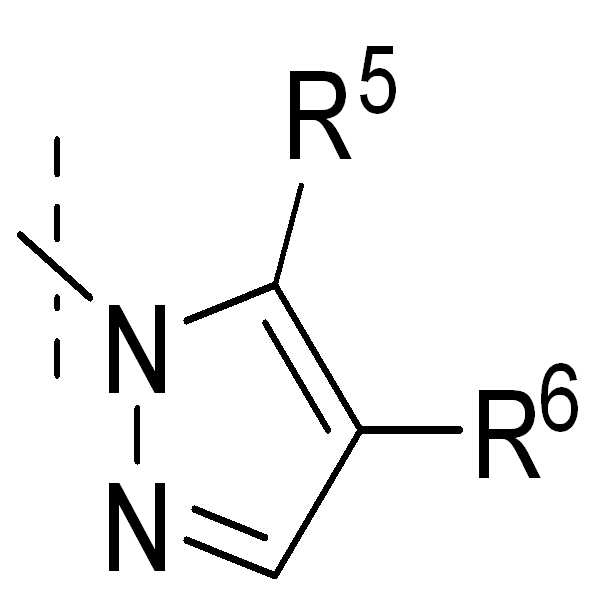


R5, R6, 또는 R7은 바람직하게는 독립적으로 H, Hal, NR3R4, NO2, 페닐, 2-,3- 또는 4-히드록시 또는 메톡시페닐, 알킬, 바람직하게는 메틸, 에틸, 이소프로필, 이소부틸, tert-부틸, CF3, 알콕시 (O알킬), 바람직하게는 메톡시 또는 에톡시, 히드록시알킬렌, 바람직하게는 CH2OH, 알콕시알킬렌 바람직하게는 CH2OCH3, COOH, COO알킬, 바람직하게는 COOCH3, COOCH2CH3, CONH알킬, 바람직하게는 CONHCH3, CONHCH2CH3, CONH이소프로필, CONH시클로헥실, CONH2, CON(CH3)2, NHCO알킬, 바람직하게는 NHCOCH3, NHCOCH2CH3, NHCO프로필, NHCO이소프로필, NHCO시클로프로필, NHCO-4-클로로-페닐, NHCH2CH3, NHCH2CH2CH3, NHCOCH2CH2OH, CO-N-모르폴리닐, CON(CH3)CH2CH2N(CH3)2, CO-1-피페리디닐, CO-4-히드록시-1-피페리디닐, CO-1-피페라지닐, CO-4-메틸-1-피페라지닐, CH2-N-모르폴리닐, CH2N(H)COCH3, CH2N(CH3)COCH3, CH2NH2, NH2, CH(OH)CH3, 또는 CH(OR3)CH3이다.R 5 , R 6 , or R 7 is preferably independently H, Hal, NR 3 R 4 , NO 2 , phenyl, 2-, 3- or 4-hydroxy or methoxyphenyl, alkyl, preferably methyl , Ethyl, isopropyl, isobutyl, tert-butyl, CF 3 , alkoxy (Oalkyl), preferably methoxy or ethoxy, hydroxyalkylene, preferably CH 2 OH, alkoxyalkylene preferably CH 2 OCH 3, COOH, COO-alkyl, preferably COOCH 3, COOCH 2 CH 3, CONH alkyl, preferably CONHCH 3, CONHCH 2 CH 3, CONH isopropyl, CONH-cyclohexyl, CONH 2, CON (CH 3 ) 2, NHCO-alkyl, preferably NHCOCH 3, NHCOCH 2 CH 3, NHCO propyl, isopropyl NHCO, NHCO cyclopropyl, NHCO-4- chloro-phenyl, NHCH 2 CH 3, NHCH 2 CH 2 CH 3, NHCOCH 2 CH 2 OH, CO-N-morpholinyl, CON (CH 3 ) CH 2 CH 2 N (CH 3 ) 2 , CO-1-piperidinyl, CO-4-hydroxy-1-piperidinyl, CO- 1-piperazinyl, CO-4-methyl-1-piperazinyl, CH 2 -N-morpholinyl, CH 2 N (H) COCH 3 , CH 2 N (CH 3 ) COCH 3 , CH 2 NH 2 , NH 2 , CH (OH) CH 3 , or CH (OR 3 ) CH 3 .
가장 바람직하게는, R5 또는 R6 중 하나는 H이다. Most preferably, one of R 5 or R 6 is H.
R7은 바람직하게는 R5 또는 R6의 의미를 갖는다. 보다 바람직하게는, R7은 H, OCH3, CH3, CH2CH3, CF3, Hal, 바람직하게는 Cl, I, F, NH2, NO2, CONH알킬, 바람직하게는 CONHCH3, CON(CH3)2, NHCOCH3와 같은 NHCO알킬, NHCH2CH2CH3와 같은 NH알킬, COO알킬, 바람직하게는 COOCH2CH3, 히드록시알킬렌, 바람직하게는 CH2OH, CH(CH3)OH, C(CH3)2OH, 시클로헥실, 시클로펜틸, 모르폴리닐, 테트라히드로퓨라닐이다. 바람직하게는, 시클로헥실, 시클로펜틸, 모르폴리닐, 테트라히드로퓨라닐은 OH로 치환된다. 가장 바람직하게는 
R8은 바람직하게는 H, CO알킬 또는 알킬이다. 보다 바람직하게는, R8은 H, CO메틸 또는 메틸이다.R 8 is preferably H, COalkyl or alkyl. More preferably, R 8 is H, CO methyl or methyl.
가장 바람직하게는, m 및 n은 동시에 1을 나타낸다.Most preferably, m and n represent 1 at the same time.
따라서, 본 발명의 주제는 상기 언급된 라디칼 중 하나 이상이 상기 기재된 바와 같은, 구체적으로 임의의 바람직한 구체예를 구현하는 임의의 의미를 갖는, 약제로서의 화학식 (Ⅰ)의 화합물에 관한 것이다. 화학식 (Ⅰ), 그의 하위식(sub-formula) 또는 이들의 다른 라디칼의 임의의 구체예와 관련하여 명시적으로 특정되지 않는 라디칼은 본 발명의 문제를 해결하기 위해 하기에 기재된 바와 같은 화학식 (Ⅰ)에 따른 임의의 개별적인 표시를 나타내는 것으로 해석되어야 한다. 이는 전술한 라디칼이 임의의 바람직한 구체예를 포함하여, 발견될 내용과 무관하게 본 명세서의 선행 또는 후속 과정에 각 기재된 바와 같은 모든 지정된 의미를 채택할 수 있음을 의미하나, 이에 제한되지 않는다. 특정 라디칼의 임의의 구체예는 하나 이상의 다른 라디칼의 임의의 구체예와 결합될 수 있음이 특히 이해되어야 한다.Accordingly, the subject matter of the present invention relates to the compounds of formula (I) as medicaments, in which one or more of the abovementioned radicals have any meaning as specifically described above embodying any preferred embodiment. Radicals not explicitly specified in connection with any embodiment of formula (I), its sub-formula or other radicals thereof may be formulated as described below to solve the problem of the present invention. Should be interpreted as indicating any individual indication according to This means that the foregoing radicals can adopt any designated meaning as described in each of the preceding or subsequent procedures herein, including, but not limited to, any preferred embodiment, but are not limited thereto. It should be particularly understood that any embodiment of a particular radical may be combined with any embodiment of one or more other radicals.
구체적으로 매우 바람직한 구체예는 표 1에 나열된 화학식 (Ⅰ)의 이러한 화합물 및/또는 약리학적으로 허용가능한 이들의 염이다.Particularly preferred embodiments are these compounds of formula (I) listed in Table 1 and / or pharmacologically acceptable salts thereof.
표 1: 화학식 (Ⅰ)의 화합물. OGA 효소 저해 분석:Table 1: Compounds of Formula (I). OGA enzyme inhibition assay:


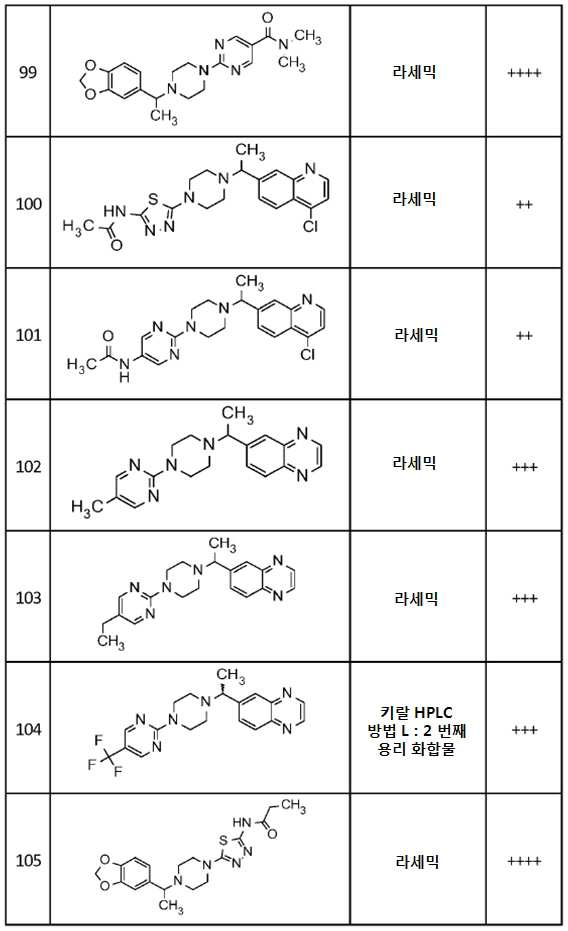


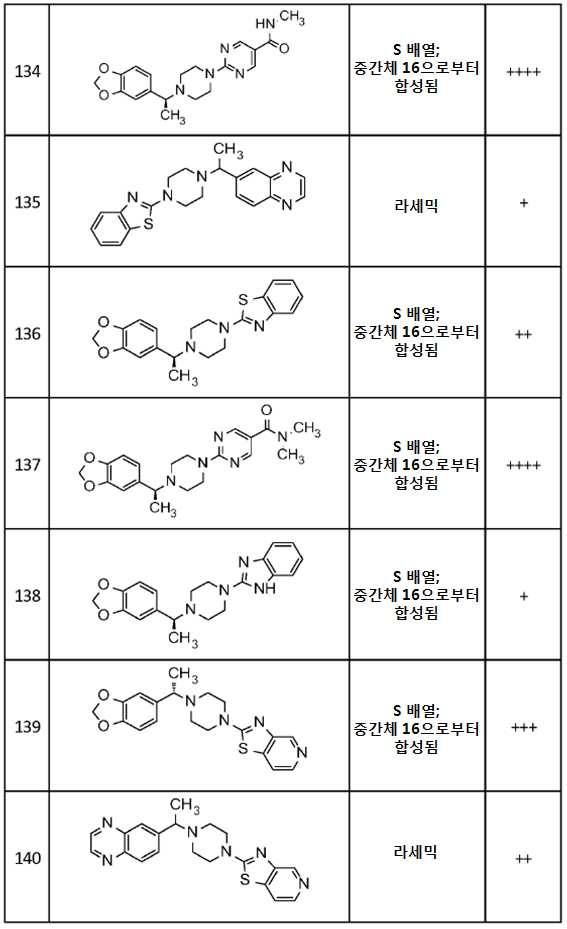
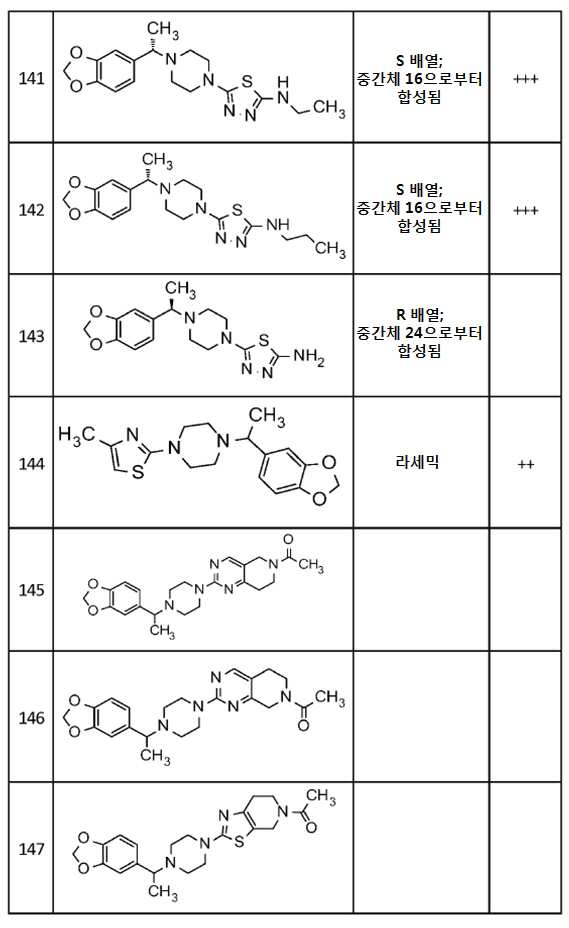


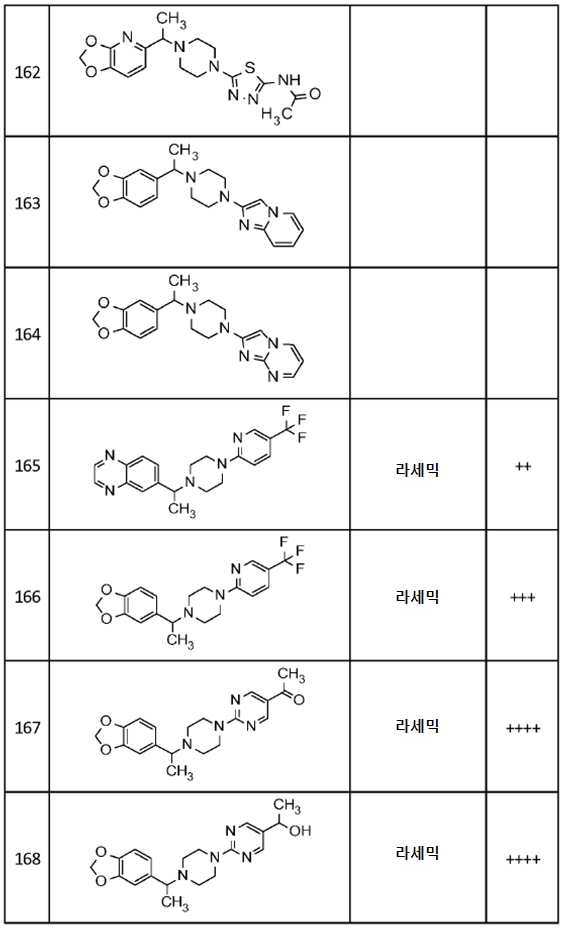


화학식 (Ⅰ)의 화합물의 활성 범위는 하기와 같다:The active range of the compound of formula (I) is as follows:
+ 1 내지 10 μM+ 1 to 10 μM
++ 0.2 내지 1 μM++ 0.2 to 1 μM
+++ 0.2 내지 0.05 μM+++ 0.2 to 0.05 μM
++++ 0.05 μM 미만++++ <0.05 μM
상기에서 볼 수 있는 바와 같이, 화학식 (Ⅰ)에 따른 많은 화합물은 매우 강력한 OGA 저해제, 예를 들어, 실시예 34 (구체적으로 두 번째 용리 화합물 (S)-2-(4-(1-(2,3-디히드로벤조[b][1,4]디옥신-6-일)에틸)피페라진-1-일)피리미딘), 37, 44, 48, 52, 56 (두 번째 용리 화합물 (S)-2-(4-(1-(벤조[d][1,3]디옥솔-5-일)에틸)피페라진-1-일)-N-메틸티아졸-4-카르복사미드), 69 (두 번째 용리 화합물 (S)-N-(5-(4-(1-(벤조[d][1,3]디옥솔-5-일)에틸)피페라진-1-일)-1,3,4-티아디아졸-2-일)아세트아미드), 72, 및 75 (두 번째 용리 화합물 (S)-(2-(4-(1-(2,3-디히드로벤조[b][1,4]디옥신-6-일)에틸)피페라진-1-일)티아졸-5-일)(4-메틸피페라진-1-일)메타논), 114, 116, 128, 129, 132, 134, 137, 168, 173, 176, 180, 181, 및 182의 화합물이다.As can be seen above, many compounds according to formula (I) are very potent OGA inhibitors, for example Example 34 (specifically the second eluting compound (S) -2- (4- (1- (2) , 3-dihydrobenzo [b] [1,4] dioxin-6-yl) ethyl) piperazin-1-yl) pyrimidine), 37, 44, 48, 52, 56 (second eluting compound (S ) -2- (4- (1- (benzo [d] [1,3] dioxol-5-yl) ethyl) piperazin-1-yl) -N-methylthiazole-4-carboxamide), 69 (second eluting compound (S) -N- (5- (4- (1- (benzo [d] [1,3] dioxol-5-yl) ethyl) piperazin-1-yl) -1, 3,4-thiadiazol-2-yl) acetamide), 72, and 75 (second eluting compound (S)-(2- (4- (1- (2,3-dihydrobenzo [b] [ 1,4] dioxin-6-yl) ethyl) piperazin-1-yl) thiazol-5-yl) (4-methylpiperazin-1-yl) methanone), 114, 116, 128, 129, 132, 134, 137, 168, 173, 176, 180, 181, and 182.
본 발명의 바람직한 화합물은 약물로서의 용도로 적당한 특성을 나타낸다. 구체적으로, 그러한 바람직한 화합물은 높은 고체 상태 안정성, 간 미크로솜의 존재에서 높은 안정성, 높은 산화 안정성, 및 적합한 투과성을 보인다. 추가적인 본 발명의 바람직한 화합물은 뇌 추출물 중에 측정된 총 단백질의 O-GlcNAc화(O-GlcNAcylation)의 수준과 같은 강력한 생물학적 활성에 의해 약물로서 이들의 적합성을 나타낸다. 그러한 파라미터를 결정하기 위한 관련 시험은 고체 상태 안정성 (Waterman K.C. (2007) Pharm Res 24(4); 780-790), 간 미크로솜의 존재에서의 안정성 (Obach R. S. (1999) Drug Metab Dispos 27(11); 1350-135), 및 투과성 (예를 들어, Caco-2 투과성 분석, Calcagno A. M. (2006) Mol Pharm 3(1); 87-93)과 같이 당업자에게 알려져 있다; 대안적으로, 이들은 뇌 추출물 중에 측정된 총 단백질의 O-GlcNAc화의 결정을 기술하는 실시예 B02와 같은, 하기의 실시예에 기재되어 있다. OGA 저해 분석 및 상기 특성 중 하나 이상에서 높은 효능(potency)를 보이는 본 발명의 화합물은 본 발명의 설명에 언급된 적응증을 위한 약물로서 특히 적합하다.Preferred compounds of the invention exhibit suitable properties for use as drugs. In particular, such preferred compounds exhibit high solid state stability, high stability in the presence of hepatic microsomes, high oxidative stability, and suitable permeability. Additional preferred compounds of the invention exhibit their suitability as drugs by potent biological activity such as the level of O-GlcNAcylation of total proteins measured in brain extracts. Relevant tests to determine such parameters include solid state stability (Waterman KC (2007) Pharm Res 24 (4); 780-790), stability in the presence of hepatic microsomes (Obach RS (1999) Drug Metab. Dispos 27 (11); 1350-135), and permeability (eg, Caco-2 permeability assay, Calcagno AM (2006) Mol Pharm 3 (1); 87-93) to those skilled in the art; Alternatively, they are described in the following examples, such as Example B02, which describes the determination of O-GlcNAcylation of total protein measured in brain extracts. Compounds of the invention that exhibit high potency in OGA inhibition assays and one or more of the above properties are particularly suitable as drugs for the indications mentioned in the description of the invention.
화학식 (Ⅰ)에 따른 화합물 및 이의 제조를 위한 출발 물질은, 각각 문헌에 기재된 바와 같이 그 자체로 공지된 방법에 의해서, 즉, 알려져 있고 상기 반응에 적합한 반응 조건 하에 제조된다.The compounds according to formula (I) and starting materials for their preparation are each prepared by methods known per se, as described in the literature, ie, under the reaction conditions known and suitable for the reaction.
용도가 또한 그 자체로 공지된 변이체로 이루어질 수 있지만, 본 명세서에서는 더 상세히 언급하지 않는다. 필요하다면, 상기 출발 물질은 또한 조(crude) 반응 혼합물 중에 단리되지 않은 상태로 이들을 남겨두지만, 즉시 이들을 본 발명에 따른 화합물로 더 전환시킴으로써 제자리에서(in-situ) 형성될 수 있다. 반면, 상기 반응을 단계적으로 수행하는 것이 가능하다.The use may also consist of variants known per se, but are not mentioned in greater detail herein. If desired, the starting materials can also be formed in-situ by leaving them in the crude reaction mixture unisolated but immediately converting them further to the compounds according to the invention. On the other hand, it is possible to carry out the reaction stepwise.
다음 약어는 각각 하기의 정의를 의미한다:Each of the following abbreviations means the following definitions:
Ac (아세틸), aq (수성), h (시간), g (그람), L (리터), mg (밀리그람), MHz (메가헤르츠), μM (마이크로몰(micromolar)), min (분), mm (밀리미터), mmol (밀리몰(millimole)), mM (밀리몰랄(millimolar)), m.p. (용융점), equiv (당량), mL (밀리리터), μL (마이크로리터), ACN (아세토니트릴), AcOH (아세트산), BINAP (2,2'-비스(디스페닐포스피노)-1,1'-비나프탈렌, BOC (tert-부톡시-카르보닐), CBZ (카르보벤족시), CDCl3 (중수소화 클로로포름), CD3OD (중수소화 메탄올), CH3CN (아세토니트릴), c-hex (시클로헥산), DCC (디시클로헥실 카르보이미드), DCM (디클로로메탄), dppf (1,1'-비스(디페닐포스피노)페로센), DIC (디이소프로필 카르보이미드), DIEA (디이소프로필에틸-아민), DMF (디메틸포름아미드), DMSO (디메틸술폭시드), DMSO-d6 (중수소화 디메틸술폭시드), EDC (1-(3-디메틸-아미노-프로필)-3-에틸카르보이미드), ESI (전자-분사 이온화), EtOAc (에틸 아세테이트), Et2O (디에틸 에테르), EtOH (에탄올), FMOC (플루오레닐메틸옥시카르보닐), HATU (디메틸아미노-([1,2,3]트리아졸로[4,5-b]피리딘-3-일옥시)-메틸렌]-디메틸-암모늄 헥사플루오로포스페이트), HPLC (고성능 액체 크로마토그래피), i-PrOH (2-프로판올), K2CO3 (탄산칼륨), LC (액체 크로마토그래피), MD Autoprep (Mass directed Autoprep), MeOH (메탄올), MgSO4 (마그네슘 술페이트), MS (질량 분석기), MTBE (메틸 tert-부틸 에테르), Mtr. (4-메톡시-2, 3, 6-트리메틸벤젠술포닐), MW(마이트로파), NBS (N-브로모 숙시네이트), NaHCO3 (중탄산나트륨), NaBH4 (소듐 보로히드리드), NMM (N-메틸 모르폴린), NMR (핵자기공명), POA (페녹시아세테이트), Py (피리딘), PyBOP® (벤조트리아졸-1-일-옥시-트리스-피롤리디노-포스포늄 헥사플루오로포스페이트), RT (실온), Rt (지연 시간), SFC (초임계 유체 크로마토그래피), SPE (고체상 추출), T3P (프로필무수인산), TBAF (테트라-n-부틸암모늄 플루오리드), TBTU (2-(1-H-벤조트리아졸-1-일)-1,1,3,3-테트라메틸우로늄 테트라플루오로 보레이트), TEA (트리에틸아민), TFA (트리플루오로아세트산), THF (테트라히드로퓨란), TLC (박층 크로마토그래피), UV (자외선).Ac (acetyl), aq (Aqueous), h (hours), g (Grams), L (liters), mg (milligrams), MHz (Megahertz), μM (micromolar), min (minutes), mm (millimeters), mmol (millimole), mM (Millimolar), mp (melting point), equiv (equivalent), mL (milliliter), μL (Microliters), ACN (acetonitrile), AcOH (acetic acid), BINAP (2,2'-bis (disphenylphosphino) -1,1'-binaphthalene, BOC (tert-butoxy-carbonyl), CBZ (carbobenzox), CDCl 3 (deuterated chloroform), CD 3 OD (deuterated methanol), CH 3 CN (acetonitrile), c-hex (cyclohexane), DCC (dicyclohexyl carbodiimide) , DCM (dichloromethane), dppf (1,1'-bis (diphenylphosphino) ferrocene), DIC (diisopropyl carbodiimide), DIEA (diisopropylethyl-amine), DMF (dimethylformamide) , DMSO (dimethylsulfoxide), DMSO-d 6 (deuterated dimethylsulfoxide), EDC (1- (3-dimethyl-amino-propyl) -3-ethylcarbodiimide), ESI (electro-injection ionization), EtOAc (ethyl acetate), Et 2 O (diethyl ether), EtOH (ethanol), FMOC (fluorenylmethyloxycarbonyl), HATU (dimethylamino-([1,2,3] triazolo [4,5 -b] pyridin-3-yloxy) -methylene] -dimethyl-ammonium hexafluoro Scan sulfate), HPLC (High Performance Liquid Chromatography), i -PrOH (2- propanol), K 2 CO 3 (potassium carbonate), LC (Liquid chromatography), MD Autoprep (Mass directed Autoprep), MeOH (methanol), MgSO 4 (magnesium sulfate), MS (mass spectrometer), MTBE (methyl tert-butyl ether), Mtr. (4-methoxy-2, 3, 6-trimethylbenzenesulfonyl), MW (mytropa), NBS (N-bromo succinate), NaHCO 3 (sodium bicarbonate), NaBH 4 (sodium borohydride) , NMM (N-methyl morpholine), NMR (nuclear magnetic resonance), POA (phenoxyacetate), Py (pyridine), PyBOP® (benzotriazol-1-yl-oxy-tris-pyrrolidino-phosphonium Hexafluorophosphate), RT (room temperature), Rt (Delay time), SFC (supercritical fluid chromatography), SPE (solid phase extraction), T3P (propyl anhydrous phosphate), TBAF (tetra- n- butylammonium fluoride), TBTU (2- (1-H-benzotria) Zol-1-yl) -1,1,3,3-tetramethyluronium tetrafluoro borate), TEA (triethylamine), TFA (trifluoroacetic acid), THF (tetrahydrofuran), TLC (thin layer Chromatography), UV (ultraviolet).
일반적으로, 화학식 (Ⅰ)에 따른 화합물 및 본 발명의 관련 화학식은 쉽게 이용가능한 출발 물질로부터 제조될 수 있다. 그러한 출발 물질이 상업적으로 이용가능하지 않다면, 이들은 표준 합성 기술에 의해서 제조될 수 있다. 일반적으로, 임의의 개별적인 화학식 (Ⅰ)의 화합물 및 관련 화학식을 위한 합성 경로는 당업자에 의해 인식될 인자와 같은, 각 분자의 특이적 치환체에 의존할 것이다. 본 명세서에서 하기의 실시예에 기재된 하기의 일반적 방법 및 절차는 화학식 (Ⅰ) 및 관련 화학식의 화합물을 제조하는데 채용될 수 있다. 온도, 용매, 또는 공동-시약과 같은 하기의 반응식에 나타낸 반응 조건은 단지 예로서 주어진 것이고 제한적이지 않다. 전형적인 또는 바람직한 실험적 조건 (즉, 반응 온도, 시간, 시약의 몰수, 용매 등)이 주어지는 경우, 달리 언급되지 않은 한, 다른 실험적 조건이 또한 사용될 수 있음을 이해할 것이다. 최적의 반응 조건은 사용되는 구체적인 반응물 또는 용매에 따라 달라질 수 있지만, 그러한 상태는 일상적인 최적화 절차를 이용하여 당업자에 의해 결정될 수 있다. 모든 보호화 및 탈보호화 방법에 대해서는, Philip J. Kocienski의 "Protecting Groups", Georg Thieme Verlag Stuttgart, New York, 1994 및, Theodora W. Greene 및 Peter G. M. Wuts의 "Protective Groups in Organic Synthesis", Wiley Interscience, 3rd Edition 1999를 참조하라.In general, the compounds according to formula (I) and the related formulas of the invention can be prepared from readily available starting materials. If such starting materials are not commercially available, they can be prepared by standard synthetic techniques. In general, the synthetic route for any individual compound of formula (I) and related formulas will depend on the specific substituents of each molecule, such as factors to be recognized by those skilled in the art. The following general methods and procedures described herein below can be employed to prepare compounds of formula (I) and related formulae. The reaction conditions shown in the following schemes such as temperature, solvent, or co-reagent are given by way of example only and not limitation. It will be appreciated that other experimental conditions may also be used, provided that typical or preferred experimental conditions (ie reaction temperature, time, moles of reagent, solvent, etc.) are given otherwise. Optimum reaction conditions may vary depending on the specific reactants or solvent used, but such conditions can be determined by one skilled in the art using routine optimization procedures. For all protection and deprotection methods, see Philip J. Kocienski's "Protecting Groups", Georg Thieme Verlag Stuttgart, New York, 1994, and Theodora W. Greene and Peter GM Wuts'"Protective Groups in Organic Synthesis", Wiley Interscience , see the 3 rd Edition 1999.
"이탈기(leaving group)"인, LG는 제거되거나 또는 다른 화학적 기로 교체될 수 있는 화학적 모이어티를 나타낸다. 본 발명의 설명 전반에서, 용어 이탈기는 바람직하게는 Cl, Br, I 또는 활성화된 에스테르, 이미다졸리드 또는 1 내지 6 개의 탄소 원자를 갖는 알킬술포닐옥시 (바람직하게는 메틸술포닐옥시 또는 트리플루오로메틸술포닐옥시) 또는 6 내지 10 개의 탄소 원자를 갖는 아릴술포닐옥시 (바람직하게는 페닐- 또는 p-토릴술포닐옥시)와 같은 반응적으로 변경된 OH기를 나타낸다. 이탈기 LG가 방향성 또는 헤테로방향성 고리에 부착되는 경우, LG는 추가적으로 SO2-알킬 또는 F를 나타낸다. 전형적인 아실화 반응에서 상기 카르복실기의 활성을 위한 이유형의 라디칼은 문헌에(예를 들어, Houben-Weyl, Methoden der organischen Chemie [Methods of Organic Chemistry], Georg-Thieme-Verlag, Stuttgart의 표준 연구에) 기술되어 있다. 활성화된 에스테르는 유리하게도, 예를 들어 HOBt, N-히드록시숙신이미드 또는 HATU의 첨가를 통해, 제자리에서 형성된다.LG, which is a “leaving group”, refers to a chemical moiety that can be removed or replaced with another chemical group. Throughout the description of the present invention, the term leaving group is preferably Cl, Br, I or activated esters, imidazolides or alkylsulfonyloxy having 1 to 6 carbon atoms (preferably methylsulfonyloxy or tri Reactively modified OH groups such as fluoromethylsulfonyloxy) or arylsulfonyloxy (preferably phenyl- or p -tolylsulfonyloxy) having 6 to 10 carbon atoms. When the leaving group LG is attached to an aromatic or heteroaromatic ring, LG additionally represents SO 2 -alkyl or F. Weaning radicals for the activity of the carboxyl groups in typical acylation reactions are described in the literature (e.g. in standard studies by Houben-Weyl, Methoden der organischen Chemie [Methods of Organic Chemistry], Georg-Thieme-Verlag, Stuttgart). Described. Activated esters are advantageously formed in situ, for example through the addition of HOBt, N-hydroxysuccinimide or HATU.
A, R, W, Q, m 및 n의 성질에 따라, 상이한 합성 전략이 화학식 (Ⅰ)의 화합물의 합성을 위해 선택될 수 있다. 하기의 반응식에 설명된 과정에서, A, R, W, Q, m 및 n은 달리 언급되지 않는 한, 발명의 설명에서 상기 정의된 바와 같다.Depending on the nature of A, R, W, Q, m and n, different synthetic strategies can be selected for the synthesis of the compounds of formula (I). In the procedures described in the schemes below, A, R, W, Q, m and n are as defined above in the description of the invention, unless stated otherwise.
A, R, W, Q, m 및 n이 상기와 같이 정의된 화학식 (Ⅰ)의 화합물은 하기의 기술에서 실시예에 기재된 것, 또는 당업자에게 잘 알려진 종래의 상호변환 절차와 같은 적합한 상호전환 절차를 이용하여, 화학식 (Ⅰ)의 대안적 화합물로부터 제조될 수 있다.Compounds of formula (I) wherein A, R, W, Q, m and n are defined as above are suitable interconversion procedures such as those described in the Examples in the following description, or conventional interconversion procedures well known to those skilled in the art. Can be prepared from alternative compounds of formula (I).
화학식 (Ⅰ)의 화합물은 키랄성 크로마토그래피 또는 키랄성 분해(resolution), 광학적으로 활성인 산을 이용한 재-결정화, 당업자에게 공지된 및 하기의 실시예 에 기재된 바와 같은 방법을 이용하여, 화학식 (Ia) 및 (Ib)의 화합물로부터 분리될 수 있다 (반응식 1).Compounds of formula (I) may be subjected to chiral chromatography or chiral resolution, re-crystallization with optically active acids, using methods known to those skilled in the art and as described in the Examples below. And (Ib). (Scheme 1).
반응식 1Scheme 1

A, R, Q, m 및 n이 상기와 같이 정의되고, W = N인 화학식 (Ic)의 화합물은 화학식 (Ⅱ)의 아민을 화학식 (Ⅲ)의 헤테로아실로의 첨가에 의해서 제조될 수 있는데, 여기서 LG는 상기 정의된 바와 같은 이탈기이다. 이 첨가는 TEA, DIEA, K2CO3 또는 Cs2CO3과 같으나 이에 제한되지 않는 염기의 존재하에, 극성 용매, 예를 들어, DMF, DMA 또는 NMP 중에, 일정한 가열 또는 미크로웨이브 조사를 사용하여, 50 ℃ 및 200 ℃ 사이(between 50 ℃ and 200 ℃)의 온도에서 두 화합물을 가열하는 열적 조건하에 수행될 수 있다. 대안적으로, 이 첨가는 RT 내지 150℃ 사이, 바람직하게는 RT의 온도에서, 1 시간 내지 24h과 같은 몇 시간 동안, 리간드, 예를 들어 BINAP, o-Tol3P, X-Phos, 및 염기, 예를 들어 NaOtBu, Cs2CO3 또는 K2CO3의 존재하에, 적합한 용매 또는 용매 혼합물, 예를 들어 디옥산, 톨루엔/MeOH 중에, 금속 복합체, 예를 들어 PdCl2, Pd(OAc)2, Pd2(dba)3에 의해서 촉매될 수 있으나, 이에 제한되지 않는다 (반응식 2). 화학식 (Ⅱ)의 아민은 화합물 (IVa)의 탈보호화 후 수득된다. PG는 BOC와 같은 하기에 기술되는 화학적 성질과 양립할 수 있는 적합한 보호기나, 이에 제한되지 않는다. 이는 MeOH 또는 디옥산 중 HCl, 또는 DCM 중 TFA와 같으나 이에 제한되지 않는 산성 조건하에 제거되어 아민 (Ⅱ)를 단리를 수득할 수 있다.Compounds of formula (Ic) where A, R, Q, m and n are defined as above and W = N can be prepared by addition of an amine of formula (II) to a heteroacyl of formula (III) , Where LG is a leaving group as defined above. This addition is carried out using constant heating or microwave irradiation in a polar solvent such as DMF, DMA or NMP in the presence of a base such as, but not limited to, TEA, DIEA, K 2 CO 3 or Cs 2 CO 3. And heating the two compounds at temperatures between 50 ° C. and 200 ° C. (between 50 ° C. and 200 ° C.). Alternatively, this addition may be carried out at a temperature between RT and 150 ° C., preferably at RT, for several hours, such as 1 hour to 24 h, for example ligands such as BINAP, o-Tol 3 P, X-Phos, and bases. , For example NaO t Bu, Cs 2 CO 3 Or in the presence of K 2 CO 3 , in a suitable solvent or solvent mixture, for example dioxane, toluene / MeOH, by metal complexes such as PdCl 2 , Pd (OAc) 2 , Pd 2 (dba) 3 But may not be limited thereto (Scheme 2). Amines of formula (II) are obtained after deprotection of compound (IVa). PG is a suitable protecting group that is compatible with the chemical properties described below, such as BOC, but is not limited thereto. It can be removed under acidic conditions such as, but not limited to, HCl in MeOH or dioxane, or TFA in DCM to afford the isolation of amine (II).
반응식 2Scheme 2

A, R, Q, m 및 n이 상기와 같이 정의되고 W = CH인 화학식 (Id)의 화합물은 당업자에게 알려지고 하기의 실시예에 기술된 바와 같은 방법을 이용하여 에스테르 (IVb)로부터 제조될 수 있다. 상이한 헤테로시클 Q는 옥사디아졸, 티아디아졸 및 티아졸과 같으나 이에 제한되지 않은 에스테르 작용기로부터 제조될 수 있으나, 이에 제한되지 않는다 (Jakopin, Z. et al. Curr . Org . Chem . 2008, 12, 850-898. Hemming, K. Science of Synthesis, 2004, 13, 127-184. Augustine, J. K. et al. Tetrahedron, 2009, 65, 9989-9996. 37. Kempson, J. Name Reactions in Heterocyclic Chemistry II (2011), 299-308). Q의 성질에 따라, 화학식 (Id)의 화합물은 극성 용매, 예를 들어 DMF, DMSO 또는 NMP 중 Cs2CO3과 같으나 이에 제한되지 않는 염기의 존재하에, 상기 정의된 바와 같은 이탈기 LG의 교체에 의해서 화합물 (IVc)로부터 수득될 수 있다 (반응식 3). 대안적으로 화학식 (Id)의 화합물은 RT 내지 180 ℃의 범위인 온도에서, 촉매로서 Pd(PPh3)4, 염기로서 K2CO3, 용매로서 디옥산과 같으나 이에 제한되지 않는, 당업자에게 알려진 조건을 이용하여, 적합한 보론산 (Va) 또는 에스테르 (Vb), 및 화학식 (Ⅲ)의 헤테로시클로 금속 촉매된 크로스 커플링 반응에 의해서 제조될 수 있다 (반응식 3). Pd(OH)2와 같은 촉매의 존재하에 생성된 커플링 생성물의 수소화는 화학식 (Id)의 화합물을 생산할 것이다 (예를 들어, Andres, J.-I. et al. J. Med . Chem . 2012, 55, 8685-8699) (반응식 3).Compounds of formula (Id) wherein A, R, Q, m and n are defined as above and W = CH can be prepared from ester (IVb) using methods known to those skilled in the art and described in the Examples below Can be. Different heterocycles Q can be prepared from ester functional groups such as, but not limited to, oxadiazoles, thiadiazoles and thiazoles (Jakopin, Z. et al. Curr . Org . Chem . 2008, 12 Hemming, K. Science of Synthesis , 2004, 13 , 127-184.Augustine, JK et al. Tetrahedron , 2009, 65 , 9989-9996. 37. Kempson, J. Name Reactions in Heterocyclic Chemistry II ( 2011), 299-308). Depending on the nature of Q, the compound of formula (Id) is replaced with a leaving group LG as defined above in the presence of a base such as, but not limited to, Cs 2 CO 3 in a polar solvent such as DMF, DMSO or NMP. Can be obtained from compound (IVc) (Scheme 3). Alternatively compounds of formula (Id) are known to those skilled in the art, such as, but not limited to, Pd (PPh 3 ) 4 as catalyst, K 2 CO 3 as base, dioxane as solvent, at temperatures ranging from RT to 180 ° C. Using conditions, it can be prepared by suitable boronic acid (Va) or ester (Vb), and by a heterocyclo metal catalyzed cross coupling reaction of formula (III) (Scheme 3). Hydrogenation of the resulting coupling product in the presence of a catalyst such as Pd (OH) 2 will produce a compound of formula (Id) (eg, Andres, J.-I. et al. J. Med . Chem . 2012 , 55 , 8685-8699) (Scheme 3).
반응식 3Scheme 3

A, R, W, Q, m 및 n이 상기와 같이 정의되고, W = N 또는 에스테르이고, W = CH일 때, Y1이 보호기 PG인 화학식 (IV)의 화합물은 DCE 중의 1 당량의 AcOH 존재하에, 환원제로서 NaBH(OAc)3의 사용과 같으나 이에 제한되지 않는 당업자에게 알려진 조건을 이용하여 아민 (VI)으로 환원적 아민화에 의해서 상응하는 케톤 (IX)으로부터 제조될 수 있다. 대안적으로, 환원적 아민화는 Ti(OiPr)4에 의해 촉매될 수 있는 제1 아민 형성을 갖는 두 단계로 수행한 후, MeOH 중 NaBH4와 같으나 이에 제한되지 않는 적합한 환원 제제로 환원될 수 있다(Abdel-Magid, A. F. at al. J. Org. Chem. 1996, 61, 3849-3862). 대안적으로, 케톤 (IX)은 MeOH와 같은 알코올성 용매 중에 NaBH4와 같은 일반적인 환원적 제제를 이용하여 상응하는 알코올 (VIII)로 환원될 수 있다. 그런 다음, 당업자에게 알려진 조건을 이용하여, 알코올 작용기를 Cl 또는 OM과 같으나 이에 제한되지 않는 적합한 이탈기로 변경시킬 수 있다. 아민 (VI)의 중간체 (VII)로의 첨가는 화합물 (IV)의 형성을 생산할 것이다.When A, R, W, Q, m and n are defined as above and W = N or an ester and W = CH, the compound of formula (IV) wherein Y 1 is a protecting group PG, has one equivalent of AcOH in DCE In the presence, it can be prepared from the corresponding ketone (IX) by reductive amination with amine (VI) using conditions known to those skilled in the art such as, but not limited to, the use of NaBH (OAc) 3 as reducing agent. Alternatively, reductive amination can be carried out in two steps with the formation of a first amine that can be catalyzed by Ti (OiPr) 4 and then reduced to a suitable reducing agent such as, but not limited to, NaBH 4 in MeOH. Abdel-Magid, AF at al. J. Org. Chem. 1996, 61, 3849-3862. Alternatively, ketone (IX) may be reduced to the corresponding alcohol (VIII) in an alcoholic solvent such as MeOH using a common reducing agent such as NaBH 4 . Then, using conditions known to those skilled in the art, the alcohol functionality can be changed to a suitable leaving group such as but not limited to Cl or OM. The addition of amine (VI) to intermediate (VII) will produce the formation of compound (IV).
반응식 4Scheme 4

대안적으로, W, Q, m 및 n이 상기와 같이 정의되고 PG가 BOC와 같으나 이에 제한되지 않는 적합한 보호기인 화학식 (X)의 화합물은 아민 (XI)으로부터, m, n 및 PG가 상기와 같이 정의되고 Y2가 에스테르 또는 이탈기인 화합물 (XII)로부터, 또는 화합물 (XIIIa) 또는 (XIIIb)로부터 제조될 수 있다 (반응식 5).Alternatively, compounds of formula (X) wherein W, Q, m and n are as defined above and PG is a suitable protecting group such as, but not limited to BOC, are from amines (XI), m, n and PG are Can be prepared from compound (XII) wherein Y 2 is an ester or leaving group, or from compound (XIIIa) or (XIIIb) (Scheme 5).
W가 N일 때, 화학식 (X)의 화합물은 화학식 (XI)의 아민의 화학식 (Ⅲ)의 헤테로시클로의 첨가에 의해서 제조될 수 있고, 여기서 LG는 상기에 정의된 바와 같은 이탈기이다. 이 첨가는 당업자에게 알려져있고 하기의 실시예에 기재된 바와 같은 조건을 이용하여, 열적 조건하에 수행되거나 또는 금속 복합체에 의해서 촉매될 수 있다.When W is N, the compound of formula (X) may be prepared by addition of a heterocyclo of formula (III) of an amine of formula (XI), where LG is a leaving group as defined above. This addition can be carried out under thermal conditions or catalyzed by a metal complex, using conditions known to those skilled in the art and described in the Examples below.
W가 CH일 때, 화학식 (X)의 화합물은 당업자에게 알려져있고 하기의 실시예에 기재된 바와 같은 조건을 이용하여, Y2 = COOR 및W = CH인 에스테르 (XII)로부터 제조될 수 있다. 상이한 헤테로시클 Q는 옥사디아졸, 티아디아졸 및 티아졸과 같은 에스테르 작용기로부터 제조될 수 있으나, 이에 제한되지 않는다 (Jakopin, Z. et al. Curr . Org . Chem . 2008, 12, 850-898. Hemming, K. Science of Synthesis, 2004, 13, 127-184. Augustine, J. K. et al. Tetrahedron, 2009, 65, 9989-9996. 37. Kempson, J. Name Reactions in Heterocyclic Chemistry II (2011), 299-308). Q의 성질에 따라서, 화학식 (X)의 화합물은 상기에 정의된 바와 같이 W가 CH이고 Y2 = LG인, 화합물 (XII)로부터 극성 용매, 예를 들어 DMF, DMSO 또는 NMP 중에 Cs2CO3과 같은 염기의 존재하에 이탈기 LG의 교체에 의해서 수득될 수 있으나, 이에 제한되지 않는다. Q가 티아졸인 화학식 (X)의 화합물은 당업자에게 알려진 조건을 이용하여 Y2가 아미노메탄카르보티오일기인 화합물 (XII), 및 적합한 알파-브로모 케톤으로부터 수득될 수 있다. When W is CH, compounds of formula (X) can be prepared from esters (XII) wherein Y 2 = COOR and W = CH, using conditions known to those skilled in the art and described in the Examples below. Different heterocycles Q may be prepared from ester functional groups such as oxadiazole, thiadiazole and thiazole (Jakopin, Z. et al. Curr . Org . Chem . 2008, 12 , 850-898). Hemming, K. Science of Synthesis , 2004, 13 , 127-184.Augustine, JK et al. Tetrahedron , 2009, 65 , 9989-9996. 37. Kempson, J. Name Reactions in Heterocyclic Chemistry II (2011), 299. -308). Depending on the nature of Q, the compound of formula (X) has a Cs 2 CO 3 in a polar solvent such as DMF, DMSO or NMP from compound (XII) wherein W is CH and Y 2 = LG as defined above It may be obtained by replacing the leaving group LG in the presence of a base such as, but is not limited thereto. Compounds of formula (X) wherein Q is thiazole can be obtained from compounds (XII) wherein Y 2 is an aminomethanecarbothioyl group, and suitable alpha-bromo ketones using conditions known to those skilled in the art.
대안적으로, 화학식 (X)의 화합물은 RT 내지 180 ℃ 범위의 온도에서 촉매로서 Pd(PPh3)4, 염기로서 K2CO3, 용매로서 디옥산과 같으나 이에 제한되지 않은 당업자에게 알려진 조건을 이용하여, 적합한 보론산 (XIIIa) 또는 에스테르 (XIIIb), 및 화학식 (Ⅲ)의 헤테로시클로 금속 촉매된 크로스 커플링 반응에 의해서 제조될 수 있다 (반응식 5). Pd(OH)2와 같은 촉매의 존재하에 생성된 커플링 생성물의 수소화는 화학식 (X)의 화합물을 생성할 것이다 (예를 들어, Andres, J.-I. et al. J. Med. Chem . 2012, 55, 8685-8699) (반응식 5)Alternatively, compounds of formula (X) may be subjected to conditions known to those skilled in the art, such as, but not limited to, Pd (PPh 3 ) 4 as catalyst, K 2 CO 3 as base, dioxane as solvent, at temperatures ranging from RT to 180 ° C. Can be prepared by means of a suitable boronic acid (XIIIa) or ester (XIIIb), and a heterocyclo metal catalyzed cross coupling reaction of formula (III) (Scheme 5). Hydrogenation of the resulting coupling product in the presence of a catalyst such as Pd (OH) 2 will produce a compound of formula (X) (eg, Andres, J.-I. et al. J. Med. Chem . 2012, 55 , 8685-8699) (Scheme 5)
PG는 BOC와 같은 상기 기재된 화학과 양립하는 적합한 보호기이나, 이에 제한되지 않는다. 이는 MeOH 또는 디옥산 중 HCl, 또는 DCM 중 TFA와 같으나 이에 제한되지 않는 산성 조건하에 제거되어, 아민 (XIV)의 단리를 생성시킬 수 있다. 이는 하기의 실시예에 기재된 바와 같은 당업자에게 공지된 조건에 따라, 화학식 (IX)의 케톤으로 환원성 알킬화에 의해 화학식 (I)의 화합물로 추가로 변경될 수 있다 (Abdel-Magid, A. F. at al. J. Org . Chem . 1996, 61, 3849-3862). 대안적으로, 상기 및 하기의 실시예에서 기재된 바와 같이 제조된, 화합물 (VII)로의 아민 (XIV)의 첨가는 화학식 (I)의 화합물의 형성을 생산시킬 것이다. PG is a suitable protecting group compatible with the above described chemistry such as BOC, but is not limited thereto. This may be removed under acidic conditions such as, but not limited to, HCl in MeOH or dioxane, or TFA in DCM, resulting in the isolation of the amine (XIV). This can be further modified to a compound of formula (I) by reductive alkylation with a ketone of formula (IX) according to conditions known to those skilled in the art as described in the Examples below (Abdel-Magid, AF at al. J. Org. Chem. 1996, 61 , 3849-3862). Alternatively, addition of amines (XIV) to compound (VII), prepared as described above and in the examples below, will produce the formation of compounds of formula (I).
반응식 5Scheme 5

화학식 (II)의 아민은 당업자에게 알려져있고 하기의 실시예에서 기재된 바와 같은 방법을 이용하여 키랄 크로마토그래피 또는 광학적으로 활성인 산으로 재-결정화에의한 키랄 분해에 의해서 화학식 (IIa) 및 (IIb)의 아민으로 분리될 수 있다 (반응식 6).Amines of formula (II) are formulas (IIa) and (IIb) by chiral chromatography or chiral decomposition by re-crystallization with optically active acids using methods known to those skilled in the art and described in the Examples below. Amine) (Scheme 6).
반응식 6Scheme 6

대안적으로, 화학식 (IIa) 및 (IIb)의 아민은 키랄성 아민 (XVIa) 및 (XVIb)으로부터 각각 합성될 수 있다. PG가 보호기, 예를 들어, BOC 또는 SO2Tol이고, LG가 이탈기, 예를 들어 Cl인, 아민 (XVIa) 및 (XVIb)의 시약 (XV)로의 첨가는 각각 보호된 아민 (IVe) 및 (IVf)의 형성을 생성시킬 것이다 (Thiel, O. R. et al. J. Org. Chem . 2008, 73, 3508-3515). 탈보호화 조건은 BOC 이탈기에 대해, 디옥산 또는 MeOH 중 HCl, 또는 DCM 중 TFA와 같은 PG의 성질에 기반하여 선택될 필요가 있다. 대안적으로, RT 내지 100 ℃ 범위인 온도에서 HBr, AcOH 및 4-히드록시벤조산의 혼합물 또는 H2SO4 및 트리플루오로아세트산의 혼합물이 para-톨루엔 술폰아미드와 같은 술폰아미드 보호기를 절단하는데 이용될 것이다.Alternatively, the amines of formulas (IIa) and (IIb) can be synthesized from chiral amines (XVIa) and (XVIb), respectively. The addition of amines (XVIa) and (XVIb) to reagents (XV), wherein PG is a protecting group, for example BOC or SO 2 Tol, and LG is a leaving group, for example Cl, is a protected amine (IVe) and Will result in the formation of (IVf) (Thiel, OR et al . J. Org. Chem . 2008, 73 , 3508-3515). Deprotection conditions need to be selected based on the nature of the PG, such as HCl in dioxane or MeOH, or TFA in DCM, for the BOC leaving group. Alternatively, a mixture of HBr, AcOH and 4-hydroxybenzoic acid or a mixture of H 2 SO 4 and trifluoroacetic acid at temperatures ranging from RT to 100 ° C. is used to cleave sulfonamide protecting groups such as para -toluene sulfonamide Will be.
반응식 7 Scheme 7

화학식 (XVIa) 및 (XVIb)의 아민의 제조를 위해, 화학식 (IX)의 케톤이 티타늄 에톡시드의 존재하에, tert-부탄술핀아미드기와 같으나 이에 제한되지 않는 키랄 보조자(auxiliary)와 반응하여, 키랄 이민 (XVIII)으로 변경될 수 있다 (Ellman J. A. et al. Acc . Chem . Res. 2002, 35, 984-995). Ellman J. A. et al. J. Org . Chem . 2007, 72, 626-629으로부터의 참고문헌에 기재된 바와 같이, 환원 단계에서 사용되는 조건에 따라 술핀아미드 (XVIIa) 또는 (XVIIb)로 추가적으로 변형시킬 수 있다.For the preparation of amines of formulas (XVIa) and (XVIb), the ketones of formula (IX) are reacted with chiral auxiliary, such as but not limited to tert-butanesulfinamide groups, in the presence of titanium ethoxide Immunity (XVIII) (Ellman JA et al. Acc . Chem . Res. 2002, 35 , 984-995). Ellman JA et al. J. Org . Chem . As described in references from 2007, 72 , 626-629, it can be further modified with sulfinamide (XVIIa) or (XVIIb) depending on the conditions used in the reduction step.
반응식 8Scheme 8

대안적으로, 화학식 (XIX)의 알데히드는 그리그나드 시약 (Grignard reagent)과 같으나 이에 제한되지 않는 적합한 친핵체(nucleophile)를 첨가하여 화학식 (VIII)의 알코올로 변형될 수 있다 (반응식 9).Alternatively, the aldehyde of formula (XIX) can be modified with an alcohol of formula (VIII) by addition of a suitable nucleophile such as but not limited to Grignard reagent (Scheme 9).
다른 과정에서, 화학식 (IXa)의 케톤은 RT 내지 110 ℃ 범위인 온도에서, 톨루엔 중 Pd(PPh3)2Cl2와 같으나 이에 제한되지 않는 촉매의 존재하에 아릴 할리드 (XX) 및 트리부틸(1-에톡시비닐)틴 간의 스틸 교차 결합 반응(Stille cross coupling reaction)에 의해 수득될 수 있다 (반응식 10).In another process, the ketone of formula (IXa) is aryl halide (XX) and tributyl (X) in the presence of a catalyst such as, but not limited to, Pd (PPh 3 ) 2 Cl 2 in toluene, at temperatures ranging from RT to 110 ° C. It can be obtained by a steel cross coupling reaction between 1-ethoxyvinyl) tin (Scheme 10).
반응식 9Scheme 9

반응식 10Scheme 10

반응이 염기성 조건하에 수행되는 것이 바람직할 경우, 적합한 염기는 금속 산화물, 예를 들어, 알루미늄 옥시드, 알칼린 금속 히드록시드 (그 중에서도, 포타슘 히드록시드, 소듐 히드록시드 및 리튬 히드록시드), 알칼린 토금속 히드록시드 (그 중에서도, 바륨 히드록시드 및 칼슘 히드록시드), 알칼린 금속 알코올레이트 (그 중에서도, 포타슘 에탄올레이트 및 소듐 프로판올레이트), 알칼린 금속 카르보네이트 (예를 들어, 중탄산나트륨) 및 몇몇 유기 염기 (예를 들어, 그 중에서도, N,N-디이소프로필에틸아민, 피페리딘 또는 디에탄올아민)로부터 선택될 수 있다.If the reaction is preferably carried out under basic conditions, suitable bases are metal oxides, for example aluminum oxide, alkaline metal hydroxides (among others potassium hydroxide, sodium hydroxide and lithium hydroxide). ), Alkaline earth metal hydroxides (among others barium hydroxide and calcium hydroxide), alkaline metal alcoholates (among other things potassium ethanolate and sodium propanolate), alkaline metal carbonates (eg For example, sodium bicarbonate) and some organic bases (eg, N, N -diisopropylethylamine, piperidine or diethanolamine), among others.
상기 반응은 일반적으로 불활성 용매 중에 수행된다. 적합한 불활성 용매는 예를 들어, 헥산, 석유 에테르, 벤젠, 톨루엔 또는 자일렌과 같은 탄화수소; 트리클로로에틸렌, 1,2-디클로로에탄, 카본 테트라클로리드, 클로로포름 또는 디클로로메탄과 같은 염화 탄화수소; 메탄올, 에탄올, 이소프로판올, n-프로판올, n-부탄올 또는 tert-부탄올과 같은 알코올; 디에틸 에테르, 디이소프로필 에테르, 테트라히드로퓨란 (THF) 또는 디옥산과 같은 에테르; 에틸렌 글리콜 모노메틸 또는 모노에틸 에테르, 에틸렌 글리콜 디메틸 에테르 (디글림)와 같은 글리콜 에테르; 아세톤 또는 부타논과 같은 케톤; 아세트아미드, 디메틸아세트아미드 또는 디메틸포름아미드 (DMF)와 같은 아미드; 아세토니트릴과 같은 니트릴; 디메틸 술폭시드 (DMSO)와 같은 설폭시드; 카본 디술피드; 포름산, 아세트산 또는 트리플루오로아세트산 (TFA)과 같은 카르복실산; 니트로메탄 또는 니트로벤젠과 같은 니트로 화합물; 에틸 아세테이트와 같은 에스테르, 또는 상기 용매의 조합이다. TFA, DMF, 디클로로메탄, THF, H2O, 메탄올, tert. 부탄올, tert. 아밀알코올, 트리에틸아민 또는 디옥산이 특히 바람직한 것으로 제시된다.The reaction is generally carried out in an inert solvent. Suitable inert solvents are, for example, hydrocarbons such as hexane, petroleum ether, benzene, toluene or xylene; Chlorinated hydrocarbons such as trichloroethylene, 1,2-dichloroethane, carbon tetrachloride, chloroform or dichloromethane; Alcohols such as methanol, ethanol, isopropanol, n-propanol, n-butanol or tert-butanol; Ethers such as diethyl ether, diisopropyl ether, tetrahydrofuran (THF) or dioxane; Glycol ethers such as ethylene glycol monomethyl or monoethyl ether, ethylene glycol dimethyl ether (diglyme); Ketones such as acetone or butanone; Amides such as acetamide, dimethylacetamide or dimethylformamide (DMF); Nitriles such as acetonitrile; Sulfoxides such as dimethyl sulfoxide (DMSO); Carbon disulfide; Carboxylic acids such as formic acid, acetic acid or trifluoroacetic acid (TFA); Nitro compounds such as nitromethane or nitrobenzene; Esters such as ethyl acetate, or combinations of these solvents. TFA, DMF, dichloromethane, THF, H 2 O, methanol, tert. Butanol, tert. Amyl alcohol, triethylamine or dioxane are shown to be particularly preferred.
상기 사용되는 조건에 따라, 상기 반응 시간은 수분 내지 14 일이며, 상기 반응 온도는 약 -80°C 및 140°C 사이(between -80 ℃ and 140 ℃), 통상적으로 -50°C 및 120°C 사이, 바람직하게는 -20°C 및 100°C 사이이다.Depending on the conditions used, the reaction time is from a few minutes to 14 days, and the reaction temperature is between about -80 ° C and 140 ° C (between -80 ° C and 140 ° C), typically -50 ° C and 120 ° Between C, preferably between -20 ° C and 100 ° C.
본 발명은 또한 하기의 단계를 포함하는 화학식 (I)의 화합물을 제조하는 방법에 관한 것이다.The invention also relates to a process for the preparation of a compound of formula (I) comprising the following steps.
상기 화학식 (I) 및 이의 하위-화학식의 화합물은 상기 경로를 통해 접근 가능하다. 상기 출발 물질은 통상적으로 당업자에게 공지되어 있거나, 또는 이들은 공지된 방법에 의해 쉽게 제조될 수 있다.The compounds of formula (I) and sub-formulae thereof are accessible via this route. Such starting materials are commonly known to those skilled in the art, or they can be readily prepared by known methods.
화학식 (I)의 화합물은, 수소화 또는 금속-환원과 같이 변경되어 염소를 제거시키거나, 또는 치환 반응에 투입되고, 및/또는 산 또는 염기, 바람직하게는 강한 산으로 염기로 변형된다. 수많은 논문 및 방법이 유기화학, 화학적 전략 및 전술, 합성 경로, 중간체 보호화, 분열 및 정제 과정, 단리 및 특성화와 관련하여 당업자에게 이용가능하고 유용하다. 일반적인 화학적 변경은 당업자에게 알려져 있다. 아릴의 할로겐화 또는 산, 알코올, 페놀 및 이들의 호변체적 구조의 할로겐에 의한 히드록시 치환은 바람직하게는 POCl3, 또는 SOCl2, PCl5, SO2Cl2의 사용에 의해서 수행될 수 있다. 어떤 경우에는, 옥사릴 클로리드가 또한 유용하다. 온도는 피리돈 구조 또는 카르복실산 또는 술폰산을 할로겐화 하는 작업에 따라 0 ℃ 내지 환류로 다양하다. 시간은 또한 몇 분 내지 몇 시간 또는 심지어 밤새로 조정될 것이다. 유사하게, 알킬화, 에테르 형성, 또는 아미드 형성은 당업자에게 알려져 있다. 아릴 보론산으로의 아릴화는 Pd 촉매, 적절한 리간드 및 염기, 바람직하게는 카보네이트, 포스페이트, 보레이트의 나트륨, 칼륨, 또는 세슘 염의 존재하에 수행될 수 있다. Et3N, DIPEA와 같은 유기 염기 또는 보다 염기성인 DBU가 또한 이용될 수 있다. 용매는 톨루엔, 디옥산, THF, 디글림, 모노글림, 알코올, DMF, DMA, NMP, 아세토니트릴, 경우에 따라 심지어 물 등에 이르기까지 매우 다를 수 있다. Pd (PPh3)4와 같은 통상적으로 이용되는 촉매, 또는 Pd(OAc)2, PdO 촉매의 PdCl2 유형 전구체는 보다 효율적인 리간드를 갖는 보다 복잡한 것으로 발전했다. C-C 알릴화에서, 보론산 및 에스테르 대신, 아릴-트리플루오로보레이트 칼륨 염 (스즈키-미야우라 커플링 (Suzuki-Miyaura coupling)), 유기 실란 (히야마 커플링 (Hiyama coupling)), 그리그나드 시약 (쿠마다(Kumada)), 유기아연 화합물 (네기시 커플링 (Negishi coupling)), 및 스타난(스틸 커플링(Stille coupling))이 이용될 수 있다. 이 실험은 N- 및 O-아릴화에 전달될 수 있다. 수많은 논문 및 방법이 N-아릴화 및 심지어 전자 결핍 아닐린, 및 아릴 클로리드 및 아닐린 뿐 아니라 Cu 촉매 및 Pd 촉매를 이용한 O-아릴화에 관하여 당업자에게 이용가능하고 유용하다.Compounds of formula (I) are altered, such as hydrogenation or metal-reduction, to remove chlorine or to be subjected to substitution reactions and / or to bases with acids or bases, preferably strong acids. Numerous papers and methods are available and useful to those skilled in the art with regard to organic chemistry, chemical strategies and tactics, synthetic pathways, intermediate protection, cleavage and purification processes, isolation and characterization. General chemical alterations are known to those skilled in the art. Halogenation of aryls or hydroxy substitution by acids, alcohols, phenols and halogens of their tautomeric structures can preferably be carried out by the use of POCl 3 , or SOCl 2 , PCl 5 , SO 2 Cl 2 . In some cases, oxaryl chloride is also useful. The temperature varies from 0 ° C. to reflux, depending on the pyridone structure or operation of halogenating the carboxylic acid or sulfonic acid. The time will also be adjusted from minutes to hours or even overnight. Similarly, alkylation, ether formation, or amide formation are known to those skilled in the art. Arylation to aryl boronic acid may be carried out in the presence of a Pd catalyst, a suitable ligand and base, preferably the sodium, potassium, or cesium salt of carbonate, phosphate, borate. Organic bases such as Et 3 N, DIPEA or more basic DBUs can also be used. The solvent can be very different from toluene, dioxane, THF, diglyme, monoglyme, alcohol, DMF, DMA, NMP, acetonitrile, optionally even water and the like. Commonly used catalysts such as Pd (PPh 3 ) 4 , or PdCl 2 of Pd (OAc) 2 , PdO catalysts Type precursors have developed into more complex ones with more efficient ligands. In CC allylation, instead of boronic acid and esters, aryl-trifluoroborate potassium salt (Suzuki-Miyaura coupling), organosilanes (Hiyama coupling), Grignard reagents (Kumada), organozinc compounds (Negishi coupling), and stanan (Stille coupling) can be used. This experiment can be passed on to N- and O-arylation. Numerous papers and methods are available and useful to those skilled in the art with regard to N-arylation and even electron deprivation aniline, and O-arylation with Cu and Pd catalysts as well as aryl chloride and aniline.
상기 방법의 최종 단계에서, 상기 화합물의 염, 바람직하게는 화학식 (I)의 염이 선택적으로 제공된다. 본 발명에 따른 화합물은 이들의 최종 비-염 형태로 이용될 수 있다. 반면, 본 발명은 또한 당업계에 공지된 방법에 의해 다양한 유기 및 무기산 및 염기로부터 유래될 수 있는, 이들의 약학적으로 허용가능한 염의 형태로 그러한 화합물의 용도를 포함한다. 본 발명에 따른 화합물의 약학적으로 허용가능한 염 형태는 대부분 통상적인 방법에 의해 제조된다. 본 발명에 따른 화합물이 카르복실기를 포함하는 경우, 이의 적합한 염 중 하나는 화합물을 적합한 염기와 반응시켜 상응하는 염기-부가 염을 수득함으로써 형성될 수 있다. 그러한 염은, 예를 들어, 칼륨 히드록시드, 나트륨 히드록시드 및 리튬 히드록시드를 포함한, 알칼리 금속 히드록시드; 마그네슘 히드록시드, 칼슘 히드록시드, 및 바륨 히드록시드를 포함한, 알칼린 토금속 히드록시드; 칼륨 에톡시드 및 나트륨 프로폭시드와 같은, 알칼리 금속 알콕시드; 및 피페리딘, 디에탄올아민 및 N-메틸-글루카민 (메글루민), 벤자틴, 콜린, 디에탄올아민, 에틸렌디아민, 베네타민, 디에틸아민, 피페라진, 리신, L-아르기닌, 암모니아, 트리에탄올아민, 베타인, 에탄올아민, 모르폴린 및 트로메타민과 같은 다양한 유기 염기이다. 본 발명에 따른 화합물의 알루미늄 염도 마찬가지로 포함된다. 염기성 중심을 함유하는, 화학식 (I)의 특정 화합물의 경우, 산-부가 염은 이들 화합물을 약학적으로 허용가능한 유기 및 무기 산, 예를 들어, 염화수소, 브롬화 수소 또는 요오드화 수소와 같은 할로겐화 수소, 술페이트, 니트레이트 또는 포스페이트 등 다른 무기산 및 이들의 상응하는 염, 및 메탄술포네이트, 에탄술포네이트, 톨루엔술포네이트 및 벤젠술포네이트와 같은 알킬- 및 모노아릴술페이트, 및 카보네이트, 아세테이트, 트리플루오로아세테이트, 타르트레이트, 말레이트, 숙시네이트, 시트레이트, 벤조에이트, 살리실레이트, 아스코르베이트 등과 같은 다른 유기산 및 이의 상응하는 염으로 처리함으로써 형성될 수 있다. 따라서, 본 발명에 따른 화합물의 약학적으로 허용가능한 산-부가염은 하기를 포함하나, 이에 제한되지 않는다: 아세테이트, 아디페이트, 알지네이트, 아르기네이트, 아스파르테이트, 벤조에이트, 벤젠술포네이트 (베실리레이트), 비술페이트, 비술피트, 브롬, 부티레이트, 캄포레이트, 캄포르술포네이트, 카프레이트, 카프릴레이트, 염소, 클로로벤조에이트, 시트레이트, 시클라메이트, 신남에이트, 시클로펜탄프로피오네이트, 디글루코네이트, 디히드로젠포스페이트, 디니트로벤조에이트, 도데실술페이트, 에탄술포네이트, 푸마레이트, 갈락테레이트 (점액산으로부터), 갈락투로네이트, 글루코헵타노에이트, 글루코네이트, 글루타메이트, 글리세로포스페이트, 헤미숙시네이트, 세미술페이트, 펩타노에이트, 헥사노에이트, 힙푸레이트, 염산, 염화브롬, 염화요오드, 2-히드록시에탄술포네이트, 요오드, 이세티오네이트, 이소부티레이트, 락테이트, 락토비오네이트, 말레이트, 말레에이트, 말로네이트, 만델레이트, 메타포스페이트, 메탄술포네이트, 메틸벤조에이트, 모노수소포스페이트, 2-나프탈렌술포네이트, 니코티네이트, 니트레이트, 옥살레이트, 올레에이트, 팔모에이트, 펙티네이트, 과(per)술페이트, 페틸아세테이트, 3-페닐프로피오네이트, 포스페이트, 포스포네이트, 프탈레이트. 두 유형의 염은 바람직하게는 이온교환수지 기술을 이용하여 형성되거나 또는 상호전환될 수 있다. In the final step of the process, salts of the compounds, preferably salts of formula (I), are optionally provided. The compounds according to the invention can be used in their final non-salt form. In contrast, the present invention also encompasses the use of such compounds in the form of their pharmaceutically acceptable salts, which may be derived from various organic and inorganic acids and bases by methods known in the art. Pharmaceutically acceptable salt forms of the compounds according to the invention are mostly prepared by conventional methods. If the compound according to the invention comprises a carboxyl group, one of its suitable salts can be formed by reacting the compound with a suitable base to give the corresponding base-addition salt. Such salts include, for example, alkali metal hydroxides, including potassium hydroxide, sodium hydroxide and lithium hydroxide; Alkaline earth metal hydroxides, including magnesium hydroxide, calcium hydroxide, and barium hydroxide; Alkali metal alkoxides, such as potassium ethoxide and sodium propoxide; And piperidine, diethanolamine and N-methyl-glucamine (meglumine), benzatin, choline, diethanolamine, ethylenediamine, benetamine, diethylamine, piperazine, lysine, L-arginine, ammonia And various organic bases such as triethanolamine, betaine, ethanolamine, morpholine and tromethamine. Aluminum salts of the compounds according to the invention are likewise included. For certain compounds of formula (I), which contain a basic center, acid-addition salts may be used to prepare these compounds in pharmaceutically acceptable organic and inorganic acids, for example hydrogen halides such as hydrogen chloride, hydrogen bromide or hydrogen iodide, Other inorganic acids such as sulfates, nitrates or phosphates and their corresponding salts, and alkyl- and monoarylsulfates such as methanesulfonate, ethanesulfonate, toluenesulfonate and benzenesulfonate, and carbonates, acetates, trifluores It can be formed by treatment with other organic acids and their corresponding salts, such as loacetate, tartrate, maleate, succinate, citrate, benzoate, salicylate, ascorbate and the like. Thus, pharmaceutically acceptable acid-addition salts of the compounds according to the invention include, but are not limited to: acetates, adipates, alginates, arginates, aspartates, benzoates, benzenesulfonates ( Besylate), bisulfate, bisulfite, bromine, butyrate, camphorate, camphorsulfonate, caprate, caprylate, chlorine, chlorobenzoate, citrate, cyclamate, cinnamate, cyclopentanepropio Nate, digluconate, dihydrogenphosphate, dinitrobenzoate, dodecyl sulfate, ethanesulfonate, fumarate, galactate (from mucous acid), galacturonate, glucoheptanoate, gluconate, glutamate Glycerophosphate, hemisuccinate, semisulfate, peptanoate, hexanoate, hippurate, hydrochloric acid, bromine chloride, Iodine chloride, 2-hydroxyethanesulfonate, iodine, isethionate, isobutyrate, lactate, lactobionate, maleate, maleate, malonate, mandelate, metaphosphate, methanesulfonate, methylbenzoate, Monohydrogenphosphate, 2-naphthalenesulfonate, nicotinate, nitrate, oxalate, oleate, palmoate, pectinate, persulfate, petyl acetate, 3-phenylpropionate, phosphate, phospho Nate, phthalate. Both types of salts may be formed or interconverted preferably using ion exchange resin techniques.
상기 언급된 바와 관련하여, 본 명세서에서 상호교환가능하게 사용되는 상기 표현 “약학적으로 허용가능한 염(pharmaceutically acceptable salt)” 및 “생리학적으로 허용가능한 염(physiologically acceptable slat)"은 본 발명과 연결되어 (in the present connection) 이의 염 중 하나의 형태, 구체적으로 이 염의 형태가 활성 성분의 유리 형태 또는 이전에 사용된 상기 활성 성분의 임의의 다른 염 형태와 비교하여 상기 활성 성분의 개선된 약물동력학적 특성을 부여하는 경우, 그 형태인 본 발명에 따른 화합물을 포함하는 활성 성분을 의미하는 것으로 간주되는 것으로 볼 수 있다. 상기 활성 성분의 약학적으로 허용가능한 염 형태는 또한 먼저 초기에는 갖지 않았던 바람직한 약물동력학적 특성을 갖는 이 활성 성분을 제공할 수 있고, 심지어 신체에서 이의 치료적 효능과 관련한 이 활성 성분의 약력학에 긍정적인 영향을 가질 수 있다.In connection with the above, the expressions “pharmaceutically acceptable salts” and “physiologically acceptable salts” used interchangeably herein are linked to the present invention. Improved pharmacokinetics of the active ingredient in comparison with the form of one of its salts, specifically the form of the salt, in comparison with the free form of the active ingredient or any other salt form of the active ingredient previously used. When conferred with pharmaceutical properties, it can be considered to mean an active ingredient comprising the compound according to the invention in its form, a pharmaceutically acceptable salt form of the active ingredient is also preferred, which was not initially possessed It can provide this active ingredient with pharmacokinetic properties, even in the body, It can have a positive effect on the pharmacodynamics of this active ingredient in relation.
상기 언급된 바람직한 약학적인 염은 아세테이트, 트리플루오로아세테이트, 베실레이트, 시트레이트, 푸마레이트, 글루코네이트, 헤미숙시네이트, 힙푸레이트, 염산, 염화브롬, 이세티오네이트, 만델레이트, 메글루민, 니트레이트, 올레에이트, 포스포네이트, 피발레이트, 인산나트륨, 스테아레이트, 술페이트, 술포살리실레이트, 타르트레이트, 티오말레이트, 토실레이트 및 트로메트아민을 포함하나 이에 제한되지 않는다.Preferred pharmaceutical salts mentioned above are acetate, trifluoroacetate, besylate, citrate, fumarate, gluconate, hemisuccinate, hippurate, hydrochloric acid, bromine chloride, isethionate, mandelate, meglumine , Nitrates, oleates, phosphonates, pivalates, sodium phosphates, stearates, sulfates, sulfosalicylates, tartrates, thiomalates, tosylate and trometamines.
화학식 (I)의 염기성 화합물의 산-부가 염은 유리 염기 형태를 충분한 양의 바람직한 산과 접촉시켜, 통상적인 방법으로 상기 염의 형성을 유발시킴으로써 제조된다. 상기 유리 염기는 상기 염 형태를 염기와 접촉시키고 통상적인 방식으로 상기 유리 염기를 단리시킴으로써 재생될 수 있다. 상기 유리 염기 형태는 극성 용매에서의 용해도와 같은 특정 물리학 특성에 관해 이의 상응하는 염 형태와 특정 관점에서 상이하다; 그러나 본 발명의 목적상, 상기 염은 그렇지 않다면, 각각의 이의 유리 염기 형태에 상응한다.Acid-addition salts of the basic compounds of formula (I) are prepared by contacting the free base form with a sufficient amount of the desired acid to cause the formation of such salts in conventional manner. The free base can be regenerated by contacting the salt form with a base and isolating the free base in a conventional manner. The free base form differs in certain respects from its corresponding salt form with respect to certain physics properties such as solubility in polar solvents; However, for the purposes of the present invention, the salts otherwise correspond to their free base forms.
언급한 바와 같이, 상기 화학식 (I)의 화합물의 약학적으로 허용가능한 염기-부가 염은 알칼리 금속 및 알칼린 토금속 또는 유기 아민과 같은 금속 또는 아민으로 형성된다. 바람직한 금속은 나트륨, 칼륨, 마그네슘 및 칼슘이다. 바람직한 유기 아민은 N,N'-디벤질에틸렌디아민, 클로로프로카인, 콜린, 디에탄올아민, 에틸렌디아민, N-메틸-D-글루카민 및 프로카인이다. 이는 제한을 나타내는 것을 목적으로 하지 않는다.As mentioned, the pharmaceutically acceptable base-addition salts of the compounds of formula (I) are formed with metals or amines such as alkali metals and alkaline earth metals or organic amines. Preferred metals are sodium, potassium, magnesium and calcium. Preferred organic amines are N, N'-dibenzylethylenediamine, chloroprocaine, choline, diethanolamine, ethylenediamine, N-methyl-D-glucamine and procaine. It is not intended to represent a limitation.
상기 화학식 (I)의 화합물의 염기-부가 염은 바람직하게는 유리산 형태를 충분한 양의 바람직한 염기와 접촉시켜, 통상적인 방식으로 염의 형성을 발생시킴으로써 제조된다. 상기 유리산은 상기 염 형태를 산과 접촉시키고 통상적인 방식으로 상기 유리산을 단리시킴으로써 재생될 수 있다. 상기 유리산 형태는 극성 용매에서의 용해도와 같은 특정 물리적 특성과 관련하여 그 상응하는 염 형태와 특정 관점에서 상이하다; 그러나, 본 발명의 목적 상, 상기 염은 그렇지 않으면, 각각의 그의 유리산 형태에 상응한다. Base-addition salts of the compounds of formula (I) are preferably prepared by contacting the free acid form with a sufficient amount of the preferred base to effect the formation of the salt in a conventional manner. The free acid can be regenerated by contacting the salt form with an acid and isolating the free acid in a conventional manner. The free acid form differs in certain respects from its corresponding salt form with respect to certain physical properties such as solubility in polar solvents; However, for the purposes of the present invention, the salts otherwise correspond to the respective free acid forms thereof.
상기 화학식 (I)의 화합물이 이러한 유형의 약학적으로 허용가능한 염을 형성시킬 수 있는 하나이상의 기를 함유하는 경우, 상기 화학식 (I)은 또한 다중 염을 포함한다. 전형적인 다중 염 형태는 예를 들어, 비타르트레이트, 디아세테이트, 디푸마레이트, 디메글루민, 디포스페이트, 이나트륨 및 트리히드로클로리드를 포함하나 이에 제한되지 않는다.If the compound of formula (I) contains one or more groups capable of forming pharmaceutically acceptable salts of this type, formula (I) also includes multiple salts. Typical multi-salt forms include, but are not limited to, for example, bitartrate, diacetate, difumarate, dimeglumine, dimpophosphate, disodium and trihydrochloride.
상기 언급된 바와 관련하여, 본 명세서에서 상호교환가능하게 사용되는 상기 표현 "약학적으로 허용가능한 염" 및 "생리학적으로 허용가능한 염"은 본 발명과 연결되어, 이의 염 중 하나의 형태, 구체적으로 이 염의 형태가 활성 성분의 유리 형태 또는 이전에 사용된 상기 활성 성분의 임의의 다른 염 형태와 비교하여 상기 활성 성분의 개선된 약물동력학적 특성을 부여하는 경우, 그 형태인 본 발명에 따른 화합물을 포함하는 활성 성분을 의미하는 것으로 간주되는 것으로 볼 수 있다. 상기 활성 성분의 약학적으로 허용가능한 염 형태는 또한 먼저 초기에는 갖지 않았던 바람직한 약물동력학적 특성을 갖는 이 활성 성분을 제공할 수 있고, 심지어 신체에서 이의 치료적 효능과 관련한 이 활성 성분의 약력학에 긍정적인 영향을 가질 수 있다.In connection with the above-mentioned, the expressions "pharmaceutically acceptable salts" and "physiologically acceptable salts" used interchangeably herein are linked to the present invention, in particular in the form of one of its salts, specifically Thus when the form of this salt confers improved pharmacokinetic properties of the active ingredient compared to the free form of the active ingredient or any other salt form of the active ingredient previously used, the compound according to the invention in that form It can be considered to mean an active ingredient comprising a. Pharmaceutically acceptable salt forms of the active ingredient may also provide this active ingredient with desirable pharmacokinetic properties that it did not initially have, and is even positive for the pharmacodynamics of this active ingredient with respect to its therapeutic efficacy in the body. May have an impact.
이들의 분자적 구조 때문에, 화학식 (I)의 화합물은 키랄성일 수 있고, 따라서 다양한 거울상이성질체 형태로 발생할 수 있다. 따라서, 이들은 라세믹 또는 광학적으로 활성인 형태로 존재할 수 있다.Because of their molecular structure, the compounds of formula (I) can be chiral and therefore can occur in various enantiomeric forms. Thus, they may exist in racemic or optically active form.
본 발명에 따른 화합물의 라세미체 또는 입체이성질체의 약학적 활성이 다를 수 있으므로, 거울상이성질체를 사용하는 것이 바람직할 수 있다. 이러한 경우에는, 최종 생성물 또는 심지어 중간체가 당업자에게 공지된 화학적 또는 물리학적 측정에 의해 거울상이성질체 화합물로 분리될 수 있거나 또는 심지어 합성에서 그대로 채용될 수 있다.Since the pharmaceutical activity of the racemates or stereoisomers of the compounds according to the invention may differ, it may be desirable to use enantiomers. In such cases, the final product or even intermediates may be separated into enantiomeric compounds by chemical or physical measurements known to those skilled in the art or may even be employed as such in the synthesis.
라세믹 아민의 경우, 부분입체이성질체는 광학적으로 활성인 분해제(resolving agent)와의 반응에 의해서 혼합물로부터 형성된다. 적합한 분해제의 예는 타르타르산, 디아세틸타르타르산, 디벤조일타르타르산, 디-O-p-톨루오일-타르타르산, 만델산, 말산, 젖산, 적합한 N-보호된 아미노산 (예를 들어, N-벤조일프롤린 또는 N-벤젠술포닐프롤린)의 (R) 및 (S) 형태와 같은 광학적으로 활성인 산, 또는 광학적으로 활성인 캄포르술폰산이다. 광학적으로 활성인 산과 적합하게 형성된 염은 메탄올, 에탄올, 이소프로판올, THF, 물, 디에틸 에테르, 아세톤, 메틸 tert-부틸 에테르 및 당업자에게 공지된 용매와 같으나 이에 제한되지 않는 용매의 다양한 조합을 이용하여 결정화된다. 또한 광학적으로 활성인 분해제 (예를 들어, 디니트로벤조일페닐글릿, 셀룰로스 트리아세테이트 또는 탄화수소류의 다른 유도체 또는 실리카겔 상에 고정화된 키랄적으로 유도된 메타크릴레이트 폴리머)의 도움으로 크로마토그래피적 거울상이성질체 분해가 유리하다. 이 목적에 적합한 용리제(eluent)는 예를 들어, 82:15:3 비율의, 예를 들어, 헥산/이소프로판올/아세토니트릴과 같은 수성 또는 알코올성 용매 혼합물이다.In the case of racemic amines, diastereomers are formed from the mixture by reaction with an optically active resolving agent. Examples of suitable disintegrants include tartaric acid, diacetyltartaric acid, dibenzoyltartaric acid, di- Op-toluoyl -tartaric acid, mandelic acid, malic acid, lactic acid, suitable N-protected amino acids (e.g., N-benzoylproline or N- Optically active acids, such as (R) and (S) forms of benzenesulfonylproline), or optically active camphorsulfonic acid. Salts suitably formed with optically active acids can be prepared using various combinations of solvents such as, but not limited to, methanol, ethanol, isopropanol, THF, water, diethyl ether, acetone, methyl tert-butyl ether and solvents known to those skilled in the art. Crystallize. Also chromatographic mirror images with the aid of optically active dissociating agents (e.g., dinitrobenzoylphenylglit, cellulose triacetate or other derivatives of hydrocarbons or chiral derived methacrylate polymers immobilized on silica gel) Isomer decomposition is advantageous. Suitable eluents for this purpose are, for example, aqueous or alcoholic solvent mixtures such as hexane / isopropanol / acetonitrile in a 82: 15: 3 ratio.
치료제를 발견하고 개발할 때, 당업자는 바람직한 인 비트로 특성을 유지하면서 약동학적 파라미터를 최적화하려 시도한다. 안 좋은 약학동력학적 프로필을 갖는 많은 화합물이 산화적 대사에 영향받기 쉽다고 가정하는 것이 합리적이다. 현재 이용가능한 인 비트로 간 미크로솜 분석은 이러한 유형의 산화적 대사 과정에 대한 가치있는 정보를 제공하며, 이는 차례로 그러한 산화적 대사에 대한 저항을 통해 개선된 안정성을 갖는 화학식 (I)의 중수소화된 화합물의 합리적인 설계를 가능하게 한다. 그리하여, 화학식 (I)의 화합물의 약물동력학적 프로필에서의 현저한 개선이 얻어지고, 인 비보 반감기 (t/2), 최대 치료 효과에서의 농도 (Cmax), 용량 반응 곡선 면적 (AUC), 및 F에서의 증가; 및 감소된 배설(clearance), 용량 및 물질 비용 측면에서 정량적으로 표현할 수 있다.When discovering and developing therapeutic agents, those skilled in the art attempt to optimize the pharmacokinetic parameters while retaining the desired in vitro properties. It is reasonable to assume that many compounds with poor pharmacokinetic profiles are susceptible to oxidative metabolism. Currently available in vitro liver microsomal assays provide valuable information about this type of oxidative metabolic process, which in turn deuterated of formula (I) with improved stability through resistance to such oxidative metabolism Enables rational design of the compound. Thus, a marked improvement in the pharmacokinetic profile of the compound of formula (I) is obtained, in vivo half-life (t / 2), concentration at maximum therapeutic effect (Cmax), dose response curve area (AUC), and F Increase in; And in terms of reduced clearance, dose and material cost.
본 발명의 추가적인 양상은 글리코시다제를 저해하기 위한 화학식 (I)에 따른 화합물 및/또는 이의 생리학적으로 허용가능한 염의 용도에 관한 것이다. 그러한 용도는 특성상 치료적 또는 비-치료적일 수 있다. 용어 “저해(inhibition)”는 인식, 결합, 및 차단하는 방식으로 표적 글리코시다제와 상호작용할 수 있는 특이적인 발명적 화합물의 작용에 기초한 글리코시다제 활성에서 임의의 감소를 나타낸다. 본 발명의 화합물은 효과를 펼치기 위해 최종적으로 표적과 상호작용하는 것이 이해되어야 한다. 상기 화합물은 안정한 결합 및 바람직하게는 글리코시다제 활성의 완전한 차단을 보장하는 하나 이상의 글리코시드 가수분해효소에 대한 상당한 친화성을 특징으로 한다. 보다 바람직하게는, 상기 물질(substance)은 선택된 단일 글리코시다제 표적과 배타적이고 직접적인 인식을 보장하기 위해 일(mono)-특이적이다. 본 발명에 관하여, 용어 “인식(recognition)”은 이에 한정되지 않고 특이적 화합물 및 표적간에 임의의 유형의 상호작용, 구체적으로 공유 또는 비-공유 결합 또는 공유 결합, 소수성/친수성 상호작용, 반 데르 발스 힘, 이온 쌍, 수소 결합, 리간드-수용체 상호작용 등과 같은 결합에 관한것이다. 그러한 결합은 또한 펩티드, 단백질 또는 뉴클레오티드 서열과 같은 다른 분자의 존재를 포함할 수 있다. 본 발명의 수용체/리간드-상호작용은 바람직하게는 높은 친화성, 높은 선택성 및 최소의 또는 심지어 다른 표적 분자에 대한 교차 반응 결여가 특징이어서 치료되는 개체에 해롭고 유해한 영향을 배제한다.A further aspect of the present invention relates to the use of a compound according to formula (I) and / or a physiologically acceptable salt thereof for inhibiting glycosidase. Such use may be therapeutic or non-therapeutic in nature. The term “inhibition” refers to any decrease in glycosidase activity based on the action of specific inventive compounds that can interact with the target glycosidase in a manner that recognizes, binds, and blocks. It is to be understood that the compounds of the present invention finally interact with the target to exert their effect. The compounds are characterized by significant affinity for one or more glycoside hydrolases which ensure stable binding and preferably complete blockade of glycosidase activity. More preferably, the substance is mono-specific to ensure exclusive and direct recognition with a single glycosidase target selected. With respect to the present invention, the term “recognition” is not limited to any type of interaction between specific compounds and targets, specifically covalent or non-covalent or covalent bonds, hydrophobic / hydrophilic interactions, van der It relates to bonds such as Vals forces, ion pairs, hydrogen bonds, ligand-receptor interactions, and the like. Such binding may also include the presence of other molecules such as peptides, proteins or nucleotide sequences. The receptor / ligand-interaction of the present invention is preferably characterized by high affinity, high selectivity and lack of cross-reaction with minimal or even other target molecules to exclude harmful and deleterious effects on the individual to be treated.
본 발명의 바람직한 구체예에서, 상기 글리코시다제는 글리코시드 가수분해효소, 보다 바람직하게는 패밀리 84 글리코시다제 가수분해효소, 가장 바람직하게는 O-당단백질-2-아세트아미도-2데옥시-β-D-글루코피라노시다제 (OGA), 매우 바람직하게는 포유동물 O-GlcNAcase이다. 본 발명에 따른 화학식 (I)의 화합물이 선택적으로 O-GlcNAcase에 결합하여, 예를 들어 선택적으로 2-아세트아미도-2-데옥시-β-D-글루코피라노시드 (O-GlcNAc)의 절단을 저해하나, 리소좀 β-헥소사미니다제를 실질적으로 저해하지 않는 것이 특히 바람직하다.In a preferred embodiment of the invention, said glycosidase is a glycosidase, more preferably family 84 glycosidase hydrolase, most preferably O-glycoprotein-2-acetamido-2deoxy -β-D-glucopyranosidase (OGA), very preferably mammalian O-GlcNAcase. Compounds of formula (I) according to the invention may optionally bind to O-GlcNAcase, for example selectively of 2-acetamido-2-deoxy-β-D-glucopyranoside (O-GlcNAc) Particular preference is given to inhibiting cleavage but not substantially inhibiting lysosomal β-hexosaminidase.
본 발명에 따른 화합물은 바람직하게는 본 명세서에 기재된 바와 같거나 당업계에 알려진 효소 활성 분석에서 쉽게 증명되는 유리한 생물학적 활성을 나타낸다. 그러한 인 비트로 분석에서, 상기 화합물은 바람직하게는 저해 효과를 나타내거나 유발시킨다. IC50은 그 화합물에 대한 최대 저해의 50 %를 생산하는 화합물의 농도이다. 상기 글리코시다제 표적은 특히 본 발명에 기재된 화합물에 의해서 상기 화합물의 농도가 100 μM 미만, 바람직하게는 10 μM 미만, 보다 바람직하게는 1 μM 미만, 가장 바람직하게는 0.2 μM 미만인 경우, 절반 저해된다. 가장 바람직하게는 화학식 (I)의 화합물은 0.02 μM 미만인 IC50을 나타낸다.The compounds according to the invention preferably exhibit advantageous biological activities as easily described in the enzyme activity assays as described herein or known in the art. In such in vitro assays, the compound preferably exhibits or causes an inhibitory effect. IC 50 is the concentration of compound that produces 50% of the maximal inhibition for that compound. The glycosidase target is half inhibited, especially when the concentration of the compound is less than 100 μM, preferably less than 10 μM, more preferably less than 1 μM and most preferably less than 0.2 μM by the compounds described herein. . Most preferably the compound of formula (I) exhibits an IC 50 of less than 0.02 μM.
본 발명의 추가적인 양상은 글리코시다제를 저해하기 위한 방법에 관한 것으로서, 글리코시다제를 발현, 구체적으로 상기 언급된 글리코시다제를 발현시킬 수 있는 시스템을 상기 글리코시다제가 저해되는 조건하에, 상기 화학식 (I)의 화합물 및/또는 이의 생리학적으로 허용가능한 염 하나 이상과 접촉시킨다. 상기 방법의 바람직한 구체예에서, 상기 글리코시다제는 선택적으로 O-GlcNAcase를 저해하는, 보다 바람직하게는 0.2 μM 미만의 IC50을 갖는 화합물과 접촉된다. 또한, 상기 방법이 인 비트로에서 수행되거나 및/또는 상기 방법이 인간 신체 상에서 실시되지 않는 것이 바람직하다. 세포적 시스템이 상기 방법의 범위에서 바람직하다. 상기 세포적 시스템은 개체가 세포를 포함하는 경우 임의의 개체로 정의된다. 상기 세포는 이들이 글리코시다제를 발현할 수 있는 경우, 단리된 상태, 배양물 중, 세포주, 조직, 기관 또는 손상되지 않은 실험 포유동물에서 조립된 임의의 유형의 일차 세포 또는 유전적으로 조작된 세포를 의미한다. 또한 저해 방법을 실시하기 위한 고유한 선-조건으로서 세포가 글리코시다제를 발현시키는 것이 이해되어야 한다. 상기 세포가 글리코시다제를 발현할 수 있거나 또는 발현하는 것이 특히 바람직하지만, 글리코시다제-결핍 세포가 사용될 수 있고, 글리코시다제가 상기 세포적 시스템에 인위적으로 첨가될 수 있음을 배제해서는 안된다. 본 발명의 방법은 심지어 상기 세포가 방제(waive)되지만 글리코시다제가 본 발명에 따른 화학식 (I)의 화합물 및/또는 이의 생리학적으로 허용가능한 염 하나 이상과 접촉하는 인 비트로에서 완전하게 수행될 수 있다. 따라서, 단리된 글리코시다제의 양은 이러한 목적을 위해 미정제 또는 정제된 형태로 제공된다.A further aspect of the present invention relates to a method for inhibiting glycosidase, comprising a system capable of expressing glycosidase, specifically the above-mentioned glycosidase, under conditions in which the glycosidase is inhibited Contact with at least one compound of (I) and / or a physiologically acceptable salt thereof. In a preferred embodiment of the method, the glycosidase is optionally contacted with a compound having an IC 50 of less than 0.2 μM, which inhibits O-GlcNAcase. It is also preferred that the method is performed in vitro and / or that the method is not performed on the human body. Cellular systems are preferred within the scope of this method. The cellular system is defined as any individual when the individual comprises cells. The cells may be any type of primary cell or genetically engineered cell assembled in an isolated state, culture, cell line, tissue, organ or intact experimental mammal, if they are capable of expressing glycosidase. it means. It should also be understood that cells express glycosidase as an inherent pre-condition for carrying out the inhibition method. It is particularly preferred that the cells can express or express glycosidase, but it should not be excluded that glycosidase-deficient cells can be used and that glycosidase can be artificially added to the cellular system. The method of the invention may even be carried out completely in vitro where the cells are waived but glycosidase is contacted with at least one compound of formula (I) and / or a physiologically acceptable salt thereof according to the invention. have. Thus, the amount of isolated glycosidase is provided in crude or purified form for this purpose.
본 명세서에서 논의된 바와 같이, 상기 글리코시다제-신호전달 경로는 다양한 질환, 바람직하게는 신경변성 질환, 당뇨, 암 및 스트레스와 관련된다. 따라서, 본 발명에 따른 화합물은 하나 이상의 이들과 상호작용함으로써 상기 신호전달 경로에 의존하는 질환의 예방 및/또는 치료에 유용하다. 따라서, 본 발명은 본 명세서에 기재된 상기 신호전달 경로, 바람직하게는 OGA-매개된 신호전달의 저해제로서 본 발명에 따른 화합물의 치료적 및 비-치료적 용도에 관한 것이다.As discussed herein, the glycosidase-signaling pathway is associated with a variety of diseases, preferably neurodegenerative diseases, diabetes, cancer and stress. Thus, the compounds according to the invention are useful for the prophylaxis and / or treatment of diseases which depend on said signaling pathway by interacting with one or more of them. The present invention therefore relates to the therapeutic and non-therapeutic uses of the compounds according to the invention as inhibitors of the signaling pathways described herein, preferably OGA-mediated signaling.
본 발명의 방법은 인 비트로 또는 인 비보로 수행될 수 있다. 구체적인 세포의 본 발명에 따른 화합물에 의한 치료에 대한 감수성은 구체적으로 연구 또는 임상적 적용에 관계없이, 인 비트로 시험에 의해 결정될 수 있다. 전형적으로, 상기 세포의 배양은 활성 제제가 글리코시다제 활성을 조절할 수 있도록 하는데 충분한 시간, 일반적으로 약 한 시간 및 일주일 동안, 다양한 농도에서 상기 세포의 배양물을 본 발명에 따른 화합물과 접촉시킨다. 인 비트로 치료는 임의의 시료 또는 세포주로부터 배양된 세포를 이용하여 수행될 수 있다.The method of the present invention can be performed in vitro or in vivo. The susceptibility to treatment of specific cells with the compounds according to the invention can be determined by in vitro testing, specifically regardless of the research or clinical application. Typically, the culture of the cells is brought into contact with the compounds according to the invention at various concentrations for a time sufficient to allow the active agent to modulate glycosidase activity, generally about one hour and one week. In vitro treatment can be performed using cells cultured from any sample or cell line.
숙주 또는 환자는 임의의 포유 동물 종, 예를 들어, 영장류, 구체적으로 인간; 마우스, 랫트 및 햄스터를 포함하는, 설치류; 토끼; 말, 소, 개, 고양이 등에 속할 수 있다. 동물 모델은 실험적 조사를 위한 것으로서 (of interest), 인간 질병의 치료를 위한 모델을 제공한다.The host or patient can be any mammalian species, eg, primate, specifically human; Rodents, including mice, rats, and hamsters; rabbit; It can belong to a horse, cow, dog, cat, etc. Animal models are of interest for experimental investigations and provide a model for the treatment of human diseases.
신호전달경로를 확인하고 다양한 신호전달 경로간의 상호작용을 탐지하기 위해, 다양한 과학자들이 적합한 모델 또는 모델 시스템, 예를 들어, 세포 배양 모델 및 형질 전환 동물 모델을 개발하였다. 상기 신호 전달 연결(cascade)에서 특정 단계의 결정을 위해, 상호작용하는 화합물을 상기 신호를 조절하기 위해 활용될 수 있다. 본 발명에 따른 화합물은 또한 동물 및/또는 세포 배양 모델 또는 본 출원에서 언급된 임상적 질환에서 OGA-의존적 신호전달 경로를 시험하기 위한 시료로서 사용될 수 있다.To identify signaling pathways and to detect interactions between the various signaling pathways, various scientists have developed suitable models or model systems, such as cell culture models and transgenic animal models. For the determination of specific steps in the signaling cascade, interacting compounds may be utilized to modulate the signal. The compounds according to the invention can also be used as samples for testing OGA-dependent signaling pathways in animal and / or cell culture models or the clinical diseases mentioned in this application.
본 발명의 설명의 이전 단락에 따른 용도는 인 비트로 또는 인 비보 모델로 수행될 수 있다. 상기 저해는 본 명세서의 과정에 기재된 기술에 의해서 모니터링될 수 있다. 상기 인 비트로 용도는 바람직하게는 신경변성 질환, 당뇨, 암 및 스트레스를 앓는 인간의 시료에 적용될 수 있다. 몇 가지 특정 화합물 및/또는 이의 유도체의 실험은 인간 개체의 치료를 위해 가장 적합한 활성 성분의 선택을 가능하게 한다. 상기 선택된 유도체의 인 비보 투여량(dose rate)은 유리하게는 인 비트로 데이터와 관련하여 각 개체의 글리코시다제 감수성 및/또는 질병의 중증도에 대해 사전 조정된다. 따라서, 그 치료 효능이 현저하게 상승된다. 게다가, 예방적 또는 치료적 처리 및/또는 모니터링을 위한 약제의 제조를 위한 화학식 (I)에 따른 화합물 및 이의 유도체의 용도에 관한 본 명세서의 후속적인 교시는, 유효하다면 (if expedient), 글리코시다제 활성, 바람직하게는 OGA 활성의 저해를 위한 화합물의 용도를 제한하지 않고, 유효하고 적용가능한 것으로서 고려된다.The use according to the previous paragraph of the description of the invention can be performed in-vitro or in vivo model. The inhibition can be monitored by the techniques described in the course of this disclosure. The in vitro use is preferably applicable to samples of humans suffering from neurodegenerative diseases, diabetes, cancer and stress. Experimentation with some specific compounds and / or derivatives thereof allows the selection of the most suitable active ingredient for the treatment of a human subject. The in vivo dose rate of the selected derivative is advantageously pre-adjusted for glycosidase sensitivity and / or severity of the disease with respect to the in vitro data. Thus, the therapeutic efficacy is significantly increased. Furthermore, subsequent teachings herein of the use of a compound according to formula (I) and derivatives thereof for the manufacture of a medicament for prophylactic or therapeutic treatment and / or monitoring, if expedient, are glycosyl It is contemplated as being effective and applicable without limiting the use of the compound for the inhibition of the active activity, preferably OGA activity.
본 발명의 추가적인 양상은 모든 비율로 이들의 혼합물을 포함하는, 본 발명에 따른 하나 이상의 화합물 및 이의 약학적으로 이용가능한 유도체, 염, 용매화물 및 입체이성질체를 포함하는 약제에 관한 것이다. 본 발명의 의미에서 “약제(medicament)”는 하나 이상의 화학식 (I)에 따른 화합물 및 이의 제제 (예를 들어, 약학적 조성물 또는 약학적 제형)를 포함하는 의학 분야에서의 임의의 제제이며, 그들의 전반적인 상태 또는 유기체의 특정 영역의 상태의 병원성 변경을 적어도 일시적으로 성립할 수 있는 방식으로, OGA 활성과 관련된 질환으로 고통받는 환자의 예방, 치료, 추적 관찰(follow-up) 또는 후속 관리(aftercare)에 사용될 수 있다.A further aspect of the present invention relates to a medicament comprising at least one compound according to the invention and pharmaceutically available derivatives, salts, solvates and stereoisomers thereof, including mixtures thereof in all proportions. “Medicament” in the sense of the present invention is any agent in the medical art, including one or more compounds according to formula (I) and preparations thereof (eg, pharmaceutical compositions or pharmaceutical formulations), their Prevention, treatment, follow-up or aftercare of a patient suffering from a disease associated with OGA activity, in such a way that at least a temporary change in the general condition or the condition of a particular area of the organism is established. Can be used for
결과적으로, 본 발명은 또한 약학적으로 허용되는 보조제 및/또는 부형제와 함께, 유효량의 하나 이상의 본 발명에 따른 화학식 (I)의 화합물 및/또는 이의 생리학적으로 허용가능한 염을활성 성분으로 포함하는 약학적 조성물에 관한 것이다.As a result, the invention also comprises as an active ingredient an effective amount of at least one compound of formula (I) according to the invention and / or a physiologically acceptable salt thereof, together with a pharmaceutically acceptable adjuvant and / or excipient. It relates to a pharmaceutical composition.
본 발명의 의미에서, “보조제(adjuvant)”는 동시에(simultaneously), 일시에(contemporarily), 또는 순차적으로 투여되는 경우, 본 발명의 활성 성분에 대한 특이적 반응을 가능하게 하거나, 강화시키거나 또는 변경시키는 모든 물질을 나타낸다. 투여 용액을 위해 알려진 보조제는 예를 들어, 알루미늄 히드록시드 또는 알루미늄 포스페이트와 같은 알루미늄 조성물, QS21, 무라밀디펩티드 또는 무라밀트리펩티드와 같은 사포닌, 감마-인터페론 또는 TNF와 같은 단백질, M59, 스쿠알렌 또는 폴리올이다.In the sense of the present invention, “adjuvant” enables, enhances or enhances a specific response to the active ingredient of the present invention when administered simultaneously, contemporarily, or sequentially. Represents all substances that change. Known adjuvants for administration solutions include, for example, aluminum compositions such as aluminum hydroxide or aluminum phosphate, saponins such as QS21, muramyldipeptide or muramyltripeptide, proteins such as gamma-interferon or TNF, M59, squalene or Polyols.
또한, 활성 성분은 단독으로 또는 다른 치료와의 조합으로 투여될 수 있다. 시너지 효과는 약학적 조성물에서 하나 이상의 화합물을 사용함으로써 달성될 수 있는데, 즉, 상기 화학식 (I)의 화합물은 화학식 (I)의 다른 화합물 또는 상이한 구조적 스캐폴드의 화합물인 활성 성분으로서 하나 이상의 다른 제제와 결합된다. 상기 활성 성분은 동시에 또는 순차적으로 사용될 수 있다. 본 발명의 화합물은 당업자에게 공지된 제제(예를 들어, WO 2008/025170)와의 조합에 적합하고 본 발명의 화합물과 함께 유용하다.In addition, the active ingredient may be administered alone or in combination with other therapies. Synergistic effects may be achieved by using one or more compounds in a pharmaceutical composition, that is, the compound of formula (I) is one or more other agents as an active ingredient that is another compound of formula (I) or a compound of a different structural scaffold Combined with. The active ingredients can be used simultaneously or sequentially. The compounds of the present invention are suitable for combination with agents known to those skilled in the art (eg WO 2008/025170) and are useful with the compounds of the present invention.
일부 구체예에서, 본 발명에 따른 화합물, 또는 본 발명에 따른 용도는 임의의 다른 활성 제제 또는 약학적 조성물과의 조합으로 제공될 수 있으며, 그러한 조합된 치료법은 O-GlcNAcase 활성을 조절할 수 있는데, 예를 들어, 신경변성, 염증, 심혈관, 또는 면역 질환 또는 본 명세서에 기재된 임의의 상태를 치료하는데 유용할 수 있다. 일부 구체예에서, 본 발명에 따른 화합물, 또는 본 발명에 따른 용도는 타우병증 및 알츠하이머병의 예방 또는 치료에 유용한 하나 이상의 제제와의 조합으로 제공될 수 있다. 그러한 제제의 예는 하기를 포함하나, 이에 제한되지 않는다:In some embodiments, a compound according to the present invention, or a use according to the present invention, may be provided in combination with any other active agent or pharmaceutical composition, and such combined therapy may modulate O-GlcNAcase activity, For example, it may be useful for treating neurodegeneration, inflammation, cardiovascular, or autoimmune diseases or any of the conditions described herein. In some embodiments, a compound according to the invention, or a use according to the invention, may be provided in combination with one or more agents useful for the prevention or treatment of tau and Alzheimer's disease. Examples of such agents include, but are not limited to:
- Aricept® (도네페질), Exelon® (리바스티그민), Razadyne® (Razadyne ER®, Reminyl®, Nivalin®, 갈란타민), Cognex® (타크린), 후페르진 A, 펜세린, Debio-9902 SR (ZT-1 SR), 자나페질 (TAK0147), 간스티그민, NP7557, a7 니코틴성 아세틸콜린 수용체 작용제, 5-HT6 수용체 길항제, 등과 같은, 아세틸콜린 에스터라제 저해제 (Acetylcholine esterase inhibitors; AChEIs)-Aricept® (donepezil), Exelon® (rivastigmine), Razadyne® (Razadyne ER®, Reminyl®, Nivalin®, galantamine), Cognex® (tacrine), Huperzine A, Fencerin, Debio- Acetylcholine esterase inhibitors (AChEIs), such as 9902 SR (ZT-1 SR), zanapezyl (TAK0147), Ganstigmine, NP7557, a7 nicotinic acetylcholine receptor agonists, 5-HT6 receptor antagonists, etc. )
- 메틸렌 블루 등과 같은 타우 응집 억제제-Tau aggregation inhibitors such as methylene blue, etc.
- AL-108, AL-208, 파클리탁셀 등과 같은 미세관(microtubule) 안정화제Microtubule stabilizers such as AL-108, AL-208, paclitaxel, etc.
- β-세크레타제 (BACE-1) 저해제, Aβ 항체 및 Aβ 백신과 같은 세닐 플라크-제거 생물의약품(biologics)과 같은 아밀로이드-β (A β) 펩티드 강하제amyloid-β (Aβ) peptide lowering agents, such as benzyl-secretase (BACE-1) inhibitors, Aβ antibodies and senyl plaque-removing biologics such as Aβ vaccines
본 발명은 또한 모든 비율로 이들의 혼합물을 포함하는, 유효한 양의 본 발명에 따른 화합물 및 이의 약학적으로 허용가능한 염, 유도체, 용매화물 및 입체이성질체의 분리된 팩으로 이루어진 세트(키트)에 관한 것이다. 상기 세트는 박스, 개별적인 병, 백(bag) 또는 앰플과 같은 적합한 용기를 포함한다. 상기 세트는 예를 들어, 모든 비율로 이들의 혼합물을 포함하는, 유효한 양의 본 발명에 따른 화합물 및/또는 이의 약학적으로 허용가능한 염, 유도체, 용매화물 및 입체이성질체, 및 용해되거나 또는 동결건조된 형태의 추가적인 약제 활성 성분의 유효량을 각 함유하는 분리된 앰플을 포함할 수 있다.The invention also relates to a set (kit) comprising an effective amount of a compound according to the invention and a separate pack of pharmaceutically acceptable salts, derivatives, solvates and stereoisomers, including mixtures thereof in all ratios. will be. The set includes a suitable container such as a box, individual bottle, bag or ampoule. The set comprises, for example, an effective amount of a compound according to the invention and / or pharmaceutically acceptable salts, derivatives, solvates and stereoisomers thereof, and dissolved or lyophilized, including, for example, mixtures thereof in all ratios. It may comprise an isolated ampoule each containing an effective amount of additional pharmaceutical active ingredient in the form.
약학적 제형은 임의의 바람직한 적합한 방법, 예를 들어, 경구 (구강 또는 설하를 포함), 직장, 비강, 국소 (구강, 설하 또는 경피 포함), 질 또는 비경구 (피하, 근육내, 정맥 또는 피부 내를 포함) 방법을 통한 투여가 허용될 수 있다. 그러한 제형은 약제학계에 알려진 방법, 예를 들어, 활성 성분을 부형제 또는 보조제와 조합하여 제조될 수 있다. 본 발명의 약학적 조성물은 통상의 고체 또는 액체 담체, 희석제 및/또는 첨가제 및 제약 공학을 위한 통상의 보조제 및 적절한 투여량을 사용하여 공지된 방법으로 제조된다. 단일 투여용법 형태를 생산하기 위해 활성 성분과의 조합되는 부형제 물질의 양은 치료될 숙주 및 구체적인 투여 방식에 따라 달라진다. 적합한 부형제는 장 (예를 들어 경구), 비경구 또는 국소 적용과 같은 상이한 투여 경로에 적합하고, 화학식 (I)의 화합물 또는 이의 염과 반응하지 않는 유기 또는 무기 물질을 포함한다. 적합한 부형제의 예는 물, 식물성 오일, 벤질 알코올, 알킬렌 글리콜, 폴리에틸렌 글리콜, 글리세롤 트리아세테이트, 젤라틴, 젖당 또는 전분과 같은 탄화수소, 마그네슘 스테아레이트, 탈크 및 바셀린(petroleum jelly)이다.The pharmaceutical formulation may be in any desired suitable method, for example oral (including oral or sublingual), rectal, nasal, topical (including oral, sublingual or transdermal), vaginal or parenteral (subcutaneous, intramuscular, intravenous or skin Administration via methods) may be acceptable. Such formulations may be prepared by methods known in the pharmaceutical art, eg, combining the active ingredient with excipients or auxiliaries. The pharmaceutical compositions of the present invention are prepared by known methods using conventional solid or liquid carriers, diluents and / or additives, and conventional adjuvants and appropriate dosages for pharmaceutical engineering. The amount of excipient material combined with the active ingredient to produce a single dosage form depends on the host to be treated and the particular mode of administration. Suitable excipients include organic or inorganic materials which are suitable for different routes of administration such as enteric (eg oral), parenteral or topical application and which do not react with the compound of formula (I) or salts thereof. Examples of suitable excipients are water, vegetable oils, benzyl alcohol, alkylene glycols, polyethylene glycols, glycerol triacetate, gelatin, hydrocarbons such as lactose or starch, magnesium stearate, talc and petroleum jelly.
경구 투여에 적당한 약학적 제형은 예를 들어, 캡슐 또는 정제; 분말 또는 과립; 수성 또는 비-수성 액체 중의 용액 또는 현탁액; 식용 거품 또는 거품 식품; 또는 수중 유적 액체 유제(emulsion) 또는 유중 수적 액체 유제와 같은 개별적 단위로서 투여될 수 있다.Pharmaceutical formulations suitable for oral administration include, for example, capsules or tablets; Powder or granules; Solutions or suspensions in aqueous or non-aqueous liquids; Edible foam or foam food; Or as separate units, such as oil-in-water liquid emulsions or water-in-oil liquid emulsions.
비경구 투여에 적당한 약학적 제형은 상기 제형이 치료될 수혜자의 혈액과 등장성이 되는, 항산화제, 완충액, 정균제 및 용질을 포함한 수성 및 비-수성 멸균 주사 용액; 및 현탁물 매질 및 증점제를 포함할 수 있는 수성 및 비-수성 멸균 현탁물을 포함한다. 상기 제형은 밀봉 앰플 및 바이알과 같은 단일 용량 또는 다중 용량 용기로 투여될 수 있고, 동결-건조(freeze-dried)(동결건조된(lyophilized)) 상태로 저장될 수 있어, 사용 직전에 멸균 담체 액체, 예를 들어 주사 목적을 위한 물의 첨가가 필요할 뿐이다. 제조법에 따라 제조된 주사 용액 및 현탁액은 멸균 분말, 과립 및 정제로부터 제조될 수 있다.Pharmaceutical formulations suitable for parenteral administration include aqueous and non-aqueous sterile injectable solutions, including antioxidants, buffers, bacteriostatics and solutes, wherein the formulation is isotonic with the blood of the recipient to be treated; And aqueous and non-aqueous sterile suspensions which may include suspension media and thickeners. The formulations may be administered in single or multiple dose containers, such as sealed ampoules and vials, and stored in a freeze-dried (lyophilized) state, so that a sterile carrier liquid is used immediately prior to use. For example, it is only necessary to add water for injection purposes. Injection solutions and suspensions prepared according to the recipe can be prepared from sterile powders, granules and tablets.
전술한 특별히 언급된 구성 성분 외에, 상기 제형은 또한 제형의 구체적인 유형에 관하여 당업계에 통상적인 다른 제제를 포함할 수 있다; 따라서 예를 들어, 구강 투여에 적합한 제형은 향미제를 포함할 수 있다.In addition to the specifically mentioned components mentioned above, the formulation may also include other agents conventional in the art with respect to the specific type of formulation; Thus, for example, formulations suitable for oral administration may include flavoring agents.
본 발명의 바람직한 구체예에서, 상기 약학적 조성물은 경구 투여에 적합하다. 상기 제제는 멸균화될 수 있거나 및/또는 담체 단백질 (예를 들어, 혈청 알부민), 윤활제, 방부제, 안정제, 충전제, 킬레이팅제, 항산화제, 용매, 결합제, 현탁제, 습윤제, 유화제, 염(삼투압 영향을 주는), 완충 물질, 착색제, 향료 및 하나 이상의 추가적인 활성 물질, 예를 들어 하나 이상의 비타민과 같은 보조제를 포함할 수 있다. 첨가제는 당업계에 잘 알려져 있고, 이들은 다양한 제형으로 사용된다.In a preferred embodiment of the invention, the pharmaceutical composition is suitable for oral administration. The formulation may be sterilized and / or carrier proteins (eg serum albumin), lubricants, preservatives, stabilizers, fillers, chelating agents, antioxidants, solvents, binders, suspending agents, wetting agents, emulsifiers, salts ( Osmotic effects), buffering agents, coloring agents, fragrances, and one or more additional active agents such as auxiliary agents such as one or more vitamins. Additives are well known in the art and they are used in various formulations.
따라서, 본 발명은 또한 경구 투여용으로 활성 성분으로서 하나 이상의 본 발명에 따른 화학식 (I)의 화합물 및/또는 이의 생리학적으로 허용가능한 염의 유효량을 약학적으로 허용되는 보조제와 함께, 선택적으로 하나 이상의 다른 활성 약학적 성분과의 조합으로 포함하는 약학적 조성물에 관한 것이다. 투여 경로 및 조합 생성물 각각에 관한 본 명세서의 선행 교시는 유효하다면 두 특징의 조합에 제한 없이, 유효하고 적용가능하다.Accordingly, the present invention also optionally provides an effective amount of at least one compound of formula (I) and / or a physiologically acceptable salt thereof according to the invention as an active ingredient for oral administration, optionally with one or more It relates to a pharmaceutical composition comprising in combination with other active pharmaceutical ingredients. Prior teachings herein, each with respect to the route of administration and combination product, are valid and applicable, without limitation, to combinations of the two features as long as they are effective.
용어 "유효량(effective amount)" 또는 "유효 용량(effective dose)" 또는 "용량(dose)"은 본 명세서에서 상호교환적으로 사용되고, 질병 또는 병리학적 상태에 대해 예방적으로 또는 치료학적으로 관련된 영향을 갖는, 즉 조직, 시스템, 동물 또는 인간에서 예를 들어, 연구원 또는 의사에 의해 추구되거나 원하는 생물학적 또는 의학적 반응을 야기하는 약학적 화합물의 양을 나타낸다. "예방 효과(prophylactic effect)"는 질병을 발전시킬 가능성을 줄이거나 또는 심지어 질병의 발병을 예방한다. "치료학적으로 관련된 효과(therapeutically relevant effect)"는 질환의 하나 이상의 증상을 어느 범위로 완화시키거나 또는 질환 또는 병리학적 상태와 관련되거나 원인이 되는 하나 이상의 생리학적 또는 생화학적 파라미터를 부분적으로 또는 완전히 정상상태로 복귀시킨다. 게다가, 상기 표현 "치료적 유효량(therapeutically effective amount)"은 이 양을 받지 않은 상응하는 개체와 비교하여 하기의 결과를 갖는 양을 의미한다: 개선된 치료, 치유, 질병, 신드롬 상태, 불만 장애 또는 부작용의 예방 또는 제거, 또는 또한 질병, 불만 또는 장애의 진전에서의 감소. 상기 표현 "치료적 유효량(therapeutically effective amount)"은 또한 정상적인 생리 기능을 증가시키는데 효과적인 양을 포함한다.The terms “effective amount” or “effective dose” or “dose” are used interchangeably herein and prophylactically or therapeutically related effects on a disease or pathological condition. In the tissue, system, animal or human, that is, for example, the amount of pharmaceutical compound that is sought by, for example, a researcher or physician, or that causes a desired biological or medical response. The "prophylactic effect" reduces the likelihood of developing the disease or even prevents the onset of the disease. A “therapeutically relevant effect” refers to the partial or complete mitigation of one or more physiological or biochemical parameters that alleviate to some extent one or more symptoms of a disease or that are associated with or cause a disease or pathological condition. Return to normal state. In addition, the expression “therapeutically effective amount” means an amount having the following results compared to corresponding individuals who do not receive this amount: improved treatment, cure, disease, syndrome status, disability disorder or Prevention or elimination of side effects, or also a reduction in the development of a disease, complaint or disorder. The expression “therapeutically effective amount” also includes an amount effective to increase normal physiological function.
본 발명에 따른 약학적 조성물을 투여하기 위한 개별적 용량 또는 용법은 전술한 질병의 감소된 증상의 바람직한 예방적 또는 치료적 효과를 달성하기에 충분히 높다. 임의의 특정 인간에 대한 특이적 용량 수준, 빈도 및 투여 기간이 상기 채용된 특이적 화합물의 활성, 연령, 몸무게, 건강 상태, 성별, 식이, 투여 시간 및 경로, 배설률, 약물 조합, 및 상기 특이적 치료법이 적용될 특정 질병의 중증도를 포함한 다양한 인자에 의존할 것임이 이해될 것이다. 잘 알려진 수단 및 방법을 이용하여, 정확한 용량이 일상적인 실험의 문제로서 당업자에 의해 결정될 수 있다. 본 명세서의 선행 교시는 적합하다면 화학식 (I)의 화합물을 포함하는 약학적 조성물에 제한 없이 유효하고 적용가능하다.Individual doses or regimens for administering the pharmaceutical compositions according to the invention are high enough to achieve the desired prophylactic or therapeutic effect of the reduced symptoms of the aforementioned diseases. Specific dose levels, frequency, and duration of administration for any particular human are determined by the activity, age, weight, health status, sex, diet, time and route of administration, excretion rate, drug combination, and specificity of the specific compound employed. It will be appreciated that the therapy will depend on a variety of factors including the severity of the particular disease to be applied. Using well known means and methods, the exact dosage can be determined by one skilled in the art as a matter of routine experimentation. Prior teachings herein are effective and applicable without limitation to pharmaceutical compositions comprising compounds of formula (I), as appropriate.
약학적 제형은 용법 단위 당 활성 성분의 예정된 양을 포함하는 용법 단위의 형태로 투여될 수 있다. 상기 제형에서 예방적으로 또는 치료적으로 활성인 성분의 농도는 약 0.1 내지 100 wt%로 다양할 수 있다. 바람직하게는 상기 화학식 (I)의 화합물 또는 이의 약학적으로 허용가능한 염은 용법 단위당 대략 0.5 내지 1000 mg, 보다 바람직하게는 1 및 700 mg 사이, 가장 바람직하게는 5 및 100 mg의 용량으로 투여된다. 일반적으로, 그러한 용량 범위는 총 일일 통합(daily incorporation)에 적절하다. 달리 말하면, 상기 일일 용량은 바람직하게는 몸무게의 대략 0.02 및 100 mg/kg 사이이다. 그러나, 상기 각 환자에 대한 특이적 용량은 본 발명에 이미 기재된 바와 같은 광범위한 인자에 의존한다 (예를 들어, 치료될 상태, 투여 방법, 및 환자의 연령, 몸무게 및 상태에 의존함). 바람직한 용법 단위 제형은 상기 제시된 바와 같은 일일 용량 또는 부분 용량, 또는 활성 성분의 이의 상응하는 분획을 포함하는 것이다. 게다가, 이러한 유형의 약학적 제형은 약제학계에 일반적으로 알려진 방법을 이용하여 제조될 수 있다.Pharmaceutical formulations may be administered in the form of dosage units comprising a predetermined amount of active ingredient per dosage unit. The concentration of prophylactically or therapeutically active ingredient in the formulation may vary from about 0.1 to 100 wt%. Preferably the compound of formula (I) or a pharmaceutically acceptable salt thereof is administered at a dose of about 0.5 to 1000 mg, more preferably between 1 and 700 mg, most preferably 5 and 100 mg per dosage unit. . In general, such dose ranges are appropriate for total daily incorporation. In other words, the daily dose is preferably between approximately 0.02 and 100 mg / kg of weight. However, the specific dose for each of these patients depends on a wide range of factors as already described in the present invention (eg, depending on the condition to be treated, the method of administration, and the age, weight and condition of the patient). Preferred dosage unit formulations are those comprising a daily dose or partial dose as set forth above, or a corresponding fraction of the active ingredient. In addition, pharmaceutical formulations of this type can be prepared using methods generally known in the pharmaceutical art.
본 발명에 따른 화합물의 치료적 유효량은 다수의 인자(예를 들어, 동물의 연령 및 몸무게, 치료가 요구되는 정확한 상태, 상태의 중증도, 제형의 성질 및 투여 방법)를 고려하여 치료하는 의사 또는 수의사에 의해 궁극적으로 결정되어야 하지만, 신경변성 질환, 예를 들어 타우병증 및 알츠하이머병의 치료를 위한 본 발명에 따른 화합물의 유효량은 일반적으로 1일 당 수혜자 (포유동물) 몸무게의 0.1 내지 100 mg/kg 범위, 및 구체적으로는 전형적으로 1일 당 몸무게의 1 내지 10 mg/kg 범위이다. 따라서, 체중이 70kg인 성인 포유 동물의 1일 당 실제 량은 일반적으로 70 및 700 mg 사이이며, 이러한 양은 1일 당 단일 용량으로서 또는 일반적으로 1일 당 일련의 부분 용량(예를 들어, 2, 3, 4, 5, 또는 6과 같은)으로 투여되므로, 총 하루 용량이 동일하다. 유효량의 염 또는 용매화물 또는 이의 생리학적으로 기능성인 유도체는 그 자체로 본 발명에 따른 화합물 유효량의 분획으로서 결정된다. 유사한 용량이 상기 언급한 다른 조건의 치료를 위해 적합하다고 가정될 수 있다.A therapeutically effective amount of a compound according to the invention may be determined by a physician or veterinarian who takes into account a number of factors (e.g., the age and weight of the animal, the exact condition requiring treatment, the severity of the condition, the nature of the formulation and the method of administration). Although ultimately determined by, the effective amount of a compound according to the invention for the treatment of neurodegenerative diseases such as tau and Alzheimer's disease is generally in the range of 0.1 to 100 μgmg / kg of beneficiary (mammal) weight per day. Range, and specifically ranges from 1 to 10 μgmg / kg of body weight per day. Thus, the actual amount per day of an adult mammal weighing 70 kg is generally between 70 and 700 mg, which amount is usually as a single dose per day or generally as a series of partial doses per day (e.g., 2, Such as 3, 4, 5, or 6), so that the total daily dose is the same. An effective amount of a salt or solvate or physiologically functional derivative thereof is determined by itself as a fraction of the effective amount of the compound according to the invention. It may be assumed that similar doses are suitable for the treatment of the other conditions mentioned above.
본 발명의 약학적 조성물은 인간 의학 및 수의학에서 약제로서 채용될 수 있다. 본 발명에 따르면, 화학식 (I)의 화합물 및/또는 이의 생리학적 염이 OGA 활성에 의해 유발되거나, 매개되거나 및/또는 전파되는 질병의 예방 및/또는 치료적 치료 및/또는 모니터링에 적합하다. 상기 질병은 신경변성 질환, 당뇨, 암 및 스트레스가 구체적으로 바람직하고, 보다 바람직하게는 신경변성 질환, 가장 바람직하게는 타우병증, 매우 바람직하게는 알츠하이머병 및 치매이다. 상기 화합물의 숙주는 본 발명에 따른 보호의 범위에 포함됨이 이해되어야 한다.The pharmaceutical compositions of the present invention can be employed as medicaments in human medicine and veterinary medicine. According to the invention, the compounds of formula (I) and / or physiological salts thereof are suitable for the prophylaxis and / or therapeutic treatment and / or monitoring of diseases caused, mediated and / or spread by OGA activity. The disease is particularly preferably neurodegenerative disease, diabetes, cancer and stress, more preferably neurodegenerative disease, most preferably tau disease, very preferably Alzheimer's disease and dementia. It is to be understood that hosts of such compounds are included within the scope of protection according to the invention.
본 발명의 다른 양상은 OGA 활성에 의해 유발되거나, 매개되거나 및/또는 전파되는 질병의 예방적 또는 치료적 치료 및/또는 모니터링에 사용하기 위한, 본 발명에 따른 화학식 (I)의 화합물 및 이의 생리학적으로 허용가능한 염에 관한 것이다. 본 발명의 다른 양상은 신경변성 질환, 당뇨, 암, 및 스트레스의 예방적 또는 치료적 치료 및/또는 모니터링에 사용하기 위한, 화학식 (I)의 화합물 및 이의 생리학적으로 허용가능한 염에 관한 것이다. 이의 임의의 바람직한 구체예를 포함하여, 화학식 (I)의 화합물에 관한 본 명세서의 선행적 교시는, 신경변성 질환, 당뇨, 암, 및 스트레스의 상기 예방적 또는 치료적 치료 및/또는 모니터링에 사용하기 위한 화학식 (I)의 화합물 및 이의 염에 제한되지 않고 유효하고 적용가능하다.Another aspect of the invention is a compound of formula (I) according to the invention and its physiology for use in the prophylactic or therapeutic treatment and / or monitoring of diseases caused, mediated and / or spread by OGA activity. Academically acceptable salts. Another aspect of the invention relates to a compound of formula (I) and physiologically acceptable salts thereof for use in the prophylactic or therapeutic treatment and / or monitoring of neurodegenerative diseases, diabetes, cancer, and stress. Prior teachings herein relating to compounds of formula (I), including any preferred embodiments thereof, are used for the prophylactic or therapeutic treatment and / or monitoring of neurodegenerative diseases, diabetes, cancer, and stress. Not limited to the compounds of formula (I) and salts thereof, which are effective and applicable.
본 발명의 또 다른 양태는 OGA 활성에 의해 유발되거나, 매개되거나 및/또는 전파되는 질환을 치료하기 위한 방법에 관한 것으로서, 하나 이상의 본 발명에 따른 화학식 (I)의 화합물 및/또는 이의 생리학적으로 허용가능한 염이 그러한 치료를 필요로하는 포유동물에 투여된다. 본 발명의 다른 양상은 신경변성 질환, 당뇨, 암, 및 스트레스, 바람직하게는 타우병증을 치료하기 위한 방법에 관한 것으로서, 본 발명에 따른 화학식 (I)의 화합물 및/또는 이의 생리학적으로 허용가능한 염이 그러한 치료를 필요로하는 포유동물에 투여된다. 바람직한 치료는 구강 투여이다. 본 발명의 선행적 교시 및 이의 구체예는 유효하다면 치료 방법에 제한되지 않고 유효하고 적용가능하다.Another aspect of the invention relates to a method for treating a disease caused, mediated and / or propagated by OGA activity, wherein at least one compound of formula (I) according to the invention and / or physiological Acceptable salts are administered to the mammal in need of such treatment. Another aspect of the invention relates to a method for treating neurodegenerative disease, diabetes, cancer, and stress, preferably tau disease, wherein the compound of formula (I) and / or its physiologically acceptable Salts are administered to mammals in need of such treatment. Preferred treatment is oral administration. Prior teachings and embodiments thereof of the present invention are effective and applicable without being limited to methods of treatment as long as they are effective.
상기 신경변성 질환 또는 상태는 보다 바람직하게는 하나 이상의 타우병증 및 알츠하이머병, 치매, 근위축성 측상 경화증 (Amyotrophic lateral sclerosis; ALS), 인지 장애를 갖는 근위축성 측상 경화증 (ALSci), 강직성 그레인 치매(Argyrophilic grain dementia), 블루이트 병(Bluit disease), 피질기저 퇴행증 (Corticobasal degeneration; CBP), 권투선수 치매(Dementia pugilistica), 레비소체(Lewy Body)를 갖는 치매, 석회화를 갖는 확산 신경섬유 엉킴, 다운 증후군, 가족성 영국인 치매, 가족성 덴마크인 치매, 17 번 염색체 관련된 파킨슨증을 갖는 전두측두엽 치매(FTDP-17), 이마관자 옆 변성 (Frontotemporal Lobe Degeneration; FTLD), 신경절신경아교종, 신경절세포종, 게르스트만-슈트로이슬러-샤인커 병(Gerstmann-Straussler-Scheinker disease), 가우델로우펜 파킨슨증(Guadeloupean parkinsonism), 할레포르덴-쉬파츠 병(Hallevorden-Spatz disease) (뇌 철 축적 유형 1을 갖는 신경변성), 납중독뇌병증, 지질갈색소증, 수막혈관종증(meningioangiomatosis), 다중 계 위축, 근긴장 디스트로피, 니만-픽 병 (C 형), 담창구-다리뇌-흑질 변성(Pallido-ponto-nigral degeneration), 괌 파킨슨증-치매 복합증(parkinsonian-dementia complex of guam), 픽 병 (Pick's disease; PiD), 뇌염후 파킨스증 (Postencephalitic parkinsonism; PEP), 프리온병 (크로이츠펠트-야곱 병 (GJD) 포함), 변종 크로이츠펠트-야곱 병 (vCJD), 치명적 가족성 불면증, 쿠루 (Kuru), 진행성 최고피질 교종 (Progressive supercortical gliosis), 진행성 핵상 마비 (Progressive supranuclear palsy), 순수 자율적 상실(pure autonomic failure), 리차드슨 신드롬(Richardson syndrome), 아급성 경화성 범뇌염, 엉킴만 있는 치매, 결절경화증 (tuberous sclerosis), 헌팅턴 병 및 파킨슨 병으로 이루어진 군으로부터 선택된다. 하나 이상의 타우병증 및 알츠하이머병이 보다 바람직하다.The neurodegenerative disease or condition is more preferably at least one tau disease and Alzheimer's disease, dementia, Amyotrophic lateral sclerosis (ALS), amyotrophic lateral sclerosis (ALSci) with cognitive impairment (Argyrophilic dementia) grain dementia, Bluit disease, Corticobasal degeneration (CBP), boxer Dementia pugilistica, dementia with Lewy Body, diffuse neurofibrillary tangle with calcification, down Syndrome, Familial British Dementia, Familial Danish Dementia, Frontal Temporal Lobe Dementia with Chromosome-associated Parkinsonism (FTDP-17), Frontotemporal Lobe Degeneration (FTLD), Ganglion Glioma, Ganglion Cell Tumor, Gerst Gerstmann-Straussler-Scheinker disease, Gaudeloupean parkinsonism, Halleformen-Schepats disease vorden-Spatz disease (neural degeneration with cerebral iron accumulation type 1), lead poisoning encephalopathy, lipochromatosis, meningioangiomatosis, multiple system atrophy, myotonic dystrophy, neiman-pick disease (type C), gall bladder- Pallido-ponto-nigral degeneration, Parkinsonian-dementia complex of guam, Pick's disease (PID), Postencephalitic parkinsonism (PEP), Prion disease (including Creutzfeldt-Jakob disease (GJD)), variant Creutzfeldt-Jakob disease (vCJD), fatal familial insomnia, Kuru, progressive supercortical gliosis, progressive supranuclear palsy, pure autonomic failure, Richardson syndrome, subacute sclerosis pancreatitis, tangled dementia, tuberous sclerosis, Huntington's disease, and Parkinson's disease. . More than one tauopathy and Alzheimer's disease are more preferred.
본 발명은 또한 OGA 활성에 의해 유발되거나, 매개되거나 및/또는 전파되는 질환의 예방적 또는 치료적 치료 및/또는 모니터링하기 위한, 화학식 (I)의 화합물 및/또는 이의 생리학적으로 허용가능한 염의 용도에 관한 것이다. 또한, 본 발명은 OGA 활성에 의해 유발되거나, 매개되거나 및/또는 전파되는 질환의 예방적 또는 치료적 치료 및/또는 모니터링을 위한 약제의 생산을 위한, 화학식 (I)의 화합물 및/또는 이의 생리학적으로 허용가능한 염의 용도에 관한 것이다. 화학식 (I)의 화합물 및/또는 이의 생리학적으로 허용가능한 염은 추가적 약제 활성 성분의 제조를 위한 중간체로서 채용될 수도 있다. 상기 약제는 바람직하게는 비-화학적 방식, 예를 들어, 하나 이상의 고체, 액체 및/또는 반-유체 담체 또는 부형제와 상기 활성 성분을 결합시고, 선택적으로 적절한 용법 형태로 단일 또는 하나 이상의 활성 성분과 함께 배합되어 제조될 수 있다.The invention also uses the compounds of formula (I) and / or physiologically acceptable salts thereof for the prophylactic or therapeutic treatment and / or monitoring of diseases caused, mediated and / or propagated by OGA activity. It is about. In addition, the present invention provides a compound of formula (I) and / or its physiology for the production of a medicament for the prophylactic or therapeutic treatment and / or monitoring of a disease caused, mediated and / or spread by OGA activity. To the use of a scientifically acceptable salt. Compounds of formula (I) and / or physiologically acceptable salts thereof may also be employed as intermediates for the preparation of further pharmaceutical active ingredients. The medicament preferably combines the active ingredient with a non-chemical manner, for example one or more solid, liquid and / or semi-fluid carriers or excipients, and optionally with one or more active ingredients in a suitable dosage form. Can be formulated together.
본 발명에 따른 화학식 (I)의 화합물은 치료법으로서 작용하여 1회 또는 수회로 질환의 발병 전 또는 후에 투여될 수 있다. 상기 전술된 본 발명의 화합물 및 의학적 생산물은 구체적으로 치료적 치료를 위해 사용된다. 치료적으로 관련된 효과는 장애의 하나 이상의 징후를 어느 범위로 완화시키거나, 또는 질환 또는 병리학적 상태와 관련되거나 또는 원인이 되는 생리학적 또는 생화학적 파라미터를 부분적으로 또는 완전히 정상적으로 복귀시킨다. 모니터링은 예를 들어, 반응을 증진시키고 상기 질환의 병원체 및/또는 증상을 완전히 근절하기 위해, 상기 화합물이 개별적인 간격으로 투여되다면 한 종류의 치료로 간주된다. 동일한 화합물 또는 상이한 화합물이 적용될 수 있다. 상기 약제는 또한 질환을 발전시킬 가능성을 줄이거나 또는 심지어 사전에 OGA 활성과 관련된 질환의 개시를 예방하거나 또는 발생하여 지속되는 증상을 치료하는데에 사용될 수 있다. 본 발명에 의해 개입되는 질환은 바람직하게는 신경변성 질환, 당뇨, 암 및 스트레스이다.The compounds of formula (I) according to the invention can be administered as a therapy to be administered once or before or after the onset of the disease. The compounds and medical products of the invention described above are specifically used for therapeutic treatment. The therapeutically relevant effect alleviates to some extent one or more signs of the disorder, or partially or completely normal recovery of physiological or biochemical parameters associated with or causing the disease or pathological condition. Monitoring is considered one type of treatment if the compound is administered at separate intervals, for example to enhance the response and completely eradicate the pathogens and / or symptoms of the disease. The same compound or different compounds can be applied. The medicament may also be used to reduce the likelihood of developing the disease or to even prevent or initiate the onset of a disease previously associated with OGA activity and to treat symptoms that persist. Diseases involved by the present invention are preferably neurodegenerative diseases, diabetes, cancer and stress.
본 발명의 의미에서, 만약 개체가 가족 성향, 유전적 결함 또는 이전에 전염된 질병과 같은, 전술한 생리학적 또는 병리학적 상태에 대한 임의의 전제조건을 가지고 있는 경우 예방적 치료가 바람직하다.In the sense of the present invention, prophylactic treatment is preferred if the individual has any prerequisites for the aforementioned physiological or pathological condition, such as family propensity, genetic defect or previously transmitted disease.
본 발명의 범위에서, 화학식 (I)의 화합물이 최초로 제공된다. 본 발명의 저 분자량 화합물은 개선된 수동적 투과율을 갖는 강력하고 선택적인 글리코시다제 저해제이다. 상기 화학식 (I)의 화합물은 기질 주머니에 결합하는 알려진 OGA 저해제인 PUGNAc과 경쟁할 수 있는 것으로 보였다. 상기 내재적 기질은 O-GlcNAc화된 단백질이다. 핵 및 세포질 단백질의 O-GlcNAc화는 동물 및 식물에서 가장 흔한 번역 후 변경 중 하나 이다. O-GlcNAc 순환은 다수의 세포 과정을 조절하고, O-GlcNAc화의 조절장애는 타우병증 및 알츠하이머병을 포함한 여러 질병의 병인에서 중요한 역할을 한다는 증거가 제기되고 있다. O-GlcNAc 트란스퍼라제 (OGT) 및 O-GlcNAcase (OGA)는 O-GlcNAc 순환을 조절하는 두 개의 효소이다. OGA를 억제하는 저해제가 타우병증 및 알츠하이머병에서 건강한 O-GlcNAc을 유지하는 것을 도와, 신경섬유의 엉킴 형성을 저해할 수 있다는 새로운 데이터가 제시된다. 따라서, 본 발명은 글리코시다제 신호전달 연결의 조절, 조정, 및/또는 저해에서의 화학식 (I)의 화합물의 용도를 포함하여, OGA 신호전달 및 저해에 반응하는 임의의 장애의 진단 및/또는 치료를 위한 연구 도구로서 유리하게 적용될 수 있다. In the scope of the invention, a compound of formula (I) is first provided. The low molecular weight compounds of the present invention are potent and selective glycosidase inhibitors with improved passive permeability. The compound of formula (I) was shown to be able to compete with PUGNAc, a known OGA inhibitor that binds to the substrate pocket. The intrinsic substrate is O-GlcNAcylated protein. O-GlcNAcylation of nuclear and cytoplasmic proteins is one of the most common post-translational changes in animals and plants. O-GlcNAc circulation regulates a number of cellular processes, and evidence suggests that dysregulation of O-GlcNAc formation plays an important role in the pathogenesis of several diseases including tau and Alzheimer's disease. O-GlcNAc transferase (OGT) and O-GlcNAcase (OGA) are two enzymes that regulate O-GlcNAc circulation. New data suggest that inhibitors that inhibit OGA can help maintain healthy O-GlcNAc in tau and Alzheimer's disease, thus inhibiting entanglement formation of nerve fibers. Accordingly, the present invention includes the use of a compound of formula (I) in the regulation, modulation, and / or inhibition of glycosidase signaling linkages, thereby diagnosing and / or diagnosing any disorder in response to OGA signaling and inhibition. It can be advantageously applied as a research tool for treatment.
상기 저분자량 저해제는 그 자체 및/또는 치료 효과의 진단을 위한 물리적 측정과의 조합으로 적용될 수 있다. 상기 화합물을 함유하는 약제 및 약학적 조성물, 및 글리코시다제-매개된 상태를 치료하기 위한 상기 화합물의 용도는 사람 및 동물에 관계 없이, 건강 상태에서 직접적이고 즉각적인 개선을 야기하는 광범위한 체료법에 대한 유망하고, 신규한 접근이다. 타우병증 및 알츠하이머병을 단독 또는 다른 신경병증 치료와 병행하여 효율적으로 퇴치하는 효과가 특별한 이점이다.The low molecular weight inhibitors can be applied by themselves and / or in combination with physical measurements for the diagnosis of therapeutic effects. Pharmaceuticals and pharmaceutical compositions containing the compounds, and the use of the compounds to treat glycosidase-mediated conditions, can be used for a wide range of regimens that result in direct and immediate improvement in a health condition, regardless of human and animal. It is a promising, new approach. A particular advantage is the effect of effectively combating tau and Alzheimer's disease alone or in combination with other neuropathy treatments.
수동적 투과성과 함께, OGA에 대한 놀랍게도 상당한 저해 활성으로 인해, 본 발명의 화합물은 선행 기술의 다른 덜 강력하거나 덜 선택적인 저해제와 비교하여 낮은 용량에서 유리하게 투여될 수 있으면서, 여전히 동등하거나 또는 심지어 우수한 바람직한 생물학적 효과를 달성한다. 게다가, 그러한 용량 감소는 유리하게도 의학적 부작용이 적거나 또는 심지어 없게 한다.Due to the surprisingly significant inhibitory activity against OGA with passive permeability, the compounds of the present invention can be advantageously administered at low doses compared to other less potent or less selective inhibitors of the prior art while still being equal or even superior Achieve the desired biological effect. In addition, such dose reduction advantageously results in little or even no medical side effects.
화학식 (I)의 화합물, 이의 염, 이성질체, 호변체, 거울상이성질체 형태, 부분입체이성질체, 라세미체, 유도체, 전구약물 및/또는 대사상물은 높은 특이성 및 안정성, 적은 제조 비용 및 편리한 취급이 특징이다. 이러한 특징은 교차-반응의 결여가 포함된 재현 가능한 작용, 및 표적 구조와 신뢰성 있고 안전한 상호작용을 위한 기초를 형성한다.Compounds of formula (I), salts, isomers, tautomers, enantiomeric forms, diastereomers, racemates, derivatives, prodrugs and / or metabolites thereof have high specificity and stability, low production costs and convenient handling. It is characteristic. This feature forms the basis for reproducible action involving lack of cross-reaction and reliable and safe interaction with the target structure.
본 명세서에 인용된 모든 참고 문헌은 본 발명의 개시에서 참고로 포함된다.All references cited herein are incorporated by reference in the present disclosure.
본 발명에 따른 필수적인 기술들은 본 명세서에 상세히 설명된다. 상세하게 기술되지 않은 다른 기술은 당업자에게 잘 알려진 공지된 표준 방법에 대응하거나, 또는 상기 기술은 인용된 참고 문헌, 특허 출원 또는 표준 문헌에 보다 상세히 기술되어 있다. 본 명세서에 기재된 것과 유사하거나 또는 동일한 방법 및 물질이 본 발명의 실시 또는 시험에 사용될 수 있지만, 적합한 실시예는 하기에 기재되어 있다. 하기의 실시예는 제한의 방법이 아닌 설명의 방법으로 제공된 것이다. 실시예에서, (실용적일 때라면) 오염 작용이 없는 표준 시약 및 완충액이 사용된다. 이들 실시예는 특징의 명시적으로 입증된 조합에 한정되지 않을 뿐 아니라, 본 발명의 기술적인 문제가 해결된다면 예시된 특징은 다시 제한 없이 결합될 수 있는 것으로 특별하게 해석되어야 한다. 유사하게, 임의의 청구항의 특징은 하나 이상의 다른 청구항의 특징과 결합될 수 있다.Essential techniques according to the invention are described in detail herein. Other techniques not described in detail correspond to known standard methods well known to those skilled in the art, or the techniques are described in more detail in the cited references, patent applications or standard documents. Although methods and materials similar or equivalent to those described herein can be used in the practice or testing of the present invention, suitable examples are described below. The following examples are provided by way of explanation, not limitation. In the examples, standard reagents and buffers are used that are free of contaminating action (if practical). These embodiments are not limited to explicitly proven combinations of features, and it should be specifically interpreted that the illustrated features can again be combined without limitation if the technical problems of the present invention are solved. Similarly, features of any claim can be combined with features of one or more other claims.
화학식 (Ⅰ)에 따른 화합물은 용액-상 및 고체-상 화학 프로토콜 또는 혼합된 용액 및 고체상 프로토콜을 모두 사용하여, 몇 가지 합성적 접근법에 의해 쉽게 입수가능한 출발 물질로부터 제조될 수 있다. 합성적 경로의 예를 하기의 실시예에 기재하였다. 모든 보고된 수득률은 최적화되지 않은 수득률이다. 달리 언급되지 않는 한, 화학식 (Ⅰ) 및 라세믹 혼합물로서 수득되는 관련된 화학식의 화합물은 분리되어 거울상이성질체적으로 풍부한 혼합물 또는 순수한 거울상이성질체를 제공할 수 있다.Compounds according to formula (I) can be prepared from readily available starting materials by several synthetic approaches, using both solution- and solid-phase chemistry protocols or mixed solution and solid-phase protocols. Examples of synthetic routes are described in the Examples below. All reported yields are unoptimized yields. Unless stated otherwise, compounds of formula (I) and related formulas obtained as racemic mixtures may be separated to provide enantiomerically enriched mixtures or pure enantiomers.
하기의 실험적 설명에서 사용된 상기 상업적으로 입수가능한 출발 물질은 달리 보고되지 않는 한, Aldrich, Sigma, ACROS, ABCR, Combi-Blocks, Matrix, Apollo scientific, Alfa Aesar 등으로부터 구입하였다.The commercially available starting materials used in the experimental description below were purchased from Aldrich, Sigma, ACROS, ABCR, Combi-Blocks, Matrix, Apollo scientific, Alfa Aesar and the like, unless otherwise reported.
하기의 실시예에 제공된 HPLC, MS 및 NMR 데이터는 하기와 같이 수득되었다:HPLC, MS and NMR data provided in the following examples were obtained as follows:
1H NMR 분석은 RUKER NMR, model AV-II 및 AV-III 400 MHz FT-NMR을 이용하여 수행하였다. 중수소화된 용매의 잔류 신호를 내부 기준으로서 사용하였다. 화학적 이동 (δ)을 잔류 용매 신호에 대한 ppm 단위로 보고한다 (DMSO-d6에서 1H NMR에 대해 δ = 2.50, 및 CDCl3에서 7.26). s (싱글렛), d (더블렛), t (트리플렛), q (쿼드러플렛(quadruplet)), br (넓은), quint (퀸터플렛(quintuplet)). 1 H NMR analysis was performed using RUKER NMR, model AV-II and AV-III 400 MHz FT-NMR. Residual signal of deuterated solvent was used as internal reference. Report chemical shifts (δ) in ppm relative to residual solvent signal (δ = 2.50 for 1 H NMR in DMSO-d 6 and 7.26 in CDCl 3 ). s (single), d (doublet), t (triplet), q (quadruplet), br (wide), quint (quintuplet).
하기에 기술된 실시예에서 제공되는 MS 데이터는 하기와 같이 수득하였다: 질량 스펙트럼: LC/MS Agilent (ESI/APCI), Chemstration, 1200 Series.MS data provided in the examples described below were obtained as follows: Mass spectrum: LC / MS Agilent (ESI / APCI), Chemstration, 1200 Series.
LCMSLCMS 방법: Way:
방법 AMethod A
방법: A- H2O 중 TFA 0.1%, B- CAN 중 TFA 0.1%: 흐름-2.0 mL/분.Method: 0.1% TFA in A-H 2 O, 0.1% TFA in B-CAN: flow-2.0 mL / min.
컬럼: XBridge C8 (50 x 4.6mm, 3.5㎛), +ve 모드Column: XBridge C8 (50 x 4.6 mm, 3.5 μm), + ve Mode
방법 BMethod B
방법: A- H2O 중 NH4HCO3 10 mM, B- ACN: 흐름 -1.0 mL/분.Method: NH 4 HCO 3 in A-H 2 O 10 mM, B- ACN: flow -1.0 mL / min.
컬럼: XBridge C8 (50 x 4.6 mm, 3.5 ㎛), +ve 모드 Column: XBridge C8 (50 x 4.6 mm, 3.5 μm), + ve mode
방법 CMethod C
방법: A- H2O 중 NH4HCO3 10 mM, B- ACN: 흐름 -1.0 mL/분.Method: NH 4 HCO 3 in A-H 2 O 10 mM, B- ACN: flow -1.0 mL / min.
컬럼: XBridge C8 (50 x 4.6 mm, 3.5 ㎛), -ve 모드Column: XBridge C8 (50 x 4.6 mm, 3.5 μm), -ve mode
HPLC 분석은 UV 검출 (maxplot) %를 이용하여, 하기와 같이 Agilent 1200 Series 기구를 이용하여 수득하였다.HPLC analysis was obtained using an Agilent 1200 Series instrument using UV detection (maxplot)% as follows.
방법 AMethod A
방법: A-H2O 중 TFA 0.1%, B-ACN 중 TFA 0.1%: 흐름 -2.0 mL/분.Method: TFA 0.1% in AH 2 O, TFA 0.1% in B-ACN: flow -2.0 mL / min.
컬럼: XBridge C8 (50 x 4.6 mm, 3.5 ㎛).Column: XBridge C8 (50 × 4.6 mm, 3.5 μm).
방법 BMethod B
방법: A- H2O 중 NH4HCO3 10 mM, B- ACN: 흐름 -1.0 mL/분.Method: NH 4 HCO 3 10 mM in A-H 2 O, B- ACN: flow -1.0 mL / min.
컬럼: XBridge C8 (50 x 4.6 mm, 3.5 ㎛).Column: XBridge C8 (50 × 4.6 mm, 3.5 μm).
방법 CMethod C
방법 70% H2O으로부터 농도구배 (10 mM K2HPO4): 15분 간, 30% MeCN 내지 70% MeCN, 흐름: 1 mL/분. 컬럼: XTERRA RP18 (250 x 4.6) mm, 5 ㎛Method Concentration gradient from 70% H 2 O (10 mM K 2 HPO 4 ): 15 min, 30% MeCN to 70% MeCN, flow: 1 mL / min. Column: XTERRA RP18 (250 x 4.6) mm, 5 μm
키랄성Chirality HPLCHPLC
방법 AMethod A
이동상: n-헥산:IPA: 60:40 중 DEA 0.1%; 컬럼: CHIRALPAK AD-H (250x4.6) mm, 5㎛, 흐름: 1.0mL/분Mobile phase: n-hexane: IPA: 0.1% DEA in 60:40; Column: CHIRALPAK AD-H (250 × 4.6) mm, 5 μm, flow: 1.0 mL / min
방법 B: Method B:
이동상: n-헥산: EtOH: 90:10: 흐름: 1.0mL/분; 컬럼: CHIRALPAK IC (250x4.6) mm, 5㎛Mobile phase: n-hexane: EtOH: 90:10: flow: 1.0 mL / min; Column: CHIRALPAK IC (250x4.6) mm, 5 μm
방법 C: Method C:
이동상: n-헥산:IPA: 60:40 중 TFA 0.1%; 컬럼: CHIRALcell OD-H (250x4.6) mm, 5㎛, 흐름: 1.0mL/분Mobile phase: n-hexane: IPA: 0.1% TFA in 60:40; Column: CHIRALcell OD-H (250 × 4.6) mm, 5 μm, flow: 1.0 mL / min
방법 D: Method D:
이동상: 헥산:EtOH: 80:20 중 DEA 0.1%; 흐름: 1.0mL/; 컬럼: Chiralcell OJ-H 컬럼 (250x4.6) mm, 5 ㎛Mobile phase: hexanes: EtOH: 0.1% DEA in 80:20; Flow: 1.0 mL /; Column: Chiralcell OJ-H Column (250x4.6) mm, 5 μm
방법 E:Method E:
이동상: 헥산:EtOH: 80:20 중 DEA 0.1%; 흐름: 1.0mL/; 컬럼: Chiralcell AY-H 컬럼 (250x4.6) mm, 5 ㎛Mobile phase: hexanes: EtOH: 0.1% DEA in 80:20; Flow: 1.0 mL /; Column: Chiralcell AY-H Column (250x4.6) mm, 5 μm
방법 F:Method F:
이동상: 헥산:EtOH: 70:30 중 DEA 0.1%; 흐름: 1.0mL/; 컬럼: Chiralpak IA (250x4.6) mm, 5 ㎛Mobile phase: hexanes: EtOH: 0.1% DEA in 70:30; Flow: 1.0 mL /; Column: Chiralpak IA (250x4.6) mm, 5 μm
방법 G:Method G:
이동상: 헥산:EtOH: 60:40 중 DEA 0.1%; 흐름: 1.0mL/; 컬럼: Chiralcel OD-H (250x4.6) mm, 5 ㎛Mobile phase: hexanes: EtOH: DEA 0.1% in 60:40; Flow: 1.0 mL /; Column: Chiralcel OD-H (250x4.6) mm, 5 μm
방법 H: Method H:
이동상: n-헥산:EtOH: 80:20 중 DEA 0.1%; 흐름: 1.0mL/분; 컬럼: CHIRALPAK IC (250x4.6) mm, 5㎛Mobile phase: n-hexane: EtOH: 0.1% DEA in 80:20; Flow: 1.0 mL / min; Column: CHIRALPAK IC (250x4.6) mm, 5 μm
화학식 (Ⅰ)의 중간체 또는 화합물의 정제에 사용되는, 일반적인 속성 크로마토그래피 조건: 실리카겔 230-400 메쉬; 용리제로서 사용되는 농도구배: 석유 에테르 중 EtOAc 10 내지 80% 또는 DCM 중 MeOH 1 내지 15% General attribute chromatographic conditions used for the purification of intermediates or compounds of formula (I): silica gel 230-400 mesh; Concentration gradient used as eluent: 10 to 80% EtOAc in petroleum ether or 1 to 15% MeOH in DCM
MD MD AutoprepAutoprep 조건 Condition
질량 유도성 예비적 HPLC(mass directed preparative HPLC) 정제를 Waters로부터의 질량 유도성 자동정제 Fractionlyn로 수행하였다.Mass directed preparative HPLC purification was performed with Mass Induced Automated Fractionlyn from Waters.
방법 A Method A
H2O 중 HCOOH 0.1%, B-MeOH 또는 ACN, 컬럼: Symmetry C8 (300 mm X 19 mm), 7㎛HCOOH 0.1% in H 2 O, B-MeOH or ACN, column: Symmetry C8 (300 mm X 19 mm), 7 μm
방법Way B B
H2O 중 TFA 0.1%, B-MeOH 또는 ACN, 컬럼: Symmetry C8 (300 mm X 19 mm), 7㎛0.1% TFA in H 2 O, B-MeOH or ACN, column: Symmetry C8 (300 mm X 19 mm), 7 μm
방법Way C C
H2O 중 NH4HCO3 10 mM, B-MeOH 또는 ACN, 컬럼: Symmetry C8 (300mm x 19 mm), 7㎛ NH 4 HCO 3 10 mM in H 2 O, B-MeOH or ACN, column: Symmetry C8 (300 mm × 19 mm), 7 μm
방법Way D D
H2O 중 NH4OAC 10 mM, B-MeOH 또는 ACN, 컬럼: Symmetry C8 (300mm x 19 mm), 7㎛NH 4 OAC 10 mM in H 2 O, B-MeOH or ACN, column: Symmetry C8 (300 mm x 19 mm), 7 μm
예비적 Preliminary HPLCHPLC 조건 Condition
방법 PAMethod PA
H2O 중 TFA 0.1%, B-MeOH 또는 ACN. 컬럼: Sunfire C8 (19 mm x 250 mm) 5㎛ 또는Sunfire C18 (30 mm x 250 mm) 10㎛.0.1% TFA in H 2 O, B-MeOH or ACN. Column: Sunfire C8 (19 mm × 250 mm) 5 μm or Sunfire C18 (30 mm × 250 mm) 10 μm.
방법 PBMethod PB
H2O 중 NH4HCO3 10 mM, B-MeOH 또는 ACN, 컬럼: Sunfire C8 (19 mm x 250 mm) 5㎛ 또는 Sunfire C18 (30 mm x 250 mm) 10㎛.NH 4 HCO 3 in H 2 O 10 mM, B-MeOH or ACN, column: Sunfire C8 (19 mm × 250 mm) 5 μm or Sunfire C18 (30 mm × 250 mm) 10 μm.
키랄성Chirality 예비적 방법 PC Preliminary Method PC
이동상: n-헥산, IPA; 컬럼: Chiral pak AD-H (20 x 250) mm, 5 미크론, 흐름: 12 mL/분Mobile phase: n-hexane, IPA; Column: Chiral pak AD-H (20 x 250) mm, 5 microns, flow: 12 mL / min
키랄성Chirality 예비적 방법 PD: Preliminary Method PD:
이동상: n-헥산, IPA; 컬럼: Chiral pak AD-H (20 x 250) mm, 5 미크론, 흐름: 12 mL/분Mobile phase: n-hexane, IPA; Column: Chiral pak AD-H (20 x 250) mm, 5 microns, flow: 12 mL / min
키랄성Chirality 예비적 방법 Preliminary method PEPE ::
이동상: n-헥산, IPA; 컬럼: Chiralcell OD-H (20 x 250) mm, 5 미크론, 흐름: 12 mL/분Mobile phase: n-hexane, IPA; Column: Chiralcell OD-H (20 x 250) mm, 5 microns, flow: 12 mL / min
키랄성Chirality 예비적 방법 Preliminary method PFPF ::
이동상: 헥산 중 0.1% DEA:EtOH: 80:20; 흐름: 12.0mL/; 컬럼: Chiralcell OJ-H 컬럼 (250x20) mm, 5 ㎛Mobile phase: 0.1% DEA: EtOH in hexanes: 80:20; Flow: 12.0 mL /; Column: Chiralcell OJ-H Column (250x20) mm, 5 μm
키랄성Chirality 예비적 방법 Preliminary method PGPG ::
이동상: 헥산 중 DEA 0.1%:EtOH: 80:20; 흐름: 20.0mL/; 컬럼: Chiralcell AY-H 컬럼 (250x30) mm, 5 ㎛Mobile phase: DEA 0.1%: EtOH in hexanes: 80: 20; Flow: 20.0 mL /; Column: Chiralcell AY-H Column (250x30) mm, 5 μm
키랄성Chirality 예비적 방법 Preliminary method PHPH ::
이동상: n-헥산: ETOH: 90:10: 흐름: 20.0mL/분; 컬럼: CHIRALPAK IC (250x30) mm, 5㎛Mobile phase: n-hexane: ETOH: 90:10: flow: 20.0 mL / min; Column: CHIRALPAK IC (250x30) mm, 5 μm
키랄성Chirality 예비적 방법 PI: Preliminary Method PI:
이동상: 헥산 중 DEA 0.1%:EtOH: 80:20; 흐름: 12.0mL/; 컬럼: Lux Cellulose C4 (250x21.2) mm, 5 ㎛Mobile phase: DEA 0.1%: EtOH in hexanes: 80: 20; Flow: 12.0 mL /; Column: Lux Cellulose C4 (250x21.2) mm, 5 μm
키랄성Chirality 예비적 방법 Preliminary method PJPJ ::
이동상: 헥산 중 DEA 0.1%:EtOH: 70:30; 흐름: 12.0mL/; 컬럼: Chiralpak IA (250x20) mm, 5 ㎛Mobile phase: DEA 0.1%: EtOH in hexanes: 70: 30; Flow: 12.0 mL /; Column: Chiralpak IA (250x20) mm, 5 μm
키랄성Chirality 예비적 방법 PK: Preliminary Method PK:
이동상: 헥산 중 DEA 0.1%:EtOH: 50:50; 흐름: 10.0mL/분; 컬럼: Chiralpac IC (250x21) mm, 5 ㎛Mobile phase: DEA 0.1%: EtOH in hexanes: 50: 50; Flow: 10.0 mL / min; Column: Chiralpac IC (250x21) mm, 5 μm
SFC 정제를 Prep SFC, THAR-SFC 80 및 THAR-SFC 200으로 수행하였다.SFC purification was performed with Prep SFC, THAR-SFC 80 and THAR-SFC 200.
마이크로파 화학을 Biotage으로부터의 단일 모드 마이크로파 반응기 개시기TM Sixty로 수행하였다.Microwave chemistry was performed with a single mode microwave reactor initiator TM Sixty from Biotage.
헤테로시클의Heterocyclic 에스테르 환원을 위한 일반적인 과정: 과정 A General Process for Ester Reduction: Process A
건조한 THF (20 내지 30 mL) 중 에스테르 (1 당량)의 교반된 용액에, 리튬 트리에틸보로히드리드 (THF 중 1M 용액, 1.7 당량)를 0 ℃에서 천천히 첨가하였다. 상기 반응 혼합물을 실온에서 2시간 동안 교반하였다. 상기 반응의 완료를 TLC로 모니터링하였다. 반응 혼합물을 0 ℃로 냉각시키고 10 % 염화암모늄 용액을 이용하여 중단시켰다. 진공하에 용매를 제거하고 생성된 잔여물을 속성 컬럼 크로마토그래피로 정제하여 목적하는(desired) 생성물을 수득하였다.To a stirred solution of ester (1 equiv) in dry THF (20-30 mL), lithium triethylborohydride (1M solution in THF, 1.7 equiv) was slowly added at 0 ° C. The reaction mixture was stirred at rt for 2 h. Completion of the reaction was monitored by TLC. The reaction mixture was cooled to 0 ° C. and stopped using 10% ammonium chloride solution. The solvent was removed in vacuo and the resulting residue was purified by flash column chromatography to give the desired product.
헤테로시클릭Heterocyclic 알코올의 염소화를 위한 일반적인 과정: 과정 B General Procedure for Chlorination of Alcohols: Process B
건조한 DCM (10 내지 20 mL) 중 알코올 (1 당량)의 교반된 용액에, 티오닐 클로리드 (1.7 내지 3 당량)을 0 ℃에서 천천히 첨가하였다. 상기 반응 혼합물을 실온으로 가온하고 1 시간 동안 환류시켰다. 상기 반응 혼합물을 진공하에 농축시키고, 생성된 잔여물을 DCM (20 내지 50 mL)로 희석시켰다. 상기 DCM 층을 물 (5 내지 10 mL), 염수 용액 (5 내지 10 mL)으로 세척하고, 무수 Na2SO4 상에 건조시키고 진공하에 농축시켜 염화 화합물을 수득하였다.To a stirred solution of alcohol (1 equiv) in dry DCM (10-20 mL), thionyl chloride (1.7-3 equiv) was slowly added at 0 ° C. The reaction mixture was allowed to warm to room temperature and refluxed for 1 hour. The reaction mixture was concentrated in vacuo and the resulting residue was diluted with DCM (20-50 mL). The DCM layer was washed with water (5 to 10 mL), brine solution (5 to 10 mL), anhydrous Na 2 SO 4 Dry over phase and concentrate in vacuo to afford a chloride compound.
환원적 Reductive 아민화를Amination 위한 일반적인 과정: 과정 C General Course for: Course C
건조한 THF (4 내지 10 mL) 중 알데히드 (1 당량)의 용액에, 아민 (0.8 내지 1.1 당량), 아세트산 (7 당량)을 실온에서 첨가하고 30 분간 교반하였다. 그런 다음 상기 반응 혼합물을 0 ℃로 냉각시키고 소듐 트리아세톡시 보로히드리드 (1.2 당량)을 천천히 첨가하였다. 상기 생성된 반응 혼합물을 실온에서 16 시간 동안 교반하였다. 상기 반응 혼합물을 농축하고, 조생성물을 EtOAc (10 내지 20 mL)로 희석하고, 상기 유기층을 염수 (10-20 mL)로 세척하였다. 상기 유기층을 분리시키고, 무수 Na2SO4 상에 건조시키고, 진공하에 농축시켰다. 상기 조생성물을 속성 컬럼 크로마토그래피로 정제하여 목적하는 생성물을 수득하였다.To a solution of aldehyde (1 equiv) in dry THF (4-10 mL), amine (0.8-1.1 equiv), acetic acid (7 equiv) were added at room temperature and stirred for 30 minutes. The reaction mixture was then cooled to 0 ° C. and sodium triacetoxy borohydride (1.2 equiv) was added slowly. The resulting reaction mixture was stirred at rt for 16 h. The reaction mixture was concentrated, the crude product diluted with EtOAc (10-20 mL) and the organic layer washed with brine (10-20 mL). The organic layer was separated and anhydrous Na 2 SO 4 Dried over and concentrated in vacuo. The crude product was purified by flash column chromatography to give the desired product.
NN -알킬화를 위한 일반적인 과정: 과정 DGeneral procedure for alkylation: process D
건조한 DCM (5 내지 10 mL) 중 아민 (1 mmol/0.8 내지 1 당량)의 교반된 용액에, 염화 화합물 (1.0 내지 1.2 당량) 및 탄산칼륨 (2 당량)을 실온에서 첨가하였다. 상기 반응 혼합물을 90 ℃에서 16 시간 동안 가열하였다. 이를 진공하에 농축시키고 생성된 잔여물을 DCM (20 내지 50 mL)으로 희석하였다. 상기 DCM 층을 물 (5 내지 10 mL), 염수 용액 (5 내지 10 mL)으로 세척하고, 무수 Na2SO4 상에 건조시키고, 진공하에 농축시켰다. 상기 조생성물을 속성 크로마토그래피로 정제하여 목적하는 생성물을 수득하였다.To a stirred solution of amine (1 mmol / 0.8-1 equivalent) in dry DCM (5-10 mL) was added chloride compound (1.0-1.2 equiv) and potassium carbonate (2 equiv) at room temperature. The reaction mixture was heated at 90 ° C for 16 h. It was concentrated in vacuo and the resulting residue was diluted with DCM (20-50 mL). The DCM layer was washed with water (5 to 10 mL), brine solution (5 to 10 mL), anhydrous Na 2 SO 4 Dried over and concentrated in vacuo. The crude product was purified by flash chromatography to give the desired product.
NN -알킬화를 위한 일반적인 과정: 과정 EGeneral procedure for alkylation: process E
아세토니트릴 (5 내지 10 mL) 중 아민 (1 mmol/1 당량)의 교반된 용액에, 염화 화합물 (1.5 내지 2 당량), 트리에틸 아민 (2 당량)을 실온에서 첨가하였다. 상기 생성된 혼합물을 실온 내지 60 ℃에서 16 시간 동안 교반하였다. 이를 물 (15 mL)로 희석하고, EtOAc (2 x 20 mL)으로 추출하였다. 상기 유기층을 무수 Na2SO4 상에 건조시키고, 감압하에 농축시켰다. 상기 생성된 조생성물을 속성 크로마토그래피로 정제하여 목적하는 생성물을 수득하였다.To a stirred solution of amine (1 mmol / 1 equiv) in acetonitrile (5-10 mL) was added chloride compound (1.5-2 equiv), triethyl amine (2 equiv) at room temperature. The resulting mixture was stirred at room temperature to 60 ° C. for 16 hours. It was diluted with water (15 mL) and extracted with EtOAc (2 x 20 mL). The organic layer was dried over anhydrous Na 2 SO 4 Dried over and concentrated under reduced pressure. The resulting crude product was purified by flash chromatography to give the desired product.
중간체 합성Intermediate synthesis
중간체 Intermediate 1: 51: 5 -- (1-클로로에틸)벤조[d][1,3]디옥솔(1-chloroethyl) benzo [d] [1,3] dioxol

단계 step 1: 11: 1 -(벤조[-(Benzo [ d][1,3]디옥솔d] [1,3] dioxol -5--5- 일Work )에탄-1-Ethane-1- 올Come
3의 교반된 용액에, 건조한 MeOH (50 mL) 중의 4-메틸렌디옥시 아세토페논 (4.5 g, 27 mmol, Alfa aesar) 및 NaBH4 (1.08 g, 42 mmol, Loba chemie)를 0 ℃에서 천천히 첨가하였다. 상기 반응 혼합물을 실온에서 1시간 동안 교반하였다. 그런 다음 상기 반응 혼합물을 진공하에 농축시키고 DCM으로 희석하였다. 상기 DCM 층을 물, 염수로 세척하고, 무수 Na2SO4 상에 건조시켰다. 상기 용매를 감압하에 제거하고 생성된 조알코올(crude alcohol)을 다음 단계에서 그대로 사용하였다. 수득률: 90% (4.0 g, 무색 액체). 1H NMR (400 MHz, CDCl3): δ 6.89 (s, 1H), 6.89-6.75 (m, 2H), 5.95 (s, 2H), 4.81 (t, J = 8.0 Hz, 1H), 1.46 (d, J = 8.0 Hz, 3H). LCMS: (방법 B) 149.0 (히드록시 제거 질량), Rt. 2.51 분, 98.6% (최대). HPLC: (방법 A) Rt. 2.499 분, 99.5% (최대).To the stirred solution of 3, 4-methylenedioxy acetophenone (4.5 g, 27 mmol, Alfa aesar) and NaBH 4 (1.08 g, 42 mmol, Loba chemie) in dry MeOH (50 mL) were added slowly at 0 ° C. It was. The reaction mixture was stirred at rt for 1 h. The reaction mixture was then concentrated in vacuo and diluted with DCM. The DCM layer was washed with water, brine, anhydrous Na 2 SO 4 Dried over phase. The solvent was removed under reduced pressure and the resulting crude alcohol was used as such in the next step. Yield: 90% (4.0 g, colorless liquid). 1 H NMR (400 MHz, CDCl 3 ): δ 6.89 (s, 1H), 6.89-6.75 (m, 2H), 5.95 (s, 2H), 4.81 (t, J = 8.0 Hz, 1H), 1.46 (d , J = 8.0 Hz, 3H). LCMS: (Method B) 149.0 (hydroxyl removal mass), Rt. 2.51 min, 98.6% (max). HPLC: (method A) Rt. 2.499 min, 99.5% (max).
단계 step 2:2: 55 -- (1-클로로에틸)벤조[d](1-chloroethyl) benzo [d] [1,[One, 3]디옥솔3] dioxol
표제의 화합물을 하기의 일반적인 과정 B에 의해서 합성하였다. 이를 추가적인 정제 없이 다음 단계에 사용하였다. 수득률: 72% (1.2 g, 무색 액체). 1H NMR (400 MHz, DMSO-d6): δ 7.06 (d, J = 4.0 Hz, 1H), 6.93 (d, J = 8.0 Hz. 1H), 6.86 (d, J = 8.0 Hz, 1H), 6.01 (s, 2H), 2.49 (q, J = 8.0 Hz, 1H), 1.74 (d, J = 8.0 Hz, 3H). LCMS: (방법 B) 149.0 (Cl-제거 질량), Rt. 3.71 분, 80.15% (최대).The title compound was synthesized by the following general procedure B. It was used for the next step without further purification. Yield: 72% (1.2 g, colorless liquid). 1 H NMR (400 MHz, DMSO-d 6 ): δ 7.06 (d, J = 4.0 Hz, 1H), 6.93 (d, J = 8.0 Hz. 1 H), 6.86 (d, J = 8.0 Hz, 1H), 6.01 (s, 2H), 2.49 (q, J = 8.0 Hz, 1H), 1.74 (d, J = 8.0 Hz, 3H). LCMS: (Method B) 149.0 (Cl-removed mass), Rt. 3.71 minutes, 80.15% (maximum).
중간체 Intermediate 2: 12: 1 -(1-(벤조[-(1- (benzo [ d][1,3]디옥솔d] [1,3] dioxol -5-일)에틸)피페라진 히드로클로리드-5-yl) ethyl) piperazine hydrochloride

단계 1: tert-부틸 4-(1-(벤조[ d][1,3]디옥솔 -5- 일 )에틸)피페라진-1-카르복실레이트 Step 1: tert-butyl 4- (1- (benzo [ d] [1,3] dioxol -5- yl ) ethyl) piperazin-1 -carboxylate
일반적인 과정 D에 따라 표제의 화합물을 합성하였다. 상기 조생성물을 속성 크로마토그래피로 정제하여, 표제의 화합물을 얻었다 (황색 고체). 1H NMR (400 MHz, DMSO-d6): δ 6.85-6.82 (m, 2H), 6.74-6.71 (m, 1H), 5.98 (m, 2H), 3.37-3.36 (m, 1H), 3.27 (br. s, 4H), 2.28-2.21 (m, 4H), 1.37 (s, 9H), 1.25 (d, 3H, J = 6.8 Hz). LCMS: (방법 A) 335.2 (M+H), Rt. 3.10 분, 93.15% (최대). HPLC: (방법 A) Rt. 3.12 분, 95.01% (최대).Following the general procedure D, the title compound was synthesized. The crude product was purified by flash chromatography to give the title compound (yellow solid). 1 H NMR (400 MHz, DMSO-d 6 ): δ 6.85-6.82 (m, 2H), 6.74-6.71 (m, 1H), 5.98 (m, 2H), 3.37-3.36 (m, 1H), 3.27 ( br, s, 4H), 2.28-2.21 (m, 4H), 1.37 (s, 9H), 1.25 (d, 3H, J = 6.8 Hz). LCMS: (Method A) 335.2 (M + H), Rt. 3.10 minutes, 93.15% (max). HPLC: (method A) Rt. 3.12 min, 95.01% (max).
단계 step 2: 12: 1 -(1-(벤조[-(1- (benzo [ d][1,3]디옥솔d] [1,3] dioxol -5--5- 일Work )에틸)피페라진 히드로클로리드Ethyl) piperazine hydrochloride
건조한 디옥산 (10 mL) 중의 tert-부틸 4-(1-(벤조[d][1,3]디옥솔-5-일)에틸)피페라진-1-카르복실레이트 (1.8 g, 5.38 mmol)의 교반된 용액에, 디옥산 중 HCl (10 mL, 4 M, Spectrochem)을 실온에서 첨가하고 같은 온도에서 2 시간 동안 교반하였다. 상기 반응 혼합물을 진공하에 농축하고 생성된 조생성물을 디에틸 에테르로 세척하여 염산염으로서 표제의 생성물을 얻었다. 수득률: 82% (1.2 g, 황백색 고체). 1H NMR (400 MHz, DMSO-d6): δ 12.29 (s, 1H), 7.34 (s, 1H), 7.08 (d, 1H, J = 7.7 Hz), 7.00 (d, 1H, J = 7.9 Hz), 6.07 (s, 2H), 4.54 (br. s, 1H), 3.81 (br. s, 1H), 3.49-3.42 (m, 3H), 3.33 (br. s, 2H), 3.12 (br. s, 1H), 2.99 (br. s,1H), 1.67 (d, 3H, J = 5.7 Hz). LCMS: (방법 A) 235.0 (M+H), Rt. 1.65 분, 98.08% (최대). HPLC: (방법 A) Rt. 1.56 분, 99.86% (최대).Tert-butyl 4- (1- (benzo [d] [1,3] dioxol-5-yl) ethyl) piperazine-1-carboxylate (1.8 g, 5.38 mmol) in dry dioxane (10 mL) To a stirred solution of HCl in dioxane (10 mL, 4 M, Spectrochem) was added at room temperature and stirred at the same temperature for 2 hours. The reaction mixture was concentrated in vacuo and the resulting crude product was washed with diethyl ether to give the title product as hydrochloride. Yield: 82% (1.2 g, off-white solid). 1 H NMR (400 MHz, DMSO-d 6 ): δ 12.29 (s, 1H), 7.34 (s, 1H), 7.08 (d, 1H, J = 7.7 Hz), 7.00 (d, 1H, J = 7.9 Hz ), 6.07 (s, 2H), 4.54 (br. S, 1H), 3.81 (br. S, 1H), 3.49-3.42 (m, 3H), 3.33 (br. S, 2H), 3.12 (br.s , 1H), 2.99 (br. S, 1H), 1.67 (d, 3H, J = 5.7 Hz). LCMS: (Method A) 235.0 (M + H), Rt. 1.65 min, 98.08% (max). HPLC: (method A) Rt. 1.56 minutes, 99.86% (maximum).
중간체 Intermediate 3: 63: 6 -(1--(One- 클로로에틸)Chloroethyl) -2,3--2,3- 디히드로벤조[b][1,4]디옥신Dihydrobenzo [b] [1,4] dioxin
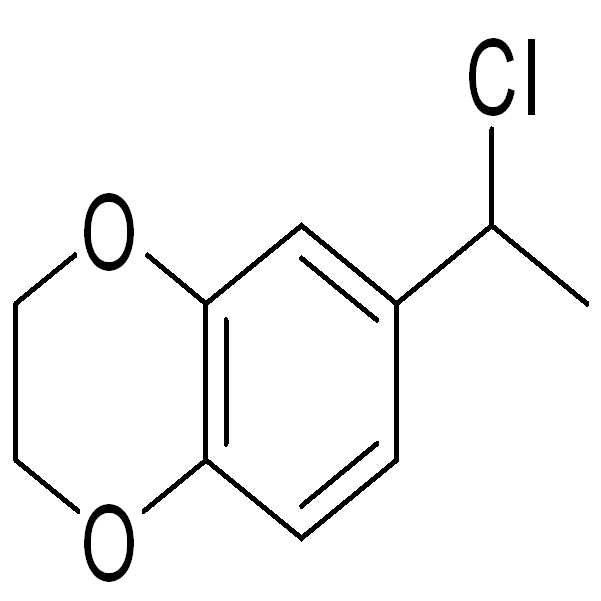
단계 step 1: 11: 1 -(2,3-디히드로-(2,3-dihydro 벤조[b][1,4]디옥신Benzo [b] [1,4] dioxin -6--6- 일Work )에탄-1-Ethane-1- 올Come
표제의 화합물을 중간체 1, 단계 1에 대해 기재된 바와 동일한 프로토콜로, 1-(2,3-디히드로벤조[b][1,4]디옥신-6-일)에탄-1-온 (2.0 g, 11.2 mmol) 및 NaBH4 (0.49 g, 13 mmol)를 이용하여 합성하였다. 생성된 조알코올을 그대로다음 단계에 사용하였다. 수득률: 99% (2.0 g, 무색 액체). 1H NMR (400 MHz, DMSO-d6): δ 6.80 (s, 1H), 6.79-6.76 (m, 2H), 4.59 (q, J = 5.6Hz, 1H), 4.20 (s, 4H), 1.26 (d, J = 5.6Hz, 3H). LCMS: (방법 B) 163.0 (히드록시 제거 질량), Rt. 2.51 분, 99.4% (최대).The title compound was prepared in the same protocol as described for Intermediate 1, Step 1, as follows: 1- (2,3-dihydrobenzo [b] [1,4] dioxin-6-yl) ethan-1-one (2.0 g , 11.2 mmol) and NaBH 4 (0.49 g, 13 mmol). The resulting crude alcohol was used as such in the next step. Yield: 99% (2.0 g, colorless liquid). 1 H NMR (400 MHz, DMSO-d 6 ): δ 6.80 (s, 1H), 6.79-6.76 (m, 2H), 4.59 (q, J = 5.6 Hz, 1H), 4.20 (s, 4H), 1.26 (d, J = 5.6 Hz, 3H). LCMS: (Method B) 163.0 (hydroxyl removal mass), Rt. 2.51 min, 99.4% (max).
단계 step 2:2: 66 -(1--(One- 클로로에틸Chloroethyl )-2,3-) -2,3- 디히드로벤조[b][1,4]디옥신Dihydrobenzo [b] [1,4] dioxin
표제의 화합물을 일반적인 과정 B에 따라 합성하였다. 이를 추가적인 정제 없이 다음 단계에 사용하였다. 수득률: 90% (2.2 g, 갈색 액체). 1H NMR (400 MHz, DMSO-d6): δ 6.97 (s, 1H), 6.96-6.92 (m, 1H), 6.84-6.82 (m, 1H), 5.26 (t, J = 6.7Hz, 1H), 4.23 (s, 4H), 1.75 (d, J = 6.7Hz, 3H). LCMS: (방법 A) 163.0 (Cl-제거 질량), Rt. 3.66 분, 95.3% (최대).The title compound was synthesized according to general procedure B. It was used for the next step without further purification. Yield: 90% (2.2 g, brown liquid). 1 H NMR (400 MHz, DMSO-d 6 ): δ 6.97 (s, 1H), 6.96-6.92 (m, 1H), 6.84-6.82 (m, 1H), 5.26 (t, J = 6.7 Hz, 1H) , 4.23 (s, 4H), 1.75 (d, J = 6.7 Hz, 3H). LCMS: (Method A) 163.0 (Cl-removed mass), Rt. 3.66 min, 95.3% (max).
중간체 Intermediate 4: 14: 1 -(1-(2,3--(1- (2,3- 디히드로벤조[b][1,4]디옥신Dihydrobenzo [b] [1,4] dioxin -6-일)에틸)피페라진 -6-yl) ethyl) piperazine 히드로클로리드Hydrochloride

단계 1: t-부틸 4-(1-(2,3-디히드로Step 1: t-butyl 4- (1- (2,3-dihydro) 벤조[b][1,4]디옥신Benzo [b] [1,4] dioxin -6--6- 일Work )에틸)피페라진-1-카르복실레이트Ethyl) piperazine-1-carboxylate
중간체 3 (5 g, 25.2 mmol) 및 N-boc 피페라진 (3.96 g, 21.2 mmol)으로 출발하여 일반적인 과정 D에 따라 표제의 화합물을 합성하였다. 그 조생성물을 속성 크로마토그래피로 정제하여, 표제의 화합물을 얻었다. 수득률: 52% (4.6 g, 갈색 액체). 1H NMR (400 MHz, DMSO-d6): δ 6.80-6.71 (m, 3H), 4.21 (s, 5H), 3.34-3.26 (m, 4H), 2.27-2.24 (m, 4H), 1.37 (s, 9H), 1.23 (d, J = 6.7 Hz, 3H). LCMS: (방법 A) 349.2 (M+H), Rt. 3.19 분, 80.9% (최대).Starting with intermediate 3 (5 g, 25.2 mmol) and N-boc piperazine (3.96 g, 21.2 mmol) the title compound was synthesized according to general procedure D. The crude product was purified by flash chromatography to give the title compound. Yield: 52% (4.6 g, brown liquid). 1 H NMR (400 MHz, DMSO-d 6 ): δ 6.80-6.71 (m, 3H), 4.21 (s, 5H), 3.34-3.26 (m, 4H), 2.27-2.24 (m, 4H), 1.37 ( s, 9H), 1.23 (d, J = 6.7 Hz, 3H). LCMS: (Method A) 349.2 (M + H), Rt. 3.19 min, 80.9% (max).
단계 2: 1 -(1-(2,3-디히드로 벤조[b][1,4]디옥신 -6- 일 )에틸)피페라진 히드로클로리드 Step 2: 1- (1- (2,3-dihydro benzo [b] [1,4] dioxine -6- yl ) ethyl) piperazine hydrochloride
건조한 디옥산 (5.0 mL) 중의 tert-부틸 4-(1-(2,3-디히드로벤조[b][1,4]디옥신-6-일)에틸)피페라진-1-카르복실레이트 (4.6 g, 13.20 mmol)의 교반된 용액에, 디옥산 중 HCl (10.0 mL, 4 M, Spectrochem)을 0 ℃에서 첨가하였다. 상기 반응 혼합물을 실온에서 2 시간 동안 교반하였다. 상기 반응의 완료를 TLC로 모니터링하였다. 상기 반응 혼합물을 농축하였다. 디에틸에테르를 첨가하고 다시 증발시켜, 표제의 화합물을 얻었다. 수득률: 89% (3.8 g, 황백색 고체). 1H NMR (400 MHz, DMSO-d6): δ 12.08 (br. s, 1H), 9.48-9.18 (m, 2H), 7.18 (s, 1H), 7.03 (s, 1H), 6.92 (d, J = 10.6 Hz, 1H), 4.49 (s, 1H), 4.24 (s, 4H), 3.41-3.15 (m, 4H), 2.91-2.71 (m, 4H), 1.64 (s, 3H). LCMS: (방법 A) 249.2 (M+H), Rt. 1.64 분, 92.6% (최대). Tert-butyl 4- (1- (2,3-dihydrobenzo [b] [1,4] dioxin-6-yl) ethyl) piperazine-1-carboxylate in dry dioxane (5.0 mL) ( To a stirred solution of 4.6 g, 13.20 mmol), HCl in dioxane (10.0 mL, 4 M, Spectrochem) was added at 0 ° C. The reaction mixture was stirred at rt for 2 h. Completion of the reaction was monitored by TLC. The reaction mixture was concentrated. Diethyl ether was added and evaporated again to afford the title compound. Yield: 89% (3.8 g, off-white solid). 1 H NMR (400 MHz, DMSO-d 6 ): δ 12.08 (br. S, 1H), 9.48-9.18 (m, 2H), 7.18 (s, 1H), 7.03 (s, 1H), 6.92 (d, J = 10.6 Hz, 1H), 4.49 (s, 1H), 4.24 (s, 4H), 3.41-3.15 (m, 4H), 2.91-2.71 (m, 4H), 1.64 (s, 3H). LCMS: (Method A) 249.2 (M + H), Rt. 1.64 min, 92.6% (max).
중간체 Intermediate 5:5: 55 -(1--(One- 클로로에틸Chloroethyl )-2,3-) -2,3- 디히드로벤조퓨란Dihydrobenzofuran

단계 step 1: 11: 1 -(2,3-디히드로벤조-(2,3-dihydrobenzo 퓨란Furan -5--5- 일Work )에탄-1-Ethane-1- 올Come
건조한 MeOH (20 mL) 중의 1-(2,3-디히드로벤조퓨란-5-일)에탄-1-온 (2.0 g, 13.0 mmol)의 교반된 용액에, NaBH4 (0.68 g, 26.0 mmol, Loba chemie)를 0 ℃에서 천천히 첨가하였다. 상기 반응 혼합물을 실온에서 1 시간 동안 교반하였다. 그런 다음 이를 진공하에 농축시키고, 생성된 조생성물을 DCM (50 mL) 중에 용해시키고, 물, 염수로 세척하고, 무수 Na2SO4 상에 건조시키고 감압하에 농축하였다. 그 조생성물을 다음단계에서 추가적인 정제없이 사용하였다. 수득률: 91% (1.83 g).To a stirred solution of 1- (2,3-dihydrobenzofuran-5-yl) ethan-1-one (2.0 g, 13.0 mmol) in dry MeOH (20 mL), NaBH 4 (0.68 g, 26.0 mmol, Loba chemie) was added slowly at 0 ° C. The reaction mixture was stirred at rt for 1 h. It was then concentrated in vacuo, the resulting crude product dissolved in DCM (50 mL), washed with water, brine, anhydrous Na 2 SO 4 Dry over phase and concentrate under reduced pressure. The crude product was used without further purification in the next step. Yield: 91% (1.83 g).
단계 step 2: 52: 5 -(1--(One- 클로로에틸)Chloroethyl) -2,3-디히드로벤조-2,3-dihydrobenzo 퓨란Furan
표제의 화합물을 일반적인 과정 B에 따라 합성하였다. 상기 반응 혼합물을 진공하에 농축하고 생성된 조혼합물을 추가적인 정제 없이 사용하였다. 수득률: 72% (0.6 g, 무색 액체). LCMS: (방법 B) 149.0 (염소 제거 질량), Rt. 3.705 분, 80.15% (최대).The title compound was synthesized according to general procedure B. The reaction mixture was concentrated in vacuo and the resulting crude mixture was used without further purification. Yield: 72% (0.6 g, colorless liquid). LCMS: (Method B) 149.0 (Dechlorination Mass), Rt. 3.705 minutes, 80.15% (maximum).
중간체 Intermediate 6: 66: 6 -(1--(One- 클로로에틸Chloroethyl )) 퀴녹살린Quinoxaline

단계 step 1: 11: 1 -(퀴녹살린-6--(Quinoxaline-6- 일Work )에탄-1-온Ethane-1-one
톨루엔 (20 mL) 중의 6-브로모 퀴녹살린 (2.0 g, 9.5 mmol)을 30 분 동안 탈기시켰다. 이 용액에 1-에톡시 비닐 트리부틸틴 (3.8 g, 10.5 mmol) 및 비스(트리페닐포스핀)팔라듐 디클로리드 (0.67 g, 0.95 mmol)를 실온에서 추가하고 90 ℃에서 16 시간 동안 교반하였다. 상기 반응 혼합물을 실온으로 냉각시키고 셀리트를 통해 여과하였다. 그 용매를 증발시킨 후, 물 (20 mL) 중 6 N HCl 용액을 첨가하고 상기 혼합물을 실온에서 1 시간 동안 교반하였다. 이를 농축하고 포화된 NaHCO3으로 중화하였다. 목적 생성물을 DCM (100 mL)으로 추출하고, Na2SO4 상에 건조시키고 농축하였다. 그 조생성물을 속성 컬럼 크로마토그래피로 정제하여 표제의 화합물 (갈색 고체)을 얻었다. 1H NMR (400 MHz, DMSO-d6): δ 9.06-9.04 (m, 2H), 8.70 (d, J=2.4 Hz, 1H), 8.28 (t, J = 2.8 Hz, 1H), 8.16 (d, J = 11.6 Hz, 1H), 2.97 (s, 3H). LCMS: (방법 A) 173 (M+H), Rt. 2.25 분, 99.06% (최대).6-bromo quinoxaline (2.0 g, 9.5 mmol) in toluene (20 mL) was degassed for 30 minutes. To this solution 1-ethoxy vinyl tributyltin (3.8 g, 10.5 mmol) and bis (triphenylphosphine) palladium dichloride (0.67 g, 0.95 mmol) were added at room temperature and stirred at 90 ° C. for 16 hours. . The reaction mixture was cooled to room temperature and filtered through celite. After evaporating the solvent, a 6 N HCl solution in water (20 mL) was added and the mixture was stirred at rt for 1 h. It was concentrated and neutralized with saturated NaHCO 3 . Extract the desired product with DCM (100 mL), Na 2 SO 4 Dry over phase and concentrate. The crude product was purified by flash column chromatography to give the title compound (brown solid). 1 H NMR (400 MHz, DMSO-d 6 ): δ 9.06-9.04 (m, 2H), 8.70 (d, J = 2.4 Hz, 1H), 8.28 (t, J = 2.8 Hz, 1H), 8.16 (d , J = 11.6 Hz, 1H), 2.97 (s, 3H). LCMS: (Method A) 173 (M + H), Rt. 2.25 minutes, 99.06% (max).
단계 step 2: 12: 1 -(퀴녹살린-6--(Quinoxaline-6- 일Work )에탄-1-Ethane-1- 올Come
건조한 MeOH (20 mL) 중의 1-(퀴녹살린-6-일)에탄-1-온 (0.8 g,4.65 mmol)의 교반된 용액에, 소듐 보로히드리드 (0.36 g, 9.3 mmol)를 0 ℃에서 조금씩(portion wise) 첨가하고 생성된 혼합물을 1 시간 동안 교반하였다. 그런 다음 이를 농축시키고, DCM (80 mL)으로 희석하고, 물 (20 mL)로 세척하고, Na2SO4 상에 건조시키고 농축하였다. 그 조생성물을 추가적인 정제 없이 다음 단계를 위해 취하였다. 수득률: 75% (600 mg, 어두운 갈색 액체). 1H NMR (400 MHz, DMSO-d6): δ 8.91-8.89 (m, 2H), 8.03 (t, J = 11.6 Hz, 2H), 7.87-7.86 (m, 1H), 5.49 (d, J = 5.9 Hz, 1H), 4.97 (t, J = 6.2 Hz, 1H), 1.42 (d, J = 8.6 Hz, 3H). LCMS: (방법 A) 175.0 (M+H), Rt. 1.89 분, 95.0% (최대).To a stirred solution of 1- (quinoxalin-6-yl) ethan-1-one (0.8 g, 4.65 mmol) in dry MeOH (20 mL), add sodium borohydride (0.36 g, 9.3 mmol) at 0 ° C. Portion wise was added and the resulting mixture was stirred for 1 hour. Then it is concentrated, diluted with DCM (80 mL), washed with water (20 mL), Na 2 SO 4 Dry over phase and concentrate. The crude product was taken for next step without further purification. Yield: 75% (600 mg, dark brown liquid). 1 H NMR (400 MHz, DMSO-d 6 ): δ 8.91-8.89 (m, 2H), 8.03 (t, J = 11.6 Hz, 2H), 7.87-7.86 (m, 1H), 5.49 (d, J = 5.9 Hz, 1H), 4.97 (t, J = 6.2 Hz, 1H), 1.42 (d, J = 8.6 Hz, 3H). LCMS: (Method A) 175.0 (M + H), Rt. 1.89 min, 95.0% (max).
단계 step 3: 63: 6 -(1--(One- 클로로에틸)Chloroethyl) 퀴녹살린Quinoxaline
건조한 DCM (10 mL) 중의 1-(퀴녹살린-6-일)에탄-1-올 (0.6 g, 3.46mmol)의 교반된 용액에, 티오닐 클로리드 (0.5mL, 6.93 mmol)를 0 ℃에서 점적으로 첨가하고 실온에서 1시간 동안 교반하였다. 상기 반응 혼합물을 증발시켜 건조시키고, 추가적인 정제없이 사용하였다. 수득률: 97% (650 mg, 황백색 고체). 1H NMR (400 MHz, DMSO-d6): δ 8.74 (s, 2H), 7.93 (s, 1H), 7.70-7.68 (m, 2H), 4.46-4.23 (m, 1H), 1.87 (s, 3H). LCMS: (방법 A) 193 (M+H), Rt. 3.41 분, 71.4% (최대).To a stirred solution of 1- (quinoxalin-6-yl) ethan-1-ol (0.6 g, 3.46 mmol) in dry DCM (10 mL), thionyl chloride (0.5 mL, 6.93 mmol) was added at 0 ° C. Dropping was added and stirred at room temperature for 1 hour. The reaction mixture was evaporated to dryness and used without further purification. Yield: 97% (650 mg, off-white solid). 1 H NMR (400 MHz, DMSO-d 6 ): δ 8.74 (s, 2H), 7.93 (s, 1H), 7.70-7.68 (m, 2H), 4.46-4.23 (m, 1H), 1.87 (s, 3H). LCMS: (Method A) 193 (M + H), Rt. 3.41 min, 71.4% (max).
중간체 7: N-(5-(피페라진-1-일)-1,3,4-Intermediate 7: N- (5- (piperazin-1-yl) -1,3,4- 티아디아졸Thiadiazole -2-일)아세트아미드 -2-yl) acetamide 히드로클로리드Hydrochloride

단계1 : tert -부틸 4-(5-아미노-1,3,4- 티아디아졸 -2-일)피페라진-1-카르복실레이트 Step 1 : tert -butyl 4- (5-amino-1,3,4- thiadiazol- 2-yl) piperazin-1 -carboxylate
건조한 DMF (100 mL) 중의 2-아미노 5-브로모-1, 3, 4-티아디아졸 (10.0 g, 55.5 mmol)의 교반된 용액에, K2CO3 (15.3 g, 111.1 mmol) 및 1-boc 피페라진 (12.4 g, 66.65 mmol)을 0 ℃에서 첨가하였다. 상기 반응 혼합물을 80 ℃에서 밤새 교반하였다. 상기 반응 혼합물을 진공하에 농축하였다. 생성된 조고체로, DCM (200 mL)을 첨가하였다. 상기 DCM 층을 물 (100 mL)로 세척하고, 염수 (100 mL)로 세척하고, 무수 Na2SO4 상에 건조시키고 농축하였다, 상기 조생성물을 실리카겔 컬럼 크로마토그래피로 정제하여 표제의 화합물을 얻었다. 수득률: 76% (12 g, 담갈색 고체). 1H NMR (400 MHz, DMSO-d6): δ 6.51 (s, 2H), 3.39 (d, J = 6.9 Hz, 4H), 3.19 (d, J = 7.7 Hz, 4H), 1.39 (s, 9H). LCMS: (방법 A) 286.1 (M+H), Rt. 2.71 분, 97.6% (최대).To a stirred solution of 2-amino 5-bromo-1, 3, 4-thiadiazole (10.0 g, 55.5 mmol) in dry DMF (100 mL), K 2 CO 3 (15.3 g, 111.1 mmol) and 1 -boc piperazine (12.4 g, 66.65 mmol) was added at 0 ° C. The reaction mixture was stirred at 80 ° C overnight. The reaction mixture was concentrated in vacuo. As the resulting solid, DCM (200 mL) was added. The DCM layer was washed with water (100 mL), brine (100 mL), anhydrous Na 2 SO 4 Phase was concentrated and the crude product was purified by silica gel column chromatography to afford the title compound. Yield: 76% (12 g, light brown solid). 1 H NMR (400 MHz, DMSO-d 6 ): δ 6.51 (s, 2H), 3.39 (d, J = 6.9 Hz, 4H), 3.19 (d, J = 7.7 Hz, 4H), 1.39 (s, 9H ). LCMS: (Method A) 286.1 (M + H), Rt. 2.71 minutes, 97.6% (max).
단계 2: tert -부틸 4-(5- 아세트아미도 -1,3,4- 티아디아졸 -2-일)피페라진-1-카르복실레이트 Step 2: tert -Butyl 4- (5- acetamido- 1,3,4- thiadiazol- 2-yl) piperazin-1 -carboxylate
피리딘 (120 mL) 중의 tert-부틸 4-(5-아미노-1,3,4-티아디아졸-2-일)피페라진-1-카르복실레이트 (12.0 g, 42.09 mmol)의 교반된 용액에, 무수 아세트산 (5.1g, 50.5 mmol)를 0 ℃에서 첨가하였다. 상기 반응 혼합물을 50 ℃에서 밤새 교반하였다. 상기 반응 혼합물을 진공하에 농축하고 디에틸 에테르 (100 mL) 중에 분쇄(triturate)하였다. 상기 수득된 고체를 여과하고, 디에틸 에테르 (20 mL)로 세척하고, 건조시켜 임의의 추가적인 정제 없이 다음 단계를 위해 취하였다. 수득률: 87% (12 g, 황백색 고체). 1H NMR (400 MHz, DMSO-d6): δ 12.07 (br .s, 1H), 3.45-3.34 (m, 8H), 2.11 (s, 3H), 1.42 (s, 9H). LCMS: (방법 A) 328.0 (M+H), Rt. 3.11 분, 86.3% (최대). To a stirred solution of tert-butyl 4- (5-amino-1, 3,4-thiadiazol-2-yl) piperazine-1-carboxylate (12.0 g, 42.09 mmol) in pyridine (120 mL) , Acetic anhydride (5.1 g, 50.5 mmol) was added at 0 ° C. The reaction mixture was stirred at 50 ° C overnight. The reaction mixture was concentrated in vacuo and triturated in diethyl ether (100 mL). The solid obtained was filtered, washed with diethyl ether (20 mL) and dried to take for the next step without any further purification. Yield: 87% (12 g, off-white solid). 1 H NMR (400 MHz, DMSO-d 6 ): δ 12.07 (br.s, 1H), 3.45-3.34 (m, 8H), 2.11 (s, 3H), 1.42 (s, 9H). LCMS: (Method A) 328.0 (M + H), Rt. 3.11 minutes, 86.3% (max).
단계 3: N-(5-(피페라진-1-일)-1,3,4- 티아디아졸 -2-일)아세트아미드 히드로클로리드 Step 3: N- (5- (piperazin-1-yl) -1,3,4- thiadiazol- 2-yl) acetamide hydrochloride
건조한 디옥산 (100 mL) 중의 tert-부틸 4-(5-아세트아미도-1,3,4-티아디아졸-2-일)피페라진-1-카르복실레이트 (12.0 g)의 교반된 용액에, 디옥산 중의 HCl(100 mL, 4 N)을 첨가하고, 상기 반응 혼합물을 3 시간 동안 실온에서 교반하였다. 상기 반응 혼합물 진공하에 농축하고 생성된 조생성물을 디에틸 에테르 (50 mL)에 현탁시켰다. 용매를 증발시킨 후 표제의 화합물을 얻었다. 수득률: 93% (9 g, 백색 고체). 1H NMR (400 MHz, DMSO-d6): δ 12.07 (br. s, 1H), 3.67 (s, 4H), 3.21 (s, 4H), 2.13 (s, 3H). LCMS: (방법 A) 228.0 (M+H), Rt. 0.71 분, 85.3% (최대).Stirred solution of tert-butyl 4- (5-acetamido-1,3,4-thiadiazol-2-yl) piperazine-1-carboxylate (12.0 g) in dry dioxane (100 mL) To this, HCl in dioxane (100 mL, 4 N) was added and the reaction mixture was stirred for 3 hours at room temperature. The reaction mixture was concentrated in vacuo and the resulting crude product was suspended in diethyl ether (50 mL). After evaporation of the solvent the title compound was obtained. Yield: 93% (9 g, white solid). 1 H NMR (400 MHz, DMSO-d 6 ): δ 12.07 (br. S, 1H), 3.67 (s, 4H), 3.21 (s, 4H), 2.13 (s, 3H). LCMS: (Method A) 228.0 (M + H), Rt. 0.71 min, 85.3% (max).
중간체 8: 에틸 2-(피페라진-1-Intermediate 8: Ethyl 2- (piperazin-1- 일Work )티아졸-5-Thiazole-5- 카르복실레이트Carboxylate 히드로클로리드Hydrochloride

단계 1: 에틸 2-(4-( tert - 부톡시카르보닐 )피페라진-1- 일 )티아졸-5-카르복실레이트 Step 1: Preparation of ethyl 2- (4- (tert - butoxycarbonyl) piperazin-1-yl) thiazole-5-carboxylate
건조한 DMF (40 mL) 중의 에틸 2-브로모티아졸-5-카르복실레이트 (4.0 g, 17.0 mmol)의 교반된 용액에, 트리에틸아민 (7.3 mL, 51.0 mmol, Spectrochem) 다음, N-Boc 피페라진 (3.6 g, 19.0 mmol, GLRscientific)을 첨가하였다. 상기 생성된 혼합물을 90 ℃에서 12 시간 동안 가열하였다. 그런 다음, 이를 농축시키고, DCM (200 mL)으로 희석시키고, 물 (100 mL)로 세척하고, Na2SO4 상에 건조시켰다. 용매를 증발시킨 후, 조생성물을 속성 크로마토그래피(DCM 중 3% 메탄올)로 정제하여 표제의 화합물을 얻었다. 수득률: 77% (4.5 g, 백색 고체). LCMS: (방법 A) 342.0 (M+H), Rt. 4.42 분, 99.5% (최대). 1H NMR (400 MHz, CDCl3): δ 7.88 (s, 1H), 4.30 (q, J = 7.2 Hz, 2H), 3.57 (s, 8H), 1.49 (s, 9H), 1.35 (t, J = 7.2 Hz, 3H).To a stirred solution of ethyl 2-bromothiazole-5-carboxylate (4.0 g, 17.0 mmol) in dry DMF (40 mL), triethylamine (7.3 mL, 51.0 mmol, Spectrochem) followed by N-Boc pipe Lazine (3.6 g, 19.0 mmol, GLR scientific) was added. The resulting mixture was heated at 90 ° C for 12 h. Then it is concentrated, diluted with DCM (200 mL), washed with water (100 mL), Na 2 SO 4 Dried over phase. After evaporation of the solvent, the crude product was purified by flash chromatography (3% methanol in DCM) to afford the title compound. Yield: 77% (4.5 g, white solid). LCMS: (Method A) 342.0 (M + H), Rt. 4.42 min, 99.5% (max). 1 H NMR (400 MHz, CDCl 3 ): δ 7.88 (s, 1H), 4.30 (q, J = 7.2 Hz, 2H), 3.57 (s, 8H), 1.49 (s, 9H), 1.35 (t, J = 7.2 Hz, 3H).
단계 2: 에틸 2-(피페라진-1-Step 2: ethyl 2- (piperazin-1- 일Work )티아졸-5-카르복실레이트 히드로클로리드Thiazole-5-carboxylate hydrochloride
건조한 디옥산 (20 mL) 중의 에틸 2-(4-(tert-부톡시카르보닐)피페라진-1-일)티아졸-5-카르복실레이트 (4.5 g, 13.0 mmol)의 교반된 용액에, 디옥산 중 HCl (4 N, 50 mL)을 0 ℃에서 첨가하고, 상기 반응 혼합물을 2 시간 동안 실온에서 교반하였다. 상기 반응 혼합물을 농축하고 생성된 고체를 디에틸 에테르로 세척하고 진공하에 건조시켰다. 수득률: 90% (5.4 g, 황백색 고체). 1H NMR (400 MHz, DMSO-d6): δ 9.32 (s, 2H), 7.88 (s, 1H), 4.21(q, J= 9.4Hz, 2H), 3.96-3.73(m, 4H), 3.55-2.41 (m, 4H), 1.24 (t, J=7.0Hz, 3H). LCMS: (방법 B) 242.0 (M+H), Rt. 2.11 분, 99.8% (최대).To a stirred solution of ethyl 2- (4- ( tert -butoxycarbonyl) piperazin-1-yl) thiazole-5-carboxylate (4.5 g, 13.0 mmol) in dry dioxane (20 mL), HCl in dioxane (4 N, 50 mL) was added at 0 ° C and the reaction mixture was stirred at rt for 2 h. The reaction mixture was concentrated and the resulting solid was washed with diethyl ether and dried under vacuum. Yield: 90% (5.4 g, off-white solid). 1 H NMR (400 MHz, DMSO-d 6 ): δ 9.32 (s, 2H), 7.88 (s, 1H), 4.21 (q, J = 9.4 Hz, 2H), 3.96-3.73 (m, 4H), 3.55 -2.41 (m, 4H), 1.24 (t, J = 7.0 Hz, 3H). LCMS: (Method B) 242.0 (M + H), Rt. 2.11 minutes, 99.8% (max).
중간체 Intermediate 9: 79: 7 -(1--(One- 클로로에틸Chloroethyl )퀴놀린Quinoline

단계 step 1: 11: 1 -(퀴놀린-7--(Quinoline-7- 일Work )에탄-1-온Ethane-1-one
표제의 화합물을 중간체 6, 단계 1의 합성에 대해 기재된 프로토콜에 따라, 출발 물질로서 7-브로모 퀴놀린 (2 g, 9.56 mmol, Harvechem)을 이용하여 합성하였다. 조생성물을 속성 크로마토그래피로 정제하여 표제의 화합물 (갈색 고체)을 얻었다. 1H NMR (300 MHz, DMSO-d6): δ 9.02 (d, J = 3.2 Hz, 1H), 8.63 (s, 1H), 8.46-8.10 (m, 1H), 8.08-8.03 (m, 2H), 7.68-7.50 (m, 1H), 2.68 (s, 3H). LCMS: (방법 A) 172.0 (M+H), Rt. 1.49 분, 84.1% (최대).The title compound was synthesized using 7-bromo quinoline (2 g, 9.56 mmol, Harvechem) as starting material, according to the protocol described for synthesis of intermediate 6, step 1. The crude product was purified by flash chromatography to give the title compound (brown solid). 1 H NMR (300 MHz, DMSO-d 6 ): δ 9.02 (d, J = 3.2 Hz, 1H), 8.63 (s, 1H), 8.46-8.10 (m, 1H), 8.08-8.03 (m, 2H) , 7.68-7.50 (m, 1 H), 2.68 (s, 3 H). LCMS: (Method A) 172.0 (M + H), Rt. 1.49 min, 84.1% (max).
단계 step 2: 12: 1 -(퀴놀린-7--(Quinoline-7- 일Work )에탄-1-Ethane-1- 올Come
표제의 화합물을 중간체 6, 단계 2의 합성에 대해 기재된 프로토콜에 따라, 출발 물질로서 1-(퀴놀린-7-일)에탄-1-온을 이용하여 합성하였다. 조생성물을 추가적인 정제 없이 다음 단계를 위해 취하였다 (갈색 고체). 1H NMR (400 MHz, DMSO-d6): δ 8.86-8.85 (m, 1H), 8.31 (d, J = 8.1 Hz, 1H), 7.92 (t, J = 8.5 Hz, 2H), 7.60 (d, J = 8.4 Hz, 1H), 7.47 (dd, J = 4.2, 8.2 Hz, 1H), 5.39 (d, J = 4.2 Hz, 1H), 4.90-4.96 (m, 1H), 1.41 (d, J = 6.4 Hz, 3H). LCMS: (방법 A) 174.0 (M+H), Rt. 1.34 분, 99.2% (최대).The title compound was synthesized using 1- (quinolin-7-yl) ethan-1-one as starting material, according to the protocol described for synthesis of intermediate 6, step 2. The crude product was taken for next step without further purification (brown solid). 1 H NMR (400 MHz, DMSO-d 6 ): δ 8.86-8.85 (m, 1H), 8.31 (d, J = 8.1 Hz, 1H), 7.92 (t, J = 8.5 Hz, 2H), 7.60 (d , J = 8.4 Hz, 1H), 7.47 (dd, J = 4.2, 8.2 Hz, 1H), 5.39 (d, J = 4.2 Hz, 1H), 4.90-4.96 (m, 1H), 1.41 (d, J = 6.4 Hz, 3H). LCMS: (Method A) 174.0 (M + H), Rt. 1.34 min, 99.2% (max).
단계 step 3: 73: 7 -(1--(One- 클로로에틸)Chloroethyl) 퀴놀린Quinoline
표제의 화합물을 중간체 6, 단계 3의 합성에 대해 기재된 프로토콜에 따라, 출발 물질로 1-(퀴놀린-7-일)에탄-1-올을 이용하여 합성하였다. 조생성물을 추가적인 정제 없이 다음 단계를 위해 취하였다. 수득률: 96% (260 mg, 회색 고체). 1H NMR (400 MHz, DMSO-d6): δ 9.19 (d, J = 3.5 Hz, 1H), 8.88 (d, J = 7.6 Hz, 1H), 8.27 (d, J = 6.6 Hz, 2H), 7.60 (d, J = 8.4 Hz, 1H), 7.93 (dt, J = 6.0, Hz, 2H), 5.71-5.68 (m, 1H), 1.91 (d, J = 6.7 Hz, 3H). LCMS: (방법 A) 192.0 (M+H), Rt. 2.27 분, 98.7% (최대).The title compound was synthesized using 1- (quinolin-7-yl) ethan-1-ol as starting material, according to the protocol described for the synthesis of intermediate 6, step 3. The crude product was taken for next step without further purification. Yield: 96% (260 mg, gray solid). 1 H NMR (400 MHz, DMSO-d 6 ): δ 9.19 (d, J = 3.5 Hz, 1H), 8.88 (d, J = 7.6 Hz, 1H), 8.27 (d, J = 6.6 Hz, 2H), 7.60 (d, J = 8.4 Hz, 1H), 7.93 (dt, J = 6.0, Hz, 2H), 5.71-5.68 (m, 1H), 1.91 (d, J = 6.7 Hz, 3H). LCMS: (Method A) 192.0 (M + H), Rt. 2.27 min, 98.7% (max).
중간체 10: N-(2-(피페라진-1-일)피리미딘-5-일)아세트아미드, Intermediate 10: N- (2- (piperazin-1-yl) pyrimidin-5-yl) acetamide, 히드로클로리드Hydrochloride

단계 1: Step 1: TertTert -부틸 4-(5--Butyl 4- (5- 니트로피리미딘Nitropyrimidine -2-일)피페라진-1--2-yl) piperazine-1- 카르복실레이트Carboxylate
건조한 DMF (25mL) 중의 2-클로로-5-니트로-피리미딘 (2.2 g, 13.7 mmol)의 교반된 용액에, 트리에틸아민 (5.7 mL, 41.3 mmol, Spectrochem) 다음, N-Boc 피페라진 (2.8 g, 15.7 mmol)을 첨가하고, 생성된 혼합물을 90 ℃에서 12 시간 동안 가열하였다. 이를 농축시키고 그 잔여물을 DCM (50 mL)으로 희석하고, 물 (15 mL)로 세척하고, Na2SO4 상에 건조시켰다. 용매를 증발시킨 후, 조생성물을 5% 메탄올과 함께 ACN으로 세척하여 표제의 화합물 (갈색 고체)을 얻었다. 1H NMR (400 MHz, DMSO-d6): δ 9.12 (s, 2H), 3.92-3.88 (m, 4H), 3.45-3.42 (m, 4H), 1.4 (s, 9H).LCMS: (방법 A) 254.0 (M-(t-부틸)+H), Rt. 4.43 분, 98.03% (최대).To a stirred solution of 2-chloro-5-nitro-pyrimidine (2.2 g, 13.7 mmol) in dry DMF (25 mL), triethylamine (5.7 mL, 41.3 mmol, Spectrochem) followed by N-Boc piperazine (2.8 g, 15.7 mmol) and the resulting mixture was heated at 90 ° C. for 12 h. It was concentrated and the residue was diluted with DCM (50 mL), washed with water (15 mL) and dried over Na 2 SO 4 . After evaporation of the solvent the crude product was washed with ACN with 5% methanol to afford the title compound (brown solid). 1 H NMR (400 MHz, DMSO-d 6 ): δ 9.12 (s, 2H), 3.92-3.88 (m, 4H), 3.45-3.42 (m, 4H), 1.4 (s, 9H). LCMS: (method A) 254.0 (M- (t-butyl) + H), Rt. 4.43 min, 98.03% (max).
단계 2: Step 2: Tert-부틸Tert-butyl 4-(5-아미노 4- (5-amino 피리미딘Pyrimidine -2--2- 일Work )피페라진-1-카르복실레이트Piperazine-1-carboxylate
메탄올 (25 mL) 중의 tert-부틸 4-(5-니트로피리미딘-2-일)피페라진-1-카르복실레이트 (2.1 g, 6.79 mmol)의 교반된 용액에, Pd/C (10%, 0.210 g, Aldrich)를 첨가하고 상기 반응 혼합물을 H2 분위기(atmosphere) 하에 3 시간 동안 교반하였다. 상기 반응 완료를 TLC로 모니터링하였다. 상기 반응 혼합물을 셀리트를 통해 여과하고 진공 하에 증발시켰다. 그 조생성물을 추가적은 정제 없이 사용하였다. 수득률: 95% (1.8 g, 담갈색 고체). 1H NMR (400 MHz, DMSO-d6): δ 7.88 (s, 2H), 4.62 (s, 2H), 3.48-3.45 (m, 4H), 3.35-3.28 (m, 4H), 1.33 (s, 9H). LCMS: (방법 A) 280 (M+H), Rt. 2.66 분, 98.82% (최대).To a stirred solution of tert-butyl 4- (5-nitropyrimidin-2-yl) piperazine-1-carboxylate (2.1 g, 6.79 mmol) in methanol (25 mL), Pd / C (10% , 0.210 g, Aldrich) was added and the reaction mixture was stirred for 3 h under H 2 atmosphere. The reaction completion was monitored by TLC. The reaction mixture was filtered through celite and evaporated in vacuo. The crude product was used without further purification. Yield: 95% (1.8 g, light brown solid). 1 H NMR (400 MHz, DMSO-d 6 ): δ 7.88 (s, 2H), 4.62 (s, 2H), 3.48-3.45 (m, 4H), 3.35-3.28 (m, 4H), 1.33 (s, 9H). LCMS: (Method A) 280 (M + H), Rt. 2.66 minutes, 98.82% (max).
단계 3: Tert-부틸 4-(5-아세트아미도피리미딘-2- 일 )피페라진-1-카르복실레이트 Step 3: Tert- butyl 4- (5-acetamido-flight limiter-2-yl) piperazine-1-carboxylate
건조한 DCM (18 mL) 중의 tert-부틸 4-(5-아미노피리미딘-2-일)피페라진-1-카르복실레이트 (1.8 g, 6.44 mmol)의 교반된 용액에, 피리딘 (0.7 mL, 9.67 mmol, spectrochem), 무수 아세트산 (0.9 mL, 9.67 mmol, spectrochem) 및 디메틸 아미노피리딘 (0.036 g, 2%, spectrochem)을 첨가하였다. 생성된 혼합물을 실온에서 12 시간 동안 교반하였다. 상기 반응 혼합물을 감압하에 농축시키고 생성된 고체를 HCl (물 중 1.5 N, 15 mL)에 현탁시켰다. 고체를 여과하고 물 (200 mL)로 세척하여 표제의 화합물을 얻었다. 수득률: 87% (1.8 g, 황백색 고체). 1H NMR (400 MHz, DMSO-d6): δ 9.85 (s, 1H), 8.51(s, 2H), 3.66-3.61 (m, 4H), 3.33-3.31 (m, 4H), 2.00 (s, 3H), 1.41 (s, 9H).LCMS: (방법 A) 322 (M+H), Rt. 3.1 분, 98.4% (최대).To a stirred solution of tert-butyl 4- (5-aminopyrimidin-2-yl) piperazin-1-carboxylate (1.8 g, 6.44 mmol) in dry DCM (18 mL), pyridine (0.7 mL, 9.67 mmol, spectrochem), acetic anhydride (0.9 mL, 9.67 mmol, spectrochem) and dimethyl aminopyridine (0.036 g, 2%, spectrochem) were added. The resulting mixture was stirred at rt for 12 h. The reaction mixture was concentrated under reduced pressure and the resulting solid was suspended in HCl (1.5 N in water, 15 mL). The solid was filtered off and washed with water (200 mL) to afford the title compound. Yield: 87% (1.8 g, off-white solid). 1 H NMR (400 MHz, DMSO-d 6 ): δ 9.85 (s, 1H), 8.51 (s, 2H), 3.66-3.61 (m, 4H), 3.33-3.31 (m, 4H), 2.00 (s, 3H), 1.41 (s, 9H). LCMS: (Method A) 322 (M + H), Rt. 3.1 min, 98.4% (max).
단계 4: N-(2-(피페라진-1-Step 4: N- (2- (piperazin-1- 일Work )피리미딘-5-Pyrimidine-5- 일Work )아세트아미드Acetamide
건조한 디옥산 (5 mL) 중의 tert-부틸 4-(5-아세트아미도피리미딘-2-일)피페라진-1-카르복실레이트 (1.8 g, 5.6mmol)의 교반된 용액에 0 ℃에서, 디옥산 중 HCl (4 N, 15 mL)의 용액을 첨가하고 상기 반응 혼합물을 실온에서 3 시간 동안 교반하였다. 이를 농축하고 생성된 생성물을 디에틸 에테르로 세척하여, 표제의 화합물을 얻었다. 수득률: 83% (1.8 g, 황백색 고체). 1H NMR (400 MHz, DMSO-d6): δ 10.9 (s, 1H), 9.92 (s,1H), 8.86 (s, 2H), 3.22-3.17 (m, 4H), 3.02-2.78 (m, 4H), 2.06 (s, 3H). LCMS: (방법 B) 222.0 (M+H), Rt. 2.36 분, 95.34% (최대)To a stirred solution of tert-butyl 4- (5-acetamidopyrimidin-2-yl) piperazine-1-carboxylate (1.8 g, 5.6 mmol) in dry dioxane (5 mL) at 0 ° C., A solution of HCl (4 N, 15 mL) in dioxane was added and the reaction mixture was stirred at rt for 3 h. It was concentrated and the resulting product was washed with diethyl ether to give the title compound. Yield: 83% (1.8 g, off-white solid). 1 H NMR (400 MHz, DMSO-d 6 ): δ 10.9 (s, 1H), 9.92 (s, 1H), 8.86 (s, 2H), 3.22-3.17 (m, 4H), 3.02-2.78 (m, 4H), 2.06 (s, 3H). LCMS: (Method B) 222.0 (M + H), Rt. 2.36 minutes, 95.34% (max)
중간체 Intermediate 11: 611: 6 -(1-(피페라진-1-일)에틸)-(1- (piperazin-1-yl) ethyl) 퀴녹살린Quinoxaline 히드로클로리드Hydrochloride

단계 1: Step 1: tert-부틸tert-butyl 4-(1-(퀴녹살린-6- 4- (1- (quinoxaline-6- 일Work ) 에틸) 피페라진-1-카르복실레이트) Ethyl) piperazine-1-carboxylate
건조한 DMF (40 mL) 중의 1-boc 피페라진 (3.8 g, 20.83 mmol)의 교반된 용액에, TEA (8.7 mL, 62.4 mmol) 및 중간체 6 (4 g, 20.83 mmol)을 실온에서 첨가하고 상기 반응 혼합물을 90 ℃에서 밤새 교반하였다. 상기 반응 혼합물을 실온으로 냉각시키고 진공하에 농축시켰다. 이 조혼합물에, 물 (50 mL)을 첨가하고 그 생성물을 DCM (150 mL)으로 추출하였다. 유기층을 무수 Na2SO4 상에 건조시키고 농축하여 조생성물을 얻었다. 상기 조생성물을 속성 컬럼 크로마토그래피로 정제하여 표제의 화합물 (갈색 고체)을 수득하였다. LCMS: (방법 A) 343.2 (M+H), Rt. 2.59 분, 75.3% (최대).To a stirred solution of 1-boc piperazine (3.8 g, 20.83 mmol) in dry DMF (40 mL), TEA (8.7 mL, 62.4 mmol) and intermediates 6 (4 g, 20.83 mmol) was added at rt and the reaction mixture was stirred at 90 ° C. overnight. The reaction mixture was cooled to rt and concentrated in vacuo. To this crude mixture, water (50 mL) was added and the product was extracted with DCM (150 mL). The organic layer was dried over anhydrous Na 2 SO 4 and concentrated to afford crude product. The crude product was purified by flash column chromatography to yield the title compound (brown solid). LCMS: (Method A) 343.2 (M + H), Rt. 2.59 min, 75.3% (max).
단계 step 2: 62: 6 -(1-(피페라진-1--(1- (piperazin-1- 일Work ) 에틸) 퀴녹살린 히드로클로리드) Ethyl) quinoxaline hydrochloride
메탄올 (5 mL) 중의 tert-부틸 4-(1-(퀴녹살린-6-일) 에틸) 피페라진-1-카르복실레이트 (3.5 g, 10.23 mmol)의 용액에, 디옥산 HCl (35 mL, 10 V)을 실온에서 첨가하고 상기 반응 혼합물을 2 시간 동안 교반하였다. 상기 반응 혼합물을 감압하에 농축시킨 다음 디에틸 에테르(15mL) 중에 분쇄시켜 표제의 화합물을 얻었다. 수득률: 87% (2.1 g, 갈색 고체).1H NMR (400 MHz, DMSO-d6): 8.94 (d, J = 6.0 Hz, 2H), 8.09 (d, J = 8.8 Hz, 1H), 8.01 (s, 1H), 7.88 (d, J = 8.8 Hz, 1H), 3.85 (d, J = 6.8 Hz, 1H), 3.54 (t, J = 5.2 Hz, 2H), 3.16 (d, J = 3.6 Hz, 2H), 3.06-2.96 (m, 1H),2.92-3.02 (m, 1H), 2.67 (s, 2H), 2.55-2.58 (m, 2H), 1.42 (d, J = 6.8 Hz, 3H). LCMS: (방법 A) 243.3 (M+H), Rt. 1.36 분, 95.02% (최대).To a solution of tert-butyl 4- (1- (quinoxalin-6-yl) ethyl) piperazine-1-carboxylate (3.5 g, 10.23 mmol) in methanol (5 mL), dioxane HCl (35 mL, 10 V) was added at room temperature and the reaction mixture was stirred for 2 hours. The reaction mixture was concentrated under reduced pressure and triturated in diethyl ether (15 mL) to afford the title compound. Yield: 87% (2.1 g, brown solid). 1 H NMR (400 MHz, DMSO-d 6 ): 8.94 (d, J = 6.0 Hz, 2H), 8.09 (d, J = 8.8 Hz, 1H), 8.01 (s, 1H), 7.88 (d, J = 8.8 Hz, 1H), 3.85 (d, J = 6.8 Hz, 1H), 3.54 (t, J = 5.2 Hz, 2H), 3.16 (d, J = 3.6 Hz, 2H), 3.06-2.96 (m, 1H) , 2.92-3.02 (m, 1H), 2.67 (s, 2H), 2.55-2.58 (m, 2H), 1.42 (d, J = 6.8 Hz, 3H). LCMS: (Method A) 243.3 (M + H), Rt. 1.36 min, 95.02% (max).
중간체 Intermediate 12: 412: 4 -- 클로로Chloro -7-(1--7- (1- 클로로에틸)Chloroethyl) 퀴놀린Quinoline

단계 1- 1-(4-클로로퀴놀린-7-Step 1- 1- (4-chloroquinoline-7- 일Work )에탄-1-온Ethane-1-one
톨루엔 (5 mL) 중의 7-브로모-4-클로로퀴놀린 (1g, 4.12 mmol, combiblock)을 30 분 동안 탈기시켰다. 이 용액에, 1-에톡시 비닐 트리부틸틴 (1.6 mL, 4.53 mmol) 및비스(트리페닐포스핀)팔라듐 디클로리드 (3.38g, 4.76 mmol)를 실온에서 첨가하고 90 ℃에서 12 시간 동안 교반하였다. 상기 반응 혼합물을 실온으로 냉각시키고 셀리트를 통해 여과시켰다. 생성된 조생성물을 물 중 6 N HCl (10 mL)에 현탁시키고 실온에서 1 시간 동안 교반하였다. 상기 혼합물을 농축시키고 NaHCO3의 포화된 수성 용액으로 중화시켰다. 목적 생성물을 DCM (50 mL)으로 추출하고, Na2SO4 상에 건조시키고 농축하였다. 상기 조생성물을 속성 컬럼 크로마토그래피로 정제하여 표제의 화합물을 얻었다 (담황색 고체). 1H NMR (400 MHz, DMSO-d6): 8.98 (d, J = 4.6 Hz, 2H), 8.72 (s, 1H), 8.33 (d, J = 8.7 Hz, 1H), 8.21 (d, J = 8.7 Hz, 1H), 7.92 (d, J = 4.6 Hz, 1H), 2.78 (s, 3H). LCMS: (방법 A) 206.0 (M+H), Rt. 2.98 분, 96.8% (최대).7-bromo-4-chloroquinoline (1 g, 4.12 mmol, combiblock) in toluene (5 mL) was degassed for 30 minutes. To this solution, 1-ethoxy vinyl tributyltin (1.6 mL, 4.53 mmol) and bis (triphenylphosphine) palladium dichloride (3.38 g, 4.76 mmol) were added at room temperature and stirred at 90 ° C. for 12 hours. It was. The reaction mixture was cooled to room temperature and filtered through celite. The resulting crude product was suspended in 6 N HCl (10 mL) in water and stirred at room temperature for 1 hour. The mixture was concentrated and neutralized with saturated aqueous solution of NaHCO 3 . The desired product was extracted with DCM (50 mL), dried over Na 2 S0 4 and concentrated. The crude product was purified by flash column chromatography to give the title compound (pale yellow solid). 1 H NMR (400 MHz, DMSO-d 6 ): 8.98 (d, J = 4.6 Hz, 2H), 8.72 (s, 1H), 8.33 (d, J = 8.7 Hz, 1H), 8.21 (d, J = 8.7 Hz, 1H), 7.92 (d, J = 4.6 Hz, 1H), 2.78 (s, 3H). LCMS: (Method A) 206.0 (M + H), Rt. 2.98 min, 96.8% (max).
단계-2- 1-(4-Step-2- 1- (4- 클로로퀴놀린Chloroquinoline -7--7- 일Work )에탄-1-Ethane-1- 올Come
건조한 MeOH (5 mL) 중의 1-(4-클로로퀴놀린-7-일)에탄-1-온 (0.39 g, 1.92 mmol)의 교반된 용액에, 소듐 보로히드리드 (0.108 g, 2.88 mmol)를 0 ℃에서 조금씩 첨가하고 1 시간 동안 교반하였다. 상기 반응 혼합물을 농축시키고, DCM (50 mL)으로 희석시키고 물 (20 mL)로 세척하였다. 상기 유기층을 Na2SO4 상에 건조시키고 농축하였다. 그 조생성물을 추가적인 정제없이 다음 단계를 위해 취하였다. 수득률: 95% (0.38 g, 무색 액체). 1H NMR (400 MHz, DMSO-d6): δ 8.81 (d, J = 6.3 Hz, 1H), 8.15-8.30 (m, 1H), 8.02 (s, 1H), 7.69-7.78 (m, 2H), 5.47 (d, J = 5.8 Hz, 1H), 4.92-5.00 (m, 1H), 1.42 (t, J = 8.6 Hz, 3H). To a stirred solution of 1- (4-chloroquinolin-7-yl) ethan-1-one (0.39 g, 1.92 mmol) in dry MeOH (5 mL), add sodium borohydride (0.108 g, 2.88 mmol) to 0 It was added little by little at ℃ and stirred for 1 hour. The reaction mixture was concentrated, diluted with DCM (50 mL) and washed with water (20 mL). The organic layer was dried over Na 2 SO 4 and concentrated. The crude product was taken for next step without further purification. Yield: 95% (0.38 g, colorless liquid). 1 H NMR (400 MHz, DMSO-d 6 ): δ 8.81 (d, J = 6.3 Hz, 1H), 8.15-8.30 (m, 1H), 8.02 (s, 1H), 7.69-7.78 (m, 2H) , 5.47 (d, J = 5.8 Hz, 1H), 4.92-5.00 (m, 1H), 1.42 (t, J = 8.6 Hz, 3H).
단계-step- 3: 43: 4 -- 클로로Chloro -7-(1--7- (1- 클로로에틸)Chloroethyl) 퀴놀린Quinoline
건조한 DCM (10 mL) 중의 1-(4-클로로퀴놀린-7-일)에탄-1-올 (0.38 g, 1.82 mmol)의 교반된 용액에, 티오닐 클로리드 (0.4 mL, 5.4 mmol)를 0 ℃에서 점적으로 첨가하고 실온에서 1 시간 동안 교반하였다. 상기 반응 혼합물을 농축시키고 진공하에 건조시키고 그 자체를 임의의 추가적인 정제 없이 다음 단계에 사용하였다. 수득률: 97% (0.4 g, 무색 액체). 1H NMR (400 MHz, DMSO-d6): 8.89 (d, J = 6.3 Hz, 1H), 8.21-8.26 (m, 2H), 7.87-7.92 (m, 2H), 5.63 (q, J = 8.8 Hz, 1H), 1.91 (s, 3H). LCMS: (방법 A) 226.0 (M+H), Rt. 3.54 분, 94.58% (최대).To a stirred solution of 1- (4-chloroquinolin-7-yl) ethan-1-ol (0.38 g, 1.82 mmol) in dry DCM (10 mL), thionyl chloride (0.4 mL, 5.4 mmol) was added to 0 It was added dropwise at ° C and stirred at room temperature for 1 hour. The reaction mixture was concentrated and dried in vacuo and used as such in the next step without any further purification. Yield: 97% (0.4 g, colorless liquid). 1 H NMR (400 MHz, DMSO-d 6 ): 8.89 (d, J = 6.3 Hz, 1H), 8.21-8.26 (m, 2H), 7.87-7.92 (m, 2H), 5.63 (q, J = 8.8 Hz, 1H), 1.91 (s, 3H). LCMS: (Method A) 226.0 (M + H), Rt. 3.54 min, 94.58% (max).
중간체 Intermediate 13: 513: 5 -(1--(One- 클로로에틸Chloroethyl ) ) 벤조[c][1,2,5]옥사디아졸Benzo [c] [1,2,5] oxadiazole

단계 step 1: 11: 1 -(벤조[-(Benzo [ c][1,2,5]옥사디아졸c] [1,2,5] oxadiazole -5--5- 일Work )에탄-1-온Ethane-1-one
톨루엔 (10 mL) 중의 5-브로모벤조[c][1,2,5]옥사디아졸 (3 g, 15.0 mmol, Combiblocks)의 용액을 30 분 동안 탈기시켰다. 1-에톡시 비닐 트리부틸틴 (6.01 mL, 16.5 mole, Frontier Scientific) 및 비스(트리페닐포스핀)팔라듐(II) 디클로리드 (1.16 g, 1.65 mmol)를 실온에서 첨가하고 생성된 혼합물을 90 ℃에서 밤새 교반하였다. 이를 실온으로 냉각시키고 셀리트를 통해 여과했다. HCl 수성 용액 (20 mL, 6N)을 첨가하고 상기 혼합물을 1 시간 동안 실온에서 교반하였다. 이를 농축하고 포화된 NaHCO3 용액 (25 mL)으로 중화하였다. 생성물을 DCM (100 mL)으로 추출하고, Na2SO4 상에 건조시키고 농축하였다. 조생성물을 속성 컬럼 크로마토그래피로 정제하여 표제의 화합물을 얻었다. 수득률: 60% (1.5 g, 담황색 고체). 1H NMR (400 MHz, DMSO-d6): δ 8.90 (s, 1H), 8.14 (d, J = 9.6 Hz, 1H), 7.98-7.39 (m, 1H), 2.72 (s, 3H). LCMS: (방법 B) 162.0 (M+H), Rt. 4.6 분, 98.01% (최대).A solution of 5-bromobenzo [c] [1,2,5] oxadiazole (3 g, 15.0 mmol, Combiblocks) in toluene (10 mL) was degassed for 30 minutes. 1-ethoxy vinyl tributyltin (6.01 mL, 16.5 mole, Frontier Scientific) and bis (triphenylphosphine) palladium (II) dichloride (1.16 g, 1.65 mmol) were added at room temperature and the resulting mixture was 90 Stir overnight at ° C. It was cooled to rt and filtered through celite. HCl aqueous solution (20 mL, 6N) was added and the mixture was stirred for 1 h at rt. It was concentrated and saturated NaHCO 3 Neutralized with solution (25 mL). The product was extracted with DCM (100 mL), dried over Na 2 S0 4 and concentrated. The crude product was purified by flash column chromatography to afford the title compound. Yield: 60% (1.5 g, pale yellow solid). 1 H NMR (400 MHz, DMSO-d 6 ): δ 8.90 (s, 1H), 8.14 (d, J = 9.6 Hz, 1H), 7.98-7.39 (m, 1H), 2.72 (s, 3H). LCMS: (Method B) 162.0 (M + H), Rt. 4.6 min, 98.01% (max).
단계 step 2: 12: 1 -(-( 벤조[c][1,2,5]옥사디아졸Benzo [c] [1,2,5] oxadiazole -5-일)에탄-1-올-5-yl) ethan-1-ol
건조한 MeOH (20 mL) 중의 1-(벤조[c][1,2,5]옥사디아졸-5-일)에탄-1-온 (1.4 g, 8.53 mmol)의 교반된 용액에, 소듐 보로히드리드 (0.48 g, 12.7 mmol, spectrochem)를 0 ℃에서 조금씩 첨가하고 1 시간 동안 교반하였다. 상기 반응 혼합물을 농축하고, DCM (60 mL)으로 희석시키고, 물 (10 mL)로 세척하였다. 상기 유기층을 Na2SO4 상에 건조시키고 농축하였다. 조생성물을 임의의 추가적인 정제 없이 다음 단계를 위해 취하였다. 수득률: 98% (1.3 g, 담황색 고체).1H NMR (400 MHz, DMSO-d6): δ 6.85-6.82 (m, 2H), 6.71 (s, 1H), 4.36-4.30 (m, 1H), 1.43 (d, J = 6.4 Hz, 3H).To a stirred solution of 1- (benzo [c] [1,2,5] oxadiazol-5-yl) ethan-1-one (1.4 g, 8.53 mmol) in dry MeOH (20 mL), sodium borohydride Read (0.48 g, 12.7 mmol, spectrochem) was added portionwise at 0 ° C. and stirred for 1 hour. The reaction mixture was concentrated, diluted with DCM (60 mL) and washed with water (10 mL). The organic layer was dried over Na 2 SO 4 and concentrated. The crude product was taken for next step without any further purification. Yield: 98% (1.3 g, pale yellow solid). 1 H NMR (400 MHz, DMSO-d 6 ): δ 6.85-6.82 (m, 2H), 6.71 (s, 1H), 4.36-4.30 (m, 1H), 1.43 (d, J = 6.4 Hz, 3H) .
단계 step 3: 53: 5 -(1--(One- 클로로에틸)Chloroethyl) 벤조[ Benzo [ c][1,2,5]옥사디아졸c] [1,2,5] oxadiazole
건조한 DCM (10 mL) 중의 1-(벤조[c][1,2,5]옥사디아졸-5-일)에탄-1-올 (1 g, 6.09 mmol)의 교반된 용액에, 티오닐 클로리드 (1.3 mL, 1.82 mmol, spectrochem)를 0 ℃에서 점적으로 첨가하고 실온에서 1 시간 동안 교반하였다. 상기 반응 혼합물을 농축시키고 임의의 추가적인 정제 없이 다음 단계를 위해 사용하였다. 수득률: 91% (1.01 g, 갈색 액체). 1H NMR (400 MHz, DMSO-d6): δ 7.77-7.75 (m, 1H), 7.64 (s, 1H), 7.24-7.19 (m, 1H), 4.86-4.82 (m, 1H), 1.87 (d, J = 6.7 Hz, 3H).1- (benzo [c] [1,2,5] oxadiazol-5-yl) ethan-1-ol in dry DCM (10 mL) To a stirred solution of (1 g, 6.09 mmol) thionyl chloride (1.3 mL, 1.82 mmol, spectrochem) was added dropwise at 0 ° C. and stirred at rt for 1 h. The reaction mixture was concentrated and used for the next step without any further purification. Yield: 91% (1.01 g, brown liquid). 1 H NMR (400 MHz, DMSO-d 6 ): δ 7.77-7.75 (m, 1H), 7.64 (s, 1H), 7.24-7.19 (m, 1H), 4.86-4.82 (m, 1H), 1.87 ( d, J = 6.7 Hz, 3H).
중간체 Intermediate 14: 714: 7 -(1--(One- 클로로에틸)Chloroethyl) -3, 4--3, 4- 디히드로Dehydro -2H--2H- 벤조[b][1,4]디옥세핀Benzo [b] [1,4] dioxepin

단계 step 1: 11: 1 -(3,4--(3,4- 디히드로Dehydro -2H--2H- 벤조[b][1,4]디옥세핀Benzo [b] [1,4] dioxepin -7-일)에탄-1-온-7-yl) ethan-1-one
표제의 화합물을 중간체 13, 단계 1과 동일한 프로토콜에 따라, 출발 물질로서 7-브로모-3,4-디히드로-2H-벤조[b][1,4]디옥세핀 (3 g, 13.0 mmol, Alfa aesar)을 이용하여 합성하였다. 상기 조생성물을 속성 컬럼 크로마토그래피로 정제하여 표제의 화합물을 얻었다. 수득률: 50 % (1.25 g, 황색 고체). 1H NMR (400 MHz, DMSO-d6): δ 7.57-7.52 (m, 2H), 7.05 (d,J = 8.3 Hz, 1H), 4.25-4.18 (m, 4H), 2.16 (t, J = 5.7 Hz, 2H), 1.73 (s, 3H). LCMS: (방법 A) 193.0 (M+H), Rt. 3.2 분, 91.5% (최대).The title compound was purified using 7-bromo-3,4-dihydro-2H-benzo [b] [1,4] dioxepin (3 g, 13.0 mmol, Alfa aesar) to synthesize. The crude product was purified by flash column chromatography to give the title compound. Yield: 50% (1.25 g, yellow solid). 1 H NMR (400 MHz, DMSO-d 6 ): δ 7.57-7.52 (m, 2H), 7.05 (d, J = 8.3 Hz, 1H), 4.25-4.18 (m, 4H), 2.16 (t, J = 5.7 Hz, 2H), 1.73 (s, 3H). LCMS: (Method A) 193.0 (M + H), Rt. 3.2 minutes, 91.5% (max).
단계 step 2: 12: 1 -(3,4-디히드로-2H-벤조[-(3,4-dihydro-2H-benzo [ b][1,4]디옥세핀b] [1,4] dioxepin -7--7- 일Work )에탄-1-Ethane-1- 올Come
표제의 화합물을 중간체 13, 단계 2와 동일한 프로토콜에 따라, 출발 물질로서 1-(3,4-디히드로-2H-벤조[b][1,4]디옥세핀-7-일)에탄-1-온 (1.21 g, 6.2 mmol)을 이용하여 합성하였다. 상기 조생성물을 임의의 추가적인 정제 없이 다음 단계를 위해 취하였다. 수득률: 94% (1.1 g, 갈색 액체). 1H NMR (400 MHz, DMSO-d6): δ 7.57-7.52 (m, 2H), 7.03 (d, J = 8.1 Hz, 1H). 5.65 (s, 1H), 5.28-5.23 (m, 1H), 4.13-4.10 (m, 4H), 2.14 (t, J = 11.2Hz, 2H), 1.71(d, J=6.7 Hz, 3H).The title compound was prepared as 1- (3,4-dihydro-2H-benzo [b] [1,4] dioxepin-7-yl) ethane-1- as starting material, following the same protocol as in Intermediate 13, step 2. On (1.21 g, 6.2 mmol). The crude product was taken for the next step without any further purification. Yield: 94% (1.1 g, brown liquid). 1 H NMR (400 MHz, DMSO-d 6 ): δ 7.57-7.52 (m, 2H), 7.03 (d, J = 8.1 Hz, 1H). 5.65 (s, 1H), 5.28-5.23 (m, 1H), 4.13-4.10 (m, 4H), 2.14 (t, J = 11.2 Hz, 2H), 1.71 (d, J = 6.7 Hz, 3H).
단계 step 3: 73: 7 -(1--(One- 클로로에틸)Chloroethyl) -3,4--3,4- 디히드로Dehydro -2H--2H- 벤조[b][1,4]디옥세핀Benzo [b] [1,4] dioxepin
표제의 화합물을 중간체 13, 단계 3과 동일한 프로토콜에 따라, 출발 물질로서 1-(3,4-디히드로-2H-벤조[b][1,4]디옥세핀-7-일)에탄-1-올 (1.15 g, 5.92 mmol)을 이용하여 합성하였다. 상기 조생성물을 임의의 추가적인 정제 없이 사용하였다. 수득률: 90% (1.0 g, 갈색 액체). 1H NMR (400 MHz, DMSO-d6): δ 7.06-7.02 (m, 2H), 6.93 (d, J = 8.1Hz, 1H), 5.28-5.23 (m, 1H), 4.13-4.10 (m, 4H), 2.14 (t, J = 11.2Hz, 2H), 1.73 (d, J = 6.7 Hz, 3H).The title compound was prepared in the same manner as in Intermediate 13, Step 3 as 1- (3,4-dihydro-2H-benzo [b] [1,4] dioxepin-7-yl) ethane-1- as starting material. Come (1.15 g, 5.92 mmol). The crude product was used without any further purification. Yield: 90% (1.0 g, brown liquid). 1 H NMR (400 MHz, DMSO-d 6 ): δ 7.06-7.02 (m, 2H), 6.93 (d, J = 8.1 Hz, 1H), 5.28-5.23 (m, 1H), 4.13-4.10 (m, 4H), 2.14 (t, J = 11.2 Hz, 2H), 1.73 (d, J = 6.7 Hz, 3H).
중간체 Intermediate 15: 815: 8 -(1--(One- 클로로에틸Chloroethyl )) 퀴놀론Quinolone

단계 step 1: 11: 1 -(퀴놀린-8--(Quinoline-8- 일Work ) 에탄-1-온) Ethane-1-one
톨루엔 (10 mL) 중의 8-브로모 퀴놀린 (3 g, 14.4 mmol, Combiblock)의 용액을 30 분 동안 탈기시켰다. 이 용액에, 1-에톡시 비닐 트리부틸틴 (5.72 mL, 15.8 mmol, Frontier Scientific) 및 비스(트리페닐포스핀)팔라듐(II) 디클로리드 (1.01 g, 1.44 mmol)를 실온에서 첨가하고 90 ℃에서 밤새 교반하였다. 상기 반응 혼합물을 실온으로 냉각시키고 셀리트를 통해 여과하였다. HCl 수성 용액 (20 mL, 6 N)을 첨가하고 상기 혼합물을 1 시간 동안 실온에서 교반하였다. 이를 농축하고, 포화된 NaHCO3 용액 (25 mL)으로 중화시켰다. 목적 생성물을 DCM (100 mL)으로 추출하고 무수 Na2SO4 상에 건조시키고, 농축하였다. 상기 조생성물을 속성 컬럼 크로마토그래피로 정제하여 표제의 화합물을 얻었다. 수득률: 60% (1.5 g, 갈색 액체).1H NMR (300 MHz, DMSO-d6): δ 9.01-8.99 (m, 1H), 8.46 (d, J = 8.3 Hz, 1H), 8.16 (d, J=8.1Hz, 1H), 7.86 (d, J=7.1Hz, 1H), 7.70-7.62 (m, 2H), 2.82 (s, 3H). LCMS: (방법 A) 172.0 (M+H), Rt. 0.82 분, 98.9% (최대).A solution of 8-bromo quinoline (3 g, 14.4 mmol, Combiblock) in toluene (10 mL) was degassed for 30 minutes. To this solution, 1-ethoxy vinyl tributyltin (5.72 mL, 15.8 mmol, Frontier Scientific) and bis (triphenylphosphine) palladium (II) dichloride (1.01 g, 1.44 mmol) were added at room temperature and 90 Stir overnight at ° C. The reaction mixture was cooled to room temperature and filtered through celite. HCl aqueous solution (20 mL, 6 N) was added and the mixture was stirred at rt for 1 h. It was concentrated and saturated NaHCO 3 Neutralized with solution (25 mL). Extract the desired product with DCM (100 mL) and dry Na 2 SO 4 Dry over phase and concentrate. The crude product was purified by flash column chromatography to give the title compound. Yield: 60% (1.5 g, brown liquid). 1 H NMR (300 MHz, DMSO-d 6 ): δ 9.01-8.99 (m, 1H), 8.46 (d, J = 8.3 Hz, 1H), 8.16 (d, J = 8.1 Hz, 1H), 7.86 (d , J = 7.1 Hz, 1H), 7.70-7.62 (m, 2H), 2.82 (s, 3H). LCMS: (Method A) 172.0 (M + H), Rt. 0.82 min, 98.9% (max).
단계 step 2: 12: 1 -(퀴놀린-8--(Quinoline-8- 일Work ) 에탄-1-) Ethane-1- 올Come
건조한 MeOH (20 mL) 중의 1-(퀴놀린-8-일) 에탄-1-온 (1.5 g, 8.72 mmol)의 교반된 용액에, 소듐 보로히드리드 (0.49 g, 13.0 mmol, Spectrochem)를 0 ℃에서 조금씩 첨가하고 상기 생성된 혼합물을 1 시간 동안 교반하였다. 이를 농축시키고, DCM (60 mL)으로 희석하고, 물 (10 mL)으로 세척하고 Na2SO4 상에 건조시켰다. 용매를 증발시킨 후, 상기 조생성물을 임의의 추가적인 정제 없이 다음 단계를 위해 취하였다. 수득률: 79% (1.2 g, 갈색 액체).1H NMR (400 MHz, DMSO-d6): δ 9.02-8.95 (m, 1H), 8.49 (d, J = 8.1 Hz, 1H), 7.90 (t, J = 8.5 Hz, 2H), 7.75 (d, J = 8.4 Hz, 1H), 7.63-7.60 (m, 1H), 5.17 (d, J = 4.2 Hz, 1H), 4.90-4.95 (m, 1H), 1.41 (d, J = 6.4 Hz, 3H). LCMS: (방법 A) 174.0 (M+H), Rt. 1.31 분, 95.4% (최대).To a stirred solution of 1- (quinolin-8-yl) ethan-1-one (1.5 g, 8.72 mmol) in dry MeOH (20 mL), add sodium borohydride (0.49 g, 13.0 mmol, Spectrochem) to 0 ° C. In portions and the resulting mixture was stirred for 1 h. It was concentrated, diluted with DCM (60 mL), washed with water (10 mL) and Na 2 S0 4 Dried over phase. After evaporation of the solvent, the crude product was taken for the next step without any further purification. Yield: 79% (1.2 g, brown liquid). 1 H NMR (400 MHz, DMSO-d 6 ): δ 9.02-8.95 (m, 1H), 8.49 (d, J = 8.1 Hz, 1H), 7.90 (t, J = 8.5 Hz, 2H), 7.75 (d , J = 8.4 Hz, 1H), 7.63-7.60 (m, 1H), 5.17 (d, J = 4.2 Hz, 1H), 4.90-4.95 (m, 1H), 1.41 (d, J = 6.4 Hz, 3H) . LCMS: (Method A) 174.0 (M + H), Rt. 1.31 min, 95.4% (max).
단계 step 3: 83: 8 -(1--(One- 클로로에틸)Chloroethyl) 퀴놀린Quinoline
건조한 DCM (10 mL) 중의 1-(퀴놀린-8-일) 에탄-1-올 (0.30 g, 1.72 mmol)의 교반된 용액에, 티오닐 클로리드 (0.4 mL, 2.89 mmol, spectrochem)를 0 ℃에서 점적으로 첨가하고 생성된 혼합물을 실온에서 1 시간 동안 교반하였다. 이를 농축시키고 생성된 생성물을 임의의 추가적인 정제 없이 다음 단계에 사용하였다. 수득률: 96% (0.28 g, 회색 액체).1H NMR (400 MHz, DMSO-d6): δ 9.02 (d, J = 1.7 Hz, 1H), 8.50 (d, J = 4.1 Hz, 1H), 8.08-8.02 (m, 2H), 7.73-7.64 (m, 2H), 6.64 (t, J = 8.0 Hz, 1H), 1.96 (d, J = 6.7 Hz, 3H). LCMS: (방법 A) 192.0 (M+H), Rt 2.81 분, 95.7% (최대).1- (quinolin-8-yl) ethan-1-ol in dry DCM (10 mL) To a stirred solution of (0.30 g, 1.72 mmol), thionyl chloride (0.4 mL, 2.89 mmol, spectrochem) was added dropwise at 0 ° C. and the resulting mixture was stirred at rt for 1 h. It was concentrated and the resulting product was used for next step without any further purification. Yield: 96% (0.28 g, gray liquid). 1 H NMR (400 MHz, DMSO-d 6 ): δ 9.02 (d, J = 1.7 Hz, 1H), 8.50 (d, J = 4.1 Hz, 1H), 8.08-8.02 (m, 2H), 7.73-7.64 (m, 2H), 6.64 (t, J = 8.0 Hz, 1H), 1.96 (d, J = 6.7 Hz, 3H). LCMS: (Method A) 192.0 (M + H), Rt 2.81 min, 95.7% (max).
중간체 16: (Intermediate 16: ( SS )-1-(1-() -1- (1- ( 벤조[d][1,3]디옥솔Benzo [d] [1,3] dioxole -5-일)에틸)피페라진 -5-yl) ethyl) piperazine 히드로클로리드Hydrochloride

단계 1: (R)-N-(1-( 벤조[d][1,3]디옥솔 -5-일)에틸리덴)-2- 메틸프로판 -2-술핀아미드 Step 1: (R) -N- (1- ( benzo [d] [1,3] dioxol -5-yl) ethylidene) -2 -methylpropane -2- sulfinamide
THF (1.0 L) 중의 1-(벤조[d][1,3]디옥솔-5-일)에탄-1-온 (105.7 g, 644.6 mmol), (R)-(+)-2-메틸-2-프로판술핀아미드 (85.79 g, 709 mmol)의 용액에, 티타늄(IV) 에톡시드 (294.06 g, 1289.2 mmol)를 실온에서 30 분에 걸쳐 첨가하고 35 시간 동안 환류시켰다. 상기 반응을 HPLC로 모니터링하였다. 상기 반응 혼합물을 실온으로 냉각시키고 천천히 물 (500 mL)로 중단시켰다. 관찰된 침전물을 셀리트 베드 (100 g)를 통해 여과하고 EtOAc (2.0 L)으로 세척하였다. 상기 유기층을 물 (500 mL), 염수 용액 (300 mL)으로 세척하고 Na2SO4 . (100 g) 상에 건조시키고 진공하에 50 ℃에서 증발시켰다. 생성된 조생성물을 톨루엔 (2 x 500 mL)으로 공동증류(codistill)하고 임의의 추가적인 정제 없이 그 자체로 다음 단계에 사용하였다 (164 g, 갈색 액체). LCMS: (방법 A) 268.0 (M+H), Rt. 3.87 분, 83.05% (최대). 1- (benzo [d] [1,3] dioxol-5-yl) ethan-1-one (105.7 g, 644.6 mmol) in THF (1.0 L), ( R )-(+)-2-methyl- To a solution of 2-propanesulpinamide (85.79 g, 709 mmol), titanium (IV) ethoxide (294.06 g, 1289.2 mmol) was added over 30 minutes at room temperature and refluxed for 35 hours. The reaction was monitored by HPLC. The reaction mixture was cooled to room temperature and slowly stopped with water (500 mL). The observed precipitate was filtered through celite bed (100 g) and washed with EtOAc (2.0 L). The organic layer was washed with water (500 mL), brine solution (300 mL) and washed with Na 2 SO 4 . Dry over (100 g) and evaporate at 50 ° C. under vacuum. The resulting crude product was codistilled with toluene (2 × 500 mL) and used as such in the next step without any further purification (164 g, brown liquid). LCMS: (Method A) 268.0 (M + H), Rt. 3.87 min, 83.05% (max) .
HPLC: (방법 A) Rt. 3.81 분, 57.62% (최대). HPLC: (method A) Rt. 3.81 min, 57.62% (max).
단계 2: (R)-N-((S)-1-( 벤조[d][1,3]디옥솔 -5-일)에틸)-2-메틸프로판-2-술핀아미드 Step 2: (R) -N-((S) -1- ( Benzo [d] [1,3] dioxol -5-yl) ethyl) -2-methylpropane-2- sulfinamide
THF (960 mL) 중의 (R)-N-(1-(벤조[d][1,3]디옥솔-5-일)에틸리덴)-2-메틸프로판-2-술핀아미드 (96 g, 359 mmol)의 교반된 용액에, L-셀렉트리드 (539 mL, 539 mmol, THF 중 1 M 용액)를 질소 분위기 하에 -50 ℃에서 30 분에 걸쳐 첨가하고 1 시간 동안 교반하였다. 상기 반응의 완료를 TLC로 확정하였다. 상기 반응 혼합물을 메탄올 (150 mL) , 물 (750 mL)로 중단시키고, 실온에서 밤새 교반하였다. 그 수성층을 EtOAc (2 x 300 mL)으로 추출하였다. 상기 결합된 유기층을 포화된 NH4Cl (2 x 250 mL), 염수 (250 mL)로 세척하고, Na2SO4 . (100 g) 상에 건조시키고, 진공하에 50 ℃에서 증발시켰다. 상기 생성된 조생성물 (밝은 갈색의 끈적한 오일)을 석유 에테르 (250 mL)로 희석하고 -20 ℃에서 30 분간 교반하였다. 상기 생성된 침전물을 여과하고 석유 에테르 (2 x 100 mL)로 세척하였다. 이를 진공하에 건조시켜 표제의 화합물을 수득하였다. 수득률: 70.2% (68 g, 황백색 고체). 1H NMR (400 MHz, DMSO-d6): δ 6.89 (s, 1H), 6.83-6.77 (m, 2H), 5.99-5.95 (m, 2H), 5.25 (d, J = 5.2 Hz, 1H), 4.30 (q, J = 6.0 Hz, 1H), 1.39 (d, J = 1.6 Hz, 3H), 1.11-1.06 (m, 9H). LCMS: (방법 A) 270.0 (M+H), Rt. 3.66 분, 99.65% (최대). HPLC: (방법 A) Rt. 3.62 분, 99.69% (최대). 키랄성 HPLC: (방법 C) Rt. 9.71 분, 100%.( R ) -N- (1- (benzo [d] [1,3] dioxol-5-yl) ethylidene) -2-methylpropane-2-sulfinamide in THF (960 mL) (96 g, 359 to a stirred solution of L-selectride (539 mL, 539 mmol, 1 M solution in THF) was added over 30 minutes at −50 ° C. under a nitrogen atmosphere and stirred for 1 hour. Completion of the reaction was confirmed by TLC. The reaction mixture was stopped with methanol (150 mL), water (750 mL) and stirred at rt overnight. The aqueous layer was extracted with EtOAc (2 x 300 mL). The combined organic layers were washed with saturated NH 4 Cl (2 × 250 mL), brine (250 mL), Na 2 SO 4 . Dry over (100 g) and evaporate at 50 ° C. under vacuum. The resulting crude product (light brown sticky oil) was diluted with petroleum ether (250 mL) and stirred at −20 ° C. for 30 minutes. The resulting precipitate was filtered off and washed with petroleum ether (2 × 100 mL). It was dried under vacuum to afford the title compound. Yield: 70.2% (68 g, off-white solid). 1 H NMR (400 MHz, DMSO-d 6 ): δ 6.89 (s, 1H), 6.83-6.77 (m, 2H), 5.99-5.95 (m, 2H), 5.25 (d, J = 5.2 Hz, 1H) , 4.30 (q, J = 6.0 Hz, 1H), 1.39 (d, J = 1.6 Hz, 3H), 1.11-1.06 (m, 9H). LCMS: (Method A) 270.0 (M + H), Rt. 3.66 minutes, 99.65% (max). HPLC: (method A) Rt. 3.62 minutes, 99.69% (max). Chiral HPLC: (Method C) Rt. 9.71 min, 100%.
단계 3: (S)-1-(벤조[Step 3: (S) -1- (Benzo [ d][1,3]디옥솔d] [1,3] dioxol -5--5- 일Work )에탄-1-아민 Ethane-1-amine
MeOH (680 mL) 중의 (R S )-N-((S)-1-(벤조[d][1,3]디옥솔-5-일)에틸)-2-메틸프로판-2-술핀아미드 (68 g, 252 mmol)의 교반된 용액에, 티오닐 클로리드 (74.3 g, 630 mmol)를 0 ℃에서 15 분에 걸쳐 첨가하고, 생성된 혼합물을 1 시간 동안 실온에서 교반하였다. 상기 반응의 완료를 TLC로 확정하였다. 상기 반응 혼합물을 진공하에 50 ℃에서 농축하였다. 상기 생성된 잔여물을 EtOAc (300 mL)에 현탁시키고, 여과하여 EtOAc (150 mL)로 세척하였다. 상기 생성물을 30% 수성 암모니아 용액 (300 mL)으로 염기성화하고 EtOAc (2 x 250 mL)로 추출하였다. 상기 결합된 유기층을 염수 용액 (1 x 150 mL)으로 세척하고 Na2SO4 (100 g) 상에 건조시켰다. 용매를 진공하에 증발시켜 표제의 화합물을 수득하였다. 수득률: 92.84% (38.3 g, 갈색 액체). 1H NMR (400 MHz, DMSO-d6): δ 6.95 (s, 1H), 6.81-6.77 (m, 2H), 5.95 (s, 2H), 3.90 (q, J = 6.56 Hz, 1H ), 1.85 (s, 2H), 1.19 (m, J = 6.56 Hz, 3H). LCMS: (방법 A) 149.0 (M-16), Rt. 1.65 분, 99.56% (최대). HPLC : (방법 A) Rt. 1.60 분, 99.61% (최대). 키랄성 HPLC: (방법 B) Rt 11.11 분, 100%.( R S ) -N-(( S ) -1- (Benzo [d] [1,3] dioxol-5-yl) ethyl) -2-methylpropane-2-sulfinamide in MeOH (680 mL) ( 68 g, 252 mmol) was added thionyl chloride (74.3 g, 630 mmol) at 0 ° C. over 15 minutes and the resulting mixture was stirred at rt for 1 h. Completion of the reaction was confirmed by TLC. The reaction mixture was concentrated under vacuum at 50 ° C. The resulting residue was suspended in EtOAc (300 mL), filtered and washed with EtOAc (150 mL). The product was basified with 30% aqueous ammonia solution (300 mL) and extracted with EtOAc (2 × 250 mL). The combined organic layers were washed with brine solution (1 × 150 mL) and dried over Na 2 SO 4 (100 g). The solvent was evaporated in vacuo to afford the title compound. Yield: 92.84% (38.3 g, brown liquid). 1 H NMR (400 MHz, DMSO-d 6 ): δ 6.95 (s, 1H), 6.81-6.77 (m, 2H), 5.95 (s, 2H), 3.90 (q, J = 6.56 Hz, 1H), 1.85 (s, 2 H), 1.19 (m, J = 6.56 Hz, 3 H). LCMS: (Method A) 149.0 (M-16), Rt. 1.65 minutes, 99.56% (max). HPLC: (method A) Rt. 1.60 minutes, 99.61% (max). Chiral HPLC: (Method B) Rt 11.11 min, 100%.
단계 4: (S)-1-(1-(Step 4: (S) -1- (1- ( 벤조[d][1,3]디옥솔Benzo [d] [1,3] dioxole -5-일)에틸)-4--5-yl) ethyl) -4- 토실피페라진Tosylpiperazine
DIPEA (86.6 mL, 496 mmol) 중의 (S)-1-(벤조[d][1,3]디옥솔-5-일)에탄-1-아민 (41 g, 248 mmol)의 교반된 용액에, N,N-비스(2-클로로에틸)-p-톨루엔 술폰아미드 (80.74 g, 273 mmol)를 실온에서 첨가하고, 상기 생성된 혼합물을 105 ℃에서 밤새 가열하였다. 상기 반응의 완료를 TLC로 확정하고 상기 반응 혼합물을 물 (1000 mL)로 희석시키고 EtOAc (2 x 500 mL)로 추출하였다. 상기 결합된 유기층을 물 (200 mL), 염수 용액 (200 mL)으로 세척하고 및 Na2SO4 상에 건조시켰다. 용매를 증발시킨 후, 상기 생성된 조고체를 석유 에테르 (350 mL)에 현탁시키고 10 분간 실온에서 교반하였다. 상기 현탁물을 여과하고 Et2O (2 x 200 mL)로 세척하고 진공하에 건조시켜 표제의 화합물을 얻었다. 수득률: 63.2% (61 g, 황백색 고체). 1H NMR (400 MHz, DMSO-d6): δ 7.59 (d, J = 8.2 Hz, 2H), 7.45 (d, J = 8.2 Hz, 2H), 6.81-6.77 (m, 1H), 6.69 (d, J = 7.4 Hz, 1H), 5.96 (s, 2H), 3.32 (q, J = 7.76 Hz, 1H), 2.81-2.80 (m, 4H), 2.42 (s, 3H), 2.36-2.32 (m, 4H), 1.18 (d, J= 6.4 Hz, 3H). LCMS: (방법 A) 389.2 (M+H), Rt. 3.40 분, 98.09% (최대). HPLC: (방법 A) Rt. 3.30 분, 98.69% (최대). 키랄성 HPLC: (방법 D) Rt. 15.79 분, 100.00%( S ) -1- (benzo [d] [1,3] dioxol-5-yl) ethan-1-amine in DIPEA (86.6 mL, 496 mmol) To a stirred solution of (41 g, 248 mmol), N, N-bis (2-chloroethyl) -p-toluene sulfonamide (80.74 g, 273 mmol) was added at room temperature and the resulting mixture was 105 ° C. Heated overnight at. The completion of the reaction was confirmed by TLC and the reaction mixture was diluted with water (1000 mL) and extracted with EtOAc (2 × 500 mL). The combined organic layers were washed with water (200 mL), brine solution (200 mL) and dried over Na 2 SO 4 . After evaporation of the solvent, the resulting crude solid was suspended in petroleum ether (350 mL) and stirred at room temperature for 10 minutes. The suspension was filtered, washed with Et 2 O (2 × 200 mL) and dried under vacuum to afford the title compound. Yield: 63.2% (61 g, off-white solid). 1 H NMR (400 MHz, DMSO-d 6 ): δ 7.59 (d, J = 8.2 Hz, 2H), 7.45 (d, J = 8.2 Hz, 2H), 6.81-6.77 (m, 1H), 6.69 (d , J = 7.4 Hz, 1H), 5.96 (s, 2H), 3.32 (q, J = 7.76 Hz, 1H), 2.81-2.80 (m, 4H), 2.42 (s, 3H), 2.36-2.32 (m, 4H), 1.18 (d, J = 6.4 Hz, 3H). LCMS: (Method A) 389.2 (M + H), Rt. 3.40 min, 98.09% (max). HPLC: (method A) Rt. 3.30 minutes, 98.69% (maximum). Chiral HPLC: (Method D) Rt. 15.79 minutes, 100.00%
단계 5: (S)-1-(1-(벤조[Step 5: (S) -1- (1- (Benzo [ d][1,3]디옥솔d] [1,3] dioxol -5--5- 일Work )에틸)피페라진 히드로클로리드Ethyl) piperazine hydrochloride
(S)-1-(1-(벤조[d][1,3]디옥솔-5-일)에틸)-4-토실피페라진 (61 g, 157 mmol) 및 4-히드록시 벤조산 (65.01 g, 471 mmol)의 혼합물에, 아세트산 중 HBr (244 mL)을 0 ℃에서 첨가하고 상기 반응 혼합물을 실온에서 밤새 교반하였다. 상기 반응의 완료를 TLC로 확정하였다. 상기 반응 혼합물을 물 (400 mL)로 희석하였다. 침전물을 셀리트 베드를 통해 여과하고 물 (200 mL)로 세척하였다. 그 수성 여과물을 EtOAc (4 x 300 mL)으로 세척하고 0 ℃에서 NaOH 펠렛 (30 g)으로 pH 11까지 염기성화시켰다 (염기성화 동안 수용액의 색이 밝은 흑색(light back)으로 전환되었다). 상기 생성물을 EtOAc (4 x 300 mL)으로 추출하였다. 상기 결합된 유기층을 Na2SO4 상에 건조시키고 진공하에 증발시켰다. 상기 생성된 밝은 흑색 오일을 1,4 디옥산 (50 mL)으로 희석시키고 0 ℃로 냉각시키고 디옥산 중 4.5 N HCl 용액 (100 mL)을 첨가하고 실온에서 15 분간 교반하였다. 용매를 45 ℃에서 감압하에 증발시켜 표제의 화합물 (담갈색 고체)을 수득하였다. 1H NMR (400 MHz, DMSO-d6): δ 12.11 (s, 1H), 7.32 (s, 1H), 7.06-6.99 (m, 2H), 6.07 (s, 2H), 4.55-4.52 (m, 1H), 3.80-3.61 (m, 2H), 3.05-2.95 (m, 2H), 2.51-2.50 (m 4H), 1.68 (s, 3H). LCMS: (방법 A) 235.3 (M+H), Rt. 1.53 분, 95.85% (최대). HPLC: (방법 A) Rt. 1.52 분, 95.06% (최대). 키랄성 HPLC: (방법 A) Rt. 8.11 분, 100%.( S ) -1- (1- (benzo [d] [1,3] dioxol-5-yl) ethyl) -4-tosylpiperazine To a mixture of (61 g, 157 mmol) and 4-hydroxy benzoic acid (65.01 g, 471 mmol), HBr (244 mL) in acetic acid was added at 0 ° C. and the reaction mixture was stirred at rt overnight. Completion of the reaction was confirmed by TLC. The reaction mixture was diluted with water (400 mL). The precipitate was filtered through celite bed and washed with water (200 mL). The aqueous filtrate was washed with EtOAc (4 × 300 mL) and basified to pH 11 with NaOH pellets (30 g) at 0 ° C. (the color of the aqueous solution turned to light back during basicization). The product was extracted with EtOAc (4 x 300 mL). The combined organic layer was dried over Na 2 SO 4 and evaporated in vacuo. The resulting light black oil was diluted with 1,4 dioxane (50 mL), cooled to 0 ° C., 4.5 N HCl solution in dioxane (100 mL) was added and stirred at room temperature for 15 minutes. The solvent was evaporated at 45 ° C. under reduced pressure to give the title compound (pale brown solid). 1 H NMR (400 MHz, DMSO-d 6 ): δ 12.11 (s, 1H), 7.32 (s, 1H), 7.06-6.99 (m, 2H), 6.07 (s, 2H), 4.55-4.52 (m, 1H), 3.80-3.61 (m, 2H), 3.05-2.95 (m, 2H), 2.51-2.50 (m 4H), 1.68 (s, 3H). LCMS: (Method A) 235.3 (M + H), Rt. 1.53 min, 95.85% (max). HPLC: (method A) Rt. 1.52 min, 95.06% (max). Chiral HPLC: (Method A) Rt. 8.11 min, 100%.
중간체 Intermediate 17:17: 55 -- (1-클로로에틸)벤조[d]티아졸(1-chloroethyl) benzo [d] thiazole

단계 step 1: 11: 1 -(벤조[-(Benzo [ d]티아졸d] thiazole -5--5- 일Work )에탄-1-온Ethane-1-one
표제의 화합물을 중간체 6, 단계 1에 대해 기재된 과정에 따라, 출발 물질로서 5-브로모벤조[d]티아졸 (3 g, 14 mmol)을 사용하여 제조하였다. 상기 조생성물을 속성 크로마토그래피로 정제하여 표제의 화합물을 얻었다. 수득률: 64.5% (1.6 g, 담황색 고체). LCMS: (방법 A) 178.0 (M+H), Rt. 2.61 분, 81.8% (최대). The title compound was prepared using 5-bromobenzo [d] thiazole (3 g, 14 mmol) as starting material, following the procedure described for intermediate 6, step 1. The crude product was purified by flash chromatography to give the title compound. Yield: 64.5% (1.6 g, pale yellow solid). LCMS: (Method A) 178.0 (M + H), Rt. 2.61 min, 81.8% (max).
단계 step 2: 12: 1 -(벤조[-(Benzo [ d]티아졸d] thiazole -5--5- 일Work )에탄-1-Ethane-1- 올Come
메탄올 (20 mL) 중의 1-(벤조[d]티아졸-5-일)에탄-1-온 (1.6 g, 9.0 mmol)의 교반된 용액 중에, 소듐 보로히드리드 (683 mg, 18 mmol)를 0 ℃에서 천천히 첨가하고 1.5 시간 동안 교반하였다. 상기 반응의 완료를 TLC로 모니터링하고 용매를 45 ℃에서 진공하에 증발시켰다. 그 잔여물을 EtOAc (50 mL)으로 희석시키고 물 (50 mL), 염수 용액 (50mL)으로 세척하고 Na2SO4 상에 건조시켰다. 상기 유기층을 40 ℃에서 증발시켜 표제의 화합물을 수득하였다. 수득률: 91.9% (1.49 g, 담갈색 고체).LCMS: (방법 A) 180.0 (M+H), Rt. 2.35 분, 92.8% (최대). Sodium borohydride (683 mg, 18 mmol) was added to a stirred solution of 1- (benzo [d] thiazol-5-yl) ethan-1-one (1.6 g, 9.0 mmol) in methanol (20 mL). Slowly add at 0 ° C. and stir for 1.5 h. Completion of the reaction was monitored by TLC and the solvent was evaporated in vacuo at 45 ° C. The residue was diluted with EtOAc (50 mL), washed with water (50 mL), brine solution (50 mL) and dried over Na 2 SO 4 . The organic layer was evaporated at 40 ° C to afford the title compound. Yield: 91.9% (1.49 g, light brown solid). LCMS: (Method A) 180.0 (M + H), Rt. 2.35 minutes, 92.8% (max).
단계 step 3: 53: 5 -- (1-클로로에틸)벤조[d]티아졸(1-chloroethyl) benzo [d] thiazole
표제를 일반적인 과정 B에 따라 1-(벤조[d]티아졸-5-일)에탄-1-올 (1.49 g, 8.3 mmol)로부터 합성하였다. 상기 조생성물을 추가의 정제 없이 다음 단계에서 사용하였다. 수득률: 정량적 (1.64 g, 담황색 고체). 1H NMR (400 MHz, DMSO-d6): δ 9.43 (s, 1H), 8.19-8.17 (m, 2H), 7.63-7.61 (m, 1H), 5.57-5.52 (m, 1H), 1.87 (d, J= 6.7 Hz, 3H). LCMS: (방법 A) 198.0 (M+H), Rt. 3.98 분, 62.0% (최대).Heading 1- (benzo [d] thiazol-5-yl) ethan-1-ol according to General Procedure B. (1.49 g, 8.3 mmol). The crude product was used in the next step without further purification. Yield: quantitative (1.64 g, pale yellow solid). 1 H NMR (400 MHz, DMSO-d 6 ): δ 9.43 (s, 1H), 8.19-8.17 (m, 2H), 7.63-7.61 (m, 1H), 5.57-5.52 (m, 1H), 1.87 ( d, J = 6.7 Hz, 3H). LCMS: (Method A) 198.0 (M + H), Rt. 3.98 min, 62.0% (max).
중간체 Intermediate 18: 518: 5 -(1--(One- 클로로에틸Chloroethyl )-2,2-) -2,2- 디플루오로벤조[d][1,3]디옥솔Difluorobenzo [d] [1,3] dioxole

단계 step 1: 11: 1 -(2,2--(2,2- 디플루오로벤조[d][1,3]디옥솔Difluorobenzo [d] [1,3] dioxole -5--5- 일Work )에탄-1-온Ethane-1-one
표제의 화합물을 중간체 6, 단계 1에 대해 기재된 과정에 따라, 출발 물질로서 5-브로모-2,2-디플루오로벤조[d][1,3]디옥솔 (3 g, 12.6 mmol)을 이용하여 제조하였다. 상기 조생성물을 속성 크로마토그래피로 정제하여 표제의 화합물을 얻었다. 수득률: 94.86% (2.4 g, 담갈색 고체). 1H NMR (400 MHz, DMSO-d6): δ 7.94-7.91 (m, 1H), 7.90-7.88 (m, 1H), 7.55 (d, J = 8.4 Hz), 2.57 (s, 3H).The title compound was purified using 5-bromo-2,2-difluorobenzo [d] [1,3] dioxol (3 g, 12.6 mmol) as starting material, following the procedure described for intermediate 6, step 1. It was prepared using. The crude product was purified by flash chromatography to give the title compound. Yield: 94.86% (2.4 g, light brown solid). 1 H NMR (400 MHz, DMSO-d 6 ): δ 7.94-7.91 (m, 1H), 7.90-7.88 (m, 1H), 7.55 (d, J = 8.4 Hz), 2.57 (s, 3H).
단계 step 2:2: 1One -(2,2--(2,2- 디플루오로벤조[d][1,3]디옥솔Difluorobenzo [d] [1,3] dioxole -5--5- 일Work )에탄-1-Ethane-1- 올Come
표제의 화합물을 중간체 17, 단계 2에 대해 기재된 과정에 따라, 출발 물질로서 1-(2,2-디플루오로벤조[d][1,3]디옥솔-5-일)에탄-1-온 (2.5 g, 12.4 mmol)을 이용하여 제조하였다. 용매를 증발시킨 후, 표제의 생성물을 단리하고 추가적인 정제 없이 다음에 사용하였다. 수득률: 91.08% (2.3 g, 흑색 액체). 1H NMR (400 MHz, DMSO-d6): δ 7.34-7.30 (m, 2H), 7.17-7.14 (m, 1H), 4.75-4.69 (m, 1H), 1.29 (d, J = 6.4 Hz, 3H).The title compound was subjected to 1- (2,2-difluorobenzo [d] [1,3] dioxol-5-yl) ethan-1-one as starting material, according to the procedure described for intermediate 17, step 2. (2.5 g, 12.4 mmol). After evaporation of the solvent, the title product was isolated and used next without further purification. Yield: 91.08% (2.3 g, black liquid). 1 H NMR (400 MHz, DMSO-d 6 ): δ 7.34-7.30 (m, 2H), 7.17-7.14 (m, 1H), 4.75-4.69 (m, 1H), 1.29 (d, J = 6.4 Hz, 3H).
단계 step 3: 53: 5 -(1--(One- 클로로에틸)Chloroethyl) -2,2--2,2- 디플루오로벤조[d][1,3]디옥솔Difluorobenzo [d] [1,3] dioxole
표제의 화합물을 일반적인 방법 B에 따라 1-(2,2-디플루오로벤조[d][1,3]디옥솔-5-일)에탄-1-올 (1 g, 4.9 mmol)로부터 합성하였다. 수득률: 92.5% (1 g, 흑색 겔). 1H NMR (400 MHz, DMSO-d6): δ 7.59 (d, J = 2 Hz, 1H), 7.41-7.38 (m, 1H), 7.34-7.31 (m, 1H), 5.38 (q, J = 6.8 Hz, 1H), 1.78 (d, J = 8 Hz, 3H).The title compound was synthesized from 1- (2,2-difluorobenzo [d] [1,3] dioxol-5-yl) ethan-1-ol (1 g, 4.9 mmol) according to General Method B. . Yield: 92.5% (1 g, black gel). 1 H NMR (400 MHz, DMSO-d 6 ): δ 7.59 (d, J = 2 Hz, 1H), 7.41-7.38 (m, 1H), 7.34-7.31 (m, 1H), 5.38 (q, J = 6.8 Hz, 1H), 1.78 (d, J = 8 Hz, 3H).
중간체 Intermediate 19: 519: 5 -- (1-클로로에틸)벤조[c][1,2,5]티아디아졸(1-chloroethyl) benzo [c] [1,2,5] thiadiazole

단계 step 1: 11: 1 -(벤조[-(Benzo [ c][1,2,5]티아디아졸c] [1,2,5] thiadiazole -5--5- 일Work )에탄-1-온Ethane-1-one
표제의 화합물을 중간체 6, 단계 1에 대해 기재된 과정에 따라, 출발 물질로서 5-브로모벤조[c][1,2,5]티아디아졸 (3 g, 13.9 mmol)을 이용하여 제조하였다. 상기 조생성물을 속성 크로마토그래피에 의해 정제하여 표제의 화합물을 얻었다. 수득률: 76.61% (1.9 g, 담갈색 고체). 1H NMR (400 MHz, DMSO-d6): δ 8.84 (s, 1H), 8.20-8.13 (m, 2H), 2.76 (s, 3H). LCMS: (방법 A) 178.9 (M+H), Rt. 4.81 분, 43.23% (최대).The title compound was prepared using 5-bromobenzo [c] [1,2,5] thiadiazole (3 g, 13.9 mmol) as starting material, following the procedure described for intermediate 6, step 1. The crude product was purified by flash chromatography to give the title compound. Yield: 76.61% (1.9 g, light brown solid). 1 H NMR (400 MHz, DMSO-d 6 ): δ 8.84 (s, 1H), 8.20-8.13 (m, 2H), 2.76 (s, 3H). LCMS: (Method A) 178.9 (M + H), Rt. 4.81 min, 43.23% (max).
단계 step 2: 12: 1 -(벤조[-(Benzo [ c][1,2,5]티아디아졸c] [1,2,5] thiadiazole -5--5- 일Work )에탄-1-Ethane-1- 올Come
표제의 화합물을 중간체 17, 단계 2에 대해 기재된 과정에 따라, 출발 물질로서 1-(벤조[c][1,2,5]티아디아졸-5-일)에탄-1-온 (1.9 g, 10.6 mmol)을 이용하여 제조하였다. 용매를 증발시킨 후, 표제의 화합물을 단리하고 추가적인 정제 없이 사용하였다. 수득률: 88.5% (1.7 g, 어두운 갈색 액체). 1H NMR (400 MHz, DMSO-d6): δ 8.02 (d, J = 9.08 Hz, 1H), 7.95 (s, 1H), 7.74-7.71 (m, 1H), 5.50 (d, J = 4.36 Hz, 1H), 4.93-4.88 (m, 1H), 1.40 (d, J = 6.48 Hz, 3). LCMS: (방법 A) 181.0 (M+H), Rt. 2.05 분, 95.01% (최대).The title compound was prepared according to the procedure described for Intermediate 17, Step 2, as 1- (benzo [c] [1,2,5] thiadiazol-5-yl) ethan-1-one (1.9 g, 10.6 mmol). After evaporation of the solvent, the title compound was isolated and used without further purification. Yield: 88.5% (1.7 g, dark brown liquid). 1 H NMR (400 MHz, DMSO-d 6 ): δ 8.02 (d, J = 9.08 Hz, 1H), 7.95 (s, 1H), 7.74-7.71 (m, 1H), 5.50 (d, J = 4.36 Hz , 1H), 4.93-4.88 (m, 1H), 1.40 (d, J = 6.48 Hz, 3). LCMS: (Method A) 181.0 (M + H), Rt. 2.05 min, 95.01% (max).
단계 step 3: 53: 5 -- (1-클로로에틸)벤조[c](1-chloroethyl) benzo [c] [1,2,[1,2, 5]티아디아졸5] thiadiazole
표제의 화합물을 일반적인 과정 B에 따라 1-(벤조[c][1,2,5]티아디아졸-5-일)에탄-1-올 (1.7 g, 9.4 mmol)로부터 합성하였다. 상기 조생성물을 추가적인 정제 없이 다음 단계에서 사용하였다. 수득률: 정량적 (1.9 g, 갈색 오일). 1H NMR (400 MHz, DMSO-d6): δ 8.17-8.12 (m, 2H), 7.88-7.85 (m, 1H), 5.62-5.57 (m, 1H), 1.89 (d, J = 6.76 Hz, 3H).The title compound was synthesized from 1- (benzo [c] [1,2,5] thiadiazol-5-yl) ethan-1-ol (1.7 g, 9.4 mmol) according to General Procedure B. The crude product was used in the next step without further purification. Yield: quantitative (1.9 g, brown oil). 1 H NMR (400 MHz, DMSO-d 6 ): δ 8.17-8.12 (m, 2H), 7.88-7.85 (m, 1H), 5.62-5.57 (m, 1H), 1.89 (d, J = 6.76 Hz, 3H).
중간체 Intermediate 20: 320: 3 -- 클로로Chloro -7-(1--7- (1- 클로로에틸)Chloroethyl) 퀴놀린Quinoline

단계 step 1: 11: 1 -(3-클로로퀴놀린-7--(3-chloroquinoline-7- 일Work )에탄-1-온Ethane-1-one
표제의 화합물을 중간체 6, 단계 1에 대해 기재된 과정에 따라, 출발 물질로서 7-브로모-3-클로로퀴놀린 (1 g, 4.12 mmol)을 이용하여 제조하였다. 상기 조생성물을 속성 크로마토그래피로 정제하여 표제의 화합물을 수득하였다. 수득률: 71.5% (0.6 g, 담황색 고체). 1H NMR (400 MHz, DMSO-d6): δ 9.02 (s, 1H), 8.69-8.66 (m, 2H), 8.14-8.07 (m, 2H), 2.75 (s, 3H).The title compound was prepared using 7-bromo-3-chloroquinoline (1 g, 4.12 mmol) as starting material, according to the procedure described for intermediate 6, step 1. The crude product was purified by flash chromatography to afford the title compound. Yield: 71.5% (0.6 g, pale yellow solid). 1 H NMR (400 MHz, DMSO-d 6 ): δ 9.02 (s, 1H), 8.69-8.66 (m, 2H), 8.14-8.07 (m, 2H), 2.75 (s, 3H).
단계 step 2: 12: 1 -(3-클로로퀴놀린-7--(3-chloroquinoline-7- 일Work )에탄-1-Ethane-1- 올Come
표제의 화합물을 중간체 17, 단계 2에 대해 기재된 과정에 따라, 출발 물질로서 1-(3-클로로퀴놀린-7-일)에탄-1-온 (0.6 g, 2.9 mmol)을 이용하여 제조하였다. 용매를 증발시킨 후, 표제의 화합물을 단리하고 추가적인 정제 없이 사용하였다. 수득률: 99.2% (0.6 g, 담황색 오일). 1H NMR (400 MHz, DMSO-d6): δ 8.87-8.86 (d, J = 2.48 Hz, 1H), 8.54 (s, 1H), 7.98-7.93 (m, 2H), 7.69-7.67 (m, 1H), 5.45 (d, J = 4.4 Hz, 1H), 4.95-4.93 (m, 1H), 1.41 (d, J = 6.48 Hz, 3H). LCMS: (방법 A) 208.0 (M+H), Rt. 2.59 분, 96.46% (최대).The title compound was prepared using 1- (3-chloroquinolin-7-yl) ethan-1-one (0.6 g, 2.9 mmol) as starting material, following the procedure described for intermediate 17, step 2. After evaporation of the solvent, the title compound was isolated and used without further purification. Yield: 99.2% (0.6 g, pale yellow oil). 1 H NMR (400 MHz, DMSO-d 6 ): δ 8.87-8.86 (d, J = 2.48 Hz, 1H), 8.54 (s, 1H), 7.98-7.93 (m, 2H), 7.69-7.67 (m, 1H), 5.45 (d, J = 4.4 Hz, 1H), 4.95-4.93 (m, 1H), 1.41 (d, J = 6.48 Hz, 3H). LCMS: (Method A) 208.0 (M + H), Rt. 2.59 minutes, 96.46% (maximum).
단계 step 3: 33: 3 -- 클로로Chloro -7-(1--7- (1- 클로로에틸)Chloroethyl) 퀴놀린Quinoline
표제의 화합물을 일반적이 과정 B에 따라 1-(3-클로로퀴놀린-7-일)에탄-1-올 (0.600g, 2.89 mmol)로부터 합성하였다. 상기 조생성물을 추가적인 정제 없이 다음 단계에서 사용하였다. 수득률: 정량적 (0.655 g, 담황색 오일). LCMS: (방법 A) 227.9 (M+H), Rt. 4.55 분, 90.09% (최대).The title compound is generally 1- (3-chloroquinolin-7-yl) ethan-1-ol according to procedure B. (0.600 g, 2.89 mmol). The crude product was used in the next step without further purification. Yield: quantitative (0.655 g, pale yellow oil). LCMS: (Method A) 227.9 (M + H), Rt. 4.55 minutes, 90.09% (maximum).
중간체 Intermediate 21: 621: 6 -(1--(One- 클로로에틸)Chloroethyl) -2,3-디히드로벤조-2,3-dihydrobenzo 퓨란Furan

단계 step 1: 11: 1 -(2,3-디히드로벤조-(2,3-dihydrobenzo 퓨란Furan -6--6- 일)에탄-Japanese ethane 1-온1-on
표제의 화합물을 중간체 6, 단계 1에 대해 기재된 과정에 따라, 출발 물질로서 6-브로모-2,3-디히드로-1-벤조퓨란 (1 g, 5.03 mmol)을 이용하여 제조하였다. 상기 조생성물을 속성 크로마토그래피로 정제하여 표제의 화합물을 얻었다. 수득률: 73.7% (0.6 g, 담황색 고체). 1H NMR (400 MHz, DMSO-d6): δ 7.48 (d, J = 7.64 Hz, 1H), 7.37-7.35 (d, J = 7.68 Hz, 1H), 7.26 (s, 1H), 4.58 (t, J = 8.76 Hz, 2H), 3.24 (t, J = 8.76 Hz, 2H), 2.53 (s, 3H). LCMS: (방법 A) 163.2 (M+H), Rt. 3.01 분, 97.60% (최대).The title compound was prepared using 6-bromo-2,3-dihydro-1-benzofuran (1 g, 5.03 mmol) as starting material, according to the procedure described for intermediate 6, step 1. The crude product was purified by flash chromatography to give the title compound. Yield: 73.7% (0.6 g, pale yellow solid). 1 H NMR (400 MHz, DMSO-d 6 ): δ 7.48 (d, J = 7.64 Hz, 1H), 7.37-7.35 (d, J = 7.68 Hz, 1H), 7.26 (s, 1H), 4.58 (t , J = 8.76 Hz, 2H), 3.24 (t, J = 8.76 Hz, 2H), 2.53 (s, 3H). LCMS: (Method A) 163.2 (M + H), Rt. 3.01 min, 97.60% (max).
단계 step 2: 12: 1 -(2,3-디히드로벤조-(2,3-dihydrobenzo 퓨란Furan -6--6- 일)에탄-Japanese ethane 1-One- 올Come
표제의 화합물을 중간체 17, 단계 2에 대해 기재된 과정에 따라, 출발 물질로서 1-(2,3-디히드로벤조퓨란-6-일)에탄-1-온 (0.6 g, 3.7 mmol)을 이용하여 제조하였다. 용매를 증발시킨 후, 표제의 화합물을 단리하고 추가적인 정제 없이 사용하였다. 수득률: 88.30% (0.53 g, 무색 액체). 1H NMR (400 MHz, DMSO-d6): δ 7.11 (d, J = 7.6 Hz, 1H), 6.77-6.75 (m, 1H), 6.71 (s, 1H), 5.04 (d, J = 4.4 Hz, 1H), 4.63-4.61 (m, 1H), 4.48 (t, J = 8.8 Hz, 2H), 3.11 (t, J = 8.8 Hz, 2H), 1.25 (d, J = 6.4 Hz, 3H). LCMS: (방법 A) 147.0 (M - 17H), Rt. 2.64 분, 89.95% (최대).The title compound was prepared using 1- (2,3-dihydrobenzofuran-6-yl) ethan-1-one (0.6 g, 3.7 mmol) as starting material, following the procedure described for intermediate 17, step 2. Prepared. After evaporation of the solvent, the title compound was isolated and used without further purification. Yield: 88.30% (0.53 g, colorless liquid). 1 H NMR (400 MHz, DMSO-d 6 ): δ 7.11 (d, J = 7.6 Hz, 1H), 6.77-6.75 (m, 1H), 6.71 (s, 1H), 5.04 (d, J = 4.4 Hz , 1H), 4.63-4.61 (m, 1H), 4.48 (t, J = 8.8 Hz, 2H), 3.11 (t, J = 8.8 Hz, 2H), 1.25 (d, J = 6.4 Hz, 3H). LCMS: (Method A) 147.0 (M-17H), Rt. 2.64 min, 89.95% (max).
단계 step 3: 63: 6 -(1--(One- 클로로에틸)Chloroethyl) -2,3-디히드로벤조-2,3-dihydrobenzo 퓨란Furan
표제의 화합물을 일반적인 과정 B에 따라 1-(2,3-디히드로벤조퓨란-6-일)에탄-1-올 (0.53 g, 3.23 mmol)로부터 합성하였다. 상기 조생성물을 추가적인 정제 없이 다음 단계에서 사용하였다. 수득률: 정량 (0.58 g, 갈색 오일). 1H NMR (400 MHz, DMSO-d6): δ 7.20 (d, J = 7.56 Hz, 1H), 6.93-6.91 (m, 1H), 6.87 (s, 1H), 5.29-5.24 (m, 1H), 4.53 (t, J = 8.72 Hz, 2H), 3.15 (t, J = 8.76 Hz, 2H), 1.75 (d, J = 6.76 Hz, 3H). LCMS: (방법 A) 147.0 (M - 35H), Rt. 3.76 분, 83.62% (최대).The title compound is prepared as 1- (2,3-dihydrobenzofuran-6-yl) ethan-1-ol according to general procedure B. (0.53 g, 3.23 mmol). The crude product was used in the next step without further purification. Yield: quantitative (0.58 g, brown oil). 1 H NMR (400 MHz, DMSO-d 6 ): δ 7.20 (d, J = 7.56 Hz, 1H), 6.93-6.91 (m, 1H), 6.87 (s, 1H), 5.29-5.24 (m, 1H) , 4.53 (t, J = 8.72 Hz, 2H), 3.15 (t, J = 8.76 Hz, 2H), 1.75 (d, J = 6.76 Hz, 3H). LCMS: (Method A) 147.0 (M-35H), Rt. 3.76 minutes, 83.62% (max).
중간체 Intermediate 22: 122: 1 ,2-,2- 디클로로Dichloro -4-(1--4- (1- 클로로에틸)벤젠Chloroethyl) benzene

단계 step 1: 11: 1 -(3,4--(3,4- 디클로로페닐)에탄-Dichlorophenyl) ethane- 1-One- 올Come
건조한 MeOH (80 mL) 중의 3,4-디클로로아세토페논 (4 g, 21.15 mmol, Aldrich)의 용액에, 소듐 보로히드리드 (0.96 g, 25.39 mmol, spectrochem)를 0 ℃에서 조금씩 첨가하였다. 상기 반응 혼합물을 밤새 실온에서 교반하였다. 이를 0 ℃로 냉각시키고 얼음 물 (10 mL)에 용해시켰다. 그 유기층을 물 (25 mL), 염수 (20 mL)로 세척하고, Na2SO4 상에 건조시키고 농축하였다. 그 조생성물을 추가적인 정제 없이 다음 단계를 위해 사용하였다. 수득률: 95% (3.8 g, 무색 액체). 1H NMR (400 MHz, DMSO-d6): δ 7.57-7.55 (m, 2H), 7.33 (d, J = 1.9 Hz, 1H), 5.38 (d, J = 4.4 Hz, 1H), 4.76-4.70 (m, 1H), 1.30 (d, J = 6.4 Hz, 3H).3,4-dichloroacetophenone in dry MeOH (80 mL) To a solution of (4 g, 21.15 mmol, Aldrich), sodium borohydride (0.96 g, 25.39 mmol, spectrochem) was added in portions at 0 ° C. The reaction mixture was stirred overnight at room temperature. It was cooled to 0 ° C and dissolved in ice water (10 mL). The organic layer was washed with water (25 mL), brine (20 mL), dried over Na 2 SO 4 and concentrated. The crude product was used for next step without further purification. Yield: 95% (3.8 g, colorless liquid). 1 H NMR (400 MHz, DMSO-d 6 ): δ 7.57-7.55 (m, 2H), 7.33 (d, J = 1.9 Hz, 1H), 5.38 (d, J = 4.4 Hz, 1H), 4.76-4.70 (m, 1 H), 1.30 (d, J = 6.4 Hz, 3H).
단계 step 2: 12: 1 ,2-,2- 디클로로Dichloro -4-(1--4- (1- 클로로에틸)벤젠Chloroethyl) benzene
표제의 화합물을 일반적인 과정 B를 따라, 출발 물질로서 1-(3,4-디클로로페닐)에탄-1-올 (1.5 g, 7.85 mmol) 및 티오닐 클로리드 (1.14 mL, 15.7 mmol)를 이용하여 합성하였다. 이를 추가적인 정제 없이 다음 단계에서 사용하였다. 수득률: 97% (1.6 g, 무색 액체). 1H NMR (400 MHz, DMSO-d6): δ 7.75 (s, 1H), 7.65-7.43 (m, 2H), 5.74-5.32 (m, 1H), 1.35 (d, J = 8.5 Hz, 3H). The title compound was prepared following general procedure B using 1- (3,4-dichlorophenyl) ethan-1-ol (1.5 g, 7.85 mmol) and thionyl chloride (1.14 mL, 15.7 mmol) as starting materials Synthesized. It was used in the next step without further purification. Yield: 97% (1.6 g, colorless liquid). 1 H NMR (400 MHz, DMSO-d 6 ): δ 7.75 (s, 1H), 7.65-7.43 (m, 2H), 5.74-5.32 (m, 1H), 1.35 (d, J = 8.5 Hz, 3H) .
중간체 Intermediate 23: 323: 3 -(1--(One- 클로로에틸)Chloroethyl) 퀴놀린Quinoline

단계 step 1: 11: 1 -(퀴놀린-3--(Quinoline-3- 일)에탄-Japanese ethane 1-One- 올Come
메탄올 (10 mL) 중의 1-(퀴놀린-3-일)에탄-1-온 (1 g, 5.85 mmol)의 교반된 용액에, 소듐 보로히드리드 (442 mg, 11.7 mmol)를 0 ℃에서 천천히 첨가하였다. 상기 반응을 실온에서 2 시간 동안 교반하였다. 상기 반응의 완료를 TLC로 모니터링하였다. 상기 반응 혼합물을 45 ℃에서 진공하에 증발시켰다. 상기 생성된 혼합물을 EtOAc (100 mL)으로 희석하고, 물 (50 mL), 염수 (50 mL)로 세척하고 무수 Na2SO4 상에 건조시켰다. 용매를 증발시킨 후, 표제의 화합물을 단리하고 임의의 추가적인 정제 없이 다음 단계를 위해 사용하였다. 수득률: 89.1% (900 mg, 담갈색 고체). LCMS: (방법 A) 174.0 (M+H), Rt. 1.37 분, 99.3% (최대).To a stirred solution of 1- (quinolin-3-yl) ethan-1-one (1 g, 5.85 mmol) in methanol (10 mL), slowly add sodium borohydride (442 mg, 11.7 mmol) at 0 ° C. It was. The reaction was stirred at rt for 2 h. Completion of the reaction was monitored by TLC. The reaction mixture was evaporated under vacuum at 45 ° C. The resulting mixture was diluted with EtOAc (100 mL), washed with water (50 mL), brine (50 mL) and dried over anhydrous Na 2 SO 4 . After evaporation of the solvent, the title compound was isolated and used for the next step without any further purification. Yield: 89.1% (900 mg, light brown solid). LCMS: (Method A) 174.0 (M + H), Rt. 1.37 min, 99.3% (max).
단계 step 2: 32: 3 -(1--(One- 클로로에틸)Chloroethyl) 퀴놀린Quinoline
화합물 3-(1-클로로에틸)퀴놀린을 일반적인 과정 B에 따라 1-(퀴놀린-3-일)에탄-1-올 (900 mg, 5.2 mmol)로부터 합성하였다. 수득률: 정량적 (993 mg, 황백색 고체). 1H NMR (400 MHz, DMSO-d6): δ 8.64 (s, 1H), 6.90-6.85 (m, 2H), 6.77-6.73 (m, 1H), 5.78-5.75 (m, 2H), 4.13-4.09 (m, 1H), 3.19-3.15 (m, 4H), 2.53-2.49 (m, 4H), 1.27 (d, J = 6.6 Hz, 3H). LCMS: (방법 A) 192.0 (M+H), Rt. 2.28 분, 99.4% (최대).Compound 3- (1-chloroethyl) quinoline was synthesized from 1- (quinolin-3-yl) ethan-1-ol (900 mg, 5.2 mmol) according to General Procedure B. Yield: quantitative (993 mg, off-white solid). 1 H NMR (400 MHz, DMSO-d 6 ): δ 8.64 (s, 1H), 6.90-6.85 (m, 2H), 6.77-6.73 (m, 1H), 5.78-5.75 (m, 2H), 4.13- 4.09 (m, 1H), 3.19-3.15 (m, 4H), 2.53-2.49 (m, 4H), 1.27 (d, J = 6.6 Hz, 3H). LCMS: (Method A) 192.0 (M + H), Rt. 2.28 min, 99.4% (max).
중간체 24: (R)-1-(1-(벤조[Intermediate 24: (R) -1- (1- (benzo [ d][1,3]디옥솔d] [1,3] dioxol -5--5- 일Work )에틸)피페라진Ethyl) piperazine

단계 1: (R)-N-(1-( 벤조[d][1,3]디옥솔 -5-일)에틸리덴)-2- 메틸프로판 -2-술핀아미드 Step 1: (R) -N- (1- ( benzo [d] [1,3] dioxol -5-yl) ethylidene) -2 -methylpropane -2- sulfinamide
1-(벤조[d][1,3]디옥솔-5-일)에탄-1-온 (260 g, 1584 mmol) 및 THF (2.3 L) 중의 (R)-(+)-2-메틸-2-프로판술핀아미드 (210.3 g, 1742 mmol)의 혼합물에 티타늄(IV)에톡시드 (722 g, 3168 mmol)를 30 분에 걸쳐 실온에서 첨가하고 30 시간 동안 환류시켰다. 반응을 HPLC로 모니터링하였다. 상기 반응 물질을 실온으로 냉각시키고 천천히 물 (1000 mL)로 중단시켰다. 관찰된 침전물을 셀리트 베드 (350 g)를 통해 여과하고 그 여과 케이트를 에틸아세테이트 (2 X 1.5 L)로 세척하였다. 결합된 유기층을 물 (1.5 L), 염수 (1.5 L)로 세척하고 황산나트륨 (250 g) 상에 건조시키고 진공하에 50 ℃에서 증발시켰다. 조생성물을 톨루엔 (2 x 1000 mL)으로 공동증류하고 그대로 다음 단계를 위해 사용하였다. 수득률: 정량적 (580 g, 갈색 액체). HPLC: (방법 A) Rt. 3.83 분, 53.3% (최대). ( R )-(+)-2-methyl- in 1- (benzo [d] [1,3] dioxol-5-yl) ethan-1-one (260 g, 1584 mmol) and THF (2.3 L) To a mixture of 2-propanesulpinamide (210.3 g, 1742 mmol) was added titanium (IV) ethoxide (722 g, 3168 mmol) at room temperature over 30 minutes and refluxed for 30 hours. The reaction was monitored by HPLC. The reaction mass was cooled to room temperature and slowly stopped with water (1000 mL). The observed precipitate was filtered through a celite bed (350 g) and the filter cake was washed with ethyl acetate (2 X 1.5 L). The combined organic layers were washed with water (1.5 L), brine (1.5 L), dried over sodium sulfate (250 g) and evaporated under vacuum at 50 ° C. The crude product was co-distilled with toluene (2 × 1000 mL) and used as is for the next step. Yield: quantitative (580 g, brown liquid). HPLC: (method A) Rt. 3.83 min, 53.3% (max).
단계 2: (R)-N-((R)-1-(벤조[ d][1,3]디옥솔 -5- 일 )에틸)-2-메틸프로판-2-술핀아미드 Step 2: (R) -N-((R) -1- (Benzo [ d] [1,3] dioxol -5- yl ) ethyl) -2-methylpropane-2- sulfinamide
THF (100 mL) 중의 (R)-N-(1-(벤조[d][1,3]디옥솔-5-일)에틸리덴)-2-메틸프로판-2-술핀아미드 (6 g, 22.0 mmol)의 교반된 용액에, 소듐 보로히드리드 (2.5 g, 67.4 mmol)를 0 ℃에서 천천히 첨가한 후, 1 시간 동안 실온에서 교반하였다. 상기 반응의 완료를 TLC로 확정하였다. 관찰된 침전물을 셀리트 베드 (30 g)를 통해 여과하고 EtOAc (2 x 50 mL)로 세척하였다. 그 유기층을 물 (50 mL), 염수 (50 mL)로 세척하고, Na2SO4 (20 g) 상에 건조시키고, 50 ℃에서 진공하에 증발시켰다. 생성된 조생성물을 속성 크로마토그래피 (석유 에테르 중 EtOAc 25%)로 정제하여 표제의 화합물을 얻었다. 수득률: 66.2% (4 g, 황백색 고체). 1H NMR (400 MHz, DMSO-d6): δ 6.97 (s, 1H), 6.83-6.77 (m, 2H), 5.97-5.96 (m, 2H), 5.25 (d, J = 7.1 Hz, 1H), 4.30-4.23 (m, 1H), 1.33 (d, J = 6.8 Hz, 3H), 1.08 (s, 9H). LCMS: (방법 A) 270.0 (M+H), Rt. 3.79 분, 96.41% (최대). HPLC: (방법 A) Rt. 3.76 분, 96.84% (최대). 키랄성 HPLC: (방법 C) Rt. 7.71 분, 97.5%.(R) -N- (1- (benzo [d] [1,3] dioxol-5-yl) ethylidene) -2-methylpropane-2-sulpinamide (6 g, 22.0 in THF (100 mL) To the stirred solution of mmol), sodium borohydride (2.5 g, 67.4 mmol) was added slowly at 0 ° C. and then stirred at room temperature for 1 hour. Completion of the reaction was confirmed by TLC. The observed precipitate was filtered through celite bed (30 g) and washed with EtOAc (2 x 50 mL). The organic layer was washed with water (50 mL), brine (50 mL), dried over Na 2 SO 4 (20 g) and evaporated in vacuo at 50 ° C. The resulting crude product was purified by flash chromatography (25% EtOAc in petroleum ether) to afford the title compound. Yield: 66.2% (4 g, off-white solid). 1 H NMR (400 MHz, DMSO-d 6 ): δ 6.97 (s, 1H), 6.83-6.77 (m, 2H), 5.97-5.96 (m, 2H), 5.25 (d, J = 7.1 Hz, 1H) , 4.30-4.23 (m, 1 H), 1.33 (d, J = 6.8 Hz, 3H), 1.08 (s, 9H). LCMS: (Method A) 270.0 (M + H), Rt. 3.79 minutes, 96.41% (max). HPLC: (method A) Rt. 3.76 minutes, 96.84% (maximum). Chiral HPLC: (Method C) Rt. 7.71 min, 97.5%.
단계 3: (R)-1-(벤조[Step 3: (R) -1- (benzo [ d][1,3]디옥솔d] [1,3] dioxol -5--5- 일)에탄-Japanese ethane 1-아민1-amine
MeOH (20 mL) 중의 (R)-N-((R)-1-(벤조[d][1,3]디옥솔-5-일)에틸)-2-메틸프로판-2-술핀아미드 (4 g, 14.86 mmol)의 교반된 용액에, 메타놀릭 히드로클로리드 (18.5 mL, 74.3 mmol, 4M)를 0 ℃에서 15 분에 걸쳐 첨가하고 1 시간 동안 실온에서 교반하였다. 상기 반응의 완료를 TLC로 확정하였다. 그런 다음, 상기 반응 혼합물을 50 ℃에서 진공하에 농축하였다. 상기 조생성물에, EtOAc (50 mL)을 첨가하고 여과하고 여과 케이크를 EtOAc (50 mL)으로 세척하였다. 상기 고체 염산염을 수성 암모니아 (30% w/v, 25 mL)로 염기성화하고 EtOAC (2 X 50 mL)으로 추출하였다. 결합된 유기층을 염수 용액 (1 x 50 mL)으로 세척하고 Na2SO4 상에 건조시켰다. 용매를 진공하에 증발시켜 표제의 화합물을 얻었다. 수득률: 85% (2.1 g, 갈색 액체). 1H NMR (400 MHz, DMSO-d6): δ 6.95 (s, 1H), 6.81-6.77 (m, 2H), 5.95-5.93 (m, 2H), 3.90 (q, J = 6.5 Hz, 1H), 1.86-1.85 (brs, 2H), 1.17 (d, J = 6.5 Hz, 3H). LCMS: (방법 A) 149.0 (M -16), Rt. 1.66 분, 96.9% (최대). HPLC: (방법 A) Rt. 1.59 분, 96.86% (최대). 키랄성 HPLC: (방법 B) Rt. 7.12 분, 97.76%.( R ) -N-((R) -1- (benzo [d] [1,3] dioxol-5-yl) ethyl) -2-methylpropane-2-sulfinamide (4 in MeOH (20 mL) g, 14.86 mmol), methanolic hydrochloride (18.5 mL, 74.3 mmol, 4M) was added at 0 ° C. over 15 minutes and stirred at room temperature for 1 hour. Completion of the reaction was confirmed by TLC. The reaction mixture was then concentrated under vacuum at 50 ° C. To the crude product, EtOAc (50 mL) was added, filtered and the filter cake was washed with EtOAc (50 mL). The solid hydrochloride was basified with aqueous ammonia (30% w / v, 25 mL) and extracted with EtOAC (2 X 50 mL). The combined organic layer was washed with brine solution (1 × 50 mL) and dried over Na 2 SO 4 . The solvent was evaporated in vacuo to afford the title compound. Yield: 85% (2.1 g, brown liquid). 1 H NMR (400 MHz, DMSO-d 6 ): δ 6.95 (s, 1H), 6.81-6.77 (m, 2H), 5.95-5.93 (m, 2H), 3.90 (q, J = 6.5 Hz, 1H) , 1.86-1.85 (brs, 2H), 1.17 (d, J = 6.5 Hz, 3H). LCMS: (Method A) 149.0 (M-16), Rt. 1.66 min, 96.9% (max). HPLC: (method A) Rt. 1.59 minutes, 96.86% (maximum). Chiral HPLC: (Method B) Rt. 7.12 minutes, 97.76%.
단계 3: (R)-1-(1-(Step 3: (R) -1- (1- ( 벤조[d][1,3]디옥솔Benzo [d] [1,3] dioxole -5-일)에틸)-4--5-yl) ethyl) -4- 토실피페라진Tosylpiperazine
DIPEA (4.22 mL, 24.2 mmol) 중의 (R)-1-(벤조[d][1,3]디옥솔-5-일)에탄-1-아민 (2 g, 12.1 mmol)의 교반된 용액에, N,N-비스(2-클로로에틸)-p-톨루엔 술폰아미드 (3.9 g, 13.3 mmol)를 실온에서 첨가하고 생성된 혼합물을 105 ℃로 18 시간 동안 가열하였다. 상기 반응의 완료를 TLC로 확정하였다. 반응 혼합물을 물 (30 mL)로 희석하고 EtOAc (2 x 50 mL)으로 추출하였다. 그 결합된 유기층을 Na2SO4 상에 건조시키고 진공하에 증발시켰다. 상기 생성된 조고체에 헥산 (50 mL)을 첨가하고, 생성된 혼합물을 10 분동안 실온에서 교반하였다. 이를 여과하고, 고체를 Et2O (2 x 50 mL)로 세척하고 진공하에 건조시켜 표제의 화합물을 얻었다. 수득률: 63.8% (3 g, 황백색 고체). 1H NMR (400 MHz, DMSO-d6): δ 7.59 (d, J = 8.4 Hz, 2H), 7.45 (d, J = 8.0 Hz, 2H), 6.81-6.77 (m, 2H), 6.69-6.6 (m, 1H), 5.97-5.95 (m, 2H), 3.35-3.31 (m, 1H), 2.81-2.80 (m, 4H), 2.42 (s, 3H), 2.36-2.32 (m, 4H), 1.18 (d, J= 6.8 Hz, 3H). LCMS: (방법 A) 389.0 (M+H), Rt. 3.39 분, 98.9% (최대). HPLC: (방법 A) Rt. 3.30 분, 99.53% (최대), 키랄성 HPLC: (방법 A) Rt. 15.54 분, 97.58%. To a stirred solution of ( R ) -1- (benzo [d] [1,3] dioxol-5-yl) ethan-1-amine (2 g, 12.1 mmol) in DIPEA (4.22 mL, 24.2 mmol), N, N-bis (2-chloroethyl) -p-toluene sulfonamide (3.9 g, 13.3 mmol) was added at room temperature and the resulting mixture was heated to 105 ° C for 18 h. Completion of the reaction was confirmed by TLC. The reaction mixture was diluted with water (30 mL) and extracted with EtOAc (2 x 50 mL). The combined organic layer was dried over Na 2 SO 4 and evaporated in vacuo. Hexane (50 mL) was added to the resulting crude solid and the resulting mixture was stirred for 10 minutes at room temperature. It was filtered and the solid was washed with Et 2 O (2 × 50 mL) and dried in vacuo to afford the title compound. Yield: 63.8% (3 g, off-white solid). 1 H NMR (400 MHz, DMSO-d 6 ): δ 7.59 (d, J = 8.4 Hz, 2H), 7.45 (d, J = 8.0 Hz, 2H), 6.81-6.77 (m, 2H), 6.69-6.6 (m, 1H), 5.97-5.95 (m, 2H), 3.35-3.31 (m, 1H), 2.81-2.80 (m, 4H), 2.42 (s, 3H), 2.36-2.32 (m, 4H), 1.18 (d, J = 6.8 Hz, 3H). LCMS: (Method A) 389.0 (M + H), Rt. 3.39 min, 98.9% (max). HPLC: (method A) Rt. 3.30 min, 99.53% (max), Chiral HPLC: (Method A) Rt. 15.54 min, 97.58%.
단계 5: (R)-1-(1-(벤조[Step 5: (R) -1- (1- (Benzo [ d][1,3]디옥솔d] [1,3] dioxol -5--5- 일Work )에틸)피페라진Ethyl) piperazine
(R)-1-(1-(벤조[d][1,3]디옥솔-5-일)에틸)-4-토실피페라진 (2.7g, 6.9 mmol) 및 4-히드록시 벤조산 (2.8 g, 20.8 mmol)의 반응 혼합물에, 아세트산 중 HBr (30% w/v, 14 mL)을 0 ℃에서 첨가하고 실온에서 밤새 교반하였다. 상기 반응의 완료를 TLC로 확정하였다. 반응 혼합물을 물 (60 mL)로 희석하고 생성된 침전물을 셀리트 베드를 통해 여과하였다. 상기 셀리트 베드를 물 (50 mL)로 세척하였다. 그 수성층을 EtOAc (4 x 50 mL)으로 세척하고 0 ℃에서 NaOH 펠렛 (10 g)으로 pH 11까지 염기화하였다. 생성물을 EtOAc (3 x 30mL)으로 추출하였다. 결합된 유기층을 Na2SO4 상에 건조시키고 진공하에 증발시켜 표제의 화합물을 수득하였다. 수득률: 92% (1.5 g, 어두운 갈색 고체). 1H NMR (400 MHz, DMSO-d6): δ 6.84-6.81 (m, 2H), 6.72-6.71 (m, 1H), 5.97-5.95 (m, 2H), 3.29-3.23 (m, 2H), 2.64-2.62 (m, 4H), 2.26-2.19 (m, 4H), 1.22 (d, J = 6.8 Hz, 3H). LCMS: (방법 A) 235.3 (M+H), Rt. 1.56 분, 96.9% (최대). HPLC: (방법 A) Rt. 1.50 분, 96.9% (최대). 키랄성 HPLC: (방법 A) Rt. 10.13 분, 98.04%.(R) -1- (1- (benzo [d] [1,3] dioxol-5-yl) ethyl) -4-tosylpiperazine (2.7 g, 6.9 mmol) and 4-hydroxy benzoic acid (2.8 g , 20.8 mmol), HBr (30% w / v, 14 mL) in acetic acid was added at 0 ° C. and stirred at rt overnight. Completion of the reaction was confirmed by TLC. The reaction mixture was diluted with water (60 mL) and the resulting precipitate was filtered through a celite bed. The celite bed was washed with water (50 mL). The aqueous layer was washed with EtOAc (4 x 50 mL) and basified to pH 11 with NaOH pellets (10 g) at 0 ° C. The product was extracted with EtOAc (3 x 30 mL). The combined organic layer was dried over Na 2 SO 4 and evaporated in vacuo to afford the title compound. Yield: 92% (1.5 g, dark brown solid). 1 H NMR (400 MHz, DMSO-d 6 ): δ 6.84-6.81 (m, 2H), 6.72-6.71 (m, 1H), 5.97-5.95 (m, 2H), 3.29-3.23 (m, 2H), 2.64-2.62 (m, 4H), 2.26-2.19 (m, 4H), 1.22 (d, J = 6.8 Hz, 3H). LCMS: (Method A) 235.3 (M + H), Rt. 1.56 min, 96.9% (max). HPLC: (method A) Rt. 1.50 min, 96.9% (max). Chiral HPLC: (Method A) Rt. 10.13 min, 98.04%.
중간체 Intermediate 25: 225: 2 -(피페라진-1--(Piperazine-1- 일Work )-6,7-디히드로) -6,7-dihydro 티아졸로[5,4-c]피리딘Thiazolo [5,4-c] pyridine -4(5H)-온 디히드로클로리드-4 (5H) -on dihydrochloride

단계 1: Step 1: tert-부틸tert-butyl 3-브로모-2,4-디옥소 3-bromo-2,4-dioxo 피페리딘Piperidine -1-카르복실레이트-1-carboxylate
건조한 CCl4 (10 mL) 중의 tert-부틸 2,4-디옥소피페리딘-1-카르복실레이트 (1 g, 4.69 mmol)의 교반된 용액에, N-브로모숙신이미드 (0.83 g, 4.69 mmol)를 10 ℃에서 첨가하였다. 상기 반응 혼합물을 2 시간 동안 10 내지 15 ℃에서 교반하였다. 그런 다음 감압하에 증발시켰다. 물 (10 mL)을 첨가하고 목적 생성물을 EtOAc (2 x 30 mL)으로 추출하였다. 그 결합된 유기층을 Na2SO4 상에 건조시키고 농축하였다. 생성된 조생성물을 속성 컬럼 크로마토그래피로 정제하여 표제의 생성물을 얻었다. 수득률: 99% (1.4 g, 황백색 고체). 1H NMR (400 MHz, DMSO-d6): δ 5.50(s,1H),3.74-3.71 (m, 2H), 2.69-2.66 (m, 2H), 1.46 (s, 9H). LCMS: (방법 A) 193.8 (M-Boc+H), Rt. 2.93 분, 81.51% (최대).Dry CCl 4 Tert-butyl 2,4-dioxopiperidine-1-carboxylate in (10 mL) To a stirred solution of (1 g, 4.69 mmol), N -bromosuccinimide (0.83 g, 4.69 mmol) was added at 10 ° C. The reaction mixture was stirred at 10-15 ° C. for 2 hours. Then evaporated under reduced pressure. Water (10 mL) was added and the desired product extracted with EtOAc (2 x 30 mL). The combined organic layer was dried over Na 2 SO 4 and concentrated. The resulting crude product was purified by flash column chromatography to give the title product. Yield: 99% (1.4 g, off-white solid). 1 H NMR (400 MHz, DMSO-d 6 ): δ 5.50 (s, 1H), 3.74-3.71 (m, 2H), 2.69-2.66 (m, 2H), 1.46 (s, 9H). LCMS: (Method A) 193.8 (M-Boc + H), Rt. 2.93 min, 81.51% (max).
단계 2: Step 2: tert-부틸tert-butyl -2-(4-(-2- (4- ( terttert -- 부톡시카르보닐Butoxycarbonyl )피페라진-1-Piperazine-1- 일Work )-4-옥소-6,7-디히드로티아졸로[5,4-c]피리딘-5(4H)-카르복실레이트) -4-oxo-6,7-dihydrothiazolo [5,4-c] pyridine-5 (4H) -carboxylate
이소프로판올 (15 mL) 중의 tert-부틸 4-카르바모티오일피페라진-1-카르복실레이트 (실시예 5,단계 1에 따라 합성된, 1.31 g, 5.36 mmol)의 교반된 용액에, 제1 단계에서 수득된 tert-부틸 3-브로모-2,4-디옥소피페리딘-1-카르복실레이트 (1.3 g, 4.46 mmol)를 실온에서 첨가하였다. 상기 반응 혼합물을 90 ℃에서 밤새 교반하였다. 이를 실온까지 냉각시키고 감압하에 증발시켰다. 물 (10 mL)을 첨가하고 목적 생성물을 디에틸 에테르 (2 x 30 mL)로 추출하고, Na2SO4 상에 건조시키고 농축하여, 표제의 생성물을 얻었다. 수득률: 74% (1.42 g, 황색 고체). LCMS: (방법 A) 239.0 (M-Boc+H), Rt. 0.70 분, 48.39% (최대).To a stirred solution of tert-butyl 4-carbamothioylpiperazine-1-carboxylate (synthesized according to Example 5, step 1, 1.31 g, 5.36 mmol) in isopropanol (15 mL), first step Tert-butyl 3-bromo-2,4-dioxopiperidine-1-carboxylate (1.3 g, 4.46 mmol) obtained at was added at room temperature. The reaction mixture was stirred at 90 ° C overnight. It was cooled to room temperature and evaporated under reduced pressure. Water (10 mL) was added and the desired product was extracted with diethyl ether (2 x 30 mL), dried over Na 2 S0 4 and concentrated to afford the title product. Yield: 74% (1.42 g, yellow solid). LCMS: (Method A) 239.0 (M-Boc + H), Rt. 0.70 min, 48.39% (max).
단계 step 3: 23: 2 -(피페라진-1--(Piperazine-1- 일Work )-6,7-디히드로) -6,7-dihydro 티아졸로[5,4-c]피리딘Thiazolo [5,4-c] pyridine -4(5H)-온 디히드로클로리드-4 (5H) -on dihydrochloride
1,4-디옥산 (10 mL) 중의 이전의 단계에서 수득된 tert-부틸-2-(4-(tert-부톡시카르보닐)피페라진-1-일)-4-옥소-6,7-디히드로티아졸로[5,4-c]피리딘-5(4H)-카르복실레이트 (1.3 g, 2.96 mmol)의 교반된 용액에, 디옥산 중 HCl (4 M 용액, 13 mL, 10 V)을 0 ℃에서 첨가하였다. 상기 반응 혼합물을 2 시간 동안 실온에서 교반하였다. 이를 증발시키고 DCM (15 mL)을 첨가하고 증발시켰다. 이 과정을 두 번 반복하여 임의의 추가적인 정제 없이 사용될 표제의 생성물을 얻었다. 수득률: 99% (0.82 g, 황백색 고체). Tert-butyl -2- (4- (tert-butoxycarbonyl) piperazin-1-yl) -4-oxo-6,7- obtained in the previous step in 1,4-dioxane (10 mL) To a stirred solution of dihydrothiazolo [5,4-c] pyridine-5 (4H) -carboxylate (1.3 g, 2.96 mmol), add HCl (4 M solution, 13 mL, 10 V) in dioxane. Add at 0 ° C. The reaction mixture was stirred for 2 hours at room temperature. It was evaporated and DCM (15 mL) was added and evaporated. This procedure was repeated twice to give the title product to be used without any further purification. Yield: 99% (0.82 g, off-white solid).
중간체 Intermediate 26: 526: 5 -(1--(One- 클로로에틸)Chloroethyl) -2-메틸2-methyl 벤조[d]티아졸Benzo [d] thiazole

단계 step 1: 21: 2 -메틸-methyl 벤조[d]티아졸Benzo [d] thiazole -5-카르복실산-5-carboxylic acid
4-클로로-3-니트로벤조산 (10 g, 50.25 mmol) 및 소듐 술피드 (33.3 g, 427 mmol)를 녹을 때까지 가열하고 20 분간 교반하였다. 그런 다음 반응 혼합물을 실온으로 냉각시키고 무수 아세트산 (11.7 mL, 115 mmol) 및 아세트산 (4.3 mL, 75.3 mmol)을 첨가하였다. 상기 생성된 반응 혼합물을 20 분간 환류시키고 실온으로 냉각시켰다. 물 (50 mL) 및EtOAc (100 mL)을 첨가하고 상기 혼합물을 20 분간 교반하였다. 생성된 물질을 셀리트를 통해 여과하고, EtOAc (50 mL)으로 세척하였다. 그 결합된 여과물을 염수 (30 mL)로 세척하고, Na2SO4 상에 건조시키고 농축하였다. 상기 셀리트 플러그를 추가적으로 EtOH (3 x 100mL)로 세척하고 여과물을 실리카겔을 통해 여과시키고 감압하에 농축시켰다. 두 분획을 혼합하고 추가적인 정제 없이 다음 단계를 위해 취하였다 (갈색 고체). 1H NMR (400 MHz, DMSO-d6): δ 9.88 (s, 1H), 8.33 (s,1H), 7.92-7.88 (m, 2H), 2.79 (s, 3H). LCMS: (방법 A) 194.0 (M+H), Rt. 2.73 분, 59.03% (최대).4-Chloro-3-nitrobenzoic acid (10 g, 50.25 mmol) and sodium sulfide (33.3 g, 427 mmol) were heated until dissolved and stirred for 20 minutes. The reaction mixture was then cooled to rt and acetic anhydride (11.7 mL, 115 mmol) and acetic acid (4.3 mL, 75.3 mmol) were added. The resulting reaction mixture was refluxed for 20 minutes and cooled to room temperature. Water (50 mL) and EtOAc (100 mL) were added and the mixture was stirred for 20 minutes. The resulting material was filtered through celite and washed with EtOAc (50 mL). The combined filtrates were washed with brine (30 mL) and Na 2 SO 4 Dry over phase and concentrate. The celite plug was further washed with EtOH (3 × 100 mL) and the filtrate was filtered through silica gel and concentrated under reduced pressure. The two fractions were mixed and taken for the next step without further purification (brown solid). 1 H NMR (400 MHz, DMSO-d 6 ): δ 9.88 (s, 1H), 8.33 (s, 1H), 7.92-7.88 (m, 2H), 2.79 (s, 3H). LCMS: (Method A) 194.0 (M + H), Rt. 2.73 min, 59.03% (max).
단계 2: (2-Step 2: (2- 메틸벤조[d]티아졸Methylbenzo [d] thiazole -5-일)메탄올-5-yl) methanol
건조한 THF (35 mL) 중의 이전의 단계에서 수득된 2-메틸벤조[d]티아졸-5-카르복실산 (3.7 g, 19.7 mmol)의 교반된 용액에, 리튬 알루미늄 히드리드 (THF 중 2 M, 19.2 mL, 38.34 mmol)를 0 ℃에서 첨가하고 생성된 혼합물을 1 시간 동안 실온에서 교반하였다. 이를 0 ℃로 냉각시키고, 포화된 Na2SO4 용액으로 완결시키고, 셀리트를 통해 여과하였다. 상기 여과물을 EtOAc (50 mL)으로 희석하고, 염수 (10 mL), 물 (10 mL)로 세척하고 Na2SO4 상에 건조시켰다. 용매를 증발시킨 후, 생성된 조생성물을 추가적인 정제 없이 다음 단계를 위해 취하였다 (황색 오일). LCMS: (방법 A) 180.0 (M+H), Rt. 1.95분, 40.76% (최대).To a stirred solution of 2-methylbenzo [d] thiazole-5-carboxylic acid (3.7 g, 19.7 mmol) obtained in the previous step in dry THF (35 mL), lithium aluminum hydride (2 M in THF) , 19.2 mL, 38.34 mmol) was added at 0 ° C and the resulting mixture was stirred at rt for 1 h. It is cooled to 0 ° C. and saturated Na 2 SO 4 Complete with solution and filter through celite. The filtrate was diluted with EtOAc (50 mL), washed with brine (10 mL), water (10 mL) and Na 2 S0 4 Dried over phase. After evaporation of the solvent, the resulting crude product was taken for the next step without further purification (yellow oil). LCMS: (Method A) 180.0 (M + H), Rt. 1.95 minutes, 40.76% (maximum).
단계 step 3: 23: 2 -- 메틸벤조[d]티아졸Methylbenzo [d] thiazole -5--5- 카르발데히드Carbaldehyde
건조한 DCM (6 mL) 중의 (2-메틸벤조[d]티아졸-5-일)메탄올 (0.6 g, 3.35 mmol)의 교반된 용액에, NaHCO3 (1.12 g, 13.4 mmol)의 첨가 다음, 데스-마틴 페리오디난 (Dess-Martin periodinane) (2.84 g, 6.70 mmol)을 첨가하고 상기 반응 혼합물을 2 시간 동안 실온에서 교반하였다. 이를 DCM (50 mL)으로 희석시키고 물 (15 mL), 10% NaHCO3 용액 (15 mL), 염수 (15 mL)로 세척하고 Na2SO4 상에 건조시켰다. 용매를 증발시킨 후, 표제의 생성물을 수득하였다. 수득률: 99% (0.65 g, 갈색 액체). 1H NMR (400 MHz, DMSO-d6): δ 10.12 (s, 1H), 8.25(s, 1H), 7.80-7.79 (m, 2H), 2.86 (s, 3H). LCMS: (방법 A) 178.0 (M+H), Rt. 2.84 분, 81.57% (최대).To a stirred solution of (2-methylbenzo [d] thiazol-5-yl) methanol (0.6 g, 3.35 mmol) in dry DCM (6 mL), followed by addition of NaHCO 3 (1.12 g, 13.4 mmol), followed by des -Dess-Martin periodinane (2.84 g, 6.70 mmol) was added and the reaction mixture was stirred for 2 hours at room temperature. It is diluted with DCM (50 mL) and water (15 mL), 10% NaHCO 3 Solution (15 mL), brine (15 mL) and Na 2 S0 4 Dried over phase. After evaporation of the solvent, the title product was obtained. Yield: 99% (0.65 g, brown liquid). 1 H NMR (400 MHz, DMSO-d 6 ): δ 10.12 (s, 1H), 8.25 (s, 1H), 7.80-7.79 (m, 2H), 2.86 (s, 3H). LCMS: (Method A) 178.0 (M + H), Rt. 2.84 minutes, 81.57% (maximum).
단계 step 4: 14: 1 -(2-메틸-(2-methyl 벤조[d]티아졸Benzo [d] thiazole -5--5- 일)에탄-Japanese ethane 1-One- 올Come
THF (6 mL) 중의 2-메틸벤조[d]티아졸-5-카르발데히드 (0.65 g, 3.67 mmol)의 교반된 용액에, 메틸 마그네슘 브로미드 (THF:톨루엔 1:3 혼합물 중 1.4M, 3.9 mL, 5.50 mmol)를 0 ℃에서 첨가하였다. 상기 반응 혼합물을 1 시간동안 실온에서 교반한 후, 포화된 NH4Cl (5 mL)로 0 ℃에서 중단시켰다. 이를 EtOAc ( 30 mL)으로 희석하고, 물 (10 mL), 염수 (10 mL)로 세척하고 Na2SO4 상에 건조시켰다. 용매를 증발시킨 후, 표제의 생성물을 수득하였다 (갈색 액체). 1H NMR (400 MHz, DMSO-d6): δ7.97-7.95(m,1H), 7.51-7.50 (m, 2H), 5.29(d, J = 4.4 Hz,1H), 4.87-4.86 (m, 1H), 2.78 (s,3H), 1.37(d, J = 6.4Hz, 3H). LCMS: (방법 A) 194.0 (M+H), Rt. 2.53 분, 73.53% (최대).To a stirred solution of 2-methylbenzo [d] thiazole-5-carbaldehyde (0.65 g, 3.67 mmol) in THF (6 mL), 1.4 M in methyl magnesium bromide (THF: toluene 1: 3 mixture, 3.9 mL, 5.50 mmol) was added at 0 ° C. The reaction mixture was stirred at rt for 1 h and then stopped at 0 ° C. with saturated NH 4 Cl (5 mL). It is diluted with EtOAc (30 mL), washed with water (10 mL), brine (10 mL) and Na 2 S0 4 Dried over phase. After evaporation of the solvent, the title product is obtained (brown liquid). 1 H NMR (400 MHz, DMSO-d 6 ): δ 7.97-7.95 (m, 1H), 7.51-7.50 (m, 2H), 5.29 (d, J = 4.4 Hz, 1H), 4.87-4.86 (m , 1H), 2.78 (s, 3H), 1.37 (d, J = 6.4 Hz, 3H). LCMS: (Method A) 194.0 (M + H), Rt. 2.53 minutes, 73.53% (maximum).
단계 step 5: 55: 5 -(1--(One- 클로로에틸)Chloroethyl) -2-메틸2-methyl 벤조[d]티아졸Benzo [d] thiazole
DCM (5 mL) 중의 1-(2-메틸벤조[d]티아졸-5-일)에탄-1-올 (0.35 g, 3.67 mmol)의 교반된 용액에, 티오닐 클로리드 (0.27 mL, 3.62 mmol)를 0 ℃에서 첨가하였다. 상기 반응 혼합물을 1 시간 동안 실온에서 교반하고 농축하였다. DCM (15 mL)을 첨가하고 증발시켰다. 이 과정을 두 번 반복하고, 표제의 생성물을 수득하였다. 이를 임의의 추가적인 정제 없이 다음 단계에 사용하였다. 수득률: 90% (0.38 g, 갈색 액체). 1H NMR (400 MHz, DMSO-d6): δ 8.01-8.00(m, 2H), 7.54-7.52 (m, 1H), 5.53-5.51 (m, 1H), 2.80 (s, 3H), 1.86 (d, J = 6.8 Hz, 3H). LCMS: (방법 A) 212.0 (M+H), Rt. 2.61 분, 58.89% (최대).To a stirred solution of 1- (2-methylbenzo [d] thiazol-5-yl) ethan-1-ol (0.35 g, 3.67 mmol) in DCM (5 mL), thionyl chloride (0.27 mL, 3.62 mmol) was added at 0 ° C. The reaction mixture was stirred for 1 hour at room temperature and concentrated. DCM (15 mL) was added and evaporated. This process was repeated twice and the title product was obtained. It was used for the next step without any further purification. Yield: 90% (0.38 g, brown liquid). 1 H NMR (400 MHz, DMSO-d 6 ): δ 8.01-8.00 (m, 2H), 7.54-7.52 (m, 1H), 5.53-5.51 (m, 1H), 2.80 (s, 3H), 1.86 ( d, J = 6.8 Hz, 3H). LCMS: (Method A) 212.0 (M + H), Rt. 2.61 min, 58.89% (max).
중간체 Intermediate 27: 627: 6 -- (1-클로로에틸)벤조[d]티아졸(1-chloroethyl) benzo [d] thiazole

단계 step 1: 11: 1 -(벤조[-(Benzo [ d]티아졸d] thiazole -6--6- 일)에탄-Japanese ethane 1-온1-on
건조한 톨루엔 중의 6-브로모벤조[d]티아졸 (1.2 g, 5.61 mmol)의 용액을 대기 중(inter atmosphere)에 넣었다. 1-에톡시 비닐 트리부틸틴 (3.0 g, 8.41 mmol) 및 비스(트리페닐포스핀)팔라듐 디클로리드 (0.39 g, 0.56 mmol)를 실온에서 첨가하고 생성된 혼합물을 90 ℃에서 밤새 교반하였다. 이를 실온으로 냉각시키고 셀리트를 통해 여과하였다. 여과물을 진공하에 농축시키고, 생성된 조생성물을 HCl 수성 용액 (6 N, 20 mL)에서 1시간 동안 실온에서 교반하였다. 용액을 농축시키고 포화된 NaHCO3 용액으로 중화시켰다. 목적 생성물을 DCM (60 mL)으로 추출하고, 무수 Na2SO4 상에 건조시키고 감압하에 농축시켰다. 이를 속성 컬럼 크로마토그래피로 정제하여 표제의 화합물을 얻었다. 수득률: 60% (0.6 g, 황색 고체). 1H NMR (400 MHz, DMSO-d6): δ 9.59 (s, 1H), 8.88 (s, 1H), 8.17 (d, J = 8.0 Hz, 1H), 8.06 (d, J = 8.0 Hz, 1H), 2.75 (s, 3H). LCMS: (방법 A) 178.0 (M+H), Rt. 1.97 분, 94.50% (최대).A solution of 6-bromobenzo [d] thiazole (1.2 g, 5.61 mmol) in dry toluene was placed in the inter atmosphere. 1-ethoxy vinyl tributyltin (3.0 g, 8.41 mmol) and bis (triphenylphosphine) palladium dichloride (0.39 g, 0.56 mmol) were added at room temperature and the resulting mixture was stirred at 90 ° C. overnight. It was cooled to rt and filtered through celite. The filtrate was concentrated in vacuo and the resulting crude product was stirred in HCl aqueous solution (6 N, 20 mL) for 1 h at room temperature. The solution was concentrated and neutralized with saturated NaHCO 3 solution. The desired product was extracted with DCM (60 mL), dried over anhydrous Na 2 S0 4 and concentrated under reduced pressure. This was purified by flash column chromatography to give the title compound. Yield: 60% (0.6 g, yellow solid). 1 H NMR (400 MHz, DMSO-d 6 ): δ 9.59 (s, 1H), 8.88 (s, 1H), 8.17 (d, J = 8.0 Hz, 1H), 8.06 (d, J = 8.0 Hz, 1H ), 2.75 (s, 3 H). LCMS: (Method A) 178.0 (M + H), Rt. 1.97 min, 94.50% (max).
단계 step 2: 12: 1 -(벤조[-(Benzo [ d]티아졸d] thiazole -6--6- 일)에탄-Japanese ethane 1-One- 올Come
건조한 MeOH (20 mL) 중의 이전의 단계에서 수득된 1-(벤조[d]티아졸-6-일)에탄-1-온 (0.6 g, 3.39 mmol)에, 소듐 보로히드리드 (0.38 g, 10.2 mmol )를 0 ℃에서 조금씩 첨가하고 상기 혼합물을 1 시간 동안 실온에서 교반하였다. 이를 농축하고, DCM (50 mL)으로 희석하고, 물 (15 mL), 염수 (10 mL)로 세척하고 Na2SO4 상에 건조시켰다. 용매를 증발시킨 후, 표제의 화합물을 수득하고 임의의 추가적인 정제 없이 다음 단계에서 사용하였다. 수득률: 66% (0.4 g, 갈색 액체). 1H NMR (400 MHz, DMSO-d6): δ 9.39 (s, 1H), 8.40 (s, 1H), 7.80 (d, J = 2.0 Hz, 1H), 7.78(d, J = 2.0 Hz, 1H), 4.88 (d, J = 2.8 Hz, 1H), 4.37 (d, J = 2.8 Hz, 1H), 1.92 (s, 3H).To 1- (benzo [d] thiazol-6-yl) ethan-1-one (0.6 g, 3.39 mmol) obtained in the previous step in dry MeOH (20 mL), sodium borohydride (0.38 g, 10.2 mmol) was added portionwise at 0 ° C. and the mixture was stirred for 1 hour at room temperature. It was concentrated, diluted with DCM (50 mL), washed with water (15 mL), brine (10 mL) and dried over Na 2 S0 4 . After evaporation of the solvent the title compound was obtained and used in the next step without any further purification. Yield: 66% (0.4 g, brown liquid). 1 H NMR (400 MHz, DMSO-d 6 ): δ 9.39 (s, 1H), 8.40 (s, 1H), 7.80 (d, J = 2.0 Hz, 1H), 7.78 (d, J = 2.0 Hz, 1H ), 4.88 (d, J = 2.8 Hz, 1H), 4.37 (d, J = 2.8 Hz, 1H), 1.92 (s, 3H).
단계 step 3: 63: 6 -- (1-클로로에틸)벤조[d]티아졸(1-chloroethyl) benzo [d] thiazole
건조한 DCM (20 mL) 중의 1-(벤조[d]티아졸-6-일)에탄-1-올 (0.4 g, 2.25 mmol)의 교반된 용액에, 티오닐 클로리드 (0.3 mL, 4.5 mmol)를 0 ℃에서 점적으로 첨가하고 생성된 반응 혼합물을 1 시간 동안 실온에서 교반하였다. 이를 농축하였다. DCM (5 mL)을 첨가하고 다시 증발시켰다. 이 과정을 두 번 반복하여 임의의 추가적인 정제 없이 사용될 표제의 생성물을 얻었다. 수득률: 98% (430 mg, 갈색 액체).To a stirred solution of 1- (benzo [d] thiazol-6-yl) ethan-1-ol (0.4 g, 2.25 mmol) in dry DCM (20 mL), thionyl chloride (0.3 mL, 4.5 mmol) Was added dropwise at 0 ° C. and the resulting reaction mixture was stirred at rt for 1 h. It was concentrated. DCM (5 mL) was added and evaporated again. This procedure was repeated twice to give the title product to be used without any further purification. Yield: 98% (430 mg, brown liquid).
중간체 Intermediate 28: 728: 7 -(1--(One- 클로로에틸)Chloroethyl) -3-메틸-3-methyl 퀴놀린Quinoline

단계 step 1: 71: 7 -브로모-3-메틸Bromo-3-methyl 퀴놀린Quinoline
에탄올 (50 mL) 중의 4-브로모-2-니트로벤즈알데히드 (5 g, 21.7 mmol)의 용액에, 철 분말 (4.85 g, 86.9 mmol )을 첨가하고 HCl 수성 용액 (0.1 N, 15 mL)을 첨가하였다. 생성된 반응 혼합물을 95 ℃에서 2 시간동안 격렬히 교반하였다. 상기 반응 진행을 TLC로 관찰하였다. 상기 환원이 완료될 때, 프로피온알데히드 (1.5 mL, 21.7 mmol) 및 KOH (1.46 g, 26.0 mmol, 두 번으로 나눠서)를 실온에서 첨가하였다. 상기 반응 혼합물을 95 ℃에서 밤새 교반하였다. 이를 실온으로 냉각시키고, DCM (30 mL)으로 희석하고 셀리트를 통해 여과하였다. 그 여과물을 물 (50 mL)로 세척하고 수성층을 DCM (2 x 100 mL)로 추출하였다. 그 결합된 유기층을 무수 Na2SO4 상에 건조시키고, 감압하에 농축시켰다. 생성된 조생성물을 속성 크로마토그래피로 정제하여 표제의 화합물을 얻었다. 수득률: 52% (2.5 g, 담황색 고체). 1H NMR (400 MHz, DMSO-d6): δ 8.81 (s, 1H), 8.18-8.17 (m, 2H), 7.89 (d, J = 8.7 Hz, 1H), 7.72 (dd, J = 1.9, 8.7 Hz, 1H), 2.50 (s, 3H). LCMS: (방법 D) 223.9 (M+H), Rt. 2.48 분, 99.58% (최대).To a solution of 4-bromo-2-nitrobenzaldehyde (5 g, 21.7 mmol) in ethanol (50 mL), iron powder (4.85 g, 86.9 mmol) is added and aqueous HCl solution (0.1 N, 15 mL) is added. It was. The resulting reaction mixture was stirred vigorously at 95 ° C. for 2 hours. The reaction progress was observed by TLC. When the reduction was complete, propionaldehyde (1.5 mL, 21.7 mmol) and KOH (1.46 g, 26.0 mmol, divided in two) were added at room temperature. The reaction mixture was stirred at 95 ° C overnight. It was cooled to rt, diluted with DCM (30 mL) and filtered through celite. The filtrate was washed with water (50 mL) and the aqueous layer was extracted with DCM (2 × 100 mL). The combined organic layer was dried over anhydrous Na 2 SO 4 , and concentrated under reduced pressure. The resulting crude product was purified by flash chromatography to afford the title compound. Yield: 52% (2.5 g, pale yellow solid). 1 H NMR (400 MHz, DMSO-d 6 ): δ 8.81 (s, 1H), 8.18-8.17 (m, 2H), 7.89 (d, J = 8.7 Hz, 1H), 7.72 (dd, J = 1.9, 8.7 Hz, 1 H), 2.50 (s, 3 H). LCMS: (Method D) 223.9 (M + H), Rt. 2.48 min, 99.58% (max).
단계 step 2: 12: 1 -(3-메틸-(3-methyl 퀴놀린Quinoline -7--7- 일)에탄-Japanese ethane 1-온1-on
톨루엔 (20 mL) 중의 이전의 단계에서 수득된 7-브로모-3-메틸퀴놀린 (2 g, 9.0 mmol)의 교반된 용액을 15 내지 20 분 동안 질소로 씻어(flush)내었다. 1-에톡시-1-(트리부틸스타닐 에틸렌 (3.9 mL, 11.7 mmol) 및 비스(트리페닐포스핀)팔라듐 디클로리드 (0.31 g, 0.45 mmol)를 첨가하고 생성된 반응 혼합물을 90 ℃에서 12 시간 동안 교반하였다. 이를 실온으로 냉각시키고, 셀리트를 통해 여과하고 감압하에 농축하였다. HCl 수성 용액 (6 N, 30 mL)을 첨가하고 상기 혼합물을 실온에서 1 시간 동안 교반하였다. 상기 용액을 고체 탄산나트륨의 첨가로 중화하고 EtOAc (2 x 50 mL)으로 추출하였다. 그 결합된 유기층을 무수 Na2SO4 상에 건조시키고 농축하였다. 조생성물을 속성 크로마토그래피로 정제하여 표제의 화합물을 얻었다. 수득률: 60% (1.1 g, 담황색 고체). 1H NMR (400 MHz, DMSO-d6): δ 8.90 (s, 1H), 8.61 (s, 1H), 8.21 (s, 1H), 8.04-7.98 (m, 2H), 2.76 (s, 3H), 2.52 (s, 3H). LCMS: (방법 D) 186.0 (M+H), Rt. 1.88 분, 99.85% (최대).A stirred solution of 7-bromo-3-methylquinoline (2 g, 9.0 mmol) obtained in the previous step in toluene (20 mL) was flushed with nitrogen for 15-20 minutes. 1-ethoxy-1- (tributylstannyl ethylene (3.9 mL, 11.7 mmol) and bis (triphenylphosphine) palladium dichloride (0.31 g, 0.45 mmol) were added and the resulting reaction mixture was stirred at 90 ° C. for 12 h. It was cooled to rt, filtered through celite and concentrated under reduced pressure. HCl aqueous solution (6 N, 30 mL) was added and the mixture was stirred at rt for 1 h. The solution was neutralized with the addition of solid sodium carbonate and extracted with EtOAc (2 x 50 mL). The combined organic layer was dried over anhydrous Na 2 SO 4 Dry over phase and concentrate. The crude product was purified by flash chromatography to afford the title compound. Yield: 60% (1.1 g, pale yellow solid). 1 H NMR (400 MHz, DMSO-d 6 ): δ 8.90 (s, 1H), 8.61 (s, 1H), 8.21 (s, 1H), 8.04-7.98 (m, 2H), 2.76 (s, 3H) , 2.52 (s, 3 H). LCMS: (Method D) 186.0 (M + H), Rt. 1.88 minutes, 99.85% (max).
단계 step 3: 13: 1 -(3-메틸-(3-methyl 퀴놀린Quinoline -7--7- 일)에탄-Japanese ethane 1-One- 올Come
MeOH (12 mL) 중의 이전 단계에서 수득된 1-(3-메틸퀴놀린-7-일)에탄-1-온 (1.1 g, 5.9 mmol)의 교반된 용액에, 소듐 보로히드리드 (0.26 g, 7.1 mmol)를 0 ℃에서 조금씩 첨가하고 상기 반응 혼합물을 실온에서 1 시간 동안 교반하였다. 상기 반응 혼합물을 감압하에 농축하고 조생성물에 물을 첨가하고 DCM (2 x 50 mL)을 추출하였다. 결합된 유기층을 무수 황산나트륨 상에 건조시키고, 감압하에 농축하고 상기 조물질을 컬럼 크로마토그래피로 정제하여 표제의 화합물을 얻었다. 수득률: 55% (0.8 g, 황색 고체).1H NMR (400 MHz, DMSO-d6): δ 8.73 (s, 1H), 8.07 (s, 1H), 7.89 (s, 1H), 7.82 (d, J = 8.4 Hz, 1H), 7.56 (d, J = 8.4 Hz, 1H), 5.33 (d, J = 4.4 Hz, 1H), 4.94-4.89 (m, 1H), 2.47 (s, 3H), 1.41 (d, J = 6.4 Hz, 3H). LCMS: (방법 D) 188.1 (M+H), Rt. 0.83분, 94.19% (최대).To a stirred solution of 1- (3-methylquinolin-7-yl) ethan-1-one (1.1 g, 5.9 mmol) obtained in the previous step in MeOH (12 mL), sodium borohydride (0.26 g, 7.1 mmol) was added portionwise at 0 ° C. and the reaction mixture was stirred at rt for 1 h. The reaction mixture was concentrated under reduced pressure, water was added to the crude product and DCM (2 × 50 mL) was extracted. The combined organic layer was dried over anhydrous sodium sulfate, concentrated under reduced pressure and the crude was purified by column chromatography to give the title compound. Yield: 55% (0.8 g, yellow solid). 1 H NMR (400 MHz, DMSO-d 6 ): δ 8.73 (s, 1H), 8.07 (s, 1H), 7.89 (s, 1H), 7.82 (d, J = 8.4 Hz, 1H), 7.56 (d , J = 8.4 Hz, 1H), 5.33 (d, J = 4.4 Hz, 1H), 4.94-4.89 (m, 1H), 2.47 (s, 3H), 1.41 (d, J = 6.4 Hz, 3H). LCMS: (Method D) 188.1 (M + H), Rt. 0.83 min, 94.19% (maximum).
단계 step 4: 74: 7 -(1--(One- 클로로에틸)Chloroethyl) -3-메틸-3-methyl 퀴놀린Quinoline
DCM (8 mL) 중에 이전 단계에서 수득된 1-(3-메틸퀴놀린-7-일)에탄-1-올 (0.8 g, 4.2 mmol)의 교반된 용액에, 티오닐 클로리드 (0.61 mL, 8.5 mmol)를 0 ℃에서 점적으로 첨가하고 생성된 혼합물을 실온에서 1 시간 동안 교반하였다. 상기 반응의 완료를 TLC로 확정하였다. 상기 반응 혼합물을 감압하에 농축하고 생성된 조생성물을 임의의 추가적인 정제 없이 다음 단계에 사용하였다. 수득률: 85% (0.75 g, 갈색 고체). 1H NMR (400 MHz, DMSO-d6): δ 9.06 (s, 1H), 8.60 (s, 1H), 8.18 (s, 1H), 8.13 (d, J = 8.8 Hz, 1H), 7.90 (d, J = 8.4 Hz, 1H), 5.68-5.63 (m, 1H), 2.57 (s, 3H), 1.90 (d, J = 6.8 Hz, 3H). LCMS: (방법 D) 206.0 (M+H), Rt. 2.12 분, 91.94% (최대).To a stirred solution of 1- (3-methylquinolin-7-yl) ethan-1-ol (0.8 g, 4.2 mmol) obtained in the previous step in DCM (8 mL), thionyl chloride (0.61 mL, 8.5 mmol) was added dropwise at 0 ° C. and the resulting mixture was stirred at rt for 1 h. Completion of the reaction was confirmed by TLC. The reaction mixture was concentrated under reduced pressure and the resulting crude product was used in the next step without any further purification. Yield: 85% (0.75 g, brown solid). 1 H NMR (400 MHz, DMSO-d 6 ): δ 9.06 (s, 1H), 8.60 (s, 1H), 8.18 (s, 1H), 8.13 (d, J = 8.8 Hz, 1H), 7.90 (d , J = 8.4 Hz, 1H), 5.68-5.63 (m, 1H), 2.57 (s, 3H), 1.90 (d, J = 6.8 Hz, 3H). LCMS: (Method D) 206.0 (M + H), Rt. 2.12 minutes, 91.94% (max).
중간체 Intermediate 29: 129: 1 -(3-(트리-(3- (tree 플루오로메틸)피리딘Fluoromethyl) pyridine -2-일)피페라진2-yl) piperazine

n-부탄올 (10 mL) 중의 2-클로로-3-(트리플루오로메틸)피리딘 (1 g, 5.50 mmol)의 교반된 용액에, 1-피페라진 (6.63 g, 77.12 mmol)을 첨가하고 상기 반응 혼합물을 100 ℃에서 24 시간 동안 교반하였다. 상기 반응 완료를 TLC로 확정하였다. 상기 반응 혼합물을 실온으로 냉각시키고 감압하에 농축하였다. 상기 생성된 혼합물을 에틸 아세테이트 (30 mL)로 희석하고 포화된 중탄산나트륨 용액 (4 mL)으로 중화하고, EtOAc (2 x 50 mL)으로 추출하였다. 그 결합된 유기층을 무수 Na2SO4 상에 건조시키고 감압하에 농축하였다. 조물질(crude)을 컬럼 크로마토그래피로 정제하여 표제의 화합물을 얻었다. 수득률: 63% (0.8 g, 무색 검). 1HNMR (400 MHz, DMSO-d6): δ 8.50 (d, J = 3.6 Hz, 1H), 8.03 (dd, J = 7.8, 2.0 Hz, 1H), 7.16-7.13 (m, 1H), 3.11-3.08 (m, 4H), 2.81-2.79 (m, 4H). LCMS: (방법 F) 232.0 (M+H), Rt. 2.10 분, 96.01% (최대). To a stirred solution of 2-chloro-3- (trifluoromethyl) pyridine (1 g, 5.50 mmol) in n -butanol (10 mL), 1-piperazine (6.63 g, 77.12 mmol) is added and the reaction The mixture was stirred at 100 ° C for 24 h. The reaction completion was confirmed by TLC. The reaction mixture was cooled to rt and concentrated under reduced pressure. The resulting mixture was diluted with ethyl acetate (30 mL), neutralized with saturated sodium bicarbonate solution (4 mL) and extracted with EtOAc (2 × 50 mL). The combined organic layer was dried over anhydrous Na 2 SO 4 and concentrated under reduced pressure. The crude was purified by column chromatography to give the title compound. Yield: 63% (0.8 g, colorless gum). 1 HNMR (400 MHz, DMSO-d 6 ): δ 8.50 (d, J = 3.6 Hz, 1H), 8.03 (dd, J = 7.8, 2.0 Hz, 1H), 7.16-7.13 (m, 1H), 3.11- 3.08 (m, 4 H), 2.81-2.79 (m, 4 H). LCMS: (Method F) 232.0 (M + H), Rt. 2.10 minutes, 96.01% (max).
실시예Example
실시예Example 1: 21: 2 -(1-(1-(-(1- (1- ( 벤조[d][1,3]디옥솔Benzo [d] [1,3] dioxole -5-일)에틸)피페리딘-4-일)-4-메틸-5-yl) ethyl) piperidin-4-yl) -4-methyl 티아졸Thiazole

단계 step 1: 11: 1 -(-( terttert -- 부톡시카르보닐Butoxycarbonyl )피페리딘-4-카르복실산Piperidine-4-carboxylic acid
tert-BuOH (18 mL) 중의 이소니페코트산 (6.0 g, 46.6 mmol)의 교반된 용액에, NaOH 용액 (12 mL, 3.71 g, 12 mL 물 중 92.8 mmol)을 10 내지 15 ℃에서 첨가하고, 디-tert -부틸 디카르보네이트 (10.1 g, 46.6 mmol)를 첨가하고 상기 혼합물을 실온에서 3 시간 동안 교반하였다. 상기 반응의 완료를 TLC로 모니터링하였다. 상기 반응 혼합물을 물로 희석하고 석유 에테르 (3 x 25 mL)로 세척하였다. 상기 수성층의 pH를 구연산을 이용하여, 6 내지 6.5로 조정하고 DCM으로 추출하였다. 유기층을 무수 Na2SO4 상에 건조시키고 감압하에 추출하여 표제의 화합물을 얻었다. 수득률: 73% (10.0 g, 백색 고체). 1H NMR (400 MHz, DMSO-d6): δ 12.25 (s, 1H), 3.83-3.80 (m, 2H), 2.80-2.49 (m, 2H), 2.39-2.36 (m, 1H), 1.79-1.75 (m, 2H), 1.41-1.34 (m, 11H).To a stirred solution of isonifecot acid (6.0 g, 46.6 mmol) in tert- BuOH (18 mL), NaOH solution (12 mL, 3.71 g, 92.8 mmol in 12 mL water) was added at 10-15 ° C., Di- tert -butyl dicarbonate (10.1 g, 46.6 mmol) was added and the mixture was stirred at rt for 3 h. Completion of the reaction was monitored by TLC. The reaction mixture was diluted with water and washed with petroleum ether (3 x 25 mL). The pH of the aqueous layer was adjusted to 6-6.5 with citric acid and extracted with DCM. The organic layer was dried over anhydrous Na 2 SO 4 Dry over phase and extract under reduced pressure to afford the title compound. Yield: 73% (10.0 g, white solid). 1 H NMR (400 MHz, DMSO-d 6 ): δ 12.25 (s, 1H), 3.83-3.80 (m, 2H), 2.80-2.49 (m, 2H), 2.39-2.36 (m, 1H), 1.79- 1.75 (m, 2 H), 1.41-1.34 (m, 11 H).
단계 2: Step 2: tert-부틸tert-butyl 4-카르바모일 4-carbamoyl 피페리딘Piperidine -1-카르복실레이트-1-carboxylate
건조한 THF (150 mL) 중의 1-(tert-부톡시카르보닐)피페리딘-4-카르복실산 (10.0 g, 43.6 mmol)의 교반된 용액에, CDI (9.95 g, 65.6 mmol)를 0 내지 5 ℃에서 첨가하고 상기 반응 혼합물을 실온에서 16 시간 동안 교반하였다. MeOH (30 mL)를 첨가하고 상기 암모니아의 흐름을 2 시간 더 같은 온도에서 가하였다. 그런 다음 상기 반응 혼합물을 0 내지 5 ℃로 냉각시키고 암모니아의 연속적 흐름을 2 시간 동안 상기 용액에 가하였다. 그런 다음 상기 반응 혼합물을 실온에서 16 시간 동안 교반하였다. 이를 감압하에 농축하고 생성된 조혼합물을 EtOAc 중에 용해시키고, 10% 구연산, 10% 중탄산나트륨, 물로 세척하고, 무수 Na2SO4 상에 건조시키고 진공하에 농축하여 표제의 화합물 (흰색 고체)을 얻었다. 1H NMR (400 MHz, DMSO-d6): δ 6.77 (s, 2H), 3.91-3.88 (m, 2H), 2.71-2.49 (m, 2H), 2.25-2.17 (m, 1H), 1.66-1.62 (m, 2H), 1.39-1.35 (m, 13H). LCMS: (방법 A) 130.2 (M+H), Rt. 2.62 분, 99.0% (최대).To a stirred solution of 1- ( tert -butoxycarbonyl) piperidine-4-carboxylic acid (10.0 g, 43.6 mmol) in dry THF (150 mL), add CDI (9.95 g, 65.6 mmol) to 0 to It was added at 5 ° C and the reaction mixture was stirred for 16 h at room temperature. MeOH (30 mL) was added and the stream of ammonia was added at the same temperature for 2 more hours. The reaction mixture was then cooled to 0-5 ° C. and a continuous stream of ammonia was added to the solution for 2 hours. The reaction mixture was then stirred for 16 hours at room temperature. It was concentrated under reduced pressure and the resulting crude mixture was dissolved in EtOAc, washed with 10% citric acid, 10% sodium bicarbonate, water, anhydrous Na 2 SO 4 Dry over and concentrate in vacuo to afford the title compound (white solid). 1 H NMR (400 MHz, DMSO-d 6 ): δ 6.77 (s, 2H), 3.91-3.88 (m, 2H), 2.71-2.49 (m, 2H), 2.25-2.17 (m, 1H), 1.66- 1.62 (m, 2 H), 1.39-1.35 (m, 13 H). LCMS: (Method A) 130.2 (M + H), Rt. 2.62 minutes, 99.0% (max).
단계 3: Step 3: tert-부틸tert-butyl 4-카르바모티오일 4-carbamothioyl 피페리딘Piperidine -1-카르복실레이트-1-carboxylate
THF (16 mL) 중의 tert-부틸 4-카르바모일피페리딘-1-카르복실레이트 (1.3 g, 5.7 mmol)의 교반된 용액에 로쎈 시약(Lawssen's reagent) (2.53 g, 6.27 mmol)을 첨가하였다. 상기 반응 혼합물을 6 시간 동안 환류시킨 후, 16 시간 동안 실온에서 교반하였다. 상기 반응의 완료를 TLC로 모니터링하였다. 상기 반응 혼합물을 에틸 아세테이트로 희석하고 10% 구연산, 10% 중탄산나트륨, 물 및 염수로 세척하고 무수 Na2SO4 상에 건조시키고 진공하에 농축하여 표제의 화합물을 얻었다. 수득률: 78% (1.09 g, 무색 오일). 1H NMR (400 MHz, DMSO-d6): δ 9.41 (s, 1H), 9.11 (s, 1H), 4.03-3.97(m, 1H), 2.66-2.61(m, 2H), 1.64-1.52 (m, 4H), 1.40 (s, 9H), 1.38-1.34 (m, 2H). LCMS: (방법 A) 245.2 (M+H), Rt. 3.38 분, 93.5% (최대).To a stirred solution of tert-butyl 4-carbamoylpiperidine-1-carboxylate (1.3 g, 5.7 mmol) in THF (16 mL) was added Laussen's reagent (2.53 g, 6.27 mmol). It was. The reaction mixture was refluxed for 6 hours and then stirred at room temperature for 16 hours. Completion of the reaction was monitored by TLC. The reaction mixture was diluted with ethyl acetate and washed with 10% citric acid, 10% sodium bicarbonate, water and brine and dried over anhydrous Na 2 SO 4 Dry over and concentrate in vacuo to afford the title compound. Yield: 78% (1.09 g, colorless oil). 1 H NMR (400 MHz, DMSO-d 6 ): δ 9.41 (s, 1H), 9.11 (s, 1H), 4.03-3.97 (m, 1H), 2.66-2.61 (m, 2H), 1.64-1.52 ( m, 4H), 1.40 (s, 9H), 1.38-1.34 (m, 2H). LCMS: (Method A) 245.2 (M + H), Rt. 3.38 min, 93.5% (max).
단계 4: Step 4: tert-부틸tert-butyl 4-(4-메틸티아졸-2- 4- (4-methylthiazole-2- 일Work )피페리딘-1-카르복실레이트Piperidine-1-carboxylate
디옥산 (10 mL) 중의 tert-부틸 4-카르바모티오일피페리딘-1-카르복실레이트 (1.0 g, 4.1 mmol)의 교반된 용액을 트리에틸 아민 (0.62 g, 6.5 mmol) 및 브로모 아세톤 (0.84 g, 6.5 mmol)을 첨가하고 90 ℃에서 16 시간 동안 교반하였다. 상기 반응의 완료를 TLC로 모니터링하였다. 상기 반응 혼합물을 물로 중단시키고 10% MeOH (5x25 mL)과 DCM으로 추출하였다. 유기층을 분리시키고, 무수 Na2SO4 상에 건조시키고 진공하에 농축하고 속성 크로마토그래피(석유 에테르 중 EtOAc 30%)로 정제하여 표제의 화합물 (무색 오일)을 수득하였다. LCMS: (방법 A) 283.0 (M+H), Rt. 3.35 분, 93.5% (최대).A stirred solution of tert-butyl 4-carbamothioylpiperidine-1-carboxylate (1.0 g, 4.1 mmol) in dioxane (10 mL) was converted to triethyl amine (0.62 g, 6.5 mmol) and bromo. Acetone (0.84 g, 6.5 mmol) was added and stirred at 90 ° C for 16 h. Completion of the reaction was monitored by TLC. The reaction mixture was stopped with water and extracted with 10% MeOH (5 × 25 mL) and DCM. The organic layer was separated and anhydrous Na 2 SO 4 Dried over, concentrated in vacuo and purified by flash chromatography (30% EtOAc in petroleum ether) to afford the title compound (colorless oil). LCMS: (Method A) 283.0 (M + H), Rt. 3.35 minutes, 93.5% (max).
단계 step 5: 45: 4 -메틸-2-(피페리딘-4--Methyl-2- (piperidine-4- 일Work )티아졸 히드로클로리드Thiazole hydrochloride
건조한 디옥산 (2 mL) 중의 tert-부틸 4-(4-메틸티아졸-2-일)피페리딘-1-카르복실레이트 (0.39 g, 1.38 mmol)의 교반된 용액에, 디옥산 중 HCl (3 N, 10 mL)을 실온에서 첨가하고 상기 반응 혼합물을 2 시간 동안 교반하였다. 그런 다음 이를 감압하에 농축시키고 상기 조생성물을 디에틸 에테르로 분쇄하여, 여과하고 진공하에 건조하여 표제의 화합물을 얻었다. 수득률: 99% (0.3 g, 백색 오일).To a stirred solution of tert-butyl 4- (4-methylthiazol-2-yl) piperidine-1-carboxylate (0.39 g, 1.38 mmol) in dry dioxane (2 mL), HCl in dioxane (3 N, 10 mL) was added at room temperature and the reaction mixture was stirred for 2 hours. It was then concentrated under reduced pressure and the crude product was triturated with diethyl ether, filtered and dried under vacuum to afford the title compound. Yield : 99% (0.3 g, white oil).
LCMS: (방법 B) 183.0 (M+H), Rt. 3.21 분, 92.5% (최대).LCMS: (Method B) 183.0 (M + H), Rt. 3.21 minutes, 92.5% (max).
단계 step 6: 26: 2 -(1-(1-(벤조[-(1- (1- (benzo [ d][1,3]디옥솔d] [1,3] dioxol -5--5- 일Work )에틸)피페리딘-4-) Ethyl) piperidine-4- 일Work )-4-메틸티아졸) -4-methylthiazole
표제의 화합물을 일반적인 과정 E를 따라, 4-메틸-2-(피페리딘-4-일)티아졸 히드로클로리드 (0.3 g, 1.37 mmol) 및 중간체 1 (0.379 g, 2.0 mmol)을 이용하여 합성하였다. 상기 반응 혼합물을 60 ℃에서 16 시간 동안 교반하였다. 상기 조생성물을 속성 크로마토그래피로 정제하여 표제의 화합물 (무색 오일)을 얻었다. 1H NMR (400 MHz, CDCl3): δ 6.90 (s, 1H), 6.76-6.74 (m, 3H), 5.96 (s, 2H), 3.41-3.39 (m, 1H), 3.17-3.14 (m, 1H), 2.94-2.92 (m, 2H), 2.42 (s, 3H), 2.14-2.02 (m, 4H), 1.92-1.74 (m, 2H), 1.37 (d, J = 6.8 Hz, 3H). LCMS: (방법 A) 331.0 (M+H), Rt. 2.54 분, 95.5% (최대). HPLC: (방법 A) Rt. 2.54 분, 97.3% (최대).The title compound was purified using 4-methyl-2- (piperidin-4-yl) thiazole hydrochloride (0.3 g, 1.37 mmol) and intermediate 1 (0.379 g, 2.0 mmol) following the general procedure E. Synthesized. The reaction mixture was stirred at 60 ° C for 16 h. The crude product was purified by flash chromatography to give the title compound (colorless oil). 1 H NMR (400 MHz, CDCl 3 ): δ 6.90 (s, 1H), 6.76-6.74 (m, 3H), 5.96 (s, 2H), 3.41-3.39 (m, 1H), 3.17-3.14 (m, 1H), 2.94-2.92 (m, 2H), 2.42 (s, 3H), 2.14-2.02 (m, 4H), 1.92-1.74 (m, 2H), 1.37 (d, J = 6.8 Hz, 3H). LCMS: (Method A) 331.0 (M + H), Rt. 2.54 min, 95.5% (max). HPLC: (method A) Rt. 2.54 min, 97.3% (max).
실시예 2: 2 -(1-(1-( 벤조[d][1,3]디옥솔 -5-일)에틸)피페리딘-4-일)-5- 메틸 - 1,3,4-옥사디아졸 Example 2: 2- (1- (1- ( benzo [d] [1,3] dioxol -5-yl) ethyl) piperidin-4-yl) -5- methyl - 1,3,4-oxadia Sol

단계 1: 에틸 1-(1-(Step 1: ethyl 1- (1- ( 벤조[d][1,3]디옥솔Benzo [d] [1,3] dioxole -5-일)에틸)피페리딘-4--5-yl) ethyl) piperidine-4- 카르복실레이트Carboxylate
표제의 화합물을 일반적인 과정 D에 따라 4-피페리딘 카르복실산 에스테르 (25 g, 159 mmol) 및 중간체 1 (49.87 g, 271 mmol)을 이용하여 합성하였다. 상기 조생성물을 속성 크로마토그래피로 정제하여 표제의 화합물 (담갈색 액체)을 얻었다. LCMS: (방법 A) 306.0 (M+H), Rt. 2.71 분, 29.4% (최대).The title compound was synthesized using 4-piperidine carboxylic acid ester (25 g, 159 mmol) and intermediate 1 (49.87 g, 271 mmol) according to general procedure D. The crude product was purified by flash chromatography to give the title compound (pale brown liquid). LCMS: (Method A) 306.0 (M + H), Rt. 2.71 min, 29.4% (max).
단계 step 2: 12: 1 -(1-(-(One-( 벤조[d][1,3]디옥솔Benzo [d] [1,3] dioxole -5-일)에틸)피페리딘-4--5-yl) ethyl) piperidine-4- 카르보히드라지드Carbohydrazide
에탄올 (4 mL) 중의 에틸 1-(1-(벤조[d][1,3]디옥솔-5-일)에틸)피페리딘-4-카르복실레이트 (4.3 g, 3.79 mmol)의 교반된 용액에, 히드라진 히드레이트 (3.79 g, 75 mmol)를 실온에서 첨가하고 90 ℃에서 3 시간 동안 교반하였다. 상기 반응의 완료를 TLC로 모니터링하였다. 상기 반응 혼합물을 감압하에 농축하고 생성된 조생성물을 EtOAc에 용해시키고, 물로 세척하고 무수 Na2SO4 상에 건조시켰다. 용매를 증발시킨 후, 상기 조생성물을 속성 크로마토그래피로 정제하여 표제의 화합물 (무색 오일)을 얻었다. 1H NMR (400 MHz, DMSO-d6): δ 8.88 (s, 1H), 6.83-6.81 (m, 2H), 6.73-6.71 (m, 1H), 5.98 (s, 2H), 4.12 (m, 2H), 2.93-2.91 (m, 1H), 2.76-2.73 (m, 1H), 1.94 (m, 1H), 1.87-1.83(m, 1H), 1.74 (m, 1H), 1.57-1.48 (m, 4H), 1.24-1.22 (d, J = 6.5 Hz, 3H). LCMS: (방법 A) 292.0 (M+H), Rt. 1.71 분, 96.0% (최대).Stirred of ethyl 1- (1- (benzo [d] [1,3] dioxol-5-yl) ethyl) piperidine-4-carboxylate (4.3 g, 3.79 mmol) in ethanol (4 mL) To the solution, hydrazine hydrate (3.79 g, 75 mmol) was added at room temperature and stirred at 90 ° C. for 3 hours. Completion of the reaction was monitored by TLC. The reaction mixture was concentrated under reduced pressure and the resulting crude product was dissolved in EtOAc, washed with water and dried over anhydrous Na 2 S0 4. Dried over phase. After evaporation of the solvent, the crude product was purified by flash chromatography to give the title compound (colorless oil). 1 H NMR (400 MHz, DMSO-d 6 ): δ 8.88 (s, 1H), 6.83-6.81 (m, 2H), 6.73-6.71 (m, 1H), 5.98 (s, 2H), 4.12 (m, 2H), 2.93-2.91 (m, 1H), 2.76-2.73 (m, 1H), 1.94 (m, 1H), 1.87-1.83 (m, 1H), 1.74 (m, 1H), 1.57-1.48 (m, 4H), 1.24-1.22 (d, J = 6.5 Hz, 3H). LCMS: (Method A) 292.0 (M + H), Rt. 1.71 min, 96.0% (max).
단계 step 3: 23: 2 -(1-(1-(벤조[-(1- (1- (benzo [ d][1,3]디옥솔d] [1,3] dioxol -5--5- 일Work )에틸)피페리딘-4-) Ethyl) piperidine-4- 일Work )-5-메틸-1,3,4-옥사디아졸) -5-methyl-1,3,4-oxadiazole
트리에틸 오르토 아세테이트 (1.8 mL) 중의 1-(1-(벤조[d][1,3]디옥솔-5-일)에틸)피페리딘-4-카르보히드라지드 (0.18 g, 0.62 mmol)의 용액을 110 ℃에서 16 시간 동안 교반하였다. 상기 반응 혼합물을 감압하에 농축하였다. 생성된 조생성물을 EtOAc 중에 용해시키고, 물로 세척하고 무수 Na2SO4 상에 건조시켰다. 용매를 증발시킨 후, 상기 조생성물을 속성 크로마토그래피로 정제하여 표제의 화합물 (담갈색 오일)을 얻었다. 1H NMR (400 MHz, DMSO-d6): δ 6.86 (s, 1H), 6.82 (d, J = 8.0Hz, 1H), 6.73 (d, J = 8.0Hz, 1H), 5.97 (m, 2H), 3.42-3.39 (m, 1H), 2.90-2.88 (m, 1H), 2.83-2.75 (m, 2H), 2.43 (s, 3H), 2.06-1.86 (m, 4H), 1.72-1.59 (m, 2H), 1.25 (d, J = 6.8Hz, 3H). LCMS: (방법 A) 316.0 (M+H), Rt. 2.10 분, 95.5% (최대). HPLC: (방법 A) Rt. 2.10 분, 96.9% (최대).1- (1- (benzo [d] [1,3] dioxol-5-yl) ethyl) piperidine-4-carbohydrazide (0.18 g, 0.62 mmol) in triethyl ortho acetate (1.8 mL) The solution of was stirred at 110 ° C for 16 h. The reaction mixture was concentrated under reduced pressure. The resulting crude product was dissolved in EtOAc, washed with water and dried over anhydrous Na 2 SO 4. Dried over phase. After evaporation of the solvent, the crude product was purified by flash chromatography to give the title compound (pale brown oil). 1 H NMR (400 MHz, DMSO-d 6 ): δ 6.86 (s, 1H), 6.82 (d, J = 8.0 Hz, 1H), 6.73 (d, J = 8.0 Hz, 1H), 5.97 (m, 2H ), 3.42-3.39 (m, 1H), 2.90-2.88 (m, 1H), 2.83-2.75 (m, 2H), 2.43 (s, 3H), 2.06-1.86 (m, 4H), 1.72-1.59 (m , 2H), 1.25 (d, J = 6.8 Hz, 3H). LCMS: (Method A) 316.0 (M + H), Rt. 2.10 minutes, 95.5% (max). HPLC: (method A) Rt. 2.10 minutes, 96.9% (max).
실시예Example 3: 13: 1 -(1-(-(One-( 벤조[d][1,3]디옥솔Benzo [d] [1,3] dioxole -5-일)에틸)-4-(4--5-yl) ethyl) -4- (4- 메틸methyl -1H--1H- 피라졸Pyrazole -1-일)피페리딘-1-yl) piperidine

단계 1: Step 1: terttert -부틸 4-((-Butyl 4-(( 메틸술포닐Methylsulfonyl )) 옥시Oxy )피페리딘-1-Piperidine-1- 카르복실레이트Carboxylate
건조한 DCM (100 mL) 중의 1-boc-4-히드록시 피페리딘 (6.0 g, 29.8 mmol)의 교반된 용액에, TEA (8.48 g, 89.5 mmol) 및 메실 클로리드 (5.12 g, 44.78 mmol)를 0 ℃에서 천천히 첨가하였다. 상기 반응 혼합물을 실온에서 1 시간 동안 교반하였다. 이를 진공하에 농축하고 생성된 조생성물을 DCM 중에 용해시켰다. 생성된 용액을 염수, 물로 세척하고, 무수 Na2SO4 상에 건조시키고 진공하에 농축하여 표제의 화합물을 얻었다. 수득률: 99% (8.32 g, 황백색 고체). LCMS: (방법 A) 180.2 (M+H), Rt. 3.79 분, 99.2% (최대).To a stirred solution of 1-boc-4-hydroxy piperidine (6.0 g, 29.8 mmol) in dry DCM (100 mL), TEA (8.48 g, 89.5 mmol) and mesyl chloride (5.12 g, 44.78 mmol) Was added slowly at 0 ° C. The reaction mixture was stirred at rt for 1 h. It was concentrated in vacuo and the resulting crude product dissolved in DCM. The resulting solution was washed with brine, water, anhydrous Na 2 SO 4 Dry over and concentrate in vacuo to afford the title compound. Yield: 99% (8.32 g, off-white solid). LCMS: (Method A) 180.2 (M + H), Rt. 3.79 minutes, 99.2% (max).
단계 2: Step 2: terttert -부틸 4-(4--Butyl 4- (4- 메틸methyl -1H--1H- 피라졸Pyrazole -1-일)피페리딘-1--1-yl) piperidine-1- 카르복실레이트Carboxylate
건조한 DMF (80 mL) 중의 tert -부틸 4-((메틸술포닐)옥시)피페리딘-1-카르복실레이트 (6.8 g, 24 mmol)의 교반된 용액에, Cs2CO3 (23.45 g, 72 mmol) 및 4-메틸 피라졸 (2 g, 24 mmol)을 첨가하고 상기 반응 혼합물을 80 ℃에서 4 시간 동안 교반하였다. 상기 반응의 완료를 TLC로 모니터링하였다. 상기 반응 혼합물을 진공하에 농축시키고 생성된 조생성물을 DCM 중에 용해시켰다. 생성된 용액을 염수, 물로 세척하고 무수 Na2SO4 상에 건조시키고 진공하에 농축하여 표제의 화합물(무색 오일)을 얻었다. LCMS: (방법 A) 166.3 (Boc 제거 질량), Rt. 3.92 분, 96.3% (최대). To a stirred solution of tert -butyl 4-((methylsulfonyl) oxy) piperidine-1-carboxylate (6.8 g, 24 mmol) in dry DMF (80 mL), Cs 2 CO 3 (23.45 g, 72 mmol) and 4-methyl pyrazole (2 g, 24 mmol) were added and the reaction mixture was stirred at 80 ° C for 4 h. Completion of the reaction was monitored by TLC. The reaction mixture was concentrated in vacuo and the resulting crude product dissolved in DCM. The resulting solution was washed with brine, water and dried over anhydrous Na 2 SO 4 Dry over phase and concentrate in vacuo to afford the title compound (colorless oil). LCMS: (Method A) 166.3 (Boc removal mass), Rt. 3.92 min, 96.3% (max).
단계 step 3: 43: 4 -(4--(4- 메틸methyl -1H--1H- 피라졸Pyrazole -1-일)피페리딘 -1-yl) piperidine 히드로클로리드Hydrochloride
건조한 디옥산 (2 mL) 중의 tert -부틸 4-(4-메틸-1H-피라졸-1-일)피페리딘-1-카르복실레이트 (0.81 g, 3.06 mmol)의 교반된 용액에, 디옥산 중 HCl (10 mL)을 첨가하고 상기 반응 혼합물을 실온에서 2 시간 동안 교반하였다. 상기 반응 혼합물을 진공하에 농축시키고 조생성물을 디에틸 에테르로 세척하여 표제의 화합물을 수득하였다. 수득률: 82% (0.61 g, 백색 오일). LCMS: (방법 A) 166.3 (M+H), Rt. 1.41 분, 95.2% (최대).To a stirred solution of tert -butyl 4- (4-methyl-1H-pyrazol-1-yl) piperidine-1-carboxylate (0.81 g, 3.06 mmol) in dry dioxane (2 mL), HCl in oxane (10 mL) was added and the reaction mixture was stirred at rt for 2 h. The reaction mixture was concentrated in vacuo and the crude product was washed with diethyl ether to afford the title compound. Yield: 82% (0.61 g, white oil). LCMS: (Method A) 166.3 (M + H), Rt. 1.41 min, 95.2% (max).
단계 step 4: 14: 1 -(1-(-(One-( 벤조[d][1,3]디옥솔Benzo [d] [1,3] dioxole -5-일)에틸)-4-(4--5-yl) ethyl) -4- (4- 메틸methyl -1H--1H- 피라졸Pyrazole -1-일)피페리딘-1-yl) piperidine
일반적인 과정 D에 따라, 4-(4-메틸-1H-피라졸-1-일)피페리딘 히드로클로리드 및 중간체 1을 이용하여 표제의 화합물을 합성하였다. 상기 조생성물을 속성 크로마토그래피로 정제하여 표제의 화합물 (갈색 오일)을 얻었다. 1H NMR (400 MHz, DMSO-d6): δ 7.29 (s,1H), 7.20 (s, 1H), 6.89 (s, 1H), 6.76 (s, 1H), 5.95 (m, 2H), 4.06-4.00 (m, 1H), 3.43-3.42 (m, 1H), 3.16-3.14 (m, 1H), 2.97-2.94 (m, 1H), 2.15-2.07 (m, 2H), 2.04-2.00 (m, 4H), 1.99-1.92 (m, 3H), 1.37 (d, J = 6.8Hz, 3H). LCMS: (방법 A) 314.0 (M+H), Rt. 2.76 분, 93.6% (최대). HPLC: (방법 A) Rt 2.78 분, 97.0% (최대).According to General Procedure D, the title compound was synthesized using 4- (4-methyl-1H-pyrazol-1-yl) piperidine hydrochloride and Intermediate 1. The crude product was purified by flash chromatography to give the title compound (brown oil). 1 H NMR (400 MHz, DMSO-d 6 ): δ 7.29 (s, 1H), 7.20 (s, 1H), 6.89 (s, 1H), 6.76 (s, 1H), 5.95 (m, 2H), 4.06-4.00 ( m, 1H), 3.43-3.42 (m, 1H), 3.16-3.14 (m, 1H), 2.97-2.94 (m, 1H), 2.15-2.07 (m, 2H), 2.04-2.00 (m, 4H), 1.99-1.92 (m, 3H), 1.37 (d, J = 6.8 Hz, 3H). LCMS: (Method A) 314.0 (M + H), Rt. 2.76 minutes, 93.6% (max). HPLC: (method A) Rt 2.78 min, 97.0% (max).
실시예 4: 5 -(1-(1-( 벤조[d][1,3]디옥솔 -5-일)에틸)피페리딘-4-일)-3- 메틸 - 1,2,4-옥사디아졸 Example 4: 5- (1- (1- ( benzo [d] [1,3] dioxol -5-yl) ethyl) piperidin-4-yl) -3- methyl -1, 1,2,4-oxadia Sol

단계 1: 에틸 1-(1-(벤조[Step 1: ethyl 1- (1- (benzo [ d][1,3]디옥솔d] [1,3] dioxol -5--5- 일Work )에틸)피페리딘-4-카르복실레이트Ethyl) piperidine-4-carboxylate
표제의 화합물을 일반적인 과정 D에 따라, 4-피페리딘 카르복실산 에스테르 (25 g, 159 mmol) 및 중간체 1 (49.87 g, 271 mmol)을 이용하여 합성하였다. 상기 조생성물을 속성 크로마토그래피로 정제하여 표제의 화합물 (담갈색 액체)을 얻었다. LCMS: (방법 A) 306.0 (M+H), Rt. 2.71 분, 29.4% (최대).The title compound is purified by 4-piperidine carboxylic acid ester, according to General Procedure D. (25 g, 159 mmol) And Intermediate 1 (49.87 g, 271 mmol). The crude product was purified by flash chromatography to give the title compound (pale brown liquid). LCMS: (Method A) 306.0 (M + H), Rt. 2.71 min, 29.4% (max).
단계 step 2: 12: 1 -(1-(벤조[-(1- (benzo [ d][1,3]디옥솔d] [1,3] dioxol -5--5- 일Work )에틸)피페리딘-4-카르복실산Ethyl) piperidine-4-carboxylic acid
디옥산 (15 mL) 중의 에틸 1-(1-(벤조[d][1,3]디옥솔-5-일)에틸)피페리딘-4-카르복실레이트 (1.0 g, 3.2 mmol)의 교반된 용액에, 물 중 NaOH (0.256 g, 6.5 mmol, 1 mL 물)를 0 ℃에서 첨가하고 20 시간 동안 실온에서 교반하였다. 반응 혼합물을 40 ℃에서 증발시켰다. 상기 생성된 조생성물로, DCM (30 mL) 및 물 (15 mL)을 첨가하고 pH를 6.5 내지 7.9로 구연산을 이용하여 조정하였다. 상기 반응 혼합물을 DCM 중 MeOH 10% (30 mL)로 추출하고 감압하에 증발시켜 표제의 화합물 (담갈색 오일)을 얻었다. 1H NMR (400 MHz, DMSO-d6): δ 7.04-6.72 (m, 3H), 5.99-5.95 (m, 2H), 5.08-5.06 (m, 1H), 4.64-4.50 (m, 1H), 2.15-2.08 (m, 4H), 1.90-1.50 (m, 2H), 1.46-1.44 (m, 2H), 1.35 (d, J = 7.6 Hz, 3H). LCMS: (방법 B) 278.0 (M+H), Rt. 2.721 분, 70.13% (최대).Stirring of ethyl 1- (1- (benzo [d] [1,3] dioxol-5-yl) ethyl) piperidine-4-carboxylate (1.0 g, 3.2 mmol) in dioxane (15 mL) To the prepared solution, NaOH (0.256 g, 6.5 mmol, 1 mL water) in water was added at 0 ° C. and stirred at room temperature for 20 hours. The reaction mixture was evaporated at 40 ° C. As the resultant crude product, DCM (30 mL) and water (15 mL) were added and the pH was adjusted to 6.5-7.9 with citric acid. The reaction mixture was extracted with MeOH 10% (30 mL) in DCM and evaporated under reduced pressure to afford the title compound (pale brown oil). 1 H NMR (400 MHz, DMSO-d 6 ): δ 7.04-6.72 (m, 3H), 5.99-5.95 (m, 2H), 5.08-5.06 (m, 1H), 4.64-4.50 (m, 1H), 2.15-2.08 (m, 4H), 1.90-1.50 (m, 2H), 1.46-1.44 (m, 2H), 1.35 (d, J = 7.6 Hz, 3H). LCMS: (Method B) 278.0 (M + H), Rt. 2.721 minutes, 70.13% (maximum).
단계 step 3: 53: 5 -(1-(1-(-(1- (1- ( 벤조[d][1,3]디옥솔Benzo [d] [1,3] dioxole -5-일)에틸)피페리딘-4-일)-3--5-yl) ethyl) piperidin-4-yl) -3- 메틸methyl -1,2,4-옥사디아졸-1,2,4-oxadiazole
ACN (5 mL) 중의 1-(1-(벤조[d][1,3]디옥솔-5-일)에틸)피페리딘-4-카르복실산 (290 mg, 1.05 mmol)의 교반된 용액에, HOBt (163mg, 1.21 mmol) 및 EDC.HCl (241 mg, 1.26 mmol)을 실온에서 첨가하고 30 분 동안 교반하였다. 그런 다음, N'-히드록시아세트이미다미드를 첨가하고 실온에서 밤새 교반하였다. 상기 반응 혼합물을 진공하에 농축하고 생성된 잔여물을 EtOAc (50 mL) 중에 용해시켰다. EtOAc 층을 물 (10 mL), 염수 용액 (10 mL)으로 세척하고, 무수 Na2SO4 상에 건조시키고 진공하에 농축하였다. 상기 조생성물을 조제용(preparative) HPLC (방법 PB)로 정제하여 표제의 화합물 (담갈색 오일)을 얻었다. 1H NMR (400 MHz, CDCl3): δ 6.87 (s, 1H), 6.75 (s, 2H), 5.95 (m, 2H), 3.40 - 3.38 (m, 1H), 3.07-3.02 (m, 1H), 2.90-2.85 (m, 2H), 2.38 (s, 3H), 2.13-1.85 (m, 6H), 1.35 (d, J = 6.4 Hz, 3H). LCMS: (방법 A) 316.2 (M+H), Rt. 2.401 분, 97.43% (최대). HPLC: (방법 A) Rt. 2.452 분, 97.90% (최대).Stirred solution of 1- (1- (benzo [d] [1,3] dioxol-5-yl) ethyl) piperidine-4-carboxylic acid (290 mg, 1.05 mmol) in ACN (5 mL) To, HOBt (163 mg, 1.21 mmol) and EDC.HCl (241 mg, 1.26 mmol) were added at room temperature and stirred for 30 minutes. Then N'-hydroxyacetimidamide was added and stirred overnight at room temperature. The reaction mixture was concentrated in vacuo and the resulting residue dissolved in EtOAc (50 mL). EtOAc layer was washed with water (10 mL), brine solution (10 mL), anhydrous Na 2 SO 4 Dried over and concentrated in vacuo. The crude product was purified by preparative HPLC (Method PB) to afford the title compound (pale brown oil). 1 H NMR (400 MHz, CDCl 3 ): δ 6.87 (s, 1H), 6.75 (s, 2H), 5.95 (m, 2H), 3.40-3.38 (m, 1H), 3.07-3.02 (m, 1H) , 2.90-2.85 (m, 2H), 2.38 (s, 3H), 2.13-1.85 (m, 6H), 1.35 (d, J = 6.4 Hz, 3H). LCMS: (Method A) 316.2 (M + H), Rt. 2.401 min, 97.43% (max). HPLC: (method A) Rt. 2.452 minutes, 97.90% (max).
실시예Example 5: 25: 2 -(4-(1-(벤조[-(4- (1- (benzo [ d][1,3]디옥솔d] [1,3] dioxol -5--5- 일Work )에틸)피페라진-1-Ethyl) piperazine-1- 일Work )-4-페닐티아졸) -4-phenylthiazole

단계 1: Step 1: tert-부틸tert-butyl 4-카르바모티오일 4-carbamothioyl 피페라진Piperazine -1-카르복실레이트-1-carboxylate
건조한 THF (50 mL) 중의 1-boc 피페라진 (5.0 g, 26.88 mmol)의 용액에, 1,1-티오 카르보닐이미다졸 (5.48 g, 29.56 mmol)을 실온에서 첨가하고 2 시간 동안 교반하였다. 상기 반응 혼합물을 50 ℃에서 1 시간 동안 가열하였다. 이를 0 ℃로 냉각시키고 메타놀릭 암모니아 용액 (50 mL, 7 N)을 첨가하였다. 상기 혼합물을 60 ℃에서 20 시간 동안 교반하였다. 그런 다음, 이를 물로 희석시키고 EtOAc로 추출하였다. 유기층을 무수 Na2SO4 상에 건조시키고 진공하에 농축하였다. 상기 조생성물을 속성 크로마토그래피로 정제하여 표제의 화합물을 얻었다. 수득률: 92% (4.0 g, 백색 고체). 1H NMR (400 MHz, DMSO-d6): δ 9.2 (m, 2H), 3.16-3.14 (m, 2H), 2.49-2.48 (m, 6H), 1.30 (s, 9H). LCMS: (방법 A) 246.2 (M+H), Rt. 2.93 분, 95.3% (최대). To a solution of 1-boc piperazine (5.0 g, 26.88 mmol) in dry THF (50 mL), 1,1-thiocarbonylimidazole (5.48 g, 29.56 mmol) was added at room temperature and stirred for 2 hours. . The reaction mixture was heated at 50 ° C. for 1 hour. It was cooled to 0 ° C. and methanolic ammonia solution (50 mL, 7 N) was added. The mixture was stirred at 60 ° C for 20 h. Then it was diluted with water and extracted with EtOAc. The organic layer was dried over anhydrous Na 2 SO 4 Dried over and concentrated in vacuo. The crude product was purified by flash chromatography to give the title compound. Yield: 92% (4.0 g, white solid). 1 H NMR (400 MHz, DMSO-d 6 ): δ 9.2 (m, 2H), 3.16-3.14 (m, 2H), 2.49-2.48 (m, 6H), 1.30 (s, 9H). LCMS: (Method A) 246.2 (M + H), Rt. 2.93 min, 95.3% (max).
단계 2: Step 2: tert-부틸tert-butyl 4-(4-페닐티아졸-2- 4- (4-phenylthiazole-2- 일Work )피페라진-1-카르복실레이트Piperazine-1-carboxylate
디옥산 (10 mL) 중의 tert-부틸 4-카르바모티오일피페라진-1-카르복실레이트 (0.5 g, 2.08 mmol)의 교반된 용액에, 트리에틸 아민 (0.22 mL, 2.6 mmol) 및 2-브로모-1-페닐에탄-1-온 (0.52 g, 2.6 mmol)을 실온에서 첨가하였다. 생성된 혼합물을 90 ℃에서 20 시간 동안 교반하였다. 상기 유기층을 분리시키고 무수 Na2SO4 상에 건조시키고 진공하에 농축하였다. 생성된 조생성물을 다음 단계를 위해 그대로 취했다. 수득률: 86% (0.5 g, 무색 액체).To a stirred solution of tert-butyl 4-carbamothioylpiperazine-1-carboxylate (0.5 g, 2.08 mmol) in dioxane (10 mL), triethyl amine (0.22 mL, 2.6 mmol) and 2- Bromo-1-phenylethan-1-one (0.52 g, 2.6 mmol) was added at room temperature. The resulting mixture was stirred at 90 ° C. for 20 hours. The organic layer was separated and anhydrous Na 2 SO 4 Dried over and concentrated in vacuo. The resulting crude product was taken as is for the next step. Yield: 86% (0.5 g, colorless liquid).
단계 step 3: 43: 4 -페닐-2-(피페라진-1--Phenyl-2- (piperazin-1- 일Work )티아졸 히드로클로리드Thiazole hydrochloride
무수 디옥산 (2 mL) 중의 tert-부틸 4-(4-페닐티아졸-2-일)피페라진-1-카르복실레이트 (0.5 g)의 교반된 용액에. 디옥산 중 HCl (10 mL, 4 N)을 실온에서 첨가하고 3 시간 동안 같은 온도에서 교반하였다. 상기 반응 혼합물을 감압하에 농축시키고 생성된 조생성물을 디에틸 에테르 (10 mL) 중에 현탁하였다. 이를 여과하고 진공하에 건조시켜 표제의 화합물을 얻었다. 수득률: 75% (350 mg, 황색 고체). LCMS: (방법 A) 246.2 (M+H), Rt. 2.85 분, 71.5% (최대).To a stirred solution of tert-butyl 4- (4-phenylthiazol-2-yl) piperazine-1-carboxylate (0.5 g) in dioxane anhydride (2 mL). HCl in dioxane (10 mL, 4 N) was added at room temperature and stirred for 3 hours at the same temperature. The reaction mixture was concentrated under reduced pressure and the resulting crude product was suspended in diethyl ether (10 mL). It was filtered and dried under vacuum to afford the title compound. Yield: 75% (350 mg, yellow solid). LCMS: (Method A) 246.2 (M + H), Rt. 2.85 minutes, 71.5% (max).
단계 step 4: 24: 2 -(4-(1-(벤조[-(4- (1- (benzo [ d][1,3]디옥솔d] [1,3] dioxol -5--5- 일Work )에틸)피페라진-1-Ethyl) piperazine-1- 일Work )-4-페닐티아졸) -4-phenylthiazole
표제의 화합물을 일반적인 과정 E에 따라, 4-페닐-2-(피페라진-1-일)티아졸 히드로클로리드 (0.2 g, 0.8 mmol) 및 중간체 1 (0.3 g, 1.6 mmol)을 이용하여 합성하였다. 상기 반응 혼합물을 실온에서 16 시간 동안 교반하였다. 조생성물을 속성 크로마토그래피로 정제하여, 표제의 화합물 (황색 고체)을 얻었다. 1H NMR (400 MHz, DMSO-d6): δ 7.84-7.82 (m, 2H), 7.40-7.36 (m, 3H), 7.30-7.26 (m, 1H), 7.14-6.99 (m, 3H), 6.06 (s, 2H), 4.61-4.48 (m, 1H), 4.18-3.98 (m, 2H), 3.43-3.33 (m, 2H) 3.12-2.98 (m, 2H), 2.59-2.49 (m, 2H), 1.63 (br.s, 3H). LCMS: (방법 A) 394.0 (M+H), Rt. 3.87 분, 98.3% (최대). HPLC: (방법 A) Rt. 3.89 분, 99.3% (최대).The title compound was synthesized using 4-phenyl-2- (piperazin-1-yl) thiazole hydrochloride (0.2 g, 0.8 mmol) and intermediate 1 (0.3 g, 1.6 mmol) according to General Procedure E. It was. The reaction mixture was stirred at rt for 16 h. The crude product was purified by flash chromatography to give the title compound (yellow solid). 1 H NMR (400 MHz, DMSO-d 6 ): δ 7.84-7.82 (m, 2H), 7.40-7.36 (m, 3H), 7.30-7.26 (m, 1H), 7.14-6.99 (m, 3H), 6.06 (s, 2H), 4.61-4.48 (m, 1H), 4.18-3.98 (m, 2H), 3.43-3.33 (m, 2H) 3.12-2.98 (m, 2H), 2.59-2.49 (m, 2H) , 1.63 (br. 3, 3H). LCMS: (Method A) 394.0 (M + H), Rt. 3.87 min, 98.3% (max). HPLC: (method A) Rt. 3.89 min, 99.3% (max).
실시예Example 6: 26: 2 -(4-(1-(-(4- (1- ( 벤조[d][1,3]디옥솔Benzo [d] [1,3] dioxole -5-일)에틸)피페라진-1-일)-4-(4--5-yl) ethyl) piperazin-1-yl) -4- (4- 메톡시페닐Methoxyphenyl )티아졸Thiazole

단계 1: Step 1: tert-부틸tert-butyl 4-(4-(4-메톡시페닐)티아졸-2- 4- (4- (4-methoxyphenyl) thiazole-2- 일Work )피페라진-1-카르복실레이트Piperazine-1-carboxylate
디옥산(20 mL) 중의 tert-부틸 4-카르바모티오일피페라진-1-카르복실레이트 (실시예 5, 단계 1에 따라 합성된, 1.0 g, 4.0 mmol)의 교반된 용액에서, 트리에틸 아민 (0.6 mL, 8.3 mmol) 및 2-브로모-1-(4-메톡시페닐)에탄-1-온 (1.2 g, 5.3 mmol)을 실온에서 첨가하고 90 ℃에서 20 시간 동안 교반하였다. 상기 반응의 완료를 TLC로 모니터링하였다. 상기 반응 혼합물을 물 (10 mL)로 희석하고 EtOAc (2 x 25 mL)로 추출하였다. 유기층을 분리시키고 무수 Na2SO4 상에 건조시켰다. 용매를 증발시킨 후, 생성된 조생성물을 다음 단계를 위해 그대로 취하였다. 수득률: 53% (0.8 g, 담황색 액체).In a stirred solution of tert-butyl 4-carbamothioylpiperazin-1-carboxylate (1.0 g, 4.0 mmol, synthesized according to Example 5, step 1) in dioxane (20 mL), triethyl Amine (0.6 mL, 8.3 mmol) and 2-bromo-1- (4-methoxyphenyl) ethan-1-one (1.2 g, 5.3 mmol) were added at room temperature and stirred at 90 ° C. for 20 hours. Completion of the reaction was monitored by TLC. The reaction mixture was diluted with water (10 mL) and extracted with EtOAc (2 x 25 mL). The organic layer was separated and dried over anhydrous Na 2 SO 4 . After evaporation of the solvent, the resulting crude product was taken as is for the next step. Yield: 53% (0.8 g, pale yellow liquid).
단계 step 2: 42: 4 -(4-메톡시페닐)-2-(피페라진-1--(4-methoxyphenyl) -2- (piperazin-1- 일Work )티아졸 히드로클로리드Thiazole hydrochloride
건조한 디옥산 (5 mL) 중의 tert-부틸 4-(4-(4-메톡시페닐)티아졸-2-일)피페라진-1-카르복실레이트 (0.8 g)의 교반된 용액에, 디옥산 중 HCl (4 M, 10 mL)을 실온에서 첨가하고 3 시간 동안 교반하였다. 상기 반응 혼합물을 진공하에 농축시켰다. 생성된 조생성물을 디에틸 에테르 (10 mL) 중에 분쇄하고, 여과하고 진공하에 건조하여 표제의 화합물을 얻었다. 수득률: 68% (400 mg, 황색 고체). LCMS: (방법 A) 276.0 (M+H), Rt. 2.82 분, 69.9% (최대). To a stirred solution of tert-butyl 4- (4- (4-methoxyphenyl) thiazol-2-yl) piperazin-1-carboxylate (0.8 g) in dry dioxane (5 mL), dioxane HCl (4 M, 10 mL) was added at rt and stirred for 3 h. The reaction mixture was concentrated in vacuo. The resulting crude product was triturated in diethyl ether (10 mL), filtered and dried under vacuum to afford the title compound. Yield: 68% (400 mg, yellow solid). LCMS: (Method A) 276.0 (M + H), Rt. 2.82 minutes, 69.9% (max).
단계 3: 2 -(4-(1-(벤조[ d][1,3]디옥솔 -5- 일 )에틸)피페라진-1- 일 )-4-(4-메톡시페닐)티아졸 Step 3: 2- (4- (1- (benzo [ d] [1,3] dioxol -5- yl ) ethyl) piperazin-1- yl ) -4- (4 -methoxyphenyl ) thiazole
일반적인 과정 E에 따라, 4-(4-메톡시페닐)-2-(피페라진-1-일)티아졸 히드로클로리드 (0.5 g, 2.7 mmol) 및 중간체 1 (0.9 g, 5.4 mmol)을 이용하여 표제의 화합물을 합성하였다. 상기 조생성물을 속성 크로마토그래피로 정제하여, 표제의 화합물 (담황색 고체)을 얻었다. 1H NMR (400 MHz, DMSO-d6): δ 7.76 (d, J = 8.4 Hz, 2H), 7.07 (s, 1H), 6.94-6.91 (m, 3H), 6.86-6.84 (m, 1H), 6.78-6.76 (m, 1H), 5.99 (m, 2H), 3.76 (s, 3H), 3.43-3.42 (m, 5H), 2.50 (m, 2H) 2.42-2.41 (m, 2H), 1.30 (d, J = 6.8 Hz, 3H). LCMS: (방법 A) 424.0 (M+H), Rt. 3.86 분, 98.7% (최대). HPLC: (방법 A) Rt. 3.85 분, 99.3% (최대).According to general procedure E, 4- (4-methoxyphenyl) -2- (piperazin-1-yl) thiazole hydrochloride (0.5 g, 2.7 mmol) and intermediate 1 (0.9 g, 5.4 mmol) are used To synthesize the title compound. The crude product was purified by flash chromatography to give the title compound (pale yellow solid). 1 H NMR (400 MHz, DMSO-d 6 ): δ 7.76 (d, J = 8.4 Hz, 2H), 7.07 (s, 1H), 6.94-6.91 (m, 3H), 6.86-6.84 (m, 1H) , 6.78-6.76 (m, 1H), 5.99 (m, 2H), 3.76 (s, 3H), 3.43-3.42 (m, 5H), 2.50 (m, 2H) 2.42-2.41 (m, 2H), 1.30 ( d, J = 6.8 Hz, 3H). LCMS: (Method A) 424.0 (M + H), Rt. 3.86 min, 98.7% (max). HPLC: (method A) Rt. 3.85 min, 99.3% (max).
실시예Example 7: 27: 2 -(4-(1-(벤조[-(4- (1- (benzo [ d][1,3]디옥솔d] [1,3] dioxol -5--5- 일Work )에틸)피페라진-1-일)티아졸) Ethyl) piperazin-1-yl) thiazole

건조한 DMSO (5 mL) 중의 중간체 2 (0.1 g, 0.37 mmol)의 교반된 용액에, K2CO3 (0.15 g, 11.11mmol) 및 2-브로모 티아졸 (0.066 g, 0.407 mmol)을 첨가하였다. 상기 반응 혼합물을 마이크로파로 150 ℃에서 3 시간 동안 가열하였다. 상기 반응 혼합물을 냉각시키고 진공하에 농축하였다. 생성된 조생성물을 MD Autoprep (방법 B)으로 정제하여 표제의 화합물 (황백색 고체)를 얻었다. 1H NMR (400 MHz, CDCl3): δ 7.20 (d, J = 4.0 Hz, 1H), 6.90 (s, 1H), 6.77 (s, 2H), 6.57 (s, 1H), 5.97 (s, 2H), 3.48 (s, 4H), 3.36 (s, 1H), 2.60-2.53 (m, 4H), 1.37 (s, 3H). LCMS: (방법 A) 318.0 (M+H), Rt. 2.04 분, 94.4% (최대). HPLC: (방법 A) Rt. 2.04 분, 98.6% (최대).To a stirred solution of intermediate 2 (0.1 g, 0.37 mmol) in dry DMSO (5 mL), K 2 CO 3 (0.15 g, 11.11 mmol) and 2-bromothiazole (0.066 g, 0.407 mmol) were added. . The reaction mixture was heated with microwave at 150 ° C. for 3 hours. The reaction mixture was cooled down and concentrated in vacuo. The resulting crude product was purified by MD Autoprep (Method B) to afford the title compound (yellow white solid). 1 H NMR (400 MHz, CDCl 3 ): δ 7.20 (d, J = 4.0 Hz, 1H), 6.90 (s, 1H), 6.77 (s, 2H), 6.57 (s, 1H), 5.97 (s, 2H ), 3.48 (s, 4H), 3.36 (s, 1H), 2.60-2.53 (m, 4H), 1.37 (s, 3H). LCMS: (Method A) 318.0 (M + H), Rt. 2.04 min, 94.4% (max). HPLC: (method A) Rt. 2.04 min, 98.6% (max).
실시예Example 8: -5-(4-(1-( 8: -5- (4- (1- ( 벤조[d][1,3]디옥솔Benzo [d] [1,3] dioxole -5-일)에틸)피페라진-1-일)-2--5-yl) ethyl) piperazin-1-yl) -2- 이오도피리미딘Iodopyrimidine

i-프로필 알코올 (5 mL) 중의 중간체 2 (0.14 g, 0.51 mmol)의 교반된 용액에, TEA (0.22 g, 2.20 mmol) 및 2-이오도-5-클로로-피리미딘 (0.1 g, 0.415 mmol)을 첨가하고 상기 반응 혼합물을 140 ℃에서 40 분 동안 마이크로파로 가열하였다. 상기 반응 혼합물을 실온으로 냉각시키고 진공하에 농축하였다. 생성된 조생성물을 속성 크로마토그래피로 정제하여 표제의 화합물을 수득하였다. 수득률: 60% (83.46 mg, 담갈색 오일). 1H NMR (400 MHz, CDCl3): δ 8.47 (s, 2H), 6.89 (d, J = 1.6 Hz, 1H), 6.83 (d, J = 8.0 Hz, 1H), 6.74 (d, J = 8.0 Hz, 1H), 5.99 (s, 2H), 3.66-3.64 (m, 4H), 3.37-3.35 (m, 1H), 2.44-2.38 (m, 2H) 2.35-2.30(m, 2H), 1.27 (d, J = 6.4 Hz, 3H). LCMS: (방법 A) 439.0 (M+H), Rt. 3.40 분, 98.3% (최대). HPLC: (방법 A) Rt. 3.43 분, 98.6% (최대).To a stirred solution of intermediate 2 (0.14 g, 0.51 mmol) in i- propyl alcohol (5 mL), TEA (0.22 g, 2.20 mmol) and 2-iodo-5-chloro-pyrimidine (0.1 g, 0.415 mmol ) Was added and the reaction mixture was heated with microwave at 140 ° C. for 40 minutes. The reaction mixture was cooled to rt and concentrated in vacuo. The resulting crude product was purified by flash chromatography to afford the title compound. Yield: 60% (83.46 mg, light brown oil). 1 H NMR (400 MHz, CDCl 3 ): δ 8.47 (s, 2H), 6.89 (d, J = 1.6 Hz, 1H), 6.83 (d, J = 8.0 Hz, 1H), 6.74 (d, J = 8.0 Hz, 1H), 5.99 (s, 2H), 3.66-3.64 (m, 4H), 3.37-3.35 (m, 1H), 2.44-2.38 (m, 2H) 2.35-2.30 (m, 2H), 1.27 (d , J = 6.4 Hz, 3H). LCMS: (Method A) 439.0 (M + H), Rt. 3.40 minutes, 98.3% (max). HPLC: (method A) Rt. 3.43 min, 98.6% (max).
실시예Example 9: 29: 2 -(4-(1-(벤조[-(4- (1- (benzo [ d][1,3]디옥솔d] [1,3] dioxol -5--5- 일Work )에틸)피페라진-1-Ethyl) piperazine-1- 일Work )-4-메틸피리미딘) -4-methylpyrimidine

건조한 DMF (5 mL) 중의 중간체 2 (0.1 g, 0.37 mmol)의 교반된 용액에, DIPEA (0.22 g, 1.7 mmol) 및 2-클로로-4-메틸 피리미딘 (0.109 g, 0.8 mmol)을 실온에서 첨가하고 상기 반응 혼합물을 120 ℃에서 12 시간 동안 교반하였다. 이를 실온으로 냉각시키고 진공하에 농축하였다. 생성된 조생성물을 속성 크로마토그래피로 정제하여 표제의 화합물 (갈색 오일)을 얻었다. 1H NMR (400 MHz, DMSO-d6): δ 8.17 (d, J = 4.8 Hz, 1H), 6.89 (s, 1H), 6.84 (d, J = 8.0 Hz, 1H), 6.76-6.74 (m, 1H), 6.48 (d, J = 4.8 Hz, 1H), 5.99 (m, 2H), 3.70-3.66 (m, 4H), 3.40-3.34 (m, 1H), 2.43-2.39 (m, 2H), 2.34-2.31 (m, 2H) 2.24 (s, 3H), 1.28 (d, J = 6.4 Hz, 3H). LCMS: (방법 A) 327.0 (M+H), Rt. 2.57 분, 98.1% (최대). HPLC: (방법 A) Rt. 2.59 분, 98.6% (최대).To a stirred solution of intermediate 2 (0.1 g, 0.37 mmol) in dry DMF (5 mL), add DIPEA (0.22 g, 1.7 mmol) and 2-chloro-4-methyl pyrimidine (0.109 g, 0.8 mmol) at room temperature. Was added and the reaction mixture was stirred at 120 ° C. for 12 h. It was cooled to rt and concentrated in vacuo. The resulting crude product was purified by flash chromatography to give the title compound (brown oil). 1 H NMR (400 MHz, DMSO-d 6 ): δ 8.17 (d, J = 4.8 Hz, 1H), 6.89 (s, 1H), 6.84 (d, J = 8.0 Hz, 1H), 6.76-6.74 (m , 1H), 6.48 (d, J = 4.8 Hz, 1H), 5.99 (m, 2H), 3.70-3.66 (m, 4H), 3.40-3.34 (m, 1H), 2.43-2.39 (m, 2H), 2.34-2.31 (m, 2H) 2.24 (s, 3H), 1.28 (d, J = 6.4 Hz, 3H). LCMS: (Method A) 327.0 (M + H), Rt. 2.57 min, 98.1% (max). HPLC: (method A) Rt. 2.59 min, 98.6% (max).
실시예Example 10: 110: 1 -(1-(벤조[-(1- (benzo [ d][1,3]디옥솔d] [1,3] dioxol -5--5- 일Work )에틸)-4-(피리딘-2-일)피페라진) Ethyl) -4- (pyridin-2-yl) piperazine

일반적인 과정 D에 따라, 1-피리딜-2-피페라진 (0.2 g, 1.3 mmol) 및 중간체 1 (0.3 g, 1.63 mmol)을 이용하여 표제의 화합물을 합성하였다. 생성된 조생성물을 실리카겔 컬럼으로 정제하여 표제의 화합물 (무색 오일)을 수득하였다. 1H NMR (400 MHz, DMSO-d6): δ 8.07 (dd, J = 2.0, 4.8 Hz, 1H), 7.51-7.46 (m, 1H), 6.88 (s, 1H), 6.84-6.82 (m, 1H), 6.76-6.74 (m, 2H), 6.61-6.58 (m, 1H), 5.98 (m, 2H), 3.43-3.40 (m, 4H), 3.34-3.33 (m, 1H), 2.47-2.44 (m, 2H), 2.39-2.35 (m, 2H), 1.28 (d, J = 6.8 Hz, 3H). LCMS: (방법 A) 312.0 (M+H), Rt. 1.83 분, 98.0% (최대). HPLC: (방법 A) Rt. 1.82 분, 98.4% (최대).According to general procedure D, the title compound was synthesized using 1-pyridyl-2-piperazine (0.2 g, 1.3 mmol) and intermediate 1 (0.3 g, 1.63 mmol). The resulting crude product was purified by silica gel column to give the title compound (colorless oil). 1 H NMR (400 MHz, DMSO-d 6 ): δ 8.07 (dd, J = 2.0, 4.8 Hz, 1H), 7.51-7.46 (m, 1H), 6.88 (s, 1H), 6.84-6.82 (m, 1H), 6.76-6.74 (m, 2H), 6.61-6.58 (m, 1H), 5.98 (m, 2H), 3.43-3.40 (m, 4H), 3.34-3.33 (m, 1H), 2.47-2.44 ( m, 2H), 2.39-2.35 (m, 2H), 1.28 (d, J = 6.8 Hz, 3H). LCMS: (Method A) 312.0 (M + H), Rt. 1.83 min, 98.0% (max). HPLC: (method A) Rt. 1.82 min, 98.4% (max).
실시예Example 11: 211: 2 -(4-(1-(벤조[-(4- (1- (benzo [ d][1,3]디옥솔d] [1,3] dioxol -5--5- 일Work )에틸)피페라진-1-일)피리미딘) Ethyl) piperazin-1-yl) pyrimidine

일반적인 과정 D에 따라 2-(피페라진-1-일)피리미딘 (0.2 g, 1.21 mmol) 및 중간체 1 (0.366 g, 1.82 mmol)을 이용하여 표제의 화합물을 얻었다. 생성된 조생성물을 MD Autoprep (방법 B)으로 정제하여, 표제의 화합물 (무색 오일)을 얻었다. 1H NMR (400 MHz, MeOH-d4): δ 8.36 (d, J = 4.8 Hz, 2H), 6.96 (s, 1H), 6.90-6.84 (m, 2H), 6.66 (t, J = 4.8 Hz, 1H), 5.99 (s, 2H), 3.92-3.90 (m, 4H), 3.33 (m, 1H), 2.83 (m, 4H), 1.59 (d, J = 6.0 Hz, 3H). LCMS: (방법 A) 313.2 (M+H), Rt. 2.45 분, 99.4% (최대). HPLC: (방법 A) Rt. 2.44 분, 99.8% (최대).The title compound was obtained using 2- (piperazin-1-yl) pyrimidine (0.2 g, 1.21 mmol) and intermediate 1 (0.366 g, 1.82 mmol) according to General Procedure D. The resulting crude product was purified by MD Autoprep (Method B) to afford the title compound (colorless oil). 1 H NMR (400 MHz, MeOH-d 4 ): δ 8.36 (d, J = 4.8 Hz, 2H), 6.96 (s, 1H), 6.90-6.84 (m, 2H), 6.66 (t, J = 4.8 Hz , 1H), 5.99 (s, 2H), 3.92-3.90 (m, 4H), 3.33 (m, 1H), 2.83 (m, 4H), 1.59 (d, J = 6.0 Hz, 3H). LCMS: (Method A) 313.2 (M + H), Rt. 2.45 min, 99.4% (max). HPLC: (method A) Rt. 2.44 min, 99.8% (max).
하기의 비교에서 볼 수 있는 바와 같이, 실시예 11의 화합물은 US 3299067의 실시예 1의 유사한 화합물에 비해 매우 증가된 OGA 저해 활성을 보이므로, 이 명세서에서 언급된 적응증에서 US 3299067의 상기 화합물보다 현저하게 더 효과적이다.As can be seen in the comparison below, the compound of Example 11 exhibits significantly increased OGA inhibitory activity compared to the similar compound of Example 1 of US 3299067, and therefore, in the indications referred to herein, Significantly more effective.
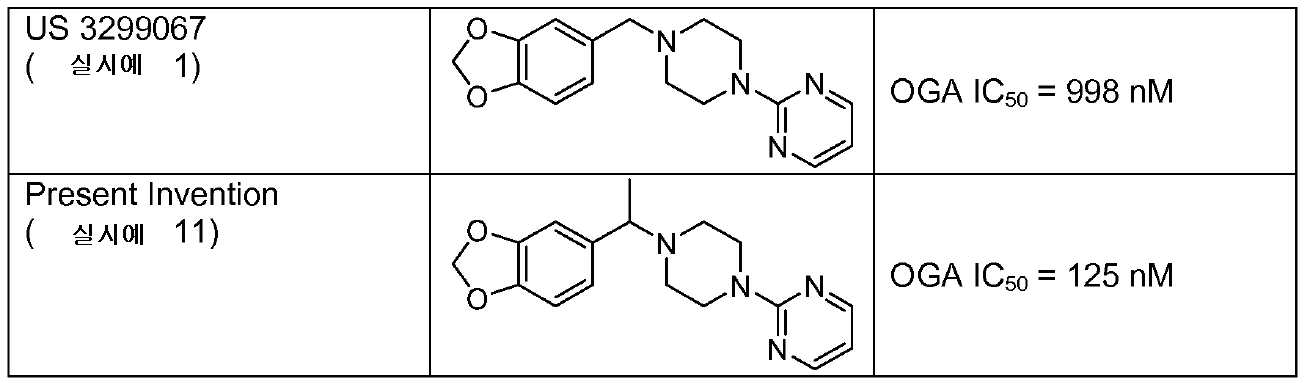
실시예Example 12: 212: 2 -(4-(1-(벤조[-(4- (1- (benzo [ d][1,3]디옥솔d] [1,3] dioxol -5--5- 일Work )에틸)피페라진-1-Ethyl) piperazine-1- 일Work )-4-이소프로필티아졸) -4-isopropylthiazole

단계 1: t-부틸 4-(4-이소Step 1: t-butyl 4- (4-iso 프로필티아졸Propylthiazole -2--2- 일Work )피페라진-1-카르복실레이트Piperazine-1-carboxylate
THF (10 mL) 중의 tert-부틸 4-카르바모티오일피페라진-1-카르복실레이트 (실시예 5, 단계 1에 따라 합성된, 1.2 g, 4.01 mmol)의 교반된 용액에서, 트리에틸 아민 (0.5 mL, 5.3 mmol) 및 1-브로모-3-메틸부탄-2-온 (1.0 mL, 5.3 mmol)을 실온에서 첨가하였다. 생성된 혼합물을 16 시간 동안 90 ℃에서 교반하였다. 상기 반응의 완료를 TLC로 모니터링하였다. 상기 반응 혼합물을 물로 중단시키고 EtOAc로 추출하였다. 유기층을 무수 Na2SO4 상에 건조시키고 진공하에 농축하고 생성된 조생성물을 다음 반응을 위해 그대로 취했다. 수득률: 80% (0.8 g, 담황색 오일). LCMS: (방법 A) 312.0 (M+H), Rt. 3.24 분, 95.2% (최대).In a stirred solution of tert-butyl 4-carbamothioylpiperazin-1-carboxylate (1.2 g, 4.01 mmol, synthesized according to Example 5, step 1) in THF (10 mL), triethyl amine (0.5 mL, 5.3 mmol) and 1-bromo-3-methylbutan-2-one (1.0 mL, 5.3 mmol) were added at room temperature. The resulting mixture was stirred at 90 ° C. for 16 hours. Completion of the reaction was monitored by TLC. The reaction mixture was stopped with water and extracted with EtOAc. The organic layer was dried over anhydrous Na 2 SO 4 Over phase and concentrated in vacuo and the resulting crude product was taken as is for the next reaction. Yield: 80% (0.8 g, pale yellow oil). LCMS: (Method A) 312.0 (M + H), Rt. 3.24 min, 95.2% (max).
단계 step 2: 42: 4 -이소프로필-2-(피페라진-1-Isopropyl-2- (piperazin-1- 일Work )티아졸 히드로클로리드Thiazole hydrochloride
건조한 디옥산 (2 mL) 중의 tert-부틸 4-(4-이소프로필티아졸-2-일)피페라진-1-카르복실레이트 (0.8 g, 2.4 mmol)의 교반된 용액에, 디옥산 중 HCl (4 N, 10 mL)을 실온에서 첨가하고 2 시간 동안 같은 온도에서 교반하였다. 반응 혼합물을 진공하에 농축하고 상기 조생성물을 디에틸 에테르로 세척하여 표제의 화합물을 얻었다. 수득률: 93% (1.2 g, 담황색 오일). To a stirred solution of tert-butyl 4- (4-isopropylthiazol-2-yl) piperazine-1-carboxylate (0.8 g, 2.4 mmol) in dry dioxane (2 mL), HCl in dioxane (4 N, 10 mL) was added at room temperature and stirred for 2 hours at the same temperature. The reaction mixture was concentrated in vacuo and the crude product was washed with diethyl ether to afford the title compound. Yield: 93% (1.2 g, pale yellow oil).
단계 step 3: 23: 2 -(4-(1-(벤조[d][1,3]디옥솔-5-일)에틸)피페라진-1-일)-4-이소프로필티아졸-(4- (1- (benzo [d] [1,3] dioxol-5-yl) ethyl) piperazin-1-yl) -4-isopropylthiazole
일반적인 과정 D에 따라, 4-이소프로필-2-(피페라진-1-일)티아졸 히드로클로리드 (0.57 g, 2.3 mmol) 및 중간체 1 (0.5 g, 2.3 mmol)을 이용하여 표제의 화합물을 합성하였다. 생성된 조생성물을 MD Autoprep (방법 C)으로 정제하여 표제의 화합물 (담황색 오일)을 얻었다. 1H NMR (400 MHz, DMSO-d6): δ 6.89 (s, 1H), 6.84 (d, J = 8.0 Hz, 1H), 6.76 (d, J = 8.0 Hz, 1H), 6.33 (s, 1H), 5.98 (m, 2H), 3.41-3.11 (m, 5H), 2.74-2.72 (m, 1H), 2.46-2.38 (m, 4H), 1.27 (d, J = 6.8 Hz, 3H), 1.15 (d, J = 6.8 Hz, 3H). LCMS: (방법 A) 360.0 (M+H), Rt. 2.71 분, 94.5% (최대). HPLC: (방법 A) Rt. 2.69 분, 98.8% (최대).According to General Procedure D, the title compound was prepared using 4-isopropyl-2- (piperazin-1-yl) thiazole hydrochloride (0.57 g, 2.3 mmol) and Intermediate 1 (0.5 g, 2.3 mmol). Synthesized. The resulting crude product was purified by MD Autoprep (Method C) to afford the title compound (pale yellow oil). 1 H NMR (400 MHz, DMSO-d 6 ): δ 6.89 (s, 1H), 6.84 (d, J = 8.0 Hz, 1H), 6.76 (d, J = 8.0 Hz, 1H), 6.33 (s, 1H ), 5.98 (m, 2H), 3.41-3.11 (m, 5H), 2.74-2.72 (m, 1H), 2.46-2.38 (m, 4H), 1.27 (d, J = 6.8 Hz, 3H), 1.15 ( d, J = 6.8 Hz, 3H). LCMS: (Method A) 360.0 (M + H), Rt. 2.71 minutes, 94.5% (max). HPLC: (method A) Rt. 2.69 min, 98.8% (max).
실시예Example 13: 213: 2 -(4-(1-(벤조[-(4- (1- (benzo [ d][1,3]디옥솔d] [1,3] dioxol -5--5- 일Work )에틸)피페라진-1-Ethyl) piperazine-1- 일Work )-4-(트리플루오로메틸)티아졸) -4- (trifluoromethyl) thiazole

단계 1: Step 1: tert-부틸tert-butyl 4-(4-(트리플루오로메틸)티아졸-2-일)피페라진-1-카르복실레이트 4- (4- (trifluoromethyl) thiazol-2-yl) piperazin-1-carboxylate
디옥산 (20 mL) 중의 tert-부틸 4-카르바모티오일피페라진-1-카르복실레이트 (실시예 5, 단계 1에 따라 합성된, 2 g, 13.75 mmol)의 교반된 용액에, 트리에틸 아민 (1.7 mL, 12.24 mmol) 및 1-브로모-3,3,3-트리플루오로 아세톤 (3.2 g, 16.5 mmol)을 첨가하고 90 ℃에서 3 시간 동안 교반하였다. 상기 반응의 완료를 TLC로 모니터링 하였다. 상기 반응 혼합물을 물 (10 mL)으로 중단시키고 에틸 아세테이트 (2 x 25 mL)로 추출하였다. 상기 유기층을 분리시키고, 무수 Na2SO4 상에 건조시키고, 진공하에 농축하고 다음 단계를 위해 그대로 사용하였다. 수득률: 75% (1.0 g, 백색 고체). 1H NMR (300 MHz, DMSO-d6): δ 7.57 (s, 1H), 3.42 (m, 8H), 1.40 (s, 9H). LCMS: (방법 A) 338.0 (M+H), Rt. 5.37 분, 99.0% (최대).To a stirred solution of tert-butyl 4-carbamothioylpiperazine-1-carboxylate (2 g, 13.75 mmol, synthesized according to Example 5, step 1) in dioxane (20 mL), triethyl Amine (1.7 mL, 12.24 mmol) and 1-bromo-3,3,3-trifluoro acetone (3.2 g, 16.5 mmol) were added and stirred at 90 ° C. for 3 hours. Completion of the reaction was monitored by TLC. The reaction mixture was stopped with water (10 mL) and extracted with ethyl acetate (2 x 25 mL). The organic layer was separated and anhydrous Na 2 SO 4 Dry over phase, concentrate in vacuo and use as is for next step. Yield: 75% (1.0 g, white solid). 1 H NMR (300 MHz, DMSO-d 6 ): δ 7.57 (s, 1H), 3.42 (m, 8H), 1.40 (s, 9H). LCMS: (Method A) 338.0 (M + H), Rt. 5.37 min, 99.0% (max).
단계 step 2: 22: 2 -(피페라진-1--(Piperazine-1- 일Work )-4-(트리) -4- (tree 플루오로메틸)Fluoromethyl) 티아졸 히드로클로리드Thiazole hydrochloride
건조한 디옥산 중의 tert-부틸 4-(4-(트리플루오로메틸)티아졸-2-일)피페라진-1-카르복실레이트 (1.0 g, 2.93 mmol)의 교반된 용액에, 디옥산 중 HCl (4 N, 15 mL)을 첨가하고 상기 반응 혼합물을 실온에서 1 시간 동안 교반하였다. 상기 반응 혼합물을 진공하에 농축하고 생성된 조생성물을 디에틸 에테르 중에 분쇄하고 여과하고 진공하에 건조하여 표제의 화합물을 얻었다. 수득률: 99 % (700 mg, 백색 고체). 1H NMR (400 MHz, DMSO-d6): δ 9.22 (br. s, 2H), 7.66(s, 1H), 3.68-3.64 (m, 4H), 3.21 (m, 4H). LCMS: (방법 A) 238.0 (M+H), Rt. 2.33 분, 99.7% (최대).To a stirred solution of tert-butyl 4- (4- (trifluoromethyl) thiazol-2-yl) piperazin-1-carboxylate (1.0 g, 2.93 mmol) in dry dioxane, HCl in dioxane (4 N, 15 mL) was added and the reaction mixture was stirred at rt for 1 h. The reaction mixture was concentrated in vacuo and the resulting crude product was triturated in diethyl ether, filtered and dried in vacuo to afford the title compound. Yield: 99% (700 mg, white solid). 1 H NMR (400 MHz, DMSO-d 6 ): δ 9.22 (br. S, 2H), 7.66 (s, 1H), 3.68-3.64 (m, 4H), 3.21 (m, 4H). LCMS: (Method A) 238.0 (M + H), Rt. 2.33 min, 99.7% (max).
단계 step 3: 23: 2 -(4-(1-(벤조[-(4- (1- (benzo [ d][1,3]디옥솔d] [1,3] dioxol -5--5- 일Work )에틸)피페라진-1-Ethyl) piperazine-1- 일Work )-4-(트리플루오로메틸)티아졸) -4- (trifluoromethyl) thiazole
건조한 DMF (3 mL) 중의 2-(피페라진-1-일)-4-(트리플루오로메틸)티아졸 히드로클로리드 (0.26 g, 1.07 mmol)의 교반된 용액에, 중간체 1 (0.19 g, 1.07 mmol) 및 트리에틸 아민 (0.272 g, 2.69 mmol)을 첨가하고 상기 반응 혼합물을 80 ℃에서 16 시간 동안 교반하였다. 상기 반응 혼합물을 농축하고, 조생성물을 에틸 아세테이트 (10 mL)로 희석하고 유기층을 염수 (10 mL)로 세척하였다. 유기층을 분리하고, 무수 Na2SO4 상에 건조시키고 농축하여 표제의 화합물(무색 오일)을 얻었다. 1H NMR (400 MHz, DMSO-d6): δ 6.96 (s, 1H), 6.88 (s, 1H), 6.76-7.75(m, 2H), 5.91 (s, 2H), 3.55-3.45 (m, 4H), 3.38 (q, J = 6.4 Hz, 1H), 2.62-2.49 (m, 4H), 2.56-2.51 (m, 4H), 1.36 (d, J = 6.4 Hz, 3H). LCMS: (방법 A) 386.0 (M+H), Rt. 3.55 분, 97.4% (최대). HPLC: (방법 A) Rt. 3.54 분, 98.7% (최대).To a stirred solution of 2- (piperazin-1-yl) -4- (trifluoromethyl) thiazole hydrochloride (0.26 g, 1.07 mmol) in dry DMF (3 mL), intermediate 1 (0.19 g, 1.07 mmol) and triethyl amine (0.272 g, 2.69 mmol) were added and the reaction mixture was stirred at 80 ° C for 16 h. The reaction mixture was concentrated, the crude product diluted with ethyl acetate (10 mL) and the organic layer washed with brine (10 mL). The organic layer was separated and anhydrous Na 2 SO 4 Drying over phase and concentration gave the title compound (colorless oil). 1 H NMR (400 MHz, DMSO-d 6 ): δ 6.96 (s, 1H), 6.88 (s, 1H), 6.76-7.75 (m, 2H), 5.91 (s, 2H), 3.55-3.45 (m, 4H), 3.38 (q, J = 6.4 Hz, 1H), 2.62-2.49 (m, 4H), 2.56-2.51 (m, 4H), 1.36 (d, J = 6.4 Hz, 3H). LCMS: (Method A) 386.0 (M + H), Rt. 3.55 min, 97.4% (max). HPLC: (method A) Rt. 3.54 min, 98.7% (max).
실시예Example 14: 114: 1 -(1-(벤조[-(1- (benzo [ d][1,3]디옥솔d] [1,3] dioxol -5--5- 일Work )에틸)-4-(5-메틸) Ethyl) -4- (5-methyl 피리딘Pyridine -2-일)피페라진2-yl) piperazine

표제의 화합물을 일반적인 과정 D에 따라 중간체 2 및 2-플루오로-5-메틸 피리딘을 이용하여 합성하였다. 그 조생성물을 속성 크로마토그래피로 정제하여 표제의 화합물 (황백색 고체)을 얻었다. 1H NMR (400 MHz, DMSO-d6): δ 7.92 (s, 1H), 7.36-7.33 (m, 1H), 6.89 (s, 1H), 6.84 (d, J = 8.0 Hz, 1H), 6.76 (d, J = 7.6 Hz, 1H), 6.70 (d, J = 8.4 Hz, 1H), 5.99 (m, 2H), 3.37-3.35 (m, 5H), 2.47-2.44 (m, 2H), 2.38-2.36 (m, 2H), 2.12 (s, 3H),1.28 (d, J = 6.8 Hz, 3H). LCMS: (방법 A) 326.2 (M+H), Rt. 1.96 분, 97.6% (최대). HPLC: (방법 A) Rt. 1.96 분, 98.1% (최대).The title compound was synthesized using Intermediate 2 and 2-fluoro-5-methyl pyridine according to General Procedure D. The crude product was purified by flash chromatography to give the title compound (yellow white solid). 1 H NMR (400 MHz, DMSO-d 6 ): δ 7.92 (s, 1H), 7.36-7.33 (m, 1H), 6.89 (s, 1H), 6.84 (d, J = 8.0 Hz, 1H), 6.76 (d, J = 7.6 Hz, 1H), 6.70 (d, J = 8.4 Hz, 1H), 5.99 (m, 2H), 3.37-3.35 (m, 5H), 2.47-2.44 (m, 2H), 2.38- 2.36 (m, 2H), 2.12 (s, 3H), 1.28 (d, J = 6.8 Hz, 3H). LCMS: (Method A) 326.2 (M + H), Rt. 1.96 min, 97.6% (max). HPLC: (method A) Rt. 1.96 min, 98.1% (max).
실시예Example 15: (R)-2-(4-(1-( 15: (R) -2- (4- (1- ( 벤조[d][1,3]디옥솔Benzo [d] [1,3] dioxole -5-일)에틸)피페라진-1-일)-4-메틸티아졸 또는 (S)-2-(4-(1-(-5-yl) ethyl) piperazin-1-yl) -4-methylthiazole or (S) -2- (4- (1- ( 벤조[d][1,3]디옥솔Benzo [d] [1,3] dioxole -5-일)에틸)피페라진-1-일)-4--5-yl) ethyl) piperazin-1-yl) -4- 메틸티아졸Methylthiazole


실시예 A의 두 거울상이성질체를 키랄성 조제용 HPLC (방법 PE)로 분리하였다. 첫 번째 용리 화합물을 Rt. 5.76 분 (방법 C) (무색 오일)을 가진다. 1H NMR (400 MHz, DMSO-d6): δ 6.89 (s, 1H), 6.84 (d, J = 8.0 Hz, 1H), 6.76 (d, J = 8.0 Hz, 1H), 6.35 (s, 1H), 5.99-5.98 (m, 2H), 3.40-3.36 (m, 1H), 3.32-3.29 (m, 4H), 2.47-2.44 (m, 2H), 2.41-2.37 (m, 2H), 2.11 (s, 3H), 1.26 (d, J = 6.4 Hz, 3H). LCMS: (방법 A) 332.0 (M+H), Rt. 2.06 분, 96.3% (최대). HPLC: (방법 A) Rt 2.05 분, 99.5% (최대), 99.4% (254nm). HPLC 키랄성 순도: (방법 C) Rt. 5.76 분, 100% (최대). 실시예 15는 Rt. 7.44 분 (방법 C) (무색 오일)을 갖는 두 번째 용리 화합물이다. 1H NMR (400 MHz, DMSO-d6): δ 6.89 (s, 1H), 6.84 (d, J = 8.0 Hz, 1H), 6.76 (d, J = 8.0 Hz, 1H), 6.35 (s, 1H), 5.99 (s, 2H), 3.42-3.37 (m, 1H), 3.32-3.30 (m, 4H), 2.47-2.44 (m, 2H), 2.40-2.36 (m, 2H), 2.11 (s, 3H), 1.26 (d, J = 6.8 Hz, 3H). LCMS: (방법 A) 332.0 (M+H), Rt. 2.04 분, 99.2% (최대). HPLC: (방법 A) Rt. 2.05 분, 99.2% (최대). HPLC 키랄성 순도: (방법 C) Rt. 7.44 분, 99.83% (최대).Two enantiomers of Example A were separated by chiral preparative HPLC (method PE). The first eluting compound to Rt. 5.76 minutes (Method C) (colorless oil). 1 H NMR (400 MHz, DMSO-d 6 ): δ 6.89 (s, 1H), 6.84 (d, J = 8.0 Hz, 1H), 6.76 (d, J = 8.0 Hz, 1H), 6.35 (s, 1H ), 5.99-5.98 (m, 2H), 3.40-3.36 (m, 1H), 3.32-3.29 (m, 4H), 2.47-2.44 (m, 2H), 2.41-2.37 (m, 2H), 2.11 (s , 3H), 1.26 (d, J = 6.4 Hz, 3H). LCMS: (Method A) 332.0 (M + H), Rt. 2.06 min, 96.3% (max). HPLC: (method A) Rt 2.05 min, 99.5% (max), 99.4% (254 nm). HPLC chiral purity: (method C) Rt. 5.76 minutes, 100% (max). Example 15 is Rt. Second elution compound with 7.44 min (Method C) (colorless oil). 1 H NMR (400 MHz, DMSO-d 6 ): δ 6.89 (s, 1H), 6.84 (d, J = 8.0 Hz, 1H), 6.76 (d, J = 8.0 Hz, 1H), 6.35 (s, 1H ), 5.99 (s, 2H), 3.42-3.37 (m, 1H), 3.32-3.30 (m, 4H), 2.47-2.44 (m, 2H), 2.40-2.36 (m, 2H), 2.11 (s, 3H ), 1.26 (d, J = 6.8 Hz, 3H). LCMS: (Method A) 332.0 (M + H), Rt. 2.04 min, 99.2% (max). HPLC: (method A) Rt. 2.05 minutes, 99.2% (max). HPLC chiral purity: (method C) Rt. 7.44 minutes, 99.83% (maximum).
실시예Example 16: 216: 2 -(4-(1-(벤조[-(4- (1- (benzo [ d][1,3]디옥솔d] [1,3] dioxol -5--5- 일Work )에틸)피페라진-1-Ethyl) piperazine-1- 일Work )-4-(tert-부틸)티아졸) -4- (tert-butyl) thiazole

단계 1: Step 1: tert-부틸tert-butyl 4-(4-( 4- (4- ( tert-부틸tert-butyl )티아졸-2-Thiazole-2- 일Work )피페라진-1-카르복실레이트Piperazine-1-carboxylate
디옥산 (10 mL) 중의 tert-부틸 4-카르바모티오일피페라진-1-카르복실레이트 (실시예 5, 단계 1에 따라 합성된, 1.3 g, 5.3 mmol)의 교반된 용액에, TEA (1 mL, 7 mmol) 및 1-브로모-3,3-디메틸부탄-2-온 (0.94 mL, 6.8 mmol)을 실온에서 첨가하고, 90 ℃에서 16 시간 동안 교반하였다. 상기 반응의 완료를 TLC로 모니터링하였다. 상기 반응 혼합물을 물로 중단시키고 EtOAc로 추출하였다. 그 유기층을 무수 Na2SO4 상에 건조시키고, 진공하에 농축시키고 생성된 조생성물을 추가적인 정제 없이 그대로 다음 단계를 위해 취했다. 수득률: 88% (1.5 g, 흑색 액체). LCMS: (방법 A) 326.2 (M+H), Rt. 3.75 분, 60.4% (최대).To a stirred solution of tert-butyl 4-carbamothioylpiperazin-1-carboxylate (1.3 g, 5.3 mmol, synthesized according to Example 5, step 1) in dioxane (10 mL), TEA ( 1 mL, 7 mmol) and 1-bromo-3,3-dimethylbutan-2-one (0.94 mL, 6.8 mmol) were added at rt and stirred at 90 ° C. for 16 h. Completion of the reaction was monitored by TLC. The reaction mixture was stopped with water and extracted with EtOAc. The organic layer was dried over anhydrous Na 2 SO 4 , concentrated in vacuo and the resulting crude product was taken for the next step without further purification. Yield: 88% (1.5 g, black liquid). LCMS: (Method A) 326.2 (M + H), Rt. 3.75 minutes, 60.4% (max).
단계 step 2: 42: 4 -(-( tert-부틸tert-butyl )-2-(피페라진-1-) -2- (piperazin-1- 일Work )티아졸 히드로클로리드Thiazole hydrochloride
건조한 디옥산 (2 mL) 중의 tert-부틸 4-(4-(tert-부틸)티아졸-2-일)피페라진-1-카르복실레이트 (1.5 g, 4.61 mmol)의 교반된 용액에, 디옥산 중 HCl (4 N, 10 mL)을 첨가하고 상기 반응 혼합물을 실온에서 2 시간 동안 교반하였다. 상기 반응 혼합물을 진공하에 농축하고 생성된 조생성물을 디에틸 에테르 (100 mL) 중에 분쇄하고, 여과하고, 진공하에 건조시켜 표제의 화합물을 얻었다. 수득률: 63% (1.02 g, 흑색 고체).To a stirred solution of tert-butyl 4- (4- (tert-butyl) thiazol-2-yl) piperazin-1-carboxylate (1.5 g, 4.61 mmol) in dry dioxane (2 mL), HCl in oxane (4 N, 10 mL) was added and the reaction mixture was stirred at rt for 2 h. The reaction mixture was concentrated in vacuo and the resulting crude product was triturated in diethyl ether (100 mL), filtered and dried in vacuo to afford the title compound. Yield: 63% (1.02 g, black solid).
단계 step 3: 23: 2 -(4-(1-(벤조[-(4- (1- (benzo [ d][1,3]디옥솔d] [1,3] dioxol -5--5- 일Work )에틸)피페라진-1-Ethyl) piperazine-1- 일Work )-4-(tert-부틸)티아졸) -4- (tert-butyl) thiazole
표제의 화합물을 일반적인 과정 D에 따라 4-(tert-부틸)-2-(피페라진-1-일)티아졸 히드로클로리드 (0.732 g, 2.8 mmol) 및 중간체 1 (0.28 g, 2.8 mmol)을 이용하여 합성하고, 그 조생성물을 속성 크로마토그래피로 정제하였다 (담황색 오일). 1H NMR (400 MHz, DMSO-d6): δ 6.89 (s, 1H ), 6.85 (d, J = 7.6Hz), 6.76 (d, J = 7.6Hz, 1H), 6.33 (s, 1H), 5.99 (m, 2H), 3.40 (m, 1H), 3.37- 3.30 (m, 4H), 2.49-2.46 (m, 2H), 2.43 -2.40(m, 2H), 1.28 (d, J = 6.8Hz, 3H), 1.19 (s, 9H). LCMS: (방법 A) 374.0 (M+H), Rt. 3.40 분, 98.6% (최대). HPLC: (방법 A) Rt. 3.39 분, 99.7% (최대).The title compound was purified using 4- ( tert-butyl ) -2- (piperazin-1-yl) thiazole hydrochloride (0.732 g, 2.8 mmol) and intermediate 1 (0.28 g, 2.8 mmol) according to General Procedure D. The crude product was purified by flash chromatography (pale yellow oil). 1 H NMR (400 MHz, DMSO-d 6 ): δ 6.89 (s, 1H), 6.85 (d, J = 7.6 Hz), 6.76 (d, J = 7.6 Hz, 1H), 6.33 (s, 1H), 5.99 (m , 2H), 3.40 (m, 1H), 3.37-3.30 (m, 4H), 2.49-2.46 (m, 2H), 2.43 -2.40 (m, 2H), 1.28 (d, J = 6.8 Hz, 3H), 1.19 (s, 9 H). LCMS: (Method A) 374.0 (M + H), Rt. 3.40 minutes, 98.6% (max). HPLC: (method A) Rt. 3.39 min, 99.7% (max).
실시예Example 17: 에틸 2-(4-(1-(벤조[ 17: ethyl 2- (4- (1- (benzo [ d][1,3]디옥솔d] [1,3] dioxol -5--5- 일Work )에틸)피페라진-1-일)티아졸-4-카르복실레이트) Ethyl) piperazin-1-yl) thiazole-4-carboxylate

단계 1: 에틸 2-(4-(Step 1: ethyl 2- (4- ( terttert -- 부톡시카르보닐Butoxycarbonyl )피페라진-1-Piperazine-1- 일Work )티아졸-4-카르복실레이트Thiazole-4-carboxylate
디옥산 (10 mL) 중의 tert-부틸 4-카르바모티오일피페라진-1-카르복실레이트 (실시예5, 단계1에따라 합성된, 단계 1, 3.0 g, 12 mmol)의 교반된 용액에, TEA (2.6 mL, 16 mmol) 및 3-브로모-에틸 피루베이트 (2.1 mL, 16 mmol)를 실온에서 첨가하고 상기 혼합물을 90 ℃에서 16 시간 동안 교반하였다. 상기 반응의 완료를 TLC로 모니터링하였다. 상기 반응 혼합물을 물로 완료시키고 EtOAc로 추출하였다. 그 유기층을 무수 Na2SO4 상에 건조시키고, 진공하에 농축하고 생성된 조생성물을 다음 단계를 위해 그대로 취하였다. 수득률: 95% (4 g, 흑색 고체). To a stirred solution of tert-butyl 4-carbamothioylpiperazine-1-carboxylate (step 1, 3.0 g, 12 mmol, synthesized according to Example 5, step 1) in dioxane (10 mL) , TEA (2.6 mL, 16 mmol) and 3-bromo-ethyl pyruvate (2.1 mL, 16 mmol) were added at rt and the mixture was stirred at 90 ° C. for 16 h. Completion of the reaction was monitored by TLC. The reaction mixture was complete with water and extracted with EtOAc. The organic layer was dried over anhydrous Na 2 SO 4 Dry over phase, concentrate in vacuo and the resulting crude product is taken as is for the next step. Yield: 95% (4 g, black solid).
단계 2: 에틸 2-(피페라진-1-Step 2: ethyl 2- (piperazin-1- 일Work )티아졸-4-카르복실레이트 히드로클로리드Thiazole-4-carboxylate hydrochloride
건조한 디옥산 (2 mL) 중의 에틸 2-(4-(tert-부톡시카르보닐)피페라진-1-일)티아졸-4-카르복실레이트 (4.0 g, 11.73 mmol)의 교반된 용액에, 디옥산 중 HCl (4 N, 10 mL)을 실온에서 첨가하고 2 시간 동안 교반하였다. 상기 반응 혼합물을 진공하에 농축하고 생성된 조생성물을 디에틸 에테르 (25 mL) 중에 분쇄하고, 여과하고, 진공하에 건조하여 표제의 화합물을 얻었다. 수득률: 90% (3.2 g, 흑색 고체). LCMS: (방법 A) 242.0 (M+H), Rt. 1.88 분, 90.7% (최대).To a stirred solution of ethyl 2- (4- ( tert -butoxycarbonyl) piperazin-1-yl) thiazole-4-carboxylate (4.0 g, 11.73 mmol) in dry dioxane (2 mL), HCl in dioxane (4 N, 10 mL) was added at room temperature and stirred for 2 hours. The reaction mixture was concentrated in vacuo and the resulting crude product was triturated in diethyl ether (25 mL), filtered and dried in vacuo to afford the title compound. Yield: 90% (3.2 g, black solid). LCMS: (Method A) 242.0 (M + H), Rt. 1.88 min, 90.7% (max).
단계 3: 에틸 2-(4-(1-(벤조[Step 3: ethyl 2- (4- (1- (benzo [ d][1,3]디옥솔d] [1,3] dioxol -5--5- 일Work )에틸)피페라진-1-일)티아졸-4-카르복실레이트) Ethyl) piperazin-1-yl) thiazole-4-carboxylate
표제의 화합물을 에틸 2-(피페라진-1-일)티아졸-4-카르복실레이트 히드로클로리드 및 중간체 1을 이용하여 일반적인 과정 D에 따라 합성하고, 그 조생성물을 속성 크로마토그래피 후, MD Autoprep (방법 B)에 의해 정제하였다 (황색 고체). 1HNMR (400 MHz, DMSO-d6): 7.66 (d, J = 2.0Hz, 1H), 6.88 (s, 1H), 6.84 (d, J = 8.0Hz,1H), 6.75 (d, J = 8.0Hz,1H), 5.98 (m, 2H), 4.21-4.20 (m, 2H), 3.38-3.32 (m, 5H), 2.49-2.40 (m, 4H), 1.26-1.23 (m, 6H). LCMS: (방법 A) 390.0 (M+H), Rt. 2.99 분, 97.8% (최대). HPLC: (방법 A) Rt. 2.95 분, 98.9% (최대).The title compound is synthesized according to general procedure D using ethyl 2- (piperazin-1-yl) thiazole-4-carboxylate hydrochloride and intermediate 1, and the crude product is subjected to flash chromatography, followed by MD Purification by Autoprep (Method B) (yellow solid). 1 HNMR (400 MHz, DMSO-d 6 ): 7.66 (d, J = 2.0 Hz, 1H), 6.88 (s, 1H), 6.84 (d, J = 8.0 Hz, 1H), 6.75 (d, J = 8.0 Hz, 1H), 5.98 (m, 2H), 4.21-4.20 (m, 2H), 3.38-3.32 (m, 5H), 2.49-2.40 (m, 4H), 1.26-1.23 (m, 6H). LCMS: (Method A) 390.0 (M + H), Rt. 2.99 minutes, 97.8% (max). HPLC: (method A) Rt. 2.95 min, 98.9% (max).
실시예Example 18: 218: 2 -(4-(1-(벤조[-(4- (1- (benzo [ d][1,3]디옥솔d] [1,3] dioxol -5--5- 일Work )에틸)피페라진-1-일)티아졸-4-카르복실산) Ethyl) piperazin-1-yl) thiazole-4-carboxylic acid

건조한 THF (10 mL) 중의 실시예 17 (0.2 g)의 교반된 용액에, 물 중 5% NaOH (5 mL)를 실온에 천천히 첨가하고, 상기 생성물을 16 시간 동안 같은 온도에서 교반하였다. 그런 다음, 이를 진공하에 농축하고, 2N HCl로 pH = 6으로 중화하고, DCM (20 mL)으로 추출하였다. 그 유기층을 염수 (10 mL), 물 (10 mL)로 세척하고, 무수 Na2SO4 상에 건조시키고, 감압하에 농축하였다. 상기 조생성물을 속성 크로마토그래피 후, MD Autoprep (방법 B)으로 정제하여 표제의 화합물 (황백색 고체)을 얻었다. 1H NMR (400 MHz, DMSO-d6): δ 7.58 (s, 1H ), 6.90 (s, 1H), 6.88 (d, J = 8.0Hz,1H). 6.76 (d, J = 8.0 Hz, 1H), 6.00-5.99 (m, 2H), 3.35-3.36 (m, 5H), 2.51-2.49 (m, 2H), 2.44-2.40 (m, 2H), 1.29-1.27 (d, J = 6.8Hz, 3H). LCMS: (방법 A) 362.0 (M+H), Rt. 2.29 분, 95.5% (최대). HPLC: (방법 A) Rt. 2.30 분, 95.9% (최대).To a stirred solution of Example 17 (0.2 g) in dry THF (10 mL), 5% NaOH (5 mL) in water was slowly added to room temperature and the product was stirred at the same temperature for 16 hours. It was then concentrated in vacuo, neutralized to pH = 6 with 2N HCl and extracted with DCM (20 mL). The organic layer was washed with brine (10 mL), water (10 mL), anhydrous Na 2 SO 4 Dry over phase and concentrate under reduced pressure. The crude product was subjected to flash chromatography and then purified by MD Autoprep (Method B) to afford the title compound (yellow white solid). 1 H NMR (400 MHz, DMSO-d 6 ): δ 7.58 (s, 1 H), 6.90 (s, 1 H), 6.88 (d, J = 8.0 Hz, 1 H). 6.76 (d, J = 8.0 Hz, 1H), 6.00-5.99 (m, 2H), 3.35-3.36 (m, 5H), 2.51-2.49 (m, 2H), 2.44-2.40 (m, 2H), 1.29- 1.27 (d, J = 6.8 Hz, 3H). LCMS: (Method A) 362.0 (M + H), Rt. 2.29 min, 95.5% (max). HPLC: (method A) Rt. 2.30 minutes, 95.9% (max).
실시예Example 19: 219: 2 -(4-(1-(벤조[-(4- (1- (benzo [ d][1,3]디옥솔d] [1,3] dioxol -5--5- 일Work )에틸)피페라진-1-Ethyl) piperazine-1- 일Work )-4-에틸티아졸) -4-ethylthiazole

단계 1: t-부틸 4-(4-에틸Step 1: t-butyl 4- (4-ethyl 티아졸Thiazole -2--2- 일Work )피페라진-1-카르복실레이트Piperazine-1-carboxylate
디옥산 (20 mL) 중의 tert-부틸 4-카르바모티오일피페라진-1-카르복실레이트 (실시예 5, 단계 1에 따라 합성된, 2.0 g, 8.16 mmol)의 교반된 용액에, TEA (1.7 mL, 10.6 mmol) 및 1-브로모부탄-2-온 (1.2 mL, 10 mmol)을 첨가하고 80 ℃에서 16 시간 동안 교반하였다. 상기 반응의 완료를 TLC로 모니터링하였다. 상기 반응 혼합물을 물 (10 mL)로 완료시키고 EtOAc (2 x 25 mL)로 추출하였다. 그 유기층을 분리시키고, 무수 Na2SO4 상에 건조시키고, 감압하에 농축하였다. 생성된 생성물을 다음 단계를 위해 그대로 취했다. 수득률: 86% (2.1 g, 담황색 고체). LCMS: (방법 A) 298.0 (M+H), Rt. 2.94 분, 93.1% (최대).To a stirred solution of tert-butyl 4-carbamothioylpiperazine-1-carboxylate (2.0 g, 8.16 mmol, synthesized according to Example 5, step 1) in dioxane (20 mL), TEA ( 1.7 mL, 10.6 mmol) and 1-bromobutan-2-one (1.2 mL, 10 mmol) were added and stirred at 80 ° C. for 16 h. Completion of the reaction was monitored by TLC. The reaction mixture was complete with water (10 mL) and extracted with EtOAc (2 x 25 mL). The organic layer was separated and anhydrous Na 2 SO 4 Dry over phase and concentrate under reduced pressure. The resulting product was taken as is for the next step. Yield: 86% (2.1 g, pale yellow solid). LCMS: (Method A) 298.0 (M + H), Rt. 2.94 min, 93.1% (max).
단계 step 2: 42: 4 -에틸-2-(피페라진-1-Ethyl-2- (piperazin-1- 일Work )티아졸 히드로클로리드Thiazole hydrochloride
건조한 디옥산 (2 mL) 중의 tert-부틸 4-(4-에틸티아졸-2-일)피페라진-1-카르복실레이트 (1.9 g, 6.3 mmol)의 교반된 용액에, 디옥산 중 HCl (4 N, 10 mL)을 첨가하고 상기 반응 혼합물을 실온에서 2 시간 동안 교반하였다. 상기 반응 혼합물을 진공하에 농축하고 조생성물을 디에틸 에테르 (15 mL) 중에 분쇄하고, 여과하고, 진공하에 건조하여 표제의 화합물을 얻었다. 수득률: 53% (0.8 g, 흑색 고체). To a stirred solution of tert-butyl 4- (4-ethylthiazol-2-yl) piperazine-1-carboxylate (1.9 g, 6.3 mmol) in dry dioxane (2 mL), HCl in dioxane ( 4 N, 10 mL) was added and the reaction mixture was stirred at rt for 2 h. The reaction mixture was concentrated in vacuo and the crude product was triturated in diethyl ether (15 mL), filtered and dried in vacuo to afford the title compound. Yield: 53% (0.8 g, black solid).
단계 step 3: 23: 2 -(4-(1-(벤조[-(4- (1- (benzo [ d][1,3]디옥솔d] [1,3] dioxol -5--5- 일Work )에틸)피페라진-1-Ethyl) piperazine-1- 일Work )-4-에틸티아졸) -4-ethylthiazole
표제의 화합물을 4-에틸-2-(피페라진-1-일)티아졸 히드로클로리드 (1.1 g, 4.7 mmol) 및 중간체 1 (0.9 g, 4.7 mmol)을 이용하여, 일반적인 과정 D에 따라 합성하였다. 상기 조생성물을 속성 크로마토그래피 (담황색 오일)로 정제하였다. 1H NMR (400 MHz, DMSO-d6): δ 6.89 (d, J =1.6Hz, 1H), 6.84 (d, J =7.6Hz, 1H), 6.75 (d, J = 7.5Hz, 1H), 6.35 (s, 1H), 5.98 (m, 2H), 3.40-3.37 (m, 1H), 3.37-3.30 (m, 4H), 2.51-2.38 (m, 6H), 1.28 (d, J = 6.8Hz, 3H), 1.23 (t, J = 7.6Hz, 3H). LCMS: (방법 A) 346.0 (M+H), Rt. 2.31 분, 98.0% (최대). HPLC: (방법 A) Rt. 2.34 분, 99.4% (최대).The title compound is 4-ethyl-2- (piperazin-1-yl) thiazole hydrochloride. (1.1 g, 4.7 mmol) and intermediate 1 (0.9 g, 4.7 mmol) were synthesized according to general procedure D. The crude product was purified by flash chromatography (pale yellow oil). 1 H NMR (400 MHz, DMSO-d 6 ): δ 6.89 (d, J = 1.6 Hz, 1H), 6.84 (d, J = 7.6 Hz, 1H), 6.75 (d, J = 7.5 Hz, 1H), 6.35 (s, 1H), 5.98 (m, 2H), 3.40-3.37 (m, 1H), 3.37-3.30 (m, 4H), 2.51-2.38 (m, 6H), 1.28 (d, J = 6.8 Hz, 3H), 1.23 (t, J = 7.6 Hz, 3H). LCMS: (Method A) 346.0 (M + H), Rt. 2.31 min, 98.0% (max). HPLC: (method A) Rt. 2.34 min, 99.4% (max).
실시예Example 20: 120: 1 -(1-(벤조[-(1- (benzo [ d][1,3]디옥솔d] [1,3] dioxol -5--5- 일Work )에틸)-4-(6-) Ethyl) -4- (6- 클로로피리딘Chloropyridine -3-일)피페라진-3-yl) piperazine

표제의 화합물을 중간체 1 및 1-(5-클로로-2-피리딜) 피페라진을 이용하여 일반적인 과정 D에 따라 합성하였다. 상기 조생성물을 속성 크로마토그래피로 정제하였다 (황백색 고체). 1H NMR (400 MHz, DMSO-d6): δ 8.07 (d, J = 2.4Hz, 1H), 7.57-7.54 (m, 1H), 6.88-6.74 (m, 4H), 5.98 (m, 2H), 3.42 (q, J = 6.4Hz, 1H), 2.46-2.43 (m, 2H), 2.37-2.34 (m, 2H),1.28 (d, J = 6.4Hz, 3H). LCMS: (방법 A) 346.0 (M+H), Rt. 3.27 분, 98.7% (최대). HPLC: (방법 A) Rt 3.25 분, 99.2% (최대).The title compound was synthesized according to general procedure D using intermediate 1 and 1- (5-chloro-2-pyridyl) piperazine. The crude product was purified by flash chromatography (yellow white solid). 1 H NMR (400 MHz, DMSO-d 6 ): δ 8.07 (d, J = 2.4 Hz, 1H), 7.57-7.54 (m, 1H), 6.88-6.74 (m, 4H), 5.98 (m, 2H) , 3.42 (q, J = 6.4 Hz, 1H), 2.46-2.43 (m, 2H), 2.37-2.34 (m, 2H), 1.28 (d, J = 6.4 Hz, 3H). LCMS: (Method A) 346.0 (M + H), Rt. 3.27 min, 98.7% (max). HPLC: (method A) Rt 3.25 min, 99.2% (Max).
실시예Example 21: 121: 1 -(1-(벤조[-(1- (benzo [ d][1,3]디옥솔d] [1,3] dioxol -5--5- 일Work )에틸)-4-(6-메틸) Ethyl) -4- (6-methyl 피리딘Pyridine -2-일)피페라진2-yl) piperazine

건조한 DMF (2 mL) 중의 중간체 2 (0.12 g, 0.5 mmol)의 교반된 용액에, 2-플루오로-6-메틸 피리딘 (0.11 g, 0.99 mmol) 및 DIPEA (0.26 g, 2.4 mmol)을 실온에서 첨가하고, 상기 반응 혼합물을 120 ℃에서 16 시간 동안 교반하였다. 상기 반응 혼합물을 실온으로 냉각시키고 감압하에 농축하였다. 생성된 조생성물을 속성 크로마토그래피 후, 조제용 HPLC (방법 PA)로 정제하여 표제의 화합물 (갈색 액체)을 얻었다. 1H NMR (400 MHz, DMSO-d6): δ 7.40-7.36 (m, 1H), 6.90 (s, 1H), 6.85 (d, J = 7.6 Hz, 1H), 6.77 (d, J = 7.6 Hz, 1H), 6.55-6.46 (m, 2H), 5.98 (s, 2H), 3.410-3.415(m,5H), 2.38-2.37 (m, 4H), 2.28- 2.30 (m, 3H), 1.29 (d, J = 7.2 Hz, 3H). LCMS: (방법 A) 326.2 (M+H), Rt. 1.89 분, 94.9% (최대). HPLC: (방법 A) Rt 1.91 분, 96.6% (최대).To a stirred solution of intermediate 2 (0.12 g, 0.5 mmol) in dry DMF (2 mL), 2-fluoro-6-methyl pyridine (0.11 g, 0.99 mmol) and DIPEA (0.26 g, 2.4 mmol) were added at room temperature. Was added and the reaction mixture was stirred at 120 ° C. for 16 h. The reaction mixture was cooled to rt and concentrated under reduced pressure. The resulting crude product was subjected to flash chromatography, then purified by preparative HPLC (method PA) to afford the title compound (brown liquid). 1 H NMR (400 MHz, DMSO-d 6 ): δ 7.40-7.36 (m, 1H), 6.90 (s, 1H), 6.85 (d, J = 7.6 Hz, 1H), 6.77 (d, J = 7.6 Hz , 1H), 6.55-6.46 (m, 2H), 5.98 (s, 2H), 3.410-3.415 (m, 5H), 2.38-2.37 (m, 4H), 2.28-2.30 (m, 3H), 1.29 (d , J = 7.2 Hz, 3H). LCMS: (Method A) 326.2 (M + H), Rt. 1.89 min, 94.9% (max). HPLC: (method A) Rt 1.91 min, 96.6% (max).
실시예Example 22: 222: 2 -(4-(1-(벤조[-(4- (1- (benzo [ d][1,3]디옥솔d] [1,3] dioxol -5--5- 일Work )에틸)피페라진-1-일)피리미딘-4-아민) Ethyl) piperazin-1-yl) pyrimidin-4-amine

표제의 화합물을 중간체 2 (0.228 g, 0.85 mmol) 및 4-아미노-2-클로로 피리미딘 (0.1 g, 0.77 mmol)을이용하여 과정 D에 따라 합성하였다. 상기 조생성물을 속성 크로마토그래피 후, MD Autoprep (방법 B)로 정제하였다 (백색 고체). 1H NMR (400 MHz, DMSO-d6): δ 7.70 (d, J = 5.2Hz, 1H), 6.88 (s, 1H), 6.83 (d, J = 8.0Hz, 1H), 6.75 (d, J = 7.6Hz, 1H), 6.36 (s, 2H), 5.98 (m, 2H), 5.69 (d, J = 5.6Hz, 1H), 3.6-3.58 (m, 4H), 3.33-3.32 (m, 1H), 2.38-2.34 (m, 2H), 2.31-2.27 (m, 2H), 1.27 (d, J = 6.8Hz, 3H). LCMS: (방법 A) 328.0 (M+H), Rt. 1.85 분, 97.2% (최대). HPLC: (방법 A) Rt. 1.84 분, 97.1% (최대).Title compound Synthesis was carried out according to procedure D using intermediate 2 (0.228 g, 0.85 mmol) and 4-amino-2-chloro pyrimidine (0.1 g, 0.77 mmol). The crude product was purified by flash chromatography followed by MD Autoprep (method B) (white solid). 1 H NMR (400 MHz, DMSO-d 6 ): δ 7.70 (d, J = 5.2 Hz, 1H), 6.88 (s, 1H), 6.83 (d, J = 8.0 Hz, 1H), 6.75 (d, J = 7.6 Hz, 1H), 6.36 (s, 2H), 5.98 (m, 2H), 5.69 (d, J = 5.6 Hz, 1H), 3.6-3.58 (m, 4H), 3.33-3.32 (m, 1H) , 2.38-2.34 (m, 2H), 2.31-2.27 (m, 2H), 1.27 (d, J = 6.8 Hz, 3H). LCMS: (Method A) 328.0 (M + H), Rt. 1.85 min, 97.2% (max). HPLC: (method A) Rt. 1.84 min, 97.1% (max).
실시예Example 23: N-(2-(4-(1-(벤조[ 23: N- (2- (4- (1- (benzo [ d][1,3]디옥솔d] [1,3] dioxol -5--5- 일Work )에틸)피페라진-1-일)피리미딘-4-일)아세트아미드) Ethyl) piperazin-1-yl) pyrimidin-4-yl) acetamide

단계 1: N-(2-Step 1: N- (2- 클로로피리미딘Chloropyrimidine -4--4- 일Work )아세트아미드Acetamide
DCM (5 mL) 중의 4-아미노-2-클로로 피리미딘 (0.6 g, 4.65 mmol)의 교반된 용액에, 피리딘 (1.8 mL) 및 무수 아세트산 (0.71 g, 6.9 mmol)를 0 ℃에서 첨가하고 75 ℃에서 6 시간 동안 교반하였다. 상기 반응 혼합물을 진공하에 농축하고 생성된 조생성물을 EtOAc (15 mL) 중에 용해시켰다. 유기층을 물 (10 mL), 염수 (10 mL)로 세척하고 무수 Na2SO4 상에 건조시켰다. 진공하에 농축한 후, 그 조생성물을 다음 단계를 위해 그대로 취했다. 수득률: 56.9% (0.45 g, 담갈색 고체). LCMS: (방법 A) 172.0 (M+H), Rt. 1.58 분, 80.2% (최대).To a stirred solution of 4-amino-2-chloro pyrimidine (0.6 g, 4.65 mmol) in DCM (5 mL), pyridine (1.8 mL) and acetic anhydride (0.71 g, 6.9 mmol) were added at 0 ° C and 75 Stir at 6 ° C. for 6 hours. The reaction mixture was concentrated in vacuo and the resulting crude product dissolved in EtOAc (15 mL). The organic layer was washed with water (10 mL), brine (10 mL) and dried over anhydrous Na 2 SO 4 . After concentration in vacuo, the crude product was taken as is for the next step. Yield: 56.9% (0.45 g, light brown solid). LCMS: (Method A) 172.0 (M + H), Rt. 1.58 min, 80.2% (max).
단계 2: N-(2-(4-(1-(벤조[Step 2: N- (2- (4- (1- (benzo [ d][1,3]디옥솔d] [1,3] dioxol -5--5- 일Work )에틸)피페라진-1-일)피리미딘-4-일)아세트아미드) Ethyl) piperazin-1-yl) pyrimidin-4-yl) acetamide
표제의 화합물을 중간체 2 (0.25 g, 0.93 mmol) 및 N-(2-클로로피리미딘-4-일)아세트아미드 (0.19 g, 1.12 mmol)를 이용하여 과정 D에 따라 합성하였다. 그 조생성물을 속성 크로마토그래피 후, MD Autoprep (방법 B)으로 정제하였다 (백색 고체). 1H NMR (400 MHz, DMSO-d6): δ 10.30 (s, 1H), 8.18 (d, J = 5.6Hz, 1H), 7.21 (d, J = 5.6Hz, 1H), 6.89 (d, J = 1.6Hz, 1H), 6.84 (d, J = 7.6Hz, 1H), 6.75 (dd, J = 1.6, 8Hz, 1H), 5.98 (m, 2H), 3.68-3.66 (m, 4H), 3.37-3.36 (m, 1H), 2.42-2.38 (m, 2H), 2.35-2.31 (m, 2H), 2.07 (s, 3H), 1.28 (d, J = 6.8Hz, 3H). LCMS: (방법 A) 370.0 (M+H), Rt. 2.26 분, 97.5% (최대). HPLC: (방법 A) Rt. 2.21 분, 98.9% (최대).Title compound in intermediate 2 (0.25 g, 0.93 mmol) and N- (2-chloropyrimidin-4-yl) acetamide (0.19 g, 1.12 mmol) were synthesized according to Procedure D. The crude product was subjected to flash chromatography and purified by MD Autoprep (method B) (white solid). 1 H NMR (400 MHz, DMSO-d 6 ): δ 10.30 (s, 1H), 8.18 (d, J = 5.6 Hz, 1H), 7.21 (d, J = 5.6 Hz, 1H), 6.89 (d, J = 1.6 Hz, 1H), 6.84 (d, J = 7.6 Hz, 1H), 6.75 (dd, J = 1.6, 8 Hz, 1H), 5.98 (m, 2H), 3.68-3.66 (m, 4H), 3.37- 3.36 (m, 1H), 2.42-2.38 (m, 2H), 2.35-2.31 (m, 2H), 2.07 (s, 3H), 1.28 (d, J = 6.8 Hz, 3H). LCMS: (Method A) 370.0 (M + H), Rt. 2.26 minutes, 97.5% (max). HPLC: (method A) Rt. 2.21 minutes, 98.9% (max).
실시예Example 24: 424: 4 -(4-(1-(벤조[-(4- (1- (benzo [ d][1,3]디옥솔d] [1,3] dioxol -5--5- 일Work )에틸)피페라진-1-Ethyl) piperazine-1- 일Work )-6-클로로피리미딘) -6-chloropyrimidine

DMF (5 mL) 중의 중간체 2 (0.2 g, 0.74 mmol)의 교반된 용액에, TEA (0.5 mL, 3.70 mmol) 및 4,6-디클로로 피리미딘 (0.11 g, 0.74mmol)을 첨가하고 생성된 혼합물을 120 ℃에서 2 시간 동안 교반하였다. 이를 진공하에 농축하고, 생성된 조생성물을 DCM 중에 용해시키고 물로 세척하고, 무수 Na2SO4 상에 건조시키고, 진공하에 농축시켰다. 그 조생성물을 속성 크로마토그래피로 정제하여 표제의 화합물 (갈색 오일)을 얻었다. 1H NMR (400 MHz, DMSO-d6): δ 8.30 (s, 1H), 6.91 (s, 1H), 6.89 (s, 1H), 6.84 (d, J = 8.0 Hz, 1H), 6.75 (d, J = 8.0 Hz, 1H), 5.98 (m, 2H), 3.55-3.52 (m, 4H), 3.39-3.37 (m, 1H), 2.43-2.39 (m, 2H), 2.36-2.32 (m, 2H), 1.27 (d, J = 6.8 Hz, 3H).To a stirred solution of intermediate 2 (0.2 g, 0.74 mmol) in DMF (5 mL), TEA (0.5 mL, 3.70 mmol) and 4,6-dichloro pyrimidine (0.11 g, 0.74 mmol) were added and the resulting mixture was Was stirred at 120 ° C. for 2 hours. It was concentrated in vacuo and the resulting crude product was dissolved in DCM, washed with water, dried over anhydrous Na 2 SO 4 and concentrated in vacuo. The crude product was purified by flash chromatography to give the title compound (brown oil). 1 H NMR (400 MHz, DMSO-d 6 ): δ 8.30 (s, 1H), 6.91 (s, 1H), 6.89 (s, 1H), 6.84 (d, J = 8.0 Hz, 1H), 6.75 (d , J = 8.0 Hz, 1H), 5.98 (m, 2H), 3.55-3.52 (m, 4H), 3.39-3.37 (m, 1H), 2.43-2.39 (m, 2H), 2.36-2.32 (m, 2H ), 1.27 (d, J = 6.8 Hz, 3H).
LCMS: (방법 A) 347.0 (M+H), Rt. 2.55 분, 98.7% (최대). HPLC: (방법 A) Rt. 2.57 분, 99.7% (최대).LCMS: (Method A) 347.0 (M + H), Rt. 2.55 min, 98.7% (max). HPLC: (method A) Rt. 2.57 min, 99.7% (max).
실시예Example 25: 225: 2 -(4-(1-(-(4- (1- ( 벤조[d][1,3]디옥솔Benzo [d] [1,3] dioxole -5-일)에틸)피페라진-1-일)-6--5-yl) ethyl) piperazin-1-yl) -6- 클로로피라진Chloropyrazine

DMF (5 mL) 중의 중간체 2 (0.2 g, 0.74 mmol)의 교반된 용액에, TEA (0.5 mL, 3.70 mmol) 및 2,5-디클로로 피라진 (0.11 g, 0.74mmol)을 첨가하고 120 ℃에서 2 시간 동안 교반하였다. 상기 반응 혼합물을 진공하에 건조시키고 생성된 조생성물을 DCM 중에 용해시켰다. 이를 물로 세척하고, 무수 Na2SO4 상에 건조시키고, 진공하에 농축하였다. 그 조생성물을 속성 크로마토그래피로 정제하여 표제의 화합물 (갈색 오일)을 얻었다. 1H NMR (400 MHz, DMSO-d6): δ 8.23 (s, 1H), 7.81 (s, 1H), 6.88 (d, J = 1.2Hz, 1H), 6.84 (d, J = 8.0 Hz, 1H), 6.74 (dd, J = 1.6, 8.0 Hz, 1H), 5.97 (s, 2H), 3.54-3.52 (m, 4H), 3.39-3.37 (m, 1H), 2.45-2.44 (m, 2H), 2.39-2.37 (m, 2H), 1.27 (d, J = 6.4Hz, 3H). LCMS: (방법 A) 347.0 (M+H), Rt. 3.03 분, 97.9% (최대). HPLC: (방법 A) Rt. 3.05 분, 97.6% (최대).To a stirred solution of intermediate 2 (0.2 g, 0.74 mmol) in DMF (5 mL), TEA (0.5 mL, 3.70 mmol) and 2,5-dichloropyrazine (0.11 g, 0.74 mmol) were added and 2 at 120 ° C. Stir for hours. The reaction mixture was dried under vacuum and the resulting crude product was dissolved in DCM. It was washed with water, dried over anhydrous Na 2 SO 4 and concentrated in vacuo. The crude product was purified by flash chromatography to give the title compound (brown oil). 1 H NMR (400 MHz, DMSO-d 6 ): δ 8.23 (s, 1H), 7.81 (s, 1H), 6.88 (d, J = 1.2 Hz, 1H), 6.84 (d, J = 8.0 Hz, 1H ), 6.74 (dd, J = 1.6, 8.0 Hz, 1H), 5.97 (s, 2H), 3.54-3.52 (m, 4H), 3.39-3.37 (m, 1H), 2.45-2.44 (m, 2H), 2.39-2.37 (m, 2H), 1.27 (d, J = 6.4 Hz, 3H). LCMS: (Method A) 347.0 (M + H), Rt. 3.03 min, 97.9% (max). HPLC: (method A) Rt. 3.05 min, 97.6% (max).
실시예Example 26: (R)-2-(4-(1-(벤조[ 26: (R) -2- (4- (1- (benzo [ d][1,3]디옥솔d] [1,3] dioxol -5--5- 일Work )에틸)피페라진-1-일)피리미딘 또는 (S)-2-(4-(1-(벤조[) Ethyl) piperazin-1-yl) pyrimidine or (S) -2- (4- (1- (benzo [ d][1,3]디옥솔d] [1,3] dioxol -5--5- 일Work )에틸)피페라진-1-일)피리미딘) Ethyl) piperazin-1-yl) pyrimidine


실시예 11의 두 거울상이성질체를 키랄성 조제용 HPLC (방법 PF)로 분리하였다. 첫 번째 용리 화합물은 Rt. 8.50 분 (무색 오일)을 갖는다. 1H NMR (400 MHz, DMSO-d6): δ 8.32 (d, J = 4.8Hz, 2H), 6.88 (s, 1H), 6.83 (d, J = 8.0Hz, 1H), 6.74 (d, J = 8.0Hz, 1H), 6.58 (t, J = 4.4Hz, 1H), 5.97 (m, 2H), 3.68-3.67 (m, 4H), 3.37-3.35 (m, 1H), 2.49-2.38 (m, 2H), 2.35-2.30 (m, 2H), 1.27 (d, J = 6.4Hz, 3H). LCMS: (방법 A) 313.0 (M+H), Rt. 2.45 분, 99.5% (최대). HPLC: (방법 A) Rt. 2.47 분, 99.5% (최대). HPLC 키랄성 순도: (방법 D) Rt. 8.50 분, 100% (최대). 실시예 26은 Rt. 13.33 분 (무색 오일)을 갖는, 두 번째 용리 화합물이다. 1H NMR (400 MHz, DMSO-d6): δ 8.32 (d, J = 4.8Hz, 2H), 6.88 (s, 1H), 6.83 (d, J = 8.0Hz, 1H), 6.74 (d, J = 8.0Hz, 1H), 6.58 (t, J = 4.4Hz, 1H), 5.97 (m, 2H), 3.68-3.67 (m, 4H), 3.36-3.33 (m, 1H), 2.49-2.38 (m, 2H), 2.35-2.30 (m, 2H), 1.27 (d, J = 6.4Hz, 3H). LCMS: (방법 A) 313.0 (M+H), Rt. 2.44 분, 99.5% (최대). HPLC: (방법 A) Rt. 2.47 분, 99.8% (최대). HPLC 키랄성 순도: (방법 D) Rt. 13.33 분, 100% (최대).The two enantiomers of Example 11 were separated by chiral preparative HPLC (Method PF). The first eluting compound was Rt. 8.50 minutes (colorless oil). 1 H NMR (400 MHz, DMSO-d 6 ): δ 8.32 (d, J = 4.8 Hz, 2H), 6.88 (s, 1H), 6.83 (d, J = 8.0 Hz, 1H), 6.74 (d, J = 8.0 Hz, 1H), 6.58 (t, J = 4.4 Hz, 1H), 5.97 (m, 2H), 3.68-3.67 (m, 4H), 3.37-3.35 (m, 1H), 2.49-2.38 (m, 2H), 2.35-2.30 (m, 2H), 1.27 (d, J = 6.4 Hz, 3H). LCMS: (Method A) 313.0 (M + H), Rt. 2.45 minutes, 99.5% (max). HPLC: (method A) Rt. 2.47 min, 99.5% (max). HPLC chiral purity: (method D) Rt. 8.50 minutes, 100% (max). Example 26 is Rt. This is the second eluting compound, having 13.33 min (colorless oil). 1 H NMR (400 MHz, DMSO-d 6 ): δ 8.32 (d, J = 4.8 Hz, 2H), 6.88 (s, 1H), 6.83 (d, J = 8.0 Hz, 1H), 6.74 (d, J = 8.0 Hz, 1H), 6.58 (t, J = 4.4 Hz, 1H), 5.97 (m, 2H), 3.68-3.67 (m, 4H), 3.36-3.33 (m, 1H), 2.49-2.38 (m, 2H), 2.35-2.30 (m, 2H), 1.27 (d, J = 6.4 Hz, 3H). LCMS: (Method A) 313.0 (M + H), Rt. 2.44 min, 99.5% (max). HPLC: (method A) Rt. 2.47 min, 99.8% (max). HPLC chiral purity: (method D) Rt. 13.33 min, 100% (max).
실시예Example 27: 에틸 2-(4-(1-(벤조[ 27: ethyl 2- (4- (1- (benzo [ d][1,3]디옥솔d] [1,3] dioxol -5--5- 일Work )에틸)피페라진-1-일)티아졸-5-카르복실레이트) Ethyl) piperazin-1-yl) thiazole-5-carboxylate

단계 1: 에틸 2-브로모티아졸-5-카르복실레이트Step 1: ethyl 2-bromothiazole-5-carboxylate
48% HBr (75 mL) 중의 에틸-2-아미노 티아졸-5-카르복실레이트 (10.0 g, 46.45 mmol, Combi block)의 교반된 화합물에, 물 (50 mL) 중 소듐 니트리트 (4.80 g, 69.68 mmol)를 0 ℃에서 점적으로 첨가하고, 상기 반응 혼합물을 0 ℃에서 15 분간 교반하였다. 48% HBr (75 mL) 중의 브롬화구리 (I) (6.66 g, 46.45 mmol)를 0 ℃에서 점적으로 첨가하고 상기 반응 혼합물을 4 시간 동안 실온에서 교반하였다. 상기 반응 혼합물을 DCM (200 mL)으로 희석하고, 물 (50 mL), 염수 (50 mL)로 세척하고, Na2SO4 상에 건조시키고, 감압하에 농축시켰다. 그 조생성물을 속성 크로마토그래피 (100% CHCl3)로 정제하여 표제의 화합물을 얻었다. 수득률: 50.18% (5.5 g, 황색 액체). 1H NMR (400 MHz, DMSO-d6): δ 8.16 (s, 1H), 4.38 (q, J = 7.16 Hz, 2H), 1.40 (t, J = 7.12 Hz, 3H). LCMS: (방법 A) 235.9 (M+H), Rt. 3.85 분, 98.6% (최대).To a stirred compound of ethyl-2-amino thiazole-5-carboxylate (10.0 g, 46.45 mmol, Combi block) in 48% HBr (75 mL), sodium nitrite (4.80 g, 69.68 mmol) was added dropwise at 0 ° C. and the reaction mixture was stirred at 0 ° C. for 15 minutes. Copper bromide (I) (6.66 g, 46.45 mmol) in 48% HBr (75 mL) was added dropwise at 0 ° C. and the reaction mixture was stirred at rt for 4 h. The reaction mixture was diluted with DCM (200 mL), washed with water (50 mL), brine (50 mL), dried over Na 2 S0 4 and concentrated under reduced pressure. The crude product was purified by flash chromatography (100% CHCl 3 ) to afford the title compound. Yield: 50.18% (5.5 g, yellow liquid). 1 H NMR (400 MHz, DMSO-d 6 ): δ 8.16 (s, 1H), 4.38 (q, J = 7.16 Hz, 2H), 1.40 (t, J = 7.12 Hz, 3H). LCMS: (Method A) 235.9 (M + H), Rt. 3.85 min, 98.6% (max).
단계 2: 에틸 2-(4-(1-(벤조[Step 2: ethyl 2- (4- (1- (benzo [ d][1,3]디옥솔d] [1,3] dioxol -5--5- 일Work )에틸)피페라진-1-일)티아졸-5-카르복실레이트) Ethyl) piperazin-1-yl) thiazole-5-carboxylate
건조한 DMF (15 mL) 중의 중간체 2 (1.5 g, 6.40 mmol)의 교반된 용액에, 에틸 2-브로모티아졸-5-카르복실레이트 (1.96 g, 8.32 mmol) 및 TEA (3.5 mL, 25.6 mmol)를 실온에서 첨가하고 상기 반응 혼합물을 120 ℃에서 밤새 교반하였다. 상기 반응 혼합물을 실온에서 냉각시키고 EtOAc로 희석했다. 그 유기층을 염수 (10 mL), 물 (10 mL)로 세척하고, 무수 Na2SO4 상에 건조시키고, 진공하에 농축시켰다. 그 조생성물을 컬럼 크로마토그래피로 정제하여 표제의 화합물 (황백색 고체)을 얻었다. 1H NMR (400 MHz, DMSO-d6): δ 7.83 (s, 1H), 6.89 (s, 1H), 6.89 (d, J = 8.0Hz, 1H). 6.76 (d, J = 8.0 Hz, 1H), 5.99 (s, 2H), 4.19 (q, J = 6.8 Hz, 2H), 3.50-3.42 (m, 5H), 2.51-2.46 (m, 2H), 2.44-2.33 (m, 2H), 1.30-1.22 (m, 6H). LCMS: (방법 A) 247.2 (M+H), Rt. 3.17 분, 78.6% (최대).To a stirred solution of intermediate 2 (1.5 g, 6.40 mmol) in dry DMF (15 mL), ethyl 2-bromothiazole-5-carboxylate (1.96 g, 8.32 mmol) and TEA (3.5 mL, 25.6 mmol) Was added at room temperature and the reaction mixture was stirred at 120 ° C. overnight. The reaction mixture was cooled at rt and diluted with EtOAc. The organic layer was washed with brine (10 mL), water (10 mL), dried over anhydrous Na 2 SO 4 , and concentrated in vacuo. The crude product was purified by column chromatography to give the title compound (yellow white solid). 1 H NMR (400 MHz, DMSO-d 6 ): δ 7.83 (s, 1H), 6.89 (s, 1H), 6.89 (d, J = 8.0 Hz, 1H). 6.76 (d, J = 8.0 Hz, 1H), 5.99 (s, 2H), 4.19 (q, J = 6.8 Hz, 2H), 3.50-3.42 (m, 5H), 2.51-2.46 (m, 2H), 2.44 -2.33 (m, 2H), 1.30-1.22 (m, 6H). LCMS: (Method A) 247.2 (M + H), Rt. 3.17 min, 78.6% (max).
실시예Example 28: (2-(4-(1-(벤조[ 28: (2- (4- (1- (benzo [ d][1,3]디옥솔d] [1,3] dioxol -5--5- 일Work )에틸)피페라진-1-일)티아졸-5-일)메탄올) Ethyl) piperazin-1-yl) thiazol-5-yl) methanol

표제의 화합물을 실시예 26로부터 시작하는 일반적인 과정 A에 따라 합성하였다. 그 조생성물을 속성 크로마토그래피 후 MD Autoprep (방법 B)로 정제하였다 (황백색 고체). 1H NMR (400 MHz, DMSO-d6): δ 6.96 (s, 1H), 6.89 (s, 1H), 6.84 (d, J = 7.6 Hz, 1H), 6.75 (d, J = 7.6 Hz, 1H), 5.98 (m, 2H), 5.21 (t, J = 5.6 Hz, 1H), 4.44 (d, J = 5.6 Hz, 2H), 3.40-3.37 (m, 1H), 3.34-3.31 (m, 4H), 2.46-2.42 (m, 2H), 2.41-2.38 (m, 2H), 1.28 (d, J=6.4 Hz, 3H). LCMS: (방법 A) 348.0 (M+H), Rt. 1.91 min, 96.3% (최대). HPLC: (방법 A) Rt. 1.89 min, 95.1% (최대).The title compound was synthesized according to General Procedure A starting from Example 26. The crude product was purified by MD autoprep (method B) after flash chromatography (yellow white solid). 1 H NMR (400 MHz, DMSO-d 6 ): δ 6.96 (s, 1H), 6.89 (s, 1H), 6.84 (d, J = 7.6 Hz, 1H), 6.75 (d, J = 7.6 Hz, 1H ), 5.98 (m, 2H), 5.21 (t, J = 5.6 Hz, 1H), 4.44 (d, J = 5.6 Hz, 2H), 3.40-3.37 (m, 1H), 3.34-3.31 (m, 4H) , 2.46-2.42 (m, 2H), 2.41-2.38 (m, 2H), 1.28 (d, J = 6.4 Hz, 3H). LCMS: (Method A) 348.0 (M + H), Rt. 1.91 min, 96.3% (maximum). HPLC: (method A) Rt. 1.89 min, 95.1% (maximum).
실시예Example 29: (2-(4-(1-( 29: (2- (4- (1- ( 벤조[d][1,3]디옥솔Benzo [d] [1,3] dioxole -5-일)에틸)피페라진-1-일)티아졸-4-일)메탄올-5-yl) ethyl) piperazin-1-yl) thiazol-4-yl) methanol

표제의 화합물을 실시예 17 (0.5 g)로부터 시작하여 일반적인 과정 A에 따라 합성하고, 그 조생성물을 속성 크로마토그래피로 정제하였다 (담황색 오일). 1H NMR (400 MHz, DMSO-d6): δ 6.89 (s, 1H), 6.85 (d, J = 8.0Hz, 1H), 6.75 (dd, J = 1.6, 8.0Hz, 1H), 6.52 (s, 1H), 5.99 (m, 2H), 5.11-5.09 (t, J = 8.0 Hz, 1H), 4.31(d, J = 8.0 Hz, 2H), 3.40-3.34 (m, 5H). 2.51-2.49 (m, 2H), 2.42-2.32 (m, 2H), 1.28 (d, J = 6.8Hz, 3H). LCMS: (방법 A) 348.0 (M+H), Rt. 1.98 분, 94.8% (최대). HPLC: (방법 A) Rt. 1.99 분, 96.0% (최대).The title compound was synthesized according to General Procedure A starting from Example 17 (0.5 g) and the crude product was purified by flash chromatography (pale yellow oil). 1 H NMR (400 MHz, DMSO-d 6 ): δ 6.89 (s, 1H), 6.85 (d, J = 8.0 Hz, 1H), 6.75 (dd, J = 1.6, 8.0 Hz, 1H), 6.52 (s , 1H), 5.99 (m, 2H), 5.11-5.09 (t, J = 8.0 Hz, 1H), 4.31 (d, J = 8.0 Hz, 2H), 3.40-3.34 (m, 5H). 2.51-2.49 (m, 2H), 2.42-2.32 (m, 2H), 1.28 (d, J = 6.8 Hz, 3H). LCMS: (Method A) 348.0 (M + H), Rt. 1.98 min, 94.8% (max). HPLC: (method A) Rt. 1.99 min, 96.0% (max).
실시예Example 30: 230: 2 -(4-(1-(-(4- (1- ( 벤조[d][1,3]디옥솔Benzo [d] [1,3] dioxole -5-일)에틸)피페라진-1-일)-N--5-yl) ethyl) piperazin-1-yl) -N- 메틸티아졸Methylthiazole -4-카르복사미드-4-carboxamide

DCM (10 mL) 중의 실시예 18 (0.3 g, 0.5 mmol)의 교반된 용액에, DIPEA (0.6 mL, 2 mmol) 및 HATU (0.56 g, 1.48 mmol)를 0 ℃에서 천천히 첨가하였다. 상기 반응 혼합물을 0 ℃에서 20 분간 교반하였다. THF 중의 메틸 아민 (0.6 mL, 1.48 mmol)을 첨가하고, 상기 반응 혼합물을 실온에서 밤새 교반하였다. 상기 반응 혼합물을 EtOAc (10 mL)로 희석하고 물 (10 mL) 및 염수 (10 mL)로 세척하였다. 그 유기층을 무수 Na2SO4 상에 건조시키고, 진공하에 농축시켰다. 그 조생성물을 속성 크로마토그래피 후, MD Autoprep (방법 B)로 정제하여 표제의 화합물 (황백색 고체)을 얻었다. 1H NMR (400 MHz, DMSO-d6): δ 7.96 (d, J = 4.8Hz, 1H), 7.33 (s, 1H), 6.89 (s, 1H). 6.85 (d, J = 8.0Hz, 1H), 6.75 (dd, J = 1.6, 8.0Hz, 1H), 5.98 (m, 2H), 3.43-3.38 (m, 5H), 2.72 (d, J = 4.8Hz, 3H), 2.41-2.39 (m, 4H), 1.27 (d, J = 6.4, 3H). LCMS: (방법 A) 375.0 (M+H), Rt. 2.34 분, 98.2% (최대). HPLC: (방법 A) Rt. 2.32 분, 99.0% (최대).To a stirred solution of Example 18 (0.3 g, 0.5 mmol) in DCM (10 mL), DIPEA (0.6 mL, 2 mmol) and HATU (0.56 g, 1.48 mmol) were added slowly at 0 ° C. The reaction mixture was stirred at 0 ° C for 20 minutes. Methyl amine (0.6 mL, 1.48 mmol) in THF was added and the reaction mixture was stirred at rt overnight. The reaction mixture was diluted with EtOAc (10 mL) and washed with water (10 mL) and brine (10 mL). The organic layer was dried over anhydrous Na 2 SO 4 and concentrated in vacuo. The crude product was purified by flash chromatography and then purified by MD Autoprep (Method B) to give the title compound (yellow white solid). 1 H NMR (400 MHz, DMSO-d 6 ): δ 7.96 (d, J = 4.8 Hz, 1H), 7.33 (s, 1H), 6.89 (s, 1H). 6.85 (d, J = 8.0 Hz, 1H), 6.75 (dd, J = 1.6, 8.0 Hz, 1H), 5.98 (m, 2H), 3.43-3.38 (m, 5H), 2.72 (d, J = 4.8 Hz , 3H), 2.41-2.39 (m, 4H), 1.27 (d, J = 6.4, 3H). LCMS: (Method A) 375.0 (M + H), Rt. 2.34 min, 98.2% (max). HPLC: (method A) Rt. 2.32 min, 99.0% (max).
실시예Example 31: 331: 3 -(4-(1-(벤조[-(4- (1- (benzo [ d][1,3]디옥솔d] [1,3] dioxol -5--5- 일Work )에틸)피페라진-1-Ethyl) piperazine-1- 일Work )-6-클로로리피다진) -6-chlorolipidazine

표제의 화합물을 중간체 2 및 3,6-디클로로 리피다진을 이용하여 일반적인 과정 D에 따라 합성하였다. 그 조생성물을 속성 크로마토그래피로 정제하였다 (황백색 고체). 1H NMR (DMSO-d6): δ 7.65 (d, J = 9.6 Hz, 1H), 7.46 (d, J = 9.6 Hz, 1H), 7.21 (s, 1H),7.01-6.98 (m, 2H), 6.08 (s, 2H), 4.50-4.44 (m, 1H), 4.39-4.36 (m, 1H), 3.80-3.75 (m, 1H), 3.45-3.42 (m, 1H), 3.28-3.25 (m, 1H), 3.18-3.15 (m, 1H), 3.11-3.08 (m, 1H), 3.01-2.98 (m, 1H), 2.92-2.86 (m, 1H), 1.67 (d, J = 6.8 Hz, 3H). LCMS: (방법 A) 347.0 (M+H), Rt. 2.55 분, 96.5% (최대). HPLC: (방법 A) Rt. 2.58 분, 95.5% (최대).The title compound was synthesized according to general procedure D using intermediate 2 and 3,6-dichloro lipididazine. The crude product was purified by flash chromatography (yellow white solid). 1 H NMR (DMSO-d 6 ): δ 7.65 (d, J = 9.6 Hz, 1H), 7.46 (d, J = 9.6 Hz, 1H), 7.21 (s, 1H), 7.01-6.98 (m, 2H) , 6.08 (s, 2H), 4.50-4.44 (m, 1H), 4.39-4.36 (m, 1H), 3.80-3.75 (m, 1H), 3.45-3.42 (m, 1H), 3.28-3.25 (m, 1H), 3.18-3.15 (m, 1H), 3.11-3.08 (m, 1H), 3.01-2.98 (m, 1H), 2.92-2.86 (m, 1H), 1.67 (d, J = 6.8 Hz, 3H) . LCMS: (Method A) 347.0 (M + H), Rt. 2.55 minutes, 96.5% (max). HPLC: (method A) Rt. 2.58 min, 95.5% (max).
실시예Example 32: 232: 2 -(4-(1-(-(4- (1- ( 벤조[d][1,3]디옥솔Benzo [d] [1,3] dioxole -5-일)에틸)피페라진-1-일)-N-이소-5-yl) ethyl) piperazin-1-yl) -N-iso 프로필티아졸Propylthiazole -4-카르복사미드-4-carboxamide

표제의 화합물을 실시예 30에 대해 기재된 동일한 과정에 따라, 출발 물질로서 실시예 18 (0.3 g, 0.9 mmol) 및 이소프로필 아민 (0.09 mL, 1.08 mmol)을 이용하여 합성하였다 (황백색 고체). 1H NMR (400 MHz, DMSO-d6): δ 7.62 (d, J = 8.4Hz, 1H), 7.35 (s, 1H), 6.90 (s, 1H), 6.85 (d, J = 8.0Hz,1H), 6.77 (d, J = 8.0Hz, 1H), 5.99 (m, 2H), 4.04-3.99 (m,1H), 3.43-3.34 (m, 5H), 2.50-2.42 (m, 4H), 1.29 (d, J = 6.8Hz, 3H), 1.14-1.07 (m, 6H). LCMS: (방법 A) 403.0 (M+H), Rt. 2.90 분, 95.5% (최대). HPLC: (방법 A) Rt. 2.91 분, 96.5% (최대).The title compound was synthesized using Example 18 (0.3 g, 0.9 mmol) and isopropyl amine (0.09 mL, 1.08 mmol) as starting material (yellow-white solid), following the same procedure as described for Example 30. 1 H NMR (400 MHz, DMSO-d 6 ): δ 7.62 (d, J = 8.4 Hz, 1H), 7.35 (s, 1H), 6.90 (s, 1H), 6.85 (d, J = 8.0 Hz, 1H ), 6.77 (d, J = 8.0 Hz, 1H), 5.99 (m, 2H), 4.04-3.99 (m, 1H), 3.43-3.34 (m, 5H), 2.50-2.42 (m, 4H), 1.29 ( d, J = 6.8 Hz, 3H), 1.14-1.07 (m, 6H). LCMS: (Method A) 403.0 (M + H), Rt. 2.90 minutes, 95.5% (maximum). HPLC: (method A) Rt. 2.91 min, 96.5% (max).
실시예Example 33: 233: 2 -(4-(1-(벤조[-(4- (1- (benzo [ d][1,3]디옥솔d] [1,3] dioxol -5--5- 일Work )에틸)피페라진-1-Ethyl) piperazine-1- 일Work )-N-시클로헥실티아졸-4-카르복사미드) -N-cyclohexylthiazole-4-carboxamide

표제의 화합물을 실시예 30에 대해 기재된 동일한 과정에 따라, 출발 물질로서 실시예 18 (0.3 g, 0.9 mmol) 및 시클로헥실 아민 (0.12 mL, 1.08 mmol)을 이용하여 합성하였다 (황백색 고체). 1H NMR (400 MHz, DMSO-d6): δ 7.60 (d, J = 8.4Hz, 1H), 7.35 (s, 1H), 6.90 (s, 1H), 6.85 (d, J = 7.6Hz,1H), 6.77 (d, J = 7.6Hz, 1H), 5.99 (s, 2H), 3.68-3.67 (m, 1H), 3.42 (br.s, 4H), 2.50-2.42 (m, 4H), 1.74-1.70 (m, 4H), 1.59-1.56 (m, 1H), 1.36-1.23 (m, 8H), 1.13-1.09 (m, 1H). LCMS: (방법 A) 443.0 (M+H), Rt. 3.57 분, 97.9% (최대). HPLC: (방법 A) Rt. 3.62 분, 99.3% (최대).The title compound was synthesized using Example 18 (0.3 g, 0.9 mmol) and cyclohexyl amine (0.12 mL, 1.08 mmol) as starting material (yellow-white solid), following the same procedure as described for Example 30. 1 H NMR (400 MHz, DMSO-d 6 ): δ 7.60 (d, J = 8.4 Hz, 1H), 7.35 (s, 1H), 6.90 (s, 1H), 6.85 (d, J = 7.6 Hz, 1H ), 6.77 (d, J = 7.6 Hz, 1H), 5.99 (s, 2H), 3.68-3.67 (m, 1H), 3.42 (br.s, 4H), 2.50-2.42 (m, 4H), 1.74- 1.70 (m, 4H), 1.59-1.56 (m, 1H), 1.36-1.23 (m, 8H), 1.13-1.09 (m, 1H). LCMS: (Method A) 443.0 (M + H), Rt. 3.57 min, 97.9% (max). HPLC: (method A) Rt. 3.62 min, 99.3% (max).
실시예Example 34: (R)-2-(4-(1-(2,3-디히드로 34: (R) -2- (4- (1- (2,3-dihydro) 벤조[b][1,4]디옥신Benzo [b] [1,4] dioxin -6-일)에틸)피페라진-1-일)피리미딘 또는 (S)-2-(4-(1-(2,3-디히드로벤조[b][1,4]디옥신-6-일)에틸)피페라진-1-일)피리미딘-6-yl) ethyl) piperazin-1-yl) pyrimidine or (S) -2- (4- (1- (2,3-dihydrobenzo [b] [1,4] dioxine-6- I) ethyl) piperazin-1-yl) pyrimidine


표제의 화합물을 중간체 3 (2.2 g, 11 mmol) 및 1-(2-피리미딜) 피페라진 (1.8 g, 11 mmol)을 이용하여, 과정 D에 따라 합성하였다. 그 조생성물을 속성 크로마토그래피 후, 조제용 키랄성 HPLC (방법 PF)로 정제하여 두 거울상이성질체를 분리하였다. 첫 번째 용리 화합물은 Rt. 7.90 분 (방법 D)을 가진다 (황백색 고체). 1H NMR 400 MHz, DMSO-d6): δ 8.32 (d, J = 4.4Hz, 2H), 6.78-6.75 (m, 3H), 6.59 (t, J = 9.6Hz,1H), 4.21-4.20 (m, 4H), 3.68-3.67 (m, 4H), 3.36-3.26 (m, 1H), 2.49- 2.39 (m, 2H), 2.34-2.32 (m, 2H), 1.25 (d, J = 6.4Hz, 3H). LCMS: (방법 A) 327.2 (M+H), Rt. 2.51 분, 98.7% (최대). HPLC: (방법 A) Rt. 2.54 분, 99.3% (최대). HPLC 키랄성 순도 : (방법 D) Rt. 7.90 분, 100.0% (최대). 실시예 34는 Rt. 13.92 분 (방법 D) 을 갖는 두 번째 용리 화합물에 상응한다 (황백색 고체). 1H NMR (400 MHz, DMSO-d6): δ 8.32 (d, J = 4.4Hz, 2H), 6.80-6.75 (m, 3H), 6.59 (t, J = 9.6Hz,1H), 4.21-4.20 (m, 4H), 3.69-3.66 (m, 4H), 3.33-3.32 (m, 1H), 2.44- 2.38 (m, 2H), 2.36-2.31 (m, 2H), 1.26 (d, J = 6.8Hz, 3H). LCMS: (방법 A) 327.0 (M+H), Rt. 2.51 분, 99.1% (최대). HPLC: (방법 A) Rt. 2.49 분, 99.2% (최대). HPLC 키랄성 순도 : (방법 D) Rt. 13.92 분, 99.88% (최대).The title compound was synthesized following procedure D using intermediate 3 (2.2 g, 11 mmol) and 1- (2-pyrimidyl) piperazine (1.8 g, 11 mmol). The crude product was subjected to flash chromatography and purified by preparative chiral HPLC (Method PF) to separate the two enantiomers. The first eluting compound was Rt. 7.90 minutes (Method D) (yellow-white solid). 1 H NMR 400 MHz, DMSO-d 6 ): δ 8.32 (d, J = 4.4 Hz, 2H), 6.78-6.75 (m, 3H), 6.59 (t, J = 9.6 Hz, 1H), 4.21-4.20 ( m, 4H), 3.68-3.67 (m, 4H), 3.36-3.26 (m, 1H), 2.49-2.39 (m, 2H), 2.34-2.32 (m, 2H), 1.25 (d, J = 6.4 Hz, 3H). LCMS: (Method A) 327.2 (M + H), Rt. 2.51 min, 98.7% (max). HPLC: (method A) Rt. 2.54 min, 99.3% (max). HPLC chiral purity: (method D) Rt. 7.90 min, 100.0% (max). Example 34 shows Rt. Corresponds to a second eluting compound having 13.92 min (Method D) (yellow-white solid). 1 H NMR (400 MHz, DMSO-d 6 ): δ 8.32 (d, J = 4.4 Hz, 2H), 6.80-6.75 (m, 3H), 6.59 (t, J = 9.6 Hz, 1H), 4.21-4.20 (m, 4H), 3.69-3.66 (m, 4H), 3.33-3.32 (m, 1H), 2.44- 2.38 (m, 2H), 2.36-2.31 (m, 2H), 1.26 (d, J = 6.8 Hz , 3H). LCMS: (Method A) 327.0 (M + H), Rt. 2.51 min, 99.1% (max). HPLC: (method A) Rt. 2.49 min, 99.2% (max). HPLC chiral purity: (method D) Rt. 13.92 min, 99.88% (max).
실시예Example 35: 235: 2 -(4-(1-(벤조[-(4- (1- (benzo [ d][1,3]디옥솔d] [1,3] dioxol -5--5- 일Work )에틸)피페라진-1-일)티아졸-4-카르복사미드) Ethyl) piperazin-1-yl) thiazole-4-carboxamide

표제의 화합물을 실시예 30에 대해 기재된 동일한 과정에 따라, 출발 물질로서 실시예 18 (0.3 g, 0.9 mmol) 및 THF 중 암모니아 (4.5 mL, 9 mmol, THF 중 2 M)를 이용하여 합성하였다. 그 조화합물을 속성 크로마토그래피로 정제하였다 (황백색 고체). 1H NMR (400 MHz, DMSO-d6): δ 7.39 (br s, 2H), 7.37 (s, 1H), 6.90 (s, 1H), 6.85(d, J = 7.6Hz, 1H), 6.77 (d, J = 7.2Hz,1H), 5.99 (br s, 2H), 3.41-3.34 (m, 5H), 2.50-2.43 (m, 4H), 1.30 (d, J = 6.8 Hz, 3H). LCMS: (방법 A) 361.0 (M+H), Rt. 2.19 분, 94.8% (최대). HPLC: (방법 A) Rt. 2.17 분, 98.0% (최대).The title compound was synthesized using Example 18 (0.3 g, 0.9 mmol) and ammonia in THF (4.5 mL, 9 mmol, 2 M in THF) as starting material, following the same procedure described for Example 30. The crude compound was purified by flash chromatography (yellow white solid). 1 H NMR (400 MHz, DMSO-d 6 ): δ 7.39 (br s, 2H), 7.37 (s, 1H), 6.90 (s, 1H), 6.85 (d, J = 7.6 Hz, 1H), 6.77 ( d, J = 7.2 Hz, 1H), 5.99 (br s, 2H), 3.41-3.34 (m, 5H), 2.50-2.43 (m, 4H), 1.30 (d, J = 6.8 Hz, 3H). LCMS: (Method A) 361.0 (M + H), Rt. 2.19 min, 94.8% (max). HPLC: (method A) Rt. 2.17 min, 98.0% (max).
실시예Example 36: 536: 5 -(4-(1-(-(4- (1- ( 벤조[d][1,3]디옥솔Benzo [d] [1,3] dioxole -5-일)에틸)피페라진-1-일)-2--5-yl) ethyl) piperazin-1-yl) -2- 메틸티아졸Methylthiazole

표제의 화합물을 일반적인 과정 D에 따라, 2-브로모-5-메틸 티아졸 및 중간체 2를 이용하여 합성하였다. 상기 조생성물을 속성 크로마토그래피로 정제하였다 (갈색 고체). 1H NMR (DMSO-d6): δ 6.89 (s, 1H), 6.85 (d, J = 7.6 Hz, 1H), 6.80 (d, J = 7.6 Hz, 1H), 6.76-6.74 (m, 1H), 5.99 (m, 2H), 3.40-3.36 (m, 1H), 3.29-3.26 (m, 4H), 2.46-2.45 (m, 2H), 2.42-2.38 (m, 2H), 2.23 (s, 3H), 1.28-1.27 (m, 3H). LCMS: (방법 A) 332.0 (M+H), Rt. 2.13 분, 96.0% (최대). HPLC: (방법 A) Rt. 2.11 분, 97.4% (최대). The title compound was synthesized using 2-bromo-5-methyl thiazole and intermediate 2 according to general procedure D. The crude product was purified by flash chromatography (brown solid). 1 H NMR (DMSO-d 6 ): δ 6.89 (s, 1H), 6.85 (d, J = 7.6 Hz, 1H), 6.80 (d, J = 7.6 Hz, 1H), 6.76-6.74 (m, 1H) , 5.99 (m, 2H), 3.40-3.36 (m, 1H), 3.29-3.26 (m, 4H), 2.46-2.45 (m, 2H), 2.42-2.38 (m, 2H), 2.23 (s, 3H) , 1.28-1.27 (m, 3 H). LCMS: (Method A) 332.0 (M + H), Rt. 2.13 min, 96.0% (max). HPLC: (method A) Rt. 2.11 minutes, 97.4% (max).
실시예Example 37: 537: 5 -(4-(1-(-(4- (1- ( 벤조[d][1,3]디옥솔Benzo [d] [1,3] dioxole -5-일)에틸)피페라진-1-일)-2--5-yl) ethyl) piperazin-1-yl) -2- 메틸티아졸Methylthiazole

DMF (4 mL) 중의 5-브로모-2-메틸 티아졸 (150 mg, 0.84 mmol), 중간체 2 (200 mg, 0.84 mmol) 및 TEA (344 mg, 3.4 mmol)의 혼합물을 130 ℃에서 밤새 가열하였다. 이를 진공하에 농축하고 생성된 조생성물을 EtOAc (10 mL) 중에 용해시키고 물 (10 mL)로 세척하였다. 유기층을 무수 Na2SO4 상에 건조시키고 농축하였다. 그 조생성물을 속성 크로마토그래피로 정제하였다 (갈색 고체). 1H NMR (DMSO-d6): δ 6.90 (s, 1H), 6.85-6.78 (m, 3H), 5.95 (br s, 2H), 3.55-3.51 (m, 1H), 3.12-3.11 (m, 4H), 2.80-2.65 (m, 4H), 2.54 (s, 3H), 1.44 (d, J = 5.6 Hz, 3H). LCMS: (방법 A) 332.0 (M+H), Rt. 5.71 분, 97.35% (최대). HPLC: (방법 B) Rt. 5.64 분, 96.8% (최대).A mixture of 5-bromo-2-methyl thiazole (150 mg, 0.84 mmol), intermediate 2 (200 mg, 0.84 mmol) and TEA (344 mg, 3.4 mmol) in DMF (4 mL) was heated at 130 ° C. overnight. It was. It was concentrated in vacuo and the resulting crude product was dissolved in EtOAc (10 mL) and washed with water (10 mL). The organic layer was dried over anhydrous Na 2 SO 4 and concentrated. The crude product was purified by flash chromatography (brown solid). 1 H NMR (DMSO-d 6 ): δ 6.90 (s, 1H), 6.85-6.78 (m, 3H), 5.95 (br s, 2H), 3.55-3.51 (m, 1H), 3.12-3.11 (m, 4H), 2.80-2.65 (m, 4H), 2.54 (s, 3H), 1.44 (d, J = 5.6 Hz, 3H). LCMS: (Method A) 332.0 (M + H), Rt. 5.71 minutes, 97.35% (max). HPLC: (method B) Rt. 5.64 min, 96.8% (max).
실시예Example 38: 538: 5 -(4-(1-(벤조[-(4- (1- (benzo [ d][1,3]디옥솔d] [1,3] dioxol -5--5- 일Work )에틸)피페라진-1-Ethyl) piperazine-1- 일Work )-2-클로로피리미딘) -2-chloropyrimidine

표제의 화합물을 일반적인 과정 D에 따라, 중간체 2 및 2,5-디클로로피리미딘을 이용하여 합성하였다. 그 조생성물을 속성 크로마토그래피로 정제하였다 (황백색 고체). 1H NMR (400 MHz, DMSO-d6): δ 8.38 (s, 2H), 6.88 (s, 1H), 6.83 (d, J = 8.0 Hz, 1H), 6.75 (m, J = 8.0 Hz, 1H), 5.98 (m, 2H), 3.68-3.65 (m, 4H), 3.38-3.369 (m, 1H), 2.44-2.39 (m, 1H), 2.36-2.32 (m, 2H), 1.27 (d, J = 6.8 Hz, 3H). LCMS: (방법 A) 347.0 (M+H), Rt. 3.24 분, 98.3% (최대). HPLC: (방법 A) Rt. 3.22 분, 99.6% (최대).The title compound was synthesized using Intermediate 2 and 2,5-dichloropyrimidine according to General Procedure D. The crude product was purified by flash chromatography (yellow white solid). 1 H NMR (400 MHz, DMSO-d 6 ): δ 8.38 (s, 2H), 6.88 (s, 1H), 6.83 (d, J = 8.0 Hz, 1H), 6.75 (m, J = 8.0 Hz, 1H ), 5.98 (m, 2H), 3.68-3.65 (m, 4H), 3.38-3.369 (m, 1H), 2.44-2.39 (m, 1H), 2.36-2.32 (m, 2H), 1.27 (d, J = 6.8 Hz, 3H). LCMS: (Method A) 347.0 (M + H), Rt. 3.24 minutes, 98.3% (max). HPLC: (method A) Rt. 3.22 min, 99.6% (max).
실시예Example 39: 239: 2 -(4-(1-(-(4- (1- ( 벤조[d][1,3]디옥솔Benzo [d] [1,3] dioxole -5-일)에틸)피페라진-1-일)-4--5-yl) ethyl) piperazin-1-yl) -4- 메톡시피리미딘Methoxypyrimidine

표제의 화합물을 일반적인 과정 D에 따라, 중간체 2 및 2-클로로-5-메톡시 피리미딘을 이용하여 합성하였다. 그 조생성물을 속성 크로마토그래피로 정제하였다 (백색 고체). 1H NMR (400 MHz, DMSO-d6): δ 8.04 (d, J = 5.6 Hz, 1H), 6.88-0 (s, 1H), 6.83 (d, J = 8.0 Hz, 1H), 6.74 (d, J = 8.0 Hz, 1H), 6.02 (d, J = 5.6 Hz, 1H), 5.98 (br s, 2H), 3.79 (s, 3H), 3.72-3.66 (m, 4H), 3.37-3.39(m, 1H), 2.43-2.39 (m, 2H), 2.34-2.30 (m, 2H), 1.28-1.26 (d, J = 6.4 Hz, 3H). LCMS: (방법 A) 343.0 (M+H), Rt. 2.27 분, 99.6% (최대). HPLC: (방법 A) Rt. 2.27 분, 99.4% (최대).The title compound was synthesized using Intermediate 2 and 2-chloro-5-methoxy pyrimidine according to General Procedure D. The crude product was purified by flash chromatography (white solid). 1 H NMR (400 MHz, DMSO-d 6 ): δ 8.04 (d, J = 5.6 Hz, 1H), 6.88-0 (s, 1H), 6.83 (d, J = 8.0 Hz, 1H), 6.74 (d, J = 8.0 Hz, 1H), 6.02 (d, J = 5.6 Hz, 1H), 5.98 (br s, 2H), 3.79 (s, 3H), 3.72-3.66 (m, 4H), 3.37-3.39 (m, 1H) , 2.43-2.39 (m, 2H), 2.34-2.30 (m, 2H), 1.28-1.26 (d, J = 6.4 Hz, 3H). LCMS: (Method A) 343.0 (M + H), Rt. 2.27 min, 99.6% (max). HPLC: (method A) Rt. 2.27 min, 99.4% (max).
실시예Example 40: 440: 4 -(4-(1-(벤조[-(4- (1- (benzo [ d][1,3]디옥솔d] [1,3] dioxol -5--5- 일Work )에틸)피페라진-1-Ethyl) piperazine-1- 일Work )-2-클로로피리미딘) -2-chloropyrimidine

표제의 화합물을 일반적인 과정 D에 따라, 중간체 2 및 2,4-디클로로피리미딘을 이용하여 합성하였다. 그 조생성물을 속성 크로마토그래피로 정제하였다 (황색 오일). 1H NMR (400 MHz, DMSO-d6): δ 8.04 (d, J = 7.6 Hz, 1H), 6.89 (s, 1H), 6.85 (d, J = 8.0 Hz, 1H), 6.80-6.75 (m, 2H), 5.99 (m, 2H), 3.59 (br.s, 4H), 3.39 (q, J = 6.4 Hz, 1H), 2.45-2.42 (m, 2H), 2.38-2.33 (m, 2H), 1.29-1.27 (d, J = 6.8 Hz, 3H). LCMS: (방법 A) 347.0 (M+H), Rt. 2.59 분, 96.4% (최대). HPLC: (방법 A) Rt. 2.51 분, 98.2% (최대).The title compound was synthesized using Intermediate 2 and 2,4-dichloropyrimidine according to General Procedure D. The crude product was purified by flash chromatography (yellow oil). 1 H NMR (400 MHz, DMSO-d 6 ): δ 8.04 (d, J = 7.6 Hz, 1H), 6.89 (s, 1H), 6.85 (d, J = 8.0 Hz, 1H), 6.80-6.75 (m, 2H) , 5.99 (m, 2H), 3.59 (br.s, 4H), 3.39 (q, J = 6.4 Hz, 1H), 2.45-2.42 (m, 2H), 2.38-2.33 (m, 2H), 1.29-1.27 (d, J = 6.8 Hz, 3H). LCMS: (Method A) 347.0 (M + H), Rt. 2.59 min, 96.4% (max). HPLC: (method A) Rt. 2.51 min, 98.2% (max).
실시예Example 41: 541: 5 -(4-(1-(벤조[-(4- (1- (benzo [ d][1,3]디옥솔d] [1,3] dioxol -5--5- 일Work )에틸)피페라진-1-Ethyl) piperazine-1- 일Work )-1,3,4-티아디아졸-2-아민) -1,3,4-thiadiazol-2-amine

표제의 화합물을 일반적인 과정 D에 따라, 중간체 2 및 2-아미노-5-브로모-1,3,4-티아디아졸을 이용하여 합성하였다. 그 조생성물을 재결정화함으로써 정제하였다. 수득률: 81% (2.0 g, 황백색 고체). 1H NMR (400 MHz, DMSO-d6): δ 6.88-6.87 (m, 1H), 6.85-6.83 (m, 1H), 6.76-6.73 (m,1H), 6.47 (s, 2H) 5.99 (s, 2H), 3.40-3.34 (m, 1H), 3.19-3.17 (m, 4H), 2.47-2.43 (m, 2H), 2.40-2.36 (m, 2H), 1.27 (d, J = 6.4 Hz, 3H). LCMS: (방법 A) 334.0 (M+H), Rt. 1.84 분, 96.5% (최대). HPLC: (방법 A) Rt. 1.83 분, 98.2% (최대).The title compound was synthesized using Intermediate 2 and 2-amino-5-bromo-1,3,4-thiadiazole, according to General Procedure D. The crude product was purified by recrystallization. Yield: 81% (2.0 g, off-white solid). 1 H NMR (400 MHz, DMSO-d 6 ): δ 6.88-6.87 (m, 1H), 6.85-6.83 (m, 1H), 6.76-6.73 (m, 1H), 6.47 (s, 2H) 5.99 (s , 2H), 3.40-3.34 (m, 1H), 3.19-3.17 (m, 4H), 2.47-2.43 (m, 2H), 2.40-2.36 (m, 2H), 1.27 (d, J = 6.4 Hz, 3H ). LCMS: (Method A) 334.0 (M + H), Rt. 1.84 minutes, 96.5% (max). HPLC: (method A) Rt. 1.83 min, 98.2% (max).
실시예Example 42: 242: 2 -(4-(1-(-(4- (1- ( 벤조[d][1,3]디옥솔Benzo [d] [1,3] dioxole -5-일)에틸)피페라진-1-일)--5-yl) ethyl) piperazin-1-yl)- N,NN, N -디메틸티아졸-4-카르복사미드-Dimethylthiazole-4-carboxamide

표제의 화합물을 실시예 30에 기재된 바와 같은 과정에 따라, 출발 물질로서 실시예 18 (0.3 g, 0.9 mmol) 및 디메틸 아민 (0.9 mL, 1.8 mmol, THF 중 2M)을 이용하여 합성하였다 (담황색 고체). 1H NMR (400 MHz, DMSO-d6): δ 7.16 (s,1H), 6.89 (s,1H), 6.85 (d, J = 7.6 Hz, 1H), 6.76 (d, J= 8.0 Hz, 1H ), 5.99 (br s, 2H), 3.41-3.34 (m, 5H), 3.30 (s, 3H), 2.90 (s, 3H), 2.43-2.42 (m, 4H), 1.28 (d, J = 6.8 Hz, 3H). LCMS: (방법 A) 389.0 (M+H), Rt. 2.41 분, 95.1% (최대). HPLC: (방법 A) Rt. 2.38 분, 94.3% (최대).The title compound was synthesized using Example 18 (0.3 g, 0.9 mmol) and dimethyl amine (0.9 mL, 1.8 mmol, 2M in THF) as starting material, following the procedure as described in Example 30 (pale yellow solid). ). 1 H NMR (400 MHz, DMSO-d 6 ): δ 7.16 (s, 1H), 6.89 (s, 1H), 6.85 (d, J = 7.6 Hz, 1H), 6.76 (d, J = 8.0 Hz, 1H ), 5.99 (br s, 2H), 3.41-3.34 (m, 5H), 3.30 (s, 3H), 2.90 (s, 3H), 2.43-2.42 (m, 4H), 1.28 (d, J = 6.8 Hz , 3H). LCMS: (Method A) 389.0 (M + H), Rt. 2.41 min, 95.1% (max). HPLC: (method A) Rt. 2.38 min, 94.3% (max).
실시예Example 43: 243: 2 -(4-(1-(벤조[-(4- (1- (benzo [ d][1,3]디옥솔d] [1,3] dioxol -5--5- 일Work )에틸)피페라진-1-Ethyl) piperazine-1- 일Work )-N-이소프로필티아졸-5-카르복사미드) -N-isopropylthiazole-5-carboxamide

단계 1: 2 -(4-(1-(벤조[ d][1,3]디옥솔 -5- 일 )에틸)피페라진-1-일)티아졸-5-카르복실산 Step 1: 2- (4- (1- (benzo [ d] [1,3] dioxol -5- yl ) ethyl) piperazin-1-yl) thiazole-5 -carboxylic acid
디옥산 (24 mL) 중의 실시예 27 (0.8 g, 2.05 mmol)의 교반된 용액에, NaOH (물 중 2M, 3 mL)를 천천히 첨가하였다. 상기 반응 혼합물을 실온에서 밤새 교반하였다. 그런 다음 이를 진공하에 농축하고 HCl (1.5 N)로 pH = 6 까지 중화하고 DCM (25 mL)으로 추출하였다. 그 유기층을 물 (15 mL), 염수 (15 mL)로 세척하고, 무수 Na2SO4 상에 건조시키고, 감압하에 농축하여 표제의 화합물 (황백색 고체)을 얻었다. LCMS: (방법 A) 362.0 (M+H), Rt. 2.30 분, 77.6% (최대).To a stirred solution of Example 27 (0.8 g, 2.05 mmol) in dioxane (24 mL), NaOH (2M in water, 3 mL) was added slowly. The reaction mixture was stirred at rt overnight. It was then concentrated in vacuo, neutralized with HCl (1.5 N) to pH = 6 and extracted with DCM (25 mL). The organic layer was washed with water (15 mL), brine (15 mL), dried over anhydrous Na 2 SO 4 , and concentrated under reduced pressure to afford the title compound (yellow white solid). LCMS: (Method A) 362.0 (M + H), Rt. 2.30 minutes, 77.6% (maximum).
단계 step 2: 22: 2 -(4-(1-(벤조[-(4- (1- (benzo [ d][1,3]디옥솔d] [1,3] dioxol -5--5- 일Work )에틸)피페라진-1-Ethyl) piperazine-1- 일Work )-N-이소프로필티아졸-5-카르복사미드) -N-isopropylthiazole-5-carboxamide
건조한 DCM (2 mL) 중의 2-(4-(1-(벤조[d][1,3]디옥솔-5-일)에틸)피페라진-1-일)티아졸-5-카르복실산 (0.1 g, 0.277 mmol)의 용액에, HATU (0.16 g, 0.41 mmol)를 첨가하고 생성된 혼합물을 실온에서 1 시간 동안 교반하였다. 이소프로필 아민 (0.02 g, 0.36 mmol) 및 DIPEA (0.14 mL, 0.83 mmol)를 0 ℃에서 첨가하고 상기 혼합물을 실온에서 밤새 교반하였다. 상기 반응을 물 (10 mL)로 완료시키고, EtOAc (25 mL)로 추출하였다. 그 유기층을 무수 Na2SO4 상에 건조시키고, 진공하에 농축시켰다. 생성된 조생성물을 MD Autoprep (방법 B)으로 정제하여 표제의 화합물 (황백색 고체)을 얻었다. 1H NMR (400 MHz, DMSO-d6): δ 7.96 (d, J = 7.6 Hz, 1H), 7.78 (s, 1H), 6.89 (s, 1H), 6.85 (d, J = 7.6 Hz, 1H), 6.75 (d, J = 8.0 Hz,1H), 5.99 (br s, 2H), 3.98-3.96 (m, 1H), 3.42-3.41 (m, 5H), 2.42-2.38 (m, 4H), 1.28 (d, J = 6.8 Hz, 3H), 1.11 (d, J = 6.8 Hz, 6H). LCMS: (방법 A) 403 (M+H), Rt. 2.72 분, 97.81% (최대). HPLC: (방법 A) Rt. 2.70 분, 98.62% (최대).2- (4- (1- (benzo [d] [1,3] dioxol-5-yl) ethyl) piperazin-1-yl) thiazole-5-carboxylic acid in dry DCM (2 mL) ( To a solution of 0.1 g, 0.277 mmol), HATU (0.16 g, 0.41 mmol) was added and the resulting mixture was stirred at rt for 1 h. Isopropyl amine (0.02 g, 0.36 mmol) and DIPEA (0.14 mL, 0.83 mmol) were added at 0 ° C and the mixture was stirred at rt overnight. The reaction was complete with water (10 mL) and extracted with EtOAc (25 mL). The organic layer was dried over anhydrous Na 2 SO 4 and concentrated in vacuo. The resulting crude product was purified by MD Autoprep (Method B) to afford the title compound (yellow white solid). 1 H NMR (400 MHz, DMSO-d 6 ): δ 7.96 (d, J = 7.6 Hz, 1H), 7.78 (s, 1H), 6.89 (s, 1H), 6.85 (d, J = 7.6 Hz, 1H ), 6.75 (d, J = 8.0 Hz, 1H), 5.99 (br s, 2H), 3.98-3.96 (m, 1H), 3.42-3.41 (m, 5H), 2.42-2.38 (m, 4H), 1.28 (d, J = 6.8 Hz, 3H), 1.11 (d, J = 6.8 Hz, 6H). LCMS: (Method A) 403 (M + H), Rt. 2.72 minutes, 97.81% (maximum). HPLC: (method A) Rt. 2.70 minutes, 98.62% (max).
실시예Example 44: N-(5-(4-(1-(벤조[ 44: N- (5- (4- (1- (benzo [ d][1,3]디옥솔d] [1,3] dioxol -5--5- 일Work )에틸)피페라진-1-Ethyl) piperazine-1- 일Work )-1,3,4-티아디아졸-2-일)아세트아미드) -1,3,4-thiadiazol-2-yl) acetamide ::

건조한 DCM (4.0 mL) 중의 실시예 41 (0.06 g, 0.7 mmol), 디이소프로필에틸아민 (0.4 mL, 0.32 mmol)의 교반된 용액에, 무수 아세트산 (0.96 mL, 1.05 mmol)를 0 ℃에서 첨가하고 생성된 혼합물을 실온에서 5 시간 동안 교반하였다. 상기 반응의 완료를 TLC로 모니터링하였다. 상기 반응 혼합물을 농축하고 그 조생성물을 속성 크로마토그래피로 정제하여 표제의 화합물 (무색 오일)을 얻었다. 1H NMR (400 MHz, DMSO-d6): δ 12.03 (m, 1H), 6.89 (m, 1H), 6.86-6.84 (m, 1H), 6.77-6.75 (m, 1H), 5.99 (m, 2H), 3.41-3.40 (m, 5H), 2.51-2.50 (m, 2H), 2.43-2.40 (m, 2H), 2.10 (s, 3H), 1.28 (d, J = 6.8 Hz, 3H). LCMS: (방법 A) 376.0 (M+H), Rt. 2.512 분, 96.77% (최대). HPLC: (방법 A) Rt. 2.262 분, 98.69% (최대).To a stirred solution of Example 41 (0.06 g, 0.7 mmol), diisopropylethylamine (0.4 mL, 0.32 mmol) in dry DCM (4.0 mL), acetic anhydride (0.96 mL, 1.05 mmol) was added at 0 ° C. The resulting mixture was stirred at rt for 5 h. Completion of the reaction was monitored by TLC. The reaction mixture was concentrated and the crude product was purified by flash chromatography to give the title compound (colorless oil). 1 H NMR (400 MHz, DMSO-d 6 ): δ 12.03 (m, 1H), 6.89 (m, 1H), 6.86-6.84 (m, 1H), 6.77-6.75 (m, 1H), 5.99 (m, 2H), 3.41-3.40 (m, 5H), 2.51-2.50 (m, 2H), 2.43-2.40 (m, 2H), 2.10 (s, 3H), 1.28 (d, J = 6.8 Hz, 3H). LCMS: (Method A) 376.0 (M + H), Rt. 2.512 minutes, 96.77% (maximum). HPLC: (method A) Rt. 2.262 minutes, 98.69% (max).
실시예Example 45: 245: 2 -(4-(1-(벤조[-(4- (1- (benzo [ d][1,3]디옥솔d] [1,3] dioxol -5--5- 일Work )에틸)피페라진-1-Ethyl) piperazine-1- 일Work )-N-프로필피리미딘-4-아민) -N-propylpyrimidin-4-amine

단계 1: 2-클로로-N-프로필피리미딘-4-아민Step 1: 2-chloro-N-propylpyrimidin-4-amine
건조한 THF (10 mL) 중의 2,4-디클로로 피리미딘 (0.2 g, 1.34 mmol)의 교반된 용액에, TEA (0.54 g, 5.36 mmol) 및 프로필 아민 (0.088 g, 1.34 mmol)을 첨가하고 생성된 혼합물을 실온에서 10 시간 동안 교반하였다. 이를 물로 희석하고 EtOAc로 추출하였다. 그 유기층을 밤새 무수 Na2SO4 상에 건조시키고, 진공하에 농축시켜 표제의 화합물을 얻었다. 수득률: 70% (0.18 g, 무색 오일). 1H NMR (400 MHz, DMSO-d6): δ 7.92-7.85 (m, 2H), 6.49-6.41 (m, 1H), 3.21(t, J = 6.4 Hz 2H), 1.56-1.47 (m, 2H), 0.91-0.87 (t, J = 7.36 Hz, 3H). LCMS: (방법 A) 172.0 (M+H), Rt. 2.07 분, 99.5% (최대).To a stirred solution of 2,4-dichloro pyrimidine (0.2 g, 1.34 mmol) in dry THF (10 mL) was added TEA (0.54 g, 5.36 mmol) and propyl amine (0.088 g, 1.34 mmol) and the resulting The mixture was stirred at rt for 10 h. It was diluted with water and extracted with EtOAc. The organic layer was dried over anhydrous Na 2 SO 4 overnight and concentrated in vacuo to afford the title compound. Yield: 70% (0.18 g, colorless oil). 1 H NMR (400 MHz, DMSO-d 6 ): δ 7.92-7.85 (m, 2H), 6.49-6.41 (m, 1H), 3.21 (t, J = 6.4 Hz 2H), 1.56-1.47 (m, 2H ), 0.91-0.87 (t, J = 7.36 Hz, 3H). LCMS: (Method A) 172.0 (M + H), Rt. 2.07 min, 99.5% (max).
단계 step 2: 22: 2 -(4-(1-(벤조[-(4- (1- (benzo [ d][1,3]디옥솔d] [1,3] dioxol -5--5- 일Work )에틸)피페라진-1-Ethyl) piperazine-1- 일Work )-N-프로필피리미딘-4-아민) -N-propylpyrimidin-4-amine
건조한 DMF (4.0 mL) 중의 중간체 2 (0.2 g, 0.9 mmol)의 교반된 용액에, 2-클로로-N-프로필피리미딘-4-아민 (0.18 g, 1.04 mmol) 및 TEA (0.5 mL, 3.2 mmol)를 0 ℃에서 첨가하였다. 상기 반응 혼합물을 밤새 130 ℃에서 교반하였다. 그런 다음 이를 농축하고 그 조생성물을 속성 크로마토그래피로 정제하여 표제의 화합물 (무색 오일)을 얻었다. 1H NMR (400 MHz, DMSO-d6): δ 7.65 (s, 1H), 6.89-6.75 (m, 3H), 6.12-5.95 (m, 3H), 5.83 (br. s, 1H), 3.62 (m, 4H), 3.20 (s, 3H), 2.51-2.49 (m, 4H), 1.50 (qm, 2H), 1.28-1.24 (m, 3H), 0.88 (t, J = 8.0 Hz, 3H). LCMS: (방법 A) 370.0 (M+H), Rt. 2.604분, 97.37% (최대). HPLC: (방법 A) Rt. 2.54 분, 99.78% (최대).To a stirred solution of intermediate 2 (0.2 g, 0.9 mmol) in dry DMF (4.0 mL), 2-chloro-N-propylpyrimidin-4-amine (0.18 g, 1.04 mmol) and TEA (0.5 mL, 3.2 mmol) ) Was added at 0 ° C. The reaction mixture was stirred overnight at 130 ° C. It was then concentrated and the crude product was purified by flash chromatography to give the title compound (colorless oil). 1 H NMR (400 MHz, DMSO-d 6 ): δ 7.65 (s, 1H), 6.89-6.75 (m, 3H), 6.12-5.95 (m, 3H), 5.83 (br. S, 1H), 3.62 ( m, 4H), 3.20 (s, 3H), 2.51-2.49 (m, 4H), 1.50 (qm, 2H), 1.28-1.24 (m, 3H), 0.88 (t, J = 8.0 Hz, 3H). LCMS: (Method A) 370.0 (M + H), Rt. 2.604 minutes, 97.37% (maximum). HPLC: (method A) Rt. 2.54 min, 99.78% (max).
실시예Example 46: 446: 4 -(4-(1-(벤조[-(4- (1- (benzo [ d][1,3]디옥솔d] [1,3] dioxol -5--5- 일Work )에틸)피페라진-1-일)피리미딘-2-아민) Ethyl) piperazin-1-yl) pyrimidin-2-amine

표제의 화합물을 일반적인 과정 D에 따라, 중간체 2 및 2-아미노-4-클로로피리미딘을 이용하여 합성하였다. 그 조생성물을 속성 크로마토그래피로 정제하였다 (황백색 고체). 1H NMR (400 MHz, DMSO-d6): δ 7.72 (d, 1H, J = 6.0 Hz), 6.88 (s, 1H), 6.84 (d, J = 8.0 Hz, 1H), 6.75 (d, J = 8.0 Hz, 1H), 5.98-5.95 (m, 5H), 3.46-3.45 (m, 4H), 3.37-3.35 (m, 1H), 2.40-2.37 (m, 2H), 2.33-2.29 (m, 2H), 1.27 (d, J = 6.4 Hz, 3H). LCMS: (방법 A) 328.0 (M+H), Rt. 1.86 분, 97.06% (최대). HPLC: (방법 A) Rt. 1.81 분, 97.5% (최대).The title compound was synthesized using Intermediate 2 and 2-amino-4-chloropyrimidine according to General Procedure D. The crude product was purified by flash chromatography (yellow white solid). 1 H NMR (400 MHz, DMSO-d 6 ): δ 7.72 (d, 1H, J = 6.0 Hz), 6.88 (s, 1H), 6.84 (d, J = 8.0 Hz, 1H), 6.75 (d, J = 8.0 Hz, 1H), 5.98-5.95 (m, 5H), 3.46-3.45 (m, 4H), 3.37-3.35 (m, 1H), 2.40-2.37 (m, 2H), 2.33-2.29 (m, 2H ), 1.27 (d, J = 6.4 Hz, 3H). LCMS: (Method A) 328.0 (M + H), Rt. 1.86 min, 97.06% (max). HPLC: (method A) Rt. 1.81 min, 97.5% (max).
실시예Example 47: 247: 2 -(4-(1-(-(4- (1- ( 벤조[d](1,3)디옥솔Benzo [d] (1,3) dioxol -5-일)에틸)피페라진-1-일)--5-yl) ethyl) piperazin-1-yl)- N,NN, N -디메틸티아졸-5-카르복사미드-Dimethylthiazole-5-carboxamide

건조한 DMF (3 mL) 중의 2-(4-(1-(벤조[d][1,3]디옥솔-5-일)에틸)피페라진-1-일)티아졸-5-카르복실산 (실시예 43, 단계 1, 0.155 g, 0.4 mmol) 및 HATU (0.206 g, 1.2 mmol)의 교반된 용액에, DIPEA (0.1 mL, 0.8mmol)를 첨가하고 생성된 혼합물을 30 분 동안 실온에서 교반하였다. 그런 다음, THF 중 디메틸아민 (0.5 mL, 8.4 mmol)을 0 ℃에서 첨가하였다. 상기 반응 혼합물을 실온에서 밤새 교반하였다. 용매를 증발시키고 생성된 조혼합물을 EtOAc로 희석하고, 물, 10% 중탄산나트륨 용액, 염수로 세척하고 무수 Na2SO4 상에 건조시켰다. 용매를 증발시킨 후, 생성된 조생성물을 MD Autoprep (방법 B)로 정제하여 표제의 화합물 (황백색 고체)을 얻었다. 1H NMR (400 MHz, CDCl3): δ 7.47 (s, 1H), 6.87 (s, 1H), 6.77-6.76 (m, 2H), 5.96 (s, 2H), 3.52-3.51 (m, 4H), 3.37-3.36 (m, 1H), 3.17 (s, 6H), 2.57-2.52 (m, 4H), 2.26 (s, 3H). LCMS: (방법 B) 389 (M+H), Rt. 5.049분, 98.02% (최대). HPLC: (방법 A) Rt. 2.42 분, 98.49% (최대).2- (4- (1- (benzo [d] [1,3] dioxol-5-yl) ethyl) piperazin-1-yl) thiazole-5-carboxylic acid in dry DMF (3 mL) ( To a stirred solution of Example 43, step 1, 0.155 g, 0.4 mmol) and HATU (0.206 g, 1.2 mmol), DIPEA (0.1 mL, 0.8 mmol) was added and the resulting mixture was stirred at rt for 30 min. . Dimethylamine (0.5 mL, 8.4 mmol) in THF was then added at 0 ° C. The reaction mixture was stirred at rt overnight. The solvent was evaporated and the resulting crude mixture was diluted with EtOAc, washed with water, 10% sodium bicarbonate solution, brine and dried over anhydrous Na 2 SO 4 . After evaporation of the solvent, the resulting crude product was purified by MD Autoprep (Method B) to afford the title compound (yellow white solid). 1 H NMR (400 MHz, CDCl 3 ): δ 7.47 (s, 1H), 6.87 (s, 1H), 6.77-6.76 (m, 2H), 5.96 (s, 2H), 3.52-3.51 (m, 4H) , 3.37-3.36 (m, 1H), 3.17 (s, 6H), 2.57-2.52 (m, 4H), 2.26 (s, 3H). LCMS: (Method B) 389 (M + H), Rt. 5.049 min, 98.02% (max). HPLC: (method A) Rt. 2.42 min, 98.49% (max).
실시예Example 48: 248: 2 -(4-(1-(벤조[-(4- (1- (benzo [ d](1,3)디옥솔d] (1,3) dioxol -5--5- 일Work )에틸)피페라진-1-일)티아졸-5-카르복사미드) Ethyl) piperazin-1-yl) thiazole-5-carboxamide

건조한 DMF (3 mL) 중의 2-(4-(1-(벤조[d][1,3]디옥솔-5-일)에틸)피페라진-1-일)티아졸-5-카르복실산 (실시예 43, 단계 1, 0.15 g, 0.4 mmol)의 용액에, HATU (0.206 g, 1.2 mmol)를 첨가하고 20 분간 실온에서 교반하였다. 그런 다음, THF 중 암모니아 (5 mL) 및 DIPEA (0.14 mL, 0.83 mmol)를 0 ℃에서 첨가하였다. 생성된 반응 혼합물을 실온에서 밤새 교반하였다. 이를 감압하에 농축하였다. EtOAc를 생성된 혼합물에 첨가하고 물, 10% 중탄산나트륨, 염수로 세척하고, 무수 Na2SO4 상에 건조시켰다. 용매를 증발시킨 후, 그 조생성물을 MD Autoprep (방법 C)로 정제하여 표제의 화합물 (황백색 고체)을 얻었다. 1H NMR (400 MHz, DMSO-d6): δ 7.76 (s, 1H), 7.67 (br s, 1H), 7.11 (br s, 1H), 6.89 (s, 1H), 6.84 (d, J = 7.6 Hz, 1H), 6.76 (d, J = 7.6 Hz, 1H), 5.99 (br s, 2H), 3.41-3.40 (m, 5H), 2.50-2.39 (m, 4H), 1.28 (d, J = 8.0 Hz, 3H). LCMS: (방법 A) 361.0 (M+H), Rt. 2.01분, 99.2% (최대). HPLC: (방법 A) Rt. 2.03 분, 98.5% (최대).2- (4- (1- (benzo [d] [1,3] dioxol-5-yl) ethyl) piperazin-1-yl) thiazole-5-carboxylic acid in dry DMF (3 mL) ( To a solution of Example 43, step 1, 0.15 g, 0.4 mmol), HATU (0.206 g, 1.2 mmol) was added and stirred at room temperature for 20 minutes. Ammonia (5 mL) and DIPEA (0.14 mL, 0.83 mmol) in THF were then added at 0 ° C. The resulting reaction mixture was stirred overnight at room temperature. It was concentrated under reduced pressure. EtOAc was added to the resulting mixture and washed with water, 10% sodium bicarbonate, brine and dried over anhydrous Na 2 SO 4 . After evaporation of the solvent, the crude product was purified by MD Autoprep (Method C) to afford the title compound (yellow white solid). 1 H NMR (400 MHz, DMSO-d 6 ): δ 7.76 (s, 1H), 7.67 (br s, 1H), 7.11 (br s, 1H), 6.89 (s, 1H), 6.84 (d, J = 7.6 Hz, 1H), 6.76 (d, J = 7.6 Hz, 1H), 5.99 (br s, 2H), 3.41-3.40 (m, 5H), 2.50-2.39 (m, 4H), 1.28 (d, J = 8.0 Hz, 3H). LCMS: (Method A) 361.0 (M + H), Rt. 2.01 min, 99.2% (max). HPLC: (method A) Rt. 2.03 min, 98.5% (max).
실시예Example 49: 249: 2 -(4-(1-(2,3-디히드로-(4- (1- (2,3-dihydro 벤조[b][1,4]디옥신Benzo [b] [1,4] dioxin -6-일)에틸)피페라진-1-일)티아졸-4-카르복사미드-6-yl) ethyl) piperazin-1-yl) thiazole-4-carboxamide

단계 1: 에틸-2-(4-(1-(2,3-디히드로Step 1: ethyl-2- (4- (1- (2,3-dihydro) 벤조[b][1,4]디옥신Benzo [b] [1,4] dioxin -6-일)에틸)피페라진-1-일)티아졸-4-카르복실레이트-6-yl) ethyl) piperazin-1-yl) thiazole-4-carboxylate
일반적인 방법 D에 따라, 에틸 2-(피페라진-1-일)티아졸-4-카르복실레이트 히드로클로리드 (실시예 17, 단계 2, 5.0 g, 20.4 mmol) 및 중간체 3 (4.97 g, 24 mmol)을 이용하여 표제의 화합물을 합성하였다. 그 조생성물을 속성 크로마토그래피로 정제하였다. 수득률: 54% (4.5 g, 흑색 오일).According to general method D, ethyl 2- (piperazin-1-yl) thiazole-4-carboxylate hydrochloride (Example 17, step 2, 5.0 g, 20.4 mmol) and intermediate 3 (4.97 g, 24 mmol) was used to synthesize the title compound. The crude product was purified by flash chromatography. Yield: 54% (4.5 g, black oil).
단계 step 2: 22: 2 -(4-(1-(2,3-디히드로-(4- (1- (2,3-dihydro 벤조[b][1,4]디옥신Benzo [b] [1,4] dioxin -6--6- 일Work )에틸)피페라진-1-일)티아졸-4-카르복실산) Ethyl) piperazin-1-yl) thiazole-4-carboxylic acid
THF (20 mL) 중의 에틸-2-(4-(1-(2,3-디히드로벤조[b][1,4]디옥신-6-일)에틸)피페라진-1-일)티아졸-4-카르복실레이트 (4.5 g, 11.1 mmol)의 교반된 용액에, 10% NaOH (50 mL)를 천천히 첨가하였다. 상기 반응 혼합물을 실온에서 밤새 교반하였다. 이를 진공하에 농축하고, HCl (물 중 2 N)로 pH = 6로 중화하고, DCM (25 mL)으로 추출하였다. 그 유기층을 물 (10 mL), 염수 (25 mL)로 세척하고, 무수 Na2SO4 상에 건조시키고, 감압하에 농축하여 표제의 화합물 (담황색 고체)을 얻었다. 1H NMR (400 MHz, CDCl3): δ 7.44 (s, 1H), 6.94-6.76 (m, 3H), 4.26 (s, 4H), 3.65-3.49 (m, 5H), 2.59-3.54 (m, 4H), 2.49-2.45 (m, 4H), 1.26 (d, J = 4.8 Hz, 3H), LCMS: (방법 A) 376.0 (M+H), Rt. 2.36 분, 79.7% (최대).Ethyl-2- (4- (1- (2,3-dihydrobenzo [b] [1,4] dioxin-6-yl) ethyl) piperazin-1-yl) thiazole in THF (20 mL) To a stirred solution of -4-carboxylate (4.5 g, 11.1 mmol), 10% NaOH (50 mL) was added slowly. The reaction mixture was stirred at rt overnight. It was concentrated in vacuo, neutralized with HCl (2N in water) to pH = 6 and extracted with DCM (25 mL). The organic layer was washed with water (10 mL), brine (25 mL), dried over anhydrous Na 2 SO 4 , and concentrated under reduced pressure to afford the title compound (pale yellow solid). 1 H NMR (400 MHz, CDCl 3 ): δ 7.44 (s, 1H), 6.94-6.76 (m, 3H), 4.26 (s, 4H), 3.65-3.49 (m, 5H), 2.59-3.54 (m, 4H), 2.49-2.45 (m, 4H), 1.26 (d, J = 4.8 Hz, 3H), LCMS: (Method A) 376.0 (M + H), Rt. 2.36 min, 79.7% (max).
단계 step 3: 23: 2 -(4-(1-(2,3-디히드로-(4- (1- (2,3-dihydro 벤조[b][1,4]디옥신Benzo [b] [1,4] dioxin -6--6- 일Work )에틸)피페라진-1-일)티아졸-4-카르복사미드) Ethyl) piperazin-1-yl) thiazole-4-carboxamide
실시예 30에 기재된 바와 같은 과정에 따라, 2-(4-(1-(2,3-디히드로벤조[b][1,4]디옥신-6-일)에틸)피페라진-1-일)티아졸-4-카르복실산 및 THF 중 NH3를 이용하여 표제의 화합물을 합성하였다. 그 조생성물을 속성 크로마토그래피로 정제하였다 (황백색 고체). 11H NMR (400 MHz, DMSO-d6): δ 7.39 (br s, 2H), 7.35 (s, 1H), 6.80-6.76 (m, 3H), 4.21 (s, 4H), 3.38-3.38 (m, 5H), 2.49-2.45 (m, 4H), 1.27-1.23 (m, 3H). LCMS: (방법 A) 375.0 (M+H), Rt. 2.21 분, 96.1% (최대). HPLC: (방법 A) Rt. 2.28 분, 96.6% (최대).2- (4- (1- (2,3-dihydrobenzo [b] [1,4] dioxine-6-yl) ethyl) piperazin-1-yl, following the procedure as described in Example 30 The title compound was synthesized using thiazole-4-carboxylic acid and NH 3 in THF. The crude product was purified by flash chromatography (yellow white solid). 11 H NMR (400 MHz, DMSO-d 6 ): δ 7.39 (br s, 2H), 7.35 (s, 1H), 6.80-6.76 (m, 3H), 4.21 (s, 4H), 3.38-3.38 (m , 5H), 2.49-2.45 (m, 4H), 1.27-1.23 (m, 3H). LCMS: (Method A) 375.0 (M + H), Rt. 2.21 minutes, 96.1% (max). HPLC: (method A) Rt. 2.28 minutes, 96.6% (max).
실시예Example 50: 250: 2 -(4-(1-(2,3--(4- (1- (2,3- 디히드로벤조[b][1,4]디옥신Dihydrobenzo [b] [1,4] dioxin -6-일)에틸)피페라진-1-일)-N-메틸티아졸-4-카르복사미드-6-yl) ethyl) piperazin-1-yl) -N-methylthiazole-4-carboxamide

실시예 30에 기재된 바와 같은 과정에 따라, 2-(4-(1-(2,3-디히드로벤조[b][1,4]디옥신-6-일)에틸)피페라진-1-일)티아졸-4-카르복실산 및 THF 중 MeNH2을 이용하여 표제의 화합물을 합성하였다. 그 조생성물을 속성 크로마토그래피로 정제하였다 (황색 오일). 1H NMR (400 MHz, DMSO-d6): δ 8.07 (q, J = 4.0 Hz, 1H), 7.33 (s, 1H), 6.76-6.39 (m, 3H), 4.21 (s, 4H), 3.38-3.32 (m, 5H), 2.75-2.71 (m, 3H), 2.49-2.48 (m, 4H), 1.26-1.25 (m, 3H). LCMS: (방법 A) 389.0 (M+H), Rt. 2.38 분, 95.9% (최대). HPLC: (방법 A) Rt. 2.46 분, 97.7% (최대).2- (4- (1- (2,3-dihydrobenzo [b] [1,4] dioxine-6-yl) ethyl) piperazin-1-yl, following the procedure as described in Example 30 The title compound was synthesized using thiazole-4-carboxylic acid and MeNH 2 in THF. The crude product was purified by flash chromatography (yellow oil). 1 H NMR (400 MHz, DMSO-d 6 ): δ 8.07 (q, J = 4.0 Hz, 1H), 7.33 (s, 1H), 6.76-6.39 (m, 3H), 4.21 (s, 4H), 3.38 -3.32 (m, 5H), 2.75-2.71 (m, 3H), 2.49-2.48 (m, 4H), 1.26-1.25 (m, 3H). LCMS: (Method A) 389.0 (M + H), Rt. 2.38 min, 95.9% (max). HPLC: (method A) Rt. 2.46 min, 97.7% (max).
실시예Example 51: 에틸 2-(4-(1-(벤조[ 51: ethyl 2- (4- (1- (benzo [ d][1,3]디옥솔d] [1,3] dioxol -5--5- 일Work )에틸)피페라진-1-일)피리미딘-5-카르복실레이트) Ethyl) piperazin-1-yl) pyrimidine-5-carboxylate

단계 1: Step 1: tert-부틸tert-butyl 4-(5-브로모 4- (5-Bromo 피리미딘Pyrimidine -2--2- 일Work )피페라진-1-카르복실레이트Piperazine-1-carboxylate
DMF (50 mL) 중의 1-boc-피페라진 (6.0 g, 31.5 mmol)의 교반된 용액에, 트리에틸 아민 (7 mL, 46.00 mmol) 및 5-브로모-2-클로로피리미딘 (6.3 g, 37.00 mmol)을 첨가하고 상기 반응 혼합물을 90 ℃에서 8 시간 동안 교반하였다. 상기 반응 혼합물을 감압하에 농축하였다. 물 (50 mL)을 첨가하고 목적 생성물을 DCM (150 mL)으로 추출하였다. 그 유기층을 Na2SO4 상에 건조시키고, 감압하에 농축하였다. 그 조생성물을 속성 크로마토그래피 (석유 에테르 중 EtOAc 10%)로 정제하여 표제의 화합물을 얻었다. 수득률: 76% (7 g, 백색). 1H NMR (400 MHz, DMSO-d6): δ 8.46 (s, 2H), 3.68-3.67 (m, 4H), 3.39-3,37 (m, 4H), 1.40 (s, 9H). LCMS: (방법 A) 289.0 (M+H), Rt. 5.19 분, 99.05% (최대).To a stirred solution of 1-boc-piperazine (6.0 g, 31.5 mmol) in DMF (50 mL), triethyl amine (7 mL, 46.00 mmol) and 5-bromo-2-chloropyrimidine (6.3 g, 37.00 mmol) was added and the reaction mixture was stirred at 90 ° C for 8 h. The reaction mixture was concentrated under reduced pressure. Water (50 mL) was added and the desired product extracted with DCM (150 mL). The organic layer was dried over Na 2 SO 4 and concentrated under reduced pressure. The crude product was purified by flash chromatography (10% EtOAc in petroleum ether) to afford the title compound. Yield: 76% (7 g, white). 1 H NMR (400 MHz, DMSO-d 6 ): δ 8.46 (s, 2H), 3.68-3.67 (m, 4H), 3.39-3,37 (m, 4H), 1.40 (s, 9H). LCMS: (Method A) 289.0 (M + H), Rt. 5.19 minutes, 99.05% (max).
단계 step 2: 22: 2 -(4-(t--(4- (t- 부톡시카르보닐Butoxycarbonyl )피페라진-1-Piperazine-1- 일Work )피리미딘-5-카르복실산Pyrimidine-5-carboxylic acid
건조한 THF (50 mL) 중의 tert-부틸 4-(5-브로모피리미딘-2-일)피페라진-1-카르복실레이트 (5 g, 14.5 mmol)의 교반된 용액에, n-BuLi (13.5 mL, 21.7 mmol, THF 중 1.6 M)을 -75 ℃에서 점적으로 첨가하고 같은 온도에서 2 시간 동안 교반하였다. 건조한 CO2 가스를 상기 반응 혼합물에 1 시간 동안 통과시켰다. 상기 반응물을 같은 온도에서 30 분간 교반하고, 실온에서 30 분간 교반하였다. 이를 0도로 냉각시키고 10% 염화암모늄 용액을 이용함으로써 완료시켰다. 상기 생성물을 DCM (150 mL)으로 추출하였다. 그 유기층을 물 (50 mL), 염수 (50 mL)으로 세척하고 무수 Na2SO4 상에 건조시켰다. 용매를 증발시킨 후, 표제의 화합물을 단리하고 추가적인 정제 없이 다음 단계에 사용하였다. 수득률: 55% (2.5 g, 담황색 오일). LCMS: (방법 A) 308.0 (M+H), Rt. 3.61분, 55.64% (최대).To a stirred solution of tert-butyl 4- (5-bromopyrimidin-2-yl) piperazine-1-carboxylate (5 g, 14.5 mmol) in dry THF (50 mL), n-BuLi (13.5 mL, 21.7 mmol, 1.6 M in THF) was added dropwise at −75 ° C. and stirred at the same temperature for 2 hours. Dry CO 2 gas was passed through the reaction mixture for 1 hour. The reaction was stirred at the same temperature for 30 minutes and at room temperature for 30 minutes. This was completed by cooling to 0 ° and using 10% ammonium chloride solution. The product was extracted with DCM (150 mL). The organic layer was washed with water (50 mL), brine (50 mL) and dried over anhydrous Na 2 SO 4 . After evaporation of the solvent the title compound was isolated and used in the next step without further purification. Yield: 55% (2.5 g, pale yellow oil). LCMS: (Method A) 308.0 (M + H), Rt. 3.61 minutes, 55.64% (maximum).
단계 3: 에틸 2-(피페라진-1-Step 3: ethyl 2- (piperazin-1- 일Work )피리미딘-5-카르복실레이트Pyrimidine-5-carboxylate
EtOH (250 mL) 중의 2-(4-(tert-부톡시카르보닐)피페라진-1-일)피리미딘-5-카르복실산 (2.0 g, 6.0 mmol)의 교반된 용액에, SOCl2 (1.7 mL, 16.23 mmol)를 0 ℃에서 천천히 첨가하고 상기 혼합물을 90 ℃에서 15 시간 동안 교반하였다. 이를 감압하에 농축하여 표제의 화합물 (황백색 고체)을 얻었다. LCMS: (방법 A) 236 (M+H), Rt. 2.14, 49.8 % (최대).To a stirred solution of 2- (4- ( tert -butoxycarbonyl) piperazin-1-yl) pyrimidine-5-carboxylic acid (2.0 g, 6.0 mmol) in EtOH (250 mL), SOCl 2 ( 1.7 mL, 16.23 mmol) was added slowly at 0 ° C and the mixture was stirred at 90 ° C for 15 h. It was concentrated under reduced pressure to give the title compound (yellow white solid). LCMS: (Method A) 236 (M + H), Rt. 2.14, 49.8% (max).
단계 4: 에틸 2-(4-(1-(벤조[Step 4: ethyl 2- (4- (1- (benzo [ d][1,3]디옥솔d] [1,3] dioxol -5--5- 일Work )에틸)피페라진-1-일)피리미딘-5-카르복실레이트) Ethyl) piperazin-1-yl) pyrimidine-5-carboxylate
건조한 아세토니트릴 (50 mL) 중의 에틸 2-(피페라진-1-일)피리미딘-5-카르복실레이트 (2.5 g, 9.0 mmol), 디이소프로필 에틸 아민 (5.9 mL, 27.0mmol)의 교반한 용액에, 중간체 1 (2.08 g, 11.0 mmol)을 실온에서 첨가하고, 상기 반응 혼합물을 80 ℃에서 밤새 교반하였다. 상기 반응 혼합물을 진공하에 농축하고 생성된 조생성물을 속성 크로마토그래피 (석유 에테르 중 EtOAC 50%)로 정제하여 표제의 화합물 (황색 고체)을 얻었다. 1H NMR (400 MHz, DMSO-d6): δ 8.75 (s, 2H), 6.90 (s,1H), 6.85-6.83 (d, J = 7.6 Hz, 1H), 6.75 (d, J = 7.6 Hz, 1H), 6.05 (d, J = 2.8 Hz, 1H), 5,91 (d, J = 2.8 Hz, 1H), 4,28-4.23 (q, J = 7.2 Hz, 2H), 3.82-3.81 (m, 4H), 3.49 (q, J = 6.8Hz, 1H), 2.55-2.44 (m, 2H), 2.43-2.33 (m, 2H), 1.29-1.24 (m, 6H). LCMS: (방법 A) 385 (M+H), Rt. 3.23 분, 94.1% (최대). HPLC: (방법 A) Rt. 3.23 분, 99.14% (최대).Ethyl 2- (piperazin-1-yl) pyrimidine-5-carboxylate (2.5 g, 9.0 mmol) in dry acetonitrile (50 mL), To a stirred solution of diisopropyl ethyl amine (5.9 mL, 27.0 mmol), Intermediate 1 (2.08 g, 11.0 mmol) was added at room temperature and the reaction mixture was stirred at 80 ° C overnight. The reaction mixture was concentrated in vacuo and the resulting crude product was purified by flash chromatography (50% EtOAC in petroleum ether) to afford the title compound (yellow solid). 1 H NMR (400 MHz, DMSO-d 6 ): δ 8.75 (s, 2H), 6.90 (s, 1H), 6.85-6.83 (d, J = 7.6 Hz, 1H), 6.75 (d, J = 7.6 Hz , 1H), 6.05 (d, J = 2.8 Hz, 1H), 5,91 (d, J = 2.8 Hz, 1H), 4,28-4.23 (q, J = 7.2 Hz, 2H), 3.82-3.81 ( m, 4H), 3.49 (q, J = 6.8 Hz, 1H), 2.55-2.44 (m, 2H), 2.43-2.33 (m, 2H), 1.29-1.24 (m, 6H). LCMS: (Method A) 385 (M + H), Rt. 3.23 min, 94.1% (max). HPLC: (method A) Rt. 3.23 minutes, 99.14% (max).
실시예Example 52: (2-(4-(1-(벤조[ 52: (2- (4- (1- (benzo [ d][1,3]디옥솔d] [1,3] dioxol -5--5- 일Work )에틸)피페라진-1-일)피리미딘-5-일)메탄올:) Ethyl) piperazin-1-yl) pyrimidin-5-yl) methanol:

일반적인 과정 A에 따라 실시예 51로부터 표제의 화합물을 합성하였다. 그 조생성물을 속성 크로마토그래피 (석유 에테르 중 EtOAc 30%)로 정제하여 표제의 화합물 (황백색 고체)을 얻었다. 1H NMR (400 MHz, DMSO-d6): δ 8.27 (s, 2H), 6.89 (s, 1H), 6.84 (d, J = 8Hz, 1H), 6.75 (d, J = 8.0 Hz,1H), 5.99 (m, 2H), 5.05 (t, J = 5.2 Hz, 1H), 4.30 (d, J = 5.2 Hz, 2H), 3.67(s, 4H), 3.36-3.34 (m, 1H), 2.43-3.32 (m, 4H), 1.27 (d, J = 6.8 Hz, 3H). LCMS: (방법 A) 343.0 (M+H), Rt. 2.16분, 95.05% (최대). HPLC: (방법 A) Rt. 2.11 분, 97.35% (최대).The compound of the title was synthesized from Example 51 according to General Procedure A. The crude product was purified by flash chromatography (30% EtOAc in petroleum ether) to afford the title compound (yellow white solid). 1 H NMR (400 MHz, DMSO-d 6 ): δ 8.27 (s, 2H), 6.89 (s, 1H), 6.84 (d, J = 8 Hz, 1H), 6.75 (d, J = 8.0 Hz, 1H) , 5.99 (m, 2H), 5.05 (t, J = 5.2 Hz, 1H), 4.30 (d, J = 5.2 Hz, 2H), 3.67 (s, 4H), 3.36-3.34 (m, 1H), 2.43- 3.32 (m, 4H), 1.27 (d, J = 6.8 Hz, 3H). LCMS: (Method A) 343.0 (M + H), Rt. 2.16 minutes, 95.05% (maximum). HPLC: (method A) Rt. 2.11 minutes, 97.35% (max).
실시예Example 53: 253: 2 -(4-(1-(2,3-디히드로벤조-(4- (1- (2,3-dihydrobenzo) 퓨란Furan -5--5- 일Work )에틸)피페라진-1-일)피리미딘:) Ethyl) piperazin-1-yl) pyrimidine:

ACN (20 mL) 중의 2-(피페라진-1-일)피리미딘 (0.8 g, 4.8mmol), 디이소프로필에틸아민 (3.0 mL, 5.7mmol)의 용액에, 중간체 5 (1.04 g, 5.7 mmol)를 실온에서 첨가하고 생성된 혼합물을 밤새 교반하였다. 이를 물 (5 mL)로 희석하고 DCM (2 x 50 mL)으로 추출하였다. 그 결합된 유기층을 Na2SO4 상에 건조시키고, 진공하에 농축하였다. 그 조생성물을 MD Autoprep (방법 B)으로 정제하여 표제의 화합물 (백색 고체)을 얻었다. 1H NMR (400 MHz, DMSO-d6): δ 8.31 (d, J = 4.8 Hz, 2H), 7.16 (s, 1H), 6.99 (d, J = 8.4 Hz,1H), 6.67 (d, J = 8.0 Hz,1H), 6.58 (t, J = 4.8 Hz,1H), 4.48 (t, J = 8.8 Hz, 2H), 3.67 (m, 4H), 3.34 (t, J = 6.8 Hz,1H), 3.14 (m, 2H), 2.42-2.38 (m, 2H), 2.35-2.31 (m, 2H), 1.28 (d, J = 6.8 Hz, 3H). LCMS: (방법 A) 311.2 (M+H), Rt. 2.511 분, 98.68% (최대). To a solution of 2- (piperazin-1-yl) pyrimidine (0.8 g, 4.8 mmol), diisopropylethylamine (3.0 mL, 5.7 mmol) in ACN (20 mL), intermediate 5 (1.04 g, 5.7 mmol) ) Was added at room temperature and the resulting mixture was stirred overnight. It was diluted with water (5 mL) and extracted with DCM (2 x 50 mL). The combined organic layer was dried over Na 2 SO 4 and concentrated in vacuo. The crude product was purified by MD Autoprep (Method B) to afford the title compound (white solid) . 1 H NMR (400 MHz, DMSO-d 6 ): δ 8.31 (d, J = 4.8 Hz, 2H), 7.16 (s, 1H), 6.99 (d, J = 8.4 Hz, 1H), 6.67 (d, J = 8.0 Hz, 1H), 6.58 (t, J = 4.8 Hz, 1H), 4.48 (t, J = 8.8 Hz, 2H), 3.67 (m, 4H), 3.34 (t, J = 6.8 Hz, 1H), 3.14 (m, 2H), 2.42-2.38 (m, 2H), 2.35-2.31 (m, 2H), 1.28 (d, J = 6.8 Hz, 3H). LCMS: (Method A) 311.2 (M + H), Rt. 2.511 minutes, 98.68% (max).
HPLC: (방법 A) Rt. 2.52 분, 99.82% (최대).HPLC: (method A) Rt. 2.52 minutes, 99.82% (max).
실시예Example 54: N-(4-(4-(1-(벤조[ 54: N- (4- (4- (1- (benzo [ d][1,3]디옥솔d] [1,3] dioxol -5--5- 일Work )에틸)피페라진-1-일)피리미딘-2-일)아세트아미드) Ethyl) piperazin-1-yl) pyrimidin-2-yl) acetamide

건조한 DCM (3.5 mL) 중의 실시예 46 (0.35 g, 1.0 mmol)의 교반된 용액에, 피리딘 (0.2 mL, 2.1 mmol), 무수 아세트산 (0.12 mL, 1.3 mmol) 및 DMAP (0.006 g, 0.5 mmol)를 실온에서 첨가하였다. 생성된 혼합물을 5 시간 동안 실온에서 교반하고 50 ℃에서 밤새 교반하였다. 이를 에틸 아세테이트 (100 mL)로 희석하고 HCl (1.5N), 물, 염수로 세척하고, Na2SO4 상에 건조시키고, 진공하에 농축하였다. 생성된 조생성물을 MD Autoprep (방법 C)으로 정제하여 표제의 화합물 (황백색 고체)을 얻었다. 1H NMR (400 MHz, MeOH-d4): δ 7.99 (s, 1H), 6.88 (s, 1H), 6.77 (s, 2H), 6.54 (br. s, 1H), 5.93 (s, 2H), 3.71 (s, 4H), 3.40 (q, J = 6.8 Hz, 1H), 2.61-2.57 (m, 2H), 2.51-2.47 (m, 2H), 2.24 (s, 3H), 1.38 (d, J = 6.8 Hz, 3H). LCMS: (방법 A) 370.2 (M+H), Rt. 1.88 분, 95.01% (최대). HPLC: (방법 A) Rt. 1.83 분, 98.7% (최대).To a stirred solution of Example 46 (0.35 g, 1.0 mmol) in dry DCM (3.5 mL), pyridine (0.2 mL, 2.1 mmol), acetic anhydride (0.12 mL, 1.3 mmol) and DMAP (0.006 g, 0.5 mmol) Was added at room temperature. The resulting mixture was stirred for 5 hours at room temperature and at 50 ° C. overnight. It was diluted with ethyl acetate (100 mL) and washed with HCl (1.5N), water, brine, dried over Na 2 S0 4 and concentrated in vacuo. The resulting crude product was purified by MD Autoprep (Method C) to afford the title compound (yellow white solid). 1 H NMR (400 MHz, MeOH-d 4 ): δ 7.99 (s, 1H), 6.88 (s, 1H), 6.77 (s, 2H), 6.54 (br. S, 1H), 5.93 (s, 2H) , 3.71 (s, 4H), 3.40 (q, J = 6.8 Hz, 1H), 2.61-2.57 (m, 2H), 2.51-2.47 (m, 2H), 2.24 (s, 3H), 1.38 (d, J = 6.8 Hz, 3H). LCMS: (Method A) 370.2 (M + H), Rt. 1.88 min, 95.01% (max). HPLC: (method A) Rt. 1.83 min, 98.7% (max).
실시예Example 55: 155: 1 -(1-(벤조[-(1- (benzo [ d][1,3]디옥솔d] [1,3] dioxol -5--5- 일Work )에틸)-4-(5-니트로) Ethyl) -4- (5-nitro 피리딘Pyridine -2-일)피페라진:2-yl) piperazine:

건조한 DMF (5 mL) 중의 중간체 2 (0.2 g, 2.1 mmol), Et3N (1.2 mL, 8.5 mmol)의 교반된 용액에, 2-클로로-5-니트로피리딘 (0.44 g, 2.8 mmol)을 실온에서 첨가하였다. 생성된 혼합물을 120 ℃에서 20 시간 동안 교반하였다. 상기 반응의 완료를 TLC로 모니터링하였다. 상기 반응 혼합물을 물 (10 mL)로 희석하고 EtOAc(25 mL)로 추출하였다. 그 유기층을 무수 Na2SO4 상에 건조시키고 진공하에 농축하였다. 생성된 조생성물을 속성 크로마토그래피로 정제하여 표제의 화합물 (황색 고체)을 얻었다. 1H NMR (400 MHz, DMSO-d6): δ 8.93 (d, J = 2.8 Hz, 1H), 8.19 (dd, J = 9.6, 2.8 Hz, 1H), 6.91-6.89 (m, 2H), 6.85 (d, J = 8.0 Hz, 1H), 6.76 (d, J = 8.0 Hz, 1H), 5.99 (br s, 2H), 3.73 (s, 4H), 3.40 (q, J = 6.4 Hz, 1H), 2.41-2.38 (m, 4H), 1.29 (d, J = 6.4 Hz, 3H). LCMS: (방법 A) 357.0 (M+H), Rt. 2.98 분, 96.03% (최대). HPLC: (방법 A) Rt. 3.03 분, 95.35% (최대).To a stirred solution of intermediate 2 (0.2 g, 2.1 mmol), Et 3 N (1.2 mL, 8.5 mmol) in dry DMF (5 mL), 2-chloro-5-nitropyridine (0.44 g, 2.8 mmol) was added to room temperature. Was added. The resulting mixture was stirred at 120 ° C. for 20 hours. Completion of the reaction was monitored by TLC. The reaction mixture was diluted with water (10 mL) and extracted with EtOAc (25 mL). The organic layer was dried over anhydrous Na 2 SO 4 and concentrated in vacuo. The resulting crude product was purified by flash chromatography to give the title compound (yellow solid). 1 H NMR (400 MHz, DMSO-d 6 ): δ 8.93 (d, J = 2.8 Hz, 1H), 8.19 (dd, J = 9.6, 2.8 Hz, 1H), 6.91-6.89 (m, 2H), 6.85 (d, J = 8.0 Hz, 1H), 6.76 (d, J = 8.0 Hz, 1H), 5.99 (br s, 2H), 3.73 (s, 4H), 3.40 (q, J = 6.4 Hz, 1H), 2.41-2.38 (m, 4H), 1.29 (d, J = 6.4 Hz, 3H). LCMS: (Method A) 357.0 (M + H), Rt. 2.98 min, 96.03% (max). HPLC: (method A) Rt. 3.03 minutes, 95.35% (max).
실시예Example 56: ( 56: ( RR )-2-(4-(1-() -2- (4- (1- ( 벤조[d][1,3]디옥솔Benzo [d] [1,3] dioxole -5-일)에틸)피페라진-1-일)-N-메틸티아졸-4-카르복사미드 또는 -5-yl) ethyl) piperazin-1-yl) -N-methylthiazole-4-carboxamide or (S(S )-2-(4-(1-() -2- (4- (1- ( 벤조[d][1,3]디옥솔Benzo [d] [1,3] dioxole -5-일)에틸)피페라진-1-일)-N-메틸티아졸-4-카르복사미드-5-yl) ethyl) piperazin-1-yl) -N-methylthiazole-4-carboxamide


실시예 30의 두 거울상이성질체를 키랄성 조제용 HPLC (방법 PG)로 분리하였다. 첫 번째 용리 화합물은 Rt. 15.74 분 (백색 고체)을 가진다. 1H NMR (400 MHz, DMSO-d6): δ 7.99 (q, J = 4.8 Hz,1H), 7.34 (s, 1H), 6.90 (d, J = 1.2 Hz, 1H), 6.85 (d, J = 8.0 Hz, 1H), 6.76 (dd, J = 8.0, 1.2 Hz, 1H), 5.99 (s, 2H), 3.50-3.42 (m, 5H), 2.72 (d, J = 4.8Hz, 3H), 2.50-2.49 (m, 4H), 1.29 (d, J = 6.8 Hz, 3H). LCMS: (방법 A) 375 (M+H), Rt. 2.35 분, 98.15% (최대). HPLC: (방법 A) Rt. 2.38분, 97.08% (최대), 96.58% (254nm). 키랄성 HPLC: (방법 E) Rt. 15.74분, 100.00%. 실시예 56은 Rt. 28.85 분 (백색 고체)을 갖는 두 번째 용리 화합물에 상응한다. 1HNMR (400 MHz, DMSO-d6): 7.99 (q, J = 4.8 Hz,1H), 7.34 (s, 1H), 6.90 (d, J = 1.2 Hz, 1H), 6.85 (d, J = 7.6 Hz, 1H), 6.76 (dd, J = 8.0, 1.2 Hz, 1H), 5.99 (s, 2H), 3.50-3.41 (m, 5H), 2.72 (d, J = 4.8 Hz, 3H), 2.50-2.43 (m, 4H), 1.29 (d, J = 6.8 Hz, 3H). LCMS: (방법 A) 375.0 (M+H), Rt. 2.34 분, 99.94% (최대). HPLC: (방법 A) Rt. 2.37 분, 99.77% (최대). 키랄성 HPLC: (방법 E) Rt. 28.85 분, 100.00%Two enantiomers of Example 30 were separated by chiral preparative HPLC (Method PG). The first eluting compound was Rt. 15.74 minutes (white solid). 1 H NMR (400 MHz, DMSO-d 6 ): δ 7.99 (q, J = 4.8 Hz, 1H), 7.34 (s, 1H), 6.90 (d, J = 1.2 Hz, 1H), 6.85 (d, J = 8.0 Hz, 1H), 6.76 (dd, J = 8.0, 1.2 Hz, 1H), 5.99 (s, 2H), 3.50-3.42 (m, 5H), 2.72 (d, J = 4.8 Hz, 3H), 2.50 -2.49 (m, 4H), 1.29 (d, J = 6.8 Hz, 3H). LCMS: (Method A) 375 (M + H), Rt. 2.35 minutes, 98.15% (max). HPLC: (method A) Rt. 2.38 min, 97.08% (max), 96.58% (254 nm). Chiral HPLC: (Method E) Rt. 15.74 minutes, 100.00%. Example 56 shows Rt. Corresponds to a second eluting compound having 28.85 min (white solid). 1 HNMR (400 MHz, DMSO-d 6 ): 7.99 (q, J = 4.8 Hz, 1H), 7.34 (s, 1H), 6.90 (d, J = 1.2 Hz, 1H), 6.85 (d, J = 7.6 Hz, 1H), 6.76 (dd, J = 8.0, 1.2 Hz, 1H), 5.99 (s, 2H), 3.50-3.41 (m, 5H), 2.72 (d, J = 4.8 Hz, 3H), 2.50-2.43 (m, 4H), 1.29 (d, J = 6.8 Hz, 3H). LCMS: (Method A) 375.0 (M + H), Rt. 2.34 min, 99.94% (max). HPLC: (method A) Rt. 2.37 min, 99.77% (max). Chiral HPLC: (Method E) Rt. 28.85 minutes, 100.00%
실시예Example 57: (R)-2-(4-(1-(2,3-디히드로 57: (R) -2- (4- (1- (2,3-dihydro) 벤조[b][1,4]디옥신Benzo [b] [1,4] dioxin -6-일)에틸)피페라진-1-일)-N-메틸티아졸-4-카르복사미드 또는 (S)-2-(4-(1-(2,3-디히드로벤조[b][1,4]디옥신-6-일)에틸)피페라진-1-일)-N-메틸티아졸-4-카르복사미드-6-yl) ethyl) piperazin-1-yl) -N-methylthiazole-4-carboxamide or (S) -2- (4- (1- (2,3-dihydrobenzo [b] [1,4] dioxin-6-yl) ethyl) piperazin-1-yl) -N-methylthiazole-4-carboxamide


실시예 50의 두 거울상이성질체는 키랄성 조제용 HPLC (방법 PG)로 분리하였다. 첫 번째 용리 화합물은 Rt. 16.29 분 (황색 고체)을 가진다. 1H NMR (400 MHz, DMSO-d6): δ 7.98 (q, J = 4.4 Hz,1H), 7.34 (s,1H), 6.81-6.74 (m, 3H), 4.22 (s, 4H), 3.42-3.39 (m, 5H), 2.73 (d, J = 4.8 Hz, 3H), 2.48-2.41 (m, 4H), 1.27 (t, J = 6.4Hz, 3H). LCMS: (방법 A).389.0 (M+H), Rt. 2.40 분, 99.14% (최대). HPLC: (방법 A) Rt. 2.36 분, 99.63% (최대). 키랄성 HPLC: (방법 E) Rt, 16.29 분, 100% (최대). 실시예 57은 Rt. 33.49 분 (황색 고체)을 갖는 두 번째 용리 화합물에 상응한다. 1H NMR (400 MHz, DMSO-d6): δ 7.98 (d, J = 4.4 Hz,1H), 7.34 (s,1H), 6.81-6.74 (m, 3H), 4.21 (s, 4H), 3.42-3.37 (m, 5H), 2.73 (d, J = 4.8 Hz, 3H), 2.46-2.41 (m, 4H), 1.26 (t, J = 6.4Hz, 3H). LCMS: (방법 A). 389.0 (M+H), Rt. 2.34 분, 98.58% (최대). HPLC: (방법 A) Rt. 2.37 분, 99.28% (최대). 키랄성 HPLC: (방법 E) Rt. 33.49 분, 99.66% (최대).The two enantiomers of Example 50 were separated by chiral preparative HPLC (Method PG). The first eluting compound was Rt. 16.29 min (yellow solid). 1 H NMR (400 MHz, DMSO-d 6 ): δ 7.98 (q, J = 4.4 Hz, 1H), 7.34 (s, 1H), 6.81-6.74 (m, 3H), 4.22 (s, 4H), 3.42 -3.39 (m, 5H), 2.73 (d, J = 4.8 Hz, 3H), 2.48-2.41 (m, 4H), 1.27 (t, J = 6.4 Hz, 3H). LCMS: (Method A). 389.0 (M + H), Rt. 2.40 minutes, 99.14% (max). HPLC: (method A) Rt. 2.36 minutes, 99.63% (max). Chiral HPLC: (Method E) Rt, 16.29 min, 100% (max). Example 57 shows Rt. Corresponds to a second eluting compound with 33.49 min (yellow solid). 1 H NMR (400 MHz, DMSO-d 6 ): δ 7.98 (d, J = 4.4 Hz, 1H), 7.34 (s, 1H), 6.81-6.74 (m, 3H), 4.21 (s, 4H), 3.42 -3.37 (m, 5H), 2.73 (d, J = 4.8 Hz, 3H), 2.46-2.41 (m, 4H), 1.26 (t, J = 6.4 Hz, 3H). LCMS: (Method A). 389.0 (M + H), Rt. 2.34 min, 98.58% (max). HPLC: (method A) Rt. 2.37 min, 99.28% (max). Chiral HPLC: (Method E) Rt. 33.49 min, 99.66% (max).
실시예Example 58: 658: 6 -(4-(1-(벤조[-(4- (1- (benzo [ d][1,3]디옥솔d] [1,3] dioxol -5--5- 일Work )에틸)피페라진-1-일)피리딘-3-아민) Ethyl) piperazin-1-yl) pyridin-3-amine

메탄올 (4.0 mL) 중의 실시예 55 (0.20 g, 5.6 mmol)의 교반된 용액에, Pd/C (0.02 g, 10% w/w)를 실온에서 첨가하고 상기 혼합물을 수소 분위기(5 Kg/cm2) 하에 실온에서 밤새 교반하였다. 상기 반응 혼합물을 셀리트를 통해 여과하고 메탄올 (10 mL)로 세척하였다. 그 유기층을 무수 Na2SO4 상에 건조시키고, 진공하에 농축하였다. 생성된 조생성물을 MD Autoprep (방법 C)으로 정제하여 표제의 화합물 (어두운 오일)을 얻었다. 1H NMR (400 MHz, DMSO-d6 ): δ 7.57 (d, J = 2.8 Hz, 1H,), 6.90-6.88 (m, 2H), 6.84 (d, J = 8.0 Hz, 1H), 6.76 (d, J = 8.0 Hz, 1H), 6.57 (d, J = 8.8 Hz,1H,), 5.98 (m, 2H), 4.55 (s, 2H), 3.33 (br m, 1H), 3.18 (s, 4H), 2.38-2.36 (m, 4H),1.27 (d, J = 6.4 Hz, 3H). LCMS: (방법 A) 327.2 (M+H), Rt. 1.85 분, 98.76% (최대). HPLC: (방법 A) Rt. 1.81 분, 99.66% (최대).To a stirred solution of Example 55 (0.20 g, 5.6 mmol) in methanol (4.0 mL), Pd / C (0.02 g, 10% w / w) was added at room temperature and the mixture was brought to a hydrogen atmosphere (5 Kg / cm 2 ) was stirred overnight at room temperature. The reaction mixture was filtered through celite and washed with methanol (10 mL). The organic layer was dried over anhydrous Na 2 SO 4 and concentrated in vacuo. The resulting crude product was purified by MD Autoprep (Method C) to afford the title compound (dark oil). 1 H NMR (400 MHz, DMSO-d 6 ): δ 7.57 (d, J = 2.8 Hz, 1H,), 6.90-6.88 (m, 2H), 6.84 (d, J = 8.0 Hz, 1H), 6.76 ( d, J = 8.0 Hz, 1H), 6.57 (d, J = 8.8 Hz, 1H,), 5.98 (m, 2H), 4.55 (s, 2H), 3.33 (br m, 1H), 3.18 (s, 4H ), 2.38-2.36 (m, 4H), 1.27 (d, J = 6.4 Hz, 3H). LCMS: (Method A) 327.2 (M + H), Rt. 1.85 min, 98.76% (max). HPLC: (method A) Rt. 1.81 min, 99.66% (max).
실시예Example 59 및 59 and 실시예Example 60: (R)-2-(4-(1-(벤조[ 60: (R) -2- (4- (1- (benzo [ d][1,3]디옥솔d] [1,3] dioxol -5-일)에틸)피페라진-1-일)-N-에틸티아졸-5-카르복사미드 및 (S)-2-(4-(1-(벤조[d][1,3]디옥솔-5-일)에틸)피페라진-1-일)-N-에틸티아졸-5-카르복사미드-5-yl) ethyl) piperazin-1-yl) -N-ethylthiazole-5-carboxamide and (S) -2- (4- (1- (benzo [d] [1,3] di Oxol-5-yl) ethyl) piperazin-1-yl) -N-ethylthiazole-5-carboxamide


단계 1: 리튬 2-(4-(1-(벤조[Step 1: lithium 2- (4- (1- (benzo [ d][1,3]디옥솔d] [1,3] dioxol -5--5- 일Work )에틸)피페라진-1-일)티아졸-5-카르복실레이트) Ethyl) piperazin-1-yl) thiazole-5-carboxylate
THF (14 mL), MeOH (4 mL) 및 H2O (2 mL) 중의 실시예 27 (1.8 g, 3.86 mmol)의 교반된 용액에, LiOH.H2O (395 mg, 9.65 mmol)를 첨가하였다. 상기 반응 혼합물을 50 ℃에서 3 시간 동안 교반하였다. 상기 반응의 완료를 TLC로 모니터링하였다. 상기 반응 혼합물을 진공하에 농축하였다. 생성된 조생성물을 톨루엔 중에 현탁하고 용매를 다시 증발시켰다. 이를 다음 단계에 추가적인 정제없이 사용하였다. 수득률: 89% (1.5 g, 황백색 고체). 1H NMR (400 MHz, DMSO-d6): δ 7.73 (s, 1H), 6.88-6.82 (m, 2H), 6.75-6.73 (m, 1H), 5.97 (s, 2H), 3.67-3.32 (m, 5H), 2.87-2.59 (m, 4H), 1.32-1.15 (m, 3H). LCMS: (방법 A) 362.0 (M+H), Rt. 2.26 분, 88.6% (최대).To a stirred solution of Example 27 (1.8 g, 3.86 mmol) in THF (14 mL), MeOH (4 mL) and H 2 O (2 mL), LiOH.H 2 O (395 mg, 9.65 mmol) was added. It was. The reaction mixture was stirred at 50 ° C for 3 h. Completion of the reaction was monitored by TLC. The reaction mixture was concentrated in vacuo. The resulting crude product was suspended in toluene and the solvent was evaporated again. This was used without further purification in the next step. Yield: 89% (1.5 g, off-white solid). 1 H NMR (400 MHz, DMSO-d 6 ): δ 7.73 (s, 1H), 6.88-6.82 (m, 2H), 6.75-6.73 (m, 1H), 5.97 (s, 2H), 3.67-3.32 ( m, 5H), 2.87-2.59 (m, 4H), 1.32-1.15 (m, 3H). LCMS: (Method A) 362.0 (M + H), Rt. 2.26 min, 88.6% (max).
단계 2: (R)-2-(4-(1-(벤조[ d][1,3]디옥솔 -5- 일 )에틸)피페라진-1- 일 )-N-에틸티아졸-5-카르복사미드 및 (S)-2-(4-(1-(벤조[ d][1,3]디옥솔 -5-일)에틸)피페라진-1-일)-N-에틸티아졸-5-카르복사미드 Step 2: (R) -2- (4- (1- (benzo [ d] [1,3] dioxol -5- yl ) ethyl) piperazin-1- yl ) -N- ethyl thiazole-5- Carboxamide and (S) -2- (4- (1- (benzo [ d] [1,3] dioxol -5-yl) ethyl) piperazin-1-yl) -N-ethylthiazole-5 Carboxamide
DMF (10 mL) 중의 리튬 2-(4-(1-(벤조[d][1,3]디옥솔-5-일)에틸)피페라진-1-일)티아졸-5-카르복실레이트 (500 mg, 1.33 mmol)의 교반된 용액에, DIPEA (0.7 mL, 3.99 mmol), 에틸 아민 (THF 중 2 M, 1 mL, 2.00 mmol) 및 HATU (607 mg, 1.60 mmol)를 0 ℃에서 첨가하였다. 상기 반응 혼합물을 실온에서 밤새 교반하였다. 상기 반응 혼합물을 진공하에 농축하고 DCM으로 희석하였다. 이를 물, 염수로 세척하고, 무수 Na2SO4 상에 건조시켰다. 그 조생성물을 속성 크로마토그래피로 정제하였다. 두 거울상이성질체를 키랄성 조제용 HPLC (방법 PF)로 분리하였다. 실시예 59는 Rt. 17.99 분을 갖는 첫 번째 용리 화합물(백색 고체)에 상응한다. 1H NMR (400 MHz, DMSO-d6): 8.19 (t, J = 5.6 Hz, 1H), 7.74 (s, 1H), 6.90 (s, 1H), 6.85 (d, J = 8.0 Hz, 1H), 6.76 (d, J = 6.4 Hz, 1H), 5.99 (s, 2H), 3.21-3.17 (m, 2H), 2.48-2.39 (m, 4H), 1.28 (d, J = 6.4 Hz, 3H), 1.07 (t, J = 7.2 Hz, 3H). LCMS: (방법 A) 389.2 (M+H), Rt. 2.47 분, 97.4% (최대). HPLC: (방법 A) Rg. 2.43 분, 99.9% (최대). 키랄성 HPLC: (방법 D) Rt. 17.99 분, 100.00%. 실시예 60은 Rt. 19.92 분을 갖는 두 번째 용리 화합물(백색 고체)에 상응한다. 1H NMR (400 MHz, DMSO-d6):δ8.19 (t, J = 5.6 Hz, 1H), 7.74 (s, 1H), 6.90 (s, 1H), 6.85 (d, J = 8.0 Hz, 1H), 6.76 (d, J = 6.8 Hz, 1H), 5.99 (s, 2H), 3.21-3.17 (m, 2H), 2.48-2.33 (m, 4H), 1.28 (d, J = 6.8 Hz, 3H), 1.07 (t, J = 7.2 Hz, 3H). LCMS: (방법 A) 389.0 (M+H), Rt. 2.46 분, 99.3% (최대). HPLC: (방법 A) Rt. 2.43 분, 99.9% (최대). 키랄성 HPLC: (방법 D) Rt. 19.92 분, 100.00%.Lithium 2- (4- (1- (benzo [d] [1,3] dioxol-5-yl) ethyl) piperazin-1-yl) thiazole-5-carboxylate in DMF (10 mL) ( To 500 mg, 1.33 mmol) of stirred solution was added DIPEA (0.7 mL, 3.99 mmol), ethyl amine (2M in THF, 1 mL, 2.00 mmol) and HATU (607 mg, 1.60 mmol) at 0 ° C. . The reaction mixture was stirred at rt overnight. The reaction mixture was concentrated in vacuo and diluted with DCM. It was washed with water, brine and dried over anhydrous Na 2 SO 4 . The crude product was purified by flash chromatography. Two enantiomers were separated by chiral preparative HPLC (Method PF). Example 59 is Rt. Corresponds to the first eluting compound (white solid) with 17.99 minutes. 1 H NMR (400 MHz, DMSO-d 6 ): 8.19 (t, J = 5.6 Hz, 1H), 7.74 (s, 1H), 6.90 (s, 1H), 6.85 (d, J = 8.0 Hz, 1H) , 6.76 (d, J = 6.4 Hz, 1H), 5.99 (s, 2H), 3.21-3.17 (m, 2H), 2.48-2.39 (m, 4H), 1.28 (d, J = 6.4 Hz, 3H), 1.07 (t, J = 7.2 Hz, 3H). LCMS: (Method A) 389.2 (M + H), Rt. 2.47 min, 97.4% (max). HPLC: (method A) Rg. 2.43 minutes, 99.9% (max). Chiral HPLC: (Method D) Rt. 17.99 minutes, 100.00%. Example 60 shows Rt. Corresponds to a second eluting compound (white solid) with 19.92 min. 1 H NMR (400 MHz, DMSO-d 6 ): δ 8.19 (t, J = 5.6 Hz, 1H), 7.74 (s, 1H), 6.90 (s, 1H), 6.85 (d, J = 8.0 Hz, 1H), 6.76 (d, J = 6.8 Hz, 1H), 5.99 (s, 2H), 3.21-3.17 (m, 2H), 2.48-2.33 (m, 4H), 1.28 (d, J = 6.8 Hz, 3H ), 1.07 (t, J = 7.2 Hz, 3H). LCMS: (Method A) 389.0 (M + H), Rt. 2.46 min, 99.3% (max). HPLC: (method A) Rt. 2.43 minutes, 99.9% (max). Chiral HPLC: (Method D) Rt. 19.92 min, 100.00%.
실시예Example 61: (R)-2-(4-(1-(벤조[ 61: (R) -2- (4- (1- (benzo [ d][1,3]디옥솔d] [1,3] dioxol -5--5- 일Work )에틸)피페라진-1-Ethyl) piperazine-1- 일Work )-N,N-디메틸티아졸-5-카르복사미드 또는 (S)-2-(4-(1-(벤조[) -N, N-dimethylthiazole-5-carboxamide or (S) -2- (4- (1- (benzo [ d][1,3]디옥솔d] [1,3] dioxol -5-일)에틸)피페라진-1-일)-N,N-디메틸티아졸-5-카르복사미드-5-yl) ethyl) piperazin-1-yl) -N, N-dimethylthiazole-5-carboxamide


실시예 47의 두 거울상이성질체를 키랄성 조제용 HPLC (방법 PF)로 분리하였다. 첫 번째 용리 화합물은 Rt. 14.07 분 (백색 고체)을 갖는다. 1H NMR (400 MHz, DMSO-d6): δ 7.58 (s, 1H), 6.90 (s, 1H), 6.85 (s, 1H), 6.76 (s, 1H), 5.99 (s, 2H), 3.44-3.42 (m, 5H), 3.07 (br m, 6H), 2.47-2.39 (m, 4H), 1.28 (d, J = 6.8 Hz, 3H). LCMS: (방법 A) 389.0 (M+H), Rt. 2.39 분, 99.5% (최대). HPLC: (방법 A) Rt. 2.37 분, 99.6% (최대). 키랄성 HPLC: (방법 D) Rt. 14.07 분, 100.00%. 실시예 61은 Rt. 16.06 분을 갖는 두 번째 용리 화합물 (백색 고체)에 상응한다. 1H NMR (400 MHz, DMSO-d6): δ 7.58 (s, 1H), 6.90 (s, 1H), 6.85 (s, 1H), 6.76 (s, 1H), 5.99 (s, 2H), 3.44-3.42 (m, 5H), 3.07 (br m, 6H), 2.50-2.39 (m, 4H), 1.28 (d, J = 6.4 Hz, 3H). LCMS: (방법 A) 389.2 (M+H), Rt. 2.44 분, 95.3% (최대). HPLC: (방법 A) Rt. 2.37 분, 99.9% (최대). 키랄성 HPLC: (방법 D) Rt. 16.06 분, 99.7%.Two enantiomers of Example 47 were separated by chiral preparative HPLC (Method PF). The first eluting compound was Rt. 14.07 min (white solid). 1 H NMR (400 MHz, DMSO-d 6 ): δ 7.58 (s, 1H), 6.90 (s, 1H), 6.85 (s, 1H), 6.76 (s, 1H), 5.99 (s, 2H), 3.44 -3.42 (m, 5H), 3.07 (br m, 6H), 2.47-2.39 (m, 4H), 1.28 (d, J = 6.8 Hz, 3H). LCMS: (Method A) 389.0 (M + H), Rt. 2.39 min, 99.5% (max). HPLC: (method A) Rt. 2.37 min, 99.6% (max). Chiral HPLC: (Method D) Rt. 14.07 min, 100.00%. Example 61 shows Rt. Corresponds to a second eluting compound (white solid) with 16.06 min. 1 H NMR (400 MHz, DMSO-d 6 ): δ 7.58 (s, 1H), 6.90 (s, 1H), 6.85 (s, 1H), 6.76 (s, 1H), 5.99 (s, 2H), 3.44 -3.42 (m, 5H), 3.07 (br m, 6H), 2.50-2.39 (m, 4H), 1.28 (d, J = 6.4 Hz, 3H). LCMS: (Method A) 389.2 (M + H), Rt. 2.44 min, 95.3% (max). HPLC: (method A) Rt. 2.37 min, 99.9% (max). Chiral HPLC: (Method D) Rt. 16.06 min, 99.7%.
실시예Example 62: (S)-2-(4-(1-(2,3-디히드로 62: (S) -2- (4- (1- (2,3-dihydro) 벤조[b][1,4]디옥신Benzo [b] [1,4] dioxin -6-일)에틸)피페라진-1-일)-N-에틸티아졸-5-카르복사미드 또는 (R)-2-(4-(1-(2,3-디히드로벤조[b][1,4]디옥신-6-일)에틸)피페라진-1-일)-N-에틸티아졸-5-카르복사미드-6-yl) ethyl) piperazin-1-yl) -N-ethylthiazole-5-carboxamide or (R) -2- (4- (1- (2,3-dihydrobenzo [b] [1,4] dioxin-6-yl) ethyl) piperazin-1-yl) -N-ethylthiazole-5-carboxamide


단계 1: 에틸 2-(4-(1-(2,3-디히드로Step 1: ethyl 2- (4- (1- (2,3-dihydro) 벤조[b][1,4]디옥신Benzo [b] [1,4] dioxin -6-일)에틸)피페라진-1-일)티아졸-5-카르복실레이트-6-yl) ethyl) piperazin-1-yl) thiazole-5-carboxylate
DMF (50 mL) 중의 중간체 4 (3.4 g, 11.94 mmol)의 교반된 용액에, 에틸 2-브로모티아졸-5-카르복실레이트 (실시예 27, 단계 1, 2.8 g, 11.94 mmol) 및 TEA (5.0 mL, 35.82 mmol)를 0 ℃에서 첨가하였다. 생성된 혼합물을 120 ℃에서 밤새 교반하였다. 이를 실온으로 냉각시키고, EtOAc로 희석하고, 물, 염수로 세척하고, 무수 Na2SO4 상에 건조시키고, 진공하에 농축시켰다. 생성된 조생성물을 속성 크로마토그래피로 정제하여 표제의 화합물을 얻었다. 수득률: 64% (3.1 g, 담갈색 고체). 1H NMR (400 MHz, DMSO-d6): δ 7.81 (s, 1H), 6.79-6.74 (m, 3H), 4.19-4.14 (m, 7H), 3.48-3.32 (m, 4H), 2.42-2.36 (m, 4H), 1.26-1.19 (m, 6H). LCMS: (방법 A) 404.0 (M+H), Rt. 3.19 분, 96.5% (최대).To a stirred solution of intermediate 4 (3.4 g, 11.94 mmol) in DMF (50 mL), ethyl 2-bromothiazole-5-carboxylate (Example 27, step 1, 2.8 g, 11.94 mmol) and TEA ( 5.0 mL, 35.82 mmol) was added at 0 ° C. The resulting mixture was stirred at 120 ° C. overnight. It was cooled to rt, diluted with EtOAc, washed with water, brine, dried over anhydrous Na 2 SO 4 and concentrated in vacuo. The resulting crude product was purified by flash chromatography to afford the title compound. Yield: 64% (3.1 g, light brown solid). 1 H NMR (400 MHz, DMSO-d 6 ): δ 7.81 (s, 1H), 6.79-6.74 (m, 3H), 4.19-4.14 (m, 7H), 3.48-3.32 (m, 4H), 2.42- 2.36 (m, 4 H), 1.26-1.19 (m, 6 H). LCMS: (Method A) 404.0 (M + H), Rt. 3.19 min, 96.5% (max).
단계 2: 리튬 2-(4-(1-(2,3-디히드로Step 2: lithium 2- (4- (1- (2,3-dihydro) 벤조[b][1,4]디옥신Benzo [b] [1,4] dioxin -6-일)에틸)피페라진-1-일)티아졸-5-카르복실레이트-6-yl) ethyl) piperazin-1-yl) thiazole-5-carboxylate
실시예 60, 단계 1에 대해 기재된 프로토콜에 따라, 출발 물질로서 에틸 2-(4-(1-(2,3-디히드로벤조[b][1,4]디옥신-6-일)에틸)피페라진-1-일)티아졸-5-카르복실레이트를 이용하여 표제의 화합물을 합성하였다. 생성된 생성물을 추가의 정제 없이 다음 단계에 사용하였다. 수득률: 86% (2.5 g, 황백색 고체). 1H NMR (400 MHz, DMSO-d6): δ 7.16 (s, 1H), 6.79-6.72 (m, 3H), 4.20 (s, 4H), 3.34-3.29 (m, 5H), 2.44-2.28 (m, 4H), 1.24 (d, J = 8.8 Hz, 3H). LCMS: (방법 A) 376.0 (M+H), Rt. 2.34 분, 97.4% (최대).Ethyl 2- (4- (1- (2,3-dihydrobenzo [b] [1,4] dioxine-6-yl) ethyl) as starting material, according to the protocol described for Example 60, step 1) The title compound was synthesized using piperazin-1-yl) thiazole-5-carboxylate. The resulting product was used for next step without further purification. Yield: 86% (2.5 g, off-white solid). 1 H NMR (400 MHz, DMSO-d 6 ): δ 7.16 (s, 1H), 6.79-6.72 (m, 3H), 4.20 (s, 4H), 3.34-3.29 (m, 5H), 2.44-2.28 ( m, 4H), 1.24 (d, J = 8.8 Hz, 3H). LCMS: (Method A) 376.0 (M + H), Rt. 2.34 min, 97.4% (max).
단계 3: (S)-2-(4-(1-(2,3-디히드로Step 3: (S) -2- (4- (1- (2,3-dihydro) 벤조[b][1,4]디옥신Benzo [b] [1,4] dioxin -6-일)에틸)피페라진-1-일)-N-에틸티아졸-5-카르복사미드 또는 (R)-2-(4-(1-(2,3-디히드로벤조[b][1,4]디옥신-6-일)에틸)피페라진-1-일)-N-에틸티아졸-5-카르복사미드-6-yl) ethyl) piperazin-1-yl) -N-ethylthiazole-5-carboxamide or (R) -2- (4- (1- (2,3-dihydrobenzo [b] [1,4] dioxin-6-yl) ethyl) piperazin-1-yl) -N-ethylthiazole-5-carboxamide
실시예 60, 단계 2에 대해 기재된 프로토콜에 따라, 출발 물질로서 리튬 2-(4-(1-(2,3-디히드로벤조[b][1,4]디옥신-6-일)에틸)피페라진-1-일)티아졸-5-카르복실레이트를 이용하여 표제의 화합물을 합성하였다. 그 조생성물을 속성 크로마토그래피 후, 키랄성 조제용 HPLCAccording to the protocol described for Example 60, step 2, lithium 2- (4- (1- (2,3-dihydrobenzo [b] [1,4] dioxin-6-yl) ethyl) as starting material) The title compound was synthesized using piperazin-1-yl) thiazole-5-carboxylate. The crude product was subjected to flash chromatography, followed by chiral preparative HPLC.
(방법 PE)로 정제하여 두 거울상이성질체를 분리하였다. 제1 분획을 농축하여 실시예 62 (Rt. 19.00 분) (백색 고체)를 수득하였다. 1H NMR (400 MHz, DMSO-d6): δ 8.19 (t, J = 5.2 Hz, 1H), 7.74 (s, 1H), 6.81-6.74 (m, 3H), 4.22 (s, 4H), 3.42-3.35 (m, 5H), 3.22-3.16 (m, 2H), 2.50-2.33 (m, 4H), 1.27 (d, J = 6.8 Hz, 3H), 1.07 (t, J = 7.2 Hz, 3H). LCMS: (방법 A) 403.0 (M+H), Rt. 2.50 분, 98.4% (최대). HPLC: (방법 A) Rt. 2.47 분, 98.2% (최대). 키랄성 HPLC: (방법 A) Rt. 19.00 분, 100%. 제2 거울상이성질체는 Rt. 29.37 분 (백색 고체)을 가진다. 1H NMR (400 MHz, DMSO-d6): δ 8.19 (t, J = 5.6 Hz, 1H), 7.74 (s, 1H), 6.81-6.74 (m, 3H), 4.22 (s, 4H), 3.42-3.37 (m, 5H), 3.22-3.17 (m, 2H), 2.50-2.41 (m, 4H), 1.27 (d, J = 6.4 Hz, 3H), 1.07 (t, J = 7.2 Hz, 3H). LCMS: (방법 A) 403.2 (M+H), Rt. 2.51 분, 99.6% (최대). HPLC: (방법 A) Rt. 2.47 분, 98.9% (최대). 키랄성 HPLC: (방법 A) Rt. 29.37 분, 100%.Purification with (method PE) separated the two enantiomers. The first fraction was concentrated to give Example 62 (Rt. 19.00 min) (white solid). 1 H NMR (400 MHz, DMSO-d 6 ): δ 8.19 (t, J = 5.2 Hz, 1H), 7.74 (s, 1H), 6.81-6.74 (m, 3H), 4.22 (s, 4H), 3.42 -3.35 (m, 5H), 3.22-3.16 (m, 2H), 2.50-2.33 (m, 4H), 1.27 (d, J = 6.8 Hz, 3H), 1.07 (t, J = 7.2 Hz, 3H). LCMS: (Method A) 403.0 (M + H), Rt. 2.50 min, 98.4% (max). HPLC: (method A) Rt. 2.47 min, 98.2% (max). Chiral HPLC: (Method A) Rt. 19.00 min, 100%. The second enantiomer is Rt. Have 29.37 min (white solid). 1 H NMR (400 MHz, DMSO-d 6 ): δ 8.19 (t, J = 5.6 Hz, 1H), 7.74 (s, 1H), 6.81-6.74 (m, 3H), 4.22 (s, 4H), 3.42 -3.37 (m, 5H), 3.22-3.17 (m, 2H), 2.50-2.41 (m, 4H), 1.27 (d, J = 6.4 Hz, 3H), 1.07 (t, J = 7.2 Hz, 3H). LCMS: (Method A) 403.2 (M + H), Rt. 2.51 min, 99.6% (max). HPLC: (method A) Rt. 2.47 minutes, 98.9% (max). Chiral HPLC: (Method A) Rt. 29.37 min, 100%.
실시예Example 63 및 63 and 실시예Example 64: (R)-2-(4-(1-(2,3-디히드로 64: (R) -2- (4- (1- (2,3-dihydro) 벤조[b][1,4]디옥신Benzo [b] [1,4] dioxin -6-일)에틸)피페라진-1-일)-N,N-디메틸티아졸-5-카르복사미드 및 (S)-2-(4-(1-(2,3-디히드로벤조[b][1,4]디옥신-6-일)에틸)피페라진-1-일)-N,N-디메틸티아졸-5-카르복사미드-6-yl) ethyl) piperazin-1-yl) -N, N-dimethylthiazole-5-carboxamide and (S) -2- (4- (1- (2,3-dihydrobenzo [ b] [1,4] dioxin-6-yl) ethyl) piperazin-1-yl) -N, N-dimethylthiazole-5-carboxamide


실시예 59 및 60, 단계 2에 대해 기재된 프로토콜에 따라, 출발 물질로서 리튬 2-(4-(1-(2,3-디히드로벤조[b][1,4]디옥신-6-일)에틸)피페라진-1-일)티아졸-5-카르복실레이트 (실시예 62, 단계 2) 및 디메틸 아민을 이용하여 표제의 화합물을 합성하였다. 그 조혼합물을 속성 크로마토그래피로 정제하였다. 두 개의 거울상이성질체를 조제용 HPLC (방법 PF)로 분리하였다. 제1 분획은 실시예 63 (Rt. 17.78 분) (백색 고체)에 상응한다. 1H NMR (400 MHz, DMSO-d6): δ 7.58 (s, 1H), 6.81-6.75 (m, 3H), 4.22 (s, 4H), 3.44-3.38 (m, 5H), 3.06 (br. s, 6H), 2.47-2.39 (m, 4H), 1.27 (d, J = 6.8 Hz, 3H). LCMS: (방법 A) 403.0 (M+H), Rt. 2.42 분, 99.3% (최대). HPLC: (방법 A) Rt. 2.41 분, 99.6% (최대). 키랄성 HPLC: (방법 D) Rt. 17.78 분, 100.00%. 제2 분획은 실시예 64 (Rt. 21.09 분) (백색 고체)에 상응한다. 1H NMR (400 MHz, DMSO-d6): δ 7.58 (s, 1H), 6.81-6.77 (m, 3H), 4.22 (s, 4H), 3.44-3.38 (m, 5H), 3.12-2.99 (m, 6H), 2.46-2.39 (m, 4H), 1.27 (d, J = 6.40 Hz, 3H). LCMS: (방법 A) 403.0 (M+H), Rt. 2.43 분, 99.8% (최대). HPLC: (방법 A) Rt. 2.40 분, 99.8% (최대). 키랄성 HPLC: (방법 D) Rt. 21.09 분, 97.38%.Lithium 2- (4- (1- (2,3-dihydrobenzo [b] [1,4] dioxine-6-yl) as starting material, according to the protocol described for Examples 59 and 60, step 2 The title compound was synthesized using ethyl) piperazin-1-yl) thiazole-5-carboxylate (Example 62, step 2) and dimethyl amine. The crude mixture was purified by flash chromatography. Two enantiomers were separated by preparative HPLC (Method PF). The first fraction corresponds to Example 63 (Rt. 17.78 min) (white solid). 1 H NMR (400 MHz, DMSO-d 6 ): δ 7.58 (s, 1H), 6.81-6.75 (m, 3H), 4.22 (s, 4H), 3.44-3.38 (m, 5H), 3.06 (br. s, 6H), 2.47-2.39 (m, 4H), 1.27 (d, J = 6.8 Hz, 3H). LCMS: (Method A) 403.0 (M + H), Rt. 2.42 min, 99.3% (max). HPLC: (method A) Rt. 2.41 min, 99.6% (max). Chiral HPLC: (Method D) Rt. 17.78 min, 100.00%. The second fraction corresponds to example 64 (Rt. 21.09 min) (white solid). 1 H NMR (400 MHz, DMSO-d 6 ): δ 7.58 (s, 1H), 6.81-6.77 (m, 3H), 4.22 (s, 4H), 3.44-3.38 (m, 5H), 3.12-2.99 ( m, 6H), 2.46-2.39 (m, 4H), 1.27 (d, J = 6.40 Hz, 3H). LCMS: (Method A) 403.0 (M + H), Rt. 2.43 min, 99.8% (max). HPLC: (method A) Rt. 2.40 minutes, 99.8% (max). Chiral HPLC: (Method D) Rt. 21.09 min, 97.38%.
실시예Example 65 및 65 and 실시예Example 66: (R)-2-(4-(1-(벤조[ 66: (R) -2- (4- (1- (benzo [ d][1,3]디옥솔d] [1,3] dioxol -5-일)에틸)피페라진-1-일)-N-메틸티아졸-5-카르복사미드 및 (S)-2-(4-(1-(벤조[d][1,3]디옥솔-5-일)에틸)피페라진-1-일)-N-메틸티아졸-5-카르복사미드-5-yl) ethyl) piperazin-1-yl) -N-methylthiazole-5-carboxamide and (S) -2- (4- (1- (benzo [d] [1,3] di Oxol-5-yl) ethyl) piperazin-1-yl) -N-methylthiazole-5-carboxamide


실시예 59 및 실시예 60에 대해 기재된 과정에 따라, 시약으로서 메틸 아민 (THF 중2M)을 이용하여, 표제의 화합물을 합성하였다. 그 조혼합물을 속성 크로마토그래피 후, 키랄성 조제용 HPLC (방법 PF)로 정제하여 거울상이성질체를 분리하였다. 제1 분획을 농축하여 실시예 65 (백색 고체)를 수득하였다. 1H NMR (400 MHz, DMSO-d6): δ 8.16 (d, J = 4.4 Hz, 1H), 7.72 (s, 1H), 6.89 (s, 1H), 6.85 (d, J = 7.6 Hz, 1H), 6.76 (d, J = 8.0 Hz, 1H), 5.99 (br s, 2H), 3.43-3.42 (m, 5H), 2.69 (d, J = 4.4 Hz, 3H), 2.47-2.33 (m, 4H), 1.28 (d, J = 6.4 Hz, 3H). LCMS: (방법 A) 375.0 (M+H), Rt. 2.23 분, 99.0% (최대). HPLC: (방법 A) Rt. 2.19 분, 99.6% (최대). 키랄성 HPLC: (방법 D) Rt. 15.48 분, 98.91%.Following the procedure described for Examples 59 and 60, the title compound was synthesized using methyl amine (2M in THF) as the reagent. The crude mixture was subjected to flash chromatography and purified by chiral preparative HPLC (Method PF) to separate the enantiomers. The first fraction was concentrated to give Example 65 (white solid). 1 H NMR (400 MHz, DMSO-d 6 ): δ 8.16 (d, J = 4.4 Hz, 1H), 7.72 (s, 1H), 6.89 (s, 1H), 6.85 (d, J = 7.6 Hz, 1H ), 6.76 (d, J = 8.0 Hz, 1H), 5.99 (br s, 2H), 3.43-3.42 (m, 5H), 2.69 (d, J = 4.4 Hz, 3H), 2.47-2.33 (m, 4H ), 1.28 (d, J = 6.4 Hz, 3H). LCMS: (Method A) 375.0 (M + H), Rt. 2.23 min, 99.0% (max). HPLC: (method A) Rt. 2.19 min, 99.6% (max). Chiral HPLC: (Method D) Rt. 15.48 min, 98.91%.
제2 분획을 농축하여 실시예 66 (백색 고체)를 수득하였다. 1H NMR (400 MHz, DMSO-d6): δ 8.16 (q, J = 4.8 Hz, 1H), 7.72 (s, 1H), 6.90 (s, 1H), 6.85 (d, J = 8.0 Hz, 1H), 6.76 (d, J = 8.0 Hz, 1H), 5.99 (br s, 2H), 3.43-3.41 (m, 5H), 2.69 (d, J = 4.8 Hz, 3H), 2.48-2.39 (m, 4H), 1.28 (d, J = 6.8 Hz, 3H). LCMS: (방법 A) 375.0 (M+H), Rt. 2.23 분, 97.4% (최대). HPLC: (방법 A) Rt. 2.19 분, 96.9% (최대). 키랄성 HPLC: (방법 D) Rt. 18.44 분, 100.00%The second fraction was concentrated to give Example 66 (white solid). 1 H NMR (400 MHz, DMSO-d 6 ): δ 8.16 (q, J = 4.8 Hz, 1H), 7.72 (s, 1H), 6.90 (s, 1H), 6.85 (d, J = 8.0 Hz, 1H ), 6.76 (d, J = 8.0 Hz, 1H), 5.99 (br s, 2H), 3.43-3.41 (m, 5H), 2.69 (d, J = 4.8 Hz, 3H), 2.48-2.39 (m, 4H) ), 1.28 (d, J = 6.8 Hz, 3H). LCMS: (Method A) 375.0 (M + H), Rt. 2.23 min, 97.4% (max). HPLC: (method A) Rt. 2.19 min, 96.9% (max). Chiral HPLC: (Method D) Rt. 18.44 minutes, 100.00%
실시예Example 67: (2-(4-(1-( 67: (2- (4- (1- ( 벤조[d][1,3]디옥솔Benzo [d] [1,3] dioxole -5-일)에틸)피페라진-1-일)티아졸-5-일)(모르폴리노)메타논-5-yl) ethyl) piperazin-1-yl) thiazol-5-yl) (morpholino) methanone

실시예 59 및 실시예 60에 대해 기재된 과정에 따라, 시약으로서 모르폴린을 이용하여 표제의 화합물을 합성하였다. 두 거울상이성질체를 이 실시예 (담갈색 고체)에서 분리하지 않았다. 1H NMR (400 MHz, DMSO-d6): δ 7.55 (s, 1H), 6.90 (s, 1H), 6.85 (d, J = 8.0 Hz, 1H), 6.76 (d, J = 7.6 Hz, 1H), 5.99 (s, 2H), 3.61 (br m, 8H), 3.45-3.42 (m, 5H), 2.47-2.40 (m, 4H), 1.29 (d, J = 6.4 Hz, 3H). LCMS: (방법 A) 431.0 (M+H), Rt. 2.41 분, 98.6% (최대). HPLC: (방법 A) Rt. 2.38 분, 97.1% (최대). Following the procedures described for Examples 59 and 60, the title compound was synthesized using morpholine as a reagent. Two enantiomers were not separated in this example (pale brown solid). 1 H NMR (400 MHz, DMSO-d 6 ): δ 7.55 (s, 1H), 6.90 (s, 1H), 6.85 (d, J = 8.0 Hz, 1H), 6.76 (d, J = 7.6 Hz, 1H ), 5.99 (s, 2H), 3.61 (br m, 8H), 3.45-3.42 (m, 5H), 2.47-2.40 (m, 4H), 1.29 (d, J = 6.4 Hz, 3H). LCMS: (Method A) 431.0 (M + H), Rt. 2.41 min, 98.6% (max). HPLC: (method A) Rt. 2.38 min, 97.1% (max).
실시예Example 68 및 68 and 실시예Example 69: (R)-N-(5-(4-(1-(벤조[ 69: (R) -N- (5- (4- (1- (benzo [ d][1,3]디옥솔d] [1,3] dioxol -5-일)에틸)피페라진-1-일)-1,3,4-티아디아졸-2-일)아세트아미드 및 (S)-N-(5-(4-(1-(벤조[d][1,3]디옥솔-5-일)에틸)피페라진-1-일)-1,3,4-티아디아졸-2-일)아세트아미드-5-yl) ethyl) piperazin-1-yl) -1,3,4-thiadiazol-2-yl) acetamide and (S) -N- (5- (4- (1- (benzo [ d] [1,3] dioxol-5-yl) ethyl) piperazin-1-yl) -1,3,4-thiadiazol-2-yl) acetamide


건조한 DCM (10 mL) 중의 실시예 41 (0.6 g, 1.8 mmol)의 교반된 용액에, 무수 아세트산 (0.22 mL, 2.3 mmol) 및 DIPEA (0.615 mL, 3.6 mmol)를 0 ℃에서 첨가하고, 상기 반응 혼합물을 실온에서 4 시간 동안 교반하였다. 이를 진공하에 농축하고, 그 조생성물을 재결정한 후 SFC에 의한 거울상이성질체 분리에 의해서 정제하였다. 제1 분획을 실시예 68 (황백색 고체)로서 수집하였다. 1H NMR (400 MHz, DMSO-d6): δ 11.66 (br s, 1H), 6.89 (s, 1H), 6.85 (d, J = 8.0 Hz, 1H), 6.76 (d, J = 8.0 Hz, 1H), 5.99 (m, 2H), 3.42-3.34 (m, 5H), 2.51-2.50 (m, 2H), 2.43-2.33 (m, 2H), 2.09 (s, 3H), 1.27 (d, J = 6.4 Hz, 3H). LCMS: (방법 A) 376.0 (M+H), Rt. 2.27 분, 97.4% (최대). HPLC: (방법 A) Rt. 2.29 분, 98.2% (최대). HPLC 키랄성 순도: (방법 D) Rt. 24.02 분, 99.3% (최대). 제2 분획을 실시예 69 (황백색 고체)로서 수집하였다. 1H NMR (400 MHz, DMSO-d6): δ 11.66 (br s, 1H), 6.89 (s, 1H), 6.85 (d, J = 8.0 Hz, 1H), 6.76 (dd, J = 8.0, 1.2 Hz, 1H), 5.99 (m, 2H), 3.41-3.34 (m, 5H), 2.55-2.47 (m, 2H), 2.43-2.39 (m, 2H), 2.09 (s, 3H), 1.27 (d, J = 6.4 Hz, 3H). LCMS: (방법 A) 376.0 (M+H), Rt. 2.28 분, 95.8% (최대). HPLC: (방법 A) Rt. 2.29 분, 97.1% (최대). HPLC 키랄성 순도: (방법 D) Rt. 26.57 분, 97.5% (최대).To a stirred solution of Example 41 (0.6 g, 1.8 mmol) in dry DCM (10 mL), acetic anhydride (0.22 mL, 2.3 mmol) and DIPEA (0.615 mL, 3.6 mmol) were added at 0 ° C and the reaction The mixture was stirred at rt for 4 h. It was concentrated in vacuo and the crude product was recrystallized and purified by enantiomeric separation by SFC. The first fraction was collected as example 68 (yellow white solid). 1 H NMR (400 MHz, DMSO-d 6 ): δ 11.66 (br s, 1H), 6.89 (s, 1H), 6.85 (d, J = 8.0 Hz, 1H), 6.76 (d, J = 8.0 Hz, 1H), 5.99 (m, 2H), 3.42-3.34 (m, 5H), 2.51-2.50 (m, 2H), 2.43-2.33 (m, 2H), 2.09 (s, 3H), 1.27 (d, J = 6.4 Hz, 3H). LCMS: (Method A) 376.0 (M + H), Rt. 2.27 min, 97.4% (max). HPLC: (method A) Rt. 2.29 min, 98.2% (max). HPLC chiral purity: (method D) Rt. 24.02 min, 99.3% (max). The second fraction was collected as Example 69 (yellow white solid). 1 H NMR (400 MHz, DMSO-d 6 ): δ 11.66 (br s, 1H), 6.89 (s, 1H), 6.85 (d, J = 8.0 Hz, 1H), 6.76 (dd, J = 8.0, 1.2 Hz, 1H), 5.99 (m, 2H), 3.41-3.34 (m, 5H), 2.55-2.47 (m, 2H), 2.43-2.39 (m, 2H), 2.09 (s, 3H), 1.27 (d, J = 6.4 Hz, 3H). LCMS: (Method A) 376.0 (M + H), Rt. 2.28 minutes, 95.8% (max). HPLC: (method A) Rt. 2.29 min, 97.1% (max). HPLC chiral purity: (method D) Rt. 26.57 min, 97.5% (max).
실시예Example 70: 270: 2 -(4-(1-(벤조[-(4- (1- (benzo [ d][1,3]디옥솔d] [1,3] dioxol -5--5- 일Work )에틸)피페라진-1-Ethyl) piperazine-1- 일Work )피리미딘-5-아민Pyrimidin-5-amine

단계 step 1: 21: 2 -(4-(1-(벤조[-(4- (1- (benzo [ d][1,3]디옥솔d] [1,3] dioxol -5--5- 일Work )에틸)피페라진-1-Ethyl) piperazine-1- 일Work )-4-니트로피리미딘) -4-nitropyrimidine
건조한 DMF (10 mL) 중의 중간체 2 (1 g, 4.2 mmol)의 교반된 용액에, Et3N (2.3 mL, 16.8 mmol) 및 2-클로로-5-니트로피리미딘 (0.74 g, 4.6 mmol)을 실온에서 첨가하고 생성된 혼합물을 120 ℃에서 20 시간 동안 교반하였다. 이를 물로 희석하고, EtOAc로 추출하였다. 그 유기층을 무수 Na2SO4 상에 건조시키고, 진공하에 농축시켰다. 생성된 조생성물을 속성 크로마토그래피로 정제하여 표제의 화합물 (황색 고체)을 얻었다. 1H NMR (400 MHz, DMSO-d6): δ 9.08 (s, 2H), 6.92 (s, 1H), 6.85-6.83 (m, 1H), 6.77 (s, 1H), 5.98 (m, 2H), 3.89 (s, 4H), 3.50 (s, 1H), 2.45-2.44 (m, 4H), 1.30 (br s, 3H). LCMS: (방법 A) 358.0 (M+H), Rt. 3.00 분, 94.23% (최대).To a stirred solution of intermediate 2 (1 g, 4.2 mmol) in dry DMF (10 mL), Et 3 N (2.3 mL, 16.8 mmol) and 2-chloro-5-nitropyrimidine (0.74 g, 4.6 mmol) Was added at room temperature and the resulting mixture was stirred at 120 ° C. for 20 hours. It was diluted with water and extracted with EtOAc. The organic layer was dried over anhydrous Na 2 SO 4 and concentrated in vacuo. The resulting crude product was purified by flash chromatography to give the title compound (yellow solid). 1 H NMR (400 MHz, DMSO-d 6 ): δ 9.08 (s, 2H), 6.92 (s, 1H), 6.85-6.83 (m, 1H), 6.77 (s, 1H), 5.98 (m, 2H) , 3.89 (s, 4H), 3.50 (s, 1H), 2.45-2.44 (m, 4H), 1.30 (br s, 3H). LCMS: (Method A) 358.0 (M + H), Rt. 3.00 min, 94.23% (max).
단계 2: 2 -(4-(1-(벤조[ d][1,3]디옥솔 -5- 일 )에틸)피페라진-1-일)피리미딘-5-아민 Step 2: 2- (4- (1- (benzo [ d] [1,3] dioxol -5- yl ) ethyl) piperazin-1-yl) pyrimidin-5- amine
메탄올 (14 mL) 중의 2-(4-(1-(벤조[d][1,3]디옥솔-5-일)에틸)피페라진-1-일)-4-니트로피리미딘 (0.70 g, 1.9 mmol)의 교반된 용액에, Pd/C (0.07 g, 10% w/w)를 실온에서 첨가하고 생성된 혼합물을 질소 분위기(5 kg/cm2) 하에 밤새 실온에서 교반하였다. 상기 반응 혼합물을 셀리트를 통해 여과하고, 메탄올로 세척하였다. 여과물을 무수 Na2SO4 상에 건조시키고, 진공하에 농축시켰다. 그 조생성물을 속성 크로마토그래피로 정제하여 표제의 화합물 (황색 고체)을 얻었다. 1H NMR (400 MHz, DMSO-d6): δ 7.86 (s, 2H), 6.88 (s, 1H), 6.84 (d, J = 8.0 Hz, 1H), 6.75 (d, J = 7.6 Hz, 1H), 6.46 (s, 2H), 5.98 (m, 2H), 3.48-3.45 (m, 4H), 2.43-2.42 (m, 2H), 2.34-2.31 (m, 2H), 1.27 (d, J = 6.8 Hz, 3H). LCMS: (방법 A) 328.2 (M+H), Rt. 1.91 분, 96.83% (최대). HPLC: (방법 A) Rt. 1.88 분, 95.85% (최대).2- (4- (1- (benzo [d] [1,3] dioxol-5-yl) ethyl) piperazin-1-yl) -4-nitropyrimidine (0.70 g in methanol (14 mL) , 1.9 mmol), to a stirred solution, Pd / C (0.07 g, 10% w / w) was added at room temperature and the resulting mixture was stirred at room temperature overnight under nitrogen atmosphere (5 kg / cm 2 ). The reaction mixture was filtered through celite and washed with methanol. The filtrate was dried over anhydrous Na 2 SO 4 and concentrated in vacuo. The crude product was purified by flash chromatography to give the title compound (yellow solid). 1 H NMR (400 MHz, DMSO-d 6 ): δ 7.86 (s, 2H), 6.88 (s, 1H), 6.84 (d, J = 8.0 Hz, 1H), 6.75 (d, J = 7.6 Hz, 1H ), 6.46 (s, 2H), 5.98 (m, 2H), 3.48-3.45 (m, 4H), 2.43-2.42 (m, 2H), 2.34-2.31 (m, 2H), 1.27 (d, J = 6.8 Hz, 3H). LCMS: (Method A) 328.2 (M + H), Rt. 1.91 minutes, 96.83% (maximum). HPLC: (method A) Rt. 1.88 min, 95.85% (max).
실시예Example 71: (R)-2-(4-(1-(2,3-디히드로벤조[b][1,4]디옥신-6-일)에틸)피페라진-1-일)-N-(2-(디메틸아미노)에틸)-N-메틸티아졸-5-카르복사미드 또는 (S)-2-(4-(1-(2,3-디히드로벤조[b][1,4]디옥신-6-일)에틸)피페라진-1-일)-N-(2-(디메틸아미노)에틸)-N-메틸티아졸-5-카르복사미드 71: (R) -2- (4- (1- (2,3-dihydrobenzo [b] [1,4] dioxin-6-yl) ethyl) piperazin-1-yl) -N- ( 2- (dimethylamino) ethyl) -N-methylthiazole-5-carboxamide or (S) -2- (4- (1- (2,3-dihydrobenzo [b] [1,4] di Auxin-6-yl) ethyl) piperazin-1-yl) -N- (2- (dimethylamino) ethyl) -N-methylthiazole-5-carboxamide


실시예 62에 대해 기재된 과정에 따라, 시약으로서 N,N,N 트리메틸 에틸렌 디아민을 이용하여 표제의 화합물을 합성하였다. 그 조생성물을 속성 크로마토그래피 후, (방법 PF)을 이용하는 키랄성 조제용 HPLC로 정제하여 두 거울상이성질체를 분리하였다. 첫 번째 용리 화합물은 Rt. 14.56 분 (담갈색 오일)을 갖는다. 1H NMR (400 MHz, DMSO-d6): δ 7.57 (s, 1H), 6.80-6.73 (m, 3H), 4.21 (s, 4H), 3.52 (t, J = 6.4 Hz, 2H), 3.50-3.38 (m, 5H), 3.16-3.11 (m, 3H), 2.56-2.50 (m, 1H), 2.49-2.38 (m, 5H), 2.32-2.10 (m, 6H), 1.26 (d, J = 6.8 Hz, 3H). LCMS: (방법 A) 460.2 (M+H), Rt. 2.12 분, 95.2% (최대). HPLC: (방법 A) Rt. 2.02 분, 96.9% (최대). 키랄성 HPLC: (방법 D) Rt. 14.56 분, 97.43%. 두 번째 용리 화합물은 실시예 71 (Rt. 16.81 분) (담갈색 오일)에 상응한다. 1H NMR (400 MHz, DMSO-d6): δ 7.56 (s, 1H), 6.80-6.73 (m, 3H), 4.21 (s, 4H), 3.50 (t, J = 6.8 Hz, 2H), 3.48-3.36 (m, 5H), 3.09 (br. s, 3H), 2.55-2.50 (m, 1H), 2.49-2.38 (m, 5H), 2.13 (s, 6H), 1.26 (d, J = 6.8 Hz, 3H). LCMS: (방법 A) 460.2 (M+H), Rt. 2.13 분, 95.4% (최대). HPLC: (방법 A) Rt. 2.03 분, 97.5% (최대). 키랄성 HPLC: (방법 D) Rt. 16.81 분, 98.36%.Following the procedure described for Example 62, the title compound was synthesized using N, N, N trimethyl ethylene diamine as the reagent. The crude product was purified by flash chromatography and purified by chiral preparative HPLC using (Method PF) to separate the two enantiomers. The first eluting compound was Rt. Have 14.56 minutes (pale brown oil). 1 H NMR (400 MHz, DMSO-d 6 ): δ 7.57 (s, 1H), 6.80-6.73 (m, 3H), 4.21 (s, 4H), 3.52 (t, J = 6.4 Hz, 2H), 3.50 -3.38 (m, 5H), 3.16-3.11 (m, 3H), 2.56-2.50 (m, 1H), 2.49-2.38 (m, 5H), 2.32-2.10 (m, 6H), 1.26 (d, J = 6.8 Hz, 3H). LCMS: (Method A) 460.2 (M + H), Rt. 2.12 min, 95.2% (max). HPLC: (method A) Rt. 2.02 min, 96.9% (max). Chiral HPLC: (Method D) Rt. 14.56 min, 97.43%. The second eluting compound corresponds to Example 71 (Rt. 16.81 min) (pale brown oil). 1 H NMR (400 MHz, DMSO-d 6 ): δ 7.56 (s, 1H), 6.80-6.73 (m, 3H), 4.21 (s, 4H), 3.50 (t, J = 6.8 Hz, 2H), 3.48 -3.36 (m, 5H), 3.09 (br.s, 3H), 2.55-2.50 (m, 1H), 2.49-2.38 (m, 5H), 2.13 (s, 6H), 1.26 (d, J = 6.8 Hz , 3H). LCMS: (Method A) 460.2 (M + H), Rt. 2.13 min, 95.4% (max). HPLC: (method A) Rt. 2.03 min, 97.5% (max). Chiral HPLC: (Method D) Rt. 16.81 min, 98.36%.
실시예Example 72: N-(2-(4-(1-(벤조[ 72: N- (2- (4- (1- (benzo [ d][1,3]디옥솔d] [1,3] dioxol -5--5- 일Work )에틸)피페라진-1-일)피리미딘-5-일)아세트아미드) Ethyl) piperazin-1-yl) pyrimidin-5-yl) acetamide

건조한 피리딘 (1.35 mL) 중의 실시예 70 (180 mg, 0.54 mmol)의 교반된 용액에, 무수 아세트산 (0.06 mL, 0.65 mmol)를 실온에서 첨가하고, 생성된 혼합물을 50 ℃에서 밤새 교반하였다. 이를 에틸 아세테이트 (100 mL)로 희석하고 HCl (1.5 N), 물, 염수로 세척하고, Na2SO4 상에 건조시켰다. 용매를 증발시킨 후, 그 조생성물을 속성 크로마토그래피로 정제하여 표제의 화합물 (황색 고체)을 얻었다. 1H NMR (400 MHz, DMSO-d6): δ 9.82 (s, 1H), 8.46 (d, J = 0.4 Hz, 2H), 6.89 (s, 1H), 6.84 (d, J = 7.6 Hz, 1H,), 6.76 (d, J = 7.6 Hz, 1H), 5.98 (m, 2H), 3.64-3.62 (m, 4H), 3.36-3.34 (m, 1H), 2.45-2.32 (m, 4H), 2.00 (s, 3H), 1.25 (d, J = 6.8 Hz, 3H). LCMS: (방법 A) 370.2 (M+H), Rt. 2.30 분, 94.42% (최대). HPLC: (방법 A) Rt. 2.22 분, 95.29% (최대).To a stirred solution of Example 70 (180 mg, 0.54 mmol) in dry pyridine (1.35 mL), acetic anhydride (0.06 mL, 0.65 mmol) was added at room temperature and the resulting mixture was stirred at 50 ° C overnight. It was diluted with ethyl acetate (100 mL) and washed with HCl (1.5 N), water, brine and dried over Na 2 SO 4 . After evaporation of the solvent, the crude product was purified by flash chromatography to give the title compound (yellow solid). 1 H NMR (400 MHz, DMSO-d 6 ): δ 9.82 (s, 1H), 8.46 (d, J = 0.4 Hz, 2H), 6.89 (s, 1H), 6.84 (d, J = 7.6 Hz, 1H ,), 6.76 (d, J = 7.6 Hz, 1H), 5.98 (m, 2H), 3.64-3.62 (m, 4H), 3.36-3.34 (m, 1H), 2.45-2.32 (m, 4H), 2.00 (s, 3 H), 1.25 (d, J = 6.8 Hz, 3 H). LCMS: (Method A) 370.2 (M + H), Rt. 2.30 min, 94.42% (max). HPLC: (method A) Rt. 2.22 minutes, 95.29% (maximum).
실시예Example 73: (2-(4-(1-(2,3-디히드로 73: (2- (4- (1- (2,3-dihydro) 벤조[b][1,4]디옥신Benzo [b] [1,4] dioxin -6-일)에틸)피페라진-1-일)티아졸-5-일)(4-히드록시피페리딘-1-일)메타논-6-yl) ethyl) piperazin-1-yl) thiazol-5-yl) (4-hydroxypiperidin-1-yl) methanone

단계 step 1: 11: 1 -(2-(4-(1-(2,3--(2- (4- (1- (2,3- 디히드로벤조[b][1,4]디옥신Dihydrobenzo [b] [1,4] dioxin -6-일)에틸)피페라진-1-일)티아졸-5-카르보닐)피페리딘-4-온-6-yl) ethyl) piperazin-1-yl) thiazol-5-carbonyl) piperidin-4-one
실시예 62에 대해 기재된 바와 동일한 과정에 따라, 출발 물질로서 피페리딘-4-온, 히드로클로리드, 모노 히드레이트를 이용하여 표제의 화합물 (황백색 고체)을 합성하였다. 1H NMR (400 MHz, DMSO-d6): δ 7.61 (s, 1H), 6.81-6.77 (m, 3H), 4.22 (s, 4H), 3.89 (t, J = 6.1 Hz, 4H), 3.71 (t, J = 6.1 Hz, 1H), 3.60 (t, J = 4.2 Hz, 4H), 2.34-2.33 (m, 8H), 1.27 (d, J = 6.7 Hz, 3H). LCMS: (방법 A) 457.0 (M+H), Rt. 2.42 분, 90.5% (최대).Following the same procedure as described for Example 62, the title compound (yellow white solid) was synthesized using piperidin-4-one, hydrochloride, mono hydrate as starting material. 1 H NMR (400 MHz, DMSO-d 6 ): δ 7.61 (s, 1H), 6.81-6.77 (m, 3H), 4.22 (s, 4H), 3.89 (t, J = 6.1 Hz, 4H), 3.71 (t, J = 6.1 Hz, 1H), 3.60 (t, J = 4.2 Hz, 4H), 2.34-2.33 (m, 8H), 1.27 (d, J = 6.7 Hz, 3H). LCMS: (Method A) 457.0 (M + H), Rt. 2.42 min, 90.5% (max).
단계 2: (2-(4-(1-(2,3-디히드로Step 2: (2- (4- (1- (2,3-dihydro) 벤조[b][1,4]디옥신Benzo [b] [1,4] dioxin -6--6- 일Work )에틸)피페라진-1-일)티아졸-5-일)(4-히드록시피페리딘-1-일)메타논) Ethyl) piperazin-1-yl) thiazol-5-yl) (4-hydroxypiperidin-1-yl) methanone
건조한 MeOH (100 mL) 중의 1-(2-(4-(1-(2,3-디히드로벤조[b][1,4]디옥신-6-일)에틸)피페라진-1-일)티아졸-5-카르보닐)피페리딘-4-온 (480 mg, 1.0 mmol)의 교반된 용액에, NaBH4 (59 mg, 1.5 mmol)를 0 ℃에서 천천히 첨가하였다. 상기 반응 혼합물을 2 시간 동안 실온에서 교반하였다. 그런 다음, 이를 진공하에 농축하고, 생성된 조생성물을 DCM 중에 용해시키고, 물, 염수로 세척하고, 무수 Na2SO4 상에 건조시켰다. 용매를 감압하에 제거하여 표제의 화합물을 얻었다. 수득률: 69% (325 mg, 황백색 고체). 1H NMR (400 MHz, DMSO-d6): δ 7.48 (s, 1H), 6.80-6.73 (m, 3H), 4.78 (br. s, 1H), 4.21 (s, 4H), 3.92-3.88 (m, 2H), 3.72 (br s, 1H), 3.42-3.35 (m, 4H), 3.33-3.25 (m, 2H), 2.46-2.38 (m, 4H), 1.75-1.74 (m, 2H), 1.34-1.31 (m, 2H), 1.25 (d, J = 6.8 Hz, 3H). LCMS: (방법 A) 459.0 (M+H), Rt. 2.32 분, 95.8% (최대). HPLC: (방법 A) Rt. 2.33 분, 97.7% (최대).1- (2- (4- (1- (2,3-dihydrobenzo [b] [1,4] dioxin-6-yl) ethyl) piperazin-1-yl) in dry MeOH (100 mL) To a stirred solution of thiazole-5-carbonyl) piperidin-4-one (480 mg, 1.0 mmol), NaBH 4 (59 mg, 1.5 mmol) was added slowly at 0 ° C. The reaction mixture was stirred for 2 hours at room temperature. It was then concentrated in vacuo and the resulting crude product was dissolved in DCM, washed with water, brine and dried over anhydrous Na 2 SO 4 . The solvent was removed under reduced pressure to give the title compound. Yield: 69% (325 mg, off-white solid). 1 H NMR (400 MHz, DMSO-d 6 ): δ 7.48 (s, 1H), 6.80-6.73 (m, 3H), 4.78 (br. S, 1H), 4.21 (s, 4H), 3.92-3.88 ( m, 2H), 3.72 (br s, 1H), 3.42-3.35 (m, 4H), 3.33-3.25 (m, 2H), 2.46-2.38 (m, 4H), 1.75-1.74 (m, 2H), 1.34 -1.31 (m, 2H), 1.25 (d, J = 6.8 Hz, 3H). LCMS: (Method A) 459.0 (M + H), Rt. 2.32 min, 95.8% (max). HPLC: (method A) Rt. 2.33 min, 97.7% (max).
실시예Example 74 및 74 and 실시예Example 75: (R)-(2-(4-(1-(2,3-디히드로 75: (R)-(2- (4- (1- (2,3-dihydro) 벤조[b][1,4]디옥신Benzo [b] [1,4] dioxin -6-일)에틸)피페라진-1-일)티아졸-5-일)(4-메틸피페라진-1-일)메타논 및 (S)-(2-(4-(1-(2,3-디히드로벤조[b][1,4]디옥신-6-일)에틸)피페라진-1-일)티아졸-5-일)(4-메틸피페라진-1-일)메타논-6-yl) ethyl) piperazin-1-yl) thiazol-5-yl) (4-methylpiperazin-1-yl) methanone and (S)-(2- (4- (1- (2 , 3-dihydrobenzo [b] [1,4] dioxin-6-yl) ethyl) piperazin-1-yl) thiazol-5-yl) (4-methylpiperazin-1-yl) methanone


실시예 62에 기재된 바와 같은 과정에 따라, 출발 물질로서 N-메틸 피페라진을 이용하여 표제의 화합물을 합성하였다. 그 조혼합물을 컬럼 크로마토그래피 후, (방법 PF)를 이용하는 키랄성 조제용 HPLC로 정제하여 두 거울상이성질체를 분리하였다. 첫 번째 용리 분획을 농축하여 실시예 74 (황백색 고체)를 얻었다. 1H NMR (400 MHz, DMSO-d6): δ 7.52 (s, 1H), 6.81-6.77 (m, 3H), 4.22 (s, 4H), 3.60 (br. s, 4H), 3.43-3.38 (m, 5H), 2.45-2.33 (m, 8H), 2.19 (s, 3H), 1.27 (d, J = 6.4 Hz, 3H). LCMS: (방법 A) 458.2 (M+H), Rt. 2.02 분, 99.2% (최대). HPLC: (방법 A) Rt. 2.01 분, 99.7% (최대). 키랄성 HPLC: (방법 D) Rt. 14.95 분, 98.36%. 두 번째 용리 분획을 농축하여 실시예 75 (담갈색 오일)를 얻었다. 1H NMR (400 MHz, DMSO-d6): δ 7.52 (s, 1H), 6.81-6.74 (m, 3H), 4.22 (s, 4H), 3.60-3.59 (m, 4H), 3.43-3.37 (m, 5H), 2.50-2.31 (m, 8H), 2.19 (s, 3H), 1.27 (d, J = 6.4 Hz, 3H). LCMS: (방법 A) 458.2 (M+H), Rt. 2.02 분, 98.3% (최대). HPLC: (방법 A) Rt. 2.01 분, 99.2% (최대). 키랄성 HPLC: (방법 D) Rt. 17.10 분, 97.39%.Following the procedure as described in Example 62, the title compound was synthesized using N-methyl piperazine as starting material. The crude mixture was purified by column chromatography and then purified by chiral preparative HPLC using (Method PF) to separate the two enantiomers. The first eluting fraction was concentrated to give Example 74 (yellow white solid). 1 H NMR (400 MHz, DMSO-d 6 ): δ 7.52 (s, 1H), 6.81-6.77 (m, 3H), 4.22 (s, 4H), 3.60 (br. S, 4H), 3.43-3.38 ( m, 5H), 2.45-2.33 (m, 8H), 2.19 (s, 3H), 1.27 (d, J = 6.4 Hz, 3H). LCMS: (Method A) 458.2 (M + H), Rt. 2.02 minutes, 99.2% (max). HPLC: (method A) Rt. 2.01 min, 99.7% (max). Chiral HPLC: (Method D) Rt. 14.95 min, 98.36%. The second eluting fraction was concentrated to give Example 75 (pale brown oil). 1 H NMR (400 MHz, DMSO-d 6 ): δ 7.52 (s, 1H), 6.81-6.74 (m, 3H), 4.22 (s, 4H), 3.60-3.59 (m, 4H), 3.43-3.37 ( m, 5H), 2.50-2.31 (m, 8H), 2.19 (s, 3H), 1.27 (d, J = 6.4 Hz, 3H). LCMS: (Method A) 458.2 (M + H), Rt. 2.02 min, 98.3% (max). HPLC: (method A) Rt. 2.01 minutes, 99.2% (max). Chiral HPLC: (Method D) Rt. 17.10 minutes, 97.39%.
실시예Example 76: N-(5-(4-(1-(3,4- 76: N- (5- (4- (1- (3,4- 디플루오로페닐Difluorophenyl )에틸)피페라진-1-Ethyl) piperazine-1- 일Work )-1,3,4-티아디아졸-2-일)아세트아미드) -1,3,4-thiadiazol-2-yl) acetamide

단계 step 1: 11: 1 -(3,4--(3,4- 디플루오로페닐)에탄-Difluorophenyl) ethane- 1-One- 올Come
건조한 MeOH (40.0 mL) 중의 1-(3,4-디플루오로페닐)에탄-1-온 (2.0 g, 12.81 mmol, Combi Blocks)의 교반된 용액에, 소듐 보로히드리드 (0.58 g, 15.32 mmol, Loba chemie)를 조금씩 0 ℃에서 첨가하였다. 상기 반응 혼합물을 실온에서 4 시간 동안 교반하였다. 상기 반응 혼합물을 농축하였다. 그 잔여물을 DCM 중에 용해시키고, 물, 염수 용액으로 세척하고, 무수 황산나트륨 상에 건조시키고, 농축하여 표제의 화합물을 얻었다. 수득률: 98% (2.0 g, 무색 액체). 1H NMR (400 MHz, DMSO-d6): δ 7.38-7.29 (m, 2H), 7.17-7.13 (m, 1H), 5.31 (d, J = 5.9 Hz, 3H), 4.68 (q, J = 8.3Hz, 1H), 1.27 (d, J = 8.3 Hz, 3H).To a stirred solution of 1- (3,4-difluorophenyl) ethan-1-one (2.0 g, 12.81 mmol, Combi Blocks) in dry MeOH (40.0 mL), sodium borohydride (0.58 g, 15.32 mmol Loba chemie) was added little by little at 0 ° C. The reaction mixture was stirred at rt for 4 h. The reaction mixture was concentrated. The residue was dissolved in DCM, washed with water, brine solution, dried over anhydrous sodium sulfate and concentrated to afford the title compound. Yield: 98% (2.0 g, colorless liquid). 1 H NMR (400 MHz, DMSO-d 6 ): δ 7.38-7.29 (m, 2H), 7.17-7.13 (m, 1H), 5.31 (d, J = 5.9 Hz, 3H), 4.68 (q, J = 8.3 Hz, 1H), 1.27 (d, J = 8.3 Hz, 3H).
단계 step 2: 42: 4 -(1--(One- 클로로에틸)Chloroethyl) -1,2--1,2- 디플루오로벤젠Difluorobenzene
건조한 DCM (100.0 mL) 중의 1-(3,4-디플루오로페닐)에탄-1-올 (2.0 g, 12.64 mmol)의 교반된 용액에, 티오닐 클로리드 (1.9 mL, 34.81 mmol, Spectrochem)를 0 ℃에서 천천히 첨가하였다. 상기 반응 혼합물을 실온에서 1 시간 동안 교반하였다. 상기 반응의 완료를 TLC로 모니터링하였다. 상기 반응 혼합물을 농축하여 생성된 조생성물을 다음 단계를 위해 그대로 취했다. 수득률: 90% (2.0 g, 무색 액체). 1H NMR (400 MHz, DMSO-d6): δ 7.64-7.58 (m, 1H), 7.48-7.41 (m, 1H), 7.37-7.34 (m, 1H), 5.36 (q, J = 6.6 Hz, 1H), 1.78 (d, J = 6.6 Hz, 3H).To a stirred solution of 1- (3,4-difluorophenyl) ethan-1-ol (2.0 g, 12.64 mmol) in dry DCM (100.0 mL), thionyl chloride (1.9 mL, 34.81 mmol, Spectrochem) Was added slowly at 0 ° C. The reaction mixture was stirred at rt for 1 h. Completion of the reaction was monitored by TLC. The reaction mixture was concentrated and the resulting crude product was taken as is for the next step. Yield: 90% (2.0 g, colorless liquid). 1 H NMR (400 MHz, DMSO-d 6 ): δ 7.64-7.58 (m, 1H), 7.48-7.41 (m, 1H), 7.37-7.34 (m, 1H), 5.36 (q, J = 6.6 Hz, 1H), 1.78 (d, J = 6.6 Hz, 3H).
단계 3: N-(5-(4-(1-(3,4-Step 3: N- (5- (4- (1- (3,4- 디플루오로페닐Difluorophenyl )에틸)피페라진-1-Ethyl) piperazine-1- 일Work )-1,3,4-티아디아졸-2-일)아세트아미드) -1,3,4-thiadiazol-2-yl) acetamide
출발 물질로서 4-(1-클로로에틸)-1,2-디플루오로벤젠 및 중간체 7을 이용하여 일반적인 과정 D를 이용함으로써 표제의 화합물을 합성하였다. 조생성물을 속성 크로마토그래피로 정제하였다 (황백색 고체) 1H NMR (400 MHz, DMSO-d6): δ 12.02 (s, 1H), 7.42-7.35 (m, 2H), 7.18-7.16 (m, 1H), 3.53 (q, J = 6.4 Hz, 1H), 3.36-3.34 (m, 4H), 2.51-2.40 (m, 4H), 2.09 (s, 3H), 1.30 (d, J = 6.4 Hz, 3H). LCMS: (방법 A) 368.0 (M+H), Rt. 2.48분, 97.02% (최대). HPLC: (방법 A) Rt. 2.51분, 98.31% (최대).The title compound was synthesized using general procedure D using 4- (1-chloroethyl) -1,2-difluorobenzene and intermediate 7 as starting materials. The crude product was purified by flash chromatography (yellow white solid) 1 H NMR (400 MHz, DMSO-d 6 ): δ 12.02 (s, 1H), 7.42-7.35 (m, 2H), 7.18-7.16 (m, 1H ), 3.53 (q, J = 6.4 Hz, 1H), 3.36-3.34 (m, 4H), 2.51-2.40 (m, 4H), 2.09 (s, 3H), 1.30 (d, J = 6.4 Hz, 3H) . LCMS: (Method A) 368.0 (M + H), Rt. 2.48 min, 97.02% (max). HPLC: (method A) Rt. 2.51 min, 98.31% (max).
실시예Example 77 및 77 and 실시예Example 78: (R)-N-(2-(4-(1-(벤조[ 78: (R) -N- (2- (4- (1- (benzo [ d][1,3]디옥솔d] [1,3] dioxol -5-일)에틸)피페라진-1-일)피리미딘-5-일)아세트아미드 및 (S)-N-(2-(4-(1-(벤조[d][1,3]디옥솔-5-일)에틸)피페라진-1-일)피리미딘-5-일)아세트아미드-5-yl) ethyl) piperazin-1-yl) pyrimidin-5-yl) acetamide and (S) -N- (2- (4- (1- (benzo [d] [1,3] di Oxol-5-yl) ethyl) piperazin-1-yl) pyrimidin-5-yl) acetamide


실시예 72를 키랄성 조제용 HPLC (방법 PD)에 제공(submit)하였다. 첫 번째 용리 분획을 농축하여 실시예 77 (담황색 고체)을 수득하였다. 1H NMR (400 MHz, DMSO-d6): δ 9.81 (s, 1H), 8.46 (s, 2H), 6.89(s, 1H), 6.84 (d, J=8.0 Hz, 1H), 6.76 (d, J = 8.0 Hz, 1H), 5.98 (m, 2H), 3.63 (t, J= 4.8 Hz, 4H), 3.31 (s, 1H), 2.44-2.33 (m, 4H),2.00 (s, 3H), 1.26 (d, J= 6.0 Hz, 3H). LCMS: (방법 A) 370.2 (M+H), Rt. 2.33분, 99.5% (최대). HPLC: (방법 A) Rt. 2.24 분, 99.7% (최대). 키랄성 HPLC: (방법 F) Rt. 31.24 분, 99.05%. 두 번째 용리 분획을 농축하여, 실시예 78 (담황색 고체)을 수득하였다. 1H NMR (400 MHz, DMSO-d6: δ 9.81 (s, 1H), 8.46 (s, 2H), 6.89(s, 1H), 6.84 (d, J=8.0 Hz, 1H), 6.76 (d, J= 8.0 Hz, 1H), 5.98 (m, 2H), 3.63 (t, J= 4.8Hz, 4H), 3.31 (s, 1H), 2.41-2.32 (m, 4H),2.00 (s, 3H), 1.26 (d, J= 6.0 Hz, 3H). LCMS: (방법 A) 370.2 (M+H), Rt. 2.31분, 99.5% (최대). HPLC: (방법 A) Rt. 2.25 분, 99.8% (최대). 키랄성 HPLC: (방법 F) Rt. 21.26 분, 100.00%.Example 72 was submitted to chiral preparative HPLC (Method PD). The first eluting fraction was concentrated to give Example 77 (pale yellow solid). 1 H NMR (400 MHz, DMSO-d6): δ 9.81 (s, 1H), 8.46 (s, 2H), 6.89 (s, 1H), 6.84 (d, J = 8.0 Hz, 1H), 6.76 (d, J = 8.0 Hz, 1H), 5.98 (m, 2H), 3.63 (t, J = 4.8 Hz, 4H), 3.31 (s, 1H), 2.44-2.33 (m, 4H), 2.00 (s, 3H), 1.26 (d, J = 6.0 Hz, 3H). LCMS: (Method A) 370.2 (M + H), Rt. 2.33 min, 99.5% (max). HPLC: (method A) Rt. 2.24 minutes, 99.7% (max). Chiral HPLC: (Method F) Rt. 31.24 min, 99.05%. The second eluting fraction was concentrated to give Example 78 (pale yellow solid). 1 H NMR (400 MHz, DMSO-d 6 : δ 9.81 (s, 1H), 8.46 (s, 2H), 6.89 (s, 1H), 6.84 (d, J = 8.0 Hz, 1H), 6.76 (d, J = 8.0 Hz, 1H), 5.98 (m, 2H), 3.63 (t, J = 4.8 Hz, 4H), 3.31 (s, 1H), 2.41-2.32 (m, 4H), 2.00 (s, 3H), 1.26 (d, J = 6.0 Hz, 3H) LCMS: (Method A) 370.2 (M + H), Rt. 2.31 min, 99.5% (max) HPLC: (Method A) Rt. 2.25 min, 99.8% (max Chiral HPLC: (Method F) Rt. 21.26 min, 100.00%.
실시예Example 79: 479: 4 -((2-(4-(1-(-((2- (4- (1- ( 벤조[d][1,3]디옥솔Benzo [d] [1,3] dioxole -5-일)에틸)피페라진-1-일)티아졸-5-일)메틸)모르폴린-5-yl) ethyl) piperazin-1-yl) thiazol-5-yl) methyl) morpholine

단계 1: (2-(4-(1-(벤조[Step 1: (2- (4- (1- (benzo [ d][1,3]디옥솔d] [1,3] dioxol -5--5- 일Work )에틸)피페라진-1-일)티아졸-5-일)메탄올) Ethyl) piperazin-1-yl) thiazol-5-yl) methanol
건조한 THF (70 mL) 중의 실시예 27 (6.0 g, 16.4 mmol)의 교반된 용액에, 과수소화물(Super hydride) (65 mL, 65.0 mmol)를 0 ℃에서 조금씩 첨가하였다. 상기 반응 혼합물을 실온에서 2 시간 동안 교반하였다. 상기 반응 혼합물을 포화된 NH4Cl로 완료하고 에틸 아세테이트로 추출하였다. 그 유기층을 분리하고, 무수 Na2SO4 상에 건조시키고, 진공하에 농축시켰다. 그 조생성물을 실리카겔 컬럼 크로마토그래피 (DCM 중 MeOH 10%)로 정제하여 표제의 화합물 (백색 고체)을 얻었다. 1H NMR (400 MHz, DMSO-d6): δ 6.93 (s,1H), 6.87-6.84 (d, J = 12.8 Hz, 1H), 6.81-6.75 (m, 1H), 6.74-6.72 (d, J = 8.8Hz, 1H), 5.96-5.96 (d, J = 1.2 Hz, 2H), 5.18-5.16 (d, J = 7.8 Hz, 1H), 3.41-3.28 (m, 3H), 2.52-2.37 (m, 8H), 2.25 (s, 1H). LCMS: (방법 A) 348.0 (M+H), Rt. 1.95분, 97.02% (최대).To a stirred solution of Example 27 (6.0 g, 16.4 mmol) in dry THF (70 mL), Super hydride (65 mL, 65.0 mmol) was added in portions at 0 ° C. The reaction mixture was stirred at rt for 2 h. The reaction mixture was complete with saturated NH 4 Cl and extracted with ethyl acetate. The organic layer was separated, dried over anhydrous Na 2 SO 4 , and concentrated in vacuo. The crude product was purified by silica gel column chromatography (MeOH 10% in DCM) to afford the title compound (white solid) . 1 H NMR (400 MHz, DMSO-d 6 ): δ 6.93 (s, 1H), 6.87-6.84 (d, J = 12.8 Hz, 1H), 6.81-6.75 (m, 1H), 6.74-6.72 (d, J = 8.8 Hz, 1H), 5.96-5.96 (d, J = 1.2 Hz, 2H), 5.18-5.16 (d, J = 7.8 Hz, 1H), 3.41-3.28 (m, 3H), 2.52-2.37 (m , 8H), 2.25 (s, 1H). LCMS: (Method A) 348.0 (M + H), Rt. 1.95 min, 97.02% (max).
단계 step 2: 22: 2 -(4-(1-(벤조[-(4- (1- (benzo [ d][1,3]디옥솔d] [1,3] dioxol -5--5- 일Work )에틸)피페라진-1-Ethyl) piperazine-1- 일Work )-5-(클로로메틸)티아졸) -5- (chloromethyl) thiazole
DCM (50 mL) 중의 (2-(4-(1-(벤조[d][1,3]디옥솔-5-일)에틸)피페라진-1-일)티아졸-5-일)메탄올 (4.0 g, 11.5 mmol)의 교반된 용액에, SOCl2 (1.6 mL, 23.0 mmol)를 0 ℃에서 천천히 첨가하고 생성된 혼합물을 실온에서 1 시간 동안 교반하였다. 이를 진공하에 농축하였다. 생성된 조생성물을 다음 단계를 위해 추가적인 정제 없이 취하였다. 수득률: 96% (4.8 g, 황색 고체). 1H NMR (400 MHz, DMSO-d6): δ 11.69 (s, 1H), 7.36-7.33 (m, 1H), 7.13-6.98 (m, 2H), 6.07 (s, 2H), 4.46 (d, J = 12.8 Hz, 2H), 4.04-3.69 (m, 4H), 3.54-3.27(m, 1H), 3.12-292 (m, 3H), 1.69 (d, J = 6.0 Hz, 3H). LCMS: (방법 A) 363 (M+H), Rt. 2.49 분, 86.01% (최대).(2- (4- (1- (benzo [d] [1,3] dioxol-5-yl) ethyl) piperazin-1-yl) thiazol-5-yl) methanol in DCM (50 mL) To a stirred solution of 4.0 g, 11.5 mmol), SOCl 2 (1.6 mL, 23.0 mmol) was added slowly at 0 ° C. and the resulting mixture was stirred at rt for 1 h. It was concentrated in vacuo. The resulting crude product was taken without further purification for the next step. Yield: 96% (4.8 g, yellow solid). 1 H NMR (400 MHz, DMSO-d 6 ): δ 11.69 (s, 1H), 7.36-7.33 (m, 1H), 7.13-6.98 (m, 2H), 6.07 (s, 2H), 4.46 (d, J = 12.8 Hz, 2H), 4.04-3.69 (m, 4H), 3.54-3.27 (m, 1H), 3.12-292 (m, 3H), 1.69 (d, J = 6.0 Hz, 3H). LCMS: (Method A) 363 (M + H), Rt. 2.49 min, 86.01% (max).
단계 step 3: 43: 4 -((2-(4-(1-(벤조[-((2- (4- (1- (benzo [ d][1,3]디옥솔d] [1,3] dioxol -5--5- 일Work )에틸)피페라진-1-일)티아졸-5-일)메틸)모르폴린) Ethyl) piperazin-1-yl) thiazol-5-yl) methyl) morpholine
건조한 ACN (20 mL) 중의 2-(4-(1-(벤조[d][1,3]디옥솔-5-일)에틸)피페라진-1-일)-5-(클로로메틸)티아졸 (0.8 g, 2.0 mmol)의 교반된 용액에, DIPEA (1.8 mL, 8.0 mmol) 및 모르폴린 (0.22 mL, 2.4 mmol)을 첨가하고, 상기 반응 혼합물을 실온에서 밤새 교반하였다. 상기 반응 혼합물을 EtOAc로 희석하고 물로 세척하였다. 이를 무수 Na2SO4 상에 건조시키고, 진공하에 농축하였다. 그 조생성물을 속성 크로마토그래피 (DCM 중 MeOH 10%)로 정제하여 표제의 화합물 (담황색 고체)을 수득하였다. 1H NMR (400 MHz, DMSO-d6): δ 6.95 (s, 1H), 6.88 (s, 1H), 6.84 (d, J = 8.0 Hz,1H), 6.75 (d, J = 8.0Hz, 1H), 5.99 (m, 2H), 3.54-3.53 (m, 4H), 3.48 (s, 2H), 3.39 (q, J = 6.8 Hz, 1H), 3.25-3.40 (m, 4H), 2.40-2.33 (m, 4H), 1.28-1.27 (d, J = 6.4Hz, 3H). LCMS: (방법 A) 418.0 (M+H), Rt. 1.99 분, 97.82% (최대). HPLC: (방법 A) Rt. 1.78 분, 95.19% (최대).2- (4- (1- (benzo [d] [1,3] dioxol-5-yl) ethyl) piperazin-1-yl) -5- (chloromethyl) thiazole in dry ACN (20 mL) To a stirred solution of (0.8 g, 2.0 mmol), DIPEA (1.8 mL, 8.0 mmol) and morpholine (0.22 mL, 2.4 mmol) were added and the reaction mixture was stirred at rt overnight. The reaction mixture was diluted with EtOAc and washed with water. It was dried over anhydrous Na 2 SO 4 and concentrated in vacuo. The crude product was purified by flash chromatography (MeOH 10% in DCM) to afford the title compound (pale yellow solid). 1 H NMR (400 MHz, DMSO-d 6 ): δ 6.95 (s, 1H), 6.88 (s, 1H), 6.84 (d, J = 8.0 Hz, 1H), 6.75 (d, J = 8.0 Hz, 1H ), 5.99 (m, 2H), 3.54-3.53 (m, 4H), 3.48 (s, 2H), 3.39 (q, J = 6.8 Hz, 1H), 3.25-3.40 (m, 4H), 2.40-2.33 ( m, 4H), 1.28-1.27 (d, J = 6.4 Hz, 3H). LCMS: (Method A) 418.0 (M + H), Rt. 1.99 min, 97.82% (max). HPLC: (method A) Rt. 1.78 min, 95.19% (max).
실시예Example 80: N-((2-(4-(1-(벤조[ 80: N-((2- (4- (1- (benzo [ d][1,3]디옥솔d] [1,3] dioxol -5--5- 일Work )에틸)피페라진-1-일)티아졸-5-일)메틸)-N-메틸아세트아미드:) Ethyl) piperazin-1-yl) thiazol-5-yl) methyl) -N-methylacetamide:

단계 step 1: 11: 1 -(2-(4-(1-(-(2- (4- (1- ( 벤조[d][1,3]디옥솔Benzo [d] [1,3] dioxole -5-일)에틸)피페라진-1-일)티아졸-5-일)-N-메틸메탄아민:-5-yl) ethyl) piperazin-1-yl) thiazol-5-yl) -N-methylmethanamine:
건조한 ACN (20 mL) 중의 2-(4-(1-(벤조[d][1,3]디옥솔-5-일)에틸)피페라진-1-일)-5-(클로로메틸)티아졸 (실시예 79, 단계 3, 1.2 g, 3.1mmol)의 교반된 용액에, DIPEA (2.3 mL, 12.4 mmol) 및 메틸 아민 (5.0 mL, 9.3 mmol, THF 중 2 M)을 점적으로 첨가하였다. 생성된 혼합물을 밤새 실온에서 교반하였다. 이를 물로 희석하고 에틸 아세테이트로 추출하였다. 그 유기층을 분리하고, 무수 Na2SO4 상에 건조시키고, 진공하에 농축시켰다. 그 조생성물을 속성 크로마토그래피 (DCM 중 MeOH 10%)로 정제하여 표제의 화합물 (황색 고체)을 수득하였다. LCMS: (방법 A) 362.0 (M+H), Rt. 1.96 분, 25.6% (최대).2- (4- (1- (benzo [d] [1,3] dioxol-5-yl) ethyl) piperazin-1-yl) -5- (chloromethyl) thiazole in dry ACN (20 mL) To a stirred solution of (Example 79, step 3, 1.2 g, 3.1 mmol), DIPEA (2.3 mL, 12.4 mmol) and methyl amine (5.0 mL, 9.3 mmol, 2 M in THF) were added dropwise. The resulting mixture was stirred overnight at room temperature. It was diluted with water and extracted with ethyl acetate. The organic layer was separated, dried over anhydrous Na 2 SO 4 , and concentrated in vacuo. The crude product was purified by flash chromatography (MeOH 10% in DCM) to afford the title compound (yellow solid). LCMS: (Method A) 362.0 (M + H), Rt. 1.96 min, 25.6% (max).
단계 2: N-((2-(4-(1-(벤조[Step 2: N-((2- (4- (1- (benzo [ d][1,3]디옥솔d] [1,3] dioxol -5--5- 일Work )에틸)피페라진-1-일)티아졸-5-일)메틸)-N-메틸아세트아미드) Ethyl) piperazin-1-yl) thiazol-5-yl) methyl) -N-methylacetamide
건조한 DCM (10 mL) 중의 1-(2-(4-(1-(벤조[d][1,3]디옥솔-5-일)에틸)피페라진-1-일)티아졸-5-일)-N-메틸메탄아민 (0.1 g, 0.27 mmol), DIPEA (0.3 mL, 0.8mmol)의 교반된 용액에, 무수 아세트산 (0.3 mL, 0.8 mmol)을 조금씩 첨가하고, 상기 반응 혼합물을 실온에서 12 시간 동안 교반하였다. 이를 물 (10 mL)로 완료시키고 에틸 아세테이트 (25 mL)로 추출하였다. 그 유기층을 무수 Na2SO4 상에 건조시키고, 진공하에 농축시켰다. 생성된 조생성물을 속성 크로마토그래피 (DCM 중 MeOH 10%)로 정제하여 표제의 화합물 (담황색 고체)을 얻었다. 1H NMR (400 MHz, DMSO-d6): δ 7.05 (d, J = 9.6 Hz, 1H), 6.88 (s, 1H), 6.84 (d, J = 8.0 Hz, 1H), 6.75 (d, J = 8.0 Hz, 1H), 5.99-5.98 (m, 2H), 4.40 (s, 2H), 3.39 (q, J = 6.0 Hz, 1H), 3.33-3.30 (m, 4H), 2.88 (s, 3H), 2.50-2.37 (m, 4H), 1.97 (s, 3H), 1.27 (d, J = 6.8 Hz, 3H). LCMS: (방법 A) 403.0 (M+H), Rt. 2.19 분, 97.19% (최대). HPLC: (방법 A) Rt. 2.14 분, 98.5% (최대).1- (2- (4- (1- (benzo [d] [1,3] dioxol-5-yl) ethyl) piperazin-1-yl) thiazol-5-yl in dry DCM (10 mL) To a stirred solution of) -N-methylmethanamine (0.1 g, 0.27 mmol), DIPEA (0.3 mL, 0.8 mmol), acetic anhydride (0.3 mL, 0.8 mmol) is added in portions and the reaction mixture is stirred at room temperature. Stir for hours. It was complete with water (10 mL) and extracted with ethyl acetate (25 mL). The organic layer was dried over anhydrous Na 2 SO 4 and concentrated in vacuo. The resulting crude product was purified by flash chromatography (MeOH 10% in DCM) to afford the title compound (pale yellow solid). 1 H NMR (400 MHz, DMSO-d 6 ): δ 7.05 (d, J = 9.6 Hz, 1H), 6.88 (s, 1H), 6.84 (d, J = 8.0 Hz, 1H), 6.75 (d, J = 8.0 Hz, 1H), 5.99-5.98 (m, 2H), 4.40 (s, 2H), 3.39 (q, J = 6.0 Hz, 1H), 3.33-3.30 (m, 4H), 2.88 (s, 3H) , 2.50-2.37 (m, 4H), 1.97 (s, 3H), 1.27 (d, J = 6.8 Hz, 3H). LCMS: (Method A) 403.0 (M + H), Rt. 2.19 min, 97.19% (max). HPLC: (method A) Rt. 2.14 minutes, 98.5% (max).
실시예 81: ( R )-(2-(4-(1-(2,3-디히드로 벤조[b][1,4]디옥신 -6-일)에틸)피페라진-1-일)티아졸-5-일)(4-히드록시피페리딘-1-일)메타논 또는 (S)-(2-(4-(1-(2,3-디히드로벤조[b][1,4]디옥신-6-일)에틸)피페라진-1-일)티아졸-5-일)(4- 히드록시 피페리딘-1-일)메타논 Example 81: ( R )-(2- (4- (1- (2,3-dihydro benzo [b] [1,4] dioxin -6-yl) ethyl) piperazin-1-yl) thia Zol-5-yl) (4-hydroxypiperidin-1-yl) methanone or (S)-(2- (4- (1- (2,3-dihydrobenzo [b] [1,4 ] Dioxin-6-yl) ethyl) piperazin-1-yl) thiazol-5-yl) (4 -hydroxy piperidin-1-yl) methanone


실시예 73의 두 거울상이성질체를 키랄성 조제용 HPLC, (방법 PH)로 분리하였다. 첫 번째 용리 화합물은 Rt. 32.84 분 (담갈색 고체)을 가진다. 1H NMR (400 MHz, DMSO-d6): δ 7.49 (s, 1H), 6.79-6.77 (m, 3H), 4.78 (br. s, 1H), 4.22 (s, 4H), 3.93-3.90 (m, 2H), 3.73-3.72 (m, 1H), 3.42-3.38 (m, 5H), 3.34-3.28 (m, 2H), 2.50-2.39 (m, 4H), 1.78-1.74 (m, 2H), 1.38-1.26 (m, 5H). LCMS: (방법 A) 459.0 (M+H), Rt. 2.32 분, 95.9% (최대). HPLC: (방법 A) Rt. 2.21 분, 94.4% (최대). 키랄성 HPLC: (방법 B) Rt. 32.84 분, 100%. 두 번째 용리 화합물을 Rt. 36.77 분 (황백색 고체)을 갖는 실시예 81로서 단리하였다. 1H NMR (400 MHz, DMSO-d6): δ 7.49 (s, 1H), 6.80-6.74 (m, 3H), 4.78 (br. s, 1H), 4.22 (s, 4H), 3.94-3.88 (m, 2H), 3.74-3.72 (m, 1H), 3.43-3.38 (m, 5H), 3.33-3.26 (m, 2H), 2.50-2.39 (m, 4H), 1.78-1.74 (m, 2H), 1.36-1.32 (m, 2H), 1.27 (d, J = 6.4 Hz, 3H). LCMS: (방법 A) 459.0 (M+H), Rt. 2.32 분, 98.9% (최대). HPLC: (방법 A) Rt. 2.23 분, 99.8% (최대). 키랄성 HPLC: (방법 B) Rt. 36.77 분, 94.52%.Two enantiomers of Example 73 were separated by chiral preparative HPLC, (Method PH). The first eluting compound was Rt. Have 32.84 min (pale brown solid). 1 H NMR (400 MHz, DMSO-d 6 ): δ 7.49 (s, 1H), 6.79-6.77 (m, 3H), 4.78 (br. S, 1H), 4.22 (s, 4H), 3.93-3.90 ( m, 2H), 3.73-3.72 (m, 1H), 3.42-3.38 (m, 5H), 3.34-3.28 (m, 2H), 2.50-2.39 (m, 4H), 1.78-1.74 (m, 2H), 1.38-1.26 (m, 5 H). LCMS: (Method A) 459.0 (M + H), Rt. 2.32 min, 95.9% (max). HPLC: (method A) Rt. 2.21 min, 94.4% (max). Chiral HPLC: (Method B) Rt. 32.84 min, 100%. The second eluting compound was Rt. Isolated as Example 81 with 36.77 min (yellow white solid). 1 H NMR (400 MHz, DMSO-d 6 ): δ 7.49 (s, 1H), 6.80-6.74 (m, 3H), 4.78 (br. S, 1H), 4.22 (s, 4H), 3.94-3.88 ( m, 2H), 3.74-3.72 (m, 1H), 3.43-3.38 (m, 5H), 3.33-3.26 (m, 2H), 2.50-2.39 (m, 4H), 1.78-1.74 (m, 2H), 1.36-1.32 (m, 2H), 1.27 (d, J = 6.4 Hz, 3H). LCMS: (Method A) 459.0 (M + H), Rt. 2.32 min, 98.9% (max). HPLC: (method A) Rt. 2.23 min, 99.8% (max). Chiral HPLC: (Method B) Rt. 36.77 min, 94.52%.
실시예Example 82: N-(5-(4-(1-(퀴녹살린-6- 82: N- (5- (4- (1- (quinoxaline-6- 일Work )에틸)피페라진-1-Ethyl) piperazine-1- 일Work )-1,3,4-티아디아졸-2-일)아세트아미드) -1,3,4-thiadiazol-2-yl) acetamide

건조한 ACN (10 mL) 중의 중간체 7 (0.4 g, 1.52 mmol)의 교반된 용액에, DIPEA (0.9 mL, 4.9 mmol) 및 중간체 6 (0.29 g, 1.52 mmol)을 실온에서 첨가하고, 상기 반응 혼합물을 80 ℃에서 16 시간 동안 교반하였다. 이를 실온으로 냉각하고 농축하였다. 생성된 혼합물을 에틸 아세테이트 (70 mL) 중에 용해시키고, 물 (10 mL), 염수 (10 mL)로 세척하고, 무수 황산나트륨 상에 건조시키고 농축하였다. 그 조생성물을 속성 크로마토그래피로 정제하여 표제의 화합물 (오렌지색 고체)을 얻었다. 1H NMR (400 MHz, DMSO-d6): δ 12.03 (s, 1H), 8.94 (dd, J = 1.6, 7.0 Hz, 2H), 8.09 (d, J = 8.8 Hz, 1H), 8.01 (d, J = 1.6 Hz, 1H), 7.91 (dd, J = 2.0, 8.6 Hz, 1H), 3.83-3.78 (m, 1H), 3.39-3.33 (m, 4H), 2.67-2.60 (m, 2H), 2.56-2.50 (m, 2H), 2.09 (s, 3H), 1.44 (d, J = 6.8 Hz, 3H). LCMS: (방법 A) 384.2 (M+H), Rt. 1.87 분, 98.4% (최대). HPLC: (방법 A) Rt. 1.76 분, 99.0% (최대).To a stirred solution of intermediate 7 (0.4 g, 1.52 mmol) in dry ACN (10 mL), DIPEA (0.9 mL, 4.9 mmol) and intermediate 6 (0.29 g, 1.52 mmol) were added at room temperature and the reaction mixture was Stir at 80 ° C for 16 h. It was cooled to rt and concentrated. The resulting mixture was dissolved in ethyl acetate (70 mL), washed with water (10 mL), brine (10 mL), dried over anhydrous sodium sulfate and concentrated. The crude product was purified by flash chromatography to give the title compound (orange solid). 1 H NMR (400 MHz, DMSO-d 6 ): δ 12.03 (s, 1H), 8.94 (dd, J = 1.6, 7.0 Hz, 2H), 8.09 (d, J = 8.8 Hz, 1H), 8.01 (d , J = 1.6 Hz, 1H), 7.91 (dd, J = 2.0, 8.6 Hz, 1H), 3.83-3.78 (m, 1H), 3.39-3.33 (m, 4H), 2.67-2.60 (m, 2H), 2.56-2.50 (m, 2H), 2.09 (s, 3H), 1.44 (d, J = 6.8 Hz, 3H). LCMS: (Method A) 384.2 (M + H), Rt. 1.87 min, 98.4% (max). HPLC: (method A) Rt. 1.76 min, 99.0% (max).
실시예Example 83: 683: 6 -(1-(4-(피리미딘-2--(1- (4- (pyrimidine-2- 일Work )피페라진-1-Piperazine-1- 일Work )에틸)퀴녹살린(Ethyl) quinoxaline

건조한 ACN 중의 2-(피페라진-1-일)피리미딘 히드로클로리드 (0.25 g, 1.52 mmol)의 교반된 용액에, DIPEA (0.9 mL, 4.9 mmol) 및 중간체 6 (0.29g, 1.52 mmol)을 실온에서 첨가하고 상기 반응 혼합물을 80 ℃에서 16 시간 동안 교반하였다. 이를 실온으로 냉각시키고 농축하였다. 그 조혼합물을 에틸 아세테이트 (70 mL) 중에 용해시키고, 물 (10 mL), 염수 (10 mL)로 세척하고, 무수 황산나트륨 상에 건조시켰다. 용매를 증발시킨 후, 그 조생성물을 속성 크로마토그래피로 정제하여 표제의 화합물 (오렌지색 고체)을 얻었다. 1H NMR (400 MHz, DMSO-d6): δ 8.95-8.92 (m, 2H), 8.33 (d, J = 4.8 Hz, 2H), 8.09 (d, J = 8.8 Hz, 1H), 8.00 (d, J = 2.0 Hz, 1H), 7.92 (dd, J = 1.6, 8.8 Hz, 1H), 6.60 (t, J = 4.8 Hz, 1H), 3.77-3.71 (m, 5H), 2.60-2.55 (m, 2H), 2.45-2.35 (m, 2H), 1.44 (d, J = 6.8 Hz, 3H). LCMS: (방법 A) 321.0 (M+H), Rt. 2.01 분, 98.45% (최대). HPLC: (방법 A) Rt. 1.92 분, 99.1% (최대).2- (piperazin-1-yl) pyrimidine hydrochloride in dry ACN To a stirred solution of (0.25 g, 1.52 mmol), DIPEA (0.9 mL, 4.9 mmol) and Intermediate 6 (0.29 g, 1.52 mmol) were added at rt and the reaction mixture was stirred at 80 ° C. for 16 h. It was cooled to rt and concentrated. The crude mixture was dissolved in ethyl acetate (70 mL), washed with water (10 mL), brine (10 mL) and dried over anhydrous sodium sulfate. After evaporation of the solvent, the crude product was purified by flash chromatography to give the title compound (orange solid). 1 H NMR (400 MHz, DMSO-d 6 ): δ 8.95-8.92 (m, 2H), 8.33 (d, J = 4.8 Hz, 2H), 8.09 (d, J = 8.8 Hz, 1H), 8.00 (d , J = 2.0 Hz, 1H), 7.92 (dd, J = 1.6, 8.8 Hz, 1H), 6.60 (t, J = 4.8 Hz, 1H), 3.77-3.71 (m, 5H), 2.60-2.55 (m, 2H), 2.45-2.35 (m, 2H), 1.44 (d, J = 6.8 Hz, 3H). LCMS: (Method A) 321.0 (M + H), Rt. 2.01 min, 98.45% (max). HPLC: (method A) Rt. 1.92 min, 99.1% (max).
실시예Example 84: (2-(4-(1-(벤조[ 84: (2- (4- (1- (benzo [ d][1,3]디옥솔d] [1,3] dioxol -5--5- 일Work )에틸)피페라진-1-일)티아졸-4-일)메탄아민) Ethyl) piperazin-1-yl) thiazol-4-yl) methanamine

단계 step 1: 21: 2 -(4-(1-(벤조[-(4- (1- (benzo [ d][1,3]디옥솔d] [1,3] dioxol -5--5- 일Work )에틸)피페라진-1-Ethyl) piperazine-1- 일Work )-4-(클로로메틸)티아졸) -4- (chloromethyl) thiazole
건조한 DCM 중의 실시예 29 (1 g, 2.88 mmol)의 교반된 용액에 0 ℃에서, 티오닐클로리드 (0.4 mL, 8.64 mmol, spectrochem)를 점적으로 첨가하였다. 상기 반응 혼합물을 실온에서 2 시간 동안 교반하였다. 그런 다음, 이를 농축하고 생성된 조생성물을 추가적인 정제 없이 사용하였다. 수득률: 정량적 (1.2 g, 분홍색 고체). 1H NMR (400 MHz, DMSO-d6): δ 7.73-7.35 (m, 1H), 7.31-6.95 (m, 2H), 6.05 (s, 2H), 5.74 (s, 1H), 5.01-4.96 (m, 1H), 4.46 (s, 1H), 3.97-3.58(m, 4H),3.35-3.07 (m, 4H), 1.21((d, J= 8.8Hz, 3H). LCMS: (방법 A) 362.0 (M-H), Rt. 2.45분, 77.9% (최대).To a stirred solution of Example 29 (1 g, 2.88 mmol) in dry DCM at 0 ° C., thionyl chloride (0.4 mL, 8.64 mmol, spectrochem) was added dropwise. The reaction mixture was stirred at rt for 2 h. It was then concentrated and the resulting crude product was used without further purification. Yield: quantitative (1.2 g, pink solid). 1 H NMR (400 MHz, DMSO-d 6 ): δ 7.73-7.35 (m, 1H), 7.31-6.95 (m, 2H), 6.05 (s, 2H), 5.74 (s, 1H), 5.01-4.96 ( m, 1H), 4.46 (s, 1H), 3.97-3.58 (m, 4H), 3.35-3.07 (m, 4H), 1.21 ((d, J = 8.8 Hz, 3H) .LCMS: (Method A) 362.0 (MH), Rt. 2.45 min, 77.9% (max).
단계 step 2: 42: 4 -(아지도-(Ahdo 메틸)methyl) -2-(4-(1-(벤조[-2- (4- (1- (benzo [ d][1,3]디옥솔d] [1,3] dioxol -5-일)에틸)피페라진-1-일)티아졸-5-yl) ethyl) piperazin-1-yl) thiazole
건조한 DCM 중의 2-(4-(1-(벤조[d][1,3]디옥솔-5-일)에틸)피페라진-1-일)-4-(클로로메틸)티아졸 (1.2 g, 3.28 mmol)의 용액에 0 ℃에서, 소듐 아지드 (0.32 g, 4.9 mmol, spectrochem)를 조금씩 첨가하였다. 생성된 혼합물을 80 ℃에서 12 시간 동안 가열하였다. 그런 다음, 이를 농축하였다. 그 잔여물을 DCM (50 mL) 중에 용해시키고, 물 (15 mL)로 세척하고, Na2SO4 상에 건조시켰다. 용매를 증발시킨 후, 그 조생성물을 추가적인 정제 없이 사용하였다. 수득률: (1.1 g, 무색 액체). LCMS: (방법 A) 373.0 (M+H), Rt. 2.96 분, 78.9% (최대).2- (4- (1- (benzo [d] [1,3] dioxol-5-yl) ethyl) piperazin-1-yl) -4- (chloromethyl) thiazole (1.2 g, in dry DCM) 3.28 mmol) was added portionwise at 0 ° C., sodium azide (0.32 g, 4.9 mmol, spectrochem). The resulting mixture was heated at 80 ° C for 12 h. Then it was concentrated. The residue was dissolved in DCM (50 mL), washed with water (15 mL) and dried over Na 2 SO 4 . After evaporation of the solvent, the crude product was used without further purification. Yield: (1.1 g, colorless liquid). LCMS: (Method A) 373.0 (M + H), Rt. 2.96 minutes, 78.9% (max).
단계 3: (2-(4-(1-(Step 3: (2- (4- (1- ( 벤조[d][1,3]디옥솔Benzo [d] [1,3] dioxole -5-일)에틸)피페라진-1-일)티아졸-4-일)메탄아민-5-yl) ethyl) piperazin-1-yl) thiazol-4-yl) methanamine
THF (18 mL) 및 물 (2 mL) 중의 4-(아지도메틸)-2-(4-(1-(벤조[d][1,3]디옥솔-5-일)에틸)피페라진-1-일)티아졸 (1.1 g, 2.95 mmol)의 교반된 용액에, 트리페닐포스핀 (1.16 g, 4.4 mmol, spectrochem)을 조금씩 첨가하고, 생성된 혼합물을 60 ℃에서 12 시간 동안 가열하였다. 상기 반응 혼합물을 진공에서 농축하였다. 그 잔여물을 DCM (25 mL) 중에 용해시키고, 물 (10 mL)로 세척하고 Na2SO4 상에 건조시켰다. 용매를 증발시킨 후, 그 조생성물을 MD Autoprep (방법 B)로 정제하였다 (황백색 고체). 1H NMR (400 MHz, DMSO-d6): δ 6.88 (t, J = 2.4Hz, 2H), 6.86-6.83(m, 1H), 6.75 (d, J = 8.0 Hz, 1H), 5.98 (m, 2H), 3.70 (s, 2H), 3.40 (t, J = 6.8Hz, 1H), 3.33-3.28 (m, 4H), 2.42-2.37 (m, 4H), 1.90 (s, 2H), 1.26 (d, J = 6.8Hz, 3H). LCMS: (방법 A) 347.0 (M+H), Rt. 2.59 분, 98.65% (최대). HPLC: (방법 A) Rt. 1.86 분, 98.9% (최대).4- (azidomethyl) -2- (4- (1- (benzo [d] [1,3] dioxol-5-yl) ethyl) piperazin- in THF (18 mL) and water (2 mL) To a stirred solution of 1-yl) thiazole (1.1 g, 2.95 mmol), triphenylphosphine (1.16 g, 4.4 mmol, spectrochem) was added in portions and the resulting mixture was heated at 60 ° C for 12 h. The reaction mixture was concentrated in vacuo. The residue was dissolved in DCM (25 mL), washed with water (10 mL) and dried over Na 2 SO 4 . After evaporation of the solvent, the crude product was purified by MD Autoprep (Method B) (yellow white solid). 1 H NMR (400 MHz, DMSO-d 6 ): δ 6.88 (t, J = 2.4 Hz, 2H), 6.86-6.83 (m, 1H), 6.75 (d, J = 8.0 Hz, 1H), 5.98 (m , 2H), 3.70 (s, 2H), 3.40 (t, J = 6.8 Hz, 1H), 3.33-3.28 (m, 4H), 2.42-2.37 (m, 4H), 1.90 (s, 2H), 1.26 ( d, J = 6.8 Hz, 3H). LCMS: (Method A) 347.0 (M + H), Rt. 2.59 minutes, 98.65% (max). HPLC: (method A) Rt. 1.86 min, 98.9% (max).
실시예Example 85: N-((2-(4-(1-(벤조[ 85: N-((2- (4- (1- (benzo [ d][1,3]디옥솔d] [1,3] dioxol -5--5- 일Work )에틸)피페라진-1-일)티아졸-4-일)메틸)아세트아미드) Ethyl) piperazin-1-yl) thiazol-4-yl) methyl) acetamide

건조한 디클로로메탄 (5 mL) 중의 실시예 84 (0.08 g, 0.23 mmol)의 용액에, 피리딘 (0.01 mL, 0.11 mmol, spectrochem) 및 무수 아세트산 (0.01mL, 0.11mmol, spectrochem)을 첨가하고, 생성된 혼합물을 실온에서 12 시간 동안 교반하였다. 이를 농축하였다. 그 조잔여물을 DCM (15 mL) 중에 용해시키고, 물 (5 mL)로 세척하고, Na2SO4 상에 건조시켰다. 용매를 증발시킨 후, 그 조생성물을 MD Autoprep (방법 C)로 정제하였다 (황백색 고체). 1H NMR (400 MHz,CDCl3): δ 7.00 (s, 1H), 6.90 (s, 1H), 6.77 (s, 2H), 5.97 (s, 2H), 5.77 (s, 1H), 4.43 (d, J = 4.6 Hz, 2H), 3.48 (t, J = 3.6 Hz, 5H), 2.56 (s, 4H), 2.00 (s, 3H), 1.41 (s, 3H). LCMS: (방법 A) 389.2 (M+H), Rt. 2.02 분, 94.37% (최대). HPLC: (방법 A) Rt. 1.94 분, 92.8% (최대).To a solution of Example 84 (0.08 g, 0.23 mmol) in dry dichloromethane (5 mL), pyridine (0.01 mL, 0.11 mmol, spectrochem) and acetic anhydride (0.01 mL, 0.11 mmol, spectrochem) were added and the resulting The mixture was stirred at rt for 12 h. It was concentrated. The crude residue was dissolved in DCM (15 mL), washed with water (5 mL) and dried over Na 2 SO 4 . After evaporation of the solvent, the crude product was purified by MD Autoprep (Method C) (yellow white solid). 1 H NMR (400 MHz, CDCl 3): δ 7.00 (s, 1H), 6.90 (s, 1H), 6.77 (s, 2H), 5.97 (s, 2H), 5.77 (s, 1H), 4.43 (d, J = 4.6 Hz, 2H), 3.48 (t, J = 3.6 Hz, 5H), 2.56 (s, 4H), 2.00 (s, 3H), 1.41 (s, 3H). LCMS: (Method A) 389.2 (M + H), Rt. 2.02 min, 94.37% (max). HPLC: (method A) Rt. 1.94 min, 92.8% (max).
실시예Example 86: N-(5-(4-(1-(벤조[ 86: N- (5- (4- (1- (benzo [ d][1,3]디옥솔d] [1,3] dioxol -5--5- 일Work )에틸)피페라진-1-Ethyl) piperazine-1- 일Work )티아졸-2-일)아세트아미드) Thiazol-2-yl) acetamide

단계 1: 5 -(4-(1-(벤조[ d][1,3]디옥솔 -5- 일 )에틸)피페라진-1- 일 )티아졸-2-아민 Step 1: 5- (4- (1- (benzo [ d] [1,3] dioxol -5- yl ) ethyl) piperazin-1- yl ) thiazol-2- amine
일반적인 과정 D에 따라, 출발 물질로서 중간체 2 및 2-아미노-5-브로모 티아졸, 히드로브로미드 염을 이용하여 표제의 화합물을 합성하였다. 수득률: 66% (0.85 g, 흑색 고체). LCMS: (방법 A) 333.0 (M+H), Rt. 1.99 분, 57.8% (최대).According to general procedure D, the title compound was synthesized using Intermediate 2 and 2-amino-5-bromothiazole, hydrobromide salt as starting materials. Yield: 66% (0.85 g, black solid). LCMS: (Method A) 333.0 (M + H), Rt. 1.99 min, 57.8% (max).
단계 2: N-(5-(4-(1-(벤조[Step 2: N- (5- (4- (1- (benzo [ d][1,3]디옥솔d] [1,3] dioxol -5--5- 일Work )에틸)피페라진-1-일)티아졸-2-일)아세트아미드) Ethyl) piperazin-1-yl) thiazol-2-yl) acetamide
실시예 44에 기재된 바와 같은 과정을 통해, 출발 물질로서 5-(4-(1-(벤조[d][1,3]디옥솔-5-일)에틸)피페라진-1-일)티아졸-2-아민 (황백색 고체)을 이용하여 표제의 화합물을 합성하였다. 1H NMR (400 MHz, DMSO-d6): δ 11.68 (s, 1H), 6.89 (s, 1H), 6.85 (d, J = 8.0 Hz, 1H), 6.76 (d, J = 7.6 Hz, 1H), 6.57 (s, 1H), 5.99 (s, 2H), 3.38-3.33 (m, 1H), 3.02-2.92 (m, 4H), 2.50-2.43 (m, 4H), 2.06 (s, 3H), 1.27 (d, J = 6.4 Hz, 3H). LCMS: (방법 A) 375.0 (M+H), Rt. 2.49 분, 97.9% (최대). HPLC: (방법 A) Rt. 2.41 분, 97.5% (최대).Through the process as described in Example 44, 5- (4- (1- (benzo [d] [1,3] dioxol-5-yl) ethyl) piperazin-1-yl) thiazole as starting material The title compound was synthesized using 2-amine (yellow white solid). 1 H NMR (400 MHz, DMSO-d 6 ): δ 11.68 (s, 1H), 6.89 (s, 1H), 6.85 (d, J = 8.0 Hz, 1H), 6.76 (d, J = 7.6 Hz, 1H ), 6.57 (s, 1H), 5.99 (s, 2H), 3.38-3.33 (m, 1H), 3.02-2.92 (m, 4H), 2.50-2.43 (m, 4H), 2.06 (s, 3H), 1.27 (d, J = 6.4 Hz, 3H). LCMS: (Method A) 375.0 (M + H), Rt. 2.49 min, 97.9% (max). HPLC: (method A) Rt. 2.41 min, 97.5% (max).
실시예Example 87: N-(2-(4-(1-(3,4- 87: N- (2- (4- (1- (3,4- 디클로로페닐Dichlorophenyl )에틸)피페라진-1-Ethyl) piperazine-1- 일Work )티아졸-5-일)아세트아미드) Thiazol-5-yl) acetamide

일반적인 과정 D에 따라, 출발 물질로 중간체 22 및 중간체 2를 이용하여 표제의 화합물을 합성하였다. 그 조생성물을 컬럼 크로마토그래피로 정제하였다 (황색 고체). 1H NMR (400 MHz, DMSO-d6): δ 11.68 (s, 1H), 7.61-7.57 (m, 2H), 7.33 (dd, J = 8.4, 1.6 Hz, 1H), 6.58 (s,1H), 3.53 (q, J = 6.8 Hz, 1H), 2.99-2.96 (m, 4H), 2.44-2.41 (m, 4H), 2.06 (s, 3H), 1.29 (d, J = 6.8 Hz, 3H). LCMS: (방법 A) 399.0 (M+H), Rt. 3.26 분, 97.0% (최대), 96.7% (220nm). HPLC: (방법 A) Rt. 3.16 분, 97.5% (최대).According to general procedure D, the title compound was synthesized using intermediate 22 and intermediate 2 as starting materials. The crude product was purified by column chromatography (yellow solid). 1 H NMR (400 MHz, DMSO-d 6 ): δ 11.68 (s, 1H), 7.61-7.57 (m, 2H), 7.33 (dd, J = 8.4, 1.6 Hz, 1H), 6.58 (s, 1H) , 3.53 (q , J = 6.8 Hz, 1H), 2.99-2.96 (m, 4H), 2.44-2.41 (m, 4H), 2.06 (s, 3H), 1.29 (d, J = 6.8 Hz, 3H). LCMS: (Method A) 399.0 (M + H), Rt. 3.26 min, 97.0% (max), 96.7% (220 nm). HPLC: (method A) Rt. 3.16 minutes, 97.5% (max).
실시예Example 88: N-(5-(4-(1-(4- 88: N- (5- (4- (1- (4- 클로로Chloro -3-메톡시페닐)에틸)피페라진-1--3-methoxyphenyl) ethyl) piperazine-1- 일Work )-1,3,4-티아디아졸-2-일)아세트아미드) -1,3,4-thiadiazol-2-yl) acetamide

단계 step 1: 41: 4 -- 클로로Chloro -- N,3N, 3 -- 디메톡시Dimethoxy -N-메틸-N-methyl 벤즈아미드Benzamide
건조한 DCM (20 mL) 중의 4-클로로-3-메톡시 벤조산 (2 g, 10.7 mmol)의 교반된 용액에, 트리에틸아민 (4.4 mL, 32.1 mmol), N,O-디메틸히드록실아민, 히드로클로리드 (1.15 g, 11.7 mmol), 프로필포스포닉 무수물 (T3P)를 0 ℃에서 연속적으로 첨가하였다. 생성된 혼합물을 실온에서 밤새 교반하였다. 이를 에틸아세테이트 (50 mL)로 희석하고, 물로 세척하고, Na2SO4 상에 건조시켰다. 용매를 증발시킨 후, 생성된 조생성물을 속성 크로마토그래피 (핵산 중 EtOAc 40 %)로 정제하여 표제의 화합물을 얻었다. 수득률: 73% (1.8 g, 담갈색 액체). 1H NMR (400 MHz, DMSO-d6): δ 7.49 (d, J = 8.0 Hz, 1H), 7.30 (d, J = 1.6 Hz, 1H), 7.18-7.15 (m, 1H), 3.88 (s, 3H), 3.56 (s, 3H), 3.25 (s, 3H). LCMS: (방법 A) 230.0 (M+H), Rt. 3.43 분, 94.92% (최대).To a stirred solution of 4-chloro-3-methoxy benzoic acid (2 g, 10.7 mmol) in dry DCM (20 mL), triethylamine (4.4 mL, 32.1 mmol), N, O-dimethylhydroxylamine, hydro Chloride (1.15 g, 11.7 mmol) and propylphosphonic anhydride (T 3 P) were added sequentially at 0 ° C. The resulting mixture was stirred at rt overnight. It was diluted with ethyl acetate (50 mL), washed with water and dried over Na 2 SO 4 . After evaporation of the solvent, the resulting crude product was purified by flash chromatography (40% EtOAc in nucleic acid) to afford the title compound. Yield: 73% (1.8 g, light brown liquid). 1 H NMR (400 MHz, DMSO-d 6 ): δ 7.49 (d, J = 8.0 Hz, 1H), 7.30 (d, J = 1.6 Hz, 1H), 7.18-7.15 (m, 1H), 3.88 (s , 3H), 3.56 (s, 3H), 3.25 (s, 3H). LCMS: (Method A) 230.0 (M + H), Rt. 3.43 minutes, 94.92% (maximum).
단계 step 2: 12: 1 -(4--(4- 클로로Chloro -3-메톡시페닐-3-methoxyphenyl )에탄-)ethane- 1-온1-on
건조한 테트라히드로퓨란 (20 mL) 중의 4-클로로-N,3-디메톡시-N-메틸벤즈아미드 (2 g, 8.70 mmol)의 교반된 용액에, 메틸 마그네슘 브로미드 (Et2O 중 3 M, 5.8 mL, 17.4 mmol)를 0 ℃에서 점적으로 첨가하고, 생성된 혼합물을 실온에서 1 시간 동안 교반하였다. 이를 포화된 염화암모늄 용액 (10 mL)으로 중단시키고, EtOAc (25 mL)로 추출하였다. 그 유기층을 염수 (15 mL)로 세척하고, 무수 Na2SO4 상에 건조시키고, 진공하에 농축시켰다. 그 조생성물을 속성 크로마토그래피 (핵산 중 EtOAc 40 %)로 정제하여 표제의 화합물 (백색 고체)을 얻었다. 1H NMR (300 MHz, DMSO-d6): δ 7.71-7.60 (m, 1H), 7.52 (d, J = 8.0 Hz, 3=1H), 7.11 (s, 3H), 3.88 (s, 3H),2.50(s, 3H).To a stirred solution of 4-chloro-N, 3-dimethoxy-N-methylbenzamide (2 g, 8.70 mmol) in dry tetrahydrofuran (20 mL), methyl magnesium bromide (3 M in Et 2 O, 5.8 mL, 17.4 mmol) was added dropwise at 0 ° C. and the resulting mixture was stirred at rt for 1 h. It was stopped with saturated ammonium chloride solution (10 mL) and extracted with EtOAc (25 mL). The organic layer was washed with brine (15 mL), dried over anhydrous Na 2 SO 4 , and concentrated in vacuo. The crude product was purified by flash chromatography (40% EtOAc in nucleic acid) to afford the title compound (white solid). 1 H NMR (300 MHz, DMSO-d 6 ): δ 7.71-7.60 (m, 1 H), 7.52 (d, J = 8.0 Hz, 3 = 1 H), 7.11 (s, 3H), 3.88 (s, 3H) , 2.50 (s, 3H).
단계 step 3: 13: 1 -(4--(4- 클로로Chloro -3-메톡시페닐-3-methoxyphenyl )에탄-)ethane- 1-One- 올Come
1-(4-클로로-3-메톡시페닐)에탄-1-온으로 출발하는 일반적인 과정 A에 따라 표제의 화합물을 합성하였다. 생성된 조생성물을 추가적인 정제 없이 사용하였다. 수득률: 98% (0.44 g, 백색 고체). 1H NMR (400 MHz, DMSO-d6): δ 7.45 (d, J = 24.0 Hz, 1H), 6.91-6.90 (m, 2H), 4.58-4.42(m, 1H), 3.88 (s, 3H), 1.48(d, J = 8.0, 3H).The title compound was synthesized according to General Procedure A starting with 1- (4-chloro-3-methoxyphenyl) ethan-1-one. The resulting crude product was used without further purification. Yield: 98% (0.44 g, white solid). 1 H NMR (400 MHz, DMSO-d 6 ): δ 7.45 (d, J = 24.0 Hz, 1H), 6.91-6.90 (m, 2H), 4.58-4.42 (m, 1H), 3.88 (s, 3H) , 1.48 (d, J = 8.0, 3H).
단계 step 4: 14: 1 -- 클로로Chloro -4-(1--4- (1- 클로로에틸)Chloroethyl) -2-메톡시벤젠2-methoxybenzene
일반적인 과정 B에 따라, 1-(4-클로로-3-메톡시페닐)에탄-1-올로 시작하여 표제의 화합물을 합성하였다. 생성된 조생성물을 추가적인 정제 없이 사용하였다. 수득률: 88% (0.3 g, 무색 액체). 1H NMR (400 MHz, DMSO-d6): δ7.43 (d, J = 8.2 Hz, 1H), 7.25 (d, J = 2.0 Hz, 1H), 7.10-7.07 (m, 1H), 5.38-5.36 (m, 1H), 3.88 (s, 3H), 1.80 (d, J = 6.8 Hz, 3H).According to general procedure B, the title compound was synthesized starting with 1- (4-chloro-3-methoxyphenyl) ethan-1-ol. The resulting crude product was used without further purification. Yield: 88% (0.3 g, colorless liquid). 1 H NMR (400 MHz, DMSO-d 6 ): δ 7.43 (d, J = 8.2 Hz, 1H), 7.25 (d, J = 2.0 Hz, 1H), 7.10-7.07 (m, 1H), 5.38- 5.36 (m, 1 H), 3.88 (s, 3 H), 1.80 (d, J = 6.8 Hz, 3 H).
단계 5: N-(5-(4-(1-(4-Step 5: N- (5- (4- (1- (4- 클로로Chloro -3-메톡시페닐)에틸)피페라진-1--3-methoxyphenyl) ethyl) piperazine-1- 일Work )-1,3,4-티아디아졸-2-일)아세트아미드) -1,3,4-thiadiazol-2-yl) acetamide
일반적인 과정 D에 따라, 출발 물질로서 1-클로로-4-(1-클로로에틸)-2-메톡시벤젠 및 중간체 2를 이용하여 표제의 화합물을 합성하였다. 그 조생성물을 속성 크로마토그래피 (DCM 중 MeOH 8%)로 정제하여 표제의 화합물 (황백색 고체)을 얻었다. 1H NMR (400 MHz, DMSO-d6): δ 12.02 (s, 1H), 7.37 (d, J = 8.4 Hz, 1H), 7.09 (d, J = 1.2 Hz, 1H), 6.92 (d, J = 1.2, 8.4 Hz, 1H), 3.87 (s, 3H), 3.49 (q, J = 6.4 Hz, 1H), 3.35 (t, J = 4.8 Hz, 4H), 2.46-2.42 (m, 4H), 2.10 (s, 3H), 1.31 (d, J = 6.8 Hz, 3H). LCMS: (방법 A) 396.0 (M+H), Rt. 2.86 분, 98.8% (최대). HPLC: (방법 A) Rt. 2.83 분, 98.9% (최대).According to general procedure D, the title compound was synthesized using 1-chloro-4- (1-chloroethyl) -2-methoxybenzene and intermediate 2 as starting materials. The crude product was purified by flash chromatography (MeOH 8% in DCM) to afford the title compound (yellow white solid). 1 H NMR (400 MHz, DMSO-d 6 ): δ 12.02 (s, 1H), 7.37 (d, J = 8.4 Hz, 1H), 7.09 (d, J = 1.2 Hz, 1H), 6.92 (d, J = 1.2, 8.4 Hz, 1H), 3.87 (s, 3H), 3.49 (q, J = 6.4 Hz, 1H), 3.35 (t, J = 4.8 Hz, 4H), 2.46-2.42 (m, 4H), 2.10 (s, 3 H), 1.31 (d, J = 6.8 Hz, 3 H). LCMS: (Method A) 396.0 (M + H), Rt. 2.86 min, 98.8% (max). HPLC: (method A) Rt. 2.83 min, 98.9% (max).
실시예Example 89: ( 89: ( RR )-N-(5-(4-(1-(퀴녹살린-6-) -N- (5- (4- (1- (quinoxaline-6- 일Work )에틸)피페라진-1-Ethyl) piperazine-1- 일Work )-1,3,4-티아디아졸-2-일)아세트아미드 또는 () -1,3,4-thiadiazol-2-yl) acetamide or ( SS )-N-(5-(4-(1-(퀴녹살린-6-) -N- (5- (4- (1- (quinoxaline-6- 일Work )에틸)피페라진-1-일)-1,3,4-티아디아졸-2-일)아세트아미드) Ethyl) piperazin-1-yl) -1,3,4-thiadiazol-2-yl) acetamide


실시예 82의 두 거울상이성질체를 키랄성 조제용 HPLC (방법 PF)로 분리하였다. 첫 번째 용리 화합물은 15.34 분 (방법 D)의 지연 시간 (retention time)을 가진다. 1H NMR (400 MHz, DMSO-d6): δ 12.02 (s, 1H), 8.93 (d, J=6.8 Hz, 2H), 8.09 (d, J=8.8 Hz, 1H), 8.01 (s, 1H), 7.91 (d, J=8.4 Hz, 1H), 3.80 (q, J=6.8 Hz, 1H), 3.39-3.37 (m, 4H), 2.63-2.60 (m, 2H), 2.47-2.46 (m, 2H), 2.09 (s, 3H), 1.43 (d, J=6.8 Hz, 3H). LCMS: (방법 B) 384.2 (M+H), Rt. 1.88 분, 99.56% (최대). HPLC: (방법 A) Rt. 1.77 분, 98.74% (최대). 키랄성 HPLC: (방법 D) Rt. 15.34 분, 99.77%. 두 번째 용리 화합물은 실시예 89 (황색 고체)에 상응한다. 1H NMR (400 MHz, DMSO-d6): δ 11.94 (s, 1H), 8.93 (dd, J=1.6,2.0 Hz, 2H), 8.09 (d, J=8.4 Hz, 1H,), 8.00 (s, 1H), 7.91 (dd, J=1.6, 2.0 Hz,1H), 3.80 (q, 1H, J=6.8 Hz), 3.39-3.37 (m, 4H), 2.63-2.60 (m, 2H), 2.47 (m, 2H), 2.09 (s, 3H), 1.43 (d, J=6.8 Hz, 3H). LCMS: (방법 B) 384.2 (M+H), Rt. 1.88 분, 99.62% (최대). HPLC: (방법 A) Rt. 1.77 분, 99.50% (최대). 키랄성 HPLC: (방법 D) Rt. 17.11 분, 99.08%.The two enantiomers of Example 82 were separated by chiral preparative HPLC (Method PF). The first eluting compound has a retention time of 15.34 minutes (Method D). 1 H NMR (400 MHz, DMSO-d 6 ): δ 12.02 (s, 1H), 8.93 (d, J = 6.8 Hz, 2H), 8.09 (d, J = 8.8 Hz, 1H), 8.01 (s, 1H ), 7.91 (d, J = 8.4 Hz, 1H), 3.80 (q, J = 6.8 Hz, 1H), 3.39-3.37 (m, 4H), 2.63-2.60 (m, 2H), 2.47-2.46 (m, 2H), 2.09 (s, 3H), 1.43 (d, J = 6.8 Hz, 3H). LCMS: (Method B) 384.2 (M + H), Rt. 1.88 min, 99.56% (max). HPLC: (method A) Rt. 1.77 min, 98.74% (max). Chiral HPLC: (Method D) Rt. 15.34 min, 99.77%. The second eluting compound corresponds to example 89 (yellow solid). 1 H NMR (400 MHz, DMSO-d 6 ): δ 11.94 (s, 1H), 8.93 (dd, J = 1.6,2.0 Hz, 2H), 8.09 (d, J = 8.4 Hz, 1H,), 8.00 ( s, 1H), 7.91 (dd, J = 1.6, 2.0 Hz, 1H), 3.80 (q, 1H, J = 6.8 Hz), 3.39-3.37 (m, 4H), 2.63-2.60 (m, 2H), 2.47 (m, 2H), 2.09 (s, 3H), 1.43 (d, J = 6.8 Hz, 3H). LCMS: (Method B) 384.2 (M + H), Rt. 1.88 minutes, 99.62% (max). HPLC: (method A) Rt. 1.77 min, 99.50% (max). Chiral HPLC: (Method D) Rt. 17.11 minutes, 99.08%.
실시예Example 90: 에틸-2-(4-(1-(퀴녹살린-6- 90: ethyl-2- (4- (1- (quinoxaline-6- 일Work )에틸)피페라진-1-일)티아졸-5-카르복실레이트) Ethyl) piperazin-1-yl) thiazole-5-carboxylate

건조한 ACN (18 mL) 중의 중간체 6 (0.5 g, 2.6 mmol)의 교반된 용액에, 트리에틸아민 (2.1 mL, 13.0 mmol, Spectrochem) 및 중간체 8 (1.08 g, 3.8 mmol)을 첨가하고, 생성된 혼합물을 90 ℃에서 12 시간 동안 가열하였다. 이를 농축하고, DCM (50 mL)으로 희석하고, 물 (20 mL)로 세척하고, 무수 Na2SO4 상에 건조시켰다. 용매를 증발시킨 후, 생성된 조생성물을 속성 크로마토그래피 (DCM 중 메탄올 4%)로 정제하여 표제의 화합물을 얻었다. 수득률: 58% (0.6 g, 백색 고체). 1H NMR (400 MHz, DMSO-d6: δ 8.86 (s, 2H), 8.12 (d, J = 8.8 Hz,1H), 8.03 (s, 1H), 7.90 (d, J =8.8 Hz, 1H), 7.87 (s, 1H), 4.30 (q, J = 7.2 Hz, 2H), 3.76 (d, J = 5.6 Hz, 1H), 3.59-3.58 (m, 4H), 2.71-2.70 (m, 2H), 2.60-2.59 (m, 2H), 1.51 (d, J = 6.0 Hz, 3H), 1.34 (t, J = 7.2 Hz, 3H). LCMS: (방법 A) 398.2 (M+H), Rt. 2.61 분, 98.9% (최대). HPLC: (방법 A) Rt. 2.64 분, 99.4% (최대).To a stirred solution of intermediate 6 (0.5 g, 2.6 mmol) in dry ACN (18 mL), triethylamine (2.1 mL, 13.0 mmol, Spectrochem) and intermediate 8 (1.08 g, 3.8 mmol) were added and the resulting The mixture was heated at 90 ° C for 12 h. It was concentrated, diluted with DCM (50 mL), washed with water (20 mL) and dried over anhydrous Na 2 SO 4 . After evaporation of the solvent, the resulting crude product was purified by flash chromatography (4% methanol in DCM) to afford the title compound. Yield: 58% (0.6 g, white solid). 1 H NMR (400 MHz, DMSO-d 6 : δ 8.86 (s, 2H), 8.12 (d, J = 8.8 Hz, 1H), 8.03 (s, 1H), 7.90 (d, J = 8.8 Hz, 1H) , 7.87 (s, 1H), 4.30 (q, J = 7.2 Hz, 2H), 3.76 (d, J = 5.6 Hz, 1H), 3.59-3.58 (m, 4H), 2.71-2.70 (m, 2H), 2.60-2.59 (m, 2H), 1.51 (d, J = 6.0 Hz, 3H), 1.34 (t, J = 7.2 Hz, 3H) .LCMS: (Method A) 398.2 (M + H), Rt. 2.61 min HPLC: (Method A) Rt. 2.64 min, 99.4% (max).
실시예Example 91: 791: 7 -(1-(4-(피리미딘-2--(1- (4- (pyrimidine-2- 일Work )피페라진-1-Piperazine-1- 일Work )에틸)퀴놀린Ethyl) quinoline

건조한 DMF (10 mL) 중의 2-(피페라진-1-일)피리미딘 (0.17g, 1.03 mmol)의 교반된 용액에, DIPEA (0.6 mL, 3.13 mmol) 및 중간체 9 (0.2g, 1.03 mmol)를 실온에서 첨가하고, 상기 반응 혼합물을 80 ℃에서 밤새 교반하였다. 이를 실온으로 냉각시키고 농축하였다. 생성된 혼합물을 EtOAc (50 mL)로 희석하고, 물 (50 mL)로 세척하고, 무수 Na2SO4 상에 건조시켰다. 용매를 증발시킨 후, 그 조생성물을 속성 크로마토그래피로 정제하여 표제의 화합물 (황백색 고체)을 얻었다. 1H NMR (400 MHz, DMSO-d6): δ 8.88 (t, J = 2.8 Hz, 1H), 8.87-8.31 (m, 3H), 7.91-7.96 (m, 2H), 7.626-7.64 (m, 1H),7.51-7.48(m, 1H), 6.58 (t, J = 4.8 Hz, 1H), 3.66-3.72 (m, 5H), 2.53-2.56 (m, 2H), 2.37-2.43 (m, 2H), 1.42 (d, J = 6.8 Hz, 3H). LCMS: (방법 A) 320.2 (M+H), Rt. 1.65 분, 99.0% (최대). HPLC: (방법 A) Rt. 1.56 분, 98.7% (최대).To a stirred solution of 2- (piperazin-1-yl) pyrimidine (0.17 g, 1.03 mmol) in dry DMF (10 mL), DIPEA (0.6 mL, 3.13 mmol) and intermediate 9 (0.2 g, 1.03 mmol) Was added at room temperature and the reaction mixture was stirred overnight at 80 ° C. It was cooled to rt and concentrated. The resulting mixture was diluted with EtOAc (50 mL), washed with water (50 mL) and dried over anhydrous Na 2 SO 4 . After evaporation of the solvent, the crude product was purified by flash chromatography to give the title compound (yellow white solid). 1 H NMR (400 MHz, DMSO-d 6 ): δ 8.88 (t, J = 2.8 Hz, 1H), 8.87-8.31 (m, 3H), 7.91-7.96 (m, 2H), 7.626-7.64 (m, 1H), 7.51-7.48 (m, 1H), 6.58 (t, J = 4.8 Hz, 1H), 3.66-3.72 (m, 5H), 2.53-2.56 (m, 2H), 2.37-2.43 (m, 2H) , 1.42 (d, J = 6.8 Hz, 3H). LCMS: (Method A) 320.2 (M + H), Rt. 1.65 min, 99.0% (max). HPLC: (method A) Rt. 1.56 min, 98.7% (max).
실시예Example 92: N-메틸-2-(4-(1-(퀴녹살린-6- 92: N-methyl-2- (4- (1- (quinoxaline-6- 일Work )에틸)피페라진-1-일)티아졸-5-카르복사미드) Ethyl) piperazin-1-yl) thiazole-5-carboxamide

단계 1: 2 -(4-(1-(퀴녹살린-6- 일 )에틸)피페라진-1- 일 )티아졸-5-카르복실산 Step 1: 2- (4- (1- (quinoxalin-6- yl ) ethyl) piperazin-1- yl ) thiazole-5 -carboxylic acid
디옥산 (5 mL) 중 실시예 90 (0.5g, 1.25 mmol)의 교반된 용액에, NaOH (물 중 10%, 2 mL)를 첨가하고, 상기 혼합물을 실온에서 12 시간 동안 교반하였다. 이를 5 N HCl 용액 (25 mL)으로 중화하고, DCM (20 mL)으로 추출하였다. 그 유기상을 무수 Na2SO4 상에 건조시켰다. 용매를 증발시킨 후, 그 조생성물을 추가적인 정제 없이 사용하였다. 수득률: 50% (0.2 g, 무색 오일). 1H NMR (400 MHz, DMSO-d6): δ 10.9 (s, 1H), 9.92 (s,1H), 8.86(s, 2H), 3.22-3.17 (m, 4H), 3.02-2.78 (m, 4H), 2.06 (s, 3H). LCMS: (방법 B) 370.0 (M+H), Rt. 1.90분, 67.5% (최대).To a stirred solution of Example 90 (0.5 g, 1.25 mmol) in dioxane (5 mL) was added NaOH (10% in water, 2 mL) and the mixture was stirred at rt for 12 h. It was neutralized with 5 N HCl solution (25 mL) and extracted with DCM (20 mL). The organic phase was dried over anhydrous Na 2 SO 4 . After evaporation of the solvent, the crude product was used without further purification. Yield: 50% (0.2 g, colorless oil). 1 H NMR (400 MHz, DMSO-d 6 ): δ 10.9 (s, 1H), 9.92 (s, 1H), 8.86 (s, 2H), 3.22-3.17 (m, 4H), 3.02-2.78 (m, 4H), 2.06 (s, 3H). LCMS: (Method B) 370.0 (M + H), Rt. 1.90 minutes, 67.5% (maximum).
단계 2: N-메틸-2-(4-(1-(퀴녹살린-6- 일 )에틸)피페라진-1-일)티아졸-5-카르복사미드 Step 2: N-methyl-2- (4- (1- (quinoxalin-6- yl ) ethyl) piperazin-1-yl) thiazole-5 -carboxamide
DCM (10 mL) 중의 2-(4-(1-(퀴녹살린-6-일)에틸)피페라진-1-일)티아졸-5-카르복실산 (0.2 g, 0.5 mmol)의 교반된 용액에, DIPEA (0.5 mL, 2.0 mmol), 메틸 아민 (THF 중 2 M, spectrochem, 0.03 mL, 1.00 mmol) 및 HATU (0.29g, 0.7 mmol, spectrochem)를 0 ℃에서 첨가하였다. 상기 반응 혼합물을 실온에서 12 시간 동안 교반하였다. 상기 반응의 완료를 TLC로 모니터링하였다. 상기 반응 혼합물을 진공하에 농축하고, DCM (25 mL)로 희석하고, 물, 염수로 세척하고, 무수 Na2SO4 상에 건조시켰다. 용매를 증발시킨 후, 그 조생성물을 속성 크로마토그래피로 정제하여 표제의 화합물을 얻었다. 수득률: 50% (100 mg, 황백색 고체). 1H NMR (400 MHz, DMSO-d6: δ 8.94-8.93 (d, J=5.2Hz, 2H), 8.15-8.14 (d, J=4.4 Hz,1H), 8.10-8.08 (d, J=8.8 Hz, 1H), 8.00 (s, 1H), 7.92-7.90 (q, J=1.6 Hz, 1H), 7.71 (s, 1H), 3.82-3.81 (d, J=6.8Hz, 1H), 3.46-3.45 (d, J=4.8 Hz, 4H), 2.69-2.68 (d, J=4.4 Hz, 3H), 2.60 (t, J=6.4 Hz, 2H), 2.46 (s, 2H), 1.44-1.43 (d, J=6.8 Hz, 3H). LCMS: (방법 A) 383.2 (M+H), Rt. 1.86 분, 99.1% (최대). HPLC: (방법 A) Rt. 1.73 분, 99.3% (최대).Stirred solution of 2- (4- (1- (quinoxalin-6-yl) ethyl) piperazin-1-yl) thiazole-5-carboxylic acid (0.2 g, 0.5 mmol) in DCM (10 mL) To this, DIPEA (0.5 mL, 2.0 mmol), methyl amine (2M in THF, spectrochem, 0.03 mL, 1.00 mmol) and HATU (0.29 g, 0.7 mmol, spectrochem) were added at 0 ° C. The reaction mixture was stirred at rt for 12 h. Completion of the reaction was monitored by TLC. The reaction mixture was concentrated in vacuo, diluted with DCM (25 mL), washed with water, brine and dried over anhydrous Na 2 SO 4 . After evaporation of the solvent, the crude product was purified by flash chromatography to afford the title compound. Yield: 50% (100 mg, off-white solid). 1 H NMR (400 MHz, DMSO-d 6 : δ 8.94-8.93 (d, J = 5.2 Hz, 2H), 8.15-8.14 (d, J = 4.4 Hz, 1H), 8.10-8.08 (d, J = 8.8 Hz, 1H), 8.00 (s, 1H), 7.92-7.90 (q, J = 1.6 Hz, 1H), 7.71 (s, 1H), 3.82-3.81 (d, J = 6.8 Hz, 1H), 3.46-3.45 (d, J = 4.8 Hz, 4H), 2.69-2.68 (d, J = 4.4 Hz, 3H), 2.60 (t, J = 6.4 Hz, 2H), 2.46 (s, 2H), 1.44-1.43 (d, J = 6.8 Hz, 3H) LCMS: (Method A) 383.2 (M + H), Rt. 1.86 min, 99.1% (max) HPLC: (Method A) Rt. 1.73 min, 99.3% (max).
실시예Example 93: N-(2-(4-(1-(퀴녹살린-6- 93: N- (2- (4- (1- (quinoxaline-6- 일Work )에틸)피페라진-1-Ethyl) piperazine-1- 일Work )피리미딘-5-일)아세트아미드) Pyrimidin-5-yl) acetamide

건조한 DMF (10 mL) 중의 중간체 10 (0.66 g, 2.6 mmol)의 교반된 용액에, 트리에틸아민 (1.4 mL, 10.4 mmol, Spectrochem) 및 중간체 6 (0.5 g, 2.6 mmol)을 첨가하고, 생성된 혼합물을 90 ℃에서 12 시간 동안 가열하였다. 이를 농축하고 생성된 잔여물을 DCM (25 mL)으로 희석하고, 물 (10 mL)로 세척하고, 무수 Na2SO4 상에 건조시켰다. 용매를 증발시킨 후, 그 조생성물을 MD Autoprep (방법 B)으로 정제하여 표제의 화합물 (황백색 고체)을 얻었다. 1H NMR (400 MHz, DMSO-d6 : δ 9.80 (s, 1H), 8.91 (dd, J = 2, 7.4 Hz, 2H), 8.45 (s, 2H), 8.08 (d, J = 8.4 Hz, 1H), 7.99 (d, J = 1.6 Hz, 1H), 7.92-7.90 (m, 1H), 3.82 (d, J = 2Hz, 1H), 3.65 (m, 4H), 2.55-2.51 (m, 2H), 2.49-2.42 (m, 2H), 1.99 (s, 3H), 1.42 (d, J = 6.8Hz, 3H). LCMS: (방법 A) 378.3 (M+H), Rt. 1.71 분, 99.83% (최대). HPLC: (방법 A) Rt 1.80 분, 99.66% (최대).To a stirred solution of intermediate 10 (0.66 g, 2.6 mmol) in dry DMF (10 mL), triethylamine (1.4 mL, 10.4 mmol, Spectrochem) and intermediate 6 (0.5 g, 2.6 mmol) were added and the resulting The mixture was heated at 90 ° C for 12 h. It was concentrated and the resulting residue was diluted with DCM (25 mL), washed with water (10 mL) and dried over anhydrous Na 2 SO 4 . After evaporation of the solvent, the crude product was purified by MD Autoprep (Method B) to afford the title compound (yellow white solid). 1 H NMR (400 MHz, DMSO-d 6 : δ 9.80 (s, 1H), 8.91 (dd, J = 2, 7.4 Hz, 2H), 8.45 (s, 2H), 8.08 (d, J = 8.4 Hz, 1H), 7.99 (d, J = 1.6 Hz , 1H), 7.92-7.90 (m, 1H), 3.82 (d, J = 2 Hz, 1H), 3.65 (m, 4H), 2.55-2.51 (m, 2H), 2.49-2.42 (m, 2H), 1.99 (s, 3 H), 1.42 (d, J = 6.8 Hz, 3 H). LCMS: (Method A) 378.3 (M + H), Rt. 1.71 minutes, 99.83% (maximum). HPLC: (method A) Rt 1.80 min, 99.66% (max).
실시예Example 94: 694: 6 -(1-(4-(4-(트리-(1- (4- (4- (tree 플루오로메틸)Fluoromethyl) 피리미딘-2-Pyrimidine-2- 일Work )피페라진-1-일)에틸)퀴녹살린) Piperazin-1-yl) ethyl) quinoxaline

DMF (10 mL) 중의 2-(피페라진-1-일)-4-(트리플루오로메틸)피리미딘 히드로클로리드 (699 mg, 2.6 mmol)의 교반된 용액에, TEA (1.4 mL, 10.38 mmol) 및 중간체 6 (500 mg, 2.6 mmol)을 첨가하고 생성된 혼합물을 90 ℃에서 밤새 교반하였다. 이를 진공하에 농축하고, 그 잔여물을 DCM (15 mL) 중에 용해시키고, 물 (10 mL)로 세척하고, 무수 Na2SO4 상에 건조시켰다. 용매를 증발시킨 후, 그 조생성물을 속성 크로마토그래피로 정제하여 표제의 화합물 (갈색 오일)을 얻었다. 1H NMR (400 MHz, DMSO-d6): δ 8.92 (dd, J = 8.8, 1.6 Hz, 2H), 8.64 (d, J = 4.4 Hz, 1H), 8.07 (d, J = 8.8 Hz, 1H), 7.99 (d, J = 1.6 Hz, 1H), 7.91 (d, J = 8.8, 1.6 Hz, 1H), 6.98 (d, J = 4.4 Hz, 1H), 3.79-3.75 (m, 5H), 2.59-2.54 (m, 2H), 2.48-2.41 (m, 2H), 1.43 (d, J = 6.8 Hz, 3H). LCMS: (방법 A) 389.30 (M+H), Rt. 3.09 분, 99.40% (최대). HPLC: (방법 A) Rt 3.07 분, 99.89% (최대).To a stirred solution of 2- (piperazin-1-yl) -4- (trifluoromethyl) pyrimidine hydrochloride (699 mg, 2.6 mmol) in DMF (10 mL), TEA (1.4 mL, 10.38 mmol) ) And intermediate 6 (500 mg, 2.6 mmol) and the resulting mixture was stirred at 90 ° C overnight. It was concentrated in vacuo and the residue was dissolved in DCM (15 mL), washed with water (10 mL) and dried over anhydrous Na 2 SO 4 . After evaporation of the solvent, the crude product was purified by flash chromatography to give the title compound (brown oil). 1 H NMR (400 MHz, DMSO-d 6 ): δ 8.92 (dd, J = 8.8, 1.6 Hz, 2H), 8.64 (d, J = 4.4 Hz, 1H), 8.07 (d, J = 8.8 Hz, 1H ), 7.99 (d, J = 1.6 Hz, 1H), 7.91 (d, J = 8.8, 1.6 Hz, 1H), 6.98 (d, J = 4.4 Hz, 1H), 3.79-3.75 (m, 5H), 2.59 -2.54 (m, 2H), 2.48-2.41 (m, 2H), 1.43 (d, J = 6.8 Hz, 3H). LCMS: (Method A) 389.30 (M + H), Rt. 3.09 min, 99.40% (max). HPLC: (Method A) Rt 3.07 min, 99.89% (max).
실시예Example 95: ( 95: ( SS )-7-(1-(4-(피리미딘-2-) -7- (1- (4- (pyrimidine-2- 일Work )피페라진-1-Piperazine-1- 일Work )에틸)퀴놀론Ethyl) quinolone 또는 or (( RR )-7-(1-(4-(피리미딘-2-) -7- (1- (4- (pyrimidine-2- 일Work )피페라진-1-Piperazine-1- 일Work )에틸)퀴놀린Ethyl) quinoline


건조한 DMF (20 mL) 중의 1-(2-피리미딜피페라진) (1.11 g, 6.8 mmol)의 교반된 용액에, DIPEA (3.66 mL, 20.28 mmol) 및 중간체 9 (1.3 g, 6.8 mmol)를 첨가하고, 상기 반응 혼합물을 80 ℃에서 밤새 교반하였다. 이를 진공하에 농축하고, 그 조잔여물을 EtOAc (60 mL) 중에 용해시키고, 물 (20 mL)로 세척하고, 무수 Na2SO4 상에 건조시켰다. 용매를 증발시킨 후, 그 조생성물을 속성 크로마토그래피 후, 키랄성 조제용 HPLC (방법 PF)로 정제하여, 두 거울상이성질체를 분리하였다. 실시예 95는 두 번째 용리 분획 (담황색 고체)에 상응한다. 1H NMR (400 MHz, DMSO-d6): δ 8.89 (dd, J = 4.4, 1.6 Hz, 1H), 8.35-8.31 (m, 3H), 7.95 (d, J = 8.4 Hz, 1H), 7.91 (s, 1H), 7.66 (dd, J = 8.4, 1.6 Hz, 1H), 7.49 (dd, J = 8.0, 4.0 Hz, 1H), 6.59 (t, J = 4.8 Hz, 1H), 3.72-3.68 (m, 5H), 2.56-2.51 (m, 2H), 2.43-2.37 (m, 2H), 1.42 (d, J = 6.8 Hz, 3H). LCMS: (방법 A) 320.2 (M+H), Rt. 1.63 분, 99.56% (최대). HPLC: (방법 A) Rt. 1.54 분, 99.3% (최대). 키랄성 HPLC: (방법 D) Rt 12.96 분, 100%.1- (2-pyrimidylpiperazine) in dry DMF (20 mL) To a stirred solution of (1.11 g, 6.8 mmol), DIPEA (3.66 mL, 20.28 mmol) and Intermediate 9 (1.3 g, 6.8 mmol) were added and the reaction mixture was stirred at 80 ° C overnight. It was concentrated in vacuo and the crude residue was dissolved in EtOAc (60 mL), washed with water (20 mL) and dried over anhydrous Na 2 SO 4 . After evaporation of the solvent, the crude product was subjected to flash chromatography and purified by chiral preparative HPLC (Method PF) to separate the two enantiomers. Example 95 corresponds to the second eluting fraction (pale yellow solid). 1 H NMR (400 MHz, DMSO-d 6 ): δ 8.89 (dd, J = 4.4, 1.6 Hz, 1H), 8.35-8.31 (m, 3H), 7.95 (d, J = 8.4 Hz, 1H), 7.91 (s, 1H), 7.66 (dd, J = 8.4, 1.6 Hz, 1H), 7.49 (dd, J = 8.0, 4.0 Hz, 1H), 6.59 (t, J = 4.8 Hz, 1H), 3.72-3.68 ( m, 5H), 2.56-2.51 (m, 2H), 2.43-2.37 (m, 2H), 1.42 (d, J = 6.8 Hz, 3H). LCMS: (Method A) 320.2 (M + H), Rt. 1.63 minutes, 99.56% (maximum). HPLC: (method A) Rt. 1.54 min, 99.3% (max). Chiral HPLC: (Method D) Rt 12.96 min, 100%.
실시예Example 96: N-(2-(4-(1-(2,3-디히드로 96: N- (2- (4- (1- (2,3-dihydro) 벤조[b][1,4]디옥신Benzo [b] [1,4] dioxin -6-일)에틸)피페라진-1-일)피리미딘-5-일)아세트아미드-6-yl) ethyl) piperazin-1-yl) pyrimidin-5-yl) acetamide

건조한 ACN (5 mL) 중의 중간체 10 (320 mg, 1.24 mmol)의 교반된 용액에, DIPEA (3.66 mL, 20.28 mmol) 및 중간체 3 (270 mg, 1.36 mmol)을 첨가하고, 상기 반응 혼합물을 80 ℃에서 밤새 교반하였다. 이를 진공하에 농축하고, 그 조생성물을 EtOAc (30 mL) 중에 용해시키고, 물 (10 mL)로 세척하고, 무수 Na2SO4 상에 건조시켰다. 용매를 증발시킨 후, 그 조생성물을 속성 크로마토그래피로 정제하여 표제의 화합물 (담황색 고체)을 얻었다. 1H NMR (400 MHz, DMSO-d6): δ 9.79 (s, 1H), 8.44 (s, 2H), 6.76-6.74 (m, 3H), 4.19 (s, 4H), 3.61 (s, 4H), 2.38-2.31(m, 4H), 1.98 (s, 3H), 1.24 (d, J = 6.4 Hz, 3H). LCMS: (방법 A) 384.2 (M+H), Rt. 2.27 분, 99.82% (최대). HPLC: (방법 A) Rt. 2.26 분, 98.35% (최대).To a stirred solution of intermediate 10 (320 mg, 1.24 mmol) in dry ACN (5 mL), DIPEA (3.66 mL, 20.28 mmol) and Intermediate 3 (270 mg, 1.36 mmol) were added and the reaction mixture was heated to 80 ° C. Stir overnight at. It was concentrated in vacuo and the crude product was dissolved in EtOAc (30 mL), washed with water (10 mL) and dried over anhydrous Na 2 SO 4 . After evaporation of the solvent, the crude product was purified by flash chromatography to give the title compound (pale yellow solid). 1 H NMR (400 MHz, DMSO-d 6 ): δ 9.79 (s, 1H), 8.44 (s, 2H), 6.76-6.74 (m, 3H), 4.19 (s, 4H), 3.61 (s, 4H) , 2.38-2.31 (m, 4H), 1.98 (s, 3H), 1.24 (d, J = 6.4 Hz, 3H). LCMS: (Method A) 384.2 (M + H), Rt. 2.27 minutes, 99.82% (max). HPLC: (method A) Rt. 2.26 minutes, 98.35% (max).
실시예Example 97: N-(5-(4-(1-(2,3-디히드로 97: N- (5- (4- (1- (2,3-dihydro) 벤조[b][1,4]디옥신Benzo [b] [1,4] dioxin -6-일)에틸)피페라진-1-일)-1,3,4-티아디아졸-2-일)아세트아미드-6-yl) ethyl) piperazin-1-yl) -1,3,4-thiadiazol-2-yl) acetamide

실시예 96과 동일한 과정에 따라, 출발 물질로 중간체 7 및 중간체 3을 이용하여 표제의 화합물을 얻었다. 상기 조 생성물을 속성 크로마토그래피 후, MD Autoprep (방법 B)으로 정제하여 표제의 화합물 (황백색 고체)을 얻었다. 1H NMR (400 MHz, DMSO-d6): δ 12.02 (s, 1H), 6.80-6.74 (m, 3H), 4.21 (s, 4H), 3.37-3.33 (m, 5H), 2.43-2.39 (m, 4H), 2.09 (s, 3H), 1.26 (d, J = 6.8 Hz, 3H). LCMS: (방법 A) 390.0 (M+H), Rt. 2.39 분, 98.62% (최대). HPLC: (방법 A) Rt. 2.27 분, 97.05% (최대).Following the same procedure as in Example 96, the title compound was obtained using intermediate 7 and intermediate 3 as starting materials. The crude product was subjected to flash chromatography, then purified by MD Autoprep (Method B) to afford the title compound (yellow white solid). 1 H NMR (400 MHz, DMSO-d 6 ): δ 12.02 (s, 1H), 6.80-6.74 (m, 3H), 4.21 (s, 4H), 3.37-3.33 (m, 5H), 2.43-2.39 ( m, 4H), 2.09 (s, 3H), 1.26 (d, J = 6.8 Hz, 3H). LCMS: (Method A) 390.0 (M + H), Rt. 2.39 min, 98.62% (max). HPLC: (method A) Rt. 2.27 min, 97.05% (max).
실시예Example 98: 298: 2 -(4-(1-(-(4- (1- ( 벤조[d][1,3]디옥솔Benzo [d] [1,3] dioxole -5-일)에틸)피페라진-1-일)-N--5-yl) ethyl) piperazin-1-yl) -N- 메틸피리미딘Methylpyrimidine -5-카르복사미드-5-carboxamide

단계 1: 에틸 2-(메틸티오)피리미딘-5-카르복실레이트Step 1: ethyl 2- (methylthio) pyrimidine-5-carboxylate
THF/ 물 (8:2, 100 mL) 중의 에틸-4-클로로-(2-메틸 티오 피리미딘) 5-카르복실레이트 (10 g, 42.9 mmol)의 교반된 용액에, 아연 분말 (14.0g, 0.21 mmol) 다음 t-BuOH (2 mL)를 첨가하고, 생성된 혼합물을 90 ℃에서 밤새 가열하였다. 상기 반응의 완료를 LCMS로 모니터링하였다. 상기 혼합물을 셀리트를 통해 여과하고 진공하에 증발시켰다. 그 조생성물을 디클로로메탄 (100 mL) 중에 용해시키고, 물 (50 mL)로 세척하고, Na2SO4 상에 건조시켰다. 용매를 증발시킨 후, 그 조생성물을 MD Autoprep (방법 B)으로 정제하였다 (무색 액체). 1H NMR (400 MHz, DMSO-d6): δ 9.03 (s, 2H), 4.35 (q, J = 7.1 Hz, 2H), 2.58 (s, 3H), 1.33 (t, J = 7.08 Hz, 3H). LCMS: (방법 A) 199.0 (M+H), Rt. 3.50 분, 99.7% (최대).To a stirred solution of ethyl-4-chloro- (2-methyl thio pyrimidine) 5-carboxylate (10 g, 42.9 mmol) in THF / water (8: 2, 100 mL), zinc powder (14.0 g, 0.21 mmol) then t- BuOH (2 mL) was added and the resulting mixture was heated at 90 ° C. overnight. Completion of the reaction was monitored by LCMS. The mixture was filtered through celite and evaporated in vacuo. The crude product was dissolved in dichloromethane (100 mL), washed with water (50 mL) and dried over Na 2 SO 4 . After evaporation of the solvent, the crude product was purified by MD Autoprep (method B) (colorless liquid). 1 H NMR (400 MHz, DMSO-d 6 ): δ 9.03 (s, 2H), 4.35 (q, J = 7.1 Hz, 2H), 2.58 (s, 3H), 1.33 (t, J = 7.08 Hz, 3H ). LCMS: (Method A) 199.0 (M + H), Rt. 3.50 min, 99.7% (max).
단계 2: 에틸 2-(메틸Step 2: ethyl 2- (methyl 술포닐Sulfonyl )피리미딘-5-카르복실레이트Pyrimidine-5-carboxylate
테트라히드로퓨란 중의 에틸 2-(메틸티오)피리미딘-5-카르복실레이트 (2.8 g, 14.2 mmol)의 교반된 용액에 0 ℃에서, 3-클로로과벤조산 (7.8 g, 60.7mmol, spectrochem)을 첨가하고 생성된 용액을 실온에서 3 시간 동안 교반하였다. 이를 농축하였다. DCM을 첨가하고 물 (25 mL) 및 10% 중탄산나트륨 용액 (20 mL)으로 세척하고, Na2SO4 상에 건조시켰다. 용매를 증발시킨 후, 그 조생성물을 속성 크로마토그래피로 정제하여 표제의 화합물을 얻었다. 수득률: 50.7 % (1.65 g, 황백색 고체). 1H NMR (400 MHz, DMSO-d6): δ 9.48 (s, 2H), 4.43 (q, J = 7.0 Hz, 2H), 3.48 (s, 3H), 1.37 (t, J = 7.1 Hz, 3H), LCMS: (방법 A) 230.9 (M+H), Rt. 2.33 분, 97.48% (최대).To a stirred solution of ethyl 2- (methylthio) pyrimidine-5-carboxylate (2.8 g, 14.2 mmol) in tetrahydrofuran was added 3-chloroperbenzoic acid (7.8 g, 60.7 mmol, spectrochem) at 0 ° C. And the resulting solution was stirred at room temperature for 3 hours. It was concentrated. DCM was added and washed with water (25 mL) and 10% sodium bicarbonate solution (20 mL) and dried over Na 2 SO 4 . After evaporation of the solvent, the crude product was purified by flash chromatography to afford the title compound. Yield: 50.7% (1.65 g, off-white solid). 1 H NMR (400 MHz, DMSO-d 6 ): δ 9.48 (s, 2H), 4.43 (q, J = 7.0 Hz, 2H), 3.48 (s, 3H), 1.37 (t, J = 7.1 Hz, 3H ), LCMS: (Method A) 230.9 (M + H), Rt. 2.33 min, 97.48% (max).
단계 3: 에틸 2-(4-(1-(벤조[Step 3: ethyl 2- (4- (1- (benzo [ d][1,3]디옥솔d] [1,3] dioxol -5--5- 일Work )에틸)피페라진-1-일)피리미딘-5-카르복실레이트) Ethyl) piperazin-1-yl) pyrimidine-5-carboxylate
건조한 아세토니트릴 중의 중간체 2 (1.87 g, 6.94 mmol)의 교반된 용액에, 탄산칼륨 (2.87g, 20.8 mmol, spectrochem) 및 에틸 2-(메틸술포닐)피리미딘-5-카르복실레이트를 첨가하고 생성된 혼합물을 실온에서 12 시간 동안 있었다. 이를 셀리트를 통해 여과하고 농축하였다. 디클로로메탄 (25 mL)을 첨가하고 그 용액을 물, 염수로 세척하고 Na2SO4 상에 건조시켰다. 용매를 증발시킨 후, 그 조생성물을 속성 크로마토그래피로 정제하여 표제의 화합물 (백색 고체)을 얻었다. 1H NMR (400 MHz, DMSO-d6): δ 8.74 (s, 2H), 6.85 (t, J = 7.8 Hz, 2H), 6.75 (d, J = 7.8 Hz, 1H), 5.98 (s, 2H), 4.25 (q, J = 6.8 Hz, 2H), 3.81 (s, 4H), 3.32 (s, 1H), 2.37-2.42 (m, 4H), 1.28 (d, J = 6.6 Hz, 6H). LCMS: (방법 A) 385.2 (M+H), Rt. 3.22 분, 98.88% (최대).To a stirred solution of intermediate 2 (1.87 g, 6.94 mmol) in dry acetonitrile, potassium carbonate (2.87 g, 20.8 mmol, spectrochem) and ethyl 2- (methylsulfonyl) pyrimidine-5-carboxylate are added and The resulting mixture was at room temperature for 12 hours. It was filtered through celite and concentrated. Dichloromethane (25 mL) was added and the solution was washed with water, brine and dried over Na 2 SO 4 . After evaporation of the solvent, the crude product was purified by flash chromatography to give the title compound (white solid). 1 H NMR (400 MHz, DMSO-d 6 ): δ 8.74 (s, 2H), 6.85 (t, J = 7.8 Hz, 2H), 6.75 (d, J = 7.8 Hz, 1H), 5.98 (s, 2H ), 4.25 (q, J = 6.8 Hz, 2H), 3.81 (s, 4H), 3.32 (s, 1H), 2.37-2.42 (m, 4H), 1.28 (d, J = 6.6 Hz, 6H). LCMS: (Method A) 385.2 (M + H), Rt. 3.22 min, 98.88% (max).
단계 4: 리튬 2-(4-(1-(벤조[Step 4: lithium 2- (4- (1- (benzo [ d][1,3]디옥솔d] [1,3] dioxol -5--5- 일Work )에틸)피페라진-1-일)피리미딘-5-카르복실레이트) Ethyl) piperazin-1-yl) pyrimidine-5-carboxylate
MeOH (2 mL), THF (7 mL) 및 물 (1mL) 혼합물 중의 에틸 2-(4-(1-(벤조[d][1,3]디옥솔-5-일)에틸)피페라진-1-일)피리미딘-5-카르복실레이트 (0.9 g, 2.34 mmol)의 교반된 용액에, 리튬 히드록시드 (0.24 g, 5.85mmol, spectrochem)를 0 ℃에서 첨가하였다. 생성된 혼합물을 실온에서 12 시간 동안 교반하였다. 이를 농축하고 그 조생성물을 추가적인 정제 없이 사용하였다. 수득률: 90% (0.52g, 황백색 고체). LCMS: (방법 A) 357.0 (M+H), Rt. 2.38 분, 99.21% (최대).Ethyl 2- (4- (1- (benzo [d] [1,3] dioxol-5-yl) ethyl) piperazine-1 in a mixture of MeOH (2 mL), THF (7 mL) and water (1 mL) To a stirred solution of -yl) pyrimidine-5-carboxylate (0.9 g, 2.34 mmol), lithium hydroxide (0.24 g, 5.85 mmol, spectrochem) was added at 0 ° C. The resulting mixture was stirred at rt for 12 h. It was concentrated and the crude product was used without further purification. Yield: 90% (0.52 g, off-white solid). LCMS: (Method A) 357.0 (M + H), Rt. 2.38 min, 99.21% (max).
단계 step 5: 25: 2 -(4-(1-(벤조[-(4- (1- (benzo [ d][1,3]디옥솔d] [1,3] dioxol -5--5- 일Work )에틸)피페라진-1-Ethyl) piperazine-1- 일Work )-N-메틸피리미딘-5-카르복사미드) -N-methylpyrimidine-5-carboxamide
건조한 DMF (5 mL) 중의 리튬 2-(4-(1-(벤조[d][1,3]디옥솔-5-일)에틸)피페라진-1-일)피리미딘-5-카르복실레이트 (300 mg, 0.82 mmol)의 교반된 용액에, 메틸 아민 (0.09 mL, 0.988 mmol, 2M in THF), DIPEA (0.45 mL, 2.47 mmol) 및 HATU (471 mg, 1.29 mmol)를 첨가하고, 생성된 혼합물을 실온에서 12 시간 동안 교반하였다. 이를 진공하에 농축하고 그 조생성물을 DCM (20 mL)으로 희석하고, 물 (15 mL)로 세척하고 무수 Na2SO4 상에 건조시켰다. 용매를 증발시킨 후, 그 조생성물을 MD Autoprep (방법 B)으로 정제하여 표제의 화합물 (황백색 고체)을 얻었다. 1H NMR (400 MHz, DMSO-d6): δ 8.71 (s, 2H), 8.29 (q, J = 4.4 Hz, 1H), 6.90 (d, J = 1.6 Hz, 1H), 6.84 (d, J = 7.6 Hz, 1H), 6.75 (dd, J = 8.0, 1.2 Hz, 1H), 5.98 (m, 2H), 3.78-3.76 (m, 4H), 3.39 (q, J = 6.4 Hz, 1H), 2.74 (d, J = 4.8 Hz, 3H), 2.45-2.42 (m, 2H), 2.37-2.32 (m, 2H), 1.28 (d, J = 6.4 Hz, 3H). LCMS: (방법 A) 370.2 (M+H), Rt. 2.24 분, 97.69% (최대). HPLC: (방법 A) Rt. 2.19 분, 99.52% (최대).Lithium 2- (4- (1- (benzo [d] [1,3] dioxol-5-yl) ethyl) piperazin-1-yl) pyrimidine-5-carboxylate in dry DMF (5 mL) To a stirred solution of (300 mg, 0.82 mmol), methyl amine (0.09 mL, 0.988 mmol, 2M in THF), DIPEA (0.45 mL, 2.47 mmol) and HATU (471 mg, 1.29 mmol) were added and the resulting The mixture was stirred at rt for 12 h. It was concentrated in vacuo and the crude product diluted with DCM (20 mL), washed with water (15 mL) and dried over anhydrous Na 2 SO 4 . After evaporation of the solvent, the crude product was purified by MD Autoprep (Method B) to afford the title compound (yellow white solid). 1 H NMR (400 MHz, DMSO-d 6 ): δ 8.71 (s, 2H), 8.29 (q, J = 4.4 Hz, 1H), 6.90 (d, J = 1.6 Hz, 1H), 6.84 (d, J = 7.6 Hz, 1H), 6.75 (dd, J = 8.0, 1.2 Hz, 1H), 5.98 (m, 2H), 3.78-3.76 (m, 4H), 3.39 (q, J = 6.4 Hz, 1H), 2.74 (d, J = 4.8 Hz, 3H), 2.45-2.42 (m, 2H), 2.37-2.32 (m, 2H), 1.28 (d, J = 6.4 Hz, 3H). LCMS: (Method A) 370.2 (M + H), Rt. 2.24 minutes, 97.69% (maximum). HPLC: (method A) Rt. 2.19 min, 99.52% (max).
실시예Example 99: 299: 2 -(4-(1-(-(4- (1- ( 벤조[d][1,3]디옥솔Benzo [d] [1,3] dioxole -5-일)에틸)피페라진-1-일)--5-yl) ethyl) piperazin-1-yl)- N,NN, N -디메틸피리미딘-5-카르복사미드-Dimethylpyrimidine-5-carboxamide

실시예 98과 같은 프로토콜에 따라, 시약으로 디메틸 아민 (THF 중 2M)을 이용하여 표제의 화합물을 합성하였다. 그 조생성물을 MD Autoprep (방법 B)으로 정제하여 표제의 화합물 (백색 고체)을 얻었다. 1H NMR (400 MHz, DMSO-d6): δ 8.45 (s, 2H), 6.90 (d, J = 1.2 Hz, 1H), 6.84 (d, J = 7.6 Hz, 1H), 6.75 (dd, J = 8.0, 1.2 Hz, 1H), 5.98 (m, 2H), 3.77-3.74 (m, 4H), 3.39 (q, J = 6.4 Hz, 1H), 2.97 (s, 6H), 2.47-2.42 (m, 2H), 2.38-2.33 (m, 2H), 1.28 (d, J = 6.4 Hz, 3H). LCMS: (방법 A) 384.0 (M+H), Rt. 2.51 분, 99.94% (최대). HPLC: (방법 A) Rt. 2.35 분, 99.85% (최대).According to the same protocol as in Example 98, the title compound was synthesized using dimethyl amine (2M in THF) as the reagent. The crude product was purified by MD Autoprep (Method B) to afford the title compound (white solid) . 1 H NMR (400 MHz, DMSO-d 6 ): δ 8.45 (s, 2H), 6.90 (d, J = 1.2 Hz, 1H), 6.84 (d, J = 7.6 Hz, 1H), 6.75 (dd, J = 8.0, 1.2 Hz, 1H), 5.98 (m, 2H), 3.77-3.74 (m, 4H), 3.39 (q, J = 6.4 Hz, 1H), 2.97 (s, 6H), 2.47-2.42 (m, 2H), 2.38-2.33 (m, 2H), 1.28 (d, J = 6.4 Hz, 3H). LCMS: (Method A) 384.0 (M + H), Rt. 2.51 minutes, 99.94% (max). HPLC: (method A) Rt. 2.35 minutes, 99.85% (max).
실시예Example 100: N-(5-(4-(1-(4-클로로퀴놀린-7- 100: N- (5- (4- (1- (4-chloroquinoline-7- 일Work )에틸)피페라진-1-Ethyl) piperazine-1- 일Work )-1,3,4-티아디아졸-2-일)아세트아미드) -1,3,4-thiadiazol-2-yl) acetamide

건조한 ACN (10 mL) 중의 중간체 7 (231 mg, 0.88 mmol)의 교반된 용액에, DIPEA (0.5 mL, 2.64 mmol) 및 중간체 12 (200 mg, 0.88 mmol)를 실온에서 첨가하고 상기 반응 혼합물을 90 ℃에서 밤새 교반하였다. 이를 진공하에 농축하고 생성된 조생성물을 DCM (25 mL)으로 희석하고, 물 (10 mL), 염수 (10 mL)로 세척하고, 무수 Na2SO4 상에 건조시켰다. 용매를 증발시킨 후, 그 조생성물을 MD Autoprep (방법 B)으로 정제하여 표제의 화합물 (황백색 고체)을 얻었다. 1H NMR (400 MHz, DMSO-d6): δ 12.00 (s, 1H), 8.83 (d, J = 4.8 Hz, 1H), 8.19 (d, J = 8.8 Hz, 1H), 8.0 (br s, 1H), 7.81 (dd, J = 8.8, 1.6 Hz, 1H), 7.74 (d, J = 4.8 Hz, 1H), 3.77 (q, J = 6.4 Hz, 1H), 3.38-3.35 (m, 4H), 2.67-2.59 (m, 4H), 2.08 (s, 3H), 1.42 (d, J = 6.4 Hz, 3H). LCMS: (방법 A) 417.0 (M+H), Rt. 2.35 분, 96.55% (최대). HPLC: (방법 A) Rt. 2.31 분, 96.43% (최대).To a stirred solution of intermediate 7 (231 mg, 0.88 mmol) in dry ACN (10 mL), DIPEA (0.5 mL, 2.64 mmol) and intermediate 12 (200 mg, 0.88 mmol) were added at room temperature and the reaction mixture was 90 Stir overnight at ° C. It was concentrated in vacuo and the resulting crude product diluted with DCM (25 mL), washed with water (10 mL), brine (10 mL) and dried over anhydrous Na 2 SO 4 . After evaporation of the solvent, the crude product was purified by MD Autoprep (Method B) to afford the title compound (yellow white solid). 1 H NMR (400 MHz, DMSO-d 6 ): δ 12.00 (s, 1H), 8.83 (d, J = 4.8 Hz, 1H), 8.19 (d, J = 8.8 Hz, 1H), 8.0 (br s, 1H), 7.81 (dd, J = 8.8, 1.6 Hz, 1H), 7.74 (d, J = 4.8 Hz, 1H), 3.77 (q, J = 6.4 Hz, 1H), 3.38-3.35 (m, 4H), 2.67-2.59 (m, 4H), 2.08 (s, 3H), 1.42 (d, J = 6.4 Hz, 3H). LCMS: (Method A) 417.0 (M + H), Rt. 2.35 minutes, 96.55% (max). HPLC: (method A) Rt. 2.31 min, 96.43% (max).
실시예Example 101: N-(2-(4-(1-(4-클로로퀴놀린-7- 101: N- (2- (4- (1- (4-chloroquinoline-7-) 일Work )에틸)피페라진-1-Ethyl) piperazine-1- 일Work )피리미딘-5-일)아세트아미드) Pyrimidin-5-yl) acetamide

실시예 100의 합성에 기재된 바와 같은 프로토콜에 따라, 출발 물질로 중간체 10 및 중간체 12를 이용하여 표제의 화합물을 합성하였다. 그 조생성물을 MD Autoprep (방법 B)으로 정제하여 표제의 화합물 (황백색 고체)을 얻었다. 1H NMR (400 MHz, DMSO-d6): δ 9.8 (s, 1H), 8.82 (d, J = 4.8 Hz, 1H), 8.46 (s, 2H), 8.19 (d, J = 8.8 Hz, 1H), 7.99 (s, 1H), 7.82 (d, J = 8.8 Hz, 1H), 7.73 (d, J = 4.8 Hz, 1H), 3.77 (q, J = 6.4 Hz, 1H), 3.67-3.65 (m, 4H), 2.53-2.41 (m, 4H), 1.99 (s, 3H), 1.41 (d, J = 6.8 Hz, 3H). LCMS: (방법 A) 411.0 (M+H), Rt. 2.35 분, 97.54% (최대). HPLC: (방법 A) Rt. 2.29 분, 98.92% (최대).Following the protocol as described in the synthesis of Example 100, the title compound was synthesized using Intermediate 10 and Intermediate 12 as starting materials. The crude product was purified by MD Autoprep (Method B) to afford the title compound (yellow white solid). 1 H NMR (400 MHz, DMSO-d 6 ): δ 9.8 (s, 1H), 8.82 (d, J = 4.8 Hz, 1H), 8.46 (s, 2H), 8.19 (d, J = 8.8 Hz, 1H ), 7.99 (s, 1H), 7.82 (d, J = 8.8 Hz, 1H), 7.73 (d, J = 4.8 Hz, 1H), 3.77 (q, J = 6.4 Hz, 1H), 3.67-3.65 (m , 4H), 2.53-2.41 (m, 4H), 1.99 (s, 3H), 1.41 (d, J = 6.8 Hz, 3H). LCMS: (Method A) 411.0 (M + H), Rt. 2.35 minutes, 97.54% (max). HPLC: (method A) Rt. 2.29 min, 98.92% (max).
실시예Example 102: 6102: 6 -(1-(4-(5-메틸-(1- (4- (5-methyl 피리미딘Pyrimidine -2--2- 일Work )피페라진-1-Piperazine-1- 일Work )에틸)퀴녹살린(Ethyl) quinoxaline

건조한 DMF (10 mL) 중의 중간체 11 (600 mg, 2.16 mmol)의 교반된 용액에, TEA (1.2 mL, 8.66 mmol) 및 2-클로로-5-메틸피리미딘 (280 mg, 2.16 mmol)을 실온에서 첨가하고 상기 반응 혼합물을 90 ℃에서 밤새 교반하였다. 이를 진공하에 농축하고 생성된 조생성물을 EtOAc (40 mL)로 희석하고, 물 (10 mL), 염수 (10 mL)로 세척하고 무수 Na2SO4 상에 건조시켰다. 용매를 증발시킨 후, 그 조생성물을 속성 크로마토그래피로 정제하여 표제의 화합물 (갈색 고체)을 얻었다. 1H NMR (400 MHz, DMSO-d6): δ 8.91 (d, J = 7.2 Hz, 2H), 8.18 (s, 2H), 8.07 (s, J = 8.8 Hz 1H), 7.99 (s, 1H), 7.90 (d, J = 8.8 Hz, 1H), 3.67-3.66 (m, 4H), 2.54-2.49 (m, 2H), 2.40-2.38 (m, 2H), 2.05 (s, 3H), 1.42 (d, J = 6.8 Hz, 3H). LCMS: (방법 A) 335.2 (M+H), Rt. 2.14 분, 99.24% (최대). HPLC: (방법 A) Rt. 2.21분, 99.26% (최대).To a stirred solution of intermediate 11 (600 mg, 2.16 mmol) in dry DMF (10 mL), TEA (1.2 mL, 8.66 mmol) and 2-chloro-5-methylpyrimidine (280 mg, 2.16 mmol) were added at room temperature. Was added and the reaction mixture was stirred at 90 ° C. overnight. It was concentrated in vacuo and the resulting crude product diluted with EtOAc (40 mL), washed with water (10 mL), brine (10 mL) and dried over anhydrous Na 2 SO 4 . After evaporation of the solvent, the crude product was purified by flash chromatography to give the title compound (brown solid). 1 H NMR (400 MHz, DMSO-d 6 ): δ 8.91 (d, J = 7.2 Hz, 2H), 8.18 (s, 2H), 8.07 (s, J = 8.8 Hz 1H), 7.99 (s, 1H) , 7.90 (d, J = 8.8 Hz, 1H), 3.67-3.66 (m, 4H), 2.54-2.49 (m, 2H), 2.40-2.38 (m, 2H), 2.05 (s, 3H), 1.42 (d , J = 6.8 Hz, 3H). LCMS: (Method A) 335.2 (M + H), Rt. 2.14 minutes, 99.24% (max). HPLC: (method A) Rt. 2.21 minutes, 99.26% (maximum).
실시예Example 103: 6103: 6 -(1-(4-(5-에틸-(1- (4- (5-ethyl 피리미딘Pyrimidine -2--2- 일Work )피페라진-1-Piperazine-1- 일Work )에틸)퀴녹살린(Ethyl) quinoxaline

실시예 102의 합성에 기재된 바와 같은 프로토콜에 따라, 출발 물질로 중간체 11 및 2-클로로-5-에틸피리미딘을 이용하여 표제의 화합물을 합성하였다. 그 조생성물을 속성 크로마토그래피로 정제하여 표제의 화합물 (갈색 오일)을 얻었다. 1HNMR (400 MHz, DMSO-d6): 8.93 (d, J = 6.0 Hz, 2H), 8.18 (s, 2H), 8.07 (d, J = 8.4 Hz, 1H), 8.00 (s, 1H), 7.92 (d, J = 8.4 Hz, 1H), 3.75 (q, J = 6.8 Hz, 1H), 3.69-3.66 (m, 4H), 2.52-2.50 (m, 2H), 2.41-2.39 (m, 4H), 1.41 (d, J = 6.8 Hz, 3H), 1.11 (t, J = 7.2 Hz, 3H). LCMS: (방법 A) 349.2 (M+H), Rt. 2.47분, 98.68% (최대). HPLC: (방법 A) Rt. 2.47분, 99.26% (최대).Following the protocol as described in the synthesis of Example 102, the title compound was synthesized using Intermediate 11 and 2-chloro-5-ethylpyrimidine as starting materials. The crude product was purified by flash chromatography to give the title compound (brown oil). 1 HNMR (400 MHz, DMSO-d 6 ): 8.93 (d, J = 6.0 Hz, 2H), 8.18 (s, 2H), 8.07 (d, J = 8.4 Hz, 1H), 8.00 (s, 1H), 7.92 (d, J = 8.4 Hz, 1H), 3.75 (q, J = 6.8 Hz, 1H), 3.69-3.66 (m, 4H), 2.52-2.50 (m, 2H), 2.41-2.39 (m, 4H) , 1.41 (d, J = 6.8 Hz, 3H), 1.11 (t, J = 7.2 Hz, 3H). LCMS: (Method A) 349.2 (M + H), Rt. 2.47 minutes, 98.68% (maximum). HPLC: (method A) Rt. 2.47 minutes, 99.26% (maximum).
실시예Example 104: (S)-6-(1-(4-(5-(트리 104: (S) -6- (1- (4- (5- (tree 플루오로메틸)Fluoromethyl) 피리미딘-2-Pyrimidine-2- 일Work )피페라진-1-일)에틸)퀴녹살린 또는 (R)-6-(1-(4-(5-(트리Piperazin-1-yl) ethyl) quinoxaline or (R) -6- (1- (4- (5- (tri 플루오로메틸)Fluoromethyl) 피리미딘-2-일)피페라진-1-일)에틸)퀴녹살린Pyrimidin-2-yl) piperazin-1-yl) ethyl) quinoxaline


건조한 DMF (10 mL) 중의 2-(피페라진-1-일)-5-(트리플루오로메틸)피리미딘 히드로클로리드 (500 mg, 1.86 mmol)의 교반된 용액에, TEA (1.3 mL, 5.58 mmol) 및 중간체 6 (394 mg, 2.05 mmol)을 실온에서 첨가하고 상기 반응 혼합물을 90 ℃에서 밤새 교반하였다. 상기 반응 혼합물을 진공하에 농축하고 생성된 잔여물을 EtOAc (30 mL)로 희석하고, 물 (10 mL), 염수 (10 mL)로 세척하고, 무수 Na2SO4 상에 건조시켰다. 용매를 증발시킨 후, 그 조생성물을 속성 크로마토그래피 후, 키랄성 조제용 HPLC (방법 PJ)로 정제하여 두 거울상이성질체를 분리하였다. 두 번째 용리 화합물을 농축하여 표제의 화합물 (담갈색 고체)을 얻었다. 1H NMR (400 MHz, DMSO-d6): δ 8.90 (dd, J = 6.8, 1.6 Hz, 2H), 8.65 (d, J = 0.8, Hz, 2H), 8.07 (d, J = 8.4 Hz, 1H), 7.99 (d, J = 1.6 Hz, 1H), 7.91 (d, J = 8.4 Hz, 1H), 3.83-3.77 (m, 5H), 2.59-2.43 (m, 4H), 1.42 (d, J = 6.8 Hz, 3H). LCMS: (방법 A) 389.2 (M+H), Rt. 2.95분, 99.43% (최대). HPLC: (방법 A) Rt. 2.99분, 99.71% (최대). 키랄성 HPLC: (방법 F) Rt 17.91분, 99.63%.To a stirred solution of 2- (piperazin-1-yl) -5- (trifluoromethyl) pyrimidine hydrochloride (500 mg, 1.86 mmol) in dry DMF (10 mL), TEA (1.3 mL, 5.58 mmol) and intermediate 6 (394 mg, 2.05 mmol) were added at rt and the reaction mixture was stirred at 90 ° C. overnight. The reaction mixture was concentrated in vacuo and the resulting residue was diluted with EtOAc (30 mL), washed with water (10 mL), brine (10 mL) and dried over anhydrous Na 2 SO 4 . After evaporation of the solvent, the crude product was subjected to flash chromatography and purified by chiral preparative HPLC (Method PJ) to separate the two enantiomers. The second eluting compound was concentrated to give the title compound (pale brown solid). 1 H NMR (400 MHz, DMSO-d 6 ): δ 8.90 (dd, J = 6.8, 1.6 Hz, 2H), 8.65 (d, J = 0.8, Hz, 2H), 8.07 (d, J = 8.4 Hz, 1H), 7.99 (d, J = 1.6 Hz, 1H), 7.91 (d, J = 8.4 Hz, 1H), 3.83-3.77 (m, 5H), 2.59-2.43 (m, 4H), 1.42 (d, J = 6.8 Hz, 3H). LCMS: (Method A) 389.2 (M + H), Rt. 2.95 minutes, 99.43% (maximum). HPLC: (method A) Rt. 2.99 minutes, 99.71% (maximum). Chiral HPLC: (Method F) Rt 17.91 min, 99.63%.
실시예Example 105: N-(5-(4-(1-(벤조[ 105: N- (5- (4- (1- (benzo [ d][1,3]디옥솔d] [1,3] dioxol -5--5- 일Work )에틸)피페라진-1-Ethyl) piperazine-1- 일Work )-1,3,4-티아디아졸-2-일)프로피온아미드) -1,3,4-thiadiazol-2-yl) propionamide

건조한 DCM (10 mL) 중의 실시예 41 (310 mg, 1.2 mmol)의 교반된 용액에, TEA (0.4 mL, 2.78 mmol) 및 프로피오닐 클로리드 (94 mg, 1.02 mmol)를 0 ℃에서 첨가하고 생성된 혼합물을 실온에서 밤새 교반하였다. 상기 반응 혼합물을 진공하에 농축하고 생성된 조생성물을 속성 크로마토그래피로 정제하여 표제의 화합물 (백색 고체)을 얻었다. 1H NMR (400 MHz, DMSO-d6): δ 11.96 (s, 1H), 6.83 (s, 1H), 6.83 (d, J = 8.0 Hz, 1H), 6.72 (d, J = 8.0 Hz, 1H), 5.98 (m, 2H), 3.34-3.32 (m, 5H), 2.51-2.37 (m, 6H), 1.28 (d, J = 6.8 Hz, 3H), 1.04 (d, J = 7.2 Hz, 3H). LCMS: (방법 A) 390.0 (M+H), Rt. 2.57분, 99.27% (최대). HPLC: (방법 A) Rt. 2.48 분, 99.7% (최대).To a stirred solution of Example 41 (310 mg, 1.2 mmol) in dry DCM (10 mL), TEA (0.4 mL, 2.78 mmol) and propionyl chloride (94 mg, 1.02 mmol) was added at 0 ° C and the resulting mixture was stirred at rt overnight. The reaction mixture was concentrated in vacuo and the resulting crude product was purified by flash chromatography to afford the title compound (white solid). 1 H NMR (400 MHz, DMSO-d 6 ): δ 11.96 (s, 1H), 6.83 (s, 1H), 6.83 (d, J = 8.0 Hz, 1H), 6.72 (d, J = 8.0 Hz, 1H ), 5.98 (m, 2H), 3.34-3.32 (m, 5H), 2.51-2.37 (m, 6H), 1.28 (d, J = 6.8 Hz, 3H), 1.04 (d, J = 7.2 Hz, 3H) . LCMS: (Method A) 390.0 (M + H), Rt. 2.57 minutes, 99.27% (maximum). HPLC: (method A) Rt. 2.48 min, 99.7% (max).
실시예Example 106: N-(5-(4-(1-( 106: N- (5- (4- (1- ( 벤조[d][1,3]디옥솔Benzo [d] [1,3] dioxole -5-일)에틸)피페라진-1-일)-1,3,4-티아디아졸-2-일)부티르아미드-5-yl) ethyl) piperazin-1-yl) -1,3,4-thiadiazol-2-yl) butyramide

실시예 105의 합성에 기재된 바와 같은 프로토콜에 따라, 알킬화제로 부티릴 클로리드를 이용하여 표제의 화합물을 합성하였다. 생성된 조생성물을 속성 크로마토그래피 후, MD Autoprep (방법 B)으로 정제하여 표제의 화합물 (황백색 고체)을 얻었다. 1H NMR (400 MHz, DMSO-d6): δ 11.98 (s, 1H), 6.89 (d, J = 1.6 Hz, 1H), 6.85 (d, J = 8.0 Hz, 1H), 6.76 (dd, J = 8.0, 1.6 Hz, 1H), 5.98 (m, 2H), 3.39 (q, J = 5.6 Hz, 1H), 3.35-3.33 (m, 4H), 2.56-2.40 (m, 4H), 2.36 (t, J = 7.6 Hz, 2H), 1.61-1.55 (m, 2H), 1.28 (d, J = 6.4 Hz, 3H), 0.86 (t, J = 7.2 Hz, 3H). LCMS: (방법 A) 404.2 (M+H), Rt. 2.81 분, 97.58% (최대). HPLC: (방법 A) Rt. 2.84 분, 99.12% (최대).According to the protocol as described in the synthesis of Example 105, the title compound was synthesized using butyryl chloride as the alkylating agent. The resulting crude product was subjected to flash chromatography and purified by MD Autoprep (Method B) to afford the title compound (yellow white solid). 1 H NMR (400 MHz, DMSO-d 6 ): δ 11.98 (s, 1H), 6.89 (d, J = 1.6 Hz, 1H), 6.85 (d, J = 8.0 Hz, 1H), 6.76 (dd, J = 8.0, 1.6 Hz, 1H), 5.98 (m, 2H), 3.39 (q, J = 5.6 Hz, 1H), 3.35-3.33 (m, 4H), 2.56-2.40 (m, 4H), 2.36 (t, J = 7.6 Hz, 2H), 1.61-1.55 (m, 2H), 1.28 (d, J = 6.4 Hz, 3H), 0.86 (t, J = 7.2 Hz, 3H). LCMS: (Method A) 404.2 (M + H), Rt. 2.81 min, 97.58% (max). HPLC: (method A) Rt. 2.84 minutes, 99.12% (max).
실시예Example 107: N-(5-(4-(1-( 107: N- (5- (4- (1- ( 벤조[d][1,3]디옥솔Benzo [d] [1,3] dioxole -5-일)에틸)피페라진-1-일)-1,3,4-티아디아졸-2-일)이소부티르아미드-5-yl) ethyl) piperazin-1-yl) -1,3,4-thiadiazol-2-yl) isobutyramide

실시예 105의 합성에 대해 기재된 바와 같은 프로토콜에 따라, 알킬화제로 이소부티릴 클로리드를 이용하여 표제의 화합물을 합성하였다. 그 조생성물을 속성 크로마토그래피로 정제하여 표제의 화합물 (백색 고체)을 얻었다. 1H NMR (400 MHz, DMSO-d6): δ 11.99 (s, 1H), 6.89 (d, J = 1.2 Hz, 1H), 6.85 (d, J = 8.0 Hz, 1H), 6.76 (dd, J = 8.0, 1.2 Hz, 1H), 5.99 (m, 2H), 3.43 (q, J = 6.8 Hz, 1H), 3.80-3.33 (m, 4H), 2.72-2.65 (m, 1H), 2.44-2.32 (m, 4H), 1.28 (d, J = 6.8 Hz, 3H), 1.09 (d, J = 6.8 Hz, 6H). LCMS: (방법 A) 404.2 (M+H), Rt. 2.82분, 98.33% (최대). HPLC: (방법 A) Rt. 2.75 분, 99.73% (최대).Following the protocol as described for the synthesis of Example 105, the title compound was synthesized using isobutyryl chloride as the alkylating agent. The crude product was purified by flash chromatography to give the title compound (white solid). 1 H NMR (400 MHz, DMSO-d 6 ): δ 11.99 (s, 1H), 6.89 (d, J = 1.2 Hz, 1H), 6.85 (d, J = 8.0 Hz, 1H), 6.76 (dd, J = 8.0, 1.2 Hz, 1H), 5.99 (m, 2H), 3.43 (q, J = 6.8 Hz, 1H), 3.80-3.33 (m, 4H), 2.72-2.65 (m, 1H), 2.44-2.32 ( m, 4H), 1.28 (d, J = 6.8 Hz, 3H), 1.09 (d, J = 6.8 Hz, 6H). LCMS: (Method A) 404.2 (M + H), Rt. 2.82 minutes, 98.33% (maximum). HPLC: (method A) Rt. 2.75 minutes, 99.73% (max).
실시예Example 108: N-(5-(4-(1-(벤조[ 108: N- (5- (4- (1- (benzo [ d][1,3]디옥솔d] [1,3] dioxol -5--5- 일Work )에틸)피페라진-1-Ethyl) piperazine-1- 일Work )-1,3,4-티아디아졸-2-일)시클로 프로판) -1,3,4-thiadiazol-2-yl) cyclopropane 카르복사미드Carboxamide

실시예 105의 합성에 대해 기재된 바와 같은 프로토콜에 따라, 알킬화제로 시클로프로판 카르보닐 클로리드 를 이용하여 표제의 화합물을 합성하였다. 그 조생성물을 속성 크로마토그래피 후, MD Autoprep (방법 B)으로 정제하여 표제의 화합물 (황백색 고체)을 얻었다. 1H NMR (400 MHz, DMSO-d6): δ 12.30 (s, 1H), 6.89 (d, J = 1.6 Hz, 1H), 6.84 (d, J = 8.0 Hz, 1H), 6.76 (dd, J = 8.0, 1.6 Hz, 1H), 5.99 (m, 2H), 3.39 (q, J = 6.4 Hz, 1H), 3.33-3.28 (m, 4H), 2.56-2.39 (m, 4H), 1.88-1.87 (m, 1H), 1.28 (d, J = 6.4 Hz, 3H), 0.90-0.83 (m, 4H). LCMS: (방법 A) 402.2 (M+H), Rt. 2.63분, 99.66% (최대). HPLC: (방법 A) Rt. 2.66 분, 99.76% (최대).Following the protocol as described for the synthesis of Example 105, the title compound was synthesized using cyclopropane carbonyl chloride as the alkylating agent. The crude product was subjected to flash chromatography and then purified by MD Autoprep (Method B) to give the title compound (yellow white solid). 1 H NMR (400 MHz, DMSO-d 6 ): δ 12.30 (s, 1H), 6.89 (d, J = 1.6 Hz, 1H), 6.84 (d, J = 8.0 Hz, 1H), 6.76 (dd, J = 8.0, 1.6 Hz, 1H), 5.99 (m, 2H), 3.39 (q, J = 6.4 Hz, 1H), 3.33-3.28 (m, 4H), 2.56-2.39 (m, 4H), 1.88-1.87 ( m, 1H), 1.28 (d, J = 6.4 Hz, 3H), 0.90-0.83 (m, 4H). LCMS: (Method A) 402.2 (M + H), Rt. 2.63 minutes, 99.66% (maximum). HPLC: (method A) Rt. 2.66 minutes, 99.76% (max).
실시예Example 109: 2109: 2 -(4-(1-(2,3-디히드로-(4- (1- (2,3-dihydro 벤조[b][1,4]디옥신Benzo [b] [1,4] dioxin -6-일)에틸)피페라진-1-일)-N-메틸티아졸-5-카르복사미드-6-yl) ethyl) piperazin-1-yl) -N-methylthiazole-5-carboxamide

건조한 DMF (7 mL) 중의 리튬 2-(4-(1-(2,3-디히드로벤조[b][1,4]디옥신-6-일)에틸)피페라진-1-일)티아졸-5-카르복실레이트 (0.7 g, 18.37 mmol, 실시예 62, 단계 2)의 교반된 용액에, 메틸 아민 (2M in THF, 1.3 mL, 27.55 mmol), HATU (0.83 g, 22.0 mmol) 및 DIPEA (0.9 mL, 55.1 mmol)를 첨가하고 상기 반응 혼합물을 실온에서 밤새 교반하였다. 이를 실온으로 냉각시키고 농축하였다. 물 (15 mL)을 생성된 혼합물에 첨가하고 EtOAc (2 x 30 mL)로 추출하였다. 그 유기층을 무수 Na2SO4 상에 건조시켰다. 용매를 증발시킨 후, 그 조생성물을 MD Autoprep HPLC (방법 B)로 정제하여 황백색 고체인 표제의 화합물을 얻었다. 1H NMR (400 MHz, DMSO-d6): δ 8.14 (q, J = 4.0, 1H), 7.70 (s, 1H), 6.77-6.74 (m, 3H), 4.40 (s, 4H), 3.39-3.38 (m, 5H), 2.67 (d, J = 4.4 Hz, 3H), 2.49-2.48 (m, 2H), 2.44-2.38 (m, 2H), 1.25 (d, J = 6.4 Hz, 3H). LCMS: (방법 A) 389.2 (M+H), Rt. 2.26 분, 97.94% (최대). HPLC: (방법 A) Rt. 2.23 분, 98.53% (최대).Lithium 2- (4- (1- (2,3-dihydrobenzo [b] [1,4] dioxin-6-yl) ethyl) piperazin-1-yl) thiazole in dry DMF (7 mL) To a stirred solution of -5-carboxylate (0.7 g, 18.37 mmol, Example 62, step 2), methyl amine (2M in THF, 1.3 mL, 27.55 mmol), HATU (0.83 g, 22.0 mmol) and DIPEA (0.9 mL, 55.1 mmol) was added and the reaction mixture was stirred at rt overnight. It was cooled to rt and concentrated. Water (15 mL) was added to the resulting mixture and extracted with EtOAc (2 x 30 mL). The organic layer was dried over anhydrous Na 2 SO 4 . After evaporation of the solvent, the crude product was purified by MD Autoprep HPLC (Method B) to give the title compound as an off-white solid. 1 H NMR (400 MHz, DMSO-d 6 ): δ 8.14 (q, J = 4.0, 1H), 7.70 (s, 1H), 6.77-6.74 (m, 3H), 4.40 (s, 4H), 3.39- 3.38 (m, 5H), 2.67 (d, J = 4.4 Hz, 3H), 2.49-2.48 (m, 2H), 2.44-2.38 (m, 2H), 1.25 (d, J = 6.4 Hz, 3H). LCMS: (Method A) 389.2 (M + H), Rt. 2.26 minutes, 97.94% (maximum). HPLC: (method A) Rt. 2.23 min, 98.53% (max).
실시예Example 110: N-(5-(4-(1-(벤조[ 110: N- (5- (4- (1- (benzo [ d][1,3]디옥솔d] [1,3] dioxol -5--5- 일Work )에틸)피페라진-1-Ethyl) piperazine-1- 일Work )-1,3,4-티아디아졸-2-일)-4-클로로벤즈아미드) -1,3,4-thiadiazol-2-yl) -4-chlorobenzamide

건조한 DCM (10 mL) 중의 실시예 41 (0.40 g, 1.2 mmol)의 교반된 용액에, TEA (0.4 mL, 0.45 mmol) 및 4-클로로벤조일 클로리드 (0.28 g, 1.65 mmol)를 0 ℃에서 첨가하고 생성된 혼합물을 실온에서 밤새 교반하였다. 이를 진공하에 농축하고 생성된 조생성물을 속성 크로마토그래피로 정제하여 표제의 화합물 (황백색 고체)을 얻었다. 1H NMR (400 MHz, DMSO-d6): δ 12.69 (s, 1H), 8.06 (d, J = 8.4 Hz, 2H), 7.60 (d, J = 8.8 Hz, 2H), 6.75-6.89 (m, 3H), 5.99 (t, J = 0.4 Hz, 2H), 3.39-3.42 (m, 5H), 2.42-2.45 (m, 4H), 1.28 (d, J = 6.80 Hz, 3H), LCMS: (방법 A) 471.1 (M+H), Rt. 3.59분, 98.8% (최대). HPLC: (방법 A) Rt. 3.56 분, 98.7% (최대).To a stirred solution of Example 41 (0.40 g, 1.2 mmol) in dry DCM (10 mL), TEA (0.4 mL, 0.45 mmol) and 4-chlorobenzoyl chloride (0.28 g, 1.65 mmol) were added at 0 ° C. And the resulting mixture was stirred at rt overnight. It was concentrated in vacuo and the resulting crude product was purified by flash chromatography to give the title compound (yellow white solid). 1 H NMR (400 MHz, DMSO-d 6 ): δ 12.69 (s, 1H), 8.06 (d, J = 8.4 Hz, 2H), 7.60 (d, J = 8.8 Hz, 2H), 6.75-6.89 (m , 3H), 5.99 (t, J = 0.4 Hz, 2H), 3.39-3.42 (m, 5H), 2.42-2.45 (m, 4H), 1.28 (d, J = 6.80 Hz, 3H), LCMS: (method A) 471.1 (M + H), Rt. 3.59 minutes, 98.8% (maximum). HPLC: (method A) Rt. 3.56 minutes, 98.7% (max).
실시예Example 111: 5111: 5 -(4-(1-(벤조[-(4- (1- (benzo [ d][1,3]디옥솔d] [1,3] dioxol -5--5- 일Work )에틸)피페라진-1-Ethyl) piperazine-1- 일Work )-N-(4-클로로벤질)-1,3,4-티아디아졸-2-아민) -N- (4-chlorobenzyl) -1,3,4-thiadiazol-2-amine

건조한 1,2-디클로로에탄 (3 mL) 중의 실시예 41 (0.3 g, 0.90 mmol)의 교반된 용액에, 티타늄 이소프로폭시드 (0.8 mL, 2.71 mmol) 및 4-클로로벤즈알데히드 (0.19 g, 1.35mmol)를 첨가하고 상기 반응 혼합물을 8 시간 동안 환류시켰다. 이를 0 ℃로 냉각시키고, 소듐 보로히드리드 (0.17 g, 4.51mmol)를 첨가하고 상기 혼합물을 실온에서 2 시간 동안 교반하였다. 이를 농축하고 물 (15 mL)을 생성된 조생성물에 첨가하였다. 이를 EtOAc (2 x 30 mL)로 추출하였다. 그 유기층을 무수 Na2SO4 상에 건조시켰다. 용매를 증발시킨 후, 그 조생성물을 MD Autoprep HPLC (방법 B)로 정제하여 황백색 고체인 표제의 화합물을 얻었다. 1H NMR (400 MHz, DMSO-d6): δ 7.58 (t, J = 6.0 Hz, 1H), 7.39-7.32 (m, 4H), 6.86 (s, 1H), 6.83 (d, J = 8.0 Hz, 1H), 6.73 (d, J = 8.0 Hz, 1H), 6.97-6.97 (m, 2H), 4.33 (m, 2H), 3.32-3.21 (m, 1H), 3.19-3.16 (m, 4H), 2.43-2.21 (m, 4H), 1.25 (d, J = 6.4 Hz, 3H). LCMS: (방법 B) 458.0 (M+H), Rt. 6.16 분, 96.93% (최대). HPLC: (방법 A) Rt. 3.21분, 96.02% (최대).To a stirred solution of Example 41 (0.3 g, 0.90 mmol) in dry 1,2-dichloroethane (3 mL), titanium isopropoxide (0.8 mL, 2.71 mmol) and 4-chlorobenzaldehyde (0.19 g, 1.35 mmol) was added and the reaction mixture was refluxed for 8 h. It was cooled to 0 ° C, sodium borohydride (0.17 g, 4.51 mmol) was added and the mixture was stirred at rt for 2 h. It was concentrated and water (15 mL) was added to the resulting crude product. It was extracted with EtOAc (2 x 30 mL). The organic layer was dried over anhydrous Na 2 SO 4 . After evaporation of the solvent, the crude product was purified by MD Autoprep HPLC (Method B) to give the title compound as an off-white solid. 1 H NMR (400 MHz, DMSO-d 6 ): δ 7.58 (t, J = 6.0 Hz, 1H), 7.39-7.32 (m, 4H), 6.86 (s, 1H), 6.83 (d, J = 8.0 Hz , 1H), 6.73 (d, J = 8.0 Hz, 1H), 6.97-6.97 (m, 2H), 4.33 (m, 2H), 3.32-3.21 (m, 1H), 3.19-3.16 (m, 4H), 2.43-2.21 (m, 4H), 1.25 (d, J = 6.4 Hz, 3H). LCMS: (Method B) 458.0 (M + H), Rt. 6.16 minutes, 96.93% (maximum). HPLC: (method A) Rt. 3.21 minutes, 96.02% (maximum).
실시예 112: 5 -(4-(1-(벤조[ d][1,3]디옥솔 -5- 일 )에틸)피페라진-1- 일 )-N- 에틸- 1,3,4-티아디아졸-2-아민 Example 112: 5- (4- (1- (benzo [ d] [1,3] dioxol -5- yl ) ethyl) piperazin-1- yl ) -N- ethyl- 1,3,4-thiadiazole 2-amine

실시예 111과 같은 과정에 따라, 출발 물질로서 아세트알데히드 (0.17 mL, 1.35 mmol)를 이용하여 표제의 화합물을 합성하였다. 용매를 증발시킨 후, 그 조생성물을 속성 크로마토그래피로 정제하여 황백색 고체인 표제의 화합물을 얻었다. 1H NMR (400 MHz, DMSO-d6): δ 6.99 (t, J = 5.2 Hz, 1H), 6.88 (d, J = 1.2 Hz, 1H), 6.84 (d, J = 7.6 Hz, 1H), 6.74 (dd, J = 7.6, 1.2 Hz, 1H), 5.99-5.98 (m, 2H), 3.37(d, J = 6.4 Hz, 1H), 3.19-3.13 (m, 6H), 2.45-2.32 (m, 4H), 1.25 (d, J = 6.4 Hz, 3H), 1.11 (t, d, J = 6.8 Hz, 3H). LCMS: (방법 A) 362.0 (M+H), Rt. 2.01 분, 96.31% (최대). HPLC: (방법 A) Rt. 1.98 분, 94.56% (최대).Following the same procedure as in Example 111, the title compound was synthesized using acetaldehyde (0.17 mL, 1.35 mmol) as starting material. After evaporation of the solvent, the crude product was purified by flash chromatography to give the title compound as an off-white solid. 1 H NMR (400 MHz, DMSO-d 6 ): δ 6.99 (t, J = 5.2 Hz, 1H), 6.88 (d, J = 1.2 Hz, 1H), 6.84 (d, J = 7.6 Hz, 1H), 6.74 (dd, J = 7.6, 1.2 Hz, 1H), 5.99-5.98 (m, 2H), 3.37 (d, J = 6.4 Hz, 1H), 3.19-3.13 (m, 6H), 2.45-2.32 (m, 4H), 1.25 (d, J = 6.4 Hz, 3H), 1.11 (t, d, J = 6.8 Hz, 3H). LCMS: (Method A) 362.0 (M + H), Rt. 2.01 min, 96.31% (max). HPLC: (method A) Rt. 1.98 min, 94.56% (max).
실시예Example 113: 2113: 2 -(4-(1-(-(4- (1- ( 벤조[d][1,3]디옥솔Benzo [d] [1,3] dioxole -5-일)에틸)피페라진-1-일)-7H--5-yl) ethyl) piperazin-1-yl) -7H- 피롤로[2,3-d]피리미딘Pyrrolo [2,3-d] pyrimidine

건조한 NMP (3 mL) 중의 중간체 2 (0.3 g, 11.15 mmol)의 교반된 용액에, DIPEA (0.8 mL, 44.6 mmol) 및 2-클로로-7H-피롤로[2,3-d]피리미딘 (0.17 g, 11.15 mmol)을 실온에서 첨가하고 상기 반응 혼합물을 220 ℃에서 6 시간 동안 마이크로파에서 교반하였다. 이를 실온으로 냉각시키고 농축하였다. 생성된 혼합물을 EtOAc (30 mL)로 희석하고, 물 (10 mL)로 세척하고 무수 Na2SO4 상에 건조시켰다. 용매를 증발시킨 후, MD Autoprep HPLC (방법 B)로 정제하여 표제의 화합물 (황백색 고체)을 수득하는 그 조생성물. 1H NMR (400 MHz, DMSO-d6): δ 8.57 (s, 1H), 7.07(t, J = 2.8 Hz, 1H), 6.90 (s, 1H), 6.84 (d, J = 7.6 Hz, 1H),6.76(d, J = 8 Hz, 1H), 6.30 (m, 1H), 5.97 (dd, J = 3.2 Hz, 2H), 3.67 (t, J = 4.8 Hz, 4H), 3.37-3.35 (m, 1H), 2.45-2.44 (m, 2H), 2.38-2.36 (m, 2H), 1.28 (d, J = 76.4 Hz, 3H).LCMS: (방법 A) 352.2 (M+H), Rt2.10분, 99.36% (최대). HPLC: (방법 A) Rt. 2.01분, 99.36% (최대).To a stirred solution of intermediate 2 (0.3 g, 11.15 mmol) in dry NMP (3 mL), DIPEA (0.8 mL, 44.6 mmol) and 2-chloro-7H-pyrrolo [2,3-d] pyrimidine (0.17 g, 11.15 mmol) was added at room temperature and the reaction mixture was stirred at 220 ° C. for 6 hours in microwave. It was cooled to rt and concentrated. The resulting mixture was diluted with EtOAc (30 mL), washed with water (10 mL) and dried over anhydrous Na 2 SO 4 . After evaporation of the solvent, the crude product is purified by MD Autoprep HPLC (Method B) to give the title compound (yellow white solid). 1 H NMR (400 MHz, DMSO-d 6 ): δ 8.57 (s, 1H), 7.07 (t, J = 2.8 Hz, 1H), 6.90 (s, 1H), 6.84 (d, J = 7.6 Hz, 1H ), 6.76 (d, J = 8 Hz, 1H), 6.30 (m, 1H), 5.97 (dd, J = 3.2 Hz, 2H), 3.67 (t, J = 4.8 Hz, 4H), 3.37-3.35 (m , 1H), 2.45-2.44 (m, 2H), 2.38-2.36 (m, 2H), 1.28 (d, J = 76.4 Hz, 3H). LCMS: (Method A) 352.2 (M + H), Rt 2.10 Min, 99.36% (max). HPLC: (method A) Rt. 2.01 min, 99.36% (max).
실시예Example 114: N-(5-(4-(1-(벤조[ 114: N- (5- (4- (1- (benzo [ d]티아졸d] thiazole -5--5- 일Work )에틸)피페라진-1-Ethyl) piperazine-1- 일Work )-1,3,4-티아디아졸-2-일)아세트아미드) -1,3,4-thiadiazol-2-yl) acetamide

DMF (5 mL) 중의 중간체 7 (0.5 g, 1.9 mmol)의 교반된 용액에, DIPEA (0.99 mL, 5.6 mmol) 및 중간체 17 (0.374 g, 1.9 mmol)을 0 내지 5 ℃에서 첨가하였다. 상기 반응 혼합물을 100 ℃에서 밤새 교반하였다. 상기 반응의 완료를 TLC로 모니터링하였다. 상기 반응 혼합물을 50 ℃에서 감압하에 증발시키고 에틸 아세테이트 (30 mL)로 희석하였다. 그 유기층을 물 (10 mL), 염수 용액 (10 mL)으로 세척하고 Na2SO4 상에 건조시켰다. 용매를 증발시킨 후, 그 조생성물을 속성 크로마토그래피 (DCM 중 MeOH 5 내지 8%)로 정제하여 표제의 화합물 (담갈색 고체)을 얻었다. 1H NMR (400 MHz, DMSO-d6): δ 12.01 (s, 1H), 9.38 (s, 1H), 8.11 (d, J = 8.4 Hz, 1H), 8.01 (s, 1H), 7.48 (d, J = 8.4 Hz, 1H), 3.69-3.65 (m, 1H), 3.36 - 3.32 (m, 4H), 2.58-2.50 (m, 2H), 2.50-2.43 (m, 2H), 2.08 (s, 3H), 1.39 (d, J = 6.4 Hz, 3H). LCMS: (방법 A) 389.0 (M+H), Rt. 2.17분, 99.5% (최대). HPLC: (방법 A) Rt 2.04 분, 99.2% (최대).To a stirred solution of intermediate 7 (0.5 g, 1.9 mmol) in DMF (5 mL), DIPEA (0.99 mL, 5.6 mmol) and intermediate 17 (0.374 g, 1.9 mmol) was added at 0-5 ° C. The reaction mixture was stirred at 100 ° C overnight. Completion of the reaction was monitored by TLC. The reaction mixture was evaporated at 50 ° C. under reduced pressure and diluted with ethyl acetate (30 mL). The organic layer was washed with water (10 mL), brine solution (10 mL) and dried over Na 2 SO 4 . After evaporation of the solvent, the crude product was purified by flash chromatography (MeOH 5-8% in DCM) to afford the title compound (pale brown solid). 1 H NMR (400 MHz, DMSO-d 6 ): δ 12.01 (s, 1H), 9.38 (s, 1H), 8.11 (d, J = 8.4 Hz, 1H), 8.01 (s, 1H), 7.48 (d , J = 8.4 Hz, 1H), 3.69-3.65 (m, 1H), 3.36-3.32 (m, 4H), 2.58-2.50 (m, 2H), 2.50-2.43 (m, 2H), 2.08 (s, 3H ), 1.39 (d, J = 6.4 Hz, 3H). LCMS: (Method A) 389.0 (M + H), Rt. 2.17 min, 99.5% (max). HPLC: (method A) Rt 2.04 min, 99.2% (max).
실시예Example 115: N-(5-(4-(1-(퀴놀린-7- 115: N- (5- (4- (1- (quinoline-7- 일Work )에틸)피페라진-1-Ethyl) piperazine-1- 일Work )-1,3,4-티아디아졸-2-일)아세트아미드) -1,3,4-thiadiazol-2-yl) acetamide

실시예 114에 사용된 프로토콜에 따라, 출발 물질로서 중간체 7 (0.39 g, 2.05 mmol) 및 중간체 9 (0.5 g, 2.6 mmol)를 이용하여 표제의 화합물을 합성하였다. 그 조생성물을 MD Autoprep (방법 B)로 정제하여 황백색 고체인 표제의 화합물을 얻었다. 1H NMR (400 MHz, DMSO-d6): δ 12.03 (s, 1H), 8.9 (dd, J = 1.6, 4.4 Hz, 1H), 8.35 (t, J = 1.2 Hz, 1H), 7.96 (d, J = 8.8 Hz, 1H), 7.92 (s, 1H), 7.65 (dd, J = 5.2, 6.8 Hz, 1H), 7.51 (dd, J = 4.4, 8.4 Hz, 1H), 3.76-3.71 (m, 1H), 3.39-3.35 (m, 4H), 2.62-2.58 (m, 2H), 2.48-2.45 (m, 2H), 2.09 (s, 3H), 1.43 (d, J = 6.8 Hz, 3H). LCMS: (방법 B) 383.0 (M+H), Rt. 4.4 분, 96.3% (최대). HPLC: (방법 B) Rt. 4.3 분, 95.4% (최대).Intermediate 7 (0.39 g, 2.05 mmol) and Intermediate 9 as starting materials, according to the protocol used in Example 114. (0.5 g, 2.6 mmol) was used to synthesize the title compound. The crude product was purified by MD Autoprep (Method B) to give the title compound as an off-white solid. 1 H NMR (400 MHz, DMSO-d 6 ): δ 12.03 (s, 1H), 8.9 (dd, J = 1.6, 4.4 Hz, 1H), 8.35 (t, J = 1.2 Hz, 1H), 7.96 (d , J = 8.8 Hz, 1H), 7.92 (s, 1H), 7.65 (dd, J = 5.2, 6.8 Hz, 1H), 7.51 (dd, J = 4.4, 8.4 Hz, 1H), 3.76-3.71 (m, 1H), 3.39-3.35 (m, 4H), 2.62-2.58 (m, 2H), 2.48-2.45 (m, 2H), 2.09 (s, 3H), 1.43 (d, J = 6.8 Hz, 3H). LCMS: (Method B) 383.0 (M + H), Rt. 4.4 min, 96.3% (max). HPLC: (method B) Rt. 4.3 min, 95.4% (max).
실시예Example 116: N-(2-(4-(1-(벤조[ 116: N- (2- (4- (1- (benzo [ d]티아졸d] thiazole -5--5- 일Work )에틸)피페라진-1-일)피리미딘-5-일)아세트아미드) Ethyl) piperazin-1-yl) pyrimidin-5-yl) acetamide

실시예 114에 사용된 프로토콜에 따라, 출발 물질로서 중간체 10 (0.5 g, 1.9 mmol) 및 중간체 17 (0.383 g, 1.9 mmol)을 이용하여 표제의 화합물을 합성하였다. 그 조생성물을 속성 크로마토그래피 (DCM 중 MeOH 7%) 후, MD Autoprep HPLC (방법 B)로 정제하여 표제의 화합물 (황백색 고체)을 얻었다. 1H NMR (400 MHz, DMSO-d6): δ 9.81 (s, 1H), 9.38 (s, 1H), 8.46 (s, 1H), 8.11 (d, J = 8.4 Hz, 1H), 8.02 (s, 1H), 7.52-7.48 (m, 1H), 3.66-3.63 (m, 5H), 2.52-2.50 (m, 2H), 2.40-2.37 (m, 2H), 2.00 (s, 3H), 1.40 (d, J = 6.8 Hz, 3H). LCMS: (방법 A) 383.0 (M+H), Rt. 2.17 분, 93.53% (최대). HPLC: (방법 A) Rt. 2.05 분, 94.64% (최대).Intermediate 10 (0.5 g, 1.9 mmol) and Intermediate 17 as starting materials, according to the protocol used in Example 114. (0.383 g, 1.9 mmol) was used to synthesize the title compound. The crude product was purified by flash chromatography (7% MeOH in DCM) followed by MD Autoprep HPLC (Method B) to afford the title compound (yellow white solid). 1 H NMR (400 MHz, DMSO-d 6 ): δ 9.81 (s, 1H), 9.38 (s, 1H), 8.46 (s, 1H), 8.11 (d, J = 8.4 Hz, 1H), 8.02 (s , 1H), 7.52-7.48 (m, 1H), 3.66-3.63 (m, 5H), 2.52-2.50 (m, 2H), 2.40-2.37 (m, 2H), 2.00 (s, 3H), 1.40 (d , J = 6.8 Hz, 3H). LCMS: (Method A) 383.0 (M + H), Rt. 2.17 min, 93.53% (max). HPLC: (method A) Rt. 2.05 min, 94.64% (max).
실시예Example 117: N-(5-(4-(1-(벤조[ 117: N- (5- (4- (1- (benzo [ d]티아졸d] thiazole -5--5- 일Work )에틸)피페라진-1-Ethyl) piperazine-1- 일Work )-1,3,4-티아디아졸-2-일)아세트아미드) -1,3,4-thiadiazol-2-yl) acetamide

실시예 114에 사용된 프로토콜에 따라, 중간체 7 (0.5 g, 1.9 mmol) 및 중간체 18 (0.418 g, 1.9 mmol)을 이용하여 표제의 화합물을 합성하였다. 그 조생성물을 속성 크로마토그래피 (DCM 중 MeOH 5 내지 8%)로 정제하여 표제의 화합물 (담갈색 고체)을 얻었다. 1H NMR (400 MHz, DMSO-d6): δ 12.01 (s, 1H), 7.38-7.33 (m, 2H), 7.15 (d, J = 8.4 Hz, 1H), 3.55-3.51 (m, 1H), 3.35-3.32 (m, 4H), 2.56-2.42 (m, 2H), 2.41-2.32 (m, 2H), 2.09 (s, 3H), 1.30 (d, J = 8.0 Hz, 3H). LCMS: (방법 A) 412.3 (M+H), Rt. 3.06분, 99.3% (최대). HPLC: (방법 A) Rt. 2.98분, 98.6% (최대).Intermediate 7 (0.5 g, 1.9 mmol) and Intermediate 18, according to the protocol used in Example 114 (0.418 g, 1.9 mmol) was used to synthesize the title compound. The crude product was purified by flash chromatography (MeOH 5-8% in DCM) to afford the title compound (pale brown solid). 1 H NMR (400 MHz, DMSO-d 6 ): δ 12.01 (s, 1H), 7.38-7.33 (m, 2H), 7.15 (d, J = 8.4 Hz, 1H), 3.55-3.51 (m, 1H) , 3.35-3.32 (m, 4H), 2.56-2.42 (m, 2H), 2.41-2.32 (m, 2H), 2.09 (s, 3H), 1.30 (d, J = 8.0 Hz, 3H). LCMS: (Method A) 412.3 (M + H), Rt. 3.06 min, 99.3% (max). HPLC: (method A) Rt. 2.98 min, 98.6% (max).
실시예Example 118: N-(5-(4-(1-(벤조[ 118: N- (5- (4- (1- (benzo [ d]티아졸d] thiazole -5--5- 일Work )에틸)피페라진-1-Ethyl) piperazine-1- 일Work )-1,3,4-티아디아졸-2-일)아세트아미드) -1,3,4-thiadiazol-2-yl) acetamide

실시예 114에 사용된 프로토콜에 따라, 출발 물질로 중간체 10 (0.5 g, 1.9 mmol) 및 중간체 18 (0.418 g, 1.9 mmol) 을 이용하여 표제의 화합물을 합성하였다. 그 조생성물을 속성 크로마토그래피 (DCM 중 MeOH 5 내지 8%)로 정제하여 표제의 화합물 (담갈색 고체)을 얻었다. 1H NMR (400 MHz, DMSO-d6): δ 9.81 (s, 1H), 8.461 (s, 2H), 7.38-7.32 (m,2H), 7.16 (d, J = 6.8 Hz, 1H), 3.63 (t, J = 9.6 Hz, 4.8Hz, 4H), 3.50-3.47 (m, 1H), 2.50-2.43 (m, 2H), 2.36-2.32 (m, 2H), 1.99 (s, 3H), 1.30 (d, J = 6.8 Hz, 3H). LCMS: (방법 A) 406.2 (M+H), Rt. 3.05분, 99.2% (최대). HPLC: (방법 A) Rt. 2.98분, 99.6% (최대).Intermediate 10 (0.5 g, 1.9 mmol) and intermediate 18 as starting materials, according to the protocol used in Example 114. (0.418 g, 1.9 mmol) was used to synthesize the title compound. The crude product was purified by flash chromatography (MeOH 5-8% in DCM) to afford the title compound (pale brown solid). 1 H NMR (400 MHz, DMSO-d 6 ): δ 9.81 (s, 1H), 8.461 (s, 2H), 7.38-7.32 (m, 2H), 7.16 (d, J = 6.8 Hz, 1H), 3.63 (t, J = 9.6 Hz, 4.8 Hz, 4H), 3.50-3.47 (m, 1H), 2.50-2.43 (m, 2H), 2.36-2.32 (m, 2H), 1.99 ( s, 3H), 1.30 (d, J = 6.8 Hz, 3H). LCMS: (Method A) 406.2 (M + H), Rt. 3.05 minutes, 99.2% (max). HPLC: (method A) Rt. 2.98 min, 99.6% (max).
실시예Example 119: 2119: 2 -(4-(1-(-(4- (1- ( 벤조[d][1,3]디옥솔Benzo [d] [1,3] dioxole -5-일)에틸)피페라진-1-일)-5-yl) ethyl) piperazin-1-yl) 퀴나졸린Quinazoline

건조한 DMF (10 mL) 중의 중간체 2 (0.3 g, 1.28 mmol)의 교반된 용액에, TEA (1.5 mL, 1.09 mmol) 및 2-클로로퀴나졸린 (0.5 g, 2.74 mmol)을 실온에서 첨가하고 생성된 혼합물을 80 ℃에서 12 시간 동안 교반하였다. 이를 실온으로 냉각시키고 농축하였다. 그 조잔여물을 디클로로메탄 (50 mL)으로 희석하고 염수 (10 mL)로 세척하고 무수 Na2SO4 상에 건조시켰다. 용매를 증발시킨 후, 그 조생성물을 MD Autoprep HPLC (방법 B)로 정제하였다 (황백색 고체). 1H NMR (400 MHz, DMSO-d6): δ 9.17 (s, 1H), 7.81 (d, J = 7.6 Hz, 1H), 7.70 (t, J = 8.0 Hz, 1H), 7.47 (d, J = 8.4 Hz, 1H), 7.25 (t, J = 7.6 Hz, 1H), 6.90 (s, 1H), 6.84 (d, J = 8.0 Hz, 1H), 6.76 (d, J = 8.0 Hz, 1H), 5.98 (d, J = 2.4 Hz, 2H), 3.83 (t, J = 5.6 Hz, 4H), 3.38 (t, J = 6.0 Hz, 1H), 2.37-2.40 (m, 4H), 1.23 (d, J = 2.4 Hz, 3H), LCMS: (방법 A) 363.3 (M+H), Rt. 2.94 분, 99.0% (최대). HPLC: (방법 A) Rt. 2.95분, 98.5% (최대).Intermediate 2 in dry DMF (10 mL) To a stirred solution of (0.3 g, 1.28 mmol), TEA (1.5 mL, 1.09 mmol) and 2-chloroquinazolin (0.5 g, 2.74 mmol) were added at room temperature and the resulting mixture was stirred at 80 ° C for 12 h. It was. It was cooled to rt and concentrated. The crude residue was diluted with dichloromethane (50 mL), washed with brine (10 mL) and dried over anhydrous Na 2 SO 4 . After evaporation of the solvent, the crude product was purified by MD Autoprep HPLC (Method B) (yellow white solid). 1 H NMR (400 MHz, DMSO-d 6 ): δ 9.17 (s, 1H), 7.81 (d, J = 7.6 Hz, 1H), 7.70 (t, J = 8.0 Hz, 1H), 7.47 (d, J = 8.4 Hz, 1H), 7.25 (t, J = 7.6 Hz, 1H), 6.90 (s, 1H), 6.84 (d, J = 8.0 Hz, 1H), 6.76 (d, J = 8.0 Hz, 1H), 5.98 (d, J = 2.4 Hz, 2H), 3.83 (t, J = 5.6 Hz, 4H), 3.38 (t, J = 6.0 Hz, 1H), 2.37-2.40 (m, 4H), 1.23 (d, J = 2.4 Hz, 3H), LCMS: (Method A) 363.3 (M + H), Rt. 2.94 min, 99.0% (max). HPLC: (method A) Rt. 2.95 min, 98.5% (max).
실시예Example 120: N-(2-(4-(1-(퀴놀린-7- 120: N- (2- (4- (1- (quinoline-7- 일Work )에틸)피페라진-1-Ethyl) piperazine-1- 일Work )피리미딘-5-일)아세트아미드) Pyrimidin-5-yl) acetamide

건조한 ACN (10 mL) 중의 중간체 10 (0.72 g, 2.80 mmol)의 교반된 용액에, DIPEA (2 mL, 11.20 mmol) 및 중간체 9 (0.54 g, 2.80 mmol)를 실온에서 첨가하고, 상기 반응 혼합물을 80 ℃에서 밤새 교반하였다. 이를 실온으로 냉각시키고 농축하였다. 생성된 혼합물을 EtOAc (50 mL)로 희석하고 물 (15 mL)로 세척하고, 무수 Na2SO4 상에 건조시켰다. 용매를 증발시킨 후, 그 조생성물을 속성 컬럼 크로마토그래피로 정제하여 표제의 화합물 (갈색 고체)을 얻었다. 1H NMR (400 MHz, DMSO-d6): δ 9.81 (s, 1H), 8.89-8.88 (m, 1H), 8.46 (s, 2H), 8.34 (d, J = 8.0 Hz, 1H), 7.95 (d, J = 8.4 Hz, 1H),7.91 (s, 1H), 7.67-7.65 (m, 1H), 7.51-7.50 (m, 1H), 3.67-3.66 (m, 5H), 2.51-2.50 (m, 2H), 2.42-2.40 (m, 2H), 2.02 (s, 3H), 1.42 (d, J = 6.8 Hz, 3H).LCMS: (방법 A) 377.2 (M+H), Rt. 1.42분, 99.10% (최대). HPLC: (방법 A) Rt. 1.40 분, 96.61% (최대).To a stirred solution of intermediate 10 (0.72 g, 2.80 mmol) in dry ACN (10 mL), DIPEA (2 mL, 11.20 mmol) and intermediate 9 (0.54 g, 2.80 mmol) were added at room temperature and the reaction mixture was Stir overnight at 80 ° C. It was cooled to rt and concentrated. The resulting mixture was diluted with EtOAc (50 mL), washed with water (15 mL) and dried over anhydrous Na 2 SO 4 . After evaporation of the solvent, the crude product was purified by flash column chromatography to afford the title compound (brown solid). 1 H NMR (400 MHz, DMSO-d 6 ): δ 9.81 (s, 1H), 8.89-8.88 (m, 1H), 8.46 (s, 2H), 8.34 (d, J = 8.0 Hz, 1H), 7.95 (d, J = 8.4 Hz, 1H), 7.91 (s, 1H), 7.67-7.65 (m, 1H), 7.51-7.50 (m, 1H), 3.67-3.66 (m, 5H), 2.51-2.50 (m , 2H), 2.42-2.40 (m, 2H), 2.02 (s, 3H), 1.42 (d, J = 6.8 Hz, 3H). LCMS: (method A) 377.2 (M + H), Rt. 1.42 minutes, 99.10% (maximum). HPLC: (method A) Rt. 1.40 min, 96.61% (max).
실시예Example 121: N-(2-(4-(1-(벤조[ 121: N- (2- (4- (1- (benzo [ c][1,2,5]옥사디아졸c] [1,2,5] oxadiazole -5--5- 일Work )에틸)피페라진-1-일)피리미딘-5-일)아세트아미드) Ethyl) piperazin-1-yl) pyrimidin-5-yl) acetamide

건조한 DMF (10 mL) 중의 중간체 10 (0.59 g, 2.68 mmol)의 교반된 용액에, TEA (1.4 mL, 10.7 mmol) 및 중간체 13 (0.5 g, 2.68 mmol)을 실온에서 첨가하고 상기 반응 혼합물을 90 ℃에서 12 시간 동안 교반하였다. 이를 실온으로 냉각시키고 농축하였다. 그 조생성물을 디클로로메탄 (50 mL)으로 희석하고, 염수 (10 mL)로 세척하고, 무수 Na2SO4 상에 건조시켰다. 용매를 증발시킨 후, 그 조생성물을 MD Autoprep HPLC (방법 B)로 정제하였다 (황백색 고체). 1H NMR (400 MHz, DMSO-d6): δ 9.83 (s, 2H), 8.48 (s, 2H), 7.90 (s, 1H), 7.71 (dd, J = 1.2, 9.2 Hz, 1H), 3.63-3.68 (m, 5H), 2.39-2.50 (m, 4H), 2.01 (s, 3H), 1.37 (d, J = 6.4 Hz, 3H), LCMS: (방법 A) 368.0 (M+H), Rt. 2.08 분, 98.5% (최대). HPLC: (방법 A) Rt. 2.05 분, 95.9% (최대).To a stirred solution of intermediate 10 (0.59 g, 2.68 mmol) in dry DMF (10 mL), TEA (1.4 mL, 10.7 mmol) and intermediate 13 (0.5 g, 2.68 mmol) were added at room temperature and the reaction mixture was 90 Stir at 12 ° C. for 12 h. It was cooled to rt and concentrated. The crude product was diluted with dichloromethane (50 mL), washed with brine (10 mL) and dried over anhydrous Na 2 SO 4 . After evaporation of the solvent, the crude product was purified by MD Autoprep HPLC (Method B) (yellow white solid). 1 H NMR (400 MHz, DMSO-d6): δ 9.83 (s, 2H), 8.48 (s, 2H), 7.90 (s, 1H), 7.71 (dd, J = 1.2, 9.2 Hz, 1H), 3.63- 3.68 (m, 5H), 2.39-2.50 (m, 4H), 2.01 (s, 3H), 1.37 (d, J = 6.4 Hz, 3H), LCMS: (method A) 368.0 (M + H), Rt. 2.08 min, 98.5% (max). HPLC: (method A) Rt. 2.05 min, 95.9% (max).
실시예Example 122: N-(2-(4-(1-(벤조[ 122: N- (2- (4- (1- (benzo [ c][1,2,5]티아디아졸c] [1,2,5] thiadiazole -5--5- 일Work )에틸)피페라진-1-일)피리미딘-5-일)아세트아미드) Ethyl) piperazin-1-yl) pyrimidin-5-yl) acetamide

실시예 114에 사용된 프로토콜에 따라, 출발 물질로 중간체 10 (0.3 g, 1.16 mmol) 및 중간체 19 (0.323 g, 1.6 mmol)를 이용하여 표제의 화합물을 합성하였다. 그 조생성물을 속성 크로마토그래피 (DCM 중 MeOH 7%)로 정제한 다음, MD Autoprep HPLC (방법 C)로 다시 정제하여 표제의 화합물 (황백색 고체)을 얻었다. 1H NMR (400 MHz, DMSO-d6): δ 9.81 (s, 1H), 8.46 (s, 2H), 8.05 (d, J = 8.8 Hz, 1H), 7.96 (s, 1H), 7.79 (d, J = 8.8 Hz, 1H), 3.69-3.65 (m, 5H), 2.55-2.53 (m, 2H), 2.43-2.38 (m, 2H), 1.99 (s, 3H), 1.40 (d, J = 6.4 Hz, 3H). LCMS: (방법 A) 384.2 (M+H), Rt. 2.20 분, 97.23% (최대). HPLC: (방법 A) Rt. 2.13 분, 98.37% (최대).Intermediate 10 (0.3 g, 1.16 mmol) and intermediate 19 as starting materials, according to the protocol used in Example 114. (0.323 g, 1.6 mmol) was used to synthesize the title compound. The crude product was purified by flash chromatography (MeOH 7% in DCM) and then purified again by MD Autoprep HPLC (Method C) to afford the title compound (yellow white solid). 1 H NMR (400 MHz, DMSO-d 6 ): δ 9.81 (s, 1H), 8.46 (s, 2H), 8.05 (d, J = 8.8 Hz, 1H), 7.96 (s, 1H), 7.79 (d , J = 8.8 Hz, 1H), 3.69-3.65 (m, 5H), 2.55-2.53 (m, 2H), 2.43-2.38 (m, 2H), 1.99 (s, 3H), 1.40 (d, J = 6.4 Hz, 3H). LCMS: (Method A) 384.2 (M + H), Rt. 2.20 minutes, 97.23% (max). HPLC: (method A) Rt. 2.13 min, 98.37% (max).
실시예Example 123: N-(5-(4-(1-(벤조[ 123: N- (5- (4- (1- (benzo [ c][1,2,5]티아디아졸c] [1,2,5] thiadiazole -5--5- 일Work )에틸)피페라진-1-일)-1,3,4-티아디아졸-2-일)아세트아미드) Ethyl) piperazin-1-yl) -1,3,4-thiadiazol-2-yl) acetamide

실시예 114에 사용된 프로토콜에 따라, 출발 물질로 중간체 7 (0.5 g, 1.8 mmol) 및 중간체 19 (0.527 g, 2.65 mmol)를 이용하여 표제의 화합물을 합성하였다. 그 조생성물을 속성 크로마토그래피 (DCM 중 MeOH 7%)로 정제하여 표제의 화합물 (담갈색 고체)을 얻었다. 1H NMR (400 MHz, DMSO-d6): δ 12.03 (s, 1H), 8.05 (d, J = 9.2 Hz, 1H), 7.98 (s, 1H), 7.80 (dd, J = 9.2, 1.2 Hz, 1H), 3.77-3.72 (m, 1H), 3.39-3.34 (m, 4H), 2.63-2.59 (m, 2H), 2.53-2.46 (m, 2H), 2.09 (s, 3H), 1.41 (d, J = 6.4 Hz, 3H). LCMS: (방법 A) 390.0 (M+H), Rt. 2.19 분, 99.17% (최대). HPLC: (방법 A) Rt. 2.13 분, 98.91% (최대).Intermediate 7 (0.5 g, 1.8 mmol) and intermediate 19 as starting materials, according to the protocol used in Example 114. (0.527 g, 2.65 mmol) was used to synthesize the title compound. The crude product was purified by flash chromatography (MeOH 7% in DCM) to afford the title compound (pale brown solid). 1 H NMR (400 MHz, DMSO-d 6 ): δ 12.03 (s, 1H), 8.05 (d, J = 9.2 Hz, 1H), 7.98 (s, 1H), 7.80 (dd, J = 9.2, 1.2 Hz , 1H), 3.77-3.72 (m, 1H), 3.39-3.34 (m, 4H), 2.63-2.59 (m, 2H), 2.53-2.46 (m, 2H), 2.09 (s, 3H), 1.41 (d , J = 6.4 Hz, 3H). LCMS: (Method A) 390.0 (M + H), Rt. 2.19 min, 99.17% (max). HPLC: (method A) Rt. 2.13 min, 98.91% (max).
실시예Example 124: N-(5-(4-(1-(벤조[ 124: N- (5- (4- (1- (benzo [ c][1,2,5]티아디아졸c] [1,2,5] thiadiazole -5--5- 일Work )에틸)피페라진-1-일)-1,3,4-티아디아졸-2-일)아세트아미드) Ethyl) piperazin-1-yl) -1,3,4-thiadiazol-2-yl) acetamide

실시예 114에 사용된 프로토콜에 따라, 출발 물질로 중간체 7 (0.250 g, 0.9 mmol) 및 중간체 20 (0.30 g, 1.3 mmol)을 이용하여 표제의 화합물을 합성하였다. 그 조생성물을 속성 크로마토그래피 (DCM 중 MeOH 7%)로 정제하여 표제의 화합물 (담갈색 고체)을 얻었다. 1H NMR (400 MHz, DMSO-d6): δ 12.02 (s, 1H), 8.88-8.87 (m, 1H), 8.56-8.55 (m, 1H), 7.98-7.95 (m, 2H), 7.72 (d, J = 8.4 Hz, 1H), 3.75 (q, J = 6.8 Hz, 1H), 3.37 (t, J = 4.4 Hz, 4H), 2.61-2.58 (m, 2H), 2.51-2.45 (m, 2H), 2.09 (s, 3H), 1.41 (d, J = 6.8 Hz, 3H). LCMS: (방법 A) 417.0 (M+H), Rt. 2.65 분, 98.42% (최대). HPLC: (방법 A) Rt. 2.58 분, 98.73% (최대).Intermediate 7 (0.250 g, 0.9 mmol) and Intermediate 20 as starting materials, according to the protocol used in Example 114. (0.30 g, 1.3 mmol) was used to synthesize the title compound. The crude product was purified by flash chromatography (MeOH 7% in DCM) to afford the title compound (pale brown solid). 1 H NMR (400 MHz, DMSO-d 6 ): δ 12.02 (s, 1H), 8.88-8.87 (m, 1H), 8.56-8.55 (m, 1H), 7.98-7.95 (m, 2H), 7.72 ( d, J = 8.4 Hz, 1H), 3.75 (q, J = 6.8 Hz, 1H), 3.37 (t, J = 4.4 Hz, 4H), 2.61-2.58 (m, 2H), 2.51-2.45 (m, 2H ), 2.09 (s, 3H), 1.41 (d, J = 6.8 Hz, 3H). LCMS: (Method A) 417.0 (M + H), Rt. 2.65 minutes, 98.42% (maximum). HPLC: (method A) Rt. 2.58 min, 98.73% (max).
실시예Example 125: N-(2-(4-(1-(3- 125: N- (2- (4- (1- (3- 클로로퀴놀린Chloroquinoline -7--7- 일Work )에틸)피페라진-1-Ethyl) piperazine-1- 일Work )피리미딘-5-일)아세트아미드) Pyrimidin-5-yl) acetamide
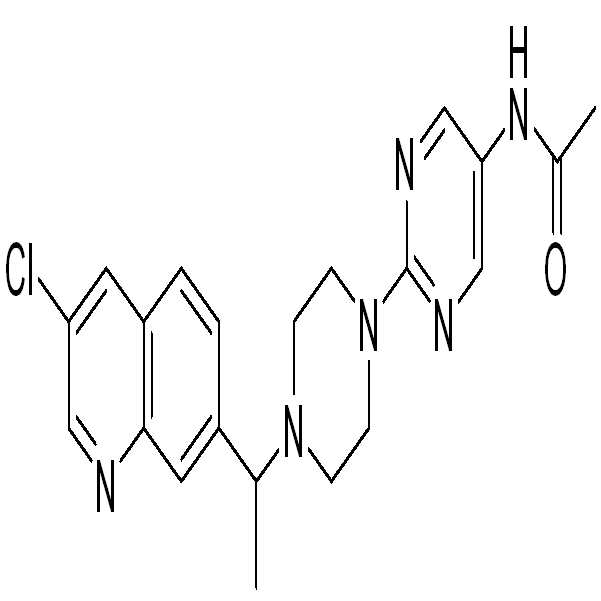
실시예 114에 사용된 프로토콜에 따라, 출발 물질로 중간체 10 (0.250 g, 0.9 mmol) 및 중간체 20 (0.307 g, 1.3 mmol)을 이용하여 표제의 화합물을 합성하였다. 그 조생성물을 MD Autoprep HPLC (방법 B)로 정제하여 표제의 화합물 (담갈색 고체)을 얻었다. 1H NMR (400 MHz, DMSO-d6): δ 9.81 (s, 1H), 8.87 (d, J = 2.4 Hz,1H), 8.55 (d, J = 2.4 Hz,1H), 8.46 (s, 2H), 7.97-7.95 (m, 2H), 7.73 (d, J = 7.6 Hz, 1H), 3.70-3.65 (m, 5H), 2.50-2.41 (m, 2H), 2.42-2.37 (m, 2H), 2.00 (s, 3H), 1.41 (d, J = 6.4 Hz, 3H). LCMS: (방법 A) 411.2 (M+H), Rt. 2.60 분, 99.12% (최대). HPLC: (방법 A) Rt. 2.59 분, 98.33% (최대).Intermediate 10 (0.250 g, 0.9 mmol) and intermediate 20 as starting materials, according to the protocol used in Example 114. (0.307 g, 1.3 mmol) was used to synthesize the title compound. The crude product was purified by MD Autoprep HPLC (Method B) to afford the title compound (pale brown solid). 1 H NMR (400 MHz, DMSO-d 6 ): δ 9.81 (s, 1H), 8.87 (d, J = 2.4 Hz, 1H), 8.55 (d, J = 2.4 Hz, 1H), 8.46 (s, 2H ), 7.97-7.95 (m, 2H), 7.73 (d, J = 7.6 Hz, 1H), 3.70-3.65 (m, 5H), 2.50-2.41 (m, 2H), 2.42-2.37 (m, 2H), 2.00 (s, 3 H), 1.41 (d, J = 6.4 Hz, 3 H). LCMS: (Method A) 411.2 (M + H), Rt. 2.60 minutes, 99.12% (max). HPLC: (method A) Rt. 2.59 min, 98.33% (max).
실시예Example 126: 126: N-(2-(4-(1-(3,4-디히드로-2H-벤조[N- (2- (4- (1- (3,4-dihydro-2H-benzo [ b][1,4]디옥세핀b] [1,4] dioxepin -7-일)에틸)피페라진-1-일)피리미딘-5-일)아세트아미드-7-yl) ethyl) piperazin-1-yl) pyrimidin-5-yl) acetamide

실시예 121에 사용된 프로토콜에 따라, 출발 물질로 중간체 14 및 중간체 10을 이용하여 표제의 화합물을 합성하였다. 그 조생성물을 MD Autoprep HPLC (방법 C)로 정제하였다 (황백색 고체). 1H NMR (400 MHz, DMSO-d6): δ 9.80 (s, 1H), 8.45 (s, 2H), 6.88 (d, J = 4.8 Hz, 3H), 4.10-4.08 (m, 3H), 337-3.38 (m, 2H), 3.32-3.29 (m, 4H), 2.49-2.48 (m, 2H), 2.46-2.44 (m, 2H), 2.07-2.01 (m, 2H), 1.99 (s, 3H), 1.24 (d, J = 6.4Hz, 3H). LCMS: (방법 A) 397.3 (M+H), Rt. 2.43 분, 98.43% (최대). HPLC: (방법 A) Rt. 2.41 분, 97.8% (최대).According to the protocol used in Example 121, the title compound was synthesized using Intermediate 14 and Intermediate 10 as starting materials. The crude product was purified by MD Autoprep HPLC (Method C) (yellow white solid). 1 H NMR (400 MHz, DMSO-d 6 ): δ 9.80 (s, 1H), 8.45 (s, 2H), 6.88 (d, J = 4.8 Hz, 3H), 4.10-4.08 (m, 3H), 337 -3.38 (m, 2H), 3.32-3.29 (m, 4H), 2.49-2.48 (m, 2H), 2.46-2.44 (m, 2H), 2.07-2.01 (m, 2H), 1.99 (s, 3H) , 1.24 (d, J = 6.4 Hz, 3H). LCMS: (Method A) 397.3 (M + H), Rt. 2.43 minutes, 98.43% (maximum). HPLC: (method A) Rt. 2.41 min, 97.8% (max).
실시예Example 127: N-(2-(4-(1-(퀴놀린-8- 127: N- (2- (4- (1- (quinoline-8-) 일Work )에틸)피페라진-1-Ethyl) piperazine-1- 일Work )피리미딘-5-일)아세트아미드) Pyrimidin-5-yl) acetamide

건조한 DMF (10 mL) 중의 중간체 10 (0.4 g, 1.57 mmol)의 교반된 용액에, DIPEA (0.8 mL, 3.13 mmol) 및 중간체 15 (0.3 g, 1.57 mmol)를 실온에서 첨가하고 생성된 반응 혼합물을 80 ℃에서 12 시간 동안 교반하였다. 이를 실온으로 냉각시키고 농축하였다. 상기 조생성물을 디클로로메탄 (50 mL)로 희석하고, 염수 (10 mL)로 세척하고, 무수 Na2SO4 상에 건조시켰다. 용매를 증발시킨 후, 그 조생서물을 속성 크로마토그래피로 정제하여 표제의 화합물 (황백색 고체)을 얻었다. 1H NMR (400 MHz, DMSO-d6): δ 9.81 (s, 1H), 8.91 (dd, J = 4.0, 1.6 Hz, 1H), 8.46 (s, 2H), 8.37 (dd, J = 8.0, 1.6 Hz, 1H), 7.92 (d, J = 6.8 Hz 1H), 7.86 (d, J = 8.0 Hz, 1H), 7.66-7.62 (m, 1H), 7.54 (dd, J = 8.0, 4.0 Hz, 1H), 4.98 (q, J = 6.4 Hz, 1H), 3.66-3.65 (m, 4H), 2.57-2.42 (m, 4H), 2.01 (s, 3H), 1.38 (d, J = 6.4 Hz, 3H). LCMS: (방법 A) 377.2 (M+H), Rt. 2.47 분, 98.0% (최대). HPLC: (방법 A) Rt. 2.43 분, 97.5% (최대).To a stirred solution of intermediate 10 (0.4 g, 1.57 mmol) in dry DMF (10 mL), DIPEA (0.8 mL, 3.13 mmol) and intermediate 15 (0.3 g, 1.57 mmol) were added at room temperature and the resulting reaction mixture was Stir at 80 ° C for 12 h. It was cooled to rt and concentrated. The crude product was diluted with dichloromethane (50 mL), washed with brine (10 mL) and dried over anhydrous Na 2 SO 4 . After evaporating the solvent, the crude document was purified by flash chromatography to give the title compound (yellow white solid). 1 H NMR (400 MHz, DMSO-d 6 ): δ 9.81 (s, 1H), 8.91 (dd, J = 4.0, 1.6 Hz, 1H), 8.46 (s, 2H), 8.37 (dd, J = 8.0, 1.6 Hz, 1H), 7.92 (d, J = 6.8 Hz 1H), 7.86 (d, J = 8.0 Hz, 1H), 7.66-7.62 (m, 1H), 7.54 (dd, J = 8.0, 4.0 Hz, 1H ), 4.98 (q, J = 6.4 Hz, 1H), 3.66-3.65 (m, 4H), 2.57-2.42 (m, 4H), 2.01 (s, 3H), 1.38 (d, J = 6.4 Hz, 3H) . LCMS: (Method A) 377.2 (M + H), Rt. 2.47 min, 98.0% (max). HPLC: (method A) Rt. 2.43 min, 97.5% (max).
실시예Example 128: N-(5-(4-(1-(2,3-디히드로벤조 128: N- (5- (4- (1- (2,3-dihydrobenzo) 퓨란Furan -6--6- 일Work )에틸)피페라진-1-Ethyl) piperazine-1- 일Work )-1,3,4-티아디아졸-2-일)아세트아미드) -1,3,4-thiadiazol-2-yl) acetamide

실시예 114에 사용된 프로토콜에 따라, 출발 물질로 중간체 7 (0.3 g, 1.14 mmol) 및 중간체 21 (0.269 g, 1.48 mmol)을 이용하여 표제의 화합물을 합성하였다. 그 조생성물을 속성 크로마토그래피 (DCM 중 MeOH 7%) 후, MD Autoprep HPLC (방법 B)로 정제하여 표제의 화합물 (황백색 고체)을 얻었다. 1H NMR (400 MHz, DMSO-d6): δ 12.02 (s, 1H), 7.12 (d, J = 7.2 Hz, 1H), 6.76 (d, J = 87.6 Hz, 1H), 6.71(s, 1H), 4.51 (t, J = 8.4 Hz, 2H), 3.39-3.28 (m, 5H), 3.14 (t, J = 8.4 Hz, 2H), 2.42-2.39 (m, 4H), 2.09 (s, 3H), 1.28 (d, J = 6.4 Hz, 3H). LCMS: (방법 A) 374.2 (M+H), Rt. 2.34 분, 99.62% (최대). HPLC: (방법 A) Rt. 2.32 분, 96.03% (최대).According to the protocol used in Example 114, the title compound was synthesized using intermediate 7 (0.3 g, 1.14 mmol) and intermediate 21 (0.269 g, 1.48 mmol) as starting materials. The crude product was purified by flash chromatography (7% MeOH in DCM) followed by MD Autoprep HPLC (Method B) to afford the title compound (yellow white solid). 1 H NMR (400 MHz, DMSO-d 6 ): δ 12.02 (s, 1H), 7.12 (d, J = 7.2 Hz, 1H), 6.76 (d, J = 87.6 Hz, 1H), 6.71 (s, 1H ), 4.51 (t, J = 8.4 Hz, 2H), 3.39-3.28 (m, 5H), 3.14 (t, J = 8.4 Hz, 2H), 2.42-2.39 (m, 4H), 2.09 (s, 3H) , 1.28 (d, J = 6.4 Hz, 3H). LCMS: (Method A) 374.2 (M + H), Rt. 2.34 min, 99.62% (max). HPLC: (method A) Rt. 2.32 min, 96.03% (max).
실시예Example 129: N-(2-(4-(1-(2,3-디히드로벤조 129: N- (2- (4- (1- (2,3-dihydrobenzo) 퓨란Furan -6--6- 일Work )에틸)피페라진-1-일)피리미딘-5-일)아세트아미드) Ethyl) piperazin-1-yl) pyrimidin-5-yl) acetamide

실시예 114에 사용된 프로토콜에 따라, 출발 물질로 중간체 10 (0.3 g, 1.16 mmol) 및 중간체 21 (0.274 g, 1.51 mmol)을 이용하여 표제의 화합물을 합성하였다. 그 조생성물을 속성 크로마토그래피 (DCM 중 MeOH 10%) 후, MD Autoprep HPLC (방법 B) 로 정제하여 표제의 화합물 (황백색 고체)을 얻었다. 1H NMR (400 MHz, DMSO-d6): δ 9.80 (s, 1H), 8.45 (s, 2H), 7.13 (d, J = 7.6 Hz, 1H), 6.75-6.70 (m,1H), 4.49 (t, J = 8.4 Hz, 2H), 3.63-3.61 (m, 4H), 3.12 (t, J = 8.4 Hz, 3H), 2.44-2.30 (m, 4H), 1.99 (s, 3H), 1.26 (d, J = 6.4 Hz, 3H). LCMS: (방법 A) 368.3 (M+H), Rt. 2.34 분, 99.74% (최대). HPLC: (방법 A) Rt. 2.33 분, 99.52% (최대).According to the protocol used in Example 114, Intermediate 10 (0.3 g, 1.16 mmol) and intermediate 21 (0.274 g, 1.51 mmol) were used to synthesize the title compound. The crude product was purified by flash chromatography (MeOH 10% in DCM) and then purified by MD Autoprep HPLC (Method B) to afford the title compound (yellow white solid). 1 H NMR (400 MHz, DMSO-d 6 ): δ 9.80 (s, 1H), 8.45 (s, 2H), 7.13 (d, J = 7.6 Hz, 1H), 6.75-6.70 (m, 1H), 4.49 (t, J = 8.4 Hz, 2H), 3.63-3.61 (m, 4H), 3.12 (t, J = 8.4 Hz, 3H), 2.44-2.30 (m, 4H), 1.99 (s, 3H), 1.26 ( d, J = 6.4 Hz, 3H). LCMS: (Method A) 368.3 (M + H), Rt. 2.34 min, 99.74% (max). HPLC: (method A) Rt. 2.33 min, 99.52% (max).
실시예Example 130: 2130: 2 -- (4-(1-(벤조[d][1,3]디옥솔(4- (1- (benzo [d] [1,3] dioxol -5--5- 일Work )에틸)피페라진-1-일)벤조[d]티아졸) Ethyl) piperazin-1-yl) benzo [d] thiazole
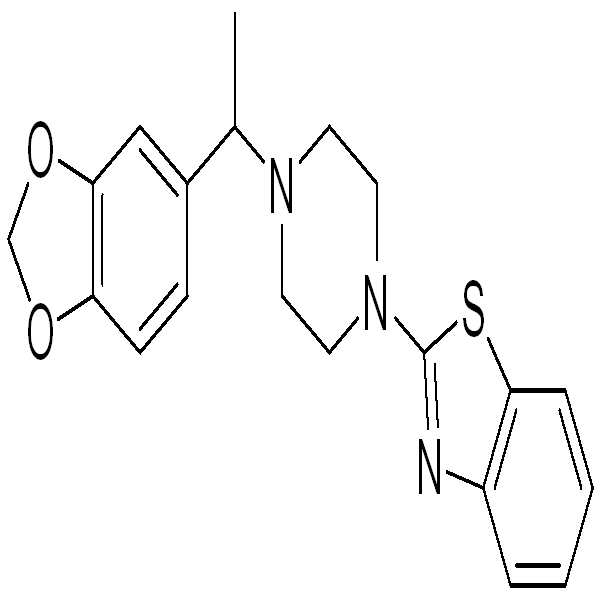
건조한 DMF (10 mL) 중의 중간체 2 (0.5 g, 2.13 mmol)의 교반된 용액에, DIPEA (0.8 mL, 6.3 mmol) 및 2-브로모 벤조티아졸 (0.5 g, 2.13 mmol)을 실온에서 첨가하고 상기 반응 혼합물을 90 ℃에서 12 시간 동안 교반하였다. 이를 실온으로 냉각시키고 농축하였다. 그 조생성물을 디클로로메탄 (50 mL)으로 희석하고, 염수 (10 mL)로 세척하고 무수 Na2SO4 상에 건조시켰다. 용매를 증발시킨 후, 그 조생성물을 속성 크로마토그래피로 정제하여 표제의 화합물을 얻었다. 1H NMR (400 MHz, DMSO-d6): δ 7.74 (d, J = 0.8 Hz, 1H), 7.43 (d, J = 7.6Hz, 1H), 7.28-7.24 (m, 1H), 7.09-7.04 (m, 1H), 6.91 (d, J = 1.6Hz, 1H), 6.83 (d, J = 8Hz, 1H), 6.86-6.73 (m, 1H), 5.91 (d, J =1.6 Hz, 2H), 3.56-3.51 (m, 4H), 3.44-3.36 (m, 1H), 2.47-2.41(m, 4H),1.28 (d, J = 6.8 Hz, 3H). LCMS: (방법 A) 368.2 (M+H), Rt. 3.34 분, 95.18% (최대). HPLC: (방법 A) Rt. 3.34 분, 97.15% (최대).To a stirred solution of intermediate 2 (0.5 g, 2.13 mmol) in dry DMF (10 mL), DIPEA (0.8 mL, 6.3 mmol) and 2-bromo benzothiazole (0.5 g, 2.13 mmol) were added at room temperature The reaction mixture was stirred at 90 ° C for 12 h. It was cooled to rt and concentrated. The crude product was diluted with dichloromethane (50 mL), washed with brine (10 mL) and dried over anhydrous Na 2 SO 4 . After evaporation of the solvent, the crude product was purified by flash chromatography to afford the title compound. 1 H NMR (400 MHz, DMSO-d 6 ): δ 7.74 (d, J = 0.8 Hz, 1H), 7.43 (d, J = 7.6 Hz, 1H), 7.28-7.24 (m, 1H), 7.09-7.04 (m, 1H), 6.91 (d, J = 1.6 Hz, 1H), 6.83 (d, J = 8 Hz, 1H), 6.86-6.73 (m, 1H), 5.91 (d, J = 1.6 Hz, 2H), 3.56-3.51 (m, 4H), 3.44-3.36 (m, 1H), 2.47-2.41 (m, 4H), 1.28 (d, J = 6.8 Hz, 3H). LCMS: (Method A) 368.2 (M + H), Rt. 3.34 min, 95.18% (max). HPLC: (method A) Rt. 3.34 min, 97.15% (max).
실시예Example 131: N-(2-(4-(1-(퀴놀린-3- 131: N- (2- (4- (1- (quinoline-3- 일Work )에틸)피페라진-1-Ethyl) piperazine-1- 일Work )피리미딘-5-일)아세트아미드) Pyrimidin-5-yl) acetamide

DMF (5 mL) 중의 중간체 10 (0.5 g, 1.9 mmol)의 교반된 용액에, DIPEA (1.65 mL, 9.5 mmol) 및 중간체 23 (0.496 g, 2.59 mmol)을 0 내지 5 ℃에서 첨가하였다. 상기 반응 혼합물을 100 ℃에서 밤새 교반하였다. 그런 다음 이를 감압하에 농축하였다. 그 조생성물을 DCM (100 mL)으로 희석하고, 물 (2 x 25 mL)로 세척하고 Na2SO4 상에 건조시켰다. 용매를 증발시킨 후, 그 조생성물을 속성 크로마토그래피 (DCM 중 MeOH 7%)로 정제하였다. 이를 ACN (5 mL) 및 디에틸 에테르 (2 x 15 mL) 중에 분쇄하여 담갈색 고체인 표제의 화합물을 얻었다. 1H NMR (400 MHz, DMSO-d6): δ 9.81 (s, 1H), 8.93-8.91 (m, 1H), 8.459 (s, 2H), 8.24-8.22 (m, 1H), 7.99 (t, J = 8.0 Hz, 2H), 7.73-7.71 (m, 1H), 7.60-7.58 (m, 1H), 3.79-3.73 (m, 1H), 3.67-3.65 (m, 4H), 2.55-2.50 (m, 2H), 2.50-2.40 (m, 2H), 2.02 (s, 3H), 1.44 (d, J = 6.4 Hz, 3H). LCMS: (방법 A) 377.2 (M+H), Rt. 1.80 분, 94.43% (최대). HPLC: (방법 A) Rt. 1.82 분, 94.95% (최대).To a stirred solution of intermediate 10 (0.5 g, 1.9 mmol) in DMF (5 mL), DIPEA (1.65 mL, 9.5 mmol) and intermediate 23 (0.496 g, 2.59 mmol) were added at 0-5 ° C. The reaction mixture was stirred at 100 ° C overnight. It was then concentrated under reduced pressure. The crude product was diluted with DCM (100 mL), washed with water (2 × 25 mL) and dried over Na 2 SO 4 . After evaporation of the solvent, the crude product was purified by flash chromatography (7% MeOH in DCM). It was triturated in ACN (5 mL) and diethyl ether (2 x 15 mL) to afford the title compound as a light brown solid. 1 H NMR (400 MHz, DMSO-d 6 ): δ 9.81 (s, 1H), 8.93-8.91 (m, 1H), 8.459 (s, 2H), 8.24-8.22 (m, 1H), 7.99 (t, J = 8.0 Hz, 2H), 7.73-7.71 (m, 1H), 7.60-7.58 (m, 1H), 3.79-3.73 (m, 1H), 3.67-3.65 (m, 4H), 2.55-2.50 (m, 2H), 2.50-2.40 (m, 2H), 2.02 (s, 3H), 1.44 (d, J = 6.4 Hz, 3H). LCMS: (Method A) 377.2 (M + H), Rt. 1.80 min, 94.43% (max). HPLC: (method A) Rt. 1.82 min, 94.95% (max).
실시예Example 132: (S)-5-(4-(1-(벤조[ 132: (S) -5- (4- (1- (benzo [ d][1,3]디옥솔d] [1,3] dioxol -5--5- 일Work )에틸)피페라진-1-Ethyl) piperazine-1- 일Work )-1,3,4-티아디아졸-2-아민) -1,3,4-thiadiazol-2-amine

ACN (30 mL) 중의 중간체 16 (3 g, 11.1 mmol)의 교반된 용액에, TEA (3.36 g, 33.3 mmol) 및 5-브로모-1,3,4-티아디아졸-2-아민 (2.19 g, 12.2 mmol)을 실온에서 첨가하고 상기 혼합물을 85 ℃에서 밤새 가열하였다. 상기 반응의 완료를 TLC로 모니터링하였다. 상기 반응 혼합물을 진공하에 증발시키고 생성된 조고체를 물 (30 mL)로 세척하고 EtOAc (3 x 30 mL)로 추출하였다. 그 결합된 유기층을 염수 (30 mL)로 세척하고, Na2SO4 상에 건조시키고, 진공하에 45 ℃에서 증발시켰다. 그 조생성물을 속성 크로마토그래피 (DCM 중 MeOH 7%)로 정제하여 표제의 화합물 (담갈색 고체)을 얻었다. 1H NMR (400 MHz, DMSO-d6): δ 6.88-6.83 (m, 2H), 6.76-6.74 (m, 1H), 6.46 (s, 2H), 5.91(d, J =1.6Hz, 2H), 3.39-3.37(m, 1H), 3.20-3.17 (m, 4H), 2.46-2.30 (m, 4H), 1.25(d, J = 6.5Hz, 3H). LCMS: (방법 A) 334.0 (M+H), Rt. 1.85 분, 96.47% (최대). HPLC: (방법 A) Rt. 1.79 분, 96.77% (최대). 키랄성 HPLC: (방법 D) Rt. 20.96 분, 100.00%To a stirred solution of intermediate 16 (3 g, 11.1 mmol) in ACN (30 mL), TEA (3.36 g, 33.3 mmol) and 5-bromo-1,3,4-thiadiazol-2-amine (2.19 g, 12.2 mmol) was added at room temperature and the mixture was heated at 85 ° C overnight. Completion of the reaction was monitored by TLC. The reaction mixture was evaporated in vacuo and the resulting crude solid was washed with water (30 mL) and extracted with EtOAc (3 × 30 mL). The combined organic layer was washed with brine (30 mL), dried over Na 2 SO 4 and evaporated in vacuo at 45 ° C. The crude product was purified by flash chromatography (MeOH 7% in DCM) to afford the title compound (pale brown solid). 1 H NMR (400 MHz, DMSO-d6): δ 6.88-6.83 (m, 2H), 6.76-6.74 (m, 1H), 6.46 (s, 2H), 5.91 (d, J = 1.6 Hz, 2H), 3.39-3.37 (m, 1H), 3.20-3.17 (m, 4H), 2.46-2.30 (m, 4H), 1.25 (d, J = 6.5 Hz, 3H). LCMS: (Method A) 334.0 (M + H), Rt. 1.85 minutes, 96.47% (maximum). HPLC: (method A) Rt. 1.79 min, 96.77% (max). Chiral HPLC: (Method D) Rt. 20.96 minutes, 100.00%
실시예Example 133: (S)-N-(5-(4-(1-(벤조[ 133: (S) -N- (5- (4- (1- (benzo [ d]티아졸d] thiazole -5--5- 일Work )에틸)피페라진-1-Ethyl) piperazine-1- 일Work )-1,3,4-티아디아졸-2-일)아세트아미드 또는 ((R)-N-(5-(4-(1-(벤조[) -1,3,4-thiadiazol-2-yl) acetamide or ((R) -N- (5- (4- (1- (benzo [ d]티아졸d] thiazole -5-일)에틸)피페라진-1-일)-1,3,4-티아디아졸-2-일)아세트아미드-5-yl) ethyl) piperazin-1-yl) -1,3,4-thiadiazol-2-yl) acetamide


실시예 114의 두 거울상이성질체를 키랄성 조제용 HPLC (방법 PF)로 분리하였다. 실시예 133은 두 번째 용리 분획에 상응한다 (황백색 고체). 1H NMR (400 MHz, DMSO-d6): δ 12.01 (s, 1H), 9.34 (s, 1H), 8.12 (d, J= 8.0 Hz, 1H), 8.02 (s, 1H), 7.50 (d, J= 8.4Hz, 1H), 3.67 (d, J= 6.0Hz, 1H), 3.37-3.35 (m, 4H), 2.56-2.57(m, 4H), 2.09 (s, 3H),1.40 (d, J= 6.8Hz, 3H).LCMS: (방법 A) 389.0 (M+H), Rt. 2.09 분, 96.5% (최대). HPLC: (방법 A) Rt. 2.08 분, 97.4% (최대). 키랄성 HPLC: (방법 D) Rt 15.28 분, 99.82%.Two enantiomers of Example 114 were separated by chiral preparative HPLC (Method PF). Example 133 corresponds to the second eluting fraction (yellow white solid). 1 H NMR (400 MHz, DMSO-d 6 ): δ 12.01 (s, 1H), 9.34 (s, 1H), 8.12 (d, J = 8.0 Hz, 1H), 8.02 (s, 1H), 7.50 (d , J = 8.4 Hz, 1H), 3.67 (d, J = 6.0 Hz, 1H), 3.37-3.35 (m, 4H), 2.56-2.57 (m, 4H), 2.09 (s, 3H), 1.40 (d, J = 6.8 Hz, 3H). LCMS: (Method A) 389.0 (M + H), Rt. 2.09 min, 96.5% (max). HPLC: (method A) Rt. 2.08 min, 97.4% (max). Chiral HPLC: (Method D) Rt 15.28 min, 99.82%.
실시예Example 134: (S) 2-(4-(1-( 134: (S) 2- (4- (1- ( 벤조[d][1,3]디옥솔Benzo [d] [1,3] dioxole -5-일)에틸)피페라진-1-일)-N-메틸피리미딘-5-카르복사미드-5-yl) ethyl) piperazin-1-yl) -N-methylpyrimidine-5-carboxamide

단계 1: 에틸 (S)-2-(4-(1-(벤조[Step 1: ethyl (S) -2- (4- (1- (benzo [ d][1,3]디옥솔d] [1,3] dioxol -5--5- 일Work )에틸)피페라진-1-일)피리미딘-5-카르복실레이트 ) Ethyl) piperazin-1-yl) pyrimidine-5-carboxylate
건조한 아세토니트릴 (10 mL) 중의 중간체 16 (1.87 g, 6.94mmol)의 교반된 용액에, 탄산칼륨 (2.87 g, 20.8 mmol, Spectrochem) 및 에틸 2-(메틸술포닐) 피리미딘-5-카르복실레이트 (1.6 g, 6.94 mmol, 실시예 98, 단계1 및 2에 기재된 방법)를 첨가하였다. 생성된 혼합물을 실온에서 3 시간 동안 교반하였다. 그런 다음 이를 셀리트를 통해 여과하고 농축하였다. 그 조생성물을 디클로로메탄 (25 mL)으로 희석하고, 물로 세척하고, 무수 Na2SO4 상에 건조시켰다. 용매를 증발시킨 후, 그 조생성물을 속성 컬럼 크로마토그래피로 정제하여 표제의 화합물 (백색 고체)을 얻었다. 1H NMR (400 MHz, DMSO-d6): δ 8.74 (s, 1H), 6.78-6.72 (m, 2H), 5.97 (s, 1H), 4.38-4.36 (m, 1H), 3.81 (s, 2H), 2.37-2.47 (m, 9H), 1.26 (d, J = 2.84 Hz, 3H), LCMS: (방법 A) 385.2 (M+H), Rt. 3.22 분, 98.6% (최대).To a stirred solution of intermediate 16 (1.87 g, 6.94 mmol) in dry acetonitrile (10 mL), potassium carbonate (2.87 g, 20.8 mmol, Spectrochem) and ethyl 2- (methylsulfonyl) pyrimidine-5-carboxyl Rate (1.6 g, 6.94 mmol, the method described in Example 98, steps 1 and 2) was added. The resulting mixture was stirred at rt for 3 h. It was then filtered through celite and concentrated. The crude product was diluted with dichloromethane (25 mL), washed with water and dried over anhydrous Na 2 SO 4 . After evaporation of the solvent, the crude product was purified by flash column chromatography to afford the title compound (white solid). 1 H NMR (400 MHz, DMSO-d 6 ): δ 8.74 (s, 1H), 6.78-6.72 (m, 2H), 5.97 (s, 1H), 4.38-4.36 (m, 1H), 3.81 (s, 2H), 2.37-2.47 (m, 9H), 1.26 (d, J = 2.84 Hz, 3H), LCMS: (Method A) 385.2 (M + H), Rt. 3.22 min, 98.6% (max).
단계 2: 리튬 (S)-2-(4-(1-(벤조[Step 2: lithium (S) -2- (4- (1- (benzo [ d][1,3]디옥솔d] [1,3] dioxol -5--5- 일Work )에틸)피페라진-1-일)피리미딘-5-카르복실레이트) Ethyl) piperazin-1-yl) pyrimidine-5-carboxylate
MeOH (2 mL), THF (7 mL) 및 물 (1mL)의 혼합물 중의 에틸 (S)-2-(4-(1-(벤조[d][1,3]디옥솔-5-일)에틸)피페라진-1-일)피리미딘-5-카르복실레이트 (1.6 g, 17.5 mmol)의 교반된 용액에, 리튬 히드록시드 (0.431 g, 5.20 mmol, Spectrochem)를 0 ℃에서 첨가하고 생성된 혼합물을 실온에서 12 시간 동안 교반하였다. 이를 농축하고 생성된 생성물을 임의의 추가적인 정제 없이 다음 단계를 위해 취했다. 수득률: 96% (0.61 g, 황백색 고체). 1H NMR (400 MHz, DMSO-d6): δ 8.61 (s, 1H), 6.81-6.88 (m, 4H), 5.97 (d, J = 1.8 Hz, 2H), 3.68 (d, J = 6.2 Hz, 2H),3.22-3.21(m,1H), 2.28-2.35 (m, 6H), 1.26 (d, J = 8.9 Hz, 3H), LCMS: (방법 A) 357.0 (M+H), Rt. 2.41 분, 97.1% (최대)Ethyl (S) -2- (4- (1- (benzo [d] [1,3] dioxol-5-yl) ethyl in a mixture of MeOH (2 mL), THF (7 mL) and water (1 mL) ) Piperazin-1-yl) pyrimidine-5-carboxylate To a stirred solution of (1.6 g, 17.5 mmol), lithium hydroxide (0.431 g, 5.20 mmol, Spectrochem) was added at 0 ° C and the resulting mixture was stirred at rt for 12 h. It was concentrated and the resulting product was taken for next step without any further purification. Yield: 96% (0.61 g, off-white solid). 1 H NMR (400 MHz, DMSO-d 6 ): δ 8.61 (s, 1H), 6.81-6.88 (m, 4H), 5.97 (d, J = 1.8 Hz, 2H), 3.68 (d, J = 6.2 Hz , 2H), 3.22-3.21 (m, 1H), 2.28-2.35 (m, 6H), 1.26 (d, J = 8.9 Hz, 3H), LCMS: (method A) 357.0 (M + H), Rt. 2.41 minutes, 97.1% (max)
단계 3: (S) 2-(4-(1-(벤조[ d][1,3]디옥솔 -5- 일 )에틸)피페라진-1- 일 )-N-메틸피리미딘-5-카르복사미드 Step 3: (S) 2- (4- (1- (benzo [ d] [1,3] dioxol -5- yl ) ethyl) piperazin-1- yl ) -N- methyl pyrimidine-5-car Copy mid
건조한 DCM (10 mL) 중의 리튬 (S)-2-(4-(1-(벤조[d][1,3]디옥솔-5-일)에틸)피페라진-1-일)피리미딘-5-카르복실레이트 (0.3 g, 0.82 mmol)의 교반된 용액에, 트리에틸아민 (0.34 mL) 및 THF (2 M, 1.6 mL, 3.32 mmol) 중의 메틸아민을 0 ℃에서 첨가했다. 상기 반응 혼합물을 실온에서 1 시간 동안 교반하였다. 상기 반응 진행을 TLC로 모니터링하였다. 상기 반응의 완료 후, 상기 혼합물을 10% 중탄산나트륨 용액 (10 mL)으로 희석하고 DCM (20 mL)으로 추출하였다. 그 유기층을 Na2SO4 상에 건조시키고 증발시켜 건조시켰다. 그 조생성물을 속성 컬럼 크로마토그래피로 정제하였다. 수득률: 56% (0.17 g, 황백색 고체). 1H NMR (400 MHz, DMSO-d6): δ 8.71 (s, 2H), 8.28 (d, J = 4.8 Hz, 1H), 6.90-6.83 (m, 2H), 6.77-6.75 (m, 1H), 5.98(d, J = 2.0 Hz, 2H), 3.77 (t, J = 4.8 Hz, 4H), 3.41-3.38 (m, 1H), 2.74(d, J = 4.4 Hz, 3H), 2.38-2.33 (m, 4H), 1.28 (d, J = 6.8 Hz, 3H). LCMS: (방법 A) 370.2 (M+H), Rt. 2.21 분, 98.9% (최대). HPLC: (방법 A) Rt. 2.18 분, 99.3% (최대). 키랄성 HPLC: (방법 G) Rt. 5.51 분, 100.00%Lithium (S) -2- (4- (1- (benzo [d] [1,3] dioxol-5-yl) ethyl) piperazin-1-yl) pyrimidin-5 in dry DCM (10 mL) To a stirred solution of -carboxylate (0.3 g, 0.82 mmol), methylamine in triethylamine (0.34 mL) and THF (2 M, 1.6 mL, 3.32 mmol) was added at 0 ° C. The reaction mixture was stirred at rt for 1 h. The reaction progress was monitored by TLC. After completion of the reaction, the mixture was diluted with 10% sodium bicarbonate solution (10 mL) and extracted with DCM (20 mL). The organic layer was dried over Na 2 SO 4 and evaporated to dryness. The crude product was purified by flash column chromatography. Yield: 56% (0.17 g, off-white solid). 1 H NMR (400 MHz, DMSO-d 6 ): δ 8.71 (s, 2H), 8.28 (d, J = 4.8 Hz, 1H), 6.90-6.83 (m, 2H), 6.77-6.75 (m, 1H) , 5.98 (d, J = 2.0 Hz, 2H), 3.77 (t, J = 4.8 Hz, 4H), 3.41-3.38 (m, 1H), 2.74 (d, J = 4.4 Hz, 3H), 2.38-2.33 ( m, 4H), 1.28 (d, J = 6.8 Hz, 3H). LCMS: (Method A) 370.2 (M + H), Rt. 2.21 minutes, 98.9% (max). HPLC: (method A) Rt. 2.18 min, 99.3% (max). Chiral HPLC: (Method G) Rt. 5.51 minutes, 100.00%
실시예Example 135: 2135: 2 -- (4-(1-(퀴녹살린-6-일)에틸)(4- (1- (quinoxalin-6-yl) ethyl) 피페라진-1-일)벤조[d]티아졸Piperazin-1-yl) benzo [d] thiazole

건조한 DMF (3 mL) 중의 중간체 11 (0.26 g, 0.93 mmol)의 교반된 용액에, TEA (0.4 mL, 2.81 mmol) 및 2-브로모벤조티아졸 (0.2 g, 0.93 mmol, combi blocks)을 실온에서 첨가하고 상기 반응 혼합물을 95 ℃에서 밤새 교반하였다. 이를 실온으로 냉각시키고 농축하였다. 생성된 혼합물로, 물 (20 mL)을 첨가하고 그 생성물을 EtOAc (2 x 40 mL)로 추출하였다. 그 결합된 유기층을 무수 Na2SO4 상에 건조시키고 농축하였다. 그 조생성물을 속성 컬럼 크로마토그래피로 정제하여 표제의 화합물 (갈색 고체)을 얻었다. 1H NMR (400 MHz, DMSO-d6): δ 8.92 (d, J=4.0 Hz, 2H), 8.09 (d, J=8.8 Hz, 1H), 8.01 (s, 1H), 7.92 (d, J=8.0 Hz, 1H), 7.73 (d, J=8.0 Hz, 1H), 7.42 (d, J=8.0 Hz, 1H), 7.25 (t, J=7.6 Hz, 1H), 7.04 (t, J=7.6 Hz, 1H), 3.83-3.81(m, 1H), 3.56 (t, J=4.8 Hz, 4H), 2.64-2.63 (m, 2H), 2.49 (m, 2H), 1.44 (d, J=6.8 Hz, 3H). LCMS: (방법 A) 376.3 (M+H), Rt. 2.71 분, 99.382% (최대). HPLC: (방법 A) Rt. 2.69 분, 98.44% (최대).To a stirred solution of intermediate 11 (0.26 g, 0.93 mmol) in dry DMF (3 mL), TEA (0.4 mL, 2.81 mmol) and 2-bromobenzothiazole (0.2 g, 0.93 mmol, combi blocks) were added to room temperature. And the reaction mixture was stirred at 95 ° C overnight. It was cooled to rt and concentrated. With the resulting mixture, water (20 mL) was added and the product extracted with EtOAc (2 x 40 mL). The combined organic layer was dried over anhydrous Na 2 SO 4 and concentrated. The crude product was purified by flash column chromatography to give the title compound (brown solid). 1 H NMR (400 MHz, DMSO-d 6 ): δ 8.92 (d, J = 4.0 Hz, 2H), 8.09 (d, J = 8.8 Hz, 1H), 8.01 (s, 1H), 7.92 (d, J = 8.0 Hz, 1H), 7.73 (d, J = 8.0 Hz, 1H), 7.42 (d, J = 8.0 Hz, 1H), 7.25 (t, J = 7.6 Hz, 1H), 7.04 (t, J = 7.6 Hz, 1H), 3.83-3.81 (m, 1H), 3.56 (t, J = 4.8 Hz, 4H), 2.64-2.63 (m, 2H), 2.49 (m, 2H), 1.44 (d, J = 6.8 Hz , 3H). LCMS: (Method A) 376.3 (M + H), Rt. 2.71 min, 99.382% (max). HPLC: (method A) Rt. 2.69 min, 98.44% (max).
실시예Example 136: (S)-2- 136: (S) -2- (4-(1-(벤조[d][1,3]디옥솔(4- (1- (benzo [d] [1,3] dioxol -5--5- 일Work )에틸)피페라진-1-일)벤조[d]티아졸) Ethyl) piperazin-1-yl) benzo [d] thiazole

건조한 DMF (10 mL) 중의 중간체 16 (0.3 g, 1.27 mmol)의 교반된 용액에, TEA (0.67 mL, 3.82 mmol) 및 2-브로모 벤조티아졸 (0.27 g, 1.27 mmol)을 실온에서 첨가하고 상기 반응 혼합물을 90 ℃에서 12 시간 동안 교반하였다. 이를 실온으로 냉각시키고 농축하였다. 생성된 혼합물을 디클로로메탄 (50 ml)으로 희석하고, 염수 (10 ml)로 세척하고 무수 Na2SO4 상에 건조시켰다. 용매를 증발시킨 후, 그 조생성물을 속성 크로마토그래피로 정제하여 표제의 화합물 (황백색 고체)을 얻었다. 1H NMR (400 MHz, DMSO-d6): δ 7.74 (d, J = 7.6Hz, 1H), 7.43 (d, J = 8.0Hz, 1H), 7.27 (t,,1H), 7.05 (t, J = 7.6 Hz,1H), 6.90 (s, 1H), 6.83 (d, J = 8.0 Hz, 1H), 6.77 (d, J = 8.4 Hz, 1H), 5.91 (d, J = 1.6 Hz, 2H), 3.53 (t, J = 7.6 Hz, 4H), 3.44-3.38 (m, 1H), 2.47-2.44 (m, 4H),1.28 (d, J = 6.8 Hz, 3H).LCMS: (방법 A) 368.0 (M+H), Rt. 3.28 분, 96.86% (최대). HPLC: (방법 A) Rt. 3.33 분, 97.08% (최대). 키랄성 HPLC: (방법 G) Rt. 8.00 분, 100.00%To a stirred solution of intermediate 16 (0.3 g, 1.27 mmol) in dry DMF (10 mL), TEA (0.67 mL, 3.82 mmol) and 2-bromo benzothiazole (0.27 g, 1.27 mmol) were added at room temperature The reaction mixture was stirred at 90 ° C for 12 h. It was cooled to rt and concentrated. The resulting mixture was diluted with dichloromethane (50 ml), washed with brine (10 ml) and dried over anhydrous Na 2 SO 4 . After evaporation of the solvent, the crude product was purified by flash chromatography to give the title compound (yellow white solid). 1 H NMR (400 MHz, DMSO-d 6 ): δ 7.74 (d, J = 7.6 Hz, 1H), 7.43 (d, J = 8.0 Hz, 1H), 7.27 (t ,, 1H), 7.05 (t, J = 7.6 Hz, 1H), 6.90 (s, 1H), 6.83 (d, J = 8.0 Hz, 1H), 6.77 (d, J = 8.4 Hz, 1H), 5.91 (d, J = 1.6 Hz, 2H) , 3.53 (t, J = 7.6 Hz, 4H), 3.44-3.38 (m, 1H), 2.47-2.44 (m, 4H), 1.28 (d, J = 6.8 Hz, 3H). LCMS: (Method A) 368.0 (M + H), Rt. 3.28 minutes, 96.86% (maximum). HPLC: (method A) Rt. 3.33 min, 97.08% (max). Chiral HPLC: (Method G) Rt. 8.00 min, 100.00%
실시예Example 137: (S)-2-(4-(1-(벤조[ 137: (S) -2- (4- (1- (benzo [ d][1,3]디옥솔d] [1,3] dioxol -5--5- 일Work )에틸)피페라진-1-일)-N,N-디메틸피리미딘-5-카르복사미드) Ethyl) piperazin-1-yl) -N, N-dimethylpyrimidine-5-carboxamide

실시예 134에 기재된 바와 같은 동일한 과정을 이용하여, 출발 물질로서 리튬 (S)-2-(4-(1-(벤조[d][1,3]디옥솔-5-일)에틸)피페라진-1-일)피리미딘-5-카르복실레이트 및 THF 중 용액으로서 N,N-디메틸 아민을 이용하여 표제의 화합물을 합성하였다. 그 조생성물을 속성 크로마토그래피로 정제하였다 (황백색 고체). 1H NMR (400 MHz, DMSO-d6): δ 8.45 (s, 2H), 6.90 (s, 1H), 6.84 (d, J = 8.0 Hz, 1H), 6.74 (d, J = 7.6 Hz, 1H), 5.98 (d, J = 1.6Hz, 2H), 3.76 (t, J = 4.8Hz, 4H), 3.39-3.37 (m, 1H), 2.97 (s, 6H), 2.44-2.43 (m, 2H), 2.37-2.35 (m, 2H), 1.28 (d, J = 6.8Hz, 3H). LCMS: (방법 A) 384.2 (M+H), Rt. 2.44 분, 98.2% (최대). HPLC: (방법 A) Rt. 2.44 분, 98.3% (최대). 키랄성 HPLC: (방법 G) Rt. 6.98 분, 100.00%Using the same procedure as described in Example 134, lithium (S) -2- (4- (1- (benzo [d] [1,3] dioxol-5-yl) ethyl) piperazine as starting material The title compound was synthesized using N-N-dimethyl amine as the solution in -1-yl) pyrimidine-5-carboxylate and THF. The crude product was purified by flash chromatography (yellow white solid). 1 H NMR (400 MHz, DMSO-d 6 ): δ 8.45 (s, 2H), 6.90 (s, 1H), 6.84 (d, J = 8.0 Hz, 1H), 6.74 (d, J = 7.6 Hz, 1H ), 5.98 (d, J = 1.6 Hz, 2H), 3.76 (t, J = 4.8 Hz, 4H), 3.39-3.37 (m, 1H), 2.97 (s, 6H), 2.44-2.43 (m, 2H) , 2.37-2.35 (m, 2H), 1.28 (d, J = 6.8 Hz, 3H). LCMS: (Method A) 384.2 (M + H), Rt. 2.44 min, 98.2% (max). HPLC: (method A) Rt. 2.44 min, 98.3% (max). Chiral HPLC: (Method G) Rt. 6.98 minutes, 100.00%
실시예Example 138: (S)-2-(4-(1-( 138: (S) -2- (4- (1- ( 벤조[d][1,3]디옥솔Benzo [d] [1,3] dioxole -5-일)에틸)피페라진-1-일)-1H-벤조[d]이미다졸-5-yl) ethyl) piperazin-1-yl) -1H-benzo [d] imidazole

건조한 DMF (3 mL) 중의 중간체 13 (0.25 g, 0.92 mmol)의 교반된 용액에, TEA (0.5 mL, 3.71 mmol) 및 2-브로모-1H-벤조이미다졸 (0.18 g, 0.92 mmol, Arbor chemicals)을 실온에서 첨가하고 상기 반응 혼합물을 100 ℃에서 밤새 교반하였다. 이를 실온으로 냉각시키고 농축하였다. 이 조생성물을 속성 크로마토그래피로 정제하여 표제의 화합물 (갈색 고체)을 얻었다. 1H NMR (400 MHz, CDCl3): δ 7.33 (m, 2H), 7.07-7.06 (m, 2H), 6.86 (d, J=1.2 Hz, 1H), 6.76-6.74(m, 2H), 5.97-5.96 (m, 2H), 3.59-3.58 (m, 4H), 3.35-3.34 (m, 1H), 2.60-2.59 (m, 2H), 2.52-2.51 (m, 2H), 1.35 (d, J=8.0 Hz, 3H). LCMS: (방법 A) 351.2 (M+H), Rt. 2.29분, 95.81% (최대). HPLC: (방법 A) Rt. 2.19 분, 96.33% (최대).To a stirred solution of intermediate 13 (0.25 g, 0.92 mmol) in dry DMF (3 mL), TEA (0.5 mL, 3.71 mmol) and 2-bromo-1H-benzoimidazole (0.18 g, 0.92 mmol, Arbor chemicals ) Was added at room temperature and the reaction mixture was stirred at 100 ° C overnight. It was cooled to rt and concentrated. This crude product was purified by flash chromatography to give the title compound (brown solid). 1 H NMR (400 MHz, CDCl 3 ): δ 7.33 (m, 2H), 7.07-7.06 (m, 2H), 6.86 (d, J = 1.2 Hz, 1H), 6.76-6.74 (m, 2H), 5.97 -5.96 (m, 2H), 3.59-3.58 (m, 4H), 3.35-3.34 (m, 1H), 2.60-2.59 (m, 2H), 2.52-2.51 (m, 2H), 1.35 (d, J = 8.0 Hz, 3H). LCMS: (Method A) 351.2 (M + H), Rt. 2.29 min, 95.81% (max). HPLC: (method A) Rt. 2.19 min, 96.33% (max).
실시예Example 139: (S)-2- 139: (S) -2- (4-(1-(벤조[d][1,3]디옥솔(4- (1- (benzo [d] [1,3] dioxol -5--5- 일Work )에틸)피페라진-1-일)티아졸로[4,5-c]피리딘) Ethyl) piperazin-1-yl) thiazolo [4,5-c] pyridine

건조한 DMF (5 mL) 중의 중간체 13 (0.189 g, 0.64 mmol)의 교반된 용액에, TEA (0.23 mL, 1.75 mmol) 및 2-클로로티아졸로[4,5-C]피리딘 (0.1 g, 0.58 mmol)을 실온에서 첨가하고, 상기 반응 혼합물을 100 ℃에서 밤새 교반하였다. 이를 실온으로 냉각시키고 진공하에 농축하였다. 이 조잔여물에, 물 (5 mL)을 첨가하고 EtOAc (2 x 25 mL)로 추출하였다. 그 결합된 유기층을 무수 Na2SO4 상에 건조시키고 농축시켰다. 그 조생성물을 속성 크로마토그래피로 정제하여 표제의 화합물 (황백색 고체)을 얻었다. 1H NMR (400 MHz, DMSO-d6): 1HNMR (400 MHz, DMSO-d6): δ 8.66 (s, 1H), 8.18 (d, J = 5.2 Hz, 1H), 7.84 (d, J = 5.2 Hz, 1H), 6.91 (d, J = 1.2 Hz, 1H), 6.85 (d, J = 8.0 Hz, 1H), 6.77 (d, J = 8.0, 1.2 Hz, 1H), 5.60-5.99 (m, 2H), 3.59-3.57 (m, 2H), 3.45 (q, J = 6.8 Hz, 1H), 2.51-2.46 (m, 4H), 1.29 (d, J = 6.8 Hz, 3H). LCMS: (방법 A) 369.0 (M+H), Rt. 1.90분, 99.501% (최대). HPLC: (방법 A) Rt. 1.82분, 99.73% (최대). 키랄성 HPLC: (방법 G) Rt. 8.31 분, 100.00%To a stirred solution of intermediate 13 (0.189 g, 0.64 mmol) in dry DMF (5 mL), TEA (0.23 mL, 1.75 mmol) and 2-chlorothiazolo [4,5-C] pyridine (0.1 g, 0.58 mmol ) Was added at room temperature and the reaction mixture was stirred at 100 ° C overnight. It was cooled to rt and concentrated in vacuo. To this crude residue, water (5 mL) was added and extracted with EtOAc (2 x 25 mL). The combined organic layer was dried over anhydrous Na 2 SO 4 and concentrated. The crude product was purified by flash chromatography to give the title compound (yellow white solid). 1 H NMR (400 MHz, DMSO-d 6 ): 1 HNMR (400 MHz, DMSO-d 6): δ 8.66 (s, 1H), 8.18 (d, J = 5.2 Hz, 1H), 7.84 (d, J = 5.2 Hz, 1H), 6.91 (d, J = 1.2 Hz, 1H), 6.85 (d, J = 8.0 Hz, 1H), 6.77 (d, J = 8.0, 1.2 Hz, 1H), 5.60-5.99 (m, 2H ), 3.59-3.57 (m, 2H), 3.45 (q, J = 6.8 Hz, 1H), 2.51-2.46 (m, 4H), 1.29 (d, J = 6.8 Hz, 3H). LCMS: (Method A) 369.0 (M + H), Rt. 1.90 minutes, 99.501% (maximum). HPLC: (method A) Rt. 1.82 minutes, 99.73% (maximum). Chiral HPLC: (Method G) Rt. 8.31 minutes, 100.00%
실시예Example 140: 2140: 2 -- (4-(1-(퀴녹살린-6-일)에틸)(4- (1- (quinoxalin-6-yl) ethyl) 피페라진-1-Piperazine-1- 일Work )) 티아졸로[4,5-c]피리딘Thiazolo [4,5-c] pyridine

건조한 DMF (5 mL) 중의 중간체 11 (0.169 g, 0.58 mmol) 의 교반된 용액에, TEA (0.23 mL, 1.75 mmol) 및 2-클로로티아졸로[4,5-C]피리딘 (0.18 g, 0.60 mmol)을 실온에서 첨가하고 상기 반응 혼합물을 100 ℃에서 밤새 교반하였다. 상기 반응 혼합물을 실온으로 냉각시키고 진공하에 농축하였다. 그 조잔여물로, 물 (5 mL)을 첨가하고 EtOAc (2 x 25 mL)로 추출하였다. 그 결합된 유기층을 무수 Na2SO4 상에 건조시키고 농축시켰다. 그 조생성물을 MD Autoprep HPLC (방법 B)로 정제하여 표제의 화합물 (황백색 고체)을 얻었다. 1H NMR (400 MHz, DMSO-d6): δ 8.94 (d, J = 7.2 Hz,1H), 8.92 (d, J = 7.2 Hz, 1H), 8.65 (s, 1H), 7.16 (d, J = 5.2 Hz, 1H), 8.09 (d, J = 8.4 Hz, 1H), 7.91 (dd, J = 8.3, 2.0 Hz, 1H), 7.83 (d, J = 5.4 Hz, 1H), 3.84 (q, J = 6.8 Hz, 1H), 3.62-3.60, 2.61-2.48 (m, 4H), 1.29 (d, J = 6.8 Hz, 3H). LCMS: (방법 A) 377.2 (M+H), Rt. 1.48 분, 99.79% (최대). HPLC: (방법 A) Rt. 1.481분, 99.10% (최대).To a stirred solution of intermediate 11 (0.169 g, 0.58 mmol) in dry DMF (5 mL), TEA (0.23 mL, 1.75 mmol) and 2-chlorothiazolo [4,5-C] pyridine (0.18 g, 0.60 mmol ) Was added at room temperature and the reaction mixture was stirred at 100 ° C overnight. The reaction mixture was cooled to rt and concentrated in vacuo. To the crude residue, water (5 mL) was added and extracted with EtOAc (2 x 25 mL). The combined organic layer was dried over anhydrous Na 2 SO 4 and concentrated. The crude product was purified by MD Autoprep HPLC (Method B) to afford the title compound (yellow white solid). 1 H NMR (400 MHz, DMSO-d 6 ): δ 8.94 (d, J = 7.2 Hz, 1H), 8.92 (d, J = 7.2 Hz, 1H), 8.65 (s, 1H), 7.16 (d, J = 5.2 Hz, 1H), 8.09 (d, J = 8.4 Hz, 1H), 7.91 (dd, J = 8.3, 2.0 Hz, 1H), 7.83 (d, J = 5.4 Hz, 1H), 3.84 (q, J = 6.8 Hz, 1H), 3.62-3.60, 2.61-2.48 (m, 4H), 1.29 (d, J = 6.8 Hz, 3H). LCMS: (Method A) 377.2 (M + H), Rt. 1.48 min, 99.79% (max). HPLC: (method A) Rt. 1.481 minutes, 99.10% (maximum).
실시예Example 141: (S)-5-(4-(1-( 141: (S) -5- (4- (1- ( 벤조[d][1,3]디옥솔Benzo [d] [1,3] dioxole -5-일)에틸)피페라진-1-일)-N-에틸-1,3,4-티아디아졸-2-아민 -5-yl) ethyl) piperazin-1-yl) -N-ethyl-1,3,4-thiadiazol-2-amine

THF (14 mL) 중의 실시예 132 (0.7 g, 2.1 mmol)의 교반된 용액에, acet알데히드 (0.84 mL, THF 중 5M) 및 티타늄(IV)에톡시드 (0.958 g, 4.2 mmol)를 첨가하고 생성된 혼합물을 실온에서 밤새 교반하였다. 상기 반응의 완료를 TLC로 확정하였다. 상기 반응 혼합물을 0 ℃로 냉각시키고 소듐 보로히드리드 (0.238 g, 6.3 mmol)를 첨가하였다. 상기 반응 혼합물을 실온에서 2 시간 동안 교반하였다. 이를 물 (10 mL)로 완료시키고 셀리트를 통해 여과하였다. 상기 셀리트 베드를 EtOAc (2 x 50 mL)로 세척하고 그 여과물을 물 (10 mL), 염수 (10 mL)로 세척하고, Na2SO4 상에 건조시켰다. 이를 진공하에 50 ℃에서 증발시켰다. 그 조생성물을 MD Autoprep HPLC (방법 D)로 정제하여 표제의 화합물 (황백색 고체)을 얻었다. 1H NMR (400 MHz, DMSO-d6): δ 6.98 (t, J = 5.2 Hz, 2H), 6.88 (d, J = 1.2 Hz, 1H), 6.84 (d, J = 8.0 Hz, 1H), 6.75 (dd, J = 8.0, 1.2 Hz, 1H), 5.99-5.98 (m, 2H), 3.37(q, J = 6.8 Hz, 2H), 3.20-3.14 (m, 6H), 2.47-2.36 (m, 4H), 1.26 (d, J = 6.8 Hz, 3H), 1.11 (t, J = 7.2 Hz, 3H). LCMS: (방법 A) 362.0 (M+H), Rt. 2.01 분, 99.75% (최대). HPLC: (방법 A) Rt. 2.02 분, 97.69% (최대). 키랄성 HPLC: (방법 B) Rt. 3.90 분, 100%To a stirred solution of Example 132 (0.7 g, 2.1 mmol) in THF (14 mL) was added acetaldehyde (0.84 mL, 5M in THF) and titanium (IV) ethoxide (0.958 g, 4.2 mmol) and produced. The resulting mixture was stirred at rt overnight. Completion of the reaction was confirmed by TLC. The reaction mixture was cooled to 0 ° C and sodium borohydride (0.238 g, 6.3 mmol) was added. The reaction mixture was stirred at rt for 2 h. This was completed with water (10 mL) and filtered through celite. The celite bed was washed with EtOAc (2 × 50 mL) and the filtrate was washed with water (10 mL), brine (10 mL) and dried over Na 2 SO 4 . It was evaporated at 50 ° C. under vacuum. The crude product was purified by MD Autoprep HPLC (Method D) to afford the title compound (yellow white solid). 1 H NMR (400 MHz, DMSO-d 6 ): δ 6.98 (t, J = 5.2 Hz, 2H), 6.88 (d, J = 1.2 Hz, 1H), 6.84 (d, J = 8.0 Hz, 1H), 6.75 (dd, J = 8.0, 1.2 Hz, 1H), 5.99-5.98 (m, 2H), 3.37 (q, J = 6.8 Hz, 2H), 3.20-3.14 (m, 6H), 2.47-2.36 (m, 4H), 1.26 (d, J = 6.8 Hz, 3H), 1.11 (t, J = 7.2 Hz, 3H). LCMS: (Method A) 362.0 (M + H), Rt. 2.01 minutes, 99.75% (max). HPLC: (method A) Rt. 2.02 min, 97.69% (max). Chiral HPLC: (Method B) Rt. 3.90 minutes, 100%
실시예Example 142: (S)-5-(4-(1-(벤조[ 142: (S) -5- (4- (1- (benzo [ d][1,3]디옥솔d] [1,3] dioxol -5--5- 일Work )에틸)피페라진-1-일)-N-프로필-1,3,4-티아디아졸-2-아민) Ethyl) piperazin-1-yl) -N-propyl-1,3,4-thiadiazol-2-amine

THF (10 mL) 중의 실시예 132 (0.5 g, 1.5 mmol)의 교반된 용액에, 프로피온알데히드 (0.17 g, 3.0) 및 티타늄(IV)에톡시드 (0.684 g, 3.0 mmol)를 실온에서 첨가하고 밤새 교반하였다. 상기 반응의 완료를 TLC로 확정하였다. 상기 반응 혼합물을 0 ℃로 냉각시키고 소듐 보로히드리드 (0.17 g, 4.4 mmol)를 첨가하였다. 상기 반응 혼합물을 2 시간 동안 실온에서 교반하였다. 이를 물 (10 mL)로 중단시키고 셀리트를 통해 여과하였다. 상기 세리트 베드를 EtOAc (2 x 50 mL)로 세척하고 그 여과물을 물 (10 mL), 염수 용액 (10 mL)으로 세척하고 Na2SO4 상에 건조시켰다. 이를 진공하에 50 ℃에서 증발시켰다. 그 조생성물을 MD Autoprep HPLC (방법 D)로 정제하여 표제의 화합물 (황백색 고체)을 얻었다. 1H NMR (400 MHz, DMSO-d6): δ 7.02 (t, J = 5.2 Hz, 2H), 6.88 (d, J = 1.6 Hz, 1H), 6.84 (d, J = 7.6 Hz, 1H), 6.75 (dd, J = 7.6, 1.6 Hz, 1H), 5.99-5.98 (m, 2H), 3.41 (q, J = 6.4 Hz, 2H), 3.20-3.17 (m, 4H), 3.11-3.06 (m, 2H), 2.45-2.32 (m, 4H), 1.56-1.47 (m, 2H), 1.26 (d, J = 6.4 Hz, 3H), 0.86 (t, J = 7.6 Hz, 3 H). LCMS: (방법 A) 376.0.0 (M+H), Rt. 2.23 분, 99.08% (최대). HPLC: (방법 A) Rt. 2.21 분, 97.11% (최대). 키랄성 HPLC: (방법 B) Rt. 3.61. 분, 100%.To a stirred solution of Example 132 (0.5 g, 1.5 mmol) in THF (10 mL), propionaldehyde (0.17 g, 3.0) and titanium (IV) ethoxide (0.684 g, 3.0 mmol) were added at room temperature and overnight Stirred. Completion of the reaction was confirmed by TLC. The reaction mixture was cooled to 0 ° C and sodium borohydride (0.17 g, 4.4 mmol) was added. The reaction mixture was stirred for 2 hours at room temperature. It was stopped with water (10 mL) and filtered through celite. The serite bed was washed with EtOAc (2 × 50 mL) and the filtrate was washed with water (10 mL), brine solution (10 mL) and dried over Na 2 SO 4 . It was evaporated at 50 ° C. under vacuum. The crude product was purified by MD Autoprep HPLC (Method D) to afford the title compound (yellow white solid). 1 H NMR (400 MHz, DMSO-d 6 ): δ 7.02 (t, J = 5.2 Hz, 2H), 6.88 (d, J = 1.6 Hz, 1H), 6.84 (d, J = 7.6 Hz, 1H), 6.75 (dd, J = 7.6, 1.6 Hz, 1H), 5.99-5.98 (m, 2H), 3.41 (q, J = 6.4 Hz, 2H), 3.20-3.17 (m, 4H), 3.11-3.06 (m, 2H), 2.45-2.32 (m, 4H), 1.56-1.47 (m, 2H), 1.26 (d, J = 6.4 Hz, 3H), 0.86 (t, J = 7.6 Hz, 3H). LCMS: (Method A) 376.0.0 (M + H), Rt. 2.23 minutes, 99.08% (max). HPLC: (method A) Rt. 2.21 min, 97.11% (max). Chiral HPLC: (Method B) Rt. 3.61. Minutes, 100%.
실시예Example 143: :(R)-5-(4-(1-(벤조[ 143:: (R) -5- (4- (1- (benzo [ d][1,3]디옥솔d] [1,3] dioxol -5--5- 일Work )에틸)피페라진-1-일)-1,3,4-티아디아졸-2-아민) Ethyl) piperazin-1-yl) -1,3,4-thiadiazol-2-amine

ACN (10 mL) 중의 중간체 24 (1 g, 4.27 mmol)의 교반된 용액에, TEA (1.75 mL, 12.8 mmol) 및 5-브로모-1,3,4-티아디아졸-2-아민 (0.764 g, 4.27 mmol)을 실온에서 첨가하고 생성된 혼합물을 85 ℃에서 밤새 가열하였다. 상기 반응의 완료를 TLC로 확정하였다. 반응 혼합물을 진공하에 증발시켰다. 생성된 조고체로, 물 (50 mL)을 첨가하고 15 분간 교반하였다. 그런 다음, 상기 반응 혼합물을 여과하고 여과 케이크를 물 (20 mL) 및 석유 에테르 (2 x 20 mL)로 세척하였다. 상기 조생성물을 Et2O (2 x 20 mL) 중에 분쇄하고 여과하고 진공하에 건조시켰다. 표제의 화합물은 갈색 고체로서 단리되었다. 1H NMR (400 MHz, DMSO-d6): δ 6.88-6.83 (m, 2H), 6.76-6.74 (m, 1H), 6.46 (s, 2H), 5.99-5.97 (m, 2H), 3.36 (m, 1H), 3.20-3.17 (m, 4H), 2.50-2.33 (m, 4H), 1.26 (d, J = 6.8 Hz, 3H). LCMS: (방법 A) 334.0 (M+H), Rt. 1.82 분, 94.96% (최대). HPLC: (방법 A) Rt. 1.81 분, 93.22% (최대). 키랄성 HPLC: (방법 A) Rt. 18.36 분, 97.38%.To a stirred solution of intermediate 24 (1 g, 4.27 mmol) in ACN (10 mL), TEA (1.75 mL, 12.8 mmol) and 5-bromo-1,3,4-thiadiazol-2-amine (0.764 g, 4.27 mmol) was added at room temperature and the resulting mixture was heated at 85 ° C. overnight. Completion of the reaction was confirmed by TLC. The reaction mixture was evaporated in vacuo. To the resulting crude solid, water (50 mL) was added and stirred for 15 minutes. The reaction mixture was then filtered and the filter cake washed with water (20 mL) and petroleum ether (2 x 20 mL). The crude product was triturated in Et 2 O (2 × 20 mL), filtered and dried under vacuum. The title compound was isolated as a brown solid. 1 H NMR (400 MHz, DMSO-d 6 ): δ 6.88-6.83 (m, 2H), 6.76-6.74 (m, 1H), 6.46 (s, 2H), 5.99-5.97 (m, 2H), 3.36 ( m, 1H), 3.20-3.17 (m, 4H), 2.50-2.33 (m, 4H), 1.26 (d, J = 6.8 Hz, 3H). LCMS: (Method A) 334.0 (M + H), Rt. 1.82 min, 94.96% (max). HPLC: (method A) Rt. 1.81 min, 93.22% (max). Chiral HPLC: (Method A) Rt. 18.36 min, 97.38%.
실시예 144: 2 -(4-(1-(벤조[ d][1,3]디옥솔 -5- 일 )에틸)피페라진-1- 일 )-4- 메틸 티아졸 Example 144: 2- (4- (1- (benzo [d] [1,3] dioxol-5-yl) ethyl) piperazin-1-yl) -4-methyl-thiazol-

단계 1: Step 1: tert-부틸tert-butyl 4-(4-메틸티아졸-2- 4- (4-methylthiazole-2- 일Work )피페라진-1-카르복실레이트Piperazine-1-carboxylate
디옥산 (10 mL) 중의 tert -부틸 4-카르바모티오일피페라진-1-카르복실레이트 (실시예 5, 단계 1에 따라 합성된, 1.0 g, 4.08 mmol)의 교반된 용액에, TEA (0.58 g, 5.3 mmol) 및 브로모 아세톤 (0.67 mL, 5.3 mmol)을 실온에서 첨가하고 생성된 혼합물을 90 ℃에서 16 시간 동안 교반하였다. 상기 반응의 완료를 TLC로 모니터링하였다. 상기 반응 혼합물을 물 (10 mL)로 희석하고 EtOAc (2 x 25 mL)로 추출하였다. 그 유기층을 무수 Na2SO4 상에 건조시키고, 진공하에 농축시켰다. 그 조생성물을 다음 단계를 위해 그대로 취했다. 수득률: 77% (0.9 g, 담황색 고체). LCMS: (방법 A) 284.0 (M+H), Rt. 2.74 분, 83.2% (최대). To a stirred solution of tert -butyl 4- carbamothioylpiperazine - 1-carboxylate (1.0 g, 4.08 mmol, synthesized according to Example 5, step 1) in dioxane (10 mL), TEA ( 0.58 g, 5.3 mmol) and bromo acetone (0.67 mL, 5.3 mmol) were added at room temperature and the resulting mixture was stirred at 90 ° C. for 16 h. Completion of the reaction was monitored by TLC. The reaction mixture was diluted with water (10 mL) and extracted with EtOAc (2 x 25 mL). The organic layer was dried over anhydrous Na 2 SO 4 and concentrated in vacuo. The crude product was taken as is for the next step. Yield: 77% (0.9 g, pale yellow solid). LCMS: (Method A) 284.0 (M + H), Rt. 2.74 min, 83.2% (max).
단계 step 2: 42: 4 -메틸-2-(피페라진-1--Methyl-2- (piperazin-1- 일Work )티아졸 히드로클로리드Thiazole hydrochloride
건조한 디옥산 (2 mL) 중의 tert-부틸 4-(4-메틸티아졸-2-일)피페라진-1-카르복실레이트 (1.0 g, 3.53 mmol)의 교반된 용액에, 디옥산 중 HCl (4 N, 10 mL)을 실온에서 첨가하고 생성된 혼합물을 3 시간 동안 교반하였다. 이를 진공하에 농축하고 생성된 조생성물을 Et2O에서 분쇄하고, 여과하고 진공하에 건조시켜 표제의 화합물을 얻었다. 수득률: 75% (500 mg, 황백색 고체). To a stirred solution of tert-butyl 4- (4-methylthiazol-2-yl) piperazine-1-carboxylate (1.0 g, 3.53 mmol) in dry dioxane (2 mL), HCl in dioxane ( 4 N, 10 mL) was added at room temperature and the resulting mixture was stirred for 3 hours. It was concentrated in vacuo and the resulting crude product was triturated in Et 2 O, filtered and dried in vacuo to afford the title compound. Yield: 75% (500 mg, off-white solid).
단계 step 3: 23: 2 -(4-(1-(벤조[-(4- (1- (benzo [ d][1,3]디옥솔d] [1,3] dioxol -5--5- 일Work )에틸)피페라진-1-Ethyl) piperazine-1- 일Work )-4-메틸티아졸) -4-methylthiazole
일반적인 과정 D에 따라, using 4-메틸-2-(피페라진-1-일)티아졸 히드로클로리드 (1.01 g, 5.41 mmol) 및 중간체 1 (1.0 g, 5.41 mmol)을 이용하여 표제의 화합물을 합성하였다. 그 조생성물을 속성 크로마토그래피 (DCM 중 MeOH 1.2 내지 1.5%)로 정제하여 표제의 화합물 (무색 오일)을 얻었다. 1H NMR (400 MHz, DMSO-d6): δ 6.88 (s, 1H), 6.83 (d, J = 8.0 Hz, 1H), 6.75 (d, J = 7.6 Hz, 1H), 6.34 (s, 1H), 5.97 (s, 2H), 3.39-3.37 (m, 1H), 3.32-3.29 (m, 4H), 2.46-2.43 (m, 2H), 2.41-2.37 (m, 2H), 2.10 (s, 1H), 1.26 (d, J = 6.8 Hz, 3H). LCMS: (방법 A) 332.0 (M+H), Rt. 2.04 분, 99.1% (최대). HPLC: (방법 A) Rt. 2.02 분, 99.6% (최대).According to general procedure D, using 4-methyl-2- (piperazin-1-yl) thiazole hydrochloride (1.01 g, 5.41 mmol) and intermediate 1 (1.0 g, 5.41 mmol) were used to prepare the title compound. Synthesized. The crude product was purified by flash chromatography (MeOH 1.2-1.5% in DCM) to afford the title compound (colorless oil). 1 H NMR (400 MHz, DMSO-d 6 ): δ 6.88 (s, 1H), 6.83 (d, J = 8.0 Hz, 1H), 6.75 (d, J = 7.6 Hz, 1H), 6.34 (s, 1H ), 5.97 (s, 2H), 3.39-3.37 (m, 1H), 3.32-3.29 (m, 4H), 2.46-2.43 (m, 2H), 2.41-2.37 (m, 2H), 2.10 (s, 1H ), 1.26 (d, J = 6.8 Hz, 3H). LCMS: (Method A) 332.0 (M + H), Rt. 2.04 min, 99.1% (max). HPLC: (method A) Rt. 2.02 min, 99.6% (max).
실시예Example 148: 2148: 2 -(4-(1-(벤조[-(4- (1- (benzo [ d][1,3]디옥솔d] [1,3] dioxol -5--5- 일Work )에틸)피페라진-1-Ethyl) piperazine-1- 일Work )-6,7-디히드로티아졸로[5,4-c]피리딘-4(5H)-온) -6,7-dihydrothiazolo [5,4-c] pyridin-4 (5H) -one

건조한 DMF (7 mL) 중의 중간체 25 (0.75 g, 2.43 mmol)의 교반된 용액에, TEA (1.4 mL, 7.30 mmol) 및 중간체 1 (0.9 g, 4.87 mmol)을 실온에서 첨가하였다. 생성된 혼합물을 120 ℃에서 밤새 교반하였다. 이를 실온으로 냉각시키고, DMF를 감압하에 증발시켰다. 생성된 조생성물을 속성 컬럼 크로마토그래피 후, MD Autoprep HPLC (방법 B)로 정제하여 표제의 화합물 (황백색 고체)을 얻었다. 1H NMR (400 MHz, DMSO-d6): δ 7.32 (s, 1H), 6.86-6.84 (m, 3H), 5.99-5.98(m, 2H), 3.45-3.44 (m, 4H), 3.38-3.34(m, 2H), 2.70-2.67 (m, 2H), 2.50-2.59(m, 4H), 1.28-1.23 (m, 3H). LCMS: (방법 A) 387.2 (M+H), Rt. 2.15 분, 96.71% (최대). HPLC: (방법 A) Rt. 2.11 분, 94.32% (최대).To a stirred solution of intermediate 25 (0.75 g, 2.43 mmol) in dry DMF (7 mL), TEA (1.4 mL, 7.30 mmol) and intermediate 1 (0.9 g, 4.87 mmol) were added at room temperature. The resulting mixture was stirred at 120 ° C. overnight. It was cooled to rt and DMF was evaporated under reduced pressure. The resulting crude product was subjected to flash column chromatography and then purified by MD Autoprep HPLC (Method B) to afford the title compound (yellow white solid). 1 H NMR (400 MHz, DMSO-d 6 ): δ 7.32 (s, 1H), 6.86-6.84 (m, 3H), 5.99-5.98 (m, 2H), 3.45-3.44 (m, 4H), 3.38- 3.34 (m, 2H), 2.70-2.67 (m, 2H), 2.50-2.59 (m, 4H), 1.28-1.23 (m, 3H). LCMS: (Method A) 387.2 (M + H), Rt. 2.15 minutes, 96.71% (maximum). HPLC: (method A) Rt. 2.11 min, 94.32% (max).
실시예Example 165: 6165: 6 -(1-(4-(5-(트리-(1- (4- (5- (tree 플루오로메틸)피리딘Fluoromethyl) pyridine -2--2- 일Work )피페라진-1-일)에틸)퀴녹살린) Piperazin-1-yl) ethyl) quinoxaline

건조한 DMF (5 mL) 중의 중간체 11 (0.3 g, 1.23 mmol)의 교반된 용액에, TEA (0.5 mL, 3.71 mmol) 및 2-클로로-5(트리플루오로메틸) 피리딘 (0.22 g, 1.23 mmol)을 실온에서 첨가하였다. 생성된 혼합물을 90 ℃에서 밤새 교반하였다. 이를 실온으로 냉각시키고 용매를 증발시켰다. 물 (20 mL)을 첨가하고 목적 생성물을 EtOAc (2 x 30 mL)로 추출하였다. 생성된 유기층을 Na2SO4 상에 건조시키고 농축하였다. 그 조생성물을 컬럼 크로마토그래피로 정제하여, 표제의 화합물 (갈색 오일)을 얻었다. 1H NMR (400 MHz, DMSO-d6): δ 8.94-8.93 (m, 2H), 8.38 (s, 1H), 8.09(d, J = 8.8 Hz, 1H), 8.01 (s, 1H), 7.93-7.91 (m, 1H), 7.77-7.75 (m, 1H), 6.91 (d, J = 9.2 Hz, 1H), 3.78-3.77 (m, 1H), 3.62 (m, 4H), 2.58-2.57 (m, 2H), 2.46-2.44 (m, 2H), 1.44 (d, J=6.8 Hz, 3H). LCMS: (방법 A) 388.0 (M+H), Rt. 3.17 분, 97.92% (최대). HPLC: (방법 A) Rt 3.10 분, 96.45% (최대).To a stirred solution of intermediate 11 (0.3 g, 1.23 mmol) in dry DMF (5 mL), TEA (0.5 mL, 3.71 mmol) and 2-chloro-5 (trifluoromethyl) pyridine (0.22 g, 1.23 mmol) Was added at room temperature. The resulting mixture was stirred at 90 ° C. overnight. It was cooled to rt and the solvent was evaporated. Water (20 mL) was added and the desired product extracted with EtOAc (2 x 30 mL). The resulting organic layer was dried over Na 2 SO 4 and concentrated. The crude product was purified by column chromatography to give the title compound (brown oil). 1 H NMR (400 MHz, DMSO-d 6 ): δ 8.94-8.93 (m, 2H), 8.38 (s, 1H), 8.09 (d, J = 8.8 Hz, 1H), 8.01 (s, 1H), 7.93 -7.91 (m, 1H), 7.77-7.75 (m, 1H), 6.91 (d, J = 9.2 Hz, 1H), 3.78-3.77 (m, 1H), 3.62 (m, 4H), 2.58-2.57 (m , 2H), 2.46-2.44 (m, 2H), 1.44 (d, J = 6.8 Hz, 3H). LCMS: (Method A) 388.0 (M + H), Rt. 3.17 min, 97.92% (max). HPLC: (method A) Rt 3.10 min, 96.45% (max).
실시예Example 166 : (S)-1-(1-(벤조[ 166: (S) -1- (1- (benzo [ d][1,3]디옥솔d] [1,3] dioxol -5--5- 일Work )에틸)-4-(5-(트리플루오로메틸)피리딘-2-일)피페라진) Ethyl) -4- (5- (trifluoromethyl) pyridin-2-yl) piperazine

건조한 DMF (5 mL) 중의 중간체 16 (0.25 g, 0.93 mmol)의 교반된 용액에, TEA (0.4 mL, 2.7 mmol) 및 2-클로로-5-플루오로 메틸 피리딘 (0.16 g, 9.3 mmol)을 실온에서 첨가하였다. 생성된 혼합물을 90 ℃에서 12 시간 동안 교반하였다. 이를 실온으로 냉각시키고, 농축하고, 디클로로메탄 (30 mL)으로 희석하였다. 생성된 용액을 포화된 NaCl 용액 (10 mL)으로 세척하고, 무수 Na2SO4 상에 건조시키고, 농축하였다. 생성된 조생성물을 속성 크로마토그래피로 정제하여 표제의 화합물을 얻었다 (갈색 오일). 1H NMR (400 MHz, DMSO-d6): δ 8.38 (s, 1H), 7.78 (dd, J = 9.2, 2.4 Hz, 1H), 6.88 (d, J = 8.0 Hz, 2H), 6.84 (d, J = 8.0 Hz, 1H), 6.77-6.75 (m, 1H), 5.99-5.98 (m, 2H), 3.60 (t, J= 4.8 Hz, 4H), 3.40-3.37(m, 1H), 2.48-2.44 (m, 4H), 1.27 (d, J = 6.4 Hz, 3H). LCMS: (방법 A) 380.0 (M+H), Rt. 3.73 분, 98.89% (최대). HPLC: (방법 A) Rt. 3.67 분, 99.06% (최대).To a stirred solution of intermediate 16 (0.25 g, 0.93 mmol) in dry DMF (5 mL), TEA (0.4 mL, 2.7 mmol) and 2-chloro-5-fluoro methyl pyridine (0.16 g, 9.3 mmol) were added to room temperature. Was added. The resulting mixture was stirred at 90 ° C. for 12 hours. It was cooled to rt, concentrated and diluted with dichloromethane (30 mL). The resulting solution was washed with saturated NaCl solution (10 mL), dried over anhydrous Na 2 SO 4 , and concentrated. The resulting crude product was purified by flash chromatography to give the title compound (brown oil). 1 H NMR (400 MHz, DMSO-d 6 ): δ 8.38 (s, 1H), 7.78 (dd, J = 9.2, 2.4 Hz, 1H), 6.88 (d, J = 8.0 Hz, 2H), 6.84 (d , J = 8.0 Hz, 1H), 6.77-6.75 (m, 1H), 5.99-5.98 (m, 2H), 3.60 (t, J = 4.8 Hz, 4H), 3.40-3.37 (m, 1H), 2.48- 2.44 (m, 4H), 1.27 (d, J = 6.4 Hz, 3H). LCMS: (Method A) 380.0 (M + H), Rt. 3.73 min, 98.89% (max). HPLC: (method A) Rt. 3.67 minutes, 99.06% (max).
실시예Example 167: (S)-1-(2-(4-(1-(벤조[ 167: (S) -1- (2- (4- (1- (benzo [ d][1,3]디옥솔d] [1,3] dioxol -5--5- 일Work )에틸)피페라진-1-일)피리미딘-5-일)에탄-1-온) Ethyl) piperazin-1-yl) pyrimidin-5-yl) ethan-1-one

단계 step 1: 11: 1 -(2--(2- 클로로피리미딘Chloropyrimidine -5--5- 일)에탄-Japanese ethane 1-온1-on
5-브로모 2-클로로 피리미딘 (2 g, 10.33 mmol, Combi-Blocks)을 30 분간 탈기시켰다. 1-에톡시 비닐 트리부틸틴 (4.1 mL, 11.3 mmol, Frontier Scientific) 및 비스(트리페닐포스핀)팔라듐 디클로리드 (0.36 g, 0.51 mmol)를 실온에서 첨가하였다. 생성된 혼합물을 90 ℃에서 밤새 교반하였다. 이를 실온으로 냉각시키고 1 시간 동안 실온에서 교반하였다. 이를 포화된 NaHCO3 용액 (15 mL)으로 중화하고, DCM (50 mL)으로 추출하고, 무수 Na2SO4 상에 건조시키고 농축하였다. 그 조생성물을 속성 컬럼 크로마토그래피로 정제하여 표제의 화합물 (담황색 고체)을 얻었다. 1H NMR (400 MHz, DMSO-d6): δ 8.90 (s, 2H), 2.65 (s, 3H). LCMS: (방법 B) 162.0 (M+H), Rt. 4.6 분, 98.01% (최대).5-Bromo 2-chloro pyrimidine (2 g, 10.33 mmol, Combi-Blocks) was degassed for 30 minutes. 1-ethoxy vinyl tributyltin (4.1 mL, 11.3 mmol, Frontier Scientific) and bis (triphenylphosphine) palladium dichloride (0.36 g, 0.51 mmol) were added at room temperature. The resulting mixture was stirred at 90 ° C. overnight. It was cooled to rt and stirred for 1 h at rt. Saturated NaHCO 3 Neutralize with solution (15 mL), extract with DCM (50 mL), dry over anhydrous Na 2 SO 4 , and concentrate. The crude product was purified by flash column chromatography to give the title compound (pale yellow solid). 1 H NMR (400 MHz, DMSO-d 6 ): δ 8.90 (s, 2H), 2.65 (s, 3H). LCMS: (Method B) 162.0 (M + H), Rt. 4.6 min, 98.01% (max).
단계 2: (S)-1-(2-(4-(1-(벤조[Step 2: (S) -1- (2- (4- (1- (benzo [ d][1,3]디옥솔d] [1,3] dioxol -5--5- 일Work )에틸)피페라진-1-일)피리미딘-5-일)에탄-1-온) Ethyl) piperazin-1-yl) pyrimidin-5-yl) ethan-1-one
건조한 DMF (10 mL) 중의 중간체 16 (1.14 g, 4.24 mmol)의 교반된 용액에, TEA (1.1mL, 16.5 mmol) 및 이전 단계에서 수득된 1-(2-클로로피리미딘-5-일)에탄-1-온(0.6 g, 3.85 mmol)을 실온에서 첨가하였다. 생성된 혼합물을 90 ℃로 12 시간 동안 가열하였다. 이를 실온으로 냉각시키고 농축하였다. 디클로로메탄 (50 mL)을 첨가하고 포화된 NaCl 용액 (10 mL)으로 세척하고, 무수 Na2SO4 상에 건조시키고 농축하였다. 그 조생성물을 속성 크로마토그래피로 정제하여 표제의 화합물 (황백색 고체)을 얻었다. 1H NMR (400 MHz, DMSO-d6): δ 8.83 (s, 2H), 6.90 (s, 1H), 6.84 (d, J = 7.6 Hz, 1H), 6.74 (dd, J = 8.0, 1.2 Hz, 1H), 5.99-5.98 (m, 2H), 3.84 (t, J = 4.8 Hz, 4H), 3.40-3.36 (m, 1H), 2.49-2.47 (m, 5H), 2.38-2.35 (m, 2H),1.27 (d, J = 6.8 Hz, 3H). LCMS: (방법 A) 355.0 (M+H), Rt. 2.61 분, 99.78% (최대). HPLC: (방법 A) Rt. 2.55 분, 99.51% (최대).To a stirred solution of intermediate 16 (1.14 g, 4.24 mmol) in dry DMF (10 mL), TEA (1.1 mL, 16.5 mmol) and 1- (2-chloropyrimidin-5-yl) ethane obtained in the previous step -1-one (0.6 g, 3.85 mmol) was added at room temperature. The resulting mixture was heated to 90 ° C for 12 h. It was cooled to rt and concentrated. Dichloromethane (50 mL) was added and washed with saturated NaCl solution (10 mL), dried over anhydrous Na 2 SO 4 and concentrated. The crude product was purified by flash chromatography to give the title compound (yellow white solid). 1 H NMR (400 MHz, DMSO-d 6 ): δ 8.83 (s, 2H), 6.90 (s, 1H), 6.84 (d, J = 7.6 Hz, 1H), 6.74 (dd, J = 8.0, 1.2 Hz , 1H), 5.99-5.98 (m, 2H), 3.84 (t, J = 4.8 Hz, 4H), 3.40-3.36 (m, 1H), 2.49-2.47 (m, 5H), 2.38-2.35 (m, 2H ), 1.27 (d, J = 6.8 Hz, 3H). LCMS: (Method A) 355.0 (M + H), Rt. 2.61 minutes, 99.78% (maximum). HPLC: (method A) Rt. 2.55 minutes, 99.51% (max).
실시예Example 168: 1168: 1 -(2-(4-((S)-1-(벤조[-(2- (4-((S) -1- (benzo [ d][1,3]디옥솔d] [1,3] dioxol -5--5- 일Work )에틸)피페라진-1-일)피리미딘-5-일)에탄-1-올) Ethyl) piperazin-1-yl) pyrimidin-5-yl) ethan-1-ol

건조한 MeOH (5 mL) 중의 실시예 167 (0.2 g, 0.56 mmol)의 교반된 용액에, 소듐 보로히드리드 (0.48 g, 0.84 mmol, spectrochem)를 0 ℃에서 조금씩 첨가하였다. 생성된 혼합물을 실온에서 1 시간 동안 교반하였다. 이를 농축하고, DCM (20 mL)으로 희석하고 염수 용액 (5 mL)으로 세척하고 Na2SO4 상에 건조시켰다. 용매를 증발시킨 후, 그 조생성물을 속성 컬럼 크로마토그래피로 정제하여 표제의 화합물을 얻었다. 수득률: 77% (0.154 g, 갈색 오일). 1H NMR (400 MHz, DMSO-d6): δ 8.29 (s, 2H), 6.89 (s, 1H), 6.84 (d, J = 8.0 Hz, 1H), 6.76 (dd, J = 8.0, 1.6 Hz, 1H), 5.99-5.98 (m, 2H), 5.12 (d, J = 4.4 Hz, 1H), 4.62-4.59 (m, 1H), 3.67 (t, J = 5.2 Hz, 4H), 3.39-3.37 (m, 1H), 2.42-2.40 (m, 2H), 2.35-2.32 (m, 2H), 1.32-1.27 (m, 6H). LCMS: (방법 A) 357.2(M+H), Rt. 2.38 분, 99.04% (최대). HPLC: (방법 A) Rt. 2.31 분, 98.15% (최대).To a stirred solution of Example 167 (0.2 g, 0.56 mmol) in dry MeOH (5 mL), sodium borohydride (0.48 g, 0.84 mmol, spectrochem) was added in portions at 0 ° C. The resulting mixture was stirred at rt for 1 h. It was concentrated, diluted with DCM (20 mL), washed with brine solution (5 mL) and dried over Na 2 SO 4 . After evaporation of the solvent, the crude product was purified by flash column chromatography to afford the title compound. Yield: 77% (0.154 g, brown oil). 1 H NMR (400 MHz, DMSO-d 6 ): δ 8.29 (s, 2H), 6.89 (s, 1H), 6.84 (d, J = 8.0 Hz, 1H), 6.76 (dd, J = 8.0, 1.6 Hz , 1H), 5.99-5.98 (m, 2H), 5.12 (d, J = 4.4 Hz, 1H), 4.62-4.59 (m, 1H), 3.67 (t, J = 5.2 Hz, 4H), 3.39-3.37 ( m, 1H), 2.42-2.40 (m, 2H), 2.35-2.32 (m, 2H), 1.32-1.27 (m, 6H). LCMS: (Method A) 357.2 (M + H), Rt. 2.38 min, 99.04% (max). HPLC: (method A) Rt. 2.31 min, 98.15% (max).
실시예Example 169: N-(2-(4-(1-(2-메틸 169: N- (2- (4- (1- (2-methyl 벤조[d]티아졸Benzo [d] thiazole -5--5- 일Work )에틸)피페라진-1-일)피리미딘-5-일)아세트아미드) Ethyl) piperazin-1-yl) pyrimidin-5-yl) acetamide

건조한 DMF (3 mL) 중의 중간체 10 (0.17 g, 0.66mmol)의 교반된 용액에, TEA (0.45 mL,1.99 mmol) 및 중간체 26 ( 0.21 g, 0.99 mmol)을 실온에서 첨가하였다. 생성된 반응 혼합물을 120 ℃에서 밤새 교반하였다. 이를 실온으로 냉각시키고 감압하에 농축하였다. 생성된 조생성물을 속성 컬럼 크로마토그래피 후, MD Autoprep HPLC (방법 B)로 정제하여 표제의 화합물 (갈색 오일)을 얻었다. 1H NMR (400 MHz, DMSO-d6): δ 9.80 (s, 1H), 8.45 (s, 2H), 7.95 (d, J = 8.0 Hz, 1H),7.83 (s, 1H),7.38 (d, J = 8.4 Hz, 1H), 3.58-3.57 (m, 5H), 2.78 (s, 3H), 3.36-2.35 (m, 4H), 1.99 (s, 3H), 1.37 (d, J = 6.8 Hz, 3H). LCMS: (방법 A) 397.2 (M+H), Rt. 2.38분, 98.23% (최대). HPLC: (방법 A) Rt. 2.31분, 96.17% (최대).To a stirred solution of intermediate 10 (0.17 g, 0.66 mmol) in dry DMF (3 mL), TEA (0.45 mL, 1.99 mmol) and intermediate 26 (0.21 g, 0.99 mmol) were added at room temperature. The resulting reaction mixture was stirred at 120 ° C. overnight. It was cooled to rt and concentrated under reduced pressure. The resulting crude product was subjected to flash column chromatography and then purified by MD Autoprep HPLC (Method B) to afford the title compound (brown oil). 1 H NMR (400 MHz, DMSO-d 6 ): δ 9.80 (s, 1H), 8.45 (s, 2H), 7.95 (d, J = 8.0 Hz, 1H), 7.83 (s, 1H), 7.38 (d , J = 8.4 Hz, 1H), 3.58-3.57 (m, 5H), 2.78 (s, 3H), 3.36-2.35 (m, 4H), 1.99 (s, 3H), 1.37 (d, J = 6.8 Hz, 3H). LCMS: (Method A) 397.2 (M + H), Rt. 2.38 min, 98.23% (max). HPLC: (method A) Rt. 2.31 min, 96.17% (max).
실시예Example 170: N-(5-(4-(1-(2-메틸 170: N- (5- (4- (1- (2-methyl 벤조[d]티아졸Benzo [d] thiazole -5--5- 일Work )에틸)피페라진-1-일)-1,3,4-티아디아졸-2-일)아세트아미드) Ethyl) piperazin-1-yl) -1,3,4-thiadiazol-2-yl) acetamide

건조한 DMF (3 mL) 중의 중간체 7 (0.17 g, 0.64mmol)의 교반된 용액에, TEA (0.3 mL,1.93 mmol) 및 중간체 26 ( 0.21 g, 0.96 mmol)을 실온에서 첨가하고 상기 반응 혼합물을 120 ℃에서 밤새 교반하였다. 생성된 반응 혼합물을 실온으로 냉각시키고 용매를 감압하에 농축하였다. 생성된 조생성물을 속성 크로마토그래피 후, MD Autoprep HPLC (방법 B)로 정제하여 표제의 화합물 (갈색 오일)을 얻었다. 1H NMR (400 MHz, DMSO-d6): δ 12.01 (s, 1H), 7.97(d, J = 8.0 Hz, 1H),7.84 (d, J = 1.6 Hz, 1H), 7.39-7.37 (m, 1H), 3.64-3.62 (m, 1H), 3.36-3.33(m, 4H), 2.79 (s, 3H), 2.53-2.52 (m, 2H), 2.49-2.47 (m, 2H), 2.07 (s, 3H), 1.38 (d, J = 6.8 Hz, 3H). LCMS: (방법 A) 403.0 (M+H), Rt. 2.45 분, 98.38% (최대). HPLC: (방법 A) Rt. 2.32분, 98.57% (최대).To a stirred solution of intermediate 7 (0.17 g, 0.64 mmol) in dry DMF (3 mL), TEA (0.3 mL, 1.93 mmol) and intermediate 26 (0.21 g, 0.96 mmol) are added at room temperature and the reaction mixture is 120 Stir overnight at ° C. The resulting reaction mixture was cooled to rt and the solvent was concentrated under reduced pressure. The resulting crude product was subjected to flash chromatography and then purified by MD Autoprep HPLC (Method B) to afford the title compound (brown oil). 1 H NMR (400 MHz, DMSO-d 6 ): δ 12.01 (s, 1H), 7.97 (d, J = 8.0 Hz, 1H), 7.84 (d, J = 1.6 Hz, 1H), 7.39-7.37 (m , 1H), 3.64-3.62 (m, 1H), 3.36-3.33 (m, 4H), 2.79 (s, 3H), 2.53-2.52 (m, 2H), 2.49-2.47 (m, 2H), 2.07 (s , 3H), 1.38 (d, J = 6.8 Hz, 3H). LCMS: (Method A) 403.0 (M + H), Rt. 2.45 min, 98.38% (max). HPLC: (method A) Rt. 2.32 minutes, 98.57% (maximum).
실시예Example 171: 2171: 2 -(4-(1-(벤조[-(4- (1- (benzo [ d][1,3]디옥솔d] [1,3] dioxol -5--5- 일Work )에틸)피페라진-1-Ethyl) piperazine-1- 일Work )-6,7-디히드로티아졸로[5,4-c]피리딘-4(5H)-온) -6,7-dihydrothiazolo [5,4-c] pyridin-4 (5H) -one

건조한 NMP (5 mL) 중의 3-히드록시프로피온산 (97 mg, 1.0 mmol)의 교반된 용액에, 실시예 132 (300 mg, 0.9 mmol), 트리에틸아민 (0.18 mg, 1.8 mmol) 및 HATU (513 mg, 1.3 mmol)를 0 ℃에서 첨가하였다. 생성된 혼합물을 1 시간 동안 실온에서 교반하였다. 이를 물 (15 mL)로 희석하고 EtOAc (2x15 mL)로 추출하였다. 결합된 유기층을 Na2SO4 상에 건조시켰다. 용매를 증발시킨 후, 그 조생성물을 MD Autoprep HPLC (방법 B)로 추가적으로 정제하여 표제의 화합물 (황백색 고체)을 얻었다. 1H NMR (400 MHz, DMSO-d6): δ 11.98 (s, 1H), 6.88 (s, 1H), 6.84 (d, J = 8.0 Hz, 1H), 6.75 (d, J = 8.0 Hz, 1H), 5.98-5.97 (m, 2H), 4.71 (t, J = 5.2 Hz, 1H), 3.69-3.64 (m, 2H), 3.40-3.32 (m, 5H), 2.54-2.32 (m, 6H), 1.25 (d, J = 6.4 Hz, 3H). LCMS: (방법 A) 406.0 (M+H), Rt. 2.15분, 99.05% (최대). HPLC: (방법 A) Rt. 2.11분, 98.88% (최대).To a stirred solution of 3-hydroxypropionic acid (97 mg, 1.0 mmol) in dry NMP (5 mL), Example 132 (300 mg, 0.9 mmol), triethylamine (0.18 mg, 1.8 mmol) and HATU (513 mg, 1.3 mmol) was added at 0 ° C. The resulting mixture was stirred for 1 hour at room temperature. It was diluted with water (15 mL) and extracted with EtOAc (2x15 mL). The combined organic layer was dried over Na 2 SO 4 . After evaporation of the solvent, the crude product was further purified by MD Autoprep HPLC (Method B) to afford the title compound (yellow white solid). 1 H NMR (400 MHz, DMSO-d 6 ): δ 11.98 (s, 1H), 6.88 (s, 1H), 6.84 (d, J = 8.0 Hz, 1H), 6.75 (d, J = 8.0 Hz, 1H ), 5.98-5.97 (m, 2H), 4.71 (t, J = 5.2 Hz, 1H), 3.69-3.64 (m, 2H), 3.40-3.32 (m, 5H), 2.54-2.32 (m, 6H), 1.25 (d, J = 6.4 Hz, 3H). LCMS: (Method A) 406.0 (M + H), Rt. 2.15 minutes, 99.05% (maximum). HPLC: (method A) Rt. 2.11 min, 98.88% (max).
실시예Example 172: 6172: 6 -(1-(4-(5-플루오로-(1- (4- (5-fluoro) 피리미딘Pyrimidine -2--2- 일Work )피페라진-1-Piperazine-1- 일Work )에틸)퀴녹살린(Ethyl) quinoxaline

건조한 DMF (3 mL) 중의 중간체 11 (0.25 g, 1.03 mmol)의 교반된 용액에, TEA (0.43 mL, 3.09 mmol) 및 2-클로로-5-플루오로피리미딘 (0.15 g, 1.13 mmol)을 실온에서 첨가하고 생성된 혼합물을 120 ℃에서 밤새 교반하였다. 이를 실온으로 냉각시키고 용매를 감압하에 증발시켰다. 생성된 조생성물을 속성 크로마토그래피로 정제하여 표제의 화합물 (갈색 오일)을 얻었다. 1H NMR (400 MHz, DMSO-d6): δ 8.93-8.91 (m, 2H), 8.41 (s, 2H), 8.07 (d, J = 8.4Hz,1 H), 7.99 (s, 1H), 7.91(d, J = 8.8 Hz,1 H), 3.75-3.74 (m, 1H), 3.68-3.65(m, 4H), 2.56-2.53 (m, 2H), 2.42-2.41 (m, 2H), 1.42 (d, J = 6.8 Hz, 3 H). LCMS: (방법 A) 339.0 (M+H), Rt. 2.32 분, 99.29% (최대). HPLC: (방법 A) Rt. 2.23 분, 99.19% (최대).To a stirred solution of intermediate 11 (0.25 g, 1.03 mmol) in dry DMF (3 mL), TEA (0.43 mL, 3.09 mmol) and 2-chloro-5-fluoropyrimidine (0.15 g, 1.13 mmol) were added to room temperature. The resulting mixture was stirred at 120 ° C overnight. It was cooled to rt and the solvent was evaporated under reduced pressure. The resulting crude product was purified by flash chromatography to give the title compound (brown oil). 1 H NMR (400 MHz, DMSO-d 6 ): δ 8.93-8.91 (m, 2H), 8.41 (s, 2H), 8.07 (d, J = 8.4 Hz, 1 H), 7.99 (s, 1H), 7.91 (d, J = 8.8 Hz, 1 H), 3.75-3.74 (m, 1H), 3.68-3.65 (m, 4H), 2.56-2.53 (m, 2H), 2.42-2.41 (m, 2H), 1.42 (d, J = 6.8 Hz, 3 H). LCMS: (Method A) 339.0 (M + H), Rt. 2.32 minutes, 99.29% (maximum). HPLC: (method A) Rt. 2.23 minutes, 99.19% (maximum).
실시예Example 173: (S)-2-(4-(1-( 173: (S) -2- (4- (1- ( 벤조[d][1,3]디옥솔Benzo [d] [1,3] dioxole -5-일)에틸)피페라진-1-일)-5-플루오로피리미딘-5-yl) ethyl) piperazin-1-yl) -5-fluoropyrimidine

건조한 DMF (10 mL) 중의 중간체 16 (0.4 g, 1.50 mmol)의 교반된 용액에, TEA (0.6 mL, 4.5 mmol) 및 2-클로로-5-플루오로 피리미딘 (0.2 g, 1.5 mmol)을 실온에서 첨가하고 상기 반응 혼합물을 90 ℃에서 12 시간 동안 교반하였다. 이를 실온으로 냉각시키고 농축하였다. 디클로로메탄 (50 mL)을 첨가하고 상기 혼합물을 포화된 NaCl 용액 (10 mL)으로 세척하고 무수 Na2SO4 상에 건조시켰다. 용매를 증발시킨 후, 그 조생성물을 속성 크로마토그래피로 정제하여 표제의 화합물 (무색 오일)을 얻었다. 1H NMR (400 MHz, DMSO-d6): δ 8.42 (s, 2H), 7.43 (d, J = 7.6 Hz, 1H), 6.89-6.85 (m, 1H), 6.75 (dd, J = 7.6, 1.2 Hz, 1H), 5.99-5.98 (m, 2H), 3.65 (t, J =5.2 Hz, 4H), 3.37-3.35 (m, 1H), 2.43-2.41 (m, 2H), 2.37-2.35 (m, 2H), 1.28 (d, J = 6.4 Hz, 3H). LCMS: (방법 A) 331.0 (M+H), Rt. 2.88 분, 99.79% (최대). HPLC: (방법 A) Rt. 2.82 분, 99.93% (최대).To a stirred solution of intermediate 16 (0.4 g, 1.50 mmol) in dry DMF (10 mL), TEA (0.6 mL, 4.5 mmol) and 2-chloro-5-fluoro pyrimidine (0.2 g, 1.5 mmol) were added to room temperature. Was added and the reaction mixture was stirred at 90 ° C. for 12 h. It was cooled to rt and concentrated. Dichloromethane (50 mL) was added and the mixture was washed with saturated NaCl solution (10 mL) and dried over anhydrous Na 2 SO 4 . After evaporation of the solvent, the crude product was purified by flash chromatography to give the title compound (colorless oil). 1 H NMR (400 MHz, DMSO-d 6 ): δ 8.42 (s, 2H), 7.43 (d, J = 7.6 Hz, 1H), 6.89-6.85 (m, 1H), 6.75 (dd, J = 7.6, 1.2 Hz, 1H), 5.99-5.98 (m, 2H), 3.65 (t, J = 5.2 Hz, 4H), 3.37-3.35 (m, 1H), 2.43-2.41 (m, 2H), 2.37-2.35 (m , 2H), 1.28 (d, J = 6.4 Hz, 3H). LCMS: (Method A) 331.0 (M + H), Rt. 2.88 minutes, 99.79% (maximum). HPLC: (method A) Rt. 2.82 minutes, 99.93% (maximum).
실시예Example 174: N-(2-(4-(1-(벤조[ 174: N- (2- (4- (1- (benzo [ d]티아졸d] thiazole -6--6- 일Work )에틸)피페라진-1-Ethyl) piperazine-1- 일Work )피리미딘-5-일)아세트아미드:Pyrimidin-5-yl) acetamide:
SGN020494-01-00045-078N01:SGN020494-01-00045-078N01:

건조한 DMF (10 mL) 중의 중간체 10 (0.22 g, 0.85 mmol)의 교반된 용액에, DIPEA (0.6 mL, 3.43mmol) 및 중간체 27 (0.25 g, 1.28 mmol)을 실온에서 첨가하고 상기 반응 혼합물을 120 ℃에서 밤새 교반하였다. 이를 실온으로 냉각시키고 용매를 감압하에 증발시켰다. 생성된 조생성물을 속성 크로마토그래피로 정제하여 표제의 화합물 (황백색 고체)을 얻었다. 1H NMR (400 MHz, DMSO-d6): δ 9.81 (s, 1H), 9.35 (s, 1H), 8.46 (s, 2H), 8.11(s, 1H), 8.04 (d, J = 8.4 Hz, 1H), 7.55-7.53 (m, 1H), 3.65-3.62 (m, 5H), 2.52-2.51(m, 2H), 2.34-2.33(m, 2H), 2.00 (s, 3H), 1.39(d, J = 6.4 Hz, 3 H). LCMS: (방법 A) 383.3 (M+H), Rt. 2.03분, 98.47% (최대). HPLC: (방법 A) Rt. 1.98 분, 98.35% (최대).To a stirred solution of intermediate 10 (0.22 g, 0.85 mmol) in dry DMF (10 mL), DIPEA (0.6 mL, 3.43 mmol) and intermediate 27 (0.25 g, 1.28 mmol) were added at room temperature and the reaction mixture was 120 Stir overnight at ° C. It was cooled to rt and the solvent was evaporated under reduced pressure. The resulting crude product was purified by flash chromatography to give the title compound (yellow white solid). 1 H NMR (400 MHz, DMSO-d 6 ): δ 9.81 (s, 1H), 9.35 (s, 1H), 8.46 (s, 2H), 8.11 (s, 1H), 8.04 (d, J = 8.4 Hz, 1H), 7.55-7.53 (m, 1H), 3.65-3.62 (m, 5H), 2.52-2.51 (m, 2H), 2.34-2.33 (m, 2H), 2.00 (s, 3H), 1.39 (d, J = 6.4 Hz, 3 H). LCMS: (Method A) 383.3 (M + H), Rt. 2.03 min, 98.47% (max). HPLC: (method A) Rt. 1.98 min, 98.35% (max).
실시예Example 175: (S)-2-(4-(1-( 175: (S) -2- (4- (1- ( 벤조[d][1,3]디옥솔Benzo [d] [1,3] dioxole -5-일)에틸)피페라진-1-일)-5-브로모피리미딘-5-yl) ethyl) piperazin-1-yl) -5-bromopyrimidine

건조한 DMF (30 mL) 중의 중간체 16 (4.1 g, 15.5 mmol)의 교반된 용액에, TEA (6.4 mL, 46.5 mmol) 및 5-브로모-2-클로로 피리미딘 (3 g, 15.5 mmol)을 실온에서 첨가하고 상기 반응 혼합물을 90 ℃에서 120 시간 동안 교반하였다. 이를 실온으로 냉각시키고 감압하에 농축하였다. 디클로로메탄 (150 mL)을 첨가하였다. 상기 용액을 염수 (50 mL)로 세척하고 무수 Na2SO4 상에 건조시켰다. 용매를 증발시킨 후, 그 조생성물을 속성 크로마토그래피로 정제하여 표제의 화합물을 얻었다. 수득률: 57% (3.5 g, 백색 고체). 1H NMR (400 MHz, DMSO-d6): δ 8.43 (s, 2H), 6.83-6.89 (m, 2H), 6.76 (d, J = 7.8 Hz, 1H), 5.99-5.98 (m, 2H), 3.67 (t, J = 4.8 Hz, 4H), 3.37-3.33 (m, 1H), 2.41-2.33 (m, 4H), 1.28 (d, J = 6.6 Hz, 3H). LCMS: (방법 A) 391.0 (M+H), Rt. 3.25 분, 99.9% (최대).To a stirred solution of intermediate 16 (4.1 g, 15.5 mmol) in dry DMF (30 mL), TEA (6.4 mL, 46.5 mmol) and 5-bromo-2-chloro pyrimidine (3 g, 15.5 mmol) were added to room temperature. And the reaction mixture was stirred at 90 ° C. for 120 h. It was cooled to rt and concentrated under reduced pressure. Dichloromethane (150 mL) was added. The solution was washed with brine (50 mL) and dried over anhydrous Na 2 SO 4 . After evaporation of the solvent, the crude product was purified by flash chromatography to afford the title compound. Yield: 57% (3.5 g, white solid). 1 H NMR (400 MHz, DMSO-d 6 ): δ 8.43 (s, 2H), 6.83-6.89 (m, 2H), 6.76 (d, J = 7.8 Hz, 1H), 5.99-5.98 (m, 2H) , 3.67 (t, J = 4.8 Hz, 4H), 3.37-3.33 (m, 1H), 2.41-2.33 (m, 4H), 1.28 (d, J = 6.6 Hz, 3H). LCMS: (Method A) 391.0 (M + H), Rt. 3.25 minutes, 99.9% (max).
실시예Example 176: (S)-2-(2-(4-(1-(벤조[ 176: (S) -2- (2- (4- (1- (benzo [ d][1,3]디옥솔d] [1,3] dioxol -5--5- 일Work )에틸)피페라진-1-일)피리미딘-5-일)프로판-2-올) Ethyl) piperazin-1-yl) pyrimidin-5-yl) propan-2-ol

-78 ℃에서 냉각된 건조한 THF (10 mL) 중의 실시예 175 (0.5 g, 1.28 mmol)의 교반된 용액에, n-BuLi (1.6 M, 1.2 mL,19.2 mmol, Aldrich)을 첨가하였다. 상기 혼합물을 -78 ℃에서 1 시간 동안 교반하였다. 그런 다음, 건조한 THF 중 아세톤 (0.89 g, 1.53 mmol, Aldrich )을 같은 온도에서 첨가하고 상기 혼합물을 10 분간 교반하였다. 상기 온도를 실온으로 1 시간에 걸쳐 증가시켰다. 상기 반응 혼합물을 포화된 염화암모늄 용액 (10 mL)으로 중단시켰다. 목적 생성물을 EtOAc (50 mL)로 추출하고, 포화된 NaCl 용액 (20 mL)으로 세척하고, 무수 Na2SO4 상에 건조시켰다. 용매를 증발시킨 후, 그 조생성물을 MD Autoprep HPLC (방법 D)로 정제하여 표제의 화합물 (황백색 고체)을 얻었다. 1H NMR (400 MHz, DMSO-d6): δ 8.33 (s, 2H), 6.89-6.83 (m, 2H), 6.77-6.74 (m, 1H), 5.99-5.98 (m, 2H), 5.05 (s, 1H), 3.66 (d, J = 4.8 Hz, 4H), 3.38-3.35 (m, 1H), 2.45-2.43 (m, 2H), 2.35-2.32 (m, 2H), 1.59 (s, 6H), 1.28 (d, J = 6.8 Hz, 3H). LCMS: (방법 A) 371.2 (M+H), Rt. 2.5 분, 99.51% (최대). HPLC: (방법 A) Rt. 2.46 분, 98.9% (최대).To a stirred solution of Example 175 (0.5 g, 1.28 mmol) in dry THF (10 mL) cooled at -78 ° C, n- BuLi (1.6 M, 1.2 mL, 19.2 mmol, Aldrich) was added. The mixture was stirred at -78 ° C for 1 hour. Then, acetone (0.89 g, 1.53 mmol, Aldrich) in dry THF was added at the same temperature and the mixture was stirred for 10 minutes. The temperature was increased to room temperature over 1 hour. The reaction mixture was stopped with saturated ammonium chloride solution (10 mL). The desired product was extracted with EtOAc (50 mL), washed with saturated NaCl solution (20 mL) and dried over anhydrous Na 2 SO 4 . After evaporation of the solvent, the crude product was purified by MD Autoprep HPLC (Method D) to afford the title compound (yellow white solid). 1 H NMR (400 MHz, DMSO-d 6 ): δ 8.33 (s, 2H), 6.89-6.83 (m, 2H), 6.77-6.74 (m, 1H), 5.99-5.98 (m, 2H), 5.05 ( s, 1H), 3.66 (d, J = 4.8 Hz, 4H), 3.38-3.35 (m, 1H), 2.45-2.43 (m, 2H), 2.35-2.32 (m, 2H), 1.59 (s, 6H) , 1.28 (d, J = 6.8 Hz, 3H). LCMS: (Method A) 371.2 (M + H), Rt. 2.5 minutes, 99.51% (max). HPLC: (method A) Rt. 2.46 min, 98.9% (max).
실시예Example 177: (S)-N-(2-(4-(1-(벤조[ 177: (S) -N- (2- (4- (1- (benzo [ d][1,3]디옥솔d] [1,3] dioxol -5--5- 일Work )에틸)피페라진-1-일)피리미딘-5-일)-3-히드록시프로판아미드) Ethyl) piperazin-1-yl) pyrimidin-5-yl) -3-hydroxypropanamide

단계 1: (S)- 2-(4-(1-(벤조[ d][1,3]디옥솔 -5- 일 )에틸)피페라진-1- 일 )-4-니트로피리미딘 Step 1: (S) -2- (4- (1- (benzo [ d] [1,3] dioxol -5- yl ) ethyl) piperazin-1- yl ) -4- nitro pyrimidine
건조한 ACN (15 mL) 중의 중간체 16 (4.8 g, 18.7 mmol)의 교반된 용액에, Et3N (10.5 mL, 75.0 mmol) 및 2-클로로-5-니트로피리미딘 (3.0 g, 18.7 mmol)을 실온에서 첨가하였다. 상기 혼합물을 80 ℃에서 밤새 가열하였다. 이를 실온으로 냉각시키고, DCM (20 mL)로 희석하고, 물 (15 mL) 및 염수 (15 mL)으로 세척하고, 무수 Na2SO4 상에 건조시켰다. 용매를 증발시킨 후, 그 조생성물을 MeOH로 분쇄하고, 여과하고, 진공하에 건조하여 표제의 화합물을 얻었다. 수득률: 75% (3.8 g, 담황색 고체). LCMS: (방법 A) 358.3 (M+H), Rt.2.94 분, 98.07% (최대).To a stirred solution of intermediate 16 (4.8 g, 18.7 mmol) in dry ACN (15 mL), Et 3 N (10.5 mL, 75.0 mmol) and 2-chloro-5-nitropyrimidine (3.0 g, 18.7 mmol) Was added at room temperature. The mixture was heated at 80 ° C overnight. It was cooled to rt, diluted with DCM (20 mL), washed with water (15 mL) and brine (15 mL) and dried over anhydrous Na 2 SO 4 . After evaporation of the solvent, the crude product was triturated with MeOH, filtered and dried under vacuum to afford the title compound. Yield: 75% (3.8 g, pale yellow solid). LCMS: (Method A) 358.3 (M + H), Rt. 2.94 min, 98.07% (maximum).
단계 2: (S)-2-(4-(1-(벤조[Step 2: (S) -2- (4- (1- (benzo [ d][1,3]디옥솔d] [1,3] dioxol -5--5- 일Work )에틸)피페라진-1-Ethyl) piperazine-1- 일Work )피리미딘-5-아민Pyrimidin-5-amine
메탄올 (100 mL) 및 THF (100 mL)의 혼합물 중의 이전의 단계에서 수득된 (S)-2-(4-(1-(벤조[d][1,3]디옥솔-5-일)에틸)피페라진-1-일)-4-니트로피리미딘 (1.0 g, 62.9 mmol)의 교반된 용액에, 10% Pd/C (200 mg, 20% w/w)를 실온에서 첨가하였다. 상기 반응 혼합물을 수소 분위기(1 kg/cm2) 하에 실온에서 밤새 교반하였다. 상기 반응의 완료를 TLC로 확정하였다. 상기 반응 혼합물을 셀리트를 통해 여과하고 메탄올로 세척하였다. 용매를 증발시킨 후, 표제의 화합물을 수득하고 추가적인 정제 없이 다음 단계에서 사용하였다. 수득률: 96% (1.0 g, 담갈색 고체). LCMS: (방법 A) 328.2 (M+H), Rt. 1.52 분, 90.58% (최대).( S ) -2- (4- (1- (benzo [d] [1,3] dioxol-5-yl) ethyl obtained in the previous step in a mixture of methanol (100 mL) and THF (100 mL) To a stirred solution of) pirazin-1-yl) -4-nitropyrimidine (1.0 g, 62.9 mmol), 10% Pd / C (200 mg, 20% w / w) was added at room temperature. The reaction mixture was stirred overnight at room temperature under hydrogen atmosphere (1 kg / cm 2 ). Completion of the reaction was confirmed by TLC. The reaction mixture was filtered through celite and washed with methanol. After evaporation of the solvent the title compound was obtained and used in the next step without further purification. Yield: 96% (1.0 g, light brown solid). LCMS: (Method A) 328.2 (M + H), Rt. 1.52 min, 90.58% (max).
단계 3: (S)-N-(2-(4-(1-(벤조[Step 3: (S) -N- (2- (4- (1- (benzo [ d][1,3]디옥솔d] [1,3] dioxol -5--5- 일Work )에틸)피페라진-1-일)피리미딘-5-일)-3-히드록시프로판아미드) Ethyl) piperazin-1-yl) pyrimidin-5-yl) -3-hydroxypropanamide
건조한 DMF (2 mL) 중의 3-히드록시프로피온산 (132 mg, 1.0 mmol)의 교반된 용액에, 이전의 단계에서 수득된 (S)-2-(4-(1-(벤조[d][1,3]디옥솔-5-일)에틸)피페라진-1-일)피리미딘-5-아민 (400 mg, 1.2 mmol), DIPA (236 mg, 1.83 mmol) 및 HATU (557 mg, 1.83 mmol)를 0 ℃에서 첨가하였다. 상기 반응 혼합물을 실온에서 밤새 교반하였다. 상기 반응의 완료를 TLC로 모니터링하였다. 상기 반응 혼합물을 물 (10 mL)로 희석하고, DCM (15 mL)으로 추출하였다. 그 유기층을 무수 Na2SO4 상에 건조시키고 증발시켰다. 그 조생성물을 조제용 HPLC (방법 B)로 정제하여 표제의 화합물 (황백색 고체)을 얻었다. 1H NMR (400 MHz, CDCl3): δ 8.40 (s, 2H), 7.79 (br s, 1H), 6.88 (s, 1H), 6.75 (s, 2H), 5.96-5.95 (m, 2H), 3.97 (t, J = 6.8 Hz, 2H), 3.77 (t, J = 4.8 Hz, 4H), 3.35 (q, J = 6.8 Hz, 1H), 2.56-2.62 (m, 2H), 2.48-2.55 (m, 2H), 2.42-2.51 (m, 2H), 1.37 (d, J = 6.8 Hz, 3H). LCMS: (방법 A) 400.2 (M+H), Rt. 2.11분, 99.42% (최대). HPLC: (방법 A) Rt. 2.06 분, 98.9% (최대).To a stirred solution of 3-hydroxypropionic acid (132 mg, 1.0 mmol) in dry DMF (2 mL), (S) -2- (4- (1- (benzo [d] [1) obtained in the previous step , 3] dioxol-5-yl) ethyl) piperazin-1-yl) pyrimidin-5-amine (400 mg, 1.2 mmol), DIPA (236 mg, 1.83 mmol) and HATU (557 mg, 1.83 mmol) Was added at 0 ° C. The reaction mixture was stirred at rt overnight. Completion of the reaction was monitored by TLC. The reaction mixture was diluted with water (10 mL) and extracted with DCM (15 mL). The organic layer was dried over anhydrous Na 2 SO 4 and evaporated. The crude product was purified by preparative HPLC (Method B) to give the title compound (yellow white solid). 1 H NMR (400 MHz, CDCl 3 ): δ 8.40 (s, 2H), 7.79 (br s, 1H), 6.88 (s, 1H), 6.75 (s, 2H), 5.96-5.95 (m, 2H), 3.97 (t, J = 6.8 Hz, 2H), 3.77 (t, J = 4.8 Hz, 4H), 3.35 (q, J = 6.8 Hz, 1H), 2.56-2.62 (m, 2H), 2.48-2.55 (m , 2H), 2.42-2.51 (m, 2H), 1.37 (d, J = 6.8 Hz, 3H). LCMS: (Method A) 400.2 (M + H), Rt. 2.11 minutes, 99.42% (maximum). HPLC: (method A) Rt. 2.06 min, 98.9% (max).
실시예Example 178: 2178: 2 -(4-(1-(퀴녹살린-6--(4- (1- (quinoxaline-6- 일Work )에틸)피페라진-1-Ethyl) piperazine-1- 일Work )-6,7-디히드로티아졸로[5,4-c]피리딘-4(5H)-온) -6,7-dihydrothiazolo [5,4-c] pyridin-4 (5H) -one

건조한 DMF (10 mL) 중의 중간체 25 (0.7 g, 2.57 mmol)의 교반된 용액에, TEA (1.1 mL, 7.71 mmol) 및 중간체 6 (0.49 g, 2.57 mmol)을 실온에서 첨가하고, 상기 반응 혼합물을 90 ℃에서 밤새 교반하였다. 상기 반응 혼합물을 실온으로 냉각시키고 농축하였다. 물 (50 mL)을 첨가하고 목적 생성물을 DCM (150 mL)으로 추출하고 무수 Na2SO4 상에 건조시켰다. 용매를 증발시킨 후, 그 조생성물을 MD Autoprep HPLC (방법 B)로 정제하고 표제의 화합물 (황백색 고체)을 수득하였다. 1H NMR (400 MHz, DMSO-d6): δ 8.94 (d, J = 6.0Hz, 2H), 8.09 (d, J= 8.4 Hz, 1H), 8.01 (s, 1H), 7.91 (d, J = 8.4Hz, 1H), 7.73 (s, 1H), 3.83-3.82 (m, 1H), 3.49-3.47 (m, 4H) 2.70-2.67 (m, 2H), 2.60-2.58 (m, 2H), 2.51-2.49 (m, 4H), 1.42 (d, J = 6.8 Hz, 3H). LCMS: (방법 A) 395.2 (M+H), Rt. 1.74 분, 99.66% (최대). HPLC: (방법 A) Rt. 1.70 분, 99.19% (최대).To a stirred solution of intermediate 25 (0.7 g, 2.57 mmol) in dry DMF (10 mL), TEA (1.1 mL, 7.71 mmol) and intermediate 6 (0.49 g, 2.57 mmol) were added at room temperature and the reaction mixture was added Stir overnight at 90 ° C. The reaction mixture was cooled to rt and concentrated. Water (50 mL) was added and the desired product was extracted with DCM (150 mL) and dried over anhydrous Na 2 SO 4 . After evaporation of the solvent, the crude product was purified by MD Autoprep HPLC (Method B) to afford the title compound (yellow white solid). 1 H NMR (400 MHz, DMSO-d 6 ): δ 8.94 (d, J = 6.0 Hz, 2H), 8.09 (d, J = 8.4 Hz, 1H), 8.01 (s, 1H), 7.91 (d, J = 8.4 Hz, 1H), 7.73 (s, 1H), 3.83-3.82 (m, 1H), 3.49-3.47 (m, 4H) 2.70-2.67 (m, 2H), 2.60-2.58 (m, 2H), 2.51 -2.49 (m, 4H), 1.42 (d, J = 6.8 Hz, 3H). LCMS: (Method A) 395.2 (M + H), Rt. 1.74 min, 99.66% (max). HPLC: (method A) Rt. 1.70 minutes, 99.19% (max).
실시예Example 179: N-(5-(4-(1-( 179: N- (5- (4- (1- ( 벤조[d]티아졸Benzo [d] thiazole -6-일)에틸)피페라진-1-일)-1,3,4--6-yl) ethyl) piperazin-1-yl) -1,3,4- 티아디아졸Thiadiazole -2-일)아세트아미드:-2-yl) acetamide:

건조한 DMF (3 mL) 중의 중간체 7 (0.22 g, 0.83 mmol)의 교반된 용액에, DIPEA (0.6 mL, 3.34mmol) 및 중간체 27 (0.25 g, 1.25 mmol)을 실온에서 첨가하였다. 상기 반응 혼합물을 120 ℃에서 밤새 교반하였다. 이를 실온으로 냉각시키고 DMF를 감압하에 증발시켰다. 생성된 조생성물을 속성 크로마토그래피 후, MD Autoprep HPLC (방법 B)로 정제하여 표제의 화합물 (황백색 고체)을 수득하였다. 1H NMR (400 MHz, DMSO-d6): δ 9.34 (s, 1H), 8.10 (s, 1H), 8.03 (d, J = 8.4 Hz,1 H), 7.52 (d, J = 8.4 Hz,1 H), 3.63-3.61 (m, 1H), 3.29-3.28 (m, 4H), 2.56-2.53 (m, 2H), 2.43-2.42 (m, 2H), 1.93 (s, 3H), 1.37 (d, J = 6.8 Hz, 3 H). LCMS: (방법 A) 389.0 (M+H), Rt. 2.04 분, 96.53% (최대). HPLC: (방법 A) Rt. 1.93분, 97.68% (최대).To a stirred solution of intermediate 7 (0.22 g, 0.83 mmol) in dry DMF (3 mL), DIPEA (0.6 mL, 3.34 mmol) and intermediate 27 (0.25 g, 1.25 mmol) were added at room temperature. The reaction mixture was stirred at 120 ° C overnight. It was cooled to rt and DMF was evaporated under reduced pressure. The resulting crude product was subjected to flash chromatography and then purified by MD Autoprep HPLC (Method B) to afford the title compound (yellow white solid). 1 H NMR (400 MHz, DMSO-d 6 ): δ 9.34 (s, 1H), 8.10 (s, 1H), 8.03 (d, J = 8.4 Hz, 1 H), 7.52 (d, J = 8.4 Hz, 1 H), 3.63-3.61 (m, 1H), 3.29-3.28 (m, 4H), 2.56-2.53 (m, 2H), 2.43-2.42 (m, 2H), 1.93 (s, 3H) , 1.37 (d, J = 6.8 Hz, 3H). LCMS: (Method A) 389.0 (M + H), Rt. 2.04 min, 96.53% (max). HPLC: (method A) Rt. 1.93 minutes, 97.68% (maximum).
실시예Example 180: (S)-1-(2-(4-(1-(벤조[ 180: (S) -1- (2- (4- (1- (benzo [ d][1,3]디옥솔d] [1,3] dioxol -5--5- 일Work )에틸)피페라진-1-일)피리미딘-5-일)시클로헥산-1-올) Ethyl) piperazin-1-yl) pyrimidin-5-yl) cyclohexan-1-ol

-78 ℃에서 건조한 THF (10 mL) 중의 실시예 175 (0.5 g, 1.28 mmol)의 교반된 용액에, n-BuLi (1.6M, 0.9 mL, 15.3mmol, Aldrich)을 첨가하고 상기 반응 혼합물을 -78 ℃에서 1 시간 동안 교반하였다. -78 ℃에서 건조한 THF (1 mL) 중의 시클로헥사논 (0.15 g, 1.53 mmol, Aldrich)을 첨가하고 상기 혼합물을 10 분간 교반하였다. 상기 온도를 실온으로 1 시간에 걸쳐 증가시켰다. 상기 반응의 완료를 TLC로 모니터링하였다. 상기 반응을 포화된 염화암모늄 용액 (10 mL)으로 중단시키고 EtOAc (50 mL)로 추출하였다. 그 유기층을 포화된 NaCl 용액 (20 mL)으로 세척하고, Na2SO4 상에 건조시키고, 용매를 감압하에 증발시켰다. 그 조생성물을 속성 크로마토그래피로 정제하여 표제의 화합물 (황백색 고체)을 얻었다. 1H NMR (400 MHz, DMSO-d6): δ 8.38 (s, 2H), 6.88 (s,1H), 6.83 (d, J = 7.6Hz, 1H), 6.74 (d, J = 7.6Hz, 1H), 5.98-5.97 (m, 2H), 4.73 (s, 1H), 3.65-3.63 (m, 4H), 3.33-3.31 (m, 1H), 2.40-2.38 (m, 2H), 2.34-2.32(m, 2H), 1.65-1.60 (m, 6H), 1.45-1.42 (m, 2H),1.28-1.22 (m, 5H). LCMS: (방법 A) 411.2 (M+H), Rt. 3.25 분, 96.51% (최대). HPLC: (방법 A) Rt. 3.14 분, 97.88% (최대).To a stirred solution of Example 175 (0.5 g, 1.28 mmol) in THF (10 mL) dried at -78 ° C, n- BuLi (1.6M, 0.9 mL, 15.3 mmol, Aldrich) was added and the reaction mixture was- Stirred at 78 ° C. for 1 hour. Cyclohexanone (0.15 g, 1.53 mmol, Aldrich) in THF (1 mL) dried at -78 ° C was added and the mixture was stirred for 10 minutes. The temperature was increased to room temperature over 1 hour. Completion of the reaction was monitored by TLC. The reaction was stopped with saturated ammonium chloride solution (10 mL) and extracted with EtOAc (50 mL). The organic layer was washed with saturated NaCl solution (20 mL), dried over Na 2 SO 4 , and the solvent was evaporated under reduced pressure. The crude product was purified by flash chromatography to give the title compound (yellow white solid). 1 H NMR (400 MHz, DMSO-d 6 ): δ 8.38 (s, 2H), 6.88 (s, 1H), 6.83 (d, J = 7.6 Hz, 1H), 6.74 (d, J = 7.6 Hz, 1H ), 5.98-5.97 (m, 2H), 4.73 (s, 1H), 3.65-3.63 (m, 4H), 3.33-3.31 (m, 1H), 2.40-2.38 (m, 2H), 2.34-2.32 (m , 2H), 1.65-1.60 (m, 6H), 1.45-1.42 (m, 2H), 1.28-1.22 (m, 5H). LCMS: (Method A) 411.2 (M + H), Rt. 3.25 minutes, 96.51% (max). HPLC: (method A) Rt. 3.14 min, 97.88% (max).
실시예Example 181: (S)-1-(2-(4-(1-(벤조[ 181: (S) -1- (2- (4- (1- (benzo [ d][1,3]디옥솔d] [1,3] dioxol -5--5- 일Work )에틸)피페라진-1-일)피리미딘-5-일)시클로펜탄-1-올) Ethyl) piperazin-1-yl) pyrimidin-5-yl) cyclopentan-1-ol

실시예 180의 제조에 대해 기재된 프로토콜에 따라, 시클로헥사논을 시클로펜타논 (0.12 g, 1.53 mmol, Aldrich)으로 교체하여 상기 두 화합물을 제조하였다. 그 조생성물을 속성 컬럼 크로마토그래피로 정제하여 표제의 화합물 (갈색 오일)을 얻었다. 1H NMR (400 MHz, DMSO-d6): δ 8.38 (s, 2H), 6.88 (s, 1H), 6.83 (d, J= 7.6Hz, 1H), 6.74 (d, J=7.6 Hz,1H), 5.98-5.97(m, 2H),4.80 (s, 1H), 3.65-3.63 (m, 4H), 3.32-3.30 (m, 1H), 2.49-2.45 (m, 2H), 2.34-2.32 (m, 2H), 1.82-1.7 (m, 8H), 1.28 (d, J=6.8 Hz, 3H). LCMS: (방법 A) 397.2 (M+H), Rt. 2.90 분, 98.83%(최대). HPLC: (방법 A) Rt. 2.87 분, 99.10% (최대).According to the protocol described for the preparation of Example 180, both compounds were prepared by replacing cyclohexanone with cyclopentanone (0.12 g, 1.53 mmol, Aldrich). The crude product was purified by flash column chromatography to give the title compound (brown oil). 1 H NMR (400 MHz, DMSO-d 6 ): δ 8.38 (s, 2H), 6.88 (s, 1H), 6.83 (d, J = 7.6 Hz, 1H), 6.74 (d, J = 7.6 Hz, 1H ), 5.98-5.97 (m, 2H), 4.80 (s, 1H), 3.65-3.63 (m, 4H), 3.32-3.30 (m, 1H), 2.49-2.45 (m, 2H), 2.34-2.32 (m , 2H), 1.82-1.7 (m, 8H), 1.28 (d, J = 6.8 Hz, 3H). LCMS: (Method A) 397.2 (M + H), Rt. 2.90 minutes, 98.83% (maximum). HPLC: (method A) Rt. 2.87 minutes, 99.10% (max).
실시예Example 182: (S)-2-(4-(1-(벤조[ 182: (S) -2- (4- (1- (benzo [ d][1,3]디옥솔d] [1,3] dioxol -5--5- 일Work )에틸)피페라진-1-Ethyl) piperazine-1- 일Work )-4,5,6,7-테트라히드로티아졸로[5,4-c]피리딘) -4,5,6,7-tetrahydrothiazolo [5,4-c] pyridine

단계 1: Step 1: tert-부틸tert-butyl -4-((트리-4-((tree 메틸silylMethylsilyl )oxy)-3,6-디히드로) oxy) -3,6-dihydro 피리딘Pyridine -1(2H)--1 (2H)- 카르복실레이트Carboxylate
건조한 DMF (50 mL) 중의 N-boc 피페리돈 (5 g, 25.09mmol)의 교반된 용액에, TEA (6.95 mL, 50.18 mmol) 및 트리메틸실릴 클로리드 (6.35 mL, 50.18 mmol)를 0 ℃에서 천천히 첨가하고 상기 혼합물을 90 ℃에서 밤새 교반하였다. 용매를 감압하에 증발시키고, EtOAc (70 mL)를 첨가하였다. 이 용액을 물 (25 mL), 10% 중탄산나트륨 용액 (25 mL), (15 mL)으로 세척하고 Na2SO4 상에 건조시켰다. 용매를 증발시켜 추가적인 정제 없이 다음 단계에서 사용되는 표제의 화합물을 얻었다. 수득률: 99% (7.49 g, 갈색 오일). 1H NMR (400 MHz, DMSO-d6): δ 4.80 (s, 1H), 3.62-3.59 (m, 2H), 3.44-3.41 (m, 2H), 2.02-2.00 (m, 2H), 1.40 (s, 9H), 0.17 (s, 9H).To a stirred solution of N-boc piperidone (5 g, 25.09 mmol) in dry DMF (50 mL), TEA (6.95 mL, 50.18 mmol) and trimethylsilyl chloride (6.35 mL, 50.18 mmol) were slowly added at 0 ° C. Was added and the mixture was stirred at 90 ° C. overnight. The solvent was evaporated under reduced pressure and EtOAc (70 mL) was added. This solution was washed with water (25 mL), 10% sodium bicarbonate solution (25 mL), (15 mL) and dried over Na 2 SO 4 . The solvent was evaporated to afford the title compound used in the next step without further purification. Yield: 99% (7.49 g, brown oil). 1 H NMR (400 MHz, DMSO-d 6 ): δ 4.80 (s, 1H), 3.62-3.59 (m, 2H), 3.44-3.41 (m, 2H), 2.02-2.00 (m, 2H), 1.40 ( s, 9H), 0.17 (s, 9H).
단계 2:Step 2: tert-부틸tert-butyl 3-브로모-4-옥소 3-bromo-4-oxo 피페리딘Piperidine -1-카르복실레이트-1-carboxylate
건조한 CCl4 (80 mL, 10 V) 중의 단계 1에서 수득된 tert -부틸-4-((트리메틸실릴)옥시)-3,6-디히드로피리딘-1(2H)-카르복실레이트 (7.48 g, 27.60 mmol)의 교반된 용액에, N-브로모숙신이미드 (5.42 g, 30.36 mmol)를 10 ℃에서 첨가하였다. 상기 반응 혼합물을 10 내지 15 ℃에서 2 시간 동안 교반하였다. 이를 감압하에 증발시켰다. 물 (30 mL)을 첨가하고 목적 생성물을 EtOAc (2x60 mL)로 추출하였다. 유기층을 Na2SO4 상에 건조시키고 용매를 증발시켰다. 생성된 조생성물을 속성 크로마토그래피로 정제하여 표제의 화합물 (백색 고체)을 얻었다. 1H NMR (400 MHz, DMSO-d6): δ 4.74 (s, 1H), 4.02-4.00 (m, 2H), 3.60-3.58 (m, 2H), 2.69-2.68 (m, 2H), 1.39 (s, 9H).Dry CCl 4 Tert -butyl- 4-((trimethylsilyl) oxy) -3,6-dihydropyridine-1 (2H) -carboxylate (7.48 g, 27.60 mmol) obtained in step 1 in (80 mL, 10 V) To a stirred solution of N -bromosuccinimide (5.42 g, 30.36 mmol) was added at 10 ° C. The reaction mixture was stirred at 10-15 ° C. for 2 hours. It was evaporated under reduced pressure. Water (30 mL) was added and the desired product extracted with EtOAc (2x60 mL). The organic layer was dried over Na 2 SO 4 and the solvent was evaporated. The resulting crude product was purified by flash chromatography to give the title compound (white solid). 1 H NMR (400 MHz, DMSO-d 6 ): δ 4.74 (s, 1H), 4.02-4.00 (m, 2H), 3.60-3.58 (m, 2H), 2.69-2.68 (m, 2H), 1.39 ( s, 9H).
단계 3: (S)-4-(1-(Step 3: (S) -4- (1- ( 벤조[d][1,3]디옥솔Benzo [d] [1,3] dioxole -5-일)에틸)피페라진-1--5-yl) ethyl) piperazine-1- 카르보티오아미드Carbothioamide ::
THF (50 mL) 중의 중간체 16 (5 g, 18.51 mmol)의 교반된 용액에, TEA (8.8 mL, 55.55 mmol) 다음 N,N'-티오카르보닐디이미다졸 (3.8 g, 22.22 mmol, Arbor chemicals)을 실온에서 첨가하고 실온에서 밤새 교반하였다. 메탄올 중 암모니아 용액 (7 N, 50 mL, 350 mmol)을 첨가하고 상기 혼합물을 50 ℃에서 밤새 교반하였다. 이를 감압하에 증발시키고, EtOAc (100 mL)로 희석하고, 물 (25 mL)로 세척하고 Na2SO4 상에 건조시켰다. 표제의 생성물을 용매를 증발시킨 후 수득하였고 추가적인 정제 없이 사용하였다. 수득률: 58% (3.6 g, 갈색 액체). 1H NMR (400 MHz, DMSO-d6): δ 7.61 (s, 2H), 6.99 (s, 1H), 6.70 (d, J = 8.0 Hz, 2H), 5.97-5.96 (m, 2H), 3.67-3.65 (m, 1H), 3.40-3.37 (m, 2H), 2.77-2.75 (m, 2H), 2.33-2.25 (m, 4H), 1.24-1.22(m, 3H). LCMS: (방법 A) 294.00 (M+H), Rt. 2.03 분, 55.70% (최대).To a stirred solution of intermediate 16 (5 g, 18.51 mmol) in THF (50 mL), TEA (8.8 mL, 55.55 mmol) followed by N, N'-thiocarbonyldiimidazole (3.8 g, 22.22 mmol, Arbor chemicals ) Was added at room temperature and stirred overnight at room temperature. Ammonia solution in methanol (7 N, 50 mL, 350 mmol) was added and the mixture was stirred at 50 ° C overnight. It was evaporated under reduced pressure, diluted with EtOAc (100 mL), washed with water (25 mL) and dried over Na 2 SO 4 . The title product was obtained after evaporation of the solvent and used without further purification. Yield: 58% (3.6 g, brown liquid). 1 H NMR (400 MHz, DMSO-d 6 ): δ 7.61 (s, 2H), 6.99 (s, 1H), 6.70 (d, J = 8.0 Hz, 2H), 5.97-5.96 (m, 2H), 3.67 -3.65 (m, 1H), 3.40-3.37 (m, 2H), 2.77-2.75 (m, 2H), 2.33-2.25 (m, 4H), 1.24-1.22 (m, 3H). LCMS: (Method A) 294.00 (M + H), Rt. 2.03 minutes, 55.70% (max).
단계 4: Step 4: tert-부틸tert-butyl (S)-2-(4-(1-(벤조[(S) -2- (4- (1- (benzo [ d][1,3]디옥솔d] [1,3] dioxol -5--5- 일Work )에틸)피페라진-1-일)-6,7-디히드로티아졸로[5,4-c]피리딘-5(4H)-카르복실레이트) Ethyl) piperazin-1-yl) -6,7-dihydrothiazolo [5,4-c] pyridine-5 (4H) -carboxylate
이소프로판올 (35 mL) 중의 (S)-4-(1-(벤조[d][1,3]디옥솔-5-일)에틸)피페라진-1-카르보티오아미드 (실시예 182, 단계 3, 3.6 g, 12.28 mmol)의 교반된 용액에, tert-부틸 3-브로모-4-옥소피페리딘-1-카르복실레이트 (실시예 182, 단계 2, 3.4 g, 12.28 mmol)를 실온에서 첨가하였다. 상기 반응 혼합물을 속성 크로마토그래피로 정제하여 표제의 화합물 (황색 액체)을 얻었다. 1H NMR (400 MHz, DMSO-d6): δ 6.88-6.87 (m, 2H), 6.85 (s, 1H), 5.99-5.98 (m, 2H), 4.35-4.34 (m,1H), 4.06-4.04 (m, 2H), 3.57-3.56 (m, 2H), 3.42-3.41 (m, 2H), 3.32-3.29 (m, 2H), 2.49-2.46 (m, 2H), 2.41-2.40 (m, 4H), 1.42 (s, 9H), 1.24-1.22 (m, 3H). LCMS: (방법 A) 473.0 (M+H), Rt. 3.54분, 71.96% (최대).(S) -4- (1- (benzo [d] [1,3] dioxol-5-yl) ethyl) piperazin-1-carbothioamide in isopropanol (35 mL) (Example 182, step 3 , 3.6 g, 12.28 mmol) in a stirred solution, tert-butyl 3-bromo-4-oxopiperidine-1-carboxylate (Example 182, step 2, 3.4 g, 12.28 mmol) at room temperature Added. The reaction mixture was purified by flash chromatography to give the title compound (yellow liquid). 1 H NMR (400 MHz, DMSO-d 6 ): δ 6.88-6.87 (m, 2H), 6.85 (s, 1H), 5.99-5.98 (m, 2H), 4.35-4.34 (m, 1H), 4.06- 4.04 (m, 2H), 3.57-3.56 (m, 2H), 3.42-3.41 (m, 2H), 3.32-3.29 (m, 2H), 2.49-2.46 (m, 2H), 2.41-2.40 (m, 4H ), 1.42 (s, 9 H), 1.24-1.22 (m, 3 H). LCMS: (Method A) 473.0 (M + H), Rt. 3.54 minutes, 71.96% (maximum).
단계 5: (S)-2-(4-(1-(벤조[Step 5: (S) -2- (4- (1- (benzo [ d][1,3]디옥솔d] [1,3] dioxol -5--5- 일Work )에틸)피페라진-1-Ethyl) piperazine-1- 일Work )-4,5,6,7-테트라히드로티아졸로[5,4-c]피리딘) -4,5,6,7-tetrahydrothiazolo [5,4-c] pyridine
1,4-디옥산 (17 mL) 중의 이전 단계에서 수득된 tert-부틸(S)-2-(4-(1-(벤조[d][1,3]디옥솔-5-일)에틸)피페라진-1-일)-6,7-디히드로티아졸로[5,4-c]피리딘-5(4H)-카르복실레이트 (1.7 g, 3.60 mmol)의 교반된 용액에, 디옥산 중 HCl (4 N, 40 mmol, 10 mL, 6V)을 0 ℃에서 첨가하였다. 상기 반응 혼합물을 2 시간 동안 실온에서 교반하였다. 이를 감압하에 농축시켰다. DCM (15 mL)을 첨가하고 증발시켰다. 이 과정을 두 번 반복하였다. 포화된 중탄산나트륨 용액 (20 mL)을 첨가하고 상기 혼합물을 2 시간 동안 교반하였다. 생성된 유리 아민을 DCM (100 mL)으로 추출하고, 염수 (15 mL)로 세척하고 Na2SO4 상에 건조시켰다. 용매를 증발시킨 후, 생성된 조생성물을 속성 크로마토그래피로 정제하여 표제의 화합물 (갈색 오일)을 얻었다. 1H NMR (400 MHz, DMSO-d6): δ 6.88(d, J = 1.2Hz, 1H), 6.85-6.83 (m, 1H), 6.76-6.74 (m, 1H), 5.99-5.98 (m, 2H), 3.68 (s, 2H), 3.42-3.40 (m, 1H), 3.30-3.27 (m, 4H), 2.91 (t, J = 5.6 Hz, 4H), 2.40-2.38 (m, 4H), 1.27 (d, J = 6.8 Hz, 3H). LCMS: (방법 A) 373.3 (M+H), Rt. 1.82 분, 99.52% (최대). HPLC: (방법 A) Rt. 1.80 분, 99.18% (최대). Tert-butyl (S) -2- (4- (1- (benzo [d] [1,3] dioxol-5-yl) ethyl) obtained in the previous step in 1,4-dioxane (17 mL) HCl in dioxane in a stirred solution of piperazin-1-yl) -6,7-dihydrothiazolo [5,4-c] pyridine-5 (4H) -carboxylate (1.7 g, 3.60 mmol) (4 N, 40 mmol, 10 mL, 6V) was added at 0 ° C. The reaction mixture was stirred for 2 hours at room temperature. It was concentrated under reduced pressure. DCM (15 mL) was added and evaporated. This process was repeated twice. Saturated sodium bicarbonate solution (20 mL) was added and the mixture was stirred for 2 hours. The resulting free amine was extracted with DCM (100 mL), washed with brine (15 mL) and dried over Na 2 SO 4 . After evaporation of the solvent, the resulting crude product was purified by flash chromatography to give the title compound (brown oil). 1 H NMR (400 MHz, DMSO-d 6 ): δ 6.88 (d, J = 1.2 Hz, 1H), 6.85-6.83 (m, 1H), 6.76-6.74 (m, 1H), 5.99-5.98 (m, 2H), 3.68 (s, 2H), 3.42-3.40 (m, 1H), 3.30-3.27 (m, 4H), 2.91 (t, J = 5.6 Hz, 4H), 2.40-2.38 (m, 4H), 1.27 (d, J = 6.8 Hz, 3H). LCMS: (Method A) 373.3 (M + H), Rt. 1.82 minutes, 99.52% (max). HPLC: (method A) Rt. 1.80 minutes, 99.18% (max).
실시예Example 183: 에틸 (S)-6-(4-(1-( 183: ethyl (S) -6- (4- (1- ( 벤조[d][1,3]디옥솔Benzo [d] [1,3] dioxole -5-일)에틸)피페라진-1-일)니코티네이트-5-yl) ethyl) piperazin-1-yl) nicotinate

건조한 DMF (10 mL) 중의 중간체 16 (1.0 g, 3.71 mmol)의 교반된 용액에, TEA (1.54 mL, 11.1 mmol) 및 에틸-6-클로로 니코티네이트 (0.69 g, 3.71 mmol)을 실온에서 첨가하고 상기 반응 혼합물을 90 ℃에서 12 시간 동안 가열하였다. 이를 실온으로 냉각시키고 농축하였다. DCM (50 mL)을 첨가하고 생성된 용액을 염수 (30 mL)로 세척하고 무수 Na2SO4 상에 건조시켰다. 용매를 증발시킨 후, 그 조생성물을 속성 크로마토그래피로 정제하여 표제의 화합물 (황백색 고체)을 얻었다. 1H NMR (400 MHz, DMSO-d6): δ 8.61 (d, J = 2.4 Hz, 1H), 7.92-7.90 (m, 1H), 6.89 (d, J= 1.6Hz, 1H), 6.85-6.81 (m, 2H), 6.77-6.75 (m, 1H), 5.99-5.98 (m, 2H), 4.27 (q, J =7.2Hz, 2H) 3.61 (t, J = 4.8Hz, 4H), 3.39-3.37 (m, 1H), 2.45-2.33 (m, 5H), 1.29-1.26 (m, 3H). LCMS: (방법 A) 384.2 (M+H), Rt. 3.14 분, 98.30% (최대). HPLC: (방법 A) Rt. 3.11 분, 98.88% (최대).To a stirred solution of intermediate 16 (1.0 g, 3.71 mmol) in dry DMF (10 mL), TEA (1.54 mL, 11.1 mmol) and ethyl-6-chloro nicotinate (0.69 g, 3.71 mmol) were added at room temperature And the reaction mixture was heated at 90 ° C. for 12 h. It was cooled to rt and concentrated. DCM (50 mL) was added and the resulting solution was washed with brine (30 mL) and dried over anhydrous Na 2 SO 4 . After evaporation of the solvent, the crude product was purified by flash chromatography to give the title compound (yellow white solid). 1 H NMR (400 MHz, DMSO-d 6 ): δ 8.61 (d, J = 2.4 Hz, 1H), 7.92-7.90 (m, 1H), 6.89 (d, J = 1.6 Hz, 1H), 6.85-6.81 (m, 2H), 6.77-6.75 (m, 1H), 5.99-5.98 (m, 2H), 4.27 (q, J = 7.2 Hz, 2H) 3.61 (t, J = 4.8 Hz, 4H), 3.39-3.37 (m, 1 H), 2.45-2.33 (m, 5 H), 1.29-1.26 (m, 3 H). LCMS: (Method A) 384.2 (M + H), Rt. 3.14 minutes, 98.30% (max). HPLC: (method A) Rt. 3.11 minutes, 98.88% (max).
실시예Example 184: (S)-1-(2-(4-(1-(벤조[ 184: (S) -1- (2- (4- (1- (benzo [ d][1,3]디옥솔d] [1,3] dioxol -5--5- 일Work )에틸)피페라진-1-Ethyl) piperazine-1- 일Work )-6,7-디히드로티아졸로[5,4-c]피리딘-5(4H)-일)에탄-1-온) -6,7-dihydrothiazolo [5,4-c] pyridin-5 (4H) -yl) ethan-1-one

건조한 DCM (2 mL) 중의 실시예 182 (0.18 g, 0.48 mmol)의 교반된 용액에, TEA (0.13 mL, 0.96 mmol) 및 무수 아세트산 (0.07 mL, 0.72 mmol)를 0 ℃에서 첨가하고 상기 반응 혼합물을 실온에서 밤새 교반하였다. 이를 DCM (50 mL)으로 희석하고, 물 (15 mL), 염수 (15 mL)로 세척하고 무수 Na2SO4 상에 건조시켰다. 용매를 증발시킨 후, 그 조생성물을 속성 크로마토그래피로 정제하여 표제의 화합물 (갈색 오일)을 얻었다. 1H NMR (400 MHz, DMSO-d6, 80 ℃에서 수행된): δ 6.87 (d, J = 1.6 Hz, 1H), 6.84 (d, J = 8.0 Hz, 1H), 6.75 (dd, J = 1.6, 8.0 Hz, 1H), 5.99-5.98 (m, 2H), 4.48 (s, 2H), 3.71-3.65 (m, 2H), 3.47-3.43 (m, 1H), 3.35-3.30 (m, 4H), 2.60-2.54 (m, 2H), 2.47-2.40 (m, 4H), 2.06 (s, 3H), 1.29 (d, J = 6.4 Hz, 3H). LCMS: (방법 A) 415.3 (M+H), Rt. 2.20분, 96.80% (최대). HPLC: (방법 A) Rt 2.15분, 97.88% (최대).To a stirred solution of Example 182 (0.18 g, 0.48 mmol) in dry DCM (2 mL), TEA (0.13 mL, 0.96 mmol) and acetic anhydride (0.07 mL, 0.72 mmol) were added at 0 ° C and the reaction mixture Was stirred at rt overnight. It was diluted with DCM (50 mL), washed with water (15 mL), brine (15 mL) and dried over anhydrous Na 2 SO 4 . After evaporation of the solvent, the crude product was purified by flash chromatography to give the title compound (brown oil). 1 H NMR (performed at 400 MHz, DMSO-d 6 , 80 ° C): δ 6.87 (d, J = 1.6 Hz, 1H), 6.84 (d, J = 8.0 Hz, 1H), 6.75 (dd, J = 1.6, 8.0 Hz, 1H), 5.99-5.98 (m, 2H), 4.48 (s, 2H), 3.71-3.65 (m, 2H), 3.47-3.43 (m, 1H), 3.35-3.30 (m, 4H) , 2.60-2.54 (m, 2H), 2.47-2.40 (m, 4H), 2.06 (s, 3H), 1.29 (d, J = 6.4 Hz, 3H). LCMS: (Method A) 415.3 (M + H), Rt. 2.20 minutes, 96.80% (maximum). HPLC: (method A) Rt 2.15 min, 97.88% (max).
실시예Example 185: 185: (( SS )-(6-(4-(1-(벤조[)-(6- (4- (1- (benzo [ d][1,3]디옥솔d] [1,3] dioxol -5--5- 일Work )에틸)피페라진-1-일)피리딘-3-일)메탄올) Ethyl) piperazin-1-yl) pyridin-3-yl) methanol

0 ℃에서 냉각된 건조한 MeOH (5 mL) 중의 실시예 183 (0.2 g, 0.56 mmol) 의 교반된 용액에, 리튬 알루미늄 히드리드 (2.4 M, 0.24 mL, 1.17 mmol, spectrochem)를 점적으로 첨가하고 상기 혼합물을 1 시간 동안 같은 온도에서 교반하였다. 상기 반응 혼합물을 포화된 염화암모늄 (5 mL)으로 중단시키고 에틸 아세테이트 (20 mL)로 추출하였다. 그 유기층을 염수 용액 (5 mL)으로 세척하고, Na2SO4 상에 건조시키고 농축하였다. 그 조생성물을 속성 크로마토그래피로 정제하여 표제의 화합물을 얻었다. 수득률: 66% (88 mg, 무색 오일). 1H NMR (400 MHz, DMSO-d6): δ 8.04 (d, J = 2.0 Hz, 1H),7.46 (dd, J = 8.8, 2.4Hz, 1H), 6.88-6.86 (m, 1H), 6.84-6.82 (m, 1H), 6.76-6.73 (m, 2H), 5.98-5.97 (m, 2H), 4.96 (t, J = 5.6Hz, 1H) 4.32 (d, J = 5.6Hz, 2H), 3.41 (t, J = 9.6 Hz, 4H), 3.34-3.32 (m, 1H), 2.49-2.45 (m, 2H), 2.39-2.37 (m, 2H), 1.28 (d, J = 6.8 Hz, 3H). LCMS: (방법 A) 342.3 (M+H), Rt. 1.74 분, 99.28% (최대). HPLC: (방법 A) Rt. 1.71 분, 98.49% (최대).To a stirred solution of Example 183 (0.2 g, 0.56 mmol) in dry MeOH (5 mL) cooled at 0 ° C, lithium aluminum hydride (2.4 M, 0.24 mL, 1.17 mmol, spectrochem) was added dropwise and The mixture was stirred at the same temperature for 1 hour. The reaction mixture was stopped with saturated ammonium chloride (5 mL) and extracted with ethyl acetate (20 mL). The organic layer was washed with brine solution (5 mL), dried over Na 2 S0 4 and concentrated. The crude product was purified by flash chromatography to give the title compound. Yield: 66% (88 mg, colorless oil). 1 H NMR (400 MHz, DMSO-d 6 ): δ 8.04 (d, J = 2.0 Hz, 1H), 7.46 (dd, J = 8.8, 2.4 Hz, 1H), 6.88-6.86 (m, 1H), 6.84 -6.82 (m, 1H), 6.76-6.73 (m, 2H), 5.98-5.97 (m, 2H), 4.96 (t, J = 5.6 Hz, 1H) 4.32 (d, J = 5.6 Hz, 2H), 3.41 (t, J = 9.6 Hz, 4H), 3.34-3.32 (m, 1H), 2.49-2.45 (m, 2H), 2.39-2.37 (m, 2H), 1.28 (d, J = 6.8 Hz, 3H). LCMS: (Method A) 342.3 (M + H), Rt. 1.74 min, 99.28% (max). HPLC: (method A) Rt. 1.71 min, 98.49% (max).
실시예Example 186: 186: (S)-6-(4-(1-((S) -6- (4- (1- ( 벤조[d][1,3]디옥솔Benzo [d] [1,3] dioxole -5-일)에틸)피페라진-1-일)-N-메틸니코틴아미드-5-yl) ethyl) piperazin-1-yl) -N-methylnicotinamide

단계 1: 리튬 (S)-6-(4-(1-(벤조[Step 1: lithium (S) -6- (4- (1- (benzo [ d][1,3]디옥솔d] [1,3] dioxol -5--5- 일Work )에틸)피페라진-1-일)니코티네이트) Ethyl) piperazin-1-yl) nicotinate
실시예 183 (1 g, 2.62 mmol)을 MeOH (2 mL), THF (7 mL) 및 물 (1 mL)의 혼합물 중에 용해시켰다. 생성된 혼합물을 0 ℃로 냉각시키고 리튬 히드록시드 (0.32 g, 7.86mmol, spectrochem)을 첨가하였다. 생성된 혼합물을 90 ℃에서 2 시간 동안 가열하였다. 그런 다음, 이를 농축하고 다음 단계에 그대로 사용하였다. 수득률: 85% (0.8 g, 황백색 고체). 1H NMR (400 MHz, DMSO-d6): δ 8.52 (d, J = 2.3 Hz, 1H), 7.89-7.86 (m, 1H), 6.88-6.59 (m, 4H), 5.97-5.96 (m, 2H), 3.43-3.33 (m, 5H), 2.36-2.28 (m, 4H), 1.26 (d, J = 8.7 Hz, 3H). LCMS: (방법 A) 354.0 (M+H), Rt. 3.639 분, 93.32% (최대).Example 183 (1 g, 2.62 mmol) was dissolved in a mixture of MeOH (2 mL), THF (7 mL) and water (1 mL). The resulting mixture was cooled to 0 ° C. and lithium hydroxide (0.32 g, 7.86 mmol, spectrochem) was added. The resulting mixture was heated at 90 ° C. for 2 hours. It was then concentrated and used as such in the next step. Yield: 85% (0.8 g, off-white solid). 1 H NMR (400 MHz, DMSO-d 6 ): δ 8.52 (d, J = 2.3 Hz, 1H), 7.89-7.86 (m, 1H), 6.88-6.59 (m, 4H), 5.97-5.96 (m, 2H), 3.43-3.33 (m, 5H), 2.36-2.28 (m, 4H), 1.26 (d, J = 8.7 Hz, 3H). LCMS: (Method A) 354.0 (M + H), Rt. 3.639 min, 93.32% (max).
단계 2: (S)-6-(4-(1-( 벤조[d][1,3]디옥솔 -5-일)에틸)피페라진-1-일)-N-메틸니코틴아미드 Step 2: (S) -6- (4- (1- ( benzo [d] [1,3] dioxol -5-yl) ethyl) piperazin-1-yl) -N- methyl nicotinamide
0 ℃로 냉각된 건조한 DCM (10 mL) 중의 리튬 (S)-6-(4-(1-(벤조[d][1,3]디옥솔-5-일)에틸)피페라진-1-일)니코티네이트 (0.3 g, 8.32 mmol)의 교반된 용액에, THF (2 M, 2 mL, 2.24 mmol) 중의 트리에틸아민 (0.5 mL, 3.72 mmol), 메틸아민 (2 M, 2 mL, 2.24 mmol) 후 T3P (0.6 mL, 3.72 mmol)를 첨가하였다. 생성된 혼합물을 1 시간 동안 실온에서 교반하였다. 반응의 완료를 TLC로 모니터링하였다. 상기 반응 혼합물을 10% 중탄산나트륨 용액 (10 mL)으로 세척하였다. 그 유기층을 Na2SO4 상에 건조시키고 증발시켜 건조시켰다. 그 조생성물을 속성 크로마토그래피로 정제하였다 (백색 고체). 1H NMR (400 MHz, DMSO-d6): δ 8.54 (d, J = 2.0 Hz, 1H), 8.18 (d, J = 4.4 Hz, 1H), 7.89 (dd, J = 2.4, 9.2 Hz, 1H), 6.89 (d, J = 1.2 Hz, 1H), 6.85-6.77 (m, 1H), 6.77-6.74 (m, 2H), 5.99-5.98 (m, 2H), 3.54 (t, J = 4.8 Hz, 4H), 3.37-3.35 (m, 1H), 2.73 (d, J = 4.4 Hz, 3H), 2.45-2.43 (m, 2H), 2.39-2.32 (m, 2H), 1.28 (d, J = 6.8 Hz, 3H). LCMS: (방법 A) 369.2 (M+H), Rt. 2.05 분, 98.6% (최대). HPLC: (방법 A) Rt. 2.00 분, 98.3% (최대).Lithium ( S ) -6- (4- (1- (benzo [d] [1,3] dioxol-5-yl) ethyl) piperazin-1-yl in dry DCM (10 mL) cooled to 0 ° C. To a stirred solution of nicotinate (0.3 g, 8.32 mmol), triethylamine (0.5 mL, 3.72 mmol), methylamine (2 M, 2 mL, 2.24 in THF (2 M, 2 mL, 2.24 mmol) mmol) and then T 3 P (0.6 mL, 3.72 mmol) was added. The resulting mixture was stirred for 1 hour at room temperature. Completion of the reaction was monitored by TLC. The reaction mixture was washed with 10% sodium bicarbonate solution (10 mL). The organic layer was dried over Na 2 SO 4 and evaporated to dryness. The crude product was purified by flash chromatography (white solid). 1 H NMR (400 MHz, DMSO-d 6 ): δ 8.54 (d, J = 2.0 Hz, 1H), 8.18 (d, J = 4.4 Hz, 1H), 7.89 (dd, J = 2.4, 9.2 Hz, 1H ), 6.89 (d, J = 1.2 Hz, 1H), 6.85-6.77 (m, 1H), 6.77-6.74 (m, 2H), 5.99-5.98 (m, 2H), 3.54 (t, J = 4.8 Hz, 4H), 3.37-3.35 (m, 1H), 2.73 (d, J = 4.4 Hz, 3H), 2.45-2.43 (m, 2H), 2.39-2.32 (m, 2H), 1.28 (d, J = 6.8 Hz , 3H). LCMS: (Method A) 369.2 (M + H), Rt. 2.05 min, 98.6% (max). HPLC: (method A) Rt. 2.00 min, 98.3% (max).
실시예Example 187: (S)-6-(4-(1-( 187: (S) -6- (4- (1- ( 벤조[d][1,3]디옥솔Benzo [d] [1,3] dioxole -5-일)에틸)피페라진-1-일)-N,N-디메틸니코틴아미드-5-yl) ethyl) piperazin-1-yl) -N, N-dimethylnicotinamide

0 ℃에서 건조한 DCM (10 mL) 중의 리튬 (S)-6-(4-(1-(벤조[d][1,3]디옥솔-5-일)에틸)피페라진-1-일)니코티네이트 (실시예 186, 단계 1, 0.5 g, 1.38 mmol)의 교반된 용액에, 트리에틸아민 (2.6 mL, 4.14 mmol), THF 중의 디메틸아민 (2 M, 2 mL, 2.24 mmol) 후 T3P (2.6 mL, 4.14 mmol)를 첨가하였다. 생성된 혼합물을 실온에서 1 시간 동안 교반하였다. 반응의 완료를 TLC로 모니터링하였다. 상기 반응 혼합물을 10% 중탄산나트륨 용액 (10 mL)으로 세척하였다. 그 유기층을 Na2SO4 상에 건조시키고 증발시켜 건조시켰다. 그 조생성물을 속성 크로마토그래피로 정제하였다. 수득률: 52% (279 mg, 황백색 고체). 1H NMR (400 MHz, DMSO-d6): δ 8.19 (d, J = 2.4 Hz, 1H), 7.59 (dd, J = 2.4, 8.8 Hz, 1H), 6.90 (s, 1H), 6.85 (d, J = 8.0 Hz, 1H), 6.78 (t, J = 7.2 Hz, 2H), 5.99-5.98 (m, 2H), 3.54-3.51 (m, 4H), 3.38-3.33 (m, 1H), 2.96 (s, 6H), 2.47-2.46 (m, 2H), 2.41-2.34 (m, 2H), 1.29 (d, J = 6.8 Hz, 3H). LCMS: (방법 A) 383.3 (M+H), Rt. 2.19분, 99.8% (최대). HPLC: (방법 A) Rt. 2.14 분, 99.6% (최대).Lithium ( S ) -6- (4- (1- (benzo [d] [1,3] dioxol-5-yl) ethyl) piperazin-1-yl) nicocoated in DCM (10 mL) dried at 0 ° C. To a stirred solution of tinate (Example 186, step 1, 0.5 g, 1.38 mmol), triethylamine (2.6 mL, 4.14 mmol), dimethylamine (2 M, 2 mL, 2.24 mmol) in THF, followed by T 3 P (2.6 mL, 4.14 mmol) was added. The resulting mixture was stirred at rt for 1 h. Completion of the reaction was monitored by TLC. The reaction mixture was washed with 10% sodium bicarbonate solution (10 mL). The organic layer was dried over Na 2 SO 4 and evaporated to dryness. The crude product was purified by flash chromatography. Yield: 52% (279 mg, off-white solid). 1 H NMR (400 MHz, DMSO-d 6 ): δ 8.19 (d, J = 2.4 Hz, 1H), 7.59 (dd, J = 2.4, 8.8 Hz, 1H), 6.90 (s, 1H), 6.85 (d , J = 8.0 Hz, 1H), 6.78 (t, J = 7.2 Hz, 2H), 5.99-5.98 (m, 2H), 3.54-3.51 (m, 4H), 3.38-3.33 (m, 1H), 2.96 ( s, 6H), 2.47-2.46 (m, 2H), 2.41-2.34 (m, 2H), 1.29 (d, J = 6.8 Hz, 3H). LCMS: (Method A) 383.3 (M + H), Rt. 2.19 min, 99.8% (max). HPLC: (method A) Rt. 2.14 min, 99.6% (max).
실시예Example 188: (S)-4-(2-(4-(1-(벤조[ 188: (S) -4- (2- (4- (1- (benzo [ d][1,3]디옥솔d] [1,3] dioxol -5--5- 일Work )에틸)피페라진-1-일)피리미딘-5-일)테트라히드로-2H-피란-4-올) Ethyl) piperazin-1-yl) pyrimidin-5-yl) tetrahydro-2H-pyran-4-ol

-78 ℃에서 건조한 THF (10 mL) 중의 실시예 175 (0.5 g, 1.28 mmol)의 교반된 용액에, n-BuLi (1.6 M, 1.2 mL, 1.92 mmol, Aldrich)을 첨가하고 생성된 혼합물을 -78 ℃에서 1 시간 동안 교반하였다. THF(5 mL) 중의 테트라히드로퓨란-4H-피란-4-온 (0.15 g, 1.53 mmol, Aldrich)을 -78 ℃에서 10 분간 첨가하였다. 상기 온도를 실온에서 1 시간에 걸쳐 증가시켰다. 상기 반응의 완료를 TLC로 모니터링하였다. 상기 반응 혼합물을 포화된 염화암모늄 용액 (10 mL)으로 중단시켰다. 이를 EtOAc (50 mL)로 추출하였다. 그 유기상을 포화된 NaCl 용액 (20 mL)으로 세척하고 Na2SO4 상에 건조시켰다. 그 조생성물을 속성 컬럼 크로마토그래피로 정제하여 표제의 화합물 (황백색 고체)을 얻었다. 1H NMR (400 MHz, DMSO-d6): δ 8.42 (s, 2H), 6.90 (s, 1H), 6.84 (d, J = 8.0 Hz, 1H), 6.76 (d, J = 8.0 Hz, 1H), 5.99-5.98 (m, 2H), 5.07(s, 1H), 3.77-3.66 (m, 8H), 3.39-3.37 (m, 1H), 2.44-2.40 (m, 2H), 2.37-2.33 (m, 2H), 1.95-1.87 (m, 2H), 1.57-1.54 (m, 2H), 1.28 (d, J = 6.8 Hz, 3H). LCMS: (방법 A) 413.3 (M+H), Rt. 2.32 분, 99.65% (최대). HPLC: (방법 A) Rt. 2.27 분, 99.23% (최대).To a stirred solution of Example 175 (0.5 g, 1.28 mmol) in THF (10 mL) dried at -78 ° C, n -BuLi (1.6 M, 1.2 mL, 1.92 mmol, Aldrich) was added and the resulting mixture was- Stirred at 78 ° C. for 1 hour. Tetrahydrofuran-4H-pyran-4-one (0.15 g, 1.53 mmol, Aldrich) in THF (5 mL) was added at −78 ° C. for 10 min. The temperature was increased over 1 hour at room temperature. Completion of the reaction was monitored by TLC. The reaction mixture was stopped with saturated ammonium chloride solution (10 mL). It was extracted with EtOAc (50 mL). The organic phase was washed with saturated NaCl solution (20 mL) and dried over Na 2 SO 4 . The crude product was purified by flash column chromatography to give the title compound (yellow white solid). 1 H NMR (400 MHz, DMSO-d 6 ): δ 8.42 (s, 2H), 6.90 (s, 1H), 6.84 (d, J = 8.0 Hz, 1H), 6.76 (d, J = 8.0 Hz, 1H ), 5.99-5.98 (m, 2H), 5.07 (s, 1H), 3.77-3.66 (m, 8H), 3.39-3.37 (m, 1H), 2.44-2.40 (m, 2H), 2.37-2.33 (m , 2H), 1.95-1.87 (m, 2H), 1.57-1.54 (m, 2H), 1.28 (d, J = 6.8 Hz, 3H). LCMS: (Method A) 413.3 (M + H), Rt. 2.32 minutes, 99.65% (max). HPLC: (method A) Rt. 2.27 minutes, 99.23% (max).
실시예Example 189:189: 33 -(2-(4-((S)-1-(벤조[-(2- (4-((S) -1- (benzo [ d][1,3]디옥솔d] [1,3] dioxol -5--5- 일Work )에틸)피페라진-1-일)피리미딘-5-일)테트라히드로퓨란-3-올) Ethyl) piperazin-1-yl) pyrimidin-5-yl) tetrahydrofuran-3-ol

실시예 189를 실시예 188과 동일한 과정에 따라, 테트라히드로퓨란-4H-피란-4-온을 히드로퓨란(2H)-온 (0.13 g, 1.53 mmol, Aldrich)으로 교체하여 제조하였다. 그 조생성물을 속성 컬럼 크로마토그래피로 정제하여 표제의 화합물 (황백색 고체)을 얻었다. 1H NMR (400 MHz, DMSO-d6): δ 8.41 (s, 2H), 6.90 (d, J = 1.2 Hz, 1H), 6.84 (d, J = 7.6 Hz, 1H), 6.76 (d, J = 7.6 Hz, 1H), 5.99-5.98 (m, 2H), 3.97-3.93 (m, 2H), 3.78-3.76 (m, 1H), 3.68-3.65 (m, 6H), 2.50-2.42 (m, 1H), 2.35-2.32 (m, 4H), 2.33-2.32 (m, 1H), 2.11-2.06 (m, 1H), 1.28 (d, J = 6.4 Hz, 3H). LCMS: (방법 A) 399.0 (M+H), Rt. 2.32 분, 97.39%(최대). HPLC: (방법 A) Rt. 2.22 분, 97.15% (최대).Example 189 was prepared by replacing tetrahydrofuran-4H-pyran-4-one with hydrofuran (2H) -one (0.13 g, 1.53 mmol, Aldrich) following the same procedure as in Example 188. The crude product was purified by flash column chromatography to give the title compound (yellow white solid). 1 H NMR (400 MHz, DMSO-d 6 ): δ 8.41 (s, 2H), 6.90 (d, J = 1.2 Hz, 1H), 6.84 (d, J = 7.6 Hz, 1H), 6.76 (d, J = 7.6 Hz, 1H), 5.99-5.98 (m, 2H), 3.97-3.93 (m, 2H), 3.78-3.76 (m, 1H), 3.68-3.65 (m, 6H), 2.50-2.42 (m, 1H ), 2.35-2.32 (m, 4H), 2.33-2.32 (m, 1H), 2.11-2.06 (m, 1H), 1.28 (d, J = 6.4 Hz, 3H). LCMS: (Method A) 399.0 (M + H), Rt. 2.32 min, 97.39% (max). HPLC: (method A) Rt. 2.22 minutes, 97.15% (maximum).
실시예Example 190: 190: (S)-2-(6-(4-(1-(벤조[(S) -2- (6- (4- (1- (benzo [ d][1,3]디옥솔d] [1,3] dioxol -5--5- 일Work )에틸)피페라진-1-일)피리딘-3-일)프로판-2-올) Ethyl) piperazin-1-yl) pyridin-3-yl) propan-2-ol

0 ℃에서 건조한 THF (10 mL) 중의 실시예 183 (0.3 g, 0.78 mmol)의 교반된 용액에, THF 중의 메틸 마그네슘 브로미드 용액 (1.4 M, 0.8 mL, 1.17 mmol, Aldrich)을 첨가하였다. 생성된 혼합물을 0 ℃에서 1 시간 동안 교반하였다. 상기 온도를 실온으로 증가시키고 상기 혼합물을 12 시간 동안 그 온도에서 교반하였다. 상기 반응의 완료를 TLC로 모니터링하였다. 상기 반응 혼합물을 포화된 염화암모늄 용액 (10 mL)으로 중단시키고 EtOAc (50 mL)를 추출하였다. 그 유기층을 포화된 NaCl 용액 (20 mL)으로 세척하고 무수 Na2SO4 상에 건조시켰다. 그 조생성물을 속성 컬럼 크로마토그래피로 정제하여 표제의 화합물을 수득하였다. 수득률: 61% (0.178 g, 무색 오일). 1H NMR (400 MHz, DMSO-d6): δ 8.17 (d, J = 2.0 Hz, 1H), 7.59-7.57 (m, 1H), 6.89-6.83 (m, 2H), 6.78-6.70 (m, 2H), 5.99-5.98 (m, 2H), 4.92 (s, 1H), 3.39 (t, J = 4.8 Hz, 5H), 2.40-2.36 (m, 4H), 1.39 (s, 6H), 1.29 (d, J = 6.8 Hz, 3H). LCMS: (방법 A) 370.2 (M+H), Rt. 1.94 분, 99.3% (최대). HPLC: (방법 A) Rt. 1.92 분, 99.60% (최대).To a stirred solution of Example 183 (0.3 g, 0.78 mmol) in THF (10 mL) dried at 0 ° C., a solution of methyl magnesium bromide (1.4 M, 0.8 mL, 1.17 mmol, Aldrich) in THF was added. The resulting mixture was stirred at 0 ° C for 1 h. The temperature was increased to room temperature and the mixture was stirred at that temperature for 12 hours. Completion of the reaction was monitored by TLC. The reaction mixture was stopped with saturated ammonium chloride solution (10 mL) and EtOAc (50 mL) was extracted. The organic layer was washed with saturated NaCl solution (20 mL) and dried over anhydrous Na 2 SO 4 . The crude product was purified by flash column chromatography to yield the title compound. Yield: 61% (0.178 g, colorless oil). 1 H NMR (400 MHz, DMSO-d 6 ): δ 8.17 (d, J = 2.0 Hz, 1H), 7.59-7.57 (m, 1H), 6.89-6.83 (m, 2H), 6.78-6.70 (m, 2H), 5.99-5.98 (m, 2H), 4.92 (s, 1H), 3.39 (t, J = 4.8 Hz, 5H), 2.40-2.36 (m, 4H), 1.39 (s, 6H), 1.29 (d , J = 6.8 Hz, 3H). LCMS: (Method A) 370.2 (M + H), Rt. 1.94 min, 99.3% (max). HPLC: (method A) Rt. 1.92 minutes, 99.60% (max).
실시예Example 191: ( 191: ( SS )-1-(1-(벤조[) -1- (1- (benzo [ d][1,3]디옥솔d] [1,3] dioxol -5--5- 일Work )에틸)-4-(5-브로모피리딘-2-일)피페라진) Ethyl) -4- (5-bromopyridin-2-yl) piperazine

건조한 DMF (50 mL) 중의 중간체 16 (5.5 g, 20.68 mmol)의 교반된 용액에, TEA (7.1 mL, 51.45 mmol) 및 5-브로모-2-플루오로피리딘 ( 3 g, 17.24 mmol)을 실온에서 첨가하고 상기 반응 혼합물을 90 ℃에서 밤새 교반하였다. 상기 반응 혼합물을 실온으로 냉각시키고 감압하에 농축하였다. 물 (30 mL)을 첨가하고 상기 화합물을 EtOAc (100 mL)로 추출하였다. 그 유기층을 무수 Na2SO4 상에 건조시키고 농축하였다. 생성된 조생성물을 속성 크로마토그래피로 정제하여 표제의 화합물 (백색 고체)을 얻었다. 1H NMR (400 MHz, DMSO-d6): δ 8.14 (d, J = 2.4 Hz, 1H), 7.66-7.65 (m,1H), 6.87 (d, J = 1.2 Hz, 1H), 6.84 (d, J = 7.6 Hz, 1H), 6.77-6.55 (m, 2H), 5.99-5.98 (m, 2H), 3.43 (t, J = 4.8 Hz, 4H), 3.36-3.34 (m, 1H), 2.47-2.45 (m, 2H), 2.38-2.35 (m, 2H), 1.28 (d, J = 6.8 Hz, 3H). LCMS: (방법 A) 392.0 (M+H), Rt. 3.32 분, 99.88% (최대). HPLC: (방법 A) Rt. 3.26 분, 99.96% (최대).To a stirred solution of intermediate 16 (5.5 g, 20.68 mmol) in dry DMF (50 mL), TEA (7.1 mL, 51.45 mmol) and 5-bromo-2-fluoropyridine (3 g, 17.24 mmol) were added to room temperature. And the reaction mixture was stirred at 90 ° C. overnight. The reaction mixture was cooled to rt and concentrated under reduced pressure. Water (30 mL) was added and the compound extracted with EtOAc (100 mL). The organic layer was dried over anhydrous Na 2 SO 4 and concentrated. The resulting crude product was purified by flash chromatography to give the title compound (white solid). 1 H NMR (400 MHz, DMSO-d 6 ): δ 8.14 (d, J = 2.4 Hz, 1H), 7.66-7.65 (m, 1H), 6.87 (d, J = 1.2 Hz, 1H), 6.84 (d , J = 7.6 Hz, 1H), 6.77-6.55 (m, 2H), 5.99-5.98 (m, 2H), 3.43 (t, J = 4.8 Hz, 4H), 3.36-3.34 (m, 1H), 2.47- 2.45 (m, 2H), 2.38-2.35 (m, 2H), 1.28 (d, J = 6.8 Hz, 3H). LCMS: (Method A) 392.0 (M + H), Rt. 3.32 minutes, 99.88% (max). HPLC: (method A) Rt. 3.26 minutes, 99.96% (max).
실시예Example 192: (S)-1-(1-( 192: (S) -1- (1- ( 벤조[d][1,3]디옥솔Benzo [d] [1,3] dioxole -5-일)에틸)-4-(5-(-5-yl) ethyl) -4- (5- ( 메틸티오Methylthio )피리딘-2-일)피페라진Pyridin-2-yl) piperazine

건조한 THF (30 mL) 중의 실시예 191 (3.0 g, 7.71 mmol)의 교반된 용액에, n-BuLi (6.0 mL, 9.2 mmol)을 -78 ℃에서 첨가하고 1 시간 동안 교반하였다. 디메틸 디술피드 (45 mL)를 같은 온도에서 첨가하고 1 시간 동안 실온에서 교반하였다. 상기 반응 혼합물을 포화된 NH4Cl로 중단시키고 EtOAc로 추출하였다. 그 유기층을 물로 세척하고 무수 Na2SO4 상에 건조시키고 농축하였다. 생성된 조물을 속성 컬럼 크로마토그래피로 정제하여 표제의 화합물을 얻었다. 수득률: 90% (2.58 g, 황색 고체). 1H NMR (400 MHz, CDCl3): δ 8.21 (d, J = 2.4 Hz, 1H), 7.52-7.51 (m,1H), 6.89 (s, 1H), 6.76 (s, 2H), 6.56 (d, J = 8.8 Hz, 1H), 5.96-5.94 (m, 2H), 3.52 (m, 4H), 3.34 (d, J = 6.0 Hz, 1H), 2.57-2.50 (m, 4H), 2.38 (s, 3H), 1.36 (d, J = 6.4 Hz, 3H). LCMS: (방법 A) 358.3.0 (M+H), Rt. 2.61 분, 97.99% (최대). HPLC: (방법 A) Rt. 2.56 분, 97.57% (최대).To a stirred solution of Example 191 (3.0 g, 7.71 mmol) in dry THF (30 mL), n -BuLi (6.0 mL, 9.2 mmol) was added at -78 ° C and stirred for 1 h. Dimethyl disulfide (45 mL) was added at the same temperature and stirred for 1 hour at room temperature. The reaction mixture was stopped with saturated NH 4 Cl and extracted with EtOAc. The organic layer was washed with water, dried over anhydrous Na 2 SO 4 and concentrated. The resulting crude was purified by flash column chromatography to afford the title compound. Yield: 90% (2.58 g, yellow solid). 1 H NMR (400 MHz, CDCl 3 ): δ 8.21 (d, J = 2.4 Hz, 1H), 7.52-7.51 (m, 1H), 6.89 (s, 1H), 6.76 (s, 2H), 6.56 (d , J = 8.8 Hz, 1H), 5.96-5.94 (m, 2H), 3.52 (m, 4H), 3.34 (d, J = 6.0 Hz, 1H), 2.57-2.50 (m, 4H), 2.38 (s, 3H), 1.36 (d, J = 6.4 Hz, 3H). LCMS: (Method A) 358.3.0 (M + H), Rt. 2.61 min, 97.99% (max). HPLC: (method A) Rt. 2.56 minutes, 97.57% (maximum).
실시예Example 193: 193: (S)-2-(4-(1-(벤조[(S) -2- (4- (1- (benzo [ d][1,3]디옥솔d] [1,3] dioxol -5--5- 일Work )에틸)피페라진-1-일)-5-(메틸술포닐)-4,5,6,7-테트라히드로티아졸로[5,4-c]피리딘) Ethyl) piperazin-1-yl) -5- (methylsulfonyl) -4,5,6,7-tetrahydrothiazolo [5,4-c] pyridine

건조한 DCM (5 mL) 중의 실시예 182 (0.1 g, 0.26 mmol)의 교반된 용액에, TEA (0.07 mL, 0.54 mmol) 및 메탄 술포닐 클로리드 (0.22 mL, 0.29 mmol)를 0 ℃에서 첨가하고 상기 반응 혼합물을 실온에서 1 시간 동안 교반하였다. 생성된 반응 혼합물을 DCM (50 mL)으로 희석하고 10% 중탄산나트륨 용액 (15 mL), 물 (15 mL) 및 염수 (15 mL)로 세척하였다. 그 유기층을 무수 Na2SO4 상에 건조시키고 농축하였다. 생성된 조생성물을 속성 컬럼 크로마토그래피로 정제하여 표제의 화합물 (황백색 고체)을 얻었다. 1H NMR (400 MHz, DMSO-d6): δ 6.87 (d, J = 8.0 Hz, 1H), 6.85 (d, J = 8.0 Hz, 1H), 6.76 (d, J = 8.0 Hz, 1H), 5.99-5.98 (m, 2H), 4.26 (s, 2H), 3.46-3.44 (m, 2H), 3.41-3.39 (m, 1H), 2.98-2.93 (m, 3H),2.67-2.65 (m, 4H),2.54-2.52 (m, 2H), 2.39-2.38 (s, 4H), 1.27 (d, J = 6.8 Hz, 3H). LCMS: (방법 A) 451.2 (M+H), Rt. 2.46 분, 98.64% (최대). HPLC: (방법 A) Rt. 2.56 분, 97.91% (최대).To a stirred solution of Example 182 (0.1 g, 0.26 mmol) in dry DCM (5 mL), TEA (0.07 mL, 0.54 mmol) and methane sulfonyl chloride (0.22 mL, 0.29 mmol) were added at 0 ° C The reaction mixture was stirred at rt for 1 h. The resulting reaction mixture was diluted with DCM (50 mL) and washed with 10% sodium bicarbonate solution (15 mL), water (15 mL) and brine (15 mL). The organic layer was dried over anhydrous Na 2 SO 4 and concentrated. The resulting crude product was purified by flash column chromatography to give the title compound (yellow white solid). 1 H NMR (400 MHz, DMSO-d 6 ): δ 6.87 (d, J = 8.0 Hz, 1H), 6.85 (d, J = 8.0 Hz, 1H), 6.76 (d, J = 8.0 Hz, 1H), 5.99-5.98 (m, 2H), 4.26 (s, 2H), 3.46-3.44 (m, 2H), 3.41-3.39 (m, 1H), 2.98-2.93 (m, 3H), 2.67-2.65 (m, 4H ), 2.54-2.52 (m, 2H), 2.39-2.38 (s, 4H), 1.27 (d, J = 6.8 Hz, 3H). LCMS: (Method A) 451.2 (M + H), Rt. 2.46 minutes, 98.64% (maximum). HPLC: (method A) Rt. 2.56 minutes, 97.91% (max).
실시예Example 194: 194: (( SS )-2-(4-(1-() -2- (4- (1- ( 벤조[d][1,3]디옥솔Benzo [d] [1,3] dioxole -5-일)에틸)피페라진-1-일)-5-메틸-4,5,6,7-테트라히드로티아졸로[5,4-c]피리딘-5-yl) ethyl) piperazin-1-yl) -5-methyl-4,5,6,7-tetrahydrothiazolo [5,4-c] pyridine

건조한 THF (2 mL) 중의 실시예 182 (0.1 g, 2.61mmol)의 교반된 용액에, 소듐 트리아세톡시 보로히드리드 (0.17 g, 8.06 mmol) 및 포름알데히드 (0.05 mL, 5.37 mmol, 물 중 용액 40%)를 실온에서 첨가하고 상기 반응 혼합물을 이 온도에서 밤새 교반하였다. 상기 반응 혼합물을 EtOAc (30 mL)로 희석하고 물 (5 mL), 염수 (5 mL)로 세척하고 무수 Na2SO4 상에 건조시키고 감압하에 농축하였다. 생성된 조생성물을 속성 컬럼 크로마토그래피로 정제하여 표제의 화합물 (갈색 오일)을 얻었다. 1H NMR (400 MHz, DMSO-d6): δ 6.88 (s, 1H), 6.84(d, J=8.0 Hz, 1H), 6.75 (d, J=8.0 Hz, 1H), 5.97 (m, 2H), 3.38-3.36 (m, 5H), 3.30-3.27 (m, 4H), 2.62-2.60 (m, 2H),2.46-2.44 (m, 2H),2.40-2.38 (m, 2H), 2.32 (s, 3H), 1.27 (d, J=6.8 Hz, 3H). LCMS: (방법 A) 387.2 (M+H), Rt. 1.84 분, 99.86% (최대). HPLC: (방법 A) Rt. 1.85 분, 99.51% (최대).To a stirred solution of Example 182 (0.1 g, 2.61 mmol) in dry THF (2 mL), sodium triacetoxy borohydride (0.17 g, 8.06 mmol) and formaldehyde (0.05 mL, 5.37 mmol, solution in water) 40%) was added at room temperature and the reaction mixture was stirred at this temperature overnight. The reaction mixture was diluted with EtOAc (30 mL), washed with water (5 mL), brine (5 mL), dried over anhydrous Na 2 SO 4 and concentrated under reduced pressure. The resulting crude product was purified by flash column chromatography to give the title compound (brown oil). 1 H NMR (400 MHz, DMSO-d 6 ): δ 6.88 (s, 1H), 6.84 (d, J = 8.0 Hz, 1H), 6.75 (d, J = 8.0 Hz, 1H), 5.97 (m, 2H ), 3.38-3.36 (m, 5H), 3.30-3.27 (m, 4H), 2.62-2.60 (m, 2H), 2.46-2.44 (m, 2H), 2.40-2.38 (m, 2H), 2.32 (s , 3H), 1.27 (d, J = 6.8 Hz, 3H). LCMS: (Method A) 387.2 (M + H), Rt. 1.84 minutes, 99.86% (max). HPLC: (method A) Rt. 1.85 minutes, 99.51% (max).
실시예Example 195: 195: (S)-2-(4-(1-((S) -2- (4- (1- ( 벤조[d][1,3]디옥솔Benzo [d] [1,3] dioxole -5-일)에틸)피페라진-1-일)-5-메톡시피리미딘-5-yl) ethyl) piperazin-1-yl) -5-methoxypyrimidine

건조한 DMF (5 mL) 중의 중간체 16 (0.55 g, 2.07 mmol)의 교반된 용액에, 트리에틸아민 (0.9 mL, 6.21 mmol, spectrochem) 및 2-클로로-5-메톡시 피리미딘 (0.3 g, 2.07mmol, Combi-Blocks)을 첨가하고 생성된 혼합물을 12 시간 동안 90 ℃로 가열하였다. 상기 반응 혼합물을 실온으로 냉각시키고 농축하였다. 디클로로메탄 (25 mL)을 첨가하고 생성된 용액을 물 (20 mL), 염수(brind) (20 mL)로 세척하고 Na2SO4 상에 건조시켰다. 용매를 증발시킨 후, 상기 조생성물을 속성 컬럼 크로마토그래피로 정제하여 표제의 화합물 (갈색 고체)을 얻었다. 1H NMR (400 MHz, DMSO-d6): δ 8.18 (s, 2H), 6.87 (m, 2H), 6.76 (d, J = 8.0 Hz, 1H), 5.99-5.98 (m, 2H), 3.76 (s, 3H), 3.58 (t, J = 4.8 Hz, 4H), 3.38-3.36 (m, 1H), 2.45-2.42 (m, 2H), 2.36-2.33 (m, 2H), 1.28 (d, J = 6.8 Hz, 3H). LCMS: (방법 A) 343.2 (M+H), Rt. 2.73 분, 99.83% (최대). HPLC: (방법 A) Rt. 2.71 분, 99.41% (최대).To a stirred solution of intermediate 16 (0.55 g, 2.07 mmol) in dry DMF (5 mL), triethylamine (0.9 mL, 6.21 mmol, spectrochem) and 2-chloro-5-methoxy pyrimidine (0.3 g, 2.07 mmol, Combi-Blocks) was added and the resulting mixture was heated to 90 ° C. for 12 h. The reaction mixture was cooled to rt and concentrated. Dichloromethane (25 mL) was added and the resulting solution was washed with water (20 mL), brine (20 mL) and dried over Na 2 SO 4 . After evaporation of the solvent, the crude product was purified by flash column chromatography to afford the title compound (brown solid). 1 H NMR (400 MHz, DMSO-d 6 ): δ 8.18 (s, 2H), 6.87 (m, 2H), 6.76 (d, J = 8.0 Hz, 1H), 5.99-5.98 (m, 2H), 3.76 (s, 3H), 3.58 (t, J = 4.8 Hz, 4H), 3.38-3.36 (m, 1H), 2.45-2.42 (m, 2H), 2.36-2.33 (m, 2H), 1.28 (d, J = 6.8 Hz, 3H). LCMS: (Method A) 343.2 (M + H), Rt. 2.73 minutes, 99.83% (maximum). HPLC: (method A) Rt. 2.71 minutes, 99.41% (maximum).
실시예Example 196: (S)-2-(4-(1-( 196: (S) -2- (4- (1- ( 벤조[d][1,3]디옥솔Benzo [d] [1,3] dioxole -5-일)에틸)피페라진-1-일)-5-메톡시피리미딘-5-yl) ethyl) piperazin-1-yl) -5-methoxypyrimidine

건조한 DMF (2 mL) 중의 중간체 11 (0.2 g, 0.8 mmol)의 교반된 용액에, 트리에틸아민 (0.57 mL, 4.0 mmol, spectrochem) 및 2-클로로-5-메톡시 피리미딘 (0.14 g, 0.9 mmol, Combi-Blocks)을 첨가하고 생성된 혼합물을 90 ℃에서 밤새 가열하였다. 상기 반응 혼합물을 실온으로 냉각시키고 농축하였다. 디클로로메탄 (25 mL)을 첨가하고 생성된 혼합물을 물 (20 mL), 염수 (20 mL)로 세척하고 Na2SO4 상에 건조시켰다. 용매를 증발시킨 후, 그 조생성물을 속성 크로마토그래피로 정제하여 표제의 화합물 (회색 고체)을 얻었다. 1H NMR (400 MHz, DMSO-d6): δ 8.93-8.91 (m, 2H), 8.17 (s, 2H), 8.07 (d, J = 8.8 Hz, 1H), 7.99 (s, 1H), 7.90 (d, J = 8.8 Hz, 1H), 3.75-3.74 (m, 1H), 3.74 (s, 3H), 3.62-3.60 (m, 4H), 2.52-2.49 (m, 4H), 1.42 (d, J = 6.8 Hz, 3H). LCMS: (방법 A) 351.0 (M+H), Rt. 2.38 분, 99.86% (최대). HPLC: (방법 A) Rt. 2.17 분, 98.71% (최대).To a stirred solution of intermediate 11 (0.2 g, 0.8 mmol) in dry DMF (2 mL), triethylamine (0.57 mL, 4.0 mmol, spectrochem) and 2-chloro-5-methoxy pyrimidine (0.14 g, 0.9 mmol, Combi-Blocks) was added and the resulting mixture was heated at 90 ° C. overnight. The reaction mixture was cooled to rt and concentrated. Dichloromethane (25 mL) was added and the resulting mixture was washed with water (20 mL), brine (20 mL) and dried over Na 2 SO 4 . After evaporation of the solvent, the crude product was purified by flash chromatography to give the title compound (grey solid). 1 H NMR (400 MHz, DMSO-d 6 ): δ 8.93-8.91 (m, 2H), 8.17 (s, 2H), 8.07 (d, J = 8.8 Hz, 1H), 7.99 (s, 1H), 7.90 (d, J = 8.8 Hz, 1H), 3.75- 3.74 (m, 1H), 3.74 (s, 3H), 3.62-3.60 (m, 4H), 2.52-2.49 (m, 4H), 1.42 (d, J = 6.8 Hz, 3H). LCMS: (Method A) 351.0 (M + H), Rt. 2.38 min, 99.86% (max). HPLC: (method A) Rt. 2.17 min, 98.71% (max).
실시예Example 197 및 198: (S)-1-(2-(4-((S)-1-(벤조[ 197 and 198: (S) -1- (2- (4-((S) -1- (benzo [ d][1,3]디옥솔d] [1,3] dioxol -5-일)에틸)피페라진-1-일)피리미딘-5-일)에탄-1-올 및 (S)-1-(2-(4-((R)-1-(벤조[d][1,3]디옥솔-5-일)에틸)피페라진-1-일)피리미딘-5-일)에탄-1-올-5-yl) ethyl) piperazin-1-yl) pyrimidin-5-yl) ethan-1-ol and (S) -1- (2- (4-((R) -1- (benzo [d] ] [1,3] dioxol-5-yl) ethyl) piperazin-1-yl) pyrimidin-5-yl) ethan-1-ol

실시예 168을 키랄성 조제용 HPLC 방법 PK에 적용하여 두 거울상이성질체를 분리하였다. 첫 번째 용리 화합물을 농축하여 실시예 198 (갈색 오일)을 수득하였다. 1H NMR (400 MHz, DMSO d6): δ 8.29 (s, 2H), 6.89 (s, 1H), 6.84 (d, J = 7.9 Hz, 1H), 6.75 (d, J = 7.9 Hz, 1H), 5.99-5.98 (m, 2H), 5.12 (d, J = 4.4 Hz, 1H), 4.62-4.61 (m, 1H), 3.67-3.65 (m, 4H), 3.38-3.36 (m, 1H), 2.51-2.33 (m, 4H), 1.31 (d, J = 6.4 Hz, 3H), 1.28 (d, J = 6.4 Hz, 3H). LCMS: (방법 A) 357.2 (M+H), Rt. 2.30분, 99.37% (최대). HPLC: (방법 A) Rt. 2.30 분, 98.05% (최대). 키랄성 HPLC: (방법 H) Rt. 7.06 분, 100%. 두 번째 용리 화합물을 농축하여 실시예 197 (갈색 오일)을 수득하였다. 1H NMR (400 MHz, DMSO d6): δ 8.29 (s, 2H), 6.89 (s, 1H), 6.84 (d, J = 8.0 Hz, 1H), 6.75 (d, J = 8.0 Hz, 1H), 5.99-5.98 (m, 2H), 5.11(d, J = 4.4 Hz, 1H), 4.62-4.59 (m, 1H), 3.68-3.65 (m, 4H), 3.38-3.36 (m, 1H), 2.35-2.32 (m, 4H),1.31 (d, J = 6.4 Hz, 3H), 1.28 (d, J = 6.8 Hz, 3H). LCMS: (방법 A) 357.2 (M+H), Rt. 2.29분, 99.93% (최대). HPLC: (방법 N) Rt. 2.26 분, 99.62% (최대). 키랄성 HPLC: (방법 H) Rt 7.60 분, 100%.Example 168 was applied to the chiral preparative HPLC method PK to separate the two enantiomers. The first eluting compound was concentrated to give Example 198 (brown oil). 1 H NMR (400 MHz, DMSO d 6 ): δ 8.29 (s, 2H), 6.89 (s, 1H), 6.84 (d, J = 7.9 Hz, 1H), 6.75 (d, J = 7.9 Hz, 1H) , 5.99-5.98 (m, 2H), 5.12 (d, J = 4.4 Hz, 1H), 4.62-4.61 (m, 1H), 3.67-3.65 (m, 4H), 3.38-3.36 (m, 1H), 2.51 -2.33 (m, 4H), 1.31 (d, J = 6.4 Hz, 3H), 1.28 (d, J = 6.4 Hz, 3H). LCMS: (Method A) 357.2 (M + H), Rt. 2.30 minutes, 99.37% (maximum). HPLC: (method A) Rt. 2.30 minutes, 98.05% (max). Chiral HPLC: (Method H) Rt. 7.06 minutes, 100%. The second eluting compound was concentrated to give Example 197 (brown oil). 1 H NMR (400 MHz, DMSO d 6 ): δ 8.29 (s, 2H), 6.89 (s, 1H), 6.84 (d, J = 8.0 Hz, 1H), 6.75 (d, J = 8.0 Hz, 1H) , 5.99-5.98 (m, 2H), 5.11 (d, J = 4.4 Hz, 1H), 4.62-4.59 (m, 1H), 3.68-3.65 (m, 4H), 3.38-3.36 (m, 1H), 2.35 -2.32 (m, 4H), 1.31 (d, J = 6.4 Hz, 3H), 1.28 (d, J = 6.8 Hz, 3H). LCMS: (Method A) 357.2 (M + H), Rt. 2.29 min, 99.93% (max). HPLC: (method N) Rt. 2.26 minutes, 99.62% (max). Chiral HPLC: (Method H) Rt 7.60 min, 100%.
실시예Example 199: 1199: 1 -(4-브로모-3-메톡시페닐)-4-(1-(2,3-디히드로벤조[b][1,4]디옥신-6-일)에틸)피페라진-(4-bromo-3-methoxyphenyl) -4- (1- (2,3-dihydrobenzo [b] [1,4] dioxin-6-yl) ethyl) piperazine

DMSO (6 mL) 중 중간체 4 (0.3 g, 1.056 mmol)의 교반된 용액에, Cs2CO3 (1.38 g, 4.22 mmol) 및 3-브로모-6-클로로-2-메톡시피리딘 (0.258 g, 1.16 mmol)을 실온에서 첨가하고 상기 혼합물을 12 시간 동안 120 ℃로 가열하였다. 이를 물 (10 mL)로 희석하고, EtOAc (25 mL)로 추출하고 Na2SO4 상에 건조시켰다. 용매를 증발시킨 후, 그 조생성물을 MD Autoprep (방법 B)로 정제하여 표제의 생성물 (황백색 고체)을 얻었다. 1H NMR (400 MHz, DMSO-d6): δ 7.60 (d, J = 8.4 Hz, 1H), 6.79-6.73 (m, 3H), 6.25 (d, J = 8.4 Hz, 1H), 4.21 (s, 4H), 3.80 (s, 3H), 3.42-3.32 (m, 5H), 2.55-2.45 (m, 4H), 1.26 (d, J = 6.8 Hz, 3H). LCMS: (방법 B) 434.0 (M+1), Rt. 7.151 분, 96.67% (최대). HPLC: (방법 B) Rt. 6.24 분, 95.29% (최대). To a stirred solution of intermediate 4 (0.3 g, 1.056 mmol) in DMSO (6 mL), Cs 2 CO 3 (1.38 g, 4.22 mmol) and 3-bromo-6-chloro-2-methoxypyridine (0.258 g , 1.16 mmol) was added at room temperature and the mixture was heated to 120 ° C for 12 h. It was diluted with water (10 mL), extracted with EtOAc (25 mL) and dried over Na 2 SO 4 . After evaporation of the solvent, the crude product was purified by MD Autoprep (Method B) to give the title product (yellow white solid). 1 H NMR (400 MHz, DMSO-d 6 ): δ 7.60 (d, J = 8.4 Hz, 1H), 6.79-6.73 (m, 3H), 6.25 (d, J = 8.4 Hz, 1H), 4.21 (s , 4H), 3.80 (s, 3H), 3.42-3.32 (m, 5H), 2.55-2.45 (m, 4H), 1.26 (d, J = 6.8 Hz, 3H). LCMS: (Method B) 434.0 (M + 1), Rt. 7.151 minutes, 96.67% (maximum). HPLC: (method B) Rt. 6.24 minutes, 95.29% (maximum).
실시예Example 200: 1200: 1 -(1-(2,3--(1- (2,3- 디히드로벤조[b][1,4]디옥신Dihydrobenzo [b] [1,4] dioxin -6-일)에틸)-4-(3--6-yl) ethyl) -4- (3- 메톡시페닐Methoxyphenyl )피페라진Piperazine

실시예 199에 대해 기재된 프로토콜에 따라, 3-브로모-6-클로로-2-메톡시피리딘을 2-클로로-6-메톡시피리딘으로 교체하여 표제의 화합물을 제조하였다. 그 조생성물을 MD Autoprep (방법 B)로 정제하여 표제의 화합물 (갈색 고체)을 얻었다. 1H NMR (400 MHz, DMSO-d6): δ 7.40 (t, J = 8.0 Hz, 1H), 6.78-6.73 (m, 3H), 6.24 (d, J = 8.0 Hz, 1H), 5.99 (d, J = 8.0 Hz, 1H), 4.21 (s, 4H), 3.73 (s, 3H), 3.42-3.37 (m, 5H), 2.37-2.32 (m, 4H), 1.26 (d, J = 6.8 Hz, 3H). LCMS: (방법 B) 356 (M+H), Rt. 6.622 분, 98.55% (최대). HPLC: (방법 A) Rt. 3.23 분, 96.44% (최대).According to the protocol described for Example 199, the title compound was prepared by replacing 3-bromo-6-chloro-2-methoxypyridine with 2-chloro-6-methoxypyridine. The crude product was purified by MD Autoprep (Method B) to afford the title compound (brown solid). 1 H NMR (400 MHz, DMSO-d 6 ): δ 7.40 (t, J = 8.0 Hz, 1H), 6.78-6.73 (m, 3H), 6.24 (d, J = 8.0 Hz, 1H), 5.99 (d , J = 8.0 Hz, 1H), 4.21 (s, 4H), 3.73 (s, 3H), 3.42-3.37 (m, 5H), 2.37-2.32 (m, 4H), 1.26 (d, J = 6.8 Hz, 3H). LCMS: (Method B) 356 (M + H), Rt. 6.622 minutes, 98.55% (max). HPLC: (method A) Rt. 3.23 minutes, 96.44% (max).
실시예Example 201: 3201: 3 -메틸-7-(1-(4-(피리미딘-2--Methyl-7- (1- (4- (pyrimidine-2- 일Work )피페라진-1-일)에틸)퀴놀린) Piperazin-1-yl) ethyl) quinoline

DMF (5 mL) 중의 2-(피페라진-1-일)피리미딘 (0.16 g, 0.97 mmol)의 교반된 용액에, TEA (0.4 mL, 2.9 mmol) 및 중간체 28 (0.3 g, 1.46 mmol)을 실온에 첨가하였다. 상기 반응 혼합물을 100 ℃에서 16 시간 동안 교반하였다. 상기 반응의 완료를 TLC로 모니터링하였다. 상기 반응 혼합물을 실온으로 냉각시키고 감압하에 농축하였다. 생성된 조혼합물을 EtOAc (50 mL)로 희석하고, 물 (10 mL), 염수 용액 (10 mL)으로 세척하고, 무수 Na2SO4 상에 건조시키고 농축하였다. 상기 조생성물을 속성 크로마토그래피로 정제하여 표제의 화합물 (황백색 고체)을 얻었다. 1HNMR (400 MHz, DMSO-d6): 8.75 (d, J = 2.0 Hz, 1H), 8.32 (d, J = 4.8 Hz, 2H), 8.09 (s, 1H), 7.86 (d, J = 8.0 Hz, 2H), 7.61 (d, J = 10.0 Hz, 1H), 6.59 (t, J = 4.8 Hz, 1H), 3.72-3.66 (m, 5H), 2.58-2.55 (m, 2H), 2.48 (s, 3H), 2.42-2.38 (m, 2H), 1.42 (d, J = 6.8 Hz, 3H). LCMS: (방법 A) 334.2 (M+H), Rt. 1.79 분, 99.76 % (최대). HPLC: (방법 A) Rt 1.73 분, 99.84% (최대).2- (piperazin-1-yl) pyrimidine in DMF (5 mL) To a stirred solution of (0.16 g, 0.97 mmol), TEA (0.4 mL, 2.9 mmol) and intermediate 28 (0.3 g, 1.46 mmol) were added at room temperature. The reaction mixture was stirred at 100 ° C for 16 h. Completion of the reaction was monitored by TLC. The reaction mixture was cooled to rt and concentrated under reduced pressure. The resulting crude mixture was diluted with EtOAc (50 mL), washed with water (10 mL), brine solution (10 mL), dried over anhydrous Na 2 SO 4 and concentrated. The crude product was purified by flash chromatography to give the title compound (yellow white solid). 1 HNMR (400 MHz, DMSO-d 6 ): 8.75 (d, J = 2.0 Hz, 1H), 8.32 (d, J = 4.8 Hz, 2H), 8.09 (s, 1H), 7.86 (d, J = 8.0 Hz, 2H), 7.61 (d, J = 10.0 Hz, 1H), 6.59 (t, J = 4.8 Hz, 1H), 3.72-3.66 (m, 5H), 2.58-2.55 (m, 2H), 2.48 (s , 3H), 2.42-2.38 (m, 2H), 1.42 (d, J = 6.8 Hz, 3H). LCMS: (Method A) 334.2 (M + H), Rt. 1.79 min, 99.76% (max). HPLC: (method A) Rt 1.73 min, 99.84% (max).
실시예Example 202: 3202: 3 -- 메틸methyl -7-(1-(4-(3-(-7- (1- (4- (3- ( 트리플루오로메틸Trifluoromethyl )피리딘-2-일)피페라진-1-일)에틸)퀴놀론) Pyridin-2-yl) piperazin-1-yl) ethyl) quinolone

DMSO (5 mL) 중의 중간체 29 (0.3 g, 1.29 mmol)의 교반된 용액에, TEA (0.56 mL, 3.8 mmol) 및 중간체 28 (0.4 g, 1.94 mmol)을 실온에서 첨가하고 상기 반응 혼합물을 120 ℃에서 16 시간 동안 교반하였다. 상기 반응의 완료를 TLC로 모니터링하였다. 그 결합된 유기층을 무수 Na2SO4 상에 건조시키고 감압하에 농축하였다. 그 조물질을 속성 크로마토그래피 (농도구배가 사용된: DCM 중 MeOH 1%)로 정제하여 표제의 화합물 (무색 검)을 얻었다. 1H NMR (400 MHz, DMSO-d6): δ 8.75 (d, J = 2.0 Hz, 1H), 8.50 (d, J = 5.2 Hz, 1H), 8.10 (s, 1H), 8.03 (d, J = 7.6 Hz, 1H), 7.86 (d, J = 8.4 Hz, 2H), 7.61 (d, J = 8.0 Hz, 1H), 7.16 (dd, J = 2.8, 7.6 Hz, 1H), 3.68 (q, J = 6.8 Hz, 1H), 3.21-3.18 (m, 4H), 2.63-2.60 (m, 2H), 2.50-2.48 (m, 5H), 1.42 (d, J = 6.8 Hz, 3H). LCMS: (방법 A) 401.2 (M+H), Rt. 2.63 분, 99.88 % (최대). HPLC: (방법 A) Rt 2.57 분, 99.84% (최대).To a stirred solution of intermediate 29 (0.3 g, 1.29 mmol) in DMSO (5 mL), TEA (0.56 mL, 3.8 mmol) and intermediate 28 (0.4 g, 1.94 mmol) were added at room temperature and the reaction mixture was heated at 120 ° C. Stirred for 16 h. Completion of the reaction was monitored by TLC. The combined organic layer was dried over anhydrous Na 2 SO 4 and concentrated under reduced pressure. The crude was purified by flash chromatography (1% MeOH in DCM with concentrated tool) to give the title compound (colorless gum). 1 H NMR (400 MHz, DMSO-d 6 ): δ 8.75 (d, J = 2.0 Hz, 1H), 8.50 (d, J = 5.2 Hz, 1H), 8.10 (s, 1H), 8.03 (d, J = 7.6 Hz, 1H), 7.86 (d, J = 8.4 Hz, 2H), 7.61 (d, J = 8.0 Hz, 1H), 7.16 (dd, J = 2.8, 7.6 Hz, 1H), 3.68 (q, J = 6.8 Hz, 1H), 3.21-3.18 (m, 4H), 2.63-2.60 (m, 2H), 2.50-2.48 (m, 5H), 1.42 (d, J = 6.8 Hz, 3H). LCMS: (Method A) 401.2 (M + H), Rt. 2.63 minutes, 99.88% (maximum). HPLC: (method A) Rt 2.57 min, 99.84% (max).
실시예Example B01: 인간 B01: human OO -- GlcNAcaseGlcnacase 효소 저해 분석 Enzyme Inhibition Assay
2 % DMSO에서 McIlvaine 완충액(pH 6.5) 중 저해제 용액의 적절한 농도의 5 ㎕를 384-웰 플레이트(Greiner, 781900)의 각 웰에 첨가하였다. 그런 다음, His-태그된 hOGA의 20 nM 및 FL-GlcNAc (형광 모노-베타-D--(2-데옥시-2-N-아세틸) 글루코피라노시드; Marker Gene Technologies Inc, M1485)의 10 μM을 최종 부피 20 ㎕로 상기 384-웰 플레이트에 첨가하였다. 60 분간 실온에서 인큐베이션한 후, 상기 반응을 정지 완충액 (200 mM 글리신, pH 10.75)의 10 ㎕를 첨가함으로써 중단시켰다. 형광 수준 (λexc 485 nm; (λemm 520 nm)을 PHERAstar 기계로 판독(read)했다. 측정된 형광의 양을 저해제의 농도에 대해 플롯팅하여 IC50을 계산하기 위한 S형 용량 반응 곡선을 생성하였다. 0.5% DMSO를 대조군 값 (저해 없음)으로서 간주하는 반면, 모든 개별적인 데이터 배경 (Thiamet 3 μM = 100% 저해)을 빼서 보정하였다.5 μl of appropriate concentration of inhibitor solution in McIvavaine buffer (pH 6.5) in 2% DMSO was added to each well of a 384-well plate (Greiner, 781900). Then, 20 nM of His-tagged hOGA and 10 of FL-GlcNAc (fluorescent mono-beta-D-(2-deoxy-2-N-acetyl) glucopyranoside; Marker Gene Technologies Inc, M1485) μM was added to the 384-well plate at a final volume of 20 μl. After incubation at room temperature for 60 minutes, the reaction was stopped by adding 10 μl of stop buffer (200 mM glycine, pH 10.75). Fluorescence levels (λ exc 485 nm; (λ emm 520 nm) were read with a PHERAstar instrument. S-type dose response curves were calculated to calculate IC 50 by plotting the amount of fluorescence measured against the concentration of inhibitor. 0.5% DMSO was considered as the control value (no inhibition), while corrected by subtracting all individual data backgrounds (Thiamet 3 μM = 100% inhibition).
실시예Example B02: 약학동력학적 모델: B02: Pharmacokinetic Models: 모든 단백질 All proteins OO -- GlcNAc화GlcNAcization 면역분석 (RL2 mAb, 메조 스케일 전기화학발광 ( Immunoassay (RL2 mAb, mesoscale electrochemiluminescence ( electrochemiluminescenceelectrochemiluminescence ; ECL) 분석); ECL) analysis)
상기 시험 화합물을 C57BL/6J 마우스에 경구로 투여하였다. 화합물 투여 후 정해진 시간 간격, 전형적으로 2 및 48 시간 사이(between 2 및 48 hours), 바람직하게는 4 및 24 시간 사이의 범위 시간에, 혈액 수집 및 전뇌 해부를 위한 참수(decapitation)를 위해 마우스를 희생시켰다. 오른쪽 뇌 반구를 2 ml Precellys 튜브에 배치하고, 드라이 아이스 중에 급속 냉동시켜 - 80 ℃에 저장하였다. 왼쪽 뇌 반구를 2 ml Eppendorf 튜브에 배치하고, 드라이 아이스 중에 급속 냉동시켜 추가적으로 가공할 때까지 - 80 ℃에 저장하였다. 혈액 시료를 35 IU 헤파린을 함유하는 Sarstedt 튜브에 수집하고 4 ℃에서 유지하였다. 3800 xg, 4 ℃에서 10 분간 원심분리한 후, 각 시료로부터의 혈장 50 ㎕를 1.5 ml Eppendorf 튜브로 옮기고 -80 ℃에 저장하였다.The test compound was administered orally to C57BL / 6J mice. At defined time intervals, typically between 2 and 48 hours, preferably between 4 and 24 hours after compound administration, mice are decapitation for blood collection and decapitation for whole brain dissection. Sacrificed. Right brain hemispheres were placed in 2 ml Precellys tubes and flash frozen in dry ice and stored at -80 ° C. The left brain hemispheres were placed in 2 ml Eppendorf tubes, flash frozen in dry ice and stored at −80 ° C. until further processing. Blood samples were collected in Sarstedt tubes containing 35 IU heparin and maintained at 4 ° C. After centrifugation at 3800 × g, 4 ° C. for 10 minutes, 50 μl of plasma from each sample was transferred to a 1.5 ml Eppendorf tube and stored at −80 ° C.
면역 분석을 위한 가용성 뇌 단백질의 제조를 위해, 상기 반구를 프로테아제 저해제 칵테일을 갖는 얼음처럼-차가운(ice-cold) Cytobuster 시약 (71009 -Merck Millipore) 완충액 중에 균질화시켰다. 4 ℃, 17000 xg에서 15 분간 원심분리한 후, 그 상등액을 폴리카보네이트 튜브 (1 ml)로 옮겼다. 상기 상등액을 4 ℃, 100000 xg에서 1 시간 원심분리함으로써 깨끗하게 하고, 그 단백질 농도를 BCA 키트(23227 - Pierce, Rockford, IL) 를 이용함으로써 제조사의 지침에 따라 결정하였다.For the preparation of soluble brain proteins for immunoassay, the hemispheres were homogenized in ice-cold Cytobuster reagent (71009-Merck Millipore) buffer with protease inhibitor cocktail. After centrifugation at 17000 xg for 15 minutes at 4 ° C, the supernatant was transferred to a polycarbonate tube (1 ml). The supernatant was clarified by centrifugation at 4O < 0 > C, 100000 xg for 1 hour, and the protein concentration was determined according to the manufacturer's instructions by using the BCA kit (23227-Pierce, Rockford, IL).
총 단백질Total protein O-O- GlcNAc화GlcNAcization 면역분석: Immunoassay:
시료를 무작위로 뽑아 가용성 뇌 단백질 120 ㎍/ml (25 ㎕/웰)를 4 ℃에서 밤새 다중-분석 96-웰 고결합 플레이트 (L15XB-3 High bind - Meso Scale Discovery) 상에 직접 코팅하였다. 세척 (PBS-T 완충액으로 3 번) 후, 상기 플레이트를 1 시간 동안 실온에서 교반(agitation)하에 MSD 차단제 A 용액으로 차단시켰다. 세척 (PBS-T 완충액으로 3 번) 후, 상기 플레이트를 O-GlcNAc 모이어티에 대해 표적된 마우스 단클론 항체(RL2; MA1-072 - Thermo Scientific) 0.1 ㎍/ml와 실온에서 1 시간 동안 교반하에 인큐베이션하였다. ECL 분석을 위해, 세척 (PBS-T 완충액으로 3 번) 후, SULFO-TAG™ 표지된 항-마우스 이차 항체 (Meso Scale Discovery) 1 ㎍/ml를 첨가하고 상기 플레이트를 실온에서 교반하에 1 시간 동안 인큐베이션하고, 빛으로부터 보호했다. 세척 (PBS-T 완충액으로 3 번) 후, 1X Read 완충액 T의 150 ㎕/웰을 상기 플레이트에 첨가하고 Sector Imager 6000 (Meso Scale Discovery)으로 판독했다.Samples were randomly drawn and 120 μg / ml (25 μl / well) of soluble brain protein was directly coated onto a multi-assay 96-well high binding plate (L15XB-3 High bind-Meso Scale Discovery) at 4 ° C. overnight. After washing (three times with PBS-T buffer), the plates were blocked with MSD Blocker A solution under agitation at room temperature for 1 hour. After washing (three times with PBS-T buffer), the plates were incubated with 0.1 μg / ml of mouse monoclonal antibody (RL2; MA1-072-Thermo Scientific) targeted against the O- GlcNAc moiety under stirring for 1 hour at room temperature. . For ECL analysis, after washing (three times with PBS-T buffer), 1 μg / ml of SULFO-TAG ™ labeled anti-mouse secondary antibody (Meso Scale Discovery) is added and the plate is stirred at room temperature for 1 hour. Incubated and protected from light. After washing (three times with PBS-T buffer), 150 μl / well of 1 × Read buffer T was added to the plate and read by Sector Imager 6000 (Meso Scale Discovery).
실시예Example B03: 약제학적 제조 B03: Pharmaceutical Preparation
(A) 주사 바이알: 이중-증류된 물의 3 리터 중 본 발명에 따른 활성 성분 100 g 및 인산수소이나트륨 5 g의 용액을 2 N 염산을 이용하여 pH 6.5로 조정하고, 주사 바이알로 옮기고, 멸균 조건하에 동결건조하고, 멸균 조건하에 밀봉했다. 각 주사 바이알은 활성 성분 5mg을 함유했다.(A) Injection vials: A solution of 100 g of the active ingredient according to the invention and 5 g of disodium hydrogen phosphate in 3 liters of double-distilled water was adjusted to pH 6.5 with 2 N hydrochloric acid, transferred to the injection vial and sterilized conditions Lyophilized and sealed under sterile conditions. Each injection vial contained 5 mg of active ingredient.
(B) 좌제: 본 발명에 따른 활성 성분 20g의 혼합물을 콩 레시틴 100g 및 코코아 버터 1400g과 함께 용융시키고, 몰드로 붓고, 냉각시켰다. 각 좌제는 활성 성분 20mg을 함유했다.(B) Suppositories: A mixture of 20 g of the active ingredient according to the invention was melted together with 100 g soy lecithin and 1400 g cocoa butter, poured into a mold and cooled. Each suppository contained 20 mg of active ingredient.
(C) 용액: 이중-증류된 물 940 ml 중 본 발명에 따른 활성 성분 1g, NaH2PO4 · 2 H2O의 9.38 g, Na2HPO4 · 12 H2O의 28.48 g, 및 벤잘코늄 클로리드 0.1 g로부터 용액을 제조하였다. pH를 6.8로 조정하고, 상기 용액을 1 리터까지 만들고, 조사에 의해 멸균하였다. 이 용액은 점안 형태로 사용될 수 있다.(C) Solution: a double-active ingredient according to the invention in 940 ml of distilled water, 1g, NaH 2 PO 4 · 2 H 2 O of 9.38 g, Na 2 HPO of 4 · 12 H 2 O 28.48 g , and benzalkonium The solution was prepared from 0.1 g of chloride. The pH was adjusted to 6.8 and the solution made up to 1 liter and sterilized by irradiation. This solution can be used in eye drop form.
(D) 연고: 본 발명에 따른 활성 성분의 500 mg을 무균 조건하에 바셀린 99.5 g과 혼합하였다.(D) Ointment: 500 mg of the active ingredient according to the invention were mixed with 99.5 g of petrolatum under aseptic conditions.
(E) 정제: 본 발명에 따른 활성 성분의 1 kg, 젖당 4kg, 감자 전분 1.2 kg, 탈크 0.2 kg, 및 마그네슘 스테아레이트 0.1 kg의 혼합물을 통상적인 방식으로 가압하여 각 정제가 활성 성분 10 mg을 함유하도록 정제를 얻었다.(E) Tablets: A mixture of 1 kg of the active ingredient according to the invention, 4 kg of lactose, 1.2 kg of potato starch, 0.2 kg of talc, and 0.1 kg of magnesium stearate is pressurized in a conventional manner so that each tablet receives 10 mg of the active ingredient. Tablets were obtained to contain.
(F) 코팅된 정제: 정제를 실시예 E와 유사하게 가압하고, 통상적인 방식으로 수크로스, 감자 전분, 탈크, 트라가칸트 및 염료의 코팅으로 순차적으로 코팅하였다.(F) Coated Tablets: The tablets were pressed similarly to Example E and sequentially coated with a coating of sucrose, potato starch, talc, tragacanth and dye in a conventional manner.
(G) 캡슐: 본 발명에 따른 활성 성분의 2 kg을 통상적인 방식으로 각 캡슐이 활성 성분 20 mg을 함유하도록 경질 젤라틴 캡슐에 도입하였다.(G) Capsules: 2 kg of the active ingredient according to the invention were introduced into the hard gelatin capsules in a conventional manner such that each capsule contains 20 mg of the active ingredient.
(H) 앰플: 이중-증류된 물 중 본 발명에 따른 활성 성분 1 kg의 용액을 멸균 여과하고, 앰플로 옮기고, 멸균 조건하에 동결건조하고, 멸균 조건하에 밀봉하였다. 각 앰플은 활성 성분 10 mg을 함유한다.(H) Ampoules: A solution of 1 kg of the active ingredient according to the invention in double-distilled water was sterile filtered, transferred into ampoules, lyophilized under sterile conditions and sealed under sterile conditions. Each ampoule contains 10 mg of active ingredient.
(I) 흡입 스프레이: 본 발명에 따른 활성 성분 14 g을 등장성 NaCl 용액 10 리터에 용해시키고, 상기 용액을 펌프 기계로 상업적으로 이용가능한 스프레이 용기로 옮겼다. 상기 용액은 입 또는 코에 분무할 수 있다. 1회 분무 (약 0.1 ml)는 투여량 약 0.14 mg에 상응했다.(I) Inhalation Spray: 14 g of the active ingredient according to the invention was dissolved in 10 liters of isotonic NaCl solution and the solution was transferred to a commercially available spray container by a pump machine. The solution can be sprayed into the mouth or nose. One spray (about 0.1 ml) corresponded to a dose of about 0.14 mg.
Claims (15)

화학식 (Ⅰ)
상기 식에서,
R은 1 내지 6 개의 탄소 원자를 갖는 직쇄 또는 분지된 알킬로서, 1 내지 5 개의 수소 원자는 Hal 또는 OH로 교체될 수 있고;
W는 CH 또는 N이고;
A는 하기의 기(group) 중 하나를 나타내고:


X는 N 또는 CR"'이고;
X1 또는 X2는 N 또는 CR"'이고;
X3는 N 또는 CR""'이고;
Y는 O, S, SO 또는 SO2이고;
R' 또는 R"는 각 독립적으로 H, Hal 또는 1 내지 12 개의 탄소 원자를 갖는 직쇄 또는 분지된 알킬을 나타내고;
R"' 또는 R""는 독립적으로 H, Hal, NR3R4, CHR3R4, OR3, CN, 또는 1 내지 3 개의 CH2-기가 O, NR3, S, SO, SO2, CO, COO, OCO, CONR3, 및 NR3CO로부터 선택된 기로 치환될 수 있고, 1 내지 5 개의 수소 원자가 Hal, NR3R4 또는 NO2로 교체될 수 있는 1 내지 12 개의 탄소 원자를 갖는 직쇄 또는 분지된 알킬을 나타내고;
R""'는 H, Hal, NR3R4, CHR3R4, CN, 또는 1 내지 3 개의 CH2-기가 NR3, S, SO, SO2, CO, COO, OCO, CONR3, 및 NR3CO로부터 선택된 기로 치환될 수 있고, 1 내지 5 개의 수소 원자가 Hal, NR3R4 또는 NO2로 치환될 수 있는 1 내지 12 개의 탄소 원자를 갖는 직쇄 또는 분지된 알킬을 나타내고;
R3 또는 R4는 각 독립적으로 H 또는 1 내지 12 개의 탄소 원자를 갖는 직쇄 또는 분지된 알킬기를 나타내고;
Q는 하기의 기 중 하나를 나타내고:


Z1은 S, O, 또는 NR3이고;
Z2 또는 Z3는 독립적으로 CR5, CR6 또는 N을 나타내고;
T는 N, CH 또는 CR7이고;
R5, R6, 또는 R7은 독립적으로 H, Hal, NR3R4, NO2, 또는 1 내지 3 개의 CH2-기가 O, NR3, S, SO, SO2, CO, COO, OCO, CONR3, 및 NR3CO로부터 선택된 기로 치환될 수 있고, 1 내지 5 개의 수소가 Hal, NR3R4, NO2, OR3, Het, Ar, 또는 Cyc으로 치환될 수 있는 1 내지 12 개의 탄소 원자를 갖는 직쇄 또는 분지된 알킬을 나타내거나, 또는 Ar, Het 또는 Cyc을 나타내고;
R8은 H, 메틸 또는 1 내지 3 개의 CH2-기가 O, NR3, S, SO, SO2, CO, COO, OCO, CONR3, 및 NR3CO로부터 선택된 기로 치환될 수 있고, 1 내지 5 개의 수소 원자가 Hal, NR3R4 또는 NO2로 치환될 수 있는 2 내지 12 개의 탄소 원자를 갖는 직쇄 또는 분지된 알킬을 나타내고;
Hal은 F, Cl, 또는 I를 나타내고;
Het은 모노시클릭 또는 비시클릭 또는 융합된-비시클릭(fused-bicyclic)이고 3- 내지 8-원을 갖고 N, O 및 S로부터 선택된 1 내지 4 개의 헤테로원자를 포함하는 포화, 불포화 또는 방향성 고리를 나타내고, 상기 고리는 H, NR3R4, NH2, N(CH3)2, 페닐, 2-,3- 또는 4-히드록시 또는 메톡시페닐, 알킬, CF3, 알콕시 (O알킬), 히드록시알킬렌, 알콕시알킬렌, COOH, COO알킬, CONH알킬, CONH2, CON(CH3)2, NHCO알킬, NH알킬, CO-N-모르폴리닐, CON(CH3)CH2CH2N(CH3)2, CO-1-피페리디닐, CO-4-히드록시-1-피페리디닐, CO-1-피페라지닐, CO-4-메틸-1-피페라지닐, CH2-N-모르폴리닐, CH2N(H)COCH3, CH2N(CH3)COCH3, Hal, OR3, NHCOCH2CH2OH, CH2NH2, CH(OH)CH3, 및 CH(OR3)CH3로부터 선택된 1 내지 3개의 치환기로 치환될 수 있고;
Ar은 6-원 카보시클릭 방향성 고리 또는 융합되거나 또는 비융합된 비시클릭 방향성 고리를 나타내고, 상기 고리는 H, NR3R4, NH2, N(CH3)2, 페닐, 2-,3- 또는 4-히드록시 또는 메톡시페닐, 알킬, CF3, 알콕시 (O알킬), 히드록시알킬렌, 알콕시알킬렌, COOH, COO알킬, CONH알킬, CONH2, CON(CH3)2, NHCO알킬, NH알킬, CO-N-모르폴리닐, CON(CH3)CH2CH2N(CH3)2, CO-1-피페리디닐, CO-4-히드록시-1-피페리디닐, CO-1-피페라지닐, CO-4-메틸-1-피페라지닐, CH2-N-모르폴리닐, CH2N(H)COCH3, CH2N(CH3)COCH3, Hal, OR3, NHCOCH2CH2OH, CH2NH2, CH(OH)CH3, 및 CH(OR3)CH3로부터 독립적으로 선택된 1 내지 3개의 치환기로 치환될 수 있고;
Cyc은 3 내지 8 개의 탄소 원자를 갖는 포화된 카보시클릭 고리를 나타내고, 상기 고리는 H, NR3R4, NH2, N(CH3)2, 페닐, 2-,3- 또는 4-히드록시 또는 메톡시페닐, 알킬, CF3, 알콕시 (O알킬), 히드록시알킬렌, 알콕시알킬렌, COOH, COO알킬, CONH알킬, CONH2, CON(CH3)2, NHCO알킬, NH알킬, CO-N-모르폴리닐, CON(CH3)CH2CH2N(CH3)2, CO-1-피페리디닐, CO-4-히드록시-1-피페리디닐, CO-1-피페라지닐, CO-4-메틸-1-피페라지닐, CH2-N-모르폴리닐, CH2N(H)COCH3, CH2N(CH3)COCH3, Hal, OH, OR3, NHCOCH2CH2OH, CH2NH2, CH(OH)CH3, 및 CH(OR3)CH3로부터 독립적으로 선택된 1 내지 3개의 치환기로 치환될 수 있고;
m 및 n은 독립적으로 서로 0, 1, 2 또는 3을 나타낸다.A compound of formula (I): or a pharmaceutically available solvate, salt, tautomer, enantiomer, racemate or stereoisomer thereof, wherein at least one H atom is replaced with D (deuterium):
Formula (I)
Where
R is straight or branched alkyl having 1 to 6 carbon atoms, wherein 1 to 5 hydrogen atoms can be replaced with Hal or OH;
W is CH or N;
A represents one of the following groups:
X is N or CR "';
X 1 or X 2 is N or CR ″ ′;
X 3 is N or CR ""';
Y is O, S, SO or SO 2 ;
Each R ′ or R ″ independently represents H, Hal or straight or branched alkyl having 1 to 12 carbon atoms;
R ″ 'or R ″ ″ is independently H, Hal, NR 3 R 4 , CHR 3 R 4 , OR 3 , CN, or one to three CH 2 -groups are O, NR 3 , S, SO, SO 2 , Straight chain with 1 to 12 carbon atoms, which may be substituted with groups selected from CO, COO, OCO, CONR 3 , and NR 3 CO, and 1 to 5 hydrogen atoms may be replaced with Hal, NR 3 R 4 or NO 2 Or branched alkyl;
R ″ ″ ′ is H, Hal, NR 3 R 4 , CHR 3 R 4 , CN, or 1 to 3 CH 2 -groups NR 3 , S, SO, SO 2 , CO, COO, OCO, CONR 3 , and Represents a straight or branched alkyl having 1 to 12 carbon atoms which may be substituted with a group selected from NR 3 CO and 1 to 5 hydrogen atoms may be substituted with Hal, NR 3 R 4 or NO 2 ;
R 3 or R 4 each independently represent H or a straight or branched alkyl group having 1 to 12 carbon atoms;
Q represents one of the following groups:
Z 1 is S, O, or NR 3 ;
Z 2 or Z 3 independently represents CR 5 , CR 6 or N;
T is N, CH or CR 7 ;
R 5 , R 6 , or R 7 are independently H, Hal, NR 3 R 4 , NO 2 , or one to three CH 2 -groups O, NR 3 , S, SO, SO 2 , CO, COO, OCO , CONR 3 , and 1 to 12 hydrogens which may be substituted with a group selected from NR 3 CO and 1 to 5 hydrogens may be substituted with Hal, NR 3 R 4 , NO 2 , OR 3 , Het, Ar, or Cyc Represents straight chain or branched alkyl having a carbon atom, or represents Ar, Het or Cyc;
R 8 is H, methyl or 1 to 3 CH 2 -groups can be substituted with groups selected from O, NR 3 , S, SO, SO 2 , CO, COO, OCO, CONR 3 , and NR 3 CO, 5 hydrogen atoms represent straight or branched alkyl having 2 to 12 carbon atoms which may be substituted with Hal, NR 3 R 4 or NO 2 ;
Hal represents F, Cl, or I;
Het is a monocyclic or bicyclic or fused-bicyclic, saturated, unsaturated or aromatic ring having 3 to 8 members and comprising 1 to 4 heteroatoms selected from N, O and S Wherein the ring is H, NR 3 R 4 , NH 2 , N (CH 3 ) 2 , Phenyl, 2-, 3- or 4-hydroxy or methoxyphenyl, alkyl, CF 3 , alkoxy (Oalkyl), hydroxyalkylene, alkoxyalkylene, COOH, COOalkyl, CONHalkyl, CONH 2 , CON ( CH 3 ) 2 , NHCOalkyl, NHalkyl, CO-N-morpholinyl, CON (CH 3 ) CH 2 CH 2 N (CH 3 ) 2 , CO-1-piperidinyl, CO-4-hydroxy- 1-piperidinyl, CO-1-piperazinyl, CO-4-methyl-1-piperazinyl, CH 2 -N-morpholinyl, CH 2 N (H) COCH 3 , CH 2 N (CH 3 ) COCH 3 , Hal, OR 3 , NHCOCH 2 CH 2 OH, CH 2 NH 2 , CH (OH) CH 3 , and May be substituted with 1 to 3 substituents selected from CH (OR 3 ) CH 3 ;
Ar represents a 6-membered carbocyclic aromatic ring or a fused or unfused bicyclic aromatic ring, which ring is H, NR 3 R 4 , NH 2 , N (CH 3 ) 2 , Phenyl, 2-, 3- or 4-hydroxy or methoxyphenyl, alkyl, CF 3 , alkoxy (Oalkyl), hydroxyalkylene, alkoxyalkylene, COOH, COOalkyl, CONHalkyl, CONH 2 , CON ( CH 3 ) 2 , NHCOalkyl, NHalkyl, CO-N-morpholinyl, CON (CH 3 ) CH 2 CH 2 N (CH 3 ) 2 , CO-1-piperidinyl, CO-4-hydroxy- 1-piperidinyl, CO-1-piperazinyl, CO-4-methyl-1-piperazinyl, CH 2 -N-morpholinyl, CH 2 N (H) COCH 3 , CH 2 N (CH 3 ) COCH 3 , Hal, OR 3 , NHCOCH 2 CH 2 OH, CH 2 NH 2 , CH (OH) CH 3 , and May be substituted with 1 to 3 substituents independently selected from CH (OR 3 ) CH 3 ;
Cyc represents a saturated carbocyclic ring having 3 to 8 carbon atoms, which ring is H, NR 3 R 4 , NH 2 , N (CH 3 ) 2 , Phenyl, 2-, 3- or 4-hydroxy or methoxyphenyl, alkyl, CF 3 , alkoxy (Oalkyl), hydroxyalkylene, alkoxyalkylene, COOH, COOalkyl, CONHalkyl, CONH 2 , CON ( CH 3 ) 2 , NHCOalkyl, NHalkyl, CO-N-morpholinyl, CON (CH 3 ) CH 2 CH 2 N (CH 3 ) 2 , CO-1-piperidinyl, CO-4-hydroxy- 1-piperidinyl, CO-1-piperazinyl, CO-4-methyl-1-piperazinyl, CH 2 -N-morpholinyl, CH 2 N (H) COCH 3 , CH 2 N (CH 3 ) COCH 3 , Hal, OH, OR 3 , NHCOCH 2 CH 2 OH, CH 2 NH 2 , CH (OH) CH 3 , and May be substituted with 1 to 3 substituents independently selected from CH (OR 3 ) CH 3 ;
m and n independently represent 0, 1, 2 or 3 with each other.


상기 식에서,
A, R, W, Q, n 및 m은 청구항 1에 주어진 의미를 갖는다.A compound of formula (la) or (lb)
Where
A, R, W, Q, n and m have the meanings given in claim 1.


상기 R' 및 R"은 청구항 1에 주어진 의미를 갖는다.The compound of formula (I) according to claim 1, wherein A represents one of the following groups:
R 'and R "have the meaning given in claim 1.


상기 X, R"', R"", R5, R6, R7 및 R8은 청구항 1에 주어진 의미를 갖는다.The compound of claim 1, wherein Q represents one of the following groups:
X, R "', R"", R 5 , R 6 , R 7 and R 8 have the meaning given in claim 1.


청구항 1에 따른, 화학식 (Ⅰ)의 화합물 또는 그의 약학적으로 이용가능한 용매화물, 염, 호변체, 거울상이성질체, 라세미체 또는 입체이성질체.For use in the treatment of conditions selected from neurodegenerative diseases, diabetes, and cancer,
A compound of formula (I) or a pharmaceutically usable solvate, salt, tautomer, enantiomer, racemate or stereoisomer according to claim 1.
Applications Claiming Priority (3)
| Application Number | Priority Date | Filing Date | Title |
|---|---|---|---|
| IN2766MU2014 | 2014-08-28 | ||
| IN2766/MUM/2014 | 2014-08-28 | ||
| PCT/EP2015/069598 WO2016030443A1 (en) | 2014-08-28 | 2015-08-27 | Glycosidase inhibitors |
Publications (2)
| Publication Number | Publication Date |
|---|---|
| KR20170042790A KR20170042790A (en) | 2017-04-19 |
| KR102043337B1 true KR102043337B1 (en) | 2019-11-11 |
Family
ID=54065334
Family Applications (1)
| Application Number | Title | Priority Date | Filing Date |
|---|---|---|---|
| KR1020177008043A Active KR102043337B1 (en) | 2014-08-28 | 2015-08-27 | Glycosidase inhibitors |
Country Status (16)
| Country | Link |
|---|---|
| US (3) | US10336775B2 (en) |
| EP (2) | EP3868752A1 (en) |
| JP (2) | JP6563017B2 (en) |
| KR (1) | KR102043337B1 (en) |
| CN (1) | CN107108601B (en) |
| AU (2) | AU2015308437C1 (en) |
| BR (1) | BR112017003658B1 (en) |
| CA (1) | CA2958966C (en) |
| EA (1) | EA201790271A1 (en) |
| ES (1) | ES2893289T3 (en) |
| IL (1) | IL250642B (en) |
| MA (2) | MA40532A (en) |
| MX (1) | MX381417B (en) |
| SG (1) | SG11201701315VA (en) |
| WO (1) | WO2016030443A1 (en) |
| ZA (1) | ZA201701299B (en) |
Families Citing this family (43)
| Publication number | Priority date | Publication date | Assignee | Title |
|---|---|---|---|---|
| KR102043337B1 (en) | 2014-08-28 | 2019-11-11 | 아셰뉴론 에스아 | Glycosidase inhibitors |
| US11261183B2 (en) | 2016-02-25 | 2022-03-01 | Asceneuron Sa | Sulfoximine glycosidase inhibitors |
| KR20180132629A (en) * | 2016-02-25 | 2018-12-12 | 아셰뉴론 에스아 | Glycosidase inhibitor |
| CA3014572C (en) * | 2016-02-25 | 2023-10-03 | Asceneuron S.A. | Acid addition salts of piperazine derivatives |
| US10344021B2 (en) | 2016-02-25 | 2019-07-09 | Asceneuron S A | Process for the separation of enantiomers of piperazine derivatives |
| EP3585783A2 (en) | 2016-02-25 | 2020-01-01 | Asceneuron SA | Sulfoximine glycosidase inhibitors |
| AU2017222964B2 (en) * | 2016-02-25 | 2020-01-02 | Asceneuron S. A. | Glycosidase inhibitors |
| CA3045957A1 (en) | 2016-12-16 | 2018-06-21 | Janssen Pharmaceutica Nv | Monocyclic oga inhibitor compounds |
| US20190359609A1 (en) * | 2016-12-16 | 2019-11-28 | Janssen Pharmaceutica Nv | Bicyclic oga inhibitor compounds |
| TWI654978B (en) | 2017-01-27 | 2019-04-01 | 美商美國禮來大藥廠 | 5-methyl-1,2,4-oxadiazol-3-yl compounds |
| CN110267961A (en) * | 2017-02-06 | 2019-09-20 | 詹森药业有限公司 | OGA inhibitor compounds |
| WO2018154133A1 (en) | 2017-02-27 | 2018-08-30 | Janssen Pharmaceutica Nv | [1,2,4]-triazolo [1,5-a]-pyrimidinyl derivatives substituted with piperidine, morpholine or piperazine as oga inhibitors |
| TWI669302B (en) | 2017-05-25 | 2019-08-21 | 美商美國禮來大藥廠 | 5-methyl-1,3,4-oxadiazol-2-yl compounds |
| US11458140B2 (en) | 2017-08-24 | 2022-10-04 | Asceneuron Sa | Annulated glycosidase inhibitors |
| US11213525B2 (en) | 2017-08-24 | 2022-01-04 | Asceneuron Sa | Linear glycosidase inhibitors |
| KR20190043437A (en) | 2017-10-18 | 2019-04-26 | 씨제이헬스케어 주식회사 | Heterocylic compound as a protein kinase inhibitor |
| CN112313218A (en) * | 2018-06-20 | 2021-02-02 | 詹森药业有限公司 | OGA inhibitor compounds |
| AU2019291097A1 (en) * | 2018-06-20 | 2020-12-17 | Janssen Pharmaceutica Nv | OGA inhibitor compounds |
| CA3102458A1 (en) * | 2018-06-20 | 2019-12-26 | Janssen Pharmaceutica Nv | Oga inhibitor compounds |
| CN112312908A (en) * | 2018-06-20 | 2021-02-02 | 詹森药业有限公司 | OGA inhibitor compounds |
| CA3103758A1 (en) * | 2018-06-20 | 2019-12-26 | Janssen Pharmaceutica Nv | Oga inhibitor compounds |
| CA3103048A1 (en) * | 2018-06-21 | 2019-12-26 | Janssen Pharmaceutica Nv | Oga inhibitor compounds |
| EP3810586A1 (en) * | 2018-06-21 | 2021-04-28 | Janssen Pharmaceutica NV | Oga inhibitor compounds |
| TWI726329B (en) * | 2018-06-22 | 2021-05-01 | 美商美國禮來大藥廠 | 2,3-dihydrofuro[2,3-b]pyridine compounds |
| CN108863980A (en) * | 2018-07-05 | 2018-11-23 | 浙江工业大学 | A method of synthesis 1- (5- benzothiazolyl) ethyl ketone |
| CA3108158C (en) | 2018-07-31 | 2023-05-16 | Eli Lilly And Company | 5-methyl-4-fluoro-thiazol-2-yl compounds |
| CA3107788A1 (en) | 2018-07-31 | 2020-02-06 | Eli Lilly And Company | Combination of anti-tau antibody and oga inhibitor for treatment of diseases characterized by aberrant tau aggregation |
| WO2020039027A1 (en) | 2018-08-22 | 2020-02-27 | Asceneuron S. A. | Pyrrolidine glycosidase inhibitors |
| JP7407171B2 (en) * | 2018-08-22 | 2023-12-28 | エースニューロン・ソシエテ・アノニム | Succinic acid addition salts and fumaric acid addition salts of piperazine derivatives useful as glycosidase inhibitors |
| WO2020039028A1 (en) | 2018-08-22 | 2020-02-27 | Asceneuron S. A. | Tetrahydro-benzoazepine glycosidase inhibitors |
| WO2020039029A1 (en) | 2018-08-22 | 2020-02-27 | Asceneuron S. A. | Spiro compounds as glycosidase inhibitors |
| TWI716107B (en) * | 2018-09-26 | 2021-01-11 | 美商美國禮來大藥廠 | 6-fluoro-2-methylbenzo[d]thiazol-5-yl compounds |
| KR102195348B1 (en) | 2018-11-15 | 2020-12-24 | 에이치케이이노엔 주식회사 | Novel compound as a protein kinase inhibitor, and the pharmaceutical composition comprising thereof |
| EP3921316A1 (en) | 2019-02-04 | 2021-12-15 | Biogen MA Inc. | Bicyclic ether o-glycoprotein-2-acetamido-2-deoxy-3-d-glucopyranosidase inhibitors |
| WO2020169804A1 (en) | 2019-02-22 | 2020-08-27 | Asceneuron Sa | Fused glycosidase inhibitors |
| WO2021094312A1 (en) | 2019-11-11 | 2021-05-20 | Janssen Pharmaceutica Nv | Pyrrolidine and bicycloheteroaryl containing oga inhibitor compounds |
| AU2020409728A1 (en) | 2019-12-18 | 2022-08-11 | Janssen Pharmaceutica Nv | OGA inhibitor compounds |
| CN114929337A (en) | 2019-12-18 | 2022-08-19 | 詹森药业有限公司 | OGA inhibitor compounds |
| WO2021123291A1 (en) | 2019-12-18 | 2021-06-24 | Janssen Pharmaceutica Nv | Oga inhibitor compounds |
| EP4366737A1 (en) * | 2021-07-05 | 2024-05-15 | Asceneuron SA | Medicaments comprising glycosidase inhibitors |
| WO2024081775A1 (en) | 2022-10-14 | 2024-04-18 | Eli Lilly And Company | Synthesis of 6-fluoro-2-methylbenzo[d]thiazol-5-yl compounds |
| CN119971037A (en) * | 2023-11-13 | 2025-05-13 | 上海交通大学医学院 | Targeting O-GlcNAc glycoside hydrolase inhibitors to promote myelin regeneration |
| CN121405694A (en) * | 2024-07-26 | 2026-01-27 | 浙江同源康医药股份有限公司 | OGA inhibitors and their applications |
Citations (3)
| Publication number | Priority date | Publication date | Assignee | Title |
|---|---|---|---|---|
| WO2002094799A2 (en) | 2001-05-22 | 2002-11-28 | Neurogen Corporation | Melanin concentrating hormone receptor ligands: substituted 1-benzyl-4-aryl piperazine analogues |
| WO2009053373A1 (en) * | 2007-10-26 | 2009-04-30 | Janssen Pharmaceutica Nv | Quinolinone derivatives as parp inhibitors |
| WO2014159234A1 (en) | 2013-03-14 | 2014-10-02 | Merck Patent Gmbh | Glycosidase inhibitors |
Family Cites Families (95)
| Publication number | Priority date | Publication date | Assignee | Title |
|---|---|---|---|---|
| FR1311316A (en) | 1961-04-12 | 1962-12-07 | Science Union Et Compagnie Soc | New piperazine derivatives and their preparations |
| NL127996C (en) | 1963-11-19 | |||
| US3485757A (en) | 1964-11-23 | 1969-12-23 | Atomic Energy Commission | Thermoelectric composition comprising doped bismuth telluride,silicon and boron |
| DE1595923A1 (en) * | 1965-02-20 | 1969-11-27 | Merck Ag E | 1-Aralkyl-4- (thiazolyl-2) -piperazines and processes for their preparation |
| GB1165283A (en) * | 1967-01-17 | 1969-09-24 | Science Union & Cie | New Purine Derivatives and processes for prepararing them |
| US4600025A (en) | 1982-11-18 | 1986-07-15 | Grigg Ronald E | Smoking products comprising nicotine substitutes |
| WO1993021181A1 (en) | 1992-04-15 | 1993-10-28 | Merck Sharp & Dohme Limited | Azacyclic compounds |
| IL118768A (en) | 1995-07-12 | 2000-10-31 | Akzo Nobel Nv | Diphenylmethane piperidine derivatives pharmaceutical compositions containing them and a method for their preparation |
| TW504510B (en) | 1996-05-10 | 2002-10-01 | Janssen Pharmaceutica Nv | 2,4-diaminopyrimidine derivatives |
| EP0975624A1 (en) | 1997-04-17 | 2000-02-02 | Takeda Chemical Industries, Ltd. | Thermogenic composition and benzazepine thermogenics |
| DE69829989T2 (en) | 1997-10-24 | 2006-02-23 | Neurogen Corp., Branford | 1- (2-NAPHTHYL) AND 1- (2-AZANAPHTHYL) -4- (1-PHENYLMETHYL) PIPERAZINE AS DOPAMINE D4 SUBTYPE LIGANDS |
| CN100379723C (en) | 2002-02-19 | 2008-04-09 | 特瓦制药工业有限公司 | Method for desolvating atorvastatin hemicalcium and atorvastatin hemicalcium substantially free of organic solvents |
| US6982259B2 (en) | 2002-04-30 | 2006-01-03 | Schering Aktiengesellschaft | N-heterocyclic derivatives as NOS inhibitors |
| CA2488635C (en) | 2002-06-12 | 2012-10-23 | Abbott Laboratories | Antagonists of melanin concentrating hormone receptor |
| BR0312023A (en) | 2002-06-27 | 2005-03-22 | Novo Nordisk As | Compound, glucose kinase activating compound, method for preventing hypoglycemia, use of a compound, and pharmaceutical composition |
| WO2004005293A2 (en) | 2002-07-05 | 2004-01-15 | Targacept, Inc. | N-aryl diazaspiracyclic compounds and methods of preparation and use thereof |
| NZ538307A (en) | 2002-09-09 | 2008-04-30 | Janssen Pharmaceutica Nv | Hydroxy alkyl substituted 1,3,8-triazaspiro[4.5]decan-4-one derivatives useful for the treatment of ORL-1 receptor mediated disorders |
| MXPA05011223A (en) | 2003-04-18 | 2006-01-26 | Lilly Co Eli | 5,6,7,8-tetrahydronaphthalen-2-yl 2,6-difluoroheptatrienoic acid derivatives having serum glucose reducing activity. |
| CN100448870C (en) * | 2003-05-21 | 2009-01-07 | 万有制药株式会社 | 2-aminoquinoline derivatives |
| JP4834840B2 (en) | 2004-01-06 | 2011-12-14 | ノヴォ ノルディスク アー/エス | Heteroaryl ureas and their use as glucokinase activators |
| WO2005110982A2 (en) | 2004-04-07 | 2005-11-24 | Neurogen Corporation | Substituted 1-benzyl-4-substituted piperazine analogues |
| HU227119B1 (en) | 2004-07-29 | 2010-07-28 | Richter Gedeon Nyrt | Indole and benzimidazole carboxylic acid amide derivatives and pharmaceutical compositions containing them |
| HUP0401522A2 (en) | 2004-07-29 | 2006-04-28 | Richter Gedeon Vegyeszet | New 4-benzylidene-piperidine derivatives, pharmaceutical compositions containing the same and process for their preparation |
| CA2599843C (en) | 2005-03-01 | 2013-08-27 | Simon Fraser University | Selective glycosidase inhibitors, methods of making inhibitors, and uses thereof |
| TW200724140A (en) | 2005-05-27 | 2007-07-01 | Eisai Co Ltd | Hydantoin compounds |
| WO2007008541A2 (en) | 2005-07-08 | 2007-01-18 | Kalypsys, Inc. | Cellular cholesterol absorption modifiers |
| US7582769B2 (en) | 2005-07-08 | 2009-09-01 | Novo Nordisk A/S | Dicycloalkyl urea glucokinase activators |
| EP2004613A2 (en) | 2006-03-31 | 2008-12-24 | AstraZeneca AB | Bicyclic benzimidazole compounds and their use as metabotropic glutamate receptor potentiators |
| WO2007135398A1 (en) | 2006-05-22 | 2007-11-29 | Astrazeneca Ab | Indole derivatives |
| US20080051387A1 (en) | 2006-06-09 | 2008-02-28 | Yuelian Xu | Tetrahydropyrido[3,4-d]pyrimidines and related analogues |
| WO2008012623A1 (en) | 2006-07-25 | 2008-01-31 | Pfizer Products Inc. | Benzimidazolyl compounds as potentiators of mglur2 subtype of glutamate receptor |
| AU2007291870B2 (en) | 2006-08-31 | 2012-12-06 | Simon Fraser University | Selective glycosidase inhibitors and uses thereof |
| US20100022517A1 (en) | 2006-12-18 | 2010-01-28 | Richards Lori A | Ophthalmic formulation of rho kinase inhibitor compound |
| US8148369B2 (en) | 2007-05-10 | 2012-04-03 | Janssen Pharmaceutica Nv | Fused pyrazine compounds useful for the treatment of degenerative and inflammatory diseases |
| WO2009011904A1 (en) | 2007-07-19 | 2009-01-22 | Renovis, Inc. | Compounds useful as faah modulators and uses thereof |
| CA2709784A1 (en) | 2007-12-21 | 2009-07-09 | University Of Rochester | Method for altering the lifespan of eukaryotic organisms |
| EP2276738A1 (en) | 2008-04-17 | 2011-01-26 | Pfizer Inc. | Ether benzylidene piperidine 5-membered aryl carboxamide compounds useful as faah inhibitors |
| US20110060012A1 (en) | 2008-04-17 | 2011-03-10 | Pfizer Inc. | 4-[3-(aryloxy)benzylidene]-3-methyl piperidine 5-membered aryl carboxamide compounds useful as faah inhibitors |
| US7863291B2 (en) | 2008-04-23 | 2011-01-04 | Bristol-Myers Squibb Company | Quinuclidine compounds as alpha-7 nicotinic acetylcholine receptor ligands |
| AU2009261248A1 (en) | 2008-06-19 | 2009-12-23 | Banyu Pharmaceutical Co., Ltd. | Spirodiamine-diarylketoxime derivative |
| JP2010065024A (en) | 2008-08-14 | 2010-03-25 | Ishihara Sangyo Kaisha Ltd | Pest control agent containing triazolopyrimidine derivative or salt thereof |
| WO2010021381A1 (en) | 2008-08-22 | 2010-02-25 | 武田薬品工業株式会社 | Fused heterocyclic derivative and use thereof |
| CA2735269C (en) | 2008-08-29 | 2018-10-16 | Saint Mary's University | Use of gluconacetobacter with reduced use of nitrogen fertilizer to improve beet crop production |
| JP5549592B2 (en) | 2008-09-02 | 2014-07-16 | 日産化学工業株式会社 | Ortho-substituted haloalkylsulfonanilide derivatives and herbicides |
| TW201030007A (en) | 2009-02-06 | 2010-08-16 | Gruenenthal Gmbh | Substituted spiro-amides as b1r modulators |
| BRPI1011477A2 (en) | 2009-03-02 | 2016-03-22 | Sirtris Pharmaceuticals Inc | 8-substituted quinolines and related analogues as sirtuin modulators |
| US20100240720A1 (en) | 2009-03-20 | 2010-09-23 | Burnham Institute For Medical Research | Allosteric jnk inhibitors |
| WO2010108268A1 (en) | 2009-03-23 | 2010-09-30 | Merck Frosst Canada Ltd. | Heterocyclic compounds as inhibitors of stearoyl-coenzyme a delta-9 desaturase |
| JP2010270034A (en) | 2009-05-20 | 2010-12-02 | Sumitomo Chemical Co Ltd | Amide compounds and their use for controlling plant diseases |
| US9096518B2 (en) | 2009-06-22 | 2015-08-04 | Millennium Pharmaceuticals, Inc. | Substituted hydroxamic acids and uses thereof |
| DE102009049679A1 (en) | 2009-10-19 | 2011-04-21 | Merck Patent Gmbh | Pyrazolopyrimidinderivate |
| WO2011140640A1 (en) | 2010-05-11 | 2011-11-17 | Simon Fraser University | Selective glycosidase inhibitors and uses thereof |
| JP2013537233A (en) | 2010-09-17 | 2013-09-30 | グラクソスミスクライン、インテレクチュアル、プロパティー、ディベロップメント、リミテッド | Fatty acid synthase inhibitor |
| WO2012061972A1 (en) | 2010-11-08 | 2012-05-18 | Alectos Therapeutics Inc. | Selective glycosidase inhibitors and uses thereof |
| US8933040B2 (en) | 2010-11-08 | 2015-01-13 | Craig A. Coburn | Selective glycosidase inhibitors and uses thereof |
| EP2661435B1 (en) | 2010-11-08 | 2015-08-19 | Janssen Pharmaceuticals, Inc. | 1,2,4-TRIAZOLO[4,3-a]PYRIDINE DERIVATIVES AND THEIR USE AS POSITIVE ALLOSTERIC MODULATORS OF MGLUR2 RECEPTORS |
| RU2609210C2 (en) | 2010-12-23 | 2017-01-31 | Алектос Терапьютикс Инк. | Selective glycosidase inhibitors and use thereof |
| GB201103526D0 (en) | 2011-03-02 | 2011-04-13 | Summit Corp Plc | Selective glycosidase inhibitors and uses thereof |
| WO2012124744A1 (en) | 2011-03-14 | 2012-09-20 | 大正製薬株式会社 | Nitrogen-containing condensed heterocyclic compound |
| ES2568603T3 (en) | 2011-08-25 | 2016-05-03 | Merck Patent Gmbh | Pirano [3,2-d] [1,3] thiazole as glycosidase inhibitors |
| WO2013066729A1 (en) | 2011-10-31 | 2013-05-10 | Merck Sharp & Dohme Corp. | Aminopyrimidinones as interleukin receptor-associated kinase inhibitors |
| AR092031A1 (en) | 2012-07-26 | 2015-03-18 | Merck Sharp & Dohme | INHIBITORS OF THE EXTERNAL RENAL MEDULAR POTASSIUM CHANNEL |
| JP6233855B2 (en) | 2012-08-08 | 2017-11-22 | ノバルティス・ティーアゲズントハイト・アクチェンゲゼルシャフトNovartis Tiergesundheit Ag | Substituted azines as insecticides |
| US9522883B2 (en) | 2012-08-31 | 2016-12-20 | Alectos Therapeutics Inc. | Glycosidase inhibitors and uses thereof |
| CN103435606A (en) | 2013-08-22 | 2013-12-11 | 中国药科大学 | CDK2 and CSK3beta dual inhibitor and application thereof |
| MX368464B (en) | 2013-12-05 | 2019-10-02 | Pfizer | Pyrrolo[2,3-d]pyrimidinyl, pyrrolo[2,3-b]pyrazinyl and pyrrolo[2,3-d]pyridinyl acrylamides. |
| EP2913330A1 (en) | 2014-02-27 | 2015-09-02 | Laboratoire Biodim | Condensed derivatives of imidazole useful as pharmaceuticals |
| DK3134413T3 (en) | 2014-04-23 | 2019-10-14 | Dart Neuroscience Cayman Ltd | SUBSTITUTED [1,2,4] TRIAZOLO [1,5-A] PYRIMIDIN-7-YL COMPOUNDS AS PDE2 INHIBITORS |
| KR102043337B1 (en) | 2014-08-28 | 2019-11-11 | 아셰뉴론 에스아 | Glycosidase inhibitors |
| UA125171C2 (en) | 2015-07-02 | 2022-01-26 | Янссен Саєнсиз Айрленд Юсі | ANTIBACTERIAL COMPOUNDS |
| CN108349979B (en) | 2015-11-02 | 2021-04-09 | 詹森药业有限公司 | [1,2,4]Triazolo[1,5-a]pyrimidin-7-yl compounds |
| WO2017087858A1 (en) | 2015-11-20 | 2017-05-26 | Abide Therapeutics, Inc. | Pyrazole compounds and methods of making and using same |
| US10323038B2 (en) | 2015-11-20 | 2019-06-18 | Abide Therapeutics, Inc. | Pyrazole compounds and methods of making and using same |
| WO2017091818A1 (en) | 2015-11-25 | 2017-06-01 | Lieber Institute For Brain Development | Comt inhibiting methods and compositions |
| EP3389658B1 (en) | 2015-12-18 | 2020-11-25 | Merck Sharp & Dohme Corp. | Glycosidase inhibitors and uses thereof |
| US11261183B2 (en) | 2016-02-25 | 2022-03-01 | Asceneuron Sa | Sulfoximine glycosidase inhibitors |
| KR20180132629A (en) | 2016-02-25 | 2018-12-12 | 아셰뉴론 에스아 | Glycosidase inhibitor |
| CA3014572C (en) | 2016-02-25 | 2023-10-03 | Asceneuron S.A. | Acid addition salts of piperazine derivatives |
| EP3585783A2 (en) | 2016-02-25 | 2020-01-01 | Asceneuron SA | Sulfoximine glycosidase inhibitors |
| AU2017222964B2 (en) | 2016-02-25 | 2020-01-02 | Asceneuron S. A. | Glycosidase inhibitors |
| US10344021B2 (en) | 2016-02-25 | 2019-07-09 | Asceneuron S A | Process for the separation of enantiomers of piperazine derivatives |
| WO2017223243A1 (en) | 2016-06-21 | 2017-12-28 | X4 Pharmaceuticals, Inc. | Cxcr4 inhibitors and uses thereof |
| US11186564B2 (en) | 2016-08-04 | 2021-11-30 | Sunovion Pharmaceuticals Inc. | Dual NAV1.2/5HT2a inhibitors for treating CNS disorders |
| US20190359609A1 (en) | 2016-12-16 | 2019-11-28 | Janssen Pharmaceutica Nv | Bicyclic oga inhibitor compounds |
| CA3045957A1 (en) | 2016-12-16 | 2018-06-21 | Janssen Pharmaceutica Nv | Monocyclic oga inhibitor compounds |
| TWI654978B (en) | 2017-01-27 | 2019-04-01 | 美商美國禮來大藥廠 | 5-methyl-1,2,4-oxadiazol-3-yl compounds |
| CN110267961A (en) | 2017-02-06 | 2019-09-20 | 詹森药业有限公司 | OGA inhibitor compounds |
| WO2018154133A1 (en) | 2017-02-27 | 2018-08-30 | Janssen Pharmaceutica Nv | [1,2,4]-triazolo [1,5-a]-pyrimidinyl derivatives substituted with piperidine, morpholine or piperazine as oga inhibitors |
| TWI669302B (en) | 2017-05-25 | 2019-08-21 | 美商美國禮來大藥廠 | 5-methyl-1,3,4-oxadiazol-2-yl compounds |
| US11213525B2 (en) | 2017-08-24 | 2022-01-04 | Asceneuron Sa | Linear glycosidase inhibitors |
| JP7407171B2 (en) | 2018-08-22 | 2023-12-28 | エースニューロン・ソシエテ・アノニム | Succinic acid addition salts and fumaric acid addition salts of piperazine derivatives useful as glycosidase inhibitors |
| WO2020039027A1 (en) | 2018-08-22 | 2020-02-27 | Asceneuron S. A. | Pyrrolidine glycosidase inhibitors |
| WO2020039028A1 (en) | 2018-08-22 | 2020-02-27 | Asceneuron S. A. | Tetrahydro-benzoazepine glycosidase inhibitors |
| WO2020039029A1 (en) | 2018-08-22 | 2020-02-27 | Asceneuron S. A. | Spiro compounds as glycosidase inhibitors |
| WO2020169804A1 (en) | 2019-02-22 | 2020-08-27 | Asceneuron Sa | Fused glycosidase inhibitors |
-
2015
- 2015-08-27 KR KR1020177008043A patent/KR102043337B1/en active Active
- 2015-08-27 MA MA040532A patent/MA40532A/en unknown
- 2015-08-27 EP EP21163646.9A patent/EP3868752A1/en not_active Withdrawn
- 2015-08-27 BR BR112017003658-4A patent/BR112017003658B1/en active IP Right Grant
- 2015-08-27 CN CN201580054955.8A patent/CN107108601B/en active Active
- 2015-08-27 US US15/507,375 patent/US10336775B2/en active Active
- 2015-08-27 WO PCT/EP2015/069598 patent/WO2016030443A1/en not_active Ceased
- 2015-08-27 EP EP15760119.6A patent/EP3186243B1/en active Active
- 2015-08-27 CA CA2958966A patent/CA2958966C/en active Active
- 2015-08-27 JP JP2017530424A patent/JP6563017B2/en active Active
- 2015-08-27 MX MX2017002670A patent/MX381417B/en unknown
- 2015-08-27 AU AU2015308437A patent/AU2015308437C1/en active Active
- 2015-08-27 SG SG11201701315VA patent/SG11201701315VA/en unknown
- 2015-08-27 MA MA053944A patent/MA53944A/en unknown
- 2015-08-27 EA EA201790271A patent/EA201790271A1/en unknown
- 2015-08-27 ES ES15760119T patent/ES2893289T3/en active Active
-
2017
- 2017-02-16 IL IL250642A patent/IL250642B/en active IP Right Grant
- 2017-02-21 ZA ZA2017/01299A patent/ZA201701299B/en unknown
-
2019
- 2019-01-18 AU AU2019200339A patent/AU2019200339B2/en active Active
- 2019-05-15 US US16/412,689 patent/US11046712B2/en active Active
- 2019-07-23 JP JP2019135292A patent/JP2019206554A/en active Pending
-
2021
- 2021-04-30 US US17/246,143 patent/US12187741B2/en active Active
Patent Citations (3)
| Publication number | Priority date | Publication date | Assignee | Title |
|---|---|---|---|---|
| WO2002094799A2 (en) | 2001-05-22 | 2002-11-28 | Neurogen Corporation | Melanin concentrating hormone receptor ligands: substituted 1-benzyl-4-aryl piperazine analogues |
| WO2009053373A1 (en) * | 2007-10-26 | 2009-04-30 | Janssen Pharmaceutica Nv | Quinolinone derivatives as parp inhibitors |
| WO2014159234A1 (en) | 2013-03-14 | 2014-10-02 | Merck Patent Gmbh | Glycosidase inhibitors |
Also Published As
Similar Documents
| Publication | Publication Date | Title |
|---|---|---|
| KR102043337B1 (en) | Glycosidase inhibitors | |
| US11612599B2 (en) | Glycosidase inhibitors | |
| KR102800480B1 (en) | Acid addition salts of piperazine derivatives | |
| KR102620279B1 (en) | Sulfoximine glycosidase inhibitors | |
| WO2018153507A1 (en) | Substituted dihydrobenzofuran glycosidase inhibitors | |
| WO2020169804A1 (en) | Fused glycosidase inhibitors | |
| HK1240575B (en) | Glycosidase inhibitors | |
| EA041319B1 (en) | GLYCOSIDASE INHIBITORS |
Legal Events
| Date | Code | Title | Description |
|---|---|---|---|
| PA0105 | International application |
St.27 status event code: A-0-1-A10-A15-nap-PA0105 |
|
| A201 | Request for examination | ||
| AMND | Amendment | ||
| P11-X000 | Amendment of application requested |
St.27 status event code: A-2-2-P10-P11-nap-X000 |
|
| P13-X000 | Application amended |
St.27 status event code: A-2-2-P10-P13-nap-X000 |
|
| PA0201 | Request for examination |
St.27 status event code: A-1-2-D10-D11-exm-PA0201 |
|
| PG1501 | Laying open of application |
St.27 status event code: A-1-1-Q10-Q12-nap-PG1501 |
|
| R18-X000 | Changes to party contact information recorded |
St.27 status event code: A-3-3-R10-R18-oth-X000 |
|
| E902 | Notification of reason for refusal | ||
| PE0902 | Notice of grounds for rejection |
St.27 status event code: A-1-2-D10-D21-exm-PE0902 |
|
| T11-X000 | Administrative time limit extension requested |
St.27 status event code: U-3-3-T10-T11-oth-X000 |
|
| AMND | Amendment | ||
| P11-X000 | Amendment of application requested |
St.27 status event code: A-2-2-P10-P11-nap-X000 |
|
| P13-X000 | Application amended |
St.27 status event code: A-2-2-P10-P13-nap-X000 |
|
| E601 | Decision to refuse application | ||
| PE0601 | Decision on rejection of patent |
St.27 status event code: N-2-6-B10-B15-exm-PE0601 |
|
| X091 | Application refused [patent] | ||
| T11-X000 | Administrative time limit extension requested |
St.27 status event code: U-3-3-T10-T11-oth-X000 |
|
| T13-X000 | Administrative time limit extension granted |
St.27 status event code: U-3-3-T10-T13-oth-X000 |
|
| T13-X000 | Administrative time limit extension granted |
St.27 status event code: U-3-3-T10-T13-oth-X000 |
|
| AMND | Amendment | ||
| P11-X000 | Amendment of application requested |
St.27 status event code: A-2-2-P10-P11-nap-X000 |
|
| P13-X000 | Application amended |
St.27 status event code: A-2-2-P10-P13-nap-X000 |
|
| PX0901 | Re-examination |
St.27 status event code: A-2-3-E10-E12-rex-PX0901 |
|
| E902 | Notification of reason for refusal | ||
| PE0902 | Notice of grounds for rejection |
St.27 status event code: A-1-2-D10-D21-exm-PE0902 |
|
| AMND | Amendment | ||
| P11-X000 | Amendment of application requested |
St.27 status event code: A-2-2-P10-P11-nap-X000 |
|
| P13-X000 | Application amended |
St.27 status event code: A-2-2-P10-P13-nap-X000 |
|
| PX0701 | Decision of registration after re-examination |
St.27 status event code: A-3-4-F10-F13-rex-PX0701 |
|
| X701 | Decision to grant (after re-examination) | ||
| GRNT | Written decision to grant | ||
| PR0701 | Registration of establishment |
St.27 status event code: A-2-4-F10-F11-exm-PR0701 |
|
| PR1002 | Payment of registration fee |
St.27 status event code: A-2-2-U10-U12-oth-PR1002 Fee payment year number: 1 |
|
| PG1601 | Publication of registration |
St.27 status event code: A-4-4-Q10-Q13-nap-PG1601 |
|
| FPAY | Annual fee payment |
Payment date: 20221021 Year of fee payment: 4 |
|
| PR1001 | Payment of annual fee |
St.27 status event code: A-4-4-U10-U11-oth-PR1001 Fee payment year number: 4 |
|
| PR1001 | Payment of annual fee |
St.27 status event code: A-4-4-U10-U11-oth-PR1001 Fee payment year number: 5 |
|
| PR1001 | Payment of annual fee |
St.27 status event code: A-4-4-U10-U11-oth-PR1001 Fee payment year number: 6 |
|
| PR1001 | Payment of annual fee |
St.27 status event code: A-4-4-U10-U11-oth-PR1001 Fee payment year number: 7 |
|
| U11 | Full renewal or maintenance fee paid |
Free format text: ST27 STATUS EVENT CODE: A-4-4-U10-U11-OTH-PR1001 (AS PROVIDED BY THE NATIONAL OFFICE) Year of fee payment: 7 |