KR101975179B1 - Inverse dispersion comprising a cationic polymer and a stabilizing agent - Google Patents
Inverse dispersion comprising a cationic polymer and a stabilizing agent Download PDFInfo
- Publication number
- KR101975179B1 KR101975179B1 KR1020147035746A KR20147035746A KR101975179B1 KR 101975179 B1 KR101975179 B1 KR 101975179B1 KR 1020147035746 A KR1020147035746 A KR 1020147035746A KR 20147035746 A KR20147035746 A KR 20147035746A KR 101975179 B1 KR101975179 B1 KR 101975179B1
- Authority
- KR
- South Korea
- Prior art keywords
- polymer
- dispersion
- monomer
- reverse
- cationic
- Prior art date
- Legal status (The legal status is an assumption and is not a legal conclusion. Google has not performed a legal analysis and makes no representation as to the accuracy of the status listed.)
- Expired - Fee Related
Links
Classifications
-
- C—CHEMISTRY; METALLURGY
- C08—ORGANIC MACROMOLECULAR COMPOUNDS; THEIR PREPARATION OR CHEMICAL WORKING-UP; COMPOSITIONS BASED THEREON
- C08F—MACROMOLECULAR COMPOUNDS OBTAINED BY REACTIONS ONLY INVOLVING CARBON-TO-CARBON UNSATURATED BONDS
- C08F2/00—Processes of polymerisation
- C08F2/32—Polymerisation in water-in-oil emulsions
-
- C—CHEMISTRY; METALLURGY
- C08—ORGANIC MACROMOLECULAR COMPOUNDS; THEIR PREPARATION OR CHEMICAL WORKING-UP; COMPOSITIONS BASED THEREON
- C08F—MACROMOLECULAR COMPOUNDS OBTAINED BY REACTIONS ONLY INVOLVING CARBON-TO-CARBON UNSATURATED BONDS
- C08F2/00—Processes of polymerisation
- C08F2/12—Polymerisation in non-solvents
- C08F2/14—Organic medium
-
- C—CHEMISTRY; METALLURGY
- C08—ORGANIC MACROMOLECULAR COMPOUNDS; THEIR PREPARATION OR CHEMICAL WORKING-UP; COMPOSITIONS BASED THEREON
- C08F—MACROMOLECULAR COMPOUNDS OBTAINED BY REACTIONS ONLY INVOLVING CARBON-TO-CARBON UNSATURATED BONDS
- C08F2/00—Processes of polymerisation
- C08F2/44—Polymerisation in the presence of compounding ingredients, e.g. plasticisers, dyestuffs, fillers
-
- C—CHEMISTRY; METALLURGY
- C08—ORGANIC MACROMOLECULAR COMPOUNDS; THEIR PREPARATION OR CHEMICAL WORKING-UP; COMPOSITIONS BASED THEREON
- C08F—MACROMOLECULAR COMPOUNDS OBTAINED BY REACTIONS ONLY INVOLVING CARBON-TO-CARBON UNSATURATED BONDS
- C08F220/00—Copolymers of compounds having one or more unsaturated aliphatic radicals, each having only one carbon-to-carbon double bond, and only one being terminated by only one carboxyl radical or a salt, anhydride ester, amide, imide or nitrile thereof
- C08F220/02—Monocarboxylic acids having less than ten carbon atoms; Derivatives thereof
- C08F220/10—Esters
- C08F220/34—Esters containing nitrogen, e.g. N,N-dimethylaminoethyl (meth)acrylate
-
- C—CHEMISTRY; METALLURGY
- C08—ORGANIC MACROMOLECULAR COMPOUNDS; THEIR PREPARATION OR CHEMICAL WORKING-UP; COMPOSITIONS BASED THEREON
- C08F—MACROMOLECULAR COMPOUNDS OBTAINED BY REACTIONS ONLY INVOLVING CARBON-TO-CARBON UNSATURATED BONDS
- C08F226/00—Copolymers of compounds having one or more unsaturated aliphatic radicals, each having only one carbon-to-carbon double bond, and at least one being terminated by a single or double bond to nitrogen or by a heterocyclic ring containing nitrogen
-
- C—CHEMISTRY; METALLURGY
- C08—ORGANIC MACROMOLECULAR COMPOUNDS; THEIR PREPARATION OR CHEMICAL WORKING-UP; COMPOSITIONS BASED THEREON
- C08J—WORKING-UP; GENERAL PROCESSES OF COMPOUNDING; AFTER-TREATMENT NOT COVERED BY SUBCLASSES C08B, C08C, C08F, C08G or C08H
- C08J3/00—Processes of treating or compounding macromolecular substances
- C08J3/02—Making solutions, dispersions, lattices or gels by other methods than by solution, emulsion or suspension polymerisation techniques
- C08J3/03—Making solutions, dispersions, lattices or gels by other methods than by solution, emulsion or suspension polymerisation techniques in aqueous media
-
- C—CHEMISTRY; METALLURGY
- C09—DYES; PAINTS; POLISHES; NATURAL RESINS; ADHESIVES; COMPOSITIONS NOT OTHERWISE PROVIDED FOR; APPLICATIONS OF MATERIALS NOT OTHERWISE PROVIDED FOR
- C09K—MATERIALS FOR MISCELLANEOUS APPLICATIONS, NOT PROVIDED FOR ELSEWHERE
- C09K23/00—Use of substances as emulsifying, wetting, dispersing, or foam-producing agents
-
- Y—GENERAL TAGGING OF NEW TECHNOLOGICAL DEVELOPMENTS; GENERAL TAGGING OF CROSS-SECTIONAL TECHNOLOGIES SPANNING OVER SEVERAL SECTIONS OF THE IPC; TECHNICAL SUBJECTS COVERED BY FORMER USPC CROSS-REFERENCE ART COLLECTIONS [XRACs] AND DIGESTS
- Y10—TECHNICAL SUBJECTS COVERED BY FORMER USPC
- Y10S—TECHNICAL SUBJECTS COVERED BY FORMER USPC CROSS-REFERENCE ART COLLECTIONS [XRACs] AND DIGESTS
- Y10S526/00—Synthetic resins or natural rubbers -- part of the class 520 series
- Y10S526/911—Emulsifying agents
Landscapes
- Chemical & Material Sciences (AREA)
- Organic Chemistry (AREA)
- Chemical Kinetics & Catalysis (AREA)
- Health & Medical Sciences (AREA)
- Medicinal Chemistry (AREA)
- Polymers & Plastics (AREA)
- Oil, Petroleum & Natural Gas (AREA)
- Dispersion Chemistry (AREA)
- Engineering & Computer Science (AREA)
- Materials Engineering (AREA)
- Addition Polymer Or Copolymer, Post-Treatments, Or Chemical Modifications (AREA)
- Polymerisation Methods In General (AREA)
- Compositions Of Macromolecular Compounds (AREA)
- Cosmetics (AREA)
Abstract
하기를 포함하는 역 분산액:
i) 하기의 중합에 의해 수득가능한 하나 이상의 양이온성 중합체
a) 하나 이상의 양이온성 단량체 및 임의로 하나 이상의 비이온성 단량체 (화합물 A),
b) 임의로 하나 이상의 가교제 (화합물 B),
c) 임의로 하나 이상의 연쇄 전달제 (화합물 C),
ii) 하나 이상의 안정화제, 여기서 안정화제는 탄소수 30 초과의 하나 이상의 소수성 사슬을 가짐,
iii) 하나 이상의 비-수성 담체.A reverse dispersion comprising:
i) at least one cationic polymer obtainable by the following polymerization
a) at least one cationic monomer and optionally at least one nonionic monomer (Compound A),
b) optionally one or more crosslinking agents (compound B),
c) optionally one or more chain transfer agents (compound C),
ii) at least one stabilizer, wherein the stabilizer has at least one hydrophobic chain with more than 30 carbon atoms,
iii) one or more non-aqueous carriers.
Description
본 발명은 하나 이상의 양이온성 중합체 및 하나 이상의 안정화제를 함유하는 역 분산액에 관한 것으로, 여기서 안정화제는 탄소수 50 초과의 하나 이상의 소수성 사슬을 갖는다. 중합체는 하나 이상의 양이온성 단량체 및 임의로 하나 이상의 비이온성 단량체의 중합에 의해 수득가능하다. 나아가, 본 발명은 역유화 중합에 의한 역 분산액의 제조 방법에 관한 것이다.The present invention relates to a reverse dispersion comprising at least one cationic polymer and at least one stabilizer, wherein the stabilizer has at least one hydrophobic chain with more than 50 carbon atoms. Polymers are obtainable by polymerization of one or more cationic monomers and optionally one or more nonionic monomers. Further, the present invention relates to a process for preparing a reverse dispersion by reverse emulsion polymerization.
WO03/102043 은 하기를 지닌 양이온성 중합체를 함유하는 수성 제형물을 기재하고 있다: a) 수용성 에틸렌 불포화 단량체 또는 하나 이상의 양이온성 단량체를 함유하는 단량체들의 블렌드; b) 구성성분 a) 의 50 중량 ppm 을 초과하는 양의 하나 이상의 가교제; 및 c) 하나 이상의 사슬 이동제. 수성 제형물은 홈 케어 제형물에서 증점제로서 사용될 수 있다.WO 03/102043 describes aqueous formulations containing a cationic polymer having a) a blend of water soluble ethylenically unsaturated monomers or monomers containing one or more cationic monomers; b) at least one crosslinking agent in an amount greater than 50 ppm by weight of component a); And c) at least one chain transfer agent. Aqueous formulations can be used as thickeners in home care formulations.
EP 1 756 168 는 전하가 음이온이든 양이온이든 전형적 입자 크기가 0.1 내지 2 마이크론의 범위이며, 평균 입자 크기가 0.5 내지 1 마이크론의 범위인, 친수성 아크릴 중합체의 구형 마이크로입자를 개시한다. 중합체 마이크로입자는 바람직하게는 수용성 비닐 첨가 단량체를 유중수 중합 경로를 이용해 중합하는 방법으로 제조된다. 임의의 상기 액체 분산액 중합체의 수성 시스템으로의 교반시, 활성화제 계면활성제는 소수성 담체를 수중유 에멀전으로 변환시킨다. 용어 "활성화제 계면활성제" 란, 소수성 담체의 수중유 에멀전으로의 변환을 활성화하는 계면활성제를 의미한다. 동시에, 친수성 중합체는 물에 노출시 팽창하나 용해하지는 않아서, 결과적으로 순조롭고 신속한 점도 증가를 초래한다. 일반적으로, 중합체 입자들은 팽창하여 직경이 2.5 내지 5 마이크론 범위인 전형적 입자 크기를 지닌 중합체 입자를 함유하는 미립자 증점 시스템을 제공하게 된다. 삼투현상에 의해 물 분자가 작은 중합체 입자로 이동하게 되므로, 중합체 입자가 겪게 되는 삼투압 효과는 시스템 내 물과 임의의 전해질 사이에 균형을 이루게 된다. 따라서, 높은 전해질 수준은 중합체 입자의 팽창을 감소시킨다.EP 1 756 168 discloses spherical microparticles of a hydrophilic acrylic polymer with a typical particle size ranging from 0.1 to 2 microns and an average particle size ranging from 0.5 to 1 micron, whether the charge is an anion or a cation. The polymer microparticles are preferably prepared by polymerizing water-soluble vinyl addition monomers using a water-in-oil polymerization route. Upon agitation of any of the liquid dispersion polymers into the aqueous system, the activator surfactant converts the hydrophobic carrier to an oil-in-water emulsion. The term " activator surfactant " refers to a surfactant that activates the conversion of a hydrophobic carrier to an oil-in-water emulsion. At the same time, the hydrophilic polymer swells upon exposure to water but does not dissolve, resulting in a smooth and rapid increase in viscosity. Generally, the polymer particles will expand to provide a particulate thickening system containing polymer particles having a typical particle size in the range of 2.5 to 5 microns in diameter. As the osmotic phenomenon causes the water molecules to migrate to the smaller polymer particles, the osmotic effect experienced by the polymer particles is balanced between water in the system and any electrolyte. Thus, a high electrolyte level reduces the swelling of the polymer particles.
WO 2009/019225 는 알칼리-용해성 공중합체의 수성 분산액을 다루는데, 상기 분산액은 회합성 증점제로서 적합하다. 공중합체는 a) 하나 이상의 에틸렌 불포화 카르복실산, b) 하나 이상의 비이온성 에틸렌 불포화 계면활성제 단량체, c) 하나 이상의 C1-C2-알킬 메타크릴레이트 및 d) 하나 이상의 C2-C4-알킬 아크릴레이트의 중합된 단위체를 함유하며, 여기서 알킬 아크릴레이트의 알킬기 갯수 상에서 평균 낸 알킬 사슬 길이는 2.1 내지 4.0 이다. 회합성 증점제는 에멀전 중합으로 제조될 수 있으며, 세척 및 세탁 조성물에 사용하기에 적합하다.WO 2009/019225 deals with aqueous dispersions of alkali-soluble copolymers, which are suitable as associative thickeners. C) one or more C 1 -C 2 -alkyl methacrylates and d) one or more C 2 -C 4 -alkylenepolycarboxylic acid monomers, wherein the at least one ethylenically unsaturated carboxylic acid is selected from the group consisting of a) at least one ethylenically unsaturated carboxylic acid, b) at least one nonionic ethylenically unsaturated surfactant monomer, Wherein the alkyl chain length averaged over the number of alkyl groups of the alkyl acrylate is from 2.1 to 4.0. The associative thickener can be prepared by emulsion polymerization and is suitable for use in cleaning and laundry compositions.
WO 2010/078959 는 하나 이상의 양이온성 단량체 및 임의로 비이온성 또는 음이온성 단량체를 함유하는 가교결합된 수-팽윤성 양이온성 중합체로 이루어진 양이온성 중합체 증점제에 관한 것인데, 상기 중합체는 중합체의 전체 중량을 기준으로 25% 미만의 수용성 중합체 사슬을 함유한다. 중합체는 또한 중합체에 대해 500 내지 5000 ppm 의 농도로 가교제를 함유한다. 양이온성 중합체는 역유화 중합에 의해 제조된다.WO 2010/078959 relates to a cationic polymer thickener consisting of a crosslinked water-swellable cationic polymer containing one or more cationic monomers and optionally a nonionic or anionic monomer, said polymer being present in an amount based on the total weight of the polymer And contains less than 25% water soluble polymer chains. The polymer also contains a crosslinking agent in a concentration of 500 to 5000 ppm relative to the polymer. The cationic polymer is prepared by reverse emulsion polymerization.
WO 2010/079100 는 WO 2010/078959 에 따른 중합체를 함유하는 섬유 유연제 조성물을 개시한다. WO 2010/079100 discloses a fabric softener composition containing a polymer according to WO 2010/078959.
US 2008/0312343 는 역 라텍스 조성물 및 예를 들어 화장 또는 약제학 제형물 제조를 위한 증점제 및/또는 유화제로서의 그의 용도를 기재한다. 역 라텍스 조성물은 적어도 50 내지 80 중량% 의 하나 이상의 선형, 분지형 또는 가교된 유기 중합체 (P), 적어도 5 내지 10 중량% 의 유중수 타입의 유화제 시스템, 5 내지 45 중량% 의 하나 이상의 오일 및 5% 이하의 물을 함유한다. 중합체 P 는 비하전 단량체 및 임의로 양이온성 또는 음이온성 단량체를 함유한다. 역 라텍스 조성물은 임의로 5 중량% 이하의 수중유 타입 유화제 시스템을 함유할 수 있다. 역 라텍스 조성물은 역유화 중합에 의해 제조될 수 있다.US 2008/0312343 describes inverse latex compositions and their use as thickeners and / or emulsifiers, for example in the manufacture of cosmetic or pharmaceutical formulations. The inverse latex composition comprises at least 50 to 80% by weight of at least one linear, branched or crosslinked organic polymer (P), at least 5 to 10% by weight of a water-in-oil type emulsifier system, 5 to 45% Contains less than 5% water. Polymer P contains a non-charged monomer and optionally a cationic or anionic monomer. The inverse latex composition may optionally contain up to 5% by weight of a water-in-oil type emulsifier system. The inverse latex composition can be prepared by reverse emulsion polymerization.
EP-A 172 025 는 8 개 이상의 탄소 원자의 소수성 기를 포함하는 에틸렌 불포화 단량체 및 그와 공중합가능한 에틸렌 불포화 단량체의 중합에 의해 형성되는, 중합체의 연속적인 액상 중의 분산액에 관한 것이다. 분산액은 안정하고 본질적으로 무수성이며, 40 중량% 이상의 중합체를 함유한다. 중합에서, 사용되는 공중합가능한 에틸렌 불포화 단량체는 예를 들어 음이온성 단량체일 수 있다. 중합은 역유화 중합으로서 실시될 수 있다.EP-A 172 025 relates to a dispersion in a continuous liquid phase of a polymer formed by the polymerization of ethylenically unsaturated monomers comprising hydrophobic groups of 8 or more carbon atoms and ethylenically unsaturated monomers copolymerizable therewith. The dispersion is stable and essentially anhydrous, containing at least 40% by weight of polymer. In the polymerization, the copolymerizable ethylenically unsaturated monomer used may be, for example, an anionic monomer. The polymerization may be carried out as reverse emulsion polymerization.
EP-A 172 724 는 a) 8 개 이상의 탄소 원자를 지닌 소수성 기를 함유하는 에틸렌 불포화 단량체 및 b) 수용성 에틸렌 불포화 단량체의 공중합에 의해 제조되는 중합체에 관한 것이다. 모든 단량체는 수중에 혼합물로서 가용성이며, 중합체는 역유화 중합에 의해 제조된다. 중합체 입자는 4 μm 미만의 건조 크기를 갖는다. 사용되는 단량체 구성성분 b) 는 자유산 형태 또는 수용성 염으로서의 아크릴산과 같은 음이온성 단량체, 및 아크릴아미드와 같은 비이온성 단량체일 수 있다.EP-A 172 724 relates to polymers prepared by copolymerisation of a) ethylenically unsaturated monomers containing hydrophobic groups having 8 or more carbon atoms and b) water-soluble ethylenically unsaturated monomers. All monomers are soluble as a mixture in water, and the polymer is prepared by reverse emulsion polymerization. The polymer particles have a dry size of less than 4 [mu] m. The monomer components b) used may be anionic monomers such as acrylic acid as the free acid form or water-soluble salt, and nonionic monomers such as acrylamide.
EP-A 172 723 은 수용성인, 본질적으로 선형인 "단일점 고유 점도" 가 3 을 초과하는 중합체를 이용한 현탁액을 응집시키는 과정을 기재한다. 중합체는 소수성 기를 함유하는, 0.5 중량% 이상의 단량체를 함유하는 둘 이상의 에틸렌 불포화 단량체의 공중합체이다. 중합체는 또한 양이온성 중합체일 수 있다.EP-A 172 723 describes a process for flocculating a suspension using a polymer that is water-soluble, essentially linear, with " single point intrinsic viscosity " exceeding 3. The polymer is a copolymer of two or more ethylenically unsaturated monomers containing at least 0.5% by weight of monomers containing hydrophobic groups. The polymer may also be a cationic polymer.
본 발명의 기저를 이루는 문제는 신규한 증점제 및 침적 보조제를 제공하는 것에 있다. 그러한 목적은 하기를 포함하는 본 발명에 따른 역 분산액에 의해 달성된다:The problem underlying the present invention is to provide a novel thickener and a deposition aid. Such objects are achieved by a reverse dispersion according to the invention comprising:
i) 하기의 중합에 의해 수득가능한 하나 이상의 양이온성 중합체:i) at least one cationic polymer obtainable by the following polymerization:
a) 하나 이상의 양이온성 단량체 및 임의로 하나 이상의 비이온성 단량체 (화합물 A),a) at least one cationic monomer and optionally at least one nonionic monomer (Compound A),
b) 임의로 하나 이상의 가교제 (화합물 B),b) optionally one or more crosslinking agents (compound B),
c) 임의로 하나 이상의 사슬 전달제 (화합물 C),c) optionally one or more chain transfer agent (compound C),
ii) 하나 이상의 안정화제, 여기서 안정화제는 탄소수 30 초과, 바람직하게는 50 초과의 하나 이상의 소수성 사슬을 가짐,ii) at least one stabilizer, wherein the stabilizer has at least one hydrophobic chain of more than 30 carbon atoms, preferably more than 50 carbon atoms,
iii) 하나 이상의 비-수성 담체.iii) one or more non-aqueous carriers.
바람직하게는 안정화제 대 양이온성 중합체의 비율은 0.1 중량% 내지 20 중량% 의 범위, 더욱더 바람직하게는 1 중량% 내지 5 중량% 의 범위에 있다.Preferably the ratio of stabilizer to cationic polymer is in the range of 0.1 wt% to 20 wt%, even more preferably in the range of 1 wt% to 5 wt%.
본 발명에 따른 역 분산액은 그들이 적은 응집물 함량, 높은 저장 안정성, 침적, 전단 희석, 안정화 및/또는 점도 (증점) 와 관련하여 유리한 특성을 갖는 것을 특징으로 한다. 적은 응집물은 역유화 중합 과정 동안 중합 중인 분산된 입자들 사이에 응집이 가시적이지 않는 방식으로 이해된다. 중합 과정 후, 동일한 안정화제가 추가로 열 운동, 브라운 분자 운동 또는 적용된 전단 응력에 의해 유발될 수 있는 중합체 입자들의 응집물형성을 피할 수 있게 해 준다. 따라서, 역 분산액은 심지어 상승된 온도에서도 높은 저장 안정성을 지니고 있으며, 연속적 유상 중의 임의의 가시적인 응집물형성 유발 또는 심지어 중합체 입자들의 임의의 침강 없이 더욱 고속으로 용이하게 펌핑될 수 있다. 나아가, 이들은 필요에 따라 임의의 재분산이 매우 신속하게 달성된다는 장점을 갖는다. 침적은, 예를 들어, 세탁 작업 동안 섬유에 대한 섬유 유연제의 활성 구성요소의 침적을 의미한다고 이해된다. 본 발명에 따르면, 이는, 예를 들어, 하나 이상의 양이온성 중합체 (활성 구성요소) 를 포함하는 본 발명에 따른 역 분산액이 섬유 유연제에 존재하고, 섬유 유연제가 세탁 작업 동안 또는 후에 사용됨을 의미한다. 본 발명에 따른 역 분산액은 세탁 작업 동안 또는 후에 활성 구성요소의 침적을 상당한 정도로 촉진한다.The reverse dispersion according to the invention is characterized in that they have advantageous properties in relation to low aggregate content, high storage stability, deposition, shear thinning, stabilization and / or viscosity (thickening). Small aggregates are understood in such a way that agglomeration is not visible between dispersed particles during polymerization during the inverse emulsion polymerization process. After the polymerization process, the same stabilizer further avoids the formation of agglomerates of polymer particles which can be further induced by thermal motion, Brownian molecular motion or applied shear stress. Thus, the reverse dispersion has a high storage stability even at elevated temperatures and can be easily pumped at higher speeds without any visible agglomerate formation in the continuous oil phase or even without any settling of the polymer particles. Furthermore, they have the advantage that any redispersion can be achieved very quickly if desired. Deposition is understood to mean, for example, deposition of the active component of the fabric softener on the fiber during a laundering operation. According to the invention, this means that a reverse dispersion according to the invention comprising, for example, one or more cationic polymers (active components) is present in the fabric softener and the fabric softener is used during or after the laundering operation. The back-dispersion according to the present invention promotes the immersion of active components to a significant extent during or after a laundering operation.
전단 희석 평가시, 역 분산액은 섬유 유연제와 같은 수성 제형물에 첨가 후, 유중수로부터 수중유 팽윤 중합체 입자 또는 용해된 중합체 분자로의 상 역전이 일어나는 곳에서, 그의 기본적 상태에서 역 분산액이 점성질이고 걸쭉한 반면, 교반 시 묽게 존재한다는 점이 중요하다. 개선된 전단 희석물은 수성 섬유 유연제의 제조 동안 펌프의 수명 및 특성 상에 긍정적인 효과를 지니며, 특히 자동 투입 장치가 있는 세탁기에서 소비자를 위한 편리한 투입을 촉진하며, 잔류물 없이 섬유 유연제의 이용을 촉진한다. 본 발명에 따른 역 분산액은 증점제 자체의 안정성을 개선하며, 해당하는 제형물의 안정성도 개선한다. 상 역전 후 본 발명의 중합체를 함유하는 수성 제형물에서는 나노미터, 마이크로미터 또는 밀리미터의 규모 여부와는 무관하게 또한 액포, 상이한 비누상들, 마이크로캡슐, 알루미늄 플레이크 또는 여타 입자들과 같은 추가적으로 첨가되는 입자들의 침강 또는 크림형성이 유효하게 방지된다. 나아가, 이들은 필요시 임의의 재분산 및 증점이 매우 신속하게 달성된다는 장점도 갖는다.In the shear dilution evaluation, the reverse dispersion is added to an aqueous formulation, such as a fabric softener, where, in its basic state, where the phase reversal from water to oil-in-water swollen polymer particles or dissolved polymer molecules occurs, While it is thick, it is important that it is diluted when stirred. The improved shear diluent has a positive effect on the life and properties of the pump during the manufacture of the aqueous fabric softener and promotes a convenient input for the consumer, especially in the washing machine with automatic dosing device, . The back-dispersion according to the present invention improves the stability of the thickener itself and also improves the stability of the formulation. In aqueous formulations containing the polymers of the present invention after phase inversion, irrespective of the size of the nanometer, micrometer or millimeter, they may also be added additionally, such as vacuoles, different soap images, microcapsules, aluminum flakes or other particles Sedimentation of the particles or cream formation is effectively prevented. Furthermore, they also have the advantage that any redispersion and enhancement is achieved very quickly, if necessary.
역 분산액에 존재하는 양이온성 중합체가 가교제를 적게 사용하거나 사용하지 않고 제조되는 본 발명의 구현예도 마찬가지로 상기 장점과 연관된다. 중합체의 상대적으로 많은 (수)용성의 구성성분으로 인해, 세탁 작업 동안의 재오염은 줄어든다. 결과적으로, 심지어 반복되는 세탁 작업 후에도 세탁될 물품은 얼룩 입자들이 유효하게 제거되어 있는 깨끗한 섬유를 지니게 되어, 회색화가 검출되지 않는다. 있다고 해도 오직 아주 미약한 얼룩 입자들/중합체들의 세탁 물품 상의 흡착 또는 재분배가 관찰될 뿐이어서, 이들은 누적 효과를 피하면서 후속 세탁 순환에서 제거될 수 있다. 과정의 그러한 상에서는 또한 본 발명의 안정화제가, 특히 더 긴 친수성 B 블록을 가지고 있는, 분산된 고체 입자들의 안정화를 명백히 뒷받침해준다.Embodiments of the present invention in which the cationic polymer present in the reverse dispersion is prepared with little or no cross-linking agent are likewise associated with the above advantages. Due to the relatively large (water) soluble constituents of the polymer, recontamination during the washing operation is reduced. As a result, even after repeated washing operations, the article to be laundered has clean fibers with stain particles effectively removed, so no graying is detected. Only adsorption or redistribution of the very small stain particles / polymers on the laundry article is observed, so that they can be removed in subsequent washing cycles while avoiding cumulative effects. Such an aspect of the process also clearly supports the stabilization of dispersed solid particles, especially those with longer hydrophilic B blocks.
양이온성 중합체가 역유화 중합에 의해 수득되는 본 발명의 역 분산액의 추가적인 장점이 계면활성제-함유 제형물에서 두드러지는데, 이는 높은 증점 성능 및/또는 뛰어난 전단 희석이 심지어 낮은 증점제 농도 (1 중량% 미만) 에서도 달성되기 때문이다.A further advantage of the reverse dispersion of the present invention in which the cationic polymer is obtained by inverse emulsion polymerization is remarkable in surfactant-containing formulations, because high viscosity performance and / or excellent shear thinning can be achieved even with a low viscosity agent concentration ).
본 발명의 역 분산액은, 구성성분 i) 로서 화합물 A 및 임의로 B 및 C 의 중합에 의해 수득가능한 하나 이상의 양이온성 중합체, 화합물 ii) 로서 안정화제, 및 화합물 iii) 으로서 비수성 담체를 함유한다.The reverse dispersion of the present invention contains at least one cationic polymer obtainable by polymerization of compound A and optionally B and C as component i), a stabilizer as compound ii) and a non-aqueous carrier as compound iii).
화합물 i): 양이온성 중합체Compound i): cationic polymer
화합물 A 에 따른 양이온성 단량체는 바람직하게는 하기 화학식 (I) 의 화합물로부터 선택된다:The cationic monomers according to compound A are preferably selected from compounds of the formula (I)

[식 중,[Wherein,
R1 은 H 또는 C1-C4-알킬이고,Alkyl, - R 1 is H or C 1 -C 4
R2 는 H 또는 메틸이고,R 2 is H or methyl,
R3 은 C1-C4-알킬렌이고,R 3 is C 1 -C 4 -alkylene,
R4, R5 및 R6 은 각각 독립적으로 H 또는 C1-C30-알킬이고,R 4 , R 5 and R 6 are each independently H or C 1 -C 30 -alkyl,
X 는 -O- 또는 -NH- 이고,X is -O- or -NH-,
Y 는 Cl; Br; I; 수소설페이트 또는 메토설페이트임].Y is Cl; Br; I; Hydrogen sulfate or methosulfate.
본 발명의 하나의 구현예에서, 하기와 같은 화학식 (I) 의 양이온성 단량체가 바람직하다:In one embodiment of the invention, cationic monomers of formula (I) are preferred as follows:
i) R1 및 R2 는 각각 H 이거나,i) R 1 and R 2 are each H,
ii) R1 은 H 이고, R2 는 CH3 또는 바람직하게는 또한 H 임.ii) R 1 is H and R 2 is CH 3 or preferably also H.
특히 바람직한 양이온성 단량체는 디메틸아미노에틸 아크릴레이트 메토클로리드 (DMA3*MeCl) 로서도 호칭되는 [2-(아크릴로일옥시)에틸]트리메틸암모늄 클로리드 또는 디메틸아미노에틸 메타크릴레이트 메토클로리드 (DMAEMA*MeCl) 로서도 호칭되는 트리메틸-[2-(2-메틸프로프-2-에노일옥시)에틸]아자늄 클로리드이다.Particularly preferred cationic monomers are [2- (acryloyloxy) ethyl] trimethylammonium chloride or dimethylaminoethyl methacrylate methocloride (DMAEMA *) which is also referred to as dimethylaminoethyl acrylate methoclide (DMA3 * MeCl) [2- (2-methylprop-2-enoyloxy) ethyl] azinium chloride which is also referred to as MeCl2).
화합물 A 는 하나 이상의 비이온성 단량체를 포함할 수 있다. 예를 들어 화학식 (II) 에 따른 화합물과 같은 하기 기재되는 질소-함유 단량체와는 별개로, 음이온성 단량체의 에스테르가 비이온성 단량체로서 적합하다. 그러한 비이온성 단량체는 바람직하게는 아크릴산, 메타크릴산, 이타콘산 또는 말레산의 메틸 또는 에틸 에스테르, 예컨대 에틸 아크릴레이트 또는 메틸 아크릴레이트이다. 추가로, 상응하는 디메틸아미노-치환 에스테르, 예컨대 디메틸아미노에틸 (메트)아크릴레이트가 바람직하다.Compound A may comprise one or more nonionic monomers. Apart from the nitrogen-containing monomers described below, such as, for example, compounds according to formula (II), esters of anionic monomers are suitable as non-ionic monomers. Such nonionic monomers are preferably methyl or ethyl esters of acrylic acid, methacrylic acid, itaconic acid or maleic acid, such as ethyl acrylate or methyl acrylate. In addition, corresponding dimethylamino-substituted esters such as dimethylaminoethyl (meth) acrylate are preferred.
바람직하게는, 양이온성 중합체에서 화합물 A 에 따른 비이온성 단량체는 N-비닐피롤리돈, N-비닐이미다졸 또는 하기 화학식 (II) 에 따른 화합물로부터 선택된다:Preferably, the non-ionic monomer according to compound A in the cationic polymer is selected from N-vinylpyrrolidone, N-vinylimidazole or a compound according to formula (II)

[식 중,[Wherein,
R7 은 H 또는 C1-C4-알킬이고,Alkyl, - R 7 is H or C 1 -C 4
R8 은 H 또는 메틸이고,R < 8 > is H or methyl,
R9 및 R10 은, 서로 독립적으로, H 또는 C1-C30-알킬임].R 9 and R 10 are, independently of each other, H or C 1 -C 30 -alkyl.
비이온성 단량체는 특히 바람직하게는 아크릴아미드, 메타크릴아미드 또는 디알킬아미노아크릴아미드이다.The nonionic monomers are particularly preferably acrylamide, methacrylamide or dialkylaminoacrylamide.
비이온성 단량체는 또한 하기 화학식의 화합물로부터 선택되는 에틸렌 불포화 회합 단량체일 수 있다:The nonionic monomers may also be ethylenically unsaturated associative monomers selected from compounds of the formula:

[식 중,[Wherein,
R 은 C6-C50-알킬, 바람직하게는 C8-C30-알킬, 특히 C16-C22-알킬이고,R is C 6 -C 50 -alkyl, preferably C 8 -C 30 -alkyl, especially C 16 -C 22 -alkyl,
R' 은 H 또는 C1-C4-알킬, 바람직하게는 H 이고,Alkyl, preferably H, - R 'is H or C 1 -C 4
R" 는 H 또는 메틸이고,R " is H or methyl,
n 은 0 내지 100, 바람직하게는 3 내지 50 의 정수, 특히 25 임].n is an integer from 0 to 100, preferably from 3 to 50, in particular 25).
이들 화합물들은 지방 알코올 에톡실레이트의 메타크릴레이트일 수 있다. These compounds may be methacrylates of fatty alcohol ethoxylates.
화합물에서 R 라디칼은 또한 상이한 사슬 길이, 예컨대 C16 및 C18 의 라디칼들의 혼합물로서 존재할 수 있다. 그의 한 예시는 C16-C18-지방 알코올-(에틸렌 글리콜)25-에테르 메타크릴레이트이고, 여기서 두 C16 및 C18 지방 알코올 라디칼 (무시할 수 없는 양) 은 혼합물로서 존재한다. 대조적으로, 예를 들어 베헤닐-25 메타크릴레이트 및 세틸-25 메타크릴레이트에서, 특별한 R 라디칼은 혼합물로서 존재하지 않고, C22 또는 C16 사슬로서 존재한다. 여타 사슬 길이는 오직 불순물의 형태로 나타나게 된다. 그러한 화합물에서 숫자 "25" 는 변수 n 의 크기를 나타낸다.The R radical in the compound may also be present as a mixture of radicals of different chain lengths, such as C 16 and C 18 . One example of this is the C 16 -C 18 -fatty alcohol- (ethylene glycol) 25 -ether methacrylate, wherein both C 16 and C 18 fatty alcohol radicals (non-negligible amounts) are present as mixtures. In contrast, for example, in behenyl-25 methacrylate and cetyl-25 methacrylate, particular R radicals do not exist as a mixture and exist as C 22 or C 16 chains. Other chain lengths appear only in the form of impurities. The number " 25 " in such compounds represents the magnitude of the variable n.
따라서 역유화 중합 동안 수상은, 예를 들어 사슬 이동제, 가교제, 양이온성 단량체 및 임의로 비하전 단량체 및/또는 예를 들어 반 데르 발스 힘을 통한 소수성 소수성 상호작용을 제공하는 회합성 단량체 및 임의로 추가 구성성분을 함유할 수 있다. 적합한 추가의 구성성분은 예를 들어 염을 위한 착화제, 예컨대 펜타소듐 디에틸렌트리아민펜타아세트산 또는 pH 를 조정할 수 있는 화합물, 예컨대 시트르산일 수 있다.Thus, during the reverse emulsion polymerization, the aqueous phase may contain, for example, a chain transfer agent, a cross-linking agent, a cationic monomer and optionally a non-charge monomer and / or a conjugated monomer providing hydrophobic hydrophobic interactions via, for example, van der Waals forces, ≪ / RTI > Suitable further components are, for example, complexing agents for the salts, such as pentasodium diethylenetriaminepentaacetic acid or a compound capable of adjusting the pH, such as citric acid.
본 발명의 바람직한 구현예에서, 화합물 i), 즉, 양이온성 중합체는 하나 이상의 양이온성 단량체의 중합에 의해 수득가능하다. 본 발명의 또다른 바람직한 구현예에서, 화합물 i), 즉 양이온성 중합체는 하나 이상의 양이온성 단량체 및 하나 이상의 비이온성 단량체의 중합에 의해 수득가능하다. 바람직하게는, 양이온성 단량체 대 비이온성 단량체의 중량비는 90/10 내지 10/90 의 범위, 더욱 바람직하게는 75/25 내지 40/60 의 범위, 가장 바람직하게는 60/40 내지 50/50 의 범위에 있다.In a preferred embodiment of the present invention, compound i), i.e. a cationic polymer, is obtainable by polymerization of one or more cationic monomers. In another preferred embodiment of the present invention, compound i), i. E. The cationic polymer, is obtainable by polymerization of one or more cationic monomers and one or more nonionic monomers. Preferably, the weight ratio of cationic monomer to nonionic monomer is in the range of 90/10 to 10/90, more preferably in the range of 75/25 to 40/60, most preferably in the range of 60/40 to 50/50 Range.
중합에 의한 중합체의 제조에서, 하나 이상의 가교제는 임의로 화합물 B 로서 존재할 수 있다. 적합한 가교제는 당업자에게 알려져 있다. 바람직하게는, 중합체에서 화합물 B 에 따른 가교제는 디비닐벤젠; 테트라알릴암모늄 클로라이드; 알릴 아크릴레이트; 알릴 메타크릴레이트; 글리콜 또는 폴리글리콜의 디아크릴레이트 및 디메타크릴레이트; 부타디엔; 1,7-옥타디엔, 알릴아크릴아미드 또는 알릴메타크릴아미드; 비스아크릴아미도아세트산; N,N'-메틸렌비스아크릴아미드 또는 폴리올 폴리알릴 에테르, 예컨대 폴리알릴 수크로오스 또는 펜타에리트리톨 트리알릴 에테르로부터 선택된다. 바람직한 가교제로서 또한 디알킬디메틸암모늄 클로라이드가 적합하다.In the preparation of the polymer by polymerisation, one or more cross-linking agents may optionally be present as compound B, Suitable crosslinking agents are known to those skilled in the art. Preferably, the crosslinking agent according to compound B in the polymer is divinyl benzene; Tetraallyl ammonium chloride; Allyl acrylate; Allyl methacrylate; Diacrylates and dimethacrylates of glycols or polyglycols; butadiene; 1,7-octadiene, allylacrylamide or allylmethacrylamide; Bis acrylamidoacetic acid; N, N'-methylenebisacrylamide or polyol polyallyl ethers such as polyallyl sucrose or pentaerythritol triallyl ether. As preferred crosslinking agents, dialkyldimethylammonium chloride is also suitable.
나아가, 중합에 의한 중합체의 제조 동안, 하나 이상의 사슬 이동체가 화합물 C 로서 사용될 수 있다. 적합한 사슬 이동제가 당업자에게 알려져 있다. 화합물 C 에 따른 바람직한 사슬 이동제는 머캅탄, 락트산, 포름산, 이소프로판올 또는 히드로포스파이트로부터 선택된다.Further, during the production of the polymer by polymerization, one or more chain transfer agents may be used as the compound C. Suitable chain transfer agents are known to those skilled in the art. Preferred chain transfer agents according to compound C are selected from mercaptans, lactic acid, formic acid, isopropanol or hydro-phosphites.
바람직하게는, 본 발명의 역 분산액은 하나의 안정화제의 존재 하에 하기의 중합에 의해 수득가능한 하나 이상의 양이온성 중합체를 함유한다:Preferably, the reverse dispersion of the present invention contains at least one cationic polymer obtainable by the following polymerization in the presence of one stabilizing agent:
a) 20 내지 99.99 중량%, 바람직하게는 95 내지 99.95 중량% (중합체 기준) 의 하나 이상의 양이온성 단량체, 및 임의로 하나 이상의 비이온성 단량체,a) from 20 to 99.99% by weight, preferably from 95 to 99.95% by weight (on a polymer basis) of one or more cationic monomers, and optionally one or more nonionic monomers,
b) 0 내지 0.3 중량%, 바람직하게는 0.0075 내지 0.1 중량%, 더욱더 바람직하게는 0.01 내지 0.1 중량% (중합체 기준), 더욱더 바람직하게는 0.05 내지 0.1 중량% 의 임의로 하나 이상의 가교제,b) 0 to 0.3% by weight, preferably 0.0075 to 0.1% by weight, more preferably 0.01 to 0.1% by weight (based on polymer), even more preferably 0.05 to 0.1%
c) 0 내지 3 중량%, 바람직하게는 0.05 내지 0.5 중량% (중합체 기준) 의 임의로 하나 이상의 사슬 전달제, c) from 0 to 3% by weight, preferably from 0.05 to 0.5% by weight (on a polymer basis) of one or more chain transfer agents,
여기서, 안정화제는 탄소수 50 초과의 하나 이상의 소수성 사슬을 갖고, 바람직하게는 안정화제 대 양이온성 중합체의 비율이 0.1 중량% 내지 10 중량% 의 범위에 있음.Here, the stabilizer has at least one hydrophobic chain having more than 50 carbon atoms, and preferably the ratio of the stabilizer to the cationic polymer is in the range of 0.1 wt% to 10 wt%.
본 발명의 추가 구현예에서, 양이온성 중합체의 총 중량을 기준으로 10 중량% 내지 100 중량%, 바람직하게는 양이온성 중합체의 총 중량을 기준으로 25 중량% 내지 50 중량% 가 수용성 중합체이다. 양이온성 중합체의 수용성 중합체는 수성 매질에서 0,1 내지 100 Sved, 바람직하게는 1 내지 30 Sved 의 침강 계수를 갖는다. 양이온성 중합체의 용해도는 본 발명의 증점제에 존재하는 양이온성 중합체를 정해진 양의 물과 혼합하여 당업자에게 공지된 방법으로 결정된다 (참고문헌은, 예를 들어 EP-A 343 840 또는, 바람직하게는 문헌 [P. Schuck, 'Size-distribution analysis of macromolecules by sedimentation velocity ultracentrifugation and Lamm equation modeling', Biophysical Journal 78,(3) (2000), 1606-1619)] 에 따른 svedberg (sved) 단위의 침강 계수의 결정 방법).In a further embodiment of the invention, the water-soluble polymer is 10% to 100% by weight based on the total weight of the cationic polymer, preferably 25% to 50% by weight based on the total weight of the cationic polymer. The water-soluble polymer of the cationic polymer has a sedimentation coefficient of 0,1 to 100 Sved, preferably 1 to 30 Sved in the aqueous medium. The solubility of the cationic polymer is determined by methods known to those skilled in the art by mixing the cationic polymer present in the thickener of the present invention with a predetermined amount of water (see, for example, EP-A 343 840 or, preferably, (Sved) units of sedimentation coefficients according to P. Schuck, 'Size-distribution analysis of macromolecules by sedimentation velocity ultracentrifugation and Lamm equation modeling', Biophysical Journal 78, (3) (2000), 1606-1619) Decision method).
본 발명의 더욱 바람직한 구현예에서, 양이온성 중합체의 총 중량을 기준으로 0 중량% 내지 90 중량%, 바람직하게는 양이온성 중합체의 총 중량을 기준으로 50 중량% 내지 75 중량% 가 가교된 수-팽윤성 중합체이다. 가교된 수-팽윤성 중합체는 수성 매질에서 300 Sved 초과, 바람직하게는 600 내지 20,000 Sved 의 침강 계수를 갖는다.In a more preferred embodiment of the present invention, from 0% to 90% by weight, based on the total weight of the cationic polymer, preferably from 50% to 75% by weight, based on the total weight of the cationic polymer, Swellable polymer. The crosslinked water-swellable polymer has a sedimentation coefficient in the aqueous medium of more than 300 Sved, preferably 600 to 20,000 Sved.
본 발명의 특히 바람직한 구현예에서, 양이온성 중합체의 중합에 사용되는 가교제 (화합물 B) 의 비율은 1 중량% 미만, 바람직하게는 0.1 중량% 미만이다 (화합물 A 내지 C 의 총량 기준). In a particularly preferred embodiment of the present invention, the proportion of the crosslinking agent (compound B) used in the polymerization of the cationic polymer is less than 1% by weight, preferably less than 0.1% by weight (based on the total amount of the compounds A to C).
더욱 바람직하게는, 양이온성 중합체의 중합에서 가교제가 사용되지 않는다.More preferably, no cross-linking agent is used in the polymerization of the cationic polymer.
화합물 ii): 안정화제Compound ii): Stabilizer
본 발명의 역 분산액은 추가로 화합물 ii) 로서, 하나 이상의 안정화제를 함유한다. 안정화제 자체가 당업자에게 알려져 있다.The reverse dispersion of the present invention further contains, as compound ii), one or more stabilizers. Stabilizers themselves are known to those skilled in the art.
적합한 안정화제는 바람직하게는 계면활성제 또는 중합체 유화제이다. Suitable stabilizers are preferably surfactants or polymeric emulsifiers.
계면활성제는 예를 들어 음이온성, 비이온성, 양이온성 및/또는 양쪽이온성 계면활성제이다. 예를 들어 US2004/0071716 A1 에 개시되어 있는 음이온성 및/또는 비이온성 계면활성제를 사용하는 것이 바람직하다.Surfactants are, for example, anionic, nonionic, cationic and / or amphoteric surfactants. For example, it is preferable to use anionic and / or nonionic surfactants disclosed in US2004 / 0071716 A1.
상기 언급된 당업계의 상황에서, 소수성의 연속적 상에서 분산액 친수성 중합체 입자를 안정화하기 위한 낮은 HLB 값을 지닌 안정화제가 기재된 바 있다. 그러한 시약은 모노- 또는 올리고-글루코시드와 같은 친수성 부분 또는 공중합체의 탄소산 포함 부분 및 예를 들어 상이한 길이를 가진 알킬 사슬과 같은 소수성 부분을 갖는다. 친수성 부분은 친수성 중합체 입자에 용해되며, 소수성 부분은 입자의 표면에 농축되고, 소수성 연속 상에 용해되어 친수성 양이온성 중합체 입자 주위에 "소수성 모발형 층" 을 형성한다. 따라서, 입체장애 안정화의 효과가 친수성 입자의 탈안정화 및 응집형성을 막는다. 안정화 효과는 역유화 중합 과정 동안 더 큰 입자들 (응집물형성) 을 피하고, 역 분산액의 저장 안정성을 위해 수성 제형물에 사용되기 전 입자 침강을 피함에 있어서 중요하다. 입체장애 안정화는 특히 전해질 함량이 큰 분산액 또는 제형물에도 유효하다.In the above-mentioned state of the art, stabilizers having low HLB values for stabilizing dispersed hydrophilic polymer particles in a continuous phase of hydrophobic have been disclosed. Such reagents have hydrophilic moieties such as mono- or oligo- glucosides or hydrophobic moieties such as carbon-containing moieties of the copolymer and alkyl chains of different lengths, for example. The hydrophilic portion is dissolved in the hydrophilic polymer particles, the hydrophobic portion is concentrated on the surface of the particles and dissolved in the hydrophobic continuous phase to form a " hydrophobic hair type layer " around the hydrophilic cationic polymer particles. Thus, the effect of stabilizing the hindered denture prevents the destabilization and aggregation of the hydrophilic particles. The stabilizing effect is important in avoiding larger particles (agglomerate formation) during reverse emulsion polymerization and avoiding particle settling prior to use in aqueous formulations for storage stability of the reverse dispersion. Stabilization of the dysrhythmia is particularly effective in dispersions or formulations having a high electrolyte content.
본 발명에 따르면, 안정화제가 소수성 단위체마다 30 개 초과의 탄소 원자, 바람직하게는 50 개 초과의 탄소 원자를 지닌 하나 이상의 소수성 단위체를 지닌다면, 이는 소수성 연속 상에 분산되어 있는 친수성 중합체 입자들에 대한 안정화 효과의 극적인 증가를 가져온다는 점이 실험적으로 밝혀졌다. 상기 탄소 원자는 바람직하게는 CH2 또는 CH(C1-C8 알킬) 또는 C(CH3)2 기의 일부일 수 있다. 그러한 목적으로, 일반적으로 소수성 단위체 마다 그들의 소수성 사슬 중에 30 개 초과의 탄소 원자, 바람직하게는 소수성 단위체 마다 그들의 소수성 사슬 중에 50 개 초과의 탄소 원자를 포함하며, 소수성 단위체 마다 300 개 미만의 탄소 원자, 바람직하게는 소수성 단위체 마다 150 개 미만의 탄소 원자를 지닌 모든 유화제 또는 중합체성 안정화제가 본 발명의 목적을 위해 청구된다. 임의로 상기 소수성 사슬에서 이것이 매 7 개 미만, 바람직하게는 매 11 개 미만의 갯수의 CH2 기가 탄소 원자가 산소, 질소, 황, 인과 같은 여타 원자들 또는 카르보네이트, 이소시아네이트, 카르바마이드, 에스테르 또는 기타의 것에 의해, 하기 기재되는 낮은 HLB-값을 수득하는데 있어 사슬 단위체의 소수성 특징을 본질적으로 방해하지 않을 양으로 치환될 수 있다. 블록-, 그라프트- 또는 콤 (comb)- 구조에서, 바람직하게는 폴리히드록시스테아르산 기재로 존재한다. 블록-구조에서, AB- 또는 특히 ABA-블록이 바람직하다. ABA 블록-구조에서, A 블록은 바람직하게는 폴리히드록시스테아르산 기재이며, B 블록은 폴리알킬렌 옥시드 기재이며, 바람직하게는 폴리에틸렌 옥시드 기재이고, 더욱더 바람직하게는 15 개의 에틸렌 옥시드 단위체 또는 30 개의 에틸렌 옥시드 단위체 또는 75 개의 에틸렌 옥시드 단위체를 포함하는 폴리에틸렌 옥시드 기재이다.According to the present invention, if the stabilizing agent has at least one hydrophobic unit having more than 30 carbon atoms, preferably more than 50 carbon atoms per hydrophobic unit, it is preferred that the hydrophilic polymer particles dispersed in the hydrophobic continuous phase And a dramatic increase in the stabilization effect. The carbon atom may preferably be part of CH 2 or CH (C 1 -C 8 alkyl) or C (CH 3 ) 2 group. For that purpose, it is generally preferred that each hydrophobic unit contains more than 30 carbon atoms in their hydrophobic chain, preferably more than 50 carbon atoms in their hydrophobic chain per hydrophobic unit, and less than 300 carbon atoms per hydrophobic unit, Preferably all emulsifiers or polymeric stabilizers having less than 150 carbon atoms per hydrophobic unit are claimed for the purpose of the present invention. Optionally, in the hydrophobic chain, it is meant that it has a number of CH 2 groups of less than 7, preferably less than 11, in which the carbon atoms are oxygen, nitrogen, sulfur, phosphorus or other atoms or carbonates, isocyanates, carbamides, Or the like, by an amount that will not substantially interfere with the hydrophobic character of the chain unit in obtaining the lower HLB-value described below. Block-, graft- or comb-structure, preferably polyhydroxystearic acid-based. In the block-structure, AB- or especially ABA-blocks are preferred. In the ABA block-structure, the A block is preferably polyhydroxystearic acid based, the B block is a polyalkylene oxide based, preferably a polyethylene oxide based, and even more preferably 15 ethylene oxide units Or a polyethylene oxide substrate comprising 30 ethylene oxide units or 75 ethylene oxide units.
바람직한 안정화제는 3000g/mol 이상, 바람직하게는 5000g/mol 이상 내지 16000g/mol 이하, 바람직하게는 10000g/mol 이하의 분자량을 갖는다.The preferred stabilizer has a molecular weight of 3000 g / mol or more, preferably 5000 g / mol or more to 16000 g / mol or less, preferably 10000 g / mol or less.
(상대적으로) 낮은 HLB (친수성-친유성 균형) 값을 지닌 안정화 계면활성제를 이용하는 것이 본 발명의 맥락에서 추가적으로 바람직하다. 안정화제는 1 내지 12, 더욱 바람직하게는 3 내지 9, 특히 바람직하게는 5 내지 7 의 HLB 값을 갖는다. It is further preferred in the context of the present invention to use a stabilizing surfactant having a (relatively) low HLB (hydrophilic-lipophilic balance) value. The stabilizer has an HLB value of 1 to 12, more preferably 3 to 9, particularly preferably 5 to 7.
그러한 본 발명의 안정화 계면활성제의 바람직한 농도는 중합체의 0.1 중량% 내지 10 중량%, 바람직하게는 1 중량% 내지 5 중량% 이다.A preferred concentration of such a stabilizing surfactant of the present invention is 0.1 wt% to 10 wt%, preferably 1 wt% to 5 wt% of the polymer.
중합체성 유화제는 바람직하게는 화학식 A-COO-B-OOC-A (식 중, B 는 수용성 폴리알킬렌 글리콜의 2 가 잔기이고, A 는 오일-용해성 복합 모노카르복실산의 잔기임) 을 지닌 블록 공중합체이다. 그러한 중합체성 유화제 및 그의 제조 방법이, 본원에 참고문헌으로 포함되는 GB 2002400 및 W09607689 에 개시되어 있다. GB2002400 에 기재된 바와 같은 유화제에서는 A 가 500 이상의 분자량을 갖고 있으며, 오일-용해성 복합 모노카르복실산, 즉 지방산의 잔기이다. 그러한 복합 모노카르복실산은 하기 화학식으로 나타낼 수 있다: The polymeric emulsifiers are preferably those having the formula A-COO-B-OOC-A wherein B is a divalent residue of a water soluble polyalkylene glycol and A is a residue of an oil-soluble complex monocarboxylic acid Block copolymer. Such polymeric emulsifiers and methods for their preparation are disclosed in GB 2002400 and WO9607689, which are incorporated herein by reference. In the emulsifiers described in GB2002400, A has a molecular weight of 500 or more and is an oil-soluble complex monocarboxylic acid, i.e., a residue of a fatty acid. Such complex monocarboxylic acids may be represented by the formula:

[식 중,[Wherein,
R 는 수소 또는 1 가 탄화수소 또는 치환된 탄화수소기이고;R is hydrogen or a monovalent hydrocarbon or substituted hydrocarbon group;
R1 은 수소 또는 1 가 C1-C24 탄화수소기이고;R 1 is hydrogen or a monovalent C 1 -C 24 hydrocarbon group;
R2 는 2 가 C1-C24 탄화수소기이고; R 2 is a divalent C 1 -C 24 hydrocarbon group;
n 은 0 또는 1 이고;n is 0 or 1;
p 는 1 내지 200 의 정수임].and p is an integer of 1 to 200).
화학식 1 에서 괄호 사이의 단위는 전부 상동일 수 있거나, 또는 그들이 R1, R2 및 n 과 관련하여 상이할 수 있다. 정량적 값 p 는 보통 복합 산의 모든 분자에 대해 동일한 고유의 값을 갖고 있지 않으나, 중합체 재료에서 보통 통용되듯이 언급되는 범위 내에 있는 대략적인 평균 값으로 통계적으로 분포되어 있다. 중합체 구성성분 B 는 500 이상의 분자량을 지니고 있고, 하기 일반식을 가진 수용성 폴리알킬렌 글리콜의 2 가 잔기이다:The units between the parentheses in formula (1) may all be homologous, or they may be different with respect to R 1 , R 2 and n. The quantitative value p does not usually have the same intrinsic value for all molecules of the complex acid, but is statistically distributed as the approximate average value within the range generally referred to in polymeric materials. Polymeric component B has a molecular weight of 500 or more and is a divalent residue of a water soluble polyalkylene glycol having the general formula:

[식 중,[Wherein,
R3 은 수소 또는 C1-C3 알킬기이고;R 3 is hydrogen or a C 1 -C 3 alkyl group;
q 는 10 내지 500 의 정수이다].and q is an integer from 10 to 500.
본 발명에 사용되는 가장 바람직한 유화제는 예를 들어 PEG 30 디폴리히드록시스테아레이트이다. 본 발명에 사용하기 위한 또다른 유사한 유화제는 분자량이 약 5,000 인 폴리에틸렌 글리콜 및 폴리히드록시스테아르산의 블록 공중합체 (A-B-A)이다.The most preferred emulsifier used in the present invention is, for example, PEG 30 dipolyhydroxy stearate. Another similar emulsifier for use in the present invention is a block copolymer of poly (ethylene glycol) and polyhydroxystearic acid (A-B-A) having a molecular weight of about 5,000.
나아가, 그러한 ABA 타입 블록 공중합체의 이용은 저장 동안 탁월한 안정성을 가진 유중수 에멀전을 유도하여, 상기 에멀전의 저장 수명 개선을 가져온다. 결과로서 수득되는 유중수 에멀전은 낮은 온도, 특히 25℃ 에서 안정하며 액체이다.Furthermore, the use of such ABA type block copolymers leads to a water-in-oil emulsion with excellent stability during storage, resulting in improved shelf life of the emulsion. The resulting water-in-oil emulsion is stable at low temperatures, especially at 25 占 폚 and is liquid.
화합물 iii): 비-수성 담체Compound iii): A non-aqueous carrier
본 발명의 증점제에서, 양이온성 중합체는 유상에 분산된 형태로, 바람직하게는 역 분산액, 유중수 분산액로서, 또는 오일에 분산된 무수 양이온성 중합체로서 존재할 수 있으며, 즉 비-수성 담체는 유상이다.In the thickener of the present invention, the cationic polymer may be present in the form of an oil-in-water dispersion, preferably as a reverse dispersion, a water-in-oil dispersion or as an anhydrous cationic polymer dispersed in an oil, i.e. the non- .
적합한 유상은 비등점 220℃ 초과의 하나 이상의 고-비등 오일 예를 들어, 2-에틸헥실 스테아레이트 및 하이드로히티드 (hydroheated) 중 나프타, 및 비등점 220℃ 미만의 적합한 저-비등 오일, 예를 들어, 탈방향족화된 지방족 탄화수소 또는 저점도의 미네랄 오일이며, 이들은 WO 2005/097834 에 정의되어 있다.Suitable oil phases are at least one high boiling oil having a boiling point greater than 220 ° C, for example, naphtha in 2-ethylhexyl stearate and hydroheated, and a suitable low-boiling oil having a boiling point less than 220 ° C, De-aromatized aliphatic hydrocarbons or mineral oils of low viscosity, which are defined in WO 2005/097834.
본 발명은 또한 하기를 포함하는 역 분산액의 제조 방법을 제공한다:The present invention also provides a process for preparing a reverse dispersion comprising:
i) 하기의 중합에 의해 수득가능한 하나 이상의 양이온성 중합체i) at least one cationic polymer obtainable by the following polymerization
a) 하나 이상의 양이온성 단량체 및 임의로 하나 이상의 비이온성 단량체 (화합물 A),a) at least one cationic monomer and optionally at least one nonionic monomer (Compound A),
b) 임의로 하나 이상의 가교제 (화합물 B),b) optionally one or more crosslinking agents (compound B),
c) 임의로 하나 이상의 연쇄 전달제 (화합물 C), c) optionally one or more chain transfer agents (compound C),
ii) 하나 이상의 안정화제, 여기서 안정화제는 탄소수 30 초과, 바람직하게는 탄소수 50 초과의 하나 이상의 소수성 사슬을 가짐,ii) at least one stabilizer, wherein the stabilizer has at least one hydrophobic chain of more than 30 carbon atoms, preferably more than 50 carbon atoms,
iii) 하나 이상의 비-수성 담체,iii) one or more non-aqueous carriers,
여기서 역 분산액은 역유화 중합, 임의로 그에 뒤이어 액체 분산액 중합체 기술을 이용하는 증류에 의해 수득됨.Wherein the reverse dispersion is obtained by reverse emulsion polymerization, optionally followed by distillation using liquid dispersion polymer technology.
본 발명의 맥락에서, 양이온성 중합체는 역유화 중합에 의해 제조된다. 역유화 중합은 그 자체로 당업자에게 알려져 있다. 역유화 중합은 당업자에 의해 일반적으로 하기 정의에 따른 중합 과정을 의미하는 것으로 이해된다: 친수성 단량체가 소수성 유상에 분산됨. 중합은 직접 이러한 친수성 단량체 입자에서 개시제의 부가에 의해 실행된다.In the context of the present invention, the cationic polymer is prepared by reverse emulsion polymerization. Reverse emulsion polymerization is known per se to the person skilled in the art. Reverse emulsion polymerization is understood by the person skilled in the art to mean a polymerization process generally according to the following definition: hydrophilic monomers are dispersed in a hydrophobic phase. The polymerization is carried out directly by the addition of an initiator in these hydrophilic monomer particles.
또한, 역유화 중합 후에, 일부 이상의 물 및 유상의 일부 이상의 저-비등 구성요소가, 특히 LDP 기술 (액체 분산액 중합체 기술) 을 이용하여, 증류되어지는 것이 바람직하다. LDP 기술은 그 자체로 당업자에게 알려져 있다; 그것은, 예를 들어, WO 2005/097834 에 기재되어 있다.It is also preferred that after the reverse emulsion polymerization, some of the water and some low-boiling components of the oil phase are distilled, in particular using the LDP technique (liquid dispersion polymer technology). LDP technology is known per se to those skilled in the art; It is described, for example, in WO 2005/097834.
역 분산액이 이에 따라 수득된다.A reverse dispersion is thus obtained.
하기 정보는, 다르게 언급되지 않으면, 모든 종류의 에멀전 중합, 예를 들어 연속상을 구성하는 물에서의 에멀전 중합, 특히 또한 소수성 유상이 연속상을 구성하는 역유화 중합에 적용된다.The following information applies to all kinds of emulsion polymerization, for example, emulsion polymerization in water constituting a continuous phase, and more particularly to reverse emulsion polymerization in which the hydrophobic oil phase constitutes a continuous phase, unless otherwise stated.
수상은, 예를 들어, 연쇄 전달제, 가교제, 양이온성 단량체 및 임의로 비하전 단량체, 및 임의로 추가의 구성성분을 포함한다. 적합한 추가의 구성성분은, 예를 들어, 염을 위한 착화제 예컨대 펜타소듐 디에틸렌트리아민펜타아세트산, 또는 pH 조절에 사용될 수 있는 화합물, 예컨대 시트르산이다.The aqueous phase includes, for example, a chain transfer agent, a crosslinking agent, a cationic monomer and optionally a non-charge monomer, and optionally further components. Suitable further constituents are, for example, complexing agents for salts such as pentasodium diethylene triamine pentaacetic acid, or a compound which can be used for pH control, such as citric acid.
유상은 바람직하게는 유화제, 안정화제, 고-비등 오일, 및 저-비등 오일을 포함한다. 또한, 유상은 임의로 비이온성 단량체 또는 유용성 계면활성제, 물로 희석하는 동안 상 변화를 유도하는 활성화제, 가교제, 연쇄 전달제 또는 개시제 구성성분을 포함할 수 있다.The oil phase preferably comprises an emulsifier, a stabilizer, a high-boiling oil, and a low-boiling oil. In addition, the oil phase may optionally comprise a non-ionic monomer or oil-soluble surfactant, an activator that induces a phase change during dilution with water, a crosslinker, a chain transfer agent or an initiator component.
적합한 중합 개시제가 중합에 사용된다. 산화환원반응 개시제 및/또는 열적으로 활성화가능한 자유-라디칼 중합 개시제가 바람직하다.Suitable polymerization initiators are used in the polymerization. Redox initiators and / or thermally activatable free-radical polymerization initiators are preferred.
적합한 열적으로 활성화가능한 자유-라디칼 개시제 또는 산화환원반응 개시제 쌍의 산화 구성성분은 특히 퍼옥시 및 아조 유형의 것이다. 이들은 수소 퍼옥시드, 퍼아세트산, t-부틸 히드로퍼옥시드, 디-t-부틸 퍼옥시드, 디벤조일 퍼옥시드, 벤조일 히드로퍼옥시드, 2,4-디클로로벤조일 퍼옥시드, 2,5-디메틸-2,5-비스(히드로퍼옥시)헥산, 퍼벤조산, t-부틸 퍼옥시피발레이트, t-부틸 퍼아세테이트, 디라우로일 퍼옥시드, 디카프릴로일 퍼옥시드, 디스테아로일 퍼옥시드, 디벤조일 퍼옥시드, 디이소프로필 퍼옥시디카르보네이트, 디데실 퍼옥시디카르보네이트, 디에이코실 퍼옥시디카르보네이트, 디-t-부틸 퍼벤조에이트, 아조비스이소부티로니트릴, 2,2'-아조비스-2,4-디메틸발레로니트릴, 암모늄 퍼설페이트, 칼륨 퍼설페이트, 나트륨 퍼설페이트 및 나트륨 퍼포스페이트를 포함한다.Oxidation components of a suitable thermally activatable free-radical initiator or redox initiator pair are especially of peroxy and azo type. These may be selected from the group consisting of hydrogen peroxide, peracetic acid, t-butyl hydroperoxide, di-t-butyl peroxide, dibenzoyl peroxide, benzoyl hydroperoxide, 2,4- (Hydroperoxy) hexane, perbenzoic acid, t-butyl peroxypivalate, t-butyl peracetate, dilauryl peroxide, dicapriloyl peroxide, distearoyl peroxide, dibenzoyl peroxide Peroxide, peroxydicarbonate, diisopropyl peroxydicarbonate, didecyl peroxydicarbonate, diescos peroxy dicarbonate, di-t-butyl perbenzoate, azobisisobutyronitrile, 2,2'-azo Bis-2,4-dimethylvaleronitrile, ammonium persulfate, potassium persulfate, sodium persulfate, and sodium perphosphate.
퍼설페이트 (퍼옥소디설페이트), 특히 나트륨 퍼설페이트가 가장 바람직하다.Persulfate (peroxodisulfate), especially sodium persulfate, is most preferred.
역 분산액은 산화환원반응 개시제의 산화 구성성분 예컨대 t-부틸히드로퍼옥시드 및 칼륨 브로메이트의 혼합물을 함유할 수 있고, 바람직한 환원 구성성분은 나트륨 수소 설파이트이다.The reverse dispersion may contain a mixture of oxidizing components of the redox initiator, such as t-butyl hydroperoxide and potassium bromate, and the preferred reducing component is sodium hydrogen sulfite.
에멀전 중합의 실시에서, 개시제는 중합 반응을 개시하기에 충분한 양으로 사용된다. 개시제는 전형적으로 사용되는 단량체의 총 중량을 기준으로 약 0.01 내지 3 중량% 의 양으로 사용된다. 개시제의 양은 사용되는 단량체의 총 중량을 기준으로 바람직하게는 약 0.05 내지 2 중량%, 특히 0.1 내지 1 중량% 이다.In the practice of emulsion polymerization, the initiator is used in an amount sufficient to initiate the polymerization reaction. The initiator is typically used in an amount of about 0.01 to 3% by weight based on the total weight of the monomers used. The amount of initiator is preferably about 0.05 to 2% by weight, especially 0.1 to 1% by weight, based on the total weight of the monomers used.
에멀전 중합은 전형적으로 0℃ 내지 100℃ 에서 실시한다. 그것은 뱃치 프로세스로서 또는 피드 프로세스의 형태로 수행될 수 있다. 피드 방법에서, 중합 개시제의 일부 이상 및 임의로 단량체의 일부가 초기에 충전되고, 중합 온도로 가열되고, 그 후 중합을 유지하는 동안 연속적으로 또는 단계적으로, 전형적으로 여러 별도의 피드에 걸쳐 (이들 중 하나 이상은 순수한 또는 에멀전 형태의 단량체를 포함함), 중합 혼합물의 나머지가 공급된다. 단량체를 단량체 에멀전 형태로 공급하는 것이 바람직하다. 단량체 공급과 병행하여, 추가의 중합 개시제가 투입될 수 있다.The emulsion polymerization is typically carried out at from 0 캜 to 100 캜. It can be performed as a batch process or in the form of a feed process. In the feed method, at least a portion of the polymerization initiator and optionally a portion of the monomer are initially charged and heated to the polymerization temperature and then continuously or stepwise during the polymerization, typically over several separate feeds One or more of which contain monomers in either the pure or emulsion form), the remainder of the polymerization mixture being fed. It is preferred to feed the monomers in monomer emulsion form. In parallel with the monomer feed, additional polymerization initiator may be added.
바람직한 구현예에서, 개시제의 전체량이 초기에 충전되며, 즉 단량체 공급과 병행하는 개시제의 추가의 투입은 없다.In a preferred embodiment, the total amount of initiator is initially charged, i.e. there is no additional input of initiator in parallel with the monomer feed.
바람직한 구현예에서, 열적으로 활성화가능한 자유-라디칼 중합 개시제는 그러므로 초기에 완전히 충전되고, 바람직하게는 단량체 에멀전 형태의, 단량체 혼합물이 내부에 공급된다. 단량체 혼합물의 공급이 시작되기 전에, 초기 충전물은 열적으로 활성화가능한 자유-라디칼 중합 개시제의 활성화 온도 또는 더 높은 온도로 조절된다. 활성화 온도는 1 시간 후에 개시제의 절반 이상이 분해되는 온도로 여겨진다.In a preferred embodiment, the thermally activatable free-radical polymerization initiator is therefore initially completely filled, and preferably the monomer mixture, in the form of a monomer emulsion, is fed into the interior. Prior to the start of the feed of the monomer mixture, the initial charge is adjusted to the activation or higher temperature of the thermally activatable free-radical polymerization initiator. The activation temperature is considered to be the temperature at which more than half of the initiator decomposes after 1 hour.
또다른 바람직한 제조 방법에서, 양이온성 중합체는 산화환원반응 개시제 시스템의 존재 하에 단량체 혼합물의 중합에 의해 수득된다. 산화환원반응 개시제 시스템은 하나 이상의 산화제 구성성분 및 하나 이상의 환원제 구성성분을 포함하며, 이 경우에 바람직하게는 중 금속 이온, 예를 들어 염 세륨, 망간 또는 철(II) 의 염이 반응 매질에 촉매로서 부가적으로 존재한다.In another preferred process, the cationic polymer is obtained by polymerization of the monomer mixture in the presence of a redox initiator system. The redox initiator system comprises at least one oxidizing component and at least one reducing agent component, wherein preferably a salt of a heavy metal ion such as cerium, manganese or iron (II) is added to the reaction medium in the presence of a catalyst .
적합한 산화제 구성성분은, 예를 들어, 나트륨 또는 칼륨 브로메이트, 퍼옥시드 및/또는 히드로퍼옥시드 예컨대 수소 퍼옥시드, tert-부틸 히드로퍼옥시드, 큐멘 히드로퍼옥시드, 피난 히드로퍼옥시드, 디이소프로필페닐 히드로퍼옥시드, 디시클로헥실 퍼카르보네이트, 디벤조일 퍼옥시드, 디라우로일 퍼옥시드 및 디아세틸 퍼옥시드이다. 수소 퍼옥시드 및 tert-부틸 히드로퍼옥시드가 바람직하다.Suitable oxidizing components include, for example, sodium or potassium bromates, peroxides and / or hydroperoxides such as hydrogen peroxide, tert-butyl hydroperoxide, cumene hydroperoxide, pyranhydroperoxide, diisopropylphenyl Hydroperoxides, dicyclohexyl percarbonates, dibenzoyl peroxides, dilauryl peroxides and diacetyl peroxides. Hydroperoxide and tert-butyl hydroperoxide are preferred.
적합한 환원제 구성성분은 알칼리 금속 설파이트, 알칼리 금속 디티오나이트, 알칼리 금속 하이포설파이트, 나트륨 수소설파이트, 롱갈리트 C (Rongalit C) (나트륨 포름알데히드술폭실레이트), 모노- 및 디히드록시아세톤, 당 (예를 들어, 글루코스 또는 덱스트로스), 아스코르브산 및 그의 염, 아세톤 바이설파이트 부가생성물 및/또는 히드록시메탄술핀산의 알칼리 금속 염이다. 나트륨 수소설파이트 또는 나트륨 메타바이설파이트가 바람직하다.Suitable reducing agent components include, but are not limited to, alkali metal sulfites, alkali metal dithionites, alkali metal hyposulfites, sodium hydrosulfite, Rongalit C (sodium formaldehyde sulfoxylate), mono- and dihydroxyacetone , Sugars (e. G., Glucose or dextrose), ascorbic acid and its salts, acetone bisulfite adducts and / or alkali metal salts of hydroxymethanesulfinic acid. Sodium hydrosulfite or sodium metabisulfite is preferred.
적합한 환원제 구성성분 또는 촉매는 또한 철(II) 염, 예를 들어 철(II) 설페이트, 주석(II) 염, 예를 들어 주석(II) 클로리드, 티타늄(III) 염 예컨대 티타늄(III) 설페이트이다.Suitable reducing agent components or catalysts are also selected from iron (II) salts such as iron (II) sulfate, tin (II) salts such as tin (II) chloride, titanium (III) salts such as titanium to be.
사용되는 산화제의 양은 사용되는 단량체의 총 중량을 기준으로 0.001 내지 5.0 중량%, 바람직하게는 0.005 내지 1.0 중량%, 더욱 바람직하게는 0.01 내지 0.5 중량% 이다. 환원제는 사용되는 단량체의 총 중량을 기준으로 0.001 내지 2.0 중량%, 바람직하게는 0.005 내지 1.0 중량%, 더욱 바람직하게는 0.01 내지 0.5 중량% 의 양으로 사용된다.The amount of the oxidizing agent to be used is 0.001 to 5.0% by weight, preferably 0.005 to 1.0% by weight, more preferably 0.01 to 0.5% by weight, based on the total weight of the monomers used. The reducing agent is used in an amount of 0.001 to 2.0% by weight, preferably 0.005 to 1.0% by weight, more preferably 0.01 to 0.5% by weight, based on the total weight of the monomers used.
특히 바람직한 산화환원반응 개시제 시스템은 나트륨 퍼옥소디설페이트/나트륨 수소설파이트 시스템, 예를 들어 0.001 내지 5.0 중량% 의 나트륨 퍼옥소디설페이트 및 0.001 내지 2.0 중량% 의 나트륨 수소설파이트, 특히 0.005 내지 1.0 중량% 의 나트륨 퍼옥소디설페이트 및 0.005 내지 1.0 중량% 의 나트륨 수소설파이트, 더욱 바람직하게는 0.01 내지 0.5 중량% 의 나트륨 퍼옥소디설페이트 및 0.01 내지 0.5 중량% 의 나트륨 수소설파이트이다.A particularly preferred redox initiator system is a sodium peroxodisulfate / sodium hydrosulfite system, for example 0.001 to 5.0 wt.% Sodium peroxodisulfate and 0.001 to 2.0 wt.% Sodium hydrosulfite, especially 0.005 to 1.0 By weight sodium peroxodisulfate and from 0.005 to 1.0% by weight sodium hydrosulfite, more preferably from 0.01 to 0.5% by weight sodium peroxodisulfate and from 0.01 to 0.5% by weight sodium hydrosulfite.
추가의 특히 바람직한 산화환원반응 개시제 시스템은 t-부틸 히드로퍼옥시드/수소 퍼옥시드/아스코르브산 시스템, 예를 들어 0.001 내지 5.0 중량% 의 t-부틸 히드로퍼옥시드, 0.001 내지 5.0 중량% 의 수소 퍼옥시드 및 0.001 내지 2.0 중량% 의 아스코르브산, 특히 0.005 내지 1.0 중량% 의 t-부틸 히드로퍼옥시드, 0.005 내지 1.0 중량% 의 수소 퍼옥시드 및 0.005 내지 1.0 중량% 의 아스코르브산, 더욱 바람직하게는 0.01 내지 0.5 중량% 의 t-부틸 히드로퍼옥시드, 0.01 내지 0.5 중량% 의 수소 퍼옥시드 및 0.01 내지 0.5 중량% 의 아스코르브산이다.Further particularly preferred redox initiator systems are t-butyl hydroperoxide / hydrogen peroxide / ascorbic acid systems, such as 0.001 to 5.0 wt% t-butyl hydroperoxide, 0.001 to 5.0 wt% hydrogen peroxide And 0.001 to 2.0% by weight of ascorbic acid, especially 0.005 to 1.0% by weight of t-butyl hydroperoxide, 0.005 to 1.0% by weight hydrogen peroxide and 0.005 to 1.0% by weight of ascorbic acid, more preferably 0.01 to 0.5 T-butyl hydroperoxide, 0.01 to 0.5 wt% hydrogen peroxide, and 0.01 to 0.5 wt% ascorbic acid.
본 발명의 바람직한 구현예에서, 열적 개시제 및 산화환원반응 개시제가 둘다 함께 사용될 수 있고, 사용되는 개시제 화합물의 하나 이상의 구성성분이 일부 또는 전부 사전에 공급될 수 있다. In a preferred embodiment of the invention, both the thermal initiator and the redox initiator can be used together, and some or all of the one or more constituents of the initiator compound used can be pre-fed.
유화제, 안정화제, 저-비등 오일 및 고-비등 오일은 그 자체로 당업자에게 알려져 있다. 이들 화합물은 개별적으로 또는 혼합물 형태로 사용될 수 있다.Emulsifiers, stabilizers, low-boiling oils and high-boiling oils are known per se to the person skilled in the art. These compounds may be used individually or in the form of a mixture.
안정화제에 더하여 전형적 유화제는 음이온성 유화제, 예를 들어 나트륨 라우릴설페이트, 나트륨 트리데실 에테르 설페이트, 디옥틸술포숙시네이트 나트륨 염 및 알킬아릴 폴리에테르 술포네이트의 나트륨 염; 및 비이온성 유화제, 예를 들어 알킬아릴 폴리에테르 알코올 및 에틸렌 옥시드-프로필렌 옥시드 공중합체이다. 소르비탄 트리올레에이트도 또한 유화제로서 적합하다.In addition to stabilizers, typical emulsifiers include anionic emulsifiers such as sodium lauryl sulfate, sodium tridecyl ether sulfate, sodium dioctylsulfosuccinate sodium salt and alkylaryl polyether sulfonate; And nonionic emulsifiers such as alkylaryl polyether alcohols and ethylene oxide-propylene oxide copolymers. Sorbitan trioleates are also suitable as emulsifiers.
바람직한 유화제는 하기 일반식을 갖는다:Preferred emulsifiers have the general formula:
R-O-(CH2-CHR'-O)n-XRO- (CH 2 -CHR'-O) n -X
[식 중, R 은 C6-C30-알킬이고,Wherein R is C 6 -C 30 -alkyl,
R' 는 수소 또는 메틸이고,R ' is hydrogen or methyl,
X 는 수소 또는 SO3M 이고,X is hydrogen or SO 3 M,
M 은 수소 또는 하나의 알칼리 금속이고,M is hydrogen or an alkali metal,
n 은 2 내지 100 의 정수임].n is an integer from 2 to 100;
적합한 안정화제가, 예를 들어, EP-A 172 025 또는 EP-A 172 724 에 기재되어 있다. 바람직한 안정화제는 스테아릴 메타크릴레이트 및 메타크릴산의 공중합체이다.Suitable stabilizers are described, for example, in EP-A 172 025 or EP-A 172 724. Preferred stabilizers are copolymers of stearyl methacrylate and methacrylic acid.
적합한 고-비등 오일은, 예를 들어, 2-에틸헥실 스테아레이트 및 하이드로히티드 중 나프타이고, 적합한 저-비등 오일은, 예를 들어, 탈방향족화된 지방족 탄화수소 또는 저점도의 미네랄 오일이다.Suitable high boiling oils are, for example, naphtha in 2-ethylhexyl stearate and hydrohe- tides, and suitable low-boiling oils are, for example, decarboxylated aliphatic hydrocarbons or mineral oils of low viscosity.
본 발명의 바람직한 구현예에서, 역유화 중합에서 화합물 A 는 유상에 일부 또는 전부 첨가된다.In a preferred embodiment of the present invention, in the reverse emulsion polymerization, Compound A is added in part or all to the oil phase.
역유화 중합에서, 온도는 일정하게 유지되거나 상승할 수 있다. 온도 상승은 연속적으로 또는 단계적으로 수행될 수 있다. 예를 들어, 온도는 중합 동안 0.1 내지 10℃/분, 바람직하게는 0.5 내지 3℃/분 씩 상승할 수 있다. 온도 상승은 개시제 첨가 속도에 의해 제어된다. 시작 온도 값은 0 내지 30℃, 바람직하게는 10 내지 20℃ 일 수 있다.In the reverse emulsion polymerization, the temperature can be kept constant or rising. The temperature rise can be performed continuously or stepwise. For example, the temperature may rise during polymerization by 0.1 to 10 占 폚 / min, preferably by 0.5 to 3 占 폚 / min. The temperature rise is controlled by the rate of initiator addition. The starting temperature value may be from 0 to 30 캜, preferably from 10 to 20 캜.
본 발명의 또다른 구현예에서, 역유화 중합에서 온도는 일정하게 유지된다 (저온 (cold) 방법); 온도는 0 내지 30℃, 바람직하게는 10 내지 20℃ 이다. 본 발명의 추가의 구현예에서, 온도는 더 높은 온도 범위에서 일정하게 유지된다 (고온 (hot) 방법). 중합 온도는 40 내지 150℃, 바람직하게는 70 내지 120℃ 이다.In another embodiment of the present invention, the temperature is maintained constant in the reverse emulsion polymerization (cold method); The temperature is 0 to 30 캜, preferably 10 to 20 캜. In a further embodiment of the present invention, the temperature remains constant over the higher temperature range (hot method). The polymerization temperature is 40 to 150 캜, preferably 70 to 120 캜.
본 발명의 특히 바람직한 구현예에서, 온도는 역유화 중합 동안 일정하게 유지되며, 온도는 40℃ 이상, 바람직하게는 50 내지 90℃ 이다.In a particularly preferred embodiment of the present invention, the temperature is held constant during the reverse emulsion polymerization and the temperature is at least 40 캜, preferably from 50 to 90 캜.
본 발명의 맥락에서, 중합에서, 특히 역유화 중합에서 온도가 일정하게 유지되는 경우, 이것은 온도가 중합의 시작에서부터 일정한 값으로 유지됨을 의미한다. 중합 과정 동안 +/- 5℃, 바람직하게는 +/- 2℃, 특히 +/- 1℃ 의 변화는 일정한 온도로 여겨진다 (요망되는 일정한 온도 값을 기준으로). 온도는 중합이 종료될 때까지 일정하게 유지되며, 중합의 종료는 바람직하게는 사용되는 단량체의 90% 초과, 더욱 바람직하게는 95 중량% 초과가 전환된 후의 경우, 특히 바람직하게는 완전한 전환 (100 중량%) 시의 경우이다. 온도는 발생하는 반응열을 냉각에 의해 제거함으로써 일정하게 유지될 수 있다. 중합의 시작은 통상적으로 중합 개시제의 첨가, 바람직하게는 산화환원반응 개시제 시스템이 첨가이다. 통상적으로, 시스템을 먼저 요망되는 온도로 가열하고, 교반하면서 일정한 온도를 기다린다. 후속적으로, 중합 개시제가 첨가되고, 그 결과 중합 과정이 개시된다. 본 발명의 하나의 구현예에서, 온도는 사용되는 회합 단량체의 용융점을 초과하는 값에서 일정하게 유지된다.In the context of the present invention, when the temperature is kept constant in the polymerization, in particular in the reverse emulsion polymerization, this means that the temperature is maintained at a constant value from the beginning of the polymerization. Variations of +/- 5 ° C, preferably +/- 2 ° C, especially +/- 1 ° C during the polymerization process are considered constant (based on the desired constant temperature value). The temperature is kept constant until the polymerization is terminated and the termination of the polymerization is preferably carried out after more than 90%, more preferably more than 95% by weight of the monomers used are converted, particularly preferably after complete conversion (100 Weight%). The temperature can be kept constant by removing the generated heat of reaction by cooling. The start of the polymerization is usually the addition of a polymerization initiator, preferably a redox initiator system. Typically, the system is first heated to a desired temperature and a constant temperature is awaited while stirring. Subsequently, a polymerization initiator is added, and as a result, the polymerization process is initiated. In one embodiment of the present invention, the temperature is held constant at a value that exceeds the melting point of the associating monomer used.
본 발명의 바람직한 구현예에서 중합은 저온에서 출발하고, 중합 동안 위에 기재된 바와 같이 특정 온도에 도달할 때까지 증가하고, 그 후 중합 온도는 냉각에 의해 일정하게 유지된다.In a preferred embodiment of the present invention, the polymerization starts at a low temperature and increases during the polymerization until a certain temperature is reached as described above, after which the polymerization temperature is kept constant by cooling.
본 발명은 바람직하게는 상기 정의에 따른 하나 이상의 발명의 증점제를 포함하는 계면활성제-함유 알칼리성 제형을 제공한다. 제형의 pH 는 7 내지 13 이다.The present invention preferably provides a surfactant-containing alkaline formulation comprising one or more inventive thickeners according to the above definition. The pH of the formulation is 7-13.
산성 또는 알칼리성 계면활성제-함유 수성 제형을 함유하는 본 발명의 역 분산액은 당업자에게 알려진 추가의 구성요소를 포함할 수 있다. 적합한 구성요소는 빌더, 표백제, 표백 활성화제, 효소, 전해질, 비수성 용매, pH 조정제, 향료, 향수 담체, 형광물질, 염료, 향수성물질 (hydrotrope), 거품 저해제, 실리콘 오일, 항재침적제, 광학 브라이트너, 회색화 저해제, 항수축제, 주름방지제, 염료 전이 저해제, 활성 항균 구성요소, 살균제, 살진균제, 항산화제, 부식 저해제, 대전방지제, 다리미질 보조제, 소수성화 및함침제, 팽윤 및 미끄럼방지제, UV 흡수제 및 직물 유연 화합물의 군으로부터의 하나 이상의 물질을 포함한다.The reverse dispersion of the present invention containing acidic or alkaline surfactant-containing aqueous formulations may contain additional components known to those skilled in the art. Suitable components include, but are not limited to, builders, bleaches, bleach activators, enzymes, electrolytes, non-aqueous solvents, pH adjusters, fragrances, perfume carriers, phosphors, dyes, hydrotropes, foam inhibitors, silicone oils, Antioxidants, anticorrosive agents, antistatic agents, antimicrobial agents, hydrophobing and impregnating agents, swelling and anti-slip agents, UV light stabilizers, antioxidants, antioxidants, antioxidants, Absorbent, and fabric flexible compounds.
본 발명의 하나의 구현예에서, 계면활성제-함유 제형은 1 중량% 미만의 역 분산액 (전체 제형을 기준으로) 을 포함하고, 역 분산액의 양이온성 중합체는 증가하는 온도에서의 역유화 중합에 의해 수득된다. 바람직하게는, 제형은 0.01 내지 1 중량% 미만의 증점제를 포함한다.In one embodiment of the invention, the surfactant-containing formulation comprises less than 1% by weight of a reverse dispersion (based on the total formulation) and the cationic polymer of the reverse dispersion is characterized by reverse emulsion polymerization at increasing temperature . Preferably, the formulation comprises from 0.01 to less than 1% by weight thickener.
본 발명은 추가로 모발 화장품에서, 모발 스타일링에서, 샴프로서, 유연제로서, 컨디셔너로서, 스킨 크림으로서, 샤워 겔로서, 세탁용 섬유 유연제로서, 또는 산성 세제로서, 바람직하게는 화장실 또는 욕실용의, 발명의 계면활성제-함유 산성 제형의 용도를 제공한다.The present invention further relates to the use of a composition according to the invention in hair cosmetics, in hair styling, as a shampoo, as a softener, as a conditioner, as a skin cream, as a shower gel, as a fabric softening agent for laundry or as an acidic detergent, The use of the inventive surfactant-containing acidic formulations is provided.
본 발명은 추가로 액체 세탁 조성물로서 또는 기계 또는 수동 식기세척 세제로서의 계면활성제-함유 알칼리성 제형의 용도를 제공한다.The present invention further provides the use of surfactant-containing alkaline formulations as a liquid laundry composition or as a mechanical or manual dishwashing detergent.
본 발명은 추가로 전단 희석 (shear dilution) 의 최적화를 위한, 점도 조정제로서, 나노미터 내지 밀리미터 범위의 크기를 갖는 현탁된 구성요소의 안정화를 위한, 증점제로서, 및/또는 계면활성제-함유 산성 또는 알칼리성 제형에서의 본 발명의 증점제의 용도를 제공한다.The present invention further relates to a composition for the stabilization of suspended components having a size in the range of nanometers to millimeters, as thickener, and / or as a surfactant-containing acidic or < RTI ID = The use of thickeners according to the invention in alkaline formulations is provided.
본 발명은 이후 실시예에 의해 설명된다.The invention is illustrated by the following examples.
실시예에서, 하기 약어가 사용된다:In the examples, the following abbreviations are used:
단량체Monomer
ACM 아크릴아미드ACM acrylamide
DMA3*MeCl 2-트리메틸암모늄메틸 아크릴레이트 클로리드 또는DMA3 * MeCl 2-trimethylammonium methyl acrylate chloride or
[2-(아크릴로일옥시)에틸]트리메틸암모늄 클로리드[2- (acryloyloxy) ethyl] trimethylammonium chloride
DMAEMA*MeCl 2-트리메틸암모늄메틸 메타크릴레이트 클로리드DMAEMA * MeCl 2-trimethylammonium methyl methacrylate chloride
BEM 베헤닐-25 메타크릴레이트BEM Behenyl-25 methacrylate
MBA 메틸렌-비스-아크릴아미드 (가교제)MBA methylene-bis-acrylamide (cross-linking agent)
TAAC 테트라알릴-암모늄 클로리드 (가교제)TAAC tetraallyl-ammonium chloride (crosslinking agent)
NaHP 나트륨 하이포포스파이트 (연쇄 전달제)NaHP sodium hypophosphite (chain transfer agent)
C16EO25MAc C16-C18-지방 알코올-(에틸렌 글리콜)25 에테르C16EO25MAc C 16 -C 18 - fatty alcohol-poly (ethylene glycol) ether 25
메타크릴레이트 Methacrylate
기타Other
pphm 단량체의 백부당부a part of the pphm monomer
실시예Example
일반적 시험 방법General Test Methods
다르게 언급되지 않으면, 하기 실시예에서 하기 일반적 시험 방법을 사용한다:Unless otherwise stated, the following general test method is used in the following examples:
수성 매질에서 점도의 측정Measurement of viscosity in an aqueous medium
DIN 51550, DIN 53018, DIN 53019 에 따른 방법을 참고하여, 하기 표에서 다르게 언급되지 않으면, 브룩필드 (Brookfield) 모델 DV II 점도계를 사용하여 10 또는 60 분당 회전수의 속도에서 명시된 스핀들 번호 2, 3 또는 6 을 사용하여 점도를 측정하여 mPas 로 보고한다.Refer to the method according to DIN 51550, DIN 53018, DIN 53019 and use the Brookfield model DV II viscometer to determine the specific spindle numbers 2, 3 at speeds of 10 or 60 revolutions per minute Or 6 to report viscosity as mPas.
1wt% 수용액 제품 (약 50wt% 활성제 중합체) 의 25℃ 에서의 점도의 측정 - 브룩필드 점도를 스핀들 3 이 구비된 브룩필드 DVII 를 10rpm 에서 사용하여 측정한다. 시험을 25℃ 에서 탈염수에서 수행한다. 초기 점도는 샘플 제조의 35 분 내에 측정되는 브룩필드 점도로서 정의된다.Determination of the viscosity of a 1 wt% aqueous solution product (about 50 wt% active polymer) at 25 캜 - Brookfield viscosity is measured using Brookfield DVII with spindle 3 at 10 rpm. The test is carried out in demineralised water at 25 占 폚. The initial viscosity is defined as the Brookfield viscosity measured within 35 minutes of sample preparation.
0,4wt% 제품 (약 50wt% 활성제 중합체) 및 100ppm 칼슘 클로리드를 함유하는 수용액의 25℃ 에서의 점도의 측정 - 브룩필드 점도를 스핀들 2 가 구비된 브룩필드 DVII 를 60rpm 에서 사용하여 측정한다. 시험을 25℃ 에서 탈염수 중 100ppm 칼슘 클로리드 용액에서 수행한다. 초기 점도는 샘플 제조의 2 시간 내에 측정되는 브룩필드 점도로서 정의된다.Measurement of viscosity at 25 캜 of an aqueous solution containing 0.4 wt% of product (about 50 wt% active polymer) and 100 ppm of calcium chloride - Brookfield viscosity is measured using Brookfield DVII equipped with spindle 2 at 60 rpm. The test is carried out in a 100 ppm calcium chloride solution in demineralized water at 25 ° C. The initial viscosity is defined as the Brookfield viscosity measured within 2 hours of sample preparation.
상 및 브룩필드 점도 안정성의 평가Evaluation of Phase and Brookfield Viscosity Stability
브룩필드 점도를 LV2 스핀들이 구비된 브룩필드 DV-E 점도계를 60 RPM 에서 사용하여 측정한다. 시험을 제조사의 지침에 따라 수행한다. 초기 점도는 샘플 제조의 24 시간 내에 측정되는 브룩필드 점도로서 정의된다. 샘플을 나사 마개 뚜껑 (screw cap lid) 이 있는 유리 병에 저장하고, 35 ℃ 에서 유지되는 일정한 온도의 방에서 방해받지 않은채 숙성시킨다. 방해받지 않은 유리 병에서 제품의 가시적 관찰에 의해 물리적 안정성을 평가한다. 병 바닥에서 뚜렷한 층이 관찰되지 않을 때 제품을 안정적으로 여긴다. 병 바닥에서 뚜렷한 층이 관찰될 때 제품을 불안정적으로 여긴다. 숙성된 샘플의 브룩필드 점도는 손으로 병을 기울여 샘플을 균일화시킨 후에 측정한다.The Brookfield viscosity is measured using a Brookfield DV-E viscometer equipped with LV2 spindles at 60 RPM. Perform the test according to the manufacturer's instructions. The initial viscosity is defined as the Brookfield viscosity measured within 24 hours of sample preparation. The sample is stored in a glass bottle with a screw cap lid and aged without interruption in a room at a constant temperature maintained at 35 占 폚. Physical stability is assessed by visual observation of the product in unimpeded vials. The product is stable when no clear layer is observed on the bottom of the bottle. When a clear layer is observed on the bottom of the bottle, the product is considered unstable. The Brookfield viscosity of the aged sample is measured after the sample is homogenized by tilting the bottle with the hand.
점도 경사 (viscosity slope) 의 측정Measurement of viscosity slope
탈염수에 약 0.1 ppm 염산을 첨가함으로써 중력계의 변화에 의하여 (gravimetrically) 산성화된 물을 제조한다. 일련의 수성 중합체 용액을 상기 산성 물 중에 0.01 내지 1 중합체 중량 퍼센트의 중합체를 대수적으로 포괄하여 제조한다. 수성 중합체 용액의 중합체 중량 퍼센트를 목표로 하여 중합체 및 용매를 Max 60 컵 또는 Max 100 컵에서 SpeedMixer DAC 150 FVZ-K (Landrum, South Carolina 의 FlackTek Inc. 에 의해 제조됨) 로 2,500 RPM 에서 1 분 동안 혼합하여 각각의 중합체 용매 용액을 중력계의 변화에 의하여 제조한다. 각각의 중합체 용매 용액의 전단 속도의 함수로서의 점도를 DSR 301 측정 헤드 및 동심 원통 기하구조를 갖는 Anton Paar 유량계를 사용하여 40 가지 상이한 전단 속도에서 측정한다. 각각의 측정에 대한 시간차는 180 및 10 초 범위에 걸쳐 대수적이고, 측정에 대한 전단 속도 범위는 0.001 내지 500 1/s (낮은 전단 속도에서부터 높은 전단 속도까지 측정을 실시함) 이다.Acidified water is gravimetrically prepared by adding about 0.1 ppm hydrochloric acid to demineralized water. A series of aqueous polymer solutions are prepared aliphatically containing 0.01 to 1 polymer weight percent polymer in the acidic water. The polymer and solvent were loaded onto a SpeedMixer DAC 150 FVZ-K (manufactured by FlackTek Inc. of Landrum, South Carolina) in a Max 60 cup or a Max 100 cup for 1 minute at 2,500 RPM, aiming at the polymer weight percent of the aqueous polymer solution Mix and prepare each polymer solvent solution by changing the gravimeter. The viscosity as a function of the shear rate of each polymer solvent solution is measured at 40 different shear rates using a DSR 301 measuring head and an Anton Paar flow meter with concentric cylindrical geometry. The time difference for each measurement is logarithmic over the range of 180 and 10 seconds, and the shear rate range for the measurement is 0.001 to 500 1 / s (measurements are taken from low shear rates to high shear rates).
수성 중합체 용매 용액의 중합체 중량 퍼센트의 함수로서 0.01 1/s 의 전단 속도에서 점도 0.2 Pa s 이상을 등식 Y = bXa (식 중, X 는 용매 중합체 용액 중 중합체 농도이고, Y 는 중합체 용매 용액 점도이고, b 는 X 가 1 중량 퍼센트로 외삽될 때 외삽된 용매 중합체 용액 점도이고, 지수 a 는 지수 a 가 최고 값인 중합체 농도 범위에 걸친, 중합체 농도 점도 스케일링 일률 (scaling power) 이고, 여기에서 점도 경사로서 정의됨) 을 사용하여 적합 (fit) 시켰다. 등식으로 적합시킨 점도 범위 및 결과적인 적합 파라미터가 표 T1 에 열거되어 있다.Of 0.01 1 / s shear rate equations for more than 0.2 Pa s viscosity at Y = bX a (expression as a function of the polymer weight percent of an aqueous polymer-solvent solution, X is a polymer concentration in the solvent, the polymer solution, Y is a polymer-solvent solution viscosity B is the extrapolated solvent polymer solution viscosity when X is extrapolated to 1 weight percent and the exponent a is the polymer concentration viscosity scaling power over a range of polymer concentrations where the exponent a is the highest, ). ≪ / RTI > The viscosity ranges and resulting fit parameters fitted with the equations are listed in Table < RTI ID = 0.0 > T1. ≪ / RTI >
섬유 유연제의 표준 제형에서의 본 발명의 중합체의 용도Use of polymers of the invention in standard formulations of fabric softeners
W3: 메틸트리스(히드록시에틸)암모늄 디탈로우 (ditallow) 지방산 에스테르 메토설페이트, 일부 수소첨가된, 섬유 유연제 (활성제 함량 5.5%) 의 제조 W3: Preparation of methyl tris (hydroxyethyl) ammonium ditallow fatty acid ester methosulfate, partially hydrogenated, fabric softening agent (active agent content 5.5%)
섬유 유연제는 2.7 의 pH 를 갖고, 5.5 중량% 의 메틸트리스(히드록시에틸)암모늄 디탈로우 지방산 에스테르 메토설페이트 (일부 수소첨가된) 및 94.5 중량% 의 탈염수를 포함한다.The fabric softener has a pH of 2.7 and comprises 5.5 wt% methyl tris (hydroxyethyl) ammonium ditallow fatty acid ester methosulfate (some hydrogenated) and 94.5 wt% demineralized water.
섬유 유연제 제형 W3 에 대한 1wt% 분산액 (약 50wt% 활성제 중합체) 의 첨가Addition of 1 wt% dispersion (about 50 wt% active polymer) to fabric softener formulation W3
증점제를 실온에서 특정 섬유 유연제 제형에 점진적으로 첨가하고, 제형이 균일해질 때까지 교반한다.The thickening agent is gradually added to the particular fabric softener formulation at room temperature and stirred until the formulation is uniform.
브룩필드 점도를 제조 2 시간 후에 브룩필드 모델 DV II 점도계를 사용하여 10 분당 회전수의 속도에서 명시된 스핀들 번호 6 을 사용하여 측정하여 mPas 로 보고한다. 결과가 표 4 에 편집되어 있다.The Brookfield viscosity is reported as mPas after 2 hours of manufacture, measured using a Brookfield Model DV II viscometer using spindle number 6 specified at a rate of 10 revolutions per minute. The results are compiled in Table 4.
분석적 초원심분리기 (AUC) 를 사용하는 단량체의 가용성 및 불용성 부분의 측정Determination of soluble and insoluble fractions of monomers using analytical ultracentrifuges (AUC)
중합체의 가용성 및 불용성 부분의 측정을 위해, 분석적 초원심분리를 사용하는 분별 실험을 수행했다. 간섭 광학적 탐지 시스템 (파장 675 nm) 이 있는 Beckman Optima XL-I (Beckman Instruments, Palo Alto, USA) 를 사용하는 침강 속도 주행 (run) 을 사용했다. 샘플을 다가전해질 차폐 효과를 보장하는 염 용액을 사용하여 임계 중합체 중첩 농도 미만의 중합체 농도에서 측정했다. 원심분리 속도는 1000 rpm 내지 45,000 rpm 에서 달랐다.For the determination of soluble and insoluble portions of the polymer, fractionation experiments using analytical ultracentrifugation were performed. A settling velocity run using a Beckman Optima XL-I (Beckman Instruments, Palo Alto, USA) with an interference optical detection system (wavelength 675 nm) was used. Samples were measured at polymer concentrations below the critical polymer overlap concentration using a salt solution to ensure a multi-electrolyte shielding effect. Centrifugation rates varied from 1000 rpm to 45,000 rpm.
각각의 분획에 대한 중간 값으로서 정의되는, 침강 계수, 및 하나의 침강 분획의 농도를 중합체의 특정 굴절률 증분 (increment), 및 용매의 밀도 및 점도를 사용하는 표준 분석 소프트웨어 (SEDFIT) 를 사용하여 측정했다. 침강 계수는 Sved (1Sved = 10-13 초) 단위이다. 수용성 및 가교된 수-팽윤성 중합체의 중량 분율 및 침강 계수의 측정에 대한 표준 편차는 각각 3%, 10% 및 30% 이하이다.The sedimentation coefficient, defined as the median value for each fraction, and the concentration of one sedimented fraction were measured using standard analytical software (SEDFIT) using a specific refractive index increment of the polymer and the density and viscosity of the solvent did. The sedimentation coefficient is in units of Sved (1 Sved = 10-13 sec). The standard deviation for the weight fraction of the water-soluble and crosslinked water-swellable polymer and the measurement of the sedimentation coefficient are 3%, 10% and 30%, respectively.
직물 및 시험 견본 제조 방법Fabrics and test specimen manufacturing methods
직물을 NA 탑 로드 (Top Load) 세탁 조건 하에 Kenmore FS 600 및/또는 80 시리즈 세탁기 기계를 사용하여 평가한다. 세탁기를 하기로 설정한다: 90℉/60℉ 세탁/헹굼 온도, 6 gpg 경도, 보통 사이클, 및 중간 로드 (17갤론). 직물 번들은 100% 면으로 이루어지는 5.5 파운드의 깨끗한 직물로 이루어진다. 시험 견본은 이 번들과 함께 포함되고, 100% 면 유로 터치 (Euro Touch) 테리직물 타월 (Standard Textile, Inc. Cincinnati, OH 로부터 구입함) 을 포함한다. 시험을 수행하기 전에 번들을 직물 제조-스트립핑 및 발호 절차에 따라 스트립핑한다. 기계의 절반 이상이 가득찬 후에 물의 표면 아래 타이드 프리 (Tide Free) 액체 세제 (1x 권장 용량) 를 첨가한다. 물이 흐르기를 멈추고 세탁기가 진탕하기 시작하면, 깨끗한 직물 번들을 첨가한다. 기계가 헹굼 물로 거의 가득찼을 때, 그리고 진탕이 시작되기 전에, 직물 케어 시험 조성물을 서서히 첨가하여 (1x 용량), 직물 케어 시험 조성물이 시험 견본 또는 직물 번들과 직접 접촉되지 않는 것을 보장한다. 세탁/헹굼 사이클이 완료되었을 때, 각각의 젖은 직물 번들을 상응하는 건조기로 옮긴다. 사용되는 건조기는 Maytag 상업적 시리즈 (또는 등가물) 건조기이며, 면/높은 열/시한 건조 설정에서 55 분 동안으로 타이머를 설정했다. 건조기가 중단되면, 각각의 직물 번들로부터의 12 개의 테리 타월을 활성제 침적 분석을 위해 제거한다. 그 후 직물을 일정한 온도/상대 습도 (70℉, 50% 상대 습도) 로 제어되는 그레이딩 룸 (grading room) 에서 12-24 시간 동안 배치하고, 그 후 유연도 및/또는 활성제 침적에 대해 등급을 매긴다.The fabric is evaluated using Kenmore FS 600 and / or 80 series washer machines under NA Top Load laundry conditions. Set the washing machine to: 90 ° F / 60 ° F. Wash / rinse temperature, 6 gpg hardness, normal cycle, and medium load (17 gallons). The fabric bundle consists of 5.5 pounds of clean fabric consisting of 100% cotton. Test specimens are included with this bundle and include a 100% cotton Euro Touch terry cloth towel (purchased from Standard Textile, Inc. Cincinnati, Ohio). Prior to performing the test, the bundle is stripped according to the fabric manufacturing-stripping and calling procedure. After more than half of the machine is full, add Tide Free liquid detergent (1x recommended volume) under the surface of the water. When the water stops flowing and the washing machine begins to shake, add a clean cloth bundle. The fabric care test composition is slowly added (1x dose) to ensure that the fabric care test composition is not in direct contact with the test specimen or fabric bundle when the machine is nearly full of rinse water and before shaking begins. When the laundry / rinse cycle is complete, transfer each wet fabric bundle to the corresponding dryer. The dryer used was a Maytag commercial series (or equivalents) dryer and set the timer for 55 minutes in a setting of Cotton / High Heat / Time Dry. When the dryer is stopped, twelve terry towels from each fabric bundle are removed for activator deposit analysis. The fabric is then placed in a grading room controlled at a constant temperature / relative humidity (70 DEG F, 50% relative humidity) for 12-24 hours and then graded for flexibility and / or activator deposition .
직물 제조-스트립핑 및 발호 절차는 100% 면 유로터치 (EuroTouch) 테리직물 타월의 시험 견본을 포함하는 깨끗한 직물 번들 (100% 면을 포함하는 5.5 lbs 의 직물) 의 5 회의 연속적 세탁 사이클 및 그 후 건조 사이클을 포함한다. AATCC (American Association of Textile Chemists and Colorists) 고효율 (HE) 액체 세제를 사용하여 시험 견본 직물 및 깨끗한 직물 번들을 스트립핑/발호한다 (1x 권장 용량/세탁 사이클). 세탁 조건은 하기와 같다: Kenmore FS 600 및/또는 80 시리즈 세탁기 (또는 등가물), 하기로 설정됨: 120℉/120℉ 세탁/헹굼 온도, 물 경도 0 gpg, 보통 세탁 사이클, 및 중간 크기 로드 (17갤런). 건조기 타이머를 면/높은/시한 건조 설정에서 55 분 동안으로 설정한다. Fabric Fabrication - The stripping and calling procedure consisted of five consecutive laundry cycles of a clean fabric bundle (5.5 lbs of fabric containing 100% cotton) containing a test specimen of a 100% cotton EuroTouch terry cloth towel, Drying cycle. AATCC (American Association of Textile Chemists and Colorists) Strip / call test specimen fabrics and clean fabric bundles using a high-efficiency (HE) liquid detergent (1x recommended capacity / wash cycle). Washing conditions are as follows: Kenmore FS 600 and / or 80 series washer (or equivalent), set to 120 ° F / 120 ° F Wash / rinse temperature, water hardness 0 gpg, 17 gallons). Set the dryer timer to 55 minutes in the Cotton / High / Time Dry setting.
실리콘 측정 방법How to measure silicon
20 mL 섬광 바이알에서 12 mL 의 50:50 톨루엔:메틸이소부틸 케톤 또는 15:85 에탄올:메틸이소부틸 케톤으로 약 0.5 g 의 직물 (시험 견본 처리 절차에 따라 사전 처리됨) 으로부터 실리콘을 추출한다. 바이알을 펄스드 볼텍서 (pulsed vortexer) 에서 30 분 동안 진탕시킨다. 추출물 중 실리콘을 유도성 결합 플라스마 광학 방사 분광계 (ICP-OES) 를 사용하여 정량화한다. 알려진 실리콘 농도의 ICP 보정 표준을 동일한 또는 구조적으로 비슷한 유형의 실리콘 원료를 시험되는 제품으로서 사용하여 제조한다. 방법의 작업 범위는 8-2300 ㎍ 실리콘 / 직물의 g 이다. 2300 ㎍ 실리콘 / 직물의 g 초과의 농도는 후속 희석에 의해 평가될 수 있다. 실리콘의 침적 효율 지수를 실리콘의 회수되는 양 (상기 측정 기술을 통해) 을 전달되는 양 (제형 실시예를 통해) 에 대한 백분율로서 계산함으로써 결정한다. 여기에 개요서술된 세탁 절차에 따라 처리한 테리직물 타월 (EuroSoft 타월, Standard Textile, Inc, Cincinnati, OH 로부터 수득함) 에 대해 분석을 수행한다.Silicone is extracted from a 20 mL scintillation vial in 12 mL of a 50: 50 toluene: methyl isobutyl ketone or 15: 85 ethanol: methyl isobutyl ketone approximately 0.5 g fabric (pretreated according to the test sample processing procedure). The vial is shaken in a pulsed vortexer for 30 minutes. Among the extracts, silicon is quantified using an inductively coupled plasma optical radiation spectrometer (ICP-OES). ICP calibration standards of known silicon concentration are prepared using the same or structurally similar types of silicon raw materials as products to be tested. The working range of the method is g of 8-2300 실리콘 silicon / fabric. The concentration of more than 2300 g of silicon / fabric over g can be evaluated by subsequent dilution. As a percentage of the amount delivered (via the above measurement technique) to the amount of silicon to be recovered (through the formulation example). An analysis is performed on a terry cloth towel (EuroSoft towel, obtained from Standard Textile, Inc, Cincinnati, OH) treated according to the laundry procedure outlined herein.
실시예에서 사용된 안정화제The stabilizer used in the examples
안정화제 A (비이온성 블록 공중합체): PEG-75-디폴리-ω-히드록시스테아레이트.Stabilizer A (nonionic block copolymer): PEG-75-dipoly-omega -hydroxystearate.
안정화제 B 는 분자량 약 5000g/mol, 및 소수성 친유성 균형 값 (HLB) 5 내지 6 을 갖는 비이온성 ABA-블록 공중합체이고, 여기서 A 블록은 폴리히드록시스테아르산에 기초하고, B 블록은 약 15 개의 에틸렌 옥시드 단위체를 포함하는 폴리알킬렌 옥시드 옥시드에 기초한다.Stabilizer B is a nonionic ABA-block copolymer having a molecular weight of about 5000 g / mol, and a hydrophobic lipophilic balance value (HLB) of 5 to 6, wherein the A block is based on polyhydroxystearic acid, Is based on a polyalkylene oxide oxide comprising 15 ethylene oxide units.

안정화제 C (비이온성 블록 공중합체): PEG-30 디폴리(12-히드록시스테아르산)Stabilizer C (nonionic block copolymer): PEG-30 dipoly (12-hydroxystearic acid)
안정화제 D (비이온성 블록 공중합체): HLB 5-7 을 갖는 Alcyd 폴리에틸렌글리콜 폴리-이소부텐 안정화 계면활성제Stabilizer D (nonionic block copolymer): Alcyd polyethylene glycol poly-isobutene stabilizing surfactant with HLB 5-7

비교예Comparative Example 1 ( One ( CE1)CE1)
양이온성 중합체의 합성Synthesis of cationic polymer
수용성 구성성분의 수상을 하기 구성성분들을 함께 혼합함으로써 제조한다:Water-soluble components are prepared by mixing together the following components:
1.23 g (0,5 pphm) 의 시트르산-1-히드레이트,1.23 g (0.5 pphm) citric acid-1-hydrate,
0.7 g (0.29 pphm) 의 펜타소듐 디에틸렌트리아민펜타아세테이트의 수용액,0.7 g (0.29 pphm) of an aqueous solution of pentasodium diethylenetriamine pentaacetate,
43.78 g (17.85 pphm) 의 물,43.78 g (17.85 pphm) of water,
29,56 g (0.12 pphm) 의 메틸렌-비스-아크릴아미드 (1% 수용액),29.56 g (0.12 pphm) of methylene-bis-acrylamide (1% aqueous solution)
8.0 g (0.02 pphm) 테트라알릴암모늄 클로리드 (TAAC) (5% 수용액), 8.0 g (0.02 pphm) tetraallylammonium chloride (TAAC) (5% aqueous solution),
8.0 g (0.02 pphm) 의 나트륨 하이포포스파이트 (5% 수용액), 및8.0 g (0.02 pphm) of sodium hypophosphite (5% aqueous solution), and
326.66 g (100.0 pphm) 의 메틸 클로리드 4차화된 디메틸아미노에틸메타크릴레이트.326.66 g (100.0 pphm) methyl chloride quaternized dimethylaminoethyl methacrylate.
유상을 하기 구성성분들을 함께 혼합함으로써 제조한다:The oil phase is prepared by mixing together the following components:
8.0 g (2.45 pphm) 의 소르비탄 트리-올레에이트 (탈방향족화된 지방족 탄화수소 중 75%) (비등점 160℃ 내지 190℃).8.0 g (2.45 pphm) of sorbitan trioleate (75% of the de-aromatized aliphatic hydrocarbons) (boiling point 160 ° C to 190 ° C).
67.8 g (5.22 pphm) 의 중합체성 안정화제 (스테아릴 메타크릴레이트-메타크릴산 공중합체: (용매 중 18.87%) 67.8 g (5.22 pphm) of polymeric stabilizer (stearyl methacrylate-methacrylic acid copolymer: (18.87% in solvent)
151.29 g (61.75 pphm) 의 2-에틸헥실 스테아레이트, 및151.29 g (61.75 pphm) of 2-ethylhexyl stearate, and
60.2 g (24.57 pphm) 의 탈방향족화된 탄화수소 용매 (비등점 160℃ 내지 190℃).60.2 g (24.57 pphm) of a decarboxylated hydrocarbon solvent (boiling point 160 DEG C to 190 DEG C).
2 개의 상을 41.8 부 유상 대 58.2 부 수상 의 비율로 높은 전단 하에 함께 혼합하여 유중수 에멀전을 형성한다. 결과적인 유중수 에멀전을 질소 살포 튜브, 교반기 및 온도계가 구비된 반응기로 옮긴다. 에멀전을 질소로 퍼징하여 산소를 제거한다.The two phases are mixed together under high shear at a ratio of 41.8 parts oil phase to 58.2 parts water phase to form a water-in-oil emulsion. The resulting water-in-oil emulsion is transferred to a reactor equipped with a nitrogen sparge tube, stirrer and thermometer. The emulsion is purged with nitrogen to remove oxygen.
2℃/분 으로 온도를 증가시키면서 단계적으로 나트륨 메타바이설파이트 및 3차 부틸 히드로퍼옥시드의 산화환원반응 커플을 첨가하여 중합을 실행한다.The polymerization is carried out by adding redox couple of sodium metabisulfite and tertiary butyl hydroperoxide stepwise while increasing the temperature to 2 DEG C / min.
등온선이 획득되면, 자유 라디칼 개시제 (2,2'-아조비스(2-메틸부티로니트릴), CAS: 13472-08-7) 를 2 단계로 첨가하고 (45 분 후에 2 번째 단계), 에멀전을 85℃ 에서 75 분 동안 유지한다.Once the isotherm was obtained, the free radical initiator (2,2'-azobis (2-methylbutyronitrile), CAS: 13472-08-7) was added in two steps (45 minutes later second step) Keep at 85 ° C for 75 minutes.
진공 증류를 수행하여 물 및 휘발성 용매를 제거하여 50% 중합체 고체의 최종 제품을 수득한다.Vacuum distillation is performed to remove water and volatile solvents to give a final product of 50% polymer solids.
이 제품에 34.3 g (14.0 pphm) 의 지방 알코올 알콕실레이트 [알코올 C6-C17(2차) 폴리(3-6)에톡실레이트: 97% 2차 알코올 에톡실레이트 + 3% 폴리(에틸렌 옥시드)], (CAS No. 84133-50-6) 를 첨가한다.To this product 34.3 g (14.0 pphm) of fatty alcohol alkoxylate [alcohol C6-C17 secondary poly (3-6) ethoxylate: 97% secondary alcohol ethoxylate + 3% poly )] (CAS No. 84133-50-6).
비교예 2 (CE2)Comparative Example 2 (CE2)
양이온성 중합체의 합성Synthesis of cationic polymer
이 실시예는 적합한 양이온성 중합체의 제조를 설명한다.This example illustrates the preparation of suitable cationic polymers.
수용성 구성성분의 수상을 하기 구성성분들을 함께 혼합함으로써 제조한다:Water-soluble components are prepared by mixing together the following components:
1.88 g (0.5 pphm) 의 시트르산-1-히드레이트,1.88 g (0.5 pphm) citric acid-1-hydrate,
1.07 g 0.29 pphm) 의 펜타소듐 디에틸렌트리아민펜타아세테이트의 수용액,1.07 g 0.29 pphm) of an aqueous solution of pentasodium diethylenetriamine pentaacetate,
220.37 g (58.77 pphm) 의 물,220.37 g (58.77 pphm) of water,
3.75 g (0.01 pphm) 의 메틸렌-비스-아크릴아미드 (1% 수용액),3.75 g (0.01 pphm) of methylene-bis-acrylamide (1% aqueous solution)
0.75 g (0.2 pphm) 의 포름산0.75 g (0.2 pphm) formic acid
281,25 g (60.0 pphm) 의 메틸 클로리드 4차화된 디메틸아미노에틸아크릴레이트 (DMA3*MeCl 80% 수용액), 및281,25 g (60.0 pphm) methyl chloride quaternized dimethylaminoethyl acrylate (DMA3 * MeCl 80% aqueous solution), and
300.00 g (40.0 pphm) 의 아크릴아미드 (50% 수용액).300.00 g (40.0 pphm) of acrylamide (50% aqueous solution).
유상을 하기 구성성분들을 함께 혼합함으로써 제조한다:The oil phase is prepared by mixing together the following components:
12.245 g (2.45 pphm) 의 소르비탄 트리-올레에이트 (탈방향족화된 지방족 탄화수소 중 75%) (비등점 160℃ 내지 190℃).12.245 g (2.45 pphm) of sorbitan trioleate (75% of the de-aromatized aliphatic hydrocarbons) (boiling point 160 ° C to 190 ° C).
103.825 g (5.22 pphm) 의 중합체성 안정화제, 스테아릴 메타크릴레이트-메타크릴산 공중합체 (용매 중 18.87%)103.825 g (5.22 pphm) of polymeric stabilizer, stearyl methacrylate-methacrylic acid copolymer (18.87% in solvent)
259.14 g (69.1 pphm) 의 2-에틸헥실 스테아레이트, 및259.14 g (69.1 pphm) of 2-ethylhexyl stearate, and
99.97 g (26.66 pphm) 의 탈방향족화된 탄화수소 용매 (비등점 160℃ 내지 190℃).99.97 g (26.66 pphm) of a decarboxylated hydrocarbon solvent (boiling point 160 DEG C to 190 DEG C).
2 개의 상을 37 부 유상 대 63 부 수상 의 비율로 높은 전단 하에 함께 혼합하여 유중수 에멀전을 형성한다. 결과적인 유중수 에멀전을 질소 살포 튜브, 교반기 및 온도계가 구비된 반응기로 옮긴다. 0.21 g (0.056 pphm) Wako V59 를 첨가하고, 에멀전을 질소로 퍼징하여 산소를 제거한다.The two phases are mixed together under high shear at a ratio of 37 parts oil phase to 63 parts oil phase to form a water-in-oil emulsion. The resulting water-in-oil emulsion is transferred to a reactor equipped with a nitrogen sparge tube, stirrer and thermometer. 0.21 g (0.056 pphm) of Wako V59 is added and the emulsion is purged with nitrogen to remove oxygen.
2℃/분 으로 온도를 증가시키면서 단계적으로 나트륨 메타바이설파이트 및 3차 부틸 히드로퍼옥시드의 산화환원반응 커플을 첨가하여 중합을 실행한다. 등온선이 완료된 후에 에멀전을 85℃ 에서 60 분 동안 유지한다. 그 후 72.7 g (0.25 pphm) 3차 부틸 히드로퍼옥시드 (용매 중 1.29%) 및 82.2 g (0.25 pphm) 나트륨 메타바이설파이트 (에멀전 중 1,14%) 에 의한 잔류 단량체 환원을 시작한다 (3 시간 공급 시간).The polymerization is carried out by adding redox couple of sodium metabisulfite and tertiary butyl hydroperoxide stepwise while increasing the temperature to 2 DEG C / min. After the isotherm is complete, the emulsion is held at 85 캜 for 60 minutes. The residual monomer is then initiated by 72.7 g (0.25 pphm) tertiary butyl hydroperoxide (1.29% in the solvent) and 82.2 g (0.25 pphm) sodium metabisulfite (1,14% in the emulsion) Time supply time).
진공 증류를 수행하여 물 및 휘발성 용매를 제거하여 최종 제품, 즉 50% 중합체 고체를 함유하는 분산액을 수득한다.Vacuum distillation is carried out to remove water and volatile solvents to give a final product, a dispersion containing 50% polymer solids.
이 제품에 52.5 g (14.0 pphm) 의 Tergitol 15-S-7 (2차 알코올 에톡실레이티드) 를 첨가한다.To this product is added 52.5 g (14.0 pphm) of Tergitol 15-S-7 (secondary alcohol ethoxylate).
실시예 2 Example 2
증강된 가용성 중합체 부분 및 개선된 침적 및 증강된 안정성Enhanced soluble polymer segments and improved deposition and enhanced stability
양이온성 중합체의 합성Synthesis of cationic polymer
이 실시예는 적합한 양이온성 중합체의 제조를 설명한다.This example illustrates the preparation of suitable cationic polymers.
수용성 구성성분의 수상을 하기 구성성분들을 함께 혼합함으로써 제조한다:Water-soluble components are prepared by mixing together the following components:
1.88 g (0.5 pphm) 의 시트르산-1-히드레이트,1.88 g (0.5 pphm) citric acid-1-hydrate,
1.07 g (0.29 pphm) 의 펜타소듐 디에틸렌트리아민펜타아세테이트의 수용액,1.07 g (0.29 pphm) of an aqueous solution of pentasodium diethylenetriamine pentaacetate,
220.37 g (58.77 pphm) 의 물,220.37 g (58.77 pphm) of water,
3.75 g (0.01 pphm) 의 메틸렌-비스-아크릴아미드 (1% 수용액),3.75 g (0.01 pphm) of methylene-bis-acrylamide (1% aqueous solution)
0.75 g (0.2 pphm) 의 포름산0.75 g (0.2 pphm) formic acid
281,25 g (60.0 pphm) 의 메틸 클로리드 4차화된 디메틸아미노에틸아크릴레이트 (DMA3*MeCl80% 수용액), 및281,25 g (60.0 pphm) methyl chloride quaternized dimethylaminoethyl acrylate (DMA3 * MeCl 80% aqueous solution), and
300.00 g (40.0 pphm) 의 아크릴아미드 (50% 수용액).300.00 g (40.0 pphm) of acrylamide (50% aqueous solution).
유상을 하기 구성성분들을 함께 혼합함으로써 제조한다:The oil phase is prepared by mixing together the following components:
45.92 g (2.45 pphm) 의 안정화 계면활성제로서의 안정화제 B (용매 중 20%),Stabilizer B (20% in solvent) as a stabilizing surfactant, 45.92 g (2.45 pphm)
103.825 g (5.22 pphm) 의 중합체성 안정화제 스테아릴 메타크릴레이트-메타크릴산 공중합체 (용매 중 18.87%),103.825 g (5.22 pphm) of polymeric stabilizer stearyl methacrylate-methacrylic acid copolymer (18.87% in solvent)
295.13 g (78.7 pphm) 의 2-에틸헥실 스테아레이트, 및295.13 g (78.7 pphm) of 2-ethylhexyl stearate, and
30.3 g (8.08 pphm) 의 탈방향족화된 탄화수소 용매 (비등점 160℃ 내지 190℃).30.3 g (8.08 pphm) of a decarboxylated hydrocarbon solvent (boiling point 160 DEG C to 190 DEG C).
2 개의 상을 37 부 유상 대 63 부 수상 의 비율로 높은 전단 하에 함께 혼합하여 유중수 에멀전을 형성한다. 결과적인 유중수 에멀전을 질소 살포 튜브, 교반기 및 온도계가 구비된 반응기로 옮긴다. 0.38 g (0.1 pphm) Wako V59 를 첨가하고, 에멀전을 질소로 퍼징하여 산소를 제거한다.The two phases are mixed together under high shear at a ratio of 37 parts oil phase to 63 parts oil phase to form a water-in-oil emulsion. The resulting water-in-oil emulsion is transferred to a reactor equipped with a nitrogen sparge tube, stirrer and thermometer. 0.38 g (0.1 pphm) of Wako V59 is added and the emulsion is purged with nitrogen to remove oxygen.
2℃/분 으로 온도를 증가시키면서 단계적으로 나트륨 메타바이설파이트 및 3차 부틸 히드로퍼옥시드의 산화환원반응 커플을 첨가하여 중합을 실행한다. 등온선이 완료된 후에 에멀전을 85℃ 에서 60 분 동안 유지한다. 그 후 72.7 g (0.25 pphm) 3차 부틸 히드로퍼옥시드 (용매 중 1.29%) 및 82.2 g (0.25 pphm) 나트륨 메타바이설파이트 (에멀전 중 1.14%) 에 의한 잔류 단량체 환원을 시작한다 (3 시간 공급 시간).The polymerization is carried out by adding redox couple of sodium metabisulfite and tertiary butyl hydroperoxide stepwise while increasing the temperature to 2 DEG C / min. After the isotherm is complete, the emulsion is held at 85 캜 for 60 minutes. Residual monomer reduction is then initiated by 72.7 g (0.25 pphm) tertiary butyl hydroperoxide (1.29% in solvent) and 82.2 g (0.25 pphm) sodium metabisulfite (1.14% in emulsion) time).
진공 증류를 수행하여 물 및 휘발성 용매를 제거하여 최종 제품, 즉 50% 중합체 고체를 함유하는 분산액을 수득한다.Vacuum distillation is carried out to remove water and volatile solvents to give a final product, a dispersion containing 50% polymer solids.
이 제품에 52.5g (14.0 pphm) 의 지방 알코올 알콕실레이트 [알코올 C6-C17(2차) 폴리(3-6)에톡실레이트: 97% 2차 알코올 에톡실레이트 + 3% 폴리(에틸렌 옥시드)], (CAS No. 84133-50-6) 를 첨가한다.To this product was added 52.5 g (14.0 pphm) of fatty alcohol alkoxylate (alcohol C6-C17 secondary poly (3-6) ethoxylate: 97% secondary alcohol ethoxylate + 3% poly )] (CAS No. 84133-50-6).
실시예 2.1 내지 2.6 을 상기 실시예 2 에 기재된 것과 동일한 과정에 따라 제조한다. 실시예 2.5 와 관련하여, 산화성 산화환원반응 개시제 구성성분 t-부틸히드로퍼옥시드를 중합 과정의 첫번째 절반에서 칼륨 브로메이트로 대체하고, 수상에 공급했다.Examples 2.1 to 2.6 were prepared according to the same procedure as described in Example 2 above. With reference to Example 2.5, the oxidative redox initiator component t-butyl hydroperoxide was replaced with potassium bromate in the first half of the polymerization process and fed to the water phase.
표 1: 실시예 2.1 내지 2.6 Table 1: Examples 2.1 to 2.6

실시예 2.1 -2.4: 43 부 유상 대 57 부 수상의 비율!Examples 2.1 to 2.4: 43 parts Ole-Ole to 57 parts Ore ratio!
안정화제 A, C 및 D 에 관한 실시예는 안정화제 B 를 사용할 때 수득된 것과 비슷한 결과를 초래한다.The examples for stabilizers A, C and D give results similar to those obtained when using stabilizer B.
표 2: 실시예 2.1 내지 2.6 및 CE1 및 2 의 점도 및 점도 경사Table 2: Viscosity and viscosity slope of Examples 2.1 to 2.6 and CE1 and 2

표 3: 저장 안정성 Table 3: Storage stability

저장 시간 후에 세럼으로 호칭되는, 중합체 입자 없는 분산액 상부에 용매가 없고, 실온에서 저장 후에 침강되는 중합체 입자가 없고, 2 개 이상의 입자의 응집에 의해 형성되는 응집물이 없는 경우에, 역 중합체 분산액을 안정적으로 호칭된다.When there is no solvent on the polymeric particle free dispersion, referred to as a serum, after the storage time, and there are no polymer particles settled after storage at room temperature and no aggregates formed by the agglomeration of two or more particles, .
표 4: 실시예 2.1 내지 2.6 및 비교예 CE1 및 2 의 침강 계수:Table 4: Settling coefficients of Examples 2.1 to 2.6 and Comparative Examples CE1 and 2:

표 5: 표 8 로부터의 분산액을 사용하는 실시예 포뮬러 II 에서 완제품 침적 성능Table 5: Finished product immersion performance in Formula II using the dispersion from Table 8 Example
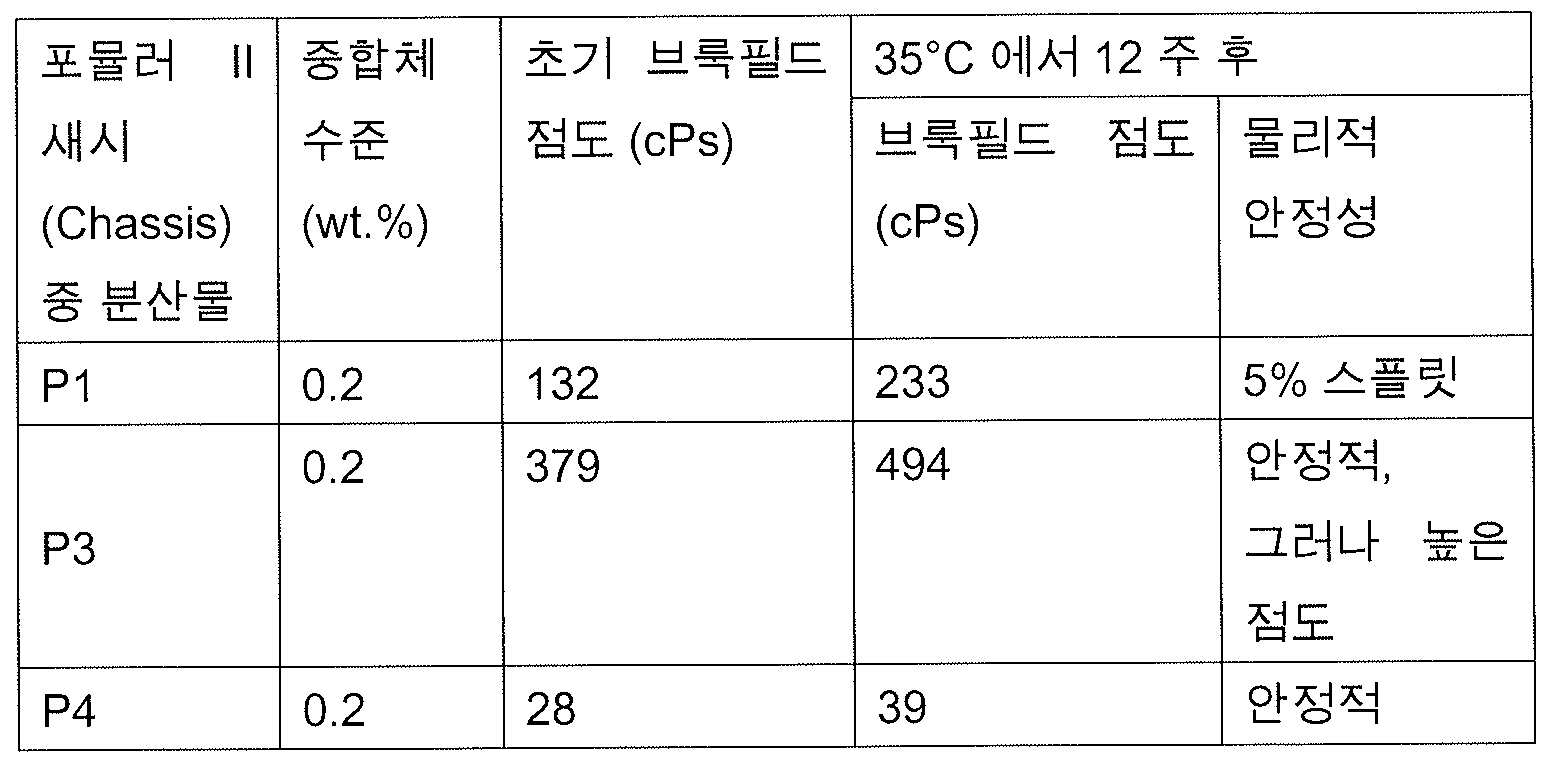
표 6: 선형 양이온성 메타크릴레이트 아크릴아미드 공중합체 (표 1 실시예 2.6 으로부터의 분산액) 를 사용하는 실시예 포뮬러 IV 에서 완제품 침적 성능Table 6: Finished product deposition performance in the Example Formula IV using linear cationic methacrylate acrylamide copolymer (dispersion from Table 2.6 Example 2.6)

표 7: 실시예 포뮬러Table 7: Example Formula
하기는 직물 케어 조성물의 비제한적 실시예이다The following are non-limiting examples of fabric care compositions

a N,N-디(탈로우오일옥시에틸)-N,N-디메틸암모늄 클로리드. a N, N-di (tallowoyloxyethyl) -N, N-dimethylammonium chloride.
b 저분자량 알코올 예컨대 EtOH 또는 IPA b Low molecular weight alcohols such as EtOH or IPA
c BASF 로부터 상품명 Rheovis®CDE 하에 입수가능한 양이온성 중합체. c Cationic polymers available under the trade name Rheovis® CDE from BASF.
d Appleton Papers, Inc. 로부터 입수가능한 향수 마이크로캡슐 d Appleton Papers, Inc. Lt; RTI ID = 0.0 > microcapsules &
e 디에틸렌트리아민펜타아세트산 또는 히드록실 에틸리덴-1,1-디포스폰산 e Diethylenetriamine pentaacetic acid or hydroxylethylidene-l, l-diphosphonic acid
f 상품명 Proxel 하에 Lonza 로부터 입수가능한 1,2-벤즈이소티아졸린-3-ONE (BIT). f Product name 1,2-benzisothiazolin-3-ONE (BIT), available from Lonza under Proxel.
g Dow Corning® 으로부터 상품명 DC2310 하에 입수가능한 실리콘 소포제. g Silicone antifoam available under the trade name DC2310 from Dow Corning®.
h 표 8 로부터의 양이온성 아크릴레이트-아크릴아미드 공중합체 P1-P5. h Cationic acrylate-acrylamide copolymer P1-P5 from Table 8.
i DMA3*MeCl 및 아크릴아미드의 60:40 비율의 선형 공중합체, DMA3*MeCl :아크릴아미드(표 1 실시예 2.6 으로부터의 분산액) i DMA3 * MeCl and a 60:40 linear copolymer of acrylamide, DMA3 * MeCl: acrylamide (dispersion from Table 2.6 Example 2.6)
j 디데실 디메틸 암모늄 클로리드 (상품명 Bardac®2280) j didecyl dimethyl ammonium chloride (trade name Bardac®2280)
k AkzoNobel 로부터 상품명 Arquad®HTL8-MS 하에 입수가능한 수소첨가된 탈로우알킬(2-에틸헥실)디메틸 암모늄 메틸설페이트 k available from AkzoNobel under the trade name MS-Arquad®HTL8 available hydrogen is added tallow alkyl (2-ethylhexyl) dimethyl ammonium methyl sulfates
l BASF 로부터 상품명 Lutensol®XL-70 하에 입수가능한 비이온성 계면활성제 l Nonionic surfactant available under the trade name Lutensol® XL-70 from BASF
m 비이온성 계면활성제, 예컨대 TWEEN 20™ 또는 TAE80 (탈로우 에톡실레이티드 알코올, 평균 에톡실화도 80), 또는 양이온성 계면활성제 (Akzo Nobel 로부터의 Ethoquad®C 25 및 Berol 648) m ethionic surfactants such as TWEEN 20 ™ or TAE 80 (tallowethoxylated alcohol, average ethoxylation degree 80), or cationic surfactants (Ethoquad® C 25 and Berol 648 from Akzo Nobel)
n Dow Corning 으로부터 상품명 DC346® 하에 입수가능한 폴리디메틸실록산 에멀전 n Polydimethylsiloxane emulsion available from Dow Corning under the trade name DC346®
o 아미노-관능성 오르가노실록산 중합체 예컨대 아미노에틸아미노프로필메틸실록산-디메틸실록산 공중합체 (아민 당량 1500 g/mol 이상) (Shin-Etsu Silicones 으로부터 명칭 KF-861, KF-8002 하에 입수가능) o Amino-functional organosiloxane polymers such as aminoethylaminopropylmethylsiloxane-dimethylsiloxane copolymer (amine equivalents 1500 g / mol or more) (available under the name KF-861, KF-8002 from Shin-Etsu Silicones)
표 8: 실시예 P1 내지 P5 Table 8: Examples P1 to P5

Claims (20)
i) 하기의 중합에 의해 수득가능한 하나 이상의 양이온성 중합체
a) 하나 이상의 양이온성 단량체 및 임의로 하나 이상의 비이온성 단량체 (화합물 A),
b) 하나 이상의 가교제 (화합물 B), 여기서 가교제의 양은 0 중량% 초과 및 0.05 중량% 미만임,
c) 임의로 하나 이상의 연쇄 전달제 (화합물 C),
ii) 하나 이상의 안정화제, 여기서 안정화제는 소수성 단위체 당 탄소수 50 초과의 하나 이상의 소수성 단위체를 가짐,
iii) 하나 이상의 유상.A reverse dispersion comprising:
i) at least one cationic polymer obtainable by the following polymerization
a) at least one cationic monomer and optionally at least one nonionic monomer (Compound A),
b) at least one crosslinking agent (compound B), wherein the amount of crosslinking agent is greater than 0 wt% and less than 0.05 wt%
c) optionally one or more chain transfer agents (compound C),
ii) at least one stabilizer, wherein the stabilizer has at least one hydrophobic monomer having more than 50 carbon atoms per hydrophobic unit,
iii) one or more remedies.

[식 중,
R1 은 H 또는 C1-C4-알킬이고,
R2 는 H 또는 메틸이고,
R3 은 C1-C4-알킬렌이고,
R4, R5 및 R6 은 각각 독립적으로 H 또는 C1-C30-알킬이고,
X 는 -O- 또는 -NH- 이고,
Y 는 Cl; Br; I; 수소설페이트 또는 메토설페이트임].The reverse-dispersion of claim 1, wherein the cationic monomer is selected from compounds of formula (I)
[Wherein,
Alkyl, - R 1 is H or C 1 -C 4
R 2 is H or methyl,
R 3 is C 1 -C 4 -alkylene,
R 4 , R 5 and R 6 are each independently H or C 1 -C 30 -alkyl,
X is -O- or -NH-,
Y is Cl; Br; I; Hydrogen sulfate or methosulfate.

[식 중,
R7 은 H 또는 C1-C4-알킬이고,
R8 은 H 또는 메틸이고,
R9 및 R10 은, 서로 독립적으로, H 또는 C1-C30-알킬임].The reverse-dispersion liquid according to claim 1, wherein the non-ionic monomer is selected from N-vinylpyrrolidone, N-vinylimidazole or a compound according to formula (II)
[Wherein,
Alkyl-, - R 7 is H or C 1 -C 4
R < 8 > is H or methyl,
R 9 and R 10 are, independently of each other, H or C 1 -C 30 -alkyl.
i) 하기의 중합에 의해 수득가능한 하나 이상의 양이온성 중합체
a) 하나 이상의 양이온성 단량체 및 임의로 하나 이상의 비이온성 단량체,
b) 하나 이상의 가교제, 여기서 가교제의 양은 0 중량% 초과 및 0.05 중량% 미만임,
c) 임의로 하나 이상의 연쇄 전달제,
ii) 하나 이상의 안정화제, 여기서 안정화 계면활성제는 탄소수 50 초과의 하나 이상의 소수성 사슬을 가짐,
iii) 하나 이상의 유상,
여기서 역 분산액은 역유화 중합, 임의로 그에 뒤이어 액체 분산액 중합체 기술을 이용하는 증류에 의해 수득됨.A process for preparing a reverse dispersion liquid comprising:
i) at least one cationic polymer obtainable by the following polymerization
a) at least one cationic monomer and optionally at least one nonionic monomer,
b) at least one crosslinker, wherein the amount of crosslinker is greater than 0 wt% and less than 0.05 wt%
c) optionally one or more chain transfer agents,
ii) at least one stabilizer, wherein the stabilizing surfactant has at least one hydrophobic chain of more than 50 carbon atoms,
iii) one or more oil,
Wherein the reverse dispersion is obtained by reverse emulsion polymerization, optionally followed by distillation using liquid dispersion polymer technology.
Applications Claiming Priority (3)
| Application Number | Priority Date | Filing Date | Title |
|---|---|---|---|
| EP12168760.2 | 2012-05-21 | ||
| EP12168760 | 2012-05-21 | ||
| PCT/EP2013/058874 WO2013174622A1 (en) | 2012-05-21 | 2013-04-29 | Inverse dispersion comprising a cationic polymer and a stabilizing agent |
Publications (2)
| Publication Number | Publication Date |
|---|---|
| KR20150013863A KR20150013863A (en) | 2015-02-05 |
| KR101975179B1 true KR101975179B1 (en) | 2019-05-07 |
Family
ID=48227287
Family Applications (1)
| Application Number | Title | Priority Date | Filing Date |
|---|---|---|---|
| KR1020147035746A Expired - Fee Related KR101975179B1 (en) | 2012-05-21 | 2013-04-29 | Inverse dispersion comprising a cationic polymer and a stabilizing agent |
Country Status (12)
| Country | Link |
|---|---|
| EP (1) | EP2852622B1 (en) |
| JP (1) | JP6211070B2 (en) |
| KR (1) | KR101975179B1 (en) |
| CN (1) | CN104334586B (en) |
| BR (1) | BR112014028776B1 (en) |
| CA (1) | CA2870653A1 (en) |
| ES (1) | ES2654614T3 (en) |
| MX (1) | MX2014014249A (en) |
| PH (1) | PH12014502611A1 (en) |
| PL (1) | PL2852622T3 (en) |
| RU (1) | RU2630309C2 (en) |
| WO (1) | WO2013174622A1 (en) |
Families Citing this family (11)
| Publication number | Priority date | Publication date | Assignee | Title |
|---|---|---|---|---|
| BR112017001175A2 (en) * | 2014-07-23 | 2018-01-30 | Basf Se | reverse dispersion, process for manufacturing a reverse dispersion, and use of reverse dispersion |
| CN108602902B (en) * | 2016-01-25 | 2021-06-04 | 巴斯夫欧洲公司 | Method for obtaining cationic polymers having at least a bimodal molecular weight distribution |
| BR112018015027B1 (en) * | 2016-01-25 | 2022-08-02 | Basf Se | cationic polymer, reverse dispersion, deposition aid or thickener, and process for obtaining a cationic polymer |
| EP3427031B1 (en) | 2016-03-07 | 2025-12-17 | Yokogawa Fluence Analytics, Inc. | Device and methods for simultaneous determination of intrinsic viscosity and non-newtonian behavior of polymers |
| CN107286302A (en) * | 2017-06-28 | 2017-10-24 | 常州市瑞泰物资有限公司 | A kind of softening agent for paper and preparation method thereof |
| JP7043626B2 (en) * | 2018-01-29 | 2022-03-29 | ザ プロクター アンド ギャンブル カンパニー | Softening cleaning additive for particulate laundry |
| CA3031768C (en) | 2018-01-29 | 2022-02-15 | The Procter & Gamble Company | Dryer sheets comprising branched polyester polymers |
| EP3746533B1 (en) | 2018-01-29 | 2025-11-05 | The Procter & Gamble Company | Liquid fabric enhancers comprising branched polyester molecules |
| EP3802661B1 (en) | 2018-05-30 | 2025-09-10 | The Procter & Gamble Company | Liquid fabric enhancers comprising branched polyester molecules |
| JP7208263B2 (en) | 2018-05-30 | 2023-01-18 | ザ プロクター アンド ギャンブル カンパニー | Particulate Laundry Softening Detergent Additive |
| EP3575339B1 (en) | 2018-05-30 | 2024-05-08 | The Procter & Gamble Company | Dryer sheets comprising branched polyester polymers |
Citations (4)
| Publication number | Priority date | Publication date | Assignee | Title |
|---|---|---|---|---|
| JP2002105857A (en) | 2000-09-29 | 2002-04-10 | Kao Corp | Liquid softener composition |
| JP2004523551A (en) | 2001-02-28 | 2004-08-05 | アクゾ・ノベル・エヌ・ベー | Water-in-oil emulsion for injection |
| JP2009280648A (en) | 2008-05-20 | 2009-12-03 | Hymo Corp | Ionic water-soluble polymer comprising powder, method for producing the same and its application |
| US20110269663A1 (en) | 2009-01-06 | 2011-11-03 | Elizabeth Ann Clowes | Fabric conditioners |
Family Cites Families (33)
| Publication number | Priority date | Publication date | Assignee | Title |
|---|---|---|---|---|
| GB1482515A (en) * | 1974-07-24 | 1977-08-10 | Allied Colloids Ltd | Polymers |
| DE2862369D1 (en) * | 1977-07-12 | 1984-03-08 | Ici Plc | Linear or branched ester-ether block copolymers and their use as surfactants either alone or in blends with conventional surfactants |
| GB2002400B (en) | 1977-07-12 | 1982-01-20 | Ici Ltd | Block or graft copolymers and their use as surfactants |
| JPS59136305A (en) * | 1983-01-26 | 1984-08-04 | Sumitomo Chem Co Ltd | Production of water-soluble spherical polymer |
| GB8309275D0 (en) * | 1983-04-06 | 1983-05-11 | Allied Colloids Ltd | Dissolution of water soluble polymers in water |
| EP0172025B1 (en) | 1984-08-15 | 1991-10-30 | Ciba Specialty Chemicals Water Treatments Limited | Polymeric compositions |
| DE3583559D1 (en) | 1984-08-15 | 1991-08-29 | Allied Colloids Ltd | WATER-SOLUBLE POLYMERS. |
| EP0172724B1 (en) | 1984-08-15 | 1991-07-24 | Ciba Specialty Chemicals Water Treatments Limited | Polymerisation processes and polymeric compositions |
| CA1331251C (en) | 1988-05-20 | 1994-08-02 | Peter Flesher | Particulate polymers, their production and uses |
| DE4418156A1 (en) | 1994-05-25 | 1995-11-30 | Basf Ag | Process for the preparation of stable water-in-oil emulsions of hydrolyzed polymers of N-vinylamides and their use |
| US5646212A (en) | 1994-09-02 | 1997-07-08 | Ici Americas Inc. | Polyalkylene glycol anhydroxy carboxylic acid dispersant |
| GB9618332D0 (en) | 1996-09-03 | 1996-10-16 | Ici Plc | Polyacrylamide polymerisation |
| IT1293509B1 (en) | 1997-07-30 | 1999-03-01 | 3V Sigma Spa | THICKENERS FOR ACID WATER COMPOSITIONS |
| DE19911170A1 (en) * | 1999-03-12 | 2000-09-14 | Basf Ag | Process for making W / O emulsions |
| FR2797635A1 (en) | 1999-08-20 | 2001-02-23 | Atofina | Preparation of hydrophilic polymers, used in water treatment and as retention agents and thickeners in paper production and other industries, by inverse-emulsion polymerization |
| US7452854B2 (en) | 2002-06-04 | 2008-11-18 | Ciba Specialty Chemicals Corporation | Aqueous fabric softener formulations comprising copolymers of cationic acrylates and N-alkyl acrylamides |
| JP4673064B2 (en) * | 2002-11-29 | 2011-04-20 | チバ ホールディング インコーポレーテッド | Aqueous composition comprising homopolymer and / or copolymer |
| KR101007599B1 (en) * | 2002-11-29 | 2011-01-12 | 시바 홀딩 인코포레이티드 | Fabric Softener Compositions Containing Homogeneous Polymers and / or Copolymers |
| CN1720267A (en) * | 2002-12-06 | 2006-01-11 | 赫尔克里士公司 | Cationic or amphoteric copolymers prepared in inverse emulsion matrices and their use in the preparation of cellulosic fiber compositions |
| US7396874B2 (en) * | 2002-12-06 | 2008-07-08 | Hercules Incorporated | Cationic or amphoteric copolymers prepared in an inverse emulsion matrix and their use in preparing cellulosic fiber compositions |
| US6949500B2 (en) | 2002-12-16 | 2005-09-27 | Colgate-Palmolive Company | Fabric softener compositions containing a mixture of cationic polymers as rheology modifiers |
| JP2005125215A (en) * | 2003-10-23 | 2005-05-19 | Hymo Corp | Oil-containing organic sludge dewatering method |
| BRPI0509659B8 (en) | 2004-04-06 | 2021-05-25 | Basf Se | process for preparing an aqueous dispersion polymer composition |
| US7304026B2 (en) | 2004-04-15 | 2007-12-04 | Colgate-Palmolive Company | Fabric care composition comprising polymer encapsulated fabric or skin beneficiating ingredient |
| WO2005103091A1 (en) * | 2004-04-21 | 2005-11-03 | Ciba Specialty Chemicals Water Treatments Limited | Composition and method of preparing high solid emulsions |
| US7485451B2 (en) | 2004-11-18 | 2009-02-03 | Regents Of The University Of California | Storage stable compositions of biological materials |
| FR2879607B1 (en) * | 2004-12-16 | 2007-03-30 | Seppic Sa | NOVEL CONCENTRATED REVERSE LATEX, PROCESS FOR PREPARING THE SAME, AND USE IN INDUSTRY |
| US20070015684A1 (en) | 2005-07-15 | 2007-01-18 | Marshall Michael L | Viscosity improvement in liquid fabric softeners |
| BRPI0814375A2 (en) * | 2007-08-03 | 2015-01-27 | Basf Se | ASSOCIATIVE THICKENER, NET WASHING AND CLEANING AGENT COMPOSITION, AND METHODS FOR PREPARING A NET WASHING AND CLEANING AGENT COMPOSITION, AND FOR PREPARING AN ASSOCIATIVE THICKER. |
| CN100551941C (en) * | 2007-11-28 | 2009-10-21 | 湖北省化学研究院 | Dispersion Polymerized Polyacrylamide Emulsion and Its Application in Oilfield Produced Fluid Treatment |
| JP5366301B2 (en) * | 2008-07-10 | 2013-12-11 | ハイモ株式会社 | Powdered ionic water-soluble polymer and use thereof |
| MX300451B (en) | 2009-01-06 | 2012-06-19 | Spcm Sa | Cationic polymer thickeners. |
| GB0922624D0 (en) | 2009-12-24 | 2010-02-10 | Croda Int Plc | Inverse emulsions |
-
2013
- 2013-04-29 CA CA2870653A patent/CA2870653A1/en not_active Abandoned
- 2013-04-29 RU RU2014151609A patent/RU2630309C2/en active
- 2013-04-29 BR BR112014028776-7A patent/BR112014028776B1/en active IP Right Grant
- 2013-04-29 KR KR1020147035746A patent/KR101975179B1/en not_active Expired - Fee Related
- 2013-04-29 PL PL13719540T patent/PL2852622T3/en unknown
- 2013-04-29 JP JP2015513074A patent/JP6211070B2/en active Active
- 2013-04-29 MX MX2014014249A patent/MX2014014249A/en unknown
- 2013-04-29 EP EP13719540.0A patent/EP2852622B1/en active Active
- 2013-04-29 CN CN201380026324.6A patent/CN104334586B/en active Active
- 2013-04-29 ES ES13719540.0T patent/ES2654614T3/en active Active
- 2013-04-29 WO PCT/EP2013/058874 patent/WO2013174622A1/en not_active Ceased
-
2014
- 2014-11-21 PH PH12014502611A patent/PH12014502611A1/en unknown
Patent Citations (4)
| Publication number | Priority date | Publication date | Assignee | Title |
|---|---|---|---|---|
| JP2002105857A (en) | 2000-09-29 | 2002-04-10 | Kao Corp | Liquid softener composition |
| JP2004523551A (en) | 2001-02-28 | 2004-08-05 | アクゾ・ノベル・エヌ・ベー | Water-in-oil emulsion for injection |
| JP2009280648A (en) | 2008-05-20 | 2009-12-03 | Hymo Corp | Ionic water-soluble polymer comprising powder, method for producing the same and its application |
| US20110269663A1 (en) | 2009-01-06 | 2011-11-03 | Elizabeth Ann Clowes | Fabric conditioners |
Also Published As
| Publication number | Publication date |
|---|---|
| ES2654614T3 (en) | 2018-02-14 |
| CA2870653A1 (en) | 2013-11-28 |
| CN104334586B (en) | 2017-05-31 |
| BR112014028776B1 (en) | 2021-02-09 |
| EP2852622A1 (en) | 2015-04-01 |
| WO2013174622A1 (en) | 2013-11-28 |
| JP6211070B2 (en) | 2017-10-11 |
| RU2630309C2 (en) | 2017-09-07 |
| JP2015517600A (en) | 2015-06-22 |
| RU2014151609A (en) | 2016-07-10 |
| EP2852622B1 (en) | 2017-10-18 |
| BR112014028776A2 (en) | 2017-06-27 |
| CN104334586A (en) | 2015-02-04 |
| MX2014014249A (en) | 2016-02-05 |
| PL2852622T3 (en) | 2018-03-30 |
| KR20150013863A (en) | 2015-02-05 |
| PH12014502611A1 (en) | 2015-01-21 |
Similar Documents
| Publication | Publication Date | Title |
|---|---|---|
| KR101975179B1 (en) | Inverse dispersion comprising a cationic polymer and a stabilizing agent | |
| US9102900B2 (en) | Inverse dispersion comprising a cationic polymer and a stabilizing agent | |
| US20130121944A1 (en) | Thickener comprising at least one cationic polymer preparable by inverse emulsion polymerization | |
| JP2014534320A (en) | Thickener comprising at least one cationic polymer | |
| US10745494B2 (en) | Cationic polymer with an at least bimodal molecular weight distribution | |
| JP2015504455A (en) | Thickener containing at least one polymer based on associative monomers | |
| KR20170039200A (en) | Inverse dispersion comprising a cationic polymer, a stabilizing agent and a trifunctional and/or polyfunctional crosslinker | |
| CN108602902B (en) | Method for obtaining cationic polymers having at least a bimodal molecular weight distribution | |
| KR20150013862A (en) | Inverse dispersion comprising an anionic or a nonionic polymer and a stabilizing agent | |
| WO2019016334A1 (en) | A process for obtaining a polymer based on anionic or nonionic monomers with an at least bimodal molecular weight distribution | |
| WO2019016336A1 (en) | Polymer based on anionic or nonionic monomers with an at least bimodal molecular weight distribution |
Legal Events
| Date | Code | Title | Description |
|---|---|---|---|
| E13-X000 | Pre-grant limitation requested |
St.27 status event code: A-2-3-E10-E13-lim-X000 |
|
| PA0105 | International application |
St.27 status event code: A-0-1-A10-A15-nap-PA0105 |
|
| PG1501 | Laying open of application |
St.27 status event code: A-1-1-Q10-Q12-nap-PG1501 |
|
| R18-X000 | Changes to party contact information recorded |
St.27 status event code: A-3-3-R10-R18-oth-X000 |
|
| P11-X000 | Amendment of application requested |
St.27 status event code: A-2-2-P10-P11-nap-X000 |
|
| P13-X000 | Application amended |
St.27 status event code: A-2-2-P10-P13-nap-X000 |
|
| PA0201 | Request for examination |
St.27 status event code: A-1-2-D10-D11-exm-PA0201 |
|
| R18-X000 | Changes to party contact information recorded |
St.27 status event code: A-3-3-R10-R18-oth-X000 |
|
| D13-X000 | Search requested |
St.27 status event code: A-1-2-D10-D13-srh-X000 |
|
| D14-X000 | Search report completed |
St.27 status event code: A-1-2-D10-D14-srh-X000 |
|
| E701 | Decision to grant or registration of patent right | ||
| PE0701 | Decision of registration |
St.27 status event code: A-1-2-D10-D22-exm-PE0701 |
|
| GRNT | Written decision to grant | ||
| PR0701 | Registration of establishment |
St.27 status event code: A-2-4-F10-F11-exm-PR0701 |
|
| PR1002 | Payment of registration fee |
St.27 status event code: A-2-2-U10-U12-oth-PR1002 Fee payment year number: 1 |
|
| PG1601 | Publication of registration |
St.27 status event code: A-4-4-Q10-Q13-nap-PG1601 |
|
| P22-X000 | Classification modified |
St.27 status event code: A-4-4-P10-P22-nap-X000 |
|
| PC1903 | Unpaid annual fee |
St.27 status event code: A-4-4-U10-U13-oth-PC1903 Not in force date: 20220430 Payment event data comment text: Termination Category : DEFAULT_OF_REGISTRATION_FEE |
|
| PC1903 | Unpaid annual fee |
St.27 status event code: N-4-6-H10-H13-oth-PC1903 Ip right cessation event data comment text: Termination Category : DEFAULT_OF_REGISTRATION_FEE Not in force date: 20220430 |
|
| R18-X000 | Changes to party contact information recorded |
St.27 status event code: A-5-5-R10-R18-oth-X000 |