KR101902610B1 - Curable polyisocyanate composition comprising an epoxy resin - Google Patents
Curable polyisocyanate composition comprising an epoxy resin Download PDFInfo
- Publication number
- KR101902610B1 KR101902610B1 KR1020147016710A KR20147016710A KR101902610B1 KR 101902610 B1 KR101902610 B1 KR 101902610B1 KR 1020147016710 A KR1020147016710 A KR 1020147016710A KR 20147016710 A KR20147016710 A KR 20147016710A KR 101902610 B1 KR101902610 B1 KR 101902610B1
- Authority
- KR
- South Korea
- Prior art keywords
- equivalent
- polyisocyanate
- group
- isocyanate
- urea
- Prior art date
- Legal status (The legal status is an assumption and is not a legal conclusion. Google has not performed a legal analysis and makes no representation as to the accuracy of the status listed.)
- Active
Links
Classifications
-
- C—CHEMISTRY; METALLURGY
- C08—ORGANIC MACROMOLECULAR COMPOUNDS; THEIR PREPARATION OR CHEMICAL WORKING-UP; COMPOSITIONS BASED THEREON
- C08L—COMPOSITIONS OF MACROMOLECULAR COMPOUNDS
- C08L75/00—Compositions of polyureas or polyurethanes; Compositions of derivatives of such polymers
- C08L75/04—Polyurethanes
-
- C—CHEMISTRY; METALLURGY
- C08—ORGANIC MACROMOLECULAR COMPOUNDS; THEIR PREPARATION OR CHEMICAL WORKING-UP; COMPOSITIONS BASED THEREON
- C08G—MACROMOLECULAR COMPOUNDS OBTAINED OTHERWISE THAN BY REACTIONS ONLY INVOLVING UNSATURATED CARBON-TO-CARBON BONDS
- C08G59/00—Polycondensates containing more than one epoxy group per molecule; Macromolecules obtained by polymerising compounds containing more than one epoxy group per molecule using curing agents or catalysts which react with the epoxy groups
- C08G59/02—Polycondensates containing more than one epoxy group per molecule
- C08G59/04—Polycondensates containing more than one epoxy group per molecule of polyhydroxy compounds with epihalohydrins or precursors thereof
- C08G59/06—Polycondensates containing more than one epoxy group per molecule of polyhydroxy compounds with epihalohydrins or precursors thereof of polyhydric phenols
- C08G59/066—Polycondensates containing more than one epoxy group per molecule of polyhydroxy compounds with epihalohydrins or precursors thereof of polyhydric phenols with chain extension or advancing agents
-
- C—CHEMISTRY; METALLURGY
- C08—ORGANIC MACROMOLECULAR COMPOUNDS; THEIR PREPARATION OR CHEMICAL WORKING-UP; COMPOSITIONS BASED THEREON
- C08G—MACROMOLECULAR COMPOUNDS OBTAINED OTHERWISE THAN BY REACTIONS ONLY INVOLVING UNSATURATED CARBON-TO-CARBON BONDS
- C08G59/00—Polycondensates containing more than one epoxy group per molecule; Macromolecules obtained by polymerising compounds containing more than one epoxy group per molecule using curing agents or catalysts which react with the epoxy groups
- C08G59/18—Macromolecules obtained by polymerising compounds containing more than one epoxy group per molecule using curing agents or catalysts which react with the epoxy groups ; e.g. general methods of curing
- C08G59/40—Macromolecules obtained by polymerising compounds containing more than one epoxy group per molecule using curing agents or catalysts which react with the epoxy groups ; e.g. general methods of curing characterised by the curing agents used
- C08G59/4007—Curing agents not provided for by the groups C08G59/42 - C08G59/66
- C08G59/4014—Nitrogen containing compounds
- C08G59/4021—Ureas; Thioureas; Guanidines; Dicyandiamides
-
- C—CHEMISTRY; METALLURGY
- C08—ORGANIC MACROMOLECULAR COMPOUNDS; THEIR PREPARATION OR CHEMICAL WORKING-UP; COMPOSITIONS BASED THEREON
- C08G—MACROMOLECULAR COMPOUNDS OBTAINED OTHERWISE THAN BY REACTIONS ONLY INVOLVING UNSATURATED CARBON-TO-CARBON BONDS
- C08G59/00—Polycondensates containing more than one epoxy group per molecule; Macromolecules obtained by polymerising compounds containing more than one epoxy group per molecule using curing agents or catalysts which react with the epoxy groups
- C08G59/18—Macromolecules obtained by polymerising compounds containing more than one epoxy group per molecule using curing agents or catalysts which react with the epoxy groups ; e.g. general methods of curing
- C08G59/40—Macromolecules obtained by polymerising compounds containing more than one epoxy group per molecule using curing agents or catalysts which react with the epoxy groups ; e.g. general methods of curing characterised by the curing agents used
- C08G59/44—Amides
-
- C—CHEMISTRY; METALLURGY
- C08—ORGANIC MACROMOLECULAR COMPOUNDS; THEIR PREPARATION OR CHEMICAL WORKING-UP; COMPOSITIONS BASED THEREON
- C08L—COMPOSITIONS OF MACROMOLECULAR COMPOUNDS
- C08L63/00—Compositions of epoxy resins; Compositions of derivatives of epoxy resins
Landscapes
- Chemical & Material Sciences (AREA)
- Health & Medical Sciences (AREA)
- Chemical Kinetics & Catalysis (AREA)
- Medicinal Chemistry (AREA)
- Polymers & Plastics (AREA)
- Organic Chemistry (AREA)
- Polyurethanes Or Polyureas (AREA)
- Epoxy Resins (AREA)
Abstract
에폭시 수지 및 카르복사미드를 포함하는 에폭시 수지 조성물, 및 폴리이소시아네이트, 할로겐화리튬 및 우레아 화합물을 포함하는 폴리이소시아네이트 조성물을 결합하고 혼합함으로써 얻어지는 경화성 조성물로서, 이소시아네이트 당량 당 할로겐화리튬의 몰 수가 0.0001-0.04의 범위이고 이소시아네이트 당량 당 우레아 + 뷰렛 당량의 수가 0.0001-0.4이다.An epoxy resin composition comprising an epoxy resin and a carboxamide, and a polyisocyanate composition comprising a polyisocyanate, a lithium halide and a urea compound, wherein the molar ratio of lithium halide to isocyanate equivalent is from 0.0001 to 0.04 And the number of urea + buret equivalent per isocyanate equivalent is 0.0001-0.4.
Description
본 발명은 에폭시 수지 조성물 및 상기 에폭시 수지 조성물과 폴리이소시아네이트 조성물을 배합함으로써 만들어지는 경화성 조성물에 관한 것이다. 추가로 본 발명은 상기 에폭시 수지 조성물과 상기 경화성 조성물의 제조 방법에 관한 것이다. 더 추가로 본 발명은 경화성 조성물을 반응하게 함으로써 폴리이소시아누레이트 포함 물질을 제조하는 방법, 및 이러한 경화성 조성물을 반응하게 하여 만들어지는 폴리이소시아누레이트 포함 물질에 관한 것이다.The present invention relates to an epoxy resin composition and a curable composition produced by blending the epoxy resin composition and a polyisocyanate composition. The present invention further relates to the above epoxy resin composition and a process for producing the curable composition. Still further, the present invention relates to a method for preparing a polyisocyanurate containing material by allowing the curable composition to react, and to a polyisocyanurate containing material made by reacting such a curable composition.
폴리이소시아네이트, 할로겐화리튬, 우레아 화합물 및 에폭시 수지를 포함하는 경화성 조성물이 최근에 제안되었다(WO 2010/121898 참조).
놀랍게도 우리는 카르복사미드 기를 포함하는 화합물을 포함하는 에폭시 수지 조성물을 사용함으로써, 경화성 조성물의 경화에 부정적인 영향을 미치지 않고 경화성 폴리이소시아네이트 조성물의 가사기간(pot-life)이 추가로 개선될 수 있음을 발견했다.Curable compositions comprising polyisocyanates, lithium halides, urea compounds and epoxy resins have recently been proposed (see WO 2010/121898).
Surprisingly, we have found that by using an epoxy resin composition comprising a compound comprising a carboxamide group, the pot-life of the curable polyisocyanate composition can be further improved without negatively affecting the curing of the curable composition found.
따라서 본 발명은 에폭시 수지, -CO-NH2 구조가 있는 카르복사미드 기를 포함하는 화합물, 및 선택적으로 이소시아네이트-반응성 기가 없는 용매, 및 선택적으로 모노올 및/또는 폴리올을 포함하며, 여기서 에폭시 당량 당 카르복사미드 당량의 수가 0.0005-1이고 바람직하게는 0.005-0.7이고 가장 바람직하게는 0.01-0.5이며 에폭시 당량 당 히드록시 당량의 수가 최대 0.019이고 바람직하게는 최대 0.014이고 가장 바람직하게는 최대 0.010인 에폭시 수지 조성물에 관련된다.Accordingly, the present invention provides a composition comprising an epoxy resin, a compound comprising a carboxamide group having a -CO-NH 2 structure, and optionally a solvent free of isocyanate-reactive groups, and optionally a monool and / or polyol, The number of carboxamide equivalents is 0.0005-1, preferably 0.005-0.7 and most preferably 0.01-0.5, the number of hydroxy equivalents per epoxy equivalent is at most 0.019, preferably at most 0.014 and most preferably at most 0.010. To a resin composition.
실시양태에 따라 발명에 따른 에폭시 수지 조성물은 경화성 조성물을 만드는데 적당하며, 에폭시 수지, -CO-NH2 구조가 있는 카르복사미드 기를 포함하는 화합물, 이소시아네이트-반응성 기가 없는 용매, 및 선택적으로 모노올 및/또는 폴리올을 포함하며 여기서 에폭시 당량 당 카르복사미드 당량의 수가 0.0005-1이고 바람직하게는 0.005-0.7이고 가장 바람직하게는 0.01-0.5이며 에폭시 당량 당 히드록시 당량의 수는 최대 0.019이고 바람직하게는 최대 0.014이고 가장 바람직하게는 최대 0.010이다.According to an embodiment, an epoxy resin composition according to the invention is suitable for making a curable composition and comprises an epoxy resin, a compound comprising a carboxamide group having a -CO-NH 2 structure, a solvent without an isocyanate-reactive group, / Polyol wherein the number of carboxamide equivalents per epoxy equivalent is from 0.0005 to 1, preferably from 0.005 to 0.7 and most preferably from 0.01 to 0.5, the number of hydroxy equivalents per epoxy equivalent is at most 0.019, 0.014 and most preferably at most 0.010.
추가로 본 발명은 카르복사미드 기를 포함하는 화합물의 혼합물이 에폭시 수지와 배합되고 혼합되는, 이러한 에폭시 수지 조성물의 제조 방법에 관련된다. 에폭시 수지 조성물이 상기 주어진 양의 구성성분을 포함하도록 구성성분의 상대적 양이 선택된다.The present invention further relates to a process for preparing such epoxy resin compositions, wherein a mixture of compounds comprising a carboxamide group is compounded and mixed with an epoxy resin. The relative amounts of the constituents are selected such that the epoxy resin composition comprises the above given amount of constituents.
더 추가로 본 발명은 폴리이소시아네이트, 할로겐화리튬 및 500-15000의 평균 분자량을 갖고 선택적으로 뷰렛 기를 포함하는 우레아 화합물을 포함하는 폴리이소시아네이트 조성물 및 위에서 정의된 에폭시 수지 조성물을 배합하고 혼합함으로써 얻어지며, 이소시아네이트 당량 당 할로겐화리튬의 몰 수가 0.0001-0.04 범위이고, 이소시아네이트 당량 당 우레아 + 뷰렛 당량의 수가 0.0001-0.4 범위이고, 이소시아네이트 당량 당 에폭시 당량의 수가 0.003-1 범위인 경화성 조성물에 관련된다.The present invention further relates to a polyisocyanate composition comprising a polyisocyanate, a lithium halide and an urea compound having an average molecular weight of 500-15000 and optionally a biuret group, and an epoxy resin composition as defined above, The molar ratio of lithium halide per equivalent is in the range of from 0.0001 to 0.04, the number of urea + buret equivalent per isocyanate equivalent is in the range of from 0.0001 to 0.4, and the number of epoxy equivalents per isocyanate equivalent is in the range of from 0.003 to 1.
발명에 따른 경화성 조성물은 바람직하게는 The curable composition according to the invention preferably comprises
- 폴리이소시아네이트, 할로겐화리튬 및 500-15000의 평균 분자량을 갖고 선택적으로 뷰렛 기를 포함하는 우레아 화합물을 포함하며, 이소시아네이트 당량 당 할로겐화리튬의 몰 수가 0.0001-0.04 범위이고, 이소시아네이트 당량 당 우레아 + 뷰렛 당량의 수가 0.0001-0.4 범위이고, 이소시아네이트 당량 당 에폭시 당량의 수가 0.003-1 범위인 폴리이소시아네이트 조성물, 및- a polyisocyanate, a lithium halide and a urea compound having an average molecular weight of 500-15000 and optionally a biuret group, wherein the molar ratio of lithium halide per isocyanate equivalent is in the range of 0.0001-0.04 and the number of urea plus buret equivalent per isocyanate equivalent 0.0001-0.4, the number of epoxy equivalents per isocyanate equivalent is in the range of 0.003-1, and
- 에폭시 수지, -CO-NH2 구조를 갖는 카르복사미드 기를 포함하는 화합물, 및 이소시아네이트-반응성 기가 없는 용매를 포함하며, 에폭시 당량 당 카르복사미드 당량의 수가 0.0005-1이고 바람직하게는 0.005-0.7이고 가장 바람직하게는 0.01-0.5인 에폭시 수지 조성물-Epoxy resin, a compound containing a carboxamide group having a -CO-NH 2 structure, and a solvent free of an isocyanate-reactive group, wherein the number of carboxamide equivalents per epoxy equivalent is 0.0005-1, preferably 0.005-0.7 And most preferably from 0.01 to 0.5.
을 배합하고 혼합함으로써 얻어진다.And mixing them.
실시양태에 따라, 경화성 조성물은 NH2-CO-R 구조에 상응하는 -CO-NH2 구조를 갖는 카르복사미드 기를 포함하는 화합물 및 이러한 화합물의 혼합물을 포함하는 에폭시 수지 조성물을 사용하여 만들어지며, 여기서 R이 1) 수소(-H), 2) -NR1R2, 3) 1-20 개의 탄소 원자를 갖고 선택적으로 히드록시, 에테르, 할로겐 및/또는 아민 기를 포함하는 히드로카르빌, 또는 4) -R3-CO-NH2이며, R1 및 R2가 수소, 히드록시, 할로겐 및 1-10 개의 탄소 원자를 갖고 선택적으로 히드록시, 에테르, 할로겐 및/또는 아민 기를 포함하는 히드로카르빌 기로부터 서로 독립적으로 선택되며, R3이 8 개 이하의 탄소 원자를 갖는 2가 탄화수소 라디칼이며, 에폭시 당량 당 카르복사미드 당량의 수가 0.01-0.5이다.According to an embodiment, the curable composition is made using an epoxy resin composition comprising a compound comprising a carboxamide group having a -CO-NH 2 structure corresponding to the NH 2 -CO-R structure and a mixture of such compounds, Wherein R is selected from the group consisting of 1) hydrogen (-H), 2) -NR 1 R 2 , 3) hydrocarbyl having 1 to 20 carbon atoms and optionally containing hydroxy, ether, halogen and / ) -R 3 -CO-NH 2 , wherein R 1 and R 2 are selected from the group consisting of hydrogen, hydroxy, halogen and hydrocarbyl having 1 to 10 carbon atoms and optionally containing hydroxy, ether, halogen and / And R 3 is a divalent hydrocarbon radical having 8 or fewer carbon atoms, and the number of carboxamide equivalents per equivalent of epoxy is 0.01-0.5.
실시양태에 따라, 경화성 조성물은 NH2-CO-R 구조에 상응하는 -CO-NH2 구조를 갖는 카르복사미드 기를 포함하는 화합물 및 이러한 화합물의 혼합물을 포함하는 에폭시 수지 조성물을 사용하여 만들어지며, 여기서 R이 1) -NR1R2, 2) 1-10 개의 탄소 원자를 갖고 임의적으로 1-3 개의 히드록시 및/또는 에테르 기를 포함하는 알킬, 3) 페닐 또는 4) 톨릴이고, R1 및 R2는 수소, 히드록시, 페닐, 톨릴 및 1-6 개의 탄소 원자를 갖고 임의적으로 히드록시 및/또는 에테르 기를 포함하는 알킬로부터 서로 독립적으로 선택된다.According to an embodiment, the curable composition is made using an epoxy resin composition comprising a compound comprising a carboxamide group having a -CO-NH 2 structure corresponding to the NH 2 -CO-R structure and a mixture of such compounds, wherein R is 1) -NR 1 R 2, 2 ) having a 1-10 carbon atom alkyl group optionally containing 1 to 3 hydroxy and / or ether, and 3) phenyl or 4) tolyl, R 1, and R 2 is independently selected from hydrogen, hydroxy, phenyl, tolyl, and alkyl having 1-6 carbon atoms and optionally including a hydroxy and / or ether group.
실시양태에 따라, 발명에 따른 경화성 조성물을 만드는데 사용되는 에폭시 수지 조성물은 모노올 및/또는 폴리올을 추가로 포함하며, 에폭시 당량 당 히드록시 당량의 수가 최대 0.019이고 바람직하게는 최대 0.014이고 가장 바람직하게는 최대 0.010이다.According to an embodiment, the epoxy resin composition used to make the curable composition according to the invention further comprises monools and / or polyols, wherein the number of hydroxy equivalents per epoxy equivalent is at most 0.019, preferably at most 0.014, Lt; / RTI >
더 추가로 본 발명은 위에서 정의된 경화성 조성물을 승온에서 반응시켜 폴리이소시아누레이트 포함 물질을 제조하는 방법과 이러한 방식으로 제조된 폴리이소시아누레이트 물질에 관련된다.Still further, the present invention relates to a process for preparing a polyisocyanurate containing material by reacting the curable composition as defined above at an elevated temperature and a polyisocyanurate material prepared in this manner.
염화리튬 및 우레아 기를 포함하는 화합물의 용도는 문헌[Sheth, Aneja 및 Wilkes in Polymer 45 (2004) 5979-5984]에서 개시되었다. 이들은 분자 프로브(probe)로 LiCl을 사용하여 모델 3세그먼트(tri-segment) 올리고머 폴리우레탄에서 하드 세그먼트(hard segment) 단계의 퍼컬레이션(percolation) 및 장거리 연결성(long-range connectivity)을 매개하는데 있어서의 수소 결합의 세기의 영향을 연구했다.The use of compounds containing lithium chloride and urea groups has been disclosed in Sheth, Aneja and Wilkes in Polymer 45 (2004) 5979-5984. They are useful in mediating the percolation and long-range connectivity of the hard segment stage in the model tri-segment oligomer polyurethane using LiCl as a molecular probe. The effect of hydrogen bond strength was studied.
US 제5086150호에서 이소시아네이트-말단의 프리폴리머는 다소 많은 양의 LiCl의 존재 하에서 디아민과 반응되어 이틀 이상 안정한 탄성중합체 용액을 제조한다. 염화리튬은 가용화제(solubilizer)로 작용하도록 사용되며, 반응의 시작시 이소시아네이트 당량 당 염화리튬의 몰 수는 다소 높다. 반응의 시작시, 조성물은 안정하지 않고 우레아를 포함하지 않으며 반응의 종결시 이는 탄성중합체이고 더 이상 이소시아네이트 조성물이 아니다. 얻어진 생성물은 실과 필름을 만드는데 사용되는 탄성중합체 용액이다.In US 5086150, an isocyanate-terminated prepolymer is reacted with a diamine in the presence of a rather large amount of LiCl to produce a stable elastomeric solution for more than two days. Lithium chloride is used to act as a solubilizer and the molar number of lithium chloride per equivalent of isocyanate at the beginning of the reaction is rather high. At the beginning of the reaction, the composition is not stable, does not contain urea, and at the conclusion of the reaction it is an elastomer and is no longer an isocyanate composition. The resulting product is an elastomeric solution used to make yarns and films.
LiCl과 함께 이소시아네이트 및 에폭시드의 사용은 문헌[Russian Chemical Reviews 52(6) 1983, 576-593]에 개시되었다. 반응은 촉매의 성질에 의해 영향받는다. 금속 할로겐화물의 존재 하에서 궁극적으로 옥사졸리돈을 제공하는 활성화된 복합체가 형성된다. 부반응 중 하나는 에폭시드로 처리할 때 옥사졸리돈으로 분해되는 이소시안우레이트 고리의 형성이다. 에폭시드가 옥사졸리돈의 형성과 함께 우레아 연결을 끊을 수 있음이 거기에 추가로 기술되었다.The use of isocyanates and epoxides with LiCl has been disclosed in Russian Chemical Reviews 52 (6) 1983, 576-593. The reaction is affected by the nature of the catalyst. In the presence of a metal halide, an activated complex that ultimately provides oxazolidone is formed. One of the side reactions is the formation of the isocyanurate ring which is cleaved by oxazolidone when treated with epoxide. It is further disclosed that the epoxide can break the urea linkage with the formation of the oxazolidones.
US 제4658007호는 폴리이소시아네이트 및 폴리에폭시드를 반응시킴으로써 유기 아이오딘화안티모니 촉매를 사용한 옥사졸리돈 함유 중합체의 제조 방법을 개시한다.US 4658007 discloses a process for preparing oxazolidin-containing polymers using an organic iodinated antimony catalyst by reacting polyisocyanates and polyepoxides.
US 제5326833호는 폴리이소시아네이트, 에폭시드 및 폴리옥시알킬렌 화합물 내 LiCl과 같은 할로겐화알칼리의 용액으로 구성된 촉매를 포함하는 조성물을 개시한다. 이들 조성물은 0 ℃ 내지 70 ℃ 사이에서 빠르게 겔화될 수 있다.US 5326833 discloses a composition comprising a catalyst consisting of a solution of a halogenated alkali such as LiCl in a polyisocyanate, an epoxide and a polyoxyalkylene compound. These compositions can be rapidly gelled between 0 < 0 > C and 70 < 0 > C.
주안(Juan) 등은 문헌[Journal of East China University of Science 및 Technology Vol. 32, No 11, 2006, 1293-1294]에서 폴리우레탄-우레아의 형태학적 구조 및 성질에 관한 LiCl의 영향을 논의한다. 이는 폴리우레탄 우레아 용액의 점도가 처음에는 감소하고 이어서 증가함을 보여준다. 폴리우레탄 우레아는 폴리에폭시프로판 글리콜 및 이소포론 디이소시아네이트를 과량의 폴리이소시아네이트와 반응시킴으로써 만들어졌다.Juan et al., Journal of East China University of Science & Technology Vol. 32, No. 11, 2006, 1293-1294 discuss the effect of LiCl on the morphological structure and properties of polyurethane-ureas. This shows that the viscosity of the polyurethaneurea solution decreases initially and then increases. Polyurethaneurea was made by reacting polyepoxypropane glycol and isophorone diisocyanate with an excess of polyisocyanate.
US 제3517039호에서 아실화된 우레아 폴리이소시아네이트는 유기 디이소시아네이트와 유기 모노카르복실산을 반응시킴으로써 만들어진다. 이들 폴리이소시아네이트는 특히 적은 양의 분지를 원할 때, 폴리우레탄의 제조에 사용된다. In US 3517039, acylated urea polyisocyanates are made by reacting an organic diisocyanate with an organic monocarboxylic acid. These polyisocyanates are used in the production of polyurethanes, especially when a small amount of branching is desired.
US 제3970600호에서 아미드 및/또는 아실우레아 기를 포함하는 이소시안우레이트-폴리이소시아네이트의 안정한 용액이 기술되었다. 이들은 이소시안우레이트 기를 포함하는 폴리이소시아네이트에서 미세한 또는 조대한 결정질 고체의 침착을 없앤다. 먼저 폴리이소시아네이트가 다염기 카르복실산과 반응하여 아미드 및/또는 - 치환된 - 아실우레아 기를 갖는 폴리이소시아네이트를 제조한다. 그 다음 이 폴리이소시아네이트는 삼량체화되어 이소시안우레이트-폴리이소시아네이트를 형성하고 이러한 전환은 산을 첨가함으로써 정지된다.A stable solution of an isocyanurate-polyisocyanate containing an amide and / or an acylurea group was described in US 3970600. They eliminate the deposition of fine or coarse crystalline solids in polyisocyanates containing isocyanurate groups. First, a polyisocyanate is reacted with a polybasic carboxylic acid to prepare a polyisocyanate having an amide and / or -substituted-acylurea group. This polyisocyanate is then trimerized to form an isocyanurate-polyisocyanate and this conversion is terminated by the addition of an acid.
JP 제2-110123호에서 지방족 디이소시아네이트가 삼량체화되고, 일단 원하는 정도의 전환이 획득되었으면 촉매 및 비활성화제를 사용하여 이소시안우레이트 구조를 갖는 폴리이소시아네이트를 제조한다. 비활성화제는 -CO-NH2 또는 -SO-NH2 구조를 가지며 우레아, 메틸 우레아, 1,1-디메틸 우레아, 페닐 카르바메이트, 에틸카르바메이트 또는 부틸카르바메이트일 수 있다. 이어서 비활성화된 촉매, 과량의 디이소시아네이트 및 용매(만약 사용된다면)가 제거된다. 이러한 비활성화제를 사용함으로써 폴리이소시아누레이트 구조를 포함하는 폴리이소시아네이트는 더 낮은 정도의 변색을 보여준다.In JP 2-110123, aliphatic diisocyanates are trimerized, and once the desired degree of conversion has been achieved, catalysts and deactivators are used to prepare polyisocyanates having isocyanurate structures. The inactivating agent has a structure of -CO-NH 2 or -SO-NH 2 and may be urea, methylurea, 1,1-dimethylurea, phenylcarbamate, ethylcarbamate or butylcarbamate. The deactivated catalyst, excess diisocyanate and solvent (if used) are then removed. By using such inactivating agents, polyisocyanates containing polyisocyanurate structures show a lower degree of discoloration.
WO 제2008/068198호 및 US 제2010/0022707호는 촉매를 사용하여 올리고머화된 폴리이소시아네이트의 제조 방법을 개시하며, 여기서 일단 원하는 전환이 얻어진 다음에 전환되지 않은 폴리이소시아네이트의 제거가 뒤따른다. 비활성화제는 다른 것들 사이에서도 우레아 및 우레아 함유 화합물로부터 선택될 수 있다.WO 2008/068198 and US 2010/0022707 disclose a process for the preparation of oligomerized polyisocyanates using catalysts in which the desired conversion is obtained followed by the removal of the unconverted polyisocyanate. The deactivating agent may be selected from urea and urea containing compounds even among others.
EP 제585835호는 삼량체화 촉매의 존재 하에서 디이소시아네이트를 부분적으로 고리화하고, 원하는 전환이 달성되면 삼량체화 촉매를 비활성화시키고, 이어서 결과물인 이소시안우레이트 기 함유 폴리이소시아네이트를 히드록시 화합물과 반응시키고 그 다음 단량체의 디이소시아네이트를 분리함으로써 이소시안우레이트 및 우레탄 기 함유 폴리이소시아네이트 혼합물의 제조 방법을 개시한다.EP 585835 discloses a process for partially ring cyclising a diisocyanate in the presence of a trimerization catalyst, deactivating the trimerization catalyst once the desired conversion is achieved, and then reacting the resulting isocyanurate group-containing polyisocyanate with a hydroxy compound And then isolating the diisocyanate of the monomers to produce a mixture of isocyanurate and urethane group-containing polyisocyanates.
본 발명의 맥락에서 다음의 용어들은 다음의 의미이다:In the context of the present invention the following terms have the following meanings:
1) 이소시아네이트 인덱스 또는 NCO 인덱스 또는 인덱스:1) Isocyanate Index or NCO Index or Index:
배합물 내에 존재하는 이소시아네이트-반응성 수소 원자에 대한 NCO-기의 비로서, 백분율로 주어진다:The ratio of NCO-groups to isocyanate-reactive hydrogen atoms present in the formulation, given as a percentage:

다시 말해 NCO-인덱스는 배합물에서 사용되는 이소시아네이트-반응성 수소의 정량과 반응하는데 이론적으로 요구되는 이소시아네이트의 양에 대한 배합물에서 실제로 사용된 이소시아네이트의 백분율을 표현한다.In other words, the NCO-index represents the percentage of isocyanate actually used in the combination with the amount of isocyanate required theoretically to react with the amount of isocyanate-reactive hydrogen used in the combination.
본원에서 사용되는 이소시아네이트 인덱스는 이소시아네이트 구성성분 및 이소시아네이트-반응성 구성성분과 관련된 물질을 제조하는 실제 중합 공정의 관점으로부터 고려된다는 점이 관찰되어야 한다. 개질된 폴리이소시아네이트(선행기술에서 프리폴리머로 인용된 이소시아네이트-유도체를 포함)를 생성하기 위한 예비적 단계에서 소진된 임의의 이소시아네이트 기 또는 예비적 단계에서 소진된(예컨대, 이소시아네이트와 반응하여 개질된 폴리올 또는 폴리아민을 생성함) 임의의 활성 수소는 이소시아네이트 인덱스의 계산에 고려되지 않는다. 실제 중합 스테이지에 존재하는 유리 이소시아네이트 기 및 유리 이소시아네이트-반응성 수소(만약 사용된다면, 물의 수소를 포함)만이 고려된다.It should be observed that the isocyanate indexes used herein are contemplated from the point of view of the actual polymerization process for preparing the isocyanate components and the materials associated with the isocyanate-reactive components. Any isocyanate group consumed in the preliminary step to produce the modified polyisocyanate (including the isocyanate-derivative cited as a prepolymer in the prior art) or a polyisocyanate group that has been consumed in a preliminary step (e.g., a polyol modified by reaction with an isocyanate or Any active hydrogen is not considered in the calculation of the isocyanate index. Only the free isocyanate groups and free isocyanate-reactive hydrogen present in the actual polymerization stage (including hydrogen of water if used) are considered.
2) 본원에서 이소시아네이트 인덱스의 계산의 목적으로 사용된 표현 "이소시아네이트-반응성 수소 원자"는 반응성 조성물 내에 존재하는 히드록실 및 아민 기의 총 활성 수소 원자를 의미하며, 이는 실제 중합 과정에서 이소시아네이트 인덱스의 계산의 목적에서 하나의 히드록실 기가 하나의 반응성 수소를 포함한다고 고려되며, 하나의 일차 아민기가 하나의 반응성 수소를 포함한다고 고려되며, 하나의 물 원자가 두 개의 활성 수소를 포함한다고 고려된다는 것을 의미한다.2) The expression "isocyanate-reactive hydrogen atom" used herein for purposes of calculation of the isocyanate index means the total active hydrogen atom of the hydroxyl and amine groups present in the reactive composition, which means that the calculation of the isocyanate index , It is considered that one hydroxyl group contains one reactive hydrogen, one primary amine group is considered to contain one reactive hydrogen, and one water atom is considered to contain two active hydrogens.
3) 반응 시스템 : 구성성분의 조합으로서 폴리이소시아네이트가 이소시아네이트-반응성 구성성분으로부터 분리된 하나 이상의 용기에 수용된다.3) Reaction System: As a combination of constituents, the polyisocyanate is housed in one or more vessels separated from the isocyanate-reactive components.
4) 용어 "평균 공칭 히드록시 작용기" (또는 줄여서 "작용기")는, 일부 말단 불포화 때문에 실제로는 흔히 약간 적은 수임에도 불구하고, 이것이 이들의 제조에 사용되는 개시제(들)의 수 평균 작용기(분자 당 활성 수소 원자의 수)라는 가정 하에 본원에서 폴리올 또는 폴리올 조성물의 수 평균 작용기(분자 당 히드록실 기의 수)를 나타내는데 사용된다.4) The term "average nominal hydroxy functionality" (or abbreviated "functional group") means that the number average functionality of the initiator (s) (Number of hydroxyl groups per molecule) of the polyol or polyol composition, assuming that the number of active hydrogen atoms per molecule is the number of active hydrogen atoms per molecule.
5) 단어 "평균"은 달리 표시되지 않는 한 수 평균을 의미한다.5) The word "average" means a number average unless otherwise indicated.
6) "삼량체화 촉매"는 폴리이소시아네이트로부터 이소시안우레이트 기의 형성을 촉매(촉진)할 수 있는 촉매를 의미한다.6) "Trimerization catalyst" means a catalyst capable of catalyzing (promoting) the formation of an isocyanurate group from a polyisocyanate.
7) "폴리이소시아누레이트 포함 물질"은 물질의 총중량으로 계산하여 10 중량% 초과의 폴리이소시아누레이트, 바람직하게는 50 중량% 이상의 폴리이소시아누레이트, 더 바람직하게는 75 중량%를 포함하는 폴리이소시아네이트 조성물을 의미한다.7) "Polyisocyanurate-containing material" refers to a polyisocyanurate containing polyisocyanurate in an amount greater than 10% by weight, preferably greater than or equal to 50% by weight polyisocyanurate, more preferably greater than or equal to 75% Isocyanate < / RTI >
본 발명에 따른 에폭시 수지 조성물에서 사용되는 에폭시 수지는 바람직하게는 20 ℃에서 액체인 임의의 에폭시 수지로부터 선택된다.The epoxy resin used in the epoxy resin composition according to the present invention is preferably selected from any epoxy resin which is liquid at 20 占 폚.
에폭시 수지의 예시는 다음과 같다:Examples of epoxy resins are:
I) 분자 내에 두 개 이상의 카르복실 기를 갖는 화합물과 각각 에피클로로히드린 및 β-메틸에피클로로히드린을 반응시킴으로써 얻을 수 있는 폴리글리시딜 및 폴리(β-메틸글리시딜) 에스테르. 반응은 편의상 염기의 존재 하에서 일어난다.I) polyglycidyl and poly (beta -methyl glycidyl) esters obtainable by reacting a compound having two or more carboxyl groups in the molecule with epichlorohydrin and? -Methyl epichlorohydrin, respectively. The reaction is conveniently carried out in the presence of a base.
지방족 폴리카르복실산은 분자 내 두 개 이상의 카르복실 기를 갖는 화합물로서 사용될 수 있다. 이러한 폴리카르복실산의 예시는 옥살산, 숙신산, 글루타르산, 아디프산, 피멜산, 수베르산, 아젤라산 및 이량체화 또는 삼량체화된 리놀레산이다.The aliphatic polycarboxylic acid can be used as a compound having two or more carboxyl groups in the molecule. Examples of such polycarboxylic acids are oxalic acid, succinic acid, glutaric acid, adipic acid, pimelic acid, suberic acid, azelaic acid and dimerized or trimerized linoleic acid.
그러나, 시클로지방족 폴리카르복실산, 예컨대, 테트라히드로프탈산, 4-메틸테트라히드로프탈산, 헥사히드로프탈산 또는 4-메틸헥사-히드로프탈산이 또한 사용될 수 있다.However, cycloaliphatic polycarboxylic acids such as tetrahydrophthalic acid, 4-methyltetrahydrophthalic acid, hexahydrophthalic acid or 4-methylhexahydrophthalic acid may also be used.
더욱이, 방향족 폴리카르복실산, 예컨대, 프탈산, 이소프탈산 또는 테레프탈산이 사용될 수 있다.Furthermore, aromatic polycarboxylic acids such as phthalic acid, isophthalic acid or terephthalic acid may be used.
II) 알칼리성 조건 하에서 또는 알칼리로의 후속 처리가 있는 산성 촉매의 존재 하에서 두 개 이상의 유리 알코올성 히드록실 기 및/또는 페놀성 히드록실 기를 갖는 화합물과 에피클로로히드린 또는 β-메틸에피클로로히드린을 반응시킴으로써 얻을 수 있는 폴리글리시딜 또는 폴리(β-메틸글리시딜) 에테르.II) reacting a compound having two or more free alcoholic hydroxyl groups and / or phenolic hydroxyl groups with an epichlorohydrin or? -Methyl epichlorohydrin in the presence of an acidic catalyst under alkaline conditions or with subsequent treatment with an alkali, Polyglycidyl or poly (beta -methylglycidyl) ether which can be obtained by reacting.
이러한 유형의 글리시딜 에테르는 예컨대 비-시클릭 알코올로부터, 예컨대 에틸렌 글리콜, 디에틸렌 글리콜 또는 더 고급인 폴리(옥시에틸렌) 글리콜, 프로판-1,2-디올 또는 폴리(옥시프로필렌) 글리콜, 프로판-1,3-디올, 부탄-1,4-디올, 폴리(옥시테트라메틸렌) 글리콜, 펜탄-1,5-디올, 헥산-1,6-디올, 헥산-2,4,6-트리올, 글리세롤, 1,1,1-트리메틸올프로판, 펜타에리트리톨 또는 소르비톨로부터, 및 폴리에피클로로히드린으로부터 유도된다. 이러한 유형의 추가의 글리시딜 에테르는 시클로지방족 알코올, 예컨대 1,4-시클로헥산디메탄올, 비스(4-히드록시시클로헥실)메탄 또는 2,2-비스(4-히드록시시클로헥실)프로판으로부터, 또는 방향족 기 및/또는 추가의 작용기를 포함하는 알코올, 예컨대 N,N-비스(2-히드록시에틸)아닐린 또는 p,p'-비스(2-히드록시에틸아미노)-디페닐메탄으로부터 유도된다.Glycidyl ethers of this type can be obtained, for example, from non-cyclic alcohols, for example ethylene glycol, diethylene glycol or higher poly (oxyethylene) glycols, propane-1,2-diol or poly (oxypropylene) 1,4-diol, poly (oxytetramethylene) glycol, pentane-1,5-diol, hexane-1,6-diol, hexane- Glycerol, 1,1,1-trimethylol propane, pentaerythritol or sorbitol, and polyepichlorohydrin. Additional glycidyl ethers of this type are derived from cycloaliphatic alcohols such as 1,4-cyclohexanedimethanol, bis (4-hydroxycyclohexyl) methane or 2,2-bis (4-hydroxycyclohexyl) , Or from alcohols containing aromatic groups and / or further functional groups such as N, N-bis (2-hydroxyethyl) aniline or p, p'-bis (2-hydroxyethylamino) do.
글리시딜 에테르는 단핵 페놀, 예컨대, p-tert-부틸페놀, 레조르시놀 또는 히드로퀴논에, 또는 다핵 페놀, 예컨대, 비스(4-히드록시페닐)메탄, 4,4’-디히드록시비페닐, 비스(4-히드록시페닐) 술폰, 1,1,2,2-테트라키스(4-히드록시페닐)에탄, 2,2-비스(4-히드록시페닐)프로판 또는 2,2-비스(3,5-디브로모-4-히드록시페닐)프로판에 또한 기반할 수 있다.Glycidyl ethers may be added to mononuclear phenols such as p-tert-butylphenol, resorcinol or hydroquinone or to polynuclear phenols such as bis (4-hydroxyphenyl) methane, 4,4'-dihydroxybiphenyl , Bis (4-hydroxyphenyl) sulfone, 1,1,2,2-tetrakis (4-hydroxyphenyl) ethane, 2,2- 3,5-dibromo-4-hydroxyphenyl) propane.
글리시딜 에테르의 제조에 추가로 적합한 히드록시 화합물은 알데히드, 예컨대 포름알데히드, 아세트알데히드, 클로랄 또는 푸르푸르알데히드와, 염소 원자 또는 C1-C9-알킬 기에 의해 치환되거나 비치환된 페놀 또는 비스페놀, 예컨대, 페놀, 4-클로로페놀, 2-메틸페놀 또는 4-tert-부틸페놀과의 축합에 의해 얻어질 수 있는 노볼락이다.Further suitable hydroxy compounds for the preparation of glycidyl ethers are aldehydes such as formaldehyde, acetaldehyde, chloral or furfuraldehyde, phenols which are substituted or unsubstituted by chlorine atoms or C 1 -C 9 -alkyl groups or Novolac which can be obtained by condensation with a bisphenol such as phenol, 4-chlorophenol, 2-methylphenol or 4-tert-butylphenol.
III) 에피클로로히드린과 두 개 이상의 아민 수소 원자를 포함하는 아민의 반응 생성물의 탈염화수소화에 의해 얻어질 수 있는 폴리(N-글리시딜) 화합물. 이들 아민은 예컨대, 아닐린, n-부틸아민, 비스(4-아미노페닐)메탄, m-크실릴렌디아민 또는 비스(4-메틸아미노페닐)메탄이다.III) poly (N-glycidyl) compounds obtainable by dehydrochlorination of the reaction product of epichlorohydrin and an amine comprising two or more amine hydrogen atoms. These amines are, for example, aniline, n-butylamine, bis (4-aminophenyl) methane, m-xylylenediamine or bis (4-methylaminophenyl) methane.
폴리(N-글리시딜) 화합물은 트리글리시딜 이소시아누레이트, 시클로알킬렌우레아의 N,N'-디글리시딜 유도체, 예컨대 에틸렌우레아 또는 1,3-프로필렌우레아, 및 히단토인, 예컨대 5,5-디메틸히단토인의 디글리시딜 유도체를 또한 포함한다.The poly (N-glycidyl) compounds are useful as triglycidyl isocyanurate, N, N'-diglycidyl derivatives of cycloalkyleneurea such as ethylene urea or 1,3-propylene urea, and hydantoins such as And diglycidyl derivatives of 5,5-dimethylhydantoin.
IV) 디티올, 예컨대, 에탄-1,2-디티올 또는 비스(4-메르캅토메틸페닐) 에테르로부터 유도된 폴리(S-글리시딜) 화합물, 예컨대 디-S-글리시딜 유도체.IV) poly (S-glycidyl) compounds derived from dithiol, such as ethane-1,2-dithiol or bis (4-mercaptomethylphenyl) ether, such as di-S-glycidyl derivatives.
V) 시클로지방족 에폭시 수지, 예컨대, 비스(2,3-에폭시시클로펜틸) 에테르, 2,3-에폭시시클로펜틸 글리시딜 에테르, 1,2-비스(2,3-에폭시시클로펜틸옥시)에탄 또는 3,4-에폭시시클로헥실메틸-3',4'-에폭시시클로헥산카르복실레이트.V) cycloaliphatic epoxy resins such as bis (2,3-epoxycyclopentyl) ether, 2,3-epoxycyclopentyl glycidyl ether, 1,2-bis (2,3-epoxycyclopentyloxy) 3,4-epoxycyclohexylmethyl-3 ', 4'-epoxycyclohexanecarboxylate.
1,2-에폭시 기가 상이한 헤테로 원자 또는 기능기에 결합된 에폭시 수지를 사용하는 것도 또한 가능하며, 이들 화합물은 예컨대, 4-아미노페놀의 N,N,O-트리글리시딜 유도체, 살리실산의 글리시딜 에테르-글리시딜 에스테르, N-글리시딜-N’-(2-글리시딜옥시프로필)-5,5-디메틸히단토인 또는 2-글리시딜옥시-1,3-비스(5,5-디메틸-1-글리시딜히단토인-3-일)프로판을 포함한다.It is also possible to use epoxy resins bonded to heteroatoms or functional groups with different 1,2-epoxy groups, such as N, N, O-triglycidyl derivatives of 4-aminophenol, glycidyl Glycidyl ester, N-glycidyl-N '- (2-glycidyloxypropyl) -5,5-dimethylhydantoin or 2-glycidyloxy-1,3-bis -Dimethyl-1-glycidylhydantoin-3-yl) propane.
(I) 및 (II)에서 언급된 것들이 특히 바람직하며 (II)에서 언급된 것이 가장 바람직하다.Those mentioned in (I) and (II) are particularly preferred and those mentioned in (II) are most preferred.
만약 히드록실 기 또는 다른 이소시아네이트-반응성 수소를 포함하는 에폭시 수지가 사용된다면, 이들 히드록실 기 및 수소는 인덱스 또는 히드록실 당량의 수를 계산하는데 고려되지 않는다.If epoxy resins containing hydroxyl groups or other isocyanate-reactive hydrogens are used, these hydroxyl groups and hydrogens are not considered in calculating the number of indexes or hydroxyl equivalents.
카르복사미드는 바람직하게는 화학식 NH2-CO-R에 따른 화합물로부터 선택되며, 여기서 R이 1) 수소(-H), 2) -NR1R2, 3) 1-20 개의 탄소 원자를 갖고 임의적으로 히드록시, 에테르, 할로겐 및/또는 아민 기를 포함하는 히드로카르빌, 또는 4) -R3-CO-NH2이고, R1 및 R2는 수소, 히드록시, 할로겐 및 1-10 개의 탄소 원자를 갖고 임의적으로 히드록시, 에테르, 할로겐 및/또는 아민 기를 포함하는 히드로카르빌 기로부터 서로 독립적으로 선택되며, R3은 8 개 이하의 탄소 원자를 갖는 2가 탄화수소 라디칼이다. 이들 카르복사미드의 혼합물도 역시 사용될 수 있다. 바람직하게는 이러한 카르복사미드는 최대 499의 분자량을 가진다.The carboxamide is preferably selected from compounds according to the formula NH 2 -CO-R, wherein R is 1) hydrogen (-H), 2) -NR 1 R 2 , 3) Hydrocarbyl optionally comprising a hydroxy, ether, halogen and / or amine group, or 4) -R 3 -CO-NH 2 , wherein R 1 and R 2 are independently selected from the group consisting of hydrogen, Independently of one another, from hydrocarbyl groups containing atoms and optionally containing hydroxy, ether, halogen and / or amine groups, and R < 3 > is a divalent hydrocarbon radical having up to 8 carbon atoms. Mixtures of these carboxamides may also be used. Preferably, such a carboxamide has a molecular weight of up to 499.
이들 카르복사미드 내의 히드로카르빌 기는 선형이거나 분지형일 수 있고, 포화되거나 불포화될 수 있고, 고리형이거나 비-고리형일 수 있으며, 이들은 지방족, 방향족 또는 방향지방족일 수 있다.The hydrocarbyl groups in these carboxamides may be linear or branched, saturated or unsaturated, cyclic or non-cyclic, and they may be aliphatic, aromatic or aromatic aliphatic.
더 바람직한 카르복사미드는 R이 1) -NR1R2, 2) 1-10 개의 탄소 원자를 갖고 임의적으로 1-3 개의 히드록시 및/또는 에테르 기를 포함하는 알킬, 3) 페닐 또는 4) 톨릴이고, R1 및 R2는 수소, 히드록시, 페닐, 톨릴 및 1-6 개의 탄소 원자를 갖고 임의적으로 히드록시 및/또는 에테르 기를 포함하는 알킬로부터 서로 독립적으로 선택된 것들이다. 이러한 더 바람직한 화합물의 혼합물이 또한 더 바람직하다.More preferred carboxamides are those wherein R is 1) -NR 1 R 2 , 2) alkyl having 1 to 10 carbon atoms and optionally containing 1 to 3 hydroxy and / or ether groups, 3) phenyl or 4) tolyl And R 1 and R 2 are independently selected from hydrogen, hydroxy, phenyl, tolyl, and alkyl having 1-6 carbon atoms and optionally including a hydroxy and / or ether group. Mixtures of these more preferred compounds are also more preferred.
다음은 매우 유용한 카르복사미드의 예시이다.The following are examples of very useful carboxamides.

가장 바람직하게는 우레아가 사용된다. 카르복사미드 당량의 수를 계산하는데 있어서 우레아는 2 개의 카르복사미드 기를 포함하는 것으로 간주된다는 점이 주지되어야 한다.Most preferably, urea is used. It should be noted that in calculating the number of carboxamide equivalents, urea is considered to include two carboxamide groups.
본 발명에 따른 에폭시 수지 조성물에서 임의적으로 사용되는 모노올 및/또는 폴리올은 바람직하게는 1-8의 평균 공칭 히드록시 작용기 및 32-8000의 평균 분자량을 가진다. 모노올 및/또는 폴리올의 혼합물도 역시 사용될 수 있다.The monools and / or polyols optionally used in the epoxy resin compositions according to the present invention preferably have an average nominal hydroxy functionality of 1-8 and an average molecular weight of 32-8000. Mixtures of monools and / or polyols may also be used.
이러한 모노올의 예시는 메탄올, 에탄올, 프로판올, 부탄올, 페놀, 시클로헥산올 및 지방족 및 폴리에테르 모노올과 같이 200-5000의 평균 분자량을 갖는 탄화수소 모노올이다. 폴리올의 예시는 에틸렌 글리콜, 디에틸렌 글리콜, 트리에틸렌 글리콜, 프로필렌 글리콜, 디프로필렌 글리콜, 트리프로필렌 글리콜, 트리메틸올 프로판, 소르비톨, 수크로스, 글리세롤, 에탄디올, 프로판디올, 부탄디올, 펜탄디올, 헥산디올, 이들 화합물보다 탄소 원자를 더 갖고 8000 이하의 분자량을 갖는 방향족 및/또는 지방족 폴리올, 200-8000의 평균 분자량을 갖는 폴리에스테르 폴리올, 200-8000의 평균 분자량을 갖는 폴리에테르 폴리에스테르 폴리올 및 200-8000의 평균 분자량을 갖는 폴리에테르 폴리올이다. 이러한 모노올 및 폴리올은 상업적으로 이용가능하다. 유용한 예시는 모두 헌츠만(Huntsman)으로부터의 모든 폴리에테르 트리올인 달토셀(Daltocel)® F526, 달토셀® F555 및 달토셀® F442, 각각 다우(DOW) 및 렙솔(Repsol)의 폴리에테르 폴리올인 보라놀(Voranol)® P400 및 알쿠폴(Alcupol)® R1610, 및 2000 및 3000의 분자량을 각각 갖는 크로다(Croda)의 높은 분자량 폴리에스테르 폴리올인 프리플라스트(Priplast)® 1838 및 3196, 퍼스톱(Perstorp)의 약 400의 평균 분자량의 선형 폴리에스테르디올인 카파(Capa)® 2043 폴리올, 및 약 500 및 430의 분자량을 각각 갖는 킹 인더스트리스(King Industries)의 폴리에스테르 폴리올인 K-플렉스(flex)® 폴리올 188 및 A308, 및 약 2000 및 600의 평균 분자량을 각각 갖는 스테판폴(Stepanpol)® PH56 및 BC180과 같은 방향족 폴리에스테르 폴리올, 및 셸(Shell)의 지방족 모노올인 네오돌(Neodol)® 23E이다.Examples of such monools are hydrocarbon monools having an average molecular weight of 200-5000, such as methanol, ethanol, propanol, butanol, phenol, cyclohexanol and aliphatic and polyether monools. Examples of the polyol include ethylene glycol, diethylene glycol, triethylene glycol, propylene glycol, dipropylene glycol, tripropylene glycol, trimethylol propane, sorbitol, sucrose, glycerol, ethanediol, propanediol, butanediol, pentanediol, hexanediol Aromatic and / or aliphatic polyols having more than 8 carbon atoms and having a molecular weight of 8000 or less, polyester polyols having an average molecular weight of 200-8000, polyether polyester polyols having an average molecular weight of 200-8000, Polyether polyol having an average molecular weight of 8,000. Such monools and polyols are commercially available. Useful examples are all polyether polyols from Daltocel 占 F526, Daltocel 占 F555 and Daltocel 占 F442, which are all polyether triols from Huntsman, DOW and Repsol, Voranol P400 and Alcupol R1610, and Priplast, a high molecular weight polyester polyol having a molecular weight of 2000 and 3000 respectively, 1838 and 3196, Capa < (R) > 2043 polyol, a linear polyester diol having an average molecular weight of about 400 in Perstorp, and a polyester polyol of King Industries each having a molecular weight of about 500 and 430, K-flex® polyols 188 and A308, aromatic polyesters such as Stepanpol® PH56 and BC180 having an average molecular weight of about 2000 and 600, respectively, and neo-stones, which are aliphatic monools of the shell, (Neodol) 23E.
200-6000의 평균 분자량 및 2-4의 평균 공칭 작용기를 갖는 폴리에스테르 및 폴리에테르 폴리올이 가장 바람직하다.Most preferred are polyesters and polyether polyols having an average molecular weight of 200-6000 and an average nominal functionality of 2-4.
발명에 따른 에폭시 수지 조성물에 사용될 수 있는 용매는 이소시아네이트-반응성 기를 갖지 않아야 한다. 바람직한 용매는 25 ℃에서 액체인 유기 용매이다. ASTM D445-11a에 따라 측정된 25 ℃에서 3000 mPa·s이하의 점도를 갖는 용매가 액체 용매로 간주된다. 25 ℃에서 용매 일 리터 당 카르복사미드 기를 포함하는 특정 화합물 1 mg 초과를 용해할 수 있는 유기, 액체 용매가 가장 바람직하다.The solvent that can be used in the epoxy resin composition according to the invention should not have an isocyanate-reactive group. A preferred solvent is an organic solvent which is liquid at 25 占 폚. A solvent having a viscosity of not more than 3000 mPa 25 at 25 캜 measured according to ASTM D445-11a is regarded as a liquid solvent. Most preferred are organic and liquid solvents capable of dissolving more than 1 mg of a specific compound containing carboxamide groups per liter of solvent at 25 占 폚.
당업계의 숙련자는 확실히 위의 안내에 따라 유기 용매가 분 발명의 용매로 사용되는데 적당한지 아닌지를 쉽게 결정할 수 있다. 적당한 용매의 예시는 에스테르(예컨대 에틸 아세테이트, 프로필 아세테이트, 프로필렌 카르보네이트, 프탈레이트 에스테르), 케톤(예컨대 아세톤, 메틸 에틸 케톤, 메틸 이소부틸 케톤, 시클로헥사논), 지방족 탄화수소(예컨대 시클로헥산, 헵탄), 염소화 탄화수소(예컨대 클로로포름, 디클로로메탄), 방향족 용매(예컨대 벤젠, 톨루엔), 에테르(예컨대 디에틸 에테르, 디옥산, 테트라히드로푸란) 및 이들의 혼합물이다. 가장 바람직하게는 주위 압력에서 또는 진공 하에서 낮은 끓는점을 갖는 용매가 선택된다(그러면 이들은 경화성 조성물로부터 쉽게 제거될 수 있다). 이들은 바람직하게는 용매 일 리터 당 10 g 이상의 카르복사미드를 용해시킬 수 있다. 용매의 양은 넓은 범위 내에서 변할 수 있다. 하한은 원하는 종류 및 양의 카르복사미드를 포함하는 화합물 및 그의 선택된 용매에서의 용해도에 의해 결정된다. 상한은 편의와 비용의 고려에 의해 결정되며, 작을수록 좋다.Those skilled in the art can readily determine whether the organic solvent is suitable for use as the solvent of the invention in accordance with the above guidance. Examples of suitable solvents include esters (e.g., ethyl acetate, propyl acetate, propyl carbonate, phthalate esters), ketones (e.g., acetone, methyl ethyl ketone, methyl isobutyl ketone, cyclohexanone), aliphatic hydrocarbons (such as cyclohexane, ), Chlorinated hydrocarbons (e.g. chloroform, dichloromethane), aromatic solvents (e.g. benzene, toluene), ethers (such as diethyl ether, dioxane, tetrahydrofuran) and mixtures thereof. Most preferably a solvent with a low boiling point at ambient pressure or under vacuum is selected (these can then be easily removed from the curable composition). They are preferably capable of dissolving at least 10 g of carboxamide per liter of solvent. The amount of solvent can vary within wide limits. The lower limit is determined by the solubility of the compound containing the desired type and amount of the carboxamide and its selected solvent. The upper limit is determined by the consideration of convenience and cost, the smaller the better.
본 발명에 따른 에폭시 수지 조성물은 바람직하게는 주위 압력 및 10 ℃ 내지 120 ℃의 온도에서 에폭시 수지 및 카르복사미드 기를 포함하는 화합물을 배합하고 혼합함으로써 제조될 수 있다. 가장 바람직하게는 온도는 15 ℃ 내지 40 ℃이다. 혼합은 10 초 내지 5 시간 동안, 바람직하게는 30 초 내지 3 시간 동안 통상적 교반에 의해 수행될 수 있다.The epoxy resin composition according to the present invention can be preferably prepared by compounding and mixing an epoxy resin and a compound containing a carboxamide group at an ambient pressure and a temperature of from 10 캜 to 120 캜. Most preferably, the temperature is from 15 [deg.] C to 40 [deg.] C. The mixing can be carried out by conventional stirring for 10 seconds to 5 hours, preferably 30 seconds to 3 hours.
임의적인 모노올 및/또는 폴리올을 사용하여 본 발명에 따른 에폭시 수지 조성물을 만들기 위해, 위에서 기술된 카르복사미드가 바람직하게는 주위 압력 및 10 ℃ 내지 120 ℃의 온도에서 위에서 기술된 모노올 및/또는 폴리올과 배합되고 혼합된다. 특수한 혼합 작동이 사용될 수 있다 해도, 통상적 혼합으로 충분하다. 이렇게 얻어진 혼합물은 만약 승온에서 혼합되었다면 임의적으로 냉각될 수 있으며, 이어서 바람직하게는 주위 압력 및 10 ℃ 내지 80 ℃의 온도에서 위에서 기술된 에폭시 수지와 혼합된다. 에폭시 수지, 폴리올 및 카르복사미드의 상대적 양은 전술한 히드록시/에폭시 및 카르복사미드/에폭시 비가 충족되는 방식으로 선택된다. 혼합은 위에서 표시된 대로 수행된다.In order to make an epoxy resin composition according to the present invention using optional monools and / or polyols, the carboxamide described above is preferably used at a pressure of from ambient to 10 < 0 > C to 120 < Or a polyol. Although special mixing operations can be used, conventional mixing is sufficient. The mixture thus obtained can optionally be cooled if mixed at elevated temperatures and then mixed with the epoxy resin described above, preferably at ambient pressure and at a temperature of from 10 캜 to 80 캜. The relative amounts of epoxy resin, polyol and carboxamide are selected in such a way that the hydroxy / epoxy and carboxamide / epoxy ratios described above are met. Mixing is performed as indicated above.
임의적인 용매를 사용하여 본 발명에 따른 에폭시 수지 조성물을 만들기 위해서, 임의적인 모노올 및/또는 폴리올의 사용에 대한 위에서 기술된 것과 같은 동일한 절차가 바람직하다. 물론 만약 용매의 가연성이 더 높은 온도를 허용하지 않는다면 더 상위 온도의 적용은 제한된다. 바람직한 온도는 15-40 ℃이다. 일단 에폭시 수지 조성물이 만들어지면, 용매는 증발, 증류 및 당업계에 공지된 임의의 다른 적당한 과정에 의해 제거된다. 혼합은 위에서 표시된 대로 수행된다.The same procedure as described above for the use of optional monools and / or polyols is preferred in order to make an epoxy resin composition according to the present invention using any solvent. Of course, if the flammability of the solvent does not allow a higher temperature, the application of a higher temperature is limited. The preferred temperature is 15-40 占 폚. Once the epoxy resin composition is made, the solvent is removed by evaporation, distillation, and any other suitable process known in the art. Mixing is performed as indicated above.
본 발명에 따라 사용되는 폴리이소시아네이트 조성물을 만드는데 사용되는 폴리이소시아네이트는 지방족 및, 바람직하게는, 방향족 폴리이소시아네이트로부터 선택될 수 있다. 바람직한 지방족 폴리이소시아네이트는 헥사메틸렌 디이소시아네이트, 이소포론 디이소시아네이트, 메틸렌 디시클로헥실 디이소시아네이트 및 시클로헥산 디이소시아네이트이고 바람직한 방향족 폴리이소시아네이트는 톨루엔 디이소시아네이트, 나프탈렌 디이소시아네이트, 테트라메틸크실렌 디이소시아네이트, 페닐렌 디이소시아네이트, 톨리딘 디이소시아네이트 및, 특히, 메틸렌 디페닐 디이소시아네이트(MDI) 및 메틸렌 디페닐 디이소시아네이트(이른바 폴리머 MDI, 조 MDI, 우레톤이민 개질된 MDI 및 MDI로부터 만들어진 유리 이소시아네이트 기를 갖는 프리폴리머 및 MDI를 포함하는 폴리이소시아네이트)를 포함하는 폴리이소시아네이트 조성물 및 이러한 폴리이소시아네이트의 혼합물이다. MDI 및 MDI를 포함하는 폴리이소시아네이트 조성물, 특히 1) 35 중량% 이상, 바람직하게는 60 중량%의 4,4'-디페닐메탄 디이소시아네이트(4,4'-MDI)를 포함하는 디페닐메탄 디이소시아네이트; 2) 20 중량% 이상의 NCO 값을 갖는, 폴리이소시아네이트 1)의 카르보디이미드 및/또는 우레톤이민 개질 변형물; 3) 20 중량% 이상의 NCO 값을 갖고 과량의 폴리이소시아네이트 1) 및/또는 2) 및 2-4 개의 평균 공칭 히드록실 작용기 및 최대 1000의 평균 분자량을 갖는 폴리올의 반응 생성물인, 폴리이소시아네이트 1) 및/또는 2)의 우레탄 개질된 변형물; 4) 3)을 또는 더 많은 이소시아네이트 기를 포함하는 디페닐메탄 디이소시아네이트 포함 동족체; 5) 5-30 중량%의 NCO 값을 갖고 임의의 하나 이상의 폴리이소시아네이트 1)-4) 및 2-4 개의 평균 공칭 히드록시 작용기 및 1000 초과 8000 이하의 평균 분자량을 갖는 폴리올의 반응 생성물인 프리폴리머; 및 6) 전술한 폴리이소시아네이트의 임의의 혼합물로부터 선택된 것이 가장 바람직하다.The polyisocyanates used to make the polyisocyanate compositions used in accordance with the present invention may be selected from aliphatic and, preferably, aromatic polyisocyanates. Preferred aliphatic polyisocyanates are hexamethylene diisocyanate, isophorone diisocyanate, methylenedicyclohexyl diisocyanate and cyclohexane diisocyanate, and preferred aromatic polyisocyanates are toluene diisocyanate, naphthalene diisocyanate, tetramethyl xylene diisocyanate, phenylene diisocyanate , Tolidine diisocyanate and, in particular, methylene diphenyl diisocyanate (MDI) and methylene diphenyl diisocyanate (so-called polymer MDI, crude MDI, prepolymer having free isocyanate groups made from uretonimine-modified MDI and MDI, and MDI Polyisocyanate), and mixtures of such polyisocyanates. Polyisocyanate compositions comprising MDI and MDI, in particular 1) diphenylmethane diisocyanate comprising 35% by weight or more, preferably 60% by weight of 4,4'-diphenylmethane diisocyanate (4,4'-MDI) Isocyanate; 2) carbodiimide and / or uretonimine reforming variants of polyisocyanate 1) having an NCO value of at least 20% by weight; 3) a polyisocyanate 1) having a NCO value of 20% by weight or more and a reaction product of an excess of polyisocyanate 1) and / or 2) and a polyol having an average nominal hydroxyl functionality of 2 to 4 and an average molecular weight of 1000 / RTI > and / or 2); 4) Diphenylmethane diisocyanate-containing homologues comprising 3) or more isocyanate groups; 5) a prepolymer which is a reaction product of any one or more polyisocyanates 1) -4) and a polyol having an average nominal hydroxy functionality of 2-4 and an average molecular weight of greater than 1000 and 8000 or less, with an NCO value of 5-30% by weight; And 6) any mixture of the aforementioned polyisocyanates.
폴리이소시아네이트 1)은 35 중량% 이상의 4,4'-MDI를 포함한다. 이러한 폴리이소시아네이트는 당업계에 공지되고 순수한 4,4'-MDI 및 4,4'-MDI, 2,4'-MDI 및 2,2'-MDI의 이성질체 혼합물을 포함한다. 이성질체 혼합물 내 2,2'-MDI의 양이 다소 불순물 수준에 있고 일반적으로 2 중량%를 초과하지 않으며, 나머지는 4,4'-MDI 및 2,4'-MDI 양을 주지해야 한다. 이들 폴리이소시아네이트, 예컨대 헌츠만의 수프라섹(Suprasec)® MPR 및 1306(수프라섹은 모두는 아니지만 하나 이상의 국가에서 등록된 헌츠만 코포레이션 또는 그의 제휴사의 상표명이다)은 당업계에 공지되고 상업적으로 이용가능하다.Polyisocyanate 1) comprises at least 35% by weight of 4,4'-MDI. Such polyisocyanates include isomeric mixtures of 4,4'-MDI and 4,4'-MDI, 2,4'-MDI and 2,2'-MDI which are known in the art and pure. The amount of 2,2'-MDI in the isomeric mixture is somewhat at the impurity level and generally does not exceed 2% by weight, the remainder should be given the amount of 4,4'-MDI and 2,4'-MDI. These polyisocyanates, for example of Huntsman soup LASEK (Suprasec) ® MPR and 1306 (soup LASEK are not all only the Huntsman registered in more than one country Corporation or the trade name of its affiliates) is available and known in the art and commercially available Do.
위의 폴리이소시아네이트 1)의 카르보디이미드 및/또는 우레톤이민 개질된 변형물은 또한 당업계에 공지되고 상업적으로 이용가능한, 예컨대, 헌츠만의 수프라섹® 2020이다. 위의 폴리이소시아네이트 1)의 우레탄 개질된 변형물은 또한 당업계에 공지되며, 예컨대, 문헌[The ICI Polyurethanes Book by G. Woods 1990, 2nd edition, page 32-35]을 참조하라.Carbodiimide and / or urethane-modified imine tone variations of polyisocyanate 1) above was also known in the art and commercially available, for example, a soup LASEK ® 2020 of Huntsman. Urethane modified versions of the above polyisocyanates 1) are also known in the art and are described, for example, in The ICI Polyurethanes Book by G. Woods 1990, 2 nd edition, page 32-35.
폴리이소시아네이트 4)는 또한 광범위하게 공지되고 상업적으로 이용가능하다. 이러한 폴리이소시아네이트는 종종 조 MDI 또는 폴리머 MDI로 불린다. 예시는 헌츠만의 수프라섹® 2185, 수프라섹® 5025 및 수프라섹® DNR이다.Polyisocyanates 4) are also widely known and commercially available. Such polyisocyanates are often referred to as crude MDI or polymer MDI. Examples are Suprasec ® 2185, Suprasec ® 5025 and Suprasec ® DNR from Huntsman.
프리폴리머(폴리이소시아네이트 5))는 또한 광범위하게 공지되고 상업적으로 이용가능하다. 예시는 모두 헌츠만의 수프라섹® 2054, 수프라섹® 2061이다.The prepolymer (polyisocyanate 5)) is also widely known and commercially available. Examples are all of Huntsman soup LASEK ® 2054, soup LASEK ® 2061.
전술한 폴리이소시아네이트의 혼합물도 역시 사용될 수 있으며, 예컨대 문헌[The ICI Polyurethanes Book by G. Woods 1990, 2nd edition, page 32-35]를 참조하라. 이러한 상업적으로 이용가능한 폴리이소시아네이트의 예시는 헌츠만의 수프라섹® 2021이다.Mixtures of the above-described polyisocyanates may also be used, see, for example, The ICI Polyurethanes Book by G. Woods 1990, 2 nd edition, page 32-35. An example of such a commercially available polyisocyanate is Soup Lac ® 2021 from Huntsman.
본 발명에 따라 사용되는 폴리이소시아네이트 조성물에 사용되는 할로겐화리튬은 이소시아네이트 당량 당 0.0001-0.04 몰, 바람직하게는 0.00015-0.025 몰, 가장 바람직하게는 0.0005-0.02 몰의 양으로 사용되며 바람직하게는 염화리튬 및 브로민화리튬으로부터 선택된다. 염화리튬이 가장 바람직하다.The lithium halide used in the polyisocyanate composition used according to the invention is used in an amount of from 0.0001 to 0.04 mol, preferably from 0.00015 to 0.025 mol, most preferably from 0.0005 to 0.02 mol, per equivalent of isocyanate, Lithium bromide. Lithium chloride is most preferred.
본 발명에 따라 사용된 폴리이소시아네이트 조성물에 사용된 우레아 화합물은 우레아 + 뷰렛 당량의 수가 이소시아네이트 당량 당 0.0001-0.4이고 바람직하게는 0.001-0.2이고 가장 바람직하게는 0.001-0.05인 양으로 사용된다. 가장 바람직하게는 할로겐화리튬의 몰 당 폴리이소시아네이트 조성물 내 우레아 화합물 내 우레아 + 뷰렛 당량의 수가 0.5-60, 가장 바람직하게는 0.5-30의 범위이다. 우레아 화합물은 다른 이소시아네이트-반응성 기(즉, 우레아 기 외의 다른 것)를 포함하지 않아야 한다. 우레아 당량의 수를 계산할 때, 카르복사미드 내 우레아 기는 고려되지 않는다.The urea compound used in the polyisocyanate composition used according to the invention is used in an amount of from 0.0001 to 0.4, preferably from 0.001 to 0.2, and most preferably from 0.001 to 0.05, per urethane equivalent of isocyanate equivalent. Most preferably, the number of urea + buret equivalent in the urea compound in the polyisocyanate composition per mole of lithium halide ranges from 0.5 to 60, most preferably from 0.5 to 30. The urea compound should not contain other isocyanate-reactive groups (i.e., other than urea groups). When calculating the number of urea equivalents, the urea group in the carboxamide is not considered.
본 발명에 따라 사용되는 폴리이소시아네이트 조성물에서 사용되는 우레아 화합물은 500-15000의, 바람직하게는 600-10000의, 가장 바람직하게는 800-8000의 평균 분자량을 갖는다. 이러한 우레아 화합물은 폴리이소시아네이트와 아민을 반응시킴으로써 제조된다.The urea compounds used in the polyisocyanate compositions used according to the invention have an average molecular weight of from 500 to 15000, preferably from 600 to 10000, most preferably from 800 to 8000. Such a urea compound is prepared by reacting a polyisocyanate with an amine.
이러한 우레아 화합물을 제조하는데 사용되는 폴리이소시아네이트는 위에서 언급된 폴리이소시아네이트로부터 선택될 수 있다. 위에서 언급된 바람직함이 여기에서도 또한 적용된다. 가장 바람직하게는 폴리이소시아네이트 1) 및 2) 및 이들의 혼합물이 사용된다. 본 발명에 따른 폴리이소시아네이트 조성물을 만드는데 사용되는 폴리이소시아네이트 및 우레아 화합물을 만드는데 사용되는 폴리이소시아네이트는 동일하거나 상이할 수 있다.The polyisocyanates used to prepare such urea compounds may be selected from the polyisocyanates mentioned above. The above-mentioned desirability also applies here. Most preferably, polyisocyanates 1) and 2) and mixtures thereof are used. The polyisocyanates used to make the polyisocyanate compositions according to the present invention and the polyisocyanates used to make the urea compounds may be the same or different.
우레아 화합물을 제조하는데 사용되는 아민은 모노아민 또는 폴리아민일 수 있다. 바람직하게는 임의적으로 적은 양의 폴리아민을 포함하는 모노아민이 사용된다. 이러한 혼합물의 평균 아민 관능가는 바람직하게는 최대 1.2이다. 가장 바람직하게는 오직 모노아민만이 사용된다. 이러한 아민은 바람직하게는 일차 아민이다.The amine used to prepare the urea compound may be a monoamine or a polyamine. Preferably, a monoamine containing an optionally small amount of polyamine is used. The average amine functionality of such a mixture is preferably at most 1.2. Most preferably, only monoamines are used. These amines are preferably primary amines.
아민의 분자량은 일단 선택된 폴리이소시아네이트와 반응하면 얻어진 우레아 화합물의 분자량은 위의 범위 이내로 떨어지는 방식으로 선택된다. 일반적으로 아민의 분자량은 200-7500의 범위, 바람직하게는 200-4500의 범위, 가장 바람직하게는 200-3000의 범위이다.The molecular weight of the amine is selected in such a way that the molecular weight of the urea compound obtained once reacted with the polyisocyanate once selected falls within the above range. In general, the molecular weight of the amine is in the range of 200-7500, preferably in the range of 200-4500, and most preferably in the range of 200-3000.
아민은 아민-말단의 탄화수소, 폴리에스테르, 폴리에테르, 폴리카프로락톤, 폴리카르보네이트, 폴리아미드 및 이들의 혼합물과 같이 당업계에 공지된 것들로부터 선택될 수 있다. 아민-말단의 폴리옥시알킬렌 모노아민, 더 구체적으로는 폴리옥시에틸렌 폴리옥시프로필렌 모노아민이 가장 바람직하다. 바람직하게는 이들 폴리옥시알킬렌 모노아민 내 옥시프로필렌 함량이 모노아민 분자의 총 중량에 대해 계산하여 50 중량% 이상이고 바람직하게는 75 중량% 이상이다. 바람직하게는 폴리옥시알킬렌 모노아민은 중합체 사슬의 다른 말단에 1-8 개, 바람직하게는 1-4 개의 탄소 원자를 갖는 모노알킬 기를 가진다. 이러한 모노아민은 당업계에 공지된다. 이들은 1-8 개의 탄소 원자를 갖는 알킬모노알코올을 알콕시화시킴으로써 그리고 이후 폴리옥시알킬렌 모노올을 모노아민으로 전환함으로써 만들어진다. 이러한 모노아민은 상업적으로 이용가능하다. 예시는 둘 다 헌츠만의 제파민(Jeffamine)® M-600 및 M-2005이다(제파민은 모두는 아니라도 하나 이상의 국가에서 등록된 헌츠만 코포레이션 또는 그의 제휴사의 상표이다). 모노아민의 혼합물도 역시 사용될 수 있다.The amine can be selected from those known in the art, such as amine-terminated hydrocarbons, polyesters, polyethers, polycaprolactones, polycarbonates, polyamides, and mixtures thereof. Most preferred are amine-terminated polyoxyalkylene monoamines, more specifically polyoxyethylene polyoxypropylene monoamines. Preferably, the content of oxypropylene in these polyoxyalkylene monoamines is at least 50 wt%, preferably at least 75 wt%, based on the total weight of the monoamine molecules. Preferably the polyoxyalkylene monoamine has a monoalkyl group with 1-8, preferably 1-4, carbon atoms at the other end of the polymer chain. Such monoamines are known in the art. These are made by alkoxylating alkyl monoalcohols having 1-8 carbon atoms and then converting the polyoxyalkylene monol to monoamines. Such monoamines are commercially available. Both of the illustrated Huntsman Jeffamine (Jeffamine) ® M-600 and the M-2005 (Jeffamine is only all but also the Huntsman Corporation, registered in more than one country or a trademark of its affiliates). Mixtures of monoamines may also be used.
위의 관점에서, 본 발명에 따라 사용되는 폴리이소시아네이트 조성물에서 사용되는 가장 바람직한 우레아 화합물은 메틸렌 디페닐 디이소시아네이트 또는 메틸렌 디페닐 디이소시아네이트를 포함하는 폴리이소시아네이트 또는 이들 폴리이소시아네이트의 혼합물과, 200-3000의 평균 분자량을 갖고 모노아민 분자의 총 중량에 대해 계산된 75 중량% 이상의 양으로 옥시프로필렌 기를 포함하며 아민은 일차 아민인 폴리옥시알킬렌 모노아민을 반응시킴으로써 얻어지는 우레아 화합물이다.In view of the above, the most preferred urea compounds used in the polyisocyanate compositions used according to the invention are polyisocyanates comprising methylenediphenyl diisocyanate or methylenediphenyl diisocyanate, or mixtures of these polyisocyanates, An amine containing an oxypropylene group in an amount of at least 75% by weight calculated on the total weight of the monoamine molecule, and having an average molecular weight, is a urea compound obtained by reacting a primary amine, polyoxyalkylene monoamine.
폴리이소시아네이트 및 모노아민은 배합되고 혼합되어 반응할 수 있게 된다. 반응은 발열반응이며 따라서 만약 편리한 것으로 간주된다면 열 및/또는 촉매작용이 적용될 수 있다 하더라도 가열 및/또는 촉매작용을 필요로 하지 않는다. 예컨대 폴리이소시아네이트 및/또는 모노아민을 40-60 ℃로 예열하고 그 다음 이들을 혼합하는 것이 편리할 수 있다. 혼합 이후, 반응 혼합물의 온도는 예컨대 뷰렛 형성과 같은 부반응을 피하기 위해 바람직하게는 90 ℃ 아래로 유지된다. 모든 아민이 반응하는 것을 보장하기 위해, 약간 과량의 폴리이소시아네이트가 사용될 수 있으며; 따라서 101-110의 인덱스에서 반응을 수행하는 것이 바람직하다. 최대 1 시간 이후 반응은 완결된 것으로 간주될 수 있고 우레아 화합물은 본 발명에 따라 사용되는 폴리이소시아네이트 조성물을 만드는데 사용할 수 있다.The polyisocyanate and the monoamine are mixed and mixed to be able to react. The reaction is an exothermic reaction and therefore does not require heating and / or catalysis, even if heat and / or catalysis can be applied if considered convenient. For example, it may be convenient to preheat polyisocyanate and / or monoamine to 40-60 < 0 > C and then mix them. After mixing, the temperature of the reaction mixture is preferably kept below 90 [deg.] C to avoid side reactions such as, for example, buret formation. To ensure that all the amines react, a slight excess of polyisocyanate may be used; It is therefore desirable to carry out the reaction at an index of 101-110. After up to 1 hour the reaction can be considered complete and the urea compound can be used to make the polyisocyanate composition used according to the invention.
조금 과량의 폴리이소시아네이트가 우레아 화합물을 제조하는데 사용되기 때문에 그리고 다음 단계에서레아 화합물이 상대적으로 다량의 폴리이소시아네이트에 첨가되기 때문에, 우레아 기의 일부는 뷰렛 기로 전환될 수 있다. 반응 온도 및 이후의 혼합 단계의 온도를 통제함으로써, 이러한 뷰렛 형성을 가능한 한 많이 없앤다. 일반적으로, 뷰렛 기로 전환되는 우레아 기의 수는 25 % 미만이고 바람직하게는 10 % 미만이다.Some of the urea groups can be converted to biuret groups because a small excess of polyisocyanate is used to prepare the urea compound and in the next step the rare earth compound is added to a relatively large amount of the polyisocyanate. By controlling the temperature of the reaction temperature and the subsequent mixing step, this buret formation is eliminated as much as possible. In general, the number of urea groups converted to biuret groups is less than 25% and preferably less than 10%.
본 발명에 따라 사용되는 폴리이소시아네이트 조성물은 주위 조건 하에서 또는 승온, 예컨대 40-70 ℃에서 임의의 순서로 폴리이소시아네이트, 우레아 화합물 및 할로겐화 리튬을 혼합함으로써 만들어진다. 바람직하게는 할로겐화리튬이 우레아 화합물과 사전혼합되고 이러한 화합물이 이후에 폴리이소시아네이트에 첨가되고 혼합된다. 할로겐화리튬 및 우레아 화합물을 혼합하기 전에, 할로겐화리튬을 용매에, 즉 유기 용매 즉 알코올, 예컨대 메탄올 또는 에탄올에 용해하는 것이 편리할 수 있다. 용해된 할로겐화리튬은 그 다음 우레아 화합물에 첨가된다. 이후에 용매는 원한다면 제거될 수 있다. 사전혼합 및 혼합은 주위 조건 또는 승온에서, 예컨대 40-70 ℃에서 수행되고 통상적 교반에 의해 완수된다. 폴리이소시아네이트, 우레아 화합물 및 할로겐화리튬의 상대적 양은 발명에 따라 사용되는 최종 폴리이소시아네이트 조성물이 이전에 기술되었던 이소시아네이트 기, 우레아 기 및 할로겐화리튬의 상대적 양을 갖는 방식으로 선택된다. 어떠한 이론에 의해서도 구속되고 싶지 않지만, 할로겐화리튬은 해리된 형태로 존재하고, 이른바 이좌배위자(bidentate) 복합체로서 우레아 기와 함께 착화된다고 여겨진다.The polyisocyanate composition used according to the invention is made by mixing polyisocyanate, urea compound and lithium halide under ambient conditions or at elevated temperature, for example 40-70 < 0 > C, in any order. Preferably the lithium halide is premixed with the urea compound and such compound is then added to the polyisocyanate and mixed. Before mixing the lithium halide and urea compound, it may be convenient to dissolve the lithium halide in a solvent, i. E. An organic solvent, i. E. An alcohol such as methanol or ethanol. The dissolved lithium halide is then added to the urea compound. The solvent can then be removed if desired. Pre-mixing and mixing are carried out at ambient conditions or elevated temperatures, e.g., at 40-70 < 0 > C and are accomplished by conventional stirring. The relative amounts of polyisocyanate, urea compound and lithium halide are selected in such a way that the final polyisocyanate composition used according to the invention has a relative amount of isocyanate groups, urea groups and lithium halides which have been previously described. Although not wishing to be bound by any theory, it is believed that the lithium halide exists in a dissociated form and is complexed with the urea group as a so-called bidentate complex.
폴리이소시아네이트 조성물은 이소시아네이트 당량 당 에폭시 당량의 수가 0.003-1의 범위, 바람직하게는 0.003-0.5의 범위, 가장 바람직하게는 0.005-0.25의 범위인 상대적 양으로 에폭시 수지 조성물과 폴리이소시아네이트 조성물을 배합하고 혼합함으로써 발명에 따른 경화성 조성물을 만드는데 사용된다. 이러한 조성물은 바람직하게는 주위 조건 하에서 배합되고 혼합된다. 구성성분의 상대적 양은 300 이상의 인덱스를 제공하기 위한 방식으로 선택된다.The polyisocyanate composition is prepared by combining and mixing the epoxy resin composition with the polyisocyanate composition in such a relative amount that the number of epoxy equivalents per isocyanate equivalent is in the range of 0.003-1, preferably in the range of 0.003-0.5, most preferably in the range of 0.005-0.25 Thereby forming the curable composition according to the invention. These compositions are preferably compounded and mixed under ambient conditions. The relative amount of constituents is selected in such a way as to provide an index of 300 or more.
이렇게 얻어진 경화성 조성물은 주위 조건 하에서 양호한 안정성을 가진다. 이것은 승온, 바람직하게 50 ℃ 초과, 가장 바람직하게 80 ℃ 초과에서 반응시키게 함으로써 바람직하게 120 ℃ 이상의 Tg(ASTM D4065에 따라 측정됨)를 갖는 폴리이소시아누레이트 포함 물질을 만드는데 사용된다. 따라서 발명은 본 발명에 따른 경화성 조성물을 승온에서 반응하게 함으로써 만들어지는 폴리이소시아누레이트 포함 물질에 그리고 본 발명에 따른 경화성 조성물을 승온에서 반응하게 함으로써 얻어질 수 있는 폴리이소시아누레이트 포함 물질에 그리고 본 발명에 따른 경화성 조성물을 승온에서 반응하게 함으로써 이들 폴리이소시아누레이트 포함 물질을 제조하는 방법에 추가로 관련된다. 바람직하게 반응은 300 이상의 인덱스에서 수행된다. 바람직하게는 경화성 조성물을 50 ℃ 초과의, 가장 바람직하게 80 ℃ 초과의 온도가 되게 하기 위해 열이 적용된다. 그 다음 경화성 조성물은 온도가 추가로 상승하는 동안(반응은 발열반응이다) 빠르게 경화될 수 있다(이른바 스냅-경화).The curable composition thus obtained has good stability under ambient conditions. It is used to make a polyisocyanurate containing material having a Tg (measured in accordance with ASTM D4065) of preferably greater than or equal to 120 ° C by allowing the reaction to proceed at elevated temperature, preferably greater than 50 ° C, most preferably greater than 80 ° C. Accordingly, the invention relates to a polyisocyanurate containing material made by reacting the curable composition according to the invention at elevated temperature and to a polyisocyanurate containing material obtainable by allowing the curable composition according to the invention to react at elevated temperatures, The present invention further relates to a process for preparing these polyisocyanurate-containing materials by causing the curable compositions according to the invention to react at elevated temperatures. Preferably, the reaction is carried out at an index of 300 or more. Preferably, heat is applied to bring the curable composition to a temperature of greater than 50 DEG C, most preferably greater than 80 DEG C. The curable composition can then be quickly cured (so-called snap-cure) while the temperature is further raised (the reaction is an exothermic reaction).
본 발명에 따른 경화성 조성물은 광범위한 복합체 물질을 만들기 위한 광범위한 복합체 가공처리 방법에 사용될 수 있다. 예컨대, 이들은 이른바 인플레이스 경화 방법(cured in place method)에 따라 물체 또는 파이프의 안쪽 및/또는 바깥쪽 표면 위에 이들을 적용함으로써 이러한 물체 또는 이러한 파이프를 수리하는데 사용될 수 있다. 본 발명에 따른 경화성 조성물은 도어 패널 또는 벌집 유사 구조를 생성하기 위해 수지 이송 성형에, 구조상 자동차 부품 예컨대 자동차 보닛 또는 새시 레일을 만들기 위해 진공 보조 수지 인퓨전(vacuum assisted resin infusion)에, 압력 용기 또는 가스 탱크를 생산하기 위해 필라멘트 와인딩에, 그리고 유리 섬유 강화된 복합 래더를 만들기 위해 또는 인쇄 회로판에서 그리고 시트 및 벌크 성형 컴파운딩 공정에서 사용되는 프리프레그를 생산하기 위해 풀트루전(pultrusion)에 사용될 수 있다. 본 발명에 따른 폴리이소시아누레이트 포함 복합 물질은 스포츠 제품에, 자동차 부품의 고부피 생산물에, 열차 부품, 항공우주, 해양 응용, 풍력 장치, 창문 리니얼, 구성품, 접착제, 포장, 캡슐재 및 절연체에 추가로 사용될 수 있다.The curable compositions according to the present invention can be used in a wide range of composite processing methods to produce a wide range of composite materials. For example, they can be used to repair such objects or such pipes by applying them on the inner and / or outer surface of the object or pipe in accordance with the so-called cured in place method. The curable composition according to the present invention can be applied to resin transfer molding to produce a door panel or honeycomb-like structure, to a vacuum assisted resin infusion to make structural automotive parts such as automobile bonnet or chassis rail, Can be used for filament winding to produce tanks and for full strain plowing to produce prepregs used in glass fiber reinforced composite ladders or in printed circuit boards and in sheet and bulk forming compounding processes . The polyisocyanurate-containing composite material according to the present invention can be applied to sports products, high volume products of automobile parts, train components, aerospace, marine applications, wind power devices, window liners, components, adhesives, . ≪ / RTI >
이것을 경화하기 이전에, 경화성 조성물은 특정 모양을 부여하기 위해 금형으로 또는 폴리이소시아누레이트를 포함하는 내부인 물체를 제공하기 위해 물체의 캐비티로 또는 폴리이소시아누레이트를 포함하는 커버를 표면에 제공하기 위해 표면 상으로 공급될 수 있거나, 또는 이것은 이것을 물체 또는 파이프의 안쪽 및/또는 바깥쪽 표면 위에 적용함으로써 물체 특히 파이프를 수리하는데 사용될 수 있거나(이러한 파이프 수리의 예시는 US 제4009063호, 제4366012호 및 제4622196호에 개시되었다), 또는 이것은 WO 제2007/096216에 개시된 물질을 결합하는데 사용될 수 있다.Prior to curing the curable composition, the curable composition can be provided as a mold for providing a particular shape, or as a cavity of an object to provide an object that is internally comprising polyisocyanurate, or to a surface comprising a polyisocyanurate Or it may be used to repair the object, particularly the pipe, by applying it on the inner and / or outer surface of the object or pipe (examples of such pipe repair are described in US Pat. Nos. 4009063, 4366012 And 4622196), or it can be used to bind the materials disclosed in WO 2007/096216.
경화성 조성물이 경화되기 이전에, 첨가제가 이것에 또는 이것의 구성성분으로 첨가될 수 있다. 첨가제의 예시는 다른 촉매, 발포제, 계면활성제, 수분 제거제, 즉 알킬오르쏘포르메이트 및 특히 트리-이소프로필오르쏘포르메이트, 항균제, 난연제, 매연 억제제, UV-안정화제, 착색제, 가소제, 내부 금형 이형제, 레올로지(rheology) 조절제, 습윤제, 분산제 및 충전제이다.Before the curable composition is cured, an additive may be added thereto or as a component thereof. Examples of additives include, but are not limited to, other catalysts, blowing agents, surfactants, moisture scavengers such as alkylorthoformates and especially tri-isopropyl orthoformate, antimicrobial agents, flame retardants, soot inhibitors, UV stabilizers, colorants, plasticizers, Release agents, rheology modifiers, wetting agents, dispersants and fillers.
만약 원한다면 본 발명에 따른 폴리이소시아누레이트 포함 물질은 후경화(post-curing)를 받을 수 있다.If desired, the polyisocyanurate-containing material according to the present invention may be subjected to post-curing.
발명은 다음 실시예로 예시된다.The invention is illustrated by the following examples.
<실시예><Examples>
사용된 화학물질:Chemicals Used:
제파민® M-600: 약 560의 분자량 및 약 9/1의 옥시프로필렌/옥시에틸렌 비를 갖는 단일 작용기 폴리옥시에틸렌 폴리옥시프로필렌 일차 아민. 헌츠만에서 얻을 수 있음. 이들 실시예에서 M-600으로 인용됨.Jeffamine 占 M-600: A monofunctional polyoxyethylene polyoxypropylene primary amine having a molecular weight of about 560 and an oxypropylene / oxyethylene ratio of about 9/1. Available from Huntsman Bay. Quot; M-600 " in these examples.
헌츠만의 수프라섹® 1306 폴리이소시아네이트: 4,4'-MDI. 이들 실시예에서 S1306으로 인용됨.Suffrais® 1306 polyisocyanate from Huntsman: 4,4'-MDI. In these embodiments, it is referred to as S1306.
수프라섹® 2020 폴리이소시아네이트: 헌츠만의 우레톤이민 개질된 폴리이소시아네이트, 이들 실시예에서 S2020으로 표시됨.Suprax 2020 polyisocyanate: Huntsman's uretonimine-modified polyisocyanate, designated S2020 in these examples.
수프라섹® 2029 및 2054는 MDI를 포함하는 이소시아네이트 말단의 프리폴리머 조성물로서; 양쪽 모두 헌츠만에서 얻을 수 있음; 이들 실시예에서 S2029 및 S2054로 표시됨.Supraxec® 2029 and 2054 are isocyanate-terminated prepolymer compositions comprising MDI; Both are available from Hunts Bay; In these embodiments, it is indicated by S2029 and S2054.
카르바링크® HPC: 헌츠만의 카르복사미드로, 히드록시프로필 카르바메이트.CARBARLINK® HPC: Huntsman's carboxamide, hydroxypropyl carbamate.
DME® 500: 클라리언트(Clariant)의 약 500의 분자량을 갖는 폴리옥시에틸렌 글리콜의 디메틸에테르.DME 500: Dimethyl ether of polyoxyethylene glycol having a molecular weight of about 500 of Clariant.
헌츠만의 애럴다이트(Araldite)® DY-T 에폭시드, 트리메틸올프로판의 트리글리시딜에테르, 본원에서 DY-T로 표시됨. 애럴다이트 및 카르바링크는 헌츠만 코포레이션 또는 그의 제휴사의 상표명이며 모두는 아니더라도 하나 이상의 국가에서 등록되었다.Huntsman's Araldite® DY-T epoxide, triglycidyl ether of trimethylol propane, denoted DY-T herein. Neurald and Carblink are trademarks of Huntsman Corporation or its affiliates and are registered in more than one country, but not all.
어떤 실시예에서도 뷰렛 형성이 관찰되지 않았다.No burette formation was observed in any of the examples.
실시예Example 1 One
염화리튬 및 Lithium chloride and 우레아Urea 화합물을 포함하는 Compound 폴리이소시아네이트Polyisocyanate 조성물의 제조. Preparation of the composition.
50 ℃로 유지된 일정 몰 수의 아민과 50 ℃로 유지된 일정 몰 수의 폴리이소시아네이트 1이 혼합되었고 우레아 화합물을 형성하기 위해 교반하면서 1 시간 동안 반응하도록 하였다. 반응 온도는 80 ℃로 유지되었다. 일정량의 염화리튬 염이 교반하면서 일정량의 에탄올에 용해되었다.A constant molar number of amines held at 50 ° C and a constant molar number of polyisocyanate 1 held at 50 ° C were mixed and allowed to react for 1 hour with stirring to form urea compounds. The reaction temperature was maintained at 80 占 폚. A certain amount of lithium chloride salt was dissolved in a certain amount of ethanol while stirring.
이 용액은 여전히 80 ℃로 유지된, 위의 제조된 우레아 화합물에 첨가되었다. 교반은 약 15 분 동안 계속되었다. 상당량의 에탄올이 85-95 ℃에서 증류에 의해 제거되었다. 사용된 아민, 폴리이소시아네이트 1 및 염의 양과 종류 및 사용된 에탄올의 양과 함께 이렇게 얻어진 우레아/염 혼합물의 양이 아래 표 1에 주어진다.This solution was added to the above prepared urea compound, which was still maintained at 80 占 폚. Stirring was continued for about 15 minutes. A significant amount of ethanol was removed by distillation at 85-95 占 폚. The amount of urea / salt mixture thus obtained, together with the amine, polyisocyanate 1 and the amount and type of salt used and the amount of ethanol used, is given in Table 1 below.
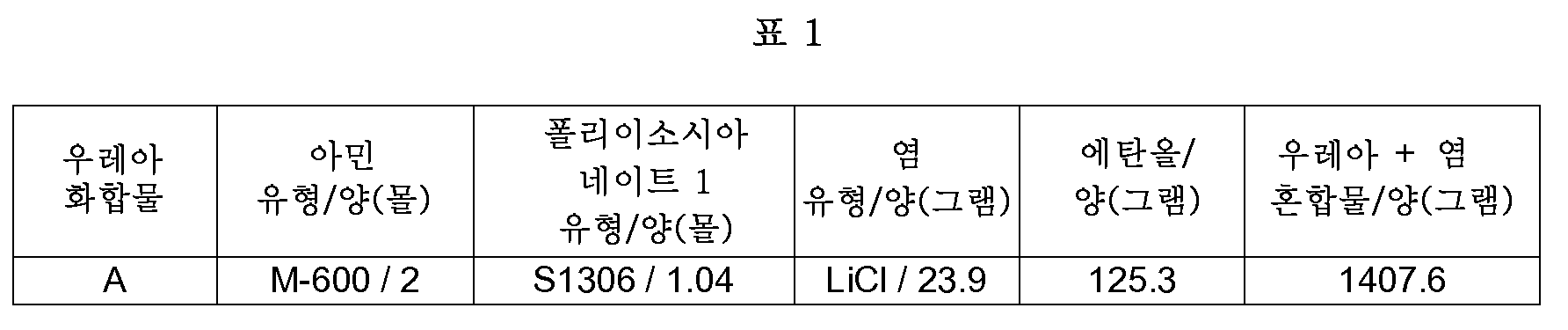
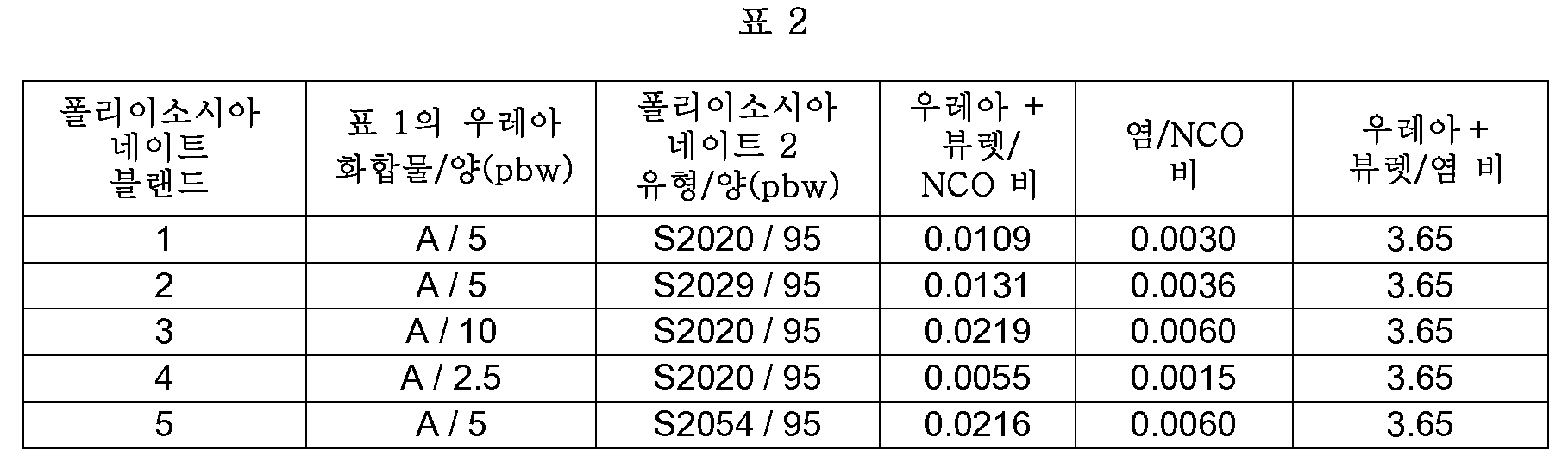
이렇게 제조된 일정량의 우레아/염 혼합물(약 60 ℃의 온도를 갖는)이 일정량의 폴리이소시아네이트 2에 첨가되었고 에폭시 수지 조성물과 함께 사용하기 위한 폴리이소시아네이트 조성물을 제조하기 위해 혼합되었다.A quantity of the urea / salt mixture thus prepared (having a temperature of about 60 캜) was added to a given amount of polyisocyanate 2 and mixed to prepare a polyisocyanate composition for use with the epoxy resin composition.
아래 표 2에서 사용된 구성성분의 양과 종류가 이소시아네이트 당량 당 우레아 + 뷰렛 당량의 수 및 이소시아네이트 당량 당 염의 몰 수 및 염의 몰 당 우레아 + 뷰렛 당량의 수의 비와 함께 주어진다. 중량부는 pbw로 표시된다.The amounts and types of constituents used in Table 2 below are given with the ratio of the number of urea plus buret equivalent per isocyanate equivalent and the number of moles of salt per isocyanate equivalent and the number of urea plus buret equivalent per mole of salt. The parts by weight are indicated by pbw.
본 발명에 따른 에폭시 수지 조성물의 제조Preparation of epoxy resin composition according to the present invention
용매가 사용되면, 카르복사미드가 용매에 첨가되고 표 3에 표시된 주위 압력과 온도 하에서 교반함으로써 혼합된다. 이 혼합물을 주위 조건으로 냉각한 후, 애럴다이트 DY-T가 첨가되었고 주위 조건 하에서 교반되었다. 용매가 사용되지 않으면, 카르복사미드가 애럴다이트 DY-T에 첨가되고 주위 조건 하에서 교반된다. 카르복사미드 및 애럴다이트 DY-T의 교반은 용매의 존재 하에서든 아니든, 약 2 분간 계속되었다.If a solvent is used, the carboxamide is added to the solvent and mixed by stirring at ambient pressure and temperature indicated in Table 3. After cooling the mixture to ambient conditions, Coralite DY-T was added and stirred under ambient conditions. If no solvent is used, a carboxamide is added to the polarized DY-T and stirred under ambient conditions. Stirring of the carboxamide and the colloidal DY-T was continued for about 2 minutes, with or without the presence of solvent.
본 발명에 따른 경화성 조성물 및 The curable composition according to the present invention and 폴리이소시아누레이트Polyisocyanurate 포함 물질의 제조 Manufacture of inclusion materials
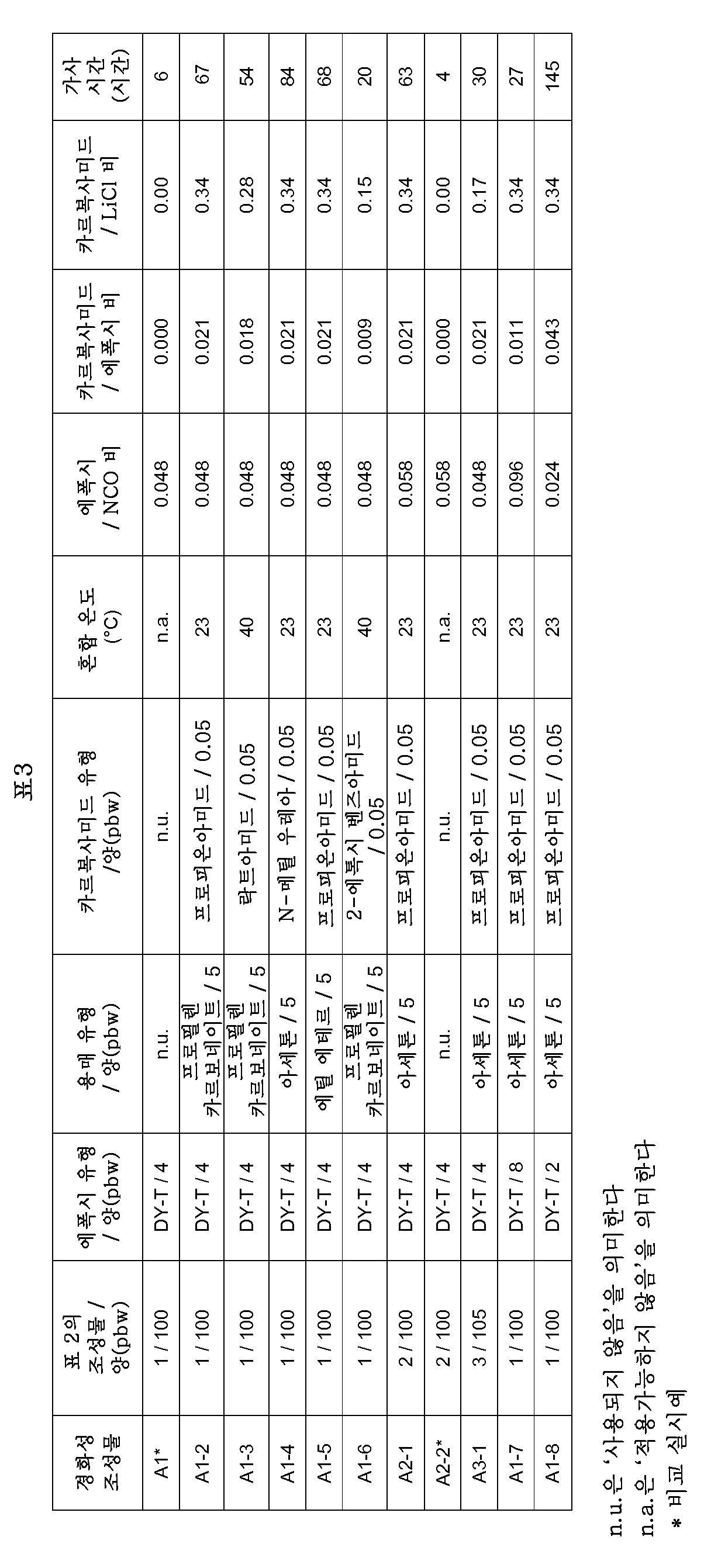
표 2의 조성물이 발명(및 비교 대상)에 따른 에폭시 조성물과 함께 30 초 동안 혼합되었고 온도 상승의 개시까지 액체 수지에 놓인 열전대(thermocouple)로 온도 프로필을 따름으로써 가사기간을 결정하기 위해 상온에 놓여졌다. 경화성 조성물은 본 발명에 따른 폴리우레탄 폴리이소시아누레이트 포함 물질을 제조하기 위해 반응하게 되었다. 이소시안우레이트 기의 존재는 푸리에 변환 적외선 분광학(Fourier Transformed InfraRed Spectroscopy; FTIRS)에 의해 확인되었다.The composition of Table 2 was mixed with the epoxy composition according to the invention (and comparative) for 30 seconds and placed at room temperature to determine the pot life by following the temperature profile with a thermocouple placed on the liquid resin until the start of the temperature rise lost. The curable composition was reacted to prepare a polyurethane polyisocyanurate containing material according to the present invention. The presence of the isocyanurate group was confirmed by Fourier Transformed Infra Red Spectroscopy (FTIRS).
사용된 구성성분, 중량부로의 양, 이소시아네이트 당량 당 에폭시 당량의 수, 에폭시 당 카르복사미드의 당량 비, 염화리튬 당량 당 카르복사미드 당량의 비, 및 가사기간이 표 3에 주어진다. OH 기/에폭시 기의 비는 모든 예시에서 0이었다.The amounts of components used, parts by weight, number of epoxy equivalents per equivalent of isocyanate, equivalence ratio of carboxamide per epoxide, ratio of equivalents of carboxamide per equivalent of lithium chloride, and pot life are given in Table 3. The ratio of OH groups / epoxy groups was 0 in all examples.
첫째 열에서, A1이란 우레아 화합물 A(표 1)와 폴리이소시아네이트 블랜드 1(표 2)이 사용되었음을 의미하고, A5란 우레아 화합물 A와 폴리이소시아네이트 블랜드 5가 사용되었음을 의미한다.In the first column, A1 means that urea compound A (Table 1) and polyisocyanate blend 1 (Table 2) were used, and A5 means that urea compound A and polyisocyanate blend 5 were used.

발명에 따른 추가 Addition according to the invention 실시예Example
폴리이소시아누레이트 포함 물질의 Tg가 경화성 조성물의 가사기간 대신에 주어졌다는 점을 제외하면 표 3과 유사하게, 표 4에서 약간의 추가 실험에 관련된 정보가 주어졌다. Tg는 오븐에서 125 ℃로 1 시간 동안 개방식 금형에서 경화된 약 4 mm의 두께를 갖는 샘플에서 미분 기계적 열 분석(Differential Mechanical Thermo)에 의해 측정된다. 추가의 후경화에 의해 Tg는 더 높아질 수 있다.Similar to Table 3, except that the T g of the polyisocyanurate containing material was given instead of the cure period of the curable composition, information relating to some additional experiments was given in Table 4. T g is measured by differential mechanical thermal analysis (Differential Thermo Mechanical) in a sample having a thickness of about 4 mm from the cured mold gaebangsik for one hour in an oven to 125 ℃. The additional post-cure can result in a higher T g .

Claims (13)
- 에폭시 수지, -CO-NH2 구조를 갖는 카르복사미드 기를 포함하는 NH2-CO-R [여기서, R은 1) 수소(-H), 2) -NR1R2, 3) 1-20 개의 탄소 원자를 갖고 임의적으로 히드록시, 에테르, 할로겐 및/또는 아민 기를 포함하는 히드로카르빌, 또는 4) -R3-CO-NH2이고, R1 및 R2는 수소, 히드록시, 할로겐, 및 1-10 개의 탄소 원자를 갖고 임의적으로 히드록시, 에테르, 할로겐 및/또는 아민 기를 포함하는 히드로카르빌 기로부터 서로 독립적으로 선택되며, R3은 8 개 이하의 탄소 원자를 갖는 2가 탄화수소 라디칼들로부터 선택됨]의 구조를 갖는 화합물 또는 이러한 화합물의 혼합물, 및 임의적으로 이소시아네이트-반응성 기를 갖지 않는 용매를 포함하며, 임의적으로 여기서 에폭시 당량 당 카르복사미드 당량의 수가 0.005-0.7이고, 할로겐화리튬 당량 당 카르복사미드 당량의 비가 0.05-0.7인 에폭시 수지 조성물
을 배합하고 혼합함으로써 얻어지는 경화성 조성물.- a urea compound prepared by reacting a polyisocyanate, lithium halide and polyisocyanate with an amine and having an average molecular weight of 500-15000 and optionally containing a biuret group, wherein the molar ratio of lithium halide to isocyanate equivalent is from 0.0001 to 0.04 And the number of urea + buret equivalent per isocyanate equivalent is in the range of 0.0001-0.4 and the number of epoxy equivalents per isocyanate equivalent is 0.003-1 and
- epoxy resin, NH 2 -CO-R containing a carboxamide group having a -CO-NH 2 structure wherein R is 1) hydrogen (-H), 2) -NR 1 R 2 , 3) 1-20 Or 4) -R 3 -CO-NH 2 , wherein R 1 and R 2 are independently selected from the group consisting of hydrogen, hydroxy, halogen, hydroxy, And hydrocarbyl groups having from 1 to 10 carbon atoms and optionally including hydroxy, ether, halogen and / or amine groups, and R 3 is selected from divalent hydrocarbon radicals having up to 8 carbon atoms Or a mixture of such compounds, and optionally a solvent that does not have isocyanate-reactive groups, optionally wherein the number of carboxamide equivalents per equivalent of epoxy is from 0.005 to 0.7 and the equivalent amount of lithium per equivalent of halogenide The ratio of carboxamide equivalent .05 to 0.7 of the epoxy resin composition
And mixing the curable composition.
Applications Claiming Priority (3)
| Application Number | Priority Date | Filing Date | Title |
|---|---|---|---|
| EP11190085.8 | 2011-11-22 | ||
| EP11190085 | 2011-11-22 | ||
| PCT/EP2012/071968 WO2013075938A1 (en) | 2011-11-22 | 2012-11-07 | Curable polyisocyanate composition comprising an epoxy resin |
Publications (2)
| Publication Number | Publication Date |
|---|---|
| KR20140103962A KR20140103962A (en) | 2014-08-27 |
| KR101902610B1 true KR101902610B1 (en) | 2018-09-28 |
Family
ID=47146391
Family Applications (1)
| Application Number | Title | Priority Date | Filing Date |
|---|---|---|---|
| KR1020147016710A Active KR101902610B1 (en) | 2011-11-22 | 2012-11-07 | Curable polyisocyanate composition comprising an epoxy resin |
Country Status (10)
| Country | Link |
|---|---|
| US (1) | US9926447B2 (en) |
| EP (1) | EP2782945B1 (en) |
| JP (1) | JP2014533751A (en) |
| KR (1) | KR101902610B1 (en) |
| CN (1) | CN104093762B (en) |
| BR (1) | BR112014011154B1 (en) |
| CA (1) | CA2854689C (en) |
| PL (1) | PL2782945T3 (en) |
| RU (1) | RU2570702C1 (en) |
| WO (1) | WO2013075938A1 (en) |
Families Citing this family (14)
| Publication number | Priority date | Publication date | Assignee | Title |
|---|---|---|---|---|
| AU2012314632A1 (en) * | 2011-09-29 | 2014-02-20 | Dow Global Technologies Llc | Viscoelastic foam |
| CA2857613C (en) * | 2011-12-28 | 2016-07-12 | Huntsman International Llc | Curable composition comprising a polyisocyanate composition |
| EP2644270A1 (en) * | 2012-03-29 | 2013-10-02 | Huntsman International Llc | Polyisocyanate trimerization catalyst composition |
| EP3152052B1 (en) * | 2014-06-04 | 2021-08-11 | Bright Lite Structures LLC | Reinforced composite structure |
| US10967583B2 (en) | 2015-04-03 | 2021-04-06 | Bright Lite Structures Llc | Apparatus for controllably cutting fibers and related methods |
| US10640618B2 (en) | 2015-05-29 | 2020-05-05 | Basf Se | Polyurethane-polyisocyanurate resins for fiber composite materials with a longer open time |
| US10640601B2 (en) * | 2015-06-18 | 2020-05-05 | Huntsman International Llc | In-situ formation of polyurethane catalysts |
| EP3553107A1 (en) * | 2018-04-13 | 2019-10-16 | Covestro Deutschland AG | Method for the preparation of polyurethane/polyisocyanurate (pur/pir) rigid foams |
| JP7546488B2 (en) * | 2018-05-16 | 2024-09-06 | ハンツマン・アドヴァンスト・マテリアルズ・ライセンシング・(スイッツランド)・ゲーエムベーハー | Accelerator composition for the curing of polyfunctional isocyanates and epoxy resins |
| JP7208390B2 (en) | 2018-11-19 | 2023-01-18 | ブライト ライト ストラクチャーズ エルエルシー | High-strength composite with low heat release |
| US11702499B2 (en) | 2018-12-11 | 2023-07-18 | Trimer Technologies Llc | Polyisocyanurate based polymers and fiber reinforced composites |
| KR102481812B1 (en) | 2018-12-11 | 2022-12-28 | 트라이머 테크놀로지스, 엘엘씨 | Polyisocyanurate-Based Polymers and Fiber Reinforced Composites |
| US20230406994A1 (en) * | 2020-11-16 | 2023-12-21 | Toray Industries, Inc. | Thermosetting epoxy resin composition, molded article of same, fiber-reinforced composite material, molding material for fiber-reinforced composite materials, and method for producing fiber-reinforced composite material |
| JP7160219B1 (en) * | 2020-12-21 | 2022-10-25 | 東レ株式会社 | Thermosetting epoxy resin composition and molded article thereof, fiber-reinforced composite material, molding material for fiber-reinforced composite material, and method for producing fiber-reinforced composite material |
Citations (1)
| Publication number | Priority date | Publication date | Assignee | Title |
|---|---|---|---|---|
| WO2010121898A1 (en) * | 2009-04-21 | 2010-10-28 | Huntsman International Llc | Polyisocyanate composition |
Family Cites Families (24)
| Publication number | Priority date | Publication date | Assignee | Title |
|---|---|---|---|---|
| US2955101A (en) * | 1955-10-11 | 1960-10-04 | Shell Oil Co | Curing polyepoxides with an acid anhydride and an acid amide |
| US3294749A (en) * | 1963-05-21 | 1966-12-27 | Allis Chalmers Mfg Co | Latent catalysts for curing epoxy resins |
| CH463103A (en) * | 1963-09-06 | 1968-09-30 | Dynamit Nobel Ag | Process for hardening polyepoxides |
| DE1230778B (en) | 1965-05-24 | 1966-12-22 | Bayer Ag | Process for the preparation of acylated urea polyisocyanates |
| GB1192859A (en) * | 1967-12-28 | 1970-05-20 | Takeda Chemical Industries Ltd | A Stabilised Isocyanate Composition |
| US3676380A (en) * | 1969-05-19 | 1972-07-11 | Upjohn Co | Low friability polyisocyanurate foams |
| GB1340068A (en) | 1970-09-22 | 1973-12-05 | Insituform Pipes & Structures | Lining of surfaces defining passageways |
| DE2403858A1 (en) | 1974-01-28 | 1975-08-21 | Basf Ag | STABLE, LIQUID AMIDE AND / OR ACYLURA-BASED ISOCYANURATE-POLYISOCYANATE SOLUTIONS |
| US4366012A (en) | 1981-02-05 | 1982-12-28 | Insituform International Inc. | Impregnation process |
| JPS58145721A (en) * | 1982-02-24 | 1983-08-30 | Hitachi Ltd | Curing method of resin composition |
| US4507447A (en) * | 1983-01-05 | 1985-03-26 | Takeda Chemical Industries, Ltd. | Polyurethane adhesive compositions containing oxyacid of phosphorus and silane coupling agent |
| GB8400365D0 (en) | 1984-01-07 | 1984-02-08 | Edgealpha Ltd | Lining of pipelines and passageways |
| SU1235875A1 (en) * | 1984-08-15 | 1986-06-07 | Всесоюзный Научно-Исследовательский Институт "Композит" | Composition for producing polyizocyanurathic foam plastic |
| US4658007A (en) | 1985-05-07 | 1987-04-14 | The Dow Chemical Company | Polyisocyanurate-based polyoxazolidone polymers and process for their preparation |
| JPH02110123A (en) | 1988-10-19 | 1990-04-23 | Asahi Chem Ind Co Ltd | Preparation of polyisocyanate |
| DE3932958A1 (en) | 1989-10-03 | 1991-04-11 | Bayer Ag | PROCESS FOR PREPARING LIGHT- AND EXHAUST-RESISTANT PUH-ELASTOMER FAEDES AND FILMS AND ELASTOMER FAEDES OF CORRESPONDING COMPOSITION |
| IT1252690B (en) | 1991-11-26 | 1995-06-23 | Donegani Guido Ist | LIQUID REACTIVE COMPOSITIONS INCLUDING POLYISOCYANATES, EPOXIES AND ALKALINE METAL HALIDE SOLUTIONS IN POLYOXYKYLENE COMPOUNDS |
| DE4229183A1 (en) | 1992-09-02 | 1994-03-03 | Basf Ag | Process for the preparation of low-viscosity polyisocyanate mixtures containing isocyanurate and urethane groups |
| RU2133759C1 (en) * | 1997-03-27 | 1999-07-27 | Трефилов Сергей Викторович | Method of preparing rigid polyisocyanurate-urethan foam material |
| WO2007096216A1 (en) | 2006-02-21 | 2007-08-30 | Huntsman International Llc | Process for making a polyisocyanurate composite |
| WO2008068198A1 (en) | 2006-12-04 | 2008-06-12 | Basf Se | Method for producing polyisocyanates |
| EP2132244B1 (en) | 2007-03-27 | 2018-08-22 | Basf Se | Method for producing colorless isocyanurates of diisocyanates |
| DE502007002766D1 (en) * | 2007-11-14 | 2010-03-18 | Sika Technology Ag | Thermosetting epoxy resin composition containing non-aromatic ureas as accelerator |
| RU2560434C2 (en) * | 2011-01-31 | 2015-08-20 | Хантсмэн Интернэшнл Ллс | Epoxy resin-based composition |
-
2012
- 2012-11-07 WO PCT/EP2012/071968 patent/WO2013075938A1/en not_active Ceased
- 2012-11-07 JP JP2014541608A patent/JP2014533751A/en active Pending
- 2012-11-07 US US14/355,856 patent/US9926447B2/en active Active
- 2012-11-07 KR KR1020147016710A patent/KR101902610B1/en active Active
- 2012-11-07 BR BR112014011154-5A patent/BR112014011154B1/en not_active IP Right Cessation
- 2012-11-07 RU RU2014125079/04A patent/RU2570702C1/en active
- 2012-11-07 CN CN201280057361.9A patent/CN104093762B/en active Active
- 2012-11-07 PL PL12783588T patent/PL2782945T3/en unknown
- 2012-11-07 EP EP12783588.2A patent/EP2782945B1/en active Active
- 2012-11-07 CA CA2854689A patent/CA2854689C/en active Active
Patent Citations (1)
| Publication number | Priority date | Publication date | Assignee | Title |
|---|---|---|---|---|
| WO2010121898A1 (en) * | 2009-04-21 | 2010-10-28 | Huntsman International Llc | Polyisocyanate composition |
Also Published As
| Publication number | Publication date |
|---|---|
| BR112014011154B1 (en) | 2022-05-10 |
| PL2782945T3 (en) | 2021-08-02 |
| WO2013075938A1 (en) | 2013-05-30 |
| KR20140103962A (en) | 2014-08-27 |
| US9926447B2 (en) | 2018-03-27 |
| CN104093762A (en) | 2014-10-08 |
| EP2782945A1 (en) | 2014-10-01 |
| CA2854689C (en) | 2016-04-05 |
| EP2782945B1 (en) | 2021-03-31 |
| CN104093762B (en) | 2020-06-30 |
| CA2854689A1 (en) | 2013-05-30 |
| JP2014533751A (en) | 2014-12-15 |
| US20150065611A1 (en) | 2015-03-05 |
| RU2570702C1 (en) | 2015-12-10 |
| BR112014011154A2 (en) | 2017-05-16 |
Similar Documents
| Publication | Publication Date | Title |
|---|---|---|
| KR101850580B1 (en) | Curable composition comprising a polyisocyanate composition | |
| KR101902610B1 (en) | Curable polyisocyanate composition comprising an epoxy resin | |
| KR101718174B1 (en) | Polyisocyanate composition | |
| TWI491446B (en) | Polyisocyanate trimerization catalyst composition | |
| KR102005824B1 (en) | Intermediate polyisocyanurate comprising materials | |
| US10689503B2 (en) | Epoxy resin composition |
Legal Events
| Date | Code | Title | Description |
|---|---|---|---|
| PA0105 | International application |
St.27 status event code: A-0-1-A10-A15-nap-PA0105 |
|
| PG1501 | Laying open of application |
St.27 status event code: A-1-1-Q10-Q12-nap-PG1501 |
|
| A201 | Request for examination | ||
| AMND | Amendment | ||
| P11-X000 | Amendment of application requested |
St.27 status event code: A-2-2-P10-P11-nap-X000 |
|
| P13-X000 | Application amended |
St.27 status event code: A-2-2-P10-P13-nap-X000 |
|
| PA0201 | Request for examination |
St.27 status event code: A-1-2-D10-D11-exm-PA0201 |
|
| E902 | Notification of reason for refusal | ||
| PE0902 | Notice of grounds for rejection |
St.27 status event code: A-1-2-D10-D21-exm-PE0902 |
|
| T11-X000 | Administrative time limit extension requested |
St.27 status event code: U-3-3-T10-T11-oth-X000 |
|
| AMND | Amendment | ||
| P11-X000 | Amendment of application requested |
St.27 status event code: A-2-2-P10-P11-nap-X000 |
|
| P13-X000 | Application amended |
St.27 status event code: A-2-2-P10-P13-nap-X000 |
|
| R18-X000 | Changes to party contact information recorded |
St.27 status event code: A-3-3-R10-R18-oth-X000 |
|
| E601 | Decision to refuse application | ||
| PE0601 | Decision on rejection of patent |
St.27 status event code: N-2-6-B10-B15-exm-PE0601 |
|
| X091 | Application refused [patent] | ||
| T11-X000 | Administrative time limit extension requested |
St.27 status event code: U-3-3-T10-T11-oth-X000 |
|
| T13-X000 | Administrative time limit extension granted |
St.27 status event code: U-3-3-T10-T13-oth-X000 |
|
| T11-X000 | Administrative time limit extension requested |
St.27 status event code: U-3-3-T10-T11-oth-X000 |
|
| T13-X000 | Administrative time limit extension granted |
St.27 status event code: U-3-3-T10-T13-oth-X000 |
|
| AMND | Amendment | ||
| P11-X000 | Amendment of application requested |
St.27 status event code: A-2-2-P10-P11-nap-X000 |
|
| P13-X000 | Application amended |
St.27 status event code: A-2-2-P10-P13-nap-X000 |
|
| PX0901 | Re-examination |
St.27 status event code: A-2-3-E10-E12-rex-PX0901 |
|
| PX0701 | Decision of registration after re-examination |
St.27 status event code: A-3-4-F10-F13-rex-PX0701 |
|
| X701 | Decision to grant (after re-examination) | ||
| GRNT | Written decision to grant | ||
| PR0701 | Registration of establishment |
St.27 status event code: A-2-4-F10-F11-exm-PR0701 |
|
| PR1002 | Payment of registration fee |
St.27 status event code: A-2-2-U10-U12-oth-PR1002 Fee payment year number: 1 |
|
| PG1601 | Publication of registration |
St.27 status event code: A-4-4-Q10-Q13-nap-PG1601 |
|
| FPAY | Annual fee payment |
Payment date: 20210702 Year of fee payment: 4 |
|
| PR1001 | Payment of annual fee |
St.27 status event code: A-4-4-U10-U11-oth-PR1001 Fee payment year number: 4 |
|
| FPAY | Annual fee payment |
Payment date: 20220908 Year of fee payment: 5 |
|
| PR1001 | Payment of annual fee |
St.27 status event code: A-4-4-U10-U11-oth-PR1001 Fee payment year number: 5 |
|
| PR1001 | Payment of annual fee |
St.27 status event code: A-4-4-U10-U11-oth-PR1001 Fee payment year number: 6 |
|
| PR1001 | Payment of annual fee |
St.27 status event code: A-4-4-U10-U11-oth-PR1001 Fee payment year number: 7 |
|
| PR1001 | Payment of annual fee |
St.27 status event code: A-4-4-U10-U11-oth-PR1001 Fee payment year number: 8 |
|
| U11 | Full renewal or maintenance fee paid |
Free format text: ST27 STATUS EVENT CODE: A-4-4-U10-U11-OTH-PR1001 (AS PROVIDED BY THE NATIONAL OFFICE) Year of fee payment: 8 |