KR101670468B1 - Method for preparing polyolfin and polyolefin prepared therefrom - Google Patents
Method for preparing polyolfin and polyolefin prepared therefrom Download PDFInfo
- Publication number
- KR101670468B1 KR101670468B1 KR1020140150403A KR20140150403A KR101670468B1 KR 101670468 B1 KR101670468 B1 KR 101670468B1 KR 1020140150403 A KR1020140150403 A KR 1020140150403A KR 20140150403 A KR20140150403 A KR 20140150403A KR 101670468 B1 KR101670468 B1 KR 101670468B1
- Authority
- KR
- South Korea
- Prior art keywords
- group
- compound
- formula
- catalyst
- molecular weight
- Prior art date
- Legal status (The legal status is an assumption and is not a legal conclusion. Google has not performed a legal analysis and makes no representation as to the accuracy of the status listed.)
- Active
Links
- 229920000098 polyolefin Polymers 0.000 title claims abstract description 83
- 238000000034 method Methods 0.000 title claims abstract description 35
- 238000004519 manufacturing process Methods 0.000 claims abstract description 23
- 150000001875 compounds Chemical class 0.000 claims description 138
- 239000012968 metallocene catalyst Substances 0.000 claims description 56
- -1 4,5,6,7-tetrahydro-1-indenyl Chemical group 0.000 claims description 45
- 238000006116 polymerization reaction Methods 0.000 claims description 41
- 150000001336 alkenes Chemical class 0.000 claims description 29
- 239000000178 monomer Substances 0.000 claims description 28
- JRZJOMJEPLMPRA-UHFFFAOYSA-N olefin Natural products CCCCCCCC=C JRZJOMJEPLMPRA-UHFFFAOYSA-N 0.000 claims description 28
- 229910052739 hydrogen Inorganic materials 0.000 claims description 27
- 239000001257 hydrogen Substances 0.000 claims description 21
- 239000003054 catalyst Substances 0.000 claims description 17
- 125000004432 carbon atom Chemical group C* 0.000 claims description 16
- 239000003607 modifier Substances 0.000 claims description 16
- 239000003426 co-catalyst Substances 0.000 claims description 15
- 239000000203 mixture Substances 0.000 claims description 15
- PPBRXRYQALVLMV-UHFFFAOYSA-N Styrene Chemical compound C=CC1=CC=CC=C1 PPBRXRYQALVLMV-UHFFFAOYSA-N 0.000 claims description 14
- 239000003446 ligand Substances 0.000 claims description 14
- LIKMAJRDDDTEIG-UHFFFAOYSA-N 1-hexene Chemical compound CCCCC=C LIKMAJRDDDTEIG-UHFFFAOYSA-N 0.000 claims description 13
- 125000002877 alkyl aryl group Chemical group 0.000 claims description 13
- 125000003710 aryl alkyl group Chemical group 0.000 claims description 12
- 230000000379 polymerizing effect Effects 0.000 claims description 12
- 239000000126 substance Substances 0.000 claims description 12
- 239000011541 reaction mixture Substances 0.000 claims description 11
- 229910052723 transition metal Inorganic materials 0.000 claims description 11
- CRSBERNSMYQZNG-UHFFFAOYSA-N 1-dodecene Chemical compound CCCCCCCCCCC=C CRSBERNSMYQZNG-UHFFFAOYSA-N 0.000 claims description 10
- KWKAKUADMBZCLK-UHFFFAOYSA-N 1-octene Chemical compound CCCCCCC=C KWKAKUADMBZCLK-UHFFFAOYSA-N 0.000 claims description 10
- DCTOHCCUXLBQMS-UHFFFAOYSA-N 1-undecene Chemical compound CCCCCCCCCC=C DCTOHCCUXLBQMS-UHFFFAOYSA-N 0.000 claims description 10
- 229910052736 halogen Inorganic materials 0.000 claims description 10
- 150000002367 halogens Chemical class 0.000 claims description 10
- YWAKXRMUMFPDSH-UHFFFAOYSA-N pentene Chemical compound CCCC=C YWAKXRMUMFPDSH-UHFFFAOYSA-N 0.000 claims description 10
- ZSWFCLXCOIISFI-UHFFFAOYSA-N endo-cyclopentadiene Natural products C1C=CC=C1 ZSWFCLXCOIISFI-UHFFFAOYSA-N 0.000 claims description 9
- 150000003624 transition metals Chemical class 0.000 claims description 9
- 125000003342 alkenyl group Chemical group 0.000 claims description 8
- 229910052782 aluminium Inorganic materials 0.000 claims description 8
- 125000000058 cyclopentadienyl group Chemical group C1(=CC=CC1)* 0.000 claims description 8
- 125000005843 halogen group Chemical group 0.000 claims description 8
- 229930195733 hydrocarbon Natural products 0.000 claims description 8
- 150000002430 hydrocarbons Chemical group 0.000 claims description 8
- 125000003454 indenyl group Chemical group C1(C=CC2=CC=CC=C12)* 0.000 claims description 8
- 239000002904 solvent Substances 0.000 claims description 8
- VGGSQFUCUMXWEO-UHFFFAOYSA-N Ethene Chemical compound C=C VGGSQFUCUMXWEO-UHFFFAOYSA-N 0.000 claims description 7
- 239000005977 Ethylene Substances 0.000 claims description 7
- 125000000217 alkyl group Chemical group 0.000 claims description 7
- YBYIRNPNPLQARY-UHFFFAOYSA-N 1H-indene Natural products C1=CC=C2CC=CC2=C1 YBYIRNPNPLQARY-UHFFFAOYSA-N 0.000 claims description 6
- VYPSYNLAJGMNEJ-UHFFFAOYSA-N Silicium dioxide Chemical group O=[Si]=O VYPSYNLAJGMNEJ-UHFFFAOYSA-N 0.000 claims description 6
- 125000003545 alkoxy group Chemical group 0.000 claims description 6
- 125000000304 alkynyl group Chemical group 0.000 claims description 6
- 125000003277 amino group Chemical group 0.000 claims description 6
- 125000005018 aryl alkenyl group Chemical group 0.000 claims description 6
- 125000002102 aryl alkyloxo group Chemical group 0.000 claims description 6
- 125000004104 aryloxy group Chemical group 0.000 claims description 6
- OJOWICOBYCXEKR-KRXBUXKQSA-N (5e)-5-ethylidenebicyclo[2.2.1]hept-2-ene Chemical compound C1C2C(=C/C)/CC1C=C2 OJOWICOBYCXEKR-KRXBUXKQSA-N 0.000 claims description 5
- HMDQPBSDHHTRNI-UHFFFAOYSA-N 1-(chloromethyl)-3-ethenylbenzene Chemical compound ClCC1=CC=CC(C=C)=C1 HMDQPBSDHHTRNI-UHFFFAOYSA-N 0.000 claims description 5
- XYLMUPLGERFSHI-UHFFFAOYSA-N alpha-Methylstyrene Chemical compound CC(=C)C1=CC=CC=C1 XYLMUPLGERFSHI-UHFFFAOYSA-N 0.000 claims description 5
- 229940069096 dodecene Drugs 0.000 claims description 5
- 150000004820 halides Chemical group 0.000 claims description 5
- TVMXDCGIABBOFY-UHFFFAOYSA-N n-Octanol Natural products CCCCCCCC TVMXDCGIABBOFY-UHFFFAOYSA-N 0.000 claims description 5
- JFNLZVQOOSMTJK-KNVOCYPGSA-N norbornene Chemical compound C1[C@@H]2CC[C@H]1C=C2 JFNLZVQOOSMTJK-KNVOCYPGSA-N 0.000 claims description 5
- ZGEGCLOFRBLKSE-UHFFFAOYSA-N 1-Heptene Chemical compound CCCCCC=C ZGEGCLOFRBLKSE-UHFFFAOYSA-N 0.000 claims description 4
- AFFLGGQVNFXPEV-UHFFFAOYSA-N 1-decene Chemical compound CCCCCCCCC=C AFFLGGQVNFXPEV-UHFFFAOYSA-N 0.000 claims description 4
- ZOXJGFHDIHLPTG-UHFFFAOYSA-N Boron Chemical compound [B] ZOXJGFHDIHLPTG-UHFFFAOYSA-N 0.000 claims description 4
- 229910052796 boron Inorganic materials 0.000 claims description 4
- 239000007795 chemical reaction product Substances 0.000 claims description 4
- 125000003983 fluorenyl group Chemical group C1(=CC=CC=2C3=CC=CC=C3CC12)* 0.000 claims description 4
- 125000001183 hydrocarbyl group Chemical group 0.000 claims description 4
- 125000004435 hydrogen atom Chemical class [H]* 0.000 claims description 4
- XAGFODPZIPBFFR-UHFFFAOYSA-N aluminium Chemical compound [Al] XAGFODPZIPBFFR-UHFFFAOYSA-N 0.000 claims description 3
- 239000000377 silicon dioxide Substances 0.000 claims description 3
- 239000004215 Carbon black (E152) Substances 0.000 claims description 2
- 150000004703 alkoxides Chemical group 0.000 claims description 2
- PNEYBMLMFCGWSK-UHFFFAOYSA-N aluminium oxide Inorganic materials [O-2].[O-2].[O-2].[Al+3].[Al+3] PNEYBMLMFCGWSK-UHFFFAOYSA-N 0.000 claims description 2
- 125000002837 carbocyclic group Chemical group 0.000 claims description 2
- 150000001793 charged compounds Polymers 0.000 claims description 2
- 150000004678 hydrides Chemical group 0.000 claims description 2
- 239000000395 magnesium oxide Substances 0.000 claims description 2
- CPLXHLVBOLITMK-UHFFFAOYSA-N magnesium oxide Inorganic materials [Mg]=O CPLXHLVBOLITMK-UHFFFAOYSA-N 0.000 claims description 2
- 230000003647 oxidation Effects 0.000 claims description 2
- 238000007254 oxidation reaction Methods 0.000 claims description 2
- 238000009826 distribution Methods 0.000 abstract description 34
- 238000000071 blow moulding Methods 0.000 abstract description 8
- 230000008569 process Effects 0.000 abstract description 6
- YXFVVABEGXRONW-UHFFFAOYSA-N Toluene Chemical compound CC1=CC=CC=C1 YXFVVABEGXRONW-UHFFFAOYSA-N 0.000 description 54
- VLKZOEOYAKHREP-UHFFFAOYSA-N n-Hexane Chemical compound CCCCCC VLKZOEOYAKHREP-UHFFFAOYSA-N 0.000 description 48
- NFHFRUOZVGFOOS-UHFFFAOYSA-N palladium;triphenylphosphane Chemical compound [Pd].C1=CC=CC=C1P(C=1C=CC=CC=1)C1=CC=CC=C1.C1=CC=CC=C1P(C=1C=CC=CC=1)C1=CC=CC=C1.C1=CC=CC=C1P(C=1C=CC=CC=1)C1=CC=CC=C1.C1=CC=CC=C1P(C=1C=CC=CC=1)C1=CC=CC=C1 NFHFRUOZVGFOOS-UHFFFAOYSA-N 0.000 description 20
- CSCPPACGZOOCGX-UHFFFAOYSA-N Acetone Chemical compound CC(C)=O CSCPPACGZOOCGX-UHFFFAOYSA-N 0.000 description 18
- 238000006243 chemical reaction Methods 0.000 description 18
- 230000000694 effects Effects 0.000 description 17
- 239000002002 slurry Substances 0.000 description 17
- LWNGJAHMBMVCJR-UHFFFAOYSA-N (2,3,4,5,6-pentafluorophenoxy)boronic acid Chemical compound OB(O)OC1=C(F)C(F)=C(F)C(F)=C1F LWNGJAHMBMVCJR-UHFFFAOYSA-N 0.000 description 12
- 238000005481 NMR spectroscopy Methods 0.000 description 9
- 150000002431 hydrogen Chemical class 0.000 description 9
- 230000000704 physical effect Effects 0.000 description 9
- 229920000642 polymer Polymers 0.000 description 9
- 238000002360 preparation method Methods 0.000 description 9
- CURLTUGMZLYLDI-UHFFFAOYSA-N Carbon dioxide Chemical compound O=C=O CURLTUGMZLYLDI-UHFFFAOYSA-N 0.000 description 8
- 230000015572 biosynthetic process Effects 0.000 description 8
- 235000011089 carbon dioxide Nutrition 0.000 description 8
- RTZKZFJDLAIYFH-UHFFFAOYSA-N Diethyl ether Chemical compound CCOCC RTZKZFJDLAIYFH-UHFFFAOYSA-N 0.000 description 7
- UFHFLCQGNIYNRP-UHFFFAOYSA-N Hydrogen Chemical compound [H][H] UFHFLCQGNIYNRP-UHFFFAOYSA-N 0.000 description 7
- 125000002887 hydroxy group Chemical group [H]O* 0.000 description 7
- DLEDOFVPSDKWEF-UHFFFAOYSA-N lithium butane Chemical compound [Li+].CCC[CH2-] DLEDOFVPSDKWEF-UHFFFAOYSA-N 0.000 description 7
- VXNZUUAINFGPBY-UHFFFAOYSA-N 1-Butene Chemical compound CCC=C VXNZUUAINFGPBY-UHFFFAOYSA-N 0.000 description 6
- 229910007926 ZrCl Inorganic materials 0.000 description 6
- RXXXUIOZOITBII-UHFFFAOYSA-N indeno[1,2-g]indole Chemical class C1=C2C=CC=CC2=C2C1=C1N=CC=C1C=C2 RXXXUIOZOITBII-UHFFFAOYSA-N 0.000 description 6
- MZRVEZGGRBJDDB-UHFFFAOYSA-N n-Butyllithium Substances [Li]CCCC MZRVEZGGRBJDDB-UHFFFAOYSA-N 0.000 description 6
- 229910052757 nitrogen Inorganic materials 0.000 description 6
- 230000009257 reactivity Effects 0.000 description 6
- 238000003786 synthesis reaction Methods 0.000 description 6
- RURFJXKOXIWFJX-UHFFFAOYSA-N (2,3,4,6-tetrafluorophenoxy)boronic acid Chemical compound OB(O)OC1=C(F)C=C(F)C(F)=C1F RURFJXKOXIWFJX-UHFFFAOYSA-N 0.000 description 5
- 239000004698 Polyethylene Substances 0.000 description 5
- 230000009471 action Effects 0.000 description 5
- 125000003118 aryl group Chemical group 0.000 description 5
- 229920000573 polyethylene Polymers 0.000 description 5
- XLYOFNOQVPJJNP-UHFFFAOYSA-N water Substances O XLYOFNOQVPJJNP-UHFFFAOYSA-N 0.000 description 5
- IJGRMHOSHXDMSA-UHFFFAOYSA-N Atomic nitrogen Chemical compound N#N IJGRMHOSHXDMSA-UHFFFAOYSA-N 0.000 description 4
- BTBUEUYNUDRHOZ-UHFFFAOYSA-N Borate Chemical compound [O-]B([O-])[O-] BTBUEUYNUDRHOZ-UHFFFAOYSA-N 0.000 description 4
- XUIMIQQOPSSXEZ-UHFFFAOYSA-N Silicon Chemical group [Si] XUIMIQQOPSSXEZ-UHFFFAOYSA-N 0.000 description 4
- HEDRZPFGACZZDS-MICDWDOJSA-N Trichloro(2H)methane Chemical compound [2H]C(Cl)(Cl)Cl HEDRZPFGACZZDS-MICDWDOJSA-N 0.000 description 4
- 229920001577 copolymer Polymers 0.000 description 4
- KWGKDLIKAYFUFQ-UHFFFAOYSA-M lithium chloride Chemical compound [Li+].[Cl-] KWGKDLIKAYFUFQ-UHFFFAOYSA-M 0.000 description 4
- 229910052751 metal Inorganic materials 0.000 description 4
- CPOFMOWDMVWCLF-UHFFFAOYSA-N methyl(oxo)alumane Chemical compound C[Al]=O CPOFMOWDMVWCLF-UHFFFAOYSA-N 0.000 description 4
- 239000003960 organic solvent Substances 0.000 description 4
- 229910052710 silicon Inorganic materials 0.000 description 4
- 239000010703 silicon Chemical group 0.000 description 4
- 238000003756 stirring Methods 0.000 description 4
- VOITXYVAKOUIBA-UHFFFAOYSA-N triethylaluminium Chemical compound CC[Al](CC)CC VOITXYVAKOUIBA-UHFFFAOYSA-N 0.000 description 4
- OKTJSMMVPCPJKN-UHFFFAOYSA-N Carbon Chemical group [C] OKTJSMMVPCPJKN-UHFFFAOYSA-N 0.000 description 3
- 125000002947 alkylene group Chemical group 0.000 description 3
- 229910052799 carbon Inorganic materials 0.000 description 3
- 230000000052 comparative effect Effects 0.000 description 3
- JLTDJTHDQAWBAV-UHFFFAOYSA-O dimethyl(phenyl)azanium Chemical compound C[NH+](C)C1=CC=CC=C1 JLTDJTHDQAWBAV-UHFFFAOYSA-O 0.000 description 3
- 238000001035 drying Methods 0.000 description 3
- 125000001495 ethyl group Chemical group [H]C([H])([H])C([H])([H])* 0.000 description 3
- 150000002220 fluorenes Chemical class 0.000 description 3
- 229910052732 germanium Chemical group 0.000 description 3
- 239000011261 inert gas Substances 0.000 description 3
- 125000001449 isopropyl group Chemical group [H]C([H])([H])C([H])(*)C([H])([H])[H] 0.000 description 3
- 239000002184 metal Substances 0.000 description 3
- 125000002496 methyl group Chemical group [H]C([H])([H])* 0.000 description 3
- OFBQJSOFQDEBGM-UHFFFAOYSA-N n-pentane Natural products CCCCC OFBQJSOFQDEBGM-UHFFFAOYSA-N 0.000 description 3
- 125000004433 nitrogen atom Chemical group N* 0.000 description 3
- 229910052760 oxygen Inorganic materials 0.000 description 3
- 230000037048 polymerization activity Effects 0.000 description 3
- 125000001436 propyl group Chemical group [H]C([*])([H])C([H])([H])C([H])([H])[H] 0.000 description 3
- 239000000376 reactant Substances 0.000 description 3
- 239000012429 reaction media Substances 0.000 description 3
- 239000007787 solid Substances 0.000 description 3
- 238000005160 1H NMR spectroscopy Methods 0.000 description 2
- YWOQUYASJOJVPR-UHFFFAOYSA-N 5-methyl-10h-indeno[1,2-b]indole Chemical compound C12=CC=CC=C2N(C)C2=C1CC1=CC=CC=C12 YWOQUYASJOJVPR-UHFFFAOYSA-N 0.000 description 2
- 239000002841 Lewis acid Substances 0.000 description 2
- BZLVMXJERCGZMT-UHFFFAOYSA-N Methyl tert-butyl ether Chemical compound COC(C)(C)C BZLVMXJERCGZMT-UHFFFAOYSA-N 0.000 description 2
- OAICVXFJPJFONN-UHFFFAOYSA-N Phosphorus Chemical compound [P] OAICVXFJPJFONN-UHFFFAOYSA-N 0.000 description 2
- WYURNTSHIVDZCO-UHFFFAOYSA-N Tetrahydrofuran Chemical compound C1CCOC1 WYURNTSHIVDZCO-UHFFFAOYSA-N 0.000 description 2
- 150000001338 aliphatic hydrocarbons Chemical class 0.000 description 2
- 125000005234 alkyl aluminium group Chemical group 0.000 description 2
- 230000002902 bimodal effect Effects 0.000 description 2
- 238000010924 continuous production Methods 0.000 description 2
- 238000005336 cracking Methods 0.000 description 2
- YMNCCEXICREQQV-UHFFFAOYSA-L cyclopenta-1,3-diene;titanium(4+);dichloride Chemical compound [Cl-].[Cl-].[Ti+4].C=1C=C[CH-]C=1.C=1C=C[CH-]C=1 YMNCCEXICREQQV-UHFFFAOYSA-L 0.000 description 2
- 230000002542 deteriorative effect Effects 0.000 description 2
- 125000005131 dialkylammonium group Chemical group 0.000 description 2
- 239000003085 diluting agent Substances 0.000 description 2
- 230000001747 exhibiting effect Effects 0.000 description 2
- 239000000706 filtrate Substances 0.000 description 2
- NIHNNTQXNPWCJQ-UHFFFAOYSA-N fluorene Chemical compound C1=CC=C2CC3=CC=CC=C3C2=C1 NIHNNTQXNPWCJQ-UHFFFAOYSA-N 0.000 description 2
- 238000005227 gel permeation chromatography Methods 0.000 description 2
- VGRFVJMYCCLWPQ-UHFFFAOYSA-N germanium Chemical compound [Ge].[Ge] VGRFVJMYCCLWPQ-UHFFFAOYSA-N 0.000 description 2
- 150000007517 lewis acids Chemical class 0.000 description 2
- 239000007788 liquid Substances 0.000 description 2
- 239000000155 melt Substances 0.000 description 2
- JZBZLRKFJWQZHU-UHFFFAOYSA-N n,n,2,4,6-pentamethylaniline Chemical compound CN(C)C1=C(C)C=C(C)C=C1C JZBZLRKFJWQZHU-UHFFFAOYSA-N 0.000 description 2
- 125000004108 n-butyl group Chemical group [H]C([H])([H])C([H])([H])C([H])([H])C([H])([H])* 0.000 description 2
- 239000012044 organic layer Substances 0.000 description 2
- 125000002524 organometallic group Chemical group 0.000 description 2
- 229910052698 phosphorus Inorganic materials 0.000 description 2
- 239000011574 phosphorus Substances 0.000 description 2
- 239000002685 polymerization catalyst Substances 0.000 description 2
- 239000002244 precipitate Substances 0.000 description 2
- QQONPFPTGQHPMA-UHFFFAOYSA-N propylene Natural products CC=C QQONPFPTGQHPMA-UHFFFAOYSA-N 0.000 description 2
- 125000004805 propylene group Chemical group [H]C([H])([H])C([H])([*:1])C([H])([H])[*:2] 0.000 description 2
- 150000003254 radicals Chemical class 0.000 description 2
- 125000005373 siloxane group Chemical group [SiH2](O*)* 0.000 description 2
- 238000000527 sonication Methods 0.000 description 2
- 239000000725 suspension Substances 0.000 description 2
- GETQZCLCWQTVFV-UHFFFAOYSA-N trimethylamine Chemical compound CN(C)C GETQZCLCWQTVFV-UHFFFAOYSA-N 0.000 description 2
- 238000001291 vacuum drying Methods 0.000 description 2
- WCFQIFDACWBNJT-UHFFFAOYSA-N $l^{1}-alumanyloxy(2-methylpropyl)aluminum Chemical compound CC(C)C[Al]O[Al] WCFQIFDACWBNJT-UHFFFAOYSA-N 0.000 description 1
- SWXNWKCMNRYPIU-UHFFFAOYSA-N 10,10-dimethyl-5H-indeno[1,2-b]indole-2-carboxylic acid Chemical compound CC1(C2=CC(=CC=C2C=2NC=3C=CC=CC=3C=21)C(=O)O)C SWXNWKCMNRYPIU-UHFFFAOYSA-N 0.000 description 1
- QUUSLJRWTDZCBF-UHFFFAOYSA-N 2,3-dihydroindene-1,1-diol Chemical class C1=CC=C2C(O)(O)CCC2=C1 QUUSLJRWTDZCBF-UHFFFAOYSA-N 0.000 description 1
- NMVXHZSPDTXJSJ-UHFFFAOYSA-L 2-methylpropylaluminum(2+);dichloride Chemical compound CC(C)C[Al](Cl)Cl NMVXHZSPDTXJSJ-UHFFFAOYSA-L 0.000 description 1
- UERDRKZGACRLPC-UHFFFAOYSA-N 5,8-dimethyl-10h-indeno[1,2-b]indole Chemical compound C12=CC=CC=C2CC2=C1N(C)C1=CC=C(C)C=C12 UERDRKZGACRLPC-UHFFFAOYSA-N 0.000 description 1
- JNTPTNNCGDAGEJ-UHFFFAOYSA-N 6-chlorohexan-1-ol Chemical compound OCCCCCCCl JNTPTNNCGDAGEJ-UHFFFAOYSA-N 0.000 description 1
- IMJMETXGRUMKOR-UHFFFAOYSA-N C1(C=CC=C1)[Ti](CCCCCCCC)C1C=CC=C1 Chemical compound C1(C=CC=C1)[Ti](CCCCCCCC)C1C=CC=C1 IMJMETXGRUMKOR-UHFFFAOYSA-N 0.000 description 1
- GPSLEIDMOQAVFA-UHFFFAOYSA-N CCCCN(CCCC)CCCC.CCCCN(CCCC)CCCC.OB(O)OC(C(F)=C(C(F)=C1F)F)=C1F Chemical compound CCCCN(CCCC)CCCC.CCCCN(CCCC)CCCC.OB(O)OC(C(F)=C(C(F)=C1F)F)=C1F GPSLEIDMOQAVFA-UHFFFAOYSA-N 0.000 description 1
- 239000002879 Lewis base Substances 0.000 description 1
- 229910002651 NO3 Inorganic materials 0.000 description 1
- NHNBFGGVMKEFGY-UHFFFAOYSA-N Nitrate Chemical compound [O-][N+]([O-])=O NHNBFGGVMKEFGY-UHFFFAOYSA-N 0.000 description 1
- QAOWNCQODCNURD-UHFFFAOYSA-L Sulfate Chemical compound [O-]S([O-])(=O)=O QAOWNCQODCNURD-UHFFFAOYSA-L 0.000 description 1
- RTAQQCXQSZGOHL-UHFFFAOYSA-N Titanium Chemical compound [Ti] RTAQQCXQSZGOHL-UHFFFAOYSA-N 0.000 description 1
- QCWXUUIWCKQGHC-UHFFFAOYSA-N Zirconium Chemical compound [Zr] QCWXUUIWCKQGHC-UHFFFAOYSA-N 0.000 description 1
- NEAAEBPAONGMHV-UHFFFAOYSA-L [Cl-].[Cl-].C1C2=CC=CC=C2C2=C1C([Ti+2]C=1C=CC=C3C4=CC=CC=C4CC=13)=CC=C2 Chemical compound [Cl-].[Cl-].C1C2=CC=CC=C2C2=C1C([Ti+2]C=1C=CC=C3C4=CC=CC=C4CC=13)=CC=C2 NEAAEBPAONGMHV-UHFFFAOYSA-L 0.000 description 1
- KUNZSLJMPCDOGI-UHFFFAOYSA-L [Cl-].[Cl-].[Hf+2] Chemical compound [Cl-].[Cl-].[Hf+2] KUNZSLJMPCDOGI-UHFFFAOYSA-L 0.000 description 1
- 230000004913 activation Effects 0.000 description 1
- 125000001931 aliphatic group Chemical group 0.000 description 1
- 125000004183 alkoxy alkyl group Chemical group 0.000 description 1
- 125000003368 amide group Chemical group 0.000 description 1
- QVGXLLKOCUKJST-UHFFFAOYSA-N atomic oxygen Chemical compound [O] QVGXLLKOCUKJST-UHFFFAOYSA-N 0.000 description 1
- 238000005452 bending Methods 0.000 description 1
- UHOVQNZJYSORNB-UHFFFAOYSA-N benzene Substances C1=CC=CC=C1 UHOVQNZJYSORNB-UHFFFAOYSA-N 0.000 description 1
- HQMRIBYCTLBDAK-UHFFFAOYSA-M bis(2-methylpropyl)alumanylium;chloride Chemical compound CC(C)C[Al](Cl)CC(C)C HQMRIBYCTLBDAK-UHFFFAOYSA-M 0.000 description 1
- 238000007664 blowing Methods 0.000 description 1
- 239000001273 butane Substances 0.000 description 1
- 125000000484 butyl group Chemical group [H]C([*])([H])C([H])([H])C([H])([H])C([H])([H])[H] 0.000 description 1
- CJZGTCYPCWQAJB-UHFFFAOYSA-L calcium stearate Chemical compound [Ca+2].CCCCCCCCCCCCCCCCCC([O-])=O.CCCCCCCCCCCCCCCCCC([O-])=O CJZGTCYPCWQAJB-UHFFFAOYSA-L 0.000 description 1
- 235000013539 calcium stearate Nutrition 0.000 description 1
- 239000008116 calcium stearate Substances 0.000 description 1
- 229960004424 carbon dioxide Drugs 0.000 description 1
- 230000008859 change Effects 0.000 description 1
- 239000003795 chemical substances by application Substances 0.000 description 1
- DFGSACBYSGUJDZ-UHFFFAOYSA-M chloro(dihexyl)alumane Chemical compound [Cl-].CCCCCC[Al+]CCCCCC DFGSACBYSGUJDZ-UHFFFAOYSA-M 0.000 description 1
- 230000006837 decompression Effects 0.000 description 1
- 230000006866 deterioration Effects 0.000 description 1
- 238000010586 diagram Methods 0.000 description 1
- WFZSIVNWLIYDJZ-UHFFFAOYSA-N dichloro-methyl-[6-[(2-methylpropan-2-yl)oxy]hexyl]silane Chemical compound CC(C)(C)OCCCCCC[Si](C)(Cl)Cl WFZSIVNWLIYDJZ-UHFFFAOYSA-N 0.000 description 1
- XBPCUCUWBYBCDP-UHFFFAOYSA-O dicyclohexylazanium Chemical compound C1CCCCC1[NH2+]C1CCCCC1 XBPCUCUWBYBCDP-UHFFFAOYSA-O 0.000 description 1
- 229960004132 diethyl ether Drugs 0.000 description 1
- GGSUCNLOZRCGPQ-UHFFFAOYSA-O diethyl(phenyl)azanium Chemical compound CC[NH+](CC)C1=CC=CC=C1 GGSUCNLOZRCGPQ-UHFFFAOYSA-O 0.000 description 1
- HKUFIYBZNQSHQS-UHFFFAOYSA-O dioctadecylazanium Chemical compound CCCCCCCCCCCCCCCCCC[NH2+]CCCCCCCCCCCCCCCCCC HKUFIYBZNQSHQS-UHFFFAOYSA-O 0.000 description 1
- QRQUTSPLBBZERR-UHFFFAOYSA-M dioctylalumanylium;chloride Chemical compound CCCCCCCC[Al](Cl)CCCCCCCC QRQUTSPLBBZERR-UHFFFAOYSA-M 0.000 description 1
- 230000008030 elimination Effects 0.000 description 1
- 238000003379 elimination reaction Methods 0.000 description 1
- 125000001301 ethoxy group Chemical group [H]C([H])([H])C([H])([H])O* 0.000 description 1
- MGDOJPNDRJNJBK-UHFFFAOYSA-N ethylaluminum Chemical compound [Al].C[CH2] MGDOJPNDRJNJBK-UHFFFAOYSA-N 0.000 description 1
- 229920006213 ethylene-alphaolefin copolymer Polymers 0.000 description 1
- 238000001125 extrusion Methods 0.000 description 1
- GNPVGFCGXDBREM-UHFFFAOYSA-N germanium atom Chemical group [Ge] GNPVGFCGXDBREM-UHFFFAOYSA-N 0.000 description 1
- 239000011521 glass Substances 0.000 description 1
- 229910021482 group 13 metal Inorganic materials 0.000 description 1
- 229910052735 hafnium Inorganic materials 0.000 description 1
- VBJZVLUMGGDVMO-UHFFFAOYSA-N hafnium atom Chemical compound [Hf] VBJZVLUMGGDVMO-UHFFFAOYSA-N 0.000 description 1
- 239000012760 heat stabilizer Substances 0.000 description 1
- 125000003187 heptyl group Chemical group [H]C([*])([H])C([H])([H])C([H])([H])C([H])([H])C([H])([H])C([H])([H])C([H])([H])[H] 0.000 description 1
- 125000004051 hexyl group Chemical group [H]C([H])([H])C([H])([H])C([H])([H])C([H])([H])C([H])([H])C([H])([H])* 0.000 description 1
- 238000011835 investigation Methods 0.000 description 1
- 239000010410 layer Substances 0.000 description 1
- 150000007527 lewis bases Chemical class 0.000 description 1
- 238000003754 machining Methods 0.000 description 1
- 230000014759 maintenance of location Effects 0.000 description 1
- 239000000463 material Substances 0.000 description 1
- 230000007246 mechanism Effects 0.000 description 1
- 238000006263 metalation reaction Methods 0.000 description 1
- 125000004184 methoxymethyl group Chemical group [H]C([H])([H])OC([H])([H])* 0.000 description 1
- CAKOOJUEUVRZLR-UHFFFAOYSA-N methyl(dioctadecyl)phosphane Chemical compound CCCCCCCCCCCCCCCCCCP(C)CCCCCCCCCCCCCCCCCC CAKOOJUEUVRZLR-UHFFFAOYSA-N 0.000 description 1
- 238000002156 mixing Methods 0.000 description 1
- OXQMIXBVXHWDPX-UHFFFAOYSA-N n,n,2-trimethylpropan-2-amine Chemical compound CN(C)C(C)(C)C OXQMIXBVXHWDPX-UHFFFAOYSA-N 0.000 description 1
- SRLHDBRENZFCIN-UHFFFAOYSA-N n,n-di(butan-2-yl)butan-2-amine Chemical compound CCC(C)N(C(C)CC)C(C)CC SRLHDBRENZFCIN-UHFFFAOYSA-N 0.000 description 1
- IJDNQMDRQITEOD-UHFFFAOYSA-N n-butane Chemical compound CCCC IJDNQMDRQITEOD-UHFFFAOYSA-N 0.000 description 1
- VFLWKHBYVIUAMP-UHFFFAOYSA-N n-methyl-n-octadecyloctadecan-1-amine Chemical compound CCCCCCCCCCCCCCCCCCN(C)CCCCCCCCCCCCCCCCCC VFLWKHBYVIUAMP-UHFFFAOYSA-N 0.000 description 1
- KUFYUMSBZMUWAN-UHFFFAOYSA-N n-methyl-n-tetradecyltetradecan-1-amine Chemical compound CCCCCCCCCCCCCCN(C)CCCCCCCCCCCCCC KUFYUMSBZMUWAN-UHFFFAOYSA-N 0.000 description 1
- HSUGDXPUFCVGES-UHFFFAOYSA-N n-tetradecyltetradecan-1-amine Chemical compound CCCCCCCCCCCCCCNCCCCCCCCCCCCCC HSUGDXPUFCVGES-UHFFFAOYSA-N 0.000 description 1
- 125000000449 nitro group Chemical group [O-][N+](*)=O 0.000 description 1
- 125000002347 octyl group Chemical group [H]C([*])([H])C([H])([H])C([H])([H])C([H])([H])C([H])([H])C([H])([H])C([H])([H])C([H])([H])[H] 0.000 description 1
- 239000003921 oil Substances 0.000 description 1
- 150000002902 organometallic compounds Chemical class 0.000 description 1
- 239000001301 oxygen Substances 0.000 description 1
- 239000002245 particle Substances 0.000 description 1
- 239000008188 pellet Substances 0.000 description 1
- 125000000538 pentafluorophenyl group Chemical group FC1=C(F)C(F)=C(*)C(F)=C1F 0.000 description 1
- JQQSUOJIMKJQHS-UHFFFAOYSA-N pentaphenyl group Chemical group C1=CC=CC2=CC3=CC=C4C=C5C=CC=CC5=CC4=C3C=C12 JQQSUOJIMKJQHS-UHFFFAOYSA-N 0.000 description 1
- 125000001147 pentyl group Chemical group C(CCCC)* 0.000 description 1
- 125000001997 phenyl group Chemical group [H]C1=C([H])C([H])=C(*)C([H])=C1[H] 0.000 description 1
- XYFCBTPGUUZFHI-UHFFFAOYSA-O phosphonium Chemical compound [PH4+] XYFCBTPGUUZFHI-UHFFFAOYSA-O 0.000 description 1
- 150000004714 phosphonium salts Chemical class 0.000 description 1
- 229920002959 polymer blend Polymers 0.000 description 1
- 239000011148 porous material Substances 0.000 description 1
- 239000002243 precursor Substances 0.000 description 1
- 239000000047 product Substances 0.000 description 1
- 238000000746 purification Methods 0.000 description 1
- 239000002994 raw material Substances 0.000 description 1
- 125000003808 silyl group Chemical group [H][Si]([H])([H])[*] 0.000 description 1
- 238000001694 spray drying Methods 0.000 description 1
- 230000000087 stabilizing effect Effects 0.000 description 1
- 125000000547 substituted alkyl group Chemical group 0.000 description 1
- 125000003107 substituted aryl group Chemical group 0.000 description 1
- 229910052717 sulfur Inorganic materials 0.000 description 1
- 230000002194 synthesizing effect Effects 0.000 description 1
- 125000004213 tert-butoxy group Chemical group [H]C([H])([H])C(O*)(C([H])([H])[H])C([H])([H])[H] 0.000 description 1
- 125000000999 tert-butyl group Chemical group [H]C([H])([H])C(*)(C([H])([H])[H])C([H])([H])[H] 0.000 description 1
- YLQBMQCUIZJEEH-UHFFFAOYSA-N tetrahydrofuran Natural products C=1C=COC=1 YLQBMQCUIZJEEH-UHFFFAOYSA-N 0.000 description 1
- 125000003718 tetrahydrofuranyl group Chemical group 0.000 description 1
- 125000001412 tetrahydropyranyl group Chemical group 0.000 description 1
- 229910052719 titanium Inorganic materials 0.000 description 1
- 239000010936 titanium Substances 0.000 description 1
- 150000003623 transition metal compounds Chemical class 0.000 description 1
- IMFACGCPASFAPR-UHFFFAOYSA-N tributylamine Chemical compound CCCCN(CCCC)CCCC IMFACGCPASFAPR-UHFFFAOYSA-N 0.000 description 1
- ZMANZCXQSJIPKH-UHFFFAOYSA-O triethylammonium ion Chemical compound CC[NH+](CC)CC ZMANZCXQSJIPKH-UHFFFAOYSA-O 0.000 description 1
- ORYGRKHDLWYTKX-UHFFFAOYSA-N trihexylalumane Chemical compound CCCCCC[Al](CCCCCC)CCCCCC ORYGRKHDLWYTKX-UHFFFAOYSA-N 0.000 description 1
- MCULRUJILOGHCJ-UHFFFAOYSA-N triisobutylaluminium Chemical compound CC(C)C[Al](CC(C)C)CC(C)C MCULRUJILOGHCJ-UHFFFAOYSA-N 0.000 description 1
- 125000000026 trimethylsilyl group Chemical group [H]C([H])([H])[Si]([*])(C([H])([H])[H])C([H])([H])[H] 0.000 description 1
- LFXVBWRMVZPLFK-UHFFFAOYSA-N trioctylalumane Chemical compound CCCCCCCC[Al](CCCCCCCC)CCCCCCCC LFXVBWRMVZPLFK-UHFFFAOYSA-N 0.000 description 1
- ODHXBMXNKOYIBV-UHFFFAOYSA-O triphenylazanium Chemical compound C1=CC=CC=C1[NH+](C=1C=CC=CC=1)C1=CC=CC=C1 ODHXBMXNKOYIBV-UHFFFAOYSA-O 0.000 description 1
- YFTHZRPMJXBUME-UHFFFAOYSA-N tripropylamine Chemical compound CCCN(CCC)CCC YFTHZRPMJXBUME-UHFFFAOYSA-N 0.000 description 1
- 238000005406 washing Methods 0.000 description 1
- 229910052726 zirconium Inorganic materials 0.000 description 1
- QMBQEXOLIRBNPN-UHFFFAOYSA-L zirconocene dichloride Chemical compound [Cl-].[Cl-].[Zr+4].C=1C=C[CH-]C=1.C=1C=C[CH-]C=1 QMBQEXOLIRBNPN-UHFFFAOYSA-L 0.000 description 1
Images

Classifications
-
- C—CHEMISTRY; METALLURGY
- C08—ORGANIC MACROMOLECULAR COMPOUNDS; THEIR PREPARATION OR CHEMICAL WORKING-UP; COMPOSITIONS BASED THEREON
- C08F—MACROMOLECULAR COMPOUNDS OBTAINED BY REACTIONS ONLY INVOLVING CARBON-TO-CARBON UNSATURATED BONDS
- C08F10/00—Homopolymers and copolymers of unsaturated aliphatic hydrocarbons having only one carbon-to-carbon double bond
-
- C—CHEMISTRY; METALLURGY
- C08—ORGANIC MACROMOLECULAR COMPOUNDS; THEIR PREPARATION OR CHEMICAL WORKING-UP; COMPOSITIONS BASED THEREON
- C08F—MACROMOLECULAR COMPOUNDS OBTAINED BY REACTIONS ONLY INVOLVING CARBON-TO-CARBON UNSATURATED BONDS
- C08F2/00—Processes of polymerisation
- C08F2/001—Multistage polymerisation processes characterised by a change in reactor conditions without deactivating the intermediate polymer
-
- C—CHEMISTRY; METALLURGY
- C08—ORGANIC MACROMOLECULAR COMPOUNDS; THEIR PREPARATION OR CHEMICAL WORKING-UP; COMPOSITIONS BASED THEREON
- C08F—MACROMOLECULAR COMPOUNDS OBTAINED BY REACTIONS ONLY INVOLVING CARBON-TO-CARBON UNSATURATED BONDS
- C08F2/00—Processes of polymerisation
- C08F2/01—Processes of polymerisation characterised by special features of the polymerisation apparatus used
-
- C—CHEMISTRY; METALLURGY
- C08—ORGANIC MACROMOLECULAR COMPOUNDS; THEIR PREPARATION OR CHEMICAL WORKING-UP; COMPOSITIONS BASED THEREON
- C08F—MACROMOLECULAR COMPOUNDS OBTAINED BY REACTIONS ONLY INVOLVING CARBON-TO-CARBON UNSATURATED BONDS
- C08F210/00—Copolymers of unsaturated aliphatic hydrocarbons having only one carbon-to-carbon double bond
-
- C—CHEMISTRY; METALLURGY
- C08—ORGANIC MACROMOLECULAR COMPOUNDS; THEIR PREPARATION OR CHEMICAL WORKING-UP; COMPOSITIONS BASED THEREON
- C08F—MACROMOLECULAR COMPOUNDS OBTAINED BY REACTIONS ONLY INVOLVING CARBON-TO-CARBON UNSATURATED BONDS
- C08F4/00—Polymerisation catalysts
- C08F4/42—Metals; Metal hydrides; Metallo-organic compounds; Use thereof as catalyst precursors
- C08F4/44—Metals; Metal hydrides; Metallo-organic compounds; Use thereof as catalyst precursors selected from light metals, zinc, cadmium, mercury, copper, silver, gold, boron, gallium, indium, thallium, rare earths or actinides
- C08F4/52—Metals; Metal hydrides; Metallo-organic compounds; Use thereof as catalyst precursors selected from light metals, zinc, cadmium, mercury, copper, silver, gold, boron, gallium, indium, thallium, rare earths or actinides selected from boron, aluminium, gallium, indium, thallium or rare earths
-
- C—CHEMISTRY; METALLURGY
- C08—ORGANIC MACROMOLECULAR COMPOUNDS; THEIR PREPARATION OR CHEMICAL WORKING-UP; COMPOSITIONS BASED THEREON
- C08F—MACROMOLECULAR COMPOUNDS OBTAINED BY REACTIONS ONLY INVOLVING CARBON-TO-CARBON UNSATURATED BONDS
- C08F4/00—Polymerisation catalysts
- C08F4/42—Metals; Metal hydrides; Metallo-organic compounds; Use thereof as catalyst precursors
- C08F4/44—Metals; Metal hydrides; Metallo-organic compounds; Use thereof as catalyst precursors selected from light metals, zinc, cadmium, mercury, copper, silver, gold, boron, gallium, indium, thallium, rare earths or actinides
- C08F4/60—Metals; Metal hydrides; Metallo-organic compounds; Use thereof as catalyst precursors selected from light metals, zinc, cadmium, mercury, copper, silver, gold, boron, gallium, indium, thallium, rare earths or actinides together with refractory metals, iron group metals, platinum group metals, manganese, rhenium technetium or compounds thereof
- C08F4/62—Refractory metals or compounds thereof
- C08F4/64—Titanium, zirconium, hafnium or compounds thereof
- C08F4/659—Component covered by group C08F4/64 containing a transition metal-carbon bond
- C08F4/65916—Component covered by group C08F4/64 containing a transition metal-carbon bond supported on a carrier, e.g. silica, MgCl2, polymer
-
- C—CHEMISTRY; METALLURGY
- C08—ORGANIC MACROMOLECULAR COMPOUNDS; THEIR PREPARATION OR CHEMICAL WORKING-UP; COMPOSITIONS BASED THEREON
- C08F—MACROMOLECULAR COMPOUNDS OBTAINED BY REACTIONS ONLY INVOLVING CARBON-TO-CARBON UNSATURATED BONDS
- C08F4/00—Polymerisation catalysts
- C08F4/42—Metals; Metal hydrides; Metallo-organic compounds; Use thereof as catalyst precursors
- C08F4/44—Metals; Metal hydrides; Metallo-organic compounds; Use thereof as catalyst precursors selected from light metals, zinc, cadmium, mercury, copper, silver, gold, boron, gallium, indium, thallium, rare earths or actinides
- C08F4/60—Metals; Metal hydrides; Metallo-organic compounds; Use thereof as catalyst precursors selected from light metals, zinc, cadmium, mercury, copper, silver, gold, boron, gallium, indium, thallium, rare earths or actinides together with refractory metals, iron group metals, platinum group metals, manganese, rhenium technetium or compounds thereof
- C08F4/62—Refractory metals or compounds thereof
- C08F4/64—Titanium, zirconium, hafnium or compounds thereof
- C08F4/659—Component covered by group C08F4/64 containing a transition metal-carbon bond
- C08F4/6592—Component covered by group C08F4/64 containing a transition metal-carbon bond containing at least one cyclopentadienyl ring, condensed or not, e.g. an indenyl or a fluorenyl ring
-
- C—CHEMISTRY; METALLURGY
- C08—ORGANIC MACROMOLECULAR COMPOUNDS; THEIR PREPARATION OR CHEMICAL WORKING-UP; COMPOSITIONS BASED THEREON
- C08F—MACROMOLECULAR COMPOUNDS OBTAINED BY REACTIONS ONLY INVOLVING CARBON-TO-CARBON UNSATURATED BONDS
- C08F2500/00—Characteristics or properties of obtained polyolefins; Use thereof
- C08F2500/01—High molecular weight, e.g. >800,000 Da.
-
- C—CHEMISTRY; METALLURGY
- C08—ORGANIC MACROMOLECULAR COMPOUNDS; THEIR PREPARATION OR CHEMICAL WORKING-UP; COMPOSITIONS BASED THEREON
- C08F—MACROMOLECULAR COMPOUNDS OBTAINED BY REACTIONS ONLY INVOLVING CARBON-TO-CARBON UNSATURATED BONDS
- C08F2500/00—Characteristics or properties of obtained polyolefins; Use thereof
- C08F2500/05—Bimodal or multimodal molecular weight distribution
Landscapes
- Chemical & Material Sciences (AREA)
- Health & Medical Sciences (AREA)
- Chemical Kinetics & Catalysis (AREA)
- Medicinal Chemistry (AREA)
- Polymers & Plastics (AREA)
- Organic Chemistry (AREA)
- Engineering & Computer Science (AREA)
- Materials Engineering (AREA)
- Crystallography & Structural Chemistry (AREA)
- Transition And Organic Metals Composition Catalysts For Addition Polymerization (AREA)
Abstract
본 발명은 폴리올레핀의 제조 방법 및 이로부터 제조된 폴리올레핀에 관한 것이다. 본 발명에 따르면, 큰 분자량과 넓은 다봉 분자량 분포를 갖는 폴리올레핀을 보다 효과적으로 제조할 수 있는 방법이 제공된다. 본 발명의 제조 방법에 따른 폴리올레핀은 기계적 물성 및 가공성이 우수하여 특히 블로우 몰딩용 등으로 적합하게 적용될 수 있다.The present invention relates to a process for the production of polyolefins and to polyolefins prepared therefrom. According to the present invention, there is provided a method for more effectively producing a polyolefin having a large molecular weight and a broad multi-branched molecular weight distribution. The polyolefin according to the production method of the present invention is excellent in mechanical properties and processability, and can be suitably applied particularly for blow molding.
Description
본 발명은 폴리올레핀의 제조 방법 및 이로부터 제조된 폴리올레핀에 관한 것이다.The present invention relates to a process for the production of polyolefins and to polyolefins prepared therefrom.
일반적으로 메탈로센 촉매는 기존의 지글러 나타 촉매에 비해 폴리올레핀의 분자량 및 분자량 분포 등을 제어하기 쉽고, 고분자의 공단량체 분포를 조절할 수 있어, 기계적 물성 및 가공성이 동시에 향상된 폴리올레핀 등을 제조하는데 이용되어 왔다. 그러나, 메탈로센 촉매를 사용하여 제조된 폴리올레핀은 좁은 분자량 분포로 인해 가공성이 떨어지는 문제가 있다.In general, metallocene catalysts are more easily used to control the molecular weight and molecular weight distribution of polyolefins than conventional Ziegler-Natta catalysts, and can control the distribution of comonomers in the polymer, and are used to produce polyolefins and the like that have improved mechanical properties and processability simultaneously come. However, polyolefins prepared using metallocene catalysts suffer from poor processability due to their narrow molecular weight distribution.
일반적으로 분자량 분포가 넓을수록 전단 속도(shear rate)에 따른 점도 저하 정도가 커져 가공 영역에서 우수한 가공성을 나타내는데, 메탈로센 촉매로 제조된 폴리올레핀은 상대적으로 좁은 분자량 분포 등으로 인해, 높은 전단 속도에서 점도가 높아 압출시 부하나 압력이 많이 걸리게 되어 압출 생산성이 저하되고, 특히 블로우 몰딩 가공시 버블 안정성이 크게 떨어지며, 제조된 성형품 표면이 불균일해져 투명성 저하 등을 초래하는 단점이 있다. Generally, the wider the molecular weight distribution, the higher the degree of decrease in viscosity with shear rate, and the better the workability in the machining area. The polyolefin prepared with the metallocene catalyst, due to the relatively narrow molecular weight distribution, There is a disadvantage in that the extrusion productivity and the blowing productivity are lowered. In particular, the bubble stability is significantly lowered during the blow molding process, and the surface of the produced molded article is uneven, resulting in lower transparency.
이에, 이전부터 메탈로센 촉매로 넓은 다봉 분자량 분포를 갖는 폴리올레핀 등을 얻기 위해 복수의 반응기를 포함하는 다단 반응기가 사용되어 왔으며, 이러한 복수의 반응기에서의 각 중합 단계를 통해, 보다 넓은 다봉 분자량 분포 및 큰 분자량을 동시에 충족하는 폴리올레핀을 얻고자 시도되어 왔다. Thus, a multi-stage reactor including a plurality of reactors has been used in the past to obtain polyolefins and the like having a wide multi-molecular weight distribution with a metallocene catalyst, and through each polymerization step in such a plurality of reactors, And a large molecular weight at the same time.
그러나, 메탈로센 촉매의 큰 반응성 등으로 인해, 전단의 반응기에서의 중합 지속 시간 등에 따라 후단의 반응기에서 제대로 중합이 이루어지기 어려웠고, 그 결과 충분히 큰 분자량 및 보다 넓은 다봉 분자량 분포를 동시에 충족하는 폴리올레핀을 제조하는데 한계가 있었던 것이 사실이다. 이에 큰 분자량 및 보다 넓은 다봉 분자량 분포를 가짐에 따라, 기계적 물성 및 가공성 등을 동시에 충족할 수 있고 블로우 몰딩용 등으로 바람직하게 사용 가능한 폴리올레핀을 보다 효과적으로 제조할 수 있는 기술의 개발이 계속적으로 요구되고 있다.However, due to the high reactivity of the metallocene catalyst, it is difficult to properly polymerize in the subsequent reactor depending on the duration of polymerization in the reactor at the front end, etc. As a result, it is difficult to obtain a polyolefin having a sufficiently large molecular weight and a broader multi- It is a fact that there was a limit to manufacturing. As a result of having a large molecular weight and a broader multimolecular molecular weight distribution, it is continuously required to develop a technique capable of simultaneously satisfying mechanical properties and processability, and more effectively producing a polyolefin which can be preferably used for blow molding have.
본 발명은 큰 분자량과 보다 넓은 다봉 분자량 분포를 갖는 폴리올레핀을 보다 효과적으로 제조할 수 있는 방법을 제공하기 위한 것이다.The present invention is intended to provide a method for more effectively producing a polyolefin having a large molecular weight and a broad multi-branched molecular weight distribution.
또한, 본 발명은 상기 방법으로 제조되어 특히 블로우 몰딩용 등에 적합하게 적용 가능한 폴리올레핀을 제공하기 위한 것이다.Further, the present invention is to provide a polyolefin which is produced by the above-mentioned method, and is particularly applicable for blow molding and the like.
본 발명에 따르면,
제 1 메탈로센 화합물 1종 이상, 제 2 메탈로센 화합물 1종 이상, 조촉매 화합물, 및 담체를 포함하는 제 1 혼성 담지 메탈로센 촉매의 존재 하에, 제 1 올레핀계 단량체를 중합하는 제 1 단계; 및
상기 제 1 단계의 반응 혼합물에, 상기 제 1 메탈로센 화합물 1종 이상, 상기 제 2 메탈로센 화합물 1종 이상, 조촉매 화합물, 및 담체를 포함하는 제 2 혼성 담지 메탈로센 촉매, 분자량 조절제, 및 제 2 올레핀계 단량체를 추가로 투입하여 중합하는 제 2 단계를 포함하고;
상기 제 1 메탈로센 화합물은 각각 하기 구조식들 중 하나의 화합물이고,


상기 제 2 메탈로센 화합물은 각각 하기 화학식 3으로 표시되는 화합물인, 폴리올레핀의 제조 방법이 제공된다:
[화학식 3]
(Cp1Ra)n(Cp2Rb)M1Z1 3-n
상기 화학식 3에서,
M1은 4족 전이금속이고;
Cp1 및 Cp2는 서로 동일하거나 상이하고, 각각 독립적으로 시클로펜타디엔닐, 인데닐, 4,5,6,7-테트라하이드로-1-인데닐, 및 플루오레닐 라디칼로 이루어진 군으로부터 선택된 어느 하나이고, 이들은 탄소수 1 내지 20의 탄화수소로 치환될 수 있으며;
Ra 및 Rb는 서로 동일하거나 상이하고, 각각 독립적으로 수소, C1 내지 C20의 알킬, C1 내지 C10의 알콕시, C2 내지 C20의 알콕시알킬, C6 내지 C20의 아릴, C6 내지 C10의 아릴옥시, C2 내지 C20의 알케닐, C7 내지 C40의 알킬아릴, C7 내지 C40의 아릴알킬, C8 내지 C40의 아릴알케닐, 또는 C2 내지 C10의 알키닐이고;
Z1은 할로겐 원자, C1 내지 C20의 알킬, C2 내지 C10의 알케닐, C7 내지 C40의 알킬아릴, C7 내지 C40의 아릴알킬, C6 내지 C20의 아릴, 치환되거나 치환되지 않은 C1 내지 C20의 알킬리덴, 치환되거나 치환되지 않은 아미노기, C2 내지 C20의 알킬알콕시, 또는 C7 내지 C40의 아릴알콕시이고;
n은 1 또는 0 이다.According to the present invention,
In the presence of a first mixed metallocene catalyst comprising at least one first metallocene compound, at least one second metallocene compound, a co-catalyst compound, and a carrier, the first olefinic monomer- Stage 1; And
A second mixed supported metallocene catalyst comprising at least one of the first metallocene compound, at least one second metallocene compound, a co-catalyst compound, and a carrier in the reaction mixture of the first step, And a second step of further polymerizing and polymerizing a second olefin-based monomer;
Wherein the first metallocene compound is a compound of one of the following structural formulas,
Wherein the second metallocene compound is a compound represented by the following formula 3, respectively:
(3)
(Cp 1 R a ) n (Cp 2 R b ) M 1 Z 13 -n
In Formula 3,
M 1 is a Group 4 transition metal;
Cp 1 and Cp 2 are the same or different and are each independently selected from the group consisting of cyclopentadienyl, indenyl, 4,5,6,7-tetrahydro-1-indenyl, and fluorenyl radical And they may be substituted with hydrocarbons having 1 to 20 carbon atoms;
R a and R b are the same or different and are each independently selected from the group consisting of hydrogen, C1 to C20 alkyl, C1 to C10 alkoxy, C2 to C20 alkoxyalkyl, C6 to C20 aryl, C6 to C10 aryloxy, C2 C20 to C20 alkenyl, C7 to C40 alkylaryl, C7 to C40 arylalkyl, C8 to C40 arylalkenyl, or C2 to C10 alkynyl;
Z 1 represents a halogen atom, a C1 to C20 alkyl, a C2 to C10 alkenyl, a C7 to C40 alkylaryl, a C7 to C40 arylalkyl, a C6 to C20 aryl, a substituted or unsubstituted C1 to C20 alkylidene , A substituted or unsubstituted amino group, a C2 to C20 alkylalkoxy, or a C7 to C40 arylalkoxy;
n is 1 or 0;
삭제delete
삭제delete
삭제delete
삭제delete
삭제delete
삭제delete
삭제delete
삭제delete
삭제delete
삭제delete
삭제delete
삭제delete
삭제delete
삭제delete
삭제delete
삭제delete
삭제delete
삭제delete
삭제delete
삭제delete
삭제delete
삭제delete
본 발명에 따르면, 큰 분자량과 넓은 다봉 분자량 분포를 갖는 폴리올레핀을 보다 효과적으로 제조할 수 있는 방법이 제공된다. 본 발명의 제조 방법에 따른 폴리올레핀은 기계적 물성 및 가공성이 우수하여 특히 블로우 몰딩용 등으로 적합하게 적용될 수 있다.According to the present invention, there is provided a method for more effectively producing a polyolefin having a large molecular weight and a broad multi-branched molecular weight distribution. The polyolefin according to the production method of the present invention is excellent in mechanical properties and processability, and can be suitably applied particularly for blow molding.
도 1은 본 발명의 일 실시 예에 따른 폴리올레핀의 제조 방법을 모식적으로 나타낸 공정도이다. BRIEF DESCRIPTION OF DRAWINGS FIG. 1 is a process diagram schematically showing a production process of a polyolefin according to an embodiment of the present invention. FIG.
이하, 본 발명의 구현 예들에 따른 폴리올레핀의 제조 방법 및 이로부터 제조된 폴리올레핀에 대하여 상세히 설명하기로 한다.Hereinafter, a method of producing a polyolefin according to embodiments of the present invention and a polyolefin produced from the method will be described in detail.
그에 앞서, 명세서 전체에서 명시적인 언급이 없는 한, 전문 용어는 단지 특정 구현예를 언급하기 위한 것이며, 본 발명을 한정하는 것을 의도하지 않는다. 그리고, 여기서 사용되는 단수 형태들은 문구들이 이와 명백히 반대의 의미를 나타내지 않는 한 복수 형태들도 포함한다.Prior to that, unless explicitly stated throughout the specification, the terminology is used merely to refer to a specific implementation and is not intended to limit the invention. And, the singular forms used herein include plural forms unless the phrases expressly have the opposite meaning.
또한, "포함"의 의미는 특정 특성, 영역, 정수, 단계, 동작, 요소 또는 성분을 구체화하며, 다른 특정 특성, 영역, 정수, 단계, 동작, 요소, 또는 성분의 부가를 제외시키는 것은 아니다.Also, the meaning of "includes" embodies certain features, areas, integers, steps, operations, elements or components, and does not exclude the addition of other specific features, areas, integers, steps, operations, elements, or components.
그리고, "제 1" 또는 "제 2" 등과 같이 서수를 포함하는 용어는 다양한 구성요소들을 설명하는데 사용될 수 있으며, 상기 구성요소들은 상기 용어들에 의해 한정되지 않는다. 상기 용어들은 하나의 구성요소를 다른 구성요소로부터 구별하는 목적으로만 사용된다. 예를 들어, 본 발명의 권리 범위를 벗어나지 않으면서 제 1 구성요소는 제 2 구성요소로도 명명될 수 있고, 유사하게 제 2 구성요소도 제 1 구성요소로 명명될 수 있다.
And, terms including ordinal numbers such as "first" or "second" can be used to describe various elements, and the elements are not limited by the terms. The terms are used only for the purpose of distinguishing one component from another. For example, without departing from the scope of the present invention, the first component may also be referred to as a second component, and similarly, the second component may also be referred to as a first component.
한편, 일반적으로 메탈로센 화합물은 지글러 촉매에 비하여 반응성은 탁월하지만, 촉매의 마일리지가 낮아 다단 모드(cascade mode) 중합법으로 적용되고 있다. 그런데 다단 모드 중합법의 경우 각 반응기에 대한 운전 조건의 조절이 쉽지 않으며, 단량체 화합물의 공급 불균형으로 인해 균일한 물성을 갖는(또는 가공성과 기계적 물성을 모두 만족하는) 바이모달(bimodal) 폴리올레핀의 제조에 제약이 따른다. 또한, 고분자량의 폴리올레핀을 합성할 수 있다고 알려진 촉매들은 상대적으로 낮은 활성을 가져 전체적인 생산성이 저하되는 문제점이 있다.On the other hand, metallocene compounds are generally excellent in reactivity as compared with Ziegler catalysts, but have low mileage of catalysts and are applied in a cascade mode polymerization method. However, in the case of the multistage mode polymerization method, it is difficult to control the operating conditions for each reactor, and production of a bimodal polyolefin having homogeneous physical properties (or satisfying both workability and mechanical properties) due to unbalanced supply of the monomer compound . In addition, catalysts known to be capable of synthesizing high molecular weight polyolefins have relatively low activity, resulting in a problem of deteriorating the overall productivity.
그런데, 본 발명자들의 계속적인 연구 결과, 혼성 담지 메탈로센 촉매를 이용한 다단 모드의 중합법에서 제 1 단계 이후의 반응기에 혼성 담지 메탈로센 촉매와 분자량 조절제를 추가로 투입하는 방법을 통해 다단 모드 중합법의 컨트롤이 용이해질 수 있으며, 보다 원활한 다단 모드의 운전이 가능함이 확인되었다. 특히, 필요에 따라, 최초 투입되는 혼성 담지 메탈로센 촉매와 추가로 투입되는 혼성 담지 메탈로센 촉매의 종류를 달리할 경우 (예를 들어, 메탈로센 화합물의 담지량, 담지된 메탈로센 화합물들의 혼합 비율 등을 달리할 경우), 생성되는 중합체의 물성이 보다 쉽게 제어될 수 있다. 또한, 이러한 방법을 통해 큰 분자량과 넓은 다봉 분자량 분포를 갖는 폴리올레핀을 보다 효과적으로 제조할 수 있다. 그리고 이러한 방법에 따라 제조된 폴리올레핀은 기계적 물성과 가공성이 우수하여, 특히 블로우 몰딩용 등으로 적합하게 적용될 수 있다.
As a result of continuous investigation by the inventors of the present invention, it has been found that, in the multistage mode polymerization method using the mixed supported metallocene catalyst, the mixed supported metallocene catalyst and the molecular weight adjusting agent are added to the reactor after the first step, It has been confirmed that the control of the polymerization method can be facilitated and the operation of the multistage mode can be performed more smoothly. In particular, when the type of mixed supported metallocene catalyst is different from that of the initially loaded mixed supported metallocene catalyst (for example, the amount of supported metallocene compound, the amount of supported metallocene compound The physical properties of the resulting polymer can be more easily controlled. In addition, by this method, a polyolefin having a large molecular weight and a wide multimolecular molecular weight distribution can be produced more effectively. The polyolefin produced by this method is excellent in mechanical properties and processability, and can be suitably applied particularly to blow molding.
I. I. 폴리올레핀의Polyolefin 제조 방법 Manufacturing method
이러한 본 발명의 일 구현 예에 따르면,
제 1 메탈로센 화합물 1종 이상, 제 2 메탈로센 화합물 1종 이상, 조촉매 화합물, 및 담체를 포함하는 제 1 혼성 담지 메탈로센 촉매의 존재 하에, 제 1 올레핀계 단량체를 중합하는 제 1 단계; 및
상기 제 1 단계의 반응 혼합물에, 상기 제 1 메탈로센 화합물 1종 이상, 상기 제 2 메탈로센 화합물 1종 이상, 조촉매 화합물, 및 담체를 포함하는 제 2 혼성 담지 메탈로센 촉매, 분자량 조절제, 및 제 2 올레핀계 단량체를 추가로 투입하여 중합하는 제 2 단계를 포함하고;
상기 제 1 메탈로센 화합물은 각각 하기 구조식들 중 하나의 화합물이고,


상기 제 2 메탈로센 화합물은 각각 하기 화학식 3으로 표시되는 화합물인, 폴리올레핀의 제조 방법이 제공된다:
[화학식 3]
(Cp1Ra)n(Cp2Rb)M1Z1 3-n
상기 화학식 3에서,
M1은 4족 전이금속이고;
Cp1 및 Cp2는 서로 동일하거나 상이하고, 각각 독립적으로 시클로펜타디엔닐, 인데닐, 4,5,6,7-테트라하이드로-1-인데닐, 및 플루오레닐 라디칼로 이루어진 군으로부터 선택된 어느 하나이고, 이들은 탄소수 1 내지 20의 탄화수소로 치환될 수 있으며;
Ra 및 Rb는 서로 동일하거나 상이하고, 각각 독립적으로 수소, C1 내지 C20의 알킬, C1 내지 C10의 알콕시, C2 내지 C20의 알콕시알킬, C6 내지 C20의 아릴, C6 내지 C10의 아릴옥시, C2 내지 C20의 알케닐, C7 내지 C40의 알킬아릴, C7 내지 C40의 아릴알킬, C8 내지 C40의 아릴알케닐, 또는 C2 내지 C10의 알키닐이고;
Z1은 할로겐 원자, C1 내지 C20의 알킬, C2 내지 C10의 알케닐, C7 내지 C40의 알킬아릴, C7 내지 C40의 아릴알킬, C6 내지 C20의 아릴, 치환되거나 치환되지 않은 C1 내지 C20의 알킬리덴, 치환되거나 치환되지 않은 아미노기, C2 내지 C20의 알킬알콕시, 또는 C7 내지 C40의 아릴알콕시이고;
n은 1 또는 0 이다.According to this embodiment of the present invention,
In the presence of a first mixed metallocene catalyst comprising at least one first metallocene compound, at least one second metallocene compound, a co-catalyst compound, and a carrier, the first olefinic monomer- Stage 1; And
A second mixed supported metallocene catalyst comprising at least one of the first metallocene compound, at least one second metallocene compound, a co-catalyst compound, and a carrier in the reaction mixture of the first step, And a second step of further polymerizing and polymerizing a second olefin-based monomer;
Wherein the first metallocene compound is a compound of one of the following structural formulas,
Wherein the second metallocene compound is a compound represented by the following formula 3, respectively:
(3)
(Cp 1 R a ) n (Cp 2 R b ) M 1 Z 13 -n
In Formula 3,
M 1 is a Group 4 transition metal;
Cp 1 and Cp 2 are the same or different and are each independently selected from the group consisting of cyclopentadienyl, indenyl, 4,5,6,7-tetrahydro-1-indenyl, and fluorenyl radical And they may be substituted with hydrocarbons having 1 to 20 carbon atoms;
R a and R b are the same or different and are each independently selected from the group consisting of hydrogen, C1 to C20 alkyl, C1 to C10 alkoxy, C2 to C20 alkoxyalkyl, C6 to C20 aryl, C6 to C10 aryloxy, C2 C20 to C20 alkenyl, C7 to C40 alkylaryl, C7 to C40 arylalkyl, C8 to C40 arylalkenyl, or C2 to C10 alkynyl;
Z 1 represents a halogen atom, a C1 to C20 alkyl, a C2 to C10 alkenyl, a C7 to C40 alkylaryl, a C7 to C40 arylalkyl, a C6 to C20 aryl, a substituted or unsubstituted C1 to C20 alkylidene , A substituted or unsubstituted amino group, a C2 to C20 alkylalkoxy, or a C7 to C40 arylalkoxy;
n is 1 or 0;
삭제delete
삭제delete
삭제delete
삭제delete
삭제delete
삭제delete
삭제delete
삭제delete
삭제delete
삭제delete
삭제delete
삭제delete
삭제delete
삭제delete
삭제delete
삭제delete
삭제delete
삭제delete
삭제delete
삭제delete
삭제delete
삭제delete
즉, 발명의 일 구현 예에 따른 폴리올레핀의 제조 방법은, 중합 공정으로 상기 제 1 단계 및 상기 제 2 단계를 포함하며, 특히 상기 제 2 단계에는 상기 제 1 단계에 이용된 제 1 혼성 담지 메탈로센 촉매와 별도로 제 2 혼성 담지 메탈로센 화합물 및 분자량 조절제 및 분자량 조절제가 추가로 투입된다. 이러한 폴리올레핀의 제조 방법은 큰 분자량을 갖는 폴리올레핀은 물론 넓은 다봉 분자량 분포를 갖는 폴리올레핀의 제조를 가능케 한다. 나아가, 상기 제 1 혼성 담지 메탈로센 촉매와 상기 제 2 혼성 담지 메탈로센 촉매의 종류를 달리함으로써, 생성되는 폴리올레핀의 물성을 쉽게 조절할 수 있으며, 궁긍적으로는 기계적 물성과 가공성이 균형 잡힌 폴리올레핀의 제공이 가능하다.That is, a method for producing a polyolefin according to an embodiment of the present invention includes the first step and the second step as the polymerization step, and in particular, the second step includes the step of mixing the first hybrid supported metal A second hybrid supported metallocene compound, a molecular weight modifier and a molecular weight modifier are additionally added to the catalyst. Such a process for producing a polyolefin enables the production of a polyolefin having a large multimolecular weight distribution as well as a polyolefin having a large molecular weight. Further, by changing the types of the first hybrid supported metallocene catalyst and the second hybrid supported metallocene catalyst, the physical properties of the produced polyolefin can be easily controlled and, ultimately, a polyolefin having balanced mechanical properties and processability Can be provided.
발명의 일 구현 예에 따르면, 상기 제 1 혼성 담지 메탈로센 촉매와 상기 제 2 혼성 담지 메탈로센 촉매는 서로 같거나 다른 촉매일 수 있다. 예를 들어, 상기 제 1 및 제 2 혼성 담지 메탈로센 촉매의 종류가 같은 경우, 메탈로센 화합물의 낮은 마일리지에 따른 생산성 저하의 문제점이 해결될 수 있고, 필요에 따라 보다 큰 분자량을 갖는 폴리올레핀이 제조될 수 있다. 그리고, 상기 제 1 및 제 2 혼성 담지 메탈로센 촉매의 종류가 다를 경우, 전술한 바와 같이, 생성되는 폴리올레핀의 물성이 쉽게 제어될 수 있고, 보다 넓은 다봉 분자량 분포를 갖는 폴리올레핀이 제조될 수 있다.
According to an embodiment of the present invention, the first hybrid supported metallocene catalyst and the second hybrid supported metallocene catalyst may be the same or different from each other. For example, when the types of the first and second hybrid supported metallocene catalysts are the same, problems of low productivity due to low mileage of the metallocene compound can be solved, and if necessary, polyolefins having a larger molecular weight Can be produced. When the types of the first and second hybrid supported metallocene catalysts are different, as described above, the physical properties of the produced polyolefin can be easily controlled, and a polyolefin having a wider multi-molecular weight distribution can be produced .
한편, 발명의 구현 예에 따르면, 상기 제 1 혼성 담지 메탈로센 촉매와 상기 제 2 혼성 담지 메탈로센 촉매의 종류는 특별히 제한되지 않으며, 본 발명이 속하는 기술분야에서 통상적인 촉매들이 적용될 수 있다.According to an embodiment of the present invention, the types of the first hybrid supported metallocene catalyst and the second hybrid supported metallocene catalyst are not particularly limited and conventional catalysts can be applied to the present invention .
다만, 발명의 구현 예에 따르면, 상기 제 1 혼성 담지 메탈로센 촉매는 하기 화학식 1로 표시되는 제 1 메탈로센 화합물 1종 이상, 제 2 메탈로센 화합물 1종 이상, 조촉매 화합물, 및 담체를 포함할 수 있다:However, according to an embodiment of the present invention, the first hybrid supported metallocene catalyst comprises at least one first metallocene compound represented by the following general formula (1), at least one second metallocene compound, Carrier: < RTI ID = 0.0 >
[화학식 1][Chemical Formula 1]

상기 화학식 1에서,In Formula 1,
A는 수소, 할로겐, C1 내지 C20의 알킬기, C2 내지 C20의 알케닐기, C6 내지 C20의 아릴기, C7 내지 C20의 알킬아릴기, C7 내지 C20의 아릴알킬기, C1 내지 C20의 알콕시기, C2 내지 C20의 알콕시알킬기, C3 내지 C20의 헤테로시클로알킬기, 또는 C5 내지 C20의 헤테로아릴기이고;A represents a hydrogen atom, a halogen atom, a C1 to C20 alkyl group, a C2 to C20 alkenyl group, a C6 to C20 aryl group, a C7 to C20 alkylaryl group, a C7 to C20 arylalkyl group, a C1 to C20 alkoxy group, C20 alkoxyalkyl group, a C3 to C20 heterocycloalkyl group, or a C5 to C20 heteroaryl group;
D는 -O-, -S-, -N(R)- 또는 -Si(R)(R')- 이고, 여기서 R 및 R'은 서로 동일하거나 상이하고, 각각 독립적으로 수소, 할로겐, C1 내지 C20의 알킬기, C2 내지 C20의 알케닐기, 또는 C6 내지 C20의 아릴기이고;D is -O-, -S-, -N (R) - or -Si (R) (R ') -, wherein R and R' are the same or different and each independently hydrogen, halogen, C20 alkyl group, a C2 to C20 alkenyl group, or a C6 to C20 aryl group;
L은 C1 내지 C10의 직쇄 또는 분지쇄 알킬렌기이고;L is a straight or branched alkylene group of C1 to C10;
B는 탄소, 실리콘 또는 게르마늄이고;B is carbon, silicon or germanium;
Q는 수소, 할로겐, C1 내지 C20의 알킬기, C2 내지 C20의 알케닐기, C6 내지 C20의 아릴기, C7 내지 C20의 알킬아릴기, 또는 C7 내지 C20의 아릴알킬기이고;Q is hydrogen, halogen, a C1 to C20 alkyl group, a C2 to C20 alkenyl group, a C6 to C20 aryl group, a C7 to C20 alkylaryl group, or a C7 to C20 arylalkyl group;
M은 4족 전이금속이며;M is a Group 4 transition metal;
X1 및 X2는 서로 동일하거나 상이하고, 각각 독립적으로 할로겐, C1 내지 C20의 알킬기, C2 내지 C20의 알케닐기, C6 내지 C20의 아릴기, 니트로기, 아미도기, C1 내지 C20의 알킬실릴기, C1 내지 C20의 알콕시기, 또는 C1 내지 C20의 술폰네이트기이고;X 1 and X 2 are the same or different and each independently represents a halogen, a C1 to C20 alkyl group, a C2 to C20 alkenyl group, a C6 to C20 aryl group, a nitro group, an amido group, a C1 to C20 alkylsilyl group , A C1 to C20 alkoxy group, or a C1 to C20 sulfonate group;
-C1- 및 -C2-는 서로 동일하거나 상이하고, 각각 독립적으로 하기 화학식 2a, 화학식 2b 또는 하기 화학식 2c 중 하나로 표시되고, 단, -C1- 및 -C2-가 모두 화학식 2c인 경우는 제외하며;-C 1 - And -C 2 - are the same or different and each independently to formula 2a, 2b or formula to each other is represented by one of Formula 2c, stage, -C 1 - And -C 2 - are both the formula (2c);
[화학식 2a] (2a)

[화학식 2b](2b)

[화학식 2c][Chemical Formula 2c]

상기 화학식 2a, 2b 및 2c에서, In the above formulas (2a), (2b) and (2c)
R1 내지 R17 및 R1' 내지 R9'는 서로 동일하거나 상이하고, 각각 독립적으로 수소, 할로겐, C1 내지 C20의 알킬기, C2 내지 C20의 알케닐기, C1 내지 C20의 알킬실릴기, C1 내지 C20의 실릴알킬기, C1 내지 C20의 알콕시실릴기, C1 내지 C20의 알콕시기, C6 내지 C20의 아릴기, C7 내지 C20의 알킬아릴기, 또는 C7 내지 C20의 아릴알킬기이며, 상기 R10 내지 R17 중 서로 인접하는 2개 이상이 서로 연결되어 치환 또는 비치환된 지방족 또는 방향족 고리를 형성할 수 있다.R 1 to R 17 and R 1 'to R 9 ' are the same or different and each independently represents hydrogen, halogen, a C1 to C20 alkyl group, a C2 to C20 alkenyl group, a C1 to C20 alkylsilyl group, a silyl group of C20, C1 to C20 alkoxy silyl group, an aryl group of C1 to C20 alkoxy group, C6 to C20 aryl group, a C7 to an alkylaryl group of C20, or a C7 to C20 of the R 10 to R 17 Two or more of which are adjacent to each other may be connected to form a substituted or unsubstituted aliphatic or aromatic ring.
상기 화학식 1에서, 4족 전이금속(M)으로는 티타늄, 지르코늄, 하프늄 등을 들 수 있으나, 이에만 한정되는 것은 아니다.In the above Formula 1, examples of the Group 4 transition metal (M) include, but are not limited to, titanium, zirconium, and hafnium.
그리고, 상기 화학식 1에 있어서, 상기 A는 수소, 메틸기, 에틸기, 프로필기, 이소프로필기, n-부틸기, tert-부틸기, 메톡시메틸기, tert-부톡시메틸기, 1-에톡시에틸기, 1-메틸-1-메톡시에틸기, 테트라하이드로피라닐기, 또는 테트라하이드로퓨라닐기인 것이 바람직할 수 있다.In the general formula (1), A represents a hydrogen atom, a methyl group, an ethyl group, a propyl group, an isopropyl group, an n-butyl group, a tert- butyl group, a methoxymethyl group, a tert- A 1-methyl-1-methoxyethyl group, a tetrahydropyranyl group, or a tetrahydrofuranyl group.
또한, 상기 화학식 1에 있어서, 상기 B는 실리콘인 것이 바람직할 수 있다.In Formula 1, B may preferably be silicon.
그리고, 상기 화학식 1에 있어서, 상기 L은 탄소수 4 내지 8의 직쇄 또는 분지쇄 알킬렌기인 것이 바람직할 수 있고; 상기 알킬렌기는 탄소수 1 내지 20의 알킬기, 탄소수 2 내지 20의 알케닐기, 또는 탄소수 6 내지 20의 아릴기로 치환 또는 비치환될 수 있다.In Formula 1, L may be preferably a straight or branched alkylene group having 4 to 8 carbon atoms; The alkylene group may be substituted or unsubstituted with an alkyl group having 1 to 20 carbon atoms, an alkenyl group having 2 to 20 carbon atoms, or an aryl group having 6 to 20 carbon atoms.
그리고, 상기 화학식 2a, 2b 및 2c에 있어서, 상기 R1 내지 R17 및 R1' 내지 R9'는 각각 독립적으로 수소, 메틸기, 에틸기, 프로필기, 이소프로필기, n-부틸기, tert-부틸기, 펜틸기, 헥실기, 헵틸기, 옥틸기, 페닐기, 할로겐기, 트리메틸실릴기, 트리에틸실릴기, 트리프로필실릴기, 트리부틸실릴기, 트리이소프로필실릴기, 트리메틸실릴메틸기, 메톡시기, 또는 에톡시기인 것이 바람직할 수 있다.R 1 to R 17 and R 1 'to R 9 ' each independently represent a hydrogen atom, a methyl group, an ethyl group, a propyl group, an isopropyl group, an n-butyl group, a tert- Examples of the alkyl group include a methyl group, an ethyl group, a propyl group, an isopropyl group, a butyl group, a pentyl group, a hexyl group, a heptyl group, an octyl group, a phenyl group, a halogen group, a trimethylsilyl group, a triethylsilyl group, a tripropylsilyl group, Period, or ethoxy group.
이와 같은 상기 화학식 1의 메탈로센 화합물은 인데노 인돌(indeno indole) 유도체 및/또는 플루오렌(fluorene) 유도체가 브릿지에 의해 가교된 구조를 형성하며, 리간드 구조에 루이스 염기로 작용할 수 있는 비공유 전자쌍을 가짐으로써 담체의 루이스 산 특성을 지니는 표면에 담지되어 담지 시에도 높은 중합 활성을 나타낼 수 있다. 또한 전자적으로 풍부한 인데노 인돌기 및/또는 플루오렌기를 포함함에 따라 활성이 높고, 적절한 입체 장애와 리간드의 전자적인 효과로 인해 수소 반응성이 낮을 뿐 아니라 수소가 존재하는 상황에서도 높은 활성이 유지될 수 있다. 또한 인데노인돌 유도체의 질소 원자가 자라나는 고분자 사슬의 beta-hydrogen을 수소결합에 의해 안정화시켜 beta-hydrogen elimination을 억제하여 초고분자량을 갖는 폴리올레핀의 제공을 가능케 한다. The metallocene compound of the above formula (1) forms a structure in which an indeno indole derivative and / or a fluorene derivative is bridged by a bridge, and a non-covalent electron pair Thereby supporting a high Lewis acid property on the surface of the carrier and exhibiting a high polymerization activity even when carried. In addition, the activity is high due to the electron-rich indenoindole group and / or the fluorene group, and not only the hydrogen reactivity is low due to the appropriate steric hindrance and the electronic effect of the ligand, and high activity can be maintained even in the presence of hydrogen have. In addition, it stabilizes beta-hydrogen in the polymer chain of nitrogen molecules of indanediol derivatives by hydrogen bonding to inhibit beta-hydrogen elimination, thereby enabling the provision of polyolefins having an ultra-high molecular weight.
또한, 고분자량과 동시에 넓은 분자량 분포를 갖는 폴리올레핀을 제조하기 위해 수소를 포함하여 중합 반응을 진행하는 경우에도, 상기 화학식 1로 표시되는 제 1 메탈로센 화합물은 낮은 수소 반응성을 나타내어 여전히 높은 활성으로 초고분자량의 올레핀계 중합체의 중합이 가능하다. 따라서, 상기 제 1 메탈로센 화합물은 다른 특성을 갖는 촉매 화합물과 혼성으로 사용되는 경우에도 활성의 저하 없이 고분자량의 특성을 갖는 폴리올레핀의 제조를 가능케 한다.Also, when a polymerization reaction including hydrogen is carried out in order to produce a polyolefin having a high molecular weight and a broad molecular weight distribution, the first metallocene compound represented by the formula (1) exhibits low hydrogen reactivity and still exhibits high activity It is possible to polymerize an olefinic polymer having an extremely high molecular weight. Accordingly, the first metallocene compound enables the production of a polyolefin having high molecular weight characteristics without deterioration in activity even when it is used in combination with a catalyst compound having other characteristics.
발명의 일 구현 예에 따르면, 상기 제 1 메탈로센 화합물의 구체적인 예로는 하기 구조식들 중 하나로 표시되는 화합물을 들 수 있으나, 이에만 한정되는 것은 아니다.According to one embodiment of the present invention, the first metallocene compound may be a compound represented by one of the following structural formulas, but is not limited thereto.


발명의 일 구현 예에 따르면, 상기 화학식 1의 화합물은 인데노인돌 유도체 및/또는 플루오렌 유도체를 브릿지 화합물로 연결하여 리간드 화합물로 제조한 다음, 금속 전구체 화합물을 투입하여 메탈레이션(metallation)을 수행함으로써 합성될 수 있다.According to an embodiment of the present invention, the compound of Formula 1 may be prepared by ligating an indenoindole derivative and / or a fluorene derivative with a bridge compound to form a ligand compound, and then performing metallation by introducing a metal precursor compound .
상기 제 1 메탈로센 화합물의 제조방법은 후술하는 실시예에 구체화하여 설명한다.
The method for producing the first metallocene compound will be described in the following Examples.
한편, 발명의 일 구현 예에 따르면, 상기 제 2 메탈로센 화합물은 하기 화학식 3 내지 화학식 5로 표시되는 화합물 중에서 선택될 수 있다:According to an embodiment of the present invention, the second metallocene compound may be selected from compounds represented by the following Chemical Formulas 3 to 5:
[화학식 3](3)
(Cp1Ra)n(Cp2Rb)M1Z1 3 -n (Cp 1 R a ) n (Cp 2 R b ) M 1 Z 1 3 -n
상기 화학식 3에서,In Formula 3,
M1은 4족 전이금속이고;M 1 is a Group 4 transition metal;
Cp1 및 Cp2는 서로 동일하거나 상이하고, 각각 독립적으로 시클로펜타디엔닐, 인데닐, 4,5,6,7-테트라하이드로-1-인데닐, 및 플루오레닐 라디칼로 이루어진 군으로부터 선택된 어느 하나이고, 이들은 탄소수 1 내지 20의 탄화수소로 치환될 수 있으며;Cp 1 and Cp 2 are the same or different and are each independently selected from the group consisting of cyclopentadienyl, indenyl, 4,5,6,7-tetrahydro-1-indenyl, and fluorenyl radical And they may be substituted with hydrocarbons having 1 to 20 carbon atoms;
Ra 및 Rb는 서로 동일하거나 상이하고, 각각 독립적으로 수소, C1 내지 C20의 알킬, C1 내지 C10의 알콕시, C2 내지 C20의 알콕시알킬, C6 내지 C20의 아릴, C6 내지 C10의 아릴옥시, C2 내지 C20의 알케닐, C7 내지 C40의 알킬아릴, C7 내지 C40의 아릴알킬, C8 내지 C40의 아릴알케닐, 또는 C2 내지 C10의 알키닐이고;R a and R b are the same or different and are each independently selected from the group consisting of hydrogen, C1 to C20 alkyl, C1 to C10 alkoxy, C2 to C20 alkoxyalkyl, C6 to C20 aryl, C6 to C10 aryloxy, C2 C20 to C20 alkenyl, C7 to C40 alkylaryl, C7 to C40 arylalkyl, C8 to C40 arylalkenyl, or C2 to C10 alkynyl;
Z1은 할로겐 원자, C1 내지 C20의 알킬, C2 내지 C10의 알케닐, C7 내지 C40의 알킬아릴, C7 내지 C40의 아릴알킬, C6 내지 C20의 아릴, 치환되거나 치환되지 않은 C1 내지 C20의 알킬리덴, 치환되거나 치환되지 않은 아미노기, C2 내지 C20의 알킬알콕시, 또는 C7 내지 C40의 아릴알콕시이고;Z 1 represents a halogen atom, a C1 to C20 alkyl, a C2 to C10 alkenyl, a C7 to C40 alkylaryl, a C7 to C40 arylalkyl, a C6 to C20 aryl, a substituted or unsubstituted C1 to C20 alkylidene , A substituted or unsubstituted amino group, a C2 to C20 alkylalkoxy, or a C7 to C40 arylalkoxy;
n은 1 또는 0 이고;n is 1 or 0;
[화학식 4][Chemical Formula 4]
(Cp3Rc) mB1(Cp4Rd)M2Z2 3 -m (Cp 3 R c ) m B 1 (Cp 4 R d ) M 2 Z 2 3 -m
상기 화학식 4에서,In Formula 4,
M2는 4족 전이 금속이고;M 2 is a Group 4 transition metal;
Cp3 및 Cp4는 서로 동일하거나 상이하고, 각각 독립적으로 시클로펜타디에닐, 인데닐, 4,5,6,7-테트라하이드로-1-인데닐 및 플루오레닐 라디칼로 이루어진 군으로부터 선택된 어느 하나이고, 이들은 탄소수 1 내지 20의 탄화수소로 치환될 수 있으며;Cp < 3 > and Cp < 4 > are the same or different from each other, and each independently selected from the group consisting of cyclopentadienyl, indenyl, 4,5,6,7-tetrahydro-1-indenyl and fluorenyl radical , Which may be substituted with hydrocarbons having 1 to 20 carbon atoms;
Rc 및 Rd는 서로 동일하거나 상이하고, 각각 독립적으로 수소, C1 내지 C20의 알킬, C1 내지 C10의 알콕시, C2 내지 C20의 알콕시알킬, C6 내지 C20의 아릴, C6 내지 C10의 아릴옥시, C2 내지 C20의 알케닐, C7 내지 C40의 알킬아릴, C7 내지 C40의 아릴알킬, C8 내지 C40의 아릴알케닐, 또는 C2 내지 C10의 알키닐이고;R c and R d are the same or different and are each independently selected from the group consisting of hydrogen, C1 to C20 alkyl, C1 to C10 alkoxy, C2 to C20 alkoxyalkyl, C6 to C20 aryl, C6 to C10 aryloxy, C2 C20 to C20 alkenyl, C7 to C40 alkylaryl, C7 to C40 arylalkyl, C8 to C40 arylalkenyl, or C2 to C10 alkynyl;
Z2는 할로겐 원자, C1 내지 C20의 알킬, C2 내지 C10의 알케닐, C7 내지 C40의 알킬아릴, C7 내지 C40의 아릴알킬, C6 내지 C20의 아릴, 치환되거나 치환되지 않은 C1 내지 C20의 알킬리덴, 치환되거나 치환되지 않은 아미노기, C2 내지 C20의 알킬알콕시, 또는 C7 내지 C40의 아릴알콕시이고;Z 2 represents a halogen atom, a C1 to C20 alkyl, a C2 to C10 alkenyl, a C7 to C40 alkylaryl, a C7 to C40 arylalkyl, a C6 to C20 aryl, a substituted or unsubstituted C1 to C20 alkylidene , A substituted or unsubstituted amino group, a C2 to C20 alkylalkoxy, or a C7 to C40 arylalkoxy;
B1은 Cp3Rc 고리와 Cp4Rd 고리를 가교 결합시키거나, 하나의 Cp4Rd 고리를 M2에 가교 결합시키는, 탄소, 게르마늄, 규소, 인 또는 질소 원자 함유 라디칼 중 하나 이상 또는 이들의 조합이고;B 1 is at least one of a carbon, germanium, silicon, phosphorus, or nitrogen atom containing radical which bridges the Cp 3 R c ring and the Cp 4 R d ring, or cross-links one Cp 4 R d ring to M 2 Or a combination thereof;
m은 1 또는 0 이고;m is 1 or 0;
[화학식 5][Chemical Formula 5]
(Cp5Re)B2(J)M3Z3 2 (Cp 5 R e ) B 2 (J) M 3 Z 3 2
상기 화학식 5에서,In Formula 5,
M3은 4족 전이 금속이고;M 3 is a Group 4 transition metal;
Cp5는 시클로펜타디에닐, 인데닐, 4,5,6,7-테트라하이드로-1-인데닐 및 플루오레닐 라디칼로 이루어진 군으로부터 선택된 어느 하나이고, 이들은 탄소수 1 내지 20의 탄화수소로 치환될 수 있으며;Cp < 5 > is any one selected from the group consisting of cyclopentadienyl, indenyl, 4,5,6,7-tetrahydro-1-indenyl and fluorenyl radical, which are substituted with hydrocarbons having 1 to 20 carbon atoms ;
Re는 수소, C1 내지 C20의 알킬, C1 내지 C10의 알콕시, C2 내지 C20의 알콕시알킬, C6 내지 C20의 아릴, C6 내지 C10의 아릴옥시, C2 내지 C20의 알케닐, C7 내지 C40의 알킬아릴, C7 내지 C40의 아릴알킬, C8 내지 C40의 아릴알케닐, 또는 C2 내지 C10의 알키닐이고;R e is hydrogen, C 1 to C 20 alkyl, C 1 to C 10 alkoxy, C 2 to C 20 alkoxyalkyl, C 6 to C 20 aryl, C 6 to C 10 aryloxy, C 2 to C 20 alkenyl, C 7 to C 40 alkylaryl , C7 to C40 arylalkyl, C8 to C40 arylalkenyl, or C2 to C10 alkynyl;
Z3은 할로겐 원자, C1 내지 C20의 알킬, C2 내지 C10의 알케닐, C7 내지 C40의 알킬아릴, C7 내지 C40의 아릴알킬, C6 내지 C20의 아릴, 치환되거나 치환되지 않은 C1 내지 C20의 알킬리덴, 치환되거나 치환되지 않은 아미노기, C2 내지 C20의 알킬알콕시, 또는 C7 내지 C40의 아릴알콕시이고;Z 3 represents a halogen atom, a C1 to C20 alkyl, a C2 to C10 alkenyl, a C7 to C40 alkylaryl, a C7 to C40 arylalkyl, a C6 to C20 aryl, a substituted or unsubstituted C1 to C20 alkylidene , A substituted or unsubstituted amino group, a C2 to C20 alkylalkoxy, or a C7 to C40 arylalkoxy;
B2는 Cp5Re 고리와 J를 가교 결합시키는 탄소, 게르마늄, 규소, 인 또는 질소 원자 함유 라디칼중 하나 이상 또는 이들의 조합이고;B 2 is at least one of a carbon, germanium, silicon, phosphorus, or nitrogen atom-containing radical which cross-links the Cp 5 R e ring with J, or a combination thereof;
J는 NRf, O, PRf 및 S로 이루어진 군에서 선택된 어느 하나이고, 상기 Rf는 C1 내지 C20의 알킬, 아릴, 치환된 알킬 또는 치환된 아릴이다.J is any one selected from the group consisting of NR f , O, PR f and S, and R f is a C1 to C20 alkyl, aryl, substituted alkyl or substituted aryl.
상기 화학식 4에서, m이 1인 경우는 Cp3Rc 고리와 Cp4Rd 고리 또는 Cp4Rd 고리와 M2가 B1에 의해 가교 결합된 브릿지 화합물 구조인 것을 의미하며, m이 0인 경우는 비가교 화합물 구조를 의미한다.In the formula (4), when m is 1, it means that a Cp 3 R c ring, a Cp 4 R d ring or a Cp 4 R d ring and M 2 are bridged by B 1 , and m is 0 Quot; refers to the structure of the non-crosslinked compound.
상기 화학식 3으로 표시되는 제 2 메탈로센 화합물로는 예를 들어 하기 구조식으로 표시되는 화합물일 수 있으나, 이에만 한정되는 것은 아니다.The second metallocene compound represented by Formula 3 may be, for example, a compound represented by the following structural formula, but is not limited thereto.


상기 화학식 4로 표시되는 제 2 메탈로센 화합물로는 예를 들어 하기 구조식으로 표시되는 화합물일 수 있으나, 이에만 한정되는 것은 아니다.The second metallocene compound represented by Formula 4 may be, for example, a compound represented by the following structural formula, but is not limited thereto.


또한, 화학식 5로 표시되는 제 2 메탈로센 화합물로는 예를 들어 하기 구조식으로 표시되는 화합물일 수 있으나, 이에만 한정되는 것은 아니다.The second metallocene compound represented by the general formula (5) may be, for example, a compound represented by the following structural formula, but is not limited thereto.


상기 혼성 담지 메탈로센 촉매는 상기 화학식 1로 표시되는 제 1 메탈로센 화합물의 1종 이상과, 상기 화학식 3 내지 화학식 5로 표시되는 화합물 중 선택되는 제 2 메탈로센 화합물의 1종 이상을 조촉매 화합물과 함께 담체에 혼성 담지한 것이다.Wherein the mixed supported metallocene catalyst comprises at least one of the first metallocene compounds represented by Formula 1 and at least one second metallocene compound selected from the compounds represented by Formulas 3 to 5 Together with a co-catalyst compound.
상기 혼성 담지 메탈로센 촉매의 화학식 1로 표시되는 제 1 메탈로센 화합물은 주로 높은 SCB(short chain branch) 함량을 가지는 고분자량의 공중합체를 만드는데 기여하고, 화학식 3으로 표시되는 제 2 메탈로센 화합물은 주로 낮은 SCB 함량을 가지는 저분자량의 공중합체를 만드는데 기여할 수 있다. 또한, 화학식 4 또는 5로 표시되는 제 2 메탈로센 화합물은 중간 정도의 SCB 함량을 가지는 저분자량의 공중합체를 만드는데 기여할 수 있다.The first metallocene compound represented by the formula (1) of the hybrid supported metallocene catalyst contributes mainly to the formation of a high molecular weight copolymer having a high short chain branch (SCB) content, and the second metallocene compound represented by the formula Schengen compounds can contribute to the production of low molecular weight copolymers with low SCB content. In addition, the second metallocene compound represented by the general formula (4) or (5) can contribute to the production of a low molecular weight copolymer having an intermediate SCB content.
발명의 일 실시예에 따르면, 상기 혼성 담지 메탈로센 촉매는 화학식 1의 제 1 메탈로센 화합물 1종 이상과, 화학식 3의 제 2 메탈로센 화합물 1종 이상을 포함할 수 있다.According to an embodiment of the present invention, the hybrid supported metallocene catalyst may include at least one first metallocene compound represented by Formula 1 and at least one second metallocene compound represented by Formula 3.
발명의 다른 일 실시예에 따르면, 상기 혼성 담지 메탈로센 촉매는 화학식 1의 제 1 메탈로센 화합물 1종 이상과, 및 화학식 3의 제 2 메탈로센 화합물 1종 이상에 더하여, 화학식 4 또는 화학식 5의 제 2 메탈로센 화합물을 1종 이상 포함할 수 있다.According to another embodiment of the invention, the hybrid supported metallocene catalyst comprises, in addition to at least one first metallocene compound of formula (1) and at least one second metallocene compound of formula (3) And at least one second metallocene compound represented by the general formula (5).
상기 혼성 담지 메탈로센 촉매에 있어서, 상기 제 1 메탈로센 화합물은 인데노 인돌 유도체와 플루오렌 유도체가 브릿지 화합물에 의해 가교된 리간드 구조를 형성하며, 리간드 구조에 루이스 염기로 작용할 수 있는 비공유 전자쌍을 가짐으로써 담체의 루이스 산 특성을 지니는 표면에 담지되어 담지 시에도 높은 중합 활성을 나타낸다. 또한 전자적으로 풍부한 인데노 인돌기 및/또는 플루오렌기를 포함함에 따라 활성이 높고, 적절한 입체 장애와 리간드의 전자적인 효과로 인해 수소 반응성이 낮을 뿐 아니라 수소가 존재하는 상황에서도 높은 활성이 유지된다. 따라서, 이러한 전이금속 화합물을 이용하여 혼성 담지 메탈로센 촉매를 만드는 경우, 인데노인돌 유도체의 질소 원자가 자라나는 고분자 사슬의 베타-수소를 수소결합에 의해 안정화시켜 초고분자량의 올레핀계 중합체를 중합할 수 있다.In the hybrid supported metallocene catalyst, the first metallocene compound forms a ligand structure in which an indenoindole derivative and a fluorene derivative are bridged by a bridge compound, and a non-covalent electron pair capable of acting as a Lewis base in the ligand structure Thereby supporting the carrier on the surface having Lewis acid properties and exhibiting high polymerization activity even when carried. In addition, the activity is high due to the electron enrichment of the indenoindole group and / or the fluorene group, and not only the hydrogen reactivity is low due to the appropriate steric hindrance and the electronic effect of the ligand, and the high activity is maintained even in the presence of hydrogen. Therefore, when a hybrid supported metallocene catalyst is prepared using such a transition metal compound, it is possible to polymerize an ultrahigh molecular weight olefin polymer by stabilizing the beta-hydrogen of the polymer chain in which the nitrogen atom of the indenoindole derivative grows by hydrogen bonding have.
또한, 발명의 혼성 담지 베탈로센 촉매에서는 상기 화학식 1로 표시되는 제 1 메탈로센 화합물 및 상기 화학식 3 내지 5로 표시되는 화합물 중 선택되는 제 2 메탈로센 화합물을 포함하여, 서로 다른 종류의 메탈로센 화합물을 적어도 2종 이상 포함함으로써 높은 SCB 함량을 가지는 고분자량의 올레핀계 공중합체이면서, 동시에 분자량 분포가 넓어 물성이 우수할 뿐만 아니라 가공성도 우수한 올레핀 중합체를 제조할 수 있다.In addition, in the hybrid supported supported betalocene catalyst of the present invention, the first metallocene compound represented by Formula 1 and the second metallocene compound selected from the compounds represented by Formulas 3 to 5, By containing at least two metallocene compounds, it is possible to produce an olefin polymer which is a high molecular weight olefin-based copolymer having a high SCB content and has a wide molecular weight distribution at the same time as well as excellent physical properties as well as excellent processability.
본 발명에 따른 폴리올레핀의 제조방법에 있어서, 상기 제 1 및 제 2 메탈로센 화합물을 활성화하기 위하여 담체에 함께 담지되는 조촉매로는 13족 금속을 포함하는 유기 금속 화합물로서, 일반적인 메탈로센 촉매 하에 올레핀을 중합할 때 사용될 수 있는 것이라면 특별히 한정되는 것은 아니다.
In the process for producing a polyolefin according to the present invention, the co-catalyst to be supported on the carrier for activation of the first and second metallocene compounds is an organometallic compound containing a Group 13 metal, Is not particularly limited as long as it can be used in the polymerization of olefins.
한편, 발명의 일 구현 예에 따르면, 상기 각 단계에 이용되는 조촉매는 하기 화학식 6의 알루미늄 함유 제 1 조촉매, 및 하기 화학식 7의 보레이트계 제 2 조촉매 중 하나 이상을 포함할 수 있다.According to an embodiment of the present invention, the cocatalyst to be used in each step may include at least one of an aluminum-containing primary catalyst of the following general formula (6) and a boron-containing secondary catalyst of the general formula (7)
[화학식 6][Chemical Formula 6]
-[Al(R18)-O-]k- - [Al (R 18) -O- ] k -
화학식 6에서, R18은 각각 독립적으로 할로겐, 할로겐 치환 또는 비치환된 탄소수 1 내지 20의 하이드로카빌기이고, k는 2 이상의 정수이고, In Formula (6), R 18 is each independently halogen, halogen-substituted or unsubstituted hydrocarbyl group having 1 to 20 carbon atoms, k is an integer of 2 or more,
[화학식 7](7)
T+[BG4]- T + [BG 4 ] -
화학식 7에서, T+은 +1가의 다원자 이온이고, B는 +3 산화 상태의 붕소이고, G는 각각 독립적으로 하이드라이드기, 디알킬아미도기, 할라이드기, 알콕사이드기, 아릴옥사이드기, 하이드로카빌기, 할로카빌기 및 할로-치환된 하이드로카빌기로 이루어진 군에서 선택되고, 상기 G는 20개 이하의 탄소를 가지나, 단 하나 이하의 위치에서 G는 할라이드기이다.In Formula (7), T + is a polyatomic ion of +1 valence, B is boron of +3 oxidation state, and G is each independently selected from the group consisting of hydride group, dialkylamido group, halide group, alkoxide group, aryloxide group, Carbocyclic group, halocarbyl group, and halo-substituted hydrocarbyl group, wherein G has not more than 20 carbons, but G is a halide group in at least one position.
이러한 제 1 및 제 2 조촉매의 사용에 의해, 최종 제조된 폴리올레핀의 분자량 분포가 보다 균일하게 되면서, 중합 활성이 향상될 수 있다. By using such first and second co-catalysts, the molecular weight distribution of the finally produced polyolefin becomes more uniform, and the polymerization activity can be improved.
상기 화학식 6의 제 1 조촉매는 선형, 원형 또는 망상형으로 반복단위가 결합된 알킬알루미녹산계 화합물로 될 수 있고, 이러한 제 1 조촉매의 구체적인 예로는, 메틸알루미녹산(MAO), 에틸알루미녹산, 이소부틸알루미녹산 또는 부틸알루미녹산 등을 들 수 있다. The first cocatalyst of formula (6) may be an alkylaluminoxane compound having a linear, circular or network-like repeating unit bonded thereto. Specific examples of the first catalyst include methylaluminoxane (MAO), ethylaluminium Isobutylaluminoxane, butylaluminoxane, and the like.
또한, 상기 화학식 7의 제 2 조촉매는 삼치환된 암모늄염, 또는 디알킬 암모늄염, 삼치환된 포스포늄염 형태의 보레이트계 화합물로 될 수 있다. 이러한 제 2 조촉매의 구체적인 예로는, 트리메탈암모늄 테트라페닐보레이트, 메틸디옥타데실암모늄 테트라페닐보레이트, 트리에틸암모늄 테트라페닐보레이트, 트리프로필암모늄 테트라페닐보레이트, 트리(n-부틸)암모늄 테트라페닐보레이트, 메틸테트라데사이클로옥타데실암모늄 테트라페닐보레이트, N,N-디메틸아닐늄 테트라페닐보레이트, N,N-디에틸아닐늄 테트라페닐보레이트, N,N-디메틸(2,4,6-트리메틸아닐늄)테트라페닐보레이트, 트리메틸암모늄 테트라키스(펜타플로오로페닐)보레이트, 메틸디테트라데실암모늄 테트라키스(펜타페닐)보레이트, 메틸디옥타데실암모늄 테트라키스(펜타플루오로페닐)보레이트, 트리에틸암모늄, 테트라키스(펜타플루오로페닐)보레이트, 트리프로필암모늄테트라키스(펜타프루오로페닐)보레이트, 트리(n-부틸)암모늄 테트라키스(펜타플루오로페닐)보레이트, 트리(2급-부틸)암모늄테트라키스(펜타플루오로페닐)보레이트, N,N-디메틸아닐늄 테트라키스(펜타플루오로페닐)보레이트, N,N-디에틸아닐늄테트라키스(펜타플루오로페닐)보레이트, N,N-디메틸(2,4,6-트리메틸아닐늄)테트라키스(펜타플루오로페닐)보레이트, 트리메틸암모늄테트라키스(2,3,4,6-테트라플루오로페닐)보레이트, 트리에틸암모늄 테트라키스(2,3,4,6-테트라플루오로페닐)보레이트, 트리프로필암모늄 테트라키스(2,3,4,6-테트라플루오로페닐)보레이트, 트리(n-부틸)암모늄 테트라키스(2,3,4,6-,테트라플루오로페닐)보레이트, 디메틸(t-부틸)암모늄 테트라키스(2,3,4,6-테트라플루오로페닐)보레이트, N,N-디메틸아닐늄 테트라키스(2,3,4,6-테트라플루오로페닐)보레이트, N,N-디에틸아닐늄 테트라키스(2,3,4,6-테트라플루오로페닐)보레이트 또는 N,N-디메틸-(2,4,6-트리메틸아닐늄)테트라키스-(2,3,4,6-테트라플루오로페닐)보레이트 등의 삼치환된 암모늄염 형태의 보레이트계 화합물; 디옥타데실암모늄 테트라키스(펜타플루오로페닐)보레이트, 디테트라데실암모늄 테트라키스(펜타플루오로페닐)보레이트 또는 디사이클로헥실암모늄 테트라키스(펜타플루오로페닐)보레이트 등의 디알킬암모늄염 형태의 보레이트계 화합물; 또는 트리페닐포스포늄 테트라키스(펜타플루오로페닐)보레이트, 메틸디옥타데실포스포늄 테트라키스(펜타플루오로페닐)보레이트 또는 트리(2,6-, 디메틸페닐)포스포늄 테트라키스(펜타플루오로페닐)보레이트 등의 삼치환된 포스포늄염 형태의 보레이트계 화합물 등을 들 수 있다. Also, the second cocatalyst of formula (7) may be a tri-substituted ammonium salt, or a dialkylammonium salt, or a borate compound in the form of a trisubstituted phosphonium salt. Specific examples of the second cocatalyst include trimethylammonium tetraphenylborate, methyl dioctadecylammonium tetraphenylborate, triethylammonium tetraphenylborate, tripropylammonium tetraphenylborate, tri (n-butyl) ammonium tetraphenylborate , Methyltetradecyclooctadecylammonium tetraphenylborate, N, N-dimethylanilinium tetraphenylborate, N, N-diethylanilinium tetraphenylborate, N, N-dimethyl (2,4,6-trimethylanilinium (Tetrafluoroborate) borate, trimethylammonium tetrakis (pentafluorophenyl) borate, methylditetradecylammonium tetrakis (pentaphenyl) borate, methyl dioctadecylammonium tetrakis (Pentafluorophenyl) borate, triphenyl ammonium tetrakis (pentafluorophenyl) borate, tri (n-butyl) ammonium (Pentafluorophenyl) borate, tri (sec-butyl) ammonium tetrakis (pentafluorophenyl) borate, N, N-dimethylanilinium tetrakis (Pentafluorophenyl) borate, N, N-dimethyl (2,4,6-trimethylanilinium) tetrakis (pentafluorophenyl) borate, trimethylammonium tetrakis Tetrafluorophenyl) borate, triethylammonium tetrakis (2,3,4,6-tetrafluorophenyl) borate, tripropylammonium tetrakis (2,3,4,6-tetrafluorophenyl) borate , Tri (n-butyl) ammonium tetrakis (2,3,4,6-tetrafluorophenyl) borate, dimethyl (t-butyl) ammonium tetrakis (2,3,4,6-tetrafluorophenyl) Borate, N, N-dimethylanilinium tetrakis (2,3,4,6-tetrafluorophenyl) borate, N, N-diethylanilinium tetrakis (2,3,4,6- Boronate in the form of a tri-substituted ammonium salt such as N, N-dimethyl- (2,4,6-trimethylanilinium) tetrakis- (2,3,4,6-tetrafluorophenyl) compound; A borate-based compound in the form of a dialkylammonium salt such as dioctadecylammonium tetrakis (pentafluorophenyl) borate, ditetradecylammonium tetrakis (pentafluorophenyl) borate or dicyclohexylammonium tetrakis (pentafluorophenyl) compound; (Pentafluorophenyl) borate or tri (2,6-, dimethylphenyl) phosphonium tetrakis (pentafluorophenyl) borate, methyl dioctadecylphosphonium tetrakis ) Borate and the like, and the like.
상기 혼성 담지 메탈로센 촉매에 있어서, 화학식 1로 표시되는 제 1 메탈로센 화합물 및 화학식 3 내지 5로 표시되는 제 2 메탈로센 화합물에 포함되는 전체 전이금속 대 담체의 질량비는 1 : 10 내지 1 : 1,000 일 수 있다. 상기 질량비로 담체 및 메탈로센 화합물을 포함할 때, 최적의 형상을 나타낼 수 있다. In the mixed supported metallocene catalyst, the mass ratio of the total transition metal to the carrier included in the first metallocene compound represented by Formula 1 and the second metallocene compound represented by Formula 3 to 5 is 1:10 to 1: 1: 1,000. When the carrier and the metallocene compound are contained in the above mass ratio, they can exhibit an optimum shape.
또한, 조촉매 화합물 대 담체의 질량비는 1 : 1 내지 1 : 100 일 수 있다. 또한, 화학식 1로 표시되는 제 1 메탈로센 화합물 대 화학식 3 내지 5로 표시되는 제 2 메탈로센 화합물의 질량비는 10 : 1 내지 1 : 10, 바람직하게는 5 : 1 내지 1 : 5 일 수 있다. 상기 질량비로 조촉매 및 메탈로센 화합물을 포함할 때, 활성 및 고분자 미세구조를 최적화할 수 있다.
In addition, the mass ratio of the cocatalyst compound to the carrier may be from 1: 1 to 1: 100. The mass ratio of the first metallocene compound represented by Formula 1 to the second metallocene compound represented by Formula 3 to 5 may be 10: 1 to 1:10, preferably 5: 1 to 1: 5. have. When the cocatalyst and the metallocene compound are contained in the mass ratio, the activity and the polymer microstructure can be optimized.
그리고, 상기 혼성 담지 메탈로센 촉매에 있어서, 상기 담체로는 표면에 하이드록시기를 함유하는 담체를 사용할 수 있으며, 바람직하게는 건조되어 표면에 수분이 제거된, 반응성이 큰 하이드록시기와 실록산기를 가지고 있는 담체를 사용할 수 있다. 예컨대, 고온에서 건조된 실리카, 실리카-알루미나, 및 실리카-마그네시아 등이 사용될 수 있고, 이들은 통상적으로 Na2O, K2CO3, BaSO4, 및 Mg(NO3)2 등의 산화물, 탄산염, 황산염, 및 질산염 성분을 함유할 수 있다.In the mixed supported metallocene catalyst, a carrier containing a hydroxy group on its surface may be used as the carrier. Preferably, the carrier contains a hydroxy group and a siloxane group having high reactivity, Can be used. Silica-alumina, silica-magnesia, and the like, which are usually dried at high temperature, and which are usually made of oxides such as Na 2 O, K 2 CO 3 , BaSO 4 , and Mg (NO 3 ) 2 , Sulfate, and nitrate components.
상기 담체의 건조 온도는 200 내지 800℃가 바람직하고, 300 내지 600℃가 더욱 바람직하며, 300 내지 400℃가 가장 바람직하다. 상기 담체의 건조 온도가 200℃ 미만인 경우 수분이 너무 많아서 표면의 수분과 조촉매가 반응하게 되고, 800℃를 초과하는 경우에는 담체 표면의 기공들이 합쳐지면서 표면적이 줄어들며, 또한 표면에 하이드록시기가 많이 없어지고 실록산기만 남게 되어 조촉매와의 반응자리가 감소하기 때문에 바람직하지 않다.The drying temperature of the carrier is preferably 200 to 800 ° C, more preferably 300 to 600 ° C, and most preferably 300 to 400 ° C. If the drying temperature of the carrier is less than 200 ° C, moisture is excessively large and the surface moisture reacts with the cocatalyst. When the temperature exceeds 800 ° C, the pores on the surface of the carrier are combined to reduce the surface area. And only the siloxane group is left, and the reaction site with the co-catalyst is reduced, which is not preferable.
상기 담체 표면의 하이드록시기 양은 0.1 내지 10 mmol/g이 바람직하며, 0.5 내지 1 mmol/g일 때 더욱 바람직하다. 상기 담체 표면에 있는 하이드록시기의 양은 담체의 제조방법 및 조건 또는 건조 조건, 예컨대 온도, 시간, 진공 또는 스프레이 건조 등에 의해 조절할 수 있다.The amount of the hydroxy group on the surface of the carrier is preferably 0.1 to 10 mmol / g, more preferably 0.5 to 1 mmol / g. The amount of the hydroxyl group on the surface of the carrier can be controlled by the preparation method and conditions of the carrier or by drying conditions such as temperature, time, vacuum or spray drying.
상기 하이드록시기의 양이 0.1 mmol/g 미만이면 조촉매와의 반응자리가 적고, 10 mmol/g을 초과하면 담체 입자 표면에 존재하는 하이드록시기 이외에 수분에서 기인한 것일 가능성이 있기 때문에 바람직하지 않다.If the amount of the hydroxyl group is less than 0.1 mmol / g, the number of sites of reaction with the co-catalyst is small. If the amount is more than 10 mmol / g, the hydroxyl group may be present in the water other than the hydroxyl group present on the surface of the carrier particle. not.
상술한 제 1 및 제 2 메탈로센 화합물과, 제 1 및 제 2 조촉매 등을 사용해 혼성 담지 메탈로센 촉매를 제조함에 있어서는, 담체에 제 1 메탈로센 화합물 및 제 1 조촉매를 담지한 후, 이어서 제 2 메탈로센 화합물 및 제 2 조촉매를 담지할 수 있으나, 이에 제한되는 것은 아니다. 이러한 각 담지 단계 사이에는 용매를 사용한 세척 단계가 추가 진행될 수 있다.In the preparation of the hybrid supported metallocene catalyst using the above-mentioned first and second metallocene compounds and the first and second co-catalysts or the like, it is preferable that the carrier is a mixture of a first metallocene compound and a first co- And then the second metallocene compound and the second co-catalyst are supported, but are not limited thereto. Between each of these carrying steps, a washing step using a solvent may be further carried out.
본 발명의 폴리올레핀의 제조방법에 있어서, 제 1 올레핀계 단량체를 중합하는 제 1 단계는, 상술한 화학식 1로 표시되는 1종 이상의 제 1 메탈로센 화합물, 상기 화학식 3 내지 5로 표시되는 화합물 중 선택되는 1종 이상의 제 2 메탈로센 화합물 및 조촉매를 포함하는 혼성 담지 메탈로센 촉매의 존재 하에 수행된다.In the method for producing a polyolefin of the present invention, the first step of polymerizing the first olefin-based monomer is a step of polymerizing at least one first metallocene compound represented by the above-mentioned formula (1) Carried out in the presence of a hybrid supported metallocene catalyst comprising at least one second metallocene compound selected and a cocatalyst.
상기 제 1 단계에서 임의의 올레핀계 단량체를 중합하여 폴리올레핀를 제조할 수 있다. 이때 사용가능한 제 1 올레핀계 단량체의 구체적인 예로는, 에틸렌, 프로필렌, 1-부텐, 1-헥센, 1-옥텐, 1-펜텐, 4-메틸-1-펜텐, 1-헥센, 1-헵텐, 1-데센, 1-운데센, 1-도데센, 노보넨, 에틸리덴노보넨, 스티렌, 알파-메틸스티렌 및 3-클로로메틸스티렌 등이 있다. 이러한 제조 방법의 일 예에서는, 에틸렌을 사용하여 폴리에틸렌을 제조하거나, 에틸렌과 함께, 프로필렌, 1-부텐, 1-헥센, 1-옥텐, 1-펜텐, 4-메틸-1-펜텐, 1-헥센, 1-헵텐, 1-데센, 1-운데센 또는 1-도데센 등의 알파올레핀을 공중합하여 에틸렌-알파올레핀 공중합체를 제조할 수 있다.
In the first step, any olefin-based monomer may be polymerized to prepare a polyolefin. Specific examples of the first olefin-based monomer that can be used at this time include ethylene, propylene, 1-butene, 1-hexene, 1-octene, 1-pentene, Undecene, 1-undecene, 1-dodecene, norbornene, ethylidene norbornene, styrene, alpha-methylstyrene and 3-chloromethylstyrene. In one example of such a production method, ethylene is used to prepare polyethylene, or propylene, 1-butene, 1-hexene, 1-octene, 1-pentene, , 1-heptene, 1-decene, 1-undecene or 1-dodecene may be copolymerized to prepare an ethylene-alpha olefin copolymer.
한편, 발명의 구현 예에 따르면, 상기 제 1 단계의 반응 혼합물에, 상기 화학식 1로 표시되는 제 1 메탈로센 화합물 1종 이상, 제 2 메탈로센 화합물 1종 이상, 조촉매 화합물, 및 담체를 포함하는 제 2 혼성 담지 메탈로센 촉매, 분자량 조절제, 및 제 2 올레핀계 단량체를 추가로 투입하여 중합하는 제 2 단계가 수행된다.According to an embodiment of the present invention, the reaction mixture of the first step may contain at least one first metallocene compound represented by Formula 1, at least one second metallocene compound, a promoter compound, And a second step of polymerizing and polymerizing the second olefin-based monomer, the second hybrid supported metallocene catalyst containing the second olefin-based monomer, the molecular weight modifier, and the second olefin-based monomer.
여기서, 상기 제 2 혼성 담지 메탈로센 촉매는 전술한 제 1 혼성 담지 메탈로센 촉매와 서로 같거나 다른 촉매일 수 있다. 예를 들어, 상기 제 1 및 제 2 혼성 담지 메탈로센 촉매의 종류가 같은 경우, 메탈로센 화합물의 낮은 마일리지에 따른 생산성 저하의 문제점이 해결될 수 있고, 필요에 따라 보다 큰 분자량을 갖는 폴리올레핀이 제조될 수 있다. 그리고, 상기 제 1 및 제 2 혼성 담지 메탈로센 촉매의 종류가 다를 경우, 전술한 바와 같이, 생성되는 폴리올레핀의 물성이 쉽게 제어될 수 있고, 보다 넓은 다봉 분자량 분포를 갖는 폴리올레핀이 제조될 수 있다.Here, the second hybrid supported metallocene catalyst may be the same or different from the first hybrid supported metallocene catalyst. For example, when the types of the first and second hybrid supported metallocene catalysts are the same, problems of low productivity due to low mileage of the metallocene compound can be solved, and if necessary, polyolefins having a larger molecular weight Can be produced. When the types of the first and second hybrid supported metallocene catalysts are different, as described above, the physical properties of the produced polyolefin can be easily controlled, and a polyolefin having a wider multi-molecular weight distribution can be produced .
여기서, 상기 제 2 올레핀계 단량체의 종류는 상기 제 1 올레핀계 단량체와 같거나 다른 것일 수 있으며, 얻고자 하는 폴리올레핀의 종류에 따라 달라질 수 있다. 일 구현 예에 따르면, 상기 제 2 올레핀계 단량체는 에틸렌, 프로필렌, 1-부텐, 1-헥센, 1-옥텐, 1-펜텐, 4-메틸-1-펜텐, 1-헥센, 1-헵텐, 1-데센, 1-운데센, 1-도데센, 노보넨, 에틸리덴노보넨, 스티렌, 알파-메틸스티렌 및 3-클로로메틸스티렌으로 이루어진 군으로부터 선택된 1종 이상의 화합물일 수 있다.Here, the kind of the second olefin-based monomer may be the same as or different from that of the first olefin-based monomer, and may vary depending on the kind of the polyolefin to be obtained. According to one embodiment, the second olefinic monomer is selected from the group consisting of ethylene, propylene, 1-butene, 1-hexene, 1-octene, 1-pentene, -Decene, 1-undecene, 1-dodecene, norbornene, ethylidene norbornene, styrene, alpha-methylstyrene and 3-chloromethylstyrene.
또한, 다른 일 구현 예에 따르면, 상기 제 2 올레핀계 단량체로는 에틸렌과 공단량체가 함께 사용될 수 있으며; 상기 공단량체는 프로필렌, 1-부텐, 1-헥센, 1-옥텐, 1-펜텐, 4-메틸-1-펜텐, 1-헥센, 1-헵텐, 1-데센, 1-운데센, 1-도데센, 노보넨, 에틸리덴노보넨, 스티렌, 알파-메틸스티렌 및 3-클로로메틸스티렌으로 이루어진 군으로부터 선택된 1종 이상의 화합물일 수 있다.Also, according to another embodiment, ethylene and a comonomer may be used together as the second olefin-based monomer; The comonomer may be selected from the group consisting of propylene, 1-butene, 1-hexene, 1-octene, 1-pentene, 4-methyl- At least one compound selected from the group consisting of styrene, norbornene, ethylidene norbornene, styrene, alpha-methylstyrene and 3-chloromethylstyrene.
이때, 상기 공단량체는 에틸렌의 함량 대비 약 30 중량% 이하, 또는 0 내지 약 20 중량%, 또는 약 0.1 내지 15 중량%의 함량으로 사용되어 공중합될 수 있다. 이러한 함량의 공단량체가 공중합될 경우, 최종 제조된 폴리올레핀이 특히 블로우 몰딩용으로서 적합한 밀도 범위 내에서 우수한 기계적 물성과 가공성을 나타낼 수 있다. 다만, 지나치게 많은 양의 공단량체가 사용될 경우, 중합체의 밀도를 떨어트려 굴곡강도 등의 저하를 가져올 수 있다.The comonomer may be used in an amount of about 30 wt% or less, or 0 to about 20 wt%, or about 0.1 to 15 wt%, based on the ethylene content. When such a content of comonomer is copolymerized, the finally produced polyolefin can exhibit excellent mechanical properties and processability, particularly within a density range suitable for blow molding. However, when an excessively large amount of comonomer is used, the density of the polymer may be lowered and the bending strength may be lowered.
한편, 상기 제 2 단계에서 투입되는 분자량 조절제는 그 자체로 올레핀 중합 촉매로서의 활성을 나타내지는 못하지만, 메탈로센 촉매의 활성을 보조하여 보다 큰 분자량 및 보다 넓은 분자량 분포를 갖는 폴리올레핀의 형성을 가능케 하는 화합물일 수 있다. 이러한 분자량 조절제의 작용으로 인해, 상기 제 1 단계에서 대부분의 제 1 메탈로센 화합물이 소모되더라도, 상기 제 2 단계에서 올레핀계 단량체의 중합이 효과적으로 진행될 수 있다.On the other hand, the molecular weight modifier introduced in the second step does not itself exhibit activity as an olefin polymerization catalyst, but it can be used to assist in the activity of the metallocene catalyst to enable the formation of a polyolefin having a larger molecular weight and a wider molecular weight distribution Lt; / RTI > Due to the action of the molecular weight modifier, even if most of the first metallocene compound is consumed in the first step, the polymerization of the olefin-based monomer can proceed effectively in the second step.
일 구현 예에 따르면, 상기 분자량 조절제는 하기 화학식 8의 시클로펜타디에닐 금속 화합물과, 하기 화학식 9의 유기 알루미늄 화합물의 혼합물 또는 이들의 반응 생성물을 포함할 수 있다.According to one embodiment, the molecular weight modifier may comprise a cyclopentadienyl metal compound of the formula 8 and a mixture of organoaluminum compounds of the formula 9, or a reaction product thereof.
[화학식 8][Chemical Formula 8]
Cp6Cp7M4X'2 Cp 6 Cp 7 M 4 X ' 2
상기 화학식 8에서, In Formula 8,
Cp6 및 Cp7은 각각 독립적으로 치환 또는 비치환된 시클로펜타디에닐기, 치환 또는 비치환된 인데닐기 또는 치환 또는 비치환된 플루오레닐기를 포함하는 리간드이고, M4는 4족 전이금속 원소이며, X'는 할로겐이며;Cp 6 and Cp 7 are each independently a substituted or unsubstituted cyclopentadienyl group, a substituted or unsubstituted indenyl group or a ligand containing a substituted or unsubstituted fluorenyl group, M 4 is a Group 4 transition metal element , X 'is halogen;
[화학식 9][Chemical Formula 9]
RfRgRhAlR f R g R h Al
상기 화학식 9에서, In the above formula (9)
Rf, Rg, 및 Rh는 각각 독립적으로 탄소수 4 내지 20의 알킬기 또는 할로겐이며, Rf, Rg, 및 Rh중 적어도 하나는 탄소수 4 내지 20의 알킬기이다.R f , R g , and R h are each independently an alkyl group or a halogen having 4 to 20 carbon atoms, and R f , R g , and At least one of R h is an alkyl group having 4 to 20 carbon atoms.
상기 분자량 조절제는 그 자체로 올레핀 중합 촉매로서의 활성을 나타내지는 못하며, 그 작용 메커니즘은 구체적으로 밝혀지지는 않았지만, 메탈로센 촉매의 활성을 보조하여 보다 큰 분자량 및 보다 넓은 분자량 분포를 갖는 폴리올레핀의 제조를 가능케 한다.Although the molecular weight modifier itself does not exhibit the activity as an olefin polymerization catalyst and the mechanism of its action is not specifically disclosed, it has been found that the production of a polyolefin having a larger molecular weight and a broad molecular weight distribution by assisting the activity of the metallocene catalyst .
이러한 분자량 조절제의 작용으로 인해, 예를 들어, 후술하는 다단 반응기에서 폴리올레핀을 제조하는 경우, 전단의 반응기에서 많은 메탈로센 촉매가 소모되더라도 후단의 반응기에서 고분자량의 폴리올레핀이 중합될 수 있어, 보다 큰 분자량 및 넓은 다봉 분자량 분포를 갖는 폴리올레핀이 제조될 수 있다.Due to the action of such a molecular weight modifier, for example, in the case of producing a polyolefin in a multi-stage reactor to be described later, even if a large amount of metallocene catalyst is consumed in the reactor at the front stage, the high molecular weight polyolefin can be polymerized in the rear stage reactor, A polyolefin having a large molecular weight and a wide multi-branched molecular weight distribution can be produced.
일 구현 예에 따르면, 상기 분자량 조절제는 상기 화학식 8 및 화학식 9의 화합물을 서로 반응하지 않은 혼합물 상태로 사용될 수 있다. 또한, 상기 분자량 조절제는 상기 화학식 8 및 화학식 9의 화합물의 반응 생성물, 예를 들어, 이들 화합물의 금속 원소가 X' 및/또는 Rd, Re 및 Rf 중 하나를 매게로 서로 결합되어 있는 유기 금속 착화합물 상태로 사용될 수 있다. 이때, 상기 유기 금속 착화합물과 함께, 일부의 미반응된 화학식 8 및/또는 화학식 9의 화합물이 더 포함될 수 있다.According to one embodiment, the molecular weight modifier may be used in the form of a mixture in which the compounds of formulas (8) and (9) are not reacted with each other. Also, the molecular weight regulator may be prepared by reacting the reaction products of the compounds of the formulas (8) and (9), for example, the metal elements of these compounds, with one of X 'and / or R d , R e and R f It can be used as an organometallic complex compound state. At this time, in addition to the organometallic complex, some unreacted compounds of the general formula (8) and / or the general formula (9) may be further included.
한편, 상기 분자량 조절제에서, 화학식 8의 시클로펜타디에닐 금속 화합물의 구체적인 예로는, 비스시클로펜타디에닐티타늄 디클로라이드, 비스시클로펜타디에닐지르코늄 디클로라이드, 비스시클로펜타디에닐하프늄 디클로라이드, 비스인데닐티타늄 디클로라이드, 또는 비스플로레닐티타늄 디클로라이드 등을 들 수 있다. 또한, 화학식 9의 유기 알루미늄 화합물의 구체적인 예로는, 트리이소부틸 알루미늄, 트리헥실알루미늄, 트리옥틸 알루미늄, 디이소부틸알루미늄 클로라이드, 디헥실알루미늄 클로라이드, 또는 이소부틸알루미늄 디클로라이드 등을 들 수 있다.On the other hand, in the above molecular weight adjuster, specific examples of the cyclopentadienyl metal compound of the formula (8) include biscyclopentadienyl titanium dichloride, biscyclopentadienyl zirconium dichloride, biscyclopentadienyl hafnium dichloride, bis Nyltitanium dichloride, bis-fluorenyltitanium dichloride, and the like. Specific examples of the organoaluminum compound of formula (9) include triisobutylaluminum, trihexylaluminum, trioctylaluminum, diisobutylaluminum chloride, dihexylaluminum chloride, and isobutylaluminum dichloride.
그리고, 상기 화학식 8의 화합물과, 화학식 9의 화합물은 화학식 8에 포함된 금속 원소(M)와, 화학식 9에 포함된 알루미늄(Al)의 몰비를 기준으로, 약 1:0.1 내지 1:100, 혹은 약 1:0.5 내지 1:10의 몰비로 사용됨이 바람직하다.The compound of formula (8) and the compound of formula (9) may be used in a molar ratio of about 1: 0.1 to 1: 100, Or in a molar ratio of about 1: 0.5 to 1:10.
그리고, 상기 분자량 조절제는 상기 제 1 및 제 2 올레핀계 단량체의 총 100 중량부를 기준으로 약 10-7 내지 10-1 중량부, 혹은 약 10-5 내지 10-2 중량부의 함량으로 사용될 수 있다. 이러한 함량 범위로 사용됨에 따라, 분자량 조절제의 첨가로 인한 작용 및 효과가 최적화되어, 우수한 물성을 갖는 폴리올레핀이 얻어질 수 있다.The molecular weight modifier may be used in an amount of about 10 -7 to 10 -1 parts by weight, or about 10 -5 to 10 -2 parts by weight based on 100 parts by weight of the total of the first and second olefin-based monomers. When used in such a content range, the action and effect due to the addition of the molecular weight modifier can be optimized, and a polyolefin having excellent physical properties can be obtained.
한편, 발명의 일 구현 예에 따르면, 상기 제 1 단계 및 제 2 단계의 중합은 탄화수소계 용매(예를 들어, 헥산, 부탄, 펜탄 등의 지방족 탄화수소계 용매) 내에서 슬러리상 중합으로 진행될 수 있다. 이미 상술한 바와 같이, 상기 제 1 및 제 2 메탈로센 화합물과 상기 분자량 조절제는 지방족 탄화수소계 용매에 대해서도 우수한 용해도를 나타냄에 따라, 이들이 안정적으로 용해 및 반응계에 공급되어, 각 단계의 중합 반응이 효과적으로 진행될 수 있다.Meanwhile, according to one embodiment of the present invention, the polymerization in the first step and the second step may be carried out by slurry polymerization in a hydrocarbon-based solvent (for example, an aliphatic hydrocarbon-based solvent such as hexane, butane, pentane, etc.) . As already described above, since the first and second metallocene compounds and the molecular weight modifier exhibit excellent solubility in an aliphatic hydrocarbon solvent, they are stably dissolved and supplied to the reaction system, Can be effectively performed.
그리고, 발명의 일 구현 예에 따른 폴리올레핀의 제조 방법은 제 1 및 제 2 반응기를 포함하는 다단-CSTR 반응기(Cascade-CSTR Reactor)에서 진행될 수 있다. 이러한 다단-CSTR 반응기를 이용한 개략적인 공정은 도 1에 도시된 바와 같다.The method of producing a polyolefin according to an embodiment of the present invention may be performed in a Cascade-CSTR reactor including first and second reactors. A schematic process using such a multi-stage CSTR reactor is as shown in FIG.
이러한 다단-CSTR 반응기에서, 상기 제 1 단계는 제 1 반응기(R1)에서 수행되고, 상기 제 2 단계는 제 2 반응기(R2)에서 수행될 수 있다. 즉, 상기 제 1 반응기(R1)에서는 제 1 혼성 담지 메탈로센 촉매(C1)의 존재 하에, 제 1 올레핀계 단량체(M1)를 중합하는 단계가 수행된다. 그리고, 상기 제 1 단계의 반응 혼합물(슬러리)은 압력 차이에 의해 상기 제 2 반응기(R2)로 이송된다. 그리고, 상기 제 2 반응기(R2)에서는 상기 제 1 단계의 반응 혼합물에 제 2 혼성 담지 메탈로센 촉매(C2), 분자량 조절제(MwE), 및 제 2 올레핀계 단량체(M2)를 추가로 투입하여 중합하는 단계가 수행된다.In this multi-stage CSTR reactor, the first step may be performed in the first reactor (R1), and the second step may be performed in the second reactor (R2). That is, in the first reactor (R1), the step of polymerizing the first olefin-based monomer (M1) is carried out in the presence of the first hybrid supported metallocene catalyst (C1). Then, the reaction mixture (slurry) in the first step is transferred to the second reactor R2 by a pressure difference. In the second reactor (R2), the second mixed supported metallocene catalyst (C2), the molecular weight modifier (MwE) and the second olefin monomer (M2) are further added to the reaction mixture in the first step A polymerization step is carried out.
이처럼 상기 제 1 반응기(R1)에서는 제 1 단계 반응을 통해 저분자량의 폴리올레핀이 제조될 수 있고, 상기 제 2 반응기(R2)에서의 제 2 단계 반응을 통해 보다 큰 분자량 및 넓은 다봉 분자량 분포를 갖는 폴리올레핀이 제조될 수 있다.In the first reactor R1, a low-molecular-weight polyolefin can be produced through a first-stage reaction, and a second-stage reaction in the second reactor R2 can produce a polyolefin having a higher molecular weight and a broad multi- Polyolefins can be prepared.
이때, 상기 제 1 반응기(R1)에서는, 예를 들어, 질소와 같은 불활성 기체의 존재 하에 중합이 진행될 수 있다. 상기 불활성 기체는 중합 반응 초기에 메탈로센 촉매의 급격한 반응을 억제함으로써 제 1 메탈로센 화합물의 반응 활성을 길게 지속시키는 역할을 할 수 있다. 다만, 상기 제 2 반응기(R2)에는 제 2 메탈로센 화합물이 추가로 투입됨을 감안하여, 상기 제 1 반응기에서의 불활성 기체 사용량이 조절될 수 있다.At this time, in the first reactor (R1), the polymerization may proceed in the presence of an inert gas such as nitrogen. The inert gas may act to maintain the reaction activity of the first metallocene compound for a long time by suppressing the abrupt reaction of the metallocene catalyst at the initial stage of the polymerization reaction. However, considering that the second metallocene compound is further added to the second reactor (R2), the amount of the inert gas used in the first reactor can be controlled.
그리고, 상기 제 1 반응기(R1)에서는, 상기 제 1 단계 반응에서의 폴리올레핀의 분자량 및 분자량 분포를 조절하기 위한 목적으로 수소 기체가 사용될 수 있다.In the first reactor (R1), hydrogen gas may be used for the purpose of controlling the molecular weight and the molecular weight distribution of the polyolefin in the first step reaction.
그리고, 상기 제 1 단계 또는 제 2 단계에서는, 촉매 화합물의 활성을 저해할 수 있는 반응기 내의 수분, 산소 등을 제거하기 위하여, 유기 알루미늄 화합물이 더욱 투입될 수 있다. 비제한적인 예로, 상기 유기 알루미늄 화합물은 트리 알킬 알루미늄, 디알킬 알루미늄 할라이드, 알킬 알루미늄 디할라이드, 알루미늄 디알킬 하이드라이드 및 알킬 알루미늄 세스퀴 할라이드로 이루어진 군으로부터 선택된 1종 이상의 화합물일 수 있다. 보다 구체적으로, 상기 유기 알루미늄 화합물은 Al(C2H5)3, Al(C2H5)2H, Al(C3H7)3, Al(C3H7)2H, Al(i-C4H9)2H, Al(C8H17)3, Al(C12H25)3, Al(C2H5)(C12H25)2, Al(i-C4H9)(C12H25)2, Al(i-C4H9)2H, Al (i-C4H9)3, (C2H5)2AlCl, (i-C3H9)2AlCl, (C2H5)3Al2Cl3 등 일 수 있다. 이러한 유기 알루미늄 화합물은 각 반응기에 연속적으로 투입될 수 있으며, 적절한 수분 제거를 위해 각 반응기에 투입되는 반응 매질 1kg 당 약 0.1 내지 10 몰의 비율로 투입될 수 있다.In the first step or the second step, an organoaluminum compound may be further added to remove moisture, oxygen, and the like in the reactor which can inhibit the activity of the catalyst compound. As a non-limiting example, the organoaluminum compound may be at least one compound selected from the group consisting of trialkylaluminum, dialkylaluminum halide, alkylaluminum dihalide, aluminum dialkylhydride and alkylaluminum sesquihalide. More specifically, the organoaluminum compound is Al (C 2 H 5) 3 , Al (C 2 H 5) 2 H, Al (C 3 H 7) 3, Al (C 3 H 7) 2 H, Al (iC 4 H 9) 2 H, Al (C 8 H 17) 3, Al (C 12 H 25) 3, Al (C 2 H 5) (C 12 H 25) 2, Al (iC 4 H 9) (C 12 H 25) 2, Al (iC 4 H 9) 2 H, Al (iC 4 H 9) 3, (C 2 H 5) 2 AlCl, (iC 3 H 9) 2 AlCl, (C 2 H 5) 3 Al 2 Cl 3, and the like. These organoaluminum compounds can be continuously introduced into each reactor and can be introduced at a rate of about 0.1 to 10 moles per kg of reaction medium charged into each reactor for proper moisture removal.
한편, 상기 제 1 단계가 수행되는 제 1 반응기에서, 원료 물질의 체류 시간은 적절한 분자량 분포 및 밀도 분포를 갖는 폴리올레핀을 형성할 수 있는 범위라면 특별한 제한 없이 적용될 수 있다. 다만, 일 구현 예에 따르면, 상기 제 1 반응기에서의 체류 시간은 약 1 내지 5 시간으로 조절될 수 있다. 즉, 제 1 반응기에서의 체류 시간이 1 시간 보다 짧아지면 저분자량 폴리올레핀이 제대로 형성되지 않고 분자량 분포가 좁아져 최종 폴리올레핀의 물성이 저하될 수 있다. 반대로, 제 1 반응기에서의 체류 시간이 지나치게 길어지면 생산성 측면에서 바람직하지 않다.On the other hand, in the first reactor in which the first step is carried out, the retention time of the raw material can be applied without particular limitation as long as it can form a polyolefin having a proper molecular weight distribution and density distribution. However, according to one embodiment, the residence time in the first reactor can be adjusted to about 1 to 5 hours. That is, if the residence time in the first reactor is shorter than 1 hour, the low molecular weight polyolefin may not be properly formed and the molecular weight distribution may be narrowed, thereby deteriorating the physical properties of the final polyolefin. On the contrary, if the residence time in the first reactor is excessively long, it is not preferable from the viewpoint of productivity.
그리고, 상기 제 1 단계의 중합 반응 온도는 약 70 내지 100 ℃로 될 수 있다. 이러한 중합 반응 온도가 지나치게 낮아지면 중합 속도 및 생산성 측면에서 적절하지 않고, 반대로 중합 반응 온도가 필요 이상으로 높아지면 반응기 내 파울링 현상이 유발될 수 있다.The polymerization reaction temperature in the first step may be about 70 to 100 ° C. If the polymerization temperature is excessively low, it is not appropriate in view of the polymerization rate and productivity. Conversely, if the polymerization reaction temperature becomes higher than necessary, fouling may occur in the reactor.
또한, 상기 제 1 단계의 중합 반응 압력은 안정적인 연속 공정 상태를 유지하기 위하여 약 5 내지 10 bar로 될 수 있다.In addition, the polymerization pressure of the first step may be about 5 to 10 bar to maintain a stable continuous process state.
그리고, 상기 제 1 단계의 중합 반응에는 반응 매질 또는 희석제로서 유기 용매가 더 사용될 수 있다. 이러한 유기 용매는 제 1 올레핀계 단량체의 함량을 고려하여 슬러리상 중합 등이 적절히 수행될 수 있는 정도의 함량으로 사용될 수 있다.The polymerization reaction in the first step may further include an organic solvent as a reaction medium or a diluent. Such an organic solvent may be used in an amount such that slurry phase polymerization or the like can be appropriately performed in consideration of the content of the first olefin-based monomer.
이와 같은 상기 제 1 단계의 중합 반응에 의해 형성되는 폴리올레핀은 중량 평균 분자량이 약 50,000 내지 200,000 g/mol인 저분자량의 폴리올레핀일 수 있고, 약 5 내지 100의 분자량 분포를 가질 수 있다.
The polyolefin formed by the first stage polymerization reaction may be a low molecular weight polyolefin having a weight average molecular weight of about 50,000 to 200,000 g / mol, and may have a molecular weight distribution of about 5 to 100.
한편, 전술한 바와 같은 제 1 단계의 중합 반응이 진행된 후, 제 1 단계의 반응 혼합물(슬러리)은 제 2 반응기로 전달되어 제 2 단계의 중합 반응이 수행될 수 있다.On the other hand, after the polymerization reaction of the first step as described above proceeds, the reaction mixture (slurry) of the first step is transferred to the second reactor and the polymerization reaction of the second step may be performed.
이때, 상기 제 2 단계에서는, 상기 제 1 반응기로부터 전달된 슬러리상의 반응 혼합물에 더하여, 상술한 제 2 혼성 담지 메탈로센 촉매, 분자량 조절제, 및 제 2 올레핀계 단량체를 추가로 투입하여 중합 공정이 수행되며, 이를 통해 고분자량의 폴리올레핀이 제조될 수 있다.At this time, in the second step, in addition to the reaction mixture in the slurry transferred from the first reactor, the second hybrid supported metallocene catalyst, the molecular weight modifier, and the second olefin monomer are further charged, Whereby a high molecular weight polyolefin can be produced.
상기 제 2 단계가 수행되는 제 2 반응기에서, 반응물들의 체류 시간은 적절한 분자량 분포 및 밀도 분포를 갖는 폴리올레핀을 형성할 수 있는 범위라면 특별한 제한 없이 적용될 수 있다. 다만, 일 구현 예에 따르면, 상기 제 2 반응기에서의 체류 시간은 약 1 내지 3 시간으로 조절될 수 있다. 즉, 제 2 반응기에서의 체류 시간이 1 시간 보다 짧아지면 고분자량의 폴리올레핀이 제대로 형성되지 않고 최종 폴리올레핀의 물성이 저하될 수 있다. 반대로, 제 2 반응기에서의 체류 시간이 지나치게 길어지면 생산성 측면에서 바람직하지 않다.In the second reactor in which the second step is carried out, the residence time of the reactants can be applied without any particular limitation so long as it is capable of forming a polyolefin having an appropriate molecular weight distribution and density distribution. However, according to one embodiment, the residence time in the second reactor can be adjusted to about 1 to 3 hours. That is, if the residence time in the second reactor is shorter than 1 hour, the polyolefin having a high molecular weight may not be properly formed and the physical properties of the final polyolefin may be deteriorated. On the contrary, if the residence time in the second reactor becomes excessively long, it is not preferable from the viewpoint of productivity.
그리고, 상기 제 2 단계의 중합 반응 온도는 약 70 내지 100 ℃로 될 수 있다. 이러한 중합 반응 온도가 지나치게 낮아지면 중합 속도 및 생산성 측면에서 적절하지 않고, 반대로 중합 반응 온도가 필요 이상으로 높아지면 반응기 내 파울링 현상이 유발될 수 있다.The polymerization reaction temperature in the second step may be about 70 to 100 ° C. If the polymerization temperature is excessively low, it is not appropriate in view of the polymerization rate and productivity. Conversely, if the polymerization reaction temperature becomes higher than necessary, fouling may occur in the reactor.
또한, 상기 제 2 단계의 중합 반응 압력은 안정적인 연속 공정 상태를 유지하기 위하여 약 5 내지 10 bar로 될 수 있다. 다만, 상기 제 2 단계에서의 중합 반응 압력은 제 1 단계의 압력에 비해 약 0 내지 3 bar 정도 낮게 조절되는 것이 바람직하다. 즉, 이러한 압력 차이를 통해, 제 1 단계를 통해 얻은 슬러리상의 반응 혼합물이 제 2 반응기로 원활하게 전달될 수 있다.In addition, the polymerization pressure of the second step may be about 5 to 10 bar to maintain a stable continuous process state. However, it is preferable that the polymerization reaction pressure in the second step is adjusted to be about 0 to 3 bar lower than the pressure in the first step. That is, through this pressure difference, the reaction mixture on the slurry obtained through the first step can be smoothly transferred to the second reactor.
그리고, 상기 제 2 단계의 중합 반응에도, 제 1 단계의 중합 반응과 마찬가지로, 반응 매질 또는 희석제로서 유기 용매가 더 사용될 수 있다. 이러한 유기 용매는 제 2 올레핀계 단량체 및 반응 혼합물의 함량 등을 고려하여 슬러리상 중합 등이 적절히 수행될 수 있는 정도의 함량으로 사용될 수 있다.Further, in the polymerization reaction in the second step, an organic solvent may be further used as a reaction medium or a diluent, similarly to the polymerization reaction in the first step. Such an organic solvent may be used in an amount such that slurry phase polymerization or the like can be appropriately performed in consideration of the content of the second olefin-based monomer and the reaction mixture.
이와 같은 상기 제 2 단계의 중합 반응에 의해 형성되는 폴리올레핀은 중량 평균 분자량이 약 100,000 내지 500,000 g/mol인 고분자량의 폴리올레핀일 수 있고, 약 5 내지 50의 분자량 분포를 가질 수 있다.The polyolefin formed by the polymerization reaction in the second step may be a high molecular weight polyolefin having a weight average molecular weight of about 100,000 to 500,000 g / mol, and may have a molecular weight distribution of about 5 to 50. [
한편, 일 구현 예에 따르면, 상기 다단-CSTR 반응기는 상기 제 2 반응기로부터 전달된 슬러리 혼합물에서 미반응 단량체를 추가 중합하기 위한 포스트 반응기(Rp)를 더 포함할 수 있다.
Meanwhile, according to one embodiment, the multi-stage CSTR reactor may further include a post reactor (Rp) for further polymerizing unreacted monomers in the slurry mixture delivered from the second reactor.
IIII . . 폴리올레핀Polyolefin
이와 같은 일련의 중합 반응을 통해 최종적으로 큰 분자량과 넓은 다봉 분자량 분포를 갖는 폴리올레핀이 제조될 수 있다.Through such a series of polymerization reactions, a polyolefin having a large molecular weight and a wide multimolecular molecular weight distribution can be finally prepared.
즉, 본 발명의 다른 구현 예에 따르면, 전술한 방법에 따라 제조되며 다봉 분자량 분포를 갖는 폴리올레핀이 제공된다.That is, according to another embodiment of the present invention, there is provided a polyolefin prepared according to the above-described method and having a multimodal molecular weight distribution.
이러한 폴리올레핀은 전술한 제 1 단계 및 제 2 단계의 중합 반응에서 제 1 및 제 2 메탈로센 화합물 및 분자량 조절제 등의 작용으로, 약 100,000 내지 500,000 g/mol의 큰 중량 평균 분자량을 가질 수 있고, 보다 넓은 이봉 또는 다봉 분자량 분포를 가질 수 있다.Such a polyolefin may have a large weight average molecular weight of about 100,000 to 500,000 g / mol by the action of the first and second metallocene compounds and the molecular weight regulator in the polymerization reaction of the above-described first and second steps, And may have a broader bimodal or multimodal molecular weight distribution.
이처럼 큰 분자량 및 넓은 다봉 분자량 분포로 인해, 일 구현 예의 방법에 따라 제조된 폴리올레핀은 우수한 기계적 물성 및 가공성을 동시에 나타낼 수 있다. 따라서, 상기 폴리올레핀은 가공에 적절한 용융 유동율비(Melt flow rate ratio, MFRR)값을 가지며, 성형성, 충격 강도, 인장 강도, 내환경 응력 균열성(ESCR) 및 내응력 균열성(Full Notch Creep Test, FNCT)등이 우수하다. 또한, 상기 폴리올레핀은 다이 팽창(die swell) 특성이 뛰어나고, 우수한 기계적 물성 및 가공성을 동시에 충족할 수 있어, 특히 블로우 몰딩용 고분자로 적합하게 적용될 수 있다.
Due to such a large molecular weight and a wide multimolecular molecular weight distribution, the polyolefin produced according to the method of one embodiment can simultaneously exhibit excellent mechanical properties and processability. Therefore, the polyolefin has a melt flow rate ratio (MFRR) value suitable for processing and is excellent in moldability, impact strength, tensile strength, ESCR and Full Notch Creep Test , FNCT) are excellent. In addition, the polyolefin is excellent in die swell characteristics, satisfies excellent mechanical properties and processability, and can be suitably applied as a polymer for blow molding.
이하, 본 발명의 이해를 돕기 위하여 바람직한 실시예를 제시한다. 그러나 하기의 실시예들은 본 발명을 예시하기 위한 것일 뿐, 본 발명을 이들만으로 한정하는 것은 아니다.Hereinafter, preferred embodiments of the present invention will be described in order to facilitate understanding of the present invention. However, the following examples are intended to illustrate the present invention without limiting it thereto.
합성예Synthetic example 1: 제 1 1: 1st 메탈로센Metallocene 화합물의 합성 Synthesis of compounds

(1-a. (1-a. 리간드Ligand 화합물의 제조) Preparation of compounds <
fluorene 2 g을 5 mL MTBE, hexane 100 mL에 녹여 2.5 M n-BuLi hexane solution 5.5 mL를 dry ice/acetone bath에서 적가하여 상온에서 밤새 교반하였다. (6-(tert-butoxy)hexyl)dichloro(methyl)silane 3.6 g을 헥산(hexane) 50 mL에 녹여 dry ice/acetone bath하에서 fluorene-Li 슬러리를 30분 동안 transfer하여 상온에서 밤새 교반하였다. 이와 동시에 5,8-dimethyl-5,10-dihydroindeno[1,2-b]indole (12 mmol, 2.8 g) 또한 THF 60 mL에 녹여 2.5M n-BuLi hexane solution 5.5 mL를 dry ice/acetone bath에서 적가하여 상온에서 밤새 교반하였다. fluorene과 (6-(tert-butoxy)hexyl)dichloro(methyl)silane 과의 반응 용액을 NMR 샘플링하여 반응 완료를 확인한 후 5,8-dimethyl-5,10-dihydroindeno[1,2-b]indole-Li solution을 dry ice/acetone bath하에서 transfer하였다. 상온에서 밤새 교반하였다. 반응 후 ether/water로 추출(extraction)하여 유기층의 잔류수분을 MgSO4로 제거 후 리간드 화합물(Mw 597.90, 12 mmol)을 얻었으며 이성질체(isomer) 두 개가 생성되었음을 1H-NMR에서 확인할 수 있었다. fluorene was dissolved in 5 mL of MTBE and 100 mL of hexane, and 5.5 mL of 2.5 M n-BuLi hexane solution was added dropwise in a dry ice / acetone bath and stirred overnight at room temperature. (3.6 g) was dissolved in hexane (50 mL), and the fluorene-Li slurry was transferred for 30 minutes under a dry ice / acetone bath. The mixture was stirred overnight at room temperature. At the same time, 5,8-dimethyl-5,10-dihydroindeno [1,2-b] indole (12 mmol, 2.8 g) was dissolved in 60 mL of THF and 5.5 mL of 2.5 M n-BuLi hexane solution was dissolved in a dry ice / acetone bath And the mixture was stirred at room temperature overnight. dimethyl-5,10-dihydroindeno [1,2-b] indole-2-carboxylic acid was obtained by NMR spectroscopic analysis of the reaction solution of (6- (tert-butoxy) The Li solution was transferred under a dry ice / acetone bath. The mixture was stirred at room temperature overnight. After the reaction, the residue was extracted with ether / water, and the residual water of the organic layer was removed with MgSO 4 to obtain a ligand compound (Mw = 597.90, 12 mmol). It was confirmed by 1H-NMR that two isomers were formed.
1H NMR (500 MHz, d6-benzene): -0.30 ~ -0.18 (3H, d), 0.40 (2H, m), 0.65 ~ 1.45 (8H, m), 1.12 (9H, d), 2.36 ~ 2.40 (3H, d), 3.17 (2H, m), 3.41 ~ 3.43 (3H, d), 4.17 ~ 4.21 (1H, d), 4.34 ~ 4.38 (1H, d), 6.90 ~ 7.80 (15H, m) 1 H NMR (500 MHz, d 6 -benzene): -0.30 to -0.18 (3H, d), 0.40 (2H, m), 0.65-1.45 (8H, m), 1.12 D), 3.17 (2H, m), 3.41-3.43 (3H, d), 4.17-4.21 (1H, d), 4.34-4.38
(1-b. 메탈로센 화합물의 제조)(1-b. Preparation of metallocene compound)
상기 1-a에서 합성한 리간드 화합물 7.2 g (12 mmol)을 diethylether 50 mL에 녹여 2.5 M n-BuLi hexane solution 11.5 mL를 dry ice/acetone bath에서 적가하여 상온에서 밤새 교반하였다. 진공 건조하여 갈색(brown color)의 sticky oil을 얻었다. 톨루엔에 녹여 슬러리를 얻었다. ZrCl4(THF)2를 준비하고 톨루엔 50 mL를 넣어 슬러리로 준비하였다. ZrCl4(THF)2의 50 mL 톨루엔 슬러리를 dry ice/acetone bath에서 transfer하였다. 상온에서 밤새 교반함에 따라 보라색(violet color)으로 변화하였다. 반응 용액을 필터하여 LiCl을 제거하였다. 여과액(filtrate)의 톨루엔을 진공 건조하여 제거한 후 헥산을 넣고 1시간 동안 sonication하였다. 슬러리를 필터하여 여과된 고체(filtered solid)인 짙은 보라색(dark violet)의 메탈로센 화합물 6 g (Mw 758.02, 7.92 mmol, yield 66mol%)을 얻었다. 1H-NMR상에서 두 개의 isomer가 관찰되었다.7.2 g (12 mmol) of the ligand compound synthesized in 1-a above was dissolved in 50 mL of diethylether, and 11.5 mL of 2.5 M n-BuLi hexane solution was added dropwise in a dry ice / acetone bath and stirred overnight at room temperature. And dried in vacuo to obtain a brown color sticky oil. And dissolved in toluene to obtain a slurry. ZrCl 4 (THF) 2 was prepared and 50 mL of toluene was added thereto to prepare a slurry. A 50 mL toluene slurry of ZrCl 4 (THF) 2 was transferred in a dry ice / acetone bath. It was changed to violet color by stirring overnight at room temperature. The reaction solution was filtered to remove LiCl. Toluene in the filtrate was removed by vacuum drying, and then hexane was added thereto for sonication for 1 hour. The slurry was filtered to give 6 g of dark violet metallocene compound (Mw 758.02, 7.92 mmol, yield 66 mol%), which was a filtered solid. Two isomers were observed in < 1 > H-NMR.
1H NMR (500 MHz, CDCl3): 1.19 (9H, d), 1.71 (3H, d), 1.50 ~ 1.70(4H, m), 1.79(2H, m), 1.98 ~ 2.19(4H, m), 2.58(3H, s), 3.38 (2H, m), 3.91 (3H, d), 6.66 ~ 7.88 (15H, m)
1 H NMR (500 MHz, CDCl 3 ): 1.19 (9H, d), 1.71 (3H, d), 1.50-1.70 (4H, m), 1.79 (2H, m), 3.91 (3H, d), 6.66-7.88 (15H, m)
합성예Synthetic example 2: 제 1 2: 1st 메탈로센Metallocene 화합물의 합성 Synthesis of compounds

(2-a. (2-a. 리간드Ligand 화합물의 제조) Preparation of compounds <
250 mL flask에 5-methyl-5,10-dihydroindeno[1,2-b]indole 2.63 g (12 mmol)을 넣고 THF 50 mL에 녹인 후 2.5M n-BuLi hexane solution 6 mL를 dr yice/acetone bath에서 적가하여 상온에서 밤새 교반하였다. 또 다른 250 mL flask에 (6-(tert-butoxy)hexyl)dichloro(methyl)silane 1.62 g(6 mmol)을 hexane 100 mL에 녹여 준비한 후 dry ice/acetone bath 하에서5-methyl-5,10-dihydroindeno[1,2-b]indole의 lithiated solution에 천천히 적가하여 상온에서 밤새 교반하였다. 반응 후 ether/water로 추출하여 유기층의 잔류수분을 MgSO4로 제거 후 진공 건조하여 리간드 화합물 3.82 g (6 mmol)을 얻었으며 이를 1H-NMR에서 확인하였다. Add 2.63 g (12 mmol) of 5-methyl-5,10-dihydroindeno [1,2-b] indole to a 250 mL flask and dissolve in 50 mL of THF. Add 6 mL of 2.5 M n-BuLi hexane solution to the dr yice / acetone bath And the mixture was stirred at room temperature overnight. In another 250 mL flask, 1.62 g (6 mmol) of (6- (tert-butoxy) hexyl) dichloro (methyl) silane was dissolved in 100 mL of hexane, and then 5-methyl-5,10-dihydroindeno [1,2-b] indole in tetrahydrofuran and slowly stirred at room temperature overnight. After the reaction, the residue was extracted with ether / water. The residual water in the organic layer was removed with MgSO 4 and vacuum dried to obtain 3.82 g (6 mmol) of a ligand compound.
1H NMR (500 MHz, CDCl3): -0.33 (3H, m), 0.86~ 1.53 (10H, m), 1.16 (9H, d), 3.18 (2H, m), 4.07 (3H, d), 4.12 (3H, d), 4.17 (1H, d), 4.25 (1H, d), 6.95~ 7.92 (16H, m) 1 H NMR (500 MHz, CDCl3 ): -0.33 (3H, m), 0.86 ~ 1.53 (10H, m), 1.16 (9H, d), 3.18 (2H, m), 4.07 (3H, d), 4.12 ( 3H, d), 4.17 (1 H, d), 4.25 (1 H, d), 6.95-7.92 (16 H, m)
(2-b. (2-b. 메탈로센Metallocene 화합물의 제조) Preparation of compounds <
상기 2-a에서 합성한 리간드 화합물 3.82 g (6 mmol)을 toluene 100 mL와 MTBE 5 mL에 녹인 후 2.5M n-BuLi hexane solution 5.6 mL(14 mmol)를 dryice/acetone bath에서 적가하여 상온에서 밤새 교반하였다. 또 다른 flask에 ZrCl4(THF)2 2.26 g (6 mmol)을 준비하고 toluene 100ml를 넣어 슬러리로 준비하였다. ZrCl4(THF)2의 toluene slurry를 litiation된 리간드에 dry ice/acetone bath에서 transfer하였다. 상온에서 밤새 교반하였고 violet color로 변화하였다. 반응 용액을 필터하여 LiCl을 제거한 후 얻어진 여액을 진공 건조하여 hexane을 넣고 sonication하였다. 슬러리를 필터하여 filtered solid인 dark violet 의 메탈로센 화합물 3.40 g (yield 71.1mol%)을 얻었다. After dissolving 3.82 g (6 mmol) of the ligand compound synthesized in 2-a above in 100 mL of toluene and 5 mL of MTBE, 5.6 mL (14 mmol) of 2.5 M n-BuLi hexane solution was added dropwise in a dryice / acetone bath, Lt; / RTI > 2.26 g (6 mmol) of ZrCl 4 (THF) 2 was added to another flask and 100 ml of toluene was added to prepare a slurry. The toluene slurry of ZrCl 4 (THF) 2 was transferred to the litigated ligand in a dry ice / acetone bath. It was stirred overnight at room temperature and changed to violet color. The reaction solution was filtered to remove LiCl, and the resulting filtrate was vacuum-dried, and hexane was added thereto for sonication. The slurry was filtered to obtain 3.40 g (yield: 71.1 mol%) of a metallocene compound of dark violet filtered solid.
1H NMR (500 MHz, CDCl3): 1.74 (3H, d), 0.85~2.33(10H, m), 1.29(9H, d), 3.87 (3H, s), 3.92 (3H, s), 3.36(2H, m), 6.48~ 8.10 (16H, m)
1 H NMR (500 MHz, CDCl3 ): 1.74 (3H, d), 0.85 ~ 2.33 (10H, m), 1.29 (9H, d), 3.87 (3H, s), 3.92 (3H, s), 3.36 (2H , < / RTI > m), 6.48 to 8.10 (16H, m)
합성예Synthetic example 3: 제 2 3: 2nd 메탈로센Metallocene 화합물의 합성 Synthesis of compounds

6-클로로헥사놀(6-chlorohexanol)을 사용하여 문헌(Tetrahedron Lett. 2951 (1988))에 제시된 방법으로 t-Butyl-O-(CH2)6-Cl을 제조하고, 여기에 NaCp를 반응시켜 t-Butyl-O-(CH2)6-C5H5를 얻었다(수율 60%, b.p. 80℃ / 0.1 mmHg).(CH 2 ) 6 -Cl was prepared by the method described in Tetrahedron Lett. 2951 (1988) using 6-chlorohexanol, which was reacted with NaCp t-Butyl-O- (CH 2 ) 6 -C 5 H 5 (yield 60%, bp 80 ° C / 0.1 mmHg).
또한, -78℃에서 t-Butyl-O-(CH2)6-C5H5를 THF에 녹이고, 노르말 부틸리튬(n-BuLi)을 천천히 가한 후, 실온으로 승온시킨 후, 8시간 반응시켰다. 그 용액을 다시 -78℃에서 ZrCl4(THF)2 (1.70 g, 4.50 mmol)/THF (30mL)의 서스펜젼(suspension) 용액에 기 합성된 리튬염(lithium salt) 용액을 천천히 가하고 실온에서 6시간 동안 더 반응시켰다.Further, t-Butyl-O- (CH 2 ) 6 -C 5 H 5 was dissolved in THF at -78 ° C, and then normal butyl lithium (n-BuLi) was slowly added thereto. . The solution was again slowly added at -78 ° C to a suspension of ZrCl 4 (THF) 2 (1.70 g, 4.50 mmol) / THF (30 mL) in a suspension solution and slowly added at room temperature The reaction was further continued for 6 hours.
모든 휘발성 물질을 진공 건조하고, 얻어진 오일성 액체 물질에 헥산(hexane) 용매를 가하여 걸러내었다. 걸러낸 용액을 진공 건조한 후, 헥산을 가해 저온(-20℃)에서 침전물을 유도하였다. 얻어진 침전물을 저온에서 걸러내어 흰색 고체 형태의 [tBu-O-(CH2)6-C5H4]2ZrCl2 화합물을 얻었다(수율 92%).All volatile materials were vacuum dried, and hexane solvent was added to the obtained oily liquid substance to be filtered. The filtered solution was vacuum dried, and hexane was added thereto to induce a precipitate at a low temperature (-20 ° C). The white solid precipitate was filtered out at a low temperature [tBu-O- (CH 2) 6 -C 5 H 4] 2 ZrCl 2 (Yield: 92%).
1H NMR (300 MHz, CDCl3): 6.28 (t, J = 2.6 Hz, 2 H), 6.19 (t, J = 2.6 Hz, 2 H), 3.31 (t, 6.6 Hz, 2 H), 2.62 (t, J = 8 Hz), 1.7 - 1.3 (m, 8 H), 1.17 (s, 9 H). 1 H NMR (300 MHz, CDCl 3): 6.28 (t, J = 2.6 Hz, 2 H), 6.19 (t, J = 2.6 Hz, 2 H), 3.31 (t, 6.6 Hz, 2 H), 2.62 ( t, J = 8 Hz), 1.7-1.3 (m, 8 H), 1.17 (s, 9 H).
13C NMR (CDCl3): 135.09, 116.66, 112.28, 72.42, 61.52, 30.66, 30.61, 30.14, 29.18, 27.58, 26.00.
13 C NMR (CDCl 3): 135.09, 116.66, 112.28, 72.42, 61.52, 30.66, 30.61, 30.14, 29.18, 27.58, 26.00.
제조예Manufacturing example 1: 혼성 담지 1: hybrid bearing 메탈로센Metallocene 촉매의 제조 Preparation of Catalyst
실리카(Grace Davison사 제조 SYLOPOL 948)를 400℃의 온도에서 15 시간 동안 진공을 가한 상태에서 탈수하였다.Silica (SYLOPOL 948, Grace Davison) was dehydrated under vacuum at a temperature of 400 ° C for 15 hours.
건조된 실리카 10 g를 유리 반응기에 넣고, 톨루엔 100 mL을 추가로 넣고 교반을 한다. 10 wt% 메틸알루미녹산(MAO)/톨루엔 용액을 50 mL를 가하여 40℃에서 교반하며 천천히 반응시켰다. 이 후 충분한 양의 톨루엔으로 세척하여 반응하지 않은 알루미늄 화합물을 제거하고, 감압하여 남아 있는 톨루엔을 제거하였다. 다시 톨루엔 100 mL를 투입한 후, 상기 합성예 2에 따른 제 1 메탈로센 화합물 0.25 mmol을 톨루엔에 녹여 같이 투입하여 1시간 동안 반응을 시켰다. 반응이 끝난 후, 상기 합성예 1에 따른 제 1 메탈로센 화합물 0.25 mmol을 톨루엔에 녹여 투입한 후 반응을 1시간 동안 추가로 진행하였다. 마지막으로, 상기 합성예 3에 따른 제 2 메탈로센 화합물 0.25 mmol을 톨루엔에 녹여 투입한 후, 1 시간 동안 반응을 추가로 시켰다. 반응이 끝난 후, 교반을 멈추고 톨루엔층을 분리제거 후, 아닐리늄 보레이트 (N, N-dimethylanilinium tetrakis(pentafluorophenyl)borate, AB) 1.0 mmol을 투입하고 1시간 동안 교반을 시킨 후, 50℃에서 감압하여 톨루엔을 제거하여, 혼성 담지 담지 촉매를 제조하였다.
Add 10 g of dried silica to a glass reactor, add 100 mL of toluene and stir. 50 mL of 10 wt% methylaluminoxane (MAO) / toluene solution was added, and the mixture was slowly reacted at 40 ° C with stirring. Thereafter, the reaction product was washed with a sufficient amount of toluene to remove the unreacted aluminum compound, and the remaining toluene was removed by decompression. After 100 mL of toluene was again added, 0.25 mmol of the first metallocene compound according to Synthesis Example 2 was dissolved in toluene and the mixture was reacted for 1 hour. After the reaction was completed, 0.25 mmol of the first metallocene compound according to Synthesis Example 1 was dissolved in toluene, and the reaction was further continued for 1 hour. Finally, 0.25 mmol of the second metallocene compound according to Synthesis Example 3 was dissolved in toluene, and the reaction was further performed for 1 hour. After the reaction was completed, stirring was stopped and the toluene layer was separated and removed. 1.0 mmol of N, N-dimethylanilinium tetrakis (pentafluorophenyl) borate (AB) was added thereto and stirred for 1 hour. Toluene was removed to prepare a hybrid supported catalyst.
제조예Manufacturing example 2: 분자량 조절제의 제조 2: Preparation of molecular weight regulator
250 ml 둥근 바닥 플라스크(round bottom flask)에 비스(사이클로펜타디에닐)티타늄 디클로라이드(bis(cyclopentadienyl)titanium dichloride) 1.25 g 및 톨루엔 10 ml를 순차적으로 투입한 후 교반하였다. 여기에 트리이소옥틸알루미늄(triisooctylalunium, 1M in hexane) 10 ml를 투입하고 상온에서 3일 동안 교반한 다음, 용매를 진공으로 제거하여 녹색 혼합물을 수득하였고 이 혼합물은 티타늄이 환원된 상태로서 산화되거나 색이 변하지 않았다. 이하에서 상기 녹색 혼합물은 정제 과정 없이 그대로 사용되었다. 또한, 1H NMR을 통해 비스(사이클로펜타디에닐)옥틸 티타늄(bis(cyclopentadienyl)octyl titanium)과 디옥틸알루미늄 클로라이드(dioctylaluminium chloride)의 혼합물인 것을 확인하였다.1.25 g of bis (cyclopentadienyl) titanium dichloride and 10 ml of toluene were sequentially added to a 250-ml round bottom flask and stirred. To this was added 10 ml of triisooctylaluminum (1M in hexane), stirred at room temperature for 3 days, and then the solvent was removed in vacuo to give a green mixture, which was either oxidized or colored Did not change. Hereinafter, the green mixture was used without purification. Also, it was confirmed by 1 H NMR that the mixture was bis (cyclopentadienyl) octyl titanium and dioctylaluminium chloride.
1H NMR (CDCl3, 500MHz): 7.31 (br s, 10H), 2.43 (d, 4H), 1.95-1.2 (m, 28H), 1.2-0.9 (m, 19H)
1 H NMR (CDCl 3 , 500 MHz): 7.31 (br s, 10H), 2.43 (d, 4H), 1.95-1.2
실시예Example 1: One: 폴리올레핀의Polyolefin 제조 Produce
도 1에 나타낸 바와 같은 2 기의 0.2 m3 용량의 반응기로 구성된 다단 연속식 CSTR 반응 장치를 준비하였다.A multi-stage continuous CSTR reactor composed of two 0.2 m 3 capacity reactors as shown in Fig. 1 was prepared.
제 1 반응기(R1)에 헥산 23 kg/hr, 에틸렌 7 kg/hr, 수소 2.0 g/hr, 트리에틸알루미늄(TEAL) 30 mmol/hr의 유량으로 각각 주입되고, 또한 제조예 1에 따른 혼성 담지 메탈로센 촉매가 2 g/hr (170 μmol/hr)로 주입되었다. 이때 상기 제 1 반응기는 80℃로 유지되고, 압력은 8 bar로 유지되었으며, 반응물의 체류시간은 2.5 시간으로 유지시켰고, 반응기 내 일정 액위를 유지하면서 연속적으로 중합체를 포함한 슬러리 혼합물이 제 2 반응기로 넘어가도록 하였다.Was fed into the first reactor R1 at a flow rate of 23 kg / hr of hexane, 7 kg / hr of ethylene, 2.0 g / hr of hydrogen, and 30 mmol / hr of triethylaluminum (TEAL) The metallocene catalyst was injected at 2 g / hr (170 μmol / hr). At this time, the first reactor was maintained at 80 ° C, the pressure was maintained at 8 bar, the residence time of the reactant was maintained at 2.5 hours, and the slurry mixture containing the polymer was continuously supplied to the second reactor I would like to move on.
제 2 반응기(R2)에 헥산 25 kg/hr, 에틸렌 6 kg/hr, 1-부텐 15 cc/min, 트리에틸알루미늄(TEAL) 30 mmol/hr의 유량으로 주입되고, 제조예 1에 따른 혼성 담지 메탈로센 촉매 2 g/hr (170 μmol/hr)와 제조예 2에 따른 분자량 조절제(MwE)가 34 μmol/hr로 주입되었다. 제 2 반응기는 78℃로 유지되고, 압력은 6 bar로 유지되었으며, 반응물의 체류시간은 1.5 시간으로 유지시켰고, 반응기 내 일정 액위를 유지하면서 연속적으로 중합체 혼합물을 포스트 반응기(post reactor)로 넘어가도록 하였다.Was injected into the second reactor R2 at a flow rate of 25 kg / hr of hexane, 6 kg / hr of ethylene, 15 cc / min of 1-butene and 30 mmol / hr of triethylaluminum (TEAL) A metallocene catalyst of 2 g / hr (170 μmol / hr) and a molecular weight modifier (MwE) according to Preparation Example 2 were injected at 34 μmol / hr. The second reactor was maintained at 78 占 폚, the pressure was maintained at 6 bar, the residence time of the reactant was maintained at 1.5 hours, and the polymer mixture was continuously passed through a post reactor while maintaining a constant liquid level in the reactor. Respectively.
상기 포스트 반응기는 75℃로 유지되고, 미반응 단량체가 중합되었다. 이후 중합 생성물은 용매 제거 설비 및 건조기를 거쳐 최종 폴리에틸렌으로 제조되었다. 제조된 폴리에틸렌은 칼슘스테아레이트(두본산업 제조) 1000 ppm 및 열안정제 21B(송원산업 제조) 2000 ppm과 혼합된 다음, 펠렛으로 만들어졌다.
The post reactor was maintained at 75 DEG C and unreacted monomers were polymerized. The polymerization product was then made into the final polyethylene via a solvent removal unit and dryer. The prepared polyethylene was mixed with 1000 ppm of calcium stearate (manufactured by DuPont) and 2000 ppm of heat stabilizer 21B (manufactured by Songwon Industrial Co., Ltd.) and then made into pellets.
실시예Example 2: 2: 폴리올레핀의Polyolefin 제조 Produce
제 2 반응기(R2)에 주입되는 제조예 1에 따른 혼성 담지 메탈로센 촉매의 양을 4 g/hr (340 μmol/hr)로 조절한 것을 제외하고, 실시예 1과 동일한 방법으로 폴리에틸렌을 제조하였다.
The procedure of Example 1 was repeated except that the amount of the mixed supported metallocene catalyst according to Production Example 1 injected into the second reactor (R2) was adjusted to 4 g / hr (340 μmol / hr) Respectively.
비교예Comparative Example 1: One: 폴리올레핀의Polyolefin 제조 Produce
제 2 반응기(R2)에서 제조예 1에 따른 혼성 담지 메탈로센 촉매를 주입하지 않은 것을 제외하고, 실시예 1과 동일한 방법으로 폴리에틸렌을 제조하였다.
The polyethylene was prepared in the same manner as in Example 1, except that the mixed supported metallocene catalyst according to Production Example 1 was not injected in the second reactor (R2).
시험예Test Example
상기 실시예 및 비교예에서 제조된 폴리에틸렌의 특성을 하기의 방법으로 측정하고, 그 결과를 하기의 표 1에 나타내었다.The properties of the polyethylene prepared in the above Examples and Comparative Examples were measured by the following methods, and the results are shown in Table 1 below.
1) 분자량 분포 (PDI): 겔 투과 크로마토그래피 (GPC: Gel Permeation Chromatography)를 이용하여 중량평균분자량을 수평균분자량으로 나눈 값으로 측정하였다.1) Molecular weight distribution (PDI): The weight average molecular weight was determined by gel permeation chromatography (GPC) divided by the number average molecular weight.
2) 용융지수(Melt Index, MI): 190℃의 온도, 및 21.6 kg의 하중 하에서, ASTM D1238에 따라 측정하였다.2) Melt Index (MI): Measured according to ASTM D1238 under a temperature of 190 ° C and a load of 21.6 kg.
3) 내응력균열성(FNCT): 온도 80℃, 압력 4.0 MPa의 조건에서 ISO 16770에 따라 측정하였다.
3) Stress cracking resistance (FNCT): Measured according to ISO 16770 at a temperature of 80 캜 and a pressure of 4.0 MPa.
(mole/mole of metal)MwE
(mole / mole of metal)
(hr)FNCT
(hr)
상기 표 1을 참조하면, 제 2 반응기(R2)에 분자량 조절제와 함께 혼성 담지 메탈로센 촉매를 추가로 투입하여 올레핀 중합을 진행한 실시예 1 및 2의 경우, 비교예 1보다 동등 이상의 용융 지수와 분자량 분포를 가지면서도 높은 내응력균열성을 나타내었다.Referring to Table 1, in Examples 1 and 2 in which olefin polymerization was carried out by additionally feeding a mixed supported metallocene catalyst together with a molecular weight regulator to the second reactor (R2), the melt index And molecular weight distribution, but showed high stress cracking resistance.
R1: 제 1 반응기
R2: 제 2 반응기
Rp: 포스트 반응기
C1: 제 1 혼성 담지 메탈로센 촉매
C2: 제 2 혼성 담지 메탈로센 촉매
M1: 제 1 올레핀계 단량체
M2: 제 2 올레핀계 단량체
MwE: 분자량 조절제R1: first reactor
R2: the second reactor
Rp: Post reactor
C1: First hybrid supported metallocene catalyst
C2: Second hybrid supported metallocene catalyst
M1: the first olefin monomer
M2: the second olefin monomer
MwE: molecular weight regulator
Claims (12)
상기 제 1 단계의 반응 혼합물에, 상기 제 1 메탈로센 화합물 1종 이상, 상기 제 2 메탈로센 화합물 1종 이상, 조촉매 화합물, 및 담체를 포함하는 제 2 혼성 담지 메탈로센 촉매, 분자량 조절제, 및 제 2 올레핀계 단량체를 추가로 투입하여 중합하는 제 2 단계를 포함하고;
상기 제 1 메탈로센 화합물은 각각 하기 구조식들 중 하나의 화합물이고,


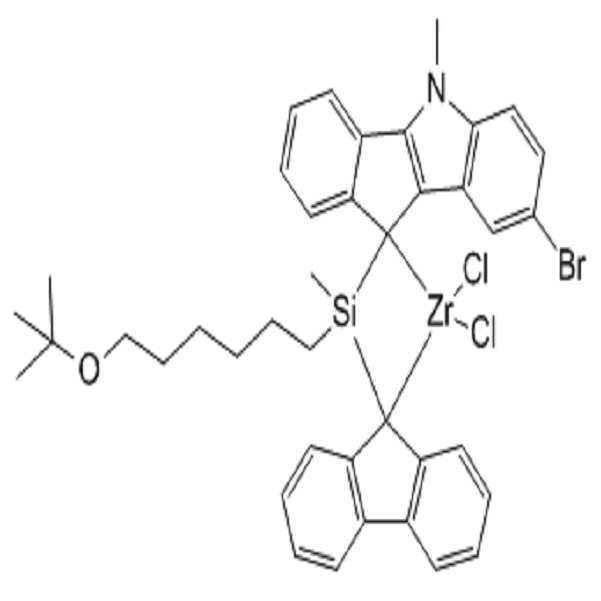


상기 제 2 메탈로센 화합물은 각각 하기 화학식 3으로 표시되는 화합물인, 폴리올레핀의 제조 방법:
[화학식 3]
(Cp1Ra)n(Cp2Rb)M1Z1 3-n
상기 화학식 3에서,
M1은 4족 전이금속이고;
Cp1 및 Cp2는 서로 동일하거나 상이하고, 각각 독립적으로 시클로펜타디엔닐, 인데닐, 4,5,6,7-테트라하이드로-1-인데닐, 및 플루오레닐 라디칼로 이루어진 군으로부터 선택된 어느 하나이고, 이들은 탄소수 1 내지 20의 탄화수소로 치환될 수 있으며;
Ra 및 Rb는 서로 동일하거나 상이하고, 각각 독립적으로 수소, C1 내지 C20의 알킬, C1 내지 C10의 알콕시, C2 내지 C20의 알콕시알킬, C6 내지 C20의 아릴, C6 내지 C10의 아릴옥시, C2 내지 C20의 알케닐, C7 내지 C40의 알킬아릴, C7 내지 C40의 아릴알킬, C8 내지 C40의 아릴알케닐, 또는 C2 내지 C10의 알키닐이고;
Z1은 할로겐 원자, C1 내지 C20의 알킬, C2 내지 C10의 알케닐, C7 내지 C40의 알킬아릴, C7 내지 C40의 아릴알킬, C6 내지 C20의 아릴, 치환되거나 치환되지 않은 C1 내지 C20의 알킬리덴, 치환되거나 치환되지 않은 아미노기, C2 내지 C20의 알킬알콕시, 또는 C7 내지 C40의 아릴알콕시이고;
n은 1 또는 0 이다.
In the presence of a first mixed metallocene catalyst comprising at least one first metallocene compound, at least one second metallocene compound, a co-catalyst compound, and a carrier, the first olefinic monomer- Stage 1; And
A second mixed supported metallocene catalyst comprising at least one of the first metallocene compound, at least one second metallocene compound, a co-catalyst compound, and a carrier in the reaction mixture of the first step, And a second step of further polymerizing and polymerizing a second olefin-based monomer;
Wherein the first metallocene compound is a compound of one of the following structural formulas,
Wherein the second metallocene compound is a compound represented by the following formula (3), respectively:
(3)
(Cp 1 R a ) n (Cp 2 R b ) M 1 Z 13 -n
In Formula 3,
M 1 is a Group 4 transition metal;
Cp 1 and Cp 2 are the same or different and are each independently selected from the group consisting of cyclopentadienyl, indenyl, 4,5,6,7-tetrahydro-1-indenyl, and fluorenyl radical And they may be substituted with hydrocarbons having 1 to 20 carbon atoms;
R a and R b are the same or different and are each independently selected from the group consisting of hydrogen, C1 to C20 alkyl, C1 to C10 alkoxy, C2 to C20 alkoxyalkyl, C6 to C20 aryl, C6 to C10 aryloxy, C2 C20 to C20 alkenyl, C7 to C40 alkylaryl, C7 to C40 arylalkyl, C8 to C40 arylalkenyl, or C2 to C10 alkynyl;
Z 1 represents a halogen atom, a C1 to C20 alkyl, a C2 to C10 alkenyl, a C7 to C40 alkylaryl, a C7 to C40 arylalkyl, a C6 to C20 aryl, a substituted or unsubstituted C1 to C20 alkylidene , A substituted or unsubstituted amino group, a C2 to C20 alkylalkoxy, or a C7 to C40 arylalkoxy;
n is 1 or 0;
상기 제 1 혼성 담지 메탈로센 촉매와 상기 제 2 혼성 담지 메탈로센 촉매는 서로 같거나 다른 촉매인 폴리올레핀의 제조 방법.
The method according to claim 1,
Wherein the first hybrid supported metallocene catalyst and the second hybrid supported metallocene catalyst are the same or different catalysts.
상기 조촉매는 하기 화학식 6의 알루미늄 함유 제 1 조촉매 및 하기 화학식 7의 보레이트계 제 2 조촉매로 이루어진 군에서 선택된 1종 이상의 화합물을 포함하는 폴리올레핀의 제조 방법:
[화학식 6]
-[Al(R18)-O-]k-
화학식 6에서, R18은 각각 독립적으로 할로겐, 할로겐 치환 또는 비치환된 탄소수 1 내지 20의 하이드로카빌기이고, k는 2 이상의 정수이고,
[화학식 7]
T+[BG4]-
화학식 7에서, T+은 +1가의 다원자 이온이고, B는 +3 산화 상태의 붕소이고, G는 각각 독립적으로 하이드라이드기, 디알킬아미도기, 할라이드기, 알콕사이드기, 아릴옥사이드기, 하이드로카빌기, 할로카빌기 및 할로-치환된 하이드로카빌기로 이루어진 군에서 선택되고, 상기 G는 20개 이하의 탄소를 가지나, 단 하나 이하의 위치에서 G는 할라이드기이다.
The method according to claim 1,
Wherein the co-catalyst comprises at least one compound selected from the group consisting of an aluminum-containing primary co-catalyst of the following formula (6) and a boron-containing secondary catalyst of the following formula (7)
[Chemical Formula 6]
- [Al (R 18) -O- ] k -
In Formula (6), R 18 is each independently halogen, halogen-substituted or unsubstituted hydrocarbyl group having 1 to 20 carbon atoms, k is an integer of 2 or more,
(7)
T + [BG 4 ] -
In Formula (7), T + is a polyatomic ion of +1 valence, B is boron of +3 oxidation state, and G is each independently selected from the group consisting of hydride group, dialkylamido group, halide group, alkoxide group, aryloxide group, Carbocyclic group, halocarbyl group, and halo-substituted hydrocarbyl group, wherein G has not more than 20 carbons, but G is a halide group in at least one position.
상기 담체는 실리카, 실리카-알루미나 및 실리카-마그네시아로 이루어진 군으로부터 선택되는 폴리올레핀의 제조 방법.
The method according to claim 1,
Wherein said carrier is selected from the group consisting of silica, silica-alumina and silica-magnesia.
상기 분자량 조절제는 하기 화학식 8의 시클로펜타디에닐 금속 화합물, 하기 화학식 9의 유기 알루미늄 화합물의 혼합물, 또는 이들의 반응 생성물을 포함하는 폴리올레핀의 제조 방법:
[화학식 8]
Cp6Cp7M4X'2
상기 화학식 8에서,
Cp6 및 Cp7은 각각 독립적으로 치환 또는 비치환된 시클로펜타디에닐기, 치환 또는 비치환된 인데닐기 또는 치환 또는 비치환된 플루오레닐기를 포함하는 리간드이고, M4는 4족 전이금속 원소이며, X'는 할로겐이며;
[화학식 9]
RfRgRhAl
상기 화학식 9에서,
Rf, Rg, 및 Rh는 각각 독립적으로 탄소수 4 내지 20의 알킬기 또는 할로겐이며, Rf, Rg, 및 Rh중 적어도 하나는 탄소수 4 내지 20의 알킬기이다.
The method according to claim 1,
Wherein the molecular weight modifier is a cyclopentadienyl metal compound represented by the following formula (8), a mixture of an organoaluminum compound represented by the following formula (9), or a reaction product thereof:
[Chemical Formula 8]
Cp 6 Cp 7 M 4 X ' 2
In Formula 8,
Cp 6 and Cp 7 are each independently a substituted or unsubstituted cyclopentadienyl group, a substituted or unsubstituted indenyl group or a ligand containing a substituted or unsubstituted fluorenyl group, M 4 is a Group 4 transition metal element , X 'is halogen;
[Chemical Formula 9]
R f R g R h Al
In the above formula (9)
R f , R g , and R h are each independently an alkyl group or a halogen having 4 to 20 carbon atoms, and R f , R g , and At least one of R h is an alkyl group having 4 to 20 carbon atoms.
상기 제 1 올레핀계 단량체는 에틸렌, 프로필렌, 1-부텐, 1-헥센, 1-옥텐, 1-펜텐, 4-메틸-1-펜텐, 1-헥센, 1-헵텐, 1-데센, 1-운데센, 1-도데센, 노보넨, 에틸리덴노보넨, 스티렌, 알파-메틸스티렌 및 3-클로로메틸스티렌으로 이루어진 군으로부터 선택된 1종 이상의 화합물을 포함하는 폴리올레핀의 제조 방법.
The method according to claim 1,
The first olefin-based monomer is at least one selected from the group consisting of ethylene, propylene, 1-butene, 1-hexene, 1-octene, A method for producing a polyolefin comprising at least one compound selected from the group consisting of styrene, 1-dodecene, norbornene, ethylidene norbornene, styrene, alpha-methylstyrene and 3-chloromethylstyrene.
상기 제 2 올레핀계 단량체는 에틸렌; 및 프로필렌, 1-부텐, 1-헥센, 1-옥텐, 1-펜텐, 4-메틸-1-펜텐, 1-헥센, 1-헵텐, 1-데센, 1-운데센, 1-도데센, 노보넨, 에틸리덴노보넨, 스티렌, 알파-메틸스티렌 및 3-클로로메틸스티렌으로 이루어진 군으로부터 선택된 1종 이상의 공단량체를 포함하는 폴리올레핀의 제조 방법.
The method according to claim 1,
Wherein the second olefin-based monomer is selected from the group consisting of ethylene; Hexene, 1-pentene, 1-hexene, 1-heptene, 1-decene, 1-undecene, 1-dodecene, And at least one comonomer selected from the group consisting of ethylene, norbornene, ethylidene norbornene, styrene, alpha-methylstyrene and 3-chloromethylstyrene.
상기 제 1 단계 및 제 2 단계의 중합은 탄화수소계 용매 내에서 슬러리상 중합으로 진행되는 폴리올레핀의 제조 방법.
The method according to claim 1,
Wherein the polymerization in the first step and the second step proceeds in a slurry-phase polymerization in a hydrocarbon-based solvent.
다단-CSTR 반응기(Cascade-CSTR reactor)에서 진행되는 폴리올레핀의 제조 방법.
The method according to claim 1,
A process for preparing a polyolefin in a Cascade-CSTR reactor.
상기 제 1 단계는 제 1 반응기에서 수행되고,
상기 제 2 단계는 제 2 반응기에서 수행되며,
상기 제 2 반응기에는 상기 제 1 반응기로부터 전달된 반응 혼합물에 상기 제 2 혼성 담지 메탈로센 촉매 및 제 2 올레핀계 단량체가 추가로 투입되는 폴리올레핀의 제조 방법.
The method according to claim 1,
The first step is carried out in a first reactor,
Wherein the second step is carried out in a second reactor,
Wherein the second mixed supported metallocene catalyst and the second olefin based monomer are further added to the reaction mixture delivered from the first reactor in the second reactor.
Applications Claiming Priority (2)
| Application Number | Priority Date | Filing Date | Title |
|---|---|---|---|
| KR1020130139989 | 2013-11-18 | ||
| KR20130139989 | 2013-11-18 |
Publications (2)
| Publication Number | Publication Date |
|---|---|
| KR20150057974A KR20150057974A (en) | 2015-05-28 |
| KR101670468B1 true KR101670468B1 (en) | 2016-10-28 |
Family
ID=53392685
Family Applications (1)
| Application Number | Title | Priority Date | Filing Date |
|---|---|---|---|
| KR1020140150403A Active KR101670468B1 (en) | 2013-11-18 | 2014-10-31 | Method for preparing polyolfin and polyolefin prepared therefrom |
Country Status (1)
| Country | Link |
|---|---|
| KR (1) | KR101670468B1 (en) |
Cited By (1)
| Publication number | Priority date | Publication date | Assignee | Title |
|---|---|---|---|---|
| US11091568B2 (en) | 2016-02-24 | 2021-08-17 | Lg Chem, Ltd. | Hybrid supported metallocene catalyst and polyolefin preparation method using same |
Families Citing this family (8)
| Publication number | Priority date | Publication date | Assignee | Title |
|---|---|---|---|---|
| WO2016204469A1 (en) * | 2015-06-15 | 2016-12-22 | 주식회사 엘지화학 | Method for producing metallocene-supported catalyst |
| KR101850985B1 (en) | 2015-06-15 | 2018-04-20 | 주식회사 엘지화학 | Method for preparing supported metallocene catalyst |
| KR20180083247A (en) * | 2017-01-12 | 2018-07-20 | 주식회사 엘지화학 | Olefin polymer and preparation method thereof |
| KR102427756B1 (en) | 2018-12-10 | 2022-08-01 | 주식회사 엘지화학 | Polyethylene and its chlorinated polyethylene |
| KR102427755B1 (en) | 2018-12-10 | 2022-08-01 | 주식회사 엘지화학 | Polyethylene and its chlorinated polyethylene |
| KR102252430B1 (en) | 2018-12-10 | 2021-05-14 | 주식회사 엘지화학 | Polyethylene and its chlorinated polyethylene |
| KR102203007B1 (en) * | 2019-06-05 | 2021-01-14 | 대림산업 주식회사 | Method for manufacturing multimodal polyolefins using multistage continuous polymerization process |
| US20250223385A1 (en) * | 2022-12-29 | 2025-07-10 | Lg Chem, Ltd. | Polyethylene Resin Composition |
Family Cites Families (4)
| Publication number | Priority date | Publication date | Assignee | Title |
|---|---|---|---|---|
| JP3537236B2 (en) * | 1994-10-13 | 2004-06-14 | 昭和電工株式会社 | Catalyst component for producing polyolefin, catalyst for producing polyolefin containing the component, and method for producing polyolefin |
| JP3537234B2 (en) * | 1995-09-27 | 2004-06-14 | 昭和電工株式会社 | Catalyst component for producing polyolefin, catalyst for producing polyolefin containing the component, and method for producing polyolefin |
| KR101092572B1 (en) * | 2006-12-21 | 2011-12-13 | 주식회사 엘지화학 | Method for producing polyolefin using supported catalyst |
| EP2559710B1 (en) * | 2010-04-12 | 2016-07-13 | Lotte Chemical Corporation | Catalyst composition for polymerizing olefin and method for preparing polyolefin using same |
-
2014
- 2014-10-31 KR KR1020140150403A patent/KR101670468B1/en active Active
Cited By (1)
| Publication number | Priority date | Publication date | Assignee | Title |
|---|---|---|---|---|
| US11091568B2 (en) | 2016-02-24 | 2021-08-17 | Lg Chem, Ltd. | Hybrid supported metallocene catalyst and polyolefin preparation method using same |
Also Published As
| Publication number | Publication date |
|---|---|
| KR20150057974A (en) | 2015-05-28 |
Similar Documents
| Publication | Publication Date | Title |
|---|---|---|
| KR101709688B1 (en) | Method for preparing polyolfin and polyolefin prepared therefrom | |
| KR101670468B1 (en) | Method for preparing polyolfin and polyolefin prepared therefrom | |
| KR101592436B1 (en) | Polyolefin having an excellent enviromental stress crack resistance | |
| KR101617870B1 (en) | Olefin based polymer having excellent processibility | |
| KR101691628B1 (en) | Method for preparing polyolfin and polyolefin prepared therefrom | |
| KR101705340B1 (en) | Method for preparing polyolefin and polyolefin prepared therefrom | |
| KR101726820B1 (en) | Ethylene/1-hexene or ethylene/1-butene copolymer having excellent processibility and environmental stress crack resistance | |
| KR101685662B1 (en) | Method for preparing polyolfin and polyolefin prepared therefrom | |
| KR101631700B1 (en) | Method for preparing of supported hybrid metallocene catalyst | |
| KR102260362B1 (en) | Olefin copolymer | |
| KR102064990B1 (en) | Supported hybrid catalyst system for ethylene slurry polymerization and method for preparing ethylene polymer with the catalyst system | |
| EP3255066B1 (en) | Method for producing metallocene-supported catalyst | |
| KR101606825B1 (en) | Method for preparing of supported hybrid metallocene catalyst | |
| EP3372620A1 (en) | Catalyst composition for synthesizing olefin copolymer, and method for preparing olefin copolymer | |
| KR20160123172A (en) | Ethylene/alpha-olefin copolymer having excellent processibility | |
| EP3363820A1 (en) | Hybrid supported metallocene catalyst, and method for preparing polyolefin by using same | |
| KR20180067939A (en) | Catalyst composition for preparing polyolefin having an excellent flexural modulus using the same | |
| KR20180083247A (en) | Olefin polymer and preparation method thereof | |
| KR20180099269A (en) | Catalyst composition for polymerizing olefin copolymer and preparation method of olefin copolymer | |
| KR101725352B1 (en) | Method for preparing polyolfin and polyolefin prepared therefrom | |
| KR20160121045A (en) | High density polyethylene copolymer for blow molding | |
| KR20170075530A (en) | Metallocene supported catalyst and method for preparing polyolefin using the same | |
| KR102215024B1 (en) | Method for preparing polyolfin | |
| KR20180060280A (en) | Method for preparing polyolefin having an excellent environment stress crack resistancnellent using the same |
Legal Events
| Date | Code | Title | Description |
|---|---|---|---|
| A201 | Request for examination | ||
| PA0109 | Patent application |
Patent event code: PA01091R01D Comment text: Patent Application Patent event date: 20141031 |
|
| PA0201 | Request for examination | ||
| PG1501 | Laying open of application | ||
| E902 | Notification of reason for refusal | ||
| PE0902 | Notice of grounds for rejection |
Comment text: Notification of reason for refusal Patent event date: 20160211 Patent event code: PE09021S01D |
|
| E701 | Decision to grant or registration of patent right | ||
| PE0701 | Decision of registration |
Patent event code: PE07011S01D Comment text: Decision to Grant Registration Patent event date: 20160805 |
|
| GRNT | Written decision to grant | ||
| PR0701 | Registration of establishment |
Comment text: Registration of Establishment Patent event date: 20161024 Patent event code: PR07011E01D |
|
| PR1002 | Payment of registration fee |
Payment date: 20161024 End annual number: 3 Start annual number: 1 |
|
| PG1601 | Publication of registration | ||
| FPAY | Annual fee payment |
Payment date: 20191016 Year of fee payment: 4 |
|
| PR1001 | Payment of annual fee |
Payment date: 20191016 Start annual number: 4 End annual number: 4 |
|
| PR1001 | Payment of annual fee |
Payment date: 20200928 Start annual number: 5 End annual number: 5 |
|
| PR1001 | Payment of annual fee |
Payment date: 20210927 Start annual number: 6 End annual number: 6 |