KR101316995B1 - Laminated porous film, separator for battery, and battery - Google Patents
Laminated porous film, separator for battery, and battery Download PDFInfo
- Publication number
- KR101316995B1 KR101316995B1 KR1020127026930A KR20127026930A KR101316995B1 KR 101316995 B1 KR101316995 B1 KR 101316995B1 KR 1020127026930 A KR1020127026930 A KR 1020127026930A KR 20127026930 A KR20127026930 A KR 20127026930A KR 101316995 B1 KR101316995 B1 KR 101316995B1
- Authority
- KR
- South Korea
- Prior art keywords
- porous film
- layer
- filler
- coating layer
- laminated
- Prior art date
- Legal status (The legal status is an assumption and is not a legal conclusion. Google has not performed a legal analysis and makes no representation as to the accuracy of the status listed.)
- Expired - Fee Related
Links
Images
Classifications
-
- B—PERFORMING OPERATIONS; TRANSPORTING
- B32—LAYERED PRODUCTS
- B32B—LAYERED PRODUCTS, i.e. PRODUCTS BUILT-UP OF STRATA OF FLAT OR NON-FLAT, e.g. CELLULAR OR HONEYCOMB, FORM
- B32B27/00—Layered products comprising a layer of synthetic resin
- B32B27/06—Layered products comprising a layer of synthetic resin as the main or only constituent of a layer, which is next to another layer of the same or of a different material
- B32B27/08—Layered products comprising a layer of synthetic resin as the main or only constituent of a layer, which is next to another layer of the same or of a different material of synthetic resin
-
- B—PERFORMING OPERATIONS; TRANSPORTING
- B32—LAYERED PRODUCTS
- B32B—LAYERED PRODUCTS, i.e. PRODUCTS BUILT-UP OF STRATA OF FLAT OR NON-FLAT, e.g. CELLULAR OR HONEYCOMB, FORM
- B32B27/00—Layered products comprising a layer of synthetic resin
- B32B27/32—Layered products comprising a layer of synthetic resin comprising polyolefins
-
- B—PERFORMING OPERATIONS; TRANSPORTING
- B32—LAYERED PRODUCTS
- B32B—LAYERED PRODUCTS, i.e. PRODUCTS BUILT-UP OF STRATA OF FLAT OR NON-FLAT, e.g. CELLULAR OR HONEYCOMB, FORM
- B32B5/00—Layered products characterised by the non- homogeneity or physical structure, i.e. comprising a fibrous, filamentary, particulate or foam layer; Layered products characterised by having a layer differing constitutionally or physically in different parts
- B32B5/18—Layered products characterised by the non- homogeneity or physical structure, i.e. comprising a fibrous, filamentary, particulate or foam layer; Layered products characterised by having a layer differing constitutionally or physically in different parts characterised by features of a layer of foamed material
-
- C—CHEMISTRY; METALLURGY
- C08—ORGANIC MACROMOLECULAR COMPOUNDS; THEIR PREPARATION OR CHEMICAL WORKING-UP; COMPOSITIONS BASED THEREON
- C08J—WORKING-UP; GENERAL PROCESSES OF COMPOUNDING; AFTER-TREATMENT NOT COVERED BY SUBCLASSES C08B, C08C, C08F, C08G or C08H
- C08J7/00—Chemical treatment or coating of shaped articles made of macromolecular substances
- C08J7/04—Coating
- C08J7/042—Coating with two or more layers, where at least one layer of a composition contains a polymer binder
-
- C—CHEMISTRY; METALLURGY
- C08—ORGANIC MACROMOLECULAR COMPOUNDS; THEIR PREPARATION OR CHEMICAL WORKING-UP; COMPOSITIONS BASED THEREON
- C08J—WORKING-UP; GENERAL PROCESSES OF COMPOUNDING; AFTER-TREATMENT NOT COVERED BY SUBCLASSES C08B, C08C, C08F, C08G or C08H
- C08J7/00—Chemical treatment or coating of shaped articles made of macromolecular substances
- C08J7/04—Coating
- C08J7/043—Improving the adhesiveness of the coatings per se, e.g. forming primers
-
- C—CHEMISTRY; METALLURGY
- C08—ORGANIC MACROMOLECULAR COMPOUNDS; THEIR PREPARATION OR CHEMICAL WORKING-UP; COMPOSITIONS BASED THEREON
- C08J—WORKING-UP; GENERAL PROCESSES OF COMPOUNDING; AFTER-TREATMENT NOT COVERED BY SUBCLASSES C08B, C08C, C08F, C08G or C08H
- C08J9/00—Working-up of macromolecular substances to porous or cellular articles or materials; After-treatment thereof
- C08J9/36—After-treatment
-
- C—CHEMISTRY; METALLURGY
- C08—ORGANIC MACROMOLECULAR COMPOUNDS; THEIR PREPARATION OR CHEMICAL WORKING-UP; COMPOSITIONS BASED THEREON
- C08L—COMPOSITIONS OF MACROMOLECULAR COMPOUNDS
- C08L69/00—Compositions of polycarbonates; Compositions of derivatives of polycarbonates
-
- H—ELECTRICITY
- H01—ELECTRIC ELEMENTS
- H01M—PROCESSES OR MEANS, e.g. BATTERIES, FOR THE DIRECT CONVERSION OF CHEMICAL ENERGY INTO ELECTRICAL ENERGY
- H01M10/00—Secondary cells; Manufacture thereof
- H01M10/05—Accumulators with non-aqueous electrolyte
- H01M10/052—Li-accumulators
-
- H—ELECTRICITY
- H01—ELECTRIC ELEMENTS
- H01M—PROCESSES OR MEANS, e.g. BATTERIES, FOR THE DIRECT CONVERSION OF CHEMICAL ENERGY INTO ELECTRICAL ENERGY
- H01M50/00—Constructional details or processes of manufacture of the non-active parts of electrochemical cells other than fuel cells, e.g. hybrid cells
- H01M50/40—Separators; Membranes; Diaphragms; Spacing elements inside cells
- H01M50/403—Manufacturing processes of separators, membranes or diaphragms
-
- H—ELECTRICITY
- H01—ELECTRIC ELEMENTS
- H01M—PROCESSES OR MEANS, e.g. BATTERIES, FOR THE DIRECT CONVERSION OF CHEMICAL ENERGY INTO ELECTRICAL ENERGY
- H01M50/00—Constructional details or processes of manufacture of the non-active parts of electrochemical cells other than fuel cells, e.g. hybrid cells
- H01M50/40—Separators; Membranes; Diaphragms; Spacing elements inside cells
- H01M50/409—Separators, membranes or diaphragms characterised by the material
- H01M50/431—Inorganic material
-
- H—ELECTRICITY
- H01—ELECTRIC ELEMENTS
- H01M—PROCESSES OR MEANS, e.g. BATTERIES, FOR THE DIRECT CONVERSION OF CHEMICAL ENERGY INTO ELECTRICAL ENERGY
- H01M50/00—Constructional details or processes of manufacture of the non-active parts of electrochemical cells other than fuel cells, e.g. hybrid cells
- H01M50/40—Separators; Membranes; Diaphragms; Spacing elements inside cells
- H01M50/409—Separators, membranes or diaphragms characterised by the material
- H01M50/449—Separators, membranes or diaphragms characterised by the material having a layered structure
-
- C—CHEMISTRY; METALLURGY
- C08—ORGANIC MACROMOLECULAR COMPOUNDS; THEIR PREPARATION OR CHEMICAL WORKING-UP; COMPOSITIONS BASED THEREON
- C08J—WORKING-UP; GENERAL PROCESSES OF COMPOUNDING; AFTER-TREATMENT NOT COVERED BY SUBCLASSES C08B, C08C, C08F, C08G or C08H
- C08J2323/00—Characterised by the use of homopolymers or copolymers of unsaturated aliphatic hydrocarbons having only one carbon-to-carbon double bond; Derivatives of such polymers
- C08J2323/02—Characterised by the use of homopolymers or copolymers of unsaturated aliphatic hydrocarbons having only one carbon-to-carbon double bond; Derivatives of such polymers not modified by chemical after treatment
-
- Y—GENERAL TAGGING OF NEW TECHNOLOGICAL DEVELOPMENTS; GENERAL TAGGING OF CROSS-SECTIONAL TECHNOLOGIES SPANNING OVER SEVERAL SECTIONS OF THE IPC; TECHNICAL SUBJECTS COVERED BY FORMER USPC CROSS-REFERENCE ART COLLECTIONS [XRACs] AND DIGESTS
- Y02—TECHNOLOGIES OR APPLICATIONS FOR MITIGATION OR ADAPTATION AGAINST CLIMATE CHANGE
- Y02E—REDUCTION OF GREENHOUSE GAS [GHG] EMISSIONS, RELATED TO ENERGY GENERATION, TRANSMISSION OR DISTRIBUTION
- Y02E60/00—Enabling technologies; Technologies with a potential or indirect contribution to GHG emissions mitigation
- Y02E60/10—Energy storage using batteries
-
- Y—GENERAL TAGGING OF NEW TECHNOLOGICAL DEVELOPMENTS; GENERAL TAGGING OF CROSS-SECTIONAL TECHNOLOGIES SPANNING OVER SEVERAL SECTIONS OF THE IPC; TECHNICAL SUBJECTS COVERED BY FORMER USPC CROSS-REFERENCE ART COLLECTIONS [XRACs] AND DIGESTS
- Y10—TECHNICAL SUBJECTS COVERED BY FORMER USPC
- Y10T—TECHNICAL SUBJECTS COVERED BY FORMER US CLASSIFICATION
- Y10T428/00—Stock material or miscellaneous articles
- Y10T428/249921—Web or sheet containing structurally defined element or component
- Y10T428/249953—Composite having voids in a component [e.g., porous, cellular, etc.]
-
- Y—GENERAL TAGGING OF NEW TECHNOLOGICAL DEVELOPMENTS; GENERAL TAGGING OF CROSS-SECTIONAL TECHNOLOGIES SPANNING OVER SEVERAL SECTIONS OF THE IPC; TECHNICAL SUBJECTS COVERED BY FORMER USPC CROSS-REFERENCE ART COLLECTIONS [XRACs] AND DIGESTS
- Y10—TECHNICAL SUBJECTS COVERED BY FORMER USPC
- Y10T—TECHNICAL SUBJECTS COVERED BY FORMER US CLASSIFICATION
- Y10T428/00—Stock material or miscellaneous articles
- Y10T428/249921—Web or sheet containing structurally defined element or component
- Y10T428/249953—Composite having voids in a component [e.g., porous, cellular, etc.]
- Y10T428/249981—Plural void-containing components
Landscapes
- Chemical & Material Sciences (AREA)
- Chemical Kinetics & Catalysis (AREA)
- Health & Medical Sciences (AREA)
- Medicinal Chemistry (AREA)
- Polymers & Plastics (AREA)
- Organic Chemistry (AREA)
- Electrochemistry (AREA)
- General Chemical & Material Sciences (AREA)
- Engineering & Computer Science (AREA)
- Manufacturing & Machinery (AREA)
- Inorganic Chemistry (AREA)
- Materials Engineering (AREA)
- Cell Separators (AREA)
- Laminated Bodies (AREA)
Abstract
본 발명은, 기재층과 피복층의 높은 밀착성, 우수한 내열성을 갖고, 비수 전해액 이차 전지용 세퍼레이터로서 사용하였을 때에, 우수한 특성을 겸비한 적층 다공 필름을 얻을 수 있다. 기재층이 되는 폴리올레핀계 수지 다공 필름의 표면의 적어도 편면에, 필러와 수지 바인더를 포함하는 피복층을 적층한 적층 다공 필름으로서, 그 적층 다공 필름 표면으로부터 상기 피복층의 층두께 25 % 내에 있어서의 필러의 평균 입경 (Du) 과, 상기 기재층과의 계면으로부터 피복층의 층두께 25 % 내에 있어서의 필러의 평균 입경 (Db) 의 비 (Db/Du) 가 1.2 ∼ 10 이며, 또한 상기 (Du) 가 0.5 ㎛ 이하이다. INDUSTRIAL APPLICABILITY The present invention has a high adhesion between the base layer and the coating layer, excellent heat resistance, and when used as a separator for nonaqueous electrolyte secondary batteries, a laminated porous film having excellent characteristics can be obtained. The laminated porous film which laminated | stacked the coating layer containing a filler and a resin binder on at least one surface of the surface of the polyolefin resin porous film used as a base material layer, Comprising: The filler in the layer thickness of 25% of the said coating layer from the laminated porous film surface. The ratio (Db / Du) of the average particle diameter (Db) of the filler within 25% of the layer thickness of the coating layer from the interface between the average particle diameter (Du) and the substrate layer is 1.2 to 10, and the above (Du) is 0.5 It is micrometer or less.
Description
본 발명은 적층 다공 필름에 관한 것으로서, 포장용, 위생용, 축산용, 농업용, 건축용, 의료용, 분리막, 광 확산판, 전지용 세퍼레이터로서 이용할 수 있고, 특히, 비수 전해 전지의 리튬 이온 이차 전지용 세퍼레이터로서 바람직하게 이용할 수 있는 것이다.BACKGROUND OF THE INVENTION Field of the Invention The present invention relates to a laminated porous film, which can be used as a separator for packaging, hygiene, animal husbandry, agriculture, construction, medical treatment, separator, light diffusion plate, and battery, and is particularly preferred as a separator for lithium ion secondary batteries of nonaqueous electrolytic cells. It can be used.
다수의 미세 연통공 (連通孔) 을 갖는 고분자 다공체는, 초순수의 제조, 약액의 정제, 수(水)처리 등에 사용하는 분리막, 의류·위생 재료 등에 사용하는 방수 투습성 필름, 혹은 전지 등에 사용하는 전지 세퍼레이터 등 각종 분야에서 이용되고 있다.A polymer porous body having a large number of fine communication holes is a battery used for the production of ultrapure water, purification of a chemical solution, a water-repellent moisture-permeable film used for clothing, sanitary materials, etc. It is used in various fields, such as a separator.
특히 이차 전지는 OA, FA, 가정용 전기 또는 통신 기기 등의 포터블 기기용 전원으로서 폭넓게 사용되고 있다. 특히 기기에 장비한 경우에 용적 효율이 양호하여 기기의 소형화 및 경량화로 이어지는 점에서 리튬 이온 이차 전지를 사용한 포터블 기기가 증가하고 있다. 한편, 대형 이차 전지는 로드 레벨링, UPS, 전기 자동차를 비롯하여, 에너지/환경 문제에 관련되는 많은 분야에 있어서 연구 개발이 진행되고, 대용량, 고출력, 고전압 및 장기 보존성이 우수한 점에서 비수 전해액 이차 전지의 일종인 리튬 이온 이차 전지의 용도가 확대되고 있다.In particular, secondary batteries are widely used as power sources for portable devices such as OA, FA, home electric or communication devices. Particularly, when equipped in a device, the portable device using the lithium ion secondary battery is increasing in that the capacity efficiency is good and the size and weight of the device are reduced. On the other hand, large secondary batteries have been researched and developed in many fields related to energy / environmental issues such as load leveling, UPS, electric vehicles, etc., and have high capacity, high output, high voltage, and long-term storage characteristics. The use of the lithium ion secondary battery which is a kind is expanding.
리튬 이온 이차 전지의 사용 전압은 통상 4.1 V 내지 4.2 V 를 상한으로 하여 설계되고 있다. 이와 같은 고전압에서는 수용액은 전기 분해를 일으키므로 전해액으로서 사용할 수 없다. 그 때문에, 고전압에서도 견딜 수 있는 전해액으로서 유기 용매를 사용한 이른바 비수 전해액이 사용되고 있다. 비수 전해액용 용매로는, 보다 많은 리튬 이온을 존재시킬 수 있는 고유전율 유기 용매가 사용되고, 그 고유전율 유기 용매로서 프로필렌카보네이트나 에틸렌카보네이트 등의 유기 탄산에스테르 화합물이 주로 사용되고 있다. 용매 중에서 리튬 이온원이 되는 지지 전해질로서, 육불화인산리튬 등의 반응성이 높은 전해질을 용매 중에 용해시켜 사용하고 있다.The operating voltage of the lithium ion secondary battery is usually designed to be in the range of 4.1 V to 4.2 V as an upper limit. At such a high voltage, the aqueous solution causes electrolysis and thus cannot be used as an electrolyte. For this reason, a so-called non-aqueous electrolytic solution using an organic solvent is used as an electrolyte capable of withstanding a high voltage. As the solvent for the nonaqueous electrolyte solution, a high-dielectric constant organic solvent capable of allowing more lithium ions is used, and an organic carbonic ester compound such as propylene carbonate or ethylene carbonate is mainly used as the high-dielectric constant organic solvent. As a supporting electrolyte serving as a lithium ion source in a solvent, a highly reactive electrolyte such as lithium hexafluorophosphate is dissolved in a solvent and used.
리튬 이온 이차 전지에는 내부 단락의 방지 면에서 세퍼레이터가 정극 (正極) 과 부극 (負極) 사이에 개재되어 있다. 그 세퍼레이터에는 그 역할로부터 당연히 절연성이 요구된다. 또, 리튬 이온의 통로가 되는 투기성과 전해액의 확산·유지 기능을 부여하기 위해서 미세 구멍 구조일 필요가 있다. 이들의 요구를 만족시키기 위해서 세퍼레이터로는 다공성 필름이 사용되고 있다.In the lithium ion secondary battery, a separator is interposed between the positive electrode and the negative electrode in the prevention of an internal short circuit. The separator is naturally required to have insulation from its role. Moreover, in order to provide the air permeability which becomes a channel | path of lithium ion, and the diffusion and maintenance function of electrolyte solution, it is necessary to have a fine pore structure. In order to satisfy these requirements, a porous film is used as a separator.
최근 전지의 고용량화에 수반하여, 전지의 안전성에 대한 중요도가 증가하고 있다. 전지용 세퍼레이터의 안전에 기여하는 특성으로서 셧다운 특성 (이후 「SD 특성」이라고 한다) 이 있다. 이 SD 특성은, 100 ∼ 150 ℃ 정도의 고온 상태가 되면 미세 구멍이 폐색되고, 그 결과, 전지 내부의 이온 전도가 차단되기 때문에, 그 후의 전지 내부의 온도 상승을 방지할 수 있다는 기능이다. 이 때, 적층 다공성 필름의 미세 구멍이 폐색되는 온도 중 가장 낮은 온도를 셧다운 온도 (이후, 「SD 온도」라고 한다) 라고 한다. 전지용 세퍼레이터로서 사용하는 경우에는, 이 SD 특성을 구비하고 있는 것이 필요하다.In recent years, with increasing capacity of batteries, the importance of safety of batteries has increased. A shutdown characteristic (hereinafter referred to as " SD characteristic ") is a characteristic contributing to the safety of the battery separator. This SD characteristic is a function to prevent the temperature rise inside the battery because the fine holes are blocked when the battery is at a high temperature of about 100 to 150 DEG C, and as a result, ion conduction inside the battery is blocked. At this time, the lowest temperature among the temperatures at which the micropores of the laminated porous film are blocked is called a shutdown temperature (hereinafter referred to as "SD temperature"). When using as a battery separator, what has this SD characteristic is required.
그러나, 최근, 리튬 이온 이차 전지의 고에너지 밀도화, 하이파워화에 수반하여, 통상적인 셧다운 기능이 충분히 기능하지 않아, 전지 내부의 온도가 PE 의 융점인 150 ℃ 전후를 초과하고, 더욱 상승하여, 세퍼레이터의 열수축에 수반하는 파막 (破膜) 에 의해 양극 (兩極) 이 단락되고, 발화에 이르는 사고가 발생하고 있다. 그래서, 안전성을 확보하기 위해서, 세퍼레이터에는 현재의 SD 특성보다 더 높은 내열성이 요구되고 있다.However, in recent years, with the high energy density and high power of a lithium ion secondary battery, a normal shutdown function does not fully function, and the temperature inside a battery exceeds 150 degreeC which is melting point of PE, and it raises further, The anode is short-circuited by the rupture film accompanying thermal contraction of the separator, and an accident leading to ignition has occurred. Therefore, in order to ensure safety, the separator is required to have higher heat resistance than the current SD characteristic.
상기 요망에 대하여, 폴리올레핀계 수지 다공 필름의 적어도 편면에, 필러와 수지 바인더를 포함하는 다공층을 구비한 다층 다공 필름이 하기 특허문헌 1, 2, 3 에서 제안되어 있다. 이들 특허문헌에서는, 다공 필름 상에 무기 등의 필러를 고충전시킨 코트층을 형성함으로써, 이상 발열을 일으켜, SD 온도를 초과하여 온도가 계속 상승하였을 때에 있어서도, 양극의 단락을 방지할 수 있어, 매우 안전성이 우수한 방법으로 여겨지고 있다.In response to the above requirements, a multilayer porous film having a porous layer containing a filler and a resin binder on at least one side of the polyolefin resin porous film is proposed in the following Patent Documents 1, 2, and 3. In these patent documents, by forming a coat layer in which fillers such as inorganic materials are highly charged on the porous film, abnormal heat generation occurs, and even when the temperature continues to rise above the SD temperature, a short circuit of the anode can be prevented, It is considered a very safe method.
그러나, 상기 특허문헌 1 ∼ 3 에 기재된 제조 방법에서는, 높은 투기성을 확보하려면, 수지 바인더의 함유량을 적게, 그리고 필러의 입경을 크게 할 필요가 있다. 그러나, 입경이 큰 필러를 사용하면, 필러끼리의 결착력이 떨어져, 가루 날림이 발생하기 쉬워진다는 문제가 있었다.However, in the manufacturing method of the said patent documents 1-3, in order to ensure high air permeability, it is necessary to reduce content of a resin binder and to enlarge the particle size of a filler. However, when a filler having a large particle size is used, there is a problem that the binding force between the fillers is lowered and powder blowing is more likely to occur.
본 발명의 과제는, 상기 문제점을 해결하기 위해서, 필러끼리의 결착성이 높고, 내열성이 우수하고, 비수 전해액 이차 전지용 세퍼레이터로서 사용하였을 때에, 우수한 SD 특성을 발휘할 수 있는 적층 다공 필름을 제공하는 것을 과제로 하고 있다.An object of the present invention is to provide a laminated porous film which can exhibit excellent SD characteristics when used as a separator for a nonaqueous electrolyte secondary battery having high binding properties between the fillers, excellent heat resistance, and to solve the above problems. It is a problem.
본 발명은, 기재층이 되는 폴리올레핀계 수지 다공 필름의 적어도 편면에, 필러와 수지 바인더를 포함하는 피복층을 적층하고 있는 적층 다공 필름으로서,This invention is a laminated porous film which laminated | stacked the coating layer containing a filler and a resin binder on at least one surface of the polyolefin resin porous film used as a base material layer,
상기 적층 다공 필름의 표면이 되는 상기 피복층의 표면으로부터 그 피복층의 두께 25 % 내에 있어서의 필러의 평균 입경 (Du) 과 상기 기재층과의 계면으로부터 그 피복층의 두께 25 % 내에 있어서의 필러의 평균 입경 (Db) 의 비 (Db/Du) 가 1.2 ∼ 10 이며, 또한 상기 피복층의 표면측의 필러의 평균 입경 (Du) 이 0.05 ㎛ 이하인 것을 특징으로 하는 적층 다공 필름을 제공하고 있다.Average particle diameter of the filler in 25% of the thickness of the coating layer from the interface with the average particle diameter (Du) of the filler in 25% of the thickness of the coating layer and the base material layer from the surface of the coating layer to be the surface of the laminated porous film. The ratio (Db / Du) of (Db) is 1.2-10, and the laminated porous film which is characterized by the average particle diameter (Du) of the filler on the surface side of the said coating layer being 0.05 micrometer or less.
상기 피복층의 층두께 전체에 포함되는 상기 필러의 평균 입경이 0.1 ㎛ 이상 3.0 ㎛ 이하인 것이 더욱 바람직하다.It is more preferable that the average particle diameter of the said filler contained in the whole layer thickness of the said coating layer is 0.1 micrometer or more and 3.0 micrometers or less.
또, 상기 필러의 평균 입경 (Du) 은 0.05 ㎛ ∼ 0.5 ㎛, 필러의 평균 입경 (Db) 은 0.1 ㎛ ∼ 3.0 ㎛ 이상이고, 상기 피복층의 표면으로부터 두께 25 % 와 상기 기재층과의 계면으로부터 그 피복층의 두께 25 % 사이의 상기 피복층의 두께 방향의 중간부의 상기 필러의 평균 입경은 상기 (Du) 와 (Db) 사이이고, 상기 피복층의 표면측으로부터 상기 기재층과의 계면측으로 평균 입자경이 대직경화되는 구배를 갖는 것으로 하고 있는 것이 바람직하다.Moreover, the average particle diameter (Du) of the said filler is 0.05 micrometer-0.5 micrometer, and the average particle diameter (Db) of a filler is 0.1 micrometer-3.0 micrometers or more, From the surface of the said coating layer from the interface of 25% of thickness and the said base material layer The average particle diameter of the said filler in the middle part of the thickness direction of the said coating layer between 25% of the thickness of a coating layer is between said (Du) and (Db), and an average particle diameter has large diameter reduced from the surface side of the said coating layer to the interface side with the said base material layer. It is preferable to have a gradient to become.
상기 필러 (a) 의 밀도가, 상기 수지 바인더 (b) 의 밀도의 2 배 이상인 것이 바람직하다.It is preferable that the density of the said filler (a) is 2 times or more of the density of the said resin binder (b).
상기 기재층의 폴리올레핀계 수지 다공 필름이, 폴리프로필렌계 수지를 주성분으로 하는 층을 적어도 1 층 구비하고 있는 것이 바람직하다.It is preferable that the polyolefin resin porous film of the said base material layer is equipped with at least 1 layer which has polypropylene resin as a main component.
상기 기재층이 되는 폴리올레핀계 수지 다공 필름은, 폴리프로필렌계 수지를 주성분으로 하는 층 (A 층) 과 폴리에틸렌 등의 다른 폴리올레핀계 수지 다공층 (B 층) 또는/및 폴리올레핀계 이외의 수지 다공층을 적층하고, 그 적층의 상기 폴리올레핀계 수지 다공층의 표면에 상기 피복층을 적층해도 된다.The polyolefin resin porous film which becomes the said base material layer has a layer (A layer) which has polypropylene resin as a main component, and other polyolefin resin porous layers (B layer), such as polyethylene, and / or resin porous layers other than polyolefin type. The coating layer may be laminated on the surface of the polyolefin resin porous layer of the laminate.
상기 기재층의 폴리올레핀계 수지 다공 필름이, β 정 활성을 갖는 것이 바람직하다.It is preferable that the polyolefin resin porous film of the said base material layer has (beta) positive activity.
상기 기재층과 상기 피복층의 박리 강도가 3 N/15 ㎜ 이상인 것이 바람직하다.It is preferable that the peeling strength of the said base material layer and the said coating layer is 3 N / 15 mm or more.
또, 본 발명의 기재층과 상기 피복층을 적층한 적층 다공 필름의 150 ℃ 에 있어서의 수축률이 25 % 미만인 것이 바람직하다.Moreover, it is preferable that the shrinkage rate in 150 degreeC of the laminated porous film which laminated | stacked the base material layer of this invention and the said coating layer is less than 25%.
또한 본 발명은 상기 적층 다공 필름으로 이루어지는 비수 전해액 이차 전지용 세퍼레이터를 제공하고 있다.Moreover, this invention provides the separator for nonaqueous electrolyte secondary batteries which consists of the said laminated porous film.
그리고 또한, 본 발명은 상기 비수 전해액 이차 전지용 세퍼레이터를 사용한 비수 전해액 이차 전지를 제공하고 있다.Moreover, this invention provides the nonaqueous electrolyte secondary battery using the said separator for nonaqueous electrolyte secondary batteries.
상기 본 발명의 적층 다공 필름의 제조 방법으로서, 상기 기재층의 폴리올레핀계 수지 다공 필름의 적어도 편면의 표면에, 상기 필러와 상기 수지 바인더를 용매에 용해 또는 분산시킨 분산액을 도포하여 상기 피복층을 형성하고,In the method for producing a laminated porous film of the present invention, a dispersion liquid obtained by dissolving or dispersing the filler and the resin binder in a solvent is applied to at least one surface of the polyolefin resin porous film of the substrate layer to form the coating layer. ,
상기 용매의 제거 공정 전 또는 제거 공정 중에 상기 필러를 상기 기재층을 향하여 침강시키고, 상기 피복층의 두께 방향에서 상기 표면측으로부터 기재층측으로 필러의 평균 입경이, 상기 (Db/Du) = 1.2 ∼ 10 이 되는 구배를 갖게 하는 적층 다공 필름의 제조 방법을 제공하고 있다.The filler is allowed to settle before the solvent removal step or during the removal step, and the average particle diameter of the filler from the surface side to the substrate layer side in the thickness direction of the coating layer is (Db / Du) = 1.2 to 10. The manufacturing method of the laminated porous film which has a gradient to become is provided.
또, 상기 본 발명의 적층 다공 필름의 다른 제조 방법으로서, 상기 기재층의 폴리올레핀계 수지 다공 필름의 적어도 편면의 표면에, 상기 필러의 평균 입경이 상이한 분산액을 복수 회로 나누어 도포하고, 그 분산액의 도포는 필러의 평균 입경이 큰 분산액부터 도포하여, 순차로 평균 입경이 작은 분산액을 중첩시켜 도포하고, 상기 피복층의 두께 방향에서 상기 표면측으로부터 기재층측으로 필러의 평균 입경이, 상기 (Db/Du) = 1.2 ∼ 10 이 되는 구배를 갖게 하는 적층 다공 필름의 제조 방법을 제공하고 있다. 상기 피복층의 표면으로부터 두께 방향에서 상기 기재층에 근접하는 방향을 향하여 필러의 평균 입경이, 상기 (Db/Du) 가 1.2 ∼ 10 이 되는 구배를 갖게 하는 적층 다공 필름의 제조 방법을 제공하고 있다.Moreover, as another manufacturing method of the laminated porous film of the said invention, the dispersion liquid from which the average particle diameter of the said filler is divided into two or more times is apply | coated to the surface of the at least single side | surface of the polyolefin resin porous film of the said base material layer, and the dispersion liquid is apply | coated Apply | coats from the dispersion liquid with a large average particle diameter of a filler, and apply | coats the dispersion liquid with a small average particle diameter sequentially, and apply | coats, and the average particle diameter of a filler from the said surface side to the base material layer side in the thickness direction of the said coating layer, (Db / Du) The manufacturing method of the laminated porous film which has a gradient which becomes = 1.2-10 is provided. The manufacturing method of the laminated porous film which makes the average particle diameter of a filler from the surface of the said coating layer toward the direction close to the said base material layer have a gradient which (Db / Du) becomes 1.2-10.
상기 기재층에 상기 분산액을 도포하기 전 또는 상기 피복층을 형성한 후에, 100 ℃ 이상 170 ℃ 이하에서 열처리함과 함께, 그 열처리 중에 1 ∼ 20 % 의 이완 처리를 실시하여 150 ℃ 에 있어서의 수축률을 25 % 미만으로 하는 것이 바람직하다.Before applying the dispersion liquid to the base material layer or after forming the coating layer, the heat treatment is performed at 100 ° C. or higher and 170 ° C. or lower, and a 1-20% relaxation treatment is performed during the heat treatment to reduce the shrinkage at 150 ° C. It is preferable to set it as less than 25%.
본 발명은, 기재층이 되는 폴리올레핀계 수지 다공 필름의 표면에 적층하는 피복층은, 기재층과의 계면측으로부터 표면을 향하여 필러의 평균 입경을 소직경 대직경화하는 구배를 갖게 하고 있다. 이와 같이, 피복층의 표면측의 필러의 평균 입경을 작고 미세한 구조로 하고 있기 때문에, 표면측의 필러끼리의 결착력이 강해짐과 함께 기재층측으로부터 큰 필러의 탈락을 방지할 수 있다. 한편, 그 피복층의 기재층측은 필러의 평균 입경이 크기 때문에, 통기성이 높은 구조가 되어, 통기성 악화를 억제할 수 있다. 또한, 본 발명의 적층 다공 필름은 내열 수축성이 우수하여, 열수축률이 25 % 미만으로 낮고, 우수한 SD 특성을 갖는다. 이와 같이, 피복층의 두께 방향에서의 필러의 평균 입경에 구배를 갖게 함으로써, 피복층의 필러의 탈락을 억제하여 피복층과 기재층의 높은 밀착성을 확보할 수 있음과 함께 높은 밀착성을 가질 수 있고, 리튬 이온 이차 전지 등의 비수 전해액 이차 전지용 세퍼레이터로서 사용하였을 때에, 우수한 특성을 겸비한 적층 다공 필름을 얻을 수 있다.The coating layer laminated | stacked on the surface of the polyolefin resin porous film used as a base material layer has a gradient which makes the average particle diameter of a filler small diameter large diameter toward the surface from the interface side with a base material layer. Thus, since the average particle diameter of the filler on the surface side of a coating layer is made into small and fine structure, the binding force of the filler of the surface side becomes strong, and the fall of a large filler from a base material layer side can be prevented. On the other hand, since the average particle diameter of a filler is large in the base material layer side of the coating layer, it becomes a structure with high air permeability and can suppress a deterioration of air permeability. Further, the laminated porous film of the present invention is excellent in heat shrinkage resistance, has a low heat shrinkage of less than 25%, and has excellent SD characteristics. Thus, by giving a gradient to the average particle diameter of the filler in the thickness direction of a coating layer, the fall of the filler of a coating layer can be suppressed and high adhesiveness of a coating layer and a base material layer can be ensured, and high adhesiveness can be obtained and lithium ion When used as a separator for nonaqueous electrolyte secondary batteries, such as a secondary battery, the laminated porous film which has the outstanding characteristic can be obtained.
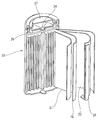
도 1 은, 본 발명의 적층 다공 필름을 수용하고 있는 전지의 개략적 단면도이다.
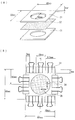
도 2 는, SD 특성, 내열성, 광각 X 선 회절 측정에 있어서의 적층 다공 필름의 고정 방법을 설명하는 도면이다.
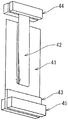
도 3 은, 박리 강도의 측정 방법을 설명하는 도면이다.BRIEF DESCRIPTION OF THE DRAWINGS It is schematic sectional drawing of the battery which accommodates the laminated porous film of this invention.
It is a figure explaining the fixing method of the laminated porous film in SD characteristic, heat resistance, and wide-angle X-ray diffraction measurement.
It is a figure explaining the measuring method of peeling strength.
이하, 본 발명의 적층 다공 필름의 실시형태에 대하여 상세하게 설명한다.EMBODIMENT OF THE INVENTION Hereinafter, embodiment of the laminated porous film of this invention is described in detail.
또한, 본 발명에 있어서 「주성분」이라고 표현한 경우에는, 특별히 기재하지 않는 한, 당해 주성분의 기능을 방해하지 않는 범위에서 다른 성분을 함유하는 것을 허용한다는 의미를 포함하며, 특히 당해 주성분의 함유 비율을 특정하는 것은 아니지만, 주성분은 조성물 중의 50 질량% 이상, 바람직하게는 70 질량% 이상, 특히 바람직하게는 90 질량% 이상 (100 % 포함함) 을 차지한다는 의미를 포함하는 것이다.In addition, when expressed as "main component" in this invention, unless otherwise indicated, it contains the meaning that it is allowed to contain another component in the range which does not prevent the function of the said main component, Especially the content rate of the said main component is included. Although not specifying, the main component includes the meaning of 50% by mass or more, preferably 70% by mass or more, particularly preferably 90% by mass or more (including 100%) in the composition.
또, 「X ∼ Y」(X, Y 는 임의의 숫자) 라고 기재한 경우, 특별히 언급하지 않는 한 「X 이상 Y 이하」의 의미와 함께, 「바람직하게는 X 보다 크다」 및 「바람직하게는 Y 보다 작다」의 의미를 포함하는 것이다.In addition, when describing as "X-Y" (X and Y are arbitrary numbers), unless otherwise indicated, with the meaning of "X or more and Y or less", it is "preferably larger than X" and "preferably Less than Y ”.
이하에, 본 발명의 적층 다공 필름을 구성하는 각 성분에 대하여 설명한다.Below, each component which comprises the laminated porous film of this invention is demonstrated.
(기재층 (Ⅰ 층) 이 되는 폴리올레핀계 수지 다공 필름) (Polyolefin resin porous film to be substrate layer (I layer))
폴리올레핀계 수지 다공 필름에서 사용하는 폴리올레핀계 수지로서, 에틸렌, 프로필렌, 1-부텐, 4-메틸-1-펜텐, 1-헥산 등을 중합한 단독 중합체 또는 공중합체를 들 수 있다. 이 중에서도, 폴리프로필렌계 수지, 폴리에틸렌계 수지가 바람직하다.As the polyolefin resin used in the polyolefin resin porous film, a homopolymer or a copolymer obtained by polymerizing ethylene, propylene, 1-butene, 4-methyl-1-pentene, 1-hexene or the like can be given. Among these, polypropylene resin and polyethylene resin are preferable.
(폴리프로필렌계 수지) (Polypropylene Resin)
폴리프로필렌계 수지로는, 호모프로필렌 (프로필렌 단독 중합체), 또는 프로필렌과 에틸렌, 1-부텐, 1-펜텐, 1-헥센, 1-헵텐, 1-옥텐, 1-노넨 혹은 1-데센 등 α-올레핀의 랜덤 공중합체 또는 블록 공중합체 등을 들 수 있다. 이 중에서도, 적층 다공 필름의 기계적 강도, 내열성 등을 유지하는 관점에서, 호모폴리프로필렌이 보다 바람직하게 사용된다.Examples of the polypropylene resin include homopropylene (propylene homopolymer), or α- such as propylene and ethylene, 1-butene, 1-pentene, 1-hexene, 1-heptene, 1-octene, 1-nonene or 1-decene And random copolymers or block copolymers of olefins. Of these, homopolypropylene is more preferably used from the viewpoint of maintaining the mechanical strength, heat resistance and the like of the laminated porous film.
또, 폴리프로필렌계 수지로는, 입체 규칙성을 나타내는 아이소택틱 펜타드 분율 (mmmm 분율) 이 80 ∼ 99 % 인 것이 바람직하다. 보다 바람직하게는 83 ∼ 98 %, 더욱 바람직하게는 85 ∼ 97 % 인 것을 사용한다. 아이소택틱 펜타드 분율이 지나치게 낮으면 필름의 기계적 강도가 저하될 우려가 있다. 한편, 아이소택틱 펜타드 분율의 상한에 대해서는 현시점에 있어서 공업적으로 얻어지는 상한치로 규정하고 있지만, 장래적으로 공업 레벨로 더욱 규칙성이 높은 수지가 개발되었을 경우에 대해서는 이에 한정되지 않는다.Moreover, as polypropylene resin, it is preferable that the isotactic pentad fraction (mmmm fraction) which shows stereoregularity is 80 to 99%. , More preferably 83 to 98%, and further preferably 85 to 97%. When the isotactic pentad fraction is too low, the mechanical strength of the film may be lowered. In addition, although the upper limit of the isotactic pentad fraction is prescribed | regulated as the upper limit obtained industrially at this time, it is not limited to the case where resin with higher regularity is developed in the industrial level in the future.
아이소택틱 펜타드 분율 (mmmm 분율) 이란, 임의의 연속하는 5 개의 프로필렌 단위로 구성되는 탄소-탄소 결합에 의한 주사슬에 대하여 측사슬인 5 개의 메틸기가 모두 동(同)방향으로 위치하는 입체 구조 혹은 그 비율을 의미한다. 메틸기 영역의 시그널의 귀속은, A. Zambelli et al (Macromolecules8, 687, (1975)) 에 준거하였다.An isotactic pentad fraction (mmmm fraction) is a three-dimensional structure in which all five methyl groups in the side chain are located in the same direction with respect to the main chain by a carbon-carbon bond composed of five consecutive propylene units. Structure or a proportion thereof. The attribution of the signal of the methyl group region was based on A. Zambelli et al (Macromolecules 8, 687, (1975)).
또, 폴리프로필렌계 수지로는, 분자량 분포를 나타내는 파라미터인 Mw/Mn 이 2.0 ∼ 10.0 인 것이 바람직하다. 보다 바람직하게는 2.0 ∼ 8.0, 더욱 바람직하게는 2.0 ∼ 6.0 인 것이 사용된다. Mw/Mn 이 작을수록 분자량 분포가 좁은 것을 의미하는데, Mw/Mn 이 2.0 미만이면 압출 성형성이 저하되는 등의 문제가 생기는 것 외에, 공업적으로 생산하는 것도 곤란하다. 한편, Mw/Mn 이 10.0 을 초과하는 경우에는 저분자량 성분이 많아지고, 적층 다공 필름의 기계적 강도가 저하되기 쉽다. Mw/Mn 은 GPC (겔 퍼미에이션 크로마토그래피) 법에 의해 얻어진다.Moreover, as polypropylene resin, it is preferable that Mw / Mn which is a parameter which shows molecular weight distribution is 2.0-10.0. More preferably 2.0 to 8.0, and still more preferably 2.0 to 6.0. The smaller the Mw / Mn, the narrower the molecular weight distribution. If the Mw / Mn is less than 2.0, problems such as lowering of extrudability may occur, and it is also difficult to produce industrially. On the other hand, when Mw / Mn exceeds 10.0, a low molecular weight component will increase and the mechanical strength of a laminated porous film will fall easily. Mw / Mn is obtained by GPC (gel permeation chromatography) method.
또, 폴리프로필렌계 수지의 멜트 플로우 레이트 (MFR) 는 특별히 제한되는 것은 아니지만, 통상, MFR 은 0.5 ∼ 15 g/10 분인 것이 바람직하고, 1.0 ∼ 10 g/10 분인 것이 보다 바람직하다. MFR 이 0.5 g/10 분 이상으로 함으로써, 성형 가공시의 수지의 용융 점도가 높고, 충분한 생산성을 확보할 수 있다. 한편, 15 g/10 분 이하로 함으로써, 얻어지는 적층 다공 필름의 기계적 강도를 충분히 유지할 수 있다. MFR 은 JIS K 7210 에 따라, 온도 230 ℃, 하중 2.16 ㎏ 의 조건에서 측정한다.Moreover, melt flow rate (MFR) of polypropylene resin is not specifically limited, Usually, it is preferable that MFR is 0.5-15 g / 10min, and it is more preferable that it is 1.0-10 g / 10min. When the MFR is 0.5 g / 10 min or more, the melt viscosity of the resin at the time of forming processing is high, and sufficient productivity can be ensured. On the other hand, when it is 15 g / 10 min or less, the mechanical strength of the resulting laminated porous film can be sufficiently maintained. The MFR is measured according to JIS K 7210 at a temperature of 230 캜 and a load of 2.16 kg.
또한, 상기 폴리프로필렌계 수지의 제조 방법은 특별히 한정되는 것은 아니고, 공지된 중합용 촉매를 사용한 공지된 중합 방법, 예를 들어 치글러·나타형 촉매로 대표되는 멀티 사이트 촉매나 메탈로센계 촉매로 대표되는 싱글 사이트 촉매를 사용한 중합 방법 등을 들 수 있다.The method for producing the polypropylene resin is not particularly limited, and a known polymerization method using a known polymerization catalyst, for example, a multi-site catalyst typified by a chitler / natta catalyst, or a metallocene catalyst And a typical polymerization method using a single site catalyst.
폴리프로필렌계 수지로는, 예를 들어 상품명 「노바텍 PP」 「WINTEC」(닛폰 폴리프로사 제조), 「노티오」 「타후마 XR」(미츠이 화학사 제조), 「제라스」 「사모란」(미츠비시 화학사 제조), 「스미토모 노브렌」 「타후세렌」(스미토모 화학사 제조), 「프라임 TPO」(프라임 폴리머사 제조), 「Adflex」, 「Adsyl」, 「HMS-PP(PF814)」(산아로마사 제조), 「바시파이」 「인스파이아」(다우 케미컬사 제조) 등 시판되고 있는 상품을 사용할 수 있다.As polypropylene resin, for example, brand name "Novatec PP" "WINTEC" (made by Nippon Polypro), "Nothio" "Tafuma XR" (made by Mitsui Chemicals Corporation), "Zeras" "Samoran" (Mitsubishi Chemical Corporation), "Sumitomo Noble" "Tafuseren" (manufactured by Sumitomo Chemical Corporation), "Prime TPO" (prime polymer company), "Adflex", "Adsyl", "HMS-PP (PF814)" (born child Commercially available products, such as Roman company), "Basipai", "Inspire" (made by Dow Chemical), can be used.
본 발명의 적층 다공 필름은, β 정 활성을 갖는 것이 바람직하다.It is preferable that the laminated porous film of this invention has (beta) positive activity.
β 정 활성은, 연신 전의 막상물에 있어서 폴리프로필렌계 수지가 β 정을 생성하고 있었던 것을 나타내는 하나의 지표로 파악할 수 있다. 연신 전의 막상물 중의 폴리프로필렌계 수지가 β 정을 생성하고 있으면, 필러 등의 첨가제를 사용하지 않는 경우에 있어서도, 연신을 실시함으로써 미세 구멍이 용이하게 형성되기 때문에, 투기 특성을 갖는 적층 다공 필름을 얻을 수 있다.(beta) tablet activity can be grasped | ascertained as one index which shows that the polypropylene resin produced the β tablet in the film | membrane before extending | stretching. If the polypropylene-based resin in the film prior to stretching produces β-crystals, even when an additive such as a filler is not used, fine pores are easily formed by stretching, so that a laminated porous film having air permeation characteristics is obtained. You can get it.
본 발명의 적층 다공 필름에 있어서, 「β 정 활성」의 유무는, 후술하는 시차 주사형 열량계에 의해 β 정에서 유래하는 결정 융해 피크 온도가 검출된 경우이거나, 및/또는 후술하는 X 선 회절 장치를 사용한 측정에 의해, β 정에서 유래하는 회절 피크가 검출된 경우, 「β 정 활성」을 갖는 것으로 판단한다.In the laminated porous film of the present invention, the presence or absence of the "? -Imetric activity " is determined when a crystal melting peak temperature derived from? -Cell is detected by a differential scanning calorimeter to be described later, and / , &Quot; beta positive activity " is determined when a diffraction peak originating from beta positive is detected by measurement using the above-mentioned "
구체적으로는, 시차 주사형 열량계로 적층 다공 필름을 25 ℃ 로부터 240 ℃ 까지 가열 속도 10 ℃/분으로 승온 후 1 분간 유지하고, 다음으로 240 ℃ 로부터 25 ℃ 까지 냉각 속도 10 ℃/분으로 강온 후 1 분간 유지하고, 또한 25 ℃ 로부터 240 ℃ 까지 가열 속도 10 ℃/분으로 재승온시켰을 때에, 폴리프로필렌계 수지의 β 정에서 유래하는 결정 융해 피크 온도 (Tmβ) 가 검출된 경우, β 정 활성을 갖는 것으로 판단하고 있다.Specifically, the laminated porous film was heated at a heating rate of 10 ° C./min from 25 ° C. to 240 ° C. with a differential scanning calorimeter for 1 minute, and then lowered at a cooling rate of 10 ° C./min from 240 ° C. to 25 ° C. When the crystal melting peak temperature (Tmβ) derived from the β crystals of the polypropylene resin was detected when the temperature was maintained for 1 minute and re-heated from 25 ° C to 240 ° C at a heating rate of 10 ° C / min, the β-crystal activity was decreased. It is judged to have.
또, 상기 적층 다공 필름의 β 정 활성도는, 검출되는 폴리프로필렌계 수지의 α 정 유래의 결정 융해 열량 (ΔHmα) 과 β 정 유래의 결정 융해 열량 (ΔHmβ) 을 이용하여 하기 식으로 계산하고 있다.In addition, the β crystal activity of the laminated porous film is calculated by the following formula using the amount of crystal melting heat (ΔHmα) derived from the α tablet and the amount of crystal melting heat (ΔHmβ) derived from the β tablet of the polypropylene resin to be detected.
β 정 활성도 (%) = [ΔHmβ/(ΔHmβ+ΔHmα)]×100β positive activity (%) = [ΔHmβ / (ΔHmβ + ΔHmα)] × 100
예를 들어, 폴리프로필렌계 수지가 호모폴리프로필렌인 경우에는, 주로 145 ℃ 이상 160 ℃ 미만의 범위에서 검출되는 β 정 유래의 결정 융해 열량 (ΔHmβ) 과, 주로 160 ℃ 이상 170 ℃ 이하에서 검출되는 α 정 유래의 결정 융해 열량 (ΔHmα) 으로부터 계산할 수 있다. 또, 예를 들어 에틸렌이 1 ∼ 4 몰% 공중합되어 있는 랜덤 폴리프로필렌인 경우에는, 주로 120 ℃ 이상 140 ℃ 미만의 범위에서 검출되는 β 정 유래의 결정 융해 열량 (ΔHmβ) 과, 주로 140 ℃ 이상 165 ℃ 이하의 범위에 검출되는 α 정 유래의 결정 융해 열량 (ΔHmα) 으로부터 계산할 수 있다.For example, when the polypropylene resin is homopolypropylene, the crystal melting heat amount (DELTA Hm beta) originating from the beta -form detected mainly in a range of 145 DEG C or more and less than 160 DEG C, can be calculated from the crystal melting heat amount (? Hm?) derived from the? -cell. For example, in the case of random polypropylene copolymerized with 1 to 4 mol% of ethylene, the amount of crystal melting heat (ΔHmβ) derived from β tablets mainly detected in the range of 120 ° C. or more and less than 140 ° C., and mainly 140 ° C. or more It can calculate from the crystal melting heat ((DELTA) Hm (alpha)) derived from the (alpha) tablet detected in the range below 165 degreeC.
상기 적층 다공 필름의 β 정 활성도는 큰 편이 바람직하고, β 정 활성도는 20 % 이상인 것이 바람직하다. 40 % 이상인 것이 더욱 바람직하고, 60 % 이상인 것이 특히 바람직하다. 적층 다공 필름이 20 % 이상의 β 정 활성도를 가지면, 연신 전의 막상물 중에 있어서도 폴리프로필렌계 수지의 β 정이 많이 생성될 수 있음을 나타내고, 연신에 의해 미세 또한 균일한 구멍이 많이 형성되어, 결과적으로 기계적 강도가 높고, 투기 성능이 우수한 비수 전해액 이차 전지용 세퍼레이터로 할 수 있다. β 정 활성도의 상한치는 특별히 한정되지 않지만, β 정 활성도가 높을수록 상기 효과가 보다 유효하게 얻어지기 때문에 100 % 에 가까울수록 바람직하다.It is preferable that the β crystal activity of the laminated porous film is larger, and the β crystal activity is preferably 20% or more. It is more preferable that it is 40% or more, and it is especially preferable that it is 60% or more. When the laminated porous film has a β crystal activity of 20% or more, it indicates that a large amount of β crystals of polypropylene resin can be formed even in the film prior to stretching, and a lot of fine and uniform pores are formed by stretching, resulting in mechanical It can be set as the separator for nonaqueous electrolyte secondary batteries which is high in strength and excellent in air permeability. The upper limit value of the? -cell activity is not particularly limited, but the higher the? -cell activity, the more effectively the effect is obtained.
또한 상기 β 정 활성의 유무는, 특정 열처리를 실시한 적층 다공 필름의 광각 X 선 회절 측정에 의해 얻어지는 회절 프로파일로도 판단할 수 있다.The presence or absence of the above-mentioned? -Activity can also be determined by the diffraction profile obtained by the wide-angle X-ray diffraction measurement of the laminated porous film subjected to the specific heat treatment.
상세하게는, 폴리프로필렌계 수지의 융점을 초과하는 온도인 170 ℃ ∼ 190 ℃ 의 열처리를 실시하고, 서랭시켜 β 정을 생성·성장시킨 적층 다공 필름에 대하여 광각 X 선 측정을 실시하고, 폴리프로필렌계 수지의 β 정의 (300) 면에서 유래하는 회절 피크가 2θ = 16.0°∼ 16.5°의 범위에 검출된 경우, β 정 활성이 있는 것으로 판단하고 있다.Specifically, a wide-angle X-ray measurement is performed on the laminated porous film subjected to heat treatment at 170 ° C to 190 ° C, which is a temperature exceeding the melting point of the polypropylene resin, to be cooled and cooled to form and grow β tablets. When the diffraction peak derived from the (beta) definition (300) surface of system resin is detected in the range of 2 (theta) = 16.0 degrees-16.5 degrees, it is judged that there exists (beta) positive activity.
폴리프로필렌계 수지의 β 정 구조와 광각 X 선 회절에 관한 상세한 것은, Macromol. Chem. 187, 643-652 (1986), Prog. Polym. Sci. Vol.16, 361-404 (1991), Macromol. Symp. 89, 499-511 (1995), Macromol. Chem. 75, 134 (1964), 및 이들 문헌 중에 거론된 참고 문헌을 참조할 수 있다. 광각 X 선 회절을 사용한 β 정 활성의 상세한 평가 방법에 대해서는, 후술하는 실시예에서 나타낸다.For details on the β crystal structure and wide-angle X-ray diffraction of the polypropylene resin, see Macromol. Chem. 187, 643-652 (1986), Prog. Polym. Sci. Vol. 16, 361-404 (1991), Macromol. Symp. 89, 499-511 (1995), Macromol. Chem. 75, 134 (1964), and references cited therein. The detailed evaluation method of (beta) positive activity using wide-angle X-ray diffraction is shown in the Example mentioned later.
상기 β 정 활성은, 본 발명의 적층 다공 필름이 적층 다공 필름 전체층인 상태에서 측정할 수 있다.The said β positive activity can be measured in the state in which the laminated porous film of this invention is a whole laminated porous film layer.
또, 만일 폴리프로필렌계 수지로 이루어지는 층 이외에 폴리프로필렌계 수지를 함유하는 층 등을 적층시키는 경우에는, 양층 모두 β 정 활성을 갖는 것이 바람직하다.In addition, if lamination | stacking the layer containing polypropylene resin etc. other than the layer which consists of polypropylene resin, it is preferable that both layers have (beta) positive activity.
전술한 β 정 활성을 얻는 방법으로는, 일본 특허공보 3739481호에 기재되어 있는 바와 같이 과산화라디칼을 발생시키는 처리를 실시한 폴리프로필렌을 첨가하는 방법, 및 조성물에 β 정 핵제를 첨가하는 방법 등을 들 수 있다.As a method of obtaining the above-mentioned β crystal activity, a method of adding polypropylene subjected to a treatment for generating radical peroxide as described in Japanese Patent Publication No. 3739481, a method of adding a β-crystal nucleating agent to the composition, and the like can be given. Can be.
(β 정 핵제) (β tablet nucleating agent)
본 발명에서 사용하는 β 정 핵제로는 이하에 나타내는 것을 들 수 있지만, 폴리프로필렌계 수지의 β 정의 생성·성장을 증가시키는 것이면 특별히 한정되는 것은 아니고, 또한 2 종류 이상을 혼합하여 사용해도 된다.Although what is shown below is mentioned as (beta) crystal nucleating agent used by this invention, if it increases the (beta) definition production and growth of a polypropylene resin, it will not specifically limit, You may mix and use two or more types.
β 정 핵제로는, 예를 들어 아미드 화합물 ; 테트라옥사스피로 화합물 ; 퀴나크리돈류 ; 나노 스케일의 사이즈를 갖는 산화철 ; 1,2-하이드록시스테아르산칼륨, 벤조산마그네슘 혹은 숙신산마그네슘, 프탈산마그네슘 등으로 대표되는 카르복실산의 알칼리 혹은 알칼리 토금속 염 ; 벤젠술폰산나트륨 혹은 나프탈렌술폰산나트륨 등으로 대표되는 방향족 술폰산 화합물 ; 2 혹은 3 염기 카르복실산의 디 혹은 트리 에스테르류 ; 프탈로시아닌 블루 등으로 대표되는 프탈로시아닌계 안료 ; 유기 2 염기산인 성분 A 와 주기율표 제 IIA 족 금속의 산화물, 수산화물 혹은 염인 성분 B 로 이루어지는 2 성분계 화합물 ; 고리형 인 화합물과 마그네슘 화합물로 이루어지는 조성물 등을 들 수 있다. 그 밖에 핵제의 구체적인 종류에 대해서는, 일본 공개특허공보 2003-306585호, 일본 공개특허공보 평06-289566호, 일본 공개특허공보 평09-194650호에 기재되어 있다.As a β-nucleating agent, it is an amide compound, for example; Tetraoxaspiro compounds; Quinacridone; Iron oxide having a nanoscale size; Alkali or alkaline earth metal salts of carboxylic acids represented by 1,2-hydroxystearate potassium, magnesium benzoate or magnesium succinate and magnesium phthalate; Aromatic sulfonic acid compounds represented by sodium benzenesulfonate or sodium naphthalenesulfonate; Di or triesters of 2 or 3 base carboxylic acid; Phthalocyanine type pigment represented by phthalocyanine blue etc .; A bicomponent compound consisting of a component A which is an organic dibasic acid and a component B which is an oxide, hydroxide or salt of a Group IIA metal of the periodic table; And a composition comprising a cyclic phosphorus compound and a magnesium compound. In addition, the specific kind of nuclear agent is described in Unexamined-Japanese-Patent No. 2003-306585, Unexamined-Japanese-Patent No. 06-289566, and Unexamined-Japanese-Patent No. 09-194650.
β 정 핵제의 시판품으로는 신닛폰 이화사 제조 β 정 핵제 「에누제스타 NU-100」, β 정 핵제가 첨가된 폴리프로필렌계 수지의 구체예로는, Aristech 사 제조 폴리프로필렌 「Bepol B-022SP」, Borealis 사 제조 폴리프로필렌 「Beta(β)-PP BE60-7032」, Mayzo 사 제조 폴리프로필렌 「BNX BETAPP-LN」등을 들 수 있다.As a commercial example of the β tablet nucleating agent, manufactured by Shin-Nippon Co., Ltd. β tablet nucleating agent "Enuzestar NU-100", and as a specific example of the polypropylene resin to which the β tablet nucleating agent was added, the polypropylene "Bepol B-022SP made by Aristech company" , Polypropylene "Beta (β) -PP BE60-7032" manufactured by Borealis Corporation, polypropylene "BNX BETAPP-LN" manufactured by Mayzo, and the like.
상기 폴리프로필렌계 수지에 첨가하는 β 정 핵제의 비율은, β 정 핵제의 종류 또는 폴리프로필렌계 수지의 조성 등에 따라 적절히 조정하는 것이 필요하지만, 폴리프로필렌계 수지 100 질량부에 대하여 β 정 핵제는 0.0001 ∼ 5.0 질량부인 것이 바람직하다. 0.001 ∼ 3.0 질량부가 보다 바람직하고, 0.01 ∼ 1.0 질량부가 더욱 바람직하다. 0.0001 질량부 이상이면, 제조시에 있어서 충분히 폴리프로필렌계 수지의 β 정을 생성·성장시킬 수 있고, 세퍼레이터로서 사용할 때에도 충분한 β 정 활성을 확보할 수 있고, 원하는 투기 성능이 얻어진다. 또, 5.0 질량부 이하의 첨가이면, 경제적으로도 유리해지는 것 외에, 적층 다공 필름 표면에 대한 β 정 핵제의 블리드 등이 없어 바람직하다.Although the ratio of the β crystal nucleating agent added to the said polypropylene resin needs to be adjusted suitably according to the kind of β crystal nucleating agent, the composition of polypropylene resin, etc., the β crystal nucleating agent is 0.0001 with respect to 100 mass parts of polypropylene resins. It is preferable that it is-5.0 mass parts. 0.001-3.0 mass parts is more preferable, and 0.01-1.0 mass part is more preferable. When it is 0.0001 mass part or more, (beta) tablet of polypropylene resin can fully be produced and grown at the time of manufacture, sufficient [beta] tablet activity can be ensured also when using as a separator, and desired speculative performance is obtained. Moreover, if it is 5.0 mass parts or less addition, it becomes economically advantageous and there is no bleeding of (beta) positive nucleating agent with respect to the laminated porous film surface, and it is preferable.
또, 만일 폴리프로필렌계 수지로 이루어지는 층 이외에, 폴리프로필렌계 수지를 함유하는 층 등을 적층시키는 경우에는, 각 층의 β 정 핵제의 첨가량은 동일해도 되고 상이해도 된다. β 정 핵제의 첨가량을 변경함으로써 각 층의 다공 구조를 적절히 조정할 수 있다.When a layer containing a polypropylene resin or the like other than a layer made of a polypropylene resin is laminated, the amount of the beta nucleating agent added to each layer may be the same or different. The pore structure of each layer can be adjusted suitably by changing the addition amount of (beta) refinement agent.
(다른 성분) (Other ingredients)
본 발명에 있어서는, 전술한 성분 외에, 본 발명의 효과를 현저하게 저해하지 않는 범위 내에서, 일반적으로 수지 조성물에 배합되는 첨가제를 적절히 첨가할 수 있다. 상기 첨가제로는, 성형 가공성, 생산성 및 폴리올레핀계 수지 다공 필름 (Ⅰ 층) 의 여러 물성을 개량·조정할 목적으로 첨가되는, 가장자리 등의 트리밍 로스 등으로부터 발생하는 리사이클 수지나 실리카, 탤크, 카올린, 탄산칼슘 등의 무기 입자, 산화티탄, 카본 블랙 등의 안료, 난연제, 내후성 안정제, 내열 안정제, 대전 방지제, 용융 점도 개량제, 가교제, 활제, 핵제, 가소제, 노화 방지제, 산화 방지제, 광 안정제, 자외선 흡수제, 중화제, 방담제 (防曇劑), 안티 블로킹제, 슬립제 또는 착색제 등의 첨가제를 들 수 있다.In the present invention, in addition to the components described above, generally, additives blended into the resin composition can be appropriately added within a range that does not significantly inhibit the effects of the present invention. Examples of the additive include recycled resin, silica, talc, kaolin, and carbonic acid generated from trimming losses such as edges, which are added for the purpose of improving and adjusting molding processability, productivity, and various physical properties of the polyolefin resin porous film (I layer). Inorganic particles such as calcium, pigments such as titanium oxide and carbon black, flame retardants, weathering stabilizers, heat stabilizers, antistatic agents, melt viscosity modifiers, crosslinking agents, lubricants, nucleating agents, plasticizers, antioxidants, antioxidants, light stabilizers, ultraviolet absorbers, Additives, such as a neutralizing agent, an antifogging agent, an anti blocking agent, a slip agent, or a coloring agent, are mentioned.
(폴리에틸렌계 수지) (Polyethylene resin)
폴리에틸렌계 수지로는, 구체적으로 초저밀도 폴리에틸렌, 저밀도 폴리에틸렌, 고밀도 폴리에틸렌, 선상 저밀도 폴리에틸렌, 또한 분자량에 특징이 있는 초고분자량 폴리에틸렌과 같은 호모폴리머 폴리에틸렌뿐만 아니라, 에틸렌프로필렌 공중합체, 또는 폴리에틸렌계 수지와 다른 폴리올레핀계 수지의 코폴리머 폴리에틸렌을 들 수 있다. 그 중에서도, 호모폴리머 폴리에틸렌, 혹은 α-올레핀 코모노머 함량이 2 몰% 이하인 코폴리머 폴리에틸렌이 바람직하고, 호모폴리머 폴리에틸렌인 것이 더욱 바람직하다. α-올레핀 코모노머의 종류에 대해서는 특별히 제한은 없다.As the polyethylene-based resin, specifically, not only homopolymer polyethylene such as ultra low density polyethylene, low density polyethylene, high density polyethylene, linear low density polyethylene, and ultra high molecular weight polyethylene characterized by molecular weight, but also different from ethylene propylene copolymer or polyethylene resin The copolymer polyethylene of polyolefin resin is mentioned. Especially, homopolymer polyethylene or the copolymer polyethylene whose alpha-olefin comonomer content is 2 mol% or less is preferable, and it is more preferable that it is homopolymer polyethylene. There is no restriction | limiting in particular about the kind of alpha-olefin comonomer.
상기 폴리에틸렌계 수지의 밀도는, 0.910 ∼ 0.970 g/㎤ 인 것이 바람직하고, 0.930 ∼ 0.970 g/㎤ 인 것이 보다 바람직하고, 0.940 ∼ 0.970 g/㎤ 인 것이 더욱 바람직하다. 밀도가 0.910 g/㎤ 이상이면 적당한 SD 특성을 가질 수 있기 때문에 바람직하다. 한편, 0.970 g/㎤ 이하이면 적당한 SD 특성을 가질 수 있는 것 외에, 연신성이 유지되는 점에서 바람직하다.It is preferable that the density of the said polyethylene-type resin is 0.910-0.970 g / cm <3>, It is more preferable that it is 0.930-0.970 g / cm <3>, It is still more preferable that it is 0.940-0.970 g / cm <3>. The density is preferably 0.910 g / cm 3 or more because it can have appropriate SD characteristics. On the other hand, when it is 0.970 g / cm <3> or less, it is preferable at the point which can have a moderate SD characteristic and maintains elongation.
밀도의 측정은 밀도 구배관법을 이용하여 JIS K 7112 에 준하여 측정할 수 있다.The measurement of density can be measured according to JISK7112 using the density gradient pipe method.
또, 상기 폴리에틸렌계 수지의 멜트 플로우 레이트 (MFR) 는 특별히 제한되는 것은 아니지만, 통상 MFR 는 0.03 ∼ 30 g/10 분인 것이 바람직하고, 0.3 ∼ 10 g/10 분인 것이 보다 바람직하다. MFR 이 0.03 g/10 분 이상이면 성형 가공시의 수지의 용융 점도가 충분히 낮기 때문에 생산성이 우수하여 바람직하다. 한편, 30 g/10 분 이하이면, 충분한 기계적 강도를 얻을 수 있기 때문에 바람직하다.Moreover, although melt flow rate (MFR) of the said polyethylene-type resin is not specifically limited, Usually, it is preferable that MFR is 0.03-30 g / 10min, and it is more preferable that it is 0.3-10 g / 10min. If MFR is 0.03 g / 10min or more, since melt viscosity of resin at the time of shaping | molding process is low enough, it is preferable because it is excellent in productivity. On the other hand, if it is 30 g / 10 min or less, sufficient mechanical strength can be obtained.
MFR 은 JIS K 7210 에 따라, 온도 190 ℃, 하중 2.16 ㎏ 의 조건에서 측정하고 있다.MFR is measured on the conditions of 190 degreeC of temperature, and 2.16 kg of loads according to JISK7110.
폴리에틸렌계 수지의 중합 촉매에는 특별히 제한은 없고, 치글러형 촉매, 필립스형 촉매, 카민스키형 촉매 등 어느 것이어도 된다. 폴리에틸렌계 수지의 중합 방법으로서, 1 단 중합, 2 단 중합, 혹은 그 이상의 다단 중합 등이 있으며, 어느 방법의 폴리에틸렌계 수지도 사용 가능하다.There is no restriction | limiting in particular in the polymerization catalyst of polyethylene-type resin, Any of a Ziegler-type catalyst, a Philips type catalyst, and a Kaminsky type catalyst may be sufficient. As a polymerization method of polyethylene-type resin, there exist single stage superposition | polymerization, two stage superposition | polymerization, or more multistage superposition | polymerization, etc., The polyethylene resin of any method can also be used.
(다공화 촉진 화합물) (Porosity promoting compound)
폴리에틸렌계 수지에, 다공화를 촉진시키는 다공화 촉진 화합물 X 를 첨가하는 것이 바람직하다. 상기 다공화 촉진 화합물 X 를 첨가함으로써, 보다 효율적으로 다공 구조를 얻을 수 있고, 구멍의 형상이나 구멍 직경을 제어하기 쉬워진다.It is preferable to add the porosity promoting compound X which promotes porosity to polyethylene-type resin. By adding the said porosity promoting compound X, a porous structure can be obtained more efficiently, and it becomes easy to control the shape and hole diameter of a hole.
상기 다공화 촉진 화합물 X 는 한정하지 않지만, 구체적으로 예시하면, 변성 폴리올레핀 수지, 지환족 포화 탄화수소 수지 혹은 그 변성체, 에틸렌계 공중합체, 또는 왁스로부터 선택되는 다공화 촉진 화합물 X 중 적어도 1 종이 함유되어 있는 것이 보다 바람직하다. 그 중에서도, 다공화에서 보다 효과가 큰 지환족 포화 탄화수소 수지 혹은 그 변성체, 에틸렌계 공중합체, 또는 왁스가 보다 바람직하고, 성형성의 관점에서 왁스가 더욱 바람직하다.Although the said porosity promoting compound X is not limited, Specifically, it contains at least 1 sort (s) of the porosity promoting compound X selected from a modified polyolefin resin, an alicyclic saturated hydrocarbon resin or its modified body, an ethylene-type copolymer, or a wax. It is more preferable. Especially, alicyclic saturated hydrocarbon resin or its modified body, ethylene-type copolymer, or wax which are more effective in porosization are more preferable, and wax is more preferable from a moldability viewpoint.
지환족 포화 탄화수소 수지 및 그 변성체에 대하여, 석유 수지, 로진 수지, 테르펜 수지, 쿠마론 수지, 인덴 수지, 쿠마론-인덴 수지, 및 그들의 변성체 등을 들 수 있다.About an alicyclic saturated hydrocarbon resin and its modified body, petroleum resin, rosin resin, terpene resin, coumarone resin, indene resin, coumarone-indene resin, those modified bodies, etc. are mentioned.
본 발명에 있어서의 석유 수지란, 나프타의 열분해 등에 의한 부생물로부터 얻어지는 C4 ∼ C10 의 지방족 올레핀류나 디올레핀류, 올레핀성 불포화 결합을 갖는 C8 이상의 방향족 화합물로, 그것들 중에 함유되는 화합물의 1 종 또는 2 종 이상을 단독 혹은 공중합함으로써 얻어지는 지방족계, 방향족계 및 공중합계 석유 수지를 말한다.The petroleum resin in the present invention is a C4 or C10 aliphatic olefins or diolefins obtained from by-products obtained by thermal decomposition of naphtha or the like, a C8 or more aromatic compound having an olefinically unsaturated bond, and one or more of the compounds contained therein. The aliphatic, aromatic and copolymerized petroleum resins obtained by singly or copolymerizing two or more kinds.
석유 수지로는, 예를 들어 C5 유분 (留分) 을 주원료로 하는 지방족계 석유 수지, C9 유분을 주원료로 하는 방향족계 석유 수지, 그들의 공중합계 석유 수지, 지환족계 석유 수지가 있다. 테르펜 수지로는 β-피넨으로부터의 테르펜 수지나 테르펜-페놀 수지가, 또한 로진계 수지로는, 검 로진, 우드 로진 등의 로진 수지, 글리세린이나 펜타에리트리톨로 변성한 에스테르화 로진 수지 등을 예시할 수 있다. 지환족 포화 탄화수소 수지 및 그 변성체는 폴리에틸렌계 수지에 혼합한 경우에 비교적 양호한 상용성을 나타내지만, 색조나 열안정성과 같은 면에서 석유 수지가 보다 바람직하고, 수첨 석유 수지를 사용하는 것이 더욱 바람직하다.Examples of the petroleum resin include aliphatic petroleum resins mainly containing C5 fractions, aromatic petroleum resins mainly containing C9 fractions, copolymerized petroleum resins and alicyclic petroleum resins. Examples of terpene resins include terpene resins and terpene-phenol resins from β-pinene, and rosin resins include rosin resins such as gum rosin and wood rosin, and esterified rosin resins modified with glycerin or pentaerythritol. can do. Although the alicyclic saturated hydrocarbon resin and its modified body show relatively good compatibility when mixed with polyethylene resin, in view of color tone and thermal stability, petroleum resin is more preferable, and hydrogenated petroleum resin is more preferably used. Do.
수첨 석유 수지는, 석유 수지를 관용의 방법에 의해 수소화시킴으로써 얻어지는 것이다. 예를 들어, 수소화 지방족계 석유 수지, 수소화 방향족계 석유 수지, 수소화 공중합계 석유 수지 및 수소화 지환족계 석유 수지, 그리고 수소화 테르펜계 수지를 들 수 있다. 수첨 석유 수지 중에서도, 수소화 지환족계 석유 수지로, 시클로펜타디엔계 화합물과 방향족 비닐계 화합물을 공중합하여 수소 첨가한 것이 특히 바람직하다. 시판되고 있는 수첨 석유 수지로는 「알콘」(아라카와 화학 공업사 제조) 등을 들 수 있다.Hydrogenated petroleum resin is obtained by hydrogenating petroleum resin by the conventional method. Examples thereof include a hydrogenated aliphatic petroleum resin, a hydrogenated aromatic petroleum resin, a hydrogenated copolymerized petroleum resin, a hydrogenated alicyclic petroleum resin, and a hydrogenated terpene resin. Among the hydrogenated petroleum resins, hydrogenated alicyclic petroleum resins are particularly preferably those in which a cyclopentadiene compound and an aromatic vinyl compound are copolymerized and hydrogenated. Commercially available hydrogenated petroleum resins include "alcone" (manufactured by Arakawa Chemical Industry Co., Ltd.).
본 발명에 있어서의 에틸렌계 공중합체란, 에틸렌과, 아세트산비닐, 불포화 카르복실산, 불포화 카르복실산 무수물, 또는 카르복실산에스테르 등 중에서 1 종류 이상을 공중합시킴으로써 얻어지는 화합물이다.The ethylenic copolymer in the present invention is a compound obtained by copolymerizing ethylene with at least one kind in vinyl acetate, unsaturated carboxylic acid, unsaturated carboxylic anhydride, carboxylic acid ester, or the like.
에틸렌계 공중합체는, 에틸렌 단량체 단위의 함유율이 바람직하게는 50 질량% 이상, 보다 바람직하게는 60 질량% 이상, 더욱 바람직하게는 65 질량% 이상이다. 한편, 상한에 대해서는, 에틸렌 단량체 단위의 함유율이 바람직하게는 95 질량% 이하, 보다 바람직하게는 90 질량% 이하, 더욱 바람직하게는 85 질량% 이하인 것이 바람직하다. 에틸렌 단량체 단위의 함유율이 소정의 범위 내이면, 보다 효율적으로 다공 구조를 형성할 수 있다.The content of the ethylene monomer unit of the ethylene copolymer is preferably 50% by mass or more, more preferably 60% by mass or more, still more preferably 65% by mass or more. On the other hand, about an upper limit, it is preferable that the content rate of an ethylene monomeric unit becomes like this. Preferably it is 95 mass% or less, More preferably, it is 90 mass% or less, More preferably, it is 85 mass% or less. If the content rate of an ethylene monomeric unit is in the predetermined range, a porous structure can be formed more efficiently.
상기 에틸렌계 공중합체는, MFR (JIS K 7210, 온도 : 190 ℃, 하중 : 2.16 ㎏) 이 0.1 g/10 분 이상 10 g/10 분 이하인 것이 바람직하게 사용된다. MFR 이 0.1 g/10 분 이상이면 압출 가공성을 양호하게 유지할 수 있고, 한편, MFR 이 10 g/10 분 이하이면 필름의 강도 저하를 잘 일으키지 않아 바람직하다.The ethylene-based copolymer preferably has an MFR (JIS K 7210, temperature: 190 ° C, load: 2.16 kg) of 0.1 g / 10 min or more and 10 g / 10 min or less. Extrusion workability can be maintained favorable when MFR is 0.1 g / 10min or more, On the other hand, when MFR is 10 g / 10min or less, the fall of the strength of a film does not produce easily, and it is preferable.
상기 에틸렌계 공중합체는, 에틸렌-아세트산비닐 공중합체로서 「EVAFLEX」(미츠이·듀퐁 폴리케미컬사 제조), 「노바텍 EVA」(닛폰 폴리에틸렌사 제조), 에틸렌-아크릴산 공중합체로서 「NUC 코폴리머」(닛폰 유니카사 제조), 에바플렉스-EAA (미츠이·듀퐁 폴리케미컬사 제조), 「REXPEARL EAA」(닛폰 에틸렌사 제조), 에틸렌-(메트)아크릴산 공중합체로서 「ELVALOY」(미츠이·듀퐁 폴리케미컬사 제조), 「REXPEARL EMA」(닛폰 에틸렌사 제조), 에틸렌-아크릴산에틸 공중합체로서 「REXPEARL EEA」(닛폰 에틸렌사 제조), 에틸렌-메틸(메트)아크릴산 공중합체로서 「아크리후토」(스미토모 화학사 제조), 에틸렌-아세트산비닐-무수 말레산 3 원 공중합체로서 「본다인」(스미토모 화학사 제조), 에틸렌-메타크릴산글리시딜 공중합체, 에틸렌-아세트산비닐-메타크릴산글리시딜 3 원 공중합체, 에틸렌-아크릴산에틸-메타크릴산글리시딜 3 원 공중합체로서 「본드파스트」(스미토모 화학사 제조) 등을 상업적으로 입수할 수 있다.The ethylene-based copolymer is an ethylene-vinyl acetate copolymer as "EVAFLEX" (manufactured by Mitsui DuPont Polychemical), "Novatech EVA" (manufactured by Nippon Polyethylene), and an ethylene-acrylic acid copolymer as "NUC copolymer". (Made by Nippon Unicar Co., Ltd.), Evaflex-EAA (made by Mitsui Dupont Polychemical Co., Ltd.), "REXPEARL EAA" (made by Nippon Ethylene Co., Ltd.), and ethylene- (meth) acrylic acid copolymer "ELVALOY" (Mitsui DuPont Polychemical) "REXPEARL EMA" (manufactured by Nippon Ethylene Co., Ltd.), ethylene-ethyl acrylate copolymer as "REXPEARL EEA" (manufactured by Nippon Ethylene Co., Ltd.), ethylene-methyl (meth) acrylic acid copolymer (Sumitomo) Chemical company make), ethylene-vinyl acetate-maleic anhydride ternary copolymer, "bondane" (manufactured by Sumitomo Chemical Co., Ltd.), ethylene-methacrylate glycidyl copolymer, ethylene-vinyl acetate-methacrylate glycidyl As the ternary copolymer and the ethylene-ethyl acrylate-glycidyl glycidyl ternary copolymer, "bond paste" (manufactured by Sumitomo Chemical Co., Ltd.) and the like can be obtained commercially.
본 발명에 있어서의 왁스란, 이하의 (가) 및 (나) 의 성질을 만족하는 유기 화합물을 말한다.The wax in this invention means the organic compound which satisfy | fills the properties of the following (a) and (b).
(가) 융점이 40 ℃ ∼ 200 ℃ 이다.(A) Melting | fusing point is 40 degreeC-200 degreeC.
(나) 융점보다 10 ℃ 높은 온도에서의 용융 점도가 50 ㎩·s 이하이다.(B) Melt viscosity in
왁스에 대하여, 극성 또는 비극성 왁스, 폴리프로필렌 왁스, 폴리에틸렌 왁스 및 왁스 개질제를 포함한다. 구체적으로는, 극성 왁스, 비극성 왁스, 피셔-트로프슈 왁스, 산화 피셔-트로프슈 왁스, 하이드록시스테아로마이드 왁스, 기능화 왁스, 폴리프로필렌 왁스, 폴리에틸렌 왁스, 왁스 개질제, 아모르퍼스 왁스, 캐스터·오일 왁스, 마이크로크리스탈린 왁스, 밀랍, 카나우바 납, 캐스터 왁스, 식물 납, 칸델릴라 납, 일본 납, 오우리큐리 (ouricury) 왁스, 더글라스 퍼 버크·왁스, 쌀겨 왁스, 호호바 왁스, 양매 왁스, 몬탄 왁스, 오조케라이트 왁스, 세레신 왁스, 석유 납, 파라핀 왁스, 화학 변성 탄화수소 왁스, 치환 아미드 왁스, 및 이들의 조합 및 유도체를 들 수 있다. 그 중에서도 다공 구조를 효율적으로 형성할 수 있는 점에서, 파라핀 왁스, 폴리에틸렌 왁스, 마이크로크리스탈린 왁스가 바람직하고, SD 특성의 관점에서 구멍 직경을 보다 미소화할 수 있는 마이크로크리스탈린 왁스가 더욱 바람직하다. 시판되고 있는 폴리에틸렌 왁스로는 「FT-115」(닛폰 정납사 제조), 마이크로크리스탈린 왁스로는 「Hi-Mic」(닛폰 정납사 제조) 등을 들 수 있다.For the wax, polar or nonpolar waxes, polypropylene waxes, polyethylene waxes and wax modifiers are included. Specifically, polar wax, nonpolar wax, Fischer-Tropsch wax, Fischer-Tropsch wax, hydroxy stearamide wax, functionalized wax, polypropylene wax, polyethylene wax, wax modifier, amorphous wax, caster oil Wax, microcrystalline wax, beeswax, carnauba lead, castor wax, plant lead, candelilla lead, Japanese lead, ouricury wax, Douglas per Burk wax, rice bran wax, jojoba wax, plum wax, montan Wax, ozokerite wax, ceresin wax, petroleum lead, paraffin wax, chemically modified hydrocarbon wax, substituted amide wax, and combinations and derivatives thereof. Of these, paraffin wax, polyethylene wax and microcrystalline wax are preferable from the viewpoint of effectively forming a porous structure, and microcrystalline waxes capable of further reducing the pore diameter in view of SD characteristics are more preferable. Examples of commercially available polyethylene wax include "FT-115" (manufactured by Nippon Sabha Co., Ltd.), and "Hi-Mic" (manufactured by Nippon Sabion Co., Ltd.) as microcrystalline wax.
상기 다공화 촉진 화합물 X 의 배합량은, 폴리에틸렌계 수지와 상기 다공화 촉진 화합물 X 의 계면을 박리시켜 미세 구멍을 형성시키는 경우, 1 층에 포함되는 폴리에틸렌계 수지 100 질량부에 대하여, 하한으로서 1 질량부 이상이 바람직하고, 5 질량부 이상이 보다 바람직하고, 10 질량부 이상이 더욱 바람직하다. 한편, 상한으로서 50 질량부 이하가 바람직하고, 40 질량부 이하가 보다 바람직하고, 30 질량부 이하가 더욱 바람직하다. 상기 다공화 촉진 화합물 X 의 배합량이 폴리에틸렌계 수지 100 질량부에 대하여, 1 질량부 이상으로 함으로써, 목적으로 하는 양호한 다공 구조가 발현되는 효과가 충분히 얻어진다. 또, 상기 다공화 촉진 화합물 X 의 배합량이 50 질량부 이하로 함으로써, 보다 안정적인 성형성을 확보할 수 있다.The compounding quantity of the said porosity promoting compound X is 1 mass as a minimum with respect to 100 mass parts of polyethylene-type resin contained in 1 layer, when peeling the interface of a polyethylene type resin and the said porosity promoting compound X, and forming a micropore. Part or more is preferable, 5 mass parts or more are more preferable, and 10 mass parts or more are more preferable. On the other hand, as an upper limit, 50 mass parts or less are preferable, 40 mass parts or less are more preferable, and 30 mass parts or less are further more preferable. When the compounding quantity of the said porosity promoting compound X is 1 mass part or more with respect to 100 mass parts of polyethylene-type resins, the effect that the favorable porous structure made into the objective is expressed is fully acquired. Moreover, more stable moldability can be ensured by the compounding quantity of the said porosity promoting compound X being 50 mass parts or less.
필요에 따라 폴리에틸렌계 수지나 다공화 촉진 화합물 X 이외에, 다공 필름의 열 특성, 구체적으로는 다공화를 저해하지 않는 범위에서 열가소성 수지를 사용해도 된다. 전술한 폴리에틸렌계 수지와의 혼합시킬 수 있는 다른 열가소성 수지로는, 스티렌, AS 수지, 혹은 ABS 수지 등의 스티렌계 수지 : 폴리염화비닐, 불소계 수지, 폴리에틸렌테레프탈레이트, 폴리부틸렌테레프탈레이트, 폴리카보네이트 혹은 폴리아릴레이트 등의 에스테르계 수지 ; 폴리아세탈, 폴리페닐렌에테르, 폴리술폰, 폴리에테르술폰, 폴리에테르에테르케톤 혹은 폴리페닐렌술파이드 등의 에테르계 수지 ; 6 나일론, 6-6 나일론, 6-12 나일론 등의 폴리아미드계 수지 등의 열가소성 수지를 들 수 있다.If necessary, a thermoplastic resin may be used in addition to the polyethylene-based resin and the porosity-promoting compound X within a range that does not inhibit the thermal characteristics of the porous film, specifically the porosity. Other thermoplastic resins that can be mixed with the above-described polyethylene resins include styrene resins such as styrene, AS resin, or ABS resin: polyvinyl chloride, fluorine resin, polyethylene terephthalate, polybutylene terephthalate, and polycarbonate. Or ester resins such as polyarylate; Ether resins such as polyacetal, polyphenylene ether, polysulfone, polyether sulfone, polyether ether ketone or polyphenylene sulfide; Thermoplastic resins, such as polyamide resin, such as 6 nylon, 6-6 nylon, and 6-12 nylon, are mentioned.
또, 필요에 따라 열가소성 엘라스토머 등의 고무 성분이라고 불리는 것을 첨가해도 된다. 열가소성 엘라스토머로는, 스티렌·부타디엔계, 폴리올레핀계, 우레탄계, 폴리에스테르계, 폴리아미드계, 1,2-폴리부타디엔, 폴리염화비닐계, 아이오노머 등을 들 수 있다.Moreover, you may add what is called rubber components, such as a thermoplastic elastomer, as needed. Examples of the thermoplastic elastomers include styrene butadiene, polyolefin, urethane, polyester, polyamide, 1,2-polybutadiene, polyvinyl chloride, and ionomer.
폴리에틸렌계 수지나 다공화 촉진 화합물 X 이외에, 일반적으로 수지 조성물에 배합되는 첨가제 또는 다른 성분을 함유하고 있어도 된다. 상기 첨가제로는, 성형 가공성, 생산성 및 폴리올레핀계 수지 다공 필름 (Ⅰ 층) 의 여러 물성을 개량·조정할 목적으로 첨가되는, 가장자리 등의 트리밍 로스 등으로부터 발생하는 리사이클 수지나 실리카, 탤크, 카올린, 탄산칼슘 등의 무기 입자, 산화티탄, 카본 블랙 등의 안료, 난연제, 내후성 안정제, 내열 안정제, 대전 방지제, 용융 점도 개량제, 가교제, 활제, 핵제, 가소제, 노화 방지제, 산화 방지제, 광 안정제, 자외선 흡수제, 중화제, 방담제, 안티 블로킹제, 슬립제 또는 착색제 등의 첨가제를 들 수 있다.In addition to polyethylene-type resin and the porosity promoting compound X, you may contain the additive or other component generally mix | blended with a resin composition. Examples of the additive include recycled resin, silica, talc, kaolin, and carbonic acid generated from trimming losses such as edges, which are added for the purpose of improving and adjusting molding processability, productivity, and various physical properties of the polyolefin resin porous film (I layer). Inorganic particles such as calcium, pigments such as titanium oxide and carbon black, flame retardants, weathering stabilizers, heat stabilizers, antistatic agents, melt viscosity modifiers, crosslinking agents, lubricants, nucleating agents, plasticizers, antioxidants, antioxidants, light stabilizers, ultraviolet absorbers, Additives, such as a neutralizing agent, an antifogging agent, an anti blocking agent, a slip agent, or a coloring agent, are mentioned.
그 중에서도, 핵제는 폴리에틸렌계 수지의 결정 구조를 제어하고, 연신 개공 (開孔) 시의 다공 구조를 미세하게 한다는 효과가 있기 때문에 바람직하다. 시판되고 있는 것으로서, 「겔올 D」(신닛폰 이화사 제조), 「아데카 스타브」(아사히 전화 공업사 제조), 「Hyperform」(미리켄 케미컬사 제조), 또는 「IRGACLEAR D」(치바 스페셜 케미컬즈사 제조) 등을 들 수 있다. 또, 핵제가 첨가된 폴리에틸렌계 수지의 구체예로는, 「리케마스타」(리켄 비타민사 제조) 등을 상업적으로 입수할 수 있다.Especially, since a nucleating agent has the effect of controlling the crystal structure of polyethylene-type resin, and making the porous structure at the time of extending | stretching opening fine, it is preferable. As it is marketed, "gelol D" (made by Shin-Nippon Corporation), "adeka stave" (made by Asahi telephone industry company), "Hyperform" (made by Miriken Chemical Co., Ltd.), or "IRGACLEAR D" (Chiba special chemical) Manufactured by Suzu Corporation). Moreover, as a specific example of the polyethylene-type resin to which the nucleating agent was added, "Rikemaster" (made by Riken Vitamin Co., Ltd.) etc. can be obtained commercially.
(폴리올레핀계 수지 다공 필름 (Ⅰ 층) 의 층 구성) (Layer Structure of Polyolefin Resin Porous Film (I Layer))
본 발명에 있어서, 폴리올레핀계 수지 다공 필름 (Ⅰ 층) 은, 단층이어도 적층이어도 상관없지만, 2 층 이상으로 적층시키는 것이 바람직하다. 그 중에서도, 폴리프로필렌계 수지를 함유하는 층과 폴리에틸렌계 수지를 함유하는 층을 적층한 것이 보다 바람직하다.In this invention, although a single layer or lamination may be sufficient as a polyolefin resin porous film (I layer), it is preferable to laminate in two or more layers. Especially, what laminated | stacked the layer containing polypropylene resin and the layer containing polyethylene-type resin is more preferable.
폴리올레핀계 수지 다공 필름의 층 구성은, 폴리프로필렌계 수지를 함유하는 층 (이후 「A 층」이라고 한다) 이 적어도 1 층 존재하면 특별히 한정되는 것은 아니다. 또, 폴리올레핀계 수지 다공 필름의 기능을 방해하지 않는 범위에서 다른 층 (이후 「B 층」이라고 한다) 을 적층할 수도 있다. 상기 A 층과 적층하는 B 층은 폴리올레핀계 수지에 한정되지 않고, 강도 유지층, 내열층 (고융해 온도 수지층), 셧다운층 (저융해 온도 수지층) 등의 기능을 갖게 하여 상기 A 층과 적층시키는 구성으로 하는 것이 바람직하다. 예를 들어, 리튬 이온 전지용 세퍼레이터로서 사용할 때에는, 일본 공개특허공보 평04-181651호에 기재되어 있는 것과 같은 고온 분위기하에서 구멍 폐색하고, 전지의 안전성을 확보하는 저융점 수지층을 적층시키는 것이 바람직하다.The layer structure of the polyolefin resin porous film is not particularly limited as long as at least one layer containing a polypropylene resin (hereinafter referred to as " A layer ") is present. Moreover, another layer (henceforth "B layer") can also be laminated in the range which does not prevent the function of a polyolefin resin porous film. The layer B to be laminated with the layer A is not limited to polyolefin resin, and has a function such as a strength retention layer, a heat resistant layer (high melting temperature resin layer), a shutdown layer (low melting temperature resin layer), and the like. It is preferable to set it as the structure to laminate | stack. For example, when using as a separator for a lithium ion battery, it is preferable to laminate | stack a low melting point resin layer which occludes a hole in high temperature atmosphere as described in Unexamined-Japanese-Patent No. 04-181651, and ensures battery safety. .
구체적으로는 A 층/B 층을 적층한 2 층 구조, A 층/B 층/A 층, 혹은 B 층/A 층/B 층으로서 적층한 3 층 구조 등을 예시할 수 있다. 또, 다른 기능을 갖는 층과 조합하여 3 종 3 층과 같은 형태도 가능하다. 이 경우, 다른 기능을 갖는 층과의 적층 순서는 특별히 상관없다. 또한 층수로서 4 층, 5 층, 6 층, 7 층으로 필요에 따라 증가시켜도 된다.Specifically, the 2-layer structure which laminated | stacked A-layer / B-layer, the 3-layered structure which laminated | stacked as A-layer / B-layer / A-layer, or B-layer / A-layer / B-layer, etc. can be illustrated. Moreover, the form like 3 types and 3 layers is also possible in combination with the layer which has another function. In this case, the lamination order with the layer which has another function does not matter in particular. Moreover, you may increase as needed into four, five, six, and seven layers as the number of layers.
본 발명의 폴리올레핀계 수지 다공 필름의 물성은, 층 구성이나 적층비, 각 층의 조성, 제조 방법에 따라 자유롭게 조정할 수 있다.The physical property of the polyolefin resin porous film of this invention can be adjusted freely according to a laminated constitution, lamination ratio, the composition of each layer, and a manufacturing method.
(기재층 (Ⅰ 층) 의 제조 방법) (Manufacturing method of base material layer (I layer))
다음으로, 폴리올레핀계 수지 다공 필름으로 이루어지는 기재층 (Ⅰ 층) 의 제조 방법에 대하여 설명하지만, 본 발명은 이러한 제조 방법에 의해 제조되는 폴리올레핀계 수지 다공 필름 (Ⅰ 층) 에만 한정되는 것은 아니다.Next, although the manufacturing method of the base material layer (I layer) which consists of a polyolefin resin porous film is demonstrated, this invention is not limited only to the polyolefin resin porous film (I layer) manufactured by such a manufacturing method.
무공 (無孔) 막상물의 제작 방법은 특별히 한정되지 않고 공지된 방법을 이용해도 되는데, 예를 들어 압출기를 사용하여 열가소성 수지 조성물을 용융시키고, T 다이로부터 압출하고, 캐스트 롤로 냉각 고화시킨다는 방법을 들 수 있다. 또, 튜블러법에 의해 제조한 막상물을 절개하여 평면상으로 하는 방법도 적용할 수 있다.The manufacturing method of a non-porous membrane-like thing is not specifically limited, A well-known method may be used, For example, the method of melt | dissolving a thermoplastic resin composition using an extruder, extruding from a T die, and cooling and solidifying with a cast roll is mentioned. Can be. Moreover, the method which cut | disconnects the membranous substance manufactured by the tubular method and makes it into a plane can also be applied.
무공 막상물의 연신 방법에 대해서는, 롤 연신법, 압연법, 텐터 연신법, 동시 2 축 연신법 등의 수법이 있고, 이것들을 단독 혹은 2 가지 이상 조합하여 1 축 연신 혹은 2 축 연신을 실시한다. 그 중에서도, 다공 구조 제어의 관점에서 축차 2 축 연신이 바람직하다.About the method of extending | stretching a nonporous membrane-like thing, there exist methods, such as the roll extending | stretching method, the rolling method, the tenter extending | stretching method, the simultaneous biaxial stretching method, etc., and carry out uniaxial stretching or biaxial stretching in combination of these or two or more types. Especially, sequential biaxial stretching is preferable from a viewpoint of porous structure control.
또, 기재층 (Ⅰ 층) 을 복수 층을 적층한 폴리올레핀계 수지 다공 필름으로 하는 경우, 제조 방법은 다공화와 적층의 순서 등에 따라 이하의 4 가지로 크게 구별된다.Moreover, when making a base material layer (I layer) into the polyolefin resin porous film which laminated | stacked two or more layers, a manufacturing method is largely divided into the following four types according to the procedure of pore-forming and lamination | stacking.
(Ⅰ) 상기 폴리올레핀계 수지 다공 필름을 구성하는 각 층을 다공화한 후, 다공화된 각 층을 라미네이트하거나 접착제 등으로 접착하거나 하여 적층하는 방법.(I) The method of laminating | stacking each layer which comprises the said polyolefin resin porous film, laminating | stacking, adhering with an adhesive agent, etc., and laminating | stacking.
(Ⅱ) 각 층을 적층하여 적층 무공 막상물을 제작하고, 이어서 당해 무공 막상물을 다공화하는 방법.(II) A method of laminating each layer to produce a laminated non-porous membranous material, and then porousizing the non-porous membranous material.
(Ⅲ) 각 층 중 어느 1 층을 다공화한 후, 다른 1 층의 무공 막상물과 적층하고, 다공화하는 방법.(III) A method in which any one layer of each layer is made porous, then laminated with the other one layer of nonporous membranes, and made porous.
(Ⅳ) 다공층을 제작한 후, 무기·유기 입자 등의 코팅 도포나, 금속 입자의 증착 등을 실시함으로써 적층 다공 필름으로 하는 방법.(IV) After forming a porous layer, it is a method of forming a laminated porous film by performing coating application | coating, such as inorganic and organic particle | grains, vapor deposition of a metal particle, etc.
본 발명에 있어서는, 그 공정의 간략함, 생산성의 관점에서 (Ⅱ) 의 방법을 사용하는 것이 바람직하고, 그 중에서도 2 층의 층간 접착성을 확보하기 위해서, 공압출로 적층 무공 막상물을 제작한 후, 다공화하는 방법이 특히 바람직하다.In the present invention, it is preferable to use the method of (II) from the viewpoint of simplicity of the process and productivity, and in particular, in order to ensure interlayer adhesion between two layers, a laminated non-porous membrane-like product is produced by coextrusion. After that, a method of porous is particularly preferable.
이하에, 기재층 (Ⅰ 층) 의 폴리올레핀계 수지 다공 필름의 제조 방법의 상세를 설명한다.Below, the detail of the manufacturing method of the polyolefin resin porous film of a base material layer (I layer) is demonstrated.
먼저, 폴리프로필렌계 수지와, 필요하다면 열가소성 수지, 첨가제의 혼합 수지 조성물을 제작한다. 예를 들어, 폴리프로필렌계 수지, β 정 핵제, 및 원하는 바에 따라 그 밖의 첨가물 등의 원재료를, 바람직하게는 헨셸 믹서, 수퍼 믹서, 텀블러형 믹서 등을 사용하여, 또는 봉지 중에 전체 성분을 넣어 핸드 블렌드로 혼합한 후, 1 축 혹은 2 축 압출기, 니더 등, 바람직하게는 2 축 압출기로 용융 혼련한 후, 커팅하여 펠릿을 얻는다.First, a mixed resin composition of a polypropylene resin and, if necessary, a thermoplastic resin and an additive is produced. For example, a raw material such as a polypropylene resin, a β-nucleating agent, and other additives, if desired, is preferably hand-held using a Henschel mixer, a super mixer, a tumbler mixer, or the like by putting all the ingredients in a bag. After mixing in the blend, melt kneading with a single screw or twin screw extruder, kneader, etc., preferably a twin screw extruder, and then cut to obtain pellets.
상기 펠릿을 압출기에 투입하고, T 다이 압출용 구금으로부터 압출하여 막상물을 성형한다. T 다이의 종류로는 특별히 한정되지 않는다. 예를 들어 본 발명의 적층 다공 필름이 2 종 3 층의 적층 구조를 취하는 경우, T 다이는 2 종 3 층용 멀티 매니폴드 타입이어도 상관없고, 2 종 3 층용 피드 블록 타입이어도 상관없다.The pellets are fed into an extruder and extruded from the die for T-die extrusion to form a membranous material. The type of T die is not particularly limited. For example, when the laminated porous film of the present invention takes a laminated structure of two or three layers, the T die may be a multi-manifold type for two or three layers, or may be a feed block type for two or three layers.
사용하는 T 다이의 갭은, 최종적으로 필요한 필름의 두께, 연신 조건, 드래프트율, 각종 조건 등으로부터 결정되지만, 일반적으로는 0.1 ∼ 3.0 ㎜ 정도, 바람직하게는 0.5 ∼ 1.0 ㎜ 이다. 0.1 ㎜ 미만에서는 생산 속도라는 관점에서 바람직하지 않고, 또한 3.0 ㎜ 보다 크면, 드래프트율이 커지므로 생산 안정성의 관점에서 바람직하지 않다.Although the gap of the T die to be used is determined from the film thickness, extending | stretching conditions, a draft ratio, various conditions, etc. which are finally needed, generally it is about 0.1-3.0 mm, Preferably it is 0.5-1.0 mm. If it is less than 0.1 mm, it is not preferable from the viewpoint of the production rate, and if it is larger than 3.0 mm, the draft rate becomes large, and therefore it is not preferable from the viewpoint of production stability.
압출 성형에 있어서, 압출 가공 온도는 수지 조성물의 유동 특성이나 성형성 등에 따라 적절히 조정되지만, 대체로 180 ∼ 350 ℃ 가 바람직하고, 200 ∼ 330 ℃ 가 보다 바람직하고, 220 ∼ 300 ℃ 가 더욱 바람직하다. 180 ℃ 이상인 경우, 용융 수지의 점도가 충분히 낮아 성형성이 우수하고 생산성이 향상되는 점에서 바람직하다. 한편, 350 ℃ 이하로 함으로써, 수지 조성물의 열화, 나아가서는 얻어지는 적층 다공 필름의 기계적 강도의 저하를 억제할 수 있다.In extrusion molding, although the extrusion processing temperature is suitably adjusted according to the flow characteristics, moldability, etc. of a resin composition, 180-350 degreeC is preferable generally, 200-330 degreeC is more preferable, and 220-300 degreeC is still more preferable. When it is 180 degreeC or more, since the viscosity of molten resin is low enough, it is preferable at the point which is excellent in moldability and productivity improves. On the other hand, by setting it as 350 degrees C or less, deterioration of a resin composition and also the fall of the mechanical strength of the laminated porous film obtained can be suppressed.
캐스트 롤에 의한 냉각 고화 온도는 본 발명에 있어서 매우 중요하고, 막상물 중의 폴리프로필렌계 수지의 β 정의 비율을 조정할 수 있다. 캐스트 롤의 냉각 고화 온도는 바람직하게는 80 ∼ 150 ℃, 보다 바람직하게는 90 ∼ 140 ℃, 더욱 바람직하게는 100 ∼ 130 ℃ 이다. 냉각 고화 온도를 80 ℃ 이상으로 함으로써, 막상물 중의 β 정의 비율을 충분히 증가시킬 수 있기 때문에 바람직하다. 또, 150 ℃ 이하로 함으로써 압출된 용융 수지가 캐스트 롤에 점착되어 감겨 버리는 등의 트러블이 잘 일어나지 않아, 효율적으로 막상물화할 수 있는 점에서 바람직하다.Cooling solidification temperature by a cast roll is very important in this invention, and the ratio of (beta) definition of the polypropylene resin in a membrane-like thing can be adjusted. The cooling and solidifying temperature of the cast roll is preferably 80 to 150 占 폚, more preferably 90 to 140 占 폚, and still more preferably 100 to 130 占 폚. By setting the cooling solidification temperature to 80 캜 or higher, it is possible to sufficiently increase the? Definition ratio in the film, which is preferable. Moreover, since the trouble which does not generate | occur | produce by melt | dissolving the extruded molten resin to adhere to a cast roll and winds up by making it into 150 degrees C or less is preferable, it is preferable at the point which can form into a film form efficiently.
상기 온도 범위로 캐스트 롤을 설정함으로써, 연신 전의 막상물의 폴리프로필렌계 수지의 β 정 비율은 30 ∼ 100 % 로 조정하는 것이 바람직하다. 40 ∼ 100 % 가 보다 바람직하고, 50 ∼ 100 % 가 더욱 바람직하고, 60 ∼ 100 % 가 가장 바람직하다. 연신 전의 막상물 중의 β 정 비율을 30 % 이상으로 함으로써, 그 후의 연신 조작에 의해 다공화가 이루어지기 쉬워, 투기 특성이 양호한 폴리올레핀계 수지 다공 필름을 얻을 수 있다.By setting a cast roll in the said temperature range, it is preferable to adjust the (beta) crystal ratio of the polypropylene resin of the film-form thing before extending | stretching to 30 to 100%. 40-100% is more preferable, 50-100% is further more preferable, 60-100% is the most preferable. By making the β crystal ratio in the membranous substance before extending | stretching into 30% or more, it becomes easy to make porosity by the subsequent extending | stretching operation, and the polyolefin resin porous film with favorable air permeability characteristics can be obtained.
연신 전의 막상물 중의 β 정 비율은, 시차 주사형 열량계를 사용하여, 그 막상물을 25 ℃ 로부터 240 ℃ 까지 가열 속도 10 ℃/분으로 승온시켰을 때에, 검출되는 폴리프로필렌계 수지 (A) 의 α 정 유래의 결정 융해 열량 (ΔHmα) 과 β 정 유래의 결정 융해 열량 (ΔHmβ) 을 사용하여 하기 식으로 계산된다.(Alpha) of the polypropylene resin (A) detected when the temperature of (beta) crystal | crystallization in a film | membrane before extending | stretching was heated up at the heating rate of 10 degreeC / min from 25 degreeC to 240 degreeC using a differential scanning calorimeter. It is calculated by the following formula using the amount of crystal melting calories (ΔHmα) derived from the tablets and the amount of crystal melting calories (ΔHmβ) derived from the β tablets.
β 정 비율 (%) = [ΔHmβ/(ΔHmβ+ΔHmα)]×100β positive ratio (%) = [ΔHmβ / (ΔHmβ + ΔHmα)] × 100
연신 공정에 있어서는, 세로 방향 또는 가로 방향으로 1 축 연신해도 되고, 2 축 연신이어도 된다. 또, 2 축 연신을 실시하는 경우에는 동시 2 축 연신이어도 되고, 축차 2 축 연신이어도 된다. 본 발명의 폴리올레핀계 수지 다공 필름을 제작하는 경우에는, 각 연신 공정에서 연신 조건을 선택할 수 있으며, 또한 다공 구조를 제어하기 쉬운 축차 2 축 연신이 보다 바람직하다.In an extending process, you may uniaxially stretch in a vertical direction or a horizontal direction, and biaxial stretching may be sufficient. In addition, when performing biaxial stretching, simultaneous biaxial stretching may be sufficient and sequential biaxial stretching may be sufficient as it. When manufacturing the polyolefin resin porous film of this invention, extending | stretching conditions can be selected in each extending process, and sequential biaxial stretching which is easy to control a porous structure is more preferable.
이어서, 얻어진 무공 막상물을 적어도 2 축 연신하는 것이 보다 바람직하다. 2 축 연신은 동시 2 축 연신이어도 되고, 축차 2 축 연신이어도 되지만, 각 연신 공정에서 연신 조건 (배율, 온도) 을 간편하게 선택할 수 있고, 다공 구조를 제어하기 쉬운 축차 2 축 연신이 보다 바람직하다. 또한, 막상물 및 필름의 길이 방향을 「세로 방향」, 길이 방향에 대하여 수직 방향을 「가로 방향」이라고 한다. 또, 길이 방향으로의 연신을 「종연신」, 길이 방향에 대하여 수직 방향으로의 연신을 「횡연신」이라고 한다.Then, it is more preferable to at least biaxially stretch the obtained non-porous membranous substance. Although biaxial stretching may be simultaneous biaxial stretching, and sequential biaxial stretching may be sufficient, Sequential biaxial stretching which can select extending | stretching conditions (magnification, temperature) easily in each extending process, and is easy to control a porous structure is more preferable. In addition, the longitudinal direction of a membranous substance and a film is called a "vertical direction", and a vertical direction with respect to a longitudinal direction is called "a horizontal direction." Moreover, extending | stretching to a longitudinal direction is called "longitudinal stretching", and extending | stretching to a perpendicular direction with respect to a longitudinal direction is called "lateral stretching."
축차 2 축 연신을 사용하는 경우, 연신 온도는 사용하는 수지 조성물의 조성, 결정화 상태에 따라, 적시에 선택할 필요가 있지만, 하기 조건의 범위 내에서 선택하는 것이 바람직하다.When using sequential biaxial stretching, it is necessary to select extending | stretching temperature timely according to the composition and crystallization state of the resin composition to be used, but it is preferable to select within the range of the following conditions.
축차 2 축 연신을 사용하는 경우, 연신 온도는 사용하는 수지 조성물의 조성, 결정 융해 피크 온도, 결정화도 등에 따라 적시에 바꿀 필요가 있지만, 종연신에서의 연신 온도는 대체로 0 ∼ 130 ℃ 가 바람직하고, 보다 바람직하게는 10 ∼ 120 ℃, 더욱 바람직하게는 20 ∼ 110 ℃ 의 범위로 제어된다. 또, 2 ∼ 10 배가 바람직하고, 보다 바람직하게는 3 ∼ 8 배, 더욱 바람직하게는 4 ∼ 7 배이다. 상기 범위 내에서 종연신을 실시함으로써, 연신시의 파단을 억제하면서, 적당한 공공 (空孔) 기점을 발현시킬 수 있다.When using biaxial stretching sequentially, it is necessary to change extending | stretching timely according to the composition of the resin composition to be used, crystal melting peak temperature, crystallinity degree, etc., but extending | stretching temperature in longitudinal stretch is generally 0-130 degreeC, More preferably, it is 10-120 degreeC, More preferably, it is controlled in the range of 20-110 degreeC. Moreover, 2-10 times are preferable, More preferably, it is 3-8 times, More preferably, it is 4-7 times. By performing longitudinal drawing within the above-mentioned range, it is possible to develop an appropriate pore starting point while suppressing breakage at the time of stretching.
한편, 횡연신에서의 연신 온도는 대체로 100 ∼ 160 ℃, 바람직하게는 110 ∼ 150 ℃, 더욱 바람직하게는 120 ∼ 140 ℃ 이다. 또, 바람직한 종연신 배율은 1.2 ∼ 10 배가 바람직하고, 보다 바람직하게는 1.5 ∼ 8 배, 더욱 바람직하게는 2 ∼ 7 배이다. 상기 범위 내에서 횡연신함으로써, 종연신에 의해 형성된 공공 기점을 적당히 확대시켜, 미세한 다공 구조를 발현시킬 수 있다.On the other hand, the stretching temperature in the transverse stretching is generally from 100 to 160 캜, preferably from 110 to 150 캜, more preferably from 120 to 140 캜. Moreover, 1.2-10 times are preferable, and, as for a preferable longitudinal stretch magnification, More preferably, it is 1.5-8 times, More preferably, it is 2-7 times. By transverse stretching in the said range, the public origin formed by longitudinal stretch can be expanded suitably, and a minute porous structure can be expressed.
상기 연신 공정의 연신 속도로는, 500 ∼ 12000 %/분이 바람직하고, 1500 ∼ 10000 %/분이 더욱 바람직하고, 2500 ∼ 8000 %/분인 것이 더욱 바람직하다.As a extending | stretching speed of the said extending process, 500-12000% / min is preferable, 1500-10000% / min is more preferable, It is more preferable that it is 2500 to 8000% / min.
이와 같이 하여 얻어진 적층 다공 필름은, 치수 안정성의 개량을 목적으로 하여 열처리를 실시하는 것이 바람직하다. 이 때, 온도는 바람직하게는 100 ℃ 이상, 보다 바람직하게는 120 ℃ 이상, 더욱 바람직하게는 140 ℃ 이상으로 함으로써, 치수 안정성의 효과를 기대할 수 있다. 한편, 열처리 온도는 바람직하게는 170 ℃ 이하, 보다 바람직하게는 165 ℃ 이하, 더욱 바람직하게는 160 ℃ 이하이다. 열처리 온도가 170 ℃ 이하이면, 열처리에 의해 폴리프로필렌계 수지의 융해가 일어나기 어렵고, 다공 구조를 유지할 수 있기 때문에 바람직하다. 또, 열처리 공정 중에는, 필요에 따라 1 ∼ 20 % 의 이완 처리를 실시해도 된다. 또한, 열처리 후, 균일하게 냉각시켜 권취함으로써, 적층 다공 필름이 얻어진다.The laminated porous film thus obtained is preferably subjected to heat treatment for the purpose of improving dimensional stability. At this time, the temperature is preferably 100 ° C or more, more preferably 120 ° C or more, and even more preferably 140 ° C or more, so that the effect of dimensional stability can be expected. On the other hand, the heat treatment temperature is preferably 170 占 폚 or lower, more preferably 165 占 폚 or lower, and further preferably 160 占 폚 or lower. If the heat treatment temperature is 170 ° C. or lower, melting of the polypropylene-based resin hardly occurs by heat treatment and is preferable because the porous structure can be maintained. Moreover, in the heat processing process, you may perform 1 to 20% of relaxation process as needed. In addition, a laminated porous film is obtained by uniformly cooling and winding up after the heat treatment.
(피복층 (Ⅱ 층)) (Coating layer (II layer))
본 발명은, 기재층 (Ⅰ 층) 이 되는 폴리올레핀계 수지 다공 필름의 적어도 편면에, 필러 (a), 수지 바인더 (b) 를 포함하는 피복층 (Ⅱ 층) 을 적층시키고 있다. 구체적으로는, 상기 기재층은 1 층의 폴리올레핀계 수지 다공 필름이어도 되고, 복층을 적층한 폴리올레핀계 수지 다공 필름이어도 된다. 상기 단층 또는 복층의 폴리올레핀계 수지 다공 필름의 적어도 편면의 표면에 피복층 (Ⅱ 층) 을 적층하고 있다. 기재층 (Ⅰ 층) 이 A 층과 B 층의 적층인 경우, A 층과 B 층의 계면에는 피복층 (Ⅱ 층) 은 개재시키고 있지 않다.In this invention, the coating layer (layer II) containing a filler (a) and a resin binder (b) is laminated | stacked on the at least single side | surface of the polyolefin resin porous film used as a base material layer (I layer). Specifically, the base material layer may be a polyolefin resin porous film of one layer, or may be a polyolefin resin porous film in which multiple layers are laminated. The coating layer (layer II) is laminated | stacked on the surface of the at least single side | surface of the said monolayer or multilayer polyolefin resin porous film. When a base material layer (I layer) is lamination | stacking of A layer and B layer, the coating layer (layer II) is not interposed at the interface of A layer and B layer.
(필러 (a)) (Filler (a))
상기 피복층에서 사용하는 필러 (a) 로서, 무기 필러, 유기 필러 등을 들 수 있는데, 특별히 제약되는 것은 아니다.As a filler (a) used by the said coating layer, although an inorganic filler, an organic filler, etc. are mentioned, it does not restrict | limit especially.
무기 필러의 예로는, 탄산칼슘, 탄산마그네슘, 탄산바륨 등의 탄산염 ; 황산칼슘, 황산마그네슘, 황산바륨 등의 황산염 ; 염화나트륨, 염화칼슘, 염화마그네슘 등의 염화물, 산화알루미늄, 산화칼슘, 산화마그네슘, 산화아연, 산화티탄, 실리카 등의 산화물 외에, 탤크, 클레이, 마이카 등의 규산염 등을 들 수 있다. 이들 중에서도, 적층 다공 필름을 비수 전해액 이차 전지용 세퍼레이터로서 사용한 경우, 비수 전해액 이차 전지에 도입하였을 때에 화학적으로 불활성이라는 관점에서, 황산바륨, 산화알루미늄이 바람직하다.Examples of the inorganic filler include carbonates such as calcium carbonate, magnesium carbonate and barium carbonate; Sulfates such as calcium sulfate, magnesium sulfate and barium sulfate; Chlorides such as sodium chloride, calcium chloride and magnesium chloride, oxides such as aluminum oxide, calcium oxide, magnesium oxide, zinc oxide, titanium oxide and silica, and silicates such as talc, clay and mica. Among these, when a laminated porous film is used as a separator for nonaqueous electrolyte secondary batteries, barium sulfate and aluminum oxide are preferable from the viewpoint of being chemically inert when introduced into the nonaqueous electrolyte secondary battery.
유기 필러의 예로는, 초고분자량 폴리에틸렌, 폴리스티렌, 폴리메틸메타크릴레이트, 폴리카보네이트, 폴리에틸렌테레프탈레이트, 폴리부틸렌테레프탈레이트, 폴리페닐렌술파이드, 폴리술폰, 폴리에테르술폰, 폴리에테르에테르케톤, 폴리테트라플루오로에틸렌, 폴리이미드, 폴리에테르이미드, 멜라민, 벤조구아나민 등의 열가소성 수지 및 열경화성 수지를 들 수 있다. 이들 중에서도, 적층 다공 필름을 비수 전해액 이차 전지용 세퍼레이터로서 사용한 경우, 내전해액 팽윤성의 관점에서, 가교 폴리스티렌 등이 바람직하다.Examples of the organic filler include ultra high molecular weight polyethylene, polystyrene, polymethyl methacrylate, polycarbonate, polyethylene terephthalate, polybutylene terephthalate, polyphenylene sulfide, polysulfone, polyether sulfone, polyether ether ketone, polytetra Thermoplastic resins such as fluoroethylene, polyimide, polyetherimide, melamine, and benzoguanamine; and thermosetting resins. Among these, when a laminated porous film is used as a separator for nonaqueous electrolyte secondary batteries, crosslinked polystyrene etc. are preferable from a viewpoint of electrolyte-resistant swelling property.
여기서, 피복층 (Ⅱ 층) 에 대하여, 두께 방향에서 필러 (a) 의 입경 구배를 갖게 하는 것이 중요하다. 또한, 본 실시형태에 있어서 「필러의 평균 입경」이란, SEM 을 사용하는 방법에 준하여 측정되는 값이다.Here, it is important to have a particle size gradient of the filler (a) in the thickness direction with respect to the coating layer (II layer). In addition, in this embodiment, "the average particle diameter of a filler" is a value measured according to the method of using SEM.
적층 다공 필름 표면으로부터 피복층 (Ⅱ 층) 의 층두께 25 % 내에 있어서의 필러 (a) 의 평균 입경 (Du) 과, 폴리올레핀계 수지 다공 필름 (Ⅰ 층) 과의 계면으로부터 피복층 (Ⅱ 층) 의 층두께 25 % 내에 있어서의 필러 (a) 의 평균 입경 (Db) 을 상이하게 하여, 적층 다공 필름 표면측의 필러 (a) 의 평균 입경 (Du) 을 작게 하고, 두께 방향에서 반대측의 기재층 (Ⅰ 층) 의 폴리올레핀계 수지 다공 필름과의 계면측의 필러 (a) 의 평균 입경 (Db) 을 크게 하여, 필러 (a) 의 평균 입경을 점차 크게 하고 있다.Layer of coating layer (layer II) from the interface of the average particle diameter (Du) of the filler (a) in the
이와 같이, 피복층 (Ⅱ 층) 의 두께 방향에서 필러 (a) 의 평균 입경이 상이함으로써, 기재층 (Ⅰ 층) 의 계면측의 피복층 (Ⅱ 층) 중에 통기성이 높은 조잡한 구조와, 표면측에 필러 (a) 의 탈락 억제, 및 내열 수축성이 우수한 미세한 구조의 양방을 구축하여, 그 효과를 발현할 수 있다.Thus, since the average particle diameter of the filler (a) differs in the thickness direction of a coating layer (II layer), it is a coarse structure with high air permeability in the coating layer (II layer) of the interface side of a base material layer (I layer), and a filler at the surface side. Both of the fine structure excellent in suppressing the fall of (a) and heat shrinkage property can be built, and the effect can be expressed.
상기 필러 (a) 의 평균 입경비 (Db/Du) 는 1.2 ∼ 10 인 것이 중요하다. 상기 (Db/Du) 의 하한에 관해서는, 1.2 이상이 바람직하고, 1.5 이상이 보다 바람직하다. 하한이 1.2 이상인 것에 의해, 필러의 탈락을 억제시키고, 충분한 내열 수축성을 가질 수 있다. 한편, 상기 (Db/Du) 의 상한에 관해서는 10 이하가 바람직하고, 5 이하가 보다 바람직하다. 상기 (Db/Du) 가 10 이하인 것에 의해, 조대한 필러 사이의 공극을 미세한 필러가 막음으로써 일어나는 통기성의 악화를 억제시킬 수 있다.It is important that the average particle diameter ratio (Db / Du) of the said filler (a) is 1.2-10. About the minimum of said (Db / Du), 1.2 or more are preferable and 1.5 or more are more preferable. When the lower limit is 1.2 or more, falling off of the filler can be suppressed and sufficient heat shrinkage resistance can be obtained. On the other hand, about an upper limit of said (Db / Du), 10 or less are preferable and 5 or less are more preferable. By the said (Db / Du) being 10 or less, the deterioration of air permeability which arises by blocking a space | gap between coarse fillers with a fine filler can be suppressed.
표면측의 필러 (a) 의 평균 입경 (Du) 은, 0.5 ㎛ 이하이고, 0.3 ㎛ 이하가 바람직하고, 0.25 ㎛ 이하가 보다 바람직하다. 상기 평균 입경 (Du) 이 0.5 ㎛ 이하인 것에 의해, 필러 (a) 의 탈락을 충분히 억제시킬 수 있기 때문에 바람직하다. 한편, 상기 평균 입경 (Du) 의 하한에 대해서는, 특별히 한정하지 않지만, 0.05 ㎛ 이상이 바람직하다.The average particle diameter Du of the surface side filler (a) is 0.5 micrometer or less, 0.3 micrometer or less is preferable, and 0.25 micrometer or less is more preferable. Since the fall of the filler (a) can be sufficiently suppressed because the said average particle diameter Du is 0.5 micrometer or less, it is preferable. On the other hand, the lower limit of the average particle diameter Du is not particularly limited, but is preferably 0.05 µm or more.
또, 상기 평균 입경 (Db) 은, 0.1 ㎛ 이상이 바람직하고, 0.3 ㎛ 이상이 보다 바람직하다. 상기 평균 입경 (Db) 이 0.1 ㎛ 이상인 것에 의해, 높은 통기성을 확보할 수 있다는 효과가 있기 때문에 바람직하다. 한편으로, 상기 평균 입경 (Db) 의 상한에 대해서는, 특별히 한정하지 않지만, 3.0 ㎛ 이하가 바람직하다.Moreover, 0.1 micrometer or more is preferable and, as for the said average particle diameter (Db), 0.3 micrometer or more is more preferable. Since the said average particle diameter (Db) is 0.1 micrometer or more, since there exists an effect that a high air permeability can be ensured, it is preferable. On the other hand, although it does not specifically limit about the upper limit of the said average particle diameter (Db), 3.0 micrometers or less are preferable.
또, 피복층 (Ⅱ 층) 에 있어서의 필러 (a) 의 밀도는, 후술하는 수지 바인더 (b) 의 밀도의 2 배 이상이 바람직하다. 보다 바람직하게는 2.5 배 이상, 더욱 바람직하게는 3 배 이상이다. 필러 (a) 의 밀도는, 수지 바인더 (b) 의 밀도의 2 배 이상인 것에 의해, 그 피복층 (Ⅱ 층) 을 필러 (a) 와 수지 바인더 (b) 의 분산액을 도포하여 형성할 때, 도포 후에 필러의 침강을 신속하게 진행시키기 때문에 바람직하다.Moreover, as for the density of the filler (a) in a coating layer (II layer), 2 times or more of the density of the resin binder (b) mentioned later is preferable. More preferably, it is 2.5 times or more, More preferably, it is 3 times or more. When the density of the filler (a) is twice or more than the density of the resin binder (b), when the coating layer (II layer) is applied by forming a dispersion of the filler (a) and the resin binder (b), after application, It is preferable because the settling of the filler proceeds quickly.
(수지 바인더 (b)) (Resin Binder (b))
본 발명에 사용할 수 있는 수지 바인더 (b) 는, 상기 필러, 상기 폴리올레핀계 수지 다공 필름을 양호하게 접착할 수 있고, 전기 화학적으로 안정적이며, 또한 적층 다공 필름을 전지로서 사용하는 경우에는, 유기 전해액에 대하여 안정적이면 특별히 제한은 없다. 구체적으로는, 에틸렌-아세트산비닐 공중합체 (EVA, 아세트산비닐 유래의 구조 단위가 20 ∼ 35 몰% 인 것), 에틸렌-에틸아크릴레이트 공중합체 등의 에틸렌-아크릴산, 공중합체, 불소 수지 [폴리불화비닐리덴 (PVDF) 등], 불소계 고무, 스티렌-부타디엔 고무 (SBR), 니트릴부타디엔 고무 (NBR), 폴리부타디엔 고무 (BR), 폴리아크릴로니트릴 (PAN), 폴리아크릴산 (PAA), 카르복시메틸셀룰로오스 (CMC), 하이드록시에틸셀룰로오스 (HEC), 폴리비닐알코올 (PVA), 폴리비닐부티랄 (PVB), 폴리비닐피롤리돈 (PVP), 폴리N-비닐아세트아미드, 가교 아크릴 수지, 폴리우레탄, 에폭시 수지 등을 들 수 있다. 이들 수지 바인더 (b) 는 1 종 단독으로 사용해도 되고, 2 종 이상을 병용해도 상관없다. 이들 수지 바인더 (b) 중에서도 폴리비닐알코올, 폴리불화비닐리덴, 스티렌-부타디엔 고무, 카르복시메틸셀룰로오스, 폴리아크릴산이 바람직하다.The resin binder (b) which can be used for this invention can adhere | attach the said filler and the said polyolefin resin porous film favorably, is electrochemically stable, and when using a laminated porous film as a battery, an organic electrolyte solution If it is stable with respect to, there is no particular limitation. Specifically, ethylene-acrylic acid copolymer (EVA, the structural unit derived from vinyl acetate is 20 to 35 mol%), ethylene-acrylic acid such as ethylene-ethyl acrylate copolymer, copolymer, fluororesin [polyfluorinated Vinylidene (PVDF), etc.], fluorine rubber, styrene-butadiene rubber (SBR), nitrile butadiene rubber (NBR), polybutadiene rubber (BR), polyacrylonitrile (PAN), polyacrylic acid (PAA), carboxymethylcellulose (CMC), hydroxyethyl cellulose (HEC), polyvinyl alcohol (PVA), polyvinyl butyral (PVB), polyvinylpyrrolidone (PVP), polyN-vinylacetamide, crosslinked acrylic resin, polyurethane, Epoxy resin etc. are mentioned. These resin binders (b) may be used individually by 1 type, and may use 2 or more types together. Among these resin binders (b), polyvinyl alcohol, polyvinylidene fluoride, styrene-butadiene rubber, carboxymethyl cellulose and polyacrylic acid are preferable.
피복층 (Ⅱ 층) 에 있어서, 상기 필러 (a) 와 상기 수지 바인더 (b) 의 총량에서 차지하는 필러 (a) 의 함유율이 92 질량% 이상인 것이 바람직하고, 95 질량% 이상이 보다 바람직하고, 98 질량% 이상이 더욱 바람직하다. 상기 필러 (a) 의 함유율이 92 질량% 이상이면, 연통성이 있는 적층 다공 필름을 제작할 수 있어, 우수한 투기 성능을 나타낼 뿐만 아니라, 내열 수축성을 부여시킬 수 있기 때문에 바람직하다.In a coating layer (II layer), it is preferable that the content rate of the filler (a) which occupies for the total amount of the said filler (a) and the said resin binder (b) is 92 mass% or more, 95 mass% or more is more preferable, 98 mass % Or more is more preferable. When the content rate of the said filler (a) is 92 mass% or more, since it is possible to produce the laminated porous film with a communicability, showing not only the outstanding air permeation performance, but also providing heat shrinkage resistance, it is preferable.
(피복층 (Ⅱ 층) 의 제조 방법) (Manufacturing method of coating layer (II layer))
본 발명의 적층 다공 필름은, 상기 필러 (a) 와 상기 수지 바인더 (b) 를 용매에 용해 또는 분산시킨 분산액을, 상기 폴리올레핀계 수지 다공 필름 (Ⅰ 층) 의 적층 다공 필름 표면이 되는 적어도 편면에 도포하고, 용매의 제거 공정 전 혹은 제거 공정 중에 있어서 필러 (a) 를 침강시킴으로써, 폴리올레핀계 수지 다공 필름 (Ⅰ 층) 표면에 피복층 (Ⅱ 층) 을 형성하여 제조할 수 있다. 또한, 필요에 따라, 상기 폴리올레핀계 수지 다공 필름 (Ⅰ 층) 의 양측 표면에 도포하여 피복층을 형성해도 된다.The laminated porous film of the present invention has a dispersion liquid in which the filler (a) and the resin binder (b) are dissolved or dispersed in a solvent, on at least one surface of the laminated porous film surface of the polyolefin-based resin porous film (I layer). The coating layer (II layer) can be formed on the surface of the polyolefin-based resin porous film (I layer) by coating and depositing the filler (a) before or during the solvent removal step. Moreover, you may apply | coat to both surface of the said polyolefin resin porous film (I layer) as needed, and may form a coating layer.
상기 용매로는, 상기 필러 (a), 상기 수지 바인더 (b) 가 적당히 균일하며 또한 안정적으로 용해 또는 분산 가능한 용매를 사용하는 것이 바람직하다. 이와 같은 용매로는, 예를 들어 N-메틸피롤리돈이나 N,N-디메틸포름아미드, N,N-디메틸아세트아미드, 물, 에탄올, 톨루엔, 열 자일렌, 헥산 등을 들 수 있다. 또, 상기 분산액을 안정화시키기 위해서, 혹은 폴리올레핀계 수지 다공 필름에 대한 도공성을 향상시키기 위해서, 상기 분산액에는 계면 활성제 등의 분산제, 증점제, 습윤제, 소포제, 산이나 알칼리를 포함한 pH 조정제 등의 각종 첨가제를 첨가해도 된다. 상기 첨가제는, 용매 제거나 가소제 추출시에 제거할 수 있는 것이 바람직하지만, 비수 전해액 이차 전지의 사용 범위에 있어서 전기 화학적으로 안정적이고, 전지 반응을 저해시키지 않으며, 또한 200 ℃ 정도까지 안정적이라면, 전지 내 (적층 다공 필름 내) 에 잔존해도 된다.As said solvent, it is preferable to use the solvent in which the said filler (a) and the said resin binder (b) can be melt | dissolved or disperse | distributed suitably uniformly and stably. Examples of such a solvent include N-methylpyrrolidone, N, N-dimethylformamide, N, N-dimethylacetamide, water, ethanol, toluene, thermal xylene, hexane and the like. Moreover, in order to stabilize the said dispersion liquid or to improve the coating property with respect to a polyolefin resin porous film, the said dispersion liquid contains various additives, such as a dispersing agent, such as surfactant, a thickener, a humectant, an antifoamer, and a pH adjuster containing an acid or an alkali. You may add. Although it is preferable that the said additive can be removed at the time of solvent removal or plasticizer extraction, if it is electrochemically stable in the use range of a nonaqueous electrolyte secondary battery, does not inhibit battery reaction, and is stable to about 200 degreeC, a battery You may remain in (in a laminated porous film).
상기 필러 (a), 상기 수지 바인더 (b) 를 용매에 용해 또는 분산시키는 방법으로는, 예를 들어 볼 밀, 비드 밀, 유성 볼 밀, 진동 볼 밀, 샌드 밀, 콜로이드 밀, 아트라이터, 롤 밀, 고속 임펠러 분산, 디스퍼저, 호모게나이저, 고속 충격 밀, 초음파 분산, 교반 날개 등에 의한 기계 교반법 등을 들 수 있다.As a method for dissolving or dispersing the filler (a) and the resin binder (b) in a solvent, for example, a ball mill, a bead mill, a planetary ball mill, a vibrating ball mill, a sand mill, a colloid mill, an attritor, a roll And mechanical agitation methods such as mills, high speed impeller dispersions, dispersers, homogenizers, high speed impact mills, ultrasonic dispersions, stirring blades, and the like.
상기 분산액을 폴리올레핀계 수지 다공 필름 (Ⅰ 층) 의 표면에 도포하는 방법으로는, 상기 압출 성형 후여도 되고, 종연신 공정 후여도 되고, 횡연신 공정 후여도 된다.As a method of apply | coating the said dispersion liquid to the surface of a polyolefin resin porous film (I layer), it may be after the said extrusion molding, may be after a longitudinal stretch process, and may be after a lateral stretch process.
상기 도포 공정에 있어서의 도포 방식으로는, 필요로 하는 층두께나 도포 면적을 실현할 수 있는 방식이면 특별히 한정되지 않는다. 이와 같은 도포 방법으로는, 예를 들어 그라비아 코터법, 소직경 그라비아 코터법, 바 코터법, 리버스 롤 코터법, 트랜스퍼 롤 코터법, 키스 코터법, 딥 코터법, 나이프 코터법, 에어 닥터 코터법, 블레이드 코터법, 로드 코터법, 스퀴즈 코터법, 캐스트 코터법, 다이 코터법, 스크린 인쇄법, 스프레이 도포법 등을 들 수 있다. 또, 상기 분산액은, 그 용도에 비추어, 폴리올레핀계 수지 다공 필름 (Ⅰ 층) 의 편면만큼 도포되어도 되고, 양면에 도포되어도 된다.The coating method in the coating step is not particularly limited as long as it is a system capable of realizing the required layer thickness and coating area. As such a coating method, for example, the gravure coater method, the small diameter gravure coater method, the bar coater method, the reverse roll coater method, the transfer roll coater method, the kiss coater method, the dip coater method, the knife coater method, the air doctor coater method And the blade coater method, the rod coater method, the squeeze coater method, the cast coater method, the die coater method, the screen printing method, the spray coating method, and the like. Moreover, the said dispersion liquid may be apply | coated only by the single side | surface of a polyolefin resin porous film (I layer), and may be apply | coated to both surfaces in view of the use.
그 중에서도, 도포 공정에 있어서, 도포면이 건조 공정을 마칠 때까지 상면을 향하고 있는 방식이 바람직하다. 상기 방식을 이용함으로써 필러 (a) 를 침강시킬 수 있고, 상기 피복층 (Ⅱ 층) 에 있어서, 필러 (a) 의 입경 구배를 가질 수 있고, 필러 (a) 의 평균 입경비 (Db/Du) 가 소정의 범위를 만족할 수 있다.Especially, in the application | coating process, the system which faces the upper surface until the application | coating surface finishes a drying process is preferable. By using the above method, the filler (a) can be settled, and in the coating layer (II layer), the particle size gradient of the filler (a) can be obtained, and the average particle diameter ratio (Db / Du) of the filler (a) is The predetermined range may be satisfied.
상기 도포 공정 후의 필러 (a) 의 침강 방식으로는, 필요로 하는 두께 방향의 입경 구배를 발현할 수 있는 방식이면 특별히 한정되지 않는다. 이와 같은 침강 방법으로는, 예를 들어 자연 침강법, 원심 침강법, 침전제 첨가법 등을 들 수 있고, 그 중에서도 간편하고, 건조 공정과 병용할 수 있다는 관점에서, 자연 침강법이 바람직하다.It will not specifically limit, if it is a system which can express the particle size gradient of the thickness direction required as a sedimentation method of the filler (a) after the said application | coating process. As such a sedimentation method, a natural sedimentation method, a centrifugal sedimentation method, a precipitation agent addition method, etc. are mentioned, for example, A natural sedimentation method is preferable from a viewpoint of being easy to use together with a drying process.
상기 용매로는, 폴리올레핀계 수지 다공 필름 (Ⅰ 층) 에 도포한 분산액으로부터 제거될 수 있는 용매인 것이 바람직하다. 용매를 제거하는 방법으로는, 폴리올레핀계 수지 다공 필름 (Ⅰ 층) 에 악영향을 미치지 않는 방법이면, 특별히 한정하지 않고 채용할 수 있다. 용매를 제거하는 방법으로는, 예를 들어, 폴리올레핀계 수지 다공 필름 (Ⅰ 층) 을 고정하면서 그 융점 이하의 온도에서 건조시키는 방법, 저온에서 감압 건조시키는 방법, 상기 수지 바인더 (b) 에 대한 빈용매에 침지하여 수지 바인더 (b) 를 응고시킴과 동시에 용매를 추출하는 방법 등을 들 수 있다.It is preferable that it is a solvent which can be removed from the dispersion liquid apply | coated to the polyolefin resin porous film (I layer) as said solvent. As a method of removing a solvent, if it is a method which does not adversely affect a polyolefin resin porous film (I layer), it can employ | adopt without particular limitation. As a method of removing a solvent, the method of drying at the temperature below its melting | fusing point, fixing a polyolefin resin porous film (I layer), the method of drying under reduced pressure at low temperature, and the bin with respect to the said resin binder (b), for example And a method of coagulating the resin binder (b) by immersion in the solvent and extracting the solvent.
또, 도포 공정에 있어서, 폴리올레핀계 수지 다공 필름 (Ⅰ 층) 에 필러 (a) 의 평균 입경이 상이한 분산액을 복수 회로 나누어 도포해도 된다. 이 때, 평균 입경이 큰 필러 (a) 를 함유하는 분산액을 도포하고 나서 용매를 건조시키고, 평균 입경이 보다 작은 필러 (a) 를 함유하는 분산액으로 차례로 도포하고 나서 용매를 건조시킨다. 상기 도포 공정을 실시함으로써, 피복층 (Ⅱ 층) 에 있어서, 필러 (a) 의 입경 구배를 가질 수 있고, 필러 (a) 의 평균 입경비 (Db/Du) 가 소정의 범위를 만족할 수 있다.In addition, in a coating process, you may divide and apply | coat several times the dispersion liquid from which the average particle diameter of the filler (a) differs to a polyolefin resin porous film (I layer). At this time, after apply | coating the dispersion liquid containing the filler (a) with a large average particle diameter, a solvent is dried, and then apply | coating with the dispersion liquid containing the filler (a) with an average particle diameter one by one, and then, a solvent is dried. By carrying out the coating step, the coating layer (II layer) can have a particle size gradient of the filler (a), and the average particle diameter ratio (Db / Du) of the filler (a) can satisfy a predetermined range.
(적층 다공 필름의 형상 및 물성) (Shape and Physical Properties of Laminated Porous Film)
본 발명의 폴리올레핀계 수지 다공 필름으로 이루어지는 기재층의 표면에 피복층을 형성한 적층 다공 필름의 전체 두께는 5 ∼ 100 ㎛ 가 바람직하다. 보다 바람직하게는 8 ∼ 50 ㎛, 더욱 바람직하게는 10 ∼ 30 ㎛ 이다. 비수 전해액 이차 전지용 세퍼레이터로서 사용하는 경우, 5 ㎛ 이상이면, 실질적으로 필요한 전기 절연성을 얻을 수 있고, 예를 들어 전극의 돌기 부분에 큰 힘이 가해진 경우에도, 비수 전해액 이차 전지용 세퍼레이터를 찢어 단락시키기 어려워 안전성이 우수하다. 또, 두께가 100 ㎛ 이하이면, 적층 다공 필름의 전기 저항을 작게 할 수 있기 때문에, 전지의 성능을 충분히 확보할 수 있다.As for the total thickness of the laminated porous film which provided the coating layer on the surface of the base material layer which consists of a polyolefin resin porous film of this invention, 5-100 micrometers is preferable. More preferably, it is 8-50 micrometers, More preferably, it is 10-30 micrometers. When using it as a separator for nonaqueous electrolyte secondary batteries, if it is 5 micrometers or more, substantially required electrical insulation can be obtained, and even if a large force is applied to the protrusion part of an electrode, for example, it is difficult to tear and short-circuit a separator for nonaqueous electrolyte secondary batteries. Excellent safety Moreover, when thickness is 100 micrometers or less, since the electrical resistance of a laminated porous film can be made small, the performance of a battery can fully be ensured.
피복층 (Ⅱ 층) 의 두께는, 내열성의 관점에서, 바람직하게는 0.5 ㎛ 이상, 보다 바람직하게는 2 ㎛ 이상, 더욱 바람직하게는 3 ㎛ 이상, 특히 바람직하게는 4 ㎛ 이상이다. 한편 상한으로는, 연통성의 관점에서, 바람직하게는 90 ㎛ 이하, 보다 바람직하게는 50 ㎛ 이하, 더욱 바람직하게는 30 ㎛ 이하, 특히 바람직하게는 10 ㎛ 이하이다.The thickness of the coating layer (layer II) is preferably 0.5 µm or more, more preferably 2 µm or more, still more preferably 3 µm or more, and particularly preferably 4 µm or more from the viewpoint of heat resistance. On the other hand, as an upper limit, it is preferably 90 micrometers or less, More preferably, it is 50 micrometers or less, More preferably, it is 30 micrometers or less, Especially preferably, it is 10 micrometers or less.
본 발명의 적층 다공 필름에 있어서, 공공률은 30 % 이상이 바람직하고, 35 % 이상이 보다 바람직하고, 40 % 이상이 더욱 바람직하다. 공공률이 30 % 이상이면, 연통성을 확보하여 투기 특성이 우수한 적층 다공 필름으로 할 수 있다.In the laminated porous film of the present invention, the porosity is preferably 30% or more, more preferably 35% or more, and even more preferably 40% or more. If the porosity is 30% or more, it is possible to obtain a laminated porous film having excellent communication property and excellent air permeability characteristics.
한편, 상한에 대해서는 70 % 이하가 바람직하고, 65 % 이하가 보다 바람직하고, 60 % 이하가 더욱 바람직하다. 공공률이 70 % 이하이면, 적층 다공 필름의 강도가 잘 저하되지 않고, 핸들링의 관점에서도 바람직하다. 또한, 공공률은 실시예에 기재된 방법으로 측정하고 있다.On the other hand, about an upper limit, 70% or less is preferable, 65% or less is more preferable, and 60% or less is further more preferable. When the porosity is 70% or less, the strength of the laminated porous film does not decrease well, and is preferable also from the viewpoint of handling. In addition, the porosity is measured by the method as described in an Example.
본 발명의 상기 기재층 및 피복층을 적층한 적층 다공 필름의 투기도는 2000 초/100 ㎖ 이하가 바람직하고, 10 ∼ 1000 초/100 ㎖ 가 보다 바람직하고, 50 ∼ 800 초/100 ㎖ 가 더욱 바람직하다. 투기도가 2000 초/100 ㎖ 이하이면, 적층 다공 필름에 연통성이 있는 것을 나타내고, 우수한 투기 성능을 나타낼 수 있기 때문에 바람직하다.As for the air permeability of the laminated porous film which laminated | stacked the said base material layer and the coating layer of this invention, 2000 second / 100 ml or less is preferable, 10-1000 second / 100 ml is more preferable, 50-800 second / 100 ml is still more preferable Do. If the air permeability is 2000 sec / 100 ml or less, it is preferable because the laminated porous film shows the communicability and can exhibit excellent air permeability performance.
투기도는 필름 두께 방향의 공기의 빠져나감이 어려움을 나타내고, 구체적으로는 100 ㎖ 의 공기가 당해 필름을 통과하는 데에 필요한 수로 표현되고 있다. 그 때문에, 수치가 작은 쪽이 빠져나가기 쉽고, 수치가 큰 쪽이 빠져나가기 어려운 것을 의미한다. 즉, 그 수치가 작은 쪽이 필름의 두께 방향의 연통성이 좋은 것을 의미하고, 그 수치가 큰 쪽이 필름 두께 방향의 연통성이 나쁜 것을 의미한다. 연통성이란 필름 두께 방향의 구멍의 연결 정도이다. 본 발명의 적층 다공 필름의 투기도가 낮으면 여러 가지 용도에 사용할 수 있다. 예를 들어 비수 전해액 이차 전지용 세퍼레이터로서 사용하는 경우, 투기도가 낮다는 것은 리튬 이온의 이동이 용이한 것을 의미하고, 전지 성능이 우수하기 때문에 바람직하다.The air permeability shows difficulty in escaping the air in the film thickness direction, and is specifically expressed by the number necessary for 100 ml of air to pass through the film. Therefore, the one with a smaller value tends to escape, and the one with a higher numerical value is difficult to escape. That is, the smaller the numerical value means that the communication property in the thickness direction of the film is good, and the larger the numerical value means that the communication property in the film thickness direction is poor. Contactability is the degree of connection of holes in the film thickness direction. If the air permeability of the laminated porous film of the present invention is low, it can be used for various applications. For example, when using it as a separator for nonaqueous electrolyte secondary batteries, low air permeability means easy movement of lithium ions and is preferable because of excellent battery performance.
본 발명의 적층 다공 필름은, 비수 전해액 이차 전지용 세퍼레이터로서 사용시에 있어서, 우수한 SD 특성을 갖는 것으로 하고 있다. 구체적으로는, 135 ℃ 에서 5 초간 가열 후의 투기도는 10000 초/100 ㎖ 이상인 것이 바람직하고, 보다 바람직하게는 25000 초/100 ㎖ 이상, 더욱 바람직하게는 50000 초/100 ㎖ 이상이다. 135 ℃ 에서 5 초간 가열 후의 투기도가 10000 초/100 ㎖ 이상으로 함으로써, 이상 발열시에 있어서 공공이 신속하게 폐색되어, 전류가 차단되기 때문에, 전지의 파열 등의 트러블을 회피할 수 있다.The laminated porous film of this invention shall have the outstanding SD characteristic at the time of using as a separator for nonaqueous electrolyte secondary batteries. Concretely, the air permeability after heating at 135 占 폚 for 5 seconds is preferably 10,000 seconds / 100 ml or more, more preferably 25,000 seconds / 100 ml or more, further preferably 50000 seconds / 100 ml or more. When the air permeability after heating at 135 DEG C for 5 seconds is 10000 sec / 100 mL or more, the pores are quickly blocked at the time of abnormal heat generation, and the current is shut off, so that trouble such as rupture of the battery can be avoided.
본 발명의 상기 기재층 및 피복층을 적층한 적층 다공 필름의 150 ℃ 에 있어서의 수축률은, 25 % 미만이 바람직하고, 15 % 미만이 보다 바람직하고, 10 % 미만인 것이 더욱 바람직하다. 상기 150 ℃ 에 있어서의 수축률이 25 % 미만이면, SD 온도를 초과하여 이상 발열하였을 때에 있어서도, 치수 안정성이 양호하고, 내열성을 갖는 것을 시사하고 있으며, 파막을 막고, 내부 단락 온도를 향상시킬 수 있다. 하한으로는 특별히 한정하지 않지만, 0 % 이상이 보다 바람직하다.Less than 25% is preferable, as for the shrinkage rate in 150 degreeC of the laminated porous film which laminated | stacked the said base material layer and the coating layer of this invention, less than 15% is more preferable, It is further more preferable that it is less than 10%. When the shrinkage rate at 150 ° C. is less than 25%, the dimensional stability is good and indicates heat resistance even when abnormal heat is generated exceeding the SD temperature, thereby preventing rupture and improving the internal short circuit temperature. . Although it does not specifically limit as a minimum, 0% or more is more preferable.
본 발명의 상기 기재층 및 피복층을 적층한 적층 다공 필름의 폴리올레핀계 수지 다공 필름 (Ⅰ 층) 과 피복층 (Ⅱ 층) 의 박리 강도는, 1 N/15 ㎜ 이상인 것이 바람직하고, 3 N/15 ㎜ 이상인 것이 보다 바람직하다. 상기 박리 강도가 1 N/15 ㎜ 이상이면, 상기 필러 (a) 의 탈락의 가능성을 대폭 저감시킬 수 있기 때문에 바람직하다.It is preferable that the peeling strength of the polyolefin resin porous film (I layer) and the coating layer (layer II) of the laminated porous film which laminated | stacked the said base material layer and the coating layer of this invention is 1 N / 15 mm or more, It is 3 N / 15 mm It is more preferable that it is above. When the said peeling strength is 1 N / 15 mm or more, since the possibility of the fall of the said filler (a) can be reduced significantly, it is preferable.
(전지) (battery)
계속해서, 본 발명의 상기 적층 다공 필름을 전지용 세퍼레이터로서 수용하고 있는 비수 전해액 이차 전지에 대하여, 도 1 에 참조하여 설명한다.Next, the nonaqueous electrolyte secondary battery which accommodates the said laminated porous film of this invention as a battery separator is demonstrated with reference to FIG.
정극판 (21), 부극판 (22) 의 양극은 전지용 세퍼레이터 (10) 를 개재하여 서로 중첩되도록 하여 소용돌이상으로 권회하고, 말림 방지 테이프로 외측을 고정시켜 권회체로 하고 있다.The positive electrodes of the
상기 권회 공정에 대하여 상세하게 설명한다. 전지용 세퍼레이터의 편단 (片端) 을 핀 (도 2) 의 슬릿부 (1) 사이에 통과시키고, 핀을 약간 회전시켜 전지용 세퍼레이터의 일단을 핀에 감아 둔다. 이 때, 핀의 표면과 전지용 세퍼레이터의 피복층이 접촉하고 있다. 그 후, 전지용 세퍼레이터를 사이에 끼우도록 하여 정극과 부극을 배치하고, 권회기에 의해 핀을 회전시켜, 정부극과 전지용 세퍼레이터를 권회한다. 권회 후, 핀은 권회물로부터 뽑아내어진다.The said winding process is demonstrated in detail. One end of the battery separator is passed between the slit portions 1 of the pin (FIG. 2), and the pin is slightly rotated to wind one end of the battery separator around the pin. At this time, the surface of the fin and the coating layer of the battery separator are in contact with each other. Thereafter, the positive electrode and the negative electrode are arranged with the battery separator interposed therebetween, the pin is rotated by a winding machine, and the positive electrode and the battery separator are wound. After winding, the pin is pulled out of the wound.
상기 정극판 (21), 전지용 세퍼레이터 (10) 및 부극판 (22) 을 일체적으로 감은 권회체를 바닥이 있는 원통상의 전지 케이스 내에 수용하고, 정극 및 부극의 리드체 (24, 25) 와 용접한다. 이어서, 상기 전해질을 전지캔 내에 주입하고, 전지용 세퍼레이터 (10) 등에 충분히 전해질이 침투한 후, 전지캔의 개구 둘레 가장자리에 개스킷 (26) 을 개재하여 정극 뚜껑 (27) 을 봉구 (封口) 하고, 예비 충전, 에이징을 실시하여, 통형의 비수 전해액 이차 전지를 제작하고 있다.The wound body which integrally wound the said
전해액으로는, 리튬염을 전해액으로 하여, 이것을 유기 용매에 용해시킨 전해액이 사용된다. 유기 용매로는 특별히 한정되는 것은 아니지만, 예를 들어 프로필렌카보네이트, 에틸렌카보네이트, 부틸렌카보네이트, γ-부티로락톤, γ-발레로락톤, 디메틸카보네이트, 프로피온산메틸 혹은 아세트산부틸 등의 에스테르류, 아세토니트릴 등의 니트릴류, 1,2-디메톡시에탄, 1,2-디메톡시메탄, 디메톡시프로판, 1,3-디옥소란, 테트라하이드로푸란, 2-메틸테트라하이드로푸란 혹은 4-메틸-1,3-디옥소란 등의 에테르류, 또는 술포란 등을 들 수 있고, 이들을 단독으로 또는 2 종류 이상을 혼합하여 사용할 수 있다. 그 중에서도, 에틸렌카보네이트 1 질량부에 대하여 메틸에틸카보네이트를 2 질량부 혼합한 용매 중에 육불화인산리튬 (LiPF6) 을 1.0 ㏖/ℓ 의 비율로 용해시킨 전해질이 바람직하다.As the electrolytic solution, an electrolytic solution obtained by using a lithium salt as an electrolytic solution and dissolving it in an organic solvent is used. Examples of the organic solvent include, but are not limited to, esters such as propylene carbonate, ethylene carbonate, butylene carbonate,? -Butyrolactone,? -Valerolactone, dimethyl carbonate, methyl propionate or butyl acetate, acetonitrile 1,2-dimethoxyethane, dimethoxypropane, 1,3-dioxolane, tetrahydrofuran, 2-methyltetrahydrofuran or 4-methyl-1, Dioxolane, and 3-dioxolane; and sulfolane. These may be used alone or in combination of two or more. In particular, this was the electrolyte dissolved in ethylene carbonate ratio of the lithium phosphate hexafluoride (LiPF 6) 1.0 ㏖ / ℓ in a solvent mixture of methyl ethyl carbonate, 2 parts by mass relative to 1 part by mass is preferred.
부극으로는 알칼리 금속 또는 알칼리 금속을 함유하는 화합물을 스테인리스강제 망 등의 집전 재료와 일체화시킨 것이 사용된다. 상기 알칼리 금속으로는, 예를 들어 리튬, 나트륨 또는 칼륨 등을 들 수 있다. 상기 알칼리 금속을 함유하는 화합물로는, 예를 들어 알칼리 금속과 알루미늄, 납, 인듐, 칼륨, 카드뮴, 주석 혹은 마그네슘 등의 합금, 나아가서는 알칼리 금속과 탄소 재료의 화합물, 저전위의 알칼리 금속과 금속 산화물 혹은 황화물의 화합물 등을 들 수 있다. 부극에 탄소 재료를 사용하는 경우, 탄소 재료로는 리튬 이온을 도프, 탈도프할 수 있는 것이면 되고, 예를 들어 흑연, 열분해 탄소류, 코크스류, 유리상 탄소류, 유기 고분자 화합물의 소성체, 메소카본마이크로비드, 탄소 섬유, 활성탄 등을 사용할 수 있다.As the negative electrode, a compound containing an alkali metal or an alkali metal is integrally formed with a current collecting material such as a stainless steel mesh. Examples of the alkali metal include lithium, sodium, potassium, and the like. As the compound containing the alkali metal, for example, an alkali metal and an alloy such as aluminum, lead, indium, potassium, cadmium, tin or magnesium, and also a compound of an alkali metal and a carbon material, an alkali metal and a metal of low potential Oxide or sulfide compound etc. are mentioned. In the case where a carbon material is used for the negative electrode, the carbon material may be any material that can be doped or undoped with lithium ions. For example, graphite, pyrolytic carbon, coke, glassy carbon, calcined body of organic polymer compound, meso Carbon microbeads, carbon fibers, activated carbon and the like can be used.
본 실시형태에서는, 부극으로서 폴리불화비닐리덴을 N-메틸피롤리돈에 용해시킨 용액에 평균 입경 10 ㎛ 의 탄소 재료를 혼합하여 슬러리로 하고, 이 부극 합제 슬러리를 70 메시의 망을 통과시켜 큰 입자를 없앤 후, 두께 18 ㎛ 의 띠상 (帶狀) 의 동박으로 이루어지는 부극 집전체의 양면에 균일하게 도포하여 건조시키고, 그 후, 롤 프레스기에 의해 압축 성형한 후, 절단하여, 띠상의 부극판으로 한 것을 사용하고 있다.In this embodiment, the carbon material of 10 micrometers of average particle diameters is mixed with the solution which melt | dissolved polyvinylidene fluoride in N-methylpyrrolidone as a negative electrode, and is made into a slurry, and this negative electrode mixture slurry is made to pass through a 70 mesh network, and is large. After removing a particle, it apply | coats uniformly to both surfaces of the negative electrode electrical power collector which consists of strip | belt-shaped copper foil of thickness 18micrometer, it is made to dry, and after compression molding by a roll press machine, it cuts and strip-shaped negative electrode plate I use what I did.
정극으로는, 리튬코발트 산화물, 리튬니켈 산화물, 리튬망간 산화물, 이산화망간, 오산화바나듐 혹은 크롬 산화물 등의 금속 산화물, 이황화몰리브덴 등의 금속 황화물 등이 활물질로서 사용되고, 이들 정극 활물질에 도전 보조제나 폴리테트라플루오로에틸렌 등의 결착제 등을 적절히 첨가한 합제를, 스테인리스강제 망 등의 집전 재료를 심재로 하여 성형체로 마무리한 것이 사용된다.As the positive electrode, metal oxides such as lithium cobalt oxide, lithium nickel oxide, lithium manganese oxide, manganese dioxide, vanadium pentoxide or chromium oxide, metal sulfides such as molybdenum disulfide and the like are used as active materials, and conductive aids and polytetrafluoro A mixture obtained by appropriately adding a binder such as roethylene or the like is used as a core material of a current collector material such as a stainless steel net and finished with a molded body.
본 실시형태에서는, 정극으로는, 하기와 같이 하여 제작되는 띠상의 정극판을 사용하고 있다. 즉, 리튬코발트 산화물 (LiCoO2) 에 도전 보조제로서 인상 흑연을 (리튬코발트 산화물 : 인상 흑연) 의 질량비 90 : 5 로 첨가하여 혼합하고, 이 혼합물과, 폴리불화비닐리덴을 N-메틸피롤리돈에 용해시킨 용액을 혼합하여 슬러리로 한다. 이 정극 합제 슬러리를 70 메시의 망을 통과시켜 큰 입자를 없앤 후, 두께 20 ㎛ 의 알루미늄박으로 이루어지는 정극 집전체의 양면에 균일하게 도포하여 건조시키고, 그 후, 롤 프레스기에 의해 압축 성형한 후, 절단하여, 띠상의 정극판으로 하고 있다.In this embodiment, the strip-shaped positive electrode plate produced as follows is used as a positive electrode. That is, impression graphite is added to lithium cobalt oxide (LiCoO 2 ) as a conductive aid in a mass ratio of 90: 5 of (lithium cobalt oxide: impression graphite), and the mixture is mixed with polyvinylidene fluoride N-methylpyrrolidone. The solution dissolved in the solution was mixed to prepare a slurry. After passing this positive electrode mixture slurry through a 70-mesh net to remove large particles, the positive electrode mixture slurry was uniformly applied to both surfaces of a positive electrode current collector made of aluminum foil having a thickness of 20 μm, dried, and then compression molded by a roll press. It cuts and forms a strip | belt-shaped positive electrode plate.
실시예Example
이하에 실시예 및 비교예를 나타내고, 본 발명의 적층 다공 필름에 대하여 더욱 상세하게 설명하지만, 본 발명은 이들에 한정되는 것은 아니다. 또한, 적층 다공 필름의 길이 방향을 「세로 방향」, 길이 방향에 대하여 수직 방향을 「가로 방향」이라고 한다.Although an Example and a comparative example are shown below and the laminated porous film of this invention is demonstrated in more detail, this invention is not limited to these. In addition, the longitudinal direction of a laminated porous film is called a "vertical direction", and a perpendicular direction with respect to a longitudinal direction is called "a horizontal direction."
(1) 필러 (a) 의 함유율 (1) Content of Filler (a)
분산액 중의 필러 (a) 와 수지 바인더 (b) 의 총량에서 차지하는 필러 (a) 의 비율을 필러 (a) 의 함유율로 하였다.The ratio of the filler (a) to the total amount of the filler (a) and the resin binder (b) in a dispersion liquid was made into the content rate of the filler (a).
(2) 고형분율 (2) solids fraction
고형분율은, 필러 (a) 와 수지 바인더 (b) 의 총량의, 분산액 100 질량% 에 대한 비율로 하였다.Solid content ratio was made into the ratio with respect to 100 mass% of dispersion liquid of the total amount of a filler (a) and a resin binder (b).
(3) 두께 (3) thickness
1/1000 ㎜ 의 다이얼 게이지로, 면 내를 불특정하게 5 지점 측정하고, 그 평균치를 적층 다공 필름의 두께로 하였다.In-plane was measured 5 points unspecifically by the 1/1000 mm dial gauge, and the average value was made into the thickness of a laminated porous film.
(4) 투기도 (걸리값) (4) speculation
JIS P 8117 에 준거하여 투기도 (초/100 ㎖) 를 측정하였다.The air permeability (seconds / 100 ml) was measured in accordance with JIS P 8117.
(5) 평균 입경비 (5) Average particle size ratio
SEM 을 사용하는 방법에 의해, 적층 다공 필름 표면으로부터 피복층 (Ⅱ 층) 의 층두께 25 % 내에 있어서의 필러 (a) 의 평균 입경 (Du) 과, 폴리올레핀계 수지 다공 필름 (Ⅰ 층) 계면으로부터 피복층 (Ⅱ 층) 의 층두께 25 % 내에 있어서의 필러 (a) 의 평균 입경 (Db) 을 측정하고, 이하의 식에 의해 평균 입경비를 산출하였다.By the method using SEM, it is a coating layer from the average particle diameter (Du) of the filler (a) in 25% of the layer thickness of a coating layer (II layer), and a polyolefin resin porous film (I layer) interface from a laminated porous film surface. The average particle diameter Db of the filler (a) in 25% of the layer thickness of (II layer) was measured, and the average particle diameter ratio was computed by the following formula.
평균 입경비 = Db/DuAverage particle size ratio = Db / Du
(6) 박리 강도 (6) peel strength
JIS Z 0237 에 준거하여, 폴리올레핀계 수지 다공 필름 (Ⅰ 층) 과 피복층 (Ⅱ 층) 의 박리 강도를 측정하였다. 먼저, 샘플로서 적층 다공 필름을 가로 50 ㎜ × 세로 150 ㎜ 로 잘라내고, 당해 샘플의 세로 방향으로 테이프 (43) 로서 셀로판 테이프 (니치반 주식회사 제조, JIS Z 1522) 를 첨부하고, 당해 테이프 배면이 중첩되도록 180°로 되꺾어, 당해 샘플로부터 25 ㎜ 박리하였다. 다음으로, 인장 시험기 (주식회사 인테스코 제조, 인테스코 IM-20ST) 의 하부 척에 박리한 부분의 샘플의 편단을 고정시키고, 상부 척에 테이프를 고정시켜, 시험 속도 300 ㎜/분으로 박리 강도를 측정하였다 (도 2). 측정 후, 최초의 25 ㎜ 길이의 측정치는 무시하고, 시험편으로부터 박리된 50 ㎜ 길이의 박리 강도 측정치를 평균하여, 박리 강도로 하였다.In accordance with JIS Z 0237, the peeling strength of the polyolefin resin porous film (I layer) and the coating layer (II layer) was measured. First, a laminated porous film is cut out to 50 mm x 150 mm as a sample, the cellophane tape (Nichiban Co., Ltd. make, JIS Z 1522) is attached as a
(7) 결착성(7) binding
결착성은 이하의 평가 기준에 의해 평가하였다.Binding was evaluated by the following evaluation criteria.
○ : 박리 강도가 3 N/15 ㎜ 이상.(Circle): Peeling strength is 3 N / 15 mm or more.
△ : 박리 강도가 1 N/15 ㎜ 이상, 3 N/15 ㎜ 미만.(Triangle | delta): Peeling strength is 1 N / 15 mm or more and less than 3 N / 15 mm.
× : 박리 강도가 1 N/15 ㎜ 미만.X: Peel strength is less than 1 N / 15 mm.
(8) 도공성 (8) coatability
도공성은 이하의 평가 기준에 의해 평가하였다.Coatability was evaluated by the following evaluation criteria.
○ : 도공이 가능. 가시 관찰에 있어서, 입자의 응집이 없고 양호한 피복막을 형성.○: Pottery is possible. In visible observation, there is no aggregation of particles and a good coating film is formed.
△ : 도공이 가능. 가시 관찰에 있어서, 입자의 응집을 확인할 수 있음.△: Pottery is possible. In visual observation, the aggregation of particles can be confirmed.
× : 입자의 응집이 많고, 도공 곤란.X: Agglomeration of many particles is difficult, and coating is difficult.
(9) 150 ℃ 에 있어서의 수축률 (9) Shrinkage rate at 150 ° C
적층 다공 필름을 사방 150 × 10 ㎜ 로 잘라낸 샘플을 척간 100 ㎜ 가 되도록 표시를 하고, 150 ℃ 로 설정한 오븐 (타바이에스펙 주식회사 제조, 타바이기야 오븐 GPH200) 에 그 샘플을 넣고 1 시간 정치 (靜置) 하였다. 그 샘플을 오븐으로부터 꺼내어 냉각시킨 후, 길이를 측정하고, 이하의 식으로 수축률을 각각 산출하였다.Samples cut out of the laminated porous film at 150 × 10 mm in all directions were marked so as to be 100 mm between the chucks, and the samples were placed in an oven (Tabai Spec, Inc., Tabai Giya oven GPH200) set at 150 ° C. for 1 hour. (Iii). After the sample was taken out of the oven and cooled, the length was measured, and the shrinkage ratios were respectively calculated by the following equation.
수축률 (%) = {(100 - 가열 후의 길이)/100}×100 Shrinkage (%) = {(100-length after heating) / 100} × 100
이상의 측정은, 적층 다공 필름의 세로 방향, 가로 방향에 대하여 실시하였다.The above measurement was performed about the longitudinal direction and the horizontal direction of a laminated porous film.
(10) 내열성 (10) heat resistance
내열성은 이하의 평가 기준에 있어서 평가하였다.Heat resistance was evaluated in the following evaluation criteria.
○ : 150 ℃ 에 있어서의 수축률이, 세로 방향, 가로 방향 모두 10 % 미만(Circle): The shrinkage rate in 150 degreeC is less than 10% in both a longitudinal direction and a horizontal direction.
△ : 150 ℃ 에 있어서의 수축률이, 세로 방향 혹은 가로 방향에서 10 % 이상 25 % 미만(Triangle | delta): The shrinkage rate in 150 degreeC is 10% or more and less than 25% in a longitudinal direction or a horizontal direction.
× : 150 ℃ 에 있어서의 수축률이, 세로 방향 혹은 가로 방향에서 25 % 이상X: Shrinkage in 150 degreeC is 25% or more in a longitudinal direction or a horizontal direction
(11) 시차 주사형 열량 측정 (DSC) (11) Differential Scanning Calorimetry (DSC)
얻어진 적층 다공 필름을 주식회사 퍼킨엘머 제조의 시차 주사형 열량계 (DSC-7) 를 사용하여, 25 ℃ 로부터 240 ℃ 까지 주사 속도 10 ℃/분으로 승온 후 1 분간 유지하고, 다음으로 240 ℃ ∼ 25 ℃ 까지 주사 속도 10 ℃/분으로 강온 후 1 분간 유지하고, 다음으로 25 ℃ 로부터 240 ℃ 까지 주사 속도 10 ℃/분으로 재승온시켰다. 이 재승온시에 폴리프로필렌계 수지의 β 정에서 유래하는 결정 융해 피크 온도 (Tmβ) 인 145 ∼ 160 ℃ 에 피크가 검출되는지 여부에 따라 β 정 활성의 유무를 이하의 기준으로 평가하였다.The obtained laminated porous film was maintained at a scanning speed of 10 占 폚 / min from 25 占 폚 to 240 占 폚 for one minute and maintained at 240 占 폚 to 25 占 폚 using a differential scanning calorimeter (DSC-7) , The temperature was maintained at a scanning rate of 10 DEG C / min for 1 minute, and then the glass was re-heated at 25 DEG C to 240 DEG C at a scanning rate of 10 DEG C / min. The presence or absence of β-crystal activity was evaluated based on the following criteria depending on whether a peak was detected at 145 to 160 ° C, which is a crystal melting peak temperature (Tmβ) derived from the β-crystal of polypropylene-based resin at the time of reheating.
○ : Tmβ 가 145 ℃ ∼ 160 ℃ 의 범위 내에 검출된 경우 (β 정 활성 있음)(Circle): When Tm (beta) is detected in the range of 145 degreeC-160 degreeC ((beta) positive activity)
× : Tmβ 가 145 ℃ ∼ 160 ℃ 의 범위 내에 검출되지 않은 경우 (β 정 활성 없음)X: When Tm (beta) was not detected in the range of 145 degreeC-160 degreeC (there is no (beta) tablet activity)
또한, β 정 활성의 측정은, 시료량 10 ㎎ 으로, 질소 분위기하에서 실시하였다.In addition, the measurement of (beta) positive activity was performed in nitrogen atmosphere with a sample amount of 10 mg.
(12) 광각 X 선 회절 측정 (XRD) (12) wide-angle X-ray diffraction measurement (XRD)
적층 다공 필름을 세로 60 ㎜, 가로 60 ㎜ 각 (角) 으로 잘라내고, 도 2(A) 에 나타내는 바와 같이 중앙부가 40 ㎜φ 의 원상으로 구멍이 뚫린 알루미늄판 (재질 : JIS A 5052, 사이즈 : 세로 60 ㎜, 가로 60 ㎜, 두께 1 ㎜) 2 장 사이에 끼워넣고, 도 2(B) 에 나타내는 바와 같이 주위를 클립으로 고정시켰다.The laminated porous film is cut out into 60 mm length and 60 mm width angles, and as shown in FIG. 2 (A), an aluminum plate in which the center part is perforated in a circular shape of 40 mmφ (material: JIS A 5052, size: It sandwiched between two sheets of length 60mm, width 60mm, and thickness 1mm), and fixed it with the clip as shown to FIG. 2 (B).
적층 다공 필름을 알루미늄판 2 장에 구속한 상태로 설정 온도 180 ℃, 표시 온도 180 ℃ 인 송풍 정온 항온기 (야마토 과학 주식회사 제조, 형식 : DKN602) 에 넣고 3 분간 유지한 후, 설정 온도를 100 ℃ 로 변경하고, 10 분 이상의 시간을 들여 100 ℃ 까지 서랭을 실시하였다. 표시 온도가 100 ℃ 가 된 시점에서 꺼내고, 알루미늄판 2 장에 구속한 상태인 채로 25 ℃ 의 분위기하에서 5 분간 냉각시켜 얻어진 것에 대하여, 이하의 측정 조건에서, 중앙부의 40 ㎜φ 의 원상의 부분에 대하여 광각 X 선 회절 측정을 실시하였다.After the laminated porous film was confined to two sheets of aluminum sheets, it was placed in a ventilation constant temperature thermostat (Yamato Scientific Co., Ltd., model: DKN602) having a set temperature of 180 ° C. and a display temperature of 180 ° C., and held for 3 minutes. It changed and performed the slow cooling to 100 degreeC over 10 minutes or more. It was taken out at the time when the display temperature became 100 ° C, and was obtained by cooling for 5 minutes in an atmosphere of 25 ° C while being restrained by two sheets of aluminum plates, to a circular portion of 40 mmφ in the center under the following measurement conditions. Wide-angle X-ray diffraction measurement was performed.
·광각 X 선 회절 측정 장치 : 주식회사 맥 사이언스 제조, 형번 : XMP18A· Wide angle X-ray diffraction measurement apparatus: Manufactured by Mac Science Co., Ltd., Model: XMP18A
·X 선원 : CuKα 선, 출력 : 40 ㎸, 200 ㎃ X-ray source: CuK? Ray, output: 40 kV, 200 mA
·주사 방법 : 2θ/θ 스캔, 2θ 범위 : 5°∼ 25°, 주사 간격 : 0.05°, 주사 속도 : 5°/min Scanning method: 2θ / θ scan, 2θ range: 5 ° to 25 °, scanning interval: 0.05 °, scanning speed: 5 ° / min
얻어진 회절 프로파일에 대하여, 폴리프로필렌계 수지의 β 정의 (300) 면에서 유래하는 피크로부터, β 정 활성의 유무를 이하와 같이 평가하였다.About the obtained diffraction profile, the presence or absence of (beta) positive activity was evaluated as follows from the peak derived from the (beta) definition (300) surface of polypropylene resin.
○ : 피크가 2θ = 16.0 ∼ 16.5°의 범위에 검출된 경우 (β 정 활성 있음)(Circle): When a peak is detected in the range of 2 (theta) = 16.0-16.5 degrees ((beta) positive activity)
× : 피크가 2θ = 16.0 ∼ 16.5°의 범위에 검출되지 않은 경우 (β 정 활성 없음)X: When a peak was not detected in the range of 2θ = 16.0 to 16.5 ° (no β crystal activity)
또한, 적층 다공 필름편을 세로 60 ㎜, 가로 60 ㎜ 각으로 잘라낼 수 없는 경우에는, 중앙부에 40 ㎜φ 의 원상의 구멍에 적층 다공 필름이 설치되도록 조정해도 상관없다.In addition, when a laminated porous film piece cannot be cut out by 60 mm in length and 60 mm in width, you may adjust so that a laminated porous film may be provided in the circular hole of 40 mm (phi) in a center part.
(폴리올레핀계 수지 필름) (Polyolefin-Based Resin Film)
A 층으로서, 폴리프로필렌계 수지 (주식회사 프라임 폴리머 제조, 프라임폴리프로 F300SV, 밀도 : 0.90 g/㎤, MFR : 3.0 g/10 분) 와, β 정 핵제로서 N,N'-디시클로헥실-2,6-나프탈렌디카르복실산아미드를 준비하였다. 이 폴리프로필렌계 수지 100 질량부에 대하여, β 정 핵제를 0.2 질량부의 비율로 각 원재료를 블렌드하고, 토시바 기계 주식회사 제조의 동방향 2 축 압출기 (구경 : 40 ㎜φ, L/D : 32) 에 투입하고, 설정 온도 300 ℃ 에서 용융 혼합 후, 수조에서 스트랜드를 냉각 고화시키고, 펠리타이저로 스트랜드를 컷하여, 폴리프로필렌계 수지의 펠릿을 제작하였다. 폴리프로필렌계 수지 조성물의 β 정 활성은 80 % 였다.As the A layer, polypropylene resin (Prime Polymer Co., Ltd., Prime Polyprop F300SV, density: 0.90 g / cm 3, MFR: 3.0 g / 10 min), and N, N'-dicyclohexyl-2 as the β tablet nucleating agent , 6-naphthalenedicarboxylic acid amide was prepared. To 100 parts by mass of this polypropylene resin, each raw material was blended at a ratio of 0.2 parts by mass to a β-fine nucleating agent, and was placed in a coaxial biaxial extruder (diameter: 40 mmφ, L / D: 32) manufactured by Toshiba Machine Co., Ltd. After the mixture was melt-mixed at a set temperature of 300 ° C., the strands were solidified by cooling in a water bath, the strands were cut by a pelletizer to produce pellets of polypropylene resin. (Beta) positive activity of the polypropylene resin composition was 80%.
다음으로 B 층을 구성하는 혼합 수지 조성물로서, 고밀도 폴리에틸렌 (닛폰 폴리에틸렌 주식회사 제조, 노바텍 HD HF560, 밀도 : 0.963 g/㎤, MFR : 7.0 g/10 분) 100 질량부에, 글리세린모노에스테르를 0.04 질량부, 및 마이크로크리스탈린 왁스 (닛폰 정납 주식회사 제조, Hi-Mic1080) 10 질량부를 첨가하고, 동형 (同型) 의 동방향 2 축 압출기를 사용하여 220 ℃ 에서 용융 혼련하여 펠릿상으로 가공한 수지 조성물을 얻었다.Next, as a mixed resin composition constituting the B layer, glycerol monoester was 0.04 in 100 parts by mass of high density polyethylene (Nippon Polyethylene Co., Ltd., Novatec HD HF560, density: 0.963 g / cm 3, MFR: 7.0 g / 10 min). A mass composition and 10 mass parts of microcrystalline wax (manufactured by Nippon Seiki Co., Ltd., Hi-Mic1080) were added and melt-kneaded at 220 ° C. using a coaxial biaxial extruder of the same type to be processed into pellets. Got.
상기 2 종류의 원료를 사용하고, 외층이 A 층, 중간층이 B 층이 되도록 별도의 압출기를 사용하여, 2 종 3 층의 피드 블록을 통하여 적층 성형용의 구금으로부터 압출하고, 124 ℃ 의 캐스팅 롤로 냉각 고화시켜, A 층/B 층/A 층으로 한 2 종 3 층의 적층 막상물을 제작하였다.Using the above two kinds of raw materials, using a separate extruder so that the outer layer is A layer and the middle layer B layer, it is extruded from the mold for lamination through two kinds of three-layer feed blocks, and cast into a 124 ° C casting roll. It cooled and solidified and produced the laminated film of 2 types and 3 layer which made A layer / B layer / A layer.
상기 적층 막상물을, 종연신기를 사용하여 세로 방향으로 4.6 배 연신하고, 코로나 표면 처리를 실시하였다. 그 후, 횡연신기로 100 ℃ 에서 가로 방향으로 2 배 연신 후, 열고정/이완 처리를 실시함으로써, A 층/B 층/A 층으로 한 2 종 3 층으로 전체 두께 20 ㎛ 의 폴리올레핀계 수지 다공 필름 (Ⅰ 층) 으로 이루어지는 기재층을 얻었다.The laminated film was stretched 4.6 times in the longitudinal direction using a longitudinal drawing machine and subjected to corona surface treatment. Thereafter, the film was stretched twice in the transverse direction at 100 ° C. with a transverse stretching machine, and then subjected to heat setting / relaxation treatment to form a polyolefin resin porous having a total thickness of 20 μm in two or three layers of A layer / B layer / A layer. The base material layer which consists of a film (I layer) was obtained.
[실시예 1] Example 1
알루미나 (스미토모 화학 주식회사 제조, 스미코란담 AA-03, 평균 입경 : 0.3 ㎛, 밀도 : 3.9 g/㎤) 19.7 질량부, 폴리비닐알코올 (주식회사 쿠라레 제조, PVA124, 비누화도 : 98.0 ∼ 99.0, 평균 중합도 : 2400, 밀도 : 1.3 g/㎤) 0.3 질량부를 물 80.0 질량부에 분산시킨 분산액을 얻었다. 이 때, 분산액 중의 고형분율은, 분산액 100 질량% 에 대하여 20 질량% 였다.Alumina (Sumitomo Chemical Co., Ltd., Sumikorandam AA-03, average particle diameter: 0.3 μm, density: 3.9 g / cm 3) 19.7 parts by mass, polyvinyl alcohol (Kuraray Co., Ltd., PVA124, saponification degree: 98.0 to 99.0, average Degree of Polymerization: 2400, Density: 1.3 g / cm 3) A dispersion obtained by dispersing 0.3 parts by mass of 80.0 parts by mass of water was obtained. At this time, the solid content fraction in the dispersion was 20% by mass with respect to 100% by mass of the dispersion.
얻어진 분산액을 상기 A 층/B 층/A 층으로 한 2 종 3 층의 기재층의 폴리올레핀계 수지 다공 필름 (Ⅰ 층) 의 편측 표면에 겉보기 중량 # 20 의 바 코터를 사용하여 도포한 후, 20 ℃ 에서 30 분간 건조시키면서 필러를 침강시켜, 피복층 (Ⅱ 층) 을 형성, 폴리올레핀계 수지 다공 필름 (Ⅰ 층)-피복층 (Ⅱ 층) 으로 이루어지는 적층 다공 필름을 제조하였다. 그 적층 다공 필름의 전체 두께는 25 ㎛ 였다. 얻어진 적층 다공 필름의 물성 평가를 실시하고, 그 결과를 표 1 에 정리하였다.After apply | coating the obtained dispersion liquid to the one side surface of the polyolefin resin porous film (I layer) of 2 types of 3 base material layers which used the said A-layer / B-layer / A-layer using the bar coater of
[실시예 2] [Example 2]
알루미나 (닛폰 경금속 주식회사 제조, 저(低)소다알루미나 LS-235C, 평균 입경 : 0.5 ㎛, 밀도 : 3.9 g/㎤) 19.7 질량부, 폴리비닐알코올 (주식회사 쿠라레 제조, PVA124, 비누화도 : 98.0 ∼ 99.0, 평균 중합도 : 2400, 밀도 : 1.3 g/㎤) 0.3 질량부를 물 80.0 질량부에 분산시킨 분산액 X 를 얻었다. 계속해서, 알루미나를 덴키 화학 공업 주식회사 제조, 구상 알루미나 ASFP-20 (평균 입경 0.2 ㎛, 밀도 : 3.9 g/㎤) 으로 바꾼 것 이외에는, 분산액 X 와 동일하게 폴리비닐알코올과 물에 분산시킨 분산액 Y 를 얻었다. 이 때, 분산액 X 및 Y 중의 고형분율은, 모두 분산액 100 질량% 에 대하여 20 질량% 였다.Alumina (made by Nippon Light Metal Co., Ltd., low soda alumina LS-235C, average particle diameter: 0.5 µm, density: 3.9 g / cm 3) 19.7 parts by mass, polyvinyl alcohol (manufactured by Kuraray Co., Ltd., PVA124, degree of saponification: 98.0 to 99.0, average degree of polymerization: 2400, density: 1.3 g / cm 3) A dispersion X obtained by dispersing 0.3 parts by mass of 80.0 parts by mass of water was obtained. Subsequently, except for changing alumina to Denki Chemical Industries, Ltd., and spherical alumina ASFP-20 (average particle diameter: 0.2 µm, density: 3.9 g / cm 3), the dispersion liquid Y dispersed in polyvinyl alcohol and water in the same manner as the dispersion liquid X was prepared. Got it. At this time, the solid content fraction in dispersion X and Y was 20 mass% with respect to 100 mass% of dispersion liquids.
얻어진 분산액 X 에, 염산을 0.7 질량% 가 되도록 첨가하고, 당해 액을 상기 A 층/B 층/A 층으로 한 2 종 3 층의 기재층의 폴리올레핀계 수지 다공 필름 (Ⅰ 층) 의 편측 표면에 겉보기 중량 #10 의 바 코터를 사용하여 도포한 후, 60 ℃ 에서 2 분간 건조시켰다. 계속해서 분산액 Y 를 당해 면에 겉보기 중량 #10 의 바 코터를 사용하여 도포한 후, 60 ℃ 에서 2 분간 건조시킴으로써, 피복층 (Ⅱ 층) 을 형성, 폴리올레핀계 수지 다공 필름 (Ⅰ 층)-피복층 (Ⅱ 층) 으로 이루어지는 적층 다공 필름을 제조하였다. 그 적층 다공 필름의 전체 두께는 26 ㎛ 였다. 얻어진 적층 다공 필름의 물성 평가를 실시하고, 그 결과를 표 1 에 정리하였다.Hydrochloric acid is added to the obtained dispersion liquid X so that it may become 0.7 mass%, and the said liquid is made to the one side surface of the polyolefin resin porous film (I layer) of 2 types of 3 base material layers which made the said A layer / B layer / A layer. After application | coating using the bar coater of
[비교예 1] Comparative Example 1
알루미나 (스미토모 화학 주식회사 제조, 스미코란담 AA-03, 평균 입경 : 0.3 ㎛, 밀도 : 3.9 g/㎤) 39.4 질량부, 폴리비닐알코올 (주식회사 쿠라레 제조, PVA124, 비누화도 : 98.0 ∼ 99.0, 평균 중합도 : 2400, 밀도 : 1.3 g/㎤) 0.6 질량부를 물 60.0 질량부에 분산시킨 분산액을 얻었다. 이 때, 분산액 중의 고형분율은, 분산액 100 질량% 에 대하여 40 질량% 였다.Alumina (Sumitomo Chemical Co., Ltd., Sumikorandam AA-03, average particle diameter: 0.3 μm, density: 3.9 g / cm 3) 39.4 parts by mass, polyvinyl alcohol (Kuraray Co., Ltd., PVA124, saponification degree: 98.0 to 99.0, average Degree of Polymerization: 2400, Density: 1.3 g / cm 3) A dispersion liquid having 0.6 parts by mass dispersed in 60.0 parts by mass of water was obtained. At this time, the solid content fraction in a dispersion liquid was 40 mass% with respect to 100 mass% of dispersion liquids.
얻어진 분산액을 상기 실시예 1 과 동일한 A 층/B 층/A 층으로 한 2 종 3 층의 기재층이 되는 폴리올레핀계 수지 다공 필름 (Ⅰ 층) 의 편측 표면에 겉보기 중량 #10 의 바 코터를 사용하여 도포한 후, 60 ℃ 에서 2 분간 건조시켜, 전체 두께가 27 ㎛ 인 적층 다공 필름을 얻었다.A bar coater with an
얻어진 적층 다공 필름의 물성 평가를 실시하고, 그 결과를 표 1 에 정리하였다.The physical property evaluation of the obtained laminated porous film was performed, and the result was put together in Table 1.
[비교예 2] Comparative Example 2
상기 폴리올레핀계 수지 다공 필름의 물성 평가를 실시하고, 그 결과를 표 1 에 정리하였다.The physical property evaluation of the said polyolefin resin porous film was performed, and the result was put together in Table 1.
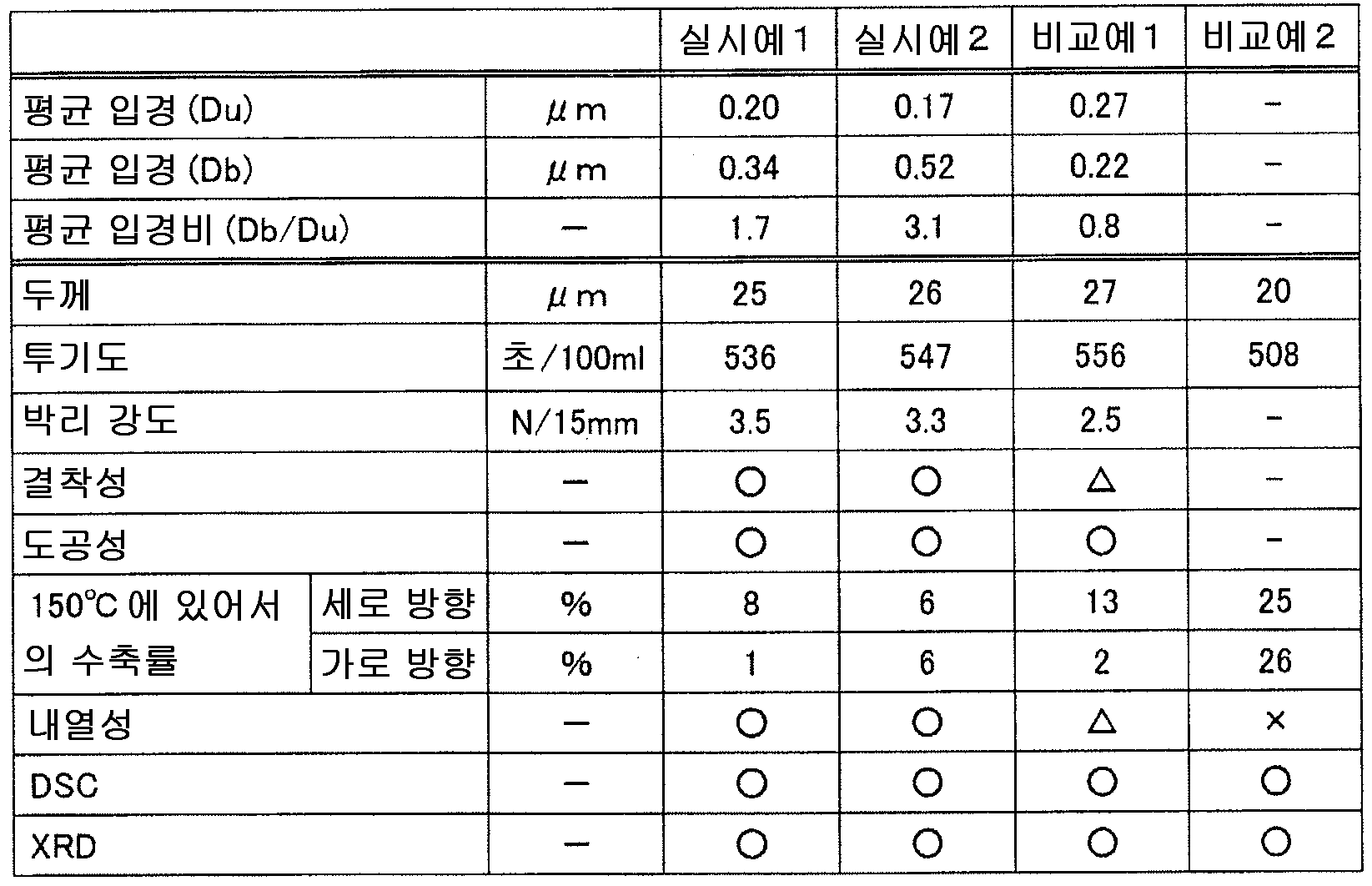
표 1 로부터, 실시예 1 및 실시예 2 에서 얻은 적층 다공 필름은, 기재층의 표면에 피복층 (Ⅱ 층) 중의 필러 (a) 는 소정의 입경 구배를 갖기 때문에, 높은 통기성을 유지한 채로 우수한 내열성을 발휘하였다. 즉, 표면에 미세한 입자가 치밀한 구조를 형성하고 있기 때문에 우수한 결착성, 우수한 내열성을 갖고, 그 한편으로, 피복층 (Ⅱ 층) 내부는 조잡한 구조이기 때문에 높은 통기성을 유지할 수 있었다.From Table 1, since the filler (a) in the coating layer (II layer) has a predetermined particle size gradient on the surface of the substrate layer, the laminated porous films obtained in Examples 1 and 2 have excellent heat resistance while maintaining high air permeability. Exerted. That is, since fine particles form a dense structure on the surface, it has excellent binding property and excellent heat resistance, and on the other hand, since the inside of the coating layer (II layer) is a coarse structure, high air permeability can be maintained.
한편, 비교예 1 에서 얻은 적층 다공 필름은, 도포액의 고형분의 조성이 실시예 1 의 것과 동일한 것임에도 불구하고, 소정의 입경 구배를 갖고 있지 않기 때문에, 결착성, 내열성이 불충분하였다.On the other hand, although the laminated porous film obtained by the comparative example 1 does not have a predetermined particle size gradient, although the composition of solid content of a coating liquid is the same as that of Example 1, binding property and heat resistance were inadequate.
또, 비교예 2 의 폴리올레핀계 수지 다공 필름은, 피복층이 적층되어 있지 않기 때문에, 내열성이 불충분하였다.Moreover, since the coating layer was not laminated | stacked, the polyolefin resin porous film of the comparative example 2 had insufficient heat resistance.
산업상 이용가능성Industrial availability
본 발명의 적층 다공 필름은, 투기 특성이 요구되는 여러 가지 용도에 응용할 수 있다. 리튬 전지용 세퍼레이터 ; 일회용 종이 기저귀, 생리 용품 등의 체액 흡수용 패드 혹은 침대 시트 등의 위생 재료 ; 수술옷 혹은 온찜질용 기재 등의 의료용 재료 ; 점퍼, 스포츠 웨어 혹은 비옷 등의 의료용 재료 ; 벽지, 지붕 방수재, 단열재, 흡음재 등의 건축용 재료 ; 건조제 ; 방습제 ; 탈산소제 ; 일회용 화로 ; 선도 (鮮度) 유지 포장 혹은 식품 포장 등의 포장 재료 등의 자재로서 매우 바람직하게 이용할 수 있다. The laminated porous film of the present invention can be applied to various applications requiring the durability. Separator for lithium batteries; Sanitary materials such as disposable paper diapers, body fluid absorbent pads such as sanitary articles, or bed sheets; Medical materials, such as surgical clothing or a substrate for hot packs; Medical materials such as jumpers, sportswear or raincoats; Building materials such as wallpaper, roof waterproofing material, insulation material, sound absorbing material; Drying agent; Desiccant; Deoxygenating agent; Disposable brazier; It can be used very suitably as materials, such as packaging materials, such as freshness holding packaging or food packaging.
20 : 이차 전지
21 : 정극판
22 : 부극판
24 : 정극 리드체
25 : 부극 리드체
26 : 개스킷
27 : 정극 뚜껑
31 : 알루미늄판
32 : 다공 필름
33 : 클립
34 : 다공 필름 세로 방향
35 : 다공 필름 가로 방향
41 : 샘플
42 : 테이프
43 : 미끄럼 방지구
44 : 상부 척
45 : 하부 척20: Secondary battery
21: positive electrode plate
22: Negative polar plate
24: positive electrode lead body
25: negative electrode lead body
26: gasket
27: positive electrode cap
31: aluminum plate
32: Porous film
33: Clip
34: porous film vertical direction
35: porous film horizontal direction
41: Sample
42: tape
43: slip protection
44: upper chuck
45: lower chuck
Claims (15)
상기 적층 다공 필름의 표면이 되는 상기 피복층의 표면으로부터 그 피복층의 두께 25 % 내에 있어서의 필러의 평균 입경 (Du) 과 상기 기재층과의 계면으로부터 그 피복층의 두께 25 % 내에 있어서의 필러의 평균 입경 (Db) 의 비 (Db/Du) 가 1.2 ∼ 10 이며, 또한 상기 피복층의 표면측의 필러의 평균 입경 (Du) 이 0.5 ㎛ 이하인 것을 특징으로 하는 적층 다공 필름.As a laminated porous film which laminated | stacked the coating layer containing a filler and a resin binder on at least one side of the polyolefin resin porous film used as a base material layer,
Average particle diameter of the filler in 25% of the thickness of the coating layer from the interface with the average particle diameter (Du) of the filler in 25% of the thickness of the coating layer and the base material layer from the surface of the coating layer to be the surface of the laminated porous film. The ratio (Db / Du) of (Db) is 1.2 to 10, and the average particle diameter (Du) of the filler on the surface side of the coating layer is 0.5 µm or less.
상기 필러의 평균 입경이 0.1 ㎛ 이상 3.0 ㎛ 이하인, 적층 다공 필름.The method of claim 1,
The laminated porous film of which the average particle diameter of the said filler is 0.1 micrometer or more and 3.0 micrometers or less.
상기 피복층의 표면측 필러의 평균 입경 (Du) 은 0.05 ㎛ ∼ 0.5 ㎛ 이고, 상기 기재층측 필러의 평균 입경 (Db) 은 0.1 ㎛ ∼ 3.0 ㎛ 이고, 상기 피복층의 표면으로부터 두께 25 % 와 상기 기재층과의 계면으로부터 그 피복층의 두께 25 % 사이의 상기 피복층의 두께 방향의 중간부의 상기 필러의 평균 입경은 상기 (Du) 와 (Db) 사이이고, 상기 피복층의 표면측으로부터 상기 기재층과의 계면측으로 평균 입자경이 대직경화되는 구배를 갖는, 적층 다공 필름.The method of claim 1,
The average particle diameter Du of the surface side filler of the said coating layer is 0.05 micrometer-0.5 micrometer, and the average particle diameter Db of the said base material layer side filler is 0.1 micrometer-3.0 micrometers, 25% of thickness from the surface of the said coating layer, and the said base material layer The average particle diameter of the said filler in the intermediate part of the thickness direction of the said coating layer between 25% of the thickness of the coating layer from the interface with the said is between (Du) and (Db), and from the surface side of the said coating layer to the interface side with the said base material layer A laminated porous film having a gradient in which the average particle diameter is large diameter.
상기 필러의 밀도가, 상기 수지 바인더의 밀도의 2 배 이상인, 적층 다공 필름.The method of claim 1,
The laminated porous film whose density of the said filler is 2 times or more of the density of the said resin binder.
상기 기재층이 되는 폴리올레핀계 수지 다공 필름은, 폴리프로필렌계 수지를 주성분으로 하는 층을 적어도 1 층 구비하고 있는, 적층 다공 필름.The method of claim 1,
The polyolefin resin porous film which becomes the said base material layer is a laminated porous film provided with at least 1 layer which has polypropylene resin as a main component.
상기 기재층이 되는 폴리올레핀계 수지 다공 필름은, 폴리프로필렌계 수지를 주성분으로 하는 층 (A 층) 과 다른 폴리올레핀계 수지층 (B 층) 또는/및 폴리올레핀계 수지 이외의 수지층을 적층한 적층 필름이고, 그 적층 필름으로 이루어지는 상기 기재층의 표면에 상기 피복층을 적층하고 있는, 적층 다공 필름.The method of claim 1,
The polyolefin resin porous film which becomes the said base material layer is the laminated | multilayer film which laminated | stacked resin layers other than the layer (A layer) which has polypropylene resin as a main component, another polyolefin resin layer (B layer) or / and polyolefin resin. The laminated porous film which is the laminated | stacked the said coating layer on the surface of the said base material layer which consists of this laminated | multilayer film.
상기 기재층의 폴리올레핀계 수지 다공 필름이, β 정 활성을 갖는, 적층 다공 필름.The method of claim 1,
The laminated porous film in which the polyolefin resin porous film of the said base material layer has (beta) positive activity.
상기 기재층과 상기 피복층의 박리 강도가 3 N/15 ㎜ 이상인, 적층 다공 필름.The method of claim 1,
The laminated porous film whose peeling strength of the said base material layer and the said coating layer is 3 N / 15 mm or more.
150 ℃ 에 있어서의 수축률이 25 % 미만인, 적층 다공 필름.The method of claim 1,
The laminated porous film whose shrinkage rate in 150 degreeC is less than 25%.
상기 기재층의 폴리올레핀계 수지 다공 필름의 적어도 편면의 표면에, 상기 필러와 상기 수지 바인더를 용매에 용해 또는 분산시킨 분산액을 도포하여 상기 피복층을 형성하고,
상기 용매의 제거 공정 전 또는 제거 공정 중에 상기 필러를 상기 기재층을 향하여 침강시키고, 상기 피복층의 두께 방향에서 표면측으로부터 기재층측으로 필러의 평균 입경이, 상기 (Db/Du) = 1.2 ∼ 10 이 되는 구배를 갖게 하는, 적층 다공 필름의 제조 방법.As a manufacturing method of the laminated porous film in any one of Claims 1-9,
On the surface of at least one side of the polyolefin resin porous film of the said base material layer, the dispersion liquid which melt | dissolved or disperse | distributed the said filler and the said resin binder was apply | coated, and the said coating layer was formed,
The filler is allowed to settle before the solvent removal step or during the removal step, and the average particle diameter of the filler from the surface side to the substrate layer side in the thickness direction of the coating layer is equal to (Db / Du) = 1.2 to 10 The manufacturing method of the laminated porous film which has a gradient to become.
상기 기재층에 상기 분산액을 도포하기 전 또는 상기 피복층을 형성한 후에, 100 ℃ 이상 170 ℃ 이하에서 열처리함과 함께, 그 열처리 중에 1 ∼ 20 % 의 이완 처리를 실시하여, 150 ℃ 에 있어서의 수축률을 25 % 미만으로 하고 있는, 적층 다공 필름의 제조 방법.13. The method of claim 12,
Before applying the dispersion liquid to the base material layer or after forming the coating layer, the heat treatment is performed at 100 ° C. or higher and 170 ° C. or lower, and a relaxation treatment of 1 to 20% is performed during the heat treatment to reduce the shrinkage at 150 ° C. The manufacturing method of the laminated porous film which is less than 25%.
상기 기재층에 상기 분산액을 도포하기 전 또는 상기 피복층을 형성한 후에, 100 ℃ 이상 170 ℃ 이하에서 열처리함과 함께, 그 열처리 중에 1 ∼ 20 % 의 이완 처리를 실시하여, 150 ℃ 에 있어서의 수축률을 25 % 미만으로 하고 있는, 적층 다공 필름의 제조 방법.The method of claim 13,
Before applying the dispersion liquid to the base material layer or after forming the coating layer, the heat treatment is performed at 100 ° C. or higher and 170 ° C. or lower, and a relaxation treatment of 1 to 20% is performed during the heat treatment to reduce the shrinkage at 150 ° C. The manufacturing method of the laminated porous film which is less than 25%.
Applications Claiming Priority (3)
| Application Number | Priority Date | Filing Date | Title |
|---|---|---|---|
| JPJP-P-2011-123904 | 2011-06-02 | ||
| JP2011123904 | 2011-06-02 | ||
| PCT/JP2012/064168 WO2012165580A1 (en) | 2011-06-02 | 2012-05-31 | Multilayer porous film, separator for batteries, and battery |
Publications (2)
| Publication Number | Publication Date |
|---|---|
| KR20130014052A KR20130014052A (en) | 2013-02-06 |
| KR101316995B1 true KR101316995B1 (en) | 2013-10-11 |
Family
ID=47259432
Family Applications (1)
| Application Number | Title | Priority Date | Filing Date |
|---|---|---|---|
| KR1020127026930A Expired - Fee Related KR101316995B1 (en) | 2011-06-02 | 2012-05-31 | Laminated porous film, separator for battery, and battery |
Country Status (5)
| Country | Link |
|---|---|
| US (1) | US8785032B2 (en) |
| JP (1) | JP5298247B2 (en) |
| KR (1) | KR101316995B1 (en) |
| CN (1) | CN102917876B (en) |
| WO (1) | WO2012165580A1 (en) |
Families Citing this family (25)
| Publication number | Priority date | Publication date | Assignee | Title |
|---|---|---|---|---|
| US9252412B2 (en) | 2012-03-26 | 2016-02-02 | Mitsubishi Plastics, Inc. | Multilayer porous film, separator for nonaqueous electrolyte secondary batteries, and nonaqueous electrolyte secondary battery |
| KR102107364B1 (en) | 2012-06-29 | 2020-05-07 | 미쯔비시 케미컬 주식회사 | Laminated porous film, separator for non-aqueous electrolyte secondary battery, and non-aqueous electrolyte secondary battery |
| KR101577383B1 (en) * | 2012-07-30 | 2015-12-14 | 데이진 가부시키가이샤 | Separator for non-aqueous electrolyte battery, and non-aqueous electrolyte battery |
| JP2014208780A (en) * | 2013-03-27 | 2014-11-06 | 三菱樹脂株式会社 | Method for preparing coating liquid, multilayer porous film, separator for non-aqueous electrolyte secondary battery, and non-aqueous electrolyte secondary battery |
| KR101636857B1 (en) * | 2013-08-30 | 2016-07-20 | 제일모직 주식회사 | Separator containing coating layer, manufacturing thereof and battery using the separator |
| JP6282458B2 (en) * | 2013-12-13 | 2018-02-21 | 三星エスディアイ株式会社Samsung SDI Co., Ltd. | Non-aqueous electrolyte secondary battery electrode winding element, non-aqueous electrolyte secondary battery using the same, and non-aqueous electrolyte secondary battery electrode winding element manufacturing method |
| JP6003929B2 (en) * | 2014-03-06 | 2016-10-05 | トヨタ自動車株式会社 | Nonaqueous electrolyte secondary battery |
| CN106163807B (en) | 2014-04-09 | 2018-04-24 | 住友化学株式会社 | Laminated porous film and non-aqueous electrolyte secondary battery |
| JP6398328B2 (en) * | 2014-05-28 | 2018-10-03 | 東レ株式会社 | Battery separator and method for producing the same |
| CN104064708B (en) * | 2014-06-09 | 2017-02-08 | 东莞市魔方新能源科技有限公司 | Membrane for lithium ion secondary battery, preparation method of membrane and battery containing membrane |
| CN105440770B (en) * | 2014-06-30 | 2021-05-04 | 四川茵地乐材料科技集团有限公司 | Water-based composition for modifying diaphragm for lithium ion battery, modified diaphragm and battery |
| JP6432203B2 (en) * | 2014-08-12 | 2018-12-05 | 三菱ケミカル株式会社 | Method for producing laminated porous film |
| KR101910222B1 (en) * | 2014-10-20 | 2018-10-19 | 주식회사 엘지화학 | A multi-layered separator having high heat resistance property for a secondary battery |
| KR20180080229A (en) * | 2015-10-30 | 2018-07-11 | 제이엔씨 주식회사 | An organic-inorganic composite film having excellent smoothness and a multilayer heat-resistant separator material |
| JP6041970B1 (en) * | 2015-12-24 | 2016-12-14 | 住友化学株式会社 | Nonaqueous electrolyte secondary battery separator |
| JP6988881B2 (en) * | 2017-03-08 | 2022-01-05 | 東レ株式会社 | Separator for secondary batteries containing polyethylene microporous membrane |
| JP7088163B2 (en) * | 2017-03-08 | 2022-06-21 | 東レ株式会社 | Polyolefin microporous membrane, multilayer polyolefin microporous membrane, laminated polyolefin microporous membrane, and separator |
| US11491760B2 (en) * | 2018-03-13 | 2022-11-08 | Mitsui Chemicals, Inc. | Breathable sheet, laminate, and composite |
| CN108807821B (en) | 2018-06-20 | 2021-03-19 | 宁德新能源科技有限公司 | Separators and Electrochemical Devices |
| CN110247007A (en) * | 2019-06-26 | 2019-09-17 | 江苏厚生新能源科技有限公司 | Height protects liquid measure and low ventilative lithium battery coated separator and preparation method, screen apparatus |
| CN110429229A (en) * | 2019-07-31 | 2019-11-08 | 宁德新能源科技有限公司 | Multilayer separator and device using the same |
| CN113224467A (en) * | 2021-05-27 | 2021-08-06 | 江苏星源新材料科技有限公司 | Coating diaphragm |
| CN114243210B (en) * | 2022-02-25 | 2022-05-13 | 深圳市博盛新材料有限公司 | Aging-resistant lithium ion battery diaphragm and manufacturing method thereof |
| CN114976489B (en) * | 2022-07-01 | 2024-04-05 | 珠海冠宇电池股份有限公司 | Coating, separator comprising same and battery |
| CN118825547B (en) * | 2024-06-19 | 2025-12-26 | 广东碳语新材料有限公司 | A high heat-resistant and high-adhesion composite slurry, its preparation method and application |
Citations (4)
| Publication number | Priority date | Publication date | Assignee | Title |
|---|---|---|---|---|
| JP2004227972A (en) * | 2003-01-24 | 2004-08-12 | Sumitomo Chem Co Ltd | Non-aqueous electrolyte secondary battery separator |
| KR20090094473A (en) * | 2007-01-30 | 2009-09-07 | 아사히 가세이 이-매터리얼즈 가부시키가이샤 | Multilayer porous membrane and its manufacturing method |
| KR20110031197A (en) * | 2008-07-16 | 2011-03-24 | 도레이 카부시키가이샤 | Separators for Power Storage Devices |
| KR20110044336A (en) * | 2008-11-10 | 2011-04-28 | 미쓰비시 쥬시 가부시끼가이샤 | Laminated porous film, separator and battery for lithium battery |
Family Cites Families (8)
| Publication number | Priority date | Publication date | Assignee | Title |
|---|---|---|---|---|
| JP2883726B2 (en) | 1990-11-14 | 1999-04-19 | 日東電工株式会社 | Manufacturing method of battery separator |
| JPH08144122A (en) | 1994-11-24 | 1996-06-04 | New Japan Chem Co Ltd | Porous polypropylene fiber and its production |
| JP3739481B2 (en) | 1995-05-17 | 2006-01-25 | 昭和電工株式会社 | Polypropylene resin material and method for producing the same |
| JP3539526B2 (en) | 1996-01-23 | 2004-07-07 | チッソ株式会社 | Crystalline propylene polymer composition |
| US8283029B2 (en) * | 2001-08-13 | 2012-10-09 | Clopay Plastic Products Company, Inc. | Multilayer microporous films and composites for barrier protective materials, and methods |
| JP2003306585A (en) | 2002-04-15 | 2003-10-31 | Sekisui Chem Co Ltd | Resin-layered silicate composite material and method for producing the same |
| JP4958484B2 (en) | 2006-03-17 | 2012-06-20 | 三洋電機株式会社 | Non-aqueous electrolyte battery and manufacturing method thereof |
| JP2008186721A (en) * | 2007-01-30 | 2008-08-14 | Asahi Kasei Chemicals Corp | Porous membrane having both high heat resistance and high permeability and its production method |
-
2012
- 2012-05-31 KR KR1020127026930A patent/KR101316995B1/en not_active Expired - Fee Related
- 2012-05-31 US US14/123,120 patent/US8785032B2/en active Active
- 2012-05-31 WO PCT/JP2012/064168 patent/WO2012165580A1/en not_active Ceased
- 2012-05-31 CN CN201280001350.9A patent/CN102917876B/en active Active
- 2012-05-31 JP JP2012547406A patent/JP5298247B2/en not_active Expired - Fee Related
Patent Citations (4)
| Publication number | Priority date | Publication date | Assignee | Title |
|---|---|---|---|---|
| JP2004227972A (en) * | 2003-01-24 | 2004-08-12 | Sumitomo Chem Co Ltd | Non-aqueous electrolyte secondary battery separator |
| KR20090094473A (en) * | 2007-01-30 | 2009-09-07 | 아사히 가세이 이-매터리얼즈 가부시키가이샤 | Multilayer porous membrane and its manufacturing method |
| KR20110031197A (en) * | 2008-07-16 | 2011-03-24 | 도레이 카부시키가이샤 | Separators for Power Storage Devices |
| KR20110044336A (en) * | 2008-11-10 | 2011-04-28 | 미쓰비시 쥬시 가부시끼가이샤 | Laminated porous film, separator and battery for lithium battery |
Also Published As
| Publication number | Publication date |
|---|---|
| JP5298247B2 (en) | 2013-09-25 |
| KR20130014052A (en) | 2013-02-06 |
| US20140099530A1 (en) | 2014-04-10 |
| JPWO2012165580A1 (en) | 2015-02-23 |
| WO2012165580A1 (en) | 2012-12-06 |
| CN102917876A (en) | 2013-02-06 |
| CN102917876B (en) | 2014-06-11 |
| US8785032B2 (en) | 2014-07-22 |
Similar Documents
| Publication | Publication Date | Title |
|---|---|---|
| KR101316995B1 (en) | Laminated porous film, separator for battery, and battery | |
| KR101392131B1 (en) | Laminated porous film, separator for battery, and battery | |
| JP5676577B2 (en) | Multilayer porous film, separator for nonaqueous electrolyte secondary battery, and nonaqueous electrolyte secondary battery | |
| JP5419817B2 (en) | Multilayer porous film, separator for nonaqueous electrolyte secondary battery, and nonaqueous electrolyte secondary battery | |
| KR101483836B1 (en) | Laminated porous film, separator for non-aqueous electrolyte secondary battery, and non-aqueous electrolyte secondary battery | |
| JP5697328B2 (en) | Multilayer porous film, battery separator, and battery | |
| CN102782027B (en) | Polypropylene-based resin perforated membrane, battery separator and battery | |
| KR101271299B1 (en) | Polyolefin resin porous film, and non-aqueous electrolyte cell separator using same | |
| US20140057057A1 (en) | Process for producing a laminated porous film | |
| JP2014012391A (en) | Lamination porous film roll and its manufacturing method | |
| JP5620467B2 (en) | Porous polypropylene film | |
| KR20120116468A (en) | Porous polypropylene resin film, separator for use in a battery, and battery | |
| JP5976305B2 (en) | Method for producing laminated porous film | |
| JP2013116442A (en) | Method for manufacturing laminated porous film |
Legal Events
| Date | Code | Title | Description |
|---|---|---|---|
| A201 | Request for examination | ||
| A302 | Request for accelerated examination | ||
| P11-X000 | Amendment of application requested |
St.27 status event code: A-2-2-P10-P11-nap-X000 |
|
| P13-X000 | Application amended |
St.27 status event code: A-2-2-P10-P13-nap-X000 |
|
| PA0105 | International application |
St.27 status event code: A-0-1-A10-A15-nap-PA0105 |
|
| PA0201 | Request for examination |
St.27 status event code: A-1-2-D10-D11-exm-PA0201 |
|
| PA0302 | Request for accelerated examination |
St.27 status event code: A-1-2-D10-D17-exm-PA0302 St.27 status event code: A-1-2-D10-D16-exm-PA0302 |
|
| PG1501 | Laying open of application |
St.27 status event code: A-1-1-Q10-Q12-nap-PG1501 |
|
| E902 | Notification of reason for refusal | ||
| PE0902 | Notice of grounds for rejection |
St.27 status event code: A-1-2-D10-D21-exm-PE0902 |
|
| P11-X000 | Amendment of application requested |
St.27 status event code: A-2-2-P10-P11-nap-X000 |
|
| P13-X000 | Application amended |
St.27 status event code: A-2-2-P10-P13-nap-X000 |
|
| E701 | Decision to grant or registration of patent right | ||
| PE0701 | Decision of registration |
St.27 status event code: A-1-2-D10-D22-exm-PE0701 |
|
| GRNT | Written decision to grant | ||
| PR0701 | Registration of establishment |
St.27 status event code: A-2-4-F10-F11-exm-PR0701 |
|
| PR1002 | Payment of registration fee |
St.27 status event code: A-2-2-U10-U12-oth-PR1002 Fee payment year number: 1 |
|
| PG1601 | Publication of registration |
St.27 status event code: A-4-4-Q10-Q13-nap-PG1601 |
|
| FPAY | Annual fee payment |
Payment date: 20160923 Year of fee payment: 4 |
|
| PR1001 | Payment of annual fee |
St.27 status event code: A-4-4-U10-U11-oth-PR1001 Fee payment year number: 4 |
|
| R18-X000 | Changes to party contact information recorded |
St.27 status event code: A-5-5-R10-R18-oth-X000 |
|
| FPAY | Annual fee payment |
Payment date: 20170922 Year of fee payment: 5 |
|
| PR1001 | Payment of annual fee |
St.27 status event code: A-4-4-U10-U11-oth-PR1001 Fee payment year number: 5 |
|
| PN2301 | Change of applicant |
St.27 status event code: A-5-5-R10-R11-asn-PN2301 |
|
| PN2301 | Change of applicant |
St.27 status event code: A-5-5-R10-R14-asn-PN2301 |
|
| FPAY | Annual fee payment |
Payment date: 20180921 Year of fee payment: 6 |
|
| PR1001 | Payment of annual fee |
St.27 status event code: A-4-4-U10-U11-oth-PR1001 Fee payment year number: 6 |
|
| PR1001 | Payment of annual fee |
St.27 status event code: A-4-4-U10-U11-oth-PR1001 Fee payment year number: 7 |
|
| PR1001 | Payment of annual fee |
St.27 status event code: A-4-4-U10-U11-oth-PR1001 Fee payment year number: 8 |
|
| PR1001 | Payment of annual fee |
St.27 status event code: A-4-4-U10-U11-oth-PR1001 Fee payment year number: 9 |
|
| P22-X000 | Classification modified |
St.27 status event code: A-4-4-P10-P22-nap-X000 |
|
| PR1001 | Payment of annual fee |
St.27 status event code: A-4-4-U10-U11-oth-PR1001 Fee payment year number: 10 |
|
| PR1001 | Payment of annual fee |
St.27 status event code: A-4-4-U10-U11-oth-PR1001 Fee payment year number: 11 |
|
| PC1903 | Unpaid annual fee |
St.27 status event code: A-4-4-U10-U13-oth-PC1903 Not in force date: 20241003 Payment event data comment text: Termination Category : DEFAULT_OF_REGISTRATION_FEE |
|
| H13 | Ip right lapsed |
Free format text: ST27 STATUS EVENT CODE: N-4-6-H10-H13-OTH-PC1903 (AS PROVIDED BY THE NATIONAL OFFICE); TERMINATION CATEGORY : DEFAULT_OF_REGISTRATION_FEE Effective date: 20241003 |
|
| PC1903 | Unpaid annual fee |
St.27 status event code: N-4-6-H10-H13-oth-PC1903 Ip right cessation event data comment text: Termination Category : DEFAULT_OF_REGISTRATION_FEE Not in force date: 20241003 |