KR100933324B1 - Choosing the best transmission format for transmission over an allotted time period - Google Patents
Choosing the best transmission format for transmission over an allotted time period Download PDFInfo
- Publication number
- KR100933324B1 KR100933324B1 KR1020077025169A KR20077025169A KR100933324B1 KR 100933324 B1 KR100933324 B1 KR 100933324B1 KR 1020077025169 A KR1020077025169 A KR 1020077025169A KR 20077025169 A KR20077025169 A KR 20077025169A KR 100933324 B1 KR100933324 B1 KR 100933324B1
- Authority
- KR
- South Korea
- Prior art keywords
- transmission
- formats
- format
- remote station
- base station
- Prior art date
- Legal status (The legal status is an assumption and is not a legal conclusion. Google has not performed a legal analysis and makes no representation as to the accuracy of the status listed.)
- Expired - Fee Related
Links
Images


Classifications
-
- H—ELECTRICITY
- H04—ELECTRIC COMMUNICATION TECHNIQUE
- H04W—WIRELESS COMMUNICATION NETWORKS
- H04W99/00—Subject matter not provided for in other groups of this subclass
-
- H—ELECTRICITY
- H04—ELECTRIC COMMUNICATION TECHNIQUE
- H04B—TRANSMISSION
- H04B7/00—Radio transmission systems, i.e. using radiation field
- H04B7/24—Radio transmission systems, i.e. using radiation field for communication between two or more posts
- H04B7/26—Radio transmission systems, i.e. using radiation field for communication between two or more posts at least one of which is mobile
- H04B7/2618—Radio transmission systems, i.e. using radiation field for communication between two or more posts at least one of which is mobile using hybrid code-time division multiple access [CDMA-TDMA]
-
- H—ELECTRICITY
- H04—ELECTRIC COMMUNICATION TECHNIQUE
- H04B—TRANSMISSION
- H04B7/00—Radio transmission systems, i.e. using radiation field
- H04B7/24—Radio transmission systems, i.e. using radiation field for communication between two or more posts
- H04B7/26—Radio transmission systems, i.e. using radiation field for communication between two or more posts at least one of which is mobile
-
- H—ELECTRICITY
- H04—ELECTRIC COMMUNICATION TECHNIQUE
- H04B—TRANSMISSION
- H04B7/00—Radio transmission systems, i.e. using radiation field
- H04B7/24—Radio transmission systems, i.e. using radiation field for communication between two or more posts
- H04B7/26—Radio transmission systems, i.e. using radiation field for communication between two or more posts at least one of which is mobile
- H04B7/2643—Radio transmission systems, i.e. using radiation field for communication between two or more posts at least one of which is mobile using time-division multiple access [TDMA]
- H04B7/2656—Radio transmission systems, i.e. using radiation field for communication between two or more posts at least one of which is mobile using time-division multiple access [TDMA] for structure of frame, burst
-
- H—ELECTRICITY
- H04—ELECTRIC COMMUNICATION TECHNIQUE
- H04J—MULTIPLEX COMMUNICATION
- H04J13/00—Code division multiplex systems
- H04J13/0007—Code type
- H04J13/004—Orthogonal
- H04J13/0048—Walsh
-
- H—ELECTRICITY
- H04—ELECTRIC COMMUNICATION TECHNIQUE
- H04L—TRANSMISSION OF DIGITAL INFORMATION, e.g. TELEGRAPHIC COMMUNICATION
- H04L1/00—Arrangements for detecting or preventing errors in the information received
- H04L1/0001—Systems modifying transmission characteristics according to link quality, e.g. power backoff
-
- H—ELECTRICITY
- H04—ELECTRIC COMMUNICATION TECHNIQUE
- H04L—TRANSMISSION OF DIGITAL INFORMATION, e.g. TELEGRAPHIC COMMUNICATION
- H04L1/00—Arrangements for detecting or preventing errors in the information received
- H04L1/0001—Systems modifying transmission characteristics according to link quality, e.g. power backoff
- H04L1/0023—Systems modifying transmission characteristics according to link quality, e.g. power backoff characterised by the signalling
- H04L1/0028—Formatting
-
- H—ELECTRICITY
- H04—ELECTRIC COMMUNICATION TECHNIQUE
- H04W—WIRELESS COMMUNICATION NETWORKS
- H04W52/00—Power management, e.g. Transmission Power Control [TPC] or power classes
- H04W52/04—Transmission power control [TPC]
- H04W52/18—TPC being performed according to specific parameters
- H04W52/28—TPC being performed according to specific parameters using user profile, e.g. mobile speed, priority or network state, e.g. standby, idle or non-transmission
- H04W52/281—TPC being performed according to specific parameters using user profile, e.g. mobile speed, priority or network state, e.g. standby, idle or non-transmission taking into account user or data type priority
-
- H—ELECTRICITY
- H04—ELECTRIC COMMUNICATION TECHNIQUE
- H04W—WIRELESS COMMUNICATION NETWORKS
- H04W24/00—Supervisory, monitoring or testing arrangements
-
- H—ELECTRICITY
- H04—ELECTRIC COMMUNICATION TECHNIQUE
- H04W—WIRELESS COMMUNICATION NETWORKS
- H04W28/00—Network traffic management; Network resource management
- H04W28/02—Traffic management, e.g. flow control or congestion control
- H04W28/06—Optimizing the usage of the radio link, e.g. header compression, information sizing, discarding information
-
- H—ELECTRICITY
- H04—ELECTRIC COMMUNICATION TECHNIQUE
- H04W—WIRELESS COMMUNICATION NETWORKS
- H04W72/00—Local resource management
- H04W72/50—Allocation or scheduling criteria for wireless resources
- H04W72/56—Allocation or scheduling criteria for wireless resources based on priority criteria
Landscapes
- Engineering & Computer Science (AREA)
- Computer Networks & Wireless Communication (AREA)
- Signal Processing (AREA)
- Quality & Reliability (AREA)
- Mobile Radio Communication Systems (AREA)
- Time-Division Multiplex Systems (AREA)
- Communication Control (AREA)
- Detection And Prevention Of Errors In Transmission (AREA)
Abstract
단일 사용자로의 전송이나 다중 사용자들로의 동시 전송을 위한 최적의 전송 포맷들을 선택하는 방법 및 장치가 제공된다. 각각의 사용자와 연관된 우선순위 정보 및 채널 상태 정보가 최적의 전송 포맷들을 결정하는데 이용된다. 특히, 상기 정보는 시스템 스루풋을 향상시키는 동시에 사용자들 사이의 공정성을 유지하는 주어진 레버뉴 함수를 극대화시키기 위해 이용된다(406). 일단 전송 포맷들이 결정되면, 이용되지 않는 월시 코드들이나 전송 전력과 같은 임의의 할당되지 않은 시스템 자원은 사용자들에게 균일하거나 또는 균형적으로 분산될 수 있다.A method and apparatus are provided for selecting optimal transmission formats for transmission to a single user or simultaneous transmission to multiple users. Priority information and channel state information associated with each user are used to determine the optimal transmission formats. In particular, the information is used to maximize a given lever function that improves system throughput while maintaining fairness among users (406). Once the transmission formats are determined, any unassigned system resources, such as unused Walsh codes or transmit power, can be distributed uniformly or balanced to users.
Description
본 발명은 전반적으로 통신에 관련된 것으로서, 더 상세히는, 단일 사용자로의 전송이나 또는 다중 사용자로의 동시적인 전송 중 어느 하나를 위한 최적의 전송 포맷들을 선택하는 시스템에 관한 것이다.The present invention relates generally to communication, and more particularly, to a system for selecting optimal transmission formats for either transmission to a single user or simultaneous transmission to multiple users.
무선 통신 분야는 무선 전화기, 페이징, 무선 로컬 루프, PDA(personal digital assistants), 인터넷 전화, 및 위성 통신 시스템들과 같은 것들을 포함하는 많은 애플리케이션을 갖는다. 특히 중요한 애플리케이션은 이동 가입자들을 위한 셀룰러 전화기 시스템들이다. 본 명세서에서 사용되는 바와 같이, "셀룰러" 시스템이란 용어는 셀룰러 및 개인 통신 서비스(PCS) 주파수 양쪽 모두를 포함한다. 주파수 분할 다중 접속(FDMA), 시분할 다중 접속(TDMA), 및 코드 분할 다중 접속(CDMA)과 같은 것을 포함해서 다양한 무선 인터페이스들이 그러한 셀룰러 전화기 시스템들을 위해 개발되었다. 그와 관련하여, AMPS(Advanced Mobile Phone Service), GSM(Global System for Mobile), 및 IS-95(Interim Standard 95)와 같은 것을 포함해서 다양한 국내 및 국제 표준들이 확정되었다. IS-95 및 그것의 파생 물들인 IS-95A, IS-95B, ANSI J-STD-008(종종 본 명세서에서는 총괄하여 IS-95로 지칭됨), 및 제안된 고-데이터-속도 시스템들이 TIA(Telecommunication Industry Assocation) 및 다른 잘 알려진 표준 단체에 의해 공표되었다.The field of wireless communications has many applications including such as cordless telephones, paging, wireless local loops, personal digital assistants (PDAs), Internet telephones, and satellite communication systems. A particularly important application is cellular telephone systems for mobile subscribers. As used herein, the term "cellular" system includes both cellular and personal communication service (PCS) frequencies. Various air interfaces have been developed for such cellular telephone systems, including frequency division multiple access (FDMA), time division multiple access (TDMA), and code division multiple access (CDMA). In that regard, various national and international standards have been established, including such as Advanced Mobile Phone Service (AMPS), Global System for Mobile (GSM), and Interim Standard 95 (IS-95). IS-95 and its derivatives IS-95A, IS-95B, ANSI J-STD-008 (often referred to herein collectively as IS-95), and proposed high-data-rate systems are TIA (Telecommunication) Published by Industry Assocation and other well-known standards bodies.
IS-95 표준의 사용에 따라 구성된 셀룰러 전화기 시스템들은 매우 효율적이면서 강력한 셀룰러 전화 서비스를 제공하기 위해서 CDMA 신호 처리 기술들을 이용한다. IS-95 표준의 사용에 따라 실질적으로 구성된 예시적인 셀룰러 전화 시스템들은 미국 특허 제 5,103,459호 및 제 4,901,307호에 설명되어 있는데, 상기 두 특허는 본 발명의 양수인에게 양도되었으며 본 명세서에서 참조된다. CDMA 기술들을 활용하는 예시적인 시스템으로는 TIA에 등록되어진 cdma2000 ITU-R Radio Transmission(RTT) Candidate Submission(본 명세서에서는 cdma2000으로 지칭됨)이 있다. cdma2000에 대한 표준은 IS-2000의 드래프트 버전이며, TIA에 의해서 승인되었다. 또 다른 CDMA 표준으로는 3rdGenerationPartnershipProject"3GPP"(문헌번호. 3G TS 25.211, 3G TS 25.212, 3G TS 25.213, 및 3G TS 25.214)에 삽입되어 있는 바와 같은 W-CDMA 표준이 있다.Cellular telephone systems constructed in accordance with the use of the IS-95 standard utilize CDMA signal processing techniques to provide highly efficient and robust cellular telephone service. Exemplary cellular telephone systems constructed substantially in accordance with the use of the IS-95 standard are described in US Pat. Nos. 5,103,459 and 4,901,307, both of which are assigned to the assignee of the present invention and referenced herein. An example system that utilizes CDMA techniques is the cdma2000 ITU-R Radio Transmission (RTT) Candidate Submission (herein referred to herein as cdma2000) registered with the TIA. The standard for cdma2000 is a draft version of IS-2000 and has been approved by the TIA. Another CDMA standard is the 3 rd GenerationPartnershipProject "3GPP" W- CDMA standard, as embedded in the (reference number. 3G TS 25.211, 3G TS 25.212 , 3G TS 25.213, and 3G TS 25.214).
위에서 언급된 원격통신 표준은 구현될 수 있는 다양한 통신 시스템의 단지 일부에 대한 예들이다. 그러나, 문제점들은 그것들 모두에 존재한다. 즉, 다중 사용자들은 제한된 시스템 자원들을 공유해야 한다. 실제적인 시스템 구현에 따르면, 주파수 대역폭, 시간, 전송 전력, 또는 확산 코드 할당과 같은 자원들은 통상적으로 시스템 내의 다중 사용자들에 의해 공유된다. 이러한 시스템 자원들을 할 당할 때는, 공정성 및 효율성의 문제를 서비스 제공자는 고려해야 한다. FDMA 시스템에서는, 상기 시스템 대역폭이 많은 주파수 채널들로 분할되고, 각각의 주파수 채널이 사용자에게 할당된다. TDMA 시스템에서는, 상기 시스템 대역폭이 많은 시간 슬롯들로 분할되고, 각각의 시간 슬롯이 사용자에게 할당된다. CDMA 시스템에서는, 상기 시스템 대역폭이 확산 코드를 사용함으로써 모든 사용자들에게 동시에 공유되고, 각각의 사용자에게는 확산 코드가 할당된다.The telecommunication standards mentioned above are examples of only some of the various communication systems that can be implemented. However, problems exist in all of them. That is, multiple users must share limited system resources. According to a practical system implementation, resources such as frequency bandwidth, time, transmit power, or spreading code allocation are typically shared by multiple users in the system. When allocating these system resources, service providers should consider issues of fairness and efficiency. In an FDMA system, the system bandwidth is divided into many frequency channels, with each frequency channel assigned to a user. In a TDMA system, the system bandwidth is divided into many time slots, each time slot being assigned to a user. In a CDMA system, the system bandwidth is shared simultaneously by all users by using a spreading code, and a spreading code is assigned to each user.
TDMA 및 CDMA 시스템들과 같이, 패킷화된 포맷들로 데이터 트래픽을 전송할 수 있는 시스템에서는, 다중 사용자들을 효율적으로 스케줄링하는 것이 시스템 성능의 중요한 관점이다. 통상적인 TDMA 시스템에서는, 단지 한 명의 사용자만이 한 슬롯에 스케줄링될 수 있다. 슬롯은 미리 결정된 수의 비트들을 전달하는 시간 단위이다. 상기 슬롯의 크기는 시스템 설계 제약사항에 따라 변할 수 있다. 슬롯들 내에 전송하기 위한 데이터의 스케줄링은 데이터가 사용자에게 지정되었는지 여부와 다수의 채널이 수용가능한 파라미터들 내에 있는지 여부에 기초한다. 그러나, 그러한 스케줄링 방법이 최적화된 시스템 성능을 위해서는 부적합한 몇 가지 이유가 있다.In systems that can transmit data traffic in packetized formats, such as TDMA and CDMA systems, scheduling multiple users efficiently is an important aspect of system performance. In a typical TDMA system, only one user can be scheduled in one slot. A slot is a unit of time that conveys a predetermined number of bits. The size of the slot may vary depending on system design constraints. Scheduling of data for transmission in slots is based on whether data is assigned to the user and whether multiple channels are within acceptable parameters. However, there are several reasons why such a scheduling method is inadequate for optimized system performance.
그러한 스케줄링 방법으로 인한 비효율성 문제는 사용자에게 지정된 데이터의 양이 시스템의 데이터 전달 용량 보다 더 작을 때마다 발생한다. 만약 채널의 품질이 매우 높다면, 많은 양의 데이터 비트가 할당된 시간 기간에 잠재적으로 전달될 수 있다. 그러나, 만약 전달될 실제 데이터가 잠재적인 데이터 용량보다 더 작다면, "팻 파이프(fat pipe)"는 시스템 스루풋에 있어 비효율적이다. 시스템 스 루풋은 본래 정보 비트들이 실질적으로 수신되는 레이트에 의해서 결정되는데, 이는 슬롯된 채널 내에서 전송된 비트의 레이트와는 다르다는 것을 알아야 한다. 정보 비트는 전송에 앞서 인코딩되고 인터리빙된 후 변조됨으로써, 실제로 채널을 통해 이동하는 전송 비트들의 수는 본래의 정보 비트들의 수와 상당히 다르다.Inefficiency problems due to such scheduling methods occur whenever the amount of data assigned to a user is smaller than the data transfer capacity of the system. If the quality of the channel is very high, a large amount of data bits can potentially be delivered in the allocated time period. However, if the actual data to be delivered is smaller than the potential data capacity, a "fat pipe" is inefficient in system throughput. It should be noted that the system throughput is inherently determined by the rate at which information bits are received, which is different from the rate of bits transmitted in the slotted channel. The information bits are encoded, interleaved and then modulated prior to transmission, so that the number of transmitted bits actually moving through the channel differs significantly from the original number of information bits.
또 다른 비효율성 문제는 양자화 손실로부터 발생한다. 통신 시스템의 구현을 간단히 하고 시그널링 오버헤드를 감소시키기 위해서, 다양한 파라미터들이 제한된 수의 양자화 레벨들로 양자화된다. 예컨대, 패킷으로 전송되는 페이로드 비트들의 수, 변조 포맷 및 프레임 기간은 허용된 양자화 레벨까지 통상 근접하는 파라미터들이다. 전송 포맷들의 양자화 특성으로 인해, 슬롯 내에 실제로 전송되는 정보 비트의 수와, 어떠한 양자화도 없는 경우에 시스템이 지원할 수 있는 비트의 수 사이의 갭이 항상 존재한다. 예컨대, 만약 시스템이 9.6kbps 및 192kbps의 데이터 레이트를 갖는다면, 시스템은 이러한 두 레이트 중 한 레이트만으로 전송할 수 있다. 사용자로의 채널이 15kpbs를 지원할 수 있다고 가정하자. 그러나, 성공을 보장하기 위해서, 시스템은 데이터 전송 레이트들의 양자화로 인해 9.6kbps의 전송 레이트를 할당할 것이다. 따라서, 5.4kbps 손실이 발생한다.Another inefficiency problem arises from quantization losses. In order to simplify the implementation of the communication system and to reduce signaling overhead, various parameters are quantized to a limited number of quantization levels. For example, the number of payload bits, modulation format, and frame duration transmitted in a packet are parameters that typically approximate up to the allowed quantization level. Due to the quantization nature of the transmission formats, there is always a gap between the number of information bits actually transmitted in the slot and the number of bits the system can support in the absence of any quantization. For example, if the system has data rates of 9.6 kbps and 192 kbps, the system can transmit at only one of these two rates. Suppose a channel to a user can support 15kpbs. However, to ensure success, the system will assign a transmission rate of 9.6 kbps due to quantization of the data transmission rates. Thus, a 5.4 kbps loss occurs.
*본 명세서에 설명된 실시예들은 시스템으로 하여금 슬롯당 단지 한 명의 사용자보다는 전송 슬롯 내에 다중 사용자들을 스케줄링하도록 허용함으로써 위의 비효율성 문제를 해결하는데, 이는 통상적인 TDMA 시스템의 경우이다. TDMA 슬롯 구조에 CDMA 기술을 활용함으로써, 다중 사용자들은 시스템 스루풋을 최적화하기 위해 "팻 파이프"를 점유하도록 스케줄링될 것이다. 실시예들은 결합된 TDMA/CDMA 시스템의 슬롯 내에 스케줄링되는 다중 사용자들 각각을 위한 전송 포맷들을 선택하는 방법들 및 장치들을 설명할 것이다.The embodiments described herein solve the above inefficiency problem by allowing the system to schedule multiple users within a transmission slot rather than just one user per slot, which is the case for a typical TDMA system. By utilizing CDMA technology in the TDMA slot structure, multiple users will be scheduled to occupy a "pat pipe" to optimize system throughput. Embodiments will describe methods and apparatuses for selecting transport formats for each of multiple users scheduled in a slot of a combined TDMA / CDMA system.
방법들 및 장치들은 위에서 설명된 요구들을 해결하도록 본 명세서에서 제공된다. 일양상에서는, 기지국으로부터 적어도 하나의 원격국으로 데이터를 전송하기 위한 방법이 제공되는데, 상기 방법은, 적어도 하나의 원격국 각각에 대한 우선순위를 결정하는 단계; 적어도 하나의 전송 포맷을 결정하기 위해 적어도 하나의 원격국 각각에 대한 상기 우선순위를 이용하는 단계; 선택된 전송 포맷에 따라 메시지 프레임으로 데이터 페이로드를 포맷시키는 단계 - 상기 선택된 전송 포맷은 적어도 하나의 전송 프레임으로부터 선택됨 - ; 및 상기 메시지 프레임을 상기 원격국에 전송하는 단계를 포함한다.Methods and apparatuses are provided herein to address the needs described above. In one aspect, a method is provided for transmitting data from a base station to at least one remote station, the method comprising: determining a priority for each of the at least one remote station; Using the priority for each of the at least one remote station to determine at least one transmission format; Formatting a data payload into a message frame according to the selected transport format, wherein the selected transport format is selected from at least one transport frame; And sending the message frame to the remote station.
다른 양상에서는, 기지국으로부터의 다수의 동시 전송을 위한 전송 포맷들을 선택하기 위한 방법이 제공되는데, 상기 다수의 동시 전송 각각은 상이한 원격국을 향한 것이며, 상기 방법은, 각각의 원격국에 대한 우선순위 레벨을 결정하는 단계; 레버뉴 함수(revenue function) 내에서 각각의 원격국에 대한 우선순위 레벨을 이용하는 단계; 및 상기 레버뉴 함수의 값에 기반하여 다수의 동시 전송 각각을 위한 전송 포맷을 선택하는 단계를 포함한다.In another aspect, a method for selecting transmission formats for multiple simultaneous transmissions from a base station is provided, wherein each of the multiple concurrent transmissions is directed to a different remote station, the method being a priority for each remote station. Determining a level; Using a priority level for each remote station in a leverage function; And selecting a transmission format for each of a plurality of simultaneous transmissions based on the value of the lever function.
또 다른 양상에서는, 원격국으로의 전송을 위한 전송 포맷을 선택하는 방법이 제공되는데, 상기 방법은, 원격국을 위한 다수의 가능한 전송 포맷들을 선택하는 단계; 원격국에 대한 다수의 가능한 상기 전송 포맷들 중에서 어느 것이 가장 적은 월시 코드들을 이용하는지를 결정하는 단계; 가장 적은 월시 코드들을 갖는 전송 포맷에 따라 상기 원격국으로의 전송을 포맷시키는 단계; 만약 상기 다수의 가능한 전송 포맷들 중 둘 이상이 가장 적은 월시 코드들을 이용한다면, 가장 적은 월시 코드들을 사용하는 상기 다수의 가능한 전송 포맷들 중 어느 것이 가장 적은 양의 전송 전력을 또한 이용하는지를 결정하는 단계; 및 가장 적은 월시 코드들 및 가장 적은 양의 전송 전력을 갖는 전송 포맷에 따라 원격국으로의 전송을 포맷팅하는 단계를 포함한다.In another aspect, a method of selecting a transmission format for transmission to a remote station is provided, the method comprising: selecting a plurality of possible transmission formats for the remote station; Determining which of the plurality of possible transmission formats for the remote station uses the least Walsh codes; Formatting the transmission to the remote station according to a transmission format having the fewest Walsh codes; If two or more of the plurality of possible transmission formats use the least Walsh codes, determining which of the plurality of possible transmission formats using the least Walsh codes also uses the lowest amount of transmission power. ; And formatting the transmission to the remote station according to the transmission format having the lowest Walsh codes and the lowest amount of transmission power.
또 다른 양상에서는, 시스템 스루풋을 최적화하기 위해 다수의 원격국들로의 동시 전송을 스케줄링하는 방법이 제공되는데, 상기 방법은, 제 1 원격국 및 다수의 원격국들을 위한 모든 지원가능한 전송 포맷 세트들을 결정하는 단계; 상기 지원가능한 전송 포맷 세트들 각각에 따라 모든 이용되지 않는 시스템 자원들을 결정하는 단계; 상기 지원가능한 전송 포맷 세트들 각각을 이용하여 레버뉴 함수를 평가하는 단계; 만약 하나의 전송 포맷 세트만이 상기 레버뉴 함수 평가 기준을 충족시킨다면, 상기 레버뉴 함수 평가 기준을 충족시키는 전송 포맷 세트에 따라 상기 제 1 원격국 및 상기 다수의 원격국들로 동시에 전송하는 단계; 만약 상기 지원가능한 전송 포맷으로부터의 복수의 전송 포맷 세트들이 상기 레버뉴 함수 평가 기준을 충족시킨다면, 월시 코드의 수에 기반하여 다중 전송 포맷 세트들 중 하나를 선택하는 단계; 및 상기 선택된 전송 포맷 세트에 따라 상기 제 1 원격국 및 상기 다수의 원격국들에 동시적으로 전송하는 단계를 포함한다.In another aspect, a method is provided for scheduling simultaneous transmission to multiple remote stations to optimize system throughput, wherein the method includes all supported transport format sets for the first remote station and the multiple remote stations. Determining; Determining all unused system resources according to each of the set of supported transport formats; Evaluating a leverage function using each of the set of supported transport formats; If only one set of transmission formats satisfies the lever function evaluation criteria, simultaneously transmitting to the first remote station and the plurality of remote stations according to the set of transmission formats that meet the lever function evaluation criteria; If one of the plurality of transport format sets from the supportable transport format satisfies the lever function evaluation criterion, selecting one of the multiple transport format sets based on the number of Walsh codes; And transmitting simultaneously to the first remote station and the plurality of remote stations in accordance with the selected set of transmission formats.
또 다른 양상에서는, 위에서 설명된 방법 양상들을 실행하기 위해서 다양한 장치들이 구성된다. 예컨대, 일양상에서는, 메모리 엘리먼트와, 상기 메모리 엘리먼트에 저장된 명령 세트를 실행하도록 구성된 프로세서가 제공되는데, 상기 명령 세트는, 원격국에 대한 다수의 가능한 전송 포맷을 선택하고; 상기 원격국에 대한 상기 다수의 가능한 전송 포맷들 중 어느 것이 가장 적은 월시 코드들을 이용하는지 여부를 결정하고, 상기 가장 적은 월시 코드들을 갖는 전송 포맷에 따라 원격국으로의 전송을 포맷팅하고; 만약 상기 다수의 가능한 전송 포맷들 중 둘 이상의 포맷이 가장 적은 월시 코드들을 이용한다면, 상기 가장 적은 월시 코드들을 이용하는 다수의 가능한 전송 포맷들 중 어느 포맷이 가장 적은 양의 전송 전력을 또한 이용하는지 여부를 결정하며; 상기 가장 적은 월시 코드들 및 가장 적은 양의 전송 전력을 갖는 전송 포맷에 따라 상기 원격국으로의 전송을 포맷팅하기 위한 것이다.In another aspect, various apparatuses are configured to implement the method aspects described above. For example, in one aspect, a processor is provided that is configured to execute a memory element and an instruction set stored in the memory element, the instruction set selecting a plurality of possible transmission formats for a remote station; Determine which of the plurality of possible transmission formats for the remote station uses the least Walsh codes, and format the transmission to the remote station according to the transmission format with the least Walsh codes; If two or more of the plurality of possible transport formats use the least Walsh codes, it is determined which of the plurality of possible transport formats using the least Walsh codes also uses the least amount of transmit power. Determine; To format the transmission to the remote station according to the transmission format having the least Walsh codes and the lowest amount of transmission power.
또 다른 양상에서는, 메모리 엘리먼트와, 상기 메모리 엘리먼트 내에 저장된 또 다른 명령 세트를 실행하도록 구성된 프로세서가 제공되는데, 상기 명령 세트는, 제 1 원격국 및 다수의 원격국들을 위한 모든 지원가능한 전송 포맷 세트들을 결정하도록 하고; 상기 지원가능한 전송 포맷 세트들 각각에 따라 모든 이용되지 않는 시스템 자원을 결정하도록 하고; 상기 지원가능한 전송 포맷 세트들 각각을 이용하여 레버뉴 함수를 평가하도록 하고; 만약 하나의 전송 포맷 세트만이 상기 레버뉴 함수 평가 기준을 충족시킨다면, 상기 레버뉴 함수 평가 기준을 충족시키는 전송 포맷 세트에 따라 상기 제 1 원격국 및 상기 다수의 원격국들로 동시에 전송하도록 하고; 만약 상기 지원가능한 전송 포맷 세트들로부터의 복수의 전송 포맷 세트들이 상기 레버뉴 함수 평가 기준을 충족시킨다면, 월시 코드들의 수에 기반하여 상기 복수의 전송 포맷 세트들 중 하나를 선택하도록 하며; 상기 선택된 전송 포맷 세트에 따라 상기 제 1 원격국 및 상기 다수의 원격국들로 동시에 전송 하기 위한 것이다.In another aspect, a processor is provided that is configured to execute a memory element and another set of instructions stored within the memory element, the set of instructions supporting all supported transport format sets for the first remote station and the plurality of remote stations. To decide; Determine all unused system resources according to each of the set of supported transport formats; Evaluate a leverage function using each of the set of supported transport formats; If only one set of transmission formats satisfies the lever function evaluation criteria, simultaneously transmit to the first remote station and the plurality of remote stations according to the set of transmission formats that meet the lever function evaluation criteria; If a plurality of transport format sets from the supportable transport format sets meet the leverage function evaluation criterion, select one of the plurality of transport format sets based on the number of Walsh codes; To simultaneously transmit to the first remote station and the plurality of remote stations according to the selected transmission format set.
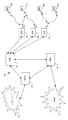
도 1에 도시된 바와 같이, 무선 통신 네트워크(10)는 일반적으로 다수의 이동국(가입자 유닛 또는 사용자 장치로도 지칭됨)(12a-12d), 다수의 기지국(기지국 트랜시버(BTS) 또는 노드 B로도 지칭됨)(14a-14c), 기지국 제어기(BSC)(무선 네트워크 제어기 또는 패킷 제어 기능부)(16), 이동 스위칭 센터(MSC) 또는 스위치(18), 패킷 데이터 서빙 노드(PDSN) 또는 인터넷워킹 기능부(IWF)(20), 공중 교환 전화망(PSTN)(22)(통상적으로 전화 회사), 및 인터넷 프로토콜(IP) 네트워크(24)(통상적으로 인터넷)를 포함한다. 간략성을 위해서, 4개의 이동국(12a-12d), 3개의 기지국(14a-14c), 하나의 BSC(16), 하나의 MSC(18), 및 하나의 PDSN(20)이 도시되어 있다. 당업자라면 임의의 수의 이동국(12), 기지국(14), BSC(16), MSC(18) 및 PDSN(20)이 존재할 수 있다는 것을 알 것이다.As shown in FIG. 1, the
일실시예에서, 무선 통신 네트워크(10)는 패킷 데이터 서비스 네트워크이다. 이동국들(12a-12d)은 휴대용 전화기, IP에 기반하여 가동하는 랩톱 컴퓨터에 접속되는 셀룰러 전화기, 웹-브라우저 애플리케이션들, 연관된 핸즈프리 카 킷트를 가진 셀룰러 전화기, IP에 기초하여 가동하는 PDA(personal data assistant), 휴대용 컴퓨터에 통합되어 있는 무선 통신 모듈, 또는 무선 로컬 루프나 미터 판독 시스템에서 발견될 수 있는 것과 같은 고정 위치 통신 모듈과 같은 다수의 상이한 타입의 무선 통신 디바이스 중 임의의 디바이스일 수 있다. 가장 일반적인 실시예에서는, 이동국들은 임의의 타입의 통신 유닛일 수 있다.In one embodiment, the
이동국들(12a-12d)은 예컨대 EIA/TIA-707 표준에 설명된 바와 같은 하나 이상의 무선 패킷 데이터 프로토콜을 수행하도록 유리하게 설계될 수 있다. 특정 실시예에서, 이동국(12a-12d)은 IP 네트워크(24)로 향하는 IP 패킷들을 생성하며, 포인트-투-포인트 프로토콜(PPP)을 이용하여 IP 패킷들을 프레임들에 캡슐화한다.
일실시예에서, IP 네트워크(24)는 PDSN(20)에 연결되고, PDSN(20)은 MSC(18)에 연결되고, MSC는 BSC(16) 및 PSTN(22)에 연결되며, BSC(16)는 예컨대 E1, T1, 비동기 전송 모드(ATM), IP, PPP 프레임 중계, HDSL, ADSL, 또는 xDSL을 포함해서 수 가지의 알려진 프로토콜 중 임의의 프로토콜 따라 음성 및/또는 데이터 패킷들의 전송을 위해 구성되도록 무선라인을 통해서 기지국들(14a-14c)에 연결된다. 다른 실시예에서는, BSC(16)는 PDSN(20)에 직접 연결되고, MSC(18)는 PDSN(20)에 연결되지 않는다.In one embodiment,
무선 통신 네트워크(10)의 통상적인 동작 동안에, 기지국(14a-14c)은 전화 통화, 웹 브라우징, 또는 다른 데이터 통신 중에 있는 여러 이동국들(12a-12d)로부터 역방향 신호 세트를 수신하여 복조한다. 주어진 기지국(14a-14c)에 의해 수신된 각각의 역방향 신호는 그 기지국(14a-14c) 내에서 처리된다. 각각의 기지국(14a-14c)은 순방향 신호 세트를 변조하여 이동국(12a-12d)에 전송함으로써 다수의 이동국(12a-12d)과 통신할 수 있다. 예컨대, 도 1에 도시된 바와 같이, 기지국(14a)은 제 1 및 제 2 이동국(12a, 12b)과 동시에 통신하고, 기지국(14c)은 제 3 및 제 4 이동국(12c, 12d)과 동시에 통신한다. 그로 인한 패킷들은 BSC(16)에 전송되고, 상기 BSC(16)는 한 기지국(14a-14c)으로부터 또 다른 기지국(14a-14c)으 로 특정 이동국(12a-12d)을 위한 통화의 소프트 핸드오프 조정을 포함해서 통화 자원 할당 및 이동성 관리 기능을 제공한다. 예컨대, 이동국(12c)은 2개의 기지국(14b, 14c)과 동시에 통신한다. 결국, 이동국(12c)이 기지국들 중 하나(14c)로부터 충분히 멀리 떨어져 이동할 때는, 통화는 다른 기지국(14b)으로 핸드오프될 것이다.During normal operation of the
만약 전송이 종래의 전화 통화라면, BSC(16)는 수신된 데이터를 MSC(18)에 라우팅할 것이고, 상기 MSC(18)는 PSTN(22)과의 인터페이스를 위한 추가적인 라우팅 서비스를 제공할 것이다. 만약 전송이 IP 네트워크(24)로 향하는 데이터 통화와 같이 패킷에 기반한 전송이라면, MSC(18)는 데이터 패킷들을 PDSN(20)에 라우팅할 것이고, 상기 PDSN(20)은 패킷들을 IP 네트워크(24)에 전송할 것이다. 선택적으로, BSC(16)는 패킷들을 PDSN(20)에 직접 라우팅할 것이며, 상기 PDSN(20)은 패킷들을 IP 네트워크(24)에 전송한다.If the transmission is a conventional telephone call, the
일부 통신 시스템들에서, 패킷 전달 데이터 트래픽은 서브패킷들로 분할되고, 상기 서브패킷들은 전송 채널의 슬롯들을 점유한다. 단지 용이하게 도시하기 위해서, cdma2000 시스템의 명명이 여기서 사용된다. 그러한 사용은 본 명세서에서 실시예들의 구현을 cdma2000 시스템들로 제한하도록 의도되지는 않는다. 실시예들은, 본 명세서에 설명된 실시예들의 범위에 영향을 주지 않으면서, 예컨대 WCDMA와 같은 다른 시스템으로 구현될 수 있다.In some communication systems, packet forwarding data traffic is divided into subpackets, which occupy slots of a transport channel. For ease of illustration only, the naming of the cdma2000 system is used here. Such use is not intended to limit the implementation of embodiments herein to cdma2000 systems. Embodiments may be implemented in other systems, such as, for example, WCDMA, without affecting the scope of the embodiments described herein.
cdma2000 시스템에서는, 슬롯 크기들이 1.25ms의 지속기간(duration)으로 지정되었다. 또한, 데이터 트래픽은 메시지 프레임들로 전송될 수 있고, 상기 메시 지 프레임들은 예컨대 1.25ms, 2.5ms, 5ms, 10ms, 20ms, 40ms, 또는 80ms의 지속기간들로 각기 상이할 수 있다. "슬롯들" 및 "프레임들"이란 용어는 동일한 CDMA 시스템들 내에서나 또는 상이한 CDMA 시스템들 사이에서 상이한 데이터 채널들에 대해 사용되는 용어들이다. CDMA 시스템은 순방향 및 역방향 링크들 상에 많은 채널들을 포함하는데, 여기서 일부 채널들은 다른 것들과 상이하게 구성된다. 따라서, 일부 채널들을 설명하기 위한 용어는 채널 구조에 따라 상이할 것이다. 단지 도시를 위해서, "슬롯들"이란 용어는 무선으로 전파되는 신호들의 패키징을 설명하도록 이후로 사용될 것이다.In the cdma2000 system, slot sizes were specified with a duration of 1.25 ms. In addition, data traffic may be sent in message frames, which may differ, for example, with durations of, for example, 1.25 ms, 2.5 ms, 5 ms, 10 ms, 20 ms, 40 ms, or 80 ms. The terms "slots" and "frames" are terms used for different data channels within the same CDMA systems or between different CDMA systems. A CDMA system includes many channels on the forward and reverse links, where some channels are configured differently from others. Thus, the terminology for describing some channels will differ depending on the channel structure. For illustration purposes only, the term "slots" will be used later to describe the packaging of signals propagated over the air.
기지국으로부터 상기 기지국의 범위 내에서 동작하는 원격국으로의 순방향 링크는 다수의 채널들을 포함할 수 있다. 상기 순방향 링크의 채널들 중 일부는 파일럿 채널, 동기 채널, 페이징 채널, 퀵 페이징 채널, 방송 채널, 전력 제어 채널, 할당 채널, 제어 채널, 지정 제어 채널, 매체 액세스 제어(MAC) 채널, 기본 채널, 보조 채널, 보조 코드 채널, 및 패킷 데이터 채널을 포함할 수 있지만, 반드시 그러한 것들로 제한되지는 않는다. 원격국으로부터 기지국으로의 역방향 링크도 또한 다수의 채널들을 포함한다. 각각의 채널은 상이한 타입의 정보들을 타겟 착신국에 전달한다. 통상적으로, 음성 트래픽은 기본 채널들을 통해 전달되고, 데이터 트래픽은 보조 채널들이나 패킷 데이터 채널들을 통해 전달된다. 보조 채널들은 일반적으로 전용 채널들인 반면에, 패킷 데이터 채널들은 일반적으로 시간-다중화 방식으로 여러 수신자들에 대해 지정된 신호들을 전달한다. 선택적으로, 패킷 데이터 채널들은 공유된 보조 채널들로서 또한 설명된다. 본 명세서의 실시예들을 설명하기 위해서, 보조 채널들 및 패킷 데이터 채널들은 총칭적으로 데이터 트래픽 채널들로 지칭된다.The forward link from a base station to a remote station operating within range of the base station may include a number of channels. Some of the channels of the forward link include a pilot channel, a synchronization channel, a paging channel, a quick paging channel, a broadcast channel, a power control channel, an allocation channel, a control channel, a designated control channel, a medium access control (MAC) channel, a basic channel, And may include, but are not necessarily limited to, an auxiliary channel, an auxiliary code channel, and a packet data channel. The reverse link from the remote station to the base station also includes a number of channels. Each channel conveys different types of information to the target destination station. Typically, voice traffic is carried on the primary channels and data traffic is carried on the secondary channels or packet data channels. Auxiliary channels are generally dedicated channels, while packet data channels generally carry signals designated for multiple receivers in a time-multiplexed manner. Optionally, packet data channels are also described as shared auxiliary channels. To describe the embodiments herein, auxiliary channels and packet data channels are collectively referred to as data traffic channels.
통상적으로, 기지국 내의 스케줄러 유닛이나 다른 인프라구조 엘리먼트가 다중 원격국들을 위한 전송 데이터를 수신하였을 때는, 시스템 스케줄링 알고리즘이 여러 원격국들에 대한 데이터의 우선순위를 결정하도록 구현된다. 가장 높은 우선순위를 갖는 원격국은 상기 원격국들이 TDMA 방식으로 다중화되는 시스템에서 먼저 전송하도록 스케줄링된다. 가장 높은 우선순위를 가진 원격국에 대한 데이터가 전송된 이후에, TDMA-타입 시스템은 나머지 모든 원격국들의 우선순위를 갱신할 것이고 그로 인해 나머지 원격국들 중 어느 것이 가장 높은 우선순위를 갖는지를 결정한다. 따라서, TDMA-타입 시스템은 가장 높은 우선순위 인덱스만을 이용하고 나머지를 버린다. 그러나, 위에서 논의된 바와 같이, 그러한 스케줄링 방법은 전체 슬롯을 통해 단지 하나의 원격국에 대한 데이터만을 전송하는 것은 효율적이지 않기 때문에 최적이 아니다.Typically, when a scheduler unit or other infrastructure element in a base station receives transmission data for multiple remote stations, a system scheduling algorithm is implemented to prioritize the data for the multiple remote stations. The remote station with the highest priority is scheduled to transmit first in a system in which the remote stations are multiplexed in a TDMA manner. After data for the remote station with the highest priority has been transmitted, the TDMA-type system will update the priority of all remaining remote stations, thereby determining which of the remaining remote stations has the highest priority. do. Thus, the TDMA-type system uses only the highest priority index and discards the rest. However, as discussed above, such a scheduling method is not optimal because it is not efficient to transmit data for only one remote station over the entire slot.
본 명세서에서 설명된 실시예들은 최적화된 스케줄링 알고리즘의 구현에 관한 것인데, 다중 사용자들은 할당된 시간 기간(time duration)에 걸쳐 전송하도록 스케줄링될 수 있다. 특히, 실시예들은 데이터 패킷들을 위한 여러 전송 포맷들을 선택함으로써 단일 슬롯을 통해 다중 사용자들을 위한 동시적인 데이터 전송이 달성될 수 있는 시스템에 관한 것이다.Embodiments described herein relate to implementation of an optimized scheduling algorithm wherein multiple users may be scheduled to transmit over an assigned time duration. In particular, embodiments relate to a system in which simultaneous data transmission for multiple users can be achieved over a single slot by selecting several transport formats for data packets.
일실시예에서, 우선순위 정보 및 각각의 타겟 원격국과 연관된 채널 상태 정보는 타겟 원격국들 각각을 위한 데이터의 전송 포맷을 결정하는데 이용된다. 우선순위 정보는 일반적으로 기지국 내의 스케줄러 유닛이나 또 다른 인프라구조 엘 리먼트에 의해 결정된다.In one embodiment, the priority information and channel state information associated with each target remote station is used to determine the transmission format of the data for each of the target remote stations. Priority information is generally determined by a scheduler unit or another infrastructure element in the base station.
또 다른 실시예에서, 목표 원격국들 각각을 위한 데이터 전송 포맷의 결정은 레버뉴 함수(revenue function)를 극대화시키는 전송 포맷의 선택에 기초한다. 적합한 레버뉴 함수가 아래에서 설명된다.In yet another embodiment, the determination of the data transmission format for each of the target remote stations is based on the selection of the transmission format that maximizes the leverage function. Suitable levernew functions are described below.
또 다른 실시예에서, 타겟 원격국들 각각을 위한 데이터 전송 포맷의 선택은 레버뉴 함수를 극대화시키는 것에 기초하고, 이용가능한 전송 전력 및 이용가능한 확산 코드들에 또한 기초한다.In yet another embodiment, the selection of the data transmission format for each of the target remote stations is based on maximizing the leverage function, and also based on the available transmission power and available spreading codes.
도 2는 할당된 시간 기간 동안에 기지국으로부터 다중 원격국들로의 다중의 동시 전송을 위한 전송 포맷들을 선택하기 위한 절차를 설명한다. 상기 선택 절차는 기지국 내의 부가적인 처리 엘리먼트 및 메모리 엘리먼트에 의해 구현될 수 있거나, 또는 상기 선택 절차는 기지국 내에 이미 존재하는 처리 엘리먼트들 및 메모리 엘리먼트들로 이루어질 수 있다. 여러 다른 인프라구조 엘리먼트들은 또한 설명된 방법 단계들을 구현하는 역할을 할 수 있다. 단계(200)에서, 기지국은 기지국의 범위 내에서 동작하는 상이한 원격국들에 송신하기 위하여 무선 통신 네트워크로부터 여러 데이터 트래픽 메시지들을 수신한다. 단계(202)에서, 기지국 내의 스케줄러 유닛이나 다른 인프라구조 엘리먼트는 데이터 트래픽 메시지를 수신하기 위한 L 개의 최상의 후보 원격국들을 선택한다. L개의 최상의 후보 원격국들은 U1, U2,..., 및 UL로서 지칭된다. L개의 최상의 후보 이동국들을 결정하는데 있어, 기지국은 우선순위 인덱스 P1, P2,..., 및 PL을 U1, U2,..., 및 UL에 할당하는데, 여기서 P1 ≥P2 ≥...≥PL이다. 각각의 후보 원격국 U1, U2,..., 및 UL은 각각 데이터 페이로드 N1, N2,..., 및 NL의 의도된 수신인데, 여기서 페이로드는 각각의 원격국으로 전송될 정보 비트들의 양에 기반하여 결정될 수 있다.2 illustrates a procedure for selecting transmission formats for multiple simultaneous transmissions from a base station to multiple remote stations during an allocated time period. The selection procedure may be implemented by additional processing elements and memory elements in the base station, or the selection procedure may consist of processing elements and memory elements already present in the base station. Various other infrastructure elements may also serve to implement the described method steps. In
일부 통신 시스템들은 원격국들로부터 캐리어-대-간섭비(C/I)와 같은 채널 상태 정보를 수집할 수 있다는 것을 알아야 한다. 원격국들은 파일럿 채널의 선험적인 정보를 이용함으로써 전송 매체의 특징들을 결정한다. 본 명세서에서 설명된 실시예들은 각각의 원격국을 위한 최적의 전송 포맷을 선택하기 위해서 그러한 채널 상태 정보(C/I)를 이용할 수 있다. (C/I)1, (C/I)2,..., 및 (C/I)L이 모든 후보 원격국들에 의해 보고되는 채널 상태 정보라고 하자.It should be appreciated that some communication systems can collect channel state information, such as carrier-to-interference ratio (C / I), from remote stations. Remote stations determine the characteristics of the transmission medium by using a priori information of the pilot channel. Embodiments described herein may use such channel state information (C / I) to select the optimal transmission format for each remote station. Assume that (C / I) 1 , (C / I) 2 , ..., and (C / I) L are channel state information reported by all candidate remote stations.
미리 결정된 전송 포맷(F0, F1, F2,..., 및 FM-1)은 기지국 내에 저장되는데, 각각의 전송 포맷(Fi)은 여러 전송 파라미터들의 결합에 상응한다. 일시예에서, 전송 포맷(Fi)은 시스템에 의해 사용되는 변조 방식, 직교 또는 준-직교 코드들의 수, 비트 단위의 데이터 페이로드 크기, 관리 프레임의 지속시간, 및/또는 인코딩 방식에 대한 상세사항과 같은 전송 파라미터들 중 임의의 파라미터나 그것들 모두의 결합에 상응한다. 통신 시스템들 내에 사용되는 변조 방식들의 일부 예로는 QPSK(Quadrature Phase Shift Keying scheme), 8-PSK(8-ary Phase Shift Keying scheme), 및 16-QAM(16-ary Quadrature Amplitude Modulation)이 있다. 선택적으로 구현될 수 있는 여러 인코딩 방식들 중 일부는 통상적인 인코딩 방식들인데, 이 는 여러 레이트 또는 터보 인코딩으로 구현되며, 상기 터보 인코딩은 인터리빙 단계들에 의해 분리되는 다중 인코딩 단계들을 포함한다.The predetermined transmission formats F 0 , F 1 , F 2 ,..., And F M-1 are stored in the base station, each transmission format F i corresponding to a combination of several transmission parameters. In one example, the transmission format F i is a detail of the modulation scheme used by the system, the number of orthogonal or quasi-orthogonal codes, the data payload size in bits, the duration of the management frame, and / or the encoding scheme. Correspond to any of the transmission parameters such as Some examples of modulation schemes used in communication systems are Quadrature Phase Shift Keying scheme (QPSK), 8-ary Phase Shift Keying scheme (8-PSK), and 16-ary Quadrature Amplitude Modulation (16-QAM). Some of the various encoding schemes that may optionally be implemented are conventional encoding schemes, which are implemented at various rates or turbo encodings, which include multiple encoding stages separated by interleaving stages.
월시 코드들과 같은 직교 및 준-직교 코드들은 각각의 원격국으로부터 전송되는 정보를 채널화하기 위해 이용된다. 즉, 시스템으로 하여금 다중 사용자들을 동일한 시간 기간 동안에 동일한 주파수 상에 중복시킬 수 있도록 순방향 링크 상에서 이용되는데, 각각의 다중 사용자에게는 상이한 직교 또는 준-직교 코드가 할당된다.Orthogonal and quasi-orthogonal codes such as Walsh codes are used to channelize information sent from each remote station. That is, it is used on the forward link to allow the system to duplicate multiple users on the same frequency for the same time period, with each multiple user being assigned a different orthogonal or quasi-orthogonal code.
따라서, 기지국은 다양한 전송 포맷들에 따라 데이터 페이로드를 전송하는 선택사항을 갖는다. 도시를 위해서, 전송 포맷에 따라 기지국에 의해서 구성되어진 데이터 페이로드는 프레임으로 지칭될 것이다. 본 실시예를 위해서, F0이란 용어는 원격국으로의 전송이 존재하지 않는 경우에 상응한다.Thus, the base station has the option of transmitting data payloads in accordance with various transmission formats. For illustration purposes, the data payload configured by the base station according to the transmission format will be referred to as a frame. For the present embodiment, the term F 0 corresponds to the case where there is no transmission to the remote station.
일단 기지국이 L개의 최상의 후보들 및 그것들의 연관된 우선순위를 결정하면, 단계(210)에서는, 기지국이 각각의 Ui에 대한 프레임 포맷(fi)을 선택함으로써, 프레임 포맷 그룹(f1, f2,..., 및 fL)이 레버뉴 함수 J()를 극대화시킨다. 가능한 레버뉴 함수의 일예가 아래에서 더 상세히 설명될 것이다.Once the base station determines the L best candidates and their associated priorities, in
일실시예에서, 기지국은 세트(F0, F2,..., FM-1)로부터 가능한 프레임 포맷들의 서브세트(f1 -test, f2 -test,..., 및 fL-test)를 선택함으로써 선택을 수행하고, 특정 조건들이 충족되는지 여부를 결정한다. 일실시예에서는, 4개의 조건들이 다음과 같이 이용된다:In one embodiment, the base station selects a subset of possible frame formats f 1 -test , f 2 -test , ..., and f L- from the set F 0 , F 2 , ..., F M-1 . test ) to make a selection and determine whether certain conditions are met. In one embodiment, four conditions are used as follows:
1. 
여기서, Nb _Walsh(Fi)는 전송 포맷(Fi)에서 이용되는 월시 코드의 수이며, Nb_Walsh(F0)=0이다. "Total Available Walsh Codes for Packet Data"인 양은 동작 중에 기지국에서 결정될 수 있는 파라미터이다.Here, Nb _Walsh (F i) is the number of Walsh codes used in the transmission format (F i), a Nb_Walsh (F 0) = 0. The amount of "Total Available Walsh Codes for Packet Data" is a parameter that can be determined at the base station during operation.
2. 
여기서, Ei (Fi)는 전송 포맷(Fi)을 이용하는 Ui로의 전송에 필요한 최소 전력이다. "Total Available Power for Packet Data"인 양은 동작 중에 기지국에서 결정될 수 있는 파라미터이다. 이러한 파라미터는 전송 포맷(Fk)뿐만 아니라 원격국(Ui)의 C/I의 함수이다.Here, E i (F i ) is the minimum power required for transmission to U i using the transmission format F i . The amount of "Total Available Power for Packet Data" is a parameter that can be determined at the base station during operation. This parameter is a function of the C / I of the remote station U i as well as the transmission format F k .
3. 
여기서, Payload(fi)는 비트 단위의 Fi의 데이터 페이로드이고, Ni는 Ui에 송신될 데이터 페이로드이다.Here, Payload (f i ) is a data payload of F i in units of bits, and N i is a data payload to be transmitted to U i .
4. 
여기서, FrameDuration(Fi)는 전송 포맷(Fi)에 명시된 프레임 지속기간이다. 어느 하나의 i∈{1,2,...,L}에 대해서라도 fi=F0인 경우에는, L 미만의 사용자들이 스케줄링된다.Here, FrameDuration (F i ) is the frame duration specified in transport format F i . If f i = F 0 for any one i∈ {1,2, ..., L}, users less than L are scheduled.
일단 기지국이 레버뉴 함수 J()를 극대화시키는 프레임 포맷 그룹(f1, f2,..., 및 fL)을 선택하면, 단계(220)에서는, 기지국이 할당된 시간 지속기간에 걸쳐 L 프레임 포맷(f1, f2,..., 및 fL)을 이용하여 L명의 사용자들에게 메시지 프레임을 동시에 전송한다.Once the base station selects the frame format groups f 1 , f 2 ,..., And f L that maximize the leverage function J (), in
레버뉴Lever New 함수 J()의 예 Example of function J ()
전송 포맷을 선택하기 위한 위의 실시예들은 레버뉴 함수에 적용되는 우선순위 정보의 사용에 기초한다. 레버뉴 함수는 데이터 스루풋을 극대화시키는 동시에 지정된 공정성 정도를 보장하는 임의의 함수일 수 있다. "공정성(fairness)"은 시스템 제공자의 요구에 따른 주관적인 양이다. 예컨대, 시스템 제공자는 긴 시간 기간에 걸쳐 단일 사용자가 큰 데이터 전송을 위해 자원들을 독차지하는 것이 용인될 수 없다고 결정할 수 있다. 그러나, 시스템 제공자는 짧은 시간 기간에 걸쳐 단일 사용자가 자원들을 독차지하는 것이 용인가능하다고 결정할 수 있다. 공정성은 또한 데이터 페이로드의 도착 시간이나 데이터 페이로드의 본래 포인트나 데이터 페이로드의 양으로 규정되어야 한다. 공정성은 또한 서비스 품질이나 통신 액세스 가격으로 규정되어야 한다. 이러한 예들은 "공정성"이 매우 상이한 방식으로 정의될 수 있는 시스템 제약사항이라는 것을 나타낸다. 그러나, "공정성"의 양은 적절한 레버뉴 함수에 의한 고려사항으로 인수화된다.The above embodiments for selecting a transport format are based on the use of priority information applied to the leverage function. The levernew function may be any function that maximizes data throughput while ensuring a specified degree of fairness. "Fairness" is the subjective amount required by the system provider. For example, the system provider may determine that over a long period of time a single user cannot tolerate resources for large data transfers. However, the system provider may determine that over a short period of time it is acceptable for a single user to take up resources. Fairness must also be defined as the arrival time of the data payload or the original point of the data payload or the amount of data payload. Fairness should also be defined as quality of service or communication access price. These examples indicate that "fairness" is a system constraint that can be defined in a very different way. However, the amount of "fairness" is factored into consideration by the appropriate lever function.
일실시예에서는, 다음의 레버뉴 함수 J()가 이용될 수 있다:In one embodiment, the following lever function J () may be used:

여기서, α≥0는 공정성을 제어하는 상수이고, Pi는 원격국 Ui에 대한 우선순위이고, Payload(fi)는 비트 단위의 Fi의 데이터 페이로드이다.Here,? ≧ 0 is a constant controlling fairness, P i is priority for the remote station U i , and Payload (f i ) is the data payload of F i in units of bits.
위의 레버뉴 함수를 이용함으로써, 데이터 페이로드가 큰 수의 비트를 포함하거나 우선순위 인덱스가 높을 경우에 메시지 프레임은 스케줄링되기 쉬울 것이다.By using the leverage function above, a message frame will be easy to schedule if the data payload contains a large number of bits or if the priority index is high.
또 다른 실시예에서는 다음의 레버뉴 함수 J()가 이용될 수 있다:In another embodiment, the following lever function J () may be used:

여기서, α≥0는 공정성을 제어하는 상수이다.Here,? ≥0 is a constant controlling the fairness.
앞의 레버뉴함수를 사용하여, 가장 높은 우선순위를 가진 원격국은 항상 공정성을 유지하도록 스케줄링될 것이다. Using the previous levernew function, the remote station with the highest priority will be scheduled to maintain fairness at all times.
도 2에 기술된 전송 포맷 선택 프로세스는 주어진 레버뉴함수를 최대화하는 전송 포맷들을 선택하는 방법을 기술한다. 다른 실시예들이 존재한다. 최상의 다중 포맷들 f1, f2,..., fL을 선택하는 방법에 관한 다른 실시예는 다중 사용자들이 실제로 스케줄링될때 여기에 기술된다. 또 다른 실시예는 단지 하나의 사용자가 실제 스케줄링되는 경우에((F0)를 제외함) 최상의 전송 포맷을 선택하는 방법에 대하여 기술한다. 이들 선택들은 레버뉴함수 J() 및 대응하는 전송포맷들을 최대화하기 위하여 사용자들이 얼마나 많이 스케줄링되어야하는지 그리고 어느 사용자가 스케줄링되어야 하는지를 결정하기 위하여 추가로 분석될 수 있다. The transport format selection process described in FIG. 2 describes a method for selecting transport formats that maximize a given leverage function. Other embodiments exist. Another embodiment of how to select the best multiple formats f 1 , f 2 , ..., f L is described here when multiple users are actually scheduled. Another embodiment describes a method for selecting the best transmission format when only one user is actually scheduled (except for (F 0 )). These choices can be further analyzed to determine how many users should be scheduled and which users should be scheduled to maximize the leverage function J () and corresponding transmission formats.
도 3은 단지 하나의 사용자만이 스케줄링되는 경우에 최상의 전송 포맷을 선 택하는 방법에 관한 실시예를 기술한다. 이는 단지 하나의 원격국이 스케줄링되나 동일한 레버뉴함수를 만족하는 다중 전송포맷들이 존재하는 예에 대한 선택기준을 포함한다. 3 describes an embodiment of a method of selecting the best transmission format when only one user is scheduled. This includes selection criteria for an example where only one remote station is scheduled but there are multiple transmission formats that satisfy the same leverage function.
단계(300)에서, 기지국은 버퍼내의 우선순위 인덱스 또는 정보 비트들에 기초하여 제 1목표(U1)를 선택한다. 단계(302)에서, 기지국은 U1에 대한 데이터 트래픽 페이로드의 적어도 하나의 가능한 전송포맷을 선택한다. 일 실시예에서, 다수의 가능한 전송 포맷들의 선택은 시스템 스루풋을 최대화하는 레버뉴함수에 기초한다. 단계(304)에서, 만일 하나 이상의 가능한 전송포맷이 존재하면, 프로그램 흐름은 단계(306)로 진행한다. 레버뉴함수 J()를 최대화하는 다중 전송 포맷들이 존재하면 하나 이상의 가능한 전송포맷이 존재할 것이다. 만일 단지 하나의 가능한 전송포맷이 가능하면 프로그램 흐름은 단계(308)로 진행하며, 기지국은 선택된 전송포맷에 따라 데이터 트래픽 페이로드를 포맷시킨다. In
단계(306)에서, 기지국은 가장 적은 월시 코드들을 요구하는 전송포맷에 기초하여 최적 전송 포맷을 선택한다. 단계(320)에서, 기지국은 선택된 최적 전송포맷에 따라 데이터 트래픽 페이로드를 포맷시킨다. In
도 4는 다중 원격국들이 전송을 위하여 스케줄링될 필요가 있을때 선택기준에 대한 다른 실시예를 기술한다. 목표 원격국들에 대한 후보들을 V1, V2, ...,로 표시하며, 여기서 Vi는 P1≥P2≥...≥PL이도록 우선순위 인덱스 Pi와 연관된다. 4 illustrates another embodiment for selection criteria when multiple remote stations need to be scheduled for transmission. Candidates for target remote stations are denoted by V 1 , V 2 , ..., where V i is associated with priority index P i such that P 1 ≥ P 2 ≥ ... ≥ P L.
단계(400)에서, 기지국은 가장 높은 우선순위 목표 원격국으로서 V1을 지정하 며 변수 Vi에 대하여 인덱스 i=2를 세팅한다.In
단계(402)에서, 기지국은 시스템에 의하여 지원될 수 있는 V1 및 Vi에 대한 모든 전송포맷들을 결정한다. 양호한 전송 포맷쌍의 세트는 {(fj,fk):1≤j, k≤L, 여기서 j≠k이고 L은 동시에 스케줄링될 수 있는 최대수의 원격국들이다}로 표시된다. 일 실시예에서, 기지국은 시스템이 전송 포맷들을 지원할 수 있는지의 여부를 결정하기 위하여 전송 포맷들의 각각과 연관된 필요한 최소 전송 전력, 프레임 기간 및/또는 월시코드들의 수를 평가한다.In
단계(404)에서, 기지국은 단계(402)에서 결정된 각각의 전송 포맷쌍(fj,fk)에 대하여 미사용으로 남아있는 월시코드들 및 전송전력과 같은 시스템 자원량을 결정한다. In
단계(410)에서, 기지국은 각 전송 포맷쌍에 대한 주어진 레버뉴함수 J()를 평가한다. 레버뉴함수 J()를 최대화하는 전송 포맷쌍은 최상의 쌍으로서 선택된다. 단계(412)에서, 레버뉴함수를 최대화하는 다중 전송포맷쌍들이 존재하는지의 여부에 관한 결정이 이루어진다. 만일 레버뉴함수를 최대화하는 전송포맷들의 하나 이상의 쌍이 존재하면, 단계(414)에서, 기지국은 가장 적은 월시 코드들을 필요로하는 전송 포맷쌍을 선택한다. 그 다음에, 프로그램 흐름은 단계(420)로 진행한다. 만일 레버뉴함수를 최대화하는 전송포맷들의 단지 하나의 쌍이 존재하면, 프로그램 흐름은 단계(420)로 진행한다.In
단계(420)에서, 기지국은 V1 및 Vi에 대한 최상의 전송 포맷이 이전 최상의 전송 포맷쌍보다 양호한지의 여부를 결정한다. 다시 말해서, 기지국은 이전 라운드로부터 결정된 최상의 전송 포맷쌍과 현재 라운드동안 결정된 최상의 전송 포맷쌍을 비교한다. 이러한 비교로부터의 최상의 전송 포맷쌍은 V1과 함께 스케줄링될 최상의 후보 원격국을 결정한다.In
단계(430)에서, 인덱스 i는 증분되며, 앞의 단계들은 모든 후보들이 소모될때까지 반복된다. i가 마지막 증분값에 도달할때, 단계(440)에서, 기지국은 결정된 최상의 전송포맷에 따라 V1 및 Vbest로의 전송들을 동시에 스케줄링한다. At
선택적으로, 앞의 프로세스는 다중루프들을 사용하여 재기록될 수 있으며, 여기서 외부루프는 각각의 Vi을 스캐닝하며, 중앙 루프는 V1에 대한 각각의 가능한 전송포맷을 스캐닝하며, 내부루프는 나머지 월시코드들 및 나머지 전력을 사용하여 제 2사용자에 대한 후보들을 스캐닝한다. 당업자에게 공지된 바와같이, 프로그래밍 구현은 여기에 기술된 실시예들의 범위에 영향을 미치지 않고 변화할 수 있다.Optionally, the preceding process can be rewritten using multiple loops, where the outer loop scans each V i , the central loop scans each possible transmission format for V 1 , and the inner loop the remaining Walsh. The candidates for the second user are scanned using the codes and the remaining power. As is known to those skilled in the art, programming implementations may vary without affecting the scope of the embodiments described herein.
전술한 실시예들은 두개의 원격국으로의 동시 전송들을 위하여 최상의 전송포맷들에 대한 탐색을 기술한다. 그러나, 전술한 실시예는 두개 이상의 원격국들로의 최상의 전송포맷들에 대한 탐색을 기술하기 위하여 확장될 수 있다. 단지 V1 및 Vi에 대한 모든 전송포맷들의 탐색보다 오히려, 기지국은 V1 내지 Vm에 대한 모든 전송포맷들을 탐색할 수 있으며, 여기서 m은 m개의 다중국들로의 동시 전송의 수이다. 여기서, 전송 포맷쌍의 평가보다 오히려, 시스템은 주어진 레버뉴함수를 최대화하도록 세팅된 전송포맷을 평가한다. The above-described embodiments describe the search for the best transmission formats for simultaneous transmissions to two remote stations. However, the embodiment described above can be extended to describe the search for the best transmission formats to two or more remote stations. Rather than just searching all transmission formats for V 1 and V i , the base station can search all transmission formats for V 1 to V m , where m is the number of simultaneous transmissions to m multiple stations. Here, rather than evaluating a transport format pair, the system evaluates the transmission format set to maximize a given lever function.
다른 실시예에서, 시스템 자원들을 더 충분히 활용하기 위하여 여기에 개시된 시스템에 추가 단계가 부가될 수 있다. 기지국이 동시 다중전송들에 대한 최적의 전송포맷들을 선택한후에, 기지국은 임의의 월시코드들 및 전력이 미사용으로 남는지의 여부를 결정한다. 만일 미사용 월시코드들 및 전력이 존재하는 경우에, 이들은 스케줄링될 원격국들사이에 할당된다. 할당은 원격국의 우선순위 인덱스들 및/또는 최소 전력요건들에 기초하여 균일하게 수행될 수 있다. 일 실시예에서, 나머지 월시코드들은 원격국들의 우선순위 인덱스들에 기초하여 할당된다. 다른 실시예에서, 나머지 전력은 최소 전력요건에 따라 비례적으로 할당된다.In other embodiments, additional steps may be added to the system disclosed herein to more fully utilize system resources. After the base station selects the optimal transmission formats for simultaneous multiplexings, the base station determines whether any Walsh codes and power remain unused. If unused Walsh codes and power are present, they are allocated between remote stations to be scheduled. Allocation may be performed uniformly based on remote station's priority indexes and / or minimum power requirements. In one embodiment, the remaining Walsh codes are assigned based on the priority indices of the remote stations. In another embodiment, the remaining power is proportionally allocated according to the minimum power requirement.
이전에 논의된 바와같이, 월시코드들 또는 다른 직교/준직교 코드들은 전송들의 채널을 개별 원격국들에 제공하는데 중요하다. 월시 코드들의 사용에 있어서 중요한 특징은 데이터 비트들 및 전송 전력레벨들을 커버하도록 세팅된 다수의 월시코드들사이의 상관관계이다. 추가 월시코드들이 오리지날 데이터 비트들을 확산시키기 위하여 사용될때 에러 제어 코딩 레이트들은 낮아지며 이에 따라 전송전력 효율성이 개선된다.As discussed previously, Walsh codes or other orthogonal / quasi-orthogonal codes are important for providing a channel of transmissions to individual remote stations. An important feature in the use of Walsh codes is the correlation between multiple Walsh codes set to cover data bits and transmit power levels. When additional Walsh codes are used to spread the original data bits, the error control coding rates are lowered, thereby improving transmission power efficiency.
따라서, 전술한 실시예들에 부가될 수 있는 또 다른 단계들은 임의의 전송전력이 기지국에 계속해서 할당되지 않는지의 여부를 결정하는 단계이다. 만일 임의의 나머지 전송전력이 존재하면, 기지국은 각 원격국에 대한 Ei(fk)에 따라 데이터 트래픽 페이로드들사이에 전력을 비례적으로 할당할 수 있다. Thus, further steps that may be added to the embodiments described above are determining whether any transmit power is not continuously assigned to the base station. If any remaining transmit power is present, the base station can allocate power proportionately between the data traffic payloads according to E i (f k ) for each remote station.
당업자는 다양한 다른 기술들중 일부를 사용하여 정보 및 신호들이 표현될 수 있다는 것을 이해해야 한다. 예컨대, 전술한 상세한 설명 전반에 걸쳐 참조될 수 있는 데이터, 지시들, 명령들 정보들, 신호들, 비트들, 심볼들 및 칩들은 전압들, 전류들, 전자기파들, 자기필드들 또는 입자들, 광필드들 또는 입자들 또는 이들의 결합으로 표현될 수 있다.Those skilled in the art should understand that information and signals may be represented using some of a variety of other techniques. For example, data, instructions, instructions information, signals, bits, symbols, and chips that may be referenced throughout the foregoing description may include voltages, currents, electromagnetic waves, magnetic fields or particles, It may be represented by light fields or particles or a combination thereof.
당업자는 여기에 기술된 실시예들과 관련하여 기술된 다양한 예시적인 논리블록들, 모듈들, 회로들, 및 알고리즘 단계들이 전자 하드웨어, 컴퓨터 소프트웨어 또는 이들의 결합으로서 실행될 수 있다는 것을 인식해야 한다. 설명을 명확하게 하기 위하여, 하드에어 및 소프트웨어, 다양한 예시적인 소자들, 블록들, 모듈들, 회로들 및 단계들의 호환성은 그들의 기능과 관련하여 앞서 설명되었다. 상기 기능은 하드웨어 또는 소프트웨어가 전체 시스템에 강제된 설계 제한들 및 특정응용에 의해 좌우되기 때문에 실행된다. 당업자는 각각의 특정응용을 위하여 다양한 방식들로 상기 기술된 기능을 실행할 수 있으나, 이러한 실행 결정들은 본 발명의 범위로부터 벗어나지 않고 해석되어야 한다. Those skilled in the art should appreciate that various exemplary logical blocks, modules, circuits, and algorithm steps described in connection with the embodiments described herein may be implemented as electronic hardware, computer software, or combinations thereof. For clarity of explanation, the compatibility of hard air and software, various exemplary elements, blocks, modules, circuits, and steps have been described above with regard to their functionality. This function is performed because the hardware or software depends on the specific application and design constraints imposed on the overall system. Skilled artisans may implement the described functionality in varying ways for each particular application, but such implementation decisions should be interpreted without departing from the scope of the present invention.
여기에 기술된 실시예들과 관련하여 기술된 다양한 예시적인 논리블록들, 모듈들 및 회로들은 범용 프로세서, 디지털 신호 프로세서(DSP), 주문형 집적회로(ASIC), 필드 프로그램가능 게이트 어레이(FPGA) 또는 다른 프로그램가능 논리장치, 개별 게이트 또는 트랜지스터 논리장치, 개별 하드웨어 소자들, 또는 여기에 기술된 기능들을 실행하도록 설계된 상기 소자들의 임의의 결합으로 실행될 수 있 다. 범용 프로세서는 마이크로프로세서일 수 있은, 대안적인 실시예에서 프로세서는 임의의 종래의 프로세서, 제어기, 마이크로제어기 또는 상태 머신일 수 있다. 프로세서는 컴퓨팅 장치들의 결합, 예컨대 DSP 및 마이크로프로세서의 결합, 다수의 마이크로프로세서들, DSP 코어와 관련된 하나 이사의 마이크로프세서들 또는 임의의 다른 구성으로서 실행될 수 있다. The various exemplary logical blocks, modules, and circuits described in connection with the embodiments described herein may be general purpose processors, digital signal processors (DSPs), application specific integrated circuits (ASICs), field programmable gate arrays (FPGAs), or the like. Other programmable logic devices, individual gate or transistor logic devices, individual hardware devices, or any combination of the above devices designed to perform the functions described herein. In an alternative embodiment, where a general purpose processor may be a microprocessor, the processor may be any conventional processor, controller, microcontroller, or state machine. A processor may be implemented as a combination of computing devices, such as a combination of a DSP and a microprocessor, multiple microprocessors, one or more microprocessors associated with a DSP core, or any other configuration.
여기에 기술된 실시예들과 관련하여 기술된 방법 또는 알고리즘의 단계들은 하드웨어로, 프로세서에 의하여 실행된 소프트웨어 모듈로 또는 이들 두개의 결합으로 직접 구현될 수 있다. 소프트웨어 모듈은 RAM 메모리, 플래시 메모리, ROM 메모리, EPROM 메모리, EEPROM 메모리, 레지스터들, 하드 디스크, 제거가능 디스크, CD-ROM, 또는 공지된 임의의 다른 형태의 저장매체에 상주할 수 있다. 예시적인 저장매체는 프로세서에 접속되며, 이러한 프로세서는 저장매체로부터 정보를 판독할 수 있고 또한 저장매체에 정보를 기록할 수 있다. 대안적으로, 저장매체는 프로세서에 통합될 수 있다. 프로세서 및 저장매체는 ASIC내에 배치될 수 있다. ASIC은 사용자 단말내에 배치될 수 있다. 대안적으로, 프로세서 및 저장매체는 사용자 단말에서 개별 소자들로서 배치될 수 있다.The steps of a method or algorithm described in connection with the embodiments described herein may be embodied directly in hardware, in a software module executed by a processor, or in a combination of the two. The software module may reside in RAM memory, flash memory, ROM memory, EPROM memory, EEPROM memory, registers, hard disk, removable disk, CD-ROM, or any other type of storage medium known in the art. An exemplary storage medium is connected to the processor, which can read information from and write information to the storage medium. In the alternative, the storage medium may be integral to the processor. The processor and the storage medium may be located in an ASIC. The ASIC may be located in a user terminal. In the alternative, the processor and the storage medium may reside as discrete components in a user terminal.
기술된 실시예들의 이전 상세한 설명은 당업자로 하여금 본 발명을 실시 또는 사용할 수 있도록 한다. 이들 실시예들에 대한 다양한 수정들이 당업자에 의하여 용이하게 수행될 것이며, 여기에서 정의된 일반적인 원리들은 본 발명의 사상 및 범위를 벗어나지 않고 다른 실시예들에 적용될 수 있다. 따라서, 본 발명은 여기에 기술된 실시예들에 제한되지 않고 여기에 기술된 원리 및 신규한 특징들과 일치하는 가장 넓은 범위를 따른다.The previous detailed description of the described embodiments enables one of ordinary skill in the art to make or use the present invention. Various modifications to these embodiments will be readily made by those skilled in the art, and the generic principles defined herein may be applied to other embodiments without departing from the spirit and scope of the invention. Thus, the present invention is not limited to the embodiments described herein but follows the widest scope consistent with the principles and novel features described herein.
도 1은 무선 통신 네트워크의 다이어그램.1 is a diagram of a wireless communication network.
도 2는 복수의 원격국들로의 다중의 동시적인 전송을 위한 전송 포맷들을 결정하는 방법을 설명하는 흐름도.2 is a flow chart illustrating a method of determining transmission formats for multiple simultaneous transmissions to a plurality of remote stations.
도 3은 하나의 원격국을 위한 가능한 전송 포맷들로부터 최적의 전송 포맷을 선택하는 것을 나타내는 흐름도.3 is a flow diagram illustrating selecting an optimal transmission format from possible transmission formats for one remote station.
도 4는 적어도 두 개의 원격국들을 위한 최적의 전송 포맷들을 선택하는 것을 나타내는 흐름도.4 is a flow diagram illustrating selecting optimal transmission formats for at least two remote stations.
Claims (9)
Applications Claiming Priority (3)
| Application Number | Priority Date | Filing Date | Title |
|---|---|---|---|
| US09/981,846 US6747994B2 (en) | 2001-10-17 | 2001-10-17 | Selecting optimal transmit formats for transmissions over allocated time durations |
| US09/981,846 | 2001-10-17 | ||
| PCT/US2002/033929 WO2003034641A1 (en) | 2001-10-17 | 2002-10-16 | Selecting optimal transmit formats for transmissions over allocated time durations |
Related Parent Applications (1)
| Application Number | Title | Priority Date | Filing Date |
|---|---|---|---|
| KR1020047005710A Division KR100933322B1 (en) | 2001-10-17 | 2002-10-16 | Choosing the best transmission format for transmission over an allotted time period |
Publications (2)
| Publication Number | Publication Date |
|---|---|
| KR20070110944A KR20070110944A (en) | 2007-11-20 |
| KR100933324B1 true KR100933324B1 (en) | 2009-12-22 |
Family
ID=25528692
Family Applications (2)
| Application Number | Title | Priority Date | Filing Date |
|---|---|---|---|
| KR1020047005710A Expired - Fee Related KR100933322B1 (en) | 2001-10-17 | 2002-10-16 | Choosing the best transmission format for transmission over an allotted time period |
| KR1020077025169A Expired - Fee Related KR100933324B1 (en) | 2001-10-17 | 2002-10-16 | Choosing the best transmission format for transmission over an allotted time period |
Family Applications Before (1)
| Application Number | Title | Priority Date | Filing Date |
|---|---|---|---|
| KR1020047005710A Expired - Fee Related KR100933322B1 (en) | 2001-10-17 | 2002-10-16 | Choosing the best transmission format for transmission over an allotted time period |
Country Status (8)
| Country | Link |
|---|---|
| US (2) | US6747994B2 (en) |
| EP (1) | EP1438798A1 (en) |
| JP (2) | JP4386727B2 (en) |
| KR (2) | KR100933322B1 (en) |
| CN (2) | CN1996815A (en) |
| BR (1) | BR0213347A (en) |
| TW (1) | TWI237964B (en) |
| WO (1) | WO2003034641A1 (en) |
Families Citing this family (39)
| Publication number | Priority date | Publication date | Assignee | Title |
|---|---|---|---|---|
| ES2281049T3 (en) * | 2000-10-24 | 2007-09-16 | Nortel Networks Limited | METHODS, SYSTEMS AND STRUCTURE OF SHARED CHANNEL. |
| US7133353B2 (en) * | 2001-01-08 | 2006-11-07 | Telefonaktiebolaget Lm Ericsson (Publ) | CDMA system using quasi-orthogonal codes |
| JP2003032753A (en) * | 2001-07-19 | 2003-01-31 | Nec Corp | System and method of public communication |
| KR100557101B1 (en) * | 2001-11-16 | 2006-03-03 | 삼성전자주식회사 | Method and apparatus for transmitting / receiving orthogonal code space indication information in mobile communication system |
| JP3799285B2 (en) * | 2002-03-29 | 2006-07-19 | Necインフロンティア株式会社 | Wireless LAN base station, wireless terminal and program |
| US7170876B2 (en) * | 2002-04-30 | 2007-01-30 | Qualcomm, Inc. | Outer-loop scheduling design for communication systems with channel quality feedback mechanisms |
| WO2003105007A1 (en) * | 2002-06-06 | 2003-12-18 | Thomson Licensing S.A. | Interworking function (iwf) as logical radio network controller (rnc) for hybrid coupling in an interworking between wlan and a mobile communications network |
| KR100896273B1 (en) * | 2002-06-17 | 2009-05-07 | 엘지전자 주식회사 | Determination of Walsh Space Mask Bitmap for Walsh Code Allocation |
| US20040204033A1 (en) * | 2002-10-17 | 2004-10-14 | Chia-Li Yang | Communication device connected to a first and a second communication networks |
| US7542440B2 (en) * | 2002-11-18 | 2009-06-02 | Samsung Electronics Co., Ltd. | Apparatus and method for providing quality of service for mixed traffic in a wireless network base station |
| US20050002529A1 (en) * | 2003-06-17 | 2005-01-06 | Rath Vannithamby | Extended walsh code space for forward packet data channel in IS-2000 system |
| CN100449975C (en) * | 2003-09-28 | 2009-01-07 | 华为技术有限公司 | A smoothing method for transmission format combination selection |
| US7564820B2 (en) * | 2003-11-21 | 2009-07-21 | Motorola, Inc. | Method and apparatus for resource allocation and scheduling |
| CN100373491C (en) * | 2004-03-30 | 2008-03-05 | 广明光电股份有限公司 | Optical drive and method for controlling operation of optical drive |
| KR100751101B1 (en) * | 2004-11-05 | 2007-08-22 | 주식회사 팬택앤큐리텔 | IP management system and method for a mobile phone |
| KR100594993B1 (en) | 2004-11-17 | 2006-07-03 | 삼성전기주식회사 | How to Send Discovery Response Packets in Communication Networks |
| US7426196B2 (en) * | 2005-01-28 | 2008-09-16 | Lucent Technologies Inc. | Method and apparatus for managing packet data resources |
| US7924772B2 (en) * | 2005-02-10 | 2011-04-12 | Nokia Corporation | Method and apparatus to support multi-user packets in a wireless communication system |
| US7558271B2 (en) * | 2005-10-21 | 2009-07-07 | International Business Machines Corporation | Method and apparatus for adaptive bandwidth control with defined priorities for different networks |
| US20070091922A1 (en) * | 2005-10-21 | 2007-04-26 | Steven Elliot | Method and apparatus for adaptive bandwidth control with a bandwidth guarantee |
| US20070104224A1 (en) * | 2005-11-04 | 2007-05-10 | Conner Keith F | Differentiated quality of service transport protocols |
| US7586990B2 (en) * | 2005-11-22 | 2009-09-08 | Motorola, Inc. | Method and system for allocating subcarriers to subscriber devices |
| CN101478327B (en) * | 2008-01-02 | 2013-01-02 | 电信科学技术研究院 | Method and system for transmitting data on uplink code channel |
| WO2010054392A2 (en) * | 2008-11-10 | 2010-05-14 | Viasat, Inc. | Dynamic resource allocation in a multi-beam system |
| WO2010054395A2 (en) | 2008-11-10 | 2010-05-14 | Viasat, Inc. | Dynamic frequency assignment in a multi-beam system |
| US8311006B2 (en) * | 2008-11-10 | 2012-11-13 | Viasat, Inc. | Resource fairness policies for allocation of resources in a satellite communications system |
| FI20086111A0 (en) * | 2008-11-21 | 2008-11-21 | Nokia Corp | Resource allocation in communication system |
| CN101754490B (en) * | 2008-12-17 | 2012-11-07 | 电信科学技术研究院 | Data transmission method, system and device |
| WO2010148022A1 (en) | 2009-06-16 | 2010-12-23 | Viasat, Inc. | Dynamic bandwidth resource allocation for satellite downlinks |
| WO2011054148A1 (en) * | 2009-11-06 | 2011-05-12 | 华为技术有限公司 | Method and device for resource configuration |
| US20120265355A1 (en) | 2011-04-15 | 2012-10-18 | Power Tagging Technologies, Inc. | System and method for single and multizonal optimization of utility services delivery and utilization |
| US9059842B2 (en) | 2011-06-09 | 2015-06-16 | Astrolink International Llc | System and method for grid based cyber security |
| US10097240B2 (en) | 2013-02-19 | 2018-10-09 | Astrolink International, Llc | System and method for inferring schematic and topological properties of an electrical distribution grid |
| US9065811B2 (en) * | 2013-04-04 | 2015-06-23 | Ericsson Television Inc. | Methods, apparatus, and computer program products for communicating content files based on destination priority |
| MX357831B (en) | 2013-06-13 | 2018-07-26 | Astrolink Int Llc | Non-technical losses in a power distribution grid. |
| WO2014201410A1 (en) | 2013-06-13 | 2014-12-18 | Astrolink International Llc C/O Lockheed Martin Corporation | Inferring feeder and phase powering a transmitter |
| AU2015338943B2 (en) | 2014-10-30 | 2019-09-12 | Dominion Energy Technologies, Inc. | System and methods for assigning slots and resolving slot conflicts in an electrical distribution grid |
| US10779308B2 (en) * | 2016-08-11 | 2020-09-15 | Qualcomm Incorporated | Priority based resource selection in a device-to-device communication system |
| CN111800823B (en) * | 2020-06-12 | 2023-03-31 | 云南电网有限责任公司电力科学研究院 | Priority-based power wireless terminal data transmission method and device |
Citations (1)
| Publication number | Priority date | Publication date | Assignee | Title |
|---|---|---|---|---|
| JP2003529978A (en) | 2000-01-20 | 2003-10-07 | ノーテル・ネットワークス・リミテッド | Frame structure for variable-rate wireless channels transmitting high-speed data |
Family Cites Families (15)
| Publication number | Priority date | Publication date | Assignee | Title |
|---|---|---|---|---|
| US4901307A (en) | 1986-10-17 | 1990-02-13 | Qualcomm, Inc. | Spread spectrum multiple access communication system using satellite or terrestrial repeaters |
| US5103459B1 (en) | 1990-06-25 | 1999-07-06 | Qualcomm Inc | System and method for generating signal waveforms in a cdma cellular telephone system |
| GB2310972B (en) | 1996-03-07 | 2000-06-14 | Motorola Ltd | Communication system and operating method thereof |
| US6335922B1 (en) * | 1997-02-11 | 2002-01-01 | Qualcomm Incorporated | Method and apparatus for forward link rate scheduling |
| US5914950A (en) * | 1997-04-08 | 1999-06-22 | Qualcomm Incorporated | Method and apparatus for reverse link rate scheduling |
| US6094428A (en) * | 1997-04-30 | 2000-07-25 | Motorola, Inc. | Method and apparatus for transmission and reception of a transmission rate in a CDMA communication system |
| KR100279944B1 (en) * | 1997-12-09 | 2001-02-01 | 윤종용 | Method of walsh code allocation by group in cdma cellular system |
| US6700881B1 (en) | 1998-03-02 | 2004-03-02 | Samsung Electronics Co., Ltd. | Rate control device and method for CDMA communication system |
| US6421335B1 (en) | 1998-10-26 | 2002-07-16 | Nokia Telecommunications, Oy | CDMA communication system and method using priority-based SIMA quality of service class |
| JP2001036463A (en) * | 1999-07-23 | 2001-02-09 | Oki Electric Ind Co Ltd | Transmission power controller |
| WO2001041343A1 (en) * | 1999-12-02 | 2001-06-07 | Samsung Electronics Co., Ltd | Apparatus and method for transmitting and receiving data in a cdma communication system |
| US7463600B2 (en) * | 2000-01-20 | 2008-12-09 | Nortel Networks Limited | Frame structure for variable rate wireless channels transmitting high speed data |
| EP1134994A1 (en) | 2000-03-15 | 2001-09-19 | Lucent Technologies Inc. | Load balancing based on Walsh code usage |
| CN1255959C (en) | 2000-03-17 | 2006-05-10 | 高通股份有限公司 | Forward-link scheduling in wireless communication system |
| US6493331B1 (en) * | 2000-03-30 | 2002-12-10 | Qualcomm Incorporated | Method and apparatus for controlling transmissions of a communications systems |
-
2001
- 2001-10-17 US US09/981,846 patent/US6747994B2/en not_active Expired - Fee Related
-
2002
- 2002-10-16 EP EP02786480A patent/EP1438798A1/en not_active Withdrawn
- 2002-10-16 JP JP2003537240A patent/JP4386727B2/en not_active Expired - Lifetime
- 2002-10-16 CN CNA2006101624900A patent/CN1996815A/en active Pending
- 2002-10-16 CN CNB028240731A patent/CN100550710C/en not_active Expired - Fee Related
- 2002-10-16 KR KR1020047005710A patent/KR100933322B1/en not_active Expired - Fee Related
- 2002-10-16 WO PCT/US2002/033929 patent/WO2003034641A1/en not_active Ceased
- 2002-10-16 KR KR1020077025169A patent/KR100933324B1/en not_active Expired - Fee Related
- 2002-10-16 BR BR0213347-4A patent/BR0213347A/en not_active IP Right Cessation
- 2002-10-17 TW TW091123944A patent/TWI237964B/en active
-
2004
- 2004-06-04 US US10/861,598 patent/US20040219923A1/en not_active Abandoned
-
2009
- 2009-08-04 JP JP2009181394A patent/JP2010022005A/en active Pending
Patent Citations (1)
| Publication number | Priority date | Publication date | Assignee | Title |
|---|---|---|---|---|
| JP2003529978A (en) | 2000-01-20 | 2003-10-07 | ノーテル・ネットワークス・リミテッド | Frame structure for variable-rate wireless channels transmitting high-speed data |
Also Published As
| Publication number | Publication date |
|---|---|
| CN1599996A (en) | 2005-03-23 |
| BR0213347A (en) | 2005-04-19 |
| US20030072297A1 (en) | 2003-04-17 |
| KR20070110944A (en) | 2007-11-20 |
| TWI237964B (en) | 2005-08-11 |
| EP1438798A1 (en) | 2004-07-21 |
| WO2003034641A1 (en) | 2003-04-24 |
| JP2010022005A (en) | 2010-01-28 |
| JP4386727B2 (en) | 2009-12-16 |
| KR100933322B1 (en) | 2009-12-22 |
| HK1073951A1 (en) | 2005-10-21 |
| KR20040045864A (en) | 2004-06-02 |
| CN100550710C (en) | 2009-10-14 |
| US6747994B2 (en) | 2004-06-08 |
| CN1996815A (en) | 2007-07-11 |
| JP2005531939A (en) | 2005-10-20 |
| US20040219923A1 (en) | 2004-11-04 |
Similar Documents
| Publication | Publication Date | Title |
|---|---|---|
| KR100933324B1 (en) | Choosing the best transmission format for transmission over an allotted time period | |
| EP1249092B1 (en) | Adaptive frame structures for hybrid cdma / tdma system | |
| AU2005255830B2 (en) | Method for selecting transport format combination guaranteed QoS in mobile communication system | |
| US6564061B1 (en) | Class based bandwidth scheduling for CDMA air interfaces | |
| JP4463561B2 (en) | System and method for channel quality feedback | |
| JP4819972B2 (en) | Method and apparatus for sending packetized voice and data in a wireless communication network | |
| RU2391795C2 (en) | Device and procedure for detection and distribution of resources on basis of service quality in systems of development and long-term development of high-speed batch access | |
| EP2547159A2 (en) | Channel assignment in wireless communication systems | |
| JP3691383B2 (en) | Wireless communication system, and base station apparatus and communication terminal accommodated in the system | |
| USRE42047E1 (en) | Method for providing multiple services and apparatus for the same | |
| KR100967224B1 (en) | Method for allocating downlink traffic channel resource for multi-carrier HSDPA and data transmission method | |
| HK1073951B (en) | Method and apparatus for selecting a transmit format for a transmission to a remote station | |
| HK1101297A (en) | Selecting optimal transmit formats for transmissions over allocated time durations | |
| KR101085619B1 (en) | System and method for controlling data rate in mobile communication system and apparatus therefor | |
| HK1050968B (en) | Adaptive frame structures for hybrid cdma/tdma system |
Legal Events
| Date | Code | Title | Description |
|---|---|---|---|
| A107 | Divisional application of patent | ||
| A201 | Request for examination | ||
| PA0104 | Divisional application for international application |
St.27 status event code: A-0-1-A10-A16-div-PA0104 St.27 status event code: A-0-1-A10-A18-div-PA0104 |
|
| PA0201 | Request for examination |
St.27 status event code: A-1-2-D10-D11-exm-PA0201 |
|
| PG1501 | Laying open of application |
St.27 status event code: A-1-1-Q10-Q12-nap-PG1501 |
|
| E902 | Notification of reason for refusal | ||
| PE0902 | Notice of grounds for rejection |
St.27 status event code: A-1-2-D10-D21-exm-PE0902 |
|
| T11-X000 | Administrative time limit extension requested |
St.27 status event code: U-3-3-T10-T11-oth-X000 |
|
| T11-X000 | Administrative time limit extension requested |
St.27 status event code: U-3-3-T10-T11-oth-X000 |
|
| E13-X000 | Pre-grant limitation requested |
St.27 status event code: A-2-3-E10-E13-lim-X000 |
|
| P11-X000 | Amendment of application requested |
St.27 status event code: A-2-2-P10-P11-nap-X000 |
|
| P13-X000 | Application amended |
St.27 status event code: A-2-2-P10-P13-nap-X000 |
|
| E701 | Decision to grant or registration of patent right | ||
| PE0701 | Decision of registration |
St.27 status event code: A-1-2-D10-D22-exm-PE0701 |
|
| GRNT | Written decision to grant | ||
| PR0701 | Registration of establishment |
St.27 status event code: A-2-4-F10-F11-exm-PR0701 |
|
| PR1002 | Payment of registration fee |
Fee payment year number: 1 St.27 status event code: A-2-2-U10-U12-oth-PR1002 |
|
| PG1601 | Publication of registration |
St.27 status event code: A-4-4-Q10-Q13-nap-PG1601 |
|
| LAPS | Lapse due to unpaid annual fee | ||
| PC1903 | Unpaid annual fee |
Not in force date: 20121215 Payment event data comment text: Termination Category : DEFAULT_OF_REGISTRATION_FEE St.27 status event code: A-4-4-U10-U13-oth-PC1903 |
|
| R18-X000 | Changes to party contact information recorded |
St.27 status event code: A-5-5-R10-R18-oth-X000 |
|
| PC1903 | Unpaid annual fee |
Ip right cessation event data comment text: Termination Category : DEFAULT_OF_REGISTRATION_FEE Not in force date: 20121215 St.27 status event code: N-4-6-H10-H13-oth-PC1903 |
|
| P22-X000 | Classification modified |
St.27 status event code: A-4-4-P10-P22-nap-X000 |
|
| P22-X000 | Classification modified |
St.27 status event code: A-4-4-P10-P22-nap-X000 |