KR100890347B1 - Absorbent Comprising Porous Organic-Inorganic Hybrid Materials - Google Patents
Absorbent Comprising Porous Organic-Inorganic Hybrid Materials Download PDFInfo
- Publication number
- KR100890347B1 KR100890347B1 KR1020070077335A KR20070077335A KR100890347B1 KR 100890347 B1 KR100890347 B1 KR 100890347B1 KR 1020070077335 A KR1020070077335 A KR 1020070077335A KR 20070077335 A KR20070077335 A KR 20070077335A KR 100890347 B1 KR100890347 B1 KR 100890347B1
- Authority
- KR
- South Korea
- Prior art keywords
- inorganic hybrid
- acid
- porous organic
- adsorbent
- organic
- Prior art date
- Legal status (The legal status is an assumption and is not a legal conclusion. Google has not performed a legal analysis and makes no representation as to the accuracy of the status listed.)
- Active
Links
- 239000002250 absorbent Substances 0.000 title claims 5
- 230000002745 absorbent Effects 0.000 title claims 5
- 239000000463 material Substances 0.000 title abstract description 14
- 239000003463 adsorbent Substances 0.000 claims abstract description 60
- KRHYYFGTRYWZRS-UHFFFAOYSA-N Fluorane Chemical compound F KRHYYFGTRYWZRS-UHFFFAOYSA-N 0.000 claims abstract description 52
- 238000000034 method Methods 0.000 claims abstract description 32
- 239000002105 nanoparticle Substances 0.000 claims abstract description 7
- 239000012528 membrane Substances 0.000 claims abstract description 6
- 239000010409 thin film Substances 0.000 claims abstract description 6
- 238000001179 sorption measurement Methods 0.000 claims description 37
- 239000000126 substance Substances 0.000 claims description 25
- XLYOFNOQVPJJNP-UHFFFAOYSA-N water Substances O XLYOFNOQVPJJNP-UHFFFAOYSA-N 0.000 claims description 22
- 239000011651 chromium Substances 0.000 claims description 20
- 229910052751 metal Inorganic materials 0.000 claims description 17
- 239000002184 metal Substances 0.000 claims description 17
- XEEYBQQBJWHFJM-UHFFFAOYSA-N iron Substances [Fe] XEEYBQQBJWHFJM-UHFFFAOYSA-N 0.000 claims description 16
- 150000002894 organic compounds Chemical class 0.000 claims description 14
- 239000012855 volatile organic compound Substances 0.000 claims description 13
- 150000001875 compounds Chemical class 0.000 claims description 10
- 239000000376 reactant Substances 0.000 claims description 10
- XTUBPKVLOAIMQY-UHFFFAOYSA-H chromium(3+);terephthalate Chemical compound [Cr+3].[Cr+3].[O-]C(=O)C1=CC=C(C([O-])=O)C=C1.[O-]C(=O)C1=CC=C(C([O-])=O)C=C1.[O-]C(=O)C1=CC=C(C([O-])=O)C=C1 XTUBPKVLOAIMQY-UHFFFAOYSA-H 0.000 claims description 9
- -1 halogen anion Chemical class 0.000 claims description 9
- 239000002904 solvent Substances 0.000 claims description 9
- 150000001450 anions Chemical class 0.000 claims description 8
- KKEYFWRCBNTPAC-UHFFFAOYSA-N benzene-dicarboxylic acid Natural products OC(=O)C1=CC=C(C(O)=O)C=C1 KKEYFWRCBNTPAC-UHFFFAOYSA-N 0.000 claims description 8
- 238000005485 electric heating Methods 0.000 claims description 8
- 239000012535 impurity Substances 0.000 claims description 8
- 229910017053 inorganic salt Inorganic materials 0.000 claims description 8
- 239000000203 mixture Substances 0.000 claims description 8
- 238000010438 heat treatment Methods 0.000 claims description 7
- 229910052742 iron Inorganic materials 0.000 claims description 7
- MUBZPKHOEPUJKR-UHFFFAOYSA-N Oxalic acid Chemical compound OC(=O)C(O)=O MUBZPKHOEPUJKR-UHFFFAOYSA-N 0.000 claims description 6
- 239000002253 acid Substances 0.000 claims description 6
- UJMDYLWCYJJYMO-UHFFFAOYSA-N benzene-1,2,3-tricarboxylic acid Chemical compound OC(=O)C1=CC=CC(C(O)=O)=C1C(O)=O UJMDYLWCYJJYMO-UHFFFAOYSA-N 0.000 claims description 5
- 229910052804 chromium Inorganic materials 0.000 claims description 5
- 208000008842 sick building syndrome Diseases 0.000 claims description 5
- OFOBLEOULBTSOW-UHFFFAOYSA-N Malonic acid Chemical compound OC(=O)CC(O)=O OFOBLEOULBTSOW-UHFFFAOYSA-N 0.000 claims description 4
- 229910052782 aluminium Inorganic materials 0.000 claims description 4
- 125000000129 anionic group Chemical group 0.000 claims description 4
- 150000001732 carboxylic acid derivatives Chemical class 0.000 claims description 4
- 150000001768 cations Chemical class 0.000 claims description 4
- 239000003446 ligand Substances 0.000 claims description 4
- 229910052748 manganese Inorganic materials 0.000 claims description 4
- BDAGIHXWWSANSR-UHFFFAOYSA-N methanoic acid Natural products OC=O BDAGIHXWWSANSR-UHFFFAOYSA-N 0.000 claims description 4
- WLJVNTCWHIRURA-UHFFFAOYSA-N pimelic acid Chemical compound OC(=O)CCCCCC(O)=O WLJVNTCWHIRURA-UHFFFAOYSA-N 0.000 claims description 4
- 239000002243 precursor Substances 0.000 claims description 4
- 229910052720 vanadium Inorganic materials 0.000 claims description 4
- PXGOKWXKJXAPGV-UHFFFAOYSA-N Fluorine Chemical compound FF PXGOKWXKJXAPGV-UHFFFAOYSA-N 0.000 claims description 3
- 239000013291 MIL-100 Substances 0.000 claims description 3
- JFCQEDHGNNZCLN-UHFFFAOYSA-N anhydrous glutaric acid Natural products OC(=O)CCCC(O)=O JFCQEDHGNNZCLN-UHFFFAOYSA-N 0.000 claims description 3
- 229910052802 copper Inorganic materials 0.000 claims description 3
- 229910052731 fluorine Inorganic materials 0.000 claims description 3
- 239000011737 fluorine Substances 0.000 claims description 3
- 125000000524 functional group Chemical group 0.000 claims description 3
- 150000002739 metals Chemical class 0.000 claims description 3
- KYTZHLUVELPASH-UHFFFAOYSA-N naphthalene-1,2-dicarboxylic acid Chemical compound C1=CC=CC2=C(C(O)=O)C(C(=O)O)=CC=C21 KYTZHLUVELPASH-UHFFFAOYSA-N 0.000 claims description 3
- 229910052759 nickel Inorganic materials 0.000 claims description 3
- 239000013618 particulate matter Substances 0.000 claims description 3
- 229910052710 silicon Inorganic materials 0.000 claims description 3
- KDYFGRWQOYBRFD-UHFFFAOYSA-N succinic acid Chemical compound OC(=O)CCC(O)=O KDYFGRWQOYBRFD-UHFFFAOYSA-N 0.000 claims description 3
- 229910052719 titanium Inorganic materials 0.000 claims description 3
- RTBFRGCFXZNCOE-UHFFFAOYSA-N 1-methylsulfonylpiperidin-4-one Chemical compound CS(=O)(=O)N1CCC(=O)CC1 RTBFRGCFXZNCOE-UHFFFAOYSA-N 0.000 claims description 2
- OSWFIVFLDKOXQC-UHFFFAOYSA-N 4-(3-methoxyphenyl)aniline Chemical compound COC1=CC=CC(C=2C=CC(N)=CC=2)=C1 OSWFIVFLDKOXQC-UHFFFAOYSA-N 0.000 claims description 2
- BVKZGUZCCUSVTD-UHFFFAOYSA-L Carbonate Chemical compound [O-]C([O-])=O BVKZGUZCCUSVTD-UHFFFAOYSA-L 0.000 claims description 2
- 239000013177 MIL-101 Substances 0.000 claims description 2
- 229910002651 NO3 Inorganic materials 0.000 claims description 2
- JUJWROOIHBZHMG-UHFFFAOYSA-N Pyridine Chemical group C1=CC=NC=C1 JUJWROOIHBZHMG-UHFFFAOYSA-N 0.000 claims description 2
- QAOWNCQODCNURD-UHFFFAOYSA-L Sulfate Chemical compound [O-]S([O-])(=O)=O QAOWNCQODCNURD-UHFFFAOYSA-L 0.000 claims description 2
- IKHGUXGNUITLKF-XPULMUKRSA-N acetaldehyde Chemical compound [14CH]([14CH3])=O IKHGUXGNUITLKF-XPULMUKRSA-N 0.000 claims description 2
- 229910052783 alkali metal Inorganic materials 0.000 claims description 2
- 150000001340 alkali metals Chemical class 0.000 claims description 2
- 229910052784 alkaline earth metal Inorganic materials 0.000 claims description 2
- 150000001342 alkaline earth metals Chemical class 0.000 claims description 2
- 125000003368 amide group Chemical group 0.000 claims description 2
- 125000003277 amino group Chemical group 0.000 claims description 2
- 229910052787 antimony Inorganic materials 0.000 claims description 2
- 229910052785 arsenic Inorganic materials 0.000 claims description 2
- 229910052797 bismuth Inorganic materials 0.000 claims description 2
- 229910052793 cadmium Inorganic materials 0.000 claims description 2
- 229910052791 calcium Inorganic materials 0.000 claims description 2
- 125000002843 carboxylic acid group Chemical group 0.000 claims description 2
- 235000019253 formic acid Nutrition 0.000 claims description 2
- 229910052733 gallium Inorganic materials 0.000 claims description 2
- 229910052732 germanium Inorganic materials 0.000 claims description 2
- 229910052737 gold Inorganic materials 0.000 claims description 2
- 229910052735 hafnium Inorganic materials 0.000 claims description 2
- 229910052736 halogen Inorganic materials 0.000 claims description 2
- 229910052738 indium Inorganic materials 0.000 claims description 2
- 229910052741 iridium Inorganic materials 0.000 claims description 2
- LVPMIMZXDYBCDF-UHFFFAOYSA-N isocinchomeronic acid Chemical compound OC(=O)C1=CC=C(C(O)=O)N=C1 LVPMIMZXDYBCDF-UHFFFAOYSA-N 0.000 claims description 2
- 229910052745 lead Inorganic materials 0.000 claims description 2
- WSFSSNUMVMOOMR-NJFSPNSNSA-N methanone Chemical compound O=[14CH2] WSFSSNUMVMOOMR-NJFSPNSNSA-N 0.000 claims description 2
- 150000007522 mineralic acids Chemical class 0.000 claims description 2
- 238000002156 mixing Methods 0.000 claims description 2
- 229910052750 molybdenum Inorganic materials 0.000 claims description 2
- KVQQRFDIKYXJTJ-UHFFFAOYSA-N naphthalene-1,2,3-tricarboxylic acid Chemical compound C1=CC=C2C(C(O)=O)=C(C(O)=O)C(C(=O)O)=CC2=C1 KVQQRFDIKYXJTJ-UHFFFAOYSA-N 0.000 claims description 2
- 229910052758 niobium Inorganic materials 0.000 claims description 2
- XKLJHFLUAHKGGU-UHFFFAOYSA-N nitrous amide Chemical class ON=N XKLJHFLUAHKGGU-UHFFFAOYSA-N 0.000 claims description 2
- 229910052762 osmium Inorganic materials 0.000 claims description 2
- 235000006408 oxalic acid Nutrition 0.000 claims description 2
- 229910052763 palladium Inorganic materials 0.000 claims description 2
- XNGIFLGASWRNHJ-UHFFFAOYSA-N phthalic acid Chemical compound OC(=O)C1=CC=CC=C1C(O)=O XNGIFLGASWRNHJ-UHFFFAOYSA-N 0.000 claims description 2
- 229910052697 platinum Inorganic materials 0.000 claims description 2
- 125000005575 polycyclic aromatic hydrocarbon group Chemical group 0.000 claims description 2
- 125000003373 pyrazinyl group Chemical group 0.000 claims description 2
- GJAWHXHKYYXBSV-UHFFFAOYSA-N pyridinedicarboxylic acid Natural products OC(=O)C1=CC=CN=C1C(O)=O GJAWHXHKYYXBSV-UHFFFAOYSA-N 0.000 claims description 2
- 229910052702 rhenium Inorganic materials 0.000 claims description 2
- 229910052703 rhodium Inorganic materials 0.000 claims description 2
- 229910052707 ruthenium Inorganic materials 0.000 claims description 2
- 229910052709 silver Inorganic materials 0.000 claims description 2
- 229910052712 strontium Inorganic materials 0.000 claims description 2
- 125000000542 sulfonic acid group Chemical group 0.000 claims description 2
- 229910052715 tantalum Inorganic materials 0.000 claims description 2
- 229910052716 thallium Inorganic materials 0.000 claims description 2
- 229910052718 tin Inorganic materials 0.000 claims description 2
- 229910052721 tungsten Inorganic materials 0.000 claims description 2
- 229910052727 yttrium Inorganic materials 0.000 claims description 2
- 229910052725 zinc Inorganic materials 0.000 claims description 2
- 229910052726 zirconium Inorganic materials 0.000 claims description 2
- INBDPOJZYZJUDA-UHFFFAOYSA-N methanedithiol Chemical compound SCS INBDPOJZYZJUDA-UHFFFAOYSA-N 0.000 claims 4
- WNLRTRBMVRJNCN-UHFFFAOYSA-N adipic acid Chemical compound OC(=O)CCCCC(O)=O WNLRTRBMVRJNCN-UHFFFAOYSA-N 0.000 claims 2
- JSCNZPJYIJBBJI-UHFFFAOYSA-D [V+5].[V+5].[O-]C(=O)c1ccc(cc1)C([O-])=O.[O-]C(=O)c1ccc(cc1)C([O-])=O.[O-]C(=O)c1ccc(cc1)C([O-])=O.[O-]C(=O)c1ccc(cc1)C([O-])=O.[O-]C(=O)c1ccc(cc1)C([O-])=O Chemical compound [V+5].[V+5].[O-]C(=O)c1ccc(cc1)C([O-])=O.[O-]C(=O)c1ccc(cc1)C([O-])=O.[O-]C(=O)c1ccc(cc1)C([O-])=O.[O-]C(=O)c1ccc(cc1)C([O-])=O.[O-]C(=O)c1ccc(cc1)C([O-])=O JSCNZPJYIJBBJI-UHFFFAOYSA-D 0.000 claims 1
- 229960000250 adipic acid Drugs 0.000 claims 1
- 235000011037 adipic acid Nutrition 0.000 claims 1
- BFPVXOYPQMBHDJ-UHFFFAOYSA-H dialuminum;terephthalate Chemical compound [Al+3].[Al+3].[O-]C(=O)C1=CC=C(C([O-])=O)C=C1.[O-]C(=O)C1=CC=C(C([O-])=O)C=C1.[O-]C(=O)C1=CC=C(C([O-])=O)C=C1 BFPVXOYPQMBHDJ-UHFFFAOYSA-H 0.000 claims 1
- XTWMRBJKMXZQDS-UHFFFAOYSA-N iron;terephthalic acid Chemical compound [Fe].OC(=O)C1=CC=C(C(O)=O)C=C1 XTWMRBJKMXZQDS-UHFFFAOYSA-N 0.000 claims 1
- 229910052749 magnesium Inorganic materials 0.000 claims 1
- 239000001384 succinic acid Substances 0.000 claims 1
- 238000004519 manufacturing process Methods 0.000 abstract description 39
- 239000011148 porous material Substances 0.000 abstract description 21
- 238000001027 hydrothermal synthesis Methods 0.000 abstract description 10
- 239000003054 catalyst Substances 0.000 abstract description 8
- 230000015572 biosynthetic process Effects 0.000 abstract description 6
- 238000003786 synthesis reaction Methods 0.000 abstract description 5
- 239000007789 gas Substances 0.000 abstract description 4
- 239000000969 carrier Substances 0.000 abstract description 2
- 238000003860 storage Methods 0.000 abstract description 2
- 238000003795 desorption Methods 0.000 description 15
- 238000006243 chemical reaction Methods 0.000 description 14
- 239000013078 crystal Substances 0.000 description 12
- IJGRMHOSHXDMSA-UHFFFAOYSA-N Atomic nitrogen Chemical compound N#N IJGRMHOSHXDMSA-UHFFFAOYSA-N 0.000 description 10
- 238000002441 X-ray diffraction Methods 0.000 description 10
- UHOVQNZJYSORNB-UHFFFAOYSA-N Benzene Chemical compound C1=CC=CC=C1 UHOVQNZJYSORNB-UHFFFAOYSA-N 0.000 description 9
- 238000000746 purification Methods 0.000 description 8
- OKTJSMMVPCPJKN-UHFFFAOYSA-N Carbon Chemical compound [C] OKTJSMMVPCPJKN-UHFFFAOYSA-N 0.000 description 7
- 230000000052 comparative effect Effects 0.000 description 7
- 239000002245 particle Substances 0.000 description 7
- 238000002360 preparation method Methods 0.000 description 7
- NROKBHXJSPEDAR-UHFFFAOYSA-M potassium fluoride Chemical compound [F-].[K+] NROKBHXJSPEDAR-UHFFFAOYSA-M 0.000 description 6
- DDFHBQSCUXNBSA-UHFFFAOYSA-N 5-(5-carboxythiophen-2-yl)thiophene-2-carboxylic acid Chemical compound S1C(C(=O)O)=CC=C1C1=CC=C(C(O)=O)S1 DDFHBQSCUXNBSA-UHFFFAOYSA-N 0.000 description 5
- VLKZOEOYAKHREP-UHFFFAOYSA-N methyl pentane Natural products CCCCCC VLKZOEOYAKHREP-UHFFFAOYSA-N 0.000 description 5
- 229910052757 nitrogen Inorganic materials 0.000 description 5
- NLXLAEXVIDQMFP-UHFFFAOYSA-N Ammonia chloride Chemical compound [NH4+].[Cl-] NLXLAEXVIDQMFP-UHFFFAOYSA-N 0.000 description 4
- KYQCOXFCLRTKLS-UHFFFAOYSA-N Pyrazine Chemical compound C1=CN=CC=N1 KYQCOXFCLRTKLS-UHFFFAOYSA-N 0.000 description 4
- 239000004809 Teflon Substances 0.000 description 4
- 229920006362 Teflon® Polymers 0.000 description 4
- 238000004458 analytical method Methods 0.000 description 4
- 238000007791 dehumidification Methods 0.000 description 4
- 239000012153 distilled water Substances 0.000 description 4
- QPJSUIGXIBEQAC-UHFFFAOYSA-N n-(2,4-dichloro-5-propan-2-yloxyphenyl)acetamide Chemical compound CC(C)OC1=CC(NC(C)=O)=C(Cl)C=C1Cl QPJSUIGXIBEQAC-UHFFFAOYSA-N 0.000 description 4
- 239000011698 potassium fluoride Substances 0.000 description 4
- 239000011541 reaction mixture Substances 0.000 description 4
- 238000011160 research Methods 0.000 description 4
- ZWEHNKRNPOVVGH-UHFFFAOYSA-N 2-Butanone Chemical compound CCC(C)=O ZWEHNKRNPOVVGH-UHFFFAOYSA-N 0.000 description 3
- CSCPPACGZOOCGX-UHFFFAOYSA-N Acetone Chemical compound CC(C)=O CSCPPACGZOOCGX-UHFFFAOYSA-N 0.000 description 3
- OKKJLVBELUTLKV-UHFFFAOYSA-N Methanol Chemical compound OC OKKJLVBELUTLKV-UHFFFAOYSA-N 0.000 description 3
- GRYLNZFGIOXLOG-UHFFFAOYSA-N Nitric acid Chemical compound O[N+]([O-])=O GRYLNZFGIOXLOG-UHFFFAOYSA-N 0.000 description 3
- 238000002474 experimental method Methods 0.000 description 3
- 230000001678 irradiating effect Effects 0.000 description 3
- 229910052746 lanthanum Inorganic materials 0.000 description 3
- PXHVJJICTQNCMI-UHFFFAOYSA-N nickel Substances [Ni] PXHVJJICTQNCMI-UHFFFAOYSA-N 0.000 description 3
- 229910017604 nitric acid Inorganic materials 0.000 description 3
- 239000013110 organic ligand Substances 0.000 description 3
- 235000003270 potassium fluoride Nutrition 0.000 description 3
- 150000003839 salts Chemical class 0.000 description 3
- 238000001228 spectrum Methods 0.000 description 3
- KKEYFWRCBNTPAC-UHFFFAOYSA-L terephthalate(2-) Chemical compound [O-]C(=O)C1=CC=C(C([O-])=O)C=C1 KKEYFWRCBNTPAC-UHFFFAOYSA-L 0.000 description 3
- 229910052723 transition metal Inorganic materials 0.000 description 3
- 150000003624 transition metals Chemical class 0.000 description 3
- 239000012808 vapor phase Substances 0.000 description 3
- ROFVEXUMMXZLPA-UHFFFAOYSA-N Bipyridyl Chemical compound N1=CC=CC=C1C1=CC=CC=N1 ROFVEXUMMXZLPA-UHFFFAOYSA-N 0.000 description 2
- CURLTUGMZLYLDI-UHFFFAOYSA-N Carbon dioxide Chemical compound O=C=O CURLTUGMZLYLDI-UHFFFAOYSA-N 0.000 description 2
- VYZAMTAEIAYCRO-UHFFFAOYSA-N Chromium Chemical compound [Cr] VYZAMTAEIAYCRO-UHFFFAOYSA-N 0.000 description 2
- LFQSCWFLJHTTHZ-UHFFFAOYSA-N Ethanol Chemical compound CCO LFQSCWFLJHTTHZ-UHFFFAOYSA-N 0.000 description 2
- VEXZGXHMUGYJMC-UHFFFAOYSA-N Hydrochloric acid Chemical compound Cl VEXZGXHMUGYJMC-UHFFFAOYSA-N 0.000 description 2
- IMNFDUFMRHMDMM-UHFFFAOYSA-N N-Heptane Chemical compound CCCCCCC IMNFDUFMRHMDMM-UHFFFAOYSA-N 0.000 description 2
- 229910017855 NH 4 F Inorganic materials 0.000 description 2
- PCNDJXKNXGMECE-UHFFFAOYSA-N Phenazine Natural products C1=CC=CC2=NC3=CC=CC=C3N=C21 PCNDJXKNXGMECE-UHFFFAOYSA-N 0.000 description 2
- VYPSYNLAJGMNEJ-UHFFFAOYSA-N Silicium dioxide Chemical compound O=[Si]=O VYPSYNLAJGMNEJ-UHFFFAOYSA-N 0.000 description 2
- 235000019270 ammonium chloride Nutrition 0.000 description 2
- QMKYBPDZANOJGF-UHFFFAOYSA-N benzene-1,3,5-tricarboxylic acid Chemical compound OC(=O)C1=CC(C(O)=O)=CC(C(O)=O)=C1 QMKYBPDZANOJGF-UHFFFAOYSA-N 0.000 description 2
- BVKZGUZCCUSVTD-UHFFFAOYSA-N carbonic acid Chemical compound OC(O)=O BVKZGUZCCUSVTD-UHFFFAOYSA-N 0.000 description 2
- 239000010949 copper Substances 0.000 description 2
- 238000011161 development Methods 0.000 description 2
- 230000000694 effects Effects 0.000 description 2
- 238000000635 electron micrograph Methods 0.000 description 2
- 230000002209 hydrophobic effect Effects 0.000 description 2
- FZLIPJUXYLNCLC-UHFFFAOYSA-N lanthanum atom Chemical compound [La] FZLIPJUXYLNCLC-UHFFFAOYSA-N 0.000 description 2
- 239000011572 manganese Substances 0.000 description 2
- 238000005259 measurement Methods 0.000 description 2
- 229910021645 metal ion Inorganic materials 0.000 description 2
- 239000007769 metal material Substances 0.000 description 2
- 239000012621 metal-organic framework Substances 0.000 description 2
- WREDNSAXDZCLCP-UHFFFAOYSA-N methanedithioic acid Chemical group SC=S WREDNSAXDZCLCP-UHFFFAOYSA-N 0.000 description 2
- 238000010899 nucleation Methods 0.000 description 2
- 230000006911 nucleation Effects 0.000 description 2
- 238000007254 oxidation reaction Methods 0.000 description 2
- 239000000758 substrate Substances 0.000 description 2
- 208000011580 syndromic disease Diseases 0.000 description 2
- 239000010936 titanium Substances 0.000 description 2
- 239000010457 zeolite Substances 0.000 description 2
- 229910052684 Cerium Inorganic materials 0.000 description 1
- RYGMFSIKBFXOCR-UHFFFAOYSA-N Copper Chemical compound [Cu] RYGMFSIKBFXOCR-UHFFFAOYSA-N 0.000 description 1
- KRHYYFGTRYWZRS-UHFFFAOYSA-M Fluoride anion Chemical compound [F-] KRHYYFGTRYWZRS-UHFFFAOYSA-M 0.000 description 1
- BDAGIHXWWSANSR-UHFFFAOYSA-M Formate Chemical compound [O-]C=O BDAGIHXWWSANSR-UHFFFAOYSA-M 0.000 description 1
- 239000013178 MIL-101(Cr) Substances 0.000 description 1
- PWHULOQIROXLJO-UHFFFAOYSA-N Manganese Chemical compound [Mn] PWHULOQIROXLJO-UHFFFAOYSA-N 0.000 description 1
- RTAQQCXQSZGOHL-UHFFFAOYSA-N Titanium Chemical compound [Ti] RTAQQCXQSZGOHL-UHFFFAOYSA-N 0.000 description 1
- WGLPBDUCMAPZCE-UHFFFAOYSA-N Trioxochromium Chemical compound O=[Cr](=O)=O WGLPBDUCMAPZCE-UHFFFAOYSA-N 0.000 description 1
- 229910021536 Zeolite Inorganic materials 0.000 description 1
- 150000007513 acids Chemical class 0.000 description 1
- 230000000274 adsorptive effect Effects 0.000 description 1
- 150000001298 alcohols Chemical class 0.000 description 1
- XAGFODPZIPBFFR-UHFFFAOYSA-N aluminium Chemical compound [Al] XAGFODPZIPBFFR-UHFFFAOYSA-N 0.000 description 1
- 150000003863 ammonium salts Chemical class 0.000 description 1
- 125000003118 aryl group Chemical group 0.000 description 1
- OUTGAKRLHPHHLF-UHFFFAOYSA-K benzene-1,2,3-tricarboxylate;iron(3+) Chemical compound [Fe+3].[O-]C(=O)C1=CC=CC(C([O-])=O)=C1C([O-])=O OUTGAKRLHPHHLF-UHFFFAOYSA-K 0.000 description 1
- KDYFGRWQOYBRFD-NUQCWPJISA-N butanedioic acid Chemical compound O[14C](=O)CC[14C](O)=O KDYFGRWQOYBRFD-NUQCWPJISA-N 0.000 description 1
- 239000001569 carbon dioxide Substances 0.000 description 1
- 229910002092 carbon dioxide Inorganic materials 0.000 description 1
- JVCSQUWRWAUUII-UHFFFAOYSA-N carboxy cyclohexyl carbonate Chemical compound OC(=O)OC(=O)OC1CCCCC1 JVCSQUWRWAUUII-UHFFFAOYSA-N 0.000 description 1
- 125000002091 cationic group Chemical group 0.000 description 1
- 238000005119 centrifugation Methods 0.000 description 1
- ZMIGMASIKSOYAM-UHFFFAOYSA-N cerium Chemical compound [Ce][Ce][Ce][Ce][Ce][Ce][Ce][Ce][Ce][Ce][Ce][Ce][Ce][Ce][Ce][Ce][Ce][Ce][Ce][Ce][Ce][Ce][Ce][Ce][Ce][Ce][Ce][Ce][Ce][Ce][Ce][Ce][Ce][Ce][Ce][Ce][Ce][Ce] ZMIGMASIKSOYAM-UHFFFAOYSA-N 0.000 description 1
- 239000007795 chemical reaction product Substances 0.000 description 1
- 229910000423 chromium oxide Inorganic materials 0.000 description 1
- 229910017052 cobalt Inorganic materials 0.000 description 1
- 239000010941 cobalt Substances 0.000 description 1
- GUTLYIVDDKVIGB-UHFFFAOYSA-N cobalt atom Chemical compound [Co] GUTLYIVDDKVIGB-UHFFFAOYSA-N 0.000 description 1
- 238000010276 construction Methods 0.000 description 1
- 238000011437 continuous method Methods 0.000 description 1
- 238000001816 cooling Methods 0.000 description 1
- 238000002425 crystallisation Methods 0.000 description 1
- 230000008025 crystallization Effects 0.000 description 1
- 238000004042 decolorization Methods 0.000 description 1
- 238000009792 diffusion process Methods 0.000 description 1
- HNPSIPDUKPIQMN-UHFFFAOYSA-N dioxosilane;oxo(oxoalumanyloxy)alumane Chemical compound O=[Si]=O.O=[Al]O[Al]=O HNPSIPDUKPIQMN-UHFFFAOYSA-N 0.000 description 1
- 238000001035 drying Methods 0.000 description 1
- 238000010218 electron microscopic analysis Methods 0.000 description 1
- 239000000499 gel Substances 0.000 description 1
- 229910052734 helium Inorganic materials 0.000 description 1
- 239000001307 helium Substances 0.000 description 1
- SWQJXJOGLNCZEY-UHFFFAOYSA-N helium atom Chemical compound [He] SWQJXJOGLNCZEY-UHFFFAOYSA-N 0.000 description 1
- 229930195733 hydrocarbon Natural products 0.000 description 1
- 150000002430 hydrocarbons Chemical class 0.000 description 1
- 125000001841 imino group Chemical group [H]N=* 0.000 description 1
- 238000010348 incorporation Methods 0.000 description 1
- 239000011261 inert gas Substances 0.000 description 1
- 229920000592 inorganic polymer Polymers 0.000 description 1
- 239000003456 ion exchange resin Substances 0.000 description 1
- 229920003303 ion-exchange polymer Polymers 0.000 description 1
- 150000002576 ketones Chemical class 0.000 description 1
- 125000005647 linker group Chemical group 0.000 description 1
- 239000011259 mixed solution Substances 0.000 description 1
- 239000007783 nanoporous material Substances 0.000 description 1
- 230000007935 neutral effect Effects 0.000 description 1
- 125000006574 non-aromatic ring group Chemical group 0.000 description 1
- TVMXDCGIABBOFY-UHFFFAOYSA-N octane Chemical compound CCCCCCCC TVMXDCGIABBOFY-UHFFFAOYSA-N 0.000 description 1
- 150000007524 organic acids Chemical class 0.000 description 1
- 235000005985 organic acids Nutrition 0.000 description 1
- 239000003960 organic solvent Substances 0.000 description 1
- 230000003647 oxidation Effects 0.000 description 1
- 239000012071 phase Substances 0.000 description 1
- 239000013259 porous coordination polymer Substances 0.000 description 1
- 239000000843 powder Substances 0.000 description 1
- BDERNNFJNOPAEC-UHFFFAOYSA-N propan-1-ol Chemical compound CCCO BDERNNFJNOPAEC-UHFFFAOYSA-N 0.000 description 1
- 230000035484 reaction time Effects 0.000 description 1
- 238000013341 scale-up Methods 0.000 description 1
- 239000010703 silicon Substances 0.000 description 1
- 239000000377 silicon dioxide Substances 0.000 description 1
- 238000004729 solvothermal method Methods 0.000 description 1
- 238000002336 sorption--desorption measurement Methods 0.000 description 1
- 238000010183 spectrum analysis Methods 0.000 description 1
- KDYFGRWQOYBRFD-UHFFFAOYSA-L succinate(2-) Chemical compound [O-]C(=O)CCC([O-])=O KDYFGRWQOYBRFD-UHFFFAOYSA-L 0.000 description 1
- GPPXJZIENCGNKB-UHFFFAOYSA-N vanadium Chemical compound [V]#[V] GPPXJZIENCGNKB-UHFFFAOYSA-N 0.000 description 1
- 238000005406 washing Methods 0.000 description 1
- 239000002699 waste material Substances 0.000 description 1
Images



Classifications
-
- B—PERFORMING OPERATIONS; TRANSPORTING
- B01—PHYSICAL OR CHEMICAL PROCESSES OR APPARATUS IN GENERAL
- B01J—CHEMICAL OR PHYSICAL PROCESSES, e.g. CATALYSIS OR COLLOID CHEMISTRY; THEIR RELEVANT APPARATUS
- B01J20/00—Solid sorbent compositions or filter aid compositions; Sorbents for chromatography; Processes for preparing, regenerating or reactivating thereof
-
- B—PERFORMING OPERATIONS; TRANSPORTING
- B01—PHYSICAL OR CHEMICAL PROCESSES OR APPARATUS IN GENERAL
- B01J—CHEMICAL OR PHYSICAL PROCESSES, e.g. CATALYSIS OR COLLOID CHEMISTRY; THEIR RELEVANT APPARATUS
- B01J20/00—Solid sorbent compositions or filter aid compositions; Sorbents for chromatography; Processes for preparing, regenerating or reactivating thereof
- B01J20/02—Solid sorbent compositions or filter aid compositions; Sorbents for chromatography; Processes for preparing, regenerating or reactivating thereof comprising inorganic material
-
- B—PERFORMING OPERATIONS; TRANSPORTING
- B01—PHYSICAL OR CHEMICAL PROCESSES OR APPARATUS IN GENERAL
- B01J—CHEMICAL OR PHYSICAL PROCESSES, e.g. CATALYSIS OR COLLOID CHEMISTRY; THEIR RELEVANT APPARATUS
- B01J20/00—Solid sorbent compositions or filter aid compositions; Sorbents for chromatography; Processes for preparing, regenerating or reactivating thereof
- B01J20/22—Solid sorbent compositions or filter aid compositions; Sorbents for chromatography; Processes for preparing, regenerating or reactivating thereof comprising organic material
-
- B—PERFORMING OPERATIONS; TRANSPORTING
- B82—NANOTECHNOLOGY
- B82Y—SPECIFIC USES OR APPLICATIONS OF NANOSTRUCTURES; MEASUREMENT OR ANALYSIS OF NANOSTRUCTURES; MANUFACTURE OR TREATMENT OF NANOSTRUCTURES
- B82Y30/00—Nanotechnology for materials or surface science, e.g. nanocomposites
-
- Y—GENERAL TAGGING OF NEW TECHNOLOGICAL DEVELOPMENTS; GENERAL TAGGING OF CROSS-SECTIONAL TECHNOLOGIES SPANNING OVER SEVERAL SECTIONS OF THE IPC; TECHNICAL SUBJECTS COVERED BY FORMER USPC CROSS-REFERENCE ART COLLECTIONS [XRACs] AND DIGESTS
- Y02—TECHNOLOGIES OR APPLICATIONS FOR MITIGATION OR ADAPTATION AGAINST CLIMATE CHANGE
- Y02A—TECHNOLOGIES FOR ADAPTATION TO CLIMATE CHANGE
- Y02A50/00—TECHNOLOGIES FOR ADAPTATION TO CLIMATE CHANGE in human health protection, e.g. against extreme weather
- Y02A50/20—Air quality improvement or preservation, e.g. vehicle emission control or emission reduction by using catalytic converters
Landscapes
- Chemical & Material Sciences (AREA)
- Analytical Chemistry (AREA)
- Organic Chemistry (AREA)
- Chemical Kinetics & Catalysis (AREA)
- Inorganic Chemistry (AREA)
- Solid-Sorbent Or Filter-Aiding Compositions (AREA)
- Organic Low-Molecular-Weight Compounds And Preparation Thereof (AREA)
Abstract
본 발명은 다공성 유무기혼성체 (porous organic inorganic hybrid materials)의 신규 제조방법, 특히, 불산을 사용하지 않는 것을 특징으로 하는 제조 방법, 상기 제조 방법에 의하여 제조된 다공성 유무기혼성체 및 이의 흡착제로서의 용도에 관한 것으로서, 상기 다공성 유무기혼성체는 높은 표면적과 분자크기 또는 나노크기의 세공을 갖고 있어 흡착제, 기체 저장, 센서, 멤브레인, 기능성 박막, 촉매 및 촉매 담체, 가스 및 수분의 흡착제 등에 사용될 수 있으며 세공크기보다 작은 게스트 분자를 포집하거나 세공크기를 이용하여 분자들을 분리하는데 사용될 수 있다. The present invention relates to a novel method for producing porous organic inorganic hybrid materials, in particular, to a method for producing a porous organic inorganic hybrid material, characterized in that it does not use hydrofluoric acid, a porous organic / inorganic hybrid prepared by the method and its use as an adsorbent. The present invention relates to a porous organic / inorganic hybrid having high surface area and molecular size or nano sized pores, which can be used in adsorbents, gas storage, sensors, membranes, functional thin films, catalysts and catalyst carriers, and adsorbents for gases and moisture. It can be used to capture smaller guest molecules or to separate molecules using pore sizes.
유무기혼성체, 수열합성, 나노입자, 세공물질, 흡착제, 마이크로파 합성 Organic-inorganic hybrids, hydrothermal synthesis, nanoparticles, pore materials, adsorbents, microwave synthesis
Description
본 발명은 다공성 유무기혼성체의 제조 방법 및 상기 유무기혼성체의 촉매응용에 관한 것으로, 보다 상세하게는, 종래기술에서 질산과 불산의 혼합용액을 사용하여만 제조가 가능했던 다공성 유무기세공체를, 불산을 사용하지 않고 다공성 유무기혼성체를 제조하는 신규 제조방법, 및 상기 제조방법에 의하여 수득되는 다공성 유무기혼성체의 흡착제로서의 신규 용도에 관한 것이다. 특히, 본 발명에 따른 다공성 유무기혼성체의 흡착제로서의 신규 용도와 관련하여, 흡· 탈착이 100℃ 이하에서도 용이하고 흡착제의 중량당 흡착량이 높아 가습기, 제습기 및 냉·난방기에 적용 가능한 수분 흡착제에 관한 것이다. 또한 넓은 표면적과 균일한 세공특성을 갖는 본 발명의 다공성 유무기혼성체를 특정유해물질에 대한 흡착성능이 우수한 흡착제로서 사용하는 용도에 관한 것이다.The present invention relates to a method for producing a porous organic-inorganic hybrid and a catalyst application of the organic-inorganic hybrid, and more particularly, to a porous organic-inorganic porous body which was only available in the prior art using a mixed solution of nitric acid and hydrofluoric acid. And a novel production method for producing a porous organic-inorganic hybrid without using hydrofluoric acid, and a novel use of the porous organic-inorganic hybrid obtained by the production method as an adsorbent. In particular, in connection with the novel use of the porous organic-inorganic hybrid as an adsorbent, the adsorption / desorption is easy even at 100 ° C or less and the adsorption amount per weight of the adsorbent is high. will be. In addition, the present invention relates to the use of the porous organic-inorganic hybrid of the present invention having a large surface area and uniform pore properties as an adsorbent having excellent adsorptive performance to specific harmful substances.
본 발명에 따라 제조되는 다공성 유무기혼성체는 중심금속 이온이 유기 리간드와 결합하여 형성된 다공성 유무기 고분자 화합물로 정의될 수 있으며, 골격구조내에 유기물과 무기물을 모두 포함하고 분자크기 또는 나노크기의 세공구조를 갖는 결정성 화합물을 의미한다. 다공성 유무기혼성체는 광범위한 의미의 용어로서 일반적으로 다공성 배위고분자 (porous coordination polymers)라고도 하며(Angew. Chem. Intl. Ed., 43, 2334. 2004) 금속-유기 골격체 (metal-organic frameworks)라고도 한다(Chem. Soc. Rev., 32, 276, 2003). 이러한 물질에 대한 연구는 분자배위결합과 재료과학의 접목에 의해 최근에 새롭게 발전하기 시작하였으며, 이 물질들은 고표면적과 분자크기 또는 나노크기의 세공을 갖고 있어 흡착제, 기체 저장, 센서, 멤브레인, 기능성 박막, 촉매 및 촉매 담체 등에 사용될 뿐만 아니라, 세공크기보다 작은 게스트 분자를 포집하거나 세공을 이용하여 분자들의 크기에 따라 분자들을 분리하는데 사용될 수 있기 때문에 최근에 활발히 연구되어 왔다. 이러한 물질들은 여러 가지 방법으로 제조되었으며, 대표적으로 실온 근처에서 용매확산(solvent diffusion)을 이용하거나 물을 용매로 사용하여 고온에서 반응시키는 수열 합성(hydrothermal synthesis) 또는 유기 용매를 사용하는 용매열 합성(solvothermal synthesis) 방법을 통해 제조되었다 [Microporous Mesoporous Mater., 73, 15, 2004; Accounts of Chemical Research, 38, 217, 2005]. The porous organic-inorganic hybrid prepared according to the present invention may be defined as a porous organic-inorganic polymer compound formed by combining a central metal ion with an organic ligand, and include both organic and inorganic substances in a skeletal structure and have a molecular or nano-sized pore structure. It means a crystalline compound having a. Porous organic-inorganic hybrids are termed broadly termed porous coordination polymers (Angew. Chem. Intl. Ed., 43, 2334. 2004), also known as metal-organic frameworks. (Chem. Soc. Rev., 32, 276, 2003). Research on these materials has recently begun to develop anew by the incorporation of molecular coordination bonds and materials science. These materials have high surface areas and molecular or nanoscale pores that can be used for adsorbents, gas storage, sensors, membranes, and functionalities. In addition to being used in thin films, catalysts and catalyst carriers, etc., they have been actively studied recently because they can be used to trap guest molecules smaller than pore size or to separate molecules according to the size of molecules using pores. These materials have been prepared in a number of ways, typically hydrothermal synthesis using solvent diffusion at room temperature or using water as a solvent, or hydrothermal synthesis using organic solvents ( solvothermal synthesis) method [Microporous Mesoporous Mater., 73, 15, 2004; Accounts of Chemical Research, 38, 217, 2005].
특히 수열합성에 의한 다공성 유무기혼성체 합성의 경우, 일반적으로 결정의 형성 속도를 조절하기 위해서 질산과 불산 등의 복합산을 사용하였다. 상기 수열합성에 의하여 제조된 대표적인 다공성 유무기혼성체로는 화학식이 Cr3O(H2O)2F[C6H3-(CO2)3]2·nH2O (n~14.5)인 MIL-100 (Cr) 과, Cr3F(H2O)2O[C6H4(CO2)2]3·nH2O (n~25) 인 MIL-101 (Cr) 등이 보고되었다 [Science 23, 2040, 2005;Accounts of Chemical Research, 38, 217, 2005]. 그러나, 상기 종래 공정에서와 같이 불산을 사용한 경우, 다공성 유무기혼성체의 실제적 응용단계인 스케일 업 공정 적용시 합성용 반응기의 사용에 제한이 심각하며, 폐기물 처리비용도 상대적으로 높다. 또한 기존의 유무기혼성 세공체의 합성에서는 유기 리간드의 세공내 존재로 인하여 유무기혼성체의 결정성이 우수함에도 불구하고 표면적 또는 세공부피가 낮은 문제점이 있었다. 특히, Cr 이외의 금속이 치환된 금속-유기 골격구조의 유무기혼성체는 아직 보고되지 않았다. In particular, in the case of the synthesis of porous organic-inorganic hybrids by hydrothermal synthesis, complex acids such as nitric acid and hydrofluoric acid were generally used to control the rate of crystal formation. Representative porous organic-inorganic hybrid prepared by the hydrothermal synthesis as the formula Cr 3 O (H 2 O) 2 F [C 6 H 3- (CO 2 ) 3 ] 2 · nH 2 O (n ~ 14.5) MIL -100 (Cr) and MIL-101 (Cr) with Cr 3 F (H 2 O) 2 O [C 6 H 4 (CO 2 ) 2 ] 3 nH 2 O (n-25) have been reported [ Science 23, 2040, 2005; Accounts of Chemical Research, 38, 217, 2005]. However, when the hydrofluoric acid is used as in the conventional process, the use of the synthesis reactor is severely limited when applying the scale-up process, which is a practical application step of the porous organic-inorganic hybrid, and the waste disposal cost is relatively high. In addition, in the synthesis of the existing organic-inorganic hybrid pore, despite the excellent crystallinity of the organic-inorganic hybrid due to the presence of the organic ligand in the pore there is a problem of low surface area or pore volume. In particular, organic-inorganic hybrids of metal-organic frameworks substituted with metals other than Cr have not yet been reported.
한편, 수분을 용이하게 흡착 및 탈착하는 흡착제는 다양한 용도를 갖고 있다. 예를 들면, 제습기는 저온에서 수분을 흡착 후 고온으로 가열하면 탈착되는 특성을 갖는 흡착제를 활용할 수 있다. 또한, 냉난방기에 흡착제를 활용하면 난방시에는 낮은 온도의 실외의 습기를 흡착한 후 실내로 유입하여 고온의 실내에서 탈착하여 가습기 역할을 대신할 수도 있고 냉방 시에는 낮은 온도의 실내의 습기를 흡착하여 높은 온도의 실외에서 탈착하여 실외로 보낼 수도 있어 쾌적한 실내 분위기를 얻을 수 있다. 이러한 개념을 적용한 에어컨 및 습도조절기가 US 6978635, 6959875, 6675601 등에 제안되어 있다. 그러나, 이러한 장치에 사용된 흡착제에 대해 자세한 언급은 없으며 실리카 겔, 제올라이트, 이온 교환수지를 사용한다고만 언급되어 있거나 흡착제를 사용한다고만 되어 있다. 또한, 이러한 흡착제의 경우, 흡착량이 낮을 뿐만 아니라 탈착에도 100℃ 이상의 고온이 요구되는 등 운전 비용의 상승 원인이 된다. On the other hand, the adsorbent for easily adsorbing and desorbing moisture has various uses. For example, the dehumidifier may utilize an adsorbent having a desorption characteristic when the moisture is adsorbed at a low temperature and then heated to a high temperature. In addition, if the adsorbent is used in the air conditioner, it adsorbs the outdoor moisture at low temperature during heating and then enters the room and desorbs at the high temperature indoor to take the role of a humidifier. It can be detached from the high temperature outdoor and sent to the outside, so you can get a pleasant indoor atmosphere. Air conditioners and humidity controllers employing this concept have been proposed in US 6978635, 6959875, 6675601, and the like. However, no specific reference is made to the adsorbents used in these devices and only mentions the use of silica gels, zeolites, ion exchange resins or the use of adsorbents. In addition, in the case of such an adsorbent, not only the adsorption amount is low but also the desorption and the like require a high temperature of 100 ° C. or higher, which causes an increase in operating costs.
따라서, 저온에서도 탈착 가능하고 흡착량 및 탈착량의 차이가 큰 흡착제의 개발이 매우 필요하다. 그러나, 흡착량이 증가하면 탈착이 어렵고 흡착량이 적을 경우에는 흡착량과 탈착량의 차이가 적은 문제가 항상 존재하였다.Therefore, there is a great need for the development of an adsorbent that can be desorbed even at low temperatures and has a large difference in adsorption amount and desorption amount. However, when the amount of adsorption increased, desorption was difficult, and when the amount of adsorption was small, there was always a problem of a small difference between the amount of adsorption and the amount of desorption.
또한 현재 까지 휘발성유기화합물(VOCs)등을 포함한 증기상 또는 입자상의 특정유해 물질을 제거할 수 있는 흡착제로는 활성탄 및 소수성제올라이트를 주로사용하였다. 활성탄은 미세동공이 발달되어 비표면적이 매우 크고, 비극성 분자에 대한 흡착력이 강하여 배기가스 제거, 냄새제거 및 탈색 효과가 우수한 반면, 제올라이트는 3 내지 10 Å 정도의 세공직경을 갖는 친수성 흡착제로서 일산화탄소, 이산화탄소 및 수분흡착특성이 강한 특성을 갖는다. 하지만 대부분이 소수성 특성만을 갖고 있어 물이 포함된 휘발성유기화합물을 효과적으로 흡착하여 제거하기는 용이 하지 않는 단점이 있었다. In addition, activated carbon and hydrophobic zeolite have been mainly used as adsorbents capable of removing specific harmful substances in the vapor phase or particulate matter including volatile organic compounds (VOCs). Activated carbon has a very large specific surface area due to the development of micropores and strong adsorption power to nonpolar molecules, which is excellent in exhaust gas removal, odor removal, and decolorization effects. Carbon dioxide and moisture adsorption characteristics are strong. However, most of them have only hydrophobic properties, which makes it difficult to effectively adsorb and remove volatile organic compounds containing water.
이에, 상기 종래기술의 문제점을 해결하기 위하여, 본 발명자들은 다공성 유무기혼성체를 제조함에 있어 불산을 전혀 사용하지 않는 신규 제조공정을 통하여 상대적으로 작은 입자 크기를 갖는 다공성 유무기혼성 나노세공체의 제조 및 정제 방법을 개발하고자 하였다. 또한, 본 발명자들은 상기 신규 제조 방법에 의하여 수득되는 다공성 유무기혼성체를 포함하는 흡착제로서, 특히 100℃ 이하의 저온에서도 탈착이 용이한 흡착제를 개발하고자 하였다. 나아가 본 발명자들은 신속 및 연속제조 공정으로 마이크로파 조사에 의한 다공성 유무기혼성체 제조방법을 개발하고자 하였다. 또한, 본 발명의 다공성 유무기혼성체는 넓은 표면적, 균일한 세공특성 그리고 유무기 특성을 동시에 갖고 있어, VOC, 새집증후군을 유발하는 유해물질 등의 특정유해물질에 대하여 흡착성능이 우수한 흡착제를 개발하고자 하였다.Thus, in order to solve the problems of the prior art, the present inventors prepared a porous organic-inorganic hybrid nanoporous body having a relatively small particle size through a novel manufacturing process that does not use any hydrofluoric acid in the production of a porous organic-inorganic hybrid And to develop purification methods. In addition, the present inventors have developed an adsorbent containing a porous organic-inorganic hybrid obtained by the novel manufacturing method, and particularly, an adsorbent that is easily detachable even at a low temperature of 100 ° C or lower. Furthermore, the present inventors have attempted to develop a porous organic-inorganic hybrid production method by microwave irradiation in a rapid and continuous manufacturing process. In addition, the porous organic-inorganic hybrid of the present invention has a wide surface area, uniform pore characteristics and organic-inorganic properties at the same time, to develop an adsorbent excellent in adsorption performance against specific harmful substances such as VOC, harmful substances causing sick house syndrome. It was.
따라서, 본 발명은, 상기 종래기술의 문제점을 해결하기 위하여, 다공성 유무기혼성체를 제조함에 있어 불산을 전혀 사용하지 않는 신규 제조공정에 의하여 환경 친화적 방법에 의하여 다공성 유무기혼성체를 제조하고, 정제하는 방법 및, 상기 방법에 의하여 제조된 다공성 유무기혼성체의 흡착제로서 용도를 제공하는 것을 목적으로 한다. 또한, 본 발명은, 마이크로파 조사에 의하여 신속 및 연속제조 공정으로 다공성 유무기혼성체를 제조하는 방법을 제공하는 것을 목적으로 한다. 특히, 흡착제로서의 용도와 관련하여 수분, 또는 VOC, 새집증후군을 유발하는 유해물질 등의 특정유해물질에 대하여 흡착성능이 우수한 흡착제를 제공하는 것을 목적으로 한다. Accordingly, the present invention, in order to solve the problems of the prior art, to prepare and purify the porous organic-inorganic hybrid by an environmentally friendly method by a novel manufacturing process that does not use any hydrofluoric acid in the production of a porous organic-inorganic hybrid It is an object of the present invention to provide a method and a use as an adsorbent of a porous organic-inorganic hybrid prepared by the method. In addition, an object of the present invention is to provide a method for producing a porous organic-inorganic hybrid in a rapid and continuous manufacturing process by microwave irradiation. In particular, it is an object of the present invention to provide an adsorbent having excellent adsorption performance against specific harmful substances such as moisture, VOC, and harmful substances causing sick house syndrome in relation to its use as an adsorbent.
본 발명의 상기 목적을 달성하기 위하여, 본 발명은 다공성 유무기혼성체의 효율적인 신규 제조 방법, 특히 수열합성 시 불산을 사용하지 않고 나노 크기의 입경을 갖는 다공성 유무기혼성체를 제조하는 방법을 제공한다. 또한 본 발명의 상기 제조방법은 다공성 유무기혼성체의 표면적을 증가시키기 위한 정제 방법을 포함하는 것을 특징으로 한다. 또한, 본 발명은 상기 신규 제조방법에 의하여 수득되는 다공성 유무기혼성체를 흡착제로서 사용하는 것을 특징으로 하는 신규 용도에 관한 것이다. 또한, 본 발명은 상기 신규 제조방법에 의하여 수득되는 다공성 유무기혼성체를 수분 흡착제, 증기상 또는 입자상의 특정유해 물질을 제거하는 흡착제로서 사용하는 것을 특징으로 하는 신규의 용도에 관한 것이다.In order to achieve the above object of the present invention, the present invention provides an efficient novel method for producing a porous organic-inorganic hybrid, in particular a method for producing a porous organic-inorganic hybrid having a nano-size particle size without using hydrofluoric acid during hydrothermal synthesis. In addition, the production method of the present invention is characterized in that it comprises a purification method for increasing the surface area of the porous organic-inorganic hybrid. In addition, the present invention relates to a novel use, characterized in that the porous organic-inorganic hybrid obtained by the novel production method is used as the adsorbent. The present invention also relates to a novel use, characterized in that the porous organic-inorganic hybrid obtained by the novel production method is used as an adsorbent for removing specific harmful substances in water adsorbents, vapor phases or particulates.
상기한 바와 같이, 본 발명의 신규 제조방법에 따라서 제조된 다공성 유무기혼성체는 수열합성 시 불산을 사용하지 않음에도 불구하고 높은 결정성을 갖는 나노세공체이며, 특히 염화암모늄 또는 불화칼륨 등의 무기염으로 처리함으로써 상기 유무기혼성 나노세공체의 세공 내 불순물을 제거하여 정제함으로써 그 표면적을 증가시킬 수 있다. 또한, 본 발명의 제조방법에 따라서 제조된 다공성 유무기혼성체는 흡탈착능이 우수한 흡착제로서 사용될 수 있으며, 특히 수분 흡착제로서 사용하는 경우, 100℃ 이하의 저온에서 탈착이 용이하게 일어나므로 이러한 특성을 이용하여 가습, 제습 등에 매우 뛰어난 성능을 달성할 수 있다. 또한 본 발명의 제조방법에 따라서 제조된 다공성 유무기혼성체를 VOC, 새집증후군 유발 물질 등의 흡 착제로서 사용하는 경우 특정유해물질을 효과적으로 제거할 수 있다.As described above, the porous organic-inorganic hybrid prepared according to the novel production method of the present invention is a nanoporous body having high crystallinity even though hydrofluoric acid is not used in hydrothermal synthesis, and particularly inorganic such as ammonium chloride or potassium fluoride. By treating with a salt, the surface area can be increased by removing and purifying impurities in pores of the organic-inorganic hybrid nanoporous body. In addition, the porous organic-inorganic hybrid prepared according to the production method of the present invention can be used as an adsorbent with excellent adsorption and desorption capacity, especially when used as a water adsorbent, since the desorption easily occurs at a low temperature of 100 ℃ or less to use these characteristics Therefore, very excellent performance can be achieved in humidification and dehumidification. In addition, when the porous organic-inorganic hybrid prepared according to the production method of the present invention is used as an adsorbent such as VOC, birdhouse syndrome-causing substances, it is possible to effectively remove specific harmful substances.
본 발명은, 다공성 유무기혼성체의 효율적인 제조 방법에 관한 것으로서, 특히 수열합성 시 불산을 사용하지 않고 나노 크기의 입경을 갖는 다공성 유무기혼성체를 제조하는 것을 특징으로 한다. 또한 본 발명의 상기 제조방법은 다공성 유무기혼성체의 표면적을 증가시키기 위한 정제 방법을 포함하는 것을 특징으로 한다. 또한, 본 발명은 상기 신규 제조방법에 의하여 수득되는 다공성 유무기혼성체를 흡착제, VOC(휘발성유기화합물) 등의 특정유해물질 제거용 흡착제로서 사용하는 것을 특징으로 하는 신규 용도에 관한 것이다. 상기 특정유해물질로는 휘발성유기화합물 이외에 새집증후군을 일으키는 포름알데히드, 아세트알데이드, 타르, 니트로소아민류, 폴리사이클릭아로마틱하이드로카본류 등과 같은 증기상 또는 입자상물질 등을 포함한다.The present invention relates to an efficient method for producing a porous organic-inorganic hybrid, and in particular, a porous organic-inorganic hybrid having a particle size of nano size without hydrofluoric acid is used during hydrothermal synthesis. In addition, the production method of the present invention is characterized in that it comprises a purification method for increasing the surface area of the porous organic-inorganic hybrid. The present invention also relates to a novel use, characterized in that the porous organic-inorganic hybrid obtained by the novel production method is used as an adsorbent for removing specific harmful substances such as an adsorbent and a VOC (volatile organic compound). The specific harmful substances include, in addition to volatile organic compounds, vapor or particulate matter such as formaldehyde, acetaldehyde, tar, nitrosoamines, polycyclic aromatic hydrocarbons, etc. which cause sick house syndrome.
즉, 본 발명은, 하기 단계를 포함하는, 다공성 유무기혼성체의 제조방법에 관한 것이다:That is, the present invention relates to a method for preparing a porous organic-inorganic hybrid, comprising the following steps:
1) 금속전구체, 리간드로 작용할 수 있는 유기 화합물 및 용매를 혼합하여 반응물 혼합액을 제조하는 단계; 1) preparing a reactant mixture by mixing a metal precursor, an organic compound that can act as a ligand, and a solvent;
2) 상기 반응물 혼합액을 전기가열 또는 마이크로파를 조사하여 100℃ 이상으로 가열하는 단계; 및2) heating the reactant mixture to 100 ° C. or more by electric heating or microwave irradiation; And
3) 상기 단계2)에서 수득되는 다공성 유무기혼성체를 무기염 또는 용매로 처리하여 정제하는 단계.3) Purifying the porous organic-inorganic hybrid obtained in step 2) by treating with an inorganic salt or a solvent.
상기 제조방법에 있어서 상기 단계 3)은 필요한 경우에 선택적으로 행할 수 있다.In the manufacturing method, step 3) may be selectively performed if necessary.
본 발명에 따른 상기 제조방법에 의해 제조되는 다공성 유무기혼성체는 나노입자로서 수득될 수 있으며 상기 나노입자의 크기는 약 450nm 이하이다. 또한, 본 발명에 따른 상기 제조방법에 의해 제조되는 다공성 유무기혼성체는 분말상이거나, 박막 또는 멤브레인 형태일 수 있다. Porous organic-inorganic hybrids prepared by the method according to the present invention can be obtained as nanoparticles and the size of the nanoparticles is about 450 nm or less. In addition, the porous organic-inorganic hybrid prepared by the manufacturing method according to the present invention may be in the form of a powder, thin film or membrane.
나노입자, 박막 또는 멤브레인 형태의 다공성 유무기혼성체는, 상기 반응물 혼합액에 기판을 침지한 후 전기 가열 및 마이크로파를 조사하여 가열하는 방법으로 용이하게 제조할 수 있다.Porous organic-inorganic hybrids in the form of nanoparticles, thin films or membranes can be easily prepared by immersing the substrate in the reactant mixture and heating by irradiating with electric heating and microwaves.
이하 본 발명을 보다 상세히 설명한다.Hereinafter, the present invention will be described in more detail.
본 발명의 다공성 유무기혼성체의 제조방법은, 다공성 나노세공체의 제조를 위한 수열합성에서 불산을 사용하지 않고 나노 크기의 입경을 갖는 유무기혼성체를 제조하고, 또한, 다공성 유무기혼성체의 표면적을 증가시키기 위한 정제방법으로서 일반적으로 사용되는 용매 이외에 염화암모늄 또는 불화칼륨 등의 무기염을 사용하여 처리함으로써 유무기혼성체의 세공 내 불순물을 정제하는 과정을 포함하는 것을 특징으로 한다.In the method for preparing a porous organic-inorganic hybrid of the present invention, an organic-inorganic hybrid having a particle size of nano size without hydrofluoric acid is prepared in the hydrothermal synthesis for the production of a porous nanoporous body, and the surface area of the porous organic-inorganic hybrid is further reduced. As a purification method for increasing, in addition to the solvent generally used, a process for purifying impurities in the pores of the organic-inorganic hybrid by treating with an inorganic salt such as ammonium chloride or potassium fluoride is characterized in that it comprises.
또한, 상기 다공성 유무기혼성체가 흡착제로서 응용되는 신규 용도를 갖는 것을 특징으로 한다. 특히, 본 발명에 따른 다공성 유무기혼성체의 흡착제는, 흡 · 탈착이 100℃ 이하에서도 용이하고 흡착제의 중량당 흡착량이 높아 가습기, 제습기 및 냉·난방기에 적용 가능한 수분 흡착제로 사용될 수 있다. 또한 넓은 표면적과 균일한 세공특성을 갖는 본 발명의 다공성 유무기혼성체를 특정유해물질에 대한 흡착성능이 우수한 흡착제로서 사용하는 용도를 갖는다.In addition, the porous organic-inorganic hybrid is characterized by having a novel use as an adsorbent. In particular, the adsorbent of the porous organic-inorganic hybrid according to the present invention can be used as a moisture adsorbent that can be applied to humidifiers, dehumidifiers and air conditioners, even if the adsorption and desorption is easy even at 100 ° C. or less and the adsorption amount per weight of the adsorbent is high. In addition, the present invention has a use of the porous organic-inorganic hybrid of the present invention having a large surface area and uniform pore characteristics as an adsorbent having excellent adsorption performance on specific harmful substances.
본 발명의 제조방법에 있어서, 다공성 유무기혼성체의 하나의 구성원소인 금속 물질은 어떠한 금속이라도 가능하며, Ti, Zr, Hf, V, Nb, Ta, Cr, Mo, W, Mn, Re, Fe, Ru, Os, Co, Rh, Ir, Ni, Pd, Pt, Cu, Ag, Au, Zn, Cd, Hg, Mg, Ca, Sr, Ba, Sc, Y, Al, Ga, In, Tl, Si, Ge, Sn, Pb, As, Sb, Bi 등이 대표적인 금속 물질이다. 특히 배위화합물을 잘 만드는 전이금속이 적당하다. 전이금속 중에서 크롬, 바나듐, 철, 니켈, 코발트, 구리, 티타늄 및 망간 등이 적당하며 크롬 및 철이 가장 적당하다. 전이금속 외에도 배위화합물을 만드는 전형원소는 물론 란타늄 같은 금속도 가능하다. 전형원소 중에는 알루미늄 및 실리콘이 적당하며 란타늄 금속 중에는 세륨, 란타늄이 적당하다. 금속원으로는 금속 자체는 물론이고 금속의 어떠한 화합물도 사용할 수 있다. In the production method of the present invention, the metal material which is one member of the porous organic-inorganic hybrid may be any metal, and Ti, Zr, Hf, V, Nb, Ta, Cr, Mo, W, Mn, Re, Fe, Ru, Os, Co, Rh, Ir, Ni, Pd, Pt, Cu, Ag, Au, Zn, Cd, Hg, Mg, Ca, Sr, Ba, Sc, Y, Al, Ga, In, Tl, Si, Ge, Sn, Pb, As, Sb, Bi and the like are representative metal materials. Particularly suitable are transition metals that make coordination compounds well. Among the transition metals, chromium, vanadium, iron, nickel, cobalt, copper, titanium and manganese are suitable, and chromium and iron are most suitable. In addition to transition metals, metals such as lanthanum may be used as well as typical elements for making coordination compounds. Among the typical elements, aluminum and silicon are suitable, and among lanthanum metals, cerium and lanthanum are suitable. As the metal source, any compound of the metal may be used as well as the metal itself.
유무기혼성체의 또 하나의 구성원소인 리간드로서 작용할 수 있는 유기 화합물은 링커 (linker)라고도 하며 배위할 수 있는 작용기를 가진 어떠한 유기 화합물도 가능하며, 배위할 수 있는 작용기는 카르복실산기, 카르복실산 음이온기, 아미노기(-NH2), 이미노기(
금속 성분과 유기 화합물 외에 유무기혼성체의 합성에는 적당한 용매가 필요 하며 물, 메탄올, 에탄올, 프로판올 등의 알콜류, 아세톤, 메틸에틸케톤 등의 케톤 류, 헥산, 헵탄, 옥탄 등의 탄화수소류 등 어떠한 물질도 사용 가능하며 두 가지 이상의 용매를 섞어 사용할 수도 있으며 물이 가장 적합하다. In addition to the metal component and the organic compound, an appropriate solvent is required for the synthesis of the organic-inorganic hybrid, and any materials such as alcohols such as water, methanol, ethanol and propanol, ketones such as acetone and methyl ethyl ketone, and hydrocarbons such as hexane, heptane and octane Also available is a mixture of two or more solvents, water is the best choice.
유무기혼성 나노세공체의 결정 성장속도를 조절하기 위하여, 종래에는 질산, 염산, 불산 중에서 불산 등을 포함한 복합산을 산을 사용하는 것이 일반적인 제조방법 이었다 (Science 23, 2040, 2005; Accounts of Chemical Research, 38, 217, 2005). 그러나, 불산을 사용하는 공정에서는 테이프론 이외의 반응기를 사용하는데 제한이 있었다. 현재까지의 유무기혼성 나노세공체의 결정성장 속도는 핵형성 속도가 늦은 반면 결정성장 속도는 상대적으로 빠른 것으로 알려져 있다. 따라서 불산이 포함된 반응물에서는 금속이온과 불소 이온 간의 강한 결합특성으로 인하여 상대적으로 핵형성 속도가 늦어 결정 크기가 작은 나노세공체을 얻을 수 없었다. In order to control the crystal growth rate of the organic-inorganic hybrid nanoporous body, it was conventionally a method of using a complex acid including nitric acid, hydrochloric acid, hydrofluoric acid, such as hydrofluoric acid (Science 23, 2040, 2005; Accounts of Chemical) Research, 38, 217, 2005). However, there was a limitation in using a reactor other than taperon in the process using hydrofluoric acid. The crystal growth rate of organic-inorganic hybrid nanoporous bodies has been known to be slow in nucleation, while the crystal growth rate is relatively fast. Therefore, in the reaction product containing hydrofluoric acid, due to the strong binding property between the metal ion and the fluorine ion, the rate of nucleation was relatively low, and thus the nanoporous body having small crystal size could not be obtained.
그러나, 본 발명의 다공성 유무기혼성체의 제조방법에서는, 불산의 사용으로 인한 종래기술의 상기 문제점을 해결하기 위하여, 다공성 유무기혼성체의 제조를 위하여 불산을 제외한 무기산을 사용하는 것을 특징으로 하며, 이에, 본 발명의 상기 제조방법에 의하여 불산을 전혀 사용하지 않고 상대적으로 작은 입자 크기를 갖는 다공성 유무기혼성 나노세공체를 제조할 수 있다. However, in the method for producing a porous organic-inorganic hybrid of the present invention, in order to solve the above problems of the prior art due to the use of hydrofluoric acid, it is characterized in that the use of inorganic acids except for hydrofluoric acid for the production of a porous organic-inorganic hybrid, By the method of the present invention, a porous organic-inorganic hybrid nanoporous body having a relatively small particle size can be manufactured without using hydrofluoric acid at all.
또한, 본 발명에 의하여 제조된 다공성 유무기혼성체의 세공 내에 존재하는 금속 또는 유기 리간드를 제거하기 위하여 종래에는 용매를 사용하여 불순물을 제거하였다. 그러나 상기의 경우에는 세공 내에 킬레이션 된 유기 또는 무기물 불순물을 제거하는데 한계가 있었다. 이에 비교하여, 본 발명의 제조방법에서는 무기 염, 특히, NH4 +, 알칼리 금속 및 알칼리토 금속으로 이루어진 군에서 선택되는 1가 또는 2가의 양이온과, 할로겐 음이온, 탄산 이온 (CO3 2 -), 질산 이온 및 황산 이온으로 이루어진 군에서 선택되는 1가 또는 2가의 음이온으로 이루어진 무기염을 사용하여 다공성 유무기혼성체를 처리함으로써 유무기혼성 나노세공체의 세공내 불순물을 효율적으로 제거할 수 있으며, 이로써 높은 표면적을 갖는 유무기혼성 나노세공체을 얻을 수 있다. 상기 무기염은 2가 양이온으로서 Ca2 + 또는 Mg2 +과 1가 음이온으로서 F-, I- 또는 Br-으로 이루어진 것, 또는 1가 양이온과 2가 음이온으로 이루어진 것, 또는 NH4F, KF, KI 및 KBr 로 이루어진 군에서 선택되는 하나 이상인 것을 사용할 수 있다.In addition, in order to remove the metal or organic ligand present in the pores of the porous organic-inorganic hybrid prepared by the present invention, impurities were conventionally removed using a solvent. However, in the above case, there was a limit in removing the organic or inorganic impurities chelated in the pores. And, in the production method of the present invention, an inorganic salt, in particular, NH 4 +, 1 a or a divalent cation selected from the group consisting of alkali metal and alkaline earth metal and a halogen anion, a carbonate ion (CO 3 2 -) compared thereto Inorganic salts composed of monovalent or divalent anions selected from the group consisting of nitrate ions and sulfate ions can be used to efficiently remove impurities in the pores of the organic-inorganic hybrid nanoporous body by treating the porous organic-inorganic hybrid. Thereby, an organic-inorganic hybrid nanoporous body having a high surface area can be obtained. The inorganic salt is a divalent as Ca 2 + or Mg 2 + and a monovalent anion as cation F -, I - or Br - will be made of, or a monovalent cation and the second consisting of anionic, or NH 4 F, KF , One or more selected from the group consisting of KI and KBr can be used.
본 발명에 있어서 무기염으로 처리한 후의 유무기혼성 나노세공체의 질소 흡착량이 200 ml/g 정도 증가함을 표면적 측정을 통하여 확인할 수 있었다. In the present invention, it was confirmed through surface area measurement that the nitrogen adsorption amount of the organic-inorganic hybrid nanoporous body after treatment with the inorganic salt increased by about 200 ml / g.
발명에 있어서 다공성 유무기혼성체의 제조 시 반응 온도는 실제적으로 제한되지는 않으나 100℃ 이상이 적당하며 100℃ 이상 250℃ 이하의 온도가 바람직하고, 150℃ 이상 220℃ 이하의 온도가 더욱 바람직하다. 반응 온도가 너무 낮으면 반응 속도가 느려 효과적이지 못하고, 반응 온도가 너무 높으면 세공이 없는 물질이 얻어지기 쉽고 반응 속도가 너무 빨라 불순물이 혼입되기 쉽다. 또한, 반응기 내부 압력이 높아져 반응기의 구성이 비경제적이다. 반응기 압력은 실제적으로 한계가 없으나 반응온도에서의 반응물의 자동 압력 (autogeneous pressure)에서 합성하는 것이 간편하다. 또한, 질소, 헬륨 같은 불활성 기체를 추가하여 고압에서 반응을 수행할 수도 있다. In the present invention, the reaction temperature in the preparation of the porous organic-inorganic hybrid is not practically limited, but 100 ° C or more is suitable, a temperature of 100 ° C or more and 250 ° C or less is preferable, and a temperature of 150 ° C or more and 220 ° C or less is more preferable. If the reaction temperature is too low, the reaction rate is slow and ineffective, and if the reaction temperature is too high, a substance free of pores is easily obtained, and the reaction rate is too fast, and impurities are easily mixed. In addition, the internal pressure of the reactor is increased, which makes the construction of the reactor uneconomical. The reactor pressure is practically unlimited but it is easy to synthesize at the autogeneous pressure of the reactants at the reaction temperature. In addition, an inert gas such as nitrogen or helium may be added to carry out the reaction at a high pressure.
반응은 전기히팅 방식의 수열합성법 이외에도 마이크로파 조사에 의한 회분식 또는 연속식 방식에 의한 수열합성도 가능하다. 또한 유무기혼성체 멤브레인 또는 박막은 상기 1) 단계에서 반응물 혼합액에 기판을 침지한 후 마이크로파를 조사하여 가열하는 방법으로 제조할 수 있다.In addition to the hydrothermal synthesis method of the electric heating method, the reaction may be hydrothermally synthesized by a batch or continuous method by microwave irradiation. In addition, the organic-inorganic hybrid membrane or thin film may be prepared by immersing the substrate in the reactant mixture in step 1) and heating by irradiating microwaves.
본 발명의 상기 제조방법에 의하여, 특히, 불소를 함유하지 않으며, 화학식: Cr3OH(H2O)2O[C6H4(CO2)2]3·nH2O (n~25) 또는 화학식: Fe3O(H2O)2OH[C6H3-(CO2)3]2·nH2O (n~14.5) 을 갖는 신규 다공성 유무기혼성체가 수득될 수 있다.According to the above production method of the present invention, in particular, it does not contain fluorine, and the formula: Cr 3 OH (H 2 O) 2 O [C 6 H 4 (CO 2 ) 2 ] 3 nH 2 O (n ~ 25) Or a novel porous organic-inorganic hybrid having the formula: Fe 3 O (H 2 O) 2 OH [C 6 H 3- (CO 2 ) 3 ] 2 nH 2 O (n-14.5).
또한, 본 발명의 제조 방법에 의하여 수득되는 다공성 유무기혼성체는 산화반응용 촉매 또는 산촉매로서 사용될 수 있다.In addition, the porous organic-inorganic hybrid obtained by the production method of the present invention can be used as a catalyst or oxidation catalyst for oxidation reaction.
또한, 본 발명의 제조방법에 따라서 제조된 다공성 유무기혼성체는 흡탈착능이 우수한 흡착제로서 사용될 수 있으며, 특히 수분 흡착제로서 사용하는 경우, 100℃ 이하의 저온에서 탈착이 용이하게 일어나므로 이러한 특성을 이용하여 가습, 제습 등에 매우 뛰어난 성능을 달성할 수 있다. 또한 본 발명의 제조방법에 따라서 제조된 다공성 유무기혼성체를 VOC, 새집증후군 유발 물질 등의 흡착제로서 사용하는 경우 특정유해물질을 효과적으로 제거할 수 있다.In addition, the porous organic-inorganic hybrid prepared according to the production method of the present invention can be used as an adsorbent with excellent adsorption and desorption capacity, especially when used as a water adsorbent, since the desorption easily occurs at a low temperature of 100 ℃ or less to use these characteristics Therefore, very excellent performance can be achieved in humidification and dehumidification. In addition, when using the porous organic-inorganic hybrid prepared according to the manufacturing method of the present invention as an adsorbent such as VOC, birdhouse syndrome causing substances, it is possible to effectively remove specific harmful substances.
특히, 본 발명의 제조 방법에 의하여 수득되는 다공성 유무기혼성체가 저온수분 흡착제로서 사용되는 경우, 특히 100℃ 이하, 바람직하게는 50 ~ 100℃의 저온 탈착 특성과 매우 기존의 HF을 함유한 유무기 나노세공체에 비해서 매우 빠른 수분흡착 속도를 갖는 것을 확인하였다. In particular, when the porous organic-inorganic hybrid obtained by the production method of the present invention is used as a low-temperature moisture adsorbent, the organic-inorganic group containing low temperature desorption characteristics of 100 ° C. or lower, preferably 50-100 ° C. and very conventional HF It was confirmed to have a very fast moisture adsorption rate compared to the nanoporous body.
이하, 아래의 비제한적 실시예에서 본 발명을 보다 자세하게 설명한다. Hereinafter, the present invention is described in more detail in the following non-limiting examples.
실시예Example
실시예 1 [Cr-BDCA)] Example 1 [Cr-BDCA)]
테프론 반응기에 Cr(NO3)3·9H2O, 및 1,4-벤젠디카복실산 (BDCA)을 첨가한 후 증류수를 첨가하여 반응물의 최종 몰비가 Cr:BDCA:H2O=1:1:272가 되도록 하였다. 상기 반응물을 함유한 테프론 반응기를 전기오븐에 넣고 210℃ 에서 11시간 반응을 시킨 후 실온으로 냉각 후 원심 분리, 증류수를 이용한 세척, 건조하여 다공성 유무기혼성체로서 크롬테레프탈레이트(Cr-BDCA)를 얻었다. 제조된 Cr-BDCA의 X-선 회절 분석 결과 2θ 값이 대략 3.3, 5.2, 5.9, 8.5 및 9.1에서 특징적인 회절 피크를 가지는 것으로 나타났고, 이로부터 입방정의 결정성을 갖는 크롬테레프탈레이트가 얻어진 것을 알 수 있었다 (도 1). 본 실시예에서 얻어진 크롬테레프탈레이트 결정의 XRD 패턴은 문헌 값과 일치하는 것을 확인하였다 [Science 23, 2040, 2005]. 이로써 반응물에 불산(HF)을 사용하지 않는 환경친화형 공정에 의해서도 매우 효과적으로 다공성 유무기혼성체가 얻어짐을 알 수 있었다. ICP분석 결과 상기 수득된 다공성 유무기혼성체 크롬테레프탈레이트는 F이 포함되지 않은 것으로서 그 구조는 MIL-101과 동일하나 구조 내에 F이 포함되지 않는 것으로서 화학식: Cr3OH(H2O)2O[C6H4(CO2)2]3 ·nH2O (n~25) 로 나타낼 수 있는 물질임을 확인되었다.Cr (NO 3 ) 3 .9H 2 O, and 1,4-benzenedicarboxylic acid (BDCA) were added to the Teflon reactor, followed by distilled water to add a final molar ratio of Cr: BDCA: H 2 O = 1: 1: 272 was made. The Teflon reactor containing the reactants was placed in an electric oven, reacted at 210 ° C. for 11 hours, cooled to room temperature, centrifuged, washed with distilled water, and dried to obtain chromium terephthalate (Cr-BDCA) as a porous organic-inorganic hybrid. . X-ray diffraction analysis of the prepared Cr-BDCA showed that 2θ values had characteristic diffraction peaks at approximately 3.3, 5.2, 5.9, 8.5 and 9.1, from which chromium terephthalate having cubic crystallinity was obtained. It could be seen (Figure 1). It was confirmed that the XRD pattern of the chromium terephthalate crystals obtained in this example is consistent with the literature values [Science 23, 2040, 2005]. As a result, it was found that a porous organic-inorganic hybrid was obtained very effectively by an environmentally friendly process that does not use hydrofluoric acid (HF). As a result of ICP analysis, the obtained porous organic-inorganic hybrid chromium terephthalate does not contain F and its structure is the same as that of MIL-101, but F is not included in the structure: Cr 3 OH (H 2 O) 2 O [ C 6 H 4 (CO 2 ) 2 ] 3 · nH 2 O (n ~ 25) It was confirmed that the material can be represented.
실시예Example 2 ( 2 ( CrCr -- BDCABDCA -2) -2)
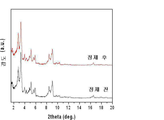
실시예 1에서 제조된 다공성 유무기혼성체 1g를 1M 농도 NH4F 50ml에 넣고, 70℃ 온도에서 교반하여 세공체의 세공 내에 존재하는 결정구조내에 결합되지 않는 1,4-벤젠디카복실산 및 크롬산화물 등의 불순물을 제거함으로써 표면적이 향상된 유무기혼성체를 제조하였다. X-선 회절 스펙트럼(도 2)으로부터 암모늄플로라이드 처리 후에 결정성에 손상 없이 유지됨을 확인 할 수 있었다. 또한, 상기 암모늄플로라이드 처리 전, 후의 다공성 유무기혼성체의 질소 흡착 측정결과로부터, 암모늄플로라이드 처리에 의하여 표면적이 700 m2/g (불화암모늄 처리 전 3373 m2/g → 처리 후 4074 m2/g) 증가하고, P/Po=0.5에서의 흡착량이 200 ml/g (불화암모늄 처리 전 1050 ml/g → 처리 후 1250 ml/g) 증가하는 특성을 갖는 유무기혼성체가 얻어짐을 알 수 있었다 (도 3). 1 g of the porous organic-inorganic hybrid prepared in Example 1 is placed in 50 ml of 1 M concentration NH 4 F, and stirred at a temperature of 70 ° C. to prevent 1,4-benzenedicarboxylic acid and chromium oxide which are not bound in the crystal structure present in the pores of the pores. An organic-inorganic hybrid having an improved surface area was prepared by removing impurities such as these. From the X-ray diffraction spectrum (Fig. 2) it can be confirmed that after ammonium fluoride treatment is maintained without damage to crystallinity. In addition, from the measurement results of nitrogen adsorption of the porous organic-inorganic hybrid before and after the ammonium fluoride treatment, the surface area was 700 m 2 / g (3373 m 2 / g before the ammonium fluoride treatment → 4074 m 2 after the ammonium fluoride treatment) / g) increased and the adsorption amount at P / Po = 0.5 was 200 ml / g (1050 ml / g before ammonium fluoride treatment 1250 ml / g after treatment) was found to be obtained an organic-inorganic hybrid (FIG. 3).
실시예Example 3: 마이크로파 조사에 의한 다공성 유무기 혼성체(Fe- 3: Porous organic-inorganic hybrids by microwave irradiation (Fe- BTCABTCA -1)의 제조-1) Preparation
테프론 반응기에 금속 철 1 mmol, 1M HNO3 60ml 및 1,3,5-벤젠트리카르복시산(BTCA) 7 mmol을 첨가한 후 증류수를 가하였고, 반응물의 최종 몰비는 Fe:HNO3:BTCA:H2O=1:0.6:0.7:278 이었다. 상기 반응물을 실온에서 500rpm으로 20분간 교반하여 균일한 반응물이 되도록 하였다. 상기 전처리된 반응물을 함유한 테프론 반응기를 마이크로파 반응기 (CEM사, 모델 Mars-5)에 장착하고 마이크로파(2.54 ㎓)를 조사하여 200℃ 로 승온 시킨 후 200℃ 에서 2분 동안 유지하여 결정화 반응을 수행한 후 실온으로 냉각, 원심 분리, 세척(증류수) 및 건조하여 다공성 유무기 혼성체(Fe-BTCA)를 얻었다. X-선 회절 스펙트럼의 형태가 문헌상 [Bulletin of Korean Chemical Society vol.26, p.880 (2005)]의 결정구조인 Cr-MIL-100구조와 유사함을 보여주었다. ICP분석 결과 얻어진 다공성 유무기혼성체 크롬테레프탈레이트는 F이 포함되지 않은 것으로서 그의 구조는 MIL-100과 동일하나 구조 내에 F이 포함되지 않으며 화학식: Fe3O(H2O)2OH[C6H3-(CO2)3]2·nH2O (n~14.5)로 나타낼 수 있는 물질임이 확인되었다. 질소흡탈착 실험결과 다공성 유무기 혼성체(Cr-BTCA)의 표면적이 1700 m2/g 이상임을 확인하였다. 전자현미경 분석결과 입자 크기가 200~500 nm 이하로 매우 작아졌음을 알 수 있었다 (도 4a).1 mmol of metal iron, 60 ml of 1M HNO 3 and 7 mmol of 1,3,5-benzenetricarboxylic acid (BTCA) were added to the Teflon reactor, followed by distilled water, and the final molar ratio of the reactants was Fe: HNO 3 : BTCA: H 2. O = 1: 0.6: 0.7: 278. The reaction was stirred at 500 rpm at room temperature for 20 minutes to ensure a uniform reaction. The Teflon reactor containing the pretreated reactant was mounted in a microwave reactor (CEM Co., Model Mars-5) and irradiated with microwave (2.54 mW) to raise the temperature to 200 ° C., and then maintained at 200 ° C. for 2 minutes to perform a crystallization reaction. After cooling to room temperature, centrifugation, washing (distilled water) and drying, a porous organic-inorganic hybrid (Fe-BTCA) was obtained. The morphology of the X-ray diffraction spectrum was shown to be similar to that of Cr-MIL-100, the crystal structure of Bulletin of Korean Chemical Society vol. 26, p. 880 (2005). The porous organic-inorganic hybrid chromium terephthalate obtained as a result of ICP analysis does not contain F and its structure is the same as that of MIL-100, but does not contain F in the structure: Fe 3 O (H 2 O) 2 OH [C 6 H 3- (CO 2 ) 3 ] 2. NH 2 O (n ~ 14.5) was identified as a substance. Nitrogen adsorption and desorption experiments confirmed that the surface area of the porous organic-inorganic hybrid (Cr-BTCA) is 1700 m 2 / g or more. Electron microscopic analysis showed that the particle size was very small (200 ~ 500 nm or less) (Fig. 4a).
실시예Example 4: 전기 가열에 의한 다공성 유무기 혼성체(Fe- 4: Porous organic-inorganic hybrid by electric heating (Fe- BTCABTCA -2)의 제조-2) Preparation
상기 실시예 3 과 동일한 방법으로 다공성 유무기 혼성체를 제조하였으나, 열원으로 마이크로파를 조사하는 대신에 일반적인 전기히팅방식을 이용한 전기가열방식으로 6시간 동안 가열하여 유무기혼성체를 제조하였다. 제조된 유무기 혼성체의 결정구조는 XRD 분석 결과 피크의 상대적인 세기는 다르지만 실시예 3과 동일한 위치에서 회절패턴이 얻어짐을 확인하였다. 전자현미경으로 분석결과 입자의 사이즈가 1 μm로 상대적으로 큰 결정을 얻을 수 있었다.A porous organic-inorganic hybrid was prepared in the same manner as in Example 3, but instead of irradiating microwaves with a heat source, an organic-inorganic hybrid was prepared by heating for 6 hours by an electric heating method using a general electric heating method. As a result of XRD analysis, the crystal structure of the prepared organic-inorganic hybrid was different, but the diffraction pattern was obtained at the same position as in Example 3. As a result of analysis by electron microscope, the crystal size was relatively large as 1 μm.
실시예Example 5 ( 5 ( CrCr -- BDCABDCA -3) -3)
실시예 1에서 전기히팅 방식이 아닌 마이크로파 조사에 의한 히팅방식을 사용하는 것을 제외하고는 실시예 1과 동일한 방법으로 유무기혼성체를 제조하였다. 단, 2.5GHz 진동수의 마이크로파 반응장치를 이용하고, 반응온도 210℃, 반응시간 40분 동안 유지하여 유무기혼성체를 제조하였다. X-선 회절스펙트럼 분석결과 실시예 1과 동일한 구조의 물질이 얻어짐을 알 수 있었다. An organic-inorganic hybrid was prepared in the same manner as in Example 1 except for using the heating method by microwave irradiation instead of the electric heating method. However, using a microwave reactor of 2.5GHz frequency, the organic-inorganic hybrid was prepared by maintaining the reaction temperature of 210 ℃,
실시예Example 6 (Fe- 6 (Fe- BDCABDCA -3)-3)
실시예 1와 동일하게 진행하되 Cr(NO3)3·9H2O 대신에 Fe를 사용하여 유무기혼성체를 제조하였다. 또한 실시예 2의 후처리 단계를 사용하여 순수한 다공성 유무기혼성체를 제조하였다. X-선 회절 형태로부터 실시예 1과 동일한 구조의 물질이 얻어짐을 알 수 있었다.Proceed in the same manner as in Example 1, instead of Cr (NO 3 ) 3 · 9H 2 O to use an organic-inorganic hybrid was prepared. In addition, a pure porous organic-inorganic hybrid was prepared using the post-treatment step of Example 2. From the X-ray diffraction pattern, it was found that a material having the same structure as in Example 1 was obtained.
실시예Example 7 (V- 7 (V- BDCABDCA -1)-One)
실시에 6 에서 Cr(NO3)3·9H2O를 사용하는 대신에 VCl3를 사용하는 것을 제외하고는 실시예 1 과 실시예 2의 후처리 단계를 사용한 동일한 방법으로 유무기혼성체를 제조하였다. X-선 회절 스펙트럼으로부터 실시예 1 과 동일한 구조의 물질이 얻어졌고, 전자 현미경 사진으로부터 50-80 nm 정도의 균일한 입경 특성을 갖는 유무기혼성체가 얻어짐을 알 수 있었다.An organic-inorganic hybrid was prepared in the same manner using the post-treatment steps of Example 1 and Example 2, except that VCl 3 was used instead of Cr (NO 3 ) 3 .9H 2 O in Example 6. . From the X-ray diffraction spectrum, a material having the same structure as in Example 1 was obtained, and it was found from the electron micrograph that an organic-inorganic hybrid having a uniform particle size characteristic of about 50-80 nm was obtained.
실시예Example 8 8
실시예 3과 4 그리고 비교예 2에서 얻어진 유무기혼성체 Fe-BTCA 각각 0.1g을 150℃에서 30분 진공건조 한 후 수분의 흡착 실험을 중량법으로 수행하였다 (도 5). 상대 습도 60% 에서도 흡착제 중량당 수분 흡착량이 초기 5분 이내 에서 실시예 3은 0.36g/g, 실시예 4은 0.34g/g 인 것으로 측정되었다. 이는 비교예 2의 흡착량 0.29g/g 보다 각각 24%, 17% 향상된 결과를 보여주는 것이다. 특히 흡착초기부터 5분 까지의 전영역에서의 수분흡착 속도가 매우 빠른 것을 확인하였다. 이와 같이 본 발명에 따른 다공성 유무기 혼성체를 저온 수분 흡착제로 사용하는 경우, 100℃ 이하에서의 용이한 탈착 성질을 나타내며, 이러한 특성을 이용하여 가습, 제습 등에 매우 뛰어난 성능을 달성할 수 있음을 알 수 있다. 0.1 g of each of the organic-inorganic hybrid Fe-BTCA obtained in Examples 3 and 4 and Comparative Example 2 was vacuum-dried at 150 ° C. for 30 minutes, and the adsorption experiment of water was carried out by gravimetric method (FIG. 5). Even at a relative humidity of 60%, the water adsorption amount per weight of the adsorbent was determined to be 0.36 g / g and 0.34 g / g in Example 4 within the initial 5 minutes. This shows a result of 24% and 17% improvement over 0.29 g / g adsorption amount of Comparative Example 2, respectively. In particular, it was confirmed that the rate of water adsorption in the entire area from the beginning of adsorption to 5 minutes was very fast. As such, when the porous organic-inorganic hybrid according to the present invention is used as a low temperature moisture adsorbent, it exhibits easy desorption property at 100 ° C. or lower, and it is possible to achieve very excellent performance in humidification, dehumidification, etc. by using such a property. Able to know.
실시예Example 9 9
상기 실시예 1과 같은 방법으로 에서 얻어진 다공성 유무기혼성체 Cr-BDCA 1g에 휘발성유기화합물인 벤젠 1g을 넣고 1 시간 동안 흡착실험을 실시한 결과 0.73g 벤젠이 흡착으로 제거됨을 확인하였다. 이 값은 동일 함량의 Darco사의 활성탄 (표면적 1600 ㎡/g) 흡착량인 0.19g의 벤젠 흡착량 보다 3.5배의 높은 흡착량을 확인할 수 있었다.1 g of volatile organic compound benzene was added to 1 g of porous organic-inorganic hybrid Cr-BDCA obtained in the same manner as in Example 1, and adsorption experiment was performed for 1 hour to confirm that 0.73 g benzene was removed by adsorption. This value was found to be 3.5 times higher than that of 0.19 g of benzene, which is the adsorption amount of activated carbon (surface area 1600
비교예Comparative example 1 ( One ( CrCr -- BDCABDCA -4) -4)
실시예 1에 따른 제조방법에 있어서 반응 혼합물 조제 시 불산을 사용하여 다공성 유무기혼성 나노세공체를 제조하였다. 반응 혼합물의 최종 몰비는 Cr:HF:BDCA:H2O=1:1:1:272가 되도록 하였다. 제조된 다공성 유무기혼성 나노세공체의 표면적 분석결과 P/Po=0.5에서 흡착량이 1044 ml/g, BET 3439 m2/g 인 유무기혼성체가 얻어짐을 알 수 있었다.In the preparation method according to Example 1, a porous organic-inorganic hybrid nanoporous body was prepared using hydrofluoric acid when preparing a reaction mixture. The final molar ratio of the reaction mixture was such that Cr: HF: BDCA: H 2 O = 1: 1: 1: 272. As a result of surface area analysis of the prepared porous organic-inorganic nanoporous material, it can be seen that an organic-inorganic hybrid having an adsorption amount of 1044 ml / g and BET 3439 m 2 / g was obtained at P / Po = 0.5.
비교예Comparative example 2 (Fe- 2 (Fe- BTCABTCA ))
실시예 3에 따른 제조방법에 있어서 반응 혼합물 조제 시 불산을 사용하여 다공성 유무기혼성 나노세공체를 제조하였다. 반응 혼합물의 최종 몰비는 Fe:HF:HNO3:BTCA:H2O=1:1:0.6:0.7:278 가 되도록 하였다. 제조된 유무기혼성체의 X-선 회절 분석 결과, 실시예 3과 동일한 결정성을 갖는 유무기혼성체가 얻어지는 대신에 결정 크기 매우 큰 (~ 10 μm) 물질이 얻어짐을 알 수 있었다 (도4b).In the preparation method according to Example 3, a porous organic-inorganic hybrid nanoporous body was prepared using hydrofluoric acid when preparing the reaction mixture. The final molar ratio of the reaction mixture was such that Fe: HF: HNO 3 : BTCA: H 2 O = 1: 1: 0.6: 0.7: 278. As a result of X-ray diffraction analysis of the prepared organic-inorganic hybrid, it was found that instead of obtaining an organic-inorganic hybrid having the same crystallinity as in Example 3, a material having a very large crystal size (˜10 μm) was obtained (FIG. 4B).
상기 실시예 및 비교예의 결과로부터, 불산을 사용하는 종래 공정과 비교히여, 불산을 포함하지 않는 본 발명의 제조방법에 의하여 동일한 결정성을 갖는 다공성 유무기혼성 나노세공체룰 제조할 수 있음을 확인하였으며, 특히 암모늄염 및 불화칼륨 등의 무기염으로 처리할 경우에 표면적이 10% 이상 증가됨을 확인할 수 있었다. 또한 본 발명의 제조방법에 따라 제조된 다공성 유무기혼성 나노세공체가 촉매로서 활성이 매우 높음을 확인하였다. 또한, 본 발명의 제조방법에 따라서 제조된 다공성 유무기혼성체는 흡탈착능이 우수한 흡착제로서 사용될 수 있으며, 특히 수분 흡착제로서 사용하는 경우, 100℃ 이하의 저온에서 탈착이 용이하게 일어나므로 이러한 특성을 이용하여 가습, 제습 등에 매우 뛰어난 성능을 달성할 수 있었다. 또한 본 발명의 제조방법에 따라서 제조된 다공성 유무기혼성체를 VOC, 새집증후군 유발 물질 등 특정유해물질의 흡착제로서 사용하는 경우 상기 특정유해물질의 증기상 및 입자상을 효과적으로 제거할 수 있었다.From the results of the above examples and comparative examples, it was confirmed that compared to the conventional process using hydrofluoric acid, porous organic-inorganic hybrid nanoporous body having the same crystallinity can be prepared by the production method of the present invention does not contain hydrofluoric acid. , Especially when treated with inorganic salts such as ammonium salt and potassium fluoride was confirmed that the surface area increased by more than 10%. In addition, it was confirmed that the porous organic-inorganic hybrid nanoporous body prepared according to the preparation method of the present invention has very high activity as a catalyst. In addition, the porous organic-inorganic hybrid prepared according to the production method of the present invention can be used as an adsorbent with excellent adsorption and desorption capacity, especially when used as a water adsorbent, since the desorption easily occurs at a low temperature of 100 ℃ or less to use these characteristics Therefore, it was possible to achieve excellent performance in humidification and dehumidification. In addition, when the porous organic-inorganic hybrid prepared according to the method of the present invention is used as an adsorbent for specific harmful substances such as VOC and sickhouse syndrome causing substances, the vapor phase and the particulate phase of the specific harmful substances could be effectively removed.
도 1은, 본 발명의 실시예 1의 제조방법에 따라 제조된 다공성 유무기혼성체인 크롬테레프탈레이트의 X-선 결정구조 그래프이다. 1 is an X-ray crystal structure graph of chromium terephthalate, which is a porous organic-inorganic hybrid prepared according to the preparation method of Example 1 of the present invention.
도 2는, 본 발명의 실시예 1의 정제방법에 따라 제조된 다공성 유무기혼성체인 크롬테레프탈레이트의 정제 전후의 X-선 회절 분석 결과를 나타낸 것으로, (a)는 정제전의 결과이고 (b)는 정제후의 결과이다.Figure 2 shows the results of X-ray diffraction analysis before and after the purification of chromium terephthalate, a porous organic-inorganic hybrid prepared according to the purification method of Example 1 of the present invention, (a) is the result before purification (b) Is the result after purification.
도 3은, 본 발명의 실시예 2에 의해 얻어진 다공성 유무기혼성체인 크롬테레프탈레이트에서의 질소 흡착 등온선 결과이다.3 is a nitrogen adsorption isotherm result of chromium terephthalate, which is a porous organic-inorganic hybrid obtained in Example 2 of the present invention.
도 4는, 본 발명의 실시예 4 및 비교예2 에 의해 얻어진 다공성 유무기혼성체인 철벤젠트리카르복실레이트의 전자현미경 사진이다.4 is an electron micrograph of iron benzene tricarboxylate as a porous organic-inorganic hybrid obtained in Example 4 and Comparative Example 2 of the present invention.
도 5는, 본 발명의 실시예 3과 4 그리고 비교예 2에 의해 얻어진 철을 포함한 다공성 유무기혼성체의 수분흡착 특성 결과.5 is a water adsorption characteristics of the porous organic-inorganic hybrid including iron obtained by Examples 3 and 4 and Comparative Example 2 of the present invention.
Claims (19)

Priority Applications (6)
| Application Number | Priority Date | Filing Date | Title |
|---|---|---|---|
| KR1020070077335A KR100890347B1 (en) | 2007-07-26 | 2007-08-01 | Absorbent Comprising Porous Organic-Inorganic Hybrid Materials |
| EP07851443.7A EP2101912B1 (en) | 2006-12-13 | 2007-12-12 | Porous organic-inorganic hybrid materials containing iron and an absorbent comprising the same |
| JP2009541227A JP5453101B2 (en) | 2006-12-13 | 2007-12-12 | Porous organic / inorganic hybrid and adsorbent containing the same |
| PCT/KR2007/006472 WO2008072896A1 (en) | 2006-12-13 | 2007-12-12 | A porous organic-inorganic hybrid materials and an absorbent comprising the same |
| US12/484,090 US8168813B2 (en) | 2006-12-13 | 2009-06-12 | Porous organic-inorganic hybrid materials and adsorbent comprising the same |
| JP2011148240A JP5551119B2 (en) | 2006-12-13 | 2011-07-04 | Porous organic / inorganic hybrid and adsorbent containing the same |
Applications Claiming Priority (3)
| Application Number | Priority Date | Filing Date | Title |
|---|---|---|---|
| KR20070075205 | 2007-07-26 | ||
| KR1020070075205 | 2007-07-26 | ||
| KR1020070077335A KR100890347B1 (en) | 2007-07-26 | 2007-08-01 | Absorbent Comprising Porous Organic-Inorganic Hybrid Materials |
Publications (2)
| Publication Number | Publication Date |
|---|---|
| KR20090011999A KR20090011999A (en) | 2009-02-02 |
| KR100890347B1 true KR100890347B1 (en) | 2009-03-25 |
Family
ID=40683056
Family Applications (1)
| Application Number | Title | Priority Date | Filing Date |
|---|---|---|---|
| KR1020070077335A Active KR100890347B1 (en) | 2006-12-13 | 2007-08-01 | Absorbent Comprising Porous Organic-Inorganic Hybrid Materials |
Country Status (1)
| Country | Link |
|---|---|
| KR (1) | KR100890347B1 (en) |
Families Citing this family (1)
| Publication number | Priority date | Publication date | Assignee | Title |
|---|---|---|---|---|
| WO2008072896A1 (en) | 2006-12-13 | 2008-06-19 | Korea Research Institute Of Chemical Technology | A porous organic-inorganic hybrid materials and an absorbent comprising the same |
Citations (3)
| Publication number | Priority date | Publication date | Assignee | Title |
|---|---|---|---|---|
| JP2004083669A (en) | 2002-08-23 | 2004-03-18 | Hakushi Kofun Yugenkoshi | Organic/inorganic hybrid material having no solvent/non-toxicity/high refractive index and low birefringence property |
| KR100680767B1 (en) * | 2006-02-07 | 2007-02-09 | 한국화학연구원 | Method for producing porous organic-inorganic hybrid |
| KR100733347B1 (en) | 2006-03-29 | 2007-06-28 | 한국화학연구원 | Removal method of specific harmful substances using porous organic-inorganic hybrid |
-
2007
- 2007-08-01 KR KR1020070077335A patent/KR100890347B1/en active Active
Patent Citations (3)
| Publication number | Priority date | Publication date | Assignee | Title |
|---|---|---|---|---|
| JP2004083669A (en) | 2002-08-23 | 2004-03-18 | Hakushi Kofun Yugenkoshi | Organic/inorganic hybrid material having no solvent/non-toxicity/high refractive index and low birefringence property |
| KR100680767B1 (en) * | 2006-02-07 | 2007-02-09 | 한국화학연구원 | Method for producing porous organic-inorganic hybrid |
| KR100733347B1 (en) | 2006-03-29 | 2007-06-28 | 한국화학연구원 | Removal method of specific harmful substances using porous organic-inorganic hybrid |
Also Published As
| Publication number | Publication date |
|---|---|
| KR20090011999A (en) | 2009-02-02 |
Similar Documents
| Publication | Publication Date | Title |
|---|---|---|
| KR100982641B1 (en) | Adsorbent including crystalline porous organic-inorganic hybrid materials | |
| JP5453101B2 (en) | Porous organic / inorganic hybrid and adsorbent containing the same | |
| KR101158456B1 (en) | Porous organic-inorganic hybrid materials with crystallinity and method for preparing thereof | |
| KR100806586B1 (en) | Absorbent for water adsorption and desorption | |
| US9038409B2 (en) | Apparatus for treating air by using porous organic-inorganic hybrid materials as an absorbent | |
| KR101721556B1 (en) | Adsorbents comprising organic-inorganic hybrid nanoporous materials for sorption of water or alcohol and use thereof | |
| KR101253985B1 (en) | Porous organic-inorganic hybrid materials, method for preparing thereof, adsorbant comprising them and application thereof | |
| KR20120021899A (en) | Porous organic-inorganic hybrid materials, method for preparing thereof, adsorbant comprising them and application thereof | |
| KR20110019804A (en) | Method for preparing organic-inorganic hybrid nanoporous body, organic-inorganic hybrid nanoporous body obtained by the method and use thereof | |
| KR100895413B1 (en) | Method for producing porous organic-inorganic hybrid, organic-inorganic hybrid obtained by the method and catalytic use thereof | |
| KR100803945B1 (en) | Organic-inorganic porous adsorbent for adsorption of water and its manufacturing method | |
| JP5551119B2 (en) | Porous organic / inorganic hybrid and adsorbent containing the same | |
| KR100890347B1 (en) | Absorbent Comprising Porous Organic-Inorganic Hybrid Materials | |
| KR101105640B1 (en) | Air handler | |
| KR100912790B1 (en) | Method for producing porous organic-inorganic hybrids, organic-inorganic hybrids obtained by the method and catalytic uses thereof | |
| KR100733347B1 (en) | Removal method of specific harmful substances using porous organic-inorganic hybrid | |
| HK1130218B (en) | Adsorbent for water adsorption and desorption |
Legal Events
| Date | Code | Title | Description |
|---|---|---|---|
| A201 | Request for examination | ||
| PA0109 | Patent application |
Patent event code: PA01091R01D Comment text: Patent Application Patent event date: 20070801 |
|
| PA0201 | Request for examination | ||
| E902 | Notification of reason for refusal | ||
| PE0902 | Notice of grounds for rejection |
Comment text: Notification of reason for refusal Patent event date: 20081112 Patent event code: PE09021S01D |
|
| PG1501 | Laying open of application | ||
| E701 | Decision to grant or registration of patent right | ||
| PE0701 | Decision of registration |
Patent event code: PE07011S01D Comment text: Decision to Grant Registration Patent event date: 20090312 |
|
| GRNT | Written decision to grant | ||
| PR0701 | Registration of establishment |
Comment text: Registration of Establishment Patent event date: 20090318 Patent event code: PR07011E01D |
|
| PR1002 | Payment of registration fee |
Payment date: 20090318 End annual number: 3 Start annual number: 1 |
|
| PG1601 | Publication of registration | ||
| PR1001 | Payment of annual fee |
Payment date: 20111214 Start annual number: 4 End annual number: 4 |
|
| FPAY | Annual fee payment |
Payment date: 20130111 Year of fee payment: 5 |
|
| PR1001 | Payment of annual fee |
Payment date: 20130111 Start annual number: 5 End annual number: 5 |
|
| FPAY | Annual fee payment |
Payment date: 20140115 Year of fee payment: 6 |
|
| PR1001 | Payment of annual fee |
Payment date: 20140115 Start annual number: 6 End annual number: 6 |
|
| FPAY | Annual fee payment |
Payment date: 20150113 Year of fee payment: 7 |
|
| PR1001 | Payment of annual fee |
Payment date: 20150113 Start annual number: 7 End annual number: 7 |
|
| FPAY | Annual fee payment |
Payment date: 20160302 Year of fee payment: 8 |
|
| PR1001 | Payment of annual fee |
Payment date: 20160302 Start annual number: 8 End annual number: 8 |
|
| FPAY | Annual fee payment |
Payment date: 20161228 Year of fee payment: 9 |
|
| PR1001 | Payment of annual fee |
Payment date: 20161228 Start annual number: 9 End annual number: 9 |
|
| FPAY | Annual fee payment |
Payment date: 20180129 Year of fee payment: 10 |
|
| PR1001 | Payment of annual fee |
Payment date: 20180129 Start annual number: 10 End annual number: 10 |
|
| FPAY | Annual fee payment |
Payment date: 20190312 Year of fee payment: 11 |
|
| PR1001 | Payment of annual fee |
Payment date: 20190312 Start annual number: 11 End annual number: 11 |
|
| PR1001 | Payment of annual fee |
Payment date: 20200317 Start annual number: 12 End annual number: 12 |
|
| PR1001 | Payment of annual fee |
Payment date: 20201215 Start annual number: 13 End annual number: 13 |
|
| PR1001 | Payment of annual fee |
Payment date: 20221219 Start annual number: 15 End annual number: 15 |
|
| PR1001 | Payment of annual fee |
Payment date: 20241230 Start annual number: 17 End annual number: 17 |