KR0153263B1 - Process for producing a polymer by ring opening polymerization - Google Patents
Process for producing a polymer by ring opening polymerization Download PDFInfo
- Publication number
- KR0153263B1 KR0153263B1 KR1019900011554A KR900011554A KR0153263B1 KR 0153263 B1 KR0153263 B1 KR 0153263B1 KR 1019900011554 A KR1019900011554 A KR 1019900011554A KR 900011554 A KR900011554 A KR 900011554A KR 0153263 B1 KR0153263 B1 KR 0153263B1
- Authority
- KR
- South Korea
- Prior art keywords
- ring
- type
- compound
- monomer
- opening polymerization
- Prior art date
- Legal status (The legal status is an assumption and is not a legal conclusion. Google has not performed a legal analysis and makes no representation as to the accuracy of the status listed.)
- Expired - Fee Related
Links
Classifications
-
- C—CHEMISTRY; METALLURGY
- C08—ORGANIC MACROMOLECULAR COMPOUNDS; THEIR PREPARATION OR CHEMICAL WORKING-UP; COMPOSITIONS BASED THEREON
- C08G—MACROMOLECULAR COMPOUNDS OBTAINED OTHERWISE THAN BY REACTIONS ONLY INVOLVING UNSATURATED CARBON-TO-CARBON BONDS
- C08G61/00—Macromolecular compounds obtained by reactions forming a carbon-to-carbon link in the main chain of the macromolecule
- C08G61/02—Macromolecular compounds containing only carbon atoms in the main chain of the macromolecule, e.g. polyxylylenes
- C08G61/04—Macromolecular compounds containing only carbon atoms in the main chain of the macromolecule, e.g. polyxylylenes only aliphatic carbon atoms
- C08G61/06—Macromolecular compounds containing only carbon atoms in the main chain of the macromolecule, e.g. polyxylylenes only aliphatic carbon atoms prepared by ring-opening of carbocyclic compounds
-
- C—CHEMISTRY; METALLURGY
- C08—ORGANIC MACROMOLECULAR COMPOUNDS; THEIR PREPARATION OR CHEMICAL WORKING-UP; COMPOSITIONS BASED THEREON
- C08G—MACROMOLECULAR COMPOUNDS OBTAINED OTHERWISE THAN BY REACTIONS ONLY INVOLVING UNSATURATED CARBON-TO-CARBON BONDS
- C08G61/00—Macromolecular compounds obtained by reactions forming a carbon-to-carbon link in the main chain of the macromolecule
- C08G61/02—Macromolecular compounds containing only carbon atoms in the main chain of the macromolecule, e.g. polyxylylenes
- C08G61/04—Macromolecular compounds containing only carbon atoms in the main chain of the macromolecule, e.g. polyxylylenes only aliphatic carbon atoms
- C08G61/06—Macromolecular compounds containing only carbon atoms in the main chain of the macromolecule, e.g. polyxylylenes only aliphatic carbon atoms prepared by ring-opening of carbocyclic compounds
- C08G61/08—Macromolecular compounds containing only carbon atoms in the main chain of the macromolecule, e.g. polyxylylenes only aliphatic carbon atoms prepared by ring-opening of carbocyclic compounds of carbocyclic compounds containing one or more carbon-to-carbon double bonds in the ring
-
- C—CHEMISTRY; METALLURGY
- C08—ORGANIC MACROMOLECULAR COMPOUNDS; THEIR PREPARATION OR CHEMICAL WORKING-UP; COMPOSITIONS BASED THEREON
- C08F—MACROMOLECULAR COMPOUNDS OBTAINED BY REACTIONS ONLY INVOLVING CARBON-TO-CARBON UNSATURATED BONDS
- C08F132/00—Homopolymers of cyclic compounds containing no unsaturated aliphatic radicals in a side chain, and having one or more carbon-to-carbon double bonds in a carbocyclic ring system
- C08F132/08—Homopolymers of cyclic compounds containing no unsaturated aliphatic radicals in a side chain, and having one or more carbon-to-carbon double bonds in a carbocyclic ring system having condensed rings
-
- C—CHEMISTRY; METALLURGY
- C08—ORGANIC MACROMOLECULAR COMPOUNDS; THEIR PREPARATION OR CHEMICAL WORKING-UP; COMPOSITIONS BASED THEREON
- C08F—MACROMOLECULAR COMPOUNDS OBTAINED BY REACTIONS ONLY INVOLVING CARBON-TO-CARBON UNSATURATED BONDS
- C08F4/00—Polymerisation catalysts
- C08F4/42—Metals; Metal hydrides; Metallo-organic compounds; Use thereof as catalyst precursors
- C08F4/44—Metals; Metal hydrides; Metallo-organic compounds; Use thereof as catalyst precursors selected from light metals, zinc, cadmium, mercury, copper, silver, gold, boron, gallium, indium, thallium, rare earths or actinides
- C08F4/60—Metals; Metal hydrides; Metallo-organic compounds; Use thereof as catalyst precursors selected from light metals, zinc, cadmium, mercury, copper, silver, gold, boron, gallium, indium, thallium, rare earths or actinides together with refractory metals, iron group metals, platinum group metals, manganese, rhenium technetium or compounds thereof
Landscapes
- Chemical & Material Sciences (AREA)
- Health & Medical Sciences (AREA)
- Chemical Kinetics & Catalysis (AREA)
- Medicinal Chemistry (AREA)
- Polymers & Plastics (AREA)
- Organic Chemistry (AREA)
- Engineering & Computer Science (AREA)
- Materials Engineering (AREA)
- Polyoxymethylene Polymers And Polymers With Carbon-To-Carbon Bonds (AREA)
- Optical Record Carriers And Manufacture Thereof (AREA)
- Transition And Organic Metals Composition Catalysts For Addition Polymerization (AREA)
Abstract
내용 없음.No content.
Description
본 발명은 노르보르넨형(norbornene-type) 단량체의 고리-열림중합반응에 의하여 중합체를 제조하는 방법, 더욱 상세하게는 고리-열림 중합반응에 의하여 제한된 분자량 분포를 갖는 중합체르 고수율로 제조하는 방법에 관한 것이다.The present invention provides a method for preparing a polymer by ring-opening polymerization of norbornene-type monomers, and more particularly, a method for producing a polymer having a high molecular weight distribution with a limited molecular weight distribution by ring-opening polymerization. It is about.
최근에, 광학디스크, 광학렌즈, 투명필름등에 사용하기 위한 광학 물질로서, 예를 들면 테트라시클로도데센, 디시클로펜타디엔(DCP), 트리시클로펜타디엔등의 노르보르넨형 단량체의 고리-열림 중합반응에 의하여 제조한 중합체의 수소화 생성물에 관심이 집중되고 있다[예; 일본국 특허원 제60-26024호, 일본국 특허원 제1-24826호, WO 80/01953, 유럽 특허 제303,246호, 유럽 특허 제317,262호]. 왜냐하면, 상기 수소화 생성물은 투명성 및 내열성이 우수하고, 거의 방수성이며, 비교적 작은 복굴절 및 우수한 성형성을 가지기 때문이다.In recent years, ring-opening polymerization of norbornene-type monomers such as tetracyclododecene, dicyclopentadiene (DCP), tricyclopentadiene, and the like as optical materials for use in optical disks, optical lenses, transparent films, and the like Attention is focused on the hydrogenation products of polymers produced by reactions [eg; Japanese Patent Application No. 60-26024, Japanese Patent Application No. 1-24826, WO 80/01953, European Patent No. 303,246, and European Patent No. 317,262]. This is because the hydrogenated product is excellent in transparency and heat resistance, is almost waterproof, and has a relatively small birefringence and excellent moldability.
노르보르넨형 단량체의 고리-열림 중합반응은 통상적으로 유기 알루미늄 화합물과 같은 유기 금속 화합물 및 텅스텐 및/또는 몰리브덴을 기재로 하는 복분해 촉매(metathesis catalyst)로 이루어진 촉매계(1)(예 : 미합중국 특허 제3,557,072호), 또는 유기 알루미늄 화합물과 같은 유기 금속 화합물 및 4할로겐화 티탄과 같은 전이 금속 화합물을 함유하는 촉매계(2)(예 : JP-B-41-20111, 독일연방공화국 특허원 제2,502,748호)의 존재하에서 수행된다.Ring-opening polymerization of norbornene-type monomers is typically carried out with a catalyst system (1) consisting of an organometallic compound such as an organoaluminum compound and a metathesis catalyst based on tungsten and / or molybdenum (e.g. U.S. Patent No. 3,557,072). ) Or the presence of a catalyst system 2 (e.g. JP-B-41-20111, German Patent Application No. 2,502,748) containing an organometallic compound such as an organoaluminum compound and a transition metal compound such as titanium tetrahalide Is carried out under.
하지만, 상기 촉매계(1)을 사용하는 고리-열림 중합반응의 경우에, 반응이 완결되었을 때 반응계에 존재하는 잔류 단량체가 거의 없을 정도의 고수율로 중합체를 수득할 수 있는 잇점에도 불구하고, 생성되는 중합체는 분자량 분포가 넓으며, 따라서 복굴절이 크다.However, in the case of the ring-opening polymerization reaction using the catalyst system 1, in spite of the advantage that the polymer can be obtained in a high yield such that there is almost no residual monomer present in the reaction system when the reaction is completed, The resulting polymer has a broad molecular weight distribution and therefore a large birefringence.
상기 촉매계(2)를 사용하는 고리-열림 중합반응의 경우에, 생성되는 중합체의 분자량 분포는 용이하게 조절될 수 있다. 하지만, 반응계에서 단량체의 농도가 감소함에 따라, 중합체 생성비는 현저하게 감소한다. 고농도의 단량체로 중합반응을 개시할지라도, 단량체의 농도가 중합반응이 진행함에 따라 감소하면서 중합체의 생성비는 감소한다. 따라서, 이 촉매계의 고리-열림 중합반응에 의하여 형성되는 중합체는 고수율로 수득될 수 없다. 또한, 중합이 완결될때에 반응계에는 다량의 미반응 단량체가 잔류한다. 이 잔류 단량체를 중합체-분리단계에서 제거하는 것은 매우 어렵다. 그리고, 중합체중에 잔류하는 미반응 단량체는 보이드, 플래쉬(flash)라고 성형품 표면상에서 탁도의 현상 또는 실버 스트릭(silver streak)이라고 불리우는 실버라인을 야기시킨다.In the case of a ring-opening polymerization reaction using the catalyst system 2, the molecular weight distribution of the resulting polymer can be easily controlled. However, as the concentration of monomer in the reaction system decreases, the rate of polymer production decreases significantly. Even if the polymerization is started with a high concentration of monomer, the polymer production ratio decreases as the concentration of the monomer decreases as the polymerization proceeds. Therefore, the polymer formed by the ring-opening polymerization of this catalyst system cannot be obtained in high yield. In addition, when the polymerization is completed, a large amount of unreacted monomer remains in the reaction system. It is very difficult to remove this residual monomer in the polymer-separation step. Unreacted monomers remaining in the polymer then cause voids, a phenomenon of turbidity on the surface of the molded part called flash, or a silver line called silver streak.
본 발명의 목적은 제한된 분자량 분포를 갖는 중합체를 수득할 수 있으며, 중합반응이 완결된 때에 반응계에 잔류하는 단량체의 농도가 매우 낮고, 중합체가 고수율로 제조될 수 있는, 노르보르넨형 단량체의 고리-열림 중합 제조 방법을 제공하는 것이다.It is an object of the present invention to obtain a polymer having a limited molecular weight distribution, a ring of norbornene-type monomer, in which the concentration of monomer remaining in the reaction system is very low when the polymerization is completed, and the polymer can be produced in high yield. It is to provide an open polymerization production method.
본 발명자들은 상기 선행기술의 문제점들을 극복하기 위하여 예의 연구한 결과, 상기의 목적은 4할로겐화 티탄 및 주기율표의 I 내지 III 족에 속하는 금속의 유기 금속 화합물로 필수적으로 이루어진 지글러형 촉매의 존재하에서 노르보르넨형 단량체의 고리-열림 중합반응을 개시하는 제1단계(선행 중합반응 단계), 및 반응중에 반응계에 텅스텐 및/또는 몰리브덴을 기재로 하는 복분해 촉매를 첨가함에 의하여 고리-열림 중합반응을 계속 수행하는 제2단계(후행 중합 반응 단계)의 결합 공정에 의하여 성취될 수 있다는 것을 알아내었다.The present inventors have diligently studied to overcome the problems of the prior art, and the above object is achieved in the presence of a Norgebor in the presence of a Ziegler-type catalyst consisting essentially of titanium tetrahalide and an organometallic compound of a metal belonging to groups I to III of the periodic table. The first step of initiating the ring-opening polymerization of the n-type monomer (preceding polymerization step), and during the reaction, the ring-opening polymerization is continued by adding a metathesis catalyst based on tungsten and / or molybdenum to the reaction system. It has been found that this can be achieved by the bonding process of the second step (following polymerization step).
따라서, 본 발명에 의하여 주기율표의 I족 내지 III족에 속하는 금속의 유기 금속 화합물 및 4할로겐화 티탄으로 필수적으로 이루어진 지글러형(Ziegler-type)촉매의 존재하에서 존재하에서 노르보르넨형 단량체의 고리-열림 중합반응을 개시하고, 노르보르넨형 단량체가 60%이상의 전환율을 나타낼때까지 고리-열림 중합반응을 수행한 후, 텅스텐 및/또는 몰리브덴을 기재로 하는 복분해 촉매를 중합반응계에 가하여 중합반응을 계속시킴을 특징으로 하는 고리-열림 중합반응에 의한 중합체의 제조방법이 제공된다.Therefore, ring-opening polymerization of norbornene-type monomers in the presence of a Ziegler-type catalyst consisting essentially of organometallic compounds of metals belonging to groups I to III of the periodic table and titanium tetrahalide according to the present invention Initiate the reaction, perform ring-opening polymerization until the norbornene-type monomer exhibits a conversion of at least 60%, and then add a metathesis catalyst based on tungsten and / or molybdenum to the polymerization system to continue the polymerization. A method for producing a polymer by ring-opening polymerization is provided.
본 발명은 이하에서 상술될 것이다.The present invention will be described in detail below.
[노르보르넨형 단량체][Norbornene-type monomer]
노르보르넨형 단량체의 예에는 노르보르넨 및 이의 알킬, 알킬리덴 및/또는 아릴-치환 화합물, 예를 들면 5-메틸-2-노르보르넨, 5, 6-디메틸-2-노르보르넨, 5-에틸-2-노르보르넨, 5-부틸-2-노르보르넨, 5-에틸리덴-2-노르보르넨, 5-페닐-2-노르보르넨; 디시클로펜타디엔, 2, 3-디히드로디시클로펜타디엔 및 이들을 메틸, 에틸, 프로필, 부틸등의 알킬로 치환시킨 화합물; 디메타노옥타히드로나프탈렌 및 이들의 알킬, 알킬리덴 및/또는 아릴-치환 화합물, 예를 들면 6-메틸-1, 4 : 5, 8-디메타노-1, 4, 4a, 5, 6, 7, 8, 8a-옥타히드로나프탈렌, 6-에틸-1, 4 : 5, 8-디메타노-1, 4, 4a, 5, 6, 7, 8, 8a-옥타히드로나프탈렌, 6-에틸리덴-1, 4 : 5, 8-디메타노-1, 4, 4a, 5, 6, 7, 8, 8a-옥타히드로나프탈렌, 6-페닐-1, 4 : 5, 8-디메타노-1, 4, 4a, 5, 6, 7, 8, 8a-옥타히드로나프탈렌등; 4, 9 : 5, 8-디메타노-3a, 4, 4a, 5, 8, 8a, 9, 9a-옥타히드로-1H-벤조인덴, 4, 11 :5, 10 : 6, 9-트리메타노-3a, 4, 4a, 5, 5a, 6, 9, 9a, 10, 10a, 11, 11a-도데카히드로-1H-시클로펜타안트라센등과 같은 시클로펜타디엔의 삼합체 및 사합체등이 있다.Examples of norbornene-type monomers include norbornene and its alkyl, alkylidene and / or aryl-substituted compounds, such as 5-methyl-2-norbornene, 5, 6-dimethyl-2-norbornene, 5 -Ethyl-2-norbornene, 5-butyl-2-norbornene, 5-ethylidene-2-norbornene, 5-phenyl-2-norbornene; Dicyclopentadiene, 2, 3-dihydrodicyclopentadiene and compounds substituted with alkyl such as methyl, ethyl, propyl and butyl; Dimethanooctahydronaphthalene and alkyl, alkylidene and / or aryl-substituted compounds thereof, for example 6-methyl-1, 4: 5, 8-dimethano-1, 4, 4a, 5, 6, 7, 8, 8a-octahydronaphthalene, 6-ethyl-1, 4: 5, 8-dimethano-1, 4, 4a, 5, 6, 7, 8, 8a-octahydronaphthalene, 6-ethylidene -1, 4: 5, 8-dimethano-1, 4, 4a, 5, 6, 7, 8, 8a-octahydronaphthalene, 6-phenyl-1, 4: 5, 8-dimethano-1 , 4, 4a, 5, 6, 7, 8, 8a-octahydronaphthalene and the like; 4, 9: 5, 8-dimethano-3a, 4, 4a, 5, 8, 8a, 9, 9a-octahydro-1H-benzoindene, 4, 11: 5, 10: 6, 9-tree Trimers and tetramers of cyclopentadiene such as metano-3a, 4, 4a, 5, 5a, 6, 9, 9a, 10, 10a, 11, 11a-dodecahydro-1H-cyclopentaanthracene, etc. have.
노르보르넨형 단량체는 금속원자를 갖는 치환체 또는 극성 치환제를 가질 수 있다. 이러한 치환체의 예에는 염소, 브롬 및 불소와 같은 할로겐원자; 메톡시카르보닐, 에톡시카르보닐 및 아세톤시기와 같은 에스테르형 부분; 시아노기; 피리딜기; 피리메틸실릴, 트리에틸실릴 및 디메틸모노클로로실릴기와 같은 실릴기등이 있다.Norbornene-type monomers may have a substituent having a metal atom or a polar substituent. Examples of such substituents include halogen atoms such as chlorine, bromine and fluorine; Ester type moieties such as methoxycarbonyl, ethoxycarbonyl and acetone groups; Cyano group; Pyridyl group; Silyl groups such as pyrimethylsilyl, triethylsilyl and dimethylmonochlorosilyl groups.
이들 노르보르넨형 단량체는 단독으로 또는 배합되어 사용될 수 있다. 고리-열림 중합 반응에 의하여 생성된 중합체 및 이의 수소화 생성물에 대한 전이온도(Tg)를 100℃ 이상으로 조절하여 양호한 내열성을 가지도록, 상기 노르보르넨형 단량체의 4환식 또는 5환식 화합물을 단독으로, 또는 2환식이나 3환식 단량체와 배합하여 주성분으로서 사용한다. 특히, 복굴절의 관점에서 보면, 저급 알킬-치환되거나 또는 알케닐-치환된 4환식 화합물의 단일 중합체 또는 공중합체가 바람직하다. 무엇보다도 특히 탄소수 1 내지 3의 치환체를 갖는 치환 화합물의 단일 중합체 또는 공중합 성분으로서 상기 치환 화합물의 50중량% 이상, 바람직하게는 70중량% 이상을 함유하는 공중합체가 바람직하다.These norbornene-type monomers may be used alone or in combination. The monocyclic or pentacyclic compound of the norbornene-type monomer alone, so as to control the transition temperature (Tg) for the polymer produced by the ring-opening polymerization reaction and its hydrogenated product to 100 ° C or more to have good heat resistance, Or it mixes with a bicyclic or tricyclic monomer, and uses it as a main component. In particular, from the viewpoint of birefringence, homopolymers or copolymers of lower alkyl-substituted or alkenyl-substituted tetracyclic compounds are preferred. Above all, preferred are copolymers containing at least 50% by weight, preferably at least 70% by weight, of the substituted compounds as homopolymers or copolymerization components of substituted compounds having substituents having 1 to 3 carbon atoms.
그리고, 공중합 성분으로서, 시클로프로펜, 시클로부텐, 시클로펜텐, 시클로헵텐, 시클로옥텐, 5, 6-디히드로디시클로펜타디엔등의 다른 시클로올레핀을 본 발명의 목적을 방해하지 않는 양, 통상적으로 30중량% 미만의 범위로 사용하는 것도 가능하다.As the copolymerization component, other cycloolefins such as cyclopropene, cyclobutene, cyclopentene, cycloheptene, cyclooctene, 5, 6-dihydrodicyclopentadiene, and the like do not interfere with the object of the present invention, usually It is also possible to use it in less than 30 weight%.
또한, 분자량 조절제로서 소량, 통상적으로 10몰% 이하의 범위로 비환식 올레핀이 사용될 수 있다. 특히, 1-부텐, 1-펜텐, 1-헥센등과 같은 α- 올레핀이 바람직하다.As the molecular weight modifier, acyclic olefins may be used in small amounts, usually in the range of 10 mol% or less. In particular, α-olefins such as 1-butene, 1-pentene, 1-hexene and the like are preferable.
[고리-열림 중합반응 촉매][Ring-opening polymerization catalyst]
[지글러형 촉매][Ziegler-type catalyst]
[(a) 유기 금속 화합물][(a) organometallic compound]
본 발명에서 사용되는 주기율표의 I 내지 III족에 속하는 금속의 유기 금속 화합물의 예에는 JP-B-41-20111, 독일연방공화국 특허원 제2502748호 및 미합중국 특허 제3,557,072호에 기술되어 있는 바와 같은, 유기 알루미늄 화합물, 유기리튬 화합물, 유기 마그네슘 화합물등이 있다. 이들 화합물중에서, 유기 알루미늄 화합물이 바람직하다.Examples of organometallic compounds of the metals belonging to groups I to III of the periodic table used in the present invention include those described in JP-B-41-20111, German Patent Application No. 2502748 and US Patent No. 3,557,072. Organoaluminum compounds, organolithium compounds, organo magnesium compounds and the like. Among these compounds, organoaluminum compounds are preferred.
유기 알루미늄 화합물의 예에는 트리메틸알루미늄, 트리에틸알루미늄, 트리-n-프로필알루미늄, 트리이소프로필 알루미늄, 트리이소부틸알루미늄, 트리헥실알루미늄, 트리옥틸알루미늄, 트리페닐알루미늄, 트리벤질알루미늄, 디에틸알루미늄, 모노클로라이드, 디-n-프로필알루미늄 모노클로라이드, 디이소부틸알루미늄 모노클로라이드, 디-n-부틸알루미늄 모노클로라이드, 디에틸알루미늄 모노브로마이드, 디에틸알루미늄 모노요오다이드, 디에틸알루미늄 모노히드라이드, 디-n-프로필알루미늄 모노히드라이드, 디이소부틸알루미늄 모노히드라이드, 메틸알루미늄 세스키 클로라이드, 에틸알루미늄 세스키브로마이드, 이소부틸알루미늄 세스키클로라이드, 에틸알루미늄 디클로라이드, 에틸알루미늄 디브로마이드, 프로필알루미늄 디클로라이드, 이소부틸알루미늄 디클로라이드, 에틸알루미늄 디브로마이드, 에틸알루미늄, 디요오다이드, 리튬 알루미늄 테트라-n-부틸등이 있다.Examples of organoaluminum compounds include trimethylaluminum, triethylaluminum, tri-n-propylaluminum, triisopropylaluminum, triisobutylaluminum, trihexylaluminum, trioctylaluminum, triphenylaluminum, tribenzylaluminum, diethylaluminum, Monochloride, di-n-propylaluminum monochloride, diisobutylaluminum monochloride, di-n-butylaluminum monochloride, diethylaluminum monobromide, diethylaluminum monoiodide, diethylaluminum monohydride, di -n-propylaluminum monohydride, diisobutylaluminum monohydride, methylaluminum sesquichloride, ethylaluminum sesquibromide, isobutylaluminum sesquichloride, ethylaluminum dichloride, ethylaluminum dibromide, propylaluminum dichloride , Iso Butylaluminum dichloride, ethylaluminum dibromide, ethylaluminum, diiodide, lithium aluminum tetra-n-butyl and the like.
유리 리튬 화합물의 예에는 메틸리튬, 에틸리튬, n-부틸리튬, n-헥실리튬등이 있다.Examples of free lithium compounds include methyllithium, ethyllithium, n-butyllithium, n-hexyllithium and the like.
유기 마그네슘 화합물의 예에는 디에틸마그네슘, 메틸마그네슘 요오다이드, 에틸마그네슘 브로마이드, 메틸마그네슘 브로마이드, n-프로필마그네슘 클로라이드, t-부틸마그네슘 클로라이드, 알릴마그네슘 클로라이드, 페닐마그네슘 브로마이드등이 있다.Examples of the organic magnesium compound include diethylmagnesium, methylmagnesium iodide, ethylmagnesium bromide, methylmagnesium bromide, n-propylmagnesium chloride, t-butylmagnesium chloride, allylmagnesium chloride, phenylmagnesium bromide and the like.
[(b) 4 할로겐화 티탄][(b) 4 titanium halides]
4할로겐화 티탄의 구체적인 예에는 4염화티탄, 4브롬화 티탄등이 있다.Specific examples of titanium tetrahalide include titanium tetrachloride and titanium tetrabromide.
[(c) 아민형 활성화제][(c) amine activator]
본 발명의 지글러형 촉매는 아민형 활성화제와 배합되어 사용될 수 있다.The Ziegler type catalyst of the present invention can be used in combination with an amine activator.
아민형 활성화제의 예에는 지방족, 지환족 또는 방향족 3차 아민 및 헤테로 환식 아민이 있다. 이들의 구체예에는 트리메틸아민, 트리에틸아민, 트리프로필아민, 트리-n-부틸아민, 디메틸아닐린, 피리딘, α-피콜린, γ-피콜린, 2, 6-루티딘등(독일연방공화국 특허원 제2,502,748호, WO 89/01953)이 있다.Examples of amine type activators include aliphatic, cycloaliphatic or aromatic tertiary amines and heterocyclic amines. Specific examples thereof include trimethylamine, triethylamine, tripropylamine, tri-n-butylamine, dimethylaniline, pyridine, α-picoline, γ-picoline, 2, 6-lutidine, and the like. 1,502,748, WO 89/01953.
[복분해 촉매]Metathesis Catalyst
텅스텐 및/또는 몰리브덴을 기재로 하는 복분해 촉매의 예에는 이들 금속의 할라이드, 옥시할라이드 또는 옥시 유기화합물이 있다. 이들의 구체예에는 텅스텐 헥사클로라이드, 텅스텐(IV) 옥시클로라이드, 텅스텐 테트라클로라이드, 몰리브덴 펜타클로라이드, 아세틸아세토나토몰리브덴옥사이드등이 있다.Examples of metathesis catalysts based on tungsten and / or molybdenum are halides, oxyhalides or oxy organic compounds of these metals. Specific examples thereof include tungsten hexachloride, tungsten (IV) oxychloride, tungsten tetrachloride, molybdenum pentachloride, acetylacetonatomolybdenum oxide and the like.
[고리-열림 중합반응에 대한 조건][Conditions for Ring-Open Polymerization Reaction]
[용 매][Solvent]
본 발명에서 노르보르넨형 단량체의 고리-열림 중합반응은 용매의 부재하에서 수행될 수 있다. 하지만, 통상적으로 불활성 유기 용매중에서 수행된다.Ring-opening polymerization of norbornene-type monomers in the present invention can be carried out in the absence of a solvent. However, it is usually carried out in an inert organic solvent.
용매로서 탄화수소용매가 바람직하며, 이들 용매중에서, 고리-열림 중합반응에 의하여 생성되는 중합체를 용해시키는데 탁월한 능력을 갖는 환식 탄화수소용매가 특히 바람직하다.Hydrocarbon solvents are preferred as solvents, and among these solvents, cyclic hydrocarbon solvents having excellent ability to dissolve the polymer produced by the ring-opening polymerization reaction are particularly preferred.
이들의 구체예에는 벤젠, 에틸벤젠, 톨루엔, 크실렌등과 같은 방향족 탄화수소; n-펜탄, 헥산, 헵탄등과 같은 지방족 탄화수소; 시클로펜탄, 시클로헥산, 메틸시클로헥산, 디메틸시클로헥산, 데칼린등과 같은 지환족 탄화수소; 메틸렌디클로라이드, 디클로로에탄, 디클로로이틸렌, 테트라클로로에탄, 클로로벤젠, 디클로로벤젠, 트리클로로벤젠등과 같은 탄화수소할라이드가 있다. 이들은 배합되어 사용될 수 있다.Specific examples thereof include aromatic hydrocarbons such as benzene, ethylbenzene, toluene, xylene and the like; aliphatic hydrocarbons such as n-pentane, hexane, heptane and the like; Alicyclic hydrocarbons such as cyclopentane, cyclohexane, methylcyclohexane, dimethylcyclohexane, decalin and the like; Hydrocarbon halides such as methylenedichloride, dichloroethane, dichloroitylene, tetrachloroethane, chlorobenzene, dichlorobenzene, trichlorobenzene and the like. These can be used in combination.
단량체 1 중량부를 기준하는 용매의 양은 통상적으로 1 내지 20중량부, 바람직하게는 2 내지 10중량부이다.The amount of the solvent based on 1 part by weight of the monomer is usually 1 to 20 parts by weight, preferably 2 to 10 parts by weight.
[중합 반응온도][Polymerization Temperature]
고리-열림 중합반응에 대한 온도 조건은 구체적으로 한정되지 않으며, -20℃ 내지 100℃, 통상적으로 0℃ 내지 100℃, 바람직하게는 10℃ 내지 80℃가 선택된다.The temperature conditions for the ring-opening polymerization reaction are not specifically limited, -20 ° C to 100 ° C, usually 0 ° C to 100 ° C, preferably 10 ° C to 80 ° C.
[중합 반응계에 대한 온도][Temperature for polymerization reaction system]
중합반응에 대한 압력은 0 내지 50㎏/㎠, 통상적으로 상압 내지 10㎏/㎠, 바람직하게는 5㎏/㎠미만이다.The pressure for the polymerization reaction is from 0 to 50 kg / cm 2, usually from normal pressure to 10 kg / cm 2, preferably less than 5 kg / cm 2.
[중합 반응계에 대한 분위기]Atmosphere for the polymerization reaction system
고리-열림 중합반응은 통상적으로 질소, 아르곤등과 같은 불활성 가스의 분위기에서 수행한다.Ring-opening polymerization is usually carried out in an atmosphere of an inert gas such as nitrogen, argon or the like.
[고리-열림 중합반응 촉매의 첨가][Addition of Ring-Open Polymerization Catalyst]
고리-열림 중합반응 촉매의 양은 다음과 같다. 단량체 100몰에 대한 지글러형 촉매 화합물의 각각의 양으로는, 유기 금속 화합물(a)의 양은 0.1 내지 10몰, 바람직하게는 0.5 내지 5몰이고, 단량체 100몰당 4할로겐화티탄 (b)의 양은 0.05 내지 5몰, 바람직하게는 0.25 내지 2.5몰이며, 단량체 100몰당 아민형 활성화제 (c)의 야은 0.2 내지 20몰, 바람직하게는 1 내지 10몰이다. 그리고, 단량체 100몰당 복분해 촉매의 양은 0.005 내지 1몰, 바람직하게는 0.01 내지 0.5몰이다.The amount of ring-opening polymerization catalyst is as follows. For each amount of the Ziegler-type catalyst compound with respect to 100 moles of monomer, the amount of organometallic compound (a) is 0.1 to 10 moles, preferably 0.5 to 5 moles, and the amount of titanium tetrahalide (b) per 100 moles of monomer is 0.05 To 5 moles, preferably 0.25 to 2.5 moles, and the field of the amine activator (c) is 0.2 to 20 moles, preferably 1 to 10 moles per 100 moles of monomer. The amount of metathesis catalyst per 100 moles of monomer is 0.005 to 1 mole, preferably 0.01 to 0.5 mole.
또한, 상기 성분 (a), (b) 및 (c) 및 복분해 촉매의 대한 각각의 비율은 다음과 같다. 유기 금속 화합물(a) 1몰에 대한 4할로겐화티탄(b)의 비율은 0.05 내지 1몰, 바람직하게는 0.1 내지 0.9몰이고, 아민형 활성화제(c)의 비율은 0.5 내지 10몰, 바람직하게는 1 내지 5몰이며, 복분해 촉매의 비율은 0.002 내지 0.5몰, 바람직하게는 0.01 내지 0.1몰이다.Further, the respective ratios of the components (a), (b) and (c) and the metathesis catalyst are as follows. The ratio of titanium tetrahalide (b) to 1 mol of the organometallic compound (a) is 0.05 to 1 mol, preferably 0.1 to 0.9 mol, and the ratio of the amine activator (c) is 0.5 to 10 mol, preferably Is 1 to 5 mol, and the ratio of the metathesis catalyst is 0.002 to 0.5 mol, preferably 0.01 to 0.1 mol.
본 발명에서, 먼저, 노르보르넨형 단량체의 고리-열림 중합반응을 지글러형 촉매의 존재하에서 개시하고, 반응중에 반응계에 텅스텐 및/또는 몰리브덴을 기재로 하는 복분해 촉매를 가하여 고리-열림 중합반응을 계속 진행시킨다.In the present invention, first, the ring-opening polymerization of a norbornene-type monomer is started in the presence of a Ziegler-type catalyst, and the ring-opening polymerization is continued by adding a metathesis catalyst based on tungsten and / or molybdenum to the reaction system during the reaction. Proceed.
이들 촉매가 상기와 다른 순서로 첨가될 경우, 본 발명의 목적은 성취될 수 없다.When these catalysts are added in a different order than the above, the object of the present invention cannot be achieved.
지글러형 촉매만이 사용될 경우, 또는 후행 중합 반응단계에서 복분해 촉매가 첨가되지 않을 경우, 단량체의 전환율은 기껏해야 약90%정도로 낮으며, 중합체는 고수율로 수득될 수 없다. 고리-열림 중합반응을 복분해 촉매만의 존재하에서 수행할 경우, 생성되는 중합체는 넓은 분자량 분포를 갖는다. 그리고, 복분해 촉매를 사용하여 고리-열림 중합 반응을 수행한 후에 지글러형 촉매가 첨가될지라도, 분자량 분포를 바람직한 범위로 조절하는 것은 불가능하다. 또한, 고리-열림 중합반응이 지글러형 촉매 및 복분해 촉매의 존재하에서 개시될지라도, 결과가 더 양호한 것은 아니다.When only a Ziegler type catalyst is used, or when no metathesis catalyst is added in the subsequent polymerization step, the conversion of monomers is at most as low as about 90%, and the polymer cannot be obtained in high yield. When the ring-opening polymerization is carried out in the presence of metathesis catalyst alone, the resulting polymer has a broad molecular weight distribution. And even if a Ziegler type catalyst is added after carrying out the ring-opening polymerization reaction using the metathesis catalyst, it is impossible to adjust the molecular weight distribution to the desired range. In addition, although ring-opening polymerization is initiated in the presence of a Ziegler type catalyst and a metathesis catalyst, the result is not better.
고리-열림 중합반응을 지글러형 촉매의 존재하에서, 바람직하게는 R3Al/TiCl4/아민 활성화제의 존재하에서 개시한 후, 노르보르넨형 단량체의 전환율이 60%이상, 바람직하게는 70%이상이 되는 경우에, 후행 중합 단계에서의 복분해 촉매를 첨가한다. 전환율이 너무 낮은 경우에 복분해 촉매를 가하면, 생성되는 중합체의 분자량 및 분자량 분포를 조절하기 어렵게 된다. 선행 중합반응 단계에서 전환율의 상한은 약 90%이다.After initiating the ring-opening polymerization in the presence of a Ziegler type catalyst, preferably in the presence of an R 3 Al / TiCl 4 / amine activator, the conversion of the norbornene type monomer is at least 60%, preferably at least 70% In this case, the metathesis catalyst in the subsequent polymerization step is added. If metathesis catalyst is added when the conversion is too low, it becomes difficult to control the molecular weight and molecular weight distribution of the resulting polymer. The upper limit of conversion in the preceding polymerization stage is about 90%.
복분해 촉매를 첨가한 후, 최종 전환율이 바람직하게는 95% 이상이 될때까지, 후행 중합 반응단계에서 고리-열림 중합반응을 계속한다.After addition of the metathesis catalyst, the ring-opening polymerization is continued in the subsequent polymerization step until the final conversion is preferably at least 95%.
[고리-열림 중합반응에 의하여 생성되는 중합체][Polymer produced by ring-open polymerization]
본 발명에 따른 고리-열림 중합반응에 의하여 생성되는 중합체의 수평균 분자량(Mn)은 10,000 내지 200,000, 바람직하게는 20,000 내지 100,000이고, 분자량의 분포비(Mw/Mn)는 3미만, 바람직하게는 2.5이다. 중합체를 수소화시키고, 광학디스크와 같은 광학 물질로서 사용할 경우, 수평균 분자량(Mn)이 20,000 내지 40,000인 중합체가 가장 바람직하다.The number average molecular weight (Mn) of the polymer produced by the ring-opening polymerization according to the present invention is 10,000 to 200,000, preferably 20,000 to 100,000, and the distribution ratio (Mw / Mn) of the molecular weight is less than 3, preferably 2.5. When the polymer is hydrogenated and used as an optical material such as an optical disc, a polymer having a number average molecular weight (Mn) of 20,000 to 40,000 is most preferred.
수평균 분자량이 상기 범위보다 큰 경우, 중합체는 큰 복굴절 및 불량한 성형성을 갖는다. 수평균 분자량이 상기 범위보다 작은 경우, 중합체는 불량한 기계강도를 갖는다. 그리고, 분자량 분포비(Mw/Mn)가 상기 범위보다 큰 경우, 중합체는 큰 복굴절을 갖는다.When the number average molecular weight is larger than the above range, the polymer has large birefringence and poor moldability. If the number average molecular weight is smaller than the above range, the polymer has poor mechanical strength. And when molecular weight distribution ratio (Mw / Mn) is larger than the said range, a polymer has big birefringence.
중합체의 상기 분자량 및 분자량 분포는 용매로서 시클로헥산을 사용하는 겔-투과크로마토그래피(이하에서는 GPC 라고함) 분석에 따른다.The molecular weight and molecular weight distribution of the polymer are according to gel-permeation chromatography (hereinafter referred to as GPC) analysis using cyclohexane as solvent.
고리-열림 중합반응에 의하여 생성된 중합체는 통상의 방법에 따라 수소화되고, 적절하게는 광학 디스크, 광학렌드, 투명필름등에 대한 광학물질로서 사용될 수 있다.The polymer produced by the ring-opening polymerization is hydrogenated according to a conventional method, and can be suitably used as an optical material for an optical disc, an optical lens, a transparent film and the like.
[실시예]EXAMPLE
본 발명은 하기 실시예에 의하여 더욱 구체적으로 기술될 것이다. 하지만, 본 발명은 이들에 의하여 한정되는 것은 아니다.The invention will be described in more detail by the following examples. However, the present invention is not limited by these.
[실시예 1]Example 1
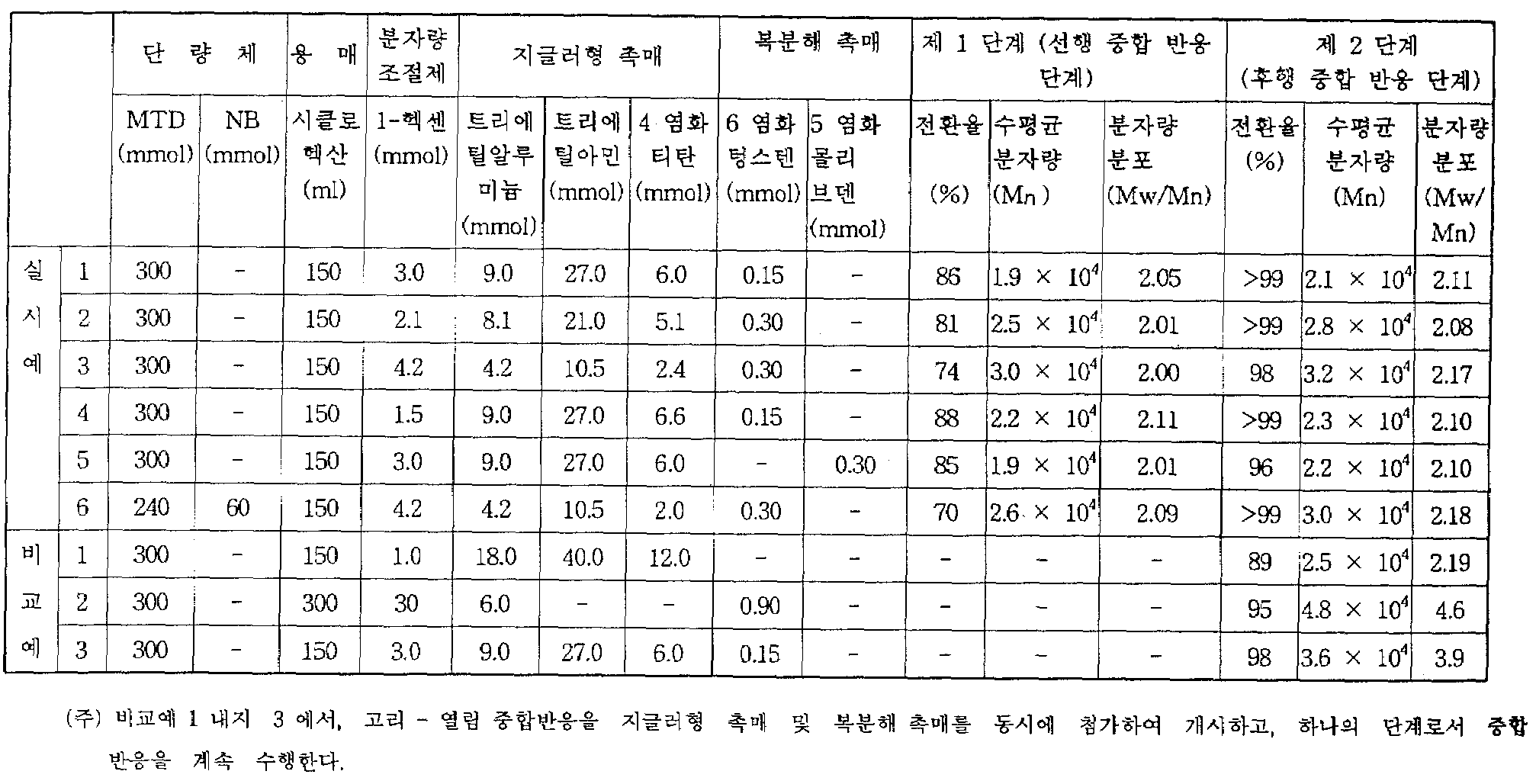
6-메틸-1, 4 : 5, 8-디메타노-1, 4, 4a, 5, 6, 7, 8, 8a-옥타히드로나프탈렌(이하에서는 MTD라고 언급함) 52.2g(300mmol)을 시클로헥산 150㎖중에 용해시킨다. 그리고, 중합 반응용매로서, 시클로헥산에 용해시킨 15중량%의 트리에틸알루미늄 용액 6.84g(9.0mmol), 트리에틸아민 2.7g(27 mmol) 및 시클로헥산에 용해시킨 20중량%의 4염화티탄용액 5.7g(6.0mmol)을 30℃에서 분자량 조절제로서 1-헥센 0.25g(3.0 mmol)의 존재하에서 첨가하여 고리-열림중합반응을 개시한다.52.2 g (300 mmol) of 6-methyl-1, 4: 5,8-dimethano-1, 4, 4a, 5, 6, 7, 8, 8a-octahydronaphthalene (hereinafter referred to as MTD) Dissolve in 150 ml of hexane. As a polymerization reaction solvent, 6.84 g (9.0 mmol) of 15 wt% triethylaluminum solution dissolved in cyclohexane, 2.7 g (27 mmol) of triethylamine, and 20 wt% titanium tetrachloride solution dissolved in cyclohexane were used. 5.7 g (6.0 mmol) are added at 30 ° C. in the presence of 0.25 g (3.0 mmol) of 1-hexene as molecular weight modifier to initiate the ring-opening polymerization.
중합반응 개시후 30분이 경과하면 전환율은 86%에 도달한다. 이때 시클로헤산에 용해시킨 0.9중량%의 6염화텅스텐 용액 6.6g(0.15mmol)을 첨가하여 추가의 30분간 종합반응을 계속시킨다.After 30 minutes from the start of the polymerization, the conversion reaches 86%. At this time, 6.6 g (0.15 mmol) of 0.9 wt% tungsten hexachloride solution dissolved in cycloheic acid was added, and the reaction was continued for an additional 30 minutes.
메탄올 4㎖를 가하여 반응을 정지시키고, 반응 용액을 이소프로필 알콜 5ℓ중에 부어 수득한 중합체를 응고시킨다. 응고된 중합체를 진공하에서 전고시켜 고리-열림 중합 반응에 의하여 생성된 중합체 50.6g을 수득한다. 중합체의 수율은 97% 였다.4 ml of methanol is added to stop the reaction, and the reaction solution is poured into 5 l of isopropyl alcohol to solidify the obtained polymer. The solidified polymer is solidified under vacuum to give 50.6 g of the polymer produced by the ring-opening polymerization reaction. The yield of the polymer was 97%.
중합반응중에 4염화 티탄을 가한 후 30분이 경과한 때, 및 6염화 텅스텐을 가한 후 30분이 경과한때에 중합 반응액의 샘플을 각각 2㎖취하고, 이에 대하여 GPC 분석을 하여 분자량, 분자량 분포 및 단량체의 중합체로의 전환율을 측정한다.When 30 minutes have elapsed since the addition of titanium tetrachloride during the polymerization reaction and 30 minutes have elapsed after the addition of tungsten hexachloride, 2 ml of the sample of the polymerization reaction solution is taken, and the GPC analysis is carried out for the molecular weight, molecular weight distribution and monomers. The conversion rate into the polymer is measured.
GPC 분석조건 : 용매로서 톨루엔 또는 시클로헥산을 사용하여 1.0㎖/분의 유속 및 38℃의 온도에서 TSK gel G 5000H~G 4000H 칼럼을 갖는 HLC802L(도오쏘 코포레이션의 제품)으로 측정을 행한다.GPC Analytical Conditions: Measurement was carried out with HLC802L (product of Tosoh Corporation) having a TSK gel G 5000H to G 4000H column at a flow rate of 1.0 mL / min and a temperature of 38 ° C. using toluene or cyclohexane as solvent.
분자량 및 분자량 분포의 측정용 용매로서 톨루엔을 사용하고, 전환율용으로 시클로헥산을 사용한다.Toluene is used as a solvent for the measurement of molecular weight and molecular weight distribution, and cyclohexane is used for conversion.
결과를 표 1에 나타내었다.The results are shown in Table 1.
[실시예 2 내지 4][Examples 2 to 4]
지글러형 촉매 및 복분해 촉매의 비율을 표 1에 나타낸 바와 같이 변화시킨 것을 제외하고는 실시예 1을 반복한다.Example 1 is repeated except that the ratio of the Ziegler type catalyst and metathesis catalyst is changed as shown in Table 1.
결과를 표 1에 나타내었다.The results are shown in Table 1.
[실시예 5]Example 5
6 염화 텅스텐을 5염화 몰리브덴 0.30mmol로 대체한 것을 제외하고는, 실시예 1을 반복한다.Example 1 is repeated except that tungsten hexachloride is replaced with 0.30 mmol of molybdenum pentachloride.
결과를 표 1에 나타내었다.The results are shown in Table 1.
[실시예 6]Example 6
단량체를 노르보르넨(이하에서는 NB 라고 언급함)과 MTD(240mmol)의 혼합물로 변화시키고, 촉매의 비율을 표 1에 나타낸 바와 같이 변화시킨 것을 제외하고는 실시예 1을 반복한다.The monomer was changed to a mixture of norbornene (hereinafter referred to as NB) and MTD (240 mmol), and Example 1 was repeated except that the proportion of catalyst was changed as shown in Table 1.
결과를 표 1에 나타내었다.The results are shown in Table 1.
[비교예 1]Comparative Example 1
표 1에 나타낸 지글러형 촉매의 존재하에서 MTD의 고리-열림 중합반응을 개시하고, 후행 중합반응 단계에서 어떠한 복분해 촉매도 첨가하지 않는다. 중합반응이 1시간 경화한 후의 결과는 전환율이 89% 정도로 낮고, 다량의 단량체가 반응계에 잔류한다.The ring-opening polymerization of MTD is initiated in the presence of the Ziegler type catalyst shown in Table 1, and no metathesis catalyst is added in the subsequent polymerization step. After 1 hour of curing, the polymerization resulted in a conversion rate as low as 89%, and a large amount of monomer remained in the reaction system.
[비교예 2]Comparative Example 2
트리에틸알루미늄(6.0mmol) 및 6 염화텅스텐(0.90mmol)의 존재하에서 MTD의 고리-열림 중합반응을 수행한다. 생성되는 중합체는 큰 분자량 및 넓은 분자량 분포를 가지므로, 이들을 목적하는 범위로 조절하는 것은 분가능하다.Ring-opening polymerization of MTD is carried out in the presence of triethylaluminum (6.0 mmol) and tungsten hexachloride (0.90 mmol). Since the resulting polymers have a large molecular weight and a wide molecular weight distribution, it is possible to control them to the desired range.
결과를 표 1에 나타내었다.The results are shown in Table 1.
[비교예 3]Comparative Example 3
표 1에 나타낸 바와 같이 지글러형 촉매 및 복분해 촉매를 동시에 첨가하여 MTD의 고리-열림 중합반응을 수행한다. 생성되는 중합체는 분자량 및 넓은 분자량 분포를 가지므로, 이들을 목적하는 범위로 조절하는 것은 불가능하다.As shown in Table 1, a Ziegler-type catalyst and a metathesis catalyst are added simultaneously to perform a ring-opening polymerization of MTD. The resulting polymers have a high molecular weight and a wide molecular weight distribution, so it is impossible to control them to the desired range.
결과를 표 1에 나타내었다.The results are shown in Table 1.
[실시예 7]Example 7
노르보르넨형 단량체로서 6-에틸-1, 4 : 5, 8-디메타노-1, 4, 4a, 5, 6, 7, 8, 8a-옥타히드로나프탈렌(ETD)을 사용한 것을 제외하고는 실시예 1을 반복한다. 선행 중합 반응 단계후(30분후)에 전환율은 85%이고, Mn은 2.2×10⁴이며, Mw/Mn은 2.05이었다. 후행 중합 반응 단계후(또 다른 30분후)에, 전환율은 99%이고, Mn은 2.4×10⁴이며, Mw/Mn은 2.21이었다.Except for using 6-ethyl-1, 4: 5,8-dimethano-1,4,4a, 5,6,7,8,8a-octahydronaphthalene (ETD) as a norbornene-type monomer Repeat example 1. After the preceding polymerization step (after 30 minutes) the conversion was 85%, Mn was 2.2x10 4 and Mw / Mn was 2.05. After the post polymerization step (after another 30 minutes), the conversion was 99%, Mn was 2.4 × 10 4 and Mw / Mn was 2.21.
본 발명에 따라 좁은 분자량 분포를 가지는 중합체를 제공하고, 중합반응이 완결된 후 반응계에 잔류하는 단량체의 농도가 아주 낮은, 노르보르넨형 단량체의 고리-열림 중합반응에 의한 고수율의 중합체 제조 방법이 제공된다. 본 발명에 따라 수득되는 중합체를 수소화시켜 제조한 수소화 생성물의 성형성은 우수하며, 복굴절은 작다. 따라서, 수소화 생성물은 적절하게는 광학 디스크, 광학 렌즈, 투명필름등에 대한 광학물질로서 사용 가능하다.According to the present invention, there is provided a polymer having a narrow molecular weight distribution, and a method for producing a polymer of high yield by ring-opening polymerization of a norbornene-type monomer, having a very low concentration of monomer remaining in the reaction system after the polymerization is completed. Is provided. The moldability of the hydrogenated product produced by hydrogenating the polymer obtained according to the present invention is excellent, and the birefringence is small. Accordingly, the hydrogenated product can be suitably used as an optical material for optical disks, optical lenses, transparent films and the like.
Claims (20)
Applications Claiming Priority (2)
| Application Number | Priority Date | Filing Date | Title |
|---|---|---|---|
| JP19384889 | 1989-07-28 | ||
| JP1-193848 | 1989-07-28 |
Publications (2)
| Publication Number | Publication Date |
|---|---|
| KR910002907A KR910002907A (en) | 1991-02-26 |
| KR0153263B1 true KR0153263B1 (en) | 1998-12-01 |
Family
ID=16314756
Family Applications (1)
| Application Number | Title | Priority Date | Filing Date |
|---|---|---|---|
| KR1019900011554A Expired - Fee Related KR0153263B1 (en) | 1989-07-28 | 1990-07-28 | Process for producing a polymer by ring opening polymerization |
Country Status (6)
| Country | Link |
|---|---|
| US (1) | US5034482A (en) |
| EP (1) | EP0410605B1 (en) |
| JP (1) | JPH07119277B2 (en) |
| KR (1) | KR0153263B1 (en) |
| CA (1) | CA2021024A1 (en) |
| DE (1) | DE69030605T2 (en) |
Cited By (1)
| Publication number | Priority date | Publication date | Assignee | Title |
|---|---|---|---|---|
| KR20150076655A (en) * | 2013-12-27 | 2015-07-07 | 코오롱인더스트리 주식회사 | Cycloolefin Polymers and Method for Preparing the Same |
Families Citing this family (10)
| Publication number | Priority date | Publication date | Assignee | Title |
|---|---|---|---|---|
| JPH04198317A (en) * | 1990-11-28 | 1992-07-17 | Nippon Zeon Co Ltd | Production method of norbornene polymer |
| JP3291857B2 (en) * | 1993-07-30 | 2002-06-17 | 日本ゼオン株式会社 | Norbornene-based ring-opened (co) polymer hydrogenated product, method for producing the same, and use thereof |
| CN101889209A (en) * | 2007-10-22 | 2010-11-17 | 贝克顿·迪金森公司 | Method for evaluating protein aggregation in organopolysiloxane-containing suspensions and medical articles coated with organopolysiloxane containing protein solutions |
| EP3536363A1 (en) | 2008-09-22 | 2019-09-11 | Becton, Dickinson and Company | Systems for coating the interior of a container |
| US8802603B2 (en) | 2010-06-17 | 2014-08-12 | Becton, Dickinson And Company | Medical components having coated surfaces exhibiting low friction and low reactivity |
| CN104725828B (en) * | 2015-03-04 | 2017-11-21 | 广东生益科技股份有限公司 | A kind of resin combination and use its prepreg and laminate |
| CN107063940B (en) | 2016-02-10 | 2019-10-18 | 贝克顿迪金森法国公司 | Method for evaluating the stability of the preparation based on protein |
| US10882940B2 (en) * | 2016-04-29 | 2021-01-05 | Sabic Global Technologies B.V. | Process for the production of copolymers |
| CN112679639B (en) * | 2020-12-23 | 2022-08-26 | 广东新华粤石化集团股份公司 | Cycloolefin polymer and preparation method thereof |
| US20250073123A1 (en) | 2023-08-30 | 2025-03-06 | Becton, Dickinson And Company | Medical Device Comprising Self-Lubricating Rubber Component |
Family Cites Families (2)
| Publication number | Priority date | Publication date | Assignee | Title |
|---|---|---|---|---|
| JPS5070500A (en) * | 1973-10-23 | 1975-06-11 | Nippon Oil Co Ltd | |
| DE3855009T2 (en) * | 1987-11-17 | 1996-11-14 | Japan Synthetic Rubber Co Ltd | Thermoplastic resin composition |
-
1990
- 1990-07-11 EP EP90307577A patent/EP0410605B1/en not_active Expired - Lifetime
- 1990-07-11 DE DE69030605T patent/DE69030605T2/en not_active Expired - Fee Related
- 1990-07-12 CA CA002021024A patent/CA2021024A1/en not_active Abandoned
- 1990-07-18 US US07/553,849 patent/US5034482A/en not_active Expired - Lifetime
- 1990-07-24 JP JP2195696A patent/JPH07119277B2/en not_active Expired - Fee Related
- 1990-07-28 KR KR1019900011554A patent/KR0153263B1/en not_active Expired - Fee Related
Cited By (1)
| Publication number | Priority date | Publication date | Assignee | Title |
|---|---|---|---|---|
| KR20150076655A (en) * | 2013-12-27 | 2015-07-07 | 코오롱인더스트리 주식회사 | Cycloolefin Polymers and Method for Preparing the Same |
Also Published As
| Publication number | Publication date |
|---|---|
| EP0410605A3 (en) | 1992-05-20 |
| DE69030605T2 (en) | 1998-01-02 |
| JPH03121122A (en) | 1991-05-23 |
| KR910002907A (en) | 1991-02-26 |
| DE69030605D1 (en) | 1997-06-05 |
| EP0410605A2 (en) | 1991-01-30 |
| US5034482A (en) | 1991-07-23 |
| EP0410605B1 (en) | 1997-05-02 |
| CA2021024A1 (en) | 1991-01-29 |
| JPH07119277B2 (en) | 1995-12-20 |
Similar Documents
| Publication | Publication Date | Title |
|---|---|---|
| EP0430585B1 (en) | Hydrogenated ring-opening polymer and process for producing same | |
| KR100948708B1 (en) | Norbornene ring-opening polymers, norbornene ring-opening polymers | |
| US5191026A (en) | Ring-opening hydrogenated copolymer and process for producing the same | |
| JP4352620B2 (en) | Method for producing norbornene-based ring-opening polymer hydride | |
| US5599882A (en) | Ring-opening polymer and a process for production thereof | |
| US5580934A (en) | Ring-opening hydrogenated copolymer and process for producing the same | |
| KR0153263B1 (en) | Process for producing a polymer by ring opening polymerization | |
| JPH0816129B2 (en) | Method for producing norbornene ring-opening polymer | |
| CA1042136A (en) | Polymers of acid anhydride type norbornene derivatives and a method of preparing the same | |
| EP1275675B1 (en) | Copolymer formed by ring-opening polymerization, product of hydrogenation of copolymer formed by ring-opening polymerization, and processes for producing these | |
| JP2007137935A (en) | Tetracyclododecene ring-opened polymer hydride, method for producing the same, and optical material | |
| JP3522009B2 (en) | Cyclic olefin ring-opening metathesis polymer hydrogenated product and method for producing the same | |
| JP3072329B2 (en) | Method for producing norbornene-based polymer and hydrogenated product thereof | |
| JP2783194B2 (en) | Method for producing hydrogenated norbornene ring-opening polymer | |
| KR0160130B1 (en) | Hydrogenated Ring Opening Polymer And Method Of Making The Same | |
| JPS63264626A (en) | Ring-opening polymer and method for producing the same | |
| JPH01158029A (en) | Ring-opening polymer hydrogenated product and method for producing the same | |
| JPH07103225B2 (en) | Ring-opening copolymer hydrogenated product and method for producing the same | |
| EP0375780A1 (en) | Ring-opening polymers and process for their production | |
| JP3050196B2 (en) | Norbornene ring-opening polymer | |
| JP3526668B2 (en) | Cyclic olefin ring-opening metathesis polymer hydrogenated product and method for producing the same | |
| JPH07103223B2 (en) | Ring-opening copolymer hydrogenated product and method for producing the same | |
| JP2001151869A (en) | Method for producing hydrogenated cyclic olefin ring-opening metathesis polymer | |
| JP2024132551A (en) | Fluorine-containing ring-opening polymer | |
| JP2008222935A (en) | Polymer and hydrogenated product thereof |
Legal Events
| Date | Code | Title | Description |
|---|---|---|---|
| PA0109 | Patent application |
St.27 status event code: A-0-1-A10-A12-nap-PA0109 |
|
| R17-X000 | Change to representative recorded |
St.27 status event code: A-3-3-R10-R17-oth-X000 |
|
| P11-X000 | Amendment of application requested |
St.27 status event code: A-2-2-P10-P11-nap-X000 |
|
| P13-X000 | Application amended |
St.27 status event code: A-2-2-P10-P13-nap-X000 |
|
| PG1501 | Laying open of application |
St.27 status event code: A-1-1-Q10-Q12-nap-PG1501 |
|
| A201 | Request for examination | ||
| P11-X000 | Amendment of application requested |
St.27 status event code: A-2-2-P10-P11-nap-X000 |
|
| P13-X000 | Application amended |
St.27 status event code: A-2-2-P10-P13-nap-X000 |
|
| PA0201 | Request for examination |
St.27 status event code: A-1-2-D10-D11-exm-PA0201 |
|
| R17-X000 | Change to representative recorded |
St.27 status event code: A-3-3-R10-R17-oth-X000 |
|
| E701 | Decision to grant or registration of patent right | ||
| PE0701 | Decision of registration |
St.27 status event code: A-1-2-D10-D22-exm-PE0701 |
|
| GRNT | Written decision to grant | ||
| PR0701 | Registration of establishment |
St.27 status event code: A-2-4-F10-F11-exm-PR0701 |
|
| PR1002 | Payment of registration fee |
St.27 status event code: A-2-2-U10-U11-oth-PR1002 Fee payment year number: 1 |
|
| PG1601 | Publication of registration |
St.27 status event code: A-4-4-Q10-Q13-nap-PG1601 |
|
| FPAY | Annual fee payment |
Payment date: 20010627 Year of fee payment: 4 |
|
| PR1001 | Payment of annual fee |
St.27 status event code: A-4-4-U10-U11-oth-PR1001 Fee payment year number: 4 |
|
| LAPS | Lapse due to unpaid annual fee | ||
| PC1903 | Unpaid annual fee |
St.27 status event code: A-4-4-U10-U13-oth-PC1903 Not in force date: 20020703 Payment event data comment text: Termination Category : DEFAULT_OF_REGISTRATION_FEE |
|
| PC1903 | Unpaid annual fee |
St.27 status event code: N-4-6-H10-H13-oth-PC1903 Ip right cessation event data comment text: Termination Category : DEFAULT_OF_REGISTRATION_FEE Not in force date: 20020703 |