JPWO2019117269A1 - How to help detect pancreatic cancer - Google Patents
How to help detect pancreatic cancer Download PDFInfo
- Publication number
- JPWO2019117269A1 JPWO2019117269A1 JP2019559213A JP2019559213A JPWO2019117269A1 JP WO2019117269 A1 JPWO2019117269 A1 JP WO2019117269A1 JP 2019559213 A JP2019559213 A JP 2019559213A JP 2019559213 A JP2019559213 A JP 2019559213A JP WO2019117269 A1 JPWO2019117269 A1 JP WO2019117269A1
- Authority
- JP
- Japan
- Prior art keywords
- mirna
- seq
- abundance
- nos
- pancreatic cancer
- Prior art date
- Legal status (The legal status is an assumption and is not a legal conclusion. Google has not performed a legal analysis and makes no representation as to the accuracy of the status listed.)
- Granted
Links
Classifications
-
- C—CHEMISTRY; METALLURGY
- C12—BIOCHEMISTRY; BEER; SPIRITS; WINE; VINEGAR; MICROBIOLOGY; ENZYMOLOGY; MUTATION OR GENETIC ENGINEERING
- C12Q—MEASURING OR TESTING PROCESSES INVOLVING ENZYMES, NUCLEIC ACIDS OR MICROORGANISMS; COMPOSITIONS OR TEST PAPERS THEREFOR; PROCESSES OF PREPARING SUCH COMPOSITIONS; CONDITION-RESPONSIVE CONTROL IN MICROBIOLOGICAL OR ENZYMOLOGICAL PROCESSES
- C12Q1/00—Measuring or testing processes involving enzymes, nucleic acids or microorganisms; Compositions therefor; Processes of preparing such compositions
- C12Q1/68—Measuring or testing processes involving enzymes, nucleic acids or microorganisms; Compositions therefor; Processes of preparing such compositions involving nucleic acids
- C12Q1/6876—Nucleic acid products used in the analysis of nucleic acids, e.g. primers or probes
- C12Q1/6883—Nucleic acid products used in the analysis of nucleic acids, e.g. primers or probes for diseases caused by alterations of genetic material
- C12Q1/6886—Nucleic acid products used in the analysis of nucleic acids, e.g. primers or probes for diseases caused by alterations of genetic material for cancer
-
- C—CHEMISTRY; METALLURGY
- C12—BIOCHEMISTRY; BEER; SPIRITS; WINE; VINEGAR; MICROBIOLOGY; ENZYMOLOGY; MUTATION OR GENETIC ENGINEERING
- C12Q—MEASURING OR TESTING PROCESSES INVOLVING ENZYMES, NUCLEIC ACIDS OR MICROORGANISMS; COMPOSITIONS OR TEST PAPERS THEREFOR; PROCESSES OF PREPARING SUCH COMPOSITIONS; CONDITION-RESPONSIVE CONTROL IN MICROBIOLOGICAL OR ENZYMOLOGICAL PROCESSES
- C12Q2600/00—Oligonucleotides characterized by their use
- C12Q2600/158—Expression markers
-
- C—CHEMISTRY; METALLURGY
- C12—BIOCHEMISTRY; BEER; SPIRITS; WINE; VINEGAR; MICROBIOLOGY; ENZYMOLOGY; MUTATION OR GENETIC ENGINEERING
- C12Q—MEASURING OR TESTING PROCESSES INVOLVING ENZYMES, NUCLEIC ACIDS OR MICROORGANISMS; COMPOSITIONS OR TEST PAPERS THEREFOR; PROCESSES OF PREPARING SUCH COMPOSITIONS; CONDITION-RESPONSIVE CONTROL IN MICROBIOLOGICAL OR ENZYMOLOGICAL PROCESSES
- C12Q2600/00—Oligonucleotides characterized by their use
- C12Q2600/178—Oligonucleotides characterized by their use miRNA, siRNA or ncRNA
-
- G—PHYSICS
- G01—MEASURING; TESTING
- G01N—INVESTIGATING OR ANALYSING MATERIALS BY DETERMINING THEIR CHEMICAL OR PHYSICAL PROPERTIES
- G01N33/00—Investigating or analysing materials by specific methods not covered by groups G01N1/00 - G01N31/00
- G01N33/48—Biological material, e.g. blood, urine; Haemocytometers
- G01N33/50—Chemical analysis of biological material, e.g. blood, urine; Testing involving biospecific ligand binding methods; Immunological testing
Landscapes
- Chemical & Material Sciences (AREA)
- Life Sciences & Earth Sciences (AREA)
- Health & Medical Sciences (AREA)
- Organic Chemistry (AREA)
- Proteomics, Peptides & Aminoacids (AREA)
- Engineering & Computer Science (AREA)
- Immunology (AREA)
- Pathology (AREA)
- Analytical Chemistry (AREA)
- Zoology (AREA)
- Genetics & Genomics (AREA)
- Wood Science & Technology (AREA)
- Physics & Mathematics (AREA)
- Biotechnology (AREA)
- Microbiology (AREA)
- Molecular Biology (AREA)
- Hospice & Palliative Care (AREA)
- Biophysics (AREA)
- Oncology (AREA)
- Biochemistry (AREA)
- Bioinformatics & Cheminformatics (AREA)
- General Engineering & Computer Science (AREA)
- General Health & Medical Sciences (AREA)
- Measuring Or Testing Involving Enzymes Or Micro-Organisms (AREA)
Abstract
要約本発明は、膵がんを高精度に検出することを補助する方法を提供することを目的とする。本発明は、生体から分離された被検試料中に含まれる、塩基配列が配列番号1、4、6〜10、12、15、17、19〜21、2、3、5、11、13、14、16、18、22〜38のいずれかで示されるmiRNA、そのアイソフォーム (isomiR)、miRNA前駆体、転移RNA断片 (tRF)、又は非コードRNA断片 (MiscRNA)の少なくとも1種の存在量を指標とする膵がんの検出を補助する方法であって、塩基配列が配列番号1〜20のいずれかで示される少なくとも1種のmiRNA、isomiR、miRNA前駆体、若しくは転移RNA断片の存在量が健常者よりも多いこと、又は塩基配列が配列番号21〜38のmiRNA、isomiR、miRNA前駆体、若しくは非コードRNA断片 (MiscRNA)の存在量が健常者よりも少ないことが、膵がんを発症している可能性が大きいことを示す、方法を提供する。Abstract It is an object of the present invention to provide a method of assisting in the accurate detection of pancreatic cancer. In the present invention, the nucleotide sequences contained in the test sample isolated from the living body are SEQ ID NOs: 1, 4, 6 to 10, 12, 15, 17, 19 to 21, 2, 3, 5, 11, 13, and so on. Abundance of at least one of the miRNAs represented by any of 14, 16, 18, 22-38, their isoforms (isomiR), miRNA precursors, translocated RNA fragments (tRF), or non-coding RNA fragments (MiscRNA). The abundance of at least one miRNA, isomiR, miRNA precursor, or metastatic RNA fragment whose base sequence is shown by any of SEQ ID NOs: 1 to 20 More than healthy individuals, or less abundance of miRNAs, isomiRs, miRNA precursors, or non-coding RNA fragments (MiscRNAs) with nucleotide sequences of SEQ ID NOs: 21-38 than healthy individuals causes pancreatic cancer. Provided is a method of indicating that the disease is likely to occur.
Description
本発明は、膵がんの検出を補助する方法に関する。 The present invention relates to methods that assist in the detection of pancreatic cancer.
がんの中でも、膵がんは年々増加傾向にあり、この原因として、食事の欧米化が指摘されている。膵がんは初期症状がほとんどなく、高い増殖能・浸潤性から、年度別の発症数と死亡数がほぼ等しく、生存率が著しく低いのが現状である。膵臓は、腹部の奥深くに位置するため、X線撮影等の検査方法によっては、なかなか発見されにくい。 Among cancers, pancreatic cancer is increasing year by year, and it has been pointed out that the cause of this is westernization of the diet. Pancreatic cancer has almost no initial symptoms, and because of its high proliferative capacity and invasiveness, the number of onsets and deaths by year is almost equal, and the survival rate is extremely low. Since the pancreas is located deep in the abdomen, it is difficult to find it by examination methods such as X-ray photography.
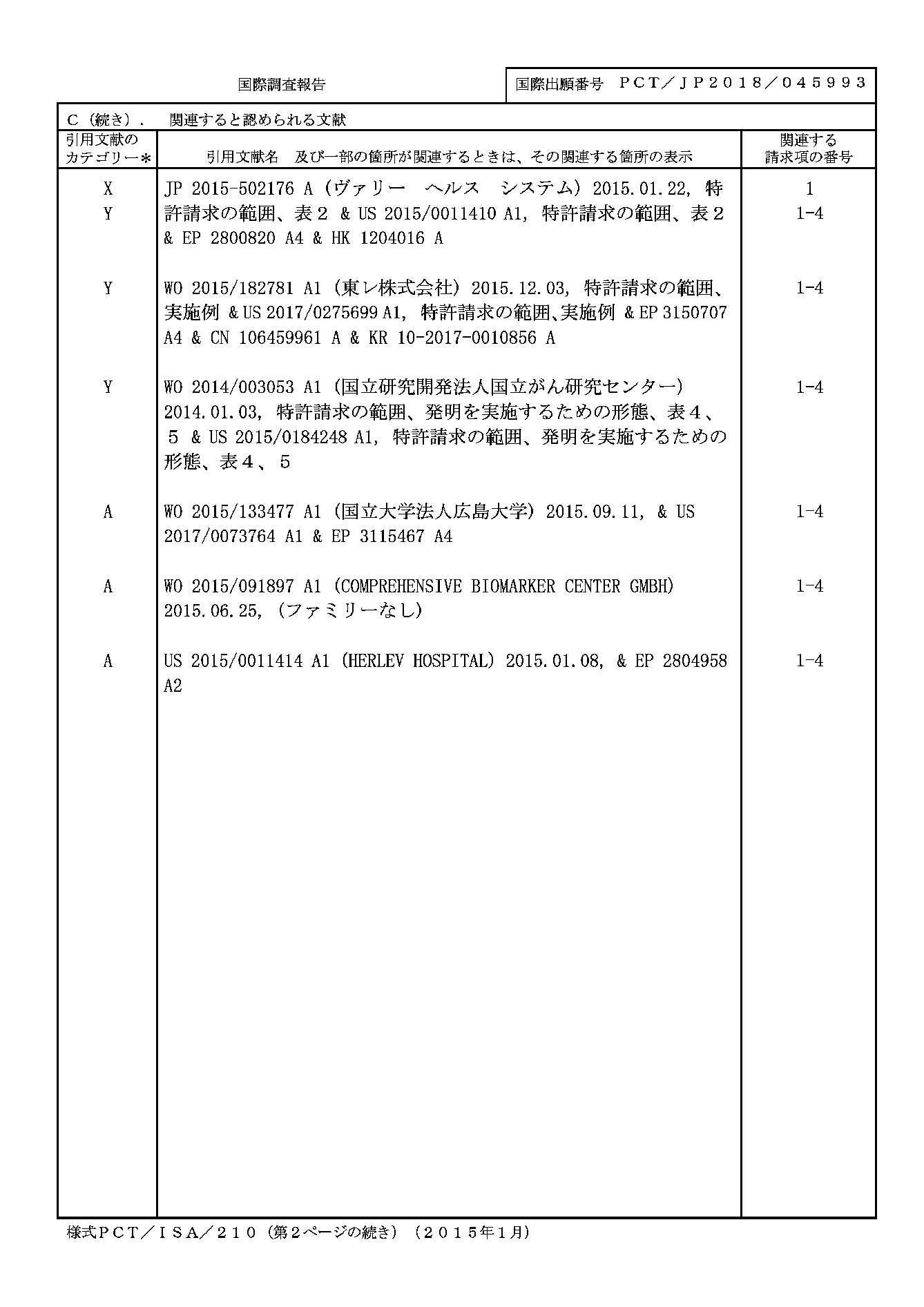
このため、血漿中のマイクロRNA(以下、「miRNA」)の存在量を指標として膵がんを検出する方法が提案されている(特許文献1〜4)。 Therefore, a method for detecting pancreatic cancer using the abundance of microRNA (hereinafter, “miRNA”) in plasma as an index has been proposed (Patent Documents 1 to 4).
上記の通り、種々のmiRNAが、膵がん検出のための指標として提案されているが、より正確に膵がんを検出することができれば有利であることは言うまでもない。 As described above, various miRNAs have been proposed as indicators for detecting pancreatic cancer, but it goes without saying that it would be advantageous if pancreatic cancer could be detected more accurately.
したがって、本発明の目的は、膵がんを高精度に検出することを補助する、膵がんの検出を補助する方法を提供することである。 Therefore, an object of the present invention is to provide a method for assisting the detection of pancreatic cancer, which assists the detection of pancreatic cancer with high accuracy.
本願発明者らは、鋭意研究の結果、膵がんにおいて存在量が増大又は減少するmiRNA、そのアイソフォーム (isomiR)、miRNA前駆体、転移RNA断片(tRF)および非コードRNA断片 (MiscRNA)を新たに見出し、これらを指標とすることにより、高精度に膵がんが可能になることを見出し、本発明を完成した。 As a result of diligent research, the inventors of the present application have found miRNAs whose abundance increases or decreases in pancreatic cancer, their isoforms (isomiR), miRNA precursors, transfer RNA fragments (tRF) and non-coding RNA fragments (MiscRNA). We have completed the present invention by finding out that pancreatic cancer can be performed with high accuracy by newly finding and using these as indicators.
すなわち、本発明は、以下のものを提供する。
(1) 生体から分離された被検試料中に含まれる、塩基配列が配列番号1、4、6〜10、12、15、17、19〜21、2、3、5、11、13、14、16、18、22〜38のいずれかで示されるmiRNA、そのアイソフォーム (isomiR)、miRNA前駆体、転移RNA断片 (tRF)、又は非コードRNA断片 (MiscRNA)の少なくとも1種の存在量を指標とする膵がんの検出を補助する方法であって、塩基配列が配列番号1〜20のいずれかで示される少なくとも1種のmiRNA、isomiR、miRNA前駆体、若しくは転移RNA断片の存在量が健常者よりも多いこと、又は塩基配列が配列番号21〜38のmiRNA、isomiR、miRNA前駆体、若しくは非コードRNA断片 (MiscRNA)の存在量が健常者よりも少ないことが、膵がんを発症している可能性が大きいことを示す、方法。
(2) 塩基配列が配列番号1、4、6〜10、12、15、17、19〜21、2、3、5、11、13、14、16、18のいずれかで示されるmiRNA、isomiR、miRNA前駆体、又は転移RNA断片の少なくとも1種の存在量を指標とする(1)記載の方法。
(3) 塩基配列が配列番号1、4、6〜10、12、15、17、19、20及び21のいずれかで示されるmiRNA又はisomiRの少なくとも1種の存在量を指標とする(2)記載の方法。
(4) 塩基配列が配列番号1〜4、6及び7のいずれかで示されるmiRNA又はisomiRの少なくとも1種の存在量を指標とする(2)又は(3)に記載の方法。That is, the present invention provides the following.
(1) The base sequences contained in the test sample isolated from the living body are SEQ ID NOs: 1, 4, 6 to 10, 12, 15, 17, 19 to 21, 2, 3, 5, 11, 13, 14 , 16, 18, 22-38, the abundance of at least one of the miRNA, its isoform (isomiR), miRNA precursor, translocated RNA fragment (tRF), or non-coding RNA fragment (MiscRNA). A method that assists in the detection of pancreatic cancer as an index, in which the abundance of at least one miRNA, isomiR, miRNA precursor, or translocated RNA fragment whose base sequence is represented by any of SEQ ID NOs: 1 to 20 is present. Pancreatic cancer develops when there are more miRNAs, isomiRs, miRNA precursors, or non-coding RNA fragments (MiscRNAs) with base sequences of SEQ ID NOs: 21-38 than in healthy individuals. A method that indicates that you are likely to be doing it.
(2) miRNA, isomiR whose base sequence is represented by any of SEQ ID NOs: 1, 4, 6 to 10, 12, 15, 17, 19 to 21, 2, 3, 5, 11, 13, 14, 16, 18 , The method according to (1), wherein the abundance of at least one of the miRNA precursor or the transfer RNA fragment is used as an index.
(3) The abundance of at least one miRNA or isomiR whose base sequence is represented by any of SEQ ID NOs: 1, 4, 6 to 10, 12, 15, 17, 19, 20 and 21 is used as an index (2). The method described.
(4) The method according to (2) or (3), wherein the abundance of at least one of miRNA or isomiR whose base sequence is represented by any of SEQ ID NOs: 1 to 4, 6 and 7 is used as an index.
本発明の方法によれば、高精度に、かつ、それでいて簡便に膵がんを検出することが可能であるので、膵がんの検出に大いに寄与する。 According to the method of the present invention, it is possible to detect pancreatic cancer with high accuracy and yet easily, which greatly contributes to the detection of pancreatic cancer.
上記の通り、本発明の方法では、生体から分離された被検試料中に含まれる特定のmiRNA、isomiR、miRNA前駆体、転移RNA断片(tRF)、非コードRNA断片 (MiscRNA)(以下、便宜的に「miRNA等」と呼ぶことがある)の存在量を指標とする。これらのmiRNA等の塩基配列は配列表に示すとおりである。本発明の方法に用いるmiRNA等の一覧を下記表1−1〜表1−2に示す。 As described above, in the method of the present invention, specific miRNA, isomiR, miRNA precursor, transfer RNA fragment (tRF), non-coding RNA fragment (MiscRNA) contained in the test sample isolated from the living body (hereinafter, convenience). The abundance of (sometimes called "miRNA, etc.") is used as an index. The base sequences of these miRNAs and the like are as shown in the sequence listing. A list of miRNAs and the like used in the method of the present invention is shown in Tables 1-1 to 1-2 below.
これらのmiRNA等のうち、塩基配列が配列番号1〜21で示されるmiRNA等(以下、便宜上、例えば「塩基配列が配列番号1で示されるmiRNA等」を単に「配列番号1のmiRNA等」や「配列番号1のもの」と呼ぶことがある)は、血漿中に存在するものである。これらのmiRNA等のうち、塩基配列が配列番号22〜38で示されるmiRNA等は、血清中に存在するものである。 Among these miRNAs and the like, miRNAs and the like whose base sequences are represented by SEQ ID NOs: 1 to 21 (hereinafter, for convenience, for example, "miRNAs and the like whose base sequences are represented by SEQ ID NO: 1" are simply "miRNAs and the like of SEQ ID NO: 1" and the like. (Sometimes referred to as "the one of SEQ ID NO: 1") is present in plasma. Among these miRNAs and the like, the miRNAs and the like whose nucleotide sequences are shown by SEQ ID NOs: 22 to 38 are present in serum.
これらのmiRNA等は、全て、膵がん患者の血漿中の存在量と、健常者の血漿中の存在量との比の対数(底が2の対数で「log FC」(FCは、fold change)と呼ばれる)の絶対値が2.0超のものであり(すなわち、比が約4倍以上又は約4分の1以下)、統計学的に有意(t検定でp<0.05)のものである。All of these miRNAs are logarithms of the ratio of the abundance in plasma of pancreatic cancer patients to the abundance in plasma of healthy subjects (the base is a logarithm of 2 and "log FC" (FC is f old). The absolute value of (called c hange) is greater than 2.0 (ie, the ratio is about 4 times or more or about 1/4 or less) and is statistically significant (p <0.05 by t test). is there.
配列番号1〜20のmiRNA等は、膵がん患者中の存在量が健常者中の存在量よりも多いものであり、配列番号21〜38のmiRNA等は、膵がん患者中の存在量が健常者中の存在量よりも少ないものである。 The abundance of miRNAs of SEQ ID NOs: 1 to 20 in pancreatic cancer patients is higher than that in healthy subjects, and the abundance of miRNAs of SEQ ID NOs: 21 to 38 in pancreatic cancer patients is higher. Is less than the abundance in healthy individuals.
これらの中でも、配列番号1〜4、6、7のmiRNA等は、log FCの絶対値が4.0以上のものであり、特に感度の高い指標となるものであり、好ましい。 Among these, miRNAs of SEQ ID NOs: 1 to 4, 6 and 7 have an absolute value of log FC of 4.0 or more, which is a particularly sensitive index, and are preferable.
がんマーカーの精度を示す指標としてROC曲線下面積(AUC(Area Under Curve))が用いられており、一般的にAUCが0.7以上のものががんマーカーとして有効であると言われている。AUCが0.90以上のものは高精度であり、0.97以上は非常に高精度、0.99以上は極めて高精度、1.00で完璧(偽陽性及び偽陰性が全くない)である。したがって、本発明においても、AUCが0.90のものが好ましく、さらに0.97以上のものが好ましく、さらに0.99以上のものが好ましく、1.00のものが最も好ましい。配列番号1、4、6〜10、12、15、17、19〜21のものは、下記実施例に具体的に記載するとおり、AUCが1.00であり、特に好ましいものである。 The area under the ROC curve (AUC) is used as an index showing the accuracy of cancer markers, and it is generally said that those with an AUC of 0.7 or more are effective as cancer markers. Those with an AUC of 0.90 or higher are highly accurate, those with an AUC of 0.97 or higher are extremely accurate, those with an AUC of 0.99 or higher are extremely accurate, and 1.00 is perfect (no false positives or false negatives). Therefore, also in the present invention, an AUC of 0.90 is preferable, an AUC of 0.97 or more is preferable, a product of 0.99 or more is preferable, and a product of 1.00 is most preferable. SEQ ID NOs: 1, 4, 6 to 10, 12, 15, 17, 19 to 21 have an AUC of 1.00, which is particularly preferable, as specifically described in the following examples.
被検試料としては、miRNAを含む体液であれば特に限定されないが、通常、血液試料(血漿、血清及び全血を包含する)が好ましく用いられる。血清中に存在する配列番号22〜38のものは、血清又は血漿を被検試料とすることが簡便で好ましい。血清又は血漿中の全RNAの抽出方法は周知であり、下記実施例に具体的に記載されている。血清又は血漿中のエクソソームからの全RNAの抽出方法自体も公知であり、詳細は下記実施例に具体的に記載されている。 The test sample is not particularly limited as long as it is a body fluid containing miRNA, but a blood sample (including plasma, serum and whole blood) is usually preferably used. For those of SEQ ID NOs: 22 to 38 present in serum, it is convenient and preferable to use serum or plasma as a test sample. Methods for extracting total RNA in serum or plasma are well known and are specifically described in the Examples below. The method itself for extracting total RNA from exosomes in serum or plasma is also known, and details are specifically described in the following Examples.
各miRNA等の存在量の測定(定量)は、次世代シーケンサーを用いて行うことが好ましい。次世代シーケンサーのように配列を読む機器であれば、機種を特定しない。下記実施例に具体的に記載されるように、本発明の方法では、定量するmiRNA等には、例えば、通常の成熟型miRNAの5’末端および/または3’末端からわずか1塩基以上が欠失または付加されているだけのisomiRを、基本となるmiRNAと区別して定量する必要があるので、精度の観点から、miRNAの定量に広く用いられている定量的逆転写PCR(qRT-PCR)よりも次世代シーケンサーを用いて行うことが好ましい。具体的には下記実施例において詳細に記載するが、簡単に述べると、この定量方法は、次のようにしておこなうことができる。血清或いは血漿中に存在するRNAが一定である場合、それらを用いた次世代シークエンス解析において読まれたリード数を100万リード数に換算して、100万リード数当たりのそれぞれのisomiRや成熟型miRNAのリード数を測定値とする。疾患によって健常人に比較して血清中または血漿中のRNAが変化する場合は、血清及び血漿中で存在量の変動が少ないmiRNAを用いる場合がある。なお、血清又は血漿中のmiRNA等を定量する場合には、血清及び血漿中で存在量の変動が少ないmiRNAであるlet-7g-5p、miR425-3p及びmiR425-5pから成る群より選ばれる少なくとも1種のmiRNAを内部標準として用いることが好ましい。 It is preferable to measure (quantify) the abundance of each miRNA or the like using a next-generation sequencer. If it is a device that reads an array, such as a next-generation sequencer, the model is not specified. As specifically described in the Examples below, in the method of the invention, the quantified miRNA or the like lacks, for example, only one or more bases from the 5'end and / or 3'end of a normal mature miRNA. Since it is necessary to quantify isomiR that is only lost or added separately from the basic miRNA, from the viewpoint of accuracy, it is better than quantitative reverse transcription PCR (qRT-PCR), which is widely used for quantification of miRNA. It is also preferable to use a next-generation sequencer. Specifically, it will be described in detail in the following examples, but briefly, this quantification method can be performed as follows. When the RNA present in serum or plasma is constant, the number of reads read in the next-generation sequence analysis using them is converted into 1 million reads, and each isomiR or mature type per 1 million reads is converted. The read number of miRNA is used as a measured value. When RNA in serum or plasma changes due to disease compared to healthy subjects, miRNA with less variation in serum and plasma abundance may be used. When quantifying miRNAs in serum or plasma, at least selected from the group consisting of let-7g-5p, miR425-3p and miR425-5p, which are miRNAs whose abundance does not fluctuate in serum and plasma. It is preferable to use one type of miRNA as an internal standard.
判定に用いる、各miRNA等の存在量のカットオフ値としては、各miRNA等について、健常者に対する統計学的有意差(t検定で、p<0.05、好ましくはp<0.01、さらに好ましくはp<0.001)の有無を基準とすることが好ましい。具体的には、好ましくは、例えば、偽陽性率が最良の値(最も低くなる値)なるプロット点におけるLog2 リード数(カットオフ値)を各miRNA等について設定することができ、例えば、いくつかの各miRNA等におけるカットオフ値(log2リード数)は表2に示すとおりである。なお、表2に示されるカットオフ値は、単なる例に過ぎず、統計学的有意差が出る限り、他の値をカットオフ値として採用することができる。また、データを採取する患者及び健常者の集団が異なれば、最良のカットオフ値も異なる。もっとも、通常、表2に示されるカットオフ値の±20%の範囲内、特には±10%の範囲内でカットオフ値を設定することができる。As the cutoff value of the abundance of each miRNA or the like used for the determination, there is a statistically significant difference (p <0.05, preferably p <0.01, more preferably p <0.01 in the t-test) for each miRNA or the like with respect to healthy subjects. It is preferable to use the presence or absence of 0.001) as a reference. Specifically, for example, the number of Log2 reads (cutoff value) at the plot point where the false positive rate is the best value (lowest value) can be set for each miRNA, for example, some. The cutoff values (log 2 read count) for each miRNA, etc. are as shown in Table 2. The cutoff values shown in Table 2 are merely examples, and other values can be adopted as the cutoff values as long as there is a statistically significant difference. In addition, different populations of patients and healthy individuals for whom data are collected have different best cutoff values. However, usually, the cutoff value can be set within the range of ± 20% of the cutoff value shown in Table 2, particularly within the range of ± 10%.
また、膵がんが疑われるか又は膵がんに罹患するヒトの被検試料中のmiRNA等の存在量を検出する方法も提供される。
すなわち、膵がんが疑われる又は膵がんに罹患するヒトの被検試料中の塩基配列が配列番号1、4、6〜10、12、15、17、19〜21、2、3、5、11、13、14、16、18、22〜38のいずれかで示されるmiRNA、そのアイソフォーム (isomiR)、miRNA前駆体、転移RNA断片 (tRF)、又は非コードRNA断片 (MiscRNA)の少なくとも1種の存在量を検出する方法であって、
ヒトから血液試料を得る工程、及び
次世代シーケンサーまたはqRT-PCRを用いて、前記血液試料内のmiRNA、isomiR、miRNA前駆体、転移RNA断片、又は非コードRNA断片の存在量を測定する工程を含み、
ここで、塩基配列が配列番号1〜20のいずれかで示される少なくとも1種のmiRNA、isomiR、miRNA前駆体、若しくは転移RNA断片の存在量が健常者よりも多い、又は塩基配列が配列番号21〜38のmiRNA、isomiR、miRNA前駆体、若しくは非コードRNA断片 (MiscRNA)の存在量が健常者よりも少ない、方法、も提供される。Also provided is a method for detecting the abundance of miRNA and the like in a human test sample in which pancreatic cancer is suspected or suffers from pancreatic cancer.
That is, the nucleotide sequence in a human test sample suspected of having pancreatic cancer or suffering from pancreatic cancer is SEQ ID NO: 1, 4, 6-10, 12, 15, 17, 19-21, 2, 3, 5 , 11, 13, 14, 16, 18, 22-38, at least the miRNA, its isoform (isomiR), miRNA precursor, transfer RNA fragment (tRF), or non-coding RNA fragment (MiscRNA). It is a method of detecting the abundance of one kind,
A step of obtaining a blood sample from a human and a step of measuring the abundance of miRNA, isomiR, miRNA precursor, transfer RNA fragment, or non-coding RNA fragment in the blood sample using a next-generation sequencer or qRT-PCR. Including
Here, the abundance of at least one miRNA, isomiR, miRNA precursor, or transfer RNA fragment whose base sequence is represented by any of SEQ ID NOs: 1 to 20 is higher than that of a healthy subject, or the base sequence is SEQ ID NO: 21. Methods are also provided in which the abundance of ~ 38 miRNAs, isomiRs, miRNA precursors, or non-coding RNA fragments (MiscRNAs) is lower than in healthy individuals.
また、上記した本願発明の方法により、膵がんが検出された場合、膵がんが検出された患者に有効量の抗膵がん剤を投与することにより、膵がんを治療することができる。抗膵がん剤としては、ゲムシタビン、フォルフィリノックス(フルオロウラシル・レボホリナート・イリノテカン・オキサリプラチン併用)、ゲムシタビン・ナブパクリタキセル(Gem/nabPTX)、ティーエスワン(S1)等を挙げることができる。 In addition, when pancreatic cancer is detected by the method of the present invention described above, pancreatic cancer can be treated by administering an effective amount of an anti-pancreatic cancer agent to a patient in which pancreatic cancer is detected. it can. Examples of the anti-pancreatic cancer agent include gemcitabine, folinox (combined with fluorouracil, levofolinate, irinotecan, and oxaliplatin), gemcitabine, nabpaclitaxel (Gem / nabPTX), TS1 (S1), and the like.
以下、本発明を実施例及び比較例に基づき具体的に説明する。もっとも、本発明は下記実施例に限定されるものではない。 Hereinafter, the present invention will be specifically described based on Examples and Comparative Examples. However, the present invention is not limited to the following examples.
実施例1〜38
1. 材料及び方法
(1) 臨床検体
膵がん患者5例、健常者5例の血漿を用いた。
膵がん患者75例、健常者111例の血清を用いた。Examples 1-38
1. 1. Materials and methods
(1) Clinical specimens Plasma was used from 5 patients with pancreatic cancer and 5 healthy subjects.
Serum from 75 pancreatic cancer patients and 111 healthy subjects was used.
(2) 血漿・血清中のRNAの抽出
血漿・血清中 RNA の抽出は、miRNeasy Mini kit (QIAGEN) を用いて行った。
1) 凍結した血漿・血清サンプルを融解し、10000 rpm で 5 分間、室温で遠心し、凝集タンパク質や血球成分を沈殿させた。
2) 上清 200 μL を新しい 1.5 mL チューブ に移した。
3) 1000 μL の QIAzol Lysis Reagent を加えて十分に混和し、タンパク質成分を変性した。
4) RNA 抽出のコントロール RNA として 0.05 nM cel-miR-39 を 10 μL 加え、ピペッティングで混和した後、室温で 5 分間静置した。
5) 水層と有機溶媒層の分離促進のため、200μLのクロロホルムを加え、十分に混和し、室温で 3 分間静置した。
6) 12000 xg、15分間、4℃で遠心し、上層の水層650μLを新しい2mLチューブ に移した。
7) RNA を析出させるため、975μLの 100% エタノールを加え、ピペッティングで混和した。
8) 650 μL の 7) を miRNeasy Mini spin column (以下、カラム) に移し、室温で 1 分間静置後、8000 xg、15 秒間、室温で遠心し、RNA をカラムのフィルターに吸着させた。カラムから通過した溶液は廃棄した。
9) 7) の溶液を全てカラムに通すまで 8) を繰り返し、全ての RNA をフィルターに吸着させた。
10) フィルターに付着した夾雑物の除去のため、650 μL の Buffer RWT をカラムに加え、 8000 xg、15 秒間、室温で遠心した。 カラムから通過した溶液は廃棄した。
11) フィルターに吸着した RNA の洗浄のため、500 μL のBuffer RPE をカラムに加え、8000 xg、15 秒間、室温で遠心した。カラムから通過した溶液は廃棄した。
12) フィルターに吸着した RNA の洗浄のため、500 μL のBuffer RPE をカラムに加え、8000 xg、2 分間、室温で遠心した。 カラムから通過した溶液は廃棄した。
13) フィルターに付着している溶液を完全に除去するため、カラムを新しい 2 mL collection チューブ に移し、10000 xg、1 分間、室温で遠心した。
14) カラムを 1.5 mL チューブ に移し、50 μL の RNase-free water を加え、室温で 1 分間静置した。
15) 8000 xg、1 分間、室温で遠心し、フィルターに吸着した RNA を溶出した。溶出した RNAは、そのまま次の実験に用い、残りは -80 ℃ で保存した。(2) Extraction of RNA in plasma / serum Plasma / serum RNA was extracted using the miRNeasy Mini kit (QIAGEN).
1) Frozen plasma / serum samples were thawed and centrifuged at 10000 rpm for 5 minutes at room temperature to precipitate aggregated proteins and blood cell components.
2) Transfer 200 μL of supernatant to a new 1.5 mL tube.
3) 1000 μL of QIAzol Lysis Reagent was added and mixed well to denature the protein component.
4) Control of RNA extraction 10 μL of 0.05 nM cel-miR-39 was added as RNA, mixed by pipetting, and then allowed to stand at room temperature for 5 minutes.
5) To promote the separation of the aqueous layer and the organic solvent layer, 200 μL of chloroform was added, mixed well, and allowed to stand at room temperature for 3 minutes.
6) Centrifuge at 12000 xg for 15 minutes at 4 ° C. and transfer 650 μL of the upper aqueous layer to a new 2 mL tube.
7) In order to precipitate RNA, 975 μL of 100% ethanol was added and mixed by pipetting.
8) 650 μL of 7) was transferred to a miRNeasy Mini spin column (hereinafter referred to as a column), allowed to stand at room temperature for 1 minute, and then centrifuged at 8000 xg for 15 seconds at room temperature to adsorb RNA on the filter of the column. The solution that passed through the column was discarded.
9) Repeat 8) until all the solution of 7) was passed through the column, and all RNA was adsorbed on the filter.
10) To remove contaminants adhering to the filter, 650 μL of Buffer RWT was added to the column and centrifuged at 8000 xg for 15 seconds at room temperature. The solution that passed through the column was discarded.
11) To wash the RNA adsorbed on the filter, 500 μL of Buffer RPE was added to the column and centrifuged at 8000 xg for 15 seconds at room temperature. The solution that passed through the column was discarded.
12) To wash the RNA adsorbed on the filter, 500 μL of Buffer RPE was added to the column and centrifuged at 8000 xg for 2 minutes at room temperature. The solution that passed through the column was discarded.
13) To completely remove the solution adhering to the filter, the column was transferred to a new 2 mL collection tube and centrifuged at 10000 xg for 1 minute at room temperature.
14) The column was transferred to a 1.5 mL tube, 50 μL of RNase-free water was added, and the mixture was allowed to stand at room temperature for 1 minute.
15) Centrifuge at 8000 xg for 1 minute at room temperature to elute the RNA adsorbed on the filter. The eluted RNA was used as is for the next experiment, and the rest was stored at -80 ° C.
(3) miRNA等の定量
miRNA等の定量は、次のようにして行った。
二群等でmiRNA等の定量を行う場合は、同様の方法で回収した細胞外小胞(エクソソームを含む)を用いて同様の方法でRNAを精製してcDNAライブラリーを作成して次世代シークエンス解析を行う。次世代シークエンス解析は、配列を読む機器であれば機器を限定しない。(3) Quantification of miRNA, etc.
The quantification of miRNA and the like was carried out as follows.
When quantifying miRNA, etc. in two groups, etc., use extracellular vesicles (including exosomes) collected by the same method to purify RNA by the same method to create a cDNA library, and then sequence the next generation. Perform analysis. Next-generation sequence analysis is not limited to devices that read sequences.
(4) カットオフ値及びAUCの算出
定量結果からのカットオフ値及びAUCの算出は、具体的に次のようにして行った。
JMP Genomics 8を用いてロジスティック回帰分析を実施し、ROC曲線とAUCの算出を行った。また、ROC曲線の左上隅の点(感度1.0, 特異度 1.0)との距離が最小となる点をカットオフ値とした。(4) Calculation of cutoff value and AUC The cutoff value and AUC were calculated specifically as follows from the quantitative results.
Logistic regression analysis was performed using JMP Genomics 8 to calculate the ROC curve and AUC. The cutoff value was the point where the distance from the upper left corner of the ROC curve (sensitivity 1.0, specificity 1.0) was the smallest.
2. 結果
結果を表2−1及び表2−2に示す。2. 2. Results The results are shown in Table 2-1 and Table 2-2.
これらの結果からわかるように、配列番号1〜20のmiRNA等は、膵がん患者中の存在量が健常者中の存在量よりも有意に多く、配列番号21〜38のmiRNA等は、膵がん患者中の存在量が健常者中の存在量よりも有意に少なかった。本発明の方法(実施例1〜38)によれば、高精度に膵がんの検出が可能であることが示された。また、実施例1〜38のt検定によるp値はいずれも0.05未満であり、膵がんの検出に有効であることが示された。 As can be seen from these results, the abundance of miRNAs of SEQ ID NOs: 1 to 20 in pancreatic cancer patients is significantly higher than that in healthy subjects, and the abundance of miRNAs of SEQ ID NOs: 21 to 38 is pancreatic. The abundance in cancer patients was significantly lower than that in healthy subjects. According to the method of the present invention (Examples 1 to 38), it was shown that pancreatic cancer can be detected with high accuracy. In addition, the p-values of Examples 1 to 38 by the t-test were all less than 0.05, indicating that they are effective in detecting pancreatic cancer.
また、配列番号1、4、6〜10、12、15、17、19、20及び21のものは、AUCが1.00であり、特に好ましいものであることが明らかになった。 Further, it was revealed that the ones of SEQ ID NOs: 1, 4, 6 to 10, 12, 15, 17, 19, 20 and 21 have an AUC of 1.00, which are particularly preferable.
Claims (4)
Priority Applications (1)
| Application Number | Priority Date | Filing Date | Title |
|---|---|---|---|
| JP2023094590A JP2023113877A (en) | 2017-12-13 | 2023-06-08 | Methods to help detect pancreatic cancer |
Applications Claiming Priority (3)
| Application Number | Priority Date | Filing Date | Title |
|---|---|---|---|
| JP2017238839 | 2017-12-13 | ||
| JP2017238839 | 2017-12-13 | ||
| PCT/JP2018/045993 WO2019117269A1 (en) | 2017-12-13 | 2018-12-13 | Method for aiding detection of pancreatic cancer |
Related Child Applications (1)
| Application Number | Title | Priority Date | Filing Date |
|---|---|---|---|
| JP2023094590A Division JP2023113877A (en) | 2017-12-13 | 2023-06-08 | Methods to help detect pancreatic cancer |
Publications (2)
| Publication Number | Publication Date |
|---|---|
| JPWO2019117269A1 true JPWO2019117269A1 (en) | 2021-02-18 |
| JP7298914B2 JP7298914B2 (en) | 2023-06-27 |
Family
ID=66819331
Family Applications (2)
| Application Number | Title | Priority Date | Filing Date |
|---|---|---|---|
| JP2019559213A Active JP7298914B2 (en) | 2017-12-13 | 2018-12-13 | Methods to help detect pancreatic cancer |
| JP2023094590A Pending JP2023113877A (en) | 2017-12-13 | 2023-06-08 | Methods to help detect pancreatic cancer |
Family Applications After (1)
| Application Number | Title | Priority Date | Filing Date |
|---|---|---|---|
| JP2023094590A Pending JP2023113877A (en) | 2017-12-13 | 2023-06-08 | Methods to help detect pancreatic cancer |
Country Status (4)
| Country | Link |
|---|---|
| US (1) | US20230167504A1 (en) |
| EP (1) | EP3725881A1 (en) |
| JP (2) | JP7298914B2 (en) |
| WO (1) | WO2019117269A1 (en) |
Families Citing this family (4)
| Publication number | Priority date | Publication date | Assignee | Title |
|---|---|---|---|---|
| JP7298914B2 (en) * | 2017-12-13 | 2023-06-27 | 国立大学法人広島大学 | Methods to help detect pancreatic cancer |
| JP7802367B2 (en) * | 2020-07-16 | 2026-01-20 | 学校法人 久留米大学 | Use of microRNAs as biomarkers for pancreatic cancer |
| CN112522262B (en) * | 2020-11-12 | 2023-06-20 | 中山大学肿瘤防治中心(中山大学附属肿瘤医院、中山大学肿瘤研究所) | A kind of tRF related to pancreatic cancer and its application |
| US20230390303A1 (en) * | 2020-11-13 | 2023-12-07 | Ono Pharmaceutical Co., Ltd. | Cancer treatment by combination of ep4 antagonist and immune checkpoint inhibitor |
Citations (5)
| Publication number | Priority date | Publication date | Assignee | Title |
|---|---|---|---|---|
| JP2009521952A (en) * | 2006-01-05 | 2009-06-11 | ジ・オハイオ・ステイト・ユニバーシティ・リサーチ・ファウンデイション | Abnormal microRNA expression in pancreatic endocrine and acinar tumors |
| JP2009528070A (en) * | 2006-03-02 | 2009-08-06 | ザ オハイオ ステイト ユニバーシティ | MicroRNA expression profiles associated with pancreatic cancer |
| WO2014003053A1 (en) * | 2012-06-27 | 2014-01-03 | 独立行政法人国立がん研究センター | Method for detecting pancreatic cancer and detection kit |
| JP2015502176A (en) * | 2011-12-19 | 2015-01-22 | ヴァリー ヘルス システム | Method and kit for diagnosing a subject at risk of having cancer |
| WO2015182781A1 (en) * | 2014-05-30 | 2015-12-03 | 東レ株式会社 | Pancreatic cancer detection kit, device, and detection method |
Family Cites Families (5)
| Publication number | Priority date | Publication date | Assignee | Title |
|---|---|---|---|---|
| CA2685840C (en) | 2007-04-30 | 2016-12-13 | The Ohio State University Research Foundation | Methods for differentiating pancreatic cancer from normal pancreatic function and/or chronic pancreatitis |
| EP2804958A2 (en) * | 2012-01-16 | 2014-11-26 | Herlev Hospital | Microrna for diagnosis of pancreatic cancer and/or prognosis of patients with pancreatic cancer by blood samples |
| WO2015091897A1 (en) * | 2013-12-19 | 2015-06-25 | Comprehensive Biomarker Center Gmbh | Determination of platelet-mirnas |
| EP3115467B1 (en) * | 2014-03-04 | 2019-01-02 | Hiroshima University | Method for assisting detection of pancreatic cancer |
| JP7298914B2 (en) * | 2017-12-13 | 2023-06-27 | 国立大学法人広島大学 | Methods to help detect pancreatic cancer |
-
2018
- 2018-12-13 JP JP2019559213A patent/JP7298914B2/en active Active
- 2018-12-13 US US16/772,625 patent/US20230167504A1/en not_active Abandoned
- 2018-12-13 WO PCT/JP2018/045993 patent/WO2019117269A1/en not_active Ceased
- 2018-12-13 EP EP18888263.3A patent/EP3725881A1/en not_active Withdrawn
-
2023
- 2023-06-08 JP JP2023094590A patent/JP2023113877A/en active Pending
Patent Citations (5)
| Publication number | Priority date | Publication date | Assignee | Title |
|---|---|---|---|---|
| JP2009521952A (en) * | 2006-01-05 | 2009-06-11 | ジ・オハイオ・ステイト・ユニバーシティ・リサーチ・ファウンデイション | Abnormal microRNA expression in pancreatic endocrine and acinar tumors |
| JP2009528070A (en) * | 2006-03-02 | 2009-08-06 | ザ オハイオ ステイト ユニバーシティ | MicroRNA expression profiles associated with pancreatic cancer |
| JP2015502176A (en) * | 2011-12-19 | 2015-01-22 | ヴァリー ヘルス システム | Method and kit for diagnosing a subject at risk of having cancer |
| WO2014003053A1 (en) * | 2012-06-27 | 2014-01-03 | 独立行政法人国立がん研究センター | Method for detecting pancreatic cancer and detection kit |
| WO2015182781A1 (en) * | 2014-05-30 | 2015-12-03 | 東レ株式会社 | Pancreatic cancer detection kit, device, and detection method |
Also Published As
| Publication number | Publication date |
|---|---|
| JP2023113877A (en) | 2023-08-16 |
| US20230167504A1 (en) | 2023-06-01 |
| JP7298914B2 (en) | 2023-06-27 |
| WO2019117269A1 (en) | 2019-06-20 |
| EP3725881A1 (en) | 2020-10-21 |
Similar Documents
| Publication | Publication Date | Title |
|---|---|---|
| CN109777874B (en) | Plasma exosome miRNA marker suitable for diagnosis and prognosis of pancreatic ductal adenocarcinoma and application thereof | |
| JP7390002B2 (en) | Ways to help detect head and neck cancer | |
| CN104450901B (en) | The nucleic acid markers of quick diagnosis mucocutaneous lymphnode syndrome and test kit thereof | |
| JP2023113877A (en) | Methods to help detect pancreatic cancer | |
| Tóth et al. | Circadian rhythm of methylated septin 9, cell-free DNA amount and tumor markers in colorectal cancer patients | |
| US9909190B2 (en) | Method for assisting detection of pancreatic cancer | |
| CN111826444A (en) | A serum/plasma tsRNA marker, probe and application related to pancreatic cancer | |
| JP7624245B2 (en) | Methods to aid in breast cancer detection | |
| CN104232636A (en) | Hepatitis B microRNA molecular marker composition and application thereof | |
| CN105256036A (en) | Kit for detecting lncARSR in serum and application of kit in detection of kidney cancer sunitinib drug resistance | |
| CN104694623A (en) | Plasma miRNA marker for diagnosis of lung cancer and application | |
| CN113584169A (en) | Serum tsRNA marker related to liver cancer, probe and application thereof | |
| CN105400882A (en) | Serum miRNA markers suitable for diagnosis of ossification of posterior longitudinal ligament and application thereof | |
| CN108796074A (en) | Detect application and kit of the reagent of circular rna circRNF13 on preparing tumour auxiliary diagnosis preparation | |
| CN108796075A (en) | Detect application and the kit of circRNF13 and LOC284454 reagents | |
| CN119351556A (en) | A platelet marker and detection kit for detecting lung cancer | |
| CN102021169A (en) | Serum/plasma miRNA composition and use thereof | |
| CN110592223A (en) | Application of a NSCLC diagnostic and prognostic marker hsa_circRNA_012515 | |
| CN110331207A (en) | Adenocarcinoma of lung biomarker and related application | |
| JPWO2019117306A1 (en) | How to help detect Alzheimer's disease | |
| CN116590408A (en) | Liver cancer detection selected from 19 microRNA subtypes as biomarkers | |
| Huang et al. | The diagnostic performance of lncRNAs from blood specimens in patients with hepatocellular carcinoma: A meta-analysis | |
| CN116732179B (en) | Non-small cell lung cancer related lncRNA molecular marker and application thereof | |
| CN108504736A (en) | Detect application of the system of ORM1 gene expression amounts in diagnosis of tuberculosis | |
| CN108384848A (en) | Applications of the circ_0021132 as Deep vain thrombosis diagnosis marker in serum |
Legal Events
| Date | Code | Title | Description |
|---|---|---|---|
| A521 | Request for written amendment filed |
Free format text: JAPANESE INTERMEDIATE CODE: A523 Effective date: 20200619 |
|
| A521 | Request for written amendment filed |
Free format text: JAPANESE INTERMEDIATE CODE: A523 Effective date: 20200702 |
|
| AA64 | Notification of invalidation of claim of internal priority (with term) |
Free format text: JAPANESE INTERMEDIATE CODE: A241764 Effective date: 20200908 |
|
| A521 | Request for written amendment filed |
Free format text: JAPANESE INTERMEDIATE CODE: A523 Effective date: 20200909 |
|
| A621 | Written request for application examination |
Free format text: JAPANESE INTERMEDIATE CODE: A621 Effective date: 20211115 |
|
| A131 | Notification of reasons for refusal |
Free format text: JAPANESE INTERMEDIATE CODE: A131 Effective date: 20221101 |
|
| A601 | Written request for extension of time |
Free format text: JAPANESE INTERMEDIATE CODE: A601 Effective date: 20221219 |
|
| A521 | Request for written amendment filed |
Free format text: JAPANESE INTERMEDIATE CODE: A523 Effective date: 20230224 |
|
| TRDD | Decision of grant or rejection written | ||
| A01 | Written decision to grant a patent or to grant a registration (utility model) |
Free format text: JAPANESE INTERMEDIATE CODE: A01 Effective date: 20230511 |
|
| A61 | First payment of annual fees (during grant procedure) |
Free format text: JAPANESE INTERMEDIATE CODE: A61 Effective date: 20230608 |
|
| R150 | Certificate of patent or registration of utility model |
Ref document number: 7298914 Country of ref document: JP Free format text: JAPANESE INTERMEDIATE CODE: R150 |
|
| R250 | Receipt of annual fees |
Free format text: JAPANESE INTERMEDIATE CODE: R250 |