JP7625512B2 - Hepatitis B virus (HBV) dsRNA agent compositions and methods of use thereof - Google Patents
Hepatitis B virus (HBV) dsRNA agent compositions and methods of use thereof Download PDFInfo
- Publication number
- JP7625512B2 JP7625512B2 JP2021507570A JP2021507570A JP7625512B2 JP 7625512 B2 JP7625512 B2 JP 7625512B2 JP 2021507570 A JP2021507570 A JP 2021507570A JP 2021507570 A JP2021507570 A JP 2021507570A JP 7625512 B2 JP7625512 B2 JP 7625512B2
- Authority
- JP
- Japan
- Prior art keywords
- hbv
- dsrna
- phosphate
- dsrna agent
- hepatitis
- Prior art date
- Legal status (The legal status is an assumption and is not a legal conclusion. Google has not performed a legal analysis and makes no representation as to the accuracy of the status listed.)
- Active
Links
Classifications
-
- C—CHEMISTRY; METALLURGY
- C12—BIOCHEMISTRY; BEER; SPIRITS; WINE; VINEGAR; MICROBIOLOGY; ENZYMOLOGY; MUTATION OR GENETIC ENGINEERING
- C12N—MICROORGANISMS OR ENZYMES; COMPOSITIONS THEREOF; PROPAGATING, PRESERVING, OR MAINTAINING MICROORGANISMS; MUTATION OR GENETIC ENGINEERING; CULTURE MEDIA
- C12N15/00—Mutation or genetic engineering; DNA or RNA concerning genetic engineering, vectors, e.g. plasmids, or their isolation, preparation or purification; Use of hosts therefor
- C12N15/09—Recombinant DNA-technology
- C12N15/11—DNA or RNA fragments; Modified forms thereof; Non-coding nucleic acids having a biological activity
- C12N15/113—Non-coding nucleic acids modulating the expression of genes, e.g. antisense oligonucleotides; Antisense DNA or RNA; Triplex- forming oligonucleotides; Catalytic nucleic acids, e.g. ribozymes; Nucleic acids used in co-suppression or gene silencing
- C12N15/1131—Non-coding nucleic acids modulating the expression of genes, e.g. antisense oligonucleotides; Antisense DNA or RNA; Triplex- forming oligonucleotides; Catalytic nucleic acids, e.g. ribozymes; Nucleic acids used in co-suppression or gene silencing against viruses
-
- A—HUMAN NECESSITIES
- A61—MEDICAL OR VETERINARY SCIENCE; HYGIENE
- A61K—PREPARATIONS FOR MEDICAL, DENTAL OR TOILETRY PURPOSES
- A61K31/00—Medicinal preparations containing organic active ingredients
- A61K31/70—Carbohydrates; Sugars; Derivatives thereof
- A61K31/7088—Compounds having three or more nucleosides or nucleotides
- A61K31/713—Double-stranded nucleic acids or oligonucleotides
-
- A—HUMAN NECESSITIES
- A61—MEDICAL OR VETERINARY SCIENCE; HYGIENE
- A61K—PREPARATIONS FOR MEDICAL, DENTAL OR TOILETRY PURPOSES
- A61K45/00—Medicinal preparations containing active ingredients not provided for in groups A61K31/00 - A61K41/00
- A61K45/06—Mixtures of active ingredients without chemical characterisation, e.g. antiphlogistics and cardiaca
-
- A—HUMAN NECESSITIES
- A61—MEDICAL OR VETERINARY SCIENCE; HYGIENE
- A61K—PREPARATIONS FOR MEDICAL, DENTAL OR TOILETRY PURPOSES
- A61K47/00—Medicinal preparations characterised by the non-active ingredients used, e.g. carriers or inert additives; Targeting or modifying agents chemically bound to the active ingredient
- A61K47/50—Medicinal preparations characterised by the non-active ingredients used, e.g. carriers or inert additives; Targeting or modifying agents chemically bound to the active ingredient the non-active ingredient being chemically bound to the active ingredient, e.g. polymer-drug conjugates
- A61K47/51—Medicinal preparations characterised by the non-active ingredients used, e.g. carriers or inert additives; Targeting or modifying agents chemically bound to the active ingredient the non-active ingredient being chemically bound to the active ingredient, e.g. polymer-drug conjugates the non-active ingredient being a modifying agent
- A61K47/54—Medicinal preparations characterised by the non-active ingredients used, e.g. carriers or inert additives; Targeting or modifying agents chemically bound to the active ingredient the non-active ingredient being chemically bound to the active ingredient, e.g. polymer-drug conjugates the non-active ingredient being a modifying agent the modifying agent being an organic compound
- A61K47/549—Sugars, nucleosides, nucleotides or nucleic acids
-
- A—HUMAN NECESSITIES
- A61—MEDICAL OR VETERINARY SCIENCE; HYGIENE
- A61K—PREPARATIONS FOR MEDICAL, DENTAL OR TOILETRY PURPOSES
- A61K47/00—Medicinal preparations characterised by the non-active ingredients used, e.g. carriers or inert additives; Targeting or modifying agents chemically bound to the active ingredient
- A61K47/50—Medicinal preparations characterised by the non-active ingredients used, e.g. carriers or inert additives; Targeting or modifying agents chemically bound to the active ingredient the non-active ingredient being chemically bound to the active ingredient, e.g. polymer-drug conjugates
- A61K47/51—Medicinal preparations characterised by the non-active ingredients used, e.g. carriers or inert additives; Targeting or modifying agents chemically bound to the active ingredient the non-active ingredient being chemically bound to the active ingredient, e.g. polymer-drug conjugates the non-active ingredient being a modifying agent
- A61K47/56—Medicinal preparations characterised by the non-active ingredients used, e.g. carriers or inert additives; Targeting or modifying agents chemically bound to the active ingredient the non-active ingredient being chemically bound to the active ingredient, e.g. polymer-drug conjugates the non-active ingredient being a modifying agent the modifying agent being an organic macromolecular compound, e.g. an oligomeric, polymeric or dendrimeric molecule
-
- A—HUMAN NECESSITIES
- A61—MEDICAL OR VETERINARY SCIENCE; HYGIENE
- A61P—SPECIFIC THERAPEUTIC ACTIVITY OF CHEMICAL COMPOUNDS OR MEDICINAL PREPARATIONS
- A61P31/00—Antiinfectives, i.e. antibiotics, antiseptics, chemotherapeutics
- A61P31/12—Antivirals
-
- A—HUMAN NECESSITIES
- A61—MEDICAL OR VETERINARY SCIENCE; HYGIENE
- A61P—SPECIFIC THERAPEUTIC ACTIVITY OF CHEMICAL COMPOUNDS OR MEDICINAL PREPARATIONS
- A61P31/00—Antiinfectives, i.e. antibiotics, antiseptics, chemotherapeutics
- A61P31/12—Antivirals
- A61P31/20—Antivirals for DNA viruses
-
- C—CHEMISTRY; METALLURGY
- C12—BIOCHEMISTRY; BEER; SPIRITS; WINE; VINEGAR; MICROBIOLOGY; ENZYMOLOGY; MUTATION OR GENETIC ENGINEERING
- C12N—MICROORGANISMS OR ENZYMES; COMPOSITIONS THEREOF; PROPAGATING, PRESERVING, OR MAINTAINING MICROORGANISMS; MUTATION OR GENETIC ENGINEERING; CULTURE MEDIA
- C12N2310/00—Structure or type of the nucleic acid
- C12N2310/10—Type of nucleic acid
- C12N2310/11—Antisense
-
- C—CHEMISTRY; METALLURGY
- C12—BIOCHEMISTRY; BEER; SPIRITS; WINE; VINEGAR; MICROBIOLOGY; ENZYMOLOGY; MUTATION OR GENETIC ENGINEERING
- C12N—MICROORGANISMS OR ENZYMES; COMPOSITIONS THEREOF; PROPAGATING, PRESERVING, OR MAINTAINING MICROORGANISMS; MUTATION OR GENETIC ENGINEERING; CULTURE MEDIA
- C12N2310/00—Structure or type of the nucleic acid
- C12N2310/10—Type of nucleic acid
- C12N2310/14—Type of nucleic acid interfering nucleic acids [NA]
-
- C—CHEMISTRY; METALLURGY
- C12—BIOCHEMISTRY; BEER; SPIRITS; WINE; VINEGAR; MICROBIOLOGY; ENZYMOLOGY; MUTATION OR GENETIC ENGINEERING
- C12N—MICROORGANISMS OR ENZYMES; COMPOSITIONS THEREOF; PROPAGATING, PRESERVING, OR MAINTAINING MICROORGANISMS; MUTATION OR GENETIC ENGINEERING; CULTURE MEDIA
- C12N2310/00—Structure or type of the nucleic acid
- C12N2310/30—Chemical structure
- C12N2310/31—Chemical structure of the backbone
- C12N2310/315—Phosphorothioates
-
- C—CHEMISTRY; METALLURGY
- C12—BIOCHEMISTRY; BEER; SPIRITS; WINE; VINEGAR; MICROBIOLOGY; ENZYMOLOGY; MUTATION OR GENETIC ENGINEERING
- C12N—MICROORGANISMS OR ENZYMES; COMPOSITIONS THEREOF; PROPAGATING, PRESERVING, OR MAINTAINING MICROORGANISMS; MUTATION OR GENETIC ENGINEERING; CULTURE MEDIA
- C12N2310/00—Structure or type of the nucleic acid
- C12N2310/30—Chemical structure
- C12N2310/32—Chemical structure of the sugar
- C12N2310/321—2'-O-R Modification
-
- C—CHEMISTRY; METALLURGY
- C12—BIOCHEMISTRY; BEER; SPIRITS; WINE; VINEGAR; MICROBIOLOGY; ENZYMOLOGY; MUTATION OR GENETIC ENGINEERING
- C12N—MICROORGANISMS OR ENZYMES; COMPOSITIONS THEREOF; PROPAGATING, PRESERVING, OR MAINTAINING MICROORGANISMS; MUTATION OR GENETIC ENGINEERING; CULTURE MEDIA
- C12N2310/00—Structure or type of the nucleic acid
- C12N2310/30—Chemical structure
- C12N2310/32—Chemical structure of the sugar
- C12N2310/322—2'-R Modification
Landscapes
- Health & Medical Sciences (AREA)
- Life Sciences & Earth Sciences (AREA)
- Chemical & Material Sciences (AREA)
- Engineering & Computer Science (AREA)
- General Health & Medical Sciences (AREA)
- Molecular Biology (AREA)
- Genetics & Genomics (AREA)
- Pharmacology & Pharmacy (AREA)
- Veterinary Medicine (AREA)
- Public Health (AREA)
- Animal Behavior & Ethology (AREA)
- Medicinal Chemistry (AREA)
- Bioinformatics & Cheminformatics (AREA)
- Organic Chemistry (AREA)
- Biomedical Technology (AREA)
- Virology (AREA)
- Biotechnology (AREA)
- Epidemiology (AREA)
- Biochemistry (AREA)
- General Engineering & Computer Science (AREA)
- Wood Science & Technology (AREA)
- Zoology (AREA)
- Nuclear Medicine, Radiotherapy & Molecular Imaging (AREA)
- Physics & Mathematics (AREA)
- Biophysics (AREA)
- General Chemical & Material Sciences (AREA)
- Plant Pathology (AREA)
- Chemical Kinetics & Catalysis (AREA)
- Microbiology (AREA)
- Oncology (AREA)
- Communicable Diseases (AREA)
- Pharmaceuticals Containing Other Organic And Inorganic Compounds (AREA)
- Medicines That Contain Protein Lipid Enzymes And Other Medicines (AREA)
- Micro-Organisms Or Cultivation Processes Thereof (AREA)
- Medicinal Preparation (AREA)
Description
配列表に関する記述
本出願に関連する配列表は、紙のコピーの代わりにテキスト形式で提供され、引用により本明細書に包含される。配列表を含むテキストファイルの名称は930385_410WO_配列_LISTING.txtである。テキストファイルは83.1KBで、2019年8月4日に作成され、EFS-Web経由で電子的に提出されている。
SEQUENCE LISTING STATEMENT The sequence listing associated with this application is provided in text form in lieu of a paper copy and is incorporated herein by reference. The text file containing the sequence listing is named 930385_410WO_SEQUENCE_LISTING.txt. The text file is 83.1KB, was created on Aug. 4, 2019, and has been submitted electronically via EFS-Web.
世界中で4億人以上がHBVに慢性的に感染しており、従って、慢性肝炎、肝硬変、肝不全および肝細胞癌(HCC)などの重篤な肝疾患を発症するリスクが高く、毎年推定600,000人が死亡するという状況である。 Over 400 million people worldwide are chronically infected with HBV and are therefore at high risk of developing serious liver diseases, including chronic hepatitis, cirrhosis, liver failure and hepatocellular carcinoma (HCC), which are responsible for an estimated 600,000 deaths each year.
慢性HBV感染の自然の展開には、4つの連続的な段階が含まれる:(1)初期「免疫寛容」段階、高レベルのウイルス複製および最小の肝炎;(2)免疫反応段階、重大な肝炎および血清アミノトランスフェラーゼ上昇;一部の患者は(3)に進行する;(3)「非複製」段階、抗HBeへの血清転換、検出不能または低レベルのウイルス血症(PCRベースのアッセイで2000IU/ml未満)、および肝炎症の消散;および(4)特定のウイルス突然変異の出現に起因するHBeAg陰性慢性B型肝炎、この変異は、HBeAgの産生を阻むが、ウイルス複製は妨げない。この形態の慢性B型肝炎(CHB)は、血清HBV DNAおよび血清アミノトランスフェラーゼ(ALTおよびAST)レベルの変動、ならびに進行性肝疾患を特徴とする。CHBは、HBeAg陽性CHBとしても、またHBeAg陰性CHBとしても存在し得る点に留意することが重要である。CHB患者の縦断的研究は、肝硬変発症の5年累積発生率が8~20%の範囲であることを示している。肝代償不全の5年累積発生率は約20%である。世界的にHCCの発生率は増加しており、現在、5番目に多い癌となっている。HBV関連HCCの年間発生率は高く、肝硬変が確立している場合は、2~5%の範囲である。 The natural evolution of chronic HBV infection involves four successive stages: (1) an initial "immune tolerance" stage, with high levels of viral replication and minimal hepatitis; (2) an immune response stage, with significant hepatitis and elevated serum aminotransferases; some patients progress to (3); (3) a "non-replicating" stage, with seroconversion to anti-HBe, undetectable or low levels of viremia (<2000 IU/ml by PCR-based assays), and resolution of liver inflammation; and (4) HBeAg-negative chronic hepatitis B, resulting from the emergence of specific viral mutations that prevent the production of HBeAg but not viral replication. This form of chronic hepatitis B (CHB) is characterized by fluctuating serum HBV DNA and serum aminotransferase (ALT and AST) levels, as well as progressive liver disease. It is important to note that CHB can exist as both HBeAg-positive and HBeAg-negative CHB. Longitudinal studies of CHB patients have shown that the 5-year cumulative incidence of developing cirrhosis ranges from 8% to 20%. The 5-year cumulative incidence of hepatic decompensation is approximately 20%. The incidence of HCC is increasing worldwide and is now the fifth most common cancer. The annual incidence of HBV-associated HCC is high and ranges from 2% to 5% in patients with established cirrhosis.
HBV処置の主目標は、HBV複製を永久に阻害し、肝疾患を改善することである。臨床的に重要な短期目標は、HBeAg-血清変換、血清ALTおよびASTの正常化、肝炎症の消散を達成し、肝代償不全を予防することである。処置の最終目標は、肝硬変および肝癌の発症を予防し、かつ生存を延長させる持続的お応答を達成することである。HBV感染は、感染肝細胞の核において特定の形態のウイルス共有結合閉環状DNA(cccHBV DNA)が残存し続けるため、完全には根絶することができない。しかしながら、処置によって誘導される血清HBsAgクリアランスは、慢性HBV感染が終結するマーカーであり、長期の最良の成果と関連付けられている。 The primary goal of HBV treatment is to permanently inhibit HBV replication and ameliorate liver disease. Clinically important short-term goals are to achieve HBeAg-seroconversion, normalization of serum ALT and AST, resolution of hepatic inflammation, and prevent hepatic decompensation. The ultimate goal of treatment is to achieve a sustained response that prevents the development of cirrhosis and hepatocarcinoma and prolongs survival. HBV infection cannot be completely eradicated because a specific form of viral covalently closed circular DNA (cccHBV DNA) persists in the nuclei of infected hepatocytes. However, treatment-induced serum HBsAg clearance is a marker of termination of chronic HBV infection and is associated with the best long-term outcome.
現在の標準的なHBV処置の方法は、インターフェロンまたはチモシンα1を基本とする免疫療法、およびHBVポリメラーゼの阻害によるウイルス産生の阻害療法がある。HBVポリメラーゼ阻害物質は、ウイルス産生の低減に有効であるが、HBsAgを急速に低減させる効果はほとんど無いか、全く無く、または(テノフォビル ジソプロキシルフマレートによる場合のように)限られた数の患者における長期処置では、HBsAgを緩徐にしか低減することができない。インターフェロンを基本とする免疫療法は、ウイルス産生の低減と初期の血液からのHBsAg除去との両方を達成することができるが、処置された対象のごく一部において可能であるに過ぎない。一般に認められている血中でのHBsAgの役割は、抗HBsAg抗体を隔離し、そして感染性ウイルス粒子が免疫検出を回避できるようにすることであり、これが、HBV感染が慢性状態のままになってしまう理由の1つと推定される。加えて、HBsAg、HBeAgおよびHBcAgは全て、免疫阻害特性を有しており、これらのウイルスタンパク質が、現在利用可能なHBV処置のいずれかを投与した後に患者の血中に残存することが、患者のHBV感染を免疫学的に制御することを妨げている点で重大な影響があるものと思われる。 Current standard methods of HBV treatment include immunotherapy based on interferon or thymosin alpha 1, and inhibition of viral production by inhibition of HBV polymerase. HBV polymerase inhibitors are effective in reducing viral production, but have little or no effect in rapidly reducing HBsAg, or (as with tenofovir disoproxil fumarate) can only slowly reduce HBsAg with long-term treatment in a limited number of patients. Interferon-based immunotherapy can achieve both reduction of viral production and early removal of HBsAg from the blood, but only in a small proportion of treated subjects. The generally accepted role of HBsAg in the blood is to sequester anti-HBsAg antibodies and allow infectious viral particles to evade immune detection, which is presumed to be one of the reasons why HBV infection remains chronic. In addition, HBsAg, HBeAg and HBcAg all have immunosuppressive properties, and the persistence of these viral proteins in a patient's blood following administration of any of the currently available HBV treatments may have a significant impact in preventing a patient from immunologically controlling their HBV infection.
3つの主要なHBVタンパク質(HBsAg、HBeAgおよびHBcAg)は全て、免疫阻害特性を有するが、HBsAgが、HBV感染対象の循環系にあるHBVタンパク質の圧倒的大多数を占める。加えて、HBeAgの(血清転換を介した)除去または血清ウイルス血症の低減が処置中止時の持続的なHBV感染制御の発生に相関しない一方、HBV感染における血中からの血清HBsAgの除去(および血清転換)は、処置中止時のHBV感染制御につながり得る処置中の抗ウイルス応答の充分に認識された予後指標である(しかしこれは免疫療法を受けている患者のごく一部に起こるに過ぎない)。従って、3つ全ての主要なHBVタンパク質(HBsAg、HBeAgおよびHBcAg)の低減が阻害効果の最適な除去をもたらし得るが、ウイルスによるHBV感染対象の免疫機能阻害の大部分を除去するには、HBsAg単独の除去がそれ自体として十分であるものと思われる。 Although all three major HBV proteins (HBsAg, HBeAg and HBcAg) have immune-inhibitory properties, HBsAg constitutes the vast majority of HBV proteins in the circulation of HBV-infected subjects. In addition, while removal of HBeAg (via seroconversion) or reduction of serum viremia does not correlate with the occurrence of sustained control of HBV infection upon treatment cessation, removal of serum HBsAg from the blood (and seroconversion) in HBV infection is a well-recognized prognostic indicator of an antiviral response during treatment that may lead to control of HBV infection upon treatment cessation (although this occurs in only a small proportion of patients receiving immunotherapy). Thus, although reduction of all three major HBV proteins (HBsAg, HBeAg and HBcAg) may result in optimal removal of inhibitory effects, removal of HBsAg alone appears to be sufficient in itself to remove the majority of the virus-induced inhibition of immune function in HBV-infected subjects.
従って、大部分の患者でHBVの免疫学的制御を回復させることのできる処置レジメンが現在存在しない中、大多数の患者においてウイルス複製を阻害できるとともに免疫学的制御を回復させることのできる、HBV感染に対する有効な処置が必要とされている。従って、当該技術分野においては、HBVに感染した、またはHBV関連疾患を有する対象のための代替療法および併用療法が必要とされている。 Therefore, there is a need for effective treatments for HBV infection that can inhibit viral replication and restore immunological control in the majority of patients, as there are currently no treatment regimens that can restore immunological control of HBV in the majority of patients. Thus, there is a need in the art for alternative and combination therapies for subjects infected with HBV or with HBV-related disease.
いくつかの実施態様において、本明細書は、B型肝炎ウイルス(HBV)遺伝子のRNA転写物のRNA誘導サイレンシング複合体(RISC)介在性切断に影響を与える二本鎖リボ核酸(dsRNA)剤組成物を提供する。HBV遺伝子は、細胞内、例えばヒトなどの対象の内にある細胞内にあってもよい。 In some embodiments, the present disclosure provides double-stranded ribonucleic acid (dsRNA) agent compositions that affect RNA-induced silencing complex (RISC)-mediated cleavage of an RNA transcript of a Hepatitis B virus (HBV) gene. The HBV gene may be in a cell, e.g., in a cell that is in a subject, such as a human.
本明細書はまた、HBV遺伝子の発現を阻害することにより利益が得られる、HBV感染症またはHBV関連疾患などの障害、例えば慢性B型肝炎感染症(CHB)を有する対象を、HBV遺伝子の発現を阻害するためのHBV遺伝子のRNA転写物のRNA誘導サイレンシング複合体(RISC)介在性切断に影響を与えるdsRNA物質組成物を用いて処置する方法および療法も提供する。 The present specification also provides methods and therapies for treating a subject having an HBV infection or a disorder, such as an HBV-related disease, that would benefit from inhibiting expression of the HBV gene, e.g., chronic hepatitis B infection (CHB), with a dsRNA agent composition that affects RNA-induced silencing complex (RISC)-mediated cleavage of the RNA transcript of the HBV gene to inhibit expression of the HBV gene.
一態様において、本明細書は、HBVの発現を阻害するためのdsRNA物質を提供する。例えば、本明細書は、二本鎖領域を形成するセンス鎖およびアンチセンス鎖を含むdsRNA物質であって、アンチセンス鎖は、
5'-usGfsuga(Agn)gCfGfaaguGfcAfcacsusu-3'(配列番号16)、
5'-usGfsuga(Agn)gcgaaguGfdCAfcacsusu-3'(配列番号18)、
5'-usGfsudGa(Agn)gCfGfaaguGfcAfcacsusu-3'(配列番号20)、
5'-usGfsudGadAgdCGfaaguGfcAfcacsusu-3'(配列番号23)、
5'-usGfsuga(Agn)dGCfGfaaguGfcAfcacsusu-3'(配列番号24)、
5'-usGfsudGadAgdCGfaaguGfcAfdCacsusu-3'(配列番号25)、または
5'-usGfsuga(Agn)gCfGfaaguGfdCAfcacsusu-3'(配列番号28):
[配列中、a、c、gおよびuはそれぞれ、2'-O-メチルアデノシン-3'-ホスフェート、2'-O-メチルシチジン-3'-ホスフェート、2'-O-メチルグアノシン-3'-ホスフェートおよび2'-O-メチルウリジン-3'-ホスフェートであり;
Af、Cf、GfおよびUfはそれぞれ、2'-フルオロアデノシン-3'-ホスフェート、2'-フルオロシチジン-3'-ホスフェート、2'-フルオログアノシン-3'-ホスフェートおよび2'-フルオロウリジン-3'-ホスフェートであり;
dA、dC、dGおよびdTはそれぞれ、2'-デオキシアデノシン-3'-ホスフェート、2'-デオキシシチジン-3'-ホスフェート、2'-デオキシグアノシン-3'-ホスフェートおよび2'-デオキシチミジン-3'-ホスフェートであり;
(Agn)は、アデノシン-グリコール核酸(GNA)であり;そして
sは、ホスホロチオエート連結である。]
で示される修飾ヌクレオチド配列を含むdsRNA物質を提供する。
In one embodiment, the present disclosure provides a dsRNA agent for inhibiting the expression of HBV.For example, the present disclosure provides a dsRNA agent comprising a sense strand and an antisense strand forming a double-stranded region, wherein the antisense strand is
5'-usGfsuga(Agn)gCfGfaaguGfcAfcacsusu-3' (SEQ ID NO: 16),
5'-usGfsuga(Agn)gcgaaguGfdCAfcacsusu-3' (SEQ ID NO: 18),
5'-usGfsudGa(Agn)gCfGfaaguGfcAfcacsusu-3' (SEQ ID NO: 20),
5'-usGfsudGadAgdCGfaaguGfcAfcacsusu-3' (SEQ ID NO: 23),
5'-usGfsuga(Agn)dGCfGfaaguGfcAfcacsusu-3' (SEQ ID NO: 24),
5'-usGfsudGadAgdCGfaaguGfcAfdCacsusu-3' (SEQ ID NO: 25), or
5'-usGfsuga(Agn)gCfGfaaguGfdCAfcacsusu-3' (SEQ ID NO: 28):
[wherein a, c, g and u are 2'-O-methyl adenosine-3'-phosphate, 2'-O-methyl cytidine-3'-phosphate, 2'-O-methyl guanosine-3'-phosphate and 2'-O-methyl uridine-3'-phosphate, respectively;
Af, Cf, Gf and Uf are 2'-fluoroadenosine-3'-phosphate, 2'-fluorocytidine-3'-phosphate, 2'-fluoroguanosine-3'-phosphate and 2'-fluorouridine-3'-phosphate, respectively;
dA, dC, dG, and dT are 2'-deoxyadenosine-3'-phosphate, 2'-deoxycytidine-3'-phosphate, 2'-deoxyguanosine-3'-phosphate, and 2'-deoxythymidine-3'-phosphate, respectively;
(Agn) is adenosine-glycol nucleic acid (GNA); and
s is a phosphorothioate linkage.
The present invention provides a dsRNA agent comprising a modified nucleotide sequence represented by:
いくつかの実施態様において、センス鎖は、修飾ヌクレオチド配列:5'-gsusguGfcAfCfUfucgcuucaca-3'(配列番号:29)
[配列中、a、c、gおよびuはそれぞれ、2'-O-メチルアデノシン-3'-ホスフェート、2'-O-メチルシチジン-3'-ホスフェート、2'-O-メチルグアノシン-3'-ホスフェートおよび2'-O-メチルウリジン-3'-ホスフェートであり;
Af、Cf、GfおよびUfはそれぞれ、2'-フルオロアデノシン-3'-ホスフェート、2'-フルオロシチジン-3'-ホスフェート、2'-フルオログアノシン-3'-ホスフェートおよび2'-フルオロウリジン-3'-ホスフェートであり;そして
sは、ホスホロチオエート連結である。]
を含む。
In some embodiments, the sense strand has the modified nucleotide sequence: 5'-gsusguGfcAfCfUfucgcuucaca-3' (SEQ ID NO:29).
[wherein a, c, g and u are 2'-O-methyl adenosine-3'-phosphate, 2'-O-methyl cytidine-3'-phosphate, 2'-O-methyl guanosine-3'-phosphate and 2'-O-methyl uridine-3'-phosphate, respectively;
Af, Cf, Gf and Uf are 2'-fluoroadenosine-3'-phosphate, 2'-fluorocytidine-3'-phosphate, 2'-fluoroguanosine-3'-phosphate and 2'-fluorouridine-3'-phosphate, respectively; and
s is a phosphorothioate linkage.
Includes.
いくつかの実施態様において、アンチセンス鎖およびセンス鎖は、
(a)5'-usGfsuga(Agn)gCfGfaaguGfcAfcacsusu-3'(配列番号16)および5'-gsusguGfcAfCfUfucgcuucaca-3'(配列番号29);
(b)5'-usGfsuga(Agn)gcgaaguGfdCAfcacsusu-3'(配列番号:18)および5'-gsusguGfcAfCfUfucgcuucaca-3'(配列番号29);
(c)5'-usGfsudGa(Agn)gCfGfaaguGfcAfcacsusu-3'(配列番号20)および5'-gsusguGfcAfCfUfucgcuucaca-3'(配列番号29);
(d)5'-usGfsudGadAgdCGfaaguGfcAfcacsusu-3'(配列番号23)および5'-gsusguGfcAfCfUfucgcuucaca-3'(配列番号29);
(e)5'-usGfsuga(Agn)dGCfGfaaguGfcAfcacsusu-3'(配列番号24)および5'-gsusguGfcAfCfUfucgcuucaca-3'(配列番号29);
(f)5'-usGfsudGadAgdCGfaaguGfcAfdCacsusu-3'(配列番号:25)および5'-gsusguGfcAfCfUfucgcuucaca-3'(配列番号29);または
(g)5'-usGfsuga(Agn)gCfGfaaguGfdCAfcacsusu-3'(配列番号:28)および5'-gsusguGfcAfCfUfucgcuucaca-3'(配列番号29):
[配列中、a、c、gおよびuはそれぞれ、2'-O-メチルアデノシン-3'-ホスフェート、2'-O-メチルシチジン-3'-ホスフェート、2'-O-メチルグアノシン-3'-ホスフェートおよび2'-O-メチルウリジン-3'-ホスフェートであり;
Af、Cf、GfおよびUfはそれぞれ、2'-フルオロアデノシン-3'-ホスフェート、2'-フルオロシチジン-3'-ホスフェート、2'-フルオログアノシン-3'-ホスフェートおよび2'-フルオロウリジン-3'-ホスフェートであり;
dA、dC、dGおよびdTはそれぞれ、2'-デオキシアデノシン-3'-ホスフェート、2'-デオキシシチジン-3'-ホスフェート、2'-デオキシグアノシン-3'-ホスフェートおよび2'-デオキシチミジン-3'-ホスフェートであり;
(Agn)は、アデノシン-グリコール核酸(GNA)であり;そして
sは、ホスホロチオエート連結である。]
で示される修飾ヌクレオチド配列を含む。
In some embodiments, the antisense strand and the sense strand are
(a) 5'-usGfsuga(Agn)gCfGfaaguGfcAfcacsusu-3' (SEQ ID NO: 16) and 5'-gsusguGfcAfCfUfucgcuucaca-3' (SEQ ID NO: 29);
(b) 5'-usGfsuga(Agn)gcgaaguGfdCAfcacsusu-3' (SEQ ID NO: 18) and 5'-gsusguGfcAfCfUfucgcuucaca-3' (SEQ ID NO: 29);
(c) 5'-usGfsudGa(Agn)gCfGfaaguGfcAfcacsusu-3' (SEQ ID NO: 20) and 5'-gsusguGfcAfCfUfucgcuucaca-3' (SEQ ID NO: 29);
(d) 5'-usGfsudGadAgdCGfaaguGfcAfcacsusu-3' (SEQ ID NO: 23) and 5'-gsusguGfcAfCfUfucgcuucaca-3' (SEQ ID NO: 29);
(e) 5'-usGfsuga(Agn)dGCfGfaaguGfcAfcacsusu-3' (SEQ ID NO: 24) and 5'-gsusguGfcAfCfUfucgcuucaca-3' (SEQ ID NO: 29);
(f) 5'-usGfsudGadAgdCGfaaguGfcAfdCacsusu-3' (SEQ ID NO: 25) and 5'-gsusguGfcAfCfUfucgcuucaca-3' (SEQ ID NO: 29); or
(g) 5'-usGfsuga(Agn)gCfGfaaguGfdCAfcacsusu-3' (SEQ ID NO: 28) and 5'-gsusguGfcAfCfUfucgcuucaca-3' (SEQ ID NO: 29):
[wherein a, c, g and u are 2'-O-methyl adenosine-3'-phosphate, 2'-O-methyl cytidine-3'-phosphate, 2'-O-methyl guanosine-3'-phosphate and 2'-O-methyl uridine-3'-phosphate, respectively;
Af, Cf, Gf and Uf are 2'-fluoroadenosine-3'-phosphate, 2'-fluorocytidine-3'-phosphate, 2'-fluoroguanosine-3'-phosphate and 2'-fluorouridine-3'-phosphate, respectively;
dA, dC, dG and dT are 2'-deoxyadenosine-3'-phosphate, 2'-deoxycytidine-3'-phosphate, 2'-deoxyguanosine-3'-phosphate and 2'-deoxythymidine-3'-phosphate, respectively;
(Agn) is adenosine-glycol nucleic acid (GNA); and
s is a phosphorothioate linkage.
The modified nucleotide sequence is represented by:
いくつかの実施態様において、dsRNA物質の少なくとも1つの鎖は、少なくとも1つのヌクレオチドの3'オーバーハング(突出部)を含む。いくつかの実施態様において、dsRNA物質の少なくとも1つの鎖は、2つのヌクレオチドの3'オーバーハングを含む。 In some embodiments, at least one strand of the dsRNA agent includes a 3' overhang of at least one nucleotide. In some embodiments, at least one strand of the dsRNA agent includes a 3' overhang of two nucleotides.
いくつかの実施態様において、dsRNA物質の二本鎖領域は、19~21ヌクレオチド長の対である。 In some embodiments, the double-stranded region of the dsRNA agent is 19-21 nucleotide pairs in length.
いくつかの実施態様において、dsRNA物質の各鎖は独立して、19~23のヌクレオチドを有する。いくつかの実施態様において、dsRNA物質の各鎖は独立して、19~21のヌクレオチドを有する。 In some embodiments, each strand of the dsRNA material independently has 19-23 nucleotides. In some embodiments, each strand of the dsRNA material independently has 19-21 nucleotides.
いくつかの実施態様において、dsRNA物質はさらにリガンドを含む。いくつかの実施態様において、リガンドは、dsRNA物質のセンス鎖の3'末端にコンジュゲート(結合)している。いくつかの実施態様において、リガンドは、N-アセチルガラクトサミン(GalNAc)誘導体である。特定の実施態様において、リガンドは、式:

いくつかの実施態様において、dsRNA物質は、式:
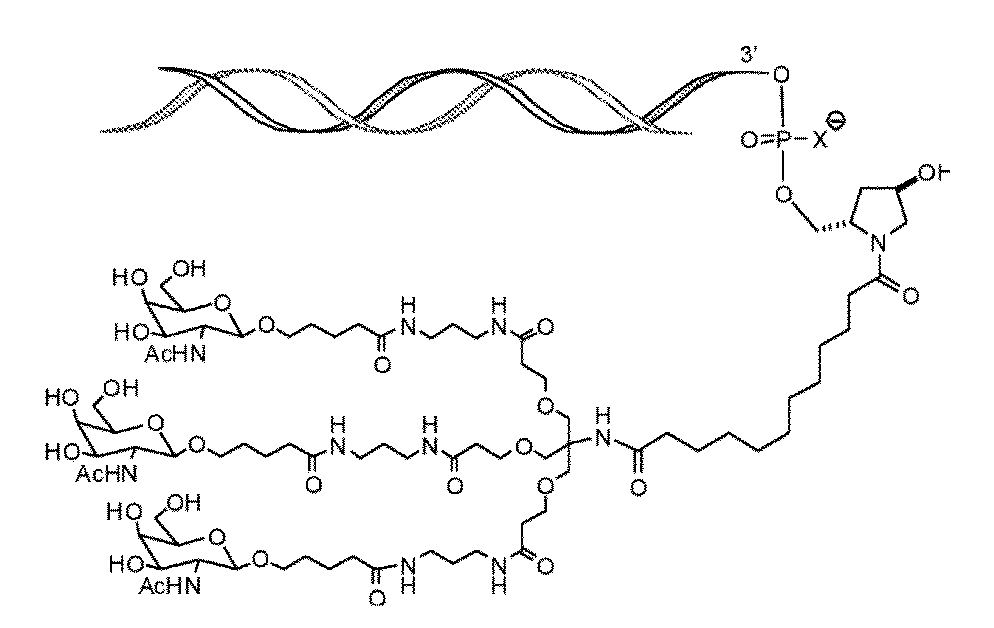
で示されるようにリガンドにコンジュゲートされている。いくつかの実施態様において、Xは、Oである。
In some embodiments, the dsRNA agent has the formula:
In some embodiments, X is O.
いくつかの実施態様において、アンチセンス鎖は、
5'-usGfsuga(Agn)gCfGfaaguGfcAfcacsusu-3'(配列番号:16)、
5'-usGfsuga(Agn)gcgaaguGfdCAfcacsusu-3'(配列番号:18)、
5'-usGfsudGa(Agn)gCfGfaaguGfcAfcacsusu-3'(配列番号20)、
5'-usGfsudGadAgdCGfaaguGfcAfcacsusu-3'(配列番号23)、
5'-usGfsuga(Agn)dGCfGfaaguGfcAfcacsusu-3'(配列番号24)、
5'-usGfsudGadAgdCGfaaguGfcAfdCacsusu-3'(配列番号25)、または
5'-usGfsuga(Agn)gCfGfaaguGfdCAfcacsusu-3'(配列番号28):
[配列中、a、c、gおよびuはそれぞれ、2'-O-メチルアデノシン-3'-ホスフェート、2'-O-メチルシチジン-3'-ホスフェート、2'-O-メチルグアノシン-3'-ホスフェートおよび2'-O-メチルウリジン-3'-ホスフェートであり;
Af、Cf、GfおよびUfはそれぞれ、2'-フルオロアデノシン-3'-ホスフェート、2'-フルオロシチジン-3'-ホスフェート、2'-フルオログアノシン-3'-ホスフェートおよび2'-フルオロウリジン-3'-ホスフェートであり;
dA、dC、dGおよびdTはそれぞれ、2'-デオキシアデノシン-3'-ホスフェート、2'-デオキシシチジン-3'-ホスフェート、2'-デオキシグアノシン-3'-ホスフェートおよび2'-デオキシチミジン-3'-ホスフェートであり;
(Agn)は、アデノシン-グリコール核酸(GNA)であり;そして
sは、ホスホロチオエート連結である。]
で示される修飾ヌクレオチド配列からなる。
In some embodiments, the antisense strand is
5'-usGfsuga(Agn)gCfGfaaguGfcAfcacsusu-3' (SEQ ID NO: 16),
5'-usGfsuga(Agn)gcgaaguGfdCAfcacsusu-3' (SEQ ID NO: 18),
5'-usGfsudGa(Agn)gCfGfaaguGfcAfcacsusu-3' (SEQ ID NO: 20),
5'-usGfsudGadAgdCGfaaguGfcAfcacsusu-3' (SEQ ID NO: 23),
5'-usGfsuga(Agn)dGCfGfaaguGfcAfcacsusu-3' (SEQ ID NO: 24),
5'-usGfsudGadAgdCGfaaguGfcAfdCacsusu-3' (SEQ ID NO: 25), or
5'-usGfsuga(Agn)gCfGfaaguGfdCAfcacsusu-3' (SEQ ID NO: 28):
[wherein a, c, g and u are 2'-O-methyl adenosine-3'-phosphate, 2'-O-methyl cytidine-3'-phosphate, 2'-O-methyl guanosine-3'-phosphate and 2'-O-methyl uridine-3'-phosphate, respectively;
Af, Cf, Gf and Uf are 2'-fluoroadenosine-3'-phosphate, 2'-fluorocytidine-3'-phosphate, 2'-fluoroguanosine-3'-phosphate and 2'-fluorouridine-3'-phosphate, respectively;
dA, dC, dG and dT are 2'-deoxyadenosine-3'-phosphate, 2'-deoxycytidine-3'-phosphate, 2'-deoxyguanosine-3'-phosphate and 2'-deoxythymidine-3'-phosphate, respectively;
(Agn) is adenosine-glycol nucleic acid (GNA); and s is a phosphorothioate linkage.
It consists of a modified nucleotide sequence represented by:
いくつかの実施態様において、本明細書は、以下の修飾ヌクレオチド配列からなるセンス鎖およびアンチセンス鎖のdsRNA物質を提供する:
(a)5'-usGfsuga(Agn)gCfGfaaguGfcAfcacsusu-3'(配列番号16)および5'-gsusguGfcAfCfUfucgcuucaca-3'(配列番号:29);
(b)5'-usGfsuga(Agn)gcgaaguGfdCAfcacsusu-3' (配列番号18)および5'-gsusguGfcAfCfUfucgcuucaca-3' (配列番号:29);
(c)5'-usGfsudGa(Agn)gCfGfaaguGfcAfcacsusu-3'(配列番号20)および5'-gsusguGfcAfCfUfucgcuucaca-3'(配列番号:29);
(d)5'-usGfsudGadAgdCGfaaguGfcAfcacsusu-3'(配列番号23)および5'-gsusguGfcAfCfUfucgcuucaca-3'(配列番号:29);
(e)5'-usGfsuga(Agn)dGCfGfaaguGfcAfcacsusu-3'(配列番号24)および5'-gsusguGfcAfCfUfucgcuucaca-3'(配列番号:29);
(f)5'-usGfsudGadAgdCGfaaguGfcAfdCacsusu-3'(配列番号25)および5'-gsusguGfcAfCfUfucgcuucaca-3' (配列番号:29);または
(g)5'-usGfsuga(Agn)gCfGfaaguGfdCAfcacsusu-3'(配列番号28)および5'-gsusguGfcAfCfUfucgcuucaca-3'(配列番号29):
配列中、a、c、gおよびuはそれぞれ、2'-O-メチルアデノシン-3'-ホスフェート、2'-O-メチルシチジン-3'-ホスフェート、2'-O-メチルグアノシン-3'-ホスフェートおよび2'-O-メチルウリジン-3'-ホスフェートであり;
Af、Cf、GfおよびUfはそれぞれ、2'-フルオロアデノシン-3'-ホスフェート、2'-フルオロシチジン-3'-ホスフェート、2'-フルオログアノシン-3'-ホスフェートおよび2'-フルオロウリジン-3'-ホスフェートであり;
dA、dC、dGおよびdTはそれぞれ、2'-デオキシアデノシン-3'-ホスフェート、2'-デオキシシチジン-3'-ホスフェート、2'-デオキシグアノシン-3'-ホスフェートおよび2'-デオキシチミジン-3'-ホスフェートであり;
(Agn)は、アデノシン-グリコール核酸(GNA)であり;
sは、ホスホロチオエート連結であり;そして
センス鎖の3'末端は、N-[トリス(GalNAc-アルキル)-アミドデカノイル)]-4-ヒドロキシプロリノール(L96)リガンドにコンジュゲートされている。
In some embodiments, the present disclosure provides sense and antisense dsRNA agents that consist of the following modified nucleotide sequences:
(a) 5'-usGfsuga(Agn)gCfGfaaguGfcAfcacsusu-3' (SEQ ID NO: 16) and 5'-gsusguGfcAfCfUfucgcuucaca-3' (SEQ ID NO: 29);
(b) 5'-usGfsuga(Agn)gcgaaguGfdCAfcacsusu-3' (SEQ ID NO: 18) and 5'-gsusguGfcAfCfUfucgcuucaca-3' (SEQ ID NO: 29);
(c) 5'-usGfsudGa(Agn)gCfGfaaguGfcAfcacsusu-3' (SEQ ID NO: 20) and 5'-gsusguGfcAfCfUfucgcuucaca-3' (SEQ ID NO: 29);
(d) 5'-usGfsudGadAgdCGfaaguGfcAfcacsusu-3' (SEQ ID NO: 23) and 5'-gsusguGfcAfCfUfucgcuucaca-3' (SEQ ID NO: 29);
(e) 5'-usGfsuga(Agn)dGCfGfaaguGfcAfcacsusu-3' (SEQ ID NO: 24) and 5'-gsusguGfcAfCfUfucgcuucaca-3' (SEQ ID NO: 29);
(f) 5'-usGfsudGadAgdCGfaaguGfcAfdCacsusu-3' (SEQ ID NO: 25) and 5'-gsusguGfcAfCfUfucgcuucaca-3' (SEQ ID NO: 29); or
(g) 5'-usGfsuga(Agn)gCfGfaaguGfdCAfcacsusu-3' (SEQ ID NO: 28) and 5'-gsusguGfcAfCfUfucgcuucaca-3' (SEQ ID NO: 29):
In the sequence, a, c, g and u are 2'-O-methyl adenosine-3'-phosphate, 2'-O-methyl cytidine-3'-phosphate, 2'-O-methyl guanosine-3'-phosphate and 2'-O-methyl uridine-3'-phosphate, respectively;
Af, Cf, Gf and Uf are 2'-fluoroadenosine-3'-phosphate, 2'-fluorocytidine-3'-phosphate, 2'-fluoroguanosine-3'-phosphate and 2'-fluorouridine-3'-phosphate, respectively;
dA, dC, dG and dT are 2'-deoxyadenosine-3'-phosphate, 2'-deoxycytidine-3'-phosphate, 2'-deoxyguanosine-3'-phosphate and 2'-deoxythymidine-3'-phosphate, respectively;
(Agn) is adenosine-glycol nucleic acid (GNA);
s is a phosphorothioate linkage; and the 3' end of the sense strand is conjugated to an N-[tris(GalNAc-alkyl)-amidodecanoyl)]-4-hydroxyprolinol (L96) ligand.
他の態様において、本明細書は、本明細書に開示されるdsRNA物質を含有する細胞を提供する。 In another aspect, the present specification provides a cell containing the dsRNA agent disclosed herein.
本明細書はまた、本明細書に記載されるdsRNA物質、および医薬用賦形剤を含む医薬組成物を提供する。 The present specification also provides a pharmaceutical composition comprising a dsRNA agent described herein and a pharmaceutical excipient.
本明細書はまた、細胞中でのB型肝炎ウイルス(HBV)遺伝子発現を阻害する方法であって、本発明に開示されるdsRNA物質または医薬組成物と細胞を接触させることにより、細胞中でのHBV遺伝子発現を阻害する方法を提供する。いくつかの実施態様において、細胞は、対象の内にある。いくつかの実施態様において、対象は、ヒトである。いくつかの実施態様において、対象は、HBV関連疾患に罹患している。いくつかの実施態様において、細胞は、インビトロである。いくつかの実施態様において、HBV遺伝子発現は、少なくとも80%、90%、95%もしくは98%、またはアッセイ法の検出レベル未満にまで阻害される。 The present specification also provides a method of inhibiting Hepatitis B Virus (HBV) gene expression in a cell by contacting the cell with a dsRNA agent or pharmaceutical composition disclosed herein. In some embodiments, the cell is in a subject. In some embodiments, the subject is human. In some embodiments, the subject is afflicted with HBV-related disease. In some embodiments, the cell is in vitro. In some embodiments, HBV gene expression is inhibited by at least 80%, 90%, 95%, or 98%, or to below the detection level of an assay.
本明細書は、細胞中でのB型肝炎ウイルス(HBV)の複製を阻害する方法であって、本明細書に開示されるdsRNA物質または医薬組成物と細胞を接触させることにより、細胞中でのHBVの複製を阻害することを含む方法を提供する。いくつかの実施態様において、細胞は対象の内にある。いくつかの実施態様において、対象は、ヒトである。特定の実施態様において、対象は、HBV関連疾患に罹患している。いくつかの実施態様において、細胞は、インビトロである。特定の実施態様において、細胞中でのHBVの複製は、少なくとも80%、90%、95%もしくは98%、またはアッセイ法の検出レベル未満にまで阻害される。 Provided herein is a method of inhibiting replication of Hepatitis B Virus (HBV) in a cell, comprising contacting the cell with a dsRNA agent or pharmaceutical composition disclosed herein to inhibit replication of HBV in the cell. In some embodiments, the cell is in a subject. In some embodiments, the subject is human. In certain embodiments, the subject is afflicted with HBV-associated disease. In some embodiments, the cell is in vitro. In certain embodiments, replication of HBV in the cell is inhibited by at least 80%, 90%, 95%, or 98%, or to below the detection level of an assay.
また、本明細書では、HBVに感染した対象におけるB型肝炎ウイルス(HBV)抗原レベルを低減する方法であって、本明細書に開示されるdsRNA物質または医薬組成物の治療有効量を該対象に投与することにより、対象のHBV抗原レベルを低減することを含む方法が提供される。いくつかの実施態様において、HBV抗原は、HBsAgである。いくつかの実施態様において、HBV抗原は、HBeAgである。いくつかの実施態様において、HBV抗原は、対象からの血清中で測定される。いくつかの実施態様において、対象は、HBeAg陽性である。いくつかの実施態様において、対象は、HBeAg陰性である。いくつかの実施態様において、HBV抗原レベルは、血清中で少なくとも1log10、少なくとも2log10、少なくとも3log10もしくは少なくとも4log10、またはアッセイ法の検出レベル未満にまで低減する。 Also provided herein is a method of reducing Hepatitis B virus (HBV) antigen levels in a subject infected with HBV, comprising administering to the subject a therapeutically effective amount of a dsRNA agent or pharmaceutical composition disclosed herein, thereby reducing HBV antigen levels in the subject. In some embodiments, the HBV antigen is HBsAg. In some embodiments, the HBV antigen is HBeAg. In some embodiments, the HBV antigen is measured in serum from the subject. In some embodiments, the subject is HBeAg positive. In some embodiments, the subject is HBeAg negative. In some embodiments, the HBV antigen level is reduced in serum by at least 1 log10, at least 2 log10, at least 3 log10, or at least 4 log10, or below the detection level of the assay.
本明細書はまた、HBVに感染した対象におけるB型肝炎ウイルス(HBV)のウイルス負荷を低減する方法であって、本明細書に開示されるdsRNA物質または医薬組成物の治療有効量を該対象に投与することにより、対象のHBVのウイルス負荷を低減することを含む方法を提供する。いくつかの実施態様において、HBVのウイルス負荷は、対象からの血清で測定される。いくつかの実施態様において、対象はHBeAg陽性である。いくつかの実施態様において、対象はHBeAg陰性である。いくつかの実施態様において、HBVのウイルス負荷は、血清中で少なくとも1log10、少なくとも2log10、少なくとも3log10もしくは少なくとも4log10、またはアッセイ法の検出レベル未満にまで低減する。 The present specification also provides a method of reducing the viral load of Hepatitis B virus (HBV) in a subject infected with HBV, comprising administering to the subject a therapeutically effective amount of a dsRNA agent or pharmaceutical composition disclosed herein, thereby reducing the viral load of the subject. In some embodiments, the viral load of HBV is measured in serum from the subject. In some embodiments, the subject is HBeAg positive. In some embodiments, the subject is HBeAg negative. In some embodiments, the viral load of HBV is reduced in serum by at least 1 log10, at least 2 log10, at least 3 log10, or at least 4 log10, or below the detection level of the assay.
また、本明細書では、B型肝炎ウイルス(HBV)感染またはHBV関連障害を有する対象を処置する方法であって、本明細書に開示されるdsRNA物質または医薬組成物の治療有効量を該対象に投与することにより、対象を処置することを含む方法が提供される。いくつかの実施態様において、対象は、HBeAg陽性である。いくつかの実施態様において、対象は、HBeAg陰性である。いくつかの実施態様において、HBV関連障害は、慢性肝炎であり、対象は、HBeAg陽性である。いくつかの実施態様において、HBV関連障害は、慢性肝炎であり、対象は、HBeAg陰性である。 Also provided herein is a method of treating a subject having a Hepatitis B Virus (HBV) infection or an HBV-related disorder, comprising administering to the subject a therapeutically effective amount of a dsRNA agent or pharmaceutical composition disclosed herein, thereby treating the subject. In some embodiments, the subject is HBeAg positive. In some embodiments, the subject is HBeAg negative. In some embodiments, the HBV-related disorder is chronic hepatitis and the subject is HBeAg positive. In some embodiments, the HBV-related disorder is chronic hepatitis and the subject is HBeAg negative.
上記の方法のいくつかの実施態様において、dsRNA物質は、0.01mg/kg~10mg/kg、0.5mg/kg~50mg/kgまたは3mg/kg~10mg/kgの用量で対象に投与される。該方法のいくつかの実施態様において、dsRNA物質は3mg/kg~10mg/kgの用量で対象に投与される。該方法のいくつかの実施態様において、dsRNA物質は、50mg~200mgの一定用量で対象に投与される。 In some embodiments of the above method, the dsRNA agent is administered to the subject at a dose of 0.01 mg/kg to 10 mg/kg, 0.5 mg/kg to 50 mg/kg, or 3 mg/kg to 10 mg/kg. In some embodiments of the method, the dsRNA agent is administered to the subject at a dose of 3 mg/kg to 10 mg/kg. In some embodiments of the method, the dsRNA agent is administered to the subject at a fixed dose of 50 mg to 200 mg.
上記の方法のいくつかの実施態様において、dsRNA物質は、対象に皮下投与される。 In some embodiments of the above methods, the dsRNA agent is administered subcutaneously to the subject.
上記の方法のいくつかの実施態様において、dsRNA物質は、2用量またはそれ以上で対象に投与される。 In some embodiments of the above methods, the dsRNA agent is administered to the subject in two or more doses.
上記の方法のいくつかの実施態様において、dsRNA物質は、月に一回、2ヵ月に一回または3ヵ月に一回対象に投与される。該方法のいくつかの実施態様において、dsRNA物質は、月に一回を超える回数対象に投与される。 In some embodiments of the above methods, the dsRNA agent is administered to the subject monthly, bimonthly, or trimonthly. In some embodiments of the methods, the dsRNA agent is administered to the subject more than once a month.
上記の方法のいくつかの実施態様において、該方法はさらに、追加の治療物質、例えば、1つまたはそれ以上の追加の治療物質を対象に投与することを含む。追加の治療物質には、例えば、抗ウイルス剤、逆転写酵素阻害物質、免疫賦活物質、治療ワクチン、ウイルス侵入阻害物質、HbsAgの分泌または放出を阻害するオリゴヌクレオチド、カプシド阻害物質、共有結合閉環状(ccc)HBV DNA阻害物質、および前述のいずれかの組み合わせが挙げられるが、これらに限定されない。いくつかの実施態様において、追加の治療物質は逆転写酵素阻害物質である。 In some embodiments of the above methods, the method further comprises administering to the subject an additional therapeutic agent, e.g., one or more additional therapeutic agents. Additional therapeutic agents include, but are not limited to, for example, antiviral agents, reverse transcriptase inhibitors, immunostimulants, therapeutic vaccines, viral entry inhibitors, oligonucleotides that inhibit secretion or release of HbsAg, capsid inhibitors, covalently closed circular (ccc) HBV DNA inhibitors, and combinations of any of the foregoing. In some embodiments, the additional therapeutic agent is a reverse transcriptase inhibitor.
いくつかの実施態様において、1つを超える追加の治療物質が投与され、該追加の治療物質は逆転写酵素阻害物質および免疫賦活物質である。逆転写酵素阻害物質としては、テノフォビルジソプロキシルフマレート(TDF)、テノフォビルアラフェナミド、ラミブジン、アデフォビルジピボキシル、エンテカビル(ETV)、テルビブジンおよびAGX-1009が挙げられるが、これらに限定されない。免疫賦活物質には、ペグ化インターフェロンα2a(PEG-IFN-α2a)、インターフェロンα-2b、組換え ヒトインターロイキン-7、およびトール様受容体7(TLR7)アゴニストがあるが、これらに限定されない。 In some embodiments, more than one additional therapeutic agent is administered, and the additional therapeutic agents are reverse transcriptase inhibitors and immunostimulants. Reverse transcriptase inhibitors include, but are not limited to, tenofovir disoproxil fumarate (TDF), tenofovir alafenamide, lamivudine, adefovir dipivoxil, entecavir (ETV), telbivudine, and AGX-1009. Immunostimulants include, but are not limited to, pegylated interferon alpha 2a (PEG-IFN-α2a), interferon alpha-2b, recombinant human interleukin-7, and toll-like receptor 7 (TLR7) agonists.
また、本明細書では、本明細書に開示されるいずれかの方法を実施するための組成物が提供される。いくつかの実施態様において、本明細書は、対象のB型肝炎ウイルス(HBV)感染の処置に使用するための、本明細書に開示されるdsRNA物質または医薬組成物を提供する。いくつかの実施態様において、本明細書は、対象のB型肝炎ウイルス(HBV)関連障害を処置するための、本明細書に開示され鵜dsRNA物質または医薬組成物を提供する。いくつかの実施態様において、HBV関連障害は慢性肝炎であり、対象はHBeAg陽性である。いくつかの実施態様において、HBV関連障害は慢性肝炎であり、対象はHBeAg陰性である。いくつかの実施態様において、対象は、追加の治療物質、例えば、抗ウイルス剤、逆転写酵素阻害物質、免疫賦活物質、治療ワクチン、ウイルス侵入阻害物質、HbsAgの分泌または放出を阻害するオリゴヌクレオチド、カプシド阻害物質、共有結合閉環状(ccc)HBV DNA阻害物質、または上記のいずれかの組み合わせが投与されているか、または投与された。いくつかの実施態様において、追加の治療物質は、逆転写酵素 阻害物質、例えば、テノフォビルジソプロキシルフマレート(TDF)、テノフォビルアラフェナミド、ラミブジン、アデフォビルジピボキシル、エンテカビル(ETV)、テルビブジンまたはAGX-1009である。いくつかの実施態様において、投与される追加の治療物質は、逆転写酵素阻害物質(例えば、テノフォビルジソプロキシルフマレート(TDF)、テノフォビルアラフェナミド、ラミブジン、アデフォビルジピボキシル、エンテカビル(ETV)、テルビブジンまたはAGX-1009)、および免疫賦活物質(例えば、ペグ化インターフェロンα2a(PEG-IFN-α2a)、インターフェロンα-2b、組換えヒトインターロイキン-7またはトール様受容体7(TLR7)アゴニスト)である。 Also provided herein are compositions for carrying out any of the methods disclosed herein. In some embodiments, the present specification provides a dsRNA agent or pharmaceutical composition disclosed herein for use in treating a Hepatitis B Virus (HBV) infection in a subject. In some embodiments, the present specification provides a dsRNA agent or pharmaceutical composition disclosed herein for treating a Hepatitis B Virus (HBV)-related disorder in a subject. In some embodiments, the present specification provides a dsRNA agent or pharmaceutical composition disclosed herein for treating a Hepatitis B Virus (HBV)-related disorder in a subject. In some embodiments, the HBV-related disorder is chronic hepatitis and the subject is HBeAg positive. In some embodiments, the HBV-related disorder is chronic hepatitis and the subject is HBeAg negative. In some embodiments, the subject is administered or has been administered an additional therapeutic agent, such as an antiviral agent, a reverse transcriptase inhibitor, an immunostimulant, a therapeutic vaccine, a viral entry inhibitor, an oligonucleotide that inhibits secretion or release of HbsAg, a capsid inhibitor, a covalently closed circular (ccc) HBV DNA inhibitor, or any combination of the above. In some embodiments, the additional therapeutic agent is a reverse transcriptase inhibitor, such as tenofovir disoproxil fumarate (TDF), tenofovir alafenamide, lamivudine, adefovir dipivoxil, entecavir (ETV), telbivudine, or AGX-1009. In some embodiments, the additional therapeutic agent administered is a reverse transcriptase inhibitor (e.g., tenofovir disoproxil fumarate (TDF), tenofovir alafenamide, lamivudine, adefovir dipivoxil, entecavir (ETV), telbivudine, or AGX-1009), and an immunostimulant (e.g., pegylated interferon alpha 2a (PEG-IFN-α2a), interferon alpha-2b, recombinant human interleukin-7, or a Toll-like receptor 7 (TLR7) agonist).
本明細書は、上記の方法のいずれかを実施するための、本明細書に開示されるdsRNA物質または医薬組成物の使用を提供する。 The present specification provides the use of a dsRNA agent or pharmaceutical composition disclosed herein for carrying out any of the above methods.
本明細書はまた、上記の方法のいずれかを実施するための治療用医薬の調製または製造のための、本明細書に開示されるdsRNA物質の使用を提供する。 The present specification also provides the use of a dsRNA agent disclosed herein for the preparation or manufacture of a therapeutic medicament for carrying out any of the above methods.
本明細書は、本明細書に開示されるdsRNA物質または医薬組成物を含み、場合により、本明細書に記載される方法を実施するための使用説明書を含むキットを提供する。 The present specification provides kits that include a dsRNA agent or pharmaceutical composition disclosed herein and, optionally, instructions for carrying out the methods described herein.
詳細な説明
本明細書は、B型肝炎ウイルス(HBV)遺伝子のRNA転写物のRNA誘導サイレンシング複合体(RISC)介在性切断に影響を与えるdsRNA物質組成物を提供する。遺伝子は、細胞内、例えばヒトなどの対象の内にある細胞内にあってもよい。これらのdsRNA物質を使用することにより、哺乳動物における対応する遺伝子(HBV遺伝子)のmRNAを標的として分解することを可能にする。
DETAILED DESCRIPTION The present disclosure provides dsRNA agent compositions that affect the RNA-induced silencing complex (RISC)-mediated cleavage of the RNA transcripts of Hepatitis B virus (HBV) genes. The genes may be in cells, for example, in cells within a subject, such as a human. These dsRNA agents can be used to target and degrade the mRNA of the corresponding genes (HBV genes) in mammals.
本明細書に記載されるdsRNA物質は、HBVゲノム内でHBVの少なくとも8つの既知の遺伝子型にわたって保存されている領域を標的とするように設計されている。さらに、本明細書のdsRNA物質は、1つを超えるHBV遺伝子の発現を阻害することにより、HBVのライフサイクルの全ての段階、例えば複製、集合(アッセンブル)、ウイルスの分泌およびサブウイルス抗原の分泌を阻害するように設計されている。詳細には、HBVゲノムが転写されるとポリシストロン性の重複RNAが生じるため、いくつかの実施態様において、単一のHBV遺伝子を標的化するdsRNA物質は、ほとんどまたはすべてのHBV転写物の発現を有意に阻害することになる。例えば、HBVゲノムは単一のmRNAに転写されるため、S遺伝子を標的化する本明細書のdsRNA物質は、S遺伝子発現のみならず、その「下流」ポリメラーゼ遺伝子の発現もまた阻害することになる。さらに、本明細書のdsRNA物質は、HBV構造遺伝子およびHBV X遺伝子を標的化することによってHBVウイルス複製を阻害し、それによって対象の免疫系がHBsAgの存在を検出してそれに反応し、抗HBV抗体を産生してHBV感染を除去することが可能となるように設計されている。特定の理論に制限されることを意図するものではないが、上記の性質と本明細書のdsRNA物質の特定の標的部位または特定の修飾との組み合わせ(コンビネーション)または部分的な組み合わせ(サブコンビネーション)は、本明細書のdsRNA物質に、有効性、安定性、安全性、効力、および耐久性における改善を付与すると考えられる。 The dsRNA agents described herein are designed to target regions within the HBV genome that are conserved across at least eight known genotypes of HBV. Additionally, the dsRNA agents herein are designed to inhibit all stages of the HBV life cycle, including replication, assembly, viral secretion, and subviral antigen secretion, by inhibiting the expression of more than one HBV gene. In particular, because the HBV genome is transcribed into polycistronic overlapping RNAs, in some embodiments, a dsRNA agent targeting a single HBV gene will significantly inhibit the expression of most or all HBV transcripts. For example, because the HBV genome is transcribed into a single mRNA, a dsRNA agent herein targeting the S gene will inhibit not only S gene expression, but also the expression of its "downstream" polymerase gene. Additionally, the dsRNA agents herein are designed to inhibit HBV viral replication by targeting the HBV structural and HBV X genes, thereby enabling the subject's immune system to detect and respond to the presence of HBsAg and produce anti-HBV antibodies to clear the HBV infection. Without intending to be limited to any particular theory, it is believed that the combination or subcombination of the above properties with specific target sites or specific modifications of the dsRNA agents herein confers improvements in efficacy, stability, safety, potency, and durability to the dsRNA agents herein.
本発明者らは、インビトロおよびインビボアッセイを用いて、HBV遺伝子を標的化するdsRNA物質がRNAiを強力に媒介し、1つを超えるHBV遺伝子の発現を有意に阻害できることを実証した。従って、本明細書のdsRNA物質を含む方法および組成物は、HBV感染またはHBV関連疾患、例えば慢性B型肝炎(CHB)を有する対象の処置に有用である。 Using in vitro and in vivo assays, the inventors have demonstrated that dsRNA agents targeting HBV genes can potently mediate RNAi and significantly inhibit the expression of more than one HBV gene. Thus, methods and compositions comprising the dsRNA agents herein are useful for treating subjects with HBV infection or HBV-related disease, such as chronic hepatitis B (CHB).
従って、本明細書はまた、HBV遺伝子の発現を阻害または低減することから利益を得られ得る障害、例えばB型慢性肝炎ウイルス感染(CHB)などのHBV関連疾患を有する対象を、HBV遺伝子のRNA転写物のRNA誘導サイレンシング複合体(RISC)介在性切断に影響を与えるdsRNA物質組成物を用いて処置する方法も提供する。 Thus, the present specification also provides methods of treating a subject having a disorder that may benefit from inhibiting or reducing expression of an HBV gene, e.g., an HBV-related disease, such as chronic hepatitis B virus infection (CHB), with a dsRNA agent composition that affects RNA-induced silencing complex (RISC)-mediated cleavage of the RNA transcript of the HBV gene.
本明細書のdsRNA物質は、約9~21ヌクレオチド長、例えば約19ヌクレオチド長の相補的な領域であって、少なくとも1つのHBV遺伝子型のHBV遺伝子のmRNA転写物の少なくとも一部と実質的に相補的な領域を有するRNA鎖(アンチセンス鎖)を含む。本明細書のdsRNA物質が、異なるHBV遺伝子型に対する相補性の程度が異なることがあるように、複数のHBV遺伝子型が存在すると理解される。 The dsRNA agents herein include an RNA strand (antisense strand) having a complementary region of about 9-21 nucleotides in length, e.g., about 19 nucleotides in length, that is substantially complementary to at least a portion of an mRNA transcript of the HBV gene of at least one HBV genotype. It is understood that multiple HBV genotypes exist such that the dsRNA agents herein may have differing degrees of complementarity to different HBV genotypes.
いくつかの実施態様において、センス鎖およびアンチセンス鎖は、19~21個の連続するヌクレオチドの二本鎖を形成する。 In some embodiments, the sense and antisense strands form a duplex of 19 to 21 consecutive nucleotides.
以下の詳細な説明には、HBV遺伝子の発現を阻害するために、dsRNA物質を含有する組成物をどのように作製および使用すればよいか、ならびにHBV遺伝子の発現の阻害または低減から利益を得られ得る疾患および障害を有する対象を処置するための組成物、使用、および方法を開示される。 The detailed description below discloses how to make and use compositions containing dsRNA agents to inhibit expression of HBV genes, as well as compositions, uses, and methods for treating subjects with diseases and disorders that may benefit from inhibition or reduction of expression of HBV genes.
I.定義
本明細書がより容易に理解され得るように、特定の用語がまず定義される。さらに、パラメーターの値または値の範囲が記載されるときは常に、記載される値の中間の値および範囲も、本特徴の一部であることが意図されることに留意されたい。
I. Definitions
In order that this specification may be more readily understood, certain terms are first defined. Furthermore, it should be noted that whenever a value or range of values for a parameter is described, values and ranges intermediate to the described values are also intended to be part of the present features.
文脈上で他に要求しない限り、本明細書および特許請求の範囲全体を通して、用語「含む(comprise)」およびその変形、例えば「含む(comprises)」および「含む(comprising)」は、開放的な包括的な意味、すなわち「含むが、これらに限定されない」と解釈されるべきである。「からなる(Consisting of)」とは、本明細書に開示される他の成分または実質的な方法の工程の微量元素を超えるものを除外することを意味するものとする。例えば、ポリヌクレオチドは、いずれかのさらなるヌクレオチドを含まない場合、ヌクレオチドの配列からなるが、リガンド、例えば標的化リガンド、または修飾の取り込みを除外しない。用語「本質的に~からなる」は、請求の範囲を、特定の材料物質もしくは工程、または特許請求の範囲に係る発明の基本的統制に実質的に影響を及ぼさないものに限定する。例えば、本質的に本明細書で定義される成分からなる医薬組成物は、単離および精製方法からの微量混入物質、ならびにリン酸緩衝生理食塩水、防腐剤などの製薬的に許容できる担体を除外しない。同様に、ポリヌクレオチドが、ポリヌクレオチド長の少なくとも20%に寄与し、かつポリヌクレオチドの活性に実質的に影響を与えない(例えば、ポリヌクレオチドの活性を50%未満で改変する)さらなるのヌクレオチドを含む場合、ポリヌクレオチドは本質的にヌクレオチド配列からなる。各移行性用語によって定義される実施態様は、本発明の範囲内である。 Unless the context requires otherwise, throughout the specification and claims, the term "comprise" and variations thereof, such as "comprises" and "comprising," are to be construed in an open, inclusive sense, i.e., "including, but not limited to." "Consisting of" shall mean excluding more than trace elements of other components or substantial method steps disclosed herein. For example, a polynucleotide consists of a sequence of nucleotides without any additional nucleotides, but does not exclude the incorporation of ligands, e.g., targeting ligands, or modifications. The term "consisting essentially of" limits the scope of a claim to specific materials or steps or those that do not substantially affect the fundamental control of the claimed invention. For example, a pharmaceutical composition consisting essentially of components defined herein does not exclude trace contaminants from isolation and purification methods, as well as pharma- ceutical acceptable carriers, such as phosphate buffered saline, preservatives, and the like. Similarly, a polynucleotide consists essentially of a nucleotide sequence if the polynucleotide contains additional nucleotides that contribute at least 20% of the length of the polynucleotide and do not substantially affect the activity of the polynucleotide (e.g., alter the activity of the polynucleotide by less than 50%). Embodiments defined by each transitional term are within the scope of the invention.
冠詞「1つの(a)」および「1つの(an)」は、その冠詞の文法的目的語の1つまたは1つを超える(即ち、少なくとも1つ)を指すために本明細書において使用される。例として、「成分(an element)」は、1つの要素または1つを超える成分、例えば、複数の成分を意味する。 The articles "a" and "an" are used herein to refer to one or to more than one (i.e., to at least one) of the grammatical object of the article. By way of example, "an element" means one element or more than one component, e.g., a plurality of components.
用語「~を含む(including)」は、「~を含むが、これらに限定されない(including but not limited to)」という語句を意味するために本明細書において使用され、この語句と同義的に使用される。 The term "including" is used herein to mean, and is used synonymously with, the phrase "including but not limited to."
用語「または」は、文脈上明らかに他の意味を示さない限り、用語「および/または」を意味するために本明細書において使用され、この用語と同義的に使用される。例えば、「センス鎖またはアンチセンス鎖」は、「センス鎖もしくはアンチセンス鎖、またはセンス鎖およびアンチセンス鎖」と理解される。 The term "or" is used herein to mean, and is used synonymously with, the term "and/or," unless the context clearly indicates otherwise. For example, "the sense strand or the antisense strand" is understood as "the sense strand or the antisense strand, or the sense strand and the antisense strand."
用語「約」は、当技術分野における許容範囲の典型的な範囲内であることを意味するために本明細書において使用される。例えば、「約」は平均値から2標準偏差以内であると理解され得る。「約」は、それが一連の数または範囲の前に存在する場合、一連の数または範囲内の各数字を変更できると理解される。 The term "about" is used herein to mean within a typical range of acceptance in the art. For example, "about" can be understood to be within two standard deviations from the mean. When "about" is present before a series of numbers or ranges, it is understood to modify each number in the series or range.
数または一連の数の前の用語「少なくとも」は、文脈から明らかなように、一連の数の各数、および論理的に含まれ得る後続のすべての数または整数として理解される。例えば、核酸分子のヌクレオチド数は整数であるべきである。例えば、「21個の核酸分子の少なくとも18個のヌクレオチド」とは、18個、19個、20個または21個のヌクレオチドが指示された性質を有することを意味する。「少なくとも」は、それが一連の数または範囲の前に存在する場合、一連の数または範囲内の各数を変更できると理解される。 The term "at least" before a number or series of numbers is understood as each number in the series and all subsequent numbers or integers that may be logically included, as is clear from the context. For example, the number of nucleotides in a nucleic acid molecule should be an integer. For example, "at least 18 nucleotides of a 21 nucleic acid molecule" means that 18, 19, 20 or 21 nucleotides have the indicated property. When "at least" is present before a series or range, it is understood to modify each number in the series or range.
本明細書で使用される場合、「~を超えない」または「未満」は、文脈から論理的なものとして、フレーズと論理的な下位値または整数に隣接する値からゼロまでの数と理解される。例えば、「2個を超えないヌクレオチド」のオーバーハングを有する二本鎖は、2個、1個または0個のヌクレオチドのオーバーハングを有する。「~を超えない」は、それが一連の数字または範囲の前に存在する場合、一連または範囲内の各数を変更できると理解される As used herein, "not more than" or "less than" is understood as being logical from the context to mean the number from the value adjacent to the phrase and the logical lower value or integer to zero. For example, a duplex having an overhang of "not more than 2 nucleotides" has an overhang of 2, 1 or 0 nucleotides. When "not more than" occurs before a series of numbers or ranges, it is understood to modify each number in the series or range.
本明細書で使用されるように、範囲は、上限および下限の両方を含む。 As used herein, a range includes both an upper limit and a lower limit.
配列と、転写物または他の配列上のその示された部位との間に矛盾が生じた場合には、本明細書に記載されるヌクレオチド配列が優先される。 In the event of any discrepancy between a sequence and its indicated site on a transcript or other sequence, the nucleotide sequence set forth herein takes precedence.
本明細書のさまざまな実施態様は、当業者によって適切に決定されるように組み合わせることができる。 The various embodiments herein may be combined as appropriately determined by one of ordinary skill in the art.
本明細書で使用される「B型肝炎ウイルス」は、用語「HBV」と同義的に使用され、ヘパドナウイルス科(Hepadnaviridae)に属する周知の非細胞変性性の肝向性DNAウイルスを意味する。 As used herein, "Hepatitis B virus" is used synonymously with the term "HBV" and refers to a well-known non-cytopathic hepatotropic DNA virus belonging to the family Hepadnaviridae.
HBVゲノムは、重複した解読枠(リーディングフレーム)を有する部分的に二本鎖である環状DNAである(例えば、図1を参照のこと)。 The HBV genome is a partially double-stranded circular DNA with overlapping reading frames (see, for example, Figure 1).
HBVゲノムによってコードされる、大きさに基づく4つの転写物(本明細書では「遺伝子」または「オープンリーディングフレーム」と称することがある)がある。これらは、C、X、P、およびSと称されるオープンリーディングフレームを含有する。コアタンパク質は、遺伝子Cによってコードされる(HBcAg)。B型肝炎e抗原(HBeAg)は、pre-コア(pre-C)タンパク質のタンパク質分解プロセシングによって産生される。DNAポリメラーゼは、遺伝子Pによってコードされる。遺伝子Sは、表面抗原(HBsAg)をコードする遺伝子である。HBsAg遺伝子は、ラージ、ミドルおよびスモールS抗原と称される3つの異なるサイズのポリペプチド(pre-S1+pre-S2+S、pre-S2+S、またはS)を生じさせる3つのインフレームの「開始」(ATG)コドンを含有する1つの長いオープンリーディングフレームである。表面抗原は、HBVのエンベロープを飾ることに加えて、ビリオン粒子に比べて過剰に産生されるサブウイルス粒子の一部でもあり、そして、免疫耐性や抗HBsAg抗体を隔離する役割を果たし、それによって感染性粒子が免疫検出から逃れることを可能にする。遺伝子Xによってコードされる非構造タンパク質の機能は十分に解明されていないが、転写のトランス活性化と複製に役割を持ち、肝癌の発症に関連していると考えられる。 There are four size-based transcripts (sometimes referred to herein as "genes" or "open reading frames") encoded by the HBV genome. These contain open reading frames designated C, X, P, and S. The core protein is encoded by gene C (HBcAg). Hepatitis B e antigen (HBeAg) is produced by proteolytic processing of the pre-core (pre-C) protein. The DNA polymerase is encoded by gene P. Gene S is the gene that encodes the surface antigen (HBsAg). The HBsAg gene is one long open reading frame that contains three in-frame "start" (ATG) codons that give rise to three different sized polypeptides (pre-S1 + pre-S2 + S, pre-S2 + S, or S), designated large, middle, and small S antigens. In addition to decorating the HBV envelope, surface antigens are also part of subviral particles that are produced in excess relative to virion particles and play a role in immune tolerance and sequestering anti-HBsAg antibodies, thereby allowing infectious particles to escape immune detection. The function of the nonstructural protein encoded by gene X is not fully understood, but it may play a role in transcriptional transactivation and replication and may be related to the development of hepatocarcinoma.
HBVは、侵入、脱コーティング、および核へのウイルスゲノムの輸送を含む複数の段階を伴う複製過程において、逆転写酵素を利用する数少ないDNAウイルスの1つである。初めに、HBVゲノムの複製はRNA中間体の生成を伴い、これが次に逆転写されてDNAウイルスゲノムが産生される。 HBV is one of the few DNA viruses that utilizes reverse transcriptase in a replication process that involves multiple steps, including entry, uncoating, and transport of the viral genome to the nucleus. Initially, replication of the HBV genome involves the generation of an RNA intermediate, which is then reverse transcribed to produce the DNA viral genome.
細胞がHBVに感染すると、ウイルスゲノムの弛緩した環状DNA(rcDNA)が細胞核に輸送され、エピソーム性の共有結合閉環状DNA(cccDNA)に変換されて、これがウイルスmRNAの転写鋳型として働く。転写および核外輸送した後、細胞質のウイルスプレゲノムRNA(pgRNA)は、HBVポリメラーゼおよびカプシドタンパク質と集合してヌクレオカプシドを形成し、その内部では、ポリメラーゼ触媒性逆転写によってマイナス鎖DNAが生じ、続いてこれがプラス鎖DNAにコピーされて子孫rcDNAゲノムが形成される。次いで、成熟ヌクレオカプシドは、ウイルスエンベロープタンパク質にパッケージされてビリオン粒子として出現するか、または核にシャトル輸送され、細胞内cccDNA増幅経路を介してcccDNAリザーバを増幅する。cccDNAは、HBV複製サイクルの必須の構成要素であり、感染の確立とウイルス持続性の役割を担っている。 When cells are infected with HBV, the relaxed circular DNA (rcDNA) of the viral genome is transported to the cell nucleus and converted into episomal covalently closed circular DNA (cccDNA), which serves as a transcription template for viral mRNA. After transcription and nuclear export, the cytoplasmic viral pregenomic RNA (pgRNA) assembles with HBV polymerase and capsid proteins to form nucleocapsids, within which polymerase-catalyzed reverse transcription generates minus-strand DNA, which is subsequently copied into plus-strand DNA to form progeny rcDNA genomes. The mature nucleocapsids are then packaged into viral envelope proteins to emerge as virion particles or shuttled to the nucleus to amplify the cccDNA reservoir via the intracellular cccDNA amplification pathway. cccDNA is an essential component of the HBV replication cycle and plays a role in the establishment of infection and viral persistence.
HBV感染は、2つの異なる粒子を産生させる:1)感染性のHBVウイルスそれ自体(またはデーン(Dane)粒子)、これは、HBcAgから構築されるウイルスカプシドを含み、HBV表面抗原を有する脂質膜からなるエンベロープによって被覆されており、および2)サブウイルス粒子(またはSVP)、これは、非感染性のB型肝炎表面抗原HBsAgの小形態および中間形態を含有する。産生される各ウイルス粒子につき、10,000個を超えるSVPが血中に放出される。従って、SVP(およびそれらが担持するHBsAgタンパク質)は、血中のウイルスタンパク質の圧倒的大多数に相当する。HBV感染細胞はまた、HBVe抗原(HBeAg)と称されるプレコアタンパク質の可溶性タンパク質分解性産物も分泌する。 HBV infection results in the production of two distinct particles: 1) the infectious HBV virus itself (or Dane particle), which contains a viral capsid assembled from HBcAg and is surrounded by an envelope made of a lipid membrane bearing the HBV surface antigen, and 2) the subviral particle (or SVP), which contains the non-infectious small and intermediate forms of the Hepatitis B surface antigen HBsAg. For each viral particle produced, over 10,000 SVPs are released into the blood. Thus, SVPs (and the HBsAg protein they carry) represent the overwhelming majority of viral proteins in the blood. HBV-infected cells also secrete a soluble proteolytic product of the pre-core protein called HBVe antigen (HBeAg).
HBVの8個の遺伝子型はA~Hと命名され、配列決定されており、また、さらなる2つの遺伝子型IとJが提案され、各々は異なる地理的分布を有する。このウイルスは非細胞変性性であり、ウイルス特異的な細胞性免疫が、HBVへの曝露の結果、すなわち6ヵ月で肝疾患の消散を伴う急性感染であるか、または高頻度で進行性肝傷害を伴う慢性HBV感染であるか、を決定する主な要因である。 Eight genotypes of HBV, designated A-H, have been sequenced, and two additional genotypes, I and J, have been proposed, each with a distinct geographic distribution. The virus is noncytopathic, and virus-specific cell-mediated immunity is the primary factor determining the outcome of exposure to HBV: acute infection with resolution of liver disease in 6 months, or chronic HBV infection with frequent progressive liver damage.
用語「HBV」は、HBVのいずれかの遺伝子型(A~J)を含む。HBVゲノムの参照配列の完全なコード配列は、例えば、GenBank受託番号GI:21326584(配列番号1)およびGI:3582357(配列番号3)に見出すことができる。アンチセンス配列はそれぞれ、配列番号2および配列番号4に示している。C、X、PおよびSタンパク質のアミノ酸配列は、例えば、NCBI受託番号YP_009173857.1(Cタンパク質)(配列番号37);YP_009173867.1およびBAA32912.1(Xタンパク質)(配列番号36および40);YP_009173866.1およびBAA32913.1(Pタンパク質)(配列番号32および38);およびYP_009173869.1、YP_009173870.1、YP_009173871.1、およびBAA32914.1(Sタンパク質)(配列番号33、34、35、39)に見出すことができる。HBV遺伝子型D、株aywからのタンパク質およびDNA配列は、配列番号36~37に示している。HBV遺伝子からのタンパク質およびDNA配列は、配列番号38-39に示している。HBVタンパク質およびDNA配列のさらなる例、またはそれらの逆相補配列は、配列番号41-49に示している。 The term "HBV" includes any genotype (A-J) of HBV. The complete coding sequence of the reference sequence of the HBV genome can be found, for example, in GenBank Accession Nos. GI:21326584 (SEQ ID NO:1) and GI:3582357 (SEQ ID NO:3). The antisense sequences are shown in SEQ ID NO:2 and SEQ ID NO:4, respectively. The amino acid sequences of the C, X, P and S proteins can be found, for example, in NCBI Accession Nos. YP_009173857.1 (C protein) (SEQ ID NO: 37); YP_009173867.1 and BAA32912.1 (X protein) (SEQ ID NOs: 36 and 40); YP_009173866.1 and BAA32913.1 (P protein) (SEQ ID NOs: 32 and 38); and YP_009173869.1, YP_009173870.1, YP_009173871.1, and BAA32914.1 (S protein) (SEQ ID NOs: 33, 34, 35, 39). Protein and DNA sequences from HBV genotype D, strain ayw are shown in SEQ ID NOs: 36-37. Protein and DNA sequences from the HBV gene are shown in SEQ ID NOs: 38-39. Further examples of HBV protein and DNA sequences, or their reverse complements, are shown in SEQ ID NOs: 41-49.
HBV mRNA配列のさらなる例は、公的に利用可能なデータベース、例えば、GenBank、UniProtおよびOMIMを使用して容易に入手できる。B型肝炎ウイルス株データの国際的リポジトリは、http://www.hpa- bioinformatics.org.uk/HepSEQ/main.phpからアクセスできる。 Further examples of HBV mRNA sequences are readily available using publicly available databases such as GenBank, UniProt and OMIM. The International Repository of Hepatitis B Virus Strain Data can be accessed at http://www.hpa- bioinformatics.org.uk/HepSEQ/main.php.
本明細書で使用される用語「HBV」は、HBVゲノムの天然に存在するDNA配列変異、例えば遺伝子型A~Jおよびそれらの変異体も意味する。 As used herein, the term "HBV" also refers to naturally occurring DNA sequence variants of the HBV genome, such as genotypes A-J and variants thereof.
本明細書で使用される「D型肝炎ウイルス」は、用語「HDV」と同義的に使用され、ヘパドナウイルス科(Hepadnaviridae)に属する周知の非細胞変性性の肝向性DNAウイルスを意味する。例えば、Ciancio and Rizzetto,Nat.Rev.11:68-71,2014;Le Gal et al.,Emerg.Infect.Dis.12:1447-1450,2006;およびAbbas and afzal,World J.Hep.,5:666-675,2013(これらは全て、引用により本明細書に包含される)を参照のこと。特に断りが無い限り、HDVは、HDVの全てのクレードおよび変異体を意味する。 As used herein, "Hepatitis D virus" is used synonymously with the term "HDV" and refers to a well-known non-cytopathic hepatotropic DNA virus belonging to the family Hepadnaviridae. See, e.g., Ciancio and Rizzetto, Nat. Rev. 11:68-71, 2014; Le Gal et al., Emerg. Infect. Dis. 12:1447-1450, 2006; and Abbas and afzal, World J. Hep., 5:666-675, 2013, all of which are incorporated herein by reference. Unless otherwise specified, HDV refers to all clades and variants of HDV.
HDVは1つのタンパク質、即ちHDAgを産生する。これには2つの形態、即ち27kDaのラージHDAg(これは、lHD、L-HDAgおよびラージHDV抗原とも称される)、および24kDaのスモールHDAg(これは、sHD、S-HDAgおよびスモールHDV抗原とも称される)がある。これらの2つの形態のN末端は同じであり、両者はラージHDAgのC末端が19アミノ酸だけ異なる。両方のアイソフォームは同じリーディングフレームから産生され、これは、コドン196にUAG終止コドンを含有し、通常はスモールHDAgのみを産生する。しかし、細胞性酵素アデノシンデアミナーゼ-1による編集によって終止コドンがUCGに変わると、ラージHDAgが産生される。これらの2つのタンパク質は90%同一の配列を有するにも関わらず、感染過程で異なる役割を果たす。HDAg-Sは感染初期に産生され、核に侵入してウイルス複製を補助する。対照的にHDAg-Lは、感染後期に産生され、ウイルス複製の阻害物質として働き、ウイルス粒子の集合に必要とされる。 HDV produces one protein, HDAg, which exists in two forms: the 27 kDa large HDAg (also called lHD, L-HDAg, and large HDV antigen) and the 24 kDa small HDAg (also called sHD, S-HDAg, and small HDV antigen). The N-terminus of these two forms is the same, and they differ by 19 amino acids at the C-terminus of the large HDAg. Both isoforms are produced from the same reading frame, which contains a UAG stop codon at codon 196 and normally produces only the small HDAg. However, when the stop codon is changed to UCG by editing with the cellular enzyme adenosine deaminase-1, the large HDAg is produced. Despite the fact that these two proteins have 90% identical sequences, they play different roles during the infection process. HDAg-S is produced early in infection and enters the nucleus to support viral replication. In contrast, HDAg-L is produced late in infection, acts as an inhibitor of viral replication, and is required for viral particle assembly.
HDV mRNA配列のさらなる例は、公的に利用可能なデータベース、例えば、GenBank、uNIpROT、およびOMIMを使用して容易に入手可能である。 Further examples of HDV mRNA sequences are readily available using publicly available databases, e.g., GenBank, uNIpROT, and OMIM.
本明細書で使用される用語「HDV」はまた、HDVゲノムの天然に存在するDNA配列変異も意味する。 As used herein, the term "HDV" also refers to naturally occurring DNA sequence variants of the HDV genome.
本明細書で使用される用語「ヌクレオチ(シ)ドアナログ」または「逆転写酵素阻害物質」は、ヌクレオチドまたはヌクレオシドと構造的に類似しており、HBV cccDNAの複製を特異的に阻害し、かつ宿主(例えば、ヒト)DNAの複製を有意に阻害しない、DNA複製の阻害物質である。このような阻害物質には、テノフォビルジソプロキシルフマレート(TDF)、テノフォビルアラフェナミド(TAF)、ラミブジン、アデフォビルジピボキシル、エンテカビル(ETV)、テルビブジン、AGX-1009、エムトリシタビン、クレブジン、リトナビル、ジピボキシル、ロブカビル、ファムビル、FTC、N-アセチル-システイン(NAC)、PC1323、theradigm-HBV、チモシン-アルファ、ガンシクロビル、ベシホビル(besifovir)(ANA-380/LB-80380)、およびテノフォビル-エキサリアデ(tenofvir-exaliade)(TLX/CMX157)がある。特定の実施態様において、ヌクレオチ(シ)ドアナログは、エンテカビル(ETV)である。ヌクレオチ(シ)ドアナログは、多くの供給先から市販されており、それらのラベル表示(例えば、典型的には特定の用量で経口投与される)に従って、またはHBVの処置において熟練した開業医によって決定されるように、本明細書で提供される方法で使用される。 As used herein, the term "nucleotide analog" or "reverse transcriptase inhibitor" refers to an inhibitor of DNA replication that is structurally similar to a nucleotide or nucleoside and that specifically inhibits the replication of HBV cccDNA and does not significantly inhibit the replication of host (e.g., human) DNA. Such inhibitors include tenofovir disoproxil fumarate (TDF), tenofovir alafenamide (TAF), lamivudine, adefovir dipivoxil, entecavir (ETV), telbivudine, AGX-1009, emtricitabine, clevudine, ritonavir, dipivoxil, lobucavir, famvir, FTC, N-acetyl-cysteine (NAC), PC1323, theradigm-HBV, thymosin-alpha, ganciclovir, besifovir (ANA-380/LB-80380), and tenofvir-exaliade (TLX/CMX157). In certain embodiments, the nucleotide analog is entecavir (ETV). Nucleotide analogs are commercially available from a number of sources and may be used in the methods provided herein according to their labeling (e.g., typically administered orally at a particular dose) or as determined by a skilled practitioner in the treatment of HBV.
本明細書で使用される「標的配列」は、一次転写産物のRNAプロセシングの産物であるmRNAを含む、HBV遺伝子の転写の際に形成されるmRNA分子のヌクレオチド配列の連続する部分を意味する。いくつかの実施形態において、配列の標的部分は少なくとも、HBV遺伝子の転写の際に形成されるmRNA分子のヌクレオチド配列における該標的部分で、またはその近くで、dsRNA物質が目的とする切断のための基質として働くのに十分な長さであろう。 As used herein, "target sequence" refers to a contiguous portion of the nucleotide sequence of an mRNA molecule formed upon transcription of an HBV gene, including mRNA that is the product of RNA processing of a primary transcript. In some embodiments, the target portion of the sequence will be at least long enough to serve as a substrate for targeted cleavage of a dsRNA agent at or near said target portion in the nucleotide sequence of an mRNA molecule formed upon transcription of an HBV gene.
標的配列は、約19~21ヌクレオチド長、例えば、19、20または21ヌクレオチド長であり得る。 The target sequence can be about 19-21 nucleotides in length, e.g., 19, 20 or 21 nucleotides in length.
本明細書で使用される用語「配列を含む鎖」は、標準的なヌクレオチドの命名法を用いて言及される配列によって示されるヌクレオチドの鎖を含むオリゴヌクレオチドを意味する。 As used herein, the term "strand containing a sequence" refers to an oligonucleotide that contains a strand of nucleotides represented by a sequence referenced using standard nucleotide nomenclature.
「G」、「C」、「A」、「T」および「U」はそれぞれ、一般に、塩基としてのグアニン、シトシン、アデニン、チミジンおよびウラシルを含有するヌクレオチドを意味する。しかし、用語「リボヌクレオチド」または「ヌクレオチド」は、以下にさらに詳述しているように、修飾ヌクレオチド、またはサロゲート置換部分(surrogate replacement moiety)(例えば表1を参照)も意味し得ることは理解されよう。当業者は、グアニン、シトシン、アデニンおよびウラシルが、他の部分によって置換されても、このような置換部分を有するヌクレオチドを含むオリゴヌクレオチドの塩基対の対合性を実質的には変化させないことを十分に認識している。例えば、限定はされないが、その塩基としてイノシンを含むヌクレオチドは、アデニン、シトシンまたはウラシルを含有するヌクレオチドと塩基対合し得る。したがって、ウラシル、グアニンまたはアデニンを含有するヌクレオチドは、本明細書において特徴づけられるdsRNAのヌクレオチド配列において、例えば、イノシンを含むヌクレオチドによって置換されてもよい。別の例において、オリゴヌクレオチド中のいずれかの箇所のアデニンおよびシトシンはそれぞれ、グアニンおよびウラシルによって置換されて、標的mRNAとのG-Uゆらぎ塩基対合が形成され得る。このような置換部分を含有する配列は、本明細書において特徴づけられる組成物および方法に適している。 "G", "C", "A", "T" and "U" generally refer to nucleotides containing guanine, cytosine, adenine, thymidine and uracil as bases, respectively. However, it will be understood that the term "ribonucleotide" or "nucleotide" may also refer to modified nucleotides, or surrogate replacement moieties (see, e.g., Table 1), as further detailed below. Those skilled in the art are well aware that guanine, cytosine, adenine and uracil may be replaced by other moieties without substantially altering the base pairing of oligonucleotides containing nucleotides having such replacement moieties. For example, but not limited to, a nucleotide containing inosine as its base may base pair with a nucleotide containing adenine, cytosine or uracil. Thus, a nucleotide containing uracil, guanine or adenine may be replaced by, for example, a nucleotide containing inosine in the nucleotide sequence of a dsRNA characterized herein. In another example, adenine and cytosine anywhere in the oligonucleotide can be replaced by guanine and uracil, respectively, to form a G-U wobble base pair with the target mRNA. Sequences containing such replacement moieties are suitable for the compositions and methods featured herein.
用語「dsRNA物質」、「RNAi物質」、「iRNA物質」、「iRNA」および「RNA干渉物質」は本明細書において同義的に使用され、その用語が本明細書において定義されるRNAを含有し、且つRNA誘導サイレンシング複合体(RISC)経路を介してRNA転写物の標的化された切断を仲介する物質を意味する。dsRNA物質は、RNA干渉(RNAi)として知られているプロセスによってmRNAの配列-特異的な分解を指令する。dsRNA物質は、細胞、例えば哺乳動物対象などの対象中の細胞内でのHBV遺伝子(例えば、1つまたはそれ以上のHBV遺伝子)の発現を調節、例えば阻害する。 The terms "dsRNA agent," "RNAi agent," "iRNA agent," "iRNA" and "RNA interference agent" are used interchangeably herein to refer to an agent that contains RNA as that term is defined herein and mediates targeted cleavage of an RNA transcript via the RNA-induced silencing complex (RISC) pathway. The dsRNA agent directs the sequence-specific degradation of mRNA by a process known as RNA interference (RNAi). The dsRNA agent modulates, e.g., inhibits, expression of an HBV gene (e.g., one or more HBV genes) in a cell, e.g., a cell in a subject, such as a mammalian subject.
本明細書に開示される組成物、使用および方法において使用するための「dsRNA物質」は、二本鎖RNAであり、本明細書では、「dsRNA物質」、「二本鎖RNA物質」、「二本鎖RNA(dsRNA)分子」、「dsRNA」、「iRNA」、「iRNA物質」、「dsRNAi物質」、「RNAi物質」または「siRNA」と称される。用語「dsRNA」とは、リボ核酸分子の複合体を意味し、これは、標的RNA、すなわちHBV遺伝子に対して「センス」と「アンチセンス」の配向性を有することを意味する、2つの逆平行でかつ実質的に相補的な核酸の鎖を含む二重構造を有している複合体である。本明細書のいくつかの実施態様において、dsRNAは、本明細書でRNA干渉またはRNAiと称される、転写後の遺伝子サイレンシング機構を介して、標的RNA、例えばmRNAの分解を誘発する。 A "dsRNA agent" for use in the compositions, uses and methods disclosed herein is double-stranded RNA, referred to herein as a "dsRNA agent," "double-stranded RNA agent," "double-stranded RNA (dsRNA) molecule," "dsRNA," "iRNA," "iRNA agent," "dsRNAi agent," "RNAi agent," or "siRNA." The term "dsRNA" refers to a complex of ribonucleic acid molecules, which are complexes having a duplex structure containing two antiparallel and substantially complementary strands of nucleic acid, meaning that they have a "sense" and an "antisense" orientation relative to a target RNA, i.e., the HBV gene. In some embodiments herein, the dsRNA induces degradation of a target RNA, e.g., mRNA, via a post-transcriptional gene silencing mechanism, referred to herein as RNA interference or RNAi.
一般に、dsRNA分子のそれぞれの鎖は、リボヌクレオチドを含有することができるが、本明細書において詳細に記載しているように、それぞれの鎖または両方の鎖はまた、1つまたはそれ以上の非リボヌクレオチド、例えばデオキシリボヌクレオチドまたは修飾ヌクレオチドも含み得る。さらに、本明細書で使用している「dsRNA物質」は、化学的修飾を有するリボヌクレオチドを含むことができ;dsRNA物質は、複数のヌクレオチドにおいて実質的な修飾を含んでもよい。本明細書で使用している用語「修飾ヌクレオチド」とは、独立して、修飾された糖部分、修飾されたヌクレオチド間連結または修飾された核酸塩基を有するヌクレオチドを意味する。したがって、用語「修飾ヌクレオチド」は、ヌクレオシド間連結、糖部分または核酸塩基に対する、例えば官能基または原子の置換、付加または除去を包含する。本明細書の物質に使用するのに適当な修飾は、本明細書に開示されるかまたは当該技術分野において知られている全てのタイプの修飾を含む。dsRNA物質タイプの分子に使用されるいずれかのこのような修飾は、本明細書および特許請求の範囲の目的に沿った「dsRNA物質」に包含されている。 Generally, each strand of a dsRNA molecule can contain ribonucleotides, although, as described in detail herein, each or both strands can also contain one or more non-ribonucleotides, such as deoxyribonucleotides or modified nucleotides. Additionally, as used herein, a "dsRNA agent" can include ribonucleotides having chemical modifications; a dsRNA agent may contain substantial modifications at multiple nucleotides. As used herein, the term "modified nucleotide" refers to a nucleotide having, independently, a modified sugar moiety, a modified internucleotide linkage, or a modified nucleobase. Thus, the term "modified nucleotide" encompasses the substitution, addition, or removal, for example, of a functional group or atom, to an internucleoside linkage, sugar moiety, or nucleobase. Modifications suitable for use in the agents herein include all types of modifications disclosed herein or known in the art. Any such modifications used in dsRNA agent type molecules are encompassed by "dsRNA agent" for purposes of this specification and claims.
本明細書で使用している用語「阻害する」は、「低減する」、「サイレンシングする」、「ダウンレギュレートする」、「抑制する」および他の類似の用語と同義的に使用され、阻害のあらゆるレベルを含む。好ましくは、「阻害する」は、統計的に有意な阻害または臨床的に有意な阻害を含む。 As used herein, the term "inhibit" is used synonymously with "reduce," "silencing," "downregulate," "suppress," and other similar terms, and includes any level of inhibition. Preferably, "inhibit" includes statistically significant inhibition or clinically significant inhibition.
本明細書で使用している語句「HBVの発現を阻害する」または「HBV遺伝子の発現を阻害する」には、HBV遺伝子(例えば、HBVウイルス感染においてHBVから発現されるHBV遺伝子、細胞において発現構成物から発現されるHBV遺伝子)、および、HBVタンパク質をコードするHBV遺伝子のバリアントまたは突然変異体の発現の阻害が含まれる。この用語には、1つまたはそれ以上のHBVウイルスタンパク質(例えば、pre-S1/2-S、pre-S、S、P、X、pre-CおよびCなど)をコードするHBV転写物(例えば、3.5kb、2.4kb、2.1kbまたは0.7kb転写物)のいずれか、およびHBV遺伝子のバリアントまたは突然変異体のノックダウンが含まれる。 As used herein, the phrase "inhibiting expression of HBV" or "inhibiting expression of an HBV gene" includes inhibition of expression of an HBV gene (e.g., an HBV gene expressed from HBV in an HBV viral infection, an HBV gene expressed from an expression construct in a cell), and variants or mutants of HBV genes that encode HBV proteins. The term includes knockdown of any of the HBV transcripts (e.g., the 3.5 kb, 2.4 kb, 2.1 kb, or 0.7 kb transcripts) that encode one or more HBV viral proteins (e.g., pre-S1/2-S, pre-S, S, P, X, pre-C, and C, etc.), and variants or mutants of HBV genes.
「HBV遺伝子の発現を阻害する」には、HBV遺伝子または転写物のいずれかのレベルの阻害、例えば、少なくともHBV遺伝子、例えば、HBV遺伝子S、P、XもしくはC、またはそれらのいずれかの組み合わせ、例えば、S、PおよびCの発現の部分的な阻害が含まれる。HBV遺伝子の発現は、例えば、HBVmRNAレベルまたはHBVタンパク質レベル、またはHBV cccDNAレベルなどのHBV遺伝子と関連して変動できるレベルまたはレベルの変動に基づいて評価され得る。このレベルは、例えば、対象に由来するサンプルを含む、個々の細胞または細胞群において評価され、例えば、レベルは、血清においてモニターされ得る。阻害は、対照レベルと比較した、これらの変数の1つまたはそれ以上の絶対レベルまたは相対レベルの減少によって評価され得る。対照レベルは、当技術分野で利用されているいずれかのタイプの対照レベル、例えば、投与前のベースラインレベルであってもよく、または未処理、または対照物(例えば、緩衝剤のみの対照物または不活性剤の対照物)で処理された適切な対照対象、細胞またはサンプルからの類似の対象または個体群平均から決定されるレベルであってもよい。 "Inhibiting expression of an HBV gene" includes inhibition of any level of an HBV gene or transcript, e.g., partial inhibition of expression of at least an HBV gene, e.g., HBV genes S, P, X, or C, or any combination thereof, e.g., S, P, and C. Expression of an HBV gene can be assessed based on a level or variation in a level that can vary in relation to an HBV gene, e.g., HBV mRNA level or HBV protein level, or HBV cccDNA level. The level can be assessed, e.g., in an individual cell or a group of cells, including a sample from a subject, e.g., the level can be monitored in serum. Inhibition can be assessed by a decrease in the absolute or relative level of one or more of these variables compared to a control level. The control level can be any type of control level utilized in the art, e.g., a baseline level before administration, or a level determined from a similar subject or population average from a suitable control subject, cell, or sample that is untreated or treated with a control (e.g., a buffer-only control or an inactive agent control).
本明細書の方法のいくつかの実施態様において、HBV遺伝子の発現は、少なくとも80%、85%、90%、95%、例えば、対象において、少なくとも1log10、2log10、3log10、4log10、またはアッセイの検出レベル未満にまで阻害される。好ましい実施態様において、対象におけるHBV遺伝子の発現の阻害は、臨床的に関連するレベルの遺伝子発現の阻害をもたらし、例えば、単独でまたは他の薬剤と組み合わせて投与され、免疫応答を促進または増強する場合、十分に阻害され、HBVタンパク質に対する有効な免疫応答を可能にする。 In some embodiments of the methods herein, expression of the HBV gene is inhibited by at least 80%, 85%, 90%, 95%, e.g., at least 1 log10, 2 log10, 3 log10, 4 log10, or to below the detection level of the assay in the subject. In preferred embodiments, inhibition of expression of the HBV gene in the subject results in a clinically relevant level of inhibition of gene expression, e.g., when administered alone or in combination with other agents to promote or enhance the immune response, is sufficiently inhibited to allow an effective immune response against HBV proteins.
インビトロ細胞を基本とするアッセイまたはインビボモデルにおける異種遺伝子の発現、例えば、本明細書で提供されるマウスAAV-hHBVモデルにおいて、少なくとも90%の総HBV発現の阻害が好ましく、例えば、少なくとも1log10、2log10または3log10である。HBV感染対象の処置において、HBV遺伝子またはタンパク質レベルの少なくとも90%の低減、すなわち、処置前後のHBV遺伝子またはタンパク質レベルの差が好ましい。所望のレベルの阻害を達成するためには、一回を超える回数の投与が必要となることがある。 In in vitro cell-based assays or in in vivo models of heterologous gene expression, such as the murine AAV-hHBV model provided herein, an inhibition of total HBV expression of at least 90% is preferred, e.g., at least 1 log10, 2 log10 or 3 log10. In treating HBV-infected subjects, a reduction of HBV gene or protein levels of at least 90%, i.e., the difference in HBV gene or protein levels before and after treatment, is preferred. More than one administration may be required to achieve the desired level of inhibition.
HBV遺伝子の発現の阻害は、第一細胞または細胞群(このような細胞は、例えば、対象由来のサンプル中に存在し得る)によって発現されるRNAの数の低減によって顕在化されることがあり、ここで、第一細胞または細胞群におけるHBV遺伝子が転写され、第一細胞または細胞群が(例えば、本明細書のdsRNA物質と細胞を接触させることによって、または細胞が存在するまたは存在していた対象に本明細書のdsRNA物質を投与することによって)処置されることにより、第一細胞または細胞群と実質的には同じであるが、そのような処置がされていない第二細胞または細胞群(対照細胞)と比べて、HBV遺伝子の発現が阻害される。好ましい実施態様において、阻害は、10nM濃度の二本鎖を有する適切に適合した細胞株で行われるインビトロアッセイを用いた(参照により本明細書に援用される)WO2016/077321の実施例2に提供されているrtPCR法によって評価され、以下の式を用いて、処理された細胞内のmRNAのレベルを対照細胞内のmRNAのレベルの百分率として表す。

これに代えて、HBV遺伝子の発現の阻害は、HBV遺伝子の発現に機能的に関連するパラメーターの低減という観点から評価され得る。HBV遺伝子サイレンシングは、HBV遺伝子を発現するいずれかの細胞において、構成的にまたはゲノム工学的に、および当該技術分野で知られているいずれかのアッセイによって決定され得る。 Alternatively, inhibition of HBV gene expression can be assessed in terms of a reduction in a parameter functionally related to HBV gene expression. HBV gene silencing can be determined in any cell expressing the HBV gene, constitutively or by genome engineering, and by any assay known in the art.
HBVタンパク質の発現の阻害は、細胞または細胞群によって発現されるHBVタンパク質のレベル(例えば、対象に由来するサンプル中に発現されるタンパク質のレベル)の低減によって顕在化され得る。上記で説明したように、mRNA阻害の評価のために、処置された細胞または細胞群におけるタンパク質発現レベルの阻害は、同様に、対照細胞または細胞群におけるタンパク質レベルの百分率、または血清中のタンパク質レベルの百分率で表されてもよい。 Inhibition of expression of HBV proteins may be manifested by a reduction in the level of HBV proteins expressed by a cell or cell population (e.g., the level of protein expressed in a sample derived from a subject). As explained above, for assessment of mRNA inhibition, inhibition of protein expression levels in a treated cell or cell population may similarly be expressed as a percentage of protein levels in a control cell or cell population, or as a percentage of protein levels in serum.
HBV遺伝子の発現の阻害の評価に使用され得る対照細胞または細胞群には、本明細書のdsRNA物質と接触されていない細胞または細胞群がある。例えば、対照細胞または細胞群は、対象をdsRNA物質で処置する前の、個々の対象(例えばヒトまたは動物対象)に由来し得る。代替的な実施態様において、レベルは、適切な対照サンプル、例えば、知られている個体群対照サンプルと比較されてもよい。 A control cell or population of cells that can be used to assess inhibition of expression of an HBV gene includes a cell or population of cells that has not been contacted with a dsRNA agent of the present invention. For example, the control cell or population of cells can be derived from an individual subject (e.g., a human or animal subject) prior to treating the subject with the dsRNA agent. In alternative embodiments, the levels can be compared to a suitable control sample, e.g., a known population control sample.
細胞または細胞群によって発現されるHBV RNAのレベル、または血中HBV RNAのレベルは、mRNA発現を評価するための当技術分野で知られているいずれかの方法を用いて、好ましくはWO2016/077321の実施例2に提供されているrtPCR法を用いて決定され得る。いくつかの実施態様において、サンプル中のHBV遺伝子(例えば、総HBV RNA、HBV転写物、例えば、HBV 3.5kb転写物)の発現レベルは、転写されるポリヌクレオチドまたはその一部、例えば、HBV遺伝子のRNAを検出することによって決定される。RNAは、例えば、酸性フェノール/グアニジンイソチオシアネート抽出(RNAzol B;生物発生説)、RNeasy RNA調製キット(Qiagen(登録商標))またはPAX遺伝子(Preanalytix、スイス)を使用することを含むRNA抽出技術を用いて細胞から抽出され得る。リボ核酸ハイブリダイゼーションを利用する典型的なアッセイ形式には、核ランオンアッセイ、RT-PCR、RNase保護アッセイ(Meltonら、Nuc. Acids Res. 12:7035)、ノーザンブロッティング、インサイチュのハイブリダイゼーションおよびマイクロアレイ分析がある。血中HBV mRNAは、WO2012/177906に記載されている方法を用いて検出することができ、この方法は参照により本明細書に援用される。 The level of HBV RNA expressed by a cell or group of cells, or the level of HBV RNA in blood, can be determined using any method known in the art for assessing mRNA expression, preferably using the rtPCR method provided in Example 2 of WO2016/077321. In some embodiments, the expression level of an HBV gene (e.g., total HBV RNA, HBV transcript, e.g., HBV 3.5 kb transcript) in a sample is determined by detecting a transcribed polynucleotide or a portion thereof, e.g., the RNA of an HBV gene. RNA can be extracted from cells using RNA extraction techniques including, for example, using acid phenol/guanidine isothiocyanate extraction (RNAzol B; Biogenesis), RNeasy RNA preparation kit (Qiagen®) or PAX Gene (Preanalytix, Switzerland). Exemplary assay formats utilizing ribonucleic acid hybridization include nuclear run-on assays, RT-PCR, RNase protection assays (Melton et al., Nuc. Acids Res. 12:7035), Northern blotting, in situ hybridization, and microarray analysis. HBV mRNA in blood can be detected using the methods described in WO2012/177906, which are incorporated herein by reference.
いくつかの実施態様において、HBV遺伝子の発現レベルは、核酸プローブを用いて測定される。本明細書で使用される用語「プローブ」とは、特定のHBV遺伝子に選択的に結合できる分子を意味する。プローブは、当業者によって合成されてもよく、適切な生物学的調製に由来してもよい。プローブは、ラベル付けされるように特別に設計されてもよい。プローブとして利用され得る分子の例として、RNA、DNA、タンパク質、抗体および有機分子があるが、これらに限定されない。 In some embodiments, the expression level of an HBV gene is measured using a nucleic acid probe. As used herein, the term "probe" refers to a molecule capable of selectively binding to a specific HBV gene. A probe may be synthesized by one of skill in the art or derived from a suitable biological preparation. A probe may be specifically designed to be labeled. Examples of molecules that may be utilized as probes include, but are not limited to, RNA, DNA, proteins, antibodies, and organic molecules.
単離されたRNAは、ノーザン分析、ポリメラーゼ鎖反応(PCR)分析およびプローブアレイを含むがこれらに限定されないハイブリダイゼーションまたは増幅アッセイに使用され得る。mRNAレベルを測定する1つの方法は、単離されたRNAを、HBV mRNAにハイブリダイズし得る核酸分子(プローブ)と接触させることを伴う。いくつかの実施態様において、例えば、mRNAは、単離されたRNAをアガロースゲル上でランニングさせ、mRNAをゲルからニトロセルロースなどの膜に移送することによって、個体表面に個体化され、プローブに接触さる。いくつかの他の実施態様において、プローブは固体表面に個体化され、mRNAは、例えば、Affymetrix(登録商標)遺伝子チップアレイでプローブと接触される。当業者は、HBV mRNAのレベルの測定に使用するための、知られているmRNA検出方法を容易に適応させることができる。 The isolated RNA can be used in hybridization or amplification assays, including, but not limited to, Northern analysis, polymerase chain reaction (PCR) analysis, and probe arrays. One method of measuring mRNA levels involves contacting the isolated RNA with a nucleic acid molecule (probe) that can hybridize to HBV mRNA. In some embodiments, the mRNA is immobilized on a solid surface and contacted with a probe, for example, by running the isolated RNA on an agarose gel and transferring the mRNA from the gel to a membrane, such as nitrocellulose. In some other embodiments, the probe is immobilized on a solid surface and the mRNA is contacted with the probe, for example, in an Affymetrix® gene chip array. One of skill in the art can readily adapt known mRNA detection methods for use in measuring levels of HBV mRNA.
サンプル中のHBV遺伝子の発現レベルを測定するための代替的な方法は、例えば、RT-PCR(Mullis, 1987,米国特許第4,683,202号に記載の実験的実施態様)、リガーゼ連鎖反応(Barany (1991) Proc. Natl. Acad. Sci. USA 88:189-193)、自己継代配列複製(Guatelli et al. (1990) Proc. Natl. Acad. Sci. USA 87:1874-1878)、転写増幅系(Kwohら(1989)Proc. Natl. Acad. Sci. USA 86:1173-1177)、Q-βレプリカーゼ(Lizardiら(1988) Bio/Technology 6:1197)、ローリングサークルレプリケーション複製(Lizardiら、米国特許第5,854,033号)、または他の核酸増幅方法のいずれかによる、例えば、サンプル中のmRNAの核酸増幅または逆転写酵素(cDNAを調製する)の段階を含み、続いて、当業者によく知られている技術を用いて増幅分子を検出する。これらの検出スキームは、そのような分子が非常に少ない数で存在する場合に、核酸分子の検出に特に有用である。本明細書の特定の態様において、HBV遺伝子の発現のレベルは、例えば、本明細書で提供される方法を用いて、定量的な蛍光性RT-PCR(すなわち、TaqManTMシステム)によって測定される。 Alternative methods for measuring the expression level of HBV genes in a sample include, for example, RT-PCR (experimental embodiment described in Mullis, 1987, U.S. Pat. No. 4,683,202), ligase chain reaction (Barany (1991) Proc. Natl. Acad. Sci. USA 88:189-193), self-propagating sequence replication (Guatelli et al. (1990) Proc. Natl. Acad. Sci. USA 87:1874-1878), transcription amplification systems (Kwoh et al. (1989) Proc. Natl. Acad. Sci. USA 86:1173-1177), Q-β replicase (Lizardi et al. (1988) Bio/Technology 6:1197), rolling circle replication (Lizardi et al., U.S. Pat. No. 5,854,033), or other nucleic acid amplification methods, including a step of nucleic acid amplification or reverse transcriptase (to prepare cDNA) of mRNA in a sample, followed by detection of the amplified molecules using techniques well known to those of skill in the art. These detection schemes are particularly useful for detection of nucleic acid molecules when such molecules are present in very low numbers. In certain embodiments herein, the level of expression of HBV genes is measured by quantitative fluorescent RT-PCR (i.e., TaqMan™ system), for example, using the methods provided herein.
HBV RNAの発現レベルは、メンブレンブロット(ノーザン、ドットなどのハイブリダイゼーション分析に使用されるようなもの)、またはマイクロウェル、サンプルチューブ、ゲル、ビーズ、ファイバー(または結合核酸を含むいずれかの固体支持体)を用いてモニターされ得る。このような方法に関連する教示については、参照により本明細書に援用される米国特許第5,770,722号、同第5,874,219号、同第5,744,305号、同第5,677,195号および同第5,445,934号を参照のこと。HBV発現レベルの測定には、溶液中の核酸プローブを使用することも含んでもよい。 HBV RNA expression levels can be monitored using membrane blots (such as those used in hybridization analyses such as Northern, dot, etc.), or microwells, sample tubes, gels, beads, fibers (or any solid support containing bound nucleic acid). For teachings related to such methods, see U.S. Patent Nos. 5,770,722, 5,874,219, 5,744,305, 5,677,195, and 5,445,934, which are incorporated herein by reference. Measuring HBV expression levels can also include using a nucleic acid probe in solution.
好ましい実施態様において、RNA発現のレベルは、実時間PCR(qPCR)を用いて評価される。これらの方法の使用は、WO2016/077321の実施例2に記載され、例示されている。 In a preferred embodiment, the level of RNA expression is assessed using real-time PCR (qPCR). The use of these methods is described and exemplified in Example 2 of WO2016/077321.
HBVタンパク質発現のレベルは、タンパク質レベルの測定のための当該分野で知られているいずれかの方法を用いて測定され得る。このような方法には、例えば、電気泳動、キャピラリー電気泳動法、高速液体クロマトグラフィー(HPLC)、薄層クロマトグラフィー(TLC)、超拡散(hyperdiffusion)クロマトグラフィー、流体またはゲル沈殿反応、吸収分光法、比色分析法、分光光度法アッセイ、フローサイトメトリー、免疫拡散(シングルまたはダブル)、免疫電気泳動法、ウェスタンブロッティング、放射免疫測定法(RIA)、酵素結合免疫吸着測定法(ELISA)、免疫蛍光アッセイ、電気化学発光アッセイなどがある。 The level of HBV protein expression may be measured using any method known in the art for measuring protein levels, including, for example, electrophoresis, capillary electrophoresis, high performance liquid chromatography (HPLC), thin layer chromatography (TLC), hyperdiffusion chromatography, fluid or gel precipitation reactions, absorption spectroscopy, colorimetry, spectrophotometric assays, flow cytometry, immunodiffusion (single or double), immunoelectrophoresis, Western blotting, radioimmunoassay (RIA), enzyme-linked immunosorbent assay (ELISA), immunofluorescence assay, electrochemiluminescence assay, and the like.
dsRNA物質
二本鎖領域は、RISC経路を介した所望の標的RNAの特異的な分解を可能にするいずれかの長さのものであってもよく、約19~21塩基長の対の範囲、例えば、約19、20または21塩基長の対であり得る。本明細書で提供する例示的なdsRNA物質には、19~21塩基対の長さの二本鎖が含まれる。
The dsRNA agent duplex region may be of any length that allows for specific degradation of the desired target RNA via the RISC pathway, and may range from about 19-21 base pairs in length, e.g., about 19, 20 or 21 base pairs in length. Exemplary dsRNA agents provided herein include duplexes that are 19-21 base pairs in length.
dsRNAの2本の実質的に相補的な鎖が、別個のRNA分子に含まれる場合、それらの分子は、共有結合されている必要はないが、共有結合されていてもよい。2本の鎖が、二本鎖構造を形成する一方の鎖の3’末端とその他方の鎖の5’末端との間のヌクレオチドの連続した鎖以外の手段によって共有結合されている場合、その連結構造は、「リンカー」と称される。2本のRNA鎖は、同じかまたは異なる数のヌクレオチドを有することができる。塩基対の最大数は、dsRNAの最も短い鎖のヌクレオチドの数から、二本鎖に存在するオーバーハングを引いた数である。二本鎖構造に加えて、dsRNA物質は、1つまたはそれ以上のヌクレオチドオーバーハングを含むことができる。 When the two substantially complementary strands of dsRNA are contained in separate RNA molecules, the molecules need not be, but may be, covalently linked. When the two strands are covalently linked by means other than a contiguous string of nucleotides between the 3' end of one strand and the 5' end of the other strand forming a double-stranded structure, the linking structure is referred to as a "linker." The two RNA strands can have the same or different numbers of nucleotides. The maximum number of base pairs is the number of nucleotides in the shortest strand of the dsRNA minus any overhangs present in the duplex. In addition to the double-stranded structure, the dsRNA material can include one or more nucleotide overhangs.
本明細書で使用している用語「ヌクレオチドオーバーハング」とは、二本鎖のdsRNA物質の二本鎖構造から突出する、少なくとも1つの不対ヌクレオチドを意味する。例えば、dsRNAの一方の鎖の3’末端が、他方の鎖の5’末端を越えて延びるかまたはその逆である場合、ヌクレオチドオーバーハングが存在する。dsRNAは、少なくとも1つのヌクレオチドのオーバーハングを含むことができるが、或いはオーバーハングは、2つのヌクレオチドを含むことができる。ヌクレオチドオーバーハングは、デオキシヌクレオチド/ヌクレオシドを含むヌクレオチド/ヌクレオシドアナログを含むか、またはそれからなることができる。オーバーハングは、センス鎖、アンチセンス鎖またはそれらのいずれかの組み合わせに存在し得る。さらに、オーバーハングのヌクレオチドは、dsRNAのアンチセンス鎖またはセンス鎖のいずれかの5’末端、3’末端または両方の末端に存在し得る。好ましい実施態様において、ヌクレオチドオーバーハングは、アンチセンス鎖の3'末端に存在する。 As used herein, the term "nucleotide overhang" refers to at least one unpaired nucleotide that protrudes from the double-stranded structure of a double-stranded dsRNA material. For example, a nucleotide overhang exists when the 3' end of one strand of the dsRNA extends beyond the 5' end of the other strand or vice versa. The dsRNA can include an overhang of at least one nucleotide, or alternatively, the overhang can include two nucleotides. The nucleotide overhang can include or consist of nucleotide/nucleoside analogs, including deoxynucleotides/nucleosides. The overhang can be present in the sense strand, the antisense strand, or any combination thereof. Additionally, the overhang nucleotides can be present at the 5' end, 3' end, or both ends of either the antisense strand or the sense strand of the dsRNA. In a preferred embodiment, the nucleotide overhang is present at the 3' end of the antisense strand.
「平滑な」または「平滑末端」とは、二本鎖dsRNA物質のその末端に不対ヌクレオチドが存在しない、すなわち、ヌクレオチドオーバーハングが存在しないことを意味する。「平滑末端」dsRNA物質は、その全長にわたって二本鎖である、すなわち、該分子のいずれの末端にもヌクレオチドオーバーハングが存在しないdsRNAである。いくつかの実施態様において、本明細書のdsRNA物質は、一方の末端にヌクレオチドオーバーハングを有するdsRNA物質(すなわち、1つのオーバーハングおよび1つの平滑末端を有するdsRNA物質)または両方の末端にヌクレオチドオーバーハングを有するdsRNA物質を含む。 "Blunt" or "blunt ended" means that there are no unpaired nucleotides at the ends of a double-stranded dsRNA material, i.e., there are no nucleotide overhangs. A "blunt ended" dsRNA material is a dsRNA that is double-stranded throughout its entire length, i.e., there are no nucleotide overhangs at either end of the molecule. In some embodiments, the dsRNA material herein includes a dsRNA material having a nucleotide overhang at one end (i.e., a dsRNA material having one overhang and one blunt end) or a dsRNA material having nucleotide overhangs at both ends.
用語「アンチセンス鎖」または「ガイド鎖」とは、標的配列、例えばHBV mRNAに実質的に相補的な領域を含むdsRNA物質の鎖を意味する。本明細書で使用している用語「相補的な領域」とは、本明細書で定義されている、配列、例えば標的配列、例えばHBVヌクレオチド配列に実質的に相補的であるアンチセンス鎖上の領域を意味する。相補的な領域が、標的配列と完全には相補的でない場合、その分子の内部領域または末端領域にミスマッチが存在し得る。一般に、ほとんどの許容されるミスマッチは、末端領域、例えばdsRNA物質の5’末端および/または3’末端の5、4、3、2または1個のヌクレオチド内にある。いくつかの実施態様において、本明細書のdsRNA物質は、アンチセンス鎖にヌクレオチドミスマッチを含む。いくつかの実施態様において、本明細書のdsRNA物質は、センス鎖にヌクレオチドミスマッチを含む。いくつかの実施態様において、ヌクレオチドミスマッチは、例えばdsRNA物質の3’末端からの5、4、3、2または1個のヌクレオチド内にある。いくつかの実施態様において、ヌクレオチドミスマッチは、例えばdsRNA物質の3’末端ヌクレオチドにある。 The term "antisense strand" or "guide strand" refers to the strand of a dsRNA agent that includes a region that is substantially complementary to a target sequence, e.g., HBV mRNA. As used herein, the term "complementary region" refers to a region on the antisense strand that is substantially complementary to a sequence, e.g., a target sequence, e.g., an HBV nucleotide sequence, as defined herein. If the complementary region is not completely complementary to the target sequence, mismatches may exist in the internal or terminal regions of the molecule. Generally, most tolerated mismatches are in the terminal regions, e.g., within 5, 4, 3, 2, or 1 nucleotide of the 5' and/or 3' end of the dsRNA agent. In some embodiments, the dsRNA agent herein includes a nucleotide mismatch in the antisense strand. In some embodiments, the dsRNA agent herein includes a nucleotide mismatch in the sense strand. In some embodiments, the nucleotide mismatch is, e.g., within 5, 4, 3, 2, or 1 nucleotide from the 3' end of the dsRNA agent. In some embodiments, the nucleotide mismatch is, e.g., at the 3' terminal nucleotide of the dsRNA agent.
本明細書で使用している用語「センス鎖」または「パッセンジャー鎖」とは、その用語が本明細書で定義されているアンチセンス鎖の領域と実質的に相補的な領域を含むdsRNA物質の鎖を意味する。 As used herein, the term "sense strand" or "passenger strand" refers to the strand of a dsRNA agent that includes a region that is substantially complementary to a region of the antisense strand, as those terms are defined herein.
本明細書で使用している用語「相補的」とは、特に明記しない限り、当業者により理解されるように、第1のヌクレオチド配列を第2のヌクレオチド配列と関連して説明するのに使用する場合、第1のヌクレオチド配列を含むオリゴヌクレオチドまたはポリヌクレオチドが、特定の条件下で、第2のヌクレオチド配列を含むオリゴヌクレオチドまたはポリヌクレオチドとハイブリダイズし、二本鎖構造を形成する能力を意味する。このような条件は、例えばストリンジェントな条件であることができ、ここで、ストリンジェントな条件は、400mMのNaCl、40mMのPIPES(pH6.4)、1mMのEDTA、50℃または70℃で12~16時間と、それに続く洗浄を含み得る(例えば“Molecular Cloning:A Laboratory Manual, Sambrook,et al.(1989)Cold Spring Harbor Laboratory Pressを参照のこと)。生物の内部で起こり得る生理学的に関連した条件などの他の条件を適用することができる。当業者は、ハイブリダイズされたヌクレオチドの最終的な適用に従って、2つの配列の相補性試験に最も適切な条件のセットを決定することができるであろう。 As used herein, the term "complementary," when used to describe a first nucleotide sequence in relation to a second nucleotide sequence, refers to the ability of an oligonucleotide or polynucleotide comprising the first nucleotide sequence to hybridize and form a double-stranded structure with an oligonucleotide or polynucleotide comprising the second nucleotide sequence under certain conditions, as understood by those of skill in the art, unless otherwise indicated. Such conditions can be, for example, stringent conditions, where stringent conditions can include 400 mM NaCl, 40 mM PIPES (pH 6.4), 1 mM EDTA, at 50° C. or 70° C. for 12-16 hours, followed by washing (see, for example, "Molecular Cloning: A Laboratory Manual, Sambrook, et al. (1989) Cold Spring Harbor Laboratory Press). Other conditions can be applied, such as physiologically relevant conditions that may occur inside an organism. Those skilled in the art will be able to determine the most appropriate set of conditions for testing the complementarity of two sequences according to the ultimate application of the hybridized nucleotides.
dsRNA物質内、例えば、本明細書に記載されるdsRNA内の相補的配列は、第2のヌクレオチド配列を含むオリゴヌクレオチドまたはポリヌクレオチドに対する第1のヌクレオチド配列を含むオリゴヌクレオチドまたはポリヌクレオチドの、一方または両方のヌクレオチド配列の全長にわたる塩基対を含む。このような配列は、本明細書において互いに対して「完全に相補的」と称され得る。しかしながら、本明細書において第1の配列が第2の配列に対して「実質的に相補的」と称される場合、2つの配列は、完全に相補的であるか、または、それらの最終的な適用、例えば、RISC経路を介した遺伝子発現の阻害に最適な条件下でハイブリダイズする能力を保持しながら、最大で21塩基対の二本鎖に対するハイブリダイゼーションを行うと、それらは、1個またはそれ以上であるが、一般に、4個、3個または2個を超えないミスマッチ塩基対を形成することがある。しかしながら、2つのオリゴヌクレオチドがハイブリダイゼーション後に1つまたはそれ以上の一本鎖オーバーハングを形成するように設計されている場合、このようなオーバーハングは、相補性決定に関してはミスマッチと見做されないものとする。例えば、21ヌクレオチド長の一方のオリゴヌクレオチドと、23ヌクレオチド長の他方のオリゴヌクレオチドとを含むdsRNAは、長い方のオリゴヌクレオチドが、短い方のオリゴヌクレオチドに対して完全に相補的な21ヌクレオチドの配列を含む場合、本明細書に記載の目的のために、「完全に相補的」と称することができる。 A complementary sequence within a dsRNA agent, e.g., within a dsRNA described herein, includes base pairs over the entire length of one or both nucleotide sequences of an oligonucleotide or polynucleotide comprising a first nucleotide sequence to an oligonucleotide or polynucleotide comprising a second nucleotide sequence. Such sequences may be referred to herein as "fully complementary" to one another. However, when a first sequence is referred to herein as "substantially complementary" to a second sequence, the two sequences may be fully complementary or may form one or more, but generally no more than four, three or two mismatched base pairs upon hybridization to a duplex of up to 21 base pairs while retaining the ability to hybridize under conditions optimal for their ultimate application, e.g., inhibition of gene expression via the RISC pathway. However, if two oligonucleotides are designed to form one or more single-stranded overhangs after hybridization, such overhangs shall not be considered mismatches for purposes of determining complementarity. For example, a dsRNA containing one oligonucleotide 21 nucleotides in length and another oligonucleotide 23 nucleotides in length can be referred to as "fully complementary" for purposes described herein if the longer oligonucleotide contains a 21 nucleotide sequence that is perfectly complementary to the shorter oligonucleotide.
本明細書で使用している「相補的な」配列はさらに、それらのハイブリダイズする能力に関連した上記の要求が満たされる限りにおいて、非ワトソン-クリック塩基対または非天然および修飾ヌクレオチドから形成される塩基対も含んでもよく、そのような塩基対から完全に形成されてもよい。このような非ワトソン-クリック塩基対としては、G:Uゆらぎ(G:U Wobble)またはフーグスティーン(Hoogstein)型塩基対が挙げられるが、これらに限定されない。 As used herein, "complementary" sequences may also include, or may be formed entirely of, non-Watson-Crick base pairs or base pairs formed from non-natural and modified nucleotides, so long as the above requirements related to their ability to hybridize are met. Such non-Watson-Crick base pairs include, but are not limited to, G:U wobble or Hoogstein base pairs.
本明細書における用語「相補的」、「完全に相補的」および「実質的に相補的」は、それらの使用の状況から理解されるように、dsRNAのセンス鎖とアンチセンス鎖との間で、またはdsRNA物質のアンチセンス鎖と標的配列との間で適合する塩基に関連して使用することができる。複数のHBV遺伝子型が知られていることが理解されている。したがって、1つのHBV遺伝子型に完全に相補的であるように設計されたdsRNA物質は、すべてのHBV遺伝子型に完全に相補的ではないことがある。特定の部位を標的としたdsRNA物質は、すべての遺伝子型にわたって完全に相補的でなくても、複数の遺伝子型にわたって標的ノックダウンにおいて有効である。 The terms "complementary," "fully complementary," and "substantially complementary" herein may be used in reference to matching bases between the sense and antisense strands of a dsRNA or between the antisense strand of a dsRNA agent and a target sequence, as understood from the context of their use. It is understood that multiple HBV genotypes are known. Thus, a dsRNA agent designed to be fully complementary to one HBV genotype may not be fully complementary to all HBV genotypes. A dsRNA agent targeted to a specific site is effective in target knockdown across multiple genotypes without being fully complementary across all genotypes.
本明細書で使用されるように、メッセンジャーRNA(mRNA)の「少なくとも一部に実質的に相補的」であるポリヌクレオチドとは、目的のmRNA(例えば、HBV遺伝子をコードするmRNA)の連続する部分に実質的に相補的であるポリヌクレオチドを意味する。例えば、ポリヌクレオチドは、その配列がHBV遺伝子をコードするmRNAの連続した部分に実質的に相補的である場合、少なくともHBV mRNAの一部に相補的である。 As used herein, a polynucleotide that is "substantially complementary to at least a portion" of a messenger RNA (mRNA) means a polynucleotide that is substantially complementary to a contiguous portion of an mRNA of interest (e.g., an mRNA encoding an HBV gene). For example, a polynucleotide is complementary to at least a portion of an HBV mRNA if its sequence is substantially complementary to a contiguous portion of an mRNA encoding an HBV gene.
したがって、いくつかの実施態様において、本明細書に開示されるアンチセンス鎖ポリヌクレオチドは、標的HBV配列に完全に相補的である。他のいくつかの実施態様において、本明細書に開示されるアンチセンス鎖ポリヌクレオチドは標的HBV配列に実質的に相補的であり、配列番号1のヌクレオチド配列、または配列番号1の断片の等価領域全長にわたって少なくとも80%相補的で、例えば、少なくとも80%、85%、90%または95%相補的である連続ヌクレオチド配列を含む。 Thus, in some embodiments, the antisense strand polynucleotides disclosed herein are fully complementary to the target HBV sequence. In other embodiments, the antisense strand polynucleotides disclosed herein are substantially complementary to the target HBV sequence, and include a contiguous nucleotide sequence that is at least 80% complementary over the entire length of the nucleotide sequence of SEQ ID NO:1, or an equivalent region of a fragment of SEQ ID NO:1, e.g., at least 80%, 85%, 90% or 95% complementary.
いくつかの実施態様において、本明細書のdsRNA物質は、アンチセンスポリヌクレオチドと実質的に相補的なセンス鎖を含み、次にはそのアンチセンスポリヌクレオチドが標的HBV配列と相補的であり、ここで、センス鎖ポリヌクレオチドは、配列番号2のヌクレオチド配列の等価領域とその全長にわたって少なくとも約80%相補的で、例えば、少なくとも85%、90%または95%相補的である連続ヌクレオチド配列を含む。 In some embodiments, the dsRNA agents herein comprise a sense strand that is substantially complementary to an antisense polynucleotide, which in turn is complementary to a target HBV sequence, where the sense strand polynucleotide comprises a contiguous nucleotide sequence that is at least about 80% complementary over its entire length to the equivalent region of the nucleotide sequence of SEQ ID NO:2, e.g., at least 85%, 90% or 95% complementary thereto.
いくつかの実施態様において、dsRNA物質は、標的HBV配列と実質的に相補的なアンチセンス鎖を含み、表2におけるいずれか1つのセンスヌクレオチド配列のヌクレオチド配列、または表2におけるいずれか1つのセンスヌクレオチド配列断片の等価領域とその全長にわたって少なくとも80%相補的で、例えば、少なくとも85%、90%または95%相補的である連続ヌクレオチド配列を含む。 In some embodiments, the dsRNA agent comprises an antisense strand that is substantially complementary to a target HBV sequence and comprises a contiguous nucleotide sequence that is at least 80% complementary over its entire length to the nucleotide sequence of any one of the sense nucleotide sequences in Table 2, or an equivalent region of a fragment of any one of the sense nucleotide sequences in Table 2, e.g., at least 85%, 90% or 95% complementary thereto.
本明細書に詳細に記載されるように、それぞれのまたは両方の鎖はまた、1つまたはそれ以上の非リボヌクレオチド、例えばデオキシリボヌクレオチドまたは修飾ヌクレオチドを含み得る。さらに、dsRNA物質は、化学的修飾を有するリボヌクレオチドを含み得る。このような修飾は、本明細書に開示されているか、または当技術分野で知られているすべてのタイプの修飾を含み得る。dsRNA物質に使用されるこのような修飾のいずれかは、本明細書および特許請求の範囲の目的のために「dsRNA物質」によって包含され得る。 As described in detail herein, each or both strands may also include one or more non-ribonucleotides, such as deoxyribonucleotides or modified nucleotides. Additionally, the dsRNA agent may include ribonucleotides having chemical modifications. Such modifications may include all types of modifications disclosed herein or known in the art. Any such modifications used in a dsRNA agent may be encompassed by "dsRNA agent" for purposes of this specification and claims.
いくつかの実施態様において、それぞれの鎖のヌクレオチドの大多数はリボヌクレオチドであるが、本明細書に詳細に記載されるように、それぞれのまたは両方の鎖はまた、1つまたはそれ以上の非リボヌクレオチド、例えば、デオキシリボヌクレオチドまたは修飾ヌクレオチドも含み得る。さらに、dsRNA物質は、化学的修飾を有するリボヌクレオチドを含み得る。このような修飾は、本明細書に開示されるか、または当該技術分野において知られているすべてのタイプの修飾を含み得る。dsRNA物質に使用されるこのような修飾のいずれかは、本明細書および特許請求の範囲の目的のために「dsRNA物質」によって包含される。 In some embodiments, the majority of the nucleotides in each strand are ribonucleotides, although, as described in detail herein, each or both strands may also include one or more non-ribonucleotides, e.g., deoxyribonucleotides or modified nucleotides. Additionally, the dsRNA agent may include ribonucleotides having chemical modifications. Such modifications may include all types of modifications disclosed herein or known in the art. Any such modifications used in a dsRNA agent are encompassed by "dsRNA agent" for purposes of this specification and claims.
対象におけるHBV遺伝子発現もしくはHBVタンパク質産生、または疾患マーカーまたは症状のレベルの状況で用語「より低い」とは、そのようなレベルの統計学的に有意な低減を意味する。低減は、例えば、少なくとも80%、少なくとも85%、少なくとも90%、少なくとも95%、または検出方法の検出のレベル未満、または正常レベルに向かうレベルまたは正常レベルに到達するレベル(ゼロであってもよく、ゼロでなくてもよい)であり得る。HBV感染のモニタリングにおいて、log10スケールは一般に、抗原血症のレベル(例えば、血清中HBsAgレベル)またはウイルス血症のレベル(血清中HBV DNAレベル)を説明するのに使用される。1log10の低減は90%の低減(残り10%)、2log10の低減は99%の低減(残り1%)などであると理解される。特定の実施態様において、疾患マーカーは検出のレベル未満にまで低減する。特定の実施態様において、該方法は、例えば、HBVの発現を低減させる物質で対照を処置した後に臨床的に関連した転帰によって証明される、HBVの発現の臨床的に関連した阻害を含む。いくつかの実施態様において、HBV遺伝子の発現の少なくとも部分的な阻害は、第一細胞または細胞群(該細胞または細胞群中のHBV遺伝子が転写され、または該細胞が処理されることにより、第一細胞または細胞群と実質的には同じであるが、そのような処理がされていない第二細胞または細胞群(対照細胞)と比べて、HBV遺伝子の発現が阻害される)から単離され得るHBV mRNAの数の低減によって評価される。 The term "lower" in the context of the level of HBV gene expression or HBV protein production, or disease markers or symptoms in a subject, refers to a statistically significant reduction in such level. The reduction can be, for example, at least 80%, at least 85%, at least 90%, at least 95%, or below the level of detection of the detection method, or toward or reaching a normal level (which may or may not be zero). In monitoring HBV infection, the log10 scale is generally used to describe the level of antigenemia (e.g., serum HBsAg level) or the level of viremia (serum HBV DNA level). A 1 log10 reduction is understood to be a 90% reduction (10% remaining), a 2 log10 reduction is a 99% reduction (1% remaining), and so on. In certain embodiments, the disease marker is reduced to below the level of detection. In certain embodiments, the method includes a clinically relevant inhibition of expression of HBV, evidenced, for example, by a clinically relevant outcome after treatment of the control with an agent that reduces expression of HBV. In some embodiments, at least partial inhibition of expression of an HBV gene is assessed by a reduction in the number of HBV mRNAs that can be isolated from a first cell or population of cells in which the HBV gene is transcribed or the cells are treated to inhibit expression of the HBV gene relative to a second cell or population of cells that is substantially the same as the first cell or population of cells but has not been so treated (control cells).
特定の実施態様において、「より低い」または「低減」は、レベルを正常レベルに向かって、または正常レベルまでに低下、または低減させる、すなわち、レベルを正規化すると理解される。特定の実施態様において、標的の発現は、そのような障害を有しない個体の正常範囲内として認められるレベルに正規化され、例えば、ALTまたはASTなどの疾患マーカーのレベルが、そのような障害を有しない個体の正常範囲内として認められるレベルまで低減する。疾患関連レベルが正常レベルから上昇している場合、変化は正常レベルの上限(ULN)から計算される。疾患関連レベルが正常レベルから低減している場合、変化は正常レベルの下限(LLN)から計算される。低減とは、対象値と正常値との間の変化のパーセント差のことである。例えば、ASTの正常レベルは、1リットル当たり10~40単位で報告され得る。処置前のASTレベルが1リットル当たり200単位、すなわちULNの5倍、1リットル当たり正常レベルの上限を超える160単位である対象が、処置後のASTレベルが1リットル当たり120単位、すなわちULNの3倍、1リットル当たり正常レベルの上限を超える80単位であれば、上昇したASTが正常に向かって50%(80/160)低減することになる。 In certain embodiments, "lower" or "reduced" is understood to lower or reduce the level toward or to a normal level, i.e., normalize the level. In certain embodiments, the expression of the target is normalized to a level recognized as within the normal range of an individual without such disorder, e.g., the level of a disease marker such as ALT or AST is reduced to a level recognized as within the normal range of an individual without such disorder. If the disease-associated level is elevated from the normal level, the change is calculated from the upper limit of normal (ULN). If the disease-associated level is reduced from the normal level, the change is calculated from the lower limit of normal (LLN). The reduction refers to the percent difference in change between the subject value and the normal value. For example, normal levels of AST may be reported in 10-40 units per liter. A subject with a pre-treatment AST level of 200 units per liter, or 5 times the ULN and 160 units per liter above the upper limit of normal, and a post-treatment AST level of 120 units per liter, or 3 times the ULN and 80 units per liter above the upper limit of normal, would have a 50% (80/160) reduction in elevated AST toward normal.
別の例として、ALTの正常レベルは一般に、1リットル当たり7~55単位(U/L)とされており、正常レベルの上限を55U/Lとしている。処置前のALTレベルが100U/L(正常レベルの上限を45U/L超)、処置後のALTレベルが75U/L(25U/L低減)である対象のALTは、正常値に向かって55%(25/45×100%)低減することになる。本明細書で使用されるように、疾患が症状値の上昇に関連している場合、「正常」は正常レベルの上限であると見なされる。疾患が症状値の低減に関連している場合、「正常」は正常レベルの下限であると見なされる。 As another example, normal levels of ALT are generally considered to be between 7 and 55 units per liter (U/L), with 55 U/L being the upper limit of normal. A subject with a pre-treatment ALT level of 100 U/L (45 U/L above the upper limit of normal) and a post-treatment ALT level of 75 U/L (a 25 U/L reduction) would have a 55% (25/45 x 100%) reduction in ALT toward normal. As used herein, when a disease is associated with an elevated symptom value, "normal" is considered to be the upper limit of normal. When a disease is associated with a reduced symptom value, "normal" is considered to be the lower limit of normal.
本明細書で使用される語句「細胞をdsRNA物質と接触させる」、例えばdsRNAと接触させるとは、いずれかの可能な手段で細胞を接触させることを含む。細胞をdsRNA物質と接触させることは、インビトロで細胞をdsRNA物質と接触させること、またはインビボで細胞をdsRNA物質と接触させることを含む。接触は、直接に行われてもよく、間接的に行われてもよい。したがって、例えば、dsRNA物質は、方法を行う個人によって細胞と物理的に接触させてもよく、あるいは、dsRNA物質は、それが細胞と接触することを可能にするか、またはその後引き起こすような状況に置かれてもよい。 As used herein, the phrase "contacting a cell with a dsRNA agent," e.g., contacting with dsRNA, includes contacting a cell by any possible means. Contacting a cell with a dsRNA agent includes contacting a cell with the dsRNA agent in vitro or contacting a cell with the dsRNA agent in vivo. Contacting may be direct or indirect. Thus, for example, the dsRNA agent may be physically contacted with the cell by the individual performing the method, or the dsRNA agent may be placed in conditions that allow or subsequently cause it to contact the cell.
細胞をインビトロで接触させることは、例えば、細胞を、dsRNA物質を用いてインキュベートすることによって行われ得る。細胞をインビボで接触させることは、例えば、dsRNA物質を細胞が位置する組織内またはその近傍に注射することによって、またはdsRNA物質を別の領域、例えば血流または皮下腔に注射することによって、その後、接触される細胞が位置する組織に該物質が到達するように行われ得る。例えば、dsRNA物質は、dsRNA物質を目的の部位、例えば肝臓に誘導するリガンド、例えばGalNAc3を含有するか、またはそれにカップリングされ得る。インビトロとインビボでの接触方法の組み合わせも可能である。例えば、細胞はインビトロでdsRNA物質と接触され、続いて対象に移植されることもある。 Contacting the cells in vitro can be done, for example, by incubating the cells with the dsRNA agent. Contacting the cells in vivo can be done, for example, by injecting the dsRNA agent into or near the tissue in which the cells are located, or by injecting the dsRNA agent into another area, such as the bloodstream or subcutaneous space, so that the agent then reaches the tissue in which the contacted cells are located. For example, the dsRNA agent can contain or be coupled to a ligand, such as GalNAc3, that directs the dsRNA agent to a site of interest, such as the liver. A combination of in vitro and in vivo contacting methods is also possible. For example, cells can be contacted with the dsRNA agent in vitro and then transplanted into a subject.
いくつかの実施態様において、細胞をdsRNA物質と接触させることは、細胞内への取り込みまたは吸収を促進するか、またはもたらすことによって、「dsRNA物質を細胞内に導入する」または「dsRNA物質を細胞内に送達する」ことを含む。dsRNA物質の吸収または取り込みは、自発的拡散性もしくは活性化細胞性段階を介して、または助剤または装置によって行われ得る。dsRNA物質の細胞内への導入は、インビトロで行われてもよく、インビボで行われてもよい。例えば、インビボでの導入について、dsRNA物質は、組織部位に注射されてもよく、全身的に投与されてもよい。細胞内へのインビトロでの導入には、エレクトロポレーションやリポフェクションなどの当該分野で知られている方法が含まれる。さらなるアプローチは、本明細書で以下に記載されるか、または当技術分野で知られている。 In some embodiments, contacting a cell with a dsRNA agent includes "introducing the dsRNA agent into the cell" or "delivering the dsRNA agent into the cell" by promoting or effecting uptake or absorption into the cell. Absorption or uptake of the dsRNA agent can occur through a spontaneous diffusive or activated cellular phase, or by an auxiliary agent or device. Introduction of the dsRNA agent into the cell can occur in vitro or in vivo. For example, for in vivo introduction, the dsRNA agent can be injected into a tissue site or administered systemically. In vitro introduction into the cell includes methods known in the art, such as electroporation and lipofection. Additional approaches are described herein below or known in the art.
本明細書で使用されるように、「対象」は、HBVに感染され得るいずれかの哺乳動物、例えば霊長類(例えばヒト、非ヒト霊長類、例えば、サルまたはチンパンジー)を含む哺乳動物などの動物、または、HBV感染の許容される臨床的モデルと見做される動物である動物であるHBV-AAVマウスモデル(例えば、Yang et al. (2014) Cell and Mol Immunol 11:71を参照のこと)またはHBV 1.3xfsトランスジェニックマウスモデル(Guidotti et al. (1995) J. Virol. 69:6158)である。いくつかの実施態様において、対象はB型肝炎ウイルス(HBV)感染を有する。いくつかの実施態様において、対象は、B型肝炎ウイルス(HBV)感染症およびD型肝炎ウイルス(HDV)感染症の両方を有する。いくつかの実施態様において、対象はヒト、例えば、HBV感染症、特にB型慢性肝炎ウイルス(HBV)感染症を有するヒトである。 As used herein, a "subject" is any mammal that can be infected with HBV, such as a mammal, including a primate (e.g., a human, a non-human primate, e.g., a monkey or a chimpanzee), or an animal that is considered an accepted clinical model for HBV infection, such as the HBV-AAV mouse model (see, e.g., Yang et al. (2014) Cell and Mol Immunol 11:71) or the HBV 1.3xfs transgenic mouse model (Guidotti et al. (1995) J. Virol. 69:6158). In some embodiments, the subject has a hepatitis B virus (HBV) infection. In some embodiments, the subject has both a hepatitis B virus (HBV) infection and a hepatitis D virus (HDV) infection. In some embodiments, the subject is a human, such as a human with an HBV infection, particularly a chronic hepatitis B virus (HBV) infection.
本明細書で使用されるように、用語「処置する」または「処置」とは、限定はされないが、望ましくないHBV遺伝子発現またはHBV複製に関連する1つまたはそれ以上の徴候または症状、例えば、血清または肝臓HBV ccc DNAの存在;血清中HBV DNAの存在;血清または肝臓HBV抗原、例えばHBsAgまたはHBeAgの存在;ALTの上昇;ASTの上昇(正常範囲は一般に、約10~34U/Lと見做せる);抗HBV抗体の不在または低レベル、肝傷害;肝硬変;デルタ肝炎、急性B型肝炎;急性B型劇症肝炎;慢性B型肝炎;肝線維症;末期肝疾患;肝細胞癌;血清病様症候群;摂食障害;悪心;嘔吐、軽度の発熱;筋肉痛;易疲労感;味覚および嗅覚障害(食物およびタバコ忌避);右上腹部痛および心窩部痛(間欠性、軽度から中等度);肝性脳症;傾眠;睡眠パターンの乱れ;精神錯乱;昏睡;腹水;胃腸出血;凝血異常;黄疸;肝腫大(軽度に肥大した軟らかい肝臓);脾腫大;手掌紅斑;クモ状母斑;筋肉の消耗;クモ状血管腫;脈管炎;静脈瘤出血;末梢性浮腫;女性化乳房;精巣萎縮;腹部側副静脈(メズサの頭(caput medusa)); ASTレベルより高いALTレベル;γ-グルタミルトランスペプチダーゼ(GGT)(正常範囲は一般に、約8~65U/Lであると見做せる)およびアルカリホスファターゼ(ALP)レベルの上昇(正常範囲は、一般に約44~147IU/L(リットル当たり国際単位)であると見做せ、ULNの3倍を超えない);やや低いアルブミンレベル;血清鉄レベルの上昇;白血球減少症(すなわち、顆粒球減少症);リンパ球増加症;赤血球沈降速度(ESR)の増加;赤血球寿命の短縮;溶血;血小板減少症;国際標準化比(INR)の延長;血清または肝臓HBsAg、HBeAg、B型肝炎コア抗体(抗HBc)免疫グロブリンM(IgM)の存在;B型肝炎表面抗体(抗HBs)、B型肝炎e抗体(抗HBe)またはHBV DNAの存在;ビリルビンレベルの増加;高グロブリン血症;抗平滑筋抗体(ASMA)または抗核抗体(ANA)などの組織非特異的抗体の存在(10~20%);甲状腺に対する抗体などの組織特異的抗体の存在(10~20%);リウマチ因子(RF)レベルの上昇;血小板数および白血球数の低減;小葉の、変性および修復性肝細胞変化を伴う付随する炎症;および検出可能か検出不能かに関わらず主に小葉中心性の壊死の軽減または改善を含めた、有益なまたは所望の結果を意味する。肝線維症を発症する可能性は、例えば、肝線維症、例えば慢性B型肝炎感染症のリスク要因を1つまたはそれ以上有する個体が肝線維症を発症しないか、または同じリスク要因を有し且つ本明細書に記載されるとおりの処置を受けていない個体群と比較して低い重症度で肝線維症を発症するとき、低減する。疾患、障害または病態が発症しないこと、またはそのような疾患、障害または病態に関連する徴候または症状の発症が(例えば、臨床的に適切な量で)低減すること、または徴候または症状の(例えば、数日、数週間、数ヵ月または数年の)遅延を呈することは、有効な予防と見なされる。「処置」はまた、処置の不在の場合の予想される生存と比較して、生存を延長することを意味し得る。予防には一回を超える回数の投与が必要な場合がある。 As used herein, the term "treat" or "treatment" refers to, but is not limited to, one or more signs or symptoms associated with undesirable HBV gene expression or HBV replication, such as, but not limited to, the presence of serum or liver HBV ccc DNA; the presence of HBV DNA in serum; the presence of serum or liver HBV antigens, such as HBsAg or HBeAg; elevated ALT; elevated AST (normal range is generally considered to be about 10-34 U/L); the absence or low levels of anti-HBV antibodies, liver damage; cirrhosis; delta hepatitis, acute hepatitis B; acute fulminant hepatitis B; chronic hepatitis B; liver fibrosis; end stage liver disease; hepatocellular carcinoma; serum sickness-like syndrome; eating disorders; nausea; vomiting, low-grade fever; muscle aches; fatigue. ; taste and smell disorders (food and tobacco aversion); right upper quadrant and epigastric pain (intermittent, mild to moderate); hepatic encephalopathy; somnolence; disturbed sleep patterns; confusion; coma; ascites; gastrointestinal bleeding; coagulation disorders; jaundice; hepatomegaly (mildly enlarged, soft liver); splenomegaly; palmar erythema; spider nevi; muscle wasting; spider angiomas; vasculitis; variceal hemorrhage; peripheral edema; gynecomastia; testicular atrophy; abdominal collateral veins (caput medusa); ALT levels higher than AST levels; elevated gamma-glutamyl transpeptidase (GGT) (normal range is generally considered to be about 8-65 U/L) and alkaline phosphatase (ALP) levels (normal range is generally considered to be about 44-147 IU/L (international units per liter), not to exceed three times the ULN); moderately low albumin levels; elevated serum iron levels; leukopenia (i.e., granulocytopenia); lymphocytosis; increased erythrocyte sedimentation rate (ESR); shortened red blood cell survival; hemolysis; thrombocytopenia; prolonged international normalized ratio (INR); presence of serum or liver HBsAg, HBeAg, hepatitis B core antibody (anti-HBc), immunoglobulin M (IgM); hepatitis B surface antibody (anti-HBs), hepatitis B e antibody (anti-HBe) or HBV Beneficial or desired results include, for example, the presence of DNA, increased bilirubin levels, hyperglobulinemia, the presence of tissue non-specific antibodies such as anti-smooth muscle antibodies (ASMA) or antinuclear antibodies (ANA) (10-20%), the presence of tissue specific antibodies such as antibodies to the thyroid gland (10-20%), elevated rheumatoid factor (RF) levels, reduced platelet and white blood cell counts, associated inflammation with lobular, degenerative and reparative hepatocyte changes, and reduction or amelioration of primarily centrilobular necrosis, whether detectable or undetectable. The likelihood of developing liver fibrosis is reduced, for example, when an individual who has one or more risk factors for liver fibrosis, such as chronic hepatitis B infection, does not develop liver fibrosis or develops liver fibrosis with less severity compared to a population with the same risk factors and not treated as described herein. Non-occurrence of a disease, disorder or condition, or a reduction (e.g., by a clinically relevant amount) in the onset of a sign or symptom associated with such disease, disorder or condition, or a delay (e.g., by days, weeks, months, or years) in the onset of a sign or symptom, is considered effective prevention. "Treatment" can also mean prolonging survival as compared to expected survival in the absence of treatment. Prevention may require more than one administration.
好ましい実施態様において、HBV感染症の処置により、B型肝炎の「機能的治癒」をもたらす。本明細書で使用されるように、機能的治癒は、血中HBsAgのクリアランスとして理解され、好ましくは、臨床的に関連するアッセイを用いてHBsAg抗体が検出可能となる状態への転換を伴う。例えば、検出可能な抗体は、化学発光の微粒子イムノアッセイ(CMIA)、または抗HBsセロコンバージョンと称される他のいかなる免疫測定法によって測定されるように、10mIU/mlよりも高いシグナルを含み得る。機能的治癒は、HBVのすべての複製型(例えば、肝臓からのcccDNA)のクリアランスを必要としない。抗HBsセロコンバージョンは、一年あたり約0.2~1%の慢性感染者で自然に起こる。しかしながら、抗HBsセロコンバージョン後も、HBVの低レベルの持続性は数十年にわたって観察され、これは完全な治癒ではなく機能的な治癒が起こることを示している。メカニズムに縛られることなく、免疫系がHBVを阻害することができることが提案されている。機能的治癒は、HBV感染の処置を中止することを可能にする。しかしながら、HBV感染に対する「機能的治療」は、HBV感染に起因する疾患または病態、例えば肝線維症、HCC、肝硬変などを予防または処置するのに十分ではない可能性があることが理解されている。 In a preferred embodiment, treatment of HBV infection results in a "functional cure" of hepatitis B. As used herein, functional cure is understood as the clearance of circulating HBsAg, preferably accompanied by conversion to a state in which HBsAg antibodies are detectable using a clinically relevant assay. For example, detectable antibodies may include a signal higher than 10 mIU/ml as measured by chemiluminescent microparticle immunoassay (CMIA) or any other immunoassay, referred to as anti-HBs seroconversion. Functional cure does not require clearance of all replicative forms of HBV (e.g., cccDNA from the liver). Anti-HBs seroconversion occurs naturally in approximately 0.2-1% of chronically infected individuals per year. However, even after anti-HBs seroconversion, persistence of low levels of HBV has been observed for decades, indicating that functional cure, rather than complete cure, occurs. Without being bound by mechanism, it has been proposed that the immune system is capable of inhibiting HBV. Functional cure allows treatment of HBV infection to be discontinued. However, it is understood that a "functional cure" for HBV infection may not be sufficient to prevent or treat diseases or conditions resulting from HBV infection, such as liver fibrosis, HCC, cirrhosis, etc.
本明細書で使用されるように、用語「B型肝炎ウイルス関連疾患」または「HBV関連疾患」は、HBV感染または複製によって引き起こされるか、またはそれに関連する疾患または障害である。用語「HBV関連疾患」は、HBV遺伝子発現または複製の低減から利益が得られる疾患、障害または病態を含む。HBV関連疾患の非限定的な例としては、例えば、D型肝炎ウイルス感染症、デルタ肝炎、急性B型肝炎;急性B型劇症肝炎;慢性B型肝炎;肝線維症;末期肝疾患;および肝細胞癌が挙げられる。 As used herein, the term "hepatitis B virus-related disease" or "HBV-related disease" is a disease or disorder caused by or associated with HBV infection or replication. The term "HBV-related disease" includes diseases, disorders, or conditions that would benefit from a reduction in HBV gene expression or replication. Non-limiting examples of HBV-related diseases include, for example, hepatitis D virus infection, delta hepatitis, acute hepatitis B; acute fulminant hepatitis B; chronic hepatitis B; liver fibrosis; end-stage liver disease; and hepatocellular carcinoma.
いくつかの実施態様において、HBV関連疾患はD型肝炎ウイルス感染症である。D型肝炎ウイルスまたはデルタ型肝炎ウイルス(HDV)はヒト病原体である。しかしながら、このウイルスは欠損ウイルスであり、B型肝炎ウイルス(HBV)によって提供される必須ヘルパー機能に依存して伝染し;実際、HDVが感染性になって増殖するには、関連または既存HBV感染、詳細にはB型肝炎の表面抗原を含有するウイルスエンベロープが必要である。HDVは、HBVに関連する重篤な急性型および慢性型の肝疾患につながり得る。D型肝炎感染またはデルタ肝炎は、いくつかのアフリカ諸国、アマゾン地方、および中東に極めて特有の風土病であり、一方、工業先進国では、地中海沿岸地域を除きその有病率が低い。 In some embodiments, the HBV-related disease is hepatitis D virus infection. Hepatitis D virus or delta virus (HDV) is a human pathogen. However, this virus is defective and depends on essential helper functions provided by hepatitis B virus (HBV) for transmission; indeed, to become infectious and grow, HDV requires a related or pre-existing HBV infection, specifically a viral envelope containing the hepatitis B surface antigen. HDV can lead to severe acute and chronic liver disease associated with HBV. Hepatitis D infection or delta hepatitis is highly endemic in several African countries, the Amazon region, and the Middle East, while its prevalence is low in industrialized countries, except in the Mediterranean region.
HDVの伝染はHBVとの同時感染によって起こり得るか(共感染)、または、B型慢性肝炎またはB型肝炎保菌状態に重ねて起こり得る(重感染)。HDVとの重感染および共感染の両方は、HBV単独の感染と比較してより重篤な合併症に至る。これらの合併症には、急性感染症における肝不全、および慢性感染症における肝硬変への急速な進行と、肝癌の発症を経験するより高い可能性が含まれる。B型肝炎ウイルスとの組み合わせで、D型肝炎は全ての肝炎感染症のなかで20%の最も高い致死率を有する。 HDV transmission can occur through coinfection with HBV (coinfection) or superimposed on chronic hepatitis B or hepatitis B colonization (superinfection). Both superinfection and coinfection with HDV lead to more severe complications compared to infection with HBV alone. These complications include liver failure in acute infections, and rapid progression to cirrhosis in chronic infections, as well as a higher likelihood of experiencing the development of liver cancer. In combination with hepatitis B virus, hepatitis D has the highest case fatality rate of all hepatitis infections at 20%.
いくつかの実施態様において、HBV関連疾患は急性B型肝炎である。急性B型肝炎には、6ヵ月未満続く肝臓の炎症が含まれる。B型急性肝炎の典型的な症状は、疲労、摂食障害、悪心および嘔吐である。極めて高いアミノトランスフェラーゼ値(>1000U/L)および高ビリルビン血症は多くの場合に観察される。急性B型肝炎の重症例は、不十分な肝臓の合成機能を特徴とする急性肝不全へ急速に進行し得る。これは、多くの場合に、先行肝疾患がない場合に16秒のプロトロンビン時間(PT)または1.5の国際標準化比(INR)として定義される。急性B型肝炎は慢性B型肝炎に発展し得る。 In some embodiments, the HBV-related disease is acute hepatitis B. Acute hepatitis B involves inflammation of the liver that lasts less than six months. Typical symptoms of acute hepatitis B are fatigue, anorexia, nausea, and vomiting. Extremely elevated aminotransferase levels (>1000 U/L) and hyperbilirubinemia are often observed. Severe cases of acute hepatitis B can rapidly progress to acute liver failure, characterized by insufficient hepatic synthetic function. This is often defined as a prothrombin time (PT) of 16 seconds or an international normalized ratio (INR) of 1.5 in the absence of antecedent liver disease. Acute hepatitis B can develop into chronic hepatitis B.
いくつかの実施態様において、HBV関連疾患は慢性肝炎である。慢性B型肝炎(CHB)には、6ヵ月超続く肝臓の炎症が含まれる。CHBを有する対象は、HBsAg陽性であり、高ウイルス血症(≧104HBV-DNAコピー/mlの血液)または低ウイルス血症(<103HBV-DNAコピー/mlの血液)のいずれかを有する。いくつかの実施態様において、対象は少なくとも5年間HBVに感染している。いくつかの実施態様において、対象は少なくとも10年間HBVに感染している。いくつかの実施態様において、対象は出生時にHBVに感染した。慢性B型肝炎疾患を有する対象は免疫寛容を有するか、または活動性疾患のエビデンスがない非活動性慢性感染を有することがあり、またこれらは無症候性でもある。慢性活動性肝炎患者は、特に複製状態中に、急性肝炎と同程度の症状を有し得る。慢性B型肝炎疾患を有する対象は、壊死性炎症性肝疾患を伴う活動性慢性感染を有するか、検出可能な壊死性炎症が不存在中での肝細胞ターンオーバーの増加を有するか、活動性疾患のいずれかのエビデンスがない非活動性慢性感染を有することがあり、またこれらは無症候性でもある。CHB対象におけるHBV感染の持続性は、ccc HBV DNAによるものである。いくつかの実施態様において、CHBを有する対象はHBeAg陽性である。別の実施態様において、CHBを有する対象はHBeAg陰性である。CHBを有する対象は、105未満の血清HBV DNAレベル、およびトランスアミナーゼ、例えばALT、ASTおよびγ-グルタミルトランスフェラーゼの持続的上昇を有する。CHBを有する対象は、4未満の肝生検スコア(例えば、壊死性炎症性スコア)を有し得る。 In some embodiments, the HBV-related disease is chronic hepatitis. Chronic hepatitis B (CHB) includes inflammation of the liver that lasts for more than 6 months. Subjects with CHB are HBsAg positive and have either high viremia (≧10 HBV-DNA copies/ml of blood) or low viremia (<10 HBV-DNA copies/ml of blood). In some embodiments, the subject has been infected with HBV for at least 5 years. In some embodiments, the subject has been infected with HBV for at least 10 years. In some embodiments, the subject was infected with HBV at birth. Subjects with chronic hepatitis B disease may have immune tolerance or have an inactive chronic infection with no evidence of active disease, and they may also be asymptomatic. Patients with chronic active hepatitis may have symptoms comparable to those of acute hepatitis, especially during the replicative state. Subjects with chronic hepatitis B disease may have an active chronic infection with necroinflammatory liver disease, an increased hepatocyte turnover in the absence of detectable necroinflammation, or an inactive chronic infection without any evidence of active disease, and may also be asymptomatic. The persistence of HBV infection in CHB subjects is due to ccc HBV DNA. In some embodiments, the subject with CHB is HBeAg positive. In another embodiment, the subject with CHB is HBeAg negative. Subjects with CHB have serum HBV DNA levels less than 105 and persistent elevation of transaminases, such as ALT, AST, and gamma-glutamyltransferase. Subjects with CHB may have a liver biopsy score (e.g., necroinflammatory score) less than 4.
いくつか実施態様において、HBV関連疾患は急性B型劇症肝炎である。急性B型劇症肝炎を有する対象は、急性肝炎の症状、ならびに、(肝臓が化学物質を解毒できないことに起因する)錯乱または昏睡および(血液凝固因子の不足に起因する)紫斑または出血のさらなる症状を有する。 In some embodiments, the HBV-related disease is acute fulminant hepatitis B. Subjects with acute fulminant hepatitis B have symptoms of acute hepatitis, as well as the additional symptoms of confusion or coma (due to the liver's inability to detoxify chemicals) and purpura or bleeding (due to a lack of blood clotting factors).
HBV感染、例えばCHBを有する対象は、肝線維症を発症し得る。従って、いくつかの実施態様において、HBV関連疾患は肝線維症(iver fibrosis)である。肝線維症または肝硬変は、組織学的には、線維症(過剰な線維性結合組織)、および正常肝臓構造から異常な結節への構造上変化を特徴とするびまん性肝病変と定義される。 Subjects with HBV infection, e.g., CHB, can develop liver fibrosis. Thus, in some embodiments, the HBV-related disease is liver fibrosis. Liver fibrosis or cirrhosis is defined histologically as diffuse liver lesions characterized by fibrosis (excess fibrous connective tissue) and architectural changes from normal liver architecture to abnormal nodules.
HBV感染、例えばCHBを有する対象は、末期肝疾患を発症し得る。従って、いくつかの実施態様において、HBV関連疾患は末期肝疾患である。例えば、肝線維症は、肝線維症(すなわち、非代償性肝)の結果として、体が例えば肝機能の低減をこれ以上代償することができず、例えば精神的および神経学的症状ならびに肝不全が引き起こされる点まで進行し得る。 Subjects with HBV infection, e.g., CHB, can develop end-stage liver disease. Thus, in some embodiments, the HBV-related disease is end-stage liver disease. For example, liver fibrosis can progress to a point where the body is no longer able to compensate for, e.g., reduced liver function, resulting in, e.g., mental and neurological symptoms as well as liver failure, as a result of liver fibrosis (i.e., decompensated liver).
HBV感染、例えばCHBを有する対象は、悪性肝癌とも称される肝細胞癌(HCC)を発症し得る。従って、いくつかの実施態様において、HBV関連疾患はHCCである。HCCは、CHBを有する対象に発症することが多く、線維層板型、偽腺性(腺様)、多形性(巨細胞型)または明細胞であり得る。 Subjects with HBV infection, e.g., CHB, can develop hepatocellular carcinoma (HCC), also referred to as malignant liver cancer. Thus, in some embodiments, the HBV-related disease is HCC. HCC often develops in subjects with CHB and can be fibrolamellar, pseudoglandular (adenoid), pleomorphic (giant cell), or clear cell.
「HDV関連障害」または「D型肝炎ウイルス関連障害」は、HDVの発現に関連する疾患または障害である。例示的HDV関連障害としては、B型肝炎ウイルス感染、急性B型肝炎(acute hepatits B)、急性D型肝炎;急性D型劇症肝炎;慢性D型肝炎;肝線維症;末期肝疾患;および肝細胞癌が挙げられる。 An "HDV-associated disorder" or "hepatitis D virus-associated disorder" is a disease or disorder associated with the manifestation of HDV. Exemplary HDV-associated disorders include hepatitis B virus infection, acute hepatitis B, acute hepatitis D; acute fulminant hepatitis D; chronic hepatitis D; liver fibrosis; end-stage liver disease; and hepatocellular carcinoma.
本明細書で使用される「治療有効量」は、HBV感染またはHBV関連疾患を有する対象を処置するために患者に投与したとき、(例えば既存の疾患または疾患の1つまたはそれ以上の症状を減弱させるか、または維持することにより)疾患の処置を引き起こすのに十分なdsRNA物質の量を含むことが意図される。「治療有効量」は、dsRNA物質、この物質の投与方法、疾患およびその重症度、病歴、年齢、体重、家族歴、遺伝子構造、HBV遺伝子発現によって媒介される病理学的過程の段階、先行または併用処置があればそれらの種類、ならびに処置される患者の他の個別的な特性に応じて異なり得る。治療有効量は、一回を超える回数の投与を必要とすることがある。 As used herein, a "therapeutically effective amount" is intended to include an amount of a dsRNA material sufficient to cause treatment of the disease (e.g., by attenuating or maintaining an existing disease or one or more symptoms of the disease) when administered to a patient for treating a subject with HBV infection or HBV-related disease. A "therapeutically effective amount" may vary depending on the dsRNA material, the method of administration of the material, the disease and its severity, medical history, age, weight, family history, genetic makeup, the stage of the pathological process mediated by HBV gene expression, the type of prior or concomitant treatment, if any, and other individual characteristics of the patient being treated. A therapeutically effective amount may require more than one administration.
「治療有効量」はまた、いずれかの処置に適用可能な妥当な利益/リスク比でいくつかの所望の効果を生じさせるdsRNA物質の量も含む。本明細書の方法で用いられるdsRNA物質は、そのような処置に適用可能な妥当な利益/リスク比を生じさせるのに十分な量で投与され得る。 "Therapeutically effective amount" also includes an amount of a dsRNA agent that produces some desired effect at a reasonable benefit/risk ratio applicable to any treatment. The dsRNA agents used in the methods herein can be administered in an amount sufficient to produce a reasonable benefit/risk ratio applicable to such treatment.
本明細書で使用される用語「試料」は、対象から単離される類似の体液、細胞、または組織、ならびに対象の内に存在する体液、細胞、または組織の採取物を含む。生体液の例としては、血液、血清、および漿膜液、血漿、リンパ液、尿、唾液などが挙げられる。組織試料には、組織、臓器または局所領域からの試料が含まれ得る。例えば、試料は、特定の臓器、臓器の一部、またはそれらの臓器内にある体液もしくは細胞に由来し得る。特定の実施態様において、試料は、肝臓(例えば、全肝臓または肝臓の特定の部分、または例えば肝細胞などの肝臓の特定のタイプの細胞)に由来し得る。好ましい実施態様において、「対象に由来する試料」とは、対象から採取される血液から得られる血漿または血清を意味する。さらなる実施態様において、「対象に由来する試料」とは、対象に由来する肝組織(またはそのサブコンポーネント)または血液組織(またはそのサブコンポーネント、例えば血清)を意味する。 The term "sample" as used herein includes similar fluids, cells, or tissues isolated from a subject, as well as collections of fluids, cells, or tissues present within a subject. Examples of biological fluids include blood, serum, and serous fluid, plasma, lymph, urine, saliva, and the like. Tissue samples can include samples from tissues, organs, or localized regions. For example, samples can be derived from specific organs, parts of organs, or fluids or cells present within those organs. In certain embodiments, samples can be derived from the liver (e.g., the whole liver or a specific part of the liver, or a specific type of cell in the liver, such as hepatocytes). In a preferred embodiment, "sample from a subject" refers to plasma or serum obtained from blood taken from a subject. In a further embodiment, "sample from a subject" refers to liver tissue (or a subcomponent thereof) or blood tissue (or a subcomponent thereof, such as serum) from a subject.
II.dsRNA物質
本明細書は、1つまたはそれ以上のHBV遺伝子の発現を阻害するdsRNA物質を提供する。いくつかの実施態様において、dsRNA物質は、HBV関連疾患、例えばB型慢性肝炎を有する対象、例えば、ヒトなどの哺乳動物の体内の細胞などの細胞内でのHBV遺伝子の発現を阻害するための二本鎖リボ核酸(dsRNA)分子を含む。dsRNA物質は、HBV遺伝子の発現中に形成されるmRNAの少なくとも一部に対して相補的である相補的な領域を有するアンチセンス鎖を含む。相補的な領域は、約19~21ヌクレオチド長である。HBV遺伝子を発現する細胞と接触すると、dsRNA物質は、例えば、PCRまたは分岐状DNA(bDNA)に基づいた方法、または例えば、ウェスタンブロット法またはフローサイトメトリー技術を用いた免疫蛍光分析などによるタンパク質に基づいた方法によってアッセイされる際にHBV遺伝子の発現を少なくとも80%阻害する。好ましい実施態様において、阻害の百分率は、実施例2で提供される実時間PCR方法を用いて、そこで提供される細胞株を、トランスフェクションにおいて10nMの濃度で使用されるdsRNA物質とともに用いて測定される。
II. dsRNA Materials
Provided herein is a dsRNA agent that inhibits the expression of one or more HBV genes. In some embodiments, the dsRNA agent comprises a double-stranded ribonucleic acid (dsRNA) molecule for inhibiting the expression of HBV genes in cells, such as cells in the body of a subject, e.g., a mammal, e.g., a human, having an HBV-related disease, e.g., chronic hepatitis B. The dsRNA agent comprises an antisense strand having a complementary region that is complementary to at least a portion of the mRNA formed during expression of the HBV gene. The complementary region is about 19-21 nucleotides in length. Upon contact with a cell expressing an HBV gene, the dsRNA agent inhibits the expression of the HBV gene by at least 80% as assayed, e.g., by PCR or branched DNA (bDNA)-based methods, or protein-based methods, e.g., by immunofluorescence analysis using Western blot or flow cytometry techniques. In a preferred embodiment, the percentage of inhibition is measured using the real-time PCR method provided in Example 2, using the cell line provided therein, with the dsRNA agent used in transfection at a concentration of 10 nM.
dsRNAは、2本のRNA鎖を含み、この2本のRNA鎖は、相補的であり、dsRNAが使用される条件下でハイブリダイズして二本鎖構造を形成する。dsRNAの1本の鎖(アンチセンス鎖)は、標的配列に実質的に相補的で、一般に完全に相補的である相補的な領域を含む。ただし、HBV遺伝子型間の配列の違いにより、dsRNAはすべてではないが一部のHBV遺伝子型に完全に相補的であり得る。標的配列は、HBV遺伝子の発現中に形成されるmRNAの配列に由来し得る。他方の鎖(センス鎖)は、アンチセンス鎖に相補的である領域を含み、2本の鎖がハイブリダイズして、適当な条件下で組み合わされた際に二本鎖構造を形成するようになっている。本明細書のいずれかの箇所に記載されるように、および当該技術分野において知られているように、dsRNAの相補的配列はまた、別個のオリゴヌクレオチド上にあるのと対照的に、1つの核酸分子の自己相補的領域として含有されることもある。 dsRNA comprises two RNA strands that are complementary and hybridize to form a double-stranded structure under conditions in which the dsRNA is used. One strand of the dsRNA (the antisense strand) contains a complementary region that is substantially complementary, and generally completely complementary, to the target sequence. However, due to sequence differences between HBV genotypes, the dsRNA may be completely complementary to some, but not all, HBV genotypes. The target sequence may be derived from the sequence of the mRNA formed during expression of the HBV gene. The other strand (the sense strand) contains a region that is complementary to the antisense strand, such that the two strands hybridize to form a double-stranded structure when combined under appropriate conditions. As described elsewhere herein and known in the art, the complementary sequences of the dsRNA may also be contained as self-complementary regions of a single nucleic acid molecule, as opposed to being on separate oligonucleotides.
一般に、二本鎖構造は、19~21塩基対の長、例えば19、20または21塩基対の長である。 Typically, the double-stranded structure is 19-21 base pairs in length, for example 19, 20 or 21 base pairs in length.
同様に、標的配列の相補的な領域は、19~23ヌクレオチド長、例えば、19~23、19~22、19~21、19~20、20~23、20~22、20~21、21~22、19、20、21、22または23ヌクレオチド長である。いくつかの実施態様において、相補的な領域は21ヌクレオチド長である。当業者がやはり認識するように、切断のために標的化されたRNAの領域は、ほとんどの場合、より大きいRNA分子(mRNA分子であることが多い)の一部である。関連する場合、mRNA標的の「一部」は、RNAi指向性の切断(すなわち、RISC経路を介した切断)のための基質であるのが可能であるほど十分な長さのmRNA標的の連続する配列である。 Similarly, the complementary region of the target sequence is 19-23 nucleotides in length, e.g., 19-23, 19-22, 19-21, 19-20, 20-23, 20-22, 20-21, 21-22, 19, 20, 21, 22, or 23 nucleotides in length. In some embodiments, the complementary region is 21 nucleotides in length. As one of skill in the art will also recognize, the region of RNA targeted for cleavage is most often a portion of a larger RNA molecule, often an mRNA molecule. Where relevant, a "portion" of an mRNA target is a contiguous sequence of the mRNA target of sufficient length to be a substrate for RNAi-directed cleavage (i.e., cleavage via the RISC pathway).
二本鎖領域が、dsRNAの一次機能部分、例えば、約19~21塩基対、例えば、19~21、19~20、20~21、19、20または21塩基対の二本鎖領域であることも当業者は認識するであろう。いくつかの実施態様において、二本鎖領域は19塩基対である。 One of skill in the art will also recognize that the double-stranded region is the primary functional portion of the dsRNA, e.g., a double-stranded region of about 19-21 base pairs, e.g., 19-21, 19-20, 20-21, 19, 20, or 21 base pairs. In some embodiments, the double-stranded region is 19 base pairs.
本明細書に記載されるdsRNAはさらに、1つまたはそれ以上の一本鎖ヌクレオチドオーバーハング、例えば、1または2個のヌクレオチドを含み得る。ヌクレオチドオーバーハングは、デオキシヌクレオチド/ヌクレオシドを含むヌクレオチド/ヌクレオシドアナログを含むか、またはそれからなり得る。オーバーハングは、センス鎖、アンチセンス鎖またはそれらのいずれかの組み合わせ上にあり得る。さらに、オーバーハングのヌクレオチドは、dsRNAのアンチセンス鎖またはセンス鎖の一本または両方の5’末端、3’末端または両方の末端上に存在し得る。いくつかの実施態様において、dsRNAは、アンチセンス鎖の3’末端上に2-ヌクレオチドオーバーハングを含む。 The dsRNA described herein may further comprise one or more single-stranded nucleotide overhangs, e.g., one or two nucleotides. The nucleotide overhangs may comprise or consist of nucleotide/nucleoside analogs, including deoxynucleotides/nucleosides. The overhangs may be on the sense strand, the antisense strand, or any combination thereof. Additionally, the overhanging nucleotides may be present on the 5' end, the 3' end, or both ends of one or both of the antisense or sense strands of the dsRNA. In some embodiments, the dsRNA comprises a 2-nucleotide overhang on the 3' end of the antisense strand.
dsRNAは、例えば、自動DNA合成装置(例えば、Biosearch, Applied BiosystemsTM, Inc.から市販されているものなど)の使用によって、さらに後述されるように、当該技術分野で知られている標準方法によって合成され得る。医薬組成物に使用するためのdsRNAの合成方法も当該分野で知られている。 dsRNA can be synthesized by standard methods known in the art, for example, by using an automated DNA synthesizer (such as those available from Biosearch, Applied Biosystems ™ , Inc.), as described further below.Methods for synthesizing dsRNA for use in pharmaceutical compositions are also known in the art.
本明細書のdsRNA物質化合物は、2工程操作を用いて調製され得る。まず、二本鎖RNA分子の個々の鎖は個別に調製される。次に、構成要素の鎖はアニールされる。dsRNA物質化合物の個々の鎖は、溶液相または固相有機合成または両方を用いて調製され得る。有機合成は、非天然または修飾ヌクレオチドを含むオリゴヌクレオチド鎖が容易に調製され得るという利点を提供する。本明細書の一本鎖オリゴヌクレオチドは、溶液相または固相有機合成または両方を用いて調製され得る。 The dsRNA agent compounds herein may be prepared using a two-step procedure. First, the individual strands of the double-stranded RNA molecule are prepared separately. Next, the component strands are annealed. The individual strands of the dsRNA agent compounds may be prepared using solution phase or solid phase organic synthesis or both. Organic synthesis offers the advantage that oligonucleotide strands containing non-natural or modified nucleotides may be readily prepared. The single-stranded oligonucleotides herein may be prepared using solution phase or solid phase organic synthesis or both.
いくつかの実施態様において、本明細書のdsRNA物質は、少なくとも2つのヌクレオチド配列であるセンス鎖配列およびアンチセンス鎖配列を含む。センス鎖は、表2のいずれか1つの二本鎖のいずれか1つのセンス鎖ヌクレオチド配列からなる群から選択されるヌクレオチド配列を含み得る。アンチセンス鎖は、表2のいずれか1つの二本鎖のいずれか1つのアンチセンス鎖ヌクレオチド配列からなる群から選択されるヌクレオチド配列を含み得る。いくつかの実施態様において、dsRNA物質はAD-66810ではない。 In some embodiments, the dsRNA agent herein comprises at least two nucleotide sequences, a sense strand sequence and an antisense strand sequence. The sense strand may comprise a nucleotide sequence selected from the group consisting of any one of the sense strand nucleotide sequences of any one of the duplexes in Table 2. The antisense strand may comprise a nucleotide sequence selected from the group consisting of any one of the antisense strand nucleotide sequences of any one of the duplexes in Table 2. In some embodiments, the dsRNA agent is not AD-66810.
いくつかの実施態様において、本明細書のdsRNA物質は、表2に示されるセンス鎖およびアンチセンス鎖を含むか、本質的にそれらからなるか、またはそれらからなる。 In some embodiments, the dsRNA agents herein comprise, consist essentially of, or consist of the sense and antisense strands shown in Table 2.
III.修飾dsRNA物質
特定の実施態様において、本明細書のdsRNA物質のRNAは、修飾されておらず、かつ、例えば、当該技術分野で知られているおよび本明細書に記載の化学的修飾またはコンジュゲーションを含まない。別の実施態様において、本明細書のdsRNA物質のRNAは、安定性または他の有益な特性を向上させるために化学的に修飾される。いくつかの実施態様において、本明細書のdsRNA物質のヌクレオチドは実質的に全てが修飾される。本明細書のいくつかの実施態様において、dsRNA物質のヌクレオチドの全て、またはdsRNA物質のヌクレオチドの実質的に全てが修飾され、すなわち、dsRNA物質の鎖には、5、4、3、2または1個を超えない非修飾ヌクレオチドが存在する。
III. Modified dsRNA Agents
In certain embodiments, the RNA of the dsRNA material herein is unmodified and does not include, for example, chemical modifications or conjugations known in the art and described herein.In another embodiment, the RNA of the dsRNA material herein is chemically modified to improve stability or other beneficial properties.In some embodiments, the nucleotide of the dsRNA material herein is substantially all modified.In some embodiments herein, all of the nucleotides of the dsRNA material or substantially all of the nucleotides of the dsRNA material are modified, i.e., there are no more than 5, 4, 3, 2 or 1 unmodified nucleotides in the strand of the dsRNA material.
本発明において特許づけられる核酸は、参照により本明細書に援用される“Current protocols in nucleic acid chemistry,” Beaucage, S.L. et al. (Edrs.), John Wiley & Sons, Inc., New York, NY, USAに記載されるものなどの当該技術分野において十分に確立されている方法によって合成または修飾され得る。修飾には、例えば、末端修飾、例えば、5'末端修飾(リン酸化、コンジュゲーション、逆連結)または3'末端修飾(コンジュゲーション、DNAヌクレオチド、逆連結など);塩基修飾、例えば、安定塩基、不安定塩基、または広がるパートナーのレパートリーと塩基対合する塩基による置換、塩基の除去(脱塩基ヌクレオチド)、またはコンジュゲート塩基;糖修飾(例えば、2'位または4'位で)または糖の置換;またはホスホジエステル連結の修飾または置換を含む骨格修飾がある。本明細書に記載される実施態様に有用なdsRNA物質化合物の具体例としては、修飾された骨格を含有するか、または天然のヌクレオシド間連結を含有しないRNAが挙げられるが、これらに限定はされない。修飾された骨格を有するRNAとしては、特に、骨格中にリン原子を有さないものが挙げられる。本明細書の目的のために、当該技術分野において時折言及されるように、ヌクレオシド間骨格中にリン原子を有さない修飾RNAは、オリゴヌクレオシドであると見做すこともできる。いくつかの実施態様において、修飾dsRNA物質は、そのヌクレオシド間骨格中にリン原子を有する。 The nucleic acids patented in the present invention may be synthesized or modified by methods well established in the art, such as those described in “Current protocols in nucleic acid chemistry,” Beaucage, S.L. et al. (Edrs.), John Wiley & Sons, Inc., New York, NY, USA, which is incorporated herein by reference. Modifications include, for example, end modifications, such as 5′ end modifications (phosphorylation, conjugation, backlinking) or 3′ end modifications (conjugation, DNA nucleotides, backlinking, etc.); base modifications, such as replacement with stable bases, unstable bases, or bases that base pair with an expanding repertoire of partners, removal of bases (abasic nucleotides), or conjugated bases; sugar modifications (e.g., at the 2′ or 4′ position) or replacement of sugars; or backbone modifications, including modification or replacement of phosphodiester linkages. Specific examples of dsRNA agent compounds useful in the embodiments described herein include, but are not limited to, RNAs that contain modified backbones or that do not contain natural internucleoside linkages. RNAs with modified backbones include, among others, those that do not have a phosphorus atom in the backbone. For purposes of this specification, as sometimes referred to in the art, modified RNAs that do not have a phosphorus atom in the internucleoside backbone can also be considered to be oligonucleosides. In some embodiments, the modified dsRNA agent has a phosphorus atom in its internucleoside backbone.
修飾RNA骨格としては、例えば、ホスホロチオエート、キラルホスホロチオエート、ホスホロジチオエート、ホスホトリエステル、アミノアルキルホスホトリエステル、メチルホスホネートならびに3'-アルキレンホスホネートおよびキラルホスホネートを含む他のアルキルホスホネート、ホスフィネート、3'-アミノホスホロアミデートおよびアミノアルキルホスホロアミデートを含むホスホロアミデート、チオノホスホロアミデート、チオノアルキルホスホネート、チオノアルキルホスホトリエステル、および通常の3'-5'連結を有するボラノホスフェート、これらの2'-5'連結アナログ、およびヌクレオシド単位の隣接する対が、3'-5'から5'-3'または2'-5'から5'-2'に連結する反転極性を有するものが挙げられる。さまざまな塩、混合塩および遊離酸形態も含まれる。 Modified RNA backbones include, for example, phosphorothioates, chiral phosphorothioates, phosphorodithioates, phosphotriesters, aminoalkyl phosphotriesters, methyl phosphonates and other alkyl phosphonates including 3'-alkylene phosphonates and chiral phosphonates, phosphinates, phosphoramidates including 3'-amino phosphoramidates and aminoalkyl phosphoramidates, thionophosphoramidates, thionoalkyl phosphonates, thionoalkyl phosphotriesters, and boranophosphates with normal 3'-5' linkages, 2'-5' linked analogs of these, and those with inverted polarity where adjacent pairs of nucleoside units are linked 3'-5' to 5'-3' or 2'-5' to 5'-2'. Various salts, mixed salts, and free acid forms are also included.
上記のリン含有連結の調製を教示する代表的な米国特許には、米国特許第3,687,808号;同第4,469,863号;同第4,476,301号;同第5,023,243号;同第5,177,195号;同第5,188,897号;同第5,264,423号;同第5,276,019号;同第5,278,302号;同第5,286,717号;同第5,321,131号;同第5,399,676号;同第5,405,939号;同第5,453,496号;同第5,455,233号;同第5,466,677号;同第5,476,925号;同第5,519,126号;同第5,536,821号;同第5,541,316号;同第5,550,111号;同第5,563,253号;同第5,571,799号;同第5,587,361号;同第5,625,050号;同第6,028,188号;同第6,124,445号;同第6,160,109号;同第6,169,170号;同第6,172,209号;同第6,239,265号;同第6,277,603号;同第6,326,199号;同第6,346,614号;同第6,444,423号;同第6,531,590号;同第6,534,639号;同第6,608,035号;同第6,683,167号;同第6,858,715号;同第6,867,294号;同第6,878,805号;同第7,015,315号;同第7,041,816号;同第7,273,933号;同第7,321,029号;および米国特許第RE39464号があるが、これらに限定されなく、これらのそれぞれは、そのような調製方法に関連する教示のために、引用により本明細書に包含される。 Representative U.S. patents which teach the preparation of the above phosphorus-containing linkages include U.S. Pat. Nos. 3,687,808; 4,469,863; 4,476,301; 5,023,243; 5,177,195; 5,188,897; 5,264,423; 5,276,019; 5,278,302; 5,286,717; 5,321,131; 5,321,132; 5,321,133; 5,321,134; 5,321,135; 5,321,136; 5,321,137; 5,321,138; 5,321,139 ... ,399,676; 5,405,939; 5,453,496; 5,455,233; 5,466,677; 5,476,925; 5,519,126; Same No. 5,536,821; Same No. 5,541,316; Same No. 5,550,111; Same No. 5,563,253; Same No. 5,571,799; Same No. 5,587,361; Same No. 5,625,050 No. 6,028,188; No. 6,124,445; No. 6,160,109; No. 6,169,170; No. 6,172,209; No. 6,239,265; No. 6,277, No. 603; No. 6,326,199; No. 6,346,614; No. 6,444,423; No. 6,531,590; No. 6,534,639; No. 6,608,035; No. 6,68 Nos. 3,167; 6,858,715; 6,867,294; 6,878,805; 7,015,315; 7,041,816; 7,273,933; 7,321,029; and U.S. Patent No. RE39464, each of which is incorporated herein by reference for its teachings related to such preparation methods.
内部にリン原子を含まない修飾RNA骨格は、短鎖アルキルもしくはシクロアルキルヌクレオシド間連結、混合ヘテロ原子およびアルキルもしくはシクロアルキルヌクレオシド間連結、または1つまたはそれ以上の短鎖ヘテロ原子もしくはヘテロ環式ヌクレオシド間連結によって形成される骨格を有する。これらには、(一部がヌクレオシドの糖部分から形成される)モルホリノ連結を有するもの;シロキサン骨格;スルフィド、スルホキシドおよびスルホン骨格;ホルムアセチルおよびチオホルムアセチル骨格;メチレンホルムアセチルおよびチオホルムアセチル骨格;アルケン含有骨格;スルファメート骨格;メチレンイミノおよびメチレンヒドラジノ骨格;スルホネートおよびスルホンアミド骨格;アミド骨格;ならびに混合N、O、SおよびCH2成分部分を有する他のものがある。 Modified RNA backbones that do not contain internal phosphorus atoms have backbones formed by short chain alkyl or cycloalkyl internucleoside linkages, mixed heteroatom and alkyl or cycloalkyl internucleoside linkages, or one or more short chain heteroatom or heterocyclic internucleoside linkages. These include those with morpholino linkages (formed in part from the sugar portion of the nucleoside), siloxane backbones, sulfide, sulfoxide and sulfone backbones, formacetyl and thioformacetyl backbones, methyleneformacetyl and thioformacetyl backbones, alkene-containing backbones, sulfamate backbones, methyleneimino and methylenehydrazino backbones, sulfonate and sulfonamide backbones, amide backbones, and others with mixed N, O, S and CH two- component moieties.
上記のオリゴヌクレオシドの調製を教示する代表的な米国特許には、米国特許第5,034,506号;同第5,166,315号;同第5,185,444号;同第5,214,134号;同第5,216,141号;同第5,235,033号;同第5,64,562号;同第5,264,564号;同第5,405,938号;同第5,434,257号;同第5,466,677号;同第5,470,967号;同第5,489,677号;同第5,541,307号;同第5,561,225号;同第5,596,086号;同第5,602,240号;同第5,608,046号;同第5,610,289号;同第5,618,704号;同第5,623,070号;同第5,663,312号;同第5,633,360号;同第5,677,437号;および同第5,677,439号があるが、これらに限定されなく、これらのそれぞれは、そのような方法に関連する教示のために、引用により本明細書に包含される。 Representative U.S. patents which teach the preparation of the above oligonucleosides include U.S. Pat. Nos. 5,034,506; 5,166,315; 5,185,444; 5,214,134; 5,216,141; 5,235,033; 5,64,562; 5,264,564; 5,405,938; 5,434,257; 5,466,677; 5,470,967; 5,489,677; 5,541,3 Nos. 5,561,225, 5,596,086, 5,602,240, 5,608,046, 5,610,289, 5,618,704, 5,623,070, 5,663,312, 5,633,360, 5,677,437, and 5,677,439, each of which is incorporated herein by reference for its teachings related to such methods.
本明細書で提供されるdsRNA物質に使用するために、糖およびヌクレオシド間連結の両方、すなわち、ヌクレオチド単位の骨格が新規な基によって置換されている適当なRNA模倣体が考慮される。塩基単位は、適切な核酸標的化合物とのハイブリダイゼーションのために維持される。優れたハイブリダイゼーション性質を有することが示されている、このようなオリゴマー化合物の1つであるRNA模倣体は、ペプチド核酸(PNA)と称される。PNA化合物において、RNAの糖骨格は、アミド含有骨格、特に、アミノエチルグリシン骨格によって置換される。核酸塩基は、保持され、骨格のアミド部分のアザ窒素原子に直接または間接的に結合される。PNA化合物の調製を教示する代表的な米国特許には、米国特許第5,539,082号;同第5,714,331号;および同第5,719,262号があるが、これらに限定はされなく、これらのそれぞれは、そのような方法に関連する教示のために、参照により本明細書に援用される。本明細書のdsRNA物質に使用するのに適当なさらなるPNA化合物は、例えば、Nielsen et al.,Science,1991,254,1497-1500に記載されている。 Suitable RNA mimics are contemplated for use in the dsRNA materials provided herein in which both the sugar and the internucleoside linkages, i.e., the backbone of the nucleotide units, are replaced by novel groups. The base units are maintained for hybridization with an appropriate nucleic acid target compound. One such oligomeric compound, an RNA mimic, that has been shown to have excellent hybridization properties is referred to as a peptide nucleic acid (PNA). In PNA compounds, the sugar backbone of RNA is replaced by an amide-containing backbone, in particular an aminoethylglycine backbone. The nucleobases are retained and are attached directly or indirectly to the aza nitrogen atoms of the amide portion of the backbone. Representative U.S. patents that teach the preparation of PNA compounds include, but are not limited to, U.S. Pat. Nos. 5,539,082; 5,714,331; and 5,719,262, each of which is incorporated herein by reference for teachings related to such methods. Further suitable PNA compounds for use in the dsRNA materials herein are described, for example, in Nielsen et al., Science, 1991, 254, 1497-1500.
本発明において特許づけられるいくつかの実施態様には、ホスホロチオエート骨格を有するRNAおよびヘテロ原子骨格を有するオリゴヌクレオシド、特に、上述した米国特許第5,489,677号の--CH2--NH--CH2-、--CH2--N(CH3)--O--CH2--[メチレン(メチルイミノ)またはMMI骨格として知られている]、--CH2--O--N(CH3)--CH2--、--CH2--N(CH3)--N(CH3)--CH2--および--N(CH3)--CH2--CH2--[式中、天然のホスホジエステル骨格は、--O--P--O--CH2--として表される]、および上述した米国特許第5,602,240号のアミド骨格が含まれる。いくつかの実施態様において、本明細書において特許づけられるRNAは、上述した米国特許第5,034,506号のモルホリノ骨格構造を有する。 Some embodiments patented in this invention include RNA with phosphorothioate backbones and oligonucleosides with heteroatom backbones, in particular --CH2 - NH-- CH2- , --CH2-N( CH3 )--O-- CH2-- [known as the methylene (methylimino) or MMI backbone], --CH2-O--N(CH3)--CH2-- , --CH2 --N( CH3 )--N( CH3 )-- CH2-- and --N( CH3 )-- CH2 --CH2-- [ wherein the natural phosphodiester backbone is represented as --O--P--O-- CH2-- ] of the above-mentioned U.S. Pat. No. 5,489,677, and the amide backbones of the above-mentioned U.S. Pat. No. 5,602,240. In some embodiments, the RNA patented herein has the morpholino backbone structure of the aforementioned US Pat. No. 5,034,506.
修飾RNAはまた、1つまたはそれ以上の置換されている糖部分を含有し得る。本明細書において特許づけられるdsRNA物質は、2'位に、OH;F;O-、S-またはN-アルキル;O-、S-またはN-アルケニル;O-、S-またはN-アルキニル;またはO-アルキル-O-アルキル[ここで、アルキル、アルケニルおよびアルキニルは、置換または非置換C1~C10アルキルまたはC2~C10アルケニルおよびアルキニルであり得る]のうちの1つを含むことができる。例示的な適当な修飾は、O[(CH2)nO]mCH3、O(CH2).nOCH3、O(CH2)nNH2、O(CH2)nCH3、O(CH2)nONH2およびO(CH2)nON[(CH2)nCH3)]2を含み、式中、nおよびmが、1~約10である。他の実施態様において、dsRNAは、2'位に、C1~C10低級アルキル、置換低級アルキル、アルカリル、アラルキル、O-アルカリルまたはO-アラルキル、SH、SCH3、OCN、Cl、Br、CN、CF3、OCF3、SOCH3、SO2CH3、ONO2、NO2、N3、NH2、ヘテロシクロアルキル、ヘテロシクロアルカリル、アミノアルキルアミノ、ポリアルキルアミノ、置換シリル、RNA切断基、レポーター基、挿入基(intercalator)、dsRNA物質の薬物動態学的性質を向上させる基、またはdsRNA物質の薬力学的性質を向上させる基、および同様の性質を有する他の置換基のうちの1つを含む。いくつかの実施態様において、修飾は、2’-メトキシエトキシ(2’-O-(2-メトキシエチル)または2’-MOEとしても知られている2’-O--CH2CH2OCH3)(Martin et al.,Helv.Chim.Acta,1995,78:486-504)、すなわち、アルコキシ-アルコキシ基を含む。別の例示的な修飾は、本明細書において以下の実施例に記載されるように、2’-DMAOEとしても知られている2’-ジメチルアミノオキシエトキシ、すなわち、O(CH2)2ON(CH3)2基、および2'-ジメチルアミノエトキシエトキシ(当該技術分野で、2’-O-ジメチルアミノエトキシエチルまたは2’-DMAEOEとしても知られている)、すなわち、2’-O--CH2--O--CH2--N(CH2)2である。さらなる例示的修飾は、5’-Me-2’-Fヌクレオチド、5’-Me-2’-OMeヌクレオチド、5’-Me-2’-デオキシヌクレオチド、(これらの3つのファミリーのRとSの両方の異性体);2’-アルコキシアルキル;および2’-NMA(N-メチルアセトアミド)を含む。 Modified RNAs may also contain one or more substituted sugar moieties. The dsRNA agents patented herein may contain one of the following at the 2' position: OH; F; O-, S- or N-alkyl; O-, S- or N-alkenyl; O-, S- or N-alkynyl; or O-alkyl-O-alkyl, where alkyl, alkenyl and alkynyl may be substituted or unsubstituted C1 - C10 alkyl or C2 - C10 alkenyl and alkynyl. Exemplary suitable modifications include O[( CH2 ) nO ] mCH3 , O( CH2 ) .nOCH3 , O(CH2 ) nNH2 , O( CH2 ) nCH3 , O(CH2)nONH2 and O(CH2)nON[(CH2)nCH3 ) ] 2 , where n and m are from 1 to about 10. In other embodiments, the dsRNA comprises at the 2' position one of C1 - C10 lower alkyl, substituted lower alkyl, alkaryl, aralkyl, O-alkaryl or O-aralkyl, SH, SCH3 , OCN , Cl, Br, CN, CF3, OCF3 , SOCH3 , SO2CH3 , ONO2 , NO2 , N3 , NH2 , heterocycloalkyl, heterocycloalkaryl, aminoalkylamino , polyalkylamino, substituted silyl, an RNA cleaving group, a reporter group, an intercalator, a group that improves the pharmacokinetic properties of a dsRNA agent, or a group that improves the pharmacodynamic properties of a dsRNA agent, and other substituents of similar nature. In some embodiments, the modification comprises 2'-methoxyethoxy (2'-O-- CH2CH2OCH3 , also known as 2'-O-( 2 - methoxyethyl ) or 2'-MOE) (Martin et al., Helv. Chim. Acta, 1995, 78:486-504), i.e., an alkoxy-alkoxy group. Another exemplary modification is 2'-dimethylaminooxyethoxy, also known as 2'-DMAOE, i.e., O( CH2 ) 2ON ( CH3 ) 2 group, and 2'-dimethylaminoethoxyethoxy (also known in the art as 2'-O-dimethylaminoethoxyethyl or 2'-DMAEOE), i.e., 2'-O--CH2--O--CH2--N( CH2 ) 2 , as described in the examples herein below. Further exemplary modifications include 5'-Me-2'-F nucleotides, 5'-Me-2'-OMe nucleotides, 5'-Me-2'-deoxynucleotides, (both the R and S isomers of these three families); 2'-alkoxyalkyl; and 2'-NMA (N-methylacetamide).
他の修飾は、2’-メトキシ(2’-OCH3)、2’-アミノプロポキシ(2’-OCH2CH2CH2NH2)および2’-フルオロ(2’-F)を含む。同様の修飾を、dsRNA物質のRNA上の他の位置、特に、3’末端ヌクレオチド上または2’-5’連結dsRNA中の糖の3’位および5’末端ヌクレオチドの5’位で行うこともできる。dsRNA物質はまた、ペントフラノシル糖の代わりにシクロブチル部分などの糖模倣体を有し得る。このような修飾された糖構造の調製を教示する代表的な米国特許には、米国特許第4,981,957号;同第5,118,800号;同第5,319,080号;同第5,359,044号;同第5,393,878号;同第5,446,137号;同第5,466,786号;同第5,514,785号;同第5,519,134号;同第5,567,811号;同第5,576,427号;同第5,591,722号;同第5,597,909号;同第5,610,300号;同第5,627,053号;同第5,639,873号;同第5,646,265号;同第5,658,873号;同第5,670,633号;および同第5,700,920号があるが、これらに限定されなく、これらのうちのいくつかは、本出願と所有者が同一である。上記の各特許公報の内容は、そのような方法に関連する教示のために、引用により本明細書に包含される。 Other modifications include 2'-methoxy (2'- OCH3 ), 2'- aminopropoxy ( 2' - OCH2CH2CH2NH2 ) and 2' - fluoro (2'-F). Similar modifications can also be made at other positions on the RNA of a dsRNA agent, particularly the 3' position of the sugar on the 3' terminal nucleotide or in a 2'-5' linked dsRNA and the 5' position of the 5' terminal nucleotide. A dsRNA agent can also have a sugar mimic, such as a cyclobutyl moiety in place of the pentofuranosyl sugar. Representative United States patents which teach the preparation of such modified sugar structures include U.S. Patent Nos. 4,981,957; 5,118,800; 5,319,080; 5,359,044; 5,393,878; 5,446,137; 5,466,786; 5,514,785; 5,519,134; 5,567,811; 5,5 Nos. 76,427; 5,591,722; 5,597,909; 5,610,300; 5,627,053; 5,639,873; 5,646,265; 5,658,873; 5,670,633; and 5,700,920, several of which are commonly owned with the present application. The contents of each of the above patent publications are incorporated herein by reference for their teachings related to such methods.
dsRNA物質はまた、核酸塩基(当該技術分野において多くの場合、単に「塩基」と称される)修飾または置換も含み得る。本明細書で使用されるように、「非修飾」または「天然」核酸塩基は、プリン塩基アデニン(A)およびグアニン(G)、ならびにピリミジン塩基チミン(T)、シトシン(C)およびウラシル(U)を含む。修飾核酸塩基は、他の合成および天然核酸塩基、例えばデオキシ-チミン(dT)、5-メチルシトシン(5-me-C)、5-ヒドロキシメチルシトシン、キサンチン、ヒポキサンチン、2-アミノアデニン、アデニンおよびグアニンの6-メチルおよび他のアルキル誘導体、アデニンおよびグアニンの2-プロピルおよび他のアルキル誘導体、2-チオウラシル、2-チオチミンおよび2-チオシトシン、5-ハロウラシルおよびシトシン、5-プロピニルウラシルおよびシトシン、6-アゾウラシル、シトシンおよびチミン、5-ウラシル(シュードウラシル)、4-チオウラシル、8-ハロ、8-アミノ、8-チオール、8-チオアルキル、8-ヒドロキシルおよび他の8-置換アデニンおよびグアニン、5-ハロ、特に5-ブロモ、5-トリフルオロメチルおよび他の5-置換ウラシルおよびシトシン、7-メチルグアニンおよび7-メチルアデニン、8-アザグアニンおよび8-アザアデニン、7-デアザグアニンおよび7-ダアザアデニン(daazaadenine)、ならびに3-デアザグアニンおよび3-デアザアデニンを含む。さらなる核酸塩基には、米国特許第3,687,808号に開示されるもの、Modified Nucleosides in Biochemistry,Biotechnology and Medicine,Herdewijn,P.ed.Wiley-VCH,2008に開示されるもの;Concise Encyclopedia Of Polymer Science and Engineering,pages 858-859,Kroschwitz,J.L,ed.John Wiley&Sons,1990に開示されるもの、Englisch et al.,Angewandte Chemie,International Edition,1991,30,613によって開示されるもの、およびSanghvi,Y S.,Chapter 15,dsRNA Research and Applications,pages 289-302,Crooke,S.T.and Lebleu,B.,Ed.,CRC Press,1993によって開示されるものがある。これらの核酸塩基のいくつかは、本発明で特許づけられるオリゴマー化合物の結合親和性を高めるのに特に有用である。これらには、2-アミノプロピルアデニン、5-プロピニルウラシルおよび5-プロピニルシトシンを含む、5-置換ピリミジン、6-アザピリミジンならびにN-2、N-6および0-6置換プリンがある。5-メチルシトシン置換基は、核酸二本鎖安定性を0.6~1.2℃増加させることが示されており(Sanghvi,Y.S.,Crooke,S.T.and Lebleu,B.,Eds.,dsRNA Research and Applications,CRC Press,Boca Raton,1993,pp.276-278)、例示的な塩基置換であり、特に2’-O-メトキシエチル糖修飾と組み合わされる場合は尚更である。 dsRNA materials may also include nucleobase (often simply referred to in the art as "base") modifications or substitutions. As used herein, "unmodified" or "natural" nucleobases include the purine bases adenine (A) and guanine (G), and the pyrimidine bases thymine (T), cytosine (C) and uracil (U). Modified nucleobases include other synthetic and natural nucleobases, such as deoxy-thymine (dT), 5-methylcytosine (5-me-C), 5-hydroxymethylcytosine, xanthine, hypoxanthine, 2-aminoadenine, 6-methyl and other alkyl derivatives of adenine and guanine, 2-propyl and other alkyl derivatives of adenine and guanine, 2-thiouracil, 2-thiothymine and 2-thiocytosine, 5-halouracil and cytosine, 5-propynyluracil and cytosine, 6-azouracil, cytosine and thymine, 5-propynyluracil and cytosine, 5-azouracil ... These include uracil, 5-uracil (pseudouracil), 4-thiouracil, 8-halo, 8-amino, 8-thiol, 8-thioalkyl, 8-hydroxyl and other 8-substituted adenines and guanines, 5-halo, especially 5-bromo, 5-trifluoromethyl and other 5-substituted uracils and cytosines, 7-methylguanine and adenine, 8-azaguanine and adenine, 7-deazaguanine and 7-daazaadenine, and 3-deazaguanine and 3-deazaadenine. Further nucleobases include those disclosed in U.S. Patent No. 3,687,808, those disclosed in Modified Nucleosides in Biochemistry, Biotechnology and Medicine, Herdewijn, P. ed. Wiley-VCH, 2008; those disclosed in Concise Encyclopedia Of Polymer Science and Engineering, pages 858-859, Kroschwitz, J.L, ed. John Wiley & Sons, 1990, those disclosed by Englisch et al., Angewandte Chemie, International Edition, 1991, 30, 613, and those disclosed by Sanghvi, Y S., Chapter 15, dsRNA Research and Applications, pages 289-302, Crooke, S.T. and Lebleu, B., Ed., CRC Press, 1993. Some of these nucleobases are particularly useful for increasing the binding affinity of the oligomeric compounds patented in the present invention. These include 5-substituted pyrimidines, 6-azapyrimidines, and N-2, N-6, and 0-6 substituted purines, including 2-aminopropyladenine, 5-propynyluracil, and 5-propynylcytosine. The 5-methylcytosine substitution has been shown to increase nucleic acid duplex stability by 0.6-1.2° C. (Sanghvi, Y.S., Crooke, S.T. and Lebleu, B., Eds., dsRNA Research and Applications, CRC Press, Boca Raton, 1993, pp. 276-278) and is an exemplary base substitution, especially when combined with a 2'-O-methoxyethyl sugar modification.
上記の修飾された核酸塩基およびに他の修飾された核酸塩基のいくつかの調製を教示する代表的な米国特許には、上記の米国特許第3,687,808号、同第4,845,205号;同第5,130,30号;同第5,134,066号;同第5,175,273号;同第5,367,066号;同第5,432,272号;同第5,457,187号;同第5,459,255号;同第5,484,908号;同第5,502,177号;同第5,525,711号;同第5,552,540号;同第5,587,469号;同第5,594,121号、同第5,596,091号;同第5,614,617号;同第5,681,941号;同第5,750,692号;同第6,015,886号;同第6,147,200号;同第6,166,197号;同第6,222,025号;同第6,235,887号;同第6,380,368号;同第6,528,640号;同第6,639,062号;同第6,617,438号;同第7,045,610号;同第7,427,672号;および同第7,495,088号があるが、これらに限定されなく、これらのそれぞれは、そのような方法に関連する教示のために、引用により本明細書に援用される。 Representative U.S. patents which teach the preparation of some of the above and other modified nucleobases include, but are not limited to, U.S. Pat. Nos. 3,687,808, 4,845,205; 5,130,30; 5,134,066; 5,175,273; 5,367,066; 5,432,272; 5,457,187; 5,459,255; 5,484,908; 5,502,177; 5,525,711; 5,552,540; 5,587,469; 5,594,121; 5,596,09 Nos. 1, 5,614,617, 5,681,941, 5,750,692, 6,015,886, 6,147,200, 6,166,197, 6,222,025, 6,235,887, 6,380,368, 6,528,640, 6,639,062, 6,617,438, 7,045,610, 7,427,672, and 7,495,088, each of which is incorporated herein by reference for its teachings related to such methods.
いくつかの実施態様において、dsRNA物質のRNAはまた、1つまたはそれ以上の二環式糖部分を含むように修飾され得る。「二環式糖」は、2個の原子の架橋によって修飾されたフラノシル環である。「二環式ヌクレオシド」(「BNA」)は、糖環の2個の炭素原子を連結し、それによって、二環式環系を形成する架橋を含む糖部分を有するヌクレオシドである。特定の実施態様において、架橋は、糖環の4'-炭素と2'-炭素を連結する。したがって、いくつかの実施態様において、本明細書の物質は、1つまたはそれ以上の固定核酸(LNA)を含み得る。固定核酸は、修飾されたリボース部分を有するヌクレオチドであり、リボース部分は、2'炭素と4'炭素を連結する追加の架橋を含む。言い換えると、LNAは、4'-CH2-O-2'架橋を含む二環式糖部分を含むヌクレオチドである。この構造は、3'-エンド構造的立体配置におけるリボースを有効に「固定する」。dsRNA物質に固定核酸を加えると、血清中のdsRNA物質安定性が増加し、オフターゲット効果が低減することが示されている(Elmen,J.et al.,(2005)Nucleic Acids Research 33(1):439-447;Mook,OR.et al.,(2007)Mol Canc Ther 6(3):833-843;Grunweller,A.et al.,(2003)Nucleic Acids Research 31(12):3185-3193)。本明細書のポリヌクレオチドに使用するための二環式ヌクレオシドの例としては、4'および2'リボシル環原子の間の架橋を含むヌクレオシドが挙げられるが、これらに限定されない。特定の実施態様において、本明細書のアンチセンスポリヌクレオチド物質としては、4'-2'架橋を含む1つまたはそれ以上の二環式ヌクレオシドが挙げられる。このような4'-2'架橋二環式ヌクレオシドの例としては、4'-(CH2)--O-2'(LNA);4'-(CH2)--S-2';4'-(CH2)2--O-2'(ENA);4'-CH(CH3)--O-2'(「拘束エチル」または「cEt」とも称される)および4’-CH(CH2OCH3)--O-2'(およびそのアナログ;例えば、米国特許第7,399,845号を参照);4'-C(CH3)(CH3)--O-2'(およびそのアナログ;例えば、米国特許第8,278,283号を参照);4'-CH2--N(OCH3)-2'(およびそのアナログ;例えば、米国特許第8,278,425号を参照);4'-CH2--O-N(CH3)-2'(例えば、米国特許公開第2004/0171570号を参照);4'-CH2--N(R)-O-2'(ここで、Rが、H、C1~C12アルキルである)、または保護基(例えば、米国特許第7,427,672号を参照);4'-CH2--C(H)(CH3)-2'(例えば、Chattopadhyaya et al.,J.Org.Chem.,2009,74,118-134を参照);および4'-CH2--C(=CH2)-2'(およびそのアナログ;例えば、米国特許第8,278,426号を参照)が挙げられるが、これらに限定されない。修飾された核酸に関連する上記の各内容は、参照により本明細書に援用される。 In some embodiments, the RNA of the dsRNA agent may also be modified to include one or more bicyclic sugar moieties. A "bicyclic sugar" is a furanosyl ring modified by a bridge of two atoms. A "bicyclic nucleoside"("BNA") is a nucleoside having a sugar moiety that includes a bridge linking two carbon atoms of the sugar ring, thereby forming a bicyclic ring system. In certain embodiments, the bridge links the 4'-carbon and the 2'-carbon of the sugar ring. Thus, in some embodiments, the agent herein may include one or more locked nucleic acids (LNAs). A locked nucleic acid is a nucleotide having a modified ribose moiety, where the ribose moiety includes an additional bridge linking the 2' and 4' carbons. In other words, an LNA is a nucleotide that includes a bicyclic sugar moiety that includes a 4'-CH 2 -O-2' bridge. This structure effectively "locks" the ribose in a 3'-endo structural configuration. Adding a fixed nucleic acid to a dsRNA agent has been shown to increase the stability of the dsRNA agent in serum and reduce off-target effects (Elmen, J. et al., (2005) Nucleic Acids Research 33(1):439-447; Mook, OR. et al., (2007) Mol Canc Ther 6(3):833-843; Grunweller, A. et al., (2003) Nucleic Acids Research 31(12):3185-3193). Examples of bicyclic nucleosides for use in the polynucleotides herein include, but are not limited to, nucleosides that contain a bridge between the 4' and 2' ribosyl ring atoms. In certain embodiments, the antisense polynucleotide agents herein include one or more bicyclic nucleosides that contain a 4'-2' bridge. Examples of such 4'-2' bridged bicyclic nucleosides include 4'-( CH2 )--O-2'(LNA);4'-( CH2 )--S-2';4'-( CH2 ) 2 --O-2'(ENA);4'-CH( CH3 ) -- O-2' (also referred to as "constrained ethyl" or "cEt") and 4'-CH( CH2OCH3 )--O-2' (and analogs thereof; see, e.g., U.S. Pat. No. 7,399,845); 4'-C( CH3 )( CH3 )--O-2' (and analogs thereof; see, e.g., U.S. Pat. No. 8,278,283); 4'- CH2 -N( OCH3 )-2' (and analogs thereof; see, e.g., U.S. Pat. No. 8,278,425); 4'-CH2 - ON( CH3 )--O-2' (and analogs thereof; see, e.g., U.S. Pat. No. 8,278,425); )-2' (see, e.g., U.S. Patent Publication No. 2004/0171570); 4'-CH2 - N(R)-O-2' (wherein R is H, C1 - C12 alkyl), or a protecting group (see, e.g., U.S. Patent No. 7,427,672); 4'- CH2 -C(H)( CH3 )-2' (see, e.g., Chattopadhyaya et al., J. Org. Chem., 2009, 74, 118-134); and 4'-CH2 - C(= CH2 )-2' (and analogs thereof; see, e.g., U.S. Patent No. 8,278,426). Each of the above related to modified nucleic acids is incorporated herein by reference.
固定核酸ヌクレオチドの調製を教示するさらなる代表的な米国特許および米国特許公開には、米国特許第6,268,490号;同第6,525,191号;同第6,670,461号;同第6,770,748号;同第6,794,499号;同第6,998,484号;同第7,053,207号;同第7,034,133号;同第7,084,125号;同第7,399,845号;同第7,427,672号;同第7,569,686号;同第7,741,457号;同第8,022,193号;同第8,030,467号;同第8,278,425号;同第8,278,426号;同第8,278,283号;米国特許公開第2008/0039618号;および米国特許公開第2009/0012281号があるが、これらに限定されなく、そのような方法に関連する教示のために、引用により本明細書に包含される。 Additional representative U.S. patents and U.S. patent publications which teach the preparation of locked nucleic acid nucleotides include, but are not limited to, U.S. Pat. Nos. 6,268,490; 6,525,191; 6,670,461; 6,770,748; 6,794,499; 6,998,484; 7,053,207; 7,034,133; 7,084,125; 7,399,845; and 7,427,672. Nos. 7,569,686; 7,741,457; 8,022,193; 8,030,467; 8,278,425; 8,278,426; 8,278,283; U.S. Patent Publication No. 2008/0039618; and U.S. Patent Publication No. 2009/0012281, which are incorporated by reference herein for their teachings related to such methods.
例えば、α-L-リボフラノースおよびβ-D-リボフラノースを含む1つまたはそれ以上の立体化学的糖配置を有する上記の二環式ヌクレオシドのいずれかが調製され得る(WO99/14226を参照のこと)。 For example, any of the bicyclic nucleosides described above can be prepared having one or more stereochemical sugar configurations including α-L-ribofuranose and β-D-ribofuranose (see WO99/14226).
dsRNA物質のRNAはまた、1つまたはそれ以上の拘束エチルヌクレオチドを含むように修飾され得る。本明細書で使用されるように、「拘束エチルヌクレオチド」または「cEt」は、4’-CH(CH3)-0-2’架橋を含む二環式糖部分を含む固定核酸である。いくつかの実施態様において、拘束エチルヌクレオチドは、本明細書において「S-cEt」と称されるS立体配置にある。 The RNA of the dsRNA agent can also be modified to include one or more constrained ethyl nucleotides. As used herein, a "constrained ethyl nucleotide" or "cEt" is a locked nucleic acid that includes a bicyclic sugar moiety that includes a 4'-CH(CH 3 )-0-2' bridge. In some embodiments, the constrained ethyl nucleotide is in the S configuration, referred to herein as "S-cEt."
本明細書のdsRNA物質はまた、1つまたはそれ以上の「立体配置的に制限されたヌクレオチド」(「CRN」)も含み得る。CRNは、リボースのC2’とC4’炭素またはリボースのC3と-C5’炭素を連結するリンカーを有するヌクレオチドアナログである。CRNは、リボース環を安定した立体配置へ固定し、mRNAに対するハイブリダイゼーション親和性(hybridization affinity)を高める。リンカーは、酸素を安定性および親和性のために最適な位置に配置するのに十分な長さを有し、結果としてリボース環の歪み(puckering)を少なくする。 The dsRNA agents herein may also include one or more "conformationally restricted nucleotides" ("CRNs"). CRNs are nucleotide analogs that have a linker connecting the C2' and C4' carbons of ribose or the C3 and -C5' carbons of ribose. The CRNs lock the ribose ring into a stable conformation and increase hybridization affinity for mRNA. The linker is of sufficient length to place the oxygen in an optimal position for stability and affinity, resulting in less puckering of the ribose ring.
上記のCRNのいくつかの調製を教示する代表的な公開には、米国特許公開第2013/0190383号;およびPCT公開WO2013/036868号があるが、これらに限定されなく、これらは、そのような方法に関連する教示のために、引用により本明細書に包含される。 Representative publications that teach the preparation of some of the above CRNs include, but are not limited to, U.S. Patent Publication No. 2013/0190383; and PCT Publication No. WO2013/036868, which are incorporated herein by reference for their teachings related to such methods.
いくつかの実施態様において、本明細書のdsRNA物質は、UNA(非固定核酸)ヌクレオチドである1つまたはそれ以上の単量体を含む。UNAは、糖のいずれかの結合が除去され、非固定「糖」残留物を形成している非固定非環式核酸である。1つの例において、UNAはまた、C1'-C4'の間の結合(すなわち、C1'炭素とC4'炭素の間の共有炭素-酸素-炭素結合)が除去された単量体を包含する。別の例において、糖のC2'-C3'結合(すなわち、C2'炭素とC3'炭素の間の共有炭素-炭素結合)が除去されている(非固定核酸ヌクレオチドに関連する教示のために、参照により本明細書に援用されるNuc. Acids Symp. Series, 52, 133-134 (2008) and Fluiter et al., Mol. Biosyst., 2009, 10, 1039を参照のこと)。 In some embodiments, the dsRNA agents herein include one or more monomers that are UNA (non-locked nucleic acid) nucleotides. UNAs are non-locked acyclic nucleic acids in which any linkage of the sugar has been removed to form a non-locked "sugar" residue. In one example, UNAs also encompass monomers in which the linkage between C1'-C4' (i.e., the covalent carbon-oxygen-carbon bond between the C1' and C4' carbons) has been removed. In another example, the C2'-C3' linkage of the sugar (i.e., the covalent carbon-carbon bond between the C2' and C3' carbons) has been removed (see Nuc. Acids Symp. Series, 52, 133-134 (2008) and Fluiter et al., Mol. Biosyst., 2009, 10, 1039, which are incorporated herein by reference for teachings related to non-locked nucleic acid nucleotides).
UNAの調製を教示する代表的な米国特許公開には、米国特許第8,314,227号;および米国公開第2013/0096289号;同第2013/0011922号;および同第2011/0313020号があるが、これらに限定されなく、これらは、そのような方法に関連する教示のために、参照により本明細書に援用される。 Representative U.S. patent publications that teach the preparation of UNAs include, but are not limited to, U.S. Patent No. 8,314,227; and U.S. Publication Nos. 2013/0096289; 2013/0011922; and 2011/0313020, which are incorporated herein by reference for their teachings related to such methods.
RNA分子の末端に対する潜在的に安定した修飾は、N-(アセチルアミノカプロイル)-4-ヒドロキシプロリノール(Hyp-C6-NHAc)、N-(カプロイル4-ヒドロキシプロリノール(Hyp-C6)、N-(アセチル-4-ヒドロキシプロリノール(Hyp-NHAc)、チミジン-2'-O-デオキシチミジン(エーテル)、N-(アミノカプロイル)-4-ヒドロキシプロリノール(Hyp-C6-アミノ)、2-ドコサノイル-ウリジン-3”-ホスフェート、逆方向塩基(inverted base)dT(idT)などを含み得る。この修飾の開示は、PCT公開第WO2011/005861号に見出される。 Potentially stable modifications to the ends of RNA molecules can include N-(acetylaminocaproyl)-4-hydroxyprolinol (Hyp-C6-NHAc), N-(caproyl 4-hydroxyprolinol (Hyp-C6), N-(acetyl-4-hydroxyprolinol (Hyp-NHAc), thymidine-2'-O-deoxythymidine (ether), N-(aminocaproyl)-4-hydroxyprolinol (Hyp-C6-amino), 2-docosanoyl-uridine-3"-phosphate, inverted base dT (idT), and the like. Disclosure of this modification can be found in PCT Publication No. WO2011/005861.
特定の実施態様において、dsRNA物質は、1つまたはそれ以上のアデノシン-グリコール核酸(「GNA」)を含むように修飾される。用語「GNA]とは、DNAまたはRNAと類似しているポリマーでであるが、組成において、ホスホジエステル結合によって連結される繰り返しグリセロール単位からなるその「骨格」が異なるグリコール核酸である:

本明細書に開示されるdsRNA物質のヌクレオチドの他の修飾は、5'ホスフェートまたは5'ホスフェート模倣体、例えば、dsRNA物質のアンチセンス鎖に対する5'末端ホスフェートまたはホスフェート模倣体を含む。適当なホスフェート模倣体は、米国特許公開第2012/0157511号に開示され、これは、そのような修飾に関連する教示のために、参照により本明細書に援用される。 Other modifications of the nucleotides of the dsRNA agents disclosed herein include 5' phosphates or 5' phosphate mimetics, e.g., 5' terminal phosphates or phosphate mimetics for the antisense strand of the dsRNA agent. Suitable phosphate mimetics are disclosed in U.S. Patent Publication No. 2012/0157511, which is incorporated herein by reference for its teachings related to such modifications.
さらなる修飾dsRNA物質標的HBVは、例えば、WO2016/077321で提供され、これは、そのような修飾に関連する教示のために、参照により本明細書に援用される。 Further modified dsRNA agents targeting HBV are provided, for example, in WO2016/077321, which is incorporated herein by reference for its teachings related to such modifications.
いくつかの実施態様において、dsRNA物質は、表2に示される修飾センス鎖および修飾アンチセンス鎖を含むか、本質的にそれらからなるか、またはそれらからなる。 In some embodiments, the dsRNA agent comprises, consists essentially of, or consists of the modified sense strand and modified antisense strand shown in Table 2.
IV.リガンドにコンジュゲートされたdsRNA物質
本明細書のdsRNA物質は、リガンドがコンジュゲートしていてもよい。リガンドは、それが組み込まれているdsRNA物質の分布、標的化または寿命を変化させることができる。好ましい実施態様において、リガンドは、例えば、このようなリガンドが存在しない物質種と比較して、選択された標的、例えば分子、細胞または細胞型、区画、例えば、細胞または器官の区画、身体の組織、器官または領域に対する親和性を向上させる。好ましいリガンドは、二本鎖核酸における二本鎖の対合形成の邪魔をしない。
IV. Ligand-Conjugated dsRNA Agents
The dsRNA material herein may be conjugated with a ligand.Ligand can change the distribution, targeting or life span of the dsRNA material in which it is incorporated.In a preferred embodiment, the ligand improves the affinity to a selected target, for example, a molecule, a cell or cell type, a compartment, for example, a cell or organ compartment, a tissue, an organ or an area of the body, for example, compared to the material species in which such ligand is not present.Preferred ligands do not interfere with the pairing of the double strands in double-stranded nucleic acid.
本明細書におけるリガンド-コンジュゲート化オリゴヌクレオチドは、オリゴヌクレオチドに連結分子を結合して誘導されるような、ペンダント反応性官能基を有するオリゴヌクレオチドを使用することによって合成することができる(後述している)。この反応性オリゴヌクレオチドを、市販のリガンド、様々な保護基のいずれかを有する合成リガンド、または連結部分が結合しているリガンドと直接反応させればよい。 The ligand-conjugated oligonucleotides herein can be synthesized by using an oligonucleotide having a pendant reactive functional group that is derivatized by attaching a linking molecule to the oligonucleotide (described below). The reactive oligonucleotide can be reacted directly with a commercially available ligand, a synthetic ligand having any of a variety of protecting groups, or a ligand having a linking moiety attached thereto.
本明細書におけるリガンド-コンジュゲート化オリゴヌクレオチドおよび配列特異的な連結ヌクレオシドを有するリガンド分子において、オリゴヌクレオチドおよびオリゴヌクレオシドは、標準的なヌクレオチドもしくはヌクレオシド前駆体、または連結部分を既に有するヌクレオチドもしくはヌクレオシドコンジュゲート前駆体、リガンド分子を既に有するリガンド-ヌクレオチドもしくはヌクレオシドコンジュゲート前駆体、または非ヌクレオシドリガンド含有ビルディングブロックを用いて、適当なDNA合成装置によって組み立てることができる。 In the ligand-conjugated oligonucleotides and ligand molecules having sequence-specific linked nucleosides herein, the oligonucleotides and oligonucleosides can be assembled by a suitable DNA synthesizer using standard nucleotide or nucleoside precursors, or nucleotide or nucleoside conjugate precursors that already have a linking moiety, ligand-nucleotide or nucleoside conjugate precursors that already have a ligand molecule, or non-nucleoside ligand-containing building blocks.
連結部分を既に有するヌクレオチド-コンジュゲート前駆体を使用する場合、典型的には、配列特異的な連結ヌクレオシドを合成し、次いでリガンド分子を連結部分と反応させ、リガンド-コンジュゲート化オリゴヌクレオチドを形成する。いくつかの実施態様において、本明細書のオリゴヌクレオチドまたは連結ヌクレオシドは、オリゴヌクレオチド合成に通例使用される、市販されている標準的なホスホロアミダイトおよび非標準的なホスホロアミダイトとともに、リガンド-ヌクレオシドコンジュゲートから誘導されるホスホロアミダイトを用いて、自動合成装置によって合成される。 When using a nucleotide-conjugate precursor that already has a linking moiety, typically a sequence-specific linked nucleoside is synthesized and then a ligand molecule is reacted with the linking moiety to form a ligand-conjugated oligonucleotide. In some embodiments, the oligonucleotides or linked nucleosides herein are synthesized by automated synthesizers using phosphoramidites derived from the ligand-nucleoside conjugates, along with commercially available standard and non-standard phosphoramidites commonly used in oligonucleotide synthesis.
RNAコンジュゲートの調製を教示する代表的な米国特許には、米国特許第4,828,979号;同第4,948,882号;同第5,218,105号;同第5,525,465号;同第5,541,313号;同第5,545,730号;同第5,552,538号;同第5,578,717号、同第5,580,731号;同第5,591,584号;同第5,109,124号;同第5,118,802号;同第5,138,045号;同第5,414,077号;同第5,486,603号;同第5,512,439号;同第5,578,718号;同第5,608,046号;同第4,587,044号;同第4,605,735号;同第4,667,025号;同第4,762,779号;同第4,789,737号;同第4,824,941号;同第4,835,263号;同第4,876,335号;同第4,904,582号;同第4,958,013号;同第5,082,830号;同第5,112,963号;同第5,214,136号;同第5,082,830号;同第5,112,963号;同第5,214,136号;同第5,245,022号;同第5,254,469号;同第5,258,506号;同第5,262,536号;同第5,272,250号;同第5,292,873号;同第5,317,098号;同第5,371,241号、同第5,391,723号;同第5,416,203号、同第5,451,463号;同第5,510,475号;同第5,512,667号;同第5,514,785号;同第5,565,552号;同第5,567,810号;同第5,574,142号;同第5,585,481号;同第5,587,371号;同第5,595,726号;同第5,597,696号;同第5,599,923号;同第5,599,928号および同第5,688,941号;同第6,294,664号;同第6,320,017号;同第6,576,752号;同第6,783,931号;同第6,900,297号;同第7,037,646号;同第8,106,022号があるが、これらに限定されなく、これらは、そのような方法に関連する教示のために、引用により本明細書に包含される。 Representative U.S. patents that teach the preparation of RNA conjugates include U.S. Patent Nos. 4,828,979; 4,948,882; 5,218,105; 5,525,465; 5,541,313; 5,545,730; 5,552,538; 5,578,717; 5,580,731; 5,591,584; 5,109,124; 5,118,802; 5,138,045; 5,414,077; 5,486,603; 5,51 No. 2,439; No. 5,578,718; No. 5,608,046; No. 4,587,044; No. 4,605,735 ; Same No. 4,667,025; Same No. 4,762,779; Same No. 4,789,737; Same No. 4,824,941; Same No. 4,83 No. 5,263; No. 4,876,335; No. 4,904,582; No. 4,958,013; No. 5,082,830 ; Same No. 5,112,963; Same No. 5,214,136; Same No. 5,082,830; Same No. 5,112,963; Same No. 5,21 No. 4,136; No. 5,245,022; No. 5,254,469; No. 5,258,506; No. 5,262,536 ; Same No. 5,272,250; Same No. 5,292,873; Same No. 5,317,098; Same No. 5,371,241, Same No. 5,39 No. 1,723; No. 5,416,203, No. 5,451,463; No. 5,510,475; No. 5,512,667 ; Same No. 5,514,785; Same No. 5,565,552; Same No. 5,567,810; Same No. 5,574,142; Same No. 5,58 Nos. 5,481; 5,587,371; 5,595,726; 5,597,696; 5,599,923; 5,599,928 and 5,688,941; 6,294,664; 6,320,017; 6,576,752; 6,783,931; 6,900,297; 7,037,646; and 8,106,022, which are incorporated herein by reference for their teachings related to such methods.
A.炭水化物コンジュゲート
本明細書の組成物および方法の好ましい実施態様において、dsRNA物質オリゴヌクレオチドはさらに、炭水化物を含む。炭水化物-コンジュゲート化dsRNA物質は、本明細書に記載しているように、インビボでの核酸の送達に、またインビボでの治療的使用に適当である組成物に好都合である。本明細書で使用される「炭水化物」とは、少なくとも6個の炭素原子(直鎖状、分枝鎖状または環状であり得る)を有し、各炭素原子に酸素、窒素または硫黄原子が結合している1つまたはそれ以上の単糖単位から構成されている炭水化物それ自体である化合物、または、少なくとも6個の炭素原子(直鎖状、分枝鎖状または環状であり得る)を有し、各炭素原子に酸素、窒素または硫黄原子が結合している1つまたはそれ以上の単糖単位から構成されている炭水化物部分を一部として有する化合物のいずれかを意味する。代表的な炭水化物には、糖(単糖、二糖、三糖、および約4、5、6、7、8または9個の単糖単位を含有するオリゴ糖)、ならびにデンプン、グリコーゲン、セルロースおよび多糖ゴムなどの多糖がある。特定の単糖としては、C5およびそれ以上(例えば、C5、C6、C7またはC8)の糖が挙げられ、また二糖および三糖としては、2個または3個の単糖単位(例えば、C5、C6、C7またはC8)を有する糖が挙げられる。
A. Carbohydrate Conjugates
In a preferred embodiment of the compositions and methods herein, the dsRNA agent oligonucleotide further comprises a carbohydrate. Carbohydrate-conjugated dsRNA agents are advantageous for compositions suitable for in vivo delivery of nucleic acids and for in vivo therapeutic use, as described herein. As used herein, "carbohydrate" refers to either a compound which is itself a carbohydrate, which has at least six carbon atoms (which may be linear, branched or cyclic) and is composed of one or more monosaccharide units, each of which has an oxygen, nitrogen or sulfur atom attached to it, or a compound which has as part thereof a carbohydrate moiety, which has at least six carbon atoms (which may be linear, branched or cyclic) and is composed of one or more monosaccharide units, each of which has an oxygen, nitrogen or sulfur atom attached to it. Representative carbohydrates include sugars (monosaccharides, disaccharides, trisaccharides, and oligosaccharides containing about 4, 5, 6, 7, 8 or 9 monosaccharide units), as well as polysaccharides such as starch, glycogen, cellulose and polysaccharide gums. Particular monosaccharides include sugars of C5 and above (e.g., C5, C6, C7 or C8), and disaccharides and trisaccharides include sugars having two or three monosaccharide units (e.g., C5, C6, C7 or C8).
いくつかの実施態様において、本明細書の組成物および方法に使用するための炭水化物コンジュゲートは単糖である。いくつかの実施態様において、本明細書の組成物および方法に使用するための炭水化物コンジュゲートは、


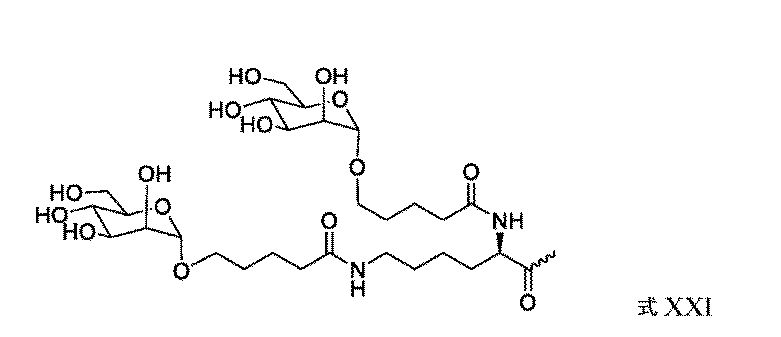
いくつかの実施態様において、単糖はN-アセチルガラクトサミン(GalNAc)である。いくつかの実施態様において、炭水化物は、複数のN-アセチルガラクトサミン単位、例えば
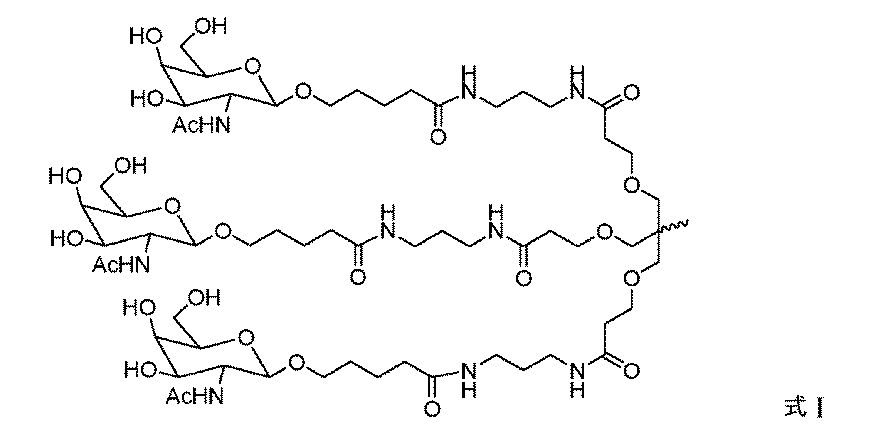
本明細書に記載される実施態様に使用され得る別の代表的な炭水化物コンジュゲートは、

本明細書のいくつかの実施態様において、本明細書のdsRNA物質には、GalNAcまたはGalNAc誘導体が一価リンカーを介して結合している。いくつかの実施態様において、本明細書のdsRNA物質には、GalNAcまたはGalNAc誘導体が二価リンカーを介して結合している。本明細書のいくつかの実施態様において、本明細書のdsRNA物質には、GalNAcまたはGalNAc誘導体が三価リンカーを介して結合している。いくつかの実施態様において、炭水化物リガンドは、三価リンカーを介して結合している3個のN-アセチルガラクトサミン単位(「GalNAc3」)を含む。 In some embodiments herein, the dsRNA agent herein has GalNAc or a GalNAc derivative attached via a monovalent linker. In some embodiments herein, the dsRNA agent herein has GalNAc or a GalNAc derivative attached via a bivalent linker. In some embodiments herein, the dsRNA agent herein has GalNAc or a GalNAc derivative attached via a trivalent linker. In some embodiments herein, the carbohydrate ligand comprises three N-acetylgalactosamine units ("GalNAc3") attached via a trivalent linker.
いくつかの実施態様において、二本鎖dsRNA物質は、dsRNA物質に結合された1つのGalNAcまたはGalNAc誘導体を含む。いくつかの実施態様において、二本鎖dsRNA物質は、複数個(例えば、2、3、4、5または6個)のGalNAcまたはGalNAc誘導体を含み、これらはそれぞれ独立して、複数個の一価リンカーを介して二本鎖dsRNA物質の複数個のヌクレオチドに結合されている。 In some embodiments, the double-stranded dsRNA material comprises one GalNAc or GalNAc derivative attached to the dsRNA material. In some embodiments, the double-stranded dsRNA material comprises multiple (e.g., 2, 3, 4, 5, or 6) GalNAc or GalNAc derivatives, each of which is independently attached to multiple nucleotides of the double-stranded dsRNA material via multiple monovalent linkers.
本明細書に使用するのに適当なさらなる炭水化物コンジュゲートは、PCT公開WO2014/179620号およびWO2014/179627号に記載されるものを含み、これらは、そのようなコンジュゲートに関連する教示のために、参照により本明細書に援用される。 Further carbohydrate conjugates suitable for use herein include those described in PCT Publications WO2014/179620 and WO2014/179627, which are incorporated by reference herein for their teachings related to such conjugates.
本明細書に開示される組成物および方法に使用され得るリンカーを有するdsRNA物質炭水化物コンジュゲートの非限定的な例としては、


本明細書に開示される組成物および方法のいくつかの実施態様において、リガンドは、二価または三価の分枝鎖状リンカーを介して結合された1つまたはそれ以上の「GalNAc」(N-アセチルガラクトサミン)誘導体である。 In some embodiments of the compositions and methods disclosed herein, the ligand is one or more "GalNAc" (N-acetylgalactosamine) derivatives attached via a bivalent or trivalent branched linker.
いくつかの実施態様において、本明細書に開示されるdsRNA物質は、式(XXXI)~(XXXIV):


q2A、q2B、q3A、q3B、q4A、q4B、q5A、q5Bおよびq5Cは、出現するごとに独立して、0~20を表し、繰返し単位は同一または異なっていてもよく;
P2A、P2B、P3A、P3B、P4A、P4B、P5A、P5B、P5C、T2A、T2B、T3A、T3B、T4A、T4B、T4A、T5B、T5Cはそれぞれ、出現するごとに独立して不存在であるか、CO、NH、O、S、OC(O)、NHC(O)、CH2、CH2NHまたはCH2Oであり;
Q2A、Q2B、Q3A、Q3B、Q4A、Q4B、Q5A、Q5B、Q5Cは、出現するごとに独立して不存在であるか、アルキレン、置換アルキレンであり、ここで、1つまたはそれ以上のメチレンは、1つまたはそれ以上のO、S、S(O)、SO2、N(RN)、C(R')=C(R'')、C≡CまたはC(O)によって中断または終端されてもよく;
R2A、R2B、R3A、R3B、R4A、R4B、R5A、R5B、R5Cはそれぞれ、出現するごとに独立して不存在であるか、NH、O、S、CH2、C(O)O、C(O)NH、NHCH(Ra)C(O)、-C(O)-CH(Ra)-NH-、CO、CH=N-O、


L2A、L2B、L3A、L3B、L4A、L4B、L5A、L5BおよびL5Cはリガンドを表し;すなわち、それぞれ、出現するごとに独立して、単糖(GalNAcなど)、二糖、三糖、四糖、オリゴ糖または多糖であり;そして
RaはHまたはアミノ酸側鎖である]
のいずれかに示される構造の群から選択されるコンジュゲートされた二価または三価の分枝鎖状リンカーである。三価コンジュゲートGalNAc誘導体は、dsRNA物質とともに使用されて、式(XXXIV):

ものなどの標的遺伝子の発現を阻害するのに特に有用である。
In some embodiments, the dsRNA agent disclosed herein has the formula (XXXI)-(XXXIV):
q2A , q2B , q3A , q3B , q4A , q4B , q5A , q5B and q5C each occurrence independently represent 0 to 20, and the repeat units may be the same or different;
P2A , P2B , P3A , P3B , P4A , P4B , P5A , P5B , P5C , T2A , T2B , T3A , T3B , T4A , T4B , T4A , T5B, T5C are each independently at each occurrence absent, CO, NH, O, S, OC(O), NHC(O), CH2 , CH2NH or CH2O ;
Q2A , Q2B, Q3A, Q3B, Q4A, Q4B, Q5A, Q5B , Q5C , each occurrence , is independently absent, alkylene, substituted alkylene, where one or more methylenes may be interrupted or terminated by one or more O, S, S(O), SO2 , N(RN), C(R')=C(R'', C≡C or C(O);
R2A , R2B , R3A , R3B , R4A , R4B , R5A , R5B , and R5C are each independently selected from the group consisting of absent, NH, O, S, CH2 , C(O)O, C(O)NH, NHCH(Ra)C(O), -C(O)-CH( Ra )-NH-, CO, CH=NO,
L2A , L2B , L3A , L3B , L4A , L4B , L5A , L5B and L5C represent a ligand; i.e., each, independently at each occurrence, is a monosaccharide (such as GalNAc), a disaccharide, a trisaccharide, a tetrasaccharide, an oligosaccharide or a polysaccharide; and
R a is H or an amino acid side chain.
The conjugated bivalent or trivalent branched linker is selected from the group of structures shown in any of the following: The trivalent conjugated GalNAc derivative is used with a dsRNA agent to have the formula (XXXIV):
The present invention is particularly useful for inhibiting the expression of target genes such as those described above.
適当な二価および三価の分枝鎖状リンカー基がコンジュゲートしているGalNAc誘導体の例としては、式I、VI、X、IXおよびXIIとして上記に列挙している構造が挙げられるが、これらに限定はされない。 Examples of GalNAc derivatives conjugated with suitable divalent and trivalent branched linker groups include, but are not limited to, the structures listed above as formulas I, VI, X, IX, and XII.
B.リンカー
いくつかの実施態様において、dsRNA物質オリゴヌクレオチドには、本明細書に記載しているコンジュゲートまたはリガンドが、切断可能または切断不可能であり得る様々なリンカーによって結合できる。
B. Linker
In some embodiments, the dsRNA agent oligonucleotide can be attached to a conjugate or ligand as described herein by a variety of linkers, which can be cleavable or non-cleavable.
用語「リンカー」または「連結基」とは、化合物の2つの部分を連結する、例えば、化合物の2つの部分を共有結合する有機部分を意味する。リンカーは典型的には、直接結合を含み、または原子、例えば酸素または硫黄、単位、例えばNR8、C(O)、C(O)NH、SO、SO2、SO2NH、または原子の鎖、例えば、限定はされないが、置換もしくは非置換のアルキル、置換もしくは非置換のアルケニル、置換もしくは非置換のアルキニル、アリールアルキル、アリールアルケニル、アリールアルキニル、ヘテロアリールアルキル、ヘテロアリールアルケニル、ヘテロアリールアルキニル、ヘテロシクリルアルキル、ヘテロシクリルアルケニル、ヘテロシクリルアルキニル、アリール、ヘテロアリール、ヘテロシクリル、シクロアルキル、シクロアルケニル、アルキルアリールアルキル、アルキルアリールアルケニル、アルキルアリールアルキニル、アルケニルアリールアルキル、アルケニルアリールアルケニル、アルケニルアリールアルキニル、アルキニルアリールアルキル、アルキニルアリールアルケニル、アルキニルアリールアルキニル、アルキルヘテロアリールアルキル、アルキルヘテロアリールアルケニル、アルキルヘテロアリールアルキニル、アルケニルヘテロアリールアルキル、アルケニルヘテロアリールアルケニル、アルケニルヘテロアリールアルキニル、アルキニルヘテロアリールアルキル、アルキニルヘテロアリールアルケニル、アルキニルヘテロアリールアルキニル、アルキルヘテロシクリルアルキル、アルキルヘテロシクリルアルケニル、アルキルヘテロシクリルアルキニル、アルケニルヘテロシクリルアルキル、アルケニルヘテロシクリルアルケニル、アルケニルヘテロシクリルアルキニル、アルキニルヘテロシクリルアルキル、アルキニルヘテロシクリルアルケニル、アルキニルヘテロシクリルアルキニル、アルキルアリール、アルケニルアリール、アルキニルアリール、アルキルヘテロアリール、アルケニルヘテロアリール、アルキニルヘテロアリールであって、これらは1つまたはそれ以上のメチレンがO、S、S(O)、SO2、N(R8)、C(O)、置換もしくは非置換アリール、置換もしくは非置換ヘテロアリール、置換もしくは非置換ヘテロ環式(ここで、R8は、水素、アシル、脂肪族または置換された脂肪族である)により中断または終結することがあるものを含む。いくつかの実施態様において、リンカーは、約1~24個、2~24個、3~24個、4~24個、5~24個、6~24個、6~18個、7~18個、8~18個、7~17個、8~17個、6~16個、7~16個または8~16個の原子である。 The term "linker" or "linking group" refers to an organic moiety that links two parts of a compound, e.g., covalently bonds two parts of a compound. A linker typically includes a direct bond or is an atom, e.g., oxygen or sulfur, a unit, e.g., NR8, C(O), C(O)NH, SO, SO2 , SO2 NH, or a chain of atoms such as, but not limited to, substituted or unsubstituted alkyl, substituted or unsubstituted alkenyl, substituted or unsubstituted alkynyl, arylalkyl, arylalkenyl, arylalkynyl, heteroarylalkyl, heteroarylalkenyl, heteroarylalkynyl, heterocyclylalkyl, heterocyclylalkenyl, heterocyclylalkynyl, aryl, heteroaryl, heterocyclyl, cycloalkyl, cycloalkenyl, alkylarylalkyl, alkylarylalkenyl, alkylarylalkynyl, alkenylarylalkyl, alkenylarylalkenyl, alkenylarylalkynyl, alkynylarylalkyl, alkynylarylalkenyl, alkynylarylalkynyl, alkylheteroarylalkyl, alkylheteroarylalkenyl, aryl alkylheteroarylalkynyl, alkenylheteroarylalkyl, alkenylheteroarylalkenyl, alkenylheteroarylalkynyl, alkynylheteroarylalkyl, alkynylheteroarylalkenyl, alkynylheteroarylalkynyl, alkylheterocyclylalkyl, alkylheterocyclylalkenyl, alkylheterocyclylalkynyl, alkenylheterocyclylalkyl, alkenylheterocyclylalkenyl, alkenylheterocyclylalkynyl, alkynylheterocyclylalkyl, alkynylheterocyclylalkenyl, alkynylheterocyclylalkynyl, alkylaryl, alkenylaryl, alkynylaryl, alkylheteroaryl, alkenylheteroaryl, alkynylheteroaryl, where one or more methylenes are O, S, S(O), SO 2 , including those that may be interrupted or terminated by N(R8), C(O), substituted or unsubstituted aryl, substituted or unsubstituted heteroaryl, substituted or unsubstituted heterocyclic (where R8 is hydrogen, acyl, aliphatic, or substituted aliphatic). In some embodiments, the linker is about 1-24, 2-24, 3-24, 4-24, 5-24, 6-24, 6-18, 7-18, 8-18, 7-17, 8-17, 6-16, 7-16, or 8-16 atoms.
切断可能な連結基は、細胞の外部では十分安定であるが、標的細胞内に入ると切断されて、リンカーが一緒に保持している2つの部分を放出する。いくつかの実施態様において、切断可能な連結基は、標的細胞内または第一の参照(例えば、細胞内条件を模倣または代表するように選択できる)条件下において、対象の血液中、または第二の参照(例えば、血液または血清に見出される条件を模倣または代表するよう選択できる)条件下よりも、少なくとも約10倍、20倍、30倍、40倍、50倍、60倍、70倍、80倍、90倍またはそれ以上、または少なくとも約100倍速く、切断される。 The cleavable linking group is sufficiently stable outside a cell, but once inside a target cell, it is cleaved to release the two moieties that the linker holds together. In some embodiments, the cleavable linking group is cleaved at least about 10, 20, 30, 40, 50, 60, 70, 80, 90 or more times, or at least about 100 times faster, inside the target cell or under a first reference condition (which can be selected, e.g., to mimic or represent intracellular conditions) than in the subject's blood or under a second reference condition (which can be selected, e.g., to mimic or represent conditions found in blood or serum).
切断可能な連結基は、切断剤、例えば、pH、酸化還元電位または分解性分子の存在に敏感である。一般に、切断剤は、血清または血液中と比較して細胞内部により広く存在し、またはより高いレベルもしくは活性で見出される。このような分解剤の例としては、例えば、細胞内に存在する酸化もしくは還元酵素、または還元により酸化還元切断可能な連結基を分解できるメルカプタンなどの還元剤を含む、特定の基質用に選択されまたは基質特異性を有さない酸化還元剤;エステラーゼ;エンドソーム、または酸性環境を形成できる物質、例えば、5またはそれ以下のpHをもたらす物質;一般的な酸として作用することにより、酸切断可能な連結基を加水分解または分解できる酵素、ペプチダーゼ(基質特異的であり得る)およびホスファターゼが挙げられる。 Cleavable linking groups are sensitive to cleaving agents, e.g., pH, redox potential, or the presence of degradable molecules. In general, cleaving agents are more prevalent or found at higher levels or activity inside cells compared to serum or blood. Examples of such degrading agents include, for example, oxidizing or reducing enzymes present in cells, or redox agents selected for a particular substrate or with no substrate specificity, including reducing agents such as mercaptans that can degrade redox-cleavable linking groups by reduction; esterases; endosomes, or substances that can create an acidic environment, e.g., substances that result in a pH of 5 or less; enzymes that can hydrolyze or degrade acid-cleavable linking groups by acting as a general acid, peptidases (which can be substrate specific), and phosphatases.
ジスルフィド結合などの切断可能な連結基は、pHに敏感であり得る。ヒト血清のpHは7.4である一方、細胞内平均pHは、僅かに低く、約7.1~7.3の範囲である。エンドソームは、5.5~6.0の範囲内のより酸性のpHを有し、リソソームは、5.0程度の、更により酸性のpHを有する。いくつかのリンカーは、好ましいpHで切断される切断可能な連結基を有することによって、細胞内部でリガンドからカチオン性脂質を放出し、または細胞の所望の区画内へ放出するであろう。 Cleavable linking groups, such as disulfide bonds, can be pH sensitive. While the pH of human serum is 7.4, the average intracellular pH is slightly lower, ranging from about 7.1 to 7.3. Endosomes have a more acidic pH, ranging from 5.5 to 6.0, and lysosomes have an even more acidic pH, around 5.0. Some linkers will have a cleavable linking group that is cleaved at a preferred pH, thereby releasing the cationic lipid from the ligand inside the cell, or into a desired compartment of the cell.
リンカーは、特定の酵素により切断可能な、切断可能な連結基を含み得る。リンカーに組み込まれる切断可能な連結基のタイプは、標的とされる細胞に依存し得る。例えば、肝臓標的リガンドは、エステル基を含むリンカーを介して、カチオン性脂質に連結され得る。肝細胞はエステラーゼに富んでいるため、このリンカーは、エステラーゼに富んでいない細胞型内と比較して、肝細胞内でより効率的に切断されるであろう。エステラーゼに富んだ他の細胞型には、肺、腎皮質および精巣の細胞がある。 The linker may contain a cleavable linking group that is cleavable by a specific enzyme. The type of cleavable linking group incorporated into the linker may depend on the cell being targeted. For example, a liver targeting ligand may be linked to a cationic lipid via a linker that contains an ester group. Because hepatocytes are rich in esterases, this linker will be cleaved more efficiently in hepatocytes compared to cell types that are not rich in esterases. Other cell types that are rich in esterases include lung, renal cortex, and testicular cells.
ペプチド結合を含有するリンカーは、肝細胞および滑膜細胞などのペプチダーゼに富んだ細胞型を標的とする際に使用することができる。 Linkers containing peptide bonds can be used to target peptidase-rich cell types such as hepatocytes and synovial cells.
一般に、切断可能な候補連結基の適切性は、分解剤(または分解条件)の候補連結基を切断する能力を試験することにより評価することができる。血液中、または他の非標的組織との接触の際に、切断可能な候補連結基の切断に抵抗する能力を試験することも望ましいであろう。したがって、第一の条件と第二の条件との間の、切断に対する相対的な感受性を決定することができ、ここで、第一の条件は標的細胞内での切断を示すよう選択され、第二の条件は他の組織内または生体液、例えば血液または血清中での切断を示すよう選択される。該評価は、無細胞系内、細胞内、細胞培養物中、臓器内若しくは組織培養物中、または全動物内で行うことができる。無細胞または培養物条件内で最初の評価を行い、全動物内でのさらなる評価によって確認することが有用であり得る。好ましい実施態様において、有用な候補化合物は、血液または血清(または細胞外条件を模倣するよう選択された、インビトロでの条件下)と比較して、細胞内(または細胞内条件を模倣するよう選択された、インビトロでの条件下)で少なくとも約2倍、4倍、10倍、20倍、30倍、40倍、50倍、60倍、70倍、80倍、90倍または約100倍速く切断される。 In general, the suitability of a candidate cleavable linking group can be evaluated by testing the ability of a degrading agent (or degrading condition) to cleave the candidate linking group. It may also be desirable to test the ability of the candidate cleavable linking group to resist cleavage in blood or upon contact with other non-target tissues. Thus, the relative susceptibility to cleavage between a first condition and a second condition can be determined, where the first condition is selected to be indicative of cleavage in target cells and the second condition is selected to be indicative of cleavage in other tissues or biological fluids, such as blood or serum. The evaluation can be performed in a cell-free system, in cells, in cell culture, in organ or tissue culture, or in a whole animal. It may be useful to perform an initial evaluation in a cell-free or culture condition and confirm with further evaluation in a whole animal. In preferred embodiments, useful candidate compounds are cleaved at least about 2-fold, 4-fold, 10-fold, 20-fold, 30-fold, 40-fold, 50-fold, 60-fold, 70-fold, 80-fold, 90-fold, or about 100-fold faster in cells (or under in vitro conditions selected to mimic intracellular conditions) compared to blood or serum (or under in vitro conditions selected to mimic extracellular conditions).
i.酸化還元切断可能な連結基
いくつかの実施態様において、切断可能な連結基は、還元または酸化後に切断される酸化還元切断可能な連結基である。還元的に切断可能な連結基の例としては、ジスルフィド連結基(-S-S-)がある。切断可能な候補連結基が適当な「還元的に切断可能な連結基」であるか、または例えば特定のdsRNA物質部分および特定の標的化剤との使用に適当であるかを決定するために、本明細書に記載される方法に注目し得る。例えば、候補は、ジチオスレイトール(DTT)、または当該技術分野で知られている試薬を用いた他の還元剤とのインキュベーションによって評価することができ、これは、細胞、例えば標的細胞内で観察され得る切断の速度を模倣する。候補はまた、血液または血清条件を模倣するよう選択された条件下でも評価され得る。いくつかの実施態様において、候補化合物は、血液中で最大で約10%切断される。いくつかの実施態様において、有用な候補化合物は、血液中(または、細胞外条件を模倣するように選択されたインビトロでの条件下)と比較して、細胞内(または、細胞内条件を模倣するように選択されたインビトロでの条件下)で少なくとも約2倍、4倍、10倍、20倍、30倍、40倍、50倍、60倍、70倍、80倍、90倍または約100倍速く分解される。候補化合物の切断速度は、細胞内媒体を模倣するように選択された条件下での標準的な酵素動力学アッセイを用いて決定され、細胞外媒体を模倣するように選択された条件と比較され得る。
i. Redox-cleavable linking group
In some embodiments, the cleavable linking group is a redox cleavable linking group that is cleaved after reduction or oxidation. An example of a reductively cleavable linking group is a disulfide linking group (-SS-). To determine whether a candidate cleavable linking group is a suitable "reductively cleavable linking group" or is suitable for use with, for example, a specific dsRNA material portion and a specific targeting agent, the methods described herein can be looked at. For example, the candidate can be evaluated by incubation with dithiothreitol (DTT) or other reducing agent using a reagent known in the art, which mimics the cleavage rate that can be observed in cells, for example, target cells. The candidate can also be evaluated under conditions selected to mimic blood or serum conditions. In some embodiments, the candidate compound is cleaved in blood at a maximum of about 10%. In some embodiments, useful candidate compounds are degraded at least about 2-fold, 4-fold, 10-fold, 20-fold, 30-fold, 40-fold, 50-fold, 60-fold, 70-fold, 80-fold, 90-fold, or about 100-fold faster in cells (or under in vitro conditions selected to mimic intracellular conditions) than in blood (or under in vitro conditions selected to mimic extracellular conditions). The cleavage rate of the candidate compound can be determined using standard enzyme kinetic assays under conditions selected to mimic intracellular media and compared to conditions selected to mimic extracellular media.
ii.ホスフェートを基本とする切断可能な連結基
いくつかの実施態様において、切断可能なリンカーは、ホスフェートを基本とする切断可能な連結基を含む。ホスフェートを基本とする切断可能な連結基は、リン酸基を分解たは加水分解する薬剤によって切断される。細胞内でリン酸基を切断する薬剤の例としては、細胞内のホスファターゼなどの酵素である。ホスフェートを基本とする連結基の例としては、-O-P(O)(ORk)-O-、-O-P(S)(ORk)-O-、-O-P(S)(SRk)-O-、-S-P(O)(ORk)-O-、-O-P(O)(ORk)-S-、-S-P(O)(ORk)-S-、-O-P(S)(ORk)-S-、-S-P(S)(ORk)-O-、-O-P(O)(Rk)-O-、-O-P(S)(Rk)-O-、-S-P(O)(Rk)-O-、-S-P(S)(Rk)-O-、-S-P(O)(Rk)-S-、-O-P(S)(Rk)-S-が挙げられる。いくつかの実施態様において、ホスフェートを基本とする連結基は、-O-P(O)(OH)-O-、-O-P(S)(OH)-O-、-O-P(S)(SH)-O-、-S-P(O)(OH)-O-、-O-P(O)(OH)-S-、-S-P(O)(OH)-S-、-O-P(S)(OH)-S-、-S-P(S)(OH)-O-、-O-P(O)(H)-O-、-O-P(S)(H)-O-、-S-P(O)(H)-O、-S-P(S)(H)-O-、-S-P(O)(H)-S-または-O-P(S)(H)-S-である。いくつかの実施態様において、ホスフェートを基本とする連結基は-O-P(O)(OH)-O-である。これらの候補は、上述した方法と類似した方法を用いて評価することができる。
ii. Phosphate-Based Cleavable Linkers
In some embodiments, the cleavable linker comprises a phosphate-based cleavable linker. The phosphate-based cleavable linker is cleaved by an agent that degrades or hydrolyzes the phosphate group. An example of an agent that cleaves the phosphate group within a cell is an enzyme such as an intracellular phosphatase. Examples of phosphate-based linking groups include: -OP(O)(ORk)-O-, -OP(S)(ORk)-O-, -OP(S)(SRk)-O-, -SP(O)(ORk)-O-, -OP(O)(ORk)-S-, -SP(O)(ORk)-S-, -OP(S)(ORk)-S-, -SP(S)(ORk)-O-, -OP(O)(Rk)-O-, -OP(S)(Rk)-O-, -SP(O)(Rk)-O-, -SP(S)(Rk)-O-, -SP(O)(Rk)-S-, -OP(S)(Rk)-S-. In some embodiments, the phosphate-based linking group is -OP(O)(OH)-O-, -OP(S)(OH)-O-, -OP(S)(SH)-O-, -SP(O)(OH)-O-, -OP(O)(OH)-S-, -SP(O)(OH)-S-, -OP(S)(OH)-S-, -SP(S)(OH)-O-, -OP(O)(H)-O-, -OP(S)(H)-O-, -SP(O)(H)-O, -SP(S)(H)-O-, -SP(O)(H)-S-, or -OP(S)(H)-S-. In some embodiments, the phosphate-based linking group is -OP(O)(OH)-O-. These candidates can be evaluated using methods similar to those described above.
iii.酸切断可能な連結基
いくつかの実施態様において、切断可能なリンカーは酸切断可能な連結基である。酸切断可能な連結基は、酸性条件下で切断される連結基である。いくつかの実施態様において、酸切断可能な連結基は、約6.5またはそれ以下(例えば、約6.0、5.75、5.5、5.25、5.0、またはそれ以下)のpHの酸性環境で、または一般的な酸として作用し得る酵素などの薬剤によって切断される。細胞内では、エンドソームおよびリソソームなどの特定の低pH小器官は、酸切断可能な連結基のために切断環境を提供し得る。酸切断可能な連結基の例としては、ヒドラゾン、エステルおよびアミノ酸のエステルが挙げられるが、これらに限定されない。酸切断可能な基は、一般式-C=NN-、C(O)Oまたは-OC(O)を有し得る。いくつかの実施態様において、エステルの酸素に結合した炭素(アルコキシ基)は、アリール基、置換されているアルキル基、またはジメチルペンチルもしくはt-ブチルなどの第三級アルキル基である。これらの候補は、上述した方法と類似した方法を用いて評価され得る。
iii. Acid-cleavable linking groups
In some embodiments, the cleavable linker is an acid-cleavable linking group. An acid-cleavable linking group is a linking group that is cleaved under acidic conditions. In some embodiments, the acid-cleavable linking group is cleaved in an acidic environment with a pH of about 6.5 or less (e.g., about 6.0, 5.75, 5.5, 5.25, 5.0, or less) or by an agent such as an enzyme that can act as a general acid. Intracellularly, certain low pH organelles such as endosomes and lysosomes can provide a cleavage environment for the acid-cleavable linking group. Examples of acid-cleavable linking groups include, but are not limited to, hydrazones, esters, and esters of amino acids. Acid-cleavable groups can have the general formula -C=NN-, C(O)O, or -OC(O). In some embodiments, the carbon attached to the oxygen of the ester (alkoxy group) is an aryl group, a substituted alkyl group, or a tertiary alkyl group such as dimethylpentyl or t-butyl. These candidates can be evaluated using methods similar to those described above.
iv.エステルを基本とする連結基
いくつかの実施態様において、切断可能なリンカーは、エステルを基本とする切断可能な連結基を含む。エステルを基本とする切断可能な連結基は、細胞内のエステラーゼおよびアミラーゼなどの酵素によって切断される。エステルを基本とする切断可能な連結基の例としては、アルキレン、アルケニレンおよびアルキニレン基のエステルが挙げられるが、これらに限定されない。エステル切断可能な連結基は、一般式-C(O)O-、または-OC(O)-で示される。これらの候補は、上述した方法と類似した方法を用いて評価され得る。
iv. Ester-based linking groups
In some embodiments, the cleavable linker comprises an ester-based cleavable linking group. The ester-based cleavable linking group is cleaved by enzymes such as esterase and amylase in cells. Examples of ester-based cleavable linking groups include, but are not limited to, esters of alkylene, alkenylene and alkynylene groups. Ester cleavable linking groups are represented by the general formula -C(O)O- or -OC(O)-. These candidates can be evaluated using methods similar to those described above.
v.ペプチドを基本とする切断基
いくつかの実施態様において、切断可能なリンカーは、ペプチドを基本とする切断可能な連結基を含む。ペプチドを基本とする切断可能な連結基は、細胞内のペプチダーゼおよびプロテアーゼなどの酵素によって切断される。ペプチドを基本とする切断可能な連結基は、アミノ酸間で形成されてオリゴペプチド(例えば、ジペプチド、トリペプチドなど)およびポリペプチドを産生するペプチド結合である。ペプチドを基本とする切断可能な基は、アミド基(-C(O)NH-)を含まない。アミド基は、いずれかのアルキレン、アルケニレンまたはアルキニレンの間で形成され得る。ペプチド結合は、アミノ酸間で形成されてペプチドおよびタンパク質を産生するアミド結合の特別なタイプである。ペプチドを基本とする切断基は、一般に、アミノ酸間で形成されてペプチドおよびタンパク質を産生するペプチド結合(すなわた、アミド結合)に限定され、アミド官能基全部は含まない。ペプチドを基本とする切断可能な連結基は、一般式-NHCHRAC(O)NHCHRBC(O)-で示され、式中、RAおよびRBは、隣接する2つのアミノ酸のR基である。これらの候補は、上述した方法と類似した方法を用いて評価され得る。
v. Peptide-based cleavage groups
In some embodiments, the cleavable linker comprises a peptide-based cleavable linking group. The peptide-based cleavable linking group is cleaved by enzymes such as intracellular peptidases and proteases. The peptide-based cleavable linking group is a peptide bond formed between amino acids to produce oligopeptides (e.g., dipeptides, tripeptides, etc.) and polypeptides. The peptide-based cleavable group does not include an amide group (-C(O)NH-). An amide group can be formed between any alkylene, alkenylene, or alkynylene. A peptide bond is a special type of amide bond formed between amino acids to produce peptides and proteins. The peptide-based cleaving group is generally limited to peptide bonds (i.e., amide bonds) formed between amino acids to produce peptides and proteins, and does not include all amide functional groups. The peptide-based cleavable linking group is represented by the general formula -NHCHRAC(O)NHCHRBC(O)-, where RA and RB are the R groups of the two adjacent amino acids. These candidates can be evaluated using methods similar to those described above.
V.dsRNA物質の送達
細胞、例えば、ヒト対象などの対象の内の細胞への本発明のdsRNA物質の送達は、いくつかの異なる方法で達成することができる。例えば、送達は、細胞を、本明細書のdsRNA物質とインビトロまたはインビボのいずれかで接触させることによって行われ得る。インビボでの送達はまた、dsRNA物質を含む組成物を対象に投与することによって直接行われ得る。或いは、インビボであの送達は、dsRNA物質の発現をコードし、それを誘導する1つまたはそれ以上のベクターを投与することによって、間接的に行われ得る。これらの代替例は、以下に更に論じられる。
V. Delivery of dsRNA Agents
Delivery of the dsRNA material of the present invention to cells, for example, cells in a subject, such as a human subject, can be achieved in several different ways.For example, delivery can be performed by contacting cells with the dsRNA material herein, either in vitro or in vivo.In vivo delivery can also be performed directly by administering a composition comprising the dsRNA material to a subject.Alternatively, in vivo delivery can be performed indirectly by administering one or more vectors that code for and induce the expression of the dsRNA material.These alternatives are discussed further below.
一般に、核酸分子を(インビトロまたはインビボで)送達するいずれかの方法は、本明細書のdsRNA物質とともに使用するのに適合され得る(例えば、そのような送達方法に関連する教示のために、参照により本明細書に援用される、Akhtar S.and Julian RL.,(1992)Trends Cell.Biol.2(5):139-144およびWO94/02595を参照)。インビボでの送達の場合、dsRNA物質分子を送達するために考慮される因子としては、例えば、送達される分子の生物学的安定性、非特異的効果の防止、および標的組織における送達される分子の蓄積が挙げられる In general, any method of delivering a nucleic acid molecule (in vitro or in vivo) can be adapted for use with the dsRNA agents of the present invention (see, e.g., Akhtar S. and Julian RL., (1992) Trends Cell. Biol. 2(5):139-144 and WO94/02595, which are incorporated herein by reference for teachings related to such delivery methods). For in vivo delivery, factors to be considered for delivering dsRNA agent molecules include, for example, the biological stability of the delivered molecule, prevention of nonspecific effects, and accumulation of the delivered molecule in the target tissue.
疾患の処置のためにdsRNA物質を全身投与するために、RNAは、修飾されてもよく、代わりに薬物送達システムを用いて送達されてもよく;両方の方法は、インビボでのエンドヌクレアーゼおよびエキソヌクレアーゼによるdsRNAの急速な分解を防ぐように作用する。RNA、医薬担体または医薬用賦形剤の修飾は、標的組織へのdsRNA物質組成物の標的化を可能にし、望ましくないオフターゲット効果を回避することもできる。dsRNA物質分子は、化学的コンジュゲーション、例えば、上記に記載の炭水化物コンジュゲートによって修飾され得る。 To administer dsRNA agents systemically for the treatment of disease, the RNA may be modified or alternatively delivered using a drug delivery system; both methods act to prevent rapid degradation of the dsRNA by endonucleases and exonucleases in vivo. Modification of the RNA, pharmaceutical carrier or excipient may also allow for targeting of the dsRNA agent composition to the target tissue and avoid undesirable off-target effects. The dsRNA agent molecule may be modified by chemical conjugation, e.g., carbohydrate conjugates as described above.
VI.医薬組成物
本明細書はまた、本明細書のdsRNA物質を含む医薬組成物および製剤を含む。いくつかの実施態様において、本明細書では、本明細書に記載されるdsRNA物質を含有する医薬組成物、製薬的に許容される担体が提供される。該dsRNA物質を含有する医薬組成物は、HBV 遺伝子の発現または活性に関連する疾患または障害を処置するのに有用である。このような医薬組成物は、送達様式に基づいて製剤化される。一例は、非経口送達、例えば、皮下(SC)筋肉内(IM)または静脈内(IV)送達を介した全身投与用に製剤化される組成物である。特定の実施態様において、本明細書は、臓器特異的(例えば、肝臓)動脈内、腫瘍内、皮内、硝子体内注射、眼局所、眼部(点眼薬)、噴霧、眼局所または他の局所経路、坐薬、または経口投与のために製剤化される組成物を提供する。好ましい実施態様において、組成物は皮下投与される。
VI. Pharmaceutical Compositions
The present specification also includes pharmaceutical compositions and formulations that include the dsRNA agent of the present specification. In some embodiments, the present specification provides pharmaceutical compositions that contain the dsRNA agent described herein, pharma- ceutically acceptable carriers. The pharmaceutical compositions that contain the dsRNA agent are useful for treating diseases or disorders related to the expression or activity of HBV genes. Such pharmaceutical compositions are formulated based on the mode of delivery. One example is a composition that is formulated for systemic administration via parenteral delivery, for example, subcutaneous (SC), intramuscular (IM) or intravenous (IV) delivery. In certain embodiments, the present specification provides compositions that are formulated for organ-specific (e.g., hepatic) intra-arterial, intratumoral, intradermal, intravitreal injection, ocular topical, ocular (eye drops), spray, ocular topical or other topical route, suppository, or oral administration. In a preferred embodiment, the composition is administered subcutaneously.
本明細書の医薬組成物は、HBV遺伝子の発現を阻害するのに十分である用量で投与され得る。いくつかの実施態様において、投与あたり0.5mg/kg~50mg/kg、0.3mg/kg~20mg/kg、または3mg/kg~10mg/kg、または好ましくは投与あたり3mg/kg~10mg/kgの用量で投与される。例えば、dsRNAは、単回投与あたり約0.5mg/kg、1mg/kg、1.5mg/kg、2mg/kg、3mg/kg、10mg/kg、20mg/kg、30mg/kg、40mg/kg、または50mg/kgで投与される。いくつかの実施態様において、dsRNA物質は、50mg~900mgの用量で投与される。 The pharmaceutical compositions herein may be administered at a dose sufficient to inhibit expression of HBV genes. In some embodiments, the compositions are administered at a dose of 0.5 mg/kg to 50 mg/kg, 0.3 mg/kg to 20 mg/kg, or 3 mg/kg to 10 mg/kg per dose, or preferably 3 mg/kg to 10 mg/kg per dose. For example, the dsRNA is administered at about 0.5 mg/kg, 1 mg/kg, 1.5 mg/kg, 2 mg/kg, 3 mg/kg, 10 mg/kg, 20 mg/kg, 30 mg/kg, 40 mg/kg, or 50 mg/kg per single dose. In some embodiments, the dsRNA agent is administered at a dose of 50 mg to 900 mg.
組成物はまた、対象への体重に依存しない固定用量に調製され、包装され得る。例示的な投与量レベルは、1キログラムあたりの体重に平均的な対象の体重を掛けることによって計算することができる。例えば、平均的な成人は通常、約70kgと見なされる。 The compositions may also be prepared and packaged in weight-independent fixed doses to a subject. Exemplary dosage levels can be calculated by multiplying the weight per kilogram by the weight of an average subject. For example, an average adult is usually considered to be about 70 kg.
繰り返し投与レジメンは、月に1回、隔月に1回、または3ヶ月に1回など、治療量のdsRNA物質を定期的に投与することを含み得る。好ましい実施態様において、dsRNA物質は、月に1回を超えない頻度で投与される。最初の処置レジメンの後、処置はより低い頻度で投与され得る。 Repeated dosing regimens can include administering therapeutic amounts of the dsRNA agent periodically, such as once a month, once every other month, or once every three months. In preferred embodiments, the dsRNA agent is administered no more frequently than once a month. After an initial treatment regimen, treatment can be administered less frequently.
医薬組成物は、例えば、HBV感染、例えば、検出可能なHBV抗原または、HBV cccDNAを含むHBV DNAの1つまたはそれ以上の徴候または症状を有する対象に不確定期限投与され得る。いくつかの実施態様において、dsRNA物質での処置は離散または一定期間行われ、機能的治癒を提供する。 The pharmaceutical composition can be administered for an indefinite period of time, for example, to a subject having one or more signs or symptoms of HBV infection, e.g., detectable HBV antigen or HBV DNA, including HBV cccDNA. In some embodiments, treatment with the dsRNA agent is discrete or over a period of time to provide a functional cure.
当業者は、疾患または疾患の重症度、以前の処置、対象の全体的な健康または年齢、および存在する他の疾患を含むが、それらに限定されない特定の因子が、対象を効果的に処置するのに必要な投与量および時間に影響し得ることを認識するであろう。さらに、治療的有効量の組成物での対象の処置は、単一の処置または一連の処置を含み得る。本明細書により包含される個々のdsRNA物質に関する有効な投与量およびインビボでの半減期は、従来の方法論を用いて、または本明細書の他の箇所に記載される、適切な動物モデルを用いたインビボでの試験に基づいて概算することができる。 One of skill in the art will recognize that certain factors, including but not limited to the severity of the disease or disease, previous treatments, the overall health or age of the subject, and other diseases present, may affect the dosage and time required to effectively treat a subject. Furthermore, treatment of a subject with a therapeutically effective amount of a composition may include a single treatment or a series of treatments. Effective dosages and in vivo half-lives for individual dsRNA agents encompassed by this specification can be estimated using conventional methodology or based on in vivo testing using appropriate animal models as described elsewhere herein.
A.賦形剤
「医薬担体」または「医薬用賦形剤」は、動物に1つまたはそれ以上の核酸を送達するための製薬的に許容され得る溶媒、懸濁化剤、またはいずれかの他の薬理学的に不活性なビヒクルである。このような薬剤は当技術分野でよく知られている。
A. Excipients
A "pharmaceutical carrier" or "pharmaceutical excipient" is a pharma- ceutical acceptable solvent, suspending agent, or any other pharmacologically inert vehicle for delivering one or more nucleic acids to an animal. Such agents are well known in the art.
B.他の構成成分
本明細書の組成物はさらに、医薬組成物中に従来見出されている他の補助構成成分も、当技術分野にて確立されたそれらの使用レベルで含有し得る。それ故、例えば、組成物は、例えば、鎮痒薬、収斂薬、局所麻酔薬もしくは抗炎症剤など、さらなる適合可能な薬学的に活性な材料物質を含有することができ、または防腐剤、抗酸化剤および安定化剤などの本明細書の組成物のさまざまな剤形を物理的に製剤化するのに有用なさらなる材料物質を含有することができる。しかしながら、そのような材料物質は、加えられた際、本明細書の組成物の構成成分の生物学的活性を過度に妨害しない必要がある。製剤は滅菌されてもよく、また必要に応じて、製剤の核酸と有害に相互作用しない助剤、例えば防腐剤、安定化剤、湿潤剤、乳化剤、浸透圧に影響を与える塩、または緩衝液などと混合されてもよい。
B. Other components
The compositions herein may also contain other auxiliary components that are conventionally found in pharmaceutical compositions, at their use levels established in the art.Thus, for example, the compositions may contain additional compatible pharma- ceutically active materials, such as antipruritic agents, astringents, local anesthetics or anti-inflammatory agents, or may contain additional materials that are useful for physically formulating the various dosage forms of the compositions herein, such as preservatives, antioxidants and stabilizers.However, such materials must not excessively interfere with the biological activity of the components of the compositions herein when added.The formulation may be sterilized, and if necessary, may be mixed with auxiliary agents that do not adversely interact with the nucleic acid of the formulation, such as preservatives, stabilizers, wetting agents, emulsifiers, salts that affect osmotic pressure, or buffers.
いくつかの実施態様において、本発明で特許づけられる医薬組成物は、(a)1つまたはそれ以上のdsRNA物質化合物と、(b)非iRNAメカニズムによって機能する、且つHBV関連障害を処置するのに有用な1つまたはそれ以上の薬剤とを含む。このような薬剤の例としては抗炎症薬、抗脂肪症剤、抗ウイルス剤および抗線維症剤が挙げられるが、これらに限定されない。 In some embodiments, the pharmaceutical compositions patented in the present invention include (a) one or more dsRNA agent compounds and (b) one or more agents that function by a non-iRNA mechanism and are useful for treating HBV-related disorders. Examples of such agents include, but are not limited to, anti-inflammatory agents, anti-adipose agents, anti-viral agents, and anti-fibrotic agents.
さらに、シリマリンなどの、一般に肝臓の保護に使用される他の物質はまた、本明細書に記載されるdsRNA物質との組み合わせにも使用され得る。肝疾患を処置するのに有用な他の薬剤には、テルビブジン、エンテカビル、およびプロテアーゼ阻害物質、例えばテラプレビル、ならびに他の、例えばUS2005/0148548、US2004/0167116、US2003/0144217およびUS2004/0127488に開示されているものがある。 Additionally, other agents commonly used for liver protection, such as silymarin, may also be used in combination with the dsRNA agents described herein. Other agents useful for treating liver disease include telbivudine, entecavir, and protease inhibitors such as telaprevir, as well as others, such as those disclosed in US2005/0148548, US2004/0167116, US2003/0144217, and US2004/0127488.
このような化合物の毒性および処置効果は、例えば、LD50(個体群の50%の致死量)およびED50(個体群の50%に治療的有効な用量)を決定するための、細胞培養物または実験動物における標準的な薬学的手順によって決定され得る。毒性と治療効果との間の用量比は、治療指数であり、LD50/ED50比として示され得る。いくつかの実施態様において、高い治療指数を示す化合物が好ましい。 The toxicity and therapeutic efficacy of such compounds can be determined by standard pharmaceutical procedures in cell cultures or experimental animals, for example, to determine the LD50 (the dose lethal to 50% of the population) and the ED50 (the dose therapeutically effective in 50% of the population). The dose ratio between toxic and therapeutic efficacy is the therapeutic index, which can be expressed as the ratio LD50/ED50. In some embodiments, compounds that exhibit high therapeutic indices are preferred.
細胞培養アッセイおよび動物試験から得られるデータは、ヒトに使用するためのある範囲の投与量を製剤化するのに使用され得る。本開示における本明細書で特許づけられる組成物の投与量は、一般に、わずかの毒性があるか、または毒性がないED50を含む血中濃度の範囲内である。投与量は、用いられる剤形および利用される投与経路に応じて、この範囲内で変化し得る。本明細書で特許づけられる方法に使用されるいずれかの化合物では、治療的に有効な用量は、細胞培養アッセイから最初に推測され得る。用量は、細胞培養物中で測定されるIC50(すなわち、症状の最大阻害の半分を達成する試験化合物の濃度)を含む、化合物の、または適切な場合、標的配列のポリペプチド産物の血中血漿濃度範囲を動物モデル内で達成する(例えば、ポリペプチドの濃度の低減を達成する)ように製剤化され得る。このような情報は、ヒトでの有用な用量をより正確に決定するのに使用され得る。血漿中のレベルは、例えば高速液体クロマトグラフィーによって測定することができる。 The data obtained from cell culture assays and animal studies can be used to formulate a range of dosages for use in humans. Dosages of the herein patented compositions of this disclosure are generally within a range of circulating concentrations that include the ED50 with little or no toxicity. Dosages may vary within this range depending on the dosage form employed and the route of administration utilized. For any compound used in the herein patented methods, a therapeutically effective dose can be estimated initially from cell culture assays. A dose can be formulated to achieve in an animal model a circulating plasma concentration range of the compound, or, where appropriate, the polypeptide product of the target sequence (e.g., achieve a reduction in the concentration of the polypeptide), that includes the IC50 (i.e., the concentration of the test compound that achieves half-maximal inhibition of symptoms) as measured in cell culture. Such information can be used to more accurately determine useful doses in humans. Levels in plasma can be measured, for example, by high performance liquid chromatography.
上記に述べたそれらの投与に加えて、本明細書で取り上げされるdsRNA物質は、HBV感染症の処置に有効である他の知られている薬剤と組み合わせて投与されてもよい。いずれの場合でも、投与する医師は、当技術分野で知られているまたは本明細書に記載される標準的な有効性の尺度を用いて、観察された結果に基づいて、dsRNA物質の投与量および投与時間を調整することができる。 In addition to those administrations described above, the dsRNA agents featured herein may be administered in combination with other known agents that are effective in treating HBV infection. In either case, the administering physician can adjust the dosage and time of administration of the dsRNA agent based on the observed results, using standard measures of efficacy known in the art or described herein.
VII.方法
本明細書はまた、細胞におけるHBVの発現を阻害する方法を提供する。該方法は、細胞を、細胞におけるHBVの発現を阻害するのに有効な量のdsRNA物質、例えば、二本鎖dsRNA物質と接触させることで、細胞におけるHBVの発現を阻害することを含む。
VII. Methods
The present specification also provides a method for inhibiting the expression of HBV in a cell, comprising contacting the cell with an amount of a dsRNA agent, e.g., a double-stranded dsRNA agent, effective to inhibit the expression of HBV in the cell, thereby inhibiting the expression of HBV in the cell.
細胞とdsRNA物質、例えば二本鎖dsRNA物質との接触は、インビトロで行われてもよく、インビボで行われてもよい。細胞をインビボでdsRNA物質と接触させることは、対象、例えばヒト対象の内の細胞または細胞群をdsRNA物質と接触させることを含む。細胞を接触させるインビトロおよびインビボ方法の組み合わせも可能である。上で論じたように、細胞への接触は直接的または間接的であり得る。さらに、細胞への接触は、本明細書に記載されるまたは当該分野で知られるいずれかのリガンドを含む標的リガンドを介して行われてもよい。好ましい実施態様において、標的リガンドは炭水化物部分、例えばGalNAc3リガンド、またはdsRNA物質を意味深い部位に誘導するその他のリガンドのいずれかである。 Contacting a cell with a dsRNA agent, e.g., a double-stranded dsRNA agent, may occur in vitro or in vivo. Contacting a cell with a dsRNA agent in vivo includes contacting a cell or a group of cells in a subject, e.g., a human subject, with the dsRNA agent. A combination of in vitro and in vivo methods of contacting a cell is also possible. As discussed above, contacting a cell can be direct or indirect. Additionally, contacting a cell may occur via a targeting ligand, including any of the ligands described herein or known in the art. In a preferred embodiment, the targeting ligand is either a carbohydrate moiety, e.g., a GalNAc3 ligand, or other ligand that directs the dsRNA agent to a site of interest.
本明細書の方法のいくつかの実施態様において、dsRNA物質は対象に投与され、対象の内の特定の部位に送達される。HBV遺伝子の発現の阻害は、対象の内の特定の部位からの体液または組織から得られる試料中のHBV mRNAまたはHBVタンパク質のレベルの測定、または変動を用いて評価される。好ましい実施態様において、該部位は肝臓および血液から選択される。該部位はまた、上記の部位のいずれか1つから調製される細胞または体液のサブセクションであってもよく、サブグループであってもよい。 In some embodiments of the methods herein, the dsRNA agent is administered to a subject and delivered to a specific site within the subject. Inhibition of HBV gene expression is assessed using measurements of levels or variations in HBV mRNA or HBV protein in a sample obtained from a body fluid or tissue from a specific site within the subject. In preferred embodiments, the site is selected from liver and blood. The site may also be a subsection or subgroup of cells or body fluids prepared from any one of the above sites.
いくつかの実施態様において、本明細書に開示される方法は、HBV感染を有する対象、例えば、HBV遺伝子の発現またはHBV複製の低減から利益が得られる対象の処置に有用である。一態様において、本明細書は、HBVに感染した対象のB型肝炎ウイルスccc DNAのレベルを低減する方法を提供する。別の態様において、本明細書は、HBVに感染した対象のHBV抗原、例えばHBsAgまたはHBeAgのレベルを低減する方法を提供する。別の態様において、本明細書は、HBVに感染した対象のHBVのウイルス負荷を低減する方法を提供する。本明細書はまた、HBVに感染した対象のアラニンアミノトランスフェラーゼ(ALT)またはアスパラギン酸アミノトランスフェラーゼ(AST)のレベルを低減する方法も提供する(ただし、ALTまたはASTの一過性の上昇は、ウイルスクリアランスに関連することがある)。一態様において、本明細書は、HBVに感染した対象の抗HBV抗体のレベルを増加させる方法を提供する。別の態様において、本明細書は、HBV感染を有する対象を処置する方法を提供する。一態様において、本明細書は、HBV関連疾患、例えば、D型肝炎ウイルス感染症、デルタ肝炎、B型急性肝炎;急性B型劇症肝炎;慢性B型肝炎;肝線維症;末期肝疾患;または肝細胞癌を有する対象を処置する方法を提供する。されに、HDV感染症は伝染に関してHBVによって提供される必須ヘルパー機能に依存し、HBV感染を有する対象はHDV感染症も有し得るため、いくつかの実施態様において、本明細書に記載される処置方法はまた、HDV感染またはHDV関連障害、例えば、B型肝炎ウイルス感染症、慢性B型肝炎感染症(CHB)、慢性B型肝炎感染(CHB)、肝硬変、肝不全および肝細胞癌(HCC)を有する対象の処置にも有用である。いくつかの実施態様において、本明細書の処置方法(および使用)は、HBV遺伝子を標的化する本明細書のdsRNA物質、またはHBV遺伝子を標的化する本明細書のdsRNA物質の治療有効量を含む医薬組成物のを対象、例えばヒトに投与することを含む。 In some embodiments, the methods disclosed herein are useful for treating a subject having an HBV infection, e.g., a subject that would benefit from a reduction in HBV gene expression or HBV replication. In one embodiment, the present disclosure provides a method for reducing the level of hepatitis B virus ccc DNA in a subject infected with HBV. In another embodiment, the present disclosure provides a method for reducing the level of HBV antigen, e.g., HBsAg or HBeAg, in a subject infected with HBV. In another embodiment, the present disclosure provides a method for reducing the HBV viral load in a subject infected with HBV. The present disclosure also provides a method for reducing the level of alanine aminotransferase (ALT) or aspartate aminotransferase (AST) in a subject infected with HBV (although a transient increase in ALT or AST may be associated with viral clearance). In one embodiment, the present disclosure provides a method for increasing the level of anti-HBV antibodies in a subject infected with HBV. In another embodiment, the present disclosure provides a method for treating a subject having an HBV infection. In one aspect, the present specification provides a method of treating a subject having an HBV-related disease, such as hepatitis D virus infection, delta hepatitis, acute hepatitis B; acute fulminant hepatitis B; chronic hepatitis B; liver fibrosis; end-stage liver disease; or hepatocellular carcinoma. Furthermore, since HDV infection depends on essential helper functions provided by HBV for transmission, and a subject having an HBV infection may also have an HDV infection, in some embodiments, the treatment methods described herein are also useful for treating a subject having an HDV infection or an HDV-related disorder, such as hepatitis B virus infection, chronic hepatitis B infection (CHB), chronic hepatitis B infection (CHB), cirrhosis, liver failure, and hepatocellular carcinoma (HCC). In some embodiments, the treatment methods (and uses) described herein include administering to a subject, such as a human, a pharmaceutical composition comprising a therapeutically effective amount of a dsRNA agent of the present specification that targets an HBV gene.
一態様において、本明細書は、HBV感染を有する対象における少なくとも1つの症状、例えば、血清または肝臓HBV ccc DNAの存在;血清HBV DNAの存在;血清または肝臓HBV抗原、例えばHBsAgまたはHBeAgの存在;ALTの上昇;ASTの上昇;抗HBV抗体の不存在または低レベル;肝傷害;肝硬変;デルタ肝炎、急性B型肝炎;急性B型劇症肝炎;慢性B型肝炎;肝線維症;末期肝疾患;肝細胞癌;血清病様症候群;摂食障害;悪心;嘔吐、軽度の発熱;筋肉痛;易疲労感;味覚および嗅覚障害(食物およびタバコ忌避);右上腹部痛および心窩部痛(間欠性、軽度から中等度);肝性脳症;傾眠;睡眠パターンの乱れ;精神錯乱;昏睡;腹水;胃腸出血;凝血異常;黄疸;肝腫大(軽度に肥大した軟らかい肝臓);脾腫大;手掌紅斑;クモ状母斑;筋肉の消耗;クモ状血管腫;脈管炎;静脈瘤出血;末梢性浮腫;女性化乳房;精巣萎縮;腹部側副静脈(メズサの頭(caput medusa));ASTレベルより高いALTレベル;γ-グルタミルトランスペプチダーゼ(GGT)およびアルカリホスファターゼ(ALP)レベルのULNの3倍を超えない上昇;やや低いアルブミンレベル;血清鉄レベルの上昇;白血球減少症(すなわち、顆粒球減少症);リンパ球増加症;赤血球沈降速度(ESR)の増加;赤血球寿命の短縮;溶血;血小板減少症;国際標準化比(INR)の延長;血清または肝臓HBsAg、HBeAg、B型肝炎コア抗体(抗HBc)免疫グロブリンM(IgM)の存在;B型肝炎表面抗体(抗HBs)、B型肝炎e抗体(抗HBe)またはHBV DNA;ビリルビンレベルの増加;高グロブリン血症;抗平滑筋抗体(ASMA)または抗核抗体(ANA)などの組織非特異的抗体の存在(10~20%);甲状腺に対する抗体などの組織特異的抗体の存在(10~20%);リウマチ因子(RF)のレベル上昇;血小板数および白血球数の低減;小葉の、変性および修復性肝細胞変化を伴う、および付随する炎症;または検出可能か検出不可能かにかかわらず、主に小葉中心性の壊死、を予防する方法を提供する。本方法は、本発明のdsRNA物質、例えば、dsRNA、または該dsRNA物質治療有効量を含む医薬組成物を対象に投与し、それによって、HBV感染を有する対象、またはHBVおよびHDV感染の両方を有する対象など、HBV遺伝子発現の低減から利益が得られる障害を有する対象の少なくとも1つの症状を予防することを含む。 In one aspect, the present specification provides a method for detecting at least one symptom in a subject having HBV infection, such as the presence of serum or liver HBV ccc DNA; the presence of serum HBV DNA; the presence of serum or liver HBV antigen, such as HBsAg or HBeAg; elevated ALT; elevated AST; absence or low levels of anti-HBV antibodies; liver damage; cirrhosis; delta hepatitis, acute hepatitis B; acute fulminant hepatitis B; chronic hepatitis B; liver fibrosis; end stage liver disease; hepatocellular carcinoma; serum sickness-like syndrome; eating disorders; nausea; vomiting, low-grade fever; muscle pain; fatigue; taste and smell disorders (eating disorders) and tobacco aversion); right upper quadrant and epigastric pain (intermittent, mild to moderate); hepatic encephalopathy; somnolence; disturbed sleep patterns; confusion; coma; ascites; gastrointestinal bleeding; coagulation disorders; jaundice; hepatomegaly (mildly enlarged, soft liver); splenomegaly; palmar erythema; spider nevi; muscle wasting; spider angiomas; vasculitis; variceal hemorrhage; peripheral edema; gynecomastia; testicular atrophy; abdominal collateral veins (caput medusa); ALT levels higher than AST levels; elevations in gamma-glutamyl transpeptidase (GGT) and alkaline phosphatase (ALP) levels not more than 3 times the ULN; moderately low albumin levels; elevated serum iron levels; leukopenia (i.e., granulocytopenia); lymphocytosis; increased erythrocyte sedimentation rate (ESR); shortened red blood cell life span; hemolysis; thrombocytopenia; prolonged international normalized ratio (INR); presence of serum or liver HBsAg, HBeAg, hepatitis B core antibody (anti-HBc), immunoglobulin M (IgM); hepatitis B surface antibody (anti-HBs), hepatitis B e antibody (anti-HBe), or HBV The present invention provides a method for preventing DNA; increased bilirubin levels; hyperglobulinemia; the presence of tissue non-specific antibodies such as anti-smooth muscle antibodies (ASMA) or antinuclear antibodies (ANA) (10-20%); the presence of tissue specific antibodies such as antibodies to the thyroid gland (10-20%); elevated levels of rheumatoid factor (RF); reduced platelet and white blood cell counts; lobular inflammation with and associated degenerative and reparative hepatocyte changes; or primarily centrilobular necrosis, whether detectable or undetectable. The method includes administering to a subject a dsRNA agent of the invention, e.g., a dsRNA, or a pharmaceutical composition comprising a therapeutically effective amount of the dsRNA agent, thereby preventing at least one symptom in a subject having a disorder that would benefit from reduced HBV gene expression, such as a subject having an HBV infection or a subject having both HBV and HDV infections.
別の態様において、本明細書は、対象、例えば、HBV感染を有する対象、またはHBVおよびHDV感染の両方を有する対象など、HBV遺伝子発現の低減または阻害から利益を得られ得る対象を処置するための、本明細書の治療有効量のdsRNA物質の使用を提供する。 In another aspect, the present disclosure provides for the use of a therapeutically effective amount of a dsRNA agent of the present disclosure to treat a subject who may benefit from a reduction or inhibition of HBV gene expression, such as a subject having an HBV infection or a subject having both HBV and HDV infection.
さらなる態様において、本明細書は、対象、例えば、HBV感染を有する対象、またはHBVおよびHDV感染の両方を有する対象など、HBV遺伝子発現またはHBV複製の低減から利益が得られる対象、およびHBV遺伝子発現の低減から利益が得られる障害、例えばHBV関連疾患を有する対象の処置のための治療用医薬の製造における、HBV遺伝子を標的化する本明細書のdsRNA物質、例えばdsRNA、またはHBV遺伝子を標的化するdsRNA物質を含む医薬組成物の使用を提供する。 In a further aspect, the present specification provides the use of a dsRNA agent, e.g., a dsRNA, or a pharmaceutical composition comprising a dsRNA agent, targeting an HBV gene, herein, in the manufacture of a therapeutic medicament for the treatment of a subject, e.g., a subject having an HBV infection or a subject having both HBV and HDV infection, who would benefit from reduced HBV gene expression or HBV replication, and a subject having a disorder that would benefit from reduced HBV gene expression, e.g., an HBV-related disease.
別の態様において、本明細書は、HBV遺伝子発現またはHBV複製の低減または阻害から利益が得られる障害に罹患している対象の少なくとも1つの症状を予防するための、本明細書に記載されるdsRNA物質の使用を提供する。 In another aspect, the present specification provides a use of a dsRNA agent described herein for preventing at least one symptom in a subject suffering from a disorder that would benefit from reducing or inhibiting HBV gene expression or HBV replication.
さらなる態様において、本明細書は、HBV遺伝子発現またはHBV複製の低減または阻害から利益が得られる障害、例えばHBV関連疾患に罹患している対象の少なくとも1つの症状を予防するための治療用医薬の製造における本明細書に記載のdsRNA物質の使用を提供する。 In a further aspect, the present specification provides a use of a dsRNA agent described herein in the manufacture of a therapeutic medicament for preventing at least one symptom in a subject suffering from a disorder that would benefit from reducing or inhibiting HBV gene expression or HBV replication, e.g., an HBV-related disease.
いくつかの実施態様において、dsRNA物質が対象に投与される場合、dsRNA物質標的化HBVは、HBV感染症を有するか、HBVおよびHDV感染の両方を有するか、またはHBV関連疾患を有する対象に対して、例えば対象の細胞、組織、血液、他の組織または体液中の1つまたはそれ以上のHBV遺伝子の発現、HBV ccc DNA レベル、HBV抗原レベル、HBVウイルス負荷レベル、ALTまたはASTが少なくとも80%、85%、90%、95%、98%にまたは標準により向かって低減または正規化されるように投与される。 In some embodiments, when a dsRNA agent is administered to a subject, the dsRNA agent targeting HBV is administered to a subject having an HBV infection, having both HBV and HDV infections, or having an HBV-related disease such that, for example, expression of one or more HBV genes, HBV ccc DNA levels, HBV antigen levels, HBV viral load levels, ALT or AST in the subject's cells, tissues, blood, other tissues or bodily fluids is reduced or normalized by at least 80%, 85%, 90%, 95%, 98% or toward normal.
本明細書の方法および使用は、いくつかの実施態様において、本明細書に記載される組成物を、標的HBV遺伝子発現が例えば、一ヶ月間低減するように投与することを含む。いくつかの実施態様において、標的HBV遺伝子の発現は、長時間、例えば、少なくとも二ヶ月、三ヶ月またはそれ以上の時間低減する。いくつかの実施態様において、本明細書の方法および使用は、機能的治癒をもたらす本明細書に記載される組成物を投与することを含む。 The methods and uses herein, in some embodiments, include administering a composition described herein such that expression of the target HBV gene is reduced, for example, for one month. In some embodiments, expression of the target HBV gene is reduced for an extended period of time, for example, at least two months, three months or more. In some embodiments, the methods and uses herein include administering a composition described herein to result in a functional cure.
本明細書に記載される方法および使用によるdsRNAの投与は、HBV感染症またはHBVおよびHDV感染症の両方、またはHBV関連疾患を有する患者におけるそのような疾患または障害の重症度、徴候、症状またはマーカーの低減をもたらす。この状況で「低減」とは、そのようなレベルの臨床的に有意な低減を意味する。低減は、例えば、少なくとも80%、85%、90%、95%もしくは98%、または検出レベル未満であり得る。 Administration of dsRNA according to the methods and uses described herein results in a reduction in the severity, signs, symptoms or markers of HBV infection or both HBV and HDV infection, or HBV-related disease in patients with such disease or disorder. In this context, "reduction" means a clinically significant reduction in such level. The reduction can be, for example, at least 80%, 85%, 90%, 95% or 98%, or below the level of detection.
いくつかの実施態様において、本明細書の方法の有効性は、HBV関連疾患の症状の低減を検出またはモニタリングによってモニターされ得る。これらの症状は、当該分野で知られているいずれかの方法を用いてインビトロまたはインビボで評価され得る。 In some embodiments, the effectiveness of the methods herein can be monitored by detecting or monitoring a reduction in symptoms of HBV-related disease. These symptoms can be assessed in vitro or in vivo using any method known in the art.
疾患の処置の有効性は、例えば、疾患進行、疾患寛解、症状重症度、疼痛の低減、クオリティ・オブ・ライフ、処置効果の持続に必要な薬物の用量、疾患マーカーのレベル、または処置される所定の疾患に適切な測定可能なその他のパラメーターを測定することによって評価され得る。このようなパラメーターのいずれか1つ、またはパラメーターのいずれかの組み合わせを測定することによって処置の有効性をモニターすることは、十分当業者の能力の範囲内である。例えば、CHBの処置の有効性は、例えば、ウイルス負荷およびトランスアミナーゼレベルの定期的なモニタリングによって評価され得る。初期の読み取り値と後の読み取り値との比較により、処置が有効かどうかの指標を医師に提供する。このようなパラメーター、またはパラメーターのいずれかの組み合わせのいずれか1つを測定することによって処置の有効性をモニターすることは、十分当業者の能力の範囲内である。HBVを標的化するdsRNA物質またはその医薬組成物の投与と関連して、HBV関連疾病「に対して有効である」は、臨床的に適切な方法での投与により、症状の改善、治癒、疾患の軽減、寿命の延長、クオリティ・オブ・ライフの改善、またはHBV感染またはHBVに関連疾患および関連する原因の処置に精通した医師によって好ましいと一般に認識される他の効果など、少なくとも統計的に有意な割合の患者に対する有益な効果をもたらすことを示す。 The effectiveness of disease treatment may be assessed, for example, by measuring disease progression, disease remission, symptom severity, reduction in pain, quality of life, the dose of drug required to sustain the treatment effect, the level of a disease marker, or other measurable parameters appropriate for the given disease being treated. It is well within the ability of one of ordinary skill in the art to monitor the effectiveness of treatment by measuring any one of such parameters, or any combination of parameters. For example, the effectiveness of treatment of CHB may be assessed, for example, by periodic monitoring of viral load and transaminase levels. Comparison of early and later readings provides the physician with an indication of whether the treatment is effective. It is well within the ability of one of ordinary skill in the art to monitor the effectiveness of treatment by measuring any one of such parameters, or any combination of parameters. In relation to administration of a dsRNA agent or pharmaceutical composition thereof targeting HBV, "effective against" HBV-related disease indicates that administration in a clinically relevant manner results in a beneficial effect in at least a statistically significant proportion of patients, such as amelioration of symptoms, cure, reduction of disease, prolongation of life, improvement in quality of life, or other effect generally recognized as favorable by physicians knowledgeable in the treatment of HBV infection or HBV-related disease and related causes.
処置効果は、疾患状態の1つまたはそれ以上のパラメーターの臨床的に有意な改善がある場合、または悪化もしくは本来予想されていた症状が発症しないことにより明らかである。一例として、疾患の測定可能なパラメーターの少なくとも50%、好ましくは少なくとも70%またはそれ以上の有利な変化は、有効な処置を示し得る。所定のdsRNA物質薬物またはその薬物の製剤の有効性も、当該技術分野で知られているように、所定の疾患に関して実験動物モデルを用いて判断することができる。実験動物モデルを用いる場合、処置の有効性は、徴候または症状の統計的に有意な低減が観察された場合に証明される。 Efficacy of treatment is evident when there is a clinically significant improvement in one or more parameters of the disease state, or by failure to worsen or otherwise develop symptoms that would otherwise be expected. By way of example, a favorable change of at least 50%, preferably at least 70% or more, in a measurable parameter of the disease may indicate effective treatment. The efficacy of a given dsRNA agent drug or formulation of that drug may also be determined using an experimental animal model for a given disease, as known in the art. When using an experimental animal model, efficacy of treatment is demonstrated when a statistically significant reduction in signs or symptoms is observed.
dsRNA物質の投与は、例えば、患者の細胞、組織、血液、尿または他の区画中の血清または肝臓HBVcccDNAの存在、血清または肝臓HBV抗原、例えばHBsAgもしくはHBeAgの存在;または正規化ALTレベルもしくはASTレベルを、少なくとも70%、75%、80%、85%、90%、95%に、またはアッセイの検出のレベル未満までに、臨床検査値の正常値の上限に向かってまたは上限まで低減することができる。 Administration of the dsRNA agent can, for example, reduce the presence of serum or liver HBVcccDNA in the patient's cells, tissues, blood, urine or other compartments, the presence of serum or liver HBV antigens, e.g., HBsAg or HBeAg; or normalized ALT or AST levels toward or to the upper limit of normal for laboratory values by at least 70%, 75%, 80%, 85%, 90%, 95%, or to below the level of detection of the assay.
dsRNA物質の投与は、例えば、患者の細胞、組織、血液または他の区画中の血清または肝臓抗HBV抗体、例えば抗HBsAg抗体の存在を、検出可能にするか、または少なくとも80%、85%、90%、95%またはそれ以上増加させるか、または処置前に何も検出されなかった場合に抗体を検出可能にすることができる。 Administration of the dsRNA agent can, for example, cause the presence of serum or liver anti-HBV antibodies, e.g., anti-HBsAg antibodies, in the patient's cells, tissues, blood or other compartments to become detectable or increase the presence of antibodies by at least 80%, 85%, 90%, 95% or more, or cause the antibodies to become detectable where none were detected prior to treatment.
HBV発現の阻害性効果のため、いくつかの実施態様において、本明細書による組成物またはそれから調製される医薬組成物はクオリティ・オブ・ライフを向上させることができる。 Due to the inhibitory effect of HBV expression, in some embodiments, the compositions herein or pharmaceutical compositions prepared therefrom can improve quality of life.
HBV遺伝子発現の低減または阻害から利益が得られる対象は、本明細書に記載されるHBV感染またはHBV関連疾患もしくは障害を有する者である。 Subjects who would benefit from reducing or inhibiting HBV gene expression are those with HBV infection or an HBV-related disease or disorder described herein.
HBV遺伝子発現の低減または阻害から利益が得られる対象の処置は、治療的および予防処置を含む Treatment of subjects who would benefit from reducing or inhibiting HBV gene expression includes therapeutic and prophylactic treatments.
本明細書はさらに、他の医薬品または他の治療法、例えば、知られている医薬品または知られている治療法、例えば、現在これらの障害の処置に用いられるものとの組み合わせで、HBV遺伝子発現の低減または阻害から利益が得られる対象、例えばHBV関連疾患を有する対象を処置するためのdsRNA物質またはその医薬組成物の方法および使用を提供する。 The present specification further provides methods and uses of the dsRNA agents or pharmaceutical compositions thereof for treating subjects who would benefit from reducing or inhibiting HBV gene expression, e.g., subjects with HBV-related diseases, in combination with other pharmaceutical agents or other therapies, e.g., known pharmaceutical agents or known therapies, e.g., those currently used to treat these disorders.
例えば、いくつかの実施態様において、1つまたはそれ以上のHBV遺伝子を標的化するdsRNA物質は、例えば、本明細書に記載されるHBV関連疾患の処置に有用な物質との組み合わせで投与される。例えば、HBV発現の低減から利益が得られ得る対象、例えばHBV関連疾患を有する対象を処置するのに適当なさらなる治療薬および治療法には、HBVゲノムの異なる部分を標的化するdsRNA物質、抗ウイルス剤、a ヌクレオチドアナログ、ヌクレオシドアナログ、逆転写酵素阻害物質(例えば、テノフォビルジソプロキシルフマレート(TDF)、テノフォビルアラフェナミド、ラミブジン、アデフォビルジピボキシル、エンテカビル(ETV)、テルビブジン、AGX-1009、エムトリシタビン、クレブジン、リトナビル、ジピボキシル、ロブカビル、ファムビル、FTC、N-アセチル-システイン(NAC)、PC1323、theradigm-HBV、チモシン-アルファ、およびガンシクロビル)、免疫賦活物質(例えば、ペグ化インターフェロンα2a(PEG-IFN-α2a)、インターフェロンα-2b、組換えヒトインターロイキン-7、およびトール様受容体7(TLR7)アゴニスト)、治療ワクチン(例えば、GS-4774、DV-601、およびTG1050)、ウイルス侵入阻害物質(例えば、Myrcludex)、HbsAgの分泌または放出を阻害するオリゴヌクレオチド(例えば、REP9AC)、カプシド阻害物質(例えば、Bay41-4109およびNVR-1221)、ccc DNA阻害物質(例えば、IHVR-25)、または他の治療物質またはHBV関連疾患を処置するための操作、例えば、肝臓移植または化学療法、または上記のいずれかの組み合わせがある。 For example, in some embodiments, dsRNA agents targeting one or more HBV genes are administered in combination with agents useful for treating HBV-related diseases, e.g., as described herein. Additional therapeutic agents and therapies suitable for treating subjects who may benefit from reduced HBV expression, e.g., subjects with HBV-related diseases, include dsRNA agents targeting different portions of the HBV genome, antiviral agents, a Nucleotide analogs, nucleoside analogs, reverse transcriptase inhibitors (e.g., tenofovir disoproxil fumarate (TDF), tenofovir alafenamide, lamivudine, adefovir dipivoxil, entecavir (ETV), telbivudine, AGX-1009, emtricitabine, clevudine, ritonavir, dipivoxil, lobucavir, famvir, FTC, N-acetyl-cysteine (NAC), PC1323, theradigm-HBV, thymosin-alpha, and ganciclovir), immunostimulatory These include substances (e.g., pegylated interferon alpha 2a (PEG-IFN-α2a), interferon alpha-2b, recombinant human interleukin-7, and toll-like receptor 7 (TLR7) agonists), therapeutic vaccines (e.g., GS-4774, DV-601, and TG1050), virus entry inhibitors (e.g., Myrcludex), oligonucleotides that inhibit secretion or release of HbsAg (e.g., REP9AC), capsid inhibitors (e.g., Bay41-4109 and NVR-1221), ccc DNA inhibitors (e.g., IHVR-25), or other therapeutic substances or manipulations to treat HBV-related disease, such as liver transplantation or chemotherapy, or a combination of any of the above.
本明細書のdsRNA物質を投与される対象にはさらに、非RNAiメカニズムによって機能し、HBV感染の処置に有用な1つまたはそれ以上の他の治療薬が投与される。本明細書の療法との組み合わせに使用され得る例示的な治療法としては、例えば、T細胞ヘルパー活性の増強、Bリンパ球の成熟、T-細胞サプレッサーの阻害、およびHLA I型発現によって免疫系を刺激する免疫モジュレーターが挙げられる。適当な免疫モジュレーターには、抗ウイルス効果、免疫調節効果、および抗増殖効果を含む種々の性質を有するインターフェロンがある。 Subjects receiving the dsRNA agents herein are further administered one or more other therapeutic agents that function by non-RNAi mechanisms and are useful in treating HBV infection. Exemplary therapeutic agents that may be used in combination with the therapies herein include immunomodulators that stimulate the immune system, for example, by enhancing T cell helper activity, maturation of B lymphocytes, inhibition of T-cell suppressors, and HLA type I expression. Suitable immunomodulators include interferons, which have a variety of properties including antiviral, immunomodulatory, and antiproliferative effects.
例えば、現在の慢性B型肝炎処置はインターフェロン療法であり、これは、少なくとも6ヶ月間確認されたHBV感染、肝酵素(ASTおよびALT)の上昇、およびその血中で活発に分裂しているウイルス(HBeAgまたはHBV DNA陽性試験)を有する対象に投与されるものである。インターフェロン-α療法は、慢性B型肝炎者のうち約35%に、肝酵素の正常化および3つの活動性感染マーカー(HBeAg、HBV DNAおよびHBsAg)の消失を伴う、疾患の長期にわたる持続的な寛解を産生させる。急性HBV感染、末期肝硬変または他の重大な医学的問題を有する対象は、一般的にはインターフェロンを用いて処置されない。 For example, the current treatment for chronic hepatitis B is interferon therapy, which is administered to subjects with confirmed HBV infection for at least six months, elevated liver enzymes (AST and ALT), and actively dividing virus in their blood (HBeAg or HBV DNA positive test). Interferon-alpha therapy produces long-term, sustained remission of the disease in approximately 35% of individuals with chronic hepatitis B, with normalization of liver enzymes and disappearance of the three markers of active infection (HBeAg, HBV DNA, and HBsAg). Subjects with acute HBV infection, end-stage cirrhosis, or other significant medical problems are generally not treated with interferon.
さらに、HBV関連肝硬変患者のためのインターフェロン療法は、特に多量の血清HBV DNAを有する患者において肝細胞癌(HCC)率を有意に低減させる。HBeAg陽性代償性肝硬変患者では、インターフェロン療法後のウイルス学的および生化学的寛解が生存の改善と関連付けられる。慢性HBV感染患者では、インターフェロン-αによる治療後のHBeAgのクリアランスが臨床転帰の改善と関連付けられる。標準的な治療期間は16週間と考えられる。標準的なレジメンの終了時に低レベルのウイルス複製を呈する患者は、長期処置が最も利益を得る。 Furthermore, interferon therapy for patients with HBV-related cirrhosis significantly reduces the rate of hepatocellular carcinoma (HCC), especially in patients with high serum HBV DNA. In patients with HBeAg-positive compensated cirrhosis, virologic and biochemical remission after interferon therapy is associated with improved survival. In patients with chronic HBV infection, clearance of HBeAg after treatment with interferon-α is associated with improved clinical outcomes. The standard treatment duration is considered to be 16 weeks. Patients who exhibit low levels of viral replication at the end of the standard regimen benefit most from long-term treatment.
いくつかの実施態様において、本明細書の方法は、HBV感染またはHBV関連疾患を有する対象に逆転写酵素阻害物質を投与することを含む。いくつかの実施態様において、本明細書の方法は、HBV感染またはHBV関連疾患を有する対象に逆転写酵素阻害物質および免疫賦活物質を投与することを含む。 In some embodiments, the methods herein include administering a reverse transcriptase inhibitor to a subject having an HBV infection or an HBV-related disease. In some embodiments, the methods herein include administering a reverse transcriptase inhibitor and an immunostimulant to a subject having an HBV infection or an HBV-related disease.
dsRNA物質と追加の治療物質または処置とは同じ時点でまたは同じ組み合わせで、例えば非経腸的に投与されてもよく、または追加の治療物質は、別個の組成物の一部として投与されてもよく、別個の時点で投与されてもよく、当該分野で知られているまたは本明細書に記載される別の方法によって投与されてもよい。 The dsRNA agent and the additional therapeutic agent or treatment may be administered at the same time or in the same combination, e.g., parenterally, or the additional therapeutic agent may be administered as part of a separate composition, may be administered at a separate time, or may be administered by other methods known in the art or described herein.
本明細書はまた、本明細書に記載されるdsRNA物質、または本明細書に記載されるdsRNA物質を含有する組成物を用いて細胞におけるHBV発現を低減または阻害する方法を提供する。さらに他の態様において、細胞におけるHBV遺伝子発現を低減または阻害するための治療用医薬の製造のための、本明細書に記載されるdsRNA物質、または本明細書に記載されるdsRNA物質を含む組成物の使用が提供される。さらに他の態様において、本明細書は、細胞におけるHBV複製の低減または阻害に使用するための、本明細書に記載されるdsRNA物質、または本明細書に記載されるdsRNA物質を含む組成物が提供される。さらに別の態様において、細胞におけるHBV複製を低減または阻害するための医薬の製造のための、本明細書に記載されるdsRNA物質、または本明細書に記載されるdsRNA物質を含む組成物を使用が提供される。本方法および使用は、本明細書に開示されるように、細胞をdsRNA物質と接触させることと、HBV遺伝子のmRNA転写物の分解を得るのに十分な時間にわたって細胞を維持し、それによって細胞におけるHBV遺伝子の発現を阻害し、またはHBV複製を阻害することとを含む。 The present specification also provides a method of reducing or inhibiting HBV expression in a cell using a dsRNA agent described herein, or a composition containing a dsRNA agent described herein. In yet another embodiment, the present specification provides a use of a dsRNA agent described herein, or a composition containing a dsRNA agent described herein, for the manufacture of a therapeutic medicament for reducing or inhibiting HBV gene expression in a cell. In yet another embodiment, the present specification provides a use of a dsRNA agent described herein, or a composition containing a dsRNA agent described herein, for the manufacture of a medicament for reducing or inhibiting HBV replication in a cell. In yet another embodiment, the present specification provides a use of a dsRNA agent described herein, or a composition containing a dsRNA agent described herein, for the manufacture of a medicament for reducing or inhibiting HBV replication in a cell. The method and use include contacting a cell with a dsRNA agent as disclosed herein and maintaining the cell for a sufficient time to obtain degradation of the mRNA transcript of the HBV gene, thereby inhibiting expression of the HBV gene in the cell or inhibiting HBV replication.
上記の方法および使用において、細胞は、インビトロまたはインビボで接触されてもよく、すなわち、細胞は対象の内にあり得る。 In the above methods and uses, the cells may be contacted in vitro or in vivo, i.e., the cells may be within a subject.
本明細書に開示される方法を用いた処置に適当な細胞は、HBV遺伝子を発現するいずれかの細胞、例えば、HBVに感染した細胞、HBVゲノムもしくはHBV遺伝子の一部分を含む発現ベクターを含む細胞、またはHBV遺伝子を発現するトランスジェニックマウスであり得る。本明細書に開示される方法および使用に用いるのに適当な細胞は、哺乳類の細胞、例えば、霊長類細胞(ヒト細胞または非ヒト霊長類細胞、例えば、サル細胞またはチンパンジー細胞など)または非霊長類細胞(マウス細胞、ラット細胞、または他の哺乳類の細胞)であり得る。特定の実施態様において、細胞は、HBVに感染し得る細胞である。特定の実施態様において、細胞はヒト細胞、例えば、ヒト肝細胞である。 A cell suitable for treatment with the methods disclosed herein can be any cell expressing an HBV gene, e.g., a cell infected with HBV, a cell containing an expression vector containing a portion of the HBV genome or an HBV gene, or a transgenic mouse expressing an HBV gene. A cell suitable for use in the methods and uses disclosed herein can be a mammalian cell, e.g., a primate cell (human or non-human primate cell, e.g., monkey or chimpanzee cell, etc.) or a non-primate cell (mouse cell, rat cell, or other mammalian cell). In certain embodiments, the cell is a cell that can be infected with HBV. In certain embodiments, the cell is a human cell, e.g., a human hepatocyte.
HBV遺伝子発現は、細胞において少なくとも80%、85%、90%、95%またはそれ以上、例えば、アッセイの検出レベル未満にまでに阻害され得る。 HBV gene expression may be inhibited in cells by at least 80%, 85%, 90%, 95% or more, e.g., to below the detection level of the assay.
HBV複製は、細胞において少なくとも80%、85%、90%、95%またはそれ以上、例えば、アッセイの検出レベル未満にまで阻害され得る。 HBV replication may be inhibited in cells by at least 80%, 85%, 90%, 95% or more, e.g., below the detection level of the assay.
本明細書に開示されるインビボ方法および使用は、処置される哺乳動物のHBV遺伝子のRNA転写物の少なくとも一部分に相補的であるヌクレオチド配列を含むdsRNA物質を含有する組成物を対処に投与することを含み得る。処置される生物がヒトである場合、組成物は、皮下投与、静脈内投与または筋肉内投与を含むか、これらに限定されない当該分野で知られているいずれかの手段によって投与され得る。いくつかの実施態様において、組成物は皮下注射によって投与される。いくつかの実施態様において、dsRNA物質は、全用量を単回注射として投与するように製剤化される。いくつかの実施態様において、本明細書は、臓器特異的(例えば、肝臓)動脈内、腫瘍内、皮内、硝子体内注射、眼局所、眼(点眼薬)、噴霧、眼局所または他の局所経路、坐薬、または経口投与のために製剤化される組成物を提供する。 The in vivo methods and uses disclosed herein may include administering to the mammal being treated a composition containing a dsRNA agent comprising a nucleotide sequence that is complementary to at least a portion of an RNA transcript of an HBV gene. When the organism being treated is a human, the composition may be administered by any means known in the art, including but not limited to subcutaneous, intravenous, or intramuscular administration. In some embodiments, the composition is administered by subcutaneous injection. In some embodiments, the dsRNA agent is formulated to administer the entire dose as a single injection. In some embodiments, the present disclosure provides compositions that are formulated for organ-specific (e.g., hepatic) intra-arterial, intratumoral, intradermal, intravitreal injection, topical ophthalmic, ophthalmic (eye drops), spray, topical ophthalmic or other topical routes, suppository, or oral administration.
一態様において、本明細書はまた、哺乳動物、例えばヒトにおけるHBV遺伝子の発現を阻害するための方法を提供する。本明細書はまた、哺乳動物におけるHBV遺伝子の発現の阻害に使用するための、哺乳動物の細胞内のHBV遺伝子を標的とするdsRNA物質を含む組成物を提供する。別の実施態様において、本明細書は、哺乳動物におけるHBV遺伝子の発現を阻害するための治療用医薬の製造における哺乳動物の細胞内のHBV遺伝子を標的とするdsRNA物質の使用を提供する。 In one embodiment, the present specification also provides a method for inhibiting expression of an HBV gene in a mammal, such as a human. The present specification also provides a composition comprising a dsRNA agent that targets an HBV gene in a cell of a mammal for use in inhibiting expression of an HBV gene in a mammal. In another embodiment, the present specification provides the use of a dsRNA agent that targets an HBV gene in a cell of a mammal in the manufacture of a therapeutic medicament for inhibiting expression of an HBV gene in a mammal.
本方法および使用は、哺乳動物における細胞内のHBV遺伝子を標的とするdsRNA物質を含む組成物を、哺乳動物、例えば、ヒトに投与することと、HBV遺伝子のmRNA転写物の分解を得るのに十分な時間にわたって哺乳動物を維持し、それによって、哺乳動物におけるHBV遺伝子の発現を阻害することとを含む。 The methods and uses include administering to a mammal, e.g., a human, a composition comprising a dsRNA agent that targets an HBV gene in cells in the mammal, and maintaining the mammal for a sufficient time to obtain degradation of mRNA transcripts of the HBV gene, thereby inhibiting expression of the HBV gene in the mammal.
特定の実施態様において、遺伝子発現の低減は、当該分野で知られているいずれかの方法、例えば、本明細書に記載されるqRT-PCRによって、dsRNA物質を投与された対象の末梢血試料中で評価され得る。タンパク質産生の低減は、当該分野で知られているいずれかの方法によって、および本明細書に記載される方法、例えばELISAまたはウェスタンブロット法によって評価され得る。遺伝子およびタンパク質発現レベルを測定するための臨床的に許容される方法が適切に使用される。特定の実施態様において、肝穿刺生検試料が、HBV遺伝子またはタンパク質発現の低減をモニタリングするための組織材料物質として役立つ。いくつかの他の実施態様において、血液試料が、HBV遺伝子またはタンパク質発現の低減をモニタリングするための組織材料物質として役立つ。 In certain embodiments, the reduction in gene expression can be assessed in peripheral blood samples of subjects administered the dsRNA agent by any method known in the art, such as qRT-PCR as described herein. The reduction in protein production can be assessed by any method known in the art and as described herein, such as ELISA or Western blotting. Clinically accepted methods for measuring gene and protein expression levels are suitably used. In certain embodiments, a liver puncture biopsy sample serves as tissue material for monitoring the reduction in HBV gene or protein expression. In some other embodiments, a blood sample serves as tissue material for monitoring the reduction in HBV gene or protein expression.
いくつかの実施態様において、dsRNA物質の投与後のインビボでの標的のRISC薬用切断の検証は、5'-RACEまたは当該分野で知られているプロトコールの変更によって行われる(Lasham A et al., (2010) Nucleic Acid Res., 38 (3) p-e19)(Zimmermann et al. (2006) Nature 441: 111-4)。 In some embodiments, validation of RISC medicinal cleavage of the target in vivo following administration of the dsRNA agent is performed by 5'-RACE or modifications of protocols known in the art (Lasham A et al., (2010) Nucleic Acid Res., 38 (3) p-e19) (Zimmermann et al. (2006) Nature 441: 111-4).
本発明は以下の例によってさらに例示され、これらの例は限定するものと解釈されてはならない。
本開示は、例えば、以下に関する。
[項1]
二本鎖領域を形成するセンス鎖およびアンチセンス鎖を含む二本鎖リボ核酸(dsRNA)物質であって、アンチセンス鎖は、
5'-usGfsuga(Agn)gCfGfaaguGfcAfcacsusu-3'(配列番号16)、
5'-usGfsuga(Agn)gcgaaguGfdCAfcacsusu-3'(配列番号18)、
5'-usGfsudGa(Agn)gCfGfaaguGfcAfcacsusu-3'(配列番号20)、
5'-usGfsudGadAgdCGfaaguGfcAfcacsusu-3'(配列番号23)、
5'-usGfsuga(Agn)dGCfGfaaguGfcAfcacsusu-3'(配列番号24)、
5'-usGfsudGadAgdCGfaaguGfcAfdCacsusu-3'(配列番号25)、または
5'-usGfsuga(Agn)gCfGfaaguGfdCAfcacsusu-3'(配列番号28):
[配列中、a、c、gおよびuはそれぞれ、2'-O-メチルアデノシン-3'-ホスフェート、2'-O-メチルシチジン-3'-ホスフェート、2'-O-メチルグアノシン-3'-ホスフェートおよび2'-O-メチルウリジン-3'-ホスフェートであり;
Af、Cf、GfおよびUfはそれぞれ、2'-フルオロアデノシン-3'-ホスフェート、2'-フルオロシチジン-3'-ホスフェート、2'-フルオログアノシン-3'-ホスフェートおよび2'-フルオロウリジン-3'-ホスフェートであり;
dA、dC、dGおよびdTはそれぞれ、2'-デオキシアデノシン-3'-ホスフェート、2'-デオキシシチジン-3'-ホスフェート、2'-デオキシグアノシン-3'-ホスフェートおよび2'-デオキシチミジン-3'-ホスフェートであり;
(Agn)は、アデノシン-グリコール核酸(GNA)であり;そして
sは、ホスホロチオエート連結である]
で示される修飾ヌクレオチド配列を含むdsRNA物質。
[項2]
センス鎖が、修飾ヌクレオチド配列:5'-gsusguGfcAfCfUfucgcuucaca-3'(配列番号29)
[配列中、a、c、gおよびuはそれぞれ、2'-O-メチルアデノシン-3'-ホスフェート、2'-O-メチルシチジン-3'-ホスフェート、2'-O-メチルグアノシン-3'-ホスフェートおよび2'-O-メチルウリジン-3'-ホスフェートであり;
Af、Cf、GfおよびUfはそれぞれ、2'-フルオロアデノシン-3'-ホスフェート、2'-フルオロシチジン-3'-ホスフェート、2'-フルオログアノシン-3'-ホスフェートおよび2'-フルオロウリジン-3'-ホスフェートであり;そして
sは、ホスホロチオエート連結である]
を含む、項1記載のdsRNA物質。
[項3]
アンチセンス鎖およびセンス鎖が、
(a)5'-usGfsuga(Agn)gCfGfaaguGfcAfcacsusu-3'(配列番号16)および5'-gsusguGfcAfCfUfucgcuucaca-3'(配列番号29);
(b)5'-usGfsuga(Agn)gcgaaguGfdCAfcacsusu-3'(配列番号18)および5'-gsusguGfcAfCfUfucgcuucaca-3'(配列番号29);
(c)5'-usGfsudGa(Agn)gCfGfaaguGfcAfcacsusu-3'(配列番号20)および5'-gsusguGfcAfCfUfucgcuucaca-3'(配列番号:29);
(d)5'-usGfsudGadAgdCGfaaguGfcAfcacsusu-3'(配列番号23)および5'-gsusguGfcAfCfUfucgcuucaca-3'(配列番号29);
(e)5'-usGfsuga(Agn)dGCfGfaaguGfcAfcacsusu-3'(配列番号24)および5'-gsusguGfcAfCfUfucgcuucaca-3'(配列番号29);
(f)5'-usGfsudGadAgdCGfaaguGfcAfdCacsusu-3'(配列番号25)および5'-gsusguGfcAfCfUfucgcuucaca-3'(配列番号29);または
(g)5'-usGfsuga(Agn)gCfGfaaguGfdCAfcacsusu-3'(配列番号28)および5'-gsusguGfcAfCfUfucgcuucaca-3'(配列番号29):
[配列中、a、c、gおよびuはそれぞれ、2'-O-メチルアデノシン-3'-ホスフェート、2'-O-メチルシチジン-3'-ホスフェート、2'-O-メチルグアノシン-3'-ホスフェートおよび2'-O-メチルウリジン-3'-ホスフェートであり;
Af、Cf、GfおよびUfはそれぞれ、2'-フルオロアデノシン-3'-ホスフェート、2'-フルオロシチジン-3'-ホスフェート、2'-フルオログアノシン-3'-ホスフェートおよび2'-フルオロウリジン-3'-ホスフェートであり;
dA、dC、dGおよびdTはそれぞれ、2'-デオキシアデノシン-3'-ホスフェート、2'-デオキシシチジン-3'-ホスフェート、2'-デオキシグアノシン-3'-ホスフェートおよび2'-デオキシチミジン-3'-ホスフェートであり;
(Agn)は、アデノシン-グリコール核酸(GNA)であり;そして
sは、ホスホロチオエート連結である]
で示される修飾ヌクレオチド配列を含む、項1に記載のdsRNA物質。
[項4]
少なくとも1つの鎖が、少なくとも1つのヌクレオチドの3'オーバーハングを含む、項1~3のいずれか一項に記載のdsRNA物質。
[項5]
少なくとも1つの鎖が、2つのヌクレオチドの3'オーバーハングを含む、項1~3のいずれか一項に記載のdsRNA物質。
[項6]
二本鎖領域が、19~21ヌクレオチド長の対である、項1~5のいずれか一項に記載のdsRNA物質。
[項7]
各鎖が独立して、19~23のヌクレオチドを有する、項1~6のいずれか一項に記載のdsRNA物質。
[項8]
各鎖が独立して、19~21のヌクレオチドを有する、項7に記載のdsRNA物質。
[項9]
さらにリガンドを含む、項1~8のいずれか一項に記載のdsRNA物質。
[項10]
リガンドが、dsRNA物質のセンス鎖の3'末端にコンジュゲートしている、項9に記載のdsRNA物質。
[項11]
リガンドが、N-アセチルガラクトサミン(GalNAc)誘導体である、項9または10に記載のdsRNA物質。
[項12]
リガンドが、式:
[化1]

[項13]
式:
[化2]

で示される、dsRNA物質がリガンドにコンジュゲートされている、項12に記載のdsRNA物質。
[項14]
Xが、Oである、項13に記載のdsRNA物質。
[項15]
アンチセンス鎖が、
5'-usGfsuga(Agn)gCfGfaaguGfcAfcacsusu-3'(配列番号16)、
5'-usGfsuga(Agn)gcgaaguGfdCAfcacsusu-3'(配列番号18)、
5'-usGfsudGa(Agn)gCfGfaaguGfcAfcacsusu-3'(配列番号20)、
5'-usGfsudGadAgdCGfaaguGfcAfcacsusu-3'(配列番号23)、
5'-usGfsuga(Agn)dGCfGfaaguGfcAfcacsusu-3'(配列番号24)、
5'-usGfsudGadAgdCGfaaguGfcAfdCacsusu-3'(配列番号25)、または
5'-usGfsuga(Agn)gCfGfaaguGfdCAfcacsusu-3'(配列番号28):
「配列中、a、c、gおよびuはそれぞれ、2'-O-メチルアデノシン-3'-ホスフェート、2'-O-メチルシチジン-3'-ホスフェート、2'-O-メチルグアノシン-3'-ホスフェートおよび2'-O-メチルウリジン-3'-ホスフェートであり;
Af、Cf、GfおよびUfはそれぞれ、2'-フルオロアデノシン-3'-ホスフェート、2'-フルオロシチジン-3'-ホスフェート、2'-フルオログアノシン-3'-ホスフェートおよび2'-フルオロウリジン-3'-ホスフェートであり;
dA、dC、dGおよびdTはそれぞれ、2'-デオキシアデノシン-3'-ホスフェート、2'-デオキシシチジン-3'-ホスフェート、2'-デオキシグアノシン-3'-ホスフェートおよび2'-デオキシチミジン-3'-ホスフェートであり;
(Agn)は、アデノシン-グリコール核酸(GNA)であり;そして
sは、ホスホロチオエート連結である」
で示される修飾ヌクレオチド配列からなる、項1に記載のdsRNA物質。
[項16]
アンチセンス鎖およびセンス鎖が、
(a)5'-usGfsuga(Agn)gCfGfaaguGfcAfcacsusu-3'(配列番号16)および5'-gsusguGfcAfCfUfucgcuucacaL96-3'(配列番号10);
(b)5'-usGfsuga(Agn)gcgaaguGfdCAfcacsusu-3'(配列番号18)および5'-gsusguGfcAfCfUfucgcuucacaL96-3'(配列番号10);
(c)5'-usGfsudGa(Agn)gCfGfaaguGfcAfcacsusu-3'(配列番号20)および5'-gsusguGfcAfCfUfucgcuucacaL96-3'(配列番号10);
(d)5'-usGfsudGadAgdCGfaaguGfcAfcacsusu-3'(配列番号23)および5'-gsusguGfcAfCfUfucgcuucacaL96-3'(配列番号10);
(e)5'-usGfsuga(Agn)dGCfGfaaguGfcAfcacsusu-3'(配列番号24)および5'-gsusguGfcAfCfUfucgcuucacaL96-3'(配列番号10);
(f)5'-usGfsudGadAgdCGfaaguGfcAfdCacsusu-3'(配列番号25)および5'-gsusguGfcAfCfUfucgcuucacaL96-3'(配列番号10);または
(g)5'-usGfsuga(Agn)gCfGfaaguGfdCAfcacsusu-3'(配列番号28)および5'-gsusguGfcAfCfUfucgcuucacaL96-3'(配列番号10):
「配列中、a、c、gおよびuはそれぞれ、2'-O-メチルアデノシン-3'-ホスフェート、2'-O-メチルシチジン-3'-ホスフェート、2'-O-メチルグアノシン-3'-ホスフェートおよび2'-O-メチルウリジン-3'-ホスフェートであり;
Af、Cf、GfおよびUfはそれぞれ、2'-フルオロアデノシン-3'-ホスフェート、2'-フルオロシチジン-3'-ホスフェート、2'-フルオログアノシン-3'-ホスフェートおよび2'-フルオロウリジン-3'-ホスフェートであり;
dA、dC、dGおよびdTはそれぞれ、2'-デオキシアデノシン-3'-ホスフェート、2'-デオキシシチジン-3'-ホスフェート、2'-デオキシグアノシン-3'-ホスフェートおよび2'-デオキシチミジン-3'-ホスフェートであり;
(Agn)は、アデノシン-グリコール核酸(GNA)であり;
sは、ホスホロチオエート連結であり;そして
L96は、N-[トリス(GalNAc-アルキル)-アミドデカノイル)]-4-ヒドロキシプロリノールである」
で示される修飾ヌクレオチド配列からなる、項1に記載のdsRNA物質。
[項17]
アンチセンス鎖およびセンス鎖が、5'-usGfsuga(Agn)gCfGfaaguGfcAfcacsusu-3'(配列番号16)および5'-gsusguGfcAfCfUfucgcuucacaL96-3'(配列番号10);
「配列中、a、c、gおよびuはそれぞれ、2'-O-メチルアデノシン-3'-ホスフェート、2'-O-メチルシチジン-3'-ホスフェート、2'-O-メチルグアノシン-3'-ホスフェートおよび2'-O-メチルウリジン-3'-ホスフェートであり;
Af、Cf、GfおよびUfはそれぞれ、2'-フルオロアデノシン-3'-ホスフェート、2'-フルオロシチジン-3'-ホスフェート、2'-フルオログアノシン-3'-ホスフェートおよび2'-フルオロウリジン-3'-ホスフェートであり;
dA、dC、dGおよびdTはそれぞれ、2'-デオキシアデノシン-3'-ホスフェート、2'-デオキシシチジン-3'-ホスフェート、2'-デオキシグアノシン-3'-ホスフェートおよび2'-デオキシチミジン-3'-ホスフェートであり;
(Agn)は、アデノシン-グリコール核酸(GNA)であり;
sは、ホスホロチオエート連結であり;そして
L96は、N-[トリス(GalNAc-アルキル)-アミドデカノイル)]-4-ヒドロキシプロリノールである」
で示される修飾ヌクレオチド配列からなる、項1に記載のdsRNA物質。
[項18]
dsRNA物質が、細胞内でのB型肝炎ウイルス(HBV)の発現を阻害する、項1~17のいずれか一項に記載のdsRNA物質。
[項19]
項1~18のいずれか一項に記載のdsRNA物質を含有する細胞。
[項20]
項1~19のいずれか一項に記載のdsRNA物質、および医薬用賦形剤を含む医薬組成物。
[項21]
細胞内でのB型肝炎ウイルス(HBV)遺伝子発現を阻害する方法であって、項1~18のいずれか一項に記載のdsRNA物質、または項20に記載の医薬組成物と該細胞を接触させることにより、細胞内でのHBV遺伝子発現を阻害する方法。
[項22]
HBV遺伝子発現を、少なくとも80%、90%、95%もしくは98%、またはアッセイ方法の検出レベル未満にまで阻害する、項21に記載の方法。
[項23]
細胞内でのB型肝炎ウイルス(HBV)の複製を阻害する方法であって、項1~18のいずれか一項に記載のdsRNA物質、または項20に記載の医薬組成物と該細胞を接触させることにより、細胞内でのHBVの複製を阻害する方法。
[項24]
細胞内でのHBVの複製を、少なくとも80%、90%、95%もしくは98%、またはアッセイ方法の検出レベル未満にまで阻害する、項23に記載の方法。
[項25]
細胞が、対象の内にある、項21~24のいずれか一項に記載の方法。
[項26]
対象が、ヒトである、項25に記載の方法。
[項27]
対象が、HBV関連疾患に罹患している、項26に記載の方法。
[項28]
細胞が、インビトロである、項21~24のいずれか一項に記載の方法。
[項29]
HBVに感染した対象のB型肝炎ウイルス(HBV)抗原のレベルを低減する方法であって、項1~18のいずれか一項に記載のdsRNA物質の治療有効量、または項20に記載の医薬組成物を該対象に投与することにより、対象におけるHBV抗原レベルを低減する方法。
[項30]
HBV抗原が、HBsAgである、項29に記載の方法。
[項31]
HBV抗原が、HBeAgである、項29に記載の方法。
[項32]
抗原を、対象からの血清中で測定する、項29に記載の方法。
[項33]
対象が、HBeAg陽性である、項29に記載の方法。
[項34]
対象が、HBeAg陰性である、項29に記載の方法。
[項35]
HBV抗原レベルを、血清中で少なくとも1log10、少なくとも2log10、少なくとも3log10もしくは少なくとも4log10、またはアッセイの検出レベル未満にまで低減する、項29~34のいずれか一項に記載の方法。
[項36]
HBVに感染した対象におけるB型肝炎ウイルス(HBV)のウイルス負荷を低減する方法であって、項1~18のいずれか一項に記載のdsRNA物質の治療有効量、または項20に記載の医薬組成物を該対象に投与することにより、対象におけるHBVのウイルス負荷を低減することを含む方法。
[項37]
HBVウイルス負荷を、対象からの血清中で測定する、項36に記載の方法。
[項38]
対象が、HBeAg陽性である、項36または37に記載の方法。
[項39]
対象が、HBeAg陰性である、項36または37に記載の方法。
[項40]
HBVウイルス負荷を、血清中で少なくとも1log10、少なくとも2log10、少なくとも3log10もしくは少なくとも4log10、またはアッセイの検出レベル未満にまで低減する、項36~39のいずれか一項に記載の方法。
[項41]
B型肝炎ウイルス(HBV)感染を有する対象を処置する方法であって、項1~18のいずれか一項に記載のdsRNA物質の治療有効量、または項20に記載の医薬組成物を該対象に投与することにより、対象を処置することを含む方法。
[項42]
B型肝炎ウイルス(HBV)関連障害を有する対象を処置する方法であって、項1~18のいずれか一項に記載のdsRNA物質の治療有効量、または項20に記載の医薬組成物を該対象に投与することにより、対象を処置することを含む方法。
[項43]
HBV関連障害が慢性肝炎であり、対象がHBeAg陽性である、項42に記載の方法。
[項44]
HBV関連障害が慢性肝炎であり、対象がHBeAg陰性である、項42に記載の方法。
[項45]
dsRNA物質を、0.01mg/kg~10mg/kg、0.5mg/kg~50mg/kgまたは3mg/kg~10mg/kgの用量で対象に投与する、項21~44のいずれか一項に記載の方法。
[項46]
dsRNA物質を、3mg/kg~10mg/kgの用量で対象に投与する、項45に記載の方法。
[項47]
dsRNA物質を、50mg~200mgまたは50mg~900mgの一定用量で対象に投与する、項21~44のいずれか一項に記載の方法。
[項48]
dsRNA物質を、対象に皮下投与する、項21~47のいずれか一項に記載の方法。
[項49]
dsRNA物質を、対象に2用量またはそれ以上で投与する、項21~48のいずれか一項に記載の方法。
[項50]
dsRNA物質を、対象に月に一回、2ヵ月に一回または3ヵ月に一回投与する、項21~49のいずれか一項に記載の方法。
[項51]
dsRNA物質を、対象に月に一回を超えない回数で投与する、項21~49のいずれかに一項に記載の方法。
[項52]
さらに、1つまたはそれ以上の追加の治療物質を対象に投与することを含む、項21~51のいずれか一項に記載の方法。
[項53]
追加の治療物質が、抗ウイルス物質、逆転写酵素阻害物質、免疫賦活物質、治療ワクチン、ウイルス侵入阻害物質、HbsAgの分泌または放出を阻害するオリゴヌクレオチド、カプシド阻害物質もしくは共有結合閉環状(ccc)HBV DNA阻害物質、またはこれらのいずれかの組み合わせである、項52に記載の方法。
[項54]
追加の治療物質が、逆転写酵素阻害物質である、項52に記載の方法。
[項55]
追加の治療物質が、逆転写酵素阻害物質および免疫賦活物質である、項52に記載の方法。
[項56]
逆転写酵素阻害物質が、テノフォビルジソプロキシルフマレート(TDF)、テノフォビルアラフェナミド、ラミブジン、アデフォビルジピボキシル、エンテカビル(ETV)、テルビブジンまたはAGX-1009である、項54または55に記載の方法。
[項57]
免疫賦活物質が、ペグ化インターフェロンα2a(PEG-IFN-α2a)、インターフェロンα-2b、組換えヒトインターロイキン-7またはトール様受容体7(TLR7)アゴニストである、項55に記載の方法。
[項58]
項1~18のいずれか一項に記載のdsRNA物質および医薬用賦形剤を含む項21~57のいずれか一項に記載のいずれかの方法を実施するための医薬組成物。
[項59]
対象におけるB型肝炎ウイルス(HBV)感染の処置に使用するための、項1~18のいずれか一項に記載のdsRNA物質、または項20に記載の医薬組成物。
[項60]
対象におけるB型肝炎ウイルス(HBV)関連障害の処置に使用するための、項1~18のいずれか一項に記載のdsRNA物質、または項20に記載の医薬組成物。
[項61]
HBV関連障害が慢性肝炎であり、対象がHBeAg陽性である、項60に記載の使用のためのdsRNA物質または医薬組成物。
[項62]
HBV関連障害が慢性肝炎であり、対象がHBeAg陰性である、項60に記載の使用のためのdsRNA物質または医薬組成物。
[項63]
1つまたはそれ以上の追加の治療物質を対象に投与している、または既に投与していた、項59~62のいずれかに一項に記載の使用のためのdsRNA物質または医薬組成物。
[項64]
追加の治療物質が、抗ウイルス物質、逆転写酵素阻害物質、免疫賦活物質、治療ワクチン、ウイルス侵入阻害物質、HbsAgの分泌または放出を阻害するオリゴヌクレオチド、カプシド阻害物質もしくは共有結合閉環状(ccc)HBV DNA阻害物質、またはこれらのいずれかの組み合わせである、項63に記載の使用のためのdsRNA物質または医薬組成物。
[項65]
追加の治療物質が、逆転写酵素阻害物質である、項63に記載の使用のためのdsRNA物質または医薬組成物。
[項66]
追加の治療物質が、逆転写酵素阻害物質および免疫賦活物質である、項63に記載の使用のためのdsRNA物質または医薬組成物。
[項67]
逆転写酵素阻害物質が、テノフォビルジソプロキシルフマレート(TDF)、テノフォビルアラフェナミド、ラミブジン、アデフォビルジピボキシル、エンテカビル(ETV)、テルビブジンまたはAGX-1009である、項65または66に記載の使用のためのdsRNA物質または医薬組成物。
[項68]
免疫賦活物質が、ペグ化インターフェロンα2a(PEG-IFN-α2a)、インターフェロンα-2b、組換えヒトインターロイキン-7またはトール様受容体7(TLR7)アゴニストである、項66に記載の使用のためのdsRNA物質または医薬組成物。
[項69]
項21~57のいずれか一項に記載のいずれかの方法を実施するための、項1~18のいずれか一項に記載のdsRNA物質または項20に記載の医薬組成物の使用。
[項70]
項21~57のいずれか一項に記載のいずれかの方法を実施するための医薬の調製のための、項1~18のいずれか一項に記載のdsRNA物質または項20に記載の医薬組成物の使用。
This invention is further illustrated by the following examples which should not be construed as limiting.
The present disclosure relates, for example, to the following:
[Item 1]
A double-stranded ribonucleic acid (dsRNA) material comprising a sense strand and an antisense strand forming a double-stranded region, the antisense strand being
5'-usGfsuga(Agn)gCfGfaaguGfcAfcacsusu-3' (SEQ ID NO: 16),
5'-usGfsuga(Agn)gcgaaguGfdCAfcacsusu-3' (SEQ ID NO: 18),
5'-usGfsudGa(Agn)gCfGfaaguGfcAfcacsusu-3' (SEQ ID NO: 20),
5'-usGfsudGadAgdCGfaaguGfcAfcacsusu-3' (SEQ ID NO: 23),
5'-usGfsuga(Agn)dGCfGfaaguGfcAfcacsusu-3' (SEQ ID NO: 24),
5'-usGfsudGadAgdCGfaaguGfcAfdCacsusu-3' (SEQ ID NO: 25), or
5'-usGfsuga(Agn)gCfGfaaguGfdCAfcacsusu-3' (SEQ ID NO: 28):
[wherein a, c, g and u are 2'-O-methyl adenosine-3'-phosphate, 2'-O-methyl cytidine-3'-phosphate, 2'-O-methyl guanosine-3'-phosphate and 2'-O-methyl uridine-3'-phosphate, respectively;
Af, Cf, Gf and Uf are 2'-fluoroadenosine-3'-phosphate, 2'-fluorocytidine-3'-phosphate, 2'-fluoroguanosine-3'-phosphate and 2'-fluorouridine-3'-phosphate, respectively;
dA, dC, dG and dT are 2'-deoxyadenosine-3'-phosphate, 2'-deoxycytidine-3'-phosphate, 2'-deoxyguanosine-3'-phosphate and 2'-deoxythymidine-3'-phosphate, respectively;
(Agn) is adenosine-glycol nucleic acid (GNA); and
s is a phosphorothioate linkage.
A dsRNA agent comprising a modified nucleotide sequence as shown in
[Item 2]
The sense strand has the modified nucleotide sequence: 5'-gsusguGfcAfCfUfucgcuucaca-3' (SEQ ID NO:29).
[wherein a, c, g and u are 2'-O-methyl adenosine-3'-phosphate, 2'-O-methyl cytidine-3'-phosphate, 2'-O-methyl guanosine-3'-phosphate and 2'-O-methyl uridine-3'-phosphate, respectively;
Af, Cf, Gf and Uf are 2'-fluoroadenosine-3'-phosphate, 2'-fluorocytidine-3'-phosphate, 2'-fluoroguanosine-3'-phosphate and 2'-fluorouridine-3'-phosphate, respectively; and
s is a phosphorothioate linkage.
2. The dsRNA agent of claim 1, comprising:
[Item 3]
The antisense strand and the sense strand are
(a) 5'-usGfsuga(Agn)gCfGfaaguGfcAfcacsusu-3' (SEQ ID NO: 16) and 5'-gsusguGfcAfCfUfucgcuucaca-3' (SEQ ID NO: 29);
(b) 5'-usGfsuga(Agn)gcgaaguGfdCAfcacsusu-3' (SEQ ID NO: 18) and 5'-gsusguGfcAfCfUfucgcuucaca-3' (SEQ ID NO: 29);
(c) 5'-usGfsudGa(Agn)gCfGfaaguGfcAfcacsusu-3' (SEQ ID NO: 20) and 5'-gsusguGfcAfCfUfucgcuucaca-3' (SEQ ID NO: 29);
(d) 5'-usGfsudGadAgdCGfaaguGfcAfcacsusu-3' (SEQ ID NO: 23) and 5'-gsusguGfcAfCfUfucgcuucaca-3' (SEQ ID NO: 29);
(e) 5'-usGfsuga(Agn)dGCfGfaaguGfcAfcacsusu-3' (SEQ ID NO: 24) and 5'-gsusguGfcAfCfUfucgcuucaca-3' (SEQ ID NO: 29);
(f) 5'-usGfsudGadAgdCGfaaguGfcAfdCacsusu-3' (SEQ ID NO: 25) and 5'-gsusguGfcAfCfUfucgcuucaca-3' (SEQ ID NO: 29); or
(g) 5'-usGfsuga(Agn)gCfGfaaguGfdCAfcacsusu-3' (SEQ ID NO: 28) and 5'-gsusguGfcAfCfUfucgcuucaca-3' (SEQ ID NO: 29):
[wherein a, c, g and u are 2'-O-methyl adenosine-3'-phosphate, 2'-O-methyl cytidine-3'-phosphate, 2'-O-methyl guanosine-3'-phosphate and 2'-O-methyl uridine-3'-phosphate, respectively;
Af, Cf, Gf and Uf are 2'-fluoroadenosine-3'-phosphate, 2'-fluorocytidine-3'-phosphate, 2'-fluoroguanosine-3'-phosphate and 2'-fluorouridine-3'-phosphate, respectively;
dA, dC, dG and dT are 2'-deoxyadenosine-3'-phosphate, 2'-deoxycytidine-3'-phosphate, 2'-deoxyguanosine-3'-phosphate and 2'-deoxythymidine-3'-phosphate, respectively;
(Agn) is adenosine glycol nucleic acid (GNA); and
s is a phosphorothioate linkage.
2. The dsRNA agent of claim 1, comprising a modified nucleotide sequence as shown in
[Item 4]
4. The dsRNA agent of any one of paragraphs 1 to 3, wherein at least one strand comprises a 3' overhang of at least one nucleotide.
[Item 5]
4. The dsRNA agent of any one of paragraphs 1 to 3, wherein at least one strand comprises a 3' overhang of two nucleotides.
[Item 6]
6. The dsRNA agent of any one of paragraphs 1-5, wherein the double stranded region is 19-21 nucleotide pairs in length.
[Item 7]
The dsRNA agent of any one of paragraphs 1-6, wherein each strand independently has 19-23 nucleotides.
[Item 8]
The dsRNA agent of paragraph 7, wherein each strand independently has 19-21 nucleotides.
[Item 9]
9. The dsRNA agent of any one of paragraphs 1 to 8, further comprising a ligand.
[Item 10]
The dsRNA agent of paragraph 9, wherein the ligand is conjugated to the 3' end of the sense strand of the dsRNA agent.
[Item 11]
11. The dsRNA agent of paragraph 9 or 10, wherein the ligand is an N-acetylgalactosamine (GalNAc) derivative.
[Item 12]
The ligand has the formula:
[Chemical formula 1]
[Item 13]
formula:
[Chemical formula 2]
13. The dsRNA agent of claim 12, wherein the dsRNA agent is conjugated to a ligand,
[Item 14]
The dsRNA agent of paragraph 13, wherein X is O.
[Item 15]
The antisense strand is
5'-usGfsuga(Agn)gCfGfaaguGfcAfcacsusu-3' (SEQ ID NO: 16),
5'-usGfsuga(Agn)gcgaaguGfdCAfcacsusu-3' (SEQ ID NO: 18),
5'-usGfsudGa(Agn)gCfGfaaguGfcAfcacsusu-3' (SEQ ID NO: 20),
5'-usGfsudGadAgdCGfaaguGfcAfcacsusu-3' (SEQ ID NO: 23),
5'-usGfsuga(Agn)dGCfGfaaguGfcAfcacsusu-3' (SEQ ID NO: 24),
5'-usGfsudGadAgdCGfaaguGfcAfdCacsusu-3' (SEQ ID NO: 25), or
5'-usGfsuga(Agn)gCfGfaaguGfdCAfcacsusu-3' (SEQ ID NO: 28):
"In the sequence, a, c, g and u are 2'-O-methyl adenosine-3'-phosphate, 2'-O-methyl cytidine-3'-phosphate, 2'-O-methyl guanosine-3'-phosphate and 2'-O-methyl uridine-3'-phosphate, respectively;
Af, Cf, Gf and Uf are 2'-fluoroadenosine-3'-phosphate, 2'-fluorocytidine-3'-phosphate, 2'-fluoroguanosine-3'-phosphate and 2'-fluorouridine-3'-phosphate, respectively;
dA, dC, dG and dT are 2'-deoxyadenosine-3'-phosphate, 2'-deoxycytidine-3'-phosphate, 2'-deoxyguanosine-3'-phosphate and 2'-deoxythymidine-3'-phosphate, respectively;
(Agn) is adenosine glycol nucleic acid (GNA); and
s is a phosphorothioate linkage."
2. The dsRNA agent of claim 1, comprising a modified nucleotide sequence as shown in
[Item 16]
The antisense strand and the sense strand are
(a) 5'-usGfsuga(Agn)gCfGfaaguGfcAfcacsusu-3' (SEQ ID NO: 16) and 5'-gsusguGfcAfCfUfucgcuucacaL96-3' (SEQ ID NO: 10);
(b) 5'-usGfsuga(Agn)gcgaaguGfdCAfcacsusu-3' (SEQ ID NO: 18) and 5'-gsusguGfcAfCfUfucgcuucacaL96-3' (SEQ ID NO: 10);
(c) 5'-usGfsudGa(Agn)gCfGfaaguGfcAfcacsusu-3' (SEQ ID NO: 20) and 5'-gsusguGfcAfCfUfucgcuucacaL96-3' (SEQ ID NO: 10);
(d) 5'-usGfsudGadAgdCGfaaguGfcAfcacsusu-3' (SEQ ID NO: 23) and 5'-gsusguGfcAfCfUfucgcuucacaL96-3' (SEQ ID NO: 10);
(e) 5'-usGfsuga(Agn)dGCfGfaaguGfcAfcacsusu-3' (SEQ ID NO: 24) and 5'-gsusguGfcAfCfUfucgcuucacaL96-3' (SEQ ID NO: 10);
(f) 5'-usGfsudGadAgdCGfaaguGfcAfdCacsusu-3' (SEQ ID NO: 25) and 5'-gsusguGfcAfCfUfucgcuucacaL96-3' (SEQ ID NO: 10); or
(g) 5'-usGfsuga(Agn)gCfGfaaguGfdCAfcacsusu-3' (SEQ ID NO: 28) and 5'-gsusguGfcAfCfUfucgcuucacaL96-3' (SEQ ID NO: 10):
"In the sequence, a, c, g and u are 2'-O-methyl adenosine-3'-phosphate, 2'-O-methyl cytidine-3'-phosphate, 2'-O-methyl guanosine-3'-phosphate and 2'-O-methyl uridine-3'-phosphate, respectively;
Af, Cf, Gf and Uf are 2'-fluoroadenosine-3'-phosphate, 2'-fluorocytidine-3'-phosphate, 2'-fluoroguanosine-3'-phosphate and 2'-fluorouridine-3'-phosphate, respectively;
dA, dC, dG and dT are 2'-deoxyadenosine-3'-phosphate, 2'-deoxycytidine-3'-phosphate, 2'-deoxyguanosine-3'-phosphate and 2'-deoxythymidine-3'-phosphate, respectively;
(Agn) is adenosine-glycol nucleic acid (GNA);
s is a phosphorothioate linkage; and
L96 is N-[tris(GalNAc-alkyl)-amidodecanoyl)]-4-hydroxyprolinol.”
2. The dsRNA agent of claim 1, comprising a modified nucleotide sequence represented by:
[Item 17]
The antisense and sense strands were 5'-usGfsuga(Agn)gCfGfaaguGfcAfcacsusu-3' (SEQ ID NO: 16) and 5'-gsusguGfcAfCfUfucgcuucacaL96-3' (SEQ ID NO: 10);
"In the sequence, a, c, g and u are 2'-O-methyl adenosine-3'-phosphate, 2'-O-methyl cytidine-3'-phosphate, 2'-O-methyl guanosine-3'-phosphate and 2'-O-methyl uridine-3'-phosphate, respectively;
Af, Cf, Gf and Uf are 2'-fluoroadenosine-3'-phosphate, 2'-fluorocytidine-3'-phosphate, 2'-fluoroguanosine-3'-phosphate and 2'-fluorouridine-3'-phosphate, respectively;
dA, dC, dG and dT are 2'-deoxyadenosine-3'-phosphate, 2'-deoxycytidine-3'-phosphate, 2'-deoxyguanosine-3'-phosphate and 2'-deoxythymidine-3'-phosphate, respectively;
(Agn) is adenosine-glycol nucleic acid (GNA);
s is a phosphorothioate linkage; and
L96 is N-[tris(GalNAc-alkyl)-amidodecanoyl)]-4-hydroxyprolinol.”
2. The dsRNA agent of claim 1, comprising a modified nucleotide sequence as shown in
[Item 18]
18. The dsRNA agent of any one of paragraphs 1-17, wherein the dsRNA agent inhibits expression of Hepatitis B Virus (HBV) in a cell.
[Item 19]
19. A cell comprising the dsRNA agent of any one of paragraphs 1-18.
[Item 20]
20. A pharmaceutical composition comprising a dsRNA agent according to any one of paragraphs 1 to 19, and a pharmaceutical excipient.
[Item 21]
21. A method for inhibiting Hepatitis B Virus (HBV) gene expression in a cell, comprising contacting said cell with a dsRNA agent according to any one of paragraphs 1 to 18, or with the pharmaceutical composition according to paragraph 20.
[Item 22]
22. The method of claim 21, wherein HBV gene expression is inhibited by at least 80%, 90%, 95% or 98%, or to below the detection level of the assay method.
[Item 23]
A method of inhibiting the replication of Hepatitis B Virus (HBV) in a cell by contacting said cell with a dsRNA agent according to any one of clauses 1 to 18, or with the pharmaceutical composition according to clause 20.
[Item 24]
24. The method of claim 23, wherein the replication of HBV in the cell is inhibited by at least 80%, 90%, 95% or 98%, or to below the detection level of the assay method.
[Item 25]
25. The method of any one of paragraphs 21 to 24, wherein the cell is within a subject.
[Item 26]
26. The method of claim 25, wherein the subject is a human.
[Item 27]
27. The method of claim 26, wherein the subject is suffering from an HBV-related disease.
[Item 28]
25. The method of any one of paragraphs 21 to 24, wherein the cell is in vitro.
[Item 29]
20. A method for reducing the level of Hepatitis B Virus (HBV) antigen in a subject infected with HBV by administering to said subject a therapeutically effective amount of a dsRNA agent according to any one of paragraphs 1 to 18, or a pharmaceutical composition according to paragraph 20.
[Item 30]
30. The method of claim 29, wherein the HBV antigen is HBsAg.
[Item 31]
30. The method of claim 29, wherein the HBV antigen is HBeAg.
[Item 32]
The method of claim 29, wherein the antigen is measured in serum from the subject.
[Item 33]
30. The method of claim 29, wherein the subject is HBeAg positive.
[Item 34]
The method of claim 29, wherein the subject is HBeAg negative.
[Item 35]
35. The method of any one of clauses 29-34, wherein HBV antigen levels are reduced in serum by at least 1 log10, at least 2 log10, at least 3 log10 or at least 4 log10, or below the detection level of the assay.
[Item 36]
20. A method of reducing Hepatitis B Virus (HBV) viral load in a subject infected with HBV, comprising administering to said subject a therapeutically effective amount of a dsRNA agent according to any one of clauses 1 to 18, or a pharmaceutical composition according to clause 20, thereby reducing the HBV viral load in the subject.
[Item 37]
The method of claim 36, wherein the HBV viral load is measured in serum from the subject.
[Item 38]
38. The method of claim 36 or 37, wherein the subject is HBeAg positive.
[Item 39]
38. The method of claim 36 or 37, wherein the subject is HBeAg negative.
[Item 40]
40. The method of any one of clauses 36-39, wherein the HBV viral load is reduced in serum by at least 1 log10, at least 2 log10, at least 3 log10 or at least 4 log10, or below the detection level of the assay.
[Item 41]
A method of treating a subject having a Hepatitis B virus (HBV) infection, comprising administering to the subject a therapeutically effective amount of a dsRNA agent according to any one of paragraphs 1 to 18, or a pharmaceutical composition according to paragraph 20, thereby treating the subject.
[Item 42]
20. A method of treating a subject having a Hepatitis B Virus (HBV) associated disorder, comprising administering to the subject a therapeutically effective amount of a dsRNA agent of any one of paragraphs 1-18, or a pharmaceutical composition of paragraph 20, thereby treating the subject.
[Item 43]
43. The method of claim 42, wherein the HBV-related disorder is chronic hepatitis and the subject is HBeAg positive.
[Item 44]
43. The method of claim 42, wherein the HBV-related disorder is chronic hepatitis and the subject is HBeAg negative.
[Item 45]
45. The method of any one of paragraphs 21-44, wherein the dsRNA agent is administered to the subject at a dose of 0.01 mg/kg to 10 mg/kg, 0.5 mg/kg to 50 mg/kg, or 3 mg/kg to 10 mg/kg.
[Item 46]
46. The method of paragraph 45, wherein the dsRNA agent is administered to the subject at a dose of 3 mg/kg to 10 mg/kg.
[Item 47]
45. The method of any one of paragraphs 21-44, wherein the dsRNA agent is administered to the subject at a fixed dose of 50 mg to 200 mg or 50 mg to 900 mg.
[Item 48]
48. The method of any one of paragraphs 21-47, wherein the dsRNA agent is administered subcutaneously to the subject.
[Item 49]
49. The method of any one of paragraphs 21-48, wherein the dsRNA agent is administered to the subject in two or more doses.
[Item 50]
50. The method of any one of paragraphs 21-49, wherein the dsRNA agent is administered to the subject monthly, bimonthly, or trimonthly.
[Item 51]
50. The method of any one of paragraphs 21-49, wherein the dsRNA agent is administered to the subject no more than once a month.
[Item 52]
52. The method of any one of paragraphs 21 to 51, further comprising administering to the subject one or more additional therapeutic agents.
[Item 53]
53. The method of claim 52, wherein the additional therapeutic agent is an antiviral agent, a reverse transcriptase inhibitor, an immunostimulant, a therapeutic vaccine, a viral entry inhibitor, an oligonucleotide that inhibits secretion or release of HbsAg, a capsid inhibitor or a covalently closed circular (ccc) HBV DNA inhibitor, or any combination thereof.
[Item 54]
53. The method of claim 52, wherein the additional therapeutic agent is a reverse transcriptase inhibitor.
[Item 55]
53. The method of claim 52, wherein the additional therapeutic agents are a reverse transcriptase inhibitor and an immunostimulant.
[Item 56]
56. The method of claim 54 or 55, wherein the reverse transcriptase inhibitor is tenofovir disoproxil fumarate (TDF), tenofovir alafenamide, lamivudine, adefovir dipivoxil, entecavir (ETV), telbivudine or AGX-1009.
[Item 57]
56. The method of claim 55, wherein the immunostimulant is pegylated interferon alpha 2a (PEG-IFN-α2a), interferon alpha-2b, recombinant human interleukin-7 or a Toll-like receptor 7 (TLR7) agonist.
[Item 58]
A pharmaceutical composition for carrying out any of the methods according to any of paragraphs 21 to 57, comprising a dsRNA agent according to any of paragraphs 1 to 18 and a pharmaceutical excipient.
[Item 59]
The dsRNA agent of any one of clauses 1 to 18, or the pharmaceutical composition of clause 20, for use in treating Hepatitis B Virus (HBV) infection in a subject.
[Item 60]
The dsRNA agent of any one of clauses 1 to 18, or the pharmaceutical composition of clause 20, for use in treating a Hepatitis B Virus (HBV) associated disorder in a subject.
[Item 61]
61. The dsRNA agent or pharmaceutical composition for use according to clause 60, wherein the HBV-related disorder is chronic hepatitis and the subject is HBeAg positive.
[Item 62]
61. The dsRNA agent or pharmaceutical composition for use according to clause 60, wherein the HBV-related disorder is chronic hepatitis and the subject is HBeAg negative.
[Item 63]
63. A dsRNA agent or pharmaceutical composition for use according to any one of paragraphs 59 to 62, wherein one or more additional therapeutic agents are being or have been administered to the subject.
[Item 64]
64. The dsRNA agent or pharmaceutical composition for use according to claim 63, wherein the additional therapeutic agent is an antiviral agent, a reverse transcriptase inhibitor, an immunostimulant, a therapeutic vaccine, a viral entry inhibitor, an oligonucleotide that inhibits the secretion or release of HbsAg, a capsid inhibitor or a covalently closed circular (ccc) HBV DNA inhibitor, or any combination thereof.
[Item 65]
64. The dsRNA agent or pharmaceutical composition for use according to paragraph 63, wherein the additional therapeutic agent is a reverse transcriptase inhibitor.
[Item 66]
64. The dsRNA agent or pharmaceutical composition for use according to paragraph 63, wherein the additional therapeutic agent is a reverse transcriptase inhibitor and an immunostimulatory agent.
[Item 67]
67. The dsRNA agent or pharmaceutical composition for use according to clause 65 or 66, wherein the reverse transcriptase inhibitor is tenofovir disoproxil fumarate (TDF), tenofovir alafenamide, lamivudine, adefovir dipivoxil, entecavir (ETV), telbivudine or AGX-1009.
[Item 68]
67. The dsRNA agent or pharmaceutical composition for use according to clause 66, wherein the immunostimulatory agent is pegylated interferon alpha 2a (PEG-IFN-α2a), interferon alpha-2b, recombinant human interleukin-7 or a Toll-like receptor 7 (TLR7) agonist.
[Item 69]
Use of a dsRNA agent according to any one of clauses 1 to 18 or a pharmaceutical composition according to clause 20 for carrying out any method according to any one of clauses 21 to 57.
[Item 70]
Use of a dsRNA agent according to any one of clauses 1 to 18 or a pharmaceutical composition according to clause 20 for the preparation of a medicament for carrying out any method according to any one of clauses 21 to 57.
実施例1
DSRNA物質の合成
試薬の供給元
試薬の供給元が本明細書に具体的に示されない場合、このような試薬は、任意の分子生物学試薬供給業者から分子生物学的適用の品質/純度基準で入手することができる。
Example 1
Synthesis of DSRNA material
Reagent Suppliers
If the source of a reagent is not specifically indicated herein, such reagents may be obtained from any molecular biology reagent supplier of quality/purity standards for molecular biology applications.
dsRNA物質の設計
WO/2016/077321に記載されているように、HBVを標的とするdsRNA設計の選択は、知られている全ての遺伝子型(A~H)の多数の公開されているHBV配列をほぼ完全に一致する物質、およびその90%超の断片を網羅する物質のa)効力、およびb)それを用いたい要望という2つの基本的な要因に基づき行った。RNA物質を選択するための座標は、NCBI HBV参照ゲノム配列NC_003977.1(GenBank受託番号GI:21326584(配列番号1))に対して決定した。表面抗原(HbSAg)およびHBVポリメラーゼをコードするHBVゲノムの2つの隣接する領域を中心とした、種々の2'-O-メチルおよび2'-フルオロ置換パターンを含む、構造-活性修飾を含有する第一セットのRNA物質を設計し、合成し、インビトロでスクリーニングした。また、HBVゲノム中のさらなる領域、具体的にはHbSAg、ポリメラーゼおよびX遺伝子をコードする領域である、配列番号1の1581~1599位を標的とする第二セットの物質を設計し、合成し、インビトロでスクリーニングした。選択した配列にさらに化学的修飾を施し、試験した。これらの二本鎖設計は、WO2016/077321に記載されており(その内容の全体は、引用により本明細書に包含される)、非修飾HBVセンス鎖およびアンチセンス鎖ヌクレオチド配列の詳しいリストは、WO2016/077321の表3、6、12、22および25に、修飾HBVセンス鎖およびアンチセンス鎖ヌクレオチド配列の詳しいリストは、WO2016/077321の表4、7、13、23および26に記載されている。それらの物質で行われたスクリーニンアッセイからの結果も、そこに記載されている。
Design of dsRNA agents
As described in WO/2016/077321, the selection of dsRNA designs targeting HBV was based on two fundamental factors: a) potency and b) the desire to use agents that match nearly perfectly and cover more than 90% of the fragments of the numerous published HBV sequences of all known genotypes (A-H). Coordinates for the selection of RNA agents were determined against the NCBI HBV reference genome sequence NC_003977.1 (GenBank Accession No. GI:21326584 (SEQ ID NO:1)). A first set of RNA agents containing structure-activity modifications, including various 2'-O-methyl and 2'-fluoro substitution patterns, centered on two adjacent regions of the HBV genome encoding the surface antigen (HbSAg) and HBV polymerase, were designed, synthesized, and screened in vitro. A second set of agents was also designed, synthesized and screened in vitro targeting additional regions in the HBV genome, specifically positions 1581-1599 of SEQ ID NO:1, the region coding for the HbSAg, polymerase and X genes. Selected sequences were further chemically modified and tested. These duplex designs are described in WO2016/077321, the entire contents of which are incorporated herein by reference, with detailed listings of unmodified HBV sense and antisense strand nucleotide sequences in Tables 3, 6, 12, 22 and 25 of WO2016/077321 and modified HBV sense and antisense strand nucleotide sequences in Tables 4, 7, 13, 23 and 26 of WO2016/077321. Results from screening assays performed with these agents are also described therein.
これらの研究により、二本鎖AD-66810が、修飾ヌクレオチド配列:5'-usGfsugaAfgCfGfaaguGfcAfcacsusu-3'(配列番号13)を有するアンチセンス鎖、および、修飾ヌクレオチド配列:5'-gsusguGfcAfCfUfucgcuucaca-3’(配列番号29)を有するセンス鎖[配列中、a、c、gおよびuはそれぞれ、2'-O-メチルアデノシン-3'-ホスフェート、2'-O-メチルシチジン-3'-ホスフェート、2'-O-メチルグアノシン-3'-ホスフェートおよび2'-O-メチルウリジン-3'-ホスフェートであり;Af、Cf、GfおよびUfはそれぞれ、2'-フルオロアデノシン-3'-ホスフェート、2'-フルオロシチジン-3'-ホスフェート、2'-フルオログアノシン-3'-ホスフェートおよび2'-フルオロウリジン-3'-ホスフェートであり;そして、sはホスホロチオエート連結であり;そして、ここで、N-アセチルガラクトサミン部分であるN-[トリス(GalNAc-アルキル)-アミドデカノイル)]-4-ヒドロキシプロリノール((Hyp-(GalNAc-アルキル)3としても知られている)または本明細書ではL96と称している)は、該センス鎖の3'末端に共有結合している]を有することを同定した。 These studies demonstrated that the duplex AD-66810 is an antisense strand having the modified nucleotide sequence 5'-usGfsugaAfgCfGfaaguGfcAfcacsusu-3' (SEQ ID NO: 13) and a sense strand having the modified nucleotide sequence 5'-gsusguGfcAfCfUfucgcuucaca-3' (SEQ ID NO: 29) [wherein a, c, g and u are 2'-O-methyl adenosine-3'-phosphate, 2'-O-methyl cytidine-3'-phosphate, 2'-O-methyl guanosine-3'-phosphate and 2'-O-methyl uridine-3'-phosphate, respectively; Af, Cf, Gf and and Uf are 2'-fluoroadenosine-3'-phosphate, 2'-fluorocytidine-3'-phosphate, 2'-fluoroguanosine-3'-phosphate, and 2'-fluorouridine-3'-phosphate, respectively; and s is a phosphorothioate linkage; and wherein an N-acetylgalactosamine moiety, N-[tris(GalNAc-alkyl)-amidodecanoyl)]-4-hydroxyprolinol (also known as Hyp-(GalNAc-alkyl)3 or referred to herein as L96), is covalently attached to the 3' end of the sense strand.
本明細書に記載しているさらなる研究を行うことで、ヒトB型肝炎ウイルス(HBV;U95551)のX転写物を標的化する、以前に同定された配列AD-66810に基づいて、強力かつ特異的なdsRNA物質分子を同定した。この目的を達成するために、一連の化学的に修飾したdsRNA物質を設計し、合成し、Dual-Lucレポーター基本アッセイおよびHepG2.2.15細胞株を用いてインビトロでの活性を試験した。すべての化合物を、そのセンス鎖の3'末端に共有結合している三元系N-アセチルガラクトサミン(GalNac)リガンド(L96)にコンジュゲートした。 Further studies described herein have identified potent and specific dsRNA agent molecules based on the previously identified sequence AD-66810 targeting the X transcript of human Hepatitis B virus (HBV; U95551). To this end, a series of chemically modified dsRNA agents were designed, synthesized, and tested for activity in vitro using the Dual-Luc reporter-based assay and HepG2.2.15 cell line. All compounds were conjugated to a ternary N-acetylgalactosamine (GalNac) ligand (L96) covalently attached to the 3' end of their sense strand.
dsRNA物質の合成
固体支持体媒介ホスホラミダイト化学を用いてMermade 192合成装置(BioAutomation)で1μmolスケールのHBVセンスおよびアンチセンス鎖配列を合成した。固体支持体は、カスタムのGalNAcリガンドをロードしたコントロールド・ポア・グラス(controlled pore glass)(500A)または普遍的な支持体(AM biochemical)であった。補助的合成試薬、2'-Fおよび2'-O-メチルRNA、およびデオキシホスホラミダイトは、Thermo-FisherTM(Milwaukee、WI)およびHongene(China)から入手した。対応するホスホラミダイトを用いて2'F2'-O-メチル、GNA(グリコール核酸)、5'-ホスフェートおよび脱塩基修飾を導入した。3' GalNAcコンジュゲート一本鎖の合成は、GalNAc修飾CPG支持体で行った。アンチセンス一本鎖の合成にはカスタムCPG普遍的な固体支持体を使用した。全てのホスホラミダイト(アセトニトリル中100mM)のカップリング時間を5分とし、5-エチルチオ-1H-テトラゾール(ETT)をアクティベーター(アセトニトリル中0.6M)として用いた。無水アセトニトリル/ピリジン(1:1 v/v)中の3-((ジメチルアミノ-メチリデン)アミノ)-3H-1,2,4-ジチアゾール-3-チオン(DDTT、(Wilmington, MA, USA)から入手した)の50mM溶液を用いてホスホロチオエート連結を作成した。酸化時間は3分とした。配列は全て、最終的にDMT基を除去して合成した(「DMTオフ」)。
Synthesis of dsRNA material . HBV sense and antisense strand sequences were synthesized on a 1 μmol scale on a Mermade 192 synthesizer (BioAutomation) using solid support-mediated phosphoramidite chemistry. The solid supports were controlled pore glass (500A) or universal supports (AM biochemical) loaded with custom GalNAc ligands. Ancillary synthesis reagents, 2'-F and 2'-O-methyl RNA, and deoxyphosphoramidites were obtained from Thermo-FisherTM (Milwaukee, WI) and Hongene (China). 2'F2'-O-methyl, GNA (glycol nucleic acid), 5'-phosphate and abasic modifications were introduced using the corresponding phosphoramidites. Synthesis of 3' GalNAc-conjugated single strands was performed on GalNAc-modified CPG supports. Custom CPG universal solid supports were used for the synthesis of antisense single strands. Coupling times for all phosphoramidites (100 mM in acetonitrile) were 5 min, and 5-ethylthio-1H-tetrazole (ETT) was used as the activator (0.6 M in acetonitrile). Phosphorothioate linkages were generated using a 50 mM solution of 3-((dimethylamino-methylidene)amino)-3H-1,2,4-dithiazole-3-thione (DDTT, obtained from Wilmington, MA, USA) in anhydrous acetonitrile/pyridine (1:1 v/v). Oxidation times were 3 min. All sequences were synthesized with final removal of the DMT group ("DMT off").
固相合成の完了後、オリゴリボヌクレオチドを固体支持体から切断し、密封された96ディープウェルプレートで200μLメチルアミン水溶性試薬を用いて60℃で20分間脱保護した。切断および脱保護工程の終了時に合成プレートを室温に至らせ、1mLのアセトニトリル(acetontile):エタノール混合物(9:1)を添加することによって沈殿させた。プレートを-80℃で2時間冷却し、多重チャンネルピペットを用いて上清を慎重にデカントした。オリゴヌクレオチドペレットを20mMのNaOAc緩衝液に再懸濁し、A905オートサンプラーおよびFrac 950フラクションコレクターを備えたAKTA精製装置システムで5mLのHiTrapTMサイズの排除カラム(GE HealthcareTM)を用いて脱塩した。脱塩した試料を96ウェルプレートに収集した。各配列からの試料をLC-MSによって分析してアイデンティティを確認し、UV(260nm)で定量化し、IEXクロマトグラフィーによって選択の試料セットの純度を測定した。 After completion of solid-phase synthesis, the oligoribonucleotides were cleaved from the solid support and deprotected with 200 μL methylamine water-soluble reagent in a sealed 96-deep-well plate for 20 min at 60 °C. At the end of the cleavage and deprotection steps, the synthesis plate was brought to room temperature and precipitated by adding 1 mL of acetontile:ethanol mixture (9:1). The plate was cooled at -80 °C for 2 h and the supernatant was carefully decanted using a multichannel pipette. The oligonucleotide pellet was resuspended in 20 mM NaOAc buffer and desalted using a 5 mL HiTrapTM size exclusion column (GE HealthcareTM) on an AKTA purification system equipped with an A905 autosampler and a Frac 950 fraction collector. The desalted samples were collected in a 96-well plate. Samples from each sequence were analyzed by LC-MS to confirm identity and quantified by UV (260 nm) and IEX chromatography to measure the purity of the selected sample set.
Tecan液体ハンドリングロボットで一本鎖のアニーリングを行った。センスおよびアンチセンス一本鎖の等モル混合物を一緒にし、96ウェルプレートでアニールした。相補的である一本鎖を一緒にした後、96ウェルプレートをしっかりと密閉し、オーブンで、100℃下で10分間加熱し、2~3時間の時間をかけてゆっくりと室温に至らせた。各二本鎖の濃度を1XPBSで1μMに正規化した。 Single strand annealing was performed on a Tecan liquid handling robot. Equimolar mixtures of sense and antisense single strands were combined and annealed in a 96-well plate. After combining the complementary single strands, the 96-well plate was tightly sealed and heated in an oven at 100°C for 10 minutes and allowed to slowly come to room temperature over a period of 2-3 hours. The concentration of each duplex was normalized to 1 μM in 1XPBS.
本明細書に開示される修飾ヌクレオチド単量体の略称は表1に示した。表2は、上記の方法を用いて合成したAD-66810およびHBV dsRNA物質を示している。 Abbreviations for the modified nucleotide monomers disclosed herein are provided in Table 1. Table 2 shows the AD-66810 and HBV dsRNA materials synthesized using the methods described above.
表1.修飾核酸配列レプリゼンテーションに使用されるヌクレオチド単量体の略称
特に断らない限り、これらの単量体は、オリゴヌクレオチドで存在する場合、5'-3'-ホスホジエステル結合によって相互に連結されると理解されるだろう。


Table 1. Abbreviations for Nucleotide Monomers Used in Modified Nucleic Acid Sequence Representations Unless otherwise specified, these monomers, when present in an oligonucleotide, will be understood to be linked to each other by 5'-3'-phosphodiester bonds.

実施例2
DSRNA物質二本鎖のインビトロスクリーニング
Dual-Glo(登録商標)ルシフェラーゼアッセイ:
Cos7細胞(ATCC(登録商標)、Manassas、VA)を、10%のFBSを補足したDMEM(ATCC)中5%のCO2の雰囲気下37℃でほぼコンフルエンスになるまで成長させた後、トリプシン処理によってプレートから剥がした。ウェルあたり5μlのRNA二本鎖および5μlのpsiCHECK2-HBV(またはpsiCHECK2-HBV遺伝子型A、C、EまたはF)プラスミドを、5μlのOpti-MEM(登録商標)プラス0.1μlのLipofectimeTMRNAiMax(InvitrogenTM、Carlsbad CA.cat# 13778-150)とともに添加することによって、二本鎖物質およびpsiCHECK2-HBV(一致した野生型HBV配列の一部分をコードするヌクレオチド配列を含む発現ベクター;配列番号5)、またはHBV遺伝子型A、C、E、またはF(それぞれ配列番号6、7、8または9)のヌクレオチド配列を発現する二本鎖物質およびpsiCHECK2ベクターを用いて、Cos7細胞のトランスフェクションを行い、室温で15分間インキュベートした。次に、35μlの新鮮完全培地に再懸濁した細胞にこの混合物を加えた。トランスフェクトした細胞を50%CO2の雰囲気下でインキュベートした。
Example 2
In vitro screening of DSRNA substance duplexes
Dual-Glo® Luciferase Assay:
Cos7 cells (ATCC®, Manassas, VA) were grown to near confluence in DMEM (ATCC) supplemented with 10% FBS at 37° C. in an atmosphere of 5% CO2 and then detached from the plates by trypsinization. Cos7 cells were transfected with the double-stranded material and psiCHECK2-HBV ( an expression vector containing a nucleotide sequence encoding a portion of the matched wild-type HBV sequence; SEQ ID NO: 5), or with the double-stranded material and psiCHECK2 vector expressing the nucleotide sequence of HBV genotypes A, C, E, or F ( SEQ ID NO: 6, 7, 8, or 9, respectively) by adding 5 μl of RNA duplex and 5 μl of psiCHECK2-HBV (or psiCHECK2-HBV genotype A, C, E, or F) plasmid per well with 5 μl of Opti-MEM® plus 0.1 μl of Lipofectime™ RNAiMax (Invitrogen™, Carlsbad Calif., cat# 13778-150) and incubated for 15 minutes at room temperature. This mixture was then added to the cells resuspended in 35 μl of fresh complete medium. The transfected cells were incubated in an atmosphere of 50% CO2 .
dsRNA物質およびpsiCHECK2プラスミドをトランスフェクトして28時間後に、Firefly(トランスフェクション対照)およびRinella(HBV標的配列に融合している)ルシフェラーゼを測定した。最初に、細胞から培地を除去した。次に、各ウェルに培地容積と等しい20μlのDual-Glo(登録商標)ルシフェラーゼ試薬を添加することによってFireflyルシフェラーゼ活性を測定し、混合した。この混合物を室温で30分間インキュベートした後、Spectramax(登録商標)(分子デバイス)でルミネセンス(500nm)を測定してFireflyルシフェラーゼシグナルを検出した。各ウェルに20μlの室温のDual-Glo(登録商標)Stop&Glo(登録商標)試薬を添加することによってRenillaルシフェラーゼ活性を測定し、プレートを10~15分間インキュベートした後、ルミネセンスを再び測定してRenillaルシフェラーゼシグナルを決定した。Dual-Glo(登録商標)Stop&Glo(登録商標)試薬は、fireflyルシフェラーゼシグナルを停止させ、Renillaルシフェラーゼ反応のルミネセンスを維持する。各ウェル内でRenilla(HBV)シグナルをFirefly(対照)シグナルに正規化することによってdsRNA物質活性を決定した。次に、同じベクターでトランスフェクトしたが、dsRNA物質で処理しなかったか、または非標的化dsRNA物質で処理した細胞と比べて、dsRNA物質活性の大きさを評価した。全てのトランスフェクションはn=2またはそれ以上で行った。 28 hours after transfection of dsRNA material and psiCHECK2 plasmid, Firefly (transfection control) and Rinella (fused to HBV target sequence) luciferase were measured. First, the medium was removed from the cells. Then, Firefly luciferase activity was measured by adding 20 μl of Dual-Glo® Luciferase Reagent equal to the medium volume to each well and mixed. The mixture was incubated at room temperature for 30 minutes, after which the Firefly luciferase signal was detected by measuring luminescence (500 nm) on a Spectramax® (Molecular Devices). Renilla luciferase activity was measured by adding 20 μl of room temperature Dual-Glo® Stop&Glo® Reagent to each well, the plate was incubated for 10-15 minutes, and then luminescence was measured again to determine the Renilla luciferase signal. Dual-Glo® Stop&Glo® Reagent stops the firefly luciferase signal and maintains the luminescence of the Renilla luciferase reaction. dsRNA agent activity was determined by normalizing the Renilla (HBV) signal to the Firefly (control) signal within each well. The magnitude of dsRNA agent activity was then assessed relative to cells transfected with the same vector but not treated with dsRNA agent or treated with a non-targeting dsRNA agent. All transfections were performed with an n=2 or greater.
表2に記載されている薬剤を用いて、これらのアッセイの結果を表3に提供した。 The results of these assays, using the drugs listed in Table 2, are provided in Table 3.
HepG2.2.15およびPLCインビトロスクリーニング:
HepG2.2.15およびPLC(ヒトヘパトーマ細胞;ATCC(登録商標)CRL-8024)細胞を、10%のFBS(ATCC)をそれぞれ補足したDMEMまたはEMEM培地(ATCC)中5%のCO2の雰囲気下37℃でほぼコンフルエンスになるまで成長させた後、トリプシン処理によってプレートから剥がした。96ウェルプレートにウェルあたり、5μlのdsRNA物質二本鎖を、ウェルあたり14.8μlのOpti-MEM(登録商標)プラス0.2μlのLipofectamineTMRNAiMax(InvitrogenTM、Carlsbad CA.cat # 13778-150)とともに添加することによって逆トランスフェクションを行い、室温で15分間インキュベートした。次に、2x10⁴HepG2.2.15またはPLC細胞を含有する抗生物質を含まない80μlの完全増殖培地を加えた。細胞を24、48および72時間インキュベートした後、RNA精製を行った。
HepG2.2.15 and PLC in vitro screening:
HepG2.2.15 and PLC (human hepatoma cells; ATCC® CRL-8024) cells were grown to near confluence at 37°C in an atmosphere of 5% CO2 in DMEM or EMEM medium (ATCC), respectively, supplemented with 10% FBS (ATCC), and then detached from the plate by trypsinization. Reverse transfection was performed by adding 5 μl of dsRNA material duplex per well to a 96-well plate with 14.8 μl of Opti-MEM® plus 0.2 μl of Lipofectamine ™ RNAiMax (Invitrogen ™ , Carlsbad CA. cat # 13778-150) per well and incubated for 15 minutes at room temperature. Then, 80 μl of complete growth medium without antibiotics containing 2x10⁴ HepG2.2.15 or PLC cells was added. Cells were incubated for 24, 48 and 72 hours before RNA purification.
表2に記載されている物質を用いたこれらのアッセイの結果は表4に提供する。 The results of these assays using the substances listed in Table 2 are provided in Table 4.
MagMAX-96全RNA単離キット(Applied Biosystem, Forer City CA, part #: AM1830)を用いた全RNA単離:
細胞を採取して140μlの溶解/結合溶液に溶解した後、Eppendorf TMThermomixerを用いて850rpmで1分間混合した(混合速度は過程全体にわたって同じであった)。20μlの電磁ビーズおよび溶解/結合エンハンサー混合物を細胞溶解物に添加し、5分間混合した。磁気スタンドを用いて電磁ビーズを捕捉し、該ビーズを妨害せずに上清を除去した。上清を除去した後、(イソプロパノールが添加された)洗浄溶液1を用いて電磁ビーズを洗浄し、1分間混合した。ビーズを再び捕捉し、上清を除去した。次に、(エタノールが添加された)150μlの洗浄溶液2を用いてビーズを洗浄し、捕捉し、上清を除去した。次に、50μlのDNase混合物(MagMax turbo DNase緩衝液およびTurbo DNase)をビーズに加え、これらを10~15分間混合した。混合した後、100μlのRNA再結合溶液を添加し、3分間混合した。上清を除去し、150μlの洗浄溶液2を用いて電磁ビーズを再び洗浄し、1分間混合し、上清を完全に除去した。電磁ビーズを2分間混合して乾燥させた後、50μlの水でRNAを溶出させた。
Total RNA isolation using MagMAX-96 Total RNA Isolation Kit (Applied Biosystem, Forer City CA, part #: AM1830):
The cells were harvested and lysed in 140 μl of lysis/binding solution, then mixed for 1 min at 850 rpm using an Eppendorf TMTermomixer (mixing speed was the same throughout the process). 20 μl of magnetic beads and lysis/binding enhancer mix were added to the cell lysate and mixed for 5 min. The magnetic beads were captured using a magnetic stand, and the supernatant was removed without disturbing the beads. After removing the supernatant, the magnetic beads were washed with wash solution 1 (with isopropanol added) and mixed for 1 min. The beads were captured again and the supernatant was removed. The beads were then washed with 150 μl of wash solution 2 (with ethanol added), captured, and the supernatant was removed. Then, 50 μl of DNase mix (MagMax turbo DNase buffer and Turbo DNase) was added to the beads, and these were mixed for 10-15 min. After mixing, 100 μl of RNA rebinding solution was added and mixed for 3 min. The supernatant was removed, the magnetic beads were washed again with 150 μl of washing solution 2, mixed for 1 min, and the supernatant was completely removed. The magnetic beads were mixed and dried for 2 min, after which the RNA was eluted with 50 μl of water.
ABI高容量cDNA逆転写キット(Applied Biosystems, Foster City, CA, Cat #4368813)を用いたcDNA合成:
2μlの10X緩衝液、0.8μlの25XdNTPs、2μlのランダムプライマー、1μlの逆転写酵素、1μlのRNase阻害物質のマスターミックス、および反応あたり3.2μlのH2Oを、10μlの全RNAに加えた。以下の段階によってBio-Rad(登録商標)C-1000またはS-1000サーマルサイクラー(Hercules,CA)を用いてcDNAを生成させた:25℃ 10分間、37℃ 120分間、85℃ 5秒間、4℃ホールド。
cDNA synthesis using the ABI High Capacity cDNA Reverse Transcription Kit (Applied Biosystems, Foster City, CA, Cat #4368813):
2 μl 10X buffer, 0.8 μl 25X dNTPs, 2 μl random primers, 1 μl reverse transcriptase, 1 μl RNase inhibitor master mix, and 3.2 μl H2O per reaction were added to 10 μl total RNA. cDNA was generated using a Bio-Rad® C-1000 or S-1000 thermal cycler (Hercules, CA) with the following steps: 25° C. 10 min, 37° C. 120 min, 85° C. 5 sec, 4° C. hold.
リアルタイムPCR:
2μlのcDNAを、384ウェルプレート(Roche cat # 04887301001)ウェルあたり0.5μlのヒトGAPDH TaqManプローブ(Applied Biosystems Cat # 4319413E)、1μlのSORF2 specific TaqMan(登録商標)プローブおよび5μlのLightCycler480プローブマスターミックス(Roche Cat # 04887301001)を含有するマスターミックスに加えた。DDCt(RQ)アッセイを用いてLightCycler480リアルタイムPCRシステム(Roche)でリアルタイムPCRを行った。相対的な倍率変化を計算するために、DDCt法を用いて実時間データを分析し、AD-1955でトランスフェクトした細胞または模擬トランスフェクト細胞で行われたアッセイに正規化した。
Real-time PCR:
2 μl of cDNA was added to a master mix containing 0.5 μl of human GAPDH TaqMan probe (Applied Biosystems Cat # 4319413E), 1 μl of SORF2 specific TaqMan® probe and 5 μl of LightCycler480 probe master mix (Roche Cat # 04887301001) per well of a 384-well plate (Roche cat # 04887301001). Real-time PCR was performed on a LightCycler480 Real-time PCR System (Roche) using the DDCt(RQ) assay. To calculate relative fold changes, real-time data was analyzed using the DDCt method and normalized to assays performed on AD-1955-transfected or mock-transfected cells.
相対的な倍率変化を計算するために、DDCt法を用いて実時間データを分析し、非標的化対照dsRNA物質でトランスフェクトした細胞で行われたアッセイに正規化した。 To calculate relative fold changes, real-time data was analyzed using the DDCt method and normalized to assays performed in cells transfected with a non-targeting control dsRNA material.
実施例3
DUAL-LUCシステムにおけるGALNACコンジュゲート化HBV-標的化DSRNA物質のトランスフェクション
各コンジュゲートdsRNA物質でトランスフェクションを行った後のHBV mRNAのサイレンシングを表3に示した。Cos7細胞における50nM、10nM、および0.1nMのdsRNA物質濃度でのトランスフェクションを行うことによって各dsRNA物質を試験した。スクリーニング結果に基づき、20個のdsRNA物質のうち7個がAD-66810親と同等の効力を示した。

Example 3
Transfection of GALNAC-conjugated HBV-targeting dsRNA agents in DUAL-LUC system The silencing of HBV mRNA after transfection with each conjugated dsRNA agent is shown in Table 3. Each dsRNA agent was tested by transfection with 50nM, 10nM and 0.1nM dsRNA agent concentrations in Cos7 cells. Based on the screening results, 7 of 20 dsRNA agents showed the same efficacy as AD-66810 parent.
実施例4
HEPG2.2.15細胞におけるGALNACコンジュゲート化HBV-標的化DSRNA物質のトランスフェクション
各コンジュゲートdsRNA物質でのトランスフェクション後のHepG2.2.15細胞におけるHBV mRNA(順方向および逆方向プライマーならびにTaqManプローブを用いて決定されたPORF1およびSORF2 mRNA)のサイレンシングは表4に示している。全体的に、Dual-Luc過剰発現系で観察されたサイレンシングと比較して、PORF1およびSORF2ウイルス転写物のより強固なサイレンシングがHepG2.2.15細胞で観察され、10個のdsRNA物質は親分子AD-66810と同等の効力を有していた。PORF1およびSORF2mRNAに対して同様のdsRNA物質活性が観察され、これは、dsRNA物質の標的部位が両方の転写物に存在するために予想されたものである。

Example 4
Transfection of GALNAC-conjugated HBV-targeted dsRNA agents in HEPG2.2.15 cells Silencing of HBV mRNA (PORF1 and SORF2 mRNA determined using forward and reverse primers and TaqMan probes) in HepG2.2.15 cells after transfection with each conjugated dsRNA agent is shown in Table 4. Overall, more robust silencing of PORF1 and SORF2 viral transcripts was observed in HepG2.2.15 cells compared to the silencing observed in the Dual-Luc overexpression system, with the 10 dsRNA agents having comparable potency to the parent molecule AD-66810. Similar dsRNA agent activity was observed against PORF1 and SORF2 mRNA, which was expected since the target site of the dsRNA agent is present in both transcripts.
上記の研究に基づき、二本鎖AD-81890を選別してさらなる分析を行った。 Based on the above studies, double-stranded AD-81890 was selected for further analysis.
実施例5
アデノ関連性HBVマウスモデルにおける単回皮下注射後のAD-81890の薬理学的評価
AD-81890の薬理はアデノ関連性HBV(HBV-AAV)マウスモデルでアッセイした。AAV8-HBV(SignaGen Laboratories)を1×PBSで希釈し、最終濃度が2×10¹²GC/mLになるようにした。6~8週齢の雄性C57BL/6マウスに、2×1011GC/マウスを、100μLの固定容積で側尾静脈を介して静脈内注射した。
Example 5
Pharmacological evaluation of AD-81890 following a single subcutaneous injection in an adeno-associated HBV mouse model
The pharmacology of AD-81890 was assayed in an adeno-associated HBV (HBV-AAV) mouse model. AAV8-HBV (SignaGen Laboratories) was diluted in 1x PBS to a final concentration of 2x10¹² GC/mL. Male C57BL/6 mice aged 6-8 weeks were injected intravenously via the lateral tail vein with 2x10¹¹ GC/mouse in a fixed volume of 100 μL.
AD-81890を無菌1×PBSで希釈し、10μl/gの可変容積で投与した。表5に記載したように、AD-81890を、0.3mg/kg、1mg/kgまたは3mg/kgで動物に単回SC投与し、投与後の第-24日目、-2日目、0日目、14日目、21日目、33日目、47日目、59日目および74日目に後眼窩洞(後眼窩洞)を介して採血した。
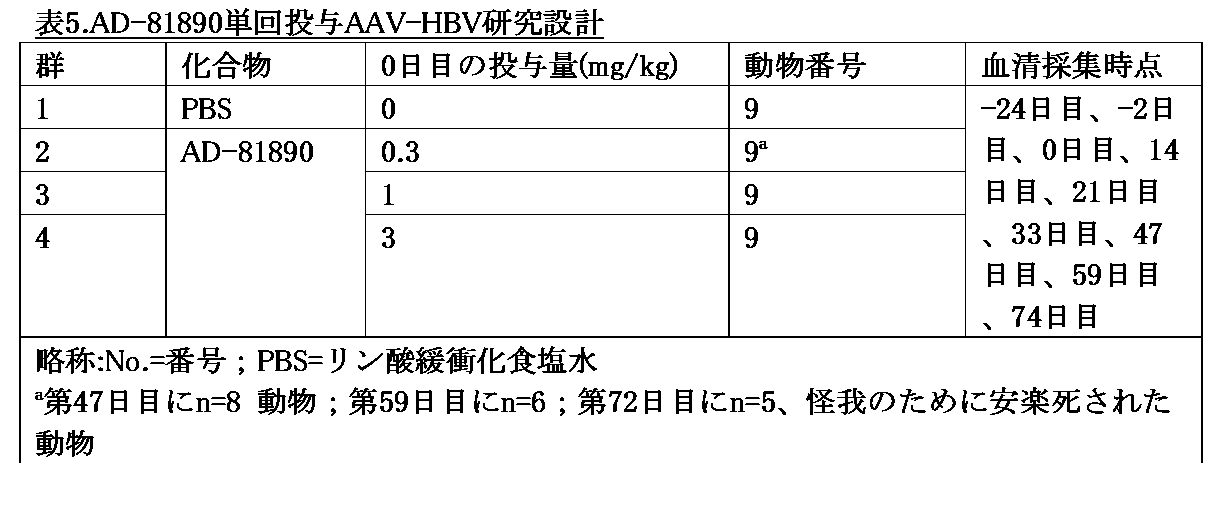
AD-81890 was diluted in sterile 1× PBS and administered in variable volumes of 10 μl/g. Animals were administered a single SC dose of AD-81890 at 0.3 mg/kg, 1 mg/kg, or 3 mg/kg as described in Table 5, and bled via the retro-orbital sinus (ROS) on days −24, −2, 0, 14, 21, 33, 47, 59, and 74 post-dose.
採血した後、血液を30分間凝固させ、次に、微量遠心機で13,000rpm、4℃で10分間回転させた。血清を吸引し、-20℃で貯蔵した。 After collection, blood was allowed to clot for 30 minutes and then spun in a microcentrifuge at 13,000 rpm for 10 minutes at 4°C. Serum was aspirated and stored at -20°C.
ELISA(BioTang, Waltham, MA)を介してB型肝炎ウイルス表面抗原タンパク質レベルを評価した。US Biologics(Memphis, TN)HBsAgタンパク質を用いて標準的な曲線を作成した。血清試料を1×PBS(Gibco, Gaithersburg, MD)で1:2000または1:500に希釈し、わずかな変更を加えたELISAプロトコールを用いて評価した。簡単に説明すると、50μL/ウェルの希釈した血清または標準物質をプレートに充填し、37℃で1時間インキュベートした。このインキュベーション後、50μL/ウェルの酵素コンジュゲートを各ウェルに添加し、そのプレートを37℃で30分間インキュベートした。このプレートを300μL/ウェルの1×洗浄緩衝液で3回洗浄し、次に、全ての液体がウェルから除去されるまでブロットし、100μL/ウェルの基質を添加し、プレートを37℃で30分間インキュベートした。最後に、さらなる100μL/ウェルの停止液を添加し、450nmの波長で吸光度を測定した。計算されたHBsAgレベルがアッセイの定量下限(LLOQ)を下回った場合は、値をLLOQ(すなわち、313ng/mL)として記録した。 Hepatitis B virus surface antigen protein levels were assessed via ELISA (BioTang, Waltham, MA). A standard curve was generated using US Biologics (Memphis, TN) HBsAg protein. Serum samples were diluted 1:2000 or 1:500 in 1x PBS (Gibco, Gaithersburg, MD) and assessed using the ELISA protocol with minor modifications. Briefly, 50 μL/well of diluted serum or standard was loaded into the plate and incubated for 1 h at 37°C. After this incubation, 50 μL/well of enzyme conjugate was added to each well and the plate was incubated for 30 min at 37°C. The plate was washed three times with 300 μL/well of 1x wash buffer, then blotted until all liquid was removed from the wells, 100 μL/well of substrate was added, and the plate was incubated for 30 min at 37°C. Finally, an additional 100 μL/well of stop solution was added and absorbance was measured at a wavelength of 450 nm. If the calculated HBsAg level was below the lower limit of quantification (LLOQ) of the assay, the value was recorded as the LLOQ (i.e., 313 ng/mL).
HBV-AAVマウスにおけるAD-81890の単回皮下(SC)投与後の平均±SD血清HBsAg濃度は図2Aに示す。HBV-AAVマウスのベースラインに対する平均±SD血清HBsAgレベルは図2Bに示す。AD-81890の0.3mg/kg、1mg/kgまたは3mg/kgでの単回SC注射により、HBV-AAVマウスの血清HBsAg濃度を強力かつ持続的に低減させ、最高(3mg/kg)のAD-81890投与群では7日目に92%の最大低減が観察された。最大の低減レベルは最高用量群で33日目まで維持され、その後HBsAg濃度はベースラインに戻り始めた(図2B)。血清中HBsAg濃度の中間的な低減は0.3mg/kgおよび1mg/kgでのAD081890投与群で観察され、7日目にはそれぞれ最大で23%および72%低減した。0.3mg/kgおよび1mg/kgの両方でのAD-81890投与群のHBsAgレベルは、研究終了(74日目)までにベースラインレベルに戻った。 The mean ± SD serum HBsAg concentrations in HBV-AAV mice after a single subcutaneous (SC) dose of AD-81890 are shown in Figure 2A. The mean ± SD serum HBsAg levels relative to baseline in HBV-AAV mice are shown in Figure 2B. A single SC injection of AD-81890 at 0.3 mg/kg, 1 mg/kg, or 3 mg/kg potently and sustainably reduced serum HBsAg concentrations in HBV-AAV mice, with a maximal reduction of 92% observed at day 7 in the highest (3 mg/kg) AD-81890 dose group. The maximal reduction level was maintained until day 33 in the highest dose group, after which HBsAg concentrations began to return to baseline (Figure 2B). Intermediate reductions in serum HBsAg concentrations were observed in the 0.3 mg/kg and 1 mg/kg AD081890 dose groups, with a maximal reduction of 23% and 72%, respectively, at day 7. HBsAg levels in both the 0.3 mg/kg and 1 mg/kg AD-81890 groups returned to baseline levels by the end of the study (day 74).
実施例6
多回皮下注射後のアデノ関連性HBVマウスモデルにおけるAD-81890の薬理学的評価
AD-81890の薬理はアデノ関連性HBV(HBV-AAV)マウスモデルでアッセイした。AAV8-HBV(SignaGen Laboratories)を1×PBSで希釈し、最終濃度が2×10¹²GC/mLになるようにした。6~8週齢の雄性C57BL/6マウスに、2×1011GC/マウスを、100μLの固定容積で側尾静脈を介して静脈内注射した。
Example 6
Pharmacological evaluation of AD-81890 in an adeno-associated HBV mouse model after multiple subcutaneous injections
The pharmacology of AD-81890 was assayed in an adeno-associated HBV (HBV-AAV) mouse model. AAV8-HBV (SignaGen Laboratories) was diluted in 1x PBS to a final concentration of 2x10¹² GC/mL. Male C57BL/6 mice aged 6-8 weeks were injected intravenously via the lateral tail vein with 2x10¹¹ GC/mouse in a fixed volume of 100 μL.
AD-66810およびAD-81890それぞれを無菌1XDPBSで希釈し、10ul/gの可変容積で投与した。動物に、AD-66810を、1mg/kgで特定のQ2Wx6によって投与するか、または、AD-81890を、9mg/kgでの単回投与または1mg/kgもしくは3mg/kgでの多回投与で特定のQ2Wx6またはQMx3によって投与した。表6に記載されるように、複数の時点で動物から血清を採取した。表6に記載されるように、血液は後眼窩洞から採取した。

AD-66810 and AD-81890 were each diluted in sterile 1XDPBS and administered at a variable volume of 10ul/g. Animals were administered AD-66810 at 1mg/kg by specific Q2Wx6 or AD-81890 at a single dose of 9mg/kg or multiple doses of 1mg/kg or 3mg/kg by specific Q2Wx6 or QMx3. Serum was collected from animals at multiple time points as described in Table 6. Blood was collected from the retro-orbital sinus as described in Table 6.
前の実施例で記載されているように、血液試料を処理し、ELISAアッセイを行った。結果は下記の表7に示す。標準偏差を含めた結果は図3に示す。

AD-81890投与後のAAV8-HBVマウスモデルで用量反応性血清HBsAgレベルが観察された。AD-81890の9mg/kgでの単回投与または3mg/kgでのq2w×6投与後、最大約2.7log10のHBsAg低減が観察された。3mg/kgでq2w×6投与した動物は、2log10超のHBsAg低減が合計で約8週間持続した。 Dose-responsive serum HBsAg levels were observed in the AAV8-HBV mouse model following AD-81890 administration. Following a single dose of AD-81890 at 9 mg/kg or 3 mg/kg q2w x 6, a maximum HBsAg reduction of approximately 2.7 log10 was observed. Animals dosed at 3 mg/kg q2w x 6 maintained a >2 log10 HBsAg reduction for a total of approximately 8 weeks.
これらのインビボ試験により、AD-81890がHBV-AAVマウスモデルにおける血清中HBsAgの低減に有効であることを証明した。 These in vivo studies demonstrated that AD-81890 was effective in reducing serum HBsAg in an HBV-AAV mouse model.
実施例7
AD-81890の特定のオフターゲット分析
AD-81890のアンチセンス鎖の潜在的なオフターゲット活性の評価に、インシリコバイオインフォマティクス法とインビトロ法の組み合わせを使用した。
Example 7
Specific off-target analysis of AD-81890
A combination of in silico bioinformatics and in vitro methods were used to assess potential off-target activity of the antisense strand of AD-81890.
バイオインフォマティクス
カスタムRおよびPythonスクリプトを用いて、B型肝炎ウイルス(HBV)サブタイプayw(GenBank ヌクレオチド ID U95551;NCBI遺伝子ID:7276;配列番号:49)の「X」遺伝子を標的化する一連のdsRNA物質を設計した。環状のU95551HBVゲノムは3182塩基の長さを有し、「X」遺伝子のCDS領域はNCBI記録中の1376~1840位にコードする。dsRNA物質の設計およびスクリーニング方法の詳細は、上記およびWO2016/077321に記載されている。
Bioinformatics Custom R and Python scripts were used to design a series of dsRNA agents targeting the "X" gene of Hepatitis B Virus (HBV) subtype ayw (GenBank nucleotide ID U95551; NCBI Gene ID: 7276; SEQ ID NO: 49). The circular U95551 HBV genome has a length of 3182 bases and the CDS region of the "X" gene encodes at positions 1376-1840 in the NCBI record. Details of the design and screening methods for dsRNA agents are described above and in WO2016/077321.
HepG2.2.15 細胞におけるオフターゲット検出のためのGalNAc-コンジュゲートdsRNA物質のトランスフェクションスクリーン
オフターゲット阻害を測定するために、qPCRによる内因性発現転写物の応答を、肝細胞の細胞株HepG2.2.15で試験した。Lipofectamine RNAiMax(ThermoFisher)を用いて、細胞を、50nMから5fMまでの濃度範囲のAD-81890で96ウェルプレート(ウェルあたり2×10⁴細胞)にトランスフェクトした。24時間後、MagMAXTM-96全RNA単離キット(ThermoFisher)を用いて細胞からRNAを抽出し、ABI高容量cDNA逆トランスフェクションキット(ThermoFisher)を用いてcDNAを合成した。試料を、HBV mRNAの阻害および潜在的なオフターゲットサイレンシングについてアッセイした。qPCRによる定量化のために、HBVウイルス転写物の異なる領域を認識する2つの異なるカスタムTaqManアッセイであるPORF-1およびSORF-2を用いてHBV発現を評価した。
Transfection screen of GalNAc-conjugated dsRNA material for off-target detection in HepG2.2.15 cells To measure off-target inhibition, the response of endogenously expressed transcripts by qPCR was tested in the hepatocyte cell line HepG2.2.15. Cells were transfected in 96-well plates (2 x 10⁴ cells per well) with AD-81890 at concentrations ranging from 50 nM to 5 fM using Lipofectamine RNAiMax (ThermoFisher). After 24 hours, RNA was extracted from cells using MagMAX ™ -96 Total RNA Isolation Kit (ThermoFisher) and cDNA was synthesized using ABI High Capacity cDNA Reverse Transfection Kit (ThermoFisher). Samples were assayed for inhibition of HBV mRNA and potential off-target silencing. For quantification by qPCR, HBV expression was assessed using two different custom TaqMan assays, PORF-1 and SORF-2, which recognize different regions of the HBV viral transcript.
オフターゲットサイレンシングを評価するために、各潜在的なオフターゲットに特異的なTaqManプローブ(表8)を定量化に使用した。qPCRは、LightCycler 480実時間PCRマシン(Roche)を用いて行った。

To assess off-target silencing, TaqMan probes specific for each potential off-target (Table 8) were used for quantification. qPCR was performed using a LightCycler 480 real-time PCR machine (Roche).
オンターゲット(HBV)および潜在的なオフターゲット遺伝子阻害の程度を決定するために、同じ試料からのヒトGAPDH RNA発現に対する正規化によって相対的なRNAレベルを決定した。結果を、トランスフェクトした非特異的dsRNA物質の対照群と比較し、誤差は標準偏差として表した。AD-81890のIC50は、PORF1転写産物標的に対して0.803nM、SORF2転写産物標的に対して0.766nMであった。AD-81890の最高濃度であっても、SIDT2およびZBTB2転写物に対して有意な標的ノックダウンは観察されなかった。 To determine the degree of on-target (HBV) and potential off-target gene inhibition, relative RNA levels were determined by normalization to human GAPDH RNA expression from the same samples. Results were compared to a control group of transfected nonspecific dsRNA material, and errors are expressed as standard deviations. The IC50 of AD-81890 was 0.803 nM for the PORF1 transcript target and 0.766 nM for the SORF2 transcript target. No significant target knockdown was observed for SIDT2 and ZBTB2 transcripts, even at the highest concentration of AD-81890.
AD-81890によるオフターゲット阻害の程度は、HepG2.2.15における内因性発現転写物からの2つの潜在的なオフターゲットの用量反応スクリーンで評価した。AD-81890は、試験したどの用量でもSIDT2またはZBTB2の発現を阻害しなかったが、HBV阻害は用量に反応した。4パラメーターフィットモデル(XLfit)を用いて用量反応データを適合させると、PORF-1またはSORF-2に対するIC50はそれぞれ803pMおよび766pMであった。 The extent of off-target inhibition by AD-81890 was assessed in a dose-response screen of two potential off-targets from endogenously expressed transcripts in HepG2.2.15. AD-81890 did not inhibit expression of SIDT2 or ZBTB2 at any dose tested, but HBV inhibition was dose responsive. Fitting the dose-response data using a four-parameter fit model (XLfit) yielded IC50s of 803 pM and 766 pM for PORF-1 or SORF-2, respectively.
実施例8
HEPG2.2.15細胞におけるRNA-SEQを用いたAD-81890特異性のインビトロ分析
RNA-Seqを用いた発現レベルにおけるトランスクリプトームワイド(transcriptome-wide)な変化を用いて、HBV発現HepG2.2.15細胞株におけるAD-66810とAD-81890の比較によるdsRNA物質の化学修飾の影響を測定した。AD-66810とAD-81890分子は、同じヌクレオチド配列を有するが、アンチセンス鎖(表2を参照)の分子の5'末端から6位に単一のグリコール核酸(GNA)の置換によって異なる。
Example 8
In vitro analysis of AD-81890 specificity using RNA-SEQ in HEPG2.2.15 cells
We used transcriptome-wide changes in expression levels using RNA-Seq to measure the impact of chemical modifications of dsRNA materials comparing AD-66810 and AD-81890 in the HBV-expressing HepG2.2.15 cell line. The AD-66810 and AD-81890 molecules have the same nucleotide sequence but differ by the substitution of a single glycol nucleic acid (GNA) at position 6 from the 5' end of the molecule in the antisense strand (see Table 2).
全ゲノムHBVで安定的にトランスフェクトしたHepG2由来細胞株であるHepG2.2.15細胞を培地で187,500細胞/mLの最終濃度に希釈し、80μLを96ウェルコラーゲンコーティングプレート(BD Biocoat, Cat#356407)にピペットして15,000細胞/ウェルの最終濃度を与えた。 HepG2.2.15 cells, a HepG2-derived cell line stably transfected with whole genome HBV, were diluted in culture medium to a final concentration of 187,500 cells/mL and 80 μL was pipetted into 96-well collagen-coated plates (BD Biocoat, Cat#356407) to give a final concentration of 15,000 cells/well.
dsRNA物質の株を1XDPBSで1,000nMまたは100nMの濃度に希釈した。RNAiMAX(ThermoFisher, Cat#13778150)をOpti-MEM(ThermoFisher Cat#31985062)で0.3μLRNAiMAX/10μLOpti-MEMの濃度に希釈し、室温で5分間インキュベートした。インキュベーション後、10μL/ウェルを、10μL/ウェルの適切なdsRNA物質希釈液とともに、96ウェルコラーゲンコーティングプレート(BD Biocoat, Cat#356407)の各ウェルに加え、穏やかに混合し、室温で20分間インキュベートした。調製した細胞懸濁液を各ウェルに80μL添加し、最終的な細胞密度が15,000細胞/ウェルとなり、最終的なdsRNA物質濃度が100nMおよび10nMとなるようにした。細胞を、5%のCO2を含む37℃のインキュベーターで16~22時間インキュベートした。各実験条件が16ウェルを有するように細胞をプレートし、実験を2回行った。 dsRNA material stocks were diluted in 1XDPBS to a concentration of 1,000nM or 100nM. RNAiMAX (ThermoFisher, Cat#13778150) was diluted in Opti-MEM (ThermoFisher Cat#31985062) to a concentration of 0.3μL RNAiMAX/10μL Opti-MEM and incubated at room temperature for 5 minutes. After incubation, 10μL/well was added to each well of a 96-well collagen-coated plate (BD Biocoat, Cat#356407) along with 10μL/well of the appropriate dsRNA material dilution, mixed gently, and incubated at room temperature for 20 minutes. 80μL of the prepared cell suspension was added to each well to achieve a final cell density of 15,000 cells/well and final dsRNA material concentrations of 100nM and 10nM. The cells were incubated for 16-22 hours in a 37°C incubator containing 5% CO2 . Cells were plated so that each experimental condition had 16 wells and experiments were performed in duplicate.
プロトコールに従って、ThermoFisher RNAqueous-96全RNA単離キットを用いてRNAを単離した。簡単に説明すると、16~22時間後に各ウェルから上清を吸引し、100μL/ウェルの1×DPBSを添加して残りの培地を洗い流し、次いで吸引した。各プレートの1列目および5列目の各ウェルに200μL溶解/結合溶液を添加し、上下に数回ピペットし、4ウェル/条件がプールされるように後続の列に移し、RNAが十分に回収されることを確保した。これにより、条件ごとに4つの複製を得た。溶解物を含有する培養プレート各ウェルに100μLの100%エタノールを添加し、数回混合し、フィルタープレートのウェルに移した。一連の遠心分離工程(1,900×g、1分)によって、試料を、提供される洗浄液で洗浄し、DNase試薬で処理し、100μLのヌクレアーゼ無しの水に溶出させた。RNA濃度は、NanoDrop 8000分光光度計(ThermoFisher)で測定した。 RNA was isolated using ThermoFisher RNAqueous-96 total RNA isolation kit according to the protocol. Briefly, after 16-22 hours, the supernatant was aspirated from each well, and 100 μL/well of 1xDPBS was added to wash off the remaining medium, then aspirated. 200 μL lysis/binding solution was added to each well in columns 1 and 5 of each plate, pipetted up and down several times, and transferred to subsequent columns such that 4 wells/condition were pooled, ensuring sufficient RNA recovery. This resulted in 4 replicates per condition. 100 μL of 100% ethanol was added to each well of the culture plate containing the lysate, mixed several times, and transferred to the wells of the filter plate. Samples were washed with the provided wash solution, treated with DNase reagent, and eluted in 100 μL of nuclease-free water by a series of centrifugation steps (1,900 × g, 1 min). RNA concentration was measured using a NanoDrop 8000 spectrophotometer (ThermoFisher).
RNAをさらにTURBO DNase(Ambion)で処理した。各RNA試料(≦10μgのRNA/試料)を2μLのDNase、10μLの10X緩衝液およびヌクレアーゼ無しの水と混合して全容積を100μLにし、37℃で30分間インキュベートした。プロトコール通りに、DNase処理後、RNAをさらに
RNeasy MinElute Cleanup Kit(Qiagen)を用いて精製した。RNAを30μLのヌクレアーゼ無しの水に溶出させ、NanoDrop 8000分光光度計でRNA濃度を測定した。RNAを-80℃で貯蔵した。続いて、このRNAを、TruSeq標準的な全RNAライブラリー調製キット(Illumina)を用いたcDNAライブラリー調製に使用し、NextSeq500デスクトップシーケンサー(Illumina)でシーケンス作成し、すべて製造者の使用説明書に従って行った。実験的繰り返しを2回行った。
The RNA was further treated with TURBO DNase (Ambion). Each RNA sample (≦10 μg RNA/sample) was mixed with 2 μL DNase, 10 μL 10X buffer, and nuclease-free water to a total volume of 100 μL and incubated at 37° C. for 30 min. Following DNase treatment, the RNA was further treated with TURBO DNase (Ambion).
Purification was performed using the RNeasy MinElute Cleanup Kit (Qiagen). RNA was eluted in 30 μL of nuclease-free water and RNA concentration was measured with a NanoDrop 8000 spectrophotometer. RNA was stored at -80°C. This RNA was subsequently used for cDNA library preparation using the TruSeq standard total RNA library preparation kit (Illumina) and sequenced on a NextSeq500 desktop sequencer (Illumina), all according to the manufacturer's instructions. Two experimental replicates were performed.
HepG2.2.15細胞を、10nMまたは100nMのAD-66810またはAD-81890を用いて4倍でトランスフェクトし、未処理の対照群と一緒に24時間培養した。Purelink RNAキット(ThermoFisher)で抽出したRNAを、rRNA除去のためのRibo-Zeroヒト/マウス/ラットを備えたTruSeq標準的な全RNAライブラリー調製キット(Illumina)を用いたcDNAライブラリー調製に使用し、NextSeq500デスクトップシーケンサー(Illumina)でシーケンス作成し、すべて製造者の使用説明書に従って行った。総40個の試料を、NextSeq 500/550高出力v2 (75サイクル)フローセル(Illumina)ごとにプールした。実験的繰り返しを2回行った。 HepG2.2.15 cells were transfected in quadruplicate with 10 nM or 100 nM AD-66810 or AD-81890 and cultured for 24 h alongside untreated controls. RNA extracted with Purelink RNA kit (ThermoFisher) was used for cDNA library preparation using TruSeq standard total RNA library preparation kit (Illumina) with Ribo-Zero human/mouse/rat for rRNA removal and sequenced on a NextSeq500 desktop sequencer (Illumina), all according to the manufacturer's instructions. A total of 40 samples were pooled per NextSeq 500/550 high output v2 (75 cycles) flow cell (Illumina). Experimental replicates were performed in duplicate.
生のRNA-Seq読み取りデータを、fastq-mcfを用いて、最小平均品質スコア25、最小残存長36でフィルターした。選別した読み取りデータを、STAR(2.4.2a版)を用いてヒト(hg19/GRCh37)およびHBV(GenBankヌクレオチドID U95551;NCBI遺伝子ID:7276)ゲノムに同時に整列させた。HBVゲノムの環状構造により、HBV配列の直線化バージョンの末端に46塩基対が繰り返されて、読み取りをブレークポイントでマッピングさせる。featureCounts(バージョン1.5.0)によってエキソンにマッピングする特異的整列化読み取りをカウントした。全ての試料は>5Mのマッピングされた読み取りを有していた。差動的な遺伝子発現分析は、package DESeq2(バージョン1.16.1)を用いてR(バージョン3.4.1)で行った。調整されたp値を取得するための多重検定補正は、Benjamini & Hochberg, 1995の方法を用いてDESeq2によって行った。 Raw RNA-Seq reads were filtered using fastq-mcf with a minimum average quality score of 25 and a minimum residual length of 36. The selected reads were aligned simultaneously to the human (hg19/GRCh37) and HBV (GenBank nucleotide ID U95551; NCBI gene ID: 7276) genomes using STAR (version 2.4.2a). Due to the circular structure of the HBV genome, 46 base pairs are repeated at the ends of the linearized version of the HBV sequence, allowing reads to map at the breakpoints. Differentially aligned reads mapping to exons were counted by featureCounts (version 1.5.0). All samples had >5M mapped reads. Differential gene expression analysis was performed in R (version 3.4.1) using package DESeq2 (version 1.16.1). Multiple testing correction to obtain adjusted p-values was performed by DESeq2 using the method of Benjamini & Hochberg, 1995.
MAプロットは、オンターゲットHBVノックダウンとオフターゲット効果の両方の可視化に使用した。グローバルなオフターゲット効果を緩和するためのGNA化学の分析は、ダウンレギュレートされた遺伝子(log2倍率変化<0)に限定した。アップレギュレートされた遺伝子(log2倍率変化>0)は二次効果と見なされた。ほぼ最大のHBVノックダウンを達成したため、オフターゲット効果の評価を最低(10nM)用量に制限した。トランスクリプトームのノイズを比較するために、有意にダウンレギュレートされた(調整されたp値段<0.05)遺伝子をAD-66810および/またはAD-81890で同定した。ダウンレギュレーションの程度は、ウェルチの両側、2試料のt検定(表9)を用いて評価したAD-66810とAD-81890の間の統計的差異で、log2倍率変化(図4)のボックスプロットによって視覚化した。
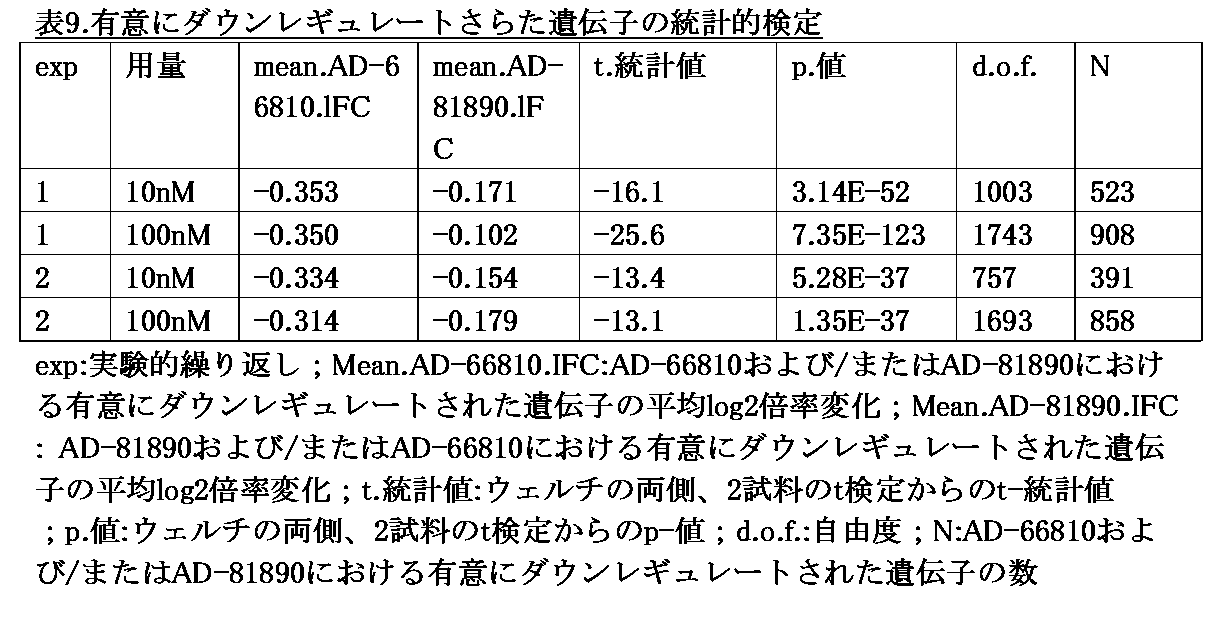
MA plots were used to visualize both on-target HBV knockdown and off-target effects. Analysis of GNA chemistry to mitigate global off-target effects was restricted to downregulated genes (log2 fold change < 0). Upregulated genes (log2 fold change > 0) were considered secondary effects. Evaluation of off-target effects was restricted to the lowest (10 nM) dose since near-maximal HBV knockdown was achieved. To compare transcriptomic noise, significantly downregulated (adjusted p-value < 0.05) genes were identified in AD-66810 and/or AD-81890. The degree of downregulation was visualized by box plots of log2 fold change (Figure 4), with statistical differences between AD-66810 and AD-81890 assessed using Welch's two-tailed, two-sample t-test (Table 9).
実験的繰り返しの両方(図4、表9)でAD-66810と比較したAD-81890でのオフターゲット効果の一貫した低減が観察された。10nMでは、AD-81890はAD-66810(表9)と比較して、有意にダウンレギュレートされた遺伝子の平均log2倍率変化が52%の低減(一回繰り返し)または54%の低減(二回繰り返し)を示した。100nMでは、AD-81890はAD-66810(表9)と比較して、平均log2倍率変化が71%の低減(一回繰り返し)または43%の低減(二回繰り返し)を示した。すべての場合において、log2倍率変化で観察された低減は統計的に有意であった。したがって、AD-81890は実質的により低いレベルのトランスクリプトームのノイズを有した。 A consistent reduction in off-target effects was observed with AD-81890 compared to AD-66810 in both experimental replicates (Figure 4, Table 9). At 10 nM, AD-81890 showed a 52% reduction (single replicate) or a 54% reduction (double replicate) in the mean log2 fold change of significantly downregulated genes compared to AD-66810 (Table 9). At 100 nM, AD-81890 showed a 71% reduction (single replicate) or a 43% reduction (double replicate) in the mean log2 fold change compared to AD-66810 (Table 9). In all cases, the observed reduction in log2 fold change was statistically significant. Thus, AD-81890 had a substantially lower level of transcriptomic noise.
実施例9
PXB-マウスにおけるヒト-特異的肝毒性の評価
PXB-マウスは、ヒト肝細胞によって高度に再配置させた、ヒト化肝臓を有するキメラマウス(PhoenixBio)である。該マウスは、ヒト肝細胞を移植したウロキナーゼ-タイププラスミノーゲンアクティベーター(uPA)/重症複合型免疫不全症(SCID)マウス(ヒト化肝臓uPA/SCIDマウス)(Mercer et al., Nat. Med. 7:927-933, 2001)である。報告されているヒト化肝臓uPA/SCIDマウスは、肝臓内のヒト肝細胞の割合である置換指数(RI)が70%超である。該マウスは、ヒト薬物代謝、薬物動態および肝毒性の予測ためのモデルとして使用し得る(Naritomi et al., Drug Metab Pharmacokinet. 33:31-39, 2018)。
Example 9
Evaluation of human-specific hepatotoxicity in PXB-mice
PXB-mouse is a chimeric mouse (PhoenixBio) with a humanized liver that is highly repopulated with human hepatocytes. The mouse is a urokinase-type plasminogen activator (uPA)/severe combined immunodeficiency (SCID) mouse transplanted with human hepatocytes (humanized liver uPA/SCID mouse) (Mercer et al., Nat. Med. 7:927-933, 2001). The reported humanized liver uPA/SCID mouse has a replacement index (RI), which is the percentage of human hepatocytes in the liver, of more than 70%. The mouse can be used as a model for predicting human drug metabolism, pharmacokinetics, and hepatotoxicity (Naritomi et al., Drug Metab Pharmacokinet. 33:31-39, 2018).
PBX-マウスで研究を行い、AD-66810とAD-81890の肝毒性を比較した。0日目、21日目、28日目、35日目および42日目に12mg/kg、36mg/kgまたは100mg/kgのAD-66810、AD-81890またはPBS(対照)を皮下注射(群あたりn=4)でマウスに投与した。一般状態観察と体重測定は、49日目まで週2回行った。血液は週に2回後眼窩の出血によって採取し、血清は通常の方法を用いて調製した。終末出血(terminal bleed)を行い、心穿刺と放血によって動物を犠牲にした。放血後に剖検を行った。肝臓を採取して秤量した。肝臓を分離して、パラフィン包埋の前にRNAlater溶液(Ambion)に貯蔵し、ホルマリンに貯蔵し、スナップ凍結させた。 A study was performed in PBX-mice to compare the hepatotoxicity of AD-66810 and AD-81890. Mice were administered 12 mg/kg, 36 mg/kg or 100 mg/kg of AD-66810, AD-81890 or PBS (control) by subcutaneous injection (n=4 per group) on days 0, 21, 28, 35 and 42. Clinical observations and body weights were performed twice weekly until day 49. Blood was collected twice weekly by retro-orbital bleeding and serum was prepared using routine methods. A terminal bleed was performed and animals were sacrificed by cardiac puncture and exsanguination. Necropsy was performed after exsanguination. Livers were harvested and weighed. Livers were isolated and stored in RNAlater solution (Ambion) before embedding in paraffin, storing in formalin and snap-frozen.
全ての動物は、研究期間中、初期レベルの80%超の体重を維持した。さらに、化合物-処置群における最低算術平均値は、対照PBS-処置群より高かった。 All animals maintained body weights greater than 80% of initial levels throughout the study period. Furthermore, the lowest arithmetic mean values in the compound-treated groups were higher than in the control PBS-treated group.
血中ヒト血清アルブミンレベルは、研究期間中ずっとモニターした。生き残しているすべての動物は、研究の生存期間中、7.0mg/mlを超える血中h-Alb濃度を維持した。 Blood human serum albumin levels were monitored throughout the study. All surviving animals maintained blood h-Alb concentrations above 7.0 mg/ml for the lifespan of the study.
肝酵素は、試験過程中ずっとモニターした。具体的には、研究期間中、ALT、AST、ALP、GGT、TBIL、TGをモニターした。AD-66810、AD-81890またはPBSを投与されたマウスについて、49日目に測定した酵素レベルを、以下の表10に示した。図5Aおよび5Bは、PBSの投与と比較した、AD-66810(図5A)またはAD-81890(図5B)の投与後の経時的なALTレベルを示している。

試験化合物処置群の両方において、ALT、AST、ALPおよびGGTは対照群と比較して増加を示した。さらに、AD-66810処置群のALT、ASTおよびGGTにおいて用量依存性変化が実証された。 In both test compound treatment groups, ALT, AST, ALP and GGT showed increases compared to the control group. Furthermore, dose-dependent changes were demonstrated in ALT, AST and GGT in the AD-66810 treatment group.
剖検では、いずれの群でも試験化合物に特異的な所見はなかった。対照群と比較した場合、化合物処置群の動物の相対的な(肝臓/体重)肝臓重量に明らかな変化はなかった。 Necropsy revealed no test compound specific findings in any group. There were no obvious changes in relative (liver/body weight) liver weights in compound-treated animals when compared to the control group.
当量
当業者であれば、本明細書に記載されている特定の実施態様および方法と同等のものが多数存在することを認識するか、または日常的な実験のみでそれを確認することができるであろう。そのような同等のものは、以下の請求項の範囲によって包含されることが意図されている。
Equivalents Those skilled in the art will recognize, or be able to ascertain using no more than routine experimentation, many equivalents to the specific embodiments and methods described herein. Such equivalents are intended to be encompassed by the scope of the following claims.
特定の実施態様が例示および説明されてきたが、上記の様々な実施多様を組み合わせてさらなる実施態様を提供することができ、本発明の精神および範囲から逸脱することなく様々な変更を行うことができることは容易に理解されるだろう。 Although specific embodiments have been illustrated and described, it will be readily understood that the various implementations described above may be combined to provide further embodiments, and that various modifications may be made without departing from the spirit and scope of the invention.
2018年8月13日に出願された米国仮特許出願第62/718,314号を含む、本明細書で言及された、または出願データシートに記載された図、米国特許、米国特許出願公開公報、米国特許出願、外国特許、外国特許出願、および非特許公開公報のすべては、特に断らない限り、その全体が参照により本明細書に援用される。さまざまな特許、出願、および刊行物の概念を採用してさらなる実施態様を提供する必要がある場合、実施態様の側面を修正することができる。 All figures, U.S. patents, U.S. patent application publications, U.S. patent applications, foreign patents, foreign patent applications, and non-patent publications referred to herein or set forth in the Application Data Sheet, including U.S. Provisional Patent Application No. 62/718,314, filed August 13, 2018, are incorporated herein by reference in their entirety unless otherwise noted. Aspects of the embodiments may be modified where necessary to employ concepts from the various patents, applications, and publications to provide further embodiments.
上述の詳細な説明に照らして、実施例に対して、これらおよび他の変更を行うことができる。一般に、以下の特許請求の範囲において、使用される用語は、特許請求の範囲を明細書および特許請求の範囲に開示された特定の実施態様に限定するものと解釈されるべきではなく、そのような特許請求の範囲が権利を有する等価物のすべての範囲とともに、すべての可能な実施態様を含むように解釈されるべきである。したがって、特許請求の範囲は本明細書によって限定されない。 These and other changes can be made to the examples in light of the above detailed description. In general, in the following claims, the terms used should not be construed to limit the claims to the specific embodiments disclosed in the specification and the claims, but should be construed to include all possible embodiments, along with the full scope of equivalents to which such claims are entitled. Accordingly, the claims are not limited by this specification.
Claims (30)
配列中、a、c、gおよびuはそれぞれ、2'-O-メチルアデノシン-3'-ホスフェート、2'-O-メチルシチジン-3'-ホスフェート、2'-O-メチルグアノシン-3'-ホスフェートおよび2'-O-メチルウリジン-3'-ホスフェートであり;
Af、Cf、GfおよびUfはそれぞれ、2'-フルオロアデノシン-3'-ホスフェート、2'-フルオロシチジン-3'-ホスフェート、2'-フルオログアノシン-3'-ホスフェートおよび2'-フルオロウリジン-3'-ホスフェートであり;
(Agn)は、アデノシン-グリコール核酸(GNA)であり;
sは、ホスホロチオエート連結であり;
リガンドが、センス鎖の3'末端にコンジュゲートされており、前記リガンドは、

dsRNA物質が、細胞内でのB型肝炎ウイルス(HBV)の発現を阻害する、dsRNA物質。 A double-stranded ribonucleic acid (dsRNA) material comprising a sense strand and an antisense strand forming a double-stranded region, the sense strand comprising 5'-gsusguGfcAfCfUfucgcuucac a- 3' (SEQ ID NO: 29 ) and the antisense strand comprising 5'-usGfsuga(Agn)gCfGfaaguGfcAfcacsusu-3' (SEQ ID NO: 16);
In the sequence, a, c, g and u are 2'-O-methyl adenosine-3'-phosphate, 2'-O-methyl cytidine-3'-phosphate, 2'-O-methyl guanosine-3'-phosphate and 2'-O-methyl uridine-3'-phosphate, respectively;
Af, Cf, Gf and Uf are 2'-fluoroadenosine-3'-phosphate, 2'-fluorocytidine-3'-phosphate, 2'-fluoroguanosine-3'-phosphate and 2'-fluorouridine-3'-phosphate, respectively;
(Agn) is adenosine-glycol nucleic acid (GNA);
s is a phosphorothioate linkage;
A ligand is conjugated to the 3' end of the sense strand, said ligand comprising:
A dsRNA agent, wherein the dsRNA agent inhibits expression of Hepatitis B virus (HBV) in a cell .

で示されるとおり、リガンドにコンジュゲートされている、請求項1~3のいずれか一項に記載のdsRNA物質。 5. The dsRNA agent of the formula:
4. The dsRNA agent of any one of claims 1 to 3, conjugated to a ligand as shown in
配列中、a、c、gおよびuはそれぞれ、2'-O-メチルアデノシン-3'-ホスフェート、2'-O-メチルシチジン-3'-ホスフェート、2'-O-メチルグアノシン-3'-ホスフェートおよび2'-O-メチルウリジン-3'-ホスフェートであり;
Af、Cf、GfおよびUfはそれぞれ、2'-フルオロアデノシン-3'-ホスフェート、2'-フルオロシチジン-3'-ホスフェート、2'-フルオログアノシン-3'-ホスフェートおよび2'-フルオロウリジン-3'-ホスフェートであり;
(Agn)は、アデノシン-グリコール核酸(GNA)であり;
sは、ホスホロチオエート連結であり;そして
L96は、

dsRNA物質。 A double-stranded ribonucleic acid (dsRNA) material comprising a sense strand and an antisense strand forming a double-stranded region, the sense strand consisting of 5'-gsusguGfcAfCfUfucgcuucacaL96-3' (SEQ ID NO: 10) and the antisense strand consisting of 5'-usGfsuga(Agn)gCfGfaaguGfcAfcacsusu-3' (SEQ ID NO: 16);
In the sequence, a, c, g and u are 2'-O-methyl adenosine-3'-phosphate, 2'-O-methyl cytidine-3'-phosphate, 2'-O-methyl guanosine-3'-phosphate and 2'-O-methyl uridine-3'-phosphate, respectively;
Af, Cf, Gf and Uf are 2'-fluoroadenosine-3'-phosphate, 2'-fluorocytidine-3'-phosphate, 2'-fluoroguanosine-3'-phosphate and 2'-fluorouridine-3'-phosphate, respectively;
(Agn) is adenosine-glycol nucleic acid (GNA);
s is a phosphorothioate linkage; and
The L96 is
dsRNA material.
配列中、a、c、gおよびuはそれぞれ、2'-O-メチルアデノシン-3'-ホスフェート、2'-O-メチルシチジン-3'-ホスフェート、2'-O-メチルグアノシン-3'-ホスフェートおよび2'-O-メチルウリジン-3'-ホスフェートであり;
Af、Cf、GfおよびUfはそれぞれ、2'-フルオロアデノシン-3'-ホスフェート、2'-フルオロシチジン-3'-ホスフェート、2'-フルオログアノシン-3'-ホスフェートおよび2'-フルオロウリジン-3'-ホスフェートであり;
(Agn)は、アデノシン-グリコール核酸(GNA)であり;
sは、ホスホロチオエート連結であり;そして
L96は、

L96が、式:

で示されるとおり、センス鎖の3'末端にコンジュゲートされており、
dsRNA物質が、細胞内でのB型肝炎ウイルス(HBV)の発現を阻害する、dsRNA物質。 A double-stranded ribonucleic acid (dsRNA) material comprising a sense strand and an antisense strand forming a double-stranded region, the sense strand comprising 5'-gsusguGfcAfCfUfucgcuucacaL96-3' (SEQ ID NO: 10) and the antisense strand comprising 5'-usGfsuga(Agn)gCfGfaaguGfcAfcacsusu-3' (SEQ ID NO: 16);
In the sequence, a, c, g and u are 2'-O-methyl adenosine-3'-phosphate, 2'-O-methyl cytidine-3'-phosphate, 2'-O-methyl guanosine-3'-phosphate and 2'-O-methyl uridine-3'-phosphate, respectively;
Af, Cf, Gf and Uf are 2'-fluoroadenosine-3'-phosphate, 2'-fluorocytidine-3'-phosphate, 2'-fluoroguanosine-3'-phosphate and 2'-fluorouridine-3'-phosphate, respectively;
(Agn) is adenosine-glycol nucleic acid (GNA);
s is a phosphorothioate linkage; and
The L96 is
L96 is a compound of the formula:
and is conjugated to the 3' end of the sense strand as shown in
A dsRNA agent, wherein the dsRNA agent inhibits expression of Hepatitis B virus (HBV) in a cell .
b)請求項10~25のいずれか一項に記載の使用のための使用説明書
を含むキット。 A kit comprising: a) a dsRNA agent according to any one of claims 1 to 6 or a pharmaceutical composition according to claim 8; and b) instructions for use according to any one of claims 10 to 25.
Priority Applications (1)
| Application Number | Priority Date | Filing Date | Title |
|---|---|---|---|
| JP2025008853A JP2025081319A (en) | 2018-08-13 | 2025-01-22 | Hepatitis B virus (HBV) dsRNA agent compositions and methods of use thereof |
Applications Claiming Priority (3)
| Application Number | Priority Date | Filing Date | Title |
|---|---|---|---|
| US201862718314P | 2018-08-13 | 2018-08-13 | |
| US62/718,314 | 2018-08-13 | ||
| PCT/US2019/046142 WO2020036862A1 (en) | 2018-08-13 | 2019-08-12 | HEPATITIS B VIRUS (HBV) dsRNA AGENT COMPOSITIONS AND METHODS OF USE THEREOF |
Related Child Applications (1)
| Application Number | Title | Priority Date | Filing Date |
|---|---|---|---|
| JP2025008853A Division JP2025081319A (en) | 2018-08-13 | 2025-01-22 | Hepatitis B virus (HBV) dsRNA agent compositions and methods of use thereof |
Publications (3)
| Publication Number | Publication Date |
|---|---|
| JP2021533767A JP2021533767A (en) | 2021-12-09 |
| JP2021533767A5 JP2021533767A5 (en) | 2022-08-19 |
| JP7625512B2 true JP7625512B2 (en) | 2025-02-03 |
Family
ID=67766385
Family Applications (2)
| Application Number | Title | Priority Date | Filing Date |
|---|---|---|---|
| JP2021507570A Active JP7625512B2 (en) | 2018-08-13 | 2019-08-12 | Hepatitis B virus (HBV) dsRNA agent compositions and methods of use thereof |
| JP2025008853A Pending JP2025081319A (en) | 2018-08-13 | 2025-01-22 | Hepatitis B virus (HBV) dsRNA agent compositions and methods of use thereof |
Family Applications After (1)
| Application Number | Title | Priority Date | Filing Date |
|---|---|---|---|
| JP2025008853A Pending JP2025081319A (en) | 2018-08-13 | 2025-01-22 | Hepatitis B virus (HBV) dsRNA agent compositions and methods of use thereof |
Country Status (20)
| Country | Link |
|---|---|
| US (2) | US11492623B2 (en) |
| EP (2) | EP3837366B1 (en) |
| JP (2) | JP7625512B2 (en) |
| KR (2) | KR20260020495A (en) |
| CN (2) | CN112673103B (en) |
| AR (1) | AR114551A1 (en) |
| AU (1) | AU2019321375B2 (en) |
| BR (1) | BR112021001613A2 (en) |
| CA (1) | CA3106701A1 (en) |
| DK (1) | DK3837366T3 (en) |
| EA (1) | EA202190528A1 (en) |
| FI (1) | FI3837366T3 (en) |
| IL (2) | IL280559B2 (en) |
| JO (1) | JOP20210007A1 (en) |
| MX (1) | MX2021001056A (en) |
| MY (1) | MY201997A (en) |
| PH (1) | PH12021550287A1 (en) |
| SG (1) | SG11202100715WA (en) |
| UA (1) | UA127745C2 (en) |
| WO (1) | WO2020036862A1 (en) |
Families Citing this family (18)
| Publication number | Priority date | Publication date | Assignee | Title |
|---|---|---|---|---|
| JP7625512B2 (en) | 2018-08-13 | 2025-02-03 | アルナイラム ファーマシューティカルズ, インコーポレイテッド | Hepatitis B virus (HBV) dsRNA agent compositions and methods of use thereof |
| WO2020097044A1 (en) | 2018-11-09 | 2020-05-14 | Alnylam Pharmaceuticals, Inc. | Modified double stranded oligonucleotides |
| RS67553B1 (en) * | 2018-12-20 | 2026-01-30 | Humabs Biomed Sa | Combination hbv therapy |
| PH12021552870A1 (en) * | 2019-05-13 | 2022-03-21 | Vir Biotechnology Inc | Compositions and methods for treating hepatitis b virus (hbv) infection |
| TWI879977B (en) | 2020-06-10 | 2025-04-11 | 大陸商正大天晴藥業集團股份有限公司 | CONJUGATES OF DOUBLE-STRANDED siRNA ANALOGS |
| JP7821128B2 (en) * | 2020-06-11 | 2026-02-26 | チア タイ ティエンチン ファーマシューティカル グループ カンパニー リミテッド | Double-stranded siRNA analog conjugates |
| PH12022553569A1 (en) * | 2020-06-24 | 2023-04-12 | Humabs Biomed Sa | Engineered hepatitis b virus neutralizing antibodies and uses thereof |
| US20240124879A1 (en) * | 2020-12-18 | 2024-04-18 | Olix Pharmaceuticals, Inc. | Rnai agent for inhibiting hbv expression and use thereof |
| WO2022241134A1 (en) | 2021-05-13 | 2022-11-17 | Gilead Sciences, Inc. | COMBINATION OF A TLR8 MODULATING COMPOUND AND ANTI-HBV siRNA THERAPEUTICS |
| CA3235672A1 (en) | 2021-11-29 | 2023-06-01 | Shanghai Argo Biopharmaceutical Co., Ltd. | Compositions and methods for inhibiting expression of hepatitis b virus (hbv) protein |
| CN115267193B (en) * | 2022-09-20 | 2022-12-27 | 北京大学 | Method, system and application for judging source of HBsAg in biological sample |
| AU2024280172A1 (en) * | 2023-06-01 | 2025-12-04 | Sunshine Lake Pharma Co., Ltd. | Novel double-stranded sirna, conjugate thereof, and use thereof |
| WO2025067544A1 (en) * | 2023-09-28 | 2025-04-03 | 北京凯因科技股份有限公司 | Sirna for inhibiting hepatitis b virus and use thereof |
| WO2025240246A1 (en) | 2024-05-13 | 2025-11-20 | Gilead Sciences, Inc. | Combination therapies with ribavirin |
| WO2025240243A1 (en) | 2024-05-13 | 2025-11-20 | Gilead Sciences, Inc. | Combination therapies with bulevirtide and an inhibitory nucleic acid targeting hepatitis b virus |
| CN119799705B (en) * | 2024-07-08 | 2025-12-12 | 杭州天龙药业有限公司 | siRNAs that target and regulate HBV gene expression and their applications |
| KR20260008676A (en) * | 2024-07-08 | 2026-01-16 | 항저우 티엔롱 파마슈티칼 컴퍼니 리미티드 | DOUBLE-STRANDED RNAi AGENTS FOR TARGETING AND REGULATING HBV GENE EXPRESSION AND A USE THEREOF |
| US12454693B1 (en) * | 2024-09-27 | 2025-10-28 | Dexcel Pharma Technologies Ltd. | Nucleic acids for inhibiting expression of transferrin receptor 2 |
Citations (2)
| Publication number | Priority date | Publication date | Assignee | Title |
|---|---|---|---|---|
| JP2017538679A (en) | 2014-11-10 | 2017-12-28 | アルナイラム ファーマシューティカルズ, インコーポレイテッドAlnylam Pharmaceuticals, Inc. | Hepatitis B virus (HBV) iRNA composition and method of use thereof |
| WO2018098328A1 (en) | 2016-11-23 | 2018-05-31 | Alnylam Pharmaceuticals, Inc. | Modified rna agents with reduced off-target effect |
Family Cites Families (315)
| Publication number | Priority date | Publication date | Assignee | Title |
|---|---|---|---|---|
| US3687808A (en) | 1969-08-14 | 1972-08-29 | Univ Leland Stanford Junior | Synthetic polynucleotides |
| US4469863A (en) | 1980-11-12 | 1984-09-04 | Ts O Paul O P | Nonionic nucleic acid alkyl and aryl phosphonates and processes for manufacture and use thereof |
| US5023243A (en) | 1981-10-23 | 1991-06-11 | Molecular Biosystems, Inc. | Oligonucleotide therapeutic agent and method of making same |
| US4476301A (en) | 1982-04-29 | 1984-10-09 | Centre National De La Recherche Scientifique | Oligonucleotides, a process for preparing the same and their application as mediators of the action of interferon |
| JPS5927900A (en) | 1982-08-09 | 1984-02-14 | Wakunaga Seiyaku Kk | Oligonucleotide derivative and its preparation |
| FR2540122B1 (en) | 1983-01-27 | 1985-11-29 | Centre Nat Rech Scient | NOVEL COMPOUNDS COMPRISING A SEQUENCE OF OLIGONUCLEOTIDE LINKED TO AN INTERCALATION AGENT, THEIR SYNTHESIS PROCESS AND THEIR APPLICATION |
| US4605735A (en) | 1983-02-14 | 1986-08-12 | Wakunaga Seiyaku Kabushiki Kaisha | Oligonucleotide derivatives |
| US4948882A (en) | 1983-02-22 | 1990-08-14 | Syngene, Inc. | Single-stranded labelled oligonucleotides, reactive monomers and methods of synthesis |
| US4824941A (en) | 1983-03-10 | 1989-04-25 | Julian Gordon | Specific antibody to the native form of 2'5'-oligonucleotides, the method of preparation and the use as reagents in immunoassays or for binding 2'5'-oligonucleotides in biological systems |
| US4587044A (en) | 1983-09-01 | 1986-05-06 | The Johns Hopkins University | Linkage of proteins to nucleic acids |
| US5118800A (en) | 1983-12-20 | 1992-06-02 | California Institute Of Technology | Oligonucleotides possessing a primary amino group in the terminal nucleotide |
| US5118802A (en) | 1983-12-20 | 1992-06-02 | California Institute Of Technology | DNA-reporter conjugates linked via the 2' or 5'-primary amino group of the 5'-terminal nucleoside |
| US5550111A (en) | 1984-07-11 | 1996-08-27 | Temple University-Of The Commonwealth System Of Higher Education | Dual action 2',5'-oligoadenylate antiviral derivatives and uses thereof |
| FR2567892B1 (en) | 1984-07-19 | 1989-02-17 | Centre Nat Rech Scient | NOVEL OLIGONUCLEOTIDES, THEIR PREPARATION PROCESS AND THEIR APPLICATIONS AS MEDIATORS IN DEVELOPING THE EFFECTS OF INTERFERONS |
| US5430136A (en) | 1984-10-16 | 1995-07-04 | Chiron Corporation | Oligonucleotides having selectably cleavable and/or abasic sites |
| US5367066A (en) | 1984-10-16 | 1994-11-22 | Chiron Corporation | Oligonucleotides with selectably cleavable and/or abasic sites |
| US5258506A (en) | 1984-10-16 | 1993-11-02 | Chiron Corporation | Photolabile reagents for incorporation into oligonucleotide chains |
| US4828979A (en) | 1984-11-08 | 1989-05-09 | Life Technologies, Inc. | Nucleotide analogs for nucleic acid labeling and detection |
| FR2575751B1 (en) | 1985-01-08 | 1987-04-03 | Pasteur Institut | NOVEL ADENOSINE DERIVATIVE NUCLEOSIDES, THEIR PREPARATION AND THEIR BIOLOGICAL APPLICATIONS |
| US5166315A (en) | 1989-12-20 | 1992-11-24 | Anti-Gene Development Group | Sequence-specific binding polymers for duplex nucleic acids |
| US5235033A (en) | 1985-03-15 | 1993-08-10 | Anti-Gene Development Group | Alpha-morpholino ribonucleoside derivatives and polymers thereof |
| US5185444A (en) | 1985-03-15 | 1993-02-09 | Anti-Gene Deveopment Group | Uncharged morpolino-based polymers having phosphorous containing chiral intersubunit linkages |
| US5405938A (en) | 1989-12-20 | 1995-04-11 | Anti-Gene Development Group | Sequence-specific binding polymers for duplex nucleic acids |
| US5034506A (en) | 1985-03-15 | 1991-07-23 | Anti-Gene Development Group | Uncharged morpholino-based polymers having achiral intersubunit linkages |
| US4683202A (en) | 1985-03-28 | 1987-07-28 | Cetus Corporation | Process for amplifying nucleic acid sequences |
| US4762779A (en) | 1985-06-13 | 1988-08-09 | Amgen Inc. | Compositions and methods for functionalizing nucleic acids |
| US5130300A (en) | 1986-03-07 | 1992-07-14 | Monsanto Company | Method for enhancing growth of mammary parenchyma |
| US5317098A (en) | 1986-03-17 | 1994-05-31 | Hiroaki Shizuya | Non-radioisotope tagging of fragments |
| JPS638396A (en) | 1986-06-30 | 1988-01-14 | Wakunaga Pharmaceut Co Ltd | Poly-labeled oligonucleotide derivative |
| US5264423A (en) | 1987-03-25 | 1993-11-23 | The United States Of America As Represented By The Department Of Health And Human Services | Inhibitors for replication of retroviruses and for the expression of oncogene products |
| US5276019A (en) | 1987-03-25 | 1994-01-04 | The United States Of America As Represented By The Department Of Health And Human Services | Inhibitors for replication of retroviruses and for the expression of oncogene products |
| US4904582A (en) | 1987-06-11 | 1990-02-27 | Synthetic Genetics | Novel amphiphilic nucleic acid conjugates |
| EP0366685B1 (en) | 1987-06-24 | 1994-10-19 | Howard Florey Institute Of Experimental Physiology And Medicine | Nucleoside derivatives |
| US5585481A (en) | 1987-09-21 | 1996-12-17 | Gen-Probe Incorporated | Linking reagents for nucleotide probes |
| US5188897A (en) | 1987-10-22 | 1993-02-23 | Temple University Of The Commonwealth System Of Higher Education | Encapsulated 2',5'-phosphorothioate oligoadenylates |
| US4924624A (en) | 1987-10-22 | 1990-05-15 | Temple University-Of The Commonwealth System Of Higher Education | 2,',5'-phosphorothioate oligoadenylates and plant antiviral uses thereof |
| US5525465A (en) | 1987-10-28 | 1996-06-11 | Howard Florey Institute Of Experimental Physiology And Medicine | Oligonucleotide-polyamide conjugates and methods of production and applications of the same |
| DE3738460A1 (en) | 1987-11-12 | 1989-05-24 | Max Planck Gesellschaft | MODIFIED OLIGONUCLEOTIDS |
| FR2623508B1 (en) | 1987-11-20 | 1990-04-20 | Commissariat Energie Atomique | BASIC PROTEIN NAMED PHOSPHOLIPASE A2 ISOLATED FROM SNAP VENOM OF THE ELAPID FAMILY AND ITS AMINO ACID SEQUENCE, DERIVATIVES AND FRAGMENTS OF THE SAME, PROCESS FOR OBTAINING THERAPEUTIC COMPOSITIONS, AND DIAGNOSTIC AGENTS CONTAINING SAME AND / OR ITS FRAGMENTS |
| US5082830A (en) | 1988-02-26 | 1992-01-21 | Enzo Biochem, Inc. | End labeled nucleotide probe |
| JPH03503894A (en) | 1988-03-25 | 1991-08-29 | ユニバーシィティ オブ バージニア アランミ パテンツ ファウンデイション | Oligonucleotide N-alkylphosphoramidate |
| US5278302A (en) | 1988-05-26 | 1994-01-11 | University Patents, Inc. | Polynucleotide phosphorodithioates |
| US5109124A (en) | 1988-06-01 | 1992-04-28 | Biogen, Inc. | Nucleic acid probe linked to a label having a terminal cysteine |
| US5216141A (en) | 1988-06-06 | 1993-06-01 | Benner Steven A | Oligonucleotide analogs containing sulfur linkages |
| US5175273A (en) | 1988-07-01 | 1992-12-29 | Genentech, Inc. | Nucleic acid intercalating agents |
| US5262536A (en) | 1988-09-15 | 1993-11-16 | E. I. Du Pont De Nemours And Company | Reagents for the preparation of 5'-tagged oligonucleotides |
| US5512439A (en) | 1988-11-21 | 1996-04-30 | Dynal As | Oligonucleotide-linked magnetic particles and uses thereof |
| US5599923A (en) | 1989-03-06 | 1997-02-04 | Board Of Regents, University Of Tx | Texaphyrin metal complexes having improved functionalization |
| US5457183A (en) | 1989-03-06 | 1995-10-10 | Board Of Regents, The University Of Texas System | Hydroxylated texaphyrins |
| US5108921A (en) | 1989-04-03 | 1992-04-28 | Purdue Research Foundation | Method for enhanced transmembrane transport of exogenous molecules |
| US5391723A (en) | 1989-05-31 | 1995-02-21 | Neorx Corporation | Oligonucleotide conjugates |
| US4958013A (en) | 1989-06-06 | 1990-09-18 | Northwestern University | Cholesteryl modified oligonucleotides |
| US5143854A (en) | 1989-06-07 | 1992-09-01 | Affymax Technologies N.V. | Large scale photolithographic solid phase synthesis of polypeptides and receptor binding screening thereof |
| US5744101A (en) | 1989-06-07 | 1998-04-28 | Affymax Technologies N.V. | Photolabile nucleoside protecting groups |
| US5451463A (en) | 1989-08-28 | 1995-09-19 | Clontech Laboratories, Inc. | Non-nucleoside 1,3-diol reagents for labeling synthetic oligonucleotides |
| US5134066A (en) | 1989-08-29 | 1992-07-28 | Monsanto Company | Improved probes using nucleosides containing 3-dezauracil analogs |
| US5254469A (en) | 1989-09-12 | 1993-10-19 | Eastman Kodak Company | Oligonucleotide-enzyme conjugate that can be used as a probe in hybridization assays and polymerase chain reaction procedures |
| US5591722A (en) | 1989-09-15 | 1997-01-07 | Southern Research Institute | 2'-deoxy-4'-thioribonucleosides and their antiviral activity |
| US5399676A (en) | 1989-10-23 | 1995-03-21 | Gilead Sciences | Oligonucleotides with inverted polarity |
| US5264562A (en) | 1989-10-24 | 1993-11-23 | Gilead Sciences, Inc. | Oligonucleotide analogs with novel linkages |
| DE69034150T2 (en) | 1989-10-24 | 2005-08-25 | Isis Pharmaceuticals, Inc., Carlsbad | 2'-modified oligonucleotides |
| US5264564A (en) | 1989-10-24 | 1993-11-23 | Gilead Sciences | Oligonucleotide analogs with novel linkages |
| US5292873A (en) | 1989-11-29 | 1994-03-08 | The Research Foundation Of State University Of New York | Nucleic acids labeled with naphthoquinone probe |
| US5177198A (en) | 1989-11-30 | 1993-01-05 | University Of N.C. At Chapel Hill | Process for preparing oligoribonucleoside and oligodeoxyribonucleoside boranophosphates |
| CA2029273A1 (en) | 1989-12-04 | 1991-06-05 | Christine L. Brakel | Modified nucleotide compounds |
| US5486603A (en) | 1990-01-08 | 1996-01-23 | Gilead Sciences, Inc. | Oligonucleotide having enhanced binding affinity |
| US5629153A (en) | 1990-01-10 | 1997-05-13 | Chiron Corporation | Use of DNA-dependent RNA polymerase transcripts as reporter molecules for signal amplification in nucleic acid hybridization assays |
| US5646265A (en) | 1990-01-11 | 1997-07-08 | Isis Pharmceuticals, Inc. | Process for the preparation of 2'-O-alkyl purine phosphoramidites |
| US7037646B1 (en) | 1990-01-11 | 2006-05-02 | Isis Pharmaceuticals, Inc. | Amine-derivatized nucleosides and oligonucleosides |
| US5852188A (en) | 1990-01-11 | 1998-12-22 | Isis Pharmaceuticals, Inc. | Oligonucleotides having chiral phosphorus linkages |
| US5459255A (en) | 1990-01-11 | 1995-10-17 | Isis Pharmaceuticals, Inc. | N-2 substituted purines |
| US5587361A (en) | 1991-10-15 | 1996-12-24 | Isis Pharmaceuticals, Inc. | Oligonucleotides having phosphorothioate linkages of high chiral purity |
| US5578718A (en) | 1990-01-11 | 1996-11-26 | Isis Pharmaceuticals, Inc. | Thiol-derivatized nucleosides |
| US5587470A (en) | 1990-01-11 | 1996-12-24 | Isis Pharmaceuticals, Inc. | 3-deazapurines |
| US5681941A (en) | 1990-01-11 | 1997-10-28 | Isis Pharmaceuticals, Inc. | Substituted purines and oligonucleotide cross-linking |
| US6783931B1 (en) | 1990-01-11 | 2004-08-31 | Isis Pharmaceuticals, Inc. | Amine-derivatized nucleosides and oligonucleosides |
| US5670633A (en) | 1990-01-11 | 1997-09-23 | Isis Pharmaceuticals, Inc. | Sugar modified oligonucleotides that detect and modulate gene expression |
| US5214136A (en) | 1990-02-20 | 1993-05-25 | Gilead Sciences, Inc. | Anthraquinone-derivatives oligonucleotides |
| AU7579991A (en) | 1990-02-20 | 1991-09-18 | Gilead Sciences, Inc. | Pseudonucleosides and pseudonucleotides and their polymers |
| US5321131A (en) | 1990-03-08 | 1994-06-14 | Hybridon, Inc. | Site-specific functionalization of oligodeoxynucleotides for non-radioactive labelling |
| US5470967A (en) | 1990-04-10 | 1995-11-28 | The Dupont Merck Pharmaceutical Company | Oligonucleotide analogs with sulfamate linkages |
| US5610050A (en) | 1990-04-20 | 1997-03-11 | The General Hospital Corporation | Methods of preventing viral replication |
| GB9009980D0 (en) | 1990-05-03 | 1990-06-27 | Amersham Int Plc | Phosphoramidite derivatives,their preparation and the use thereof in the incorporation of reporter groups on synthetic oligonucleotides |
| ES2116977T3 (en) | 1990-05-11 | 1998-08-01 | Microprobe Corp | SOLID SUPPORTS FOR NUCLEIC ACID HYBRIDIZATION TESTS AND METHODS TO IMMOBILIZE OLIGONUCLEOTIDES IN A COVALENT WAY. |
| AU652566B2 (en) | 1990-06-18 | 1994-09-01 | United States of America, as represented by the Secretary, U.S. Department of Commerce, The | Eukaryotic expression vector system |
| US5618704A (en) | 1990-07-27 | 1997-04-08 | Isis Pharmacueticals, Inc. | Backbone-modified oligonucleotide analogs and preparation thereof through radical coupling |
| US5541307A (en) | 1990-07-27 | 1996-07-30 | Isis Pharmaceuticals, Inc. | Backbone modified oligonucleotide analogs and solid phase synthesis thereof |
| US5608046A (en) | 1990-07-27 | 1997-03-04 | Isis Pharmaceuticals, Inc. | Conjugated 4'-desmethyl nucleoside analog compounds |
| US5623070A (en) | 1990-07-27 | 1997-04-22 | Isis Pharmaceuticals, Inc. | Heteroatomic oligonucleoside linkages |
| US5138045A (en) | 1990-07-27 | 1992-08-11 | Isis Pharmaceuticals | Polyamine conjugated oligonucleotides |
| US5688941A (en) | 1990-07-27 | 1997-11-18 | Isis Pharmaceuticals, Inc. | Methods of making conjugated 4' desmethyl nucleoside analog compounds |
| JPH0874B2 (en) | 1990-07-27 | 1996-01-10 | アイシス・ファーマシューティカルス・インコーポレーテッド | Nuclease-resistant, pyrimidine-modified oligonucleotides that detect and modulate gene expression |
| US5218105A (en) | 1990-07-27 | 1993-06-08 | Isis Pharmaceuticals | Polyamine conjugated oligonucleotides |
| US5602240A (en) | 1990-07-27 | 1997-02-11 | Ciba Geigy Ag. | Backbone modified oligonucleotide analogs |
| US5489677A (en) | 1990-07-27 | 1996-02-06 | Isis Pharmaceuticals, Inc. | Oligonucleoside linkages containing adjacent oxygen and nitrogen atoms |
| US5677437A (en) | 1990-07-27 | 1997-10-14 | Isis Pharmaceuticals, Inc. | Heteroatomic oligonucleoside linkages |
| US5610289A (en) | 1990-07-27 | 1997-03-11 | Isis Pharmaceuticals, Inc. | Backbone modified oligonucleotide analogues |
| US5245022A (en) | 1990-08-03 | 1993-09-14 | Sterling Drug, Inc. | Exonuclease resistant terminally substituted oligonucleotides |
| MY107332A (en) | 1990-08-03 | 1995-11-30 | Sterling Drug Inc | Compounds and methods for inhibiting gene expression. |
| US5512667A (en) | 1990-08-28 | 1996-04-30 | Reed; Michael W. | Trifunctional intermediates for preparing 3'-tailed oligonucleotides |
| US5214134A (en) | 1990-09-12 | 1993-05-25 | Sterling Winthrop Inc. | Process of linking nucleosides with a siloxane bridge |
| US5561225A (en) | 1990-09-19 | 1996-10-01 | Southern Research Institute | Polynucleotide analogs containing sulfonate and sulfonamide internucleoside linkages |
| JPH06505704A (en) | 1990-09-20 | 1994-06-30 | ギリアド サイエンシズ,インコーポレイテッド | Modified internucleoside linkages |
| US5432272A (en) | 1990-10-09 | 1995-07-11 | Benner; Steven A. | Method for incorporating into a DNA or RNA oligonucleotide using nucleotides bearing heterocyclic bases |
| KR930702373A (en) | 1990-11-08 | 1993-09-08 | 안토니 제이. 페이네 | Addition of Multiple Reporter Groups to Synthetic Oligonucleotides |
| GB9100304D0 (en) | 1991-01-08 | 1991-02-20 | Ici Plc | Compound |
| US7015315B1 (en) | 1991-12-24 | 2006-03-21 | Isis Pharmaceuticals, Inc. | Gapped oligonucleotides |
| US5539082A (en) | 1993-04-26 | 1996-07-23 | Nielsen; Peter E. | Peptide nucleic acids |
| US5714331A (en) | 1991-05-24 | 1998-02-03 | Buchardt, Deceased; Ole | Peptide nucleic acids having enhanced binding affinity, sequence specificity and solubility |
| US5719262A (en) | 1993-11-22 | 1998-02-17 | Buchardt, Deceased; Ole | Peptide nucleic acids having amino acid side chains |
| US5371241A (en) | 1991-07-19 | 1994-12-06 | Pharmacia P-L Biochemicals Inc. | Fluorescein labelled phosphoramidites |
| US5571799A (en) | 1991-08-12 | 1996-11-05 | Basco, Ltd. | (2'-5') oligoadenylate analogues useful as inhibitors of host-v5.-graft response |
| EP0538194B1 (en) | 1991-10-17 | 1997-06-04 | Novartis AG | Bicyclic nucleosides, oligonucleotides, their method of preparation and intermediates therein |
| US5594121A (en) | 1991-11-07 | 1997-01-14 | Gilead Sciences, Inc. | Enhanced triple-helix and double-helix formation with oligomers containing modified purines |
| CA2124087C (en) | 1991-11-22 | 2002-10-01 | James L. Winkler | Combinatorial strategies for polymer synthesis |
| US5484908A (en) | 1991-11-26 | 1996-01-16 | Gilead Sciences, Inc. | Oligonucleotides containing 5-propynyl pyrimidines |
| US6235887B1 (en) | 1991-11-26 | 2001-05-22 | Isis Pharmaceuticals, Inc. | Enhanced triple-helix and double-helix formation directed by oligonucleotides containing modified pyrimidines |
| US5359044A (en) | 1991-12-13 | 1994-10-25 | Isis Pharmaceuticals | Cyclobutyl oligonucleotide surrogates |
| JP3131222B2 (en) | 1991-12-24 | 2001-01-31 | アイシス・ファーマシューティカルス・インコーポレーテッド | 2 'modified oligonucleotide having a gap |
| US6277603B1 (en) | 1991-12-24 | 2001-08-21 | Isis Pharmaceuticals, Inc. | PNA-DNA-PNA chimeric macromolecules |
| US5565552A (en) | 1992-01-21 | 1996-10-15 | Pharmacyclics, Inc. | Method of expanded porphyrin-oligonucleotide conjugate synthesis |
| US5595726A (en) | 1992-01-21 | 1997-01-21 | Pharmacyclics, Inc. | Chromophore probe for detection of nucleic acid |
| FR2687679B1 (en) | 1992-02-05 | 1994-10-28 | Centre Nat Rech Scient | OLIGOTHIONUCLEOTIDES. |
| DE4203923A1 (en) | 1992-02-11 | 1993-08-12 | Henkel Kgaa | METHOD FOR PRODUCING POLYCARBOXYLATES ON A POLYSACCHARIDE BASE |
| US5633360A (en) | 1992-04-14 | 1997-05-27 | Gilead Sciences, Inc. | Oligonucleotide analogs capable of passive cell membrane permeation |
| US20030206887A1 (en) | 1992-05-14 | 2003-11-06 | David Morrissey | RNA interference mediated inhibition of hepatitis B virus (HBV) using short interfering nucleic acid (siNA) |
| US5434257A (en) | 1992-06-01 | 1995-07-18 | Gilead Sciences, Inc. | Binding compentent oligomers containing unsaturated 3',5' and 2',5' linkages |
| EP0577558A2 (en) | 1992-07-01 | 1994-01-05 | Ciba-Geigy Ag | Carbocyclic nucleosides having bicyclic rings, oligonucleotides therefrom, process for their preparation, their use and intermediates |
| US5272250A (en) | 1992-07-10 | 1993-12-21 | Spielvogel Bernard F | Boronated phosphoramidate compounds |
| EP0786522A2 (en) | 1992-07-17 | 1997-07-30 | Ribozyme Pharmaceuticals, Inc. | Enzymatic RNA molecules for treatment of stenotic conditions |
| US6346614B1 (en) | 1992-07-23 | 2002-02-12 | Hybridon, Inc. | Hybrid oligonucleotide phosphorothioates |
| US5783701A (en) | 1992-09-08 | 1998-07-21 | Vertex Pharmaceuticals, Incorporated | Sulfonamide inhibitors of aspartyl protease |
| US5574142A (en) | 1992-12-15 | 1996-11-12 | Microprobe Corporation | Peptide linkers for improved oligonucleotide delivery |
| US5476925A (en) | 1993-02-01 | 1995-12-19 | Northwestern University | Oligodeoxyribonucleotides including 3'-aminonucleoside-phosphoramidate linkages and terminal 3'-amino groups |
| GB9304618D0 (en) | 1993-03-06 | 1993-04-21 | Ciba Geigy Ag | Chemical compounds |
| CA2159631A1 (en) | 1993-03-30 | 1994-10-13 | Sanofi | Acyclic nucleoside analogs and oligonucleotide sequences containing them |
| HU9501974D0 (en) | 1993-03-31 | 1995-09-28 | Sterling Winthrop Inc | Oligonucleotides with amide linkages replacing phosphodiester linkages |
| DE4311944A1 (en) | 1993-04-10 | 1994-10-13 | Degussa | Coated sodium percarbonate particles, process for their preparation and detergent, cleaning and bleaching compositions containing them |
| US5955591A (en) | 1993-05-12 | 1999-09-21 | Imbach; Jean-Louis | Phosphotriester oligonucleotides, amidites and method of preparation |
| US6015886A (en) | 1993-05-24 | 2000-01-18 | Chemgenes Corporation | Oligonucleotide phosphate esters |
| US6294664B1 (en) | 1993-07-29 | 2001-09-25 | Isis Pharmaceuticals, Inc. | Synthesis of oligonucleotides |
| US5502177A (en) | 1993-09-17 | 1996-03-26 | Gilead Sciences, Inc. | Pyrimidine derivatives for labeled binding partners |
| CA2176256A1 (en) | 1993-11-16 | 1995-05-26 | Lyle John Arnold, Jr. | Synthetic oligomers having chirally pure phosphonate internucleosidyl linkages mixed with non-phosphonate internucleosidyl linkages |
| US5457187A (en) | 1993-12-08 | 1995-10-10 | Board Of Regents University Of Nebraska | Oligonucleotides containing 5-fluorouracil |
| US5446137B1 (en) | 1993-12-09 | 1998-10-06 | Behringwerke Ag | Oligonucleotides containing 4'-substituted nucleotides |
| US5519134A (en) | 1994-01-11 | 1996-05-21 | Isis Pharmaceuticals, Inc. | Pyrrolidine-containing monomers and oligomers |
| US5596091A (en) | 1994-03-18 | 1997-01-21 | The Regents Of The University Of California | Antisense oligonucleotides comprising 5-aminoalkyl pyrimidine nucleotides |
| US5599922A (en) | 1994-03-18 | 1997-02-04 | Lynx Therapeutics, Inc. | Oligonucleotide N3'-P5' phosphoramidates: hybridization and nuclease resistance properties |
| US5627053A (en) | 1994-03-29 | 1997-05-06 | Ribozyme Pharmaceuticals, Inc. | 2'deoxy-2'-alkylnucleotide containing nucleic acid |
| US5625050A (en) | 1994-03-31 | 1997-04-29 | Amgen Inc. | Modified oligonucleotides and intermediates useful in nucleic acid therapeutics |
| WO1995027788A1 (en) | 1994-04-11 | 1995-10-19 | Dainabot Co., Ltd. | Polypeptide derived from variant hepatitis b virus, gene encoding the same, and related dna |
| WO1995030746A1 (en) | 1994-05-10 | 1995-11-16 | The General Hospital Corporation | Antisense inhibition of hepatitis c virus |
| JPH07303485A (en) | 1994-05-13 | 1995-11-21 | Tonen Corp | Hcv anti-sense rna, manifestation vector containing the same, and therapeutic agent for hcv-involved disease containing the rna or manifestation vector |
| US5525711A (en) | 1994-05-18 | 1996-06-11 | The United States Of America As Represented By The Secretary Of The Department Of Health And Human Services | Pteridine nucleotide analogs as fluorescent DNA probes |
| US5597696A (en) | 1994-07-18 | 1997-01-28 | Becton Dickinson And Company | Covalent cyanine dye oligonucleotide conjugates |
| US5646262A (en) | 1994-07-28 | 1997-07-08 | Georgetown University | Antisense oligonucleotides against hepatitis B viral replication |
| US5597909A (en) | 1994-08-25 | 1997-01-28 | Chiron Corporation | Polynucleotide reagents containing modified deoxyribose moieties, and associated methods of synthesis and use |
| US5580731A (en) | 1994-08-25 | 1996-12-03 | Chiron Corporation | N-4 modified pyrimidine deoxynucleotides and oligonucleotide probes synthesized therewith |
| US5556752A (en) | 1994-10-24 | 1996-09-17 | Affymetrix, Inc. | Surface-bound, unimolecular, double-stranded DNA |
| US6608035B1 (en) | 1994-10-25 | 2003-08-19 | Hybridon, Inc. | Method of down-regulating gene expression |
| US5571026A (en) | 1994-12-09 | 1996-11-05 | Kcs Industries, Inc. | Flat mount electrode socket |
| US6057153A (en) | 1995-01-13 | 2000-05-02 | Yale University | Stabilized external guide sequences |
| WO1996027606A1 (en) | 1995-03-06 | 1996-09-12 | Isis Pharmaceuticals, Inc. | Improved process for the synthesis of 2'-o-substituted pyrimidines and oligomeric compounds therefrom |
| US6166197A (en) | 1995-03-06 | 2000-12-26 | Isis Pharmaceuticals, Inc. | Oligomeric compounds having pyrimidine nucleotide (S) with 2'and 5 substitutions |
| US5645620A (en) | 1995-05-25 | 1997-07-08 | Foster Wheeler Development Corp. | System for separating particulates and condensable species from a gas stream |
| US5545531A (en) | 1995-06-07 | 1996-08-13 | Affymax Technologies N.V. | Methods for making a device for concurrently processing multiple biological chip assays |
| US6160109A (en) | 1995-10-20 | 2000-12-12 | Isis Pharmaceuticals, Inc. | Preparation of phosphorothioate and boranophosphate oligomers |
| US5854033A (en) | 1995-11-21 | 1998-12-29 | Yale University | Rolling circle replication reporter systems |
| CN1120707C (en) | 1995-11-22 | 2003-09-10 | 约翰斯·霍普金斯大学 | Ligands to enhance cellular uptake of biomolecules |
| US5998203A (en) | 1996-04-16 | 1999-12-07 | Ribozyme Pharmaceuticals, Inc. | Enzymatic nucleic acids containing 5'-and/or 3'-cap structures |
| US5843770A (en) | 1996-03-11 | 1998-12-01 | The Immune Response Corporation | Antisense constructs directed against viral post-transcriptional regulatory sequences |
| US5877162A (en) | 1996-03-14 | 1999-03-02 | Innovir Laboratories, Inc. | Short external guide sequences |
| EP0957107B1 (en) | 1996-05-16 | 2004-07-21 | Nissin Food Products Co., Ltd. | Novel compounds having antiviral activity |
| US6444423B1 (en) | 1996-06-07 | 2002-09-03 | Molecular Dynamics, Inc. | Nucleosides comprising polydentate ligands |
| US6610478B1 (en) | 1996-08-16 | 2003-08-26 | Yale University | Phenotypic conversion of cells mediated by external guide sequences |
| US5981274A (en) | 1996-09-18 | 1999-11-09 | Tyrrell; D. Lorne J. | Recombinant hepatitis virus vectors |
| AUPO434196A0 (en) | 1996-12-24 | 1997-01-23 | Crown In The Right Of The Queensland Department Of Health, The | An improved therapeutic |
| US6172209B1 (en) | 1997-02-14 | 2001-01-09 | Isis Pharmaceuticals Inc. | Aminooxy-modified oligonucleotides and methods for making same |
| US6576752B1 (en) | 1997-02-14 | 2003-06-10 | Isis Pharmaceuticals, Inc. | Aminooxy functionalized oligomers |
| US6639062B2 (en) | 1997-02-14 | 2003-10-28 | Isis Pharmaceuticals, Inc. | Aminooxy-modified nucleosidic compounds and oligomeric compounds prepared therefrom |
| US6770748B2 (en) | 1997-03-07 | 2004-08-03 | Takeshi Imanishi | Bicyclonucleoside and oligonucleotide analogue |
| JP3756313B2 (en) | 1997-03-07 | 2006-03-15 | 武 今西 | Novel bicyclonucleosides and oligonucleotide analogues |
| DE19725803C1 (en) | 1997-06-18 | 1999-02-11 | Deutsches Krebsforsch | HBV-directed antisense nucleic acids |
| JP4236812B2 (en) | 1997-09-12 | 2009-03-11 | エクシコン エ/エス | Oligonucleotide analogues |
| US6794499B2 (en) | 1997-09-12 | 2004-09-21 | Exiqon A/S | Oligonucleotide analogues |
| CA2304312A1 (en) | 1997-09-17 | 1999-03-25 | East Carolina University | Multiple target hybridizing nucleic acids, their preparation, compositions, formulation, kits and applications |
| US6617438B1 (en) | 1997-11-05 | 2003-09-09 | Sirna Therapeutics, Inc. | Oligoribonucleotides with enzymatic activity |
| US6528640B1 (en) | 1997-11-05 | 2003-03-04 | Ribozyme Pharmaceuticals, Incorporated | Synthetic ribonucleic acids with RNAse activity |
| US6320017B1 (en) | 1997-12-23 | 2001-11-20 | Inex Pharmaceuticals Corp. | Polyamide oligomers |
| EA200000702A1 (en) | 1997-12-24 | 2000-12-25 | Вертекс Фармасьютикалз Инкорпорейтед | PROCARAMENTS OF ASPARTILPROTEAS INHIBITORS |
| US6436989B1 (en) | 1997-12-24 | 2002-08-20 | Vertex Pharmaceuticals, Incorporated | Prodrugs of aspartyl protease inhibitors |
| DE69902086T2 (en) | 1998-01-27 | 2003-03-13 | Cytocell Ltd., Banbury | METHOD FOR DETECTING NUCLEIC ACID TARGET SEQUENCES BY MEANS OF VITRO TRANSCRIPTION FROM AN RNA PROMOTER |
| US7273933B1 (en) | 1998-02-26 | 2007-09-25 | Isis Pharmaceuticals, Inc. | Methods for synthesis of oligonucleotides |
| US7045610B2 (en) | 1998-04-03 | 2006-05-16 | Epoch Biosciences, Inc. | Modified oligonucleotides for mismatch discrimination |
| IL123998A (en) | 1998-04-08 | 2004-09-27 | Galmed Int Ltd | Bile salt conjugates and pharmaceutical compositions containing them |
| US6531590B1 (en) | 1998-04-24 | 2003-03-11 | Isis Pharmaceuticals, Inc. | Processes for the synthesis of oligonucleotide compounds |
| US6300319B1 (en) | 1998-06-16 | 2001-10-09 | Isis Pharmaceuticals, Inc. | Targeted oligonucleotide conjugates |
| US6867294B1 (en) | 1998-07-14 | 2005-03-15 | Isis Pharmaceuticals, Inc. | Gapped oligomers having site specific chiral phosphorothioate internucleoside linkages |
| CA2361201A1 (en) | 1999-01-28 | 2000-08-03 | Medical College Of Georgia Research Institute, Inc. | Composition and method for in vivo and in vitro attenuation of gene expression using double stranded rna |
| US6465628B1 (en) | 1999-02-04 | 2002-10-15 | Isis Pharmaceuticals, Inc. | Process for the synthesis of oligomeric compounds |
| TNSN00027A1 (en) | 1999-02-12 | 2005-11-10 | Vertex Pharma | ASPARTYLE PROTEASE INHIBITORS |
| US7601494B2 (en) | 1999-03-17 | 2009-10-13 | The University Of North Carolina At Chapel Hill | Method of screening candidate compounds for susceptibility to biliary excretion |
| US7084125B2 (en) | 1999-03-18 | 2006-08-01 | Exiqon A/S | Xylo-LNA analogues |
| US7053207B2 (en) | 1999-05-04 | 2006-05-30 | Exiqon A/S | L-ribo-LNA analogues |
| US6525191B1 (en) | 1999-05-11 | 2003-02-25 | Kanda S. Ramasamy | Conformationally constrained L-nucleosides |
| US6593466B1 (en) | 1999-07-07 | 2003-07-15 | Isis Pharmaceuticals, Inc. | Guanidinium functionalized nucleotides and precursors thereof |
| US6147200A (en) | 1999-08-19 | 2000-11-14 | Isis Pharmaceuticals, Inc. | 2'-O-acetamido modified monomers and oligomers |
| WO2001038498A2 (en) | 1999-11-24 | 2001-05-31 | Pharmasset, Ltd. | A new genotype of hepatitis b virus |
| AU2358201A (en) | 1999-12-03 | 2001-06-12 | Innogenetics N.V. | New hbv sequences |
| AU2001227965A1 (en) | 2000-01-21 | 2001-07-31 | Geron Corporation | 2'-arabino-fluorooligonucleotide n3'-p5'phosphoramidates: their synthesis and use |
| WO2003070918A2 (en) | 2002-02-20 | 2003-08-28 | Ribozyme Pharmaceuticals, Incorporated | Rna interference by modified short interfering nucleic acid |
| US8273866B2 (en) | 2002-02-20 | 2012-09-25 | Merck Sharp & Dohme Corp. | RNA interference mediated inhibition of gene expression using chemically modified short interfering nucleic acid (SINA) |
| US7491805B2 (en) | 2001-05-18 | 2009-02-17 | Sirna Therapeutics, Inc. | Conjugates and compositions for cellular delivery |
| US7833992B2 (en) | 2001-05-18 | 2010-11-16 | Merck Sharpe & Dohme | Conjugates and compositions for cellular delivery |
| US8202979B2 (en) | 2002-02-20 | 2012-06-19 | Sirna Therapeutics, Inc. | RNA interference mediated inhibition of gene expression using chemically modified short interfering nucleic acid |
| ES2336887T5 (en) | 2000-03-30 | 2019-03-06 | Whitehead Inst Biomedical Res | Mediators of RNA interference specific to RNA sequences |
| US6573048B1 (en) | 2000-04-18 | 2003-06-03 | Naxcor | Degradable nucleic acid probes and nucleic acid detection methods |
| US7439016B1 (en) | 2000-06-15 | 2008-10-21 | Digene Corporation | Detection of nucleic acids by type-specific hybrid capture method |
| US6680059B2 (en) | 2000-08-29 | 2004-01-20 | Tripep Ab | Vaccines containing ribavirin and methods of use thereof |
| JP4413493B2 (en) | 2000-10-04 | 2010-02-10 | サンタリス ファーマ アー/エス | Improved method for the synthesis of purine LNA analogues |
| CA2429814C (en) | 2000-12-01 | 2014-02-18 | Thomas Tuschl | Rna interference mediating small rna molecules |
| CN100406065C (en) | 2000-12-01 | 2008-07-30 | 细胞工厂治疗公司 | Conjugates of glycosylated/galactosylated peptides, bifunctional linkers, and nucleotide monomers/polymers, and related compositions and methods of use |
| US20030087855A1 (en) | 2001-09-13 | 2003-05-08 | Isis Pharmaceuticals Inc. | Antisense modulation of protein kinase R expression |
| WO2002072763A2 (en) | 2001-03-09 | 2002-09-19 | Human Genome Sciences, Inc. | Nucleic acids, proteins, and antibodies |
| EP1386004A4 (en) | 2001-04-05 | 2005-02-16 | Ribozyme Pharm Inc | Modulation of gene expression associated with inflammation proliferation and neurite outgrowth, using nucleic acid based technologies |
| ATE427948T1 (en) | 2001-04-24 | 2009-04-15 | Purdue Research Foundation | FOLATE MIMETICS AND THEIR FOLATE RECEPTOR-BINDING CONJUGATES |
| JP2002335968A (en) | 2001-05-16 | 2002-11-26 | Kokuritsu Iyakuhin Shokuhin Eisei Kenkyusho | Novel transcription factor, its gene and its binding DNA sequence |
| US7109165B2 (en) | 2001-05-18 | 2006-09-19 | Sirna Therapeutics, Inc. | Conjugates and compositions for cellular delivery |
| EP2415486B1 (en) | 2001-05-18 | 2017-02-22 | Sirna Therapeutics, Inc. | Conjugates and compositions for cellular delivery |
| DK2070939T3 (en) | 2001-05-25 | 2014-06-23 | Univ Duke | Modulators of pharmacological agents |
| IL159756A0 (en) | 2001-07-12 | 2004-06-20 | Univ Massachusetts | IN VIVO PRODUCTION OF SMALL INTERFERING RNAs THAT MEDIATE GENE SILENCING |
| WO2003008628A2 (en) | 2001-07-20 | 2003-01-30 | Ribozyme Pharmacuticals, Inc. | Enzymatic nucleic acid peptide conjugates |
| DE10163098B4 (en) | 2001-10-12 | 2005-06-02 | Alnylam Europe Ag | Method for inhibiting the replication of viruses |
| WO2003050308A1 (en) | 2001-12-06 | 2003-06-19 | The Aaron Diamond Aids Research Center | Highly-sensitive genomic assays employing chimeric bacteriophage standards |
| US9657294B2 (en) | 2002-02-20 | 2017-05-23 | Sirna Therapeutics, Inc. | RNA interference mediated inhibition of gene expression using chemically modified short interfering nucleic acid (siNA) |
| EP1432724A4 (en) | 2002-02-20 | 2006-02-01 | Sirna Therapeutics Inc | INTERFERENCE MEDIATION INHIBITION OF GENE RNA FROM MAP KINASE |
| AU2003219432B2 (en) | 2002-03-27 | 2010-04-01 | Pharmascience Inc. | Antisense IAP nucleobase oligomers and uses thereof |
| EP1540004A4 (en) | 2002-07-31 | 2007-10-03 | Nucleonics Inc | Double stranded rna structures and constructs, and methods for generating and using the same |
| DE60310944T3 (en) | 2002-08-05 | 2017-08-03 | Silence Therapeutics Gmbh | OTHER NEW FORMS OF INTERFERING RNS MOLECULES |
| US6878805B2 (en) | 2002-08-16 | 2005-04-12 | Isis Pharmaceuticals, Inc. | Peptide-conjugated oligomeric compounds |
| CA2498772A1 (en) | 2002-09-11 | 2004-03-25 | Santaris Pharma A/S | Modified pna molecules |
| CA2881743A1 (en) | 2002-09-25 | 2004-04-08 | University Of Massachusetts | In vivo gene silencing by chemically modified and stable sirna |
| AU2003291755A1 (en) | 2002-11-05 | 2004-06-07 | Isis Pharmaceuticals, Inc. | Oligomers comprising modified bases for binding cytosine and uracil or thymine and their use |
| WO2004041889A2 (en) | 2002-11-05 | 2004-05-21 | Isis Pharmaceuticals, Inc. | Polycyclic sugar surrogate-containing oligomeric compounds and compositions for use in gene modulation |
| US9150605B2 (en) | 2002-11-05 | 2015-10-06 | Isis Pharmaceuticals, Inc. | Compositions comprising alternating 2′-modified nucleosides for use in gene modulation |
| AU2003295600A1 (en) | 2002-11-14 | 2004-06-15 | Dharmacon, Inc. | Functional and hyperfunctional sirna |
| JP3839453B2 (en) | 2002-11-22 | 2006-11-01 | 株式会社バイオシンクタンク | The target base sequence search method for RNA interference, the base sequence design method for polynucleotides that cause RNA interference, the production method for double-stranded polynucleotides, the gene expression suppression method, the base sequence processor, and the base sequence processing method are executed on a computer Program, recording medium, and base sequence processing system |
| WO2004063375A1 (en) | 2003-01-15 | 2004-07-29 | Hans Prydz | OPTIMIZING siRNA BY RNAi ANTISENSE |
| JP4545091B2 (en) | 2003-01-24 | 2010-09-15 | 財団法人 東京都医学研究機構 | Oligoribonucleotide or peptide nucleic acid that inhibits the function of hepatitis C virus |
| CN1257284C (en) | 2003-03-05 | 2006-05-24 | 北京博奥生物芯片有限责任公司 | Method for blocking expression of hepatitis B virus in vitro |
| CA2518475C (en) | 2003-03-07 | 2014-12-23 | Alnylam Pharmaceuticals, Inc. | Irna agents comprising asymmetrical modifications |
| WO2004090108A2 (en) | 2003-04-03 | 2004-10-21 | Alnylam Pharmaceuticals | Irna conjugates |
| ES2702942T3 (en) | 2003-04-17 | 2019-03-06 | Alnylam Pharmaceuticals Inc | Modified RNAi agents |
| US20070027099A1 (en) | 2003-05-19 | 2007-02-01 | Lin Marie C | Gene therapy of HBV infection via adeno-associated viral vector mediated long term expression of small hairpin RNA (shRNA) |
| US7067249B2 (en) | 2003-05-19 | 2006-06-27 | The University Of Hong Kong | Inhibition of hepatitis B virus (HBV) replication by RNA interference |
| EP2270162B1 (en) | 2003-06-12 | 2018-10-03 | Alnylam Pharmaceuticals Inc. | Conserved hbv and hcv sequences useful for gene silencing |
| US8575327B2 (en) | 2003-06-12 | 2013-11-05 | Alnylam Pharmaceuticals, Inc. | Conserved HBV and HCV sequences useful for gene silencing |
| CN1322898C (en) | 2003-06-17 | 2007-06-27 | 杭州新瑞佳生物医药技术开发有限公司 | Small interference RNA molecule SiRNA capable of attacking human hepatitis B virus and application thereof |
| EP1661905B9 (en) | 2003-08-28 | 2012-12-19 | IMANISHI, Takeshi | Novel artificial nucleic acids of n-o bond crosslinkage type |
| US20100145038A1 (en) | 2003-11-24 | 2010-06-10 | Merck & Co., Inc. | RNA INTERFERENCE MEDIATED INHIBITION OF GENE EXPRESSION USING SHORT INTERFERING NUCLEIC ACID (siNA) |
| EP1768998A2 (en) | 2004-04-27 | 2007-04-04 | Alnylam Pharmaceuticals Inc. | Single-stranded and double-stranded oligonucleotides comprising a 2-arylpropyl moiety |
| EP1791567B1 (en) | 2004-08-10 | 2015-07-29 | Alnylam Pharmaceuticals Inc. | Chemically modified oligonucleotides |
| DE602005024015D1 (en) | 2004-08-23 | 2010-11-18 | Alnylam Pharmaceuticals Inc | EXPRESSION CONSTRUCTS WITH SEVERAL RNA POLYMERASE III PROMOTERS |
| CN100494214C (en) | 2004-12-07 | 2009-06-03 | 浙江大学 | Small interference RNA sequence of hepatitis B virus gene and preparation method thereof |
| EP2316942B1 (en) | 2004-12-22 | 2021-04-21 | Alnylam Pharmaceuticals, Inc. | Conserved hbv and hcv sequences useful for gene silencing |
| US20060148740A1 (en) | 2005-01-05 | 2006-07-06 | Prosensa B.V. | Mannose-6-phosphate receptor mediated gene transfer into muscle cells |
| AU2006279454B2 (en) | 2005-08-17 | 2011-12-15 | Sirna Therapeutics, Inc. | Chemically modified short interfering nucleic acid molecules that mediate rna interference |
| EP1979480A2 (en) | 2005-09-12 | 2008-10-15 | Somagenics, Inc. | Inhibition of viral gene expression using small interfering rna |
| EP1782826A1 (en) | 2005-11-08 | 2007-05-09 | GBF Gesellschaft für Biotechnologische Forschung mbH | PQS and c-diGMP and its conjugates as adjuvants and their uses in pharmaceutical compositions |
| CN100447243C (en) | 2005-11-15 | 2008-12-31 | 中国人民解放军第四军医大学 | HBV-specific interference target site gene and its siRNA and its application in anti-HBV infection |
| US7569686B1 (en) | 2006-01-27 | 2009-08-04 | Isis Pharmaceuticals, Inc. | Compounds and methods for synthesis of bicyclic nucleic acid analogs |
| WO2007090071A2 (en) | 2006-01-27 | 2007-08-09 | Isis Pharmaceuticals, Inc. | 6-modified bicyclic nucleic acid analogs |
| AU2007249349B2 (en) | 2006-05-11 | 2012-03-08 | Isis Pharmaceuticals, Inc. | 5'-Modified bicyclic nucleic acid analogs |
| CA2689042A1 (en) | 2007-02-16 | 2008-08-28 | Merck & Co., Inc. | Compositions and methods for potentiated activity of biologicaly active molecules |
| US20100105134A1 (en) | 2007-03-02 | 2010-04-29 | Mdrna, Inc. | Nucleic acid compounds for inhibiting gene expression and uses thereof |
| KR101629017B1 (en) | 2007-05-22 | 2016-06-10 | 아크투루스 쎄라퓨틱스, 인크. | Hydroxymethyl substituted RNA oligonucleotides and RNA complexes |
| CA2688321A1 (en) | 2007-05-30 | 2008-12-11 | Isis Pharmaceuticals, Inc. | N-substituted-aminomethylene bridged bicyclic nucleic acid analogs |
| CN101314047A (en) | 2007-06-01 | 2008-12-03 | 中国科学院微生物研究所 | Method and medicine for treating viral infection |
| DK2173760T4 (en) | 2007-06-08 | 2016-02-08 | Isis Pharmaceuticals Inc | Carbocyclic bicyclic nukleinsyreanaloge |
| AU2008272918B2 (en) | 2007-07-05 | 2012-09-13 | Isis Pharmaceuticals, Inc. | 6-disubstituted bicyclic nucleic acid analogs |
| WO2009073809A2 (en) | 2007-12-04 | 2009-06-11 | Alnylam Pharmaceuticals, Inc. | Carbohydrate conjugates as delivery agents for oligonucleotides |
| CN101603042B (en) | 2008-06-13 | 2013-05-01 | 厦门大学 | RNA interference target for treating hepatitis B virus infection |
| CN103275971A (en) | 2008-06-13 | 2013-09-04 | 厦门大学 | RNA interference targets for hepatitis b virus (HBV) infection treatment |
| CN101322847A (en) | 2008-06-23 | 2008-12-17 | 淮安市第四人民医院 | Anti-hepatitis b virus gene medicament based on siRNA pool interference and mediated by complex carrier |
| SG171879A1 (en) | 2008-12-03 | 2011-07-28 | Marina Biotech Inc | Usirna complexes |
| WO2010080724A1 (en) | 2009-01-12 | 2010-07-15 | Merck Sharp & Dohme Corp. | Novel lipid nanoparticles and novel components for delivery of nucleic acids |
| US9512164B2 (en) | 2009-07-07 | 2016-12-06 | Alnylam Pharmaceuticals, Inc. | Oligonucleotide end caps |
| WO2011005860A2 (en) | 2009-07-07 | 2011-01-13 | Alnylam Pharmaceuticals, Inc. | 5' phosphate mimics |
| BR112012008865A2 (en) | 2009-10-16 | 2019-09-24 | Glaxo Group Ltd | antisense hbv inhibitors. |
| EP2563922A1 (en) | 2010-04-26 | 2013-03-06 | Marina Biotech, Inc. | Nucleic acid compounds with conformationally restricted monomers and uses thereof |
| US9029341B2 (en) | 2010-08-17 | 2015-05-12 | Sirna Therapeutics, Inc. | RNA interference mediated inhibition of hepatitis B virus (HBV) gene expression using short interfering nucleic acid (siNA) |
| CN101948827A (en) | 2010-08-19 | 2011-01-19 | 中国人民解放军第三〇二医院 | Method for cloning whole genome of low-load hepatitis B virus |
| CN101979553B (en) | 2010-10-28 | 2015-07-01 | 百奥迈科生物技术有限公司 | siRNA molecule for interfering HBV gene and antiviral application thereof |
| RS61447B1 (en) | 2011-04-21 | 2021-03-31 | Glaxo Group Ltd | Modulation of hepatitis b virus (hbv) expression |
| US20140275211A1 (en) | 2011-06-21 | 2014-09-18 | Alnylam Pharmaceuticals, Inc. | Assays and methods for determining activity of a therapeutic agent in a subject |
| EA024762B9 (en) | 2011-06-30 | 2017-04-28 | Эрроухэд Рисерч Корпорейшн | Compositions and methods for inhibiting gene expression of hepatitis b virus |
| EP2753631A1 (en) | 2011-09-07 | 2014-07-16 | Marina Biotech, Inc. | Synthesis and uses of nucleic acid compounds with conformationally restricted monomers |
| CN102559657A (en) | 2011-11-09 | 2012-07-11 | 中国人民解放军第三〇二医院 | Method for performing HBV (Hepatitis B Virus) whole genome cloning with two-fragment connecting method |
| EP3730618A1 (en) | 2011-11-18 | 2020-10-28 | Alnylam Pharmaceuticals, Inc. | Rnai agents, compositions and methods of use thereof for treating transthyretin (ttr) associated diseases |
| SI3366775T2 (en) | 2011-11-18 | 2025-12-31 | Alnylam Pharmaceuticals, Inc. | Modified RNAI agents |
| US9133461B2 (en) | 2012-04-10 | 2015-09-15 | Alnylam Pharmaceuticals, Inc. | Compositions and methods for inhibiting expression of the ALAS1 gene |
| CN103333890B (en) | 2012-12-21 | 2015-04-15 | 厦门成坤生物技术有限公司 | RNA interference preparation used for treating viral hepatitis B |
| CN103014045B (en) | 2012-12-30 | 2014-09-17 | 中国人民解放军第三军医大学 | Recombinant HBV (Hepatitis B Virus) vector for expressing specific HBVshRNA (Hepatitis B Virus Short Hairpin Ribonucleic Acid) as well as construction method and application of vector |
| WO2014126828A1 (en) | 2013-02-15 | 2014-08-21 | Merck Sharp & Dohme Corp. | Novel ph-switchable peptides for membrane insertion and pore formation |
| DK2992098T3 (en) | 2013-05-01 | 2019-06-17 | Ionis Pharmaceuticals Inc | COMPOSITIONS AND METHODS FOR MODULATION OF HBV AND TTR EXPRESSION |
| JP2017535552A (en) * | 2014-11-17 | 2017-11-30 | アルナイラム ファーマシューティカルズ, インコーポレイテッドAlnylam Pharmaceuticals, Inc. | Apolipoprotein C3 (APOC3) iRNA composition and methods of use thereof |
| WO2016209862A1 (en) * | 2015-06-23 | 2016-12-29 | Alnylam Pharmaceuticals, Inc. | Glucokinase (gck) irna compositions and methods of use thereof |
| AU2016306275A1 (en) * | 2015-08-07 | 2018-02-08 | Arrowhead Pharmaceuticals, Inc. | RNAi therapy for Hepatitis B virus infection |
| EP3387129A1 (en) | 2015-12-10 | 2018-10-17 | Alnylam Pharmaceuticals, Inc. | STEROL REGULATORY ELEMENT BINDING PROTEIN (SREBP) CHAPERONE (SCAP) iRNA COMPOSITIONS AND METHODS OF USE THEREOF |
| RS61118B1 (en) | 2016-01-12 | 2020-12-31 | Helmholtz Zentrum Muenchen Deutsches Forschungszentrum Gesundheit & Umwelt Gmbh | Means and methods for treating hbv |
| JOP20190015A1 (en) | 2016-08-04 | 2019-02-04 | Arrowhead Pharmaceuticals Inc | RNAi AGENTS FOR HEPATITIS B VIRUS INFECTION |
| US11324820B2 (en) | 2017-04-18 | 2022-05-10 | Alnylam Pharmaceuticals, Inc. | Methods for the treatment of subjects having a hepatitis b virus (HBV) infection |
| CA3059446A1 (en) | 2017-04-18 | 2018-10-25 | Alnylam Pharmaceuticals, Inc. | Methods for the treatment of subjects having a hepatitis b virus (hbv) infection |
| JP7625512B2 (en) | 2018-08-13 | 2025-02-03 | アルナイラム ファーマシューティカルズ, インコーポレイテッド | Hepatitis B virus (HBV) dsRNA agent compositions and methods of use thereof |
| PH12021552870A1 (en) * | 2019-05-13 | 2022-03-21 | Vir Biotechnology Inc | Compositions and methods for treating hepatitis b virus (hbv) infection |
-
2019
- 2019-08-12 JP JP2021507570A patent/JP7625512B2/en active Active
- 2019-08-12 EP EP19759220.7A patent/EP3837366B1/en active Active
- 2019-08-12 AR ARP190102290A patent/AR114551A1/en unknown
- 2019-08-12 DK DK19759220.7T patent/DK3837366T3/en active
- 2019-08-12 AU AU2019321375A patent/AU2019321375B2/en active Active
- 2019-08-12 CA CA3106701A patent/CA3106701A1/en active Pending
- 2019-08-12 CN CN201980053789.8A patent/CN112673103B/en active Active
- 2019-08-12 US US17/268,324 patent/US11492623B2/en active Active
- 2019-08-12 MX MX2021001056A patent/MX2021001056A/en unknown
- 2019-08-12 EA EA202190528A patent/EA202190528A1/en unknown
- 2019-08-12 SG SG11202100715WA patent/SG11202100715WA/en unknown
- 2019-08-12 UA UAA202100688A patent/UA127745C2/en unknown
- 2019-08-12 EP EP26151911.0A patent/EP4714500A2/en active Pending
- 2019-08-12 KR KR1020267002154A patent/KR20260020495A/en active Pending
- 2019-08-12 CN CN202411014441.7A patent/CN119265191A/en active Pending
- 2019-08-12 BR BR112021001613-9A patent/BR112021001613A2/en unknown
- 2019-08-12 IL IL280559A patent/IL280559B2/en unknown
- 2019-08-12 WO PCT/US2019/046142 patent/WO2020036862A1/en not_active Ceased
- 2019-08-12 KR KR1020217007642A patent/KR102918289B1/en active Active
- 2019-08-12 MY MYPI2021000216A patent/MY201997A/en unknown
- 2019-08-12 FI FIEP19759220.7T patent/FI3837366T3/en active
-
2021
- 2021-02-08 PH PH12021550287A patent/PH12021550287A1/en unknown
- 2021-08-12 JO JOP/2021/0007A patent/JOP20210007A1/en unknown
-
2022
- 2022-09-28 US US17/936,258 patent/US12173289B2/en active Active
-
2025
- 2025-01-22 JP JP2025008853A patent/JP2025081319A/en active Pending
- 2025-09-14 IL IL323352A patent/IL323352A/en unknown
Patent Citations (2)
| Publication number | Priority date | Publication date | Assignee | Title |
|---|---|---|---|---|
| JP2017538679A (en) | 2014-11-10 | 2017-12-28 | アルナイラム ファーマシューティカルズ, インコーポレイテッドAlnylam Pharmaceuticals, Inc. | Hepatitis B virus (HBV) iRNA composition and method of use thereof |
| WO2018098328A1 (en) | 2016-11-23 | 2018-05-31 | Alnylam Pharmaceuticals, Inc. | Modified rna agents with reduced off-target effect |
Non-Patent Citations (1)
| Title |
|---|
| Nat. Commun.,2018年,Vol. 9, Article number 723 |
Also Published As
Similar Documents
| Publication | Publication Date | Title |
|---|---|---|
| JP7625512B2 (en) | Hepatitis B virus (HBV) dsRNA agent compositions and methods of use thereof | |
| AU2020276243B2 (en) | Compositions and methods for treating hepatitis B virus (HBV) infection | |
| AU2019405961B2 (en) | Combination HBV therapy | |
| TWI917310B (en) | HEPATITIS B VIRUS (HBV) dsRNA AGENT COMPOSITIONS AND METHODS OF USE THEREOF | |
| HK40046664A (en) | Hepatitis b virus (hbv) dsrna agent compositions and methods of use thereof | |
| EA048263B1 (en) | HEPATITIS B VIRUS (HBV) dsRNA AGENTS COMPOSITIONS AND METHODS OF THEIR USE | |
| OA20174A (en) | Hepatitis B Virus (HBV) dsRNA Agent Compositions And Methods Of Use Thereof | |
| OA21432A (en) | Hepatitis b virus (HBV) dsRNA agent compositions and methods of use thereof. | |
| HK40046664B (en) | Hepatitis b virus (hbv) dsrna agent compositions and methods of use thereof | |
| OA20553A (en) | Compositions and methods for treating hepatitis B virus (HBV) infection. | |
| EA046489B1 (en) | COMPOSITIONS AND METHODS FOR TREATING HEPATITIS B VIRUS (HBV) INFECTION |
Legal Events
| Date | Code | Title | Description |
|---|---|---|---|
| A521 | Request for written amendment filed |
Free format text: JAPANESE INTERMEDIATE CODE: A523 Effective date: 20220810 |
|
| A621 | Written request for application examination |
Free format text: JAPANESE INTERMEDIATE CODE: A621 Effective date: 20220810 |
|
| A977 | Report on retrieval |
Free format text: JAPANESE INTERMEDIATE CODE: A971007 Effective date: 20230718 |
|
| A131 | Notification of reasons for refusal |
Free format text: JAPANESE INTERMEDIATE CODE: A131 Effective date: 20230725 |
|
| A601 | Written request for extension of time |
Free format text: JAPANESE INTERMEDIATE CODE: A601 Effective date: 20231012 |
|
| A131 | Notification of reasons for refusal |
Free format text: JAPANESE INTERMEDIATE CODE: A131 Effective date: 20240402 |
|
| RD04 | Notification of resignation of power of attorney |
Free format text: JAPANESE INTERMEDIATE CODE: A7424 Effective date: 20240502 |
|
| A601 | Written request for extension of time |
Free format text: JAPANESE INTERMEDIATE CODE: A601 Effective date: 20240701 |
|
| A521 | Request for written amendment filed |
Free format text: JAPANESE INTERMEDIATE CODE: A523 Effective date: 20240925 |
|
| TRDD | Decision of grant or rejection written | ||
| A01 | Written decision to grant a patent or to grant a registration (utility model) |
Free format text: JAPANESE INTERMEDIATE CODE: A01 Effective date: 20241224 |
|
| A61 | First payment of annual fees (during grant procedure) |
Free format text: JAPANESE INTERMEDIATE CODE: A61 Effective date: 20250122 |
|
| R150 | Certificate of patent or registration of utility model |
Ref document number: 7625512 Country of ref document: JP Free format text: JAPANESE INTERMEDIATE CODE: R150 |