JP7557191B2 - Monoclinic lithium nickel manganese composite oxide and its manufacturing method - Google Patents
Monoclinic lithium nickel manganese composite oxide and its manufacturing method Download PDFInfo
- Publication number
- JP7557191B2 JP7557191B2 JP2020125576A JP2020125576A JP7557191B2 JP 7557191 B2 JP7557191 B2 JP 7557191B2 JP 2020125576 A JP2020125576 A JP 2020125576A JP 2020125576 A JP2020125576 A JP 2020125576A JP 7557191 B2 JP7557191 B2 JP 7557191B2
- Authority
- JP
- Japan
- Prior art keywords
- composite oxide
- transition metal
- nickel manganese
- lithium nickel
- lithium
- Prior art date
- Legal status (The legal status is an assumption and is not a legal conclusion. Google has not performed a legal analysis and makes no representation as to the accuracy of the status listed.)
- Active
Links
Images




Classifications
-
- Y—GENERAL TAGGING OF NEW TECHNOLOGICAL DEVELOPMENTS; GENERAL TAGGING OF CROSS-SECTIONAL TECHNOLOGIES SPANNING OVER SEVERAL SECTIONS OF THE IPC; TECHNICAL SUBJECTS COVERED BY FORMER USPC CROSS-REFERENCE ART COLLECTIONS [XRACs] AND DIGESTS
- Y02—TECHNOLOGIES OR APPLICATIONS FOR MITIGATION OR ADAPTATION AGAINST CLIMATE CHANGE
- Y02E—REDUCTION OF GREENHOUSE GAS [GHG] EMISSIONS, RELATED TO ENERGY GENERATION, TRANSMISSION OR DISTRIBUTION
- Y02E60/00—Enabling technologies; Technologies with a potential or indirect contribution to GHG emissions mitigation
- Y02E60/10—Energy storage using batteries
Landscapes
- Inorganic Compounds Of Heavy Metals (AREA)
- Battery Electrode And Active Subsutance (AREA)
Description
特許法第30条第2項適用 (その1) ウェブサイトの掲載日 2019年11月6日 ウェブサイトのアドレス http://www.denchi60.org/index.html http://www.denchi60.org/09.html https://confit-sfs.atlas.jp/customer/denchi60/redirect.html(その2) 開催日 2019年11月13日から2019年11月15日 集会名 第60回電池討論会 開催場所 国立京都国際会館(京都市左京区宝ヶ池)
本発明は、単斜晶系リチウムニッケルマンガン系複合酸化物及びその製造方法に関する。 The present invention relates to a monoclinic lithium nickel manganese composite oxide and a method for producing the same.
ノートパソコン、スマートフォン等に搭載される二次電池として有用なリチウムイオン二次電池は、電気自動車及びプラグインハイブリッド車のバッテリー、並びに電力負荷平準化システム等用のシステム構成電源としても重要視され、開発が進められている。 Lithium-ion secondary batteries are useful as secondary batteries for use in laptops, smartphones, etc. They are also considered important as batteries for electric vehicles and plug-in hybrid vehicles, and as system power sources for power load leveling systems, etc., and their development is underway.
リチウムイオン二次電池は、正極として主にリチウム遷移金属複合酸化物、負極として炭素材料、及び有機電解液を構成要素とすることが一般的である。正極活物質は、リチウム供給源として機能し、正極活物質におけるリチウムイオン脱離量及び挿入量と、単電池内における正極量との積が単電池の電池容量を、正極活物質における作動電圧が単電池電圧を決定づけることから、最も重要な構成部材の一つである。 Lithium-ion secondary batteries generally consist of a lithium transition metal composite oxide as the positive electrode, a carbon material as the negative electrode, and an organic electrolyte. The positive electrode active material functions as a lithium supply source, and is one of the most important components because the product of the amount of lithium ions desorbed and inserted in the positive electrode active material and the amount of positive electrode in the cell determines the battery capacity of the cell, and the operating voltage of the positive electrode active material determines the cell voltage.
現在大型リチウムイオン二次電池正極活物質として一般的に活用されているのが、ニッケルマンガンコバルト酸リチウム系(NMC系)正極活物質とニッケル酸リチウム系正極活物質である。ニッケル酸リチウム正極は、NMC系正極活物質と対比し、正極活物質重量あたりの容量が大きいが、充電時の安全性の問題がある。従ってNMC系正極は大容量角形電池用として実用化されているが、ニッケル酸リチウム系正極活物質は小容量円筒型電池用としてのみ実用化されている。 Currently, lithium nickel manganese cobalt oxide (NMC) positive electrode active material and lithium nickel oxide positive electrode active material are commonly used as positive electrode active materials for large-capacity lithium-nickel oxide positive electrodes. Compared to NMC positive electrode active materials, lithium nickel oxide positive electrodes have a larger capacity per weight of positive electrode active material, but there are safety issues during charging. Therefore, NMC positive electrodes are used for large-capacity prismatic batteries, while lithium nickel oxide positive electrode active materials are only used for small-capacity cylindrical batteries.
両材料系正極活物質中には、資源として偏在性が高く、かつ希少なコバルト元素が含まれており、コバルト原料価格の不安定性や高騰のリスク低減のために、コバルトフリーの充放電特性に優れた正極活物質開発が強く求められている。 Both types of positive electrode active materials contain the element cobalt, which is highly unevenly distributed and rare as a resource. To reduce the risk of instability and rising prices of cobalt raw materials, there is a strong demand for the development of cobalt-free positive electrode active materials with excellent charge and discharge characteristics.
本発明者は、単斜晶Li2MnO3層状岩塩型構造を有する、リチウム鉄マンガン系複合酸化物(特許文献1)及びリチウムニッケルマンガン系複合酸化物(非特許文献1及び2)が優れた充放電特性を示すことを明らかにしているが、リチウムニッケルマンガン系複合酸化物の中で、どのような材料を選択すれば特に作動電圧、初期及び充放電サイクル後の充放電容量、並びに放電レート特性に優れる二次電池を製造できるかについては、依然として不明である。 The present inventors have revealed that lithium iron manganese composite oxides (Patent Document 1) and lithium nickel manganese composite oxides (Non-Patent Documents 1 and 2) having a monoclinic Li 2 MnO 3 layered rock salt structure exhibit excellent charge and discharge characteristics. However, it remains unclear which material should be selected from among the lithium nickel manganese composite oxides in order to manufacture a secondary battery that is excellent in particular in operating voltage, initial charge and discharge capacity and after charge and discharge cycles, and discharge rate characteristics.
上記のような事情に鑑み、本発明の目的とするところは、作動電圧、初期及び充放電サイクル後の充放電容量、並びに放電レート特性が既存のNMC系正極活物質と比較して同等又はそれ以上の電極活物質を提供することにある。 In view of the above circumstances, the object of the present invention is to provide an electrode active material that has operating voltage, initial charge/discharge capacity and charge/discharge capacity after charge/discharge cycles, and discharge rate characteristics equivalent to or superior to those of existing NMC-based positive electrode active materials.
本発明者は上記目的を達成すべく鋭意研究を重ねた結果、リチウムニッケルマンガン系複合酸化物において、Ni及びMnからなる遷移金属イオンの分布又は存在量を所定の条件とすることにより、上記課題を解決できることを見出した。本発明者は、かかる知見に基づきさらに研究を重ね、本発明を完成するに至った。 As a result of intensive research conducted by the inventors to achieve the above object, it was discovered that the above problem can be solved by setting the distribution or amount of transition metal ions consisting of Ni and Mn in a lithium nickel manganese composite oxide under specified conditions. Based on this knowledge, the inventors conducted further research and completed the present invention.
即ち、本発明は、以下のリチウムニッケルマンガン系複合酸化物及びその製造方法を包含する。 That is, the present invention includes the following lithium nickel manganese composite oxide and its manufacturing method.
項1.一般式(1):
Li1+x(NiyMn1-y)1-xO2 (1)
[式中、x及びyはそれぞれ、0<x<1/3、0.190≦y≦0.325を示す。]
で表され、単斜晶Li2MnO3型層状岩塩型構造を有するリチウムニッケルマンガン系複合酸化物であって、以下の(1)~(3):
(1)前記単斜晶Li2MnO3型層状岩塩型構造の結晶相のX線回折パターンにおいて、(020)面のピークのピーク高さの、(20-2)面及び(131)面のピークのピーク高さに対する割合が、yが0.190以上0.225未満の場合は15.0%以下であり、yが0.225以上0.275未満の場合は8.7%以下であり、yが0.275~0.325の場合は5.0%以下である、
(2)前記単斜晶Li2MnO3型層状岩塩型構造内におけるLi層及び遷移金属-Li層内の遷移金属の平均存在量の和(gtotal)が、前記yが0.190以上0.225未満の場合は0.720以上であり、前記yが0.225~0.325の場合は0.790以上である、及び
(3)前記単斜晶Li2MnO3型層状岩塩型構造内における遷移金属含有層内での六角網目規則構造において、六角網目格子構成位置(4g位置)の遷移金属占有率(g4g)から六角網目格子中心位置(2b位置)の遷移金属占有率(g2b)を引いた値(g4g-g2b)が、-0.10~0.20である
の少なくとも1つを満たすことを特徴とする、リチウムニッケルマンガン系複合酸化物。
Item 1. General formula (1):
Li 1+x (Ni y Mn 1-y ) 1-x O 2 (1)
[In the formula, x and y respectively represent 0<x<1/3 and 0.190≦y≦0.325.]
The present invention relates to a lithium nickel manganese composite oxide having a monoclinic Li 2 MnO 3 type layered rock salt structure, and the following (1) to (3):
(1) In the X-ray diffraction pattern of the crystal phase of the monoclinic Li 2 MnO 3 type layered rock salt structure, the peak height of the (020) plane is smaller than that of the (20-2) plane and the (131) plane. The ratio of the peak to the peak height is 15.0% or less when y is 0.190 or more and less than 0.225, and is 8.7% or less when y is 0.225 or more and less than 0.275. , when y is 0.275 to 0.325, it is 5.0% or less;
(2) The sum (g total ) of the average amount of transition metal present in the Li layer and the transition metal-Li layer in the monoclinic Li 2 MnO 3 type layered rock salt structure is 0.190 or more, and When y is less than 0.225, it is 0.720 or more, and when y is 0.225 to 0.325, it is 0.790 or more, and (3) the monoclinic Li 2 MnO 3 type layered rock salt structure In the hexagonal mesh structure of the transition metal-containing layer in the hexagonal mesh structure, the transition metal occupation rate (g 4g ) at the hexagonal mesh structure position (position 4g ) is calculated based on the transition metal occupation rate (g The lithium nickel manganese based composite oxide is characterized in that the value (g 4g -g 2b ) obtained by subtracting g 4g -g 2b ) is -0.10 to 0.20.
項2.前記(1)を満たす、項1に記載のリチウムニッケルマンガン系複合酸化物。
項3.前記単斜晶Li2MnO3型層状岩塩型構造内におけるLi層及び遷移金属-Li層内の遷移金属の平均存在量の和(gtotal)が、前記yが0.190以上0.225未満の場合は0.720以上であり、前記yが0.225~0.325の場合は0.790以上である、項2に記載のリチウムニッケルマンガン系複合酸化物。
項4.前記(2)を満たす、項1に記載のリチウムニッケルマンガン系複合酸化物。
項5.前記単斜晶Li2MnO3型層状岩塩型構造内における遷移金属含有層内での六角網目規則構造において、六角網目格子構成位置(4g位置)の遷移金属占有率(g4g)から六角網目格子中心位置(2b位置)の遷移金属占有率(g2b)を引いた値(g4g-g2b)が、-0.10~0.20である、項2~4のいずれか1項に記載のリチウムニッケルマンガン系複合酸化物。
Item 5. The lithium nickel manganese composite oxide according to any one of
項6.前記(3)を満たす、項1に記載のリチウムニッケルマンガン系複合酸化物。 Item 6. The lithium nickel manganese composite oxide according to item 1, which satisfies (3).
項7.前記yが0.225~0.325である、項6に記載のリチウムニッケルマンガン系複合酸化物。 Item 7. The lithium nickel manganese composite oxide according to item 6, wherein y is 0.225 to 0.325.
項8.前記単斜晶Li2MnO3型層状岩塩型構造の結晶相、又は前記単斜晶Li2MnO3型層状岩塩型構造の結晶相と立方晶岩塩型構造の結晶相との混合相により構成される、項1~7のいずれか1項に記載のリチウムニッケルマンガン系複合酸化物。
Item 8. The lithium nickel manganese composite oxide according to any one of Items 1 to 7, which is composed of a crystal phase of the monoclinic Li 2 MnO 3 type layered rock salt structure, or a mixed phase of a crystal phase of the
項9.項1~8のいずれか1項に記載のリチウムニッケルマンガン系複合酸化物を含有する、リチウムイオン二次電池用電極活物質。 Item 9. An electrode active material for a lithium ion secondary battery, comprising the lithium nickel manganese composite oxide according to any one of items 1 to 8.
項10.項9に記載のリチウムイオン二次電池用電極活物質を備えるリチウムイオン二次電池。
項11.項1~8のいずれか1項に記載のリチウムニッケルマンガン系複合酸化物の製造方法であって、
マンガン化合物及びニッケル化合物をアルカリ処理することにより沈殿を形成する工程1、
前記沈殿を酸化させて複合酸化物前駆体を得る工程2、
リチウム化合物存在下、前記複合酸化物前駆体を酸化雰囲気中で熱処理する工程3、及び
前記工程3で得られる生成物を、不活性雰囲気下で前記工程3よりも高温条件で熱処理する工程4
を有することを特徴とする、製造方法。
Item 11. A method for producing the lithium nickel manganese composite oxide according to any one of items 1 to 8,
1. A step of forming a precipitate by treating a manganese compound and a nickel compound with an alkali;
Step 2: oxidizing the precipitate to obtain a composite oxide precursor;
A
The manufacturing method according to claim 1,
項12.前記工程4で得られる生成物を、還元雰囲気下にて前記工程4よりも低温条件で熱処理する工程5をさらに有する、項11に記載の製造方法。
Item 12. The method according to item 11, further comprising step 5 of heat treating the product obtained in
本発明によれば、作動電圧、初期及び充放電サイクル後の充放電容量、並びに放電レート特性が既存のNMC系正極活物質と比較して同等又はそれ以上の電極用材料を提供することができる。 The present invention can provide an electrode material that has operating voltage, initial and post-charge/discharge capacity, and discharge rate characteristics equivalent to or superior to existing NMC-based positive electrode active materials.
本明細書において、「含有」は、「含む(comprise)」、「実質的にのみからなる(consist essentially of)」、及び「のみからなる(consist of)」のいずれも包含する概念である。また、本明細書において、数値範囲を「A~B」で示す場合、A以上B以下を意味する。 In this specification, "containing" is a concept that encompasses all of "comprise," "consist essentially of," and "consist of." In addition, in this specification, when a numerical range is indicated as "A to B," it means A or more and B or less.
(1.リチウムニッケルマンガン系複合酸化物)
本発明のリチウムニッケルマンガン系複合酸化物は、下記一般式(1):
Li1+x(NiyMn1-y)1-xO2 (1)
[式中、x及びyはそれぞれ、0<x<1/3、0.190≦y≦0.325を示す。]
で表される。
(1. Lithium Nickel Manganese Composite Oxide)
The lithium nickel manganese based composite oxide of the present invention has the following general formula (1):
Li 1+x (Ni y Mn 1-y ) 1-x O 2 (1)
[In the formula, x and y respectively represent 0<x<1/3 and 0.190≦y≦0.325.]
It is expressed as:
本発明のリチウムニッケルマンガン系複合酸化物は、単斜晶Li2MnO3型層状岩塩型構造を有するリチウムニッケルマンガン系複合酸化物である。 The lithium nickel manganese based composite oxide of the present invention is a lithium nickel manganese based composite oxide having a monoclinic Li 2 MnO 3 type layered rock salt structure.
単斜晶Li2MnO3型層状岩塩型構造は、P.Strobel et al.,J.Solid State Chem.,75,90-98,(1988).に記載されている下記(a)の空間式で表わされる空間群の結晶構造を有する。 The monoclinic Li 2 MnO 3 type layered rock salt structure has a crystal structure of a space group represented by the following space formula (a) described in P. Strobel et al., J. Solid State Chem., 75, 90-98, (1988).

ここで、本発明のリチウムニッケルマンガン系複合酸化物における第1の態様(要件(3))においては、前記単斜晶Li2MnO3型層状岩塩型構造内における遷移金属含有層内での六角網目規則構造において、六角網目格子構成位置の遷移金属占有率(g4g)から六角網目格子中心位置の遷移金属占有率(g2b)を引いた値(g4g-g2b)が-0.10以上0.17以下である。この第1の態様における本発明のリチウムニッケルマンガン系複合酸化物は、図1にあるように、Ni及びMnからなる遷移金属(TM)イオンが、公知のLi2MnO3とは異なる分布を有する。 In the first aspect (requirement (3)) of the lithium nickel manganese based composite oxide of the present invention, in the hexagonal mesh structure in the transition metal-containing layer in the monoclinic Li 2 MnO 3 type layered rock salt structure, the value (g 4g -g 2b ) obtained by subtracting the transition metal occupancy (g 2b ) at the center position of the hexagonal mesh structure from the transition metal occupancy (g 4g ) at the hexagonal mesh structure position is -0.10 or more and 0.17 or less. In the lithium nickel manganese based composite oxide of the present invention in this first aspect, as shown in FIG. 1, the transition metal (TM) ions consisting of Ni and Mn have a distribution different from that of the known Li 2 MnO 3 .
図1(a)は層状岩塩型構造全体を表示し、図1(b)は、図1(a)のTM-Li層を90°回転させて得られるTM-Li層内の陽イオン配列を示す。図1(a)において、酸化物イオン(大きな灰色の丸)層を介して遷移金属層とリチウム層が交互に積層する点については、従来のNMC正極等の六方晶層状岩塩型結晶構造(下記(b)の空間式で表される空間群)と同様であるが、リチウム層及び遷移金属層内の陽イオン分布が既存正極と異なる。 Figure 1(a) shows the entire layered rock-salt structure, and Figure 1(b) shows the cation arrangement in the TM-Li layer obtained by rotating the TM-Li layer in Figure 1(a) by 90 degrees. In Figure 1(a), the transition metal layers and lithium layers are alternately stacked with oxide ion (large gray circles) layers in between, which is similar to the hexagonal layered rock-salt crystal structure (space group represented by the spatial formula in (b) below) of conventional NMC positive electrodes, etc., but the cation distribution in the lithium layer and transition metal layer differs from that of conventional positive electrodes.

また、従来のNMC正極等の六方晶層状岩塩型結晶構造において、リチウム層及び遷移金属層内の陽イオン格子位置はそれぞれ一種類であるが、第1の態様における本発明の単斜晶層状岩塩型結晶構造においては、リチウム層及び遷移金属層内の陽イオン格子位置はそれぞれ二種類存在する。 In addition, in the hexagonal layered rock-salt crystal structure of conventional NMC positive electrodes, there is only one type of cation lattice position in the lithium layer and the transition metal layer, but in the monoclinic layered rock-salt crystal structure of the present invention in the first embodiment, there are two types of cation lattice positions in the lithium layer and the transition metal layer.
図1(a)のリチウム層において格子位置は、2c及び4h位置に対応し、TM-Li層において格子位置は、図1(b)に示すように、4g及び2b位置に対応する。第1の態様における本発明のリチウムニッケルマンガン系複合酸化物はこの遷移金属層内の遷移金属イオン分布に特徴がある。 In the lithium layer in FIG. 1(a), the lattice positions correspond to the 2c and 4h positions, and in the TM-Li layer, the lattice positions correspond to the 4g and 2b positions, as shown in FIG. 1(b). The lithium nickel manganese composite oxide of the present invention in the first embodiment is characterized by the transition metal ion distribution in this transition metal layer.
図1(b)に示すように4g位置が六角網目格子構成位置に相当し、2b位置が六角網目格子中心位置に相当する。理想的なLi2MnO3構造においては4g位置にのみ遷移金属イオンが入り、2b位置にはリチウムイオンが入るが、実際には両格子位置に遷移金属イオンが占有しうる。 As shown in Fig. 1(b), the 4g position corresponds to a hexagonal mesh lattice component position, and the 2b position corresponds to the center position of the hexagonal mesh lattice. In an ideal Li2MnO3 structure, transition metal ions occupy only the 4g position and lithium ions occupy the 2b position, but in reality, both lattice positions can be occupied by transition metal ions.
本発明の第1の態様において、X線リートベルト法によって得られる4g位置の遷移金属イオン占有率(g4g)と2b位置の遷移金属イオン占有率(g2b)との差(g4g-g2b)が小さい。(g4g-g2b)の値は、-0.10~0.20であり、0~0.17であることが好ましい。(g4g-g2b)が-0.10未満であると、高価数のMn源が必要となりMn源の選択肢が狭くなり工業的に不利となってしまう。一方、(g4g-g2b)が0.17より大きくなると、所定の初期及び充放電サイクル後の充放電容量、並びに高放電レート特性の試料が得られなくなってしまう。 In the first aspect of the present invention, the difference (g 4g -g 2b ) between the transition metal ion occupancy rate at the 4g position (g 4g ) and the transition metal ion occupancy rate at the 2b position (g 2b ) obtained by the X-ray Rietveld method is small. The value of (g 4g -g 2b ) is -0.10 to 0.20, and preferably 0 to 0.17. If (g 4g -g 2b ) is less than -0.10, a high-value Mn source is required, which narrows the options for the Mn source and is industrially disadvantageous. On the other hand, if (g 4g -g 2b ) is greater than 0.17, a sample with a predetermined initial charge/discharge capacity and high discharge rate characteristics after the charge/discharge cycle cannot be obtained.
また、前記単斜晶Li2MnO3型層状岩塩型構造内にはLi層に2c及び4h位置に遷移金属が存在し、遷移金属-Li層内には前述のように4g及び2b位置に遷移金属が存在する。組成式あたりの遷移金属量(gtotal)は、Li層内平均遷移金属量((2g4h+g2c)/3)と遷移金属-Li層内平均遷移金属量((2g4g+g2b)/3)の和で定義される。この値を可能な限り大きくすることも充放電特性(特に初期及び充放電サイクル後の充放電容量、並びに放電レート特性)改善のためには重要である。一方でこの値は組成式あたりのNiイオン量yが小さくなるほど小さくなるので、y値によって最適値が異なる。具体的には、第2の態様(要件(2))における本発明のリチウムニッケルマンガン系複合酸化物においては、y値が0.225以上(0.225~0.325)の場合、gtotal値は0.790以上、好ましくは0.795~0.900である。一方y値が0.190以上0.225未満の場合は、gtotal値は0.720以上、好ましくは0.725~0.800である。このgtotal値が好ましい範囲より低くなると所定の初期及び充放電サイクル後の充放電容量、並びに高放電レート特性の試料が得られなくなってしまう。 In addition, in the monoclinic Li 2 MnO 3 type layered rock salt structure, transition metals are present at the 2c and 4h positions in the Li layer, and transition metals are present at the 4g and 2b positions in the transition metal-Li layer as described above. The amount of transition metal per composition formula (g total ) is defined as the sum of the average transition metal amount in the Li layer ((2g 4h + g 2c )/3) and the average transition metal amount in the transition metal-Li layer ((2g 4g + g 2b )/3). It is also important to increase this value as much as possible in order to improve the charge/discharge characteristics (especially the initial charge/discharge capacity and the discharge rate characteristics after the charge/discharge cycle). On the other hand, this value becomes smaller as the amount of Ni ions y per composition formula becomes smaller, so the optimal value differs depending on the y value. Specifically, in the lithium nickel manganese composite oxide of the present invention in the second aspect (requirement (2)), when the y value is 0.225 or more (0.225 to 0.325), the g total value is 0.790 or more, preferably 0.795 to 0.900. On the other hand, when the y value is 0.190 or more and less than 0.225, the g total value is 0.720 or more, preferably 0.725 to 0.800. If the g total value is lower than the preferred range, it will be impossible to obtain a sample having the desired initial charge/discharge capacity and high discharge rate characteristics after the charge/discharge cycles.
また、本発明のリチウムニッケルマンガン系複合酸化物は、CuKα線を用いたX線回折パターンにおいて2θ=20°付近に見られる六角網目構造に起因する(020)面のピークのピーク高さと2θ=45°付近に見られる(20-2)面及び(131)面のピークの重なりからなる単一のピークの高さで除して得られる、X線ピーク強度の割合ができるだけ低くなることが好ましい。このX線ピーク強度の割合はy値が大きくなるほど小さくなる傾向があるためy値によって最適値が異なる。このため、第3の態様(要件(1))における本発明のリチウムニッケルマンガン系複合酸化物においては、yが0.190以上0.225未満の場合、このX線ピーク強度の割合は15.0%以下、好ましくは11.0%以下である。当該割合が15.0%を超えると、所望の初期及び充放電サイクル後の充放電容量、並びに高放電レート特性を有する試料が得られなくなってしまう。なお、yが0.190以上0.225の場合における当該割合の下限値としては特に限定はなく、例えば、8.0%とすることが好ましい。また、第3の態様(要件(1))における本発明のリチウムニッケルマンガン系複合酸化物においては、yが0.225以上0.275未満の場合、このX線ピーク強度の割合は8.70%以下、好ましくは8.40%以下である。こちらについても、当該割合が8.70%を超えると、所望の初期及び充放電サイクル後の充放電容量、並びに高放電レート特性を有する試料が得られなくなってしまう。なお、yが0.225以上0.275未満の場合における当該割合の下限値としては特に限定はなく、例えば、7.0%とすることが好ましい。また、第3の態様(要件(1))における本発明のリチウムニッケルマンガン系複合酸化物においては、yが0.275~0.325の場合、このX線ピーク強度の割合は5.0%以下、好ましくは4.7%以下である。こちらについても、当該割合が5.0%を超えると、所望の初期及び充放電サイクル後の充放電容量、並びに高放電レート特性を有する材料が得ることができなくなってしまう。なお、yが0.275~0.325の場合における当該割合の下限値としては特に限定はなく、例えば、3.5%とすることが好ましい。 In addition, the lithium nickel manganese composite oxide of the present invention preferably has as low an X-ray peak intensity ratio as possible, which is obtained by dividing the peak height of the (020) plane peak due to the hexagonal mesh structure seen near 2θ = 20° in the X-ray diffraction pattern using CuKα radiation by the height of a single peak consisting of the overlap of the (20-2) plane and the (131) plane peaks seen near 2θ = 45°. The ratio of this X-ray peak intensity tends to decrease as the y value increases, so the optimal value varies depending on the y value. Therefore, in the lithium nickel manganese composite oxide of the present invention in the third aspect (requirement (1)), when y is 0.190 or more and less than 0.225, the ratio of this X-ray peak intensity is 15.0% or less, preferably 11.0% or less. If the ratio exceeds 15.0%, a sample having the desired initial charge/discharge capacity and high discharge rate characteristics after charge/discharge cycles cannot be obtained. In addition, when y is 0.190 or more and less than 0.225, the lower limit of the ratio is not particularly limited, and is preferably 8.0%, for example. In addition, in the lithium nickel manganese composite oxide of the present invention in the third aspect (requirement (1)), when y is 0.225 or more and less than 0.275, the ratio of this X-ray peak intensity is 8.70% or less, preferably 8.40% or less. In this case, too, if the ratio exceeds 8.70%, a sample having the desired initial charge/discharge capacity and high discharge rate characteristics after charge/discharge cycles cannot be obtained. In addition, when y is 0.225 or more and less than 0.275, the lower limit of the ratio is not particularly limited, and is preferably 7.0%, for example. In addition, in the lithium nickel manganese composite oxide of the present invention in the third aspect (requirement (1)), when y is 0.275 to 0.325, the ratio of this X-ray peak intensity is 5.0% or less, preferably 4.7% or less. Again, if the ratio exceeds 5.0%, it will be impossible to obtain a material with the desired initial and post-charge/discharge capacity, as well as high discharge rate characteristics. Note that when y is 0.275 to 0.325, there is no particular limit to the lower limit of the ratio, and it is preferable to set it to, for example, 3.5%.
また、一般式(1)において、xは過剰リチウム量を示し、具体的には、0<x<1/3である。xの値が1/3を超えると、構造中にリチウムが導入されず不純物相として生成物中に残留しかつリチウムを多量に使用する必要が生じることから、コスト面で不利である。また、xは0.05~0.30とすることが好ましい。 In addition, in general formula (1), x represents the amount of excess lithium, specifically, 0<x<1/3. If the value of x exceeds 1/3, lithium is not introduced into the structure and remains in the product as an impurity phase, and a large amount of lithium must be used, which is disadvantageous in terms of cost. In addition, x is preferably set to 0.05 to 0.30.
本発明のリチウムニッケルマンガン系複合酸化物は、例えば後述する共沈-焼成法を利用した特定の組成式で表される酸化物を製造することによって得ることができる。当該製造方法を採用することにより、ニッケル及びマンガンイオンが4g位置の遷移金属イオン占有率(g4g)と2b位置の遷移金属イオン占有率(g2b)の差(g4g-g2b)、組成式あたりの遷移金属量(gtotal)及びX線ピーク強度の割合を小さくする効果があるものと考えられる。 The lithium nickel manganese composite oxide of the present invention can be obtained by producing an oxide represented by a specific composition formula, for example, by using the coprecipitation-calcination method described below. It is believed that the adoption of this production method has the effect of reducing the difference (g 4g -g 2b ) between the transition metal ion occupancy rate at the 4g position (g 4g ) and the transition metal ion occupancy rate at the 2b position (g 2b ), the amount of transition metal per composition formula (g total ), and the proportion of X-ray peak intensity.
なお、例えば後述する共沈-焼成法を利用した特定の組成式で表される酸化物を製造する場合、y値が0.225~0.325となるように原料組成を調整した場合は、上記した要件(1)~(3)全てを満たすリチウムニッケルマンガン系複合酸化物が生成されやすい。具体的には、単斜晶Li2MnO3型層状岩塩型構造内における遷移金属含有層内での六角網目規則構造において、六角網目格子構成位置の遷移金属占有率(g4g)から六角網目格子中心位置の遷移金属占有率(g2b)を引いた値(g4g-g2b)が、-0.10~0.20であり(要件(3))、単斜晶Li2MnO3型層状岩塩型構造の結晶相のX線回折パターンにおいて、(020)面のピークのピーク高さの、(20-2)面及び(131)面のピークのピーク高さに対する割合が、yが0.225以上0.275未満の場合は8.7%以下であり、yが0.275~0.325の場合は5.0%以下であり(要件(1))、単斜晶Li2MnO3型層状岩塩型構造内におけるLi層及び遷移金属-Li層内の遷移金属の平均存在量の和(gtotal)が0.790以上である(要件(2))リチウムニッケルマンガン系複合酸化物が生成されやすい。 For example, in the case of producing an oxide represented by a specific composition formula using the coprecipitation-calcination method described later, if the raw material composition is adjusted so that the y value is 0.225 to 0.325, a lithium nickel manganese-based composite oxide that satisfies all of the above requirements (1) to (3) is likely to be produced. Specifically, in a hexagonal mesh structure in a transition metal-containing layer in a monoclinic Li 2 MnO 3 type layered rock-salt structure, the value (g 4g -g 2b ) obtained by subtracting the transition metal occupancy (g 2b ) at the center position of the hexagonal mesh structure from the transition metal occupancy (g 4g ) at the hexagonal mesh structure position is -0.10 to 0.20 (requirement (3)), and in an X-ray diffraction pattern of a crystal phase of the monoclinic Li 2 MnO 3 type layered rock-salt structure, the ratio of the peak height of the (020) plane to the peak heights of the (20-2) plane and the ( 131 ) plane is 8.7% or less when y is 0.225 or more and less than 0.275, and is 5.0% or less when y is 0.275 to 0.325 (requirement (1)), and A lithium nickel manganese-based composite oxide in which the sum (g total ) of the average abundance of the transition metal in the Li layer and the transition metal-Li layer in the type 3 layered rock salt structure is 0.790 or more (requirement (2)) is likely to be produced.
一方、例えば後述する共沈-焼成法を利用した特定の組成式で表される酸化物を製造する場合、y値が0.190以上0.225未満となるように原料組成を調整した場合は、上記した要件(1)~(2)を満たすリチウムニッケルマンガン系複合酸化物が生成されやすい。具体的には、単斜晶Li2MnO3型層状岩塩型構造の結晶相のX線回折パターンにおいて、(020)面のピークのピーク高さの、(20-2)面及び(131)面のピークのピーク高さに対する割合が、15.0%以下であり(要件(1))、単斜晶Li2MnO3型層状岩塩型構造内におけるLi層及び遷移金属-Li層内の遷移金属の平均存在量の和(gtotal)が0.720以上である(要件(2))リチウムニッケルマンガン系複合酸化物が生成されやすい。 On the other hand, for example, when an oxide represented by a specific composition formula is produced using the coprecipitation-calcination method described later, if the raw material composition is adjusted so that the y value is 0.190 or more and less than 0.225, a lithium nickel manganese-based composite oxide that satisfies the above-mentioned requirements (1) and (2) is likely to be produced. Specifically, in the X-ray diffraction pattern of the crystal phase of the monoclinic Li 2 MnO 3 type layered rock salt structure, the ratio of the peak height of the (020) plane to the peak heights of the (20-2) plane and the (131) plane is 15.0% or less (requirement (1)), and the sum of the average abundances of the transition metals in the Li layer and the transition metal-Li layer in the monoclinic Li 2 MnO 3 type layered rock salt structure (g total ) is 0.720 or more (requirement (2)).
従ってこの遷移金属イオン分布の安定化のためには前遷移金属量あたりのニッケルイオン量yが0.190≦y≦0.325であり、0.200≦y≦0.300とすることもできる。yをこの範囲とすることで、組成式内のMn量を多くしすぎることがなく遷移金属層内の遷移金属イオン分布が安定化させることができ、組成式内のLiイオン量を十分にする結果として充放電容量を向上させることができる。 Therefore, to stabilize the transition metal ion distribution, the amount of nickel ions per amount of pre-transition metal, y, is 0.190≦y≦0.325, and can also be 0.200≦y≦0.300. By setting y in this range, the transition metal ion distribution in the transition metal layer can be stabilized without making the amount of Mn in the composition formula too large, and the amount of Li ions in the composition formula is sufficient, resulting in improved charge/discharge capacity.
本発明のリチウムニッケルマンガン系複合酸化物は、前記単斜晶Li2MnO3型層状岩塩型構造の結晶相、又は前記単斜晶Li2MnO3型層状岩塩型構造の結晶相と立方晶岩塩型構造の結晶相との混合相により構成されることが好ましい。 The lithium nickel manganese based composite oxide of the present invention is preferably composed of a crystal phase of the monoclinic Li 2 MnO 3 type layered rock salt structure, or a mixed phase of the crystal phase of the monoclinic Li 2 MnO 3 type layered rock salt structure and a crystal phase of a cubic rock salt structure.
換言すると、リチウムニッケルマンガン系複合酸化物には、上記した単斜晶系Li2MnO3型層状岩塩型構造の結晶相が含まれることが好ましい。もちろん、その他の岩塩型結晶構造を含む混合相であることも好ましい。具体的には、下記式(c)の空間群で表される立方晶岩塩型構造の結晶相をさらに含む混合相であることも、好ましい。 In other words, the lithium nickel manganese composite oxide preferably contains a crystal phase of the monoclinic Li2MnO3 type layered rock salt structure described above. Of course, it is also preferable that the composite oxide is a mixed phase containing other rock salt crystal structures. Specifically, it is also preferable that the composite oxide is a mixed phase further containing a crystal phase of a cubic rock salt structure represented by the space group of the following formula (c).

単斜晶Li2MnO3型層状岩塩型構造の結晶相と立方晶岩塩型構造との結晶相の存在割合は、通常、単斜晶Li2MnO3型層状岩塩型構造結晶相:立方晶岩塩型構造結晶相(質量比)=100:0~10:90程度の範囲であることが好ましい。また、本発明のリチウムニッケルマンガン系複合酸化物は、他の不純物相(炭酸リチウム、水酸化リチウム、マンガン及びニッケル化合物、又はそれらの複合化合物等)を、充放電特性に大きく影響しない範囲(X線回折パターンにピークが確認できる結晶相の総量を100質量%として0.01~10質量%程度)で含むこともできる。なお、例えば後述する共沈-焼成法を利用した特定の組成式で表される酸化物を製造する場合、単斜晶Li2MnO3型層状岩塩型構造単相又は単斜晶Li2MnO3型層状岩塩型構造の存在割合が極めて大きい(例えば、X線回折パターンにピークが確認できる結晶相の総量を100質量%として90~99.9質量%程度)リチウムニッケルマンガン系複合酸化物が生成されやすい。 The ratio of the monoclinic Li 2 MnO 3 type layered rock salt structure crystal phase to the cubic rock salt structure crystal phase is preferably in the range of about 100: 0 to 10: 90 (mass ratio) of monoclinic Li 2 MnO 3 type layered rock salt structure crystal phase:cubic rock salt structure crystal phase. The lithium nickel manganese composite oxide of the present invention may also contain other impurity phases (lithium carbonate, lithium hydroxide, manganese and nickel compounds, or composite compounds thereof, etc.) within a range that does not significantly affect the charge/discharge characteristics (about 0.01 to 10 mass%, assuming that the total amount of crystal phases that have peaks that can be confirmed in the X-ray diffraction pattern is 100 mass%). For example, when an oxide represented by a specific composition formula is produced using the coprecipitation-calcination method described later, a lithium nickel manganese-based composite oxide is likely to be produced in which the monoclinic Li 2 MnO 3 type layered rock salt structure single phase or the monoclinic Li 2 MnO 3 type layered rock salt structure is present in an extremely large proportion (for example, about 90 to 99.9 mass %, assuming that the total amount of crystal phases in which peaks can be confirmed in an X-ray diffraction pattern is 100 mass %).
(2.リチウムイオン二次電池用電極活物質及びリチウムイオン二次電池)
本発明のリチウムニッケルマンガン系複合酸化物は、リチウムイオン二次電池用電極活物質として、特に、リチウムイオン二次電池用正極活物質として、好適に使用することができる。本発明のリチウムマンガン系複合酸化物を使用し、常法によりリチウムイオン二次電池を製造することも可能である。具体的には、正極活物質として、本発明のリチウムニッケルマンガン系複合酸化物を使用し、負極活物質として、公知の金属リチウム、チタン酸リチウム、ケイ素、酸化ケイ素、炭素系材料(黒鉛系材料、難黒鉛系材料)等を使用し、電解液として、公知のエチレンカーボネート、ジメチルカーボネート等の溶媒に、過塩素酸リチウム、LiPF6等のリチウム塩を溶解させた有機電解液あるいはポリマー電解質、硫化物固体電解質、さらにその他の公知の電池構成要素を使用して、常法に従って、リチウムイオン二次電池を組立てることができる。
(2. Electrode active material for lithium ion secondary battery and lithium ion secondary battery)
The lithium nickel manganese composite oxide of the present invention can be suitably used as an electrode active material for lithium ion secondary batteries, particularly as a positive electrode active material for lithium ion secondary batteries. It is also possible to manufacture a lithium ion secondary battery by a conventional method using the lithium manganese composite oxide of the present invention. Specifically, the lithium nickel manganese composite oxide of the present invention is used as a positive electrode active material, known metallic lithium, lithium titanate, silicon, silicon oxide, carbon-based materials (graphite-based materials, non-graphitic materials), etc. are used as a negative electrode active material, and a lithium ion secondary battery can be assembled according to a conventional method using an organic electrolyte solution in which lithium salts such as lithium perchlorate and LiPF 6 are dissolved in a solvent such as known ethylene carbonate or dimethyl carbonate, or a polymer electrolyte, a sulfide solid electrolyte, and other known battery components.
(3.リチウムニッケルマンガン系複合酸化物の製造方法)
本発明のリチウムニッケルマンガン系複合酸化物の製造方法は、例えば、マンガン化合物及びニッケル化合物の混合物を、アルカリ性に調整することにより沈殿を形成する工程1、前記沈殿を、酸化させて複合酸化物前駆体を得る工程2、リチウム化合物と共に、前記複合酸化物前駆体を酸化雰囲気中で加熱する工程3、及び前記工程3で得られる生成物を、不活性雰囲気下で、前記工程3よりも高温で加熱する工程4を、この順に含んで構成される。
(3. Method for producing lithium nickel manganese composite oxide)
The method for producing a lithium nickel manganese based composite oxide of the present invention includes, in this order, for example, step 1 of forming a precipitate by adjusting the alkalinity of a mixture of a manganese compound and a nickel compound,
(3.1.工程1)
工程1では、マンガン化合物及びニッケル化合物をアルカリ処理することにより、沈殿を形成する。
(3.1. Step 1)
In step 1, a manganese compound and a nickel compound are treated with an alkali to form a precipitate.
マンガン化合物及びニッケル化合物は、それぞれリチウムニッケルマンガン系複合酸化物のマンガン源及びニッケル源として機能し、公知のマンガン及びニッケルの金属塩を広く使用することが可能であり、特に限定はない。例えば、コスト面を考慮し、2価の塩(硫酸塩、硝酸塩、塩化物、酢酸塩及びこれらの水和物等)を使用することが好ましい。また、高価数Mn源として過マンガン酸カリウムを用いてもよい。これら以外にも、例えばマンガン金属又はニッケル金属や、マンガン又はニッケルの酸化物を使用することも好ましく、マンガン又はニッケルを酸で溶解させたものを金属塩として使用することも好ましい。マンガン化合物及びニッケル化合物共に、上記した物の中から一種を単独で使用してもよいし、複数種を併用してもよい。 The manganese compound and nickel compound function as the manganese source and nickel source of the lithium nickel manganese composite oxide, respectively, and a wide variety of known manganese and nickel metal salts can be used, with no particular limitations. For example, in consideration of cost, it is preferable to use divalent salts (sulfates, nitrates, chlorides, acetates, and hydrates thereof, etc.). Potassium permanganate may also be used as a high-valence Mn source. In addition to these, it is also preferable to use, for example, manganese metal or nickel metal, or oxides of manganese or nickel, and it is also preferable to use manganese or nickel dissolved in acid as a metal salt. For both the manganese compound and the nickel compound, one of the above-mentioned substances may be used alone, or multiple types may be used in combination.
使用するマンガン化合物及びニッケル化合物の混合割合は、目的とする遷移金属イオンにおけるマンガン及びニッケルの配合比と同一とすることが好ましい。 It is preferable that the mixing ratio of the manganese compound and nickel compound used is the same as the compounding ratio of manganese and nickel in the desired transition metal ion.
特に、上記したように、本発明のリチウムニッケルマンガン系複合酸化物においてy値が0.225~0.325(ニッケル:マンガン=0.225~0.325:0.675~0.775(モル比))となるように原料組成を調整した場合は、上記した要件(1)~(3)全てを満たすリチウムニッケルマンガン系複合酸化物が生成されやすい。具体的には、単斜晶Li2MnO3型層状岩塩型構造内における遷移金属含有層内での六角網目規則構造において、六角網目格子構成位置の遷移金属占有率(g4g)から六角網目格子中心位置の遷移金属占有率(g2b)を引いた値(g4g-g2b)が、-0.10~0.20であり(要件(1))、単斜晶Li2MnO3型層状岩塩型構造の結晶相のX線回折パターンにおいて、(020)面のピークのピーク高さの、(20-2)面及び(131)面のピークのピーク高さに対する割合が、yが0.225以上0.275未満の場合は8.7%以下であり、yが0.275~0.325の場合は5.0%以下であり(要件(2))、単斜晶Li2MnO3型層状岩塩型構造内におけるLi層及び遷移金属-Li層内の遷移金属の平均存在量の和(gtotal)が0.790以上である(要件(3))リチウムニッケルマンガン系複合酸化物が生成されやすい。 In particular, as described above, when the raw material composition is adjusted so that the y value in the lithium nickel manganese-based composite oxide of the present invention is 0.225 to 0.325 (nickel:manganese=0.225 to 0.325:0.675 to 0.775 (molar ratio)), a lithium nickel manganese-based composite oxide that satisfies all of the above requirements (1) to (3) is likely to be produced. Specifically, in a hexagonal mesh structure in a transition metal-containing layer in a monoclinic Li 2 MnO 3 type layered rock-salt structure, the value (g 4g -g 2b ) obtained by subtracting the transition metal occupancy (g 2b ) at the center position of the hexagonal mesh structure from the transition metal occupancy (g 4g ) at the hexagonal mesh structure position is -0.10 to 0.20 (requirement (1)), and in an X-ray diffraction pattern of a crystal phase of the monoclinic Li 2 MnO 3 type layered rock-salt structure, the ratio of the peak height of the (020) plane to the peak heights of the (20-2) plane and the ( 131 ) plane is 8.7% or less when y is 0.225 or more and less than 0.275, and is 5.0% or less when y is 0.275 to 0.325 (requirement (2)), and A lithium nickel manganese-based composite oxide in which the sum (g total ) of the average abundance of the transition metal in the Li layer and the transition metal-Li layer in the type 3 layered rock salt structure is 0.790 or more (requirement (3)) is likely to be produced.
一方、上記したように、本発明のリチウムニッケルマンガン系複合酸化物においてy値が0.190以上0.225未満(ニッケル:マンガン=0.190以上0.225未満:0.775より大きく0.800以下(モル比))となるように原料組成を調整した場合は、上記した要件(2)~(3)を満たすリチウムニッケルマンガン系複合酸化物が生成されやすい。具体的には、単斜晶Li2MnO3型層状岩塩型構造の結晶相のX線回折パターンにおいて、(020)面のピークのピーク高さの、(20-2)面及び(131)面のピークのピーク高さに対する割合が、15.0%以下であり(要件(2))、単斜晶Li2MnO3型層状岩塩型構造内におけるLi層及び遷移金属-Li層内の遷移金属の平均存在量の和(gtotal)が0.720以上である(要件(3))リチウムニッケルマンガン系複合酸化物が生成されやすい。 On the other hand, as described above, when the raw material composition is adjusted so that the y value in the lithium nickel manganese-based composite oxide of the present invention is 0.190 or more and less than 0.225 (nickel:manganese=0.190 or more and less than 0.225: more than 0.775 and 0.800 or less (molar ratio)), a lithium nickel manganese-based composite oxide that satisfies the above requirements (2) to (3) is likely to be produced. Specifically, in the X-ray diffraction pattern of the crystal phase of the monoclinic Li 2 MnO 3 type layered rock-salt structure, the ratio of the peak height of the (020) plane to the peak heights of the (20-2) plane and the (131) plane is 15.0% or less (requirement (2)), and the sum (g total ) of the average abundance of the transition metal in the Li layer and the transition metal-Li layer in the monoclinic Li 2 MnO 3 type layered rock-salt structure is 0.720 or more (requirement (3)). A lithium nickel manganese-based composite oxide is easily produced.
以上から、得られる本発明のリチウムニッケルマンガン系複合酸化物の要求物性及び要求特性に応じて、適宜選択することができる。 From the above, appropriate selection can be made depending on the required physical properties and characteristics of the resulting lithium nickel manganese composite oxide of the present invention.
マンガン化合物及びニッケル化合物は、マンガン化合物及びニッケル化合物を含む混合物とすることが好ましく、適宜の溶媒に溶解させてマンガン化合物及びニッケル化合物の混合溶液とすることがより好ましく、水に溶解させてマンガン化合物及びニッケル化合物の混合水溶液とすることがさらに好ましい。当該混合水溶液の濃度に関しては特に限定はなく、例えば、マンガン化合物及びニッケル化合物の合計濃度が0.01~5mol/Lとすることが好ましく、0.1~2.0mol/Lとすることがより好ましい。 The manganese compound and the nickel compound are preferably a mixture containing the manganese compound and the nickel compound, more preferably a mixed solution of the manganese compound and the nickel compound dissolved in an appropriate solvent, and even more preferably a mixed aqueous solution of the manganese compound and the nickel compound dissolved in water. There are no particular limitations on the concentration of the mixed aqueous solution, and for example, the total concentration of the manganese compound and the nickel compound is preferably 0.01 to 5 mol/L, more preferably 0.1 to 2.0 mol/L.
マンガン化合物及びニッケル化合物の混合物を、好ましくは混合液、より好ましくは混合水溶液とし、アルカリ処理することにより沈殿を形成する。アルカリ処理は、マンガン化合物及びニッケル化合物の混合物(混合水溶液)をアルカリ性とすることにより達成される。 A mixture of a manganese compound and a nickel compound is preferably made into a mixed liquid, more preferably a mixed aqueous solution, and is then treated with alkali to form a precipitate. The alkali treatment is achieved by making the mixture of a manganese compound and a nickel compound (mixed aqueous solution) alkaline.
マンガン化合物及びニッケル化合部の混合物をアルカリ処理する際のpHとしては、化合物の種類及び濃度等を考慮し、適切なpHを設定すればよい。具体的には、pH8以上とすることが好ましく、pH11以上とすることがより好ましい。この際のpHの上限値は特に制限はないが、通常14程度である。 The pH of the mixture of manganese compound and nickel compound to be treated with alkali should be set appropriately taking into consideration the type and concentration of the compounds. Specifically, the pH is preferably 8 or higher, and more preferably 11 or higher. There is no particular upper limit to the pH, but it is usually around 14.
アルカリ処理の具体的な操作方法に関しては、特に限定はない。例えば、マンガン化合物及びニッケル化合物の混合物を、アルカリ水溶液に徐々に添加する方法を挙げることができる。かかる方法を採用する場合には、例えば送液ポンプを使用し、上記混合物(好ましくは混合液、より好ましくは混合水溶液)を、好ましくは1~10時間、より好ましくは2~5時間かけて滴下することが好ましい。かかる方法を採用することにより、均一な沈殿物を得ることができる。 There are no particular limitations on the specific method of operation for the alkaline treatment. For example, a method can be used in which a mixture of a manganese compound and a nickel compound is gradually added to an alkaline aqueous solution. When such a method is adopted, it is preferable to use, for example, a liquid delivery pump to drop the mixture (preferably a mixed liquid, more preferably a mixed aqueous solution) over a period of preferably 1 to 10 hours, more preferably 2 to 5 hours. By adopting such a method, a uniform precipitate can be obtained.
アルカリ処理に使用するアルカリ物質は特に限定されず、例えば、水酸化カリウム、水酸化ナトリウム、水酸化リチウム等のアルカリ金属水酸化物、アンモニア等を使用することが可能である。これらのアルカリ物質は、適宜の溶媒に溶解させ、例えば0.1~20mol/L、好ましくは0.3~10mol/Lの濃度に調整したアルカリ溶液として、使用することが好ましい。 The alkaline substance used in the alkaline treatment is not particularly limited, and examples of the alkaline substances that can be used include alkali metal hydroxides such as potassium hydroxide, sodium hydroxide, and lithium hydroxide, and ammonia. These alkaline substances are preferably dissolved in an appropriate solvent and used as an alkaline solution adjusted to a concentration of, for example, 0.1 to 20 mol/L, preferably 0.3 to 10 mol/L.
アルカリ物質を溶解させる溶媒としては、特に限定されないが、水の他、水-アルコール混合溶媒を使用することも好ましい。ここで、使用するアルコールは、エタノール、メタノール等の水溶性アルコールであることが好ましい。水-アルコール混合溶媒を使用することにより、0℃を下回る温度での沈殿生成が行いやすいが、水を使用することが簡便である。またアルコール添加を行うことにより高価数Mn源の一つである過マンガン酸カリウムを用いての沈殿生成も容易である。 The solvent for dissolving the alkaline substance is not particularly limited, but in addition to water, it is also preferable to use a water-alcohol mixed solvent. The alcohol used here is preferably a water-soluble alcohol such as ethanol or methanol. By using a water-alcohol mixed solvent, precipitation can be easily performed at temperatures below 0°C, but it is more convenient to use water. In addition, by adding alcohol, it is also easy to generate a precipitation using potassium permanganate, which is one of the high-valence Mn sources.
水-アルコール混合溶媒におけるアルコールの使用量は、目的とする沈殿生成温度に応じて適宜設定すればよく、例えば、水100質量部に対し、アルコールを10~50質量部とすることが好ましく、20~40質量部とすることがより好ましい。 The amount of alcohol used in the water-alcohol mixed solvent may be appropriately set according to the desired precipitation temperature. For example, it is preferable to use 10 to 50 parts by mass of alcohol per 100 parts by mass of water, and more preferably 20 to 40 parts by mass.
沈殿形成に伴い中和熱が発生することを考慮し、アルカリ処理時における設定温度は、-20~80℃とすることが好ましく、-10~50℃とすることがより好ましい。 Considering that heat of neutralization is generated with the formation of precipitate, the set temperature during alkaline treatment is preferably -20 to 80°C, and more preferably -10 to 50°C.
(3.2.工程2)
工程2では、前記工程1で得られる沈殿を酸化させて複合酸化物前駆体を得る。
(3.2. Step 2)
In
工程2においては、沈殿を含む反応系に酸化処理を行うことが好ましい。当該酸化処理は、好ましくは0~150℃、より好ましくは10~100℃の温度条件にて、好ましくは1~7日間、より好ましくは2~4日間にわたり、反応系に空気又は酸素を吹き込むことにより実施できる。
In
酸化処理は、均一な試料を得るために、湿式条件で行われることが好ましい。湿式条件の具体的な態様としては、バブリング処理を例示することができる。 The oxidation treatment is preferably carried out under wet conditions in order to obtain a uniform sample. A specific example of wet conditions is a bubbling treatment.
上記酸化処理を経て、複合酸化物前駆体を得ることができる。複合酸化物前駆体は、そのまま次の工程3で使用してもよいし、蒸留水等で洗浄した後、過剰のアルカリ成分及び残留原料等を除去し、濾別することにより精製した複合酸化物前駆体とした後に、工程3に使用してもよい。
Through the above oxidation treatment, a complex oxide precursor can be obtained. The complex oxide precursor may be used as is in the
(3.3.工程3)
工程3では、前記工程2で得られる複合酸化物前駆体を、リチウム化合物存在下、酸化雰囲気中で熱処理する。
(3.3. Step 3)
In
使用するリチウム化合物としては、特に限定はなく、例えばリチウム塩を使用することができる。より具体的には、炭酸リチウム、水酸化リチウム、水酸化リチウムの水和物、硝酸リチウム、及び酢酸リチウム等を例示することができる。 The lithium compound to be used is not particularly limited, and for example, a lithium salt can be used. More specifically, examples include lithium carbonate, lithium hydroxide, lithium hydroxide hydrate, lithium nitrate, and lithium acetate.
遷移金属化合物モル量に対するリチウム化合物の使用量は特に限定されない。但し、(Li/(Ni+Mn)(モル比))で、ニッケルを2価、マンガンを4価とした場合のyNiO-(1-y)Li2MnO3を仮定して得られる値とすることが好ましい。例えば、後述する実施例1のようにyが0.250の場合、上記固体組成より(Li/(Ni+Mn)(モル比))=0.250×0+0.750×2=1.500
を使用することにより、後述する工程4の熱処理後の水洗処理が不要となり、工程を単純化できる。
The amount of the lithium compound used relative to the molar amount of the transition metal compound is not particularly limited. However, it is preferable to use a value obtained by assuming yNiO-(1-y)Li 2 MnO 3 , where nickel is divalent and manganese is tetravalent, in (Li/(Ni+Mn) (molar ratio)). For example, when y is 0.250 as in Example 1 described later, from the above solid composition, (Li/(Ni+Mn) (molar ratio)) = 0.250 x 0 + 0.750 x 2 = 1.500
By using this, the water washing treatment after the heat treatment in
複合酸化物前駆体とリチウム化合物とを混合し、得られた混合物を熱処理に供してもよいが、複合酸化物前駆体とリチウム化合物とを溶媒(好ましくは、水)中でスラリー化し、スラリーを乾燥させて得られる乾燥物を、熱処理に供することが好ましい。 Although the composite oxide precursor and the lithium compound may be mixed and the resulting mixture subjected to heat treatment, it is preferable to form a slurry of the composite oxide precursor and the lithium compound in a solvent (preferably water), dry the slurry, and then subject the resulting dried product to heat treatment.
例えば、リチウム化合物として水溶性化合物を使用する場合には、リチウム化合物を水に溶解させて水溶液とし、複合酸化物前駆体と混合し、スラリー化することが好ましい。一方、リチウム化合物として水に対して不溶性のものを使用する場合には、当該リチウム化合物を水に分散させた後に複合酸化物前駆体を添加して混合してスラリー化することが好ましい。 For example, when a water-soluble lithium compound is used, it is preferable to dissolve the lithium compound in water to prepare an aqueous solution, which is then mixed with the composite oxide precursor to form a slurry. On the other hand, when a water-insoluble lithium compound is used, it is preferable to disperse the lithium compound in water, add the composite oxide precursor, and mix to form a slurry.
得られたスラリーは、熱処理前に乾燥させて、乾燥混合物とすることが好ましい。乾燥条件は、特に限定されない。例えば、40~60℃の温度で徐々に乾燥させることが好ましい。 The obtained slurry is preferably dried before heat treatment to obtain a dry mixture. There are no particular limitations on the drying conditions. For example, it is preferable to dry slowly at a temperature of 40 to 60°C.
その後、複合酸化物前駆体とリチウム化合物との混合物、又はスラリーを乾燥させた乾燥混合物を、酸化雰囲気中で熱処理を行う。ここで、乾燥混合物に熱処理を行う場合には、熱処理前に粉砕処理を行うことが好ましい。粉砕処理の処理条件に関しては特に限定されず、粉砕物が粗大粒子を含まず、均一な色調となっていればよい。 Then, the mixture of the composite oxide precursor and the lithium compound, or the dried mixture obtained by drying the slurry, is subjected to heat treatment in an oxidizing atmosphere. Here, when the dried mixture is subjected to heat treatment, it is preferable to perform a pulverization treatment before the heat treatment. There are no particular limitations on the processing conditions for the pulverization treatment, and it is sufficient that the pulverized product does not contain coarse particles and has a uniform color tone.
工程3において、熱処理は酸化雰囲気中で実施する。酸化性雰囲気としては、例えば、大気中、酸素中等の環境を例示することができる。
In
熱処理における温度条件としては、400~800℃とすることが好ましく、500~700℃とすることがより好ましい。熱処理時間に関しては、例えば、1~30時間とすることが好ましく、3~20時間とすることがより好ましい。 The temperature conditions for the heat treatment are preferably 400 to 800°C, and more preferably 500 to 700°C. The heat treatment time is preferably, for example, 1 to 30 hours, and more preferably 3 to 20 hours.
(3.4.工程4)
工程4では、前記工程3で得られる生成物に、不活性雰囲気下において、前記工程3よりも高温条件で熱処理を行う。
(3.4. Step 4)
In
工程3で得られる生成物は、工程3の熱処理後、そのまま使用してもよいが、粉砕して使用することが好ましい。
The product obtained in
工程4における熱処理は、不活性雰囲気下で実施する。不活性雰囲気下とは、高温での酸化を抑制するような環境であれば特に限定はなく、例えば、窒素中、アルゴン中等の環境を例示することができる。
The heat treatment in
工程4における熱処理温度は、工程3における熱処理温度よりも高い。工程4における熱処理温度が工程3における熱処理温度以下である場合、充分な粒成長が得られない。
The heat treatment temperature in
工程4における熱処理の具体的な温度条件に関しては、800~1000℃とすることが好ましく、850~950℃とすることがより好ましい。熱処理時間に関しては、例えば、1~30時間とすることが好ましく、3~20時間とすることがより好ましい。
The specific temperature conditions for the heat treatment in
(3.5.工程5)
本発明のリチウムニッケルマンガン系複合酸化物の製造法においては、さらに、熱処理をおこなうための工程5を設けることも、好ましい。工程5では、前記工程4で得られる生成物に、還元雰囲気下において、前記工程4よりも低温条件で熱処理を行うことが好ましい。工程5を設けることにより、初期及び充放電サイクル後の充放電容量、並びに放電レート特性がさらに向上する。
(3.5. Step 5)
In the method for producing a lithium nickel manganese based composite oxide of the present invention, it is also preferable to further provide a step 5 for carrying out a heat treatment. In the step 5, it is preferable to subject the product obtained in the
工程4で得られる生成物は、工程4の熱処理後、そのまま使用してもよいが、粉砕して使用することが好ましい。
The product obtained in
工程5における熱処理は、還元性雰囲気下で実施することが好ましい。還元性雰囲気下とは、試料を還元するような環境であれば特に限定はなく、例えば、水素-窒素混合ガス等の環境を例示することができる。水素-窒素混合ガスにおいて、水素ガスと窒素ガスとの混合割合は特に制限されず、得られる本発明のリチウムニッケルマンガン系複合酸化物の作動電圧、初期及び充放電サイクル後の充放電容量、並びに放電レート特性の観点から、通常、水素ガスを1~10体積%(特に3~7体積%)、窒素ガスを90~99%(特に93~97体積%)とすることができる。 The heat treatment in step 5 is preferably carried out in a reducing atmosphere. The reducing atmosphere is not particularly limited as long as it is an environment that reduces the sample, and an example of such an atmosphere is an environment of a hydrogen-nitrogen mixed gas. In the hydrogen-nitrogen mixed gas, the mixing ratio of hydrogen gas to nitrogen gas is not particularly limited, and from the viewpoint of the operating voltage, the initial charge-discharge capacity and the charge-discharge capacity after the charge-discharge cycle, and the discharge rate characteristics of the resulting lithium nickel manganese composite oxide of the present invention, the hydrogen gas can usually be 1 to 10% by volume (particularly 3 to 7% by volume) and the nitrogen gas can be 90 to 99% by volume (particularly 93 to 97% by volume).
工程5における熱処理温度は、工程4における熱処理温度よりも低いことが好ましい。工程5における熱処理温度を工程4における熱処理温度よりも低く設定することにより、試料の分解を抑制しやすい。
The heat treatment temperature in step 5 is preferably lower than the heat treatment temperature in
工程5における熱処理の具体的な温度条件に関しては、300~600℃とすることが好ましく、350~500℃とすることがより好ましい。熱処理時間に関しては、例えば、0.5~30時間とすることが好ましく、1~20時間とすることがより好ましい。 The specific temperature conditions for the heat treatment in step 5 are preferably 300 to 600°C, and more preferably 350 to 500°C. The heat treatment time is preferably, for example, 0.5 to 30 hours, and more preferably 1 to 20 hours.
以上、本発明の実施形態について説明したが、本発明はこうした例に何ら限定されるものではなく、本発明の要旨を逸脱しない範囲において種々なる形態で実施し得ることは勿論である。 Although the embodiments of the present invention have been described above, the present invention is not limited to these examples, and can of course be embodied in various forms without departing from the spirit of the present invention.
以下、実施例に基づき、本発明の実施形態をより具体的に説明するが、本発明がこれらに限定されるものではない。 The following provides a more detailed explanation of the present invention based on examples, but the present invention is not limited to these.
(実施例1)
硝酸ニッケル(II)6水和物18.17gと塩化マンガン(II)4水和物37.11g(全量0.25mol、Ni:Mnモル比=25:75)とを500mLの蒸留水に加え、完全に溶解させ、Ni-Mn水溶液(0.50mol/L)を得た。別のビーカーに水酸化ナトリウム水溶液(蒸留水500mLに水酸化ナトリウム50gを溶解させた溶液;2.50mol/L)を作製した。この水酸化ナトリウム水溶液をチタン製ビーカーに入れ、攪拌しつつ恒温漕内に設置し、恒温漕内を+20℃に保った。次いで、この水酸化ナトリウム水溶液に上記Ni-Mn水溶液を2~3時間かけて徐々に滴下して、Ni-Mn沈殿物を形成させた(工程1)。反応液が完全にアルカリ性(pH11以上)になっていることを確認し、攪拌下に共沈物を含む反応液に室温で48時間以上酸素を吹き込んで湿式酸化処理して、沈殿を熟成させ目的とする前駆体を得た(工程2)。
Example 1
18.17 g of nickel (II) nitrate hexahydrate and 37.11 g of manganese (II) chloride tetrahydrate (total amount 0.25 mol, Ni:Mn molar ratio = 25:75) were added to 500 mL of distilled water and completely dissolved to obtain a Ni-Mn aqueous solution (0.50 mol/L). A sodium hydroxide aqueous solution (a solution obtained by dissolving 50 g of sodium hydroxide in 500 mL of distilled water; 2.50 mol/L) was prepared in another beaker. This sodium hydroxide aqueous solution was placed in a titanium beaker and placed in a thermostatic bath while stirring, and the thermostatic bath was kept at +20°C. Next, the Ni-Mn aqueous solution was gradually added dropwise to this sodium hydroxide aqueous solution over 2 to 3 hours to form a Ni-Mn precipitate (step 1). After confirming that the reaction solution had become completely alkaline (pH 11 or higher), oxygen was blown into the reaction solution containing the coprecipitate at room temperature with stirring for 48 hours or more to carry out a wet oxidation treatment, thereby aging the precipitate and obtaining the target precursor (Step 2).
前駆体を蒸留水で洗浄後濾別し得られたものを、全量に対して0.75倍の炭酸リチウム(13.85g;(Li/(Ni+Mn)(モル比)が1.500))と蒸留水200mLを加え、ミキサーで混合して均一なスラリーを作製し、その後ポリテトラフルオロエチレン(PTFE)製シャーレに移して、50℃で2日間乾燥させた。 The precursor was washed with distilled water and filtered. To the obtained material, 0.75 times the total amount of lithium carbonate (13.85 g; (Li/(Ni+Mn) (molar ratio) is 1.500)) and 200 mL of distilled water were added, and the mixture was mixed in a mixer to produce a uniform slurry. The mixture was then transferred to a polytetrafluoroethylene (PTFE) petri dish and dried at 50°C for 2 days.
乾燥粉末を振動ミルで粉砕後、電気炉に入れ、大気中650℃で5時間一次焼成した(工程3)。その後粉末を電気炉から取り出し、再び振動ミルで粉砕後、電気炉に入れ窒素気流中950℃で5時間二次焼成した(工程4)。その後粉末を電気炉から取り出し、再び振動ミルで粉砕後、リチウムニッケルマンガン系複合酸化物を得た。 The dried powder was ground in a vibration mill, then placed in an electric furnace and subjected to primary firing in air at 650°C for 5 hours (step 3). The powder was then removed from the electric furnace, ground again in a vibration mill, then placed in an electric furnace and subjected to secondary firing in a nitrogen stream at 950°C for 5 hours (step 4). The powder was then removed from the electric furnace and ground again in a vibration mill to obtain a lithium nickel manganese composite oxide.
(比較例1)
工程4の二次焼成を、不活性雰囲気である窒素雰囲気から大気に変えて、実施例1と同様に作製しリチウムニッケルマンガン系複合酸化物を得た。
(Comparative Example 1)
The secondary firing in
(実施例2)
硝酸ニッケル(II)6水和物21.81gと塩化マンガン(II)4水和物34.63g(全量0.25mol、Ni:Mnモル比=3:7)とを500mLの蒸留水に加え、完全に溶解させ、Ni-Mn水溶液(0.50mol/L)を得た。別のビーカーに水酸化ナトリウム水溶液(蒸留水500mLに水酸化ナトリウム50gを溶解させた溶液;2.50mol/L)を作製した。この水酸化ナトリウム水溶液をチタン製ビーカーに入れ、攪拌しつつ恒温漕内に設置し、恒温漕内を+20℃に保った。次いで、この水酸化ナトリウム水溶液に上記Ni-Mn水溶液を2~3時間かけて徐々に滴下して、Ni-Mn沈殿物を形成させた(工程1)。反応液が完全にアルカリ性(pH11以上)になっていることを確認し、攪拌下に共沈物を含む反応液に室温で48時間以上酸素を吹き込んで湿式酸化処理して、沈殿を熟成させ目的とする前駆体を得た(工程2)。
Example 2
21.81 g of nickel (II) nitrate hexahydrate and 34.63 g of manganese (II) chloride tetrahydrate (total amount 0.25 mol, Ni:Mn molar ratio = 3:7) were added to 500 mL of distilled water and completely dissolved to obtain a Ni-Mn aqueous solution (0.50 mol/L). A sodium hydroxide aqueous solution (a solution obtained by dissolving 50 g of sodium hydroxide in 500 mL of distilled water; 2.50 mol/L) was prepared in another beaker. This sodium hydroxide aqueous solution was placed in a titanium beaker and placed in a thermostatic bath while stirring, and the thermostatic bath was kept at +20°C. Next, the Ni-Mn aqueous solution was gradually added dropwise to this sodium hydroxide aqueous solution over 2 to 3 hours to form a Ni-Mn precipitate (step 1). After confirming that the reaction solution had become completely alkaline (pH 11 or higher), oxygen was blown into the reaction solution containing the coprecipitate at room temperature with stirring for 48 hours or more to carry out a wet oxidation treatment, thereby aging the precipitate and obtaining the target precursor (Step 2).
前駆体を蒸留水で洗浄後濾別し得られたものを、全量に対して1.00倍の炭酸リチウム(18.47g;(Li/(Ni+Mn)(モル比)が2.000))と蒸留水200mLを加え、ミキサーで混合して均一なスラリーを作製し、その後ポリテトラフルオロエチレン(PTFE)製シャーレに移して、50℃で2日間乾燥させた。乾燥粉末を振動ミルで粉砕後、電気炉に入れ、酸素中500℃で20時間一次焼成した(工程3)。その後粉末を電気炉から取り出し、再び振動ミルで粉砕後、電気炉に入れ窒素気流中850℃で5時間二次焼成した(工程4)。その後粉末を電気炉から取り出し、再び振動ミルで粉砕後、4体積%水素-96体積%窒素混合ガス中で425℃で1時間三次焼成した(工程5)。その後粉末を電気炉から取り出し、蒸留水での水洗処理と濾過、乾燥工程を経て、リチウムニッケルマンガン系複合酸化物を得た。 The precursor was washed with distilled water and filtered. The resulting material was mixed with 1.00 times the total amount of lithium carbonate (18.47 g; (Li/(Ni+Mn) (molar ratio) is 2.000)) and 200 mL of distilled water, mixed in a mixer to prepare a uniform slurry, then transferred to a polytetrafluoroethylene (PTFE) petri dish and dried at 50°C for 2 days. The dried powder was pulverized in a vibration mill, placed in an electric furnace, and subjected to primary firing in oxygen at 500°C for 20 hours (step 3). The powder was then removed from the electric furnace, pulverized again in a vibration mill, and placed in an electric furnace and subjected to secondary firing at 850°C for 5 hours in a nitrogen stream (step 4). The powder was then removed from the electric furnace, pulverized again in a vibration mill, and subjected to tertiary firing at 425°C for 1 hour in a 4% by volume hydrogen-96% by volume nitrogen mixed gas (step 5). The powder was then removed from the electric furnace, washed with distilled water, filtered, and dried to obtain a lithium nickel manganese composite oxide.
X線回折測定(実施例1)
X線リートベルト解析ソフトRIETAN-FP(泉富士夫他、Solid State Phenom.130(2007)15-20.)を用いて得られた実施例1の実測パターン(+)と単斜晶Li2MnO3単位胞を用いて得られた計算パターンとの比較(実線)を図2に示す(ピーク位置は縦棒で、実測値と計算値の残差は強度0付近に表記。)。実測値と計算値の差は小さく、信頼できる解析値が得られたことが確認された。得られた格子定数はa=4.9572(3)Å、b=8.5825(3)Å、c=5.03447(16)Å、β=109.229(4)°、V=202.2(3)Å3であった。各格子位置における遷移金属(仮想原子Ni0.25Mn0.75を仮定)占有率を、等方性熱振動パラメータBを1と仮定して求めると、下記表1の通りとなった。
X-ray diffraction measurement (Example 1)
A comparison of the measured pattern (+) of Example 1 obtained using the X-ray Rietveld analysis software RIETAN-FP (Fujio Izumi et al., Solid State Phenom. 130 (2007) 15-20.) and the calculated pattern obtained using a monoclinic Li 2 MnO 3 unit cell (solid line) is shown in FIG. 2 (peak positions are indicated by vertical bars, and the residual between the measured value and the calculated value is indicated near the intensity 0). It was confirmed that the difference between the measured value and the calculated value was small, and reliable analytical values were obtained. The obtained lattice constants were a = 4.9572(3) Å, b = 8.5825(3) Å, c = 5.03447(16) Å, β = 109.229(4) °, and V = 202.2(3) Å 3 . The occupancy rate of the transition metal (assuming virtual atom Ni 0.25 Mn 0.75 ) at each lattice site was calculated assuming that the isotropic thermal vibration parameter B was 1, and the results are shown in Table 1 below.
X線回折測定(実施例2)
X線リートベルト解析ソフトRIETAN-FPを用いて得られた実施例2の実測パターン(+)と単斜晶Li2MnO3単位胞を用いて得られた計算パターンとの比較(実線)を図3に示す(ピーク位置は縦棒で、実測値と計算値の残差は強度0付近に表記。)。実測値と計算値の差は小さく、信頼できる解析値が得られたことが確認された。得られた格子定数はa=4.9587(5)Å、b=8.5750(5)Å、c=5.0232(3)Å、β=109.197(8)°、V=201.7(6)Å3であった。各格子位置における遷移金属(仮想原子Ni0.3Mn0.7を仮定)占有率を、等方性熱振動パラメータBを1と仮定して求めると、下記表1の通りとなった。
X-ray diffraction measurement (Example 2)
A comparison (solid line) between the measured pattern (+) of Example 2 obtained using the X-ray Rietveld analysis software RIETAN-FP and the calculated pattern obtained using a monoclinic Li 2 MnO 3 unit cell is shown in FIG. 3 (peak positions are indicated by vertical bars, and the residual between the measured value and the calculated value is indicated near the intensity 0). It was confirmed that the difference between the measured value and the calculated value was small, and reliable analytical values were obtained. The obtained lattice constants were a = 4.9587 (5) Å, b = 8.5750 (5) Å, c = 5.0232 (3) Å, β = 109.197 (8) °, and V = 201.7 (6) Å 3. The transition metal (assuming a virtual atom Ni 0.3 Mn 0.7 ) occupancy rate at each lattice position was calculated assuming an isotropic thermal vibration parameter B of 1, as shown in Table 1 below.
X線回折測定(比較例1)
X線リートベルト解析ソフトRIETAN-FPを用いて得られた比較例1の実測パターン(+)と単斜晶Li2MnO3単位胞を用いて得られた計算パターンとの比較(実線)を図4に示す(ピーク位置は縦棒で、実測値と計算値の残差は強度0付近に表記。)。実測値と計算値の差は小さく、信頼できる解析値が得られたことが確認された。得られた格子定数はa=4.9565(4)Å、b=8.5704(4)Å、c=5.0316(2)Å、β=109.168(6)°、V=201.9(4)Å3であった。各格子位置における遷移金属(仮想原子Ni0.25Mn0.75を仮定)占有率を、等方性熱振動パラメータBを1と仮定して求めると、下記表1の通りとなった。
X-ray diffraction measurement (Comparative Example 1)
A comparison (solid line) between the measured pattern (+) of Comparative Example 1 obtained using the X-ray Rietveld analysis software RIETAN-FP and the calculated pattern obtained using a monoclinic Li 2 MnO 3 unit cell is shown in FIG. 4 (the peak positions are indicated by vertical bars, and the residual between the measured value and the calculated value is indicated near the intensity 0). It was confirmed that the difference between the measured value and the calculated value was small, and reliable analytical values were obtained. The obtained lattice constants were a = 4.9565 (4) Å, b = 8.5704 (4) Å, c = 5.0316 (2) Å, β = 109.168 (6) °, and V = 201.9 (4) Å 3. The transition metal (assuming virtual atom Ni 0.25 Mn 0.75 ) occupancy rate at each lattice position was calculated assuming that the isotropic thermal vibration parameter B was 1, as shown in Table 1 below.

表1に示す通り、実施例1の複合酸化物は、六角網目構成位置(4g位置)占有率と六角網目中心位置(2b位置)占有率との差g4g-g2bは0.090であり、本発明の範囲内であることが明らかである。また2θ=20°付近の(020)面のピークと2θ=45°付近の(20-2)面及び(131)面のピークのピーク高さの比I020/I20-2,131は、8.35%であり、本発明の範囲内であることが明らかである。またLi層内平均遷移金属量((2g4h+g2c)/3)と遷移金属-Li層内平均遷移金属量((2g4g+g2b)/3)の和で定義される組成式あたりの遷移金属量(gtotal)は、0.805であり、本発明の範囲内であることが明らかである。 As shown in Table 1, the complex oxide of Example 1 has a difference g 4g -g 2b between the occupancy rate of the hexagonal network position (4g position) and the occupancy rate of the central position (2b position) of the hexagonal network, which is 0.090, and is clearly within the scope of the present invention. In addition, the ratio I 020 / I 20-2,131 of the peak height of the (020) plane peak near 2θ = 20 ° and the (20-2) plane and (131) plane peak near 2θ = 45 ° is 8.35%, which is clearly within the scope of the present invention. In addition, the transition metal amount (g total ) per composition formula defined by the sum of the average transition metal amount in the Li layer ((2g 4h +g 2c ) / 3) and the average transition metal amount in the transition metal-Li layer ((2g 4g +g 2b ) / 3 ) is 0.805, which is clearly within the scope of the present invention.
また、実施例2の複合酸化物に関しても表1に示すとおり、六角網目構成位置(4g位置)占有率と六角網目中心位置(2b位置)占有率との差g4g-g2bは0.162であり、本発明の範囲内であることが明らかである。また2θ=20°付近の(020)面のピークと2θ=45°付近の(20-2)面及び(131)面のピークのピーク高さの比I020/I20-2,131は、4.46%であり、本発明の範囲内であることが明らかである。またLi層内平均遷移金属量((2g4h+g2c)/3)と遷移金属-Li層内平均遷移金属量((2g4g+g2b)/3)の和で定義される組成式あたりの遷移金属量(gtotal)は、0.797であり、本発明の範囲内であることが明らかである。 As shown in Table 1, the difference g 4g -g 2b between the occupancy rate of the hexagonal mesh position (4g position) and the occupancy rate of the central position (2b position) of the hexagonal mesh is 0.162 for the composite oxide of Example 2, which is clearly within the scope of the present invention. The ratio I 020 /I 20-2,131 of the peak height of the peak of the (020) plane near 2θ = 20 ° and the peak of the (20-2) plane and the ( 131 ) plane near 2θ = 45 ° is 4.46%, which is clearly within the scope of the present invention. The transition metal amount (g total ) per composition formula defined by the sum of the average transition metal amount in the Li layer ((2g 4h +g 2c ) / 3) and the average transition metal amount in the transition metal-Li layer ((2g 4g + g 2b ) / 3) is 0.797, which is clearly within the scope of the present invention.
また、比較例1の複合酸化物に関しては、表1に示すとおり、六角網目構成位置(4g位置)占有率と六角網目中心位置(2b位置)占有率の差g4g-g2bは0.283であり、本発明の範囲外であることが明らかである。また2θ=20°付近の(020)面のピークと2θ=45°付近の(20-2)面及び(131)面ピークのピーク高さの比I020/I20-2,131は、8.95%であり、本発明の範囲外であることが明らかである。またLi層内平均遷移金属量((2g4h+g2c)/3)と遷移金属-Li層内平均遷移金属量((2g4g+g2b)/3)の和で定義される組成式あたりの遷移金属量(gtotal)は、0.784であり、本発明の範囲外であることが明らかである。従って、工程4を不活性雰囲気下において行うことが必要なことが分かる。
In addition, as for the composite oxide of Comparative Example 1, as shown in Table 1, the difference g 4g -g 2b between the occupancy rate of the hexagonal network configuration position (4g position) and the occupancy rate of the central position (2b position) of the hexagonal network is 0.283, which is clearly outside the scope of the present invention. In addition, the ratio I 020 /I 20-2,131 of the peak height of the (020) plane peak near 2θ = 20 ° and the (20-2) plane and (131) plane peak near 2θ = 45 ° is 8.95%, which is clearly outside the scope of the present invention. In addition, the transition metal amount (g total ) per composition formula defined by the sum of the average transition metal amount in the Li layer ((2g 4h +g 2c ) / 3) and the average transition metal amount in the transition metal-Li layer ((2g 4g + g 2b ) / 3) is 0.784, which is clearly outside the scope of the present invention. Therefore, it is understood that
化学分析(実施例1~2及び比較例1)
実施例1~2及び比較例1のリチウムニッケルマンガン系複合酸化物の遷移金属量を波長分散型蛍光X線分光計により、リチウム量をICP発光分析により求め、結果を下記表2に示す。表中のx値はLi/(Ni+Mn)(モル比)より以下の計算式:
x=(Li/(Ni+Mn)-1)/(Li/(Ni+Mn)+1)
で求めた。一方y値はNi/(Ni+Mn)(モル比)それ自体である。実施例1~2の複合酸化物ともに、本発明の組成式範囲内にあることが明らかである。
Chemical Analysis (Examples 1-2 and Comparative Example 1)
The transition metal content of the lithium nickel manganese composite oxides of Examples 1 and 2 and Comparative Example 1 was determined by a wavelength dispersive X-ray fluorescence spectrometer, and the lithium content was determined by ICP emission spectrometry, and the results are shown in Table 2 below. The x value in the table was calculated from Li/(Ni+Mn) (molar ratio) using the following formula:
x=(Li/(Ni+Mn)-1)/(Li/(Ni+Mn)+1)
On the other hand, the y value is Ni/(Ni+Mn) (molar ratio) itself. It is clear that both of the composite oxides of Examples 1 and 2 are within the composition formula range of the present invention.

充放電特性評価(実施例1~2及び比較例1)
実施例1~2及び比較例1のリチウムニッケルマンガン系複合酸化物20mg及びアセチレンブラック粉末5mgを乳鉢でよく混合後、0.5mgのポリテトラフルオロエチレン粉末を加えて互いを結着させた。これをアルミニウムメッシュ上に圧着して合材電極を作製した。合材電極を120℃で一晩真空乾燥後、露点-80℃以下のグローブボックス内に導入し、負極に金属リチウム、電解液として1M LiPF6を炭酸エチレンと炭酸ジメチルとの混合溶媒(体積比 炭酸エチレン:炭酸ジメチル=3:7)に溶解させたものを用いてコイン型リチウム二次電池を組み立てた。作製した電池をグローブボックス内より取り出し、充放電試験装置に接続し、充電開始にて30℃、電流密度40mAh/gで充放電試験を行った。なお電気化学的活性化のために4サイクル目まで段階充電法を適用した。1-4サイクル目までは、充電容量を80mAh/gから40mAh/gずつあげて充電させ、各サイクルにおいて、2.0Vまで放電させた。5サイクル目は4.8Vまで充電後2.0Vまで放電させた。その後6サイクル目以降は2.0-4.6Vの電位範囲内で29回定電流充放電させた。
Evaluation of charge/discharge characteristics (Examples 1 and 2 and Comparative Example 1)
20 mg of the lithium nickel manganese composite oxide of Examples 1-2 and Comparative Example 1 and 5 mg of acetylene black powder were thoroughly mixed in a mortar, and then 0.5 mg of polytetrafluoroethylene powder was added to bond them together. This was pressed onto an aluminum mesh to prepare a composite electrode. The composite electrode was vacuum dried overnight at 120°C, and then introduced into a glove box with a dew point of -80°C or less, and a coin-type lithium secondary battery was assembled using metallic lithium as the negative electrode and 1M LiPF 6 dissolved in a mixed solvent of ethylene carbonate and dimethyl carbonate (volume ratio ethylene carbonate: dimethyl carbonate = 3:7) as the electrolyte. The prepared battery was taken out of the glove box and connected to a charge/discharge test device, and a charge/discharge test was performed at 30°C at the start of charging and at a current density of 40 mAh/g. A stepwise charging method was applied up to the fourth cycle for electrochemical activation. From the first to fourth cycles, the charge capacity was increased from 80 mAh/g by 40 mAh/g, and in each cycle, the battery was discharged to 2.0 V. In the fifth cycle, the battery was charged to 4.8 V and then discharged to 2.0 V. After that, from the sixth cycle onwards, the battery was charged and discharged at a constant current 29 times within the potential range of 2.0-4.6 V.
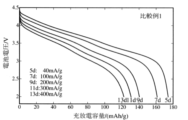
実施例1~2及び比較例1を正極としたリチウム二次電池の充放電特性を、それぞれ図5~7に示した。尚、図5~7共に、図中右上がりの曲線が充電曲線(添字cで表記)を、右下がりの曲線が放電曲線(添字dで表記)を示す。数字はサイクル数を示す。なお1-4サイクルに関しては、電気化学的活性化のためのサイクルであるため、図示していない。また、実施例1~2及び比較例1の充放電容量を、下記表3に示した。 The charge and discharge characteristics of the lithium secondary batteries using Examples 1 and 2 and Comparative Example 1 as the positive electrodes are shown in Figures 5 to 7, respectively. In both Figures 5 to 7, the curves sloping upward to the right indicate the charge curves (indicated by the subscript c), and the curves sloping downward to the right indicate the discharge curves (indicated by the subscript d). The numbers indicate the number of cycles. Note that cycles 1 to 4 are not shown in the figures, as they are cycles for electrochemical activation. The charge and discharge capacities of Examples 1 and 2 and Comparative Example 1 are shown in Table 3 below.

図5、図7及び表3より、実施例1のリチウムイオン二次電池は、比較例1のリチウムイオン二次電池に比べて、5サイクル目から34サイクル目までの充放電容量が大きく、サイクル経過時の充放電曲線変化も小さいことがわかる。また実施例1及び実施例2の電池の5サイクル目放電平均電圧はそれぞれ3.56及び3.61Vであり、比較例1の電池の値(3.55V)とほぼ同等又はそれ以上であった。 From Figures 5, 7 and Table 3, it can be seen that the lithium ion secondary battery of Example 1 has a larger charge/discharge capacity from the 5th cycle to the 34th cycle and a smaller change in the charge/discharge curve over the cycles compared to the lithium ion secondary battery of Comparative Example 1. In addition, the average discharge voltages at the 5th cycle of the batteries of Examples 1 and 2 were 3.56 and 3.61 V, respectively, which were almost equal to or higher than the value (3.55 V) of the battery of Comparative Example 1.
図6、図7及び表3より、実施例2のリチウムイオン二次電池は、比較例1のリチウムイオン二次電池に比べて、5サイクル目から34サイクル目までの充放電容量が大きく、サイクル経過時の充放電曲線変化も小さいのみならず、実施例1のリチウムイオン二次電池と比べても、5サイクル目から34サイクル目までの充放電容量が大きく、サイクル経過時の充放電曲線変化も小さいことがわかる。また実施例2の電池の5サイクル目放電平均電圧は3.59Vであった。 From Figures 6, 7 and Table 3, it can be seen that the lithium ion secondary battery of Example 2 has a larger charge/discharge capacity from the 5th cycle to the 34th cycle and a smaller change in the charge/discharge curve over the cycles than the lithium ion secondary battery of Comparative Example 1, and also has a larger charge/discharge capacity from the 5th cycle to the 34th cycle and a smaller change in the charge/discharge curve over the cycles than the lithium ion secondary battery of Example 1. In addition, the average discharge voltage at the 5th cycle of the battery of Example 2 was 3.59 V.
放電レート特性評価(実施例1~2及び比較例1)
次に、別の実施例1~2及び比較例1のリチウムイオン二次電池を用いて高電流密度下での放電レート特性を評価した。5サイクル目までは上記サイクル試験と同様に充放電させ、その後2.0-4.6Vの電位範囲で、充電時の電流密度を40mA/gに固定し、放電電流密度を100mA/gから400mA/gまで変化させて評価した。尚、高電流密度放電試験評価後は電池の充電深度が通常の定電流密度試験より大きくずれるため、各高電流密度放電試験後に1サイクル低電流密度(40mA/g)下での充放電を実施して調整した。
Discharge rate characteristic evaluation (Examples 1 and 2 and Comparative Example 1)
Next, the discharge rate characteristics under high current density were evaluated using the lithium ion secondary batteries of Examples 1 and 2 and Comparative Example 1. The batteries were charged and discharged in the same manner as in the above cycle test until the fifth cycle, and then evaluated in a potential range of 2.0-4.6 V, with the current density during charging fixed at 40 mA/g and the discharge current density changed from 100 mA/g to 400 mA/g. Note that, since the charge depth of the battery after the high current density discharge test evaluation is significantly different from that of a normal constant current density test, one cycle of charge and discharge under low current density (40 mA/g) was performed after each high current density discharge test to adjust it.
図8~10及び表4に、各実施例及び比較例のリチウム二次電池の放電レート特性を示した。 Figures 8 to 10 and Table 4 show the discharge rate characteristics of the lithium secondary batteries of each example and comparative example.

図8~10及び表4より、実施例1及び2のリチウムイオン二次電池の方が比較例1のリチウムイオン二次電池に比べて、各電流密度での放電容量が大きく、放電レート特性に優れることが明らかである。また、工程5を加えた方が、充放電特性、放電レート特性のいずれも向上する。 From Figures 8 to 10 and Table 4, it is clear that the lithium ion secondary batteries of Examples 1 and 2 have larger discharge capacities at each current density and superior discharge rate characteristics compared to the lithium ion secondary battery of Comparative Example 1. Furthermore, the addition of step 5 improves both the charge/discharge characteristics and the discharge rate characteristics.
(実施例3)
硝酸ニッケル(II)6水和物14.59gと過マンガン酸(VII)カリウム31.61g(全量0.25mol、Ni:Mnモル比=2:8)とを700mLの蒸留水に加え、完全に溶解させ、Ni-Mn水溶液(0.36mol/L)を得た。別のビーカーに水酸化ナトリウム水溶液(蒸留水500mL及びエタノール200mLに水酸化ナトリウム50gを溶解させた溶液;1.79mol/L)を作製した。この水酸化ナトリウム水-エタノール混合溶液をチタン製ビーカーに入れ、攪拌しつつ恒温漕内に静置し、恒温漕内を+20℃に保った。次いで、この水酸化ナトリウム水-エタノール混合溶液に上記Ni-Mn水溶液を2~3時間かけて徐々に滴下して、Ni-Mn沈殿物を形成させた(工程1)。反応液が完全にアルカリ性(pH11以上)になっていることを確認し、攪拌下に共沈物を含む反応液に室温で48時間以上酸素を吹き込んで湿式酸化処理して、沈殿を熟成させ目的とする前駆体を得た(工程2)。
Example 3
14.59 g of nickel (II) nitrate hexahydrate and 31.61 g of potassium permanganate (VII) (total amount 0.25 mol, Ni:Mn molar ratio = 2:8) were added to 700 mL of distilled water and completely dissolved to obtain a Ni-Mn aqueous solution (0.36 mol/L). A sodium hydroxide aqueous solution (a solution obtained by dissolving 50 g of sodium hydroxide in 500 mL of distilled water and 200 mL of ethanol; 1.79 mol/L) was prepared in another beaker. This sodium hydroxide aqueous solution-ethanol mixed solution was placed in a titanium beaker and left to stand in a thermostatic bath while stirring, and the thermostatic bath was kept at +20°C. Next, the Ni-Mn aqueous solution was gradually dropped into this sodium hydroxide aqueous solution-ethanol mixed solution over 2 to 3 hours to form a Ni-Mn precipitate (step 1). After confirming that the reaction solution had become completely alkaline (pH 11 or higher), oxygen was blown into the reaction solution containing the coprecipitate at room temperature with stirring for 48 hours or more to carry out a wet oxidation treatment, thereby aging the precipitate and obtaining the target precursor (Step 2).
前駆体を蒸留水で洗浄後濾別し得られたものを、仕込みモル比に対して1.00倍の炭酸リチウム(18.47g;(Li/(Ni+Mn)(モル比)が2.00))と蒸留水200mLを加え、ミキサーで混合して均一なスラリーを作製し、その後ポリテトラフルオロエチレン(PTFE)製シャーレに移して、50℃で2日間乾燥させた。乾燥粉末を振動ミルで粉砕後、電気炉に入れ、大気中650℃で5時間一次焼成した(工程3)。その後粉末を電気炉から取り出し、再び振動ミルで粉砕後、電気炉に入れ窒素気流中900℃で1時間二次焼成した(工程4)。その後粉末を電気炉から取り出し、再び振動ミルで粉砕後、4体積%水素-96体積%窒素混合ガス中、450℃で3時間三次焼成した(工程5)。その後粉末を電気炉から取り出し、蒸留水での水洗処理と濾過、乾燥工程を経て、リチウムニッケルマンガン系複合酸化物を得た。 The precursor was washed with distilled water and filtered. The resulting material was mixed with 1.00 times the molar ratio of lithium carbonate (18.47 g; (Li/(Ni+Mn) (molar ratio) was 2.00)) and 200 mL of distilled water, mixed in a mixer to prepare a uniform slurry, which was then transferred to a polytetrafluoroethylene (PTFE) petri dish and dried at 50°C for two days. The dried powder was pulverized in a vibration mill, placed in an electric furnace, and subjected to primary firing at 650°C in air for five hours (step 3). The powder was then removed from the electric furnace, pulverized again in a vibration mill, and placed in an electric furnace for secondary firing at 900°C for one hour in a nitrogen stream (step 4). The powder was then removed from the electric furnace, pulverized again in a vibration mill, and subjected to tertiary firing at 450°C for three hours in a 4% by volume hydrogen-96% by volume nitrogen mixed gas (step 5). The powder was then removed from the electric furnace, washed with distilled water, filtered, and dried to obtain a lithium nickel manganese composite oxide.
(実施例4)
三次焼成を行わない以外は実施例3と同様に試料作製を行い、リチウムニッケルマンガン系複合酸化物を得た。
Example 4
A sample was prepared in the same manner as in Example 3 except that the tertiary firing was not performed, and a lithium nickel manganese based composite oxide was obtained.
(比較例2)
硝酸ニッケル(II)6水和物14.59gと塩化マンガン(II)4水和物39.58g(全量0.25mol、Ni:Mnモル比=2:8)とを500mLの蒸留水に加え、完全に溶解させ、Ni-Mn水溶液(0.50mol/L)を得た。別のビーカーに水酸化ナトリウム水溶液(蒸留水500mLに水酸化ナトリウム50gを溶解させた溶液;2.50mol/L)を作製した。この水酸化ナトリウム水溶液をチタン製ビーカーに入れ、攪拌しつつ恒温漕内に静置し、恒温漕内を+20℃に保った。次いで、この水酸化ナトリウム水溶液に上記Ni-Mn水溶液を2~3時間かけて徐々に滴下して、Ni-Mn沈殿物を形成させた(工程1)。反応液が完全にアルカリ性(pH11以上)になっていることを確認し、攪拌下に共沈物を含む反応液に室温で48時間以上酸素を吹き込んで湿式酸化処理して、沈殿を熟成させ目的とする前駆体を得た(工程2)。
(Comparative Example 2)
14.59 g of nickel (II) nitrate hexahydrate and 39.58 g of manganese (II) chloride tetrahydrate (total amount 0.25 mol, Ni:Mn molar ratio = 2:8) were added to 500 mL of distilled water and completely dissolved to obtain a Ni-Mn aqueous solution (0.50 mol/L). A sodium hydroxide aqueous solution (a solution obtained by dissolving 50 g of sodium hydroxide in 500 mL of distilled water; 2.50 mol/L) was prepared in another beaker. This sodium hydroxide aqueous solution was placed in a titanium beaker and left to stand in a thermostatic bath while stirring, and the thermostatic bath was kept at +20°C. Next, the Ni-Mn aqueous solution was gradually added dropwise to this sodium hydroxide aqueous solution over 2 to 3 hours to form a Ni-Mn precipitate (step 1). After confirming that the reaction solution had become completely alkaline (pH 11 or higher), oxygen was blown into the reaction solution containing the coprecipitate at room temperature with stirring for 48 hours or more to carry out a wet oxidation treatment, thereby aging the precipitate and obtaining the target precursor (Step 2).
前駆体を蒸留水で洗浄後濾別し得られたものを、仕込みモル比に対して1.00倍の炭酸リチウム(18.47g;(Li/(Ni+Mn)(モル比)が2.00))と蒸留水200mLを加え、ミキサーで混合して均一なスラリーを作製し、その後ポリテトラフルオロエチレン(PTFE)製シャーレに移して、50℃で2日間乾燥させた。乾燥粉末を振動ミルで粉砕後、電気炉に入れ、大気中650℃で5時間一次焼成した(工程3)。その後粉末を電気炉から取り出し、再び振動ミルで粉砕後、電気炉に入れ大気中900℃で5時間二次焼成した(工程4)。その後粉末を電気炉から取り出し、蒸留水での水洗処理と濾過、乾燥工程を経て、リチウムニッケルマンガン系複合酸化物を得た。 The precursor was washed with distilled water and filtered. The resulting material was mixed with 1.00 times the molar ratio of lithium carbonate (18.47 g; (Li/(Ni+Mn) (molar ratio) is 2.00)) and 200 mL of distilled water, mixed in a mixer to prepare a uniform slurry, and then transferred to a polytetrafluoroethylene (PTFE) petri dish and dried at 50°C for 2 days. The dried powder was pulverized in a vibration mill, placed in an electric furnace, and subjected to primary firing at 650°C in air for 5 hours (step 3). The powder was then removed from the electric furnace, pulverized again in a vibration mill, and placed in an electric furnace for secondary firing at 900°C in air for 5 hours (step 4). The powder was then removed from the electric furnace, washed with distilled water, filtered, and dried to obtain a lithium nickel manganese composite oxide.
X線回折測定(実施例3)
実施例3のリチウムニッケルマンガン系複合酸化物の実測パターン(+)と単斜晶Li2MnO3単位胞を用いて得られた計算パターンとの比較(実線)を図11に示す(ピーク位置は縦棒で、実測値と計算値の残差は強度0付近に表記。)。実測値と計算値の差は小さく、信頼できる解析値が得られたことがわかる。得られた格子定数はa=4.9474(3)Å、b=8.5579(4)Å、c=5.0219(2)Å、β=109.232(5)°、V=200.8(4)Å3であった。各格子位置における遷移金属(仮想原子Ni0.2Mn0.8を仮定)占有率を実施例1と同様に、表5に示す。表5より六角網目構成位置(4g位置)占有率と六角網目中心位置(2b位置)占有率の差g4g-g2bは0.323である。また2θ=20°付近の(020)面のピークと2θ=45°付近の(20-2)面及び(131)面ピークのピーク高さの比I020/I20-2,131は、9.64%であり、本発明の範囲内であることが明らかである。また組成式あたりの遷移金属量(gtotal)は0.759であり本発明の範囲内であることが明らかである。
X-ray diffraction measurement (Example 3)
A comparison (solid line) between the measured pattern (+) of the lithium nickel manganese composite oxide of Example 3 and the calculated pattern obtained using a monoclinic Li 2 MnO 3 unit cell is shown in FIG. 11 (peak positions are indicated by vertical bars, and the residual between the measured value and the calculated value is indicated near the intensity 0). It can be seen that the difference between the measured value and the calculated value is small, and reliable analytical values were obtained. The obtained lattice constants were a = 4.9474 (3) Å, b = 8.5579 (4) Å, c = 5.0219 (2) Å, β = 109.232 (5) °, and V = 200.8 (4) Å 3. The transition metal (assuming a virtual atom Ni 0.2 Mn 0.8 ) occupancy rate at each lattice position is shown in Table 5, as in Example 1. From Table 5, the difference g 4g -g 2b between the occupancy rate of the hexagonal network configuration position (4g position) and the occupancy rate of the hexagonal network center position (2b position) is 0.323. In addition, the peak height ratio I 020 /I 20-2,131 of the peak of the (020) plane near 2θ = 20° to the peak of the (20-2) plane and the (131) plane near 2θ = 45° is 9.64%, which is clearly within the range of the present invention. In addition, the amount of transition metal per composition formula (g total ) is 0.759, which is clearly within the range of the present invention.
X線回折測定(実施例4)
実施例4のリチウムニッケルマンガン系複合酸化物の実測パターン(+)と単斜晶Li2MnO3単位胞を用いて得られた計算パターンとの比較(実線)を図12に示す(ピーク位置は縦棒で、実測値と計算値の残差は強度0付近に表記。)。実測値と計算値の差は小さく、信頼できる解析値が得られたことがわかる。得られた格子定数はa=4.9435(3)Å、b=8.5529(4)Å、c=5.0198(2)Å、β=109.245(5)°、V=200.4(3)Å3であった。各格子位置における遷移金属(仮想原子Ni0.2Mn0.8を仮定)占有率を実施例1と同様に、表5に示す。表5より六角網目構成位置(4g位置)占有率と六角網目中心位置(2b位置)占有率の差g4g-g2bは0.321である。また2θ=20°付近の(020)面のピークと2θ=45°付近の(20-2)面及び(131)面ピークのピーク高さの比I020/I20-2,131は、10.6%であり、本発明の範囲内であることが明らかである。また組成式あたりの遷移金属量(gtotal)は0.746であり本発明の範囲内であることが明らかである。
X-ray diffraction measurement (Example 4)
A comparison (solid line) between the measured pattern (+) of the lithium nickel manganese composite oxide of Example 4 and the calculated pattern obtained using a monoclinic Li 2 MnO 3 unit cell is shown in FIG. 12 (the peak positions are indicated by vertical bars, and the residual between the measured value and the calculated value is indicated near the intensity 0). It can be seen that the difference between the measured value and the calculated value is small, and a reliable analytical value was obtained. The obtained lattice constants were a = 4.9435 (3) Å, b = 8.5529 (4) Å, c = 5.0198 (2) Å, β = 109.245 (5) °, and V = 200.4 (3) Å 3. The transition metal (assuming a virtual atom Ni 0.2 Mn 0.8 ) occupancy rate at each lattice position is shown in Table 5, as in Example 1. From Table 5, the difference g 4g -g 2b between the occupancy rate of the hexagonal network configuration position (4g position) and the occupancy rate of the hexagonal network center position (2b position) is 0.321. In addition, the peak height ratio I 020 /I 20-2,131 of the peak of the (020) plane near 2θ = 20° to the peak of the (20-2) plane and the (131) plane near 2θ = 45° is 10.6%, which is clearly within the range of the present invention. In addition, the amount of transition metal per composition formula (g total ) is 0.746, which is clearly within the range of the present invention.
X線回折測定(比較例2)
比較例2のリチウムニッケルマンガン系複合酸化物の実測パターン(+)と単斜晶Li2MnO3単位胞を用いて得られた計算パターンとの比較(実線)を図13に示す(ピーク位置は縦棒で、実測値と計算値の残差は強度0付近に表記。)。実測値と計算値の差は小さく、信頼できる解析値が得られたことがわかる。得られた格子定数はa=4.93362(19)Å、b=8.5395(2)Å、c=5.02392(14)Å、β=109.284(2)°、V=199.79(16)Å3であった。各格子位置における遷移金属占有率を実施例1と同様に、表5に示す。表5より六角網目構成位置(4g位置)占有率と六角網目中心位置(2b位置)占有率の差g4g-g2bは0.347である。また2θ=20°付近の(020)面のピークと2θ=45°付近の(20-2)面及び(131)面ピークのピーク高さの比I020/I20-2,131は、16.3%であり、本発明の範囲外であることが明らかである。また組成式あたりの遷移金属量(gtotal)は0.704であり本発明の範囲外であることが明らかである。従って、工程4を不活性雰囲気下において行うことが必要なことが分かる。
X-ray diffraction measurement (Comparative Example 2)
A comparison (solid line) between the measured pattern (+) of the lithium nickel manganese composite oxide of Comparative Example 2 and the calculated pattern obtained using a monoclinic Li 2 MnO 3 unit cell is shown in FIG. 13 (the peak positions are indicated by vertical bars, and the residual between the measured value and the calculated value is indicated near the intensity 0). It can be seen that the difference between the measured value and the calculated value is small, and a reliable analytical value was obtained. The obtained lattice constants were a = 4.93362 (19) Å, b = 8.5395 (2) Å, c = 5.02392 (14) Å, β = 109.284 (2) °, and V = 199.79 (16) Å 3. The transition metal occupancy rate at each lattice position is shown in Table 5, as in Example 1. From Table 5, the difference g 4g -g 2b between the occupancy rate of the hexagonal mesh configuration position (4g position) and the occupancy rate of the hexagonal mesh center position (2b position) is 0.347. In addition, the peak height ratio I 020 /I 20-2,131 of the peak of the (020) plane near 2θ=20° to the peak of the (20-2) plane and the (131) plane near 2θ=45° is 16.3%, which is clearly outside the range of the present invention. In addition, the amount of transition metal per composition formula (g total ) is 0.704, which is clearly outside the range of the present invention. Therefore, it is understood that it is necessary to carry out

化学分析(実施例3~4及び比較例2)
実施例3~4及び比較例2のリチウムニッケルマンガン系複合酸化物の遷移金属量及びリチウム量をICP発光分析により求め、結果を下記表6に示す。表中のx値はLi/(Ni+Mn)(モル比)より以下の計算式:
x=(Li/(Ni+Mn)-1)/(Li/(Ni+Mn)+1)
で求めた。一方y値はNi/(Ni+Mn)(モル比)それ自体である。実施例3~4の複合酸化物ともに、本発明の組成式範囲内にあることが明らかである。
Chemical Analysis (Examples 3-4 and Comparative Example 2)
The transition metal amounts and lithium amounts of the lithium nickel manganese composite oxides of Examples 3 and 4 and Comparative Example 2 were determined by ICP emission spectrometry, and the results are shown in Table 6 below. The x value in the table was calculated from Li/(Ni+Mn) (molar ratio) using the following formula:
x=(Li/(Ni+Mn)-1)/(Li/(Ni+Mn)+1)
On the other hand, the y value is Ni/(Ni+Mn) (molar ratio) itself. It is clear that the composite oxides of Examples 3 and 4 are all within the range of the composition formula of the present invention.

充放電特性評価(実施例3~4及び比較例2)
実施例3~4及び比較例2の試料を前述の実施例1と同様に充放電試験を行った。実施例3~4及び比較例2を正極としたリチウム二次電池の充放電特性を、それぞれ図14~16に示した。尚、図14~16共に、図中右上がりの曲線が充電曲線(添字cで表記)を、右下がりの曲線が放電曲線(添字dで表記)を示す。数字はサイクル数を示す。なお1-4サイクルに関しては、電気化学的活性化のためのサイクルであるため、図示していない。また、実施例3~4及び比較例2の充放電容量を、下記表7に示した。
Evaluation of charge/discharge characteristics (Examples 3 to 4 and Comparative Example 2)
The samples of Examples 3-4 and Comparative Example 2 were subjected to a charge-discharge test in the same manner as in Example 1. The charge-discharge characteristics of the lithium secondary batteries using the samples of Examples 3-4 and Comparative Example 2 as the positive electrodes are shown in Figures 14-16, respectively. In both Figures 14-16, the curves sloping upward to the right indicate the charge curves (indicated by the subscript c), and the curves sloping downward to the right indicate the discharge curves (indicated by the subscript d). The numbers indicate the number of cycles. Note that cycles 1-4 are not shown because they are cycles for electrochemical activation. The charge-discharge capacities of Examples 3-4 and Comparative Example 2 are shown in Table 7 below.

図14~16及び表7からわかるように実施例3~4の試料は比較例2の試料に比べて高容量であり、34サイクルの充放電後にも高容量を維持していることから優れた充放電特性を有することが明らかである。 As can be seen from Figures 14 to 16 and Table 7, the samples of Examples 3 and 4 have a higher capacity than the sample of Comparative Example 2, and since they maintain a high capacity even after 34 charge/discharge cycles, it is clear that they have excellent charge/discharge characteristics.
放電レート特性評価
次に、別の実施例3~4及び比較例2のリチウムイオン二次電池を用いて高電流密度下での放電レート特性を評価した。評価条件は上記実施例1~2及び比較例1と同様である。結果を図17~図19および下記表8に示す。
Next, the discharge rate characteristics under high current density were evaluated using the lithium ion secondary batteries of Examples 3 and 4 and Comparative Example 2. The evaluation conditions were the same as those of Examples 1 and 2 and Comparative Example 1. The results are shown in Figures 17 to 19 and Table 8 below.

図17~19及び表8より、実施例3~4の試料の方が比較例2の試料より放電レート特性に優れることが明らかである。また、工程5を加えた方が、充放電特性、放電レート特性のいずれも向上する。 From Figures 17 to 19 and Table 8, it is clear that the samples of Examples 3 and 4 have better discharge rate characteristics than the sample of Comparative Example 2. Furthermore, adding step 5 improves both the charge/discharge characteristics and the discharge rate characteristics.
以上から、本発明のリチウムニッケルマンガン系複合酸化物は、特異な遷移金属イオン分布又は存在量を有するため、通常の遷移金属イオン分布及び存在量を有するものに比べて優れた充放電特性を有し、車載用等の大型リチウムイオン二次電池用正極材料として好適に使用可能であると考えられる。 From the above, it is believed that the lithium nickel manganese composite oxide of the present invention has a unique transition metal ion distribution or abundance, and therefore has superior charge/discharge characteristics compared to those with a normal transition metal ion distribution and abundance, and can be suitably used as a positive electrode material for large lithium ion secondary batteries for vehicles, etc.
本発明のリチウムニッケルマンガン系複合酸化物は、作動電圧、初期及び充放電サイクル後の充放電容量、並びに放電レート特性が既存のNMC系正極材料と比較して同等又はそれ以上である。そのため、電気自動車若しくはプラグインハイブリッド車用のバッテリー、又は定置用蓄電池などに好適に利用することが可能である。 The lithium nickel manganese composite oxide of the present invention has operating voltage, initial charge/discharge capacity and charge/discharge capacity after charge/discharge cycles, and discharge rate characteristics that are equal to or better than those of existing NMC-based positive electrode materials. Therefore, it can be suitably used in batteries for electric vehicles or plug-in hybrid vehicles, or stationary storage batteries, etc.
Claims (12)
Li1+x(NiyMn1-y)1-xO2 (1)
[式中、x及びyはそれぞれ、0<x<1/3、0.190≦y≦0.325を示す。]で表され、単斜晶Li2MnO3型層状岩塩型構造を有するリチウムニッケルマンガン系複合酸化物であって、
(2)前記単斜晶Li2MnO3型層状岩塩型構造内におけるLi層及び遷移金属-Li層内の遷移金属の平均存在量の和(gtotal)が、前記yが0.190以上0.225未満の場合は0.725~0.800であり、前記yが0.225~0.325の場合は0.790~0.900である、
リチウムニッケルマンガン系複合酸化物。 General formula (1):
Li 1+x (Ni y Mn 1-y ) 1-x O 2 (1)
[wherein x and y are 0<x< 1/3 and 0.190≦y≦0.325, respectively.] and is a lithium nickel manganese composite oxide having a monoclinic Li2MnO3 type layered rock salt structure,
(2) The sum (g total ) of the average abundance of the transition metal in the Li layer and the transition metal-Li layer in the monoclinic Li 2 MnO 3 type layered rock salt structure is 0.725 to 0.800 when the y is 0.190 or more and less than 0.225, and is 0.790 to 0.900 when the y is 0.225 to 0.325.
Lithium nickel manganese composite oxide.
Li1+x(NiyMn1-y)1-xO2 (1)
[式中、x及びyはそれぞれ、0<x<1/3、0.225≦y≦0.325を示す。]で表され、単斜晶Li2MnO3型層状岩塩型構造を有するリチウムニッケルマンガン系複合酸化物であって、
(3)前記単斜晶Li2MnO3型層状岩塩型構造内における遷移金属含有層内での六角網目規則構造において、六角網目格子構成位置(4g位置)の遷移金属占有率(g4g)から六角網目格子中心位置(2b位置)の遷移金属占有率(g2b)を引いた値(g4g-g2b)が、-0.10~0.20である、
リチウムニッケルマンガン系複合酸化物。 General formula (1):
Li 1+x (Ni y Mn 1-y ) 1-x O 2 (1)
[wherein x and y are 0<x<1/3 and 0.225≦y≦0.325, respectively.] and is a lithium nickel manganese composite oxide having a monoclinic Li 2 MnO 3 type layered rock salt structure,
(3) In the hexagonal mesh structure in the transition metal-containing layer in the monoclinic Li 2 MnO 3 type layered rock salt structure, the value (g 4g -g 2b ) obtained by subtracting the transition metal occupancy (g 2b ) at the central position (2b position) of the hexagonal mesh structure from the transition metal occupancy (g 4g ) at the hexagonal mesh structure position ( 4g position ) is -0.10 to 0.20.
Lithium nickel manganese composite oxide.
マンガン化合物及びニッケル化合物をアルカリ処理することにより沈殿を形成する工程1、
前記沈殿を酸化させて複合酸化物前駆体を得る工程2、
リチウム化合物存在下、前記複合酸化物前駆体を酸化雰囲気中で熱処理する工程3、及び前記工程3で得られる生成物を、不活性雰囲気下で前記工程3よりも高温条件で熱処理する工程4
を有することを特徴とする、製造方法。 A method for producing the lithium nickel manganese based composite oxide according to any one of claims 1 to 8,
1. A step of forming a precipitate by treating a manganese compound and a nickel compound with an alkali;
Step 2: oxidizing the precipitate to obtain a composite oxide precursor;
A step 3 of heat-treating the composite oxide precursor in an oxidizing atmosphere in the presence of a lithium compound, and a step 4 of heat-treating the product obtained in the step 3 in an inert atmosphere at a higher temperature than in the step 3.
The manufacturing method according to claim 1,
Applications Claiming Priority (2)
| Application Number | Priority Date | Filing Date | Title |
|---|---|---|---|
| JP2019135068 | 2019-07-23 | ||
| JP2019135068 | 2019-07-23 |
Publications (2)
| Publication Number | Publication Date |
|---|---|
| JP2021017397A JP2021017397A (en) | 2021-02-15 |
| JP7557191B2 true JP7557191B2 (en) | 2024-09-27 |
Family
ID=74564024
Family Applications (1)
| Application Number | Title | Priority Date | Filing Date |
|---|---|---|---|
| JP2020125576A Active JP7557191B2 (en) | 2019-07-23 | 2020-07-22 | Monoclinic lithium nickel manganese composite oxide and its manufacturing method |
Country Status (1)
| Country | Link |
|---|---|
| JP (1) | JP7557191B2 (en) |
Families Citing this family (2)
| Publication number | Priority date | Publication date | Assignee | Title |
|---|---|---|---|---|
| CN113285051B (en) * | 2021-05-19 | 2022-04-12 | 蜂巢能源科技有限公司 | A kind of iron-manganese-based cathode material, preparation method and application thereof |
| CN116247199A (en) * | 2023-03-31 | 2023-06-09 | 天津巴莫科技有限责任公司 | A high-nickel single crystal layered positive electrode material co-doped with two elements in different crystal orientations and its preparation method |
Citations (4)
| Publication number | Priority date | Publication date | Assignee | Title |
|---|---|---|---|---|
| WO2018043436A1 (en) | 2016-08-30 | 2018-03-08 | 国立研究開発法人産業技術総合研究所 | Dissimilar metal-containing lithium-nickel composite oxide and production method therefor |
| WO2018096972A1 (en) | 2016-11-22 | 2018-05-31 | 国立研究開発法人産業技術総合研究所 | Lithium-manganese complex oxide and method for producing same |
| WO2018169004A1 (en) | 2017-03-16 | 2018-09-20 | 国立研究開発法人産業技術総合研究所 | Nickel-manganese-based composite oxide and method for producing same |
| WO2018181967A1 (en) | 2017-03-31 | 2018-10-04 | 東ソー株式会社 | Manganese oxide, production method therefor, and lithium secondary battery |
-
2020
- 2020-07-22 JP JP2020125576A patent/JP7557191B2/en active Active
Patent Citations (4)
| Publication number | Priority date | Publication date | Assignee | Title |
|---|---|---|---|---|
| WO2018043436A1 (en) | 2016-08-30 | 2018-03-08 | 国立研究開発法人産業技術総合研究所 | Dissimilar metal-containing lithium-nickel composite oxide and production method therefor |
| WO2018096972A1 (en) | 2016-11-22 | 2018-05-31 | 国立研究開発法人産業技術総合研究所 | Lithium-manganese complex oxide and method for producing same |
| WO2018169004A1 (en) | 2017-03-16 | 2018-09-20 | 国立研究開発法人産業技術総合研究所 | Nickel-manganese-based composite oxide and method for producing same |
| WO2018181967A1 (en) | 2017-03-31 | 2018-10-04 | 東ソー株式会社 | Manganese oxide, production method therefor, and lithium secondary battery |
Non-Patent Citations (1)
| Title |
|---|
| WANG,J-X. et al.,Structure and Delithiation/Lithiation of the Luthium-Rich Layered Oxide Li[Li0.23Ni0.15Mn0.62]O2 as Cathode Material,InternationalJournal of Electrochemical Science,2017年,12, (9),8095-8105,DOI:10.20964/2017.09.25 |
Also Published As
| Publication number | Publication date |
|---|---|
| JP2021017397A (en) | 2021-02-15 |
Similar Documents
| Publication | Publication Date | Title |
|---|---|---|
| JP5263761B2 (en) | Monoclinic lithium manganese composite oxide having cation ordered structure and method for producing the same | |
| JP5516926B2 (en) | Monoclinic Lithium Manganese Composite Oxide with Regular Structure and Method for Producing the Same | |
| JP2022075768A (en) | Surface-stabilized cathode material for lithium-ion batteries and its synthesis method | |
| JP4963059B2 (en) | Lithium manganese composite oxide containing titanium and nickel | |
| JP6119003B2 (en) | Lithium manganese composite oxide and method for producing the same | |
| JP6533734B2 (en) | Positive electrode active material for lithium ion battery, positive electrode for lithium ion battery and lithium ion battery | |
| JP4997609B2 (en) | Method for producing lithium manganese composite oxide | |
| JP6395051B2 (en) | Lithium composite oxide, method for producing lithium composite oxide, positive electrode active material for lithium secondary battery, and lithium secondary battery | |
| JP7128475B2 (en) | Lithium-manganese composite oxide and method for producing the same | |
| JP6872816B2 (en) | Nickel-manganese-based composite oxide and its manufacturing method | |
| JP4457213B2 (en) | Method for producing lithium ferrite composite oxide | |
| JP2015166291A (en) | Lithium composite oxide | |
| JP7557191B2 (en) | Monoclinic lithium nickel manganese composite oxide and its manufacturing method | |
| JP4431786B2 (en) | Positive electrode material for lithium secondary battery, method for producing the same, and lithium secondary battery using the same | |
| JP4189486B2 (en) | Method for producing lithium-iron-manganese composite oxide | |
| JP2005263583A (en) | Alkali transition metal oxide crystal material and method for producing the same | |
| JP7048944B2 (en) | Titanium and / or germanium-substituted lithium-manganese-based composite oxide and its production method | |
| JPWO2018181967A1 (en) | Manganese oxide, method for producing the same, and lithium secondary battery | |
| JP4423391B2 (en) | Lithium ferrite composite oxide and method for producing the same | |
| JP2022504835A (en) | Lithium transition metal composite oxide and its manufacturing method | |
| JP7750503B2 (en) | Monoclinic lithium nickel manganese composite oxide containing different metals and its method of manufacture | |
| JP7302826B2 (en) | Lithium-manganese composite oxide and method for producing the same | |
| JP7192397B2 (en) | Lithium-cobalt-manganese composite oxide and lithium secondary battery containing the same | |
| JP2025100319A (en) | Lithium nickel manganese and lithium nickel iron manganese composite oxide-inorganic acid composites and their method of manufacture | |
| JP2024121136A (en) | Lithium manganese composite oxide and its manufacturing method, active material for lithium ion secondary battery containing the same, and lithium ion secondary battery |
Legal Events
| Date | Code | Title | Description |
|---|---|---|---|
| A80 | Written request to apply exceptions to lack of novelty of invention |
Free format text: JAPANESE INTERMEDIATE CODE: A80 Effective date: 20200814 |
|
| A621 | Written request for application examination |
Free format text: JAPANESE INTERMEDIATE CODE: A621 Effective date: 20230215 |
|
| A977 | Report on retrieval |
Free format text: JAPANESE INTERMEDIATE CODE: A971007 Effective date: 20231115 |
|
| A131 | Notification of reasons for refusal |
Free format text: JAPANESE INTERMEDIATE CODE: A131 Effective date: 20231205 |
|
| A521 | Request for written amendment filed |
Free format text: JAPANESE INTERMEDIATE CODE: A523 Effective date: 20240202 |
|
| A131 | Notification of reasons for refusal |
Free format text: JAPANESE INTERMEDIATE CODE: A131 Effective date: 20240423 |
|
| A521 | Request for written amendment filed |
Free format text: JAPANESE INTERMEDIATE CODE: A523 Effective date: 20240619 |
|
| TRDD | Decision of grant or rejection written | ||
| A01 | Written decision to grant a patent or to grant a registration (utility model) |
Free format text: JAPANESE INTERMEDIATE CODE: A01 Effective date: 20240903 |
|
| A61 | First payment of annual fees (during grant procedure) |
Free format text: JAPANESE INTERMEDIATE CODE: A61 Effective date: 20240906 |
|
| R150 | Certificate of patent or registration of utility model |
Ref document number: 7557191 Country of ref document: JP Free format text: JAPANESE INTERMEDIATE CODE: R150 |