JP7523219B2 - Single domain antibodies against CTLA-4 and variants thereof - Google Patents
Single domain antibodies against CTLA-4 and variants thereof Download PDFInfo
- Publication number
- JP7523219B2 JP7523219B2 JP2019540486A JP2019540486A JP7523219B2 JP 7523219 B2 JP7523219 B2 JP 7523219B2 JP 2019540486 A JP2019540486 A JP 2019540486A JP 2019540486 A JP2019540486 A JP 2019540486A JP 7523219 B2 JP7523219 B2 JP 7523219B2
- Authority
- JP
- Japan
- Prior art keywords
- amino acid
- seq
- acid sequence
- ctla
- sdab
- Prior art date
- Legal status (The legal status is an assumption and is not a legal conclusion. Google has not performed a legal analysis and makes no representation as to the accuracy of the status listed.)
- Active
Links
Classifications
-
- C—CHEMISTRY; METALLURGY
- C07—ORGANIC CHEMISTRY
- C07K—PEPTIDES
- C07K16/00—Immunoglobulins [IG], e.g. monoclonal or polyclonal antibodies
- C07K16/18—Immunoglobulins [IG], e.g. monoclonal or polyclonal antibodies against material from animals or humans
- C07K16/28—Immunoglobulins [IG], e.g. monoclonal or polyclonal antibodies against material from animals or humans against receptors, cell surface antigens or cell surface determinants
- C07K16/2803—Immunoglobulins [IG], e.g. monoclonal or polyclonal antibodies against material from animals or humans against receptors, cell surface antigens or cell surface determinants against the immunoglobulin superfamily
- C07K16/2818—Immunoglobulins [IG], e.g. monoclonal or polyclonal antibodies against material from animals or humans against receptors, cell surface antigens or cell surface determinants against the immunoglobulin superfamily against CD28 or CD152
-
- A—HUMAN NECESSITIES
- A61—MEDICAL OR VETERINARY SCIENCE; HYGIENE
- A61K—PREPARATIONS FOR MEDICAL, DENTAL OR TOILETRY PURPOSES
- A61K39/00—Medicinal preparations containing antigens or antibodies
- A61K39/395—Antibodies; Immunoglobulins; Immune serum, e.g. antilymphocytic serum
- A61K39/39533—Antibodies; Immunoglobulins; Immune serum, e.g. antilymphocytic serum against materials from animals
- A61K39/3955—Antibodies; Immunoglobulins; Immune serum, e.g. antilymphocytic serum against materials from animals against proteinaceous materials, e.g. enzymes, hormones, lymphokines
-
- A—HUMAN NECESSITIES
- A61—MEDICAL OR VETERINARY SCIENCE; HYGIENE
- A61K—PREPARATIONS FOR MEDICAL, DENTAL OR TOILETRY PURPOSES
- A61K47/00—Medicinal preparations characterised by the non-active ingredients used, e.g. carriers or inert additives; Targeting or modifying agents chemically bound to the active ingredient
- A61K47/50—Medicinal preparations characterised by the non-active ingredients used, e.g. carriers or inert additives; Targeting or modifying agents chemically bound to the active ingredient the non-active ingredient being chemically bound to the active ingredient, e.g. polymer-drug conjugates
- A61K47/51—Medicinal preparations characterised by the non-active ingredients used, e.g. carriers or inert additives; Targeting or modifying agents chemically bound to the active ingredient the non-active ingredient being chemically bound to the active ingredient, e.g. polymer-drug conjugates the non-active ingredient being a modifying agent
- A61K47/62—Medicinal preparations characterised by the non-active ingredients used, e.g. carriers or inert additives; Targeting or modifying agents chemically bound to the active ingredient the non-active ingredient being chemically bound to the active ingredient, e.g. polymer-drug conjugates the non-active ingredient being a modifying agent the modifying agent being a protein, peptide or polyamino acid
- A61K47/65—Peptidic linkers, binders or spacers, e.g. peptidic enzyme-labile linkers
-
- A—HUMAN NECESSITIES
- A61—MEDICAL OR VETERINARY SCIENCE; HYGIENE
- A61K—PREPARATIONS FOR MEDICAL, DENTAL OR TOILETRY PURPOSES
- A61K47/00—Medicinal preparations characterised by the non-active ingredients used, e.g. carriers or inert additives; Targeting or modifying agents chemically bound to the active ingredient
- A61K47/50—Medicinal preparations characterised by the non-active ingredients used, e.g. carriers or inert additives; Targeting or modifying agents chemically bound to the active ingredient the non-active ingredient being chemically bound to the active ingredient, e.g. polymer-drug conjugates
- A61K47/51—Medicinal preparations characterised by the non-active ingredients used, e.g. carriers or inert additives; Targeting or modifying agents chemically bound to the active ingredient the non-active ingredient being chemically bound to the active ingredient, e.g. polymer-drug conjugates the non-active ingredient being a modifying agent
- A61K47/68—Medicinal preparations characterised by the non-active ingredients used, e.g. carriers or inert additives; Targeting or modifying agents chemically bound to the active ingredient the non-active ingredient being chemically bound to the active ingredient, e.g. polymer-drug conjugates the non-active ingredient being a modifying agent the modifying agent being an antibody, an immunoglobulin or a fragment thereof, e.g. an Fc-fragment
- A61K47/6835—Medicinal preparations characterised by the non-active ingredients used, e.g. carriers or inert additives; Targeting or modifying agents chemically bound to the active ingredient the non-active ingredient being chemically bound to the active ingredient, e.g. polymer-drug conjugates the non-active ingredient being a modifying agent the modifying agent being an antibody, an immunoglobulin or a fragment thereof, e.g. an Fc-fragment the modifying agent being an antibody or an immunoglobulin bearing at least one antigen-binding site
- A61K47/6849—Medicinal preparations characterised by the non-active ingredients used, e.g. carriers or inert additives; Targeting or modifying agents chemically bound to the active ingredient the non-active ingredient being chemically bound to the active ingredient, e.g. polymer-drug conjugates the non-active ingredient being a modifying agent the modifying agent being an antibody, an immunoglobulin or a fragment thereof, e.g. an Fc-fragment the modifying agent being an antibody or an immunoglobulin bearing at least one antigen-binding site the antibody targeting a receptor, a cell surface antigen or a cell surface determinant
-
- A—HUMAN NECESSITIES
- A61—MEDICAL OR VETERINARY SCIENCE; HYGIENE
- A61P—SPECIFIC THERAPEUTIC ACTIVITY OF CHEMICAL COMPOUNDS OR MEDICINAL PREPARATIONS
- A61P35/00—Antineoplastic agents
-
- C—CHEMISTRY; METALLURGY
- C07—ORGANIC CHEMISTRY
- C07K—PEPTIDES
- C07K16/00—Immunoglobulins [IG], e.g. monoclonal or polyclonal antibodies
- C07K16/18—Immunoglobulins [IG], e.g. monoclonal or polyclonal antibodies against material from animals or humans
- C07K16/28—Immunoglobulins [IG], e.g. monoclonal or polyclonal antibodies against material from animals or humans against receptors, cell surface antigens or cell surface determinants
- C07K16/2803—Immunoglobulins [IG], e.g. monoclonal or polyclonal antibodies against material from animals or humans against receptors, cell surface antigens or cell surface determinants against the immunoglobulin superfamily
- C07K16/2827—Immunoglobulins [IG], e.g. monoclonal or polyclonal antibodies against material from animals or humans against receptors, cell surface antigens or cell surface determinants against the immunoglobulin superfamily against B7 molecules, e.g. CD80, CD86
-
- A—HUMAN NECESSITIES
- A61—MEDICAL OR VETERINARY SCIENCE; HYGIENE
- A61K—PREPARATIONS FOR MEDICAL, DENTAL OR TOILETRY PURPOSES
- A61K39/00—Medicinal preparations containing antigens or antibodies
- A61K2039/505—Medicinal preparations containing antigens or antibodies comprising antibodies
-
- A—HUMAN NECESSITIES
- A61—MEDICAL OR VETERINARY SCIENCE; HYGIENE
- A61K—PREPARATIONS FOR MEDICAL, DENTAL OR TOILETRY PURPOSES
- A61K39/00—Medicinal preparations containing antigens or antibodies
- A61K2039/505—Medicinal preparations containing antigens or antibodies comprising antibodies
- A61K2039/507—Comprising a combination of two or more separate antibodies
-
- A—HUMAN NECESSITIES
- A61—MEDICAL OR VETERINARY SCIENCE; HYGIENE
- A61P—SPECIFIC THERAPEUTIC ACTIVITY OF CHEMICAL COMPOUNDS OR MEDICINAL PREPARATIONS
- A61P31/00—Antiinfectives, i.e. antibiotics, antiseptics, chemotherapeutics
-
- C—CHEMISTRY; METALLURGY
- C07—ORGANIC CHEMISTRY
- C07K—PEPTIDES
- C07K2317/00—Immunoglobulins specific features
- C07K2317/20—Immunoglobulins specific features characterized by taxonomic origin
- C07K2317/22—Immunoglobulins specific features characterized by taxonomic origin from camelids, e.g. camel, llama or dromedary
-
- C—CHEMISTRY; METALLURGY
- C07—ORGANIC CHEMISTRY
- C07K—PEPTIDES
- C07K2317/00—Immunoglobulins specific features
- C07K2317/20—Immunoglobulins specific features characterized by taxonomic origin
- C07K2317/24—Immunoglobulins specific features characterized by taxonomic origin containing regions, domains or residues from different species, e.g. chimeric, humanized or veneered
-
- C—CHEMISTRY; METALLURGY
- C07—ORGANIC CHEMISTRY
- C07K—PEPTIDES
- C07K2317/00—Immunoglobulins specific features
- C07K2317/30—Immunoglobulins specific features characterized by aspects of specificity or valency
- C07K2317/31—Immunoglobulins specific features characterized by aspects of specificity or valency multispecific
-
- C—CHEMISTRY; METALLURGY
- C07—ORGANIC CHEMISTRY
- C07K—PEPTIDES
- C07K2317/00—Immunoglobulins specific features
- C07K2317/50—Immunoglobulins specific features characterized by immunoglobulin fragments
- C07K2317/51—Complete heavy chain or Fd fragment, i.e. VH + CH1
-
- C—CHEMISTRY; METALLURGY
- C07—ORGANIC CHEMISTRY
- C07K—PEPTIDES
- C07K2317/00—Immunoglobulins specific features
- C07K2317/50—Immunoglobulins specific features characterized by immunoglobulin fragments
- C07K2317/515—Complete light chain, i.e. VL + CL
-
- C—CHEMISTRY; METALLURGY
- C07—ORGANIC CHEMISTRY
- C07K—PEPTIDES
- C07K2317/00—Immunoglobulins specific features
- C07K2317/50—Immunoglobulins specific features characterized by immunoglobulin fragments
- C07K2317/52—Constant or Fc region; Isotype
-
- C—CHEMISTRY; METALLURGY
- C07—ORGANIC CHEMISTRY
- C07K—PEPTIDES
- C07K2317/00—Immunoglobulins specific features
- C07K2317/50—Immunoglobulins specific features characterized by immunoglobulin fragments
- C07K2317/52—Constant or Fc region; Isotype
- C07K2317/522—CH1 domain
-
- C—CHEMISTRY; METALLURGY
- C07—ORGANIC CHEMISTRY
- C07K—PEPTIDES
- C07K2317/00—Immunoglobulins specific features
- C07K2317/50—Immunoglobulins specific features characterized by immunoglobulin fragments
- C07K2317/52—Constant or Fc region; Isotype
- C07K2317/53—Hinge
-
- C—CHEMISTRY; METALLURGY
- C07—ORGANIC CHEMISTRY
- C07K—PEPTIDES
- C07K2317/00—Immunoglobulins specific features
- C07K2317/50—Immunoglobulins specific features characterized by immunoglobulin fragments
- C07K2317/55—Fab or Fab'
-
- C—CHEMISTRY; METALLURGY
- C07—ORGANIC CHEMISTRY
- C07K—PEPTIDES
- C07K2317/00—Immunoglobulins specific features
- C07K2317/50—Immunoglobulins specific features characterized by immunoglobulin fragments
- C07K2317/56—Immunoglobulins specific features characterized by immunoglobulin fragments variable (Fv) region, i.e. VH and/or VL
-
- C—CHEMISTRY; METALLURGY
- C07—ORGANIC CHEMISTRY
- C07K—PEPTIDES
- C07K2317/00—Immunoglobulins specific features
- C07K2317/50—Immunoglobulins specific features characterized by immunoglobulin fragments
- C07K2317/56—Immunoglobulins specific features characterized by immunoglobulin fragments variable (Fv) region, i.e. VH and/or VL
- C07K2317/565—Complementarity determining region [CDR]
-
- C—CHEMISTRY; METALLURGY
- C07—ORGANIC CHEMISTRY
- C07K—PEPTIDES
- C07K2317/00—Immunoglobulins specific features
- C07K2317/50—Immunoglobulins specific features characterized by immunoglobulin fragments
- C07K2317/56—Immunoglobulins specific features characterized by immunoglobulin fragments variable (Fv) region, i.e. VH and/or VL
- C07K2317/567—Framework region [FR]
-
- C—CHEMISTRY; METALLURGY
- C07—ORGANIC CHEMISTRY
- C07K—PEPTIDES
- C07K2317/00—Immunoglobulins specific features
- C07K2317/50—Immunoglobulins specific features characterized by immunoglobulin fragments
- C07K2317/56—Immunoglobulins specific features characterized by immunoglobulin fragments variable (Fv) region, i.e. VH and/or VL
- C07K2317/569—Single domain, e.g. dAb, sdAb, VHH, VNAR or nanobody®
-
- C—CHEMISTRY; METALLURGY
- C07—ORGANIC CHEMISTRY
- C07K—PEPTIDES
- C07K2317/00—Immunoglobulins specific features
- C07K2317/70—Immunoglobulins specific features characterized by effect upon binding to a cell or to an antigen
- C07K2317/73—Inducing cell death, e.g. apoptosis, necrosis or inhibition of cell proliferation
-
- C—CHEMISTRY; METALLURGY
- C07—ORGANIC CHEMISTRY
- C07K—PEPTIDES
- C07K2317/00—Immunoglobulins specific features
- C07K2317/70—Immunoglobulins specific features characterized by effect upon binding to a cell or to an antigen
- C07K2317/76—Antagonist effect on antigen, e.g. neutralization or inhibition of binding
-
- C—CHEMISTRY; METALLURGY
- C07—ORGANIC CHEMISTRY
- C07K—PEPTIDES
- C07K2317/00—Immunoglobulins specific features
- C07K2317/90—Immunoglobulins specific features characterized by (pharmaco)kinetic aspects or by stability of the immunoglobulin
- C07K2317/92—Affinity (KD), association rate (Ka), dissociation rate (Kd) or EC50 value
Landscapes
- Health & Medical Sciences (AREA)
- Chemical & Material Sciences (AREA)
- Immunology (AREA)
- Organic Chemistry (AREA)
- Life Sciences & Earth Sciences (AREA)
- Medicinal Chemistry (AREA)
- General Health & Medical Sciences (AREA)
- Veterinary Medicine (AREA)
- Public Health (AREA)
- Pharmacology & Pharmacy (AREA)
- Animal Behavior & Ethology (AREA)
- Proteomics, Peptides & Aminoacids (AREA)
- Genetics & Genomics (AREA)
- Biochemistry (AREA)
- Molecular Biology (AREA)
- Biophysics (AREA)
- Chemical Kinetics & Catalysis (AREA)
- General Chemical & Material Sciences (AREA)
- Nuclear Medicine, Radiotherapy & Molecular Imaging (AREA)
- Epidemiology (AREA)
- Bioinformatics & Cheminformatics (AREA)
- Engineering & Computer Science (AREA)
- Oncology (AREA)
- Communicable Diseases (AREA)
- Endocrinology (AREA)
- Microbiology (AREA)
- Mycology (AREA)
- Cell Biology (AREA)
- Peptides Or Proteins (AREA)
- Preparation Of Compounds By Using Micro-Organisms (AREA)
- Medicines That Contain Protein Lipid Enzymes And Other Medicines (AREA)
- Medicines Containing Antibodies Or Antigens For Use As Internal Diagnostic Agents (AREA)
- Micro-Organisms Or Cultivation Processes Thereof (AREA)
Description
関連出願
本発明は、2016年10月11日に出願された国際特許出願第PCT/CN2016/101777号、及び2017年7月20日に出願された国際特許出願第PCT/CN2017/093644号の利益を主張し、これらの出願は、それらの全体を参照することによって本明細書に組み込まれる。
RELATED APPLICATIONS This invention claims the benefit of International Patent Application No. PCT/CN2016/101777, filed October 11, 2016, and International Patent Application No. PCT/CN2017/093644, filed July 20, 2017, which are incorporated herein by reference in their entireties.
ASCIIテキストファイルによる配列表の提出
ASCIIテキストファイル上の以下の提出物の内容、すなわち、コンピューターで読取り可能な形態(CRF)の配列表(ファイル名:761422000341SeqList.txt、記録日:2017年10月9日、サイズ:699KB)は、その全体を参照することによって本明細書に組み込まれる。
[技術分野]
Submission of a Sequence Listing via ASCII Text File The contents of the following submission, i.e., Sequence Listing in Computer Readable Form (CRF) (Filename: 761422000341SeqList.txt, Date Posted: October 9, 2017, Size: 699 KB), on ASCII text file, is hereby incorporated by reference in its entirety.
[Technical field]
本発明は、CTLA-4を特異的に認識する単一ドメイン抗体(sdAb)部分を含む構築物、及びこれらを作製し、使用する方法に関する。 The present invention relates to constructs that contain a single domain antibody (sdAb) portion that specifically recognizes CTLA-4, and methods for making and using these.
T細胞の活性化は、T細胞受容体(TCR)を介した刺激だけでなく、T細胞表面上で構成的に発現される共刺激表面分子(例えば、CD28)を介した追加のシグナリングもまた必要とする。CD28のリガンドは、抗原提示細胞(APC)(例えば、樹状細胞、活性化B細胞、または単球)上に存在するB7-1(CD80)及びB7-2(CD86)である。B7とCD28の間の相互作用は、抗原特異的T細胞の成熟及び増殖をトリガーするのに十分であると見なされるいくつかの共刺激シグナリング経路の1つである。共刺激の欠如により付随するIL-2産生の不備は、その後のT細胞増殖を妨げ、「アネルギー」と呼ばれる非反応性の状態を誘導する。 T cell activation requires not only stimulation via the T cell receptor (TCR) but also additional signaling via costimulatory surface molecules (e.g., CD28) that are constitutively expressed on the T cell surface. The ligands for CD28 are B7-1 (CD80) and B7-2 (CD86), which are present on antigen-presenting cells (APCs) (e.g., dendritic cells, activated B cells, or monocytes). The interaction between B7 and CD28 is one of several costimulatory signaling pathways that are considered sufficient to trigger maturation and proliferation of antigen-specific T cells. The concomitant failure of IL-2 production due to lack of costimulation prevents subsequent T cell proliferation and induces a state of non-responsiveness called "anergy."
細胞傷害性Tリンパ球関連タンパク質4(CTLA-4、またはCD152)は、CD28のホモログであり、活性化T細胞上で上方調節される阻害性免疫チェックポイント分子として知られる。CTLA-4は、B7-1及びB7-2にも結合するが、CD28よりも親和性が大きい。B7とCTLA-4の間の相互作用は、T細胞活性化を弱め、これは、腫瘍免疫逃避の重要な機序を構成する。抗CTLA-4抗体療法は、黒色腫などの多くのがんに有望であることが示された。 Cytotoxic T-lymphocyte-associated protein 4 (CTLA-4, or CD152) is a homolog of CD28 and is known as an inhibitory immune checkpoint molecule that is upregulated on activated T cells. CTLA-4 also binds to B7-1 and B7-2, but with greater affinity than CD28. The interaction between B7 and CTLA-4 attenuates T-cell activation, which constitutes an important mechanism of tumor immune escape. Anti-CTLA-4 antibody therapy has shown promise in many cancers, including melanoma.
一本鎖抗体(sdAb)は、単一の単量体抗体可変ドメインを有することで従来の4鎖抗体とは異なる。例えば、ラクダ及びサメは、軽鎖が自然に欠如している重鎖のみ抗体(HCAb)という名の単一ドメイン抗体を産生する。ラクダ科動物のHCAbの各アームの抗原結合断片は、単一重鎖可変ドメイン(VHH)を有し、これは、軽鎖の助けを借りることなく抗原に対して高親和性を示すことができる。ラクダ科動物のVHHは、おおよそ15kDの分子量を有する最小の機能的抗原結合断片として知られる。 Single chain antibodies (sdAbs) differ from conventional four-chain antibodies by having a single monomeric antibody variable domain. For example, camels and sharks produce single domain antibodies, named heavy chain only antibodies (HCAbs), which naturally lack light chains. The antigen-binding fragment of each arm of camelid HCAbs has a single heavy chain variable domain ( VHH ), which can show high affinity to antigens without the aid of light chains. Camelid VHH is known as the smallest functional antigen-binding fragment, with a molecular weight of approximately 15 kD.
本明細書に参照される全ての刊行物、特許、特許出願、及び公開特許出願の開示は、それらの全体を参照することによって本明細書に組み込まれる。 The disclosures of all publications, patents, patent applications, and published patent applications referenced herein are hereby incorporated by reference in their entirety.
本発明は、CTLA-4を特異的に認識する単一ドメイン抗体(sdAb)部分を含む構築物、及びこれらを作製し、使用する方法に関する。 The present invention relates to constructs that contain a single domain antibody (sdAb) portion that specifically recognizes CTLA-4, and methods for making and using these.
本発明の一態様は、CTLA-4を特異的に認識するsdAb部分を含む単離抗CTLA-4構築物であって、sdAb部分は、配列番号17~32及び213~222のいずれか1つのアミノ酸配列を含むCDR1、または最大で約3つ(例えば、約1、2、または3のいずれか)のアミノ酸置換を含むその変異体;配列番号49~64、233~242、及び339のいずれか1つのアミノ酸配列を含むCDR2、または最大で約3つ(例えば、約1、2、または3のいずれか)のアミノ酸置換を含むその変異体;及び配列番号81~96及び253~262のいずれか1つのアミノ酸配列を含むCDR3、または最大で約3つ(例えば、約1、2、または3のいずれか)のアミノ酸置換を含むその変異体を含む、単離抗CTLA-4構築物が提供される。 One aspect of the present invention provides an isolated anti-CTLA-4 construct comprising an sdAb portion that specifically recognizes CTLA-4, the sdAb portion comprising: a CDR1 comprising the amino acid sequence of any one of SEQ ID NOs: 17-32 and 213-222, or a variant thereof comprising up to about three (e.g., about one, two, or three) amino acid substitutions; a CDR2 comprising the amino acid sequence of any one of SEQ ID NOs: 49-64, 233-242, and 339, or a variant thereof comprising up to about three (e.g., about one, two, or three) amino acid substitutions; and a CDR3 comprising the amino acid sequence of any one of SEQ ID NOs: 81-96 and 253-262, or a variant thereof comprising up to about three (e.g., about one, two, or three) amino acid substitutions.
上述の単離抗CTLA-4構築物のいずれか1つに記載のいくつかの実施形態では、CTLA-4を特異的に認識するsdAb部分は、配列番号17~32及び213~222のいずれか1つのアミノ酸配列を含むCDR1;配列番号49~64、233~242、及び339のいずれか1つのアミノ酸配列を含むCDR2;及び配列番号81~96及び253~262のいずれか1つのアミノ酸配列を含むCDR3;またはCDR領域において最大で約3つ(例えば、約1、2、または3のいずれか)のアミノ酸置換を含むその変異体を含む。 In some embodiments of any one of the isolated anti-CTLA-4 constructs described above, the sdAb portion that specifically recognizes CTLA-4 comprises a CDR1 comprising the amino acid sequence of any one of SEQ ID NOs: 17-32 and 213-222; a CDR2 comprising the amino acid sequence of any one of SEQ ID NOs: 49-64, 233-242, and 339; and a CDR3 comprising the amino acid sequence of any one of SEQ ID NOs: 81-96 and 253-262; or a variant thereof comprising up to about three (e.g., about any one, two, or three) amino acid substitutions in the CDR regions.
上述の単離抗CTLA-4構築物のいずれか1つに記載のいくつかの実施形態では、CTLA-4を特異的に認識するsdAb部分は、以下のいずれか1つを含む:
(1)配列番号17のアミノ酸配列を含むCDR1、または最大で約3つ(例えば、約1、2、または3のいずれか)のアミノ酸置換を含むその変異体;配列番号49のアミノ酸配列を含むCDR2、または最大で約3つ(例えば、約1、2、または3のいずれか)のアミノ酸置換を含むその変異体;及び配列番号81のアミノ酸配列を含むCDR3、または最大で約3つ(例えば、約1、2、または3のいずれか)のアミノ酸置換を含むその変異体;
(2)配列番号18のアミノ酸配列を含むCDR1、または最大で約3つ(例えば、約1、2、または3のいずれか)のアミノ酸置換を含むその変異体;配列番号50のアミノ酸配列を含むCDR2、または最大で約3つ(例えば、約1、2、または3のいずれか)のアミノ酸置換を含むその変異体;及び配列番号82のアミノ酸配列を含むCDR3、または最大で約3つ(例えば、約1、2、または3のいずれか)のアミノ酸置換を含むその変異体;
(3)配列番号19のアミノ酸配列を含むCDR1、または最大で約3つ(例えば、約1、2、または3のいずれか)のアミノ酸置換を含むその変異体;配列番号51のアミノ酸配列を含むCDR2、または最大で約3つ(例えば、約1、2、または3のいずれか)のアミノ酸置換を含むその変異体;及び配列番号83のアミノ酸配列を含むCDR3、または最大で約3つ(例えば、約1、2、または3のいずれか)のアミノ酸置換を含むその変異体;
(4)配列番号20のアミノ酸配列を含むCDR1、または最大で約3つ(例えば、約1、2、または3のいずれか)のアミノ酸置換を含むその変異体;配列番号52のアミノ酸配列を含むCDR2、または最大で約3つ(例えば、約1、2、または3のいずれか)のアミノ酸置換を含むその変異体;及び配列番号84のアミノ酸配列を含むCDR3、または最大で約3つ(例えば、約1、2、または3のいずれか)のアミノ酸置換を含むその変異体;
(5)配列番号21のアミノ酸配列を含むCDR1、または最大で約3つ(例えば、約1、2、または3のいずれか)のアミノ酸置換を含むその変異体;配列番号53のアミノ酸配列を含むCDR2、または最大で約3つ(例えば、約1、2、または3のいずれか)のアミノ酸置換を含むその変異体;及び配列番号85のアミノ酸配列を含むCDR3、または最大で約3つ(例えば、約1、2、または3のいずれか)のアミノ酸置換を含むその変異体;
(6)配列番号22のアミノ酸配列を含むCDR1、または最大で約3つ(例えば、約1、2、または3のいずれか)のアミノ酸置換を含むその変異体;配列番号54のアミノ酸配列を含むCDR2、または最大で約3つ(例えば、約1、2、または3のいずれか)のアミノ酸置換を含むその変異体;及び配列番号86のアミノ酸配列を含むCDR3、または最大で約3つ(例えば、約1、2、または3のいずれか)のアミノ酸置換を含むその変異体;
(7)配列番号23のアミノ酸配列を含むCDR1、または最大で約3つ(例えば、約1、2、または3のいずれか)のアミノ酸置換を含むその変異体;配列番号55のアミノ酸配列を含むCDR2、または最大で約3つ(例えば、約1、2、または3のいずれか)のアミノ酸置換を含むその変異体;及び配列番号87のアミノ酸配列を含むCDR3、または最大で約3つ(例えば、約1、2、または3のいずれか)のアミノ酸置換を含むその変異体;
(8)配列番号24のアミノ酸配列を含むCDR1、または最大で約3つ(例えば、約1、2、または3のいずれか)のアミノ酸置換を含むその変異体;配列番号56のアミノ酸配列を含むCDR2、または最大で約3つ(例えば、約1、2、または3のいずれか)のアミノ酸置換を含むその変異体;及び配列番号88のアミノ酸配列を含むCDR3、または最大で約3つ(例えば、約1、2、または3のいずれか)のアミノ酸置換を含むその変異体;
(9)配列番号25のアミノ酸配列を含むCDR1、または最大で約3つ(例えば、約1、2、または3のいずれか)のアミノ酸置換を含むその変異体;配列番号57のアミノ酸配列を含むCDR2、または最大で約3つ(例えば、約1、2、または3のいずれか)のアミノ酸置換を含むその変異体;及び配列番号89のアミノ酸配列を含むCDR3、または最大で約3つ(例えば、約1、2、または3のいずれか)のアミノ酸置換を含むその変異体;
(10)配列番号26のアミノ酸配列を含むCDR1、または最大で約3つ(例えば、約1、2、または3のいずれか)のアミノ酸置換を含むその変異体;配列番号58のアミノ酸配列を含むCDR2、または最大で約3つ(例えば、約1、2、または3のいずれか)のアミノ酸置換を含むその変異体;及び配列番号90のアミノ酸配列を含むCDR3、または最大で約3つ(例えば、約1、2、または3のいずれか)のアミノ酸置換を含むその変異体;
(11)配列番号27のアミノ酸配列を含むCDR1、または最大で約3つ(例えば、約1、2、または3のいずれか)のアミノ酸置換を含むその変異体;配列番号59のアミノ酸配列を含むCDR2、または最大で約3つ(例えば、約1、2、または3のいずれか)のアミノ酸置換を含むその変異体;及び配列番号91のアミノ酸配列を含むCDR3、または最大で約3つ(例えば、約1、2、または3のいずれか)のアミノ酸置換を含むその変異体;
(12)配列番号28のアミノ酸配列を含むCDR1、または最大で約3つ(例えば、約1、2、または3のいずれか)のアミノ酸置換を含むその変異体;配列番号60のアミノ酸配列を含むCDR2、または最大で約3つ(例えば、約1、2、または3のいずれか)のアミノ酸置換を含むその変異体;及び配列番号92のアミノ酸配列を含むCDR3、または最大で約3つ(例えば、約1、2、または3のいずれか)のアミノ酸置換を含むその変異体;
(13)配列番号29のアミノ酸配列を含むCDR1、または最大で約3つ(例えば、約1、2、または3のいずれか)のアミノ酸置換を含むその変異体;配列番号61のアミノ酸配列を含むCDR2、または最大で約3つ(例えば、約1、2、または3のいずれか)のアミノ酸置換を含むその変異体;及び配列番号93のアミノ酸配列を含むCDR3、または最大で約3つ(例えば、約1、2、または3のいずれか)のアミノ酸置換を含むその変異体;
(14)配列番号30のアミノ酸配列を含むCDR1、または最大で約3つ(例えば、約1、2、または3のいずれか)のアミノ酸置換を含むその変異体;配列番号62のアミノ酸配列を含むCDR2、または最大で約3つ(例えば、約1、2、または3のいずれか)のアミノ酸置換を含むその変異体;及び配列番号94のアミノ酸配列を含むCDR3、または最大で約3つ(例えば、約1、2、または3のいずれか)のアミノ酸置換を含むその変異体;
(15)配列番号31のアミノ酸配列を含むCDR1、または最大で約3つ(例えば、約1、2、または3のいずれか)のアミノ酸置換を含むその変異体;配列番号63のアミノ酸配列を含むCDR2、または最大で約3つ(例えば、約1、2、または3のいずれか)のアミノ酸置換を含むその変異体;及び配列番号95のアミノ酸配列を含むCDR3、または最大で約3つ(例えば、約1、2、または3のいずれか)のアミノ酸置換を含むその変異体;
(16)配列番号32のアミノ酸配列を含むCDR1、または最大で約3つ(例えば、約1、2、または3のいずれか)のアミノ酸置換を含むその変異体;配列番号64のアミノ酸配列を含むCDR2、または最大で約3つ(例えば、約1、2、または3のいずれか)のアミノ酸置換を含むその変異体;及び配列番号96のアミノ酸配列を含むCDR3、または最大で約3つ(例えば、約1、2、または3のいずれか)のアミノ酸置換を含むその変異体;
(17)配列番号213のアミノ酸配列を含むCDR1、または最大で約3つ(例えば、約1、2、または3のいずれか)のアミノ酸置換を含むその変異体;配列番号233のアミノ酸配列を含むCDR2、または最大で約3つ(例えば、約1、2、または3のいずれか)のアミノ酸置換を含むその変異体;及び配列番号253のアミノ酸配列を含むCDR3、または最大で約3つ(例えば、約1、2、または3のいずれか)のアミノ酸置換を含むその変異体;
(18)配列番号214のアミノ酸配列を含むCDR1、または最大で約3つ(例えば、約1、2、または3のいずれか)のアミノ酸置換を含むその変異体;配列番号234のアミノ酸配列を含むCDR2、または最大で約3つ(例えば、約1、2、または3のいずれか)のアミノ酸置換を含むその変異体;及び配列番号254のアミノ酸配列を含むCDR3、または最大で約3つ(例えば、約1、2、または3のいずれか)のアミノ酸置換を含むその変異体;
(19)配列番号215のアミノ酸配列を含むCDR1、または最大で約3つ(例えば、約1、2、または3のいずれか)のアミノ酸置換を含むその変異体;配列番号235のアミノ酸配列を含むCDR2、または最大で約3つ(例えば、約1、2、または3のいずれか)のアミノ酸置換を含むその変異体;及び配列番号255のアミノ酸配列を含むCDR3、または最大で約3つ(例えば、約1、2、または3のいずれか)のアミノ酸置換を含むその変異体;
(20)配列番号216のアミノ酸配列を含むCDR1、または最大で約3つ(例えば、約1、2、または3のいずれか)のアミノ酸置換を含むその変異体;配列番号236のアミノ酸配列を含むCDR2、または最大で約3つ(例えば、約1、2、または3のいずれか)のアミノ酸置換を含むその変異体;及び配列番号256のアミノ酸配列を含むCDR3、または最大で約3つ(例えば、約1、2、または3のいずれか)のアミノ酸置換を含むその変異体;
(21)配列番号217のアミノ酸配列を含むCDR1、または最大で約3つ(例えば、約1、2、または3のいずれか)のアミノ酸置換を含むその変異体;配列番号237のアミノ酸配列を含むCDR2、または最大で約3つ(例えば、約1、2、または3のいずれか)のアミノ酸置換を含むその変異体;及び配列番号257のアミノ酸配列を含むCDR3、または最大で約3つ(例えば、約1、2、または3のいずれか)のアミノ酸置換を含むその変異体;
(22)配列番号218のアミノ酸配列を含むCDR1、または最大で約3つ(例えば、約1、2、または3のいずれか)のアミノ酸置換を含むその変異体;配列番号238のアミノ酸配列を含むCDR2、または最大で約3つ(例えば、約1、2、または3のいずれか)のアミノ酸置換を含むその変異体;及び配列番号258のアミノ酸配列を含むCDR3、または最大で約3つ(例えば、約1、2、または3のいずれか)のアミノ酸置換を含むその変異体;
(23)配列番号219のアミノ酸配列を含むCDR1、または最大で約3つ(例えば、約1、2、または3のいずれか)のアミノ酸置換を含むその変異体;配列番号239のアミノ酸配列を含むCDR2、または最大で約3つ(例えば、約1、2、または3のいずれか)のアミノ酸置換を含むその変異体;及び配列番号259のアミノ酸配列を含むCDR3、または最大で約3つ(例えば、約1、2、または3のいずれか)のアミノ酸置換を含むその変異体;
(24)配列番号220のアミノ酸配列を含むCDR1、または最大で約3つ(例えば、約1、2、または3のいずれか)のアミノ酸置換を含むその変異体;配列番号240のアミノ酸配列を含むCDR2、または最大で約3つ(例えば、約1、2、または3のいずれか)のアミノ酸置換を含むその変異体;及び配列番号260のアミノ酸配列を含むCDR3、または最大で約3つ(例えば、約1、2、または3のいずれか)のアミノ酸置換を含むその変異体;
(25)配列番号221のアミノ酸配列を含むCDR1、または最大で約3つ(例えば、約1、2、または3のいずれか)のアミノ酸置換を含むその変異体;配列番号241のアミノ酸配列を含むCDR2、または最大で約3つ(例えば、約1、2、または3のいずれか)のアミノ酸置換を含むその変異体;及び配列番号261のアミノ酸配列を含むCDR3、または最大で約3つ(例えば、約1、2、または3のいずれか)のアミノ酸置換を含むその変異体;
(26)配列番号222のアミノ酸配列を含むCDR1、または最大で約3つ(例えば、約1、2、または3のいずれか)のアミノ酸置換を含むその変異体;配列番号242のアミノ酸配列を含むCDR2、または最大で約3つ(例えば、約1、2、または3のいずれか)のアミノ酸置換を含むその変異体;及び配列番号262のアミノ酸配列を含むCDR3、または最大で約3つ(例えば、約1、2、または3のいずれか)のアミノ酸置換を含むその変異体;または
(27)配列番号214のアミノ酸配列を含むCDR1、または最大で約3つ(例えば、約1、2、または3のいずれか)のアミノ酸置換を含むその変異体;配列番号339のアミノ酸配列を含むCDR2、または最大で約3つ(例えば、約1、2、または3のいずれか)のアミノ酸置換を含むその変異体;及び配列番号254のアミノ酸配列を含むCDR3、または最大で約3つ(例えば、約1、2、または3のいずれか)のアミノ酸置換を含むその変異体を含む。
In some embodiments of any one of the isolated anti-CTLA-4 constructs described above, the sdAb portion that specifically recognizes CTLA-4 comprises any one of the following:
(1) CDR1 comprising the amino acid sequence of SEQ ID NO: 17, or a variant thereof comprising up to about three (e.g., about any of 1, 2, or 3) amino acid substitutions; CDR2 comprising the amino acid sequence of SEQ ID NO: 49, or a variant thereof comprising up to about three (e.g., about any of 1, 2, or 3) amino acid substitutions; and CDR3 comprising the amino acid sequence of SEQ ID NO: 81, or a variant thereof comprising up to about three (e.g., about any of 1, 2, or 3) amino acid substitutions;
(2) CDR1 comprising the amino acid sequence of SEQ ID NO: 18, or a variant thereof comprising up to about three (e.g., about any of 1, 2, or 3) amino acid substitutions; CDR2 comprising the amino acid sequence of SEQ ID NO: 50, or a variant thereof comprising up to about three (e.g., about any of 1, 2, or 3) amino acid substitutions; and CDR3 comprising the amino acid sequence of SEQ ID NO: 82, or a variant thereof comprising up to about three (e.g., about any of 1, 2, or 3) amino acid substitutions;
(3) CDR1 comprising the amino acid sequence of SEQ ID NO: 19, or a variant thereof comprising up to about three (e.g., about any of 1, 2, or 3) amino acid substitutions; CDR2 comprising the amino acid sequence of SEQ ID NO: 51, or a variant thereof comprising up to about three (e.g., about any of 1, 2, or 3) amino acid substitutions; and CDR3 comprising the amino acid sequence of SEQ ID NO: 83, or a variant thereof comprising up to about three (e.g., about any of 1, 2, or 3) amino acid substitutions;
(4) CDR1 comprising the amino acid sequence of SEQ ID NO:20, or a variant thereof comprising up to about three (e.g., about any of 1, 2, or 3) amino acid substitutions; CDR2 comprising the amino acid sequence of SEQ ID NO:52, or a variant thereof comprising up to about three (e.g., about any of 1, 2, or 3) amino acid substitutions; and CDR3 comprising the amino acid sequence of SEQ ID NO:84, or a variant thereof comprising up to about three (e.g., about any of 1, 2, or 3) amino acid substitutions;
(5) CDR1 comprising the amino acid sequence of SEQ ID NO:21, or a variant thereof comprising up to about three (e.g., about any of 1, 2, or 3) amino acid substitutions; CDR2 comprising the amino acid sequence of SEQ ID NO:53, or a variant thereof comprising up to about three (e.g., about any of 1, 2, or 3) amino acid substitutions; and CDR3 comprising the amino acid sequence of SEQ ID NO:85, or a variant thereof comprising up to about three (e.g., about any of 1, 2, or 3) amino acid substitutions;
(6) CDR1 comprising the amino acid sequence of SEQ ID NO:22, or a variant thereof comprising up to about three (e.g., about any of 1, 2, or 3) amino acid substitutions; CDR2 comprising the amino acid sequence of SEQ ID NO:54, or a variant thereof comprising up to about three (e.g., about any of 1, 2, or 3) amino acid substitutions; and CDR3 comprising the amino acid sequence of SEQ ID NO:86, or a variant thereof comprising up to about three (e.g., about any of 1, 2, or 3) amino acid substitutions;
(7) CDR1 comprising the amino acid sequence of SEQ ID NO:23, or a variant thereof comprising up to about three (e.g., about any of 1, 2, or 3) amino acid substitutions; CDR2 comprising the amino acid sequence of SEQ ID NO:55, or a variant thereof comprising up to about three (e.g., about any of 1, 2, or 3) amino acid substitutions; and CDR3 comprising the amino acid sequence of SEQ ID NO:87, or a variant thereof comprising up to about three (e.g., about any of 1, 2, or 3) amino acid substitutions;
(8) CDR1 comprising the amino acid sequence of SEQ ID NO:24, or a variant thereof comprising up to about three (e.g., about any of 1, 2, or 3) amino acid substitutions; CDR2 comprising the amino acid sequence of SEQ ID NO:56, or a variant thereof comprising up to about three (e.g., about any of 1, 2, or 3) amino acid substitutions; and CDR3 comprising the amino acid sequence of SEQ ID NO:88, or a variant thereof comprising up to about three (e.g., about any of 1, 2, or 3) amino acid substitutions;
(9) CDR1 comprising the amino acid sequence of SEQ ID NO:25, or a variant thereof comprising up to about three (e.g., about any of 1, 2, or 3) amino acid substitutions; CDR2 comprising the amino acid sequence of SEQ ID NO:57, or a variant thereof comprising up to about three (e.g., about any of 1, 2, or 3) amino acid substitutions; and CDR3 comprising the amino acid sequence of SEQ ID NO:89, or a variant thereof comprising up to about three (e.g., about any of 1, 2, or 3) amino acid substitutions;
(10) CDR1 comprising the amino acid sequence of SEQ ID NO:26, or a variant thereof comprising up to about three (e.g., about any of 1, 2, or 3) amino acid substitutions; CDR2 comprising the amino acid sequence of SEQ ID NO:58, or a variant thereof comprising up to about three (e.g., about any of 1, 2, or 3) amino acid substitutions; and CDR3 comprising the amino acid sequence of SEQ ID NO:90, or a variant thereof comprising up to about three (e.g., about any of 1, 2, or 3) amino acid substitutions;
(11) CDR1 comprising the amino acid sequence of SEQ ID NO:27, or a variant thereof comprising up to about three (e.g., about any of 1, 2, or 3) amino acid substitutions; CDR2 comprising the amino acid sequence of SEQ ID NO:59, or a variant thereof comprising up to about three (e.g., about any of 1, 2, or 3) amino acid substitutions; and CDR3 comprising the amino acid sequence of SEQ ID NO:91, or a variant thereof comprising up to about three (e.g., about any of 1, 2, or 3) amino acid substitutions;
(12) CDR1 comprising the amino acid sequence of SEQ ID NO:28, or a variant thereof comprising up to about three (e.g., about any of 1, 2, or 3) amino acid substitutions; CDR2 comprising the amino acid sequence of SEQ ID NO:60, or a variant thereof comprising up to about three (e.g., about any of 1, 2, or 3) amino acid substitutions; and CDR3 comprising the amino acid sequence of SEQ ID NO:92, or a variant thereof comprising up to about three (e.g., about any of 1, 2, or 3) amino acid substitutions;
(13) CDR1 comprising the amino acid sequence of SEQ ID NO:29, or a variant thereof comprising up to about three (e.g., about any of 1, 2, or 3) amino acid substitutions; CDR2 comprising the amino acid sequence of SEQ ID NO:61, or a variant thereof comprising up to about three (e.g., about any of 1, 2, or 3) amino acid substitutions; and CDR3 comprising the amino acid sequence of SEQ ID NO:93, or a variant thereof comprising up to about three (e.g., about any of 1, 2, or 3) amino acid substitutions;
(14) CDR1 comprising the amino acid sequence of SEQ ID NO: 30, or a variant thereof comprising up to about three (e.g., about any of 1, 2, or 3) amino acid substitutions; CDR2 comprising the amino acid sequence of SEQ ID NO: 62, or a variant thereof comprising up to about three (e.g., about any of 1, 2, or 3) amino acid substitutions; and CDR3 comprising the amino acid sequence of SEQ ID NO: 94, or a variant thereof comprising up to about three (e.g., about any of 1, 2, or 3) amino acid substitutions;
(15) CDR1 comprising the amino acid sequence of SEQ ID NO: 31, or a variant thereof comprising up to about three (e.g., about any of 1, 2, or 3) amino acid substitutions; CDR2 comprising the amino acid sequence of SEQ ID NO: 63, or a variant thereof comprising up to about three (e.g., about any of 1, 2, or 3) amino acid substitutions; and CDR3 comprising the amino acid sequence of SEQ ID NO: 95, or a variant thereof comprising up to about three (e.g., about any of 1, 2, or 3) amino acid substitutions;
(16) CDR1 comprising the amino acid sequence of SEQ ID NO: 32, or a variant thereof comprising up to about three (e.g., about any of 1, 2, or 3) amino acid substitutions; CDR2 comprising the amino acid sequence of SEQ ID NO: 64, or a variant thereof comprising up to about three (e.g., about any of 1, 2, or 3) amino acid substitutions; and CDR3 comprising the amino acid sequence of SEQ ID NO: 96, or a variant thereof comprising up to about three (e.g., about any of 1, 2, or 3) amino acid substitutions;
(17) CDR1 comprising the amino acid sequence of SEQ ID NO:213, or a variant thereof comprising up to about three (e.g., about any of 1, 2, or 3) amino acid substitutions; CDR2 comprising the amino acid sequence of SEQ ID NO:233, or a variant thereof comprising up to about three (e.g., about any of 1, 2, or 3) amino acid substitutions; and CDR3 comprising the amino acid sequence of SEQ ID NO:253, or a variant thereof comprising up to about three (e.g., about any of 1, 2, or 3) amino acid substitutions;
(18) CDR1 comprising the amino acid sequence of SEQ ID NO:214, or a variant thereof comprising up to about three (e.g., about any of 1, 2, or 3) amino acid substitutions; CDR2 comprising the amino acid sequence of SEQ ID NO:234, or a variant thereof comprising up to about three (e.g., about any of 1, 2, or 3) amino acid substitutions; and CDR3 comprising the amino acid sequence of SEQ ID NO:254, or a variant thereof comprising up to about three (e.g., about any of 1, 2, or 3) amino acid substitutions;
(19) CDR1 comprising the amino acid sequence of SEQ ID NO:215, or a variant thereof comprising up to about three (e.g., about any of 1, 2, or 3) amino acid substitutions; CDR2 comprising the amino acid sequence of SEQ ID NO:235, or a variant thereof comprising up to about three (e.g., about any of 1, 2, or 3) amino acid substitutions; and CDR3 comprising the amino acid sequence of SEQ ID NO:255, or a variant thereof comprising up to about three (e.g., about any of 1, 2, or 3) amino acid substitutions;
(20) CDR1 comprising the amino acid sequence of SEQ ID NO:216, or a variant thereof comprising up to about three (e.g., about any of 1, 2, or 3) amino acid substitutions; CDR2 comprising the amino acid sequence of SEQ ID NO:236, or a variant thereof comprising up to about three (e.g., about any of 1, 2, or 3) amino acid substitutions; and CDR3 comprising the amino acid sequence of SEQ ID NO:256, or a variant thereof comprising up to about three (e.g., about any of 1, 2, or 3) amino acid substitutions;
(21) CDR1 comprising the amino acid sequence of SEQ ID NO:217, or a variant thereof comprising up to about three (e.g., about any of 1, 2, or 3) amino acid substitutions; CDR2 comprising the amino acid sequence of SEQ ID NO:237, or a variant thereof comprising up to about three (e.g., about any of 1, 2, or 3) amino acid substitutions; and CDR3 comprising the amino acid sequence of SEQ ID NO:257, or a variant thereof comprising up to about three (e.g., about any of 1, 2, or 3) amino acid substitutions;
(22) CDR1 comprising the amino acid sequence of SEQ ID NO:218, or a variant thereof comprising up to about three (e.g., about any of 1, 2, or 3) amino acid substitutions; CDR2 comprising the amino acid sequence of SEQ ID NO:238, or a variant thereof comprising up to about three (e.g., about any of 1, 2, or 3) amino acid substitutions; and CDR3 comprising the amino acid sequence of SEQ ID NO:258, or a variant thereof comprising up to about three (e.g., about any of 1, 2, or 3) amino acid substitutions;
(23) CDR1 comprising the amino acid sequence of SEQ ID NO:219, or a variant thereof comprising up to about three (e.g., about any of 1, 2, or 3) amino acid substitutions; CDR2 comprising the amino acid sequence of SEQ ID NO:239, or a variant thereof comprising up to about three (e.g., about any of 1, 2, or 3) amino acid substitutions; and CDR3 comprising the amino acid sequence of SEQ ID NO:259, or a variant thereof comprising up to about three (e.g., about any of 1, 2, or 3) amino acid substitutions;
(24) CDR1 comprising the amino acid sequence of SEQ ID NO: 220, or a variant thereof comprising up to about three (e.g., about any of 1, 2, or 3) amino acid substitutions; CDR2 comprising the amino acid sequence of SEQ ID NO: 240, or a variant thereof comprising up to about three (e.g., about any of 1, 2, or 3) amino acid substitutions; and CDR3 comprising the amino acid sequence of SEQ ID NO: 260, or a variant thereof comprising up to about three (e.g., about any of 1, 2, or 3) amino acid substitutions;
(25) CDR1 comprising the amino acid sequence of SEQ ID NO: 221, or a variant thereof comprising up to about three (e.g., about any of 1, 2, or 3) amino acid substitutions; CDR2 comprising the amino acid sequence of SEQ ID NO: 241, or a variant thereof comprising up to about three (e.g., about any of 1, 2, or 3) amino acid substitutions; and CDR3 comprising the amino acid sequence of SEQ ID NO: 261, or a variant thereof comprising up to about three (e.g., about any of 1, 2, or 3) amino acid substitutions;
(26) CDR1 comprising the amino acid sequence of SEQ ID NO:222, or a variant thereof comprising up to about three (e.g., about one, two, or three) amino acid substitutions; CDR2 comprising the amino acid sequence of SEQ ID NO:242, or a variant thereof comprising up to about three (e.g., about one, two, or three) amino acid substitutions; and CDR3 comprising the amino acid sequence of SEQ ID NO:262, or a variant thereof comprising up to about three (e.g., about one, two, or three) amino acid substitutions; or (27) CDR1 comprising the amino acid sequence of SEQ ID NO:214, or a variant thereof comprising up to about three (e.g., about one, two, or three) amino acid substitutions; CDR2 comprising the amino acid sequence of SEQ ID NO:339, or a variant thereof comprising up to about three (e.g., about one, two, or three) amino acid substitutions; and CDR3 comprising the amino acid sequence of SEQ ID NO:254, or a variant thereof comprising up to about three (e.g., about one, two, or three) amino acid substitutions.
上述の単離抗CTLA-4構築物のいずれか1つに記載のいくつかの実施形態では、CTLA-4を特異的に認識するsdAb部分は、以下のいずれか1つを含む:
(1)配列番号17のアミノ酸配列を含むCDR1;配列番号49のアミノ酸配列を含むCDR2;及び配列番号81のアミノ酸配列を含むCDR3;またはCDR領域において最大で約3つ(例えば、約1、2、または3のいずれか)のアミノ酸置換を含むその変異体;
(2)配列番号18のアミノ酸配列を含むCDR1;配列番号50のアミノ酸配列を含むCDR2;及び配列番号82のアミノ酸配列を含むCDR3;またはCDR領域において最大で約3つ(例えば、約1、2、または3のいずれか)のアミノ酸置換を含むその変異体;
(3)配列番号19のアミノ酸配列を含むCDR1;配列番号51のアミノ酸配列を含むCDR2;及び配列番号83のアミノ酸配列を含むCDR3;またはCDR領域において最大で約3つ(例えば、約1、2、または3のいずれか)のアミノ酸置換を含むその変異体;
(4)配列番号20のアミノ酸配列を含むCDR1;配列番号52のアミノ酸配列を含むCDR2;及び配列番号84のアミノ酸配列を含むCDR3;またはCDR領域において最大で約3つ(例えば、約1、2、または3のいずれか)のアミノ酸置換を含むその変異体;
(5)配列番号21のアミノ酸配列を含むCDR1;配列番号53のアミノ酸配列を含むCDR2;及び配列番号85のアミノ酸配列を含むCDR3;またはCDR領域において最大で約3つ(例えば、約1、2、または3のいずれか)のアミノ酸置換を含むその変異体;
(6)配列番号22のアミノ酸配列を含むCDR1;配列番号54のアミノ酸配列を含むCDR2;及び配列番号86のアミノ酸配列を含むCDR3;またはCDR領域において最大で約3つ(例えば、約1、2、または3のいずれか)のアミノ酸置換を含むその変異体;
(7)配列番号23のアミノ酸配列を含むCDR1;配列番号55のアミノ酸配列を含むCDR2;及び配列番号87のアミノ酸配列を含むCDR3;またはCDR領域において最大で約3つ(例えば、約1、2、または3のいずれか)のアミノ酸置換を含むその変異体;
(8)配列番号24のアミノ酸配列を含むCDR1;配列番号56のアミノ酸配列を含むCDR2;及び配列番号88のアミノ酸配列を含むCDR3;またはCDR領域において最大で約3つ(例えば、約1、2、または3のいずれか)のアミノ酸置換を含むその変異体;
(9)配列番号25のアミノ酸配列を含むCDR1;配列番号57のアミノ酸配列を含むCDR2;及び配列番号89のアミノ酸配列を含むCDR3;またはCDR領域において最大で約3つ(例えば、約1、2、または3のいずれか)のアミノ酸置換を含むその変異体;
(10)配列番号26のアミノ酸配列を含むCDR1;配列番号58のアミノ酸配列を含むCDR2;及び配列番号90のアミノ酸配列を含むCDR3;またはCDR領域において最大で約3つ(例えば、約1、2、または3のいずれか)のアミノ酸置換を含むその変異体;
(11)配列番号27のアミノ酸配列を含むCDR1;配列番号59のアミノ酸配列を含むCDR2;及び配列番号91のアミノ酸配列を含むCDR3;またはCDR領域において最大で約3つ(例えば、約1、2、または3のいずれか)のアミノ酸置換を含むその変異体;
(12)配列番号28のアミノ酸配列を含むCDR1;配列番号60のアミノ酸配列を含むCDR2;及び配列番号92のアミノ酸配列を含むCDR3;またはCDR領域において最大で約3つ(例えば、約1、2、または3のいずれか)のアミノ酸置換を含むその変異体;
(13)配列番号29のアミノ酸配列を含むCDR1;配列番号61のアミノ酸配列を含むCDR2;及び配列番号93のアミノ酸配列を含むCDR3;またはCDR領域において最大で約3つ(例えば、約1、2、または3のいずれか)のアミノ酸置換を含むその変異体;
(14)配列番号30のアミノ酸配列を含むCDR1;配列番号62のアミノ酸配列を含むCDR2;及び配列番号94のアミノ酸配列を含むCDR3;またはCDR領域において最大で約3つ(例えば、約1、2、または3のいずれか)のアミノ酸置換を含むその変異体;
(15)配列番号31のアミノ酸配列を含むCDR1;配列番号63のアミノ酸配列を含むCDR2;及び配列番号95のアミノ酸配列を含むCDR3;またはCDR領域において最大で約3つ(例えば、約1、2、または3のいずれか)のアミノ酸置換を含むその変異体;
(16)配列番号32のアミノ酸配列を含むCDR1;配列番号64のアミノ酸配列を含むCDR2;及び配列番号96のアミノ酸配列を含むCDR3;またはCDR領域において最大で約3つ(例えば、約1、2、または3のいずれか)のアミノ酸置換を含むその変異体;
(17)配列番号213のアミノ酸配列を含むCDR1;配列番号233のアミノ酸配列を含むCDR2;及び配列番号253のアミノ酸配列を含むCDR3;またはCDR領域において最大で約3つ(例えば、約1、2、または3のいずれか)のアミノ酸置換を含むその変異体;
(18)配列番号214のアミノ酸配列を含むCDR1;配列番号234のアミノ酸配列を含むCDR2;及び配列番号254のアミノ酸配列を含むCDR3;またはCDR領域において最大で約3つ(例えば、約1、2、または3のいずれか)のアミノ酸置換を含むその変異体;
(19)配列番号215のアミノ酸配列を含むCDR1;配列番号235のアミノ酸配列を含むCDR2;及び配列番号255のアミノ酸配列を含むCDR3;またはCDR領域において最大で約3つ(例えば、約1、2、または3のいずれか)のアミノ酸置換を含むその変異体;
(20)配列番号216のアミノ酸配列を含むCDR1;配列番号236のアミノ酸配列を含むCDR2;及び配列番号256のアミノ酸配列を含むCDR3;またはCDR領域において最大で約3つ(例えば、約1、2、または3のいずれか)のアミノ酸置換を含むその変異体;
(21)配列番号217のアミノ酸配列を含むCDR1;配列番号237のアミノ酸配列を含むCDR2;及び配列番号257のアミノ酸配列を含むCDR3;またはCDR領域において最大で約3つ(例えば、約1、2、または3のいずれか)のアミノ酸置換を含むその変異体;
(22)配列番号218のアミノ酸配列を含むCDR1;配列番号238のアミノ酸配列を含むCDR2;及び配列番号258のアミノ酸配列を含むCDR3;またはCDR領域において最大で約3つ(例えば、約1、2、または3のいずれか)のアミノ酸置換を含むその変異体;
(23)配列番号219のアミノ酸配列を含むCDR1;配列番号239のアミノ酸配列を含むCDR2;及び配列番号259のアミノ酸配列を含むCDR3;またはCDR領域において最大で約3つ(例えば、約1、2、または3のいずれか)のアミノ酸置換を含むその変異体;
(24)配列番号220のアミノ酸配列を含むCDR1;配列番号240のアミノ酸配列を含むCDR2;及び配列番号260のアミノ酸配列を含むCDR3;またはCDR領域において最大で約3つ(例えば、約1、2、または3のいずれか)のアミノ酸置換を含むその変異体;
(25)配列番号221のアミノ酸配列を含むCDR1;配列番号241のアミノ酸配列を含むCDR2;及び配列番号261のアミノ酸配列を含むCDR3;またはCDR領域において最大で約3つ(例えば、約1、2、または3のいずれか)のアミノ酸置換を含むその変異体;
(26)配列番号222のアミノ酸配列を含むCDR1;配列番号242のアミノ酸配列を含むCDR2;及び配列番号262のアミノ酸配列を含むCDR3;またはCDR領域において最大で約3つ(例えば、約1、2、または3のいずれか)のアミノ酸置換を含むその変異体;または
(27)配列番号214のアミノ酸配列を含むCDR1;配列番号339のアミノ酸配列を含むCDR2;及び配列番号254のアミノ酸配列を含むCDR3;またはCDR領域において最大で約3つ(例えば、約1、2、または3のいずれか)のアミノ酸置換を含むその変異体を含む。
In some embodiments of any one of the isolated anti-CTLA-4 constructs described above, the sdAb portion that specifically recognizes CTLA-4 comprises any one of the following:
(1) a CDR1 comprising the amino acid sequence of SEQ ID NO: 17; a CDR2 comprising the amino acid sequence of SEQ ID NO: 49; and a CDR3 comprising the amino acid sequence of SEQ ID NO: 81; or a variant thereof comprising up to about three (e.g., any of about one, two, or three) amino acid substitutions in the CDR regions;
(2) a CDR1 comprising the amino acid sequence of SEQ ID NO: 18; a CDR2 comprising the amino acid sequence of SEQ ID NO: 50; and a CDR3 comprising the amino acid sequence of SEQ ID NO: 82; or a variant thereof comprising up to about three (e.g., any of about one, two, or three) amino acid substitutions in the CDR regions;
(3) a CDR1 comprising the amino acid sequence of SEQ ID NO: 19; a CDR2 comprising the amino acid sequence of SEQ ID NO: 51; and a CDR3 comprising the amino acid sequence of SEQ ID NO: 83; or a variant thereof comprising up to about three (e.g., any of about one, two, or three) amino acid substitutions in the CDR regions;
(4) A CDR1 comprising the amino acid sequence of SEQ ID NO: 20; a CDR2 comprising the amino acid sequence of SEQ ID NO: 52; and a CDR3 comprising the amino acid sequence of SEQ ID NO: 84; or a variant thereof comprising up to about three (e.g., any of about one, two, or three) amino acid substitutions in the CDR regions;
(5) A CDR1 comprising the amino acid sequence of SEQ ID NO:21; a CDR2 comprising the amino acid sequence of SEQ ID NO:53; and a CDR3 comprising the amino acid sequence of SEQ ID NO:85; or a variant thereof comprising up to about three (e.g., any of about one, two, or three) amino acid substitutions in the CDR regions;
(6) A CDR1 comprising the amino acid sequence of SEQ ID NO:22; a CDR2 comprising the amino acid sequence of SEQ ID NO:54; and a CDR3 comprising the amino acid sequence of SEQ ID NO:86; or a variant thereof comprising up to about three (e.g., any of about one, two, or three) amino acid substitutions in the CDR regions;
(7) A CDR1 comprising the amino acid sequence of SEQ ID NO:23; a CDR2 comprising the amino acid sequence of SEQ ID NO:55; and a CDR3 comprising the amino acid sequence of SEQ ID NO:87; or a variant thereof comprising up to about three (e.g., any of about one, two, or three) amino acid substitutions in the CDR regions;
(8) A CDR1 comprising the amino acid sequence of SEQ ID NO:24; a CDR2 comprising the amino acid sequence of SEQ ID NO:56; and a CDR3 comprising the amino acid sequence of SEQ ID NO:88; or a variant thereof comprising up to about three (e.g., any of about one, two, or three) amino acid substitutions in the CDR regions;
(9) A CDR1 comprising the amino acid sequence of SEQ ID NO:25; a CDR2 comprising the amino acid sequence of SEQ ID NO:57; and a CDR3 comprising the amino acid sequence of SEQ ID NO:89; or a variant thereof comprising up to about three (e.g., any of about one, two, or three) amino acid substitutions in the CDR regions;
(10) A CDR1 comprising the amino acid sequence of SEQ ID NO:26; a CDR2 comprising the amino acid sequence of SEQ ID NO:58; and a CDR3 comprising the amino acid sequence of SEQ ID NO:90; or a variant thereof comprising up to about three (e.g., any of about one, two, or three) amino acid substitutions in the CDR regions;
(11) A CDR1 comprising the amino acid sequence of SEQ ID NO:27; a CDR2 comprising the amino acid sequence of SEQ ID NO:59; and a CDR3 comprising the amino acid sequence of SEQ ID NO:91; or a variant thereof comprising up to about three (e.g., any of about one, two, or three) amino acid substitutions in the CDR regions;
(12) A CDR1 comprising the amino acid sequence of SEQ ID NO:28; a CDR2 comprising the amino acid sequence of SEQ ID NO:60; and a CDR3 comprising the amino acid sequence of SEQ ID NO:92; or a variant thereof comprising up to about three (e.g., any of about one, two, or three) amino acid substitutions in the CDR regions;
(13) A CDR1 comprising the amino acid sequence of SEQ ID NO:29; a CDR2 comprising the amino acid sequence of SEQ ID NO:61; and a CDR3 comprising the amino acid sequence of SEQ ID NO:93; or a variant thereof comprising up to about three (e.g., any of about one, two, or three) amino acid substitutions in the CDR regions;
(14) A CDR1 comprising the amino acid sequence of SEQ ID NO: 30; a CDR2 comprising the amino acid sequence of SEQ ID NO: 62; and a CDR3 comprising the amino acid sequence of SEQ ID NO: 94; or a variant thereof comprising up to about three (e.g., any of about one, two, or three) amino acid substitutions in the CDR regions;
(15) A CDR1 comprising the amino acid sequence of SEQ ID NO:31; a CDR2 comprising the amino acid sequence of SEQ ID NO:63; and a CDR3 comprising the amino acid sequence of SEQ ID NO:95; or a variant thereof comprising up to about three (e.g., any of about one, two, or three) amino acid substitutions in the CDR regions;
(16) A CDR1 comprising the amino acid sequence of SEQ ID NO: 32; a CDR2 comprising the amino acid sequence of SEQ ID NO: 64; and a CDR3 comprising the amino acid sequence of SEQ ID NO: 96; or a variant thereof comprising up to about three (e.g., any of about one, two, or three) amino acid substitutions in the CDR regions;
(17) A CDR1 comprising the amino acid sequence of SEQ ID NO: 213; a CDR2 comprising the amino acid sequence of SEQ ID NO: 233; and a CDR3 comprising the amino acid sequence of SEQ ID NO: 253; or a variant thereof comprising up to about three (e.g., any of about one, two, or three) amino acid substitutions in the CDR regions;
(18) A CDR1 comprising the amino acid sequence of SEQ ID NO: 214; a CDR2 comprising the amino acid sequence of SEQ ID NO: 234; and a CDR3 comprising the amino acid sequence of SEQ ID NO: 254; or a variant thereof comprising up to about three (e.g., any of about one, two, or three) amino acid substitutions in the CDR regions;
(19) A CDR1 comprising the amino acid sequence of SEQ ID NO: 215; a CDR2 comprising the amino acid sequence of SEQ ID NO: 235; and a CDR3 comprising the amino acid sequence of SEQ ID NO: 255; or a variant thereof comprising up to about three (e.g., any of about one, two, or three) amino acid substitutions in the CDR regions;
(20) A CDR1 comprising the amino acid sequence of SEQ ID NO: 216; a CDR2 comprising the amino acid sequence of SEQ ID NO: 236; and a CDR3 comprising the amino acid sequence of SEQ ID NO: 256; or a variant thereof comprising up to about three (e.g., any of about one, two, or three) amino acid substitutions in the CDR regions;
(21) A CDR1 comprising the amino acid sequence of SEQ ID NO: 217; a CDR2 comprising the amino acid sequence of SEQ ID NO: 237; and a CDR3 comprising the amino acid sequence of SEQ ID NO: 257; or a variant thereof comprising up to about three (e.g., any of about one, two, or three) amino acid substitutions in the CDR regions;
(22) A CDR1 comprising the amino acid sequence of SEQ ID NO: 218; a CDR2 comprising the amino acid sequence of SEQ ID NO: 238; and a CDR3 comprising the amino acid sequence of SEQ ID NO: 258; or a variant thereof comprising up to about three (e.g., any of about one, two, or three) amino acid substitutions in the CDR regions;
(23) A CDR1 comprising the amino acid sequence of SEQ ID NO: 219; a CDR2 comprising the amino acid sequence of SEQ ID NO: 239; and a CDR3 comprising the amino acid sequence of SEQ ID NO: 259; or a variant thereof comprising up to about three (e.g., any of about one, two, or three) amino acid substitutions in the CDR regions;
(24) A CDR1 comprising the amino acid sequence of SEQ ID NO: 220; a CDR2 comprising the amino acid sequence of SEQ ID NO: 240; and a CDR3 comprising the amino acid sequence of SEQ ID NO: 260; or a variant thereof comprising up to about three (e.g., any of about one, two, or three) amino acid substitutions in the CDR regions;
(25) A CDR1 comprising the amino acid sequence of SEQ ID NO: 221; a CDR2 comprising the amino acid sequence of SEQ ID NO: 241; and a CDR3 comprising the amino acid sequence of SEQ ID NO: 261; or a variant thereof comprising up to about three (e.g., any of about one, two, or three) amino acid substitutions in the CDR regions;
(26) CDR1 comprising the amino acid sequence of SEQ ID NO:222; CDR2 comprising the amino acid sequence of SEQ ID NO:242; and CDR3 comprising the amino acid sequence of SEQ ID NO:262; or a variant thereof comprising up to about three (e.g., about any of one, two, or three) amino acid substitutions in the CDR regions; or (27) CDR1 comprising the amino acid sequence of SEQ ID NO:214; CDR2 comprising the amino acid sequence of SEQ ID NO:339; and CDR3 comprising the amino acid sequence of SEQ ID NO:254; or a variant thereof comprising up to about three (e.g., about any of one, two, or three) amino acid substitutions in the CDR regions.
上述の単離抗CTLA-4構築物のいずれか1つに記載のいくつかの実施形態では、CTLA-4を特異的に認識するsdAb部分は、以下のいずれか1つのアミノ酸配列を含むVHHドメインを含む:a-1)37位のアミノ酸残基は、F、Y、V、L、A、H、S、I、W、C、N、G、D、T、及びP(例えば、F、Y、L、I、またはV、例えば、FまたはY、または例えば、F)からなる群から選択され;a-2)44位のアミノ酸残基は、E、Q、G、D、A、K、R、L、P、S、V、H、T、N、W、M、及びI(例えば、A、G、E、D、Q、R、S、またはL、または例えば、G、E、またはQ)からなる群から選択され;a-3)45位のアミノ酸残基は、L、R、P、H、F、G、Q、S、E、T、Y、C、I、D、及びV(例えば、L、C、またはR、または例えば、LまたはR)からなる群から選択され;a-4)103位のアミノ酸残基は、W、R、G、S、K、A、M、Y、I、F、T、N、V、Q、P、E、及びC(例えば、W、G、またはR、または例えば、W)からなる群から選択され;及びa-5)108位のアミノ酸残基は、Q、L、R、P、E、K、S、T、M、A、及びH(例えば、Q)からなる群から選択され;またはb-1)37位のアミノ酸残基は、F、Y、L、I、及びV(例えば、FまたはY、または例えば、F)からなる群から選択され;b-2)44位のアミノ酸残基は、E及びQからなる群から選択され;b-3)45位のアミノ酸残基は、L及びR(例えば、R)からなる群から選択され;b-4)103位のアミノ酸残基は、G、W、R及びS(例えば、W)からなる群から選択され;及びb-5)108位のアミノ酸残基は、Q及びL(例えば、Q)からなる群から選択され;またはc-1)37位のアミノ酸残基は、F、Y、L、I、及びV(例えば、FまたはY、または例えば、F)からなる群から選択され;c-2)44位のアミノ酸残基は、A、G、E、D、Q、R、S、及びL(例えば、G、E、またはQ)からなる群から選択され;c-3)45位のアミノ酸残基は、L、R、及びC(例えば、LまたはR)からなる群から選択され;c-4)103位のアミノ酸残基は、P、R、及びS(例えば、RまたはS)からなる群から選択され;及びc-5)108位のアミノ酸残基は、Q及びL(例えば、Q)からなる群から選択され;アミノ酸位置は、Kabat番号付けに従っている。いくつかの実施形態では、108位は、108位がQである場合、Lに適宜ヒト化することができる。 In some embodiments of any one of the isolated anti-CTLA-4 constructs described above, the sdAb portion that specifically recognizes CTLA-4 comprises a VHH domain comprising any one of the following amino acid sequences: a-1) the amino acid residue at position 37 is selected from the group consisting of F, Y, V, L, A, H, S, I, W, C, N, G, D, T, and P (e.g., F, Y, L, I, or V, e.g., F or Y, or e.g., F); a-2) the amino acid residue at position 44 is selected from the group consisting of E, Q, G, D, A, K, R, L, P, S, V, H, T, N, W, M, and I (e.g., A, G, E, D, Q, R, S, or L, or e.g., G, E, or Q); a-3) the amino acid residue at position 45 is selected from the group consisting of L, R, P, H, F, G, a-4) the amino acid residue at position 103 is selected from the group consisting of W, R, G, S, K, A, M, Y, I, F, T, N, V, Q, P, E, and C (e.g., W, G, or R, or e.g., W); and a-5) the amino acid residue at position 108 is selected from the group consisting of Q, L, R, P, E, K, S, T, M, A, and H (e.g., Q); or b-1) the amino acid residue at position 37 is selected from the group consisting of F, Y, L, I, and and V (e.g., F or Y, or e.g., F); b-2) the amino acid residue at position 44 is selected from the group consisting of E and Q; b-3) the amino acid residue at position 45 is selected from the group consisting of L and R (e.g., R); b-4) the amino acid residue at position 103 is selected from the group consisting of G, W, R, and S (e.g., W); and b-5) the amino acid residue at position 108 is selected from the group consisting of Q and L (e.g., Q); or c-1) the amino acid residue at position 37 is selected from the group consisting of F, Y, L, I, and V (e.g., F or Y, or c-2) the amino acid residue at position 44 is selected from the group consisting of A, G, E, D, Q, R, S, and L (e.g., G, E, or Q); c-3) the amino acid residue at position 45 is selected from the group consisting of L, R, and C (e.g., L or R); c-4) the amino acid residue at position 103 is selected from the group consisting of P, R, and S (e.g., R or S); and c-5) the amino acid residue at position 108 is selected from the group consisting of Q and L (e.g., Q); the amino acid positions are according to Kabat numbering. In some embodiments, position 108 can be appropriately humanized to L when position 108 is Q.
上述の単離抗CTLA-4構築物のいずれか1つに記載のいくつかの実施形態では、CTLA-4を特異的に認識するsdAb部分は、配列番号113~129、200~202、274~282、341~344、352、及び353のいずれか1つのアミノ酸配列を含むVHHドメイン、または配列番号113~129、200~202、274~282、341~344、352、及び353のいずれか1つに対して少なくとも約80%(例えば、少なくとも約80%、85%、90%、91%、92%、93%、94%、95%、96%、97%、98%、または99%のいずれか)の配列同一性を有するその変異体を含む。いくつかの実施形態では、CTLA-4を特異的に認識するsdAb部分は、配列番号113~129、200~202、274~282、341~344、352、及び353のいずれか1つのアミノ酸配列を含むVHHドメイン、またはVHHドメインにおいて最大で約3つ(例えば、約1、2、または3のいずれか)のアミノ酸置換を含むその変異体を含む。いくつかの実施形態では、CTLA-4を特異的に認識するsdAb部分は、配列番号113~129、200~202、274~282、341~344、352、及び353のいずれか1つのアミノ酸配列を含むVHHドメインを含む。いくつかの実施形態では、CTLA-4を特異的に認識するsdAb部分は、配列番号114、129、201、202、274~282、341~344、352、及び353のいずれか1つのアミノ酸配列を含むVHHドメインを含む。 In some embodiments of any one of the isolated anti-CTLA-4 constructs described above, the sdAb portion that specifically recognizes CTLA-4 comprises a VHH domain comprising the amino acid sequence of any one of SEQ ID NOs: 113-129, 200-202, 274-282, 341-344, 352, and 353, or a variant thereof having at least about 80% (e.g., at least about any of 80%, 85%, 90%, 91%, 92%, 93%, 94%, 95%, 96%, 97%, 98%, or 99%) sequence identity to any one of SEQ ID NOs: 113-129, 200-202, 274-282, 341-344, 352, and 353. In some embodiments, the sdAb portion that specifically recognizes CTLA-4 comprises a VHH domain comprising the amino acid sequence of any one of SEQ ID NOs: 113-129, 200-202, 274-282, 341-344, 352, and 353, or a variant thereof comprising up to about three (e.g., about any one, two, or three) amino acid substitutions in the VHH domain. In some embodiments, the sdAb portion that specifically recognizes CTLA-4 comprises a VHH domain comprising the amino acid sequence of any one of SEQ ID NOs: 113-129, 200-202, 274-282, 341-344, 352, and 353. In some embodiments, the portion of the sdAb that specifically recognizes CTLA-4 comprises a V H H domain comprising the amino acid sequence of any one of SEQ ID NOs:114, 129, 201, 202, 274-282, 341-344, 352, and 353.
上述の単離抗CTLA-4構築物のいずれか1つに記載のいくつかの実施形態では、CTLA-4を特異的に認識するsdAb部分とCTLA-4の間の結合のKdは、約10-5M~約10-12M(例えば、約10-5M~約10-12M、約10-7M~約10-12M、または約10-8M~約10-12M)である。 In some embodiments of any one of the isolated anti-CTLA-4 constructs described above, the Kd of binding between the sdAb portion that specifically recognizes CTLA-4 and CTLA-4 is from about 10 −5 M to about 10 −12 M (e.g., from about 10 −5 M to about 10 −12 M, from about 10 −7 M to about 10 −12 M, or from about 10 −8 M to about 10 −12 M).
上述の単離抗CTLA-4構築物のいずれか1つに記載のいくつかの実施形態では、CTLA-4を特異的に認識するsdAb部分は、ラクダ、キメラ、ヒト、部分ヒト化、または完全ヒト化である。 In some embodiments of any one of the isolated anti-CTLA-4 constructs described above, the sdAb portion that specifically recognizes CTLA-4 is camelid, chimeric, human, partially humanized, or fully humanized.
上述の単離抗CTLA-4構築物のいずれか1つに記載のいくつかの実施形態では、単離抗CTLA-4構築物は、重鎖のみ抗体(HCAb)である。いくつかの実施形態では、CTLA-4を特異的に認識するsdAb部分は、ヒトIgG1Fcに融合される。いくつかの実施形態では、HCAbは、単量体または二量体である。いくつかの実施形態では、HCAbは、配列番号130~133、283~291、及び366~371のいずれか1つのアミノ酸配列を含む。 In some embodiments of any one of the isolated anti-CTLA-4 constructs described above, the isolated anti-CTLA-4 construct is a heavy chain only antibody (HCAb). In some embodiments, the sdAb portion that specifically recognizes CTLA-4 is fused to human IgG1 Fc. In some embodiments, the HCAb is a monomer or dimer. In some embodiments, the HCAb comprises the amino acid sequence of any one of SEQ ID NOs: 130-133, 283-291, and 366-371.
上述の単離抗CTLA-4構築物のいずれか1つに記載のいくつかの実施形態では、単離抗CTLA-4構築物は、第2の抗原(またはエピトープ)を特異的に認識する第2の抗体部分をさらに含む。いくつかの実施形態では、第2の抗体部分は、完全長抗体、Fab、Fab’、(Fab’)2、Fv、一本鎖Fv(scFv)、scFv-scFv、ミニボディ、ダイアボディ、またはsdAbである。いくつかの実施形態では、抗CTLA-4構築物は、単一特異性である。いくつかの実施形態では、抗CTLA-4構築物は、多重特異性(例えば、二重特異性)である。いくつかの実施形態では、CTLA-4を特異的に認識するsdAb部分は、第2の抗体部分のN末端及び/またはC末端に融合される。いくつかの実施形態では、CTLA-4を特異的に認識するsdAb部分、及び第2の抗体部分が、ペプチドリンカー(例えば、配列番号162、163、307、または365)によって適宜連結される。いくつかの実施形態では、第2の抗体部分は、sdAbである。いくつかの実施形態では、第2のエピトープは、CTLA-4由来である。いくつかの実施形態では、第2のエピトープは、CTLA-4由来でない。いくつかの実施形態では、単離抗CTLA-4構築物は、CTLA-4を特異的に認識する2つ以上のsdAb(例えば、CTLA-4の同じまたは異なるエピトープ)を含む。いくつかの実施形態では、第2のエピトープは、ヒト血清アルブミン(HSA)由来でない。 In some embodiments of any one of the isolated anti-CTLA-4 constructs described above, the isolated anti-CTLA-4 construct further comprises a second antibody portion that specifically recognizes a second antigen (or epitope). In some embodiments, the second antibody portion is a full-length antibody, a Fab, a Fab', a (Fab')2, an Fv, a single-chain Fv (scFv), a scFv-scFv, a minibody, a diabody, or an sdAb. In some embodiments, the anti-CTLA-4 construct is monospecific. In some embodiments, the anti-CTLA-4 construct is multispecific (e.g., bispecific). In some embodiments, the sdAb portion that specifically recognizes CTLA-4 is fused to the N-terminus and/or C-terminus of the second antibody portion. In some embodiments, the sdAb portion that specifically recognizes CTLA-4 and the second antibody portion are optionally linked by a peptide linker (e.g., SEQ ID NOs: 162, 163, 307, or 365). In some embodiments, the second antibody portion is an sdAb. In some embodiments, the second epitope is derived from CTLA-4. In some embodiments, the second epitope is not derived from CTLA-4. In some embodiments, the isolated anti-CTLA-4 construct comprises two or more sdAbs that specifically recognize CTLA-4 (e.g., the same or different epitopes of CTLA-4). In some embodiments, the second epitope is not derived from human serum albumin (HSA).
上述の単離抗CTLA-4構築物のいずれか1つに記載のいくつかの実施形態では、単離抗CTLA-4構築物は、第2の抗原を特異的に認識する第2の抗体部分をさらに含み、第2の抗体部分は、2つの重鎖及び2つの軽鎖からなる完全長抗体である。いくつかの実施形態では、抗CTLA-4構築物は、単一特異性である。いくつかの実施形態では、抗CTLA-4構築物は、多重特異性(例えば、二重特異性)である。いくつかの実施形態では、CTLA-4を特異的に認識するsdAb部分は、第2の抗体部分のN末端及び/またはC末端に融合される。いくつかの実施形態では、CTLA-4を特異的に認識するsdAb部分、及び第2の抗体部分が、ペプチドリンカー(例えば、配列番号162、163、307、または365)によって適宜連結される。いくつかの実施形態では、CTLA-4を特異的に認識するsdAb部分のN末端は、完全長抗体の重鎖の少なくとも1つのC末端に融合される。いくつかの実施形態では、CTLA-4を特異的に認識するsdAb部分のC末端は、完全長抗体の重鎖の少なくとも1つのN末端に融合される。いくつかの実施形態では、CTLA-4を特異的に認識するsdAb部分のN末端は、完全長抗体の軽鎖の少なくとも1つのC末端に融合される。いくつかの実施形態では、CTLA-4を特異的に認識するsdAb部分のC末端は、完全長抗体の軽鎖の少なくとも1つのN末端に融合される。いくつかの実施形態では、CTLA-4を特異的に認識するsdAb部分のC末端は、完全長抗体の重鎖及び軽鎖の両方のN末端に融合される。いくつかの実施形態では、完全長抗体は、PD-1を特異的に認識する。いくつかの実施形態では、完全長抗体は、配列番号158のアミノ酸配列を含む重鎖、及び配列番号159のアミノ酸配列を含む軽鎖を含む。いくつかの実施形態では、完全長抗体は、配列番号160のアミノ酸配列を含む重鎖、及び配列番号161のアミノ酸配列を含む軽鎖を含む。いくつかの実施形態では、完全長抗体は、配列番号308のアミノ酸配列を含む重鎖、及び配列番号309のアミノ酸配列を含む軽鎖を含む。いくつかの実施形態では、完全長抗体は、配列番号158のアミノ酸配列を含む重鎖、及び配列番号159のアミノ酸配列を含む軽鎖を含み、完全長抗体の重鎖の少なくとも1つは、抗CTLA-4 sdAbに融合され、重鎖融合ポリペプチドは、配列番号134~145、292~296、及び319~323のいずれか1つのアミノ酸配列を含む。いくつかの実施形態では、完全長抗体は、配列番号160のアミノ酸配列を含む重鎖、及び配列番号161のアミノ酸配列を含む軽鎖を含み、完全長抗体の重鎖の少なくとも1つは、抗CTLA-4 sdAbに融合され、重鎖融合ポリペプチドは、配列番号146~157、297~301、及び324~328のいずれか1つのアミノ酸配列を含む。いくつかの実施形態では、完全長抗体は、配列番号308のアミノ酸配列を含む重鎖、及び配列番号309のアミノ酸配列を含む軽鎖を含み、完全長抗体の重鎖の少なくとも1つは、抗CTLA-4 sdAbに融合され、重鎖融合ポリペプチドは、配列番号310~318及び329~337のいずれか1つのアミノ酸配列を含む。いくつかの実施形態では、完全長抗体は、配列番号158のアミノ酸配列を含む重鎖、及び配列番号159のアミノ酸配列を含む軽鎖を含み、完全長抗体の軽鎖の少なくとも1つは、抗CTLA-4 sdAbに融合され、軽鎖融合ポリペプチドは、配列番号354及び355のいずれか1つのアミノ酸配列を含む。いくつかの実施形態では、完全長抗体は、配列番号158のアミノ酸配列を含む重鎖、及び配列番号159のアミノ酸配列を含む軽鎖を含み、抗CTLA-4 sdAbは、完全長抗体の重鎖及び軽鎖の両方のN末端に融合され、重鎖融合ポリペプチドは、配列番号356のアミノ酸配列を含み、軽鎖融合ポリペプチドは、配列番号357のアミノ酸配列を含む。いくつかの実施形態では、抗CTLA-4構築物は、CTLA-4を特異的に認識する4つの同一なsdAbを含み、完全長抗体の各重鎖のN末端は、2つの同一なsdAbであり、2つの同一なsdAbは、適宜ペプチドリンカーを介して互いに融合され、2つの同一なsdAbは、適宜ペプチドリンカーを介して完全長抗体の各重鎖のN末端に融合される。いくつかの実施形態では、完全長抗体は、配列番号158のアミノ酸配列を含む重鎖、及び配列番号159のアミノ酸配列を含む軽鎖を含み、重鎖融合ポリペプチドは、配列番号358のアミノ酸配列を含む。いくつかの実施形態では、完全長抗体は、PD-L1を特異的に認識する。いくつかの実施形態では、完全長抗体は、配列番号195のアミノ酸配列を含む重鎖、及び配列番号196のアミノ酸配列を含む軽鎖を含む。いくつかの実施形態では、完全長抗体は、配列番号197のアミノ酸配列を含む重鎖、及び配列番号198のアミノ酸配列を含む軽鎖を含む。いくつかの実施形態では、完全長抗体は、配列番号195のアミノ酸配列を含む重鎖、及び配列番号196のアミノ酸配列を含む軽鎖を含み、完全長抗体の重鎖の少なくとも1つは、抗CTLA-4 sdAbに融合され、重鎖融合ポリペプチドは、配列番号171~182、302~306、及び345~349のいずれか1つのアミノ酸配列を含む。いくつかの実施形態では、完全長抗体は、配列番号197のアミノ酸配列を含む重鎖、及び配列番号198のアミノ酸配列を含む軽鎖を含み、完全長抗体の重鎖の少なくとも1つは、抗CTLA-4 sdAbに融合され、重鎖融合ポリペプチドは、配列番号183~194のいずれか1つのアミノ酸配列を含む。抗CTLA-4構築物は、CTLA-4を特異的に認識する4つの同一なsdAbを含み、完全長抗体の各重鎖のN末端は、2つの同一なsdAbであり、2つの同一なsdAbは、適宜ペプチドリンカーを介して互いに融合され、2つの同一なsdAbは、適宜ペプチドリンカーを介して完全長抗体の各重鎖のN末端に融合される。 In some embodiments of any one of the isolated anti-CTLA-4 constructs described above, the isolated anti-CTLA-4 construct further comprises a second antibody portion that specifically recognizes a second antigen, the second antibody portion being a full-length antibody consisting of two heavy chains and two light chains. In some embodiments, the anti-CTLA-4 construct is monospecific. In some embodiments, the anti-CTLA-4 construct is multispecific (e.g., bispecific). In some embodiments, the sdAb portion that specifically recognizes CTLA-4 is fused to the N-terminus and/or C-terminus of the second antibody portion. In some embodiments, the sdAb portion that specifically recognizes CTLA-4 and the second antibody portion are optionally linked by a peptide linker (e.g., SEQ ID NO: 162, 163, 307, or 365). In some embodiments, the N-terminus of the sdAb portion that specifically recognizes CTLA-4 is fused to the C-terminus of at least one heavy chain of the full-length antibody. In some embodiments, the C-terminus of the sdAb portion that specifically recognizes CTLA-4 is fused to the N-terminus of at least one heavy chain of the full length antibody. In some embodiments, the N-terminus of the sdAb portion that specifically recognizes CTLA-4 is fused to the C-terminus of at least one light chain of the full length antibody. In some embodiments, the C-terminus of the sdAb portion that specifically recognizes CTLA-4 is fused to the N-terminus of at least one light chain of the full length antibody. In some embodiments, the C-terminus of the sdAb portion that specifically recognizes CTLA-4 is fused to the N-terminus of both the heavy and light chains of the full length antibody. In some embodiments, the full length antibody specifically recognizes PD-1. In some embodiments, the full length antibody comprises a heavy chain comprising the amino acid sequence of SEQ ID NO: 158, and a light chain comprising the amino acid sequence of SEQ ID NO: 159. In some embodiments, the full length antibody comprises a heavy chain comprising the amino acid sequence of SEQ ID NO: 160, and a light chain comprising the amino acid sequence of SEQ ID NO: 161. In some embodiments, the full length antibody comprises a heavy chain comprising the amino acid sequence of SEQ ID NO: 308, and a light chain comprising the amino acid sequence of SEQ ID NO: 309. In some embodiments, the full length antibody comprises a heavy chain comprising the amino acid sequence of SEQ ID NO: 158, and a light chain comprising the amino acid sequence of SEQ ID NO: 159, where at least one of the heavy chains of the full length antibody is fused to an anti-CTLA-4 sdAb, and the heavy chain fusion polypeptide comprises the amino acid sequence of any one of SEQ ID NOs: 134-145, 292-296, and 319-323. In some embodiments, the full length antibody comprises a heavy chain comprising the amino acid sequence of SEQ ID NO: 160, and a light chain comprising the amino acid sequence of SEQ ID NO: 161, where at least one of the heavy chains of the full length antibody is fused to an anti-CTLA-4 sdAb, and the heavy chain fusion polypeptide comprises the amino acid sequence of any one of SEQ ID NOs: 146-157, 297-301, and 324-328. In some embodiments, the full length antibody comprises a heavy chain comprising the amino acid sequence of SEQ ID NO: 308 and a light chain comprising the amino acid sequence of SEQ ID NO: 309, wherein at least one of the heavy chains of the full length antibody is fused to an anti-CTLA-4 sdAb, and the heavy chain fusion polypeptide comprises the amino acid sequence of any one of SEQ ID NOs: 310-318 and 329-337. In some embodiments, the full length antibody comprises a heavy chain comprising the amino acid sequence of SEQ ID NO: 158 and a light chain comprising the amino acid sequence of SEQ ID NO: 159, wherein at least one of the light chains of the full length antibody is fused to an anti-CTLA-4 sdAb, and the light chain fusion polypeptide comprises the amino acid sequence of any one of SEQ ID NOs: 354 and 355. In some embodiments, the full length antibody comprises a heavy chain comprising the amino acid sequence of SEQ ID NO: 158, and a light chain comprising the amino acid sequence of SEQ ID NO: 159, and an anti-CTLA-4 sdAb is fused to the N-terminus of both the heavy and light chains of the full length antibody, the heavy chain fusion polypeptide comprising the amino acid sequence of SEQ ID NO: 356, and the light chain fusion polypeptide comprising the amino acid sequence of SEQ ID NO: 357. In some embodiments, the anti-CTLA-4 construct comprises four identical sdAbs that specifically recognize CTLA-4, the N-terminus of each heavy chain of the full length antibody is two identical sdAbs, the two identical sdAbs are fused to each other, optionally via a peptide linker, and the two identical sdAbs are fused to the N-terminus of each heavy chain of the full length antibody, optionally via a peptide linker. In some embodiments, the full length antibody comprises a heavy chain comprising the amino acid sequence of SEQ ID NO: 158, and a light chain comprising the amino acid sequence of SEQ ID NO: 159, and the heavy chain fusion polypeptide comprises the amino acid sequence of SEQ ID NO: 358. In some embodiments, the full length antibody specifically recognizes PD-L1. In some embodiments, the full length antibody comprises a heavy chain comprising the amino acid sequence of SEQ ID NO: 195, and a light chain comprising the amino acid sequence of SEQ ID NO: 196. In some embodiments, the full length antibody comprises a heavy chain comprising the amino acid sequence of SEQ ID NO: 197, and a light chain comprising the amino acid sequence of SEQ ID NO: 198. In some embodiments, the full length antibody comprises a heavy chain comprising the amino acid sequence of SEQ ID NO: 195, and a light chain comprising the amino acid sequence of SEQ ID NO: 196, wherein at least one of the heavy chains of the full length antibody is fused to an anti-CTLA-4 sdAb, and the heavy chain fusion polypeptide comprises the amino acid sequence of any one of SEQ ID NOs: 171-182, 302-306, and 345-349. In some embodiments, the full-length antibody comprises a heavy chain comprising the amino acid sequence of SEQ ID NO: 197 and a light chain comprising the amino acid sequence of SEQ ID NO: 198, at least one of the heavy chains of the full-length antibody is fused to an anti-CTLA-4 sdAb, and the heavy chain fusion polypeptide comprises the amino acid sequence of any one of SEQ ID NOs: 183-194. The anti-CTLA-4 construct comprises four identical sdAbs that specifically recognize CTLA-4, the N-terminus of each heavy chain of the full-length antibody is two identical sdAbs, the two identical sdAbs are fused to each other via an optional peptide linker, and the two identical sdAbs are fused to the N-terminus of each heavy chain of the full-length antibody via an optional peptide linker.
上述の単離抗CTLA-4構築物のいずれか1つに記載のいくつかの実施形態では、抗CTLA-4構築物は、(a)上述のCTLA-4を特異的に認識するsdAb部分のいずれかを含む第1の抗原結合部分、及び(b)重鎖可変ドメイン(VH)及び軽鎖可変ドメイン(VL)を含む第2の抗原結合部分を含み、VH及びVLは一緒に、第2のエピトープに特異的に結合する抗原結合部位を形成し、第1の抗原結合部分及び第2の抗原結合部分は、互いに融合される。いくつかの実施形態では、第2のエピトープは、CTLA-4由来である。いくつかの実施形態では、第2のエピトープは、CTLA-4由来でない。いくつかの実施形態では、抗CTLA-4構築物は、二重特異性である。いくつかの実施形態では、第2の抗原結合部分は、2つの重鎖及び2つの軽鎖からなる完全長抗体である。いくつかの実施形態では、第2の抗原結合部分は、VHを含む重鎖及びVLを含む軽鎖を含む抗体断片(例えば、Fab)である。いくつかの実施形態では、第1の抗原結合部分は、CTLA-4を特異的に認識するsdAb部分を含む単一ポリペプチド鎖を含む。いくつかの実施形態では、第1の抗原結合部分は、適宜ペプチドリンカーを介して一緒に融合したCTLA-4を特異的に認識する2つの同一なsdAb部分を含む。いくつかの実施形態では、第1の抗原結合部分のC末端は、第2の抗原結合部分の少なくとも1つの重鎖のN末端に融合される。いくつかの実施形態では、第1の抗原結合部分のC末端は、第2の抗原結合部分の少なくとも1つの軽鎖のN末端に融合される。いくつかの実施形態では、第1の抗原結合部分のN末端は、第2の抗原結合部分の少なくとも1つの重鎖のC末端に融合される。いくつかの実施形態では、第1の抗原結合部分のN末端は、第2の抗原結合部分の少なくとも1つの軽鎖のC末端に融合される。いくつかの実施形態では、第1の抗原結合部分のC末端は、第2の抗原結合部分の重鎖及び軽鎖の両方のN末端に融合される。いくつかの実施形態では、第2の抗原結合部分は、scFvである。いくつかの実施形態では、第1の抗原結合部分のC末端は、第2の抗原結合部分のN末端に融合される。いくつかの実施形態では、第1の抗原結合部分のN末端は、第2の抗原結合部分のC末端に融合される。いくつかの実施形態では、第1の抗原結合部分は、CH1ドメインに融合したCTLA-4を特異的に認識する第1のsdAb部分を含む第1のポリペプチド鎖、及びCLドメインに融合したCTLA-4を特異的に認識する第2のsdAb部分を含む第2のポリペプチド鎖を含むFab様ドメインである。いくつかの実施形態では、第1の抗原結合部分は、第2の抗原結合部分のN末端に融合される。いくつかの実施形態では、第1の抗原結合部分は、第2の抗原結合部分のC末端に融合される。いくつかの実施形態では、第1及び/または第2の抗原結合部分は、ヒト、ヒト化、ヒト、またはキメラ抗体、またはその抗原結合断片を含む。いくつかの実施形態では、第2の抗原結合部分は、Fc領域を含む。いくつかの実施形態では、第1の抗原結合部分は、Fc領域のN末端に融合される。いくつかの実施形態では、Fc領域は、IgG1 Fcである。いくつかの実施形態では、Fc領域は、S228P突然変異を有するIgG4 Fcである。いくつかの実施形態では、第1の抗原結合部分及び第2の抗原結合部分は、適宜ペプチドリンカー(例えば、配列番号162、163、307、または365のアミノ酸配列を含むペプチドリンカー)を介して互いに融合される。いくつかの実施形態では、第2のエピトープは、免疫チェックポイント分子、例えば、PD-1、PD-L1由来である。いくつかの実施形態では、第2の抗原結合部分は、抗PD-1抗体、またはその抗原結合断片である。いくつかの実施形態では、抗PD-1抗体は、配列番号158のアミノ酸配列を含む重鎖、及び配列番号159のアミノ酸配列を含む軽鎖を含む。いくつかの実施形態では、抗PD-1抗体は、配列番号160のアミノ酸配列を含む重鎖、及び配列番号161のアミノ酸配列を含む軽鎖を含む。いくつかの実施形態では、完全長抗体は、配列番号308のアミノ酸配列を含む重鎖、及び配列番号309のアミノ酸配列を含む軽鎖を含む。いくつかの実施形態では、抗CTLA-4構築物は、配列番号134~145、292~296、319~323、358、及び359のいずれか1つのアミノ酸配列を含む重鎖融合ポリペプチドの2つのコピー、ならびに配列番号159のアミノ酸配列を含む軽鎖の2つのコピーを含む。いくつかの実施形態では、抗CTLA-4構築物は、配列番号158のアミノ酸配列を含む重鎖の2つのコピー、及び配列番号354または355のアミノ酸配列を含む軽鎖融合ポリペプチドの2つのコピーを含む。いくつかの実施形態では、抗CTLA-4構築物は、配列番号356のアミノ酸配列を含む重鎖融合ポリペプチドの2つのコピー、及び配列番号357のアミノ酸配列を含む軽鎖融合ポリペプチドの2つのコピーを含む。いくつかの実施形態では、抗CTLA-4構築物は、配列番号361のアミノ酸配列を含む重鎖融合ポリペプチドの2つのコピー、及び配列番号362のアミノ酸配列を含む軽鎖融合ポリペプチドの2つのコピーを含む。いくつかの実施形態では、抗CTLA-4構築物は、配列番号363のアミノ酸配列を含む重鎖融合ポリペプチドの2つのコピー、及び配列番号364のアミノ酸配列を含む軽鎖融合ポリペプチドの2つのコピーを含む。いくつかの実施形態では、抗CTLA-4構築物は、配列番号360のアミノ酸配列を含むポリペプチドの2つのコピーを含む。いくつかの実施形態では、抗CTLA-4構築物は、配列番号146~157、297~301、及び324~328のいずれか1つのアミノ酸配列を含む重鎖融合ポリペプチドの2つのコピー、ならびに配列番号161のアミノ酸配列を含む軽鎖の2つのコピーを含む。いくつかの実施形態では、抗CTLA-4構築物は、配列番号310~318及び329~337のいずれか1つのアミノ酸配列を含む重鎖融合ポリペプチドの2つのコピー、ならびに配列番号309のアミノ酸配列を含む軽鎖の2つのコピーを含む。いくつかの実施形態では、第2の抗原結合部分は、抗PD-L1抗体、またはその抗原結合断片である。いくつかの実施形態では、抗PD-L1抗体は、配列番号195のアミノ酸配列を含む重鎖、及び配列番号196のアミノ酸配列を含む軽鎖を含む。いくつかの実施形態では、抗PD-L1抗体は、配列番号197のアミノ酸配列を含む重鎖、及び配列番号198のアミノ酸配列を含む軽鎖を含む。いくつかの実施形態では、抗CTLA-4構築物は、配列番号171~182、302~306、及び345~349のいずれか1つのアミノ酸配列を含む重鎖融合ポリペプチドの2つのコピー、ならびに配列番号196のアミノ酸配列を含む軽鎖の2つのコピーを含む。いくつかの実施形態では、抗CTLA-4構築物は、配列番号183~194のいずれか1つのアミノ酸配列を含む重鎖融合ポリペプチドの2つのコピー、及び配列番号198のアミノ酸配列を含む軽鎖の2つのコピーを含む。 In some embodiments of any one of the isolated anti-CTLA-4 constructs described above, the anti-CTLA-4 construct comprises (a) a first antigen-binding portion comprising any of the sdAb portions that specifically recognize CTLA-4 described above, and (b) a second antigen-binding portion comprising a heavy chain variable domain (V H ) and a light chain variable domain (V L ), wherein the V H and V L together form an antigen-binding site that specifically binds to a second epitope, and wherein the first antigen-binding portion and the second antigen-binding portion are fused to each other. In some embodiments, the second epitope is derived from CTLA-4. In some embodiments, the second epitope is not derived from CTLA-4. In some embodiments, the anti-CTLA-4 construct is bispecific. In some embodiments, the second antigen-binding portion is a full-length antibody consisting of two heavy chains and two light chains. In some embodiments, the second antigen binding moiety is an antibody fragment (e.g., a Fab) comprising a heavy chain comprising a VH and a light chain comprising a VL . In some embodiments, the first antigen binding moiety comprises a single polypeptide chain comprising an sdAb moiety that specifically recognizes CTLA-4. In some embodiments, the first antigen binding moiety comprises two identical sdAb moieties that specifically recognize CTLA-4 fused together, optionally via a peptide linker. In some embodiments, the C-terminus of the first antigen binding moiety is fused to the N-terminus of at least one heavy chain of the second antigen binding moiety. In some embodiments, the C-terminus of the first antigen binding moiety is fused to the N-terminus of at least one light chain of the second antigen binding moiety. In some embodiments, the N-terminus of the first antigen binding moiety is fused to the C-terminus of at least one heavy chain of the second antigen binding moiety. In some embodiments, the N-terminus of the first antigen binding moiety is fused to the C-terminus of at least one light chain of the second antigen binding moiety. In some embodiments, the C-terminus of the first antigen binding moiety is fused to the N-terminus of both the heavy and light chains of the second antigen binding moiety. In some embodiments, the second antigen binding moiety is an scFv. In some embodiments, the C-terminus of the first antigen binding moiety is fused to the N-terminus of the second antigen binding moiety. In some embodiments, the N-terminus of the first antigen binding moiety is fused to the C-terminus of the second antigen binding moiety. In some embodiments, the first antigen binding moiety is a Fab-like domain comprising a first polypeptide chain comprising a first sdAb moiety that specifically recognizes CTLA-4 fused to the C H 1 domain, and a second polypeptide chain comprising a second sdAb moiety that specifically recognizes CTLA-4 fused to the C L domain. In some embodiments, the first antigen binding moiety is fused to the N-terminus of the second antigen binding moiety. In some embodiments, the first antigen binding moiety is fused to the C-terminus of the second antigen binding moiety. In some embodiments, the first and/or second antigen binding moiety comprises a human, humanized, human, or chimeric antibody, or antigen-binding fragment thereof. In some embodiments, the second antigen binding moiety comprises an Fc region. In some embodiments, the first antigen binding moiety is fused to the N-terminus of the Fc region. In some embodiments, the Fc region is an IgG1 Fc. In some embodiments, the Fc region is an IgG4 Fc with a S228P mutation. In some embodiments, the first antigen binding moiety and the second antigen binding moiety are fused to each other, optionally via a peptide linker (e.g., a peptide linker comprising the amino acid sequence of SEQ ID NO: 162, 163, 307, or 365). In some embodiments, the second epitope is from an immune checkpoint molecule, e.g., PD-1, PD-L1. In some embodiments, the second antigen binding moiety is an anti-PD-1 antibody, or an antigen-binding fragment thereof. In some embodiments, the anti-PD-1 antibody comprises a heavy chain comprising the amino acid sequence of SEQ ID NO: 158, and a light chain comprising the amino acid sequence of SEQ ID NO: 159. In some embodiments, the anti-PD-1 antibody comprises a heavy chain comprising the amino acid sequence of SEQ ID NO: 160, and a light chain comprising the amino acid sequence of SEQ ID NO: 161. In some embodiments, the full length antibody comprises a heavy chain comprising the amino acid sequence of SEQ ID NO: 308, and a light chain comprising the amino acid sequence of SEQ ID NO: 309. In some embodiments, the anti-CTLA-4 construct comprises two copies of a heavy chain fusion polypeptide comprising the amino acid sequence of any one of SEQ ID NOs: 134-145, 292-296, 319-323, 358, and 359, and two copies of a light chain comprising the amino acid sequence of SEQ ID NO: 159. In some embodiments, the anti-CTLA-4 construct comprises two copies of a heavy chain comprising the amino acid sequence of SEQ ID NO: 158, and two copies of a light chain fusion polypeptide comprising the amino acid sequence of SEQ ID NO: 354 or 355. In some embodiments, an anti-CTLA-4 construct comprises two copies of a heavy chain fusion polypeptide comprising the amino acid sequence of SEQ ID NO:356, and two copies of a light chain fusion polypeptide comprising the amino acid sequence of SEQ ID NO:357. In some embodiments, an anti-CTLA-4 construct comprises two copies of a heavy chain fusion polypeptide comprising the amino acid sequence of SEQ ID NO:361, and two copies of a light chain fusion polypeptide comprising the amino acid sequence of SEQ ID NO:362. In some embodiments, an anti-CTLA-4 construct comprises two copies of a heavy chain fusion polypeptide comprising the amino acid sequence of SEQ ID NO:363, and two copies of a light chain fusion polypeptide comprising the amino acid sequence of SEQ ID NO:364. In some embodiments, an anti-CTLA-4 construct comprises two copies of a polypeptide comprising the amino acid sequence of SEQ ID NO:360. In some embodiments, an anti-CTLA-4 construct comprises two copies of a heavy chain fusion polypeptide comprising the amino acid sequence of any one of SEQ ID NOs:146-157, 297-301, and 324-328, and two copies of a light chain comprising the amino acid sequence of SEQ ID NO:161. In some embodiments, the anti-CTLA-4 construct comprises two copies of a heavy chain fusion polypeptide comprising the amino acid sequence of any one of SEQ ID NOs:310-318 and 329-337, and two copies of a light chain comprising the amino acid sequence of SEQ ID NO:309. In some embodiments, the second antigen-binding moiety is an anti-PD-L1 antibody, or an antigen-binding fragment thereof. In some embodiments, the anti-PD-L1 antibody comprises a heavy chain comprising the amino acid sequence of SEQ ID NO:195, and a light chain comprising the amino acid sequence of SEQ ID NO:196. In some embodiments, the anti-PD-L1 antibody comprises a heavy chain comprising the amino acid sequence of SEQ ID NO:197, and a light chain comprising the amino acid sequence of SEQ ID NO:198. In some embodiments, the anti-CTLA-4 construct comprises two copies of a heavy chain fusion polypeptide comprising the amino acid sequence of any one of SEQ ID NOs:171-182, 302-306, and 345-349, and two copies of a light chain comprising the amino acid sequence of SEQ ID NO:196. In some embodiments, the anti-CTLA-4 construct comprises two copies of a heavy chain fusion polypeptide comprising the amino acid sequence of any one of SEQ ID NOs:183-194, and two copies of a light chain comprising the amino acid sequence of SEQ ID NO:198.
上述の単離抗CTLA-4構築物のいずれか1つに記載のいくつかの実施形態では、単離抗CTLA-4構築物は、生物学的に活性なタンパク質またはその断片をさらに含む。 In some embodiments of any one of the isolated anti-CTLA-4 constructs described above, the isolated anti-CTLA-4 construct further comprises a biologically active protein or fragment thereof.
CTLA-4を特異的に認識するsdAb部分を含む単離抗CTLA-4構築物であって、sdAb部分は、配列番号113~129、200~202、274~282、341~344、352、及び353のうちのいずれか1つのCDR1、CDR2、及びCDR3を含む、単離抗CTLA-4構築物をさらに提供する。 Further provided is an isolated anti-CTLA-4 construct comprising an sdAb portion that specifically recognizes CTLA-4, the sdAb portion comprising CDR1, CDR2, and CDR3 of any one of SEQ ID NOs: 113-129, 200-202, 274-282, 341-344, 352, and 353.
上述の単離抗CTLA-4構築物のいずれか1つと競合的にCTLA-4に特異的に結合する単離抗CTLA-4構築物をさらに提供する。 The present invention further provides an isolated anti-CTLA-4 construct that specifically binds to CTLA-4 competitively with any one of the isolated anti-CTLA-4 constructs described above.
上述の単離抗CTLA-4構築物のいずれか1つ、及び医薬的に許容可能な担体を含む医薬組成物をさらに提供する。 Further provided is a pharmaceutical composition comprising any one of the isolated anti-CTLA-4 constructs described above and a pharma- ceutical acceptable carrier.
本発明の別の態様は、個体に有効量の上述の医薬組成物のいずれか1つを投与することを含む、CTLA-4関連疾患を有する個体の治療方法が提供される。いくつかの実施形態では、CTLA-4関連疾患は、がんである。いくつかの実施形態では、がんは、固形腫瘍、例えば、大腸癌である。いくつかの実施形態では、方法は、個体に追加のがん療法、例えば、外科手術、放射線、化学療法、免疫療法、ホルモン療法、またはそれらの組み合わせを投与することをさらに含む。いくつかの実施形態では、CTLA-4関連疾患は、病原性感染である。いくつかの実施形態では、医薬組成物は、全身に、例えば、静脈内(i.v.)または腹腔内(i.p.)に投与される。いくつかの実施形態では、医薬組成物は、局所的に、例えば、腫瘍内に投与される。いくつかの実施形態では、個体は、ヒトである。 Another aspect of the invention provides a method of treating an individual having a CTLA-4-associated disease, comprising administering to the individual an effective amount of any one of the pharmaceutical compositions described above. In some embodiments, the CTLA-4-associated disease is cancer. In some embodiments, the cancer is a solid tumor, e.g., colon cancer. In some embodiments, the method further comprises administering to the individual an additional cancer therapy, e.g., surgery, radiation, chemotherapy, immunotherapy, hormonal therapy, or a combination thereof. In some embodiments, the CTLA-4-associated disease is a pathogenic infection. In some embodiments, the pharmaceutical composition is administered systemically, e.g., intravenously (i.v.) or intraperitoneally (i.p.). In some embodiments, the pharmaceutical composition is administered locally, e.g., intratumorally. In some embodiments, the individual is a human.
上述の単離抗CTLA-4構築物のいずれか1つをコードする単離核酸をさらに提供する。いくつかの実施形態では、単離核酸は、配列番号97~112及び264~273のいずれか1つの核酸配列を含む。 Further provided is an isolated nucleic acid encoding any one of the isolated anti-CTLA-4 constructs described above. In some embodiments, the isolated nucleic acid comprises a nucleic acid sequence of any one of SEQ ID NOs: 97-112 and 264-273.
上述の単離核酸のいずれか1つを含むベクターをさらに提供する。 Further provided is a vector comprising any one of the isolated nucleic acids described above.
上述の単離核酸またはベクターのいずれか1つを含む単離宿主細胞をさらに提供する。 Further provided is an isolated host cell comprising any one of the isolated nucleic acids or vectors described above.
上述の単離抗CTLA-4構築物、単離核酸、ベクター、または単離宿主細胞のいずれか1つを含むキットをさらに提供する。 Further provided is a kit comprising any one of the isolated anti-CTLA-4 constructs, isolated nucleic acids, vectors, or isolated host cells described above.
本発明の別の態様は、上述の単離核酸もしくはベクターのいずれか1つを含む宿主細胞を培養すること、またはコードされた抗CTLA-4構築物の産生に効果的な条件下で上述の単離宿主細胞のいずれか1つを培養すること;及び発現された抗CTLA-4構築物を前記宿主細胞から得ることを含む、上述の単離抗CTLA-4構築物のいずれか1つの産生方法を提供する。いくつかの実施形態では、方法は、上述の単離核酸またはベクターのいずれか1つを含む宿主細胞を産生することをさらに含む。
本発明は、例えば、以下の項目を提供する。
(項目1)
CTLA-4を特異的に認識する単一ドメイン抗体(sdAb)部分を含む単離抗CTLA-4構築物であって、前記sdAb部分が、配列番号17~32及び213~222のいずれか1つのアミノ酸配列を含むCDR1、または最大で約3つのアミノ酸置換を含むその変異体;配列番号49~64、233~242、及び339のいずれか1つのアミノ酸配列を含むCDR2、または最大で約3つのアミノ酸置換を含むその変異体;及び配列番号81~96及び253~262のいずれか1つのアミノ酸配列を含むCDR3、または最大で約3つのアミノ酸置換を含むその変異体を含む、前記単離抗CTLA-4構築物。
(項目2)
前記sdAb部分が、配列番号17~32及び213~222のいずれか1つのアミノ酸配列を含むCDR1;配列番号49~64、233~242、及び339のいずれか1つのアミノ酸配列を含むCDR2;及び配列番号81~96及び253~262のいずれか1つのアミノ酸配列を含むCDR3;または前記CDR領域において最大で約3つのアミノ酸置換を含むその変異体を含む、項目1に記載の単離抗CTLA-4構築物。
(項目3)
前記sdAb部分が、以下:
(1)配列番号17のアミノ酸配列を含むCDR1、または最大で約3つのアミノ酸置換を含むその変異体;配列番号49のアミノ酸配列を含むCDR2、または最大で約3つのアミノ酸置換を含むその変異体;及び配列番号81のアミノ酸配列を含むCDR3、または最大で約3つのアミノ酸置換を含むその変異体;
(2)配列番号18のアミノ酸配列を含むCDR1、または最大で約3つのアミノ酸置換を含むその変異体;配列番号50のアミノ酸配列を含むCDR2、または最大で約3つのアミノ酸置換を含むその変異体;及び配列番号82のアミノ酸配列を含むCDR3、または最大で約3つのアミノ酸置換を含むその変異体;
(3)配列番号19のアミノ酸配列を含むCDR1、または最大で約3つのアミノ酸置換を含むその変異体;配列番号51のアミノ酸配列を含むCDR2、または最大で約3つのアミノ酸置換を含むその変異体;及び配列番号83のアミノ酸配列を含むCDR3、または最大で約3つのアミノ酸置換を含むその変異体;
(4)配列番号20のアミノ酸配列を含むCDR1、または最大で約3つのアミノ酸置換を含むその変異体;配列番号52のアミノ酸配列を含むCDR2、または最大で約3つのアミノ酸置換を含むその変異体;及び配列番号84のアミノ酸配列を含むCDR3、または最大で約3つのアミノ酸置換を含むその変異体;
(5)配列番号21のアミノ酸配列を含むCDR1、または最大で約3つのアミノ酸置換を含むその変異体;配列番号53のアミノ酸配列を含むCDR2、または最大で約3つのアミノ酸置換を含むその変異体;及び配列番号85のアミノ酸配列を含むCDR3、または最大で約3つのアミノ酸置換を含むその変異体;
(6)配列番号22のアミノ酸配列を含むCDR1、または最大で約3つのアミノ酸置換を含むその変異体;配列番号54のアミノ酸配列を含むCDR2、または最大で約3つのアミノ酸置換を含むその変異体;及び配列番号86のアミノ酸配列を含むCDR3、または最大で約3つのアミノ酸置換を含むその変異体;
(7)配列番号23のアミノ酸配列を含むCDR1、または最大で約3つのアミノ酸置換を含むその変異体;配列番号55のアミノ酸配列を含むCDR2、または最大で約3つのアミノ酸置換を含むその変異体;及び配列番号87のアミノ酸配列を含むCDR3、または最大で約3つのアミノ酸置換を含むその変異体;
(8)配列番号24のアミノ酸配列を含むCDR1、または最大で約3つのアミノ酸置換を含むその変異体;配列番号56のアミノ酸配列を含むCDR2、または最大で約3つのアミノ酸置換を含むその変異体;及び配列番号88のアミノ酸配列を含むCDR3、または最大で約3つのアミノ酸置換を含むその変異体;
(9)配列番号25のアミノ酸配列を含むCDR1、または最大で約3つのアミノ酸置換を含むその変異体;配列番号57のアミノ酸配列を含むCDR2、または最大で約3つのアミノ酸置換を含むその変異体;及び配列番号89のアミノ酸配列を含むCDR3、または最大で約3つのアミノ酸置換を含むその変異体;
(10)配列番号26のアミノ酸配列を含むCDR1、または最大で約3つのアミノ酸置換を含むその変異体;配列番号58のアミノ酸配列を含むCDR2、または最大で約3つのアミノ酸置換を含むその変異体;及び配列番号90のアミノ酸配列を含むCDR3、または最大で約3つのアミノ酸置換を含むその変異体;
(11)配列番号27のアミノ酸配列を含むCDR1、または最大で約3つのアミノ酸置換を含むその変異体;配列番号59のアミノ酸配列を含むCDR2、または最大で約3つのアミノ酸置換を含むその変異体;及び配列番号91のアミノ酸配列を含むCDR3、または最大で約3つのアミノ酸置換を含むその変異体;
(12)配列番号28のアミノ酸配列を含むCDR1、または最大で約3つのアミノ酸置換を含むその変異体;配列番号60のアミノ酸配列を含むCDR2、または最大で約3つのアミノ酸置換を含むその変異体;及び配列番号92のアミノ酸配列を含むCDR3、または最大で約3つのアミノ酸置換を含むその変異体;
(13)配列番号29のアミノ酸配列を含むCDR1、または最大で約3つのアミノ酸置換を含むその変異体;配列番号61のアミノ酸配列を含むCDR2、または最大で約3つのアミノ酸置換を含むその変異体;及び配列番号93のアミノ酸配列を含むCDR3、または最大で約3つのアミノ酸置換を含むその変異体;
(14)配列番号30のアミノ酸配列を含むCDR1、または最大で約3つのアミノ酸置換を含むその変異体;配列番号62のアミノ酸配列を含むCDR2、または最大で約3つのアミノ酸置換を含むその変異体;及び配列番号94のアミノ酸配列を含むCDR3、または最大で約3つのアミノ酸置換を含むその変異体;
(15)配列番号31のアミノ酸配列を含むCDR1、または最大で約3つのアミノ酸置換を含むその変異体;配列番号63のアミノ酸配列を含むCDR2、または最大で約3つのアミノ酸置換を含むその変異体;及び配列番号95のアミノ酸配列を含むCDR3、または最大で約3つのアミノ酸置換を含むその変異体;
(16)配列番号32のアミノ酸配列を含むCDR1、または最大で約3つのアミノ酸置換を含むその変異体;配列番号64のアミノ酸配列を含むCDR2、または最大で約3つのアミノ酸置換を含むその変異体;及び配列番号96のアミノ酸配列を含むCDR3、または最大で約3つのアミノ酸置換を含むその変異体;
(17)配列番号213のアミノ酸配列を含むCDR1、または最大で約3つ(例えば、約1、2、または3のいずれか)のアミノ酸置換を含むその変異体;配列番号233のアミノ酸配列を含むCDR2、または最大で約3つ(例えば、約1、2、または3のいずれか)のアミノ酸置換を含むその変異体;及び配列番号253のアミノ酸配列を含むCDR3、または最大で約3つ(例えば、約1、2、または3のいずれか)のアミノ酸置換を含むその変異体;
(18)配列番号214のアミノ酸配列を含むCDR1、または最大で約3つ(例えば、約1、2、または3のいずれか)のアミノ酸置換を含むその変異体;配列番号234のアミノ酸配列を含むCDR2、または最大で約3つ(例えば、約1、2、または3のいずれか)のアミノ酸置換を含むその変異体;及び配列番号254のアミノ酸配列を含むCDR3、または最大で約3つ(例えば、約1、2、または3のいずれか)のアミノ酸置換を含むその変異体;
(19)配列番号215のアミノ酸配列を含むCDR1、または最大で約3つ(例えば、約1、2、または3のいずれか)のアミノ酸置換を含むその変異体;配列番号235のアミノ酸配列を含むCDR2、または最大で約3つ(例えば、約1、2、または3のいずれか)のアミノ酸置換を含むその変異体;及び配列番号255のアミノ酸配列を含むCDR3、または最大で約3つ(例えば、約1、2、または3のいずれか)のアミノ酸置換を含むその変異体;
(20)配列番号216のアミノ酸配列を含むCDR1、または最大で約3つ(例えば、約1、2、または3のいずれか)のアミノ酸置換を含むその変異体;配列番号236のアミノ酸配列を含むCDR2、または最大で約3つ(例えば、約1、2、または3のいずれか)のアミノ酸置換を含むその変異体;及び配列番号256のアミノ酸配列を含むCDR3、または最大で約3つ(例えば、約1、2、または3のいずれか)のアミノ酸置換を含むその変異体;
(21)配列番号217のアミノ酸配列を含むCDR1、または最大で約3つ(例えば、約1、2、または3のいずれか)のアミノ酸置換を含むその変異体;配列番号237のアミノ酸配列を含むCDR2、または最大で約3つ(例えば、約1、2、または3のいずれか)のアミノ酸置換を含むその変異体;及び配列番号257のアミノ酸配列を含むCDR3、または最大で約3つ(例えば、約1、2、または3のいずれか)のアミノ酸置換を含むその変異体;
(22)配列番号218のアミノ酸配列を含むCDR1、または最大で約3つ(例えば、約1、2、または3のいずれか)のアミノ酸置換を含むその変異体;配列番号238のアミノ酸配列を含むCDR2、または最大で約3つ(例えば、約1、2、または3のいずれか)のアミノ酸置換を含むその変異体;及び配列番号258のアミノ酸配列を含むCDR3、または最大で約3つ(例えば、約1、2、または3のいずれか)のアミノ酸置換を含むその変異体;
(23)配列番号219のアミノ酸配列を含むCDR1、または最大で約3つ(例えば、約1、2、または3のいずれか)のアミノ酸置換を含むその変異体;配列番号239のアミノ酸配列を含むCDR2、または最大で約3つ(例えば、約1、2、または3のいずれか)のアミノ酸置換を含むその変異体;及び配列番号259のアミノ酸配列を含むCDR3、または最大で約3つ(例えば、約1、2、または3のいずれか)のアミノ酸置換を含むその変異体;
(24)配列番号220のアミノ酸配列を含むCDR1、または最大で約3つ(例えば、約1、2、または3のいずれか)のアミノ酸置換を含むその変異体;配列番号240のアミノ酸配列を含むCDR2、または最大で約3つ(例えば、約1、2、または3のいずれか)のアミノ酸置換を含むその変異体;及び配列番号260のアミノ酸配列を含むCDR3、または最大で約3つ(例えば、約1、2、または3のいずれか)のアミノ酸置換を含むその変異体;
(25)配列番号221のアミノ酸配列を含むCDR1、または最大で約3つ(例えば、約1、2、または3のいずれか)のアミノ酸置換を含むその変異体;配列番号241のアミノ酸配列を含むCDR2、または最大で約3つ(例えば、約1、2、または3のいずれか)のアミノ酸置換を含むその変異体;及び配列番号261のアミノ酸配列を含むCDR3、または最大で約3つ(例えば、約1、2、または3のいずれか)のアミノ酸置換を含むその変異体;
(26)配列番号222のアミノ酸配列を含むCDR1、または最大で約3つ(例えば、約1、2、または3のいずれか)のアミノ酸置換を含むその変異体;配列番号242のアミノ酸配列を含むCDR2、または最大で約3つ(例えば、約1、2、または3のいずれか)のアミノ酸置換を含むその変異体;及び配列番号262のアミノ酸配列を含むCDR3、または最大で約3つ(例えば、約1、2、または3のいずれか)のアミノ酸置換を含むその変異体;または
(27)配列番号214のアミノ酸配列を含むCDR1、または最大で約3つ(例えば、約1、2、または3のいずれか)のアミノ酸置換を含むその変異体;配列番号339のアミノ酸配列を含むCDR2、または最大で約3つ(例えば、約1、2、または3のいずれか)のアミノ酸置換を含むその変異体;及び配列番号254のアミノ酸配列を含むCDR3、または最大で約3つ(例えば、約1、2、または3のいずれか)のアミノ酸置換を含むその変異体
のいずれか1つを含む、項目1または2に記載の単離抗CTLA-4構築物。
(項目4)
前記sdAb部分が、以下:
(1)配列番号17のアミノ酸配列を含むCDR1;配列番号49のアミノ酸配列を含むCDR2;及び配列番号81のアミノ酸配列を含むCDR3;または前記CDR領域において最大で約3つのアミノ酸置換を含むその変異体;
(2)配列番号18のアミノ酸配列を含むCDR1;配列番号50のアミノ酸配列を含むCDR2;及び配列番号82のアミノ酸配列を含むCDR3;または前記CDR領域において最大で約3つのアミノ酸置換を含むその変異体;
(3)配列番号19のアミノ酸配列を含むCDR1;配列番号51のアミノ酸配列を含むCDR2;及び配列番号83のアミノ酸配列を含むCDR3;または前記CDR領域において最大で約3つのアミノ酸置換を含むその変異体;
(4)配列番号20のアミノ酸配列を含むCDR1;配列番号52のアミノ酸配列を含むCDR2;及び配列番号84のアミノ酸配列を含むCDR3;または前記CDR領域において最大で約3つのアミノ酸置換を含むその変異体;
(5)配列番号21のアミノ酸配列を含むCDR1;配列番号53のアミノ酸配列を含むCDR2;及び配列番号85のアミノ酸配列を含むCDR3;または前記CDR領域において最大で約3つのアミノ酸置換を含むその変異体;
(6)配列番号22のアミノ酸配列を含むCDR1;配列番号54のアミノ酸配列を含むCDR2;及び配列番号86のアミノ酸配列を含むCDR3;または前記CDR領域において最大で約3つのアミノ酸置換を含むその変異体;
(7)配列番号23のアミノ酸配列を含むCDR1;配列番号55のアミノ酸配列を含むCDR2;及び配列番号87のアミノ酸配列を含むCDR3;または前記CDR領域において最大で約3つのアミノ酸置換を含むその変異体;
(8)配列番号24のアミノ酸配列を含むCDR1;配列番号56のアミノ酸配列を含むCDR2;及び配列番号88のアミノ酸配列を含むCDR3;または前記CDR領域において最大で約3つのアミノ酸置換を含むその変異体;
(9)配列番号25のアミノ酸配列を含むCDR1;配列番号57のアミノ酸配列を含むCDR2;及び配列番号89のアミノ酸配列を含むCDR3;または前記CDR領域において最大で約3つのアミノ酸置換を含むその変異体;
(10)配列番号26のアミノ酸配列を含むCDR1;配列番号58のアミノ酸配列を含むCDR2;及び配列番号90のアミノ酸配列を含むCDR3;または前記CDR領域において最大で約3つのアミノ酸置換を含むその変異体;
(11)配列番号27のアミノ酸配列を含むCDR1;配列番号59のアミノ酸配列を含むCDR2;及び配列番号91のアミノ酸配列を含むCDR3;または前記CDR領域において最大で約3つのアミノ酸置換を含むその変異体;
(12)配列番号28のアミノ酸配列を含むCDR1;配列番号60のアミノ酸配列を含むCDR2;及び配列番号92のアミノ酸配列を含むCDR3;または前記CDR領域において最大で約3つのアミノ酸置換を含むその変異体;
(13)配列番号29のアミノ酸配列を含むCDR1;配列番号61のアミノ酸配列を含むCDR2;及び配列番号93のアミノ酸配列を含むCDR3;または前記CDR領域において最大で約3つのアミノ酸置換を含むその変異体;
(14)配列番号30のアミノ酸配列を含むCDR1;配列番号62のアミノ酸配列を含むCDR2;及び配列番号94のアミノ酸配列を含むCDR3;または前記CDR領域において最大で約3つのアミノ酸置換を含むその変異体;
(15)配列番号31のアミノ酸配列を含むCDR1;配列番号63のアミノ酸配列を含むCDR2;及び配列番号95のアミノ酸配列を含むCDR3;または前記CDR領域において最大で約3つのアミノ酸置換を含むその変異体;
(16)配列番号32のアミノ酸配列を含むCDR1;配列番号64のアミノ酸配列を含むCDR2;及び配列番号96のアミノ酸配列を含むCDR3;または前記CDR領域において最大で約3つのアミノ酸置換を含むその変異体;
(17)配列番号213のアミノ酸配列を含むCDR1;配列番号233のアミノ酸配列を含むCDR2;及び配列番号253のアミノ酸配列を含むCDR3;または前記CDR領域において最大で約3つ(例えば、約1、2、または3のいずれか)のアミノ酸置換を含むその変異体;
(18)配列番号214のアミノ酸配列を含むCDR1;配列番号234のアミノ酸配列を含むCDR2;及び配列番号254のアミノ酸配列を含むCDR3;または前記CDR領域において最大で約3つ(例えば、約1、2、または3のいずれか)のアミノ酸置換を含むその変異体;
(19)配列番号215のアミノ酸配列を含むCDR1;配列番号235のアミノ酸配列を含むCDR2;及び配列番号255のアミノ酸配列を含むCDR3;または前記CDR領域において最大で約3つ(例えば、約1、2、または3のいずれか)のアミノ酸置換を含むその変異体;
(20)配列番号216のアミノ酸配列を含むCDR1;配列番号236のアミノ酸配列を含むCDR2;及び配列番号256のアミノ酸配列を含むCDR3;または前記CDR領域において最大で約3つ(例えば、約1、2、または3のいずれか)のアミノ酸置換を含むその変異体;
(21)配列番号217のアミノ酸配列を含むCDR1;配列番号237のアミノ酸配列を含むCDR2;及び配列番号257のアミノ酸配列を含むCDR3;または前記CDR領域において最大で約3つ(例えば、約1、2、または3のいずれか)のアミノ酸置換を含むその変異体;
(22)配列番号218のアミノ酸配列を含むCDR1;配列番号238のアミノ酸配列を含むCDR2;及び配列番号258のアミノ酸配列を含むCDR3;または前記CDR領域において最大で約3つ(例えば、約1、2、または3のいずれか)のアミノ酸置換を含むその変異体;
(23)配列番号219のアミノ酸配列を含むCDR1;配列番号239のアミノ酸配列を含むCDR2;及び配列番号259のアミノ酸配列を含むCDR3;または前記CDR領域において最大で約3つ(例えば、約1、2、または3のいずれか)のアミノ酸置換を含むその変異体;
(24)配列番号220のアミノ酸配列を含むCDR1;配列番号240のアミノ酸配列を含むCDR2;及び配列番号260のアミノ酸配列を含むCDR3;または前記CDR領域において最大で約3つ(例えば、約1、2、または3のいずれか)のアミノ酸置換を含むその変異体;
(25)配列番号221のアミノ酸配列を含むCDR1;配列番号241のアミノ酸配列を含むCDR2;及び配列番号261のアミノ酸配列を含むCDR3;または前記CDR領域において最大で約3つ(例えば、約1、2、または3のいずれか)のアミノ酸置換を含むその変異体;
(26)配列番号222のアミノ酸配列を含むCDR1;配列番号242のアミノ酸配列を含むCDR2;及び配列番号262のアミノ酸配列を含むCDR3;または前記CDR領域において最大で約3つ(例えば、約1、2、または3のいずれか)のアミノ酸置換を含むその変異体;または
(27)配列番号214のアミノ酸配列を含むCDR1;配列番号339のアミノ酸配列を含むCDR2;及び配列番号254のアミノ酸配列を含むCDR3;または前記CDR領域において最大で約3つ(例えば、約1、2、または3のいずれか)のアミノ酸置換を含むその変異体
のいずれか1つを含む、項目1~3のいずれか1項に記載の単離抗CTLA-4構築物。
(項目5)
前記sdAb部分が、以下:
a-1)37位のアミノ酸残基が、F、Y、V、L、A、H、S、I、W、C、N、G、D、T、及びPからなる群から選択され;
a-2)44位のアミノ酸残基が、E、Q、G、D、A、K、R、L、P、S、V、H、T、N、W、M、及びIからなる群から選択され;
a-3)45位のアミノ酸残基が、L、R、P、H、F、G、Q、S、E、T、Y、C、I、D、及びVからなる群から選択され;
a-4)103位のアミノ酸残基が、W、R、G、S、K、A、M、Y、I、F、T、N、V、Q、P、E、及びCからなる群から選択され;及び
a-5)108位のアミノ酸残基が、Q、L、R、P、E、K、S、T、M、A、及びHからなる群から選択され;または
b-1)37位のアミノ酸残基が、F、Y、L、I、及びVからなる群から選択され;
b-2)44位のアミノ酸残基が、E及びQからなる群から選択され;
b-3)45位のアミノ酸残基が、R及びLからなる群から選択され;
b-4)103位のアミノ酸残基が、W、R、G、及びSからなる群から選択され;及び
b-5)108位のアミノ酸残基が、Q及びLからなる群から選択され;または
c-1)37位のアミノ酸残基が、F、Y、L、I、及びVからなる群から選択され;
c-2)44位のアミノ酸残基が、A、G、E、D、Q、R、S、及びLからなる群から選択され;
c-3)45位のアミノ酸残基が、L、R、及びCからなる群から選択され;
c-4)103位のアミノ酸残基が、P、R、及びSからなる群から選択され;及び
c-5)108位のアミノ酸残基が、Q及びLからなる群から選択される;
のいずれか1つのアミノ酸配列を含むV
H
Hドメインを含み、
前記アミノ酸位置が、Kabat番号付けに従っており、108位がQである場合、108位が、Lに適宜ヒト化することができる、項目1~4のいずれか1項に記載の単離抗CTLA-4構築物。
(項目6)
前記sdAb部分が、配列番号113~129、200~202、274~282、341~344、352、及び353のいずれか1つのアミノ酸配列を含むV
H
Hドメイン、または配列番号113~129、200~202、274~282、341~344、352、及び353のいずれか1つに対して少なくとも約80%の配列同一性を有するその変異体を含む、項目1~5のいずれか1項に記載の単離抗CTLA-4構築物。
(項目7)
前記sdAb部分が、配列番号113~129、200~202、274~282、341~344、352、及び353のいずれか1つのアミノ酸配列を含むV
H
Hドメイン、または前記V
H
Hドメインにおいて最大で約3つのアミノ酸置換を含むその変異体を含む、項目6に記載の単離抗CTLA-4構築物。
(項目8)
前記sdAb部分が、配列番号114、129、201、202、274~282、341~344、352、及び353のいずれか1つのアミノ酸配列を含むV
H
Hドメインを含む、項目7に記載の単離抗CTLA-4構築物。
(項目9)
前記sdAb部分と前記CTLA-4の間の結合のK
d
が、約10
-5
M~約10
-12
Mである、項目1~8のいずれか1項に記載の単離抗CTLA-4構築物。
(項目10)
前記sdAb部分と前記CTLA-4の間の結合のK
d
が、約10
-7
M~約10
-12
Mである、項目9に記載の単離抗CTLA-4構築物。
(項目11)
CTLA-4を特異的に認識する前記sdAb部分が、ラクダ、キメラ、ヒト、部分ヒト化、または完全ヒト化である、項目1~10のいずれか1項に記載の単離抗CTLA-4構築物。
(項目12)
前記単離抗CTLA-4構築物が、重鎖のみ抗体(HCAb)である、項目1~11のいずれか1項に記載の単離抗CTLA-4構築物。
(項目13)
前記HCAbが、単量体または二量体である、項目12に記載の単離抗CTLA-4構築物。
(項目14)
前記HCAbが、配列番号130~133、283~291、及び366~371のいずれか1つのアミノ酸配列を含む、項目12または13に記載の単離抗CTLA-4構築物。
(項目15)
前記単離抗CTLA-4構築物が、第2のエピトープを特異的に認識する第2の抗体部分をさらに含む、項目1~11のいずれか1項に記載の単離抗CTLA-4構築物。
(項目16)
前記第2の抗体部分が、完全長抗体、Fab、Fab’、(Fab’)2、Fv、一本鎖Fv(scFv)、scFv-scFv、ミニボディ、ダイアボディ、またはsdAbである、項目15に記載の単離抗CTLA-4構築物。
(項目17)
前記抗CTLA-4構築物が、多重特異性である、項目15または16に記載の単離抗CTLA-4構築物。
(項目18)
CTLA-4を特異的に認識する前記sdAb部分、及び前記第2の抗体部分が、ペプチドリンカーによって適宜連結される、項目15~17のいずれか1項に記載の単離抗CTLA-4構築物。
(項目19)
前記ペプチドリンカーが、配列番号162、163、307、または365のアミノ酸配列を含む、項目18に記載の単離抗CTLA-4構築物。
(項目20)
前記第2の抗体部分が、2つの重鎖及び2つの軽鎖からなる完全長抗体である、項目15~19のいずれか1項に記載の単離抗CTLA-4構築物。
(項目21)
CTLA-4を特異的に認識する前記sdAb部分のN末端が、前記完全長抗体の重鎖の少なくとも1つのC末端に融合される、項目20に記載の単離抗CTLA-4構築物。
(項目22)
CTLA-4を特異的に認識する前記sdAb部分のC末端が、前記完全長抗体の重鎖の少なくとも1つのN末端に融合される、項目20に記載の単離抗CTLA-4構築物。
(項目23)
CTLA-4を特異的に認識する前記sdAb部分のN末端が、前記完全長抗体の軽鎖の少なくとも1つのC末端に融合される、項目20に記載の単離抗CTLA-4構築物。
(項目24)
CTLA-4を特異的に認識する前記sdAb部分のN末端が、前記完全長抗体の軽鎖の少なくとも1つのC末端に融合される、項目20に記載の単離抗CTLA-4構築物。
(項目25)
前記抗CTLA-4構築物が、CTLA-4を特異的に認識する4つのsdAb部分を含み、CTLA-4を特異的に認識する各sdAb部分のC末端が、前記完全長抗体の各鎖のN末端に融合される、項目20に記載の単離抗CTLA-4構築物。
(項目26)
前記完全長抗体が、PD-1を特異的に認識する、項目20~25のいずれか1項に記載の単離抗CTLA-4構築物。
(項目27)
前記完全長抗体が、配列番号158のアミノ酸配列を含む重鎖、及び配列番号159のアミノ酸配列を含む軽鎖を含む、項目26に記載の単離抗CTLA-4構築物。
(項目28)
前記完全長抗体が、配列番号160のアミノ酸配列を含む重鎖、及び配列番号161のアミノ酸配列を含む軽鎖を含む、項目26に記載の単離抗CTLA-4構築物。
(項目29)
前記完全長抗体が、配列番号308のアミノ酸配列を含む重鎖、及び配列番号309のアミノ酸配列を含む軽鎖を含む、項目26に記載の単離抗CTLA-4構築物。
(項目30)
前記完全長抗体が、配列番号158のアミノ酸配列を含む重鎖、及び配列番号159のアミノ酸配列を含む軽鎖を含み、前記完全長抗体の重鎖の少なくとも1つが、前記抗CTLA-4 sdAbに融合され、前記重鎖融合ポリペプチドが、配列番号134~145、292~296、及び319~323のいずれか1つのアミノ酸配列を含む、項目26~29のいずれか1項に記載の単離抗CTLA-4構築物。
(項目31)
前記完全長抗体が、配列番号160のアミノ酸配列を含む重鎖、及び配列番号161のアミノ酸配列を含む軽鎖を含み、前記完全長抗体の重鎖の少なくとも1つが、前記抗CTLA-4 sdAbに融合され、前記重鎖融合ポリペプチドが、配列番号146~157、297~301、及び324~328のいずれか1つのアミノ酸配列を含む、項目26~29のいずれか1項に記載の単離抗CTLA-4構築物。
(項目32)
前記完全長抗体が、配列番号308のアミノ酸配列を含む重鎖、及び配列番号309のアミノ酸配列を含む軽鎖を含み、前記完全長抗体の重鎖の少なくとも1つが、前記抗CTLA-4 sdAbに融合され、前記重鎖融合ポリペプチドが、配列番号310~318及び329~337のいずれか1つのアミノ酸配列を含む、項目26~29のいずれか1項に記載の単離抗CTLA-4構築物。
(項目33)
前記完全長抗体が、配列番号158のアミノ酸配列を含む重鎖、及び配列番号159のアミノ酸配列を含む軽鎖を含み、前記完全長抗体の軽鎖の少なくとも1つが、前記抗CTLA-4 sdAbに融合され、前記軽鎖融合ポリペプチドが、配列番号354及び355のいずれか1つのアミノ酸配列を含む、項目26~29のいずれか1項に記載の単離抗CTLA-4構築物。
(項目34)
前記完全長抗体が、配列番号158のアミノ酸配列を含む重鎖、及び配列番号159のアミノ酸配列を含む軽鎖を含み、前記抗CTLA-4 sdAbが、前記完全長抗体の重鎖及び軽鎖の両方のN末端に融合され、前記重鎖融合ポリペプチドが、配列番号356のアミノ酸配列を含み、前記軽鎖融合ポリペプチドが、配列番号357のアミノ酸配列を含む、項目26~29のいずれか1項に記載の単離抗CTLA-4構築物。
(項目35)
前記抗CTLA-4構築物が、CTLA-4を特異的に認識する4つの同一なsdAbを含み、CTLA-4を特異的に認識する2つのsdAbが一緒に融合し、前記完全長抗体の各重鎖のN末端にさらに融合される、項目26~29のいずれか1項に記載の単離抗CTLA-4構築物。
(項目36)
前記完全長抗体が、配列番号158のアミノ酸配列を含む重鎖、及び配列番号159のアミノ酸配列を含む軽鎖を含み、前記重鎖融合ポリペプチドが、配列番号358のアミノ酸配列を含む、項目35に記載の単離抗CTLA-4構築物。
(項目37)
前記完全長抗体が、PD-L1を特異的に認識する、項目20~25のいずれか1項に記載の単離抗CTLA-4構築物。
(項目38)
前記完全長抗体が、配列番号195のアミノ酸配列を含む重鎖、及び配列番号196のアミノ酸配列を含む軽鎖を含む、項目37に記載の単離抗CTLA-4構築物。
(項目39)
前記完全長抗体が、配列番号197のアミノ酸配列を含む重鎖、及び配列番号198のアミノ酸配列を含む軽鎖を含む、項目37に記載の単離抗CTLA-4構築物。
(項目40)
前記完全長抗体が、配列番号195のアミノ酸配列を含む重鎖、及び配列番号196のアミノ酸配列を含む軽鎖を含み、前記完全長抗体の重鎖の少なくとも1つが、前記抗CTLA-4 sdAbに融合され、前記重鎖融合ポリペプチドが、配列番号171~182、302~306、及び345~349のいずれか1つのアミノ酸配列を含む、項目37~39のいずれか1項に記載の単離抗CTLA-4構築物。
(項目41)
前記完全長抗体が、配列番号197のアミノ酸配列を含む重鎖、及び配列番号198のアミノ酸配列を含む軽鎖を含み、前記完全長抗体の重鎖の少なくとも1つが、前記抗CTLA-4 sdAbに融合され、前記重鎖融合ポリペプチドが、配列番号183~194のいずれか1つのアミノ酸配列を含む、項目37~39のいずれか1項に記載の単離抗CTLA-4構築物。
(項目42)
CTLA-4を特異的に認識するsdAb部分を含む単離抗CTLA-4構築物であって、前記sdAb部分が、配列番号113~129、200~202、274~282、341~344、352、及び353のうちのいずれか1つのCDR1、CDR2、及びCDR3を含む、前記単離抗CTLA-4構築物。
(項目43)
項目1~42のいずれか1項に記載の単離抗CTLA-4構築物と競合的にCTLA-4に特異的に結合する、単離抗CTLA-4構築物。
(項目44)
項目1~43のいずれか1項に記載の単離抗CTLA-4構築物、及び医薬的に許容可能な担体を含む、医薬組成物。
(項目45)
CTLA-4関連疾患を有する個体の治療方法であって、前記個体に有効量の項目44に記載の医薬組成物を投与することを含む、前記方法。
(項目46)
前記CTLA-4関連疾患が、がんである、項目45に記載の方法。
(項目47)
前記がんが、固形腫瘍である、項目46に記載の方法。
(項目48)
前記がんが、大腸癌である、項目47に記載の方法。
(項目49)
前記個体に追加のがん療法を投与することをさらに含む、項目45~48のいずれか1項に記載の方法。
(項目50)
前記医薬組成物が、全身投与される、項目45~49のいずれか1項に記載の方法。
(項目51)
前記医薬組成物が、局所投与される、項目45~49のいずれか1項に記載の方法。
Another aspect of the invention provides a method of producing any one of the above-mentioned isolated anti-CTLA-4 constructs comprising culturing a host cell comprising any one of the above-mentioned isolated nucleic acids or vectors, or culturing any one of the above-mentioned isolated host cells under conditions effective for production of the encoded anti-CTLA-4 construct; and obtaining an expressed anti-CTLA-4 construct from said host cell. In some embodiments, the method further comprises producing a host cell comprising any one of the above-mentioned isolated nucleic acids or vectors.
The present invention provides, for example, the following items.
(Item 1)
1. An isolated anti-CTLA-4 construct comprising a single domain antibody (sdAb) portion that specifically recognizes CTLA-4, said sdAb portion comprising: a CDR1 comprising the amino acid sequence of any one of SEQ ID NOs: 17-32 and 213-222, or a variant thereof comprising up to about three amino acid substitutions; a CDR2 comprising the amino acid sequence of any one of SEQ ID NOs: 49-64, 233-242, and 339, or a variant thereof comprising up to about three amino acid substitutions; and a CDR3 comprising the amino acid sequence of any one of SEQ ID NOs: 81-96 and 253-262, or a variant thereof comprising up to about three amino acid substitutions.
(Item 2)
2. The isolated anti-CTLA-4 construct of claim 1, wherein the sdAb portion comprises: CDR1 comprising the amino acid sequence of any one of SEQ ID NOs: 17-32 and 213-222; CDR2 comprising the amino acid sequence of any one of SEQ ID NOs: 49-64, 233-242, and 339; and CDR3 comprising the amino acid sequence of any one of SEQ ID NOs: 81-96 and 253-262; or a variant thereof comprising up to about three amino acid substitutions in said CDR regions.
(Item 3)
The sdAb portion comprises:
(1) CDR1 comprising the amino acid sequence of SEQ ID NO: 17, or a variant thereof comprising up to about three amino acid substitutions; CDR2 comprising the amino acid sequence of SEQ ID NO: 49, or a variant thereof comprising up to about three amino acid substitutions; and CDR3 comprising the amino acid sequence of SEQ ID NO: 81, or a variant thereof comprising up to about three amino acid substitutions;
(2) CDR1 comprising the amino acid sequence of SEQ ID NO: 18, or a variant thereof comprising up to about three amino acid substitutions; CDR2 comprising the amino acid sequence of SEQ ID NO: 50, or a variant thereof comprising up to about three amino acid substitutions; and CDR3 comprising the amino acid sequence of SEQ ID NO: 82, or a variant thereof comprising up to about three amino acid substitutions;
(3) CDR1 comprising the amino acid sequence of SEQ ID NO: 19, or a variant thereof comprising up to about three amino acid substitutions; CDR2 comprising the amino acid sequence of SEQ ID NO: 51, or a variant thereof comprising up to about three amino acid substitutions; and CDR3 comprising the amino acid sequence of SEQ ID NO: 83, or a variant thereof comprising up to about three amino acid substitutions;
(4) CDR1 comprising the amino acid sequence of SEQ ID NO: 20, or a variant thereof comprising up to about three amino acid substitutions; CDR2 comprising the amino acid sequence of SEQ ID NO: 52, or a variant thereof comprising up to about three amino acid substitutions; and CDR3 comprising the amino acid sequence of SEQ ID NO: 84, or a variant thereof comprising up to about three amino acid substitutions;
(5) CDR1 comprising the amino acid sequence of SEQ ID NO:21, or a variant thereof comprising up to about three amino acid substitutions; CDR2 comprising the amino acid sequence of SEQ ID NO:53, or a variant thereof comprising up to about three amino acid substitutions; and CDR3 comprising the amino acid sequence of SEQ ID NO:85, or a variant thereof comprising up to about three amino acid substitutions;
(6) CDR1 comprising the amino acid sequence of SEQ ID NO:22, or a variant thereof comprising up to about three amino acid substitutions; CDR2 comprising the amino acid sequence of SEQ ID NO:54, or a variant thereof comprising up to about three amino acid substitutions; and CDR3 comprising the amino acid sequence of SEQ ID NO:86, or a variant thereof comprising up to about three amino acid substitutions;
(7) CDR1 comprising the amino acid sequence of SEQ ID NO:23, or a variant thereof comprising up to about three amino acid substitutions; CDR2 comprising the amino acid sequence of SEQ ID NO:55, or a variant thereof comprising up to about three amino acid substitutions; and CDR3 comprising the amino acid sequence of SEQ ID NO:87, or a variant thereof comprising up to about three amino acid substitutions;
(8) CDR1 comprising the amino acid sequence of SEQ ID NO:24, or a variant thereof comprising up to about three amino acid substitutions; CDR2 comprising the amino acid sequence of SEQ ID NO:56, or a variant thereof comprising up to about three amino acid substitutions; and CDR3 comprising the amino acid sequence of SEQ ID NO:88, or a variant thereof comprising up to about three amino acid substitutions;
(9) CDR1 comprising the amino acid sequence of SEQ ID NO:25, or a variant thereof comprising up to about three amino acid substitutions; CDR2 comprising the amino acid sequence of SEQ ID NO:57, or a variant thereof comprising up to about three amino acid substitutions; and CDR3 comprising the amino acid sequence of SEQ ID NO:89, or a variant thereof comprising up to about three amino acid substitutions;
(10) CDR1 comprising the amino acid sequence of SEQ ID NO:26, or a variant thereof comprising up to about three amino acid substitutions; CDR2 comprising the amino acid sequence of SEQ ID NO:58, or a variant thereof comprising up to about three amino acid substitutions; and CDR3 comprising the amino acid sequence of SEQ ID NO:90, or a variant thereof comprising up to about three amino acid substitutions;
(11) CDR1 comprising the amino acid sequence of SEQ ID NO:27, or a variant thereof comprising up to about three amino acid substitutions; CDR2 comprising the amino acid sequence of SEQ ID NO:59, or a variant thereof comprising up to about three amino acid substitutions; and CDR3 comprising the amino acid sequence of SEQ ID NO:91, or a variant thereof comprising up to about three amino acid substitutions;
(12) CDR1 comprising the amino acid sequence of SEQ ID NO:28, or a variant thereof comprising up to about three amino acid substitutions; CDR2 comprising the amino acid sequence of SEQ ID NO:60, or a variant thereof comprising up to about three amino acid substitutions; and CDR3 comprising the amino acid sequence of SEQ ID NO:92, or a variant thereof comprising up to about three amino acid substitutions;
(13) CDR1 comprising the amino acid sequence of SEQ ID NO:29, or a variant thereof comprising up to about three amino acid substitutions; CDR2 comprising the amino acid sequence of SEQ ID NO:61, or a variant thereof comprising up to about three amino acid substitutions; and CDR3 comprising the amino acid sequence of SEQ ID NO:93, or a variant thereof comprising up to about three amino acid substitutions;
(14) CDR1 comprising the amino acid sequence of SEQ ID NO: 30, or a variant thereof comprising up to about three amino acid substitutions; CDR2 comprising the amino acid sequence of SEQ ID NO: 62, or a variant thereof comprising up to about three amino acid substitutions; and CDR3 comprising the amino acid sequence of SEQ ID NO: 94, or a variant thereof comprising up to about three amino acid substitutions;
(15) CDR1 comprising the amino acid sequence of SEQ ID NO: 31, or a variant thereof comprising up to about three amino acid substitutions; CDR2 comprising the amino acid sequence of SEQ ID NO: 63, or a variant thereof comprising up to about three amino acid substitutions; and CDR3 comprising the amino acid sequence of SEQ ID NO: 95, or a variant thereof comprising up to about three amino acid substitutions;
(16) CDR1 comprising the amino acid sequence of SEQ ID NO: 32, or a variant thereof comprising up to about three amino acid substitutions; CDR2 comprising the amino acid sequence of SEQ ID NO: 64, or a variant thereof comprising up to about three amino acid substitutions; and CDR3 comprising the amino acid sequence of SEQ ID NO: 96, or a variant thereof comprising up to about three amino acid substitutions;
(17) CDR1 comprising the amino acid sequence of SEQ ID NO:213, or a variant thereof comprising up to about three (e.g., about any of 1, 2, or 3) amino acid substitutions; CDR2 comprising the amino acid sequence of SEQ ID NO:233, or a variant thereof comprising up to about three (e.g., about any of 1, 2, or 3) amino acid substitutions; and CDR3 comprising the amino acid sequence of SEQ ID NO:253, or a variant thereof comprising up to about three (e.g., about any of 1, 2, or 3) amino acid substitutions;
(18) CDR1 comprising the amino acid sequence of SEQ ID NO:214, or a variant thereof comprising up to about three (e.g., about any of 1, 2, or 3) amino acid substitutions; CDR2 comprising the amino acid sequence of SEQ ID NO:234, or a variant thereof comprising up to about three (e.g., about any of 1, 2, or 3) amino acid substitutions; and CDR3 comprising the amino acid sequence of SEQ ID NO:254, or a variant thereof comprising up to about three (e.g., about any of 1, 2, or 3) amino acid substitutions;
(19) CDR1 comprising the amino acid sequence of SEQ ID NO:215, or a variant thereof comprising up to about three (e.g., about any of 1, 2, or 3) amino acid substitutions; CDR2 comprising the amino acid sequence of SEQ ID NO:235, or a variant thereof comprising up to about three (e.g., about any of 1, 2, or 3) amino acid substitutions; and CDR3 comprising the amino acid sequence of SEQ ID NO:255, or a variant thereof comprising up to about three (e.g., about any of 1, 2, or 3) amino acid substitutions;
(20) CDR1 comprising the amino acid sequence of SEQ ID NO:216, or a variant thereof comprising up to about three (e.g., about any of 1, 2, or 3) amino acid substitutions; CDR2 comprising the amino acid sequence of SEQ ID NO:236, or a variant thereof comprising up to about three (e.g., about any of 1, 2, or 3) amino acid substitutions; and CDR3 comprising the amino acid sequence of SEQ ID NO:256, or a variant thereof comprising up to about three (e.g., about any of 1, 2, or 3) amino acid substitutions;
(21) CDR1 comprising the amino acid sequence of SEQ ID NO:217, or a variant thereof comprising up to about three (e.g., about any of 1, 2, or 3) amino acid substitutions; CDR2 comprising the amino acid sequence of SEQ ID NO:237, or a variant thereof comprising up to about three (e.g., about any of 1, 2, or 3) amino acid substitutions; and CDR3 comprising the amino acid sequence of SEQ ID NO:257, or a variant thereof comprising up to about three (e.g., about any of 1, 2, or 3) amino acid substitutions;
(22) CDR1 comprising the amino acid sequence of SEQ ID NO:218, or a variant thereof comprising up to about three (e.g., about any of 1, 2, or 3) amino acid substitutions; CDR2 comprising the amino acid sequence of SEQ ID NO:238, or a variant thereof comprising up to about three (e.g., about any of 1, 2, or 3) amino acid substitutions; and CDR3 comprising the amino acid sequence of SEQ ID NO:258, or a variant thereof comprising up to about three (e.g., about any of 1, 2, or 3) amino acid substitutions;
(23) CDR1 comprising the amino acid sequence of SEQ ID NO:219, or a variant thereof comprising up to about three (e.g., about any of 1, 2, or 3) amino acid substitutions; CDR2 comprising the amino acid sequence of SEQ ID NO:239, or a variant thereof comprising up to about three (e.g., about any of 1, 2, or 3) amino acid substitutions; and CDR3 comprising the amino acid sequence of SEQ ID NO:259, or a variant thereof comprising up to about three (e.g., about any of 1, 2, or 3) amino acid substitutions;
(24) CDR1 comprising the amino acid sequence of SEQ ID NO: 220, or a variant thereof comprising up to about three (e.g., about any of 1, 2, or 3) amino acid substitutions; CDR2 comprising the amino acid sequence of SEQ ID NO: 240, or a variant thereof comprising up to about three (e.g., about any of 1, 2, or 3) amino acid substitutions; and CDR3 comprising the amino acid sequence of SEQ ID NO: 260, or a variant thereof comprising up to about three (e.g., about any of 1, 2, or 3) amino acid substitutions;
(25) CDR1 comprising the amino acid sequence of SEQ ID NO: 221, or a variant thereof comprising up to about three (e.g., about any of 1, 2, or 3) amino acid substitutions; CDR2 comprising the amino acid sequence of SEQ ID NO: 241, or a variant thereof comprising up to about three (e.g., about any of 1, 2, or 3) amino acid substitutions; and CDR3 comprising the amino acid sequence of SEQ ID NO: 261, or a variant thereof comprising up to about three (e.g., about any of 1, 2, or 3) amino acid substitutions;
(26) CDR1 comprising the amino acid sequence of SEQ ID NO: 222, or a variant thereof comprising up to about three (e.g., about any of 1, 2, or 3) amino acid substitutions; CDR2 comprising the amino acid sequence of SEQ ID NO: 242, or a variant thereof comprising up to about three (e.g., about any of 1, 2, or 3) amino acid substitutions; and CDR3 comprising the amino acid sequence of SEQ ID NO: 262, or a variant thereof comprising up to about three (e.g., about any of 1, 2, or 3) amino acid substitutions; or
(27) CDR1 comprising the amino acid sequence of SEQ ID NO:214, or a variant thereof comprising up to about three (e.g., about one, two, or three) amino acid substitutions; CDR2 comprising the amino acid sequence of SEQ ID NO:339, or a variant thereof comprising up to about three (e.g., about one, two, or three) amino acid substitutions; and CDR3 comprising the amino acid sequence of SEQ ID NO:254, or a variant thereof comprising up to about three (e.g., about one, two, or three) amino acid substitutions.
3. The isolated anti-CTLA-4 construct of claim 1 or 2, comprising any one of:
(Item 4)
The sdAb portion comprises:
(1) a CDR1 comprising the amino acid sequence of SEQ ID NO: 17; a CDR2 comprising the amino acid sequence of SEQ ID NO: 49; and a CDR3 comprising the amino acid sequence of SEQ ID NO: 81; or a variant thereof comprising up to about three amino acid substitutions in said CDR regions;
(2) a CDR1 comprising the amino acid sequence of SEQ ID NO: 18; a CDR2 comprising the amino acid sequence of SEQ ID NO: 50; and a CDR3 comprising the amino acid sequence of SEQ ID NO: 82; or a variant thereof comprising up to about three amino acid substitutions in said CDR regions;
(3) a CDR1 comprising the amino acid sequence of SEQ ID NO: 19; a CDR2 comprising the amino acid sequence of SEQ ID NO: 51; and a CDR3 comprising the amino acid sequence of SEQ ID NO: 83; or a variant thereof comprising up to about three amino acid substitutions in said CDR regions;
(4) CDR1 comprising the amino acid sequence of SEQ ID NO: 20; CDR2 comprising the amino acid sequence of SEQ ID NO: 52; and CDR3 comprising the amino acid sequence of SEQ ID NO: 84; or a variant thereof comprising up to about three amino acid substitutions in said CDR regions;
(5) A CDR1 comprising the amino acid sequence of SEQ ID NO: 21; a CDR2 comprising the amino acid sequence of SEQ ID NO: 53; and a CDR3 comprising the amino acid sequence of SEQ ID NO: 85; or a variant thereof comprising up to about three amino acid substitutions in said CDR regions;
(6) A CDR1 comprising the amino acid sequence of SEQ ID NO: 22; a CDR2 comprising the amino acid sequence of SEQ ID NO: 54; and a CDR3 comprising the amino acid sequence of SEQ ID NO: 86; or a variant thereof comprising up to about three amino acid substitutions in said CDR regions;
(7) A CDR1 comprising the amino acid sequence of SEQ ID NO: 23; a CDR2 comprising the amino acid sequence of SEQ ID NO: 55; and a CDR3 comprising the amino acid sequence of SEQ ID NO: 87; or a variant thereof comprising up to about three amino acid substitutions in said CDR regions;
(8) CDR1 comprising the amino acid sequence of SEQ ID NO: 24; CDR2 comprising the amino acid sequence of SEQ ID NO: 56; and CDR3 comprising the amino acid sequence of SEQ ID NO: 88; or a variant thereof comprising up to about three amino acid substitutions in said CDR regions;
(9) A CDR1 comprising the amino acid sequence of SEQ ID NO: 25; a CDR2 comprising the amino acid sequence of SEQ ID NO: 57; and a CDR3 comprising the amino acid sequence of SEQ ID NO: 89; or a variant thereof comprising up to about three amino acid substitutions in said CDR regions;
(10) A CDR1 comprising the amino acid sequence of SEQ ID NO: 26; a CDR2 comprising the amino acid sequence of SEQ ID NO: 58; and a CDR3 comprising the amino acid sequence of SEQ ID NO: 90; or a variant thereof comprising up to about three amino acid substitutions in said CDR regions;
(11) A CDR1 comprising the amino acid sequence of SEQ ID NO: 27; a CDR2 comprising the amino acid sequence of SEQ ID NO: 59; and a CDR3 comprising the amino acid sequence of SEQ ID NO: 91; or a variant thereof comprising up to about three amino acid substitutions in said CDR regions;
(12) A CDR1 comprising the amino acid sequence of SEQ ID NO: 28; a CDR2 comprising the amino acid sequence of SEQ ID NO: 60; and a CDR3 comprising the amino acid sequence of SEQ ID NO: 92; or a variant thereof comprising up to about three amino acid substitutions in said CDR regions;
(13) A CDR1 comprising the amino acid sequence of SEQ ID NO: 29; a CDR2 comprising the amino acid sequence of SEQ ID NO: 61; and a CDR3 comprising the amino acid sequence of SEQ ID NO: 93; or a variant thereof comprising up to about three amino acid substitutions in said CDR regions;
(14) CDR1 comprising the amino acid sequence of SEQ ID NO: 30; CDR2 comprising the amino acid sequence of SEQ ID NO: 62; and CDR3 comprising the amino acid sequence of SEQ ID NO: 94; or a variant thereof comprising up to about three amino acid substitutions in said CDR regions;
(15) A CDR1 comprising the amino acid sequence of SEQ ID NO: 31; a CDR2 comprising the amino acid sequence of SEQ ID NO: 63; and a CDR3 comprising the amino acid sequence of SEQ ID NO: 95; or a variant thereof comprising up to about three amino acid substitutions in said CDR regions;
(16) CDR1 comprising the amino acid sequence of SEQ ID NO: 32; CDR2 comprising the amino acid sequence of SEQ ID NO: 64; and CDR3 comprising the amino acid sequence of SEQ ID NO: 96; or a variant thereof comprising up to about three amino acid substitutions in said CDR regions;
(17) A CDR1 comprising the amino acid sequence of SEQ ID NO: 213; a CDR2 comprising the amino acid sequence of SEQ ID NO: 233; and a CDR3 comprising the amino acid sequence of SEQ ID NO: 253; or a variant thereof comprising up to about three (e.g., any of about one, two, or three) amino acid substitutions in the CDR regions;
(18) A CDR1 comprising the amino acid sequence of SEQ ID NO: 214; a CDR2 comprising the amino acid sequence of SEQ ID NO: 234; and a CDR3 comprising the amino acid sequence of SEQ ID NO: 254; or a variant thereof comprising up to about three (e.g., any of about one, two, or three) amino acid substitutions in the CDR regions;
(19) A CDR1 comprising the amino acid sequence of SEQ ID NO: 215; a CDR2 comprising the amino acid sequence of SEQ ID NO: 235; and a CDR3 comprising the amino acid sequence of SEQ ID NO: 255; or a variant thereof comprising up to about three (e.g., any of about one, two, or three) amino acid substitutions in the CDR regions;
(20) A CDR1 comprising the amino acid sequence of SEQ ID NO: 216; a CDR2 comprising the amino acid sequence of SEQ ID NO: 236; and a CDR3 comprising the amino acid sequence of SEQ ID NO: 256; or a variant thereof comprising up to about three (e.g., any of about one, two, or three) amino acid substitutions in the CDR regions;
(21) A CDR1 comprising the amino acid sequence of SEQ ID NO: 217; a CDR2 comprising the amino acid sequence of SEQ ID NO: 237; and a CDR3 comprising the amino acid sequence of SEQ ID NO: 257; or a variant thereof comprising up to about three (e.g., any of about one, two, or three) amino acid substitutions in the CDR regions;
(22) A CDR1 comprising the amino acid sequence of SEQ ID NO: 218; a CDR2 comprising the amino acid sequence of SEQ ID NO: 238; and a CDR3 comprising the amino acid sequence of SEQ ID NO: 258; or a variant thereof comprising up to about three (e.g., any of about one, two, or three) amino acid substitutions in the CDR regions;
(23) A CDR1 comprising the amino acid sequence of SEQ ID NO: 219; a CDR2 comprising the amino acid sequence of SEQ ID NO: 239; and a CDR3 comprising the amino acid sequence of SEQ ID NO: 259; or a variant thereof comprising up to about three (e.g., any of about one, two, or three) amino acid substitutions in the CDR regions;
(24) A CDR1 comprising the amino acid sequence of SEQ ID NO: 220; a CDR2 comprising the amino acid sequence of SEQ ID NO: 240; and a CDR3 comprising the amino acid sequence of SEQ ID NO: 260; or a variant thereof comprising up to about three (e.g., any of about one, two, or three) amino acid substitutions in the CDR regions;
(25) A CDR1 comprising the amino acid sequence of SEQ ID NO: 221; a CDR2 comprising the amino acid sequence of SEQ ID NO: 241; and a CDR3 comprising the amino acid sequence of SEQ ID NO: 261; or a variant thereof comprising up to about three (e.g., any of about one, two, or three) amino acid substitutions in the CDR regions;
(26) CDR1 comprising the amino acid sequence of SEQ ID NO: 222; CDR2 comprising the amino acid sequence of SEQ ID NO: 242; and CDR3 comprising the amino acid sequence of SEQ ID NO: 262; or a variant thereof comprising up to about three (e.g., about any of 1, 2, or 3) amino acid substitutions in the CDR regions; or
(27) A CDR1 comprising the amino acid sequence of SEQ ID NO: 214; a CDR2 comprising the amino acid sequence of SEQ ID NO: 339; and a CDR3 comprising the amino acid sequence of SEQ ID NO: 254; or a variant thereof comprising up to about three (e.g., about any of 1, 2, or 3) amino acid substitutions in the CDR regions.
4. The isolated anti-CTLA-4 construct of any one of claims 1 to 3, comprising any one of:
(Item 5)
The sdAb portion comprises:
a-1) the amino acid residue at position 37 is selected from the group consisting of F, Y, V, L, A, H, S, I, W, C, N, G, D, T, and P;
a-2) the amino acid residue at position 44 is selected from the group consisting of E, Q, G, D, A, K, R, L, P, S, V, H, T, N, W, M, and I;
a-3) the amino acid residue at position 45 is selected from the group consisting of L, R, P, H, F, G, Q, S, E, T, Y, C, I, D, and V;
a-4) the amino acid residue at position 103 is selected from the group consisting of W, R, G, S, K, A, M, Y, I, F, T, N, V, Q, P, E, and C; and
a-5) the amino acid residue at position 108 is selected from the group consisting of Q, L, R, P, E, K, S, T, M, A, and H; or
b-1) the amino acid residue at position 37 is selected from the group consisting of F, Y, L, I, and V;
b-2) the amino acid residue at position 44 is selected from the group consisting of E and Q;
b-3) the amino acid residue at position 45 is selected from the group consisting of R and L;
b-4) the amino acid residue at position 103 is selected from the group consisting of W, R, G, and S; and
b-5) the amino acid residue at position 108 is selected from the group consisting of Q and L; or
c-1) the amino acid residue at position 37 is selected from the group consisting of F, Y, L, I, and V;
c-2) the amino acid residue at position 44 is selected from the group consisting of A, G, E, D, Q, R, S, and L;
c-3) the amino acid residue at position 45 is selected from the group consisting of L, R, and C;
c-4) the amino acid residue at position 103 is selected from the group consisting of P, R, and S; and
c-5) the amino acid residue at position 108 is selected from the group consisting of Q and L;
and a VHH domain comprising any one of the amino acid sequences :
5. The isolated anti-CTLA-4 construct of any one of items 1 to 4, wherein the amino acid positions are according to Kabat numbering, and if position 108 is Q, then position 108 can be appropriately humanized to L.
(Item 6)
6. The isolated anti-CTLA-4 construct of any one of paragraphs 1 to 5, wherein the sdAb portion comprises a VHH domain comprising the amino acid sequence of any one of SEQ ID NOs: 113-129, 200-202, 274-282, 341-344, 352, and 353, or a variant thereof having at least about 80% sequence identity to any one of SEQ ID NOs: 113-129, 200-202, 274-282, 341-344, 352, and 353.
(Item 7)
7. The isolated anti-CTLA-4 construct of claim 6 , wherein the sdAb portion comprises a VHH domain comprising the amino acid sequence of any one of SEQ ID NOs: 113-129, 200-202, 274-282, 341-344, 352, and 353, or a variant thereof comprising up to about three amino acid substitutions in the VHH domain .
(Item 8)
8. The isolated anti-CTLA-4 construct of claim 7, wherein the sdAb portion comprises a V H H domain comprising the amino acid sequence of any one of SEQ ID NOs: 114, 129, 201, 202, 274-282, 341-344, 352, and 353.
(Item 9)
9. The isolated anti-CTLA-4 construct of any one of items 1 to 8, wherein the K d of binding between said sdAb portion and said CTLA-4 is from about 10 −5 M to about 10 −12 M.
(Item 10)
10. The isolated anti-CTLA-4 construct of claim 9, wherein the Kd of binding between said sdAb portion and said CTLA-4 is from about 10 −7 M to about 10 −12 M.
(Item 11)
11. The isolated anti-CTLA-4 construct of any one of items 1 to 10, wherein said sdAb portion that specifically recognizes CTLA-4 is camelid, chimeric, human, partially humanized, or fully humanized.
(Item 12)
12. The isolated anti-CTLA-4 construct of any one of claims 1 to 11, wherein the isolated anti-CTLA-4 construct is a heavy chain only antibody (HCAb).
(Item 13)
13. The isolated anti-CTLA-4 construct of claim 12, wherein the HCAb is a monomer or a dimer.
(Item 14)
14. The isolated anti-CTLA-4 construct of item 12 or 13, wherein the HCAb comprises the amino acid sequence of any one of SEQ ID NOs: 130-133, 283-291, and 366-371.
(Item 15)
12. The isolated anti-CTLA-4 construct of any one of claims 1 to 11, wherein the isolated anti-CTLA-4 construct further comprises a second antibody portion that specifically recognizes a second epitope.
(Item 16)
16. The isolated anti-CTLA-4 construct of claim 15, wherein the second antibody portion is a full length antibody, a Fab, a Fab', a (Fab')2, an Fv, a single chain Fv (scFv), a scFv-scFv, a minibody, a diabody, or an sdAb.
(Item 17)
17. The isolated anti-CTLA-4 construct of claim 15 or 16, wherein the anti-CTLA-4 construct is multispecific.
(Item 18)
18. The isolated anti-CTLA-4 construct of any one of claims 15 to 17, wherein the sdAb portion that specifically recognizes CTLA-4 and the second antibody portion are optionally linked by a peptide linker.
(Item 19)
19. The isolated anti-CTLA-4 construct of claim 18, wherein the peptide linker comprises the amino acid sequence of SEQ ID NO: 162, 163, 307, or 365.
(Item 20)
20. The isolated anti-CTLA-4 construct of any one of claims 15 to 19, wherein the second antibody portion is a full-length antibody consisting of two heavy chains and two light chains.
(Item 21)
21. The isolated anti-CTLA-4 construct of claim 20, wherein the N-terminus of the sdAb portion that specifically recognizes CTLA-4 is fused to the C-terminus of at least one heavy chain of the full-length antibody.
(Item 22)
21. The isolated anti-CTLA-4 construct of claim 20, wherein the C-terminus of the sdAb portion that specifically recognizes CTLA-4 is fused to the N-terminus of at least one heavy chain of the full-length antibody.
(Item 23)
21. The isolated anti-CTLA-4 construct of claim 20, wherein the N-terminus of the sdAb portion that specifically recognizes CTLA-4 is fused to the C-terminus of at least one light chain of the full-length antibody.
(Item 24)
21. The isolated anti-CTLA-4 construct of claim 20, wherein the N-terminus of the sdAb portion that specifically recognizes CTLA-4 is fused to the C-terminus of at least one light chain of the full-length antibody.
(Item 25)
21. The isolated anti-CTLA-4 construct of claim 20, wherein the anti-CTLA-4 construct comprises four sdAb portions that specifically recognize CTLA-4, and the C-terminus of each sdAb portion that specifically recognizes CTLA-4 is fused to the N-terminus of each chain of the full-length antibody.
(Item 26)
26. The isolated anti-CTLA-4 construct of any one of paragraphs 20 to 25, wherein the full-length antibody specifically recognizes PD-1.
(Item 27)
27. The isolated anti-CTLA-4 construct of claim 26, wherein the full-length antibody comprises a heavy chain comprising the amino acid sequence of SEQ ID NO:158 and a light chain comprising the amino acid sequence of SEQ ID NO:159.
(Item 28)
27. The isolated anti-CTLA-4 construct of claim 26, wherein the full-length antibody comprises a heavy chain comprising the amino acid sequence of SEQ ID NO: 160 and a light chain comprising the amino acid sequence of SEQ ID NO: 161.
(Item 29)
27. The isolated anti-CTLA-4 construct of claim 26, wherein the full-length antibody comprises a heavy chain comprising the amino acid sequence of SEQ ID NO:308 and a light chain comprising the amino acid sequence of SEQ ID NO:309.
(Item 30)
30. The isolated anti-CTLA-4 construct of any one of paragraphs 26 to 29, wherein the full length antibody comprises a heavy chain comprising the amino acid sequence of SEQ ID NO: 158 and a light chain comprising the amino acid sequence of SEQ ID NO: 159, and at least one of the heavy chains of the full length antibody is fused to the anti-CTLA-4 sdAb, and the heavy chain fusion polypeptide comprises the amino acid sequence of any one of SEQ ID NOs: 134-145, 292-296, and 319-323.
(Item 31)
30. The isolated anti-CTLA-4 construct of any one of paragraphs 26 to 29, wherein the full length antibody comprises a heavy chain comprising the amino acid sequence of SEQ ID NO: 160 and a light chain comprising the amino acid sequence of SEQ ID NO: 161, and at least one of the heavy chains of the full length antibody is fused to the anti-CTLA-4 sdAb, and the heavy chain fusion polypeptide comprises the amino acid sequence of any one of SEQ ID NOs: 146-157, 297-301, and 324-328.
(Item 32)
30. The isolated anti-CTLA-4 construct of any one of paragraphs 26 to 29, wherein the full length antibody comprises a heavy chain comprising the amino acid sequence of SEQ ID NO: 308 and a light chain comprising the amino acid sequence of SEQ ID NO: 309, and at least one of the heavy chains of the full length antibody is fused to the anti-CTLA-4 sdAb, and the heavy chain fusion polypeptide comprises the amino acid sequence of any one of SEQ ID NOs: 310-318 and 329-337.
(Item 33)
30. The isolated anti-CTLA-4 construct of any one of paragraphs 26 to 29, wherein the full length antibody comprises a heavy chain comprising the amino acid sequence of SEQ ID NO: 158 and a light chain comprising the amino acid sequence of SEQ ID NO: 159, and at least one of the light chains of the full length antibody is fused to the anti-CTLA-4 sdAb, and the light chain fusion polypeptide comprises the amino acid sequence of any one of SEQ ID NOs: 354 and 355.
(Item 34)
30. The isolated anti-CTLA-4 construct of any one of paragraphs 26 to 29, wherein the full length antibody comprises a heavy chain comprising the amino acid sequence of SEQ ID NO: 158 and a light chain comprising the amino acid sequence of SEQ ID NO: 159, and the anti-CTLA-4 sdAb is fused to the N-terminus of both the heavy and light chains of the full length antibody, the heavy chain fusion polypeptide comprising the amino acid sequence of SEQ ID NO: 356 and the light chain fusion polypeptide comprising the amino acid sequence of SEQ ID NO: 357.
(Item 35)
30. The isolated anti-CTLA-4 construct of any one of items 26 to 29, wherein the anti-CTLA-4 construct comprises four identical sdAbs that specifically recognize CTLA-4, and two sdAbs that specifically recognize CTLA-4 are fused together and further fused to the N-terminus of each heavy chain of the full-length antibody.
(Item 36)
36. The isolated anti-CTLA-4 construct of claim 35, wherein the full-length antibody comprises a heavy chain comprising the amino acid sequence of SEQ ID NO: 158 and a light chain comprising the amino acid sequence of SEQ ID NO: 159, and the heavy chain fusion polypeptide comprises the amino acid sequence of SEQ ID NO: 358.
(Item 37)
26. The isolated anti-CTLA-4 construct of any one of items 20 to 25, wherein the full-length antibody specifically recognizes PD-L1.
(Item 38)
38. The isolated anti-CTLA-4 construct of claim 37, wherein the full-length antibody comprises a heavy chain comprising the amino acid sequence of SEQ ID NO:195 and a light chain comprising the amino acid sequence of SEQ ID NO:196.
(Item 39)
38. The isolated anti-CTLA-4 construct of claim 37, wherein the full-length antibody comprises a heavy chain comprising the amino acid sequence of SEQ ID NO:197 and a light chain comprising the amino acid sequence of SEQ ID NO:198.
(Item 40)
40. The isolated anti-CTLA-4 construct of any one of paragraphs 37-39, wherein the full length antibody comprises a heavy chain comprising the amino acid sequence of SEQ ID NO: 195 and a light chain comprising the amino acid sequence of SEQ ID NO: 196, and at least one of the heavy chains of the full length antibody is fused to the anti-CTLA-4 sdAb, and the heavy chain fusion polypeptide comprises the amino acid sequence of any one of SEQ ID NOs: 171-182, 302-306, and 345-349.
(Item 41)
40. The isolated anti-CTLA-4 construct of any one of paragraphs 37-39, wherein the full length antibody comprises a heavy chain comprising the amino acid sequence of SEQ ID NO: 197 and a light chain comprising the amino acid sequence of SEQ ID NO: 198, and at least one of the heavy chains of the full length antibody is fused to the anti-CTLA-4 sdAb, and the heavy chain fusion polypeptide comprises the amino acid sequence of any one of SEQ ID NOs: 183-194.
(Item 42)
1. An isolated anti-CTLA-4 construct comprising an sdAb portion that specifically recognizes CTLA-4, said sdAb portion comprising CDR1, CDR2, and CDR3 of any one of SEQ ID NOs: 113-129, 200-202, 274-282, 341-344, 352, and 353.
(Item 43)
43. An isolated anti-CTLA-4 construct that specifically binds to CTLA-4 competitively with the isolated anti-CTLA-4 construct of any one of items 1 to 42.
(Item 44)
44. A pharmaceutical composition comprising the isolated anti-CTLA-4 construct of any one of items 1 to 43 and a pharma- ceutically acceptable carrier.
(Item 45)
45. A method for treating an individual having a CTLA-4-related disease, comprising administering to said individual an effective amount of the pharmaceutical composition of claim 44.
(Item 46)
46. The method of claim 45, wherein the CTLA-4 associated disease is cancer.
(Item 47)
47. The method of claim 46, wherein the cancer is a solid tumor.
(Item 48)
48. The method of claim 47, wherein the cancer is colon cancer.
(Item 49)
49. The method of any one of items 45 to 48, further comprising administering to the individual an additional cancer therapy.
(Item 50)
50. The method of any one of items 45 to 49, wherein the pharmaceutical composition is administered systemically.
(Item 51)
50. The method of any one of items 45 to 49, wherein the pharmaceutical composition is administered topically.
本発明は、CTLA-4を特異的に認識する新規の単一ドメイン抗体(sdAb)(以下、「抗CTLA-4 sdAb」とも呼ばれる)、及びその抗体変異体(例えば、抗CTLA-4 sdAb、例えば、重鎖のみ抗体(HCAb)、完全長抗体に融合した抗CTLA-4 sdAb、Fab、scFvを含む、より大きなタンパク質もしくはポリペプチド、または抗CTLA-4 sdAbを含む多重特異性抗原結合タンパク質(MABP))、及びCTLA-4関連疾患、例えば、がんを治療するためのそれらの使用を提供する。 The present invention provides novel single domain antibodies (sdAbs) that specifically recognize CTLA-4 (hereinafter also referred to as "anti-CTLA-4 sdAbs"), and antibody variants thereof (e.g., anti-CTLA-4 sdAbs, e.g., heavy chain only antibodies (HCAbs), anti-CTLA-4 sdAbs fused to full-length antibodies, larger proteins or polypeptides including Fabs, scFvs, or multispecific antigen binding proteins (MABPs) that include anti-CTLA-4 sdAbs), and their use to treat CTLA-4-related diseases, e.g., cancer.
一本鎖抗体(sdAb)は、単一単量体抗体可変ドメイン、例えば、重鎖可変ドメイン(VHH)を有する従来の4鎖抗体と異なり、これは、軽鎖の助けを借りることなく抗原に対して高親和性を示すことができる。ラクダ科動物のVHHは、おおよそ15kDの分子量を有する最小の機能的抗原結合断片として知られる。 Single-chain antibodies (sdAbs) differ from conventional four-chain antibodies in that they have a single monomeric antibody variable domain, e.g., a heavy chain variable domain ( VHH ), which can exhibit high affinity to antigens without the aid of a light chain. Camelid VHH is the smallest known functional antigen-binding fragment with a molecular weight of approximately 15 kD.
従って、本発明の一態様は、CTLA-4を特異的に認識するsdAb部分を含む単離抗CTLA-4構築物を提供する。単離抗CTLA-4構築物は、例えば、抗CTLA-4 sdAb(例えば、天然またはヒト化)、一緒に融合した本明細書に記載の複数の抗CTLA-4 sdAbを含むポリペプチド、Fc断片(例えば、ヒトIgG1 Fc)に融合した本明細書に記載の抗CTLA-4 sdAbを含むHCAb、または完全長抗体(例えば、抗PD-1抗体、または抗PD-L1抗体)もしくは重鎖可変ドメイン(VH)及び軽鎖可変ドメイン(VL)を含む抗原結合断片に融合した本明細書に記載の抗CTLA-4 sdAbを含むMABPであり得る。抗CTLA-4構築物は、単一特異性または多重特異性(例えば、二重特異性)、一価または多価(例えば、二価)であり得る。 Thus, one aspect of the invention provides an isolated anti-CTLA-4 construct comprising an sdAb portion that specifically recognizes CTLA-4. The isolated anti-CTLA-4 construct can be, for example, an anti-CTLA-4 sdAb (e.g., native or humanized), a polypeptide comprising multiple anti-CTLA-4 sdAbs described herein fused together, an HCAb comprising an anti-CTLA-4 sdAb described herein fused to an Fc fragment (e.g., human IgG1 Fc), or an MABP comprising an anti-CTLA-4 sdAb described herein fused to a full-length antibody (e.g., an anti-PD-1 antibody, or an anti-PD-L1 antibody) or an antigen-binding fragment comprising a heavy chain variable domain (V H ) and a light chain variable domain ( V L ). The anti-CTLA-4 construct can be monospecific or multispecific (e.g., bispecific), monovalent or multivalent (e.g., bivalent).
組成物(例えば、医薬組成物)、抗CTLA-4 sdAb部分を含む構築物を含むキット及び製造品、抗CTLA-4 sdAb部分を含む構築物の作製方法、ならびに抗CTLA-4 sdAb部分を含む構築物を用いたCTLA-4関連疾患(例えば、がん)の治療方法も提供される。 Also provided are compositions (e.g., pharmaceutical compositions), kits and articles of manufacture that include constructs that include anti-CTLA-4 sdAb portions, methods for making constructs that include anti-CTLA-4 sdAb portions, and methods for treating CTLA-4-related diseases (e.g., cancer) using constructs that include anti-CTLA-4 sdAb portions.
I.定義
「細胞傷害性Tリンパ球関連抗原-4」、「CTLA-4」、「CTLA4」、「CTLA-4抗原」、及び「CD152」(例えば、Murata(1999)AM.J.Pathol.155:453-460を参照されたい)という用語は、交換可能に使用され、ヒトCTLA-4の変異体、アイソフォーム、種ホモログ、及びCTLA-4との少なくとも1つの共通エピトープを有するアナログを含む(例えば、Balzano(1992)InJ.Cancer Suppl.7:28-32を参照されたい)。従って、本発明の抗CTLA-4構築物は、ある特定の場合には、ヒト以外の種に由来するCTLA-4、またはヒトCTLA-4に構造的に関連する他のタンパク質(例えば、ヒトCTLA-4ホモログ)と交差反応し得る。他の場合には、抗CTLA-4構築物は、ヒトCTLA-4に対して完全に特異的であり得、種または他の種類の交差反応性を示さない場合がある。
I. Definitions The terms "cytotoxic T-lymphocyte-associated antigen-4,""CTLA-4,""CTLA4,""CTLA-4antigen," and "CD152" (see, e.g., Murata (1999) AM. J. Pathol. 155:453-460) are used interchangeably and include variants, isoforms, species homologs, and analogs of human CTLA-4 that share at least one common epitope with CTLA-4 (see, e.g., Balzano (1992) In J. Cancer Suppl. 7:28-32). Thus, the anti-CTLA-4 constructs of the invention may, in certain cases, cross-react with CTLA-4 from species other than human, or with other proteins structurally related to human CTLA-4 (e.g., human CTLA-4 homologs). In other cases, the anti-CTLA-4 constructs may be entirely specific for human CTLA-4 and may exhibit no species or other type of cross-reactivity.
「ヒトCTLA-4」という用語は、ヒト配列CTLA-4、例えば、Genbank受託番号NP_005205を有するヒトCTLA-4の完全アミノ酸配列を指す。ヒトCTLA-4配列は、例えば、保存された突然変異または非保存領域中の突然変異を有することによってGenbank受託番号NP_005205のヒトCTLA-4と異なる場合があり、CTLA-4は、Genbank受託番号NP_005205のヒトCTLA-4と実質的に同じ生物学的機能を有する。例えば、ヒトCTLA-4の生物学的機能は、本開示の抗CTLA-4構築物によって特異的に結合されるCTLA-4の細胞外ドメイン中にエピトープを有することであり、またはヒトCTLA-4の生物学的機能は、T細胞活性の調節である。 The term "human CTLA-4" refers to the human sequence CTLA-4, e.g., the complete amino acid sequence of human CTLA-4 having Genbank Accession No. NP_005205. A human CTLA-4 sequence may differ from human CTLA-4 of Genbank Accession No. NP_005205, e.g., by having conserved mutations or mutations in non-conserved regions, and the CTLA-4 has substantially the same biological function as human CTLA-4 of Genbank Accession No. NP_005205. For example, the biological function of human CTLA-4 is to have an epitope in the extracellular domain of CTLA-4 that is specifically bound by an anti-CTLA-4 construct of the present disclosure, or the biological function of human CTLA-4 is modulation of T cell activity.
「エピトープ」という用語は、抗体へ特異的に結合できるタンパク質決定基を意味する。エピトープは通常、アミノ酸や糖側鎖といった分子の化学的活性表面群から構成され、かつ通常は特異的な電荷特性だけでなく、特異的な三次元構造特性を有する。立体配座及び非立体配座エピトープは、変性溶媒存在下で後者ではなく前者への結合が失われることで区別される。 The term "epitope" refers to a protein determinant capable of specific binding to an antibody. Epitopes usually consist of chemically active surface groupings of molecules such as amino acids or sugar side chains and usually have specific three dimensional structural characteristics as well as specific charge characteristics. Conformational and nonconformational epitopes are distinguished by the loss of binding to the former but not the latter in the presence of denaturing solvents.
「B7リガンド」という用語は、本明細書で使用する場合、CTLA-4に対するリガンドである分子のB7ファミリーのメンバー(すなわち、CTLA-4に結合することができる分子のB7ファミリーのメンバー)を指すことを意図する。B7リガンドの例は、B7-1及びB7-2である。ヒトB7-1(CD80)のアミノ酸及びDNA配列は、それぞれ、Genbank受託番号NP_005182及びNM_005191で開示される。ヒトB7-2(CD86)(アイソフォーム1)のアミノ酸及びDNA配列は、それぞれ、Genbank受託番号NP_787058及びNM_175862で開示され;ヒトB7-2(CD86)(アイソフォーム2)のアミノ酸及びDNA配列は、それぞれ、Genbank受託番号NP_008820及びNM_006889で開示される。 The term "B7 ligand", as used herein, is intended to refer to a member of the B7 family of molecules that are ligands for CTLA-4 (i.e., a member of the B7 family of molecules that can bind to CTLA-4). Examples of B7 ligands are B7-1 and B7-2. The amino acid and DNA sequences of human B7-1 (CD80) are disclosed in Genbank Accession Nos. NP_005182 and NM_005191, respectively. The amino acid and DNA sequences of human B7-2 (CD86) (isoform 1) are disclosed in Genbank Accession Nos. NP_787058 and NM_175862, respectively; the amino acid and DNA sequences of human B7-2 (CD86) (isoform 2) are disclosed in Genbank Accession Nos. NP_008820 and NM_006889, respectively.
本明細書で使用する場合、「治療」または「治療すること」は、臨床結果を含む有益なまたは所望の結果を得るためのアプローチである。本発明の目的では、有益なまたは所望の結果としては、以下:疾患から生じる1つ以上の症状を緩和すること、疾患範囲を縮小すること、疾患を安定化すること(例えば、疾患の悪化の予防または遅らせること)、疾患の拡散(例えば、転移)を予防または遅らせること、疾患の再発を予防または遅らせること、疾患の進行を遅延または遅らせること、疾患状態を改善すること、疾患の寛解(部分的なまたは完全な)を提供すること、疾患を治療するために必要な1つ以上の他の薬物適用の用量を低下させること、疾患の進行を遅らせること、生活の質を向上させること、及び/または生存を延長することの1つ以上が挙げられるが、これらに限定されるものではない。また、「治療」によって包含されるのは、がんの病理学的結果の縮小である。本発明の方法は、治療のこれらの態様のいずれか1つ以上を企図する。 As used herein, "treatment" or "treating" is an approach to obtain beneficial or desired results, including clinical results. For purposes of the present invention, beneficial or desired results include, but are not limited to, one or more of the following: alleviating one or more symptoms resulting from a disease, reducing the extent of the disease, stabilizing the disease (e.g., preventing or slowing the progression of the disease), preventing or slowing the spread of the disease (e.g., metastasis), preventing or slowing the recurrence of the disease, slowing or slowing the progression of the disease, improving the disease state, providing remission (partial or complete) of the disease, reducing the dose of one or more other medications required to treat the disease, slowing the progression of the disease, improving quality of life, and/or prolonging survival. Also encompassed by "treatment" is the reduction of the pathological consequences of cancer. The methods of the present invention contemplate any one or more of these aspects of treatment.
「予防する」という用語、及び「予防した」、「予防すること」などの同様の言葉は、疾患または状態、例えば、がんの再発の可能性を予防、阻害、または低減するためのアプローチを示す。それは、疾患もしくは状態の再発を遅らせること、または疾患もしくは状態の症状の再発を遅らせることも指す。本明細書で使用する場合、「予防」及び同様の言葉は、疾患または状態の再発の前に、疾患または状態の強度、効果、症状、及び/または負担を軽減することも含む。 The term "prevent" and similar words such as "prevented," "preventing," and the like refer to an approach to prevent, inhibit, or reduce the likelihood of recurrence of a disease or condition, e.g., cancer. It also refers to delaying the recurrence of a disease or condition, or delaying the recurrence of symptoms of a disease or condition. As used herein, "prevention" and similar words also include reducing the intensity, effect, symptoms, and/or burden of a disease or condition prior to the recurrence of the disease or condition.
本明細書で使用する場合、がんの発症を「遅らせること」とは、疾患の発症を引き延ばす、妨害する、遅らせる、妨げる、安定化する、及び/または延期することを意味する。この遅延は、治療する疾患及び/または個体の病歴に応じて時間の長さを変化させることであると言える。がんの発症を「遅延する」方法は、方法を用いない場合と比較して、所定の時間枠で疾患発症の可能性を低下させる及び/または所定の時間枠で疾患の程度を軽減する方法である。そのような比較は、典型的には、統計的に有意な数の個体を用いた臨床研究に基づいている。がんの発症は、コンピューター断層撮影(CATスキャン)、磁気共鳴画像法(MRI)、腹部超音波検査、凝固試験、動脈造影、または生検を含むが、これらに限定されない標準方法を用いて検出可能であり得る。また、発症とは、最初は検出不可能であり得るがんの進行のことであってもよく、発生、再発、及び開始が含まれる。 As used herein, "delaying" the onset of cancer means to prolong, impede, delay, hinder, stabilize, and/or postpone the onset of the disease. The delay may be for a variable amount of time depending on the disease being treated and/or the medical history of the individual. A method of "delaying" the onset of cancer is one that reduces the likelihood of disease onset in a given time frame and/or reduces the extent of disease in a given time frame compared to not using the method. Such comparisons are typically based on clinical studies using a statistically significant number of individuals. Onset of cancer may be detectable using standard methods, including, but not limited to, computed tomography (CAT scan), magnetic resonance imaging (MRI), abdominal ultrasound, coagulation tests, arteriograms, or biopsies. Onset may also refer to the progression of cancer, which may be initially undetectable, and includes onset, recurrence, and onset.
本明細書で使用される「有効量」という用語は、特定の疾病、状態または疾患を治療する、例えば、その症状の1つ以上を改善、緩和、軽快、及び/または遅延させるのに十分な薬剤または薬剤の組み合わせの量を指す。がんを引き合いに出す場合、有効量は、腫瘍が退縮するか、及び/または腫瘍の増殖速度が低下するか(腫瘍増殖の抑制等)、または他の望ましくない細胞増殖が予防もしくは遅延されるのに十分な量を含む。いくつかの実施形態では、有効量は、発症を遅延させるのに十分な量である。いくつかの実施形態では、有効量は、再発を予防するかまたは遅延させるのに十分な量である。有効量は、1回または複数回の投与によって投与することができる。薬物または組成物の有効量は、(i)がん細胞の数を減少させる、(ii)腫瘍のサイズを低減させる、(iii)がん細胞が末梢器管に浸潤するのを阻害、遅延、ある程度まで緩徐化及び好ましくは停止させる、(iv)腫瘍の転移を阻害する(すなわち、ある程度まで緩徐化し、好ましくは停止させる)、(v)腫瘍の成長を阻害する、(vi)腫瘍の発現及び/または再発を予防または遅延させる、及び/または(vii)がんに伴う症状の1つ以上をある程度まで緩和することができる。 As used herein, the term "effective amount" refers to an amount of an agent or combination of agents sufficient to treat a particular disease, condition, or disorder, e.g., to improve, alleviate, ameliorate, and/or delay one or more of its symptoms. In the context of cancer, an effective amount includes an amount sufficient to cause a tumor to regress and/or to reduce the rate of tumor growth (e.g., inhibit tumor growth) or to prevent or delay other undesirable cell proliferation. In some embodiments, an effective amount is an amount sufficient to delay onset. In some embodiments, an effective amount is an amount sufficient to prevent or delay recurrence. An effective amount can be administered in one or more doses. An effective amount of a drug or composition can (i) reduce the number of cancer cells, (ii) reduce the size of a tumor, (iii) inhibit, delay, slow to some extent and preferably stop the invasion of cancer cells into peripheral organs, (iv) inhibit (i.e., slow to some extent and preferably stop) the metastasis of a tumor, (v) inhibit the growth of a tumor, (vi) prevent or delay the onset and/or recurrence of a tumor, and/or (vii) relieve to some extent one or more symptoms associated with cancer.
本明細書で使用する場合、「個体」または「対象」は、ヒト、ウシ、ウマ、ネコ、イヌ、げっ歯類または霊長類を含むが、これらに限定されない哺乳動物を指す。いくつかの実施形態では、個体は、ヒトである。 As used herein, an "individual" or "subject" refers to a mammal, including, but not limited to, a human, cow, horse, cat, dog, rodent, or primate. In some embodiments, the individual is a human.
「抗体」、「抗原結合部分」、または「抗体部分」という用語は、それらの最も広い意味で用いられ、所望の抗原結合活性を示す限り、モノクローナル抗体、ポリクローナル抗体、多重特異性抗体(例えば、二重特異性抗体)、完全長抗体及びその抗原結合断片を含むが、これらに限定されない種々の抗体構造を包含する。 The terms "antibody," "antigen-binding portion," or "antibody portion" are used in their broadest sense and encompass a variety of antibody structures, including, but not limited to, monoclonal antibodies, polyclonal antibodies, multispecific antibodies (e.g., bispecific antibodies), full-length antibodies, and antigen-binding fragments thereof, so long as they exhibit the desired antigen-binding activity.
基本的な4鎖抗体単位は、2つの同一な軽(L)鎖及び2つの同一な重(H)鎖で構成されるヘテロ四量体糖タンパク質である。IgM抗体は、J鎖と呼ばれる付加的ポリペプチドを伴った5つの基本へテロ四量体単位からなり、10の抗原結合部位を含有するが、一方、IgA抗体は、2~5つの基本的な4鎖単位からなり、これは重合して、J鎖と組み合わせて多価集合体を形成し得る。IgGの場合、4鎖単位は、一般的に約150,000ダルトンである。各L鎖は、1つの共有ジスルフィド結合によりH鎖と連結されるが、一方、2つのH鎖は、H鎖アイソタイプに依存して、1つ以上のジスルフィド結合により互いに連結される。H及びL鎖は、各々、規則的な間隔の鎖内ジスルフィド架橋も有する。各H鎖は、N末端に可変ドメイン(VH)と、その後にα及びγ鎖の各々では3つの定常ドメイン(CH)ならびにμ及びεアイソタイプでは4つのCHドメインを有する。各L鎖は、N末端に可変ドメイン(VL)と、その後にその他端に定常ドメインを有する。VLは、VHと共に整列され、CLは、重鎖の第1の定常ドメイン(CH1)と整列される。特定のアミノ酸残基が、軽鎖及び重鎖可変ドメイン間の界面を形成すると考えられる。VH及びVLの対合は一緒になって、単一の抗原結合部位を形成する。異なるクラスの抗体の構造及び特性に関しては、例えば、Basic and Clinical Immunology,8th Edition,Daniel P.Sties,Abba I.Terr and Tristram G.Parsolw (eds),Appleton & Lange,Norwalk,Conn,1994,page 71and Chapter 6を参照されたい。任意の脊椎動物種からのL鎖は、それらの定常ドメインのアミノ酸配列に基づいて、カッパ及びラムダと呼ばれる2つの明白に異なる型のうちの1つに割り当てられ得る。それらの重鎖の定常ドメイン(CH)のアミノ酸配列によって、免疫グロブリンは、異なるクラスまたはアイソタイプに割り当てられ得る。それぞれα、δ、ε、γ、及びμと呼ばれる重鎖を有する5つのクラスの免疫グロブリン:IgA、IgD、IgE、IgG、及びIgMがある。γ及びαクラスは、CH配列及び機能の相対的に小さな差に基づいてさらにサブクラスに分けられ、例えば、ヒトは、以下のサブクラスを発現する:IgG1、IgG2A、IgG2B、IgG3、IgG4、IgA1、及びIgA2。 The basic four-chain antibody unit is a heterotetrameric glycoprotein composed of two identical light (L) chains and two identical heavy (H) chains. IgM antibodies consist of five basic heterotetrameric units with an additional polypeptide called the J chain and contain ten antigen-binding sites, whereas IgA antibodies consist of two to five basic four-chain units, which can polymerize and combine with J chains to form multivalent aggregates. For IgG, the four-chain unit is generally about 150,000 daltons. Each L chain is linked to a H chain by one covalent disulfide bond, whereas the two H chains are linked to each other by one or more disulfide bonds, depending on the H chain isotype. The H and L chains each also have regularly spaced intrachain disulfide bridges. Each H chain has a variable domain ( VH ) at the N-terminus followed by three constant domains ( CH ) for each of the α and γ chains and four CH domains for the μ and ε isotypes. Each L chain has a variable domain ( VL ) at the N-terminus followed by a constant domain at its other end. The VL is aligned with the VH , and the C L is aligned with the first constant domain ( CHI ) of the heavy chain. Particular amino acid residues are believed to form an interface between the light and heavy chain variable domains. The pairing of VH and VL together forms a single antigen-binding site. The structure and properties of different classes of antibodies are described, for example, in Basic and Clinical Immunology, 8th Edition, Daniel P. Sties, Abba I. Terr and Tristram G. See Parsolw (eds), Appleton & Lange, Norwalk, Conn, 1994, page 71 and Chapter 6. Light chains from any vertebrate species can be assigned to one of two clearly distinct types, called kappa and lambda, based on the amino acid sequence of their constant domain. Depending on the amino acid sequence of the constant domain (C H ) of their heavy chains, immunoglobulins can be assigned to different classes or isotypes. There are five classes of immunoglobulins: IgA, IgD, IgE, IgG, and IgM, with heavy chains called α, δ, ε, γ, and μ, respectively. The gamma and alpha classes are further divided into subclasses based on relatively minor differences in CH sequence and function; for example, humans express the following subclasses: IgG1, IgG2A, IgG2B, IgG3, IgG4, IgA1, and IgA2.
「重鎖のみ抗体」または「HCAb」という用語は、重鎖を含むが、4鎖抗体で通常見られる軽鎖が欠けている機能的抗体を指す。ラクダ科動物(例えば、ラクダ、ラマ、またはアルカパ)は、HCAbを産生することが知られている。 The term "heavy chain only antibody" or "HCAb" refers to a functional antibody that contains a heavy chain but lacks the light chain typically found in four-chain antibodies. Camelids (e.g., camels, llamas, or alpaca) are known to produce HCAbs.
「単一ドメイン抗体」または「sdAb」という用語は、3つの相補性決定領域(CDR)を有する単一抗原結合ポリペプチドを指す。sdAbのみは、対応するCDR含有ポリペプチドと対合せずに抗原に結合することができる。場合によっては、単一ドメイン抗体は、ラクダ科動物のHCAbから操作されており、それらの重鎖可変ドメインは、「VHH」(重鎖抗体の重鎖の可変ドメイン)とも本明細書で呼ばれる。ラクダ科動物のsdAbは、公知の最小抗原結合抗体断片の1つである(例えば、Hamers-Casterman et al.,Nature 363:446-8(1993);Greenberg et al.,Nature 374:168-73(1995);Hassanzadeh-Ghassabeh et al.,Nanomedicine(Lond),8:1013-26(2013)を参照されたい)。基本的なVHHは、N末端からC末端までの以下の構造:FR1-CDR1-FR2-CDR2-FR3-CDR3-FR4を有し、ここで、FR1~FR4は、フレームワーク領域1~4をそれぞれ指し、CDR1~CDR3は、相補性決定領域1~3を指す。 The term "single domain antibody" or "sdAb" refers to a single antigen-binding polypeptide having three complementarity determining regions (CDRs). An sdAb alone can bind to an antigen without pairing with a corresponding CDR-containing polypeptide. In some cases, single domain antibodies are engineered from camelid HCAbs, and their heavy chain variable domains are also referred to herein as " VHH " (variable domain of the heavy chain of a heavy chain antibody). Camelid sdAbs are among the smallest antigen-binding antibody fragments known (see, e.g., Hamers-Casterman et al., Nature 363:446-8 (1993); Greenberg et al., Nature 374:168-73 (1995); Hassanzadeh-Ghassabeth et al., Nanomedicine (Lond), 8:1013-26 (2013)). A basic VHH has the following structure from N- to C-terminus: FR1-CDR1-FR2-CDR2-FR3-CDR3-FR4, where FR1 to FR4 refer to framework regions 1 to 4, respectively, and CDR1 to CDR3 refer to complementarity determining regions 1 to 3.
「単離された」抗体(または構築物)は、その作製(例えば、天然または組み換え)環境の構成成分から特定、単離、及び/または回収されたものである。単離されたポリペプチドは、その作製環境からの他の全ての構成成分と関連しないのが好ましい。その作製環境の混入汚染構成成分、例えば、組み換えトランスフェクト細胞から生じるものは、典型的には、抗体の研究、診断、または治療への使用を妨げる物質であり、それらには、酵素、ホルモン、及び他のタンパク質性溶質または非タンパク質性溶質が含まれ得る。好ましい実施形態では、ポリペプチドは、(1)例えば、Lowry法で測定した場合に、抗体の95重量%を超えるまで、いくつかの実施形態では、99重量%を超えるまで、(2)スピニングカップシークエネーターを使用して、N末端または内部アミノ酸配列の少なくとも15残基を得るのに十分な程度まで、または(3)クマシーブルーまたは好ましくは銀染色を用いた非還元条件または還元条件下でのSDS-PAGEによって均一になるまで精製される。単離された抗体(または構築物)には、抗体の天然の環境の少なくとも1つの構成成分は存在しないことになるため、組み換え細胞内にインサイチュ抗体が含まれる。しかしながら、通常は、単離されたポリペプチド、抗体、または構築物は、少なくとも1つの精製ステップにより調製されることになる。 An "isolated" antibody (or construct) is one that has been identified, isolated, and/or recovered from a component of its production (e.g., natural or recombinant) environment. An isolated polypeptide is preferably free from association with all other components from its production environment. Contaminating components of the production environment, e.g., those resulting from recombinantly transfected cells, are typically substances that would prevent the antibody from being used in research, diagnostics, or therapeutics, and may include enzymes, hormones, and other proteinaceous or non-proteinaceous solutes. In preferred embodiments, the polypeptide is purified (1) to greater than 95% by weight, and in some embodiments, greater than 99% by weight, of the antibody, e.g., as measured by the Lowry method; (2) to a degree sufficient to obtain at least 15 residues of N-terminal or internal amino acid sequence using a spinning cup sequenator; or (3) to homogeneity by SDS-PAGE under non-reducing or reducing conditions with Coomassie blue or, preferably, silver staining. An isolated antibody (or construct) includes the antibody in situ within recombinant cells, since at least one component of the antibody's natural environment will not be present. Ordinarily, however, an isolated polypeptide, antibody, or construct will be prepared by at least one purification step.
抗体の「可変領域」または「可変ドメイン」とは、抗体の重鎖または軽鎖のアミノ末端ドメインを指す。重鎖及び軽鎖の可変ドメインは、それぞれ、「VH」及び「VL」と呼ばれ得る。これらのドメインは、一般的に、(同じクラスの他の抗体に対して)抗体の最も可変な部分であり、抗原結合部位を含有している。ラクダ科の種に由来する重鎖のみ抗体は、「VHH」と呼ばれる単一重鎖可変領域を有する。従って、VHHは、特殊型のVHである。 The "variable region" or "variable domain" of an antibody refers to the amino-terminal domain of the heavy or light chain of the antibody. The heavy and light chain variable domains may be referred to as " VH " and " VL ", respectively. These domains are generally the most variable parts of the antibody (relative to other antibodies of the same class) and contain the antigen binding site. Heavy-chain-only antibodies from Camelidae species have a single heavy-chain variable region, referred to as " VHH ". VHH is thus a special type of VH .
「可変」という用語は、可変ドメインのあるセグメントが抗体の間の配列で広範囲に異なる、という事実を指す。Vドメインは、抗原結合を媒介し、特定抗体の、その特定抗原に関する特異性を定義する。しかしながら、可変性は、可変ドメインの全スパンを通して均一に分布しない。代わりに、可変性は、軽鎖及び重鎖の両可変ドメイン内の相補性決定領域(CDR)または超可変領域(HVR)と呼ばれる3つのセグメントに集中している。可変ドメインの、より高度に保存されている部分は、フレームワーク領域(FR)と呼ばれる。自然の重鎖及び軽鎖の可変ドメインは各々、4つのFR(大部分はβシート立体配置をとり、3つのCDRにより連結される)を含み、これは、βシート構造を連結し、いくつかの場合には、その一部を構成するループを形成する。各鎖中のCDRは、FR領域により密に接近して一緒に保持され、他の鎖からのCDRと共に、抗体の抗原結合部位の形成に寄与する(Kabat et al.,Sequences of Immunological Interest,Fifth Edition,National Institute of Health,Bethesda,MD(1991)を参照されたい)。定常ドメインは、抗体と抗原の結合に直接関与しないが、抗体依存的細胞性細胞傷害性の関与といったような種々のエフェクター機能を示す。 The term "variable" refers to the fact that certain segments of the variable domains differ extensively in sequence among antibodies. The V domains mediate antigen binding and define the specificity of a particular antibody for its particular antigen. However, the variability is not uniformly distributed throughout the entire span of the variable domains. Instead, the variability is concentrated in three segments called complementarity determining regions (CDRs) or hypervariable regions (HVRs) in both the light and heavy variable domains. The more highly conserved portions of the variable domains are called framework regions (FRs). Natural heavy and light chain variable domains each contain four FRs (mostly in a β-sheet configuration and connected by three CDRs), which form loops that connect, and in some cases are part of, the β-sheet structure. The CDRs in each chain are held together in close proximity by the FR regions and, together with the CDRs from the other chain, contribute to the formation of the antigen-binding site of the antibody (see Kabat et al., Sequences of Immunological Interest, Fifth Edition, National Institute of Health, Bethesda, MD (1991)). The constant domains are not directly involved in binding the antibody to an antigen, but exhibit various effector functions, such as involvement in antibody-dependent cellular cytotoxicity.
「モノクローナル抗体」という用語は、本明細書で使用する場合、実質的に均一な抗体の集団から得られる抗体を指し、すなわち、集団を構成する個々の抗体は、少量で存在し得る可能性のある天然に生じる突然変異及び/または翻訳後修飾(例えば、異性化、アミド化)を除いて、同一である。モノクローナル抗体は、高度に特異的であり、単一の抗原部位に向けられる。典型的に異なる決定基(エピトープ)に対して向けられる異なる抗体を含むポリクローナル抗体調製物とは異なり、各モノクローナル抗体は、抗原上の単一決定基に対して向けられる。それらの特異性に加えて、モノクローナル抗体は、それらが、他の免疫グロブリンによって夾雑されないハイブリドーマ培養により合成されるという点で有益である。「モノクローナル」という修飾語は、実質的に均一な抗体集団から得られる抗体の特徴を指し、任意の特定の方法による抗体作製が必要であると解釈されるべきではない。例えば、本発明に従って使用するモノクローナル抗体は、種々の技術で作製されてよく、例えば、ハイブリドーマ方法(例えば、Kohler and Milstein.,Nature 256:495-97(1975);Hongo et al.,Hybridoma,14(3):253-260(1995)、Harlow et al.,Antibodies:A Laboratory Manual,(Cold Spring Harbor Laboratory Press,2nd ed.1988);Hammerling et al.,in:Monoclonal Antibodies and T-Cell Hybridomas 563-681(Elsevier,N.Y.,1981))、組み換えDNA方法(例えば、米国特許第4,816,567号を参照されたい)、ファージ提示技術(例えば、Clackson et al.,Nature 352:624-628(1991)を参照されたい);Marks et al.,J.Mol.Biol.222:581-597(1992);Sidhu et al.,J.Mol.Biol.338(2):299-310(2004);Lee et al.,J.Mol.Biol.340(5):1073-1093(2004);Fellouse,Proc.Natl.Acad.Sci.USA 101(34):12467-12472(2004);及びLee et al.,J.Immunol.Methods284(1-2):119-132(2004)、ならびに、ヒト免疫グロブリン配列をコードするヒト免疫グロブリンの座位または遺伝子の一部または全部を有する、ヒトまたはヒト様抗体を動物に産生させる技術(例えば、WO1998/24893;WO1996/34096;WO1996/33735;WO1991/10741;Jakobovits et al.,PNAS USA 90:2551(1993);Jakobovits et al.,Nature 362:255-258(1993);Bruggemann et al.,Year in Immunol.7:33(1993);米国特許第5,545,807号;同第5,545,806号;同第5,569,825号;同第5,625,126号;同第5,633,425号;及び同第5,661,016号;Marks et al.,Bio/Technology10:779-783(1992);Lonberg et al.,Nature 368:856-859(1994);Morrison,Nature 368:812-813(1994);Fishwild et al.,Nature Biotechnol.14:845-851(1996);Neuberger,Nature Biotechnol.14:826(1996);及びLonberg and Huszar,Intern.Rev.Immunol.13:65-93(1995)を参照されたい)が挙げられる。 The term "monoclonal antibody," as used herein, refers to an antibody obtained from a population of substantially homogeneous antibodies, i.e., the individual antibodies comprising the population are identical except for naturally occurring mutations and/or post-translational modifications (e.g., isomerization, amidation) that may be present in minor amounts. Monoclonal antibodies are highly specific and directed against a single antigenic site. Unlike polyclonal antibody preparations, which typically include different antibodies directed against different determinants (epitopes), each monoclonal antibody is directed against a single determinant on the antigen. In addition to their specificity, monoclonal antibodies are beneficial in that they are synthesized by a hybridoma culture uncontaminated by other immunoglobulins. The modifier "monoclonal" refers to the character of the antibody obtained from a substantially homogeneous population of antibodies and should not be construed as requiring production of the antibody by any particular method. For example, monoclonal antibodies for use in accordance with the present invention may be produced by a variety of techniques, including the hybridoma method (see, e.g., Kohler and Milstein., Nature 256:495-97 (1975); Hongo et al., Hybridoma, 14(3):253-260 (1995); Harlow et al., Antibodies: A Laboratory Manual, (Cold Spring Harbor Laboratory Press, 2nd ed. 1988); Hammerling et al., in: Monoclonal Antibodies and T-Cell Hybridomas, 1999, 12(1):125-130 (1999)). 563-681 (Elsevier, N.Y., 1981)), recombinant DNA methods (see, e.g., U.S. Pat. No. 4,816,567), phage display techniques (see, e.g., Clackson et al., Nature 352:624-628 (1991)); Marks et al., J. Mol. Biol. 222:581-597 (1992); Sidhu et al., J. Mol. Biol. 338(2):299-310 (2004); Lee et al., J. Mol. Biol. 340(5):1073-1093 (2004); Fellouse, Proc. Natl. Acad. Sci. USA 101(34):12467-12472 (2004); and Lee et al., J. Immunol. Methods 284(1-2):119-132 (2004), as well as techniques for producing human or human-like antibodies in animals having some or all of the human immunoglobulin loci or genes encoding human immunoglobulin sequences (e.g., WO 1998/24893; WO 1996/34096; WO 1996/33735; WO 1991/10741; Jakobovits et al., PNAS USA 90:2551 (1993); Jakobovits et al., Nature 362:255-258 (1993); Bruggemann et al., Year in Immunol. 7:33 (1993); U.S. Patent Nos. 5,545,807; 5,545,806; 5,569,825; 5,625,126; 5,633,425; and 5,661,016; Marks et al., Bio/Technology 10:779-783 (1992); Lonberg et al., Nature 368:856-859 (1994); Morrison, Nature 368:812-813 (1994); Fishwild et al., Nature Biotechnol. 14:845-851 (1996); Neuberger, Nature Biotechnol. 14:826 (1996); and Lonberg and Huszar, Intern. Rev. Immunol. 13:65-93 (1995).
「ネイキッド抗体」という用語は、細胞傷害部分または放射標識に抱合されていない抗体を指す。 The term "naked antibody" refers to an antibody that is not conjugated to a cytotoxic moiety or radiolabel.
「完全長抗体」、「無傷抗体」、または「全抗体」という用語は、交換可能に使用され、抗体断片とは対照的に、その実質的に無傷な形態の抗体を指す。具体的には、完全長4鎖抗体は、Fc領域を含む重鎖及び軽鎖を伴うものを含む。完全長重鎖のみ抗体は、重鎖(例えば、VHH)及びFc領域を含む。定常ドメインは、天然配列の定常ドメイン(例えば、ヒト天然配列の定常ドメイン)またはそのアミノ酸配列変異体であり得る。場合によっては、無傷抗体は、1つ以上のエフェクター機能を有し得る。 The terms "full-length antibody", "intact antibody", or "whole antibody" are used interchangeably and refer to an antibody in its substantially intact form, as opposed to an antibody fragment. Specifically, full-length four-chain antibodies include those with a heavy chain and a light chain, including an Fc region. Full-length heavy-chain-only antibodies include a heavy chain (e.g., VHH ) and an Fc region. The constant domains may be native sequence constant domains (e.g., human native sequence constant domains) or amino acid sequence variants thereof. In some cases, an intact antibody may have one or more effector functions.
「抗体断片」または「抗原結合断片」は、無傷抗体の一部、好ましくは、無傷抗体の抗原結合及び/または可変領域を含む。抗体断片の例としては、Fab、Fab’、F(ab’)2及びFv断片;ダイアボディ;線状抗体(米国特許第5,641,870号、実施例2;Zapata et al.,Protein Eng.8(10):1057-1062(1995)を参照されたい);一本鎖抗体分子;単一ドメイン抗体(例えば、VHH)、及び抗体断片から形成される多重特異性抗体が挙げられるが、これらに限定されるものではない。抗体のパパイン消化は、「Fab」断片と呼ばれる2つの同一な抗原結合断片、及び残余「Fc」断片(この名称は容易に結晶化する能力を反映している)を産生した。Fab断片は、H鎖の可変領域ドメイン(VH)及び1つの重鎖の第1の定常ドメイン(CH1)を伴う完全L鎖からなる。各Fab断片は、抗原結合に関して一価であり、すなわち、それは単一の抗原結合部位を有する。抗体のペプシン処理は、単一大型F(ab’)2断片を生じるが、これは、異なる抗原結合活性を有する2つのジスルフィド結合Fab断片におおよそ対応し、依然として抗原に架橋し得る。Fab’断片は、抗体ヒンジ領域からの1つ以上のシステインを含めてCH1ドメインのカルボキシ末端に2~3の付加的残基を有することでFab断片と異なる。Fab’-SHは、定常ドメインのシステイン残基(複数可)が遊離チオール基を有するFab’に関する本明細書中での呼称である。F(ab’)2抗体断片は、元来、それらの間にヒンジシステインを有するFab’断片の対として産生された。抗体断片の他の化学的カップリングも既知である。 An "antibody fragment" or "antigen-binding fragment" comprises a portion of an intact antibody, preferably the antigen-binding and/or variable region of the intact antibody. Examples of antibody fragments include, but are not limited to, Fab, Fab', F(ab') 2 , and Fv fragments; diabodies; linear antibodies (see U.S. Pat. No. 5,641,870, Example 2; Zapata et al., Protein Eng. 8(10):1057-1062 (1995)); single-chain antibody molecules; single domain antibodies (e.g., VHH ), and multispecific antibodies formed from antibody fragments. Papain digestion of antibodies produced two identical antigen-binding fragments called "Fab" fragments, and a residual "Fc" fragment (this name reflects the ability to crystallize readily). A Fab fragment consists of a complete L chain with the variable region domain of the H chain (V H ) and the first constant domain of one heavy chain (C H 1). Each Fab fragment is monovalent with respect to antigen binding, i.e., it has a single antigen-binding site. Pepsin treatment of an antibody produces a single large F(ab') 2 fragment, which roughly corresponds to two disulfide-linked Fab fragments with different antigen-binding activities and is still capable of cross-linking antigen. Fab' fragments differ from Fab fragments by having 2-3 additional residues at the carboxy terminus of the C H 1 domain, including one or more cysteines from the antibody hinge region. Fab'-SH is the designation herein for Fab' in which the cysteine residue(s) of the constant domain bear a free thiol group. F(ab') 2 antibody fragments were originally produced as pairs of Fab' fragments which have hinge cysteines between them. Other chemical couplings of antibody fragments are also known.
Fc断片は、ジスルフィドにより一緒にまとめられた両方のH鎖のカルボキシ末端部分を含む。抗体のエフェクター機能は、Fc領域(特定の細胞型で見い出されるFc受容体(FcR)によっても認識される領域)中の配列により決定される。 The Fc fragment contains the carboxy-terminal portions of both H chains held together by disulfides. The effector functions of the antibody are determined by sequences in the Fc region, the region that is also recognized by Fc receptors (FcRs) found on certain cell types.
「定常ドメイン」という用語は、抗原結合部位を含む、免疫グロブリンの他の部分である可変ドメインと比較して、より保存されたアミノ酸配列を有する免疫グロブリン分子の部分を指す。定常ドメインは、重鎖のCH1、CH2、及びCH3ドメイン(総称して、CH)、及び軽鎖のCHL(またはCL)ドメインを含む。 The term "constant domain" refers to the portion of an immunoglobulin molecule that has a more conserved amino acid sequence compared to the other portion of the immunoglobulin, the variable domain, which contains the antigen binding site. The constant domain includes the C H 1, C H 2, and C H 3 domains (collectively, CH) of the heavy chain and the CHL (or CL) domain of the light chain.
いかなる哺乳類に由来する抗体(免疫グロブリン)の「軽鎖」も、その定常ドメインのアミノ酸配列に基づいて明確に区別される、カッパ(κ)及びラムダ(λ)と呼ばれる2タイプの1つに割り当てられ得る。 The "light chains" of antibodies (immunoglobulins) from any mammal can be assigned to one of two distinct types, called kappa (κ) and lambda (λ), based on the amino acid sequence of their constant domains.
「Fv」は、完全な抗原認識及び結合部位を含有する最小の抗体断片である。この断片は、堅く、非共有的に会合した1つの重鎖及び1つの軽鎖可変領域ドメインの二量体からなる。これら2つのドメインのフォールディングから、抗原結合のためのアミノ酸残基に寄与し、抗体に抗原結合特異性を付与する6つの超可変ループ(各々H及びL鎖からの3つのループ)を生じる。しかしながら、単一可変ドメイン(または抗原に特異的な3つのCDRのみを含むFvの半分)でさえ、完全結合部位より低い親和性ではあるが、抗原を認識し、結合する能力を有する。 An "Fv" is the smallest antibody fragment that contains a complete antigen recognition and binding site. This fragment consists of a dimer of one heavy- and one light-chain variable region domain in tight, non-covalent association. Folding of these two domains results in six hypervariable loops (three loops each from the H and L chain) that contribute amino acid residues for antigen binding and confer antigen-binding specificity to the antibody. However, even a single variable domain (or half of an Fv containing only the three CDRs specific for an antigen) has the ability to recognize and bind antigen, albeit with a lower affinity than the complete binding site.
「一本鎖Fv」(「sFv」または「scFv」とも略される)は、単一ポリペプチド鎖に連結されるVH及びVL抗体ドメインを含む抗体断片である。好ましくは、sFvポリペプチドはさらに、VH及びVLドメイン間にポリペプチドリンカーを含み、これは、抗原結合のために望ましい構造をsFvに形成させる。sFvの概説については、Pluckthun in The Pharmacology of Monoclonal Antibodies,vol.113,Rosenburg and Moore eds.,Springer-Verlag,New York,pp.269-315(1994)を参照されたい。 A "single-chain Fv" (also abbreviated as "sFv" or "scFv") is an antibody fragment comprising the VH and VL antibody domains linked into a single polypeptide chain. Preferably, the sFv polypeptide further comprises a polypeptide linker between the VH and VL domains, which enables the sFv to form the desired structure for antigen binding. For a review of sFvs, see Pluckthun in The Pharmacology of Monoclonal Antibodies, vol. 113, Rosenburg and Moore eds., Springer-Verlag, New York, pp. 269-315 (1994).
本明細書に記載の抗体の「機能的断片」は、無傷抗体の部分を含み、一般的に、無傷抗体の抗原結合領域もしくは可変領域、または改変されたFcR結合能を保持するもしくは有する抗体のFc領域を含む。抗体断片の例としては、線状抗体、一本鎖抗体分子、及び抗体断片から形成される多重特異性抗体が挙げられる。 A "functional fragment" of an antibody as described herein includes a portion of an intact antibody, generally including the antigen-binding or variable region of the intact antibody, or the Fc region of the antibody that retains or has altered FcR binding ability. Examples of antibody fragments include linear antibodies, single-chain antibody molecules, and multispecific antibodies formed from antibody fragments.
「ダイアボディ」という用語は、Vドメインの鎖内対合ではなく鎖間対合が達成され、それにより二価断片、すなわち2つの抗原結合部位を有する断片を生じるよう、VH及びVLドメイン間に短いリンカー(約5~10残基)を有するsFv断片(前段落を参照)を構築することにより調製される小抗体断片を指す。二重特異性ダイアボディは、2つの抗体のVH及びVLドメインが異なるポリペプチド鎖上に存在する2つの「交差」sFv断片のヘテロ二量体である。ダイアボディは、例えば、EP404,097;WO93/11161;Hollinger et al.,Proc.Natl.Acad.Sci.USA 90:6444-6448(1993)により詳細に記載されている。 The term "diabody" refers to small antibody fragments prepared by constructing sFv fragments (see previous paragraph) with a short linker (about 5-10 residues) between the VH and VL domains such that inter-chain rather than intra-chain pairing of the V domains is achieved, thereby generating a bivalent fragment, i.e., a fragment with two antigen-binding sites. Bispecific diabodies are heterodimers of two "crossover" sFv fragments in which the VH and VL domains of the two antibodies are present on different polypeptide chains. Diabodies are described in more detail, for example, in EP 404,097; WO 93/11161; Hollinger et al., Proc. Natl. Acad. Sci. USA 90:6444-6448 (1993).
本明細書のモノクローナル抗体としては具体的には「キメラ」抗体(免疫グロブリン)が挙げられ、これにおいて、重鎖及び/または軽鎖の一部が、特定の種に由来するかまたは特定の抗体クラスもしくはサブクラスに属する抗体における、対応する配列と同一または相同であり、一方、当該鎖(複数可)の残りの部分は、別の種に由来するかまたは別の抗体クラスもしくはサブクラスに属する抗体における、対応する配列と同一または相同であり、そのような抗体の断片についても、それらが所望の生物学的活性を示す限り、抗体の場合と同様である(米国特許第4,816,567号;Morrison et al.,Proc.Natl.Acad.Sci.USA、81:6851-6855(1984))。「ヒト化抗体」は、「キメラ抗体」のサブセットとして使用される。 The monoclonal antibodies of this specification specifically include "chimeric" antibodies (immunoglobulins) in which a portion of the heavy and/or light chain is identical or homologous to corresponding sequences in antibodies derived from a particular species or belonging to a particular antibody class or subclass, while the remainder of the chain(s) is identical or homologous to corresponding sequences in antibodies derived from another species or belonging to another antibody class or subclass, as well as fragments of such antibodies so long as they exhibit the desired biological activity (U.S. Pat. No. 4,816,567; Morrison et al., Proc. Natl. Acad. Sci. USA, 81:6851-6855 (1984)). "Humanized antibodies" are used as a subset of "chimeric antibodies".
非ヒト(例えば、ラマまたはラクダ)抗体の「ヒト化」型は、非ヒト免疫グロブリンに由来する最小配列を含有するキメラ抗体である。いくつかの実施形態では、ヒト化抗体は、ヒト免疫グロブリン(レシピエント抗体)であり、ここで、レシピエントのCDR(以下に定義される)に由来する残基は、所望の特異性、親和性、及び/または能力を有するマウス、ラット、ウサギ、ラクダ、ラマ、アルカパ、または非ヒト霊長類などの非ヒト種(ドナー抗体)のCDRに由来する残基で置換される。場合によっては、ヒト免疫グロブリンのフレームワーク(「FR」)残基は、対応する非ヒト残基で置換される。さらに、ヒト化抗体は、レシピエント抗体にもドナー抗体にも見られない残基を含んでよい。これらの改変を、抗体性能(例えば、結合親和性)をさらに洗練させるために作製してもよい。一般的に、ヒト化抗体は、実質的に全てまたは少なくとも1つ、及び典型的に2つの可変ドメインを含み、それにおいて超可変ループの全てまたは実質的に全てが非ヒト免疫グロブリン配列のものに対応し、FR領域の全てまたは実質的に全てがヒト免疫グロブリン配列のものであるが、FR領域は、抗体性能(例えば、結合親和性、異性化、免疫原性など)を改善する1つ以上の個々のFR残基の置換を含み得る。FRにおけるこれらのアミノ酸置換の数は、典型的には、H鎖におけるわずか6つ、及びL鎖におけるわずか3つである。ヒト化抗体は、場合により、免疫グロブリン定常領域(Fc)の少なくとも部分、典型的にヒト免疫グロブリンのものも含む。さらなる詳細については、例えば、Jones et al.,Nature 321:522-525(1986);Riechmann et al.,Nature 332:323-329(1988);及びPresta,Curr.Op.Struct.Biol.2:593-596(1992)を参照されたい。また、例えば、Vaswani and Hamilton,Ann.Allergy,Asthma & Immunol.1:105-115(1998);Harris,Biochem.Soc.Transactions 23:1035-1038(1995);Hurle and Gross,Curr.Op.Biotech.5:428-433(1994);ならびに米国特許第6,982,321号及び同第7,087,409号を参照されたい。 "Humanized" forms of non-human (e.g., llama or camel) antibodies are chimeric antibodies that contain minimal sequence derived from non-human immunoglobulin. In some embodiments, humanized antibodies are human immunoglobulins (recipient antibody) in which residues from the recipient CDRs (defined below) are replaced by residues from the CDRs of a non-human species (donor antibody) such as mouse, rat, rabbit, camel, llama, alpaca, or non-human primate having the desired specificity, affinity, and/or capacity. In some instances, framework ("FR") residues of the human immunoglobulin are replaced by corresponding non-human residues. Furthermore, humanized antibodies may comprise residues that are not found in the recipient antibody or in the donor antibody. These modifications may be made to further refine antibody performance (e.g., binding affinity). Generally, a humanized antibody will comprise substantially all or at least one, and typically two, variable domains, in which all or substantially all of the hypervariable loops correspond to those of a non-human immunoglobulin sequence, and all or substantially all of the FR regions are those of a human immunoglobulin sequence, but the FR regions may include substitutions of one or more individual FR residues which improve antibody performance (e.g., binding affinity, isomerization, immunogenicity, etc.). The number of these amino acid substitutions in the FRs typically is no more than six in the heavy chain and no more than three in the light chain. A humanized antibody optionally also comprises at least a portion of an immunoglobulin constant region (Fc), typically that of a human immunoglobulin. For further details, see, for example, Jones et al., Nature 321:522-525 (1986); Riechmann et al., Nature 332:323-329 (1988); and Presta, Curr. See Op. Struct. Biol. 2:593-596 (1992). See also, e.g., Vaswani and Hamilton, Ann. Allergy, Asthma & Immunol. 1:105-115 (1998); Harris, Biochem. Soc. Transactions 23:1035-1038 (1995); Hurle and Gross, Curr. Op. Biotech. 5:428-433 (1994); and U.S. Pat. Nos. 6,982,321 and 7,087,409.
「ヒト抗体」は、ヒトにより産生された抗体のアミノ酸配列に対応するアミノ酸配列を保有し、及び/または、本明細書で開示するヒト抗体を作製するための技術のいずれかを使用して作製された抗体である。ヒト抗体のこの定義では、具体的には、非ヒト抗原結合残基を含むヒト化抗体が除外される。ヒト抗体を、当該技術分野において公知の種々の技術(ファージ提示ライブラリーを含む)を使用して産生することができる。Hoogenboom and Winter,J.Mol.Biol.,227:381(1991);Marks et al.,J.Mol.Biol.,222:581(1991)。また、ヒトモノクローナル抗体の調製のために利用可能な方法が、Cole et al.,Monoclonal Antibodies and Cancer Therapy,Alan R.Liss,p.77(1985);Boerner et al.,J.Immunol.,147(1):86-95(1991)に記載される。また、van Dijk and van de Winkel,Curr.Opin.Pharmacol.,5:368-74(2001)を参照されたい。ヒト抗体は、抗原攻撃に応答してそのような抗体を産生するように改変されているが、しかしながら、その内因性遺伝子座が無能になっているトランスジェニック動物(例えば、免疫化ゼノマウス)に対して抗原を投与することにより調製することができる(例えば、XENOMOUSE(商標)技術に関する米国特許第6,075,181号及び同第6,150,584号を参照されたい)。また、ヒトB細胞ハイブリドーマ技術を介して生成されるヒト抗体に関しては、例えば、Li et al.,Proc.Natl.Acad.Sci.USA,103:3557-3562(2006)を参照されたい。 A "human antibody" is an antibody that possesses an amino acid sequence that corresponds to that of an antibody produced by a human and/or that has been made using any of the techniques for making human antibodies disclosed herein. This definition of a human antibody specifically excludes humanized antibodies that contain non-human antigen-binding residues. Human antibodies can be produced using a variety of techniques known in the art, including phage display libraries. Hoogenboom and Winter, J. Mol. Biol., 227:381 (1991); Marks et al., J. Mol. Biol., 222:581 (1991). Methods available for the preparation of human monoclonal antibodies are also described in Cole et al., Monoclonal Antibodies and Cancer Therapy, Alan R. Liss, p. 77 (1985); Boerner et al., J. Immunol., 147(1):86-95 (1991). See also van Dijk and van de Winkel, Curr. Opin. Pharmacol., 5:368-74 (2001). Human antibodies can be prepared by administering antigen to transgenic animals (e.g., immunized xenomouse) that have been engineered to produce such antibodies in response to antigenic challenge, but have been disabled at their endogenous loci (see, e.g., U.S. Pat. Nos. 6,075,181 and 6,150,584 regarding XENOMOUSE™ technology). See also, e.g., Li et al., Proc. See Natl. Acad. Sci. USA, 103:3557-3562 (2006).
「超可変領域」、「HVR」、または「HV」という用語は、本明細書で使用する場合、配列が超可変である、及び/または構造的に定義されたループを形成する、抗体可変ドメインの領域を指す。一般的に、単一ドメイン抗体は、3つのHVR(またはCDR):HVR1(またはCDR1)、HVR2(またはCDR2)、及びHVR3(またはCDR3)を含む。HVR3(またはCDR3)は、3つのHVRのうち最も高い多様性を示し、抗体に優れた特異性を付与するうえで特異な役割を果たすと考えられている。例えば、Hamers-Casterman et al.,Nature 363:446-448(1993);Sheriff et al.,Nature Struct.Biol.3:733-736(1996)を参照されたい。 The terms "hypervariable region", "HVR", or "HV" as used herein refer to the regions of an antibody variable domain that are hypervariable in sequence and/or form structurally defined loops. Generally, single domain antibodies contain three HVRs (or CDRs): HVR1 (or CDR1), HVR2 (or CDR2), and HVR3 (or CDR3). HVR3 (or CDR3) is believed to exhibit the highest diversity of the three HVRs and to play a unique role in conferring superior specificity to antibodies. See, e.g., Hamers-Casterman et al., Nature 363:446-448 (1993); Sheriff et al., Nature Struct. Biol. 3:733-736 (1996).
「相補性決定領域」または「CDR」という用語は、Kabatシステムで定義されるように、超可変領域を指すように使用される。Kabat et al.,Sequences of Proteins of Immunological Interest,5th Ed.Public Health SerVice,National Institutes of Health,Bethesda,Md.(1991)を参照されたい。 The term "complementarity determining region" or "CDR" is used to refer to a hypervariable region as defined by the Kabat system. See Kabat et al., Sequences of Proteins of Immunological Interest, 5th Ed. Public Health Service, National Institutes of Health, Bethesda, Md. (1991).
多くのHVR描写が本明細書において使用され、包含される。Kabatの相補性決定領域(CDR)は、配列可変性に基づき、最も共通して使用される(Kabat et al.,Sequences of Proteins of Immunological Interest,5th Ed.Public Health Service,National Institutes of Health,Bethesda,MD(1991))。Chothiaは、代わりに、構造的ループの位置を指す(Chothia and Lesk,J.Mol.Biol.196:901-917(1987))。AbM HVRは、KabatのHVRとChothiaの構造的ループの間での妥協を表わし、Oxford MolecularのAbM抗体モデリングソフトウェアにより使用される。「接触」HVRは、利用可能な複雑な結晶構造の分析に基づく。これらのHVRの各々からの残基を以下の表1に指摘する。


HVRは以下の通りの「伸長HVR」:VL内に、24~36または24~34(L1)、46~56または50~56(L2)、及び89~97または89~96(L3)、ならびに、VH内に、26~35(H1)、50~65または49~65(H2)、及び93~102、94~102、または95~102(H3)を含み得る。可変ドメイン残基を、Kabat et al.,supraに従って、これらの定義の各々について番号付けする。 HVRs may comprise "extended HVRs" as follows: 24-36 or 24-34 (L1), 46-56 or 50-56 (L2), and 89-97 or 89-96 (L3) in VL , and 26-35 (H1), 50-65 or 49-65 (H2), and 93-102, 94-102, or 95-102 (H3) in VH . The variable domain residues are numbered for each of these definitions according to Kabat et al., supra.
単一ドメイン抗体(例えば、VHH)のアミノ酸残基は、Riechmann and Muyldermans,J.Immunol.Methods 2000 Jun 23;240(1-2):185-195の論文においてラクダ科動物に由来するVHHドメインに適用されるように、Kabat et al.(“Sequence of proteins of immunological interest”,US Public Health Services,NIH Bethesda,MD,Publication No.91)によって与えられたVHドメインに関する一般的な番号付けに従って番号付けされる。この番号付けに従うと、VHHのFR1は、1位~30位のアミノ酸残基を含み、VHHのCDR1は、31位~35位のアミノ酸残基を含み、VHHのFR2は、36位~49位のアミノ酸残基を含み、VHHのCDR2は、50位~65位のアミノ酸残基を含み、VHHのFR3は、66位~94位のアミノ酸残基を含み、VHHのCDR3は、95位~102位のアミノ酸残基を含み、VHHのFR4は、103位~113位のアミノ酸残基を含む。これに関して、VHドメイン及びVHHドメインに関して当該技術分野で既知のように、CDRそれぞれにおけるアミノ酸残基の総数は変わる可能性があり、Kabat番号付けで示されるアミノ酸残基の総数に対応していなくてもよい(すなわち、Kabat番号付けによる1つ以上の位置が実際の配列で占められていなくてもよく、または実際の配列が、Kabat番号付けで可能な数より多くのアミノ酸残基を含有していてもよい)ことに留意すべきである。 The amino acid residues of single domain antibodies (e.g., VHH ) are numbered according to the general numbering for VH domains given by Kabat et al. ("Sequence of proteins of immunological interest", US Public Health Services, NIH Bethesda, MD, Publication No. 91) as applied to VHH domains derived from camelids in the article by Riechmann and Muyldermans, J. Immunol. Methods 2000 Jun 23;240(1-2):185-195. According to this numbering, FR1 of VHH comprises amino acid residues from positions 1 to 30, CDR1 of VHH comprises amino acid residues from positions 31 to 35, FR2 of VHH comprises amino acid residues from positions 36 to 49, CDR2 of VHH comprises amino acid residues from positions 50 to 65, FR3 of VHH comprises amino acid residues from positions 66 to 94, CDR3 of VHH comprises amino acid residues from positions 95 to 102, and FR4 of VHH comprises amino acid residues from positions 103 to 113. In this regard, it should be noted that, as is known in the art for VH and VHH domains, the total number of amino acid residues in each of the CDRs may vary and may not correspond to the total number of amino acid residues indicated in the Kabat numbering (i.e., one or more positions according to the Kabat numbering may not be occupied in the actual sequence or the actual sequence may contain more amino acid residues than possible according to the Kabat numbering).
「Kabatにおける可変ドメイン残基番号付け」または「Kabatにおけるアミノ酸位置番号付け」という表現、及びそのバリエーションは、Kabat et al.,supraにおいて抗体の編集での重鎖可変ドメインまたは軽鎖可変ドメインについて使用される番号付けシステムを指す。この番号付けシステムを使用し、実際の直鎖アミノ酸配列は、可変ドメインのFRまたはHVRの短縮、またはその中への挿入に対応するより少ないまたは追加のアミノ酸を含み得る。例えば、重鎖可変ドメインは、H2の残基52の後の単一アミノ酸挿入(Kabatに従った残基52a)及び重鎖FR残基82の後の挿入残基(例えば、Kabatに従った残基82a、82b、及び82cなど)を含み得る。残基のKabat番号付けは、「標準的な」Kabat番号付け配列を伴う抗体の配列の相同性の領域でのアライメントにより所与の抗体について決定することができる。 The phrases "Kabat variable domain residue numbering" or "Kabat amino acid position numbering" and variations thereof refer to the numbering system used for heavy or light chain variable domains in the compilation of antibodies in Kabat et al., supra. Using this numbering system, the actual linear amino acid sequence may contain fewer or additional amino acids corresponding to a shortening of, or insertion into, the FR or HVR of the variable domain. For example, a heavy chain variable domain may contain a single amino acid insertion after residue 52 of H2 (residue 52a according to Kabat) and inserted residues after heavy chain FR residue 82 (e.g., residues 82a, 82b, and 82c, etc. according to Kabat). The Kabat numbering of residues can be determined for a given antibody by alignment of the antibody's sequence with the "standard" Kabat numbering sequence at the region of homology.
本明細書で別段の指定がない限り、免疫グロブリン重鎖における残基の番号付けは、Kabat et al.,supraと同様のEUインデックスのものである。「Kabatと同様のEUインデックス」とは、ヒトIgG1 EU抗体の残基番号付けを指す。 Unless otherwise specified herein, the numbering of residues in immunoglobulin heavy chains is that of the EU index as in Kabat et al., supra. "EU index as in Kabat" refers to the residue numbering of the human IgG1 EU antibody.
「フレームワーク」または「FR」残基は、本明細書で定義されるHVR残基以外の可変ドメイン残基である。 "Framework" or "FR" residues are those variable domain residues other than the HVR residues as defined herein.
「ヒトコンセンサスフレームワーク」または「アクセプターヒトフレームワーク」は、ヒト免疫グロブリンVLまたはVHフレームワーク配列の選択において最も共通して生じるアミノ酸残基を表わすフレームワークである。一般的に、ヒト免疫グロブリンVLまたはVH配列の選択は、可変ドメイン配列のサブグループからである。一般的に、配列のサブグループは、Kabat et al.,Sequences of Proteins of Immunological Interest,5th Ed.Public Health Service,National Institutes of Health,Bethesda,MD.(1991)におけるサブグループである。例は、VLについて、サブグループは、Kabat et al.,supraにおけるサブグループカッパI、カッパII、カッパIII、またはカッパIVであり得る。さらに、VHについて、サブグループは、Kabat et al.におけるサブグループI、サブグループII、サブグループIIIであり得る。あるいは、ヒトコンセンサスフレームワークは、上に由来し得るが、それにおいて特定の残基、例えば、ヒトフレームワーク残基が、ドナーフレームワーク配列を種々のヒトフレームワーク配列のコレクションと整列することにより、ドナーフレームワークとのその相同性に基づいて選択される場合などである。ヒト免疫グロブリンフレームワークまたはヒトコンセンサスフレームワークに「由来する」アクセプターヒトフレームワークは、その同じアミノ酸配列を含み得る、またはそれは、既存のアミノ酸配列変化を含み得る。いくつかの実施形態では、既存のアミノ酸変化の数は、10以下、9以下、8以下、7以下、6以下、5以下、4以下、3以下、または2以下である。 A "human consensus framework" or an "acceptor human framework" is a framework that represents the most commonly occurring amino acid residues in a selection of human immunoglobulin VL or VH framework sequences. Typically, the selection of human immunoglobulin VL or VH sequences is from a subgroup of variable domain sequences. Typically, the subgroup of sequences is a subgroup in Kabat et al., Sequences of Proteins of Immunological Interest, 5th Ed. Public Health Service, National Institutes of Health, Bethesda, MD. (1991). An example is, for VL , the subgroup is the subgroup in Kabat et al., Sequences of Proteins of Immunological Interest, 5th Ed. Public Health Service, National Institutes of Health, Bethesda, MD. (1991). , supra. Additionally, for VH, the subgroups can be subgroup I, subgroup II, subgroup III in Kabat et al. Alternatively, the human consensus framework can be derived from the above, but where certain residues, e.g., human framework residues, are selected based on their homology with the donor framework, such as by aligning the donor framework sequence with a collection of different human framework sequences. An acceptor human framework "derived" from a human immunoglobulin framework or human consensus framework can include the same amino acid sequence, or it can include pre-existing amino acid sequence changes. In some embodiments, the number of pre-existing amino acid changes is 10 or less, 9 or less, 8 or less, 7 or less, 6 or less, 5 or less, 4 or less, 3 or less, or 2 or less.
「親和性成熟した」抗体は、その1つ以上のCDRにおいて1つ以上の変化を有する抗体であり、それらの変化(複数可)を持たない親抗体と比較して、抗原に対する抗体の親和性の改善がもたらされる抗体である。いくつかの実施形態では、親和性成熟した抗体は、標的抗原に対してナノモル、さらにはピコモルの親和性を有する。親和性成熟した抗体は、当該技術分野で公知の手順により作製される。例えば、Marks et al.,Bio/Technology10:779-783(1992)には、VHドメインとVLドメインのシャッフリングによる親和性成熟が記載されている。CDR及び/またはフレームワーク残基のランダムな突然変異誘発は、例えば:Barbas et al.,Proc Nat.Acad.Sci.USA 91:3809-3813(1994);Schier et al.,Gene 169:147-155(1995);Yelton et al.,J.Immunol.155:1994-2004(1995);Jackson et al.,J.Immunol.154(7):3310-9(1995);及びHawkins et al.,J.Mol.Biol.226:889-896(1992)に記載されている。 An "affinity matured" antibody is one that has one or more changes in one or more of its CDRs that result in an improvement in the affinity of the antibody for antigen compared to a parent antibody that does not have those change(s). In some embodiments, an affinity matured antibody has nanomolar or even picomolar affinities for the target antigen. Affinity matured antibodies are generated by procedures known in the art. For example, Marks et al., Bio/Technology 10:779-783 (1992) describes affinity maturation by shuffling VH and VL domains. Random mutagenesis of CDR and/or framework residues can be performed by, for example: Barbas et al., Proc Nat. Acad. Sci. USA 91:3809-3813 (1994); Schier et al., J. Immunol. 1999, 11:1112-1114 (1995); , Gene 169:147-155 (1995); Yelton et al., J. Immunol. 155:1994-2004 (1995); Jackson et al., J. Immunol. 154(7):3310-9 (1995); and Hawkins et al., J. Mol. Biol. 226:889-896 (1992).
本明細書で使用する場合、「特異的に結合する」、「特異的に認識する」、または「特異的である」という用語は、測定可能で再現性のある相互作用、例えば、標的と抗原結合タンパク質(例えば、sdAb)の間での結合を指し、それは、生物学的分子を含む分子の異種集団の存在において標的の存在を決定可能である。例えば、標的(エピトープであり得る)に特異的に結合する抗原結合タンパク質(例えば、sdAb)は、より大きな親和性、アビディティを伴い、より容易に、及び/またはそれが他の標的に結合するよりも大きな持続時間を伴いこの標的に結合する抗原結合タンパク質(例えば、sdAb)である。いくつかの実施形態では、無関係な標的への抗原結合タンパク質(例えば、sdAb)の結合の程度は、例えば、ラジオイムノアッセイ(RIA)により測定される通り、標的への抗原結合タンパク質(例えば、sdAb)の結合の約10%未満である。いくつかの実施形態では、標的に特異的に結合する抗原結合タンパク質(例えば、sdAb)は、≦10-5M、≦10-6M、≦10-7M、≦10-8M、≦10-9M、≦10-10M、≦10-11M、または≦10-12Mの解離定数(Kd)を有する。いくつかの実施形態では、抗原結合タンパク質は、異なる種からのタンパク質間で保存されているタンパク質上のエピトープに特異的に結合する。いくつかの実施形態では、特異的結合は、排他的な結合を含み得るが、それを要求しない。 As used herein, the terms "specifically bind", "specifically recognize", or "specific" refer to a measurable and reproducible interaction, e.g., binding between a target and an antigen binding protein (e.g., sdAb), which is capable of determining the presence of the target in the presence of a heterogeneous population of molecules, including biological molecules. For example, an antigen binding protein (e.g., sdAb) that specifically binds to a target (which may be an epitope) is an antigen binding protein (e.g., sdAb) that binds to this target with greater affinity, avidity, more readily, and/or with greater duration than it binds to other targets. In some embodiments, the extent of binding of an antigen binding protein (e.g., sdAb) to an unrelated target is less than about 10% of the binding of the antigen binding protein (e.g., sdAb) to the target, as measured, for example, by radioimmunoassay (RIA). In some embodiments, an antigen binding protein (e.g., an sdAb) that specifically binds to a target has a dissociation constant (K d ) of ≦10 −5 M, ≦10 −6 M, ≦10 −7 M, ≦10 −8 M, ≦10 −9 M, ≦10 −10 M, ≦10 −11 M, or ≦10 −12 M. In some embodiments, an antigen binding protein specifically binds to an epitope on a protein that is conserved among proteins from different species. In some embodiments, specific binding can include, but does not require, exclusive binding.
「特異性」という用語は、抗原の特定のエピトープに対する抗原結合タンパク質(例えば、sdAb)の選択的認識を指す。天然抗体は、例えば、単一特異性である。「多重特異性」という用語は、本明細書で使用する場合、抗原結合タンパク質が、ポリエピトープ特異性を有する(すなわち、1つの生物学的分子上の2つ、3つ、もしくはそれ以上の異なるエピトープに特異的に結合することができる、または2つ、3つ、もしくはそれ以上の異なる生物学的分子上のエピトープに特異的に結合することができる)ことを指す。「二重特異性」は、本明細書で使用する場合、抗原結合タンパク質が2つの異なる抗原結合特異性を有することを指す。別段の指定がない限り、二重特異性抗体によって結合した抗原を表記した順番は任意である。すなわち、例えば、「抗CTLA-4/PD-1」、「抗PD-1/CTLA-4」、「CTLA-4×PD-1」、「PD-1×CTLA-4」、「PD-1/CTLA-4」、「CTLA-4/PD-1」、「PD-1-CTLA-4」、及び「CTLA-4-PD-1」という用語は、CTLA-4及びPD-1の両方を特異的に認識する二重特異性抗体を指すように交換可能に使用され得る。「単一特異性」という用語は、本明細書で使用する場合、各々が同じ抗原の同じエピトープに結合する1つ以上の結合部位を有する抗原結合タンパク質(例えば、sdAb)を指す。 The term "specificity" refers to the selective recognition of an antigen-binding protein (e.g., an sdAb) for a particular epitope of an antigen. Natural antibodies, for example, are monospecific. The term "multispecificity" as used herein refers to an antigen-binding protein having polyepitopic specificity (i.e., capable of specifically binding to two, three, or more different epitopes on one biological molecule, or capable of specifically binding to epitopes on two, three, or more different biological molecules). "Bispecificity" as used herein refers to an antigen-binding protein having two different antigen-binding specificities. Unless otherwise specified, the order in which the antigens bound by a bispecific antibody are listed is arbitrary. Thus, for example, the terms "anti-CTLA-4/PD-1", "anti-PD-1/CTLA-4", "CTLA-4xPD-1", "PD-1xCTLA-4", "PD-1/CTLA-4", "CTLA-4/PD-1", "PD-1-CTLA-4", and "CTLA-4-PD-1" may be used interchangeably to refer to bispecific antibodies that specifically recognize both CTLA-4 and PD-1. The term "monospecific" as used herein refers to an antigen binding protein (e.g., an sdAb) that has one or more binding sites that each bind to the same epitope of the same antigen.
「価」という用語は、本明細書で使用する場合、抗原結合タンパク質における特定の数の結合部位の存在を指す。例えば、天然抗体または完全長抗体は、2つの結合部位を有し、二価である。このように、「三価」、「四価」、「五価」、及び「六価」という用語は、抗原結合タンパク質における2つの結合部位、3つの結合部位、4つの結合部位、5つの結合部位、及び6つの結合部位の存在をそれぞれ指す。 The term "valent" as used herein refers to the presence of a particular number of binding sites on an antigen-binding protein. For example, a natural or full-length antibody has two binding sites and is bivalent. Thus, the terms "trivalent," "tetravalent," "pentavalent," and "hexavalent" refer to the presence of two binding sites, three binding sites, four binding sites, five binding sites, and six binding sites, respectively, on an antigen-binding protein.
「抗体エフェクター機能」は、抗体のFc領域(天然配列Fc領域またはアミノ酸配列変異体Fc領域)に起因するそれらの生物学的活性を指し、抗体アイソタイプに伴い変動する。抗体エフェクター機能の例としては、以下:C1q結合及び補体依存的細胞傷害;Fc受容体結合;抗体依存的細胞媒介性細胞傷害(ADCC);食作用;細胞表面受容体(例えば、B細胞受容体)のダウンレギュレーション;及びB細胞活性化が挙げられる。「低下または最小化」抗体エフェクター機能は、野生型または非改変抗体から少なくとも50%(あるいは、60%、65%、70%、75%、80%、85%、90%、95%、96%、97%、98%、99%)だけ低下されるものを意味する。抗体エフェクター機能の決定は、当業者により容易に決定可能かつ測定可能である。好ましい実施形態では、補体結合の抗体エフェクター機能、補体依存的細胞傷害、及び抗体依存的細胞傷害が影響を受ける。いくつかの実施形態では、エフェクター機能は、グルコシル化を除去する定常領域中の突然変異(例えば、「エフェクターなし突然変異」)を通じて除去される。一態様では、エフェクターなし突然変異は、CH2領域中のN297AまたはDANA突然変異(D265A+N297A)である。Shields et al.,J.Biol.Chem.276(9):6591-6604(2001)。あるいは、低下または除去されたエフェクター機能をもたらす追加の突然変異は、K322A及びL234A/L235A(LALA)を含む。あるいは、エフェクター機能は、産生技術、例えば、グリコシル化しない宿主細胞(例えば、E.coli)またはそれにおいてエフェクター機能を促進する際に無効もしくは効果が低い変化したグリコシル化パターンをもたらす宿主細胞における発現などを通じて低下または除去することができる(例えば、Shinkawa et al.,J.Biol.Chem.278(5):3466-3473(2003))。 "Antibody effector functions" refer to those biological activities attributable to the Fc region of an antibody (either a native sequence Fc region or an amino acid sequence variant Fc region) and vary with antibody isotype. Examples of antibody effector functions include: C1q binding and complement dependent cytotoxicity; Fc receptor binding; antibody-dependent cell-mediated cytotoxicity (ADCC); phagocytosis; downregulation of cell surface receptors (e.g., B cell receptors); and B cell activation. A "reduced or minimized" antibody effector function means one that is reduced by at least 50% (alternatively, 60%, 65%, 70%, 75%, 80%, 85%, 90%, 95%, 96%, 97%, 98%, 99%) from a wild-type or unmodified antibody. Determination of antibody effector functions is readily determinable and measurable by one of skill in the art. In preferred embodiments, the antibody effector functions of complement binding, complement dependent cytotoxicity, and antibody dependent cellular cytotoxicity are affected. In some embodiments, effector function is eliminated through a mutation in the constant region that eliminates glycosylation (e.g., an "effector null mutation"). In one aspect, the effector null mutation is an N297A or DANA mutation (D265A+N297A) in the C H 2 region. Shields et al., J. Biol. Chem. 276(9):6591-6604 (2001). Alternatively, additional mutations that result in reduced or eliminated effector function include K322A and L234A/L235A (LALA). Alternatively, effector function can be reduced or eliminated through production techniques, such as expression in a host cell that does not glycosylate (e.g., E. coli) or a host cell that results in an altered glycosylation pattern that is ineffective or less effective in promoting effector function therein (e.g., Shinkawa et al., J. Biol. Chem. 278(5):3466-3473 (2003)).
「抗体依存的細胞媒介性細胞傷害」またはADCCは、細胞傷害の形態を指し、それにおいて特定の細胞傷害性細胞(例えば、ナチュラルキラー(NK)細胞、好中球、及びマクロファージ)上に存在するFc受容体(FcR)上に結合した分泌Igによって、これらの細胞傷害性エフェクター細胞が抗原を持つ標的に特異的に結合し、続いて細胞毒素を用いて標的細胞を殺すことが可能になる。抗体は細胞傷害性細胞を「武装」し、この機構による標的細胞の死滅のために必要とされる。ADCC、NK細胞を媒介するための一次細胞は、FcγRIIIだけを発現するのに対し、単球は、FcγRI、FcγRII、及びFcγRIIIを発現する。造血細胞上でのFc発現が、Ravetch and Kinet,Annu.Rev.Immunol.9:457-92(1991)の464頁の表3にまとめられている。目的の分子のADCC活性を評価するために、インビトロADCCアッセイ(例えば、米国特許第5,500,362号または同第5,821,337号に記載されるものなど)を実施してもよい。そのようなアッセイのための有用なエフェクター細胞は、末梢血単核球細胞(PBMC)及びナチュラルキラー(NK)細胞を含む。あるいは、または加えて、目的の分子のADCC活性を、インビボで(例えば、動物モデル、例えば、Clynes et al.,PNAS USA 95:652-656(1998)に開示されるものなど)評価してもよい。 "Antibody-dependent cell-mediated cytotoxicity" or ADCC refers to a form of cytotoxicity in which secreted Ig bound to Fc receptors (FcR) present on certain cytotoxic cells (e.g., natural killer (NK) cells, neutrophils, and macrophages) enables these cytotoxic effector cells to specifically bind to antigen-bearing targets and subsequently kill the target cells using cytotoxins. Antibodies "arm" the cytotoxic cells and are required for target cell killing by this mechanism. The primary cells for mediating ADCC, NK cells, express only FcγRIII, whereas monocytes express FcγRI, FcγRII, and FcγRIII. Fc expression on hematopoietic cells is summarized in Table 3 on page 464 of Ravetch and Kinet, Annu. Rev. Immunol. 9:457-92 (1991). To assess ADCC activity of a molecule of interest, an in vitro ADCC assay (such as those described in U.S. Pat. Nos. 5,500,362 or 5,821,337) may be performed. Useful effector cells for such assays include peripheral blood mononuclear cells (PBMC) and natural killer (NK) cells. Alternatively, or in addition, ADCC activity of a molecule of interest may be assessed in vivo (e.g., in an animal model such as those disclosed in Clynes et al., PNAS USA 95:652-656 (1998)).
本明細書において「Fc領域」という用語は、免疫グロブリン重鎖のC末端領域(天然配列Fc領域及び変異体Fc領域を含む)を定義するために使用される。免疫グロブリン重鎖のFc領域の境界は変動し得るが、ヒトIgG重鎖Fc領域は、通常、位置Cys226のアミノ酸残基から、またはPro230から、そのカルボキシ末端まで伸展すると定義される。Fc領域のC末端リジン(EU番号付けシステムによる残基447)を、抗体の産生もしくは精製の間に、または抗体の重鎖をコードする核酸の組み換え操作により除去してもよい。従って、無傷抗体の組成物は、全てのK447残基が除去された抗体集団、K447残基が除去されていない抗体集団、及びK447残基を伴う及び伴わない抗体の混合物を有する抗体集団を含み得る。本明細書に記載の使用のための適当な天然配列Fc領域は、ヒトIgG1、IgG2(IgG2A、IgG2B)、IgG3、及びIgG4を含む。 The term "Fc region" is used herein to define the C-terminal region of an immunoglobulin heavy chain, including native sequence Fc regions and variant Fc regions. Although the boundaries of an immunoglobulin heavy chain Fc region may vary, the human IgG heavy chain Fc region is usually defined to extend from the amino acid residue at position Cys226, or from Pro230, to its carboxy terminus. The C-terminal lysine of the Fc region (residue 447 according to the EU numbering system) may be removed during production or purification of the antibody, or by recombinant engineering of the nucleic acid encoding the heavy chain of the antibody. Thus, a composition of intact antibodies may include antibody populations in which all K447 residues have been removed, antibody populations in which the K447 residue has not been removed, and antibody populations having a mixture of antibodies with and without the K447 residue. Suitable native sequence Fc regions for use as described herein include human IgG1, IgG2 (IgG2A, IgG2B), IgG3, and IgG4.
「Fc受容体」または「FcR」は、抗体のFc領域に結合する受容体を記載する。好ましいFcRは、天然配列ヒトFcRである。さらに、好ましいFcRは、IgG抗体(ガンマ受容体)に結合し、FcγRI、FcγRII、及びFcγRIIIサブクラス(これらの受容体の対立遺伝子変異体及び選択的スプライシング形態を含む)を含み、FcγRII受容体は、FcγRIIA(「活性化受容体」)及びFcγRIIB(「阻害受容体」)を含み、それらは、主に細胞質ドメインにおいて異なる、類似のアミノ酸配列を有する。活性化受容体FcγRIIAは、その細胞質ドメインにおいて免疫受容体チロシンに基づく活性化モチーフ(ITAM)を含む。阻害受容体FcγRIIBは、その細胞質ドメインにおいて免疫受容体チロシンに基づく阻害モチーフを含む(M.Daeron,Annu.Rev.Immunol.15:203-234(1997)を参照されたい)。FcRsは、以下において概説される:Ravetch and Kinet,Annu.Rev.Immunol.9:457-92(1991);Capel et al.,Immunomethods 4:25-34(1994);及びde Haas et al.,J.Lab.Clin.Med.126:330-41(1995)。他のFcR(今後、同定されるであろうものを含む)が、本明細書中の「FcR」という用語により包含される。 "Fc receptor" or "FcR" describes a receptor that binds to the Fc region of an antibody. A preferred FcR is a native sequence human FcR. Further preferred FcRs bind IgG antibodies (gamma receptors) and include the FcγRI, FcγRII, and FcγRIII subclasses (including allelic variants and alternatively spliced forms of these receptors); FcγRII receptors include FcγRIIA (an "activating receptor") and FcγRIIB (an "inhibiting receptor"), which have similar amino acid sequences that differ primarily in their cytoplasmic domains. Activating receptor FcγRIIA contains an immunoreceptor tyrosine-based activation motif (ITAM) in its cytoplasmic domain. Inhibitory receptor FcγRIIB contains an immunoreceptor tyrosine-based inhibitory motif in its cytoplasmic domain (see M. Daeron, Annu. Rev. Immunol. 15:203-234 (1997)). FcRs are reviewed in: Ravetch and Kinet, Annu. Rev. Immunol. 9:457-92 (1991); Capel et al., Immunomethods 4:25-34 (1994); and de Haas et al., J. Lab. Clin. Med. 126:330-41 (1995). Other FcRs, including those yet to be identified, are encompassed by the term "FcR" herein.
「Fc受容体」または「FcR」は、また、新生児受容体FcRnを含み、それは、胎児への母親のIgGの転移に関与する。Guyer et al.,J.Immunol.117:587(1976)及びKim et al.,J.Immunol.24:249(1994)。FcRnへの結合を測定する方法が公知である(例えば、Ghetie and Ward,Immunol.Today 18:(12):592-8(1997);Ghetie et al.,Nature Biotechnology 15(7):637-40(1997);Hinton et al.,J.Biol.Chem.279(8):6213-6(2004);WO2004/92219(Hinton et al.)を参照されたい)。インビボでのFcRnへの結合及びヒトFcRn高親和性結合ポリペプチドの血清中半減期を、例えば、ヒトFcRnを発現するトランスジェニックマウスもしくはトランスフェクションされたヒト細胞株において、または変異体Fc領域を有するポリペプチドを投与された霊長類において評価することができる。WO2004/42072(Presta)には、FcRへの結合を改善または減弱させた抗体変異体が記載される。また、Shields et al.,J.Biol.Chem.9(2):6591-6604(2001)を参照されたい。 "Fc receptor" or "FcR" also includes the neonatal receptor FcRn, which is involved in the transfer of maternal IgG to the fetus. Guyer et al., J. Immunol. 117:587 (1976) and Kim et al., J. Immunol. 24:249 (1994). Methods for measuring binding to FcRn are known (see, e.g., Ghetie and Ward, Immunol. Today 18:(12):592-8 (1997); Ghetie et al., Nature Biotechnology 15(7):637-40 (1997); Hinton et al., J. Biol. Chem. 279(8):6213-6 (2004); WO 2004/92219 (Hinton et al.)). Binding to FcRn in vivo and serum half-life of human FcRn high affinity binding polypeptides can be assessed, for example, in transgenic mice or transfected human cell lines expressing human FcRn, or in primates administered polypeptides having variant Fc regions. WO 2004/42072 (Presta) describes antibody variants with improved or diminished binding to FcRs. See also Shields et al., J. Biol. Chem. 9(2):6591-6604 (2001).
「補体依存性細胞傷害」または「CDC」は、補体の存在における標的細胞の溶解を指す。古典的補体経路の活性化は、その同種抗原に結合した(適切なサブクラスの)抗体への補体系(C1q)の第1成分の結合により開始される。補体活性化を評価するために、CDCアッセイ(例えば、Gazzano-Santoro et al.,J.Immunol.Methods 202:163(1996)に記載される)を実施してもよい。変化したFc領域アミノ酸配列及び増加または減少したC1q結合能を伴う抗体変異体が、米国特許第6,194,551B1号及びWO99/51642に記載されている。それらの特許公報の内容は、具体的に、参照することによって本明細書に組み込まれる。また、Idusogie et al.J.Immunol.164:4178-4184(2000)を参照されたい。 "Complement dependent cytotoxicity" or "CDC" refers to the lysis of target cells in the presence of complement. Activation of the classical complement pathway is initiated by the binding of the first component of the complement system (C1q) to an antibody (of the appropriate subclass) bound to its cognate antigen. To assess complement activation, a CDC assay (e.g., as described in Gazzano-Santoro et al., J. Immunol. Methods 202:163 (1996)) may be performed. Antibody variants with altered Fc region amino acid sequences and increased or decreased C1q binding ability are described in U.S. Pat. No. 6,194,551 B1 and WO 99/51642, the contents of which are specifically incorporated herein by reference. See also Idusogie et al. J. Immunol. 164:4178-4184 (2000).
「結合親和性」は、一般的に、分子(例えば、抗体)の単一結合部位とその結合パートナー(例えば、抗原)の間での非共有結合的な相互作用の合計の強度を指す。別段の指定がない限り、本明細書で使用する場合、「結合親和性」は、結合対のメンバーの間での1:1の相互作用を反映する内因性の結合親和性を指す。結合親和性は、Kd、Koff、Kon、またはKaによって示すことができる。「Koff」という用語は、本明細書で使用する場合、動態選択の機構から決定される、抗体/抗原複合体からの抗体(または抗原結合ドメイン)の解離についてのoff速度定数を指すことを意図し、s-1の単位で表される。「Kon」という用語は、本明細書で使用する場合、抗体(または抗原結合ドメイン)が抗原に会合して、抗体/抗原複合体を形成するon速度定数を指すことを意図し、M-1s-1の単位で表される。平衡解離定数「KD」または「Kd」という用語は、本明細書で使用する場合、特定の抗体-抗原相互作用の解離定数を指し、平衡状態にある抗体分子の溶液中に存在する全ての抗体結合ドメインの半分を占めるのに必要な抗原の濃度を示し、Koff/Konに等しく、Mの単位で表される。Kdの測定から、全ての結合剤が溶液中にあることが想定される。例えば、酵母発現系で、抗体が細胞壁に繋がっている場合、対応する平衡速度定数は、EC50として表され、それからKdの良好な近似値が得られる。親和性定数Kaは、解離定数Kdの逆数であり、M-1の単位で表される。 "Binding affinity" generally refers to the strength of the sum of non-covalent interactions between a single binding site of a molecule (e.g., an antibody) and its binding partner (e.g., an antigen). Unless otherwise specified, as used herein, "binding affinity" refers to the intrinsic binding affinity reflecting a 1:1 interaction between members of a binding pair. Binding affinity can be indicated by Kd , Koff , Kon , or K. The term " Koff ", as used herein, is intended to refer to the off rate constant for dissociation of an antibody (or antigen-binding domain) from the antibody/antigen complex, determined from a kinetic selection mechanism, and is expressed in units of s -1 . The term " Kon ", as used herein, is intended to refer to the on rate constant for an antibody (or antigen-binding domain) to associate with an antigen to form an antibody/antigen complex, and is expressed in units of M -1s -1 . The term equilibrium dissociation constant "K D " or "K d " as used herein refers to the dissociation constant of a particular antibody-antigen interaction and indicates the concentration of antigen required to occupy half of all antibody binding domains present in a solution of antibody molecules at equilibrium, is equal to K off /K on and is expressed in units of M. Measurement of K d assumes that all binding agent is in solution. For example, in a yeast expression system, when the antibody is tethered to the cell wall, the corresponding equilibrium rate constant is expressed as EC50, which gives a good approximation of K d . The affinity constant K a is the reciprocal of the dissociation constant K d and is expressed in units of M -1 .
解離定数(KDまたはKd)は、抗体の抗原に対する親和性を示す指標として使用される。例えば、各種標識剤で標識した抗体を用いたスキャチャード方法、ならびに市販の測定キットであるBiacoreX(Amersham Biosciences社製)または類似のキットを用いて、当該キットに添付された取扱い説明書及び実験操作方法に従って容易に分析することができる。これらの方法を用いて求められるKD値は、M(モル)の単位で表される。標的に特異的に結合する抗体またはその抗原結合断片は、例えば、≦10-5M、≦10-6M、≦10-7M、≦10-8M、≦10-9M、≦10-10M、≦10-11M、または≦10-12Mの解離定数(Kd)を有し得る。 The dissociation constant (K D or K d ) is used as an index of the affinity of an antibody to an antigen. For example, it can be easily analyzed using the Scatchard method using an antibody labeled with various labeling agents, as well as a commercially available measurement kit, BiacoreX (Amersham Biosciences), or a similar kit, following the instruction manual and experimental procedure attached to the kit. The K D value determined using these methods is expressed in units of M (molar). An antibody or antigen-binding fragment thereof that specifically binds to a target may have a dissociation constant (K d ) of, for example, ≦10 −5 M, ≦10 −6 M, ≦10 −7 M, ≦10 −8 M, ≦10 −9 M, ≦10 −10 M, ≦10 −11 M, or ≦10 −12 M.
抗体または抗原結合ドメインの結合特異性は、当該技術分野で公知の方法によって実験的に決定することができる。そのような方法は、ウェスタンブロット、ELISA、RIA、ECL、IRMA、EIA、BIAcore試験、及びペプチドスキャンを含むが、これらに限定されるものではない。 The binding specificity of an antibody or antigen-binding domain can be determined experimentally by methods known in the art, including, but not limited to, Western blot, ELISA, RIA, ECL, IRMA, EIA, BIAcore testing, and peptide scanning.
半分の最大阻害濃度(IC50)は、特定の生物学的または生化学的機能を阻害する際の物質(例えば、抗体)の有効性の尺度である。それは、どの程度の量の特定の薬物または他の物質(阻害剤、例えば、抗体)が、所与の生物学的過程(例えば、CTLA-4及びB7-1の間の結合、または過程の成分、すなわち、酵素、細胞、細胞受容体、もしくは微生物)を半分まで阻害するのに必要とされるかということを示す。値は、典型的には、モル濃度として表される。IC50は、作動薬または他の物質(例えば、抗体)に対するEC50に匹敵する。EC50は、最大効果の50%をインビボで得るために必要な血漿濃度も表す。本明細書で使用する場合、「IC50」は、抗原の生物学的活性(例えば、CTLA-4の生物学的活性)の50%をインビトロで中和するために必要な抗体(例えば、抗CTLA-4 sdAb)の有効な濃度を示すように使用される。IC50またはEC50は、バイオアッセイ、例えば、FACS分析によるリガンド結合の阻害(競合結合アッセイ)、細胞ベースサイトカイン放出アッセイ、または増幅発光近接均質アッセイ(AlphaLISA)によって測定することができる。 Half maximal inhibitory concentration (IC 50 ) is a measure of the effectiveness of a substance (e.g., an antibody) in inhibiting a particular biological or biochemical function. It indicates how much of a particular drug or other substance (an inhibitor, e.g., an antibody) is required to inhibit a given biological process (e.g., the binding between CTLA-4 and B7-1, or a component of the process, i.e., an enzyme, a cell, a cell receptor, or a microorganism) by half. The value is typically expressed as a molar concentration. IC 50 is comparable to the EC 50 for an agonist or other substance (e.g., an antibody). EC 50 also represents the plasma concentration required to obtain 50% of the maximal effect in vivo. As used herein, “IC 50 ” is used to indicate the effective concentration of an antibody (e.g., an anti-CTLA-4 sdAb) required to neutralize 50% of the biological activity of an antigen (e.g., the biological activity of CTLA-4) in vitro. The IC 50 or EC 50 can be measured by bioassays, for example, inhibition of ligand binding by FACS analysis (competitive binding assay), cell-based cytokine release assay, or amplified luminescent proximity homogeneous assay (AlphaLISA).
ペプチド、ポリペプチド、または抗体配列に関する「パーセント(%)アミノ酸配列同一性」及び「相同性」は、配列を整列させ、ギャップを導入し(必要な場合)、最高パーセント配列同一性を達成した後(任意の保存的置換を配列同一性の部分として考えず)、特定のペプチドまたはポリペプチド配列におけるアミノ酸残基と同一である候補配列中のアミノ酸残基のパーセンテージとして定義される。パーセントアミノ酸配列同一性を決定する目的のためのアライメントは、当該技術分野内にある種々の方法で、例えば、公的に利用可能なコンピューターソフトウェア、例えば、BLAST、BLAST-2、ALIGN、またはMEGALIGN(商標)(DNASTAR)ソフトウェアなどを使用して達成することができる。当業者は、アライメントを測定するための適切なパラメーター(比較されている配列の全長にわたる最高アライメントを達成するために必要とされる任意のアルゴリズムを含む)を決定することができる。 "Percent (%) amino acid sequence identity" and "homology" with respect to a peptide, polypeptide, or antibody sequence are defined as the percentage of amino acid residues in a candidate sequence that are identical to amino acid residues in a particular peptide or polypeptide sequence after aligning the sequences, introducing gaps (if necessary), and achieving the highest percent sequence identity (not considering any conservative substitutions as part of the sequence identity). Alignment for purposes of determining percent amino acid sequence identity can be accomplished in a variety of ways within the art, for example, using publicly available computer software, such as BLAST, BLAST-2, ALIGN, or MEGALIGN™ (DNASTAR) software. Those skilled in the art can determine appropriate parameters for measuring alignment, including any algorithms needed to achieve the highest alignment over the entire length of the sequences being compared.
本明細書に記載の構築物、抗体、またはその抗原結合断片をコードする「単離」核酸分子は、それが産生された環境において通常会合している少なくとも1つの混入核酸分子から同定及び分離される核酸分子である。好ましくは、単離核酸は、産生環境に関連する全ての成分との会合がない。本明細書に記載のポリペプチド及び抗体をコードする単離核酸分子は、それが天然で見出される形態または設定以外の形態である。単離核酸分子は、従って、細胞中に天然に生じる本明細書に記載のポリペプチド及び抗体をコードする核酸から区別される。単離核酸は、核酸分子を通常含有する細胞中に含有される核酸分子を含むが、その核酸分子は、染色体外に、またはその天然染色体位置とは異なる染色体位置に存在する。 An "isolated" nucleic acid molecule encoding a construct, antibody, or antigen-binding fragment thereof described herein is a nucleic acid molecule that is identified and separated from at least one contaminating nucleic acid molecule with which it is normally associated in the environment in which it is produced. Preferably, an isolated nucleic acid is free of association with all components associated with the production environment. An isolated nucleic acid molecule encoding a polypeptide and antibody described herein is in a form other than the form or setting in which it is found in nature. An isolated nucleic acid molecule is thus distinguished from a nucleic acid encoding a polypeptide and antibody described herein that occurs naturally in a cell. An isolated nucleic acid includes a nucleic acid molecule contained in a cell that normally contains the nucleic acid molecule, but the nucleic acid molecule is present extrachromosomally or at a chromosomal location that is different from its natural chromosomal location.
「制御配列」という用語は、特定の宿主生物において作動可能に連結されたコード配列の発現のために必要なDNA配列を指す。原核生物のために適した制御配列は、例えば、プロモーター、場合により、オペレーター配列、及びリボソーム結合部位を含む。真核細胞は、プロモーター、ポリアデニル化シグナル、及びエンハンサーを利用することが公知である。 The term "control sequences" refers to DNA sequences necessary for expression of an operably linked coding sequence in a particular host organism. Control sequences suitable for prokaryotes include, for example, a promoter, optionally an operator sequence, and a ribosome binding site. Eukaryotic cells are known to utilize promoters, polyadenylation signals, and enhancers.
核酸は、それが別の核酸配列と機能的な関係におかれた場合に「作動可能に連結されている」。例えば、プレ配列または分泌リーダー用のDNAを、それが、ポリペプチドの分泌に関与するプレタンパク質として発現される場合、ポリペプチド用のDNAに作動可能に連結し;プロモーターまたはエンハンサーを、それが配列の転写に影響を与える場合、コード配列に作動可能に連結し;または、リボソーム結合部位を、それが翻訳を促進するように位置付けられる場合、コード配列に作動可能に連結する。一般的に、「作動可能に連結された」は、連結されたDNA配列が近接しており、及び、分泌リーダーの場合では、近接し、リーディング段階にあることを意味する。しかしながら、エンハンサーは、近接する必要はない。連結は、便利な制限部位での連結により達成される。そのような部位が存在しない場合、合成オリゴヌクレオチドアダプターまたはリンカーを従来の実行に従って使用する。 A nucleic acid is "operably linked" when it is placed into a functional relationship with another nucleic acid sequence. For example, DNA for a presequence or secretory leader is operably linked to DNA for a polypeptide if it is expressed as a preprotein that participates in the secretion of the polypeptide; a promoter or enhancer is operably linked to a coding sequence if it affects the transcription of the sequence; or a ribosome binding site is operably linked to a coding sequence if it is positioned so as to facilitate translation. Generally, "operably linked" means that the DNA sequences being linked are contiguous, and, in the case of a secretory leader, contiguous and in reading phase. Enhancers, however, need not be contiguous. Linking is accomplished by ligation at convenient restriction sites. If such sites do not exist, synthetic oligonucleotide adaptors or linkers are used in accordance with conventional practice.
「ベクター」という用語は、本明細書で使用する場合、それが連結される別の核酸を伝播することができる核酸分子を指す。この用語は、自己複製核酸構造としてのベクター、ならびにそれが導入された宿主細胞のゲノムに組み込まれたベクターを含む。ある特定のベクターは、それらが作動可能に連結される核酸の発現を指示することができる。そのようなベクターは、「発現ベクター」と本明細書中で呼ばれる。 The term "vector," as used herein, refers to a nucleic acid molecule capable of propagating another nucleic acid to which it is linked. The term includes vectors as self-replicating nucleic acid structures, as well as vectors that have integrated into the genome of a host cell into which they are introduced. Certain vectors are capable of directing the expression of nucleic acids to which they are operably linked. Such vectors are referred to herein as "expression vectors."
本明細書で使用する場合、「自己の」という用語は、それが個体に後に再導入されることになる個体と同一の個体に由来する任意の材料を指すことを意味する。 As used herein, the term "autologous" is meant to refer to any material derived from the same individual to which it is subsequently reintroduced.
「同種の」とは、同じ種の異なる個体に由来する移植片を指す。 "Allogeneic" refers to a graft derived from a different individual of the same species.
「トランスフェクションされた」または「形質転換された」または「形質導入された」という用語は、それによって外来性の核酸が宿主細胞に導入(transferred)されるか、または導入(introduced)されるプロセスを指す。「トランスフェクションされた」または「形質転換された」または「形質導入された」細胞は、外来性の核酸を用いてトランスフェクション、形質転換、または形質導入された細胞である。細胞には、初代対象細胞及びその子孫が含まれる。 The terms "transfected" or "transformed" or "transduced" refer to the process by which exogenous nucleic acid is transferred or introduced into a host cell. A "transfected" or "transformed" or "transduced" cell is one that has been transfected, transformed, or transduced with exogenous nucleic acid. The cell includes the primary subject cell and its progeny.
「宿主細胞」、「宿主細胞株」、及び「宿主細胞培養」という用語は、交換可能に使用され、外因性の核酸が導入された細胞を指し、そのような細胞の子孫を含める。宿主細胞は、「形質転換体」及び「形質転換細胞」を含み、継代の数に関係なく、それに由来する一次形質転換細胞及び子孫が含まれる。子孫は、親細胞と核酸含量が完全に同一ではない場合があるが、突然変異を含み得る。最初に形質転換細胞においてスクリーニングまたは選択されたものと同じ機能または生物学的活性を有する変異子孫が本明細書に含まれる。 The terms "host cell," "host cell line," and "host cell culture" are used interchangeably and refer to cells into which exogenous nucleic acid has been introduced, including the progeny of such cells. Host cells include "transformants" and "transformed cells," including the primary transformed cell and progeny derived therefrom, regardless of the number of passages. The progeny may not be completely identical in nucleic acid content to the parent cell, but may contain mutations. Mutant progeny that have the same function or biological activity as screened or selected for in the originally transformed cell are included herein.
「アジュバント設定」とは、ある個体が、がんの既往歴を持ち、全般的に(必ずしもそうとは限らない)、外科手術(例えば、外科切除)、放射線治療、及び化学療法などを含むが、これらに限定されない治療に応答的である場合の臨床設定である。しかしながら、がんの既往歴のため、そのような個体は、該疾患の発症のリスクがあると考えられる。「アジュバント設定」における治療または投与とは、事後の治療方式を指す。リスクの程度(例えば、アジュバント設定における個体が、「高リスク」または「低リスク」と考えられる場合)は、いくつかの要因に依存するが、もっとも多くの場合、最初に治療されたときの疾患の程度に依存する。 The "adjuvant setting" is a clinical setting where an individual has a history of cancer and has generally (but not necessarily) been responsive to treatment, including but not limited to surgery (e.g., surgical resection), radiation therapy, and chemotherapy. However, because of the cancer history, such individuals are considered to be at risk for developing the disease. Treatment or administration in the "adjuvant setting" refers to a subsequent treatment regimen. The degree of risk (e.g., if an individual in the adjuvant setting is considered "high risk" or "low risk") depends on several factors, but most often depends on the extent of the disease when first treated.
「ネオアジュバント設定」は、方法が、一次/根治治療の前に実施される臨床的設定を指す。 "Neoadjuvant setting" refers to the clinical setting in which the method is performed prior to primary/definitive treatment.
「医薬組成物」の「医薬製剤」という用語は、活性成分の生物学的活性が有効となるような形態であり、製剤が投与される対象にとって許容できないほど毒性である追加成分を含有しない調製物を指す。そのような製剤は、滅菌性である。「滅菌」製剤は、無菌であるか、または全ての生きている微生物及びそれらの胞子を含まない。 The term "pharmaceutical formulation" of "pharmaceutical composition" refers to a preparation in which the biological activity of the active ingredient is effective and which does not contain additional ingredients that are unacceptably toxic to the subject to which the formulation is administered. Such a formulation is sterile. A "sterile" preparation is aseptic or free of all living microorganisms and their spores.
本明細書に記載の本発明の実施形態は、実施形態「からなる」こと、及び/または実施形態「から本質的になる」を含むことを理解されたい。 It is to be understood that the embodiments of the invention described herein include "consisting of" and/or "consisting essentially of" embodiments.
「約」に関して、本明細書における値またはパラメーターは、その値またはパラメーターそれ自体を対象とする変化量を含む(記載する)。例えば、「約X」という記述は、「X」の記述を含む。 With respect to "about," a value or parameter herein includes (describes) a variation that is directed to the value or parameter itself. For example, a statement of "about X" includes the statement of "X."
本明細書で使用する場合、ある値またはパラメーター「ではない」という言及は、一般にある値またはパラメーター「以外」を意味し、記載する。例えば、方法は、タイプXのがんを治療するために使用されないということは、この方法は、X以外のタイプのがんを治療するために使用されることを意味する。 As used herein, a reference to "not being" a value or parameter generally means and describes "other than" a value or parameter. For example, a method is not used to treat cancer of type X means that the method is used to treat cancers of types other than X.
本明細書で使用される「約X~Y」という用語は、「約X~約Y」と同じ意味を有する。 As used herein, the term "about X to Y" has the same meaning as "about X to about Y."
本明細書及び添付の特許請求の範囲で用いられる単数形の「a」、「または」、及び「the」は、文脈が別段に決定することが明らかでない限り、複数の指示を包含する。 As used in this specification and the appended claims, the singular forms "a," "or," and "the" include plural referents unless the context clearly dictates otherwise.
II.抗CTLA-4構築物
(I)抗CTLA-4単一ドメイン抗体部分
本明細書に記載の単離抗CTLA-4構築物は、CTLA-4(または「抗CTLA-4 sdAb」)を特異的に認識する単一ドメイン抗体(sdAb)部分を含む。いくつかの実施形態では、単離抗CTLA-4構築物は、抗CTLA-4 sdAbである。
II. Anti-CTLA-4 Constructs (I) Anti-CTLA-4 Single Domain Antibody Moiety The isolated anti-CTLA-4 constructs described herein comprise a single domain antibody (sdAb) moiety that specifically recognizes CTLA-4 (or an "anti-CTLA-4 sdAb"). In some embodiments, the isolated anti-CTLA-4 construct is an anti-CTLA-4 sdAb.
いくつかの実施形態では、配列番号17~32及び213~222のいずれか1つのアミノ酸配列を含むCDR1、または最大で約3つ(例えば、約1、2、または3のいずれか)のアミノ酸置換を含むその変異体;配列番号49~64、233~242、及び339のいずれか1つのアミノ酸配列を含むCDR2、または最大で約3つ(例えば、約1、2、または3のいずれか)のアミノ酸置換を含むその変異体;及び配列番号81~96及び253~262のいずれか1つのアミノ酸配列を含むCDR3、または最大で約3つ(例えば、約1、2、または3のいずれか)のアミノ酸置換を含むその変異体を含む、抗CTLA-4 sdAb部分が提供される。いくつかの実施形態では、抗CTLA-4 sdAb部分とCTLA-4の間の結合のKdは、約10-5M~約10-12M(例えば、約10-7M~約10-12M、または約10-8M~約10-12M)である。いくつかの実施形態では、抗CTLA-4 sdAb部分は、ラクダ、キメラ、ヒト、部分ヒト化、または完全ヒト化である。 In some embodiments, an anti-CTLA-4 sdAb portion is provided that comprises a CDR1 comprising the amino acid sequence of any one of SEQ ID NOs: 17-32 and 213-222, or a variant thereof comprising up to about three (e.g., about any one, 2, or 3) amino acid substitutions; a CDR2 comprising the amino acid sequence of any one of SEQ ID NOs: 49-64, 233-242, and 339, or a variant thereof comprising up to about three (e.g., about any one, 2, or 3) amino acid substitutions; and a CDR3 comprising the amino acid sequence of any one of SEQ ID NOs: 81-96 and 253-262, or a variant thereof comprising up to about three (e.g., about any one, 2, or 3) amino acid substitutions. In some embodiments, the K d of binding between the anti-CTLA-4 sdAb portion and CTLA-4 is from about 10 −5 M to about 10 −12 M (e.g., from about 10 −7 M to about 10 −12 M, or from about 10 −8 M to about 10 −12 M). In some embodiments, the anti-CTLA-4 sdAb portion is camelid, chimeric, human, partially humanized, or fully humanized.
いくつかの実施形態では、抗CTLA-4 sdAb部分は、配列番号81~96及び253~262のいずれか1つのアミノ酸配列を含むCDR3を含み、アミノ酸置換は、CDR1及び/またはCDR2内である。 In some embodiments, the anti-CTLA-4 sdAb portion comprises a CDR3 comprising the amino acid sequence of any one of SEQ ID NOs: 81-96 and 253-262, and the amino acid substitutions are within CDR1 and/or CDR2.
従って、いくつかの実施形態では、配列番号17~32及び213~222のいずれか1つのアミノ酸配列を含むCDR1、または最大で約3つ(例えば、約1、2、または3のいずれか)のアミノ酸置換を含むその変異体;配列番号49~64、233~242、及び339のいずれか1つのアミノ酸配列を含むCDR2、または最大で約3つ(例えば、約1、2、または3のいずれか)のアミノ酸置換を含むその変異体;及び配列番号81~96及び253~262のいずれか1つのアミノ酸配列を含むCDR3を含む、抗CTLA-4 sdAb部分が提供される。いくつかの実施形態では、抗CTLA-4 sdAb部分とCTLA-4の間の結合のKdは、約10-5M~約10-12M(例えば、約10-7M~約10-12M、または約10-8M~約10-12M)である。いくつかの実施形態では、抗CTLA-4 sdAb部分は、ラクダ、キメラ、ヒト、部分ヒト化、または完全ヒト化である。 Thus, in some embodiments, an anti-CTLA-4 sdAb moiety is provided that comprises a CDR1 comprising the amino acid sequence of any one of SEQ ID NOs: 17-32 and 213-222, or a variant thereof comprising up to about three (e.g., about any one, two or three) amino acid substitutions; a CDR2 comprising the amino acid sequence of any one of SEQ ID NOs: 49-64, 233-242, and 339, or a variant thereof comprising up to about three (e.g., about any one, two or three) amino acid substitutions; and a CDR3 comprising the amino acid sequence of any one of SEQ ID NOs: 81-96 and 253-262. In some embodiments, the K d of binding between the anti-CTLA-4 sdAb moiety and CTLA-4 is from about 10 −5 M to about 10 −12 M (e.g., from about 10 −7 M to about 10 −12 M, or from about 10 −8 M to about 10 −12 M). In some embodiments, the anti-CTLA-4 sdAb portion is camelid, chimeric, human, partially humanized, or fully humanized.
いくつかの実施形態では、配列番号17~32及び213~222のいずれか1つのアミノ酸配列を含むCDR1;配列番号49~64、233~242、及び339のいずれか1つのアミノ酸配列を含むCDR2;及び配列番号81~96及び253~262のいずれか1つのアミノ酸配列を含むCDR3;またはCDR領域において最大で約3つ(例えば、約1、2、または3のいずれか)のアミノ酸置換を含むその変異体を含む、抗CTLA-4 sdAb部分が提供される。いくつかの実施形態では、抗CTLA-4 sdAb部分とCTLA-4の間の結合のKdは、約10-5M~約10-12M(例えば、約10-7M~約10-12M、または約10-8M~約10-12M)である。いくつかの実施形態では、抗CTLA-4 sdAb部分は、ラクダ、キメラ、ヒト、部分ヒト化、または完全ヒト化である。 In some embodiments, an anti-CTLA-4 sdAb moiety is provided that comprises a CDR1 comprising the amino acid sequence of any one of SEQ ID NOs: 17-32 and 213-222; a CDR2 comprising the amino acid sequence of any one of SEQ ID NOs: 49-64, 233-242, and 339; and a CDR3 comprising the amino acid sequence of any one of SEQ ID NOs: 81-96 and 253-262; or a variant thereof comprising up to about three (e.g., any of about 1, 2, or 3) amino acid substitutions in the CDR regions. In some embodiments, the K d of binding between the anti-CTLA-4 sdAb moiety and CTLA-4 is from about 10 −5 M to about 10 −12 M (e.g., from about 10 −7 M to about 10 −12 M, or from about 10 −8 M to about 10 −12 M). In some embodiments, the anti-CTLA-4 sdAb portion is camelid, chimeric, human, partially humanized, or fully humanized.
いくつかの実施形態では、配列番号17~32及び213~222のいずれか1つのアミノ酸配列を含むCDR1;配列番号49~64、233~242、及び339のいずれか1つのアミノ酸配列を含むCDR2;及び配列番号81~96及び253~262のいずれか1つのアミノ酸配列を含むCDR3;またはCDR領域において最大で約3つ(例えば、約1、2、または3のいずれか)のアミノ酸置換を含むその変異体を含む、抗CTLA-4 sdAb部分であって、アミノ酸置換は、CDR1及び/またはCDR2内である、抗CTLA-4 sdAb部分が提供される。いくつかの実施形態では、抗CTLA-4 sdAb部分とCTLA-4の間の結合のKdは、約10-5M~約10-12M(例えば、約10-7M~約10-12M、または約10-8M~約10-12M)である。いくつかの実施形態では、抗CTLA-4 sdAb部分は、ラクダ、キメラ、ヒト、部分ヒト化、または完全ヒト化である。 In some embodiments, anti-CTLA-4 sdAb moieties are provided that comprise a CDR1 comprising the amino acid sequence of any one of SEQ ID NOs: 17-32 and 213-222; a CDR2 comprising the amino acid sequence of any one of SEQ ID NOs: 49-64, 233-242, and 339; and a CDR3 comprising the amino acid sequence of any one of SEQ ID NOs: 81-96 and 253-262; or a variant thereof comprising up to about three (e.g., any of about 1, 2, or 3) amino acid substitutions in the CDR regions, wherein the amino acid substitutions are within CDR1 and/or CDR2. In some embodiments, the K d of binding between the anti-CTLA-4 sdAb portion and CTLA-4 is from about 10 −5 M to about 10 −12 M (e.g., from about 10 −7 M to about 10 −12 M, or from about 10 −8 M to about 10 −12 M). In some embodiments, the anti-CTLA-4 sdAb portion is camelid, chimeric, human, partially humanized, or fully humanized.
いくつかの実施形態では、配列番号17~32及び213~222のいずれか1つのアミノ酸配列を含むCDR1;配列番号49~64、233~242、及び339のいずれか1つのアミノ酸配列を含むCDR2;及び配列番号81~96及び253~262のいずれか1つのアミノ酸配列を含むCDR3を含む、抗CTLA-4 sdAb部分が提供される。いくつかの実施形態では、抗CTLA-4 sdAb部分とCTLA-4の間の結合のKdは、約10-5M~約10-12M(例えば、約10-7M~約10-12M、または約10-8M~約10-12M)である。いくつかの実施形態では、抗CTLA-4 sdAb部分は、ラクダ、キメラ、ヒト、部分ヒト化、または完全ヒト化である。 In some embodiments, an anti-CTLA-4 sdAb portion is provided that comprises a CDR1 comprising the amino acid sequence of any one of SEQ ID NOs: 17-32 and 213-222; a CDR2 comprising the amino acid sequence of any one of SEQ ID NOs: 49-64, 233-242, and 339; and a CDR3 comprising the amino acid sequence of any one of SEQ ID NOs: 81-96 and 253-262. In some embodiments, the K d of binding between the anti-CTLA-4 sdAb portion and CTLA-4 is from about 10 −5 M to about 10 −12 M (e.g., from about 10 −7 M to about 10 −12 M, or from about 10 −8 M to about 10 −12 M). In some embodiments, the anti-CTLA-4 sdAb portion is camelid, chimeric, human, partially humanized, or fully humanized.
本明細書に記載したCDRの配列を以下の表2及び表6に提供する。


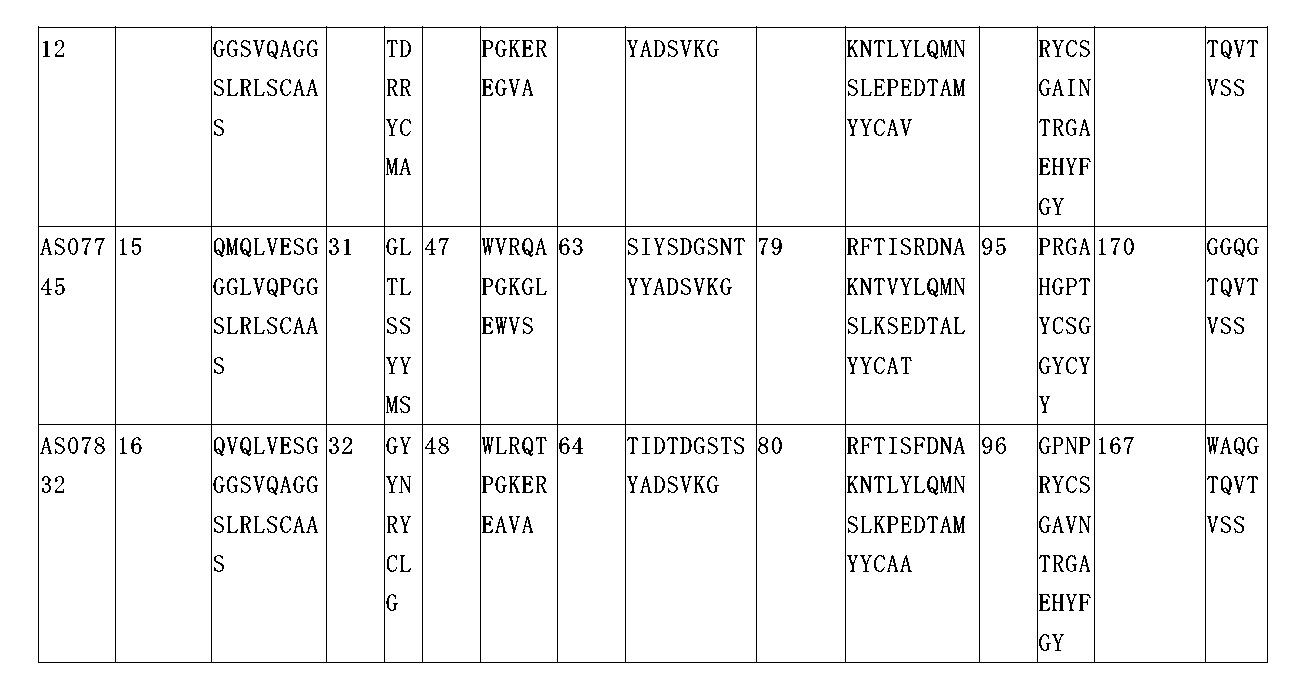
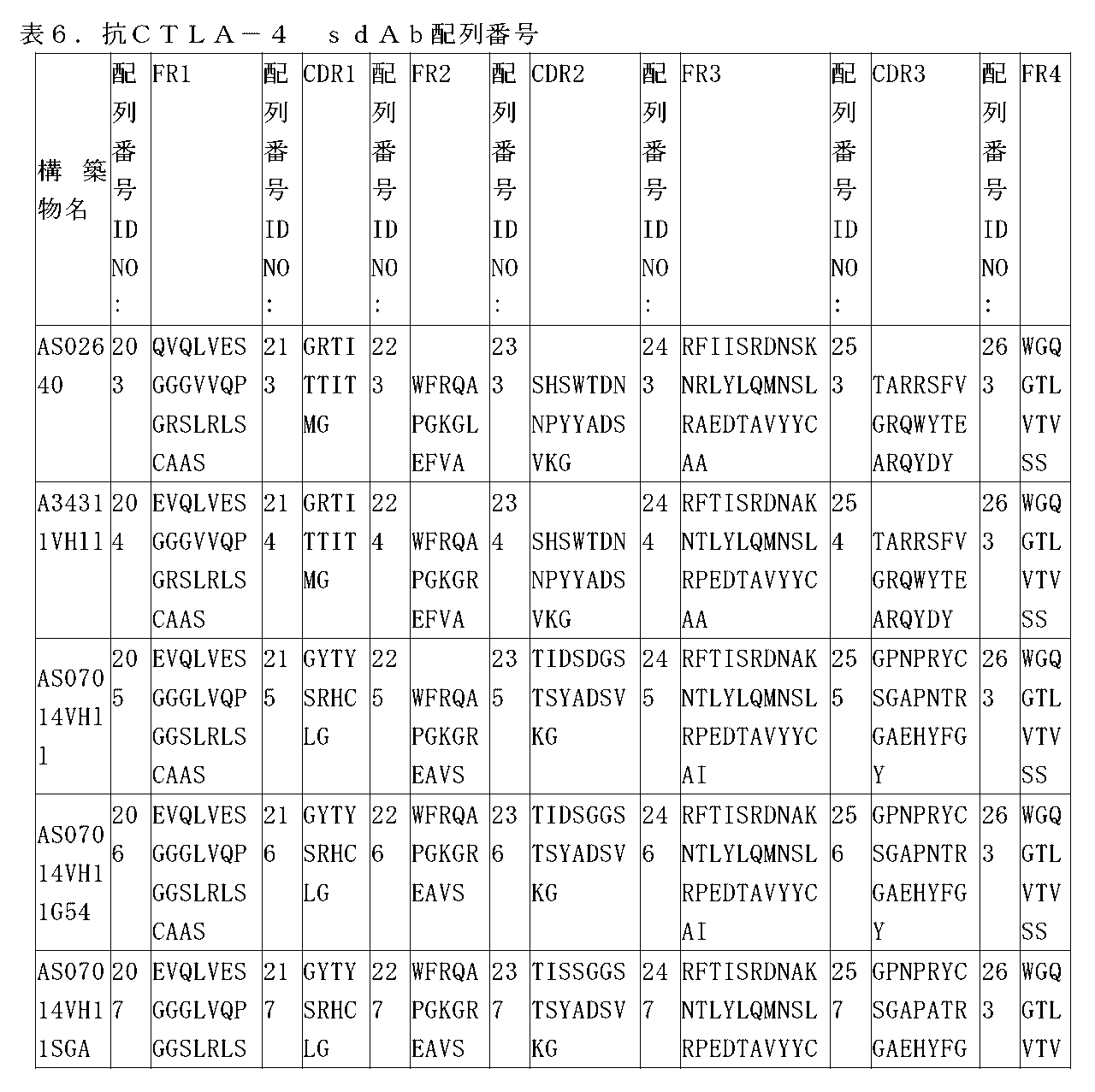


CDRは、種々のペアワイズ組み合わせで組み合わせて、多くの抗CTLA-4 sdAb部分を生成することができる。 The CDRs can be combined in a variety of pairwise combinations to generate many anti-CTLA-4 sdAb portions.
例えば、いくつかの実施形態では、配列番号17のアミノ酸配列を含むCDR1、または最大で約3つ(例えば、約1、2、または3のいずれか)のアミノ酸置換を含むその変異体;配列番号49のアミノ酸配列を含むCDR2、または最大で約3つ(例えば、約1、2、または3のいずれか)のアミノ酸置換を含むその変異体;及び配列番号81のアミノ酸配列を含むCDR3、または最大で約3つ(例えば、約1、2、または3のいずれか)のアミノ酸置換を含むその変異体を含む、抗CTLA-4 sdAb部分が提供される。いくつかの実施形態では、配列番号17のアミノ酸配列を含むCDR1;配列番号49のアミノ酸配列を含むCDR2;及び配列番号81のアミノ酸配列を含むCDR3;またはCDR領域において最大で約3つ(例えば、約1、2、または3のいずれか)のアミノ酸置換を含むその変異体を含む、抗CTLA-4 sdAb部分が提供される。いくつかの実施形態では、アミノ酸置換は、CDR1及び/またはCDR2内である。いくつかの実施形態では、配列番号17のアミノ酸配列を含むCDR1;配列番号49のアミノ酸配列を含むCDR2;及び配列番号81のアミノ酸配列を含むCDR3を含む、抗CTLA-4 sdAb部分が提供される。いくつかの実施形態では、抗CTLA-4 sdAb部分とCTLA-4の間の結合のKdは、約10-5M~約10-12M(例えば、約10-7M~約10-12M、または約10-8M~約10-12M)である。いくつかの実施形態では、抗CTLA-4 sdAb部分は、ラクダ、キメラ、ヒト、部分ヒト化、または完全ヒト化である。 For example, in some embodiments, anti-CTLA-4 sdAb portions are provided that comprise a CDR1 comprising the amino acid sequence of SEQ ID NO: 17, or a variant thereof comprising up to about three (e.g., about any of 1, 2, or 3) amino acid substitutions; a CDR2 comprising the amino acid sequence of SEQ ID NO: 49, or a variant thereof comprising up to about three (e.g., about any of 1, 2, or 3) amino acid substitutions; and a CDR3 comprising the amino acid sequence of SEQ ID NO: 81, or a variant thereof comprising up to about three (e.g., about any of 1, 2, or 3) amino acid substitutions. In some embodiments, anti-CTLA-4 sdAb portions are provided that comprise a CDR1 comprising the amino acid sequence of SEQ ID NO: 17; a CDR2 comprising the amino acid sequence of SEQ ID NO: 49; and a CDR3 comprising the amino acid sequence of SEQ ID NO: 81; or a variant thereof comprising up to about three (e.g., about any of 1, 2, or 3) amino acid substitutions in the CDR regions. In some embodiments, the amino acid substitutions are within CDR1 and/or CDR2. In some embodiments, an anti-CTLA-4 sdAb portion is provided that comprises a CDR1 comprising the amino acid sequence of SEQ ID NO: 17; a CDR2 comprising the amino acid sequence of SEQ ID NO: 49; and a CDR3 comprising the amino acid sequence of SEQ ID NO: 81. In some embodiments, the Kd of binding between the anti-CTLA-4 sdAb portion and CTLA-4 is from about 10 −5 M to about 10 −12 M (e.g., from about 10 −7 M to about 10 −12 M, or from about 10 −8 M to about 10 −12 M). In some embodiments, the anti-CTLA-4 sdAb portion is camelid, chimeric, human, partially humanized, or fully humanized.
いくつかの実施形態では、配列番号18のアミノ酸配列を含むCDR1、または最大で約3つ(例えば、約1、2、または3のいずれか)のアミノ酸置換を含むその変異体;配列番号50のアミノ酸配列を含むCDR2、または最大で約3つ(例えば、約1、2、または3のいずれか)のアミノ酸置換を含むその変異体;及び配列番号82のアミノ酸配列を含むCDR3、または最大で約3つ(例えば、約1、2、または3のいずれか)のアミノ酸置換を含むその変異体を含む、抗CTLA-4 sdAb部分が提供される。いくつかの実施形態では、配列番号18のアミノ酸配列を含むCDR1;配列番号50のアミノ酸配列を含むCDR2;及び配列番号82のアミノ酸配列を含むCDR3;またはCDR領域において最大で約3つ(例えば、約1、2、または3のいずれか)のアミノ酸置換を含むその変異体を含む、抗CTLA-4 sdAb部分が提供される。いくつかの実施形態では、アミノ酸置換は、CDR1及び/またはCDR2内である。いくつかの実施形態では、配列番号18のアミノ酸配列を含むCDR1;配列番号50のアミノ酸配列を含むCDR2;及び配列番号82のアミノ酸配列を含むCDR3を含む、抗CTLA-4 sdAb部分が提供される。いくつかの実施形態では、抗CTLA-4 sdAb部分とCTLA-4の間の結合のKdは、約10-5M~約10-12M(例えば、約10-7M~約10-12M、または約10-8M~約10-12M)である。いくつかの実施形態では、抗CTLA-4 sdAb部分は、ラクダ、キメラ、ヒト、部分ヒト化、または完全ヒト化である。 In some embodiments, anti-CTLA-4 sdAb portions are provided that comprise a CDR1 comprising the amino acid sequence of SEQ ID NO: 18, or a variant thereof comprising up to about three (e.g., about any of 1, 2, or 3) amino acid substitutions; a CDR2 comprising the amino acid sequence of SEQ ID NO: 50, or a variant thereof comprising up to about three (e.g., about any of 1, 2, or 3) amino acid substitutions; and a CDR3 comprising the amino acid sequence of SEQ ID NO: 82, or a variant thereof comprising up to about three (e.g., about any of 1, 2, or 3) amino acid substitutions. In some embodiments, anti-CTLA-4 sdAb portions are provided that comprise a CDR1 comprising the amino acid sequence of SEQ ID NO: 18; a CDR2 comprising the amino acid sequence of SEQ ID NO: 50; and a CDR3 comprising the amino acid sequence of SEQ ID NO: 82; or a variant thereof comprising up to about three (e.g., about any of 1, 2, or 3) amino acid substitutions in the CDR regions. In some embodiments, the amino acid substitutions are within CDR1 and/or CDR2. In some embodiments, an anti-CTLA-4 sdAb portion is provided that comprises a CDR1 comprising the amino acid sequence of SEQ ID NO: 18; a CDR2 comprising the amino acid sequence of SEQ ID NO: 50; and a CDR3 comprising the amino acid sequence of SEQ ID NO: 82. In some embodiments, the Kd of binding between the anti-CTLA-4 sdAb portion and CTLA-4 is from about 10 −5 M to about 10 −12 M (e.g., from about 10 −7 M to about 10 −12 M, or from about 10 −8 M to about 10 −12 M). In some embodiments, the anti-CTLA-4 sdAb portion is camelid, chimeric, human, partially humanized, or fully humanized.
いくつかの実施形態では、配列番号19のアミノ酸配列を含むCDR1、または最大で約3つ(例えば、約1、2、または3のいずれか)のアミノ酸置換を含むその変異体;配列番号51のアミノ酸配列を含むCDR2、または最大で約3つ(例えば、約1、2、または3のいずれか)のアミノ酸置換を含むその変異体;及び配列番号83のアミノ酸配列を含むCDR3、または最大で約3つ(例えば、約1、2、または3のいずれか)のアミノ酸置換を含むその変異体を含む、抗CTLA-4 sdAb部分が提供される。いくつかの実施形態では、配列番号19のアミノ酸配列を含むCDR1;配列番号51のアミノ酸配列を含むCDR2;及び配列番号83のアミノ酸配列を含むCDR3;またはCDR領域において最大で約3つ(例えば、約1、2、または3のいずれか)のアミノ酸置換を含むその変異体を含む、抗CTLA-4 sdAb部分が提供される。いくつかの実施形態では、アミノ酸置換は、CDR1及び/またはCDR2内である。いくつかの実施形態では、配列番号19のアミノ酸配列を含むCDR1;配列番号51のアミノ酸配列を含むCDR2;及び配列番号83のアミノ酸配列を含むCDR3を含む、抗CTLA-4 sdAb部分が提供される。いくつかの実施形態では、抗CTLA-4 sdAb部分とCTLA-4の間の結合のKdは、約10-5M~約10-12M(例えば、約10-7M~約10-12M、または約10-8M~約10-12M)である。いくつかの実施形態では、抗CTLA-4 sdAb部分は、ラクダ、キメラ、ヒト、部分ヒト化、または完全ヒト化である。 In some embodiments, anti-CTLA-4 sdAb portions are provided that comprise a CDR1 comprising the amino acid sequence of SEQ ID NO: 19, or a variant thereof comprising up to about three (e.g., about any of 1, 2, or 3) amino acid substitutions; a CDR2 comprising the amino acid sequence of SEQ ID NO: 51, or a variant thereof comprising up to about three (e.g., about any of 1, 2, or 3) amino acid substitutions; and a CDR3 comprising the amino acid sequence of SEQ ID NO: 83, or a variant thereof comprising up to about three (e.g., about any of 1, 2, or 3) amino acid substitutions. In some embodiments, anti-CTLA-4 sdAb portions are provided that comprise a CDR1 comprising the amino acid sequence of SEQ ID NO: 19; a CDR2 comprising the amino acid sequence of SEQ ID NO: 51; and a CDR3 comprising the amino acid sequence of SEQ ID NO: 83; or a variant thereof comprising up to about three (e.g., about any of 1, 2, or 3) amino acid substitutions in the CDR regions. In some embodiments, the amino acid substitutions are within CDR1 and/or CDR2. In some embodiments, an anti-CTLA-4 sdAb portion is provided that comprises a CDR1 comprising the amino acid sequence of SEQ ID NO: 19; a CDR2 comprising the amino acid sequence of SEQ ID NO: 51; and a CDR3 comprising the amino acid sequence of SEQ ID NO: 83. In some embodiments, the Kd of binding between the anti-CTLA-4 sdAb portion and CTLA-4 is from about 10 −5 M to about 10 −12 M (e.g., from about 10 −7 M to about 10 −12 M, or from about 10 −8 M to about 10 −12 M). In some embodiments, the anti-CTLA-4 sdAb portion is camelid, chimeric, human, partially humanized, or fully humanized.
いくつかの実施形態では、配列番号20のアミノ酸配列を含むCDR1、または最大で約3つ(例えば、約1、2、または3のいずれか)のアミノ酸置換を含むその変異体;配列番号52のアミノ酸配列を含むCDR2、または最大で約3つ(例えば、約1、2、または3のいずれか)のアミノ酸置換を含むその変異体;及び配列番号84のアミノ酸配列を含むCDR3、または最大で約3つ(例えば、約1、2、または3のいずれか)のアミノ酸置換を含むその変異体を含む、抗CTLA-4 sdAb部分が提供される。いくつかの実施形態では、配列番号20のアミノ酸配列を含むCDR1;配列番号52のアミノ酸配列を含むCDR2;及び配列番号84のアミノ酸配列を含むCDR3;またはCDR領域において最大で約3つ(例えば、約1、2、または3のいずれか)のアミノ酸置換を含むその変異体を含む、抗CTLA-4 sdAb部分が提供される。いくつかの実施形態では、アミノ酸置換は、CDR1及び/またはCDR2内である。いくつかの実施形態では、配列番号20のアミノ酸配列を含むCDR1;配列番号52のアミノ酸配列を含むCDR2;及び配列番号84のアミノ酸配列を含むCDR3を含む、抗CTLA-4 sdAb部分が提供される。いくつかの実施形態では、抗CTLA-4 sdAb部分とCTLA-4の間の結合のKdは、約10-5M~約10-12M(例えば、約10-7M~約10-12M、または約10-8M~約10-12M)である。いくつかの実施形態では、抗CTLA-4 sdAb部分は、ラクダ、キメラ、ヒト、部分ヒト化、または完全ヒト化である。 In some embodiments, anti-CTLA-4 sdAb portions are provided that comprise a CDR1 comprising the amino acid sequence of SEQ ID NO:20, or a variant thereof comprising up to about three (e.g., about any of 1, 2, or 3) amino acid substitutions; a CDR2 comprising the amino acid sequence of SEQ ID NO:52, or a variant thereof comprising up to about three (e.g., about any of 1, 2, or 3) amino acid substitutions; and a CDR3 comprising the amino acid sequence of SEQ ID NO:84, or a variant thereof comprising up to about three (e.g., about any of 1, 2, or 3) amino acid substitutions. In some embodiments, anti-CTLA-4 sdAb portions are provided that comprise a CDR1 comprising the amino acid sequence of SEQ ID NO:20; a CDR2 comprising the amino acid sequence of SEQ ID NO:52; and a CDR3 comprising the amino acid sequence of SEQ ID NO:84; or a variant thereof comprising up to about three (e.g., about any of 1, 2, or 3) amino acid substitutions in the CDR regions. In some embodiments, the amino acid substitutions are within CDR1 and/or CDR2. In some embodiments, an anti-CTLA-4 sdAb portion is provided that comprises a CDR1 comprising the amino acid sequence of SEQ ID NO: 20; a CDR2 comprising the amino acid sequence of SEQ ID NO: 52; and a CDR3 comprising the amino acid sequence of SEQ ID NO: 84. In some embodiments, the Kd of binding between the anti-CTLA-4 sdAb portion and CTLA-4 is from about 10 −5 M to about 10 −12 M (e.g., from about 10 −7 M to about 10 −12 M, or from about 10 −8 M to about 10 −12 M). In some embodiments, the anti-CTLA-4 sdAb portion is camelid, chimeric, human, partially humanized, or fully humanized.
いくつかの実施形態では、配列番号21のアミノ酸配列を含むCDR1、または最大で約3つ(例えば、約1、2、または3のいずれか)のアミノ酸置換を含むその変異体;配列番号53のアミノ酸配列を含むCDR2、または最大で約3つ(例えば、約1、2、または3のいずれか)のアミノ酸置換を含むその変異体;及び配列番号85のアミノ酸配列を含むCDR3、または最大で約3つ(例えば、約1、2、または3のいずれか)のアミノ酸置換を含むその変異体を含む、抗CTLA-4 sdAb部分が提供される。いくつかの実施形態では、配列番号21のアミノ酸配列を含むCDR1;配列番号53のアミノ酸配列を含むCDR2;及び配列番号85のアミノ酸配列を含むCDR3;またはCDR領域において最大で約3つ(例えば、約1、2、または3のいずれか)のアミノ酸置換を含むその変異体を含む、抗CTLA-4 sdAb部分が提供される。いくつかの実施形態では、アミノ酸置換は、CDR1及び/またはCDR2内である。いくつかの実施形態では、配列番号21のアミノ酸配列を含むCDR1;配列番号53のアミノ酸配列を含むCDR2;及び配列番号85のアミノ酸配列を含むCDR3を含む、抗CTLA-4 sdAb部分が提供される。いくつかの実施形態では、抗CTLA-4 sdAb部分とCTLA-4の間の結合のKdは、約10-5M~約10-12M(例えば、約10-7M~約10-12M、または約10-8M~約10-12M)である。いくつかの実施形態では、抗CTLA-4 sdAb部分は、ラクダ、キメラ、ヒト、部分ヒト化、または完全ヒト化である。 In some embodiments, anti-CTLA-4 sdAb moieties are provided that comprise a CDR1 comprising the amino acid sequence of SEQ ID NO:21, or a variant thereof comprising up to about three (e.g., about any of 1, 2, or 3) amino acid substitutions; a CDR2 comprising the amino acid sequence of SEQ ID NO:53, or a variant thereof comprising up to about three (e.g., about any of 1, 2, or 3) amino acid substitutions; and a CDR3 comprising the amino acid sequence of SEQ ID NO:85, or a variant thereof comprising up to about three (e.g., about any of 1, 2, or 3) amino acid substitutions. In some embodiments, anti-CTLA-4 sdAb moieties are provided that comprise a CDR1 comprising the amino acid sequence of SEQ ID NO:21; a CDR2 comprising the amino acid sequence of SEQ ID NO:53; and a CDR3 comprising the amino acid sequence of SEQ ID NO:85; or a variant thereof comprising up to about three (e.g., about any of 1, 2, or 3) amino acid substitutions in the CDR regions. In some embodiments, the amino acid substitutions are within CDR1 and/or CDR2. In some embodiments, an anti-CTLA-4 sdAb portion is provided that comprises a CDR1 comprising the amino acid sequence of SEQ ID NO: 21; a CDR2 comprising the amino acid sequence of SEQ ID NO: 53; and a CDR3 comprising the amino acid sequence of SEQ ID NO: 85. In some embodiments, the Kd of binding between the anti-CTLA-4 sdAb portion and CTLA-4 is from about 10 −5 M to about 10 −12 M (e.g., from about 10 −7 M to about 10 −12 M, or from about 10 −8 M to about 10 −12 M). In some embodiments, the anti-CTLA-4 sdAb portion is camelid, chimeric, human, partially humanized, or fully humanized.
いくつかの実施形態では、配列番号22のアミノ酸配列を含むCDR1、または最大で約3つ(例えば、約1、2、または3のいずれか)のアミノ酸置換を含むその変異体;配列番号54のアミノ酸配列を含むCDR2、または最大で約3つ(例えば、約1、2、または3のいずれか)のアミノ酸置換を含むその変異体;及び配列番号86のアミノ酸配列を含むCDR3、または最大で約3つ(例えば、約1、2、または3のいずれか)のアミノ酸置換を含むその変異体を含む、抗CTLA-4 sdAb部分が提供される。いくつかの実施形態では、配列番号22のアミノ酸配列を含むCDR1;配列番号54のアミノ酸配列を含むCDR2;及び配列番号86のアミノ酸配列を含むCDR3;またはCDR領域において最大で約3つ(例えば、約1、2、または3のいずれか)のアミノ酸置換を含むその変異体を含む、抗CTLA-4 sdAb部分が提供される。いくつかの実施形態では、アミノ酸置換は、CDR1及び/またはCDR2内である。いくつかの実施形態では、配列番号22のアミノ酸配列を含むCDR1;配列番号54のアミノ酸配列を含むCDR2;及び配列番号86のアミノ酸配列を含むCDR3を含む、抗CTLA-4 sdAb部分が提供される。いくつかの実施形態では、抗CTLA-4 sdAb部分とCTLA-4の間の結合のKdは、約10-5M~約10-12M(例えば、約10-7M~約10-12M、または約10-8M~約10-12M)である。いくつかの実施形態では、抗CTLA-4 sdAb部分は、ラクダ、キメラ、ヒト、部分ヒト化、または完全ヒト化である。 In some embodiments, anti-CTLA-4 sdAb portions are provided that comprise a CDR1 comprising the amino acid sequence of SEQ ID NO:22, or a variant thereof comprising up to about three (e.g., about any of 1, 2, or 3) amino acid substitutions; a CDR2 comprising the amino acid sequence of SEQ ID NO:54, or a variant thereof comprising up to about three (e.g., about any of 1, 2, or 3) amino acid substitutions; and a CDR3 comprising the amino acid sequence of SEQ ID NO:86, or a variant thereof comprising up to about three (e.g., about any of 1, 2, or 3) amino acid substitutions. In some embodiments, anti-CTLA-4 sdAb portions are provided that comprise a CDR1 comprising the amino acid sequence of SEQ ID NO:22; a CDR2 comprising the amino acid sequence of SEQ ID NO:54; and a CDR3 comprising the amino acid sequence of SEQ ID NO:86; or a variant thereof comprising up to about three (e.g., about any of 1, 2, or 3) amino acid substitutions in the CDR regions. In some embodiments, the amino acid substitutions are within CDR1 and/or CDR2. In some embodiments, an anti-CTLA-4 sdAb portion is provided that comprises a CDR1 comprising the amino acid sequence of SEQ ID NO: 22; a CDR2 comprising the amino acid sequence of SEQ ID NO: 54; and a CDR3 comprising the amino acid sequence of SEQ ID NO: 86. In some embodiments, the Kd of binding between the anti-CTLA-4 sdAb portion and CTLA-4 is from about 10 −5 M to about 10 −12 M (e.g., from about 10 −7 M to about 10 −12 M, or from about 10 −8 M to about 10 −12 M). In some embodiments, the anti-CTLA-4 sdAb portion is camelid, chimeric, human, partially humanized, or fully humanized.
いくつかの実施形態では、配列番号23のアミノ酸配列を含むCDR1、または最大で約3つ(例えば、約1、2、または3のいずれか)のアミノ酸置換を含むその変異体;配列番号55のアミノ酸配列を含むCDR2、または最大で約3つ(例えば、約1、2、または3のいずれか)のアミノ酸置換を含むその変異体;及び配列番号87のアミノ酸配列を含むCDR3、または最大で約3つ(例えば、約1、2、または3のいずれか)のアミノ酸置換を含むその変異体を含む、抗CTLA-4 sdAb部分が提供される。いくつかの実施形態では、配列番号23のアミノ酸配列を含むCDR1;配列番号55のアミノ酸配列を含むCDR2;及び配列番号87のアミノ酸配列を含むCDR3;またはCDR領域において最大で約3つ(例えば、約1、2、または3のいずれか)のアミノ酸置換を含むその変異体を含む、抗CTLA-4 sdAb部分が提供される。いくつかの実施形態では、アミノ酸置換は、CDR1及び/またはCDR2内である。いくつかの実施形態では、配列番号23のアミノ酸配列を含むCDR1;配列番号55のアミノ酸配列を含むCDR2;及び配列番号87のアミノ酸配列を含むCDR3を含む、抗CTLA-4 sdAb部分が提供される。いくつかの実施形態では、抗CTLA-4 sdAb部分とCTLA-4の間の結合のKdは、約10-5M~約10-12M(例えば、約10-7M~約10-12M、または約10-8M~約10-12M)である。いくつかの実施形態では、抗CTLA-4 sdAb部分は、ラクダ、キメラ、ヒト、部分ヒト化、または完全ヒト化である。 In some embodiments, anti-CTLA-4 sdAb portions are provided that comprise a CDR1 comprising the amino acid sequence of SEQ ID NO:23, or a variant thereof comprising up to about three (e.g., about any of 1, 2, or 3) amino acid substitutions; a CDR2 comprising the amino acid sequence of SEQ ID NO:55, or a variant thereof comprising up to about three (e.g., about any of 1, 2, or 3) amino acid substitutions; and a CDR3 comprising the amino acid sequence of SEQ ID NO:87, or a variant thereof comprising up to about three (e.g., about any of 1, 2, or 3) amino acid substitutions. In some embodiments, anti-CTLA-4 sdAb portions are provided that comprise a CDR1 comprising the amino acid sequence of SEQ ID NO:23; a CDR2 comprising the amino acid sequence of SEQ ID NO:55; and a CDR3 comprising the amino acid sequence of SEQ ID NO:87; or a variant thereof comprising up to about three (e.g., about any of 1, 2, or 3) amino acid substitutions in the CDR regions. In some embodiments, the amino acid substitutions are within CDR1 and/or CDR2. In some embodiments, an anti-CTLA-4 sdAb portion is provided that comprises a CDR1 comprising the amino acid sequence of SEQ ID NO: 23; a CDR2 comprising the amino acid sequence of SEQ ID NO: 55; and a CDR3 comprising the amino acid sequence of SEQ ID NO: 87. In some embodiments, the Kd of binding between the anti-CTLA-4 sdAb portion and CTLA-4 is from about 10 −5 M to about 10 −12 M (e.g., from about 10 −7 M to about 10 −12 M, or from about 10 −8 M to about 10 −12 M). In some embodiments, the anti-CTLA-4 sdAb portion is camelid, chimeric, human, partially humanized, or fully humanized.
いくつかの実施形態では、配列番号24のアミノ酸配列を含むCDR1、または最大で約3つ(例えば、約1、2、または3のいずれか)のアミノ酸置換を含むその変異体;配列番号56のアミノ酸配列を含むCDR2、または最大で約3つ(例えば、約1、2、または3のいずれか)のアミノ酸置換を含むその変異体;及び配列番号88のアミノ酸配列を含むCDR3、または最大で約3つ(例えば、約1、2、または3のいずれか)のアミノ酸置換を含むその変異体を含む、抗CTLA-4 sdAb部分が提供される。いくつかの実施形態では、配列番号24のアミノ酸配列を含むCDR1;配列番号56のアミノ酸配列を含むCDR2;及び配列番号88のアミノ酸配列を含むCDR3;またはCDR領域において最大で約3つ(例えば、約1、2、または3のいずれか)のアミノ酸置換を含むその変異体を含む、抗CTLA-4 sdAb部分が提供される。いくつかの実施形態では、アミノ酸置換は、CDR1及び/またはCDR2内である。いくつかの実施形態では、配列番号24のアミノ酸配列を含むCDR1;配列番号56のアミノ酸配列を含むCDR2;及び配列番号88のアミノ酸配列を含むCDR3を含む、抗CTLA-4 sdAb部分が提供される。いくつかの実施形態では、抗CTLA-4 sdAb部分とCTLA-4の間の結合のKdは、約10-5M~約10-12M(例えば、約10-7M~約10-12M、または約10-8M~約10-12M)である。いくつかの実施形態では、抗CTLA-4 sdAb部分は、ラクダ、キメラ、ヒト、部分ヒト化、または完全ヒト化である。 In some embodiments, anti-CTLA-4 sdAb moieties are provided that comprise a CDR1 comprising the amino acid sequence of SEQ ID NO:24, or a variant thereof comprising up to about three (e.g., about any of 1, 2, or 3) amino acid substitutions; a CDR2 comprising the amino acid sequence of SEQ ID NO:56, or a variant thereof comprising up to about three (e.g., about any of 1, 2, or 3) amino acid substitutions; and a CDR3 comprising the amino acid sequence of SEQ ID NO:88, or a variant thereof comprising up to about three (e.g., about any of 1, 2, or 3) amino acid substitutions. In some embodiments, anti-CTLA-4 sdAb moieties are provided that comprise a CDR1 comprising the amino acid sequence of SEQ ID NO:24; a CDR2 comprising the amino acid sequence of SEQ ID NO:56; and a CDR3 comprising the amino acid sequence of SEQ ID NO:88; or a variant thereof comprising up to about three (e.g., about any of 1, 2, or 3) amino acid substitutions in the CDR regions. In some embodiments, the amino acid substitutions are within CDR1 and/or CDR2. In some embodiments, an anti-CTLA-4 sdAb portion is provided that comprises a CDR1 comprising the amino acid sequence of SEQ ID NO: 24; a CDR2 comprising the amino acid sequence of SEQ ID NO: 56; and a CDR3 comprising the amino acid sequence of SEQ ID NO: 88. In some embodiments, the Kd of binding between the anti-CTLA-4 sdAb portion and CTLA-4 is from about 10 −5 M to about 10 −12 M (e.g., from about 10 −7 M to about 10 −12 M, or from about 10 −8 M to about 10 −12 M). In some embodiments, the anti-CTLA-4 sdAb portion is camelid, chimeric, human, partially humanized, or fully humanized.
いくつかの実施形態では、配列番号25のアミノ酸配列を含むCDR1、または最大で約3つ(例えば、約1、2、または3のいずれか)のアミノ酸置換を含むその変異体;配列番号57のアミノ酸配列を含むCDR2、または最大で約3つ(例えば、約1、2、または3のいずれか)のアミノ酸置換を含むその変異体;及び配列番号89のアミノ酸配列を含むCDR3、または最大で約3つ(例えば、約1、2、または3のいずれか)のアミノ酸置換を含むその変異体を含む、抗CTLA-4 sdAb部分が提供される。いくつかの実施形態では、配列番号25のアミノ酸配列を含むCDR1;配列番号57のアミノ酸配列を含むCDR2;及び配列番号89のアミノ酸配列を含むCDR3;またはCDR領域において最大で約3つ(例えば、約1、2、または3のいずれか)のアミノ酸置換を含むその変異体を含む、抗CTLA-4 sdAb部分が提供される。いくつかの実施形態では、アミノ酸置換は、CDR1及び/またはCDR2内である。いくつかの実施形態では、配列番号25のアミノ酸配列を含むCDR1;配列番号57のアミノ酸配列を含むCDR2;及び配列番号89のアミノ酸配列を含むCDR3を含む、抗CTLA-4 sdAb部分が提供される。いくつかの実施形態では、抗CTLA-4 sdAb部分とCTLA-4の間の結合のKdは、約10-5M~約10-12M(例えば、約10-7M~約10-12M、または約10-8M~約10-12M)である。いくつかの実施形態では、抗CTLA-4 sdAb部分は、ラクダ、キメラ、ヒト、部分ヒト化、または完全ヒト化である。 In some embodiments, anti-CTLA-4 sdAb moieties are provided that comprise a CDR1 comprising the amino acid sequence of SEQ ID NO:25, or a variant thereof comprising up to about three (e.g., about any of 1, 2, or 3) amino acid substitutions; a CDR2 comprising the amino acid sequence of SEQ ID NO:57, or a variant thereof comprising up to about three (e.g., about any of 1, 2, or 3) amino acid substitutions; and a CDR3 comprising the amino acid sequence of SEQ ID NO:89, or a variant thereof comprising up to about three (e.g., about any of 1, 2, or 3) amino acid substitutions. In some embodiments, anti-CTLA-4 sdAb moieties are provided that comprise a CDR1 comprising the amino acid sequence of SEQ ID NO:25; a CDR2 comprising the amino acid sequence of SEQ ID NO:57; and a CDR3 comprising the amino acid sequence of SEQ ID NO:89; or a variant thereof comprising up to about three (e.g., about any of 1, 2, or 3) amino acid substitutions in the CDR regions. In some embodiments, the amino acid substitutions are within CDR1 and/or CDR2. In some embodiments, an anti-CTLA-4 sdAb portion is provided that comprises a CDR1 comprising the amino acid sequence of SEQ ID NO: 25; a CDR2 comprising the amino acid sequence of SEQ ID NO: 57; and a CDR3 comprising the amino acid sequence of SEQ ID NO: 89. In some embodiments, the Kd of binding between the anti-CTLA-4 sdAb portion and CTLA-4 is from about 10 −5 M to about 10 −12 M (e.g., from about 10 −7 M to about 10 −12 M, or from about 10 −8 M to about 10 −12 M). In some embodiments, the anti-CTLA-4 sdAb portion is camelid, chimeric, human, partially humanized, or fully humanized.
いくつかの実施形態では、配列番号26のアミノ酸配列を含むCDR1、または最大で約3つ(例えば、約1、2、または3のいずれか)のアミノ酸置換を含むその変異体;配列番号58のアミノ酸配列を含むCDR2、または最大で約3つ(例えば、約1、2、または3のいずれか)のアミノ酸置換を含むその変異体;及び配列番号90のアミノ酸配列を含むCDR3、または最大で約3つ(例えば、約1、2、または3のいずれか)のアミノ酸置換を含むその変異体を含む、抗CTLA-4 sdAb部分が提供される。いくつかの実施形態では、配列番号26のアミノ酸配列を含むCDR1;配列番号58のアミノ酸配列を含むCDR2;及び配列番号90のアミノ酸配列を含むCDR3;またはCDR領域において最大で約3つ(例えば、約1、2、または3のいずれか)のアミノ酸置換を含むその変異体を含む、抗CTLA-4 sdAb部分が提供される。いくつかの実施形態では、アミノ酸置換は、CDR1及び/またはCDR2内である。いくつかの実施形態では、配列番号26のアミノ酸配列を含むCDR1;配列番号58のアミノ酸配列を含むCDR2;及び配列番号90のアミノ酸配列を含むCDR3を含む、抗CTLA-4 sdAb部分が提供される。いくつかの実施形態では、抗CTLA-4 sdAb部分とCTLA-4の間の結合のKdは、約10-5M~約10-12M(例えば、約10-7M~約10-12M、または約10-8M~約10-12M)である。いくつかの実施形態では、抗CTLA-4 sdAb部分は、ラクダ、キメラ、ヒト、部分ヒト化、または完全ヒト化である。 In some embodiments, anti-CTLA-4 sdAb portions are provided that comprise a CDR1 comprising the amino acid sequence of SEQ ID NO:26, or a variant thereof comprising up to about three (e.g., about any of 1, 2, or 3) amino acid substitutions; a CDR2 comprising the amino acid sequence of SEQ ID NO:58, or a variant thereof comprising up to about three (e.g., about any of 1, 2, or 3) amino acid substitutions; and a CDR3 comprising the amino acid sequence of SEQ ID NO:90, or a variant thereof comprising up to about three (e.g., about any of 1, 2, or 3) amino acid substitutions. In some embodiments, anti-CTLA-4 sdAb portions are provided that comprise a CDR1 comprising the amino acid sequence of SEQ ID NO:26; a CDR2 comprising the amino acid sequence of SEQ ID NO:58; and a CDR3 comprising the amino acid sequence of SEQ ID NO:90; or a variant thereof comprising up to about three (e.g., about any of 1, 2, or 3) amino acid substitutions in the CDR regions. In some embodiments, the amino acid substitutions are within CDR1 and/or CDR2. In some embodiments, an anti-CTLA-4 sdAb portion is provided that comprises a CDR1 comprising the amino acid sequence of SEQ ID NO: 26; a CDR2 comprising the amino acid sequence of SEQ ID NO: 58; and a CDR3 comprising the amino acid sequence of SEQ ID NO: 90. In some embodiments, the Kd of binding between the anti-CTLA-4 sdAb portion and CTLA-4 is from about 10 −5 M to about 10 −12 M (e.g., from about 10 −7 M to about 10 −12 M, or from about 10 −8 M to about 10 −12 M). In some embodiments, the anti-CTLA-4 sdAb portion is camelid, chimeric, human, partially humanized, or fully humanized.
いくつかの実施形態では、配列番号27のアミノ酸配列を含むCDR1、または最大で約3つ(例えば、約1、2、または3のいずれか)のアミノ酸置換を含むその変異体;配列番号59のアミノ酸配列を含むCDR2、または最大で約3つ(例えば、約1、2、または3のいずれか)のアミノ酸置換を含むその変異体;及び配列番号91のアミノ酸配列を含むCDR3、または最大で約3つ(例えば、約1、2、または3のいずれか)のアミノ酸置換を含むその変異体を含む、抗CTLA-4 sdAb部分が提供される。いくつかの実施形態では、配列番号27のアミノ酸配列を含むCDR1;配列番号59のアミノ酸配列を含むCDR2;及び配列番号91のアミノ酸配列を含むCDR3;またはCDR領域において最大で約3つ(例えば、約1、2、または3のいずれか)のアミノ酸置換を含むその変異体を含む、抗CTLA-4 sdAb部分が提供される。いくつかの実施形態では、アミノ酸置換は、CDR1及び/またはCDR2内である。いくつかの実施形態では、配列番号27のアミノ酸配列を含むCDR1;配列番号59のアミノ酸配列を含むCDR2;及び配列番号91のアミノ酸配列を含むCDR3を含む、抗CTLA-4 sdAb部分が提供される。いくつかの実施形態では、抗CTLA-4 sdAb部分とCTLA-4の間の結合のKdは、約10-5M~約10-12M(例えば、約10-7M~約10-12M、または約10-8M~約10-12M)である。いくつかの実施形態では、抗CTLA-4 sdAb部分は、ラクダ、キメラ、ヒト、部分ヒト化、または完全ヒト化である。 In some embodiments, anti-CTLA-4 sdAb moieties are provided that comprise a CDR1 comprising the amino acid sequence of SEQ ID NO:27, or a variant thereof comprising up to about three (e.g., about any of 1, 2, or 3) amino acid substitutions; a CDR2 comprising the amino acid sequence of SEQ ID NO:59, or a variant thereof comprising up to about three (e.g., about any of 1, 2, or 3) amino acid substitutions; and a CDR3 comprising the amino acid sequence of SEQ ID NO:91, or a variant thereof comprising up to about three (e.g., about any of 1, 2, or 3) amino acid substitutions. In some embodiments, anti-CTLA-4 sdAb moieties are provided that comprise a CDR1 comprising the amino acid sequence of SEQ ID NO:27; a CDR2 comprising the amino acid sequence of SEQ ID NO:59; and a CDR3 comprising the amino acid sequence of SEQ ID NO:91; or a variant thereof comprising up to about three (e.g., about any of 1, 2, or 3) amino acid substitutions in the CDR regions. In some embodiments, the amino acid substitutions are within CDR1 and/or CDR2. In some embodiments, an anti-CTLA-4 sdAb portion is provided that comprises a CDR1 comprising the amino acid sequence of SEQ ID NO: 27; a CDR2 comprising the amino acid sequence of SEQ ID NO: 59; and a CDR3 comprising the amino acid sequence of SEQ ID NO: 91. In some embodiments, the Kd of binding between the anti-CTLA-4 sdAb portion and CTLA-4 is from about 10 −5 M to about 10 −12 M (e.g., from about 10 −7 M to about 10 −12 M, or from about 10 −8 M to about 10 −12 M). In some embodiments, the anti-CTLA-4 sdAb portion is camelid, chimeric, human, partially humanized, or fully humanized.
いくつかの実施形態では、配列番号28のアミノ酸配列を含むCDR1、または最大で約3つ(例えば、約1、2、または3のいずれか)のアミノ酸置換を含むその変異体;配列番号60のアミノ酸配列を含むCDR2、または最大で約3つ(例えば、約1、2、または3のいずれか)のアミノ酸置換を含むその変異体;及び配列番号92のアミノ酸配列を含むCDR3、または最大で約3つ(例えば、約1、2、または3のいずれか)のアミノ酸置換を含むその変異体を含む、抗CTLA-4 sdAb部分が提供される。いくつかの実施形態では、配列番号28のアミノ酸配列を含むCDR1;配列番号60のアミノ酸配列を含むCDR2;及び配列番号92のアミノ酸配列を含むCDR3;またはCDR領域において最大で約3つ(例えば、約1、2、または3のいずれか)のアミノ酸置換を含むその変異体を含む、抗CTLA-4 sdAb部分が提供される。いくつかの実施形態では、アミノ酸置換は、CDR1及び/またはCDR2内である。いくつかの実施形態では、配列番号28のアミノ酸配列を含むCDR1;配列番号60のアミノ酸配列を含むCDR2;及び配列番号92のアミノ酸配列を含むCDR3を含む、抗CTLA-4 sdAb部分が提供される。いくつかの実施形態では、抗CTLA-4 sdAb部分とCTLA-4の間の結合のKdは、約10-5M~約10-12M(例えば、約10-7M~約10-12M、または約10-8M~約10-12M)である。いくつかの実施形態では、抗CTLA-4 sdAb部分は、ラクダ、キメラ、ヒト、部分ヒト化、または完全ヒト化である。 In some embodiments, anti-CTLA-4 sdAb portions are provided that comprise a CDR1 comprising the amino acid sequence of SEQ ID NO:28, or a variant thereof comprising up to about three (e.g., about any of 1, 2, or 3) amino acid substitutions; a CDR2 comprising the amino acid sequence of SEQ ID NO:60, or a variant thereof comprising up to about three (e.g., about any of 1, 2, or 3) amino acid substitutions; and a CDR3 comprising the amino acid sequence of SEQ ID NO:92, or a variant thereof comprising up to about three (e.g., about any of 1, 2, or 3) amino acid substitutions. In some embodiments, anti-CTLA-4 sdAb portions are provided that comprise a CDR1 comprising the amino acid sequence of SEQ ID NO:28; a CDR2 comprising the amino acid sequence of SEQ ID NO:60; and a CDR3 comprising the amino acid sequence of SEQ ID NO:92; or a variant thereof comprising up to about three (e.g., about any of 1, 2, or 3) amino acid substitutions in the CDR regions. In some embodiments, the amino acid substitutions are within CDR1 and/or CDR2. In some embodiments, an anti-CTLA-4 sdAb portion is provided that comprises a CDR1 comprising the amino acid sequence of SEQ ID NO: 28; a CDR2 comprising the amino acid sequence of SEQ ID NO: 60; and a CDR3 comprising the amino acid sequence of SEQ ID NO: 92. In some embodiments, the K d of binding between the anti-CTLA-4 sdAb portion and CTLA-4 is from about 10 −5 M to about 10 −12 M (e.g., from about 10 −7 M to about 10 −12 M, or from about 10 −8 M to about 10 −12 M). In some embodiments, the anti-CTLA-4 sdAb portion is camelid, chimeric, human, partially humanized, or fully humanized.
いくつかの実施形態では、配列番号29のアミノ酸配列を含むCDR1、または最大で約3つ(例えば、約1、2、または3のいずれか)のアミノ酸置換を含むその変異体;配列番号61のアミノ酸配列を含むCDR2、または最大で約3つ(例えば、約1、2、または3のいずれか)のアミノ酸置換を含むその変異体;及び配列番号93のアミノ酸配列を含むCDR3、または最大で約3つ(例えば、約1、2、または3のいずれか)のアミノ酸置換を含むその変異体を含む、抗CTLA-4 sdAb部分が提供される。いくつかの実施形態では、配列番号29のアミノ酸配列を含むCDR1;配列番号61のアミノ酸配列を含むCDR2;及び配列番号93のアミノ酸配列を含むCDR3;またはCDR領域において最大で約3つ(例えば、約1、2、または3のいずれか)のアミノ酸置換を含むその変異体を含む、抗CTLA-4 sdAb部分が提供される。いくつかの実施形態では、アミノ酸置換は、CDR1及び/またはCDR2内である。いくつかの実施形態では、配列番号29のアミノ酸配列を含むCDR1;配列番号61のアミノ酸配列を含むCDR2;及び配列番号93のアミノ酸配列を含むCDR3を含む、抗CTLA-4 sdAb部分が提供される。いくつかの実施形態では、抗CTLA-4 sdAb部分とCTLA-4の間の結合のKdは、約10-5M~約10-12M(例えば、約10-7M~約10-12M、または約10-8M~約10-12M)である。いくつかの実施形態では、抗CTLA-4 sdAb部分は、ラクダ、キメラ、ヒト、部分ヒト化、または完全ヒト化である。 In some embodiments, anti-CTLA-4 sdAb moieties are provided that comprise a CDR1 comprising the amino acid sequence of SEQ ID NO:29, or a variant thereof comprising up to about three (e.g., about any of 1, 2, or 3) amino acid substitutions; a CDR2 comprising the amino acid sequence of SEQ ID NO:61, or a variant thereof comprising up to about three (e.g., about any of 1, 2, or 3) amino acid substitutions; and a CDR3 comprising the amino acid sequence of SEQ ID NO:93, or a variant thereof comprising up to about three (e.g., about any of 1, 2, or 3) amino acid substitutions. In some embodiments, anti-CTLA-4 sdAb moieties are provided that comprise a CDR1 comprising the amino acid sequence of SEQ ID NO:29; a CDR2 comprising the amino acid sequence of SEQ ID NO:61; and a CDR3 comprising the amino acid sequence of SEQ ID NO:93; or a variant thereof comprising up to about three (e.g., about any of 1, 2, or 3) amino acid substitutions in the CDR regions. In some embodiments, the amino acid substitutions are within CDR1 and/or CDR2. In some embodiments, an anti-CTLA-4 sdAb portion is provided that comprises a CDR1 comprising the amino acid sequence of SEQ ID NO: 29; a CDR2 comprising the amino acid sequence of SEQ ID NO: 61; and a CDR3 comprising the amino acid sequence of SEQ ID NO: 93. In some embodiments, the Kd of binding between the anti-CTLA-4 sdAb portion and CTLA-4 is from about 10 −5 M to about 10 −12 M (e.g., from about 10 −7 M to about 10 −12 M, or from about 10 −8 M to about 10 −12 M). In some embodiments, the anti-CTLA-4 sdAb portion is camelid, chimeric, human, partially humanized, or fully humanized.
いくつかの実施形態では、配列番号30のアミノ酸配列を含むCDR1、または最大で約3つ(例えば、約1、2、または3のいずれか)のアミノ酸置換を含むその変異体;配列番号62のアミノ酸配列を含むCDR2、または最大で約3つ(例えば、約1、2、または3のいずれか)のアミノ酸置換を含むその変異体;及び配列番号94のアミノ酸配列を含むCDR3、または最大で約3つ(例えば、約1、2、または3のいずれか)のアミノ酸置換を含むその変異体を含む、抗CTLA-4 sdAb部分が提供される。いくつかの実施形態では、配列番号30のアミノ酸配列を含むCDR1;配列番号62のアミノ酸配列を含むCDR2;及び配列番号94のアミノ酸配列を含むCDR3;またはCDR領域において最大で約3つ(例えば、約1、2、または3のいずれか)のアミノ酸置換を含むその変異体を含む、抗CTLA-4 sdAb部分が提供される。いくつかの実施形態では、アミノ酸置換は、CDR1及び/またはCDR2内である。いくつかの実施形態では、配列番号30のアミノ酸配列を含むCDR1;配列番号62のアミノ酸配列を含むCDR2;及び配列番号94のアミノ酸配列を含むCDR3を含む、抗CTLA-4 sdAb部分が提供される。いくつかの実施形態では、抗CTLA-4 sdAb部分とCTLA-4の間の結合のKdは、約10-5M~約10-12M(例えば、約10-7M~約10-12M、または約10-8M~約10-12M)である。いくつかの実施形態では、抗CTLA-4 sdAb部分は、ラクダ、キメラ、ヒト、部分ヒト化、または完全ヒト化である。 In some embodiments, anti-CTLA-4 sdAb moieties are provided that comprise a CDR1 comprising the amino acid sequence of SEQ ID NO:30, or a variant thereof comprising up to about three (e.g., about any of 1, 2, or 3) amino acid substitutions; a CDR2 comprising the amino acid sequence of SEQ ID NO:62, or a variant thereof comprising up to about three (e.g., about any of 1, 2, or 3) amino acid substitutions; and a CDR3 comprising the amino acid sequence of SEQ ID NO:94, or a variant thereof comprising up to about three (e.g., about any of 1, 2, or 3) amino acid substitutions. In some embodiments, anti-CTLA-4 sdAb moieties are provided that comprise a CDR1 comprising the amino acid sequence of SEQ ID NO:30; a CDR2 comprising the amino acid sequence of SEQ ID NO:62; and a CDR3 comprising the amino acid sequence of SEQ ID NO:94; or a variant thereof comprising up to about three (e.g., about any of 1, 2, or 3) amino acid substitutions in the CDR regions. In some embodiments, the amino acid substitutions are within CDR1 and/or CDR2. In some embodiments, an anti-CTLA-4 sdAb portion is provided that comprises a CDR1 comprising the amino acid sequence of SEQ ID NO: 30; a CDR2 comprising the amino acid sequence of SEQ ID NO: 62; and a CDR3 comprising the amino acid sequence of SEQ ID NO: 94. In some embodiments, the Kd of binding between the anti-CTLA-4 sdAb portion and CTLA-4 is from about 10 −5 M to about 10 −12 M (e.g., from about 10 −7 M to about 10 −12 M, or from about 10 −8 M to about 10 −12 M). In some embodiments, the anti-CTLA-4 sdAb portion is camelid, chimeric, human, partially humanized, or fully humanized.
いくつかの実施形態では、配列番号31のアミノ酸配列を含むCDR1、または最大で約3つ(例えば、約1、2、または3のいずれか)のアミノ酸置換を含むその変異体;配列番号63のアミノ酸配列を含むCDR2、または最大で約3つ(例えば、約1、2、または3のいずれか)のアミノ酸置換を含むその変異体;及び配列番号95のアミノ酸配列を含むCDR3、または最大で約3つ(例えば、約1、2、または3のいずれか)のアミノ酸置換を含むその変異体を含む、抗CTLA-4 sdAb部分が提供される。いくつかの実施形態では、配列番号31のアミノ酸配列を含むCDR1;配列番号63のアミノ酸配列を含むCDR2;及び配列番号95のアミノ酸配列を含むCDR3;またはCDR領域において最大で約3つ(例えば、約1、2、または3のいずれか)のアミノ酸置換を含むその変異体を含む、抗CTLA-4 sdAb部分が提供される。いくつかの実施形態では、アミノ酸置換は、CDR1及び/またはCDR2内である。いくつかの実施形態では、配列番号31のアミノ酸配列を含むCDR1;配列番号63のアミノ酸配列を含むCDR2;及び配列番号95のアミノ酸配列を含むCDR3を含む、抗CTLA-4 sdAb部分が提供される。いくつかの実施形態では、抗CTLA-4 sdAb部分とCTLA-4の間の結合のKdは、約10-5M~約10-12M(例えば、約10-7M~約10-12M、または約10-8M~約10-12M)である。いくつかの実施形態では、抗CTLA-4 sdAb部分は、ラクダ、キメラ、ヒト、部分ヒト化、または完全ヒト化である。 In some embodiments, anti-CTLA-4 sdAb moieties are provided that comprise a CDR1 comprising the amino acid sequence of SEQ ID NO:31, or a variant thereof comprising up to about three (e.g., about any of 1, 2, or 3) amino acid substitutions; a CDR2 comprising the amino acid sequence of SEQ ID NO:63, or a variant thereof comprising up to about three (e.g., about any of 1, 2, or 3) amino acid substitutions; and a CDR3 comprising the amino acid sequence of SEQ ID NO:95, or a variant thereof comprising up to about three (e.g., about any of 1, 2, or 3) amino acid substitutions. In some embodiments, anti-CTLA-4 sdAb moieties are provided that comprise a CDR1 comprising the amino acid sequence of SEQ ID NO:31; a CDR2 comprising the amino acid sequence of SEQ ID NO:63; and a CDR3 comprising the amino acid sequence of SEQ ID NO:95; or a variant thereof comprising up to about three (e.g., about any of 1, 2, or 3) amino acid substitutions in the CDR regions. In some embodiments, the amino acid substitutions are within CDR1 and/or CDR2. In some embodiments, an anti-CTLA-4 sdAb portion is provided that comprises a CDR1 comprising the amino acid sequence of SEQ ID NO: 31; a CDR2 comprising the amino acid sequence of SEQ ID NO: 63; and a CDR3 comprising the amino acid sequence of SEQ ID NO: 95. In some embodiments, the Kd of binding between the anti-CTLA-4 sdAb portion and CTLA-4 is from about 10 −5 M to about 10 −12 M (e.g., from about 10 −7 M to about 10 −12 M, or from about 10 −8 M to about 10 −12 M). In some embodiments, the anti-CTLA-4 sdAb portion is camelid, chimeric, human, partially humanized, or fully humanized.
いくつかの実施形態では、配列番号32のアミノ酸配列を含むCDR1、または最大で約3つ(例えば、約1、2、または3のいずれか)のアミノ酸置換を含むその変異体;配列番号64のアミノ酸配列を含むCDR2、または最大で約3つ(例えば、約1、2、または3のいずれか)のアミノ酸置換を含むその変異体;及び配列番号96のアミノ酸配列を含むCDR3、または最大で約3つ(例えば、約1、2、または3のいずれか)のアミノ酸置換を含むその変異体を含む、抗CTLA-4 sdAb部分が提供される。いくつかの実施形態では、配列番号32のアミノ酸配列を含むCDR1;配列番号64のアミノ酸配列を含むCDR2;及び配列番号96のアミノ酸配列を含むCDR3;またはCDR領域において最大で約3つ(例えば、約1、2、または3のいずれか)のアミノ酸置換を含むその変異体を含む、抗CTLA-4 sdAb部分が提供される。いくつかの実施形態では、アミノ酸置換は、CDR1及び/またはCDR2内である。いくつかの実施形態では、配列番号32のアミノ酸配列を含むCDR1;配列番号64のアミノ酸配列を含むCDR2;及び配列番号96のアミノ酸配列を含むCDR3を含む、抗CTLA-4 sdAb部分が提供される。いくつかの実施形態では、抗CTLA-4 sdAb部分とCTLA-4の間の結合のKdは、約10-5M~約10-12M(例えば、約10-7M~約10-12M、または約10-8M~約10-12M)である。いくつかの実施形態では、抗CTLA-4 sdAb部分は、ラクダ、キメラ、ヒト、部分ヒト化、または完全ヒト化である。 In some embodiments, anti-CTLA-4 sdAb moieties are provided that comprise a CDR1 comprising the amino acid sequence of SEQ ID NO:32, or a variant thereof comprising up to about three (e.g., about any of 1, 2, or 3) amino acid substitutions; a CDR2 comprising the amino acid sequence of SEQ ID NO:64, or a variant thereof comprising up to about three (e.g., about any of 1, 2, or 3) amino acid substitutions; and a CDR3 comprising the amino acid sequence of SEQ ID NO:96, or a variant thereof comprising up to about three (e.g., about any of 1, 2, or 3) amino acid substitutions. In some embodiments, anti-CTLA-4 sdAb moieties are provided that comprise a CDR1 comprising the amino acid sequence of SEQ ID NO:32; a CDR2 comprising the amino acid sequence of SEQ ID NO:64; and a CDR3 comprising the amino acid sequence of SEQ ID NO:96; or a variant thereof comprising up to about three (e.g., about any of 1, 2, or 3) amino acid substitutions in the CDR regions. In some embodiments, the amino acid substitutions are within CDR1 and/or CDR2. In some embodiments, an anti-CTLA-4 sdAb portion is provided that comprises a CDR1 comprising the amino acid sequence of SEQ ID NO: 32; a CDR2 comprising the amino acid sequence of SEQ ID NO: 64; and a CDR3 comprising the amino acid sequence of SEQ ID NO: 96. In some embodiments, the Kd of binding between the anti-CTLA-4 sdAb portion and CTLA-4 is from about 10 −5 M to about 10 −12 M (e.g., from about 10 −7 M to about 10 −12 M, or from about 10 −8 M to about 10 −12 M). In some embodiments, the anti-CTLA-4 sdAb portion is camelid, chimeric, human, partially humanized, or fully humanized.
いくつかの実施形態では、配列番号213のアミノ酸配列を含むCDR1、または最大で約3つ(例えば、約1、2、または3のいずれか)のアミノ酸置換を含むその変異体;配列番号233のアミノ酸配列を含むCDR2、または最大で約3つ(例えば、約1、2、または3のいずれか)のアミノ酸置換を含むその変異体;及び配列番号253のアミノ酸配列を含むCDR3、または最大で約3つ(例えば、約1、2、または3のいずれか)のアミノ酸置換を含むその変異体を含む、抗CTLA-4 sdAb部分が提供される。いくつかの実施形態では、配列番号213のアミノ酸配列を含むCDR1;配列番号233のアミノ酸配列を含むCDR2;及び配列番号253のアミノ酸配列を含むCDR3;またはCDR領域において最大で約3つ(例えば、約1、2、または3のいずれか)のアミノ酸置換を含むその変異体を含む、抗CTLA-4 sdAb部分が提供される。いくつかの実施形態では、アミノ酸置換は、CDR1及び/またはCDR2内である。いくつかの実施形態では、配列番号213のアミノ酸配列を含むCDR1;配列番号233のアミノ酸配列を含むCDR2;及び配列番号253のアミノ酸配列を含むCDR3を含む、抗CTLA-4 sdAb部分が提供される。いくつかの実施形態では、抗CTLA-4 sdAb部分とCTLA-4の間の結合のKdは、約10-5M~約10-12M(例えば、約10-7M~約10-12M、または約10-8M~約10-12M)である。いくつかの実施形態では、抗CTLA-4 sdAb部分は、ラクダ、キメラ、ヒト、部分ヒト化、または完全ヒト化である。 In some embodiments, anti-CTLA-4 sdAb portions are provided that comprise a CDR1 comprising the amino acid sequence of SEQ ID NO:213, or a variant thereof comprising up to about three (e.g., about any of 1, 2, or 3) amino acid substitutions; a CDR2 comprising the amino acid sequence of SEQ ID NO:233, or a variant thereof comprising up to about three (e.g., about any of 1, 2, or 3) amino acid substitutions; and a CDR3 comprising the amino acid sequence of SEQ ID NO:253, or a variant thereof comprising up to about three (e.g., about any of 1, 2, or 3) amino acid substitutions. In some embodiments, anti-CTLA-4 sdAb portions are provided that comprise a CDR1 comprising the amino acid sequence of SEQ ID NO:213; a CDR2 comprising the amino acid sequence of SEQ ID NO:233; and a CDR3 comprising the amino acid sequence of SEQ ID NO:253; or a variant thereof comprising up to about three (e.g., about any of 1, 2, or 3) amino acid substitutions in the CDR regions. In some embodiments, the amino acid substitutions are within CDR1 and/or CDR2. In some embodiments, an anti-CTLA-4 sdAb portion is provided that comprises a CDR1 comprising the amino acid sequence of SEQ ID NO: 213; a CDR2 comprising the amino acid sequence of SEQ ID NO: 233; and a CDR3 comprising the amino acid sequence of SEQ ID NO: 253. In some embodiments, the Kd of binding between the anti-CTLA-4 sdAb portion and CTLA-4 is from about 10 −5 M to about 10 −12 M (e.g., from about 10 −7 M to about 10 −12 M, or from about 10 −8 M to about 10 −12 M). In some embodiments, the anti-CTLA-4 sdAb portion is camelid, chimeric, human, partially humanized, or fully humanized.
いくつかの実施形態では、配列番号214のアミノ酸配列を含むCDR1、または最大で約3つ(例えば、約1、2、または3のいずれか)のアミノ酸置換を含むその変異体;配列番号234のアミノ酸配列を含むCDR2、または最大で約3つ(例えば、約1、2、または3のいずれか)のアミノ酸置換を含むその変異体;及び配列番号254のアミノ酸配列を含むCDR3、または最大で約3つ(例えば、約1、2、または3のいずれか)のアミノ酸置換を含むその変異体を含む、抗CTLA-4 sdAb部分が提供される。いくつかの実施形態では、配列番号214のアミノ酸配列を含むCDR1;配列番号234のアミノ酸配列を含むCDR2;及び配列番号254のアミノ酸配列を含むCDR3;またはCDR領域において最大で約3つ(例えば、約1、2、または3のいずれか)のアミノ酸置換を含むその変異体を含む、抗CTLA-4 sdAb部分が提供される。いくつかの実施形態では、アミノ酸置換は、CDR1及び/またはCDR2内である。いくつかの実施形態では、配列番号214のアミノ酸配列を含むCDR1;配列番号234のアミノ酸配列を含むCDR2;及び配列番号254のアミノ酸配列を含むCDR3を含む、抗CTLA-4 sdAb部分が提供される。いくつかの実施形態では、抗CTLA-4 sdAb部分とCTLA-4の間の結合のKdは、約10-5M~約10-12M(例えば、約10-7M~約10-12M、または約10-8M~約10-12M)である。いくつかの実施形態では、抗CTLA-4 sdAb部分は、ラクダ、キメラ、ヒト、部分ヒト化、または完全ヒト化である。 In some embodiments, anti-CTLA-4 sdAb portions are provided that comprise a CDR1 comprising the amino acid sequence of SEQ ID NO:214, or a variant thereof comprising up to about three (e.g., about any of 1, 2, or 3) amino acid substitutions; a CDR2 comprising the amino acid sequence of SEQ ID NO:234, or a variant thereof comprising up to about three (e.g., about any of 1, 2, or 3) amino acid substitutions; and a CDR3 comprising the amino acid sequence of SEQ ID NO:254, or a variant thereof comprising up to about three (e.g., about any of 1, 2, or 3) amino acid substitutions. In some embodiments, anti-CTLA-4 sdAb portions are provided that comprise a CDR1 comprising the amino acid sequence of SEQ ID NO:214; a CDR2 comprising the amino acid sequence of SEQ ID NO:234; and a CDR3 comprising the amino acid sequence of SEQ ID NO:254; or a variant thereof comprising up to about three (e.g., about any of 1, 2, or 3) amino acid substitutions in the CDR regions. In some embodiments, the amino acid substitutions are within CDR1 and/or CDR2. In some embodiments, an anti-CTLA-4 sdAb portion is provided that comprises a CDR1 comprising the amino acid sequence of SEQ ID NO: 214; a CDR2 comprising the amino acid sequence of SEQ ID NO: 234; and a CDR3 comprising the amino acid sequence of SEQ ID NO: 254. In some embodiments, the Kd of binding between the anti-CTLA-4 sdAb portion and CTLA-4 is from about 10 −5 M to about 10 −12 M (e.g., from about 10 −7 M to about 10 −12 M, or from about 10 −8 M to about 10 −12 M). In some embodiments, the anti-CTLA-4 sdAb portion is camelid, chimeric, human, partially humanized, or fully humanized.
いくつかの実施形態では、配列番号215のアミノ酸配列を含むCDR1、または最大で約3つ(例えば、約1、2、または3のいずれか)のアミノ酸置換を含むその変異体;配列番号235のアミノ酸配列を含むCDR2、または最大で約3つ(例えば、約1、2、または3のいずれか)のアミノ酸置換を含むその変異体;及び配列番号255のアミノ酸配列を含むCDR3、または最大で約3つ(例えば、約1、2、または3のいずれか)のアミノ酸置換を含むその変異体を含む、抗CTLA-4 sdAb部分が提供される。いくつかの実施形態では、配列番号215のアミノ酸配列を含むCDR1;配列番号235のアミノ酸配列を含むCDR2;及び配列番号255のアミノ酸配列を含むCDR3;またはCDR領域において最大で約3つ(例えば、約1、2、または3のいずれか)のアミノ酸置換を含むその変異体を含む、抗CTLA-4 sdAb部分が提供される。いくつかの実施形態では、アミノ酸置換は、CDR1及び/またはCDR2内である。いくつかの実施形態では、配列番号215のアミノ酸配列を含むCDR1;配列番号235のアミノ酸配列を含むCDR2;及び配列番号255のアミノ酸配列を含むCDR3を含む、抗CTLA-4 sdAb部分が提供される。いくつかの実施形態では、抗CTLA-4 sdAb部分とCTLA-4の間の結合のKdは、約10-5M~約10-12M(例えば、約10-7M~約10-12M、または約10-8M~約10-12M)である。いくつかの実施形態では、抗CTLA-4 sdAb部分は、ラクダ、キメラ、ヒト、部分ヒト化、または完全ヒト化である。 In some embodiments, anti-CTLA-4 sdAb portions are provided that comprise a CDR1 comprising the amino acid sequence of SEQ ID NO:215, or a variant thereof comprising up to about three (e.g., about any of 1, 2, or 3) amino acid substitutions; a CDR2 comprising the amino acid sequence of SEQ ID NO:235, or a variant thereof comprising up to about three (e.g., about any of 1, 2, or 3) amino acid substitutions; and a CDR3 comprising the amino acid sequence of SEQ ID NO:255, or a variant thereof comprising up to about three (e.g., about any of 1, 2, or 3) amino acid substitutions. In some embodiments, anti-CTLA-4 sdAb portions are provided that comprise a CDR1 comprising the amino acid sequence of SEQ ID NO:215; a CDR2 comprising the amino acid sequence of SEQ ID NO:235; and a CDR3 comprising the amino acid sequence of SEQ ID NO:255; or a variant thereof comprising up to about three (e.g., about any of 1, 2, or 3) amino acid substitutions in the CDR regions. In some embodiments, the amino acid substitutions are within CDR1 and/or CDR2. In some embodiments, an anti-CTLA-4 sdAb portion is provided that comprises a CDR1 comprising the amino acid sequence of SEQ ID NO: 215; a CDR2 comprising the amino acid sequence of SEQ ID NO: 235; and a CDR3 comprising the amino acid sequence of SEQ ID NO: 255. In some embodiments, the Kd of binding between the anti-CTLA-4 sdAb portion and CTLA-4 is from about 10 −5 M to about 10 −12 M (e.g., from about 10 −7 M to about 10 −12 M, or from about 10 −8 M to about 10 −12 M). In some embodiments, the anti-CTLA-4 sdAb portion is camelid, chimeric, human, partially humanized, or fully humanized.
いくつかの実施形態では、配列番号216のアミノ酸配列を含むCDR1、または最大で約3つ(例えば、約1、2、または3のいずれか)のアミノ酸置換を含むその変異体;配列番号236のアミノ酸配列を含むCDR2、または最大で約3つ(例えば、約1、2、または3のいずれか)のアミノ酸置換を含むその変異体;及び配列番号256のアミノ酸配列を含むCDR3、または最大で約3つ(例えば、約1、2、または3のいずれか)のアミノ酸置換を含むその変異体を含む、抗CTLA-4 sdAb部分が提供される。いくつかの実施形態では、配列番号216のアミノ酸配列を含むCDR1;配列番号236のアミノ酸配列を含むCDR2;及び配列番号256のアミノ酸配列を含むCDR3;またはCDR領域において最大で約3つ(例えば、約1、2、または3のいずれか)のアミノ酸置換を含むその変異体を含む、抗CTLA-4 sdAb部分が提供される。いくつかの実施形態では、アミノ酸置換は、CDR1及び/またはCDR2内である。いくつかの実施形態では、配列番号216のアミノ酸配列を含むCDR1;配列番号236のアミノ酸配列を含むCDR2;及び配列番号256のアミノ酸配列を含むCDR3を含む、抗CTLA-4 sdAb部分が提供される。いくつかの実施形態では、抗CTLA-4 sdAb部分とCTLA-4の間の結合のKdは、約10-5M~約10-12M(例えば、約10-7M~約10-12M、または約10-8M~約10-12M)である。いくつかの実施形態では、抗CTLA-4 sdAb部分は、ラクダ、キメラ、ヒト、部分ヒト化、または完全ヒト化である。 In some embodiments, anti-CTLA-4 sdAb portions are provided that comprise a CDR1 comprising the amino acid sequence of SEQ ID NO:216, or a variant thereof comprising up to about three (e.g., about any of 1, 2, or 3) amino acid substitutions; a CDR2 comprising the amino acid sequence of SEQ ID NO:236, or a variant thereof comprising up to about three (e.g., about any of 1, 2, or 3) amino acid substitutions; and a CDR3 comprising the amino acid sequence of SEQ ID NO:256, or a variant thereof comprising up to about three (e.g., about any of 1, 2, or 3) amino acid substitutions. In some embodiments, anti-CTLA-4 sdAb portions are provided that comprise a CDR1 comprising the amino acid sequence of SEQ ID NO:216; a CDR2 comprising the amino acid sequence of SEQ ID NO:236; and a CDR3 comprising the amino acid sequence of SEQ ID NO:256; or a variant thereof comprising up to about three (e.g., about any of 1, 2, or 3) amino acid substitutions in the CDR regions. In some embodiments, the amino acid substitutions are within CDR1 and/or CDR2. In some embodiments, an anti-CTLA-4 sdAb portion is provided that comprises a CDR1 comprising the amino acid sequence of SEQ ID NO: 216; a CDR2 comprising the amino acid sequence of SEQ ID NO: 236; and a CDR3 comprising the amino acid sequence of SEQ ID NO: 256. In some embodiments, the Kd of binding between the anti-CTLA-4 sdAb portion and CTLA-4 is from about 10 −5 M to about 10 −12 M (e.g., from about 10 −7 M to about 10 −12 M, or from about 10 −8 M to about 10 −12 M). In some embodiments, the anti-CTLA-4 sdAb portion is camelid, chimeric, human, partially humanized, or fully humanized.
いくつかの実施形態では、配列番号217のアミノ酸配列を含むCDR1、または最大で約3つ(例えば、約1、2、または3のいずれか)のアミノ酸置換を含むその変異体;配列番号237のアミノ酸配列を含むCDR2、または最大で約3つ(例えば、約1、2、または3のいずれか)のアミノ酸置換を含むその変異体;及び配列番号257のアミノ酸配列を含むCDR3、または最大で約3つ(例えば、約1、2、または3のいずれか)のアミノ酸置換を含むその変異体を含む、抗CTLA-4 sdAb部分が提供される。いくつかの実施形態では、配列番号217のアミノ酸配列を含むCDR1;配列番号237のアミノ酸配列を含むCDR2;及び配列番号257のアミノ酸配列を含むCDR3;またはCDR領域において最大で約3つ(例えば、約1、2、または3のいずれか)のアミノ酸置換を含むその変異体を含む、抗CTLA-4 sdAb部分が提供される。いくつかの実施形態では、アミノ酸置換は、CDR1及び/またはCDR2内である。いくつかの実施形態では、配列番号217のアミノ酸配列を含むCDR1;配列番号237のアミノ酸配列を含むCDR2;及び配列番号257のアミノ酸配列を含むCDR3を含む、抗CTLA-4 sdAb部分が提供される。いくつかの実施形態では、抗CTLA-4 sdAb部分とCTLA-4の間の結合のKdは、約10-5M~約10-12M(例えば、約10-7M~約10-12M、または約10-8M~約10-12M)である。いくつかの実施形態では、抗CTLA-4 sdAb部分は、ラクダ、キメラ、ヒト、部分ヒト化、または完全ヒト化である。 In some embodiments, anti-CTLA-4 sdAb portions are provided that comprise a CDR1 comprising the amino acid sequence of SEQ ID NO:217, or a variant thereof comprising up to about three (e.g., about any of 1, 2, or 3) amino acid substitutions; a CDR2 comprising the amino acid sequence of SEQ ID NO:237, or a variant thereof comprising up to about three (e.g., about any of 1, 2, or 3) amino acid substitutions; and a CDR3 comprising the amino acid sequence of SEQ ID NO:257, or a variant thereof comprising up to about three (e.g., about any of 1, 2, or 3) amino acid substitutions. In some embodiments, anti-CTLA-4 sdAb portions are provided that comprise a CDR1 comprising the amino acid sequence of SEQ ID NO:217; a CDR2 comprising the amino acid sequence of SEQ ID NO:237; and a CDR3 comprising the amino acid sequence of SEQ ID NO:257; or a variant thereof comprising up to about three (e.g., about any of 1, 2, or 3) amino acid substitutions in the CDR regions. In some embodiments, the amino acid substitutions are within CDR1 and/or CDR2. In some embodiments, an anti-CTLA-4 sdAb portion is provided that comprises a CDR1 comprising the amino acid sequence of SEQ ID NO: 217; a CDR2 comprising the amino acid sequence of SEQ ID NO: 237; and a CDR3 comprising the amino acid sequence of SEQ ID NO: 257. In some embodiments, the Kd of binding between the anti-CTLA-4 sdAb portion and CTLA-4 is from about 10 −5 M to about 10 −12 M (e.g., from about 10 −7 M to about 10 −12 M, or from about 10 −8 M to about 10 −12 M). In some embodiments, the anti-CTLA-4 sdAb portion is camelid, chimeric, human, partially humanized, or fully humanized.
いくつかの実施形態では、配列番号218のアミノ酸配列を含むCDR1、または最大で約3つ(例えば、約1、2、または3のいずれか)のアミノ酸置換を含むその変異体;配列番号238のアミノ酸配列を含むCDR2、または最大で約3つ(例えば、約1、2、または3のいずれか)のアミノ酸置換を含むその変異体;及び配列番号258のアミノ酸配列を含むCDR3、または最大で約3つ(例えば、約1、2、または3のいずれか)のアミノ酸置換を含むその変異体を含む、抗CTLA-4 sdAb部分が提供される。いくつかの実施形態では、配列番号218のアミノ酸配列を含むCDR1;配列番号238のアミノ酸配列を含むCDR2;及び配列番号258のアミノ酸配列を含むCDR3;またはCDR領域において最大で約3つ(例えば、約1、2、または3のいずれか)のアミノ酸置換を含むその変異体を含む、抗CTLA-4 sdAb部分が提供される。いくつかの実施形態では、アミノ酸置換は、CDR1及び/またはCDR2内である。いくつかの実施形態では、配列番号218のアミノ酸配列を含むCDR1;配列番号238のアミノ酸配列を含むCDR2;及び配列番号258のアミノ酸配列を含むCDR3を含む、抗CTLA-4 sdAb部分が提供される。いくつかの実施形態では、抗CTLA-4 sdAb部分とCTLA-4の間の結合のKdは、約10-5M~約10-12M(例えば、約10-7M~約10-12M、または約10-8M~約10-12M)である。いくつかの実施形態では、抗CTLA-4 sdAb部分は、ラクダ、キメラ、ヒト、部分ヒト化、または完全ヒト化である。 In some embodiments, anti-CTLA-4 sdAb portions are provided that comprise a CDR1 comprising the amino acid sequence of SEQ ID NO:218, or a variant thereof comprising up to about three (e.g., about any of 1, 2, or 3) amino acid substitutions; a CDR2 comprising the amino acid sequence of SEQ ID NO:238, or a variant thereof comprising up to about three (e.g., about any of 1, 2, or 3) amino acid substitutions; and a CDR3 comprising the amino acid sequence of SEQ ID NO:258, or a variant thereof comprising up to about three (e.g., about any of 1, 2, or 3) amino acid substitutions. In some embodiments, anti-CTLA-4 sdAb portions are provided that comprise a CDR1 comprising the amino acid sequence of SEQ ID NO:218; a CDR2 comprising the amino acid sequence of SEQ ID NO:238; and a CDR3 comprising the amino acid sequence of SEQ ID NO:258; or a variant thereof comprising up to about three (e.g., about any of 1, 2, or 3) amino acid substitutions in the CDR regions. In some embodiments, the amino acid substitutions are within CDR1 and/or CDR2. In some embodiments, an anti-CTLA-4 sdAb portion is provided that comprises a CDR1 comprising the amino acid sequence of SEQ ID NO: 218; a CDR2 comprising the amino acid sequence of SEQ ID NO: 238; and a CDR3 comprising the amino acid sequence of SEQ ID NO: 258. In some embodiments, the Kd of binding between the anti-CTLA-4 sdAb portion and CTLA-4 is from about 10 −5 M to about 10 −12 M (e.g., from about 10 −7 M to about 10 −12 M, or from about 10 −8 M to about 10 −12 M). In some embodiments, the anti-CTLA-4 sdAb portion is camelid, chimeric, human, partially humanized, or fully humanized.
いくつかの実施形態では、配列番号219のアミノ酸配列を含むCDR1、または最大で約3つ(例えば、約1、2、または3のいずれか)のアミノ酸置換を含むその変異体;配列番号239のアミノ酸配列を含むCDR2、または最大で約3つ(例えば、約1、2、または3のいずれか)のアミノ酸置換を含むその変異体;及び配列番号259のアミノ酸配列を含むCDR3、または最大で約3つ(例えば、約1、2、または3のいずれか)のアミノ酸置換を含むその変異体を含む、抗CTLA-4 sdAb部分が提供される。いくつかの実施形態では、配列番号219のアミノ酸配列を含むCDR1;配列番号239のアミノ酸配列を含むCDR2;及び配列番号259のアミノ酸配列を含むCDR3;またはCDR領域において最大で約3つ(例えば、約1、2、または3のいずれか)のアミノ酸置換を含むその変異体を含む、抗CTLA-4 sdAb部分が提供される。いくつかの実施形態では、アミノ酸置換は、CDR1及び/またはCDR2内である。いくつかの実施形態では、配列番号219のアミノ酸配列を含むCDR1;配列番号239のアミノ酸配列を含むCDR2;及び配列番号259のアミノ酸配列を含むCDR3を含む、抗CTLA-4 sdAb部分が提供される。いくつかの実施形態では、抗CTLA-4 sdAb部分とCTLA-4の間の結合のKdは、約10-5M~約10-12M(例えば、約10-7M~約10-12M、または約10-8M~約10-12M)である。いくつかの実施形態では、抗CTLA-4 sdAb部分は、ラクダ、キメラ、ヒト、部分ヒト化、または完全ヒト化である。 In some embodiments, anti-CTLA-4 sdAb portions are provided that comprise a CDR1 comprising the amino acid sequence of SEQ ID NO:219, or a variant thereof comprising up to about three (e.g., about any of 1, 2, or 3) amino acid substitutions; a CDR2 comprising the amino acid sequence of SEQ ID NO:239, or a variant thereof comprising up to about three (e.g., about any of 1, 2, or 3) amino acid substitutions; and a CDR3 comprising the amino acid sequence of SEQ ID NO:259, or a variant thereof comprising up to about three (e.g., about any of 1, 2, or 3) amino acid substitutions. In some embodiments, anti-CTLA-4 sdAb portions are provided that comprise a CDR1 comprising the amino acid sequence of SEQ ID NO:219; a CDR2 comprising the amino acid sequence of SEQ ID NO:239; and a CDR3 comprising the amino acid sequence of SEQ ID NO:259; or a variant thereof comprising up to about three (e.g., about any of 1, 2, or 3) amino acid substitutions in the CDR regions. In some embodiments, the amino acid substitutions are within CDR1 and/or CDR2. In some embodiments, an anti-CTLA-4 sdAb portion is provided that comprises a CDR1 comprising the amino acid sequence of SEQ ID NO: 219; a CDR2 comprising the amino acid sequence of SEQ ID NO: 239; and a CDR3 comprising the amino acid sequence of SEQ ID NO: 259. In some embodiments, the Kd of binding between the anti-CTLA-4 sdAb portion and CTLA-4 is from about 10 −5 M to about 10 −12 M (e.g., from about 10 −7 M to about 10 −12 M, or from about 10 −8 M to about 10 −12 M). In some embodiments, the anti-CTLA-4 sdAb portion is camelid, chimeric, human, partially humanized, or fully humanized.
いくつかの実施形態では、配列番号220のアミノ酸配列を含むCDR1、または最大で約3つ(例えば、約1、2、または3のいずれか)のアミノ酸置換を含むその変異体;配列番号240のアミノ酸配列を含むCDR2、または最大で約3つ(例えば、約1、2、または3のいずれか)のアミノ酸置換を含むその変異体;及び配列番号260のアミノ酸配列を含むCDR3、または最大で約3つ(例えば、約1、2、または3のいずれか)のアミノ酸置換を含むその変異体を含む、抗CTLA-4 sdAb部分が提供される。いくつかの実施形態では、配列番号220のアミノ酸配列を含むCDR1;配列番号240のアミノ酸配列を含むCDR2;及び配列番号260のアミノ酸配列を含むCDR3;またはCDR領域において最大で約3つ(例えば、約1、2、または3のいずれか)のアミノ酸置換を含むその変異体を含む、抗CTLA-4 sdAb部分が提供される。いくつかの実施形態では、アミノ酸置換は、CDR1及び/またはCDR2内である。いくつかの実施形態では、配列番号220のアミノ酸配列を含むCDR1;配列番号240のアミノ酸配列を含むCDR2;及び配列番号260のアミノ酸配列を含むCDR3を含む、抗CTLA-4 sdAb部分が提供される。いくつかの実施形態では、抗CTLA-4 sdAb部分とCTLA-4の間の結合のKdは、約10-5M~約10-12M(例えば、約10-7M~約10-12M、または約10-8M~約10-12M)である。いくつかの実施形態では、抗CTLA-4 sdAb部分は、ラクダ、キメラ、ヒト、部分ヒト化、または完全ヒト化である。 In some embodiments, anti-CTLA-4 sdAb portions are provided that comprise a CDR1 comprising the amino acid sequence of SEQ ID NO:220, or a variant thereof comprising up to about three (e.g., about any of 1, 2, or 3) amino acid substitutions; a CDR2 comprising the amino acid sequence of SEQ ID NO:240, or a variant thereof comprising up to about three (e.g., about any of 1, 2, or 3) amino acid substitutions; and a CDR3 comprising the amino acid sequence of SEQ ID NO:260, or a variant thereof comprising up to about three (e.g., about any of 1, 2, or 3) amino acid substitutions. In some embodiments, anti-CTLA-4 sdAb portions are provided that comprise a CDR1 comprising the amino acid sequence of SEQ ID NO:220; a CDR2 comprising the amino acid sequence of SEQ ID NO:240; and a CDR3 comprising the amino acid sequence of SEQ ID NO:260; or a variant thereof comprising up to about three (e.g., about any of 1, 2, or 3) amino acid substitutions in the CDR regions. In some embodiments, the amino acid substitutions are within CDR1 and/or CDR2. In some embodiments, an anti-CTLA-4 sdAb portion is provided that comprises a CDR1 comprising the amino acid sequence of SEQ ID NO: 220; a CDR2 comprising the amino acid sequence of SEQ ID NO: 240; and a CDR3 comprising the amino acid sequence of SEQ ID NO: 260. In some embodiments, the Kd of binding between the anti-CTLA-4 sdAb portion and CTLA-4 is from about 10 −5 M to about 10 −12 M (e.g., from about 10 −7 M to about 10 −12 M, or from about 10 −8 M to about 10 −12 M). In some embodiments, the anti-CTLA-4 sdAb portion is camelid, chimeric, human, partially humanized, or fully humanized.
いくつかの実施形態では、配列番号221のアミノ酸配列を含むCDR1、または最大で約3つ(例えば、約1、2、または3のいずれか)のアミノ酸置換を含むその変異体;配列番号241のアミノ酸配列を含むCDR2、または最大で約3つ(例えば、約1、2、または3のいずれか)のアミノ酸置換を含むその変異体;及び配列番号261のアミノ酸配列を含むCDR3、または最大で約3つ(例えば、約1、2、または3のいずれか)のアミノ酸置換を含むその変異体を含む、抗CTLA-4 sdAb部分が提供される。いくつかの実施形態では、配列番号221のアミノ酸配列を含むCDR1;配列番号241のアミノ酸配列を含むCDR2;及び配列番号261のアミノ酸配列を含むCDR3;またはCDR領域において最大で約3つ(例えば、約1、2、または3のいずれか)のアミノ酸置換を含むその変異体を含む、抗CTLA-4 sdAb部分が提供される。いくつかの実施形態では、アミノ酸置換は、CDR1及び/またはCDR2内である。いくつかの実施形態では、配列番号221のアミノ酸配列を含むCDR1;配列番号241のアミノ酸配列を含むCDR2;及び配列番号261のアミノ酸配列を含むCDR3を含む、抗CTLA-4 sdAb部分が提供される。いくつかの実施形態では、抗CTLA-4 sdAb部分とCTLA-4の間の結合のKdは、約10-5M~約10-12M(例えば、約10-7M~約10-12M、または約10-8M~約10-12M)である。いくつかの実施形態では、抗CTLA-4 sdAb部分は、ラクダ、キメラ、ヒト、部分ヒト化、または完全ヒト化である。 In some embodiments, anti-CTLA-4 sdAb moieties are provided that comprise a CDR1 comprising the amino acid sequence of SEQ ID NO:221, or a variant thereof comprising up to about three (e.g., about any of 1, 2, or 3) amino acid substitutions; a CDR2 comprising the amino acid sequence of SEQ ID NO:241, or a variant thereof comprising up to about three (e.g., about any of 1, 2, or 3) amino acid substitutions; and a CDR3 comprising the amino acid sequence of SEQ ID NO:261, or a variant thereof comprising up to about three (e.g., about any of 1, 2, or 3) amino acid substitutions. In some embodiments, anti-CTLA-4 sdAb moieties are provided that comprise a CDR1 comprising the amino acid sequence of SEQ ID NO:221; a CDR2 comprising the amino acid sequence of SEQ ID NO:241; and a CDR3 comprising the amino acid sequence of SEQ ID NO:261; or a variant thereof comprising up to about three (e.g., about any of 1, 2, or 3) amino acid substitutions in the CDR regions. In some embodiments, the amino acid substitutions are within CDR1 and/or CDR2. In some embodiments, an anti-CTLA-4 sdAb portion is provided that comprises a CDR1 comprising the amino acid sequence of SEQ ID NO: 221; a CDR2 comprising the amino acid sequence of SEQ ID NO: 241; and a CDR3 comprising the amino acid sequence of SEQ ID NO: 261. In some embodiments, the Kd of binding between the anti-CTLA-4 sdAb portion and CTLA-4 is from about 10 −5 M to about 10 −12 M (e.g., from about 10 −7 M to about 10 −12 M, or from about 10 −8 M to about 10 −12 M). In some embodiments, the anti-CTLA-4 sdAb portion is camelid, chimeric, human, partially humanized, or fully humanized.
いくつかの実施形態では、配列番号222のアミノ酸配列を含むCDR1、または最大で約3つ(例えば、約1、2、または3のいずれか)のアミノ酸置換を含むその変異体;配列番号242のアミノ酸配列を含むCDR2、または最大で約3つ(例えば、約1、2、または3のいずれか)のアミノ酸置換を含むその変異体;及び配列番号262のアミノ酸配列を含むCDR3、または最大で約3つ(例えば、約1、2、または3のいずれか)のアミノ酸置換を含むその変異体を含む、抗CTLA-4 sdAb部分が提供される。いくつかの実施形態では、配列番号222のアミノ酸配列を含むCDR1;配列番号242のアミノ酸配列を含むCDR2;及び配列番号262のアミノ酸配列を含むCDR3;またはCDR領域において最大で約3つ(例えば、約1、2、または3のいずれか)のアミノ酸置換を含むその変異体を含む、抗CTLA-4 sdAb部分が提供される。いくつかの実施形態では、アミノ酸置換は、CDR1及び/またはCDR2内である。いくつかの実施形態では、配列番号222のアミノ酸配列を含むCDR1;配列番号242のアミノ酸配列を含むCDR2;及び配列番号262のアミノ酸配列を含むCDR3を含む、抗CTLA-4 sdAb部分が提供される。いくつかの実施形態では、抗CTLA-4 sdAb部分とCTLA-4の間の結合のKdは、約10-5M~約10-12M(例えば、約10-7M~約10-12M、または約10-8M~約10-12M)である。いくつかの実施形態では、抗CTLA-4 sdAb部分は、ラクダ、キメラ、ヒト、部分ヒト化、または完全ヒト化である。 In some embodiments, anti-CTLA-4 sdAb portions are provided that comprise a CDR1 comprising the amino acid sequence of SEQ ID NO:222, or a variant thereof comprising up to about three (e.g., about any of 1, 2, or 3) amino acid substitutions; a CDR2 comprising the amino acid sequence of SEQ ID NO:242, or a variant thereof comprising up to about three (e.g., about any of 1, 2, or 3) amino acid substitutions; and a CDR3 comprising the amino acid sequence of SEQ ID NO:262, or a variant thereof comprising up to about three (e.g., about any of 1, 2, or 3) amino acid substitutions. In some embodiments, anti-CTLA-4 sdAb portions are provided that comprise a CDR1 comprising the amino acid sequence of SEQ ID NO:222; a CDR2 comprising the amino acid sequence of SEQ ID NO:242; and a CDR3 comprising the amino acid sequence of SEQ ID NO:262; or a variant thereof comprising up to about three (e.g., about any of 1, 2, or 3) amino acid substitutions in the CDR regions. In some embodiments, the amino acid substitutions are within CDR1 and/or CDR2. In some embodiments, an anti-CTLA-4 sdAb portion is provided that comprises a CDR1 comprising the amino acid sequence of SEQ ID NO: 222; a CDR2 comprising the amino acid sequence of SEQ ID NO: 242; and a CDR3 comprising the amino acid sequence of SEQ ID NO: 262. In some embodiments, the Kd of binding between the anti-CTLA-4 sdAb portion and CTLA-4 is from about 10 −5 M to about 10 −12 M (e.g., from about 10 −7 M to about 10 −12 M, or from about 10 −8 M to about 10 −12 M). In some embodiments, the anti-CTLA-4 sdAb portion is camelid, chimeric, human, partially humanized, or fully humanized.
いくつかの実施形態では、配列番号214のアミノ酸配列を含むCDR1、または最大で約3つ(例えば、約1、2、または3のいずれか)のアミノ酸置換を含むその変異体;配列番号339のアミノ酸配列を含むCDR2、または最大で約3つ(例えば、約1、2、または3のいずれか)のアミノ酸置換を含むその変異体;及び配列番号254のアミノ酸配列を含むCDR3、または最大で約3つ(例えば、約1、2、または3のいずれか)のアミノ酸置換を含むその変異体を含む、抗CTLA-4 sdAb部分が提供される。いくつかの実施形態では、配列番号214のアミノ酸配列を含むCDR1;配列番号339のアミノ酸配列を含むCDR2;及び配列番号254のアミノ酸配列を含むCDR3;またはCDR領域において最大で約3つ(例えば、約1、2、または3のいずれか)のアミノ酸置換を含むその変異体を含む、抗CTLA-4 sdAb部分が提供される。いくつかの実施形態では、アミノ酸置換は、CDR1及び/またはCDR2内である。いくつかの実施形態では、配列番号214のアミノ酸配列を含むCDR1;配列番号339のアミノ酸配列を含むCDR2;及び配列番号254のアミノ酸配列を含むCDR3を含む、抗CTLA-4 sdAb部分が提供される。いくつかの実施形態では、抗CTLA-4 sdAb部分とCTLA-4の間の結合のKdは、約10-5M~約10-12M(例えば、約10-7M~約10-12M、または約10-8M~約10-12M)である。いくつかの実施形態では、抗CTLA-4 sdAb部分は、ラクダ、キメラ、ヒト、部分ヒト化、または完全ヒト化である。 In some embodiments, anti-CTLA-4 sdAb portions are provided that comprise a CDR1 comprising the amino acid sequence of SEQ ID NO:214, or a variant thereof comprising up to about three (e.g., about any of 1, 2, or 3) amino acid substitutions; a CDR2 comprising the amino acid sequence of SEQ ID NO:339, or a variant thereof comprising up to about three (e.g., about any of 1, 2, or 3) amino acid substitutions; and a CDR3 comprising the amino acid sequence of SEQ ID NO:254, or a variant thereof comprising up to about three (e.g., about any of 1, 2, or 3) amino acid substitutions. In some embodiments, anti-CTLA-4 sdAb portions are provided that comprise a CDR1 comprising the amino acid sequence of SEQ ID NO:214; a CDR2 comprising the amino acid sequence of SEQ ID NO:339; and a CDR3 comprising the amino acid sequence of SEQ ID NO:254; or a variant thereof comprising up to about three (e.g., about any of 1, 2, or 3) amino acid substitutions in the CDR regions. In some embodiments, the amino acid substitutions are within CDR1 and/or CDR2. In some embodiments, an anti-CTLA-4 sdAb portion is provided that comprises a CDR1 comprising the amino acid sequence of SEQ ID NO: 214; a CDR2 comprising the amino acid sequence of SEQ ID NO: 339; and a CDR3 comprising the amino acid sequence of SEQ ID NO: 254. In some embodiments, the Kd of binding between the anti-CTLA-4 sdAb portion and CTLA-4 is from about 10 −5 M to about 10 −12 M (e.g., from about 10 −7 M to about 10 −12 M, or from about 10 −8 M to about 10 −12 M). In some embodiments, the anti-CTLA-4 sdAb portion is camelid, chimeric, human, partially humanized, or fully humanized.
抗CTLA-4 sdAb部分は、1つ以上のFR配列中に1つ以上の「ホールマーク残基」を含み得る。いくつかの実施形態では、抗CTLA-4 sdAb部分は、以下のいずれか1つのアミノ酸配列を含むVHHドメインを含み得る:a-1)37位のアミノ酸残基は、F、Y、V、L、A、H、S、I、W、C、N、G、D、T、及びP(例えば、F、Y、L、I、またはV、例えば、FまたはY、または例えば、F)からなる群から選択され;a-2)44位のアミノ酸残基は、E、Q、G、D、A、K、R、L、P、S、V、H、T、N、W、M、及びI(例えば、A、G、E、D、Q、R、S、またはL、または例えば、G、E、またはQ)からなる群から選択され;a-3)45位のアミノ酸残基は、L、R、P、H、F、G、Q、S、E、T、Y、C、I、D、及びV(例えば、L、C、またはR、または例えば、LまたはR)からなる群から選択され;a-4)103位のアミノ酸残基は、W、R、G、S、K、A、M、Y、I、F、T、N、V、Q、P、E、及びC(例えば、W、G、またはR、または例えば、W)からなる群から選択され;及びa-5)108位のアミノ酸残基は、Q、L、R、P、E、K、S、T、M、A、及びH(例えば、Q)からなる群から選択され;またはb-1)37位のアミノ酸残基は、F、Y、L、I、及びV(例えば、FまたはY、または例えば、F)からなる群から選択され;b-2)44位のアミノ酸残基は、E及びQからなる群から選択され;b-3)45位のアミノ酸残基は、L及びR(例えば、R)からなる群から選択され;b-4)103位のアミノ酸残基は、G、W、R、及びS(例えば、W)からなる群から選択され;及びb-5)108位のアミノ酸残基は、Q及びL(例えば、Q)からなる群から選択され;またはc-1)37位のアミノ酸残基は、F、Y、L、I、及びV(例えば、FまたはY、または例えば、F)からなる群から選択され;c-2)44位のアミノ酸残基は、A、G、E、D、Q、R、S、及びL(例えば、G、E、またはQ)からなる群から選択され;c-3)45位のアミノ酸残基は、L、R、及びC(例えば、LまたはR)からなる群から選択され;c-4)103位のアミノ酸残基は、P、R、及びS(例えば、RまたはS)からなる群から選択され;及びc-5)108位のアミノ酸残基は、Q及びL(例えば、Q)からなる群から選択され;アミノ酸位置は、Kabat番号付けに従う。Kabat番号付けによるアミノ酸位置37、44、45、103及び108でのこれらの「ホールマーク残基」は、天然VHH配列の抗CTLA-4 sdAb部分に適用し、及びヒト化中に置換することができることに留意すべきである。例えば、Kabat番号付けによるアミノ酸位置108でのQは、Lに適宜ヒト化することができる。他のヒト化置換は、当業者には明らかであろう。例えば、潜在的に有用なヒト化置換は、天然に生じるVHHのFR配列を、1つ以上の密接に関連するヒトVHの対応するFR配列と比較した後、当該技術分野で公知の(本明細書にも記載される)方法を用いて、1つ以上のそのような潜在的に有用なヒト化置換を前記VHHに導入することで決定することができる。得られるヒト化VHH配列は、CTLA-4結合親和性、安定性、発現のしやすさ及びレベル、及び/または他の所望の特性について試験することができる。可能な残基置換は、抗体VHドメインから来てもよく、VH/VL界面は、1つ以上の高電荷アミノ酸残基を含む。本明細書に記載の抗CTLA-4 sdAb部分は、部分的または完全にヒト化することができる。好ましくは、得られるヒト化抗CTLA-4 sdAbは、本明細書に記載のKd、Kon、KoffでCTLA-4に結合する。 The anti-CTLA-4 sdAb portion may comprise one or more "hallmark residues" in one or more FR sequences. In some embodiments, the anti-CTLA-4 sdAb portion may comprise a VHH domain comprising any one of the following amino acid sequences: a-1) the amino acid residue at position 37 is selected from the group consisting of F, Y, V, L, A, H, S, I, W, C, N, G, D, T, and P (e.g., F, Y, L, I, or V, e.g., F or Y, or e.g., F); a-2) the amino acid residue at position 44 is selected from the group consisting of E, Q, G, D, A, K, R, L, P, S, V, H, T, N, W, M, and I (e.g., A, G, E, D, Q, R, S, or L, or e.g., G, E, or Q); a-3) the amino acid residue at position 45 is selected from the group consisting of L, R, P, H, F, a-4) the amino acid residue at position 103 is selected from the group consisting of W, R, G, S, K, A, M, Y, I, F, T, N, V, Q, P, E, and C (e.g., W, G, or R, or e.g., W); and a-5) the amino acid residue at position 108 is selected from the group consisting of Q, L, R, P, E, K, S, T, M, A, and H (e.g., Q); or b-1) the amino acid residue at position 37 is selected from the group consisting of F, Y, L, I b-2) the amino acid residue at position 44 is selected from the group consisting of E and Q; b-3) the amino acid residue at position 45 is selected from the group consisting of L and R (e.g., R); b-4) the amino acid residue at position 103 is selected from the group consisting of G, W, R, and S (e.g., W); and b-5) the amino acid residue at position 108 is selected from the group consisting of Q and L (e.g., Q); or c-1) the amino acid residue at position 37 is selected from the group consisting of F, Y, L, I, and V (e.g., F or Y, or e.g., F); c-2) the amino acid residue at position 44 is selected from the group consisting of A, G, E, D, Q, R, S, and L (e.g., G, E, or Q); c-3) the amino acid residue at position 45 is selected from the group consisting of L, R, and C (e.g., L or R); c-4) the amino acid residue at position 103 is selected from the group consisting of P, R, and S (e.g., R or S); and c-5) the amino acid residue at position 108 is selected from the group consisting of Q and L (e.g., Q); the amino acid positions are according to Kabat numbering. It should be noted that these "hallmark residues" at amino acid positions 37, 44, 45, 103 and 108 according to the Kabat numbering apply to the anti-CTLA-4 sdAb portion of the native VHH sequence and can be substituted during humanization. For example, Q at amino acid position 108 according to the Kabat numbering may be appropriately humanized to L. Other humanizing substitutions will be apparent to one of skill in the art. For example, potentially useful humanizing substitutions can be determined by comparing the FR sequence of a naturally occurring VHH with the corresponding FR sequences of one or more closely related human VHs , and then introducing one or more such potentially useful humanizing substitutions into said VHH using methods known in the art (and also described herein). The resulting humanized VHH sequences can be tested for CTLA-4 binding affinity, stability, ease and level of expression, and/or other desired properties. Possible residue substitutions may come from an antibody VH domain, where the VH/VL interface contains one or more highly charged amino acid residues. The anti-CTLA-4 sdAb moieties described herein may be partially or fully humanized. Preferably, the resulting humanized anti-CTLA-4 sdAb binds to CTLA-4 with the K d , K on and K off values described herein.
いくつかの実施形態では、配列番号113~129、200~202、274~282、341~344、352、及び353のいずれか1つのアミノ酸配列を含むVHHドメイン、または配列番号113~129、200~202、274~282、341~344、352、及び353のいずれか1つに対して少なくとも約80%(例えば、少なくとも約80%、85%、90%、91%、92%、93%、94%、95%、96%、97%、98%、または99%のいずれか)の配列同一性を有するその変異体を含む、抗CTLA-4 sdAb部分が提供される。いくつかの実施形態では、配列番号113~129、200~202、274~282、341~344、352、及び353のいずれか1つのアミノ酸配列を含むVHHドメイン、またはVHHドメインにおいて最大で約3つ(例えば、約1、2、または3のいずれか)のアミノ酸置換を含むその変異体を含む、抗CTLA-4 sdAb部分が提供される。いくつかの実施形態では、配列番号113~129、200~202、274~282、341~344、352、及び353のいずれか1つのアミノ酸配列を含むVHHドメイン、またはその変異体を含む抗CTLA-4 sdAb部分は、配列番号113~129、200~202、274~282、341~344、352、及び353のうちのいずれか1つのCDR、例えば、CDR1、及び/またはCDR2、及び/またはCDR3においてアミノ酸置換を含む。いくつかの実施形態では、配列番号113~129、200~202、274~282、341~344、352、及び353のいずれか1つのアミノ酸配列を含むVHHドメイン、またはその変異体を含む抗CTLA-4 sdAb部分は、配列番号113~129、200~202、274~282、341~344、352、及び353のうちのいずれか1つのCDR1、CDR2、及びCDR3を含み、アミノ酸置換は、配列番号113~129、200~202、274~282、341~344、352、及び353のうちのいずれか1つのFR、例えば、FR1、及び/またはFR2、及び/またはFR3、及び/またはFR4内である。いくつかの実施形態では、配列番号113~129、200~202、274~282、341~344、352、及び353のいずれか1つのアミノ酸配列を含むVHHドメイン、またはその変異体を含む抗CTLA-4 sdAb部分は、CDR及びFRの両方においてアミノ酸置換を含む。いくつかの実施形態では、配列番号113~129、200~202、274~282、341~344、352、及び353のいずれか1つのアミノ酸配列を含むVHHドメインを含む、抗CTLA-4 sdAb部分が提供される。いくつかの実施形態では、抗CTLA-4 sdAb部分とCTLA-4の間の結合のKdは、約10-5M~約10-12M(例えば、約10-7M~約10-12M、または約10-8M~約10-12M)である。いくつかの実施形態では、抗CTLA-4 sdAb部分は、ラクダ、キメラ、ヒト、部分ヒト化、または完全ヒト化である。いくつかの実施形態では、抗CTLA-4 sdAb部分は、配列番号114のアミノ酸配列を含む抗CTLA-4 sdAb部分に基づいてヒト化される。いくつかの実施形態では、ヒト化抗CTLA-4 sdAb部分は、配列番号129、201、202、274、及び342~344のいずれか1つのアミノ酸配列を含む。いくつかの実施形態では、抗CTLA-4 sdAb部分は、配列番号120のアミノ酸配列を含む抗CTLA-4 sdAb部分に基づいてヒト化される。いくつかの実施形態では、ヒト化抗CTLA-4 sdAb部分は、配列番号275~279のいずれか1つのアミノ酸配列を含む。いくつかの実施形態では、抗CTLA-4 sdAb部分は、配列番号122のアミノ酸配列を含む抗CTLA-4 sdAb部分に基づいてヒト化される。いくつかの実施形態では、ヒト化抗CTLA-4 sdAb部分は、配列番号280~282及び341のアミノ酸配列を含む。 In some embodiments, an anti-CTLA-4 sdAb portion is provided that comprises a VHH domain comprising the amino acid sequence of any one of SEQ ID NOs: 113-129, 200-202, 274-282, 341-344, 352, and 353, or a variant thereof having at least about 80% (e.g., at least about any of 80%, 85%, 90%, 91%, 92%, 93%, 94%, 95%, 96%, 97%, 98%, or 99%) sequence identity to any one of SEQ ID NOs: 113-129, 200-202, 274-282, 341-344, 352, and 353. In some embodiments, an anti -CTLA-4 sdAb portion is provided that comprises a VHH domain comprising the amino acid sequence of any one of SEQ ID NOs: 113-129, 200-202, 274-282, 341-344, 352, and 353, or a variant thereof comprising up to about three (e.g., about any of 1, 2, or 3) amino acid substitutions in the VHH domain. In some embodiments, the anti-CTLA-4 sdAb portion comprising a VHH domain comprising the amino acid sequence of any one of SEQ ID NOs: 113-129, 200-202, 274-282, 341-344, 352, and 353, or a variant thereof, comprises an amino acid substitution in the CDRs, e.g., CDR1, and/or CDR2, and/or CDR3, of any one of SEQ ID NOs: 113-129, 200-202, 274-282, 341-344, 352, and 353. In some embodiments, the anti-CTLA-4 sdAb portion comprising a VHH domain comprising the amino acid sequence of any one of SEQ ID NOs: 113-129, 200-202, 274-282, 341-344, 352, and 353, or a variant thereof, comprises the CDR1, CDR2, and CDR3 of any one of SEQ ID NOs: 113-129, 200-202, 274-282, 341-344, 352, and 353, and the amino acid substitutions are within a FR, e.g., FR1, and/or FR2, and/or FR3, and/or FR4, of any one of SEQ ID NOs: 113-129, 200-202, 274-282, 341-344, 352, and 353. In some embodiments, an anti-CTLA-4 sdAb portion comprising a VHH domain comprising the amino acid sequence of any one of SEQ ID NOs: 113-129, 200-202, 274-282, 341-344, 352, and 353, or a variant thereof, comprises amino acid substitutions in both the CDRs and FRs. In some embodiments, an anti-CTLA-4 sdAb portion is provided that comprises a VHH domain comprising the amino acid sequence of any one of SEQ ID NOs: 113-129, 200-202, 274-282, 341-344, 352, and 353. In some embodiments, the Kd of binding between the anti-CTLA-4 sdAb portion and CTLA-4 is from about 10 −5 M to about 10 −12 M (e.g., from about 10 −7 M to about 10 −12 M, or from about 10 −8 M to about 10 −12 M). In some embodiments, the anti-CTLA-4 sdAb portion is camelid, chimeric, human, partially humanized, or fully humanized. In some embodiments, the anti-CTLA-4 sdAb portion is humanized based on an anti-CTLA-4 sdAb portion comprising the amino acid sequence of SEQ ID NO: 114. In some embodiments, the humanized anti-CTLA-4 sdAb portion comprises the amino acid sequence of any one of SEQ ID NOs: 129, 201, 202, 274, and 342-344. In some embodiments, the anti-CTLA-4 sdAb portion is humanized based on the anti-CTLA-4 sdAb portion comprising the amino acid sequence of SEQ ID NO: 120. In some embodiments, the humanized anti-CTLA-4 sdAb portion comprises the amino acid sequence of any one of SEQ ID NOs: 275-279. In some embodiments, the anti-CTLA-4 sdAb portion is humanized based on the anti-CTLA-4 sdAb portion comprising the amino acid sequence of SEQ ID NO: 122. In some embodiments, the humanized anti-CTLA-4 sdAb portion comprises the amino acid sequence of SEQ ID NOs: 280-282 and 341.
いくつかの実施形態では、本明細書に記載の抗CTLA-4 sdAb部分のいずれか1つと競合的にCTLA-4に特異的に結合する抗CTLA-4 sdAb部分(以下、「競合抗CTLA-4 sdAb部分」または「競合抗CTLA-4 sdAb」と呼ばれる)または抗CTLA-4 sdAb部分を含む、抗CTLA-4構築物(以下、「競合抗CTLA-4構築物」と呼ばれる)が提供される。いくつかの実施形態では、競合的結合は、ELISAアッセイを用いて決定してもよい。例えば、いくつかの実施形態では、配列番号113~129、200~202、274~282、341~344、352、及び353のいずれか1つのアミノ酸配列を含む抗CTLA-4 sdAb部分と競合的にCTLA-4に特異的に結合する抗CTLA-4 sdAb部分(または抗CTLA-4 sdAb部分を含む抗CTLA-4構築物)が提供される。別の例では、いくつかの実施形態では、配列番号17~32及び213~222のいずれか1つのアミノ酸配列を含むCDR1;配列番号49~64、233~242、及び339のいずれか1つのアミノ酸配列を含むCDR2;及び配列番号81~96及び253~262のいずれか1つのアミノ酸配列を含むCDR3を含む抗CTLA-4 sdAb部分と競合的にCTLA-4に特異的に結合する、抗CTLA-4 sdAb部分(または抗CTLA-4 sdAb部分を含む抗CTLA-4構築物)が提供される。いくつかの実施形態では、競合抗CTLA-4 sdAb部分とCTLA-4の間の結合のKdは、約10-5M~約10-12M(例えば、約10-7M~約10-12M、または約10-8M~約10-12M)である。いくつかの実施形態では、競合抗CTLA-4 sdAb部分は、ラクダ、キメラ、ヒト、部分ヒト化、または完全ヒト化である。 In some embodiments, an anti-CTLA-4 construct (hereinafter referred to as a "competitive anti-CTLA-4 construct") is provided that comprises an anti-CTLA-4 sdAb portion (hereinafter referred to as a "competitive anti-CTLA-4 sdAb portion" or "competitive anti-CTLA-4 sdAb") that specifically binds to CTLA-4 competitively with any one of the anti-CTLA-4 sdAb portions described herein. In some embodiments, competitive binding may be determined using an ELISA assay. For example, in some embodiments, an anti-CTLA-4 sdAb portion (or an anti-CTLA-4 construct comprising an anti-CTLA-4 sdAb portion) is provided that specifically binds to CTLA-4 competitively with an anti-CTLA-4 sdAb portion comprising the amino acid sequence of any one of SEQ ID NOs:113-129, 200-202, 274-282, 341-344, 352, and 353. In another example, some embodiments provide an anti-CTLA-4 sdAb portion (or an anti-CTLA-4 construct comprising an anti-CTLA-4 sdAb portion) that specifically binds to CTLA-4 in a competitive manner with an anti-CTLA-4 sdAb portion comprising a CDR1 comprising the amino acid sequence of any one of SEQ ID NOs: 17-32 and 213-222; a CDR2 comprising the amino acid sequence of any one of SEQ ID NOs: 49-64, 233-242, and 339; and a CDR3 comprising the amino acid sequence of any one of SEQ ID NOs: 81-96 and 253-262. In some embodiments, the K d of binding between the competing anti-CTLA-4 sdAb portion and CTLA-4 is from about 10 −5 M to about 10 −12 M (e.g., from about 10 −7 M to about 10 −12 M, or from about 10 −8 M to about 10 −12 M). In some embodiments, the competing anti-CTLA-4 sdAb portion is camelid, chimeric, human, partially humanized, or fully humanized.
いくつかの実施形態では、配列番号113~129、200~202、274~282、341~344、352、及び353のうちのいずれか1つのCDR1、CDR2、及びCDR3を含む、抗CTLA-4 sdAb部分が提供される。いくつかの実施形態では、抗CTLA-4 sdAb部分とCTLA-4の間の結合のKdは、約10-5M~約10-12M(例えば、約10-7M~約10-12M、または約10-8M~約10-12M)である。いくつかの実施形態では、抗CTLA-4 sdAb部分は、ラクダ、キメラ、ヒト、部分ヒト化、または完全ヒト化である。 In some embodiments, an anti-CTLA-4 sdAb portion is provided that comprises the CDR1, CDR2, and CDR3 of any one of SEQ ID NOs: 113-129, 200-202, 274-282, 341-344, 352, and 353. In some embodiments, the Kd of binding between the anti-CTLA-4 sdAb portion and CTLA-4 is about 10 −5 M to about 10 −12 M (e.g., about 10 −7 M to about 10 −12 M, or about 10 −8 M to about 10 −12 M). In some embodiments, the anti-CTLA-4 sdAb portion is camelid, chimeric, human, partially humanized, or fully humanized.
単一ドメイン抗体
例示のsdAbとしては、重鎖のみ抗体に由来する重鎖可変ドメイン(例えば、ラクダ科におけるVHH(重鎖抗体の重鎖の可変ドメイン)または軟骨魚類におけるVNAR(サメ新抗原受容体の可変ドメイン))、軽鎖を天然に欠く結合分子、慣用の4鎖抗体に由来する単一ドメイン(例えば、VHまたはVL)、ヒト化重鎖のみ抗体、ヒト重鎖セグメントを発現するトランスジェニックマウスまたはラットにより産生されたヒト単一ドメイン抗体、ならびに抗体に由来するもの以外の操作されたドメイン及び単一ドメイン足場が挙げられるが、これらに限定されるものではない。sdAbは、マウス、ラット、ヒト、ラクダ、ラマ、ヤツメウナギ、サカナ、サメ、ヤギ、ウサギ、及びウシを含むが、これらに限定されない任意の種由来であってもよい。本明細書で検討される単一ドメイン抗体は、ラクダ科及びサメ以外の種に由来する天然に生じる単一ドメイン抗体分子も含む。
Single Domain Antibodies Exemplary sdAbs include, but are not limited to, heavy chain variable domains derived from heavy chain only antibodies (e.g., VHH (Variable Domain of the Heavy Chain of a Heavy Chain Antibody) in Camelidae or VNAR (Variable Domain of Shark Neo-Antigen Receptor) in cartilaginous fish), binding molecules naturally devoid of light chains, single domains derived from conventional four-chain antibodies (e.g., VH or VL ), humanized heavy chain only antibodies, human single domain antibodies produced by transgenic mice or rats expressing human heavy chain segments, and engineered domains and single domain scaffolds other than those derived from antibodies. sdAbs may be derived from any species, including, but not limited to, mouse, rat, human, camel, llama, lamprey, fish, shark, goat, rabbit, and cow. Single domain antibodies contemplated herein also include naturally occurring single domain antibody molecules derived from species other than Camelidae and sharks.
いくつかの実施形態では、sdAbは、軽鎖を欠く重鎖として知られる天然に生じる単一ドメイン抗原結合分子(「重鎖のみ抗体」、または「HCAb」とも本明細書中で呼ばれる)由来である。そのような単一ドメイン分子は、例えば、WO94/04678号及びHamers-Casterman,C.et al.(1993)Nature 363:446-448に開示されている。明確化するために、天然に軽鎖を欠く重鎖分子に由来する可変ドメインは、4鎖免疫グロブリンの慣用のVHと区別するために、VHHとして本明細書で知られる。そのようなVHH分子は、ラクダ科種、例えば、ラクダ、ラマ、ビクーニャ、ヒトコブラクダ、アルカパ、及びグアナコで育った抗体由来であり得る。ラクダ科以外の他の種は、天然に軽鎖を欠く重鎖分子を産生し得、そのようなVHHは、本発明の範囲内である。 In some embodiments, sdAbs are derived from naturally occurring single domain antigen binding molecules known as heavy chains devoid of light chains (also referred to herein as "heavy chain only antibodies", or "HCAbs"). Such single domain molecules are disclosed, for example, in WO 94/04678 and Hamers-Casterman, C. et al. (1993) Nature 363:446-448. For clarity, variable domains derived from heavy chain molecules naturally devoid of light chains are known herein as VHH , to distinguish them from the conventional VH of four-chain immunoglobulins. Such VHH molecules may be derived from antibodies raised in Camelidae species, e.g., camel, llama, vicuña, dromedary, alpaca, and guanaco. Other species outside of Camelidae may produce heavy chain molecules naturally devoid of light chains, and such VHH are within the scope of the present invention.
いくつかの実施形態では、sdAbは、軟骨魚類で見られる免疫グロブリンの可変領域由来である。例えば、sdAbは、サメの血清に見られる新規抗原受容体(NAR)として知られる免疫グロブリンアイソタイプ由来であり得る。NAR(「IgNAR」)の可変領域に由来する単一ドメイン分子を生成する方法は、WO03/014161及びStreltsov(2005)Protein Sci.14:2901-2909に記載されている。 In some embodiments, the sdAb is derived from the variable region of an immunoglobulin found in cartilaginous fish. For example, the sdAb may be derived from an immunoglobulin isotype known as the novel antigen receptor (NAR) found in the serum of sharks. Methods for generating single domain molecules derived from the variable region of the NAR ("IgNAR") are described in WO 03/014161 and Strertsov (2005) Protein Sci. 14:2901-2909.
いくつかの実施形態では、sdAbは、組み換え、CDR移植、ヒト化、ラクダ化、脱免疫化、及び/またはインビトロで生成される(例えば、ファージ提示により選択される)。いくつかの実施形態では、フレームワーク領域のアミノ酸配列は、フレームワーク領域における特定のアミノ酸残基の「ラクダ化」によって変更され得る。ラクダ化とは、従来の4鎖抗体からの(天然に生じる)VHドメインのアミノ酸配列における1つ以上のアミノ酸残基を、重鎖抗体のVHHドメインにおける対応する位置(複数可)で生じる1つ以上のアミノ酸残基と置き換えるまたは置換することを指す。これは、それ自体が知られた方法で行うことができ、例えば、本明細書中のさらなる説明に基づいて、当業者には明白であろう。そのような「ラクダ化」置換は、本明細書で定義するように、VH-VL界面及び/またはいわゆるラクダ科動物のホールマーク残基を形成する、及び/またはに存在するアミノ酸位置に挿入するのが好ましい(例えば、WO94/04678、Davies and Riechmann FEBS Letters 339:285-290,1994;Davies and Riechmann Protein Engineering 9(6):531-537,1996;Riechmann J.Mol.Biol.259:957-969,1996;及びRiechmann and Muyldermans J.Immunol.Meth.231:25-38,1999を参照されたい)。 In some embodiments, sdAbs are recombinant, CDR-grafted, humanized, camelized, deimmunized and/or generated in vitro (e.g. selected by phage display). In some embodiments, the amino acid sequence of the framework regions may be altered by "camelization" of certain amino acid residues in the framework regions. Camelization refers to the replacement or substitution of one or more amino acid residues in the amino acid sequence of a (naturally occurring) VH domain from a conventional four-chain antibody with one or more amino acid residues occurring at the corresponding position(s) in the VHH domain of a heavy chain antibody. This can be done in a manner known per se and will be clear to the skilled person, for example based on the further description herein. Such "camelising" substitutions are preferably inserted at amino acid positions which form and/or are present at the VH-VL interface and/or the so-called camelid hallmark residues, as defined herein (see, for example, WO 94/04678; Davies and Riechmann FEBS Letters 339:285-290, 1994; Davies and Riechmann Protein Engineering 9(6):531-537, 1996; Riechmann J. Mol. Biol. 259:957-969, 1996; and Riechmann and Muyldermans J. Immunol. Meth. 231:25-38, 1999).
いくつかの実施形態では、sdAbは、ヒト重鎖セグメントを発現するトランスジェニックマウスまたはラットが産生するヒトsdAbである。例えば、US20090307787A1、米国特許第8,754,287号、US20150289489A1、US20100122358A1、及びWO2004049794を参照されたい。いくつかの実施形態では、sdAbは、親和性成熟される。 In some embodiments, the sdAb is a human sdAb produced by a transgenic mouse or rat expressing a human heavy chain segment. See, e.g., US20090307787A1, U.S. Patent No. 8,754,287, US20150289489A1, US20100122358A1, and WO2004049794. In some embodiments, the sdAb is affinity matured.
いくつかの実施形態では、特定の抗原または標的に対する天然に生じるVHHドメインは、ラクダ科動物のVHH配列の(ナイーブまたは免疫)ライブラリーから得ることができる。そのような方法は、1つ以上のそれ自体が知られたスクリーニング技術を使用して、前記抗原もしくは標的、またはその少なくとも一部、断片、抗原決定基もしくはエピトープを用いてそのようなライブラリーをスクリーニングすることを伴ってもよいし、伴わなくてもよい。そのようなライブラリー及び技術は、例えば、WO99/37681、WO01/90190、WO03/025020、及びWO03/035694に記載されている。あるいは、(ナイーブまたは免疫)VHHライブラリーに由来する改良した合成または半合成ライブラリー、例えば、WO00/43507に記載されるように、無作為突然変異誘発及び/またはCDRシャッフリングなどの技術によって(ナイーブまたは免疫)VHHライブラリーから得られたVHHライブラリーを使用してもよい。 In some embodiments, naturally occurring VHH domains against a particular antigen or target can be obtained from a (naive or immune) library of camelid VHH sequences. Such methods may or may not involve screening such libraries with said antigen or target, or at least parts, fragments, antigenic determinants or epitopes thereof, using one or more screening techniques known per se. Such libraries and techniques are described, for example, in WO 99/37681, WO 01/90190, WO 03/025020 and WO 03/035694. Alternatively, improved synthetic or semi-synthetic libraries derived from (naive or immune) VHH libraries may be used, for example VHH libraries derived from (naive or immune) VHH libraries by techniques such as random mutagenesis and/or CDR shuffling, as described in WO 00/43507.
いくつかの実施形態では、sdAbは、従来の4鎖抗体から生成される。例えば、EP0368684、Ward et al.(Nature 1989 Oct.12;341(6242):544-6)、Holt et al.,Trends Biotechnol.,2003,21(11):484-490;WO06/030220;及びWO06/003388を参照されたい。 In some embodiments, sdAbs are generated from conventional four-chain antibodies. See, e.g., EP 0368684, Ward et al. (Nature 1989 Oct. 12; 341(6242): 544-6), Holt et al., Trends Biotechnol., 2003, 21(11): 484-490; WO 06/030220; and WO 06/003388.
sdAbの特有な特性により、VHHドメインを単一抗原結合タンパク質または抗原結合ドメイン(すなわち、より大きいタンパク質またはポリペプチドの一部として)として使用することは、従来のVH及びVL、scFv及び従来の抗体断片(例えば、Fabまたは(Fab’)2)を上回る多くの有意な優位性を提供する:1)たった1つのドメインしか抗原が高い親和性で結合するのに必要でないので、第2のドメインを有する必要も、これら2つのドメインが正しい空間的な構造及び立体配置に存在することを確かめる必要もない(例えば、折り畳み中に重鎖と軽鎖を対合する必要がない、特別に設計されたリンカー(例えば、scFvに対して)を使用する必要がない);2)VHHドメイン及び他のsdAbは、1つの遺伝子から発現することができ、転写後の折り畳みまたは改変の必要がない;3)VHHドメイン及び他のsdAbは、簡単に多価及び/または多重特異的な形態(本明細書にさらに記載するようなもの)に操作することができる;4)VHHドメイン及び他のsdAbは、高い可溶性を示し、凝集しやすい傾向(マウス由来「dAbs」に見られるような、Ward et al.,Nature.1989 Oct 12;341(6242):544-6に記載されている)が見られない;5)VHHドメイン及び他のsdAbは、熱、pH、プロテアーゼ、及び他の変性剤または変性条件に対して高い安定性を示す;6)VHHドメイン及び他のsdAbは、例えば、微生物発酵を用いて、(大規模な生産規模であっても)容易かつ比較的安価に調製でき、(例えば、従来の抗体断片の生産に必要な)哺乳類の発現系を必要としない;7)VHHドメイン及び他のsdAbは、従来の4鎖抗体及びそれらの抗原結合断片と比較して比較的小さい(従来のIgGよりもおおよそ15kDaまたは10倍小さい)ため、例えば、固形腫瘍及び他の密集組織への(より)高い組織浸透能力を有する;8)VHHドメイン及び他のsdAbは、(従来のVHドメインのものと比較して拡張されたCDR3ループにより)いわゆる「空洞結合特性」を示すため、従来の4鎖抗体及びその抗原結合断片が接近できなかった標的及びエピトープに接近することができる。例えば、VHHドメイン及び他のsdAbは、酵素を阻害することができることが示されている(例えば、WO1997049805;Transue et al.,Proteins.1998 Sep 1;32(4):515-22;Lauwereys et al.,EMBO J.1998 Jul 1;17(13):3512-20を参照されたい)。 Due to the unique properties of sdAbs, the use of a VHH domain as a single antigen binding protein or antigen binding domain (i.e., as part of a larger protein or polypeptide) offers a number of significant advantages over traditional VH and VL , scFvs and traditional antibody fragments (e.g., Fab or (Fab') 2 ): 1) because only one domain is needed to bind antigen with high affinity, there is no need to have a second domain or to make sure that these two domains are in the correct spatial structure and configuration (e.g., there is no need to pair heavy and light chains during folding, no need to use specially designed linkers (e.g., for scFvs)); 2) VHH domains and other sdAbs can be expressed from a single gene, with no need for post-transcriptional folding or modification; 3) VHH domains and other sdAbs can be easily engineered into multivalent and/or multispecific forms (as further described herein); 4) VH H domains and other sdAbs are highly soluble and do not show a tendency to aggregate (as seen with mouse-derived "dAbs" as described in Ward et al., Nature. 1989 Oct 12;341(6242):544-6); 5) VHH domains and other sdAbs show high stability to heat, pH, proteases, and other denaturing agents or conditions; 6) VHH domains and other sdAbs can be easily and relatively inexpensively prepared (even on a large production scale), e.g., using microbial fermentation, and do not require mammalian expression systems (e.g., required for the production of conventional antibody fragments); 7) VHH domains and other sdAbs are relatively small compared to conventional four-chain antibodies and their antigen-binding fragments (approximately 15 kDa or 10 times smaller than conventional IgG), and therefore have a higher (greater) tissue penetration capability, e.g., into solid tumors and other dense tissues; 8) VH H domains and other sdAbs exhibit so-called "cavity binding properties" (due to the extended CDR3 loops compared to those of conventional VH domains) and are therefore able to access targets and epitopes that are inaccessible to conventional four-chain antibodies and their antigen-binding fragments. For example, it has been shown that VHH domains and other sdAbs can inhibit enzymes (see, e.g., WO1997049805; Transue et al., Proteins. 1998 Sep 1;32(4):515-22; Lauwereys et al., EMBO J. 1998 Jul 1;17(13):3512-20).
CTLA-4
CTLA-4は、細胞外Vドメイン、膜貫通ドメイン、及び細胞質尾部を含む。選択的スプライス変異体によってコードされるいくつかのアイソフォームが特徴付けられている。膜結合アイソフォームは、ジスルフィド結合によって相互連結されるホモ二量体として機能する一方、可溶性アイソフォームは、モノマーとして機能する。CTLA-4は、CD28のものと同様の細胞内ドメインを有し、これは、固有の触媒活性が欠如し、PI3K、PP2A、及びSHP-2に結合することができる1つのYVKMモチーフ、ならびにSH3含有タンパク質に結合することができる1つのプロリンリッチモチーフを含む。
CTLA-4
CTLA-4 contains an extracellular V domain, a transmembrane domain, and a cytoplasmic tail. Several isoforms encoded by alternative splice variants have been characterized. Membrane-bound isoforms function as homodimers interconnected by disulfide bonds, while soluble isoforms function as monomers. CTLA-4 has an intracellular domain similar to that of CD28, which lacks intrinsic catalytic activity and contains one YVKM motif that can bind PI3K, PP2A, and SHP-2, as well as one proline-rich motif that can bind SH3-containing proteins.
ヒトCTLA-4のアミノ酸配列は、Genbank受託番号NP_005205で開示される。アミノ酸1~37の領域は、リーダーペプチドであり;38~161は、細胞外V様ドメインであり;162~187は、膜貫通ドメインであり;及び188~223は、細胞質ドメインである。ヒトCTLA-4 mRNAのヌクレオチド配列は、NM_005214で開示される。49位でのGからAへの転位、272位でのCからTへの転位、及び439位でのAからGへの転位を含む、ヌクレオチド配列の変異体が報告されている。 The amino acid sequence of human CTLA-4 is disclosed in Genbank Accession No. NP_005205. The region of amino acids 1-37 is the leader peptide; 38-161 is the extracellular V-like domain; 162-187 is the transmembrane domain; and 188-223 is the cytoplasmic domain. The nucleotide sequence of human CTLA-4 mRNA is disclosed in NM_005214. Nucleotide sequence variants have been reported, including a G to A transition at position 49, a C to T transition at position 272, and an A to G transition at position 439.
特定のヒトCTLA-4配列は、一般的に、Genbank受託番号NP_005205のヒトCTLA-4に対するアミノ酸配列が少なくとも90%同一であり、他の種(例えば、ネズミ)のCTLA-4アミノ酸配列と比較した場合にアミノ酸配列をヒトとして同定するアミノ酸残基を含む。いくつかの実施形態では、ヒトCTLA-4は、Genbank受託番号NP_005205のCTLA-4に対してアミノ酸配列が少なくとも約95%、96%、97%、98%、または99%同一であり得る。いくつかの実施形態では、ヒトCTLA-4配列は、Genbank受託番号NP_005205のCTLA-4から10以下のアミノ酸差異を示す。いくつかの実施形態では、ヒトCTLA-4は、Genbank受託番号NP_005205のCTLA-4から5、4、3、2、または1以下のアミノ酸差異を示し得る。同一性パーセントは、本明細書に記載されるように決定することができる。いくつかの実施形態では、本明細書に記載の抗CTLA-4 sdAb部分は、Genbank受託番号NP_005205のCTLA-4に対して100%のアミノ酸配列同一性を有するCTLA-4ポリペプチドを特異的に認識する。いくつかの実施形態では、抗CTLA-4 sdAb部分は、配列番号199のアミノ酸配列を含むCTLA-4ポリペプチドを特異的に認識する。 A particular human CTLA-4 sequence is generally at least 90% identical in amino acid sequence to human CTLA-4 of Genbank Accession No. NP_005205 and contains amino acid residues that identify the amino acid sequence as human when compared to CTLA-4 amino acid sequences of other species (e.g., murine). In some embodiments, the human CTLA-4 may be at least about 95%, 96%, 97%, 98%, or 99% identical in amino acid sequence to CTLA-4 of Genbank Accession No. NP_005205. In some embodiments, the human CTLA-4 sequence exhibits no more than 10 amino acid differences from CTLA-4 of Genbank Accession No. NP_005205. In some embodiments, the human CTLA-4 may exhibit no more than 5, 4, 3, 2, or 1 amino acid differences from CTLA-4 of Genbank Accession No. NP_005205. Percent identity can be determined as described herein. In some embodiments, the anti-CTLA-4 sdAb portion described herein specifically recognizes a CTLA-4 polypeptide having 100% amino acid sequence identity to CTLA-4 of Genbank Accession No. NP_005205. In some embodiments, the anti-CTLA-4 sdAb portion specifically recognizes a CTLA-4 polypeptide comprising the amino acid sequence of SEQ ID NO:199.
いくつかの実施形態では、抗CTLA-4 sdAb部分は、ヒト以外の種、またはヒトCTLA-4に構造的に関連する他のタンパク質(例えば、ヒトCTLA-4ホモログ)に由来するCTLA-4と交差反応し得る。いくつかの実施形態では、抗CTLA-4 sdAb部分は、ヒトCTLA-4に対して完全に特異的であり、種または他の種類の交差反応性を示さない。いくつかの実施形態では、抗CTLA-4 sdAb部分は、ヒトCTLA-4の可溶性アイソフォームを特異的に認識する。いくつかの実施形態では、抗CTLA-4 sdAb部分は、ヒトCTLA-4の膜結合アイソフォームを特異的に認識する。 In some embodiments, the anti-CTLA-4 sdAb portion may cross-react with CTLA-4 from species other than human, or from other proteins structurally related to human CTLA-4 (e.g., human CTLA-4 homologs). In some embodiments, the anti-CTLA-4 sdAb portion is completely specific for human CTLA-4 and does not exhibit species or other type cross-reactivity. In some embodiments, the anti-CTLA-4 sdAb portion specifically recognizes the soluble isoform of human CTLA-4. In some embodiments, the anti-CTLA-4 sdAb portion specifically recognizes the membrane-bound isoform of human CTLA-4.
いくつかの実施形態では、本明細書に記載の抗CTLA-4 sdAb部分は、CTLA-4の細胞外ドメイン(ECD)を特異的に認識する。いくつかの実施形態では、抗CTLA-4 sdAb部分は、CTLA-4細胞外ドメイン(ECD)のN末端部分を特異的に認識する。いくつかの実施形態では、抗CTLA-4 sdAb部分は、CTLA-4細胞外ドメイン(ECD)のC末端部分を特異的に認識する。いくつかの実施形態では、抗CTLA-4 sdAb部分は、CTLA-4細胞外ドメイン(ECD)の中央部分を特異的に認識する。いくつかの実施形態では、抗CTLA-4 sdAb部分によって特異的に認識されるCTLA-4の細胞外ドメインは、Genbank受託番号NP_005205のCTLA-4の細胞外ドメインに対してアミノ酸配列が少なくとも約95%、96%、97%、98%、または99%同一である。いくつかの実施形態では、抗CTLA-4 sdAb部分によって特異的に認識されるCTLA-4の細胞外ドメインは、Genbank受託番号NP_005205のCTLA-4の細胞外ドメインに対してアミノ酸配列が100%同一である。いくつかの実施形態では、抗CTLA-4 sdAb部分は、配列番号164のアミノ酸配列を含むCTLA-4ポリペプチドを特異的に認識する。 In some embodiments, the anti-CTLA-4 sdAb portion described herein specifically recognizes the extracellular domain (ECD) of CTLA-4. In some embodiments, the anti-CTLA-4 sdAb portion specifically recognizes the N-terminal portion of the CTLA-4 extracellular domain (ECD). In some embodiments, the anti-CTLA-4 sdAb portion specifically recognizes the C-terminal portion of the CTLA-4 extracellular domain (ECD). In some embodiments, the anti-CTLA-4 sdAb portion specifically recognizes the central portion of the CTLA-4 extracellular domain (ECD). In some embodiments, the extracellular domain of CTLA-4 specifically recognized by the anti-CTLA-4 sdAb portion is at least about 95%, 96%, 97%, 98%, or 99% identical in amino acid sequence to the extracellular domain of CTLA-4 in Genbank Accession No. NP_005205. In some embodiments, the extracellular domain of CTLA-4 specifically recognized by the anti-CTLA-4 sdAb portion is 100% identical in amino acid sequence to the extracellular domain of CTLA-4 in Genbank Accession No. NP_005205. In some embodiments, the anti-CTLA-4 sdAb portion specifically recognizes a CTLA-4 polypeptide comprising the amino acid sequence of SEQ ID NO: 164.
抗体親和性
抗体または抗原結合ドメインの結合特異性は、当該技術分野で公知の方法によって実験的に決定することができる。そのような方法は、ウェスタンブロット、ELISA-、RIA-、ECL-、IRMA-、EIA-、BIAcore試験及びペプチドスキャンを含むが、これらに限定されるものではない。
Antibody Affinity The binding specificity of an antibody or antigen-binding domain can be determined experimentally by methods known in the art, including but not limited to Western blot, ELISA-, RIA-, ECL-, IRMA-, EIA-, BIAcore testing and peptide scan.
いくつかの実施形態では、抗CTLA-4 sdAb部分とCTLA-4の間の結合のKdは、約10-5M~約10-6M、約10-6M~約10-7M、約10-7M~約10-8M、約10-8M~約10-9M、約10-9M~約10-10M、約10-10M~約10-11M、約10-11M~約10-12M、約10-5M~約10-12M、約10-6M~約10-12M、約10-7M~約10-12M、約10-8M~約10-12M、約10-9M~約10-12M、約10-10M~約10-12M、約10-5M~約10-11M、約10-7M~約10-11M、約10-8M~約10-11M、約10-9M~約10-11M、約10-5M~約10-10M、約10-7M~約10-10M、約10-8M~約10-10M、約10-5M~約10-9M、約10-7M~約10-9M、約10-5M~約10-8M、または約10-6M~約10-8Mである。 In some embodiments, the K d of binding between the anti-CTLA-4 sdAb portion and CTLA-4 is from about 10 −5 M to about 10 −6 M, from about 10 −6 M to about 10 −7 M, from about 10 −7 M to about 10 −8 M, from about 10 −8 M to about 10 −9 M, from about 10 −9 M to about 10 −10 M, from about 10 −10 M to about 10 −11 M, from about 10 −11 M to about 10 −12 M, from about 10 −5 M to about 10 −12 M, from about 10 −6 M to about 10 −12 M, from about 10 −7 M to about 10 −12 M, from about 10 −8 M to about 10 −12 M, from about 10 M to about 10 -12 M, about 10 -10 M to about 10 -12 M, about 10 -5 M to about 10 -11 M, about 10 -7 M to about 10 -11 M, about 10 -8 M to about 10 -11 M, about 10 -9 M to about 10 -11 M, about 10 -5 M to about 10 -10 M, about 10 -7 M to about 10 -10 M, about 10 -8 M to about 10 -10 M, about 10 -5 M to about 10 -9 M, about 10 -7 M to about 10 -9 M, about 10 -5 M to about 10 -8 M, or about 10 -6 M to about 10 -8 M.
いくつかの実施形態では、抗CTLA-4 sdAb部分とCTLA-4の間の結合のKonは、約102M-1s-1~約104M-1s-1、約104M-1s-1~約106M-1s-1、約106M-1s-1~約107M-1s-1、約102M-1s-1~約107M-1s-1、約103M-1s-1~約107M-1s-1、約104M-1s-1~約107M-1s-1、約105M-1s-1~約107M-1s-1、約103M-1s-1~約106M-1s-1、または約104M-1s-1~約106M-1s-1である。 In some embodiments, the K on of binding between the anti-CTLA-4 sdAb portion and CTLA-4 is from about 10 2 M -1 s -1 to about 10 4 M -1 s -1 , from about 10 4 M -1 s -1 to about 10 6 M -1 s -1 , from about 10 6 M -1 s -1 to about 10 7 M -1 s -1 , from about 10 2 M -1 s -1 to about 10 7 M -1 s -1 , from about 10 3 M -1 s -1 to about 10 7 M -1 s -1 , from about 10 4 M -1 s -1 to about 10 7 M -1 s -1 , or from about 10 5 M -1 s -1 to about 10 7 M −1 s −1 , from about 10 3 M −1 s −1 to about 10 6 M −1 s −1 , or from about 10 4 M −1 s −1 to about 10 6 M −1 s −1 .
いくつかの実施形態では、抗CTLA-4 sdAb部分とCTLA-4の間の結合のKoffは、約1s-1~約10-2s-1、約10-2s-1~約10-4s-1、約10-4s-1~約10-5s-1、約10-5s-1~約10-6s-1、約1s-1~約10-6s-1、約10-2s-1~約10-6s-1、約10-3s-1~約10-6s-1、約10-4s-1~約10-6s-1、約10-2s-1~約10-5s-1、または約10-3s-1~約10-5s-1である。 In some embodiments, the K off of binding between the anti-CTLA-4 sdAb portion and CTLA-4 is from about 1 s -1 to about 10 -2 s -1 , from about 10 -2 s -1 to about 10 -4 s -1 , from about 10 -4 s -1 to about 10 -5 s -1 , from about 10 -5 s -1 to about 10 -6 s -1 , from about 1 s -1 to about 10 -6 s -1 , from about 10 -2 s -1 to about 10 -6 s -1 , from about 10 -3 s -1 to about 10 -6 s -1 , from about 10 -4 s -1 to about 10 -6 s -1 , from about 10 -2 s -1 to about 10 -5 s -1 , or from about 10 −3 s −1 to about 10 −5 s −1 .
いくつかの実施形態では、抗CTLA-4 sdAb部分のIC50は、0.12nM B7-1及び0.2nM CTLA-4による増幅発光近接均質アッセイ(AlphaLISA)で10nM未満である。いくつかの実施形態では、抗CTLA-4 sdAb部分のIC50は、FACS分析(競合結合アッセイ)または細胞ベースサイトカイン放出アッセイによるリガンド結合の阻害において500nM未満である。いくつかの実施形態では、抗CTLA-4 sdAb部分のIC50は、1nM未満、約1nM~約10nM、約10nM~約50nM、約50nM~約100nM、約100nM~約200nM、約200nM~約300nM、約300nM~約400nM、または約400nM~約500nMである。 In some embodiments, the IC 50 of the anti-CTLA-4 sdAb portion is less than 10 nM in an amplified luminescent proximity homogeneous assay (AlphaLISA) with 0.12 nM B7-1 and 0.2 nM CTLA-4. In some embodiments, the IC 50 of the anti-CTLA-4 sdAb portion is less than 500 nM in inhibition of ligand binding by FACS analysis (competitive binding assay) or cell-based cytokine release assay. In some embodiments, the IC 50 of the anti-CTLA-4 sdAb portion is less than 1 nM, about 1 nM to about 10 nM, about 10 nM to about 50 nM, about 50 nM to about 100 nM, about 100 nM to about 200 nM, about 200 nM to about 300 nM, about 300 nM to about 400 nM, or about 400 nM to about 500 nM.
キメラまたはヒト化抗体
いくつかの実施形態では、本明細書で提供される抗CTLA-4 sdAb部分は、キメラ抗体である。ある特定のキメラ抗体は、例えば、米国特許第4,816,567号、及びMorrison et al.,Proc.Natl.Acad.Sci.USA,81:6851-6855(1984)に記載されている。一例では、キメラ抗体は、非ヒト可変領域(例えば、ラクダ科の種、例えば、ラマに由来する可変領域)及びヒト定常領域を含む。さらなる例では、キメラ抗体は、クラスまたはサブクラスが親抗体のものから変更された「クラススイッチ」抗体である。キメラ抗体は、その抗原結合断片を含む。
Chimeric or Humanized Antibodies In some embodiments, the anti-CTLA-4 sdAb moieties provided herein are chimeric antibodies. Certain chimeric antibodies are described, for example, in U.S. Patent No. 4,816,567, and Morrison et al., Proc. Natl. Acad. Sci. USA, 81:6851-6855 (1984). In one example, a chimeric antibody comprises a non-human variable region (e.g., a variable region derived from a camelid species, e.g., a llama) and a human constant region. In a further example, a chimeric antibody is a "class-switched" antibody in which the class or subclass has been changed from that of the parent antibody. Chimeric antibodies include antigen-binding fragments thereof.
いくつかの実施形態では、キメラ抗体は、ヒト化抗体である。典型的には、非ヒト抗体は、ヒトに対する免疫原性を低減するために、親の非ヒト抗体の特異性及び親和性を保持したまま、ヒト化されている。一般的に、ヒト化抗体は、HVR、例えば、CDR(またはその一部)が非ヒト抗体から由来し、FR(またはその一部)がヒト抗体配列に由来する、1つ以上の可変ドメインを含む。ヒト化抗体は、場合により、ヒト定常領域の少なくとも部分も含む。いくつかの実施形態では、ヒト化抗体のいくつかのFR残基は、例えば、抗体特異性または親和性を回復または改善するために、非ヒト抗体(例えば、HVR残基が由来する抗体)に由来する対応する残基で置換されている。 In some embodiments, a chimeric antibody is a humanized antibody. Typically, a non-human antibody has been humanized to reduce immunogenicity to humans while retaining the specificity and affinity of the parent non-human antibody. Generally, a humanized antibody comprises one or more variable domains in which the HVRs, e.g., CDRs (or portions thereof) are derived from a non-human antibody and the FRs (or portions thereof) are derived from human antibody sequences. A humanized antibody optionally also comprises at least a portion of a human constant region. In some embodiments, some FR residues of a humanized antibody are replaced with the corresponding residues from the non-human antibody (e.g., the antibody from which the HVR residues are derived), e.g., to restore or improve antibody specificity or affinity.
ヒト化抗体及びそれらの製造方法は、例えば、Almagro and Fransson,Front.Biosci.13:1619-1633(2008)に総説され、さらに、Riechmann et al.,Nature 332:323-329(1988);Queen et al.,Proc.Nat’l Acad.Sci.USA 86:10029-10033(1989);米国特許第5,821,337号、同第7,527,791号、同第6,982,321号、及び同第7,087,409号;Kashmiri et al.,Methods 36:25-34(2005)(SDR(a-CDR)グラフティングを記述);Padlan,Mol.Immunol.28:489-498(1991)(「リサーフェシング」を記述);Dall’Acqua et al.,Methods 36:43-60(2005)(「FRシャッフリング」を記述);及びOsbourn et al.,Methods 36:61-68(2005)及びKlimka et al.,Br.J.Cancer,83:252-260(2000)(FRのシャッフリングへの「誘導選択」アプローチを記述)に記載されている。 Humanized antibodies and methods for their production are reviewed, for example, in Almagro and Fransson, Front. Biosci. 13:1619-1633 (2008), and further described in Riechmann et al., Nature 332:323-329 (1988); Queen et al., Proc. Nat'l Acad. Sci. USA 86:10029-10033 (1989); U.S. Pat. Nos. 5,821,337, 7,527,791, 6,982,321, and 7,087,409; Kashmiri et al. , Methods 36:25-34 (2005) (describing SDR (a-CDR) grafting); Padlan, Mol. Immunol. 28:489-498 (1991) (describing "resurfacing"); Dall'Acqua et al., Methods 36:43-60 (2005) (describing "FR shuffling"); and Osbourn et al., Methods 36:61-68 (2005) and Klimka et al., Br. J. Cancer, 83:252-260 (2000) (describing a "guided selection" approach to FR shuffling).
ヒト化に用いられ得るヒトフレームワーク領域は、限定されないが、「ベストフィット」法を用いて選択されるフレームワーク領域(例えば、Sims et al.J.Immunol.151:2296(1993)を参照されたい);軽鎖または重鎖の可変領域の特定のサブグループのヒト抗体のコンセンサス配列に由来するフレームワーク領域(例えば、Carter et al.Proc.Natl.Acad.Sci.USA,89:4285(1992);及びPresta et al.J.Immunol.,151:2623(1993)を参照されたい);ヒト成熟(体細胞変異)フレームワーク領域またはヒト生殖細胞系フレームワーク領域(例えば、Almagro and Fransson,Front.Biosci.13:1619-1633(2008)を参照されたい);及びFRライブラリースクリーニングに由来するフレームワーク領域(例えば、Baca et al.,J.Biol.Chem.272:10678-10684(1997)、及びRosok et al.,J.Biol.Chem.271:22611-22618(1996)を参照されたい)を含む。 Human framework regions that may be used for humanization include, but are not limited to, framework regions selected using the "best-fit" method (see, e.g., Sims et al. J. Immunol. 151:2296 (1993)); framework regions derived from consensus sequences of human antibodies of a particular subgroup of light or heavy chain variable regions (see, e.g., Carter et al. Proc. Natl. Acad. Sci. USA, 89:4285 (1992); and Presta et al. J. Immunol., 151:2623 (1993)); human mature (somatically mutated) framework regions or human germline framework regions (see, e.g., Almagro and Fransson, Front. Biosci. 13:1619-1633 (2008); and framework regions derived from FR library screening (see, e.g., Baca et al., J. Biol. Chem. 272:10678-10684 (1997); and Rosok et al., J. Biol. Chem. 271:22611-22618 (1996)).
いくつかの実施形態では、sdAbは、異種の種に対するその免疫原性を減少させながら、抗原に対するドメインの天然の親和性を減少させることなく改変される、例えば、ヒト化される。例えば、ラマ抗体の抗体可変ドメイン(VHH)のアミノ酸残基は、決定することができ、例えば、フレームワーク領域におけるラクダ科動物のアミノ酸の1つ以上は、ヒトコンセンサス配列で見られるようにそれらのヒト対応物によって置換され、そのポリペプチドはその典型的な特性を失うことはない、すなわち、ヒト化は、得られるポリペプチドの抗原結合能力に有意な影響を与えない。ラクダ科動物の単一ドメイン抗体のヒト化には、単一ポリペプチド鎖における限られた量のアミノ酸の導入及び突然変異誘発が必要である。これは、2本の鎖、軽鎖及び重鎖におけるアミノ酸変化の導入、ならびに両鎖のアセンブリの保存が必要なscFv、Fab’、(Fab’)2、及びIgGのヒト化と対照的である。 In some embodiments, the sdAb is modified, e.g., humanized, without reducing the natural affinity of the domain for the antigen while reducing its immunogenicity to heterologous species. For example, the amino acid residues of the antibody variable domain ( VHH ) of a llama antibody can be determined, e.g., one or more of the camelid amino acids in the framework regions are replaced by their human counterparts as found in the human consensus sequence, and the polypeptide does not lose its typical properties, i.e., the humanization does not significantly affect the antigen-binding capacity of the resulting polypeptide. Humanization of camelid single domain antibodies requires the introduction and mutagenesis of a limited amount of amino acids in a single polypeptide chain. This is in contrast to humanization of scFv, Fab', (Fab')2, and IgG, which requires the introduction of amino acid changes in two chains, light and heavy, and the preservation of the assembly of both chains.
VHHドメインを含む単一ドメイン抗体は、ヒト様配列を有するようにヒト化することができる。いくつかの実施形態では、本明細書で使用されるVHHドメインのFR領域は、ヒトVHフレームワーク領域に対して少なくとも約50%、60%、70%、80%、90%、95%、またはそれ以上のいずれか1つのアミノ酸配列相同性を含む。ヒト化VHHドメインの1つの例示のクラスは、そのVHHが、Kabat番号付けに従って、位置45にグリシン、アラニン、バリン、ロイシン、イソロイシン、プロリン、フェニルアラニン、チロシン、トリプトファン、メチオニン、セリン、スレオニン、アスパラギン、またはグルタミンからなる群より選ばれるアミノ酸(例えば、L45など)を持ち、位置103にトリプトファンを持つことを特徴とする。従って、このクラスに属するポリペプチドは、ヒトVHフレームワーク領域に対して高いアミノ酸配列相同性を示し、前記ポリペプチドは、望ましくない免疫応答を引き起こす可能性を伴わず、かつさらなるヒト化の負担も伴わずに、ヒトに直接投与され得る。 Single domain antibodies comprising a VHH domain can be humanized to have human-like sequences. In some embodiments, the FR regions of the VHH domains used herein comprise at least about any one of 50%, 60%, 70%, 80%, 90%, 95% or more amino acid sequence homology to human VH framework regions. One exemplary class of humanized VHH domains is characterized in that its VHH has an amino acid selected from the group consisting of glycine, alanine, valine, leucine, isoleucine, proline, phenylalanine, tyrosine, tryptophan, methionine, serine, threonine, asparagine, or glutamine at position 45 (e.g., L45) and a tryptophan at position 103 according to the Kabat numbering. Thus, polypeptides belonging to this class exhibit high amino acid sequence homology to the human VH framework region and can be directly administered to humans without the possibility of eliciting an undesired immune response and without the burden of further humanization.
ヒト化ラクダ科単一ドメイン抗体の別の例示のクラスは、WO03/035694に記載されており、ヒト起源のまたは他の種由来の従来型抗体に典型的に見られる疎水性FR2残基を含有するが、この親水性の喪失を、二本鎖抗体由来のVHに存在する保存されたトリプトファン残基に代わる103位の荷電アルギニン残基によって補償している。従って、これら2つのクラスに属するペプチドは、ヒトVHフレームワーク領域に対して高いアミノ酸配列相同性ーを示し、前記ペプチドは、望ましくない免疫応答を引き起こす可能性を伴わず、かつさらなるヒト化の負担も伴わずに、ヒトに直接投与され得る。 Another exemplary class of humanized camelid single domain antibodies is described in WO 03/035694 and contains the hydrophobic FR2 residues typically found in conventional antibodies of human origin or from other species, but compensates for this loss of hydrophilicity by a charged arginine residue at position 103 replacing the conserved tryptophan residue present in VH from two-chain antibodies. Thus, peptides belonging to these two classes show high amino acid sequence homology to the human VH framework regions and can be administered directly to humans without the possibility of eliciting an undesired immune response and without the burden of further humanization.
ヒト抗体
いくつかの実施形態では、本明細書で提供される抗CTLA-4 sdAb部分は、ヒト抗体である。ヒト抗体は、当該技術分野で公知の様々な技術を用いて生産することができる。ヒト抗体は、一般的に、van Dijk and van de Winkel,Curr.Opin.Pharmacol.5:368-74(2001)及びLonberg,Curr.Opin.Immunol.20:450-459(2008)に記載されている。完全ヒト単一ドメイン抗体を産生することができるトランスジェニックマウスまたはラットは、当該技術分野で公知である。例えば、US20090307787A1、米国特許第8,754,287号、US20150289489A1、US20100122358A1、及びWO2004049794を参照されたい。
Human Antibodies In some embodiments, the anti-CTLA-4 sdAb moieties provided herein are human antibodies. Human antibodies can be produced using a variety of techniques known in the art. Human antibodies are generally described in van Dijk and van de Winkel, Curr. Opin. Pharmacol. 5:368-74 (2001) and Lonberg, Curr. Opin. Immunol. 20:450-459 (2008). Transgenic mice or rats capable of producing fully human single domain antibodies are known in the art. See, for example, US20090307787A1, U.S. Pat. No. 8,754,287, US20150289489A1, US20100122358A1, and WO2004049794.
ヒト抗体は、抗原攻撃に応答して、無傷ヒト抗体またはヒト可変領域を持つ無傷抗体を産生するように改変されたトランスジェニック動物に、免疫原を投与することにより調製することができる。そのような動物は、典型的には、内因性免疫グロブリン遺伝子座を置換するか、または染色体外に存在するかもしくは動物の染色体にランダムに組み込まれている、ヒト免疫グロブリン遺伝子座の全てまたは一部を含む。そのようなトランスジェニックマウスでは、内因性免疫グロブリン遺伝子座は、一般的に不活性化される。トランスジェニック動物からヒト抗体を得るための方法の総説については、Lonberg,Nat.Biotech.23:1117-1125(2005)を参照されたい。また、例えば、XENOMOUSE(商標)技術を記載している、米国特許第6,075,181号及び同第6,150,584号;HuMab(登録商標)技術を記載している米国特許第5,770,429号;K-M MOUSE(登録商標)技術を記載している米国特許第7,041,870号、及び、VelociMouse(登録商標)技術を記載している米国特許出願公開第2007/0061900号を参照されたい。そのような動物で生成された無傷抗体に由来するヒト可変領域は、例えば、異なるヒト定常領域と組み合わせることにより、さらに改変される可能性がある。 Human antibodies can be prepared by administering an immunogen to a transgenic animal that has been engineered to produce intact human antibodies or intact antibodies with human variable regions in response to antigenic challenge. Such animals typically contain all or part of the human immunoglobulin loci that replace endogenous immunoglobulin loci or that are present extrachromosomally or randomly integrated into the animal's chromosomes. In such transgenic mice, the endogenous immunoglobulin loci are generally inactivated. For a review of methods for obtaining human antibodies from transgenic animals, see Lonberg, Nat. Biotech. 23:1117-1125 (2005). See also, for example, U.S. Pat. Nos. 6,075,181 and 6,150,584, which describe XENOMOUSE™ technology; U.S. Pat. No. 5,770,429, which describes HuMab® technology; U.S. Pat. No. 7,041,870, which describes K-M MOUSE® technology; and U.S. Patent Application Publication No. 2007/0061900, which describes VelociMouse® technology. The human variable regions derived from intact antibodies generated in such animals can be further modified, for example, by combining with different human constant regions.
ヒト抗体は、ハイブリドーマベース法によって作製することができる。ヒトモノクローナル抗体の産生のためのヒト骨髄腫及びマウス-ヒト異種細胞株が記載されている(例えば、Kozbor J.Immunol.,133:3001(1984);Brodeur et al.,Monoclonal Antibody Production Techniques and Applications,pp.51-63(Marcel Dekker,Inc.,New York,1987);及びBoerner et al.,J.Immunol.,147:86(1991)を参照されたい)。ヒトB細胞ハイブリドーマ技術を介して生成されたヒト抗体はまた、Li et al.,Proc.Natl.Acad.Sci.USA,103:3557-3562(2006)に記載されている。さらなる方法は、例えば、米国特許第7,189,826号(ハイブリドーマ細胞株からのモノクローナルヒトIgM抗体の産生を記載している)及びNi,Xiandai Mianyixue,26(4):265-268(2006)(ヒト-ヒトハイブリドーマを記載している)に記載されたものを含む。ヒトハイブリドーマ技術(トリオーマ技術)もまた、Vollmers and Brandlein,Histology and Histopathology,20(3):927-937(2005)及びVollmers and Brandlein,Methods and Findings in Experimental and Clinical Pharmacology,27(3):185-91(2005)に記載される。 Human antibodies can be produced by hybridoma-based methods. Human myeloma and mouse-human heterologous cell lines for the production of human monoclonal antibodies have been described (see, e.g., Kozbor J. Immunol., 133:3001 (1984); Brodeur et al., Monoclonal Antibody Production Techniques and Applications, pp. 51-63 (Marcel Dekker, Inc., New York, 1987); and Boerner et al., J. Immunol., 147:86 (1991)). Human antibodies generated via human B cell hybridoma technology have also been described by Li et al., Proc. Natl. Acad. Sci. USA, 103:3557-3562 (2006). Additional methods include those described, for example, in U.S. Patent No. 7,189,826 (describing production of monoclonal human IgM antibodies from hybridoma cell lines) and Ni, Xiandai Mianyixue, 26(4):265-268 (2006) (describing human-human hybridomas). Human hybridoma technology (trioma technology) is also described in Vollmers and Brandlein, Histology and Histopathology, 20(3):927-937 (2005) and Vollmers and Brandlein, Methods and Findings in Experimental and Clinical Pharmacology, 27(3):185-91 (2005).
ヒト抗体は、ヒトに由来するファージ提示ライブラリーから選択されたFvクローン可変ドメイン配列を単離することによっても生成され得る。そのような可変ドメイン配列は、次に所望のヒト定常ドメインと組み合わせてもよい。抗体ライブラリーからヒト抗体を選択するための技術が、以下に説明される。 Human antibodies can also be generated by isolating selected Fv clone variable domain sequences from a human-derived phage display library. Such variable domain sequences may then be combined with desired human constant domains. Techniques for selecting human antibodies from antibody libraries are described below.
特定の抗原または標的に対するVHH配列を得る1つの技術は、重鎖抗体を発現することができるトランスジェニック哺乳動物を適当に免疫化すること(すなわち、免疫応答及び/または前記抗原または標的に対する重鎖抗体をもたらすために)、前記VHH配列(をコードする核酸配列)を含有する前記トランスジェニック哺乳動物から適当な生物学的試料(例えば、血液試料、血清試料またはB細胞の試料)を得ること、及び次に、それ自体公知である任意の適当な技術(例えば、本明細書に記載の方法のいずれかまたはハイブリドーマ技術)を用いて、前記試料から出発して、前記抗原または標的に対するVHH配列を生成することを伴う。例えば、この目的のために、重鎖抗体を発現するマウス、及びWO02/085945、WO04/049794及びWO06/008548及びJanssens et al.,Proc.Natl.Acad.Sci.USA.2006 Oct.10;103(41):15130-5に記載されるさらなる方法及び技術を用いることができる。例えば、そのような重鎖抗体を発現するマウスは、任意の適当な(単一)可変ドメイン、例えば、天然の供給源からの(単一)可変ドメイン(例えば、ヒトの(単一)可変ドメイン、ラクダ科動物の(単一)可変ドメインまたはサメの(単一)可変ドメイン)、ならびに、例えば、合成または半合成の(単一)可変ドメインを有する重鎖抗体を発現することができる。 One technique for obtaining a VHH sequence for a particular antigen or target involves appropriately immunizing a transgenic mammal capable of expressing heavy chain antibodies (i.e. to generate an immune response and/or heavy chain antibodies against said antigen or target), obtaining a suitable biological sample (e.g. a blood sample, a serum sample or a sample of B cells) from said transgenic mammal containing (a nucleic acid sequence encoding) said VHH sequence, and then producing, starting from said sample, a VHH sequence for said antigen or target, using any suitable technique known per se (e.g. any of the methods described herein or the hybridoma technique). For example, for this purpose, mice expressing heavy chain antibodies and the hybridoma technique described in WO02/085945, WO04/049794 and WO06/008548 and Janssens et al., Proc. Natl. Acad. Sci. USA. 2006 Oct. 10;103(41):15130-5 can be used. For example, mice expressing such heavy chain antibodies can express heavy chain antibodies with any suitable (single) variable domain, e.g. (single) variable domains from natural sources (e.g. human (single) variable domains, camelid (single) variable domains or shark (single) variable domains), as well as, e.g., synthetic or semi-synthetic (single) variable domains.
ライブラリーに由来する抗体
本発明の抗体は、所望の活性(複数可)を有する抗体についてコンビナトリアルライブラリーをスクリーニングすることによって単離することができる。例えば、種々の方法が、ファージ提示ライブラリーを生成し、所望の結合特性を有する抗体についてそのようなライブラリーをスクリーニングするために、当該技術分野で知られている。そのような方法は、例えば、Hoogenboom et al.in Methods in Molecular Biology 178:1-37(O’Brien et al.,ed.,Human Press,Totowa,NJ,2001)に総説され、さらに、例えば、McCafferty et al.,Nature 348:552-554;Clackson et al.,Nature 352:624-628(1991);Marks et al.,J.Mol.Biol.222:581-597(1992);Marks and Bradbury,in Methods in Molecular Biology 248:161-175(Lo,ed.,Human Press,Totowa,NJ,2003);Sidhu et al.,J.Mol.Biol.338(2):299-310(2004);Lee et al.,J.Mol.Biol.340(5):1073-1093(2004);Fellouse,Proc.Natl.Acad.Sci.USA 101(34):12467-12472(2004);及びLee et al.,J.Immunol.Methods 284(1-2):119-132(2004)に記載されている。単一ドメイン抗体ライブラリーを構築する方法は、例えば、米国特許第7371849号に記載されている。
Antibodies from Libraries Antibodies of the invention can be isolated by screening combinatorial libraries for antibodies with the desired activity(ies). For example, a variety of methods are known in the art for generating phage display libraries and screening such libraries for antibodies with the desired binding characteristics. Such methods are reviewed, for example, in Hoogenboom et al. in Methods in Molecular Biology 178:1-37 (O'Brien et al., ed., Human Press, Totowa, NJ, 2001) and further described in, for example, McCafferty et al., Nature 348:552-554; Clackson et al., Nature 352:624-628 (1991); Marks et al., J. Molecular Biology 1999, 11:111-113 (1999). Mol. Biol. 222:581-597 (1992); Marks and Bradbury, in Methods in Molecular Biology 248:161-175 (Lo, ed., Human Press, Totowa, NJ, 2003); Sidhu et al. , J. Mol. Biol. 338(2):299-310 (2004); Lee et al. , J. Mol. Biol. 340(5):1073-1093 (2004); Fellouse, Proc. Natl. Acad. Sci. USA 101(34):12467-12472 (2004); and Lee et al., J. Immunol. Methods 284(1-2):119-132 (2004). Methods for constructing single domain antibody libraries are described, for example, in U.S. Pat. No. 7,371,849.
ある特定のファージ提示法では、VH及びVL遺伝子のレパートリーがポリメラーゼ連鎖反応(PCR)により別々にクローニングされ、ファージライブラリーにおいてランダムに組み換えられ、これをその後、Winter et al.,Ann.Rev.Immunol.,12:433-455(1994)に記載されるように、抗原結合ファージについてスクリーニングすることができる。VHH遺伝子のレパートリーは、PCRにより同様にクローニングされ、ファージライブラリーにおいてランダムに組み換えられ、抗原結合ファージについてスクリーニングすることができる。ファージは、典型的には、抗体断片を、一本鎖Fv(scFv)断片またはFab断片のいずれかとして提示する。免疫された供給源由来のライブラリーは、ハイブリドーマを構築することを必要とせずに、免疫原に対して親和性の高い抗体を提供する。あるいは、Griffiths et al.,EMBO J.12:725-734(1993)に記載されるようにして、ナイーブレパートリーを(例えば、ヒトから)クローニングし、いかなる免疫付与も無しに、広範囲の非自己抗原及び自己抗原に対する、単一供給源の抗体を提供できる。最後に、Hoogenboom and Winter,J.Mol.Biol.227:381-388(1992)に記載されるように、幹細胞由来の再構成されていないV遺伝子セグメントをクローニングして、高度可変CDR3領域をコードし、インビトロでの再構成を達成するランダム配列を含むPCRプライマーを使用することによって、ナイーブライブラリーを合成的に製造することもできる。ヒト抗体ファージライブラリーを記載している特許公報には、例えば、米国特許第5,750,373号、ならびに米国公開公報第2005/0079574号、同第2005/0119455号、同第2005/0266000号、同第2007/0117126号、同第2007/0160598号、同第2007/0237764号、同第2007/0292936号、及び第2009/0002360号が含まれる。 In one particular phage display method, repertoires of VH and VL genes are cloned separately by polymerase chain reaction (PCR) and randomly recombined in a phage library, which can then be screened for antigen-binding phage as described in Winter et al., Ann. Rev. Immunol., 12:433-455 (1994). Repertoires of VHH genes can similarly be cloned by PCR and randomly recombined in a phage library, which can then be screened for antigen-binding phage. Phage typically display antibody fragments, either as single-chain Fv (scFv) fragments or Fab fragments. Libraries from immunized sources provide high affinity antibodies to the immunogen without the need to construct hybridomas. Alternatively, the method described in Griffiths et al., EMBO J. Naive repertoires can be cloned (e.g., from humans) to provide a single source of antibodies against a wide range of non-self and self antigens without any immunization, as described in Hoogenboom and Winter, J. Mol. Biol. 227:381-388 (1992). Finally, naive libraries can be produced synthetically by cloning unrearranged V gene segments from stem cells to encode hypervariable CDR3 regions and using PCR primers containing random sequences to achieve in vitro rearrangement, as described in Hoogenboom and Winter, J. Mol. Biol. 227:381-388 (1992). Patent publications describing human antibody phage libraries include, for example, U.S. Pat. No. 5,750,373, and U.S. Publication Nos. 2005/0079574, 2005/0119455, 2005/0266000, 2007/0117126, 2007/0160598, 2007/0237764, 2007/0292936, and 2009/0002360.
ヒト抗体ライブラリーから単離された抗体または抗体断片は、本明細書でヒト抗体またはヒト抗体断片とみなされる。 Antibodies or antibody fragments isolated from a human antibody library are considered human antibodies or human antibody fragments herein.
生物学的活性
本明細書に記載の抗CTLA-4 sdAb部分の生物学的活性は、その50%阻害濃度(IC50)を測定することで決定することができ、これは、特異的な生物学的または生化学的機能を阻害する(例えば、CTLA-4及びそのリガンドB7-1及び/またはB7-2の間の結合を阻害する)抗体の有効性の尺度である。例えば、ここで、IC50は、CTLA-4生物活性の50%をインビトロで中和するのに必要な抗CTLA-4 sdAbの有効濃度を示すために使用することができる。IC50は、作動薬または他の物質(例えば、抗体)のEC50に匹敵する。EC50は、最大効果の50%をインビボで得るために必要な血漿濃度も表す。IC50またはEC50は、当該技術分野で公知のアッセイ、例えば、FACS分析(競合結合アッセイ)によるリガンド結合の阻害などのバイオアッセイ、細胞ベースサイトカイン放出アッセイ、または増幅発光近接均質アッセイ(AlphaLISA)によって測定することができる。
Biological Activity The biological activity of the anti-CTLA-4 sdAb moieties described herein can be determined by measuring their 50% inhibitory concentration (IC 50 ), which is a measure of the effectiveness of an antibody to inhibit a specific biological or biochemical function (e.g., inhibiting the binding between CTLA-4 and its ligands B7-1 and/or B7-2). For example, IC 50 can be used herein to indicate the effective concentration of an anti-CTLA-4 sdAb required to neutralize 50% of CTLA-4 biological activity in vitro. IC 50 is comparable to the EC 50 of an agonist or other substance (e.g., an antibody). EC 50 also represents the plasma concentration required to obtain 50% of the maximum effect in vivo. IC50 or EC50 can be measured by assays known in the art, for example, bioassays such as inhibition of ligand binding by FACS analysis (competitive binding assay), cell-based cytokine release assays, or amplified luminescent proximity homogeneous assays (AlphaLISA).
例えば、リガンド結合の遮断は、フローサイトメトリーを用いて試験することができる(実施例1も参照されたい)。ヒトB7-1を発現するCHO細胞を接着培養フラスコから解離して、種々の濃度の試験用の抗CTLA-4 sdAb、及び一定濃度の標識CTLA-4タンパク質(例えば、ビオチン標識hCTLA-4/Fcタンパク質)と混合することができる。抗CTLA-4抗体陽性対照、例えば、ヤーボイ(登録商標)を使用することができる。混合物を室温で30分間平衡化し、FACS緩衝液(1%BSAを含有するPBS)で3回洗浄した。その後、一定濃度の標識CTLA-4タンパク質を特異的に認識する抗体(例えば、PE/Cy5ストレプトアビジン二次抗体)を添加し、室温で15分間インキュベートする。細胞をFACS緩衝液で洗浄し、フローサイトメトリーで分析する。非線形回帰を用いて、Prism(GraphPad Software、San Diego、CA)でデータを分析し、IC50を算出することができる。競合アッセイからの結果は、抗CTLA-4 sdAbが標識CTLA4とB7-1の間の相互作用を阻害する能力を示すことができる。 For example, blocking of ligand binding can be tested using flow cytometry (see also Example 1). CHO cells expressing human B7-1 can be dissociated from adherent culture flasks and mixed with various concentrations of the anti-CTLA-4 sdAb to be tested and a fixed concentration of labeled CTLA-4 protein (e.g., biotin-labeled hCTLA-4/Fc protein). An anti-CTLA-4 antibody positive control, e.g., Yervoy®, can be used. The mixture is equilibrated for 30 minutes at room temperature and washed three times with FACS buffer (PBS containing 1% BSA). A fixed concentration of an antibody that specifically recognizes the labeled CTLA-4 protein (e.g., PE/Cy5 streptavidin secondary antibody) is then added and incubated for 15 minutes at room temperature. The cells are washed with FACS buffer and analyzed by flow cytometry. Data can be analyzed in Prism (GraphPad Software, San Diego, Calif.) using nonlinear regression to calculate IC 50. Results from competition assays can indicate the ability of anti-CTLA-4 sdAbs to inhibit the interaction between labeled CTLA4 and B7-1.
抗CTLA-4 sdAb部分の生物学的活性は、サイトカイン放出に対するCTLA-4に基づく封鎖アッセイによって試験することもできる(実施例1も参照されたい)。CTLA-4シグナリングは、細胞生存率またはIL-2に対する応答性を調節しないが、CD28依存的IL-2産生を阻害する(Walunas et al.,J Exp Med 183:2541-50(1996))。実験的アレルギー性脳脊髄炎(EAE)は、ミエリン抗原に対するTh1細胞により誘導される自己免疫疾患であり、これは、病理学的な免疫応答の誘導におけるB7仲介共刺激の役割を研究するためのインビボモデルを提供する。抗CTLA-4抗体は、脳炎誘発性サイトカインTNF-α、IFN-γ、及びIL-2の産生を強化して、EAE疾患状態を悪化させることがわかった(Perrin et al.,J Immunol 157:1333-6(1996))。従って、抗CTLA-4抗体によるCTLA-4経路の遮断は、T細胞増殖、IFN-γ放出、またはIL-2分泌をモニターする種々のバイオアッセイを用いて試験することができる。 The biological activity of the anti-CTLA-4 sdAb moiety can also be tested by a CTLA-4-based blockade assay for cytokine release (see also Example 1). CTLA-4 signaling does not regulate cell viability or responsiveness to IL-2, but inhibits CD28-dependent IL-2 production (Walunas et al., J Exp Med 183:2541-50 (1996)). Experimental allergic encephalomyelitis (EAE) is an autoimmune disease driven by Th1 cells against myelin antigens, which provides an in vivo model to study the role of B7-mediated costimulation in the induction of pathological immune responses. Anti-CTLA-4 antibodies have been shown to enhance the production of encephalitogenic cytokines TNF-α, IFN-γ, and IL-2, exacerbating the EAE disease state (Perrin et al., J Immunol 157:1333-6 (1996)). Therefore, blockade of the CTLA-4 pathway by anti-CTLA-4 antibodies can be tested using various bioassays that monitor T cell proliferation, IFN-γ release, or IL-2 secretion.
例えば、CD4+T細胞(単離キットによってPBMCから精製することができる)及びCHO-K1/ヒトCD80(ヒトCD80を安定して発現するCHO-K1)をウェル中で混合する。試験抗CTLA-4 sdAbを各ウェルに異なる濃度で添加する。バックグラウンド対照として使用できる抗体はない。陰性対照(例えば、ヒトIgG4)及び陽性対照(例えば、ヤーボイ(登録商標))を使用することができる。CTLA-4タンパク質をシステムに添加して、反応を開始させる。37℃/5%CO2インキュベーター中でインキュベーションの24時間後、培地を各試験ウェルから取り出し、IL-2分泌測定(Cisbio)した。試験抗体ごとのEC50値を測定し、これは試験抗CTLA-4 sdAbが、T細胞上のCD80とCTLA-4の間の相互作用を遮断することで、T細胞IL-2産生を阻害する能力を反映している。 For example, CD4+ T cells (can be purified from PBMCs by isolation kit) and CHO-K1/human CD80 (CHO-K1 stably expressing human CD80) are mixed in a well. Test anti-CTLA-4 sdAbs are added to each well at different concentrations. No antibody can be used as background control. A negative control (e.g. human IgG4) and a positive control (e.g. Yervoy®) can be used. CTLA-4 protein is added to the system to initiate the reaction. After 24 hours of incubation in a 37°C/5% CO2 incubator, media is removed from each test well for IL-2 secretion measurement (Cisbio). The EC50 value for each test antibody was measured, which reflects the ability of the test anti-CTLA-4 sdAbs to inhibit T cell IL-2 production by blocking the interaction between CD80 and CTLA-4 on T cells.
いくつかの実施形態では、抗CTLA-4 sdAb部分は、CTLA-4受容体により形質導入されたシグナルを遮断または拮抗する。いくつかの実施形態では、抗CTLA-4 sdAb部分は、B7リガンド(例えば、B7-1及び/またはB7-2)との相互作用からCTLA-4を阻害するように、CTLA-4上のエピトープに結合することができる。いくつかの実施形態では、抗CTLA-4 sdAb部分は、抗体結合部位対CTLA-4リガンド結合部位の比が1:1より大きく、かつ、抗体の濃度が10-8Mより大きい条件下で、CTLA-4のB7リガンド(例えば、B7-1及び/またはB7-2)への結合を少なくとも約5%、10%、20%、25%、30%、40%、50%、60%、70%、75%、80%、90%、95%、99%、または99.9%のいずれかだけ減少させることができる。 In some embodiments, the anti-CTLA-4 sdAb portion blocks or antagonizes a signal transduced by the CTLA-4 receptor, hi some embodiments, the anti-CTLA-4 sdAb portion can bind to an epitope on CTLA-4 so as to inhibit CTLA-4 from interacting with B7 ligands (e.g., B7-1 and/or B7-2). In some embodiments, the anti-CTLA-4 sdAb portion is capable of reducing binding of CTLA-4 to a B7 ligand (e.g., B7-1 and/or B7-2) by at least about any of 5%, 10%, 20 %, 25%, 30%, 40%, 50%, 60%, 70%, 75%, 80%, 90%, 95%, 99%, or 99.9% under conditions where the ratio of antibody binding sites to CTLA-4 ligand binding sites is greater than 1:1 and the concentration of antibody is greater than 10 −8 M.
(II)抗CTLA-4 sdAb部分を含む構築物
抗CTLA-4 sdAb部分を含む抗CTLA-4構築物は、任意の可能な形式のものであり得る。
(II) Constructs Containing Anti-CTLA-4 sdAb Moieties Anti-CTLA-4 constructs containing anti-CTLA-4 sdAb moieties can be of any possible format.
いくつかの実施形態では、抗CTLA-4 sdAb部分を含む抗CTLA-4構築物は、追加のポリペプチド配列、例えば、1つ以上の抗体部分、または免疫グロブリンのFc断片をさらに含み得る。そのような追加のポリペプチド配列は、sdAbの(生物学的)特性に変化あるいはそれに影響を及ぼしても及ぼさなくてもよく、本明細書に記載のsdAbにさらなる機能性を追加しても追加しなくてもよい。いくつかの実施形態では、追加のポリペプチド配列は、本発明のsdAbに1つ以上の所望の特性または機能性を与える。いくつかの実施形態では、抗CTLA-4構築物は、本明細書に記載の1つ以上の抗CTLA-4 sdAb部分を含む細胞外抗原結合ドメインを含むキメラ抗原受容体(CAR)である。 In some embodiments, the anti-CTLA-4 construct comprising an anti-CTLA-4 sdAb portion may further comprise additional polypeptide sequences, e.g., one or more antibody moieties, or an Fc fragment of an immunoglobulin. Such additional polypeptide sequences may or may not change or affect the (biological) properties of the sdAb, and may or may not add additional functionality to the sdAbs described herein. In some embodiments, the additional polypeptide sequences confer one or more desired properties or functionalities to the sdAbs of the invention. In some embodiments, the anti-CTLA-4 construct is a chimeric antigen receptor (CAR) comprising an extracellular antigen binding domain comprising one or more anti-CTLA-4 sdAb portions described herein.
いくつかの実施形態では、追加のポリペプチド配列は、第2の抗原または第2のエピトープを特異的に認識する第2の抗体部分(例えば、sdAb、scFv、Fab、完全長抗体)であってもよい。いくつかの実施形態では、第2の抗原は、CTLA-4ではない。いくつかの実施形態では、第2のエピトープは、CTLA-4由来である。いくつかの実施形態では、第2のエピトープは、CTLA-4由来でない。いくつかの実施形態では、第2の抗体部分は、本明細書に記載される抗CTLA-4 sdAbとして、CTLA-4上の同じエピトープを特異的に認識する。いくつかの実施形態では、第2の抗体部分は、本明細書に記載される抗CTLA-4 sdAbとして、CTLA-4上の異なるエピトープを特異的に認識する。 In some embodiments, the additional polypeptide sequence may be a second antibody portion (e.g., sdAb, scFv, Fab, full length antibody) that specifically recognizes a second antigen or a second epitope. In some embodiments, the second antigen is not CTLA-4. In some embodiments, the second epitope is derived from CTLA-4. In some embodiments, the second epitope is not derived from CTLA-4. In some embodiments, the second antibody portion specifically recognizes the same epitope on CTLA-4 as the anti-CTLA-4 sdAbs described herein. In some embodiments, the second antibody portion specifically recognizes a different epitope on CTLA-4 as the anti-CTLA-4 sdAbs described herein.
いくつかの実施形態では、追加のポリペプチド配列は、本明細書に記載の抗CTLA-4 sdAbそれ自体と比較して、本発明の抗CTLA-4構築物の抗体構築物半減期、溶解性または吸収を増加させ、免疫原性または毒性を低減し、望ましくない副作用を排除または軽減し、及び/または他の有利な特性をそれに付与し、及び/またはその望ましくない特性を低減してもよい。そのような追加のポリペプチド配列のいくつかの非限定例は、血清タンパク質、例えば、ヒト血清アルブミン(例えば、WO00/27435を参照されたい)またはハプテン分子(例えば、循環抗体によって認識されるハプテン、例えば、WO98/22141を参照されたい)である。免疫グロブリンの断片(例えば、VHドメイン)を血清アルブミンまたはその断片に連結することが、抗体半減期を増加させ得ることを示した(例えば、WO00/27435及びWO01/077137を参照されたい)。従って、いくつかの実施形態では、本発明の抗CTLA-4構築物は、適当なリンカー(例えば、ペプチドリンカー)を適宜介して、血清アルブミン(またはその適当な断片)に連結した本明細書に記載の抗CTLA-4 sdAb部分を含み得る。いくつかの実施形態では、本明細書に記載の抗CTLA-4 sdAb部分は、血清アルブミンドメインIIIを少なくとも含む血清アルブミンの断片に連結することができる(PCT/EP2007/002817を参照されたい)。 In some embodiments, the additional polypeptide sequence may increase the antibody construct half-life, solubility or absorption, reduce immunogenicity or toxicity, eliminate or reduce undesirable side effects, and/or confer other advantageous properties to and/or reduce undesirable properties of the anti-CTLA-4 construct of the present invention compared to the anti-CTLA-4 sdAb itself described herein. Some non-limiting examples of such additional polypeptide sequences are serum proteins, such as human serum albumin (see, e.g., WO 00/27435) or haptenic molecules (e.g., haptens recognized by circulating antibodies, see, e.g., WO 98/22141). It has been shown that linking a fragment of an immunoglobulin (e.g., a VH domain) to serum albumin or a fragment thereof can increase antibody half-life (see, e.g., WO 00/27435 and WO 01/077137). Thus, in some embodiments, an anti-CTLA-4 construct of the invention may comprise an anti-CTLA-4 sdAb moiety as described herein linked to serum albumin (or a suitable fragment thereof), optionally via a suitable linker (e.g., a peptide linker). In some embodiments, an anti-CTLA-4 sdAb moiety as described herein may be linked to a fragment of serum albumin that includes at least serum albumin domain III (see PCT/EP2007/002817).
重鎖のみ抗体(HCAb)
いくつかの実施形態では、本明細書に記載の抗CTLA-4 sdAb部分は、リンカー配列を適宜介して、1つ以上の(好ましくは、ヒト)CH2及び/またはCH3ドメイン、例えば、Fc断片に連結して、その半減期をインビボで増加させることができる。
Heavy Chain Only Antibodies (HCAbs)
In some embodiments, the anti-CTLA-4 sdAb portions described herein can be linked to one or more (preferably human) C H 2 and/or C H 3 domains, e.g., Fc fragments, optionally via linker sequences, to increase their half-life in vivo.
従って、いくつかの実施形態では、抗CTLA-4構築物は、免疫グロブリン、例えば、IgA、IgD、IgE、IgG、及びIgMのFc断片に融合した本明細書に記載の抗CTLA-4 sdAb部分を含むHCAb(以下、「抗CTLA-4 HCAb」と呼ばれる)である。いくつかの実施形態では、抗CTLA-4 HCAbは、IgG、例えば、IgG1、IgG2、IgG3、またはIgG4のいずれかのFc配列を含む。いくつかの実施形態では、Fc断片は、ヒトFcである。いくつかの実施形態では、Fc断片は、ヒトIgG1 Fcである。いくつかの実施形態では、抗CTLA-4 HCAbは、単量体である。いくつかの実施形態では、抗CTLA-4 HCAbは、二量体である。いくつかの実施形態では、抗CTLA-4 sdAb部分及びFc断片は、ペプチドリンカーによって適宜連結される。いくつかの実施形態では、ペプチドリンカーは、ヒトIgG1ヒンジ(配列番号163)である。いくつかの実施形態では、ペプチドリンカーは、変異ヒトIgG1ヒンジ(配列番号307)である。いくつかの実施形態では、ペプチドリンカーは、配列番号162のアミノ酸配列(GGGGSGGGS)または配列番号365(GGGGSGGGGSGGGGS)である。 Thus, in some embodiments, the anti-CTLA-4 construct is an HCAb (hereinafter referred to as "anti-CTLA-4 HCAb") that comprises an anti-CTLA-4 sdAb portion described herein fused to an Fc fragment of an immunoglobulin, e.g., IgA, IgD, IgE, IgG, and IgM. In some embodiments, the anti-CTLA-4 HCAb comprises the Fc sequence of an IgG, e.g., any of IgG1, IgG2, IgG3, or IgG4. In some embodiments, the Fc fragment is a human Fc. In some embodiments, the Fc fragment is a human IgG1 Fc. In some embodiments, the anti-CTLA-4 HCAb is monomeric. In some embodiments, the anti-CTLA-4 HCAb is dimeric. In some embodiments, the anti-CTLA-4 sdAb portion and the Fc fragment are optionally linked by a peptide linker. In some embodiments, the peptide linker is a human IgG1 hinge (SEQ ID NO: 163). In some embodiments, the peptide linker is a mutated human IgG1 hinge (SEQ ID NO: 307). In some embodiments, the peptide linker is the amino acid sequence of SEQ ID NO: 162 (GGGGSGGGGS) or SEQ ID NO: 365 (GGGGSGGGGSGGGGGS).
従って、いくつかの実施形態では、CTLA-4を特異的に認識するsdAb部分を含む抗CTLA-4 HCAbであって、sdAb部分は、配列番号17~32及び213~222のいずれか1つのアミノ酸配列を含むCDR1、または最大で約3つ(例えば、約1、2、または3のいずれか)のアミノ酸置換を含むその変異体;配列番号49~64、233~242、及び339のいずれか1つのアミノ酸配列を含むCDR2、または最大で約3つ(例えば、約1、2、または3のいずれか)のアミノ酸置換を含むその変異体;及び配列番号81~96及び253~262のいずれか1つのアミノ酸配列を含むCDR3、または最大で約3つ(例えば、約1、2、または3のいずれか)のアミノ酸置換を含むその変異体を含み、sdAb部分は、免疫グロブリンのFc断片に融合される、抗CTLA-4 HCAbが提供される。いくつかの実施形態では、CTLA-4を特異的に認識するsdAb部分を含む抗CTLA-4 HCAbであって、sdAb部分は、配列番号17~32及び213~222のいずれか1つのアミノ酸配列を含むCDR1;配列番号49~64、233~242、及び339のいずれか1つのアミノ酸配列を含むCDR2;及び配列番号81~96及び253~262のいずれか1つのアミノ酸配列を含むCDR3;またはCDR領域において最大で約3つ(例えば、約1、2、または3のいずれか)のアミノ酸置換を含むその変異体を含み、sdAb部分は、免疫グロブリンのFc断片に融合される、抗CTLA-4 HCAbが提供される。いくつかの実施形態では、アミノ酸置換は、CDR1及び/またはCDR2内である。いくつかの実施形態では、CTLA-4を特異的に認識するsdAb部分を含む抗CTLA-4 HCAbであって、sdAb部分は、配列番号17~32及び213~222のいずれか1つのアミノ酸配列を含むCDR1;配列番号49~64、233~242、及び339のいずれか1つのアミノ酸配列を含むCDR2;及び配列番号81~96及び253~262のいずれか1つのアミノ酸配列を含むCDR3を含み、sdAb部分は、免疫グロブリンのFc断片に融合される、抗CTLA-4 HCAbが提供される。いくつかの実施形態では、抗CTLA-4 sdAb部分は、以下のいずれか1つのアミノ酸配列を含むVHHドメインを含む:a-1)37位のアミノ酸残基は、F、Y、V、L、A、H、S、I、W、C、N、G、D、T、及びP(例えば、F、Y、L、I、またはV、例えば、FまたはY、または例えば、F)からなる群から選択され;a-2)44位のアミノ酸残基は、E、Q、G、D、A、K、R、L、P、S、V、H、T、N、W、M、及びI(例えば、A、G、E、D、Q、R、S、またはL、または例えば、G、E、またはQ)からなる群から選択され;a-3)45位のアミノ酸残基は、L、R、P、H、F、G、Q、S、E、T、Y、C、I、D、及びV(例えば、L、C、またはR、または例えば、LまたはR)からなる群から選択され;a-4)103位のアミノ酸残基は、W、R、G、S、K、A、M、Y、I、F、T、N、V、Q、P、E、及びC(例えば、W、G、またはR、または例えば、W)からなる群から選択され;及びa-5)108位のアミノ酸残基は、Q、L、R、P、E、K、S、T、M、A、及びH(例えば、Q)からなる群から選択され;またはb-1)37位のアミノ酸残基は、F、Y、L、I、及びV(例えば、FまたはY、または例えば、F)からなる群から選択され;b-2)44位のアミノ酸残基は、E及びQからなる群から選択され;b-3)45位のアミノ酸残基は、L及びR(例えば、R)からなる群から選択され;b-4)103位のアミノ酸残基は、G、W、R、及びS(例えば、W)からなる群から選択され;及びb-5)108位のアミノ酸残基は、Q及びL(例えば、Q)からなる群から選択され;またはc-1)37位のアミノ酸残基は、F、Y、L、I、及びV(例えば、FまたはY、または例えば、F)からなる群から選択され;c-2)44位のアミノ酸残基は、A、G、E、D、Q、R、S、及びL(例えば、G、E、またはQ)からなる群から選択され;c-3)45位のアミノ酸残基は、L、R、及びC(例えば、LまたはR)からなる群から選択され;c-4)103位のアミノ酸残基は、P、R、及びS(例えば、RまたはS)からなる群から選択され;及びc-5)108位のアミノ酸残基は、Q及びL(例えば、Q)からなる群から選択され;アミノ酸位置は、Kabat番号付けに従っており、108位は、108位がQである場合、Lに適宜ヒト化することができる。いくつかの実施形態では、Fc断片は、ヒトIgG1 Fcである。いくつかの実施形態では、抗CTLA-4 HCAbは、単量体である。いくつかの実施形態では、抗CTLA-4 HCAbは、二量体である。いくつかの実施形態では、抗CTLA-4 sdAb部分及びFc断片は、ペプチドリンカーによって適宜連結される。いくつかの実施形態では、ペプチドリンカーは、配列番号162、163、307、または365のアミノ酸配列を含む。いくつかの実施形態では、抗CTLA-4 sdAb部分とCTLA-4の間の結合のKdは、約10-5M~約10-12M(例えば、約10-7M~約10-12M、または約10-8M~約10-12M)である。いくつかの実施形態では、抗CTLA-4 sdAb部分は、ラクダ、キメラ、ヒト、部分ヒト化、または完全ヒト化である。 Thus, in some embodiments, there is provided an anti-CTLA-4 HCAb comprising an sdAb portion that specifically recognizes CTLA-4, the sdAb portion comprising a CDR1 comprising the amino acid sequence of any one of SEQ ID NOs: 17-32 and 213-222, or a variant thereof comprising up to about three (e.g., about any one of 1, 2, or 3) amino acid substitutions; a CDR2 comprising the amino acid sequence of any one of SEQ ID NOs: 49-64, 233-242, and 339, or a variant thereof comprising up to about three (e.g., about any one of 1, 2, or 3) amino acid substitutions; and a CDR3 comprising the amino acid sequence of any one of SEQ ID NOs: 81-96 and 253-262, or a variant thereof comprising up to about three (e.g., about any one of 1, 2, or 3) amino acid substitutions, wherein the sdAb portion is fused to an Fc fragment of an immunoglobulin. In some embodiments, an anti-CTLA-4 HCAb is provided that comprises an sdAb portion that specifically recognizes CTLA-4, the sdAb portion comprising a CDR1 comprising the amino acid sequence of any one of SEQ ID NOs: 17-32 and 213-222; a CDR2 comprising the amino acid sequence of any one of SEQ ID NOs: 49-64, 233-242, and 339; and a CDR3 comprising the amino acid sequence of any one of SEQ ID NOs: 81-96 and 253-262; or a variant thereof comprising up to about three (e.g., any of about one, two, or three) amino acid substitutions in the CDR regions, wherein the sdAb portion is fused to an Fc fragment of an immunoglobulin. In some embodiments, the amino acid substitutions are within CDR1 and/or CDR2. In some embodiments, an anti-CTLA-4 HCAb is provided that comprises an sdAb portion that specifically recognizes CTLA-4, the sdAb portion comprising a CDR1 comprising the amino acid sequence of any one of SEQ ID NOs: 17-32 and 213-222; a CDR2 comprising the amino acid sequence of any one of SEQ ID NOs: 49-64, 233-242, and 339; and a CDR3 comprising the amino acid sequence of any one of SEQ ID NOs: 81-96 and 253-262 , wherein the sdAb portion is fused to an Fc fragment of an immunoglobulin. H domain: a-1) the amino acid residue at position 37 is selected from the group consisting of F, Y, V, L, A, H, S, I, W, C, N, G, D, T, and P (e.g., F, Y, L, I, or V, e.g., F or Y, or e.g., F); a-2) the amino acid residue at position 44 is selected from the group consisting of E, Q, G, D, A, K, R, L, P, S, V, H, T, N, W, M, and I (e.g., A, G, E, D, Q, R, S, or L, or e.g., G, E, or Q); a-3) the amino acid residue at position 45 is selected from the group consisting of L, R, P, H, F, G, Q, S, E, T, a-4) the amino acid residue at position 103 is selected from the group consisting of W, R, G, S, K, A, M, Y, I, F, T, N, V, Q, P, E, and C (e.g., W, G, or R, or e.g., W); and a-5) the amino acid residue at position 108 is selected from the group consisting of Q, L, R, P, E, K, S, T, M, A, and H (e.g., Q); or b-1) the amino acid residue at position 37 is selected from the group consisting of F, Y, L, I, and V (e.g., F or Y, or e.g., b-2) the amino acid residue at position 44 is selected from the group consisting of E and Q; b-3) the amino acid residue at position 45 is selected from the group consisting of L and R (e.g., R); b-4) the amino acid residue at position 103 is selected from the group consisting of G, W, R, and S (e.g., W); and b-5) the amino acid residue at position 108 is selected from the group consisting of Q and L (e.g., Q); or c-1) the amino acid residue at position 37 is selected from the group consisting of F, Y, L, I, and V (e.g., F or Y, or e.g., F); the amino acid residues are selected from the group consisting of A, G, E, D, Q, R, S, and L (e.g., G, E, or Q); c-3) the amino acid residue at position 45 is selected from the group consisting of L, R, and C (e.g., L or R); c-4) the amino acid residue at position 103 is selected from the group consisting of P, R, and S (e.g., R or S); and c-5) the amino acid residue at position 108 is selected from the group consisting of Q and L (e.g., Q); the amino acid positions are according to Kabat numbering, and position 108 can be appropriately humanized to L when position 108 is Q. In some embodiments, the Fc fragment is a human IgG1 Fc. In some embodiments, the anti-CTLA-4 HCAb is monomeric. In some embodiments, the anti-CTLA-4 HCAb is dimeric. In some embodiments, the anti-CTLA-4 sdAb portion and the Fc fragment are optionally linked by a peptide linker. In some embodiments, the peptide linker comprises the amino acid sequence of SEQ ID NO: 162, 163, 307, or 365. In some embodiments, the Kd of binding between the anti-CTLA-4 sdAb portion and CTLA-4 is from about 10 −5 M to about 10 −12 M (e.g., from about 10 −7 M to about 10 −12 M, or from about 10 −8 M to about 10 −12 M). In some embodiments, the anti-CTLA-4 sdAb portion is camelid, chimeric, human, partially humanized, or fully humanized.
いくつかの実施形態では、CTLA-4を特異的に認識するsdAb部分を含む抗CTLA-4 HCAbであって、sdAb部分は、配列番号113~129、200~202、274~282、341~344、352、及び353のいずれか1つのアミノ酸配列を含むVHHドメイン、または配列番号113~129、200~202、274~282、341~344、352、及び353のいずれか1つに対して少なくとも約80%(例えば、少なくとも約80%、85%、90%、91%、92%、93%、94%、95%、96%、97%、98%、または99%のいずれか)の配列同一性を有するその変異体を含む、抗CTLA-4 HCAbが提供される。いくつかの実施形態では、CTLA-4を特異的に認識するsdAb部分を含む抗CTLA-4 HCAbであって、sdAb部分は、配列番号113~129、200~202、274~282、341~344、352、及び353のいずれか1つのアミノ酸配列を含むVHHドメイン、またはVHHドメインにおいて最大で約3つ(例えば、約1、2、または3のいずれか)のアミノ酸置換を含むその変異体を含む、抗CTLA-4 HCAbが提供される。いくつかの実施形態では、配列番号113~129、200~202、274~282、341~344、352、及び353のいずれか1つのアミノ酸配列を含むVHHドメインまたはその変異体を含む抗CTLA-4 sdAb部分は、配列番号113~129、200~202、274~282、341~344、352、及び353のうちのいずれか1つのCDR、例えば、CDR1、及び/またはCDR2、及び/またはCDR3においてアミノ酸置換を含む。いくつかの実施形態では、配列番号113~129、200~202、274~282、341~344、352、及び353のいずれか1つのアミノ酸配列を含むVHHドメインまたはその変異体を含む抗CTLA-4 sdAb部分は、配列番号113~129、200~202、274~282、341~344、352、及び353のうちのいずれか1つのCDR1、CDR2、及びCDR3を含み、アミノ酸置換は、配列番号113~129、200~202、274~282、341~344、352、及び353のうちのいずれか1つのFR、例えば、FR1、及び/またはFR2、及び/またはFR3、及び/またはFR4内である。いくつかの実施形態では、配列番号113~129、200~202、274~282、341~344、352、及び353のいずれか1つのアミノ酸配列を含むVHHドメインまたはその変異体を含む抗CTLA-4 sdAb部分は、CDR及びFRの両方においてアミノ酸置換を含む。いくつかの実施形態では、CTLA-4を特異的に認識するsdAb部分を含む抗CTLA-4 HCAbであって、sdAb部分は、配列番号113~129、200~202、274~282、341~344、352、及び353のいずれか1つのアミノ酸配列を含むVHHドメインを含む、抗CTLA-4 HCAbが提供される。いくつかの実施形態では、CTLA-4を特異的に認識するsdAb部分を含む抗CTLA-4 HCAbであって、sdAb部分は、配列番号113~129、200~202、274~282、341~344、352、及び353のうちのいずれか1つのCDR1、CDR2、及びCDR3を含む、抗CTLA-4 HCAbが提供される。いくつかの実施形態では、Fc断片は、ヒトIgG1 Fcである。いくつかの実施形態では、抗CTLA-4 HCAbは、単量体である。いくつかの実施形態では、抗CTLA-4 HCAbは、二量体である。いくつかの実施形態では、抗CTLA-4 sdAb部分及びFc断片は、ペプチドリンカーによって適宜連結される。いくつかの実施形態では、ペプチドリンカーは、配列番号162、163、307、または365のアミノ酸配列を含む。いくつかの実施形態では、抗CTLA-4 sdAb部分とCTLA-4の間の結合のKdは、約10-5M~約10-12M(例えば、約10-7M~約10-12M、または約10-8M~約10-12M)である。いくつかの実施形態では、抗CTLA-4 sdAb部分は、ラクダ、キメラ、ヒト、部分ヒト化、または完全ヒト化である。 In some embodiments, anti-CTLA-4 HCAbs are provided that comprise an sdAb portion that specifically recognizes CTLA-4, wherein the sdAb portion comprises a VHH domain comprising the amino acid sequence of any one of SEQ ID NOs: 113-129, 200-202, 274-282, 341-344, 352, and 353, or a variant thereof having at least about 80% (e.g., at least about any of 80%, 85%, 90%, 91%, 92%, 93%, 94%, 95%, 96%, 97%, 98%, or 99%) sequence identity to any one of SEQ ID NOs: 113-129, 200-202, 274-282, 341-344, 352, and 353. In some embodiments, an anti-CTLA-4 HCAb is provided that comprises an sdAb portion that specifically recognizes CTLA-4, wherein the sdAb portion comprises a VHH domain comprising the amino acid sequence of any one of SEQ ID NOs: 113-129, 200-202, 274-282, 341-344, 352, and 353, or a variant thereof comprising up to about three (e.g., any of about 1, 2, or 3) amino acid substitutions in the VHH domain. In some embodiments, the anti-CTLA-4 sdAb portion comprising a VHH domain comprising the amino acid sequence of any one of SEQ ID NOs: 113-129, 200-202, 274-282, 341-344, 352, and 353, or a variant thereof, comprises an amino acid substitution in the CDRs, e.g., CDR1, and/or CDR2, and/or CDR3, of any one of SEQ ID NOs: 113-129, 200-202, 274-282, 341-344, 352, and 353. In some embodiments, the anti-CTLA-4 sdAb portion comprising a VHH domain comprising the amino acid sequence of any one of SEQ ID NOs: 113-129, 200-202, 274-282, 341-344, 352, and 353, or a variant thereof, comprises the CDR1, CDR2, and CDR3 of any one of SEQ ID NOs: 113-129, 200-202, 274-282, 341-344, 352, and 353, and the amino acid substitutions are within a FR, e.g., FR1, and/or FR2, and/or FR3, and/or FR4, of any one of SEQ ID NOs: 113-129, 200-202, 274-282, 341-344, 352, and 353. In some embodiments, the anti-CTLA-4 sdAb portion comprises a V H H domain comprising the amino acid sequence of any one of SEQ ID NOs: 113-129, 200-202, 274-282, 341-344, 352, and 353, or a variant thereof, comprises amino acid substitutions in both the CDRs and FRs. In some embodiments, an anti-CTLA-4 HCAb is provided that comprises an sdAb portion that specifically recognizes CTLA-4, wherein the sdAb portion comprises a V H H domain comprising the amino acid sequence of any one of SEQ ID NOs: 113-129, 200-202, 274-282, 341-344, 352, and 353. In some embodiments, an anti-CTLA-4 HCAb is provided that comprises an sdAb portion that specifically recognizes CTLA-4, the sdAb portion comprising CDR1, CDR2, and CDR3 of any one of SEQ ID NOs: 113-129, 200-202, 274-282, 341-344, 352, and 353. In some embodiments, the Fc fragment is a human IgG1 Fc. In some embodiments, the anti-CTLA-4 HCAb is monomeric. In some embodiments, the anti-CTLA-4 HCAb is dimeric. In some embodiments, the anti-CTLA-4 sdAb portion and the Fc fragment are optionally linked by a peptide linker. In some embodiments, the peptide linker comprises the amino acid sequence of SEQ ID NO: 162, 163, 307, or 365. In some embodiments, the K d of binding between the anti-CTLA-4 sdAb portion and CTLA-4 is from about 10 −5 M to about 10 −12 M (e.g., from about 10 −7 M to about 10 −12 M, or from about 10 −8 M to about 10 −12 M). In some embodiments, the anti-CTLA-4 sdAb portion is camelid, chimeric, human, partially humanized, or fully humanized.
いくつかの実施形態では、配列番号130~133、283~291、及び366~371のいずれか1つのアミノ酸配列を含む、抗CTLA-4 HCAbが提供される。 In some embodiments, an anti-CTLA-4 HCAb is provided that comprises any one of the amino acid sequences of SEQ ID NOs: 130-133, 283-291, and 366-371.
いくつかの実施形態では、抗CTLA-4 HCAb、抗CTLA-4 sdAb、または本明細書に記載の抗CTLA-4 sdAb部分を含む抗CTLA-4構築物のいずれか1つと競合的にCTLA-4に特異的に結合する、抗CTLA-4 HCAb(以下、「競合抗CTLA-4 HCAb」と呼ばれる)も提供される。競合的結合は、ELISAアッセイを用いて決定してもよい。例えば、いくつかの実施形態では、配列番号130~133、283~291、及び366~371のいずれか1つのアミノ酸配列を含む抗CTLA-4 HCAbと競合的にCTLA-4に特異的に結合する、抗CTLA-4 HCAbが提供される。別の例では、いくつかの実施形態では、配列番号17~32及び213~222のいずれか1つのアミノ酸配列を含むCDR1;配列番号49~64、233~242、及び339のいずれか1つのアミノ酸配列を含むCDR2;及び配列番号81~96及び253~262のいずれか1つのアミノ酸配列を含むCDR3を含む抗CTLA-4 HCAbと競合的にCTLA-4に特異的に結合する、抗CTLA-4 HCAbが提供される。いくつかの実施形態では、配列番号17~32及び213~222のいずれか1つのアミノ酸配列を含むCDR1;配列番号49~64、233~242、及び339のいずれか1つのアミノ酸配列を含むCDR2;及び配列番号81~96及び253~262のいずれか1つのアミノ酸配列を含むCDR3を含む抗CTLA-4 sdAb(または抗CTLA-4 sdAbを含む抗CTLA-4構築物)と競合的にCTLA-4に特異的に結合する、抗CTLA-4 HCAbが提供される。いくつかの実施形態では、競合抗CTLA-4 HCAbとCTLA-4の間の結合のKdは、約10-5M~約10-12M(例えば、約10-7M~約10-12M、または約10-8M~約10-12M)である。いくつかの実施形態では、競合抗CTLA-4 HCAbは、ラクダ、キメラ、ヒト、部分ヒト化、または完全ヒト化である。 In some embodiments, anti-CTLA-4 HCAbs are also provided that specifically bind to CTLA-4 competitively with any one of the anti-CTLA-4 HCAbs, anti-CTLA-4 sdAbs, or anti-CTLA-4 constructs comprising an anti-CTLA-4 sdAb portion described herein (hereinafter referred to as "competitive anti-CTLA-4 HCAbs"). Competitive binding may be determined using an ELISA assay. For example, in some embodiments, anti-CTLA-4 HCAbs are provided that specifically bind to CTLA-4 competitively with an anti-CTLA-4 HCAb comprising the amino acid sequence of any one of SEQ ID NOs: 130-133, 283-291, and 366-371. In another example, some embodiments provide an anti-CTLA-4 HCAb that specifically binds to CTLA-4 competitively with an anti-CTLA-4 HCAb comprising a CDR1 comprising the amino acid sequence of any one of SEQ ID NOs: 17-32 and 213-222; a CDR2 comprising the amino acid sequence of any one of SEQ ID NOs: 49-64, 233-242, and 339; and a CDR3 comprising the amino acid sequence of any one of SEQ ID NOs: 81-96 and 253-262. In some embodiments, an anti-CTLA-4 HCAb is provided that specifically binds to CTLA-4 competitively with an anti-CTLA-4 sdAb (or an anti-CTLA-4 construct comprising an anti-CTLA-4 sdAb) comprising a CDR1 comprising the amino acid sequence of any one of SEQ ID NOs: 17-32 and 213-222; a CDR2 comprising the amino acid sequence of any one of SEQ ID NOs: 49-64, 233-242, and 339; and a CDR3 comprising the amino acid sequence of any one of SEQ ID NOs: 81-96 and 253-262. In some embodiments, the K d of binding between the competing anti-CTLA-4 HCAb and CTLA-4 is about 10 −5 M to about 10 −12 M (e.g., about 10 −7 M to about 10 −12 M, or about 10 −8 M to about 10 −12 M). In some embodiments, the competing anti-CTLA-4 HCAb is camelid, chimeric, human, partially humanized, or fully humanized.
多価及び/または多重特異性抗体
いくつかの実施形態では、抗CTLA-4構築物は、1つ以上の他の抗体部分(例えば、別の抗原または別のエピトープを特異的に認識する抗体部分)に融合した本明細書に記載の抗CTLA-4 sdAb部分を含む。1つ以上の他の抗体部分は、任意の抗体または抗体断片形式、例えば、多重特異性sdAb(例えば、二重特異性sdAb)、完全長抗体、Fab、Fab’、(Fab’)2、Fv、一本鎖Fv(scFv)、scFv-scFv、ミニボディ、ダイアボディ、またはsdAbであり得る。いくつかの実施形態では、1つ以上の抗体部分は、重鎖可変ドメイン(VH)及び軽鎖可変ドメイン(VL)を含む。ある特定の抗体断片の総説については、Hudson et al.Nat.Med.9:129-134(2003)を参照されたい。scFv断片の総説については、例えば、Pluckthun,in The Pharmacology of Monoclonal Antibodies,vol.113,Rosenburg and Moore eds.,(Springer-Verlag,New York),pp.269-315(1994)を参照されたい;WO93/16185;及び米国特許第5,571,894号及び同第5,587,458号も参照されたい。サルベージ受容体結合エピトープ残基を含み、かつインビボ半減期を増加させたFab及びF(ab’)2断片の議論については、米国特許第5,869,046号を参照されたい。多重特異性抗体の概説については、Weidle et al.,Cancer Genomics Proteomics,10(1):1-18,2013;Geering and Fussenegger,Trends Biotechnol.,33(2):65-79,2015;Stamova et al.,Antibodies,1(2):172-198,2012を参照されたい。ダイアボディは、二価または二重特異性であり得る2つの抗原結合部位を有する抗体断片である。例えば、EP404,097;WO1993/01161;Hudson et al.,Nat.Med.9:129-134(2003);及びHollinger et al.,Proc.Natl.Acad.Sci.USA 90:6444-6448(1993)を参照されたい。トリアボディ及びテトラボディもまた、Hudson et al.,Nat.Med.9:129-134(2003)に記載されている。抗体断片は、種々の技術で作製することができ、限定されないが、本明細書に記載されるように、無傷抗体の分解、ならびに組み換え宿主細胞(例えば、E.coliまたはファージ)による産生を含む。
Multivalent and/or Multispecific Antibodies In some embodiments, the anti-CTLA-4 construct comprises an anti-CTLA-4 sdAb moiety as described herein fused to one or more other antibody moieties (e.g., antibody moieties that specifically recognize another antigen or another epitope). The one or more other antibody moieties can be any antibody or antibody fragment format, e.g., a multispecific sdAb (e.g., a bispecific sdAb), a full length antibody, a Fab, a Fab', a (Fab')2, an Fv, a single chain Fv (scFv), a scFv-scFv, a minibody, a diabody, or an sdAb. In some embodiments, the one or more antibody moieties comprise a heavy chain variable domain (V H ) and a light chain variable domain (V L ). For a review of certain antibody fragments, see Hudson et al. Nat. Med. 9:129-134 (2003). For a review of scFv fragments, see, e.g., Pluckthun, in The Pharmacology of Monoclonal Antibodies, vol. 113, Rosenburg and Moore eds., (Springer-Verlag, New York), pp. 269-315 (1994); see also WO 93/16185; and U.S. Patent Nos. 5,571,894 and 5,587,458. For a discussion of Fab and F(ab') 2 fragments that contain salvage receptor binding epitope residues and have increased in vivo half-lives, see U.S. Patent No. 5,869,046. For reviews of multispecific antibodies, see Weidle et al., Cancer Genomics Proteomics, 10(1):1-18, 2013; Geering and Fussenegger, Trends Biotechnol., 33(2):65-79, 2015; Stamova et al., Antibodies, 1(2):172-198, 2012. Diabodies are antibody fragments with two antigen-binding sites that may be bivalent or bispecific. See, e.g., EP 404,097; WO 1993/01161; Hudson et al., Nat. Med. 9:129-134 (2003); and Hollinger et al., Proc. Natl. Acad. Sci. USA 90:6444-6448 (1993). Triabodies and tetrabodies are also described in Hudson et al., Nat. Med. 9:129-134 (2003). Antibody fragments can be produced by a variety of techniques, including, but not limited to, digestion of intact antibodies and production by recombinant host cells (e.g., E. coli or phage), as described herein.
多重特異性抗体を製造するための技術には、異なる特異性を有する2つの免疫グロブリン重鎖-軽鎖対の組み換え同時発現(Milstein,and Cuello,Nature 305:537(1983)、WO93/08829、及びTraunecker,et al.,EMBO J.10:3655(1991)を参照されたい)、及び「ノブ-イン-ホール」操作(例えば、米国特許第5,731,168号を参照されたい)などが含まれるが、それらに限定されない。多重特異性抗体はまた、抗体Fc-ヘテロ二量体分子を作製するために静電的ステアリング効果を操作すること(WO2009/089004A1);2つ以上の抗体または断片を架橋すること(例えば、米国特許第4,676,980号、及びBrennan,et al.,Science 229:81(1985)を参照されたい);ロイシンジッパーを使って二重特異性抗体を製造すること(例えば、Kostelny,et al.,J.Immunol.,148(5):1547-1553(1992)を参照されたい);二重特異性抗体断片を作製するために「ダイアボディ」技術を使用すること(例えば、Holliger,et al.,Proc.Natl.Acad.Sci.USA,90:6444-6448(1993)を参照されたい);及び一本鎖Fv(sFv)二量体を使用すること(例えば、Gruber,et al.,J.Immunol.,152:5368(1994)を参照されたい);及び、例えば、Tutt,et al.,J.Immunol.147:60(1991)に記載されているようにして、三重特異性抗体を調製すること;及びタンデム単一ドメイン抗体を含むポリペプチドを生成すること(例えば、米国特許出願第20110028695号;及びConrath et al.J.Biol.Chem.,2001;276(10):7346-50を参照されたい)によって製造することもできる。「オクトパス抗体」を含む、3つ以上の機能的抗原結合部位を有する改変抗体も、これに含まれる(例えば、US2006/0025576A1を参照されたい)。 Techniques for producing multispecific antibodies include, but are not limited to, recombinant co-expression of two immunoglobulin heavy chain-light chain pairs with different specificities (see Milstein, and Cuello, Nature 305:537 (1983); WO 93/08829; and Traunecker, et al., EMBO J. 10:3655 (1991)), and "knobs-in-holes" engineering (see, e.g., U.S. Pat. No. 5,731,168). Multispecific antibodies can also be produced by manipulating electrostatic steering effects to create antibody Fc-heterodimeric molecules (WO 2009/089004 A1); cross-linking two or more antibodies or fragments (see, e.g., U.S. Pat. No. 4,676,980, and Brennan, et al., Science 229:81 (1985)); using leucine zippers to produce bispecific antibodies (see, e.g., Kostelny, et al., J. Immunol., 148(5):1547-1553 (1992)); using "diabody" technology to create bispecific antibody fragments (see, e.g., Holliger, et al., J. Immunol., 148(5):1547-1553 (1992)); al., Proc. Natl. Acad. Sci. USA, 90:6444-6448 (1993); and by using single-chain Fv (sFv) dimers (see, e.g., Gruber, et al., J. Immunol., 152:5368 (1994)); and by preparing triabodies as described, for example, in Tutt, et al., J. Immunol. 147:60 (1991); and by generating polypeptides comprising tandem single domain antibodies (see, e.g., U.S. Patent Application No. 20110028695; and Conrath et al. J. Biol. Chem., 2001;276(10):7346-50). This also includes modified antibodies with three or more functional antigen-binding sites, including "octopus antibodies" (see, for example, US 2006/0025576 A1).
ペプチドリンカー
いくつかの実施形態では、抗CTLA-4構築物内の2つ以上の抗体部分(例えば、抗CTLA-4 sdAb、VH及びVLを含む完全長抗体または抗原結合部分)は、場合により、ペプチドリンカーによって連結することができる。抗CTLA-4構築物で使用されるペプチドリンカー(複数可)の長さ、柔軟性の程度、及び/または他の特性は、1つ以上の特定の抗原またはエピトープに対する親和性、特異性、またはアビディティを含むが、これらに限定されない特性にいくらかの影響を与え得る。例えば、2つの隣接するドメインが互いに立体的に干渉しないことを確実にするために、より長いペプチドリンカーが選択され得る。いくつかの実施形態では、ペプチドリンカーは、隣接するドメインが互いに自由に動くように、フレキシブル残基(例えば、グリシン及びセリン)を含む。例えば、グリシン-セリンダブレットは、適当なペプチドリンカーであり得る。
Peptide Linkers In some embodiments, two or more antibody moieties (e.g., anti-CTLA-4 sdAb, full length antibody or antigen binding moieties including VH and VL ) in an anti-CTLA-4 construct can optionally be linked by a peptide linker. The length, degree of flexibility, and/or other properties of the peptide linker(s) used in the anti-CTLA-4 construct can have some effect on properties including, but not limited to, affinity, specificity, or avidity for one or more particular antigens or epitopes. For example, a longer peptide linker can be selected to ensure that two adjacent domains do not sterically interfere with each other. In some embodiments, the peptide linker includes flexible residues (e.g., glycine and serine) so that adjacent domains are free to move relative to each other. For example, a glycine-serine doublet can be a suitable peptide linker.
ペプチドリンカーは、任意の適当な長さであり得る。いくつかの実施形態では、ペプチドリンカーは、少なくとも約1、2、3、4、5、6、7、8、9、10、11、12、13、14、15、16、17、18、19、20、25、30、35、40、50、75、100以上のアミノ酸長のいずれかである。いくつかの実施形態では、ペプチドリンカーは、約100、75、50、40、35、30、25、20、19、18、17、16、15、14、13、12、11、10、9、8、7、6、5以下のアミノ酸長のいずれかである。いくつかの実施形態では、ペプチドリンカーの長さは、約1アミノ酸~約10アミノ酸、約1アミノ酸~約20アミノ酸、約1アミノ酸~約30アミノ酸、約5アミノ酸~約15アミノ酸、約10アミノ酸~約25アミノ酸、約5アミノ酸~約30アミノ酸、約10アミノ酸~約30アミノ酸長、約30アミノ酸~約50アミノ酸、約50アミノ酸~約100アミノ酸、または約1アミノ酸~約100アミノ酸のいずれかである。 The peptide linker can be of any suitable length. In some embodiments, the peptide linker is at least about 1, 2, 3, 4, 5, 6, 7, 8, 9, 10, 11, 12, 13, 14, 15, 16, 17, 18, 19, 20, 25, 30, 35, 40, 50, 75, 100 or more amino acids in length. In some embodiments, the peptide linker is no more than about 100, 75, 50, 40, 35, 30, 25, 20, 19, 18, 17, 16, 15, 14, 13, 12, 11, 10, 9, 8, 7, 6, 5 amino acids in length. In some embodiments, the length of the peptide linker is from about 1 amino acid to about 10 amino acids, from about 1 amino acid to about 20 amino acids, from about 1 amino acid to about 30 amino acids, from about 5 amino acids to about 15 amino acids, from about 10 amino acids to about 25 amino acids, from about 5 amino acids to about 30 amino acids, from about 10 amino acids to about 30 amino acids in length, from about 30 amino acids to about 50 amino acids, from about 50 amino acids to about 100 amino acids, or from about 1 amino acid to about 100 amino acids.
ペプチドリンカーは、天然に生じる配列または非天然に生じる配列を有し得る。例えば、重鎖のみ抗体のヒンジ領域に由来する配列は、リンカーとして使用され得る。例えば、WO1996/34103を参照されたい。いくつかの実施形態では、ペプチドリンカーは、ヒトIgG1ヒンジ(配列番号163)である。いくつかの実施形態では、ペプチドリンカーは、変異ヒトIgG1ヒンジ(配列番号307)である。いくつかの実施形態では、ペプチドリンカーは、フレキシブルリンカーである。例示のフレキシブルリンカーとしては、グリシンポリマー(G)n(配列番号375)、グリシン-セリンポリマー(例えば、(GS)n(配列番号376)、(GSGGS)n(配列番号377)、(GGGS)n(配列番号378)、及び(GGGGS)n(配列番号379)、nは、少なくとも1の整数である)、グリシン-アラニンポリマー、アラニン-セリンポリマー、及び当該技術分野で公知の他のフレキシブルリンカーが挙げられる。いくつかの実施形態では、ペプチドリンカーは、GGGGSGGGS(配列番号162)のアミノ酸配列を含む。いくつかの実施形態では、ペプチドリンカーは、配列番号365(GGGGSGGGGSGGGGS)のアミノ酸配列を含む。 The peptide linker may have a naturally occurring sequence or a non-naturally occurring sequence. For example, a sequence derived from the hinge region of a heavy chain-only antibody may be used as a linker. See, for example, WO 1996/34103. In some embodiments, the peptide linker is a human IgG1 hinge (SEQ ID NO: 163). In some embodiments, the peptide linker is a mutated human IgG1 hinge (SEQ ID NO: 307). In some embodiments, the peptide linker is a flexible linker. Exemplary flexible linkers include glycine polymers (G) n (SEQ ID NO: 375), glycine-serine polymers (e.g., (GS) n (SEQ ID NO: 376), (GSGGS) n (SEQ ID NO: 377), (GGGS) n (SEQ ID NO: 378), and (GGGGS) n (SEQ ID NO: 379), where n is an integer of at least 1), glycine-alanine polymers, alanine-serine polymers, and other flexible linkers known in the art. In some embodiments, the peptide linker comprises the amino acid sequence of GGGGSGGGS (SEQ ID NO: 162). In some embodiments, the peptide linker comprises the amino acid sequence of SEQ ID NO: 365 (GGGGSGGGGSGGGGGS).
いくつかの実施形態では、抗CTLA-4 sdAb部分及び1つ以上の他の抗体部分(例えば、VH及びVLを含む完全長抗体または抗原結合部分)を含む抗CTLA-4構築物は、単一特異性である。いくつかの実施形態では、抗CTLA-4 sdAb部分、及び1つ以上の他の抗体部分(例えば、VH及びVLを含む完全長抗体または抗原結合部分)を含む抗CTLA-4構築物は、多重特異性(例えば、二重特異性)である。多重特異性分子は、少なくとも2つの異なる抗原またはエピトープに対して結合特異性を有する分子である(例えば、二重特異性抗体は、2つの抗原またはエピトープに対して結合特異性を有する)。3つ以上の価数及び/または特異性を有する多重特異性分子も考慮される。例えば、三重特異性抗体は、調製することができる。Tutt et al.J.Immunol.147:60(1991)。当業者であれば、本明細書に記載の個々の多重特異性分子の適切な機能を選択して、互いに組み合わせて、本発明の多重特異性の抗CTLA-4分子を形成できることが理解されるはずである。 In some embodiments, an anti-CTLA-4 construct comprising an anti-CTLA-4 sdAb portion and one or more other antibody portions (e.g., a full length antibody or antigen binding portion comprising a VH and a VL ) is monospecific. In some embodiments, an anti-CTLA-4 construct comprising an anti-CTLA-4 sdAb portion and one or more other antibody portions (e.g., a full length antibody or antigen binding portion comprising a VH and a VL ) is multispecific (e.g., bispecific). Multispecific molecules are molecules that have binding specificities for at least two different antigens or epitopes (e.g., a bispecific antibody has binding specificities for two antigens or epitopes). Multispecific molecules with three or more valencies and/or specificities are also contemplated. For example, trispecific antibodies can be prepared. Tutt et al. J. Immunol. 147:60 (1991). It will be appreciated by those skilled in the art that appropriate features of the individual multispecific molecules described herein can be selected and combined with each other to form the multispecific anti-CTLA-4 molecules of the present invention.
いくつかの実施形態では、抗CTLA-4構築物は、多価であるが、単一特異性である、すなわち、抗CTLA-4構築物は、抗CTLA-4 sdAb部分と同じCTLA-4エピトープを特異的に認識する、本明細書に記載の抗CTLA-4 sdAb部分、及び少なくとも第2の抗体部分(例えば、VH及びVLを含む完全長抗体または抗原結合部分)を含む。いくつかの実施形態では、本明細書に記載の抗CTLA-4 sdAb部分と同じCTLA-4エピトープを特異的に認識する1つ以上の抗体部分は、抗CTLA-4 sdAb部分と同じCDR及び/または同じVHHアミノ酸配列を含み得る。例えば、抗CTLA-4構築物は、2つ以上の本明細書に記載の抗CTLA-4 sdAb部分を含み得、2つ以上の抗CTLA-4 sdAb部分は、同じである。いくつかの実施形態では、抗CTLA-4 sdAb部分は、ペプチドリンカー(複数可)によって適宜連結される。いくつかの実施形態では、ペプチドリンカーは、配列番号162、163、307、または365のアミノ酸配列を含む。 In some embodiments, the anti-CTLA-4 construct is multivalent but monospecific, i.e., the anti-CTLA-4 construct comprises an anti-CTLA-4 sdAb portion described herein, and at least a second antibody portion (e.g., a full length antibody or antigen binding portion comprising a VH and a VL ) that specifically recognizes the same CTLA-4 epitope as the anti-CTLA-4 sdAb portion. In some embodiments, the one or more antibody portions that specifically recognize the same CTLA-4 epitope as the anti-CTLA-4 sdAb portion described herein may comprise the same CDRs and/or the same VHH amino acid sequence as the anti-CTLA-4 sdAb portion. For example, the anti-CTLA-4 construct may comprise two or more anti-CTLA-4 sdAb portions described herein, where the two or more anti-CTLA-4 sdAb portions are the same. In some embodiments, the anti-CTLA-4 sdAb portions are optionally linked by a peptide linker(s). In some embodiments, the peptide linker comprises the amino acid sequence of SEQ ID NO: 162, 163, 307, or 365.
いくつかの実施形態では、抗CTLA-4構築物は、多価及び多重特異性である、すなわち、抗CTLA-4構築物は、本明細書に記載の抗CTLA-4 sdAb部分、及びCTLA-4以外の第2の抗原を特異的に認識する少なくとも第2の抗体部分(例えば、VH及びVLを含む完全長抗体または抗原結合部分)、または本明細書に記載の抗CTLA-4 sdAb部分により認識される異なるCTLA-4エピトープを含む。いくつかの実施形態では、第2の抗体部分は、sdAbである。いくつかの実施形態では、第2の抗体部分は、ヒト血清アルブミン(HSA)を特異的に認識する。いくつかの実施形態では、CTLA-4を特異的に認識するsdAb部分は、第2の抗体部分のN末端及び/またはC末端に融合される。いくつかの実施形態では、抗CTLA-4構築物は、三価及び二重特異性である。いくつかの実施形態では、抗CTLA-4構築物は、本明細書に記載の2つの抗CTLA-4 sdAb、及び第2の抗体部分(例えば、抗HSA sdAb)を含み、第2の抗体部分は、2つの抗CTLA-4 sdAbの間にある。いくつかの実施形態では、抗体部分は、ペプチドリンカー(複数可)によって適宜連結される。いくつかの実施形態では、ペプチドリンカーは、配列番号162、163、307、または365のアミノ酸配列を含む。 In some embodiments, the anti-CTLA-4 constructs are multivalent and multispecific, i.e., the anti-CTLA-4 constructs comprise an anti-CTLA-4 sdAb portion as described herein and at least a second antibody portion (e.g., a full length antibody or antigen binding portion comprising a VH and a VL ) that specifically recognizes a second antigen other than CTLA-4, or a different CTLA-4 epitope recognized by the anti-CTLA-4 sdAb portion as described herein. In some embodiments, the second antibody portion is an sdAb. In some embodiments, the second antibody portion specifically recognizes human serum albumin (HSA). In some embodiments, the sdAb portion that specifically recognizes CTLA-4 is fused to the N-terminus and/or C-terminus of the second antibody portion. In some embodiments, the anti-CTLA-4 constructs are trivalent and bispecific. In some embodiments, the anti-CTLA-4 construct comprises two anti-CTLA-4 sdAbs described herein and a second antibody moiety (e.g., an anti-HSA sdAb), wherein the second antibody moiety is between the two anti-CTLA-4 sdAbs. In some embodiments, the antibody moieties are optionally linked by a peptide linker(s). In some embodiments, the peptide linker comprises the amino acid sequence of SEQ ID NO: 162, 163, 307, or 365.
CTLA-4を特異的に認識する2つ以上のsdAb部分を含む単一特異性または多重特異性の抗CTLA-4構築物は、本明細書に記載の単一抗CTLA-4 sdAb部分のものと比較して、アビディティの増加を有し得る。 Monospecific or multispecific anti-CTLA-4 constructs that contain two or more sdAb moieties that specifically recognize CTLA-4 may have increased avidity compared to that of the single anti-CTLA-4 sdAb moieties described herein.
完全長抗体に融合したsdAbを含む二重特異性抗体
いくつかの実施形態では、抗CTLA-4構築物は、第2の抗体部分に融合した本明細書に記載の抗CTLA-4 sdAb部分を含み、第2の抗体部分は、2つの重鎖及び2つの軽鎖からなる完全長抗体(例えば、抗PD-1または抗PD-L1完全長抗体)である。CTLA-4及びPD-1に対する二重特異性を含む構築物は、「抗CTLA-4/PD-1抗体」、「抗CTLA-4/PD-1構築物」、または「CTLA-4×PD-1抗体」と以下で呼ばれる。CTLA-4及びPD-L1に対する二重特異性を含む構築物は、「抗CTLA-4/PD-L1抗体」、「抗CTLA-4/PD-L1構築物」、または「CTLA-4×PD-L1抗体」と以下で呼ばれる。
Bispecific Antibodies Comprising an sdAb Fused to a Full-Length Antibody In some embodiments, an anti-CTLA-4 construct comprises an anti-CTLA-4 sdAb portion as described herein fused to a second antibody portion, the second antibody portion being a full-length antibody consisting of two heavy chains and two light chains (e.g., an anti-PD-1 or anti-PD-L1 full-length antibody). Constructs comprising bispecificity for CTLA-4 and PD-1 are referred to hereinafter as "anti-CTLA-4/PD-1 antibodies,""anti-CTLA-4/PD-1constructs," or "CTLA-4xPD-1 antibodies." Constructs comprising bispecificity for CTLA-4 and PD-L1 are referred to hereinafter as "anti-CTLA-4/PD-L1 antibodies,""anti-CTLA-4/PD-L1constructs," or "CTLA-4xPD-L1 antibodies."
PD-1及びPD-L1は、CTLA-4と同様に、阻害性免疫チェックポイント分子である。 PD-1 and PD-L1, like CTLA-4, are inhibitory immune checkpoint molecules.
PD-1は、T細胞活性化及び耐性を調節する共刺激分子のB7/CD28ファミリーの一部であるため、アンタゴニスト抗PD-1抗体は、耐性を克服するために有用であり得る。PD-1は、B7-4の受容体として定義されている。B7-4は、免疫細胞上の阻害性受容体に結合する際に免疫細胞活性化を阻害することができる。PD-1/PD-L1経路の関与は、T細胞エフェクター機能、サイトカイン分泌及び増殖の阻害をもたらす(Turnis et al.,OncoImmunology 1(7):1172-1174,2012)。高レベルのPD-1は、疲弊したT細胞または慢性的に刺激されたT細胞と関連する。さらに、PD-1発現の増加は、がん患者の生存率の低下と相関している。PD-1、B7-4、ならびに免疫細胞中のB7-4及びPD-1阻害シグナル間の相互作用を下方調節する薬剤は、免疫応答の増強をもたらし得る。本発明に適用することができる例示の抗PD-1抗体としては、ペムブロリズマブ(例えば、キイトルーダ(登録商標))及びニボルマブ(例えば、オプジーボ(登録商標))が挙げられるが、これらに限定されるものではない。 PD-1 is part of the B7/CD28 family of costimulatory molecules that regulate T cell activation and tolerance, so antagonistic anti-PD-1 antibodies may be useful to overcome tolerance. PD-1 is defined as the receptor for B7-4. B7-4 can inhibit immune cell activation when binding to inhibitory receptors on immune cells. Engagement of the PD-1/PD-L1 pathway leads to inhibition of T cell effector function, cytokine secretion and proliferation (Turnis et al., OncoImmunology 1(7):1172-1174, 2012). High levels of PD-1 are associated with exhausted or chronically stimulated T cells. Furthermore, increased PD-1 expression correlates with decreased survival in cancer patients. Agents that downregulate PD-1, B7-4, and the interaction between B7-4 and PD-1 inhibitory signals in immune cells may result in enhanced immune responses. Exemplary anti-PD-1 antibodies that can be used in the present invention include, but are not limited to, pembrolizumab (e.g., Keytruda®) and nivolumab (e.g., Opdivo®).
PD-L1(プログラム細胞死リガンド1)は、分化クラスター274(CD274)またはB7ホモログ1(B7-H1)としても知られる。PD-L1は、PD-1のリガンドとして機能し、特定の事象、例えば、妊娠、組織同種移植片、自己免疫疾患及び他の疾患状態、例えば、肝炎及びがんの最中の免疫系の抑制に主要な役割を果たす。PD-1受容体/PD-L1リガンド複合体の形成により、リンパ節でCD8+T細胞の増殖を低下させる阻害シグナルを伝える。本発明に適用することができる例示の抗PD-L1抗体としては、アテゾリズマブ(例えば、テセントリク(登録商標))及びデュルバルマブ(例えば、MEDI4736、IMFINZI(商標))が挙げられるが、これらに限定されるものではない。 PD-L1 (Programmed Cell Death Ligand 1) is also known as cluster of differentiation 274 (CD274) or B7 homolog 1 (B7-H1). PD-L1 functions as a ligand for PD-1 and plays a key role in suppressing the immune system during certain events, such as pregnancy, tissue allografts, autoimmune diseases and other disease states, such as hepatitis and cancer. Formation of the PD-1 receptor/PD-L1 ligand complex conveys an inhibitory signal that reduces proliferation of CD8+ T cells in lymph nodes. Exemplary anti-PD-L1 antibodies that can be applied in the present invention include, but are not limited to, atezolizumab (e.g., Tecentriq®) and durvalumab (e.g., MEDI4736, IMFINZI™).
いくつかの実施形態では、CTLA-4を特異的に認識するsdAb部分、及び抗PD-1完全長抗体を含む単離抗CTLA-4構築物であって、抗CTLA-4 sdAb部分は、配列番号17~32及び213~222のいずれか1つのアミノ酸配列を含むCDR1、または最大で約3つ(例えば、約1、2、または3のいずれか)のアミノ酸置換を含むその変異体;配列番号49~64、233~242、及び339のいずれか1つのアミノ酸配列を含むCDR2、または最大で約3つ(例えば、約1、2、または3のいずれか)のアミノ酸置換を含むその変異体;及び配列番号81~96及び253~262のいずれか1つのアミノ酸配列を含むCDR3、または最大で約3つ(例えば、約1、2、または3のいずれか)のアミノ酸置換を含むその変異体を含む、単離抗CTLA-4構築物が提供される。いくつかの実施形態では、CTLA-4を特異的に認識するsdAb部分、及び抗PD-1完全長抗体を含む単離抗CTLA-4構築物であって、抗CTLA-4 sdAb部分は、配列番号17~32及び213~222のいずれか1つのアミノ酸配列を含むCDR1;配列番号49~64、233~242、及び339のいずれか1つのアミノ酸配列を含むCDR2;及び配列番号81~96及び253~262のいずれか1つのアミノ酸配列を含むCDR3;またはCDR領域において最大で約3つ(例えば、約1、2、または3のいずれか)のアミノ酸置換を含むその変異体を含む、単離抗CTLA-4構築物が提供される。いくつかの実施形態では、アミノ酸置換は、CDR1及び/またはCDR2内である。いくつかの実施形態では、CTLA-4を特異的に認識するsdAb部分、及び抗PD-1完全長抗体を含む単離抗CTLA-4構築物であって、抗CTLA-4 sdAb部分は、配列番号17~32及び213~222のいずれか1つのアミノ酸配列を含むCDR1;配列番号49~64、233~242、及び339のいずれか1つのアミノ酸配列を含むCDR2;及び配列番号81~96及び253~262のいずれか1つのアミノ酸配列を含むCDR3を含む、単離抗CTLA-4構築物が提供される。いくつかの実施形態では、CTLA-4を特異的に認識するsdAb部分のN末端は、完全長抗体の重鎖の少なくとも1つのC末端に融合される。いくつかの実施形態では、CTLA-4を特異的に認識するsdAb部分のC末端は、完全長抗体の重鎖の少なくとも1つのN末端に融合される。いくつかの実施形態では、CTLA-4を特異的に認識するsdAb部分のN末端は、完全長抗体の軽鎖の少なくとも1つのC末端に融合される。いくつかの実施形態では、CTLA-4を特異的に認識するsdAb部分のC末端は、完全長抗体の軽鎖の少なくとも1つのN末端に融合される。いくつかの実施形態では、抗CTLA-4構築物は、本明細書に記載の4つの抗CTLA-4 sdAbを含み、抗CTLA-4 sdAbのC末端は、完全長抗体の重鎖及び軽鎖の両方のN末端に融合される。いくつかの実施形態では、抗CTLA-4構築物は、本明細書に記載の4つの抗CTLA-4 sdAbを含み、2つの抗CTLA-4 sdAbは、第1の適宜リンカーを介して一緒に融合し、他方の2つの抗CTLA-4 sdAbは、第2の適宜リンカーを介して一緒に融合し、2つの抗CTLA-4 sdAb融合体の各セットのC末端は、完全長抗体の重鎖のN末端に融合される(図45に例示される)。いくつかの実施形態では、4つの抗CTLA-4 sdAbは、同一である。いくつかの実施形態では、CTLA-4を特異的に認識するsdAb部分、及び完全長抗体は、ペプチドリンカーによって適宜連結される。いくつかの実施形態では、ペプチドリンカーは、配列番号162、163、307、または365のアミノ酸配列を含む。いくつかの実施形態では、抗CTLA-4 sdAb部分とCTLA-4の間の結合のKdは、約10-5M~約10-12M(例えば、約10-7M~約10-12M、または約10-8M~約10-12M)である。いくつかの実施形態では、抗CTLA-4 sdAb部分は、ラクダ、キメラ、ヒト、部分ヒト化、または完全ヒト化である。いくつかの実施形態では、抗PD-1完全長抗体は、配列番号158のアミノ酸配列を含む重鎖、及び配列番号159のアミノ酸配列を含む軽鎖を含む。いくつかの実施形態では、抗PD-1完全長抗体は、配列番号160のアミノ酸配列を含む重鎖、及び配列番号161のアミノ酸配列を含む軽鎖を含む。いくつかの実施形態では、抗PD-1完全長抗体は、配列番号308のアミノ酸配列を含む重鎖、及び配列番号309のアミノ酸配列を含む軽鎖を含む。いくつかの実施形態では、完全長抗体は、配列番号158のアミノ酸配列を含む重鎖、及び配列番号159のアミノ酸配列を含む軽鎖を含み、完全長抗体の重鎖の少なくとも1つは、抗CTLA-4 sdAbに融合され、重鎖融合ポリペプチドは、配列番号134~145、292~296、及び319~323のいずれか1つのアミノ酸配列を含む。いくつかの実施形態では、完全長抗体は、配列番号160のアミノ酸配列を含む重鎖、及び配列番号161のアミノ酸配列を含む軽鎖を含み、完全長抗体の重鎖の少なくとも1つは、抗CTLA-4 sdAbに融合され、重鎖融合ポリペプチドは、配列番号146~157、297~301、及び324~328のいずれか1つのアミノ酸配列を含む。いくつかの実施形態では、完全長抗体は、配列番号308のアミノ酸配列を含む重鎖、及び配列番号309のアミノ酸配列を含む軽鎖を含み、完全長抗体の重鎖の少なくとも1つは、抗CTLA-4 sdAbに融合され、重鎖融合ポリペプチドは、配列番号310~318及び329~337のいずれか1つのアミノ酸配列を含む。いくつかの実施形態では、完全長抗体は、配列番号158のアミノ酸配列を含む重鎖、及び配列番号159のアミノ酸配列を含む軽鎖を含み、完全長抗体の軽鎖の少なくとも1つは、抗CTLA-4 sdAbに融合され、軽鎖融合ポリペプチドは、配列番号354または355のアミノ酸配列を含む。いくつかの実施形態では、抗CTLA-4構築物は、配列番号356のアミノ酸配列を含む重鎖融合ポリペプチドの2つのコピー、及び配列番号357のアミノ酸配列を含む軽鎖融合ポリペプチドの2つのコピーを含む。いくつかの実施形態では、抗CTLA-4構築物は、配列番号358のアミノ酸配列を含む重鎖融合ポリペプチドの2つのコピー、及び配列番号159のアミノ酸配列を含む軽鎖の2つのコピーを含む。 In some embodiments, an isolated anti-CTLA-4 construct is provided that comprises an sdAb portion that specifically recognizes CTLA-4, and an anti-PD-1 full length antibody, wherein the anti-CTLA-4 sdAb portion comprises a CDR1 comprising the amino acid sequence of any one of SEQ ID NOs: 17-32 and 213-222, or a variant thereof comprising up to about three (e.g., about any one of 1, 2, or 3) amino acid substitutions; a CDR2 comprising the amino acid sequence of any one of SEQ ID NOs: 49-64, 233-242, and 339, or a variant thereof comprising up to about three (e.g., about any one of 1, 2, or 3) amino acid substitutions; and a CDR3 comprising the amino acid sequence of any one of SEQ ID NOs: 81-96 and 253-262, or a variant thereof comprising up to about three (e.g., about any one of 1, 2, or 3) amino acid substitutions. In some embodiments, an isolated anti-CTLA-4 construct is provided that comprises an sdAb portion that specifically recognizes CTLA-4, and an anti-PD-1 full length antibody, wherein the anti-CTLA-4 sdAb portion comprises a CDR1 comprising the amino acid sequence of any one of SEQ ID NOs: 17-32 and 213-222; a CDR2 comprising the amino acid sequence of any one of SEQ ID NOs: 49-64, 233-242, and 339; and a CDR3 comprising the amino acid sequence of any one of SEQ ID NOs: 81-96 and 253-262; or a variant thereof comprising up to about three (e.g., any of about 1, 2, or 3) amino acid substitutions in the CDR regions. In some embodiments, the amino acid substitutions are within CDR1 and/or CDR2. In some embodiments, an isolated anti-CTLA-4 construct is provided comprising an sdAb portion that specifically recognizes CTLA-4, and an anti-PD-1 full length antibody, wherein the anti-CTLA-4 sdAb portion comprises a CDR1 comprising the amino acid sequence of any one of SEQ ID NOs: 17-32 and 213-222; a CDR2 comprising the amino acid sequence of any one of SEQ ID NOs: 49-64, 233-242, and 339; and a CDR3 comprising the amino acid sequence of any one of SEQ ID NOs: 81-96 and 253-262. In some embodiments, the N-terminus of the sdAb portion that specifically recognizes CTLA-4 is fused to the C-terminus of at least one heavy chain of the full length antibody. In some embodiments, the C-terminus of the sdAb portion that specifically recognizes CTLA-4 is fused to the N-terminus of at least one heavy chain of the full length antibody. In some embodiments, the N-terminus of the sdAb portion that specifically recognizes CTLA-4 is fused to the C-terminus of at least one light chain of a full length antibody. In some embodiments, the C-terminus of the sdAb portion that specifically recognizes CTLA-4 is fused to the N-terminus of at least one light chain of a full length antibody. In some embodiments, the anti-CTLA-4 construct comprises four anti-CTLA-4 sdAbs described herein, and the C-terminus of the anti-CTLA-4 sdAbs is fused to the N-terminus of both the heavy and light chains of the full length antibody. In some embodiments, the anti-CTLA-4 construct comprises four anti-CTLA-4 sdAbs described herein, where two anti-CTLA-4 sdAbs are fused together via a first suitable linker and the other two anti-CTLA-4 sdAbs are fused together via a second suitable linker, with the C-terminus of each set of two anti-CTLA-4 sdAb fusions fused to the N-terminus of the heavy chain of a full-length antibody (exemplified in FIG. 45). In some embodiments, the four anti-CTLA-4 sdAbs are identical. In some embodiments, the sdAb portion that specifically recognizes CTLA-4 and the full-length antibody are optionally linked by a peptide linker. In some embodiments, the peptide linker comprises the amino acid sequence of SEQ ID NO: 162, 163, 307, or 365. In some embodiments, the K d of binding between the anti-CTLA-4 sdAb portion and CTLA-4 is from about 10 −5 M to about 10 −12 M (e.g., from about 10 −7 M to about 10 −12 M, or from about 10 −8 M to about 10 −12 M). In some embodiments, the anti-CTLA-4 sdAb portion is camelid, chimeric, human, partially humanized, or fully humanized. In some embodiments, the anti-PD-1 full length antibody comprises a heavy chain comprising the amino acid sequence of SEQ ID NO: 158, and a light chain comprising the amino acid sequence of SEQ ID NO: 159. In some embodiments, the anti-PD-1 full length antibody comprises a heavy chain comprising the amino acid sequence of SEQ ID NO: 160, and a light chain comprising the amino acid sequence of SEQ ID NO: 161. In some embodiments, the anti-PD-1 full length antibody comprises a heavy chain comprising the amino acid sequence of SEQ ID NO: 308, and a light chain comprising the amino acid sequence of SEQ ID NO: 309. In some embodiments, the full length antibody comprises a heavy chain comprising the amino acid sequence of SEQ ID NO: 158 and a light chain comprising the amino acid sequence of SEQ ID NO: 159, wherein at least one of the heavy chains of the full length antibody is fused to an anti-CTLA-4 sdAb, and the heavy chain fusion polypeptide comprises the amino acid sequence of any one of SEQ ID NOs: 134-145, 292-296, and 319-323. In some embodiments, the full length antibody comprises a heavy chain comprising the amino acid sequence of SEQ ID NO: 160 and a light chain comprising the amino acid sequence of SEQ ID NO: 161, wherein at least one of the heavy chains of the full length antibody is fused to an anti-CTLA-4 sdAb, and the heavy chain fusion polypeptide comprises the amino acid sequence of any one of SEQ ID NOs: 146-157, 297-301, and 324-328. In some embodiments, the full length antibody comprises a heavy chain comprising the amino acid sequence of SEQ ID NO:308, and a light chain comprising the amino acid sequence of SEQ ID NO:309, wherein at least one of the heavy chains of the full length antibody is fused to an anti-CTLA-4 sdAb, and the heavy chain fusion polypeptide comprises the amino acid sequence of any one of SEQ ID NOs:310-318 and 329-337. In some embodiments, the full length antibody comprises a heavy chain comprising the amino acid sequence of SEQ ID NO:158, and a light chain comprising the amino acid sequence of SEQ ID NO:159, wherein at least one of the light chains of the full length antibody is fused to an anti-CTLA-4 sdAb, and the light chain fusion polypeptide comprises the amino acid sequence of SEQ ID NO:354 or 355. In some embodiments, the anti-CTLA-4 construct comprises two copies of a heavy chain fusion polypeptide comprising the amino acid sequence of SEQ ID NO:356, and two copies of a light chain fusion polypeptide comprising the amino acid sequence of SEQ ID NO:357. In some embodiments, the anti-CTLA-4 construct comprises two copies of a heavy chain fusion polypeptide comprising the amino acid sequence of SEQ ID NO:358, and two copies of a light chain comprising the amino acid sequence of SEQ ID NO:159.
いくつかの実施形態では、CTLA-4を特異的に認識するsdAb部分、及び抗PD-1完全長抗体を含む単離抗CTLA-4構築物であって、sdAbは、配列番号113~129、200~202、274~282、341~344、352、及び353のいずれか1つのアミノ酸配列を含むVHHドメイン、または配列番号113~129、200~202、274~282、341~344、352、及び353のいずれか1つに対して少なくとも約80%(例えば、少なくとも約80%、85%、90%、91%、92%、93%、94%、95%、96%、97%、98%、または99%のいずれか)の配列同一性を有するその変異体を含む、単離抗CTLA-4構築物が提供される。いくつかの実施形態では、CTLA-4を特異的に認識するsdAb部分、及び抗PD-1完全長抗体を含む単離抗CTLA-4構築物であって、sdAbは、配列番号113~129、200~202、274~282、341~344、352、及び353のいずれか1つのアミノ酸配列を含むVHHドメイン、またはVHHドメインにおいて最大で約3つ(例えば、約1、2、または3のいずれか)のアミノ酸置換を含むその変異体を含む、単離抗CTLA-4構築物が提供される。いくつかの実施形態では、配列番号113~129、200~202、274~282、341~344、352、及び353のいずれか1つのアミノ酸配列を含むVHHドメインまたはその変異体を含む抗CTLA-4 sdAb部分は、配列番号113~129、200~202、274~282、341~344、352、及び353のうちのいずれか1つのCDR、例えば、CDR1、及び/またはCDR2、及び/またはCDR3においてアミノ酸置換を含む。いくつかの実施形態では、配列番号113~129、200~202、274~282、341~344、352、及び353のいずれか1つのアミノ酸配列を含むVHHドメインまたはその変異体を含む抗CTLA-4 sdAb部分は、配列番号113~129、200~202、274~282、341~344、352、及び353のうちのいずれか1つのCDR1、CDR2、及びCDR3を含み、アミノ酸置換は、配列番号113~129、200~202、274~282、341~344、352、及び353のうちのいずれか1つのFR、例えば、FR1、及び/またはFR2、及び/またはFR3、及び/またはFR4内である。いくつかの実施形態では、配列番号113~129、200~202、274~282、341~344、352、及び353のいずれか1つのアミノ酸配列を含むVHHドメインまたはその変異体を含む抗CTLA-4 sdAb部分は、CDR及びFRの両方においてアミノ酸置換を含む。いくつかの実施形態では、CTLA-4を特異的に認識するsdAb部分、及び抗PD-1完全長抗体を含む単離抗CTLA-4構築物であって、sdAbは、配列番号113~129、200~202、274~282、341~344、352、及び353のいずれか1つのアミノ酸配列を含むVHHドメインを含む、単離抗CTLA-4構築物が提供される。いくつかの実施形態では、CTLA-4を特異的に認識するsdAb部分、及び抗PD-1完全長抗体を含む単離抗CTLA-4構築物であって、sdAb部分は、配列番号113~129、200~202、274~282、341~344、352、及び353のうちのいずれか1つのCDR1、CDR2、及びCDR3を含む、単離抗CTLA-4構築物が提供される。いくつかの実施形態では、CTLA-4を特異的に認識するsdAb部分のN末端は、完全長抗体の重鎖の少なくとも1つのC末端に融合される。いくつかの実施形態では、CTLA-4を特異的に認識するsdAb部分のC末端は、完全長抗体の重鎖の少なくとも1つのN末端に融合される。いくつかの実施形態では、CTLA-4を特異的に認識するsdAb部分のN末端は、完全長抗体の軽鎖の少なくとも1つのC末端に融合される。いくつかの実施形態では、CTLA-4を特異的に認識するsdAb部分のC末端は、完全長抗体の軽鎖の少なくとも1つのN末端に融合される。いくつかの実施形態では、抗CTLA-4構築物は、本明細書に記載の4つの抗CTLA-4 sdAbを含み、抗CTLA-4 sdAbのC末端は、完全長抗体の重鎖及び軽鎖の両方のN末端に融合される。いくつかの実施形態では、抗CTLA-4構築物は、本明細書に記載の4つの抗CTLA-4 sdAbを含み、2つの抗CTLA-4 sdAbは、第1の適宜リンカーを介して一緒に融合し、他方の2つの抗CTLA-4 sdAbは、第2の適宜リンカーを介して一緒に融合し、2つの抗CTLA-4 sdAb融合体の各セットのC末端は、完全長抗体の重鎖のN末端に融合される(図45に例示される)。いくつかの実施形態では、4つの抗CTLA-4 sdAbは、同一である。いくつかの実施形態では、完全長抗体は、配列番号158のアミノ酸配列を含む重鎖、及び配列番号159のアミノ酸配列を含む軽鎖を含む。いくつかの実施形態では、完全長抗体は、配列番号160のアミノ酸配列を含む重鎖、及び配列番号161のアミノ酸配列を含む軽鎖を含む。いくつかの実施形態では、完全長抗体は、配列番号308のアミノ酸配列を含む重鎖、及び配列番号309のアミノ酸配列を含む軽鎖を含む。いくつかの実施形態では、CTLA-4を特異的に認識するsdAb部分、及び完全長抗体は、ペプチドリンカーによって適宜連結される。いくつかの実施形態では、ペプチドリンカーは、配列番号162、163、307、または365のアミノ酸配列を含む。いくつかの実施形態では、抗CTLA-4 sdAb部分とCTLA-4の間の結合のKdは、約10-5M~約10-12M(例えば、約10-7M~約10-12M、または約10-8M~約10-12M)である。いくつかの実施形態では、抗CTLA-4 sdAb部分は、ラクダ、キメラ、ヒト、部分ヒト化、または完全ヒト化である。 In some embodiments, an isolated anti-CTLA-4 construct is provided comprising an sdAb portion that specifically recognizes CTLA-4, and an anti-PD-1 full length antibody, wherein the sdAb comprises a VHH domain comprising the amino acid sequence of any one of SEQ ID NOs: 113-129, 200-202, 274-282, 341-344, 352, and 353, or a variant thereof having at least about 80% (e.g., at least about any of 80%, 85%, 90%, 91%, 92%, 93%, 94%, 95%, 96%, 97%, 98%, or 99%) sequence identity to any one of SEQ ID NOs: 113-129, 200-202, 274-282, 341-344, 352, and 353. In some embodiments, an isolated anti-CTLA-4 construct is provided comprising an sdAb portion that specifically recognizes CTLA-4, and an anti-PD-1 full length antibody, wherein the sdAb comprises a VHH domain comprising the amino acid sequence of any one of SEQ ID NOs: 113-129, 200-202, 274-282, 341-344, 352, and 353 , or a variant thereof comprising up to about three (e.g., any of about 1, 2, or 3) amino acid substitutions in the VHH domain. In some embodiments, the anti-CTLA-4 sdAb portion comprising a VHH domain comprising the amino acid sequence of any one of SEQ ID NOs: 113-129, 200-202, 274-282, 341-344, 352, and 353, or a variant thereof, comprises an amino acid substitution in the CDRs, e.g., CDR1, and/or CDR2, and/or CDR3, of any one of SEQ ID NOs: 113-129, 200-202, 274-282, 341-344, 352, and 353. In some embodiments, the anti-CTLA-4 sdAb portion comprising a VHH domain comprising the amino acid sequence of any one of SEQ ID NOs: 113-129, 200-202, 274-282, 341-344, 352, and 353, or a variant thereof, comprises the CDR1, CDR2, and CDR3 of any one of SEQ ID NOs: 113-129, 200-202, 274-282, 341-344, 352, and 353, and the amino acid substitutions are within a FR, e.g., FR1, and/or FR2, and/or FR3, and/or FR4, of any one of SEQ ID NOs: 113-129, 200-202, 274-282, 341-344, 352, and 353. In some embodiments, the anti-CTLA-4 sdAb portion comprising a V H H domain comprising the amino acid sequence of any one of SEQ ID NOs: 113-129, 200-202, 274-282, 341-344, 352, and 353, or a variant thereof, comprises amino acid substitutions in both the CDRs and FRs. In some embodiments, an isolated anti-CTLA-4 construct is provided comprising an sdAb portion that specifically recognizes CTLA-4, and an anti-PD-1 full length antibody, wherein the sdAb comprises a V H H domain comprising the amino acid sequence of any one of SEQ ID NOs: 113-129, 200-202, 274-282, 341-344, 352, and 353. In some embodiments, an isolated anti-CTLA-4 construct is provided comprising an sdAb portion that specifically recognizes CTLA-4 and an anti-PD-1 full length antibody, wherein the sdAb portion comprises CDR1, CDR2, and CDR3 of any one of SEQ ID NOs: 113-129, 200-202, 274-282, 341-344, 352, and 353. In some embodiments, the N-terminus of the sdAb portion that specifically recognizes CTLA-4 is fused to the C-terminus of at least one heavy chain of the full length antibody. In some embodiments, the C-terminus of the sdAb portion that specifically recognizes CTLA-4 is fused to the N-terminus of at least one heavy chain of the full length antibody. In some embodiments, the N-terminus of the sdAb portion that specifically recognizes CTLA-4 is fused to the C-terminus of at least one light chain of the full length antibody. In some embodiments, the C-terminus of the sdAb portion that specifically recognizes CTLA-4 is fused to the N-terminus of at least one light chain of a full length antibody. In some embodiments, an anti-CTLA-4 construct comprises four anti-CTLA-4 sdAbs described herein, where the C-terminus of the anti-CTLA-4 sdAbs is fused to the N-terminus of both the heavy and light chains of the full length antibody. In some embodiments, an anti-CTLA-4 construct comprises four anti-CTLA-4 sdAbs described herein, where two anti-CTLA-4 sdAbs are fused together via a first optional linker and the other two anti-CTLA-4 sdAbs are fused together via a second optional linker, where the C-terminus of each set of two anti-CTLA-4 sdAb fusions is fused to the N-terminus of the heavy chain of the full length antibody (exemplified in Figure 45). In some embodiments, the four anti-CTLA-4 sdAbs are identical. In some embodiments, the full length antibody comprises a heavy chain comprising the amino acid sequence of SEQ ID NO: 158, and a light chain comprising the amino acid sequence of SEQ ID NO: 159. In some embodiments, the full length antibody comprises a heavy chain comprising the amino acid sequence of SEQ ID NO: 160, and a light chain comprising the amino acid sequence of SEQ ID NO: 161. In some embodiments, the full length antibody comprises a heavy chain comprising the amino acid sequence of SEQ ID NO: 308, and a light chain comprising the amino acid sequence of SEQ ID NO: 309. In some embodiments, the sdAb portion that specifically recognizes CTLA-4 and the full length antibody are optionally linked by a peptide linker. In some embodiments, the peptide linker comprises the amino acid sequence of SEQ ID NO: 162, 163, 307, or 365. In some embodiments, the K d of binding between the anti-CTLA-4 sdAb portion and CTLA-4 is from about 10 −5 M to about 10 −12 M (e.g., from about 10 −7 M to about 10 −12 M, or from about 10 −8 M to about 10 −12 M). In some embodiments, the anti-CTLA-4 sdAb portion is camelid, chimeric, human, partially humanized, or fully humanized.
いくつかの実施形態では、CTLA-4を特異的に認識するsdAb部分、及び抗PD-1完全長抗体を含む単離抗CTLA-4構築物であって、抗CTLA-4 sdAb部分は、配列番号17~32及び213~222のいずれか1つのアミノ酸配列を含むCDR1、または最大で約3つ(例えば、約1、2、または3のいずれか)のアミノ酸置換を含むその変異体;配列番号49~64、233~242、及び339のいずれか1つのアミノ酸配列を含むCDR2、または最大で約3つ(例えば、約1、2、または3のいずれか)のアミノ酸置換を含むその変異体;及び配列番号81~96及び253~262のいずれか1つのアミノ酸配列を含むCDR3、または最大で約3つ(例えば、約1、2、または3のいずれか)のアミノ酸置換を含むその変異体を含み、完全長抗体は、配列番号158のアミノ酸配列を含む重鎖、及び配列番号159のアミノ酸配列を含む軽鎖を含む、単離抗CTLA-4構築物が提供される。いくつかの実施形態では、CTLA-4を特異的に認識するsdAb部分、及び抗PD-1完全長抗体を含む単離抗CTLA-4構築物であって、抗CTLA-4 sdAb部分は、配列番号17~32及び213~222のいずれか1つのアミノ酸配列を含むCDR1;配列番号49~64、233~242、及び339のいずれか1つのアミノ酸配列を含むCDR2;及び配列番号81~96及び253~262のいずれか1つのアミノ酸配列を含むCDR3;またはCDR領域において最大で約3つ(例えば、約1、2、または3のいずれか)のアミノ酸置換を含むその変異体を含み、完全長抗体は、配列番号158のアミノ酸配列を含む重鎖、及び配列番号159のアミノ酸配列を含む軽鎖を含む、単離抗CTLA-4構築物が提供される。いくつかの実施形態では、アミノ酸置換は、CDR1及び/またはCDR2内である。いくつかの実施形態では、CTLA-4を特異的に認識するsdAb部分、及び抗PD-1完全長抗体を含む単離抗CTLA-4構築物であって、抗CTLA-4 sdAb部分は、配列番号17~32及び213~222のいずれか1つのアミノ酸配列を含むCDR1;配列番号49~64、233~242、及び339のいずれか1つのアミノ酸配列を含むCDR2;及び配列番号81~96及び253~262のいずれか1つのアミノ酸配列を含むCDR3を含み、完全長抗体は、配列番号158のアミノ酸配列を含む重鎖、及び配列番号159のアミノ酸配列を含む軽鎖を含む、単離抗CTLA-4構築物が提供される。いくつかの実施形態では、CTLA-4を特異的に認識するsdAb部分のN末端は、完全長抗体の重鎖の少なくとも1つのC末端に融合される。いくつかの実施形態では、CTLA-4を特異的に認識するsdAb部分のC末端は、完全長抗体の重鎖の少なくとも1つのN末端に融合される。いくつかの実施形態では、CTLA-4を特異的に認識するsdAb部分のN末端は、完全長抗体の軽鎖の少なくとも1つのC末端に融合される。いくつかの実施形態では、CTLA-4を特異的に認識するsdAb部分のC末端は、完全長抗体の軽鎖の少なくとも1つのN末端に融合される。いくつかの実施形態では、抗CTLA-4構築物は、本明細書に記載の4つの抗CTLA-4 sdAbを含み、抗CTLA-4 sdAbのC末端は、完全長抗体の重鎖及び軽鎖の両方のN末端に融合される。いくつかの実施形態では、抗CTLA-4構築物は、本明細書に記載の4つの抗CTLA-4 sdAbを含み、2つの抗CTLA-4 sdAbは、第1の適宜リンカーを介して一緒に融合し、他方の2つの抗CTLA-4 sdAbは、第2の適宜リンカーを介して一緒に融合し、2つの抗CTLA-4 sdAb融合体の各セットのC末端は、完全長抗体の重鎖のN末端に融合される(図45に例示される)。いくつかの実施形態では、4つの抗CTLA-4 sdAbは、同一である。いくつかの実施形態では、CTLA-4を特異的に認識するsdAb部分、及び完全長抗体は、ペプチドリンカーによって適宜連結される。いくつかの実施形態では、ペプチドリンカーは、配列番号162、163、307、または365のアミノ酸配列を含む。いくつかの実施形態では、抗CTLA-4 sdAb部分とCTLA-4の間の結合のKdは、約10-5M~約10-12M(例えば、約10-7M~約10-12M、または約10-8M~約10-12M)である。いくつかの実施形態では、抗CTLA-4 sdAb部分は、ラクダ、キメラ、ヒト、部分ヒト化、または完全ヒト化である。 In some embodiments, an isolated anti-CTLA-4 construct comprising an sdAb portion that specifically recognizes CTLA-4 and an anti-PD-1 full-length antibody, An isolated anti-CTLA-4 construct is provided, wherein the sdAb portion comprises a CDR1 comprising the amino acid sequence of any one of SEQ ID NOs: 17-32 and 213-222, or a variant thereof comprising up to about three (e.g., about any one of 1, 2, or 3) amino acid substitutions; a CDR2 comprising the amino acid sequence of any one of SEQ ID NOs: 49-64, 233-242, and 339, or a variant thereof comprising up to about three (e.g., about any one of 1, 2, or 3) amino acid substitutions; and a CDR3 comprising the amino acid sequence of any one of SEQ ID NOs: 81-96 and 253-262, or a variant thereof comprising up to about three (e.g., about any one of 1, 2, or 3) amino acid substitutions, and the full length antibody comprises a heavy chain comprising the amino acid sequence of SEQ ID NO: 158, and a light chain comprising the amino acid sequence of SEQ ID NO: 159. In some embodiments, an isolated anti-CTLA-4 construct is provided comprising an sdAb portion that specifically recognizes CTLA-4, and an anti-PD-1 full length antibody, wherein the anti-CTLA-4 sdAb portion comprises a CDR1 comprising the amino acid sequence of any one of SEQ ID NOs: 17-32 and 213-222; a CDR2 comprising the amino acid sequence of any one of SEQ ID NOs: 49-64, 233-242, and 339; and a CDR3 comprising the amino acid sequence of any one of SEQ ID NOs: 81-96 and 253-262; or a variant thereof comprising up to about three (e.g., about any of 1, 2, or 3) amino acid substitutions in the CDR regions, and the full length antibody comprises a heavy chain comprising the amino acid sequence of SEQ ID NO: 158, and a light chain comprising the amino acid sequence of SEQ ID NO: 159. In some embodiments, the amino acid substitutions are within CDR1 and/or CDR2. In some embodiments, an isolated anti-CTLA-4 construct is provided comprising an sdAb portion that specifically recognizes CTLA-4, and an anti-PD-1 full length antibody, wherein the anti-CTLA-4 sdAb portion comprises a CDR1 comprising the amino acid sequence of any one of SEQ ID NOs: 17-32 and 213-222; a CDR2 comprising the amino acid sequence of any one of SEQ ID NOs: 49-64, 233-242, and 339; and a CDR3 comprising the amino acid sequence of any one of SEQ ID NOs: 81-96 and 253-262, and wherein the full length antibody comprises a heavy chain comprising the amino acid sequence of SEQ ID NO: 158, and a light chain comprising the amino acid sequence of SEQ ID NO: 159. In some embodiments, the N-terminus of the sdAb portion that specifically recognizes CTLA-4 is fused to the C-terminus of at least one of the heavy chains of the full length antibody. In some embodiments, the C-terminus of the sdAb portion that specifically recognizes CTLA-4 is fused to the N-terminus of at least one heavy chain of a full length antibody. In some embodiments, the N-terminus of the sdAb portion that specifically recognizes CTLA-4 is fused to the C-terminus of at least one light chain of a full length antibody. In some embodiments, the C-terminus of the sdAb portion that specifically recognizes CTLA-4 is fused to the N-terminus of at least one light chain of a full length antibody. In some embodiments, the anti-CTLA-4 construct comprises four anti-CTLA-4 sdAbs described herein, and the C-terminus of the anti-CTLA-4 sdAbs is fused to the N-terminus of both the heavy and light chains of the full length antibody. In some embodiments, the anti-CTLA-4 construct comprises four anti-CTLA-4 sdAbs described herein, where two anti-CTLA-4 sdAbs are fused together via a first suitable linker and the other two anti-CTLA-4 sdAbs are fused together via a second suitable linker, with the C-terminus of each set of two anti-CTLA-4 sdAb fusions fused to the N-terminus of the heavy chain of a full-length antibody (exemplified in FIG. 45). In some embodiments, the four anti-CTLA-4 sdAbs are identical. In some embodiments, the sdAb portion that specifically recognizes CTLA-4 and the full-length antibody are optionally linked by a peptide linker. In some embodiments, the peptide linker comprises the amino acid sequence of SEQ ID NO: 162, 163, 307, or 365. In some embodiments, the K d of binding between the anti-CTLA-4 sdAb portion and CTLA-4 is from about 10 −5 M to about 10 −12 M (e.g., from about 10 −7 M to about 10 −12 M, or from about 10 −8 M to about 10 −12 M). In some embodiments, the anti-CTLA-4 sdAb portion is camelid, chimeric, human, partially humanized, or fully humanized.
いくつかの実施形態では、CTLA-4を特異的に認識するsdAb部分、及び抗PD-1完全長抗体を含む単離抗CTLA-4構築物であって、sdAbは、配列番号113~129、200~202、274~282、341~344、352、及び353のいずれか1つのアミノ酸配列を含むVHHドメイン、または配列番号113~129、200~202、274~282、341~344、352、及び353のいずれか1つに対して少なくとも約80%(例えば、少なくとも約80%、85%、90%、91%、92%、93%、94%、95%、96%、97%、98%、または99%のいずれか)の配列同一性を有するその変異体を含み、完全長抗体は、配列番号158のアミノ酸配列を含む重鎖、及び配列番号159のアミノ酸配列を含む軽鎖を含む、単離抗CTLA-4構築物が提供される。いくつかの実施形態では、CTLA-4を特異的に認識するsdAb部分、及び抗PD-1完全長抗体を含む単離抗CTLA-4構築物であって、sdAbは、配列番号113~129、200~202、274~282、341~344、352、及び353のいずれか1つのアミノ酸配列を含むVHHドメイン、またはVHHドメインにおいて最大で約3つ(例えば、約1、2、または3のいずれか)のアミノ酸置換を含むその変異体を含み、完全長抗体は、配列番号158のアミノ酸配列を含む重鎖、及び配列番号159のアミノ酸配列を含む軽鎖を含む、単離抗CTLA-4構築物が提供される。いくつかの実施形態では、配列番号113~129、200~202、274~282、341~344、352、及び353のいずれか1つのアミノ酸配列を含むVHHドメインまたはその変異体を含む抗CTLA-4 sdAb部分は、配列番号113~129、200~202、274~282、341~344、352、及び353のうちのいずれか1つのCDR、例えば、CDR1、及び/またはCDR2、及び/またはCDR3においてアミノ酸置換を含む。いくつかの実施形態では、配列番号113~129、200~202、274~282、341~344、352、及び353のいずれか1つのアミノ酸配列を含むVHHドメインまたはその変異体を含む抗CTLA-4 sdAb部分は、配列番号113~129、200~202、274~282、341~344、352、及び353のうちのいずれか1つのCDR1、CDR2、及びCDR3を含み、アミノ酸置換は、配列番号113~129、200~202、274~282、341~344、352、及び353のうちのいずれか1つのFR、例えば、FR1、及び/またはFR2、及び/またはFR3、及び/またはFR4内である。いくつかの実施形態では、配列番号113~129、200~202、274~282、341~344、352、及び353のいずれか1つのアミノ酸配列を含むVHHドメインまたはその変異体を含む抗CTLA-4 sdAb部分は、CDR及びFRの両方においてアミノ酸置換を含む。いくつかの実施形態では、CTLA-4を特異的に認識するsdAb部分、及び抗PD-1完全長抗体を含む単離抗CTLA-4構築物であって、sdAbは、配列番号113~129、200~202、274~282、341~344、352、及び353のいずれか1つのアミノ酸配列を含むVHHドメインを含み、完全長抗体は、配列番号158のアミノ酸配列を含む重鎖、及び配列番号159のアミノ酸配列を含む軽鎖を含む、単離抗CTLA-4構築物が提供される。いくつかの実施形態では、CTLA-4を特異的に認識するsdAb部分、及び抗PD-1完全長抗体を含む単離抗CTLA-4構築物であって、sdAb部分は、配列番号113~129、200~202、274~282、341~344、352、及び353のうちのいずれか1つのCDR1、CDR2、及びCDR3を含み、完全長抗体は、配列番号158のアミノ酸配列を含む重鎖、及び配列番号159のアミノ酸配列を含む軽鎖を含む、単離抗CTLA-4構築物が提供される。いくつかの実施形態では、CTLA-4を特異的に認識するsdAb部分のN末端は、完全長抗体の重鎖の少なくとも1つのC末端に融合される。いくつかの実施形態では、CTLA-4を特異的に認識するsdAb部分のC末端は、完全長抗体の重鎖の少なくとも1つのN末端に融合される。いくつかの実施形態では、CTLA-4を特異的に認識するsdAb部分のN末端は、完全長抗体の軽鎖の少なくとも1つのC末端に融合される。いくつかの実施形態では、CTLA-4を特異的に認識するsdAb部分のC末端は、完全長抗体の軽鎖の少なくとも1つのN末端に融合される。いくつかの実施形態では、抗CTLA-4構築物は、本明細書に記載の4つの抗CTLA-4 sdAbを含み、抗CTLA-4 sdAbのC末端は、完全長抗体の重鎖及び軽鎖の両方のN末端に融合される。いくつかの実施形態では、抗CTLA-4構築物は、本明細書に記載の4つの抗CTLA-4 sdAbを含み、2つの抗CTLA-4 sdAbは、第1の適宜リンカーを介して一緒に融合し、他方の2つの抗CTLA-4 sdAbは、第2の適宜リンカーを介して一緒に融合し、2つの抗CTLA-4 sdAb融合体の各セットのC末端は、完全長抗体の重鎖のN末端に融合される(図45に例示される)。いくつかの実施形態では、4つの抗CTLA-4 sdAbは、同一である。いくつかの実施形態では、CTLA-4を特異的に認識するsdAb部分、及び完全長抗体は、ペプチドリンカーによって適宜連結される。いくつかの実施形態では、ペプチドリンカーは、配列番号162、163、307、または365のアミノ酸配列を含む。いくつかの実施形態では、抗CTLA-4 sdAb部分とCTLA-4の間の結合のKdは、約10-5M~約10-12M(例えば、約10-7M~約10-12M、または約10-8M~約10-12M)である。いくつかの実施形態では、抗CTLA-4 sdAb部分は、ラクダ、キメラ、ヒト、部分ヒト化、または完全ヒト化である。 In some embodiments, an isolated anti-CTLA-4 construct comprising an sdAb portion that specifically recognizes CTLA-4, and an anti-PD-1 full length antibody, wherein the sdAb comprises a V H portion comprising the amino acid sequence of any one of SEQ ID NOs: 113-129, 200-202, 274-282, 341-344, 352, and 353. An isolated anti-CTLA-4 construct is provided, comprising an H domain or a variant thereof having at least about 80% (e.g., at least about any of 80%, 85%, 90%, 91%, 92%, 93%, 94%, 95%, 96%, 97%, 98%, or 99%) sequence identity to any one of SEQ ID NOs: 113-129, 200-202, 274-282, 341-344, 352, and 353, wherein the full length antibody comprises a heavy chain comprising the amino acid sequence of SEQ ID NO: 158, and a light chain comprising the amino acid sequence of SEQ ID NO: 159. In some embodiments, an isolated anti-CTLA-4 construct is provided comprising an sdAb portion that specifically recognizes CTLA-4, and an anti-PD-1 full length antibody, wherein the sdAb comprises a VHH domain comprising the amino acid sequence of any one of SEQ ID NOs: 113-129, 200-202, 274-282, 341-344, 352, and 353 , or a variant thereof comprising up to about three (e.g., about any of 1, 2, or 3) amino acid substitutions in the VHH domain, and the full length antibody comprises a heavy chain comprising the amino acid sequence of SEQ ID NO: 158, and a light chain comprising the amino acid sequence of SEQ ID NO: 159. In some embodiments, the anti-CTLA-4 sdAb portion comprising a VHH domain comprising the amino acid sequence of any one of SEQ ID NOs: 113-129, 200-202, 274-282, 341-344, 352, and 353, or a variant thereof, comprises an amino acid substitution in the CDRs, e.g., CDR1, and/or CDR2, and/or CDR3, of any one of SEQ ID NOs: 113-129, 200-202, 274-282, 341-344, 352, and 353. In some embodiments, the anti-CTLA-4 sdAb portion comprising a VHH domain comprising the amino acid sequence of any one of SEQ ID NOs: 113-129, 200-202, 274-282, 341-344, 352, and 353, or a variant thereof, comprises the CDR1, CDR2, and CDR3 of any one of SEQ ID NOs: 113-129, 200-202, 274-282, 341-344, 352, and 353, and the amino acid substitutions are within a FR, e.g., FR1, and/or FR2, and/or FR3, and/or FR4, of any one of SEQ ID NOs: 113-129, 200-202, 274-282, 341-344, 352, and 353. In some embodiments, the anti-CTLA-4 sdAb portion comprising a V H H domain comprising the amino acid sequence of any one of SEQ ID NOs: 113-129, 200-202, 274-282, 341-344, 352, and 353, or a variant thereof, comprises amino acid substitutions in both the CDRs and FRs. In some embodiments, an isolated anti-CTLA-4 construct is provided comprising an sdAb portion that specifically recognizes CTLA-4, and an anti-PD-1 full length antibody, wherein the sdAb comprises a V H H domain comprising the amino acid sequence of any one of SEQ ID NOs: 113-129, 200-202, 274-282, 341-344, 352, and 353, and the full length antibody comprises a heavy chain comprising the amino acid sequence of SEQ ID NO: 158, and a light chain comprising the amino acid sequence of SEQ ID NO: 159. In some embodiments, an isolated anti-CTLA-4 construct is provided comprising an sdAb portion that specifically recognizes CTLA-4, and an anti-PD-1 full length antibody, wherein the sdAb portion comprises CDR1, CDR2, and CDR3 of any one of SEQ ID NOs: 113-129, 200-202, 274-282, 341-344, 352, and 353, and the full length antibody comprises a heavy chain comprising the amino acid sequence of SEQ ID NO: 158, and a light chain comprising the amino acid sequence of SEQ ID NO: 159. In some embodiments, the N-terminus of the sdAb portion that specifically recognizes CTLA-4 is fused to at least one C-terminus of the heavy chain of the full length antibody. In some embodiments, the C-terminus of the sdAb portion that specifically recognizes CTLA-4 is fused to at least one N-terminus of the heavy chain of the full length antibody. In some embodiments, the N-terminus of the sdAb portion that specifically recognizes CTLA-4 is fused to the C-terminus of at least one light chain of a full length antibody. In some embodiments, the C-terminus of the sdAb portion that specifically recognizes CTLA-4 is fused to the N-terminus of at least one light chain of a full length antibody. In some embodiments, the anti-CTLA-4 construct comprises four anti-CTLA-4 sdAbs described herein, and the C-terminus of the anti-CTLA-4 sdAbs is fused to the N-terminus of both the heavy and light chains of the full length antibody. In some embodiments, the anti-CTLA-4 construct comprises four anti-CTLA-4 sdAbs described herein, where two anti-CTLA-4 sdAbs are fused together via a first suitable linker and the other two anti-CTLA-4 sdAbs are fused together via a second suitable linker, with the C-terminus of each set of two anti-CTLA-4 sdAb fusions fused to the N-terminus of the heavy chain of a full-length antibody (exemplified in FIG. 45). In some embodiments, the four anti-CTLA-4 sdAbs are identical. In some embodiments, the sdAb portion that specifically recognizes CTLA-4 and the full-length antibody are optionally linked by a peptide linker. In some embodiments, the peptide linker comprises the amino acid sequence of SEQ ID NO: 162, 163, 307, or 365. In some embodiments, the K d of binding between the anti-CTLA-4 sdAb portion and CTLA-4 is from about 10 −5 M to about 10 −12 M (e.g., from about 10 −7 M to about 10 −12 M, or from about 10 −8 M to about 10 −12 M). In some embodiments, the anti-CTLA-4 sdAb portion is camelid, chimeric, human, partially humanized, or fully humanized.
いくつかの実施形態では、CTLA-4を特異的に認識するsdAb部分、及び抗PD-1完全長抗体を含む単離抗CTLA-4構築物であって、抗CTLA-4 sdAb部分は、配列番号17~32及び213~222のいずれか1つのアミノ酸配列を含むCDR1、または最大で約3つ(例えば、約1、2、または3のいずれか)のアミノ酸置換を含むその変異体;配列番号49~64、233~242、及び339のいずれか1つのアミノ酸配列を含むCDR2、または最大で約3つ(例えば、約1、2、または3のいずれか)のアミノ酸置換を含むその変異体;及び配列番号81~96及び253~262のいずれか1つのアミノ酸配列を含むCDR3、または最大で約3つ(例えば、約1、2、または3のいずれか)のアミノ酸置換を含むその変異体を含み、完全長抗体は、配列番号160のアミノ酸配列を含む重鎖、及び配列番号161のアミノ酸配列を含む軽鎖を含む、単離抗CTLA-4構築物が提供される。いくつかの実施形態では、CTLA-4を特異的に認識するsdAb部分、及び抗PD-1完全長抗体を含む単離抗CTLA-4構築物であって、抗CTLA-4 sdAb部分は、配列番号17~32及び213~222のいずれか1つのアミノ酸配列を含むCDR1;配列番号49~64、233~242、及び339のいずれか1つのアミノ酸配列を含むCDR2;及び配列番号81~96及び253~262のいずれか1つのアミノ酸配列を含むCDR3;またはCDR領域において最大で約3つ(例えば、約1、2、または3のいずれか)のアミノ酸置換を含むその変異体を含み、完全長抗体は、配列番号160のアミノ酸配列を含む重鎖、及び配列番号161のアミノ酸配列を含む軽鎖を含む、単離抗CTLA-4構築物が提供される。いくつかの実施形態では、アミノ酸置換は、CDR1及び/またはCDR2内である。いくつかの実施形態では、CTLA-4を特異的に認識するsdAb部分、及び抗PD-1完全長抗体を含む単離抗CTLA-4構築物であって、抗CTLA-4 sdAb部分は、配列番号17~32及び213~222のいずれか1つのアミノ酸配列を含むCDR1;配列番号49~64、233~242、及び339のいずれか1つのアミノ酸配列を含むCDR2;及び配列番号81~96及び253~262のいずれか1つのアミノ酸配列を含むCDR3を含み、完全長抗体は、配列番号160のアミノ酸配列を含む重鎖、及び配列番号161のアミノ酸配列を含む軽鎖を含む、単離抗CTLA-4構築物が提供される。いくつかの実施形態では、CTLA-4を特異的に認識するsdAb部分のN末端は、完全長抗体の重鎖の少なくとも1つのC末端に融合される。いくつかの実施形態では、CTLA-4を特異的に認識するsdAb部分のC末端は、完全長抗体の重鎖の少なくとも1つのN末端に融合される。いくつかの実施形態では、CTLA-4を特異的に認識するsdAb部分のN末端は、完全長抗体の軽鎖の少なくとも1つのC末端に融合される。いくつかの実施形態では、CTLA-4を特異的に認識するsdAb部分のC末端は、完全長抗体の軽鎖の少なくとも1つのN末端に融合される。いくつかの実施形態では、抗CTLA-4構築物は、本明細書に記載の4つの抗CTLA-4 sdAbを含み、抗CTLA-4 sdAbのC末端は、完全長抗体の重鎖及び軽鎖の両方のN末端に融合される。いくつかの実施形態では、抗CTLA-4構築物は、本明細書に記載の4つの抗CTLA-4 sdAbを含み、2つの抗CTLA-4 sdAbは、第1の適宜リンカーを介して一緒に融合し、他方の2つの抗CTLA-4 sdAbは、第2の適宜リンカーを介して一緒に融合し、2つの抗CTLA-4 sdAb融合体の各セットのC末端は、完全長抗体の重鎖のN末端に融合される(図45に例示される)。いくつかの実施形態では、4つの抗CTLA-4 sdAbは、同一である。いくつかの実施形態では、CTLA-4を特異的に認識するsdAb部分、及び完全長抗体は、ペプチドリンカーによって適宜連結される。いくつかの実施形態では、ペプチドリンカーは、配列番号162、163、307、または365のアミノ酸配列を含む。いくつかの実施形態では、抗CTLA-4 sdAb部分とCTLA-4の間の結合のKdは、約10-5M~約10-12M(例えば、約10-7M~約10-12M、または約10-8M~約10-12M)である。いくつかの実施形態では、抗CTLA-4 sdAb部分は、ラクダ、キメラ、ヒト、部分ヒト化、または完全ヒト化である。 In some embodiments, an isolated anti-CTLA-4 construct comprising an sdAb portion that specifically recognizes CTLA-4 and an anti-PD-1 full-length antibody, An isolated anti-CTLA-4 construct is provided, wherein the sdAb portion comprises a CDR1 comprising the amino acid sequence of any one of SEQ ID NOs: 17-32 and 213-222, or a variant thereof comprising up to about three (e.g., about any one of 1, 2, or 3) amino acid substitutions; a CDR2 comprising the amino acid sequence of any one of SEQ ID NOs: 49-64, 233-242, and 339, or a variant thereof comprising up to about three (e.g., about any one of 1, 2, or 3) amino acid substitutions; and a CDR3 comprising the amino acid sequence of any one of SEQ ID NOs: 81-96 and 253-262, or a variant thereof comprising up to about three (e.g., about any one of 1, 2, or 3) amino acid substitutions, and the full length antibody comprises a heavy chain comprising the amino acid sequence of SEQ ID NO: 160, and a light chain comprising the amino acid sequence of SEQ ID NO: 161. In some embodiments, an isolated anti-CTLA-4 construct is provided that comprises an sdAb portion that specifically recognizes CTLA-4, and an anti-PD-1 full length antibody, wherein the anti-CTLA-4 sdAb portion comprises a CDR1 comprising the amino acid sequence of any one of SEQ ID NOs: 17-32 and 213-222; a CDR2 comprising the amino acid sequence of any one of SEQ ID NOs: 49-64, 233-242, and 339; and a CDR3 comprising the amino acid sequence of any one of SEQ ID NOs: 81-96 and 253-262; or a variant thereof comprising up to about three (e.g., about any of 1, 2, or 3) amino acid substitutions in the CDR regions, and the full length antibody comprises a heavy chain comprising the amino acid sequence of SEQ ID NO: 160, and a light chain comprising the amino acid sequence of SEQ ID NO: 161. In some embodiments, the amino acid substitutions are within CDR1 and/or CDR2. In some embodiments, an isolated anti-CTLA-4 construct is provided comprising an sdAb portion that specifically recognizes CTLA-4, and an anti-PD-1 full length antibody, wherein the anti-CTLA-4 sdAb portion comprises a CDR1 comprising the amino acid sequence of any one of SEQ ID NOs: 17-32 and 213-222; a CDR2 comprising the amino acid sequence of any one of SEQ ID NOs: 49-64, 233-242, and 339; and a CDR3 comprising the amino acid sequence of any one of SEQ ID NOs: 81-96 and 253-262, and wherein the full length antibody comprises a heavy chain comprising the amino acid sequence of SEQ ID NO: 160, and a light chain comprising the amino acid sequence of SEQ ID NO: 161. In some embodiments, the N-terminus of the sdAb portion that specifically recognizes CTLA-4 is fused to the C-terminus of at least one of the heavy chains of the full length antibody. In some embodiments, the C-terminus of the sdAb portion that specifically recognizes CTLA-4 is fused to the N-terminus of at least one heavy chain of a full length antibody. In some embodiments, the N-terminus of the sdAb portion that specifically recognizes CTLA-4 is fused to the C-terminus of at least one light chain of a full length antibody. In some embodiments, the C-terminus of the sdAb portion that specifically recognizes CTLA-4 is fused to the N-terminus of at least one light chain of a full length antibody. In some embodiments, the anti-CTLA-4 construct comprises four anti-CTLA-4 sdAbs described herein, and the C-terminus of the anti-CTLA-4 sdAbs is fused to the N-terminus of both the heavy and light chains of the full length antibody. In some embodiments, the anti-CTLA-4 construct comprises four anti-CTLA-4 sdAbs described herein, where two anti-CTLA-4 sdAbs are fused together via a first suitable linker and the other two anti-CTLA-4 sdAbs are fused together via a second suitable linker, with the C-terminus of each set of two anti-CTLA-4 sdAb fusions fused to the N-terminus of the heavy chain of a full-length antibody (exemplified in FIG. 45). In some embodiments, the four anti-CTLA-4 sdAbs are identical. In some embodiments, the sdAb portion that specifically recognizes CTLA-4 and the full-length antibody are optionally linked by a peptide linker. In some embodiments, the peptide linker comprises the amino acid sequence of SEQ ID NO: 162, 163, 307, or 365. In some embodiments, the K d of binding between the anti-CTLA-4 sdAb portion and CTLA-4 is from about 10 −5 M to about 10 −12 M (e.g., from about 10 −7 M to about 10 −12 M, or from about 10 −8 M to about 10 −12 M). In some embodiments, the anti-CTLA-4 sdAb portion is camelid, chimeric, human, partially humanized, or fully humanized.
いくつかの実施形態では、CTLA-4を特異的に認識するsdAb部分、及び抗PD-1完全長抗体を含む単離抗CTLA-4構築物であって、sdAbは、配列番号113~129、200~202、274~282、341~344、352、及び353のいずれか1つのアミノ酸配列を含むVHHドメイン、または配列番号113~129、200~202、274~282、341~344、352、及び353のいずれか1つに対して少なくとも約80%(例えば、少なくとも約80%、85%、90%、91%、92%、93%、94%、95%、96%、97%、98%、または99%のいずれか)の配列同一性を有するその変異体を含み、完全長抗体は、配列番号160のアミノ酸配列を含む重鎖、及び配列番号161のアミノ酸配列を含む軽鎖を含む、単離抗CTLA-4構築物が提供される。いくつかの実施形態では、CTLA-4を特異的に認識するsdAb部分、及び抗PD-1完全長抗体を含む単離抗CTLA-4構築物であって、sdAbは、配列番号113~129、200~202、274~282、341~344、352、及び353のいずれか1つのアミノ酸配列を含むVHHドメイン、またはVHHドメインにおいて最大で約3つ(例えば、約1、2、または3のいずれか)のアミノ酸置換を含むその変異体を含み、完全長抗体は、配列番号160のアミノ酸配列を含む重鎖、及び配列番号161のアミノ酸配列を含む軽鎖を含む、単離抗CTLA-4構築物が提供される。いくつかの実施形態では、配列番号113~129、200~202、274~282、341~344、352、及び353のいずれか1つのアミノ酸配列を含むVHHドメインまたはその変異体を含む抗CTLA-4 sdAb部分は、配列番号113~129、200~202、274~282、341~344、352、及び353のうちのいずれか1つのCDR、例えば、CDR1、及び/またはCDR2、及び/またはCDR3においてアミノ酸置換を含む。いくつかの実施形態では、配列番号113~129、200~202、274~282、341~344、352、及び353のいずれか1つのアミノ酸配列を含むVHHドメインまたはその変異体を含む抗CTLA-4 sdAb部分は、配列番号113~129、200~202、274~282、341~344、352、及び353のうちのいずれか1つのCDR1、CDR2、及びCDR3を含み、アミノ酸置換は、配列番号113~129、200~202、274~282、341~344、352、及び353のうちのいずれか1つのFR、例えば、FR1、及び/またはFR2、及び/またはFR3、及び/またはFR4内である。いくつかの実施形態では、配列番号113~129、200~202、274~282、341~344、352、及び353のいずれか1つのアミノ酸配列を含むVHHドメインまたはその変異体を含む抗CTLA-4 sdAb部分は、CDR及びFRの両方においてアミノ酸置換を含む。いくつかの実施形態では、CTLA-4を特異的に認識するsdAb部分、及び抗PD-1完全長抗体を含む単離抗CTLA-4構築物であって、sdAbは、配列番号113~129、200~202、274~282、341~344、352、及び353のいずれか1つのアミノ酸配列を含むVHHドメインを含み、完全長抗体は、配列番号160のアミノ酸配列を含む重鎖、及び配列番号161のアミノ酸配列を含む軽鎖を含む、単離抗CTLA-4構築物が提供される。いくつかの実施形態では、CTLA-4を特異的に認識するsdAb部分、及び抗PD-1完全長抗体を含む単離抗CTLA-4構築物であって、sdAb部分は、配列番号113~129、200~202、274~282、341~344、352、及び353のうちのいずれか1つのCDR1、CDR2、及びCDR3を含み、完全長抗体は、配列番号160のアミノ酸配列を含む重鎖、及び配列番号161のアミノ酸配列を含む軽鎖を含む、単離抗CTLA-4構築物が提供される。いくつかの実施形態では、CTLA-4を特異的に認識するsdAb部分のN末端は、完全長抗体の重鎖の少なくとも1つのC末端に融合される。いくつかの実施形態では、CTLA-4を特異的に認識するsdAb部分のC末端は、完全長抗体の重鎖の少なくとも1つのN末端に融合される。いくつかの実施形態では、CTLA-4を特異的に認識するsdAb部分のN末端は、完全長抗体の軽鎖の少なくとも1つのC末端に融合される。いくつかの実施形態では、CTLA-4を特異的に認識するsdAb部分のC末端は、完全長抗体の軽鎖の少なくとも1つのN末端に融合される。いくつかの実施形態では、抗CTLA-4構築物は、本明細書に記載の4つの抗CTLA-4 sdAbを含み、抗CTLA-4 sdAbのC末端は、完全長抗体の重鎖及び軽鎖の両方のN末端に融合される。いくつかの実施形態では、抗CTLA-4構築物は、本明細書に記載の4つの抗CTLA-4 sdAbを含み、2つの抗CTLA-4 sdAbは、第1の適宜リンカーを介して一緒に融合し、他方の2つの抗CTLA-4 sdAbは、第2の適宜リンカーを介して一緒に融合し、2つの抗CTLA-4 sdAb融合体の各セットのC末端は、完全長抗体の重鎖のN末端に融合される(図45に例示される)。いくつかの実施形態では、4つの抗CTLA-4 sdAbは、同一である。いくつかの実施形態では、CTLA-4を特異的に認識するsdAb部分、及び完全長抗体は、ペプチドリンカーによって適宜連結される。いくつかの実施形態では、ペプチドリンカーは、配列番号162、163、307、または365のアミノ酸配列を含む。いくつかの実施形態では、抗CTLA-4 sdAb部分とCTLA-4の間の結合のKdは、約10-5M~約10-12M(例えば、約10-7M~約10-12M、または約10-8M~約10-12M)である。いくつかの実施形態では、抗CTLA-4 sdAb部分は、ラクダ、キメラ、ヒト、部分ヒト化、または完全ヒト化である。 In some embodiments, an isolated anti-CTLA-4 construct comprising an sdAb portion that specifically recognizes CTLA-4, and an anti-PD-1 full length antibody, wherein the sdAb comprises a V H portion comprising the amino acid sequence of any one of SEQ ID NOs: 113-129, 200-202, 274-282, 341-344, 352, and 353. An isolated anti-CTLA-4 construct is provided, comprising an H domain or a variant thereof having at least about 80% (e.g., at least about any of 80%, 85%, 90%, 91%, 92%, 93%, 94%, 95%, 96%, 97%, 98%, or 99%) sequence identity to any one of SEQ ID NOs: 113-129, 200-202, 274-282, 341-344, 352, and 353, wherein the full length antibody comprises a heavy chain comprising the amino acid sequence of SEQ ID NO: 160, and a light chain comprising the amino acid sequence of SEQ ID NO: 161. In some embodiments, an isolated anti-CTLA-4 construct is provided comprising an sdAb portion that specifically recognizes CTLA-4, and an anti-PD-1 full length antibody, wherein the sdAb comprises a VHH domain comprising the amino acid sequence of any one of SEQ ID NOs: 113-129, 200-202, 274-282, 341-344, 352, and 353 , or a variant thereof comprising up to about three (e.g., about any of 1, 2, or 3) amino acid substitutions in the VHH domain, and the full length antibody comprises a heavy chain comprising the amino acid sequence of SEQ ID NO: 160, and a light chain comprising the amino acid sequence of SEQ ID NO: 161. In some embodiments, the anti-CTLA-4 sdAb portion comprising a VHH domain comprising the amino acid sequence of any one of SEQ ID NOs: 113-129, 200-202, 274-282, 341-344, 352, and 353, or a variant thereof, comprises an amino acid substitution in the CDRs, e.g., CDR1, and/or CDR2, and/or CDR3, of any one of SEQ ID NOs: 113-129, 200-202, 274-282, 341-344, 352, and 353. In some embodiments, the anti-CTLA-4 sdAb portion comprising a VHH domain comprising the amino acid sequence of any one of SEQ ID NOs: 113-129, 200-202, 274-282, 341-344, 352, and 353, or a variant thereof, comprises the CDR1, CDR2, and CDR3 of any one of SEQ ID NOs: 113-129, 200-202, 274-282, 341-344, 352, and 353, and the amino acid substitutions are within a FR, e.g., FR1, and/or FR2, and/or FR3, and/or FR4, of any one of SEQ ID NOs: 113-129, 200-202, 274-282, 341-344, 352, and 353. In some embodiments, the anti-CTLA-4 sdAb portion comprising a V H H domain comprising the amino acid sequence of any one of SEQ ID NOs: 113-129, 200-202, 274-282, 341-344, 352, and 353, or a variant thereof, comprises amino acid substitutions in both the CDRs and FRs. In some embodiments, an isolated anti-CTLA-4 construct is provided comprising an sdAb portion that specifically recognizes CTLA-4, and an anti-PD-1 full length antibody, wherein the sdAb comprises a V H H domain comprising the amino acid sequence of any one of SEQ ID NOs: 113-129, 200-202, 274-282, 341-344, 352, and 353, and the full length antibody comprises a heavy chain comprising the amino acid sequence of SEQ ID NO: 160, and a light chain comprising the amino acid sequence of SEQ ID NO: 161. In some embodiments, an isolated anti-CTLA-4 construct is provided comprising an sdAb portion that specifically recognizes CTLA-4 and an anti-PD-1 full length antibody, wherein the sdAb portion comprises CDR1, CDR2, and CDR3 of any one of SEQ ID NOs: 113-129, 200-202, 274-282, 341-344, 352, and 353, and the full length antibody comprises a heavy chain comprising the amino acid sequence of SEQ ID NO: 160, and a light chain comprising the amino acid sequence of SEQ ID NO: 161. In some embodiments, the N-terminus of the sdAb portion that specifically recognizes CTLA-4 is fused to at least one C-terminus of the heavy chain of the full length antibody. In some embodiments, the C-terminus of the sdAb portion that specifically recognizes CTLA-4 is fused to at least one N-terminus of the heavy chain of the full length antibody. In some embodiments, the N-terminus of the sdAb portion that specifically recognizes CTLA-4 is fused to the C-terminus of at least one light chain of a full length antibody. In some embodiments, the C-terminus of the sdAb portion that specifically recognizes CTLA-4 is fused to the N-terminus of at least one light chain of a full length antibody. In some embodiments, the anti-CTLA-4 construct comprises four anti-CTLA-4 sdAbs described herein, and the C-terminus of the anti-CTLA-4 sdAbs is fused to the N-terminus of both the heavy and light chains of the full length antibody. In some embodiments, the anti-CTLA-4 construct comprises four anti-CTLA-4 sdAbs described herein, where two anti-CTLA-4 sdAbs are fused together via a first suitable linker and the other two anti-CTLA-4 sdAbs are fused together via a second suitable linker, with the C-terminus of each set of two anti-CTLA-4 sdAb fusions fused to the N-terminus of the heavy chain of a full-length antibody (exemplified in FIG. 45). In some embodiments, the four anti-CTLA-4 sdAbs are identical. In some embodiments, the sdAb portion that specifically recognizes CTLA-4 and the full-length antibody are optionally linked by a peptide linker. In some embodiments, the peptide linker comprises the amino acid sequence of SEQ ID NO: 162, 163, 307, or 365. In some embodiments, the K d of binding between the anti-CTLA-4 sdAb portion and CTLA-4 is from about 10 −5 M to about 10 −12 M (e.g., from about 10 −7 M to about 10 −12 M, or from about 10 −8 M to about 10 −12 M). In some embodiments, the anti-CTLA-4 sdAb portion is camelid, chimeric, human, partially humanized, or fully humanized.
いくつかの実施形態では、CTLA-4を特異的に認識するsdAb部分、及び抗PD-1完全長抗体を含む単離抗CTLA-4構築物であって、抗CTLA-4 sdAb部分は、配列番号17~32及び213~222のいずれか1つのアミノ酸配列を含むCDR1、または最大で約3つ(例えば、約1、2、または3のいずれか)のアミノ酸置換を含むその変異体;配列番号49~64、233~242、及び339のいずれか1つのアミノ酸配列を含むCDR2、または最大で約3つ(例えば、約1、2、または3のいずれか)のアミノ酸置換を含むその変異体;及び配列番号81~96及び253~262のいずれか1つのアミノ酸配列を含むCDR3、または最大で約3つ(例えば、約1、2、または3のいずれか)のアミノ酸置換を含むその変異体を含み、完全長抗体は、配列番号308のアミノ酸配列を含む重鎖、及び配列番号309のアミノ酸配列を含む軽鎖を含む、単離抗CTLA-4構築物が提供される。いくつかの実施形態では、CTLA-4を特異的に認識するsdAb部分、及び抗PD-1完全長抗体を含む単離抗CTLA-4構築物であって、抗CTLA-4 sdAb部分は、配列番号17~32及び213~222のいずれか1つのアミノ酸配列を含むCDR1;配列番号49~64、233~242、及び339のいずれか1つのアミノ酸配列を含むCDR2;及び配列番号81~96及び253~262のいずれか1つのアミノ酸配列を含むCDR3;またはCDR領域において最大で約3つ(例えば、約1、2、または3のいずれか)のアミノ酸置換を含むその変異体を含み、完全長抗体は、配列番号308のアミノ酸配列を含む重鎖、及び配列番号309のアミノ酸配列を含む軽鎖を含む、単離抗CTLA-4構築物が提供される。いくつかの実施形態では、アミノ酸置換は、CDR1及び/またはCDR2内である。いくつかの実施形態では、CTLA-4を特異的に認識するsdAb部分、及び抗PD-1完全長抗体を含む単離抗CTLA-4構築物であって、抗CTLA-4 sdAb部分は、配列番号17~32及び213~222のいずれか1つのアミノ酸配列を含むCDR1;配列番号49~64、233~242、及び339のいずれか1つのアミノ酸配列を含むCDR2;及び配列番号81~96及び253~262のいずれか1つのアミノ酸配列を含むCDR3を含み、完全長抗体は、配列番号308のアミノ酸配列を含む重鎖、及び配列番号309のアミノ酸配列を含む軽鎖を含む、単離抗CTLA-4構築物が提供される。いくつかの実施形態では、CTLA-4を特異的に認識するsdAb部分のN末端は、完全長抗体の重鎖の少なくとも1つのC末端に融合される。いくつかの実施形態では、CTLA-4を特異的に認識するsdAb部分のC末端は、完全長抗体の重鎖の少なくとも1つのN末端に融合される。いくつかの実施形態では、CTLA-4を特異的に認識するsdAb部分のN末端は、完全長抗体の軽鎖の少なくとも1つのC末端に融合される。いくつかの実施形態では、CTLA-4を特異的に認識するsdAb部分のC末端は、完全長抗体の軽鎖の少なくとも1つのN末端に融合される。いくつかの実施形態では、抗CTLA-4構築物は、本明細書に記載の4つの抗CTLA-4 sdAbを含み、抗CTLA-4 sdAbのC末端は、完全長抗体の重鎖及び軽鎖の両方のN末端に融合される。いくつかの実施形態では、抗CTLA-4構築物は、本明細書に記載の4つの抗CTLA-4 sdAbを含み、2つの抗CTLA-4 sdAbは、第1の適宜リンカーを介して一緒に融合し、他方の2つの抗CTLA-4 sdAbは、第2の適宜リンカーを介して一緒に融合し、2つの抗CTLA-4 sdAb融合体の各セットのC末端は、完全長抗体の重鎖のN末端に融合される(図45に例示される)。いくつかの実施形態では、4つの抗CTLA-4 sdAbは、同一である。いくつかの実施形態では、CTLA-4を特異的に認識するsdAb部分、及び完全長抗体は、ペプチドリンカーによって適宜連結される。いくつかの実施形態では、ペプチドリンカーは、配列番号162、163、307、または365のアミノ酸配列を含む。いくつかの実施形態では、抗CTLA-4 sdAb部分とCTLA-4の間の結合のKdは、約10-5M~約10-12M(例えば、約10-7M~約10-12M、または約10-8M~約10-12M)である。いくつかの実施形態では、抗CTLA-4 sdAb部分は、ラクダ、キメラ、ヒト、部分ヒト化、または完全ヒト化である。 In some embodiments, an isolated anti-CTLA-4 construct comprising an sdAb portion that specifically recognizes CTLA-4 and an anti-PD-1 full-length antibody, An isolated anti-CTLA-4 construct is provided, wherein the sdAb portion comprises a CDR1 comprising the amino acid sequence of any one of SEQ ID NOs: 17-32 and 213-222, or a variant thereof comprising up to about three (e.g., about any one of 1, 2, or 3) amino acid substitutions; a CDR2 comprising the amino acid sequence of any one of SEQ ID NOs: 49-64, 233-242, and 339, or a variant thereof comprising up to about three (e.g., about any one of 1, 2, or 3) amino acid substitutions; and a CDR3 comprising the amino acid sequence of any one of SEQ ID NOs: 81-96 and 253-262, or a variant thereof comprising up to about three (e.g., about any one of 1, 2, or 3) amino acid substitutions, and the full length antibody comprises a heavy chain comprising the amino acid sequence of SEQ ID NO: 308, and a light chain comprising the amino acid sequence of SEQ ID NO: 309. In some embodiments, an isolated anti-CTLA-4 construct is provided that comprises an sdAb portion that specifically recognizes CTLA-4, and an anti-PD-1 full length antibody, wherein the anti-CTLA-4 sdAb portion comprises a CDR1 comprising the amino acid sequence of any one of SEQ ID NOs: 17-32 and 213-222; a CDR2 comprising the amino acid sequence of any one of SEQ ID NOs: 49-64, 233-242, and 339; and a CDR3 comprising the amino acid sequence of any one of SEQ ID NOs: 81-96 and 253-262; or a variant thereof comprising up to about three (e.g., about any of 1, 2, or 3) amino acid substitutions in the CDR regions, and the full length antibody comprises a heavy chain comprising the amino acid sequence of SEQ ID NO: 308, and a light chain comprising the amino acid sequence of SEQ ID NO: 309. In some embodiments, the amino acid substitutions are within CDR1 and/or CDR2. In some embodiments, an isolated anti-CTLA-4 construct is provided comprising an sdAb portion that specifically recognizes CTLA-4, and an anti-PD-1 full length antibody, wherein the anti-CTLA-4 sdAb portion comprises a CDR1 comprising the amino acid sequence of any one of SEQ ID NOs: 17-32 and 213-222; a CDR2 comprising the amino acid sequence of any one of SEQ ID NOs: 49-64, 233-242, and 339; and a CDR3 comprising the amino acid sequence of any one of SEQ ID NOs: 81-96 and 253-262, and the full length antibody comprises a heavy chain comprising the amino acid sequence of SEQ ID NO: 308, and a light chain comprising the amino acid sequence of SEQ ID NO: 309. In some embodiments, the N-terminus of the sdAb portion that specifically recognizes CTLA-4 is fused to the C-terminus of at least one of the heavy chains of the full length antibody. In some embodiments, the C-terminus of the sdAb portion that specifically recognizes CTLA-4 is fused to the N-terminus of at least one heavy chain of a full length antibody. In some embodiments, the N-terminus of the sdAb portion that specifically recognizes CTLA-4 is fused to the C-terminus of at least one light chain of a full length antibody. In some embodiments, the C-terminus of the sdAb portion that specifically recognizes CTLA-4 is fused to the N-terminus of at least one light chain of a full length antibody. In some embodiments, the anti-CTLA-4 construct comprises four anti-CTLA-4 sdAbs described herein, and the C-terminus of the anti-CTLA-4 sdAbs is fused to the N-terminus of both the heavy and light chains of the full length antibody. In some embodiments, the anti-CTLA-4 construct comprises four anti-CTLA-4 sdAbs described herein, where two anti-CTLA-4 sdAbs are fused together via a first suitable linker and the other two anti-CTLA-4 sdAbs are fused together via a second suitable linker, with the C-terminus of each set of two anti-CTLA-4 sdAb fusions fused to the N-terminus of the heavy chain of a full-length antibody (exemplified in FIG. 45). In some embodiments, the four anti-CTLA-4 sdAbs are identical. In some embodiments, the sdAb portion that specifically recognizes CTLA-4 and the full-length antibody are optionally linked by a peptide linker. In some embodiments, the peptide linker comprises the amino acid sequence of SEQ ID NO: 162, 163, 307, or 365. In some embodiments, the K d of binding between the anti-CTLA-4 sdAb portion and CTLA-4 is from about 10 −5 M to about 10 −12 M (e.g., from about 10 −7 M to about 10 −12 M, or from about 10 −8 M to about 10 −12 M). In some embodiments, the anti-CTLA-4 sdAb portion is camelid, chimeric, human, partially humanized, or fully humanized.
いくつかの実施形態では、CTLA-4を特異的に認識するsdAb部分、及び抗PD-1完全長抗体を含む単離抗CTLA-4構築物であって、sdAbは、配列番号113~129、200~202、274~282、341~344、352、及び353のいずれか1つのアミノ酸配列を含むVHHドメイン、または配列番号113~129、200~202、274~282、341~344、352、及び353のいずれか1つに対して少なくとも約80%(例えば、少なくとも約80%、85%、90%、91%、92%、93%、94%、95%、96%、97%、98%、または99%のいずれか)の配列同一性を有するその変異体を含み、完全長抗体は、配列番号308のアミノ酸配列を含む重鎖、及び配列番号309のアミノ酸配列を含む軽鎖を含む、単離抗CTLA-4構築物が提供される。いくつかの実施形態では、CTLA-4を特異的に認識するsdAb部分、及び抗PD-1完全長抗体を含む単離抗CTLA-4構築物であって、sdAbは、配列番号113~129、200~202、274~282、341~344、352、及び353のいずれか1つのアミノ酸配列を含むVHHドメイン、またはVHHドメインにおいて最大で約3つ(例えば、約1、2、または3のいずれか)のアミノ酸置換を含むその変異体を含み、完全長抗体は、配列番号308のアミノ酸配列を含む重鎖、及び配列番号309のアミノ酸配列を含む軽鎖を含む、単離抗CTLA-4構築物が提供される。いくつかの実施形態では、配列番号113~129、200~202、274~282、341~344、352、及び353のいずれか1つのアミノ酸配列を含むVHHドメインまたはその変異体を含む抗CTLA-4 sdAb部分は、配列番号113~129、200~202、274~282、341~344、352、及び353のいずれか1つのCDR、例えば、CDR1、及び/またはCDR2、及び/またはCDR3においてアミノ酸置換を含む。いくつかの実施形態では、配列番号113~129、200~202、274~282、341~344、352、及び353のいずれか1つのアミノ酸配列を含むVHHドメインまたはその変異体を含む抗CTLA-4 sdAb部分は、配列番号113~129、200~202、274~282、341~344、352、及び353のうちのいずれか1つのCDR1、CDR2、及びCDR3を含み、アミノ酸置換は、配列番号113~129、200~202、274~282、341~344、352、及び353のうちのいずれか1つのFR、例えば、FR1、及び/またはFR2、及び/またはFR3、及び/またはFR4内である。いくつかの実施形態では、配列番号113~129、200~202、274~282、341~344、352、及び353のいずれか1つのアミノ酸配列を含むVHHドメインまたはその変異体を含む抗CTLA-4 sdAb部分は、CDR及びFRの両方においてアミノ酸置換を含む。いくつかの実施形態では、CTLA-4を特異的に認識するsdAb部分、及び抗PD-1完全長抗体を含む単離抗CTLA-4構築物であって、sdAbは、配列番号113~129、200~202、274~282、341~344、352、及び353のいずれか1つのアミノ酸配列を含むVHHドメインを含み、完全長抗体は、配列番号308のアミノ酸配列を含む重鎖、及び配列番号309のアミノ酸配列を含む軽鎖を含む、単離抗CTLA-4構築物が提供される。いくつかの実施形態では、CTLA-4を特異的に認識するsdAb部分、及び抗PD-1完全長抗体を含む単離抗CTLA-4構築物であって、sdAb部分は、配列番号113~129、200~202、274~282、341~344、352、及び353のうちのいずれか1つのCDR1、CDR2、及びCDR3を含み、完全長抗体は、配列番号308のアミノ酸配列を含む重鎖、及び配列番号309のアミノ酸配列を含む軽鎖を含む、単離抗CTLA-4構築物が提供される。いくつかの実施形態では、CTLA-4を特異的に認識するsdAb部分のN末端は、完全長抗体の重鎖の少なくとも1つのC末端に融合される。いくつかの実施形態では、CTLA-4を特異的に認識するsdAb部分のC末端は、完全長抗体の重鎖の少なくとも1つのN末端に融合される。いくつかの実施形態では、CTLA-4を特異的に認識するsdAb部分のN末端は、完全長抗体の軽鎖の少なくとも1つのC末端に融合される。いくつかの実施形態では、CTLA-4を特異的に認識するsdAb部分のC末端は、完全長抗体の軽鎖の少なくとも1つのN末端に融合される。いくつかの実施形態では、抗CTLA-4構築物は、本明細書に記載の4つの抗CTLA-4 sdAbを含み、抗CTLA-4 sdAbのC末端は、完全長抗体の重鎖及び軽鎖の両方のN末端に融合される。いくつかの実施形態では、抗CTLA-4構築物は、本明細書に記載の4つの抗CTLA-4 sdAbを含み、2つの抗CTLA-4 sdAbは、第1の適宜リンカーを介して一緒に融合し、他方の2つの抗CTLA-4 sdAbは、第2の適宜リンカーを介して一緒に融合し、2つの抗CTLA-4 sdAb融合体の各セットのC末端は、完全長抗体の重鎖のN末端に融合される(図45に例示される)。いくつかの実施形態では、4つの抗CTLA-4 sdAbは、同一である。いくつかの実施形態では、CTLA-4を特異的に認識するsdAb部分、及び完全長抗体は、ペプチドリンカーによって適宜連結される。いくつかの実施形態では、ペプチドリンカーは、配列番号162、163、307、または365のアミノ酸配列を含む。いくつかの実施形態では、抗CTLA-4 sdAb部分とCTLA-4の間の結合のKdは、約10-5M~約10-12M(例えば、約10-7M~約10-12M、または約10-8M~約10-12M)である。いくつかの実施形態では、抗CTLA-4 sdAb部分は、ラクダ、キメラ、ヒト、部分ヒト化、または完全ヒト化である。 In some embodiments, an isolated anti-CTLA-4 construct comprising an sdAb portion that specifically recognizes CTLA-4, and an anti-PD-1 full length antibody, wherein the sdAb comprises a V H portion comprising the amino acid sequence of any one of SEQ ID NOs: 113-129, 200-202, 274-282, 341-344, 352, and 353. An isolated anti-CTLA-4 construct is provided, comprising an H domain or a variant thereof having at least about 80% (e.g., at least about any of 80%, 85%, 90%, 91%, 92%, 93%, 94%, 95%, 96%, 97%, 98%, or 99%) sequence identity to any one of SEQ ID NOs: 113-129, 200-202, 274-282, 341-344, 352, and 353, wherein the full length antibody comprises a heavy chain comprising the amino acid sequence of SEQ ID NO:308 and a light chain comprising the amino acid sequence of SEQ ID NO:309. In some embodiments, an isolated anti-CTLA-4 construct is provided comprising an sdAb portion that specifically recognizes CTLA-4, and an anti-PD-1 full length antibody, wherein the sdAb comprises a VHH domain comprising the amino acid sequence of any one of SEQ ID NOs: 113-129, 200-202, 274-282, 341-344, 352, and 353 , or a variant thereof comprising up to about three (e.g., about any of 1, 2, or 3) amino acid substitutions in the VHH domain, and the full length antibody comprises a heavy chain comprising the amino acid sequence of SEQ ID NO:308, and a light chain comprising the amino acid sequence of SEQ ID NO:309. In some embodiments, the anti-CTLA-4 sdAb portion comprising a VHH domain comprising the amino acid sequence of any one of SEQ ID NOs: 113-129, 200-202, 274-282, 341-344, 352, and 353, or a variant thereof, comprises an amino acid substitution in the CDRs, e.g., CDR1, and/or CDR2, and/or CDR3, of any one of SEQ ID NOs: 113-129, 200-202, 274-282, 341-344, 352, and 353. In some embodiments, the anti-CTLA-4 sdAb portion comprising a VHH domain comprising the amino acid sequence of any one of SEQ ID NOs: 113-129, 200-202, 274-282, 341-344, 352, and 353, or a variant thereof, comprises the CDR1, CDR2, and CDR3 of any one of SEQ ID NOs: 113-129, 200-202, 274-282, 341-344, 352, and 353, and the amino acid substitutions are within a FR, e.g., FR1, and/or FR2, and/or FR3, and/or FR4, of any one of SEQ ID NOs: 113-129, 200-202, 274-282, 341-344, 352, and 353. In some embodiments, the anti-CTLA-4 sdAb portion comprising a V H H domain comprising the amino acid sequence of any one of SEQ ID NOs: 113-129, 200-202, 274-282, 341-344, 352, and 353, or a variant thereof, comprises amino acid substitutions in both the CDRs and FRs. In some embodiments, an isolated anti-CTLA-4 construct is provided comprising an sdAb portion that specifically recognizes CTLA-4, and an anti-PD-1 full length antibody, wherein the sdAb comprises a V H H domain comprising the amino acid sequence of any one of SEQ ID NOs: 113-129, 200-202, 274-282, 341-344, 352, and 353, and the full length antibody comprises a heavy chain comprising the amino acid sequence of SEQ ID NO: 308, and a light chain comprising the amino acid sequence of SEQ ID NO: 309. In some embodiments, an isolated anti-CTLA-4 construct is provided comprising an sdAb portion that specifically recognizes CTLA-4, and an anti-PD-1 full length antibody, wherein the sdAb portion comprises CDR1, CDR2, and CDR3 of any one of SEQ ID NOs: 113-129, 200-202, 274-282, 341-344, 352, and 353, and the full length antibody comprises a heavy chain comprising the amino acid sequence of SEQ ID NO: 308, and a light chain comprising the amino acid sequence of SEQ ID NO: 309. In some embodiments, the N-terminus of the sdAb portion that specifically recognizes CTLA-4 is fused to at least one C-terminus of the heavy chain of the full length antibody. In some embodiments, the C-terminus of the sdAb portion that specifically recognizes CTLA-4 is fused to at least one N-terminus of the heavy chain of the full length antibody. In some embodiments, the N-terminus of the sdAb portion that specifically recognizes CTLA-4 is fused to the C-terminus of at least one light chain of a full length antibody. In some embodiments, the C-terminus of the sdAb portion that specifically recognizes CTLA-4 is fused to the N-terminus of at least one light chain of a full length antibody. In some embodiments, the anti-CTLA-4 construct comprises four anti-CTLA-4 sdAbs described herein, and the C-terminus of the anti-CTLA-4 sdAbs is fused to the N-terminus of both the heavy and light chains of the full length antibody. In some embodiments, the anti-CTLA-4 construct comprises four anti-CTLA-4 sdAbs described herein, where two anti-CTLA-4 sdAbs are fused together via a first suitable linker and the other two anti-CTLA-4 sdAbs are fused together via a second suitable linker, with the C-terminus of each set of two anti-CTLA-4 sdAb fusions fused to the N-terminus of the heavy chain of a full-length antibody (exemplified in FIG. 45). In some embodiments, the four anti-CTLA-4 sdAbs are identical. In some embodiments, the sdAb portion that specifically recognizes CTLA-4 and the full-length antibody are optionally linked by a peptide linker. In some embodiments, the peptide linker comprises the amino acid sequence of SEQ ID NO: 162, 163, 307, or 365. In some embodiments, the K d of binding between the anti-CTLA-4 sdAb portion and CTLA-4 is from about 10 −5 M to about 10 −12 M (e.g., from about 10 −7 M to about 10 −12 M, or from about 10 −8 M to about 10 −12 M). In some embodiments, the anti-CTLA-4 sdAb portion is camelid, chimeric, human, partially humanized, or fully humanized.
いくつかの実施形態では、CTLA-4を特異的に認識するsdAb部分、及び抗PD-1完全長抗体を含む単離抗CTLA-4構築物であって、完全長抗体は、配列番号158のアミノ酸配列を含む重鎖、及び配列番号159のアミノ酸配列を含む軽鎖を含み、完全長抗体の重鎖の少なくとも1つは、抗CTLA-4 sdAbに融合され、重鎖融合ポリペプチドは、配列番号134~145、292~296、及び319~323のいずれか1つのアミノ酸配列を含む、単離抗CTLA-4構築物が提供される。いくつかの実施形態では、CTLA-4を特異的に認識する2つのsdAb部分、及び抗PD-1完全長抗体を含む単離抗CTLA-4構築物であって、完全長抗体は、配列番号158のアミノ酸配列を含む重鎖、及び配列番号159のアミノ酸配列を含む軽鎖を含み、完全長抗体の各重鎖は、抗CTLA-4 sdAbに融合され、重鎖融合ポリペプチドは、配列番号134~145、292~296、及び319~323のいずれか1つのアミノ酸配列を含む、単離抗CTLA-4構築物が提供される。いくつかの実施形態では、配列番号134~145、292~296、及び319~323のいずれか1つのアミノ酸配列を含む重鎖融合ポリペプチドの2つの同一なコピー、及び配列番号159のアミノ酸配列を含む軽鎖の2つの同一なコピーを含む、単離抗CTLA-4構築物が提供される。いくつかの実施形態では、抗CTLA-4構築物は、図40及び図41に示す構造を有する。 In some embodiments, an isolated anti-CTLA-4 construct is provided that comprises an sdAb portion that specifically recognizes CTLA-4 and an anti-PD-1 full-length antibody, wherein the full-length antibody comprises a heavy chain comprising the amino acid sequence of SEQ ID NO: 158 and a light chain comprising the amino acid sequence of SEQ ID NO: 159, wherein at least one of the heavy chains of the full-length antibody is fused to an anti-CTLA-4 sdAb, and the heavy chain fusion polypeptide comprises the amino acid sequence of any one of SEQ ID NOs: 134-145, 292-296, and 319-323. In some embodiments, an isolated anti-CTLA-4 construct is provided that comprises two sdAb portions that specifically recognize CTLA-4 and an anti-PD-1 full length antibody, the full length antibody comprising a heavy chain comprising the amino acid sequence of SEQ ID NO: 158 and a light chain comprising the amino acid sequence of SEQ ID NO: 159, each heavy chain of the full length antibody is fused to an anti-CTLA-4 sdAb, and the heavy chain fusion polypeptide comprises the amino acid sequence of any one of SEQ ID NOs: 134-145, 292-296, and 319-323. In some embodiments, an isolated anti-CTLA-4 construct is provided that comprises two identical copies of the heavy chain fusion polypeptide comprising the amino acid sequence of any one of SEQ ID NOs: 134-145, 292-296, and 319-323, and two identical copies of the light chain comprising the amino acid sequence of SEQ ID NO: 159. In some embodiments, the anti-CTLA-4 construct has the structure shown in Figures 40 and 41.
いくつかの実施形態では、CTLA-4を特異的に認識するsdAb部分、及び抗PD-1完全長抗体を含む単離抗CTLA-4構築物であって、完全長抗体は、配列番号160のアミノ酸配列を含む重鎖、及び配列番号161のアミノ酸配列を含む軽鎖を含み、完全長抗体の重鎖の少なくとも1つは、抗CTLA-4 sdAbに融合され、重鎖融合ポリペプチドは、配列番号146~157、297~301、及び324~328のいずれか1つのアミノ酸配列を含む、単離抗CTLA-4構築物が提供される。いくつかの実施形態では、CTLA-4を特異的に認識する2つのsdAb部分、及び抗PD-1完全長抗体を含む単離抗CTLA-4構築物であって、完全長抗体は、配列番号160のアミノ酸配列を含む重鎖、及び配列番号161のアミノ酸配列を含む軽鎖を含み、完全長抗体の各重鎖は、抗CTLA-4 sdAbに融合され、重鎖融合ポリペプチドは、配列番号146~157、297~301、及び324~328のいずれか1つのアミノ酸配列を含む、単離抗CTLA-4構築物が提供される。いくつかの実施形態では、配列番号146~157、297~301、及び324~328のいずれか1つのアミノ酸配列を含む重鎖融合ポリペプチドの2つの同一なコピー、及び配列番号161のアミノ酸配列を含む軽鎖の2つの同一なコピーを含む、単離抗CTLA-4構築物が提供される。いくつかの実施形態では、抗CTLA-4構築物は、図40及び図41に示す構造を有する。 In some embodiments, an isolated anti-CTLA-4 construct is provided that comprises an sdAb portion that specifically recognizes CTLA-4 and an anti-PD-1 full-length antibody, wherein the full-length antibody comprises a heavy chain comprising the amino acid sequence of SEQ ID NO: 160 and a light chain comprising the amino acid sequence of SEQ ID NO: 161, wherein at least one of the heavy chains of the full-length antibody is fused to an anti-CTLA-4 sdAb, and the heavy chain fusion polypeptide comprises the amino acid sequence of any one of SEQ ID NOs: 146-157, 297-301, and 324-328. In some embodiments, an isolated anti-CTLA-4 construct is provided that comprises two sdAb portions that specifically recognize CTLA-4 and an anti-PD-1 full length antibody, the full length antibody comprising a heavy chain comprising the amino acid sequence of SEQ ID NO: 160 and a light chain comprising the amino acid sequence of SEQ ID NO: 161, each heavy chain of the full length antibody is fused to an anti-CTLA-4 sdAb, and the heavy chain fusion polypeptide comprises the amino acid sequence of any one of SEQ ID NOs: 146-157, 297-301, and 324-328. In some embodiments, an isolated anti-CTLA-4 construct is provided that comprises two identical copies of the heavy chain fusion polypeptide comprising the amino acid sequence of any one of SEQ ID NOs: 146-157, 297-301, and 324-328, and two identical copies of the light chain comprising the amino acid sequence of SEQ ID NO: 161. In some embodiments, the anti-CTLA-4 construct has the structure shown in Figures 40 and 41.
いくつかの実施形態では、CTLA-4を特異的に認識するsdAb部分、及び抗PD-1完全長抗体を含む単離抗CTLA-4構築物であって、完全長抗体は、配列番号308のアミノ酸配列を含む重鎖、及び配列番号309のアミノ酸配列を含む軽鎖を含み、完全長抗体の重鎖の少なくとも1つは、抗CTLA-4 sdAbに融合され、重鎖融合ポリペプチドは、配列番号310~318及び329~337のいずれか1つのアミノ酸配列を含む、単離抗CTLA-4構築物が提供される。いくつかの実施形態では、CTLA-4を特異的に認識する2つのsdAb部分、及び抗PD-1完全長抗体を含む単離抗CTLA-4構築物であって、完全長抗体は、配列番号308のアミノ酸配列を含む重鎖、及び配列番号309のアミノ酸配列を含む軽鎖を含み、完全長抗体の各重鎖は、抗CTLA-4 sdAbに融合され、重鎖融合ポリペプチドは、配列番号310~318及び329~337のいずれか1つのアミノ酸配列を含む、単離抗CTLA-4構築物が提供される。いくつかの実施形態では、配列番号310~318及び329~337のいずれか1つのアミノ酸配列を含む重鎖融合ポリペプチドの2つの同一なコピー、及び配列番号309のアミノ酸配列を含む軽鎖の2つの同一なコピーを含む、単離抗CTLA-4構築物が提供される。いくつかの実施形態では、抗CTLA-4構築物は、図40及び図41に示す構造を有する。 In some embodiments, an isolated anti-CTLA-4 construct is provided that comprises an sdAb portion that specifically recognizes CTLA-4 and an anti-PD-1 full-length antibody, wherein the full-length antibody comprises a heavy chain comprising the amino acid sequence of SEQ ID NO: 308 and a light chain comprising the amino acid sequence of SEQ ID NO: 309, wherein at least one of the heavy chains of the full-length antibody is fused to an anti-CTLA-4 sdAb, and the heavy chain fusion polypeptide comprises the amino acid sequence of any one of SEQ ID NOs: 310-318 and 329-337. In some embodiments, an isolated anti-CTLA-4 construct is provided that includes two sdAb portions that specifically recognize CTLA-4 and an anti-PD-1 full-length antibody, the full-length antibody including a heavy chain including the amino acid sequence of SEQ ID NO: 308 and a light chain including the amino acid sequence of SEQ ID NO: 309, each heavy chain of the full-length antibody being fused to an anti-CTLA-4 sdAb, and the heavy chain fusion polypeptide including the amino acid sequence of any one of SEQ ID NOs: 310-318 and 329-337. In some embodiments, an isolated anti-CTLA-4 construct is provided that includes two identical copies of a heavy chain fusion polypeptide including the amino acid sequence of any one of SEQ ID NOs: 310-318 and 329-337, and two identical copies of a light chain including the amino acid sequence of SEQ ID NO: 309. In some embodiments, the anti-CTLA-4 construct has the structure shown in FIG. 40 and FIG. 41.
いくつかの実施形態では、CTLA-4を特異的に認識するsdAb部分、及び抗PD-1完全長抗体を含む単離抗CTLA-4構築物であって、完全長抗体は、配列番号158のアミノ酸配列を含む重鎖、及び配列番号159のアミノ酸配列を含む軽鎖を含み、完全長抗体の軽鎖の少なくとも1つは、抗CTLA-4 sdAbに融合され、軽鎖融合ポリペプチドは、配列番号354及び355のいずれか1つのアミノ酸配列を含む、単離抗CTLA-4構築物が提供される。いくつかの実施形態では、CTLA-4を特異的に認識する2つのsdAb部分、及び抗PD-1完全長抗体を含む単離抗CTLA-4構築物であって、完全長抗体は、配列番号158のアミノ酸配列を含む重鎖、及び配列番号159のアミノ酸配列を含む軽鎖を含み、完全長抗体の各軽鎖は、抗CTLA-4 sdAbに融合され、軽鎖融合ポリペプチドは、配列番号354及び355のいずれか1つのアミノ酸配列を含む、単離抗CTLA-4構築物が提供される。いくつかの実施形態では、配列番号158のアミノ酸配列を含む重鎖の2つの同一なコピー、及び配列番号354及び355のいずれか1つのアミノ酸配列を含む軽鎖融合ポリペプチドの2つの同一なコピーを含む、単離抗CTLA-4構築物が提供される。いくつかの実施形態では、抗CTLA-4構築物は、図42及び図43に示す構造を有する。 In some embodiments, an isolated anti-CTLA-4 construct is provided that comprises an sdAb portion that specifically recognizes CTLA-4 and an anti-PD-1 full length antibody, wherein the full length antibody comprises a heavy chain comprising the amino acid sequence of SEQ ID NO: 158 and a light chain comprising the amino acid sequence of SEQ ID NO: 159, at least one of the light chains of the full length antibody is fused to an anti-CTLA-4 sdAb, and the light chain fusion polypeptide comprises the amino acid sequence of any one of SEQ ID NOs: 354 and 355. In some embodiments, an isolated anti-CTLA-4 construct is provided that includes two sdAb portions that specifically recognize CTLA-4 and an anti-PD-1 full-length antibody, the full-length antibody including a heavy chain including the amino acid sequence of SEQ ID NO: 158 and a light chain including the amino acid sequence of SEQ ID NO: 159, each light chain of the full-length antibody being fused to an anti-CTLA-4 sdAb, and the light chain fusion polypeptide including the amino acid sequence of any one of SEQ ID NOs: 354 and 355. In some embodiments, an isolated anti-CTLA-4 construct is provided that includes two identical copies of a heavy chain including the amino acid sequence of SEQ ID NO: 158 and two identical copies of a light chain fusion polypeptide including the amino acid sequence of any one of SEQ ID NOs: 354 and 355. In some embodiments, the anti-CTLA-4 construct has the structure shown in FIG. 42 and FIG. 43.
いくつかの実施形態では、本明細書に記載のCTLA-4を特異的に認識する4つのsdAb部分、及び抗PD-1完全長抗体を含む単離抗CTLA-4構築物であって、各抗CTLA-4 sdAbのC末端は、完全長抗体の各鎖のN末端に融合される、単離抗CTLA-4構築物が提供される。いくつかの実施形態では、CTLA-4を特異的に認識するsdAb部分、及び完全長抗体は、ペプチドリンカーによって適宜連結される。いくつかの実施形態では、ペプチドリンカーは、配列番号162、163、307、または365のアミノ酸配列を含む。いくつかの実施形態では、4つの抗CTLA-4 sdAbは、同一である。いくつかの実施形態では、完全長抗体は、配列番号158のアミノ酸配列を含む重鎖、及び配列番号159のアミノ酸配列を含む軽鎖を含む。いくつかの実施形態では、配列番号356のアミノ酸配列を含む重鎖融合ポリペプチドの2つの同一なコピー、及び、配列番号357のアミノ酸配列を含む軽鎖融合ポリペプチドの2つの同一なコピーを含む、単離抗CTLA-4構築物が提供される。いくつかの実施形態では、抗CTLA-4構築物は、図44に示す構造を有する。 In some embodiments, an isolated anti-CTLA-4 construct is provided that comprises four sdAb portions that specifically recognize CTLA-4 as described herein, and an anti-PD-1 full-length antibody, wherein the C-terminus of each anti-CTLA-4 sdAb is fused to the N-terminus of each chain of the full-length antibody. In some embodiments, the sdAb portions that specifically recognize CTLA-4 and the full-length antibody are optionally linked by a peptide linker. In some embodiments, the peptide linker comprises the amino acid sequence of SEQ ID NO: 162, 163, 307, or 365. In some embodiments, the four anti-CTLA-4 sdAbs are identical. In some embodiments, the full-length antibody comprises a heavy chain comprising the amino acid sequence of SEQ ID NO: 158, and a light chain comprising the amino acid sequence of SEQ ID NO: 159. In some embodiments, an isolated anti-CTLA-4 construct is provided that includes two identical copies of a heavy chain fusion polypeptide that includes the amino acid sequence of SEQ ID NO: 356 and two identical copies of a light chain fusion polypeptide that includes the amino acid sequence of SEQ ID NO: 357. In some embodiments, the anti-CTLA-4 construct has the structure shown in FIG. 44.
いくつかの実施形態では、本明細書に記載のCTLA-4を特異的に認識する4つのsdAb部分、及び抗PD-1完全長抗体を含む単離抗CTLA-4構築物であって、2つの抗CTLA-4 sdAbは一緒に融合され、他方の2つの抗CTLA-4 sdAbは一緒に融合され、完全長抗体の各重鎖のN末端は、各抗CTLA-4 sdAb融合体のC末端に融合される、単離抗CTLA-4構築物が提供される。いくつかの実施形態では、CTLA-4を特異的に認識するsdAb部分、及び完全長抗体は、ペプチドリンカーによって適宜連結される。いくつかの実施形態では、CTLA-4を特異的に認識する2つのsdAb部分は、ペプチドリンカーによって適宜連結される。いくつかの実施形態では、ペプチドリンカーは、配列番号162、163、307、または365のアミノ酸配列を含む。いくつかの実施形態では、4つの抗CTLA-4 sdAbは、同一である。いくつかの実施形態では、完全長抗体は、配列番号158のアミノ酸配列を含む重鎖、及び配列番号159のアミノ酸配列を含む軽鎖を含む。いくつかの実施形態では、配列番号358のアミノ酸配列を含む重鎖融合ポリペプチドの2つの同一なコピー、及び配列番号159のアミノ酸配列を含む軽鎖の2つの同一なコピーを含む、単離抗CTLA-4構築物が提供される。いくつかの実施形態では、抗CTLA-4構築物は、図45に示す構造を有する。 In some embodiments, an isolated anti-CTLA-4 construct is provided that includes four sdAb portions that specifically recognize CTLA-4 as described herein, and an anti-PD-1 full-length antibody, where two anti-CTLA-4 sdAbs are fused together and the other two anti-CTLA-4 sdAbs are fused together, with the N-terminus of each heavy chain of the full-length antibody being fused to the C-terminus of each anti-CTLA-4 sdAb fusion. In some embodiments, the sdAb portions that specifically recognize CTLA-4 and the full-length antibody are optionally linked by a peptide linker. In some embodiments, the two sdAb portions that specifically recognize CTLA-4 are optionally linked by a peptide linker. In some embodiments, the peptide linker comprises the amino acid sequence of SEQ ID NO: 162, 163, 307, or 365. In some embodiments, the four anti-CTLA-4 sdAbs are identical. In some embodiments, the full length antibody comprises a heavy chain comprising the amino acid sequence of SEQ ID NO: 158, and a light chain comprising the amino acid sequence of SEQ ID NO: 159. In some embodiments, an isolated anti-CTLA-4 construct is provided that comprises two identical copies of a heavy chain fusion polypeptide comprising the amino acid sequence of SEQ ID NO: 358, and two identical copies of a light chain comprising the amino acid sequence of SEQ ID NO: 159. In some embodiments, the anti-CTLA-4 construct has the structure shown in FIG. 45.
いくつかの実施形態では、CTLA-4を特異的に認識するsdAb部分、及び抗PD-L1完全長抗体を含む単離抗CTLA-4構築物であって、抗CTLA-4 sdAb部分は、配列番号17~32及び213~222のいずれか1つのアミノ酸配列を含むCDR1、または最大で約3つ(例えば、約1、2、または3のいずれか)のアミノ酸置換を含むその変異体;配列番号49~64、233~242、及び339のいずれか1つのアミノ酸配列を含むCDR2、または最大で約3つ(例えば、約1、2、または3のいずれか)のアミノ酸置換を含むその変異体;及び配列番号81~96及び253~262のいずれか1つのアミノ酸配列を含むCDR3、または最大で約3つ(例えば、約1、2、または3のいずれか)のアミノ酸置換を含むその変異体を含む、単離抗CTLA-4構築物が提供される。いくつかの実施形態では、CTLA-4を特異的に認識するsdAb部分、及び抗PD-L1完全長抗体を含む単離抗CTLA-4構築物であって、抗CTLA-4 sdAb部分は、配列番号17~32及び213~222のいずれか1つのアミノ酸配列を含むCDR1;配列番号49~64、233~242、及び339のいずれか1つのアミノ酸配列を含むCDR2;及び配列番号81~96及び253~262のいずれか1つのアミノ酸配列を含むCDR3;またはCDR領域において最大で約3つ(例えば、約1、2、または3のいずれか)のアミノ酸置換を含むその変異体を含む、単離抗CTLA-4構築物が提供される。いくつかの実施形態では、アミノ酸置換は、CDR1及び/またはCDR2内である。いくつかの実施形態では、CTLA-4を特異的に認識するsdAb部分、及び抗PD-L1完全長抗体を含む単離抗CTLA-4構築物であって、抗CTLA-4 sdAb部分は、配列番号17~32及び213~222のいずれか1つのアミノ酸配列を含むCDR1;配列番号49~64、233~242、及び339のいずれか1つのアミノ酸配列を含むCDR2;及び配列番号81~96及び253~262のいずれか1つのアミノ酸配列を含むCDR3を含む、単離抗CTLA-4構築物が提供される。いくつかの実施形態では、CTLA-4を特異的に認識するsdAb部分のN末端は、完全長抗体の重鎖の少なくとも1つのC末端に融合される。いくつかの実施形態では、CTLA-4を特異的に認識するsdAb部分のC末端は、完全長抗体の重鎖の少なくとも1つのN末端に融合される。いくつかの実施形態では、CTLA-4を特異的に認識するsdAb部分のN末端は、完全長抗体の軽鎖の少なくとも1つのC末端に融合される。いくつかの実施形態では、CTLA-4を特異的に認識するsdAb部分のC末端は、完全長抗体の軽鎖の少なくとも1つのN末端に融合される。いくつかの実施形態では、抗CTLA-4構築物は、本明細書に記載の4つの抗CTLA-4 sdAbを含み、抗CTLA-4 sdAbのC末端は、完全長抗体の重鎖及び軽鎖の両方のN末端に融合される。いくつかの実施形態では、抗CTLA-4構築物は、本明細書に記載の4つの抗CTLA-4 sdAbを含み、2つの抗CTLA-4 sdAbは、第1の適宜リンカーを介して一緒に融合し、他方の2つの抗CTLA-4 sdAbは、第2の適宜リンカーを介して一緒に融合し、2つの抗CTLA-4 sdAb融合体の各セットのC末端は、完全長抗体の重鎖のN末端に融合される(図45に例示される)。いくつかの実施形態では、4つの抗CTLA-4 sdAbは、同一である。いくつかの実施形態では、CTLA-4を特異的に認識するsdAb部分、及び完全長抗体は、ペプチドリンカーによって適宜連結される。いくつかの実施形態では、ペプチドリンカーは、配列番号162、163、307、または365のアミノ酸配列を含む。いくつかの実施形態では、抗CTLA-4 sdAb部分とCTLA-4の間の結合のKdは、約10-5M~約10-12M(例えば、約10-7M~約10-12M、または約10-8M~約10-12M)である。いくつかの実施形態では、抗CTLA-4 sdAb部分は、ラクダ、キメラ、ヒト、部分ヒト化、または完全ヒト化である。いくつかの実施形態では、完全長抗体は、配列番号195のアミノ酸配列を含む重鎖、及び配列番号196のアミノ酸配列を含む軽鎖を含む。いくつかの実施形態では、完全長抗体は、配列番号197のアミノ酸配列を含む重鎖、及び配列番号198のアミノ酸配列を含む軽鎖を含む。いくつかの実施形態では、完全長抗体は、配列番号195のアミノ酸配列を含む重鎖、及び配列番号196のアミノ酸配列を含む軽鎖を含み、完全長抗体の重鎖の少なくとも1つは、抗CTLA-4 sdAbに融合され、重鎖融合ポリペプチドは、配列番号171~182、302~306、及び345~349のいずれか1つのアミノ酸配列を含む。いくつかの実施形態では、完全長抗体は、配列番号197のアミノ酸配列を含む重鎖、及び配列番号198のアミノ酸配列を含む軽鎖を含み、完全長抗体の重鎖の少なくとも1つは、抗CTLA-4 sdAbに融合され、重鎖融合ポリペプチドは、配列番号183~194のいずれか1つのアミノ酸配列を含む。 In some embodiments, an isolated anti-CTLA-4 construct is provided that comprises an sdAb portion that specifically recognizes CTLA-4, and an anti-PD-L1 full length antibody, wherein the anti-CTLA-4 sdAb portion comprises a CDR1 comprising the amino acid sequence of any one of SEQ ID NOs: 17-32 and 213-222, or a variant thereof comprising up to about three (e.g., about any one of 1, 2, or 3) amino acid substitutions; a CDR2 comprising the amino acid sequence of any one of SEQ ID NOs: 49-64, 233-242, and 339, or a variant thereof comprising up to about three (e.g., about any one of 1, 2, or 3) amino acid substitutions; and a CDR3 comprising the amino acid sequence of any one of SEQ ID NOs: 81-96 and 253-262, or a variant thereof comprising up to about three (e.g., about any one of 1, 2, or 3) amino acid substitutions. In some embodiments, an isolated anti-CTLA-4 construct is provided that comprises an sdAb portion that specifically recognizes CTLA-4, and an anti-PD-L1 full length antibody, wherein the anti-CTLA-4 sdAb portion comprises a CDR1 comprising the amino acid sequence of any one of SEQ ID NOs: 17-32 and 213-222; a CDR2 comprising the amino acid sequence of any one of SEQ ID NOs: 49-64, 233-242, and 339; and a CDR3 comprising the amino acid sequence of any one of SEQ ID NOs: 81-96 and 253-262; or a variant thereof comprising up to about three (e.g., any of about 1, 2, or 3) amino acid substitutions in the CDR regions. In some embodiments, the amino acid substitutions are within CDR1 and/or CDR2. In some embodiments, an isolated anti-CTLA-4 construct is provided comprising an sdAb portion that specifically recognizes CTLA-4, and an anti-PD-L1 full length antibody, wherein the anti-CTLA-4 sdAb portion comprises a CDR1 comprising the amino acid sequence of any one of SEQ ID NOs: 17-32 and 213-222; a CDR2 comprising the amino acid sequence of any one of SEQ ID NOs: 49-64, 233-242, and 339; and a CDR3 comprising the amino acid sequence of any one of SEQ ID NOs: 81-96 and 253-262. In some embodiments, the N-terminus of the sdAb portion that specifically recognizes CTLA-4 is fused to the C-terminus of at least one heavy chain of the full length antibody. In some embodiments, the C-terminus of the sdAb portion that specifically recognizes CTLA-4 is fused to the N-terminus of at least one heavy chain of the full length antibody. In some embodiments, the N-terminus of the sdAb portion that specifically recognizes CTLA-4 is fused to the C-terminus of at least one light chain of a full length antibody. In some embodiments, the C-terminus of the sdAb portion that specifically recognizes CTLA-4 is fused to the N-terminus of at least one light chain of a full length antibody. In some embodiments, the anti-CTLA-4 construct comprises four anti-CTLA-4 sdAbs described herein, and the C-terminus of the anti-CTLA-4 sdAbs is fused to the N-terminus of both the heavy and light chains of the full length antibody. In some embodiments, the anti-CTLA-4 construct comprises four anti-CTLA-4 sdAbs described herein, where two anti-CTLA-4 sdAbs are fused together via a first suitable linker and the other two anti-CTLA-4 sdAbs are fused together via a second suitable linker, with the C-terminus of each set of two anti-CTLA-4 sdAb fusions fused to the N-terminus of the heavy chain of a full-length antibody (exemplified in FIG. 45). In some embodiments, the four anti-CTLA-4 sdAbs are identical. In some embodiments, the sdAb portion that specifically recognizes CTLA-4 and the full-length antibody are optionally linked by a peptide linker. In some embodiments, the peptide linker comprises the amino acid sequence of SEQ ID NO: 162, 163, 307, or 365. In some embodiments, the Kd of binding between the anti-CTLA-4 sdAb portion and CTLA-4 is from about 10 −5 M to about 10 −12 M (e.g., from about 10 −7 M to about 10 −12 M, or from about 10 −8 M to about 10 −12 M). In some embodiments, the anti-CTLA-4 sdAb portion is camelid, chimeric, human, partially humanized, or fully humanized. In some embodiments, the full length antibody comprises a heavy chain comprising the amino acid sequence of SEQ ID NO:195, and a light chain comprising the amino acid sequence of SEQ ID NO:196. In some embodiments, the full length antibody comprises a heavy chain comprising the amino acid sequence of SEQ ID NO:197, and a light chain comprising the amino acid sequence of SEQ ID NO:198. In some embodiments, the full length antibody comprises a heavy chain comprising the amino acid sequence of SEQ ID NO: 195 and a light chain comprising the amino acid sequence of SEQ ID NO: 196, wherein at least one of the heavy chains of the full length antibody is fused to an anti-CTLA-4 sdAb, and the heavy chain fusion polypeptide comprises the amino acid sequence of any one of SEQ ID NOs: 171-182, 302-306, and 345-349. In some embodiments, the full length antibody comprises a heavy chain comprising the amino acid sequence of SEQ ID NO: 197 and a light chain comprising the amino acid sequence of SEQ ID NO: 198, wherein at least one of the heavy chains of the full length antibody is fused to an anti-CTLA-4 sdAb, and the heavy chain fusion polypeptide comprises the amino acid sequence of any one of SEQ ID NOs: 183-194.
いくつかの実施形態では、CTLA-4を特異的に認識するsdAb部分、及び抗PD-L1完全長抗体を含む単離抗CTLA-4構築物であって、sdAbは、配列番号113~129、200~202、274~282、341~344、352、及び353のいずれか1つのアミノ酸配列を含むVHHドメイン、または配列番号113~129、200~202、274~282、341~344、352、及び353のいずれか1つに対して少なくとも約80%(例えば、少なくとも約80%、85%、90%、91%、92%、93%、94%、95%、96%、97%、98%、または99%のいずれか)の配列同一性を有するその変異体を含む、単離抗CTLA-4構築物が提供される。いくつかの実施形態では、CTLA-4を特異的に認識するsdAb部分、及び抗PD-L1完全長抗体を含む単離抗CTLA-4構築物であって、sdAbは、配列番号113~129、200~202、274~282、341~344、352、及び353のいずれか1つのアミノ酸配列を含むVHHドメイン、またはVHHドメインにおいて最大で約3つ(例えば、約1、2、または3のいずれか)のアミノ酸置換を含むその変異体を含む、単離抗CTLA-4構築物が提供される。いくつかの実施形態では、配列番号113~129、200~202、274~282、341~344、352、及び353のいずれか1つのアミノ酸配列を含むVHHドメインまたはその変異体を含む抗CTLA-4 sdAb部分は、配列番号113~129、200~202、274~282、341~344、352、及び353のうちのいずれか1つのCDR、例えば、CDR1、及び/またはCDR2、及び/またはCDR3においてアミノ酸置換を含む。いくつかの実施形態では、配列番号113~129、200~202、274~282、341~344、352、及び353のいずれか1つのアミノ酸配列を含むVHHドメインまたはその変異体を含む抗CTLA-4 sdAb部分は、配列番号113~129、200~202、274~282、341~344、352、及び353のうちのいずれか1つのCDR1、CDR2、及びCDR3を含み、アミノ酸置換は、配列番号113~129、200~202、274~282、341~344、352、及び353のうちのいずれか1つのFR、例えば、FR1、及び/またはFR2、及び/またはFR3、及び/またはFR4内である。いくつかの実施形態では、配列番号113~129、200~202、274~282、341~344、352、及び353のいずれか1つのアミノ酸配列を含むVHHドメインまたはその変異体を含む抗CTLA-4 sdAb部分は、CDR及びFRの両方においてアミノ酸置換を含む。いくつかの実施形態では、CTLA-4を特異的に認識するsdAb部分、及び抗PD-L1完全長抗体を含む単離抗CTLA-4構築物であって、sdAbは、配列番号113~129、200~202、274~282、341~344、352、及び353のいずれか1つのアミノ酸配列を含むVHHドメインを含む、単離抗CTLA-4構築物が提供される。いくつかの実施形態では、CTLA-4を特異的に認識するsdAb部分、及び抗PD-L1完全長抗体を含む単離抗CTLA-4構築物であって、sdAb部分は、配列番号113~129、200~202、274~282、341~344、352、及び353のうちのいずれか1つのCDR1、CDR2、及びCDR3を含む、単離抗CTLA-4構築物が提供される。いくつかの実施形態では、CTLA-4を特異的に認識するsdAb部分のN末端は、完全長抗体の重鎖の少なくとも1つのC末端に融合される。いくつかの実施形態では、CTLA-4を特異的に認識するsdAb部分のC末端は、完全長抗体の重鎖の少なくとも1つのN末端に融合される。いくつかの実施形態では、CTLA-4を特異的に認識するsdAb部分のN末端は、完全長抗体の軽鎖の少なくとも1つのC末端に融合される。いくつかの実施形態では、CTLA-4を特異的に認識するsdAb部分のC末端は、完全長抗体の軽鎖の少なくとも1つのN末端に融合される。いくつかの実施形態では、抗CTLA-4構築物は、本明細書に記載の4つの抗CTLA-4 sdAbを含み、抗CTLA-4 sdAbのC末端は、完全長抗体の重鎖及び軽鎖の両方のN末端に融合される。いくつかの実施形態では、抗CTLA-4構築物は、本明細書に記載の4つの抗CTLA-4 sdAbを含み、2つの抗CTLA-4 sdAbは、第1の適宜リンカーを介して一緒に融合し、他方の2つの抗CTLA-4 sdAbは、第2の適宜リンカーを介して一緒に融合し、2つの抗CTLA-4 sdAb融合体の各セットのC末端は、完全長抗体の重鎖のN末端に融合される(図45に例示される)。いくつかの実施形態では、4つの抗CTLA-4 sdAbは、同一である。いくつかの実施形態では、完全長抗体は、配列番号195のアミノ酸配列を含む重鎖、及び配列番号196のアミノ酸配列を含む軽鎖を含む。いくつかの実施形態では、完全長抗体は、配列番号197のアミノ酸配列を含む重鎖、及び配列番号198のアミノ酸配列を含む軽鎖を含む。いくつかの実施形態では、CTLA-4を特異的に認識するsdAb部分、及び完全長抗体は、ペプチドリンカーによって適宜連結される。いくつかの実施形態では、ペプチドリンカーは、配列番号162、163、307、または365のアミノ酸配列を含む。いくつかの実施形態では、抗CTLA-4 sdAb部分とCTLA-4の間の結合のKdは、約10-5M~約10-12M(例えば、約10-7M~約10-12M、または約10-8M~約10-12M)である。いくつかの実施形態では、抗CTLA-4 sdAb部分は、ラクダ、キメラ、ヒト、部分ヒト化、または完全ヒト化である。 In some embodiments, an isolated anti-CTLA-4 construct is provided comprising an sdAb portion that specifically recognizes CTLA-4, and an anti-PD-L1 full length antibody, wherein the sdAb comprises a VHH domain comprising the amino acid sequence of any one of SEQ ID NOs: 113-129, 200-202, 274-282, 341-344, 352, and 353, or a variant thereof having at least about 80% (e.g., at least about any of 80%, 85%, 90%, 91%, 92%, 93%, 94%, 95%, 96%, 97%, 98%, or 99%) sequence identity to any one of SEQ ID NOs: 113-129, 200-202, 274-282, 341-344, 352, and 353. In some embodiments, an isolated anti-CTLA-4 construct is provided comprising an sdAb portion that specifically recognizes CTLA-4, and an anti-PD-L1 full length antibody, wherein the sdAb comprises a VHH domain comprising the amino acid sequence of any one of SEQ ID NOs: 113-129, 200-202, 274-282, 341-344, 352, and 353 , or a variant thereof comprising up to about three (e.g., any of about 1, 2, or 3) amino acid substitutions in the VHH domain. In some embodiments, the anti-CTLA-4 sdAb portion comprising a VHH domain comprising the amino acid sequence of any one of SEQ ID NOs: 113-129, 200-202, 274-282, 341-344, 352, and 353, or a variant thereof, comprises an amino acid substitution in the CDRs, e.g., CDR1, and/or CDR2, and/or CDR3, of any one of SEQ ID NOs: 113-129, 200-202, 274-282, 341-344, 352, and 353. In some embodiments, the anti-CTLA-4 sdAb portion comprising a VHH domain comprising the amino acid sequence of any one of SEQ ID NOs: 113-129, 200-202, 274-282, 341-344, 352, and 353, or a variant thereof, comprises the CDR1, CDR2, and CDR3 of any one of SEQ ID NOs: 113-129, 200-202, 274-282, 341-344, 352, and 353, and the amino acid substitutions are within a FR, e.g., FR1, and/or FR2, and/or FR3, and/or FR4, of any one of SEQ ID NOs: 113-129, 200-202, 274-282, 341-344, 352, and 353. In some embodiments, the anti-CTLA-4 sdAb portion comprising a V H H domain comprising the amino acid sequence of any one of SEQ ID NOs: 113-129, 200-202, 274-282, 341-344, 352, and 353, or a variant thereof, comprises amino acid substitutions in both the CDRs and FRs. In some embodiments, an isolated anti-CTLA-4 construct is provided comprising an sdAb portion that specifically recognizes CTLA-4, and an anti-PD-L1 full length antibody, wherein the sdAb comprises a V H H domain comprising the amino acid sequence of any one of SEQ ID NOs: 113-129, 200-202, 274-282, 341-344, 352, and 353. In some embodiments, an isolated anti-CTLA-4 construct is provided comprising an sdAb portion that specifically recognizes CTLA-4 and an anti-PD-L1 full length antibody, wherein the sdAb portion comprises CDR1, CDR2, and CDR3 of any one of SEQ ID NOs: 113-129, 200-202, 274-282, 341-344, 352, and 353. In some embodiments, the N-terminus of the sdAb portion that specifically recognizes CTLA-4 is fused to the C-terminus of at least one heavy chain of the full length antibody. In some embodiments, the C-terminus of the sdAb portion that specifically recognizes CTLA-4 is fused to the N-terminus of at least one heavy chain of the full length antibody. In some embodiments, the N-terminus of the sdAb portion that specifically recognizes CTLA-4 is fused to the C-terminus of at least one light chain of the full length antibody. In some embodiments, the C-terminus of the sdAb portion that specifically recognizes CTLA-4 is fused to the N-terminus of at least one light chain of a full length antibody. In some embodiments, an anti-CTLA-4 construct comprises four anti-CTLA-4 sdAbs described herein, where the C-terminus of the anti-CTLA-4 sdAbs is fused to the N-terminus of both the heavy and light chains of the full length antibody. In some embodiments, an anti-CTLA-4 construct comprises four anti-CTLA-4 sdAbs described herein, where two anti-CTLA-4 sdAbs are fused together via a first optional linker and the other two anti-CTLA-4 sdAbs are fused together via a second optional linker, where the C-terminus of each set of two anti-CTLA-4 sdAb fusions is fused to the N-terminus of the heavy chain of the full length antibody (exemplified in Figure 45). In some embodiments, the four anti-CTLA-4 sdAbs are identical. In some embodiments, the full length antibody comprises a heavy chain comprising the amino acid sequence of SEQ ID NO: 195, and a light chain comprising the amino acid sequence of SEQ ID NO: 196. In some embodiments, the full length antibody comprises a heavy chain comprising the amino acid sequence of SEQ ID NO: 197, and a light chain comprising the amino acid sequence of SEQ ID NO: 198. In some embodiments, the sdAb portion that specifically recognizes CTLA-4 and the full length antibody are optionally linked by a peptide linker. In some embodiments, the peptide linker comprises the amino acid sequence of SEQ ID NO: 162, 163, 307, or 365. In some embodiments, the K d of binding between the anti-CTLA-4 sdAb portion and CTLA-4 is from about 10 −5 M to about 10 −12 M (e.g., from about 10 −7 M to about 10 −12 M, or from about 10 −8 M to about 10 −12 M). In some embodiments, the anti-CTLA-4 sdAb portion is camelid, chimeric, human, partially humanized, or fully humanized.
いくつかの実施形態では、CTLA-4を特異的に認識するsdAb部分、及び抗PD-L1完全長抗体を含む単離抗CTLA-4構築物であって、抗CTLA-4 sdAb部分は、配列番号17~32及び213~222のいずれか1つのアミノ酸配列を含むCDR1、または最大で約3つ(例えば、約1、2、または3のいずれか)のアミノ酸置換を含むその変異体;配列番号49~64、233~242、及び339のいずれか1つのアミノ酸配列を含むCDR2、または最大で約3つ(例えば、約1、2、または3のいずれか)のアミノ酸置換を含むその変異体;及び配列番号81~96及び253~262のいずれか1つのアミノ酸配列を含むCDR3、または最大で約3つ(例えば、約1、2、または3のいずれか)のアミノ酸置換を含むその変異体を含み、完全長抗体は、配列番号195のアミノ酸配列を含む重鎖、及び配列番号196のアミノ酸配列を含む軽鎖を含む、単離抗CTLA-4構築物が提供される。いくつかの実施形態では、CTLA-4を特異的に認識するsdAb部分、及び抗PD-L1完全長抗体を含む単離抗CTLA-4構築物であって、抗CTLA-4 sdAb部分は、配列番号17~32及び213~222のいずれか1つのアミノ酸配列を含むCDR1;配列番号49~64、233~242、及び339のいずれか1つのアミノ酸配列を含むCDR2;及び配列番号81~96及び253~262のいずれか1つのアミノ酸配列を含むCDR3;またはCDR領域において最大で約3つ(例えば、約1、2、または3のいずれか)のアミノ酸置換を含むその変異体を含み、完全長抗体は、配列番号195のアミノ酸配列を含む重鎖、及び配列番号196のアミノ酸配列を含む軽鎖を含む、単離抗CTLA-4構築物が提供される。いくつかの実施形態では、アミノ酸置換は、CDR1及び/またはCDR2内である。いくつかの実施形態では、CTLA-4を特異的に認識するsdAb部分、及び抗PD-L1完全長抗体を含む単離抗CTLA-4構築物であって、抗CTLA-4 sdAb部分は、配列番号17~32及び213~222のいずれか1つのアミノ酸配列を含むCDR1;配列番号49~64、233~242、及び339のいずれか1つのアミノ酸配列を含むCDR2;及び配列番号81~96及び253~262のいずれか1つのアミノ酸配列を含むCDR3を含み、完全長抗体は、配列番号195のアミノ酸配列を含む重鎖、及び配列番号196のアミノ酸配列を含む軽鎖を含む、単離抗CTLA-4構築物が提供される。いくつかの実施形態では、CTLA-4を特異的に認識するsdAb部分のN末端は、完全長抗体の重鎖の少なくとも1つのC末端に融合される。いくつかの実施形態では、CTLA-4を特異的に認識するsdAb部分のC末端は、完全長抗体の重鎖の少なくとも1つのN末端に融合される。いくつかの実施形態では、CTLA-4を特異的に認識するsdAb部分のN末端は、完全長抗体の軽鎖の少なくとも1つのC末端に融合される。いくつかの実施形態では、CTLA-4を特異的に認識するsdAb部分のC末端は、完全長抗体の軽鎖の少なくとも1つのN末端に融合される。いくつかの実施形態では、抗CTLA-4構築物は、本明細書に記載の4つの抗CTLA-4 sdAbを含み、抗CTLA-4 sdAbのC末端は、完全長抗体の重鎖及び軽鎖の両方のN末端に融合される。いくつかの実施形態では、抗CTLA-4構築物は、本明細書に記載の4つの抗CTLA-4 sdAbを含み、2つの抗CTLA-4 sdAbは、第1の適宜リンカーを介して一緒に融合し、他方の2つの抗CTLA-4 sdAbは、第2の適宜リンカーを介して一緒に融合し、2つの抗CTLA-4 sdAb融合体の各セットのC末端は、完全長抗体の重鎖のN末端に融合される(図45に例示される)。いくつかの実施形態では、4つの抗CTLA-4 sdAbは、同一である。いくつかの実施形態では、CTLA-4を特異的に認識するsdAb部分、及び完全長抗体は、ペプチドリンカーによって適宜連結される。いくつかの実施形態では、ペプチドリンカーは、配列番号162、163、307、または365のアミノ酸配列を含む。いくつかの実施形態では、抗CTLA-4 sdAb部分とCTLA-4の間の結合のKdは、約10-5M~約10-12M(例えば、約10-7M~約10-12M、または約10-8M~約10-12M)である。いくつかの実施形態では、抗CTLA-4 sdAb部分は、ラクダ、キメラ、ヒト、部分ヒト化、または完全ヒト化である。 In some embodiments, an isolated anti-CTLA-4 construct comprising an sdAb portion that specifically recognizes CTLA-4, and an anti-PD-L1 full-length antibody, An isolated anti-CTLA-4 construct is provided, wherein the sdAb portion comprises a CDR1 comprising the amino acid sequence of any one of SEQ ID NOs: 17-32 and 213-222, or a variant thereof comprising up to about three (e.g., about any one of 1, 2, or 3) amino acid substitutions; a CDR2 comprising the amino acid sequence of any one of SEQ ID NOs: 49-64, 233-242, and 339, or a variant thereof comprising up to about three (e.g., about any one of 1, 2, or 3) amino acid substitutions; and a CDR3 comprising the amino acid sequence of any one of SEQ ID NOs: 81-96 and 253-262, or a variant thereof comprising up to about three (e.g., about any one of 1, 2, or 3) amino acid substitutions, and the full length antibody comprises a heavy chain comprising the amino acid sequence of SEQ ID NO: 195, and a light chain comprising the amino acid sequence of SEQ ID NO: 196. In some embodiments, an isolated anti-CTLA-4 construct is provided that comprises an sdAb portion that specifically recognizes CTLA-4, and an anti-PD-L1 full length antibody, wherein the anti-CTLA-4 sdAb portion comprises a CDR1 comprising the amino acid sequence of any one of SEQ ID NOs: 17-32 and 213-222; a CDR2 comprising the amino acid sequence of any one of SEQ ID NOs: 49-64, 233-242, and 339; and a CDR3 comprising the amino acid sequence of any one of SEQ ID NOs: 81-96 and 253-262; or a variant thereof comprising up to about three (e.g., about any of 1, 2, or 3) amino acid substitutions in the CDR regions, and the full length antibody comprises a heavy chain comprising the amino acid sequence of SEQ ID NO: 195, and a light chain comprising the amino acid sequence of SEQ ID NO: 196. In some embodiments, the amino acid substitutions are within CDR1 and/or CDR2. In some embodiments, an isolated anti-CTLA-4 construct is provided comprising an sdAb portion that specifically recognizes CTLA-4, and an anti-PD-L1 full length antibody, wherein the anti-CTLA-4 sdAb portion comprises a CDR1 comprising the amino acid sequence of any one of SEQ ID NOs: 17-32 and 213-222; a CDR2 comprising the amino acid sequence of any one of SEQ ID NOs: 49-64, 233-242, and 339; and a CDR3 comprising the amino acid sequence of any one of SEQ ID NOs: 81-96 and 253-262, and wherein the full length antibody comprises a heavy chain comprising the amino acid sequence of SEQ ID NO: 195, and a light chain comprising the amino acid sequence of SEQ ID NO: 196. In some embodiments, the N-terminus of the sdAb portion that specifically recognizes CTLA-4 is fused to the C-terminus of at least one of the heavy chains of the full length antibody. In some embodiments, the C-terminus of the sdAb portion that specifically recognizes CTLA-4 is fused to the N-terminus of at least one heavy chain of a full length antibody. In some embodiments, the N-terminus of the sdAb portion that specifically recognizes CTLA-4 is fused to the C-terminus of at least one light chain of a full length antibody. In some embodiments, the C-terminus of the sdAb portion that specifically recognizes CTLA-4 is fused to the N-terminus of at least one light chain of a full length antibody. In some embodiments, the anti-CTLA-4 construct comprises four anti-CTLA-4 sdAbs described herein, and the C-terminus of the anti-CTLA-4 sdAbs is fused to the N-terminus of both the heavy and light chains of the full length antibody. In some embodiments, the anti-CTLA-4 construct comprises four anti-CTLA-4 sdAbs described herein, where two anti-CTLA-4 sdAbs are fused together via a first suitable linker and the other two anti-CTLA-4 sdAbs are fused together via a second suitable linker, with the C-terminus of each set of two anti-CTLA-4 sdAb fusions fused to the N-terminus of the heavy chain of a full-length antibody (exemplified in FIG. 45). In some embodiments, the four anti-CTLA-4 sdAbs are identical. In some embodiments, the sdAb portion that specifically recognizes CTLA-4 and the full-length antibody are optionally linked by a peptide linker. In some embodiments, the peptide linker comprises the amino acid sequence of SEQ ID NO: 162, 163, 307, or 365. In some embodiments, the K d of binding between the anti-CTLA-4 sdAb portion and CTLA-4 is from about 10 −5 M to about 10 −12 M (e.g., from about 10 −7 M to about 10 −12 M, or from about 10 −8 M to about 10 −12 M). In some embodiments, the anti-CTLA-4 sdAb portion is camelid, chimeric, human, partially humanized, or fully humanized.
いくつかの実施形態では、CTLA-4を特異的に認識するsdAb部分、及び抗PD-L1完全長抗体を含む単離抗CTLA-4構築物であって、sdAbは、配列番号113~129、200~202、274~282、341~344、352、及び353のいずれか1つのアミノ酸配列を含むVHHドメイン、または配列番号113~129、200~202、274~282、341~344、352、及び353のいずれか1つに対して少なくとも約80%(例えば、少なくとも約80%、85%、90%、91%、92%、93%、94%、95%、96%、97%、98%、または99%のいずれか)の配列同一性を有するその変異体を含み、完全長抗体は、配列番号195のアミノ酸配列を含む重鎖、及び配列番号196のアミノ酸配列を含む軽鎖を含む、単離抗CTLA-4構築物が提供される。いくつかの実施形態では、CTLA-4を特異的に認識するsdAb部分、及び抗PD-L1完全長抗体を含む単離抗CTLA-4構築物であって、sdAbは、配列番号113~129、200~202、274~282、341~344、352、及び353のいずれか1つのアミノ酸配列を含むVHHドメイン、またはVHHドメインにおいて最大で約3つ(例えば、約1、2、または3のいずれか)のアミノ酸置換を含むその変異体を含み、完全長抗体は、配列番号195のアミノ酸配列を含む重鎖、及び配列番号196のアミノ酸配列を含む軽鎖を含む、単離抗CTLA-4構築物が提供される。いくつかの実施形態では、配列番号113~129、200~202、274~282、341~344、352、及び353のいずれか1つのアミノ酸配列を含むVHHドメインまたはその変異体を含む抗CTLA-4 sdAb部分は、配列番号113~129、200~202、274~282、341~344、352、及び353のうちのいずれか1つのCDR、例えば、CDR1、及び/またはCDR2、及び/またはCDR3においてアミノ酸置換を含む。いくつかの実施形態では、配列番号113~129、200~202、274~282、341~344、352、及び353のいずれか1つのアミノ酸配列を含むVHHドメインまたはその変異体を含む抗CTLA-4 sdAb部分は、配列番号113~129、200~202、274~282、341~344、352、及び353のうちのいずれか1つのCDR1、CDR2、及びCDR3を含み、アミノ酸置換は、配列番号113~129、200~202、274~282、341~344、352、及び353のうちのいずれか1つのFR、例えば、FR1、及び/またはFR2、及び/またはFR3、及び/またはFR4内である。いくつかの実施形態では、配列番号113~129、200~202、274~282、341~344、352、及び353のいずれか1つのアミノ酸配列を含むVHHドメインまたはその変異体を含む抗CTLA-4 sdAb部分は、CDR及びFRの両方においてアミノ酸置換を含む。いくつかの実施形態では、CTLA-4を特異的に認識するsdAb部分、及び抗PD-L1完全長抗体を含む単離抗CTLA-4構築物であって、sdAbは、配列番号113~129、200~202、274~282、341~344、352、及び353のいずれか1つのアミノ酸配列を含むVHHドメインを含み、完全長抗体は、配列番号195のアミノ酸配列を含む重鎖、及び配列番号196のアミノ酸配列を含む軽鎖を含む、単離抗CTLA-4構築物が提供される。いくつかの実施形態では、CTLA-4を特異的に認識するsdAb部分、及び抗PD-L1完全長抗体を含む単離抗CTLA-4構築物であって、sdAb部分は、配列番号113~129、200~202、274~282、341~344、352、及び353のうちのいずれか1つのCDR1、CDR2、及びCDR3を含み、完全長抗体は、配列番号195のアミノ酸配列を含む重鎖、及び配列番号196のアミノ酸配列を含む軽鎖を含む、単離抗CTLA-4構築物が提供される。いくつかの実施形態では、CTLA-4を特異的に認識するsdAb部分のN末端は、完全長抗体の重鎖の少なくとも1つのC末端に融合される。いくつかの実施形態では、CTLA-4を特異的に認識するsdAb部分のC末端は、完全長抗体の重鎖の少なくとも1つのN末端に融合される。いくつかの実施形態では、CTLA-4を特異的に認識するsdAb部分のN末端は、完全長抗体の軽鎖の少なくとも1つのC末端に融合される。いくつかの実施形態では、CTLA-4を特異的に認識するsdAb部分のC末端は、完全長抗体の軽鎖の少なくとも1つのN末端に融合される。いくつかの実施形態では、抗CTLA-4構築物は、本明細書に記載の4つの抗CTLA-4 sdAbを含み、抗CTLA-4 sdAbのC末端は、完全長抗体の重鎖及び軽鎖の両方のN末端に融合される。いくつかの実施形態では、抗CTLA-4構築物は、本明細書に記載の4つの抗CTLA-4 sdAbを含み、2つの抗CTLA-4 sdAbは、第1の適宜リンカーを介して一緒に融合し、他方の2つの抗CTLA-4 sdAbは、第2の適宜リンカーを介して一緒に融合し、2つの抗CTLA-4 sdAb融合体の各セットのC末端は、完全長抗体の重鎖のN末端に融合される(図45に例示される)。いくつかの実施形態では、4つの抗CTLA-4 sdAbは、同一である。いくつかの実施形態では、CTLA-4を特異的に認識するsdAb部分、及び完全長抗体は、ペプチドリンカーによって適宜連結される。いくつかの実施形態では、ペプチドリンカーは、配列番号162、163、307、または365のアミノ酸配列を含む。いくつかの実施形態では、抗CTLA-4 sdAb部分とCTLA-4の間の結合のKdは、約10-5M~約10-12M(例えば、約10-7M~約10-12M、または約10-8M~約10-12M)である。いくつかの実施形態では、抗CTLA-4 sdAb部分は、ラクダ、キメラ、ヒト、部分ヒト化、または完全ヒト化である。 In some embodiments, an isolated anti-CTLA-4 construct comprising an sdAb portion that specifically recognizes CTLA-4, and an anti-PD-L1 full length antibody, wherein the sdAb comprises a V H portion comprising the amino acid sequence of any one of SEQ ID NOs: 113-129, 200-202, 274-282, 341-344, 352, and 353. An isolated anti-CTLA-4 construct is provided, comprising an H domain or a variant thereof having at least about 80% (e.g., at least about any of 80%, 85%, 90%, 91%, 92%, 93%, 94%, 95%, 96%, 97%, 98%, or 99%) sequence identity to any one of SEQ ID NOs: 113-129, 200-202, 274-282, 341-344, 352, and 353, wherein the full length antibody comprises a heavy chain comprising the amino acid sequence of SEQ ID NO: 195, and a light chain comprising the amino acid sequence of SEQ ID NO: 196. In some embodiments, an isolated anti-CTLA-4 construct is provided comprising an sdAb portion that specifically recognizes CTLA-4, and an anti-PD-L1 full length antibody, wherein the sdAb comprises a VHH domain comprising the amino acid sequence of any one of SEQ ID NOs: 113-129, 200-202, 274-282, 341-344, 352, and 353 , or a variant thereof comprising up to about three (e.g., about any of 1, 2, or 3) amino acid substitutions in the VHH domain, and the full length antibody comprises a heavy chain comprising the amino acid sequence of SEQ ID NO: 195, and a light chain comprising the amino acid sequence of SEQ ID NO: 196. In some embodiments, the anti-CTLA-4 sdAb portion comprising a VHH domain comprising the amino acid sequence of any one of SEQ ID NOs: 113-129, 200-202, 274-282, 341-344, 352, and 353, or a variant thereof, comprises an amino acid substitution in the CDRs, e.g., CDR1, and/or CDR2, and/or CDR3, of any one of SEQ ID NOs: 113-129, 200-202, 274-282, 341-344, 352, and 353. In some embodiments, the anti-CTLA-4 sdAb portion comprising a VHH domain comprising the amino acid sequence of any one of SEQ ID NOs: 113-129, 200-202, 274-282, 341-344, 352, and 353, or a variant thereof, comprises the CDR1, CDR2, and CDR3 of any one of SEQ ID NOs: 113-129, 200-202, 274-282, 341-344, 352, and 353, and the amino acid substitutions are within a FR, e.g., FR1, and/or FR2, and/or FR3, and/or FR4, of any one of SEQ ID NOs: 113-129, 200-202, 274-282, 341-344, 352, and 353. In some embodiments, the anti-CTLA-4 sdAb portion comprising a V H H domain comprising the amino acid sequence of any one of SEQ ID NOs: 113-129, 200-202, 274-282, 341-344, 352, and 353, or a variant thereof, comprises amino acid substitutions in both the CDRs and FRs. In some embodiments, an isolated anti-CTLA-4 construct is provided comprising an sdAb portion that specifically recognizes CTLA-4, and an anti-PD-L1 full length antibody, wherein the sdAb comprises a V H H domain comprising the amino acid sequence of any one of SEQ ID NOs: 113-129, 200-202, 274-282, 341-344, 352, and 353, and the full length antibody comprises a heavy chain comprising the amino acid sequence of SEQ ID NO: 195, and a light chain comprising the amino acid sequence of SEQ ID NO: 196. In some embodiments, an isolated anti-CTLA-4 construct is provided comprising an sdAb portion that specifically recognizes CTLA-4, and an anti-PD-L1 full length antibody, wherein the sdAb portion comprises CDR1, CDR2, and CDR3 of any one of SEQ ID NOs: 113-129, 200-202, 274-282, 341-344, 352, and 353, and the full length antibody comprises a heavy chain comprising the amino acid sequence of SEQ ID NO: 195, and a light chain comprising the amino acid sequence of SEQ ID NO: 196. In some embodiments, the N-terminus of the sdAb portion that specifically recognizes CTLA-4 is fused to at least one C-terminus of the heavy chain of the full length antibody. In some embodiments, the C-terminus of the sdAb portion that specifically recognizes CTLA-4 is fused to at least one N-terminus of the heavy chain of the full length antibody. In some embodiments, the N-terminus of the sdAb portion that specifically recognizes CTLA-4 is fused to the C-terminus of at least one light chain of a full length antibody. In some embodiments, the C-terminus of the sdAb portion that specifically recognizes CTLA-4 is fused to the N-terminus of at least one light chain of a full length antibody. In some embodiments, the anti-CTLA-4 construct comprises four anti-CTLA-4 sdAbs described herein, and the C-terminus of the anti-CTLA-4 sdAbs is fused to the N-terminus of both the heavy and light chains of the full length antibody. In some embodiments, the anti-CTLA-4 construct comprises four anti-CTLA-4 sdAbs described herein, where two anti-CTLA-4 sdAbs are fused together via a first suitable linker and the other two anti-CTLA-4 sdAbs are fused together via a second suitable linker, with the C-terminus of each set of two anti-CTLA-4 sdAb fusions fused to the N-terminus of the heavy chain of a full-length antibody (exemplified in FIG. 45). In some embodiments, the four anti-CTLA-4 sdAbs are identical. In some embodiments, the sdAb portion that specifically recognizes CTLA-4 and the full-length antibody are optionally linked by a peptide linker. In some embodiments, the peptide linker comprises the amino acid sequence of SEQ ID NO: 162, 163, 307, or 365. In some embodiments, the K d of binding between the anti-CTLA-4 sdAb portion and CTLA-4 is from about 10 −5 M to about 10 −12 M (e.g., from about 10 −7 M to about 10 −12 M, or from about 10 −8 M to about 10 −12 M). In some embodiments, the anti-CTLA-4 sdAb portion is camelid, chimeric, human, partially humanized, or fully humanized.
いくつかの実施形態では、CTLA-4を特異的に認識するsdAb部分、及び抗PD-L1完全長抗体を含む単離抗CTLA-4構築物であって、抗CTLA-4 sdAb部分は、配列番号17~32及び213~222のいずれか1つのアミノ酸配列を含むCDR1、または最大で約3つ(例えば、約1、2、または3のいずれか)のアミノ酸置換を含むその変異体;配列番号49~64、233~242、及び339のいずれか1つのアミノ酸配列を含むCDR2、または最大で約3つ(例えば、約1、2、または3のいずれか)のアミノ酸置換を含むその変異体;及び配列番号81~96及び253~262のいずれか1つのアミノ酸配列を含むCDR3、または最大で約3つ(例えば、約1、2、または3のいずれか)のアミノ酸置換を含むその変異体を含み、完全長抗体は、配列番号197のアミノ酸配列を含む重鎖、及び配列番号198のアミノ酸配列を含む軽鎖を含む、単離抗CTLA-4構築物が提供される。いくつかの実施形態では、CTLA-4を特異的に認識するsdAb部分、及び抗PD-L1完全長抗体を含む単離抗CTLA-4構築物であって、抗CTLA-4 sdAb部分は、配列番号17~32及び213~222のいずれか1つのアミノ酸配列を含むCDR1;配列番号49~64、233~242、及び339のいずれか1つのアミノ酸配列を含むCDR2;及び配列番号81~96及び253~262のいずれか1つのアミノ酸配列を含むCDR3;またはCDR領域において最大で約3つ(例えば、約1、2、または3のいずれか)のアミノ酸置換を含むその変異体を含み、完全長抗体は、配列番号197のアミノ酸配列を含む重鎖、及び配列番号198のアミノ酸配列を含む軽鎖を含む、単離抗CTLA-4構築物が提供される。いくつかの実施形態では、アミノ酸置換は、CDR1及び/またはCDR2内である。いくつかの実施形態では、CTLA-4を特異的に認識するsdAb部分、及び抗PD-L1完全長抗体を含む単離抗CTLA-4構築物であって、抗CTLA-4 sdAb部分は、配列番号17~32及び213~222のいずれか1つのアミノ酸配列を含むCDR1;配列番号49~64、233~242、及び339のいずれか1つのアミノ酸配列を含むCDR2;及び配列番号81~96及び253~262のいずれか1つのアミノ酸配列を含むCDR3を含み、完全長抗体は、配列番号197のアミノ酸配列を含む重鎖、及び配列番号198のアミノ酸配列を含む軽鎖を含む、単離抗CTLA-4構築物が提供される。いくつかの実施形態では、CTLA-4を特異的に認識するsdAb部分のN末端は、完全長抗体の重鎖の少なくとも1つのC末端に融合される。いくつかの実施形態では、CTLA-4を特異的に認識するsdAb部分のC末端は、完全長抗体の重鎖の少なくとも1つのN末端に融合される。いくつかの実施形態では、CTLA-4を特異的に認識するsdAb部分のN末端は、完全長抗体の軽鎖の少なくとも1つのC末端に融合される。いくつかの実施形態では、CTLA-4を特異的に認識するsdAb部分のC末端は、完全長抗体の軽鎖の少なくとも1つのN末端に融合される。いくつかの実施形態では、抗CTLA-4構築物は、本明細書に記載の4つの抗CTLA-4 sdAbを含み、抗CTLA-4 sdAbのC末端は、完全長抗体の重鎖及び軽鎖の両方のN末端に融合される。いくつかの実施形態では、抗CTLA-4構築物は、本明細書に記載の4つの抗CTLA-4 sdAbを含み、2つの抗CTLA-4 sdAbは、第1の適宜リンカーを介して一緒に融合し、他方の2つの抗CTLA-4 sdAbは、第2の適宜リンカーを介して一緒に融合し、2つの抗CTLA-4 sdAb融合体の各セットのC末端は、完全長抗体の重鎖のN末端に融合される(図45に例示される)。いくつかの実施形態では、4つの抗CTLA-4 sdAbは、同一である。いくつかの実施形態では、CTLA-4を特異的に認識するsdAb部分、及び完全長抗体は、ペプチドリンカーによって適宜連結される。いくつかの実施形態では、ペプチドリンカーは、配列番号162、163、307、または365のアミノ酸配列を含む。いくつかの実施形態では、抗CTLA-4 sdAb部分とCTLA-4の間の結合のKdは、約10-5M~約10-12M(例えば、約10-7M~約10-12M、または約10-8M~約10-12M)である。いくつかの実施形態では、抗CTLA-4 sdAb部分は、ラクダ、キメラ、ヒト、部分ヒト化、または完全ヒト化である。 In some embodiments, an isolated anti-CTLA-4 construct comprising an sdAb portion that specifically recognizes CTLA-4 and an anti-PD-L1 full-length antibody, An isolated anti-CTLA-4 construct is provided, wherein the sdAb portion comprises a CDR1 comprising the amino acid sequence of any one of SEQ ID NOs: 17-32 and 213-222, or a variant thereof comprising up to about three (e.g., about any one of 1, 2, or 3) amino acid substitutions; a CDR2 comprising the amino acid sequence of any one of SEQ ID NOs: 49-64, 233-242, and 339, or a variant thereof comprising up to about three (e.g., about any one of 1, 2, or 3) amino acid substitutions; and a CDR3 comprising the amino acid sequence of any one of SEQ ID NOs: 81-96 and 253-262, or a variant thereof comprising up to about three (e.g., about any one of 1, 2, or 3) amino acid substitutions, and the full length antibody comprises a heavy chain comprising the amino acid sequence of SEQ ID NO: 197, and a light chain comprising the amino acid sequence of SEQ ID NO: 198. In some embodiments, an isolated anti-CTLA-4 construct is provided that comprises an sdAb portion that specifically recognizes CTLA-4, and an anti-PD-L1 full length antibody, wherein the anti-CTLA-4 sdAb portion comprises a CDR1 comprising the amino acid sequence of any one of SEQ ID NOs: 17-32 and 213-222; a CDR2 comprising the amino acid sequence of any one of SEQ ID NOs: 49-64, 233-242, and 339; and a CDR3 comprising the amino acid sequence of any one of SEQ ID NOs: 81-96 and 253-262; or a variant thereof comprising up to about three (e.g., about any of 1, 2, or 3) amino acid substitutions in the CDR regions, and the full length antibody comprises a heavy chain comprising the amino acid sequence of SEQ ID NO: 197, and a light chain comprising the amino acid sequence of SEQ ID NO: 198. In some embodiments, the amino acid substitutions are within CDR1 and/or CDR2. In some embodiments, an isolated anti-CTLA-4 construct is provided comprising an sdAb portion that specifically recognizes CTLA-4, and an anti-PD-L1 full length antibody, wherein the anti-CTLA-4 sdAb portion comprises a CDR1 comprising the amino acid sequence of any one of SEQ ID NOs: 17-32 and 213-222; a CDR2 comprising the amino acid sequence of any one of SEQ ID NOs: 49-64, 233-242, and 339; and a CDR3 comprising the amino acid sequence of any one of SEQ ID NOs: 81-96 and 253-262, and wherein the full length antibody comprises a heavy chain comprising the amino acid sequence of SEQ ID NO: 197, and a light chain comprising the amino acid sequence of SEQ ID NO: 198. In some embodiments, the N-terminus of the sdAb portion that specifically recognizes CTLA-4 is fused to the C-terminus of at least one of the heavy chains of the full length antibody. In some embodiments, the C-terminus of the sdAb portion that specifically recognizes CTLA-4 is fused to the N-terminus of at least one heavy chain of a full length antibody. In some embodiments, the N-terminus of the sdAb portion that specifically recognizes CTLA-4 is fused to the C-terminus of at least one light chain of a full length antibody. In some embodiments, the C-terminus of the sdAb portion that specifically recognizes CTLA-4 is fused to the N-terminus of at least one light chain of a full length antibody. In some embodiments, the anti-CTLA-4 construct comprises four anti-CTLA-4 sdAbs described herein, and the C-terminus of the anti-CTLA-4 sdAbs is fused to the N-terminus of both the heavy and light chains of the full length antibody. In some embodiments, the anti-CTLA-4 construct comprises four anti-CTLA-4 sdAbs described herein, where two anti-CTLA-4 sdAbs are fused together via a first suitable linker and the other two anti-CTLA-4 sdAbs are fused together via a second suitable linker, with the C-terminus of each set of two anti-CTLA-4 sdAb fusions fused to the N-terminus of the heavy chain of a full-length antibody (exemplified in FIG. 45). In some embodiments, the four anti-CTLA-4 sdAbs are identical. In some embodiments, the sdAb portion that specifically recognizes CTLA-4 and the full-length antibody are optionally linked by a peptide linker. In some embodiments, the peptide linker comprises the amino acid sequence of SEQ ID NO: 162, 163, 307, or 365. In some embodiments, the K d of binding between the anti-CTLA-4 sdAb portion and CTLA-4 is from about 10 −5 M to about 10 −12 M (e.g., from about 10 −7 M to about 10 −12 M, or from about 10 −8 M to about 10 −12 M). In some embodiments, the anti-CTLA-4 sdAb portion is camelid, chimeric, human, partially humanized, or fully humanized.
いくつかの実施形態では、CTLA-4を特異的に認識するsdAb部分、及び抗PD-L1完全長抗体を含む単離抗CTLA-4構築物であって、sdAbは、配列番号113~129、200~202、274~282、341~344、352、及び353のいずれか1つのアミノ酸配列を含むVHHドメイン、または配列番号113~129、200~202、274~282、341~344、352、及び353のいずれか1つに対して少なくとも約80%(例えば、少なくとも約80%、85%、90%、91%、92%、93%、94%、95%、96%、97%、98%、または99%のいずれか)の配列同一性を有するその変異体を含み、完全長抗体は、配列番号197のアミノ酸配列を含む重鎖、及び配列番号198のアミノ酸配列を含む軽鎖を含む、単離抗CTLA-4構築物が提供される。いくつかの実施形態では、CTLA-4を特異的に認識するsdAb部分、及び抗PD-L1完全長抗体を含む単離抗CTLA-4構築物であって、sdAbは、配列番号113~129、200~202、274~282、341~344、352、及び353のいずれか1つのアミノ酸配列を含むVHHドメイン、またはVHHドメインにおいて最大で約3つ(例えば、約1、2、または3のいずれか)のアミノ酸置換を含むその変異体を含み、完全長抗体は、配列番号197のアミノ酸配列を含む重鎖、及び配列番号198のアミノ酸配列を含む軽鎖を含む、単離抗CTLA-4構築物が提供される。いくつかの実施形態では、配列番号113~129、200~202、274~282、341~344、352、及び353のいずれか1つのアミノ酸配列を含むVHHドメインまたはその変異体を含む抗CTLA-4 sdAb部分は、配列番号113~129、200~202、274~282、341~344、352、及び353のうちのいずれか1つのCDR、例えば、CDR1、及び/またはCDR2、及び/またはCDR3においてアミノ酸置換を含む。いくつかの実施形態では、配列番号113~129、200~202、274~282、341~344、352、及び353のいずれか1つのアミノ酸配列を含むVHHドメインまたはその変異体を含む抗CTLA-4 sdAb部分は、配列番号113~129、200~202、274~282、341~344、352、及び353のうちのいずれか1つのCDR1、CDR2、及びCDR3を含み、アミノ酸置換は、配列番号113~129、200~202、274~282、341~344、352、及び353のうちのいずれか1つのFR、例えば、FR1、及び/またはFR2、及び/またはFR3、及び/またはFR4内である。いくつかの実施形態では、配列番号113~129、200~202、274~282、341~344、352、及び353のいずれか1つのアミノ酸配列を含むVHHドメインまたはその変異体を含む抗CTLA-4 sdAb部分は、CDR及びFRの両方においてアミノ酸置換を含む。いくつかの実施形態では、CTLA-4を特異的に認識するsdAb部分、及び抗PD-L1完全長抗体を含む単離抗CTLA-4構築物であって、sdAbは、配列番号113~129、200~202、274~282、341~344、352、及び353のいずれか1つのアミノ酸配列を含むVHHドメインを含み、完全長抗体は、配列番号197のアミノ酸配列を含む重鎖、及び配列番号198のアミノ酸配列を含む軽鎖を含む、単離抗CTLA-4構築物が提供される。いくつかの実施形態では、CTLA-4を特異的に認識するsdAb部分、及び抗PD-L1完全長抗体を含む単離抗CTLA-4構築物であって、sdAb部分は、配列番号113~129、200~202、274~282、341~344、352、及び353のうちのいずれか1つのCDR1、CDR2、及びCDR3を含み、完全長抗体は、配列番号197のアミノ酸配列を含む重鎖、及び配列番号198のアミノ酸配列を含む軽鎖を含む、単離抗CTLA-4構築物が提供される。いくつかの実施形態では、CTLA-4を特異的に認識するsdAb部分のN末端は、完全長抗体の重鎖の少なくとも1つのC末端に融合される。いくつかの実施形態では、CTLA-4を特異的に認識するsdAb部分のC末端は、完全長抗体の重鎖の少なくとも1つのN末端に融合される。いくつかの実施形態では、CTLA-4を特異的に認識するsdAb部分、及び完全長抗体は、ペプチドリンカーによって適宜連結される。いくつかの実施形態では、ペプチドリンカーは、配列番号162、163、307、または365のアミノ酸配列を含む。いくつかの実施形態では、抗CTLA-4 sdAb部分とCTLA-4の間の結合のKdは、約10-5M~約10-12M(例えば、約10-7M~約10-12M、または約10-8M~約10-12M)である。いくつかの実施形態では、抗CTLA-4 sdAb部分は、ラクダ、キメラ、ヒト、部分ヒト化、または完全ヒト化である。 In some embodiments, an isolated anti-CTLA-4 construct comprising an sdAb portion that specifically recognizes CTLA-4, and an anti-PD-L1 full length antibody, wherein the sdAb comprises a V H portion comprising the amino acid sequence of any one of SEQ ID NOs: 113-129, 200-202, 274-282, 341-344, 352, and 353. An isolated anti-CTLA-4 construct is provided, comprising an H domain or a variant thereof having at least about 80% (e.g., at least about any of 80%, 85%, 90%, 91%, 92%, 93%, 94%, 95%, 96%, 97%, 98%, or 99%) sequence identity to any one of SEQ ID NOs: 113-129, 200-202, 274-282, 341-344, 352, and 353, wherein the full length antibody comprises a heavy chain comprising the amino acid sequence of SEQ ID NO:197, and a light chain comprising the amino acid sequence of SEQ ID NO:198. In some embodiments, an isolated anti-CTLA-4 construct is provided comprising an sdAb portion that specifically recognizes CTLA-4, and an anti-PD-L1 full length antibody, wherein the sdAb comprises a VHH domain comprising the amino acid sequence of any one of SEQ ID NOs: 113-129, 200-202, 274-282, 341-344, 352, and 353 , or a variant thereof comprising up to about three (e.g., about any of 1, 2, or 3) amino acid substitutions in the VHH domain, and the full length antibody comprises a heavy chain comprising the amino acid sequence of SEQ ID NO: 197, and a light chain comprising the amino acid sequence of SEQ ID NO: 198. In some embodiments, the anti-CTLA-4 sdAb portion comprising a VHH domain comprising the amino acid sequence of any one of SEQ ID NOs: 113-129, 200-202, 274-282, 341-344, 352, and 353, or a variant thereof, comprises an amino acid substitution in the CDRs, e.g., CDR1, and/or CDR2, and/or CDR3, of any one of SEQ ID NOs: 113-129, 200-202, 274-282, 341-344, 352, and 353. In some embodiments, the anti-CTLA-4 sdAb portion comprising a VHH domain comprising the amino acid sequence of any one of SEQ ID NOs: 113-129, 200-202, 274-282, 341-344, 352, and 353, or a variant thereof, comprises the CDR1, CDR2, and CDR3 of any one of SEQ ID NOs: 113-129, 200-202, 274-282, 341-344, 352, and 353, and the amino acid substitutions are within a FR, e.g., FR1, and/or FR2, and/or FR3, and/or FR4, of any one of SEQ ID NOs: 113-129, 200-202, 274-282, 341-344, 352, and 353. In some embodiments, the anti-CTLA-4 sdAb portion comprising a V H H domain comprising the amino acid sequence of any one of SEQ ID NOs: 113-129, 200-202, 274-282, 341-344, 352, and 353, or a variant thereof, comprises amino acid substitutions in both the CDRs and FRs. In some embodiments, an isolated anti-CTLA-4 construct is provided comprising an sdAb portion that specifically recognizes CTLA-4, and an anti-PD-L1 full length antibody, wherein the sdAb comprises a V H H domain comprising the amino acid sequence of any one of SEQ ID NOs: 113-129, 200-202, 274-282, 341-344, 352, and 353, and the full length antibody comprises a heavy chain comprising the amino acid sequence of SEQ ID NO: 197, and a light chain comprising the amino acid sequence of SEQ ID NO: 198. In some embodiments, an isolated anti-CTLA-4 construct is provided comprising an sdAb portion that specifically recognizes CTLA-4, and an anti-PD-L1 full length antibody, wherein the sdAb portion comprises CDR1, CDR2, and CDR3 of any one of SEQ ID NOs: 113-129, 200-202, 274-282, 341-344, 352, and 353, and the full length antibody comprises a heavy chain comprising the amino acid sequence of SEQ ID NO: 197, and a light chain comprising the amino acid sequence of SEQ ID NO: 198. In some embodiments, the N-terminus of the sdAb portion that specifically recognizes CTLA-4 is fused to at least one C-terminus of the heavy chain of the full length antibody. In some embodiments, the C-terminus of the sdAb portion that specifically recognizes CTLA-4 is fused to at least one N-terminus of the heavy chain of the full length antibody. In some embodiments, the sdAb portion that specifically recognizes CTLA-4 and the full length antibody are optionally linked by a peptide linker. In some embodiments, the peptide linker comprises the amino acid sequence of SEQ ID NO: 162, 163, 307, or 365. In some embodiments, the K d of binding between the anti-CTLA-4 sdAb portion and CTLA-4 is about 10 −5 M to about 10 −12 M (e.g., about 10 −7 M to about 10 −12 M, or about 10 −8 M to about 10 −12 M). In some embodiments, the anti-CTLA-4 sdAb portion is camelid, chimeric, human, partially humanized, or fully humanized.
いくつかの実施形態では、CTLA-4を特異的に認識するsdAb部分、及び抗PD-L1完全長抗体を含む単離抗CTLA-4構築物であって、完全長抗体は、配列番号195のアミノ酸配列を含む重鎖、及び配列番号196のアミノ酸配列を含む軽鎖を含み、完全長抗体の重鎖の少なくとも1つは、抗CTLA-4 sdAbに融合され、重鎖融合ポリペプチドは、配列番号171~182、302~306、及び345~349のいずれか1つのアミノ酸配列を含む、単離抗CTLA-4構築物が提供される。いくつかの実施形態では、CTLA-4を特異的に認識する2つのsdAb部分、及び抗PD-L1完全長抗体を含む、単離抗CTLA-4構築物であって、完全長抗体は、配列番号195のアミノ酸配列を含む重鎖、及び配列番号196のアミノ酸配列を含む軽鎖を含み、完全長抗体の各重鎖は、抗CTLA-4 sdAbに融合され、重鎖融合ポリペプチドは、配列番号171~182、302~306、及び345~349のいずれか1つのアミノ酸配列を含む、単離抗CTLA-4構築物が提供される。いくつかの実施形態では、配列番号171~182、302~306、及び345~349のいずれか1つのアミノ酸配列を含む重鎖融合ポリペプチドの2つの同一なコピー、及び配列番号196のアミノ酸配列を含む軽鎖の2つの同一なコピーを含む、単離抗CTLA-4構築物が提供される。いくつかの実施形態では、抗CTLA-4構築物は、図40及び図41に示す構造を有する。 In some embodiments, an isolated anti-CTLA-4 construct is provided that comprises an sdAb portion that specifically recognizes CTLA-4 and an anti-PD-L1 full-length antibody, wherein the full-length antibody comprises a heavy chain comprising the amino acid sequence of SEQ ID NO: 195 and a light chain comprising the amino acid sequence of SEQ ID NO: 196, wherein at least one of the heavy chains of the full-length antibody is fused to an anti-CTLA-4 sdAb, and the heavy chain fusion polypeptide comprises the amino acid sequence of any one of SEQ ID NOs: 171-182, 302-306, and 345-349. In some embodiments, an isolated anti-CTLA-4 construct is provided that comprises two sdAb portions that specifically recognize CTLA-4 and an anti-PD-L1 full length antibody, the full length antibody comprising a heavy chain comprising the amino acid sequence of SEQ ID NO: 195 and a light chain comprising the amino acid sequence of SEQ ID NO: 196, each heavy chain of the full length antibody being fused to an anti-CTLA-4 sdAb, and the heavy chain fusion polypeptide comprising the amino acid sequence of any one of SEQ ID NOs: 171-182, 302-306, and 345-349. In some embodiments, an isolated anti-CTLA-4 construct is provided that comprises two identical copies of the heavy chain fusion polypeptide comprising the amino acid sequence of any one of SEQ ID NOs: 171-182, 302-306, and 345-349, and two identical copies of the light chain comprising the amino acid sequence of SEQ ID NO: 196. In some embodiments, the anti-CTLA-4 construct has the structure shown in Figures 40 and 41.
いくつかの実施形態では、CTLA-4を特異的に認識するsdAb部分、及び抗PD-L1完全長抗体を含む単離抗CTLA-4構築物であって、完全長抗体は、配列番号197のアミノ酸配列を含む重鎖、及び配列番号198のアミノ酸配列を含む軽鎖を含み、完全長抗体の重鎖の少なくとも1つは、抗CTLA-4 sdAbに融合され、重鎖融合ポリペプチドは、配列番号183~194のいずれか1つのアミノ酸配列を含む、単離抗CTLA-4構築物が提供される。いくつかの実施形態では、CTLA-4を特異的に認識する2つのsdAb部分、及び抗PD-L1完全長抗体を含む単離抗CTLA-4構築物であって、完全長抗体は、配列番号197のアミノ酸配列を含む重鎖、及び配列番号198のアミノ酸配列を含む軽鎖を含み、完全長抗体の各重鎖は、抗CTLA-4 sdAbに融合され、重鎖融合ポリペプチドは、配列番号183~194のいずれか1つのアミノ酸配列を含む、単離抗CTLA-4構築物が提供される。いくつかの実施形態では、配列番号183~194のいずれか1つのアミノ酸配列を含む重鎖融合ポリペプチドの2つの同一なコピー、及び配列番号198のアミノ酸配列を含む軽鎖の2つの同一なコピーを含む、単離抗CTLA-4構築物が提供される。いくつかの実施形態では、抗CTLA-4構築物は、図40及び図41に示す構造を有する。 In some embodiments, an isolated anti-CTLA-4 construct is provided that comprises an sdAb portion that specifically recognizes CTLA-4 and an anti-PD-L1 full-length antibody, wherein the full-length antibody comprises a heavy chain comprising the amino acid sequence of SEQ ID NO: 197 and a light chain comprising the amino acid sequence of SEQ ID NO: 198, wherein at least one of the heavy chains of the full-length antibody is fused to an anti-CTLA-4 sdAb, and the heavy chain fusion polypeptide comprises the amino acid sequence of any one of SEQ ID NOs: 183-194. In some embodiments, an isolated anti-CTLA-4 construct is provided that includes two sdAb portions that specifically recognize CTLA-4 and an anti-PD-L1 full-length antibody, the full-length antibody including a heavy chain including the amino acid sequence of SEQ ID NO: 197 and a light chain including the amino acid sequence of SEQ ID NO: 198, each heavy chain of the full-length antibody being fused to an anti-CTLA-4 sdAb, and the heavy chain fusion polypeptide including the amino acid sequence of any one of SEQ ID NOs: 183-194. In some embodiments, an isolated anti-CTLA-4 construct is provided that includes two identical copies of a heavy chain fusion polypeptide including the amino acid sequence of any one of SEQ ID NOs: 183-194 and two identical copies of a light chain including the amino acid sequence of SEQ ID NO: 198. In some embodiments, the anti-CTLA-4 construct has the structure shown in Figures 40 and 41.
いくつかの実施形態では、本明細書に記載のCTLA-4を特異的に認識するsdAb部分、及び抗PD-L1完全長抗体を含む単離抗CTLA-4構築物であって、完全長抗体の軽鎖の少なくとも1つは、抗CTLA-4 sdAbに融合される、単離抗CTLA-4構築物が提供される。いくつかの実施形態では、本明細書に記載のCTLA-4を特異的に認識する2つのsdAb部分、及び抗PD-L1完全長抗体を含む、単離抗CTLA-4構築物であって、完全長抗体の各軽鎖は、抗CTLA-4 sdAbに融合される、単離抗CTLA-4構築物が提供される。いくつかの実施形態では、単離抗CTLA-4構築物は、完全長抗体重鎖の2つの同一なコピー、ならびに完全長抗体軽鎖及び抗CTLA-4 sdAbを含む軽鎖融合ポリペプチドの2つの同一なコピーを含む。いくつかの実施形態では、完全長抗体は、配列番号195のアミノ酸配列を含む重鎖、及び配列番号196のアミノ酸配列を含む軽鎖を含む。いくつかの実施形態では、完全長抗体は、配列番号197のアミノ酸配列を含む重鎖、及び配列番号198のアミノ酸配列を含む軽鎖を含む。いくつかの実施形態では、抗CTLA-4構築物は、図42及び図43に示す構造を有する。 In some embodiments, an isolated anti-CTLA-4 construct is provided that includes an sdAb portion that specifically recognizes CTLA-4 as described herein, and an anti-PD-L1 full-length antibody, where at least one of the light chains of the full-length antibody is fused to an anti-CTLA-4 sdAb. In some embodiments, an isolated anti-CTLA-4 construct is provided that includes two sdAb portions that specifically recognize CTLA-4 as described herein, and an anti-PD-L1 full-length antibody, where each light chain of the full-length antibody is fused to an anti-CTLA-4 sdAb. In some embodiments, the isolated anti-CTLA-4 construct includes two identical copies of the full-length antibody heavy chain, and two identical copies of a light chain fusion polypeptide that includes the full-length antibody light chain and an anti-CTLA-4 sdAb. In some embodiments, the full length antibody comprises a heavy chain comprising the amino acid sequence of SEQ ID NO: 195, and a light chain comprising the amino acid sequence of SEQ ID NO: 196. In some embodiments, the full length antibody comprises a heavy chain comprising the amino acid sequence of SEQ ID NO: 197, and a light chain comprising the amino acid sequence of SEQ ID NO: 198. In some embodiments, the anti-CTLA-4 construct has the structure shown in Figures 42 and 43.
いくつかの実施形態では、本明細書に記載のCTLA-4を特異的に認識する4つのsdAb部分、及び抗PD-L1完全長抗体を含む、単離抗CTLA-4構築物であって、各抗CTLA-4 sdAbのC末端は、完全長抗体の各鎖のN末端に融合される、単離抗CTLA-4構築物が提供される。いくつかの実施形態では、CTLA-4を特異的に認識するsdAb部分、及び完全長抗体は、ペプチドリンカーによって適宜連結される。いくつかの実施形態では、ペプチドリンカーは、配列番号162、163、307、または365のアミノ酸配列を含む。いくつかの実施形態では、完全長抗体は、配列番号195のアミノ酸配列を含む重鎖、及び配列番号196のアミノ酸配列を含む軽鎖を含む。いくつかの実施形態では、完全長抗体は、配列番号197のアミノ酸配列を含む重鎖、及び配列番号198のアミノ酸配列を含む軽鎖を含む。いくつかの実施形態では、単離抗CTLA-4構築物は、完全長抗体重鎖及び抗CTLA-4 sdAbを含む重鎖融合ポリペプチドの2つの同一なコピー、ならびに完全長抗体軽鎖及び抗CTLA-4 sdAbを含む軽鎖融合ポリペプチドの2つの同一なコピーを含む。いくつかの実施形態では、4つの抗CTLA-4 sdAbは、同一である。いくつかの実施形態では、抗CTLA-4構築物は、図44に示す構造を有する。 In some embodiments, an isolated anti-CTLA-4 construct is provided that includes four sdAb portions that specifically recognize CTLA-4 as described herein, and an anti-PD-L1 full-length antibody, where the C-terminus of each anti-CTLA-4 sdAb is fused to the N-terminus of each chain of the full-length antibody. In some embodiments, the sdAb portions that specifically recognize CTLA-4 and the full-length antibody are optionally linked by a peptide linker. In some embodiments, the peptide linker comprises the amino acid sequence of SEQ ID NO: 162, 163, 307, or 365. In some embodiments, the full-length antibody includes a heavy chain that includes the amino acid sequence of SEQ ID NO: 195, and a light chain that includes the amino acid sequence of SEQ ID NO: 196. In some embodiments, the full-length antibody includes a heavy chain that includes the amino acid sequence of SEQ ID NO: 197, and a light chain that includes the amino acid sequence of SEQ ID NO: 198. In some embodiments, the isolated anti-CTLA-4 construct comprises two identical copies of a heavy chain fusion polypeptide comprising a full-length antibody heavy chain and an anti-CTLA-4 sdAb, and two identical copies of a light chain fusion polypeptide comprising a full-length antibody light chain and an anti-CTLA-4 sdAb. In some embodiments, the four anti-CTLA-4 sdAbs are identical. In some embodiments, the anti-CTLA-4 construct has the structure shown in FIG. 44.
いくつかの実施形態では、本明細書に記載のCTLA-4を特異的に認識する4つのsdAb部分、及び抗PD-L1完全長抗体を含む、単離抗CTLA-4構築物であって、2つの抗CTLA-4 sdAbは一緒に融合され、他方の2つの抗CTLA-4 sdAbは一緒に融合され、完全長抗体の各重鎖のN末端は、各抗CTLA-4 sdAb融合体のC末端に融合される、単離抗CTLA-4構築物が提供される。いくつかの実施形態では、CTLA-4を特異的に認識するsdAb部分、及び完全長抗体は、ペプチドリンカーによって適宜連結される。いくつかの実施形態では、CTLA-4を特異的に認識する2つのsdAb部分が、ペプチドリンカーによって適宜連結される。いくつかの実施形態では、ペプチドリンカーは、配列番号162、163、307、または365のアミノ酸配列を含む。いくつかの実施形態では、完全長抗体は、配列番号195のアミノ酸配列を含む重鎖、及び配列番号196のアミノ酸配列を含む軽鎖を含む。いくつかの実施形態では、完全長抗体は、配列番号197のアミノ酸配列を含む重鎖、及び配列番号198のアミノ酸配列を含む軽鎖を含む。いくつかの実施形態では、単離抗CTLA-4構築物は、完全長抗体重鎖及び2つの抗CTLA-4 sdAbの融合体を含む重鎖融合ポリペプチドの2つの同一なコピー、ならびに完全長抗体軽鎖の2つの同一なコピーを含む。いくつかの実施形態では、4つの抗CTLA-4 sdAbは、同一である。いくつかの実施形態では、抗CTLA-4構築物は、図45に示す構造を有する。 In some embodiments, an isolated anti-CTLA-4 construct is provided that includes four sdAb portions that specifically recognize CTLA-4 as described herein, and an anti-PD-L1 full-length antibody, where two anti-CTLA-4 sdAbs are fused together and the other two anti-CTLA-4 sdAbs are fused together, with the N-terminus of each heavy chain of the full-length antibody being fused to the C-terminus of each anti-CTLA-4 sdAb fusion. In some embodiments, the sdAb portions that specifically recognize CTLA-4 and the full-length antibody are optionally linked by a peptide linker. In some embodiments, the two sdAb portions that specifically recognize CTLA-4 are optionally linked by a peptide linker. In some embodiments, the peptide linker comprises the amino acid sequence of SEQ ID NO: 162, 163, 307, or 365. In some embodiments, the full length antibody comprises a heavy chain comprising the amino acid sequence of SEQ ID NO: 195, and a light chain comprising the amino acid sequence of SEQ ID NO: 196. In some embodiments, the full length antibody comprises a heavy chain comprising the amino acid sequence of SEQ ID NO: 197, and a light chain comprising the amino acid sequence of SEQ ID NO: 198. In some embodiments, the isolated anti-CTLA-4 construct comprises two identical copies of a heavy chain fusion polypeptide comprising a fusion of a full length antibody heavy chain and two anti-CTLA-4 sdAbs, and two identical copies of a full length antibody light chain. In some embodiments, the four anti-CTLA-4 sdAbs are identical. In some embodiments, the anti-CTLA-4 construct has the structure shown in FIG. 45.
いくつかの実施形態では、本明細書に記載の抗CTLA-4構築物のいずれか1つ(例えば、抗CTLA-4 sdAb、抗CTLA-4 HCAb、本明細書に記載の抗CTLA-4 sdAbを含む多重特異性または単一特異性の抗CTLA-4構築物、例えば、本明細書に記載の抗CTLA-4/PD-1構築物または抗CTLA-4/PD-L1構築物)と競合的にCTLA-4に特異的に結合するCTLA-4を特異的に認識するsdAb部分を含む抗CTLA-4構築物(以下、「競合抗CTLA-4構築物」と呼ばれる)も提供される。 In some embodiments, anti-CTLA-4 constructs (hereinafter referred to as "competitive anti-CTLA-4 constructs") are also provided that include an sdAb portion that specifically recognizes CTLA-4 and specifically binds to CTLA-4 competitively with any one of the anti-CTLA-4 constructs described herein (e.g., an anti-CTLA-4 sdAb, an anti-CTLA-4 HCAb, a multispecific or monospecific anti-CTLA-4 construct comprising an anti-CTLA-4 sdAb described herein, e.g., an anti-CTLA-4/PD-1 construct or an anti-CTLA-4/PD-L1 construct described herein).
抗CTLA-4多重特異性抗原結合タンパク質(MABP)
いくつかの実施形態では、重鎖可変ドメイン(VH)及び軽鎖可変ドメイン(VL)を含む完全長抗体または抗原結合断片に融合した本明細書に記載の抗CTLA-4 sdAb部分を含む抗CTLA-4構築物であって、抗CTLA-4構築物は、多重特異性である(「多重特異性抗CTLA-4構築物」または「抗CTLA-4多重特異性抗原結合タンパク質(MABP)」と以下で呼ばれる)、抗CTLA-4構築物が提供される。いくつかの実施形態では、抗CTLA-4 MABPは、二重特異性(「二重特異性抗CTLA-4構築物」または「抗CTLA-4二重特異性抗原結合タンパク質(BABP)」と以下で呼ばれる)である。抗CTLA-4 sdAbは、完全長抗体または抗原結合断片により認識される標的(複数可)とは異なるCTLA-4に特異的に結合することで、より広範な標的化能力を与える。sdAbの小さいサイズのため、いくつかの実施形態では、本明細書に記載の抗CTLA-4 MABPは、完全長抗体または抗原結合断片成分のものと比較して、同様の分子量及び薬物動態特性を有し得る。例えば、抗CTLA-4 MABPは、臨床効果及び安全性が証明されたモノクローナル抗体に1つ以上のsdAbを融合させることで設計し、多重特異性構築物の発現性を妨げることなく臨床的有用性の増加及び望ましい薬物動態特性を提供することができる。いくつかの実施形態では、本明細書に記載の1つ以上の抗CTLA-4 sdAbは、適宜ペプチドリンカーによって完全長抗体または抗原結合断片に融合される。本明細書に記載の抗CTLA-4 MABPは、CTLA-4を加えた種々の疾患関連エピトープまたは抗原の組み合わせ、例えば、免疫チェックポイント分子、細胞表面抗原(例えば、腫瘍抗原)、またはプロ炎症性分子との組み合わせによるCTLA-4を標的にするように使用し、種々の疾患及び条件、例えば、がん、炎症、及び自己免疫疾患の治療に有用な薬剤を提供することができる。
Anti-CTLA-4 multispecific antigen binding protein (MABP)
In some embodiments, the antibody comprises an anti-CTLA-4 sdAb portion described herein fused to a full-length antibody or antigen-binding fragment comprising a heavy chain variable domain (V H ) and a light chain variable domain (V L ). Anti-CTLA-4 constructs, which are multispecific (hereinafter referred to as "multispecific anti-CTLA-4 constructs" or "anti-CTLA-4 multispecific antigen binding proteins (MABPs)"). In some embodiments, anti-CTLA-4 MABPs are provided that are bispecific (referred to as "bispecific anti-CTLA-4 constructs" or "anti-CTLA-4 Anti-CTLA-4 sdAbs are specific for a different CTLA-4 target than the target(s) recognized by the full-length antibody or antigen-binding fragment. Conversely binding to the ribozyme 40 provides broader targeting capabilities. Due to the small size of the sdAbs, in some embodiments, the anti-CTLA-4 MABPs described herein have similar molecular weight and pharmacokinetic properties compared to those of the full-length antibody or antigen-binding fragment components. For example, anti-CTLA-4 MABPs can be engineered by fusing one or more sdAbs to a monoclonal antibody with proven clinical efficacy and safety, allowing for clinical use without interfering with the expressibility of the multispecific construct. In some embodiments, one or more of the anti-CTLA-4 sdAbs described herein can be linked to a full length antibody or an antigen by an appropriate peptide linker. The anti-CTLA-4 MABPs described herein can be used to bind various disease-associated epitopes or antigen combinations in addition to CTLA-4, such as immune checkpoint molecules, cell surface antigens (e.g., tumor The present invention provides a method for the treatment of various diseases and conditions, such as cancer, inflammation, and autoimmune diseases, by targeting CTLA-4, a cellular antigen (antigen), or in combination with proinflammatory molecules, to provide drugs useful in the treatment of various diseases and conditions, such as cancer, inflammation, and autoimmune diseases. be able to.
従って、いくつかの実施形態では、(a)配列番号17~32及び213~222のいずれか1つのアミノ酸配列を含むCDR1、または最大で約3つ(例えば、約1、2、または3のいずれか)のアミノ酸置換を含むその変異体;配列番号49~64、233~242、及び339のいずれか1つのアミノ酸配列を含むCDR2、または最大で約3つ(例えば、約1、2、または3のいずれか)のアミノ酸置換を含むその変異体;及び配列番号81~96及び253~262のいずれか1つのアミノ酸配列を含むCDR3、または最大で約3つ(例えば、約1、2、または3のいずれか)のアミノ酸置換を含むその変異体を含む抗CTLA-4 sdAb部分を含む第1の抗原結合部分、及び(b)重鎖可変ドメイン(VH)及び軽鎖可変ドメイン(VL)を含む第2の抗原結合部分を含み、VH及びVLは一緒に、第2のエピトープ(例えば、PD-1、PD-L1)に特異的に結合する抗原結合部位を形成し、第1の抗原結合部分及び第2の抗原結合部分は、互いに融合される、抗CTLA-4構築物(例えば、MABPまたはBABP)が提供される。いくつかの実施形態では、抗CTLA-4 sdAb部分は、配列番号17~32及び213~222のいずれか1つのアミノ酸配列を含むCDR1;配列番号49~64、233~242、及び339のいずれか1つのアミノ酸配列を含むCDR2;及び配列番号81~96及び253~262のいずれか1つのアミノ酸配列を含むCDR3;またはCDR領域において最大で約3つ(例えば、約1、2、または3のいずれか)のアミノ酸置換を含むその変異体を含む。いくつかの実施形態では、アミノ酸置換は、CDR1及び/またはCDR2内である。いくつかの実施形態では、抗CTLA-4 sdAb部分は、配列番号17~32及び213~222のいずれか1つのアミノ酸配列を含むCDR1;配列番号49~64、233~242、及び339のいずれか1つのアミノ酸配列を含むCDR2;及び配列番号81~96及び253~262のいずれか1つのアミノ酸配列を含むCDR3を含む。いくつかの実施形態では、抗CTLA-4 sdAb部分は、配列番号113~129、200~202、274~282、341~344、352、及び353のいずれか1つのアミノ酸配列を含むVHHドメイン、または配列番号113~129、200~202、274~282、341~344、352、及び353のいずれか1つに対して少なくとも約80%(例えば、少なくとも約80%、85%、90%、91%、92%、93%、94%、95%、96%、97%、98%、または99%のいずれか)の配列同一性を有するその変異体を含む。いくつかの実施形態では、抗CTLA-4 sdAb部分は、配列番号113~129、200~202、274~282、341~344、352、及び353のいずれか1つのアミノ酸配列を含むVHHドメイン、またはVHHドメインにおいて最大で約3つ(例えば、約1、2、または3のいずれか)のアミノ酸置換を含むその変異体を含む。いくつかの実施形態では、配列番号113~129、200~202、274~282、341~344、352、及び353のいずれか1つのアミノ酸配列を含むVHHドメインまたはその変異体を含む抗CTLA-4 sdAb部分は、配列番号113~129、200~202、274~282、341~344、352、及び353のうちのいずれか1つのCDR、例えば、CDR1、及び/またはCDR2、及び/またはCDR3においてアミノ酸置換を含む。いくつかの実施形態では、配列番号113~129、200~202、274~282、341~344、352、及び353のいずれか1つのアミノ酸配列を含むVHHドメインまたはその変異体を含む抗CTLA-4 sdAb部分は、配列番号113~129、200~202、274~282、341~344、352、及び353のうちのいずれか1つのCDR1、CDR2、及びCDR3を含み、アミノ酸置換は、配列番号113~129、200~202、274~282、341~344、352、及び353のうちのいずれか1つのFR、例えば、FR1、及び/またはFR2、及び/またはFR3、及び/またはFR4内である。いくつかの実施形態では、配列番号113~129、200~202、274~282、341~344、352、及び353のいずれか1つのアミノ酸配列を含むVHHドメインまたはその変異体を含む抗CTLA-4 sdAb部分は、CDR及びFRの両方においてアミノ酸置換を含む。いくつかの実施形態では、抗CTLA-4 sdAb部分は、配列番号113~129、200~202、274~282、341~344、352、及び353のいずれか1つのアミノ酸配列を含むVHHドメインを含む。いくつかの実施形態では、(a)配列番号113~129、200~202、274~282、341~344、352、及び353のうちのいずれか1つのCDR1、CDR2、及びCDR3を含む抗CTLA-4 sdAb部分を含む第1の抗原結合部分、及び(b)重鎖可変ドメイン(VH)及び軽鎖可変ドメイン(VL)を含む第2の抗原結合部分を含み、VH及びVLは一緒に、第2のエピトープ(例えば、PD-1、PD-L1)に特異的に結合する抗原結合部位を形成し、第1の抗原結合部分及び第2の抗原結合部分は、互いに融合される、抗CTLA-4構築物(例えば、MABPまたはBABP)を提供する。いくつかの実施形態では、抗CTLA-4 sdAb部分とCTLA-4の間の結合のKdは、約10-5M~約10-12M(例えば、約10-7M~約10-12M、または約10-8M~約10-12M)である。いくつかの実施形態では、抗CTLA-4 sdAb部分は、ラクダ、キメラ、ヒト、部分ヒト化、または完全ヒト化である。いくつかの実施形態では、第2のエピトープは、免疫チェックポイント分子(例えば、PD-1、PD-L1)である。いくつかの実施形態では、第2のエピトープは、プロ炎症性分子である。いくつかの実施形態では、第2のエピトープは、細胞表面抗原(例えば、腫瘍抗原、または免疫エフェクター細胞上の細胞表面抗原)である。いくつかの実施形態では、第2の抗原結合部分は、VHを含む重鎖及びVLを含む軽鎖を含む。いくつかの実施形態では、第1の抗原結合部分は、重鎖のN末端、軽鎖のN末端、Fc領域のN末端、重鎖のC末端、または軽鎖のC末端で第2の抗原結合部分に融合される。いくつかの実施形態では、第2の抗原結合部分は、完全長4鎖抗体を含む。いくつかの実施形態では、第2の抗原結合部分は、抗PD-1完全長抗体を含む。いくつかの実施形態では、完全長抗体は、配列番号158のアミノ酸配列を含む重鎖、及び配列番号159のアミノ酸配列を含む軽鎖を含む。いくつかの実施形態では、完全長抗体は、配列番号160のアミノ酸配列を含む重鎖、及び配列番号161のアミノ酸配列を含む軽鎖を含む。いくつかの実施形態では、完全長抗体は、配列番号308のアミノ酸配列を含む重鎖、及び配列番号309のアミノ酸配列を含む軽鎖を含む。いくつかの実施形態では、第2の抗原結合部分は、抗PD-L1完全長抗体を含む。いくつかの実施形態では、完全長抗体は、配列番号195のアミノ酸配列を含む重鎖、及び配列番号196のアミノ酸配列を含む軽鎖を含む。いくつかの実施形態では、完全長抗体は、配列番号197のアミノ酸配列を含む重鎖、及び配列番号198のアミノ酸配列を含む軽鎖を含む。いくつかの実施形態では、第1の抗原結合部分は、第2の抗原結合部分に化学的に融合される。いくつかの実施形態では、第1の抗原結合部分は、ペプチドリンカーを介して第2の抗原結合部分に融合される。いくつかの実施形態では、ペプチドリンカーは、約30以下(例えば、約25、20、または15のいずれか1つ以下)のアミノ酸長である。いくつかの実施形態では、ペプチドリンカーは、配列番号162、163、307、または365のアミノ酸配列を含む。いくつかの実施形態では、第2の抗原結合断片は、Fc領域、例えば、IgG1 FcまたはIgG4 Fcを含む。 Thus, in some embodiments, the present invention comprises an anti-CTLA-4 sdAb portion comprising: (a) a first antigen-binding portion comprising a CDR1 comprising the amino acid sequence of any one of SEQ ID NOs: 17-32 and 213-222, or a variant thereof comprising up to about three (e.g., about any one of 1, 2, or 3) amino acid substitutions; a CDR2 comprising the amino acid sequence of any one of SEQ ID NOs: 49-64, 233-242, and 339, or a variant thereof comprising up to about three (e.g., about any one of 1, 2, or 3) amino acid substitutions; and a CDR3 comprising the amino acid sequence of any one of SEQ ID NOs: 81-96 and 253-262, or a variant thereof comprising up to about three (e.g., about any one of 1, 2, or 3) amino acid substitutions; and (b) a second antigen-binding portion comprising a heavy chain variable domain (V H ) and a light chain variable domain (V L ), wherein the V H and V Anti-CTLA-4 constructs (e.g., MABP or BABP) are provided in which the first and second antigen-binding moieties are fused to one another, and L together form an antigen-binding site that specifically binds to a second epitope (e.g., PD-1, PD-L1). In some embodiments, the anti-CTLA-4 sdAb portion comprises a CDR1 comprising the amino acid sequence of any one of SEQ ID NOs: 17-32 and 213-222; a CDR2 comprising the amino acid sequence of any one of SEQ ID NOs: 49-64, 233-242, and 339; and a CDR3 comprising the amino acid sequence of any one of SEQ ID NOs: 81-96 and 253-262; or a variant thereof comprising up to about three (e.g., any of about 1, 2, or 3) amino acid substitutions in the CDR regions. In some embodiments, the amino acid substitutions are within CDR1 and/or CDR2. In some embodiments, the anti-CTLA-4 sdAb portion comprises a CDR1 comprising the amino acid sequence of any one of SEQ ID NOs: 17-32 and 213-222; a CDR2 comprising the amino acid sequence of any one of SEQ ID NOs: 49-64, 233-242, and 339; and a CDR3 comprising the amino acid sequence of any one of SEQ ID NOs: 81-96 and 253-262. In some embodiments, the anti-CTLA-4 sdAb portion comprises a VHH domain comprising the amino acid sequence of any one of SEQ ID NOs: 113-129, 200-202, 274-282, 341-344, 352, and 353, or a variant thereof having at least about 80% (e.g., at least about any of 80%, 85%, 90%, 91%, 92%, 93%, 94%, 95%, 96%, 97%, 98%, or 99%) sequence identity to any one of SEQ ID NOs: 113-129, 200-202, 274-282, 341-344, 352, and 353. In some embodiments, the anti-CTLA-4 sdAb portion comprises a VHH domain comprising the amino acid sequence of any one of SEQ ID NOs: 113-129, 200-202, 274-282, 341-344, 352, and 353, or a variant thereof comprising up to about three (e.g., any of about 1, 2, or 3) amino acid substitutions in the VHH domain. In some embodiments, the anti-CTLA-4 sdAb portion comprising a VHH domain comprising the amino acid sequence of any one of SEQ ID NOs: 113-129, 200-202, 274-282, 341-344, 352, and 353, or a variant thereof, comprises an amino acid substitution in the CDRs, e.g., CDR1, and/or CDR2, and/or CDR3, of any one of SEQ ID NOs: 113-129, 200-202, 274-282, 341-344, 352, and 353. In some embodiments, the anti-CTLA-4 sdAb portion comprising a VHH domain comprising the amino acid sequence of any one of SEQ ID NOs: 113-129, 200-202, 274-282, 341-344, 352, and 353, or a variant thereof, comprises the CDR1, CDR2, and CDR3 of any one of SEQ ID NOs: 113-129, 200-202, 274-282, 341-344, 352, and 353, and the amino acid substitutions are within a FR, e.g., FR1, and/or FR2, and/or FR3, and/or FR4, of any one of SEQ ID NOs: 113-129, 200-202, 274-282, 341-344, 352, and 353. In some embodiments, the anti-CTLA-4 sdAb portion comprises a VHH domain comprising the amino acid sequence of any one of SEQ ID NOs: 113-129, 200-202, 274-282, 341-344, 352, and 353, or a variant thereof, comprises amino acid substitutions in both the CDRs and FRs. In some embodiments, an anti-CTLA-4 construct (e.g., MABP or BABP) is provided that comprises: (a) a first antigen binding portion comprising an anti-CTLA-4 sdAb portion comprising the CDR1, CDR2, and CDR3 of any one of SEQ ID NOs: 113-129, 200-202, 274-282, 341-344, 352, and 353 ; and (b) a second antigen binding portion comprising a heavy chain variable domain (V H ) and a light chain variable domain (V L ), wherein the V H and V L together form an antigen binding site that specifically binds to a second epitope (e.g., PD-1, PD-L1), and wherein the first antigen binding portion and the second antigen binding portion are fused to each other. In some embodiments, the Kd of binding between the anti-CTLA-4 sdAb portion and CTLA-4 is from about 10 −5 M to about 10 −12 M (e.g., from about 10 −7 M to about 10 −12 M, or from about 10 −8 M to about 10 −12 M). In some embodiments, the anti-CTLA-4 sdAb portion is camelid, chimeric, human, partially humanized, or fully humanized. In some embodiments, the second epitope is an immune checkpoint molecule (e.g., PD-1, PD-L1). In some embodiments, the second epitope is a pro-inflammatory molecule. In some embodiments, the second epitope is a cell surface antigen (e.g., a tumor antigen, or a cell surface antigen on an immune effector cell). In some embodiments, the second antigen binding portion comprises a heavy chain comprising a V H and a light chain comprising a V L. In some embodiments, the first antigen binding moiety is fused to the second antigen binding moiety at the N-terminus of the heavy chain, the N-terminus of the light chain, the N-terminus of the Fc region, the C-terminus of the heavy chain, or the C-terminus of the light chain. In some embodiments, the second antigen binding moiety comprises a full length four chain antibody. In some embodiments, the second antigen binding moiety comprises an anti-PD-1 full length antibody. In some embodiments, the full length antibody comprises a heavy chain comprising the amino acid sequence of SEQ ID NO: 158, and a light chain comprising the amino acid sequence of SEQ ID NO: 159. In some embodiments, the full length antibody comprises a heavy chain comprising the amino acid sequence of SEQ ID NO: 160, and a light chain comprising the amino acid sequence of SEQ ID NO: 161. In some embodiments, the full length antibody comprises a heavy chain comprising the amino acid sequence of SEQ ID NO: 308, and a light chain comprising the amino acid sequence of SEQ ID NO: 309. In some embodiments, the second antigen binding moiety comprises an anti-PD-L1 full length antibody. In some embodiments, the full length antibody comprises a heavy chain comprising the amino acid sequence of SEQ ID NO: 195, and a light chain comprising the amino acid sequence of SEQ ID NO: 196. In some embodiments, the full length antibody comprises a heavy chain comprising the amino acid sequence of SEQ ID NO: 197, and a light chain comprising the amino acid sequence of SEQ ID NO: 198. In some embodiments, the first antigen binding moiety is chemically fused to the second antigen binding moiety. In some embodiments, the first antigen binding moiety is fused to the second antigen binding moiety via a peptide linker. In some embodiments, the peptide linker is about 30 or less (e.g., about any one of 25, 20, or 15 or less) amino acids in length. In some embodiments, the peptide linker comprises the amino acid sequence of SEQ ID NO: 162, 163, 307, or 365. In some embodiments, the second antigen binding fragment comprises an Fc region, e.g., an IgG1 Fc or an IgG4 Fc.
いくつかの実施形態では、抗CTLA-4構築物(例えば、MABPまたはBABP)は、少なくとも2つの異なるエピトープに特異的に結合することができる少なくとも2つの抗原結合部分を含む。少なくとも2つの抗原結合部分のいくつかは、MABPが2つの異なるエピトープに対する結合部位を有する限り、同一であってもよい。抗CTLA-4 MABPは、対称または非対称であり得る。例えば、抗CTLA-4 MABPは、抗CTLA-4 sdAbを含む第1の抗原結合部分の1~8つのコピー、及び第2の抗原結合部分の1または2つのコピーを含み得る。いくつかの実施形態では、抗CTLA-4 MABPは、2つの異なる抗原結合部分を含み、各々は、VHドメイン及びVLドメインを含み、異なる抗原結合部位を一緒に形成する。例えば、第2の抗原結合部分は、二重特異性抗体であり得る。いくつかの実施形態では、第2の抗原結合部分は、単一特異性完全長抗体、またはその抗原結合断片、例えば、FabまたはscFvである。 In some embodiments, an anti-CTLA-4 construct (e.g., MABP or BABP) comprises at least two antigen-binding moieties capable of specifically binding to at least two different epitopes. Some of the at least two antigen-binding moieties may be identical, so long as the MABP has binding sites for two different epitopes. An anti-CTLA-4 MABP may be symmetric or asymmetric. For example, an anti-CTLA-4 MABP may comprise 1-8 copies of a first antigen-binding moiety comprising an anti-CTLA-4 sdAb, and 1 or 2 copies of a second antigen-binding moiety. In some embodiments, an anti-CTLA-4 MABP comprises two different antigen-binding moieties, each comprising a VH domain and a VL domain, which together form a different antigen-binding site. For example, the second antigen-binding moiety may be a bispecific antibody. In some embodiments, the second antigen-binding moiety is a monospecific full-length antibody, or an antigen-binding fragment thereof, e.g., a Fab or scFv.
いくつかの実施形態では、抗CTLA-4 MABPは、1、2、3、4、5、6、7、8以上の異なる抗原結合部分のいずれか1つを含み、各々は、本明細書に記載の抗CTLA-4 sdAbを含む。いくつかの実施形態では、2つの同一な抗CTLA-4 sdAbは、互いに融合され、第2の抗原結合部分にさらに融合される。いくつかの実施形態では、2つの異なる抗CTLA-4 sdAbは、互いに融合され、第2の抗原結合部分にさらに融合される。 In some embodiments, the anti-CTLA-4 MABP comprises any one of 1, 2, 3, 4, 5, 6, 7, 8 or more different antigen binding moieties, each comprising an anti-CTLA-4 sdAb described herein. In some embodiments, two identical anti-CTLA-4 sdAbs are fused to each other and further fused to a second antigen binding moiety. In some embodiments, two different anti-CTLA-4 sdAbs are fused to each other and further fused to a second antigen binding moiety.
抗CTLA-4構築物(例えば、MABP)は、CTLA-4及び/または第2のエピトープ(例えば、PD-1、PD-L1)の任意の適当な数の価数、及び任意の適当な数の特異性を有し得る。いくつかの実施形態では、MABPは、二価、三価、四価、五価、六価、またはそれよりも高い価数のCTLA-4である。いくつかの実施形態では、MABPは、二価、三価、四価、五価、六価、またはそれよりも高い価数の第2のエピトープ(例えば、PD-1、PD-L1)である。いくつかの実施形態では、MABPは、二重特異性(例えば、CTLA-4×PD-1 BABP、CTLA-4×PD-L1 BABP)である。例示のBABPを図40~49に示す。いくつかの実施形態では、MABPは、三重特異性である。いくつかの実施形態では、MABPは、四重特異性である。いくつかの実施形態では、MABPは、5つ以上の特異性である。 Anti-CTLA-4 constructs (e.g., MABPs) can have any suitable number of valencies and any suitable number of specificities of CTLA-4 and/or a second epitope (e.g., PD-1, PD-L1). In some embodiments, the MABP is bivalent, trivalent, tetravalent, pentavalent, hexavalent, or higher valent CTLA-4. In some embodiments, the MABP is bivalent, trivalent, tetravalent, pentavalent, hexavalent, or higher valent second epitope (e.g., PD-1, PD-L1). In some embodiments, the MABP is bispecific (e.g., CTLA-4 x PD-1 BABP, CTLA-4 x PD-L1 BABP). Exemplary BABPs are shown in Figures 40-49. In some embodiments, the MABP is trispecific. In some embodiments, the MABP is tetraspecific. In some embodiments, the MABP is five or more specific.
いくつかの実施形態では、(a)配列番号17~32及び213~222のいずれか1つのアミノ酸配列を含むCDR1、または最大で約3つ(例えば、約1、2、または3のいずれか)のアミノ酸置換を含むその変異体;配列番号49~64、233~242、及び339のいずれか1つのアミノ酸配列を含むCDR2、または最大で約3つ(例えば、約1、2、または3のいずれか)のアミノ酸置換を含むその変異体;及び配列番号81~96及び253~262のいずれか1つのアミノ酸配列を含むCDR3、または最大で約3つ(例えば、約1、2、または3のいずれか)のアミノ酸置換を含むその変異体を含む抗CTLA-4 sdAbを含む第1の抗原結合部分の1つ以上のコピー(例えば、2)、及び(b)重鎖可変ドメイン(VH)及び軽鎖可変ドメイン(VL)を含む第2の抗原結合部分の単一コピーを含み、VH及びVLは一緒に、第2のエピトープ(例えば、PD-1、PD-L1)に特異的に結合する抗原結合部位を形成し、第1の抗原結合部分の各コピーは、第2の抗原結合部分に融合される、抗CTLA-4二重特異性抗原結合タンパク質(「BABP」)が提供される。いくつかの実施形態では、抗CTLA-4 sdAb部分は、配列番号17~32及び213~222のいずれか1つのアミノ酸配列を含むCDR1;配列番号49~64、233~242、及び339のいずれか1つのアミノ酸配列を含むCDR2;及び配列番号81~96及び253~262のいずれか1つのアミノ酸配列を含むCDR3を含む。いくつかの実施形態では、抗CTLA-4 sdAbは、配列番号113~129、200~202、274~282、341~344、352、及び353のいずれか1つのアミノ酸配列を含むVHHドメインを含む。いくつかの実施形態では、抗CTLA-4 sdAbの1つ以上は各々、別の同一または異なる抗CTLA-4 sdAbにさらに融合される。いくつかの実施形態では、第2の抗原結合部分は、抗PD-1完全長抗体を含む。いくつかの実施形態では、完全長抗体は、配列番号158のアミノ酸配列を含む重鎖、及び配列番号159のアミノ酸配列を含む軽鎖を含む。いくつかの実施形態では、完全長抗体は、配列番号160のアミノ酸配列を含む重鎖、及び配列番号161のアミノ酸配列を含む軽鎖を含む。いくつかの実施形態では、完全長抗体は、配列番号308のアミノ酸配列を含む重鎖、及び配列番号309のアミノ酸配列を含む軽鎖を含む。いくつかの実施形態では、第2の抗原結合部分は、抗PD-L1完全長抗体を含む。いくつかの実施形態では、完全長抗体は、配列番号195のアミノ酸配列を含む重鎖、及び配列番号196のアミノ酸配列を含む軽鎖を含む。いくつかの実施形態では、完全長抗体は、配列番号197のアミノ酸配列を含む重鎖、及び配列番号198のアミノ酸配列を含む軽鎖を含む。いくつかの実施形態では、第1の抗原結合部分は、ペプチドリンカーを介して第2の抗原結合部分に融合される。いくつかの実施形態では、ペプチドリンカーは、配列番号162、163、307、または365のアミノ酸配列を含む。いくつかの実施形態では、抗CTLA-4 sdAb部分とCTLA-4の間の結合のKdは、約10-5M~約10-12M(例えば、約10-7M~約10-12M、または約10-8M~約10-12M)である。いくつかの実施形態では、抗CTLA-4 sdAb部分は、ラクダ、キメラ、ヒト、部分ヒト化、または完全ヒト化である。いくつかの実施形態では、第2の抗原結合断片は、Fc領域、例えば、IgG1 FcまたはIgG4 Fcを含む。 In some embodiments, the CTLA-4 sdAb comprises one or more copies (e.g., two) of a first antigen binding portion comprising an anti-CTLA-4 sdAb comprising: (a) a CDR1 comprising the amino acid sequence of any one of SEQ ID NOs: 17-32 and 213-222, or a variant thereof comprising up to about three (e.g., about any one of 1, 2, or 3) amino acid substitutions; a CDR2 comprising the amino acid sequence of any one of SEQ ID NOs: 49-64, 233-242, and 339, or a variant thereof comprising up to about three (e.g., about any one of 1, 2, or 3) amino acid substitutions; and a CDR3 comprising the amino acid sequence of any one of SEQ ID NOs: 81-96 and 253-262, or a variant thereof comprising up to about three (e.g., about any one of 1, 2, or 3) amino acid substitutions; and (b) a single copy of a second antigen binding portion comprising a heavy chain variable domain (V H ) and a light chain variable domain (V L ), wherein the V H and V and L together form an antigen binding site that specifically binds to a second epitope (e.g., PD-1, PD-L1), and each copy of the first antigen binding moiety is fused to a second antigen binding moiety. In some embodiments, the anti-CTLA-4 sdAb portion comprises a CDR1 comprising the amino acid sequence of any one of SEQ ID NOs: 17-32 and 213-222; a CDR2 comprising the amino acid sequence of any one of SEQ ID NOs: 49-64, 233-242, and 339; and a CDR3 comprising the amino acid sequence of any one of SEQ ID NOs: 81-96 and 253-262. In some embodiments, the anti-CTLA-4 sdAb comprises a VHH domain comprising the amino acid sequence of any one of SEQ ID NOs: 113-129, 200-202, 274-282, 341-344, 352, and 353. In some embodiments, one or more of the anti-CTLA-4 sdAbs are each further fused to another identical or different anti-CTLA-4 sdAb. In some embodiments, the second antigen binding moiety comprises an anti-PD-1 full length antibody. In some embodiments, the full length antibody comprises a heavy chain comprising the amino acid sequence of SEQ ID NO: 158, and a light chain comprising the amino acid sequence of SEQ ID NO: 159. In some embodiments, the full length antibody comprises a heavy chain comprising the amino acid sequence of SEQ ID NO: 160, and a light chain comprising the amino acid sequence of SEQ ID NO: 161. In some embodiments, the full length antibody comprises a heavy chain comprising the amino acid sequence of SEQ ID NO: 308, and a light chain comprising the amino acid sequence of SEQ ID NO: 309. In some embodiments, the second antigen binding moiety comprises an anti-PD-L1 full length antibody. In some embodiments, the full length antibody comprises a heavy chain comprising the amino acid sequence of SEQ ID NO: 195, and a light chain comprising the amino acid sequence of SEQ ID NO: 196. In some embodiments, the full length antibody comprises a heavy chain comprising the amino acid sequence of SEQ ID NO: 197, and a light chain comprising the amino acid sequence of SEQ ID NO: 198. In some embodiments, the first antigen-binding portion is fused to the second antigen-binding portion via a peptide linker. In some embodiments, the peptide linker comprises the amino acid sequence of SEQ ID NO: 162, 163, 307, or 365. In some embodiments, the Kd of binding between the anti-CTLA-4 sdAb portion and CTLA-4 is about 10 −5 M to about 10 −12 M (e.g., about 10 −7 M to about 10 −12 M, or about 10 −8 M to about 10 −12 M). In some embodiments, the anti-CTLA-4 sdAb portion is camelid, chimeric, human, partially humanized, or fully humanized. In some embodiments, the second antigen-binding fragment comprises an Fc region, e.g., an IgG1 Fc or an IgG4 Fc.
いくつかの実施形態では、(a)配列番号17~32及び213~222のいずれか1つのアミノ酸配列を含むCDR1、または最大で約3つ(例えば、約1、2、または3のいずれか)のアミノ酸置換を含むその変異体;配列番号49~64、233~242、及び339のいずれか1つのアミノ酸配列を含むCDR2、または最大で約3つ(例えば、約1、2、または3のいずれか)のアミノ酸置換を含むその変異体;及び配列番号81~96及び253~262のいずれか1つのアミノ酸配列を含むCDR3、または最大で約3つ(例えば、約1、2、または3のいずれか)のアミノ酸置換を含むその変異体を含む複数(例えば、2、3、4、5、6、7、8、またはそれ以上)の同一または異なる抗CTLA-4 sdAb、及び(b)重鎖可変ドメイン(VH)及び軽鎖可変ドメイン(VL)を含む複数(例えば、2、3、4、5、6、またはそれ以上)の第2の抗原結合部分を含み、VH及びVLは一緒に、第2のエピトープ(例えば、PD-1、PD-L1)に特異的に結合する抗原結合部位を形成し、抗CTLA-4 sdAbは、互いに融合される、及び/または第2の抗原結合部分に融合される、抗CTLA-4 MABPが提供される。いくつかの実施形態では、抗CTLA-4 sdAb部分は、配列番号17~32及び213~222のいずれか1つのアミノ酸配列を含むCDR1;配列番号49~64、233~242、及び339のいずれか1つのアミノ酸配列を含むCDR2;及び配列番号81~96及び253~262のいずれか1つのアミノ酸配列を含むCDR3を含む。いくつかの実施形態では、抗CTLA-4 sdAbは、配列番号113~129、200~202、274~282、341~344、352、及び353のいずれか1つのアミノ酸配列を含むVHHドメインを含む。いくつかの実施形態では、第2の抗原結合部分は、抗PD-1完全長抗体を含む。いくつかの実施形態では、完全長抗体は、配列番号158のアミノ酸配列を含む重鎖、及び配列番号159のアミノ酸配列を含む軽鎖を含む。いくつかの実施形態では、完全長抗体は、配列番号160のアミノ酸配列を含む重鎖、及び配列番号161のアミノ酸配列を含む軽鎖を含む。いくつかの実施形態では、完全長抗体は、配列番号308のアミノ酸配列を含む重鎖、及び配列番号309のアミノ酸配列を含む軽鎖を含む。いくつかの実施形態では、第2の抗原結合部分は、抗PD-L1完全長抗体を含む。いくつかの実施形態では、完全長抗体は、配列番号195のアミノ酸配列を含む重鎖、及び配列番号196のアミノ酸配列を含む軽鎖を含む。いくつかの実施形態では、完全長抗体は、配列番号197のアミノ酸配列を含む重鎖、及び配列番号198のアミノ酸配列を含む軽鎖を含む。いくつかの実施形態では、第1の抗原結合部分は、ペプチドリンカーを介して第2の抗原結合部分に融合される。いくつかの実施形態では、抗CTLA-4 sdAbは、ペプチドリンカーを介して互いに融合される。いくつかの実施形態では、ペプチドリンカーは、配列番号162、163、307、または365のアミノ酸配列を含む。いくつかの実施形態では、抗CTLA-4 sdAb部分とCTLA-4の間の結合のKdは、約10-5M~約10-12M(例えば、約10-7M~約10-12M、または約10-8M~約10-12M)である。いくつかの実施形態では、抗CTLA-4 sdAb部分は、ラクダ、キメラ、ヒト、部分ヒト化、または完全ヒト化である。いくつかの実施形態では、第2の抗原結合断片は、Fc領域、例えば、IgG1 FcまたはIgG4 Fcを含む。 In some embodiments, the present invention provides a method for the preparation of a CTLA-4 sdAb comprising: (a) a plurality (e.g., 2, 3, 4, 5, 6, 7, 8, or more) of the same or different anti-CTLA-4 sdAbs comprising a CDR1 comprising the amino acid sequence of any one of SEQ ID NOs: 17-32 and 213-222, or a variant thereof comprising up to about three (e.g., about any one of 1, 2, or 3) amino acid substitutions; a CDR2 comprising the amino acid sequence of any one of SEQ ID NOs: 49-64, 233-242, and 339, or a variant thereof comprising up to about three (e.g., about any one of 1, 2, or 3) amino acid substitutions; and a CDR3 comprising the amino acid sequence of any one of SEQ ID NOs: 81-96 and 253-262, or a variant thereof comprising up to about three (e.g., about any one of 1, 2, or 3) amino acid substitutions; and (b) a heavy chain variable domain (V H ) and a light chain variable domain (V L and a second antigen binding portion comprising a VH and VL, wherein the VH and VL together form an antigen binding site that specifically binds to a second epitope (e.g., PD-1, PD-L1), and the anti-CTLA-4 sdAbs are fused to each other and/or to the second antigen binding portion. In some embodiments, the anti-CTLA-4 sdAb portion comprises a CDR1 comprising the amino acid sequence of any one of SEQ ID NOs: 17-32 and 213-222; a CDR2 comprising the amino acid sequence of any one of SEQ ID NOs: 49-64, 233-242, and 339; and a CDR3 comprising the amino acid sequence of any one of SEQ ID NOs: 81-96 and 253-262. In some embodiments, the anti-CTLA-4 sdAb comprises a VHH domain comprising the amino acid sequence of any one of SEQ ID NOs: 113-129, 200-202, 274-282, 341-344, 352, and 353. In some embodiments, the second antigen binding moiety comprises an anti-PD-1 full length antibody. In some embodiments, the full length antibody comprises a heavy chain comprising the amino acid sequence of SEQ ID NO: 158, and a light chain comprising the amino acid sequence of SEQ ID NO: 159. In some embodiments, the full length antibody comprises a heavy chain comprising the amino acid sequence of SEQ ID NO: 160, and a light chain comprising the amino acid sequence of SEQ ID NO: 161. In some embodiments, the full length antibody comprises a heavy chain comprising the amino acid sequence of SEQ ID NO: 308, and a light chain comprising the amino acid sequence of SEQ ID NO: 309. In some embodiments, the second antigen binding moiety comprises an anti-PD-L1 full length antibody. In some embodiments, the full length antibody comprises a heavy chain comprising the amino acid sequence of SEQ ID NO: 195, and a light chain comprising the amino acid sequence of SEQ ID NO: 196. In some embodiments, the full length antibody comprises a heavy chain comprising the amino acid sequence of SEQ ID NO: 197, and a light chain comprising the amino acid sequence of SEQ ID NO: 198. In some embodiments, a first antigen binding moiety is fused to a second antigen binding moiety via a peptide linker. In some embodiments, the anti-CTLA-4 sdAbs are fused to each other via a peptide linker. In some embodiments, the peptide linker comprises the amino acid sequence of SEQ ID NO: 162, 163, 307, or 365. In some embodiments, the K d of binding between the anti-CTLA-4 sdAb moiety and CTLA-4 is about 10 −5 M to about 10 −12 M (e.g., about 10 −7 M to about 10 −12 M, or about 10 −8 M to about 10 −12 M). In some embodiments, the anti-CTLA-4 sdAb moiety is camelid, chimeric, human, partially humanized, or fully humanized. In some embodiments, the second antigen-binding fragment comprises an Fc region, e.g., an IgG1 Fc or an IgG4 Fc.
いくつかの実施形態では、(a)配列番号17~32及び213~222のいずれか1つのアミノ酸配列を含むCDR1、または最大で約3つ(例えば、約1、2、または3のいずれか)のアミノ酸置換を含むその変異体;配列番号49~64、233~242、及び339のいずれか1つのアミノ酸配列を含むCDR2、または最大で約3つ(例えば、約1、2、または3のいずれか)のアミノ酸置換を含むその変異体;及び配列番号81~96及び253~262のいずれか1つのアミノ酸配列を含むCDR3、または最大で約3つ(例えば、約1、2、または3のいずれか)のアミノ酸置換を含むその変異体を含む抗CTLA-4 sdAbを含む第1の抗原結合部分の単一コピー、及び(b)第2の抗原結合部分の2つのコピーを含み、各々は、重鎖可変ドメイン(VH)及び軽鎖可変ドメイン(VL)を含み、VH及びVLは一緒に、第2のエピトープ(例えば、PD-1、PD-L1)に特異的に結合する抗原結合部位を形成し、第1の抗原結合部分は、第2の抗原結合部分の2つのコピーの1つに融合される、抗CTLA-4多重特異性(例えば、二重特異性)抗原結合タンパク質が提供される。いくつかの実施形態では、抗CTLA-4 sdAb部分は、配列番号17~32及び213~222のいずれか1つのアミノ酸配列を含むCDR1;配列番号49~64、233~242、及び339のいずれか1つのアミノ酸配列を含むCDR2;及び配列番号81~96及び253~262のいずれか1つのアミノ酸配列を含むCDR3を含む。いくつかの実施形態では、抗CTLA-4 sdAbは、配列番号113~129、200~202、274~282、341~344、352、及び353のいずれか1つのアミノ酸配列を含むVHHドメインを含む。いくつかの実施形態では、第2の抗原結合部分は、抗PD-1完全長抗体を含む。いくつかの実施形態では、完全長抗体は、配列番号158のアミノ酸配列を含む重鎖、及び配列番号159のアミノ酸配列を含む軽鎖を含む。いくつかの実施形態では、完全長抗体は、配列番号160のアミノ酸配列を含む重鎖、及び配列番号161のアミノ酸配列を含む軽鎖を含む。いくつかの実施形態では、完全長抗体は、配列番号308のアミノ酸配列を含む重鎖、及び配列番号309のアミノ酸配列を含む軽鎖を含む。いくつかの実施形態では、第2の抗原結合部分は、抗PD-L1完全長抗体を含む。いくつかの実施形態では、完全長抗体は、配列番号195のアミノ酸配列を含む重鎖、及び配列番号196のアミノ酸配列を含む軽鎖を含む。いくつかの実施形態では、完全長抗体は、配列番号197のアミノ酸配列を含む重鎖、及び配列番号198のアミノ酸配列を含む軽鎖を含む。いくつかの実施形態では、第1の抗原結合部分は、ペプチドリンカーを介して第2の抗原結合部分に融合される。いくつかの実施形態では、ペプチドリンカーは、配列番号162、163、307、または365のアミノ酸配列を含む。いくつかの実施形態では、抗CTLA-4 sdAb部分とCTLA-4の間の結合のKdは、約10-5M~約10-12M(例えば、約10-7M~約10-12M、または約10-8M~約10-12M)である。いくつかの実施形態では、抗CTLA-4 sdAb部分は、ラクダ、キメラ、ヒト、部分ヒト化、または完全ヒト化である。いくつかの実施形態では、第2の抗原結合断片は、Fc領域、例えば、IgG1 FcまたはIgG4 Fcを含む。 In some embodiments, the CTLA-4 sdAb comprises: (a) a single copy of a first antigen-binding portion comprising an anti-CTLA-4 sdAb comprising a CDR1 comprising the amino acid sequence of any one of SEQ ID NOs: 17-32 and 213-222, or a variant thereof comprising up to about three (e.g., about any one of 1, 2, or 3) amino acid substitutions; a CDR2 comprising the amino acid sequence of any one of SEQ ID NOs: 49-64, 233-242, and 339, or a variant thereof comprising up to about three (e.g., about any one of 1, 2, or 3) amino acid substitutions; and a CDR3 comprising the amino acid sequence of any one of SEQ ID NOs: 81-96 and 253-262, or a variant thereof comprising up to about three (e.g., about any one of 1, 2, or 3) amino acid substitutions; and (b) two copies of a second antigen-binding portion, each comprising a heavy chain variable domain (V H ) and a light chain variable domain (V L ), with V H and V and L together form an antigen binding site that specifically binds to a second epitope (e.g., PD-1, PD-L1), and the first antigen binding moiety is fused to one of two copies of the second antigen binding moiety. In some embodiments, the anti-CTLA-4 sdAb portion comprises a CDR1 comprising the amino acid sequence of any one of SEQ ID NOs: 17-32 and 213-222; a CDR2 comprising the amino acid sequence of any one of SEQ ID NOs: 49-64, 233-242, and 339; and a CDR3 comprising the amino acid sequence of any one of SEQ ID NOs: 81-96 and 253-262. In some embodiments, the anti-CTLA-4 sdAb comprises a VHH domain comprising the amino acid sequence of any one of SEQ ID NOs: 113-129, 200-202, 274-282, 341-344, 352, and 353. In some embodiments, the second antigen binding moiety comprises an anti-PD-1 full length antibody. In some embodiments, the full length antibody comprises a heavy chain comprising the amino acid sequence of SEQ ID NO: 158, and a light chain comprising the amino acid sequence of SEQ ID NO: 159. In some embodiments, the full length antibody comprises a heavy chain comprising the amino acid sequence of SEQ ID NO: 160, and a light chain comprising the amino acid sequence of SEQ ID NO: 161. In some embodiments, the full length antibody comprises a heavy chain comprising the amino acid sequence of SEQ ID NO: 308, and a light chain comprising the amino acid sequence of SEQ ID NO: 309. In some embodiments, the second antigen binding moiety comprises an anti-PD-L1 full length antibody. In some embodiments, the full length antibody comprises a heavy chain comprising the amino acid sequence of SEQ ID NO: 195, and a light chain comprising the amino acid sequence of SEQ ID NO: 196. In some embodiments, the full length antibody comprises a heavy chain comprising the amino acid sequence of SEQ ID NO: 197, and a light chain comprising the amino acid sequence of SEQ ID NO: 198. In some embodiments, the first antigen binding moiety is fused to the second antigen binding moiety via a peptide linker. In some embodiments, the peptide linker comprises the amino acid sequence of SEQ ID NO: 162, 163, 307, or 365. In some embodiments, the Kd of binding between the anti-CTLA-4 sdAb portion and CTLA-4 is about 10 −5 M to about 10 −12 M (e.g., about 10 −7 M to about 10 −12 M, or about 10 −8 M to about 10 −12 M). In some embodiments, the anti-CTLA-4 sdAb portion is camelid, chimeric, human, partially humanized, or fully humanized. In some embodiments, the second antigen-binding fragment comprises an Fc region, e.g., an IgG1 Fc or an IgG4 Fc.
いくつかの実施形態では、(a)配列番号17~32及び213~222のいずれか1つのアミノ酸配列を含むCDR1、または最大で約3つ(例えば、約1、2、または3のいずれか)のアミノ酸置換を含むその変異体;配列番号49~64、233~242、及び339のいずれか1つのアミノ酸配列を含むCDR2、または最大で約3つ(例えば、約1、2、または3のいずれか)のアミノ酸置換を含むその変異体;及び配列番号81~96及び253~262のいずれか1つのアミノ酸配列を含むCDR3、または最大で約3つ(例えば、約1、2、または3のいずれか)のアミノ酸置換を含むその変異体を含む複数(例えば、2、3、または4)の同一または異なる抗CTLA-4 sdAb、及び(b)第2の抗原結合部分の2つのコピーを含み、各々は、重鎖可変ドメイン(VH)及び軽鎖可変ドメイン(VL)を含み、VH及びVLは一緒に、第2のエピトープ(例えば、PD-1、PD-L1)に特異的に結合する抗原結合部位を形成し、及び抗CTLA-4 sdAbは、互いに融合される、及び/または第2の抗原結合部分に融合される、抗CTLA-4多重特異性(例えば、二重特異性)抗原結合タンパク質が提供される。いくつかの実施形態では、抗CTLA-4 sdAb部分は、配列番号17~32及び213~222のいずれか1つのアミノ酸配列を含むCDR1;配列番号49~64、233~242、及び339のいずれか1つのアミノ酸配列を含むCDR2;及び配列番号81~96及び253~262のいずれか1つのアミノ酸配列を含むCDR3を含む。いくつかの実施形態では、抗CTLA-4 sdAbは、配列番号113~129、200~202、274~282、341~344、352、及び353のいずれか1つのアミノ酸配列を含むVHHドメインを含む。いくつかの実施形態では、第2の抗原結合部分は、抗PD-1完全長抗体を含む。いくつかの実施形態では、完全長抗体は、配列番号158のアミノ酸配列を含む重鎖、及び配列番号159のアミノ酸配列を含む軽鎖を含む。いくつかの実施形態では、完全長抗体は、配列番号160のアミノ酸配列を含む重鎖、及び配列番号161のアミノ酸配列を含む軽鎖を含む。いくつかの実施形態では、完全長抗体は、配列番号308のアミノ酸配列を含む重鎖、及び配列番号309のアミノ酸配列を含む軽鎖を含む。いくつかの実施形態では、第2の抗原結合部分は、抗PD-L1完全長抗体を含む。いくつかの実施形態では、完全長抗体は、配列番号195のアミノ酸配列を含む重鎖、及び配列番号196のアミノ酸配列を含む軽鎖を含む。いくつかの実施形態では、完全長抗体は、配列番号197のアミノ酸配列を含む重鎖、及び配列番号198のアミノ酸配列を含む軽鎖を含む。いくつかの実施形態では、第1の抗原結合部分は、ペプチドリンカーを介して第2の抗原結合部分に融合される。いくつかの実施形態では、抗CTLA-4 sdAbは、ペプチドリンカーを介して互いに融合される。いくつかの実施形態では、ペプチドリンカーは、配列番号162、163、307、または365のアミノ酸配列を含む。いくつかの実施形態では、抗CTLA-4 sdAb部分とCTLA-4の間の結合のKdは、約10-5M~約10-12M(例えば、約10-7M~約10-12M、または約10-8M~約10-12M)である。いくつかの実施形態では、抗CTLA-4 sdAb部分は、ラクダ、キメラ、ヒト、部分ヒト化、または完全ヒト化である。いくつかの実施形態では、第2の抗原結合断片は、Fc領域、例えば、IgG1 FcまたはIgG4 Fcを含む。例を図44、45、48、及び49に示す。 In some embodiments, the sdAb comprises a plurality (e.g., 2, 3, or 4) of identical or different anti-CTLA-4 sdAbs, each comprising a heavy chain variable domain (V H ) and a light chain variable domain (V L ), and each comprising a CDR1 comprising the amino acid sequence of any one of SEQ ID NOs: 17-32 and 213-222, or a variant thereof comprising up to about three (e.g., about any one of 1, 2, or 3) amino acid substitutions; a CDR2 comprising the amino acid sequence of any one of SEQ ID NOs: 49-64, 233-242, and 339, or a variant thereof comprising up to about three (e.g., about any one of 1, 2, or 3) amino acid substitutions; and a CDR3 comprising the amino acid sequence of any one of SEQ ID NOs: 81-96 and 253-262, or a variant thereof comprising up to about three (e.g., about any one of 1, 2, or 3) amino acid substitutions; and (b) two copies of a second antigen-binding portion, each comprising a heavy chain variable domain (V H ) and a light chain variable domain (V L ), and Anti-CTLA-4 multispecific (e.g., bispecific) antigen binding proteins are provided in which the Ls together form an antigen binding site that specifically binds to a second epitope (e.g., PD-1, PD-L1), and the anti-CTLA-4 sdAbs are fused to each other and/or to a second antigen binding moiety. In some embodiments, the anti-CTLA-4 sdAb portion comprises a CDR1 comprising the amino acid sequence of any one of SEQ ID NOs: 17-32 and 213-222; a CDR2 comprising the amino acid sequence of any one of SEQ ID NOs: 49-64, 233-242, and 339; and a CDR3 comprising the amino acid sequence of any one of SEQ ID NOs: 81-96 and 253-262. In some embodiments, the anti-CTLA-4 sdAb comprises a VHH domain comprising the amino acid sequence of any one of SEQ ID NOs: 113-129, 200-202, 274-282, 341-344, 352, and 353. In some embodiments, the second antigen binding moiety comprises an anti-PD-1 full length antibody. In some embodiments, the full length antibody comprises a heavy chain comprising the amino acid sequence of SEQ ID NO: 158, and a light chain comprising the amino acid sequence of SEQ ID NO: 159. In some embodiments, the full length antibody comprises a heavy chain comprising the amino acid sequence of SEQ ID NO: 160, and a light chain comprising the amino acid sequence of SEQ ID NO: 161. In some embodiments, the full length antibody comprises a heavy chain comprising the amino acid sequence of SEQ ID NO: 308, and a light chain comprising the amino acid sequence of SEQ ID NO: 309. In some embodiments, the second antigen binding moiety comprises an anti-PD-L1 full length antibody. In some embodiments, the full length antibody comprises a heavy chain comprising the amino acid sequence of SEQ ID NO: 195, and a light chain comprising the amino acid sequence of SEQ ID NO: 196. In some embodiments, the full length antibody comprises a heavy chain comprising the amino acid sequence of SEQ ID NO: 197, and a light chain comprising the amino acid sequence of SEQ ID NO: 198. In some embodiments, a first antigen binding moiety is fused to a second antigen binding moiety via a peptide linker. In some embodiments, the anti-CTLA-4 sdAbs are fused to each other via a peptide linker. In some embodiments, the peptide linker comprises the amino acid sequence of SEQ ID NO: 162, 163, 307, or 365. In some embodiments, the K d of binding between the anti-CTLA-4 sdAb moiety and CTLA-4 is about 10 −5 M to about 10 −12 M (e.g., about 10 −7 M to about 10 −12 M, or about 10 −8 M to about 10 −12 M). In some embodiments, the anti-CTLA-4 sdAb moiety is camelid, chimeric, human, partially humanized, or fully humanized. In some embodiments, the second antigen-binding fragment comprises an Fc region, e.g., an IgG1 Fc or an IgG4 Fc. Examples are shown in Figures 44, 45, 48, and 49.
いくつかの実施形態では、(a)第1の抗原結合部分の2つのコピー、各々は、配列番号17~32及び213~222のいずれか1つのアミノ酸配列を含むCDR1、または最大で約3つ(例えば、約1、2、または3のいずれか)のアミノ酸置換を含むその変異体;配列番号49~64、233~242、及び339のいずれか1つのアミノ酸配列を含むCDR2、または最大で約3つ(例えば、約1、2、または3のいずれか)のアミノ酸置換を含むその変異体;及び配列番号81~96及び253~262のいずれか1つのアミノ酸配列を含むCDR3、または最大で約3つ(例えば、約1、2、または3のいずれか)のアミノ酸置換を含むその変異体を含む抗CTLA-4 sdAbを含み、及び(b)第2の抗原結合部分の2つのコピーを含み、各々は、重鎖可変ドメイン(VH)及び軽鎖可変ドメイン(VL)を含み、VH及びVLは一緒に、第2のエピトープ(例えば、PD-1、PD-L1)に特異的に結合する抗原結合部位を形成し、第1の抗原結合部分の1つのコピーは、第2の抗原結合部分の各コピーに融合される、抗CTLA-4多重特異性(例えば、二重特異性)抗原結合タンパク質が提供される。いくつかの実施形態では、抗CTLA-4 sdAbの1つ以上は各々、別の同一または異なる抗CTLA-4 sdAbにさらに融合される。いくつかの実施形態では、抗CTLA-4 sdAb部分は、配列番号17~32及び213~222のいずれか1つのアミノ酸配列を含むCDR1;配列番号49~64、233~242、及び339のいずれか1つのアミノ酸配列を含むCDR2;及び配列番号81~96及び253~262のいずれか1つのアミノ酸配列を含むCDR3を含む。いくつかの実施形態では、抗CTLA-4 sdAbは、配列番号113~129、200~202、274~282、341~344、352、及び353のいずれか1つのアミノ酸配列を含むVHHドメインを含む。いくつかの実施形態では、第2の抗原結合部分は、抗PD-1完全長抗体を含む。いくつかの実施形態では、完全長抗体は、配列番号158のアミノ酸配列を含む重鎖、及び配列番号159のアミノ酸配列を含む軽鎖を含む。いくつかの実施形態では、完全長抗体は、配列番号160のアミノ酸配列を含む重鎖、及び配列番号161のアミノ酸配列を含む軽鎖を含む。いくつかの実施形態では、完全長抗体は、配列番号308のアミノ酸配列を含む重鎖、及び配列番号309のアミノ酸配列を含む軽鎖を含む。いくつかの実施形態では、第2の抗原結合部分は、抗PD-L1完全長抗体を含む。いくつかの実施形態では、完全長抗体は、配列番号195のアミノ酸配列を含む重鎖、及び配列番号196のアミノ酸配列を含む軽鎖を含む。いくつかの実施形態では、完全長抗体は、配列番号197のアミノ酸配列を含む重鎖、及び配列番号198のアミノ酸配列を含む軽鎖を含む。いくつかの実施形態では、第1の抗原結合部分は、ペプチドリンカーを介して第2の抗原結合部分に融合される。いくつかの実施形態では、ペプチドリンカーは、配列番号162、163、307、または365のアミノ酸配列を含む。いくつかの実施形態では、抗CTLA-4 sdAb部分とCTLA-4の間の結合のKdは、約10-5M~約10-12M(例えば、約10-7M~約10-12M、または約10-8M~約10-12M)である。いくつかの実施形態では、抗CTLA-4 sdAb部分は、ラクダ、キメラ、ヒト、部分ヒト化、または完全ヒト化である。いくつかの実施形態では、第2の抗原結合断片は、Fc領域、例えば、IgG1 FcまたはIgG4 Fcを含む。例を図40~43、46、及び47に示す。 In some embodiments, an anti-CTLA-4 sdAb comprises: (a) two copies of a first antigen-binding portion, each comprising a CDR1 comprising the amino acid sequence of any one of SEQ ID NOs: 17-32 and 213-222, or a variant thereof comprising up to about three (e.g., about any one of 1, 2, or 3) amino acid substitutions; a CDR2 comprising the amino acid sequence of any one of SEQ ID NOs: 49-64, 233-242, and 339, or a variant thereof comprising up to about three (e.g., about any one of 1, 2, or 3) amino acid substitutions; and a CDR3 comprising the amino acid sequence of any one of SEQ ID NOs: 81-96 and 253-262, or a variant thereof comprising up to about three (e.g., about any one of 1, 2, or 3) amino acid substitutions; and (b) two copies of a second antigen-binding portion, each comprising a heavy chain variable domain (V H ) and a light chain variable domain (V L ), with V H and V Anti-CTLA-4 multispecific (e.g., bispecific) antigen binding proteins are provided in which the Ls together form an antigen binding site that specifically binds to a second epitope (e.g., PD-1, PD-L1), and one copy of the first antigen binding moiety is fused to each copy of the second antigen binding moiety. In some embodiments, one or more of the anti-CTLA-4 sdAbs are each further fused to another identical or different anti-CTLA-4 sdAb. In some embodiments, the anti-CTLA-4 sdAb portion comprises a CDR1 comprising the amino acid sequence of any one of SEQ ID NOs: 17-32 and 213-222; a CDR2 comprising the amino acid sequence of any one of SEQ ID NOs: 49-64, 233-242, and 339; and a CDR3 comprising the amino acid sequence of any one of SEQ ID NOs: 81-96 and 253-262. In some embodiments, the anti-CTLA-4 sdAb comprises a VHH domain comprising the amino acid sequence of any one of SEQ ID NOs: 113-129, 200-202, 274-282, 341-344, 352, and 353. In some embodiments, the second antigen binding moiety comprises an anti-PD-1 full length antibody. In some embodiments, the full length antibody comprises a heavy chain comprising the amino acid sequence of SEQ ID NO: 158, and a light chain comprising the amino acid sequence of SEQ ID NO: 159. In some embodiments, the full length antibody comprises a heavy chain comprising the amino acid sequence of SEQ ID NO: 160, and a light chain comprising the amino acid sequence of SEQ ID NO: 161. In some embodiments, the full length antibody comprises a heavy chain comprising the amino acid sequence of SEQ ID NO: 308, and a light chain comprising the amino acid sequence of SEQ ID NO: 309. In some embodiments, the second antigen binding moiety comprises an anti-PD-L1 full length antibody. In some embodiments, the full length antibody comprises a heavy chain comprising the amino acid sequence of SEQ ID NO: 195, and a light chain comprising the amino acid sequence of SEQ ID NO: 196. In some embodiments, the full length antibody comprises a heavy chain comprising the amino acid sequence of SEQ ID NO: 197, and a light chain comprising the amino acid sequence of SEQ ID NO: 198. In some embodiments, the first antigen binding moiety is fused to the second antigen binding moiety via a peptide linker. In some embodiments, the peptide linker comprises the amino acid sequence of SEQ ID NO: 162, 163, 307, or 365. In some embodiments, the K d of binding between the anti-CTLA-4 sdAb moiety and CTLA-4 is from about 10 −5 M to about 10 −12 M (e.g., from about 10 −7 M to about 10 −12 M, or from about 10 −8 M to about 10 −12 M). In some embodiments, the anti-CTLA-4 sdAb moiety is camelid, chimeric, human, partially humanized, or fully humanized. In some embodiments, the second antigen-binding fragment comprises an Fc region, e.g., an IgG1 Fc or an IgG4 Fc. Examples are shown in Figures 40-43, 46, and 47.
a)融合ポリペプチド
抗CTLA-4 MABPの第1の抗原結合部分及び第2の抗原結合部分は、互いに融合される(すなわち、共有結合される)。従って、本発明の抗CTLA-4 MABPは、1つ以上の融合ポリペプチドを含む。各融合ポリペプチドは、本明細書に記載の抗CTLA-4 sdAbを含む第1の抗原結合部分、及び第2の抗原結合部分に由来するポリペプチドを含み得る。
a) Fusion Polypeptides The first and second antigen-binding portions of an anti-CTLA-4 MABP are fused (i.e., covalently linked) to one another. Thus, an anti-CTLA-4 MABP of the present invention comprises one or more fusion polypeptides. Each fusion polypeptide may comprise a first antigen-binding portion, which comprises an anti-CTLA-4 sdAb as described herein, and a polypeptide derived from the second antigen-binding portion.
抗CTLA-4 sdAbを含む第1の抗原結合部分、及び第2の抗原結合部分は、単一の化学結合(例えば、ペプチド結合)によって、またはペプチドリンカーを介して直接結合され得る。抗CTLA-4 sdAbを含む第1の抗原結合部分は、第2の抗原結合部分のいずれか1つ(各々を含む)のポリペプチドのN末端もしくはC末端のいずれかで融合され得る、または第2の抗原結合部分のいずれか1つ(各々を含む)のポリペプチドの内部位置で、例えば、第2の抗原結合部分の重鎖中のFc領域のN末端で融合され得る。融合ポリペプチドは、組み換え的または化学的のいずれかで得られ得る。いくつかの実施形態では、抗CTLA-4 sdAbを含む第1の抗原結合部分のC末端は、化学結合(例えば、ペプチド結合)またはペプチドリンカーを介して第2の抗原結合部分の任意(各々を含む)のポリペプチドのN末端に融合される。いくつかの実施形態では、抗CTLA-4 sdAbを含む第1の抗原結合部分のN末端は、化学結合(例えば、ペプチド結合)またはペプチドリンカーを介して第2の抗原結合部分の任意(各々を含む)のポリペプチドのC末端に融合される。いくつかの実施形態では、抗CTLA-4 sdAbを含む第1の抗原結合部分は、アミノ酸の主鎖化学基を伴うペプチド結合ではない化学結合を介して第2の抗原結合部分に融合される。 The first antigen-binding moiety, including the anti-CTLA-4 sdAb, and the second antigen-binding moiety may be directly linked by a single chemical bond (e.g., a peptide bond) or via a peptide linker. The first antigen-binding moiety, including the anti-CTLA-4 sdAb, may be fused at either the N-terminus or C-terminus of any one (including each) of the polypeptides of the second antigen-binding moiety, or may be fused at an internal position of any one (including each) of the polypeptides of the second antigen-binding moiety, for example, at the N-terminus of the Fc region in the heavy chain of the second antigen-binding moiety. The fused polypeptide may be obtained either recombinantly or chemically. In some embodiments, the C-terminus of the first antigen-binding moiety, including the anti-CTLA-4 sdAb, is fused to the N-terminus of any (including each) of the polypeptides of the second antigen-binding moiety via a chemical bond (e.g., a peptide bond) or a peptide linker. In some embodiments, the N-terminus of the first antigen-binding moiety, including the anti-CTLA-4 sdAb, is fused to the C-terminus of any (including each) polypeptide of the second antigen-binding moiety via a chemical bond (e.g., a peptide bond) or a peptide linker. In some embodiments, the first antigen-binding moiety, including the anti-CTLA-4 sdAb, is fused to the second antigen-binding moiety via a chemical bond that is not a peptide bond involving the backbone chemical groups of the amino acids.
いくつかの実施形態では、第2の抗原結合部分は、VH及びVLを含む一本鎖抗体断片を含む。いくつかの実施形態では、第2の抗原結合部分は、scFvを含む。いくつかの実施形態では、抗CTLA-4 MABPは、N末端からC末端の方向において、本明細書に記載の抗CTLA-4 sdAb、適宜ペプチドリンカー、VHドメイン及びVLドメインを含む第1の抗原結合部分を含む融合ポリペプチドを含む。いくつかの実施形態では、抗CTLA-4 MABPは、N末端からC末端の方向において、本明細書に記載の抗CTLA-4 sdAb、適宜ペプチドリンカー、VLドメイン及びVHドメインを含む第1の抗原結合部分を含む融合ポリペプチドを含む。いくつかの実施形態では、抗CTLA-4 MABPは、N末端からC末端の方向において、VHドメイン、VLドメイン、適宜ペプチドリンカー、及び本明細書に記載の抗CTLA-4 sdAbを含む第1の抗原結合部分を含む融合ポリペプチドを含む。いくつかの実施形態では、抗CTLA-4 MABPは、N末端からC末端の方向において、VLドメイン、VHドメイン、適宜ペプチドリンカー、及び本明細書に記載の抗CTLA-4 sdAbを含む第1の抗原結合部分を含む融合ポリペプチドを含む。 In some embodiments, the second antigen binding moiety comprises a single chain antibody fragment comprising a VH and a VL . In some embodiments, the second antigen binding moiety comprises an scFv. In some embodiments, the anti-CTLA-4 MABP comprises a fusion polypeptide comprising, in an N-terminal to C-terminal direction, a first antigen binding moiety comprising an anti-CTLA-4 sdAb described herein, an optional peptide linker, a VH domain, and a VL domain. In some embodiments, the anti-CTLA-4 MABP comprises a fusion polypeptide comprising, in an N-terminal to C-terminal direction, a first antigen binding moiety comprising an anti-CTLA-4 sdAb described herein, an optional peptide linker, a VL domain, and a VH domain. In some embodiments, the anti-CTLA-4 MABP comprises a fusion polypeptide comprising, in an N-terminal to C-terminal direction, a first antigen binding moiety comprising a VH domain, a VL domain, an optional peptide linker, and an anti-CTLA-4 sdAb described herein. In some embodiments, the anti-CTLA-4 MABP comprises a fusion polypeptide comprising, in N-terminal to C-terminal direction, a first antigen-binding portion comprising a V L domain, a V H domain, optionally a peptide linker, and an anti-CTLA-4 sdAb described herein.
いくつかの実施形態では、第2の抗原結合部分は、VHを含む重鎖ドメイン、及びVLを含む軽鎖ドメインを含む。いくつかの実施形態では、重鎖は、1つ以上の重鎖定常ドメイン、例えば、CH1、CH2、CH3、及びCH4、及び/または抗体ヒンジ領域(HR)をさらに含む。いくつかの実施形態では、軽鎖は、軽鎖定常ドメイン(CL)、例えば、ラムダCLドメインまたはカッパCLドメインをさらに含む。いくつかの実施形態では、本明細書に記載の抗CTLA-4 sdAbを含む第1の抗原結合部分のN末端は、重鎖のC末端に融合される。いくつかの実施形態では、本明細書に記載の抗CTLA-4 sdAbを含む第1の抗原結合部分のC末端は、重鎖のN末端に融合される。いくつかの実施形態では、本明細書に記載の抗CTLA-4 sdAbを含む第1の抗原結合部分のN末端は、軽鎖のC末端に融合される。いくつかの実施形態では、本明細書に記載の抗CTLA-4 sdAbを含む第1の抗原結合部分のC末端は、軽鎖のN末端に融合される。いくつかの実施形態では、抗CTLA-4 MABPは、重鎖、適宜ペプチドリンカー、及び本明細書に記載の抗CTLA-4 sdAbを含む第1の抗原結合部分のN末端からC末端を含む第1のポリペプチド;及び軽鎖を含む第2のポリペプチドを含む。いくつかの実施形態では、抗CTLA-4 MABPは、本明細書に記載の抗CTLA-4 sdAbを含む第1の抗原結合部分、適宜ペプチドリンカー、及び重鎖のN末端からC末端を含む第1のポリペプチド;及び軽鎖を含む第2のポリペプチドを含む。いくつかの実施形態では、抗CTLA-4 MABPは、軽鎖、適宜ペプチドリンカー、及び本明細書に記載の抗CTLA-4 sdAbを含む第1の抗原結合部分のN末端からC末端を含む第1のポリペプチド;及び重鎖を含む第2のポリペプチドを含む。いくつかの実施形態では、抗CTLA-4 MABPは、本明細書に記載の抗CTLA-4 sdAbを含む第1の抗原結合部分、適宜ペプチドリンカー、及び軽鎖のN末端からC末端を含む第1のポリペプチド;及び重鎖を含む第2のポリペプチドを含む。 In some embodiments, the second antigen binding moiety comprises a heavy chain domain comprising VH , and a light chain domain comprising VL . In some embodiments, the heavy chain further comprises one or more heavy chain constant domains, e.g., C H 1, C H 2, C H 3, and C H 4, and/or an antibody hinge region (HR). In some embodiments, the light chain further comprises a light chain constant domain (C L ), e.g., a lambda C L domain or a kappa C L domain. In some embodiments, the N-terminus of the first antigen binding moiety comprising an anti-CTLA-4 sdAb described herein is fused to the C-terminus of the heavy chain. In some embodiments, the C-terminus of the first antigen binding moiety comprising an anti-CTLA-4 sdAb described herein is fused to the N-terminus of the heavy chain. In some embodiments, the N-terminus of the first antigen binding moiety comprising an anti-CTLA-4 sdAb described herein is fused to the C-terminus of the light chain. In some embodiments, the C-terminus of a first antigen binding moiety comprising an anti-CTLA-4 sdAb described herein is fused to the N-terminus of a light chain. In some embodiments, an anti-CTLA-4 MABP comprises a first polypeptide comprising a heavy chain, an optional peptide linker, and the N-terminus to C-terminus of a first antigen binding moiety comprising an anti-CTLA-4 sdAb described herein; and a second polypeptide comprising a light chain. In some embodiments, an anti-CTLA-4 MABP comprises a first polypeptide comprising a first antigen binding moiety comprising an anti-CTLA-4 sdAb described herein, an optional peptide linker, and the N-terminus to C-terminus of a heavy chain; and a second polypeptide comprising a light chain. In some embodiments, an anti-CTLA-4 MABP comprises a first polypeptide comprising a light chain, an optional peptide linker, and the N-terminus to C-terminus of a first antigen binding moiety comprising an anti-CTLA-4 sdAb described herein; and a second polypeptide comprising a heavy chain. In some embodiments, the anti-CTLA-4 MABP comprises a first antigen-binding portion comprising an anti-CTLA-4 sdAb described herein, optionally a peptide linker, and a first polypeptide comprising the N-terminus to C-terminus of a light chain; and a second polypeptide comprising a heavy chain.
いくつかの実施形態では、第2の抗原結合部分は、2つの重鎖及び2つの軽鎖からなる完全長抗体(例えば、抗PD-1または抗PD-L1完全長抗体)を含む。いくつかの実施形態では、完全長抗体は、2つの同一な重鎖及び2つの同一な軽鎖からなる完全長モノクローナル抗体である。いくつかの実施形態では、抗CTLA-4 MABPは、重鎖、適宜ペプチドリンカー、及び本明細書に記載の抗CTLA-4 sdAbを含む第1の抗原結合部分のN末端からC末端を各々が含む2つの同一な第1のポリペプチド;及び軽鎖を各々が含む2つの同一な第2のポリペプチドを含む(例えば、図41を参照されたい)。いくつかの実施形態では、抗CTLA-4 MABPは、本明細書に記載の抗CTLA-4 sdAbを含む第1の抗原結合部分、適宜ペプチドリンカー、及び重鎖のN末端からC末端を各々が含む2つの同一な第1のポリペプチド;及び軽鎖を各々が含む2つの同一な第2のポリペプチドを含む(例えば、図40を参照されたい)。いくつかの実施形態では、抗CTLA-4 MABPは、軽鎖、適宜ペプチドリンカー、及び本明細書に記載の抗CTLA-4 sdAbを含む第1の抗原結合部分のN末端からC末端を各々が含む2つの同一な第1のポリペプチド;及び重鎖を各々が含む2つの同一な第2のポリペプチドを含む(例えば、図43を参照されたい)。いくつかの実施形態では、抗CTLA-4 MABPは、本明細書に記載の抗CTLA-4 sdAbを含む第1の抗原結合部分、適宜ペプチドリンカー、及び軽鎖のN末端からC末端を各々が含む2つの同一な第1のポリペプチド;及び重鎖を含む2つの同一な第2のポリペプチドを含む(例えば、図42を参照されたい)。 In some embodiments, the second antigen binding moiety comprises a full-length antibody consisting of two heavy chains and two light chains (e.g., an anti-PD-1 or anti-PD-L1 full-length antibody). In some embodiments, the full-length antibody is a full-length monoclonal antibody consisting of two identical heavy chains and two identical light chains. In some embodiments, the anti-CTLA-4 MABP comprises two identical first polypeptides, each comprising the N-terminus to C-terminus of a first antigen binding moiety comprising a heavy chain, optionally a peptide linker, and an anti-CTLA-4 sdAb described herein; and two identical second polypeptides, each comprising a light chain (see, e.g., FIG. 41). In some embodiments, an anti-CTLA-4 MABP comprises two identical first polypeptides, each comprising a first antigen binding moiety comprising an anti-CTLA-4 sdAb described herein, an optional peptide linker, and the N-terminus to C-terminus of a heavy chain; and two identical second polypeptides, each comprising a light chain (see, e.g., FIG. 40). In some embodiments, an anti-CTLA-4 MABP comprises two identical first polypeptides, each comprising a light chain, an optional peptide linker, and the N-terminus to C-terminus of a first antigen binding moiety comprising an anti-CTLA-4 sdAb described herein; and two identical second polypeptides, each comprising a heavy chain (see, e.g., FIG. 43). In some embodiments, the anti-CTLA-4 MABP comprises a first antigen-binding portion comprising an anti-CTLA-4 sdAb described herein, an optional peptide linker, and two identical first polypeptides each comprising the N-terminus to C-terminus of a light chain; and two identical second polypeptides comprising a heavy chain (see, e.g., FIG. 42).
いくつかの実施形態では、抗CTLA-4 MABPは、(a)第1及び第2の重鎖ならびに第1及び第2の軽鎖からなる完全長抗体、完全長抗体は、第1のエピトープ(例えば、PD-1、PD-L1)を特異的に認識し;(b)第2のエピトープを特異的に認識する本明細書に記載の第1の抗CTLA-4 sdAb;(c)第3のエピトープを特異的に認識する本明細書に記載の第2の抗CTLA-4 sdAb;(d)第4のエピトープを特異的に認識する本明細書に記載の第3の抗CTLA-4 sdAb;及び(e)第5のエピトープを特異的に認識する本明細書に記載の第4の抗CTLA-4 sdAbを含み;第1の抗CTLA-4 sdAbのC末端は、第1の軽鎖のN末端に融合され、第2の抗CTLA-4 sdAbのC末端は、第2の軽鎖のN末端に融合され、第3の抗CTLA-4 sdAbのC末端は、第1の重鎖のN末端に融合され、及び第4の抗CTLA-4 sdAbのC末端は、第2の重鎖のN末端に融合される。いくつかの実施形態では、4つの抗CTLA-4 sdAbは、異なる。いくつかの実施形態では、4つの抗CTLA-4 sdAbは、同一である。いくつかの実施形態では、抗CTLA-4 MABPは、第3または第4の抗CTLA-4 sdAb、適宜ペプチドリンカー、及び重鎖のN末端からC末端を各々が含む2つの同一な第1のポリペプチド;及び第1または第2の抗CTLA-4 sdAb、適宜ペプチドリンカー、及び軽鎖を各々が含む2つの同一な第2のポリペプチドを含む。例えば、図44を参照されたい。 In some embodiments, the anti-CTLA-4 MABP comprises: (a) a full-length antibody consisting of a first and a second heavy chain and a first and a second light chain, the full-length antibody specifically recognizing a first epitope (e.g., PD-1, PD-L1); (b) a first anti-CTLA-4 sdAb described herein that specifically recognizes a second epitope; (c) a second anti-CTLA-4 sdAb described herein that specifically recognizes a third epitope; (d) a third anti-CTLA-4 sdAb described herein that specifically recognizes a fourth epitope; and (e) a fourth anti-CTLA-4 sdAb described herein that specifically recognizes a fifth epitope; the first anti-CTLA-4 The C-terminus of one sdAb is fused to the N-terminus of a first light chain, the C-terminus of a second anti-CTLA-4 sdAb is fused to the N-terminus of a second light chain, the C-terminus of a third anti-CTLA-4 sdAb is fused to the N-terminus of a first heavy chain, and the C-terminus of a fourth anti-CTLA-4 sdAb is fused to the N-terminus of a second heavy chain. In some embodiments, the four anti-CTLA-4 sdAbs are different. In some embodiments, the four anti-CTLA-4 sdAbs are identical. In some embodiments, the anti-CTLA-4 MABP comprises two identical first polypeptides, each comprising a third or fourth anti-CTLA-4 sdAb, an optional peptide linker, and the N-terminus to C-terminus of a heavy chain; and two identical second polypeptides, each comprising a first or second anti-CTLA-4 sdAb, an optional peptide linker, and a light chain. See, e.g., FIG. 44.
いくつかの実施形態では、抗CTLA-4 MABPは、(a)2つの重鎖及び2つの軽鎖からなる完全長抗体、完全長抗体は、第1のエピトープ(例えば、PD-1、PD-L1)を特異的に認識し;(b)第2のエピトープを特異的に認識する本明細書に記載の第1の抗CTLA-4 sdAb;(c)第3のエピトープを特異的に認識する本明細書に記載の第2の抗CTLA-4 sdAb;(d)第4のエピトープを特異的に認識する本明細書に記載の第3の抗CTLA-4 sdAb;及び(e)第5のエピトープを特異的に認識する本明細書に記載の第4の抗CTLA-4 sdAbを含み;第1の抗CTLA-4 sdAbのC末端は、第2の抗CTLA-4 sdAbのN末端に融合され、及び第2の抗CTLA-4 sdAbのC末端は、一方の重鎖のN末端に融合され、及び第3の抗CTLA-4 sdAbのC末端は、第4の抗CTLA-4 sdAbのN末端に融合され、及び第4の抗CTLA-4 sdAbのC末端は、他方の重鎖のN末端に融合される。いくつかの実施形態では、4つの抗CTLA-4 sdAbは、異なる。いくつかの実施形態では、4つの抗CTLA-4 sdAbは、同一である。いくつかの実施形態では、抗CTLA-4 MABPは、第1または第3の抗CTLA-4 sdAb、適宜ペプチドリンカー、第2または第4の抗CTLA-4 sdAb、適宜ペプチドリンカー、及び重鎖のN末端からC末端を各々が含む2つの同一な第1のポリペプチド;及び軽鎖を各々が含む2つの同一な第2のポリペプチドを含む。例えば、図45を参照されたい。 In some embodiments, the anti-CTLA-4 MABP comprises: (a) a full-length antibody consisting of two heavy chains and two light chains, the full-length antibody specifically recognizing a first epitope (e.g., PD-1, PD-L1); (b) a first anti-CTLA-4 sdAb described herein that specifically recognizes a second epitope; (c) a second anti-CTLA-4 sdAb described herein that specifically recognizes a third epitope; (d) a third anti-CTLA-4 sdAb described herein that specifically recognizes a fourth epitope; and (e) a fourth anti-CTLA-4 sdAb described herein that specifically recognizes a fifth epitope; the C-terminus of the first anti-CTLA-4 sdAb is the C-terminus of the second anti-CTLA-4 sdAb. In some embodiments, the four anti-CTLA-4 sdAbs are fused to the N-terminus of one heavy chain, and the C-terminus of the second anti-CTLA-4 sdAb is fused to the N-terminus of the third anti-CTLA-4 sdAb, and the C-terminus of the fourth anti-CTLA-4 sdAb is fused to the N-terminus of the other heavy chain. In some embodiments, the four anti-CTLA-4 sdAbs are different. In some embodiments, the four anti-CTLA-4 sdAbs are identical. In some embodiments, the anti-CTLA-4 MABP comprises two identical first polypeptides, each comprising a first or third anti-CTLA-4 sdAb, optionally a peptide linker, a second or fourth anti-CTLA-4 sdAb, optionally a peptide linker, and the N-terminus to C-terminus of a heavy chain; and two identical second polypeptides, each comprising a light chain. See, e.g., FIG. 45.
いくつかの実施形態では、抗CTLA-4 MABPは、(a)2つの重鎖及び2つの軽鎖からなる完全長抗体、完全長抗体は、第1のエピトープ(例えば、PD-1、PD-L1)を特異的に認識し;(b)第2のエピトープを特異的に認識する本明細書に記載の第1の抗CTLA-4 sdAb;及び(c)第3のエピトープを特異的に認識する本明細書に記載の第2の抗CTLA-4 sdAbを含み、第1または第2の抗CTLA-4 sdAbのN末端は、重鎖のCH1領域のC末端に融合され、及び第1または第2の抗CTLA-4 sdAbのC末端は、重鎖のCH2領域のN末端に融合される。いくつかの実施形態では、2つの抗CTLA-4 sdAbは、同一である。いくつかの実施形態では、2つの抗CTLA-4 sdAbは、異なる。いくつかの実施形態では、抗CTLA-4 MABPは、VH-CH1-適宜ペプチドリンカー-抗CTLA-4 sdAb-CH2-CH3のN末端からC末端を各々が含む2つの同一な第1のポリペプチド;及び軽鎖を各々が含む2つの同一な第2のポリペプチドを含む。例えば、図46を参照されたい。 In some embodiments, the anti-CTLA-4 MABP comprises (a) a full length antibody consisting of two heavy chains and two light chains, the full length antibody specifically recognizing a first epitope (e.g., PD-1, PD-L1); (b) a first anti-CTLA-4 sdAb described herein that specifically recognizes a second epitope; and (c) a second anti-CTLA-4 sdAb described herein that specifically recognizes a third epitope, wherein the N-terminus of the first or second anti-CTLA-4 sdAb is fused to the C-terminus of the C H 1 region of the heavy chain, and the C-terminus of the first or second anti-CTLA-4 sdAb is fused to the N-terminus of the C H 2 region of the heavy chain. In some embodiments, the two anti-CTLA-4 sdAbs are identical. In some embodiments, the two anti-CTLA-4 sdAbs are different. In some embodiments, an anti-CTLA-4 MABP comprises two identical first polypeptides, each comprising the N-terminus to C-terminus of V H -C H 1-optional peptide linker-anti-CTLA-4 sdAb-C H 2-C H 3; and two identical second polypeptides, each comprising a light chain. See, e.g., FIG. 46.
いくつかの実施形態では、抗CTLA-4 MABPは、(a)第1のエピトープ(例えば、PD-1、PD-L1)を特異的に認識する第1のscFv;(b)第2のエピトープ(例えば、PD-1、PD-L1)を特異的に認識する第2のscFv;(c)Fc領域;(d)第3のエピトープを特異的に認識する本明細書に記載の第1の抗CTLA-4 sdAb;及び(d)第4のエピトープを特異的に認識する本明細書に記載の第2の抗CTLA-4 sdAbを含み、各抗CTLA-4 sdAbのN末端は、scFvのC末端に融合され、抗CTLA-4 sdAbのC末端は、Fc領域のN末端に融合される。いくつかの実施形態では、2つの抗CTLA-4 sdAbは、同一である。いくつかの実施形態では、2つの抗CTLA-4 sdAbは、異なる。いくつかの実施形態では、2つのscFvは、同一である。いくつかの実施形態では、2つのscFvは、異なる。いくつかの実施形態では、抗CTLA-4 MABPは、scFv-適宜ペプチドリンカー-抗CTLA-4 sdAb-CH2-CH3のN末端からC末端を各々が含む2つの同一なポリペプチドを含む。例えば、図47を参照されたい。 In some embodiments, the anti-CTLA-4 MABP comprises (a) a first scFv that specifically recognizes a first epitope (e.g., PD-1, PD-L1); (b) a second scFv that specifically recognizes a second epitope (e.g., PD-1, PD-L1); (c) an Fc region; (d) a first anti-CTLA-4 sdAb described herein that specifically recognizes a third epitope; and (d) a second anti-CTLA-4 sdAb described herein that specifically recognizes a fourth epitope, wherein the N-terminus of each anti-CTLA-4 sdAb is fused to the C-terminus of the scFv and the C-terminus of the anti-CTLA-4 sdAb is fused to the N-terminus of the Fc region. In some embodiments, the two anti-CTLA-4 sdAbs are identical. In some embodiments, the two anti-CTLA-4 sdAbs are different. In some embodiments, the two scFvs are identical. In some embodiments, the two scFvs are different. In some embodiments, the anti-CTLA-4 MABP comprises two identical polypeptides, each comprising the N-terminus to C-terminus of scFv-optional peptide linker-anti-CTLA-4 sdAb-C H 2-C H 3. See, e.g., FIG. 47.
いくつかの実施形態では、抗CTLA-4 MABPは、(a)第1のエピトープ(例えば、PD-1、PD-L1)を特異的に認識する第1のFab;(b)第2のエピトープ(例えば、PD-1、PD-L1)を特異的に認識する第2のFab;(c)Fc領域;(d)第3のエピトープを特異的に認識する本明細書に記載の第1の抗CTLA-4 sdAb、及び第4のエピトープを特異的に認識する本明細書に記載の第2の抗CTLA-4 sdAbを含む第1のFab様ドメイン;(e)第5のエピトープを特異的に認識する本明細書に記載の第3の抗CTLA-4 sdAb及び第6のエピトープを特異的に認識する本明細書に記載の第4の抗CTLA-4 sdAbを含む第2のFab様ドメインを含み、各Fab様ドメインのN末端は、FabのC末端に融合され、Fab様ドメインの2つのC末端の1つは、Fc領域のN末端に融合される。いくつかの実施形態では、4つの抗CTLA-4 sdAbは、同一である。いくつかの実施形態では、4つの抗CTLA-4 sdAbは、異なる。いくつかの実施形態では、2つのFabは、同一である。いくつかの実施形態では、2つのFabは、異なる。いくつかの実施形態では、抗CTLA-4 MABPは、VH-CH1-適宜ペプチドリンカー-抗CTLA-4 sdAb-CH1-CH2-CH3のN末端からC末端を各々が含む2つの同一な第1のポリペプチド;及びVL-CL-適宜ペプチドリンカー-抗CTLA-4 sdAb-CLのN末端からC末端を各々が含む2つの同一な第2のポリペプチドを含む。例えば、図48を参照されたい。 In some embodiments, the anti-CTLA-4 MABP comprises: (a) a first Fab that specifically recognizes a first epitope (e.g., PD-1, PD-L1); (b) a second Fab that specifically recognizes a second epitope (e.g., PD-1, PD-L1); (c) an Fc region; (d) a first Fab-like domain comprising a first anti-CTLA-4 sdAb described herein that specifically recognizes a third epitope, and a second anti-CTLA-4 sdAb described herein that specifically recognizes a fourth epitope; (e) a third anti-CTLA-4 sdAb described herein that specifically recognizes a fifth epitope, and a fourth anti-CTLA-4 sdAb described herein that specifically recognizes a sixth epitope. and a second Fab-like domain comprising an sdAb, wherein the N-terminus of each Fab-like domain is fused to the C-terminus of a Fab and one of the two C-terminus of the Fab-like domain is fused to the N-terminus of an Fc region. In some embodiments, the four anti-CTLA-4 sdAbs are identical. In some embodiments, the four anti-CTLA-4 sdAbs are different. In some embodiments, two Fabs are identical. In some embodiments, the two Fabs are different. In some embodiments, an anti-CTLA-4 MABP comprises two identical first polypeptides, each comprising the N-terminus to C-terminus of V H -C H 1-optional peptide linker-anti-CTLA-4 sdAb-C H 1-C H 2-C H 3; and two identical second polypeptides, each comprising the N-terminus to C-terminus of V L -C L -optional peptide linker-anti-CTLA-4 sdAb-C L. See, e.g., FIG. 48.
いくつかの実施形態では、抗CTLA-4 MABPは、(a)第1のエピトープ(例えば、PD-1、PD-L1)を特異的に認識する第1のscFv;(b)第2のエピトープ(例えば、PD-1、PD-L1)を特異的に認識する第2のscFv;(c)Fc領域;(d)第3のエピトープを特異的に認識する本明細書に記載の第1の抗CTLA-4 sdAb、及び第4のエピトープを特異的に認識する本明細書に記載の第2の抗CTLA-4 sdAbを含む第1のFab様ドメイン;(e)第5のエピトープを特異的に認識する本明細書に記載の第3の抗CTLA-4 sdAb、及び第6のエピトープを特異的に認識する本明細書に記載の第4の抗CTLA-4 sdAbを含む第2のFab様ドメインを含み、各Fab様ドメインの2つのN末端の1つは、scFvのC末端に融合され、Fab様ドメインの2つのC末端の1つは、Fc領域のN末端に融合される。いくつかの実施形態では、4つの抗CTLA-4 sdAbは、同一である。いくつかの実施形態では、4つの抗CTLA-4 sdAbは、異なる。いくつかの実施形態では、2つのscFvは、同一である。いくつかの実施形態では、2つのscFvは、異なる。いくつかの実施形態では、抗CTLA-4 MABPは、scFv-適宜ペプチドリンカー-抗CTLA-4 sdAb-CH1-CH2-CH3のN末端からC末端を各々が含む2つの同一な第1のポリペプチド;及び抗CTLA-4 sdAb-CLのN末端からC末端を各々が含む2つの同一な第2のポリペプチドを含む。例えば、図49を参照されたい。 In some embodiments, the anti-CTLA-4 MABP comprises: (a) a first scFv that specifically recognizes a first epitope (e.g., PD-1, PD-L1); (b) a second scFv that specifically recognizes a second epitope (e.g., PD-1, PD-L1); (c) an Fc region; (d) a first Fab-like domain comprising a first anti-CTLA-4 sdAb described herein that specifically recognizes a third epitope, and a second anti-CTLA-4 sdAb described herein that specifically recognizes a fourth epitope; (e) a third anti-CTLA-4 sdAb described herein that specifically recognizes a fifth epitope, and a fourth anti-CTLA-4 sdAb described herein that specifically recognizes a sixth epitope. and a second Fab-like domain comprising an sdAb, wherein one of the two N-terminus of each Fab-like domain is fused to the C-terminus of an scFv and one of the two C-terminus of the Fab-like domain is fused to the N-terminus of the Fc region. In some embodiments, the four anti-CTLA-4 sdAbs are identical. In some embodiments, the four anti-CTLA-4 sdAbs are different. In some embodiments, two scFvs are identical. In some embodiments, two scFvs are different. In some embodiments, an anti-CTLA-4 MABP comprises two identical first polypeptides, each comprising the N-terminus to C-terminus of an scFv-optional peptide linker-anti-CTLA-4 sdAb-C H 1-C H 2-C H 3; and two identical second polypeptides, each comprising the N-terminus to C-terminus of an anti-CTLA-4 sdAb-C L. See, e.g., FIG.
本明細書に記載の抗CTLA-4 MABPは、第1の抗原結合部分と第2の抗原結合部分の間に位置する1つ以上のペプチドリンカーを含み得る。いくつかの実施形態では、第2の抗原結合部分の重鎖ポリペプチドと第1の抗原結合部分の間のペプチドリンカーは、第2の抗原結合部分の軽鎖ポリペプチドと第1の抗原結合部分の間のペプチドリンカーと同じである。いくつかの実施形態では、第2の抗原結合部分の重鎖ポリペプチドと第1の抗原結合部分の間のペプチドリンカーは、第2の抗原結合部分の軽鎖ポリペプチドと第1の抗原結合部分の間のペプチドリンカーと異なる。いくつかの実施形態では、第1の抗原結合部分と第2の抗原結合部分は、その間に配置されるペプチドリンカー無しで互いに直接融合される。2つ以上の抗CTLA-4 sdAbの間のペプチドリンカーは、抗CTLA-4 sdAbと第2の抗原結合部分の間のものと同じかまたは異なっていてもよい。「ペプチドリンカー」セクションにおいて上述されたペプチドリンカーのいずれかを本明細書に記載の抗CTLA-4 MABPのいずれかで使用することができる。 The anti-CTLA-4 MABPs described herein may include one or more peptide linkers located between the first and second antigen binding moieties. In some embodiments, the peptide linker between the heavy chain polypeptide of the second antigen binding moiety and the first antigen binding moiety is the same as the peptide linker between the light chain polypeptide of the second antigen binding moiety and the first antigen binding moiety. In some embodiments, the peptide linker between the heavy chain polypeptide of the second antigen binding moiety and the first antigen binding moiety is different from the peptide linker between the light chain polypeptide of the second antigen binding moiety and the first antigen binding moiety. In some embodiments, the first and second antigen binding moieties are fused directly to each other without a peptide linker disposed therebetween. The peptide linker between two or more anti-CTLA-4 sdAbs may be the same or different as that between the anti-CTLA-4 sdAbs and the second antigen binding moiety. Any of the peptide linkers described above in the "Peptide Linkers" section can be used in any of the anti-CTLA-4 MABPs described herein.
b)VH及びVLを含む第2の抗原結合部分
抗CTLA-4 MABP(例えば、BABP)は、重鎖可変ドメイン(VH)及び軽鎖可変ドメイン(VL)を含む少なくとも1つの抗原結合部分を含む。そのような抗原結合部分は、2つの重鎖及び2つの軽鎖からなる完全長の従来抗体、またはそれらに由来する抗原結合断片であり得る。
b) Second Antigen-Binding Moiety Comprising V H and V L Anti-CTLA-4 MABPs (e.g., BABPs) comprise at least one antigen-binding moiety comprising a heavy chain variable domain (V H ) and a light chain variable domain (V L ). Such an antigen-binding moiety may be a full-length conventional antibody consisting of two heavy chains and two light chains, or an antigen-binding fragment derived therefrom.
いくつかの実施形態では、第2の抗原結合部分は、VHドメインを含む重鎖及びVLドメインを含む軽鎖を含む抗原結合断片である。本明細書で検討される例示の抗原結合断片としては、Fab、Fab’、F(ab’)2、及びFv断片;ダイアボディ;線状抗体;一本鎖抗体分子(例えば、scFv);及び抗体断片から形成される多重特異性抗体が挙げられるが、これらに限定されるものではない。 In some embodiments, the second antigen-binding portion is an antigen-binding fragment comprising a heavy chain comprising a VH domain and a light chain comprising a VL domain. Exemplary antigen-binding fragments contemplated herein include, but are not limited to, Fab, Fab', F(ab') 2 , and Fv fragments; diabodies; linear antibodies; single-chain antibody molecules (e.g., scFv); and multispecific antibodies formed from antibody fragments.
いくつかの実施形態では、第2の抗原結合部分は、Fc領域、例えば、ヒトFc領域を含む。いくつかの実施形態では、Fc領域は、IgG分子、例えば、IgG1、IgG2、IgG3、またはIgG4サブクラスのいずれか1つに由来する。いくつかの実施形態では、Fc領域は、抗体エフェクター機能、例えば、ADCC(抗体依存性細胞媒介性細胞障害性)及び/またはCDC(補体依存性細胞傷害性)を媒介することができる。例えば、野生型Fc配列を有するサブクラスIgG1、IgG2、及びIgG3の抗体は、通常、C1q及びC3結合を含む補体活性化を示し、一方、IgG4は、補体系を活性化せず、C1q及び/またはC3に結合しない。いくつかの実施形態では、Fc領域は、Fc領域のFc受容体への結合親和性を減少させる改変を含む。いくつかの実施形態では、Fc領域は、IgG1 Fcである。いくつかの実施形態では、IgG1 Fcは、233~236位に1つ以上の突然変異、例えば、L234A及び/またはL235Aを含む。いくつかの実施形態では、Fc領域は、IgG4 Fcである。いくつかの実施形態では、IgG4 Fcは、327、330及び/または331位に突然変異を含む。例えば、Armour KL et al.,Eur J.Immunol.1999;29:2613;及びShields RL et al.,J.Biol.Chem.2001;276:6591を参照されたい。いくつかの実施形態では、Fc領域は、P329G突然変異を含む。 In some embodiments, the second antigen-binding portion comprises an Fc region, e.g., a human Fc region. In some embodiments, the Fc region is derived from an IgG molecule, e.g., any one of the IgG1, IgG2, IgG3, or IgG4 subclasses. In some embodiments, the Fc region can mediate antibody effector functions, e.g., ADCC (antibody-dependent cell-mediated cytotoxicity) and/or CDC (complement-dependent cytotoxicity). For example, antibodies of subclasses IgG1, IgG2, and IgG3 that have wild-type Fc sequences typically exhibit complement activation, including C1q and C3 binding, whereas IgG4 does not activate the complement system and does not bind C1q and/or C3. In some embodiments, the Fc region comprises a modification that reduces the binding affinity of the Fc region to an Fc receptor. In some embodiments, the Fc region is an IgG1 Fc. In some embodiments, the IgG1 Fc comprises one or more mutations at positions 233-236, e.g., L234A and/or L235A. In some embodiments, the Fc region is an IgG4 Fc. In some embodiments, the IgG4 Fc comprises mutations at positions 327, 330 and/or 331. See, e.g., Armour KL et al., Eur J. Immunol. 1999;29:2613; and Shields RL et al., J. Biol. Chem. 2001;276:6591. In some embodiments, the Fc region comprises a P329G mutation.
いくつかの実施形態では、Fc領域は、2つの同一でない重鎖のヘテロ二量体化を促進する改変を含む。そのような改変Fc領域は、非対称設計を有する本明細書に記載の抗CTLA-4 MABPに対して特に興味深いものであり得る。いくつかの実施形態では、前記改変は、重鎖または重鎖融合ポリペプチドの一方にノブ改変、及び2つの重鎖または重鎖融合ポリペプチドの他方にホール改変を含むノブ-インテゥー-ホール改変である。一実施形態では、Fc領域は、CH3ドメインにおける2つの重鎖の間の界面内に改変を含み、i)1つの重鎖のCH3ドメインでは、アミノ酸残基は、より大きな側鎖体積を有するアミノ酸残基と置換され、それにより他方の重鎖のCH3ドメインにおける界面内の空洞(「ホール」)で配置可能である1つの重鎖のCH3ドメインにおける界面内の隆起(「ノブ」)を生成し、ii)他方の重鎖のCH3ドメインでは、アミノ酸残基は、より小さな側鎖体積を有するアミノ酸残基と置換され、それにより第1のCH3ドメインにおける界面内の隆起(「ノブ」)が配置可能である第2のCH3ドメインにおける界面内の空洞(「ホール」)を生成する。ノブ-インテゥー-ホール改変の例は、例えば、US2011/0287009、US2007/0178552、WO96/027011、WO98/050431、及びZhu et al.,1997,Protein Science 6:781-788に記載されている。ヘテロ二量体化を促進するFc領域に対する他の改変も、本明細書で検討される。例えば、静電ステアリング効果をFc領域中に操作して、Fc-ヘテロ二量体分子を提供することができる(例えば、US4676980、及びBrennan et al.,Science,229:81(1985)を参照されたい)。 In some embodiments, the Fc region comprises a modification that promotes heterodimerization of two non-identical heavy chains. Such modified Fc regions may be of particular interest for anti-CTLA-4 MABPs described herein that have an asymmetric design. In some embodiments, the modification is a knob-into-hole modification that comprises a knob modification in one of the heavy chains or heavy chain fusion polypeptides and a hole modification in the other of the two heavy chains or heavy chain fusion polypeptides. In one embodiment, the Fc region comprises a modification in the interface between the two heavy chains at the CH3 domains, where i) in the CH3 domain of one heavy chain, an amino acid residue is replaced with an amino acid residue having a larger side chain volume, thereby creating a protuberance ("knob") in the interface in the CH3 domain of one heavy chain that can be positioned in a cavity ("hole") in the interface in the CH3 domain of the other heavy chain, and ii) in the CH3 domain of the other heavy chain, an amino acid residue is replaced with an amino acid residue having a smaller side chain volume, thereby creating a cavity ("hole") in the interface in the second CH3 domain that can be positioned in the protuberance ("knob") in the interface in the first CH3 domain. Examples of knob-into-hole modifications are described, for example, in US 2011/0287009, US 2007/0178552, WO 96/027011, WO 98/050431, and Zhu et al. , 1997, Protein Science 6:781-788. Other modifications to the Fc region that promote heterodimerization are also contemplated herein. For example, electrostatic steering effects can be engineered into the Fc region to provide Fc-heterodimeric molecules (see, e.g., US 4,676,980, and Brennan et al., Science, 229:81 (1985)).
いくつかの実施形態では、Fc領域は、Fabアーム交換を阻害する改変を含む。例えば、IgG4 FcにおけるS228P突然変異は、Fabアーム交換を阻害する。 In some embodiments, the Fc region contains a modification that inhibits Fab arm exchange. For example, the S228P mutation in IgG4 Fc inhibits Fab arm exchange.
いくつかの実施形態では、第2の抗原結合部分は、カッパ軽鎖定常領域を含む。いくつかの実施形態では、第2の抗原結合部分は、ラムダ軽鎖定常領域を含む。いくつかの実施形態では、第2の抗原結合部分は、重鎖定常領域を含む。 In some embodiments, the second antigen binding portion comprises a kappa light chain constant region. In some embodiments, the second antigen binding portion comprises a lambda light chain constant region. In some embodiments, the second antigen binding portion comprises a heavy chain constant region.
いくつかの実施形態では、第2の抗原結合部分は、2つの重鎖及び2つの軽鎖からなる完全長抗体である。いくつかの実施形態では、第2の抗原結合部分は、2つの重鎖及び2つの軽鎖からなるモノクローナル抗体を含む(「4鎖抗体」とも本明細書中で呼ばれる)。いくつかの実施形態では、第2の抗原結合部分は、2つの重鎖及び2つの軽鎖からなる多重特異性(例えば、二重特異性)完全長抗体を含む。いくつかの実施形態では、第2の抗原結合部分は、ヒトIgG1サブクラスの完全長抗体、または突然変異L234A及びL235Aを有するヒトIgG1サブクラスの完全長抗体を含む。いくつかの実施形態では、第2の抗原結合部分は、ヒトIgG2サブクラスの完全長抗体を含む。いくつかの実施形態では、第2の抗原結合部分は、ヒトIgG3サブクラスの完全長抗体を含む。いくつかの実施形態では、第2の抗原結合部分は、ヒトIgG4サブクラスの完全長抗体、またはさらなる突然変異S228Pを有するヒトIgG4サブクラスの完全長抗体を含む。 In some embodiments, the second antigen-binding portion is a full-length antibody consisting of two heavy chains and two light chains. In some embodiments, the second antigen-binding portion comprises a monoclonal antibody consisting of two heavy chains and two light chains (also referred to herein as a "four-chain antibody"). In some embodiments, the second antigen-binding portion comprises a multispecific (e.g., bispecific) full-length antibody consisting of two heavy chains and two light chains. In some embodiments, the second antigen-binding portion comprises a full-length antibody of the human IgG1 subclass, or a full-length antibody of the human IgG1 subclass with the mutations L234A and L235A. In some embodiments, the second antigen-binding portion comprises a full-length antibody of the human IgG2 subclass. In some embodiments, the second antigen-binding portion comprises a full-length antibody of the human IgG3 subclass. In some embodiments, the second antigen-binding portion comprises a full-length antibody of the human IgG4 subclass, or a full-length antibody of the human IgG4 subclass with the additional mutation S228P.
当該技術分野で公知の任意の完全長4鎖抗体、またはそれに由来する抗原結合断片は、抗CTLA-4 MABPにおける第2の抗原結合部分として使用することができる。臨床効果、安全性、及び薬物動態プロファイルが証明された抗体または抗体断片が、特に注目されるものである。いくつかの実施形態では、当該技術分野で公知の抗体または抗体断片は、さらに操作され、例えば、ヒト化または突然変異誘発され、第1の抗原結合部分と融合する前に適当な親和性を有する変異体を選択し、抗CTLA-4 MABPを提供する。いくつかの実施形態では、第2の抗原結合部分は、当該技術分野で公知のモノクローナル抗体または抗体断片のVH及びVLドメイン、ならびに改変された重鎖定常領域及び/または軽鎖定常領域を含む。いくつかの実施形態では、第2の抗原結合部分は、当該技術分野で公知のモノクローナル抗体、及び改変Fc領域、例えば、S228P突然変異を有するIgG4 Fcを含む。いくつかの実施形態では、第2の抗原結合部分は、ヒト、ヒト化、またはキメラ完全長抗体、または抗体断片を含む。 Any full-length four-chain antibody known in the art, or antigen-binding fragment derived therefrom, can be used as the second antigen-binding moiety in the anti-CTLA-4 MABP. Antibodies or antibody fragments with proven clinical efficacy, safety, and pharmacokinetic profiles are of particular interest. In some embodiments, an antibody or antibody fragment known in the art is further engineered, e.g., humanized or mutagenized, and variants with appropriate affinity are selected prior to fusion with the first antigen-binding moiety to provide an anti-CTLA-4 MABP. In some embodiments, the second antigen-binding moiety comprises the VH and VL domains and modified heavy and/or light chain constant regions of a monoclonal antibody or antibody fragment known in the art. In some embodiments, the second antigen-binding moiety comprises a monoclonal antibody known in the art and a modified Fc region, e.g., an IgG4 Fc with an S228P mutation. In some embodiments, the second antigen-binding moiety comprises a human, humanized, or chimeric full-length antibody, or antibody fragment.
いくつかの実施形態では、第2の抗原結合部分は、抗PD-1抗体、またはその抗原結合断片である。いくつかの実施形態では、抗PD-1抗体は、ペムブロリズマブ(例えば、キイトルーダ(登録商標))またはニボルマブ(例えば、オプジーボ(登録商標))である。いくつかの実施形態では、抗PD-1抗体は、配列番号158のアミノ酸配列を含む重鎖、及び配列番号159のアミノ酸配列を含む軽鎖を含む。いくつかの実施形態では、抗PD-1抗体は、配列番号160のアミノ酸配列を含む重鎖、及び配列番号161のアミノ酸配列を含む軽鎖を含む。いくつかの実施形態では、抗PD-1抗体は、配列番号308のアミノ酸配列を含む重鎖、及び配列番号309のアミノ酸配列を含む軽鎖を含む。いくつかの実施形態では、第2の抗原結合部分は、抗PD-L1抗体、またはその抗原結合断片である。いくつかの実施形態では、抗PD-L1抗体は、アテゾリズマブ(例えば、テセントリク(登録商標))またはデュルバルマブ(例えば、IMFINZI(商標))である。いくつかの実施形態では、抗PD-L1抗体は、配列番号195のアミノ酸配列を含む重鎖、及び配列番号196のアミノ酸配列を含む軽鎖を含む。いくつかの実施形態では、抗PD-L1抗体は、配列番号197のアミノ酸配列を含む重鎖、及び配列番号198のアミノ酸配列を含む軽鎖を含む。 In some embodiments, the second antigen-binding portion is an anti-PD-1 antibody, or an antigen-binding fragment thereof. In some embodiments, the anti-PD-1 antibody is pembrolizumab (e.g., KEYTRUDA®) or nivolumab (e.g., OPDIVO®). In some embodiments, the anti-PD-1 antibody comprises a heavy chain comprising the amino acid sequence of SEQ ID NO: 158, and a light chain comprising the amino acid sequence of SEQ ID NO: 159. In some embodiments, the anti-PD-1 antibody comprises a heavy chain comprising the amino acid sequence of SEQ ID NO: 160, and a light chain comprising the amino acid sequence of SEQ ID NO: 161. In some embodiments, the anti-PD-1 antibody comprises a heavy chain comprising the amino acid sequence of SEQ ID NO: 308, and a light chain comprising the amino acid sequence of SEQ ID NO: 309. In some embodiments, the second antigen-binding portion is an anti-PD-L1 antibody, or an antigen-binding fragment thereof. In some embodiments, the anti-PD-L1 antibody is atezolizumab (e.g., Tecentriq®) or durvalumab (e.g., IMFINZI™). In some embodiments, the anti-PD-L1 antibody comprises a heavy chain comprising the amino acid sequence of SEQ ID NO: 195 and a light chain comprising the amino acid sequence of SEQ ID NO: 196. In some embodiments, the anti-PD-L1 antibody comprises a heavy chain comprising the amino acid sequence of SEQ ID NO: 197 and a light chain comprising the amino acid sequence of SEQ ID NO: 198.
c)例示の抗CTLA-4 MABP及びBABP
いくつかの実施形態では、抗CTLA-4 MABP(例えば、BABP)は、(a)本明細書に記載のCTLA-4を特異的に認識するsdAbを含む第1の抗原結合部分、及び(b)重鎖可変ドメイン(VH)及び軽鎖可変ドメイン(VL)を含む第2の抗原結合部分を含み、VH及びVLは一緒に、PD-1に特異的に結合する抗原結合部位を形成し、第1の抗原結合部分及び第2の抗原結合部分は、互いに融合され、「CTLA-4×PD-1 BABP」または「CTLA-4×PD-1 BABP」と以下で呼ばれる。いくつかの実施形態では、抗CTLA-4 MABP(例えば、BABP)は、(a)本明細書に記載のCTLA-4を特異的に認識するsdAbを含む第1の抗原結合部分、及び(b)重鎖可変ドメイン(VH)及び軽鎖可変ドメイン(VL)を含む第2の抗原結合部分を含み、VH及びVLは一緒に、PD-L1に特異的に結合する抗原結合部位を形成し、第1の抗原結合部分及び第2の抗原結合部分は、互いに融合され、「CTLA-4×PD-L1 BABP」または「CTLA-4×PD-L1 BABP」と以下で呼ばれる。
c) Exemplary Anti-CTLA-4 MABPs and BABPs
In some embodiments, an anti-CTLA-4 MABP (e.g., a BABP) comprises (a) a first antigen-binding portion comprising an sdAb that specifically recognizes CTLA-4 as described herein, and (b) a second antigen-binding portion comprising a heavy chain variable domain (V H ) and a light chain variable domain (V L ), where V H and V L together form an antigen-binding site that specifically binds to PD-1, and where the first antigen-binding portion and the second antigen-binding portion are fused to each other and are referred to hereinafter as a "CTLA-4xPD-1 BABP" or "CTLA-4xPD-1 BABP." In some embodiments, an anti-CTLA-4 MABP (e.g., a BABP) comprises (a) a first antigen-binding portion comprising an sdAb that specifically recognizes CTLA-4 as described herein, and (b) a second antigen-binding portion comprising a heavy chain variable domain (V H ) and a light chain variable domain (V L ), where V H and V L together form an antigen-binding site that specifically binds to PD-L1, and where the first antigen-binding portion and the second antigen-binding portion are fused to each other and are referred to hereinafter as a "CTLA-4xPD-L1 BABP" or "CTLA-4xPD-L1 BABP."
いくつかの実施形態では、(a)配列番号17~32及び213~222のいずれか1つのアミノ酸配列を含むCDR1、または最大で約3つ(例えば、約1、2、または3のいずれか)のアミノ酸置換を含むその変異体;配列番号49~64、233~242、及び339のいずれか1つのアミノ酸配列を含むCDR2、または最大で約3つ(例えば、約1、2、または3のいずれか)のアミノ酸置換を含むその変異体;及び配列番号81~96及び253~262のいずれか1つのアミノ酸配列を含むCDR3、または最大で約3つ(例えば、約1、2、または3のいずれか)のアミノ酸置換を含むその変異体を含むCTLA-4を特異的に認識するsdAbを含む第1の抗原結合部分、及び(b)2つの重鎖及び2つの軽鎖からなる完全長抗体(例えば、ペムブロリズマブまたはニボルマブ)を含む第2の抗原結合部分を含み、完全長抗体は、PD-1に特異的に結合し;第1の抗原結合部分及び第2の抗原結合部分は、互いに融合される、抗CTLA-4多重特異性(例えば、二重特異性)抗原結合タンパク質を提供する。いくつかの実施形態では、抗CTLA-4 sdAbは、配列番号17~32及び213~222のいずれか1つのアミノ酸配列を含むCDR1;配列番号49~64、233~242、及び339のいずれか1つのアミノ酸配列を含むCDR2;及び配列番号81~96及び253~262のいずれか1つのアミノ酸配列を含むCDR3を含む。いくつかの実施形態では、抗CTLA-4 sdAbは、配列番号113~129、200~202、274~282、341~344、352、及び353のいずれか1つのアミノ酸配列を含むVHHドメインを含む。いくつかの実施形態では、完全長抗体は、配列番号158のアミノ酸配列を含む重鎖、及び配列番号159のアミノ酸配列を含む軽鎖を含む。いくつかの実施形態では、完全長抗体は、配列番号160のアミノ酸配列を含む重鎖、及び配列番号161のアミノ酸配列を含む軽鎖を含む。いくつかの実施形態では、完全長抗体は、配列番号308のアミノ酸配列を含む重鎖、及び配列番号309のアミノ酸配列を含む軽鎖を含む。いくつかの実施形態では、第1の抗原結合部分は、2つの重鎖の1つもしくは各々のN末端、2つの軽鎖の1つもしくは各々のN末端、Fc領域のN末端、2つの重鎖の1つもしくは各々のC末端、または2つの軽鎖の1つもしくは各々のC末端で第2の抗原結合部分に融合される。いくつかの実施形態では、第1の抗原結合部分は、第2の抗原結合部分に化学的に融合される。いくつかの実施形態では、第1の抗原結合部分は、ペプチド結合またはペプチドリンカーを介して第2の抗原結合部分に融合される。いくつかの実施形態では、ペプチドリンカーは、約30未満(例えば、約25、20、または15のいずれか1つ以下)のアミノ酸長である。いくつかの実施形態では、ペプチドリンカーは、配列番号162、163、307、または365のアミノ酸配列を含む。いくつかの実施形態では、第2の抗原結合断片は、Fc領域、例えば、IgG4 Fcを含む。いくつかの実施形態では、抗CTLA-4 sdAb部分とCTLA-4の間の結合のKdは、約10-5M~約10-12M(例えば、約10-7M~約10-12M、または約10-8M~約10-12M)である。いくつかの実施形態では、抗CTLA-4 sdAb部分は、ラクダ、キメラ、ヒト、部分ヒト化、または完全ヒト化である。 In some embodiments, the present invention comprises a CDR1 comprising the amino acid sequence of any one of SEQ ID NOs: 17-32 and 213-222, or a variant thereof comprising up to about three (e.g., about any one, two, or three) amino acid substitutions; a CDR2 comprising the amino acid sequence of any one of SEQ ID NOs: 49-64, 233-242, and 339, or a variant thereof comprising up to about three (e.g., about any one, two, or three) amino acid substitutions; and a CDR3 comprising the amino acid sequence of any one of SEQ ID NOs: 81-96 and 253-262, or a variant thereof comprising up to about three (e.g., any of about one, two, or three) amino acid substitutions; and (b) a second antigen binding moiety comprising a full length antibody consisting of two heavy chains and two light chains (e.g., pembrolizumab or nivolumab), wherein the full length antibody specifically binds to PD-1; and the first antigen binding moiety and the second antigen binding moiety are fused to each other, providing an anti-CTLA-4 multispecific (e.g., bispecific) antigen binding protein. In some embodiments, the anti-CTLA-4 sdAb comprises a CDR1 comprising the amino acid sequence of any one of SEQ ID NOs: 17-32 and 213-222; a CDR2 comprising the amino acid sequence of any one of SEQ ID NOs: 49-64, 233-242, and 339; and a CDR3 comprising the amino acid sequence of any one of SEQ ID NOs: 81-96 and 253-262. In some embodiments, the anti-CTLA-4 sdAb comprises a VHH domain comprising the amino acid sequence of any one of SEQ ID NOs: 113-129, 200-202, 274-282, 341-344, 352, and 353. In some embodiments, the full length antibody comprises a heavy chain comprising the amino acid sequence of SEQ ID NO: 158, and a light chain comprising the amino acid sequence of SEQ ID NO: 159. In some embodiments, the full length antibody comprises a heavy chain comprising the amino acid sequence of SEQ ID NO: 160, and a light chain comprising the amino acid sequence of SEQ ID NO: 161. In some embodiments, the full length antibody comprises a heavy chain comprising the amino acid sequence of SEQ ID NO: 308, and a light chain comprising the amino acid sequence of SEQ ID NO: 309. In some embodiments, the first antigen binding moiety is fused to the second antigen binding moiety at the N-terminus of one or each of the two heavy chains, the N-terminus of one or each of the two light chains, the N-terminus of the Fc region, the C-terminus of one or each of the two heavy chains, or the C-terminus of one or each of the two light chains. In some embodiments, the first antigen-binding moiety is chemically fused to the second antigen-binding moiety. In some embodiments, the first antigen-binding moiety is fused to the second antigen-binding moiety via a peptide bond or a peptide linker. In some embodiments, the peptide linker is less than about 30 amino acids in length (e.g., no more than about any one of 25, 20, or 15). In some embodiments, the peptide linker comprises the amino acid sequence of SEQ ID NO: 162, 163, 307, or 365. In some embodiments, the second antigen-binding fragment comprises an Fc region, e.g., an IgG4 Fc. In some embodiments, the Kd of binding between the anti-CTLA-4 sdAb moiety and CTLA-4 is about 10 −5 M to about 10 −12 M (e.g., about 10 −7 M to about 10 −12 M, or about 10 −8 M to about 10 −12 M). In some embodiments, the anti-CTLA-4 sdAb portion is camelid, chimeric, human, partially humanized, or fully humanized.
いくつかの実施形態では、(a)VH-CH1-CH2-CH3-抗CTLA-4 sdAbのN末端からC末端を含む第1のポリペプチド;及び(b)VL-CLのN末端からC末端を含む第2のポリペプチドを含み、VH及びVLは、PD-1に特異的に結合する抗原結合部位を形成し、及び抗CTLA-4 sdAbは、配列番号17~32及び213~222のいずれか1つのアミノ酸配列を含むCDR1、または最大で約3つ(例えば、約1、2、または3のいずれか)のアミノ酸置換を含むその変異体;配列番号49~64、233~242、及び339のいずれか1つのアミノ酸配列を含むCDR2、または最大で約3つ(例えば、約1、2、または3のいずれか)のアミノ酸置換を含むその変異体;及び配列番号81~96及び253~262のいずれか1つのアミノ酸配列を含むCDR3、または最大で約3つ(例えば、約1、2、または3のいずれか)のアミノ酸置換を含むその変異体を含む、抗CTLA-4二重特異性抗原結合タンパク質(BABP)が提供される。いくつかの実施形態では、抗CTLA-4 sdAbは、配列番号17~32及び213~222のいずれか1つのアミノ酸配列を含むCDR1;配列番号49~64、233~242、及び339のいずれか1つのアミノ酸配列を含むCDR2;及び配列番号81~96及び253~262のいずれか1つのアミノ酸配列を含むCDR3を含む。いくつかの実施形態では、抗CTLA-4 sdAbは、配列番号113~129、200~202、274~282、341~344、352、及び353のいずれか1つのアミノ酸配列を含むVHHドメインを含む。いくつかの実施形態では、VH及びVLドメインは、ペムブロリズマブまたはニボルマブ由来である。いくつかの実施形態では、VH及びVLドメインは、配列番号158のアミノ酸配列を含む重鎖、及び配列番号159のアミノ酸配列を含む軽鎖を含む完全長抗体由来である。いくつかの実施形態では、VH及びVLドメインは、配列番号160のアミノ酸配列を含む重鎖、及び配列番号161のアミノ酸配列を含む軽鎖を含む完全長抗体由来である。いくつかの実施形態では、VH及びVLドメインは、配列番号308のアミノ酸配列を含む重鎖、及び配列番号309のアミノ酸配列を含む軽鎖を含む完全長抗体由来である。いくつかの実施形態では、CH3及び抗CTLA-4 sdAbは、ペプチドリンカー、例えば、配列番号162、163、307、または365のアミノ酸配列を含むペプチドリンカーを介して互いに融合される。いくつかの実施形態では、CH2及びCH3ドメインは、IgG4 Fc由来である。いくつかの実施形態では、CH2及びCH3ドメインは、IgG1 Fc由来である。いくつかの実施形態では、抗CTLA-4 BABPは、(a)配列番号134、136、138、140、142、144、及び319~323のいずれか1つのアミノ酸配列を含む第1のポリペプチドの2つの同一なコピー、及び(b)配列番号159のアミノ酸配列を含む第2のポリペプチドの2つの同一なコピーを含む。いくつかの実施形態では、抗CTLA-4 BABPは、(a)配列番号146、148、150、152、154、156、及び324~328のいずれか1つのアミノ酸配列を含む第1のポリペプチドの2つの同一なコピー、及び(b)配列番号161のアミノ酸配列を含む第2のポリペプチドの2つの同一なコピーを含む。いくつかの実施形態では、抗CTLA-4 BABPは、(a)配列番号329~337のいずれか1つのアミノ酸配列を含む第1のポリペプチドの2つの同一なコピー、及び(b)配列番号309のアミノ酸配列を含む第2のポリペプチドの2つの同一なコピーを含む。いくつかの実施形態では、CTLA-4×PD-1 BABPは、図41に示す構造を有する。 In some embodiments, the antibody comprises: (a) a first polypeptide comprising the N-terminus to C-terminus of V H -C H 1-C H 2-C H 3-anti-CTLA-4 sdAb; and (b) a second polypeptide comprising the N-terminus to C-terminus of V L -C L , wherein V H and V L form an antigen binding site that specifically binds to PD-1, and an anti-CTLA-4 sdAb. An anti-CTLA-4 bispecific antigen binding protein (BABP) is provided, wherein the sdAb comprises a CDR1 comprising the amino acid sequence of any one of SEQ ID NOs: 17-32 and 213-222, or a variant thereof comprising up to about three (e.g., about any one, 2, or 3) amino acid substitutions; a CDR2 comprising the amino acid sequence of any one of SEQ ID NOs: 49-64, 233-242, and 339, or a variant thereof comprising up to about three (e.g., about any one, 2, or 3) amino acid substitutions; and a CDR3 comprising the amino acid sequence of any one of SEQ ID NOs: 81-96 and 253-262, or a variant thereof comprising up to about three (e.g., about any one, 2, or 3) amino acid substitutions. In some embodiments, the anti-CTLA-4 sdAb comprises a CDR1 comprising the amino acid sequence of any one of SEQ ID NOs: 17-32 and 213-222; a CDR2 comprising the amino acid sequence of any one of SEQ ID NOs: 49-64, 233-242, and 339; and a CDR3 comprising the amino acid sequence of any one of SEQ ID NOs: 81-96 and 253-262. In some embodiments, the anti-CTLA-4 sdAb comprises a VHH domain comprising the amino acid sequence of any one of SEQ ID NOs: 113-129, 200-202, 274-282, 341-344, 352, and 353. In some embodiments, the VH and VL domains are from pembrolizumab or nivolumab. In some embodiments, the VH and VL domains are from a full length antibody comprising a heavy chain comprising the amino acid sequence of SEQ ID NO: 158, and a light chain comprising the amino acid sequence of SEQ ID NO: 159. In some embodiments, the VH and VL domains are from a full length antibody comprising a heavy chain comprising the amino acid sequence of SEQ ID NO: 160, and a light chain comprising the amino acid sequence of SEQ ID NO: 161. In some embodiments, the VH and VL domains are from a full length antibody comprising a heavy chain comprising the amino acid sequence of SEQ ID NO: 308, and a light chain comprising the amino acid sequence of SEQ ID NO: 309. In some embodiments, the C H 3 and the anti-CTLA-4 sdAb are fused to each other via a peptide linker, for example a peptide linker comprising the amino acid sequence of SEQ ID NO: 162, 163, 307, or 365. In some embodiments, the C H 2 and C H 3 domains are from an IgG4 Fc. In some embodiments, the C H 2 and C H 3 domains are from an IgG1 Fc. In some embodiments, an anti-CTLA-4 BABP comprises (a) two identical copies of a first polypeptide comprising the amino acid sequence of any one of SEQ ID NOs: 134, 136, 138, 140, 142, 144, and 319-323, and (b) two identical copies of a second polypeptide comprising the amino acid sequence of SEQ ID NO: 159. In some embodiments, an anti-CTLA-4 BABP comprises (a) two identical copies of a first polypeptide comprising the amino acid sequence of any one of SEQ ID NOs: 146, 148, 150, 152, 154, 156, and 324-328, and (b) two identical copies of a second polypeptide comprising the amino acid sequence of SEQ ID NO: 161. In some embodiments, the anti-CTLA-4 BABP comprises (a) two identical copies of a first polypeptide comprising the amino acid sequence of any one of SEQ ID NOs: 329-337, and (b) two identical copies of a second polypeptide comprising the amino acid sequence of SEQ ID NO: 309. In some embodiments, the CTLA-4×PD-1 BABP has the structure shown in FIG.
いくつかの実施形態では、(a)VH-CH1-CH2-CH3-抗CTLA-4 sdAbのN末端からC末端を含む第1のポリペプチド;及び(b)VL-CLのN末端からC末端を含む第2のポリペプチドを含み、VH及びVLは、PD-L1に特異的に結合する抗原結合部位を形成し、及び抗CTLA-4 sdAbは、配列番号17~32及び213~222のいずれか1つのアミノ酸配列を含むCDR1、または最大で約3つ(例えば、約1、2、または3のいずれか)のアミノ酸置換を含むその変異体;配列番号49~64、233~242、及び339のいずれか1つのアミノ酸配列を含むCDR2、または最大で約3つ(例えば、約1、2、または3のいずれか)のアミノ酸置換を含むその変異体;及び配列番号81~96及び253~262のいずれか1つのアミノ酸配列を含むCDR3、または最大で約3つ(例えば、約1、2、または3のいずれか)のアミノ酸置換を含むその変異体を含む、抗CTLA-4二重特異性抗原結合タンパク質(BABP)が提供される。いくつかの実施形態では、抗CTLA-4 sdAbは、配列番号17~32及び213~222のいずれか1つのアミノ酸配列を含むCDR1;配列番号49~64、233~242、及び339のいずれか1つのアミノ酸配列を含むCDR2;及び配列番号81~96及び253~262のいずれか1つのアミノ酸配列を含むCDR3を含む。いくつかの実施形態では、抗CTLA-4 sdAbは、配列番号113~129、200~202、274~282、341~344、352、及び353のいずれか1つのアミノ酸配列を含むVHHドメインを含む。いくつかの実施形態では、VH及びVLドメインは、アテゾリズマブまたはデュルバルマブ由来である。いくつかの実施形態では、VH及びVLドメインは、配列番号195のアミノ酸配列を含む重鎖、及び配列番号196のアミノ酸配列を含む軽鎖を含む完全長抗体由来である。いくつかの実施形態では、VH及びVLドメインは、配列番号197のアミノ酸配列を含む重鎖、及び配列番号198のアミノ酸配列を含む軽鎖を含む完全長抗体由来である。いくつかの実施形態では、CH3及び抗CTLA-4 sdAbは、ペプチドリンカー、例えば、配列番号162、163、307、または365のアミノ酸配列を含むペプチドリンカーを介して互いに融合される。いくつかの実施形態では、CH2及びCH3ドメインは、IgG4 Fc由来である。いくつかの実施形態では、CH2及びCH3ドメインは、IgG1 Fc由来である。いくつかの実施形態では、抗CTLA-4 BABPは、(a)配列番号171、173、175、177、179、181、及び345~349のいずれか1つのアミノ酸配列を含む第1のポリペプチドの2つの同一なコピー、及び(b)配列番号196のアミノ酸配列を含む第2のポリペプチドの2つの同一なコピーを含む。いくつかの実施形態では、抗CTLA-4 BABPは、(a)配列番号183、185、187、189、191、及び193のいずれか1つのアミノ酸配列を含む第1のポリペプチドの2つの同一なコピー、及び(b)配列番号198のアミノ酸配列を含む第2のポリペプチドの2つの同一なコピーを含む。いくつかの実施形態では、CTLA-4×PD-L1 BABPは、図41に示す構造を有する。 In some embodiments, the antibody comprises: (a) a first polypeptide comprising the N-terminus to C-terminus of V H -C H 1-C H 2-C H 3-anti-CTLA-4 sdAb; and (b) a second polypeptide comprising the N-terminus to C-terminus of V L -C L , wherein V H and V L form an antigen binding site that specifically binds to PD-L1, and an anti-CTLA-4 sdAb. An anti-CTLA-4 bispecific antigen binding protein (BABP) is provided, wherein the sdAb comprises a CDR1 comprising the amino acid sequence of any one of SEQ ID NOs: 17-32 and 213-222, or a variant thereof comprising up to about three (e.g., about any one, 2, or 3) amino acid substitutions; a CDR2 comprising the amino acid sequence of any one of SEQ ID NOs: 49-64, 233-242, and 339, or a variant thereof comprising up to about three (e.g., about any one, 2, or 3) amino acid substitutions; and a CDR3 comprising the amino acid sequence of any one of SEQ ID NOs: 81-96 and 253-262, or a variant thereof comprising up to about three (e.g., about any one, 2, or 3) amino acid substitutions. In some embodiments, the anti-CTLA-4 sdAb comprises a CDR1 comprising the amino acid sequence of any one of SEQ ID NOs: 17-32 and 213-222; a CDR2 comprising the amino acid sequence of any one of SEQ ID NOs: 49-64, 233-242, and 339; and a CDR3 comprising the amino acid sequence of any one of SEQ ID NOs: 81-96 and 253-262. In some embodiments, the anti-CTLA-4 sdAb comprises a VHH domain comprising the amino acid sequence of any one of SEQ ID NOs: 113-129, 200-202, 274-282, 341-344, 352, and 353. In some embodiments, the VH and VL domains are from atezolizumab or durvalumab. In some embodiments, the VH and VL domains are from a full length antibody comprising a heavy chain comprising the amino acid sequence of SEQ ID NO: 195, and a light chain comprising the amino acid sequence of SEQ ID NO: 196. In some embodiments, the VH and VL domains are from a full length antibody comprising a heavy chain comprising the amino acid sequence of SEQ ID NO: 197, and a light chain comprising the amino acid sequence of SEQ ID NO: 198. In some embodiments, the C H 3 and anti-CTLA-4 sdAb are fused to each other via a peptide linker, for example a peptide linker comprising the amino acid sequence of SEQ ID NO: 162, 163, 307, or 365. In some embodiments, the C H 2 and C H 3 domains are from an IgG4 Fc. In some embodiments, the C H 2 and C H 3 domains are from an IgG1 Fc. In some embodiments, the anti-CTLA-4 BABP comprises (a) two identical copies of a first polypeptide comprising the amino acid sequence of any one of SEQ ID NOs: 171, 173, 175, 177, 179, 181, and 345-349, and (b) two identical copies of a second polypeptide comprising the amino acid sequence of SEQ ID NO: 196. In some embodiments, the anti-CTLA-4 BABP comprises (a) two identical copies of a first polypeptide comprising the amino acid sequence of any one of SEQ ID NOs: 183, 185, 187, 189, 191, and 193, and (b) two identical copies of a second polypeptide comprising the amino acid sequence of SEQ ID NO: 198. In some embodiments, the CTLA-4 x PD-L1 BABP has the structure shown in FIG.
いくつかの実施形態では、(a)抗CTLA-4 sdAb-VH-CH1-CH2-CH3のN末端からC末端を含む第1のポリペプチド;及び(b)VL-CLのN末端からC末端を含む第2のポリペプチドを含み、VH及びVLは、PD-1に特異的に結合する抗原結合部位を形成し、及び抗CTLA-4 sdAbは、配列番号17~32及び213~222のいずれか1つのアミノ酸配列を含むCDR1、または最大で約3つ(例えば、約1、2、または3のいずれか)のアミノ酸置換を含むその変異体;配列番号49~64、233~242、及び339のいずれか1つのアミノ酸配列を含むCDR2、または最大で約3つ(例えば、約1、2、または3のいずれか)のアミノ酸置換を含むその変異体;及び配列番号81~96及び253~262のいずれか1つのアミノ酸配列を含むCDR3、または最大で約3つ(例えば、約1、2、または3のいずれか)のアミノ酸置換を含むその変異体を含む、抗CTLA-4 BABPが提供される。いくつかの実施形態では、抗CTLA-4 sdAbは、配列番号17~32及び213~222のいずれか1つのアミノ酸配列を含むCDR1;配列番号49~64、233~242、及び339のいずれか1つのアミノ酸配列を含むCDR2;及び配列番号81~96及び253~262のいずれか1つのアミノ酸配列を含むCDR3を含む。いくつかの実施形態では、抗CTLA-4 sdAbは、配列番号113~129、200~202、274~282、341~344、352、及び353のいずれか1つのアミノ酸配列を含むVHHドメインを含む。いくつかの実施形態では、VH及びVLドメインは、ペムブロリズマブまたはニボルマブ由来である。いくつかの実施形態では、VH及びVLドメインは、配列番号158のアミノ酸配列を含む重鎖、及び配列番号159のアミノ酸配列を含む軽鎖を含む完全長抗体由来である。いくつかの実施形態では、VH及びVLドメインは、配列番号160のアミノ酸配列を含む重鎖、及び配列番号161のアミノ酸配列を含む軽鎖を含む完全長抗体由来である。いくつかの実施形態では、VH及びVLドメインは、配列番号308のアミノ酸配列を含む重鎖、及び配列番号309のアミノ酸配列を含む軽鎖を含む完全長抗体由来である。いくつかの実施形態では、VH及び抗CTLA-4 sdAbは、ペプチドリンカー、例えば、配列番号162、163、307、または365のアミノ酸配列を含むペプチドリンカーを介して互いに融合される。いくつかの実施形態では、CH2及びCH3ドメインは、IgG4 Fc由来である。いくつかの実施形態では、CH2及びCH3ドメインは、IgG1 Fc由来である。いくつかの実施形態では、抗CTLA-4 BABPは、(a)配列番号135、137、139、141、143、145、及び292~296のいずれか1つのアミノ酸配列を含む第1のポリペプチドの2つの同一なコピー、及び(b)配列番号159のアミノ酸配列を含む第2のポリペプチドの2つの同一なコピーを含む。いくつかの実施形態では、抗CTLA-4 BABPは、(a)配列番号147、149、151、153、155、157、及び297~301のいずれか1つのアミノ酸配列を含む第1のポリペプチドの2つの同一なコピー、及び(b)配列番号161のアミノ酸配列を含む第2のポリペプチドの2つの同一なコピーを含む。いくつかの実施形態では、抗CTLA-4 BABPは、(a)配列番号310~318のいずれか1つのアミノ酸配列を含む第1のポリペプチドの2つの同一なコピー、及び(b)配列番号309のアミノ酸配列を含む第2のポリペプチドの2つの同一なコピーを含む。いくつかの実施形態では、CTLA-4×PD-1 BABPは、図40に示す構造を有する。 In some embodiments, the antibody comprises: (a) a first polypeptide comprising the N-terminus to C-terminus of anti-CTLA-4 sdAb-V H -C H 1-C H 2-C H 3; and (b) a second polypeptide comprising the N-terminus to C-terminus of V L -C L , wherein V H and V L form an antigen binding site that specifically binds to PD-1, and an anti-CTLA-4 sdAb. Anti-CTLA-4 BABPs are provided in which the sdAb comprises a CDR1 comprising the amino acid sequence of any one of SEQ ID NOs: 17-32 and 213-222, or a variant thereof comprising up to about three (e.g., about any one of 1, 2, or 3) amino acid substitutions; a CDR2 comprising the amino acid sequence of any one of SEQ ID NOs: 49-64, 233-242, and 339, or a variant thereof comprising up to about three (e.g., about any one of 1, 2, or 3) amino acid substitutions; and a CDR3 comprising the amino acid sequence of any one of SEQ ID NOs: 81-96 and 253-262, or a variant thereof comprising up to about three (e.g., about any one of 1, 2, or 3) amino acid substitutions. In some embodiments, the anti-CTLA-4 sdAb comprises a CDR1 comprising the amino acid sequence of any one of SEQ ID NOs: 17-32 and 213-222; a CDR2 comprising the amino acid sequence of any one of SEQ ID NOs: 49-64, 233-242, and 339; and a CDR3 comprising the amino acid sequence of any one of SEQ ID NOs: 81-96 and 253-262. In some embodiments, the anti-CTLA-4 sdAb comprises a VHH domain comprising the amino acid sequence of any one of SEQ ID NOs: 113-129, 200-202, 274-282, 341-344, 352, and 353. In some embodiments, the VH and VL domains are from pembrolizumab or nivolumab. In some embodiments, the VH and VL domains are from a full length antibody comprising a heavy chain comprising the amino acid sequence of SEQ ID NO: 158, and a light chain comprising the amino acid sequence of SEQ ID NO: 159. In some embodiments, the V H and V L domains are from a full length antibody comprising a heavy chain comprising the amino acid sequence of SEQ ID NO: 160, and a light chain comprising the amino acid sequence of SEQ ID NO: 161. In some embodiments, the V H and V L domains are from a full length antibody comprising a heavy chain comprising the amino acid sequence of SEQ ID NO: 308, and a light chain comprising the amino acid sequence of SEQ ID NO: 309. In some embodiments, the V H and the anti-CTLA-4 sdAb are fused to each other via a peptide linker, for example a peptide linker comprising the amino acid sequence of SEQ ID NO: 162, 163, 307, or 365. In some embodiments, the C H 2 and C H 3 domains are from an IgG4 Fc. In some embodiments, the C H 2 and C H 3 domains are from an IgG1 Fc. In some embodiments, an anti-CTLA-4 BABP comprises (a) two identical copies of a first polypeptide comprising the amino acid sequence of any one of SEQ ID NOs: 135, 137, 139, 141, 143, 145, and 292-296, and (b) two identical copies of a second polypeptide comprising the amino acid sequence of SEQ ID NO: 159. In some embodiments, an anti-CTLA-4 BABP comprises (a) two identical copies of a first polypeptide comprising the amino acid sequence of any one of SEQ ID NOs: 147, 149, 151, 153, 155, 157, and 297-301, and (b) two identical copies of a second polypeptide comprising the amino acid sequence of SEQ ID NO: 161. In some embodiments, the anti-CTLA-4 BABP comprises (a) two identical copies of a first polypeptide comprising the amino acid sequence of any one of SEQ ID NOs: 310-318, and (b) two identical copies of a second polypeptide comprising the amino acid sequence of SEQ ID NO: 309. In some embodiments, the CTLA-4×PD-1 BABP has the structure shown in FIG.
いくつかの実施形態では、(a)抗CTLA-4 sdAb-VH-CH1-CH2-CH3のN末端からC末端を含む第1のポリペプチド;及び(b)VL-CLのN末端からC末端を含む第2のポリペプチドを含み、VH及びVLは、PD-L1に特異的に結合する抗原結合部位を形成し、及び抗CTLA-4 sdAbは、配列番号17~32及び213~222のいずれか1つのアミノ酸配列を含むCDR1、または最大で約3つ(例えば、約1、2、または3のいずれか)のアミノ酸置換を含むその変異体;配列番号49~64、233~242、及び339のいずれか1つのアミノ酸配列を含むCDR2、または最大で約3つ(例えば、約1、2、または3のいずれか)のアミノ酸置換を含むその変異体;及び配列番号81~96及び253~262のいずれか1つのアミノ酸配列を含むCDR3、または最大で約3つ(例えば、約1、2、または3のいずれか)のアミノ酸置換を含むその変異体を含む、抗CTLA-4 BABPが提供される。いくつかの実施形態では、抗CTLA-4 sdAbは、配列番号17~32及び213~222のいずれか1つのアミノ酸配列を含むCDR1;配列番号49~64、233~242、及び339のいずれか1つのアミノ酸配列を含むCDR2;及び配列番号81~96及び253~262のいずれか1つのアミノ酸配列を含むCDR3を含む。いくつかの実施形態では、抗CTLA-4 sdAbは、配列番号113~129、200~202、274~282、341~344、352、及び353のいずれか1つのアミノ酸配列を含むVHHドメインを含む。いくつかの実施形態では、VH及びVLドメインは、アテゾリズマブまたはデュルバルマブ由来である。いくつかの実施形態では、VH及びVLドメインは、配列番号195のアミノ酸配列を含む重鎖、及び配列番号196のアミノ酸配列を含む軽鎖を含む完全長抗体由来である。いくつかの実施形態では、VH及びVLドメインは、配列番号197のアミノ酸配列を含む重鎖、及び配列番号198のアミノ酸配列を含む軽鎖を含む完全長抗体由来である。いくつかの実施形態では、VH及び抗CTLA-4 sdAbは、ペプチドリンカー、例えば、配列番号162、163、307、または365のアミノ酸配列を含むペプチドリンカーを介して互いに融合される。いくつかの実施形態では、CH2及びCH3ドメインは、IgG4 Fc由来である。いくつかの実施形態では、CH2及びCH3ドメインは、IgG1 Fc由来である。いくつかの実施形態では、抗CTLA-4 BABPは、(a)配列番号172、174、176、178、180、182、及び302~306のいずれか1つのアミノ酸配列を含む第1のポリペプチドの2つの同一なコピー、及び(b)配列番号196のアミノ酸配列を含む第2のポリペプチドの2つの同一なコピーを含む。いくつかの実施形態では、抗CTLA-4 BABPは、(a)配列番号184、186、188、190、192、及び194のいずれか1つのアミノ酸配列を含む第1のポリペプチドの2つの同一なコピー、及び(b)配列番号198のアミノ酸配列を含む第2のポリペプチドの2つの同一なコピーを含む。いくつかの実施形態では、CTLA-4×PD-L1 BABPは、図40に示す構造を有する。 In some embodiments, the antibody comprises: (a) a first polypeptide comprising the N-terminus to C-terminus of anti-CTLA-4 sdAb-V H -C H 1-C H 2-C H 3; and (b) a second polypeptide comprising the N-terminus to C-terminus of V L -C L , wherein V H and V L form an antigen binding site that specifically binds to PD-L1, and anti-CTLA-4. Anti-CTLA-4 BABPs are provided in which the sdAb comprises a CDR1 comprising the amino acid sequence of any one of SEQ ID NOs: 17-32 and 213-222, or a variant thereof comprising up to about three (e.g., about any one, 2, or 3) amino acid substitutions; a CDR2 comprising the amino acid sequence of any one of SEQ ID NOs: 49-64, 233-242, and 339, or a variant thereof comprising up to about three (e.g., about any one, 2, or 3) amino acid substitutions; and a CDR3 comprising the amino acid sequence of any one of SEQ ID NOs: 81-96 and 253-262, or a variant thereof comprising up to about three (e.g., about any one, 2, or 3) amino acid substitutions. In some embodiments, the anti-CTLA-4 sdAb comprises a CDR1 comprising the amino acid sequence of any one of SEQ ID NOs: 17-32 and 213-222; a CDR2 comprising the amino acid sequence of any one of SEQ ID NOs: 49-64, 233-242, and 339; and a CDR3 comprising the amino acid sequence of any one of SEQ ID NOs: 81-96 and 253-262. In some embodiments, the anti-CTLA-4 sdAb comprises a VHH domain comprising the amino acid sequence of any one of SEQ ID NOs: 113-129, 200-202, 274-282, 341-344, 352, and 353. In some embodiments, the VH and VL domains are from atezolizumab or durvalumab. In some embodiments, the VH and VL domains are from a full length antibody comprising a heavy chain comprising the amino acid sequence of SEQ ID NO: 195, and a light chain comprising the amino acid sequence of SEQ ID NO: 196. In some embodiments, the V H and V L domains are from a full length antibody comprising a heavy chain comprising the amino acid sequence of SEQ ID NO: 197, and a light chain comprising the amino acid sequence of SEQ ID NO: 198. In some embodiments, the V H and anti-CTLA-4 sdAb are fused to each other via a peptide linker, for example a peptide linker comprising the amino acid sequence of SEQ ID NO: 162, 163, 307, or 365. In some embodiments, the C H 2 and C H 3 domains are from an IgG4 Fc. In some embodiments, the C H 2 and C H 3 domains are from an IgG1 Fc. In some embodiments, the anti-CTLA-4 BABP comprises (a) two identical copies of a first polypeptide comprising the amino acid sequence of any one of SEQ ID NOs: 172, 174, 176, 178, 180, 182, and 302-306, and (b) two identical copies of a second polypeptide comprising the amino acid sequence of SEQ ID NO: 196. In some embodiments, the anti-CTLA-4 BABP comprises (a) two identical copies of a first polypeptide comprising the amino acid sequence of any one of SEQ ID NOs: 184, 186, 188, 190, 192, and 194, and (b) two identical copies of a second polypeptide comprising the amino acid sequence of SEQ ID NO: 198. In some embodiments, the CTLA-4xPD-L1 BABP has the structure shown in FIG.
いくつかの実施形態では、(a)VH-CH1-CH2-CH3のN末端からC末端を含む第1のポリペプチド;及び(b)VL-CL-抗CTLA-4 sdAbのN末端からC末端を含む第2のポリペプチドを含み、VH及びVLは、PD-1に特異的に結合する抗原結合部位を形成し、及び抗CTLA-4 sdAbは、配列番号17~32及び213~222のいずれか1つのアミノ酸配列を含むCDR1、または最大で約3つ(例えば、約1、2、または3のいずれか)のアミノ酸置換を含むその変異体;配列番号49~64、233~242、及び339のいずれか1つのアミノ酸配列を含むCDR2、または最大で約3つ(例えば、約1、2、または3のいずれか)のアミノ酸置換を含むその変異体;及び配列番号81~96及び253~262のいずれか1つのアミノ酸配列を含むCDR3、または最大で約3つ(例えば、約1、2、または3のいずれか)のアミノ酸置換を含むその変異体を含む、抗CTLA-4 BABPが提供される。いくつかの実施形態では、抗CTLA-4 sdAbは、配列番号17~32及び213~222のいずれか1つのアミノ酸配列を含むCDR1;配列番号49~64、233~242、及び339のいずれか1つのアミノ酸配列を含むCDR2;及び配列番号81~96及び253~262のいずれか1つのアミノ酸配列を含むCDR3を含む。いくつかの実施形態では、抗CTLA-4 sdAbは、配列番号113~129、200~202、274~282、341~344、352、及び353のいずれか1つのアミノ酸配列を含むVHHドメインを含む。いくつかの実施形態では、VH及びVLドメインは、ペムブロリズマブまたはニボルマブ由来である。いくつかの実施形態では、VH及びVLドメインは、配列番号158のアミノ酸配列を含む重鎖、及び配列番号159のアミノ酸配列を含む軽鎖を含む完全長抗体由来である。いくつかの実施形態では、VH及びVLドメインは、配列番号160のアミノ酸配列を含む重鎖、及び配列番号161のアミノ酸配列を含む軽鎖を含む完全長抗体由来である。いくつかの実施形態では、VH及びVLドメインは、配列番号308のアミノ酸配列を含む重鎖、及び配列番号309のアミノ酸配列を含む軽鎖を含む完全長抗体由来である。いくつかの実施形態では、CL及び抗CTLA-4 sdAbは、ペプチドリンカー、例えば、配列番号162、163、307、または365のアミノ酸配列を含むペプチドリンカーを介して互いに融合される。いくつかの実施形態では、CH2及びCH3ドメインは、IgG4 Fc由来である。いくつかの実施形態では、CH2及びCH3ドメインは、IgG1 Fc由来である。いくつかの実施形態では、抗CTLA-4 BABPは、(a)配列番号158のアミノ酸配列を含む第1のポリペプチドの2つの同一なコピー、及び(b)配列番号355のアミノ酸配列を含む第2のポリペプチドの2つの同一なコピーを含む。いくつかの実施形態では、CTLA-4×PD-1 BABPは、図43に示す構造を有する。 In some embodiments, the antibody comprises (a) a first polypeptide comprising the N-terminus to C-terminus of V H -C H 1-C H 2-C H 3; and (b) a second polypeptide comprising the N-terminus to C-terminus of V L -C L -anti-CTLA-4 sdAb, wherein V H and V L form an antigen binding site that specifically binds to PD-1, and an anti-CTLA-4 sdAb. Anti-CTLA-4 BABPs are provided in which the sdAb comprises a CDR1 comprising the amino acid sequence of any one of SEQ ID NOs: 17-32 and 213-222, or a variant thereof comprising up to about three (e.g., about any one, 2, or 3) amino acid substitutions; a CDR2 comprising the amino acid sequence of any one of SEQ ID NOs: 49-64, 233-242, and 339, or a variant thereof comprising up to about three (e.g., about any one, 2, or 3) amino acid substitutions; and a CDR3 comprising the amino acid sequence of any one of SEQ ID NOs: 81-96 and 253-262, or a variant thereof comprising up to about three (e.g., about any one, 2, or 3) amino acid substitutions. In some embodiments, the anti-CTLA-4 sdAb comprises a CDR1 comprising the amino acid sequence of any one of SEQ ID NOs: 17-32 and 213-222; a CDR2 comprising the amino acid sequence of any one of SEQ ID NOs: 49-64, 233-242, and 339; and a CDR3 comprising the amino acid sequence of any one of SEQ ID NOs: 81-96 and 253-262. In some embodiments, the anti-CTLA-4 sdAb comprises a VHH domain comprising the amino acid sequence of any one of SEQ ID NOs: 113-129, 200-202, 274-282, 341-344, 352, and 353. In some embodiments, the VH and VL domains are from pembrolizumab or nivolumab. In some embodiments, the VH and VL domains are from a full length antibody comprising a heavy chain comprising the amino acid sequence of SEQ ID NO: 158, and a light chain comprising the amino acid sequence of SEQ ID NO: 159. In some embodiments, the VH and VL domains are from a full length antibody comprising a heavy chain comprising the amino acid sequence of SEQ ID NO: 160, and a light chain comprising the amino acid sequence of SEQ ID NO: 161. In some embodiments, the VH and VL domains are from a full length antibody comprising a heavy chain comprising the amino acid sequence of SEQ ID NO: 308, and a light chain comprising the amino acid sequence of SEQ ID NO: 309. In some embodiments, the C L and the anti-CTLA-4 sdAb are fused to each other via a peptide linker, for example a peptide linker comprising the amino acid sequence of SEQ ID NO: 162, 163, 307, or 365. In some embodiments, the C H 2 and C H 3 domains are from an IgG4 Fc. In some embodiments, the C H 2 and C H 3 domains are from an IgG1 Fc. In some embodiments, the anti-CTLA-4 BABP comprises (a) two identical copies of a first polypeptide comprising the amino acid sequence of SEQ ID NO: 158, and (b) two identical copies of a second polypeptide comprising the amino acid sequence of SEQ ID NO: 355. In some embodiments, the CTLA-4×PD-1 BABP has the structure shown in FIG.
いくつかの実施形態では、(a)VH-CH1-CH2-CH3のN末端からC末端を含む第1のポリペプチド;及び(b)抗CTLA-4 sdAb-VL-CLのN末端からC末端を含む第2のポリペプチドを含み、VH及びVLは、PD-1に特異的に結合する抗原結合部位を形成し、及び抗CTLA-4 sdAbは、配列番号17~32及び213~222のいずれか1つのアミノ酸配列を含むCDR1、または最大で約3つ(例えば、約1、2、または3のいずれか)のアミノ酸置換を含むその変異体;配列番号49~64、233~242、及び339のいずれか1つのアミノ酸配列を含むCDR2、または最大で約3つ(例えば、約1、2、または3のいずれか)のアミノ酸置換を含むその変異体;及び配列番号81~96及び253~262のいずれか1つのアミノ酸配列を含むCDR3、または最大で約3つ(例えば、約1、2、または3のいずれか)のアミノ酸置換を含むその変異体を含む、抗CTLA-4二重特異性抗原結合タンパク質が提供される。いくつかの実施形態では、抗CTLA-4 sdAbは、配列番号17~32及び213~222のいずれか1つのアミノ酸配列を含むCDR1;配列番号49~64、233~242、及び339のいずれか1つのアミノ酸配列を含むCDR2;及び配列番号81~96及び253~262のいずれか1つのアミノ酸配列を含むCDR3を含む。いくつかの実施形態では、抗CTLA-4 sdAbは、配列番号113~129、200~202、274~282、341~344、352、及び353のいずれか1つのアミノ酸配列を含むVHHドメインを含む。いくつかの実施形態では、VH及びVLドメインは、ペムブロリズマブまたはニボルマブ由来である。いくつかの実施形態では、VH及びVLドメインは、配列番号158のアミノ酸配列を含む重鎖、及び配列番号159のアミノ酸配列を含む軽鎖を含む完全長抗体由来である。いくつかの実施形態では、VH及びVLドメインは、配列番号160のアミノ酸配列を含む重鎖、及び配列番号161のアミノ酸配列を含む軽鎖を含む完全長抗体由来である。いくつかの実施形態では、VH及びVLドメインは、配列番号308のアミノ酸配列を含む重鎖、及び配列番号309のアミノ酸配列を含む軽鎖を含む完全長抗体由来である。いくつかの実施形態では、VL及び抗CTLA-4 sdAbは、ペプチドリンカー、例えば、配列番号162、163、307、または365のアミノ酸配列を含むペプチドリンカーを介して互いに融合される。いくつかの実施形態では、CH2及びCH3ドメインは、IgG4 Fc由来である。いくつかの実施形態では、CH2及びCH3ドメインは、IgG1 Fc由来である。いくつかの実施形態では、抗CTLA-4 BABPは、(a)配列番号158のアミノ酸配列を含む第1のポリペプチドの2つの同一なコピー、及び(b)配列番号354のアミノ酸配列を含む第2のポリペプチドの2つの同一なコピーを含む。いくつかの実施形態では、CTLA-4×PD-1 BABPは、図42に示す構造を有する。 In some embodiments, the antibody comprises (a) a first polypeptide comprising the N-terminus to C-terminus of V H -C H 1-C H 2-C H 3; and (b) a second polypeptide comprising the N-terminus to C-terminus of anti-CTLA-4 sdAb-V L -C L , wherein V H and V L form an antigen binding site that specifically binds to PD-1, and anti-CTLA-4. An anti-CTLA-4 bispecific antigen binding protein is provided, wherein the sdAb comprises a CDR1 comprising the amino acid sequence of any one of SEQ ID NOs: 17-32 and 213-222, or a variant thereof comprising up to about three (e.g., about any one, 2 or 3) amino acid substitutions; a CDR2 comprising the amino acid sequence of any one of SEQ ID NOs: 49-64, 233-242, and 339, or a variant thereof comprising up to about three (e.g., about any one, 2 or 3) amino acid substitutions; and a CDR3 comprising the amino acid sequence of any one of SEQ ID NOs: 81-96 and 253-262, or a variant thereof comprising up to about three (e.g., about any one, 2 or 3) amino acid substitutions. In some embodiments, the anti-CTLA-4 sdAb comprises a CDR1 comprising the amino acid sequence of any one of SEQ ID NOs: 17-32 and 213-222; a CDR2 comprising the amino acid sequence of any one of SEQ ID NOs: 49-64, 233-242, and 339; and a CDR3 comprising the amino acid sequence of any one of SEQ ID NOs: 81-96 and 253-262. In some embodiments, the anti-CTLA-4 sdAb comprises a VHH domain comprising the amino acid sequence of any one of SEQ ID NOs: 113-129, 200-202, 274-282, 341-344, 352, and 353. In some embodiments, the VH and VL domains are from pembrolizumab or nivolumab. In some embodiments, the VH and VL domains are from a full length antibody comprising a heavy chain comprising the amino acid sequence of SEQ ID NO: 158, and a light chain comprising the amino acid sequence of SEQ ID NO: 159. In some embodiments, the VH and VL domains are from a full length antibody comprising a heavy chain comprising the amino acid sequence of SEQ ID NO: 160, and a light chain comprising the amino acid sequence of SEQ ID NO: 161. In some embodiments, the VH and VL domains are from a full length antibody comprising a heavy chain comprising the amino acid sequence of SEQ ID NO: 308, and a light chain comprising the amino acid sequence of SEQ ID NO: 309. In some embodiments, the VL and the anti-CTLA-4 sdAb are fused to each other via a peptide linker, for example a peptide linker comprising the amino acid sequence of SEQ ID NO: 162, 163, 307, or 365. In some embodiments, the C H 2 and C H 3 domains are from an IgG4 Fc. In some embodiments, the C H 2 and C H 3 domains are from an IgG1 Fc. In some embodiments, the anti-CTLA-4 BABP comprises (a) two identical copies of a first polypeptide comprising the amino acid sequence of SEQ ID NO: 158, and (b) two identical copies of a second polypeptide comprising the amino acid sequence of SEQ ID NO: 354. In some embodiments, the CTLA-4×PD-1 BABP has the structure shown in FIG.
いくつかの実施形態では、(a)抗CTLA-4 sdAb-VH-CH1-CH2-CH3のN末端からC末端を含む第1のポリペプチド;及び(b)抗CTLA-4 sdAb-VL-CLのN末端からC末端を含む第2のポリペプチドを含み、VH及びVLは、PD-1に特異的に結合する抗原結合部位を形成し、及び抗CTLA-4 sdAbは、配列番号17~32及び213~222のいずれか1つのアミノ酸配列を含むCDR1、または最大で約3つ(例えば、約1、2、または3のいずれか)のアミノ酸置換を含むその変異体;配列番号49~64、233~242、及び339のいずれか1つのアミノ酸配列を含むCDR2、または最大で約3つ(例えば、約1、2、または3のいずれか)のアミノ酸置換を含むその変異体;及び配列番号81~96及び253~262のいずれか1つのアミノ酸配列を含むCDR3、または最大で約3つ(例えば、約1、2、または3のいずれか)のアミノ酸置換を含むその変異体を含む、抗CTLA-4二重特異性抗原結合タンパク質が提供される。いくつかの実施形態では、抗CTLA-4 sdAbは、配列番号17~32及び213~222のいずれか1つのアミノ酸配列を含むCDR1;配列番号49~64、233~242、及び339のいずれか1つのアミノ酸配列を含むCDR2;及び配列番号81~96及び253~262のいずれか1つのアミノ酸配列を含むCDR3を含む。いくつかの実施形態では、抗CTLA-4 sdAbは、配列番号113~129、200~202、274~282、341~344、352、及び353のいずれか1つのアミノ酸配列を含むVHHドメインを含む。いくつかの実施形態では、VH及びVLドメインは、ペムブロリズマブまたはニボルマブ由来である。いくつかの実施形態では、VH及びVLドメインは、配列番号158のアミノ酸配列を含む重鎖、及び配列番号159のアミノ酸配列を含む軽鎖を含む完全長抗体由来である。いくつかの実施形態では、VH及びVLドメインは、配列番号160のアミノ酸配列を含む重鎖、及び配列番号161のアミノ酸配列を含む軽鎖を含む完全長抗体由来である。いくつかの実施形態では、VH及びVLドメインは、配列番号308のアミノ酸配列を含む重鎖、及び配列番号309のアミノ酸配列を含む軽鎖を含む完全長抗体由来である。いくつかの実施形態では、VL及び抗CTLA-4 sdAb、及び/またはVL及び抗CTLA-4 sdAbは、ペプチドリンカー、例えば、配列番号162、163、307、または365のアミノ酸配列を含むペプチドリンカーを介して互いに融合される。いくつかの実施形態では、CH2及びCH3ドメインは、IgG4 Fc由来である。いくつかの実施形態では、CH2及びCH3ドメインは、IgG1 Fc由来である。いくつかの実施形態では、抗CTLA-4 BABPは、(a)配列番号356のアミノ酸配列を含む第1のポリペプチドの2つの同一なコピー、及び(b)配列番号357のアミノ酸配列を含む第2のポリペプチドの2つの同一なコピーを含む。いくつかの実施形態では、CTLA-4×PD-1 BABPは、図44に示す構造を有する。 In some embodiments, the antibody comprises: (a) a first polypeptide comprising the N-terminus to C-terminus of an anti-CTLA-4 sdAb- VH - CH1 - CH2 - CH3 ; and (b) a second polypeptide comprising the N-terminus to C-terminus of an anti-CTLA-4 sdAb- VL -C L , wherein VH and VL form an antigen binding site that specifically binds to PD-1, and the anti-CTLA-4 An anti-CTLA-4 bispecific antigen binding protein is provided, wherein the sdAb comprises a CDR1 comprising the amino acid sequence of any one of SEQ ID NOs: 17-32 and 213-222, or a variant thereof comprising up to about three (e.g., about any one, 2 or 3) amino acid substitutions; a CDR2 comprising the amino acid sequence of any one of SEQ ID NOs: 49-64, 233-242, and 339, or a variant thereof comprising up to about three (e.g., about any one, 2 or 3) amino acid substitutions; and a CDR3 comprising the amino acid sequence of any one of SEQ ID NOs: 81-96 and 253-262, or a variant thereof comprising up to about three (e.g., about any one, 2 or 3) amino acid substitutions. In some embodiments, the anti-CTLA-4 sdAb comprises a CDR1 comprising the amino acid sequence of any one of SEQ ID NOs: 17-32 and 213-222; a CDR2 comprising the amino acid sequence of any one of SEQ ID NOs: 49-64, 233-242, and 339; and a CDR3 comprising the amino acid sequence of any one of SEQ ID NOs: 81-96 and 253-262. In some embodiments, the anti-CTLA-4 sdAb comprises a VHH domain comprising the amino acid sequence of any one of SEQ ID NOs: 113-129, 200-202, 274-282, 341-344, 352, and 353. In some embodiments, the VH and VL domains are from pembrolizumab or nivolumab. In some embodiments, the VH and VL domains are from a full length antibody comprising a heavy chain comprising the amino acid sequence of SEQ ID NO: 158, and a light chain comprising the amino acid sequence of SEQ ID NO: 159. In some embodiments, the VH and VL domains are from a full length antibody comprising a heavy chain comprising the amino acid sequence of SEQ ID NO: 160, and a light chain comprising the amino acid sequence of SEQ ID NO: 161. In some embodiments, the VH and VL domains are from a full length antibody comprising a heavy chain comprising the amino acid sequence of SEQ ID NO: 308, and a light chain comprising the amino acid sequence of SEQ ID NO: 309. In some embodiments, the VL and anti-CTLA-4 sdAb, and/or the VL and anti-CTLA-4 sdAb are fused to each other via a peptide linker, for example a peptide linker comprising the amino acid sequence of SEQ ID NO: 162, 163, 307, or 365. In some embodiments, the C H2 and C H3 domains are from an IgG4 Fc. In some embodiments, the C H2 and C H3 domains are from an IgG1 Fc. In some embodiments, the anti-CTLA-4 BABP comprises (a) two identical copies of a first polypeptide comprising the amino acid sequence of SEQ ID NO: 356, and (b) two identical copies of a second polypeptide comprising the amino acid sequence of SEQ ID NO: 357. In some embodiments, the CTLA-4×PD-1 BABP has the structure shown in FIG.
いくつかの実施形態では、(a)抗CTLA-4 sdAb1-抗CTLA-4 sdAb2-VH-CH1-CH2-CH3のN末端からC末端を含む第1のポリペプチド;及び(b)VL-CLのN末端からC末端を含む第2のポリペプチドを含み、VH及びVLは、PD-1に特異的に結合する抗原結合部位を形成し、及び抗CTLA-4 sdAb1及び抗CTLA-4 sdAb2は、配列番号17~32及び213~222のいずれか1つのアミノ酸配列を含むCDR1、または最大で約3つ(例えば、約1、2、または3のいずれか)のアミノ酸置換を含むその変異体;配列番号49~64、233~242、及び339のいずれか1つのアミノ酸配列を含むCDR2、または最大で約3つ(例えば、約1、2、または3のいずれか)のアミノ酸置換を含むその変異体;及び配列番号81~96及び253~262のいずれか1つのアミノ酸配列を含むCDR3、または最大で約3つ(例えば、約1、2、または3のいずれか)のアミノ酸置換を含むその変異体を含む、抗CTLA-4二重特異性抗原結合タンパク質が提供される。いくつかの実施形態では、抗CTLA-4 sdAb1及び抗CTLA-4 sdAb2は、配列番号17~32及び213~222のいずれか1つのアミノ酸配列を含むCDR1;配列番号49~64、233~242、及び339のいずれか1つのアミノ酸配列を含むCDR2;及び配列番号81~96及び253~262のいずれか1つのアミノ酸配列を含むCDR3を含む。いくつかの実施形態では、抗CTLA-4 sdAb1及び抗CTLA-4 sdAb2は、配列番号113~129、200~202、274~282、341~344、352、及び353のいずれか1つのアミノ酸配列を含むVHHドメインを含む。いくつかの実施形態では、VH及びVLドメインは、ペムブロリズマブまたはニボルマブ由来である。いくつかの実施形態では、VH及びVLドメインは、配列番号158のアミノ酸配列を含む重鎖、及び配列番号159のアミノ酸配列を含む軽鎖を含む完全長抗体由来である。いくつかの実施形態では、VH及びVLドメインは、配列番号160のアミノ酸配列を含む重鎖、及び配列番号161のアミノ酸配列を含む軽鎖を含む完全長抗体由来である。いくつかの実施形態では、VH及びVLドメインは、配列番号308のアミノ酸配列を含む重鎖、及び配列番号309のアミノ酸配列を含む軽鎖を含む完全長抗体由来である。いくつかの実施形態では、抗CTLA-4 sdAb1及び抗CTLA-4 sdAb2、及び/またはVH及び抗CTLA-4 sdAb2は、ペプチドリンカー、例えば、配列番号162、163、307、または365のアミノ酸配列を含むペプチドリンカーを介して互いに融合される。いくつかの実施形態では、CH2及びCH3ドメインは、IgG4 Fc由来である。いくつかの実施形態では、CH2及びCH3ドメインは、IgG1 Fc由来である。いくつかの実施形態では、抗CTLA-4 BABPは、(a)配列番号358のアミノ酸配列を含む第1のポリペプチドの2つの同一なコピー、及び(b)配列番号159のアミノ酸配列を含む第2のポリペプチドの2つの同一なコピーを含む。いくつかの実施形態では、CTLA-4×PD-1 BABPは、図45に示す構造を有する。 In some embodiments, the antibody comprises: (a) a first polypeptide comprising the N-terminus to C-terminus of anti-CTLA-4 sdAb1-anti-CTLA-4 sdAb2-V H -C H 1-C H 2-C H 3; and (b) a second polypeptide comprising the N-terminus to C-terminus of V L -C L , wherein V H and V L form an antigen binding site that specifically binds to PD-1, and the anti-CTLA-4 sdAb1 and anti-CTLA-4 An anti-CTLA-4 bispecific antigen binding protein is provided, wherein the sdAb2 comprises a CDR1 comprising the amino acid sequence of any one of SEQ ID NOs: 17-32 and 213-222, or a variant thereof comprising up to about three (e.g., about any one of 1, 2, or 3) amino acid substitutions; a CDR2 comprising the amino acid sequence of any one of SEQ ID NOs: 49-64, 233-242, and 339, or a variant thereof comprising up to about three (e.g., about any one of 1, 2, or 3) amino acid substitutions; and a CDR3 comprising the amino acid sequence of any one of SEQ ID NOs: 81-96 and 253-262, or a variant thereof comprising up to about three (e.g., about any one of 1, 2, or 3) amino acid substitutions. In some embodiments, anti-CTLA-4 sdAb1 and anti-CTLA-4 sdAb2 comprise a CDR1 comprising the amino acid sequence of any one of SEQ ID NOs: 17-32 and 213-222; a CDR2 comprising the amino acid sequence of any one of SEQ ID NOs: 49-64, 233-242, and 339; and a CDR3 comprising the amino acid sequence of any one of SEQ ID NOs: 81-96 and 253-262. In some embodiments, anti-CTLA-4 sdAb1 and anti-CTLA-4 sdAb2 comprise a VHH domain comprising the amino acid sequence of any one of SEQ ID NOs: 113-129, 200-202, 274-282, 341-344, 352, and 353. In some embodiments, the VH and VL domains are derived from pembrolizumab or nivolumab. In some embodiments, the V H and V L domains are from a full length antibody comprising a heavy chain comprising the amino acid sequence of SEQ ID NO: 158, and a light chain comprising the amino acid sequence of SEQ ID NO: 159. In some embodiments, the V H and V L domains are from a full length antibody comprising a heavy chain comprising the amino acid sequence of SEQ ID NO: 160, and a light chain comprising the amino acid sequence of SEQ ID NO: 161. In some embodiments, the V H and V L domains are from a full length antibody comprising a heavy chain comprising the amino acid sequence of SEQ ID NO: 308, and a light chain comprising the amino acid sequence of SEQ ID NO: 309. In some embodiments, the anti-CTLA-4 sdAb1 and anti-CTLA-4 sdAb2, and/or the V H and anti-CTLA-4 sdAb2 are fused to each other via a peptide linker, e.g., a peptide linker comprising the amino acid sequence of SEQ ID NO: 162, 163, 307, or 365. In some embodiments, the C H 2 and C H 3 domains are from an IgG4 Fc. In some embodiments, the C H 2 and C H 3 domains are derived from IgG1 Fc. In some embodiments, the anti-CTLA-4 BABP comprises (a) two identical copies of a first polypeptide comprising the amino acid sequence of SEQ ID NO: 358, and (b) two identical copies of a second polypeptide comprising the amino acid sequence of SEQ ID NO: 159. In some embodiments, the CTLA-4×PD-1 BABP has the structure shown in FIG.
いくつかの実施形態では、(a)VH-CH1-抗CTLA-4 sdAb-CH2-CH3のN末端からC末端を含む第1のポリペプチド;及び(b)VL-CLのN末端からC末端を含む第2のポリペプチドを含み、VH及びVLは、PD-1に特異的に結合する抗原結合部位を形成し、及び抗CTLA-4 sdAbは、配列番号17~32及び213~222のいずれか1つのアミノ酸配列を含むCDR1、または最大で約3つ(例えば、約1、2、または3のいずれか)のアミノ酸置換を含むその変異体;配列番号49~64、233~242、及び339のいずれか1つのアミノ酸配列を含むCDR2、または最大で約3つ(例えば、約1、2、または3のいずれか)のアミノ酸置換を含むその変異体;及び配列番号81~96及び253~262のいずれか1つのアミノ酸配列を含むCDR3、または最大で約3つ(例えば、約1、2、または3のいずれか)のアミノ酸置換を含むその変異体を含む、抗CTLA-4二重特異性抗原結合タンパク質が提供される。いくつかの実施形態では、抗CTLA-4 sdAbは、配列番号17~32及び213~222のいずれか1つのアミノ酸配列を含むCDR1;配列番号49~64、233~242、及び339のいずれか1つのアミノ酸配列を含むCDR2;及び配列番号81~96及び253~262のいずれか1つのアミノ酸配列を含むCDR3を含む。いくつかの実施形態では、抗CTLA-4 sdAbは、配列番号113~129、200~202、274~282、341~344、352、及び353のいずれか1つのアミノ酸配列を含むVHHドメインを含む。いくつかの実施形態では、VH及びVLドメインは、ペムブロリズマブまたはニボルマブ由来である。いくつかの実施形態では、VH及びVLドメインは、配列番号158のアミノ酸配列を含む重鎖、及び配列番号159のアミノ酸配列を含む軽鎖を含む完全長抗体由来である。いくつかの実施形態では、VH及びVLドメインは、配列番号160のアミノ酸配列を含む重鎖、及び配列番号161のアミノ酸配列を含む軽鎖を含む完全長抗体由来である。いくつかの実施形態では、VH及びVLドメインは、配列番号308のアミノ酸配列を含む重鎖、及び配列番号309のアミノ酸配列を含む軽鎖を含む完全長抗体由来である。いくつかの実施形態では、CH1及び抗CTLA-4 sdAbは、ペプチドリンカー、例えば、配列番号162、163、307、または365のアミノ酸配列を含むペプチドリンカーを介して互いに融合される。いくつかの実施形態では、CH2及びCH3ドメインは、IgG4 Fc由来である。いくつかの実施形態では、CH2及びCH3ドメインは、IgG1 Fc由来である。いくつかの実施形態では、抗CTLA-4 BABPは、(a)配列番号359のアミノ酸配列を含む第1のポリペプチドの2つの同一なコピー、及び(b)配列番号159のアミノ酸配列を含む第2のポリペプチドの2つの同一なコピーを含む。いくつかの実施形態では、CTLA-4×PD-1 BABPは、図46に示す構造を有する。 In some embodiments, the antibody comprises (a) a first polypeptide comprising the N-terminus to C-terminus of V H -C H 1-anti-CTLA-4 sdAb-C H 2-C H 3; and (b) a second polypeptide comprising the N-terminus to C-terminus of V L -C L , wherein V H and V L form an antigen binding site that specifically binds to PD-1, and anti-CTLA-4. An anti-CTLA-4 bispecific antigen binding protein is provided, wherein the sdAb comprises a CDR1 comprising the amino acid sequence of any one of SEQ ID NOs: 17-32 and 213-222, or a variant thereof comprising up to about three (e.g., about any one, 2 or 3) amino acid substitutions; a CDR2 comprising the amino acid sequence of any one of SEQ ID NOs: 49-64, 233-242, and 339, or a variant thereof comprising up to about three (e.g., about any one, 2 or 3) amino acid substitutions; and a CDR3 comprising the amino acid sequence of any one of SEQ ID NOs: 81-96 and 253-262, or a variant thereof comprising up to about three (e.g., about any one, 2 or 3) amino acid substitutions. In some embodiments, the anti-CTLA-4 sdAb comprises a CDR1 comprising the amino acid sequence of any one of SEQ ID NOs: 17-32 and 213-222; a CDR2 comprising the amino acid sequence of any one of SEQ ID NOs: 49-64, 233-242, and 339; and a CDR3 comprising the amino acid sequence of any one of SEQ ID NOs: 81-96 and 253-262. In some embodiments, the anti-CTLA-4 sdAb comprises a VHH domain comprising the amino acid sequence of any one of SEQ ID NOs: 113-129, 200-202, 274-282, 341-344, 352, and 353. In some embodiments, the VH and VL domains are from pembrolizumab or nivolumab. In some embodiments, the VH and VL domains are from a full length antibody comprising a heavy chain comprising the amino acid sequence of SEQ ID NO: 158, and a light chain comprising the amino acid sequence of SEQ ID NO: 159. In some embodiments, the VH and VL domains are from a full length antibody comprising a heavy chain comprising the amino acid sequence of SEQ ID NO: 160, and a light chain comprising the amino acid sequence of SEQ ID NO: 161. In some embodiments, the VH and VL domains are from a full length antibody comprising a heavy chain comprising the amino acid sequence of SEQ ID NO: 308, and a light chain comprising the amino acid sequence of SEQ ID NO: 309. In some embodiments, the C H 1 and the anti-CTLA-4 sdAb are fused to each other via a peptide linker, for example a peptide linker comprising the amino acid sequence of SEQ ID NO: 162, 163, 307, or 365. In some embodiments, the C H 2 and C H 3 domains are from an IgG4 Fc. In some embodiments, the C H 2 and C H 3 domains are from an IgG1 Fc. In some embodiments, the anti-CTLA-4 BABP comprises (a) two identical copies of a first polypeptide comprising the amino acid sequence of SEQ ID NO: 359, and (b) two identical copies of a second polypeptide comprising the amino acid sequence of SEQ ID NO: 159. In some embodiments, the CTLA-4×PD-1 BABP has the structure shown in FIG.
いくつかの実施形態では、scFv-抗CTLA-4 sdAb-CH2-CH3のN末端からC末端を含むポリペプチドを含み、scFvは、PD-1に特異的に結合し、及び抗CTLA-4 sdAbは、配列番号17~32及び213~222のいずれか1つのアミノ酸配列を含むCDR1、または最大で約3つ(例えば、約1、2、または3のいずれか)のアミノ酸置換を含むその変異体;配列番号49~64、233~242、及び339のいずれか1つのアミノ酸配列を含むCDR2、または最大で約3つ(例えば、約1、2、または3のいずれか)のアミノ酸置換を含むその変異体;及び配列番号81~96及び253~262のいずれか1つのアミノ酸配列を含むCDR3、または最大で約3つ(例えば、約1、2、または3のいずれか)のアミノ酸置換を含むその変異体を含む、抗CTLA-4二重特異性抗原結合タンパク質が提供される。いくつかの実施形態では、抗CTLA-4 sdAbは、配列番号17~32及び213~222のいずれか1つのアミノ酸配列を含むCDR1;配列番号49~64、233~242、及び339のいずれか1つのアミノ酸配列を含むCDR2;及び配列番号81~96及び253~262のいずれか1つのアミノ酸配列を含むCDR3を含む。いくつかの実施形態では、抗CTLA-4 sdAbは、配列番号113~129、200~202、274~282、341~344、352、及び353のいずれか1つのアミノ酸配列を含むVHHドメインを含む。いくつかの実施形態では、scFvは、ペムブロリズマブまたはニボルマブ由来である。いくつかの実施形態では、scFvは、配列番号158のアミノ酸配列を含む重鎖、及び配列番号159のアミノ酸配列を含む軽鎖を含む完全長抗体由来である。いくつかの実施形態では、scFvは、配列番号160のアミノ酸配列を含む重鎖、及び配列番号161のアミノ酸配列を含む軽鎖を含む完全長抗体由来である。いくつかの実施形態では、scFvは、配列番号308のアミノ酸配列を含む重鎖、及び配列番号309のアミノ酸配列を含む軽鎖を含む完全長抗体由来である。いくつかの実施形態では、scFv及び抗CTLA-4 sdAbは、ペプチドリンカー、例えば、配列番号162、163、307、または365のアミノ酸配列を含むペプチドリンカーを介して互いに融合される。いくつかの実施形態では、CH2及びCH3ドメインは、IgG4 Fc由来である。いくつかの実施形態では、CH2及びCH3ドメインは、IgG1 Fc由来である。いくつかの実施形態では、抗CTLA-4 BABPは、配列番号360のアミノ酸配列を含むポリペプチドの2つの同一なコピーを含む。いくつかの実施形態では、CTLA-4×PD-1 BABPは、図47に示す構造を有する。 In some embodiments, an anti-CTLA-4 bispecific antigen binding protein is provided that comprises a polypeptide comprising the N-terminus to C-terminus of scFv-anti-CTLA-4 sdAb-C H 2-C H 3, where the scFv specifically binds to PD-1, and the anti-CTLA-4 sdAb comprises a CDR1 comprising the amino acid sequence of any one of SEQ ID NOs: 17-32 and 213-222, or a variant thereof comprising up to about three (e.g., about any one of 1, 2, or 3) amino acid substitutions; a CDR2 comprising the amino acid sequence of any one of SEQ ID NOs: 49-64, 233-242, and 339, or a variant thereof comprising up to about three (e.g., about any one of 1, 2, or 3) amino acid substitutions; and a CDR3 comprising the amino acid sequence of any one of SEQ ID NOs: 81-96 and 253-262, or a variant thereof comprising up to about three (e.g., about any one of 1, 2, or 3) amino acid substitutions. In some embodiments, the anti-CTLA-4 sdAb comprises a CDR1 comprising the amino acid sequence of any one of SEQ ID NOs: 17-32 and 213-222; a CDR2 comprising the amino acid sequence of any one of SEQ ID NOs: 49-64, 233-242, and 339; and a CDR3 comprising the amino acid sequence of any one of SEQ ID NOs: 81-96 and 253-262. In some embodiments, the anti-CTLA-4 sdAb comprises a VHH domain comprising the amino acid sequence of any one of SEQ ID NOs: 113-129, 200-202, 274-282, 341-344, 352, and 353. In some embodiments, the scFv is derived from pembrolizumab or nivolumab. In some embodiments, the scFv is derived from a full length antibody comprising a heavy chain comprising the amino acid sequence of SEQ ID NO: 158, and a light chain comprising the amino acid sequence of SEQ ID NO: 159. In some embodiments, the scFv is derived from a full length antibody comprising a heavy chain comprising the amino acid sequence of SEQ ID NO: 160, and a light chain comprising the amino acid sequence of SEQ ID NO: 161. In some embodiments, the scFv is derived from a full length antibody comprising a heavy chain comprising the amino acid sequence of SEQ ID NO: 308, and a light chain comprising the amino acid sequence of SEQ ID NO: 309. In some embodiments, the scFv and the anti-CTLA-4 sdAb are fused to each other via a peptide linker, for example a peptide linker comprising the amino acid sequence of SEQ ID NO: 162, 163, 307, or 365. In some embodiments, the C H 2 and C H 3 domains are derived from an IgG4 Fc. In some embodiments, the C H 2 and C H 3 domains are derived from an IgG1 Fc. In some embodiments, the anti-CTLA-4 BABP comprises two identical copies of a polypeptide comprising the amino acid sequence of SEQ ID NO: 360. In some embodiments, the CTLA-4×PD-1 BABP has the structure shown in FIG.
いくつかの実施形態では、(a)VH-CH1-抗CTLA-4 sdAb-CH1-CH2-CH3のN末端からC末端を含む第1のポリペプチド;及び(b)VL-CL-抗CTLA-4 sdAb-CLのN末端からC末端を含む第2のポリペプチドを含み、VH及びVLは、PD-1に特異的に結合する抗原結合部位を形成し、及び抗CTLA-4 sdAbは、配列番号17~32及び213~222のいずれか1つのアミノ酸配列を含むCDR1、または最大で約3つ(例えば、約1、2、または3のいずれか)のアミノ酸置換を含むその変異体;配列番号49~64、233~242、及び339のいずれか1つのアミノ酸配列を含むCDR2、または最大で約3つ(例えば、約1、2、または3のいずれか)のアミノ酸置換を含むその変異体;及び配列番号81~96及び253~262のいずれか1つのアミノ酸配列を含むCDR3、または最大で約3つ(例えば、約1、2、または3のいずれか)のアミノ酸置換を含むその変異体を含む、抗CTLA-4二重特異性抗原結合タンパク質が提供される。いくつかの実施形態では、抗CTLA-4 sdAbは、配列番号17~32及び213~222のいずれか1つのアミノ酸配列を含むCDR1;配列番号49~64、233~242、及び339のいずれか1つのアミノ酸配列を含むCDR2;及び配列番号81~96及び253~262のいずれか1つのアミノ酸配列を含むCDR3を含む。いくつかの実施形態では、抗CTLA-4 sdAbは、配列番号113~129、200~202、274~282、341~344、352、及び353のいずれか1つのアミノ酸配列を含むVHHドメインを含む。いくつかの実施形態では、VH及びVLドメインは、ペムブロリズマブまたはニボルマブ由来である。いくつかの実施形態では、VH及びVLドメインは、配列番号158のアミノ酸配列を含む重鎖、及び配列番号159のアミノ酸配列を含む軽鎖を含む完全長抗体由来である。いくつかの実施形態では、VH及びVLドメインは、配列番号160のアミノ酸配列を含む重鎖、及び配列番号161のアミノ酸配列を含む軽鎖を含む完全長抗体由来である。いくつかの実施形態では、VH及びVLドメインは、配列番号308のアミノ酸配列を含む重鎖、及び配列番号309のアミノ酸配列を含む軽鎖を含む完全長抗体由来である。いくつかの実施形態では、CH1及び抗CTLA-4 sdAb、及び/またはCL及び抗CTLA-4 sdAbは、ペプチドリンカー、例えば、配列番号162、163、307、または365のアミノ酸配列を含むペプチドリンカーを介して互いに融合される。いくつかの実施形態では、CH2及びCH3ドメインは、IgG4 Fc由来である。いくつかの実施形態では、CH2及びCH3ドメインは、IgG1 Fc由来である。いくつかの実施形態では、抗CTLA-4 BABPは、(a)配列番号361のアミノ酸配列を含む第1のポリペプチドの2つの同一なコピー、及び(b)配列番号362のアミノ酸配列を含む第2のポリペプチドの2つの同一なコピーを含む。いくつかの実施形態では、CTLA-4×PD-1 BABPは、図48に示す構造を有する。 In some embodiments, the antibody comprises: (a) a first polypeptide comprising the N-terminus to C-terminus of V H -C H 1-anti-CTLA-4 sdAb-C H 1-C H 2-C H 3; and (b) a second polypeptide comprising the N-terminus to C-terminus of V L -C L -anti-CTLA-4 sdAb-C L , wherein V H and V L form an antigen binding site that specifically binds to PD-1, and anti-CTLA-4. An anti-CTLA-4 bispecific antigen binding protein is provided, wherein the sdAb comprises a CDR1 comprising the amino acid sequence of any one of SEQ ID NOs: 17-32 and 213-222, or a variant thereof comprising up to about three (e.g., about any one, 2 or 3) amino acid substitutions; a CDR2 comprising the amino acid sequence of any one of SEQ ID NOs: 49-64, 233-242, and 339, or a variant thereof comprising up to about three (e.g., about any one, 2 or 3) amino acid substitutions; and a CDR3 comprising the amino acid sequence of any one of SEQ ID NOs: 81-96 and 253-262, or a variant thereof comprising up to about three (e.g., about any one, 2 or 3) amino acid substitutions. In some embodiments, the anti-CTLA-4 sdAb comprises a CDR1 comprising the amino acid sequence of any one of SEQ ID NOs: 17-32 and 213-222; a CDR2 comprising the amino acid sequence of any one of SEQ ID NOs: 49-64, 233-242, and 339; and a CDR3 comprising the amino acid sequence of any one of SEQ ID NOs: 81-96 and 253-262. In some embodiments, the anti-CTLA-4 sdAb comprises a VHH domain comprising the amino acid sequence of any one of SEQ ID NOs: 113-129, 200-202, 274-282, 341-344, 352, and 353. In some embodiments, the VH and VL domains are from pembrolizumab or nivolumab. In some embodiments, the VH and VL domains are from a full length antibody comprising a heavy chain comprising the amino acid sequence of SEQ ID NO: 158, and a light chain comprising the amino acid sequence of SEQ ID NO: 159. In some embodiments, the VH and VL domains are from a full length antibody comprising a heavy chain comprising the amino acid sequence of SEQ ID NO: 160, and a light chain comprising the amino acid sequence of SEQ ID NO: 161. In some embodiments, the VH and VL domains are from a full length antibody comprising a heavy chain comprising the amino acid sequence of SEQ ID NO: 308, and a light chain comprising the amino acid sequence of SEQ ID NO: 309. In some embodiments, the C H 1 and anti-CTLA-4 sdAb, and/or the C L and anti-CTLA-4 sdAb are fused to each other via a peptide linker, for example a peptide linker comprising the amino acid sequence of SEQ ID NO: 162, 163, 307, or 365. In some embodiments, the C H 2 and C H 3 domains are from an IgG4 Fc. In some embodiments, the C H 2 and C H 3 domains are from an IgG1 Fc. In some embodiments, the anti-CTLA-4 BABP comprises (a) two identical copies of a first polypeptide comprising the amino acid sequence of SEQ ID NO: 361, and (b) two identical copies of a second polypeptide comprising the amino acid sequence of SEQ ID NO: 362. In some embodiments, the CTLA-4×PD-1 BABP has the structure shown in FIG.
いくつかの実施形態では、(a)scFv-抗CTLA-4 sdAb-CH2-CH3のN末端からC末端を含む第1のポリペプチド;及び(b)抗CTLA-4 sdAb-CLのN末端からC末端を含む第2のポリペプチドを含み、scFvは、PD-1に特異的に結合し、及び抗CTLA-4 sdAbは、配列番号17~32及び213~222のいずれか1つのアミノ酸配列を含むCDR1、または最大で約3つ(例えば、約1、2、または3のいずれか)のアミノ酸置換を含むその変異体;配列番号49~64、233~242、及び339のいずれか1つのアミノ酸配列を含むCDR2、または最大で約3つ(例えば、約1、2、または3のいずれか)のアミノ酸置換を含むその変異体;及び配列番号81~96及び253~262のいずれか1つのアミノ酸配列を含むCDR3、または最大で約3つ(例えば、約1、2、または3のいずれか)のアミノ酸置換を含むその変異体を含む、抗CTLA-4二重特異性抗原結合タンパク質が提供される。いくつかの実施形態では、抗CTLA-4 sdAbは、配列番号17~32及び213~222のいずれか1つのアミノ酸配列を含むCDR1;配列番号49~64、233~242、及び339のいずれか1つのアミノ酸配列を含むCDR2;及び配列番号81~96及び253~262のいずれか1つのアミノ酸配列を含むCDR3を含む。いくつかの実施形態では、抗CTLA-4 sdAbは、配列番号113~129、200~202、274~282、341~344、352、及び353のいずれか1つのアミノ酸配列を含むVHHドメインを含む。いくつかの実施形態では、scFvは、ペムブロリズマブまたはニボルマブ由来である。いくつかの実施形態では、scFvは、配列番号158のアミノ酸配列を含む重鎖、及び配列番号159のアミノ酸配列を含む軽鎖を含む完全長抗体由来である。いくつかの実施形態では、scFvは、配列番号160のアミノ酸配列を含む重鎖、及び配列番号161のアミノ酸配列を含む軽鎖を含む完全長抗体由来である。いくつかの実施形態では、scFvは、配列番号308のアミノ酸配列を含む重鎖、及び配列番号309のアミノ酸配列を含む軽鎖を含む完全長抗体由来である。いくつかの実施形態では、scFv及び抗CTLA-4 sdAbは、ペプチドリンカー、例えば、配列番号162、163、307、または365のアミノ酸配列を含むペプチドリンカーを介して互いに融合される。いくつかの実施形態では、CH2及びCH3ドメインは、IgG4 Fc由来である。いくつかの実施形態では、CH2及びCH3ドメインは、IgG1 Fc由来である。いくつかの実施形態では、抗CTLA-4 BABPは、(a)配列番号363のアミノ酸配列を含む第1のポリペプチドの2つの同一なコピー、及び(b)配列番号364のアミノ酸配列を含む第2のポリペプチドの2つの同一なコピーを含む。いくつかの実施形態では、CTLA-4×PD-1 BABPは、図49に示す構造を有する。 In some embodiments, the scFv specifically binds to PD-1 and the anti-CTLA-4 comprises (a) a first polypeptide comprising the N-terminus to C-terminus of an scFv-anti-CTLA-4 sdAb-C H 2 -C H 3; and (b) a second polypeptide comprising the N-terminus to C-terminus of an anti-CTLA-4 sdAb- C L. An anti-CTLA-4 bispecific antigen binding protein is provided, wherein the sdAb comprises a CDR1 comprising the amino acid sequence of any one of SEQ ID NOs: 17-32 and 213-222, or a variant thereof comprising up to about three (e.g., about any one, 2 or 3) amino acid substitutions; a CDR2 comprising the amino acid sequence of any one of SEQ ID NOs: 49-64, 233-242, and 339, or a variant thereof comprising up to about three (e.g., about any one, 2 or 3) amino acid substitutions; and a CDR3 comprising the amino acid sequence of any one of SEQ ID NOs: 81-96 and 253-262, or a variant thereof comprising up to about three (e.g., about any one, 2 or 3) amino acid substitutions. In some embodiments, the anti-CTLA-4 sdAb comprises a CDR1 comprising the amino acid sequence of any one of SEQ ID NOs: 17-32 and 213-222; a CDR2 comprising the amino acid sequence of any one of SEQ ID NOs: 49-64, 233-242, and 339; and a CDR3 comprising the amino acid sequence of any one of SEQ ID NOs: 81-96 and 253-262. In some embodiments, the anti-CTLA-4 sdAb comprises a VHH domain comprising the amino acid sequence of any one of SEQ ID NOs: 113-129, 200-202, 274-282, 341-344, 352, and 353. In some embodiments, the scFv is derived from pembrolizumab or nivolumab. In some embodiments, the scFv is derived from a full length antibody comprising a heavy chain comprising the amino acid sequence of SEQ ID NO: 158, and a light chain comprising the amino acid sequence of SEQ ID NO: 159. In some embodiments, the scFv is derived from a full length antibody comprising a heavy chain comprising the amino acid sequence of SEQ ID NO: 160, and a light chain comprising the amino acid sequence of SEQ ID NO: 161. In some embodiments, the scFv is derived from a full length antibody comprising a heavy chain comprising the amino acid sequence of SEQ ID NO: 308, and a light chain comprising the amino acid sequence of SEQ ID NO: 309. In some embodiments, the scFv and the anti-CTLA-4 sdAb are fused to each other via a peptide linker, for example a peptide linker comprising the amino acid sequence of SEQ ID NO: 162, 163, 307, or 365. In some embodiments, the C H 2 and C H 3 domains are derived from an IgG4 Fc. In some embodiments, the C H 2 and C H 3 domains are derived from an IgG1 Fc. In some embodiments, the anti-CTLA-4 BABP comprises (a) two identical copies of a first polypeptide comprising the amino acid sequence of SEQ ID NO: 363, and (b) two identical copies of a second polypeptide comprising the amino acid sequence of SEQ ID NO: 364. In some embodiments, the CTLA-4×PD-1 BABP has the structure shown in FIG.
いくつかの実施形態では、本明細書に記載の抗CTLA-4構築物のいずれか1つ(例えば、抗CTLA-4 sdAb、抗CTLA-4 HCAb、本明細書に記載の抗CTLA-4 sdAbを含む 多重特異性または単一特異性の抗CTLA-4構築物、例えば、本明細書に記載の抗CTLA-4/PD-1構築物(例えば、BABP)または抗CTLA-4/PD-L1構築物(例えば、BABP))と競合的にCTLA-4に特異的に結合するCTLA-4を特異的に認識するsdAb部分を含む抗CTLA-4 MABP(例えば、BABP)(以下、「競合抗CTLA-4構築物」と呼ばれる)も提供される。 In some embodiments, there is also provided an anti-CTLA-4 MABP (e.g., BABP) that includes an sdAb portion that specifically recognizes CTLA-4 and specifically binds to CTLA-4 in a competitive manner with any one of the anti-CTLA-4 constructs described herein (e.g., anti-CTLA-4 sdAb, anti-CTLA-4 HCAb, multispecific or monospecific anti-CTLA-4 constructs including an anti-CTLA-4 sdAb described herein, e.g., an anti-CTLA-4/PD-1 construct (e.g., BABP) or an anti-CTLA-4/PD-L1 construct (e.g., BABP) described herein) (hereinafter referred to as a "competitive anti-CTLA-4 construct").
(III)抗CTLA-4抗体変異体
いくつかの実施形態では、本明細書で提供される抗体のアミノ酸配列変異体が企図される。例えば、抗体の結合親和性及び/または他の生物学的特性を改善することが望ましい場合がある。抗体のアミノ酸配列変異体は、抗体をコードする核酸配列に適切な改変を導入するか、またはペプチド合成によって調製し得る。そのような改変には、例えば、抗体のアミノ酸配列内における残基の欠失、及び/または挿入、及び/または置換が含まれる。最終構築物が所望の特徴(例えば、抗原結合)を有する限り、最終構築物に到達するために、欠失、挿入及び置換のいかなる組み合わせをも行うことができる。
(III) Anti-CTLA-4 Antibody Variants In some embodiments, amino acid sequence variants of the antibodies provided herein are contemplated. For example, it may be desirable to improve the binding affinity and/or other biological properties of the antibody. Amino acid sequence variants of the antibody can be prepared by introducing appropriate modifications into the nucleic acid sequence encoding the antibody, or by peptide synthesis. Such modifications include, for example, deletions, and/or insertions and/or substitutions of residues within the amino acid sequence of the antibody. Any combination of deletion, insertion and substitution can be made to arrive at the final construct, so long as the final construct possesses the desired characteristics (e.g., antigen binding).
a)置換、挿入、及び欠失変異体
いくつかの実施形態では、1つ以上のアミノ酸置換を有する抗体変異体を提供する。置換突然変異誘発のための目的の部位には、HVR及びFRが含まれる。保存的置換は、「好ましい置換」という見出しの下で表3に示す。より実質的な変化は、「例示的な置換」という見出しの下で表3に提供し、これは、アミノ酸側鎖クラスに関連して以下にさらに記載する通りである。アミノ酸置換を目的の抗体に導入し、生成物を所望の活性、例えば、保持/改善された抗原結合、低減した免疫原性、または改善されたADCCもしくはCDCについて、スクリーニングすることができる。
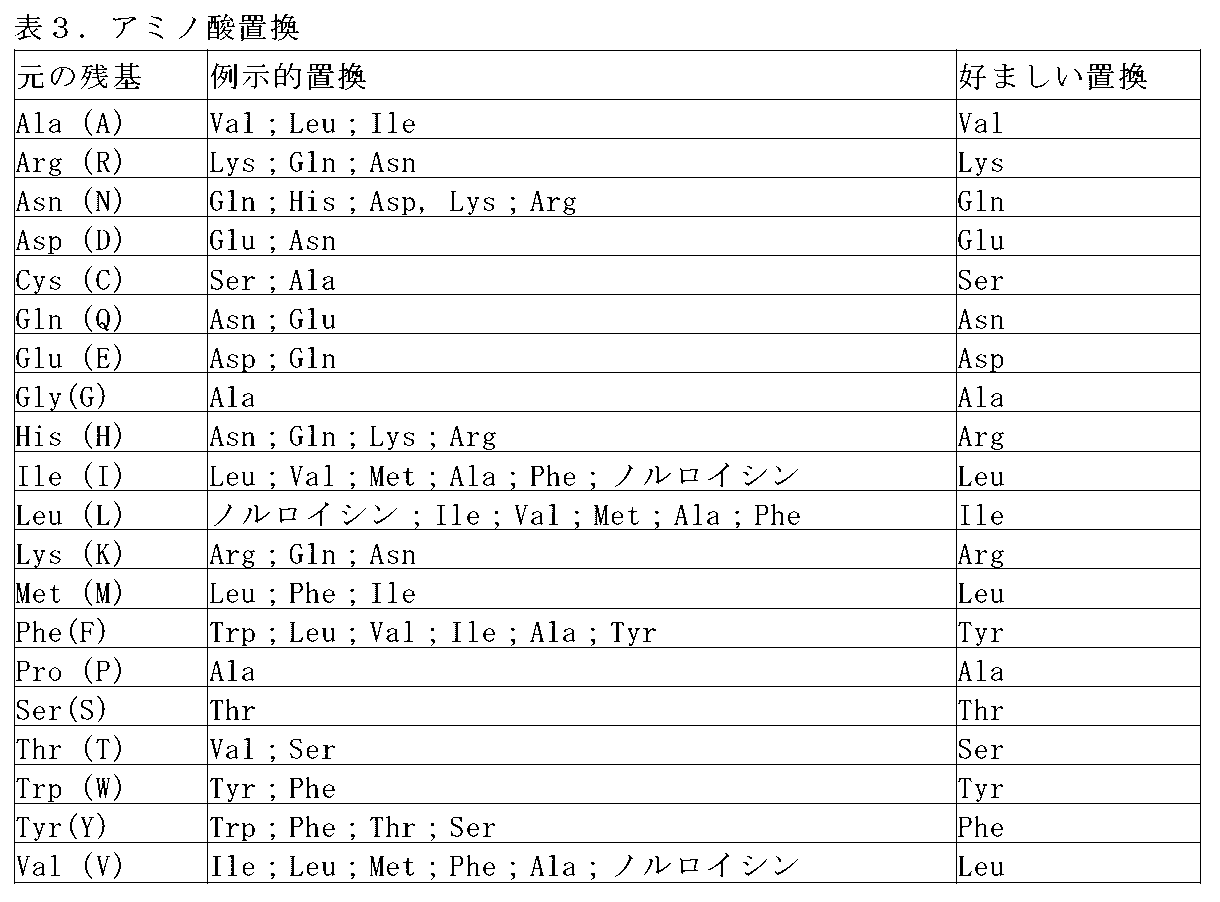
アミノ酸は、側鎖の共通する特性に従って分類することができる。
(1)疎水性:ノルロイシン、Met、Ala、Val、Leu、Ile;
(2)中性親水性:Cys、Ser、Thr、Asn、Gln;
(3)酸性:Asp、Glu;
(4)塩基性:His、Lys、Arg;
(5)鎖配向に影響を及ぼす残基:Gly、Pro;
(6)芳香族:Trp、Tyr、Phe。
Amino acids can be grouped according to common properties of their side chains.
(1) Hydrophobic: Norleucine, Met, Ala, Val, Leu, Ile;
(2) Neutral hydrophilicity: Cys, Ser, Thr, Asn, Gln;
(3) Acidic: Asp, Glu;
(4) basic: His, Lys, Arg;
(5) Residues that affect chain orientation: Gly, Pro;
(6) Aromatic: Trp, Tyr, Phe.
非保存的置換は、これらのクラスの1つのメンバーを別のクラスと交換することを伴う。 Non-conservative substitutions involve exchanging a member of one of these classes for another class.
置換変異体の1つのタイプは、親抗体(例えば、ヒト化またはヒト抗体)の1つ以上の超可変領域残基を置換することを伴う。一般的に、さらなる研究のために選択される得られる変異体(複数可)は、ある特定の生物学的特性(例えば、増加した親和性、低減した免疫原性)において、親抗体に比して改変(例えば、改善)されているか、及び/または、親抗体のある特定の生物学的特性が実質的に保持されている。例示的な置換変異体は、例えば、本明細書に記載するようなファージ提示に基づく親和性成熟技術を用いて簡便に生成され得る親和性成熟抗体である。簡単に言うと、1つ以上のHVR残基を突然変異させ、ファージ上で変異体抗体を提示させ、特定の生物学的活性(例えば、結合親和性)についてスクリーニングする。 One type of substitutional variant involves substituting one or more hypervariable region residues of a parent antibody (e.g., a humanized or human antibody). Generally, the resulting variant(s) selected for further study have been altered (e.g., improved) in certain biological properties (e.g., increased affinity, reduced immunogenicity) relative to the parent antibody and/or have substantially retained certain biological properties of the parent antibody. An exemplary substitutional variant is an affinity matured antibody, which may be conveniently generated using, for example, phage display-based affinity maturation techniques as described herein. Briefly, one or more HVR residues are mutated and the variant antibodies are displayed on phage and screened for a particular biological activity (e.g., binding affinity).
変化(例えば、置換)を、例えば、抗体親和性を改善するために、HVRにおいて起こさせてもよい。そのような変化を、HVR「ホットスポット」、すなわち、体細胞成熟過程の間に高頻度に突然変異を起こすコドンによってコードされる残基(例えば、Chowdhury,Methods Mol.Biol.207:179-196(2008)を参照されたい)、及び/またはSDR(a-CDR)によってコードされる残基において起こさせてもよく、得られた変異体VHまたはVLを結合親和性について試験する。二次ライブラリーを構築し、そこから再選択することによる親和性成熟は、例えば、Hoogenboom et al.in Methods in Molecular Biology 178:1-37(O’Brien et al.,ed.,Human Press,Totowa,NJ,(2001))に記載されている。親和性成熟のいくつかの実施形態では、種々の方法(例えば、エラープローンPCR、鎖シャッフリングまたはオリゴヌクレオチド特異的突然変異誘発)のいずれかによって、成熟のために選択された可変遺伝子に多様性を導入する。次いで、二次ライブラリーを作製する。次いで、ライブラリーをスクリーニングして、所望の親和性を有するあらゆる抗体変異体を同定する。多様性を導入するための別の方法は、数個のHVR残基(例えば、一度に4~6残基)をランダム化するHVR特異的なアプローチを伴う。抗原結合に関与するHVR残基は、例えば、アラニンスキャニング突然変異誘発またはモデル化を用いて具体的に同定され得る。特に、CDR-H3及びCDR-L3は標的とされることが多い。 Changes (e.g., substitutions) may be made in HVRs, e.g., to improve antibody affinity. Such changes may be made in HVR "hot spots," i.e., residues encoded by codons that undergo frequent mutation during the somatic maturation process (see, e.g., Chowdhury, Methods Mol. Biol. 207:179-196 (2008)), and/or residues encoded by SDRs (a-CDRs), and the resulting variant VH or VL are tested for binding affinity. Affinity maturation by constructing and reselecting from secondary libraries can be performed as described, e.g., in Hoogenboom et al. in Methods in Molecular Biology 178:1-37 (O'Brien et al., ed., Human Press, Totowa, NJ, (2001)). In some embodiments of affinity maturation, diversity is introduced into the variable genes selected for maturation by any of a variety of methods (e.g., error-prone PCR, chain shuffling, or oligonucleotide-directed mutagenesis). A secondary library is then generated. The library is then screened to identify any antibody variants with the desired affinity. Another method for introducing diversity involves an HVR-specific approach in which several HVR residues (e.g., 4-6 residues at a time) are randomized. HVR residues involved in antigen binding can be specifically identified using, for example, alanine scanning mutagenesis or modeling. In particular, CDR-H3 and CDR-L3 are often targeted.
いくつかの実施形態では、置換、挿入、または欠失は、そのような変更が、抗体が抗原に結合する能力を実質的に低減させない限り、1つ以上のHVR内で生じてもよい。例えば、結合親和性を実質的に低減しない保存的変化(例えば、本明細書で提供される保存的置換)を、HVR内で起こさせてもよい。そのような変化は、例えば、HVR「ホットスポット」またはCDRの外であってもよい。上で提供された変異体VHH配列のいくつかの実施形態では、各HVRは変化していないか、1、2、または3以下のアミノ酸置換しか含まない。 In some embodiments, substitutions, insertions, or deletions may be made within one or more HVRs so long as such alterations do not substantially reduce the ability of the antibody to bind to the antigen. For example, conservative changes (e.g., conservative substitutions as provided herein) that do not substantially reduce binding affinity may be made within an HVR. Such changes may, for example, be outside an HVR "hot spot" or CDR. In some embodiments of the variant VHH sequences provided above, each HVR is unchanged or contains no more than one, two, or three amino acid substitutions.
突然変異誘発のための標的とし得る抗体の残基または領域を同定するための有用な方法は、Cunningham and Wells(1989)Science,244:1081-1085に記載されるように、「アラニンスキャニング突然変異誘発」と呼ばれる。この方法では、残基または一群の標的残基(例えば、Arg、Asp、His、Lys及びGluのような荷電残基)を同定し、それを中性または負電荷を持つアミノ酸(例えば、アラニンまたはポリアラニン)で置換して、抗体の、抗原との相互作用が影響を受けるか否かを決定する。最初の置換に対して機能的感受性を示すアミノ酸位置に、さらなる置換を導入してもよい。あるいは、またはさらに、抗体と抗原の間の接触点を同定するために、抗原-抗体複合体の結晶構造を用いることができる。このような接触残基及びその隣接残基を、置換の候補として標的にしても、排除してもよい。変異体をスクリーニングして、それらが所望の特性を含むか否かを決定してもよい。 A useful method for identifying antibody residues or regions that can be targeted for mutagenesis is called "alanine scanning mutagenesis" as described by Cunningham and Wells (1989) Science, 244:1081-1085. In this method, a residue or group of target residues (e.g., charged residues such as Arg, Asp, His, Lys, and Glu) is identified and substituted with neutral or negatively charged amino acids (e.g., alanine or polyalanine) to determine whether the antibody's interaction with the antigen is affected. Additional substitutions may be introduced at amino acid positions that show functional sensitivity to the initial substitution. Alternatively, or in addition, a crystal structure of the antigen-antibody complex may be used to identify contact points between the antibody and the antigen. Such contact residues and their neighboring residues may be targeted or eliminated as candidates for substitution. The mutants may be screened to determine whether they contain the desired properties.
アミノ酸配列挿入には、1残基から、100残基またはそれ以上を含有するポリペプチドまでに及ぶ長さのアミノ末端及び/またはカルボキシル末端融合、ならびに単一または複数のアミノ酸残基の配列内挿入も含まれる。末端挿入の例には、N末端メチオニル残基を有する抗体が含まれる。抗体分子の他の挿入変異体には、抗体のN末端またはC末端への、酵素(例えば、ADEPTの場合)、または抗体の血清中半減期を増加させるポリペプチドの融合が含まれる。 Amino acid sequence insertions include amino- and/or carboxyl-terminal fusions ranging in length from one residue to polypeptides containing 100 or more residues, as well as intrasequence insertions of single or multiple amino acid residues. An example of a terminal insertion includes an antibody with an N-terminal methionyl residue. Other insertional variants of the antibody molecule include the fusion to the N- or C-terminus of the antibody of an enzyme (e.g., in the case of ADEPT) or a polypeptide which increases the serum half-life of the antibody.
b)グリコシル化変異体
いくつかの実施形態では、本明細書で提供される抗CTLA-4構築物を変化させて、構築物がグリコシル化される程度を増加または減少させる。抗体へのグリコシル化部位の付加または欠失は、1つ以上のグリコシル化部位が作出または除去されるようにアミノ酸配列を変化させることによって、簡便に達成することができる。
b) Glycosylation Variants In some embodiments, the anti-CTLA-4 constructs provided herein are altered to increase or decrease the extent to which the construct is glycosylated. Addition or deletion of glycosylation sites to an antibody can be conveniently accomplished by altering the amino acid sequence such that one or more glycosylation sites are created or removed.
抗CTLA-4構築物がFc領域を含む場合、そこに結合する糖質を変化させてもよい。哺乳動物細胞によって産生される天然抗体は、典型的には、分岐した二分岐オリゴ糖を含み、これは一般的には、Fc領域のCH2ドメインのAsn297にN連結によって結合される。例えば、Wright et al.TIBTECH 15:26-32(1997)を参照されたい。オリゴ糖は、種々の炭水化物、例えば、二分岐オリゴ糖構造の「幹」のGlcNAcに結合した、マンノース、N-アセチルグルコサミン(GlcNAc)、ガラクトース、シアル酸、ならびにフコースを含み得る。いくつかの実施形態では、本発明の抗CTLA-4構築物におけるオリゴ糖の改変は、一定の改善された特性を有する抗体変異型を作製するために行われ得る。 If the anti-CTLA-4 construct contains an Fc region, the carbohydrate attached thereto may be altered. Natural antibodies produced by mammalian cells typically contain branched biantennary oligosaccharides, which are generally attached by an N-linkage to Asn297 in the CH2 domain of the Fc region. See, for example, Wright et al. TIBTECH 15:26-32 (1997). The oligosaccharides may contain a variety of carbohydrates, such as mannose, N-acetylglucosamine (GlcNAc), galactose, sialic acid, as well as fucose attached to the GlcNAc in the "stem" of the biantennary oligosaccharide structure. In some embodiments, modification of the oligosaccharides in the anti-CTLA-4 constructs of the invention may be performed to generate antibody variants with certain improved properties.
いくつかの実施形態では、Fc領域に(直接または間接的に)結合したフコースを欠く糖質構造を有する抗体変異体が提供される。例えば、そのような抗体におけるフコースの量は、1%~80%、1%~65%、5%~65%または20%~40%であってもよい。フコースの量は、例えば、WO2008/077546号に記載されているように、MALDI-TOF質量分析によって測定される、Asn297に結合した全ての糖構造(例えば、複合型、混成型、及び高マンノース型構造)の合計に比しての、Asn297における糖鎖内のフコースの平均量を算出することによって決定される。Asn297は、Fc領域内の約297位(Fc領域残基のEU番号付け)に位置するアスパラギン残基を指す;しかしながら、抗体における軽微な配列変異のため、Asn297は、297位の上流側または下流側約±3アミノ酸、すなわち294位と300位の間に位置する場合もあり得る。そのようなフコシル化変異体は、改善されたADCC機能を有し得る。例えば、米国特許公開第2003/0157108号(Presta,L.);US2004/0093621(Kyowa Hakko Kogyo Co.,Ltd)を参照されたい。「脱フコシル化」または「フコース欠損」抗体変異体に関する刊行物の例としては、US2003/0157108;WO2000/61739;WO2001/29246;US2003/0115614;US2002/0164328;US2004/0093621;US2004/0132140;US2004/0110704;US2004/0110282;US2004/0109865;WO2003/085119;WO2003/084570;WO2005/035586;WO2005/035778;WO2005/053742;WO2002/031140;Okazaki et al.J.Mol.Biol.336:1239-1249(2004);Yamane-Ohnuki et al.Biotech.Bioeng.87:614(2004)が挙げられる。脱フコシル化抗体を産生する能力を有する細胞株の例としては、タンパク質フコシル化欠損性のLec13 CHO細胞(Ripka et al.,Arch.Biochem.Biophys.249:533-545(1986);米国特許出願第US2003/0157108A1号、Presta,L;及びWO2004/056312A1、Adams et al.、特に実施例11)、及びα-1,6-フコシルトランスフェラーゼ遺伝子FUT8ノックアウトCHO細胞のようなノックアウト細胞株(例えば、Yamane-Ohnuki et al.,Biotech.Bioeng.87:614(2004);Kanda,Y.,et al.,Biotechnol.Bioeng.94(4):680-688(2006);及びWO2003/085107を参照されたい)が挙げられる。 In some embodiments, antibody variants are provided that have a carbohydrate structure that lacks fucose attached (directly or indirectly) to the Fc region. For example, the amount of fucose in such antibodies may be 1%-80%, 1%-65%, 5%-65% or 20%-40%. The amount of fucose is determined by calculating the average amount of fucose in the glycan at Asn297 relative to the sum of all glycan structures (e.g. complex, hybrid and high mannose structures) attached to Asn297 as measured by MALDI-TOF mass spectrometry, e.g. as described in WO2008/077546. Asn297 refers to an asparagine residue located at about position 297 (EU numbering of Fc region residues) in the Fc region; however, due to minor sequence variations in antibodies, Asn297 may be located about ±3 amino acids upstream or downstream of position 297, i.e., between positions 294 and 300. Such fucosylation variants may have improved ADCC function. See, e.g., U.S. Patent Publication No. 2003/0157108 (Presta, L.); US 2004/0093621 (Kyowa Hakko Kogyo Co., Ltd). Examples of publications relating to "defucosylated" or "fucose-deficient" antibody variants include US 2003/0157108; WO 2000/61739; WO 2001/29246; US 2003/0115614; US 2002/0164328; US 2004/0093621; US 2004/013214. 0; US2004/0110704; US2004/0110282; US2004/0109865; WO2003/085119; WO2003/084570; WO2005/035586; WO2005/035778; WO2005/053742; WO2002/031140; Okazaki et al. J. Mol. Biol. 336:1239-1249 (2004); Yamane-Ohnuki et al. Biotech. Bioeng. 87:614 (2004). Examples of cell lines capable of producing defucosylated antibodies include protein fucosylation-deficient Lec13 CHO cells (Ripka et al., Arch. Biochem. Biophys. 249:533-545 (1986); U.S. Patent Application No. US 2003/0157108 A1, Presta, L; and WO 2004/056312 A1, Adams et al., especially Example 11), and knockout cell lines such as α-1,6-fucosyltransferase gene FUT8 knockout CHO cells (e.g., Yamane-Ohnuki et al., Biotech. Bioeng. 87:614 (2004); Kanda, Y., et al., especially Example 11). al., Biotechnol. Bioeng. 94(4):680-688(2006); and WO2003/085107).
抗CTLA-4構築物変異体は、例えば、抗体のFc領域に結合した二分岐オリゴ糖がGlcNAcによって二分されている二分オリゴ糖と共にさらに与えられる。そのような抗体変異体は、フコシル化を減少させ、及び/またはADCC機能を改善している可能性がある。そのような抗体変異体の例は、例えば、WO2003/011878(Jean-Mairet et al.);米国特許第6,602,684号(Umana et al.);及びUS2005/0123546(Umana et al.)に記載されている。Fc領域に結合したオリゴ糖内に少なくとも1つのガラクトース残基を持つ抗体変異体も提供される。そのような抗体変異体は、CDC機能を改善させた可能性がある。そのような抗体変異体は、例えば、WO1997/30087(Patel et al.);WO1998/58964(Raju,S.);及びWO1999/22764(Raju,S.)に記載されている。 Anti-CTLA-4 construct variants are further provided with bisected oligosaccharides, e.g., where the biantennary oligosaccharide attached to the Fc region of the antibody is bisected by GlcNAc. Such antibody variants may have reduced fucosylation and/or improved ADCC function. Examples of such antibody variants are described, e.g., in WO 2003/011878 (Jean-Mairet et al.); U.S. Patent No. 6,602,684 (Umana et al.); and US 2005/0123546 (Umana et al.). Antibody variants with at least one galactose residue in the oligosaccharide attached to the Fc region are also provided. Such antibody variants may have improved CDC function. Such antibody variants are described, for example, in WO1997/30087 (Patel et al.); WO1998/58964 (Raju, S.); and WO1999/22764 (Raju, S.).
c)Fc領域変異体
いくつかの実施形態では、本明細書で提供される抗CTLA-4構築物のFc領域に1つ以上のアミノ酸改変を導入することにより、Fc領域変異体を生成させてもよい。Fc領域変異体は、1つ以上のアミノ酸位置にアミノ酸改変(例えば、置換)を含むヒトFc領域配列(例えば、ヒトIgG1、IgG2、IgG3またはIgG4 Fc領域)を含み得る。
c) Fc Region Variants In some embodiments, Fc Region variants may be generated by introducing one or more amino acid modifications into the Fc Region of the anti-CTLA-4 constructs provided herein. The Fc Region variants may comprise a human Fc Region sequence (e.g., a human IgG1, IgG2, IgG3 or IgG4 Fc region) that contains an amino acid modification (e.g., a substitution) at one or more amino acid positions.
いくつかの実施形態では、本発明は、インビボにおける抗CTLA-4構築物の半減期が重要であるが、ある特定のエフェクター機能(例えば、補体及びADCCなど)が不要または有害である用途のための望ましい候補とならしめる、全てではないが一部のエフェクター機能を有する抗CTLA-4構築物変異体を意図している。インビトロ及び/またはインビボでの細胞傷害性アッセイを、CDC活性及び/またはADCC活性の減少/枯渇を確認するために行うことができる。例えば、Fc受容体(FcR)結合アッセイは、抗体がFcγR結合を欠くが(それゆえ、おそらくADCC活性を欠く)、FcRn結合能力を保持していることを確認するために行うことができる。ADCC、NK細胞を媒介する初代細胞は、FcγRIIIのみを発現するが、単球はFcγRI、FcγRII、及びFcγRIIIを発現する。造血細胞におけるFcRの発現は、Ravetch and Kinet,Annu.Rev.Immunol.9:457-492(1991)の464ページの表3に要約されている。目的の分子のADCC活性を評価するためのインビトロアッセイの非限定的な例は、米国特許第5,500,362号(例えば、Hellstrom,I.et al.Proc.Nat’l Acad.Sci.USA 83:7059-7063(1986)を参照されたい)及びHellstrom,I et al.,Proc.Nat’l Acad.Sci.USA 82:1499-1502(1985);同第5,821,337号(Bruggemann,M.et al.,J.Exp.Med.166:1351-1361(1987)を参照されたい)に記載されている。あるいは、非放射性アッセイ法を用いることができる(例えば、フローサイトメトリー用のACTI(商標)非放射性細胞傷害性アッセイ(CellTechnology,Inc.Mountain View,CA;及びCytoTox 96(登録商標)非放射性細胞傷害性アッセイ(Promega,Madison,WI)を参照されたい)。そのようなアッセイに有用なエフェクター細胞には、末梢血単核細胞(PBMC)及びナチュラルキラー(NK)細胞が含まれる。あるいは、またはさらに、目的の分子のADCC活性は、Clynes et al.,Proc.Nat’l Acad.Sci.USA 95:652-656(1998)に開示されるように、インビボで、例えば、動物モデルにおいて評価することができる。C1q結合アッセイはまた、抗体がC1qに結合することができないこと、従って、CDC活性を欠いていることを確認するために行うことができる。例えば、WO2006/029879及びWO2005/100402のC1q及びC3c結合ELISAを参照されたい。補体活性化を評価するために、CDCアッセイを行うことができる(例えば、Gazzano-Santoro et al.,J.Immunol.Methods 202:163(1996);Cragg,M.S.et al.,Blood 101:1045-1052(2003);及びCragg,M.S.and M.J.Glennie,Blood 103:2738-2743(2004)を参照されたい)。FcRn結合、及びインビボでのクリアランス/半減期の測定ではまた、当該技術分野で公知の方法を用いて行うことができる(例えば、Petkova,S.B.et al.,Int’l.Immunol.18(12):1759-1769(2006)を参照されたい)。 In some embodiments, the present invention contemplates anti-CTLA-4 construct variants that have some, but not all, effector functions that make them desirable candidates for applications where the half-life of the anti-CTLA-4 construct in vivo is important, but where certain effector functions (e.g., complement and ADCC) are unnecessary or detrimental. In vitro and/or in vivo cytotoxicity assays can be performed to confirm the reduction/depletion of CDC and/or ADCC activity. For example, Fc receptor (FcR) binding assays can be performed to confirm that the antibody lacks FcγR binding (and thus likely lacks ADCC activity) but retains FcRn binding ability. The primary cells that mediate ADCC, NK cells, express only FcγRIII, whereas monocytes express FcγRI, FcγRII, and FcγRIII. Expression of FcR on hematopoietic cells is described in Ravetch and Kinet, Annu. Rev. Immunol. 9:457-492 (1991), Table 3 on page 464. Non-limiting examples of in vitro assays to assess ADCC activity of a molecule of interest are described in U.S. Patent No. 5,500,362 (see, e.g., Hellstrom, I. et al. Proc. Nat'l Acad. Sci. USA 83:7059-7063 (1986)) and Hellstrom, I. et al., Proc. Nat'l Acad. Sci. USA 82:1499-1502 (1985); 5,821,337 (see Bruggemann, M. et al., J. Exp. Med. 166:1351-1361 (1987)). Alternatively, non-radioactive assay methods can be used (see, e.g., the ACTI™ non-radioactive cytotoxicity assay for flow cytometry (CellTechnology, Inc. Mountain View, CA; and CytoTox 96® non-radioactive cytotoxicity assay (Promega, Madison, WI)). Useful effector cells for such assays include peripheral blood mononuclear cells (PBMC) and natural killer (NK) cells. Alternatively, or additionally, ADCC activity of the molecule of interest can be measured using the method of Clynes et al., Proc. Nat'l Acad. Sci. USA 95:652-656 (1998). C1q binding assays can also be performed to confirm that the antibody is unable to bind C1q and thus lacks CDC activity. See, e.g., the C1q and C3c binding ELISAs of WO 2006/029879 and WO 2005/100402. To assess complement activation, a CDC assay can be performed (see, e.g., Gazzano-Santoro et al., J. Immunol. Methods 202:163 (1996); Cragg, M.S. et al., Blood 101:1045-1052 (2003); and Cragg, M.S. and M.J. Glennie, Blood 103:2738-2743 (2004). FcRn binding and in vivo clearance/half-life measurements can also be performed using methods known in the art (see, e.g., Petkova, S.B. et al., Int'l. Immunol. 18(12):1759-1769 (2006)).
エフェクター機能が減少した抗体は、Fc領域の残基238、265、269、270、297、327、329の1つ以上の置換を有するものが含まれる(米国特許第6,737,056号)。そのようなFc変異体は、残基265及び297のアラニンへの置換を有する、いわゆる「DANA」Fc変異体を含む、アミノ酸位置265、269、270、297及び327の2つ以上での置換を有するFc変異体を含む(米国特許第7,332,581号)。 Antibodies with reduced effector function include those with substitutions at one or more of residues 238, 265, 269, 270, 297, 327, 329 in the Fc region (U.S. Patent No. 6,737,056). Such Fc variants include Fc variants with substitutions at two or more of amino acid positions 265, 269, 270, 297, and 327, including the so-called "DANA" Fc variants with substitutions of residues 265 and 297 to alanine (U.S. Patent No. 7,332,581).
FcRへの改善されたまたは減少した結合を持つある特定の抗体変異体が記載されている。(例えば、米国特許第6,737,056号;WO2004/056312、及びShields et al.,J.Biol.Chem.9(2):6591-6604(2001)を参照されたい)。 Certain antibody variants with improved or diminished binding to FcRs have been described (see, e.g., U.S. Pat. No. 6,737,056; WO 2004/056312, and Shields et al., J. Biol. Chem. 9(2):6591-6604 (2001)).
いくつかの実施形態では、抗CTLA-4構築物変異体は、ADCCを改善する1つ以上のアミノ酸置換、例えば、Fc領域の位置298、333、及び/または334における置換(残基のEU番号付け)を含む。 In some embodiments, the anti-CTLA-4 construct variants include one or more amino acid substitutions that improve ADCC, e.g., substitutions at positions 298, 333, and/or 334 (EU numbering of residues) in the Fc region.
いくつかの実施形態では、改変された(すなわち、改善されたか減少したのいずれか)C1q結合及び/または補体依存性細胞傷害(CDC)を生じる、Fc領域における改変がなされ、例えば、米国特許第6,194,551号、WO99/51642、及びIdusogie et al.J.Immunol.164:4178-4184(2000)に記載される。 In some embodiments, modifications are made in the Fc region that result in altered (i.e., either improved or decreased) C1q binding and/or complement dependent cytotoxicity (CDC), e.g., as described in U.S. Pat. No. 6,194,551, WO 99/51642, and Idusogie et al. J. Immunol. 164:4178-4184 (2000).
いくつかの実施形態では、半減期を増加し、及び/または新生児Fc受容体(FcRn)への結合を改善する1つ以上のアミノ酸置換を含む変異体Fc領域を含む抗CTLA-4構築物(例えば、HCAb)変異体が提供される。増加した半減期を持ち、胎仔への母性IgGの移送を担う、新生児Fc受容体(FcRn)への結合が改善された抗体(Guyer et al.,J.Immunol.117:587(1976)及びKim et al.,J.Immunol.24:249(1994))が、US2005/0014934A1(Hinton et al.)に記載されている。これらの抗体は、FcRnへのFc領域の結合を改善する1つ以上の置換を有するFc領域を含む。そのようなFc変異体は、Fc領域の残基の1つ以上の置換を有するものが含まれる:238、256、265、272、286、303、305、307、311、312、317、340、356、360、362、376、378、380、382、413、424または434、例えば、Fc領域の残基434の置換(米国特許第7,371,826号)。 In some embodiments, anti-CTLA-4 constructs (e.g., HCAb) variants are provided that include a variant Fc region that includes one or more amino acid substitutions that increase half-life and/or improve binding to the neonatal Fc receptor (FcRn). Antibodies with increased half-life and improved binding to the neonatal Fc receptor (FcRn), which is responsible for the transfer of maternal IgG to the fetus (Guyer et al., J. Immunol. 117:587 (1976) and Kim et al., J. Immunol. 24:249 (1994)) are described in US 2005/0014934 A1 (Hinton et al.). These antibodies include an Fc region with one or more substitutions that improve binding of the Fc region to FcRn. Such Fc variants include those having one or more substitutions of residues in the Fc region: 238, 256, 265, 272, 286, 303, 305, 307, 311, 312, 317, 340, 356, 360, 362, 376, 378, 380, 382, 413, 424, or 434, e.g., substitution of residue 434 in the Fc region (U.S. Patent No. 7,371,826).
Duncan & Winter,Nature 322:738-40(1988);米国特許第5,648,260号;米国特許第5,624,821号;及び、Fc領域の変異体の他の例に関してはWO94/29351も参照されたい。 See also Duncan & Winter, Nature 322:738-40 (1988); U.S. Patent No. 5,648,260; U.S. Patent No. 5,624,821; and WO 94/29351 for other examples of Fc region variants.
本明細書に記載のFc変異体のいずれかまたはそれらの組み合わせを含む抗CTLA-4構築物(例えば、本明細書に記載の、HCAb、完全長抗体に融合した抗CTLA-4 sdAb、または抗CTLA-4 MABP/BABP)が企図される。 Anti-CTLA-4 constructs comprising any of the Fc variants described herein or combinations thereof (e.g., HCAbs, anti-CTLA-4 sdAbs fused to full-length antibodies, or anti-CTLA-4 MABPs/BABPs described herein) are contemplated.
d)システイン改変抗体変異体
いくつかの実施形態では、抗体の1つ以上の残基がシステイン残基で置換されている、システイン改変抗CTLA-4構築物、例えば、「チオMAb」を作製することが望まれ得る。特定の実施形態では、置換された残基は、抗体のアクセス可能な部位で起きる。それらの残基をシステインで置換することにより、反応性チオール基は、それによって抗体のアクセス可能な部位に配置され、本明細書中でさらに記載されるように、イムノコンジュゲートを作製するために、例えば、薬物部分またはリンカー-薬剤部分などの他の部分に抗体をコンジュゲートするために使用することができる。いくつかの実施形態では、以下の残基のいずれか1つ以上がシステインで置換され得る:軽鎖のA118(EU番号付け);及び重鎖Fc領域のS400(EU番号付け)。システイン改変抗CTLA-4構築物は、例えば、米国特許第7,521,541号に記載されるように生成され得る。
d) Cysteine Engineered Antibody Variants In some embodiments, it may be desirable to generate cysteine engineered anti-CTLA-4 constructs, e.g., "ThioMAbs," in which one or more residues of the antibody are substituted with a cysteine residue. In certain embodiments, the substituted residues occur at accessible sites of the antibody. By substituting those residues with cysteine, reactive thiol groups are thereby placed at accessible sites of the antibody, which can be used to conjugate the antibody to other moieties, such as, for example, drug moieties or linker-drug moieties, to generate immunoconjugates, as further described herein. In some embodiments, any one or more of the following residues may be substituted with a cysteine: A118 (EU numbering) of the light chain; and S400 (EU numbering) of the heavy chain Fc region. Cysteine engineered anti-CTLA-4 constructs may be generated, for example, as described in U.S. Pat. No. 7,521,541.
e)抗体誘導体
いくつかの実施形態では、本明細書で提供される抗CTLA-4構築物は、当該技術分野で知られ、容易に入手されている追加の非タンパク質部分を含むようにさらに改変することができる。抗体の誘導体化に適した部分としては、限定されないが、水溶性ポリマーが挙げられる。水溶性ポリマーの非限定的な例としては、ポリエチレングリコール(PEG)、エチレングリコール/プロピレングリコールの共重合体、カルボキシメチルセルロース、デキストラン、ポリビニルアルコール、ポリビニルピロリドン、ポリ-1,3-ジオキソラン、ポリ-1,3,6-トリオキソラン、エチレン/無水マレイン酸共重合体、ポリアミノ酸(単独重合体またはランダム共重合体のいずれか)及びデキストランまたはポリ(n-ビニルピロリドン)ポリエチレングリコール、プロピレングリコール単独重合体、プロピレンオキシド/エチレンオキシド共重合体、ポリオキシエチル化ポリオール(例えば、グリセロール)、ポリビニルアルコール及びこれらの混合物が挙げられるが、これらに限定されるものではない。ポリエチレングリコールプロピオンアルデヒドは、その水中での安定性のために製造上の利点を有し得る。ポリマーは、いずれかの分子量のものであり得、分枝鎖または未分枝鎖であり得る。抗体に結合するポリマーの数は、変動し得、1つ以上の重合体が結合する場合、それらは同じかまたは異なる分子であることができる。一般的に、誘導体化に使用するポリマーの数及び/または種類は、限定されないが、向上させるべき抗体の特定の特性または機能、抗体誘導体が特定の条件下で治療に使用されるのかなどを考慮しながら決定することができる。
e) Antibody Derivatives In some embodiments, the anti-CTLA-4 constructs provided herein can be further modified to include additional non-proteinaceous moieties that are known in the art and readily available. Moieties suitable for derivatization of antibodies include, but are not limited to, water soluble polymers. Non-limiting examples of water soluble polymers include, but are not limited to, polyethylene glycol (PEG), copolymers of ethylene glycol/propylene glycol, carboxymethylcellulose, dextran, polyvinyl alcohol, polyvinylpyrrolidone, poly-1,3-dioxolane, poly-1,3,6-trioxolane, ethylene/maleic anhydride copolymers, polyamino acids (either homopolymers or random copolymers) and dextran or poly(n-vinylpyrrolidone) polyethylene glycol, propylene glycol homopolymers, propylene oxide/ethylene oxide copolymers, polyoxyethylated polyols (e.g., glycerol), polyvinyl alcohol, and mixtures thereof. Polyethylene glycol propionaldehyde may have manufacturing advantages due to its stability in water. The polymers can be of any molecular weight and can be branched or unbranched. The number of polymers attached to the antibody can vary, and when more than one polymer is attached, they can be the same or different molecules. In general, the number and/or type of polymers used for derivatization can be determined by consideration of, but not limited to, the particular property or function of the antibody to be improved, whether the antibody derivative will be used therapeutically under particular conditions, etc.
いくつかの実施形態では、放射線への曝露によって選択的に加熱されてもよい抗CTLA-4構築物と非タンパク質部分とのコンジュゲートが提供される。いくつかの実施形態では、非タンパク質部分は、カーボンナノチューブである(Kam et al.,Proc.Natl.Acad.Sci.USA 102:11600-11605(2005))。放射線は、任意の波長であってよいが、限定されないものの、通常の細胞に害を与えないが、抗体-非タンパク質部分の近位細胞が死滅される温度に非タンパク質部分を加熱する波長が含まれる。 In some embodiments, conjugates of anti-CTLA-4 constructs and non-protein moieties are provided that may be selectively heated by exposure to radiation. In some embodiments, the non-protein moiety is a carbon nanotube (Kam et al., Proc. Natl. Acad. Sci. USA 102:11600-11605 (2005)). The radiation may be of any wavelength, including but not limited to wavelengths that are not harmful to normal cells, but heat the non-protein moiety to a temperature that kills cells proximal to the antibody-non-protein moiety.
いくつかの実施形態では、本明細書で提供される抗CTLA-4構築物(例えば、抗CTLA-4 sdAb、抗CTLA-4 HCAb、抗CTLA-4/PD-1二重特異性抗体、抗CTLA-4/PD-L1二重特異性抗体、または抗CTLA-4 MABP(例えば、BABP))は、1つ以上の生物学的に活性なタンパク質、ポリペプチドまたはその断片を含むようにさらに改変されてもよい。「生物活性」または「生物学的に活性な」は、本明細書で交換可能に使用する場合、具体的な機能を実行するために体内で生物学的活性を示すことを意味する。例えば、それは、特定の生体分子、例えば、タンパク質、DNAなどとの組み合わせ、次いで、そのような生体分子の活性の促進または阻害を意味し得る。いくつかの実施形態では、生物活性タンパク質またはその断片には、疾患または状態の予防または治療のための活性薬物として患者に投与されるタンパク質及びポリペプチド、ならびに診断目的に使用されるタンパク質及びポリペプチド、例えば、診断検査またはインビトロアッセイで使用される酵素、ならびに疾患を予防するために患者に投与されるタンパク質及びポリペプチド、例えば、ワクチンが含まれる。いくつかの実施形態では、生物活性タンパク質またはその断片は、免疫刺激/免疫調節、膜輸送、または酵素活性を有する。いくつかの実施形態では、生物学的に活性なタンパク質、ポリペプチドまたはその断片は、酵素、ホルモン、成長因子、サイトカイン、またはこれらの混合物である。いくつかの実施形態では、生物学的に活性なタンパク質、ポリペプチドまたは断片は、標的ペプチド(例えば、抗原または他のタンパク質)を特異的に認識することができる。 In some embodiments, the anti-CTLA-4 constructs provided herein (e.g., anti-CTLA-4 sdAb, anti-CTLA-4 HCAb, anti-CTLA-4/PD-1 bispecific antibody, anti-CTLA-4/PD-L1 bispecific antibody, or anti-CTLA-4 MABP (e.g., BABP)) may be further modified to include one or more biologically active proteins, polypeptides, or fragments thereof. "Biological activity" or "biologically active," as used interchangeably herein, means exhibiting biological activity in the body to perform a specific function. For example, it may mean combination with a particular biomolecule, e.g., protein, DNA, etc., and then promoting or inhibiting the activity of such a biomolecule. In some embodiments, biologically active proteins or fragments thereof include proteins and polypeptides administered to a patient as an active drug for the prevention or treatment of a disease or condition, as well as proteins and polypeptides used for diagnostic purposes, e.g., enzymes used in diagnostic tests or in vitro assays, and proteins and polypeptides administered to a patient to prevent a disease, e.g., vaccines. In some embodiments, the biologically active protein or fragment thereof has immunostimulatory/immunomodulatory, membrane transport, or enzymatic activity. In some embodiments, the biologically active protein, polypeptide, or fragment thereof is an enzyme, hormone, growth factor, cytokine, or mixtures thereof. In some embodiments, the biologically active protein, polypeptide, or fragment is capable of specifically recognizing a target peptide (e.g., an antigen or other protein).
いくつかの実施形態では、本明細書に記載の抗CTLA-4構築物内に含まれ得る生物活性タンパク質またはその断片は、タンパク質結合タンパク質である。いくつかの実施形態では、本明細書に記載の抗CTLA-4構築物内に含まれ得る生物活性タンパク質またはその断片は、抗体によく似ている、抗原結合ドメインを含む小さな操作されたタンパク質である抗体模倣物である(Geering and Fussenegger,Trends Biotechnol.,33(2):65-79,2015)。これらの分子は、既存のヒト足場タンパク質に由来し、単一ポリペプチドを含む。本明細書に記載の抗CTLA-4構築物内に含まれ得る例示の抗体模倣物は、限定されないが、設計されたアンキリンリピートタンパク質(DARPin;N末端及びC末端Capドメインが隣接する3~5の完全合成アンキリンリピートを含む)、アビディティマルチマー(アビマー;複数のAドメインを含む高親和性タンパク質、各ドメインは、標的に対する親和性が低い)、またはアンチカリン(4つのアクセス可能なループを有するリポカリンの足場に基づき、各々の配列は、無作為化され得る)であり得る。いくつかの実施形態では、本明細書に記載の抗CTLA-4構築物内に含まれ得る生物活性タンパク質またはその断片は、アルマジロリピート単位(約40残基長の特徴的な繰返しアミノ酸配列)を含むアルマジロリピートタンパク質(例えば、β-カテニン、α-インポーチン、プラコグロビン、大腸腺腫様性ポリポーシス(APC))である。各アルマジロリピートは、ヘアピン構造を形成する一対のアルファヘリックスからなる。リピート形態の複数コピーは、アルファソレノイド構造として知られるものである。アルマジロリピートタンパク質は、特定の保存された側鎖を必要とせずに、またはペプチドの遊離N末端もしくはC末端と相互作用せずに、ペプチド骨格の結合の一定の方法に依存して、異なるタイプのペプチドに結合することができる。リピートタンパク質の固有のモジュール性と組み合わせた、残基によるペプチド残基の認識の可能性により、アルマジロリピートタンパク質は、ペプチド結合に対する一般的な足場の設計の有望な候補になる。 In some embodiments, the biologically active protein or fragment thereof that may be included in the anti-CTLA-4 constructs described herein is a protein-binding protein. In some embodiments, the biologically active protein or fragment thereof that may be included in the anti-CTLA-4 constructs described herein is an antibody mimetic, a small engineered protein that contains an antigen-binding domain that closely resembles an antibody (Geering and Fussenegger, Trends Biotechnol., 33(2):65-79, 2015). These molecules are derived from existing human scaffold proteins and contain a single polypeptide. Exemplary antibody mimetics that may be included within the anti-CTLA-4 constructs described herein may be, but are not limited to, designed ankyrin repeat proteins (DARPins; containing 3-5 fully synthetic ankyrin repeats flanked by N- and C-terminal Cap domains), avidity multimers (avimers; high affinity proteins containing multiple A-domains, each domain having a lower affinity for the target), or anticalins (based on a lipocalin scaffold with four accessible loops, each of which may be randomized in sequence). In some embodiments, biologically active proteins or fragments thereof that may be included within the anti-CTLA-4 constructs described herein are armadillo repeat proteins (e.g., β-catenin, α-importin, plakoglobin, adenomatous polyposis coli (APC)) that contain an armadillo repeat unit (a characteristic repeating amino acid sequence of approximately 40 residues in length). Each armadillo repeat consists of a pair of alpha helices that form a hairpin structure. Multiple copies of the repeat form what is known as an alpha solenoid structure. Armadillo repeat proteins are able to bind different types of peptides, relying on a certain method of peptide backbone attachment, without the need for specific conserved side chains or interactions with the free N- or C-termini of the peptide. The possibility of peptide residue-by-residue recognition, combined with the inherent modularity of repeat proteins, makes armadillo repeat proteins promising candidates for the design of a general scaffold for peptide binding.
いくつかの実施形態では、本明細書に記載の抗CTLA-4構築物内に含まれ得る生物学的に活性なタンパク質またはその断片は、リガンド、例えば、特定の細胞受容体と相互作用するリンホカイン及び細胞因子である。リンホカインは、抗原またはレクチンがT細胞の増殖を刺激する場合にT細胞により分泌される低分子タンパク質である。 In some embodiments, biologically active proteins or fragments thereof that may be included in the anti-CTLA-4 constructs described herein are ligands, e.g., lymphokines and cellular factors that interact with specific cellular receptors. Lymphokines are small proteins secreted by T cells when antigens or lectins stimulate T cell proliferation.
III.医薬組成物
本明細書に記載されるようにCTLA-4を特異的に認識するsdAbを含む抗CTLA-4構築物のいずれか1つ(例えば、抗CTLA-4 sdAb、抗CTLA-4 HCAb、抗CTLA-4/PD-1二重特異性抗体(例えば、CTLA-4×PD-1 BABP)、または抗CTLA-4/PD-L1二重特異性抗体(例えば、CTLA-4×PD-L1 BABP))、及び適宜、医薬的に許容可能な担体を含む医薬組成物が本発明でさらに提供される。医薬組成物は、所望の純度を有する本明細書に記載の抗CTLA-4構築物を、医薬的に許容可能な担体、賦形剤、または安定剤と適宜混合することにより(Remington’s Pharmaceutical sciences 16th edition,Osol,A.Ed.(1980))、凍結乾燥製剤または水溶液の形態で調製することができる。
III. Pharmaceutical Compositions Further provided herein are pharmaceutical compositions comprising any one of the anti-CTLA-4 constructs comprising an sdAb that specifically recognizes CTLA-4 as described herein (e.g., an anti-CTLA-4 sdAb, an anti-CTLA-4 HCAb, an anti-CTLA-4/PD-1 bispecific antibody (e.g., CTLA-4xPD-1 BABP), or an anti-CTLA-4/PD-L1 bispecific antibody (e.g., CTLA-4xPD-L1 BABP)), and optionally a pharma- ceutical acceptable carrier. Pharmaceutical compositions can be prepared in the form of a lyophilized formulation or an aqueous solution by appropriately mixing the anti-CTLA-4 constructs described herein having the desired purity with pharma- ceutically acceptable carriers, excipients, or stabilizers (Remington's Pharmaceutical sciences 16th edition, Osol, A. Ed. (1980)).
医薬組成物は、安定的であることが好ましく、その中で、本明細書に記載の抗CTLA-4 sdAbを含む抗CTLA-4構築物は、その物理的及び化学的安定性ならびに保管時の完全性を本質的に保持する。タンパク質安定性を測定するための種々の分析的技術は、当該技術分野において利用可能であり、Peptide and Protein Drug Delivery,247-301,Vincent Lee Ed.,Marcel Dekker,Inc.,New York,N.Y.,Pubs.(1991)及びJones,A.Adv.Drug Delivery Rev.10:29-90(1993)に総説されている。安定性は、選択された温度で選択された期間、測定することができる。迅速スクリーニングの場合、製剤を2週間から1ヵ月間40℃で保持し、その間安定性を測定する。製剤が2~8℃で保管される場合、一般的には、製剤は30℃または40℃で少なくとも1ヵ月間安定的であるべきであり、及び/または2~8℃では少なくとも2年間安定的であるべきである。製剤が30℃で保管される場合、一般的には、製剤は30℃で少なくとも2年間安定的であるべきであり、及び/または40℃では少なくとも6ヵ月間安定的であるべきである。例えば、保管中の凝集の程度は、タンパク質安定性の指標として使用することができる。いくつかの実施形態では、本明細書に記載の抗CTLA-4構築物の安定製剤は、製剤中に凝集体として存在する約10%未満(好ましくは、約5%未満)の抗CTLA-4構築物を含み得る。 Preferably, the pharmaceutical composition is stable, in which the anti-CTLA-4 construct, including the anti-CTLA-4 sdAb described herein, essentially retains its physical and chemical stability and integrity upon storage. Various analytical techniques for measuring protein stability are available in the art and are reviewed in Peptide and Protein Drug Delivery, 247-301, Vincent Lee Ed., Marcel Dekker, Inc., New York, N.Y., Pubs. (1991) and Jones, A. Adv. Drug Delivery Rev. 10:29-90 (1993). Stability can be measured at a selected temperature for a selected period of time. For rapid screening, the formulation is held at 40° C. for 2 weeks to 1 month, during which stability is measured. If the formulation is stored at 2-8° C., the formulation should generally be stable at 30° C. or 40° C. for at least 1 month, and/or at 2-8° C. for at least 2 years. If the formulation is stored at 30° C., the formulation should generally be stable at 30° C. for at least 2 years, and/or at least 6 months at 40° C. For example, the degree of aggregation during storage can be used as an indicator of protein stability. In some embodiments, a stable formulation of the anti-CTLA-4 construct described herein may contain less than about 10% (preferably less than about 5%) of the anti-CTLA-4 construct present as aggregates in the formulation.
許容される担体、賦形剤、または安定剤は、用いる投与量及び濃度ではレシピエントに対して無毒性であり、緩衝液、アスコルビン酸、メチオニン、ビタミンE、異性重亜硫酸ナトリウムを含む抗酸化剤;防腐剤、等張剤(例えば、塩化ナトリウム)、安定剤、金属複合体(例えば、Zn-タンパク質複合体);EDTAなどのキレート剤、及び/または非イオン性界面活性剤を含む。 Acceptable carriers, excipients, or stabilizers are non-toxic to recipients at the dosages and concentrations employed and include buffers, antioxidants including ascorbic acid, methionine, vitamin E, sodium metabisulfite; preservatives, isotonicity agents (e.g., sodium chloride), stabilizers, metal complexes (e.g., Zn-protein complexes); chelating agents such as EDTA, and/or non-ionic surfactants.
生理学的に許容可能な担体の例としては、リン酸塩、クエン酸塩、及び他の有機酸などの緩衝剤;アスコルビン酸及びメチオニンを含む抗酸化剤;防腐剤(例えば、オクタデシルジメチルベンジルアンモニウムクロリド;塩化ヘキサメトニウム;塩化ベンザルコニウム、塩化ベンゼトニウム;フェノール、ブチルまたはベンジルアルコール;メチルまたはプロピルパラベンなどのアルキルパラベン;カテコール;レゾルシノール;シクロヘキサノール;3-ペンタノール;及びm-クレゾール);低分子量(約10残基未満)のポリペプチド;血清アルブミン、ゼラチン、または免疫グロブリンなどのタンパク質;ポリビニルピロリドンなどの親水性ポリマー;グリシン、グルタミン、アスパラギン、ヒスチジン、アルギニン、またはリジンなどのアミノ酸;グルコース、マンノース、またはデキストランを含む単糖類、二糖類、及び他の炭水化物;EDTAなどのキレート剤;スクロース、マンニトール、トレハロースまたはソルビトールなどの糖;ナトリウムなどの塩形成対イオン;金属錯体(例として、Zn-タンパク質錯体);及び/またはTWEEN(商標)、ポリエチレングリコール(PEG)、及びPLURONICS(商標)またはポリエチレングリコール(PEG)などの非イオン界面活性剤が挙げられる。 Examples of physiologically acceptable carriers include buffers such as phosphates, citrates, and other organic acids; antioxidants including ascorbic acid and methionine; preservatives (e.g., octadecyldimethylbenzyl ammonium chloride; hexamethonium chloride; benzalkonium chloride, benzethonium chloride; phenol, butyl or benzyl alcohol; alkyl parabens such as methyl or propyl paraben; catechol; resorcinol; cyclohexanol; 3-pentanol; and m-cresol); low molecular weight (less than about 10 residues) polypeptides; proteins such as serum albumin, gelatin, or immunoglobulins; hydrophilic polymers such as polyvinylpyrrolidone; amino acids such as glycine, glutamine, asparagine, histidine, arginine, or lysine; monosaccharides, disaccharides, and other carbohydrates, including glucose, mannose, or dextran; chelating agents such as EDTA; sugars such as sucrose, mannitol, trehalose, or sorbitol; salt-forming counterions such as sodium; metal complexes (e.g., Zn-protein complexes); and/or non-ionic surfactants such as TWEEN™, polyethylene glycol (PEG), and PLURONICS™ or polyethylene glycol (PEG).
治療効果を最適化する範囲にpHを制御するために緩衝剤が使用され、特に安定性がpH依存である場合に使用される。緩衝剤は、好ましくは、約50mM~約250mMの範囲の濃度で存在する。本発明で使用するための適当な緩衝剤は、有機酸及び無機酸の両方ならびにその塩を含む。例えば、クエン酸、リン酸、コハク酸、酒石酸、フマル酸、グルコン酸、シュウ酸、乳酸、酢酸である。さらに、緩衝剤は、ヒスチジン及びトリメチルアミン塩を含み得、例えば、Trisである。 Buffers are used to control the pH in a range that optimizes therapeutic efficacy, particularly where stability is pH dependent. The buffer is preferably present at a concentration ranging from about 50 mM to about 250 mM. Suitable buffers for use in the present invention include both organic and inorganic acids and their salts, such as citric acid, phosphoric acid, succinic acid, tartaric acid, fumaric acid, gluconic acid, oxalic acid, lactic acid, and acetic acid. Additionally, buffers may include histidine and trimethylamine salts, such as Tris.
防腐剤は微生物の増殖を遅らせるために添加され、典型的には、0.2%~1.0%(w/v)の範囲で存在する。防腐剤の添加は、例えば、複数回使用(複数回投与)製剤の生産を容易にし得る。本発明での使用に適当な防腐剤には、オクタデシルジメチルベンジルアンモニウムクロリド;塩化ヘキサメトニウム;ベンザルコニウムハロゲン化合物(例えば、塩化物、臭化物、ヨウ化物)、塩化ベンゼトニウム;チメロサール、フェノール、ブチル及びベンジルアルコール;メチルまたはプロピルパラベンなどのアルキルパラベン;カテコール;レゾルシノール;シクロヘキサノール、3-ペンタノール、及びm-クレゾールが含まれる。 Preservatives are added to retard microbial growth and are typically present in the range of 0.2% to 1.0% (w/v). The addition of a preservative may, for example, facilitate the production of multi-use (multi-dose) formulations. Preservatives suitable for use in the present invention include octadecyldimethylbenzylammonium chloride; hexamethonium chloride; benzalkonium halides (e.g., chloride, bromide, iodide), benzethonium chloride; thimerosal, phenol, butyl and benzyl alcohol; alkyl parabens such as methyl or propyl paraben; catechol; resorcinol; cyclohexanol, 3-pentanol, and m-cresol.
しばしば「安定剤」としても知られる緊張剤は、組成物中の液体の緊張性を調節または維持するために存在する。タンパク質や抗体などの大きな荷電生体分子と共に用いる場合、それらは、アミノ酸側鎖の荷電基と相互作用して分子内及び分子間相互作用の潜在性を減少させることができるため、しばしば「安定剤」と称される。緊張剤は、他の成分との相対的な量を考慮して、0.1重量%~25重量%、好ましくは1%~5%の間の任意の量で存在し得る。好ましい緊張剤には、多価糖アルコール、好ましくは、三水素またはより高い糖アルコール、例えば、グリセリン、エリトリトール、アラビトール、キシリトール、ソルビトール及びマンニトールが含まれる。 Tonicity agents, often also known as "stabilizers", are present to adjust or maintain the tonicity of the liquid in the composition. When used with large charged biomolecules such as proteins and antibodies, they are often referred to as "stabilizers" because they can interact with the charged groups on the amino acid side chains to reduce the potential for intra- and intermolecular interactions. Tonicity agents may be present in any amount between 0.1% and 25% by weight, preferably 1% to 5%, taking into account the relative amounts with other ingredients. Preferred tonicity agents include polyhydric sugar alcohols, preferably trihydrogen or higher sugar alcohols, such as glycerin, erythritol, arabitol, xylitol, sorbitol and mannitol.
さらなる賦形剤には、以下のものの1つ以上として機能し得る薬剤が含まれる:(1)充填剤、(2)溶解亢進剤、(3)安定剤、及び(4)変性や容器壁への付着を防止する作用剤。そのような賦形剤は、多価糖アルコール(上に列挙);アミノ酸、例えば、アラニン、グリシン、グルタミン、アスパラギン、ヒスチジン、アルギニン、リジン、オルニチン、ロイシン、2-フェニルアラニン、グルタミン酸、スレオニンなど;有機糖または糖アルコール、例えば、スクロース、ラクトース、ラクチトール、トレハロース、スタキオース、マンノース、ソルボース、キシロース、リボース、リビトール、ミオイノシトース、ミオイノシトール、ガラクトース、ガラクチトール、グリセロール、シクリトール(例えば、イノシトール)、ポリエチレングリコール;硫黄含有還元剤、例えば、尿素、グルタチオン、チオクト酸、ナトリウムチオグリコール酸塩、チオグリセロール、α-モノチオグリセロール及びナトリウムチオ硫酸塩;低分子量タンパク質、例えば、ヒト血清アルブミン、ウシ血清アルブミン、ゼラチンまたは他の免疫グロブリン;親水性ポリマー、例えば、ポリビニルピロリドン;単糖類(例えば、キシロース、マンノース、フルクトース、ブドウ糖);二糖類(例えば、ラクトース、マルトース、スクロース);三糖類、例えば、ラフィノース;及び多糖類、例えば、デキストリンまたはデキストランが含まれる。 Additional excipients include agents that may function as one or more of the following: (1) bulking agents, (2) solubility enhancers, (3) stabilizers, and (4) agents that prevent denaturation and adhesion to container walls. Such excipients include polyhydric sugar alcohols (listed above); amino acids such as alanine, glycine, glutamine, asparagine, histidine, arginine, lysine, ornithine, leucine, 2-phenylalanine, glutamic acid, threonine, and the like; organic sugars or sugar alcohols such as sucrose, lactose, lactitol, trehalose, stachyose, mannose, sorbose, xylose, ribose, ribitol, myo-inositose, myo-inositol, galactose, galactitol, glycerol, cyclitols (e.g., inositol), polyethylene glycols, and the like. sulfur-containing reducing agents, such as urea, glutathione, thioctic acid, sodium thioglycolate, thioglycerol, α-monothioglycerol, and sodium thiosulfate; low molecular weight proteins, such as human serum albumin, bovine serum albumin, gelatin, or other immunoglobulins; hydrophilic polymers, such as polyvinylpyrrolidone; monosaccharides (e.g., xylose, mannose, fructose, glucose); disaccharides (e.g., lactose, maltose, sucrose); trisaccharides, such as raffinose; and polysaccharides, such as dextrin or dextran.
非イオン性界面活性剤または洗剤(「湿潤剤」としても公知)が存在し、治療用薬剤を安定化させ、ならびに、撹拌誘導性の凝集に対して治療用タンパク質を保護することを助け、それは、また、活性な治療用タンパク質または抗体の変性を引き起こすことなく、製剤が剪断表面ストレスに対して暴露されることを許す。非イオン性界面活性剤は、約0.05mg/ml~約1.0mg/ml、好ましくは、約0.07mg/ml~約0.2mg/mlの範囲で存在する。 A non-ionic surfactant or detergent (also known as a "wetting agent") is present to help stabilize the therapeutic agent as well as protect the therapeutic protein against agitation-induced aggregation, and it also allows the formulation to be exposed to shear surface stresses without causing denaturation of the active therapeutic protein or antibody. The non-ionic surfactant is present in a range of about 0.05 mg/ml to about 1.0 mg/ml, preferably about 0.07 mg/ml to about 0.2 mg/ml.
適当な非イオン性界面活性剤には、ポリソルベート(20、40、60、65、80など)、ポロキサマー(184、188など)、PLURONIC(登録商標)ポリオール、TRITON(登録商標)、ポリオキシエチレンソルビタンモノエーテル(TWEEN(登録商標)-20、TWEEN(登録商標)-80など)、ラウロマクロゴール400、ステアリン酸ポリオキシル40、ポリオキシエチレン水素化カスター油10、50、及び60、グリセロールモノステアレート、スクロース脂肪性酸エステル、メチルセルロース、及びカルボキシメチルセルロースが含まれる。使用することができる陰イオン性洗剤は、ラウリル硫酸ナトリウム、ジオクチルソジウムスルホサクシネート、及びジオクチルソジウムスルホネートを含む。陽イオン性洗剤は、ベンザルコニウムクロリドまたはベンゼトニウムクロリドを含む。 Suitable nonionic surfactants include polysorbates (20, 40, 60, 65, 80, etc.), poloxamers (184, 188, etc.), PLURONIC® polyols, TRITON®, polyoxyethylene sorbitan monoethers (TWEEN®-20, TWEEN®-80, etc.), lauromacrogol 400, polyoxyl 40 stearate, polyoxyethylene hydrogenated castor oil 10, 50, and 60, glycerol monostearate, sucrose fatty acid esters, methylcellulose, and carboxymethylcellulose. Anionic detergents that can be used include sodium lauryl sulfate, dioctyl sodium sulfosuccinate, and dioctyl sodium sulfonate. Cationic detergents include benzalkonium chloride or benzethonium chloride.
医薬組成物をインビボでの投与のために使用するために、それらは無菌でなければならない。医薬組成物を、無菌ろ過膜を通じたろ過により無菌にしてもよい。本明細書における医薬組成物は、一般的に、無菌アクセスポートを有する容器、例えば、皮下注射針により穴を開けることができるストッパーを有する静脈用溶液のバッグまたはバイアル中に置く。 In order for pharmaceutical compositions to be used for in vivo administration, they must be sterile. Pharmaceutical compositions may be rendered sterile by filtration through sterile filtration membranes. Pharmaceutical compositions herein are generally placed into a container having a sterile access port, for example, an intravenous solution bag or vial having a stopper pierceable by a hypodermic injection needle.
投与経路は、公知の受け入れられた方法に従って、例えば、適した様式での長期間にわたる単回または複数回のボーラスまたは注入、例えば、皮下、静脈内、腹腔内、筋肉内、動脈内、病巣内、もしくは関節内経路による注射もしくは注入、局所投与、吸入または持続放出もしくは延長放出の手段による。いくつかの実施形態では、医薬組成物は、局所投与、例えば、腫瘍内に投与される。 Routes of administration are according to known accepted methods, e.g., by single or multiple boluses or infusions over an extended period of time in a suitable manner, e.g., injection or infusion by subcutaneous, intravenous, intraperitoneal, intramuscular, intraarterial, intralesional, or intraarticular routes, local administration, inhalation, or by sustained or extended release means. In some embodiments, the pharmaceutical composition is administered locally, e.g., intratumorally.
徐放性調製物を調製してもよい。徐放性調製物の適当な例としては、アンタゴニストを含む固体疎水性重合体の半透性マトリックスが挙げられ、このマトリックスは、フィルムまたはマイクロカプセルなどの成形品の形態である。徐放性マトリックスの例としては、ポリエステル、ヒドロゲル(例えば、ポリ(2-ヒドロキシエチル-メタクリレート)、またはポリ(ビニルアルコール))、ポリラクチド(米国特許第3,773,919号)、L-グルタミン酸とエチル-L-グルタマートのコポリマー、非分解性エチレン-酢酸ビニル、分解性の乳酸-グリコール酸コポリマー、例えば、LUPRON DEPOT(商標)(乳酸-グリコール酸コポリマー及び酢酸ロイプロリドからなる注入可能なミクロスフィア)、及びポリ-D-(-)-3-ヒドロキシ酪酸が挙げられる。 Sustained-release preparations may be prepared. Suitable examples of sustained-release preparations include semipermeable matrices of solid hydrophobic polymers containing the antagonist, which matrices are in the form of shaped articles such as films or microcapsules. Examples of sustained-release matrices include polyesters, hydrogels (e.g., poly(2-hydroxyethyl-methacrylate), or poly(vinyl alcohol)), polylactides (U.S. Pat. No. 3,773,919), copolymers of L-glutamic acid and ethyl-L-glutamate, non-degradable ethylene-vinyl acetate, degradable lactic acid-glycolic acid copolymers such as LUPRON DEPOT™ (injectable microspheres of lactic acid-glycolic acid copolymer and leuprolide acetate), and poly-D-(-)-3-hydroxybutyric acid.
ここで、医薬組成物は、治療される特定の効能に必要な2つ以上の活性化合物、好ましくは、互いに悪影響を及ぼさない相補的活性を有するものを含有し得る。あるいは、またはさらに、組成物は、細胞毒性剤、化学療法剤、サイトカイン、免疫抑制剤、または成長阻害剤を含み得る。そのような分子は、好適には、意図した目的に有効な量で組み合わせて存在する。 Wherein, the pharmaceutical composition may contain two or more active compounds as necessary for the particular indication being treated, preferably those with complementary activities that do not adversely affect each other. Alternatively, or in addition, the composition may contain a cytotoxic agent, a chemotherapeutic agent, a cytokine, an immunosuppressant, or a growth inhibitory agent. Such molecules are preferably present in combination in amounts effective for the intended purpose.
また、活性成分は、例えば、コアセルベーション技術または界面重合により調製されたマイクロカプセル、例えば、それぞれ、ヒドロキシメチルセルロースまたはゼラチン-マイクロカプセル及びポリ-(メチルメタクリレート)マイクロカプセルに、コロイド状薬物送達系(例えば、リポソーム、アルブミンミクロスフィア、マイクロエマルション、ナノ粒子及びナノカプセル)またはマクロエマルションに捕捉することができる。そのような技術は、Remington’s Pharmaceutical Sciences,18th editionに開示されている。 The active ingredient can also be entrapped in microcapsules prepared, for example, by coacervation techniques or interfacial polymerization, for example, hydroxymethylcellulose or gelatin-microcapsules and poly-(methyl methacrylate) microcapsules, respectively, in colloidal drug delivery systems (for example, liposomes, albumin microspheres, microemulsions, nanoparticles and nanocapsules) or in macroemulsions. Such techniques are disclosed in Remington's Pharmaceutical Sciences, 18th edition.
いくつかの実施形態では、医薬組成物は、単回使用のバイアル、例えば、単回使用の密封バイアル中に含まれる。いくつかの実施形態では、医薬組成物は、複数回使用のバイアル中に含まれる。いくつかの実施形態では、医薬組成物は、容器中に大量に含まれる。いくつかの実施形態では、医薬組成物は、凍結保存される。 In some embodiments, the pharmaceutical composition is contained in a single-use vial, e.g., a single-use sealed vial. In some embodiments, the pharmaceutical composition is contained in a multi-use vial. In some embodiments, the pharmaceutical composition is contained in bulk in a container. In some embodiments, the pharmaceutical composition is stored frozen.
IV.CTLA-4関連疾患の治療方法
本明細書に記載されるようにCTLA-4を特異的に認識するsdAbを含む抗CTLA-4構築物(例えば、抗CTLA-4 sdAb、抗CTLA-4 HCAb、抗CTLA-4/PD-1二重特異性抗体(例えば、CTLA-4×PD-1 BABP)、または抗CTLA-4/PD-L1二重特異性抗体(例えば、CTLA-4×PD-L1 BABP))、及びその組成物(例えば、医薬組成物)は、種々の用途、例えば、診断、分子アッセイ、及び治療において有用である。
IV. METHODS OF TREATING CTLA-4 ASSOCIATED DISEASES Anti-CTLA-4 constructs comprising sdAbs that specifically recognize CTLA-4 as described herein (e.g., anti-CTLA-4 sdAbs, anti-CTLA-4 HCAbs, anti-CTLA-4/PD-1 bispecific antibodies (e.g., CTLA-4xPD-1 BABP), or anti-CTLA-4/PD-L1 bispecific antibodies (e.g., CTLA-4xPD-L1 BABP)), and compositions (e.g., pharmaceutical compositions) thereof, are useful in a variety of applications, e.g., in diagnostics, molecular assays, and therapy.
本発明の一態様は、本明細書に記載の抗CTLA-4構築物を含む医薬組成物の有効量を個体に投与することを含む、それを必要とする個体におけるCTLA-4関連疾患または状態の治療方法を提供する。いくつかの実施形態では、CTLA-4関連疾患は、がんである。いくつかの実施形態では、CTLA-4関連疾患は、病原性感染、例えば、ウイルス感染である。 One aspect of the invention provides a method of treating a CTLA-4-associated disease or condition in an individual in need thereof, comprising administering to the individual an effective amount of a pharmaceutical composition comprising an anti-CTLA-4 construct described herein. In some embodiments, the CTLA-4-associated disease is cancer. In some embodiments, the CTLA-4-associated disease is a pathogenic infection, e.g., a viral infection.
本発明は、一部、少なくともいくつかの態様では、医薬的に許容可能な担体または賦形剤と一緒に、単体または別の治療法と任意の組み合わせのいずれかで投与することができる、タンパク質構築物(例えば、抗CTLA-4 sdAb、抗CTLA-4 HCAb、抗CTLA-4/PD-1二重特異性抗体(例えば、CTLA-4×PD-1 BABP)、または抗CTLA-4/PD-L1二重特異性抗体(例えば、CTLA-4×PD-L1 BABP))、核酸分子及び/またはそれをコードするベクター、核酸分子及び/またはそれをコードするベクターを含む宿主細胞を企図している。いくつかの実施形態では、抗CTLA-4構築物の投与前に、それらは、当該技術分野で周知の適当な医薬担体及び賦形剤と組み合わせてもよい。本開示に従って調製された組成物は、がんの治療またはがんの悪化の遅延に使用することができる。 The present invention, in part, at least in some aspects, contemplates protein constructs (e.g., anti-CTLA-4 sdAb, anti-CTLA-4 HCAb, anti-CTLA-4/PD-1 bispecific antibody (e.g., CTLA-4×PD-1 BABP), or anti-CTLA-4/PD-L1 bispecific antibody (e.g., CTLA-4×PD-L1 BABP)), nucleic acid molecules and/or vectors encoding same, and host cells containing nucleic acid molecules and/or vectors encoding same, which may be administered together with a pharma- ceutically acceptable carrier or excipient, either alone or in any combination with another therapy. In some embodiments, prior to administration of the anti-CTLA-4 constructs, they may be combined with suitable pharmaceutical carriers and excipients known in the art. Compositions prepared according to the present disclosure may be used to treat cancer or delay the progression of cancer.
いくつかの実施形態では、CTLA-4を特異的に認識する単一ドメイン抗体(sdAb)部分を含む単離抗CTLA-4構築物(例えば、抗CTLA-4 sdAb、抗CTLA-4 HCAb、抗CTLA-4/PD-1二重特異性抗体(例えば、CTLA-4×PD-1 BABP)、または抗CTLA-4/PD-L1二重特異性抗体(例えば、CTLA-4×PD-L1 BABP))を含む医薬組成物の有効量を個体に投与することを含む、がんの治療方法であって、sdAb部分は、配列番号17~32及び213~222のいずれか1つのアミノ酸配列を含むCDR1、または最大で約3つ(例えば、約1、2、または3のいずれか)のアミノ酸置換を含むその変異体;配列番号49~64、233~242、及び339のいずれか1つのアミノ酸配列を含むCDR2、または最大で約3つ(例えば、約1、2、または3のいずれか)のアミノ酸置換を含むその変異体;及び配列番号81~96及び253~262のいずれか1つのアミノ酸配列を含むCDR3、または最大で約3つ(例えば、約1、2、または3のいずれか)のアミノ酸置換を含むその変異体;及び適宜医薬的に許容可能な担体を含む、がんの治療方法が提供される。いくつかの実施形態では、抗CTLA-4 sdAb部分とCTLA-4の間の結合のKdは、約10-5M~約10-12M(例えば、約10-7M~約10-12M、または約10-8M~約10-12M)である。いくつかの実施形態では、CTLA-4を特異的に認識するsdAb部分は、ラクダ、キメラ、ヒト、部分ヒト化、または完全ヒト化である。いくつかの実施形態では、がんは、固形腫瘍(例えば、大腸癌)である。いくつかの実施形態では、医薬組成物は、全身投与される(例えば、静脈内または腹腔内)。いくつかの実施形態では、医薬組成物は、局所投与される(例えば、腫瘍内)。いくつかの実施形態では、方法は、追加のがん療法(例えば、外科手術、放射線、化学療法、免疫療法、ホルモン療法、またはそれらの組み合わせ)を個体に投与することをさらに含む。いくつかの実施形態では、個体は、ヒトである。いくつかの実施形態では、がんの治療方法は、以下の生物学的活性:(1)がん細胞の死滅(バイスタンダー死滅を含む);(2)がん細胞の増殖の阻害;(3)腫瘍における免疫応答の誘導;(4)腫瘍サイズの減少;(5)がんを有する個体における1つ以上の症状の軽減;(6)腫瘍転移の阻害;(7)生存の延長;(8)がんの進行までの時間の延長;及び(9)がんの再発の可能性の予防、阻害、または低減の1つ以上を有する。いくつかの実施形態では、本明細書に記載の医薬組成物によって仲介されるがん細胞の死滅方法は、少なくとも約40%、50%、60%、70%、80%、90%、95%、またはそれ以上のいずれかの腫瘍細胞死率を達成することができる。いくつかの実施形態では、本明細書に記載の医薬組成物によって仲介されるがん細胞の死滅方法は、少なくとも約10%、20%、30%、40%、50%、60%、70%、80%、90%、95%、またはそれ以上のいずれかの(腫瘍溶解性VVによって非感染な)バイスタンダー腫瘍細胞死率を達成することができる。いくつかの実施形態では、本明細書に記載の医薬組成物によって仲介される腫瘍サイズの減少方法は、腫瘍サイズの少なくとも約10%(例えば、少なくとも約20%、30%、40%、60%、70%、80%、90%、または100%のいずれか)を減らすことができる。いくつかの実施形態では、本明細書に記載の医薬組成物によって仲介される腫瘍転移の阻害方法は、転移の少なくとも約10%(例えば、少なくとも約20%、30%、40%、60%、70%、80%、90%、または100%のいずれか)を阻害することができる。いくつかの実施形態では、本明細書に記載の医薬組成物によって仲介される個体(例えば、ヒト)の生存の延長方法は、少なくとも1、2、3、4、5、6、7、8、9、10、11、12、18、または24ヵ月のいずれかだけ個体の生存を延ばすことができる。いくつかの実施形態では、本明細書に記載の医薬組成物によって仲介されるがんの進行までの時間の延長方法は、少なくとも1、2、3、4、5、6、7、8、9、10、11、または12週間のいずれかだけがんの進行までの時間を延ばすことができる。 In some embodiments, an isolated anti-CTLA-4 construct that includes a single domain antibody (sdAb) portion that specifically recognizes CTLA-4 (e.g., an anti-CTLA-4 sdAb, an anti-CTLA-4 HCAb, an anti-CTLA-4/PD-1 bispecific antibody (e.g., CTLA-4×PD-1 BABP), or an anti-CTLA-4/PD-L1 bispecific antibody (e.g., CTLA-4×PD-L1 and CDR3 comprising the amino acid sequence of any one of SEQ ID NOs:81-96 and 253-262 or a variant thereof comprising up to about three (e.g., about any one of 1, 2, or 3) amino acid substitutions; and optionally a pharmaceutical acceptable carrier. In some embodiments, the K d of binding between the anti-CTLA-4 sdAb portion and CTLA-4 is about 10 −5 M to about 10 −12 M (e.g., about 10 −7 M to about 10 −12 M, or about 10 −8 M to about 10 −12 M). In some embodiments, the sdAb portion that specifically recognizes CTLA-4 is camelid, chimeric, human, partially humanized, or fully humanized. In some embodiments, the cancer is a solid tumor (e.g., colon cancer). In some embodiments, the pharmaceutical composition is administered systemically (e.g., intravenously or intraperitoneally). In some embodiments, the pharmaceutical composition is administered locally (e.g., intratumorally). In some embodiments, the method further comprises administering an additional cancer therapy (e.g., surgery, radiation, chemotherapy, immunotherapy, hormonal therapy, or a combination thereof) to the individual. In some embodiments, the individual is human. In some embodiments, the method of treating cancer has one or more of the following biological activities: (1) killing cancer cells (including bystander killing); (2) inhibiting the proliferation of cancer cells; (3) inducing an immune response in a tumor; (4) reducing tumor size; (5) alleviating one or more symptoms in an individual with cancer; (6) inhibiting tumor metastasis; (7) increasing survival; (8) increasing the time to cancer progression; and (9) preventing, inhibiting, or reducing the likelihood of cancer recurrence. In some embodiments, the method of killing cancer cells mediated by the pharmaceutical compositions described herein can achieve a tumor cell death rate of at least about any of 40%, 50%, 60%, 70%, 80%, 90%, 95%, or more. In some embodiments, the methods of killing cancer cells mediated by the pharmaceutical compositions described herein can achieve a bystander tumor cell death rate (not infected by oncolytic VV) of at least about 10%, 20%, 30%, 40%, 50%, 60%, 70%, 80%, 90%, 95%, or more. In some embodiments, the methods of reducing tumor size mediated by the pharmaceutical compositions described herein can reduce tumor size by at least about 10% (e.g., at least about 20%, 30%, 40%, 60%, 70%, 80%, 90%, or 100%). In some embodiments, the methods of inhibiting tumor metastasis mediated by the pharmaceutical compositions described herein can inhibit metastasis by at least about 10% (e.g., at least about 20%, 30%, 40%, 60%, 70%, 80%, 90%, or 100%). In some embodiments, the methods of extending survival of an individual (e.g., human) mediated by the pharmaceutical compositions described herein can extend survival of the individual by at least any of 1, 2, 3, 4, 5, 6, 7, 8, 9, 10, 11, 12, 18, or 24 months. In some embodiments, the methods of extending time to cancer progression mediated by the pharmaceutical compositions described herein can extend time to cancer progression by at least any of 1, 2, 3, 4, 5, 6, 7, 8, 9, 10, 11, or 12 weeks.
本明細書に記載の方法は、固形がん及び液体がんの両方を含む、種々のがんの治療に適当である。方法は、早期がん、非転移性がん、原発性がん、進行がん、局所進行がん、転移性がん、または寛解のがんを含む、全てのステージのがんに適用可能である。本明細書に記載の方法は、アジュバント設定またはネオアジュバント設定において、第1の療法、第2の療法、第3の療法、または当該技術分野で公知の他の種類のがん治療、例えば、化学療法、外科手術、ホルモン療法、放射線、遺伝子療法、免疫療法(例えば、T細胞療法)、骨髄移植、幹細胞移植、標的治療、凍結療法、超音波療法、光線力学療法、ラジオ波焼灼療法などとの併用療法として使用され得る(すなわち、方法は、一次/根治治療の前に実施してもよい)。いくつかの実施形態では、方法を用いて、以前に治療されている個体を治療する。いくつかの実施形態では、がんは、前治療に無効であった。いくつかの実施形態では、方法を用いて、以前に治療されていない個体を治療する。 The methods described herein are suitable for the treatment of a variety of cancers, including both solid and liquid cancers. The methods are applicable to all stages of cancer, including early stage, non-metastatic, primary, advanced, locally advanced, metastatic, or in remission. The methods described herein may be used in an adjuvant or neoadjuvant setting, as a first therapy, a second therapy, a third therapy, or as a combination therapy with other types of cancer treatments known in the art, such as chemotherapy, surgery, hormone therapy, radiation, gene therapy, immunotherapy (e.g., T-cell therapy), bone marrow transplant, stem cell transplant, targeted therapy, cryotherapy, ultrasound therapy, photodynamic therapy, radiofrequency ablation, etc. (i.e., the methods may be performed prior to primary/definitive treatment). In some embodiments, the methods are used to treat individuals who have been previously treated. In some embodiments, the cancer has failed a prior treatment. In some embodiments, the methods are used to treat individuals who have not been previously treated.
いくつかの実施形態では、方法は、異常なCTLA-4発現、活性、及び/またはシグナリングを有するがん(非限定的な例としては、黒色腫、前立腺癌、肺癌、大腸癌、胃癌、卵巣癌、乳癌、及び膠芽腫が挙げられる)の治療に適当である。 In some embodiments, the methods are suitable for treating cancers with aberrant CTLA-4 expression, activity, and/or signaling (non-limiting examples include melanoma, prostate cancer, lung cancer, colon cancer, gastric cancer, ovarian cancer, breast cancer, and glioblastoma).
従って、いくつかの実施形態では、CTLA-4を特異的に認識するsdAb部分を含む単離抗CTLA-4構築物(例えば、抗CTLA-4 sdAb、抗CTLA-4 HCAb、抗CTLA-4/PD-1二重特異性抗体(例えば、CTLA-4×PD-1 BABP)、または抗CTLA-4/PD-L1二重特異性抗体(例えば、CTLA-4×PD-L1 BABP))を含む医薬組成物の有効量を個体に投与することを含む、免疫療法応答性固形腫瘍(例えば、がん腫または腺癌、例えば、異常なCTLA-4発現、活性、及び/またはシグナリングを有するがん)の治療方法であって、sdAb部分は、配列番号17~32及び213~222のいずれか1つのアミノ酸配列を含むCDR1、または最大で約3つ(例えば、約1、2、または3のいずれか)のアミノ酸置換を含むその変異体;配列番号49~64、233~242、及び339のいずれか1つのアミノ酸配列を含むCDR2、または最大で約3つ(例えば、約1、2、または3のいずれか)のアミノ酸置換を含むその変異体;及び配列番号81~96及び253~262のいずれか1つのアミノ酸配列を含むCDR3、または最大で約3つ(例えば、約1、2、または3のいずれか)のアミノ酸置換を含むその変異体;及び適宜医薬的に許容可能な担体を含む、治療方法が提供される。いくつかの実施形態では、抗CTLA-4 sdAb部分とCTLA-4の間の結合のKdは、約10-5M~約10-12M(例えば、約10-7M~約10-12M、または約10-8M~約10-12M)である。いくつかの実施形態では、CTLA-4を特異的に認識するsdAb部分は、ラクダ、キメラ、ヒト、部分ヒト化、または完全ヒト化である。いくつかの実施形態では、がんは、固形腫瘍(例えば、大腸癌)である。いくつかの実施形態では、医薬組成物は、全身投与される(例えば、静脈内または腹腔内)。いくつかの実施形態では、医薬組成物は、局所投与される(例えば、腫瘍内)。いくつかの実施形態では、方法は、追加のがん療法(例えば、外科手術、放射線、化学療法、免疫療法、ホルモン療法、またはそれらの組み合わせ)を個体に投与することをさらに含む。いくつかの実施形態では、個体は、ヒトである。いくつかの実施形態では、がんの治療方法は、以下の生物学的活性:(1)がん細胞の死滅(バイスタンダー死滅を含む);(2)がん細胞の増殖の阻害;(3)腫瘍における免疫応答の誘導;(4)腫瘍サイズの減少;(5)がんを有する個体における1つ以上の症状の軽減;(6)腫瘍転移の阻害;(7)生存の延長;(8)がんの進行までの時間の延長;及び(9)がんの再発の可能性の予防、阻害、または低減の1つ以上を有する。いくつかの実施形態では、本明細書に記載の医薬組成物によって仲介されるがん細胞の死滅方法は、少なくとも約40%、50%、60%、70%、80%、90%、95%、またはそれ以上のいずれかの腫瘍細胞死率を達成することができる。いくつかの実施形態では、本明細書に記載の医薬組成物によって仲介されるがん細胞の死滅方法は、少なくとも約10%、20%、30%、40%、50%、60%、70%、80%、90%、95%、またはそれ以上のいずれかの(腫瘍溶解性VVによって非感染な)バイスタンダー腫瘍細胞死率を達成することができる。いくつかの実施形態では、本明細書に記載の医薬組成物によって仲介される腫瘍サイズの減少方法は、腫瘍サイズの少なくとも約10%(例えば、少なくとも約20%、30%、40%、60%、70%、80%、90%、または100%のいずれか)を減らすことができる。いくつかの実施形態では、本明細書に記載の医薬組成物によって仲介される腫瘍転移の阻害方法は、転移の少なくとも約10%(例えば、少なくとも約20%、30%、40%、60%、70%、80%、90%、または100%のいずれか)を阻害することができる。いくつかの実施形態では、本明細書に記載の医薬組成物によって仲介される個体(例えば、ヒト)の生存の延長方法は、少なくとも1、2、3、4、5、6、7、8、9、10、11、12、18、または24ヵ月のいずれかだけ個体の生存を延ばすことができる。いくつかの実施形態では、本明細書に記載の医薬組成物によって仲介されるがんの進行までの時間の延長方法は、少なくとも1、2、3、4、5、6、7、8、9、10、11、または12週間のいずれかだけがんの進行までの時間を延ばすことができる。 Thus, in some embodiments, an isolated anti-CTLA-4 construct comprising an sdAb portion that specifically recognizes CTLA-4 (e.g., an anti-CTLA-4 sdAb, an anti-CTLA-4 HCAb, an anti-CTLA-4/PD-1 bispecific antibody (e.g., CTLA-4×PD-1 BABP), or an anti-CTLA-4/PD-L1 bispecific antibody (e.g., CTLA-4×PD-L1 and a CDR3 comprising the amino acid sequence of any one of SEQ ID NOs: 81-96 and 253-262 or a variant thereof comprising up to about three (e.g., about any one of 1, 2, or 3) amino acid substitutions; and a CDR4 comprising the amino acid sequence of any one of SEQ ID NOs: 81-96 and 253-262 or a variant thereof comprising up to about three (e.g., about any one of 1, 2, or 3) amino acid substitutions; and optionally a pharma- ceutical acceptable carrier. In some embodiments, the K d of binding between the anti-CTLA-4 sdAb portion and CTLA-4 is about 10 −5 M to about 10 −12 M (e.g., about 10 −7 M to about 10 −12 M, or about 10 −8 M to about 10 −12 M). In some embodiments, the sdAb portion that specifically recognizes CTLA-4 is camelid, chimeric, human, partially humanized, or fully humanized. In some embodiments, the cancer is a solid tumor (e.g., colon cancer). In some embodiments, the pharmaceutical composition is administered systemically (e.g., intravenously or intraperitoneally). In some embodiments, the pharmaceutical composition is administered locally (e.g., intratumorally). In some embodiments, the method further comprises administering an additional cancer therapy (e.g., surgery, radiation, chemotherapy, immunotherapy, hormonal therapy, or a combination thereof) to the individual. In some embodiments, the individual is human. In some embodiments, the method for treating cancer has one or more of the following biological activities: (1) killing of cancer cells (including bystander killing); (2) inhibiting the proliferation of cancer cells; (3) inducing an immune response in a tumor; (4) reducing tumor size; (5) alleviating one or more symptoms in an individual with cancer; (6) inhibiting tumor metastasis; (7) increasing survival; (8) increasing the time to progression of cancer; and (9) preventing, inhibiting, or reducing the likelihood of cancer recurrence. In some embodiments, the method for killing cancer cells mediated by the pharmaceutical compositions described herein can achieve a tumor cell death rate of at least about any of 40%, 50%, 60%, 70%, 80%, 90%, 95%, or more. In some embodiments, the methods of killing cancer cells mediated by the pharmaceutical compositions described herein can achieve a bystander tumor cell death rate (not infected by oncolytic VV) of at least about 10%, 20%, 30%, 40%, 50%, 60%, 70%, 80%, 90%, 95%, or more. In some embodiments, the methods of reducing tumor size mediated by the pharmaceutical compositions described herein can reduce tumor size by at least about 10% (e.g., at least about 20%, 30%, 40%, 60%, 70%, 80%, 90%, or 100%). In some embodiments, the methods of inhibiting tumor metastasis mediated by the pharmaceutical compositions described herein can inhibit metastasis by at least about 10% (e.g., at least about 20%, 30%, 40%, 60%, 70%, 80%, 90%, or 100%). In some embodiments, the methods of extending survival of an individual (e.g., human) mediated by the pharmaceutical compositions described herein can extend survival of the individual by at least any of 1, 2, 3, 4, 5, 6, 7, 8, 9, 10, 11, 12, 18, or 24 months. In some embodiments, the methods of extending time to cancer progression mediated by the pharmaceutical compositions described herein can extend time to cancer progression by at least any of 1, 2, 3, 4, 5, 6, 7, 8, 9, 10, 11, or 12 weeks.
いくつかの実施形態では、方法は、異常なPD-1またはPD-L1/PD-L2発現、活性、及び/またはシグナリングを有するがん(非限定的な例としては、血液癌及び/または固形腫瘍が挙げられる)の治療に適当である。本発明の抗体を使用して増殖が阻害され得るいくつかのがんは、一般的に、免疫療法に応答するがんを含む。治療のための他のがんの非限定的な例としては、黒色腫(例えば、転移性悪性黒色腫)、腎臓癌(例えば、明細胞癌)、前立腺癌(例えば、ホルモン抵抗性前立腺癌)、乳癌、大腸癌及び肺癌(例えば、非小細胞性肺癌)が挙げられる。さらに、本発明は、本発明の抗体を使用して増殖が阻害され得る難治性または再発性悪性腫瘍を含む。本発明の方法を使用して治療し得る他のがんの例としては、骨癌、膵臓癌、皮膚癌、頭部または頸部の癌、皮膚または眼内の悪性黒色腫、子宮癌、卵巣癌、直腸癌、肛門領域の癌、胃癌、精巣癌、子宮癌、卵管の癌、子宮内膜の癌、子宮頸の癌、腟の癌、外陰の癌、ホジキン病、非ホジキンリンパ腫、食道の癌、小腸の癌、内分泌系の癌、甲状腺の癌、副甲状腺の癌、副腎の癌、軟組織の肉腫、尿道の癌、陰茎の癌、急性骨髄性白血病、慢性骨髄性白血病、急性リンパ芽球性白血病、慢性リンパ性白血病を含む慢性または急性白血病、幼児期の固形腫瘍、リンパ球性リンパ腫、膀胱の癌、腎臓または尿管の癌、腎盂の癌、中枢神経系(CNS)の新生物、原発性CNSリンパ腫、腫瘍血管形成、脊椎腫瘍、脳幹神経膠腫、下垂体腺腫、カポジ肉腫、類表皮癌、扁平上皮癌、T細胞リンパ腫、アスベストにより誘導される癌を含む環境的に誘導される癌、及び前記癌の組み合わせが挙げられる。本発明は、転移性がん、特に、PD-L1を発現する転移性がんの治療にも有用である(Iwai et al.(2005)Int.Immunol.17:133-144)。 In some embodiments, the methods are suitable for treating cancers (non-limiting examples include hematological cancers and/or solid tumors) having aberrant PD-1 or PD-L1/PD-L2 expression, activity, and/or signaling. Some cancers whose growth may be inhibited using the antibodies of the invention include cancers that generally respond to immunotherapy. Non-limiting examples of other cancers for treatment include melanoma (e.g., metastatic malignant melanoma), renal cancer (e.g., clear cell carcinoma), prostate cancer (e.g., hormone refractory prostate cancer), breast cancer, colon cancer, and lung cancer (e.g., non-small cell lung cancer). Additionally, the invention includes refractory or recurrent malignancies whose growth may be inhibited using the antibodies of the invention. Other examples of cancers that may be treated using the methods of the present invention include bone cancer, pancreatic cancer, skin cancer, cancer of the head or neck, cutaneous or intraocular malignant melanoma, uterine cancer, ovarian cancer, rectal cancer, cancer of the anal region, stomach cancer, testicular cancer, uterine cancer, cancer of the fallopian tubes, cancer of the endometrium, cancer of the cervix, cancer of the vagina, cancer of the vulva, Hodgkin's disease, non-Hodgkin's lymphoma, cancer of the esophagus, cancer of the small intestine, cancer of the endocrine system, cancer of the thyroid gland, cancer of the parathyroid gland, cancer of the adrenal gland, sarcoma of soft tissue, cancer of the urethra, cancer of the penis, acute myeloid leukemia, chronic myelogenous leukemia, chronic myeloma, and the like. The cancers that may be treated include chronic or acute leukemias, including acute lymphoblastic leukemia, chronic lymphocytic leukemia, solid tumors of childhood, lymphocytic lymphoma, cancer of the bladder, cancer of the kidney or ureter, cancer of the renal pelvis, neoplasms of the central nervous system (CNS), primary CNS lymphoma, tumor angiogenesis, spinal tumors, brain stem glioma, pituitary adenoma, Kaposi's sarcoma, epidermoid carcinoma, squamous cell carcinoma, T-cell lymphoma, environmentally induced cancers, including asbestos-induced cancers, and combinations of the above cancers. The present invention is also useful for the treatment of metastatic cancers, particularly metastatic cancers that express PD-L1 (Iwai et al. (2005) Int. Immunol. 17:133-144).
従って、いくつかの実施形態では、(a)配列番号17~32及び213~222のいずれか1つのアミノ酸配列を含むCDR1、または最大で約3つ(例えば、約1、2、または3のいずれか)のアミノ酸置換を含むその変異体;配列番号49~64、233~242、及び339のいずれか1つのアミノ酸配列を含むCDR2、または最大で約3つ(例えば、約1、2、または3のいずれか)のアミノ酸置換を含むその変異体;及び配列番号81~96及び253~262のいずれか1つのアミノ酸配列を含むCDR3、または最大で約3つ(例えば、約1、2、または3のいずれか)のアミノ酸置換を含むその変異体を含む抗CTLA-4 sdAb部分を含む第1の抗原結合部分、及び(b)重鎖可変ドメイン(VH)及び軽鎖可変ドメイン(VL)を含む第2の抗原結合部分を含む、抗CTLA-4構築物(例えば、MABPまたはBABP)を含む医薬組成物の有効量を個体に投与することを含む、免疫療法応答性固形腫瘍(例えば、がん腫または腺癌、例えば、異常なCTLA-4発現、活性、及び/またはシグナリングを有するがん、及び/または異常なPD-1/PD-L1発現、活性、及び/またはシグナリング)の治療方法であって、VH及びVLは一緒に、PD-1に特異的に結合する抗原結合部位を形成し、第1の抗原結合部分は、重鎖のN末端、軽鎖のN末端、Fc領域のN末端、重鎖のC末端、または軽鎖のC末端で第2の抗原結合部分に融合される、治療方法が提供される。いくつかの実施形態では、第2の抗原結合部分は、抗PD-1完全長4鎖抗体またはその抗原結合断片である。いくつかの実施形態では、VH及びVLドメインは、ペムブロリズマブまたはニボルマブ由来である。いくつかの実施形態では、VH及びVLドメインは、配列番号158のアミノ酸配列を含む重鎖、及び配列番号159のアミノ酸配列を含む軽鎖を含む完全長抗体由来である。いくつかの実施形態では、VH及びVLドメインは、配列番号160のアミノ酸配列を含む重鎖、及び配列番号161のアミノ酸配列を含む軽鎖を含む完全長抗体由来である。いくつかの実施形態では、VH及びVLドメインは、配列番号308のアミノ酸配列を含む重鎖、及び配列番号309のアミノ酸配列を含む軽鎖を含む完全長抗体由来である。いくつかの実施形態では、第2の抗原結合部分は、Fabを含む。いくつかの実施形態では、第2の抗原結合部分は、scFvを含む。いくつかの実施形態では、第1及び第2の抗原結合部分は、ペプチドリンカー、例えば、配列番号162、163、307、または365のアミノ酸配列を含むペプチドリンカーを介して融合される。いくつかの実施形態では、第2の抗原結合部分は、(例えば、IgG4またはIgG1に由来する)Fc断片を含む。いくつかの実施形態では、PD-1完全長抗体に融合したCTLA-4を特異的に認識する単一ドメイン抗体(sdAb)部分を含む、単離抗CTLA-4構築物を含む医薬組成物の有効量を個体に投与することを含む、免疫療法応答性固形腫瘍(例えば、がん腫または腺癌、例えば、異常なCTLA-4発現、活性、及び/またはシグナリング、及び/または異常なPD-1/PD-L1発現、活性、及び/またはシグナリングを有するがん)の治療方法であって、sdAb部分は、配列番号17~32及び213~222のいずれか1つのアミノ酸配列を含むCDR1、または最大で約3つ(例えば、約1、2、または3のいずれか)のアミノ酸置換を含むその変異体;配列番号49~64、233~242、及び339のいずれか1つのアミノ酸配列を含むCDR2、または最大で約3つ(例えば、約1、2、または3のいずれか)のアミノ酸置換を含むその変異体;及び配列番号81~96及び253~262のいずれか1つのアミノ酸配列を含むCDR3、または最大で約3つ(例えば、約1、2、または3のいずれか)のアミノ酸置換を含むその変異体;及び適宜医薬的に許容可能な担体を含む、治療方法が提供される。いくつかの実施形態では、完全長抗体は、配列番号158のアミノ酸配列を含む重鎖、及び配列番号159のアミノ酸配列を含む軽鎖を含む。いくつかの実施形態では、完全長抗体は、配列番号160のアミノ酸配列を含む重鎖、及び配列番号161のアミノ酸配列を含む軽鎖を含む。いくつかの実施形態では、完全長抗体は、配列番号308のアミノ酸配列を含む重鎖、及び配列番号309のアミノ酸配列を含む軽鎖を含む。いくつかの実施形態では、抗CTLA-4 sdAb部分とCTLA-4の間の結合のKdは、約10-5M~約10-12M(例えば、約10-7M~約10-12M、または約10-8M~約10-12M)である。いくつかの実施形態では、CTLA-4を特異的に認識するsdAb部分は、ラクダ、キメラ、ヒト、部分ヒト化、または完全ヒト化である。いくつかの実施形態では、CTLA-4を特異的に認識するsdAb部分のN末端は、完全長抗体の少なくとも1つの重鎖のC末端に融合される。いくつかの実施形態では、CTLA-4を特異的に認識するsdAb部分のC末端は、完全長抗体の少なくとも1つの重鎖のN末端に融合される。いくつかの実施形態では、CTLA-4を特異的に認識するsdAb部分のN末端は、完全長抗体の軽鎖の少なくとも1つのC末端に融合される。いくつかの実施形態では、CTLA-4を特異的に認識するsdAb部分のC末端は、完全長抗体の軽鎖の少なくとも1つのN末端に融合される。いくつかの実施形態では、抗CTLA-4構築物は、4つの抗CTLA-4 sdAbを含み、各抗CTLA-4 sdAbのC末端は、完全長抗体の各鎖のN末端に融合される。いくつかの実施形態では、抗CTLA-4構築物は、4つの抗CTLA-4 sdAbを含み、2つの抗CTLA-4 sdAbは一緒に融合され、完全長抗体の各重鎖のN末端にさらに融合される。いくつかの実施形態では、CTLA-4を特異的に認識するsdAb部分は、配列番号113~129、200~202、274~282、341~344、352、及び353のいずれか1つのアミノ酸配列を含むVHHドメインを含む。いくつかの実施形態では、CTLA-4を特異的に認識するsdAb部分、及び第2の抗体部分(例えば、完全長抗体)は、ペプチドリンカー(例えば、配列番号162、163、307、または365のアミノ酸配列を含むペプチドリンカー)によって適宜連結される。いくつかの実施形態では、抗CTLA-4構築物は、(a)配列番号134~145、292~296、319~323、358、及び359のいずれかのアミノ酸配列を含む第1のポリペプチドの2つの同一なコピー、及び(b)配列番号159のアミノ酸配列を含む第2のポリペプチドの2つの同一なコピーを含む。いくつかの実施形態では、抗CTLA-4構築物は、(a)配列番号158のアミノ酸配列を含む第1のポリペプチドの2つの同一なコピー、及び(b)配列番号354または355のアミノ酸配列を含む第2のポリペプチドの2つの同一なコピーを含む。いくつかの実施形態では、抗CTLA-4構築物は、(a)配列番号356のアミノ酸配列を含む第1のポリペプチドの2つの同一なコピー、及び(b)配列番号357のアミノ酸配列を含む第2のポリペプチドの2つの同一なコピーを含む。いくつかの実施形態では、抗CTLA-4構築物は、(a)配列番号361のアミノ酸配列を含む第1のポリペプチドの2つの同一なコピー、及び(b)配列番号362のアミノ酸配列を含む第2のポリペプチドの2つの同一なコピーを含む。いくつかの実施形態では、抗CTLA-4構築物は、(a)配列番号363のアミノ酸配列を含む第1のポリペプチドの2つの同一なコピー、及び(b)配列番号364のアミノ酸配列を含む第2のポリペプチドの2つの同一なコピーを含む。いくつかの実施形態では、抗CTLA-4構築物は、配列番号360のアミノ酸配列を含むポリペプチドの2つの同一なコピーを含む。いくつかの実施形態では、抗CTLA-4構築物は、(a)配列番号146~157、297~301、及び324~328のいずれかのアミノ酸配列を含む第1のポリペプチドの2つの同一なコピー、及び(b)配列番号161のアミノ酸配列を含む第2のポリペプチドの2つの同一なコピーを含む。いくつかの実施形態では、抗CTLA-4構築物は、(a)配列番号310~318及び329~337のいずれかのアミノ酸配列を含む第1のポリペプチドの2つの同一なコピー、及び(b)配列番号309のアミノ酸配列を含む第2のポリペプチドの2つの同一なコピーを含む。いくつかの実施形態では、がんは、固形腫瘍(例えば、大腸癌)である。いくつかの実施形態では、医薬組成物は、全身投与される(例えば、静脈内または腹腔内)。いくつかの実施形態では、医薬組成物は、局所投与される(例えば、腫瘍内)。いくつかの実施形態では、方法は、追加のがん療法(例えば、外科手術、放射線、化学療法、免疫療法、ホルモン療法、またはそれらの組み合わせ)を個体に投与することをさらに含む。いくつかの実施形態では、個体は、ヒトである。いくつかの実施形態では、がんの治療方法は、以下の生物学的活性:(1)がん細胞の死滅(バイスタンダー死滅を含む);(2)がん細胞の増殖の阻害;(3)腫瘍における免疫応答の誘導;(4)腫瘍サイズの減少;(5)がんを有する個体における1つ以上の症状の軽減;(6)腫瘍転移の阻害;(7)生存の延長;(8)がんの進行までの時間の延長;及び(9)がんの再発の可能性の防止、阻害、または低減の1つ以上を有する。いくつかの実施形態では、本明細書に記載の医薬組成物によって仲介されるがん細胞の死滅方法は、少なくとも約40%、50%、60%、70%、80%、90%、95%、またはそれ以上のいずれかの腫瘍細胞死率を達成することができる。いくつかの実施形態では、本明細書に記載の医薬組成物によって仲介されるがん細胞の死滅方法は、少なくとも約10%、20%、30%、40%、50%、60%、70%、80%、90%、95%、またはそれ以上のいずれかの(腫瘍溶解性VVによって非感染な)バイスタンダー腫瘍細胞死率を達成することができる。いくつかの実施形態では、本明細書に記載の医薬組成物によって仲介される腫瘍サイズの減少方法は、腫瘍サイズの少なくとも約10%(例えば、少なくとも約20%、30%、40%、60%、70%、80%、90%、または100%のいずれか)を減らすことができる。いくつかの実施形態では、本明細書に記載の医薬組成物によって仲介される腫瘍転移の阻害方法は、転移の少なくとも約10%(例えば、少なくとも約20%、30%、40%、60%、70%、80%、90%、または100%のいずれか)を阻害することができる。いくつかの実施形態では、本明細書に記載の医薬組成物によって仲介される個体(例えば、ヒト)の生存の延長方法は、少なくとも1、2、3、4、5、6、7、8、9、10、11、12、18、または24ヵ月のいずれかだけ個体の生存を延ばすことができる。いくつかの実施形態では、本明細書に記載の医薬組成物によって仲介されるがんの進行までの時間の延長方法は、少なくとも1、2、3、4、5、6、7、8、9、10、11、または12週間のいずれかだけがんの進行までの時間を延ばすことができる。 Thus, in some embodiments, a first antigen-binding portion comprises an anti-CTLA-4 sdAb portion comprising: (a) a CDR1 comprising the amino acid sequence of any one of SEQ ID NOs: 17-32 and 213-222, or a variant thereof comprising up to about three (e.g., about any one of 1, 2, or 3) amino acid substitutions; a CDR2 comprising the amino acid sequence of any one of SEQ ID NOs: 49-64, 233-242, and 339, or a variant thereof comprising up to about three (e.g., about any one of 1, 2, or 3) amino acid substitutions; and a CDR3 comprising the amino acid sequence of any one of SEQ ID NOs: 81-96 and 253-262, or a variant thereof comprising up to about three (e.g., about any one of 1, 2, or 3) amino acid substitutions; and (b) a heavy chain variable domain (V H ) and a light chain variable domain (V L and a second antigen-binding moiety comprising a VH and VL domains, wherein the VH and VL together form an antigen-binding site that specifically binds to PD-1, and the first antigen-binding moiety is fused to the second antigen-binding moiety at the N-terminus of the heavy chain, the N-terminus of the light chain, the N-terminus of the Fc region, the C-terminus of the heavy chain, or the C-terminus of the light chain. In some embodiments, the second antigen-binding moiety is an anti-PD-1 full length four chain antibody or antigen-binding fragment thereof. In some embodiments, the VH and VL domains are derived from pembrolizumab or nivolumab. In some embodiments, the VH and VL domains are from a full length antibody comprising a heavy chain comprising the amino acid sequence of SEQ ID NO: 158, and a light chain comprising the amino acid sequence of SEQ ID NO: 159. In some embodiments, the VH and VL domains are from a full length antibody comprising a heavy chain comprising the amino acid sequence of SEQ ID NO: 160, and a light chain comprising the amino acid sequence of SEQ ID NO: 161. In some embodiments, the VH and VL domains are from a full length antibody comprising a heavy chain comprising the amino acid sequence of SEQ ID NO: 308, and a light chain comprising the amino acid sequence of SEQ ID NO: 309. In some embodiments, the second antigen binding moiety comprises a Fab. In some embodiments, the second antigen binding moiety comprises a scFv. In some embodiments, the first and second antigen binding moieties are fused via a peptide linker, e.g., a peptide linker comprising the amino acid sequence of SEQ ID NO: 162, 163, 307, or 365. In some embodiments, the second antigen binding moiety comprises an Fc fragment (e.g., derived from IgG4 or IgG1). In some embodiments, a method of treating an immunotherapy-responsive solid tumor (e.g., a carcinoma or adenocarcinoma, e.g., a cancer having aberrant CTLA-4 expression, activity, and/or signaling, and/or aberrant PD-1/PD-L1 expression, activity, and/or signaling) comprising administering to an individual an effective amount of a pharmaceutical composition comprising an isolated anti-CTLA-4 construct comprising a single domain antibody (sdAb) portion that specifically recognizes CTLA-4 fused to a PD-1 full length antibody, wherein the sdAb portion comprises a CD4 domain comprising the amino acid sequence of any one of SEQ ID NOs: 17-32 and 213-222. and a CDR3 comprising the amino acid sequence of any one of SEQ ID NOs:81-96 and 253-262, or a variant thereof comprising up to about three (e.g., about any one of 1, 2, or 3) amino acid substitutions; and optionally a pharma- tically acceptable carrier. In some embodiments, the full length antibody comprises a heavy chain comprising the amino acid sequence of SEQ ID NO:158, and a light chain comprising the amino acid sequence of SEQ ID NO:159. In some embodiments, the full length antibody comprises a heavy chain comprising the amino acid sequence of SEQ ID NO:160, and a light chain comprising the amino acid sequence of SEQ ID NO:161. In some embodiments, the full length antibody comprises a heavy chain comprising the amino acid sequence of SEQ ID NO:308, and a light chain comprising the amino acid sequence of SEQ ID NO:309. In some embodiments, the Kd of binding between the anti-CTLA-4 sdAb portion and CTLA-4 is about 10 −5 M to about 10 −12 M (e.g., about 10 −7 M to about 10 −12 M, or about 10 −8 M to about 10 −12 M). In some embodiments, the sdAb portion that specifically recognizes CTLA-4 is camelid, chimeric, human, partially humanized, or fully humanized. In some embodiments, the N-terminus of the sdAb portion that specifically recognizes CTLA-4 is fused to the C-terminus of at least one heavy chain of a full length antibody. In some embodiments, the C-terminus of the sdAb portion that specifically recognizes CTLA-4 is fused to the N-terminus of at least one heavy chain of a full length antibody. In some embodiments, the N-terminus of the sdAb portion that specifically recognizes CTLA-4 is fused to the C-terminus of at least one light chain of a full length antibody. In some embodiments, the C-terminus of the sdAb portion that specifically recognizes CTLA-4 is fused to the N-terminus of at least one light chain of a full length antibody. In some embodiments, the anti-CTLA-4 construct comprises four anti-CTLA-4 sdAbs, with the C-terminus of each anti-CTLA-4 sdAb fused to the N-terminus of each chain of a full length antibody. In some embodiments, the anti-CTLA-4 construct comprises four anti-CTLA-4 sdAbs, with two anti-CTLA-4 sdAbs fused together and further fused to the N-terminus of each heavy chain of a full length antibody. In some embodiments, the sdAb portion that specifically recognizes CTLA-4 comprises a VHH domain comprising the amino acid sequence of any one of SEQ ID NOs: 113-129, 200-202, 274-282, 341-344, 352, and 353. In some embodiments, the sdAb portion that specifically recognizes CTLA-4 and the second antibody portion (e.g., a full length antibody) are optionally linked by a peptide linker (e.g., a peptide linker comprising the amino acid sequence of SEQ ID NOs: 162, 163, 307, or 365). In some embodiments, the anti-CTLA-4 construct comprises (a) two identical copies of a first polypeptide comprising the amino acid sequence of any of SEQ ID NOs: 134-145, 292-296, 319-323, 358, and 359, and (b) two identical copies of a second polypeptide comprising the amino acid sequence of SEQ ID NO: 159. In some embodiments, an anti-CTLA-4 construct comprises (a) two identical copies of a first polypeptide comprising the amino acid sequence of SEQ ID NO: 158, and (b) two identical copies of a second polypeptide comprising the amino acid sequence of SEQ ID NO: 354 or 355. In some embodiments, an anti-CTLA-4 construct comprises (a) two identical copies of a first polypeptide comprising the amino acid sequence of SEQ ID NO: 356, and (b) two identical copies of a second polypeptide comprising the amino acid sequence of SEQ ID NO: 357. In some embodiments, an anti-CTLA-4 construct comprises (a) two identical copies of a first polypeptide comprising the amino acid sequence of SEQ ID NO: 361, and (b) two identical copies of a second polypeptide comprising the amino acid sequence of SEQ ID NO: 362. In some embodiments, an anti-CTLA-4 construct comprises (a) two identical copies of a first polypeptide comprising the amino acid sequence of SEQ ID NO: 363, and (b) two identical copies of a second polypeptide comprising the amino acid sequence of SEQ ID NO: 364. In some embodiments, the anti-CTLA-4 construct comprises two identical copies of a polypeptide comprising the amino acid sequence of SEQ ID NO: 360. In some embodiments, the anti-CTLA-4 construct comprises (a) two identical copies of a first polypeptide comprising the amino acid sequence of any of SEQ ID NOs: 146-157, 297-301, and 324-328, and (b) two identical copies of a second polypeptide comprising the amino acid sequence of SEQ ID NO: 161. In some embodiments, the anti-CTLA-4 construct comprises (a) two identical copies of a first polypeptide comprising the amino acid sequence of any of SEQ ID NOs: 310-318 and 329-337, and (b) two identical copies of a second polypeptide comprising the amino acid sequence of SEQ ID NO: 309. In some embodiments, the cancer is a solid tumor (e.g., colon cancer). In some embodiments, the pharmaceutical composition is administered systemically (e.g., intravenously or intraperitoneally). In some embodiments, the pharmaceutical composition is administered locally (e.g., intratumorally). In some embodiments, the method further comprises administering additional cancer therapy (e.g., surgery, radiation, chemotherapy, immunotherapy, hormonal therapy, or a combination thereof) to the individual. In some embodiments, the individual is a human. In some embodiments, the method for treating cancer has one or more of the following biological activities: (1) killing cancer cells (including bystander killing); (2) inhibiting the proliferation of cancer cells; (3) inducing an immune response in the tumor; (4) reducing tumor size; (5) alleviating one or more symptoms in an individual with cancer; (6) inhibiting tumor metastasis; (7) prolonging survival; (8) prolonging the time to cancer progression; and (9) preventing, inhibiting, or reducing the likelihood of cancer recurrence. In some embodiments, the method for killing cancer cells mediated by the pharmaceutical compositions described herein can achieve a tumor cell death rate of at least about any of 40%, 50%, 60%, 70%, 80%, 90%, 95%, or more. In some embodiments, the methods of killing cancer cells mediated by the pharmaceutical compositions described herein can achieve a bystander tumor cell death rate (not infected by oncolytic VV) of at least about 10%, 20%, 30%, 40%, 50%, 60%, 70%, 80%, 90%, 95%, or more. In some embodiments, the methods of reducing tumor size mediated by the pharmaceutical compositions described herein can reduce tumor size by at least about 10% (e.g., at least about 20%, 30%, 40%, 60%, 70%, 80%, 90%, or 100%). In some embodiments, the methods of inhibiting tumor metastasis mediated by the pharmaceutical compositions described herein can inhibit metastasis by at least about 10% (e.g., at least about 20%, 30%, 40%, 60%, 70%, 80%, 90%, or 100%). In some embodiments, the methods of extending survival of an individual (e.g., human) mediated by the pharmaceutical compositions described herein can extend survival of the individual by at least any of 1, 2, 3, 4, 5, 6, 7, 8, 9, 10, 11, 12, 18, or 24 months. In some embodiments, the methods of extending time to cancer progression mediated by the pharmaceutical compositions described herein can extend time to cancer progression by at least any of 1, 2, 3, 4, 5, 6, 7, 8, 9, 10, 11, or 12 weeks.
いくつかの実施形態では、(a)配列番号17~32及び213~222のいずれか1つのアミノ酸配列を含むCDR1、または最大で約3つ(例えば、約1、2、または3のいずれか)のアミノ酸置換を含むその変異体;配列番号49~64、233~242、及び339のいずれか1つのアミノ酸配列を含むCDR2、または最大で約3つ(例えば、約1、2、または3のいずれか)のアミノ酸置換を含むその変異体;及び配列番号81~96及び253~262のいずれか1つのアミノ酸配列を含むCDR3、または最大で約3つ(例えば、約1、2、または3のいずれか)のアミノ酸置換を含むその変異体を含む抗CTLA-4 sdAb部分を含む第1の抗原結合部分、及び(b)重鎖可変ドメイン(VH)及び軽鎖可変ドメイン(VL)を含む第2の抗原結合部分を含む、抗CTLA-4構築物(例えば、MABPまたはBABP)を含む医薬組成物の有効量を個体に投与することを含む、免疫療法応答性固形腫瘍(例えば、がん腫または腺癌、例えば、異常なCTLA-4発現、活性、及び/またはシグナリング、及び/または異常なPD-1/PD-L1発現、活性、及び/またはシグナリングを有するがん)の治療方法であって、VH及びVLは一緒に、PD-L1に特異的に結合する抗原結合部位を形成し、第1の抗原結合部分は、重鎖のN末端、軽鎖のN末端、Fc領域のN末端、重鎖のC末端、または軽鎖のC末端で第2の抗原結合部分に融合される、治療方法が提供される。いくつかの実施形態では、第2の抗原結合部分は、抗PD-L1完全長4鎖抗体またはその抗原結合断片である。いくつかの実施形態では、VH及びVLドメインは、アテゾリズマブまたはデュルバルマブ由来である。いくつかの実施形態では、VH及びVLドメインは、配列番号195のアミノ酸配列を含む重鎖、及び配列番号196のアミノ酸配列を含む軽鎖を含む完全長抗体由来である。いくつかの実施形態では、VH及びVLドメインは、配列番号197のアミノ酸配列を含む重鎖、及び配列番号198のアミノ酸配列を含む軽鎖を含む完全長抗体由来である。いくつかの実施形態では、第2の抗原結合部分は、Fabを含む。いくつかの実施形態では、第2の抗原結合部分は、scFvを含む。いくつかの実施形態では、第1の抗原結合部分及び第2の抗原結合部分(例えば、完全長抗体)は、ペプチドリンカー、例えば、配列番号162、163、307、または365のアミノ酸配列を含むペプチドリンカーを介して融合される。いくつかの実施形態では、第2の抗原結合部分は、(例えば、IgG4またはIgG1に由来する)Fc断片を含む。いくつかの実施形態では、PD-L1完全長抗体に融合したCTLA-4を特異的に認識する単一ドメイン抗体(sdAb)部分を含む単離抗CTLA-4構築物を含む医薬組成物の有効量を個体に投与することを含む、免疫療法応答性固形腫瘍(例えば、がん腫または腺癌、例えば、異常なCTLA-4発現、活性、及び/またはシグナリング、及び/または異常なPD-1/PD-L1発現、活性、及び/またはシグナリングを有するがん)の治療方法であって、sdAb部分は、配列番号17~32及び213~222のいずれか1つのアミノ酸配列を含むCDR1、または最大で約3つ(例えば、約1、2、または3のいずれか)のアミノ酸置換を含むその変異体;配列番号49~64、233~242、及び339のいずれか1つのアミノ酸配列を含むCDR2、または最大で約3つ(例えば、約1、2、または3のいずれか)のアミノ酸置換を含むその変異体;及び配列番号81~96及び253~262のいずれか1つのアミノ酸配列を含むCDR3、または最大で約3つ(例えば、約1、2、または3のいずれか)のアミノ酸置換を含むその変異体;及び適宜医薬的に許容可能な担体を含む、治療方法が提供される。いくつかの実施形態では、抗CTLA-4 sdAb部分とCTLA-4の間の結合のKdは、約10-5M~約10-12M(例えば、約10-7M~約10-12M、または約10-8M~約10-12M)である。いくつかの実施形態では、完全長抗体は、配列番号195のアミノ酸配列を含む重鎖、及び配列番号196のアミノ酸配列を含む軽鎖を含む。いくつかの実施形態では、完全長抗体は、配列番号197のアミノ酸配列を含む重鎖、及び配列番号198のアミノ酸配列を含む軽鎖を含む。いくつかの実施形態では、CTLA-4を特異的に認識するsdAb部分は、ラクダ、キメラ、ヒト、部分ヒト化、または完全ヒト化である。いくつかの実施形態では、CTLA-4を特異的に認識するsdAb部分のN末端は、完全長抗体の少なくとも1つの重鎖のC末端に融合される。いくつかの実施形態では、CTLA-4を特異的に認識するsdAb部分のC末端は、完全長抗体の少なくとも1つの重鎖のN末端に融合される。いくつかの実施形態では、CTLA-4を特異的に認識するsdAb部分のN末端は、完全長抗体の軽鎖の少なくとも1つのC末端に融合される。いくつかの実施形態では、CTLA-4を特異的に認識するsdAb部分のC末端は、完全長抗体の軽鎖の少なくとも1つのN末端に融合される。いくつかの実施形態では、抗CTLA-4構築物は、4つの抗CTLA-4 sdAbを含み、各抗CTLA-4 sdAbのC末端は、完全長抗体の各鎖のN末端に融合される。いくつかの実施形態では、抗CTLA-4構築物は、4つの抗CTLA-4 sdAbを含み、2つの抗CTLA-4 sdAbは一緒に融合され、完全長抗体の各重鎖のN末端にさらに融合される。いくつかの実施形態では、CTLA-4を特異的に認識するsdAb部分は、配列番号113~129、200~202、274~282、341~344、352、及び353のいずれか1つのアミノ酸配列を含むVHHドメインを含む。いくつかの実施形態では、CTLA-4を特異的に認識するsdAb部分、及び第2の抗体部分(例えば、完全長抗体)は、ペプチドリンカー(例えば、配列番号162、163、307、または365のアミノ酸配列を含むペプチドリンカー)によって適宜連結される。いくつかの実施形態では、抗CTLA-4構築物は、(a)配列番号171~182、302~306、及び345~349のいずれかのアミノ酸配列を含む第1のポリペプチドの2つの同一なコピー、及び(b)配列番号196のアミノ酸配列を含む第2のポリペプチドの2つの同一なコピーを含む。いくつかの実施形態では、抗CTLA-4構築物は、(a)配列番号183~194のいずれかのアミノ酸配列を含む第1のポリペプチドの2つの同一なコピー、及び(b)配列番号198のアミノ酸配列を含む第2のポリペプチドの2つの同一なコピーを含む。いくつかの実施形態では、がんは、固形腫瘍(例えば、大腸癌)である。いくつかの実施形態では、医薬組成物は、全身投与される(例えば、静脈内または腹腔内)。いくつかの実施形態では、医薬組成物は、局所投与される(例えば、腫瘍内)。いくつかの実施形態では、方法は、追加のがん療法(例えば、外科手術、放射線、化学療法、免疫療法、ホルモン療法、またはそれらの組み合わせ)を個体に投与することをさらに含む。いくつかの実施形態では、個体は、ヒトである。いくつかの実施形態では、がんの治療方法は、以下の生物学的活性:(1)がん細胞の死滅(バイスタンダー死滅を含む);(2)がん細胞の増殖の阻害;(3)腫瘍における免疫応答の誘導;(4)腫瘍サイズの減少;(5)がんを有する個体における1つ以上の症状の軽減;(6)腫瘍転移の阻害;(7)生存の延長;(8)がんの進行までの時間の延長;及び(9)がんの再発の可能性の防止、阻害、または低減の1つ以上を有する。いくつかの実施形態では、本明細書に記載の医薬組成物によって仲介されるがん細胞の死滅方法は、少なくとも約40%、50%、60%、70%、80%、90%、95%、またはそれ以上のいずれかの腫瘍細胞死率を達成することができる。いくつかの実施形態では、本明細書に記載の医薬組成物によって仲介されるがん細胞の死滅方法は、少なくとも約10%、20%、30%、40%、50%、60%、70%、80%、90%、95%、またはそれ以上のいずれかの(腫瘍溶解性VVによって非感染な)バイスタンダー腫瘍細胞死率を達成することができる。いくつかの実施形態では、本明細書に記載の医薬組成物によって仲介される腫瘍サイズの減少方法は、腫瘍サイズの少なくとも約10%(例えば、少なくとも約20%、30%、40%、60%、70%、80%、90%、または100%のいずれか)を減らすことができる。いくつかの実施形態では、本明細書に記載の医薬組成物によって仲介される腫瘍転移の阻害方法は、転移の少なくとも約10%(例えば、少なくとも約20%、30%、40%、60%、70%、80%、90%、または100%のいずれか)を阻害することができる。いくつかの実施形態では、本明細書に記載の医薬組成物によって仲介される個体(例えば、ヒト)の生存の延長方法は、少なくとも1、2、3、4、5、6、7、8、9、10、11、12、18、または24ヵ月のいずれかだけ個体の生存を延ばすことができる。いくつかの実施形態では、本明細書に記載の医薬組成物によって仲介されるがんの進行までの時間の延長方法は、少なくとも1、2、3、4、5、6、7、8、9、10、11、または12週間のいずれかだけがんの進行までの時間を延ばすことができる。 In some embodiments, a first antigen-binding portion comprises an anti-CTLA-4 sdAb portion comprising: (a) a CDR1 comprising the amino acid sequence of any one of SEQ ID NOs: 17-32 and 213-222, or a variant thereof comprising up to about three (e.g., about any one of 1, 2, or 3) amino acid substitutions; a CDR2 comprising the amino acid sequence of any one of SEQ ID NOs: 49-64, 233-242, and 339, or a variant thereof comprising up to about three (e.g., about any one of 1, 2, or 3) amino acid substitutions; and a CDR3 comprising the amino acid sequence of any one of SEQ ID NOs: 81-96 and 253-262, or a variant thereof comprising up to about three (e.g., about any one of 1, 2, or 3) amino acid substitutions; and (b) a heavy chain variable domain (V H ) and a light chain variable domain (V L and a second antigen binding moiety comprising a VH and VL domains, wherein the VH and VL together form an antigen binding site that specifically binds to PD-L1, and the first antigen binding moiety is fused to the second antigen binding moiety at the N-terminus of the heavy chain , the N-terminus of the light chain, the N-terminus of the Fc region, the C-terminus of the heavy chain, or the C-terminus of the light chain. In some embodiments, the second antigen binding moiety is an anti-PD-L1 full length four chain antibody or antigen binding fragment thereof. In some embodiments, the VH and VL domains are derived from atezolizumab or durvalumab. In some embodiments, the VH and VL domains are from a full length antibody comprising a heavy chain comprising the amino acid sequence of SEQ ID NO: 195, and a light chain comprising the amino acid sequence of SEQ ID NO: 196. In some embodiments, the VH and VL domains are from a full length antibody comprising a heavy chain comprising the amino acid sequence of SEQ ID NO: 197, and a light chain comprising the amino acid sequence of SEQ ID NO: 198. In some embodiments, the second antigen binding moiety comprises a Fab. In some embodiments, the second antigen binding moiety comprises a scFv. In some embodiments, the first antigen binding moiety and the second antigen binding moiety (e.g., a full length antibody) are fused via a peptide linker, e.g., a peptide linker comprising the amino acid sequence of SEQ ID NO: 162, 163, 307, or 365. In some embodiments, the second antigen binding moiety comprises an Fc fragment (e.g., derived from IgG4 or IgG1). In some embodiments, a method of treating an immunotherapy-responsive solid tumor (e.g., a carcinoma or adenocarcinoma, e.g., a cancer having aberrant CTLA-4 expression, activity, and/or signaling, and/or aberrant PD-1/PD-L1 expression, activity, and/or signaling) comprising administering to an individual an effective amount of a pharmaceutical composition comprising an isolated anti-CTLA-4 construct comprising a single domain antibody (sdAb) portion that specifically recognizes CTLA-4 fused to a PD-L1 full length antibody, wherein the sdAb portion comprises a CD4 antibody having the amino acid sequence of any one of SEQ ID NOs: 17-32 and 213-222. and R1, or a variant thereof comprising up to about three (e.g., about any of 1, 2, or 3) amino acid substitutions; CDR2 comprising the amino acid sequence of any one of SEQ ID NOs: 49-64, 233-242, and 339, or a variant thereof comprising up to about three (e.g., about any of 1, 2, or 3) amino acid substitutions; and CDR3 comprising the amino acid sequence of any one of SEQ ID NOs: 81-96 and 253-262, or a variant thereof comprising up to about three (e.g., about any of 1, 2, or 3) amino acid substitutions; and optionally a pharma- ceutically acceptable carrier. In some embodiments, the Kd of binding between the anti-CTLA-4 sdAb portion and CTLA-4 is from about 10 −5 M to about 10 −12 M (e.g., from about 10 −7 M to about 10 −12 M, or from about 10 −8 M to about 10 −12 M). In some embodiments, the full length antibody comprises a heavy chain comprising the amino acid sequence of SEQ ID NO: 195, and a light chain comprising the amino acid sequence of SEQ ID NO: 196. In some embodiments, the full length antibody comprises a heavy chain comprising the amino acid sequence of SEQ ID NO: 197, and a light chain comprising the amino acid sequence of SEQ ID NO: 198. In some embodiments, the sdAb portion that specifically recognizes CTLA-4 is camelid, chimeric, human, partially humanized, or fully humanized. In some embodiments, the N-terminus of the sdAb portion that specifically recognizes CTLA-4 is fused to the C-terminus of at least one heavy chain of the full length antibody. In some embodiments, the C-terminus of the sdAb portion that specifically recognizes CTLA-4 is fused to the N-terminus of at least one heavy chain of the full length antibody. In some embodiments, the N-terminus of the sdAb portion that specifically recognizes CTLA-4 is fused to the C-terminus of at least one light chain of the full length antibody. In some embodiments, the C-terminus of the sdAb portion that specifically recognizes CTLA-4 is fused to the N-terminus of at least one light chain of the full length antibody. In some embodiments, the anti-CTLA-4 construct comprises four anti-CTLA-4 sdAbs, with the C-terminus of each anti-CTLA-4 sdAb fused to the N-terminus of each chain of the full length antibody. In some embodiments, the anti-CTLA-4 construct comprises four anti-CTLA-4 sdAbs, with two anti-CTLA-4 sdAbs fused together and further fused to the N-terminus of each heavy chain of the full length antibody. In some embodiments, the sdAb portion that specifically recognizes CTLA-4 comprises a VHH domain comprising the amino acid sequence of any one of SEQ ID NOs: 113-129, 200-202, 274-282, 341-344, 352, and 353. In some embodiments, the sdAb portion that specifically recognizes CTLA-4 and the second antibody portion (e.g., a full length antibody) are optionally linked by a peptide linker (e.g., a peptide linker comprising the amino acid sequence of SEQ ID NO: 162, 163, 307, or 365). In some embodiments, the anti-CTLA-4 construct comprises (a) two identical copies of a first polypeptide comprising the amino acid sequence of any of SEQ ID NOs: 171-182, 302-306, and 345-349, and (b) two identical copies of a second polypeptide comprising the amino acid sequence of SEQ ID NO: 196. In some embodiments, the anti-CTLA-4 construct comprises (a) two identical copies of a first polypeptide comprising the amino acid sequence of any of SEQ ID NOs: 183-194, and (b) two identical copies of a second polypeptide comprising the amino acid sequence of SEQ ID NO: 198. In some embodiments, the cancer is a solid tumor (e.g., colon cancer). In some embodiments, the pharmaceutical composition is administered systemically (e.g., intravenously or intraperitoneally). In some embodiments, the pharmaceutical composition is administered locally (e.g., intratumorally). In some embodiments, the method further comprises administering to the individual an additional cancer therapy (e.g., surgery, radiation, chemotherapy, immunotherapy, hormonal therapy, or a combination thereof). In some embodiments, the individual is a human. In some embodiments, the method of treating cancer has one or more of the following biological activities: (1) killing of cancer cells (including bystander killing); (2) inhibiting the proliferation of cancer cells; (3) inducing an immune response in the tumor; (4) reducing tumor size; (5) alleviating one or more symptoms in an individual with cancer; (6) inhibiting tumor metastasis; (7) prolonging survival; (8) increasing the time to cancer progression; and (9) preventing, inhibiting, or reducing the likelihood of cancer recurrence. In some embodiments, the methods of killing cancer cells mediated by the pharmaceutical compositions described herein can achieve a tumor cell death rate of at least about 40%, 50%, 60%, 70%, 80%, 90%, 95%, or more. In some embodiments, the methods of killing cancer cells mediated by the pharmaceutical compositions described herein can achieve a bystander tumor cell death rate (not infected by oncolytic VV) of at least about 10%, 20%, 30%, 40%, 50%, 60%, 70%, 80%, 90%, 95%, or more. In some embodiments, the methods of reducing tumor size mediated by the pharmaceutical compositions described herein can reduce tumor size by at least about 10% (e.g., at least about 20%, 30%, 40%, 60%, 70%, 80%, 90%, or 100%). In some embodiments, the methods of inhibiting tumor metastasis mediated by the pharmaceutical compositions described herein can inhibit at least about 10% (e.g., at least about any of 20%, 30%, 40%, 60%, 70%, 80%, 90%, or 100%) of metastasis. In some embodiments, the methods of extending survival of an individual (e.g., a human) mediated by the pharmaceutical compositions described herein can extend survival of the individual by at least any of 1, 2, 3, 4, 5, 6, 7, 8, 9, 10, 11, 12, 18, or 24 months. In some embodiments, the methods of extending time to cancer progression mediated by the pharmaceutical compositions described herein can extend time to cancer progression by at least any of 1, 2, 3, 4, 5, 6, 7, 8, 9, 10, 11, or 12 weeks.
いくつかの実施形態では、本明細書に記載の方法は、大腸癌、例えば、腺癌、消化管カルチノイド腫瘍、消化管間質腫瘍、平滑筋肉腫、黒色腫、または扁平上皮細胞癌の治療に適当である。 In some embodiments, the methods described herein are suitable for treating colorectal cancer, e.g., adenocarcinoma, gastrointestinal carcinoid tumor, gastrointestinal stromal tumor, leiomyosarcoma, melanoma, or squamous cell carcinoma.
本発明の医薬組成物の投与量及び所望の薬物濃度は、想定される特定の使用に応じて変動し得る。適切な投与量または投与経路の決定は、当業者の能力の十分に範囲内である。動物実験は、ヒトの治療のための有効量の決定のための信頼できるガイダンスを提供する。有効量の種間スケーリングは、Mordenti,J.and Chappell,W.“The Use of Interspecies Scaling in Toxicokinetics”,In Toxicokinetics and New Drug Development,Yacobi et al.,Eds,Pergamon Press,New York 1989,pp.42-46に定められる原理に従って実施することができる。 Dosages and desired drug concentrations of the pharmaceutical compositions of the present invention may vary depending on the particular use envisioned. Determination of appropriate dosages or routes of administration is well within the capabilities of one of ordinary skill in the art. Animal studies provide reliable guidance for determining effective amounts for human treatment. Interspecies scaling of effective amounts can be performed according to the principles set forth in Mordenti, J. and Chappell, W. "The Use of Interspecies Scaling in Toxicokinetics", In Toxicokinetics and New Drug Development, Yacobi et al., Eds, Pergamon Press, New York 1989, pp. 42-46.
本明細書に記載の抗CTLA-4 sdAb部分を含む抗CTLA-4構築物のインビボでの投与を使用する場合、通常の投与量は、投与経路に応じて、1日当たり約10ng/kg~約100mg/kg(哺乳動物の体重)またはそれ以上、好ましくは、約1mg/kg/日~10mg/kg/日、例えば、約1~3mg/kg/日、約2~4mg/kg/日、約3~5mg/kg/日、約4~6mg/kg/日、約5~7mg/kg/日、約6~8mg/kg/日、約6~6.5mg/kg/日、約6.5~7mg/kg/日、約7~9mg/kg/日、または約8~10mg/kg/日まで変動し得る。異なる製剤が異なる治療及び異なる疾病のために効果的であること、ならびに、特定の器官または組織を治療することを意図した投与が、別の器官または組織に対するそれと異なる様式での送達を必要とし得ることは、本発明の範囲内である。さらに、投与量を、1回もしくは複数回の別々の投与により、または持続注入により投与してもよい。数日間またはそれより長い反復投与のために、状態に応じて、治療を、疾患症状の所望の抑制が生じるまで持続する。しかしながら、他の投与計画が有用であり得る。この治療の進行は、従来の技術及びアッセイにより簡単にモニターされる。 When using in vivo administration of anti-CTLA-4 constructs comprising an anti-CTLA-4 sdAb portion as described herein, typical dosages may vary from about 10 ng/kg to about 100 mg/kg (mammalian body weight) or more per day, preferably from about 1 mg/kg/day to 10 mg/kg/day, e.g., from about 1-3 mg/kg/day, about 2-4 mg/kg/day, about 3-5 mg/kg/day, about 4-6 mg/kg/day, about 5-7 mg/kg/day, about 6-8 mg/kg/day, about 6-6.5 mg/kg/day, about 6.5-7 mg/kg/day, about 7-9 mg/kg/day, or about 8-10 mg/kg/day, depending on the route of administration. It is within the scope of the present invention that different formulations are effective for different treatments and different diseases, and that administration intended to treat a particular organ or tissue may require delivery in a different manner than that for another organ or tissue. Moreover, the dosage may be administered by one or more separate administrations or by continuous infusion. For repeated administrations over several days or longer, depending on the condition, treatment is sustained until a desired suppression of disease symptoms occurs. However, other dosage regimens may be useful. The progress of this therapy is easily monitored by conventional techniques and assays.
いくつかの実施形態では、医薬組成物は、単回で投与される(例えば、ボーラス注射)。いくつかの実施形態では、医薬組成物は、複数回で投与される(例えば、2回、3回、4回、5回、6回、またはそれ以上の回数のいずれか)。複数回投与する場合、同じまたは異なる経路で行ってもよく、同じ部位または代替部位で行ってもよい。医薬組成物は、週2回、週3回、週4回、週5回、毎日、休み無く毎日、週1回、休み無く毎週、2週間に1回、3週間に1回、1ヵ月に1回、2ヵ月に1回、3ヵ月に1回、4ヵ月に1回、5ヵ月に1回、6ヵ月に1回、7ヵ月に1回、8ヵ月に1回、9ヵ月に1回、10ヵ月に1回、11ヵ月に1回、または1年に1回投与してもよい。投与間隔は、約24時間~48時間、2日~3日、3日~5日、5日~1週間、1週間~2週間、2週間~1ヵ月、1ヵ月~2ヵ月、2ヵ月~3ヵ月、3ヵ月~6ヵ月、または6ヵ月~1年のいずれか1つであってもよい。間隔は、不規則であってもよい(例えば、腫瘍進行後)。いくつかの実施形態では、投与スケジュール中に休みはない。いくつかの実施形態では、医薬組成物は、4日ごとに4回投与される。特定の患者に対する最適な投与量及び治療計画は、疾患の徴候について患者をモニターし、それに応じて治療を調整することにより、医学の当業者によって容易に決定され得る。 In some embodiments, the pharmaceutical composition is administered in a single dose (e.g., a bolus injection). In some embodiments, the pharmaceutical composition is administered in multiple doses (e.g., either two, three, four, five, six, or more times). Multiple doses may be administered by the same or different routes and at the same or alternate sites. The pharmaceutical composition may be administered twice a week, three times a week, four times a week, five times a week, daily, daily without a break, weekly, weekly without a break, once every two weeks, once every three weeks, once a month, once every two months, once every three months, once every four months, once every five months, once every six months, once every seven months, once every eight months, once every nine months, once every ten months, once every eleven months, or once a year. The dosing interval may be any one of about 24 hours to 48 hours, 2 days to 3 days, 3 days to 5 days, 5 days to 1 week, 1 week to 2 weeks, 2 weeks to 1 month, 1 month to 2 months, 2 months to 3 months, 3 months to 6 months, or 6 months to 1 year. The interval may be irregular (e.g., after tumor progression). In some embodiments, there is no break in the dosing schedule. In some embodiments, the pharmaceutical composition is administered four times every four days. Optimal dosages and treatment regimens for a particular patient can be readily determined by one of ordinary skill in the art of medicine by monitoring the patient for signs of disease and adjusting treatment accordingly.
本発明の医薬組成物は、限定はされないが、再構成された液体製剤を含み、本明細書に記載の抗CTLA-4構築物による治療を必要とする個体、好ましくはヒトへ、公知の方法に従って(例えば、ボーラスとしての静脈内投与、またはある期間にわたる持続的注入により、筋肉内、腹腔内、脳脊髄内、皮下、静脈内(i.v.)、関節内、滑液内、髄腔内、経口、局所、または吸入経路によって)投与される。再構成された製剤は、本明細書に記載の凍結乾燥した抗CTLA-4構築物を、タンパク質が全体に分散されるように希釈剤中に溶解させることによって調製することができる。本発明での使用に適当な例示の医薬的に許容可能な(ヒトへの投与について安全かつ非毒性な)希釈剤としては、滅菌水、静菌性注射用水(BWFI)、pH緩衝溶液(例えば、リン酸緩衝食塩水)、無菌生理食塩液、リンゲル液、またはデキストロース溶液、または塩及び/または緩衝剤の水溶液が挙げられるが、これらに限定されるものではない。 Pharmaceutical compositions of the present invention include, but are not limited to, reconstituted liquid formulations and are administered to an individual, preferably a human, in need of treatment with an anti-CTLA-4 construct described herein according to known methods (e.g., by intramuscular, intraperitoneal, intracerebrospinal, subcutaneous, intravenous (i.v.), intra-articular, intrasynovial, intrathecal, oral, topical, or inhalation routes, either intravenously as a bolus or by continuous infusion over a period of time). Reconstituted formulations can be prepared by dissolving the lyophilized anti-CTLA-4 construct described herein in a diluent such that the protein is dispersed throughout. Exemplary pharma- ceutically acceptable (safe and non-toxic for administration to humans) diluents suitable for use in the present invention include, but are not limited to, sterile water, bacteriostatic water for injection (BWFI), pH buffered solutions (e.g., phosphate buffered saline), sterile saline, Ringer's solution, or dextrose solution, or aqueous solutions of salts and/or buffers.
いくつかの実施形態では、医薬組成物は、皮下(すなわち、皮膚の下)投与により個体に投与される。そのような目的のために、医薬組成物は、シリンジを使用して注射してもよい。しかしながら、医薬組成物の投与のための他のデバイス、例えば、注射デバイス;インジェクターペン;オートインジェクターデバイス、無針デバイス;及び皮下パッチ送達システムが利用可能である。 In some embodiments, the pharmaceutical composition is administered to an individual by subcutaneous (i.e., under the skin) administration. For such purposes, the pharmaceutical composition may be injected using a syringe. However, other devices for administration of the pharmaceutical composition are available, such as injection devices; injector pens; autoinjector devices, needle-free devices; and subcutaneous patch delivery systems.
いくつかの実施形態では、医薬組成物は、個体の静脈内に投与される。いくつかの実施形態では、医薬組成物は、注入、例えば、静脈内注入によって個体に投与される。免疫療法における注入技術は、当該技術分野で公知である(例えば、Rosenberg et al.,New Eng.J.ofMed.319:1676(1988)を参照されたい)。 In some embodiments, the pharmaceutical composition is administered to the individual intravenously. In some embodiments, the pharmaceutical composition is administered to the individual by injection, e.g., intravenous injection. Injection techniques in immunotherapy are known in the art (see, e.g., Rosenberg et al., New Eng. J. of Med. 319:1676 (1988)).
V.調製方法
本明細書に記載の抗CTLA-4構築物(例えば、抗CTLA-4単一ドメイン抗体)は、当該技術分野で公知の任意の方法を用いて、または本明細書に記載されるように調製され得る。実施例1~4、6、及び8も参照されたい。
V. Methods of Preparation The anti-CTLA-4 constructs described herein (e.g., anti-CTLA-4 single domain antibodies) can be prepared using any method known in the art or as described herein. See also Examples 1-4, 6, and 8.
単一ドメイン抗体の調製方法は記載されている。例えば、Els Pardon et al,Nature Protocol,2014;9(3):674を参照されたい。単一ドメイン抗体(例えば、VHH)は、当該技術分野で公知の方法、例えば、ラクダ科の種(例えば、ラクダまたはラマ)を免疫化して、それからハイブリドーマを得ることによって、または当該技術分野で公知の分子生物学技術を用いて単一ドメイン抗体のライブラリーをクローニングして、未選択ライブラリーの個別クローンによるELISAによるその後の選択によって、またはファージ提示を用いることによって得られ得る。 Methods for the preparation of single domain antibodies have been described. See, for example, Els Pardon et al, Nature Protocol, 2014; 9(3): 674. Single domain antibodies (e.g., VHH ) can be obtained by methods known in the art, for example, by immunizing a Camelidae species (e.g., a camel or a llama) and obtaining hybridomas therefrom, or by cloning a library of single domain antibodies using molecular biology techniques known in the art and subsequent selection by ELISA of individual clones of the unselected library, or by using phage display.
単一ドメイン抗体の組み換え産生の場合、単一ドメイン抗体をコードする核酸を単離し、複製可能なベクターに挿入し、さらにクローニング(DNAの増幅)または発現させる。単一ドメイン抗体をコードするDNAは、従来の手順を用いて(例えば、抗体の重鎖及び軽鎖をコードする遺伝子に特異的に結合することができるオリゴヌクレオチドプローブを用いて)容易に単離され、配列決定される。多くのベクターが入手可能である。ベクターの選択は、使用される宿主細胞に部分的に依存する。一般的に、好ましい宿主細胞は、原核生物または真核生物(一般的に、哺乳動物)起源のいずれかのものである。 For recombinant production of single domain antibodies, nucleic acid encoding the single domain antibody is isolated, inserted into a replicable vector, and further cloned (amplification of the DNA) or expressed. DNA encoding the single domain antibody is readily isolated and sequenced using conventional procedures (e.g., using oligonucleotide probes capable of binding specifically to genes encoding the antibody heavy and light chains). Many vectors are available. The choice of vector will depend in part on the host cell to be used. In general, preferred host cells are of either prokaryotic or eukaryotic (generally mammalian) origin.
1.原核細胞における組み換え産生
a)ベクター構築
本発明の抗体をコードするポリ核酸配列は、標準的な組み換え技術を使用して得ることができる。所望のポリ核酸配列は、抗体産生細胞、例えば、ハイブリドーマ細胞から単離し、配列決定してもよい。あるいは、ポリヌクレオチドをヌクレオチドシンセサイザーまたはPCR技術を使用して合成することができる。一旦得られると、ポリペプチドをコードする配列を、原核生物宿主において異種ポリヌクレオチドを複製及び発現することができる組み換えベクター中に挿入する。当該技術分野において利用可能で公知の多くのベクターを、本発明の目的のために使用することができる。適切なベクターの選択は、ベクター中に挿入される核酸のサイズ及びそのベクターを用いて形質転換される特定の宿主細胞に主に依存するであろう。各ベクターは、その機能(異種ポリヌクレオチドの増幅もしくは発現、または両方)及びそれが存在する特定の宿主細胞とのその適合性に応じて、種々の成分を含む。ベクター成分は、一般的に、限定はされないが、以下:複製起点、選択マーカー遺伝子、プロモーター、リボゾーム結合部位(RBS)、シグナル配列、異種核酸インサート、及び転写終結配列を含む。
1. Recombinant Production in Prokaryotic Cells a) Vector Construction Polynucleic acid sequences encoding the antibodies of the present invention can be obtained using standard recombinant techniques. The desired polynucleic acid sequence may be isolated and sequenced from antibody producing cells, e.g., hybridoma cells. Alternatively, polynucleotides can be synthesized using nucleotide synthesizers or PCR techniques. Once obtained, the sequence encoding the polypeptide is inserted into a recombinant vector capable of replicating and expressing heterologous polynucleotides in a prokaryotic host. Many vectors available and known in the art can be used for the purposes of the present invention. The selection of an appropriate vector will depend primarily on the size of the nucleic acid to be inserted into the vector and the specific host cell to be transformed with the vector. Each vector contains various components depending on its function (amplification or expression of heterologous polynucleotides, or both) and its compatibility with the specific host cell in which it resides. The vector components generally include, but are not limited to, the following: an origin of replication, a selectable marker gene, a promoter, a ribosome binding site (RBS), a signal sequence, a heterologous nucleic acid insert, and a transcription termination sequence.
一般的に、宿主細胞と適合する種に由来するレプリコン配列及び制御配列を含むプラスミドベクターを、これらの宿主に関連して使用する。ベクターは、通常、複製部位、ならびに形質転換細胞において表現型選択を提供することができる標識配列を持つ。例えば、E.coliは、典型的には、pBR322(E.coli種に由来するプラスミド)を使用して形質転換する。pBR322は、アンピシリン(Amp)及びテトラサイクリン(Tet)耐性をコードする遺伝子を含み、このように形質転換細胞を同定するための簡単な手段を提供する。pBR322、その誘導体、または他の微生物プラスミドもしくはバクテリオファージは、また、内因性タンパク質の発現のために微生物により使用されることができるプロモーターを含んでもよい、または含むように改変してもよい。特定の抗体の発現のために使用されるpBR322誘導体の例が、Carter et al.,米国特許第5,648,237号に詳細に記載されている。 Generally, plasmid vectors containing replicon and control sequences derived from a species compatible with the host cell are used in connection with these hosts. The vector usually carries a replication site, as well as marker sequences capable of providing phenotypic selection in transformed cells. For example, E. coli is typically transformed using pBR322, a plasmid derived from an E. coli species. pBR322 contains genes encoding ampicillin (Amp) and tetracycline (Tet) resistance, thus providing a simple means for identifying transformed cells. pBR322, its derivatives, or other microbial plasmids or bacteriophages, may also contain, or be modified to contain, promoters that can be used by the microorganism for expression of endogenous proteins. Examples of pBR322 derivatives used for expression of specific antibodies are described in detail in Carter et al., U.S. Pat. No. 5,648,237.
また、宿主微生物と適合するレプリコン配列及び制御配列を含むファージベクターを、これらの宿主に関連して形質転換ベクターとして使用することができる。例えば、バクテリオファージ(例えば、GEM(商標)-11など)を、感受性宿主細胞(例えば、E.coli LE392など)を形質転換するために使用することができる組み換えベクターを作製する際に利用してもよい。 Phage vectors containing replicon and control sequences compatible with a host microorganism can also be used as transforming vectors in connection with these hosts. For example, bacteriophages (such as GEM™-11) may be utilized in making recombinant vectors that can be used to transform susceptible host cells (such as E. coli LE392).
本発明の発現ベクターは、ポリペプチド成分の各々をコードする2つ以上のプロモーター-シストロン対を含み得る。プロモーターは、その発現を調節するシストロンの上流(5’)に位置付けられる非翻訳調節配列である。原核生物プロモーターは、典型的には、2つのクラス(誘導的及び恒常的)に分類される。誘導的プロモーターは、培養条件における変化(例えば、栄養分の存在もしくは非存在または温度における変化)に応答したその制御下での増加レベルのシストロンの転写を開始するプロモーターである。 The expression vectors of the invention may contain two or more promoter-cistron pairs encoding each of the polypeptide components. A promoter is a non-translated regulatory sequence located upstream (5') of a cistron that regulates its expression. Prokaryotic promoters are typically divided into two classes: inducible and constitutive. Inducible promoters are promoters that initiate increased levels of transcription of the cistron under their control in response to changes in culture conditions (e.g., the presence or absence of a nutrient or a change in temperature).
種々の潜在的な宿主細胞により認識される多数のプロモーターが、周知である。選択されたプロモーターを、制限酵素消化を介した供給源DNAからプロモーターを除去し、単離したプロモーター配列を本発明のベクター中に挿入することにより、軽鎖または重鎖をコードするシストロンDNAに作動可能に連結することができる。天然プロモーター配列及び多くの異種プロモーターの両方を使用し、標的遺伝子の増幅及び/または発現に向けてもよい。いくつかの実施形態では、異種プロモーターを利用する。なぜなら、それらは、一般的に、天然標的ポリペプチドプロモーターと比較して、発現された標的遺伝子のより大きな転写及びより高い産出を許すからである。 A large number of promoters recognized by a variety of potential host cells are well known. A selected promoter can be operably linked to the cistron DNA encoding the light or heavy chain by removing the promoter from the source DNA via restriction enzyme digestion and inserting the isolated promoter sequence into the vector of the invention. Both the native promoter sequence and many heterologous promoters may be used to direct amplification and/or expression of the target gene. In some embodiments, heterologous promoters are utilized because they generally permit greater transcription and higher yield of the expressed target gene compared to the native target polypeptide promoter.
原核生物宿主との使用のために適したプロモーターは、PhoAプロモーター、ガラクタマーゼ及びラクトースプロモーターシステム、トリプトファン(trp)プロモーターシステム、及びハイブリッドプロモーター(例えば、tacまたはtrcプロモーターなど)を含む。しかしながら、細菌において機能的である他のプロモーター(例えば、他の公知の細菌またはファージのプロモーターなど)も適している。それらのヌクレオチド配列が発表されており、それにより当業者が、それらを、標的軽鎖及び重鎖をコードするシストロン(Siebenlist et al.(1980)Cell 20:269)に、任意の要求される制限部位を供給するためのリンカーまたはアダプターを使用して作動可能に連結することが可能になる。 Suitable promoters for use with prokaryotic hosts include the PhoA promoter, the galactamase and lactose promoter systems, the tryptophan (trp) promoter system, and hybrid promoters such as the tac or trc promoters. However, other promoters that are functional in bacteria are also suitable, such as other known bacterial or phage promoters. Their nucleotide sequences have been published, enabling one of skill in the art to operably link them to the cistrons encoding the target light and heavy chains (Siebenlist et al. (1980) Cell 20:269) using linkers or adapters to provide any required restriction sites.
一態様では、組み換えベクター内の各シストロンは、発現されたポリペプチドの膜を横断する転位に向ける分泌シグナル配列成分を含む。一般的に、シグナル配列は、ベクターの成分であり得る、または、それは、ベクター中に挿入される標的ポリペプチドDNAの一部であり得る。本発明の目的のために選択されるシグナル配列は、宿主細胞により認識され、処理される(すなわち、シグナルペプチダーゼにより切断される)ものでなければならない。異種ポリペプチドに対して天然であるシグナル配列を認識し、処理しない原核生物宿主細胞について、シグナル配列が、例えば、アルカリホスファターゼ、ペニシリナーゼ、Ipp、または熱安定エンテロトキシンII(STII)リーダー、LamB、PhoE、PelB、OmpA、及びMBPからなる群より選択される原核生物シグナル配列により置換される。本発明のいくつかの実施形態では、発現系の両シストロンにおいて使用されるシグナル配列は、STIIシグナル配列またはその変異体である。 In one aspect, each cistron in the recombinant vector contains a secretion signal sequence component that directs translocation of the expressed polypeptide across the membrane. In general, the signal sequence may be a component of the vector or it may be part of the target polypeptide DNA that is inserted into the vector. The signal sequence selected for the purposes of the present invention must be one that is recognized and processed (i.e., cleaved by a signal peptidase) by the host cell. For prokaryotic host cells that do not recognize and process the signal sequence native to the heterologous polypeptide, the signal sequence is replaced by a prokaryotic signal sequence selected from the group consisting of, for example, alkaline phosphatase, penicillinase, Ipp, or heat-stable enterotoxin II (STII) leader, LamB, PhoE, PelB, OmpA, and MBP. In some embodiments of the present invention, the signal sequence used in both cistrons of the expression system is the STII signal sequence or a variant thereof.
いくつかの実施形態では、本発明による抗体の産生は、宿主細胞の細胞質中で起こり得るが、従って、各シストロン内に分泌シグナル配列の存在は要求されない。いくつかの実施形態では、ポリペプチド成分、例えば、第1の抗原結合部分に適宜融合した第2の抗原結合部分のVHドメインをコードするポリペプチド、及び第1の抗原結合部分に適宜融合した第2の抗原結合部分のVLドメインをコードするポリペプチドは、発現され、折り畳まれ、組み立てられて、細胞質内に機能的な抗体が形成される。ある特定の宿主株(例えば、E.coli trxB-株)は、ジスルフィド結合形成に好ましい細胞質状態を提供し、それにより発現されたタンパク質サブユニットの適切な折り畳み及び組み立てを許す。Proba and Pluckthun Gene,159:203(1995)。 In some embodiments, production of antibodies according to the invention may occur in the cytoplasm of the host cell, and therefore the presence of a secretion signal sequence in each cistron is not required. In some embodiments, the polypeptide components, e.g., a polypeptide encoding a VH domain of a second antigen binding moiety, suitably fused to a first antigen binding moiety, and a polypeptide encoding a VL domain of a second antigen binding moiety, suitably fused to a first antigen binding moiety, are expressed, folded and assembled to form a functional antibody in the cytoplasm. Certain host strains (e.g., E. coli trxB -strains ) provide cytoplasmic conditions that are favorable for disulfide bond formation, thereby allowing proper folding and assembly of the expressed protein subunits. Proba and Pluckthun Gene, 159:203 (1995).
本発明は、発現されるポリペプチド成分の定量的比率を、分泌されて適切に組み立てられる本発明の抗体の産出を最大限にするために調節することができる発現系を提供する。そのような調節は、少なくとも部分的に、ポリペプチド成分についての翻訳強度を同時に調節することにより達成される。翻訳強度を調節するための1つの技術が、Simmons et al.,米国特許第5,840,523号に開示される。それは、シストロン内の翻訳開始領域(TIR)の変異体を利用する。所与のTIRについて、一連のアミノ酸または核酸配列変異体を、翻訳強度の範囲を用いて作製することができ、それにより特定の鎖の所望の発現レベルについてこの因子を調整するための便利な手段を提供する。TIR変異体を、アミノ酸配列を変化させることができるコドン変化をもたらす従来の突然変異誘発技術により生成することができるが、核酸配列におけるサイレントな変化が好ましい。TIRにおける変化は、例えば、Shine-Dalgarno配列の数または間隔における変化を、シグナル配列における変化と共に含むことができる。突然変異シグナル配列を生成するための1つの方法は、シグナル配列のアミノ酸配列を変化させない(すなわち、変化がサイレントである)コード配列の開始での「コドンバンク」の生成である。これは、各コドンの3番目のヌクレオチド位置を変化させることにより達成することができる;加えて、いくつかのアミノ酸、例えば、ロイシン、セリン、及びアルギニンなどは、バンクを作製する際に複雑度を加えることができる複数の1番目及び2番目の位置を有する。突然変異誘発のこの方法は、Yansura et al.(1992)METHODS:A Companion to Methods in Enzymol.4:151-158に詳細に記載される。 The present invention provides an expression system in which the quantitative ratio of expressed polypeptide components can be adjusted to maximize the yield of the antibody of the present invention that is secreted and properly assembled. Such adjustment is accomplished, at least in part, by simultaneously adjusting the translation strength for the polypeptide components. One technique for adjusting translation strength is disclosed in Simmons et al., U.S. Pat. No. 5,840,523, which utilizes variants of the intracistron translation initiation region (TIR). For a given TIR, a series of amino acid or nucleic acid sequence variants can be made with a range of translation strengths, thereby providing a convenient means to adjust this factor for the desired expression level of a particular chain. TIR variants can be generated by conventional mutagenesis techniques that result in codon changes that can alter the amino acid sequence, although silent changes in the nucleic acid sequence are preferred. Variations in the TIR can include, for example, changes in the number or spacing of Shine-Dalgarno sequences, along with changes in the signal sequence. One method for generating mutant signal sequences is the generation of a "codon bank" at the beginning of the coding sequence that does not change the amino acid sequence of the signal sequence (i.e., the changes are silent). This can be accomplished by changing the third nucleotide position of each codon; in addition, some amino acids, such as leucine, serine, and arginine, have multiple first and second positions that can add complexity in generating the bank. This method of mutagenesis is described in detail in Yansura et al. (1992) METHODS: A Companion to Methods in Enzymol. 4:151-158.
好ましくは、ベクターの組は、その中の各シストロンについてのTIR強度の範囲を用いて生成する。この限定された組は、各鎖の発現レベルの比較ならびに種々のTIR強度の組み合わせ下の所望のタンパク質産物の産出を提供する。TIR強度を、Simmons et al.,米国特許第5,840,523号に詳細に記載されるレポーター遺伝子の発現レベルを定量化することにより決定することができる。翻訳強度比較に基づき、所望の個々のTIRを選択し、本発明の発現ベクター構築物において組み合わせる。 Preferably, a set of vectors is generated with a range of TIR strengths for each cistron therein. This limited set provides a comparison of the expression levels of each strand as well as the yield of the desired protein product under various TIR strength combinations. TIR strengths can be determined by quantifying the expression levels of reporter genes as described in detail in Simmons et al., U.S. Patent No. 5,840,523. Based on the translation strength comparisons, the desired individual TIRs are selected and combined in the expression vector constructs of the present invention.
b)原核生物宿主細胞
本発明の抗体を発現させるために適した原核生物宿主細胞は、古細菌と真正細菌、例えば、グラム陰性またはグラム陽性生物などを含む。有用な細菌の例としては、Escherichia(例えば、E.coli)、Bacilli(例えば、B.subtilis)、腸内細菌、シュードモナス属(例えば、P.aeruginosa)、Salmonella typhimurium、Serratia marcescans、Klebsiella、Proteus、Shigella、Rhizobia、Vitreoscilla、またはParacoccusが挙げられる。いくつかの実施形態では、グラム陰性細胞を使用する。いくつかの実施形態では、E.coli細胞を本発明のための宿主として使用する。E.coli株の例としては、W3110株(Bachmann,Cellular and Molecular Biology,vol.2(Washington,D.C.:American Society for Microbiology,1987),pp.1190-1219;ATCCDeposit No.27,325)及びその誘導体が挙げられ、遺伝子型W3110 AfhuA(AtonA)ptr3 lac Iq lacL8 AompT A(nmpc-fepE)degP41 kanR(米国特許第5,639,635号)を有する33D3株を含む。他の株及びその誘導体、例えば、E.coli 294(ATCC 31,446)、E.coli B、E.coli 1776(ATCC 31,537)及びE.coli RV308(ATCC 31,608)なども適する。これらの例は、限定的よりも、むしろ説明的である。定義された遺伝子型を有する上記の細菌のいずれかの誘導体を構築するための方法が、当該技術分野において公知であり、例えば、Bass et al.,Proteins,8:309-314(1990)に記載される。一般的に、細菌の細胞におけるレプリコンの複製能を考慮に入れて適切な細菌を選択することが必要である。例えば、E.coli、Serratia、またはSalmonella属が、周知のプラスミド(例えば、pBR322、pBR325、pACYC177、またはpKN410など)を、レプリコンを供給するために使用する場合、宿主として使用するのに適し得る。
b) Prokaryotic host cells Prokaryotic host cells suitable for expressing the antibodies of the present invention include archaebacteria and eubacteria, such as gram-negative or gram-positive organisms. Examples of useful bacteria include Escherichia (e.g., E. coli), Bacilli (e.g., B. subtilis), Enterobacteriaceae, Pseudomonas (e.g., P. aeruginosa), Salmonella typhimurium, Serratia marcescans, Klebsiella, Proteus, Shigella, Rhizobia, Vitreoscilla, or Paracoccus. In some embodiments, gram-negative cells are used. In some embodiments, E. coli cells are used as hosts for the present invention. E. Exemplary E. coli strains include strain W3110 (Bachmann, Cellular and Molecular Biology, vol. 2 (Washington, D.C.: American Society for Microbiology, 1987), pp. 1190-1219; ATCC Deposit No. 27,325) and its derivatives, including strain 33D3 having the genotype W3110 AfhuA (AtonA) ptr3 lac Iq lacL8 AompT A (nmpc-fepE) degP41 kan R (U.S. Pat. No. 5,639,635). Other strains and their derivatives, such as E. Also suitable are E. coli 294 (ATCC 31,446), E. coli B, E. coli 1776 (ATCC 31,537) and E. coli RV308 (ATCC 31,608). These examples are illustrative rather than limiting. Methods for constructing derivatives of any of the above bacteria with defined genotypes are known in the art and are described, for example, in Bass et al., Proteins, 8:309-314 (1990). In general, it is necessary to select a suitable bacterium taking into account the replicative capacity of the replicon in the bacterial cell. For example, E. For example, the genera E. coli, Serratia, or Salmonella may be suitable for use as hosts when well-known plasmids such as pBR322, pBR325, pACYC177, or pKN410 are used to supply the replicon.
典型的には、宿主細胞は、最小量のタンパク質分解酵素を分泌すべきであり、追加のプロテアーゼ阻害剤が望ましくは細胞培養に取り込まれ得る。 Typically, the host cell should secrete minimal amounts of proteolytic enzymes, and additional protease inhibitors may desirably be incorporated into the cell culture.
c)タンパク質産生
宿主細胞を上記の発現ベクターを用いて形質転換し、プロモーターを誘導し、形質転換体を選択し、または所望の配列をコードする遺伝子を増幅するために適宜改変された従来の栄養培地中で培養する。形質転換は、DNAを原核生物宿主中に導入し、DNAが、染色体外エレメントとしてまたは染色体組み込み体のいずれかとして複製可能であることを意味する。使用する宿主細胞に応じて、形質転換は、そのような細胞に適切である標準的な技術を使用して行う。塩化カルシウムを用いたカルシウム処理は、実質的な細胞壁バリアを含む細菌細胞のために一般的に使用される。形質転換のための別の方法では、ポリエチレングリコール/DMSOを用いる。使用されるさらに別の技術は、エレクトロポレーションである。
c) Protein Production The host cell is transformed with the above expression vector and cultured in a conventional nutrient medium modified as appropriate to induce the promoter, select the transformant, or amplify the gene encoding the desired sequence. Transformation means that DNA is introduced into a prokaryotic host, and the DNA can replicate either as an extrachromosomal element or as a chromosomal integrant. Depending on the host cell used, transformation is carried out using standard techniques that are appropriate for such cells. Calcium treatment using calcium chloride is commonly used for bacterial cells that contain substantial cell wall barriers. Another method for transformation uses polyethylene glycol/DMSO. Yet another technique used is electroporation.
宿主細胞を上記の発現ベクターを用いて形質転換し、プロモーターを誘導し、形質転換体を選択し、または所望の配列をコードする遺伝子を増幅するために適宜改変された従来の栄養培地中で培養する。形質転換は、DNAを原核生物宿主中に導入し、DNAが、染色体外エレメントとしてまたは染色体組み込み体のいずれかとして複製可能であることを意味する。使用する宿主細胞に応じて、形質転換は、そのような細胞に適切である標準的な技術を使用して行う。塩化カルシウムを用いたカルシウム処理は、実質的な細胞壁バリアを含む細菌細胞のために一般的に使用される。形質転換のための別の方法では、ポリエチレングリコール/DMSOを用いる。使用されるさらに別の技術は、エレクトロポレーションである。 Host cells are transformed with the expression vectors described above and cultured in conventional nutrient media modified as appropriate to induce the promoter, select transformants, or amplify the genes encoding the desired sequences. Transformation means introducing DNA into a prokaryotic host where the DNA is capable of replicating either as an extrachromosomal element or as a chromosomal integrant. Depending on the host cell used, transformation is performed using standard techniques appropriate for such cells. A calcium treatment using calcium chloride is commonly used for bacterial cells that contain a substantial cell wall barrier. Another method for transformation uses polyethylene glycol/DMSO. Yet another technique used is electroporation.
本発明の抗体を産生するために使用される原核細胞は、当該技術分野において公知の、選択された宿主細胞の培養に適した培地中で増殖される。適した培地の例としては、Luria培地(LB)+必要な栄養分補給が挙げられる。いくつかの実施形態では、培地はまた、発現ベクターの構築に基づき選択された選択剤を含み、発現ベクターを含む原核細胞の増殖を選択的に許す。例えば、アンピシリンを、アンピシリン耐性遺伝子を発現する細胞の増殖用の培地に加える。 Prokaryotic cells used to produce the antibodies of the invention are grown in a medium known in the art that is suitable for the culture of the selected host cells. An example of a suitable medium is Luria broth (LB) plus necessary nutrient supplements. In some embodiments, the medium also contains a selection agent selected based on the construction of the expression vector to selectively permit growth of prokaryotic cells that contain the expression vector. For example, ampicillin is added to the medium for growth of cells expressing an ampicillin resistance gene.
任意の必要な補給剤(炭素、窒素、及び無機リン酸供給源の他)も、単独でまたは別の補給剤を伴う混合物もしくは培地(例えば、複雑な窒素供給源など)として導入された適切な濃度で含んでもよい。場合により、培養培地は、グルタチオン、システイン、シスタミン、チオグリコレート、ジチオエリスリトール、及びジチオスレイトールからなる群より選択される1つ以上の還元剤を含んでもよい。原核生物宿主細胞を適した温度で培養する。E.coli増殖について、例えば、好ましい温度は、約20℃~約39℃、より好ましくは25℃~約37℃の範囲、さらにより好ましくは30℃である。培地のpHは、主に宿主生物に応じて、約5~約9の範囲の任意のpHであり得る。E.coliについて、pHは、好ましくは約6.8~約7.4、より好ましくは約7.0である。 Any necessary supplements (besides carbon, nitrogen, and inorganic phosphate sources) may also be included at appropriate concentrations, introduced alone or in a mixture with another supplement or medium (e.g., a complex nitrogen source, etc.). Optionally, the culture medium may include one or more reducing agents selected from the group consisting of glutathione, cysteine, cystamine, thioglycolate, dithioerythritol, and dithiothreitol. The prokaryotic host cells are cultured at a suitable temperature. For E. coli growth, for example, preferred temperatures range from about 20° C. to about 39° C., more preferably 25° C. to about 37° C., and even more preferably 30° C. The pH of the medium may be any pH ranging from about 5 to about 9, depending primarily on the host organism. For E. coli, the pH is preferably about 6.8 to about 7.4, more preferably about 7.0.
誘導性プロモーターを本発明の発現ベクター中で使用する場合、タンパク質発現を、プロモーターの活性化のために適した条件下で誘導する。本発明の一態様では、PhoAプロモーターをポリペプチドの転写を制御するために使用する。従って、形質転換された宿主細胞を、誘導用のリン酸制限培地中で培養する。好ましくは、リン酸制限培地は、C.R.A.P培地である(例えば、Simmons et al.,J.Immunol.Methods(2002),263:133-147を参照されたい)。種々の他の誘導因子を、用いられるベクター構築物に応じて、当該技術分野において公知の通りに使用してもよい。 When an inducible promoter is used in the expression vector of the present invention, protein expression is induced under conditions suitable for activation of the promoter. In one aspect of the present invention, the PhoA promoter is used to control transcription of the polypeptide. Thus, the transformed host cells are cultured in a phosphate-limited medium for induction. Preferably, the phosphate-limited medium is C.R.A.P medium (see, e.g., Simmons et al., J. Immunol. Methods (2002), 263:133-147). A variety of other inducers may be used as known in the art, depending on the vector construct used.
本発明の発現された抗体は、宿主細胞のペリプラズム中に分泌され、そこから回収される。タンパク質の回収は、典型的には、微生物の破壊(一般的に、浸透圧ショック、超音波処理、または溶解などの手段による)を含む。一旦、細胞が破壊されると、細胞片または全細胞を遠心分離またはろ過により除去してもよい。タンパク質を、さらに、例えば、親和性樹脂クロマトグラフィーにより精製してもよい。あるいは、タンパク質を培養培地中に輸送し、その中で単離することができる。細胞を培養物から除去してもよく、培養上清を、産生されたタンパク質のさらなる精製のためにろ過及び濃縮する。発現されたポリペプチドを、さらに、一般的に公知の方法(例えば、ポリアクリルアミドゲル電気泳動(PAGE)及びウエスタンブロットアッセイなど)を使用して単離及び同定することができる。 The expressed antibodies of the invention are secreted into the periplasm of the host cells and recovered therefrom. Recovery of the protein typically involves disruption of the microorganism (generally by means such as osmotic shock, sonication, or lysis). Once the cells are disrupted, cell debris or whole cells may be removed by centrifugation or filtration. The protein may be further purified, for example, by affinity resin chromatography. Alternatively, the protein may be transported into the culture medium and isolated therein. The cells may be removed from the culture, and the culture supernatant filtered and concentrated for further purification of the produced protein. The expressed polypeptides may be further isolated and identified using commonly known methods, such as, for example, polyacrylamide gel electrophoresis (PAGE) and Western blot assays.
あるいは、タンパク質産生は、発酵プロセスにより大量に行われる。種々の大規模流加発酵手順を、組み換えタンパク質の産生のために利用可能である。大規模発酵は、少なくとも1000リットルの能力、好ましくは約1,000~100,000リットルの能力を有する。これらの発酵槽ではアジテーターインペラを使用し、酸素及び栄養分、特にグルコース(好ましい炭素/エネルギー供給源)を分布させる。小規模発酵は、一般的に、約100リットル以下の容積である、約1リットル~約100リットルの範囲であり得る発酵槽中での発酵を指す。 Alternatively, protein production is carried out in large quantities by fermentation processes. A variety of large-scale fed-batch fermentation procedures are available for the production of recombinant proteins. Large-scale fermentations have a capacity of at least 1000 liters, preferably about 1,000-100,000 liters. Agitator impellers are used in these fermenters to distribute oxygen and nutrients, especially glucose (the preferred carbon/energy source). Small-scale fermentation generally refers to fermentation in fermenters that are about 100 liters or less in volume, which can range from about 1 liter to about 100 liters.
発酵プロセスの間に、タンパク質発現の誘導は、典型的には、細胞が適した条件下で所望の密度(例えば、OD550が約180~220)まで増殖させた後に開始され、その段階で細胞は初期の静止期にある。種々の誘導因子を、用いられるベクター構築物に応じて、当該技術分野において公知であり、上に記載する通りに使用してもよい。細胞を、誘導前に短い期間にわたり増殖させてもよい。細胞を、通常、約12~50時間にわたり誘導するが、より長いまたはより短い誘導時間を使用してもよい。 During the fermentation process, induction of protein expression is typically begun after the cells have been grown under suitable conditions to a desired density (e.g., OD550 of about 180-220), at which stage the cells are in early stationary phase. A variety of inducers may be used, depending on the vector construct used, as known in the art and described above. The cells may be grown for a short period of time before induction. The cells are usually induced for about 12-50 hours, although longer or shorter induction times may be used.
本発明の抗体の産出及び質を改善するために、種々の発酵プロセスを改変することができる。例えば、分泌されたポリペプチドの適切な組み立て及び折り畳みを改善するために、シャペロンタンパク質、例えば、Dsbタンパク質(DsbA、DsbB、DsbC、DsbD、及び/またはDsbG)またはFkpA(シャペロン活性を伴うペプチジルプロリルシス、トランスイソメラーゼ)などを過剰発現する追加のベクターを使用して、宿主原核細胞を同時形質転換することができる。シャペロンタンパク質は、細菌宿主細胞において産生される異種タンパク質の適切な折り畳み及び溶解性を促進することが実証されている。Chen et al.(1999)J Bio Chem 274:19601-19605;Georgiou et al.,米国特許第6,083,715号;Georgiou et al.,米国特許第6,027,888号;Bothmann and Pluckthun(2000)J.Biol.Chem.275:17100-17105;Ramm and Pluckthun(2000)J.Biol.Chem.275:17106-17113;Arie et al.(2001)Mol.Microbiol.39:199-210。 Various fermentation processes can be modified to improve the production and quality of the antibodies of the invention. For example, to improve proper assembly and folding of secreted polypeptides, the host prokaryotic cells can be co-transformed with additional vectors overexpressing chaperone proteins, such as Dsb proteins (DsbA, DsbB, DsbC, DsbD, and/or DsbG) or FkpA (peptidyl prolyl cis, trans isomerase with chaperone activity). Chaperone proteins have been demonstrated to promote proper folding and solubility of heterologous proteins produced in bacterial host cells. Chen et al. (1999) J Bio Chem 274:19601-19605; Georgiou et al., U.S. Patent No. 6,083,715; Georgiou et al. , US Pat. No. 6,027,888; Bothmann and Pluckthun (2000) J. Biol. Chem. 275:17100-17105; Ramm and Pluckthun (2000) J. Biol. Chem. 275:17106-17113; Arie et al. (2001) Mol. Microbiol. 39:199-210.
発現された異種タンパク質(特に、タンパク分解に感受性であるもの)のタンパク質分解を最小限にするために、タンパク質分解酵素が欠損したある特定の宿主株を本発明のために使用することができる。例えば、宿主細胞株を改変し、公知の細菌プロテアーゼ(例えば、プロテアーゼIII、OmpT、DegP、Tsp、プロテアーゼI、プロテアーゼMi、プロテアーゼV、プロテアーゼVI、及びその組み合わせなど)をコードする遺伝子における遺伝的突然変異(複数可)に効果を及ぼしてもよい。一部のE.coliプロテアーゼ欠損株を利用可能であり、例えば、Joly et al.(1998),supra;Georgiou et al.,米国特許第5,264,365号;Georgiou et al.,米国特許第5,508,192号;Hara et al.,Microbial Drug Resistance,2:63-72(1996)に記載される。 To minimize proteolysis of expressed heterologous proteins (especially those that are sensitive to proteolysis), certain host strains that are deficient in proteolytic enzymes can be used for the present invention. For example, the host cell strain may be modified to effect genetic mutation(s) in genes encoding known bacterial proteases (e.g., protease III, OmpT, DegP, Tsp, protease I, protease Mi, protease V, protease VI, and combinations thereof). Some E. coli protease-deficient strains are available, see, for example, Joly et al. (1998), supra; Georgiou et al., U.S. Pat. No. 5,264,365; Georgiou et al., U.S. Pat. No. 5,508,192; Hara et al. , Microbial Drug Resistance, 2:63-72 (1996).
タンパク質分解酵素が欠損し、1つ以上のシャペロンタンパク質を過剰発現するプラスミドを用いて形質転換されたE.coli株を、本発明の抗体をコードする発現系において宿主細胞として使用してもよい。 E. coli strains that are deficient in protease enzymes and transformed with plasmids that overexpress one or more chaperone proteins may be used as host cells in expression systems encoding the antibodies of the invention.
d)タンパク質精製
本明細書において産生される抗体をさらに精製し、さらなるアッセイ及び使用のための実質的に均質である調製物を得る。当該技術分野において公知の標準的なタンパク質精製方法を用いることができる。以下の手順:免疫親和性カラムまたはイオン交換カラム上での分画、エタノール沈殿、逆相HPLC、シリカ上または陽イオン交換樹脂(例えば、DEAEなど)上でのクロマトグラフィー、クロマトフォーカシング、SDS-PAGE、硫安塩析、及びゲルろ過(例えば、Sephadex G-75を使用)は、適した精製手順の例示である。
d) Protein Purification The antibodies produced herein can be further purified to obtain preparations that are substantially homogeneous for further assays and uses. Standard protein purification methods known in the art can be used. The following procedures are exemplary of suitable purification procedures: fractionation on immunoaffinity or ion exchange columns, ethanol precipitation, reverse phase HPLC, chromatography on silica or on cation exchange resins (such as DEAE), chromatofocusing, SDS-PAGE, ammonium sulfate precipitation, and gel filtration (e.g., using Sephadex G-75).
一態様では、固相に固定化されるプロテインAは、本発明のFc領域を含む抗体の免疫親和性精製のために使用される。プロテインAは、Staphylococcus aureasからの411(D細胞壁タンパク質であり、高親和性を伴い抗体のFc領域に結合する。Lindmark et al(1983)J.Immunol.Meth.62:1-13。プロテインAが固定化される固相は、好ましくは、ガラスまたはシリカ表面を含むカラム、より好ましくは制御された細孔ガラスカラムまたはケイ酸カラムである。一部の適用において、カラムを、混入物の非特異的付着を予防するために、試薬(例えば、グリセロールなど)を用いて被覆している。固相を次に洗浄し、固相に非特異的に結合した混入物を除去する。最後に、目的の抗体を、溶出により固相から回収する。 In one embodiment, Protein A immobilized on a solid phase is used for immunoaffinity purification of antibodies containing an Fc region of the invention. Protein A is a 411(D cell wall protein from Staphylococcus aureas that binds with high affinity to the Fc region of antibodies. Lindmark et al (1983) J. Immunol. Meth. 62:1-13. The solid phase on which Protein A is immobilized is preferably a column containing a glass or silica surface, more preferably a controlled pore glass column or a silicic acid column. In some applications, the column is coated with a reagent (e.g., glycerol, etc.) to prevent nonspecific attachment of contaminants. The solid phase is then washed to remove contaminants nonspecifically bound to the solid phase. Finally, the antibody of interest is recovered from the solid phase by elution.
2.真核細胞における組み換え産生
真核生物での発現のために、ベクター成分は、一般的に、限定はされないが、以下:シグナル配列、複製起点、1つ以上のマーカー遺伝子、ならびにエンハンサーエレメント、プロモーター、及び転写終結配列の1つ以上を含む。
2. Recombinant Production in Eukaryotic Cells For expression in eukaryotes, the vector components generally include, but are not limited to, a signal sequence, an origin of replication, one or more marker genes, and one or more of the following: an enhancer element, a promoter, and a transcription termination sequence.
a)シグナル配列成分
真核生物宿主における使用のためのベクターはまた、成熟タンパク質またはポリペプチドのN末端に特定の切断部位を有するシグナル配列または他のポリペプチドをコードするインサートを含んでもよい。選択される異種シグナル配列は、宿主細胞により認識され、処理される(すなわち、シグナルペプチダーゼにより切断される)ものである。哺乳動物細胞での発現において、哺乳動物シグナル配列ならびにウイルス分泌リーダー、例えば、単純ヘルペスgDシグナルを利用可能である。
a) Signal Sequence Component Vectors for use in eukaryotic hosts may also contain an insert encoding a signal sequence or other polypeptide having a specific cleavage site at the N-terminus of the mature protein or polypeptide. The heterologous signal sequence selected is one that is recognized and processed (i.e., cleaved by a signal peptidase) by the host cell. In expression in mammalian cells, mammalian signal sequences as well as viral secretory leaders, such as the herpes simplex gD signal, are available.
そのような前駆体領域のためのDNAを、リーディングフレーム中で、本発明の抗体をコードするDNAに連結する。 The DNA for such precursor region is ligated in reading frame to DNA encoding the antibody of the invention.
b)複製起点
一般的に、複製起点成分は、哺乳動物発現ベクターのために必要とされない(SV40起点を典型的に使用してもよい。なぜなら、ただ、それは初期プロモーターを含むからである)。
b) Origin of Replication Generally, the origin of replication component is not needed for mammalian expression vectors (the SV40 origin may typically be used only because it contains the early promoter).
c)選択遺伝子成分
発現ベクター及びクローニングベクターは、選択遺伝子(選択可能マーカーとも呼ばれる)を含んでもよい。典型的な選択遺伝子は、(a)抗生物質または他の毒素(例えば、アンピシリン、ネオマイシン、メトトレキサート、またはテトラサイクリン)に対して耐性を付与する、(b)栄養要求性欠損を補完する、または(c)複雑な培地から利用可能ではない決定的な栄養分を供給するタンパク質をコードする(例えば、BacilliについてのDアラニンラセマーゼをコードする遺伝子)。
c) Selection Gene Component Expression and cloning vectors may contain a selection gene (also called a selectable marker). Typical selection genes (a) confer resistance to antibiotics or other toxins (e.g., ampicillin, neomycin, methotrexate, or tetracycline), (b) complement an auxotrophic deficiency, or (c) encode a protein that supplies a critical nutrient that is not available from complex media (e.g., the gene encoding D-alanine racemase for Bacilli).
選択計画の1例では、宿主細胞の増殖を停止させるための薬物を利用する。異種遺伝子を用いて成功裏に形質転換されるそれらの細胞は、薬物耐性を付与するタンパク質を産生し、このように選択計画中に生存する。そのような優性選択の例では、薬物(ネオマイシン、ミコフェノール酸、及びハイグロマイシン)を使用する。 One example of a selection scheme utilizes drugs to stop the growth of host cells. Those cells that are successfully transformed with the heterologous gene produce a protein that confers drug resistance and thus survive the selection scheme. Examples of such dominant selection use the drugs neomycin, mycophenolic acid, and hygromycin.
哺乳動物細胞のための適した選択マーカーの別の例は、本発明の抗体をコードする核酸を取り込む能力がある細胞の同定を可能にするものである(例えば、DHFR、チミジンキナーゼ、メタロチオネインI及びII、好ましくは霊長類のメタロチオネイン遺伝子、アデノシンデアミナーゼ、オルニチンデカルボキシラーゼなど)。 Other examples of suitable selectable markers for mammalian cells are those that allow for the identification of cells competent to take up nucleic acid encoding an antibody of the invention (e.g., DHFR, thymidine kinase, metallothionein I and II, preferably primate metallothionein genes, adenosine deaminase, ornithine decarboxylase, etc.).
例えば、DHFR選択遺伝子を用いて形質転換された細胞は、最初に、メトトレキサート(Mtx)(DHFRの競合的アンタゴニスト)を含む培地中で形質転換体の全てを培養することにより同定される。野生型DHFRを用いた場合での適切な宿主細胞は、DHFR活性が欠損したチャイニーズハムスター卵巣(CHO)細胞株(例えば、ATCC CRL-9096)である。 For example, cells transformed with the DHFR selection gene are first identified by culturing all of the transformants in medium containing methotrexate (Mtx), a competitive antagonist of DHFR. A suitable host cell when wild-type DHFR is used is a Chinese hamster ovary (CHO) cell line deficient in DHFR activity (e.g., ATCC CRL-9096).
あるいは、ポリペプチドをコードするDNA配列、野生型DHFRタンパク質、及び別の選択マーカー、例えば、アミノグリコシド3’ホスホトランスフェラーゼ(APH)などを用いて形質転換または同時形質転換された宿主細胞(特に、内因性DHFRを含む野生型宿主)を、選択マーカー用の選択薬剤(例えば、アミノグリコシド抗生物質、例えば、カナマイシン、ネオマイシン、またはG418など)を含む培地中での細胞増殖により選択することができる。米国特許第4,965,199号を参照されたい。 Alternatively, host cells (particularly wild-type hosts containing endogenous DHFR) transformed or co-transformed with a DNA sequence encoding a polypeptide, a wild-type DHFR protein, and another selectable marker, such as aminoglycoside 3' phosphotransferase (APH), can be selected by growing the cells in medium containing a selection agent for the selectable marker (e.g., an aminoglycoside antibiotic, such as kanamycin, neomycin, or G418). See U.S. Patent No. 4,965,199.
d)プロモーター成分
発現ベクター及びクローニングベクターは、通常、宿主生物により認識され、所望のポリペプチド配列をコードする核酸に作動可能に連結されたプロモーターを含む。事実上、全ての真核生物遺伝子が、転写が開始される部位から約25~30塩基上流に位置付けられるATリッチ領域を有する。多くの遺伝子の転写の開始から70~80塩基上流に見出される別の配列は、CNCAAT領域であり、そこでNは任意のヌクレオチドであり得る。大半の真核生物の3’末端は、AATAAA配列であり、それはコード配列の3’末端へのポリAテールの付加のためのシグナルであり得る。これらの配列の全てを、真核生物発現ベクター中に挿入してもよい。
d) Promoter Component Expression and cloning vectors usually contain a promoter that is recognized by the host organism and is operably linked to the nucleic acid encoding the desired polypeptide sequence. Virtually all eukaryotic genes have an AT-rich region located approximately 25 to 30 bases upstream from the site where transcription is initiated. Another sequence found 70 to 80 bases upstream from the start of transcription of many genes is a CNCAAT region, where N can be any nucleotide. At the 3' end of most eukaryotic genes is an AATAAA sequence, which may be a signal for addition of a poly A tail to the 3' end of the coding sequence. All of these sequences may be inserted into a eukaryotic expression vector.
原核生物宿主との使用のために適した他のプロモーターは、phoAプロモーター、ラクタマーゼ及びラクトースプロモーターシステム、アルカリホスファターゼプロモーター、トリプトファン(trp)プロモーターシステム、及びハイブリッドプロモーター(例えば、tacプロモーターなど)を含む。しかしながら、他の公知の細菌プロモーターが適する。細菌システムにおける使用のためのプロモーターはまた、抗体をコードするDNAに作動可能に連結されたShine-Dalgarno(S.D.)配列を含み得る。 Other promoters suitable for use with prokaryotic hosts include the phoA promoter, lactamase and lactose promoter systems, alkaline phosphatase promoter, tryptophan (trp) promoter system, and hybrid promoters (such as the tac promoter). However, other known bacterial promoters are suitable. Promoters for use in bacterial systems may also contain a Shine-Dalgarno (S.D.) sequence operably linked to the DNA encoding the antibody.
哺乳動物宿主細胞におけるベクターからのポリペプチド転写は、例えば、以下のウイルスのゲノムから得られるプロモーターにより制御される:例えば、ポリオーマウイルス、鶏痘ウイルス、アデノウイルス(例えば、アデノウイルス2など)、ウシパピローマウイルス、トリ肉腫ウイルス、サイトメガロウイルス、レトロウイルス、B型肝炎ウイルス、及び最も好ましくはサルウイルス40(SV40)、異種哺乳動物プロモーターから、例えば、アクチンプロモーターまたは免疫グロブリンプロモーター、熱ショックプロモーターから(そのようなプロモーターが宿主細胞系に適合するという条件で)。 Transcription of the polypeptide from the vector in a mammalian host cell is controlled by promoters derived, for example, from the genomes of the following viruses: polyoma virus, fowlpox virus, adenovirus (e.g., adenovirus 2), bovine papilloma virus, avian sarcoma virus, cytomegalovirus, retroviruses, hepatitis B virus, and most preferably simian virus 40 (SV40), from heterologous mammalian promoters, for example, the actin promoter or immunoglobulin promoters, heat shock promoters (provided that such promoters are compatible with the host cell system).
SV40ウイルスの初期及び後期プロモーターは、SV40ウイルス複製起点も含むSV40制限断片として便利に得られる。ヒトサイトメガロウイルスの最初期プロモーターは、HindIII E制限断片として便利に得られる。ウシパピローマウイルスをベクターとして使用して哺乳動物宿主においてDNAを発現させるためのシステムが、米国特許第4,419,446号に開示されている。このシステムの改変が、米国特許第4,601,978号に記載されている。また、マウス細胞における単純ヘルペスウイルスからのチミジンキナーゼプロモーターの制御下でのヒトインターフェロンcDNAの発現に関するReyes et al.,Nature 297:598-601(1982)を参照されたい。あるいは、ラウス肉腫ウイルス末端反復配列をプロモーターとして使用することができる。 The early and late promoters of the SV40 virus are conveniently obtained as an SV40 restriction fragment which also contains the SV40 viral origin of replication. The immediate early promoter of the human cytomegalovirus is conveniently obtained as a HindIII E restriction fragment. A system for expressing DNA in mammalian hosts using bovine papilloma virus as a vector is disclosed in U.S. Pat. No. 4,419,446. A modification of this system is described in U.S. Pat. No. 4,601,978. See also Reyes et al., Nature 297:598-601 (1982) on expression of human interferon cDNA under the control of the thymidine kinase promoter from herpes simplex virus in mouse cells. Alternatively, the Rous sarcoma virus long terminal repeat can be used as the promoter.
e)エンハンサーエレメント成分
より高い真核生物による本発明の抗体をコードするDNAの転写は、しばしば、ベクター中にエンハンサー配列を挿入することにより増加される。多くのエンハンサー配列が、現在、哺乳動物遺伝子から公知である(グロビン、エラスターゼ、アルブミン、α-フェトプロテイン、及びインスリン)。典型的には、しかしながら、真核細胞ウイルスからのエンハンサーが使用され得る。例としては、複製開始点の後期側のSV40エンハンサー(100~270bp)、サイトメガロウイルス初期プロモーターエンハンサー、複製開始点の後期側のポリオーマエンハンサー、及びアデノウイルスエンハンサーが挙げられる。また、真核生物プロモーターの活性化のための増強エレメントに関するYaniv,Nature 297:17-18(1982)を参照されたい。エンハンサーは、抗体コード配列に対する位置5’または3’でベクター中にスプライシングされ得るが、しかし、好ましくはプロモーターから部位5’に位置付けられる。
e) Enhancer Element Component Transcription of a DNA encoding an antibody of the invention by higher eukaryotes is often increased by inserting an enhancer sequence into the vector. Many enhancer sequences are now known from mammalian genes (globin, elastase, albumin, α-fetoprotein, and insulin). Typically, however, an enhancer from a eukaryotic cell virus can be used. Examples include the SV40 enhancer on the late side of the replication origin (bp 100-270), the cytomegalovirus early promoter enhancer, the polyoma enhancer on the late side of the replication origin, and adenovirus enhancers. See also Yaniv, Nature 297:17-18 (1982) on enhancing elements for activation of eukaryotic promoters. The enhancer may be spliced into the vector at a position 5' or 3' to the antibody coding sequence, but is preferably located at a site 5' from the promoter.
f)転写終結成分
真核生物宿主細胞(酵母、真菌、昆虫、植物、動物、ヒト、または他の多細胞生物からの有核細胞)において使用される発現ベクターは、転写の終結のために及びmRNAを安定化させるために必要な配列も含み得る。そのような配列は、一般的に、真核生物またはウイルスのDNAまたはcDNAの5’及び、時には3’の非翻訳領域から利用可能である。これらの領域は、ポリペプチドをコードするmRNAの非翻訳部分におけるポリアデニル化断片として転写されるヌクレオチドセグメントを含む。1つの有用な転写終結成分は、ウシ成長ホルモンポリアデニル化領域である。WO94/11026及びその中で開示される発現ベクターを参照されたい。
f) Transcription Termination Component Expression vectors used in eukaryotic host cells (yeast, fungi, insects, plants, animals, humans, or nucleated cells from other multicellular organisms) may also contain sequences necessary for the termination of transcription and for stabilizing the mRNA. Such sequences are commonly available from the 5' and, occasionally, 3' untranslated regions of eukaryotic or viral DNAs or cDNAs. These regions contain nucleotide segments transcribed as polyadenylated fragments in the untranslated portion of the mRNA encoding a polypeptide. One useful transcription termination component is the bovine growth hormone polyadenylation region. See WO 94/11026 and the expression vectors disclosed therein.
g)宿主細胞の選択及び形質転換
本明細書におけるベクター中でDNAをクローン化または発現するための適した宿主細胞は、本明細書に記載のより高い真核細胞(脊椎動物宿主細胞を含む)を含む。培養(組織培養)における脊椎動物細胞の増殖は、通常の手順になっている。有用な哺乳動物宿主細胞株の例は、以下:SV40により形質転換されたサル腎臓CV1株(COS-7,ATCC CRL 1651);ヒト胚腎臓株(293細胞または浮遊培養中での増殖のためにサブクローン化された293細胞、Graham et al.,J.Gen Virol.36:59(1977));仔ハムスター腎細胞(BHK,ATCCCCL 10);チャイニーズハムスター卵巣細胞/-DHFR(CHO,Urlaub et al.,Proc.Natl.Acad.Sci.USA 77:4216(1980));マウスセルトリ細胞(TM4,Mather,Biol.Reprod.23:243-251(1980));サル腎臓細胞(CV1 ATCC CCL 70);アフリカミドリザル腎臓細胞(VERO-76,ATCC CRL-1587);ヒト子宮頚癌細胞(HELA,ATCC CCL 2);イヌ腎臓細胞(MDCK,ATCC CCL 34);バッファローラット肝細胞(BRL 3A,ATCC CRL 1442);ヒト肺細胞(W138,ATCC CCL 75);ヒト肝細胞(Hep G2,HB 8065);マウス乳癌(MMT 060562,ATCC CCL51);TR1細胞(Mather et al.,Annals N.Y.Acad.Sci.383:44-68(1982));MRC5細胞;FS4細胞;及びヒト肝細胞癌株(Hep G2)である。
g) Selection and Transformation of Host Cells Suitable host cells for cloning or expressing the DNA in the vectors herein include the higher eukaryotic cells described herein, including vertebrate host cells. Growth of vertebrate cells in culture (tissue culture) has become a routine procedure. Examples of useful mammalian host cell lines include the following: monkey kidney CV1 line transformed with SV40 (COS-7, ATCC CRL 1651); human embryonic kidney lines (293 cells or 293 cells subcloned for growth in suspension culture, Graham et al., J. Gen Virol. 36:59 (1977)); baby hamster kidney cells (BHK, ATCC CCL 10); Chinese hamster ovary cells/-DHFR (CHO, Urlaub et al., Proc. Natl. Acad. Sci. USA 77:4216 (1980)); mouse Sertoli cells (TM4, Mather, Biol. Reprod. 23:243-251 (1980)); monkey kidney cells (CV1 ATCC CCL 1651); 70); African green monkey kidney cells (VERO-76, ATCC CRL-1587); human cervical carcinoma cells (HELA, ATCC CCL 2); dog kidney cells (MDCK, ATCC CCL 34); buffalo rat hepatocytes (BRL 3A, ATCC CRL 1442); human lung cells (W138, ATCC CCL 75); human hepatocytes (Hep G2, HB 8065); mouse mammary carcinoma (MMT 060562, ATCC CCL51); TR1 cells (Mather et al., Annals N.Y. Acad. Sci. 383:44-68 (1982)); MRC5 cells; FS4 cells; and human hepatocellular carcinoma line (Hep G2).
宿主細胞を、抗体産生のための上記の発現またはクローニングベクターを用いて形質転換し、プロモーターを誘導し、形質転換体を選択し、または所望の配列をコードする遺伝子を増幅するために適宜改変された従来の栄養培地中で培養する。 Host cells are transformed with the above-described expression or cloning vectors for antibody production and cultured in conventional nutrient media modified as appropriate to induce the promoter, select transformants, or amplify the genes encoding the desired sequences.
h)宿主細胞の培養
本発明の抗体を産生するために使用される宿主細胞を、種々の培地中で培養してもよい。商業的に利用可能な培地、例えば、Ham’s F10(Sigma)、最小必須培地((MEM)、(Sigma)、RPMI-1640(Sigma)、及びダルベッコ改変イーグル培地((DMEM)、Sigma)などが、宿主細胞を培養するために適する。また、Ham et al.,Meth.Enz.58:44(1979)、Barnes et al.,Anal.Biochem.102:255(1980)、米国特許第4,767,704号;同第4,657,866号;同第4,927,762号;同第4,560,655号;または同第5,122,469号;WO90/03430;WO87/00195;または米国特許Re.30,985に記載される培地のいずれかを宿主細胞用の培養培地として使用してもよい。これらの培地のいずれかに、必要に応じて、以下を補給してもよい:ホルモン及び/または他の増殖因子(例えば、インスリン、トランスフェリン、または上皮増殖因子など)、塩(例えば、塩化ナトリウム、カルシウム、マグネシウム、及びリン酸など)、緩衝剤(例えば、HEPESなど)、ヌクレオチド(例えば、アデノシン及びチミジンなど)、抗生物質(例えば、GENTAMYCIN(商標)薬物など)、微量元素(通常マイクロモル範囲の最終濃度で存在する無機化合物と定義される)、及びグルコースまたは等価のエネルギー供給源。任意の他の必要な補給剤を、また、当業者に公知であり得る適切な濃度で含めてもよい。培養条件、例えば、温度、pHなどは、発現のために選択された宿主細胞と共に以前に使用されたものであり、当業者に明らかであろう。
h) Culturing the Host Cells The host cells used to produce the antibody of the present invention may be cultured in a variety of media. Commercially available media, such as Ham's F10 (Sigma), Minimum Essential Medium ((MEM), (Sigma), RPMI-1640 (Sigma), and Dulbecco's Modified Eagle's Medium ((DMEM), Sigma), are suitable for culturing the host cells. See also Ham et al., Meth. Enz. 58:44 (1979), Barnes et al., J. Immunol. 1999: 113: 1111-1123 (1989), and others. al., Anal. Biochem. 102:255 (1980), U.S. Patent Nos. 4,767,704; 4,657,866; 4,927,762; 4,560,655; or 5,122,469; WO 90/03430; WO 87/00195; or U.S. Patent Re. 30,985 may be used as a culture medium for the host cells. Any of these media may be supplemented, as needed, with hormones and/or other growth factors (such as insulin, transferrin, or epidermal growth factor), salts (such as salts, etc.). The culture medium may contain any of the following: phosphate buffers (such as sodium, calcium, magnesium, and phosphate), buffers (such as HEPES), nucleotides (such as adenosine and thymidine), antibiotics (such as GENTAMYCIN™ drugs), trace elements (defined as inorganic compounds usually present at final concentrations in the micromolar range), and glucose or an equivalent energy source. Any other necessary supplements may also be included at appropriate concentrations that would be known to one of skill in the art. Culture conditions, such as temperature, pH, etc., will be those previously used with the host cell selected for expression and will be apparent to one of skill in the art.
i)タンパク質精製
組み換え技術を使用する場合、抗体は、細胞内に、ペリプラズム間隙中に産生され得る、または培地中に直接的に分泌され得る。抗体が細胞内に産生される場合、最初のステップとして、微粒子細片、宿主細胞または溶解断片のいずれかを、例えば、遠心分離または限外ろ過により除去する。Carter et al.,Bio/Technology 10:163-167(1992)には、E.coliのペリプラズム間隙に分泌される抗体を単離するための手順が記載される。簡単に説明すると、細胞ペーストを、酢酸ナトリウム(pH3.5)、EDTA、及びフェニルメチルスルホニルフルオリド(PMSF)の存在において約30分にわたり溶解させる。細胞片を遠心分離により除去することができる。抗体が培地中に分泌される場合、そのような発現系からの上清を、一般的に、商業的に利用可能なタンパク質濃縮フィルター、例えば、AmiconまたはMillipore Pellicon限外ろ過ユニットを使用して最初に濃縮する。プロテアーゼ阻害剤、例えば、PMSFなどを、先のステップのいずれかに含め、タンパク質分解を阻害してもよく、抗生物質を含め、外来性混入菌の増殖を予防してもよい。
i) Protein purification When using recombinant techniques, antibodies can be produced intracellularly, into the periplasmic space, or directly secreted into the medium. If the antibody is produced intracellularly, as a first step, particulate debris, either host cells or lysed fragments, is removed, for example, by centrifugation or ultrafiltration. Carter et al., Bio/Technology 10:163-167 (1992) describes a procedure for isolating antibodies secreted into the periplasmic space of E. coli. Briefly, cell paste is lysed in the presence of sodium acetate (pH 3.5), EDTA, and phenylmethylsulfonyl fluoride (PMSF) for about 30 minutes. Cell debris can be removed by centrifugation. If the antibody is secreted into the medium, supernatants from such expression systems are generally first concentrated using commercially available protein concentration filters, for example, Amicon or Millipore Pellicon ultrafiltration units. A protease inhibitor, such as PMSF, may be included in any of the above steps to inhibit proteolysis, and antibiotics may be included to prevent the growth of adventitious contaminants.
細胞から調製された抗体組成物を、例えば、ヒドロキシルアパタイトクロマトグラフィー、ゲル電気泳動、透析、及び親和性クロマトグラフィーを使用して精製することができ、アフィニティークロマトグラフィーが好ましい精製技術である。親和性リガンドとしてのプロテインAの適合性は、抗体中に存在する任意の免疫グロブリンFcドメインの種類及びアイソタイプに依存する。プロテインAを使用し、1、2、または4の重鎖を含むヒト免疫グロブリンに基づく抗体を精製することができる(Lindmark et al.,J.Immunol.Meth.62:1-13(1983))。プロテインGが全てのマウスアイソタイプについて及びヒト3について推奨される(Guss et al.,EMBO J.5:15671575(1986))。親和性リガンドが付着するマトリクスは、最もしばしばアガロースであるが、しかしながら、他のマトリクスを利用可能である。機械的に安定なマトリクス、例えば、制御された細孔ガラスまたはポリ(スチレン-ジビニル)ベンゼンによって、アガロースを用いて達成することができるよりも速い流速及び短い処理時間が可能になる。抗体がCH3ドメインを含む場合、Bakerbond ABX(商標)樹脂(J.T.Baker,Phillipsburg,N.J.)が精製のために有用である。タンパク質精製のための他の技術、例えば、イオン交換カラム上での分画、エタノール沈殿、逆相HPLC、シリカ上でのクロマトグラフィー、陰イオンまたは陽イオン交換樹脂(例えば、ポリアスパラギン酸カラムなど)上でのヘパリンSEPHAROSE(商標)クロマトグラフィー上でのクロマトグラフィー、クロマトフォーカシング、SDS-PAGE、及び硫安塩析も、回収される抗体に応じて利用可能である。 The antibody composition prepared from the cells can be purified using, for example, hydroxylapatite chromatography, gel electrophoresis, dialysis, and affinity chromatography, with affinity chromatography being the preferred purification technique. The suitability of Protein A as an affinity ligand depends on the species and isotype of any immunoglobulin Fc domain present in the antibody. Protein A can be used to purify antibodies based on human immunoglobulins containing one, two, or four heavy chains (Lindmark et al., J. Immunol. Meth. 62:1-13 (1983)). Protein G is recommended for all mouse isotypes and for human 3 (Guss et al., EMBO J. 5:15671575 (1986)). The matrix to which the affinity ligand is attached is most often agarose, however other matrices are available. Mechanically stable matrices, such as controlled pore glass or poly(styrene-divinyl)benzene, allow for faster flow rates and shorter processing times than can be achieved with agarose. If the antibody contains a C H 3 domain, Bakerbond ABX™ resin (J.T. Baker, Phillipsburg, N.J.) is useful for purification. Other techniques for protein purification, such as fractionation on ion exchange columns, ethanol precipitation, reversed-phase HPLC, chromatography on silica, chromatography on heparin SEPHAROSE™ chromatography on anion or cation exchange resins (such as polyaspartic acid columns), chromatofocusing, SDS-PAGE, and ammonium sulfate precipitation, are also available depending on the antibody to be recovered.
任意の予備精製ステップ(複数可)に続き、目的の抗体及び混入物を含む混合物を、pHが約2.5~4.5の溶出バッファーを使用し、好ましくは低塩濃度(例えば、約0~0.25M塩)で実施される、低pH疎水性相互作用クロマトグラフィーに供してもよい。 Following any preliminary purification step(s), the mixture containing the antibody of interest and contaminants may be subjected to low pH hydrophobic interaction chromatography using an elution buffer having a pH of about 2.5-4.5, preferably performed at a low salt concentration (e.g., about 0-0.25 M salt).
3.ポリクローナル抗体
ポリクローナル抗体は、一般的に、関連抗原及びアジュバントの複数回の皮下(s.c.)または腹腔内(i.p.)注射により動物において産生される。関連抗原を、免疫化される種において免疫原性であるタンパク質、例えば、キーホールリンペットヘモシアニン(KLH)、血清アルブミン、ウシサイログロブリン、または大豆トリプシン阻害剤に、二官能性薬剤または誘導体化薬剤、例えば、マレイミドベンゾイルスルホスクシンイミドエステル(システイン残基を通じた抱合)、Nヒドロキシスクシンイミド(リジン残基を通じて)、グルタルアルデヒド、無水コハク酸、SOCl2、またはR1N=C=NR(式中、R及びR1は、独立してより低いアルキル基である)を使用して抱合することが有用であり得る。用いてもよいアジュバントの例としては、フロイント完全アジュバント及びMPL-TDMアジュバント(モノホスホリル脂質A、合成トレハロースジコリノミコラート)が挙げられる。免疫化プロトコルは、過度の実験なしに当業者により選択され得る。
3. Polyclonal Antibodies Polyclonal antibodies are generally raised in animals by multiple subcutaneous (s.c.) or intraperitoneal (i.p.) injections of the relevant antigen and an adjuvant. It may be useful to conjugate the relevant antigen to a protein that is immunogenic in the species being immunized, such as keyhole limpet hemocyanin (KLH), serum albumin, bovine thyroglobulin, or soybean trypsin inhibitor, using a bifunctional or derivatizing agent, such as maleimidobenzoyl sulfosuccinimide ester (conjugation through cysteine residues), N-hydroxysuccinimide (through lysine residues), glutaraldehyde, succinic anhydride, SOCl 2 , or R 1 N═C═NR, where R and R 1 are independently the lower alkyl group. Examples of adjuvants that may be used include Freund's complete adjuvant and MPL-TDM adjuvant (monophosphoryl lipid A, synthetic trehalose dicorynomycolate).The immunization protocol may be selected by one skilled in the art without undue experimentation.
動物を、抗原、免疫原性コンジュゲート、または誘導体に対して、例えば、100μgまたは5μgのタンパク質またはコンジュゲート(それぞれウサギまたはマウス用)を3容積のフロイント完全アジュバントと組み合わせることにより、及び、溶液を複数部位に皮内注射することにより免疫化する。1ヶ月後、動物に、フロイント完全アジュバント中のペプチドまたはコンジュゲートの最初の量の1/5~1/10を用いて、複数部位での皮下注射により追加免役する。7~14日後、動物を出血させ、血清を抗体価についてアッセイする。動物に、力価がプラトーに達するまで追加免疫する。コンジュゲートも、タンパク質融合体として組み換え細胞培養において作製することができる。また、凝集剤(例えば、ミョウバンなど)が免疫応答を増強するために適する。 Animals are immunized against the antigen, immunogenic conjugate, or derivative by combining, for example, 100 μg or 5 μg of protein or conjugate (for rabbits or mice, respectively) with 3 volumes of Freund's complete adjuvant and injecting the solution intradermally at multiple sites. One month later, the animals are boosted with 1/5 to 1/10 of the original amount of peptide or conjugate in Freund's complete adjuvant by subcutaneous injection at multiple sites. Seven to 14 days later, the animals are bled and the serum is assayed for antibody titer. Animals are boosted until the titer plateaus. Conjugates can also be made in recombinant cell culture as protein fusions. Agglutinating agents (e.g., alum, etc.) are also suitable for enhancing the immune response.
4.モノクローナル抗体
モノクローナル抗体を実質的に均質な抗体の集団から得る、すなわち、その集団を含む個々の抗体は、少量で存在し得る、天然に生じる突然変異及び/または翻訳後改変(例えば、異性化、アミド化)を除いて同一である。従って、改変語「モノクローナル」は、別々の抗体の混合物ではないとして抗体の特徴を示す。
4. Monoclonal Antibodies Monoclonal antibodies are obtained from a population of substantially homogeneous antibodies, i.e., the individual antibodies comprising the population are identical except for naturally occurring mutations and/or post-translational modifications (e.g., isomerization, amidation), which may be present in minor amounts. Thus, the modifier "monoclonal" indicates the character of the antibody as not being a mixture of discrete antibodies.
例えば、モノクローナル抗体は、Kohler et al.,Nature,256:495(1975)により最初に記載されたハイブリドーマ方法を使用して作製してもよく、または組み換えDNA方法により作製してもよい(米国特許第4,816,567号)。 For example, monoclonal antibodies may be made using the hybridoma method first described by Kohler et al., Nature, 256:495 (1975), or may be made by recombinant DNA methods (U.S. Pat. No. 4,816,567).
ハイブリドーマ方法では、マウスまたは他の適切な宿主動物(例えば、ハムスターまたはラマなど)を本明細書で上に記載する通りに免疫化し、免疫化のために使用されるタンパク質に特異的に結合するであろう抗体を産生するまたは産生することができるリンパ球を誘発する。あるいは、リンパ球をインビトロで免疫化してもよい。リンパ球を、次に、ミエローマ細胞と、適した融合剤(例えば、ポリエチレングリコールなど)を使用して融合し、ハイブリドーマ細胞を形成する(Goding,Monoclonal Antibodies:Principles and Practice,pp.59-103(Academic Press,1986))。 In the hybridoma method, a mouse or other suitable host animal (such as a hamster or llama) is immunized as described herein above to elicit lymphocytes that produce or are capable of producing antibodies that will specifically bind to the protein used for immunization. Alternatively, lymphocytes may be immunized in vitro. The lymphocytes are then fused with myeloma cells using a suitable fusing agent (such as polyethylene glycol) to form hybridoma cells (Goding, Monoclonal Antibodies: Principles and Practice, pp. 59-103 (Academic Press, 1986)).
免疫化薬剤は、典型的には、抗原性タンパク質またはその融合変異体を含み得る。一般的に、末梢血リンパ球(「PBL」)が、ヒト由来細胞が所望である場合に使用され、または、脾細胞もしくはリンパ節細胞が、非ヒト哺乳動物の供給源が所望である場合に使用される。リンパ球を、次に、不死化細胞株と、適した融合剤(例えば、ポリエチレングリコールなど)を使用して融合し、ハイブリドーマ細胞を形成する。Goding,Monoclonal Antibodies:Principles and Practice,Academic Press(1986),pp.59-103。 The immunizing agent will typically include an antigenic protein or a fusion variant thereof. Generally, peripheral blood lymphocytes ("PBLs") are used if cells of human origin are desired, or spleen cells or lymph node cells are used if a non-human mammalian source is desired. The lymphocytes are then fused with an immortalized cell line using a suitable fusing agent (e.g., polyethylene glycol, etc.) to form a hybridoma cell. Goding, Monoclonal Antibodies: Principles and Practice, Academic Press (1986), pp. 59-103.
不死化細胞株は、通常、形質転換された哺乳動物細胞、特に、齧歯類、ウシ、及びヒトに由来するミエローマ細胞である。通常、ラットまたはマウスミエローマ細胞株を用いる。このように調製されたハイブリドーマ細胞を、好ましくは非融合親ミエローマ細胞の増殖または生存を阻害する1つ以上の物質を含む適した培養培地中に播種し、増殖させる。例えば、親ミエローマ細胞が酵素ヒポキサンチングアニンホスホリボシルトランスフェラーゼ(HGPRTまたはHPRT)を欠く場合、ハイブリドーマ用の培養培地は、典型的には、ヒポキサンチン、アミノプテリン、及びチミジン(HAT培地)(HGPRT欠損細胞の増殖を予防する物質である)を含み得る。 Immortalized cell lines are usually transformed mammalian cells, particularly myeloma cells of rodent, bovine, and human origin. Usually, rat or mouse myeloma cell lines are used. The hybridoma cells thus prepared are seeded and grown in a suitable culture medium, preferably containing one or more substances that inhibit the growth or survival of the unfused parent myeloma cells. For example, if the parent myeloma cells lack the enzyme hypoxanthine guanine phosphoribosyltransferase (HGPRT or HPRT), the culture medium for the hybridomas may typically contain hypoxanthine, aminopterin, and thymidine (HAT medium), a substance that prevents the growth of HGPRT-deficient cells.
好ましい不死化ミエローマ細胞は、効率的に融合し、選択された抗体産生細胞による抗体の安定した高レベル産生を支持し、培地(例えば、HAT培地など)に感受性であるものである。これらの内、マウスミエローマ株、例えば、Salk Institute Cell Distribution Center,San Diego,California USAから利用可能なMOPC-21及びMPC-11マウス腫瘍に由来するもの、ならびにAmerican Type Culture Collection,Manassas,Virginia USAから利用可能なSP-2細胞(及びその誘導体、例えば、X63-Ag8-653)などが好ましい。ヒトミエローマ及びマウス-ヒトヘテロミエローマ細胞株もヒトモノクローナル抗体の産生について記載されている(Kozbor,J.Immunol.,133:3001(1984);Brodeur et al.,Monoclonal Antibody Production Techniques and Applications,pp.51-63(Marcel Dekker,Inc.,New York,1987))。 Preferred immortalized myeloma cells are those that fuse efficiently, support stable high-level production of antibodies by selected antibody-producing cells, and are sensitive to culture medium (e.g., HAT medium, etc.). Of these, mouse myeloma lines, such as those derived from MOPC-21 and MPC-11 mouse tumors available from the Salk Institute Cell Distribution Center, San Diego, California, USA, and SP-2 cells (and derivatives thereof, e.g., X63-Ag8-653) available from the American Type Culture Collection, Manassas, Virginia, USA, are preferred. Human myeloma and mouse-human heteromyeloma cell lines have also been described for the production of human monoclonal antibodies (Kozbor, J. Immunol., 133:3001 (1984); Brodeur et al., Monoclonal Antibody Production Techniques and Applications, pp. 51-63 (Marcel Dekker, Inc., New York, 1987)).
ハイブリドーマ細胞が増殖している培養培地を、抗原に対して向けられたモノクローナル抗体の産生についてアッセイする。好ましくは、ハイブリドーマ細胞により産生されるモノクローナル抗体の結合特異性を、免疫沈降によりまたはインビトロ結合アッセイ(例えば、ラジオイムノアッセイ(RIA)または酵素結合免疫吸着アッセイ(ELISA)など)により決定する。 The culture medium in which the hybridoma cells are growing is assayed for the production of monoclonal antibodies directed against the antigen. Preferably, the binding specificity of the monoclonal antibodies produced by the hybridoma cells is determined by immunoprecipitation or by an in vitro binding assay, such as, for example, radioimmunoassay (RIA) or enzyme-linked immunosorbent assay (ELISA).
ハイブリドーマ細胞が培養される培養培地を、所望の抗原に対して向けられたモノクローナル抗体の存在についてアッセイすることができる。好ましくは、モノクローナル抗体の結合親和性及び特異性を、免疫沈降によりまたはインビトロ結合アッセイ(例えば、ラジオイムノアッセイ(RIA)または酵素結合免疫吸着アッセイ(ELISA)など)により決定することができる。そのような技術及びアッセイは、当該技術分野において公知である。例えば、結合親和性を、Munson et al.,Anal.Biochem.,107:220(1980)のスキャチャード分析により決定してもよい。 The culture medium in which the hybridoma cells are cultured can be assayed for the presence of monoclonal antibodies directed against the desired antigen. Preferably, the binding affinity and specificity of the monoclonal antibodies can be determined by immunoprecipitation or by an in vitro binding assay, such as radioimmunoassay (RIA) or enzyme-linked immunosorbent assay (ELISA). Such techniques and assays are known in the art. For example, binding affinity can be determined by the Scatchard analysis of Munson et al., Anal. Biochem., 107:220 (1980).
所望の特異性、親和性、及び/または活性の抗体を産生するハイブリドーマ細胞が同定された後、クローンを限界希釈手順によりサブクローン化し、標準的な方法(Goding,supra)により増殖してもよい。この目的のための適した培養培地は、例えば、D-MEMまたはRPMI-1640培地を含む。また、ハイブリドーマ細胞は、哺乳動物において腫瘍としてインビボで増殖し得る。 After hybridoma cells producing antibodies of the desired specificity, affinity, and/or activity are identified, the clones may be subcloned by limiting dilution procedures and grown by standard methods (Goding, supra). Suitable culture media for this purpose include, for example, D-MEM or RPMI-1640 medium. Hybridoma cells may also be grown in vivo as tumors in mammals.
サブクローンにより分泌されるモノクローナル抗体は、培養培地、腹水、または血清から、従来の免疫グロブリン精製手順、例えば、プロテインA-Sepharose、ヒドロキシルアパタイトクロマトグラフィー、ゲル電気泳動、透析、または親和性クロマトグラフィーなどにより適切に分離される。 The monoclonal antibodies secreted by the subclones are suitably separated from the culture medium, ascites fluid, or serum by conventional immunoglobulin purification procedures, such as, for example, protein A-Sepharose, hydroxylapatite chromatography, gel electrophoresis, dialysis, or affinity chromatography.
モノクローナル抗体は、また、組み換えDNA方法(例えば、米国特許第4,816,567号に記載されるものなど)により、及び上に記載する通りに作製してもよい。モノクローナル抗体をコードするDNAは、従来の手順を使用して容易に単離及び配列決定される(例えば、ネズミ抗体の重鎖及び軽鎖をコードする遺伝子に特異的に結合することができるオリゴヌクレオチドプローブを使用することによる)。ハイブリドーマ細胞は、そのようなDNAの好ましい供給源としての役割を果たす。一旦、単離されると、DNAを発現ベクター中に置いてもよく、それを次に、本来なら免疫グロブリンタンパク質を産生しない宿主細胞、例えば、E.coli細胞、サルCOS細胞、チャイニーズハムスター卵巣(CHO)細胞、またはミエローマ細胞などにトランスフェクションする(そのような組み換え宿主細胞においてモノクローナル抗体を合成するために)。抗体をコードするDNAの細菌における組み換え発現に関する概説文献は、Skerra et al.,Curr.Opinion in Immunol.,5:256-262(1993)及びPliickthun,Immunol.Revs.130:151-188(1992)を含む。 Monoclonal antibodies may also be produced by recombinant DNA methods (such as those described in U.S. Pat. No. 4,816,567) and as described above. DNA encoding a monoclonal antibody is readily isolated and sequenced using conventional procedures (e.g., by using oligonucleotide probes capable of specifically binding to genes encoding the heavy and light chains of a murine antibody). Hybridoma cells serve as a preferred source of such DNA. Once isolated, the DNA may be placed into an expression vector, which is then transfected into host cells that do not otherwise produce immunoglobulin proteins, such as E. coli cells, monkey COS cells, Chinese hamster ovary (CHO) cells, or myeloma cells (to synthesize monoclonal antibodies in such recombinant host cells). A review article on recombinant expression in bacteria of antibody-encoding DNA is provided by Skerra et al., Curr. Opinion in Immunol. 1999, 14:1311-1323, 19 ... , 5:256-262 (1993) and Pliickthun, Immunol. Revs. 130:151-188 (1992).
さらなる実施形態では、抗体を、McCafferty et al.,Nature,348:552-554(1990)に記載される技術を使用して生成された抗体ファージライブラリーから単離することができる。Clackson et al.,Nature,352:624-628(1991)及びMarks et al.,J.Mol.Biol.,222:581-597(1991)には、ファージライブラリーを使用した、それぞれネズミ及びヒトの抗体の単離が記載されている。続く刊行物には、鎖シャッフリングによる高親和性(nM幅)ヒト抗体の産生(Marks et al.,Bio/Technology,10:779-783(1992))、ならびに組み合わせ感染及び非常に大きなファージライブラリーを構築するための戦略としてのインビボ組み換え(Waterhouse et al.,Nucl.Acids Res.,21:2265-2266(1993))が記載されている。従って、これらの技術は、モノクローナル抗体の単離のための従来のモノクローナル抗体ハイブリドーマ技術に対する実行可能な代替物である。 In a further embodiment, antibodies can be isolated from antibody phage libraries generated using the techniques described in McCafferty et al., Nature, 348:552-554 (1990). Clackson et al., Nature, 352:624-628 (1991) and Marks et al., J. Mol. Biol., 222:581-597 (1991) describe the isolation of murine and human antibodies, respectively, using phage libraries. Subsequent publications have described the production of high affinity (nM range) human antibodies by chain shuffling (Marks et al., Bio/Technology, 10:779-783 (1992)) and combinatorial infection and in vivo recombination as a strategy for constructing very large phage libraries (Waterhouse et al., Nucl. Acids Res., 21:2265-2266 (1993)). Thus, these techniques are viable alternatives to traditional monoclonal antibody hybridoma techniques for the isolation of monoclonal antibodies.
DNAを、また、例えば、相同ネズミ配列の場所でヒト重鎖及び軽鎖定常ドメインについてのコード配列を置換することにより(米国特許第4,816,567号;Morrison,et al.,Proc.Natl Acad.Sci.USA,81:6851(1984))、または免疫グロブリンコード配列に、非免疫グロブリンポリペプチドについてのコード配列の全部もしくは一部を共有結合的に連結させることにより改変してもよい。典型的には、そのような非免疫グロブリンポリペプチドを、抗体の定常ドメインについて置換し、または、それらを、抗体の抗原組み合わせ部位の可変ドメインについて置換し、抗原についての特異性を有する1つの抗原組み合わせ部位及び異なる抗原についての特異性を有する別の抗原組み合わせ部位を含むキメラ二価抗体を作製する。 The DNA may also be modified, for example, by substituting coding sequences for human heavy and light chain constant domains in place of the homologous murine sequences (U.S. Pat. No. 4,816,567; Morrison, et al., Proc. Natl Acad. Sci. USA, 81:6851 (1984)), or by covalently linking all or part of the coding sequence for a non-immunoglobulin polypeptide to the immunoglobulin coding sequence. Typically, such non-immunoglobulin polypeptides are substituted for the constant domains of an antibody, or they are substituted for the variable domains of an antibody antigen combining site, creating a chimeric bivalent antibody that contains one antigen combining site with specificity for an antigen and another antigen combining site with specificity for a different antigen.
本明細書に記載のモノクローナル抗体は、一価であり得るが、その調製は、当該技術分野において周知である。例えば、1つの方法は、免疫グロブリン軽鎖及び改変重鎖の組み換え発現を含む。重鎖は、重鎖の架橋を予防するように、Fc領域中の任意の点で一般的に切断される。あるいは、関連するシステイン残基を、架橋を予防するために、別のアミノ酸残基と置換してもよく、または欠失させる。インビトロでの方法が、また、一価抗体を調製するために適している。その断片、特に、Fab断片を産生するための抗体の消化を、当該技術分野において公知の通常の技術を使用して達成することができる。 The monoclonal antibodies described herein may be monovalent, the preparation of which is well known in the art. For example, one method involves recombinant expression of an immunoglobulin light chain and a modified heavy chain. The heavy chain is typically truncated at some point in the Fc region to prevent cross-linking of the heavy chain. Alternatively, the relevant cysteine residue may be replaced with another amino acid residue or deleted to prevent cross-linking. In vitro methods are also suitable for preparing monovalent antibodies. Digestion of the antibody to produce fragments thereof, particularly Fab fragments, can be accomplished using routine techniques known in the art.
キメラ抗体またはハイブリッド抗体を、また、合成タンパク質化学において公知の方法(架橋剤を含むものを含む)を使用してインビトロで調製してもよい。例えば、免疫毒素を、ジスルフィド交換反応を使用してまたはチオエーテル結合を形成することにより構築してもよい。この目的のための適した試薬の例としては、イミノチオラート及びメチル-4-メルカプトブチルイミデートが挙げられる。 Chimeric or hybrid antibodies may also be prepared in vitro using known methods in synthetic protein chemistry, including those involving crosslinking agents. For example, immunotoxins may be constructed using a disulfide exchange reaction or by forming a thioether bond. Examples of suitable reagents for this purpose include iminothiolate and methyl-4-mercaptobutyrimidate.
モノクローナルsdAb産生について実施例1も参照されたい。 See also Example 1 for monoclonal sdAb production.
5.ヒト化及びヒト抗体
ヒト化抗体は、ヒト免疫グロブリン(レシピエント抗体)を含み、それにおいてレシピエントのCDRからの残基が、非ヒト種(例えば、所望の特異性、親和性、及び能力を有するマウス、ラット、またはウサギ、ラクダ、またはラマ)(ドナー抗体)のCDRからの残基により置換される。場合によっては、ヒト免疫グロブリンのFvフレームワーク残基は、対応する非ヒト残基により置換される。ヒト化抗体は、レシピエント抗体においても、移入されたCDRまたはフレームワーク配列においても見出されない残基も含み得る。一般的に、ヒト化抗体は、少なくとも1つ、典型的に2つの可変ドメインの実質的に全てを含み得るが、それにおいてCDR領域の全てまたは実質的に全てが非ヒト免疫グロブリンのものに対応し、FR領域の全てまたは実質的に全てがヒト免疫グロブリンコンセンサス配列のものである。いくつかの実施形態では、ヒト化抗体は、免疫グロブリン定常領域(Fc)の少なくとも部分、典型的には、ヒト免疫グロブリンのそれを含む。例えば、Jones et al.,Nature 321:522-525(1986);Riechmann et al.,Nature 332:323-329(1988)及びPresta,Curr.Opin.Struct.Biol.2:593-596(1992)を参照されたい。
5. Humanized and Human Antibodies Humanized antibodies comprise a human immunoglobulin (recipient antibody) in which residues from a CDR of the recipient are replaced by residues from a CDR of a non-human species (e.g. mouse, rat, or rabbit, camel, or llama) (donor antibody) having the desired specificity, affinity, and capacity. In some cases, Fv framework residues of the human immunoglobulin are replaced by corresponding non-human residues. Humanized antibodies may also comprise residues which are found neither in the recipient antibody nor in the imported CDR or framework sequences. In general, a humanized antibody will comprise substantially all of at least one, and typically two, variable domains, in which all or substantially all of the CDR regions correspond to those of a non-human immunoglobulin and all or substantially all of the FR regions are of human immunoglobulin consensus sequences. In some embodiments, a humanized antibody comprises at least a portion of an immunoglobulin constant region (Fc), typically that of a human immunoglobulin. See, e.g., Jones et al. , Nature 321:522-525 (1986); Riechmann et al., Nature 332:323-329 (1988) and Presta, Curr. Opin. Struct. Biol. 2:593-596 (1992).
一般的に、ヒト化抗体は、非ヒトである供給源からその中に導入された1つ以上のアミノ酸残基を有する。これらの非ヒトアミノ酸残基は、しばしば、「移入」残基と呼ばれ、それは典型的に「移入」可変ドメインから取られる。いくつかの実施形態によれば、ヒト化を、本質的に、Winter及び共同研究者(Jones et al.,Nature 321:522-525(1986);Riechmann et al.,Nature 332:323-327(1988);Verhoeyen et al.,Science 239:1534-1536(1988))の方法に従い、ヒト抗体の対応する配列についての齧歯類CDRまたはCDR配列の置換を通じて実施することができる。従って、そのような「ヒト化」抗体は、抗体(米国特許第4,816,567号)であり、それにおいて実質的に無傷に満たないヒト可変ドメインが、非ヒト種からの対応する配列により置換されている。実際には、ヒト化抗体は、典型的には、一部のCDR残基及び恐らくは一部のFR残基が非ヒト抗体(例えば、ラマVHHドメイン)中の類似部位からの残基により置換されるヒト抗体である。 Generally, a humanized antibody has one or more amino acid residues introduced into it from a source that is non-human. These non-human amino acid residues are often referred to as "import" residues, which are typically taken from an "import" variable domain. According to some embodiments, humanization can be performed essentially by substitution of rodent CDR or CDR sequences for the corresponding sequences of a human antibody following the method of Winter and coworkers (Jones et al., Nature 321:522-525 (1986); Riechmann et al., Nature 332:323-327 (1988); Verhoeyen et al., Science 239:1534-1536 (1988)). Accordingly, such "humanized" antibodies are antibodies (U.S. Pat. No. 4,816,567) in which substantially less than an intact human variable domain has been substituted by the corresponding sequence from a non-human species. In practice, humanized antibodies are typically human antibodies in which some CDR residues and possibly some FR residues are substituted by residues from analogous sites in the non-human antibody (e.g. a llama VHH domain).
ヒト化に対する代替物として、ヒト抗体を生成することができる。例えば、免疫化時に、内因性の免疫グロブリン産生の非存在においてヒト抗体の完全レパートリーを産生することができるトランスジェニック動物(例えば、マウス)を産生することが現在可能である。例えば、キメラマウス及び生殖系列突然変異マウスにおける抗体重鎖連結領域(JH)遺伝子のホモ接合性欠失が、内因性の抗体産生の完全な阻害をもたらすことが記載されている。そのような生殖系列突然変異マウスにおけるヒト生殖系列免疫グロブリン遺伝子アレイの移入は、抗原攻撃時でのヒト抗体の産生をもたらす。例えば、Jakobovits et al.,Proc.Natl.Acad.Sci.USA,90:2551(1993);Jakobovits et al.,Nature,362:255-258(1993);Bruggermann et al.,Year in Immuno.,7:33(1993);米国特許第5,545,806号、同第5,569,825号、同第5,591,669号、同第5,545,807号;及びWO97/17852を参照されたい。あるいは、ヒト抗体を、トランスジェニック動物(例えば、内因性免疫グロブリン遺伝子が部分的または完全に不活化されたマウス)中へヒト免疫グロブリン遺伝子座を導入することにより作製することができる。攻撃時、ヒト抗体産生が観察され、それは全ての点(遺伝子再配列、組み立て、及び抗体レパートリーを含む)でヒトにおいて見られるものと酷似している。このアプローチは、例えば、米国特許第5,545,807号;同第5,545,806号、第5,569,825号、第5,625,126号、第5,633,425号、及び第5,661,016号、ならびにMarks et al.,Bio/Technology 10:779-783(1992);Lonberg et al.,Nature 368:856-859(1994);Morrison,Nature 368:812-813(1994);Fishwild et al.,Nature Biotechnology 14:845-851(1996);Neuberger,Nature Biotechnology 14:826(1996);Lonberg and Huszar,Intern.Rev.Immunol.13:65-93(1995)に記載されている。 As an alternative to humanization, human antibodies can be generated. For example, it is now possible to produce transgenic animals (e.g., mice) that, upon immunization, are capable of producing a full repertoire of human antibodies in the absence of endogenous immunoglobulin production. For example, it has been described that homozygous deletion of the antibody heavy chain joining region (JH) gene in chimeric and germ-line mutant mice results in complete inhibition of endogenous antibody production. Transfer of the human germ-line immunoglobulin gene array in such germ-line mutant mice results in the production of human antibodies upon antigen challenge. See, for example, Jakobovits et al., Proc. Natl. Acad. Sci. USA, 90:2551 (1993); Jakobovits et al., Nature, 362:255-258 (1993); Bruggermann et al. See, Y., Year in Immuno., 7:33 (1993); U.S. Patent Nos. 5,545,806, 5,569,825, 5,591,669, 5,545,807; and WO 97/17852. Alternatively, human antibodies can be made by introducing human immunoglobulin loci into transgenic animals (e.g., mice in which the endogenous immunoglobulin genes have been partially or completely inactivated). Upon challenge, human antibody production is observed, which closely resembles that seen in humans in all respects, including gene rearrangement, assembly, and antibody repertoire. This approach is described, for example, in U.S. Patent Nos. 5,545,807; 5,545,806, 5,569,825, 5,625,126, 5,633,425, and 5,661,016, as well as Marks et al., Bio/Technology 10:779-783 (1992); Lonberg et al., Nature 368:856-859 (1994); Morrison, Nature 368:812-813 (1994); Fishwild et al. , Nature Biotechnology 14:845-851 (1996); Neuberger, Nature Biotechnology 14:826 (1996); Lonberg and Huszar, Intern. Rev. Immunol. 13:65-93 (1995).
ヒト抗体は、インビトロで活性化されたB細胞(米国特許第5,567,610号及び同第5,229,275号を参照されたい)によって、または当該技術分野で公知の種々の技術、例えば、ファージ提示ライブラリーを用いても産生され得る。Hoogenboom and Winter,J.Mol.Biol.227:381(1991);Marks et al.,J.Mol.Biol.,222:581(1991)。Cole et al.及びBoerner et al.の技術は、ヒトモノクローナル抗体の調製のためにも利用可能である。Cole et al.,Monoclonal Antibodies and Cancer Therapy,Alan R.Liss,p.77(1985)及びBoerner et al.,J.Immunol.147(1):86-95(1991)。 Human antibodies can also be produced by in vitro activated B cells (see U.S. Pat. Nos. 5,567,610 and 5,229,275) or using various techniques known in the art, such as phage display libraries. Hoogenboom and Winter, J. Mol. Biol. 227:381 (1991); Marks et al., J. Mol. Biol., 222:581 (1991). The techniques of Cole et al. and Boerner et al. are also available for the preparation of human monoclonal antibodies. Cole et al., Monoclonal Antibodies and Cancer Therapy, Alan R. Liss, p. 77 (1985) and Boerner et al. , J. Immunol. 147(1):86-95 (1991).
VI.製造品及びキット
単離された抗CTLA-4構築物(例えば、抗CTLA-4 sdAb、抗CTLA-4 HCAb、CTLA-4×PD-1二重特異性構築物(例えば、BABP)、CTLA-4×PD-L1二重特異性構築物(例えば、BABP))、単離された核酸もしくはそれをコードするベクター、または抗CTLA-4構築物をコードする単離された核酸もしくはベクターを含む単離された宿主細胞のいずれかを含むキット及び製造品がさらに提供される。いくつかの実施形態では、本明細書に記載の医薬組成物のいずれか1つを含むキットが提供され、好ましくは、その使用のための説明書を提供する。
VI. ARTICLES OF MANUFACTURE AND KITS Further provided are kits and articles of manufacture comprising either an isolated anti-CTLA-4 construct (e.g., anti-CTLA-4 sdAb, anti-CTLA-4 HCAb, CTLA-4xPD-1 bispecific construct (e.g., BABP), CTLA-4xPD-L1 bispecific construct (e.g., BABP)), an isolated nucleic acid or vector encoding same, or an isolated host cell comprising an isolated nucleic acid or vector encoding an anti-CTLA-4 construct. In some embodiments, a kit is provided comprising any one of the pharmaceutical compositions described herein, preferably providing instructions for its use.
本発明のキットは、適当に包装されている。適当な包装には、バイアル、ボトル、ジャー、フレキシブル包装(例えば、密封マイラーまたはビニール袋)などがあるが、これらに限定されない。キットは、例えば、緩衝剤及び解説情報などの追加の成分を、場合により提供する。従って、本発明は、バイアル(例えば、密封バイアル)、ボトル、ジャー、フレキシブル包装などを含む製造品も提供する。 The kits of the invention are suitably packaged. Suitable packaging includes, but is not limited to, vials, bottles, jars, flexible packaging (e.g., sealed Mylar or plastic bags), and the like. The kits optionally provide additional components, such as, for example, buffers and instructional information. Thus, the invention also provides articles of manufacture that include vials (e.g., sealed vials), bottles, jars, flexible packaging, and the like.
製造品は、容器、及び容器上のまたは容器に付随するラベルまたは添付文書を含み得る。適当な容器には、例えば、ボトル、バイアル、シリンジなどが含まれる。容器は、ガラスまたはプラスチックなど種々の材料で形成され得る。一般的に、容器は、本明細書に記載の疾患または疾病(例えば、がん)を治療するのに有効な組成物を保持し、滅菌アクセスポートを有し得る(例えば、容器は、静脈内溶液バッグ、または皮下注射針で突き刺すことができる栓を有するバイアルであってよい)。ラベルまたは添付文書は、その組成物が個体における特定の状態の治療に使用されることを示す。ラベルまたは添付文書は、組成物を個体に投与するための説明書をさらに含むであろう。ラベルは、再構成及び/または使用のための指示を示し得る。医薬組成物を保持する容器は、再構成製剤の反復投与(例えば、2~6回投与)を可能にする複数回使用バイアルであり得る。添付文書は、そのような治療用製品の使用に関する適応、用途、投与量、投与、禁忌及び/または警告についての情報を含む、治療用製品の市販包装に通例含まれる指示書を指す。さらに、製造品は、静菌性注射用水(BWFI)、リン酸緩衝食塩水、リンゲル液及びデキストロース溶液などの医薬的に許容可能な緩衝剤を含む第2の容器をさらに含み得る。商業的観点及び使用者の観点から望ましい他の材料、例えば、他の緩衝剤、希釈剤、フィルター、針及びシリンジをさらに含み得る。 The article of manufacture may include a container and a label or package insert on or associated with the container. Suitable containers include, for example, bottles, vials, syringes, and the like. The containers may be formed of a variety of materials, such as glass or plastic. Typically, the container holds a composition effective to treat a disease or condition (e.g., cancer) described herein and may have a sterile access port (e.g., the container may be an intravenous solution bag or a vial having a stopper that can be pierced with a hypodermic injection needle). The label or package insert indicates that the composition is used for treating a particular condition in an individual. The label or package insert would further include instructions for administering the composition to an individual. The label may indicate instructions for reconstitution and/or use. The container holding the pharmaceutical composition may be a multi-use vial that allows for repeated administration (e.g., 2-6 administrations) of the reconstituted formulation. Package insert refers to instructions typically included in commercial packaging of therapeutic products that include information about indications, uses, dosage, administration, contraindications, and/or warnings regarding the use of such therapeutic products. Additionally, the article of manufacture may further include a second container containing a pharma- ceutically acceptable buffer, such as bacteriostatic water for injection (BWFI), phosphate-buffered saline, Ringer's solution, and dextrose solution. It may further include other materials desirable from a commercial and user standpoint, such as other buffers, diluents, filters, needles, and syringes.
キットまたは製造品は、複数単位用量の医薬組成物及び使用説明書を含んでもよく、薬局、例えば、病院薬局及び調剤薬局で貯蔵及び使用するために十分な量で包装されている。 The kit or article of manufacture may include multiple unit doses of the pharmaceutical composition and instructions for use, packaged in sufficient quantities for storage and use in pharmacies, e.g., hospital pharmacies and compounding pharmacies.
例示の実施形態
実施形態1.CTLA-4を特異的に認識する単一ドメイン抗体(sdAb)部分を含む単離抗CTLA-4構築物であって、前記sdAb部分が、配列番号17~32及び213~222のいずれか1つのアミノ酸配列を含むCDR1、または最大で約3つのアミノ酸置換を含むその変異体;配列番号49~64、233~242、及び339のいずれか1つのアミノ酸配列を含むCDR2、または最大で約3つのアミノ酸置換を含むその変異体;及び配列番号81~96及び253~262のいずれか1つのアミノ酸配列を含むCDR3、または最大で約3つのアミノ酸置換を含むその変異体を含む、前記単離抗CTLA-4構築物。
EXEMPLARY EMBODIMENTS Embodiment 1. An isolated anti-CTLA-4 construct comprising a single domain antibody (sdAb) portion that specifically recognizes CTLA-4, said sdAb portion comprising: a CDR1 comprising the amino acid sequence of any one of SEQ ID NOs: 17-32 and 213-222, or a variant thereof comprising up to about three amino acid substitutions; a CDR2 comprising the amino acid sequence of any one of SEQ ID NOs: 49-64, 233-242, and 339, or a variant thereof comprising up to about three amino acid substitutions; and a CDR3 comprising the amino acid sequence of any one of SEQ ID NOs: 81-96 and 253-262, or a variant thereof comprising up to about three amino acid substitutions.
実施形態2.前記sdAb部分が、配列番号17~32及び213~222のいずれか1つのアミノ酸配列を含むCDR1;配列番号49~64、233~242、及び339のいずれか1つのアミノ酸配列を含むCDR2;及び配列番号81~96及び253~262のいずれか1つのアミノ酸配列を含むCDR3;またはCDR領域において最大で約3つのアミノ酸置換を含むその変異体を含む、実施形態1に記載の単離抗CTLA-4構築物。 Embodiment 2. The isolated anti-CTLA-4 construct of embodiment 1, wherein the sdAb portion comprises a CDR1 comprising the amino acid sequence of any one of SEQ ID NOs: 17-32 and 213-222; a CDR2 comprising the amino acid sequence of any one of SEQ ID NOs: 49-64, 233-242, and 339; and a CDR3 comprising the amino acid sequence of any one of SEQ ID NOs: 81-96 and 253-262; or a variant thereof comprising up to about three amino acid substitutions in the CDR regions.
実施形態3.前記sdAb部分が、以下:
(1)配列番号17のアミノ酸配列を含むCDR1、または最大で約3つのアミノ酸置換を含むその変異体;配列番号49のアミノ酸配列を含むCDR2、または最大で約3つのアミノ酸置換を含むその変異体;及び配列番号81のアミノ酸配列を含むCDR3、または最大で約3つのアミノ酸置換を含むその変異体;
(2)配列番号18のアミノ酸配列を含むCDR1、または最大で約3つのアミノ酸置換を含むその変異体;配列番号50のアミノ酸配列を含むCDR2、または最大で約3つのアミノ酸置換を含むその変異体;及び配列番号82のアミノ酸配列を含むCDR3、または最大で約3つのアミノ酸置換を含むその変異体;
(3)配列番号19のアミノ酸配列を含むCDR1、または最大で約3つのアミノ酸置換を含むその変異体;配列番号51のアミノ酸配列を含むCDR2、または最大で約3つのアミノ酸置換を含むその変異体;及び配列番号83のアミノ酸配列を含むCDR3、または最大で約3つのアミノ酸置換を含むその変異体;
(4)配列番号20のアミノ酸配列を含むCDR1、または最大で約3つのアミノ酸置換を含むその変異体;配列番号52のアミノ酸配列を含むCDR2、または最大で約3つのアミノ酸置換を含むその変異体;及び配列番号84のアミノ酸配列を含むCDR3、または最大で約3つのアミノ酸置換を含むその変異体;
(5)配列番号21のアミノ酸配列を含むCDR1、または最大で約3つのアミノ酸置換を含むその変異体;配列番号53のアミノ酸配列を含むCDR2、または最大で約3つのアミノ酸置換を含むその変異体;及び配列番号85のアミノ酸配列を含むCDR3、または最大で約3つのアミノ酸置換を含むその変異体;
(6)配列番号22のアミノ酸配列を含むCDR1、または最大で約3つのアミノ酸置換を含むその変異体;配列番号54のアミノ酸配列を含むCDR2、または最大で約3つのアミノ酸置換を含むその変異体;及び配列番号86のアミノ酸配列を含むCDR3、または最大で約3つのアミノ酸置換を含むその変異体;
(7)配列番号23のアミノ酸配列を含むCDR1、または最大で約3つのアミノ酸置換を含むその変異体;配列番号55のアミノ酸配列を含むCDR2、または最大で約3つのアミノ酸置換を含むその変異体;及び配列番号87のアミノ酸配列を含むCDR3、または最大で約3つのアミノ酸置換を含むその変異体;
(8)配列番号24のアミノ酸配列を含むCDR1、または最大で約3つのアミノ酸置換を含むその変異体;配列番号56のアミノ酸配列を含むCDR2、または最大で約3つのアミノ酸置換を含むその変異体;及び配列番号88のアミノ酸配列を含むCDR3、または最大で約3つのアミノ酸置換を含むその変異体;
(9)配列番号25のアミノ酸配列を含むCDR1、または最大で約3つのアミノ酸置換を含むその変異体;配列番号57のアミノ酸配列を含むCDR2、または最大で約3つのアミノ酸置換を含むその変異体;及び配列番号89のアミノ酸配列を含むCDR3、または最大で約3つのアミノ酸置換を含むその変異体;
(10)配列番号26のアミノ酸配列を含むCDR1、または最大で約3つのアミノ酸置換を含むその変異体;配列番号58のアミノ酸配列を含むCDR2、または最大で約3つのアミノ酸置換を含むその変異体;及び配列番号90のアミノ酸配列を含むCDR3、または最大で約3つのアミノ酸置換を含むその変異体;
(11)配列番号27のアミノ酸配列を含むCDR1、または最大で約3つのアミノ酸置換を含むその変異体;配列番号59のアミノ酸配列を含むCDR2、または最大で約3つのアミノ酸置換を含むその変異体;及び配列番号91のアミノ酸配列を含むCDR3、または最大で約3つのアミノ酸置換を含むその変異体;
(12)配列番号28のアミノ酸配列を含むCDR1、または最大で約3つのアミノ酸置換を含むその変異体;配列番号60のアミノ酸配列を含むCDR2、または最大で約3つのアミノ酸置換を含むその変異体;及び配列番号92のアミノ酸配列を含むCDR3、または最大で約3つのアミノ酸置換を含むその変異体;
(13)配列番号29のアミノ酸配列を含むCDR1、または最大で約3つのアミノ酸置換を含むその変異体;配列番号61のアミノ酸配列を含むCDR2、または最大で約3つのアミノ酸置換を含むその変異体;及び配列番号93のアミノ酸配列を含むCDR3、または最大で約3つのアミノ酸置換を含むその変異体;
(14)配列番号30のアミノ酸配列を含むCDR1、または最大で約3つのアミノ酸置換を含むその変異体;配列番号62のアミノ酸配列を含むCDR2、または最大で約3つのアミノ酸置換を含むその変異体;及び配列番号94のアミノ酸配列を含むCDR3、または最大で約3つのアミノ酸置換を含むその変異体;
(15)配列番号31のアミノ酸配列を含むCDR1、または最大で約3つのアミノ酸置換を含むその変異体;配列番号63のアミノ酸配列を含むCDR2、または最大で約3つのアミノ酸置換を含むその変異体;及び配列番号95のアミノ酸配列を含むCDR3、または最大で約3つのアミノ酸置換を含むその変異体;
(16)配列番号32のアミノ酸配列を含むCDR1、または最大で約3つのアミノ酸置換を含むその変異体;配列番号64のアミノ酸配列を含むCDR2、または最大で約3つのアミノ酸置換を含むその変異体;及び配列番号96のアミノ酸配列を含むCDR3、または最大で約3つのアミノ酸置換を含むその変異体;
(17)配列番号213のアミノ酸配列を含むCDR1、または最大で約3つ(例えば、約1、2、または3のいずれか)のアミノ酸置換を含むその変異体;配列番号233のアミノ酸配列を含むCDR2、または最大で約3つ(例えば、約1、2、または3のいずれか)のアミノ酸置換を含むその変異体;及び配列番号253のアミノ酸配列を含むCDR3、または最大で約3つ(例えば、約1、2、または3のいずれか)のアミノ酸置換を含むその変異体;
(18)配列番号214のアミノ酸配列を含むCDR1、または最大で約3つ(例えば、約1、2、または3のいずれか)のアミノ酸置換を含むその変異体;配列番号234のアミノ酸配列を含むCDR2、または最大で約3つ(例えば、約1、2、または3のいずれか)のアミノ酸置換を含むその変異体;及び配列番号254のアミノ酸配列を含むCDR3、または最大で約3つ(例えば、約1、2、または3のいずれか)のアミノ酸置換を含むその変異体;
(19)配列番号215のアミノ酸配列を含むCDR1、または最大で約3つ(例えば、約1、2、または3のいずれか)のアミノ酸置換を含むその変異体;配列番号235のアミノ酸配列を含むCDR2、または最大で約3つ(例えば、約1、2、または3のいずれか)のアミノ酸置換を含むその変異体;及び配列番号255のアミノ酸配列を含むCDR3、または最大で約3つ(例えば、約1、2、または3のいずれか)のアミノ酸置換を含むその変異体;
(20)配列番号216のアミノ酸配列を含むCDR1、または最大で約3つ(例えば、約1、2、または3のいずれか)のアミノ酸置換を含むその変異体;配列番号236のアミノ酸配列を含むCDR2、または最大で約3つ(例えば、約1、2、または3のいずれか)のアミノ酸置換を含むその変異体;及び配列番号256のアミノ酸配列を含むCDR3、または最大で約3つ(例えば、約1、2、または3のいずれか)のアミノ酸置換を含むその変異体;
(21)配列番号217のアミノ酸配列を含むCDR1、または最大で約3つ(例えば、約1、2、または3のいずれか)のアミノ酸置換を含むその変異体;配列番号237のアミノ酸配列を含むCDR2、または最大で約3つ(例えば、約1、2、または3のいずれか)のアミノ酸置換を含むその変異体;及び配列番号257のアミノ酸配列を含むCDR3、または最大で約3つ(例えば、約1、2、または3のいずれか)のアミノ酸置換を含むその変異体;
(22)配列番号218のアミノ酸配列を含むCDR1、または最大で約3つ(例えば、約1、2、または3のいずれか)のアミノ酸置換を含むその変異体;配列番号238のアミノ酸配列を含むCDR2、または最大で約3つ(例えば、約1、2、または3のいずれか)のアミノ酸置換を含むその変異体;及び配列番号258のアミノ酸配列を含むCDR3、または最大で約3つ(例えば、約1、2、または3のいずれか)のアミノ酸置換を含むその変異体;
(23)配列番号219のアミノ酸配列を含むCDR1、または最大で約3つ(例えば、約1、2、または3のいずれか)のアミノ酸置換を含むその変異体;配列番号239のアミノ酸配列を含むCDR2、または最大で約3つ(例えば、約1、2、または3のいずれか)のアミノ酸置換を含むその変異体;及び配列番号259のアミノ酸配列を含むCDR3、または最大で約3つ(例えば、約1、2、または3のいずれか)のアミノ酸置換を含むその変異体;
(24)配列番号220のアミノ酸配列を含むCDR1、または最大で約3つ(例えば、約1、2、または3のいずれか)のアミノ酸置換を含むその変異体;配列番号240のアミノ酸配列を含むCDR2、または最大で約3つ(例えば、約1、2、または3のいずれか)のアミノ酸置換を含むその変異体;及び配列番号260のアミノ酸配列を含むCDR3、または最大で約3つ(例えば、約1、2、または3のいずれか)のアミノ酸置換を含むその変異体;
(25)配列番号221のアミノ酸配列を含むCDR1、または最大で約3つ(例えば、約1、2、または3のいずれか)のアミノ酸置換を含むその変異体;配列番号241のアミノ酸配列を含むCDR2、または最大で約3つ(例えば、約1、2、または3のいずれか)のアミノ酸置換を含むその変異体;及び配列番号261のアミノ酸配列を含むCDR3、または最大で約3つ(例えば、約1、2、または3のいずれか)のアミノ酸置換を含むその変異体;
(26)配列番号222のアミノ酸配列を含むCDR1、または最大で約3つ(例えば、約1、2、または3のいずれか)のアミノ酸置換を含むその変異体;配列番号242のアミノ酸配列を含むCDR2、または最大で約3つ(例えば、約1、2、または3のいずれか)のアミノ酸置換を含むその変異体;及び配列番号262のアミノ酸配列を含むCDR3、または最大で約3つ(例えば、約1、2、または3のいずれか)のアミノ酸置換を含むその変異体;または
(27)配列番号214のアミノ酸配列を含むCDR1、または最大で約3つ(例えば、約1、2、または3のいずれか)のアミノ酸置換を含むその変異体;配列番号339のアミノ酸配列を含むCDR2、または最大で約3つ(例えば、約1、2、または3のいずれか)のアミノ酸置換を含むその変異体;及び配列番号254のアミノ酸配列を含むCDR3、または最大で約3つ(例えば、約1、2、または3のいずれか)のアミノ酸置換を含むその変異体
のいずれか1つを含む、実施形態1または2に記載の単離抗CTLA-4構築物。
Embodiment 3. The sdAb portion is:
(1) CDR1 comprising the amino acid sequence of SEQ ID NO: 17, or a variant thereof comprising up to about three amino acid substitutions; CDR2 comprising the amino acid sequence of SEQ ID NO: 49, or a variant thereof comprising up to about three amino acid substitutions; and CDR3 comprising the amino acid sequence of SEQ ID NO: 81, or a variant thereof comprising up to about three amino acid substitutions;
(2) CDR1 comprising the amino acid sequence of SEQ ID NO: 18, or a variant thereof comprising up to about three amino acid substitutions; CDR2 comprising the amino acid sequence of SEQ ID NO: 50, or a variant thereof comprising up to about three amino acid substitutions; and CDR3 comprising the amino acid sequence of SEQ ID NO: 82, or a variant thereof comprising up to about three amino acid substitutions;
(3) CDR1 comprising the amino acid sequence of SEQ ID NO: 19, or a variant thereof comprising up to about three amino acid substitutions; CDR2 comprising the amino acid sequence of SEQ ID NO: 51, or a variant thereof comprising up to about three amino acid substitutions; and CDR3 comprising the amino acid sequence of SEQ ID NO: 83, or a variant thereof comprising up to about three amino acid substitutions;
(4) CDR1 comprising the amino acid sequence of SEQ ID NO: 20, or a variant thereof comprising up to about three amino acid substitutions; CDR2 comprising the amino acid sequence of SEQ ID NO: 52, or a variant thereof comprising up to about three amino acid substitutions; and CDR3 comprising the amino acid sequence of SEQ ID NO: 84, or a variant thereof comprising up to about three amino acid substitutions;
(5) CDR1 comprising the amino acid sequence of SEQ ID NO:21, or a variant thereof comprising up to about three amino acid substitutions; CDR2 comprising the amino acid sequence of SEQ ID NO:53, or a variant thereof comprising up to about three amino acid substitutions; and CDR3 comprising the amino acid sequence of SEQ ID NO:85, or a variant thereof comprising up to about three amino acid substitutions;
(6) CDR1 comprising the amino acid sequence of SEQ ID NO:22, or a variant thereof comprising up to about three amino acid substitutions; CDR2 comprising the amino acid sequence of SEQ ID NO:54, or a variant thereof comprising up to about three amino acid substitutions; and CDR3 comprising the amino acid sequence of SEQ ID NO:86, or a variant thereof comprising up to about three amino acid substitutions;
(7) CDR1 comprising the amino acid sequence of SEQ ID NO:23, or a variant thereof comprising up to about three amino acid substitutions; CDR2 comprising the amino acid sequence of SEQ ID NO:55, or a variant thereof comprising up to about three amino acid substitutions; and CDR3 comprising the amino acid sequence of SEQ ID NO:87, or a variant thereof comprising up to about three amino acid substitutions;
(8) CDR1 comprising the amino acid sequence of SEQ ID NO:24, or a variant thereof comprising up to about three amino acid substitutions; CDR2 comprising the amino acid sequence of SEQ ID NO:56, or a variant thereof comprising up to about three amino acid substitutions; and CDR3 comprising the amino acid sequence of SEQ ID NO:88, or a variant thereof comprising up to about three amino acid substitutions;
(9) CDR1 comprising the amino acid sequence of SEQ ID NO:25, or a variant thereof comprising up to about three amino acid substitutions; CDR2 comprising the amino acid sequence of SEQ ID NO:57, or a variant thereof comprising up to about three amino acid substitutions; and CDR3 comprising the amino acid sequence of SEQ ID NO:89, or a variant thereof comprising up to about three amino acid substitutions;
(10) CDR1 comprising the amino acid sequence of SEQ ID NO:26, or a variant thereof comprising up to about three amino acid substitutions; CDR2 comprising the amino acid sequence of SEQ ID NO:58, or a variant thereof comprising up to about three amino acid substitutions; and CDR3 comprising the amino acid sequence of SEQ ID NO:90, or a variant thereof comprising up to about three amino acid substitutions;
(11) CDR1 comprising the amino acid sequence of SEQ ID NO:27, or a variant thereof comprising up to about three amino acid substitutions; CDR2 comprising the amino acid sequence of SEQ ID NO:59, or a variant thereof comprising up to about three amino acid substitutions; and CDR3 comprising the amino acid sequence of SEQ ID NO:91, or a variant thereof comprising up to about three amino acid substitutions;
(12) CDR1 comprising the amino acid sequence of SEQ ID NO:28, or a variant thereof comprising up to about three amino acid substitutions; CDR2 comprising the amino acid sequence of SEQ ID NO:60, or a variant thereof comprising up to about three amino acid substitutions; and CDR3 comprising the amino acid sequence of SEQ ID NO:92, or a variant thereof comprising up to about three amino acid substitutions;
(13) CDR1 comprising the amino acid sequence of SEQ ID NO:29, or a variant thereof comprising up to about three amino acid substitutions; CDR2 comprising the amino acid sequence of SEQ ID NO:61, or a variant thereof comprising up to about three amino acid substitutions; and CDR3 comprising the amino acid sequence of SEQ ID NO:93, or a variant thereof comprising up to about three amino acid substitutions;
(14) CDR1 comprising the amino acid sequence of SEQ ID NO: 30, or a variant thereof comprising up to about three amino acid substitutions; CDR2 comprising the amino acid sequence of SEQ ID NO: 62, or a variant thereof comprising up to about three amino acid substitutions; and CDR3 comprising the amino acid sequence of SEQ ID NO: 94, or a variant thereof comprising up to about three amino acid substitutions;
(15) CDR1 comprising the amino acid sequence of SEQ ID NO: 31, or a variant thereof comprising up to about three amino acid substitutions; CDR2 comprising the amino acid sequence of SEQ ID NO: 63, or a variant thereof comprising up to about three amino acid substitutions; and CDR3 comprising the amino acid sequence of SEQ ID NO: 95, or a variant thereof comprising up to about three amino acid substitutions;
(16) CDR1 comprising the amino acid sequence of SEQ ID NO: 32, or a variant thereof comprising up to about three amino acid substitutions; CDR2 comprising the amino acid sequence of SEQ ID NO: 64, or a variant thereof comprising up to about three amino acid substitutions; and CDR3 comprising the amino acid sequence of SEQ ID NO: 96, or a variant thereof comprising up to about three amino acid substitutions;
(17) CDR1 comprising the amino acid sequence of SEQ ID NO:213, or a variant thereof comprising up to about three (e.g., about any of 1, 2, or 3) amino acid substitutions; CDR2 comprising the amino acid sequence of SEQ ID NO:233, or a variant thereof comprising up to about three (e.g., about any of 1, 2, or 3) amino acid substitutions; and CDR3 comprising the amino acid sequence of SEQ ID NO:253, or a variant thereof comprising up to about three (e.g., about any of 1, 2, or 3) amino acid substitutions;
(18) CDR1 comprising the amino acid sequence of SEQ ID NO:214, or a variant thereof comprising up to about three (e.g., about any of 1, 2, or 3) amino acid substitutions; CDR2 comprising the amino acid sequence of SEQ ID NO:234, or a variant thereof comprising up to about three (e.g., about any of 1, 2, or 3) amino acid substitutions; and CDR3 comprising the amino acid sequence of SEQ ID NO:254, or a variant thereof comprising up to about three (e.g., about any of 1, 2, or 3) amino acid substitutions;
(19) CDR1 comprising the amino acid sequence of SEQ ID NO:215, or a variant thereof comprising up to about three (e.g., about any of 1, 2, or 3) amino acid substitutions; CDR2 comprising the amino acid sequence of SEQ ID NO:235, or a variant thereof comprising up to about three (e.g., about any of 1, 2, or 3) amino acid substitutions; and CDR3 comprising the amino acid sequence of SEQ ID NO:255, or a variant thereof comprising up to about three (e.g., about any of 1, 2, or 3) amino acid substitutions;
(20) CDR1 comprising the amino acid sequence of SEQ ID NO:216, or a variant thereof comprising up to about three (e.g., about any of 1, 2, or 3) amino acid substitutions; CDR2 comprising the amino acid sequence of SEQ ID NO:236, or a variant thereof comprising up to about three (e.g., about any of 1, 2, or 3) amino acid substitutions; and CDR3 comprising the amino acid sequence of SEQ ID NO:256, or a variant thereof comprising up to about three (e.g., about any of 1, 2, or 3) amino acid substitutions;
(21) CDR1 comprising the amino acid sequence of SEQ ID NO:217, or a variant thereof comprising up to about three (e.g., about any of 1, 2, or 3) amino acid substitutions; CDR2 comprising the amino acid sequence of SEQ ID NO:237, or a variant thereof comprising up to about three (e.g., about any of 1, 2, or 3) amino acid substitutions; and CDR3 comprising the amino acid sequence of SEQ ID NO:257, or a variant thereof comprising up to about three (e.g., about any of 1, 2, or 3) amino acid substitutions;
(22) CDR1 comprising the amino acid sequence of SEQ ID NO:218, or a variant thereof comprising up to about three (e.g., about any of 1, 2, or 3) amino acid substitutions; CDR2 comprising the amino acid sequence of SEQ ID NO:238, or a variant thereof comprising up to about three (e.g., about any of 1, 2, or 3) amino acid substitutions; and CDR3 comprising the amino acid sequence of SEQ ID NO:258, or a variant thereof comprising up to about three (e.g., about any of 1, 2, or 3) amino acid substitutions;
(23) CDR1 comprising the amino acid sequence of SEQ ID NO:219, or a variant thereof comprising up to about three (e.g., about any of 1, 2, or 3) amino acid substitutions; CDR2 comprising the amino acid sequence of SEQ ID NO:239, or a variant thereof comprising up to about three (e.g., about any of 1, 2, or 3) amino acid substitutions; and CDR3 comprising the amino acid sequence of SEQ ID NO:259, or a variant thereof comprising up to about three (e.g., about any of 1, 2, or 3) amino acid substitutions;
(24) CDR1 comprising the amino acid sequence of SEQ ID NO: 220, or a variant thereof comprising up to about three (e.g., about any of 1, 2, or 3) amino acid substitutions; CDR2 comprising the amino acid sequence of SEQ ID NO: 240, or a variant thereof comprising up to about three (e.g., about any of 1, 2, or 3) amino acid substitutions; and CDR3 comprising the amino acid sequence of SEQ ID NO: 260, or a variant thereof comprising up to about three (e.g., about any of 1, 2, or 3) amino acid substitutions;
(25) CDR1 comprising the amino acid sequence of SEQ ID NO: 221, or a variant thereof comprising up to about three (e.g., about any of 1, 2, or 3) amino acid substitutions; CDR2 comprising the amino acid sequence of SEQ ID NO: 241, or a variant thereof comprising up to about three (e.g., about any of 1, 2, or 3) amino acid substitutions; and CDR3 comprising the amino acid sequence of SEQ ID NO: 261, or a variant thereof comprising up to about three (e.g., about any of 1, 2, or 3) amino acid substitutions;
(26) CDR1 comprising the amino acid sequence of SEQ ID NO: 222, or a variant thereof comprising up to about three (e.g., about one, two, or three) amino acid substitutions; CDR2 comprising the amino acid sequence of SEQ ID NO: 242, or a variant thereof comprising up to about three (e.g., about one, two, or three) amino acid substitutions; and CDR3 comprising the amino acid sequence of SEQ ID NO: 262, or a variant thereof comprising up to about three (e.g., about one, two, or three) amino acid substitutions; or (27) CDR1 comprising the amino acid sequence of SEQ ID NO: 214, or a variant thereof comprising up to about three (e.g., about one, two, or three) amino acid substitutions; CDR2 comprising the amino acid sequence of SEQ ID NO: 339, or a variant thereof comprising up to about three (e.g., about one, two, or three) amino acid substitutions; and CDR3 comprising the amino acid sequence of SEQ ID NO: 254, or a variant thereof comprising up to about three (e.g., about one, two, or three) amino acid substitutions. 3. The isolated anti-CTLA-4 construct of embodiment 1 or 2, comprising any one of:
実施形態4.前記sdAb部分が、以下:
(1)配列番号17のアミノ酸配列を含むCDR1;配列番号49のアミノ酸配列を含むCDR2;及び配列番号81のアミノ酸配列を含むCDR3;または前記CDR領域において最大で約3つのアミノ酸置換を含むその変異体;
(2)配列番号18のアミノ酸配列を含むCDR1;配列番号50のアミノ酸配列を含むCDR2;及び配列番号82のアミノ酸配列を含むCDR3;または前記CDR領域において最大で約3つのアミノ酸置換を含むその変異体;
(3)配列番号19のアミノ酸配列を含むCDR1;配列番号51のアミノ酸配列を含むCDR2;及び配列番号83のアミノ酸配列を含むCDR3;または前記CDR領域において最大で約3つのアミノ酸置換を含むその変異体;
(4)配列番号20のアミノ酸配列を含むCDR1;配列番号52のアミノ酸配列を含むCDR2;及び配列番号84のアミノ酸配列を含むCDR3;または前記CDR領域において最大で約3つのアミノ酸置換を含むその変異体;
(5)配列番号21のアミノ酸配列を含むCDR1;配列番号53のアミノ酸配列を含むCDR2;及び配列番号85のアミノ酸配列を含むCDR3;または前記CDR領域において最大で約3つのアミノ酸置換を含むその変異体;
(6)配列番号22のアミノ酸配列を含むCDR1;配列番号54のアミノ酸配列を含むCDR2;及び配列番号86のアミノ酸配列を含むCDR3;または前記CDR領域において最大で約3つのアミノ酸置換を含むその変異体;
(7)配列番号23のアミノ酸配列を含むCDR1;配列番号55のアミノ酸配列を含むCDR2;及び配列番号87のアミノ酸配列を含むCDR3;または前記CDR領域において最大で約3つのアミノ酸置換を含むその変異体;
(8)配列番号24のアミノ酸配列を含むCDR1;配列番号56のアミノ酸配列を含むCDR2;及び配列番号88のアミノ酸配列を含むCDR3;または前記CDR領域において最大で約3つのアミノ酸置換を含むその変異体;
(9)配列番号25のアミノ酸配列を含むCDR1;配列番号57のアミノ酸配列を含むCDR2;及び配列番号89のアミノ酸配列を含むCDR3;または前記CDR領域において最大で約3つのアミノ酸置換を含むその変異体;
(10)配列番号26のアミノ酸配列を含むCDR1;配列番号58のアミノ酸配列を含むCDR2;及び配列番号90のアミノ酸配列を含むCDR3;または前記CDR領域において最大で約3つのアミノ酸置換を含むその変異体;
(11)配列番号27のアミノ酸配列を含むCDR1;配列番号59のアミノ酸配列を含むCDR2;及び配列番号91のアミノ酸配列を含むCDR3;または前記CDR領域において最大で約3つのアミノ酸置換を含むその変異体;
(12)配列番号28のアミノ酸配列を含むCDR1;配列番号60のアミノ酸配列を含むCDR2;及び配列番号92のアミノ酸配列を含むCDR3;または前記CDR領域において最大で約3つのアミノ酸置換を含むその変異体;
(13)配列番号29のアミノ酸配列を含むCDR1;配列番号61のアミノ酸配列を含むCDR2;及び配列番号93のアミノ酸配列を含むCDR3;または前記CDR領域において最大で約3つのアミノ酸置換を含むその変異体;
(14)配列番号30のアミノ酸配列を含むCDR1;配列番号62のアミノ酸配列を含むCDR2;及び配列番号94のアミノ酸配列を含むCDR3;または前記CDR領域において最大で約3つのアミノ酸置換を含むその変異体;
(15)配列番号31のアミノ酸配列を含むCDR1;配列番号63のアミノ酸配列を含むCDR2;及び配列番号95のアミノ酸配列を含むCDR3;または前記CDR領域において最大で約3つのアミノ酸置換を含むその変異体;
(16)配列番号32のアミノ酸配列を含むCDR1;配列番号64のアミノ酸配列を含むCDR2;及び配列番号96のアミノ酸配列を含むCDR3;または前記CDR領域において最大で約3つのアミノ酸置換を含むその変異体;
(17)配列番号213のアミノ酸配列を含むCDR1;配列番号233のアミノ酸配列を含むCDR2;及び配列番号253のアミノ酸配列を含むCDR3;または前記CDR領域において最大で約3つ(例えば、約1、2、または3のいずれか)のアミノ酸置換を含むその変異体;
(18)配列番号214のアミノ酸配列を含むCDR1;配列番号234のアミノ酸配列を含むCDR2;及び配列番号254のアミノ酸配列を含むCDR3;または前記CDR領域において最大で約3つ(例えば、約1、2、または3のいずれか)のアミノ酸置換を含むその変異体;
(19)配列番号215のアミノ酸配列を含むCDR1;配列番号235のアミノ酸配列を含むCDR2;及び配列番号255のアミノ酸配列を含むCDR3;または前記CDR領域において最大で約3つ(例えば、約1、2、または3のいずれか)のアミノ酸置換を含むその変異体;
(20)配列番号216のアミノ酸配列を含むCDR1;配列番号236のアミノ酸配列を含むCDR2;及び配列番号256のアミノ酸配列を含むCDR3;または前記CDR領域において最大で約3つ(例えば、約1、2、または3のいずれか)のアミノ酸置換を含むその変異体;
(21)配列番号217のアミノ酸配列を含むCDR1;配列番号237のアミノ酸配列を含むCDR2;及び配列番号257のアミノ酸配列を含むCDR3;または前記CDR領域において最大で約3つ(例えば、約1、2、または3のいずれか)のアミノ酸置換を含むその変異体;
(22)配列番号218のアミノ酸配列を含むCDR1;配列番号238のアミノ酸配列を含むCDR2;及び配列番号258のアミノ酸配列を含むCDR3;または前記CDR領域において最大で約3つ(例えば、約1、2、または3のいずれか)のアミノ酸置換を含むその変異体;
(23)配列番号219のアミノ酸配列を含むCDR1;配列番号239のアミノ酸配列を含むCDR2;及び配列番号259のアミノ酸配列を含むCDR3;または前記CDR領域において最大で約3つ(例えば、約1、2、または3のいずれか)のアミノ酸置換を含むその変異体;
(24)配列番号220のアミノ酸配列を含むCDR1;配列番号240のアミノ酸配列を含むCDR2;及び配列番号260のアミノ酸配列を含むCDR3;または前記CDR領域において最大で約3つ(例えば、約1、2、または3のいずれか)のアミノ酸置換を含むその変異体;
(25)配列番号221のアミノ酸配列を含むCDR1;配列番号241のアミノ酸配列を含むCDR2;及び配列番号261のアミノ酸配列を含むCDR3;または前記CDR領域において最大で約3つ(例えば、約1、2、または3のいずれか)のアミノ酸置換を含むその変異体;
(26)配列番号222のアミノ酸配列を含むCDR1;配列番号242のアミノ酸配列を含むCDR2;及び配列番号262のアミノ酸配列を含むCDR3;または前記CDR領域において最大で約3つ(例えば、約1、2、または3のいずれか)のアミノ酸置換を含むその変異体;または
(27)配列番号214のアミノ酸配列を含むCDR1;配列番号339のアミノ酸配列を含むCDR2;及び配列番号254のアミノ酸配列を含むCDR3;または前記CDR領域において最大で約3つ(例えば、約1、2、または3のいずれか)のアミノ酸置換を含むその変異体
のいずれか1つを含む、実施形態1~3のいずれか1つに記載の単離抗CTLA-4構築物。
Embodiment 4. The sdAb portion is:
(1) a CDR1 comprising the amino acid sequence of SEQ ID NO: 17; a CDR2 comprising the amino acid sequence of SEQ ID NO: 49; and a CDR3 comprising the amino acid sequence of SEQ ID NO: 81; or a variant thereof comprising up to about three amino acid substitutions in said CDR regions;
(2) a CDR1 comprising the amino acid sequence of SEQ ID NO: 18; a CDR2 comprising the amino acid sequence of SEQ ID NO: 50; and a CDR3 comprising the amino acid sequence of SEQ ID NO: 82; or a variant thereof comprising up to about three amino acid substitutions in said CDR regions;
(3) a CDR1 comprising the amino acid sequence of SEQ ID NO: 19; a CDR2 comprising the amino acid sequence of SEQ ID NO: 51; and a CDR3 comprising the amino acid sequence of SEQ ID NO: 83; or a variant thereof comprising up to about three amino acid substitutions in said CDR regions;
(4) CDR1 comprising the amino acid sequence of SEQ ID NO: 20; CDR2 comprising the amino acid sequence of SEQ ID NO: 52; and CDR3 comprising the amino acid sequence of SEQ ID NO: 84; or a variant thereof comprising up to about three amino acid substitutions in said CDR regions;
(5) A CDR1 comprising the amino acid sequence of SEQ ID NO: 21; a CDR2 comprising the amino acid sequence of SEQ ID NO: 53; and a CDR3 comprising the amino acid sequence of SEQ ID NO: 85; or a variant thereof comprising up to about three amino acid substitutions in said CDR regions;
(6) A CDR1 comprising the amino acid sequence of SEQ ID NO: 22; a CDR2 comprising the amino acid sequence of SEQ ID NO: 54; and a CDR3 comprising the amino acid sequence of SEQ ID NO: 86; or a variant thereof comprising up to about three amino acid substitutions in said CDR regions;
(7) A CDR1 comprising the amino acid sequence of SEQ ID NO: 23; a CDR2 comprising the amino acid sequence of SEQ ID NO: 55; and a CDR3 comprising the amino acid sequence of SEQ ID NO: 87; or a variant thereof comprising up to about three amino acid substitutions in said CDR regions;
(8) CDR1 comprising the amino acid sequence of SEQ ID NO: 24; CDR2 comprising the amino acid sequence of SEQ ID NO: 56; and CDR3 comprising the amino acid sequence of SEQ ID NO: 88; or a variant thereof comprising up to about three amino acid substitutions in said CDR regions;
(9) A CDR1 comprising the amino acid sequence of SEQ ID NO: 25; a CDR2 comprising the amino acid sequence of SEQ ID NO: 57; and a CDR3 comprising the amino acid sequence of SEQ ID NO: 89; or a variant thereof comprising up to about three amino acid substitutions in said CDR regions;
(10) A CDR1 comprising the amino acid sequence of SEQ ID NO: 26; a CDR2 comprising the amino acid sequence of SEQ ID NO: 58; and a CDR3 comprising the amino acid sequence of SEQ ID NO: 90; or a variant thereof comprising up to about three amino acid substitutions in said CDR regions;
(11) A CDR1 comprising the amino acid sequence of SEQ ID NO: 27; a CDR2 comprising the amino acid sequence of SEQ ID NO: 59; and a CDR3 comprising the amino acid sequence of SEQ ID NO: 91; or a variant thereof comprising up to about three amino acid substitutions in said CDR regions;
(12) A CDR1 comprising the amino acid sequence of SEQ ID NO: 28; a CDR2 comprising the amino acid sequence of SEQ ID NO: 60; and a CDR3 comprising the amino acid sequence of SEQ ID NO: 92; or a variant thereof comprising up to about three amino acid substitutions in said CDR regions;
(13) A CDR1 comprising the amino acid sequence of SEQ ID NO: 29; a CDR2 comprising the amino acid sequence of SEQ ID NO: 61; and a CDR3 comprising the amino acid sequence of SEQ ID NO: 93; or a variant thereof comprising up to about three amino acid substitutions in said CDR regions;
(14) CDR1 comprising the amino acid sequence of SEQ ID NO: 30; CDR2 comprising the amino acid sequence of SEQ ID NO: 62; and CDR3 comprising the amino acid sequence of SEQ ID NO: 94; or a variant thereof comprising up to about three amino acid substitutions in said CDR regions;
(15) A CDR1 comprising the amino acid sequence of SEQ ID NO: 31; a CDR2 comprising the amino acid sequence of SEQ ID NO: 63; and a CDR3 comprising the amino acid sequence of SEQ ID NO: 95; or a variant thereof comprising up to about three amino acid substitutions in said CDR regions;
(16) CDR1 comprising the amino acid sequence of SEQ ID NO: 32; CDR2 comprising the amino acid sequence of SEQ ID NO: 64; and CDR3 comprising the amino acid sequence of SEQ ID NO: 96; or a variant thereof comprising up to about three amino acid substitutions in said CDR regions;
(17) A CDR1 comprising the amino acid sequence of SEQ ID NO: 213; a CDR2 comprising the amino acid sequence of SEQ ID NO: 233; and a CDR3 comprising the amino acid sequence of SEQ ID NO: 253; or a variant thereof comprising up to about three (e.g., any of about one, two, or three) amino acid substitutions in the CDR regions;
(18) A CDR1 comprising the amino acid sequence of SEQ ID NO: 214; a CDR2 comprising the amino acid sequence of SEQ ID NO: 234; and a CDR3 comprising the amino acid sequence of SEQ ID NO: 254; or a variant thereof comprising up to about three (e.g., any of about one, two, or three) amino acid substitutions in the CDR regions;
(19) A CDR1 comprising the amino acid sequence of SEQ ID NO: 215; a CDR2 comprising the amino acid sequence of SEQ ID NO: 235; and a CDR3 comprising the amino acid sequence of SEQ ID NO: 255; or a variant thereof comprising up to about three (e.g., any of about one, two, or three) amino acid substitutions in the CDR regions;
(20) A CDR1 comprising the amino acid sequence of SEQ ID NO: 216; a CDR2 comprising the amino acid sequence of SEQ ID NO: 236; and a CDR3 comprising the amino acid sequence of SEQ ID NO: 256; or a variant thereof comprising up to about three (e.g., any of about one, two, or three) amino acid substitutions in the CDR regions;
(21) A CDR1 comprising the amino acid sequence of SEQ ID NO: 217; a CDR2 comprising the amino acid sequence of SEQ ID NO: 237; and a CDR3 comprising the amino acid sequence of SEQ ID NO: 257; or a variant thereof comprising up to about three (e.g., any of about one, two, or three) amino acid substitutions in the CDR regions;
(22) A CDR1 comprising the amino acid sequence of SEQ ID NO: 218; a CDR2 comprising the amino acid sequence of SEQ ID NO: 238; and a CDR3 comprising the amino acid sequence of SEQ ID NO: 258; or a variant thereof comprising up to about three (e.g., any of about one, two, or three) amino acid substitutions in the CDR regions;
(23) A CDR1 comprising the amino acid sequence of SEQ ID NO: 219; a CDR2 comprising the amino acid sequence of SEQ ID NO: 239; and a CDR3 comprising the amino acid sequence of SEQ ID NO: 259; or a variant thereof comprising up to about three (e.g., any of about one, two, or three) amino acid substitutions in the CDR regions;
(24) A CDR1 comprising the amino acid sequence of SEQ ID NO: 220; a CDR2 comprising the amino acid sequence of SEQ ID NO: 240; and a CDR3 comprising the amino acid sequence of SEQ ID NO: 260; or a variant thereof comprising up to about three (e.g., any of about one, two, or three) amino acid substitutions in the CDR regions;
(25) A CDR1 comprising the amino acid sequence of SEQ ID NO: 221; a CDR2 comprising the amino acid sequence of SEQ ID NO: 241; and a CDR3 comprising the amino acid sequence of SEQ ID NO: 261; or a variant thereof comprising up to about three (e.g., any of about one, two, or three) amino acid substitutions in the CDR regions;
(26) The isolated anti-CTLA-4 construct of any one of embodiments 1 to 3, comprising: a CDR1 comprising the amino acid sequence of SEQ ID NO:222; a CDR2 comprising the amino acid sequence of SEQ ID NO:242; and a CDR3 comprising the amino acid sequence of SEQ ID NO:262; or a variant thereof comprising up to about three (e.g., about any of one, two, or three) amino acid substitutions in said CDR regions; or (27) a CDR1 comprising the amino acid sequence of SEQ ID NO:214; a CDR2 comprising the amino acid sequence of SEQ ID NO:339; and a CDR3 comprising the amino acid sequence of SEQ ID NO:254; or a variant thereof comprising up to about three (e.g., about any of one, two, or three) amino acid substitutions in said CDR regions.
実施形態5.前記sdAb部分が、以下:
a-1)37位のアミノ酸残基が、F、Y、V、L、A、H、S、I、W、C、N、G、D、T、及びPからなる群から選択され;
a-2)44位のアミノ酸残基が、E、Q、G、D、A、K、R、L、P、S、V、H、T、N、W、M、及びIからなる群から選択され;
a-3)45位のアミノ酸残基が、L、R、P、H、F、G、Q、S、E、T、Y、C、I、D、及びVからなる群から選択され;
a-4)103位のアミノ酸残基が、W、R、G、S、K、A、M、Y、I、F、T、N、V、Q、P、E、及びCからなる群から選択され;及び
a-5)108位のアミノ酸残基が、Q、L、R、P、E、K、S、T、M、A、及びHからなる群から選択され;または
b-1)37位のアミノ酸残基が、F、Y、L、I、及びVからなる群から選択され;
b-2)44位のアミノ酸残基が、E及びQからなる群から選択され;
b-3)45位のアミノ酸残基が、R及びLからなる群から選択され;
b-4)103位のアミノ酸残基が、W、R、G、及びSからなる群から選択され;及び
b-5)108位のアミノ酸残基が、Q及びLからなる群から選択され;または
c-1)37位のアミノ酸残基が、F、Y、L、I、及びVからなる群から選択され;
c-2)44位のアミノ酸残基が、A、G、E、D、Q、R、S、及びLからなる群から選択され;
c-3)45位のアミノ酸残基が、L、R、及びCからなる群から選択され;
c-4)103位のアミノ酸残基が、P、R、及びSからなる群から選択され;及び
c-5)108位のアミノ酸残基が、Q及びLからなる群から選択される;
のいずれか1つのアミノ酸配列を含むVHHドメインを含み、
前記アミノ酸位置が、Kabat番号付けに従っており、108位がQである場合、108位が、Lに適宜ヒト化することができる、実施形態1~4のいずれか1つに記載の単離抗CTLA-4構築物。
Embodiment 5. The sdAb portion is:
a-1) the amino acid residue at position 37 is selected from the group consisting of F, Y, V, L, A, H, S, I, W, C, N, G, D, T, and P;
a-2) the amino acid residue at position 44 is selected from the group consisting of E, Q, G, D, A, K, R, L, P, S, V, H, T, N, W, M, and I;
a-3) the amino acid residue at position 45 is selected from the group consisting of L, R, P, H, F, G, Q, S, E, T, Y, C, I, D, and V;
a-4) the amino acid residue at position 103 is selected from the group consisting of W, R, G, S, K, A, M, Y, I, F, T, N, V, Q, P, E, and C; and a-5) the amino acid residue at position 108 is selected from the group consisting of Q, L, R, P, E, K, S, T, M, A, and H; or b-1) the amino acid residue at position 37 is selected from the group consisting of F, Y, L, I, and V;
b-2) the amino acid residue at position 44 is selected from the group consisting of E and Q;
b-3) the amino acid residue at position 45 is selected from the group consisting of R and L;
b-4) the amino acid residue at position 103 is selected from the group consisting of W, R, G, and S; and b-5) the amino acid residue at position 108 is selected from the group consisting of Q and L; or c-1) the amino acid residue at position 37 is selected from the group consisting of F, Y, L, I, and V;
c-2) the amino acid residue at position 44 is selected from the group consisting of A, G, E, D, Q, R, S, and L;
c-3) the amino acid residue at position 45 is selected from the group consisting of L, R, and C;
c-4) the amino acid residue at position 103 is selected from the group consisting of P, R, and S; and c-5) the amino acid residue at position 108 is selected from the group consisting of Q and L;
and a VHH domain comprising any one of the amino acid sequences:
5. The isolated anti-CTLA-4 construct of any one of embodiments 1-4, wherein said amino acid positions are according to Kabat numbering, and if position 108 is Q, then position 108 can be appropriately humanized to L.
実施形態6.前記sdAb部分が、以下:
a-1)37位のアミノ酸残基が、F、Y、L、I、及びVからなる群から選択され;
a-2)44位のアミノ酸残基が、A、G、E、D、Q、R、S、及びLからなる群から選択され;
a-3)45位のアミノ酸残基が、L、C、及びRからなる群から選択され;
a-4)103位のアミノ酸残基が、W、G、及びRからなる群から選択され;及び
a-5)108位のアミノ酸残基が、Qであり;または
b-1)37位のアミノ酸残基が、F及びYからなる群から選択され;
b-2)44位のアミノ酸残基が、E及びQからなる群から選択され;
b-3)45位のアミノ酸残基が、R及びLからなる群から選択され;
b-4)103位のアミノ酸残基が、Wであり;及び
b-5)108位のアミノ酸残基が、Qであり;または
c-1)37位のアミノ酸残基が、F及びYからなる群から選択され;
c-2)44位のアミノ酸残基が、G、E、及びQからなる群から選択され;
c-3)45位のアミノ酸残基が、L及びRからなる群から選択され;
c-4)103位のアミノ酸残基が、R及びSからなる群から選択され;及び
c-5)108位のアミノ酸残基が、Qである;
のいずれか1つのアミノ酸配列を含むVHHドメインを含み、
前記アミノ酸位置が、Kabat番号付けに従っており、108位のQが、Lに適宜ヒト化することができる、実施形態5に記載の単離抗CTLA-4構築物。
Embodiment 6. The sdAb portion is:
a-1) the amino acid residue at position 37 is selected from the group consisting of F, Y, L, I, and V;
a-2) the amino acid residue at position 44 is selected from the group consisting of A, G, E, D, Q, R, S, and L;
a-3) the amino acid residue at position 45 is selected from the group consisting of L, C, and R;
a-4) the amino acid residue at position 103 is selected from the group consisting of W, G, and R; and a-5) the amino acid residue at position 108 is Q; or b-1) the amino acid residue at position 37 is selected from the group consisting of F and Y;
b-2) the amino acid residue at position 44 is selected from the group consisting of E and Q;
b-3) the amino acid residue at position 45 is selected from the group consisting of R and L;
b-4) the amino acid residue at position 103 is W; and b-5) the amino acid residue at position 108 is Q; or c-1) the amino acid residue at position 37 is selected from the group consisting of F and Y;
c-2) the amino acid residue at position 44 is selected from the group consisting of G, E, and Q;
c-3) the amino acid residue at position 45 is selected from the group consisting of L and R;
c-4) the amino acid residue at position 103 is selected from the group consisting of R and S; and c-5) the amino acid residue at position 108 is Q;
and a VHH domain comprising any one of the amino acid sequences:
6. The isolated anti-CTLA-4 construct of embodiment 5, wherein said amino acid positions are according to Kabat numbering, and Q at position 108 can be appropriately humanized to L.
実施形態7.前記sdAb部分が、以下:
a-1)37位のアミノ酸残基が、F及びYからなる群から選択され;
a-2)44位のアミノ酸残基が、G、E、及びQからなる群から選択され;
a-3)45位のアミノ酸残基が、L及びRからなる群から選択され;
a-4)103位のアミノ酸残基が、Wであり;及び
a-5)108位のアミノ酸残基が、Qであり;または
b-1)37位のアミノ酸残基が、Fであり;
b-2)44位のアミノ酸残基が、E及びQからなる群から選択され;
b-3)45位のアミノ酸残基が、Rであり;
b-4)103位のアミノ酸残基が、Wであり;及び
b-5)108位のアミノ酸残基が、Qであり;または
c-1)37位のアミノ酸残基が、Fであり;
c-2)44位のアミノ酸残基が、G、E、及びQからなる群から選択され;
c-3)45位のアミノ酸残基が、L及びRからなる群から選択され;
c-4)103位のアミノ酸残基が、R及びSからなる群から選択され;及び
c-5)108位のアミノ酸残基が、Qである;
のいずれか1つのアミノ酸配列を含むVHHドメインを含み、
前記アミノ酸位置が、Kabat番号付けに従っており、108位のQが、Lに適宜ヒト化することができる、実施形態6に記載の単離抗CTLA-4構築物。
Embodiment 7. The sdAb portion is:
a-1) the amino acid residue at position 37 is selected from the group consisting of F and Y;
a-2) the amino acid residue at position 44 is selected from the group consisting of G, E, and Q;
a-3) the amino acid residue at position 45 is selected from the group consisting of L and R;
a-4) the amino acid residue at position 103 is W; and a-5) the amino acid residue at position 108 is Q; or b-1) the amino acid residue at position 37 is F;
b-2) the amino acid residue at position 44 is selected from the group consisting of E and Q;
b-3) the amino acid residue at position 45 is R;
b-4) the amino acid residue at position 103 is W; and b-5) the amino acid residue at position 108 is Q; or c-1) the amino acid residue at position 37 is F;
c-2) the amino acid residue at position 44 is selected from the group consisting of G, E, and Q;
c-3) the amino acid residue at position 45 is selected from the group consisting of L and R;
c-4) the amino acid residue at position 103 is selected from the group consisting of R and S; and c-5) the amino acid residue at position 108 is Q;
and a VHH domain comprising any one of the amino acid sequences:
7. The isolated anti-CTLA-4 construct of embodiment 6, wherein said amino acid positions are according to Kabat numbering, and Q at position 108 can be appropriately humanized to L.
実施形態8.前記sdAb部分が、配列番号113~129、200~202、274~282、341~344、352、及び353のいずれか1つのアミノ酸配列を含むVHHドメイン、または配列番号113~129、200~202、274~282、341~344、352、及び353のいずれか1つに対して少なくとも約80%の配列同一性を有するその変異体を含む、実施形態1~7のいずれか1つに記載の単離抗CTLA-4構築物。 Embodiment 8. The isolated anti-CTLA-4 construct of any one of embodiments 1-7, wherein said sdAb portion comprises a VHH domain comprising the amino acid sequence of any one of SEQ ID NOs: 113-129, 200-202, 274-282, 341-344, 352, and 353, or a variant thereof having at least about 80% sequence identity to any one of SEQ ID NOs: 113-129, 200-202, 274-282, 341-344, 352, and 353.
実施形態9.前記sdAb部分が、配列番号113~129、200~202、274~282、341~344、352、及び353のいずれか1つのアミノ酸配列を含むVHHドメイン、または配列番号113~129、200~202、274~282、341~344、352、及び353のいずれか1つに対して少なくとも約90%の配列同一性を有するその変異体を含む、実施形態8に記載の単離抗CTLA-4構築物。 Embodiment 9. The isolated anti-CTLA-4 construct of embodiment 8, wherein said sdAb portion comprises a VHH domain comprising the amino acid sequence of any one of SEQ ID NOs: 113-129, 200-202, 274-282, 341-344, 352, and 353, or a variant thereof having at least about 90% sequence identity to any one of SEQ ID NOs: 113-129, 200-202, 274-282, 341-344, 352, and 353.
実施形態10.前記sdAb部分が、配列番号113~129、200~202、274~282、341~344、352、及び353のいずれか1つのアミノ酸配列を含むVHHドメイン、または配列番号113~129、200~202、274~282、341~344、352、及び353のいずれか1つに対して少なくとも約95%の配列同一性を有するその変異体を含む、実施形態9に記載の単離抗CTLA-4構築物。 Embodiment 10. The isolated anti-CTLA-4 construct of embodiment 9, wherein said sdAb portion comprises a VHH domain comprising the amino acid sequence of any one of SEQ ID NOs: 113-129, 200-202, 274-282, 341-344, 352, and 353, or a variant thereof having at least about 95% sequence identity to any one of SEQ ID NOs: 113-129, 200-202, 274-282, 341-344, 352, and 353.
実施形態11.前記sdAb部分が、配列番号113~129、200~202、274~282、341~344、352、及び353のいずれか1つのアミノ酸配列を含むVHHドメイン、またはVHHドメインにおいて最大で約3つのアミノ酸置換を含むその変異体を含む、実施形態10に記載の単離抗CTLA-4構築物。 Embodiment 11. The isolated anti-CTLA-4 construct of embodiment 10, wherein said sdAb portion comprises a VHH domain comprising the amino acid sequence of any one of SEQ ID NOs: 113-129, 200-202, 274-282, 341-344, 352, and 353, or a variant thereof comprising up to about three amino acid substitutions in the VHH domain.
実施形態12.前記sdAb部分が、配列番号114、129、201、202、274~282、341~344、352、及び353のいずれか1つのアミノ酸配列を含むVHHドメインを含む、実施形態11に記載の単離抗CTLA-4構築物。 Embodiment 12. The isolated anti-CTLA-4 construct of embodiment 11, wherein said sdAb portion comprises a VHH domain comprising the amino acid sequence of any one of SEQ ID NOs: 114, 129, 201, 202, 274-282, 341-344, 352, and 353.
実施形態13.前記sdAb部分とCTLA-4の間の結合のKdが、約10-5M~約10-12Mである、実施形態1~12のいずれか1つに記載の単離抗CTLA-4構築物。 Embodiment 13. The isolated anti-CTLA-4 construct of any one of embodiments 1 to 12, wherein the K d of binding between said sdAb portion and CTLA-4 is from about 10 −5 M to about 10 −12 M.
実施形態14.前記sdAb部分と前記CTLA-4の間の結合のKdが、約10-7M~約10-12Mである、実施形態13に記載の単離抗CTLA-4構築物。 Embodiment 14. The isolated anti-CTLA-4 construct of embodiment 13, wherein the K d of binding between said sdAb portion and said CTLA-4 is from about 10 −7 M to about 10 −12 M.
実施形態15.前記sdAb部分と前記CTLA-4の間の結合のKdが、約10-8M~約10-12Mである、実施形態14に記載の単離抗CTLA-4構築物。 Embodiment 15. The isolated anti-CTLA-4 construct of embodiment 14, wherein the K d of binding between said sdAb portion and said CTLA-4 is from about 10 −8 M to about 10 −12 M.
実施形態16.CTLA-4を特異的に認識する前記sdAb部分が、ラクダ、キメラ、ヒト、部分ヒト化、または完全ヒト化である、実施形態1~15のいずれか1つに記載の単離抗CTLA-4構築物。 Embodiment 16. The isolated anti-CTLA-4 construct of any one of embodiments 1 to 15, wherein the sdAb portion that specifically recognizes CTLA-4 is camelid, chimeric, human, partially humanized, or fully humanized.
実施形態17.前記単離抗CTLA-4構築物が、重鎖のみ抗体(HCAb)である、実施形態1~16のいずれか1つに記載の単離抗CTLA-4構築物。 Embodiment 17. The isolated anti-CTLA-4 construct of any one of embodiments 1 to 16, wherein the isolated anti-CTLA-4 construct is a heavy chain-only antibody (HCAb).
実施形態18.CTLA-4を特異的に認識する前記sdAb部分が、ヒトIgG1 Fcに融合される、実施形態16に記載の単離抗CTLA-4構築物。 Embodiment 18. The isolated anti-CTLA-4 construct of embodiment 16, wherein the sdAb portion that specifically recognizes CTLA-4 is fused to human IgG1 Fc.
実施形態19.前記HCAbが、単量体または二量体である、実施形態17または18に記載の単離抗CTLA-4構築物。 Embodiment 19. The isolated anti-CTLA-4 construct of embodiment 17 or 18, wherein the HCAb is a monomer or a dimer.
実施形態20.前記HCAbが、配列番号130~133、283~291、及び366~371のいずれか1つのアミノ酸配列を含む、実施形態17~19のいずれか1つに記載の単離抗CTLA-4構築物。 Embodiment 20. The isolated anti-CTLA-4 construct of any one of embodiments 17-19, wherein the HCAb comprises an amino acid sequence of any one of SEQ ID NOs: 130-133, 283-291, and 366-371.
実施形態21.前記単離抗CTLA-4構築物が、第2のエピトープを特異的に認識する第2の抗体部分をさらに含む、実施形態1~16のいずれか1つに記載の単離抗CTLA-4構築物。 Embodiment 21. The isolated anti-CTLA-4 construct of any one of embodiments 1 to 16, wherein the isolated anti-CTLA-4 construct further comprises a second antibody portion that specifically recognizes a second epitope.
実施形態22.前記第2の抗体部分が、完全長抗体、Fab、Fab’、(Fab’)2、Fv、一本鎖Fv(scFv)、scFv-scFv、ミニボディ、ダイアボディ、またはsdAbである、実施形態21に記載の単離抗CTLA-4構築物。 Embodiment 22. The isolated anti-CTLA-4 construct of embodiment 21, wherein said second antibody portion is a full length antibody, a Fab, a Fab', a (Fab') 2 , an Fv, a single chain Fv (scFv), a scFv-scFv, a minibody, a diabody, or an sdAb.
実施形態23.前記抗CTLA-4構築物が、単一特異性である、実施形態21または22に記載の単離抗CTLA-4構築物。 Embodiment 23. The isolated anti-CTLA-4 construct of embodiment 21 or 22, wherein the anti-CTLA-4 construct is monospecific.
実施形態24.前記抗CTLA-4構築物が、多重特異性である、実施形態21または22に記載の単離抗CTLA-4構築物。 Embodiment 24. The isolated anti-CTLA-4 construct of embodiment 21 or 22, wherein the anti-CTLA-4 construct is multispecific.
実施形態25.前記抗CTLA-4構築物が、二重特異性である、実施形態24に記載の単離抗CTLA-4構築物。 Embodiment 25. The isolated anti-CTLA-4 construct of embodiment 24, wherein the anti-CTLA-4 construct is bispecific.
実施形態26.CTLA-4を特異的に認識する前記sdAb部分が、前記第2の抗体部分のN末端及び/またはC末端に融合される、実施形態21~25のいずれか1つに記載の単離抗CTLA-4構築物。 Embodiment 26. The isolated anti-CTLA-4 construct of any one of embodiments 21 to 25, wherein the sdAb portion that specifically recognizes CTLA-4 is fused to the N-terminus and/or C-terminus of the second antibody portion.
実施形態27.CTLA-4を特異的に認識する前記sdAb部分、及び前記第2の抗体部分が、ペプチドリンカーによって適宜連結される、実施形態21~26のいずれか1つに記載の単離抗CTLA-4構築物。 Embodiment 27. The isolated anti-CTLA-4 construct of any one of embodiments 21 to 26, wherein the sdAb portion that specifically recognizes CTLA-4 and the second antibody portion are optionally linked by a peptide linker.
実施形態28.前記ペプチドリンカーが、配列番号162、163、307、または365のアミノ酸配列を含む、実施形態27に記載の単離抗CTLA-4構築物。 Embodiment 28. The isolated anti-CTLA-4 construct of embodiment 27, wherein the peptide linker comprises the amino acid sequence of SEQ ID NO: 162, 163, 307, or 365.
実施形態29.前記第2の抗体部分が、sdAbである、実施形態21~28のいずれか1つに記載の単離抗CTLA-4構築物。 Embodiment 29. The isolated anti-CTLA-4 construct of any one of embodiments 21 to 28, wherein the second antibody portion is an sdAb.
実施形態30.前記第2のエピトープが、CTLA-4由来である、実施形態29に記載の単離抗CTLA-4構築物。 Embodiment 30. The isolated anti-CTLA-4 construct of embodiment 29, wherein the second epitope is derived from CTLA-4.
実施形態31.前記単離抗CTLA-4構築物が、CTLA-4に由来するエピトープ(複数可)を特異的に認識する2つ以上のsdAbを含む、実施形態30に記載の単離抗CTLA-4構築物。 Embodiment 31. The isolated anti-CTLA-4 construct of embodiment 30, wherein the isolated anti-CTLA-4 construct comprises two or more sdAbs that specifically recognize an epitope(s) derived from CTLA-4.
実施形態32.前記第2のエピトープが、ヒト血清アルブミン(HSA)由来である、実施形態29に記載の単離抗CTLA-4構築物。 Embodiment 32. The isolated anti-CTLA-4 construct of embodiment 29, wherein the second epitope is derived from human serum albumin (HSA).
実施形態33.前記第2の抗体部分が、2つの重鎖及び2つの軽鎖からなる完全長抗体である、実施形態21~28のいずれか1つに記載の単離抗CTLA-4構築物。 Embodiment 33. The isolated anti-CTLA-4 construct of any one of embodiments 21 to 28, wherein the second antibody portion is a full-length antibody consisting of two heavy chains and two light chains.
実施形態34.CTLA-4を特異的に認識する前記sdAb部分のN末端が、前記完全長抗体の重鎖の少なくとも1つのC末端に融合される、実施形態33に記載の単離抗CTLA-4構築物。 Embodiment 34. The isolated anti-CTLA-4 construct of embodiment 33, wherein the N-terminus of the sdAb portion that specifically recognizes CTLA-4 is fused to the C-terminus of at least one heavy chain of the full-length antibody.
実施形態35.CTLA-4を特異的に認識する前記sdAb部分のC末端が、前記完全長抗体の重鎖の少なくとも1つのN末端に融合される、実施形態33に記載の単離抗CTLA-4構築物。 Embodiment 35. The isolated anti-CTLA-4 construct of embodiment 33, wherein the C-terminus of the sdAb portion that specifically recognizes CTLA-4 is fused to the N-terminus of at least one heavy chain of the full-length antibody.
実施形態36.CTLA-4を特異的に認識する前記sdAb部分のN末端が、前記完全長抗体の軽鎖の少なくとも1つのC末端に融合される、実施形態33に記載の単離抗CTLA-4構築物。 Embodiment 36. The isolated anti-CTLA-4 construct of embodiment 33, wherein the N-terminus of the sdAb portion that specifically recognizes CTLA-4 is fused to the C-terminus of at least one light chain of the full-length antibody.
実施形態37.CTLA-4を特異的に認識する前記sdAb部分のN末端が、前記完全長抗体の軽鎖の少なくとも1つのC末端に融合される、実施形態33に記載の単離抗CTLA-4構築物。 Embodiment 37. The isolated anti-CTLA-4 construct of embodiment 33, wherein the N-terminus of the sdAb portion that specifically recognizes CTLA-4 is fused to the C-terminus of at least one light chain of the full-length antibody.
実施形態38.CTLA-4を特異的に認識する前記sdAb部分のC末端が、前記完全長抗体の重鎖及び軽鎖の両方のN末端に融合される、実施形態33に記載の単離抗CTLA-4構築物。 Embodiment 38. The isolated anti-CTLA-4 construct of embodiment 33, wherein the C-terminus of the sdAb portion that specifically recognizes CTLA-4 is fused to the N-terminus of both the heavy and light chains of the full-length antibody.
実施形態39.前記完全長抗体が、PD-1を特異的に認識する、実施形態33~38のいずれか1つに記載の単離抗CTLA-4構築物。 Embodiment 39. The isolated anti-CTLA-4 construct of any one of embodiments 33 to 38, wherein the full-length antibody specifically recognizes PD-1.
実施形態40.前記完全長抗体が、配列番号158のアミノ酸配列を含む重鎖、及び配列番号159のアミノ酸配列を含む軽鎖を含む、実施形態39に記載の単離抗CTLA-4構築物。 Embodiment 40. The isolated anti-CTLA-4 construct of embodiment 39, wherein the full-length antibody comprises a heavy chain comprising the amino acid sequence of SEQ ID NO: 158 and a light chain comprising the amino acid sequence of SEQ ID NO: 159.
実施形態41.前記完全長抗体が、配列番号160のアミノ酸配列を含む重鎖、及び配列番号161のアミノ酸配列を含む軽鎖を含む、実施形態39に記載の単離抗CTLA-4構築物。 Embodiment 41. The isolated anti-CTLA-4 construct of embodiment 39, wherein the full-length antibody comprises a heavy chain comprising the amino acid sequence of SEQ ID NO: 160 and a light chain comprising the amino acid sequence of SEQ ID NO: 161.
実施形態42.前記完全長抗体が、配列番号308のアミノ酸配列を含む重鎖、及び配列番号309のアミノ酸配列を含む軽鎖を含む、実施形態39に記載の単離抗CTLA-4構築物。 Embodiment 42. The isolated anti-CTLA-4 construct of embodiment 39, wherein the full-length antibody comprises a heavy chain comprising the amino acid sequence of SEQ ID NO:308 and a light chain comprising the amino acid sequence of SEQ ID NO:309.
実施形態43.前記完全長抗体が、配列番号158のアミノ酸配列を含む重鎖、及び配列番号159のアミノ酸配列を含む軽鎖を含み、前記完全長抗体の重鎖の少なくとも1つが、前記抗CTLA-4 sdAbに融合され、前記重鎖融合ポリペプチドが、配列番号134~145、292~296、及び319~323のいずれか1つのアミノ酸配列を含む、実施形態33~42のいずれか1つに記載の単離抗CTLA-4構築物。 Embodiment 43. The isolated anti-CTLA-4 construct of any one of embodiments 33-42, wherein the full-length antibody comprises a heavy chain comprising the amino acid sequence of SEQ ID NO: 158 and a light chain comprising the amino acid sequence of SEQ ID NO: 159, and at least one of the heavy chains of the full-length antibody is fused to the anti-CTLA-4 sdAb, and the heavy chain fusion polypeptide comprises the amino acid sequence of any one of SEQ ID NOs: 134-145, 292-296, and 319-323.
実施形態44.前記完全長抗体が、配列番号160のアミノ酸配列を含む重鎖、及び配列番号161のアミノ酸配列を含む軽鎖を含み、前記完全長抗体の重鎖の少なくとも1つが、前記抗CTLA-4 sdAbに融合され、前記重鎖融合ポリペプチドが、配列番号146~157、297~301、及び324~328のいずれか1つのアミノ酸配列を含む、実施形態33~42のいずれか1つに記載の単離抗CTLA-4構築物。 Embodiment 44. The isolated anti-CTLA-4 construct of any one of embodiments 33-42, wherein the full-length antibody comprises a heavy chain comprising the amino acid sequence of SEQ ID NO: 160 and a light chain comprising the amino acid sequence of SEQ ID NO: 161, and at least one of the heavy chains of the full-length antibody is fused to the anti-CTLA-4 sdAb, and the heavy chain fusion polypeptide comprises the amino acid sequence of any one of SEQ ID NOs: 146-157, 297-301, and 324-328.
実施形態45.前記完全長抗体が、配列番号308のアミノ酸配列を含む重鎖、及び配列番号309のアミノ酸配列を含む軽鎖を含み、前記完全長抗体の重鎖の少なくとも1つが、前記抗CTLA-4 sdAbに融合され、前記重鎖融合ポリペプチドが、配列番号310~318及び329~337のいずれか1つのアミノ酸配列を含む、実施形態33~42のいずれか1つに記載の単離抗CTLA-4構築物。 Embodiment 45. The isolated anti-CTLA-4 construct of any one of embodiments 33-42, wherein the full-length antibody comprises a heavy chain comprising the amino acid sequence of SEQ ID NO: 308 and a light chain comprising the amino acid sequence of SEQ ID NO: 309, and at least one of the heavy chains of the full-length antibody is fused to the anti-CTLA-4 sdAb, and the heavy chain fusion polypeptide comprises the amino acid sequence of any one of SEQ ID NOs: 310-318 and 329-337.
実施形態46.前記完全長抗体が、配列番号158のアミノ酸配列を含む重鎖、及び配列番号159のアミノ酸配列を含む軽鎖を含み、前記完全長抗体の軽鎖の少なくとも1つが、前記抗CTLA-4 sdAbに融合され、前記軽鎖融合ポリペプチドが、配列番号354及び355のいずれか1つのアミノ酸配列を含む、実施形態33~42のいずれか1つに記載の単離抗CTLA-4構築物。 Embodiment 46. The isolated anti-CTLA-4 construct of any one of embodiments 33 to 42, wherein the full-length antibody comprises a heavy chain comprising the amino acid sequence of SEQ ID NO: 158 and a light chain comprising the amino acid sequence of SEQ ID NO: 159, and at least one of the light chains of the full-length antibody is fused to the anti-CTLA-4 sdAb, and the light chain fusion polypeptide comprises the amino acid sequence of any one of SEQ ID NOs: 354 and 355.
実施形態47.前記完全長抗体が、配列番号158のアミノ酸配列を含む重鎖、及び配列番号159のアミノ酸配列を含む軽鎖を含み、前記抗CTLA-4 sdAbが、前記完全長抗体の重鎖及び軽鎖の両方のN末端に融合され、前記重鎖融合ポリペプチドが、配列番号356のアミノ酸配列を含み、前記軽鎖融合ポリペプチドが、配列番号357のアミノ酸配列を含む、実施形態33~42のいずれか1つに記載の単離抗CTLA-4構築物。 Embodiment 47. The isolated anti-CTLA-4 construct of any one of embodiments 33 to 42, wherein the full-length antibody comprises a heavy chain comprising the amino acid sequence of SEQ ID NO: 158 and a light chain comprising the amino acid sequence of SEQ ID NO: 159, the anti-CTLA-4 sdAb is fused to the N-terminus of both the heavy and light chains of the full-length antibody, the heavy chain fusion polypeptide comprises the amino acid sequence of SEQ ID NO: 356, and the light chain fusion polypeptide comprises the amino acid sequence of SEQ ID NO: 357.
実施形態48.前記抗CTLA-4構築物が、CTLA-4を特異的に認識する4つの同一なsdAbを含み、前記完全長抗体の各重鎖のN末端に融合しているのが、2つの同一なsdAbであり、前記2つの同一なsdAbが、適宜ペプチドリンカーを介して互いに融合され、前記2つの同一なsdAbが、適宜ペプチドリンカーを介して前記完全長抗体の各重鎖のN末端に融合される、実施形態33~42のいずれか1つに記載の単離抗CTLA-4構築物。 Embodiment 48. The isolated anti-CTLA-4 construct of any one of embodiments 33 to 42, wherein the anti-CTLA-4 construct comprises four identical sdAbs that specifically recognize CTLA-4, and wherein two identical sdAbs are fused to the N-terminus of each heavy chain of the full-length antibody, the two identical sdAbs being fused to each other via an appropriate peptide linker, and the two identical sdAbs being fused to the N-terminus of each heavy chain of the full-length antibody via an appropriate peptide linker.
実施形態49.前記完全長抗体が、配列番号158のアミノ酸配列を含む重鎖、及び配列番号159のアミノ酸配列を含む軽鎖を含み、前記重鎖融合ポリペプチドが、配列番号358のアミノ酸配列を含む、実施形態51に記載の単離抗CTLA-4構築物。 Embodiment 49. The isolated anti-CTLA-4 construct of embodiment 51, wherein the full-length antibody comprises a heavy chain comprising the amino acid sequence of SEQ ID NO: 158 and a light chain comprising the amino acid sequence of SEQ ID NO: 159, and the heavy chain fusion polypeptide comprises the amino acid sequence of SEQ ID NO: 358.
実施形態50.前記完全長抗体が、PD-L1を特異的に認識する、実施形態33~38のいずれか1つに記載の単離抗CTLA-4構築物。 Embodiment 50. The isolated anti-CTLA-4 construct of any one of embodiments 33 to 38, wherein the full-length antibody specifically recognizes PD-L1.
実施形態51.前記完全長抗体が、配列番号195のアミノ酸配列を含む重鎖、及び配列番号196のアミノ酸配列を含む軽鎖を含む、実施形態43に記載の単離抗CTLA-4構築物。 Embodiment 51. The isolated anti-CTLA-4 construct of embodiment 43, wherein the full-length antibody comprises a heavy chain comprising the amino acid sequence of SEQ ID NO: 195 and a light chain comprising the amino acid sequence of SEQ ID NO: 196.
実施形態52.前記完全長抗体が、配列番号197のアミノ酸配列を含む重鎖、及び配列番号198のアミノ酸配列を含む軽鎖を含む、実施形態43に記載の単離抗CTLA-4構築物。 Embodiment 52. The isolated anti-CTLA-4 construct of embodiment 43, wherein the full-length antibody comprises a heavy chain comprising the amino acid sequence of SEQ ID NO:197 and a light chain comprising the amino acid sequence of SEQ ID NO:198.
実施形態53.前記完全長抗体が、配列番号195のアミノ酸配列を含む重鎖、及び配列番号196のアミノ酸配列を含む軽鎖を含み、前記完全長抗体の重鎖の少なくとも1つが、前記抗CTLA-4 sdAbに融合され、前記重鎖融合ポリペプチドが、配列番号171~182、302~306、及び345~349のいずれか1つのアミノ酸配列を含む、実施形態33~38及び50~52のいずれか1つに記載の単離抗CTLA-4構築物。 Embodiment 53. The isolated anti-CTLA-4 construct of any one of embodiments 33-38 and 50-52, wherein the full-length antibody comprises a heavy chain comprising the amino acid sequence of SEQ ID NO: 195 and a light chain comprising the amino acid sequence of SEQ ID NO: 196, and at least one of the heavy chains of the full-length antibody is fused to the anti-CTLA-4 sdAb, and the heavy chain fusion polypeptide comprises the amino acid sequence of any one of SEQ ID NOs: 171-182, 302-306, and 345-349.
実施形態54.前記完全長抗体が、配列番号197のアミノ酸配列を含む重鎖、及び配列番号198のアミノ酸配列を含む軽鎖を含み、前記完全長抗体の重鎖の少なくとも1つが、前記抗CTLA-4 sdAbに融合され、前記重鎖融合ポリペプチドが、配列番号183~194のいずれか1つのアミノ酸配列を含む、実施形態33~38及び50~52のいずれか1つに記載の単離抗CTLA-4構築物。 Embodiment 54. The isolated anti-CTLA-4 construct of any one of embodiments 33-38 and 50-52, wherein the full-length antibody comprises a heavy chain comprising the amino acid sequence of SEQ ID NO: 197 and a light chain comprising the amino acid sequence of SEQ ID NO: 198, and at least one of the heavy chains of the full-length antibody is fused to the anti-CTLA-4 sdAb, and the heavy chain fusion polypeptide comprises the amino acid sequence of any one of SEQ ID NOs: 183-194.
実施形態55.前記抗CTLA-4構築物が、CTLA-4を特異的に認識する4つの同一なsdAbを含み、前記完全長抗体の各重鎖のN末端に融合しているのが、2つの同一なsdAbであり、前記2つの同一なsdAbが、適宜ペプチドリンカーを介して互いに融合され、前記2つの同一なsdAbが、適宜ペプチドリンカーを介して完全長抗体の各重鎖のN末端に融合される、実施形態33~38及び50~52のいずれか1つに記載の単離抗CTLA-4構築物。 Embodiment 55. The isolated anti-CTLA-4 construct of any one of embodiments 33-38 and 50-52, wherein the anti-CTLA-4 construct comprises four identical sdAbs that specifically recognize CTLA-4, and wherein fused to the N-terminus of each heavy chain of the full-length antibody are two identical sdAbs, the two identical sdAbs are fused to each other via an appropriate peptide linker, and the two identical sdAbs are fused to the N-terminus of each heavy chain of the full-length antibody via an appropriate peptide linker.
実施形態56.前記抗CTLA-4構築物が、(a)CTLA-4を特異的に認識する前記sdAb部分を含む第1の抗原結合部分、及び(b)重鎖可変ドメイン(VH)及び軽鎖可変ドメイン(VL)を含む第2の抗原結合部分を含み、前記VH及びVLは一緒に、第2のエピトープに特異的に結合する抗原結合部位を形成し、前記第1の抗原結合部分及び前記第2の抗原結合部分は、互いに融合される、実施形態1~16のいずれか1つに記載の単離抗CTLA-4構築物。 Embodiment 56. The isolated anti-CTLA-4 construct of any one of embodiments 1-16, wherein said anti-CTLA-4 construct comprises (a) a first antigen-binding portion comprising said sdAb portion that specifically recognizes CTLA-4, and (b) a second antigen-binding portion comprising a heavy chain variable domain (V H ) and a light chain variable domain (V L ), wherein said V H and V L together form an antigen-binding site that specifically binds to a second epitope, and wherein said first antigen-binding portion and said second antigen-binding portion are fused to each other.
実施形態57.前記第2のエピトープが、CTLA-4由来である、実施形態56に記載の単離抗CTLA-4構築物。 Embodiment 57. The isolated anti-CTLA-4 construct of embodiment 56, wherein the second epitope is derived from CTLA-4.
実施形態58.前記第2のエピトープが、CTLA-4由来でない、実施形態56に記載の単離抗CTLA-4構築物。 Embodiment 58. The isolated anti-CTLA-4 construct of embodiment 56, wherein the second epitope is not derived from CTLA-4.
実施形態59.前記抗CTLA-4構築物が、二重特異性である、実施形態56~58のいずれか1つに記載の単離抗CTLA-4構築物。 Embodiment 59. The isolated anti-CTLA-4 construct of any one of embodiments 56 to 58, wherein the anti-CTLA-4 construct is bispecific.
実施形態60.前記第2の抗原結合部分が、2つの重鎖及び2つの軽鎖からなる完全長抗体である、実施形態56~59のいずれか1つに記載の単離抗CTLA-4構築物。 Embodiment 60. The isolated anti-CTLA-4 construct of any one of embodiments 56 to 59, wherein the second antigen-binding portion is a full-length antibody consisting of two heavy chains and two light chains.
実施形態61.前記第2の抗原結合部分が、前記VHを含む重鎖及び前記VLを含む軽鎖を含む抗体断片である、実施形態56~59のいずれか1つに記載の単離抗CTLA-4構築物。 Embodiment 61. The isolated anti-CTLA-4 construct of any one of embodiments 56-59, wherein the second antigen-binding portion is an antibody fragment comprising a heavy chain comprising said VH and a light chain comprising said VL .
実施形態62.前記第2の抗原結合部分が、Fabである、実施形態61に記載の単離抗CTLA-4構築物。 Embodiment 62. The isolated anti-CTLA-4 construct of embodiment 61, wherein the second antigen-binding portion is a Fab.
実施形態63.前記第1の抗原結合部分が、CTLA-4を特異的に認識する前記sdAb部分を含む単一ポリペプチド鎖を含む、実施形態56~62のいずれか1つに記載の単離抗CTLA-4構築物。 Embodiment 63. The isolated anti-CTLA-4 construct of any one of embodiments 56 to 62, wherein the first antigen-binding portion comprises a single polypeptide chain that includes the sdAb portion that specifically recognizes CTLA-4.
実施形態64.前記第1の抗原結合部分が、適宜ペプチドリンカーを介して一緒に融合したCTLA-4を特異的に認識する2つの同一なsdAb部分を含む、実施形態63に記載の単離抗CTLA-4構築物。 Embodiment 64. The isolated anti-CTLA-4 construct of embodiment 63, wherein the first antigen-binding portion comprises two identical sdAb portions that specifically recognize CTLA-4 fused together, optionally via a peptide linker.
実施形態65.前記第1の抗原結合部分のC末端が、前記第2の抗原結合部分の少なくとも1つの重鎖のN末端に融合される、実施形態63または64に記載の単離抗CTLA-4構築物。 Embodiment 65. The isolated anti-CTLA-4 construct of embodiment 63 or 64, wherein the C-terminus of the first antigen-binding portion is fused to the N-terminus of at least one heavy chain of the second antigen-binding portion.
実施形態66.前記第1の抗原結合部分のC末端が、前記第2の抗原結合部分の少なくとも1つの軽鎖のN末端に融合される、実施形態63または64に記載の単離抗CTLA-4構築物。 Embodiment 66. The isolated anti-CTLA-4 construct of embodiment 63 or 64, wherein the C-terminus of the first antigen-binding portion is fused to the N-terminus of at least one light chain of the second antigen-binding portion.
実施形態67.前記第1の抗原結合部分のN末端が、前記第2の抗原結合部分の少なくとも1つの重鎖のC末端に融合される、実施形態63または64に記載の単離抗CTLA-4構築物。 Embodiment 67. The isolated anti-CTLA-4 construct of embodiment 63 or 64, wherein the N-terminus of the first antigen-binding portion is fused to the C-terminus of at least one heavy chain of the second antigen-binding portion.
実施形態68.前記第1の抗原結合部分のN末端が、前記第2の抗原結合部分の少なくとも1つの軽鎖のC末端に融合される、実施形態63または64に記載の単離抗CTLA-4構築物。 Embodiment 68. The isolated anti-CTLA-4 construct of embodiment 63 or 64, wherein the N-terminus of the first antigen-binding portion is fused to the C-terminus of at least one light chain of the second antigen-binding portion.
実施形態69.前記第1の抗原結合部分のC末端が、前記第2の抗原結合部分の重鎖及び軽鎖の両方のN末端に融合される、実施形態63または64に記載の単離抗CTLA-4構築物。 Embodiment 69. The isolated anti-CTLA-4 construct of embodiment 63 or 64, wherein the C-terminus of the first antigen-binding portion is fused to the N-terminus of both the heavy and light chains of the second antigen-binding portion.
実施形態70.前記第2の抗原結合部分が、scFvである、実施形態56~59及び63のいずれか1つに記載の単離抗CTLA-4構築物。 Embodiment 70. The isolated anti-CTLA-4 construct of any one of embodiments 56-59 and 63, wherein the second antigen-binding portion is an scFv.
実施形態71.前記第1の抗原結合部分のC末端が、前記第2の抗原結合部分のN末端に融合される、実施形態70に記載の単離抗CTLA-4構築物。 Embodiment 71. The isolated anti-CTLA-4 construct of embodiment 70, wherein the C-terminus of the first antigen-binding portion is fused to the N-terminus of the second antigen-binding portion.
実施形態72.前記第1の抗原結合部分のN末端が、前記第2の抗原結合部分のC末端に融合される、実施形態70に記載の単離抗CTLA-4構築物。 Embodiment 72. The isolated anti-CTLA-4 construct of embodiment 70, wherein the N-terminus of the first antigen-binding portion is fused to the C-terminus of the second antigen-binding portion.
実施形態73.前記第1の抗原結合部分が、CH1ドメインに融合したCTLA-4を特異的に認識する第1のsdAb部分を含む第1のポリペプチド鎖、及びCLドメインに融合したCTLA-4を特異的に認識する第2のsdAb部分を含む第2のポリペプチド鎖を含むFab様ドメインである、実施形態56~62のいずれか1つに記載の単離抗CTLA-4構築物。 Embodiment 73. The isolated anti-CTLA-4 construct of any one of embodiments 56-62, wherein the first antigen-binding portion is a Fab- like domain comprising a first polypeptide chain comprising a first sdAb portion that specifically recognizes CTLA-4 fused to a C H1 domain, and a second polypeptide chain comprising a second sdAb portion that specifically recognizes CTLA-4 fused to a C L domain.
実施形態74.前記第1の抗原結合部分が、前記第2の抗原結合部分のN末端に融合される、実施形態73に記載の単離抗CTLA-4構築物。 Embodiment 74. The isolated anti-CTLA-4 construct of embodiment 73, wherein the first antigen-binding portion is fused to the N-terminus of the second antigen-binding portion.
実施形態75.前記第1の抗原結合部分が、前記第2の抗原結合部分のC末端に融合される、実施形態73に記載の単離抗CTLA-4構築物。 Embodiment 75. The isolated anti-CTLA-4 construct of embodiment 73, wherein the first antigen-binding portion is fused to the C-terminus of the second antigen-binding portion.
実施形態76.前記第1及び/または第2の抗原結合部分が、ヒト、ヒト化、ヒト、またはキメラ抗体、またはその抗原結合断片を含む、実施形態56~75のいずれか1つに記載の単離抗CTLA-4構築物。 Embodiment 76. The isolated anti-CTLA-4 construct of any one of embodiments 56-75, wherein the first and/or second antigen-binding portion comprises a human, humanized, human, or chimeric antibody, or an antigen-binding fragment thereof.
実施形態77.前記第2の抗原結合部分が、Fc領域を含む、実施形態56~76のいずれか1つに記載の単離抗CTLA-4構築物。 Embodiment 77. The isolated anti-CTLA-4 construct of any one of embodiments 56 to 76, wherein the second antigen-binding portion comprises an Fc region.
実施形態78.前記第1の抗原結合部分が、前記Fc領域のN末端に融合される、実施形態77に記載の単離抗CTLA-4構築物。 Embodiment 78. The isolated anti-CTLA-4 construct of embodiment 77, wherein the first antigen-binding portion is fused to the N-terminus of the Fc region.
実施形態79.前記Fc領域が、IgG1 Fcである、実施形態77または78に記載の単離抗CTLA-4構築物。 Embodiment 79. The isolated anti-CTLA-4 construct of embodiment 77 or 78, wherein the Fc region is IgG1 Fc.
実施形態80.前記Fc領域が、S228P突然変異を有するIgG4 Fcである、実施形態79に記載の単離抗CTLA-4構築物。 Embodiment 80. The isolated anti-CTLA-4 construct of embodiment 79, wherein the Fc region is an IgG4 Fc having an S228P mutation.
実施形態81.前記第1の抗原結合部分及び前記第2の抗原結合部分が、適宜ペプチドリンカーを介して互いに融合される、実施形態56~80のいずれか1つに記載の単離抗CTLA-4構築物。 Embodiment 81. The isolated anti-CTLA-4 construct of any one of embodiments 56 to 80, wherein the first antigen-binding portion and the second antigen-binding portion are fused to each other, optionally via a peptide linker.
実施形態82.前記ペプチドリンカーが、配列番号162、163、307、または365のアミノ酸配列を含む、実施形態64または81に記載の単離抗CTLA-4構築物。 Embodiment 82. The isolated anti-CTLA-4 construct of embodiment 64 or 81, wherein the peptide linker comprises the amino acid sequence of SEQ ID NO: 162, 163, 307, or 365.
実施形態83.前記第2のエピトープが、免疫チェックポイント分子由来である、実施形態56~82のいずれか1つに記載の単離抗CTLA-4構築物。 Embodiment 83. The isolated anti-CTLA-4 construct of any one of embodiments 56 to 82, wherein the second epitope is derived from an immune checkpoint molecule.
実施形態84.前記免疫チェックポイント分子が、PD-1またはPD-L1である、実施形態83に記載の単離抗CTLA-4構築物。 Embodiment 84. The isolated anti-CTLA-4 construct of embodiment 83, wherein the immune checkpoint molecule is PD-1 or PD-L1.
実施形態85.前記第2の抗原結合部分が、抗PD-1抗体、またはその抗原結合断片である、実施形態84に記載の単離抗CTLA-4構築物。 Embodiment 85. The isolated anti-CTLA-4 construct of embodiment 84, wherein the second antigen-binding portion is an anti-PD-1 antibody, or an antigen-binding fragment thereof.
実施形態86.前記抗PD-1抗体が、配列番号158のアミノ酸配列を含む重鎖、及び配列番号159のアミノ酸配列を含む軽鎖を含む、実施形態85に記載の単離抗CTLA-4構築物。 Embodiment 86. The isolated anti-CTLA-4 construct of embodiment 85, wherein the anti-PD-1 antibody comprises a heavy chain comprising the amino acid sequence of SEQ ID NO: 158 and a light chain comprising the amino acid sequence of SEQ ID NO: 159.
実施形態87.前記抗PD-1抗体が、配列番号160のアミノ酸配列を含む重鎖、及び配列番号161のアミノ酸配列を含む軽鎖を含む、実施形態85に記載の単離抗CTLA-4構築物。 Embodiment 87. The isolated anti-CTLA-4 construct of embodiment 85, wherein the anti-PD-1 antibody comprises a heavy chain comprising the amino acid sequence of SEQ ID NO: 160 and a light chain comprising the amino acid sequence of SEQ ID NO: 161.
実施形態88.前記完全長抗体が、配列番号308のアミノ酸配列を含む重鎖、及び配列番号309のアミノ酸配列を含む軽鎖を含む、実施形態85に記載の単離抗CTLA-4構築物。 Embodiment 88. The isolated anti-CTLA-4 construct of embodiment 85, wherein the full-length antibody comprises a heavy chain comprising the amino acid sequence of SEQ ID NO: 308 and a light chain comprising the amino acid sequence of SEQ ID NO: 309.
実施形態89.配列番号134~145、292~296、319~323、358、及び359のいずれか1つのアミノ酸配列を含む重鎖融合ポリペプチドの2つのコピー、ならびに配列番号159のアミノ酸配列を含む軽鎖の2つのコピーを含む、実施形態85または86に記載の単離抗CTLA-4構築物。 Embodiment 89. An isolated anti-CTLA-4 construct according to embodiment 85 or 86, comprising two copies of a heavy chain fusion polypeptide comprising the amino acid sequence of any one of SEQ ID NOs: 134-145, 292-296, 319-323, 358, and 359, and two copies of a light chain comprising the amino acid sequence of SEQ ID NO: 159.
実施形態90.配列番号158のアミノ酸配列を含む重鎖の2つのコピー、及び配列番号354または355のアミノ酸配列を含む軽鎖融合ポリペプチドの2つのコピーを含む、実施形態85または86に記載の単離抗CTLA-4構築物。 Embodiment 90. An isolated anti-CTLA-4 construct according to embodiment 85 or 86, comprising two copies of a heavy chain comprising the amino acid sequence of SEQ ID NO: 158 and two copies of a light chain fusion polypeptide comprising the amino acid sequence of SEQ ID NO: 354 or 355.
実施形態91.配列番号356のアミノ酸配列を含む重鎖融合ポリペプチドの2つのコピー、及び配列番号357のアミノ酸配列を含む軽鎖融合ポリペプチドの2つのコピーを含む、実施形態85または86に記載の単離抗CTLA-4構築物。 Embodiment 91. An isolated anti-CTLA-4 construct according to embodiment 85 or 86, comprising two copies of a heavy chain fusion polypeptide comprising the amino acid sequence of SEQ ID NO:356 and two copies of a light chain fusion polypeptide comprising the amino acid sequence of SEQ ID NO:357.
実施形態92.配列番号361のアミノ酸配列を含む重鎖融合ポリペプチドの2つのコピー、及び配列番号362のアミノ酸配列を含む軽鎖融合ポリペプチドの2つのコピーを含む、実施形態85または86に記載の単離抗CTLA-4構築物。 Embodiment 92. An isolated anti-CTLA-4 construct according to embodiment 85 or 86, comprising two copies of a heavy chain fusion polypeptide comprising the amino acid sequence of SEQ ID NO:361 and two copies of a light chain fusion polypeptide comprising the amino acid sequence of SEQ ID NO:362.
実施形態93.配列番号363のアミノ酸配列を含む重鎖融合ポリペプチドの2つのコピー、及び配列番号364のアミノ酸配列を含む軽鎖融合ポリペプチドの2つのコピーを含む、実施形態85または86に記載の単離抗CTLA-4構築物。 Embodiment 93. An isolated anti-CTLA-4 construct according to embodiment 85 or 86, comprising two copies of a heavy chain fusion polypeptide comprising the amino acid sequence of SEQ ID NO:363 and two copies of a light chain fusion polypeptide comprising the amino acid sequence of SEQ ID NO:364.
実施形態94.配列番号360のアミノ酸配列を含むポリペプチドの2つのコピーを含む、実施形態85または86に記載の単離抗CTLA-4構築物。 Embodiment 94. The isolated anti-CTLA-4 construct of embodiment 85 or 86, comprising two copies of a polypeptide comprising the amino acid sequence of SEQ ID NO:360.
実施形態95.前記第2の抗原結合部分が、抗PD-L1抗体、またはその抗原結合断片である、実施形態84に記載の単離抗CTLA-4構築物。 Embodiment 95. The isolated anti-CTLA-4 construct of embodiment 84, wherein the second antigen-binding portion is an anti-PD-L1 antibody, or an antigen-binding fragment thereof.
実施形態96.前記抗PD-L1抗体が、配列番号195のアミノ酸配列を含む重鎖、及び配列番号196のアミノ酸配列を含む軽鎖を含む、実施形態95に記載の単離抗CTLA-4構築物。 Embodiment 96. The isolated anti-CTLA-4 construct of embodiment 95, wherein the anti-PD-L1 antibody comprises a heavy chain comprising the amino acid sequence of SEQ ID NO: 195 and a light chain comprising the amino acid sequence of SEQ ID NO: 196.
実施形態97.前記抗PD-L1抗体が、配列番号197のアミノ酸配列を含む重鎖、及び配列番号198のアミノ酸配列を含む軽鎖を含む、実施形態95に記載の単離抗CTLA-4構築物。 Embodiment 97. The isolated anti-CTLA-4 construct of embodiment 95, wherein the anti-PD-L1 antibody comprises a heavy chain comprising the amino acid sequence of SEQ ID NO: 197 and a light chain comprising the amino acid sequence of SEQ ID NO: 198.
実施形態98.前記単離抗CTLA-4構築物が、生物学的に活性なタンパク質またはその断片をさらに含む、実施形態1~97のいずれか1つに記載の単離抗CTLA-4構築物。 Embodiment 98. The isolated anti-CTLA-4 construct of any one of embodiments 1 to 97, wherein the isolated anti-CTLA-4 construct further comprises a biologically active protein or fragment thereof.
実施形態99.CTLA-4を特異的に認識するsdAb部分を含む単離抗CTLA-4構築物であって、前記sdAb部分が、配列番号113~129、200~202、274~282、341~344、352、及び353のうちのいずれか1つのCDR1、CDR2、及びCDR3を含む、前記単離抗CTLA-4構築物。 Embodiment 99. An isolated anti-CTLA-4 construct comprising an sdAb portion that specifically recognizes CTLA-4, wherein the sdAb portion comprises CDR1, CDR2, and CDR3 of any one of SEQ ID NOs: 113-129, 200-202, 274-282, 341-344, 352, and 353.
実施形態100.実施形態1~99のいずれか1つに記載の単離抗CTLA-4構築物と競合的にCTLA-4に特異的に結合する、単離抗CTLA-4構築物。 Embodiment 100. An isolated anti-CTLA-4 construct that specifically binds to CTLA-4 competitively with the isolated anti-CTLA-4 construct of any one of embodiments 1 to 99.
実施形態101.実施形態1~100のいずれか1つに記載の単離抗CTLA-4構築物、及び医薬的に許容可能な担体を含む、医薬組成物。 Embodiment 101. A pharmaceutical composition comprising an isolated anti-CTLA-4 construct according to any one of embodiments 1 to 100, and a pharma- ceutical acceptable carrier.
実施形態102.CTLA-4関連疾患を有する個体の治療方法であって、前記個体に有効量の実施形態101に記載の医薬組成物を投与することを含む、前記方法。 Embodiment 102. A method for treating an individual having a CTLA-4-associated disease, comprising administering to the individual an effective amount of the pharmaceutical composition of embodiment 101.
実施形態103.前記CTLA-4関連疾患が、がんである、実施形態102に記載の方法。 Embodiment 103. The method of embodiment 102, wherein the CTLA-4-associated disease is cancer.
実施形態104.前記がんが、固形腫瘍である、実施形態103に記載の方法。 Embodiment 104. The method of embodiment 103, wherein the cancer is a solid tumor.
実施形態105.前記がんが、大腸癌である、実施形態103に記載の方法。 Embodiment 105. The method of embodiment 103, wherein the cancer is colorectal cancer.
実施形態106.前記個体に追加のがん療法を投与することをさらに含む、実施形態102~105のいずれか1つに記載の方法。 Embodiment 106. The method of any one of embodiments 102 to 105, further comprising administering to the individual an additional cancer therapy.
実施形態107.前記追加のがん療法が、外科手術、放射線、化学療法、免疫療法、ホルモン療法、またはそれらの組み合わせである、実施形態106に記載の方法。 Embodiment 107. The method of embodiment 106, wherein the additional cancer therapy is surgery, radiation, chemotherapy, immunotherapy, hormonal therapy, or a combination thereof.
実施形態108.前記CTLA-4関連疾患が、病原性感染である、実施形態102に記載の方法。 Embodiment 108. The method of embodiment 102, wherein the CTLA-4-associated disease is a pathogenic infection.
実施形態109.前記医薬組成物が、全身投与される、実施形態102~108のいずれか1つに記載の方法。 Embodiment 109. The method of any one of embodiments 102 to 108, wherein the pharmaceutical composition is administered systemically.
実施形態110.前記医薬組成物が、静脈内(i.v.)に投与される、実施形態109に記載の方法。 Embodiment 110. The method of embodiment 109, wherein the pharmaceutical composition is administered intravenously (i.v.).
実施形態111.前記医薬組成物が、腹腔内(i.p.)に投与される、実施形態109に記載の方法。 Embodiment 111. The method of embodiment 109, wherein the pharmaceutical composition is administered intraperitoneally (i.p.).
実施形態112.前記医薬組成物が、局所投与される、実施形態102~108のいずれか1つに記載の方法。 Embodiment 112. The method of any one of embodiments 102 to 108, wherein the pharmaceutical composition is administered topically.
実施形態113.前記医薬組成物が、腫瘍内に投与される、実施形態112に記載の方法。 Embodiment 113. The method of embodiment 112, wherein the pharmaceutical composition is administered intratumorally.
実施形態114.前記個体が、ヒトである、実施形態102~113のいずれか1つに記載の方法。 Embodiment 114. The method of any one of embodiments 102 to 113, wherein the individual is a human.
実施形態115.実施形態1~100のいずれか1つに記載の単離抗CTLA-4構築物をコードする、単離核酸。 Embodiment 115. An isolated nucleic acid encoding an isolated anti-CTLA-4 construct according to any one of embodiments 1 to 100.
実施形態116.前記単離核酸が、配列番号97~112及び264~273のいずれか1つの核酸配列を含む、実施形態115に記載の単離核酸。 Embodiment 116. The isolated nucleic acid of embodiment 115, wherein the isolated nucleic acid comprises any one of the nucleic acid sequences of SEQ ID NOs: 97-112 and 264-273.
実施形態117.実施形態115または116に記載の単離核酸を含む、ベクター。 Embodiment 117. A vector comprising the isolated nucleic acid of embodiment 115 or 116.
実施形態118.実施形態115もしくは116に記載の単離核酸、または実施形態117に記載のベクターを含む、単離宿主細胞。 Embodiment 118. An isolated host cell comprising the isolated nucleic acid of embodiment 115 or 116, or the vector of embodiment 117.
実施形態119.実施形態1~100のいずれか1つに記載の単離抗CTLA-4構築物、実施形態115もしくは116に記載の単離核酸、実施形態117に記載のベクター、または実施形態118に記載の単離宿主細胞を含む、キット。 Embodiment 119. A kit comprising an isolated anti-CTLA-4 construct according to any one of embodiments 1 to 100, an isolated nucleic acid according to embodiment 115 or 116, a vector according to embodiment 117, or an isolated host cell according to embodiment 118.
実施形態120.(a)実施形態115もしくは116に記載の単離核酸、または実施形態117に記載のベクター、または実施形態118に記載の単離宿主細胞を含む宿主細胞を、コードされた抗CTLA-4構築物を発現するのに有効な条件下で培養すること;及び(b)前記宿主細胞から、発現された抗CTLA-4構築物を得ることを含む、抗CTLA-4構築物の産生方法。 Embodiment 120. A method for producing an anti-CTLA-4 construct, comprising: (a) culturing a host cell comprising the isolated nucleic acid of embodiment 115 or 116, or the vector of embodiment 117, or the isolated host cell of embodiment 118, under conditions effective to express the encoded anti-CTLA-4 construct; and (b) obtaining the expressed anti-CTLA-4 construct from the host cell.
実施形態121.ステップ(a)が、実施形態115もしくは116に記載の単離核酸、または実施形態117に記載のベクターを含む宿主細胞を産生することをさらに含む、実施形態120に記載の方法。 Embodiment 121. The method of embodiment 120, wherein step (a) further comprises producing a host cell comprising the isolated nucleic acid of embodiment 115 or 116, or the vector of embodiment 117.
以下の実施例は、完全に本発明の例であることを意図しており、従って決して本発明を限定すると考えられるべきではない。以下の実施例及び詳細な説明は、限定としてではなく例証として提供される。 The following examples are intended to be entirely illustrative of the present invention and therefore should not be considered as limiting in any way. The following examples and detailed description are offered by way of illustration and not by way of limitation.
実施例1:抗CTLA-4 sdAbの生成
免疫化
最新の動物保護規制に全て従い、組み換えCTLA-4 ECDタンパク質により3匹のラマを免疫化した。免疫化用に、抗原をCFA(一次免疫化)またはIFA(ブースト免疫化)による乳剤として製剤化した。抗原は、首の筋肉内にダブルスポット注射で投与した。各動物に、100μgのCTLA-4 ECDを含む乳剤を2本注射し、続いて50μgの抗原を含む4本の注射を1週間間隔でした。免疫化の間の異なった時点で、動物から10mlの血液試料を回収し、血清を調製した。抗原特異的体液免疫応答の誘導は、固定化したCTLA-4 ECDタンパク質を用いたELISAに基づく実験で血清試料を用いて確認した(図1及び図2)。最後の免疫化から5日後、300mlの血液試料を回収した。末梢血リンパ球(PBL)を、ラマ重鎖免疫グロブリン(HcAb)の遺伝源として、血液試料300mlからFicoll-Paque勾配(Amersham Biosciences)を用いて単離し、1×10⁹個のPBLを得た。抗体の最大多様性は、サンプリングしたBリンパ球の数、すなわちPBLの数の約10%に等しいことが予想される(1×10⁸個)。ラマにおける重鎖抗体の割合は、Bリンパ球の数の最大で20%である。従って、血液試料300ml中のHCAbの最大多様性は、2×10⁷個の異なる分子として計算する。
Example 1: Generation of anti-CTLA-4 sdAbs Immunization Three llamas were immunized with recombinant CTLA-4 ECD protein, following all current animal protection regulations. For immunization, the antigen was formulated as emulsion with CFA (primary immunization) or IFA (boost immunization). The antigen was administered by double spot injection into the neck muscle. Each animal received two injections of emulsion containing 100 μg of CTLA-4 ECD, followed by four injections containing 50 μg of antigen, spaced one week apart. At different times during immunization, 10 ml blood samples were collected from the animals and serum was prepared. The induction of antigen-specific humoral immune responses was confirmed with serum samples in an ELISA-based experiment with immobilized CTLA-4 ECD protein (Figures 1 and 2). Five days after the last immunization, a 300 ml blood sample was collected. Peripheral blood lymphocytes (PBLs) were isolated from a 300 ml blood sample as a genetic source of llama heavy chain immunoglobulins (HcAbs) using a Ficoll-Paque gradient (Amersham Biosciences), resulting in 1 x 10⁹ PBLs. The maximum diversity of antibodies is expected to be equal to approximately 10% of the number of sampled B lymphocytes, i.e. the number of PBLs (1 x 10⁸ ). The proportion of heavy chain antibodies in llamas is at most 20% of the number of B lymphocytes. The maximum diversity of HCAbs in a 300 ml blood sample is therefore calculated as 2 x 10⁷ different molecules.
ライブラリー構築
PBL及びリンパ節から抽出したRNAを、RT-PCRの出発物質として使用して、sdAbをコードする遺伝子断片を増幅した。これらの断片を社内プラスミドベクターにクローニングした。sdAbコード配列とインフレームで、ベクターは、C末端(His)6タグをコードしていた。ライブラリーサイズは、1×10⁹個を超える。ライブラリーファージは、標準プロトコルに従って調製し、滅菌ろ過の後、さらなる使用のために4℃で保管した。
Library Construction RNA extracted from PBLs and lymph nodes was used as starting material for RT-PCR to amplify gene fragments encoding sdAbs. These fragments were cloned into an in-house plasmid vector. In frame with the sdAb coding sequence, the vector encoded a C-terminal (His)6 tag. The library size was > 1x10⁹ . Library phages were prepared according to standard protocols and, after sterile filtration, stored at 4°C for further use.
選別及びハイスループットスクリーニング
選別は、固形パニングならびに細胞に基づくパニングを用いて、上記ライブラリーで実施した。両方の条件について選別を1回だけ行なった。各々の選別のアウトプットを濃縮係数(対照と比べた溶出液中に存在するファージの数)、多様性、及びCTLA-4陽性クローンの割合(ELISA)について分析した。これらのパラメーターに基づき、さらなる分析のために最良の選別を選択した。そのために、各々の選別からのアウトプットを、ハイスループットスクリーニング用の可溶性発現ベクターにプールとして再クローニングした。sdAbコード配列とインフレームで、ベクターは、C末端(His)6タグをコードしていた。コロニーを採取して、96ディープウェルプレート(1ml容量)で培養し、IPTG及び0.1%Tritonを添加することにより上清中でsdAb発現を誘導した。
Selections and high throughput screening Selections were performed on the above libraries using solid-state as well as cell-based panning. Only one selection was performed for both conditions. The output of each selection was analyzed for enrichment factor (number of phages present in the eluate compared to the control), diversity, and percentage of CTLA-4 positive clones (ELISA). Based on these parameters, the best selection was selected for further analysis. For this, the output from each selection was recloned as a pool into a soluble expression vector for high throughput screening. In frame with the sdAb coding sequence, the vector encoded a C-terminal (His)6 tag. Colonies were picked and cultured in 96 deep well plates (1 ml volume) and sdAb expression was induced in the supernatant by adding IPTG and 0.1% Triton.
(ELISAによって)CTLA-4 ECDタンパク質及び(FACSによって)CTLA-4安定細胞株に結合する能力について上清を分析した。陽性バインダーを配列決定し、固有のクローンを選別し、さらに特徴付けた(表2及び表6)。 Supernatants were analyzed for their ability to bind to CTLA-4 ECD protein (by ELISA) and to CTLA-4 stable cell lines (by FACS). Positive binders were sequenced and unique clones were selected and further characterized (Tables 2 and 6).
固有のクローンを2XYT培地中で増殖させ、IPTGにより上清中でsdAb発現を誘導した。CTLA-4-B7-1相互作用を阻害する能力について、固有のバインダーの上清を分析した。そのために、上清をCTLA-4 ECDタンパク質でインキュベートした後、複合体をB7-1安定細胞株に添加し、結合評価をした。B7-1細胞株上で負のシグナルを有するsdAbは、CTLA-4インヒビターとみなされる。 Unique clones were grown in 2XYT medium and sdAb expression was induced in the supernatants with IPTG. Supernatants of unique binders were analyzed for their ability to inhibit CTLA-4-B7-1 interaction. To do so, supernatants were incubated with CTLA-4 ECD protein, and the complexes were then added to a B7-1 stable cell line for binding assessment. sdAbs with a negative signal on the B7-1 cell line are considered CTLA-4 inhibitors.
全ての潜在的インヒビターを選別し、BIAcore T200機器上の表面プラズモン共鳴(SPR)によってオフレート分析した。解離相を使用して、個別のsdAbごとのkoff値を算出した。 All potential inhibitors were screened and off-rate analyzed by surface plasmon resonance (SPR) on a BIAcore T200 instrument. The dissociation phase was used to calculate the koff value for each individual sdAb.
sdAb産生
His6標識sdAbは、AKTAによるペリプラズム抽出液から精製した。NTA樹脂は、製造者の指示に従って処理した。調製したペリプラズム抽出液を、回転子上で室温にて30分間、樹脂でインキュベートした。樹脂をPBSで洗浄し、カラムに移した。充填した樹脂を15mMイミダゾールで洗浄した。150mMイミダゾールを用いて、sdAbをカラムから溶出した。溶出した画分を、Hybond Membraneにスポットすることで分析し、Ponceauで可視化した。タンパク質を含む画分をプールし、PBSで透析した。透析したタンパク質を回収し、ろ過滅菌し、濃度を測定し、-20℃で保存した。
sdAb production His6-tagged sdAbs were purified from periplasmic extracts by AKTA. NTA resin was treated according to the manufacturer's instructions. Prepared periplasmic extracts were incubated with the resin for 30 min at room temperature on a rotator. The resin was washed with PBS and transferred to a column. The packed resin was washed with 15 mM imidazole. The sdAbs were eluted from the column with 150 mM imidazole. Eluted fractions were analyzed by spotting onto a Hybond Membrane and visualized with Ponceau. Fractions containing protein were pooled and dialyzed against PBS. The dialyzed protein was collected, filter sterilized, the concentration was measured and stored at -20°C.
純度を決定するために、タンパク質試料を12%SDS-PAGEゲルで分析した。Laemmli試料緩衝液10μlを精製タンパク質10μl(2μg)に添加し、試料を95℃で10分間加熱し、冷却して、12%SDS-PAGEゲルにロードした。ゲルは、一般的な方法に従い処理し、クーマシーブリリアントブルー(CBB)で染色した。 To determine purity, protein samples were analyzed on a 12% SDS-PAGE gel. 10 μl of Laemmli sample buffer was added to 10 μl (2 μg) of purified protein, and the sample was heated to 95°C for 10 min, cooled, and loaded onto a 12% SDS-PAGE gel. The gel was processed according to standard methods and stained with Coomassie Brilliant Blue (CBB).
FACS分析によるリガンド結合の阻害
リガンド結合の遮断は、フローサイトメトリーを用いて試験した。抗CTLA-4 sdAbを評価するため、ヒトB7-1を発現するCHO細胞を接着培養フラスコから解離して、種々の濃度の抗体、及び一定濃度のビオチン標識hCTLA-4/Fcタンパク質と混合した(両方とも、96ウェルプレート中で)。ヤーボイ(登録商標)は、抗CTLA-4抗体陽性対照として使用した。混合物を室温で30分間平衡化し、FACS緩衝液(1%BSAを含有するPBS)で3回洗浄した。その後、PE/Cy5ストレプトアビジン二次抗体を添加し、室温で15分間インキュベートした。細胞をFACS緩衝液で再び洗浄し、フローサイトメトリーで分析した。非線形回帰を用いて、Prism(商標)(GraphPad Software、San Diego、CA)でデータを分析し、IC50値を算出した。図3Aから分かるように、低濃度(1~10μg/ml)でCTLA4-B7-1相互作用を効果的に阻害する抗CTLA-4 sdAb(A34311、A36566、及びA36922)の能力が競合アッセイにより実証され、A34311が、約14.52nMのEC50で最も強力なものであった。
Inhibition of Ligand Binding by FACS Analysis Blockade of ligand binding was tested using flow cytometry. To evaluate anti-CTLA-4 sdAbs, CHO cells expressing human B7-1 were dissociated from adherent culture flasks and mixed with various concentrations of antibodies and a fixed concentration of biotin-labeled hCTLA-4/Fc protein (both in 96-well plates). Yervoy® was used as an anti-CTLA-4 antibody positive control. The mixture was equilibrated for 30 minutes at room temperature and washed three times with FACS buffer (PBS containing 1% BSA). PE/Cy5 streptavidin secondary antibody was then added and incubated for 15 minutes at room temperature. Cells were washed again with FACS buffer and analyzed by flow cytometry. Data was analyzed in Prism™ (GraphPad Software, San Diego, CA) using nonlinear regression to calculate IC 50 values. As can be seen in Figure 3A , the ability of anti-CTLA-4 sdAbs (A34311, A36566, and A36922) to effectively inhibit CTLA4-B7-1 interaction at low concentrations (1-10 μg/ml) was demonstrated by competition assay, with A34311 being the most potent with an EC 50 of approximately 14.52 nM.
sdAb親和性決定
各sdAbの親和定数(Kd)をBIAcore T200機器による表面プラズモン共鳴(SPR)によって決定した。
sdAb Affinity Determination The affinity constant (K d ) of each sdAb was determined by surface plasmon resonance (SPR) on a BIAcore T200 instrument.
抗CTLA-4 sdAbのいくつかの親和性を決定するため、CTLA-4 ECD(CTLA-4-Fc)を約50RUの密度でCM5センサーチップにアミンカップリングさせた。抗CTLA-4 sdAbを1nM~81nMの4つの異なる濃度で注入した。流速は、全ての実験で30μl/分であった。結合相及び解離相は、それぞれ3分及び10分であった。チップをグリシン/HCl(pH1.5)を用いて再生させた。異なるsdAb濃度での結合曲線を使用して、動態パラメーターkon、koff、及びKdを算出した(A34311 sdAb親和性データについて、図9を参照されたい)。 To determine the affinity of some of the anti-CTLA-4 sdAbs, CTLA-4 ECD (CTLA-4-Fc) was amine coupled to a CM5 sensor chip at a density of approximately 50 RU. Anti-CTLA-4 sdAbs were injected at four different concentrations, from 1 nM to 81 nM. The flow rate was 30 μl/min for all experiments. The association and dissociation phases were 3 and 10 min, respectively. The chip was regenerated with glycine/HCl (pH 1.5). Binding curves at different sdAb concentrations were used to calculate the kinetic parameters k on , k off , and K d (see FIG. 9 for A34311 sdAb affinity data).
残りの抗CTLA-4 sdAbの親和性は、CTLA-4-Hisタンパク質を約50RUの密度でCM5センサーチップにアミンカップリングさせることで決定した。抗CTLA-4 sdAbを5nM~160nMの6つの異なる濃度で注入した。流速は、全ての実験で30μl/分であった。結合相及び解離相は、それぞれ3分及び10分であった。チップをグリシン/HCl(pH1.5)を用いて再生させた。異なるsdAb濃度での結合曲線を使用して、動態パラメーターkon、koff、及びKdを算出した(AS07014 sdAb及びAS07189 sdAbの親和性データについて、図22A~22Bを参照されたい)。 The affinities of the remaining anti-CTLA-4 sdAbs were determined by amine coupling of CTLA-4-His protein to a CM5 sensor chip at a density of approximately 50 RU. Anti-CTLA-4 sdAbs were injected at six different concentrations, ranging from 5 nM to 160 nM. The flow rate was 30 μl/min for all experiments. The association and dissociation phases were 3 and 10 min, respectively. The chip was regenerated with glycine/HCl (pH 1.5). Binding curves at different sdAb concentrations were used to calculate the kinetic parameters k on , k off and K d (see Figures 22A-22B for affinity data of AS07014 and AS07189 sdAbs).
CTLA-4に基づく封鎖アッセイ
ヒトCD4+T細胞は、単離キット(Miltenyl Biotec)によってPBMCから精製した。各ウェルは、105個のCD4+T細胞及び104個のCHO-K1/ヒトCD80(ヒトCD80を安定して発現するCHO-K1)を含み、200μlの最終作用体積であった。8つの試験精製sdAbを異なる濃度で各ウェルに添加した。抗体は、バックグラウンド対照として使用しなかった。ヒトIgG4は、陰性対照として使用し、ヤーボイ(登録商標)は、陽性抗CTLA4抗体対照として使用した。CTLA-4-Fc(GenScript、Z03373-50)をシステムに添加し、反応を開始させた。37℃/5%CO2インキュベーターで24時間インキュベーションした後、100μl培地を各試験ウェルから採取し、IL-2を測定した(Cisbio)。CTLA-4遮断バイオアッセイにおけるT細胞によるIL-2の抗体濃度依存的分泌を使用して、試験抗体ごとのEC50値、ならびに陽性対照の完全長抗CTLA-4抗体ヤーボイ(登録商標)のEC50値を抽出した。図4及び図27A~27Cから分かるように、9つのsdAb(A37067、A34625、A34311、A34313、A36566、A36922、AS07014、AS07189、及びAS07745)は、CTLA-4とB7-1の間の結合を阻害し、その中で、A34311、A36566、A36922、AS07014、AS07189、及びAS07745 sdAbは、より強い機能的活性を示した。
CTLA-4-based blocking assay Human CD4+ T cells were purified from PBMCs by isolation kit (Miltenyl Biotec). Each well contained 105 CD4+ T cells and 104 CHO-K1/human CD80 (CHO-K1 stably expressing human CD80) in a final working volume of 200 μl. Eight test purified sdAbs were added to each well at different concentrations. No antibody was used as background control. Human IgG4 was used as a negative control and Yervoy® was used as a positive anti-CTLA4 antibody control. CTLA-4-Fc (GenScript, Z03373-50) was added to the system to start the reaction. After 24 hours of incubation in a 37°C/5% CO2 incubator, 100 μl media was collected from each test well and IL-2 was measured (Cisbio). Antibody concentration-dependent secretion of IL-2 by T cells in a CTLA-4 blocking bioassay was used to extract EC 50 values for each test antibody, as well as the EC 50 value for the positive control full-length anti-CTLA-4 antibody Yervoy®. As can be seen from Figure 4 and Figures 27A-27C, nine sdAbs (A37067, A34625, A34311, A34313, A36566, A36922, AS07014, AS07189, and AS07745) inhibited the binding between CTLA-4 and B7-1, among which A34311, A36566, A36922, AS07014, AS07189, and AS07745 sdAbs showed stronger functional activity.
実施例2:抗CTLA-4 sdAbヒト化
sdAb A34311のタンパク質配列を、最も高い相同性を共有している5つの最も近いヒト生殖細胞系列配列と並べた。最良のヒト生殖細胞系列配列をヒトアクセプターとして選択した。ヒトアクセプターに対するフレームワーク領域中のアミノ酸差異は、濃い灰色で網掛けした(図6及び図31A)。ホモロジーモデルを作製した。モデル分析データに従って、抗原結合または抗体足場形成のために潜在的に重要な残基を放置した一方、ヒト対応物に変換するために残りを選択した。最初に、4~6個の配列最適化変異体のパネルを生成した(ステージ1)。これらの変異体を多数のパラメーターについて分析し、得られた結果を使用して、第2セットのsdAbを設計した(ステージ2)。トップの4つのヒト化sdAb(AS02636、AS02626、AS02640、及びA34311VH11)を、結合、安定性、及び機能的活性データに基づいて選択し、それらの配列アライメントを図6及び図31Aに示す(他のヒト化sdAbも示す)。
Example 2: Anti-CTLA-4 sdAb humanization The protein sequence of sdAb A34311 was aligned with the 5 closest human germline sequences sharing the highest homology. The best human germline sequence was selected as the human acceptor. Amino acid differences in the framework regions relative to the human acceptor are shaded in dark grey (Figure 6 and Figure 31A). A homology model was generated. According to the model analysis data, potentially important residues for antigen binding or antibody scaffolding were left alone, while the rest were selected for conversion to their human counterparts. Initially, a panel of 4-6 sequence-optimized mutants was generated (Stage 1). These mutants were analyzed for multiple parameters and the results obtained were used to design a second set of sdAbs (Stage 2). The top four humanized sdAbs (AS02636, AS02626, AS02640, and A34311VH11) were selected based on binding, stability, and functional activity data and their sequence alignments are shown in Figure 6 and Figure 31A (other humanized sdAbs are also shown).
AS07014のトップヒト化sdAb(AS07014VH11、AS07014VH11G54、AS07014VH11SGA、AS07014VH11SGQ、及びAS07014VH11SGS)、及びAS07189のトップヒト化sdAb(AS07189TKDVH11、AS07189TKDVH11F27、及びAS07189TKDVH11FY)を同様に生成し、スクリーニングし、選別した。これらの配列アライメントを図31B及び図31Cに示す(他のヒト化sdAbも示す)。 The top humanized sdAbs for AS07014 (AS07014VH11, AS07014VH11G54, AS07014VH11SGA, AS07014VH11SGQ, and AS07014VH11SGS) and AS07189 (AS07189TKDVH11, AS07189TKDVH11F27, and AS07189TKDVH11FY) were similarly generated, screened, and selected. Their sequence alignments are shown in Figures 31B and 31C (as are the other humanized sdAbs).
ヒト化sdAb産生
ヒト化His6標識sdAbは、AKTAによるペリプラズム抽出液から精製した。sdAb産生及び純度決定プロトコルは、実施例1のものに従った。
Humanized sdAb production Humanized His6 tagged sdAbs were purified from periplasmic extracts by AKTA. The sdAb production and purity determination protocol followed that of Example 1.
FACS分析によるリガンド結合の阻害
精製ヒト化sdAbは、実施例1に記載されるように、FACS分析によってCTLA-4-B7-1結合を阻害するそれらの能力について試験した。ヒト化sdAbが低濃度(1~10μg/ml;例えば、図7のAS02640 sdAbを参照されたい)でCTLA4-B7-1相互作用を効果的に阻害できたことが競合アッセイ結果により実証された。
Inhibition of Ligand Binding by FACS Analysis Purified humanized sdAbs were tested for their ability to inhibit CTLA-4-B7-1 binding by FACS analysis as described in Example 1. Competition assay results demonstrated that humanized sdAbs were able to effectively inhibit CTLA4-B7-1 interaction at low concentrations (1-10 μg/ml; see for example AS02640 sdAb in Figure 7).
ヒト化sdAbの親和性決定
各ヒト化sdAbの親和定数(Kd)は、実施例1に記載されるように、BIAcore T200機器による表面プラズモン共鳴(SPR)によって決定された。異なるsdAb濃度での結合曲線を使用して、動態パラメーターkon、koff、及びKdを算出した(図9)。図9から分かるように、ヒト化クローンAS02640の結合親和性は、野生型sdAb A34311のものに匹敵した。
Affinity determination of humanized sdAbs The affinity constant ( Kd ) of each humanized sdAb was determined by surface plasmon resonance (SPR) on a BIAcore T200 instrument as described in Example 1. Binding curves at different sdAb concentrations were used to calculate the kinetic parameters k on , k off and Kd (Figure 9). As can be seen in Figure 9, the binding affinity of humanized clone AS02640 was comparable to that of wild type sdAb A34311.
CTLA-4に基づく封鎖アッセイ
CTLA-4に基づく封鎖アッセイは、実施例1に記載されるように行った。ヒト化sdAb AS02640は、T細胞によるIL-2産生によって反映されるように、CTLA-4とB7-1の間の結合を効果的に阻害することが分かった(図8、図27A~27C)。
CTLA-4-based blocking assays CTLA-4-based blocking assays were performed as described in Example 1. Humanized sdAb AS02640 was found to effectively inhibit binding between CTLA-4 and B7-1, as reflected by IL-2 production by T cells (Figure 8, Figures 27A-27C).
実施例3:HCAb構築、産生、及び特徴付け
上記の研究から機能的活性及び遅いオフレートを有するsdAb(A34311、A36566、A34313、及びA36922 sdAb)を選択して、HCAb構築及び産生をした。選択されたsdAbのDNA配列をヒトIgG1 FcのDNA配列と融合させて、HCAb構築物を作製した。HCAb構築物を哺乳動物細胞株にトランスフェクトして、HCAb発現させた。条件培地中の分泌HCAbをプロテインAカラムによって精製した。
Example 3: HCAb construction, production, and characterization From the above studies, sdAbs (A34311, A36566, A34313, and A36922 sdAbs) with functional activity and slow off-rates were selected for HCAb construction and production. The DNA sequence of the selected sdAb was fused with the DNA sequence of human IgG1 Fc to generate HCAb constructs. The HCAb constructs were transfected into mammalian cell lines to allow HCAb expression. Secreted HCAb in the conditioned medium was purified by protein A column.
FACS分析によるリガンド結合の阻害
精製抗CTLA-4 HCAb(A34311 HCAb、A36566 HCAb、及びA36922 HCAb)は、実施例1に記載されるように、FACS分析によってCTLA-4/B7-1結合を阻害するそれらの能力について試験した。図3Bから分かるように、低濃度(1~10μg/ml)でCTLA-4/B7-1相互作用を効果的に阻害する抗CTLA-4 HCAbの能力が競合アッセイ結果により実証された。FACSデータのEC50に従って、A34311 HCAb、A36566 HCAb、及びA36922 HCAbは、市場の薬ヤーボイ(登録商標)に匹敵する機能的活性を示した(図3B)。
Inhibition of Ligand Binding by FACS Analysis Purified anti-CTLA-4 HCAbs (A34311 HCAb, A36566 HCAb, and A36922 HCAb) were tested for their ability to inhibit CTLA-4/B7-1 binding by FACS analysis as described in Example 1. As can be seen in Figure 3B, the ability of anti-CTLA-4 HCAbs to effectively inhibit CTLA-4/B7-1 interaction at low concentrations (1-10 μg/ml) was demonstrated by competition assay results. According to the EC50 of the FACS data, A34311 HCAb, A36566 HCAb, and A36922 HCAb showed functional activity comparable to the marketed drug Yervoy® (Figure 3B).
CTLA-4に基づく封鎖アッセイ
CTLA-4に基づく封鎖アッセイは、実施例1に記載されるように行った。図5A~5F及び図10から分かるように、A34311 HCAb、A36566 HCAb、A36922 HCAb、及びA34313 HCAbは、CTLA-4とB7-1の間の結合の阻害において、市場の薬ヤーボイ(登録商標)に匹敵する機能的活性を示し、FACSに基づくリガンド競合アッセイ結果と一致した(図3B)。A34311 HCAbとAS02640 HCAbの機能的活性は、非常に近く(図10)、抗体の親和性及び活性が、sdAbヒト化後に影響を受けなかったことが示唆された。
CTLA-4-based Blockade Assay CTLA-4-based blockade assays were performed as described in Example 1. As can be seen from Figures 5A-5F and Figure 10, A34311 HCAb, A36566 HCAb, A36922 HCAb, and A34313 HCAb showed functional activity comparable to the marketed drug Yervoy® in inhibiting the binding between CTLA-4 and B7-1, consistent with the FACS-based ligand competition assay results (Figure 3B). The functional activities of A34311 HCAb and AS02640 HCAb were very close (Figure 10), suggesting that the affinity and activity of the antibodies were not affected after sdAb humanization.
抗CTLA-4 HCAbの親和性決定
精製後、A34311 HCAbの結合親和性パラメーターを、実施例1に記載のものと同様の方法で測定した。ヤーボイ(登録商標)は、抗CTLA-4抗体に対する陽性対照として使用した。簡単に言うと、抗体をCM5センサーチップ上に固定化し、CTLA-4-Hisタンパク質は、0.78、1.56、3.15、6.25、12.5、25、50、及び100nMの濃度で分析物として流した。図13C~13Eから分かるように、A34311 HCAbのCTLA-4に対する結合親和性は、ヤーボイ(登録商標)に非常に近かった。
Affinity Determination of Anti-CTLA-4 HCAb After purification, the binding affinity parameters of A34311 HCAb were measured in a similar manner as described in Example 1. Yervoy® was used as a positive control for the anti-CTLA-4 antibody. Briefly, the antibody was immobilized on a CM5 sensor chip, and CTLA-4-His protein was run as analyte at concentrations of 0.78, 1.56, 3.15, 6.25, 12.5, 25, 50, and 100 nM. As can be seen from Figures 13C-13E, the binding affinity of A34311 HCAb to CTLA-4 was very close to that of Yervoy®.
実施例4:抗CTLA-4 sdAbを含む多価構築物または二重特異性抗体の生成及び特徴付け
本明細書に記載の抗CTLA-4 sdAbは、C末端抗HSA sdAb、9アミノ酸Gly/Ser(9GS)リンカー、及びN末端抗CTLA-4 sdAbを含む二重特異性構築物として発現することもできる。さらに、C末端及びN末端に本明細書に記載の抗CTLA-4 sdAb、中央に抗HSA sdAbを含み、場合により、9アミノ酸Gly/Serリンカーを介して全てが連結した三価及び二重特異性抗体を構築することができる。C末端またはN末端の抗CTLA-4 sdAbは、抗PD-1 sdAbまたは抗PD-L1 sdAbと置換することができる。
Example 4: Generation and characterization of multivalent constructs or bispecific antibodies comprising anti-CTLA-4 sdAbs The anti-CTLA-4 sdAbs described herein can also be expressed as bispecific constructs comprising a C-terminal anti-HSA sdAb, a 9 amino acid Gly/Ser (9GS) linker, and an N-terminal anti-CTLA-4 sdAb. Additionally, trivalent and bispecific antibodies can be constructed comprising the anti-CTLA-4 sdAbs described herein at the C-terminus and N-terminus, and an anti-HSA sdAb in the middle, all optionally linked via a 9 amino acid Gly/Ser linker. The C-terminus or N-terminus anti-CTLA-4 sdAb can be replaced with an anti-PD-1 sdAb or an anti-PD-L1 sdAb.
二重特異性抗体は、完全長抗体、例えば、抗PD-1抗体、例えば、キイトルーダ(登録商標)(ペンブロリズマブ)、オプジーボ(登録商標)(ニボルマブ)、または抗PD-L1抗体、例えば、テセントリク(登録商標)(アテゾリズマブ)、IMFINZI(商標)(デュルバルマブ)に融合した抗CTLA-4 sdAbで構築することができる。抗CTLA-4 sdAbは、リンカー(例えば、9アミノ酸Gly/Serリンカー(9GSリンカー)、ヒトIgG1(hIgG1)ヒンジ、または変異hIgG1ヒンジ)を介して、またはリンカーを介さずに、完全長抗体に連結することができる。抗CTLA-4 sdAbは、重鎖の少なくとも1つのN末端またはC末端に融合することができる。 Bispecific antibodies can be constructed with an anti-CTLA-4 sdAb fused to a full-length antibody, e.g., an anti-PD-1 antibody, e.g., KEYTRUDA® (pembrolizumab), OPDIVO® (nivolumab), or an anti-PD-L1 antibody, e.g., TECENTRIQ® (atezolizumab), IMFINZI™ (durvalumab). The anti-CTLA-4 sdAb can be linked to the full-length antibody via a linker (e.g., a nine amino acid Gly/Ser linker (9GS linker), a human IgG1 (hIgG1) hinge, or a mutated hIgG1 hinge) or without a linker. The anti-CTLA-4 sdAb can be fused to at least one N-terminus or C-terminus of the heavy chain.
二重特異性CTLA-4×PD-1及びCTLA-4×PD-L1抗体産生
リンカー(9アミノ酸Gly/SerリンカーまたはヒトIgG1ヒンジ)の有無に関わらず、抗PD-1完全長抗体(キイトルーダ(登録商標)(ペンブロリズマブ)またはオプジーボ(登録商標)(ニボルマブ))の重鎖のN末端またはC末端に融合した抗CTLA-4 sdAbを含む二重特異性抗体(A34311またはAS02640)を構築した(生成した全てのCTLA-4×PD-1構築物について、表4を参照されたい)。リンカー(9アミノ酸Gly/SerリンカーまたはヒトIgG1ヒンジ)の有無に関わらず、抗PD-L1完全長抗体(テセントリク(登録商標)(アテゾリズマブ)またはIMFINZI(商標)(デュルバルマブ))の重鎖のN末端またはC末端に融合した抗CTLA-4 sdAbを含む二重特異性抗体(A34311またはAS02640)も構築した(生成した全てのCTLA-4×PD-L1構築物について、表5を参照されたい)。CTLA-4×PD-L1構築物のうち、A34311-9GS-テセントリク、A34311-hIgG1ヒンジ-テセントリク、A34311-テセントリク、AS02640-9GS-テセントリク、AS02640-hIgG1ヒンジ-テセントリク、AS02640-テセントリク、A34311-9GS-デュルバルマブ、A34311-hIgG1ヒンジ-デュルバルマブ、A34311-デュルバルマブ、AS02640-9GS-デュルバルマブ、AS02640-hIgG1ヒンジ-デュルバルマブ、及びAS02640-デュルバルマブを構築し、発現し、次いで精製した;テセントリク-9GS-A34311、テセントリク-hIgG1ヒンジ-A34311、テセントリク-A34311、テセントリク-9GS-AS02640、テセントリク-hIgG1ヒンジ-AS02640、テセントリク-AS02640、デュルバルマブ-9GS-A34311、デュルバルマブ-hIgG1ヒンジ-A34311、デュルバルマブ-A34311、デュルバルマブ-9GS-AS02640、デュルバルマブ-hIgG1ヒンジ-AS02640、及びデュルバルマブ-AS02640を構築し、発現し、次いで精製する。
Bispecific CTLA-4xPD-1 and CTLA-4xPD-L1 Antibody Production Bispecific antibodies (A34311 or AS02640) were constructed comprising an anti-CTLA-4 sdAb fused to the N- or C-terminus of the heavy chain of an anti-PD-1 full-length antibody (KEYTRUDA® (pembrolizumab) or OPDIVO® (nivolumab)) with or without a linker (9 amino acid Gly/Ser linker or human IgG1 hinge) (see Table 4 for all CTLA-4xPD-1 constructs generated). Bispecific antibodies (A34311 or AS02640) comprising an anti-CTLA-4 sdAb fused to the N- or C-terminus of the heavy chain of an anti-PD-L1 full-length antibody (Tecentriq® (atezolizumab) or IMFINZI™ (durvalumab)) with or without a linker (the 9 amino acid Gly/Ser linker or human IgG1 hinge) were also constructed (see Table 5 for all CTLA-4 x PD-L1 constructs generated). Of the CTLA-4×PD-L1 constructs, A34311-9GS-Tecentriq, A34311-hIgG1 hinge-Tecentriq, A34311-Tecentriq, AS02640-9GS-Tecentriq, AS02640-hIgG1 hinge-Tecentriq, AS02640-Tecentriq, A34311-9GS-Durvalumab, A34311-hIgG1 hinge-Durvalumab, A34311-Durvalumab, AS02640-9GS-Durvalumab, AS02640-hIgG1 hinge-Durvalumab, and AS02640-Durvalumab were constructed and expressed. and purified; Tecentriq-9GS-A34311, Tecentriq-hIgG1 hinge-A34311, Tecentriq-A34311, Tecentriq-9GS-AS02640, Tecentriq-hIgG1 hinge-AS02640, Tecentriq-AS02640, durvalumab-9GS-A34311, durvalumab-hIgG1 hinge-A34311, durvalumab-A34311, durvalumab-9GS-AS02640, durvalumab-hIgG1 hinge-AS02640, and durvalumab-AS02640 are constructed, expressed, and then purified.
二重特異性構築物をCHO細胞中で発現させ、次いで、親和性クロマトグラフィー及びサイズ排除クロマトグラフィー(SEC)によって培養培地から精製した。 The bispecific constructs were expressed in CHO cells and then purified from the culture medium by affinity and size-exclusion chromatography (SEC).
二重特異性CTLA-4×PD-1抗体の親和性決定
精製後、二重特異性抗体の結合親和性パラメーターを、実施例1に記載のものと同様の方法で測定し、それらのモノマー抗体(抗CTLA-4 Abまたは抗PD-1 Ab)と比較した。簡単に言うと、抗体をCM5センサーチップ上に固定化し、CTLA-4-HisまたはPD-1-Hisタンパク質は、0.78、1.56、3.15、6.25、12.5、25、50、及び100nMの濃度で分析物として流した。
Affinity Determination of Bispecific CTLA-4 x PD-1 Antibodies After purification, the binding affinity parameters of the bispecific antibodies were measured in a similar manner as described in Example 1 and compared to their monomeric antibodies (anti-CTLA-4 Ab or anti-PD-1 Ab). Briefly, antibodies were immobilized on a CM5 sensor chip and CTLA-4-His or PD-1-His proteins were run as analytes at concentrations of 0.78, 1.56, 3.15, 6.25, 12.5, 25, 50, and 100 nM.
2つの例示のCTLA-4×PD-1二重特異性抗体、BCP-311K及びBCP-K311の結合動態データを図12A~12D及び図13A~13Eに示す。構築されたCTLA-4×PD-1二重特異性抗体のPD-1及びCTLA-4に対する親和性は、それぞれ、それらのモノクローナル抗体である抗PD-1キイトルーダ(登録商標)(図12A~12D)、及びA34311 HCAb、及び抗CTLA-4 Abヤーボイ(登録商標)(図13A~13E)に非常に近かったことが結果により実証された。 The binding kinetics data of two exemplary CTLA-4 x PD-1 bispecific antibodies, BCP-311K and BCP-K311, are shown in Figures 12A-12D and Figures 13A-13E. The results demonstrated that the affinity of the constructed CTLA-4 x PD-1 bispecific antibodies for PD-1 and CTLA-4 was very close to that of their monoclonal antibodies, anti-PD-1 KEYTRUDA® (Figures 12A-12D), and A34311 HCAb, and anti-CTLA-4 Ab YERVOY® (Figures 13A-13E), respectively.
FACS分析によるリガンド結合の阻害
構築されたCTLA-4×PD-1二重特異性抗体の抗PD-1活性を評価するために、ヒトPD-1を発現するCHO細胞を接着培養フラスコから解離して、種々の濃度の二重特異性抗体、及び一定濃度のビオチン標識hPD-L1-Fc融合タンパク質と混合した(両方とも、96ウェルプレート中で)。混合物を室温で30分間平衡化し、FACS緩衝液(1%BSAを含有するPBS)で3回洗浄した。その後、PE/Cy5ストレプトアビジン二次抗体を添加し、室温で15分間インキュベートした。細胞をFACS緩衝液で再び洗浄し、フローサイトメトリーで分析した。非線形回帰を用いて、Prism(商標)(GraphPad Software、San Diego、CA)でデータを分析し、IC50値を算出した。図14から分かるように、低濃度(1~10μg/ml)でPD-1/PD-L1相互作用を効果的に阻害する構築二重特異性抗体の能力が競合アッセイにより実証された。抗体親和性データ(図12A~12D)と一致して、BCP-311K及びBCP-K311の機能的活性は、それらのモノクローナル抗PD-1抗体に匹敵した(図14)。
Inhibition of Ligand Binding by FACS Analysis To evaluate the anti-PD-1 activity of the constructed CTLA-4 x PD-1 bispecific antibodies, CHO cells expressing human PD-1 were dissociated from adherent culture flasks and mixed with various concentrations of the bispecific antibodies and a fixed concentration of biotin-labeled hPD-L1-Fc fusion protein (both in 96-well plates). The mixtures were equilibrated at room temperature for 30 minutes and washed three times with FACS buffer (PBS containing 1% BSA). PE/Cy5 streptavidin secondary antibody was then added and incubated at room temperature for 15 minutes. The cells were washed again with FACS buffer and analyzed by flow cytometry. Data were analyzed with Prism™ (GraphPad Software, San Diego, CA) using nonlinear regression to calculate IC50 values. The ability of the constructed bispecific antibodies to effectively block PD-1/PD-L1 interaction at low concentrations (1-10 μg/ml) was demonstrated by competition assays, as can be seen in Figure 14. Consistent with the antibody affinity data (Figures 12A-12D), the functional activities of BCP-311K and BCP-K311 were comparable to their monoclonal anti-PD-1 antibodies (Figure 14).
構築されたCTLA-4×PD-1二重特異性抗体の抗CTLA-4活性を評価するために、ヒトB7-1を発現するCHO細胞を接着培養フラスコから解離して、種々の濃度の二重特異性抗体、及び一定濃度のビオチン標識hCTLA-4-Fcタンパク質と混合した(両方とも、96ウェルプレート中で)。フローサイトメトリーアッセイは、前述と同様に実施した。図15から分かるように、低濃度(1~10μg/ml)でCTLA-4/B7-1相互作用を効果的に阻害する構築二重特異性抗体の能力が競合アッセイにより実証された。抗体親和性データ(図13A~13E)と一致して、BCP-311K及びBCP-K311の機能的活性は、A34311 HCAb及び抗CTLA-4ヤーボイ(登録商標)に匹敵した(図15)。 To evaluate the anti-CTLA-4 activity of the constructed CTLA-4 x PD-1 bispecific antibodies, CHO cells expressing human B7-1 were dissociated from adherent culture flasks and mixed with various concentrations of the bispecific antibodies and a fixed concentration of biotin-labeled hCTLA-4-Fc protein (both in 96-well plates). Flow cytometry assays were performed as described above. As can be seen in Figure 15, the ability of the constructed bispecific antibodies to effectively inhibit CTLA-4/B7-1 interaction at low concentrations (1-10 μg/ml) was demonstrated by competition assays. Consistent with the antibody affinity data (Figures 13A-13E), the functional activity of BCP-311K and BCP-K311 was comparable to A34311 HCAb and anti-CTLA-4 Yervoy® (Figure 15).
インビトロ機能的アッセイ
二重特異性抗体によるPD-1及びCTLA-4経路の遮断は、PD-1またはCTLA-4経路中のシグナリング分子によって駆動されるレポーター遺伝子のT細胞増殖、IFN-γ放出、IL-2分泌または発現をモニターする種々のバイオアッセイを用いて研究することができる。
In Vitro Functional Assays Blockade of the PD-1 and CTLA-4 pathways by bispecific antibodies can be studied using a variety of bioassays that monitor T cell proliferation, IFN-γ release, IL-2 secretion or expression of reporter genes driven by signaling molecules in the PD-1 or CTLA-4 pathways.
例えば、二重特異性抗体によるPD-1阻害は、PD-L1及び活性化T細胞を発現する標的細胞を含む混合リンパ球反応(MLR)におけるIL-2分泌レベルを決定することによって研究することができ、二重特異性抗体は、種々の濃度で提供される。 For example, PD-1 inhibition by a bispecific antibody can be studied by determining IL-2 secretion levels in a mixed lymphocyte reaction (MLR) containing target cells expressing PD-L1 and activated T cells, with the bispecific antibody provided at various concentrations.
ヒトCD4+T細胞及び同種異系単球は、単離キット(Miltenyl Biotec)を用いて、PBMCから精製した。単球を樹状細胞中に誘導した。各ウェルは、105個のCD4+T細胞及び104個の同種異系樹状細胞を含み、200μlの最終作用体積であった。CTLA-4×PD-1二重特異性抗体を異なる濃度で各ウェルに添加した。抗体は、バックグラウンド対照として使用しなかった。ヒトIgG4は、陰性対照として使用し、キイトルーダ(登録商標)は、陽性抗PD-1抗体対照として使用した。37℃/5%CO2インキュベーターで72時間インキュベーションした後、100μl培地を各試験ウェルから採取し、IL-2分泌測定をした(Cisbio)。MLR中のIL-2の抗体濃度依存的分泌を使用して、二重特異性抗体の抗PD-1活性のEC50値を抽出し、完全長抗PD-1抗体キイトルーダ(登録商標)のEC50値と比較した。FACSに基づくリガンド競合アッセイ結果(図14)と一致して、PD-1を標的にするBCP-311K及びBCP-K311の機能的活性は、それらのモノクローナル抗体に匹敵した(図17A~17D)。 Human CD4+ T cells and allogeneic monocytes were purified from PBMCs using isolation kits (Miltenyl Biotec). Monocytes were induced into dendritic cells. Each well contained 105 CD4 + T cells and 104 allogeneic dendritic cells in a final working volume of 200 μl. CTLA-4xPD-1 bispecific antibodies were added to each well at different concentrations. No antibody was used as background control. Human IgG4 was used as a negative control and Keytruda® was used as a positive anti-PD-1 antibody control. After 72 hours of incubation in a 37°C/5% CO2 incubator, 100 μl medium was taken from each test well for IL-2 secretion measurements (Cisbio). Antibody concentration-dependent secretion of IL-2 in MLR was used to extract EC50 values for the anti-PD-1 activity of the bispecific antibodies and compared to the EC50 value of the full-length anti-PD-1 antibody KEYTRUDA®. Consistent with the FACS-based ligand competition assay results (Figure 14), the functional activities of BCP-311K and BCP-K311 targeting PD-1 were comparable to their monoclonal antibodies (Figures 17A-17D).
ヒトCD4+T細胞は、単離キット(Miltenyl Biotec)を用いて、PBMCから精製した。各ウェルは、105個のCD4+T細胞及び104個のCHO-K1/ヒトCD80(ヒトCD80(B7-1)を安定して発現するCHO-K1)を含み、200μlの最終作用体積であった。CTLA-4×PD-1二重特異性抗体を異なる濃度で各ウェルに添加した。抗体は、バックグラウンド対照として使用しなかった。ヒトIgG4は、陰性対照として使用し、ヤーボイ(登録商標)は、陽性抗CTLA-4抗体対照として使用した。hCTLA-4-Fc(GenScript、Z03373-50)をシステムに添加し、反応を開始させた。37℃/5%CO2インキュベーターで24時間インキュベーションした後、100μl培地を各試験ウェルから採取し、IL-2分泌測定をした(Cisbio)。CTLA-4遮断バイオアッセイにおけるT細胞によるIL-2の抗体濃度依存的分泌を使用して、二重特異性抗体の抗CTLA-4活性のEC50値を抽出し、完全長抗CTLA-4ヤーボイ(登録商標)(「ヤーボイバイオシミラー」)、ヤーボイ(登録商標)抗体、及びHCAb A34311の社内発現バイオシミラーのEC50値と比較した(図16A~16F)。FACSに基づくリガンド競合アッセイ結果(図15)と一致して、CTLA-4を標的にするBCP-311K及びBCP-K311の機能的活性は、ヤーボイバイオシミラー、ヤーボイ(登録商標)抗体、及びA34311 HCAbに匹敵した(図16A~16F)。 Human CD4 + T cells were purified from PBMCs using an isolation kit (Miltenyl Biotec). Each well contained 10 5 CD4 + T cells and 10 4 CHO-K1/human CD80 (CHO-K1 stably expressing human CD80 (B7-1)) in a final working volume of 200 μl. CTLA-4×PD-1 bispecific antibody was added to each well at different concentrations. No antibody was used as background control. Human IgG4 was used as a negative control and Yervoy® was used as a positive anti-CTLA-4 antibody control. hCTLA-4-Fc (GenScript, Z03373-50) was added to the system to start the reaction. After 24 hours of incubation in a 37°C/5% CO2 incubator, 100 μl media was collected from each test well for IL-2 secretion measurements (Cisbio). Antibody concentration-dependent secretion of IL-2 by T cells in a CTLA-4 blocking bioassay was used to extract EC50 values for the anti-CTLA-4 activity of the bispecific antibodies and compared to the EC50 values of full-length anti-CTLA-4 Yervoy® ("Yervoy Biosimilar"), the Yervoy® antibody, and an in-house expressed biosimilar of HCAb A34311 (Figures 16A-16F). Consistent with the FACS-based ligand competition assay results (FIG. 15), the functional activity of BCP-311K and BCP-K311 targeting CTLA-4 was comparable to that of the Yervoy biosimilar, Yervoy® antibody, and A34311 HCAb (FIGS. 16A-16F).
実施例5:抗CTLA-4 HCAbのインビボ有効性研究
6~8週齢のヒトCTLA-4 KI(ノックイン)雌のC57/BL6マウスの低背部を剃毛し、75%(vol/vol)RPMI(Life Technologies)及び25%(vol/vol)培地密度マトリゲル(Corning)の50μL懸濁液中の1×106個の大腸癌細胞株MC38を皮下注射した。腫瘍が目視検査によって7日以内に生着しなかったマウスは、さらなる研究から除外した。MC38移植後の7日目に開始して、腫瘍を毎日測定した。マウスを治療コホートに個別に分類し、全ての場合において移植の約10日後に腫瘍が閾値の150mm3に到達した場合にのみ治療を受け始めた。デジタルノギス測定及び体重測定は、治療の期間中3日ごとに行った(図11A)。実験では、マウスには、10mg/kgの社内製ヤーボイバイオシミラー抗体、または同等の量の抗CTLA-4 HCAb(A34311 HCAbまたはAS02640 HCAb)で16日間静脈内治療を与えた。治療は、4日ごとに実施した。マウスには、陰性対照として機能したPBSを注入した。図11Bから分かるように、A34311 HCAb及びそのヒト化クローンAS02640の両方とも、MC38同系マウスモデル中の腫瘍増殖を効果的に制御し、市場の薬ヤーボイ(登録商標)のバイオシミラーと同等の機能的活性を有した。これらの治療は全て、モック対照と比較して、MC38移植したマウスの体重に影響を与えなかった(図11C)。
Example 5: In vivo efficacy study of anti-CTLA-4 HCAb Human CTLA-4 KI (knock-in) female C57/BL6 mice aged 6-8 weeks were shaved on the lower back and subcutaneously injected with 1x10⁶ colon cancer cell line MC38 in a 50 μL suspension of 75% (vol/vol) RPMI (Life Technologies) and 25% (vol/vol) medium density Matrigel (Corning). Mice whose tumors did not engraft within 7 days by visual inspection were excluded from further studies. Tumors were measured daily starting on day 7 after MC38 implantation. Mice were individually divided into treatment cohorts and treatment was initiated only when tumors reached a threshold of 150 mm3 approximately 10 days after implantation in all cases. Digital caliper measurements and body weights were taken every 3 days for the duration of treatment (Figure 11A). In the experiment, mice were treated intravenously for 16 days with 10 mg/kg of in-house produced Yervoy biosimilar antibody or equivalent amount of anti-CTLA-4 HCAb (A34311 HCAb or AS02640 HCAb). Treatment was performed every 4 days. Mice were injected with PBS, which served as a negative control. As can be seen in FIG. 11B, both A34311 HCAb and its humanized clone AS02640 effectively controlled tumor growth in the MC38 syngeneic mouse model, with functional activity comparable to that of the marketed drug Yervoy® biosimilar. All these treatments did not affect the body weight of MC38-implanted mice compared to mock controls (FIG. 11C).
実施例6:抗CTLA-4 HCAb構築、産生、及び特徴付け
上記の研究から機能的活性及び遅いオフレートを有するsdAb(A34311、A36566、A36922、AS07014、AS07189、及びAS07745)及びヒト化抗CTLA-4変異体(AS02636、AS02626、AS02640、A34311VH11、AS07014VH11、AS07014VH11G54、AS07014VH11SGA、AS07014VH11SGQ、AS07014VH11SGS、AS07189TKDVH11、AS07189TKDVH11F27、及びAS07189TKDVH11FY)を選択して、HCAb構築及び産生をした。選択されたsdAbのDNA配列をヒトIgG1 FcのDNA配列と融合させて、HCAb構築物を作製した。HCAb構築物を哺乳動物細胞株にトランスフェクトして、HCAb発現させた。条件培地中の分泌HCAbをプロテインAカラムによって精製した。
Example 6: Anti-CTLA-4 HCAb construction, production, and characterization From the above studies, sdAbs with functional activity and slow off-rates (A34311, A36566, A36922, AS07014, AS07189, and AS07745) and humanized anti-CTLA-4 variants (AS02636, AS02626, AS02640, A34311VH11, AS07014VH11, AS07014VH11G54, AS07014VH11SGA, AS07014VH11SGQ, AS07014VH11SGS, AS07189TKDVH11, AS07189TKDVH11F27, and AS07189TKDVH11FY) were selected for HCAb construction and production. The DNA sequence of the selected sdAb was fused with the DNA sequence of human IgG1 Fc to generate the HCAb construct. The HCAb construct was transfected into a mammalian cell line to express the HCAb. The secreted HCAb in the conditioned medium was purified by a Protein A column.
HCAbの親和性決定
抗CTLA-4 HCAbの結合動態は、表面プラズモン共鳴(SPR)バイオセンサー、Biacore T200(GE Healthcare)を用いて決定した。抗原CTLA-4-His融合タンパク質をセンサーチップ上に固定化した。HCAbは、5、10、20、40、80、及び160nMの濃度で分析物として流した。解離(Kd)及び会合(ka)速度定数のデータは、Biacore T200評価ソフトウェアを用いて得た。見かけの平衡解離定数(KD)は、Kd/kaの比から算出した。図23A~23B(A34311 HCAbについて、図13D及び図13Eも参照されたい)で分かるように、ヒト化HCAb(A34311VH11、AS07014VH11、AS07014VH11G54、AS07014VH11SGA、AS07014VH11SGQ、AS07014VH11SGS、AS07189TKDVH11、AS07189TKDVH11F27、及びAS07189TKDVH11FY)のほとんどの結合親和性は、対応する親HCAb(A34311 HCAb、AS07014 HCAb、及びAS07189 HCAb)のものと非常に近く、抗体親和性が、sdAbヒト化後に影響を受けなかったことが示唆された。
Affinity Determination of HCAbs The binding kinetics of anti-CTLA-4 HCAbs were determined using a surface plasmon resonance (SPR) biosensor, Biacore T200 (GE Healthcare). The antigen CTLA-4-His fusion protein was immobilized on a sensor chip. HCAbs were run as analytes at concentrations of 5, 10, 20, 40, 80, and 160 nM. Dissociation (K d ) and association (k a ) rate constant data were obtained using Biacore T200 evaluation software. The apparent equilibrium dissociation constant (K D ) was calculated from the ratio K d /k a . As can be seen in Figures 23A-23B (for A34311 HCAb, see also Figures 13D and 13E), the binding affinities of most of the humanized HCAbs (A34311VH11, AS07014VH11, AS07014VH11G54, AS07014VH11SGA, AS07014VH11SGQ, AS07014VH11SGS, AS07189TKDVH11, AS07189TKDVH11F27, and AS07189TKDVH11FY) were significantly higher than those of the corresponding parental HCAbs (A34311 HCAb, AS07014 HCAb, and AS07189TKDVH11FY). HCAb), suggesting that antibody affinity was not affected after sdAb humanization.
FACS分析によるCTLA-4-CHO結合
CHO細胞上で発現されたヒトCTLA-4へのHCAbの結合は、蛍光活性化細胞選別(FACS)に基づくアッセイを用いて決定した。ヒトCTLA-4を発現するCHO細胞を接着培養フラスコから解離して、種々の濃度の抗体と(96ウェルプレート中で)混合した。ヤーボイ(登録商標)は、抗CTLA-4抗体陽性対照として使用した。混合物を室温で30分間平衡化し、FACS緩衝液(1%BSAを含有するPBS)で3回洗浄した。その後、フルオレセインイソチオシアネート(FITC)コンジュゲート抗ヒトκ抗体(Jackson ImmunoResearch)を添加し、室温で15分間インキュベートし、二次抗体として機能させた。細胞をFACS緩衝液で再び洗浄し、フローサイトメトリーで分析した。非線形回帰を用いて、Prism(商標)(GraphPad Software、San Diego、CA)でデータを分析し、EC50値を算出した。図32A~32Bに示すように、種々のHCAbがヤーボイ(登録商標)と同等の結合能力を示したことがFACS結合アッセイにより実証された。
CTLA-4-CHO binding by FACS analysis Binding of HCAbs to human CTLA-4 expressed on CHO cells was determined using a fluorescence-activated cell sorting (FACS)-based assay. CHO cells expressing human CTLA-4 were dissociated from adherent culture flasks and mixed (in 96-well plates) with various concentrations of antibodies. Yervoy® was used as an anti-CTLA-4 antibody positive control. The mixture was equilibrated at room temperature for 30 minutes and washed three times with FACS buffer (PBS containing 1% BSA). Fluorescein isothiocyanate (FITC)-conjugated anti-human kappa antibody (Jackson ImmunoResearch) was then added and incubated at room temperature for 15 minutes to serve as the secondary antibody. Cells were washed again with FACS buffer and analyzed by flow cytometry. Data was analyzed using nonlinear regression in Prism™ (GraphPad Software, San Diego, Calif.) to calculate EC50 values. As shown in Figures 32A-32B, FACS binding assays demonstrated that various HCAbs exhibited comparable binding capabilities to Yervoy®.
FACS分析によるリガンド結合の阻害
精製抗CTLA-4 HCAb(A34311 HCAb、A36566 HCAb、A36922 HCAb、AS07014 HCAb、及びAS07189 HCAb)及びヒト化抗CTLA-4 HCAb(A34311VH11 HCAb、AS07014VH11 HCAb、AS07189TKDVH11 HCAb、AS02636 HCAb、AS02626 HCAb、AS02640 HCAb、AS07014VH11G54 HCAb、AS07014VH11SGA HCAb、AS07014VH11SGQ HCAb、AS07014VH11SGS HCAb、AS07189TKDVH11F27 HCAb、及びAS07189TKDVH11FY HCAb)は、実施例1に同様に記載されるように、FACS分析によってCTLA-4-B7-1結合を阻害するそれらの能力について試験した。ヤーボイ(登録商標)は、陽性対照として使用した。図18A~18Jから分かるように(他の構築物の結果は不図示)、低濃度(1~10μg/ml)でCTLA4-B7-1相互作用を効果的に阻害する抗CTLA-4 HCAbの能力が競合アッセイ結果により実証された。FACSデータのIC50に従って、A34311 HCAb、A36566 HCAb、A36922 HCAb、及びほとんどのヒト化抗CTLA-4 HCAb(A34311VH11 HCAb、AS07014VH11 HCAb、AS07189TKDVH11 HCAb、AS02640 HCAb、AS07014VH11G54 HCAb、AS07014VH11SGA HCAb、AS07014VH11SGQ HCAb、AS07014VH11SGS HCAb、AS07189TKDVH11F27 HCAb、及びAS07189TKDVH11FY HCAb)は、市場の薬ヤーボイ(登録商標)に匹敵する機能的活性を示した(図18J;他の構築物の結果は不図示)。
Inhibition of Ligand Binding by FACS Analysis Purified anti-CTLA-4 HCAb (A34311 HCAb, A36566 HCAb, A36922 HCAb, AS07014 HCAb, and AS07189 HCAb) and humanized anti-CTLA-4 HCAb (A34311VH11 HCAb, AS07014VH11 HCAb, AS07189TKDVH11 HCAb, AS02636 HCAb, AS02626 HCAb, AS02640 HCAb, AS07014VH11G54 HCAb, AS07014VH11SGA ... Anti-CTLA-4 HCAbs (AS07014VH11SGQ HCAb, AS07014VH11SGS HCAb, AS07189TKDVH11F27 HCAb, and AS07189TKDVH11FY HCAb) were tested for their ability to inhibit CTLA-4-B7-1 binding by FACS analysis, as similarly described in Example 1. Yervoy® was used as a positive control. As can be seen in Figures 18A-18J (results for other constructs not shown), the ability of anti-CTLA-4 HCAbs to effectively inhibit CTLA4-B7-1 interaction at low concentrations (1-10 μg/ml) was demonstrated by competition assay results. According to the IC50 of FACS data, A34311 HCAb, A36566 HCAb, A36922 HCAb, and most of the humanized anti-CTLA-4 HCAbs (A34311VH11 HCAb, AS07014VH11 HCAb, AS07189TKDVH11 HCAb, AS02640 HCAb, AS07014VH11G54 HCAb, AS07014VH11SGA HCAb, AS07014VH11SGQ HCAb, AS07014VH11SGS HCAb, AS07189TKDVH11F27 HCAb) showed excellent anti-CTLA-4 activity. HCAb, and AS07189TKDVH11FY HCAb) demonstrated functional activity comparable to the marketed drug Yervoy® ( FIG. 18J ; results for other constructs not shown).
CTLA-4に基づく封鎖アッセイ
CTLA-4に基づく封鎖アッセイは、実施例1に同様に記載されるように行った。ヒトIgGは、陰性対照として使用した。図28A~28Bから分かるように(他の構築HCAbの試験結果は、不図示)、A34311 HCAb、AS07014 HCAb、AS07189 HCAb、及びほとんどのヒト化HCAb(A34311VH11 HCAb、AS07014VH11 HCAb、AS07189TKDVH11 HCAb、AS07014VH11G54 HCAb、AS07014VH11SGQ HCAb、及びAS07189TKDVH11FY HCAb)は、CTLA-4とB7-1の間の結合を阻害する市場の薬ヤーボイ(登録商標)に匹敵する機能的活性を示し、上述のFACSに基づくリガンド競合アッセイ結果と一致した(図18A~18J)。
CTLA-4-Based Blocking Assay CTLA-4-based blocking assays were performed similarly as described in Example 1. Human IgG was used as a negative control. As can be seen from Figures 28A-28B (results of testing of other constructed HCAbs not shown), A34311 HCAb, AS07014 HCAb, AS07189 HCAb, and most of the humanized HCAbs (A34311VH11 HCAb, AS07014VH11 HCAb, AS07189TKDVH11 HCAb, AS07014VH11G54 HCAb, AS07014VH11SGQ HCAb, and AS07189TKDVH11FY HCAb) showed functional activity comparable to the marketed drug Yervoy® in inhibiting the binding between CTLA-4 and B7-1, consistent with the FACS-based ligand competition assay results described above (Figures 18A-18J).
実施例7:抗CTLA-4 HCAbのインビボ有効性研究
A34311 HCAb、ヒト化AS07014VH11 HCAb、及びヒト化AS07189TKDVH11 HCAbを、それらのインビボ有効性について試験した。6~8週齢のヒトCTLA-4 KI(ノックイン)雌のC57/BL6マウスの低背部を剃毛し、75%(vol/vol)RPMI(Life Technologies)及び25%(vol/vol)培地密度マトリゲル(Corning)の50μL懸濁液中の1×106個の大腸癌細胞株MC38を皮下注射した。腫瘍が目視検査によって7日以内に生着しなかったマウスは、さらなる研究から除外した。MC38移植後の7日目に開始して、腫瘍を毎日測定した。マウスを治療コホートに個別に分類し、全ての場合において移植の約10日後に腫瘍が閾値の150mm3に到達した場合にのみ治療を受け始めた。デジタルノギス測定及び体重測定は、治療の期間中3日ごとに行った(図36A)。実験では、マウスには、10mg/kgの社内製ヤーボイバイオシミラー抗体、または同等の量の抗CTLA-4 HCAbで16日間静脈内治療を与えた。治療は、4日ごとに実施した。マウスには、陰性対照として機能したPBSを注入した。図36Bから分かるように、A34311 HCAb、AS07014VH11 HCAb、及びAS07189TKDVH11 HCAbは、MC38同系マウスモデル中の腫瘍増殖を効果的に制御し、市場の薬ヤーボイ(登録商標)のバイオシミラーと同等の機能的活性を有した。これらの治療は全て、モック対照と比較して、MC38移植したマウスの体重に影響を与えなかった(PBSを注入;図36C)。
Example 7: In vivo efficacy study of anti-CTLA-4 HCAbs A34311 HCAb, humanized AS07014VH11 HCAb, and humanized AS07189TKDVH11 HCAb were tested for their in vivo efficacy. 6-8 week old human CTLA-4 KI (knock-in) female C57/BL6 mice were shaved on the lower back and subcutaneously injected with 1x10 colon cancer cell line MC38 in a 50 μL suspension of 75% (vol/vol) RPMI (Life Technologies) and 25% (vol/vol) medium density Matrigel (Corning). Mice whose tumors did not engraft within 7 days by visual inspection were excluded from further studies. Tumors were measured daily starting on day 7 after MC38 implantation. Mice were individually divided into treatment cohorts and treatment began only when tumors reached a threshold of 150 mm3, approximately 10 days after implantation in all cases. Digital caliper measurements and body weights were taken every 3 days for the duration of treatment (Figure 36A). In the experiment, mice were treated intravenously with 10 mg/kg of in-house produced Yervoy biosimilar antibody or an equivalent amount of anti-CTLA-4 HCAb for 16 days. Treatment was performed every 4 days. Mice were injected with PBS, which served as a negative control. As can be seen in Figure 36B, A34311 HCAb, AS07014VH11 HCAb, and AS07189TKDVH11 HCAb effectively controlled tumor growth in the MC38 syngeneic mouse model and had functional activity comparable to the biosimilar of the marketed drug Yervoy®. All these treatments had no effect on the body weight of MC38-implanted mice compared to mock controls (injected with PBS; FIG. 36C).
実施例8:CTLA-4 sdAbを含む二重特異性抗体抗の生成及び特徴付け
CTLA-4×PD-1及びCTLA-4×PD-L1二重特異性抗原結合タンパク質(BABP)の構築
二重特異性抗体は、完全長抗体、またはC末端にFc領域を有する完全長抗体のscFvもしくはFab領域、例えば、抗PD-1抗体、例えば、キイトルーダ(登録商標)(ペンブロリズマブ)、オプジーボ(登録商標)(ニボルマブ)、PD1BMmin、または抗PD-L1抗体、例えば、テセントリク(登録商標)(アテゾリズマブ)、IMFINZI(商標)(デュルバルマブ)に融合した抗CTLA-4 sdAbで構築することができる。抗CTLA-4 sdAbは、リンカー(例えば、9アミノ酸Gly/Serリンカー(9GSリンカー)、ヒトIgG1(hIgG1)ヒンジ、または変異hIgG1ヒンジ)を介して、またはリンカーを介さずに、完全長抗体(またはC末端にFc領域を有する完全長抗体のscFvもしくはFab領域)に連結することができる。抗CTLA-4 sdAbは、重鎖の少なくとも1つ、軽鎖の少なくとも1つ、または重鎖及び軽鎖の両方に融合することができる。
Example 8: Generation and characterization of bispecific antibodies comprising CTLA-4 sdAbs Construction of CTLA-4xPD-1 and CTLA-4xPD-L1 bispecific antigen binding proteins (BABPs) Bispecific antibodies can be constructed with an anti-CTLA-4 sdAb fused to a full length antibody, or a scFv or Fab region of a full length antibody with an Fc region at the C-terminus, for example, an anti-PD-1 antibody, for example, KEYTRUDA® (pembrolizumab), OPDIVO® (nivolumab), PD1BMmin, or an anti-PD-L1 antibody, for example, Tecentriq® (atezolizumab), IMFINZI™ (durvalumab). The anti-CTLA-4 sdAb can be linked to a full-length antibody (or an scFv or Fab region of a full-length antibody with a C-terminal Fc region) via a linker (e.g., a nine amino acid Gly/Ser linker (9GS linker), a human IgG1 (hIgG1) hinge, or a mutated hIgG1 hinge) or without a linker. The anti-CTLA-4 sdAb can be fused to at least one of the heavy chains, at least one of the light chains, or both the heavy and light chains.
この例は、例示のCTLA-4×PD-1及びCTLA-4×PD-L1二重特異性抗原結合タンパク質(BABP)の構築及び発現について記述する。104個の構築物を設計した。68個の構築物を発現させ(構築物1~43、63~74、87~94、及び95~99)、36個の構築物を発現させ(構築物44~62、75~86、及び100~104)、各々は、後述のように2組のポリペプチド鎖を含んだ(CTLA-4×PD-1 BABP配列について、表4、表7、及び表9も参照されたい、CTLA-4×PD-L1 BABP配列について、表5及び表8も参照されたい)。簡単に言うと、リンカー(9-アミノ酸Gly/Serリンカー、ヒトIgG1ヒンジリンカー、または変異hIgG1ヒンジリンカー)の有無に関わらず、抗PD-1完全長抗体(例えば、キイトルーダ(登録商標)(ペンブロリズマブ)、オプジーボ(登録商標)(ニボルマブ)、PD1BMmin)または抗PD-L1完全長抗体(例えば、テセントリク(登録商標)(アテゾリズマブ)、IMFINZI(商標)(デュルバルマブ))、または完全長抗体のscFvもしくはFab領域に融合した抗CTLA-4 sdAbを含むBABP(A34311、AS02640、A34311VH11、A34311VH2、A34311VH2F53、A34311VH11F53、AS07014VH11、AS07189TKDVH11、AS07014VH11SGQ、AS07189TKDVH11FY、またはAS07189TKDVH21FY)を構築した(構築物1~43、63~74、87~94、及び95~99)、または構築する(構築物44~62、75~86、及び100~104)。 This example describes the construction and expression of exemplary CTLA-4xPD-1 and CTLA-4xPD-L1 bispecific antigen binding proteins (BABPs). 104 constructs were designed. 68 constructs were expressed (constructs 1-43, 63-74, 87-94, and 95-99), and 36 constructs were expressed (constructs 44-62, 75-86, and 100-104), each containing two pairs of polypeptide chains as described below (see also Tables 4, 7, and 9 for CTLA-4xPD-1 BABP sequences, see also Tables 5 and 8 for CTLA-4xPD-L1 BABP sequences). Briefly, anti-PD-1 full-length antibodies (e.g., KEYTRUDA® (pembrolizumab), OPDIVO® (nivolumab), PD1BMmin) or anti-PD-L1 full-length antibodies (e.g., Tecentriq® (atezolizumab), IMFINZI™ (durvalumab)), with or without a linker (9-amino acid Gly/Ser linker, human IgG1 hinge linker, or mutated hIgG1 hinge linker), or anti-CTLA-4 fused to the scFv or Fab region of the full-length antibodies. BABPs containing sdAbs (A34311, AS02640, A34311VH11, A34311VH2, A34311VH2F53, A34311VH11F53, AS07014VH11, AS07189TKDVH11, AS07014VH11SGQ, AS07189TKDVH11FY, or AS07189TKDVH21FY) were constructed (constructs 1-43, 63-74, 87-94, and 95-99) or will be constructed (constructs 44-62, 75-86, and 100-104).
構築物1~5(BCP-73、BCP-74、BCP-75、BCP-90、BCP-91):第1のポリペプチドは、抗CTLA-4 sdAbのVHHドメイン(BCP-73のA34311VH11、BCP-74のAS07014VH11、BCP-75のAS07189TKDVH11、BCP-90のAS07014VH11SGQ、及びBCP-91のAS07189TKDVH11FY)、ペプチドリンカー(変異ヒトIgG1(hIgG1)ヒンジ領域、例えば、配列番号307)、ペムブロリズマブの重鎖可変ドメインVH、及びIgG4の重鎖定常ドメインのN末端からC末端を含む。第2のポリペプチドは、ペムブロリズマブの軽鎖可変ドメインVL、及び抗体カッパ軽鎖CLドメインのN末端からC末端を含む。5つのBABPは、図40の形式を有する。 Constructs 1-5 (BCP-73, BCP-74, BCP-75, BCP-90, BCP-91): The first polypeptide comprises the VHH domain of an anti-CTLA-4 sdAb (A34311VH11 of BCP-73, AS07014VH11 of BCP-74, AS07189TKDVH11 of BCP-75, AS07014VH11SGQ of BCP-90, and AS07189TKDVH11FY of BCP-91), a peptide linker (a mutated human IgG1 (hIgG1) hinge region, e.g., SEQ ID NO: 307), the VH heavy chain variable domain of pembrolizumab, and the N-terminus to C-terminus of the heavy chain constant domain of IgG4. The second polypeptide comprises the light chain variable domain V L of pembrolizumab and the N-terminus to C-terminus of the antibody kappa light chain C L domain. The five BABPs have the format of FIG.
構築物6~10(BCP-78、BCP-79、BCP-80、BCP-94、BCP-95):第1のポリペプチドは、抗CTLA-4 sdAbのVHHドメイン(BCP-78のA34311VH11、BCP-79のAS07014VH11、BCP-80のAS07189TKDVH11、BCP-94のAS07014VH11SGQ、及びBCP-95のAS07189TKDVH11FY)、ペプチドリンカー(変異hIgG1ヒンジ領域、例えば、配列番号307)、ニボルマブの重鎖可変ドメインVH、及びIgG4の重鎖定常ドメインのN末端からC末端を含む。第2のポリペプチドは、ニボルマブの軽鎖可変ドメインVL、及び抗体カッパ軽鎖CLドメインのN末端からC末端を含む。5つのBABPは、図40の形式を有する。 Constructs 6-10 (BCP-78, BCP-79, BCP-80, BCP-94, BCP-95): The first polypeptide comprises the VHH domain of an anti-CTLA-4 sdAb (A34311VH11 in BCP-78, AS07014VH11 in BCP-79, AS07189TKDVH11 in BCP-80, AS07014VH11SGQ in BCP-94, and AS07189TKDVH11FY in BCP-95), a peptide linker (a mutated hIgG1 hinge region, e.g., SEQ ID NO: 307), the VH heavy chain variable domain of nivolumab, and the N-terminus to C-terminus of the heavy chain constant domain of IgG4. The second polypeptide comprises the light chain variable domain V L of nivolumab and the N-terminus to C-terminus of the antibody kappa light chain C L domain. The five BABPs have the format of FIG.
構築物11~19(BCP-100、BCP-101、BCP-103/104/105/106/107/108/109):第1のポリペプチドは、抗CTLA-4 sdAbのVHHドメイン(BCP-100のAS07189TKDVH11FY、BCP-101のAS07014VH11SGQ、BCP-103のAS07189TKDVH21FY、BCP-104のA34311VH2、BCP-105のA34311VH2F53、BCP-106のA34311VH11、BCP-107のA34311VH11F53、BCP-108のAS07014VH11、及びBCP-109のAS07189TKDVH11)、ペプチドリンカー(変異hIgG1ヒンジ領域、例えば、配列番号307)、PD1BMMinの重鎖可変ドメインVH、及びIgG4の重鎖定常ドメインのN末端からC末端を含む(PD1BMMin重鎖アミノ酸配列の配列番号308を参照されたい)。第2のポリペプチドは、PD1BMMinの軽鎖可変ドメインVL、及び抗体カッパ軽鎖CLドメインのN末端からC末端を含む(PD1BMMin軽鎖アミノ酸配列の配列番号309を参照されたい)。9つのBABPは、図40の形式を有する。 Constructs 11-19 (BCP-100, BCP-101, BCP-103/104/105/106/107/108/109): The first polypeptide is the VH of an anti-CTLA-4 sdAb H domain (AS07189TKDVH11FY of BCP-100, AS07014VH11SGQ of BCP-101, AS07189TKDVH21FY of BCP-103, A34311VH2 of BCP-104, A34311VH2F53 of BCP-105, A34311VH11 of BCP-106, A34311VH11 of BCP-107, A34311VH11F53 of BCP-108, AS07014VH11 of BCP-108, and AS07189TKDVH11 of BCP-109), peptide linker (mutated hIgG1 hinge region, e.g., SEQ ID NO: 307), heavy chain variable domain V H of PD1BMMin and the N-terminus to C-terminus of the heavy chain constant domain of IgG4 (see SEQ ID NO:308 for the PD1BMMin heavy chain amino acid sequence). The second polypeptide comprises the light chain variable domain VL of PD1BMMin and the N-terminus to C-terminus of the antibody kappa light chain CL domain (see SEQ ID NO:309 for the PD1BMMin light chain amino acid sequence). The nine BABPs have the format of FIG.
構築物20~25(BCP-311K、A34311-hIgG1ヒンジ-キイトルーダ、A34311-キイトルーダ、AS02640-9GS-キイトルーダ、AS02640-hIgG1ヒンジ-キイトルーダ、AS02640-キイトルーダ):第1のポリペプチドは、抗CTLA-4 sdAbのVHHドメイン(BCP-311K、A34311-hIgG1ヒンジ-キイトルーダ、及びA34311-キイトルーダのA34311、AS02640-9GS-キイトルーダ、AS02640-hIgG1ヒンジ-キイトルーダ、及びAS02640-キイトルーダのAS02640)、適宜ペプチドリンカー(BCP-311K及びAS02640-9GS-キイトルーダの配列番号162、A34311-hIgG1ヒンジ-キイトルーダ及びAS02640-hIgG1ヒンジ-キイトルーダの配列番号163、A34311-キイトルーダ及びAS02640-キイトルーダに対するリンカーはない)、ペムブロリズマブの重鎖可変ドメインVH、及びIgG4の重鎖定常ドメインのN末端からC末端を含む。第2のポリペプチドは、ペムブロリズマブの軽鎖可変ドメインVL、及び抗体カッパ軽鎖CLドメインのN末端からC末端を含む。6つのBABPは、図40の形式を有する。 Constructs 20-25 (BCP-311K, A34311-hIgG1hinge-Keytruda, A34311-Keytruda, AS02640-9GS-Keytruda, AS02640-hIgG1hinge-Keytruda, AS02640-Keytruda): The first polypeptide is the VH of an anti-CTLA-4 sdAb H domain (BCP-311K, A34311-hIgG1 hinge-Keytruda, and A34311 in A34311-Keytruda, AS02640-9GS-Keytruda, AS02640-hIgG1 hinge-Keytruda, and AS02640 in AS02640-Keytruda), and optionally a peptide linker (BCP-31 The first polypeptide comprises a heavy chain variable domain, VH , of pembrolizumab, and an N-terminus to C-terminus of an IgG4 heavy chain constant domain (SEQ ID NO:162 for A34311-hIgG1 hinge-Keytruda and AS02640-9GS-Keytruda, SEQ ID NO:163 for A34311-hIgG1 hinge-Keytruda and AS02640-hIgG1 hinge-Keytruda, no linker for A34311-Keytruda and AS02640-Keytruda). The second polypeptide comprises a light chain variable domain, VL , of pembrolizumab, and an N-terminus to C-terminus of an antibody kappa light chain C L domain. The six BABPs have the format of Figure 40.
構築物26~31(A34311-9GS-オプジーボ、A34311-hIgG1ヒンジ-オプジーボ、A34311-オプジーボ、AS02640-9GS-オプジーボ、AS02640-hIgG1ヒンジ-オプジーボ、AS02640-オプジーボ):第1のポリペプチドは、抗CTLA-4 sdAbのVHHドメイン(A34311-9GS-オプジーボ、A34311-hIgG1ヒンジ-オプジーボ、及びA34311-オプジーボのA34311、AS02640-9GS-オプジーボ、AS02640-hIgG1ヒンジ-オプジーボ、及びAS02640-オプジーボのAS02640)、適宜ペプチドリンカー(A34311-9GS-オプジーボ及びAS02640-9GS-オプジーボの配列番号162、A34311-hIgG1ヒンジ-オプジーボ及びAS02640-hIgG1ヒンジ-オプジーボの配列番号163、A34311-オプジーボ及びAS02640-オプジーボに対するリンカーはない)、ニボルマブの重鎖可変ドメインVH、及びIgG4の重鎖定常ドメインのN末端からC末端を含む。第2のポリペプチドは、ニボルマブの軽鎖可変ドメインVL、及び抗体カッパ軽鎖CLドメインのN末端からC末端を含む。6つのBABPは、図40の形式を有する。 Constructs 26-31 (A34311-9GS-Opdivo, A34311-hIgG1hinge-Opdivo, A34311-Opdivo, AS02640-9GS-Opdivo, AS02640-hIgG1hinge-Opdivo, AS02640-Opdivo): The first polypeptide is the VH of an anti-CTLA-4 sdAb H domain (A34311 in A34311-9GS-Opdivo, A34311-hIgG1 hinge-Opdivo, and A34311-Opdivo, AS02640 in AS02640-9GS-Opdivo, AS02640-hIgG1 hinge-Opdivo, and AS02640 in AS02640-Opdivo), an appropriate peptide linker (SEQ ID NO: 162 in A34311-9GS-Opdivo and AS02640-9GS-Opdivo, SEQ ID NO: 163 in A34311-hIgG1 hinge-Opdivo and AS02640-hIgG1 hinge-Opdivo, no linker for A34311-Opdivo and AS02640-Opdivo), a heavy chain variable domain V H of nivolumab and the N-terminus to C-terminus of the heavy chain constant domain of IgG4. The second polypeptide comprises the light chain variable domain VL of nivolumab and the N-terminus to C-terminus of the antibody kappa light chain CL domain. The six BABPs have the format of FIG.
構築物32~37(A34311-9GS-テセントリク、A34311-hIgG1ヒンジ-テセントリク、A34311-テセントリク、AS02640-9GS-テセントリク、AS02640-hIgG1ヒンジ-テセントリク、AS02640-テセントリク):第1のポリペプチドは、抗CTLA-4 sdAbのVHHドメイン(A34311-9GS-テセントリク、A34311-hIgG1ヒンジ-テセントリク、及びA34311-テセントリクのA34311、AS02640-9GS-テセントリク、AS02640-hIgG1ヒンジ-テセントリク、及びAS02640-テセントリクのAS02640)、適宜ペプチドリンカー(A34311-9GS-テセントリク及びAS02640-9GS-テセントリクの配列番号162、A34311-hIgG1ヒンジ-テセントリク及びAS02640-hIgG1ヒンジ-テセントリクの配列番号163、A34311-テセントリク及びAS02640-テセントリクに対するリンカーはない)、アテゾリズマブの重鎖可変ドメインVH、及び非グリコシル化IgG1の重鎖定常ドメインのN末端からC末端を含む。第2のポリペプチドは、アテゾリズマブの軽鎖可変ドメインVL、及び抗体カッパ軽鎖CLドメインのN末端からC末端を含む。6つのBABPは、図40の形式を有する。 Constructs 32-37 (A34311-9GS-Tecentriq, A34311-hIgG1hinge-Tecentriq, A34311-Tecentriq, AS02640-9GS-Tecentriq, AS02640-hIgG1hinge-Tecentriq, AS02640-Tecentriq): The first polypeptide is the VH of an anti-CTLA-4 sdAb H domain (A34311-9GS-Tecentriq, A34311-hIgG1 hinge-Tecentriq, and A34311 in A34311-Tecentriq, AS02640-9GS-Tecentriq, AS02640-hIgG1 hinge-Tecentriq, and AS02640 in AS02640-Tecentriq), an appropriate peptide linker (A3431 The six BABPs have the format of Figure 40. The six BABPs have the format of Figure 40. The six BABPs are SEQ ID NO: 162 for 1-9GS-Tecentriq and AS02640-9GS-Tecentriq, SEQ ID NO: 163 for A34311-hIgG1hinge-Tecentriq and AS02640-hIgG1hinge-Tecentriq, no linker for A34311-Tecentriq and AS02640-Tecentriq), comprise a heavy chain variable domain VH of atezolizumab, and an N-terminus to C-terminus of an aglycosylated IgG1 heavy chain constant domain. The second polypeptide comprises a light chain variable domain VL of atezolizumab, and an N-terminus to C-terminus of an antibody kappa light chain C L domain.
構築物38~43(A34311-9GS-デュルバルマブ、A34311-hIgG1ヒンジ-デュルバルマブ、A34311-デュルバルマブ、AS02640-9GS-デュルバルマブ、AS02640-hIgG1ヒンジ-デュルバルマブ、AS02640-デュルバルマブ):第1のポリペプチドは、抗CTLA-4 sdAbのVHHドメイン(A34311-9GS-デュルバルマブ、A34311-hIgG1ヒンジ-デュルバルマブ、及びA34311-デュルバルマブのA34311、AS02640-9GS-デュルバルマブ、AS02640-hIgG1ヒンジ-デュルバルマブ、及びAS02640-デュルバルマブのAS02640)、適宜ペプチドリンカー(A34311-9GS-デュルバルマブ及びAS02640-9GS-デュルバルマブの配列番号162、A34311-hIgG1ヒンジ-デュルバルマブ及びAS02640-hIgG1ヒンジ-デュルバルマブの配列番号163、A34311-デュルバルマブ及びAS02640-デュルバルマブに対するリンカーはない)、デュルバルマブの重鎖可変ドメインVH、及びIgG1の無効な重鎖定常ドメイン(ADCC及びCDC活性が無い操作されたIgG1)のN末端からC末端を含む。第2のポリペプチドは、デュルバルマブの軽鎖可変ドメインVL、及び抗体カッパ軽鎖CLドメインのN末端からC末端を含む。6つのBABPは、図40の形式を有する。 Constructs 38-43 (A34311-9GS-Durvalumab, A34311-hIgG1 hinge-Durvalumab, A34311-Durvalumab, AS02640-9GS-Durvalumab, AS02640-hIgG1 hinge-Durvalumab, AS02640-Durvalumab): The first polypeptide is the VH of the anti-CTLA-4 sdAb H domain (A34311 in A34311-9GS-durvalumab, A34311-hIgG1 hinge-durvalumab, and A34311-durvalumab, AS02640 in AS02640-9GS-durvalumab, AS02640-hIgG1 hinge-durvalumab, and AS02640 in AS02640-durvalumab), and optionally a peptide linker (A3431 The first polypeptide comprises the N-terminus to C-terminus of the heavy chain variable domain V H of durvalumab and a null heavy chain constant domain of IgG1 (engineered IgG1 with no ADCC and CDC activity). The second polypeptide comprises the N-terminus to C-terminus of the light chain variable domain V L of durvalumab and an antibody kappa light chain C L domain. The six BABPs have the format of Figure 40.
構築物44~48(BCP-73C、BCP-74C、BCP-75C、BCP-90C、BCP-91C):第1のポリペプチドは、ペムブロリズマブの重鎖可変ドメインVH、IgG4の重鎖定常ドメイン、ペプチドリンカー(変異hIgG1ヒンジ領域、例えば、配列番号307)、及び抗CTLA-4 sdAbのVHHドメイン(BCP-73CのA34311VH11、BCP-74CのAS07014VH11、BCP-75CのAS07189TKDVH11、BCP-90CのAS07014VH11SGQ、及びBCP-91CのAS07189TKDVH11FY)のN末端からC末端を含む。第2のポリペプチドは、ペムブロリズマブの軽鎖可変ドメインVL、及び抗体カッパ軽鎖CLドメインのN末端からC末端を含む。5つのBABPは、図41の形式を有する。 Constructs 44-48 (BCP-73C, BCP-74C, BCP-75C, BCP-90C, BCP-91C): The first polypeptide comprises the N-terminus to C-terminus of the heavy chain variable domain VH of pembrolizumab, a heavy chain constant domain of IgG4, a peptide linker (a mutated hIgG1 hinge region, e.g., SEQ ID NO:307), and the VHH domain of an anti-CTLA-4 sdAb (A34311VH11 of BCP-73C, AS07014VH11 of BCP-74C, AS07189TKDVH11 of BCP-75C, AS07014VH11SGQ of BCP-90C, and AS07189TKDVH11FY of BCP-91C). The second polypeptide comprises the light chain variable domain V L of pembrolizumab and the N-terminus to C-terminus of the antibody kappa light chain C L domain. The five BABPs have the format of FIG.
構築物49~53(BCP-78C、BCP-79C、BCP-80C、BCP-94C、BCP-95C):第1のポリペプチドは、ニボルマブの重鎖可変ドメインVH、IgG4の重鎖定常ドメイン、ペプチドリンカー(変異hIgG1ヒンジ領域、例えば、配列番号307)、及び抗CTLA-4 sdAbのVHHドメイン(BCP-78CのA34311VH11、BCP-79CのAS07014VH11、BCP-80CのAS07189TKDVH11、BCP-94CのAS07014VH11SGQ、及びBCP-95CのAS07189TKDVH11FY)のN末端からC末端を含む。第2のポリペプチドは、ニボルマブの軽鎖可変ドメインVL、及び抗体カッパ軽鎖CLドメインのN末端からC末端を含む。5つのBABPは、図41の形式を有する。 Constructs 49-53 (BCP-78C, BCP-79C, BCP-80C, BCP-94C, BCP-95C): The first polypeptide comprises the N- terminus to C-terminus of the heavy chain variable domain VH of nivolumab, a heavy chain constant domain of IgG4, a peptide linker (a mutated hIgG1 hinge region, e.g., SEQ ID NO:307), and the VHH domain of an anti-CTLA-4 sdAb (A34311VH11 of BCP-78C, AS07014VH11 of BCP-79C, AS07189TKDVH11 of BCP-80C, AS07014VH11SGQ of BCP-94C, and AS07189TKDVH11FY of BCP-95C). The second polypeptide comprises the light chain variable domain V L of nivolumab and the N-terminus to C-terminus of the antibody kappa light chain C L domain. The five BABPs have the format of FIG.
構築物54~62(BCP-100C、BCP-101C、BCP-103C/104C/105C/106C/107C/108C/109C):第1のポリペプチドは、PD1BMMinの重鎖可変ドメインVH、IgG4の重鎖定常ドメイン(PD1BMMin重鎖アミノ酸配列の配列番号308を参照されたい)、ペプチドリンカー(変異hIgG1ヒンジ領域、例えば、配列番号307)、及び抗CTLA-4 sdAbのVHHドメイン(BCP-100CのAS07189TKDVH11FY、BCP-101CのAS07014VH11SGQ、BCP-103CのAS07189TKDVH21FY、BCP-104CのA34311VH2、BCP-105CのA34311VH2F53、BCP-106CのA34311VH11、BCP-107CのA34311VH11F53、BCP-108CのAS07014VH11、及びBCP-109CのAS07189TKDVH11)のN末端からC末端を含む。第2のポリペプチドは、PD1BMMinの軽鎖可変ドメインVL、及び抗体カッパ軽鎖CLドメインのN末端からC末端を含む(PD1BMMin軽鎖アミノ酸配列の配列番号309を参照されたい)。9つのBABPは、図41の形式を有する。 Constructs 54-62 (BCP-100C, BCP-101C, BCP-103C/104C/105C/106C/107C/108C/109C): The first polypeptide comprises the heavy chain variable domain V H of PD1BMMin, the heavy chain constant domain of IgG4 (see SEQ ID NO:308 for PD1BMMin heavy chain amino acid sequence), a peptide linker (a mutated hIgG1 hinge region, e.g., SEQ ID NO:307), and the V H of an anti-CTLA-4 sdAb. It includes the N-terminus to C-terminus of the H domain (AS07189TKDVH11FY of BCP-100C, AS07014VH11SGQ of BCP-101C, AS07189TKDVH21FY of BCP-103C, A34311VH2 of BCP-104C, A34311VH2F53 of BCP-105C, A34311VH11 of BCP-106C, A34311VH11F53 of BCP-107C, AS07014VH11 of BCP-108C, and AS07189TKDVH11 of BCP-109C). The second polypeptide comprises the light chain variable domain V L of PD1BMMin and the N-terminus to C-terminus of the antibody kappa light chain CL domain (see SEQ ID NO: 309 for the PD1BMMin light chain amino acid sequence). The nine BABPs have the format of FIG.
構築物63~68(BCP-K311(BCP-2)、キイトルーダ-hIgG1ヒンジ-A34311、キイトルーダ-A34311、キイトルーダ-9GS-AS02640、キイトルーダ-hIgG1ヒンジ-AS02640、キイトルーダ-AS02640):第1のポリペプチドは、ペムブロリズマブの重鎖可変ドメインVH、IgG4の重鎖定常ドメイン、適宜ペプチドリンカー(BCP-K311及びキイトルーダ-9GS-AS02640の配列番号162、キイトルーダ-hIgG1ヒンジ-A34311及びキイトルーダ-hIgG1ヒンジ-AS02640の配列番号163、キイトルーダ-A34311及びキイトルーダ-AS02640に対するリンカーはない)、及び抗CTLA-4 sdAbのVHHドメイン(BCP-K311、キイトルーダ-hIgG1ヒンジ-A34311、及びキイトルーダ-A34311のA34311、キイトルーダ-9GS-AS02640、キイトルーダ-hIgG1ヒンジ-AS02640、及びキイトルーダ-AS02640のAS02640)のN末端からC末端を含む。第2のポリペプチドは、ペムブロリズマブの軽鎖可変ドメインVL、及び抗体カッパ軽鎖CLドメインのN末端からC末端を含む。6つのBABPは、図41の形式を有する。 Constructs 63-68 (BCP-K311 (BCP-2), KEYTRUDA-hIgG1hinge-A34311, KEYTRUDA-A34311, KEYTRUDA-9GS-AS02640, KEYTRUDA-hIgG1hinge-AS02640, KEYTRUDA-AS02640): The first polypeptide comprises the heavy chain variable domain VH of pembrolizumab. , the heavy chain constant domain of IgG4, an appropriate peptide linker (SEQ ID NO: 162 for BCP-K311 and KEYTRUDA-9GS-AS02640, SEQ ID NO: 163 for KEYTRUDA-hIgG1hinge-A34311 and KEYTRUDA-hIgG1hinge-AS02640, no linker for KEYTRUDA-A34311 and KEYTRUDA-AS02640), and the V H of an anti-CTLA-4 sdAb. The first polypeptide comprises the N-terminus to C-terminus of the H domain (BCP-K311, KEYTRUDA-hIgG1 hinge-A34311, and A34311 in KEYTRUDA-A34311, KEYTRUDA-9GS-AS02640, KEYTRUDA-hIgG1 hinge-AS02640, and AS02640 in KEYTRUDA-AS02640). The second polypeptide comprises the light chain variable domain VL of pembrolizumab, and the N-terminus to C-terminus of the antibody kappa light chain C L domain. The six BABPs have the format shown in Figure 41.
構築物69~74(オプジーボ-9GS-A34311、オプジーボ-hIgG1ヒンジ-A34311、オプジーボ-A34311、オプジーボ-9GS-AS02640、オプジーボ-hIgG1ヒンジ-AS02640、オプジーボ-AS02640):第1のポリペプチドは、ニボルマブの重鎖可変ドメインVH、IgG4の重鎖定常ドメイン、適宜ペプチドリンカー(オプジーボ-9GS-A34311及びオプジーボ-9GS-AS02640の配列番号162、オプジーボ-hIgG1ヒンジ-A34311及びオプジーボ-hIgG1ヒンジ-AS02640の配列番号163、オプジーボ-A34311及びオプジーボ-AS02640に対するリンカーはない)、及び抗CTLA-4 sdAbのVHHドメイン(オプジーボ-9GS-A34311、オプジーボ-hIgG1ヒンジ-A34311、及びオプジーボ-A34311のA34311、オプジーボ-9GS-AS02640、オプジーボ-hIgG1ヒンジ-AS02640、及びオプジーボ-AS02640のAS02640)のN末端からC末端を含む。第2のポリペプチドは、ニボルマブの軽鎖可変ドメインVL、及び抗体カッパ軽鎖CLドメインのN末端からC末端を含む。6つのBABPは、図41の形式を有する。 Constructs 69-74 (Opdivo-9GS-A34311, Opdivo-hIgG1hinge-A34311, Opdivo-A34311, Opdivo-9GS-AS02640, Opdivo-hIgG1hinge-AS02640, Opdivo-AS02640): The first polypeptide comprises the heavy chain variable domain VH of nivolumab. , an IgG4 heavy chain constant domain, an appropriate peptide linker (SEQ ID NO: 162 for Opdivo-9GS-A34311 and Opdivo-9GS-AS02640, SEQ ID NO: 163 for Opdivo-hIgG1 hinge-A34311 and Opdivo-hIgG1 hinge-AS02640, no linker for Opdivo-A34311 and Opdivo-AS02640), and the V H of an anti-CTLA-4 sdAb. The second polypeptide comprises the N-terminus to C-terminus of the H domain (A34311 in Opdivo-9GS-A34311, Opdivo-hIgG1 hinge-A34311, and A34311 in Opdivo-A34311, and AS02640 in Opdivo-9GS-AS02640, Opdivo-hIgG1 hinge-AS02640, and Opdivo-AS02640). The second polypeptide comprises the light chain variable domain V L of nivolumab, and the N-terminus to C-terminus of the antibody kappa light chain CL domain. The six BABPs have the format shown in FIG.
構築物75~80(テセントリク-9GS-A34311、テセントリク-hIgG1ヒンジ-A34311、テセントリク-A34311、テセントリク-9GS-AS02640、テセントリク-hIgG1ヒンジ-AS02640、テセントリク-AS02640):第1のポリペプチドは、アテゾリズマブの重鎖可変ドメインVH、非グリコシル化IgG1の重鎖定常ドメイン、適宜ペプチドリンカー(テセントリク-9GS-A34311及びテセントリク-9GS-AS02640の配列番号162、テセントリク-hIgG1ヒンジ-A34311及びテセントリク-hIgG1ヒンジ-AS02640の配列番号163、テセントリク-A34311及びテセントリク-AS02640に対するリンカーはない)、及び抗CTLA-4 sdAbのVHHドメイン(テセントリク-9GS-A34311、テセントリク-hIgG1ヒンジ-A34311、及びテセントリク-A34311のA34311、テセントリク-9GS-AS02640、テセントリク-hIgG1ヒンジ-AS02640、及びテセントリク-AS02640のAS02640)のN末端からC末端を含む。第2のポリペプチドは、アテゾリズマブの軽鎖可変ドメインVL、及び抗体カッパ軽鎖CLドメインのN末端からC末端を含む。6つのBABPは、図41の形式を有する。 Constructs 75-80 (Tecentriq-9GS-A34311, Tecentriq-hIgG1hinge-A34311, Tecentriq-A34311, Tecentriq-9GS-AS02640, Tecentriq-hIgG1hinge-AS02640, Tecentriq-AS02640): The first polypeptide comprises the heavy chain variable domain VH of atezolizumab , aglycosylated IgG1 heavy chain constant domain, an appropriate peptide linker (SEQ ID NO: 162 for Tecentriq-9GS-A34311 and Tecentriq-9GS-AS02640, SEQ ID NO: 163 for Tecentriq-hIgG1hinge-A34311 and Tecentriq-hIgG1hinge-AS02640, no linker for Tecentriq-A34311 and Tecentriq-AS02640), and the V H of an anti-CTLA-4 sdAb. The first polypeptide comprises the N-terminus to C-terminus of the H domain (A34311 in Tecentriq-9GS-A34311, Tecentriq-hIgG1 hinge-A34311, and A34311 in Tecentriq-A34311, and AS02640 in Tecentriq-9GS-AS02640, Tecentriq-hIgG1 hinge-AS02640, and Tecentriq-AS02640). The second polypeptide comprises the N-terminus to C-terminus of the light chain variable domain V L of atezolizumab, and the antibody kappa light chain C L domain. The six BABPs have the format of FIG.
構築物81~86(デュルバルマブ-9GS-A34311、デュルバルマブ-hIgG1ヒンジ-A34311、デュルバルマブ-A34311、デュルバルマブ-9GS-AS02640、デュルバルマブ-hIgG1ヒンジ-AS02640、デュルバルマブ-AS02640):第1のポリペプチドは、デュルバルマブの重鎖可変ドメインVH、IgG1の無効な重鎖定常ドメイン(ADCC及びCDC活性の無い操作されたIgG1)、適宜ペプチドリンカー(デュルバルマブ-9GS-A34311及びデュルバルマブ-9GS-AS02640の配列番号162、デュルバルマブ-hIgG1ヒンジ-A34311及びデュルバルマブ-hIgG1ヒンジ-AS02640の配列番号163、デュルバルマブ-A34311及びデュルバルマブ-AS02640に対するリンカーはない)、及び抗CTLA-4 sdAbのVHHドメイン(デュルバルマブ-9GS-A34311、デュルバルマブ-hIgG1ヒンジ-A34311、及びデュルバルマブ-A34311のA34311、デュルバルマブ-9GS-AS02640、デュルバルマブ-hIgG1ヒンジ-AS02640、及びデュルバルマブ-AS02640のAS02640)のN末端からC末端を含む。第2のポリペプチドは、デュルバルマブの軽鎖可変ドメインVL、及び抗体カッパ軽鎖CLドメインのN末端からC末端を含む。6つのBABPは、図41の形式を有する。 Constructs 81-86 (durvalumab-9GS-A34311, durvalumab-hIgG1 hinge-A34311, durvalumab-A34311, durvalumab-9GS-AS02640, durvalumab-hIgG1 hinge-AS02640, durvalumab-AS02640): The first polypeptide comprises the heavy chain variable domain VH of durvalumab , a null heavy chain constant domain of IgG1 (an engineered IgG1 with no ADCC and CDC activity), an appropriate peptide linker (SEQ ID NO: 162 for durvalumab-9GS-A34311 and durvalumab-9GS-AS02640, SEQ ID NO: 163 for durvalumab-hIgG1hinge-A34311 and durvalumab-hIgG1hinge-AS02640, no linker for durvalumab-A34311 and durvalumab-AS02640), and the V H of an anti-CTLA-4 sdAb. The first polypeptide comprises the N-terminus to C-terminus of the H domain (A34311 in durvalumab-9GS-A34311, durvalumab-hIgG1 hinge-A34311, and A34311 in durvalumab-A34311, and AS02640 in durvalumab-9GS-AS02640, durvalumab-hIgG1 hinge-AS02640, and AS02640 in durvalumab-AS02640). The second polypeptide comprises the light chain variable domain V L of durvalumab, and the N-terminus to C-terminus of the antibody kappa light chain C L domain. The six BABPs have the format in Figure 41.
構築物87(BCP-16):第1のポリペプチドは、ペムブロリズマブの重鎖可変ドメインVH、及びIgG4の重鎖定常ドメインのN末端からC末端を含む。第2のポリペプチドは、抗CTLA-4 sdAbのVHHドメイン(A34311)、ペプチドリンカー(ヒトIgG1ヒンジ領域、例えば、配列番号163)、ペムブロリズマブの軽鎖可変ドメインVL、及び抗体カッパ軽鎖CLドメインのN末端からC末端を含む。BCP-16は、図42の形式を有する。 Construct 87 (BCP-16): The first polypeptide comprises the heavy chain variable domain VH of pembrolizumab and the N-terminus to C-terminus of an IgG4 heavy chain constant domain. The second polypeptide comprises the VHH domain of an anti-CTLA-4 sdAb (A34311), a peptide linker (human IgG1 hinge region, e.g., SEQ ID NO: 163), the light chain variable domain VL of pembrolizumab and the N-terminus to C-terminus of an antibody kappa light chain C L domain. BCP-16 has the format of Figure 42.
構築物88(BCP-17):第1のポリペプチドは、ペムブロリズマブの重鎖可変ドメインVH、及びIgG4の重鎖定常ドメインのN末端からC末端を含む。第2のポリペプチドは、ペムブロリズマブの軽鎖可変ドメインVL、抗体カッパ軽鎖CLドメイン、ペプチドリンカー(配列番号163)、抗CTLA-4 sdAbのVHHドメイン(A34311)のN末端からC末端を含む。BCP-17は、図43の形式を有する。 Construct 88 (BCP-17): A first polypeptide comprises the heavy chain variable domain VH of pembrolizumab and the N-terminus to C-terminus of an IgG4 heavy chain constant domain. A second polypeptide comprises the light chain variable domain VL of pembrolizumab, an antibody kappa light chain C L domain, a peptide linker (SEQ ID NO: 163), and the N-terminus to C-terminus of the VHH domain of an anti-CTLA-4 sdAb (A34311). BCP-17 has the format of FIG.
構築物89(BCP-31):第1のポリペプチドは、抗CTLA-4 sdAbのVHHドメイン(A34311)、ペプチドリンカー(9GSリンカー、例えば、配列番号162)、ペムブロリズマブの重鎖可変ドメインVH、及びIgG4の重鎖定常ドメインのN末端からC末端を含む。第2のポリペプチドは、抗CTLA-4 sdAbのVHHドメイン(A34311)、ペプチドリンカー(9GSリンカー、例えば、配列番号162)、ペムブロリズマブの軽鎖可変ドメインVL、及び抗体カッパ軽鎖CLドメインのN末端からC末端を含む。BCP-31は、図44の形式を有する。 Construct 89 (BCP-31): A first polypeptide comprises the N-terminus to C-terminus of the VHH domain of an anti-CTLA-4 sdAb (A34311), a peptide linker (9GS linker, e.g., SEQ ID NO: 162), the heavy chain variable domain VH of pembrolizumab, and the heavy chain constant domain of an IgG4. A second polypeptide comprises the VHH domain of an anti-CTLA-4 sdAb (A34311), a peptide linker (9GS linker, e.g., SEQ ID NO: 162), the light chain variable domain VL of pembrolizumab, and the N-terminus to C-terminus of the antibody kappa light chain C L domain. BCP-31 has the format of Figure 44.
構築物90(BCP-32):第1のポリペプチドは、抗CTLA-4 sdAbのVHHドメイン(A34311)、ペプチドリンカー(9GSリンカー、例えば、配列番号162)、抗CTLA-4 sdAbのVHHドメイン(A34311)、ペプチドリンカー(配列番号162)、ペムブロリズマブの重鎖可変ドメインVH、及びIgG4の重鎖定常ドメインのN末端からC末端を含む。第2のポリペプチドは、ペムブロリズマブの軽鎖可変ドメインVL、及び抗体カッパ軽鎖CLドメインのN末端からC末端を含む。BCP-32は、図45の形式を有する。 Construct 90 (BCP-32): A first polypeptide comprises the VHH domain of an anti-CTLA-4 sdAb (A34311), a peptide linker (9GS linker, e.g., SEQ ID NO: 162), the VHH domain of an anti-CTLA-4 sdAb (A34311), a peptide linker (SEQ ID NO: 162), the heavy chain variable domain VH of pembrolizumab, and the N-terminus to C-terminus of an IgG4 heavy chain constant domain. A second polypeptide comprises the light chain variable domain VL of pembrolizumab, and the N-terminus to C-terminus of an antibody kappa light chain C L domain. BCP-32 has the format of Figure 45.
構築物91(BCP-33):第1のポリペプチドは、ペムブロリズマブの重鎖可変ドメインVH、IgG1の定常CH1領域、ペプチドリンカー(配列番号163)、抗CTLA-4 sdAbのVHHドメイン(A34311)、及びIgG1のFc領域のN末端からC末端を含む。第2のポリペプチドは、ペムブロリズマブの軽鎖可変ドメインVL、及び抗体カッパ軽鎖CLドメインのN末端からC末端を含む。BCP-33は、図46の形式を有する。 Construct 91 (BCP-33): The first polypeptide comprises the N-terminus to C-terminus of the heavy chain variable domain VH of pembrolizumab, the constant C H1 region of IgG1, a peptide linker (SEQ ID NO: 163), the VHH domain of an anti-CTLA-4 sdAb (A34311), and the Fc region of IgG1. The second polypeptide comprises the light chain variable domain VL of pembrolizumab, and the N-terminus to C-terminus of the antibody kappa light chain C L domain. BCP-33 has the format of Figure 46.
構築物92(BCP-34):ポリペプチドは、ペムブロリズマブの軽鎖可変ドメインVL、ペプチドリンカー(GGGGSGGGGSGGGGS、配列番号365)、ペムブロリズマブの重鎖可変ドメインVH、ペプチドリンカー(配列番号163)、抗CTLA-4 sdAbのVHHドメイン(A34311)、及びIgG1のFc領域のN末端からC末端を含む。BCP-34は、図47の形式を有する。 Construct 92 (BCP-34): The polypeptide comprises the light chain variable domain V L of pembrolizumab, a peptide linker (GGGGSGGGGSGGGGGS, SEQ ID NO:365), the heavy chain variable domain V H of pembrolizumab, a peptide linker (SEQ ID NO:163), the V HH domain of an anti-CTLA-4 sdAb (A34311), and the N-terminus to C-terminus of an IgG1 Fc region. BCP-34 has the format of Figure 47.
構築物93(BCP-35):第1のポリペプチドは、ペムブロリズマブの重鎖可変ドメインVH、IgG4の定常CH1領域、ペプチドリンカー(配列番号163)、抗CTLA-4 sdAbのVHHドメイン(A34311)、IgG4の定常CH1領域、及びIgG4のFc領域のN末端からC末端を含む。第2のポリペプチドは、ペムブロリズマブの軽鎖可変ドメインVL、抗体カッパ軽鎖CLドメイン、ペプチドリンカー(配列番号163)、抗CTLA-4 sdAbのVHHドメイン(A34311)、及び抗体カッパ軽鎖CLドメインのN末端からC末端を含む。BCP-35は、図48の形式を有する。 Construct 93 (BCP-35): The first polypeptide comprises the N-terminus to C-terminus of the heavy chain variable domain VH of pembrolizumab, the constant C H1 region of IgG4, a peptide linker (SEQ ID NO: 163), the VHH domain of an anti-CTLA-4 sdAb (A34311), the constant C H1 region of IgG4, and the Fc region of IgG4. The second polypeptide comprises the N-terminus to C-terminus of the light chain variable domain VL of pembrolizumab, the antibody kappa light chain C L domain, a peptide linker (SEQ ID NO: 163), the VHH domain of an anti-CTLA-4 sdAb (A34311), and the antibody kappa light chain C L domain. BCP-35 has the format of Figure 48.
構築物94(BCP-36):第1のポリペプチドは、ペムブロリズマブの軽鎖可変ドメインVL、ペプチドリンカー(配列番号365)、ペムブロリズマブの重鎖可変ドメインVH、ペプチドリンカー(配列番号163)、抗CTLA-4 sdAbのVHHドメイン(A34311)、IgG1の定常CH1領域、及びIgG1のFc領域のN末端からC末端を含む。第2のポリペプチドは、抗CTLA-4 sdAbのVHHドメイン(A34311)、及び抗体カッパ軽鎖CLドメインのN末端からC末端を含む。BCP-36は、図49の形式を有する。 Construct 94 (BCP-36): The first polypeptide comprises the N-terminus to C-terminus of the light chain variable domain V L of pembrolizumab, a peptide linker (SEQ ID NO:365), the heavy chain variable domain V H of pembrolizumab, a peptide linker (SEQ ID NO:163), the V H H domain of an anti-CTLA-4 sdAb (A34311), the constant C H 1 region of an IgG1, and the Fc region of an IgG1. The second polypeptide comprises the V H H domain of an anti-CTLA-4 sdAb (A34311), and the N-terminus to C-terminus of the antibody kappa light chain C L domain. BCP-36 has the format of Figure 49.
構築物95~99(BCP-83、BCP-84、BCP-85、BCP-92、BCP-93):第1のポリペプチドは、抗CTLA-4 sdAbのVHHドメイン(BCP-83のA34311VH11、BCP-84のAS07014VH11、BCP-85のAS07189TKDVH11、BCP-92のAS07014VH11SGQ、及びBCP-93のAS07189TKDVH11FY)、ペプチドリンカー(変異hIgG1ヒンジ領域、例えば、配列番号307)、アテゾリズマブの重鎖可変ドメインVH、及び非グリコシル化IgG1の重鎖定常ドメインのN末端からC末端を含む。第2のポリペプチドは、アテゾリズマブの軽鎖可変ドメインVL、及び抗体カッパ軽鎖CLドメインのN末端からC末端を含む。5つのBABPは、図40の形式を有する。 Constructs 95-99 (BCP-83, BCP-84, BCP-85, BCP-92, BCP-93): The first polypeptide comprises the VHH domain of an anti-CTLA-4 sdAb (A34311VH11 of BCP-83, AS07014VH11 of BCP-84, AS07189TKDVH11 of BCP-85, AS07014VH11SGQ of BCP-92, and AS07189TKDVH11FY of BCP-93), a peptide linker (a mutated hIgG1 hinge region, e.g., SEQ ID NO: 307), the VH heavy chain variable domain of atezolizumab, and the N-terminus to C-terminus of an aglycosylated IgG1 heavy chain constant domain. The second polypeptide comprises the light chain variable domain V L of atezolizumab and the N-terminus to C-terminus of the antibody kappa light chain C L domain. The five BABPs have the format of FIG.
構築物100~104(BCP-83C、BCP-84C、BCP-85C、BCP-92C、BCP-93C):第1のポリペプチドは、アテゾリズマブの重鎖可変ドメインVH、非グリコシル化IgG1の重鎖定常ドメイン、ペプチドリンカー(変異hIgG1ヒンジ領域、例えば、配列番号307)、及び抗CTLA-4 sdAbのVHHドメイン(BCP-83CのA34311VH11、BCP-84CのAS07014VH11、BCP-85CのAS07189TKDVH11、BCP-92CのAS07014VH11SGQ、及びBCP-93CのAS07189TKDVH11FY)のN末端からC末端を含む。第2のポリペプチドは、アテゾリズマブの軽鎖可変ドメインVL、及び抗体カッパ軽鎖CLドメインのN末端からC末端を含む。5つのBABPは、図41の形式を有する。 Constructs 100-104 (BCP-83C, BCP-84C, BCP-85C, BCP-92C, BCP-93C): The first polypeptide comprises the heavy chain variable domain V H of atezolizumab, a non-glycosylated IgG1 heavy chain constant domain, a peptide linker (mutated hIgG1 hinge region, e.g., SEQ ID NO: 307), and the V H of an anti-CTLA-4 sdAb. The first polypeptide comprises the N-terminus to C-terminus of the H domain (A34311VH11 of BCP-83C, AS07014VH11 of BCP-84C, AS07189TKDVH11 of BCP-85C, AS07014VH11SGQ of BCP-92C, and AS07189TKDVH11FY of BCP-93C). The second polypeptide comprises the light chain variable domain V L of atezolizumab, and the N-terminus to C-terminus of the antibody kappa light chain C L domain. The five BABPs have the format of Figure 41.
上述の各BABP(構築物92(BCP-34)を除く)は、第1のポリペプチドの2つのコピー、及び第2のポリペプチドの2つのコピーからなる。構築物92(BCP-34)は、ポリペプチドの2つのコピーからなる。S228P突然変異をIgG4 Fc領域に導入して、Fabアーム交換を阻害することができる。さらに、BABPのFc領域は、異なるアイソタイプ、例えば、IgG1アイソタイプまたはIgG4アイソタイプのIgG Fcと交換してもよい。IgG4アイソタイプのFc領域は、FcγRに対する結合親和性が低いため、いくつかの実施形態では、PD-1/PD-L1またはCTLA-4陽性細胞のADCC媒介枯渇を回避するように使用することができる。いくつかの実施形態では、BABPは、ADCCを有する野生型IgG1を含む。 Each of the BABPs described above (except construct 92 (BCP-34)) consists of two copies of the first polypeptide and two copies of the second polypeptide. Construct 92 (BCP-34) consists of two copies of the polypeptide. The S228P mutation can be introduced into the IgG4 Fc region to inhibit Fab arm exchange. Additionally, the Fc region of the BABP may be exchanged with an IgG Fc of a different isotype, for example, an IgG1 isotype or an IgG4 isotype. The Fc region of the IgG4 isotype has a low binding affinity to FcγR and can be used in some embodiments to avoid ADCC-mediated depletion of PD-1/PD-L1 or CTLA-4 positive cells. In some embodiments, the BABP comprises wild-type IgG1 with ADCC.
BABP産生
68個のBABP構築物(構築物1~43、63~74、87~94、及び95~99)のプラスミドを調製し、CHO-3E7細胞で一過性に発現させた。そのうち、19個の例示のBABP構築物(BCP-311K、BCP-K311(BCP-2)、BCP-73、BCP-74、BCP-75、BCP-78、BCP-79、BCP-80、BCP-16、BCP-17、BCP-31、BCP-32、BCP-33、BCP-34、BCP-35、BCP-36、BCP-83、BCP-84、及びBCP-85)を一段階プロテインAクロマトグラフィーによって精製し、PBS緩衝液(pH7.2)中で保存した。精製BABPの組成及び純度を、還元及び非還元の両方の条件下でSDS-PAGEにより分析した。ポリペプチド鎖ならびに完全長BABP分子のサイズは、アミノ酸配列に基づいて算出されたそれらの分子質量と一致した。溶液中のBABPの物理的特性をさらに研究するため、サイズ排除クロマトグラフィーを使用して、各タンパク質を分析した。全てのBABPは単一の主要なピークを示し、単量体分子、すなわち、各々が第1のポリペプチド鎖の2つのコピー、及び第2のポリペプチド鎖の2つのコピーを含む4つのポリペプチド鎖からなる二量体タンパク質である非凝集BABP分子としての物理的な均質性が実証された(BCP-34は、ポリペプチド鎖の2つのコピーからなる二量体タンパク質である)。いくつかのデータの概要を表10に示す。表10のデータは、ほとんどのBABPの産生レベルが規則モノクローナル抗体のものに匹敵したことを実証し、哺乳動物細胞中で効果的に発現することができることが示された。
Plasmids of 68 BABP constructs (constructs 1-43, 63-74, 87-94, and 95-99) were prepared and transiently expressed in CHO-3E7 cells, of which 19 exemplary BABP constructs (BCP-311K, BCP-K311 (BCP-2), BCP-73, BCP-74, BCP-75, BCP-78, BCP-79, BCP-80, BCP-16, BCP-17, BCP-31, BCP-32, BCP-33, BCP-34, BCP-35, BCP-36, BCP-83, BCP-84, and BCP-85) were purified by one-step Protein A chromatography and stored in PBS buffer (pH 7.2). The composition and purity of the purified BABPs were analyzed by SDS-PAGE under both reducing and non-reducing conditions. The sizes of the polypeptide chains as well as the full-length BABP molecules were consistent with their molecular masses calculated based on the amino acid sequences. To further study the physical properties of the BABPs in solution, size-exclusion chromatography was used to analyze each protein. All BABPs showed a single major peak, demonstrating their physical homogeneity as monomeric molecules, i.e., non-aggregated BABP molecules that are dimeric proteins consisting of four polypeptide chains, each of which contains two copies of the first polypeptide chain and two copies of the second polypeptide chain (BCP-34 is a dimeric protein consisting of two copies of the polypeptide chain). A summary of some of the data is shown in Table 10. The data in Table 10 demonstrate that the production levels of most BABPs were comparable to those of regular monoclonal antibodies, indicating that they can be effectively expressed in mammalian cells.
36個のBABP構築物(構築物44~62、75~86、及び100~104)のプラスミドを調製し、CHO-3E7細胞で一過性に発現させた後、一段階プロテインAクロマトグラフィーによって精製した。

安定性分析
種々のBABPの熱安定性は、MICROCAL(商標)VP-キャピラリー示差走査熱量法(DSC、Microcal、Northampton、MA、USA、Malvern Instruments)を用いて調べた。おおよそ370μlの各BABP(1mg/ml)及びその対応する緩衝液を、MICROCAL(商標)VP-キャピラリーDSCユーザーマニュアルに従って96ウェルプレートに添加した。洗剤洗浄プログラムを各試料ランの間に含め、参照及び試料細胞を清潔に保った。全ての試料を、パッシブモードにおいて90℃/時間(1.5℃/分)の走査速度で20℃~100℃まで走査した。収集したデータは、ORGIN(商標)7.0(Northampton、MA、USA)に基づくVP-キャピラリーDSCソフトウェアを用いて分析した。全てのサーモグラムを制御し、ベースラインを減算して、タンパク質アンフォールディングの見かけの中点(Tm)及び見かけのエンタルピー(ΔH)を得た。種々のBABPのアンフォールディング中点温度(Tm)を表11(DSC)に示す。
Stability Analysis The thermal stability of various BABPs was investigated using MICROCAL™ VP-capillary differential scanning calorimetry (DSC, Microcal, Northampton, MA, USA, Malvern Instruments). Approximately 370 μl of each BABP (1 mg/ml) and its corresponding buffer were added to a 96-well plate according to the MICROCAL™ VP-capillary DSC user manual. A detergent wash program was included between each sample run to keep the reference and sample cells clean. All samples were scanned from 20° C. to 100° C. at a scan rate of 90° C./h (1.5° C./min) in passive mode. The collected data were analyzed using VP-capillary DSC software based on ORGIN™ 7.0 (Northampton, MA, USA). All thermograms were controlled and baseline subtracted to obtain the apparent midpoint ( Tm ) and apparent enthalpy (ΔH) of protein unfolding. The unfolding midpoint temperatures ( Tm ) of various BABPs are shown in Table 11 (DSC).
加熱中のより大きいタンパク質凝集物の形成は、動的光散乱法(DLS)を用いて追跡した。約0.75℃の温度間隔を有する25℃~75℃の温度傾斜を、DYNAPRO(登録商標)NANOSTAR(登録商標)プレートリーダー(Wyatt、Santa Barbara、California)を用いて、1.5mg/mlで試料について行った。20μlの各BABP試料をWYATT(登録商標)使い捨てキュベットに添加した後、試料を10μlの鉱油(Sigma 8410)で覆い、蒸発を防いだ。三重測定(5個の取得/各測定)をBABP試料ごとに平均化した。選択された温度間隔による実験の最中に、熱走査速度は、1.5℃/分になるように算出した。各試料を測定しながら、標的温度が75℃(約40分)に到達するまで温度を継続的に加熱した。凝集温度(Tagg)は、DYNAMICS(商標)7.6.0.48ソフトウェア(Wyatt、Santa Barbara、California)で開始分析方法により分析した。種々のBABPの測定された凝集開始温度(Tagg)を表11に示す。

表11に示すように、BCP-73、BCP-74、及びBCP-75のTm及びTaggは、(例えば、キイトルーダ(登録商標)と比較して)バイオシミラーペムブロリズマブのものに匹敵し、BCP-78、BCP-79、及びBCP-80のTm及びTaggは、(例えば、オプジーボ(登録商標)と比較して)バイオシミラーニボルマブのものに匹敵し、BCP-84及びBCP-85のTm及びTaggは、(例えば、テセントリク(登録商標)と比較して)バイオシミラーアテゾリズマブのものに匹敵した。 As shown in Table 11, the Tm and T agg of BCP-73, BCP-74, and BCP-75 were comparable to those of biosimilar pembrolizumab (e.g., compared to KEYTRUDA®), the Tm and T agg of BCP-78, BCP-79, and BCP-80 were comparable to those of biosimilar nivolumab (e.g., compared to OPDIVO®), and the Tm and T agg of BCP-84 and BCP-85 were comparable to those of biosimilar atezolizumab (e.g., compared to Tecentriq®).
ヒスチジン緩衝液(pH6.0)中で>50mg/mlの濃度のBABP試料を、4℃、25℃及び37℃の一定温度で7日間インキュベートした。同様の試料セットも5回凍結融解した。全ての試料の無傷で完全な単量体分子の画分をSEC-HPLCで評価し、データを記録し、製造者によって提供されるCHROMELEON(商標)ソフトウェアを用いて分析した。表12は、例示のBABPが熱チャレンジ条件下で90%を超える整合性を保持したことを示した。

溶解性分析
精製BABPの溶解性を特徴付けるため、10mgの各BABPを1mg/mlで、約2.5mlの体積でMICROCON(登録商標)-30kDa遠心濃縮器(EMD Millipore)に添加し、4000×g(4℃)で遠心分離した。体積を定期的にチェックし、タンパク質を、残りのタンパク質溶液が消費されるまで濃縮器に添加した。体積が約20μlに到達するかまたは下げ止まるまで、濃縮を2時間進行させた。濃度は、1μlの濃縮BABPを199μlのそれぞれの緩衝液に希釈することで得られた試料のUV測定を行うことで決定した。BABPをそれぞれの緩衝剤中で1mg/mlに希釈後、分析的SEC-HPLCを用いて、試料の凝集について評価した。表13は、BABPがこれらのこれらのストレス条件下で完全な整合性を保持したことを示した。
Solubility Analysis To characterize the solubility of purified BABPs, 10 mg of each BABP at 1 mg/ml was added to a MICROCON®-30 kDa centrifugal concentrator (EMD Millipore) in a volume of approximately 2.5 ml and centrifuged at 4000×g (4° C.). The volume was checked periodically and protein was added to the concentrator until the remaining protein solution was consumed. Concentration was allowed to proceed for 2 hours until the volume reached approximately 20 μl or stopped dropping. Concentration was determined by UV measurements of samples obtained by diluting 1 μl of concentrated BABP into 199 μl of the respective buffer. After diluting BABP to 1 mg/ml in the respective buffer, samples were evaluated for aggregation using analytical SEC-HPLC. Table 13 showed that BABPs retained full integrity under these stress conditions.
また、精製BABPの溶解性は、交差相互作用クロマトグラフィー(CIC)カラムを用いて測定した。プールマウス血清から精製したネズミポリクローナル抗体は、SigMa-Aldrich(I5381)から購入した。ネズミポリクローナル抗体を樹脂マトリックスに約30mg/mLで連結させた。PBS緩衝液中の精製BABPを、ネズミIgG連結カラム及び対照カラムに0.05~0.20mg/mLの範囲の濃度でそれぞれ注入した。保持時間を使用して、表13に報告された保持因子k’値を算出した:k’=(Vr-Vo)/Vo=(Tr-Tm)/Tm。Vrは、タンパク質連結カラム上の試料の溶出体積を表し、Voは、対照カラムからの溶出体積を表し、Trは、タンパク質連結カラム上の保持時間を表し、Tmは、対照カラム上の保持時間を表す。多くの試料を同じカラム上で2回ランさせた。k’値>0.6の抗体は、一般的に大幅に少ない可溶性である。表13によれば、全てのBABPは、優れた溶解性を示した。

二重特異性抗体の親和性決定
精製後、二重特異性抗体の結合親和性パラメーターを、実施例1に記載のものと同様の方法で測定し、それらのモノマー抗体(例えば、抗CTLA-4 Ab、抗PD-L1 Ab、または抗PD-1 Ab)と比較した。ヤーボイ(登録商標)は、陽性抗CTLA-4 Ab対照として機能し、キイトルーダ(登録商標)及びオプジーボ(登録商標)は、陽性抗PD-1 Ab対照として機能し、テセントリク(登録商標)は、抗PD-L1抗体の陽性対照として機能した。簡単に言うと、CTLA-4への結合親和性を決定するために、抗体をチップ上に固定化し、CTLA-4-Hisタンパク質は、12.5、25、50、100、及び200nMの濃度で分析物として流し;PD-1への結合親和性を決定するために、抗体をチップ上に固定化し、PD-1-Hisタンパク質は、3.125、6.25、12.5、25、50、及び100nMの濃度で分析物として流し;PD-L1への結合親和性を決定するために、抗体をチップ上に固定化し、PD-L1-Hisタンパク質は、1.56、3.125、6.25、12.5、25、及び50nMの濃度で分析物として流した。
Affinity Determination of Bispecific Antibodies After purification, the binding affinity parameters of the bispecific antibodies were measured in a similar manner as described in Example 1 and compared to their monomeric antibodies (e.g., anti-CTLA-4 Ab, anti-PD-L1 Ab, or anti-PD-1 Ab). Yervoy® served as a positive anti-CTLA-4 Ab control, KEYTRUDA® and OPDIVO® served as positive anti-PD-1 Ab controls, and Tecentriq® served as a positive control for the anti-PD-L1 antibodies. Briefly, to determine binding affinity to CTLA-4, the antibodies were immobilized on the chip and CTLA-4-His protein was run as an analyte at concentrations of 12.5, 25, 50, 100, and 200 nM; to determine binding affinity to PD-1, the antibodies were immobilized on the chip and PD-1-His protein was run as an analyte at concentrations of 3.125, 6.25, 12.5, 25, 50, and 100 nM; to determine binding affinity to PD-L1, the antibodies were immobilized on the chip and PD-L1-His protein was run as an analyte at concentrations of 1.56, 3.125, 6.25, 12.5, 25, and 50 nM.
8つの例示のCTLA-4×PD-1二重特異性抗体(BCP-311K、BCP-K311(BCP-2)、BCP-73、BCP-74、BCP-75、BCP-78、BCP-79、及びBCP-80)の結合動態データを図12A~12D、図13A~13E、図24A~24B、及び図25A~25Bに示す。構築されたCTLA-4×PD-1二重特異性抗体のPD-1及びCTLA-4に対する親和性は、それぞれ、抗PD-1モノクローナル抗体キイトルーダ(登録商標)及びオプジーボ(登録商標)(図12A~12D、図25A~25B)、及び抗CTLA-4モノクローナル抗体ヤーボイ(登録商標)(図13A~13E、図24A~24B)に非常に近かったことが結果により示された。 Binding kinetics data for eight exemplary CTLA-4 x PD-1 bispecific antibodies (BCP-311K, BCP-K311 (BCP-2), BCP-73, BCP-74, BCP-75, BCP-78, BCP-79, and BCP-80) are shown in Figures 12A-12D, Figures 13A-13E, Figures 24A-24B, and Figures 25A-25B. The results showed that the affinity of the constructed CTLA-4 x PD-1 bispecific antibody for PD-1 and CTLA-4 was very close to that of the anti-PD-1 monoclonal antibodies KEYTRUDA (registered trademark) and OPDIVO (registered trademark) (Figures 12A-12D, Figures 25A-25B), and the anti-CTLA-4 monoclonal antibody YERVOY (registered trademark) (Figures 13A-13E, Figures 24A-24B), respectively.
3つの例示のCTLA-4×PD-L1二重特異性抗体(BCP-83、BCP-84、及びBCP-85)の結合動態データを図24A~24B及び図26A~26Bに示す。構築されたCTLA-4×PD-L1二重特異性抗体のPD-L1及びCTLA-4に対する親和性は、それぞれ、抗PD-L1モノクローナル抗体テセントリク(登録商標)(図26A~26B)、及び抗CTLA-4モノクローナル抗体ヤーボイ(登録商標)(図24A~24B)に非常に近かったことが結果により示された。 The binding kinetics data of three exemplary CTLA-4 x PD-L1 bispecific antibodies (BCP-83, BCP-84, and BCP-85) are shown in Figures 24A-24B and Figures 26A-26B. The results showed that the affinity of the constructed CTLA-4 x PD-L1 bispecific antibodies for PD-L1 and CTLA-4 was very close to that of the anti-PD-L1 monoclonal antibody Tecentriq® (Figures 26A-26B) and the anti-CTLA-4 monoclonal antibody Yervoy® (Figures 24A-24B), respectively.
PD-1に対するBCP-2、BCP-16、BCP-17、BCP-31、BCP-32、BCP-33、BCP-34、BCP-35、BCP-36の結合動態は、表面プラズモン共鳴(SPR)バイオセンサー、BIACORE(登録商標)T200(GE Healthcare)を用いて決定した。異なる濃度のBABP試料は、50nMで開始して、3倍段階希釈で調製した。各BABP試料は、Fc捕獲方法を介してセンサーチップ上に固定化した。抗原PD-1-Hisは、分析物として使用した。解離(Kd)及び会合(ka)速度定数は、BIACORE(登録商標)T200評価ソフトウェアを用いて得た。見かけの平衡解離定数(KD)は、Kd/kaの比から算出した。表14に示すように、BABPは、ペムブロリズマブ(例えば、キイトルーダ(登録商標))及びニボルマブ(例えば、オプジーボ(登録商標))と同等のPD-1に対する結合動態を保持した。 The binding kinetics of BCP-2, BCP-16, BCP-17, BCP-31, BCP-32, BCP-33, BCP-34, BCP-35, and BCP-36 to PD-1 were determined using a surface plasmon resonance (SPR) biosensor, BIACORE® T200 (GE Healthcare). Different concentrations of BABP samples were prepared in 3-fold serial dilutions starting at 50 nM. Each BABP sample was immobilized on a sensor chip via Fc capture method. The antigen PD-1-His was used as the analyte. The dissociation (K d ) and association (k a ) rate constants were obtained using BIACORE® T200 evaluation software. The apparent equilibrium dissociation constant (K D ) was calculated from the ratio of K d /k a . As shown in Table 14, BABP retained binding kinetics to PD-1 comparable to pembrolizumab (e.g., KEYTRUDA®) and nivolumab (e.g., OPDIVO®).
CTLA-4に対するA34311 HCAb及びBABP BCP-2、BCP-16、BCP-17、BCP-31、BCP-32、BCP-33、BCP-34、BCP-35、BCP-36の結合動態は、表面プラズモン共鳴(SPR)バイオセンサー、BIACORE(登録商標)T200(GE Healthcare)を用いて決定した。異なる濃度のBABP試料は、200nMで開始して、3倍段階希釈で調製した。各BABP試料は、Fc捕獲方法を介してセンサーチップ上に固定化した。抗原CTLA-4-Hisは、分析物として使用した。解離(Kd)及び会合(ka)速度定数は、BIACORE(登録商標)T200評価ソフトウェアを用いて得た。見かけの平衡解離定数(KD)は、Kd/kaの比から算出した。表14に示すように、これらのBABPが、Fcに融合したそれらの対応する抗CTLA-4 sdAbと同等のCTLA-4に対する結合動態を示したことが結合動態により実証された(A34311 HCAbのデータを参照されたい)。また、これらのBABPは、イピリムマブ(例えば、ヤーボイ(登録商標))と同等のCTLA-4に対する結合動態を有した。

FACSアッセイによって評価された細胞上に発現されたCTLA-4、PD-1、またはPD-L1への結合
CHO細胞上で発現されたヒトCTLA-4へのCTLA-4×PD-1二重特異性抗体(BCP-73、BCP-74、BCP-75、BCP-78、BCP-79、及びBCP-80)またはCTLA-4×PD-L1二重特異性抗体(BCP-83、BCP-84、及びBCP-85)の結合は、サブセクション「FACS分析によるCTLA-4-CHO結合」の下で実施例6に記載されるように、同様のFACSに基づくアッセイを用いて決定した。図33A~33Bに示すように、精製BABPがヤーボイ(登録商標)と同等のCTLA-4結合能力を示したことがFACS結合アッセイにより実証された。
Binding to CTLA-4, PD-1, or PD-L1 Expressed on Cells Assessed by FACS Assay Binding of CTLA-4 x PD-1 bispecific antibodies (BCP-73, BCP-74, BCP-75, BCP-78, BCP-79, and BCP-80) or CTLA-4 x PD-L1 bispecific antibodies (BCP-83, BCP-84, and BCP-85) to human CTLA-4 expressed on CHO cells was determined using a similar FACS-based assay as described in Example 6 under the subsection "CTLA-4-CHO Binding by FACS Analysis." As shown in Figures 33A-33B, the FACS binding assay demonstrated that purified BABP exhibited comparable CTLA-4 binding ability to Yervoy®.
CHO細胞上で発現されたヒトPD-1へのCTLA-4×PD-1二重特異性抗体(BCP-73、BCP-74、BCP-75、BCP-78、BCP-79、及びBCP-80)の結合は、FACSに基づくアッセイを用いて決定した。ヒトPD-1を発現するCHO細胞を接着培養フラスコから解離して、種々の濃度の抗体と(両方とも96ウェルプレート中で)混合した。キイトルーダ(登録商標)及びオプジーボ(登録商標)は、抗PD-1抗体陽性対照として使用した。ヒトIgGは、陰性結合対照として使用した。混合物を室温で30分間平衡化し、FACS緩衝液(1%BSAを含有するPBS)で3回洗浄した。その後、二次抗体として使用したFITCコンジュゲート抗ヒトカッパ抗体(Jackson ImmunoResearch)を添加し、室温で15分間インキュベートした。細胞をFACS緩衝液で再び洗浄し、フローサイトメトリーで分析した。非線形回帰を用いて、Prism(商標)(GraphPad Software、San Diego、CA)でデータを分析し、EC50値を算出した。図34A~34Bに示すように、これらのCTLA-4×PD-1二重特異性抗体が、キイトルーダ(登録商標)及びオプジーボ(登録商標)と同等のPD-1結合能力を示したことがFACS結合アッセイにより実証された。 Binding of CTLA-4 x PD-1 bispecific antibodies (BCP-73, BCP-74, BCP-75, BCP-78, BCP-79, and BCP-80) to human PD-1 expressed on CHO cells was determined using a FACS-based assay. CHO cells expressing human PD-1 were dissociated from adherent culture flasks and mixed with various concentrations of antibodies (both in 96-well plates). KEYTRUDA® and OPDIVO® were used as anti-PD-1 antibody positive controls. Human IgG was used as a negative binding control. The mixture was equilibrated at room temperature for 30 minutes and washed three times with FACS buffer (PBS containing 1% BSA). Then, a FITC-conjugated anti-human kappa antibody (Jackson ImmunoResearch), used as a secondary antibody, was added and incubated at room temperature for 15 minutes. Cells were washed again with FACS buffer and analyzed by flow cytometry. Data were analyzed in Prism™ (GraphPad Software, San Diego, Calif.) using nonlinear regression to calculate EC50 values. As shown in Figures 34A-34B, FACS binding assays demonstrated that these CTLA-4 x PD-1 bispecific antibodies exhibited comparable PD-1 binding capabilities to KEYTRUDA® and OPDIVO®.
CHO細胞上で発現されたヒトPD-L1へのCTLA-4×PD-L1二重特異性抗体(BCP-83、BCP-84、及びBCP-85)の結合は、同様に決定された。テセントリク(登録商標)は、抗PD-L1抗体陽性対照として使用した。図35A~35Bに示すように、これらのCTLA-4×PD-L1二重特異性抗体がテセントリク(登録商標)と同等のPD-L1結合能力を示したことがFACS結合アッセイにより実証された。 Binding of CTLA-4 x PD-L1 bispecific antibodies (BCP-83, BCP-84, and BCP-85) to human PD-L1 expressed on CHO cells was similarly determined. Tecentriq® was used as an anti-PD-L1 antibody positive control. As shown in Figures 35A-35B, FACS binding assays demonstrated that these CTLA-4 x PD-L1 bispecific antibodies exhibited comparable PD-L1 binding ability to Tecentriq®.
CHO細胞上で発現されたPD-1へのBABP:BCP-2、BCP-16、BCP-17、BCP-31、BCP-32、BCP-33、BCP-34、BCP-35、BCP-36の結合親和性は、上述のように同様のFACSに基づくアッセイを用いて決定した。BABP試料は、FACS分析のための一次抗体として調製した(1μMで開始し、10濃度による3倍段階希釈)。表14に示すように、これらのBABPがペムブロリズマブ(例えば、キイトルーダ(登録商標))及びニボルマブ(例えば、オプジーボ(登録商標))と同等のPD-1結合親和性を保持したことがFACS結合アッセイにより実証された。 The binding affinity of the BABPs: BCP-2, BCP-16, BCP-17, BCP-31, BCP-32, BCP-33, BCP-34, BCP-35, BCP-36 to PD-1 expressed on CHO cells was determined using a similar FACS-based assay as described above. BABP samples were prepared as primary antibodies for FACS analysis (starting at 1 μM, 3-fold serial dilutions with 10 concentrations). As shown in Table 14, the FACS binding assay demonstrated that these BABPs retained PD-1 binding affinity comparable to pembrolizumab (e.g., KEYTRUDA®) and nivolumab (e.g., OPDIVO®).
CHO細胞上で発現されたCTLA-4へのBABP:BCP-2、BCP-16、BCP-17、BCP-31、BCP-32、BCP-33、BCP-34、BCP-35、BCP-36の結合親和性は、同様に決定された。BABP試料は、FACS分析のための一次抗体として調製した(1μMで開始し、10濃度による3倍段階希釈)。A34311 HCAb及びイピリムマブ(例えば、ヤーボイ(登録商標))は、抗CTLA-4抗体陽性対照として使用した。表14に示すように、これらのBABPが、Fcに融合したそれらの対応するsdAbと同等のCTLA-4に対する結合親和性を示したことがFACS結合アッセイにより実証された(A34311 HCAbのデータを参照されたい)。また、これらのBABPは、イピリムマブ(例えば、ヤーボイ(登録商標))と同等のCTLA-4に対する結合親和性を示した。 The binding affinity of BABPs: BCP-2, BCP-16, BCP-17, BCP-31, BCP-32, BCP-33, BCP-34, BCP-35, BCP-36 to CTLA-4 expressed on CHO cells was determined similarly. BABP samples were prepared as primary antibodies for FACS analysis (starting at 1 μM, 3-fold serial dilutions with 10 concentrations). A34311 HCAb and ipilimumab (e.g., Yervoy®) were used as anti-CTLA-4 antibody positive controls. As shown in Table 14, FACS binding assays demonstrated that these BABPs exhibited binding affinity to CTLA-4 comparable to their corresponding sdAbs fused to Fc (see data for A34311 HCAb). Furthermore, these BABPs showed binding affinity for CTLA-4 equivalent to that of ipilimumab (e.g., Yervoy®).
FACS分析によるリガンド結合の阻害
BABPによるリガンド結合の阻害は、FACSアッセイを用いて評価した。
Inhibition of Ligand Binding by FACS Analysis Inhibition of ligand binding by BABP was assessed using a FACS assay.
BABP:BCP-73、BCP-74、BCP-75、BCP-78、BCP-79、BCP-80、BCP-2、BCP-16、BCP-17、BCP-31、BCP-32、BCP-33、BCP-34、BCP-35、及びBCP-36によるPD-1の阻害を評価するため、BABP試料を調製した(1μMで開始し、10濃度による3倍段階希釈)。ヒトPD-1を発現するCHO細胞を接着培養フラスコから解離して、種々の濃度の各BABP及びビオチン標識を有する0.5μMのhPD-L1-Fc融合タンパク質と混合した。ペンブロリズマブ(例えば、キイトルーダ(登録商標))またはニボルマブ(例えば、オプジーボ(登録商標))は、抗PD-1抗体陽性対照として使用した。混合物を室温で30分間平衡化し、FACS緩衝液(1%BSAを含有するPBS)で3回洗浄した。PE/Cy5ストレプトアビジン二次抗体を混合物に添加した後、室温で15分間インキュベートした。その後、細胞をFACS緩衝液で再び洗浄し、フローサイトメトリーで分析した。非線形回帰を用いて、Prism(商標)(GraphPad Software、San Diego、CA)でデータを分析し、IC50値を算出した(表14、図20A~20J)。低濃度(1~10μg/ml)でPD-1/PD-L1相互作用を効果的に阻害するBABPの能力が競合アッセイにより実証された。表14及び図20Jの結合データは、例示のCTLA-4×PD-1 BABPの機能的活性がペムブロリズマブ(例えば、キイトルーダ(登録商標))及びニボルマブ(例えば、オプジーボ(登録商標))に非常に類似していることを示す。 To evaluate the inhibition of PD-1 by BABPs: BCP-73, BCP-74, BCP-75, BCP-78, BCP-79, BCP-80, BCP-2, BCP-16, BCP-17, BCP-31, BCP-32, BCP-33, BCP-34, BCP-35, and BCP-36, BABP samples were prepared (starting at 1 μM and serially diluted 3-fold with 10 concentrations). CHO cells expressing human PD-1 were dissociated from adherent culture flasks and mixed with various concentrations of each BABP and 0.5 μM of biotin-labeled hPD-L1-Fc fusion protein. Pembrolizumab (e.g., KEYTRUDA®) or nivolumab (e.g., OPDIVO®) were used as anti-PD-1 antibody positive controls. The mixture was equilibrated at room temperature for 30 min and washed three times with FACS buffer (PBS containing 1% BSA). PE/Cy5 streptavidin secondary antibody was added to the mixture and then incubated at room temperature for 15 min. Cells were then washed again with FACS buffer and analyzed by flow cytometry. Data were analyzed in Prism™ (GraphPad Software, San Diego, Calif.) using nonlinear regression to calculate IC 50 values (Table 14, Figures 20A-20J). The ability of BABP to effectively inhibit PD-1/PD-L1 interaction at low concentrations (1-10 μg/ml) was demonstrated by competition assay. The binding data in Table 14 and FIG. 20J show that the functional activity of the exemplary CTLA-4×PD-1 BABP is highly similar to pembrolizumab (e.g., KEYTRUDA®) and nivolumab (e.g., OPDIVO®).
CTLA-4×PD-1 BABP:BCP-73、BCP-74、BCP-75、BCP-78、BCP-79、BCP-80、BCP-2、BCP-16、BCP-17、BCP-31、BCP-32、BCP-33、BCP-34、BCP-35、BCP-36、及びCTLA-4×PD-L1 BABP:BCP-83、BCP-84、BCP-85によるB7-1(CTLA-4リガンド)の阻害を評価するため、BABP試料を調製した(1μMで開始し、10濃度による3倍段階希釈)。ヒトB7-1を発現するCHO細胞を接着培養フラスコから解離して、種々の濃度の各BABP及びビオチン標識を有する0.5μMのhCTLA-4-Fc融合タンパク質と混合した。A34311 HCAb及びイピリムマブ(例えば、ヤーボイ(登録商標))は、抗CTLA-4抗体陽性対照として使用した。混合物を室温で30分間平衡化し、FACS緩衝液(1%BSAを含有するPBS)で3回洗浄した。PE/Cy5ストレプトアビジン二次抗体を混合物に添加した後、室温で15分間インキュベートした。その後、細胞をFACS緩衝液で再び洗浄し、フローサイトメトリーで分析した。非線形回帰を用いて、Prism(商標)(GraphPad Software、San Diego、CA)でデータを分析し、IC50値を算出した(表14、図19A~19L)。低濃度(1~10μg/ml)でCTLA4-B7-1相互作用を効果的に阻害するBABPの能力が競合アッセイにより実証された。表14及び図19Lの結合データは、例示のCTLA-4×PD-1及びCTLA-4×PD-L1 BABPの機能的活性がFcに融合したそれらの対応する抗CTLA-4 sdAb(A34311 HCAbのデータを参照されたい)及びイピリムマブ(例えば、ヤーボイ(登録商標))に非常に類似していることを示した。 To evaluate inhibition of B7-1 (CTLA-4 ligand) by CTLA-4 x PD-1 BABPs: BCP-73, BCP-74, BCP-75, BCP-78, BCP-79, BCP-80, BCP-2, BCP-16, BCP-17, BCP-31, BCP-32, BCP-33, BCP-34, BCP-35, BCP-36, and CTLA-4 x PD-L1 BABPs: BCP-83, BCP-84, BCP-85, BABP samples were prepared (starting at 1 μM, 3-fold serial dilutions with 10 concentrations). CHO cells expressing human B7-1 were dissociated from adherent culture flasks and mixed with various concentrations of each BABP and 0.5 μM of hCTLA-4-Fc fusion protein with biotin label. A34311 HCAb and ipilimumab (e.g., Yervoy®) were used as anti-CTLA-4 antibody positive controls. The mixture was equilibrated at room temperature for 30 minutes and washed three times with FACS buffer (PBS containing 1% BSA). PE/Cy5 streptavidin secondary antibody was added to the mixture, followed by incubation at room temperature for 15 minutes. The cells were then washed again with FACS buffer and analyzed by flow cytometry. Data were analyzed with Prism™ (GraphPad Software, San Diego, CA) using nonlinear regression, and IC 50 values were calculated (Table 14, Figures 19A-19L). The ability of BABPs to effectively inhibit CTLA4-B7-1 interaction at low concentrations (1-10 μg/ml) was demonstrated by competition assays. The binding data in Table 14 and FIG. 19L show that the functional activities of exemplary CTLA-4×PD-1 and CTLA-4×PD-L1 BABPs are highly similar to their corresponding anti-CTLA-4 sdAbs fused to Fc (see data for A34311 HCAb) and ipilimumab (e.g., Yervoy®).
CTLA-4×PD-L1 BABP:BCP-83、BCP-84、BCP-85によるPD-L1の阻害を評価するため、ヒトPD-L1を発現するCHO細胞を接着培養フラスコから解離して、種々の濃度の各BABP(1μMで開始し、10濃度による3倍段階希釈)及びビオチン標識を有する0.1μMのhPD-1-Fc融合タンパク質と混合した。アテゾリズマブ(例えば、キイトルーダ(登録商標))は、抗PD-L1の陽性抗体対照として使用した。ヒトIgGは、陰性対照として使用した。ペンブロリズマブ(例えば、キイトルーダ(登録商標))は、抗PD-1抗体の対照として使用した。これは、hPD-1-Fc融合タンパク質に結合し、PD-L1-PD-1相互作用を遮断する。混合物を室温で30分間平衡化し、FACS緩衝液(1%BSAを含有するPBS)で3回洗浄した。PE/Cy5ストレプトアビジン二次抗体を混合物に添加した後、室温で15分間インキュベートした。その後、細胞をFACS緩衝液で再び洗浄し、フローサイトメトリーで分析した。非線形回帰を用いて、Prism(商標)(GraphPad Software、San Diego、CA)でデータを分析し、IC50値を算出し、図21A~21Gに示した。アテゾリズマブ(例えば、テセントリク(登録商標))及びペムブロリズマブ(例えば、キイトルーダ(登録商標))と同様にPD-1/PD-L1相互作用を効果的に阻害するこれらのCTLA-4×PD-L1 BABPの能力が競合アッセイにより実証された。 To evaluate the inhibition of PD-L1 by CTLA-4 x PD-L1 BABPs: BCP-83, BCP-84, BCP-85, CHO cells expressing human PD-L1 were dissociated from adherent culture flasks and mixed with various concentrations of each BABP (starting at 1 μM, serially diluted 3-fold with 10 concentrations) and 0.1 μM of biotin-labeled hPD-1-Fc fusion protein. Atezolizumab (e.g., KEYTRUDA®) was used as a positive antibody control for anti-PD-L1. Human IgG was used as a negative control. Pembrolizumab (e.g., KEYTRUDA®) was used as an anti-PD-1 antibody control, which binds to the hPD-1-Fc fusion protein and blocks the PD-L1-PD-1 interaction. The mixtures were equilibrated at room temperature for 30 minutes and washed three times with FACS buffer (PBS containing 1% BSA). PE/Cy5 streptavidin secondary antibody was added to the mixture, followed by incubation at room temperature for 15 minutes. Cells were then washed again with FACS buffer and analyzed by flow cytometry. Data was analyzed in Prism™ (GraphPad Software, San Diego, Calif.) using nonlinear regression, and IC 50 values were calculated and shown in Figures 21A-21G. The ability of these CTLA-4 x PD-L1 BABPs to effectively inhibit PD-1/PD-L1 interaction similar to atezolizumab (e.g., Tecentriq®) and pembrolizumab (e.g., Keytruda®) was demonstrated by competition assays.
BABPの発現プロファイル及び二重結合特性は、4鎖抗体のVH及びVL(BCP-34の2鎖)の正しい対合により形成された抗原結合部位がもたらす第1の特異性、ならびにVHHがもたらす第2の特異性を有するBABPの二重特異性により明確に実証された。 The expression profile and dual binding properties of BABP were clearly demonstrated by the dual specificity of BABP, with the first specificity provided by the antigen-binding site formed by correct pairing of the VH and VL of the four-chain antibody (the two chains of BCP-34), and the second specificity provided by VHH .
インビトロ機能的アッセイ
BABP CTLA-4×PD-1によるPD-1及びCTLA-4経路の遮断、またはBABP CTLA-4×PD-L1によるPD-L1及びCTLA-4経路の遮断は、PD-1、PD-L1、またはCTLA-4経路中のシグナリング分子によって駆動されるレポーター遺伝子のT細胞増殖、IFN-γ放出、IL-2分泌または発現をモニターする種々のバイオアッセイを用いて研究することができる。
In Vitro Functional Assays Blockade of the PD-1 and CTLA-4 pathways by BABP CTLA-4×PD-1, or blockade of the PD-L1 and CTLA-4 pathways by BABP CTLA-4×PD-L1, can be studied using a variety of bioassays that monitor T cell proliferation, IFN-γ release, IL-2 secretion or expression of reporter genes driven by signaling molecules in the PD-1, PD-L1, or CTLA-4 pathways.
例えば、CTLA-4×PD-1二重特異性抗体によるPD-1阻害は、PD-L1及び活性化T細胞を発現する(表面上でPD-1、CTLA-4を発現する)標的細胞を含む混合リンパ球反応(MLR)におけるIL-2分泌レベルを決定することによって研究することができ、CTLA-4×PD-1二重特異性抗体は、種々の濃度で提供される。 For example, PD-1 inhibition by a CTLA-4xPD-1 bispecific antibody can be studied by determining IL-2 secretion levels in a mixed lymphocyte reaction (MLR) containing target cells expressing PD-L1 and activated T cells (expressing PD-1, CTLA-4 on their surface), and the CTLA-4xPD-1 bispecific antibody is provided at various concentrations.
ヒトCD4+T細胞及び同種異系単球は、単離キット(Miltenyl Biotec)を用いて、PBMCから精製した。単球を樹状細胞中に誘導した。各ウェルは、105個のCD4+T細胞及び104個の同種異系樹状細胞を含み、200μlの最終作用体積であった。CTLA-4×PD-1 BABP(BCP-73、BCP-74、BCP-75、BCP-78、BCP-79、BCP-80)またはCTLA-4×PD-L1 BABP(BCP-83、BCP-84、BCP-85)を異なる濃度で各ウェルに添加した。抗体は、バックグラウンド対照として使用しなかった。ヒトIgG4は、陰性対照として使用した。ヤーボイ(登録商標)は、陽性抗CTLA-4抗体対照として使用した。37℃/5%CO2インキュベーターで72時間インキュベーションした後、100μl培地を各試験ウェルから採取し、IL-2分泌測定をした(Cisbio)。MLR中のIL-2の抗体濃度依存的分泌を使用して、CTLA-4×PD-1 BABPまたはCTLA-4×PD-L1 BABPの抗CTLA-4活性(図29B)のEC50値を抽出し、ヤーボイ(登録商標)のEC50値と比較した。FACSに基づくリガンド競合アッセイ結果と一致して(図19Lを参照されたい)、CTLA-4に結合するCTLA-4×PD-1 BABPまたはCTLA-4×PD-L1 BABPの機能的活性は、それらのモノクローナル抗体に匹敵した(図29A~29B)。 Human CD4+ T cells and allogeneic monocytes were purified from PBMCs using isolation kits (Miltenyl Biotec). Monocytes were induced into dendritic cells. Each well contained 10 5 CD4 + T cells and 10 4 allogeneic dendritic cells in a final working volume of 200 μl. CTLA-4×PD-1 BABP (BCP-73, BCP-74, BCP-75, BCP-78, BCP-79, BCP-80) or CTLA-4×PD-L1 BABP (BCP-83, BCP-84, BCP-85) were added to each well at different concentrations. No antibody was used as background control. Human IgG4 was used as a negative control. Yervoy® was used as a positive anti-CTLA-4 antibody control. After 72 hours of incubation in a 37°C/5% CO2 incubator, 100 μl medium was collected from each test well for IL-2 secretion measurements (Cisbio). Antibody concentration-dependent secretion of IL-2 in the MLR was used to extract EC50 values for the anti-CTLA-4 activity of CTLA-4xPD-1 BABP or CTLA-4xPD-L1 BABP (Figure 29B) and compared to the EC50 value of Yervoy®. Consistent with the FACS-based ligand competition assay results (see Figure 19L), the functional activity of CTLA-4xPD-1 BABP or CTLA-4xPD-L1 BABP binding to CTLA-4 was comparable to their monoclonal antibodies (Figures 29A-29B).
PD-1/NFATレポータージャーカットT細胞(ヒトPD-1の構成的発現によるNFAT応答要素の制御下でホタルルシフェラーゼ遺伝子を発現する組み換えJurkat T細胞)を用いた、PD-1/PD-L1細胞に基づくアッセイにおけるCTLA-4×PD-1及びCTLA-4×PD-L1 BABPの生物学的活性の特徴付けを図30A~30Bに示す。この場合、CHO-K1細胞は、ヒトPD-L1及び操作T細胞受容体(TCR)活性化因子で安定して発現された。エフェクター細胞PD-1/NFATレポータージャーカットT細胞を、操作CHO-K1細胞と共培養する前にCTLA-4×PD-1 BABPの段階希釈で30分間プレインキュベートした;または操作CHO-K1細胞を、エフェクター細胞PD-1/NFATレポータージャーカットT細胞と共培養する前にCTLA-4×PD-L1 BABPの段階希釈で30分間プレインキュベートした。約6時間の刺激後、ONE-STEP(商標)ルシフェラーゼ試薬を細胞に添加し、NFAT活性を測定した。非線形回帰を用いて、Prism(商標)(GraphPad Software、San Diego、CA)でデータを分析し、EC50値を算出した(図30B)。それらの単一特異性の親抗体キイトルーダ(登録商標)またはオプジーボ(登録商標)と同様にPD-1/PD-L1シグナリングを効果的に遮断し、NFATシグナル活性化を可能にする全てのCTLA-4×PD-1 BABP(BCP-73、BCP-74、BCP-75、BCP-78、BCP-79、BCP-80)の能力;それらの単一特異性の親抗体と同様にPD-1/PD-L1シグナリングを効果的に遮断し、NFATシグナルを活性化させる全てのCTLA-4×PD-L1 BABP(BCP-83、BCP-84、BCP-85)の能力がレポーターアッセイにより実証された。 Characterization of the biological activity of CTLA-4xPD-1 and CTLA-4xPD-L1 BABP in a PD-1/PD-L1 cell-based assay using PD-1/NFAT reporter Jurkat T cells (recombinant Jurkat T cells expressing the firefly luciferase gene under the control of NFAT response elements with constitutive expression of human PD-1) is shown in Figures 30A-30B, where CHO-K1 cells were stably expressed with human PD-L1 and engineered T cell receptor (TCR) activators. Effector PD-1/NFAT reporter Jurkat T cells were pre-incubated with serial dilutions of CTLA-4×PD-1 BABP for 30 minutes before co-culture with engineered CHO-K1 cells; or engineered CHO-K1 cells were pre-incubated with serial dilutions of CTLA-4×PD-L1 BABP for 30 minutes before co-culture with effector PD-1/NFAT reporter Jurkat T cells. After approximately 6 hours of stimulation, ONE-STEP™ Luciferase Reagent was added to the cells to measure NFAT activity. Data was analyzed in Prism™ (GraphPad Software, San Diego, Calif.) using nonlinear regression to calculate EC 50 values ( FIG. 30B ). The ability of all CTLA-4 x PD-1 BABPs (BCP-73, BCP-74, BCP-75, BCP-78, BCP-79, BCP-80) to effectively block PD-1/PD-L1 signaling and activate NFAT signaling similar to their monospecific parent antibodies KEYTRUDA® or OPDIVO®; the ability of all CTLA-4 x PD-L1 BABPs (BCP-83, BCP-84, BCP-85) to effectively block PD-1/PD-L1 signaling and activate NFAT signaling similar to their monospecific parent antibodies was demonstrated by reporter assays.
実施例9:二重特異性抗体のインビボ有効性研究
PD-1に対する例示のCTLA-4×PD-1二重特異性抗体の腫瘍増殖に対する効果を、抗PD-1抗体(社内生成したオプジーボバイオシミラー及びキイトルーダバイオシミラー4鎖抗体)のものと比較した。6~8週齢のヒトPD-1 KI(ノックイン)雌のC57/BL6マウスの低背部を剃毛し、75%(vol/vol)RPMI(Life Technologies)及び25%(vol/vol)培地密度マトリゲル(Corning)の50μL懸濁液中の1×106個の大腸癌細胞株MC38を皮下注射した。腫瘍が目視検査によって7日以内に生着しなかったマウスは、さらなる研究から除外した。MC38移植後の7日目に開始して、腫瘍を毎日測定した。マウスを治療コホートに個別に分類し、全ての場合において移植の約10日後に腫瘍が閾値の150mm3に到達した場合にのみ治療を受け始めた。デジタルノギス測定及び体重測定は、治療の期間中3日ごとに行った(図37A~37B)。実験では、マウスには、10mg/kgのキイトルーダバイオシミラー抗体(ペムブロリズマブ)もしくはオプジーボバイオシミラー抗体(ニボルマブ)、または12.3mg/kgのCTLA-4×PD-1二重特異性抗体(BCP-75、BCP-79、及びBCP-80)で16日間静脈内治療を与えた。治療は、4日ごとに実施した。マウスには、陰性対照として機能したPBSを注入した。図37Aから分かるように、全ての二重特異性抗体は、MC38同系マウスモデル中の腫瘍増殖を効果的に制御し、キイトルーダバイオシミラー及びオプジーボバイオシミラーと同等の機能的活性を有した。全ての治療は、モック対照と比較して、MC38移植したマウスの体重に影響を与えなかった(図37B)。
Example 9: In vivo efficacy study of bispecific antibodies The effect of an exemplary CTLA-4 x PD-1 bispecific antibody against PD-1 on tumor growth was compared to that of an anti-PD-1 antibody (in-house generated Opdivo biosimilar and Keytruda biosimilar four-chain antibody). Human PD-1 KI (knock-in) female C57/BL6 mice aged 6-8 weeks were shaved on the lower back and subcutaneously injected with 1 x 10 colon cancer cell line MC38 in a 50 μL suspension of 75% (vol/vol) RPMI (Life Technologies) and 25% (vol/vol) medium density Matrigel (Corning). Mice whose tumors did not engraft within 7 days by visual inspection were excluded from further studies. Tumors were measured daily starting on day 7 after MC38 implantation. Mice were individually divided into treatment cohorts and treatment began only when tumors reached a threshold of 150 mm3, approximately 10 days after implantation in all cases. Digital caliper measurements and body weights were taken every 3 days for the duration of treatment (Figures 37A-37B). In the experiment, mice received intravenous treatment with 10 mg/kg of Keytruda biosimilar antibody (pembrolizumab) or Opdivo biosimilar antibody (nivolumab), or 12.3 mg/kg of CTLA-4 x PD-1 bispecific antibodies (BCP-75, BCP-79, and BCP-80) for 16 days. Treatment was performed every 4 days. Mice were injected with PBS, which served as a negative control. As can be seen in Figure 37A, all bispecific antibodies effectively controlled tumor growth in the MC38 syngeneic mouse model and had comparable functional activity to Keytruda and Opdivo biosimilars. All treatments had no effect on the body weight of MC38-implanted mice compared to mock controls (FIG. 37B).
CTLA-4に対する例示のCTLA-4×PD-1二重特異性抗体の腫瘍増殖に対する効果を、抗CTLA-4抗体(ヤーボイバイオシミラー)のものと比較した。6~8週齢のヒトCTLA-4 KI(ノックイン)雌のC57/BL6マウスの低背部を剃毛し、75%(vol/vol)RPMI(Life Technologies)及び25%(vol/vol)培地密度マトリゲル(Corning)の50μL懸濁液中の1×106個の大腸癌細胞株MC38を皮下注射した。腫瘍が目視検査によって7日以内に生着しなかったマウスは、さらなる研究から除外した。MC38移植後の7日目に開始して、腫瘍を毎日測定した。マウスを治療コホートに個別に分類し、全ての場合において移植の約10日後に腫瘍が閾値の150mm3に到達した場合にのみ治療を受け始めた。デジタルノギス測定及び体重測定は、治療の期間中3日ごとに行った(図38A~38B)。実験では、マウスには、10mg/kgのヤーボイバイオシミラー抗体、12.3mg/kgのCTLA-4×PD-1二重特異性抗体(BCP-75、BCP-79、またはBCP-80)、または6.7mg/kgのそれらの対応する抗CTLA-4 HCAb(AS07014VH11 HCAbまたはAS07189TKDVH11 HCAb)で16日間腹腔内(i.p.)治療を与えた。マウスには、モック対照として機能したPBSを注入した。治療は、4日ごとに実施した。図38Aから分かるように、全てのCTLA-4×PD-1二重特異性抗体は、MC38同系マウスモデル中の腫瘍増殖を効果的に制御し、ヤーボイバイオシミラーと同等の機能的活性を有した。全ての治療は、モック対照と比較して、MC38移植したマウスの体重に影響を与えなかった(図38B)。 The effect of an exemplary CTLA-4 x PD-1 bispecific antibody against CTLA-4 on tumor growth was compared to that of an anti-CTLA-4 antibody (Yervoy biosimilar). Human CTLA-4 KI (knock-in) female C57/BL6 mice, 6-8 weeks old, were shaved on the lower back and subcutaneously injected with 1 x 10 colon cancer cell line MC38 in a 50 μL suspension of 75% (vol/vol) RPMI (Life Technologies) and 25% (vol/vol) medium density Matrigel (Corning). Mice whose tumors did not engraft within 7 days by visual inspection were excluded from further studies. Tumors were measured daily starting on day 7 after MC38 implantation. Mice were individually stratified into treatment cohorts and treatment was initiated only when tumors reached a threshold of 150 mm3 approximately 10 days after implantation in all cases. Digital caliper measurements and body weight measurements were taken every 3 days for the duration of treatment (FIGS. 38A-38B). In the experiment, mice were treated intraperitoneally (i.p.) with 10 mg/kg Yervoy biosimilar antibody, 12.3 mg/kg CTLA-4 x PD-1 bispecific antibody (BCP-75, BCP-79, or BCP-80), or 6.7 mg/kg of their corresponding anti-CTLA-4 HCAbs (AS07014VH11 HCAb or AS07189TKDVH11 HCAb) for 16 days. Mice were injected with PBS, which served as a mock control. Treatments were performed every 4 days. As can be seen in FIG. 38A, all CTLA-4 x PD-1 bispecific antibodies effectively controlled tumor growth in the MC38 syngeneic mouse model and had comparable functional activity to Yervoy biosimilar. All treatments had no effect on the body weight of MC38-implanted mice compared to mock controls (FIG. 38B).
CTLA-4及びPD-L1に対する例示のCTLA-4×PD-L1二重特異性抗体(BCP-84、BCP-85)の腫瘍増殖に対する効果は、PD-L1を発現する腫瘍細胞をC57BL/6 CTLA-4 KIマウスに移植することで調製したマウス異種移植モデル上で試験した。ヒトPD-L1を安定して発現するネズミ結腸腺癌細胞細胞株MC38をこのアッセイで使用した。8週齢のC57BL/6 CTLA-4 KIマウスの低背部を剃毛し、1×10⁷個のMC38-hPD-L1 KI細胞を皮下注射した。腫瘍が目視検査によって7日以内に生着しなかったマウスは、さらなる研究から除外した。MC38移植後の7日目に開始して、腫瘍を毎日測定した。腫瘍サイズは、キャリパーで測定し、腫瘍体積を修正楕円式:長さ×(幅)2/2で算出した。腫瘍がおおよそ90~130mm3の体積に到達した場合、マウスを異なる治療群に無作為に割り当て、2週間または6週間維持した。デジタルノギス測定及び体重測定は、治療の期間中3日ごとに行った(図39A~39B)。マウスには、3mg/kgの社内発現されたテセントリクバイオシミラー抗体、同等量(3.7mg/kg)のCTLA-4×PD-L1二重特異性抗体(BCP-84またはBCP-85)、同等量(1.6mg/kg)の対応する抗CTLA-4 HCAb(AS07014VH11 HCAbまたはAS07189VH11 HCAb)、または併用療法(テセントリクバイオシミラー+AS07014VH11 HCAb、またはテセントリクバイオシミラー+AS07189TKDVH11 HCAb)で16日間、腹腔内(i.p.)治療を与えた。マウスには、陰性対照として機能したPBSを注入した。治療は、4日ごとに実施した。図39Aから分かるように、マウス腫瘍モデルにおけるいずれの単剤療法(対応する抗CTLA-4 HCAb、またはテセントリクバイオシミラー)を上回るより高い腫瘍阻害有効性が全てのCTLA-4×PD-L1二重特異性抗体群及び併用療法群により実証された(図39A)。特に、BCP-84及びBCP-85の抗腫瘍効果は、併用療法に匹敵した。全ての治療は、モック対照と比較して、MC38移植したマウスの体重に影響を与えなかった(図39B)。
配列表
配列番号97(A34310 sdAb核酸配列)
CAGGTACAGCTGGTGGAGTCTGGGGGAGGCTTGGTGCAGGCTGGGGGGTCTCTGAGACTCTCCTGTGCAGCCTCTGGATTCACTTTCGATGATTATGCCATAGGCTGGTTCCGCCAGGCCCCAGGGAAGGAGCGTGAGGGGGTCTCATGTATTAGTAGTGGTGGCACATACTATGCAGACTCCGTGAAGGGCCGATTCACCATCTCCAGTGACAACGCCAAGAACACGGTGTTTCTGCAAATGAACAGCCTGAAACCTGAGGACACGGCTGTTTATTACTGTGGAGCAGTTTCGTCGCTCTTAAGTGTGGAGAGGTTCCCTGGAGGTCATTGCGGCCCCCGTTATGGGTACTACCGTCACGGCTACTGGGGCCAGGGGACCCAGGTCACCGTCTCCTCA
配列番号98(A34311 sdAb核酸配列)
CAGGTAAAGCTGGAGGAGTCTGGGGGAGGCTTGGTGCTGCCTGGGGAGTCTCTGAGACTCTCCTGTGAAGCCTCTGGTCGCACCATCACAACGATTACTATGGGCTGGTTCCGCCAGGCTCCAGGGAAGGAGCGTCAGTTTGTAGCGTCTCATAGTTGGACTGATAATAACCCATACTATGCAGACTCCGTTAAGGGCCGATTCATCATCTCCAGAGACAACGCCGGGAACAGGGTATATCTGCAGATGCATAGCCTGGAACCTGAGGACACGGCCGTTTATTACTGCGCAGCAACCGCTAGAAGATCATTCGTGGGTAGACAGTGGTACACTGAAGCACGCCAGTATGACTACTGGGGCCAGGGGACCCAGGTCACCGTCTCCTCA
配列番号99(A34313 sdAb核酸配列)
CAGGTACAGCTGGTGGAGTCTGGGGGAGGATTGGTGCAGGCTGGGGGCTCTCTGAGACTCTCCTGTGCAACCTCTGTACGCACCCCCCTCAGTAACTTTGCCATGGGCTGGTTCCGCCAGACTCCAGGGAAAGAGCGTGAGTTTGTAGCAGCAATTAGCAGGAGTGGTGGAAGCACATCGTATGCAGACTCCGTGAAGGGCCGATTCACCATCTCCAGGGACAACGCCAAGAACACGGTGTATCTCGAAATGAACAGCCTGAAAGGCGAGGACACGGTCGTTTATTACTGTGCAGCCAAAATAGCGGGGATGAATAATATTGTCTTTATCGGCGCGCCCCAGTATAACTACTGGGGCCAGGGGACCCAGGTCACCGTCTCCTCA
配列番号100(A34625 sdAb核酸配列)
CAGGTAAAGCTGGAGGAGTCTGGGGGAGGCTTGGTGCAGCCTGGGGGGTCTCTGAGACTCTCCTGTGTAGCGTCTGGAAGCATCGACAGCACCTATACCATGGGCTGGTACCGCCAGGCTCCAGGGAAACAGCGCGAGTTGGTCGCTTCTATTACTAGTTCTGGTAGCACAAACCATGCAGACTCCGTGAAGGGCCGATTCACAATCTCCAGAGACAACGCCAAGAACACGGTGTATCTTCAAATGAACACCCTGAAACCCGAGGACGCGGCCGTCTATTACTGTAGATACCTAAGTGTGCTTAGTGCCTACTGGGGCCAGGGGACCCAGGTCACCGTCTCCTCA
配列番号101(A36566 sdAb核酸配列)
GAGGTGCAGCTGGTGGAGTCTGGGGGAGGATTGGTGCAGGTTGGGGACTCTCTGAGACTCTCCTGTGCAGCCTCTGGACGCTCGTTCGAGAACTATGCCATAGGCTGGTTCCGCCAGGCTCCAGGCAAGGAGCGTGAGTTTGTAGCAACAATTTCGTGGATTCCTCGTACCGCATACTCTACCACATACTATGCAGACTCCGTGAAGGGCAGATTCACCATCTCTGGAGACAACAGCAAGAACACGGTGTATCTGCAAATGACGAGCCTGAAACCTGAGGACACGGCCGTTTATTACTGTGCAGCAGGCGGGGCGACAGGACCGTTGGCGTTGGACTCCCACTATGGGTACTGGGGCCAGGGGACCCAGGTCACCGTCTCCTCA
配列番号102(A36922 sdAb核酸配列)
CAGGTACAGCTGGTGGAGTCTGGGGGAGGCTTGGTGCAGGCTGGGGGGTCGCTGAGACTCTCCTGTGCAGCCTCTGGTCGCCTCAGTAGGACGTTTACCATGGGCTGGTACCGCCAGGCTCCAGGGAAGCAGCGCGACTTGGTCGCGTCTATTACTACAAGTGGTAGCACGAACTATGCAGACTCCGTGAAGGGCCGATTCACCATCTCCAGAGACAACGCCAAAAACACGGTGATTCTGCAAATGAACAGCCTGGTACCTGAGGACACAGCCGTCTATTACTGCCGTTTTCTTAGCGCAAGTACTGCAGCCTGGGGCCAGGGGACCCAGGTCACCATCTCCACG
配列番号103(A37067 sdAb核酸配列)
GCCGTGCAGCTGGTGGATTCTGGGGGAGGCTTGGTGCAGGCTGGGGGGTCGCTGAGACTCTCCTGTGCAGCCTCTGGAAGCATCAGCAGTCTCAACGCCATGGCATGGTACCGCCAGGGTCCAGGGAAGGAGCGCGAGCTGGTCGCAAGTATTACTAGGGGTGGTAGTACAGCCTATACAGACTCCGTGAAGGGCCGATTCACCATCTCCAGAGACAACGCCAAGAACACGGTGTATCTGCAAATGAACAGCCTGAAACCTGAGGACACAGCCGTCTATTACTGTAGAGCGGTTTGGGGTTTTGGGGATTATGGTTCCTGGGGCCAGGGGACCCAGGTCACCGTCTCTTCG
配列番号104(AS07014 sdAb核酸配列)
CAGGTGCACCTGGTGGAGTCTGGGGGAGGCTCGGTGCAGGCTGGAGGGTCTCTGAGACTCTCCTGTGCAGCCTCTGGATACACCTACAGTAGACACTGCCTGGGCTGGTTCCGCCAGACTCCAGGGAAGGAGCGCGAGGCGGTCGCGACTATTGATAGTGATGGTAGCACAAGCTACGCAGACTCCGTGAAGGGCCGATTCACCATCTCCAGTGACAACGCCAAGAACACTCTATATCTGCAAATGAACAGCCTGAAACCTGAGGACACTGCCATGTACTACTGTGCGATAGGGCCGAACCCGCGATATTGTAGTGGCGCGCCCAACACTCGGGGCGCCGAACACTACTTTGGTTACTGGGCCCAGGGGACCCAGGTCACCGTCTCCTCA
配列番号105(AS07172 sdAb核酸配列)
CAGGTGAAGTTAGTGGAGTCTGGGGGAGGCTCGGTGCAGGCTGGAGGGTCTCTAAGACTTTCCTGTGCAGTGTCTGGAGACGATTTGAGTAACTACTGCATGGGCTGGGTCCGCCAGGCTCCAGGGAAGGAGCGCGAAGAGGTCGCAACTATTGATTATGCCTTTAAGACAAATTACGCAGACTCCGTGAAGGGCCGGTTCACCATCTCCAAAGACAACGCCGAGAATAGTCTACGCGTAAATTTGGAAATGAACGACCTGAAACCTGACGACACTGCCATGTACTATTGTGCGGCAGATTGGAGTAGTGGTGGTGTGTGTTTTGGATTAGCGGACTTTGGTACCCGGGGCCAGGGGACCCAGGTCACCGTCTCCTCA
配列番号106(AS07189 sdAb核酸配列)
CAGGTGCAGCTGGTGGAGTCTGGGGGAGGCTCGGTGCAGGCTGGAGGGTCTCTGAGACTCTCCTGTGCAGCCTCTGGAGACAGTCCTAGTGTGAACTACATGGGCTGGTTCCGCCGGGCTCCAGAAAAACAGCGCGAGCAGCGCGAGGAGGTCGCAAGTATTTATCCCACAGGTGGCACGTTTTACACAGACTCCGTGAAGGGCCGATTCACCATCTCCCGAGACAACGCCAAGAACACTCTGTATCTCCAAATGACCGCCCTGAAACCTGAGGATACTGCCATGTACTACTGTGCGGCAGGAAAATGGGGGACTGACTACTGGGGCCAGGGGACCCAGGTCATCGTCTCCTCA
配列番号107(AS07392 sdAb核酸配列)
CAGGTGAAGTTGGTGGAGTCTGGGGGAGGCTCGGTGCAGGCTGGAGGGTCTCTGAGACTCTCCTGTGCAGCCTCTGGAGACAGTTATAGTGTGAAGTACATGGGCTGGTTCCGCCGGGCTCCAGGGAAACAGCGCGACCAGCGCGAGGAGGTCGCAAGTATTTATCCCACAGGTGGCACGTTTTACACAGACTCCGTGAAGGGCCGATTCACCATCTCCCGAGACAACGCCAAGAGCACTCTGTATCTCCAAATGACCGCCCTGAAACCTGAGGATACTGCCATGTACTACTGTGCGGCAGGCAAATGGGGGACTGACTACTGGGGCCAGGGGACCCAGGTCACCGTCTCCTCA
配列番号108(AS07678 sdAb核酸配列)
CAGGTGCACCTGATGGAGTCTGGGGGAGGCTCGGTGCAGGCTGGAGGGTCTCTGAGACTCTCCTGTGCAGCCTCTGGATACACCTACAGTAGGTACTGCCTGGGCTGGTTCCGCCAGACTCCAGGGAAGGAGCGCGAGGCGGTCGCAACTATTGATATTGATGGTAGCACAAGCTACGCAGACTCCGTGAAGGGCCGATTCACCATCTCCAATGACAACGCCAAGAACACTCTATATCTGCAAATGAACATCCTGAAACCTGAGGACACTGCCATGTACTACTGTGCGGCAGGGCCGAACCCGCGATATTGTAGTGGCGCAGTCTACACTCGGGGCGCCGAACACTACTTTGGTTACTGGGGCCAGGGGACCCAGGTCACCGTCTCCTCA
配列番号109(AS07688 sdAb核酸配列)
CAGATTCAGCTGGTGGAGTCTGGGGGAGGCTCGGTGCAGGCTGGAGGGTCTCTGAGACTCTCCTGTGCAGCCTCTGGAGACAGTTATAGTGTGAACTACATGGGCTGGTTCCGCCGGGCTCCAGGGCAACAGCGCGAGCAGCGCGAGGAGGTCGCAAGTATTTATGCCACGGGTGGCACGTTTTACAGAGACTCCGTGAAGGG CCGATTCACCATCTCCCGAGACAACGCCAAGAACACTCTGTATCTCCAAATGACCGCCCTGAAACCTGAGGATACTGCCATGTACTACTGTGCGGCAGGCAAATGGGGGACTGACTACTGGGGCCAGGGGACCCAGGTCATCGTCTCCTCA
配列番号110(AS07712 sdAb核酸配列)
CAGATTCAGCTGGTGGAGTCTGGGGGAGGCTCGGTGCAGGCTGGAGGGTCTCTGAGACTCTCCTGTGCAGCCTCTGCATACACCGACAGACGCTACTGCATGGCCTGGTTCCGCCAGGCTCCAGGGAAGGAGCGCGAGGGGGTCGCAACTATGGATACTGATGGTAGTACAAGGTACGCAGACTCCGTGAAGGGCCGATTCACCATCTCCACAGACAGCGCCAAGAACACTCTGTATCTGCAAATGAACAGCCTGGAACCTGAGGACACTGCCATGTACTACTGTGCGGTGGGGCCGAACCCGCGATATTGTAGTGGCGCAATCAACACTCGGGGCGCCGAACACTACTTTGGTTACTGGGGCCAGGGGACCCAGGTCACCGTCTCCTCA
配列番号111(AS07745 sdAb核酸配列)
CAGATGCAGCTGGTGGAGTCTGGGGGAGGCTTGGTGCAGCCTGGGGGGTCTCTGAGACTCTCCTGTGCAGCCTCTGGATTCACCTTCAGTAGCTACTACATGAGCTGGGTCCGCCAGGCTCCAGGGAAGGGGCTGGAGTGGGTGTCCAGTATTTATAGTGATGGTAGTAACACATACTATGCAGACTCCGTGAAGGGCCGATTCACCATCTCCAGAGACAACGCCAAGAACACGGTGTATCTGCAAATGAACAGCCTGAAATCTGAGGACA CGGCCCTGTATTACTGTGCCACCCCAAGGGGTGCTCACGGACCTACATATTGTAGTGGTGGTTACTGCTACTACGGGGGCCAGGGGACCCAGGTCACCGTCTCCTCA
配列番号112(AS07832 sdAb核酸配列)
CAGGTTCAGCTGGTGGAGTCTGGGGGAGGCTCGGTGCAGGCTGGAGGGTCTCTGAGACTCTCCTGTGCAGCCTCTGGATACTACAATAGGTACTGCCTGGGCTGGTTCCGCCAGACTCCAGGGAAGGAGCGCGAGGCGGTCGCAACTATTGATACGGATGGTAGCACAAGCTACGCAGACTCCGTGAAGGGCCGATTCACCATCTCCTTTGACAACGCCAAGAACACTCTATATCTGCAAATGAACAGCCTGAAACCTGAGGACACTGCCATGTACTACTGTGCGGCAGGGCCGAACCCGCGATATTGTAGTGGCGCGGTCAACACTCGGGGCGCCGAACACTACTTTGGTTACTGGGCCCAGGGGACCCAGGTCACCGTCTCCTCA


QVKLEESGGGLVLPGESLRLSCEASGRTITTITMGWFRQAPGKERQFVASHSWTDNNPYYADSVKGRFIISRDNAGNRVYLQMHSLEPEDTAVYYCAATARRSFVGRQWYTEARQYDYWGQGTQVTVSSEPKSSDKTHTSPPSPAPELLGGPSWLFPPKPKDTLMISRTPEVTCVVVDVSHEDPEVKFNWYVDGVEVHNAKTKPREEQYNSTYRVVSVLTVLHQDWLNGKEYKCKVSNKALPAPIEKTISKAKGQPREPQVYTLPPSRDELTKNQVSLTCLVKGFYPSDIAVEWESNGQPENNYKTTPPVLDSDGSFFLYSKLTVDKSRWQQGNWSCSVMHEALHNHYTQKSLSLSPGK
配列番号131(A34311 HCAb二量体型アミノ酸配列)
QVKLEESGGGLVLPGESLRLSCEASGRTITTITMGWFRQAPGKERQFVASHSWTDNNPYYADSVKGRFIISRDNAGNRVYLQMHSLEPEDTAVYYCAATARRSFVGRQWYTEARQYDYWGQGTQVTVSSEPKSCDKTHTCPPCPAPELLGGPSVFLFPPKPKDTLMISRTPEVTCVVVDVSHEDPEVKFNWYVDGVEVHNAKTKPREEQYNSTYRVVSVLTVLHQDWLNGKEYKCKVSNKALPAPIEKTISKAKGQPREPQVYTLPPSRDELTKNQVSLTCLVKGFYPSDIAVEWESNGQPENNYKTTPPVLDSDGSFFLYSKLTVDKSRWQQGNWSCSVMHEALHNHYTQKSLSLSPGK
配列番号132(AS02640 HCAb単量体型アミノ酸配列)
QVQLVESGGGVVQPGRSLRLSCAASGRTITTITMGWFRQAPGKGLEFVASHSWTDNNPYYADSVKGRFIISRDNSKNRLYLQMNSLRAEDTAVYYCAATARRSFVGRQWYTEARQYDYWGQGTLVTVSSEPKSSDKTHTSPPSPAPELLGGPSWLFPPKPKDTLMISRTPEVTCVVVDVSHEDPEVKFNWYVDGVEVHNAKTKPREEQYNSTYRVVSVLTVLHQDWLNGKEYKCKVSNKALPAPIEKTISKAKGQPREPQVYTLPPSRDELTKNQVSLTCLVKGFYPSDIAVEWESNGQPENNYKTTPPVLDSDGSFFLYSKLTVDKSRWQQGNVFSCSVMHEALHNHYTQKSLSLSPGK
配列番号133(AS02640 HCAb二量体型アミノ酸配列)
QVQLVESGGGVVQPGRSLRLSCAASGRTITTITMGWFRQAPGKGLEFVASHSWTDNNPYYADSVKGRFIISRDNSKNRLYLQMNSLRAEDTAVYYCAATARRSFVGRQWYTEARQYDYWGQGTLVTVSSEPKSCDKTHTCPPCPAPELLGGPSVFLFPPKPKDTLMISRTPEVTCVVVDVSHEDPEVKFNWYVDGVEVHNAKTKPREEQYNSTYRVVSVLTVLHQDWLNGKEYKCKVSNKALPAPIEKTISKAKGQPREPQVYTLPPSRDELTKNQVSLTCLVKGFYPSDIAVEWESNGQPENNYKTTPPVLDSDGSFFLYSKLTVDKSRWQQGNWSCSVMHEALHNHYTQKSLSLSPGK
表4.抗CTLA-4/PD-1二重特異性抗体配列


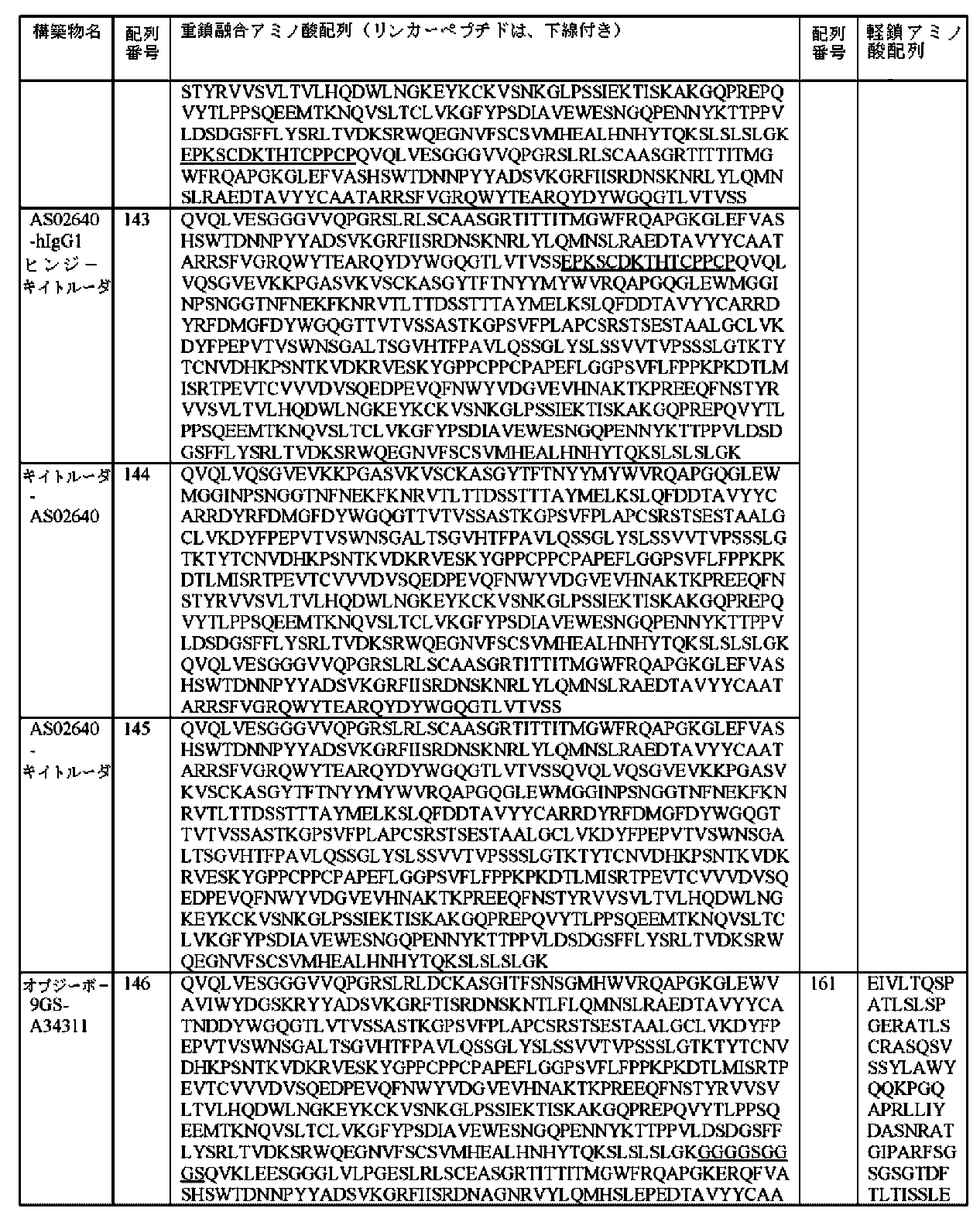


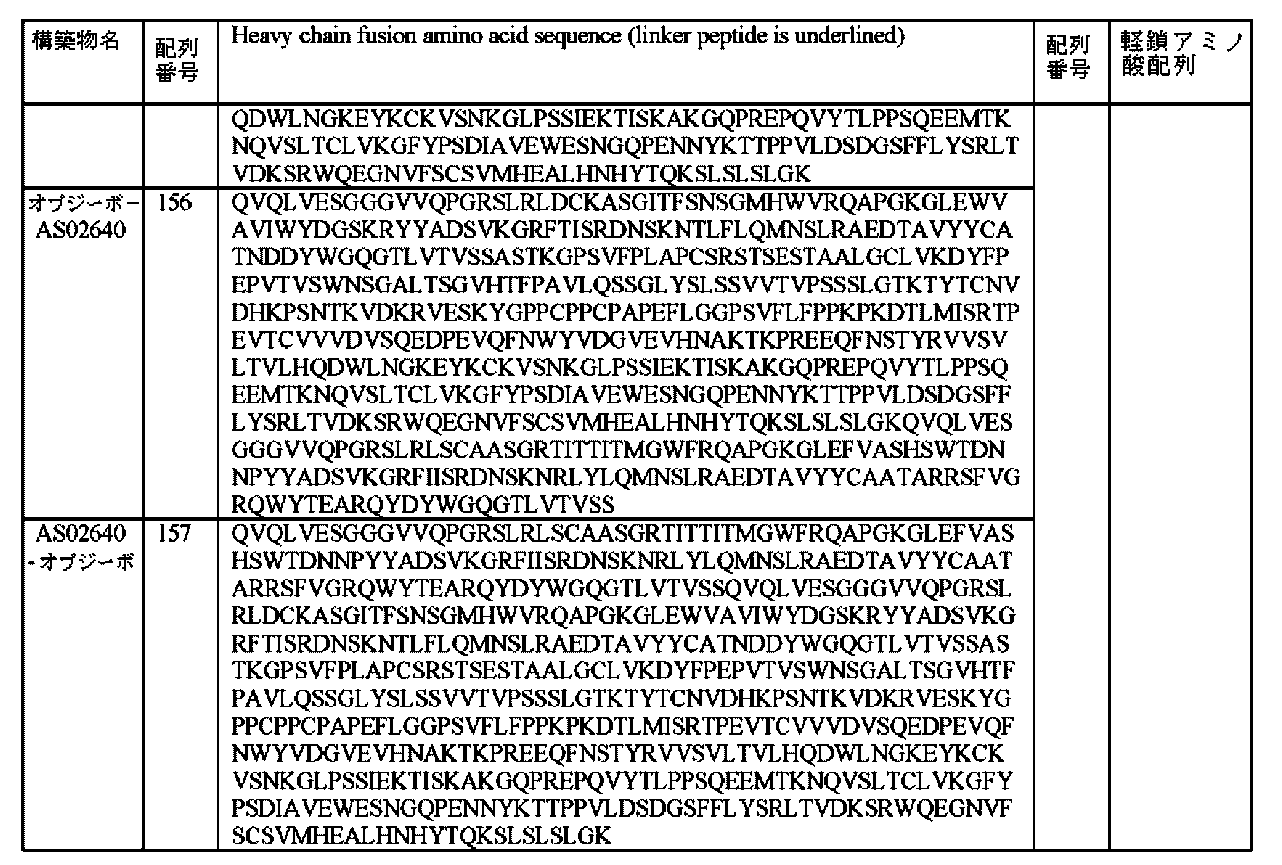
QVQLVQSGVEVKKPGASVKVSCKASGYTFTNYYMYWVRQAPGQGLEWMGGINPSNGGTNFNEKFKNRVTLTTDSSTTTAYMELKSLQFDDTAVYYCARRDYRFDMGFDYWGQGTTVTVSSASTKGPSWPLAPCSRSTSESTAALGCLVKDYFPEPVTVSWNSGALTSGVHTFPAVLQSSGLYSLSSVVTVPSSSLGTKTYTCNVDHKPSNTKVDKRVESKYGPPCPPCPAPEFLGGPSWLFPPKPKDTLMISRTPEVTCVVVDVSQEDPEVQFNWYVDGVEVHNAKTKPREEQFNSTYRVVSVLTVLHQDWLNGKEYKCKVSNKGLPSSIEKTISKAKGQPREPQVYTLPPSQEEMTKNQVSLTCLVKGFYPSDIAVEWESNGQPENNYKTTPPVLDSDGSFFLYSRLTVDKSRWQEGNWSCSVMHEALHNHYTQKSLSLSLGK
配列番号160(オプジーボ(登録商標)重鎖アミノ酸配列)
QVQLVESGGGVVQPGRSLRLDCKASGITFSNSGMHWVRQAPGKGLEWVAVIWYDGSKRYYADSVKGRFTISRDNSKNTLFLQMNSLRAEDTAVYYCATNDDYWGQGTLVTVSSASTKGPSVFPLAPCSRSTSESTAALGCLVKDYFPEPVTVSWNSGALTSGVHTFPAVLQSSGLYSLSSVVTVPSSSLGTKTYTCNVDHKPSNTKVDKRVESKYGPPCPPCPAPEFLGGPSWLFPPKPKDTLMISRTPEVTCVVVDVSQEDPEVQFNWYVDGVEVHNAKTKPREEQFNSTYRVVSVLTVLHQDWLNGKEYKCKVSNKGLPSSIEKTISKAKGQPREPQVYTLPPSQEEMTKNQVSLTCLVKGFYPSDIAVEWESNGQPENNYKTTPPVLDSDGSFFLYSRLTVDKSRWQEGNWSCSVMHEALHNHYTQKSLSLSLGK
配列番号162(リンカーペプチド(9GS)アミノ酸配列)
GGGGSGGGS
配列番号163(ヒトIgG1(hIgG1)ヒンジアミノ酸配列)
EPKSCDKTHTCPPCP
表5.抗CTLA-4/PD-L1二重特異性抗体配列


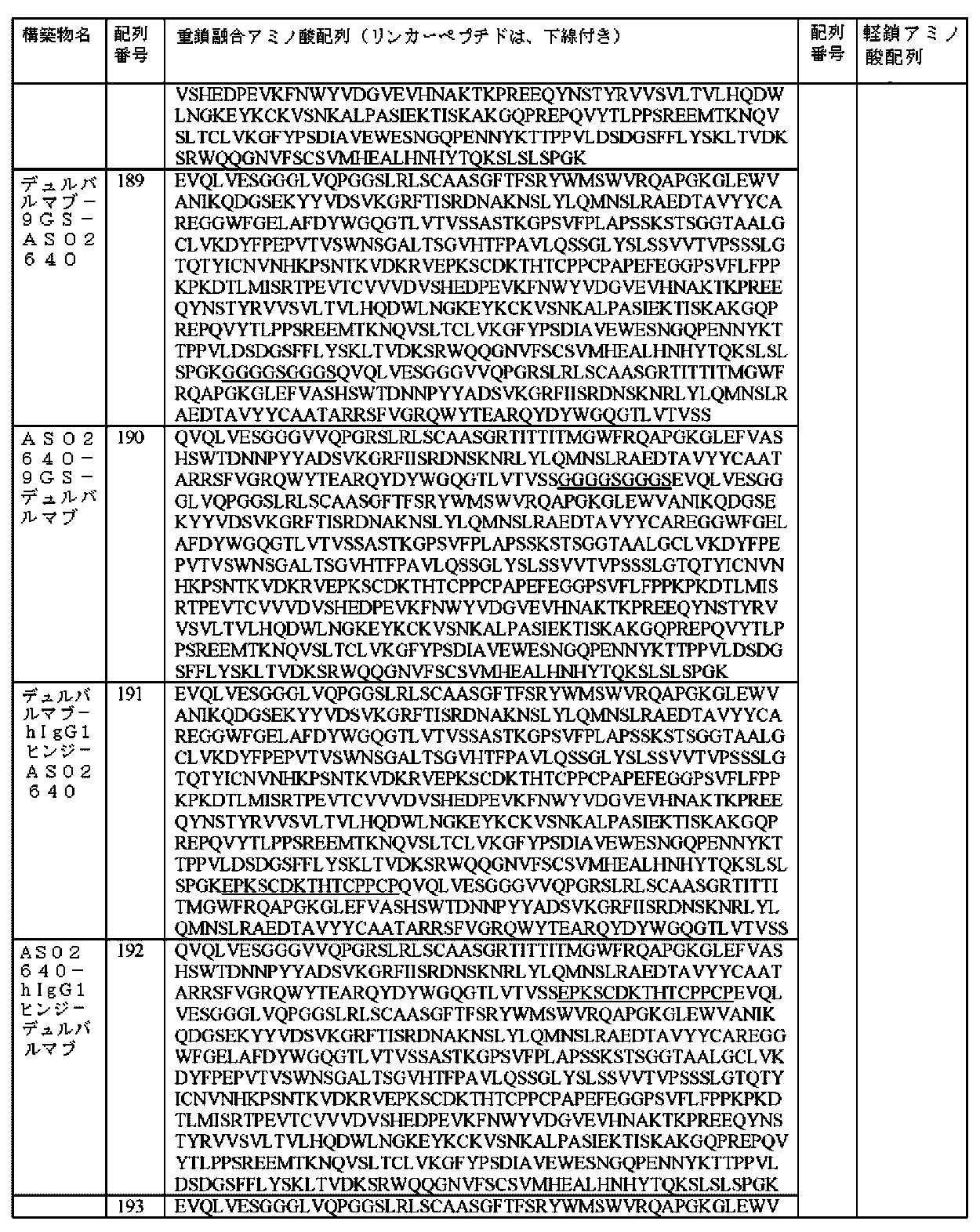
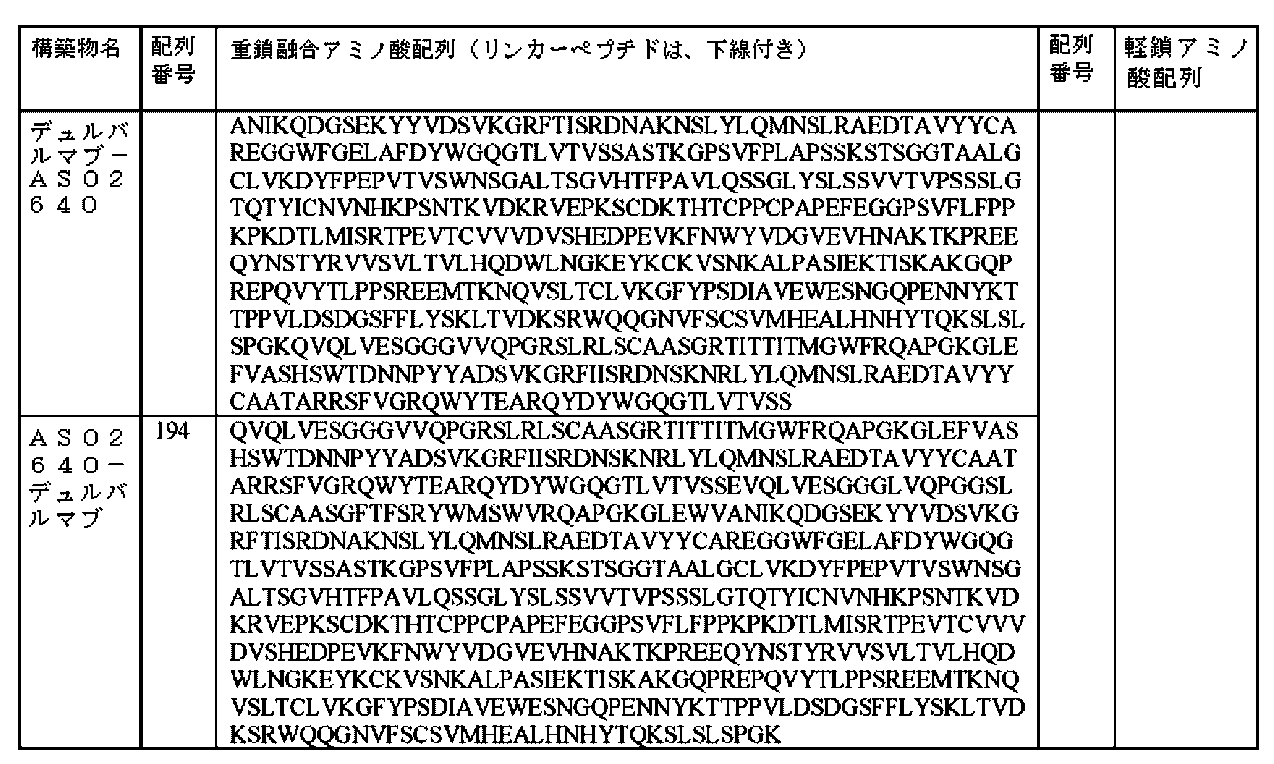
EVQLVESGGGLVQPGGSLRLSCAASGFTFSDSWIHWVRQAPGKGLEWVAWISPYGGSTYYADSVKGRFTISADTSKNTAYLQMNSLRAEDTAVYYCARRHWPGGFDYWGQGTLVTVSSASTKGPSWPLAPSSKSTSGGTAALGCLVKDYFPEPVTVSWNSGALTSGVHTFPAVLQSSGLYSLSSVVTVPSSSLGTQTYICNVNHKPSNTKVDKKVEPKSCDKTHTCPPCPAPELLGGPSWLFPPKPKDTLMISRTPEVTCVVVDVSHEDPEVKFNWYVDGVEVHNAKTKPREEQYASTYRVVSVLTVLHQDWLNGKEYKCKVSNKALPAPIEKTISKAKGQPREPQVYTLPPSREEMTKNQVSLTCLVKGFYPSDIAVEWESNGQPENNYKTTPPVLDSDGSFFLYSKLTVDKSRWQQGNWSCSVMHEALHNHYTQKSLSLSPGK
配列番号197(デュルバルマブ重鎖アミノ酸配列)
EVQLVESGGGLVQPGGSLRLSCAASGFTFSRYWMSWVRQAPGKGLEWVANIKQDGSEKYYVDSVKGRFTISRDNAKNSLYLQMNSLRAEDTAVYYCAREGGWFGELAFDYWGQGTLVTVSSASTKGPSWPLAPSSKSTSGGTAALGCLVKDYFPEPVTVSWNSGALTSGVHTFPAVLQSSGLYSLSSVVTVPSSSLGTQTYICNVNHKPSNTKVDKRVEPKSCDKTHTCPPCPAPEFEGGPSWLFPPKPKDTLMISRTPEVTCVVVDVSHEDPEVKFNWYVDGVEVHNAKTKPREEQYNSTYRVVSVLTVLHQDWLNGKEYKCKVSNKALPASIEKTISKAKGQPREPQVYTLPPSREEMTKNQVSLTCLVKGFYPSDIAVEWESNGQPENNYKTTPPVLDSDGSFFLYSKLTVDKSRWQQGNWSCSVMHEALHNHYTQKSLSLSPGK
配列番号199(hCTLA-4完全長アミノ酸配列、シグナルペプチドを有さない)
AMHVAQPAVVLASSRGIASFVCEYASPGKATEVRVTVLRQADSQVTEVCAATYMMGNELTFLDDSICTGTSSGNQVNLTIQGLRAMDTGLYICKVELMYPPPYYLGIGNGTQIYVIDPEPCPDSDFLLWILAAVSSGLFFYSFLLTAVSLSKMLKKRSPLTTGVYVKMPPTEPECEKQFQPYFIPIN
配列番号164(hCTLA-4細胞外ドメインアミノ酸配列)
AMHVAQPAVVLASSRGIASFVCEYASPGKATEVRVTVLRQADSQVTEVCAATYMMGNELTFLDDSICTGTSSGNQVNLTIQGLRAMDTGLYICKVELMYPPPYYLGIGNGTQIYVIDPEPCPDSD
配列番号200(A34311直接グラフトアミノ酸配列)
QVQLVESGGGVVQPGRSLRLSCAASGRTITTITMGWVRQAPGKGLEWVASHSWTDNNPYYADSVKGRFTISRDNSKNTLYLQMNSLRAEDTAVYYCAKTARRSFVGRQWYTEARQYDYWGQGTLVTVSS
配列番号201(AS02636ヒト化sdAbアミノ酸配列)
QVQLVESGGGVVQPGRSLRLSCAASGRTITTITMGWFRQAPGKGRQFVASHSWTDNNPYYADSVKGRFIISRDNSKNTLYLQMNSLRPEDTAVYYCAATARRSFVGRQWYTEARQYDYWGQGTLVTVSS
配列番号202(AS02626ヒト化sdAbアミノ酸配列、コンセンサスアミノ酸配列)
QVQLVESGGGVVQPGRSLRLSCAASGRTITTITMGWFRQAPGKGREFVASHSWTDNNPYYADSVKGRFIISRDNSKNRLYLQMNSLRAEDTAVYYCAATARRSFVGRQWYTEARQYDYWGQGTLVTVSS
配列番号264(AS02640 sdAb核酸配列)
CAAGTTCAACTGGTGGAAAGCGGCGGCGGCGTGGTGCAACCGGGTCGTAGCCTGCGTCTGAGCTGCGCGGCGAGCGGTCGTACCATCACCACCATCACCATGGGTTGGTTCCGTCAGGCGCCGGGCAAGGGTCTTGAATTTGTGGCGAGCCACAGCTGGACCGACAACAACCCGTACTATGCGGATAGCGTTAAGGGCCGTTTCATCATTAGCCGTGACAACAGCAAAAACAGGCTGTACCTGCAGATGAACAGCCTGCGTGCGGAGGATACCGCGGTGTACTATTGCGCGGCGACCGCGCGTCGTAGCTTTGTTGGTCGTCAATGGTACACCGAGGCGCGTCAATACGATTACTGGGGCCAAGGCACCCTGGTTACCGTGAGCAGC
配列番号265(A34311VH11 sdAb核酸配列)
GAAGTGCAGCTGGTGGAAAGTGGAGGGGGCGTGGTGCAGCCTGGAAGAAGCCTGAGACTGTCCTGTGCCGCATCTGGGAGAACTATTACCACAATCACCATGGGATGGTTCCGACAGGCTCCAGGCAAGGGAAGAGAGTTTGTGGCAAGCCACTCCTGGACAGACAACAATCCTTACTATGCCGATTCTGTCAAGGGCAGGTTCACAATTTCTCGCGACAACGCCAAAAATACTCTGTACCTGCAGATGAACTCACTGCGACCCGAAGATACTGCCGTGTACTATTGCGCAGCTACCGCTCGACGGAGCTTCGTCGGGAGACAGTGGTACACCGAAGCAAGACAGTATGATTATTGGGGACAGGGCACTCTGGTCACCGTCAGCAGT
配列番号266(AS07014VH11 sdAb核酸配列)
GAGGTGCAGCTGGTGGAATCTGGGGGAGGACTGGTGCAGCCTGGGGGAAGCCTGAGACTGAGTTGTGCCGCAAGCGGATACACTTACAGCAGGCACTGCCTGGGATGGTTCCGACAGGCACCAGGCAAGGGACGAGAGGCCGTGTCTACCATCGACAGTGATGGGAGCACATCCTACGCTGACTCAGTCAAGGGACGGTTTACTATCAGCAGAGATAACGCAAAGAACACCCTGTATCTGCAGATGAACTCCCTGAGACCAGAAGACACAGCCGTGTACTATTGCGCTATCGGACCCAACCCTCGGTACTGTTCTGGCGCCCCCAATACCCGGGGAGCCGAACATTACTTTGGGTATTGGGGACAGGGCACACTGGTGACCGTGAGCAGC
配列番号267(AS07014VH11G54 sdAb核酸配列)
GAAGTCCAACTGGTCGAATCGGGTGGTGGTCTGGTCCAACCGGGCGGCTCCCTGCGTCTGTCGTGTGCGGCGTCGGGCTATACCTATTCCCGTCATTGCCTGGGTTGGTTTCGTCAGGCACCGGGCAAAGGTCGTGAAGCTGTGAGTACCATTGATTCCGGCGGTAGCACGTCTTATGCGGACTCAGTTAAAGGTCGTTTCACCATCTCGCGCGATAACGCCAAAAATACGCTGTACCTGCAAATGAACAGCCTGCGCCCGGAAGACACCGCGGTCTATTACTGCGCCATTGGCCCGAACCCGCGTTATTGTTCTGGTGCGCCGAATACGCGTGGTGCGGAACATTACTTTGGCTACTGGGGTCAGGGTACGCTGGTTACGGTGTCCTCG
配列番号268(AS07014VH11SGA sdAb核酸配列)
GAAGTCCAACTGGTCGAAAGTGGTGGTGGCCTGGTCCAACCGGGCGGCTCGCTGCGTCTGTCGTGTGCTGCGTCTGGCTATACCTACAGCCGTCATTGCCTGGGTTGGTTTCGTCAGGCACCGGGCAAAGGTCGTGAAGCCGTGTCTACCATTAGCTCTGGCGGTAGTACGTCCTATGCAGATTCAGTTAAAGGTCGTTTCACCATCTCGCGCGACAACGCCAAAAATACGCTGTACCTGCAAATGAACTCCCTGCGCCCGGAAGATACCGCAGTCTATTACTGCGCTATTGGCCCGAATCCGCGTTATTGTAGCGGTGCGCCGGCCACGCGCGGCGCAGAACACTATTTCGGCTACTGGGGTCAGGGCACGCTGGTTACCGTTTCGTCG
配列番号269(AS07014VH11SGQ sdAb核酸配列)
GAAGTCCAACTGGTCGAAAGCGGCGGCGGCCTGGTCCAACCGGGCGGCTCACTGCGTCTGTCCTGTGCGGCATCGGGCTACACCTATAGCCGTCATTGCCTGGGTTGGTTTCGTCAGGCACCGGGCAAAGGTCGTGAAGCTGTGTCTACCATTAGCTCTGGCGGTAGTACGTCCTATGCGGATTCAGTTAAAGGTCGTTTCACCATCTCGCGCGACAACGCCAAAAATACGCTGTACCTGCAGATGAACTCCCTGCGCCCGGAAGATACCGCGGTCTATTACTGCGCCATTGGCCCGAATCCGCGTTATTGTAGCGGTGCGCCGCAAACGCGTGGTGCGGAACATTACTTTGGTTATTGGGGTCAGGGTACGCTGGTTACGGTTTCGTCG
配列番号270(AS07014VH11SGS sdAb核酸配列)
GAAGTCCAACTGGTCGAATCGGGCGGCGGCCTGGTCCAACCGGGTGGCTCACTGCGTCTGTCCTGTGCGGCAAGCGGCTACACGTATTCCCGTCATTGCCTGGGTTGGTTTCGTCAGGCACCGGGCAAAGGTCGTGAAGCTGTGAGCACCATTAGCTCTGGCGGTAGTACGTCCTATGCGGATAGCGTTAAAGGTCGTTTCACCATCTCTCGCGACAACGCCAAAAATACGCTGTACCTGCAAATGAACAGTCTGCGCCCGGAAGATACCGCGGTCTATTACTGCGCCATTGGCCCGAATCCGCGTTATTGTTCAGGTGCGCCGTCGACGCGCGGTGCCGAACATTATTTTGGTTACTGGGGTCAGGGTACGCTGGTCACGGTTTCATCA
配列番号271(AS07189TKDVH11 sdAb核酸配列)
GAGGTGCAGCTGGTGGAAAGCGGGGGGGGCCTGGTGCAGCCTGGAGGAAGCCTGAGACTGAGTTGTGCCGCAAGTGGCGATAGCCCAAGCGTGAACTACATGGGGTGGTTCAGGCAGGCACCAGGAAAGGGACGAGAGGAAGTGAGCTCCATCTACCCTACCGGCGGGACATTCTATACTGACTCTGTCAAGGGCCGGTTTACCATTAGTAGAGATAACGCCAAAAATACACTGTATCTGCAGATGAACAGCCTGCGACCCGAGGACACCGCTGTCTACTATTGCGCTGCTGGGAAATGGGGGACCGACTATTGGGGACAGGGGACACTGGTGACCGTCTCATCA
配列番号272(AS07189TKDVH11F27 sdAb核酸配列)
GAAGTGCAACTGGTGGAATCGGGTGGTGGTCTGGTTCAGCCGGGTGGTAGCCTGCGTCTGTCCTGTGCGGCAAGCGGTTTTTCGCCGAGCGTCAACTATATGGGCTGGTTTCGTCAGGCGCCGGGCAAAGGTCGCGAAGAAGTGAGCTCTATCTATCCGACCGGCGGCACGTTTTACACCGATAGTGTTAAAGGTCGTTTCACGATCTCCCGCGACAACGCGAAAAATACCCTGTACCTGCAAATGAATAGCCTGCGTCCGGAAGATACGGCCGTTTATTACTGCGCGGCAGGCAAATGGGGCACGGATTACTGGGGTCAGGGCACGCTGGTCACGGTGTCGTCC
配列番号273(AS07189TKDVH11FY sdAb核酸配列)
GAAGTGCAGCTGGTGGAAAGCGGAGGAGGACTGGTGCAGCCTGGCGGAAGCCTGAGACTGAGTTGTGCCGCATCTGGGTTTAGCCCCAGCGTGAACTACATGGGGTGGTTCAGGCAGGCACCAGGAAAGGGACGAGAGGAAGTGAGCTCCATCTACCCTACCGGCGGGACATTCTATACTGACTCTGTCAAGGGCCGGTTTACCATTAGTAGAGATAACGCCAAAAATACACTGTATCTGCAGATGAACAGCCTGCGACCCGAGGACACCGCTGTCTACTATTGCGCAGCAGGGAAATACGGAACCGATTACTGGGGGCAGGGAACTCTGGTCACTGTCAGCAGC

EVQLVESGGGVVQPGRSLRLSCAASGRTITTITMGWFRQAPGKGREFVASHSWTDNNPYYADSVKGRFTISRDNAKNTLYLQMNSLRPEDTAVYYCAATARRSFVGRQWYTEARQYDYWGQGTLVTVSSEPKSCDKTHTCPPCPAPELLGGPSWLFPPKPKDTLMISRTPEVTCVVVDVSHEDPEVKFNWYVDGVEVHNAKTKPREEQYNSTYRVVSVLTVLHQDWLNGKEYKCKVSNKALPAPIEKTISKAKGQPREPQVYTLPPSRDELTKNQVSLTCLVKGFYPSDIAVEWESNGQPENNYKTTPPVLDSDGSFFLYSKLTVDKSRWQQGNWSCSVMHEALHNHYTQKSLSLSPGK
配列番号284(AS07014VH11 HCAb二量体型アミノ酸配列)
EVQLVESGGGLVQPGGSLRLSCAASGYTYSRHCLGWFRQAPGKGREAVSTIDSDGSTSYADSVKGRFTISRDNAKNTLYLQMNSLRPEDTAVYYCAIGPNPRYCSGAPNTRGAEHYFGYWGQGTLVTVSSEPKSCDKTHTCPPCPAPELLGGPSWLFPPKPKDTLMISRTPEVTCVVVDVSHEDPEVKFNWYVDGVEVHNAKTKPREEQYNSTYRVVSVLTVLHQDWLNGKEYKCKVSNKALPAPIEKTISKAKGQPREPQVYTLPPSRDELTKNQVSLTCLVKGFYPSDIAVEWESNGQPENNYKTTPPVLDSDGSFFLYSKLTVDKSRWQQGNVFSCSVMHEALHNHYTQKSLSLSPGK
配列番号285(AS07014VH11G54 HCAb二量体型アミノ酸配列)
EVQLVESGGGLVQPGGSLRLSCAASGYTYSRHCLGWFRQAPGKGREAVSTIDSGGSTSYADSVKGRFTISRDNAKNTLYLQMNSLRPEDTAVYYCAIGPNPRYCSGAPNTRGAEHYFGYWGQGTLVTVSSEPKSCDKTHTCPPCPAPELLGGPSWLFPPKPKDTLMISRTPEVTCVVVDVSHEDPEVKFNWYVDGVEVHNAKTKPREEQYNSTYRVVSVLTVLHQDWLNGKEYKCKVSNKALPAPIEKTISKAKGQPREPQVYTLPPSRDELTKNQVSLTCLVKGFYPSDIAVEWESNGQPENNYKTTPPVLDSDGSFFLYSKLTVDKSRWQQGNVFSCSVMHEALHNHYTQKSLSLSPGK
配列番号286(AS07014VH11SGA HCAb二量体型アミノ酸配列)
EVQLVESGGGLVQPGGSLRLSCAASGYTYSRHCLGWFRQAPGKGREAVSTISSGGSTSYADSVKGRFTISRDNAKNTLYLQMNSLRPEDTAVYYCAIGPNPRYCSGAPATRGAEHYFGYWGQGTLVTVSSEPKSCDKTHTCPPCPAPELLGGPSVFLFPPKPKDTLMISRTPEVTCVVVDVSHEDPEVKFNWYVDGVEVHNAKTKPREEQYNSTYRVVSVLTVLHQDWLNGKEYKCKVSNKALPAPIEKTISKAKGQPREPQVYTLPPSRDELTKNQVSLTCLVKGFYPSDIAVEWESNGQPENNYKTTPPVLDSDGSFFLYSKLTVDKSRWQQGNVFSCSVMHEALHNHYTQKSLSLSPGK
配列番号287(AS07014VH11SGQ HCAb二量体型アミノ酸配列)
EVQLVESGGGLVQPGGSLRLSCAASGYTYSRHCLGWFRQAPGKGREAVSTISSGGSTSYADSVKGRFTISRDNAKNTLYLQMNSLRPEDTAVYYCAIGPNPRYCSGAPQTRGAEHYFGYWGQGTLVTVSSEPKSCDKTHTCPPCPAPELLGGPSVFLFPPKPKDTLMISRTPEVTCVVVDVSHEDPEVKFNWYVDGVEVHNAKTKPREEQYNSTYRVVSVLTVLHQDWLNGKEYKCKVSNKALPAPIEKTISKAKGQPREPQVYTLPPSRDELTKNQVSLTCLVKGFYPSDIAVEWESNGQPENNYKTTPPVLDSDGSFFLYSKLTVDKSRWQQGNVFSCSVMHEALHNHYTQKSLSLSPGK
配列番号288(AS07014VH11SGS HCAb二量体型アミノ酸配列)
EVQLVESGGGLVQPGGSLRLSCAASGYTYSRHCLGWFRQAPGKGREAVSTISSGGSTSYADSVKGRFTISRDNAKNTLYLQMNSLRPEDTAVYYCAIGPNPRYCSGAPSTRGAEHYFGYWGQGTLVTVSSEPKSCDKTHTCPPCPAPELLGGPSWLFPPKPKDTLMISRTPEVTCVVVDVSHEDPEVKFNWYVDGVEVEINAKTKPREEQYNSTYRVVSVLTVLHQDWLNGKEYKCKVSNKALPAPIEKTISKAKGQPREPQVYTLPPSRDELTKNQVSLTCLVKGFYPSDIAVEWESNGQPENNYKTTPPVLDSDGSFFLYSKLTVDKSRWQQGNWSCSVMHEALHNHYTQKSLSLSPGK
配列番号289(AS07189TKDVH11 HCAb二量体型アミノ酸配列)
EVQLVESGGGLVQPGGSLRLSCAASGDSPSVNYMGWFRQAPGKGREEVSSIYPTGGTFYTDSVKGRFTISRDNAKNTLYLQMNSLRPEDTAVYYCAAGKWGTDYWGQGTLVTVSSEPKSCDKTHTCPPCPAPELLGGPSVFLFPPKPKDTLMISRTPEVTCVVVDVSHEDPEVKFNWYVDGVEVHNAKTKPREEQYNSTYRVVSVLTVLHQDWLNGKEYKCKVSNKALPAPIEKTISKAKGQPREPQVYTLPPSRDELTKNQVSLTCLVKGFYPSDIAVEWESNGQPENNYKTTPPVLDSDGSFFLYSKLTVDKSRWQQGNWSCSVMHEALHNHYTQKSLSLSPGK
配列番号290(AS07189TKDVH11F27 HCAb二量体型アミノ酸配列)
EVQLVESGGGLVQPGGSLRLSCAASGFSPSVNYMGWFRQAPGKGREEVSSIYPTGGTFYTDSVKGRFTISRDNAKNTLYLQMNSLRPEDTAVYYCAAGKWGTDYWGQGTLVTVSSEPKSCDKTHTCPPCPAPELLGGPSVFLFPPKPKDTLMISRTPEVTCVVVDVSHEDPEVKFNWYVDGVEVHNAKTKPREEQYNSTYRVVSVLTVLHQDWLNGKEYKCKVSNKALPAPIEKTISKAKGQPREPQVYTLPPSRDELTKNQVSLTCLVKGFYPSDIAVEWESNGQPENNYKTTPPVLDSDGSFFLYSKLTVDKSRWQQGNWSCSVMHEALHNHYTQKSLSLSPGK
配列番号291(AS07189TKDVH11FY HCAb二量体型アミノ酸配列)
EVQLVESGGGLVQPGGSLRLSCAASGFSPSVNYMGWFRQAPGKGREEVSSIYPTGGTFYTDSVKGRFTISRDNAKNTLYLQMNSLRPEDTAVYYCAAGKYGTDYWGQGTLVTVSSEPKSCDKTHTCPPCPAPELLGGPSVFLFPPKPKDTLMISRTPEVTCVVVDVSHEDPEVKFNWYVDGVEVHNAKTKPREEQYNSTYRVVSVLTVLHQDWLNGKEYKCKVSNKALPAPIEKTISKAKGQPREPQVYTLPPSRDELTKNQVSLTCLVKGFYPSDIAVEWESNGQPENNYKTTPPVLDSDGSFFLYSKLTVDKSRWQQGNVFSCSVMHEALHNHYTQKSLSLSPGK


EPKSSDKTHTSPPSP
配列番号308(PD1BMmin 重鎖アミノ酸配列)
EVQLVESGGGLVQPGGSLRLSCAASGFVFSRYDMAWVRQAPGKGLEWVSFISGGGSNTYYPDTVKGRFTISRDNSKNTLYLQMNSLRAEDTAVYYCISPYYYAMEYWGQGTTVTVSSASTKGPSVFPLAPCSRSTSESTAALGCLVKDYFPEPVTVSWNSGALTSGVHTFPAVLQSSGLYSLSSVVTVPSSSLGTKTYTCNVDHKPSNTKVDKRVESKYGPPCPPCPAPEFLGGPSWLFPPKPKDTLMISRTPEVTCVVVDVSQEDPEVQFNWYVDGVEVHNAKTKPREEQFNSTYRVVSVLTVLHQDWLNGKEYKCKVSNKGLPSSIEKTISKAKGQPREPQVYTLPPSQEEMTKNQVSLTCLVKGFYPSDIAVEWESNGQPENNYKTTPPVLDSDGSFFLYSRLTVDKSRWQEGNVFSCSVMHEALHNHYTQKSLSLSLGK


GGGGSGGGGSGGGGS
配列番号366(AS07014直接グラフトHCAb二量体型アミノ酸配列)
EVQLVESGGGLVQPGGSLRLSCAASGYTYSRHCLGWVRQAPGKGLEWVSTIDSDGSTSYADSVKGRFTISRDNSKNTLYLQMNSLRAEDTAVYYCARGPNPRYCSGAPNTRGAEHYFGYWGQGTLVTVSSEPKSCDKTHTCPPCPAPELLGGPSVFLFPPKPKDTLMISRTPEVTCVVVDVSHEDPEVKFNWYVDGVEVHNAKTKPREEQYNSTYRVVSVLTVLHQDWLNGKEYKCKVSNKALPAPIEKTISKAKGQPREPQVYTLPPSRDELTKNQVSLTCLVKGFYPSDIAVEWESNGQPENNYKTTPPVLDSDGSFFLYSKLTVDKSRWQQGNWSCSVMHEALHNHYTQKSLSLSPGK
配列番号367(AS07189直接グラフトHCAb二量体型アミノ酸配列)
EVQLVESGGGLVQPGGSLRLSCAASGFSPSVNYMGWVRQAPGKGLEWVSSIYPTGGTFYTDSVKGRFTISRDNSKNTLYLQMNSLRAEDTAVYYCARGKWGTDYWGQGTLVTVSSEPKSCDKTHTCPPCPAPELLGGPSVFLFPPKPKDTLMISRTPEVTCVVVDVSHEDPEVKFNWYVDGVEVHNAKTKPREEQYNSTYRVVSVLTVLHQDWLNGKEYKCKVSNKALPAPIEKTISKAKGQPREPQVYTLPPSRDELTKNQVSLTCLVKGFYPSDIAVEWESNGQPENNYKTTPPVLDSDGSFFLYSKLTVDKSRWQQGNVFSCSVMHEALHNHYTQKSLSLSPGK
配列番号368(AS07189TKDVH21FY HCAb二量体型アミノ酸配列)
EVQLVESGGGLVQPGGSLRLSCAASGFSPSVNYMGWVRQAPGKGLEEVSSIYPTGGTFYTDSVKGRFTISRDNSKNTLYLQMNSLRAEDTAVYYCAAGKYGTDYWGQGTLVTVSSEPKSCDKTHTCPPCPAPELLGGPSVFLFPPKPKDTLMISRTPEVTCVVVDVSHEDPEVKFNWYVDGVEVHNAKTKPREEQYNSTYRVVSVLTVLHQDWLNGKEYKCKVSNKALPAPIEKTISKAKGQPREPQVYTLPPSRDELTKNQVSLTCLVKGFYPSDIAVEWESNGQPENNYKTTPPVLDSDGSFFLYSKLTVDKSRWQQGNVFSCSVMHEALHNHYTQKSLSLSPGK
配列番号369(A34311VH2 HCAb二量体型アミノ酸配列)
EVQLVESGGGVVQPGRSLRLSCAASGRTITTITMGWFRQAPGKGLEFVASHSWTDNNPYYADSVKGRFTISRDNSKNTLYLQMNSLRAEDTAVYYCAATARRSFVGRQWYTEARQYDYWGQGTLVTVSSEPKSCDKTHTCPPCPAPELLGGPSVFLFPPKPKDTLMISRTPEVTCVVVDVSHEDPEVKFNWYVDGVEVHNAKTKPREEQYNSTYRVVSVLTVLHQDWLNGKEYKCKVSNKALPAPIEKTISKAKGQPREPQVYTLPPSRDELTKNQVSLTCLVKGFYPSDIAVEWESNGQPENNYKTTPPVLDSDGSFFLYSKLTVDKSRWQQGNVFSCSVMHEALHNHYTQKSLSLSPGK
配列番号370(A34311VH2F53 HCAb二量体型アミノ酸配列)
EVQLVESGGGVVQPGRSLRLSCAASGRTITTITMGWFRQAPGKGLEFVASHSFTDNNPYYADSVKGRFTISRDNSKNTLYLQMNSLRAEDTAVYYCAATARRSFVGRQWYTEARQYDYWGQGTLVTVSSEPKSCDKTHTCPPCPAPELLGGPSVFLFPPKPKDTLMISRTPEVTCVVVDVSHEDPEVKFNWYVDGVEVHNAKTKPREEQYNSTYRVVSVLTVLHQDWLNGKEYKCKVSNKALPAPIEKTISKAKGQPREPQVYTLPPSRDELTKNQVSLTCLVKGFYPSDIAVEWESNGQPENNYKTTPPVLDSDGSFFLYSKLTVDKSRWQQGNVFSCSVMHEALHNHYTQKSLSLSPGK
配列番号371(A34311VH11F53 HCAb二量体型アミノ酸配列)
EVQLVESGGGVVQPGRSLRLSCAASGRTITTITMGWFRQAPGKGREFVASHSFTDNNPYYADSVKGRFTISRDNAKNTLYLQMNSLRPEDTAVYYCAATARRSFVGRQWYTEARQYDYWGQGTLVTVSSEPKSCDKTHTCPPCPAPELLGGPSVFLFPPKPKDTLMISRTPEVTCVVVDVSHEDPEVKFNWYVDGVEVHNAKTKPREEQYNSTYRVVSVLTVLHQDWLNGKEYKCKVSNKALPAPIEKTISKAKGQPREPQVYTLPPSRDELTKNQVSLTCLVKGFYPSDIAVEWESNGQPENNYKTTPPVLDSDGSFFLYSKLTVDKSRWQQGNVFSCSVMHEALHNHYTQKSLSLSPGK
配列番号372(A34311コンセンサスアミノ酸配列)
EVQLVESGGGVVQPGRSLRLSCAASGRTITTITMGWFRQAPGKGLEFVASHSWTDNNPYYADSVKGRFTISRDNSKNTLYLQMNSLRAEDTAVYYCAATARRSFVGRQWYTEARQYDYWGQGTLVTVSS
配列番号373(AS07014コンセンサスアミノ酸配列)
EVQLVESGGGLVQPGGSLRLSCAASGYTYSRHCLGWFRQAPGKGREAVSTIDSGGSTSYADSVKGRFTISRDNAKNTLYLQMNSLRPEDTAVYYCAIGPNPRYCSGAPNTRGAEHYFGYWGQGTLVTVSS
配列番号374(AS07189コンセンサスアミノ酸配列)
EVQLVESGGGLVQPGGSLRLSCAASGFSPSVNYMGWFRQAPGKGREEVSSIYPTGGTFYTDSVKGRFTISRDNAKNTLYLQMNSLRPEDTAVYYCAAGKWGTDYWGQGTLVTVSS
配列番号375(リンカーアミノ酸配列、nは、少なくとも1の整数)
(G)n
配列番号376(リンカーアミノ酸配列、nは、少なくとも1の整数)
(GS)n
配列番号377(リンカーアミノ酸配列、nは、少なくとも1の整数)
(GSGGS)n
配列番号378(リンカーアミノ酸配列、nは、少なくとも1の整数)
(GGGS)n
配列番号379(リンカーアミノ酸配列、nは、少なくとも1の整数)
(GGGGS)n
The effect of exemplary CTLA-4xPD-L1 bispecific antibodies (BCP-84, BCP-85) against CTLA-4 and PD-L1 on tumor growth was tested on a mouse xenograft model prepared by implanting tumor cells expressing PD-L1 into C57BL/6 CTLA-4 KI mice. The murine colon adenocarcinoma cell line MC38, which stably expresses human PD-L1, was used in this assay. Eight-week-old C57BL/6 CTLA-4 KI mice were shaved on the lower back and injected subcutaneously with 1x10⁷ MC38-hPD-L1 KI cells. Mice whose tumors did not engraft within 7 days by visual inspection were excluded from further studies. Tumors were measured daily starting on day 7 after MC38 implantation. Tumor size was measured with calipers and tumor volume was calculated with the modified ellipse formula: length x (width) / 2 . When tumors reached a volume of approximately 90-130 mm3, mice were randomly assigned to different treatment groups and maintained for 2 or 6 weeks. Digital caliper measurements and body weights were taken every 3 days for the duration of treatment (Figures 39A-39B). Mice were treated intraperitoneally (i.p.) for 16 days with 3 mg/kg of in-house expressed Tecentriq biosimilar antibody, an equivalent amount (3.7 mg/kg) of CTLA-4 x PD-L1 bispecific antibody (BCP-84 or BCP-85), an equivalent amount (1.6 mg/kg) of the corresponding anti-CTLA-4 HCAb (AS07014VH11 HCAb or AS07189VH11 HCAb), or combination therapy (Tecentriq biosimilar + AS07014VH11 HCAb, or Tecentriq biosimilar + AS07189TKDVH11 HCAb). Mice were injected with PBS, which served as a negative control. Treatments were performed every 4 days. As can be seen in Figure 39A, all CTLA-4 x PD-L1 bispecific antibody and combination therapy groups demonstrated higher tumor inhibition efficacy than either monotherapy (corresponding anti-CTLA-4 HCAb or Tecentriq biosimilar) in mouse tumor models (Figure 39A). Notably, the antitumor efficacy of BCP-84 and BCP-85 was comparable to the combination therapy. All treatments had no effect on the body weight of MC38-implanted mice compared to mock controls (Figure 39B).
Sequence Listing SEQ ID NO: 97 (A34310 sdAb nucleic acid sequence)
CAGGTACAGCTGGTGGAGTCTGGGGGAGGCTTGGTGCAGGCTGGGGGGTCTCTGAGACTCTCCTGTGCAGCTCTGGATTCACTTTCGATGATTATGCCATAGGCTGGTTCCGCCAGGCCC CAGGGAAGGAGCGTGAGGGGTCTCATGTATTAGTAGTGGTGGCACATACTATGCAGACTCCGTGAAGGGCCGATTCA CCATCTCCAGTGACAACGCCAAGAACACGGTGTTTCTGCAAATGAACAGCCTGAAACCTGAGGACACGGCTGTTTATTACTGTGGAGCAGTTTCGTCGCTCTTAAGTGTGGAGAGGTTCCC TGGAGGTCATTGCGGCCCCGTTATGGGTACTACCGTCACGGCTACTGGGGCCAGGGGACCCAGGTCACCGTCTCCTCA
SEQ ID NO: 98 (A34311 sdAb nucleic acid sequence)
CAGGTAAAGCTGGAGGAGTCTGGGGGAGGCTTGGTGCTGCCTGGGGAGTCTCTGAGACTCTCCTGTGAAGCCTCTGGTCGCACCATCACAACGATTACTATGGGCTGGTTCCGCCAGGCTC CAGGGAAGGAGCGTCAGTTTGTAGCGTCTCATAGTTGGACTGATAATAACCCATACTATGCAGACTCCGTTA AGGGCCGATTCATCATCTCCAGAGACAACGCCGGGAACAGGGTATATCTGCAGATGCATAGCCTGGAACCTGAGGACACGGCCGTTTATTACTGCGCAGCAACCGCTAGAAGATCATTCGT GGGTAGACAGTGGTACACTGAAGCACGCCAGTATGACTACTGGGGCCAGGGGACCCAGGTCACCGTCTCCTCA
SEQ ID NO: 99 (A34313 sdAb nucleic acid sequence)
CAGGTACAGCTGGTGGAGTCTGGGGGAGGATTGGTGCAGGCTGGGGGCTCTCTGAGACTCTCCTGTGCAACCTCTGTACGCACCCCCCTCAGTAACTTTGCCATGGGCTGGTTCCGCCAGA CTCCAGGGAAAGAGCGTGAGTTTGTAGCAGCAATTAGCAGGAGTGGTGGAAGCACATCGTATGCAGACTCC GTGAAGGGCCGATTCACCATCTCCAGGGACAACGCCAAGAACACGGTGTATCTCGAAATGAACAGCCTGAAAGGCGAGGACACGGTCGTTATTACTGTGCAGCCAAAATAGCGGGGATGA ATAATATTGTCTTTATCGGCGCGCCCCAGTATAACTACTGGGGCCAGGGGACCCAGGTCACCGTCTCCTCA
SEQ ID NO: 100 (A34625 sdAb nucleic acid sequence)
CAGGTAAAGCTGGAGGAGTCTGGGGGAGGCTTGGTGCAGCCTGGGGGGTCTCTGAGACTCTCCTGTGTAGCGTCTGGAAGCATCGACAGCACCTATAACCATGGGCTGGTACCGCCAGGCTC CAGGGAAACAGCGCGAGTTGGTCGCTTCTATTACTAGTTCTGGTAGCACAA ACCAT AAGTGTGCTTAGTGCCTACTGGGGCCAGGGGACCCAGGTCACCGTCTCCTCA
SEQ ID NO: 101 (A36566 sdAb nucleic acid sequence)
GAGGTGCAGCTGGTGGAGTCTGGGGGAGGATTGGTGCAGGTTGGGGACTCTCTGAGACTCTCCTGTGCAGCTCTGGACGCTCGTTCGAGAGACTATGCCATAGGCTGGTTCCGCCAGGCTC CAGGCAAGGAGCGTGAGTTTGTAGCAACAATTTCGTGGATTCCTCGTACCGCATACTCTACCACATACTAT GCAGACTCCGTGAAGGGCAGATTCACCATCTCTGGAGACAACAGCAAGAACACGGTGTATCTGCAAATGACGAGCCTGAAACCTGAGGACACGGCCGTTATTACTGTGCAGCAGGCGGGGG CGACAGGACCGTTGGCGTTGGACTCCCACTATGGGTACTGGGGCCAGGGGACCCAGGTCACCGTCTCCTCA
SEQ ID NO: 102 (A36922 sdAb nucleic acid sequence)
CAGGTACAGCTGGTGGAGTCTGGGGGAGGCTTGGTGCAGGCTGGGGGGTCGCTGAGACTCTCCTGTGCAGCCTCTGGTCGCCTCAGTAGGACGTTTACCATGGGCTGGTACCGCCAGGCTC CAGGGAAGCAGCGCGACTTGGTCGCGTCTATTACTACAAGTGGTAGCACGA ACTATGCAGACTCCGTGAAGGGCCGATTCACCATCTCCAGAGAGACAACGCCAAAAACACGGTGATTCTGCAAATGAACAGCCTGGTACCTGAGGACACAGCCGTCTATTACTGCCGTTTTCT TAGCGCAAGTACTGCAGCCTGGGGCCAGGGGACCCAGGTCACCATCTCCACG
SEQ ID NO: 103 (A37067 sdAb nucleic acid sequence)
GCCGTGCAGCTGGTGGATTCTGGGGGAGGCTTGGTGCAGGCTGGGGGGTCGCTGAGACTCTCCTGTGCAGCTCTGGAAGCATCAGCAGTCCAACGCCATGGCATGGTACCGCCAGGGTC CAGGGAAGGAGCGCGAGCTGGTCGCAAGTATTACTAGGGGTGGTAGTACAGCCT ATACAGACTCCGTGAAGGGCCGATTCACCATCTCCAGAGAGACAACGCCAAGAACACGGTGTATCTGCAAATGAACAGCCTGAAACCTGAGGACACAGCCGTCTATTACTGTAGAGCGGTTTG GGGTTTTGGGGATTATGGTTCCTGGGGCCAGGGGACCCAGGTCACCGTCTCTTCG
SEQ ID NO: 104 (AS07014 sdAb nucleic acid sequence)
CAGGTGCACCTGGTGGAGTCTGGGGGAGGCTCGGTGCAGGCTGGAGGGTCTCTGAGACTCTCCTGTGCAGCTCTGGATACACCTACAGTAGACACTGCCTGGGCTGGTTCCGCCAGACTC CAGGGAAGGAGCGCGAGGCGGTCGCGACTATTGATAGTGATGGTAGCACAAGCTACGCAGACTCCGTGAAGGGGC CGATTCACCATCTCCAGTGACAACGCCAAGAACACTCTATATCTGCAAATGAACAGCCTGAAACCTGAGGACACTGCCATGTACTACTGTGCGATAGGGCGAACCCGCGATATTGTAGTG GCGCGCCCAACACTCGGGGCGCCGAACACTACTTTGGTTACTGGGCCCAGGGGACCCAGGTCACCGTCTCCTCA
SEQ ID NO: 105 (AS07172 sdAb nucleic acid sequence)
CAGGTGAAGTTAGTGGAGTCTGGGGGAGGCTCGGTGCAGGCTGGAGGGTCCTAAGACTTTCCTGTGCAGTGTCTGGAGACGATTTGAGTAACTACTGCATGGGCTGGGTCCGCCAGGCTC CAGGGAAGGAGCGCGAAGAGGTCGCAACTATTGATTATGCCTTTAAGACAAATTACGCAGACTCCGTG AAGGGCCGGTTCACCATCTCCAAAGACAACGCCGAGAATAGTCTACGCGTAAATTTGGAAATGAACGACCTGAAAACCTGACGACACTGCCATGTACTATTGTGCGGCAGATTGGAGTAGTG GTGGTGTGTGTTTTGGATTAGCGGACTTTGGTACCCGGGGCCAGGGGACCCAGGTCACCGTCTCCTCA
SEQ ID NO: 106 (AS07189 sdAb nucleic acid sequence)
CAGGTGCAGCTGGTGGAGTCTGGGGGAGGCTCGGTGCAGGCTGGAGGGTCTCTGAGACTCTCCTGTGCAGCTCTGGAGACAGTCCTAGTGTGAACTACATGGGCTGGTTCCGCCGGGCTC CAGAAAACAGCGCGAGCAGCGCGAGGAGGTCGCAAGTATTTATCCCACAGGTGGC ACGTTTTACACAGACTCCGTGAAGGGCCGATTCACCATCTCCCGAGACAACGCCAAGAACACTCTGTATCTCCAAATGACCGCCCTGAAAACCTGAGGATACTGCCATGTACTACTGTGCGG CAGGAAATGGGGGACTGACTACTGGGGCCAGGGGACCCAGGTCATCGTCTCCTCA
SEQ ID NO: 107 (AS07392 sdAb nucleic acid sequence)
CAGGTGAAGTTGGTGGAGTCTGGGGGAGGCTCGGTGCAGGCTGGAGGGTCTCTGAGACTCTCCTGTGCAGCTCTGGAGACAGTTATAGTGTGAAGTACATGGGCTGGTTCCGCCGGGCTC CAGGGAAACAGCGCGACCAGCGCGAGGAGGTCGCAAGTATTTATCCCACAGGTGGC ACGTTTTACACAGACTCCGTGAAGGGCCGATTCACCATCTCCCGAGACAACGCCAAGAGCACTCTGTATCTCCAAATGACCGCCCTGAAAACCTGAGGATACTGCCATGTACTACTGTGCGG CAGGCAAATGGGGACTGACTACTGGGGCCAGGGGACCCAGGTCACCGTCTCCTCA
SEQ ID NO: 108 (AS07678 sdAb nucleic acid sequence)
CAGGTGCACCTGATGGAGTCTGGGGGAGGCTCGGTGCAGGCTGGAGGGTCTCTGAGACTCTCCTGTGCAGCTCTGGATACACCTACAGTAGGTACTGCCTGGGCTGGTTCCGCCAGACTC CAGGGAAGGAGCGCGAGGCGGTCGCAACTATTGATATTGATGGTAGCACAAGCTACGCAGACTCCGTGAAGGGGC CGATTCACCATCTCCAATGACAACGCCAAGAACACTCTATATCTGCAAATGAACATCCTGAAAACCTGAGGACACTGCCATGTACTACTGTGCGGCAGGGCCGAACCCGCGATATTGTAGTG GCGCAGTCTACACTCGGGGCGCCGAACACTACTTTGGTTACTGGGGCCAGGGGACCCAGGTCACCGTCTCCTCA
SEQ ID NO: 109 (AS07688 sdAb nucleic acid sequence)
CAGATTCAGCTGGTGGAGTCTGGGGGAGGCTCGGTGCAGGCTGGAGGGTCTCTGAGACTCTCCTGTGCAGCTCTGGAGACAGTTATAGTGTGAACTACATGGGCTGGTTCCGCCGGGCTC CAGGGCAACAGCGCGAGCAGCGCGAGGAGGTCGCAAGTATTTATGCCACGGGTGGCACGTTTTACAGAGACTCCGTGAAGGG CCGATTCACCATCTCCCGAGACAACGCCAAGAACACTCTGTATCTCCAAATGACCGCCCTGAAACCTGAGGATACTGCCATGTACTACTGTGCGGCAGGCAAATGGGGGACTGACTACTGG GGCCAGGGGACCCAGGTCATCGTCTCCTCA
SEQ ID NO: 110 (AS07712 sdAb nucleic acid sequence)
CAGATTCAGCTGGTGGAGTCTGGGGGAGGCTCGGTGCAGGCTGGAGGGTCTCTGAGACTCTCCTGTGCAGCTCTGCATACACCGACAGACGCTACTGCATGGCCTGGTTCCGCCAGGCTC CAGGGAAGGAGCGCGAGGGGGTCGCAACTATGGATACTGATGGTAGTACAAGGTACGCAGACTCCGTGAAGGGGC CGATTCACCATCTCCACAGACAGCGCCAAGAACACTCTGTATCTGCAAATGAACAGCCTGGAACCTGAGGACACTGCCATGTACTACTGTGCGGTGGGCCGAACCCGCGATATTGTAGTG GCGCAATCAACACTCGGGGCGCGAACACTACTTTGGTTACTGGGGCCAGGGGACCCAGGTCACCGTCTCCTCA
SEQ ID NO: 111 (AS07745 sdAb nucleic acid sequence)
CAGATGCAGCTGGTGGAGTCTGGGGGAGGCTTGGTGCAGCCTGGGGGGTCTCTGAGACTCTCCTGTGCAGCTCTGGATTCACCTTCAGTAGCTACTACATGAGCTGGGTCCGCCAGGCTC CAGGGAAGGGGGCTGGAGTGGGTGTCCAGTATTTATAGTGATGGTAGTAACACATACTATGCAGACTCCGTGAAGGGCCGATTCACCATCTCCAGAGACAACGCCAAGAACACGGTGTATCT GCAAATGAACAGCCTGAAATCTGAGGACA CGGCCCTGTATTACTGTGCCACCCCAAGGGGTGCTCACGGACCTACATATTGTAGTGGTGGTTACTGCTACTACGGGGGCCAGGGGACCCAGGTCACCGTCTCCTCA
SEQ ID NO: 112 (AS07832 sdAb nucleic acid sequence)
CAGGTTCAGCTGGTGGAGTCTGGGGGAGGCTCGGTGCAGGCTGGAGGGTCTCTGAGACTCTCCTGTGCAGCTCTGGATACTACAATAGGTACTGCCTGGGCTGGTTCCGCCAGACTCCAG GGAAGGAGCGCGAGGCGGTCGCAACTATTGATACGGATGGTAGCACAAGCTACGCAGACTCCGTGAAGGGCC GATTCACCATCTCCTTTGACAACGCCAAGAACACTCTATATCTGCAAATGAACAGCCTGAAACCTGAGGACACTGCCATGTACTACTGTGCGGCAGGGCCGAACCCGCGATATTGTAGTGG CGCGGTCAACACTCGGGGCGCCGGAACACTACTTTGGTTACTGGGCCCAGGGGACCCAGGTCACCGTCTCCTCA
QVKLEESGGGLVLPGESLRLSCEASGRTITTITMGWFRQAPGKERQFVASHSWTDNNPYYADSVKGRFIISRDNAGNRVYLQMHSLEPEDTAVYYCAATARRSFVGRQWYTEARQYDYWGQ GTQVTVSSEPKSSDKTHTSPPSPAPELLGGPSWLFPPKPKDTLMISRTPEVTCVVVDV SHEDPEVKFNWYVDGVEVHNAKTKPREEQYNSTYRVVSVLTVLHQDWLNGKEYKCKVSNKALPAPIEKTISKAKGQPREPQVYTLPPSRDELTKNQVSLTCLVKGFYPSDIAVEWESNGQP ENNYKTTPPVLDSDGSFFLYSKLTVDKSRWQQGNWSCSVMHEALHNHYTQKSLSLSPGK
SEQ ID NO: 131 (A34311 HCAb dimer amino acid sequence)
QVKLEESGGGLVLPGESLRLSCEASGRTITTITMGWFRQAPGKERQFVASHSWTDNNPYYADSVKGRFIISRDNAGNRVYLQMHSLEPEDTAVYYCAATARRSFVGRQWYTEARQYDYWGQ GTQVTVSSEPKSCDKTHTCPPCPAPELLGGPSVFLFPPKPKDTLMISRTPEVTCVVVDV SHEDPEVKFNWYVDGVEVHNAKTKPREEQYNSTYRVVSVLTVLHQDWLNGKEYKCKVSNKALPAPIEKTISKAKGQPREPQVYTLPPSRDELTKNQVSLTCLVKGFYPSDIAVEWESNGQP ENNYKTTPPVLDSDGSFFLYSKLTVDKSRWQQGNWSCSVMHEALHNHYTQKSLSLSPGK
SEQ ID NO: 132 (AS02640 HCAb monomeric amino acid sequence)
QVQLVESGGGVVQPGRSLRLSCAASGRTITTITMGWFRQAPGKGLEFVASHWTDNNPYYADSVKGRFIISRDNSKNRLYLQMNSLRAEDTAVYYCAATARRSFVGRQWYTEARQYDYWGQ GTLVTVSSEPKSSDKTHTSPPSPAPELLGGPSWLFPPKPKDTLMISRTPEVTCVVVDVS HEDPEVKFNWYVDGVEVHNAKTKPREEQYNSTYRVVSVLTVLHQDWLNGKEYKCKVSNKALPAPIEKTISKAKGQPREPQVYTLPPSRDELTKNQVSLTCLVKGFYPSDIAVEWESNGQPE NNYKTTPPVLDSDGSFFLYSKLTVDKSRWQQGNVFSCSVMHEALHNHYTQKSLSLSPGK
SEQ ID NO: 133 (AS02640 HCAb dimer amino acid sequence)
QVQLVESGGGVVQPGRSLRLSCAASGRTITTITMGWFRQAPGKGLEFVASHWTDNNPYYADSVKGRFIISRDNSKNRLYLQMNSLRAEDTAVYYCAATARRSFVGRQWYTEARQYDYWGQ GTLVTVSSEPKSCDKTHTCPPCPAPELLGGPSVFLFPPKPKDTLMISRTPEVTCVVVDV SHEDPEVKFNWYVDGVEVHNAKTKPREEQYNSTYRVVSVLTVLHQDWLNGKEYKCKVSNKALPAPIEKTISKAKGQPREPQVYTLPPSRDELTKNQVSLTCLVKGFYPSDIAVEWESNGQP ENNYKTTPPVLDSDGSFFLYSKLTVDKSRWQQGNWSCSVMHEALHNHYTQKSLSLSPGK
Table 4. Anti-CTLA-4/PD-1 bispecific antibody sequence
QVQLVQSGVEVKKPGASVKVSCKASGYTFTNYYMYWVRQAPGQGLEWMGGINPSNGGTNFNEKFKNRVTLTTDSSTTAYMELKSLQFDDTAVYYCARRDYRFDMGFDYWGQGTTVTVSSSA STKGPSWPLAPCSRSTSESTAALGCLVKDYFPEPVTVSWNSGALTSGVHTFPAVLQSSGLYSLSSVVTVPSSSLGTKTYTCNVDHKPSNTKVDKRVESKYG PPCPPCPAPEFLGGPSWLFPPKPKDTLMISRTPEVTCVVVDVSQEDPEVQFNWYVDGVEVHNAKTKPREEQFNSTYRVVSVLTVLHQDWLNGKEYKCKVSNKGLPSSIEKTISKAKGQPRE PQVYTLPPSQEEMTKNQVSLTCLVKGFYPSDIAVEWESNGQPENNYKTTPPVLDSDGSFFLYSRLTVDKSRWQEGNWSCSVMHEALHNHYTQKSLSLSLGK
SEQ ID NO: 160 (OPDIVO® heavy chain amino acid sequence)
QVQLVESGGGVVQPGRSLRLDCKASGITFSNSGMHWVRQAPGKGLEWVAVIWYDGSKRYYADSVKGRFTISRDNSKNTLFLQMNSLRAEDTAVYYCATNDDYWGQGTLVTVSSASTKGPSV FPLAPCSRSTSESTAALGCLVKDYFPEPVTVSWNSGALTSGVHTFPAVLQSSGLYSLSSVVTVPSSSLGTKTYTCNVDHKPSNTKVDKRVESKYGPPC PPCPAPEFLGGPSWLFPPKPKDTLMISRTPEVTCVVVDVSQEDPEVQFNWYVDGVEVHNAKTKPREEQFNSTYRVVSVLTVLHQDWLNGKEYKCKVSNKGLPSSIEKTISKAKGQPREPQV YTLPPSQEEMTKNQVSLTCLVKGFYPSDIAVEWESNGQPENNYKTTPPVLDSDGSFFLYSRLTVDKSRWQEGNWSCSVMHEALHNHYTQKSLSLSLGK
SEQ ID NO: 162 (Linker peptide (9GS) amino acid sequence)
GGGGSGGGS
SEQ ID NO: 163 (Human IgG1 (hIgG1) hinge amino acid sequence)
EPKSCDKTHTCPPCP
Table 5. Anti-CTLA-4/PD-L1 bispecific antibody sequence
EVQLVESGGGLVQPGGSLRLSCAASGFTFSDSWIHWVRQAPGKGLEWVAWISPYGGSTYADSVKGRFTISADTSKNTAYLQMNSLRAEDTAVYYCARRHWPGGGFDYWGQGTLVTVSSAST KGPSWPLAPSSKSTSGGTAALGCLVKDYFPEPVTVSWNSGALTSGVHTFPAVLQSSGLYSLSSSVVTVPSSSLGTQTYICNVNHKPSNTKVDKKVEPKSCDK THTCPPCPAPELLGGPSWLFPPKPKDTLMISRTPEVTCVVVDVSHEDPEVKFNWYVDGVEVHNAKTKPREEQYASTYRVVSVLTVLHQDWLNGKEYKCKVSNKALPAPIEKTISKAKGQPR EPQVYTLPPSREEMTKNQVSLTCLVKGFYPSDIAVEWESNGQPENNYKTTPPVLDSDGSFFLYSKLTVDKSRWQQGNWSCSVMHEALHNHYTQKSLSLSPGK
SEQ ID NO: 197 (Durvalumab heavy chain amino acid sequence)
EVQLVESGGGLVQPGGSLRLSCAASGFTFSRYWMSWVRQAPGKGLEWVANIKQDGSEKYYVDSVKGRFTISRDDNAKNSLYLQMNSLRAEDTAVYYCAREGGWFGELAFDYWGQGTLVTVSS ASTKGPSWPLAPSSKSTSGGTAALGCLVKDYFPEPVTVSWNSGALTSGVHTFPAVLQSSGLYSLSSVVTVPSSSLGTQTYICNVNHKPSNTKVDKRVEPKSCD KTHTCPPCPAPEFEGGPSWLFPPKPKDTLMISRTPEVTCVVVDVSHEDPEVKFNWYVDGVEVHNAKTKPREEQYNSTYRVVSVLTVLHQDWLNGKEYKCKVSNKALPASIEKTISKAKGQP REPQVYTLPPSREEMTKNQVSLTCLVKGFYPSDIAVEWESNGQPENNYKTTPPVLDSDGSFFLYSKLTVDKSRWQQGNWSCSVMHEALHNHYTQKSLSLSPGK
SEQ ID NO:199 (hCTLA-4 full length amino acid sequence, without the signal peptide)
AMHVAQPAVVLASSRGIASFVCEYASPGKATEVRVTVLRQADSQVTEVCAATYMMGNELTFLDDSICTGTSSGNQVNLTIQGLRAMDTGLYICKVELMYPPPYYLGIGNGTQIYVIDPEPC PDSDFLLLWILAAVSSGLFFYSFLLTAVSLSKMLKKRSPLTTGVYVKMPPTEPECEKQFQPYFIPIN
SEQ ID NO: 164 (hCTLA-4 extracellular domain amino acid sequence)
AMHVAQPAVVLASSRGIASFVCEYASPGKATEVRVTVLRQADSQVTEVCAATYMMGNELTFLDDSICTGTSSGNQVNLTIQGLRAMDTGLYICKVELMYPPPYYLGIGNGTQIYVIDPEPC PDSD
SEQ ID NO: 200 (A34311 direct graft amino acid sequence)
QVQLVESGGGVVQPGRSLRLSCAASGRTITTITMGWVRQAPGKGLEWVASHWTDNNPYYADSVKGRFTISRDNSKNTLYLQMNSLRAEDTAVYYCAKTARRSFVGRQWYTEARQYDYWGQ GTLVTVSS
SEQ ID NO: 201 (AS02636 humanized sdAb amino acid sequence)
QVQLVESGGGVVQPGRSLRLSCAASGRTITTITMGWFRQAPGKGRQFVASHWTDNNPYYADSVKGRFIISRDNSKNTLYLQMNSLRPEDTAVYYCAATARRSFVGRQWYTEARQYDYWGQ GTLVTVSS
SEQ ID NO: 202 (AS02626 humanized sdAb amino acid sequence, consensus amino acid sequence)
QVQLVESGGGVVQPGRSLRLSCAASGRTITTITMGWFRQAPGKGREFVASHWTDNNPYYADSVKGRFIISRDNSKNRLYLQMNSLRAEDTAVYYCAATARRSFVGRQWYTEARQYDYWGQ GTLVTVSS
SEQ ID NO: 264 (AS02640 sdAb nucleic acid sequence)
CAAGTTCAACTGGTGGAAAGCGGCGGCGGCGTGGTGCAACCGGGTCGTAGCCTGCGTCTGAGCTGCGCGGCGAGCGGTCGTACCATCACCACCATCACCATGGGTTGGTTCCGTCAGGCGC CGGGCAAGGGTCTTGAATTTGTGGCGAGCCACAGCTGGACCGACAACAACCCGTACTATGCGGATAGCGTTA AGGGCCGTTTCATCATTAGCCGTGACAACAGCAAAAAACAGGCTGTACCTGCAGATGAAACAGCCTGCGTGCGGAGGATACCGCGGTGTACTATTGCGCGGCGACCGCGCGTCGTAGCTTTGT TGGTCGTCAATGGTACACCGAGGCGCGTCAATACGATTACTGGGGCCAAGGCACCCTGGTTACCGTGAGCAGC
SEQ ID NO: 265 (A34311VH11 sdAb nucleic acid sequence)
GAAGTGCAGCTGGTGGAAAGTGGAGGGGCGTGGTGCAGCCTGGAAGAAGCCTGAGACTGTCCTGTGCCGCATCTGGGAGAACTATTACCACAATCACCATGGGATGGTTCCGACAGGCTC CAGGCAAGGGAAGAGAGTTTTGTGGCAAGCCACTCCTGGACAGACAACAATCCTTACTATGCCGATTCTGTCA AGGGCAGGTTCACAATTTCTCGCGACAACGCCAAAATACTCTGTACCTGCAGATGAACTCACTGCGACCCGAAGATACTGCCGTGTACTATTGCGCAGCTACCGCTCGACGGAGCTTCGT CGGGAGACAGTGGTACACCGAAGCAAGACAGTATGATTATTGGGGACAGGGCACTCTGGTCACCGTCAGCAGT
SEQ ID NO: 266 (AS07014VH11 sdAb nucleic acid sequence)
GAGGTGCAGCTGGTGGAATCTGGGGGAGGACTGGTGCAGCCTGGGGGAAGCCTGAGACTGAGTTGTGCCGCAAGCGGATACACTTACAGCAGGCACTGCCTGGGATGGTTCCGACAGGCAC CAGGCAAGGGACGAGAGGCCGTGTCTACCATCGACAGTGATGGGAGCACATCCTACGCTGACTCAGTCAAGGGA CGGTTTACTATCAGCAGAGATAACGCAAGAACACCCTGTATCTGCAGATGAACTCCCTGAGACCAGAAGACACAGCCGTGTACTATTGCGCTATCGGACCCAACCCTCGGTACTGTTCTG GCGCCCCCAATACCCGGGGAGCCGAACATTACTTTGGGTATTGGGGACAGGGCACACTGGTGACCGTGAGCAGC
SEQ ID NO: 267 (AS07014VH11G54 sdAb nucleic acid sequence)
GAAGTCCAACTGGTCGAATCGGGTGGTGGTCTGGTCCAACCGGGCGGCTCCCTGCGTCTGTCGTGTGCGGCGTCGGGCTATACCTATTCCCGTCATTGCCTGGGTTGGTTTCGTCAGGCAC CGGGCAAGGTCGTGAAGCTGTGAGTACCATTGATTCCGGCGGTAGCACGTCTTATGCGGACTCAGTTAAAGGT CGTTTCACCATCTCGCGCGATAACGCAAAAATACGCTGTACCTGCAAATGAACAGCCTGCGCCCGGAAGACACCGCGGTCTATTACTGCGCCATTGGCCCGAACCCGCGTTATTGTTCTG GTGCGCGAATACGCGTGGTGCGGAACATTACTTTGGCTACTGGGGTCAGGGTACGCTGGTTACGGTGTCCTCG
SEQ ID NO: 268 (AS07014VH11SGA sdAb nucleic acid sequence)
GAAGTCCAACTGGTCGAAAGTGGTGGTGGCCTGGTCCAAACCGGGCGGCTCGCTGCGTCTGTCGTGTGCTGCGTCTGGCTATACCTACAGCCGTCATTGCCTGGGTTGGTTTCGTCAGGCAC CGGGCAAGGTCGTGAAGCCGTGTCTACCATTAGCTCTGGCGGTAGTACGTCCTATGCAGATTCAGTTAAAGGT CGTTTCACCATCTCGCGCGACAACGCCAAAATACGCTGTACCTGCAAATGAACTCCCTGCGCCCGGAAGATACCGCAGTCTATTACTGCGCTATTGGCCCGAATCCGCGTTATTGTAGCG GTGCGCCGGCCACGCGCGGCGCAGAACACTATTTCGGCTACTGGGGTCAGGGCACGCTGGTTACCGTTTCGTCG
SEQ ID NO: 269 (AS07014VH11SGQ sdAb nucleic acid sequence)
GAAGTCCAACTGGTCGAAAGCGGCGGCGGCCTGGTCCAAACCGGGCGGCTCACTGCGTCTGTCCTGTGCGGCATCGGGCTACACCTATAGCCGTCATTGCCTGGGTTGGTTTCGTCAGGCAC CGGGCAAGGTCGTGAAGCTGTGTCTACCATTAGCTCTGGCGGTAGTACGTCCTATGCGGATTCAGTTAAAGGT CGTTTCACCATCTCGCGCGACAACGCCAAAAAATACGCTGTACCTGCAGATGAACTCCCTGCGCCGGAAGATACCGCGGTCTATTACTGCGCCATTGGCCCGAATCCGCGTTATTGTAGCG GTGCGCCGCAAACGCGTGGTGCGGAACATTACTTTGGTTATTGGGGTCAGGGTACGCTGGTTACGGTTTCGTCG
SEQ ID NO: 270 (AS07014VH11SGS sdAb nucleic acid sequence)
GAAGTCCAAACTGGTCGAATCGGGCGGCGGCCTGGTTCCAAACCGGGTGGCTCACTGCGTCTGTCCTGTGCGGCAAGCGGCTACACGTATTCCCGTCATTGCCTGGGTTGGTTTCGTCAGGCAC CGGGCAAGGTCGTGAAGCTGTGAGCACCATTAGCTCTGGCGGTAGTACGTCCTATGCGGATAGCGTTAAAGGT CGTTTCACCATCTCTCGCGACAACGCCAAAATACGCTGTACCTGCAAATGAACAGTCTGCGCCCGGAAGATACCGCGGTCTATTACTGCGCCATTGGCCCGAATCCGCGTTATTGTTCAG GTGCGCCGTCGACGCGCGGTGCCGAACATTATTTTGGTTACTGGGGTCAGGGTACGCTGGTCACGGTTTCATCA
SEQ ID NO: 271 (AS07189TKDVH11 sdAb nucleic acid sequence)
GAGGTGCAGCTGGTGGAAAGCGGGGGGGGCCTGGTGCAGCCTGGAGGAAGCCTGAGACTGAGTTGTGCCGCAAGTGGCGATAGCCCAAGCGTGAACTACATGGGGTGGTTCAGGCAGGCAC CAGGAAAGGGACGAGAGGGAAGTGAGCTCCATCTACCCTACCGGCGGGGACAT TCTATACTGACTCTGTCAAGGGCCGGTTTACCATTAGTAGAGATAACGCCAAAAATACACTGTATCTGCAGATGAACAGCCTGCGACCCGAGGACACCGCTGTCTACTATTGCGCTGCTGG GAAATGGGGGACCGACTATTGGGGACAGGGGACACTGGTGACCGTCTCATCA
SEQ ID NO: 272 (AS07189TKDVH11F27 sdAb nucleic acid sequence)
GAAGTGCAACTGGTGGAATCGGGTGGTGGTCTGGTTCAGCCGGGTGGTAGCCTGCGTCTGTCCTGTGCGGCAAGCGGTTTTTCGCCGAGCGTCAACTATATGGGCTGGTTTCGTCAGGCGC CGGGCAAGGTCGCGAAGAAGTGAGCTCTATCTATCCGACCGGCGGCACGT TTTACACCGATAGTGTTAAAGGTCGTTTCACGATCTCCCGCGACAACGCGAAAAATACCCTGTACCTGCAAATGAATAGCCTGCGTCCGGAAGATACGGCCGTTATTACTGCGCGGCAGG CAAATGGGGCACGGATTACTGGGGTCAGGGCACGCTGGTCACGGTGTCGTCC
SEQ ID NO: 273 (AS07189TKDVH11FY sdAb nucleic acid sequence)
GAAGTGCAGCTGGTGGAAAGCGGAGGAGGACTGGTGCAGCCTGGCGGAAGCCTGAGACTGAGTTGTGCCGCATCTGGGTTTAGCCCCAGCGTGGAACTACATGGGGTGGTTCAGGCAGGCAC CAGGAAAGGGACGAGAGGGAAGTGAGCTCCATCTACCCTACCGGCGGGGACAT TCTATACTGACTCTGTCAAGGGCCGGTTTACCATTAGTAGAGATAACGCCAAAAATACACTGTATCTGCAGATGAACAGCCTGCGACCCGAGGACACCGCTGTCTACTATTGCGCAGCAGG GAAATACGGAACCGATTACTGGGGGCAGGGGAACTCTGGTCACTGTCAGCAGC
EVQLVESGGGVVQPGRSLRLSCAASGRTITTITMGWFRQAPGKGREFVASHWTDNNPYYADSVKGRFTISRDDNAKNTLYLQMNSLRPEDTAVYYCAATARRSFVGRQWYTEARQYDYWGQ GTLVTVSSEPKSCDKTHTCPPCPAPELLGGPSWLFPPKPKDTLMISRTPEVTCVVVDV SHEDPEVKFNWYVDGVEVHNAKTKPREEQYNSTYRVVSVLTVLHQDWLNGKEYKCKVSNKALPAPIEKTISKAKGQPREPQVYTLPPSRDELTKNQVSLTCLVKGFYPSDIAVEWESNGQP ENNYKTTPPVLDSDGSFFLYSKLTVDKSRWQQGNWSCSVMHEALHNHYTQKSLSLSPGK
SEQ ID NO: 284 (AS07014VH11 HCAb dimeric amino acid sequence)
EVQLVESGGGLVQPGGSLRLSCAASGYTYSRHCLGWFRQAPGKGREAVSTIDSDGSTSYADSVKGRFTISRDDNAKNTLYLQMNSLRPEDTAVYYCAIGPNPRYCSGAPNTRGAEHYFGYWG QGTLVTVSSEPKSCDKTHTCPPCPAPELLGGPSWLFPPKPKDTLMISRTPEVTCVVVDV SHEDPEVKFNWYVDGVEVHNAKTKPREEQYNSTYRVVSVLTVLHQDWLNGKEYKCKVSNKALPAPIEKTISKAKGQPREPQVYTLPPSRDELTKNQVSLTCLVKGFYPSDIAVEWESNGQP ENNYKTTPPVLDSDGSFFLYSKLTVDKSRWQQGNVFSCSVMHEALHNHYTQKSLSLSPGK
SEQ ID NO: 285 (AS07014VH11G54 HCAb dimeric amino acid sequence)
EVQLVESGGGLVQPGGSLRLSCAASGYTYSRHCLGWFRQAPGKGREAVSTIDSGGSTSYADSVKGRFTISRDDNAKNTLYLQMNSLRPEDTAVYYCAIGPNPRYCSGAPNTRGAEHYFGYWG QGTLVTVSSEPKSCDKTHTCPPCPAPELLGGPSWLFPPKPKDTLMISRTPEVTCVVVDV SHEDPEVKFNWYVDGVEVHNAKTKPREEQYNSTYRVVSVLTVLHQDWLNGKEYKCKVSNKALPAPIEKTISKAKGQPREPQVYTLPPSRDELTKNQVSLTCLVKGFYPSDIAVEWESNGQP ENNYKTTPPVLDSDGSFFLYSKLTVDKSRWQQGNVFSCSVMHEALHNHYTQKSLSLSPGK
SEQ ID NO: 286 (AS07014VH11SGA HCAb dimeric amino acid sequence)
EVQLVESGGGLVQPGGSLRLSCAASGYTYSRHCLGWFRQAPGKGREAVSTISSGGSTSYADSVKGRFTISRDDNAKNTLYLQMNSLRPEDTAVYYCAIGPNPRYCSGAPATRGAEHYFGYWG QGTLVTVSSEPKSCDKTHTCPPCPAPELLGGPSVFLFPPKPKDTLMISRTPEVTCVVVDV SHEDPEVKFNWYVDGVEVHNAKTKPREEQYNSTYRVVSVLTVLHQDWLNGKEYKCKVSNKALPAPIEKTISKAKGQPREPQVYTLPPSRDELTKNQVSLTCLVKGFYPSDIAVEWESNGQP ENNYKTTPPVLDSDGSFFLYSKLTVDKSRWQQGNVFSCSVMHEALHNHYTQKSLSLSPGK
SEQ ID NO: 287 (AS07014VH11SGQ HCAb dimeric amino acid sequence)
EVQLVESGGGLVQPGGSLRLSCAASGYTYSRHCLGWFRQAPGKGREAVSTISSGGSTSYADSVKGRFTISRDDNAKNTLYLQMNSLRPEDTAVYYCAIGPNPRYCSGAPQTRGAEHYFGYWG QGTLVTVSSEPKSCDKTHTCPPCPAPELLGGPSVFLFPPKPKDTLMISRTPEVTCVVVDV SHEDPEVKFNWYVDGVEVHNAKTKPREEQYNSTYRVVSVLTVLHQDWLNGKEYKCKVSNKALPAPIEKTISKAKGQPREPQVYTLPPSRDELTKNQVSLTCLVKGFYPSDIAVEWESNGQP ENNYKTTPPVLDSDGSFFLYSKLTVDKSRWQQGNVFSCSVMHEALHNHYTQKSLSLSPGK
SEQ ID NO: 288 (AS07014VH11SGS HCAb dimeric amino acid sequence)
EVQLVESGGGLVQPGGSLRLSCAASGYTYSRHCLGWFRQAPGKGREAVSTISSGGSTSYADSVKGRFTISRDDNAKNTLYLQMNSLRPEDTAVYYCAIGPNPRYCSGAPSTRGAEHYFGYWG QGTLVTVSSEPKSCDKTHTCPPCPAPELLGGPSWLFPPKPKDTLMISRTPEVTCVVVDV SHEDPEVKFNWYVDGVEVEINAKTKPREEQYNSTYRVVSVLTVLHQDWLNGKEYKCKVSNKALPAPIEKTISKAKGQPREPQVYTLPPSRDELTKNQVSLTCLVKGFYPSDIAVEWESNGQ PENNYKTTPPVLDSDGSFFLYSKLTVDKSRWQQGNWSCSVMHEALHNHYTQKSLSLSPGK
SEQ ID NO: 289 (AS07189TKDVH11 HCAb dimeric amino acid sequence)
EVQLVESGGGLVQPGGSLRLSCAASGDSPSVNYMGWFRQAPGKGREEVSSIYPTGGTFYTDSVKGRFTISRDNAKNTLYLQMNSLRPEDTAVYYCAAGKWGTDYWGQGTLVTVSSEPKSCD KTHTCPPCPAPELLGGPSVFLFPPKPKDTLMISRTPEVTCVVVDVSHEDPEV KFNWYVDGVEVHNAKTKPREEQYNSTYRVVSVLTVLHQDWLNGKEYKCKVSNKALPAPIEKTISKAKGQPREPQVYTLPPSRDELTKNQVSLTCLVKGFYPSDIAVEWESNGQPENNYKTT PPVLDSDGSFFLYSKLTVDKSRWQQGNWSCSVMHEALHNHYTQKSLSLSPGK
SEQ ID NO: 290 (AS07189TKDVH11F27 HCAb dimeric amino acid sequence)
EVQLVESGGGLVQPGGSLRLSCAASGFSPSVNYMGWFRQAPGKGREEVSSIYPTGGTFYTDSVKGRFTISRDNAKNTLYLQMNSLRPEDTAVYYCAAGKWGTDYWGQGTLVTVSSEPKSCD KTHTCPPCPAPELLGGPSVFLFPPKPKDTLMISRTPEVTCVVVDVSHEDPEV KFNWYVDGVEVHNAKTKPREEQYNSTYRVVSVLTVLHQDWLNGKEYKCKVSNKALPAPIEKTISKAKGQPREPQVYTLPPSRDELTKNQVSLTCLVKGFYPSDIAVEWESNGQPENNYKTT PPVLDSDGSFFLYSKLTVDKSRWQQGNWSCSVMHEALHNHYTQKSLSLSPGK
SEQ ID NO: 291 (AS07189TKDVH11FY HCAb dimeric amino acid sequence)
EVQLVESGGGLVQPGGSLRLSCAASGFSPSVNYMGWFRQAPGKGREEVSSIYPTGGTFYTDSVKGRFTISRDNAKNTLYLQMNSLRPEDTAVYYCAAGKYGTDYWGQGTLVTVSSEPKSCD KTHTCPPCPAPELLGGPSVFLFPPKPKDTLMISRTPEVTCVVVDVSHEDPEV KFNWYVDGVEVHNAKTKPREEQYNSTYRVVSVLTVLHQDWLNGKEYKCKVSNKALPAPIEKTISKAKGQPREPQVYTLPPSRDELTKNQVSLTCLVKGFYPSDIAVEWESNGQPENNYKTT PPVLDSDGSFFLYSKLTVDKSRWQQGNVFSCSVMHEALHNHYTQKSLSLSPGK
EPKSSDKTHTSPPSP
SEQ ID NO: 308 (PD1BMmin heavy chain amino acid sequence)
EVQLVESGGGLVQPGGSLRLSCAASGFVFSRYDMAWVRQAPGKGLEWVSFISGGGSNTYYPDTVKGRFTISRDNSKNTLYLQMNSLRAEDTAVYYCISPYYYAMEYWGQGTTVTVSSASTK GPSVFPLAPCSRSTSESTAALGCLVKDYFPEPVTVSWNSGALTSGVHTFPAVLQSSGLYSLSSSVVTVPSSSLGTKTYTCNVDHKPSNTKVDKRVESKYGP PCPPCPAPEFLGGPSWLFPPKPKDTLMISRTPEVTCVVVDVSQEDPEVQFNWYVDGVEVHNAKTKPREEQFNSTYRVVSVLTVLHQDWLNGKEYKCKVSNKGLPSSIEKTISKAKGQPREP QVYTLPPSQEEMTKNQVSLTCLVKGFYPSDIAVEWESNGQPENNYKTTPPVLDSDGSFFLYSRLTVDKSRWQEGNVFSCSVMHEALHNHYTQKSLSLSLGK
GGGGSGGGGGSGGGGGS
SEQ ID NO: 366 (AS07014 direct graft HCAb dimeric amino acid sequence)
EVQLVESGGGLVQPGGSLRLSCAASGYTYSRHCLGWVRQAPGKGLEWVSTIDSDGSTSYADSVKGRFTISRDNSKNTLYLQMNSLRAEDTAVYYCARGPNPRYCSGAPNTRGAEHYFGYWG QGTLVTVSSEPKSCDKTHTCPPCPAPELLGGPSVFLFPPKPKDTLMISRTPEVTCVVVD VSHEDPEVKFNWYVDGVEVHNAKTKPREEQYNSTYRVVSVLTVLHQDWLNGKEYKCKVSNKALPAPIEKTISKAKGQPREPQVYTLPPSRDELTKNQVSLTCLVKGFYPSDIAVEWESNGQ PENNYKTTPPVLDSDGSFFLYSKLTVDKSRWQQGNWSCSVMHEALHNHYTQKSLSLSPGK
SEQ ID NO: 367 (AS07189 direct graft HCAb dimeric amino acid sequence)
EVQLVESGGGLVQPGGSLRLSCAASGFSPSVNYMGWVRQAPGKGLEWVSSIYPTGGTFYTDSVKGRFTISRDNSKNTLYLQMNSLRAEDTAVYYCARGKWGTDYWGQGTLVTVSSEPKSCD KTHTCPPCPAPELLGGPSVFLFPPKPKDTLMISRTPEVTCVVVDVSHEDPEV KFNWYVDGVEVHNAKTKPREEQYNSTYRVVSVLTVLHQDWLNGKEYKCKVSNKALPAPIEKTISKAKGQPREPQVYTLPPSRDELTKNQVSLTCLVKGFYPSDIAVEWESNGQPENNYKTT PPVLDSDGSFFLYSKLTVDKSRWQQGNVFSCSVMHEALHNHYTQKSLSLSPGK
SEQ ID NO: 368 (AS07189TKDVH21FY HCAb dimeric amino acid sequence)
EVQLVESGGGLVQPGGSLRLSCAASGFSPSVNYMGWVRQAPGKGLEEVSSIYPTGGTFYTDSVKGRFTISRDNSKNTLYLQMNSLRAEDTAVYYCAAGKYGTDYWGQGTLVTVSSEPKSCD KTHTCPPCPAPELLGGPSVFLFPPKPKDTLMISRTPEVTCVVVDVSHEDPEV KFNWYVDGVEVHNAKTKPREEQYNSTYRVVSVLTVLHQDWLNGKEYKCKVSNKALPAPIEKTISKAKGQPREPQVYTLPPSRDELTKNQVSLTCLVKGFYPSDIAVEWESNGQPENNYKTT PPVLDSDGSFFLYSKLTVDKSRWQQGNVFSCSVMHEALHNHYTQKSLSLSPGK
SEQ ID NO: 369 (A34311VH2 HCAb dimer amino acid sequence)
EVQLVESGGGVVQPGRSLRLSCAASGRTITTITMGWFRQAPGKGLEFVASHWTDNNPYYADSVKGRFTISRDNSKNTLYLQMNSLRAEDTAVYYCAATARRSFVGRQWYTEARQYDYWGQ GTLVTVSSEPKSCDKTHTCPPCPAPELLGGPSVFLFPPKPKDTLMISRTPEVTCVVVDV SHEDPEVKFNWYVDGVEVHNAKTKPREEQYNSTYRVVSVLTVLHQDWLNGKEYKCKVSNKALPAPIEKTISKAKGQPREPQVYTLPPSRDELTKNQVSLTCLVKGFYPSDIAVEWESNGQP ENNYKTTPPVLDSDGSFFLYSKLTVDKSRWQQGNVFSCSVMHEALHNHYTQKSLSLSPGK
SEQ ID NO: 370 (A34311VH2F53 HCAb dimer amino acid sequence)
EVQLVESGGGVVQPGRSLRLSCAASGRTITTITMGWFRQAPGKGLEFVASHSFTDNNPYYADSVKGRFTISRDNSKNTLYLQMNSLRAEDTAVYYCAATARRSFVGRQWYTEARQYDYWGQ GTLVTVSSEPKSCDKTHTCPPCPAPELLGGPSVFLFPPKPKDTLMISRTPEVTCVVVDV SHEDPEVKFNWYVDGVEVHNAKTKPREEQYNSTYRVVSVLTVLHQDWLNGKEYKCKVSNKALPAPIEKTISKAKGQPREPQVYTLPPSRDELTKNQVSLTCLVKGFYPSDIAVEWESNGQP ENNYKTTPPVLDSDGSFFLYSKLTVDKSRWQQGNVFSCSVMHEALHNHYTQKSLSLSPGK
SEQ ID NO: 371 (A34311VH11F53 HCAb dimer amino acid sequence)
EVQLVESGGGVVQPGRSLRLSCAASGRTITTITMGWFRQAPGKGREFVASHSFTDNNPYYADSVKGRFTISRDNAKNTLYLQMNSLRPEDTAVYYCAATARRSFVGRQWYTEARQYDYWGQ GTLVTVSSEPKSCDKTHTCPPCPAPELLGGPSVFLFPPKPKDTLMISRTPEVTCVVVDV SHEDPEVKFNWYVDGVEVHNAKTKPREEQYNSTYRVVSVLTVLHQDWLNGKEYKCKVSNKALPAPIEKTISKAKGQPREPQVYTLPPSRDELTKNQVSLTCLVKGFYPSDIAVEWESNGQP ENNYKTTPPVLDSDGSFFLYSKLTVDKSRWQQGNVFSCSVMHEALHNHYTQKSLSLSPGK
SEQ ID NO: 372 (A34311 consensus amino acid sequence)
EVQLVESGGGVVQPGRSLRLSCAASGRTITTITMGWFRQAPGKGLEFVASHWTDNNPYYADSVKGRFTISRDNSKNTLYLQMNSLRAEDTAVYYCAATARRSFVGRQWYTEARQYDYWGQ GTLVTVSS
SEQ ID NO: 373 (AS07014 consensus amino acid sequence)
EVQLVESGGGLVQPGGSLRLSCAASGYTYSRHCLGWFRQAPGKGREAVSTIDSGGSTSYADSVKGRFTISRDDNAKNTLYLQMNSLRPEDTAVYYCAIGPNPRYCSGAPNTRGAEHYFGYWG QGTLVTVSS
SEQ ID NO: 374 (AS07189 consensus amino acid sequence)
EVQLVESGGGLVQPGGSLRLSCAASGFSPSVNYMGWFRQAPGKGREEVSSIYPTGGTFYTDSVKGRFTISRDNAKNTLYLQMNSLRPEDTAVYYCAAGKWGTDYWGQGTLVTVSS
SEQ ID NO: 375 (linker amino acid sequence, n is an integer of at least 1)
(G) n
SEQ ID NO: 376 (linker amino acid sequence, n is an integer of at least 1)
(GS) n
SEQ ID NO: 377 (linker amino acid sequence, n is an integer of at least 1)
(GSGGS) n
SEQ ID NO: 378 (linker amino acid sequence, n is an integer of at least 1)
(GGGS) n
SEQ ID NO: 379 (linker amino acid sequence, n is an integer of at least 1)
(GGGGS) n
Claims (21)
(1)配列番号24のアミノ酸配列を含むCDR1、配列番号56のアミノ酸配列を含むCDR2、及び配列番号88のアミノ酸配列を含むCDR3;
(2)配列番号18のアミノ酸配列を含むCDR1、配列番号50のアミノ酸配列を含むCDR2、及び配列番号82のアミノ酸配列を含むCDR3;
(3)配列番号26のアミノ酸配列を含むCDR1、配列番号58のアミノ酸配列を含むCDR2、及び配列番号90のアミノ酸配列を含むCDR3体;
(4)配列番号213のアミノ酸配列を含むCDR1、配列番号233のアミノ酸配列を含むCDR2、及び配列番号253のアミノ酸配列を含むCDR3;
(5)配列番号19のアミノ酸配列を含むCDR1、配列番号51のアミノ酸配列を含むCDR2、及び配列番号83のアミノ酸配列を含むCDR3;
(6)配列番号21のアミノ酸配列を含むCDR1、配列番号53のアミノ酸配列を含むCDR2、及び配列番号85のアミノ酸配列を含むCDR3;
(7)配列番号22のアミノ酸配列を含むCDR1、配列番号54のアミノ酸配列を含むCDR2、及び配列番号86のアミノ酸配列を含むCDR3;
(8)配列番号27のアミノ酸配列を含むCDR1、配列番号59のアミノ酸配列を含むCDR2、及び配列番号91のアミノ酸配列を含むCDR3;
(9)配列番号31のアミノ酸配列を含むCDR1、配列番号63のアミノ酸配列を含むCDR2、及び配列番号95のアミノ酸配列を含むCDR3;
(10)配列番号214のアミノ酸配列を含むCDR1、配列番号234のアミノ酸配列を含むCDR2、及び配列番号254のアミノ酸配列を含むCDR3;
(11)配列番号215のアミノ酸配列を含むCDR1、配列番号235のアミノ酸配列を含むCDR2、及び配列番号255のアミノ酸配列を含むCDR3;
(12)配列番号216のアミノ酸配列を含むCDR1、配列番号236のアミノ酸配列を含むCDR2、及び配列番号256のアミノ酸配列を含むCDR3;
(13)配列番号217のアミノ酸配列を含むCDR1、配列番号237のアミノ酸配列を含むCDR2、及び配列番号257のアミノ酸配列を含むCDR3;
(14)配列番号218のアミノ酸配列を含むCDR1、配列番号238のアミノ酸配列を含むCDR2、及び配列番号258のアミノ酸配列を含むCDR3;
(15)配列番号219のアミノ酸配列を含むCDR1、配列番号239のアミノ酸配列を含むCDR2、及び配列番号259のアミノ酸配列を含むCDR3;
(16)配列番号220のアミノ酸配列を含むCDR1、配列番号240のアミノ酸配列を含むCDR2、及び配列番号260のアミノ酸配列を含むCDR3;
(17)配列番号221のアミノ酸配列を含むCDR1、配列番号241のアミノ酸配列を含むCDR2、及び配列番号261のアミノ酸配列を含むCDR3;
(18)配列番号222のアミノ酸配列を含むCDR1、配列番号242のアミノ酸配列を含むCDR2、及び配列番号262のアミノ酸配列を含むCDR3;並びに
(19)配列番号214のアミノ酸配列を含むCDR1、配列番号339のアミノ酸配列を含むCDR2、及び配列番号254のアミノ酸配列を含むCDR3
のいずれか1つを含み、前記抗CTLA-4 sdAb部分が、配列番号114、115、117、118、120、122、123、127、129、200~202、274~282、341~344、352、及び353のいずれか1つのアミノ酸配列を含むV H Hドメイン、または配列番号114、115、117、118、120、122、123、127、129、200~202、274~282、341~344、352、及び353のいずれか1つに対して少なくとも約90%の配列同一性を有するその変異体を含む、単離抗CTLA-4構築物。 1. An isolated anti-CTLA-4 construct comprising a single domain antibody (sdAb) portion that specifically recognizes CTLA-4 (anti-CTLA-4 sdAb portion), said anti-CTLA-4 sdAb portion comprising:
(1) a CDR1 comprising the amino acid sequence of SEQ ID NO:24, a CDR2 comprising the amino acid sequence of SEQ ID NO:56, and a CDR3 comprising the amino acid sequence of SEQ ID NO:88;
(2) CDR1 comprising the amino acid sequence of SEQ ID NO: 18, CDR2 comprising the amino acid sequence of SEQ ID NO: 50, and CDR3 comprising the amino acid sequence of SEQ ID NO: 82;
(3) a CDR1 comprising the amino acid sequence of SEQ ID NO:26, a CDR2 comprising the amino acid sequence of SEQ ID NO:58, and a CDR3 comprising the amino acid sequence of SEQ ID NO:90;
(4) CDR1 comprising the amino acid sequence of SEQ ID NO: 213, CDR2 comprising the amino acid sequence of SEQ ID NO: 233, and CDR3 comprising the amino acid sequence of SEQ ID NO: 253;
(5) CDR1 comprising the amino acid sequence of SEQ ID NO: 19, CDR2 comprising the amino acid sequence of SEQ ID NO: 51, and CDR3 comprising the amino acid sequence of SEQ ID NO: 83;
(6) CDR1 comprising the amino acid sequence of SEQ ID NO: 21, CDR2 comprising the amino acid sequence of SEQ ID NO: 53, and CDR3 comprising the amino acid sequence of SEQ ID NO: 85;
(7) CDR1 comprising the amino acid sequence of SEQ ID NO: 22, CDR2 comprising the amino acid sequence of SEQ ID NO: 54, and CDR3 comprising the amino acid sequence of SEQ ID NO: 86;
(8) CDR1 comprising the amino acid sequence of SEQ ID NO: 27, CDR2 comprising the amino acid sequence of SEQ ID NO: 59, and CDR3 comprising the amino acid sequence of SEQ ID NO: 91;
(9) CDR1 comprising the amino acid sequence of SEQ ID NO: 31, CDR2 comprising the amino acid sequence of SEQ ID NO: 63, and CDR3 comprising the amino acid sequence of SEQ ID NO: 95;
(10) CDR1 comprising the amino acid sequence of SEQ ID NO: 214, CDR2 comprising the amino acid sequence of SEQ ID NO: 234, and CDR3 comprising the amino acid sequence of SEQ ID NO: 254;
(11) CDR1 comprising the amino acid sequence of SEQ ID NO: 215, CDR2 comprising the amino acid sequence of SEQ ID NO: 235, and CDR3 comprising the amino acid sequence of SEQ ID NO: 255;
(12) CDR1 comprising the amino acid sequence of SEQ ID NO: 216, CDR2 comprising the amino acid sequence of SEQ ID NO: 236, and CDR3 comprising the amino acid sequence of SEQ ID NO: 256;
(13) CDR1 comprising the amino acid sequence of SEQ ID NO: 217, CDR2 comprising the amino acid sequence of SEQ ID NO: 237, and CDR3 comprising the amino acid sequence of SEQ ID NO: 257;
(14) CDR1 comprising the amino acid sequence of SEQ ID NO: 218, CDR2 comprising the amino acid sequence of SEQ ID NO: 238, and CDR3 comprising the amino acid sequence of SEQ ID NO: 258;
(15) CDR1 comprising the amino acid sequence of SEQ ID NO: 219, CDR2 comprising the amino acid sequence of SEQ ID NO: 239, and CDR3 comprising the amino acid sequence of SEQ ID NO: 259;
(16) CDR1 comprising the amino acid sequence of SEQ ID NO: 220, CDR2 comprising the amino acid sequence of SEQ ID NO: 240, and CDR3 comprising the amino acid sequence of SEQ ID NO: 260;
(17) CDR1 comprising the amino acid sequence of SEQ ID NO: 221, CDR2 comprising the amino acid sequence of SEQ ID NO: 241, and CDR3 comprising the amino acid sequence of SEQ ID NO: 261;
(18) CDR1 comprising the amino acid sequence of SEQ ID NO: 222, CDR2 comprising the amino acid sequence of SEQ ID NO: 242, and CDR3 comprising the amino acid sequence of SEQ ID NO: 262; and (19) CDR1 comprising the amino acid sequence of SEQ ID NO: 214, CDR2 comprising the amino acid sequence of SEQ ID NO: 339, and CDR3 comprising the amino acid sequence of SEQ ID NO: 254.
and wherein the anti-CTLA-4 sdAb portion comprises a VHH domain comprising the amino acid sequence of any one of SEQ ID NOs: 114 , 115, 117, 118, 120, 122, 123, 127, 129, 200-202, 274-282, 341-344, 352, and 353, or a variant thereof having at least about 90% sequence identity to any one of SEQ ID NOs: 114, 115, 117, 118, 120, 122, 123, 127, 129, 200-202, 274-282, 341-344, 352, and 353.
(2)前記抗CTLA-4 sdAb部分のC末端が、前記完全長抗体の重鎖の少なくとも1つのN末端に融合される;
(3)前記抗CTLA-4 sdAb部分のN末端が、前記完全長抗体の軽鎖の少なくとも1つのC末端に融合される;
(4)前記抗CTLA-4 sdAb部分のC末端が、前記完全長抗体の軽鎖の少なくとも1つのN末端に融合される;
(5)前記抗CTLA-4構築物が、4つの抗CTLA-4 sdAb部分を含み、各抗CTLA-4 sdAb部分のC末端が、前記完全長抗体の各鎖のN末端に融合される;および
(6)前記抗CTLA-4構築物が、4つの抗CTLA-4 sdAb部分を含み、前記4つの抗CTLA-4 sdAb部分のうちの2つが一緒に融合し、前記完全長抗体の各重鎖のN末端にさらに融合される
からなる群から選択される立体配置を含む、請求項8に記載の単離抗CTLA-4構築物。 (1) the N-terminus of the anti-CTLA-4 sdAb portion is fused to the C-terminus of at least one heavy chain of the full-length antibody;
(2) the C-terminus of the anti-CTLA-4 sdAb portion is fused to the N-terminus of at least one heavy chain of the full-length antibody;
(3) the N-terminus of the anti-CTLA-4 sdAb portion is fused to the C-terminus of at least one light chain of the full-length antibody;
(4) the C-terminus of the anti-CTLA-4 sdAb portion is fused to the N-terminus of at least one light chain of the full-length antibody;
10. The isolated anti-CTLA-4 construct of claim 8, comprising a configuration selected from the group consisting of: (5) said anti-CTLA-4 construct comprises four anti-CTLA-4 sdAb portions, the C-terminus of each anti-CTLA-4 sdAb portion being fused to the N-terminus of each chain of the full-length antibody; and (6) said anti-CTLA-4 construct comprises four anti-CTLA-4 sdAb portions, two of the four anti-CTLA-4 sdAb portions being fused together and further fused to the N-terminus of each heavy chain of the full-length antibody.
(1)配列番号158のアミノ酸配列を含む重鎖、及び配列番号159のアミノ酸配列を含む軽鎖;
(2)配列番号160のアミノ酸配列を含む重鎖、及び配列番号161のアミノ酸配列を含む軽鎖;並びに
(3)配列番号308のアミノ酸配列を含む重鎖、及び配列番号309のアミノ酸配列を含む軽鎖
のうちのいずれかの重鎖CDR(HC-CDR)および軽鎖CDR(LC-CDR)を含む、請求項10に記載の単離抗CTLA-4構築物。 The anti-PD-1 full-length antibody is
(1) a heavy chain comprising the amino acid sequence of SEQ ID NO: 158, and a light chain comprising the amino acid sequence of SEQ ID NO: 159;
(2) a heavy chain comprising the amino acid sequence of SEQ ID NO: 160, and a light chain comprising the amino acid sequence of SEQ ID NO: 161; and (3) a heavy chain comprising the amino acid sequence of SEQ ID NO: 308, and a light chain comprising the amino acid sequence of SEQ ID NO: 309. The isolated anti-CTLA-4 construct of claim 10 , comprising either a heavy chain CDR (HC-CDR) or a light chain CDR (LC-CDR).
(2)前記抗PD-1完全長抗体が、配列番号160のアミノ酸配列を含む重鎖、及び配列番号161のアミノ酸配列を含む軽鎖を含み、前記抗PD-1完全長抗体の重鎖の少なくとも1つが、前記抗CTLA-4 sdAb部分に融合され、前記重鎖融合ポリペプチドが、配列番号146~157、297~301、及び324~328のいずれか1つのアミノ酸配列を含む;
(3)前記抗PD-1完全長抗体が、配列番号308のアミノ酸配列を含む重鎖、及び配列番号309のアミノ酸配列を含む軽鎖を含み、前記抗PD-1完全長抗体の重鎖の少なくとも1つが、前記抗CTLA-4 sdAb部分に融合され、前記重鎖融合ポリペプチドが、配列番号310~318及び329~337のいずれか1つのアミノ酸配列を含む;
(4)前記抗PD-1完全長抗体が、配列番号158のアミノ酸配列を含む重鎖、及び配列番号159のアミノ酸配列を含む軽鎖を含み、前記抗PD-1完全長抗体の軽鎖の少なくとも1つが、前記抗CTLA-4 sdAb部分に融合され、前記軽鎖融合ポリペプチドが、配列番号354及び355のいずれか1つのアミノ酸配列を含む;
(5)前記抗PD-1完全長抗体が、配列番号158のアミノ酸配列を含む重鎖、及び配列番号159のアミノ酸配列を含む軽鎖を含み、前記抗CTLA-4構築物が、4つの抗CTLA-4 sdAb部分を含み、各抗CTLA-4 sdAb部分のC末端が、前記抗PD-1完全長抗体の各鎖のN末端に融合され、前記重鎖融合ポリペプチドが、配列番号356のアミノ酸配列を含み、前記軽鎖融合ポリペプチドが、配列番号357のアミノ酸配列を含む;
(6)前記抗PD-1完全長抗体が、配列番号158のアミノ酸配列を含む重鎖、及び配列番号159のアミノ酸配列を含む軽鎖を含み、前記抗CTLA-4構築物が、4つの抗CTLA-4 sdAb部分を含み、前記4つの抗CTLA-4 sdAb部分のうちの2つが一緒に融合し、前記抗PD-1完全長抗体の各重鎖のN末端にさらに融合され、前記重鎖融合ポリペプチドが、配列番号358のアミノ酸配列を含む;
(7)前記単離抗CTLA-4構築物が、配列番号134~157、292~301、310~337、356、および358のいずれか1つのアミノ酸配列を含む重鎖融合ポリペプチドを含む;または
(8)前記単離抗CTLA-4構築物が、配列番号354、355、および357のいずれか1つのアミノ酸配列を含む軽鎖融合ポリペプチドを含む、
請求項10または11に記載の単離抗CTLA-4構築物。 (1) the anti-PD-1 full length antibody comprises a heavy chain comprising the amino acid sequence of SEQ ID NO: 158, and a light chain comprising the amino acid sequence of SEQ ID NO: 159, wherein at least one of the heavy chains of the anti-PD-1 full length antibody is fused to the anti-CTLA-4 sdAb portion, and the heavy chain fusion polypeptide comprises the amino acid sequence of any one of SEQ ID NOs: 134-145, 292-296, and 319-323;
(2) the anti-PD-1 full length antibody comprises a heavy chain comprising the amino acid sequence of SEQ ID NO: 160, and a light chain comprising the amino acid sequence of SEQ ID NO: 161, wherein at least one of the heavy chains of the anti-PD-1 full length antibody is fused to the anti-CTLA-4 sdAb portion, and the heavy chain fusion polypeptide comprises the amino acid sequence of any one of SEQ ID NOs: 146-157, 297-301, and 324-328;
(3) the anti-PD-1 full length antibody comprises a heavy chain comprising the amino acid sequence of SEQ ID NO:308 and a light chain comprising the amino acid sequence of SEQ ID NO:309, wherein at least one of the heavy chains of the anti-PD-1 full length antibody is fused to the anti-CTLA-4 sdAb portion, and the heavy chain fusion polypeptide comprises the amino acid sequence of any one of SEQ ID NOs:310-318 and 329-337;
(4) the anti-PD-1 full length antibody comprises a heavy chain comprising the amino acid sequence of SEQ ID NO: 158 and a light chain comprising the amino acid sequence of SEQ ID NO: 159, wherein at least one of the light chains of the anti-PD-1 full length antibody is fused to the anti-CTLA-4 sdAb portion, and the light chain fusion polypeptide comprises the amino acid sequence of any one of SEQ ID NOs: 354 and 355;
(5) the anti-PD-1 full length antibody comprises a heavy chain comprising the amino acid sequence of SEQ ID NO:158 and a light chain comprising the amino acid sequence of SEQ ID NO:159, the anti-CTLA-4 construct comprises four anti-CTLA-4 sdAb moieties, the C-terminus of each anti-CTLA-4 sdAb moiety being fused to the N-terminus of each chain of the anti-PD-1 full length antibody, the heavy chain fusion polypeptide comprising the amino acid sequence of SEQ ID NO:356 and the light chain fusion polypeptide comprising the amino acid sequence of SEQ ID NO:357;
(6) the anti-PD-1 full length antibody comprises a heavy chain comprising the amino acid sequence of SEQ ID NO:158 and a light chain comprising the amino acid sequence of SEQ ID NO:159, the anti-CTLA-4 construct comprises four anti-CTLA-4 sdAb moieties, two of the four anti-CTLA-4 sdAb moieties are fused together and further fused to the N-terminus of each heavy chain of the anti-PD-1 full length antibody, and the heavy chain fusion polypeptide comprises the amino acid sequence of SEQ ID NO:358;
(7) The isolated anti-CTLA-4 construct comprises a heavy chain fusion polypeptide comprising the amino acid sequence of any one of SEQ ID NOs: 134-157, 292-301, 310-337, 356, and 358; or (8) The isolated anti-CTLA-4 construct comprises a light chain fusion polypeptide comprising the amino acid sequence of any one of SEQ ID NOs: 354, 355, and 357.
12. The isolated anti-CTLA-4 construct of claim 10 or 11 .
(1)配列番号195のアミノ酸配列を含む重鎖、及び配列番号196のアミノ酸配列を含む軽鎖;または
(2)配列番号197のアミノ酸配列を含む重鎖、及び配列番号198のアミノ酸配列を含む軽鎖
のHC-CDRおよびLC-CDRを含む、請求項13に記載の単離抗CTLA-4構築物。 The anti-PD-L1 full-length antibody
14. The isolated anti-CTLA-4 construct of claim 13, comprising: (1) a heavy chain comprising the amino acid sequence of SEQ ID NO:195, and a light chain comprising the amino acid sequence of SEQ ID NO:196; or (2) a heavy chain comprising the amino acid sequence of SEQ ID NO:197, and a light chain HC-CDR and LC-CDR comprising the amino acid sequence of SEQ ID NO: 198 .
(2)前記抗PD-L1完全長抗体が、配列番号197のアミノ酸配列を含む重鎖、及び配列番号198のアミノ酸配列を含む軽鎖を含み、前記抗PD-L1完全長抗体の重鎖の少なくとも1つが、前記抗CTLA-4 sdAb部分に融合され、前記重鎖融合ポリペプチドが、配列番号183~194のいずれか1つのアミノ酸配列を含む;または
(3)前記単離抗CTLA-4構築物が、配列番号171~194、302~306、および345~349のいずれか1つのアミノ酸配列を含む重鎖融合ポリペプチドを含む、
請求項13または14に記載の単離抗CTLA-4構築物。 (1) the anti-PD-L1 full length antibody comprises a heavy chain comprising the amino acid sequence of SEQ ID NO: 195, and a light chain comprising the amino acid sequence of SEQ ID NO: 196, wherein at least one of the heavy chains of the anti-PD-L1 full length antibody is fused to the anti-CTLA-4 sdAb portion, and the heavy chain fusion polypeptide comprises the amino acid sequence of any one of SEQ ID NOs: 171-182, 302-306, and 345-349;
(2) the anti-PD-L1 full length antibody comprises a heavy chain comprising the amino acid sequence of SEQ ID NO: 197, and a light chain comprising the amino acid sequence of SEQ ID NO: 198, and at least one of the heavy chains of the anti-PD-L1 full length antibody is fused to the anti-CTLA-4 sdAb portion, and the heavy chain fusion polypeptide comprises the amino acid sequence of any one of SEQ ID NOs: 183-194; or (3) the isolated anti-CTLA-4 construct comprises a heavy chain fusion polypeptide comprising the amino acid sequence of any one of SEQ ID NOs: 171-194, 302-306, and 345-349.
15. An isolated anti-CTLA-4 construct according to claim 13 or 14 .
(2)前記単離抗CTLA-4構築物が、N末端からC末端までの2つのポリペプチド:(i)第2のエピトープを特異的に認識する第1のscFv-任意のペプチドリンカー-第1の抗CTLA-4 sdAb部分-CH2-CH3、および(ii)第3のエピトープを特異的に認識する第2のscFv-任意のペプチドリンカー-第2の抗CTLA-4 sdAb部分-CH2-CH3を含む;
(3)前記単離抗CTLA-4構築物が、N末端からC末端までの4つのポリペプチド:(i)VL-CL-任意のペプチドリンカー-第1の抗CTLA-4 sdAb部分-CL、(ii)VH-CH1-任意のペプチドリンカー-第2の抗CTLA-4 sdAb部分-CH1-CH2-CH3、(iii)VH-CH1-任意のペプチドリンカー-第3の抗CTLA-4 sdAb部分-CH1-CH2-CH3、および(iv)VL-CL-任意のペプチドリンカー-第4の抗CTLA-4 sdAb部分-CLを含み、ポリペプチド(i)のVL-CLおよびポリペプチド(ii)のVH-CH1が、第2のエピトープを特異的に認識する第2の抗体部分を形成し、ポリペプチド(iv)のVL-CLおよびポリペプチド(iii)のVH-CH1が、第3のエピトープを特異的に認識する第3の抗体部分を形成する;および
(4)前記単離抗CTLA-4構築物が、N末端からC末端までの4つのポリペプチド:(i)第1の抗CTLA-4 sdAb部分-CL、(ii)第2のエピトープを特異的に認識する第1のscFv-任意のペプチドリンカー-第2の抗CTLA-4 sdAb部分-CH1-CH2-CH3、(iii)第3のエピトープを特異的に認識する第2のscFv-任意のペプチドリンカー-第3の抗CTLA-4 sdAb部分-CH1-CH2-CH3、および(iv)第4の抗CTLA-4 sdAb部分-CLを含む、
からなる群から選択される立体配置を含む、請求項5~7のいずれか一項に記載の単離抗CTLA-4構築物。 (1) the isolated anti-CTLA-4 construct comprises, from N-terminus to C-terminus, four polypeptides: (i) V L -C L ; (ii) V H -C H 1-optional peptide linker-first anti-CTLA-4 sdAb portion-C H 2-C H 3; (iii) V H -C H 1-optional peptide linker-second anti-CTLA-4 sdAb portion-C H 2-C H 3; and (iv) V L -C L , wherein the V L -C L of polypeptide (i) and the V H -C H 1 of polypeptide (ii) form a second antibody portion that specifically recognizes a second epitope, and the V L -C L of polypeptide (iv) and the V H -C H of polypeptide (iii) form a second antibody portion that specifically recognizes a second epitope. 1 forms a third antibody portion that specifically recognizes a third epitope;
(2) the isolated anti-CTLA-4 construct comprises, from N-terminus to C-terminus, two polypeptides: (i) a first scFv that specifically recognizes a second epitope-optional peptide linker-first anti-CTLA-4 sdAb portion-C H 2-C H 3, and (ii) a second scFv that specifically recognizes a third epitope-optional peptide linker-second anti-CTLA-4 sdAb portion-C H 2-C H 3;
(3) The isolated anti-CTLA-4 construct comprises, from N-terminus to C-terminus, four polypeptides: (i) V L -C L -optional peptide linker-first anti-CTLA-4 sdAb portion-C L , (ii) V H -C H 1-optional peptide linker-second anti-CTLA-4 sdAb portion-C H 1-C H 2-C H 3 , (iii) V H -C H 1-optional peptide linker-third anti-CTLA-4 sdAb portion-C H 1-C H 2-C H 3 , and (iv) V L -C L -optional peptide linker-fourth anti-CTLA-4 sdAb portion-C L , wherein the V L -C L of polypeptide (i) and the V H -C L of polypeptide (ii) are and ( 4) said isolated anti-CTLA-4 construct comprises, from N-terminus to C -terminus , four polypeptides: (i) a first anti-CTLA-4 sdAb portion-C L , (ii) a first scFv specifically recognizing a second epitope-optional peptide linker-second anti-CTLA-4 sdAb portion-C H 1-C H 2-C H 3, (iii) a second scFv specifically recognizing a third epitope-optional peptide linker-third anti-CTLA-4 sdAb portion-C H 1-C H 2-C H 3. 1-C H 2-C H 3, and (iv) a fourth anti-CTLA-4 sdAb portion-C L ;
8. The isolated anti-CTLA-4 construct of any one of claims 5 to 7 , comprising a configuration selected from the group consisting of:
(1)配列番号359のアミノ酸配列を含む2つの同一のポリペプチド、および配列番号159のアミノ酸配列を含む2つの同一のポリペプチド;
(2)配列番号360のアミノ酸配列を含む2つの同一のポリペプチド;
(3)配列番号361のアミノ酸配列を含む2つの同一のポリペプチド、および配列番号362のアミノ酸配列を含む2つの同一のポリペプチド;並びに
(4)配列番号363のアミノ酸配列を含む2つの同一のポリペプチド、および配列番号364のアミノ酸配列を含む2つの同一のポリペプチド
のいずれかを含む、請求項5~7および16のいずれか一項に記載の単離抗CTLA-4構築物。 The isolated anti-CTLA-4 construct comprises:
(1) two identical polypeptides comprising the amino acid sequence of SEQ ID NO:359, and two identical polypeptides comprising the amino acid sequence of SEQ ID NO:159;
(2) two identical polypeptides comprising the amino acid sequence of SEQ ID NO:360;
The isolated anti-CTLA-4 construct of any one of claims 5 to 7 and 16, comprising either (3) two identical polypeptides comprising the amino acid sequence of SEQ ID NO: 361 and two identical polypeptides comprising the amino acid sequence of SEQ ID NO: 362; and (4) two identical polypeptides comprising the amino acid sequence of SEQ ID NO: 363 and two identical polypeptides comprising the amino acid sequence of SEQ ID NO: 364.
The pharmaceutical composition of claim 20 , wherein the cancer is colon cancer or the pathogenic infection is a viral infection.
Priority Applications (1)
| Application Number | Priority Date | Filing Date | Title |
|---|---|---|---|
| JP2022208106A JP2023024743A (en) | 2016-10-11 | 2022-12-26 | Single domain antibodies against CTLA-4 and variants thereof |
Applications Claiming Priority (5)
| Application Number | Priority Date | Filing Date | Title |
|---|---|---|---|
| CNPCT/CN2016/101777 | 2016-10-11 | ||
| PCT/CN2016/101777 WO2018068201A1 (en) | 2016-10-11 | 2016-10-11 | Single-domain antibodies and variants thereof against ctla-4 |
| PCT/CN2017/093644 WO2018014855A1 (en) | 2016-07-20 | 2017-07-20 | Multispecific antigen binding proteins and methods of use thereof |
| CNPCT/CN2017/093644 | 2017-07-20 | ||
| PCT/CN2017/105506 WO2018068695A1 (en) | 2016-10-11 | 2017-10-10 | Single-domain antibodies and variants thereof against ctla-4 |
Related Child Applications (1)
| Application Number | Title | Priority Date | Filing Date |
|---|---|---|---|
| JP2022208106A Division JP2023024743A (en) | 2016-10-11 | 2022-12-26 | Single domain antibodies against CTLA-4 and variants thereof |
Publications (3)
| Publication Number | Publication Date |
|---|---|
| JP2019533719A JP2019533719A (en) | 2019-11-21 |
| JP2019533719A5 JP2019533719A5 (en) | 2020-11-19 |
| JP7523219B2 true JP7523219B2 (en) | 2024-07-26 |
Family
ID=61904957
Family Applications (2)
| Application Number | Title | Priority Date | Filing Date |
|---|---|---|---|
| JP2019540486A Active JP7523219B2 (en) | 2016-10-11 | 2017-10-10 | Single domain antibodies against CTLA-4 and variants thereof |
| JP2022208106A Withdrawn JP2023024743A (en) | 2016-10-11 | 2022-12-26 | Single domain antibodies against CTLA-4 and variants thereof |
Family Applications After (1)
| Application Number | Title | Priority Date | Filing Date |
|---|---|---|---|
| JP2022208106A Withdrawn JP2023024743A (en) | 2016-10-11 | 2022-12-26 | Single domain antibodies against CTLA-4 and variants thereof |
Country Status (9)
| Country | Link |
|---|---|
| US (1) | US11472881B2 (en) |
| EP (1) | EP3526258A4 (en) |
| JP (2) | JP7523219B2 (en) |
| KR (1) | KR102587496B1 (en) |
| CN (3) | CN109843923B (en) |
| AU (1) | AU2017343422C1 (en) |
| CA (1) | CA3039084A1 (en) |
| IL (1) | IL265801A (en) |
| WO (2) | WO2018068201A1 (en) |
Families Citing this family (25)
| Publication number | Priority date | Publication date | Assignee | Title |
|---|---|---|---|---|
| WO2018014260A1 (en) | 2016-07-20 | 2018-01-25 | Nanjing Legend Biotech Co., Ltd. | Multispecific antigen binding proteins and methods of use thereof |
| WO2018068201A1 (en) | 2016-10-11 | 2018-04-19 | Nanjing Legend Biotech Co., Ltd. | Single-domain antibodies and variants thereof against ctla-4 |
| TW201930358A (en) | 2017-12-28 | 2019-08-01 | 大陸商南京傳奇生物科技有限公司 | Single-domain antibodies and variants thereof against TIGIT |
| EP3735254A4 (en) * | 2018-01-05 | 2021-11-03 | City of Hope | MULTISPECIFIC LIGAND TIES |
| EP3740507A4 (en) | 2018-01-15 | 2022-08-24 | Nanjing Legend Biotech Co., Ltd. | SINGLE-DOMAIN ANTIBODIES AND VARIANTS THEREOF AGAINST PD-1 |
| WO2019179388A1 (en) * | 2018-03-19 | 2019-09-26 | Wuxi Biologics (Shanghai) Co., Ltd. | Novel anti-ctla-4 antibody polypeptide |
| AU2019241350B2 (en) | 2018-03-30 | 2025-10-02 | Nanjing Legend Biotech Co., Ltd. | Single-domain antibodies against LAG-3 and uses thereof |
| CA3100349A1 (en) * | 2018-05-17 | 2019-11-21 | The Board Of Trustees Of The Leland Stanford Junior University | Receptor inhibition by phosphatase recruitment |
| CN115991787A (en) * | 2018-06-05 | 2023-04-21 | 江苏康宁杰瑞生物制药有限公司 | Dimer and use thereof |
| WO2020023553A1 (en) | 2018-07-24 | 2020-01-30 | Inhibrx, Inc. | Multispecific polypeptide constructs containing a constrained cd3 binding domain and a receptor binding region and methods of using the same |
| US12097219B2 (en) | 2018-09-10 | 2024-09-24 | Legend Biotech Ireland Limited | Single-domain antibodies against CLL1 and constructs thereof |
| WO2020076992A1 (en) | 2018-10-11 | 2020-04-16 | Inhibrx, Inc. | 5t4 single domain antibodies and therapeutic compositions thereof |
| EP3864045A2 (en) | 2018-10-11 | 2021-08-18 | Inhibrx, Inc. | Dll3 single domain antibodies and therapeutic compositions thereof |
| CA3115082A1 (en) | 2018-10-11 | 2020-04-16 | Inhibrx, Inc. | B7h3 single domain antibodies and therapeutic compositions thereof |
| CN114144433A (en) * | 2019-03-22 | 2022-03-04 | 反射制药有限公司 | Multivalent D-peptide compounds for proteins of interest |
| US12448450B2 (en) | 2019-07-04 | 2025-10-21 | Jiangsu Alphamab Biopharmaceuticals Co., Ltd. | Method for treating tumor using anti-CTLA4 single-domain antibodies |
| EP4001309A4 (en) * | 2019-07-16 | 2023-08-16 | Nanjing GenScript Biotech Co., Ltd. | Anti-cd47/anti-ctla-4 bispecific antibody and preparation method therefor and application thereof |
| US12590171B2 (en) | 2019-09-27 | 2026-03-31 | Nanjing GenScript Biotech Co., Ltd. | Anti-VHH domain antibodies and use thereof |
| JP7802667B2 (en) * | 2019-12-04 | 2026-01-20 | 江蘇康寧杰瑞生物制薬有限公司 | Bispecific fusion proteins for tumor therapy |
| JP7712925B2 (en) * | 2019-12-04 | 2025-07-24 | 江蘇康寧杰瑞生物制薬有限公司 | Combination of bispecific fusion proteins and anti-Her2 antibodies for tumor therapy - Patents.com |
| CN113121689B (en) * | 2020-01-16 | 2022-08-19 | 三优生物医药(上海)有限公司 | CTLA-4 binding molecules and uses thereof |
| CN114605539B (en) * | 2020-12-09 | 2024-01-02 | 南京融捷康生物科技有限公司 | Humanized anti-IL-4Rα single domain antibody and its application |
| WO2023172983A1 (en) * | 2022-03-08 | 2023-09-14 | Molecular Templates, Inc. | Ctla-4 binding molecules comprising shiga toxin a subunit scaffolds and uses thereof |
| CN119654345A (en) * | 2022-08-25 | 2025-03-18 | 南京传奇生物科技有限公司 | Chimeric antigen receptors targeting interleukin 13 receptor subunit alpha 2 and methods of use thereof |
| EP4582453A1 (en) * | 2022-09-02 | 2025-07-09 | Cichlid Inc. | Anti-ctla-4 monoclonal antibody and use thereof |
Citations (6)
| Publication number | Priority date | Publication date | Assignee | Title |
|---|---|---|---|---|
| JP2010530753A (en) | 2007-06-18 | 2010-09-16 | エン. フェー. オルガノン | Antibodies against human programmed death receptor PD-1 |
| JP2014519029A (en) | 2011-05-12 | 2014-08-07 | ジェネンテック, インコーポレイテッド | Multiple reaction monitoring LC-MS / MS method for detecting therapeutic antibodies in animal samples using framework signature peptides |
| JP2014525918A (en) | 2011-08-01 | 2014-10-02 | ジェネンテック, インコーポレイテッド | Method for treating cancer using PD-1 axis binding antagonist and MEK inhibitor |
| WO2014209804A1 (en) | 2013-06-24 | 2014-12-31 | Biomed Valley Discoveries, Inc. | Bispecific antibodies |
| WO2016024231A1 (en) | 2014-08-11 | 2016-02-18 | Acerta Pharma B.V. | Therapeutic combinations of a btk inhibitor, a pi3k inhibitor, a jak-2 inhibitor, a pd-1 inhibitor and/or a pd-l1 inhibitor |
| WO2016154473A1 (en) | 2015-03-26 | 2016-09-29 | Oncosec Medical Incorporated | Method for the treatment of malignancies |
Family Cites Families (170)
| Publication number | Priority date | Publication date | Assignee | Title |
|---|---|---|---|---|
| US3773919A (en) | 1969-10-23 | 1973-11-20 | Du Pont | Polylactide-drug mixtures |
| USRE30985E (en) | 1978-01-01 | 1982-06-29 | Serum-free cell culture media | |
| US4419446A (en) | 1980-12-31 | 1983-12-06 | The United States Of America As Represented By The Department Of Health And Human Services | Recombinant DNA process utilizing a papilloma virus DNA as a vector |
| US4601978A (en) | 1982-11-24 | 1986-07-22 | The Regents Of The University Of California | Mammalian metallothionein promoter system |
| US4560655A (en) | 1982-12-16 | 1985-12-24 | Immunex Corporation | Serum-free cell culture medium and process for making same |
| US4657866A (en) | 1982-12-21 | 1987-04-14 | Sudhir Kumar | Serum-free, synthetic, completely chemically defined tissue culture media |
| US4816567A (en) | 1983-04-08 | 1989-03-28 | Genentech, Inc. | Recombinant immunoglobin preparations |
| US4767704A (en) | 1983-10-07 | 1988-08-30 | Columbia University In The City Of New York | Protein-free culture medium |
| US4965199A (en) | 1984-04-20 | 1990-10-23 | Genentech, Inc. | Preparation of functional human factor VIII in mammalian cells using methotrexate based selection |
| GB8516415D0 (en) | 1985-06-28 | 1985-07-31 | Celltech Ltd | Culture of animal cells |
| US4676980A (en) | 1985-09-23 | 1987-06-30 | The United States Of America As Represented By The Secretary Of The Department Of Health And Human Services | Target specific cross-linked heteroantibodies |
| US6548640B1 (en) | 1986-03-27 | 2003-04-15 | Btg International Limited | Altered antibodies |
| US4927762A (en) | 1986-04-01 | 1990-05-22 | Cell Enterprises, Inc. | Cell culture medium with antioxidant |
| US5567610A (en) | 1986-09-04 | 1996-10-22 | Bioinvent International Ab | Method of producing human monoclonal antibodies and kit therefor |
| IL85035A0 (en) | 1987-01-08 | 1988-06-30 | Int Genetic Eng | Polynucleotide molecule,a chimeric antibody with specificity for human b cell surface antigen,a process for the preparation and methods utilizing the same |
| WO1988007089A1 (en) | 1987-03-18 | 1988-09-22 | Medical Research Council | Altered antibodies |
| DE3850542T2 (en) | 1987-09-23 | 1994-11-24 | Bristol Myers Squibb Co | Antibody heteroconjugates for killing HIV-infected cells. |
| AU632065B2 (en) | 1988-09-23 | 1992-12-17 | Novartis Vaccines And Diagnostics, Inc. | Cell culture medium for enhanced cell growth, culture longevity and product expression |
| GB8823869D0 (en) | 1988-10-12 | 1988-11-16 | Medical Res Council | Production of antibodies |
| EP0368684B2 (en) | 1988-11-11 | 2004-09-29 | Medical Research Council | Cloning immunoglobulin variable domain sequences. |
| US5175384A (en) | 1988-12-05 | 1992-12-29 | Genpharm International | Transgenic mice depleted in mature t-cells and methods for making transgenic mice |
| DE3920358A1 (en) | 1989-06-22 | 1991-01-17 | Behringwerke Ag | BISPECIFIC AND OLIGO-SPECIFIC, MONO- AND OLIGOVALENT ANTI-BODY CONSTRUCTS, THEIR PRODUCTION AND USE |
| ES2096590T3 (en) | 1989-06-29 | 1997-03-16 | Medarex Inc | BI-SPECIFIC REAGENTS FOR AIDS THERAPY. |
| EP1690934A3 (en) | 1990-01-12 | 2008-07-30 | Abgenix, Inc. | Generation of xenogeneic antibodies |
| US6150584A (en) | 1990-01-12 | 2000-11-21 | Abgenix, Inc. | Human antibodies derived from immunized xenomice |
| US6075181A (en) | 1990-01-12 | 2000-06-13 | Abgenix, Inc. | Human antibodies derived from immunized xenomice |
| US5229275A (en) | 1990-04-26 | 1993-07-20 | Akzo N.V. | In-vitro method for producing antigen-specific human monoclonal antibodies |
| US5545806A (en) | 1990-08-29 | 1996-08-13 | Genpharm International, Inc. | Ransgenic non-human animals for producing heterologous antibodies |
| US5633425A (en) | 1990-08-29 | 1997-05-27 | Genpharm International, Inc. | Transgenic non-human animals capable of producing heterologous antibodies |
| US5661016A (en) | 1990-08-29 | 1997-08-26 | Genpharm International Inc. | Transgenic non-human animals capable of producing heterologous antibodies of various isotypes |
| US5770429A (en) | 1990-08-29 | 1998-06-23 | Genpharm International, Inc. | Transgenic non-human animals capable of producing heterologous antibodies |
| US5625126A (en) | 1990-08-29 | 1997-04-29 | Genpharm International, Inc. | Transgenic non-human animals for producing heterologous antibodies |
| ATE300615T1 (en) | 1990-08-29 | 2005-08-15 | Genpharm Int | TRANSGENIC MICE CAPABLE OF PRODUCING HETEROLOGOUS ANTIBODIES |
| US5122469A (en) | 1990-10-03 | 1992-06-16 | Genentech, Inc. | Method for culturing Chinese hamster ovary cells to improve production of recombinant proteins |
| US5264365A (en) | 1990-11-09 | 1993-11-23 | Board Of Regents, The University Of Texas System | Protease-deficient bacterial strains for production of proteolytically sensitive polypeptides |
| US5508192A (en) | 1990-11-09 | 1996-04-16 | Board Of Regents, The University Of Texas System | Bacterial host strains for producing proteolytically sensitive polypeptides |
| CA2405246A1 (en) | 1990-12-03 | 1992-06-11 | Genentech, Inc. | Enrichment method for variant proteins with alterred binding properties |
| US5571894A (en) | 1991-02-05 | 1996-11-05 | Ciba-Geigy Corporation | Recombinant antibodies specific for a growth factor receptor |
| EP1400536A1 (en) | 1991-06-14 | 2004-03-24 | Genentech Inc. | Method for making humanized antibodies |
| GB9114948D0 (en) | 1991-07-11 | 1991-08-28 | Pfizer Ltd | Process for preparing sertraline intermediates |
| WO1993006217A1 (en) | 1991-09-19 | 1993-04-01 | Genentech, Inc. | EXPRESSION IN E. COLI OF ANTIBODY FRAGMENTS HAVING AT LEAST A CYSTEINE PRESENT AS A FREE THIOL, USE FOR THE PRODUCTION OF BIFUNCTIONAL F(ab')2 ANTIBODIES |
| ES2136092T3 (en) | 1991-09-23 | 1999-11-16 | Medical Res Council | PROCEDURES FOR THE PRODUCTION OF HUMANIZED ANTIBODIES. |
| FI941572L (en) | 1991-10-07 | 1994-05-27 | Oncologix Inc | Combination and method of use of anti-erbB-2 monoclonal antibodies |
| WO1993008829A1 (en) | 1991-11-04 | 1993-05-13 | The Regents Of The University Of California | Compositions that mediate killing of hiv-infected cells |
| DE69232137T2 (en) | 1991-11-25 | 2002-05-29 | Enzon Inc | MULTIVALENT ANTI-BINDING PROTEINS |
| AU675929B2 (en) | 1992-02-06 | 1997-02-27 | Curis, Inc. | Biosynthetic binding protein for cancer marker |
| US5573905A (en) | 1992-03-30 | 1996-11-12 | The Scripps Research Institute | Encoded combinatorial chemical libraries |
| EP0656064B1 (en) | 1992-08-17 | 1997-03-05 | Genentech, Inc. | Bispecific immunoadhesins |
| AU701578B2 (en) | 1992-08-21 | 1999-02-04 | Vrije Universiteit Brussel | Immunoglobulins devoid of light chains |
| MD1367C2 (en) | 1992-11-13 | 2000-11-30 | Idec Pharmaceuticals Corporation | Methods of B-cells lymphoma treatment, anti-CD20 antibodies, hybridoma |
| AU691811B2 (en) | 1993-06-16 | 1998-05-28 | Celltech Therapeutics Limited | Antibodies |
| US5639635A (en) | 1994-11-03 | 1997-06-17 | Genentech, Inc. | Process for bacterial production of polypeptides |
| JPH10511085A (en) | 1994-12-02 | 1998-10-27 | カイロン コーポレイション | Methods for promoting an immune response using bispecific antibodies |
| US5840523A (en) | 1995-03-01 | 1998-11-24 | Genetech, Inc. | Methods and compositions for secretion of heterologous polypeptides |
| US5731168A (en) | 1995-03-01 | 1998-03-24 | Genentech, Inc. | Method for making heteromultimeric polypeptides |
| US5641870A (en) | 1995-04-20 | 1997-06-24 | Genentech, Inc. | Low pH hydrophobic interaction chromatography for antibody purification |
| US5869046A (en) | 1995-04-14 | 1999-02-09 | Genentech, Inc. | Altered polypeptides with increased half-life |
| US5739277A (en) | 1995-04-14 | 1998-04-14 | Genentech Inc. | Altered polypeptides with increased half-life |
| EP0739981A1 (en) | 1995-04-25 | 1996-10-30 | Vrije Universiteit Brussel | Variable fragments of immunoglobulins - use for therapeutic or veterinary purposes |
| CA2219361C (en) | 1995-04-27 | 2012-02-28 | Abgenix, Inc. | Human antibodies derived from immunized xenomice |
| EP0823941A4 (en) | 1995-04-28 | 2001-09-19 | Abgenix Inc | Human antibodies derived from immunized xenomice |
| US5837234A (en) | 1995-06-07 | 1998-11-17 | Cytotherapeutics, Inc. | Bioartificial organ containing cells encapsulated in a permselective polyether suflfone membrane |
| DE19544393A1 (en) | 1995-11-15 | 1997-05-22 | Hoechst Schering Agrevo Gmbh | Synergistic herbicidal mixtures |
| GB9603256D0 (en) | 1996-02-16 | 1996-04-17 | Wellcome Found | Antibodies |
| WO1997038123A1 (en) | 1996-04-05 | 1997-10-16 | Board Of Regents, The University Of Texas System | Methods for producing soluble, biologically-active disulfide bond-containing eukaryotic proteins in bacterial cells |
| ES2294799T3 (en) | 1996-06-27 | 2008-04-01 | Vlaams Interuniversitair Instituut Voor Biotechnologie Vzw. | MOLECULES OF ANTIBODIES THAT SPECIFICALLY INTERACT WITH THE ACTIVE SITE OR HIDIDURA OF A DIANA MOLECULA. |
| AU7298398A (en) | 1996-11-19 | 1998-06-10 | Sangstat Medical Corporation | Enhanced effects for hapten conjugated therapeutics |
| EP1500329B1 (en) | 1996-12-03 | 2012-03-21 | Amgen Fremont Inc. | Human antibodies that specifically bind human TNF alpha |
| JP4213224B2 (en) | 1997-05-02 | 2009-01-21 | ジェネンテック,インコーポレーテッド | Method for producing multispecific antibody having heteromultimer and common component |
| US6083715A (en) | 1997-06-09 | 2000-07-04 | Board Of Regents, The University Of Texas System | Methods for producing heterologous disulfide bond-containing polypeptides in bacterial cells |
| ATE296315T1 (en) | 1997-06-24 | 2005-06-15 | Genentech Inc | COMPOSITIONS CONTAINING GALACTOSYLATED GLYCOPROTEINS AND METHOD FOR THE PRODUCTION THEREOF |
| WO1999022764A1 (en) | 1997-10-31 | 1999-05-14 | Genentech, Inc. | Methods and compositions comprising glycoprotein glycoforms |
| US6610833B1 (en) | 1997-11-24 | 2003-08-26 | The Institute For Human Genetics And Biochemistry | Monoclonal human natural antibodies |
| ES2375931T3 (en) | 1997-12-05 | 2012-03-07 | The Scripps Research Institute | HUMANIZATION OF ANTIBODY MURINO. |
| WO1999037681A2 (en) | 1998-01-26 | 1999-07-29 | Unilever Plc | Method for producing antibody fragments |
| ES2292236T3 (en) | 1998-04-02 | 2008-03-01 | Genentech, Inc. | VARIATIONS OF ANTIBODIES AND THEIR FRAGMENTS. |
| US6194551B1 (en) | 1998-04-02 | 2001-02-27 | Genentech, Inc. | Polypeptide variants |
| ES2434961T5 (en) | 1998-04-20 | 2018-01-18 | Roche Glycart Ag | Antibody glycosylation engineering to improve antibody-dependent cell cytotoxicity |
| GB9824632D0 (en) | 1998-11-10 | 1999-01-06 | Celltech Therapeutics Ltd | Biological compounds |
| HU230769B1 (en) | 1999-01-15 | 2018-03-28 | Genentech Inc. | Polypeptide variants with altred effector function |
| US6737056B1 (en) | 1999-01-15 | 2004-05-18 | Genentech, Inc. | Polypeptide variants with altered effector function |
| DE60013767T3 (en) | 1999-01-19 | 2009-07-09 | Unilever N.V. | PROCESS FOR THE PRODUCTION OF ANTIBODY FRAGMENTS |
| EP1176195B1 (en) | 1999-04-09 | 2013-05-22 | Kyowa Hakko Kirin Co., Ltd. | Method for controlling the activity of immunologically functional molecule |
| IL148079A0 (en) | 1999-08-24 | 2002-09-12 | Medarex Inc | Human ctla-4 antibodies and compositions containing the same |
| CA2388245C (en) | 1999-10-19 | 2012-01-10 | Kyowa Kirin Co., Ltd. | The use of serum-free adapted rat cells for producing heterologous polypeptides |
| AU784983B2 (en) | 1999-12-15 | 2006-08-17 | Genentech Inc. | Shotgun scanning, a combinatorial method for mapping functional protein epitopes |
| CN101289511A (en) | 2000-04-11 | 2008-10-22 | 杰南技术公司 | Multivalent antibodies and uses therefore |
| EP2206720A1 (en) | 2000-04-12 | 2010-07-14 | Human Genome Sciences, Inc. | Albumin fusion proteins |
| WO2001090190A2 (en) | 2000-05-26 | 2001-11-29 | National Research Council Of Canada | Single-domain antigen-binding antibody fragments derived from llama antibodies |
| ES2639222T5 (en) | 2000-10-06 | 2023-11-24 | Kyowa Kirin Co Ltd | Cells that produce antibody compositions |
| US7064191B2 (en) | 2000-10-06 | 2006-06-20 | Kyowa Hakko Kogyo Co., Ltd. | Process for purifying antibody |
| US6946292B2 (en) | 2000-10-06 | 2005-09-20 | Kyowa Hakko Kogyo Co., Ltd. | Cells producing antibody compositions with increased antibody dependent cytotoxic activity |
| US6596541B2 (en) | 2000-10-31 | 2003-07-22 | Regeneron Pharmaceuticals, Inc. | Methods of modifying eukaryotic cells |
| CN1487996B (en) | 2000-11-30 | 2010-06-16 | 米德列斯公司 | Transgenic transchromosomal rodents for production of human antibodies |
| GB0110029D0 (en) | 2001-04-24 | 2001-06-13 | Grosveld Frank | Transgenic animal |
| CN1195779C (en) | 2001-05-24 | 2005-04-06 | 中国科学院遗传与发育生物学研究所 | Double-specificity antibody resisting human ovary cancer and human CD3 |
| US20060073141A1 (en) | 2001-06-28 | 2006-04-06 | Domantis Limited | Compositions and methods for treating inflammatory disorders |
| EP2180044A1 (en) | 2001-08-03 | 2010-04-28 | GlycArt Biotechnology AG | Antibody glycosylation variants having increased anti-body-dependent cellular cytotoxicity |
| CA2763913C (en) | 2001-08-10 | 2014-10-28 | Aberdeen University | Antigen binding domains |
| EP1433793A4 (en) | 2001-09-13 | 2006-01-25 | Inst Antibodies Co Ltd | Method of constructing camel antibody library |
| JP2005289809A (en) | 2001-10-24 | 2005-10-20 | Vlaams Interuniversitair Inst Voor Biotechnologie Vzw (Vib Vzw) | Mutant heavy chain antibody |
| HUP0600342A3 (en) | 2001-10-25 | 2011-03-28 | Genentech Inc | Glycoprotein compositions |
| US20040093621A1 (en) | 2001-12-25 | 2004-05-13 | Kyowa Hakko Kogyo Co., Ltd | Antibody composition which specifically binds to CD20 |
| US20040132140A1 (en) | 2002-04-09 | 2004-07-08 | Kyowa Hakko Kogyo Co., Ltd. | Production process for antibody composition |
| US20040259150A1 (en) | 2002-04-09 | 2004-12-23 | Kyowa Hakko Kogyo Co., Ltd. | Method of enhancing of binding activity of antibody composition to Fcgamma receptor IIIa |
| EA200401325A1 (en) | 2002-04-09 | 2005-04-28 | Киова Хакко Когио Ко., Лтд. | CELLS WITH MODIFIED GENOM |
| JP4832719B2 (en) | 2002-04-09 | 2011-12-07 | 協和発酵キリン株式会社 | Medicine containing antibody composition for FcγRIIIa polymorphism patients |
| ATE503829T1 (en) | 2002-04-09 | 2011-04-15 | Kyowa Hakko Kirin Co Ltd | CELL WITH REDUCED OR DELETED ACTIVITY OF A PROTEIN INVOLVED IN GDP-FUCOSE TRANSPORT |
| CA2481920A1 (en) | 2002-04-09 | 2003-10-16 | Kyowa Hakko Kogyo Co., Ltd. | Antibody composition-containing medicament |
| EP1513879B1 (en) | 2002-06-03 | 2018-08-22 | Genentech, Inc. | Synthetic antibody phage libraries |
| US7217797B2 (en) | 2002-10-15 | 2007-05-15 | Pdl Biopharma, Inc. | Alteration of FcRn binding affinities or serum half-lives of antibodies by mutagenesis |
| US7361740B2 (en) | 2002-10-15 | 2008-04-22 | Pdl Biopharma, Inc. | Alteration of FcRn binding affinities or serum half-lives of antibodies by mutagenesis |
| US20040119010A1 (en) | 2002-11-01 | 2004-06-24 | The Regents Of The University Of Colorado | Quantitative analysis of protein isoforms using matrix-assisted laser desorption/ionization time of flight mass spectrometry |
| GB0228210D0 (en) | 2002-12-03 | 2003-01-08 | Babraham Inst | Single chain antibodies |
| EP3263596A1 (en) | 2002-12-16 | 2018-01-03 | Genentech, Inc. | Immunoglobulin variants and uses thereof |
| CA2510003A1 (en) | 2003-01-16 | 2004-08-05 | Genentech, Inc. | Synthetic antibody phage libraries |
| CN1812999A (en) * | 2003-05-31 | 2006-08-02 | 麦克罗梅特股份公司 | Pharmaceutical composition comprising a bispecific antibody specific for EpCAM |
| US20080241884A1 (en) | 2003-10-08 | 2008-10-02 | Kenya Shitara | Fused Protein Composition |
| JPWO2005035778A1 (en) | 2003-10-09 | 2006-12-21 | 協和醗酵工業株式会社 | Method for producing antibody composition using RNA that suppresses function of α1,6-fucosyltransferase |
| ES2672640T3 (en) | 2003-11-05 | 2018-06-15 | Roche Glycart Ag | Antigen binding molecules with increased Fc receptor binding affinity and effector function |
| WO2005053742A1 (en) | 2003-12-04 | 2005-06-16 | Kyowa Hakko Kogyo Co., Ltd. | Medicine containing antibody composition |
| CN1961003B (en) | 2004-03-31 | 2013-03-27 | 健泰科生物技术公司 | Humanized anti-TGF-beta antibodies |
| US7785903B2 (en) | 2004-04-09 | 2010-08-31 | Genentech, Inc. | Variable domain library and uses |
| KR100891620B1 (en) | 2004-04-13 | 2009-04-02 | 에프. 호프만-라 로슈 아게 | Anti-p-selectin antibodies |
| SI2311874T1 (en) | 2004-07-22 | 2017-12-29 | Erasmus University Medical Center Rotterdam Department of Cell Biology and Genetics | Binding molecules |
| US7563443B2 (en) | 2004-09-17 | 2009-07-21 | Domantis Limited | Monovalent anti-CD40L antibody polypeptides and compositions thereof |
| TWI309240B (en) | 2004-09-17 | 2009-05-01 | Hoffmann La Roche | Anti-ox40l antibodies |
| KR101270829B1 (en) | 2004-09-23 | 2013-06-07 | 제넨테크, 인크. | Cystein engineered antibodies and conjugates |
| FR2879605B1 (en) | 2004-12-16 | 2008-10-17 | Centre Nat Rech Scient Cnrse | PRODUCTION OF ANTIBODY FORMATS AND IMMUNOLOGICAL APPLICATIONS OF THESE FORMATS |
| WO2006138670A2 (en) | 2005-06-16 | 2006-12-28 | Virxsys Corporation | Antibody complexes |
| US7612181B2 (en) | 2005-08-19 | 2009-11-03 | Abbott Laboratories | Dual variable domain immunoglobulin and uses thereof |
| EP1957531B1 (en) | 2005-11-07 | 2016-04-13 | Genentech, Inc. | Binding polypeptides with diversified and consensus vh/vl hypervariable sequences |
| WO2007064919A2 (en) | 2005-12-02 | 2007-06-07 | Genentech, Inc. | Binding polypeptides with restricted diversity sequences |
| TWI404727B (en) | 2006-01-25 | 2013-08-11 | 荷蘭鹿特丹Erasmus大學醫學中心 | Dual gene exclusion |
| WO2007112940A2 (en) | 2006-03-31 | 2007-10-11 | Ablynx N.V. | Albumin-derived amino acid sequence, use thereof for increasing the half-life of therapeutic proteins and of other therapeutic compounds and entities, and constructs comprising the same |
| JP2009536527A (en) | 2006-05-09 | 2009-10-15 | ジェネンテック・インコーポレーテッド | Binding polypeptide with optimized scaffold |
| US20080226635A1 (en) | 2006-12-22 | 2008-09-18 | Hans Koll | Antibodies against insulin-like growth factor I receptor and uses thereof |
| CN100592373C (en) | 2007-05-25 | 2010-02-24 | 群康科技(深圳)有限公司 | Liquid crystal display panel driving device and driving method thereof |
| EP2220120A2 (en) | 2007-11-27 | 2010-08-25 | Ablynx N.V. | Amino acid sequences directed against heterodimeric cytokines and/or their receptors and polypeptides comprising the same |
| AU2008328726B2 (en) | 2007-11-30 | 2014-06-12 | Glaxo Group Limited | Antigen-binding constructs |
| ES2563027T3 (en) | 2008-01-07 | 2016-03-10 | Amgen Inc. | Method for manufacturing antibody Fc heterodimer molecules using electrostatic conduction effects |
| US20100122358A1 (en) | 2008-06-06 | 2010-05-13 | Crescendo Biologics Limited | H-Chain-only antibodies |
| IT1394281B1 (en) | 2009-01-19 | 2012-06-06 | Zardi | PROCESS FOR THE PRODUCTION OF POLYVALENT AND POLYSPECIFIC MELTING PROTEINS USING AS A STRUCTURE CARRYING OUT THE UTEROGLOBIN AND PRODUCTS OBTAINED SO. |
| GB0903325D0 (en) * | 2009-02-26 | 2009-04-08 | Univ Aberdeen | Antibody molecules |
| PE20120591A1 (en) | 2009-04-02 | 2012-05-23 | Roche Glycart Ag | MULTI-SPECIFIC ANTIBODIES INCLUDING FULL-LENGTH ANTIBODIES AND SINGLE-CHAIN FAB FRAGMENTS |
| GB201005063D0 (en) | 2010-03-25 | 2010-05-12 | Ucb Pharma Sa | Biological products |
| US8754287B2 (en) | 2009-12-10 | 2014-06-17 | Regeneron Pharmaceuticals, Inc. | Mice that make heavy chain antibodies |
| CN106432474A (en) * | 2010-03-12 | 2017-02-22 | 艾伯维生物医疗股份有限公司 | CTLA4 proteins and their uses |
| CN102946906B (en) | 2010-04-23 | 2015-07-15 | 弗·哈夫曼-拉罗切有限公司 | Production of heteromultimeric proteins |
| WO2012158818A2 (en) | 2011-05-16 | 2012-11-22 | Fabion Pharmaceuticals, Inc. | Multi-specific fab fusion proteins and methods of use |
| TWI679212B (en) | 2011-11-15 | 2019-12-11 | 美商安進股份有限公司 | Binding molecules for e3 of bcma and cd3 |
| KR101911438B1 (en) | 2012-10-31 | 2018-10-24 | 삼성전자주식회사 | Bispecific antigen binding protein complex and preparation methods of bispecific antibodies |
| WO2014138314A1 (en) | 2013-03-05 | 2014-09-12 | Baylor College Of Medicine | Oncolytic virus |
| US10260038B2 (en) * | 2013-05-10 | 2019-04-16 | Whitehead Institute For Biomedical Research | Protein modification of living cells using sortase |
| US10350275B2 (en) | 2013-09-21 | 2019-07-16 | Advantagene, Inc. | Methods of cytotoxic gene therapy to treat tumors |
| KR20160093012A (en) | 2013-11-05 | 2016-08-05 | 코그네이트 바이오서비시즈, 인코포레이티드 | Combinations of checkpoint inhibitors and therapeutics to treat cancer |
| US20170037125A1 (en) * | 2014-02-04 | 2017-02-09 | Incyte Corporation | Combination of a pd-1 antagonist and an ido1 inhibitor for treating cancer |
| KR102276752B1 (en) | 2014-03-21 | 2021-07-13 | 리제너론 파마슈티칼스 인코포레이티드 | Non-human animals that make single domain binding proteins |
| TWI716362B (en) | 2014-10-14 | 2021-01-21 | 瑞士商諾華公司 | Antibody molecules to pd-l1 and uses thereof |
| ES2753391T3 (en) | 2014-10-14 | 2020-04-08 | Halozyme Inc | Adenosine deaminase 2 (ADA2) compositions, variants thereof and methods of use thereof |
| MX2017006320A (en) | 2014-11-17 | 2017-08-10 | Genentech Inc | Combination therapy comprising ox40 binding agonists and pd-1 axis binding antagonists. |
| EA201792573A1 (en) | 2015-05-21 | 2018-04-30 | Харпун Терапьютикс, Инк. | TRISPECIFIC RELATED PROTEINS AND METHODS OF THEIR APPLICATION |
| CN105384825B (en) * | 2015-08-11 | 2018-06-01 | 南京传奇生物科技有限公司 | A kind of bispecific chimeric antigen receptor and its application based on single domain antibody |
| CN105754990A (en) * | 2016-01-29 | 2016-07-13 | 深圳精准医疗科技有限公司 | Preparation method and application of PD-1/CTLA-4 (programmed death-1/cytotoxic T lymphocyte antigen-4) bispecific antibody |
| EP3419667A4 (en) | 2016-02-26 | 2019-10-23 | Imunexus Pty Ltd | MULTI-SPECIFIC MOLECULES |
| CN109069638B (en) | 2016-03-24 | 2022-03-29 | 璟尚生物制药公司 | Trispecific inhibitors for cancer therapy |
| CN107400166A (en) * | 2016-05-19 | 2017-11-28 | 苏州康宁杰瑞生物科技有限公司 | for CTLA4 single domain antibody and its derived protein |
| WO2018014260A1 (en) | 2016-07-20 | 2018-01-25 | Nanjing Legend Biotech Co., Ltd. | Multispecific antigen binding proteins and methods of use thereof |
| WO2018068201A1 (en) | 2016-10-11 | 2018-04-19 | Nanjing Legend Biotech Co., Ltd. | Single-domain antibodies and variants thereof against ctla-4 |
| WO2019134710A1 (en) | 2018-01-08 | 2019-07-11 | Nanjing Legend Biotech Co., Ltd. | Multispecific antigen binding proteins and methods of use thereof |
-
2016
- 2016-10-11 WO PCT/CN2016/101777 patent/WO2018068201A1/en not_active Ceased
-
2017
- 2017-10-10 KR KR1020197013029A patent/KR102587496B1/en active Active
- 2017-10-10 CN CN201780063159.XA patent/CN109843923B/en active Active
- 2017-10-10 US US16/341,034 patent/US11472881B2/en active Active
- 2017-10-10 CN CN202310715290.7A patent/CN116535506A/en active Pending
- 2017-10-10 JP JP2019540486A patent/JP7523219B2/en active Active
- 2017-10-10 CN CN202310715291.1A patent/CN116535507A/en active Pending
- 2017-10-10 EP EP17859600.3A patent/EP3526258A4/en active Pending
- 2017-10-10 AU AU2017343422A patent/AU2017343422C1/en active Active
- 2017-10-10 CA CA3039084A patent/CA3039084A1/en active Pending
- 2017-10-10 WO PCT/CN2017/105506 patent/WO2018068695A1/en not_active Ceased
-
2019
- 2019-04-03 IL IL265801A patent/IL265801A/en unknown
-
2022
- 2022-12-26 JP JP2022208106A patent/JP2023024743A/en not_active Withdrawn
Patent Citations (6)
| Publication number | Priority date | Publication date | Assignee | Title |
|---|---|---|---|---|
| JP2010530753A (en) | 2007-06-18 | 2010-09-16 | エン. フェー. オルガノン | Antibodies against human programmed death receptor PD-1 |
| JP2014519029A (en) | 2011-05-12 | 2014-08-07 | ジェネンテック, インコーポレイテッド | Multiple reaction monitoring LC-MS / MS method for detecting therapeutic antibodies in animal samples using framework signature peptides |
| JP2014525918A (en) | 2011-08-01 | 2014-10-02 | ジェネンテック, インコーポレイテッド | Method for treating cancer using PD-1 axis binding antagonist and MEK inhibitor |
| WO2014209804A1 (en) | 2013-06-24 | 2014-12-31 | Biomed Valley Discoveries, Inc. | Bispecific antibodies |
| WO2016024231A1 (en) | 2014-08-11 | 2016-02-18 | Acerta Pharma B.V. | Therapeutic combinations of a btk inhibitor, a pi3k inhibitor, a jak-2 inhibitor, a pd-1 inhibitor and/or a pd-l1 inhibitor |
| WO2016154473A1 (en) | 2015-03-26 | 2016-09-29 | Oncosec Medical Incorporated | Method for the treatment of malignancies |
Also Published As
| Publication number | Publication date |
|---|---|
| IL265801A (en) | 2019-06-30 |
| WO2018068695A1 (en) | 2018-04-19 |
| EP3526258A4 (en) | 2020-06-10 |
| US11472881B2 (en) | 2022-10-18 |
| WO2018068201A1 (en) | 2018-04-19 |
| AU2017343422B2 (en) | 2024-11-14 |
| US20190233519A1 (en) | 2019-08-01 |
| CN109843923A (en) | 2019-06-04 |
| CA3039084A1 (en) | 2018-04-19 |
| JP2023024743A (en) | 2023-02-16 |
| EP3526258A1 (en) | 2019-08-21 |
| KR20190058625A (en) | 2019-05-29 |
| KR102587496B1 (en) | 2023-10-11 |
| CN116535506A (en) | 2023-08-04 |
| JP2019533719A (en) | 2019-11-21 |
| CN109843923B (en) | 2023-07-07 |
| CN116535507A (en) | 2023-08-04 |
| AU2017343422C1 (en) | 2025-06-05 |
| AU2017343422A1 (en) | 2019-04-18 |
Similar Documents
| Publication | Publication Date | Title |
|---|---|---|
| JP7544937B2 (en) | Single domain antibodies against TIGIT and variants thereof | |
| JP7523219B2 (en) | Single domain antibodies against CTLA-4 and variants thereof | |
| US11713353B2 (en) | Single-domain antibodies and variants thereof against PD-1 | |
| US11958903B2 (en) | Single-domain antibodies against LAG-3 and uses thereof |
Legal Events
| Date | Code | Title | Description |
|---|---|---|---|
| A521 | Request for written amendment filed |
Free format text: JAPANESE INTERMEDIATE CODE: A523 Effective date: 20201009 |
|
| A621 | Written request for application examination |
Free format text: JAPANESE INTERMEDIATE CODE: A621 Effective date: 20201009 |
|
| A131 | Notification of reasons for refusal |
Free format text: JAPANESE INTERMEDIATE CODE: A131 Effective date: 20210901 |
|
| A521 | Request for written amendment filed |
Free format text: JAPANESE INTERMEDIATE CODE: A523 Effective date: 20211201 |
|
| A131 | Notification of reasons for refusal |
Free format text: JAPANESE INTERMEDIATE CODE: A131 Effective date: 20220204 |
|
| A521 | Request for written amendment filed |
Free format text: JAPANESE INTERMEDIATE CODE: A523 Effective date: 20220506 |
|
| A02 | Decision of refusal |
Free format text: JAPANESE INTERMEDIATE CODE: A02 Effective date: 20220826 |
|
| A521 | Request for written amendment filed |
Free format text: JAPANESE INTERMEDIATE CODE: A523 Effective date: 20221226 |
|
| C60 | Trial request (containing other claim documents, opposition documents) |
Free format text: JAPANESE INTERMEDIATE CODE: C60 Effective date: 20221226 |
|
| A911 | Transfer to examiner for re-examination before appeal (zenchi) |
Free format text: JAPANESE INTERMEDIATE CODE: A911 Effective date: 20230126 |
|
| C21 | Notice of transfer of a case for reconsideration by examiners before appeal proceedings |
Free format text: JAPANESE INTERMEDIATE CODE: C21 Effective date: 20230127 |
|
| A912 | Re-examination (zenchi) completed and case transferred to appeal board |
Free format text: JAPANESE INTERMEDIATE CODE: A912 Effective date: 20230324 |
|
| C211 | Notice of termination of reconsideration by examiners before appeal proceedings |
Free format text: JAPANESE INTERMEDIATE CODE: C211 Effective date: 20230328 |
|
| A61 | First payment of annual fees (during grant procedure) |
Free format text: JAPANESE INTERMEDIATE CODE: A61 Effective date: 20240716 |
|
| R150 | Certificate of patent or registration of utility model |
Ref document number: 7523219 Country of ref document: JP Free format text: JAPANESE INTERMEDIATE CODE: R150 |