JP7494129B2 - Proteins that bind to NKG2D, CD16, and fibroblast activation protein - Google Patents
Proteins that bind to NKG2D, CD16, and fibroblast activation protein Download PDFInfo
- Publication number
- JP7494129B2 JP7494129B2 JP2020564167A JP2020564167A JP7494129B2 JP 7494129 B2 JP7494129 B2 JP 7494129B2 JP 2020564167 A JP2020564167 A JP 2020564167A JP 2020564167 A JP2020564167 A JP 2020564167A JP 7494129 B2 JP7494129 B2 JP 7494129B2
- Authority
- JP
- Japan
- Prior art keywords
- seq
- amino acid
- acid sequence
- light chain
- heavy chain
- Prior art date
- Legal status (The legal status is an assumption and is not a legal conclusion. Google has not performed a legal analysis and makes no representation as to the accuracy of the status listed.)
- Active
Links
Classifications
-
- C—CHEMISTRY; METALLURGY
- C07—ORGANIC CHEMISTRY
- C07K—PEPTIDES
- C07K16/00—Immunoglobulins [IG], e.g. monoclonal or polyclonal antibodies
- C07K16/18—Immunoglobulins [IG], e.g. monoclonal or polyclonal antibodies against material from animals or humans
- C07K16/28—Immunoglobulins [IG], e.g. monoclonal or polyclonal antibodies against material from animals or humans against receptors, cell surface antigens or cell surface determinants
- C07K16/2851—Immunoglobulins [IG], e.g. monoclonal or polyclonal antibodies against material from animals or humans against receptors, cell surface antigens or cell surface determinants against the lectin superfamily, e.g. CD23, CD72
-
- C—CHEMISTRY; METALLURGY
- C07—ORGANIC CHEMISTRY
- C07K—PEPTIDES
- C07K16/00—Immunoglobulins [IG], e.g. monoclonal or polyclonal antibodies
- C07K16/18—Immunoglobulins [IG], e.g. monoclonal or polyclonal antibodies against material from animals or humans
- C07K16/28—Immunoglobulins [IG], e.g. monoclonal or polyclonal antibodies against material from animals or humans against receptors, cell surface antigens or cell surface determinants
- C07K16/2803—Immunoglobulins [IG], e.g. monoclonal or polyclonal antibodies against material from animals or humans against receptors, cell surface antigens or cell surface determinants against the immunoglobulin superfamily
- C07K16/283—Immunoglobulins [IG], e.g. monoclonal or polyclonal antibodies against material from animals or humans against receptors, cell surface antigens or cell surface determinants against the immunoglobulin superfamily against Fc-receptors, e.g. CD16, CD32, CD64
-
- A—HUMAN NECESSITIES
- A61—MEDICAL OR VETERINARY SCIENCE; HYGIENE
- A61K—PREPARATIONS FOR MEDICAL, DENTAL OR TOILETRY PURPOSES
- A61K40/00—Cellular immunotherapy
- A61K40/10—Cellular immunotherapy characterised by the cell type used
- A61K40/15—Natural-killer [NK] cells; Natural-killer T [NKT] cells
-
- A—HUMAN NECESSITIES
- A61—MEDICAL OR VETERINARY SCIENCE; HYGIENE
- A61K—PREPARATIONS FOR MEDICAL, DENTAL OR TOILETRY PURPOSES
- A61K40/00—Cellular immunotherapy
- A61K40/30—Cellular immunotherapy characterised by the recombinant expression of specific molecules in the cells of the immune system
- A61K40/31—Chimeric antigen receptors [CAR]
-
- A—HUMAN NECESSITIES
- A61—MEDICAL OR VETERINARY SCIENCE; HYGIENE
- A61K—PREPARATIONS FOR MEDICAL, DENTAL OR TOILETRY PURPOSES
- A61K40/00—Cellular immunotherapy
- A61K40/40—Cellular immunotherapy characterised by antigens that are targeted or presented by cells of the immune system
- A61K40/41—Vertebrate antigens
- A61K40/42—Cancer antigens
- A61K40/4202—Receptors, cell surface antigens or cell surface determinants
- A61K40/4224—Molecules with a "CD" designation not provided for elsewhere
-
- A—HUMAN NECESSITIES
- A61—MEDICAL OR VETERINARY SCIENCE; HYGIENE
- A61K—PREPARATIONS FOR MEDICAL, DENTAL OR TOILETRY PURPOSES
- A61K40/00—Cellular immunotherapy
- A61K40/40—Cellular immunotherapy characterised by antigens that are targeted or presented by cells of the immune system
- A61K40/41—Vertebrate antigens
- A61K40/42—Cancer antigens
- A61K40/428—Undefined tumor antigens, e.g. tumor lysate or antigens targeted by cells isolated from tumor
-
- A—HUMAN NECESSITIES
- A61—MEDICAL OR VETERINARY SCIENCE; HYGIENE
- A61P—SPECIFIC THERAPEUTIC ACTIVITY OF CHEMICAL COMPOUNDS OR MEDICINAL PREPARATIONS
- A61P35/00—Antineoplastic agents
-
- C—CHEMISTRY; METALLURGY
- C07—ORGANIC CHEMISTRY
- C07K—PEPTIDES
- C07K16/00—Immunoglobulins [IG], e.g. monoclonal or polyclonal antibodies
- C07K16/40—Immunoglobulins [IG], e.g. monoclonal or polyclonal antibodies against enzymes
-
- C—CHEMISTRY; METALLURGY
- C07—ORGANIC CHEMISTRY
- C07K—PEPTIDES
- C07K16/00—Immunoglobulins [IG], e.g. monoclonal or polyclonal antibodies
- C07K16/46—Hybrid immunoglobulins
- C07K16/468—Immunoglobulins having two or more different antigen binding sites, e.g. multifunctional antibodies
-
- A—HUMAN NECESSITIES
- A61—MEDICAL OR VETERINARY SCIENCE; HYGIENE
- A61K—PREPARATIONS FOR MEDICAL, DENTAL OR TOILETRY PURPOSES
- A61K39/00—Medicinal preparations containing antigens or antibodies
- A61K2039/505—Medicinal preparations containing antigens or antibodies comprising antibodies
-
- A—HUMAN NECESSITIES
- A61—MEDICAL OR VETERINARY SCIENCE; HYGIENE
- A61K—PREPARATIONS FOR MEDICAL, DENTAL OR TOILETRY PURPOSES
- A61K2239/00—Indexing codes associated with cellular immunotherapy of group A61K40/00
- A61K2239/46—Indexing codes associated with cellular immunotherapy of group A61K40/00 characterised by the cancer treated
- A61K2239/57—Skin; melanoma
-
- C—CHEMISTRY; METALLURGY
- C07—ORGANIC CHEMISTRY
- C07K—PEPTIDES
- C07K16/00—Immunoglobulins [IG], e.g. monoclonal or polyclonal antibodies
- C07K16/46—Hybrid immunoglobulins
-
- C—CHEMISTRY; METALLURGY
- C07—ORGANIC CHEMISTRY
- C07K—PEPTIDES
- C07K2317/00—Immunoglobulins specific features
- C07K2317/30—Immunoglobulins specific features characterized by aspects of specificity or valency
- C07K2317/31—Immunoglobulins specific features characterized by aspects of specificity or valency multispecific
-
- C—CHEMISTRY; METALLURGY
- C07—ORGANIC CHEMISTRY
- C07K—PEPTIDES
- C07K2317/00—Immunoglobulins specific features
- C07K2317/50—Immunoglobulins specific features characterized by immunoglobulin fragments
- C07K2317/52—Constant or Fc region; Isotype
- C07K2317/524—CH2 domain
-
- C—CHEMISTRY; METALLURGY
- C07—ORGANIC CHEMISTRY
- C07K—PEPTIDES
- C07K2317/00—Immunoglobulins specific features
- C07K2317/50—Immunoglobulins specific features characterized by immunoglobulin fragments
- C07K2317/52—Constant or Fc region; Isotype
- C07K2317/53—Hinge
-
- C—CHEMISTRY; METALLURGY
- C07—ORGANIC CHEMISTRY
- C07K—PEPTIDES
- C07K2317/00—Immunoglobulins specific features
- C07K2317/50—Immunoglobulins specific features characterized by immunoglobulin fragments
- C07K2317/56—Immunoglobulins specific features characterized by immunoglobulin fragments variable (Fv) region, i.e. VH and/or VL
- C07K2317/565—Complementarity determining region [CDR]
-
- C—CHEMISTRY; METALLURGY
- C07—ORGANIC CHEMISTRY
- C07K—PEPTIDES
- C07K2317/00—Immunoglobulins specific features
- C07K2317/50—Immunoglobulins specific features characterized by immunoglobulin fragments
- C07K2317/56—Immunoglobulins specific features characterized by immunoglobulin fragments variable (Fv) region, i.e. VH and/or VL
- C07K2317/569—Single domain, e.g. dAb, sdAb, VHH, VNAR or nanobody®
-
- C—CHEMISTRY; METALLURGY
- C07—ORGANIC CHEMISTRY
- C07K—PEPTIDES
- C07K2317/00—Immunoglobulins specific features
- C07K2317/70—Immunoglobulins specific features characterized by effect upon binding to a cell or to an antigen
- C07K2317/73—Inducing cell death, e.g. apoptosis, necrosis or inhibition of cell proliferation
-
- C—CHEMISTRY; METALLURGY
- C07—ORGANIC CHEMISTRY
- C07K—PEPTIDES
- C07K2317/00—Immunoglobulins specific features
- C07K2317/70—Immunoglobulins specific features characterized by effect upon binding to a cell or to an antigen
- C07K2317/75—Agonist effect on antigen
-
- C—CHEMISTRY; METALLURGY
- C07—ORGANIC CHEMISTRY
- C07K—PEPTIDES
- C07K2317/00—Immunoglobulins specific features
- C07K2317/90—Immunoglobulins specific features characterized by (pharmaco)kinetic aspects or by stability of the immunoglobulin
-
- C—CHEMISTRY; METALLURGY
- C07—ORGANIC CHEMISTRY
- C07K—PEPTIDES
- C07K2317/00—Immunoglobulins specific features
- C07K2317/90—Immunoglobulins specific features characterized by (pharmaco)kinetic aspects or by stability of the immunoglobulin
- C07K2317/94—Stability, e.g. half-life, pH, temperature or enzyme-resistance
-
- C—CHEMISTRY; METALLURGY
- C07—ORGANIC CHEMISTRY
- C07K—PEPTIDES
- C07K2319/00—Fusion polypeptide
-
- C—CHEMISTRY; METALLURGY
- C07—ORGANIC CHEMISTRY
- C07K—PEPTIDES
- C07K2319/00—Fusion polypeptide
- C07K2319/30—Non-immunoglobulin-derived peptide or protein having an immunoglobulin constant or Fc region, or a fragment thereof, attached thereto
-
- C—CHEMISTRY; METALLURGY
- C07—ORGANIC CHEMISTRY
- C07K—PEPTIDES
- C07K2319/00—Fusion polypeptide
- C07K2319/33—Fusion polypeptide fusions for targeting to specific cell types, e.g. tissue specific targeting, targeting of a bacterial subspecies
Landscapes
- Health & Medical Sciences (AREA)
- Chemical & Material Sciences (AREA)
- Life Sciences & Earth Sciences (AREA)
- General Health & Medical Sciences (AREA)
- Organic Chemistry (AREA)
- Immunology (AREA)
- Veterinary Medicine (AREA)
- Animal Behavior & Ethology (AREA)
- Public Health (AREA)
- Medicinal Chemistry (AREA)
- Epidemiology (AREA)
- Proteomics, Peptides & Aminoacids (AREA)
- Molecular Biology (AREA)
- Genetics & Genomics (AREA)
- Biophysics (AREA)
- Biochemistry (AREA)
- General Chemical & Material Sciences (AREA)
- Pharmacology & Pharmacy (AREA)
- Nuclear Medicine, Radiotherapy & Molecular Imaging (AREA)
- Chemical Kinetics & Catalysis (AREA)
- Peptides Or Proteins (AREA)
- Medicines Containing Antibodies Or Antigens For Use As Internal Diagnostic Agents (AREA)
- Preparation Of Compounds By Using Micro-Organisms (AREA)
- Micro-Organisms Or Cultivation Processes Thereof (AREA)
- Medicinal Preparation (AREA)
- Medicines That Contain Protein Lipid Enzymes And Other Medicines (AREA)
Description
関連出願の相互参照
本出願は、2018年5月16日に出願された米国仮特許出願第62/672,299号の利益及び優先権を主張する。
CROSS-REFERENCE TO RELATED APPLICATIONS This application claims the benefit of and priority to U.S. Provisional Patent Application No. 62/672,299, filed May 16, 2018.
配列表
本出願は、ASCIIフォーマットで電子的に提出された配列表を含有し、本明細書に参照することによってその全体が援用される。2019年5月13日に作成された前記ASCIIコピーはDFY_056WO_SL25.txtと命名され、121,670バイトのサイズである。
SEQUENCE LISTING This application contains a Sequence Listing that has been submitted electronically in ASCII format and is incorporated by reference in its entirety. Said ASCII copy, created on May 13, 2019, is named DFY_056WO_SL25.txt and is 121,670 bytes in size.
本発明は、NKG2D、CD16、及び線維芽細胞活性化タンパク質(FAP)へ結合する、多重特異性結合タンパク質に関する。 The present invention relates to a multispecific binding protein that binds to NKG2D, CD16, and fibroblast activation protein (FAP).
がんは、この疾患を治療するために文献中で報告されているかなりの研究の努力及び科学の進歩にもかかわらず、重大な健康問題であり続けている。最も頻繁に診断されるがんのいくつかとしては、前立腺癌、乳癌、及び肺癌が挙げられる。前立腺癌は、男性において最も一般的ながんの形態である。乳癌は、依然として女性における死亡の最多の原因である。これらのがんのための現行の治療選択肢は、すべての患者にとって有効ではない、及び/またはかなりの有害な副作用を有し得る。他のタイプのがんも、既存の治療法の選択肢を使用して治療することは困難なままである。がん中のがん関連線維芽細胞は、しばしば悪性度を増進し、がん療法を阻害する。 Cancer continues to be a significant health problem despite considerable research efforts and scientific advances reported in the literature to treat the disease. Some of the most frequently diagnosed cancers include prostate, breast, and lung cancer. Prostate cancer is the most common form of cancer in men. Breast cancer remains the leading cause of death in women. Current treatment options for these cancers are not effective for all patients and/or may have significant adverse side effects. Other types of cancer also remain difficult to treat using existing treatment options. Cancer-associated fibroblasts in cancers often promote malignancy and inhibit cancer therapy.
がん免疫療法は、特異性が高く、患者自身の免疫系を使用してがん細胞の破壊を容易にし得るので望ましい。二重特異性T細胞エンゲージャー等の融合タンパク質は、文献中で記載されるがん免疫療法であり、腫瘍細胞及びT細胞へ結合して腫瘍細胞の破壊を容易にするものである。ある特定の腫瘍関連抗原、免疫細胞、及び腫瘍微小環境中の他の細胞(例えばがん関連線維芽細胞)へ結合する抗体が、文献中で記載されている。例えばWO2016/134371及びWO2015/095412を参照されたい。 Cancer immunotherapies are desirable because they are highly specific and can use a patient's own immune system to facilitate the destruction of cancer cells. Fusion proteins, such as bispecific T cell engagers, are cancer immunotherapies described in the literature that bind to tumor cells and T cells to facilitate the destruction of tumor cells. Antibodies that bind to certain tumor-associated antigens, immune cells, and other cells in the tumor microenvironment (e.g., cancer-associated fibroblasts) have been described in the literature. See, e.g., WO2016/134371 and WO2015/095412.
ナチュラルキラー(NK)細胞は先天性免疫系の構成要素であり、循環リンパ球のおよそ15%を構成する。NK細胞は、事実上すべての組織に浸潤し、事前の感作を必要とせずに腫瘍細胞を有効に殺傷する能力によって元々特徴づけられた。活性化NK細胞は、細胞傷害性T細胞に類似する手段によって(すなわちパーフォリン及びグランザイムを含有する細胞溶解性顆粒経由に加えて、死受容体経路経由で)、標的細胞を殺傷する。活性化NK細胞は、標的組織への他の白血球の動員を増進する炎症性サイトカイン(IFN-γ及びケモカイン等)も分泌する。 Natural killer (NK) cells are components of the innate immune system and constitute approximately 15% of circulating lymphocytes. NK cells were originally characterized by their ability to infiltrate virtually all tissues and effectively kill tumor cells without the need for prior sensitization. Activated NK cells kill target cells by means similar to cytotoxic T cells (i.e., via death receptor pathways in addition to via cytolytic granules containing perforin and granzymes). Activated NK cells also secrete proinflammatory cytokines (e.g., IFN-γ and chemokines) that enhance the recruitment of other leukocytes to target tissues.
NK細胞は、それらの表面上の様々な活性化受容体及び阻害性受容体を介してシグナルへ応答する。例えば、NK細胞が健康な自己細胞に遭遇する場合に、それらの活性はキラー細胞免疫グロブリン様受容体(KIR)の活性化を介して阻害される。代替的に、NK細胞が外来細胞またはがん細胞に遭遇する場合に、それらは、活性化受容体(例えばNKG2D、自然細胞傷害性受容体(NCR)、DNAXアクセサリー分子1(DNAM1))経由で活性化される。NK細胞は、それらの表面上のCD16受容体を介していくつかの免疫グロブリンの定常領域によっても活性化される。NK細胞の活性化に対する全体的な感受性は、刺激性シグナル及び阻害性シグナルの合計に依存する。 NK cells respond to signals through a variety of activating and inhibitory receptors on their surface. For example, when NK cells encounter healthy self-cells, their activity is inhibited through activation of killer cell immunoglobulin-like receptors (KIRs). Alternatively, when NK cells encounter foreign or cancer cells, they are activated via activating receptors (e.g., NKG2D, natural cytotoxicity receptors (NCRs), DNAX accessory molecule 1 (DNAM1)). NK cells are also activated by the constant regions of several immunoglobulins through the CD16 receptor on their surface. The overall sensitivity of NK cells to activation depends on the sum of stimulatory and inhibitory signals.
線維芽細胞活性化タンパク質α(FAP)は、セリンプロテアーゼファミリーに属する、ホモ二量体の内在性膜ゼラチナーゼである。このタンパク質は、発生の間の線維芽細胞増殖または上皮間葉相互作用の制御、組織修復、及び上皮発癌に関与すると考えられる。すべてのヒト癌腫のうちの90%超は活性化間質線維芽細胞上でのFAP発現を有する。間質線維芽細胞は、癌腫の発生、増殖、及び転移において重要な役割を果たす。FAPは、骨肉腫及び軟部組織肉腫の悪性細胞においても発現される。
本発明は、上で言及されたがんの治療を改善するための特定の利点を提供する。
Fibroblast activation protein alpha (FAP) is a homodimeric integral membrane gelatinase belonging to the serine protease family. This protein is thought to be involved in the control of fibroblast proliferation or epithelial-mesenchymal interactions during development, tissue repair, and epithelial carcinogenesis. More than 90% of all human carcinomas have FAP expression on activated stromal fibroblasts. Stromal fibroblasts play an important role in carcinoma development, growth, and metastasis. FAP is also expressed in malignant cells of osteosarcoma and soft tissue sarcoma.
The present invention offers particular advantages for improving the treatment of the above-mentioned cancers.
本発明は、ナチュラルキラー細胞上のNKG2D受容体及びCD16受容体ならびに腫瘍関連抗原(FAP)へ結合する、多重特異性結合タンパク質を提供する。かかるタンパク質は、2つ以上の種類のNK活性化受容体に係合することができ、天然リガンドのNKG2Dへの結合をブロックし得る。ある特定の実施形態において、当該タンパク質は、ヒトにおけるNK細胞をアゴナイズし得る。いくつかの実施形態において、当該タンパク質は、ヒト及び他の種(齧歯動物及びカニクイザル等)におけるNK細胞をアゴナイズし得る。本発明の様々な態様及び実施形態は、以下でさらに詳細に記載される。 The present invention provides multispecific binding proteins that bind to the NKG2D and CD16 receptors and tumor associated antigen (FAP) on natural killer cells. Such proteins can engage more than one type of NK activating receptor and can block binding of natural ligands to NKG2D. In certain embodiments, the proteins can agonize NK cells in humans. In some embodiments, the proteins can agonize NK cells in humans and other species, such as rodents and cynomolgus monkeys. Various aspects and embodiments of the invention are described in further detail below.
したがって、ある特定の実施形態において、本発明は、NKG2Dと結合する第1の抗原結合部位と;FAPと結合する第2の抗原結合部位と;CD16と結合するのに十分な抗体断片結晶化可能(Fc)ドメイン、その一部、またはCD16と結合する第3の抗原結合部位とを組み込むタンパク質を提供する。 Thus, in certain embodiments, the invention provides a protein incorporating a first antigen-binding site that binds NKG2D; a second antigen-binding site that binds FAP; and an antibody fragment crystallizable (Fc) domain, portion thereof, sufficient to bind CD16, or a third antigen-binding site that binds CD16.
抗原結合部位は各々、抗体重鎖可変ドメイン及び抗体軽鎖可変ドメインを組み込み得る(例えば抗体中でのようにアレンジされるか、または一緒に融合されてscFvを形成する)か、または抗原結合部位の1つまたは複数が、単一ドメイン抗体(ラクダ抗体のようなVHH抗体、または軟骨魚類中で見出されるもののようなVNAR抗体等)であり得る。 The antigen-binding sites may each incorporate an antibody heavy chain variable domain and an antibody light chain variable domain (e.g. arranged as in an antibody or fused together to form an scFv), or one or more of the antigen-binding sites may be a single domain antibody (such as a VHH antibody like camelid antibodies, or a VNAR antibody like those found in cartilaginous fishes).
ある特定の態様において、本発明は、ナチュラルキラー細胞上のNKG2D受容体及びCD16受容体ならびにがん細胞上のFAPへ結合する、多重特異性結合タンパク質を提供する。NKG2D結合部位は、配列番号1、配列番号41、配列番号49、配列番号57、配列番号59、配列番号61、配列番号69、配列番号77、配列番号85、配列番号167、配列番号171、配列番号175、配列番号179、配列番号183、配列番号187、及び配列番号93から選択されるアミノ酸配列に少なくとも90%同一の重鎖可変ドメインを含み得る。 In certain aspects, the invention provides a multispecific binding protein that binds to the NKG2D and CD16 receptors on natural killer cells and FAP on cancer cells. The NKG2D binding site may comprise a heavy chain variable domain at least 90% identical to an amino acid sequence selected from SEQ ID NO:1, SEQ ID NO:41, SEQ ID NO:49, SEQ ID NO:57, SEQ ID NO:59, SEQ ID NO:61, SEQ ID NO:69, SEQ ID NO:77, SEQ ID NO:85, SEQ ID NO:167, SEQ ID NO:171, SEQ ID NO:175, SEQ ID NO:179, SEQ ID NO:183, SEQ ID NO:187, and SEQ ID NO:93.
第1の抗原結合部位(それはいくつかの実施形態においてNKG2Dへ結合する)は、配列番号1に少なくとも90%(例えば90%、91%、92%、93%、94%、95%、96%、97%、98%、99%、または100%)同一のアミノ酸配列を有すること、及び/または配列番号1のCDR1(配列番号105または配列番号151)、CDR2(配列番号106)、及びCDR3(配列番号107または配列番号152)の配列に同一のアミノ酸配列を組み込むこと等によって、配列番号1に関連する重鎖可変ドメインを組み込み得る。配列番号1に関連する重鎖可変ドメインは、様々な軽鎖可変ドメインとカップリングされてNKG2D結合部位を形成し得る。例えば、配列番号1に関連する重鎖可変ドメインを組み込む第1の抗原結合部位は、配列番号2、4、6、8、10、12、14、16、18、20、22、24、26、28、30、32、34、36、及び40に関連する配列のうちの任意の1つから選択される軽鎖可変ドメインをさらに組み込み得る。例えば、第1の抗原結合部位は、配列番号1に少なくとも90%(例えば90%、91%、92%、93%、94%、95%、96%、97%、98%、99%、または100%)同一のアミノ酸配列を備えた重鎖可変ドメイン、ならびに配列番号2、4、6、8、10、12、14、16、18、20、22、24、26、28、30、32、34、36、及び40から選択される配列のうちの任意の1つに少なくとも90%(例えば90%、91%、92%、93%、94%、95%、96%、97%、98%、99%、または100%)同一のアミノ酸配列を備えた軽鎖可変ドメインを組み込む。 The first antigen binding site (which in some embodiments binds to NKG2D) may incorporate a heavy chain variable domain related to SEQ ID NO: 1, such as by having an amino acid sequence at least 90% (e.g., 90%, 91%, 92%, 93%, 94%, 95%, 96%, 97%, 98%, 99%, or 100%) identical to SEQ ID NO: 1, and/or incorporating amino acid sequences identical to the sequences of CDR1 (SEQ ID NO: 105 or SEQ ID NO: 151), CDR2 (SEQ ID NO: 106), and CDR3 (SEQ ID NO: 107 or SEQ ID NO: 152) of SEQ ID NO: 1. The heavy chain variable domain related to SEQ ID NO: 1 may be coupled with a variety of light chain variable domains to form the NKG2D binding site. For example, a first antigen binding site incorporating a heavy chain variable domain associated with SEQ ID NO:1 may further incorporate a light chain variable domain selected from any one of the sequences associated with SEQ ID NOs:2, 4, 6, 8, 10, 12, 14, 16, 18, 20, 22, 24, 26, 28, 30, 32, 34, 36, and 40. For example, the first antigen-binding site incorporates a heavy chain variable domain with an amino acid sequence at least 90% (e.g., 90%, 91%, 92%, 93%, 94%, 95%, 96%, 97%, 98%, 99%, or 100%) identical to SEQ ID NO: 1, and a light chain variable domain with an amino acid sequence at least 90% (e.g., 90%, 91%, 92%, 93%, 94%, 95%, 96%, 97%, 98%, 99%, or 100%) identical to any one of the sequences selected from SEQ ID NOs: 2, 4, 6, 8, 10, 12, 14, 16, 18, 20, 22, 24, 26, 28, 30, 32, 34, 36, and 40.
代替的に、特定の実施形態において、第1の抗原結合部位は、配列番号41に関連する重鎖可変ドメイン及び配列番号42に関連する軽鎖可変ドメインを組み込み得る。例えば、第1の抗原結合部位の重鎖可変ドメインは、配列番号41に少なくとも90%(例えば90%、91%、92%、93%、94%、95%、96%、97%、98%、99%、または100%)同一であり得る、及び/または配列番号41のCDR1(配列番号43または配列番号153)、CDR2(配列番号44)、及びCDR3(配列番号45または配列番号154)の配列に同一のアミノ酸配列を組み込む。同様に、第2の抗原結合部位の軽鎖可変ドメインは、配列番号42に少なくとも90%(例えば90%、91%、92%、93%、94%、95%、96%、97%、98%、99%、または100%)同一であり得る、及び/または配列番号42のCDR1(配列番号46)、CDR2(配列番号47)、及びCDR3(配列番号48)の配列に同一のアミノ酸配列を組み込む。 Alternatively, in certain embodiments, the first antigen-binding site may incorporate a heavy chain variable domain associated with SEQ ID NO:41 and a light chain variable domain associated with SEQ ID NO:42. For example, the heavy chain variable domain of the first antigen-binding site may be at least 90% (e.g., 90%, 91%, 92%, 93%, 94%, 95%, 96%, 97%, 98%, 99%, or 100%) identical to SEQ ID NO:41 and/or incorporates amino acid sequences identical to the sequences of CDR1 (SEQ ID NO:43 or SEQ ID NO:153), CDR2 (SEQ ID NO:44), and CDR3 (SEQ ID NO:45 or SEQ ID NO:154) of SEQ ID NO:41. Similarly, the light chain variable domain of the second antigen-binding site may be at least 90% (e.g., 90%, 91%, 92%, 93%, 94%, 95%, 96%, 97%, 98%, 99%, or 100%) identical to SEQ ID NO:42 and/or incorporates amino acid sequences identical to the sequences of CDR1 (SEQ ID NO:46), CDR2 (SEQ ID NO:47), and CDR3 (SEQ ID NO:48) of SEQ ID NO:42.
ある特定の実施形態において、第1の抗原結合部位は、配列番号49に関連する重鎖可変ドメイン及び配列番号50に関連する軽鎖可変ドメインを組み込み得る。例えば、第1の抗原結合部位の重鎖可変ドメインは、配列番号49に少なくとも90%(例えば90%、91%、92%、93%、94%、95%、96%、97%、98%、99%、または100%)同一であり得る、及び/または配列番号49のCDR1(配列番号51または配列番号155)、CDR2(配列番号52)、及びCDR3(配列番号53または配列番号156)の配列に同一のアミノ酸配列を組み込む。同様に、第2の抗原結合部位の軽鎖可変ドメインは、配列番号50に少なくとも90%(例えば90%、91%、92%、93%、94%、95%、96%、97%、98%、99%、または100%)同一であり得る、及び/または配列番号50のCDR1(配列番号54)、CDR2(配列番号55)、及びCDR3(配列番号56)の配列に同一のアミノ酸配列を組み込む。 In certain embodiments, the first antigen-binding site may incorporate a heavy chain variable domain associated with SEQ ID NO:49 and a light chain variable domain associated with SEQ ID NO:50. For example, the heavy chain variable domain of the first antigen-binding site may be at least 90% (e.g., 90%, 91%, 92%, 93%, 94%, 95%, 96%, 97%, 98%, 99%, or 100%) identical to SEQ ID NO:49 and/or incorporates amino acid sequences identical to the sequences of CDR1 (SEQ ID NO:51 or SEQ ID NO:155), CDR2 (SEQ ID NO:52), and CDR3 (SEQ ID NO:53 or SEQ ID NO:156) of SEQ ID NO:49. Similarly, the light chain variable domain of the second antigen-binding site may be at least 90% (e.g., 90%, 91%, 92%, 93%, 94%, 95%, 96%, 97%, 98%, 99%, or 100%) identical to SEQ ID NO:50 and/or incorporates amino acid sequences identical to the sequences of CDR1 (SEQ ID NO:54), CDR2 (SEQ ID NO:55), and CDR3 (SEQ ID NO:56) of SEQ ID NO:50.
代替的に、第1の抗原結合部位は、配列番号57に少なくとも90%(例えば90%、91%、92%、93%、94%、95%、96%、97%、98%、99%、または100%)同一の及び配列番号58に少なくとも90%(例えば90%、91%、92%、93%、94%、95%、96%、97%、98%、99%、または100%)同一のアミノ酸配列をそれぞれ有すること等によって、配列番号57に関連する重鎖可変ドメイン及び配列番号58に関連する軽鎖可変ドメインを組み込み得る。別の実施形態において、第1の抗原結合部位は、配列番号59に関連する重鎖可変ドメイン及び配列番号60に関連する軽鎖可変ドメインを組み込み得る。例えば、第1の抗原結合部位の重鎖可変ドメインは、配列番号59に少なくとも90%(例えば90%、91%、92%、93%、94%、95%、96%、97%、98%、99%、または100%)同一であり得る、及び/または配列番号59のCDR1(配列番号108)、CDR2(配列番号109)、及びCDR3(配列番号110)の配列に同一のアミノ酸配列を組み込む。同様に、第2の抗原結合部位の軽鎖可変ドメインは、配列番号60に少なくとも90%(例えば90%、91%、92%、93%、94%、95%、96%、97%、98%、99%、または100%)同一であり得る、及び/または配列番号60のCDR1(配列番号111)、CDR2(配列番号112)、及びCDR3(配列番号113)の配列に同一のアミノ酸配列を組み込む。 Alternatively, the first antigen-binding site may incorporate a heavy chain variable domain associated with SEQ ID NO:57 and a light chain variable domain associated with SEQ ID NO:58, such as by having amino acid sequences at least 90% (e.g., 90%, 91%, 92%, 93%, 94%, 95%, 96%, 97%, 98%, 99%, or 100%) identical to SEQ ID NO:57 and at least 90% (e.g., 90%, 91%, 92%, 93%, 94%, 95%, 96%, 97%, 98%, 99%, or 100%) identical to SEQ ID NO:58, respectively. In another embodiment, the first antigen-binding site may incorporate a heavy chain variable domain associated with SEQ ID NO:59 and a light chain variable domain associated with SEQ ID NO:60. For example, the heavy chain variable domain of the first antigen-binding site may be at least 90% (e.g., 90%, 91%, 92%, 93%, 94%, 95%, 96%, 97%, 98%, 99%, or 100%) identical to SEQ ID NO:59 and/or incorporates identical amino acid sequences to the CDR1 (SEQ ID NO:108), CDR2 (SEQ ID NO:109), and CDR3 (SEQ ID NO:110) sequences of SEQ ID NO:59. Similarly, the light chain variable domain of the second antigen-binding site may be at least 90% (e.g., 90%, 91%, 92%, 93%, 94%, 95%, 96%, 97%, 98%, 99%, or 100%) identical to SEQ ID NO:60 and/or incorporates identical amino acid sequences to the CDR1 (SEQ ID NO:111), CDR2 (SEQ ID NO:112), and CDR3 (SEQ ID NO:113) sequences of SEQ ID NO:60.
いくつかの実施形態において、第1の抗原結合部位は、配列番号101に少なくとも90%(例えば90%、91%、92%、93%、94%、95%、96%、97%、98%、99%、または100%)同一の及び配列番号102に少なくとも90%(例えば90%、91%、92%、93%、94%、95%、96%、97%、98%、99%、または100%)同一のアミノ酸配列をそれぞれ有すること等によって、配列番号101に関連する重鎖可変ドメイン及び配列番号102に関連する軽鎖可変ドメインを組み込み得る。いくつかの実施形態において、第1の抗原結合部位は、配列番号103に少なくとも90%(例えば90%、91%、92%、93%、94%、95%、96%、97%、98%、99%、または100%)同一の及び配列番号104に少なくとも90%(例えば90%、91%、92%、93%、94%、95%、96%、97%、98%、99%、または100%)同一のアミノ酸配列をそれぞれ有すること等によって、配列番号103に関連する重鎖可変ドメイン及び配列番号104に関連する軽鎖可変ドメインを組み込み得る。 In some embodiments, the first antigen binding site may incorporate a heavy chain variable domain associated with SEQ ID NO:101 and a light chain variable domain associated with SEQ ID NO:102, such as by having amino acid sequences at least 90% (e.g., 90%, 91%, 92%, 93%, 94%, 95%, 96%, 97%, 98%, 99%, or 100%) identical to SEQ ID NO:101 and at least 90% (e.g., 90%, 91%, 92%, 93%, 94%, 95%, 96%, 97%, 98%, 99%, or 100%) identical to SEQ ID NO:102, respectively. In some embodiments, the first antigen binding site may incorporate a heavy chain variable domain associated with SEQ ID NO: 103 and a light chain variable domain associated with SEQ ID NO: 104, such as by having amino acid sequences at least 90% (e.g., 90%, 91%, 92%, 93%, 94%, 95%, 96%, 97%, 98%, 99%, or 100%) identical to SEQ ID NO: 103 and at least 90% (e.g., 90%, 91%, 92%, 93%, 94%, 95%, 96%, 97%, 98%, 99%, or 100%) identical to SEQ ID NO: 104, respectively.
第1の抗原結合部位(それはいくつかの実施形態においてNKG2Dへ結合する)は、配列番号61に関連する重鎖可変ドメイン及び配列番号62に関連する軽鎖可変ドメインを組み込み得る。例えば、第1の抗原結合部位の重鎖可変ドメインは、配列番号61に少なくとも90%(例えば90%、91%、92%、93%、94%、95%、96%、97%、98%、99%、または100%)同一であり得る、及び/または配列番号61のCDR1(配列番号63または配列番号157)、CDR2(配列番号64)、及びCDR3(配列番号65または配列番号158)の配列に同一のアミノ酸配列を組み込む。同様に、第2の抗原結合部位の軽鎖可変ドメインは、配列番号62に少なくとも90%(例えば90%、91%、92%、93%、94%、95%、96%、97%、98%、99%、または100%)同一であり得る、及び/または配列番号62のCDR1(配列番号66)、CDR2(配列番号67)、及びCDR3(配列番号68)の配列に同一のアミノ酸配列を組み込む。いくつかの実施形態において、第1の抗原結合部位は、配列番号69に関連する重鎖可変ドメイン及び配列番号70に関連する軽鎖可変ドメインを組み込み得る。例えば、第1の抗原結合部位の重鎖可変ドメインは、配列番号69に少なくとも90%(例えば90%、91%、92%、93%、94%、95%、96%、97%、98%、99%、または100%)同一であり得る、及び/または配列番号69のCDR1(配列番号71または配列番号159)、CDR2(配列番号72)、及びCDR3(配列番号73または配列番号160)の配列に同一のアミノ酸配列を組み込む。同様に、第2の抗原結合部位の軽鎖可変ドメインは、配列番号70に少なくとも90%(例えば90%、91%、92%、93%、94%、95%、96%、97%、98%、99%、または100%)同一であり得る、及び/または配列番号70のCDR1(配列番号74)、CDR2(配列番号75)、及びCDR3(配列番号76)の配列に同一のアミノ酸配列を組み込む。 The first antigen-binding site (which in some embodiments binds to NKG2D) may incorporate a heavy chain variable domain associated with SEQ ID NO:61 and a light chain variable domain associated with SEQ ID NO:62. For example, the heavy chain variable domain of the first antigen-binding site may be at least 90% (e.g., 90%, 91%, 92%, 93%, 94%, 95%, 96%, 97%, 98%, 99%, or 100%) identical to SEQ ID NO:61 and/or incorporates amino acid sequences identical to the sequences of CDR1 (SEQ ID NO:63 or SEQ ID NO:157), CDR2 (SEQ ID NO:64), and CDR3 (SEQ ID NO:65 or SEQ ID NO:158) of SEQ ID NO:61. Similarly, the light chain variable domain of the second antigen-binding site may be at least 90% (e.g., 90%, 91%, 92%, 93%, 94%, 95%, 96%, 97%, 98%, 99%, or 100%) identical to SEQ ID NO: 62 and/or incorporates amino acid sequences identical to the CDR1 (SEQ ID NO: 66), CDR2 (SEQ ID NO: 67), and CDR3 (SEQ ID NO: 68) sequences of SEQ ID NO: 62. In some embodiments, the first antigen-binding site may incorporate a heavy chain variable domain related to SEQ ID NO: 69 and a light chain variable domain related to SEQ ID NO: 70. For example, the heavy chain variable domain of the first antigen-binding site may be at least 90% (e.g., 90%, 91%, 92%, 93%, 94%, 95%, 96%, 97%, 98%, 99%, or 100%) identical to SEQ ID NO:69 and/or incorporates identical amino acid sequences to the CDR1 (SEQ ID NO:71 or SEQ ID NO:159), CDR2 (SEQ ID NO:72), and CDR3 (SEQ ID NO:73 or SEQ ID NO:160) sequences of SEQ ID NO:69. Similarly, the light chain variable domain of the second antigen-binding site may be at least 90% (e.g., 90%, 91%, 92%, 93%, 94%, 95%, 96%, 97%, 98%, 99%, or 100%) identical to SEQ ID NO:70 and/or incorporates identical amino acid sequences to the CDR1 (SEQ ID NO:74), CDR2 (SEQ ID NO:75), and CDR3 (SEQ ID NO:76) sequences of SEQ ID NO:70.
いくつかの実施形態において、第1の抗原結合部位は、配列番号77に関連する重鎖可変ドメイン及び配列番号78に関連する軽鎖可変ドメインを組み込み得る。例えば、第1の抗原結合部位の重鎖可変ドメインは、配列番号77に少なくとも90%(例えば90%、91%、92%、93%、94%、95%、96%、97%、98%、99%、または100%)同一であり得る、及び/または配列番号77のCDR1(配列番号79または配列番号161)、CDR2(配列番号80)、及びCDR3(配列番号81または配列番号162)の配列に同一のアミノ酸配列を組み込む。同様に、第2の抗原結合部位の軽鎖可変ドメインは、配列番号78に少なくとも90%(例えば90%、91%、92%、93%、94%、95%、96%、97%、98%、99%、または100%)同一であり得る、及び/または配列番号78のCDR1(配列番号82)、CDR2(配列番号83)、及びCDR3(配列番号84)の配列に同一のアミノ酸配列を組み込む。 In some embodiments, the first antigen-binding site may incorporate a heavy chain variable domain associated with SEQ ID NO:77 and a light chain variable domain associated with SEQ ID NO:78. For example, the heavy chain variable domain of the first antigen-binding site may be at least 90% (e.g., 90%, 91%, 92%, 93%, 94%, 95%, 96%, 97%, 98%, 99%, or 100%) identical to SEQ ID NO:77 and/or incorporates amino acid sequences identical to the sequences of CDR1 (SEQ ID NO:79 or SEQ ID NO:161), CDR2 (SEQ ID NO:80), and CDR3 (SEQ ID NO:81 or SEQ ID NO:162) of SEQ ID NO:77. Similarly, the light chain variable domain of the second antigen-binding site may be at least 90% (e.g., 90%, 91%, 92%, 93%, 94%, 95%, 96%, 97%, 98%, 99%, or 100%) identical to SEQ ID NO:78 and/or incorporates amino acid sequences identical to the sequences of CDR1 (SEQ ID NO:82), CDR2 (SEQ ID NO:83), and CDR3 (SEQ ID NO:84) of SEQ ID NO:78.
いくつかの実施形態において、第1の抗原結合部位は、配列番号85に関連する重鎖可変ドメイン及び配列番号86に関連する軽鎖可変ドメインを組み込み得る。例えば、第1の抗原結合部位の重鎖可変ドメインは、配列番号85に少なくとも90%(例えば90%、91%、92%、93%、94%、95%、96%、97%、98%、99%、または100%)同一であり得る、及び/または配列番号85のCDR1(配列番号87または配列番号163)、CDR2(配列番号88)、及びCDR3(配列番号89または配列番号164)の配列に同一のアミノ酸配列を組み込む。同様に、第2の抗原結合部位の軽鎖可変ドメインは、配列番号86に少なくとも90%(例えば90%、91%、92%、93%、94%、95%、96%、97%、98%、99%、または100%)同一であり得る、及び/または配列番号86のCDR1(配列番号90)、CDR2(配列番号91)、及びCDR3(配列番号92)の配列に同一のアミノ酸配列を組み込む。 In some embodiments, the first antigen-binding site may incorporate a heavy chain variable domain associated with SEQ ID NO: 85 and a light chain variable domain associated with SEQ ID NO: 86. For example, the heavy chain variable domain of the first antigen-binding site may be at least 90% (e.g., 90%, 91%, 92%, 93%, 94%, 95%, 96%, 97%, 98%, 99%, or 100%) identical to SEQ ID NO: 85 and/or incorporates amino acid sequences identical to the sequences of CDR1 (SEQ ID NO: 87 or SEQ ID NO: 163), CDR2 (SEQ ID NO: 88), and CDR3 (SEQ ID NO: 89 or SEQ ID NO: 164) of SEQ ID NO: 85. Similarly, the light chain variable domain of the second antigen-binding site may be at least 90% (e.g., 90%, 91%, 92%, 93%, 94%, 95%, 96%, 97%, 98%, 99%, or 100%) identical to SEQ ID NO:86 and/or incorporates amino acid sequences identical to the sequences of CDR1 (SEQ ID NO:90), CDR2 (SEQ ID NO:91), and CDR3 (SEQ ID NO:92) of SEQ ID NO:86.
いくつかの実施形態において、第1の抗原結合部位は、配列番号167に関連する重鎖可変ドメイン及び配列番号86に関連する軽鎖可変ドメインを組み込み得る。例えば、第1の抗原結合部位の重鎖可変ドメインは、配列番号167に少なくとも90%(例えば90%、91%、92%、93%、94%、95%、96%、97%、98%、99%、または100%)同一であり得る、及び/または配列番号167のCDR1(配列番号87または配列番号168)、CDR2(配列番号88)、及びCDR3(配列番号169または配列番号170)の配列に同一のアミノ酸配列を組み込む。同様に、第2の抗原結合部位の軽鎖可変ドメインは、配列番号86に少なくとも90%(例えば90%、91%、92%、93%、94%、95%、96%、97%、98%、99%、または100%)同一であり得る、及び/または配列番号86のCDR1(配列番号90)、CDR2(配列番号91)、及びCDR3(配列番号92)の配列に同一のアミノ酸配列を組み込む。 In some embodiments, the first antigen-binding site may incorporate a heavy chain variable domain associated with SEQ ID NO: 167 and a light chain variable domain associated with SEQ ID NO: 86. For example, the heavy chain variable domain of the first antigen-binding site may be at least 90% (e.g., 90%, 91%, 92%, 93%, 94%, 95%, 96%, 97%, 98%, 99%, or 100%) identical to SEQ ID NO: 167 and/or incorporates amino acid sequences identical to the sequences of CDR1 (SEQ ID NO: 87 or SEQ ID NO: 168), CDR2 (SEQ ID NO: 88), and CDR3 (SEQ ID NO: 169 or SEQ ID NO: 170) of SEQ ID NO: 167. Similarly, the light chain variable domain of the second antigen-binding site may be at least 90% (e.g., 90%, 91%, 92%, 93%, 94%, 95%, 96%, 97%, 98%, 99%, or 100%) identical to SEQ ID NO:86 and/or incorporates amino acid sequences identical to the sequences of CDR1 (SEQ ID NO:90), CDR2 (SEQ ID NO:91), and CDR3 (SEQ ID NO:92) of SEQ ID NO:86.
いくつかの実施形態において、第1の抗原結合部位は、配列番号171に関連する重鎖可変ドメイン及び配列番号86に関連する軽鎖可変ドメインを組み込み得る。例えば、第1の抗原結合部位の重鎖可変ドメインは、配列番号171に少なくとも90%(例えば90%、91%、92%、93%、94%、95%、96%、97%、98%、99%、または100%)同一であり得る、及び/または配列番号171のCDR1(配列番号87または配列番号172)、CDR2(配列番号88)、及びCDR3(配列番号173または配列番号174)の配列に同一のアミノ酸配列を組み込む。同様に、第2の抗原結合部位の軽鎖可変ドメインは、配列番号86に少なくとも90%(例えば90%、91%、92%、93%、94%、95%、96%、97%、98%、99%、または100%)同一であり得る、及び/または配列番号86のCDR1(配列番号90)、CDR2(配列番号91)、及びCDR3(配列番号92)の配列に同一のアミノ酸配列を組み込む。 In some embodiments, the first antigen-binding site may incorporate a heavy chain variable domain associated with SEQ ID NO: 171 and a light chain variable domain associated with SEQ ID NO: 86. For example, the heavy chain variable domain of the first antigen-binding site may be at least 90% (e.g., 90%, 91%, 92%, 93%, 94%, 95%, 96%, 97%, 98%, 99%, or 100%) identical to SEQ ID NO: 171 and/or incorporates amino acid sequences identical to the sequences of CDR1 (SEQ ID NO: 87 or SEQ ID NO: 172), CDR2 (SEQ ID NO: 88), and CDR3 (SEQ ID NO: 173 or SEQ ID NO: 174) of SEQ ID NO: 171. Similarly, the light chain variable domain of the second antigen-binding site may be at least 90% (e.g., 90%, 91%, 92%, 93%, 94%, 95%, 96%, 97%, 98%, 99%, or 100%) identical to SEQ ID NO:86 and/or incorporates amino acid sequences identical to the sequences of CDR1 (SEQ ID NO:90), CDR2 (SEQ ID NO:91), and CDR3 (SEQ ID NO:92) of SEQ ID NO:86.
いくつかの実施形態において、第1の抗原結合部位は、配列番号175に関連する重鎖可変ドメイン及び配列番号86に関連する軽鎖可変ドメインを組み込み得る。例えば、第1の抗原結合部位の重鎖可変ドメインは、配列番号175に少なくとも90%(例えば90%、91%、92%、93%、94%、95%、96%、97%、98%、99%、または100%)同一であり得る、及び/または配列番号175のCDR1(配列番号87または配列番号176)、CDR2(配列番号88)、及びCDR3(配列番号177または配列番号178)の配列に同一のアミノ酸配列を組み込む。同様に、第2の抗原結合部位の軽鎖可変ドメインは、配列番号86に少なくとも90%(例えば90%、91%、92%、93%、94%、95%、96%、97%、98%、99%、または100%)同一であり得る、及び/または配列番号86のCDR1(配列番号90)、CDR2(配列番号91)、及びCDR3(配列番号92)の配列に同一のアミノ酸配列を組み込む。 In some embodiments, the first antigen-binding site may incorporate a heavy chain variable domain associated with SEQ ID NO: 175 and a light chain variable domain associated with SEQ ID NO: 86. For example, the heavy chain variable domain of the first antigen-binding site may be at least 90% (e.g., 90%, 91%, 92%, 93%, 94%, 95%, 96%, 97%, 98%, 99%, or 100%) identical to SEQ ID NO: 175 and/or incorporates amino acid sequences identical to the sequences of CDR1 (SEQ ID NO: 87 or SEQ ID NO: 176), CDR2 (SEQ ID NO: 88), and CDR3 (SEQ ID NO: 177 or SEQ ID NO: 178) of SEQ ID NO: 175. Similarly, the light chain variable domain of the second antigen-binding site may be at least 90% (e.g., 90%, 91%, 92%, 93%, 94%, 95%, 96%, 97%, 98%, 99%, or 100%) identical to SEQ ID NO:86 and/or incorporates amino acid sequences identical to the sequences of CDR1 (SEQ ID NO:90), CDR2 (SEQ ID NO:91), and CDR3 (SEQ ID NO:92) of SEQ ID NO:86.
いくつかの実施形態において、第1の抗原結合部位は、配列番号179に関連する重鎖可変ドメイン及び配列番号86に関連する軽鎖可変ドメインを組み込み得る。例えば、第1の抗原結合部位の重鎖可変ドメインは、配列番号179に少なくとも90%(例えば90%、91%、92%、93%、94%、95%、96%、97%、98%、99%、または100%)同一であり得る、及び/または配列番号179のCDR1(配列番号87または配列番号180)、CDR2(配列番号88)、及びCDR3(配列番号181または配列番号182)の配列に同一のアミノ酸配列を組み込む。同様に、第2の抗原結合部位の軽鎖可変ドメインは、配列番号86に少なくとも90%(例えば90%、91%、92%、93%、94%、95%、96%、97%、98%、99%、または100%)同一であり得る、及び/または配列番号86のCDR1(配列番号90)、CDR2(配列番号91)、及びCDR3(配列番号92)の配列に同一のアミノ酸配列を組み込む。 In some embodiments, the first antigen-binding site may incorporate a heavy chain variable domain associated with SEQ ID NO: 179 and a light chain variable domain associated with SEQ ID NO: 86. For example, the heavy chain variable domain of the first antigen-binding site may be at least 90% (e.g., 90%, 91%, 92%, 93%, 94%, 95%, 96%, 97%, 98%, 99%, or 100%) identical to SEQ ID NO: 179 and/or incorporates amino acid sequences identical to the sequences of CDR1 (SEQ ID NO: 87 or SEQ ID NO: 180), CDR2 (SEQ ID NO: 88), and CDR3 (SEQ ID NO: 181 or SEQ ID NO: 182) of SEQ ID NO: 179. Similarly, the light chain variable domain of the second antigen-binding site may be at least 90% (e.g., 90%, 91%, 92%, 93%, 94%, 95%, 96%, 97%, 98%, 99%, or 100%) identical to SEQ ID NO:86 and/or incorporates amino acid sequences identical to the sequences of CDR1 (SEQ ID NO:90), CDR2 (SEQ ID NO:91), and CDR3 (SEQ ID NO:92) of SEQ ID NO:86.
いくつかの実施形態において、第1の抗原結合部位は、配列番号183に関連する重鎖可変ドメイン及び配列番号86に関連する軽鎖可変ドメインを組み込み得る。例えば、第1の抗原結合部位の重鎖可変ドメインは、配列番号183に少なくとも90%(例えば90%、91%、92%、93%、94%、95%、96%、97%、98%、99%、または100%)同一であり得る、及び/または配列番号183のCDR1(配列番号87または配列番号184)、CDR2(配列番号88)、及びCDR3(配列番号185または配列番号186)の配列に同一のアミノ酸配列を組み込む。同様に、第2の抗原結合部位の軽鎖可変ドメインは、配列番号86に少なくとも90%(例えば90%、91%、92%、93%、94%、95%、96%、97%、98%、99%、または100%)同一であり得る、及び/または配列番号86のCDR1(配列番号90)、CDR2(配列番号91)、及びCDR3(配列番号92)の配列に同一のアミノ酸配列を組み込む。 In some embodiments, the first antigen-binding site may incorporate a heavy chain variable domain associated with SEQ ID NO: 183 and a light chain variable domain associated with SEQ ID NO: 86. For example, the heavy chain variable domain of the first antigen-binding site may be at least 90% (e.g., 90%, 91%, 92%, 93%, 94%, 95%, 96%, 97%, 98%, 99%, or 100%) identical to SEQ ID NO: 183 and/or incorporates amino acid sequences identical to the sequences of CDR1 (SEQ ID NO: 87 or SEQ ID NO: 184), CDR2 (SEQ ID NO: 88), and CDR3 (SEQ ID NO: 185 or SEQ ID NO: 186) of SEQ ID NO: 183. Similarly, the light chain variable domain of the second antigen-binding site may be at least 90% (e.g., 90%, 91%, 92%, 93%, 94%, 95%, 96%, 97%, 98%, 99%, or 100%) identical to SEQ ID NO:86 and/or incorporates amino acid sequences identical to the CDR1 (SEQ ID NO:90), CDR2 (SEQ ID NO:91), and CDR3 (SEQ ID NO:92) sequences of SEQ ID NO:86.
いくつかの実施形態において、第1の抗原結合部位は、配列番号187に関連する重鎖可変ドメイン及び配列番号86に関連する軽鎖可変ドメインを組み込み得る。例えば、第1の抗原結合部位の重鎖可変ドメインは、配列番号187に少なくとも90%(例えば90%、91%、92%、93%、94%、95%、96%、97%、98%、99%、または100%)同一であり得る、及び/または配列番号187のCDR1(配列番号87または配列番号188)、CDR2(配列番号88)、及びCDR3(配列番号189または配列番号190)の配列に同一のアミノ酸配列を組み込む。同様に、第2の抗原結合部位の軽鎖可変ドメインは、配列番号86に少なくとも90%(例えば90%、91%、92%、93%、94%、95%、96%、97%、98%、99%、または100%)同一であり得る、及び/または配列番号86のCDR1(配列番号90)、CDR2(配列番号91)、及びCDR3(配列番号92)の配列に同一のアミノ酸配列を組み込む。 In some embodiments, the first antigen-binding site may incorporate a heavy chain variable domain associated with SEQ ID NO: 187 and a light chain variable domain associated with SEQ ID NO: 86. For example, the heavy chain variable domain of the first antigen-binding site may be at least 90% (e.g., 90%, 91%, 92%, 93%, 94%, 95%, 96%, 97%, 98%, 99%, or 100%) identical to SEQ ID NO: 187 and/or incorporates amino acid sequences identical to the sequences of CDR1 (SEQ ID NO: 87 or SEQ ID NO: 188), CDR2 (SEQ ID NO: 88), and CDR3 (SEQ ID NO: 189 or SEQ ID NO: 190) of SEQ ID NO: 187. Similarly, the light chain variable domain of the second antigen-binding site may be at least 90% (e.g., 90%, 91%, 92%, 93%, 94%, 95%, 96%, 97%, 98%, 99%, or 100%) identical to SEQ ID NO:86 and/or incorporates amino acid sequences identical to the sequences of CDR1 (SEQ ID NO:90), CDR2 (SEQ ID NO:91), and CDR3 (SEQ ID NO:92) of SEQ ID NO:86.
いくつかの実施形態において、第1の抗原結合部位は、配列番号93に関連する重鎖可変ドメイン及び配列番号94に関連する軽鎖可変ドメインを組み込み得る。例えば、第1の抗原結合部位の重鎖可変ドメインは、配列番号93に少なくとも90%(例えば90%、91%、92%、93%、94%、95%、96%、97%、98%、99%、または100%)同一であり得る、及び/または配列番号93のCDR1(配列番号95または配列番号165)、CDR2(配列番号96)、及びCDR3(配列番号97または配列番号166)の配列に同一のアミノ酸配列を組み込む。同様に、第2の抗原結合部位の軽鎖可変ドメインは、配列番号94に少なくとも90%(例えば90%、91%、92%、93%、94%、95%、96%、97%、98%、99%、または100%)同一であり得る、及び/または配列番号94のCDR1(配列番号98)、CDR2(配列番号99)、及びCDR3(配列番号100)の配列に同一のアミノ酸配列を組み込む。 In some embodiments, the first antigen-binding site may incorporate a heavy chain variable domain associated with SEQ ID NO:93 and a light chain variable domain associated with SEQ ID NO:94. For example, the heavy chain variable domain of the first antigen-binding site may be at least 90% (e.g., 90%, 91%, 92%, 93%, 94%, 95%, 96%, 97%, 98%, 99%, or 100%) identical to SEQ ID NO:93 and/or incorporates amino acid sequences identical to the sequences of CDR1 (SEQ ID NO:95 or SEQ ID NO:165), CDR2 (SEQ ID NO:96), and CDR3 (SEQ ID NO:97 or SEQ ID NO:166) of SEQ ID NO:93. Similarly, the light chain variable domain of the second antigen-binding site may be at least 90% (e.g., 90%, 91%, 92%, 93%, 94%, 95%, 96%, 97%, 98%, 99%, or 100%) identical to SEQ ID NO:94 and/or incorporates amino acid sequences identical to the CDR1 (SEQ ID NO:98), CDR2 (SEQ ID NO:99), and CDR3 (SEQ ID NO:100) sequences of SEQ ID NO:94.
ある特定の実施形態において、第2の抗原結合部位はFAPへ結合することができ、配列番号114に関連する重鎖可変ドメイン及び配列番号118に関連する軽鎖可変ドメインを任意選択に組み込み得る。例えば、第2の抗原結合部位の重鎖可変ドメインは、配列番号114に少なくとも90%(例えば90%、91%、92%、93%、94%、95%、96%、97%、98%、99%、または100%)同一であり得る、及び/または配列番号114のCDR1(配列番号115または配列番号147)、CDR2(配列番号116または配列番号148)、及びCDR3(配列番号117)の配列に同一のアミノ酸配列を組み込む。同様に、第2の抗原結合部位の軽鎖可変ドメインは、配列番号118に少なくとも90%(例えば90%、91%、92%、93%、94%、95%、96%、97%、98%、99%、または100%)同一であり得る、及び/または配列番号118のCDR1(配列番号119または配列番号149)、CDR2(配列番号120)、及びCDR3(配列番号121)の配列に同一のアミノ酸配列を組み込む。 In certain embodiments, the second antigen-binding site can bind to FAP and can optionally incorporate a heavy chain variable domain associated with SEQ ID NO: 114 and a light chain variable domain associated with SEQ ID NO: 118. For example, the heavy chain variable domain of the second antigen-binding site can be at least 90% (e.g., 90%, 91%, 92%, 93%, 94%, 95%, 96%, 97%, 98%, 99%, or 100%) identical to SEQ ID NO: 114 and/or incorporates amino acid sequences identical to the sequences of CDR1 (SEQ ID NO: 115 or SEQ ID NO: 147), CDR2 (SEQ ID NO: 116 or SEQ ID NO: 148), and CDR3 (SEQ ID NO: 117) of SEQ ID NO: 114. Similarly, the light chain variable domain of the second antigen-binding site may be at least 90% (e.g., 90%, 91%, 92%, 93%, 94%, 95%, 96%, 97%, 98%, 99%, or 100%) identical to SEQ ID NO:118 and/or incorporates amino acid sequences identical to the sequences of CDR1 (SEQ ID NO:119 or SEQ ID NO:149), CDR2 (SEQ ID NO:120), and CDR3 (SEQ ID NO:121) of SEQ ID NO:118.
代替的に、FAPへ結合する第2の抗原結合部位は、配列番号131に関連する重鎖可変ドメイン及び配列番号135に関連する軽鎖可変ドメインを任意選択に組み込み得る。例えば、第2の抗原結合部位の重鎖可変ドメインは、配列番号131に少なくとも90%(例えば90%、91%、92%、93%、94%、95%、96%、97%、98%、99%、または100%)同一であり得る、及び/または配列番号131のCDR1(配列番号132)、CDR2(配列番号133)、及びCDR3(配列番号134)の配列に同一のアミノ酸配列を組み込む。同様に、第2の抗原結合部位の軽鎖可変ドメインは、配列番号135に少なくとも90%(例えば90%、91%、92%、93%、94%、95%、96%、97%、98%、99%、または100%)同一であり得る、及び/または配列番号135のCDR1(配列番号136)、CDR2(配列番号137)、及びCDR3(配列番号138)の配列に同一のアミノ酸配列を組み込む。 Alternatively, the second antigen-binding site that binds to FAP may optionally incorporate a heavy chain variable domain associated with SEQ ID NO: 131 and a light chain variable domain associated with SEQ ID NO: 135. For example, the heavy chain variable domain of the second antigen-binding site may be at least 90% (e.g., 90%, 91%, 92%, 93%, 94%, 95%, 96%, 97%, 98%, 99%, or 100%) identical to SEQ ID NO: 131 and/or incorporates amino acid sequences identical to the sequences of CDR1 (SEQ ID NO: 132), CDR2 (SEQ ID NO: 133), and CDR3 (SEQ ID NO: 134) of SEQ ID NO: 131. Similarly, the light chain variable domain of the second antigen-binding site may be at least 90% (e.g., 90%, 91%, 92%, 93%, 94%, 95%, 96%, 97%, 98%, 99%, or 100%) identical to SEQ ID NO:135 and/or incorporates amino acid sequences identical to the sequences of CDR1 (SEQ ID NO:136), CDR2 (SEQ ID NO:137), and CDR3 (SEQ ID NO:138) of SEQ ID NO:135.
代替的に、FAPへ結合する第2の抗原結合部位は、配列番号139に関連する重鎖可変ドメイン及び配列番号143に関連する軽鎖可変ドメインを任意選択に組み込み得る。例えば、第2の抗原結合部位の重鎖可変ドメインは、配列番号139に少なくとも90%(例えば90%、91%、92%、93%、94%、95%、96%、97%、98%、99%、または100%)同一であり得る、及び/または配列番号139のCDR1(配列番号140)、CDR2(配列番号141)、及びCDR3(配列番号142)の配列に同一のアミノ酸配列を組み込む。同様に、第2の抗原結合部位の軽鎖可変ドメインは、配列番号143に少なくとも90%(例えば90%、91%、92%、93%、94%、95%、96%、97%、98%、99%、または100%)同一であり得る、及び/または配列番号143のCDR1(配列番号144)、CDR2(配列番号145)、及びCDR3(配列番号146)の配列に同一のアミノ酸配列を組み込む。 Alternatively, the second antigen-binding site that binds to FAP may optionally incorporate a heavy chain variable domain associated with SEQ ID NO: 139 and a light chain variable domain associated with SEQ ID NO: 143. For example, the heavy chain variable domain of the second antigen-binding site may be at least 90% (e.g., 90%, 91%, 92%, 93%, 94%, 95%, 96%, 97%, 98%, 99%, or 100%) identical to SEQ ID NO: 139 and/or incorporates amino acid sequences identical to the sequences of CDR1 (SEQ ID NO: 140), CDR2 (SEQ ID NO: 141), and CDR3 (SEQ ID NO: 142) of SEQ ID NO: 139. Similarly, the light chain variable domain of the second antigen-binding site may be at least 90% (e.g., 90%, 91%, 92%, 93%, 94%, 95%, 96%, 97%, 98%, 99%, or 100%) identical to SEQ ID NO:143 and/or incorporates amino acid sequences identical to the sequences of CDR1 (SEQ ID NO:144), CDR2 (SEQ ID NO:145), and CDR3 (SEQ ID NO:146) of SEQ ID NO:143.
代替的に、FAPへ結合する第2の抗原結合部位は、配列番号122に関連する重鎖可変ドメイン及び配列番号126に関連する軽鎖可変ドメインを任意選択に組み込み得る。例えば、第2の抗原結合部位の重鎖可変ドメインは、配列番号122に少なくとも90%(例えば90%、91%、92%、93%、94%、95%、96%、97%、98%、99%、または100%)同一であり得る、及び/または配列番号122のCDR1(配列番号123)、CDR2(配列番号124)、及びCDR3(配列番号125)の配列に同一のアミノ酸配列を組み込む。同様に、第2の抗原結合部位の軽鎖可変ドメインは、配列番号126に少なくとも90%(例えば90%、91%、92%、93%、94%、95%、96%、97%、98%、99%、または100%)同一であり得る、及び/または配列番号126のCDR1(配列番号127)、CDR2(配列番号128)、及びCDR3(配列番号129)の配列に同一のアミノ酸配列を組み込む。 Alternatively, the second antigen-binding site that binds to FAP may optionally incorporate a heavy chain variable domain associated with SEQ ID NO: 122 and a light chain variable domain associated with SEQ ID NO: 126. For example, the heavy chain variable domain of the second antigen-binding site may be at least 90% (e.g., 90%, 91%, 92%, 93%, 94%, 95%, 96%, 97%, 98%, 99%, or 100%) identical to SEQ ID NO: 122 and/or incorporates amino acid sequences identical to the sequences of CDR1 (SEQ ID NO: 123), CDR2 (SEQ ID NO: 124), and CDR3 (SEQ ID NO: 125) of SEQ ID NO: 122. Similarly, the light chain variable domain of the second antigen-binding site may be at least 90% (e.g., 90%, 91%, 92%, 93%, 94%, 95%, 96%, 97%, 98%, 99%, or 100%) identical to SEQ ID NO:126 and/or incorporates amino acid sequences identical to the sequences of CDR1 (SEQ ID NO:127), CDR2 (SEQ ID NO:128), and CDR3 (SEQ ID NO:129) of SEQ ID NO:126.
いくつかの実施形態において、第2の抗原結合部位は、第1の抗原結合部位中に存在する軽鎖可変ドメインのアミノ酸配列に同一のアミノ酸配列を有する軽鎖可変ドメインを組み込む。 In some embodiments, the second antigen-binding site incorporates a light chain variable domain having an amino acid sequence identical to that of the light chain variable domain present in the first antigen-binding site.
いくつかの実施形態において、タンパク質は、CD16と結合するのに十分な抗体Fcドメインの一部を組み込み、抗体Fcドメインは、ヒンジドメイン及びCH2ドメイン及び/またはヒトIgG抗体のアミノ酸配列234~332に少なくとも90%同一のアミノ酸配列を含む。 In some embodiments, the protein incorporates a portion of an antibody Fc domain sufficient to bind CD16, the antibody Fc domain comprising a hinge domain and a CH2 domain and/or an amino acid sequence at least 90% identical to amino acid sequence 234-332 of a human IgG antibody.
ある特定の実施形態において、タンパク質は、腫瘍関連抗原へ結合する第4の抗原結合部位をさらに組み込み、それは、がんと関連する任意の抗原を含む。例えば、第4の抗原結合部位は、がん細胞上で発現される、ヒト上皮増殖因子受容体2(HER2)、CD20、CD33、B細胞成熟抗原(BCMA)、前立腺特異的膜抗原(PSMA)、デルタ様カノニカルノッチリガンド(DLL3)、ガングリオシドGD2(GD2)、CD123、アノクタミン-1(Ano1)、メソテリン、炭酸脱水酵素IX(CAIX)、腫瘍関連カルシウムシグナルトランスデューサー2(TROP2)、癌胎児性抗原(CEA)、クローディン-18.2、受容体チロシンキナーゼ様オーファン受容体1(ROR1)、栄養膜糖タンパク質(5T4)、糖タンパク質非転移性悪性黒色腫タンパク質B(GPNMB)、葉酸受容体α(FRα)、妊娠関連血漿タンパク質A(PAPP-A)、CD37、上皮細胞接着分子(EpCAM)、CD2、CD19、CD30、CD38、CD40、CD52、CD70、CD79b、fms様チロシンキナーゼ3(FLT3)、グリピカン3(GPC3)、B7ホモログ6(B7H6)、C-Cケモカイン受容体タイプ(CCR4)、C-X-Cモチーフケモカイン受容体4(CXCR4)4、受容体チロシンキナーゼ様オーファン受容体2(ROR2)、CD133、HLAクラスI組織適合性抗原、α鎖E(HLA-E)、上皮増殖因子受容体(EGFR/ERBB1)、インスリン様増殖因子1受容体(IGF1R)、ヒト上皮増殖因子受容体3(HER3)/ERBB3、ヒト上皮増殖因子受容体4(HER4)/ERBB4、ムチン1(MUC1)、チロシンタンパク質キナーゼMET(cMET)、シグナル伝達リンパ球活性化分子F7(SLAMF7)、前立腺幹細胞抗原(PSCA)、MHCクラスIポリペプチド関連配列A(MICA)、MHCクラスIポリペプチド関連配列B(MICB)、TNF関連アポトーシス誘導リガンド受容体1(TRAILR1)、TNF関連アポトーシス誘導リガンド受容体2(TRAILR2)、黒色腫関連抗原3(MAGE-A3)、Bリンパ球抗原B7.1(B7.1)、Bリンパ球抗原B7.2(B74.2)、細胞傷害性Tリンパ球関連タンパク質4(CTLA4)、プログラム細胞死タンパク質1(PD1)、プログラム細胞死1リガンド1(PD-L1)、またはCD25抗原へ結合し得る。 In certain embodiments, the protein further incorporates a fourth antigen binding site that binds to a tumor-associated antigen, including any antigen associated with cancer. For example, the fourth antigen binding site may be any antigen expressed on cancer cells, including human epidermal growth factor receptor 2 (HER2), CD20, CD33, B-cell maturation antigen (BCMA), prostate-specific membrane antigen (PSMA), delta-like canonical notch ligand (DLL3), ganglioside GD2 (GD2), CD123, anoctamin-1 (Ano1), mesothelin, carbonic anhydrase IX (CAIX), tumor-associated calcium signal transducer 2 (TROP2), carcinoembryonic antigen (CEA), claudin-18.2, receptor tyrosine kinase-like orphan ... body 1 (ROR1), trophoblast glycoprotein (5T4), glycoprotein nonmetastatic melanoma protein B (GPNMB), folate receptor α (FRα), pregnancy-associated plasma protein A (PAPP-A), CD37, epithelial cell adhesion molecule (EpCAM), CD2, CD19, CD30, CD38, CD40, CD52, CD70, CD79b, fms-like tyrosine kinase 3 (FLT3), glypican 3 (GPC3), B7 homolog 6 (B7H6), C-C chemokine receptor type 4 (CCR4), C-X-C motif chemokine receptor 4 (CXCR4), and , receptor tyrosine kinase-like orphan receptor 2 (ROR2), CD133, HLA class I histocompatibility antigen, alpha chain E (HLA-E), epidermal growth factor receptor (EGFR/ERBB1), insulin-like growth factor 1 receptor (IGF1R), human epidermal growth factor receptor 3 (HER3)/ERBB3, human epidermal growth factor receptor 4 (HER4)/ERBB4, mucin 1 (MUC1), tyrosine protein kinase MET (cMET), signaling lymphocyte activation molecule F7 (SLAMF7), prostate stem cell antigen (PSCA), MHC class I polypeptide It can bind to the antigens tide-associated sequence A (MICA), MHC class I polypeptide-associated sequence B (MICB), TNF-related apoptosis-inducing ligand receptor 1 (TRAILR1), TNF-related apoptosis-inducing ligand receptor 2 (TRAILR2), melanoma-associated antigen 3 (MAGE-A3), B-lymphocyte antigen B7.1 (B7.1), B-lymphocyte antigen B7.2 (B74.2), cytotoxic T-lymphocyte-associated protein 4 (CTLA4), programmed cell death protein 1 (PD1), programmed cell death 1 ligand 1 (PD-L1), or CD25 antigen.
本明細書において記載されるタンパク質のうちの任意の1つを含有する製剤;当該タンパク質を発現する1つまたは複数の核酸を含有する細胞、及び当該タンパク質を使用して、腫瘍細胞死を促進する方法も提供される。 Also provided are formulations containing any one of the proteins described herein; cells containing one or more nucleic acids that express the proteins, and methods of using the proteins to promote tumor cell death.
本発明の別の態様は、患者におけるがんを治療する方法を提供する。方法は、治療有効量の本明細書において記載される多重特異性結合タンパク質をそれを必要とする患者へ投与することを含む。FAP標的化多重特異性結合タンパク質を使用して治療されるがんとしては、FAPを発現する任意のがん、例えば浸潤性乳管癌、膵管腺癌、胃癌、子宮癌、子宮頸癌、結腸直腸癌、乳癌、卵巣癌、膀胱癌、肺癌、頭頸部癌、中皮腫、胃癌、膵臓癌、肝臓癌、子宮内膜癌、神経内分泌癌、線維肉腫、悪性線維性組織球腫、平滑筋肉腫、骨肉腫、軟骨肉腫、脂肪肉腫、滑膜肉腫、神経鞘腫、黒色腫、及び神経膠腫が挙げられる。 Another aspect of the invention provides a method of treating cancer in a patient. The method comprises administering a therapeutically effective amount of a multispecific binding protein described herein to a patient in need thereof. Cancers that may be treated using the FAP-targeting multispecific binding protein include any cancer that expresses FAP, such as invasive ductal breast carcinoma, pancreatic ductal adenocarcinoma, gastric cancer, uterine cancer, cervical cancer, colorectal cancer, breast cancer, ovarian cancer, bladder cancer, lung cancer, head and neck cancer, mesothelioma, gastric cancer, pancreatic cancer, liver cancer, endometrial cancer, neuroendocrine carcinoma, fibrosarcoma, malignant fibrous histiocytoma, leiomyosarcoma, osteosarcoma, chondrosarcoma, liposarcoma, synovial sarcoma, schwannoma, melanoma, and glioma.
ある特定の実施形態において、本発明は、患者における自己免疫疾患を治療する方法を提供する。方法は、治療有効量の本明細書において記載される多重特異性結合タンパク質をそれを必要とする患者へ投与することを含む。ある特定の実施形態において、自己免疫疾患は、関節リウマチ、グレーヴス病、シェーグレン症候群、原発性胆汁性肝硬変、原発性硬化症胆管炎、及び炎症性破壊性関節炎からなる群から選択される。 In certain embodiments, the present invention provides a method of treating an autoimmune disease in a patient. The method comprises administering a therapeutically effective amount of a multispecific binding protein described herein to a patient in need thereof. In certain embodiments, the autoimmune disease is selected from the group consisting of rheumatoid arthritis, Graves' disease, Sjogren's syndrome, primary biliary cirrhosis, primary sclerosing cholangitis, and inflammatory destructive arthritis.
ある特定の実施形態において、本発明は、治療有効量の本明細書において記載される多重特異性結合タンパク質をそれを必要とする患者へ投与することを含む、患者における線維症を治療する方法を提供する。ある特定の実施形態において、線維症は、特発性肺線維症、腎線維症、肝線維症、及び心筋線維化からなる群から選択される。
特定の実施形態では、例えば、以下が提供される:
(項目1)
以下の:
(a)NKG2Dと結合する第1の抗原結合部位と;
(b)線維芽細胞活性化タンパク質(FAP)と結合する第2の抗原結合部位と;
(c)CD16と結合するのに十分な抗体Fcドメインもしくはその一部、またはCD16と結合する第3の抗原結合部位と、
を含む、タンパク質。
(項目2)
前記第1の抗原結合部位が、ヒトにおけるNKG2Dへ結合する、項目1に記載のタンパク質。
(項目3)
前記第1の抗原結合部位が重鎖可変ドメイン及び軽鎖可変ドメインを含む、項目1または2に記載のタンパク質。
(項目4)
前記重鎖可変ドメイン及び前記軽鎖可変ドメインが、同じポリペプチド上に存在する、項目3に記載のタンパク質。
(項目5)
前記第2の抗原結合部位が、重鎖可変ドメイン及び軽鎖可変ドメインを含む、項目3または4に記載のタンパク質。
(項目6)
前記第2の抗原結合部位の前記重鎖可変ドメイン及び前記軽鎖可変ドメインが、同じポリペプチド上に存在する、項目5に記載のタンパク質。
(項目7)
前記第1の抗原結合部位の前記軽鎖可変ドメインが、前記第2の抗原結合部位の前記軽鎖可変ドメインのアミノ酸配列に同一のアミノ酸配列を有する、項目5または6に記載のタンパク質。
(項目8)
前記第1の抗原結合部位が、配列番号1、配列番号41、配列番号49、配列番号57、配列番号59、配列番号61、配列番号69、配列番号77、配列番号85、配列番号167、配列番号171、配列番号175、配列番号179、配列番号183、配列番号187、及び配列番号93から選択されるアミノ酸配列に少なくとも90%同一の重鎖可変ドメインを含む、項目1~7のいずれか1項に記載のタンパク質。
(項目9)
前記第1の抗原結合部位が、配列番号41に少なくとも90%同一の重鎖可変ドメイン及び配列番号42に少なくとも90%同一の軽鎖可変ドメインを含む、項目1~7のいずれか1項に記載のタンパク質。
(項目10)
前記第1の抗原結合部位が、配列番号49に少なくとも90%同一の重鎖可変ドメイン及び配列番号50に少なくとも90%同一の軽鎖可変ドメインを含む、項目1~7のいずれか1項に記載のタンパク質。
(項目11)
前記第1の抗原結合部位が、配列番号57に少なくとも90%同一の重鎖可変ドメイン及び配列番号58に少なくとも90%同一の軽鎖可変ドメインを含む、項目1~7のいずれか1項に記載のタンパク質。
(項目12)
前記第1の抗原結合部位が、配列番号59に少なくとも90%同一の重鎖可変ドメイン及び配列番号60に少なくとも90%同一の軽鎖可変ドメインを含む、項目1~7のいずれか1項に記載のタンパク質。
(項目13)
前記第1の抗原結合部位が、配列番号61に少なくとも90%同一の重鎖可変ドメイン及び配列番号62に少なくとも90%同一の軽鎖可変ドメインを含む、項目1~7のいずれか1項に記載のタンパク質。
(項目14)
前記第1の抗原結合部位が、配列番号69に少なくとも90%同一の重鎖可変ドメイン及び配列番号70に少なくとも90%同一の軽鎖可変ドメインを含む、項目1~7のいずれか1項に記載のタンパク質。
(項目15)
前記第1の抗原結合部位が、配列番号77に少なくとも90%同一の重鎖可変ドメイン及び配列番号78に少なくとも90%同一の軽鎖可変ドメインを含む、項目1~7のいずれか1項に記載のタンパク質。
(項目16)
前記第1の抗原結合部位が、配列番号85、配列番号167、配列番号171、配列番号175、配列番号179、配列番号183、または配列番号187に少なくとも90%同一の重鎖可変ドメイン、及び配列番号86に少なくとも90%同一の軽鎖可変ドメインを含む、項目1~7のいずれか1項に記載のタンパク質。
(項目17)
前記第1の抗原結合部位が、配列番号93に少なくとも90%同一の重鎖可変ドメイン及び配列番号94に少なくとも90%同一の軽鎖可変ドメインを含む、項目1~7のいずれか1項に記載のタンパク質。
(項目18)
前記第1の抗原結合部位が、配列番号101に少なくとも90%同一の重鎖可変ドメイン及び配列番号102に少なくとも90%同一の軽鎖可変ドメインを含む、項目1~7のいずれか1項に記載のタンパク質。
(項目19)
前記第1の抗原結合部位が、配列番号103に少なくとも90%同一の重鎖可変ドメイン及び配列番号104に少なくとも90%同一の軽鎖可変ドメインを含む、項目1~7のいずれか1項に記載のタンパク質。
(項目20)
前記第1の抗原結合部位が、単一ドメイン抗体である、項目1または2に記載のタンパク質。
(項目21)
前記単一ドメイン抗体が、V
H
H断片またはV
NAR
断片である、項目20に記載のタンパク質。
(項目22)
前記第2の抗原結合部位が、重鎖可変ドメイン及び軽鎖可変ドメインを含む、項目1~2または20~21のいずれか1項に記載のタンパク質。
(項目23)
前記第2の抗原結合部位の前記重鎖可変ドメイン及び前記軽鎖可変ドメインが、同じポリペプチド上に存在する、項目22に記載のタンパク質。
(項目24)
前記第2の抗原結合部位の前記重鎖可変ドメインが、配列番号114に少なくとも90%同一のアミノ酸配列を含み、前記第2の抗原結合部位の前記軽鎖可変ドメインが、配列番号118に少なくとも90%同一のアミノ酸配列を含む、項目1~23のいずれか1項に記載のタンパク質。
(項目25)
前記第2の抗原結合部位の前記重鎖可変ドメインが、配列番号131に少なくとも90%同一のアミノ酸配列を含み、前記第2の抗原結合部位の前記軽鎖可変ドメインが、配列番号135に少なくとも90%同一のアミノ酸配列を含む、項目1~23のいずれか1項に記載のタンパク質。
(項目26)
前記第2の抗原結合部位の前記重鎖可変ドメインが、配列番号139に少なくとも90%同一のアミノ酸配列を含み、前記第2の抗原結合部位の前記軽鎖可変ドメインが、配列番号143に少なくとも90%同一のアミノ酸配列を含む、項目1~23のいずれか1項に記載のタンパク質。
(項目27)
前記第2の抗原結合部位の前記重鎖可変ドメインが、配列番号122に少なくとも90%同一のアミノ酸配列を含み、前記第2の抗原結合部位の前記軽鎖可変ドメインが、配列番号126に少なくとも90%同一のアミノ酸配列を含む、項目1~23のいずれか1項に記載のタンパク質。
(項目28)
前記第2の抗原結合部位が、配列番号114及び118、131及び135、139及び143、ならびに122及び126からなる群から選択される、重鎖可変ドメイン及び軽鎖可変ドメインのCDR1、CDR2、及びCDR3の配列をそれぞれ含む、項目1~23のいずれか1項に記載のタンパク質。
(項目29)
前記第2の抗原結合部位が、単一ドメイン抗体である、項目1~4または8~21のいずれか1項に記載のタンパク質。
(項目30)
前記第2の抗原結合部位が、V
H
H断片またはV
NAR
断片である、項目29に記載のタンパク質。
(項目31)
前記タンパク質が、CD16と結合するのに十分な抗体Fcドメインの一部を含み、前記抗体Fcドメインが、ヒンジドメイン及びCH2ドメインを含む、項目1~30のいずれか1項に記載のタンパク質。
(項目32)
前記抗体Fcドメインが、ヒトIgG1抗体のヒンジドメイン及びCH2ドメインを含む、項目31に記載のタンパク質。
(項目33)
前記Fcドメインが、ヒトIgG1抗体のアミノ酸234~332に少なくとも90%同一のアミノ酸配列を含む、項目31または32に記載のタンパク質。
(項目34)
前記Fcドメインが、ヒトIgG1の前記Fcドメインに少なくとも90%同一のアミノ酸配列を含み、Q347、Y349、L351、S354、E356、E357、K360、Q362、S364、T366、L368、K370、N390、K392、T394、D399、S400、D401、F405、Y407、K409、T411、K439からなる群から選択される1つまたは複数の位置で異なる、項目33に記載のタンパク質。
(項目35)
項目1~34のいずれか1項に記載のタンパク質及び薬学的に許容される担体を含む、製剤。
(項目36)
項目1~34のいずれか1項に記載のタンパク質をコードする1つまたは複数の核酸を含む、細胞。
(項目37)
腫瘍細胞死を促進する方法であって、腫瘍細胞及びナチュラルキラー細胞を有効量の項目1~34のいずれか1項に記載のタンパク質へ曝露することを含む、前記方法。
(項目38)
がんを治療する方法であって、有効量の項目1~34のいずれか1項に記載のタンパク質または項目35に記載の製剤を患者へ投与することを含む、前記方法。
(項目39)
前記治療されるがんが、浸潤性乳管癌、膵管腺癌、胃癌、子宮癌、子宮頸癌、結腸直腸癌、乳癌、卵巣癌、膀胱癌、肺癌、中皮腫、胃癌、膵臓癌、頭頸部癌、肝臓癌、子宮内膜癌、神経内分泌癌、線維肉腫、悪性線維性組織球腫、平滑筋肉腫、骨肉腫、軟骨肉腫、脂肪肉腫、滑膜肉腫、神経鞘腫、黒色腫、及び神経膠腫からなる群から選択される、項目38に記載の方法。
(項目40)
自己免疫疾患を治療する方法であって、有効量の項目1~34のいずれか1項に記載のタンパク質または項目35に記載の製剤を患者へ投与することを含む、前記方法。
(項目41)
前記自己免疫疾患が、関節リウマチ、グレーヴス病、シェーグレン症候群、原発性胆汁性肝硬変症、原発性硬化症胆管炎、及び炎症性破壊性関節炎からなる群から選択される、項目40に記載の方法。
(項目42)
線維症を治療する方法であって、有効量の項目1~34のいずれか1項に記載のタンパク質または項目35に記載の製剤を患者へ投与することを含む、前記方法。
(項目43)
前記線維症が、特発性肺線維症、腎線維症、肝線維症、及び心臓線維症からなる群から選択される、項目42に記載の方法。
In certain embodiments, the present invention provides a method of treating fibrosis in a patient comprising administering to a patient in need thereof a therapeutically effective amount of a multispecific binding protein described herein, hi certain embodiments, the fibrosis is selected from the group consisting of idiopathic pulmonary fibrosis, renal fibrosis, hepatic fibrosis, and myocardial fibrosis.
In certain embodiments, for example, the following are provided:
(Item 1)
below:
(a) a first antigen-binding site that binds to NKG2D;
(b) a second antigen-binding site that binds fibroblast activation protein (FAP);
(c) an antibody Fc domain or portion thereof sufficient to bind CD16, or a third antigen-binding site that binds CD16;
, including protein.
(Item 2)
2. The protein of claim 1, wherein the first antigen-binding site binds to NKG2D in humans.
(Item 3)
3. The protein according to claim 1 or 2, wherein the first antigen-binding site comprises a heavy chain variable domain and a light chain variable domain.
(Item 4)
4. The protein according to item 3, wherein the heavy chain variable domain and the light chain variable domain are present on the same polypeptide.
(Item 5)
5. The protein according to claim 3 or 4, wherein the second antigen-binding site comprises a heavy chain variable domain and a light chain variable domain.
(Item 6)
6. The protein of claim 5, wherein the heavy chain variable domain and the light chain variable domain of the second antigen-binding site are present on the same polypeptide.
(Item 7)
7. The protein according to claim 5 or 6, wherein the light chain variable domain of the first antigen-binding site has an amino acid sequence identical to an amino acid sequence of the light chain variable domain of the second antigen-binding site.
(Item 8)
8. The protein of any one of items 1 to 7, wherein the first antigen-binding site comprises a heavy chain variable domain at least 90% identical to an amino acid sequence selected from SEQ ID NO:1, SEQ ID NO:41, SEQ ID NO:49, SEQ ID NO:57, SEQ ID NO:59, SEQ ID NO:61, SEQ ID NO:69, SEQ ID NO:77, SEQ ID NO:85, SEQ ID NO:167, SEQ ID NO:171, SEQ ID NO:175, SEQ ID NO:179, SEQ ID NO:183, SEQ ID NO:187, and SEQ ID NO:93.
(Item 9)
8. The protein of any one of items 1 to 7, wherein the first antigen-binding site comprises a heavy chain variable domain at least 90% identical to SEQ ID NO: 41 and a light chain variable domain at least 90% identical to SEQ ID NO: 42.
(Item 10)
8. The protein of any one of items 1 to 7, wherein the first antigen-binding site comprises a heavy chain variable domain at least 90% identical to SEQ ID NO: 49 and a light chain variable domain at least 90% identical to SEQ ID NO: 50.
(Item 11)
8. The protein of any one of items 1 to 7, wherein the first antigen-binding site comprises a heavy chain variable domain at least 90% identical to SEQ ID NO: 57 and a light chain variable domain at least 90% identical to SEQ ID NO: 58.
(Item 12)
8. The protein of any one of items 1 to 7, wherein the first antigen-binding site comprises a heavy chain variable domain at least 90% identical to SEQ ID NO: 59 and a light chain variable domain at least 90% identical to SEQ ID NO: 60.
(Item 13)
8. The protein of any one of items 1 to 7, wherein the first antigen-binding site comprises a heavy chain variable domain at least 90% identical to SEQ ID NO: 61 and a light chain variable domain at least 90% identical to SEQ ID NO: 62.
(Item 14)
8. The protein of any one of items 1 to 7, wherein the first antigen-binding site comprises a heavy chain variable domain at least 90% identical to SEQ ID NO: 69 and a light chain variable domain at least 90% identical to SEQ ID NO: 70.
(Item 15)
8. The protein of any one of items 1 to 7, wherein the first antigen-binding site comprises a heavy chain variable domain at least 90% identical to SEQ ID NO: 77 and a light chain variable domain at least 90% identical to SEQ ID NO: 78.
(Item 16)
8. The protein of any one of items 1 to 7, wherein the first antigen-binding site comprises a heavy chain variable domain at least 90% identical to SEQ ID NO:85, SEQ ID NO:167, SEQ ID NO:171, SEQ ID NO:175, SEQ ID NO:179, SEQ ID NO:183, or SEQ ID NO:187, and a light chain variable domain at least 90% identical to SEQ ID NO:86.
(Item 17)
8. The protein of any one of items 1 to 7, wherein the first antigen-binding site comprises a heavy chain variable domain at least 90% identical to SEQ ID NO: 93 and a light chain variable domain at least 90% identical to SEQ ID NO: 94.
(Item 18)
8. The protein of any one of items 1 to 7, wherein the first antigen-binding site comprises a heavy chain variable domain at least 90% identical to SEQ ID NO: 101 and a light chain variable domain at least 90% identical to SEQ ID NO: 102.
(Item 19)
8. The protein of any one of items 1 to 7, wherein the first antigen-binding site comprises a heavy chain variable domain at least 90% identical to SEQ ID NO: 103 and a light chain variable domain at least 90% identical to SEQ ID NO: 104.
(Item 20)
3. The protein of claim 1 or 2, wherein the first antigen-binding site is a single domain antibody.
(Item 21)
21. The protein of claim 20, wherein the single domain antibody is a VHH fragment or a VNAR fragment.
(Item 22)
22. The protein of any one of items 1-2 or 20-21, wherein the second antigen-binding site comprises a heavy chain variable domain and a light chain variable domain.
(Item 23)
23. The protein of claim 22, wherein the heavy chain variable domain and the light chain variable domain of the second antigen binding site are present on the same polypeptide.
(Item 24)
24. The protein of any one of items 1 to 23, wherein the heavy chain variable domain of the second antigen-binding site comprises an amino acid sequence at least 90% identical to SEQ ID NO: 114 and the light chain variable domain of the second antigen-binding site comprises an amino acid sequence at least 90% identical to SEQ ID NO: 118.
(Item 25)
24. The protein of any one of items 1 to 23, wherein the heavy chain variable domain of the second antigen-binding site comprises an amino acid sequence at least 90% identical to SEQ ID NO: 131 and the light chain variable domain of the second antigen-binding site comprises an amino acid sequence at least 90% identical to SEQ ID NO: 135.
(Item 26)
24. The protein of any one of items 1 to 23, wherein the heavy chain variable domain of the second antigen-binding site comprises an amino acid sequence at least 90% identical to SEQ ID NO: 139 and the light chain variable domain of the second antigen-binding site comprises an amino acid sequence at least 90% identical to SEQ ID NO: 143.
(Item 27)
24. The protein of any one of items 1 to 23, wherein the heavy chain variable domain of the second antigen-binding site comprises an amino acid sequence at least 90% identical to SEQ ID NO: 122 and the light chain variable domain of the second antigen-binding site comprises an amino acid sequence at least 90% identical to SEQ ID NO: 126.
(Item 28)
24. The protein according to any one of items 1 to 23, wherein the second antigen-binding site comprises a sequence of CDR1, CDR2, and CDR3 of the heavy chain variable domain and the light chain variable domain, respectively, selected from the group consisting of SEQ ID NOs: 114 and 118, 131 and 135, 139 and 143, and 122 and 126.
(Item 29)
22. The protein of any one of items 1 to 4 or 8 to 21, wherein the second antigen-binding site is a single domain antibody.
(Item 30)
30. The protein of claim 29, wherein the second antigen-binding site is a VHH fragment or a VNAR fragment.
(Item 31)
31. The protein of any one of claims 1 to 30, wherein the protein comprises a portion of an antibody Fc domain sufficient to bind to CD16, the antibody Fc domain comprising a hinge domain and a CH2 domain.
(Item 32)
32. The protein of claim 31, wherein the antibody Fc domain comprises the hinge domain and CH2 domain of a human IgG1 antibody.
(Item 33)
33. The protein of claim 31 or 32, wherein the Fc domain comprises an amino acid sequence that is at least 90% identical to amino acids 234 to 332 of a human IgG1 antibody.
(Item 34)
34. The protein of claim 33, wherein the Fc domain comprises an amino acid sequence at least 90% identical to the Fc domain of human IgG1 and differs at one or more positions selected from the group consisting of Q347, Y349, L351, S354, E356, E357, K360, Q362, S364, T366, L368, K370, N390, K392, T394, D399, S400, D401, F405, Y407, K409, T411, K439.
(Item 35)
35. A formulation comprising the protein according to any one of items 1 to 34 and a pharma- ceutically acceptable carrier.
(Item 36)
35. A cell comprising one or more nucleic acids encoding the protein according to any one of items 1 to 34.
(Item 37)
35. A method for promoting tumor cell death, comprising exposing tumor cells and natural killer cells to an effective amount of a protein according to any one of items 1 to 34.
(Item 38)
A method for treating cancer, comprising administering to a patient an effective amount of a protein according to any one of items 1 to 34 or a formulation according to item 35.
(Item 39)
39. The method of claim 38, wherein the cancer being treated is selected from the group consisting of invasive ductal carcinoma, pancreatic ductal adenocarcinoma, gastric cancer, uterine cancer, cervical cancer, colorectal cancer, breast cancer, ovarian cancer, bladder cancer, lung cancer, mesothelioma, gastric cancer, pancreatic cancer, head and neck cancer, liver cancer, endometrial cancer, neuroendocrine carcinoma, fibrosarcoma, malignant fibrous histiocytoma, leiomyosarcoma, osteosarcoma, chondrosarcoma, liposarcoma, synovial sarcoma, schwannoma, melanoma, and glioma.
(Item 40)
A method for treating an autoimmune disease, comprising administering to a patient an effective amount of a protein according to any one of items 1 to 34 or a formulation according to item 35.
(Item 41)
41. The method of claim 40, wherein the autoimmune disease is selected from the group consisting of rheumatoid arthritis, Graves' disease, Sjogren's syndrome, primary biliary cirrhosis, primary sclerosing cholangitis, and inflammatory destructive arthritis.
(Item 42)
A method for treating fibrosis, comprising administering to a patient an effective amount of a protein according to any one of items 1 to 34 or a formulation according to item 35.
(Item 43)
43. The method of claim 42, wherein the fibrosis is selected from the group consisting of idiopathic pulmonary fibrosis, renal fibrosis, hepatic fibrosis, and cardiac fibrosis.
本発明は、ナチュラルキラー細胞上のNKG2D受容体及びCD16受容体ならびにがん細胞上のFAPと結合する、多重特異性結合タンパク質を提供する。ある特定の実施形態において、多重特異性結合タンパク質は、腫瘍関連抗原と結合する追加の抗原結合部位をさらに含む。本発明は、がんの治療等の目的のための、かかる多重特異性結合タンパク質を含む医薬組成物、ならびにかかる多重特異性結合タンパク質及び医薬組成物を使用する治療方法も提供する。本発明の様々な態様が下記の各セクション中で記載されるが、1つの特定のセクションにおいて記載される本発明の態様は、任意の特定のセクションへ限定されるものではない。 The present invention provides multispecific binding proteins that bind to the NKG2D and CD16 receptors on natural killer cells and FAP on cancer cells. In certain embodiments, the multispecific binding proteins further comprise an additional antigen binding site that binds to a tumor-associated antigen. The present invention also provides pharmaceutical compositions comprising such multispecific binding proteins, as well as therapeutic methods using such multispecific binding proteins and pharmaceutical compositions, for purposes such as the treatment of cancer. Various aspects of the invention are described in the sections below, although an aspect of the invention described in one particular section is not limited to any particular section.
本発明の理解を容易にするために、多数の用語及び語句を以下で定義する。 To facilitate understanding of the present invention, a number of terms and phrases are defined below.
「1つの(a)」及び「1つの(an)」という用語は、本明細書において使用される時、文脈が不適切でなければ、「1つまたは複数の」を意味し、複数を包含する。 The terms "a" and "an" as used herein mean "one or more" and include plurals, unless the context is inappropriate.
本明細書において使用される時、「抗原結合部位」という用語は、抗原結合に関与する免疫グロブリン分子の部分を指す。ヒト抗体において、抗原結合部位は、重鎖(「H」)及び軽鎖(「L」)のN末端可変(「V」)領域のアミノ酸残基によって形成される。重鎖及び軽鎖のV領域内の高度に多様性のある3つのストレッチは「超可変領域」と称され、それは「フレームワーク領域」または「FR」として公知のより保存された近接ストレッチの間に挟まれる。したがって、「FR」という用語は、免疫グロブリン中の超可変領域間で及びそれらに隣接して天然に見出されるアミノ酸配列を指す。ヒト抗体分子において、軽鎖の3つの超可変領域及び重鎖の3つの超可変領域は、三次元空間中で互いに相関して配置されて抗原結合表面を形成する。抗原結合表面は結合される抗原の三次元表面に相補的であり、重鎖及び軽鎖の各々の3つの超可変領域は「相補性決定領域」または「CDR」と称される。ラクダ及び軟骨魚類等の特定の動物において、抗原結合部位は、「単一ドメイン抗体」を提供する単一抗体鎖によって形成される。抗原結合部位は、インタクトな抗体中に、抗原結合表面を保持する抗体の抗原結合断片中に、またはscFv等の組換えポリペプチド中に(単一ポリペプチドにおいて重鎖可変ドメインを軽鎖可変ドメインへ接続するためにペプチドリンカーを使用して)、存在し得る。 As used herein, the term "antigen-binding site" refers to the portion of an immunoglobulin molecule that is involved in antigen binding. In human antibodies, the antigen-binding site is formed by amino acid residues of the N-terminal variable ("V") regions of the heavy ("H") and light ("L") chains. Three highly diverse stretches within the V regions of the heavy and light chains are called "hypervariable regions", which are sandwiched between more conserved adjacent stretches known as "framework regions" or "FR". Thus, the term "FR" refers to the amino acid sequences naturally found between and adjacent to the hypervariable regions in immunoglobulins. In human antibody molecules, the three hypervariable regions of the light chain and the three hypervariable regions of the heavy chain are positioned relative to each other in three-dimensional space to form an antigen-binding surface. The antigen-binding surface is complementary to the three-dimensional surface of the antigen to be bound, and the three hypervariable regions of each of the heavy and light chains are called "complementarity determining regions" or "CDRs". In certain animals, such as camelids and cartilaginous fish, the antigen-binding site is formed by a single antibody chain providing a "single domain antibody." The antigen-binding site may be present in an intact antibody, in an antigen-binding fragment of an antibody that retains the antigen-binding surface, or in a recombinant polypeptide such as an scFv (using a peptide linker to connect the heavy chain variable domain to the light chain variable domain in a single polypeptide).
「腫瘍関連抗原」という用語は、本明細書において使用される時、がんと関連するタンパク質、糖タンパク質、ガングリオシド、炭水化物、または脂質が挙げられるがこれらに限定されない任意の抗原を意味する。かかる抗原は、悪性細胞上でまたは腫瘍微小環境中で(腫瘍関連血管、細胞外マトリックス、間葉系間質、または免疫浸潤物等上で)発現され得る。 The term "tumor-associated antigen" as used herein means any antigen, including but not limited to, a protein, glycoprotein, ganglioside, carbohydrate, or lipid, that is associated with cancer. Such antigens may be expressed on malignant cells or in the tumor microenvironment (such as on tumor-associated blood vessels, extracellular matrix, mesenchymal stroma, or immune infiltrates).
本明細書において使用される時、「対象」及び「患者」という用語は、本明細書において記載される方法及び組成物によって治療される生物体を指す。かかる生物体としては、好ましくは哺乳動物(例えばマウス、サル、ウマ、ウシ、ブタ、イヌ、ネコ及び同種のもの)が挙げられるがこれらに限定されず、より好ましくはヒトが挙げられる。 As used herein, the terms "subject" and "patient" refer to an organism that is treated by the methods and compositions described herein. Such organisms preferably include, but are not limited to, mammals (e.g., mice, monkeys, horses, cows, pigs, dogs, cats, and the like), and more preferably include humans.
本明細書において使用される時、「有効量」という用語は、有益な効果または所望される結果となるのに十分な化合物(例えば本発明の化合物)の量を指す。有効量は、1または複数回の投与、適用または投薬量で投与され得、特定の製剤または投与経路に限定されることは意図されない。本明細書において使用される時、「治療すること」という用語は、任意の効果、例えば病態、疾患、障害及び同種のものの改善をもたらす、軽減、低減、調節、改善もしくは消失、またはそれらの症状の改善を包含する。 As used herein, the term "effective amount" refers to an amount of a compound (e.g., a compound of the present invention) sufficient to produce a beneficial effect or desired result. An effective amount may be administered in one or more administrations, applications, or dosages, and is not intended to be limited to a particular formulation or route of administration. As used herein, the term "treating" includes any effect, such as amelioration, reduction, modulation, amelioration, or elimination of a condition, disease, disorder, and the like, or amelioration of symptoms thereof.
本明細書において使用される時、「医薬組成物」という用語は、活性薬剤と、不活性担体または活性担体との組み合わせを指し、当該組み合わせは、組成物を、インビボまたはエクスビボの診断または治療の使用のために特に好適にする。 As used herein, the term "pharmaceutical composition" refers to a combination of an active agent with an inert or active carrier that makes the composition particularly suitable for in vivo or ex vivo diagnostic or therapeutic uses.
本明細書において使用される時、「薬学的に許容される担体」という用語は、リン酸緩衝食塩溶液、水、エマルション(例えば油/水エマルションまたは水/油エマルション等)、及び様々なタイプの湿潤剤等の標準的な薬学的担体のうちの任意のものを指す。組成物は、安定化物質及び防腐物質も含み得る。担体、安定化物質及びアジュバントの例については、例えばRemington’s Pharmaceutical Sciences,15th Ed.,Mack Publishing Co.,Easton,PA(1975)を参照されたい。 As used herein, the term "pharmaceutical acceptable carrier" refers to any of the standard pharmaceutical carriers, such as phosphate buffered saline solution, water, emulsions (e.g., oil/water emulsions or water/oil emulsions), and various types of wetting agents. The compositions may also include stabilizing and preservative substances. For examples of carriers, stabilizing substances, and adjuvants, see, e.g., Remington's Pharmaceutical Sciences, 15th Ed., Mack Publishing Co., Easton, PA (1975).
本明細書において使用される時、「薬学的に許容される塩」という用語は、対象への投与に際して、本発明の化合物またはその活性代謝物質もしくは残留物を提供することができる、本発明の化合物の任意の薬学的に許容される塩(例えば酸または塩基)を指す。当業者に公知であるように、本発明の化合物の「塩」は、無機酸または有機酸及び無機塩基または有機塩基に由来し得る。例示的な酸としては、塩酸、臭化水素酸、硫酸、硝酸、過塩素酸、フマル酸、マレイン酸、リン酸、グリコール酸、乳酸、サリチル酸、コハク酸、トルエン-p-スルホン酸、酒石酸、酢酸、クエン酸、メタンスルホン酸、エタンスルホン酸、ギ酸、安息香酸、マロン酸、ナフタレン-2-スルホン酸、ベンゼンスルホン酸、及び同種のものが挙げられるがこれらに限定されない。他の酸(シュウ酸等)は、それら自体は薬学的に許容されないが、本発明の化合物及びそれらの薬学的に許容される酸付加塩を得る際の中間体として有用な塩の調製において用いられ得る。 As used herein, the term "pharmaceutical acceptable salt" refers to any pharmaceutically acceptable salt (e.g., acid or base) of a compound of the present invention that, upon administration to a subject, is capable of providing a compound of the present invention or an active metabolite or residue thereof. As known to those skilled in the art, the "salts" of the compounds of the present invention may be derived from inorganic or organic acids and bases. Exemplary acids include, but are not limited to, hydrochloric acid, hydrobromic acid, sulfuric acid, nitric acid, perchloric acid, fumaric acid, maleic acid, phosphoric acid, glycolic acid, lactic acid, salicylic acid, succinic acid, toluene-p-sulfonic acid, tartaric acid, acetic acid, citric acid, methanesulfonic acid, ethanesulfonic acid, formic acid, benzoic acid, malonic acid, naphthalene-2-sulfonic acid, benzenesulfonic acid, and the like. Other acids (such as oxalic acid), while not themselves pharmaceutically acceptable, may be used in the preparation of salts useful as intermediates in obtaining the compounds of the present invention and their pharmaceutically acceptable acid addition salts.
例示的な塩基としては、アルカリ金属(例えばナトリウム)水酸化物、アルカリ土類金属(例えばマグネシウム)水酸化物、アンモニア、及び式NW4 +の化合物(式中、Wは、C1-4アルキルである)、ならびに同種のものが挙げられるがこれらに限定されない。 Exemplary bases include, but are not limited to, alkali metal (e.g., sodium) hydroxides, alkaline earth metal (e.g., magnesium) hydroxides, ammonia, and compounds of formula NW 4 + , where W is C 1-4 alkyl, and the like.
例示的な塩としては、酢酸塩、アジピン酸塩、アルギン酸塩、アスパラギン酸塩、安息香酸塩、ベンゼンスルホン酸塩、重硫酸塩、酪酸塩、クエン酸塩、樟脳酸塩、樟脳スルホン酸塩、シクロペンタンプロピオン酸塩、ジグルコン酸塩、ドデシル硫酸塩、エタンスルホネート、フマル酸塩、フルコヘプタン酸塩(flucoheptanoate)、グリセロリン酸塩、ヘミ硫酸塩、ヘプタン酸塩、ヘキサン酸塩、塩酸塩、臭化水素酸塩、ヨウ化水素酸塩、2-ヒドロキシエタンスルホン酸塩、乳酸塩、マレイン酸塩、メタンスルホネート、2-ナフタレンスルホン酸塩、ニコチン酸塩、シュウ酸塩、パルモ酸塩(palmoate)、ペクチン酸塩、過硫酸塩、フェニルプロピオン酸塩、ピクリン酸塩、ピバル酸塩、プロピオン酸塩、コハク酸塩、酒石酸塩、チオシアン酸塩、トシル酸塩、ウンデカン酸塩、及び同種のものが挙げられるがこれらに限定されない。塩の他の例としては、Na+、NH4 +及びNW4 +(式中、Wは、C1-4アルキル基である)等の好適な陽イオン、ならびに同種のものと化合された本発明の化合物の陰イオンが挙げられる。 Exemplary salts include, but are not limited to, acetate, adipate, alginate, aspartate, benzoate, benzenesulfonate, bisulfate, butyrate, citrate, camphorate, camphorsulfonate, cyclopentanepropionate, digluconate, dodecyl sulfate, ethanesulfonate, fumarate, flucoheptanoate, glycerophosphate, hemisulfate, heptanoate, hexanoate, hydrochloride, hydrobromide, hydroiodide, 2-hydroxyethanesulfonate, lactate, maleate, methanesulfonate, 2-naphthalenesulfonate, nicotinate, oxalate, palmoate, pectinate, persulfate, phenylpropionate, picrate, pivalate, propionate, succinate, tartrate, thiocyanate, tosylate, undecanoate, and the like. Other examples of salts include the anions of the compounds of the invention combined with suitable cations such as Na + , NH 4 + and NW 4 + (where W is a C 1-4 alkyl group), and the like.
治療使用のために、本発明の化合物の塩は、薬学的に許容されるものであるものとして企図される。しかしながら、薬学的に許容されない酸及び塩基の塩も、例えば薬学的に許容される化合物の調製または精製における用途が見出され得る。 For therapeutic use, the salts of the compounds of the invention are contemplated as being pharma- ceutically acceptable. However, salts of acids and bases that are not pharma-ceutically acceptable may also find use, for example, in the preparation or purification of a pharma-ceutically acceptable compound.
本明細書を通して、組成物が、具体的な構成要素を有するか、含む(including)か、もしくは含む(comprising)として記載される場合に、またはプロセス及び方法が具体的なステップを有するか、含む(including)か、もしくは含む(comprising)として記載される場合に、追加で、列挙された構成要素から本質的になるかまたはそれらからなる本発明の組成物があること、及び列挙されたプロセシングステップから本質的になるかまたはそれらからなる本発明に従うプロセス及び方法があることが企図される。 Throughout this specification, when compositions are described as having, including, or comprising specific components, or when processes and methods are described as having, including, or comprising specific steps, it is contemplated that there are additionally compositions of the invention that consist essentially of or consist of the recited components, and processes and methods according to the invention that consist essentially of or consist of the recited processing steps.
一般的な事項として、パーセンテージを明記する組成物は、別段の定めのない限り、重量当たりである。さらに、変数に定義が伴わないならば、その時は変数の先の定義が優先する。 As a general matter, compositions specifying percentages are by weight unless otherwise specified. Furthermore, if a variable is not accompanied by a definition, then the variable's prior definition takes precedence.
I.タンパク質
本発明は、ナチュラルキラー細胞上のNKG2D受容体及びCD16受容体ならびにがん細胞上のFAPへ結合する、多重特異性結合タンパク質を提供する。多重特異性結合タンパク質は、本明細書において記載される医薬組成物及び治療方法において有用である。ナチュラルキラー細胞上のNKG2D受容体及びCD16受容体への多重特異性結合タンパク質の結合は、FAP抗原を発現する腫瘍細胞の破壊に向けたナチュラルキラー細胞の活性を促進する。FAP発現細胞への多重特異性結合タンパク質の結合は、がん細胞をナチュラルキラー細胞と接近させ、それにより、ナチュラルキラー細胞によるがん細胞の直接的及び間接的な破壊を容易にする。いくつかの例示的な多重特異性結合タンパク質のさらなる記載が、以下で提供される。
I. Proteins The present invention provides multispecific binding proteins that bind to the NKG2D and CD16 receptors on natural killer cells and FAP on cancer cells. The multispecific binding proteins are useful in the pharmaceutical compositions and methods of treatment described herein. Binding of the multispecific binding proteins to the NKG2D and CD16 receptors on natural killer cells promotes the activity of the natural killer cells toward the destruction of tumor cells expressing the FAP antigen. Binding of the multispecific binding proteins to FAP-expressing cells brings the cancer cells into close proximity with the natural killer cells, thereby facilitating the direct and indirect destruction of the cancer cells by the natural killer cells. Further description of some exemplary multispecific binding proteins is provided below.
ある特定の他の実施形態において、本発明は、ナチュラルキラー細胞上のNKG2D受容体及びCD16受容体ならびに線維芽細胞上のFAPへ結合する、多重特異性結合タンパク質を提供する。例えば、線維芽細胞は、自己免疫疾患または線維症を有する患者における活性化された間質線維芽細胞であり得る。ナチュラルキラー細胞上のNKG2D受容体及びCD16受容体への多重特異性結合タンパク質の結合は、FAP抗原を発現する線維芽細胞の破壊に向けたナチュラルキラー細胞の活性を促進する。FAP発現細胞への多重特異性結合タンパク質の結合は、線維芽細胞をナチュラルキラー細胞と接近させ、それにより、ナチュラルキラー細胞による線維芽細胞の直接的及び間接的な破壊を容易にする。 In certain other embodiments, the invention provides a multispecific binding protein that binds to the NKG2D and CD16 receptors on natural killer cells and FAP on fibroblasts. For example, the fibroblasts can be activated stromal fibroblasts in a patient with an autoimmune disease or fibrosis. Binding of the multispecific binding protein to the NKG2D and CD16 receptors on natural killer cells promotes the activity of the natural killer cells toward the destruction of fibroblasts expressing the FAP antigen. Binding of the multispecific binding protein to FAP-expressing cells brings the fibroblasts into close proximity with the natural killer cells, thereby facilitating direct and indirect destruction of the fibroblasts by the natural killer cells.
多重特異性結合タンパク質の第1の構成要素は、NKG2D受容体発現細胞(NK細胞、γδT細胞及びCD8+αβT細胞が挙げられ得るがこれらに限定されない)へ結合する。NKG2Dの結合に際して、多重特異性結合タンパク質は、NKG2Dへ結合すること及びNKG2D受容体を活性化することから天然リガンド(ULBP6及びMICA等)をブロックし得る。 The first component of the multispecific binding protein binds to NKG2D receptor expressing cells, which may include, but are not limited to, NK cells, γδ T cells, and CD8 + αβ T cells. Upon binding NKG2D, the multispecific binding protein may block natural ligands (such as ULBP6 and MICA) from binding to NKG2D and activating the NKG2D receptor.
ある特定の実施形態において、多重特異性結合タンパク質の第2の構成要素は、FAP発現細胞へ結合する。FAP発現細胞は、例えば浸潤性乳管癌、膵管腺癌、胃癌、子宮癌、子宮頸癌、結腸直腸癌、乳癌、卵巣癌、膀胱癌、肺癌、中皮腫、胃癌、膵臓癌、子宮内膜癌、神経内分泌癌、線維肉腫、悪性線維性組織球腫、平滑筋肉腫、骨肉腫、軟骨肉腫、脂肪肉腫、滑膜肉腫、神経鞘腫、黒色腫、及び神経膠腫中で見出され得るがこれらに限定されない。 In certain embodiments, the second component of the multispecific binding protein binds to FAP-expressing cells. FAP-expressing cells can be found, for example, but not limited to, in invasive ductal carcinoma, pancreatic ductal adenocarcinoma, gastric cancer, uterine cancer, cervical cancer, colorectal cancer, breast cancer, ovarian cancer, bladder cancer, lung cancer, mesothelioma, gastric cancer, pancreatic cancer, endometrial cancer, neuroendocrine carcinoma, fibrosarcoma, malignant fibrous histiocytoma, leiomyosarcoma, osteosarcoma, chondrosarcoma, liposarcoma, synovial sarcoma, schwannoma, melanoma, and glioma.
いくつかの実施形態において、本明細書において記載される多重特異性結合タンパク質は、腫瘍関連抗原(タンパク質、糖タンパク質、ガングリオシド、炭水化物、または脂質等であるがこれらに限定されない、がんと関連する任意の抗原が挙げられる)へ結合する追加の抗原結合部位をさらに組み込む。かかる抗原は、悪性細胞上でまたは腫瘍微小環境中で(腫瘍関連血管、細胞外マトリックス、間葉系間質、または免疫浸潤物等上で)発現され得る。例えば、追加の抗原結合部位は、がん細胞上で発現される、HER2、CD20、CD33、BCMA、PSMA、DLL3、GD2、CD123、Ano1、メソテリン、CAIX、TROP2、CEA、クローディン-18.2、ROR1、5T4、GPNMB、FRα、PAPP-A、CD37、EpCAM、CD2、CD19、CD30、CD38、CD40、CD52、CD70、CD79b、FLT3、GPC3、B7H6、CCR4、CXCR4、ROR2、CD133、HLA-E、EGFR/ERBB1、IGF1R、HER3/ERBB3、HER4/ERBB4、MUC1、cMET、SLAMF7、PSCA、MICA、MICB、TRAILR1、TRAILR2、MAGE-A3、B7.1、B7.2、CTLA4、PD1、PD-L1、またはCD25抗原へ結合し得る。したがって、いくつかの実施形態において、がん細胞上で発現される腫瘍関連抗原への多重特異性結合タンパク質の結合は、細胞をナチュラルキラー細胞と接近させ、それにより、ナチュラルキラー細胞によるがん細胞の直接的及び間接的な破壊に加えて、ナチュラルキラー細胞による骨髄由来抑制細胞(MDSC)及び/または腫瘍関連マクロファージ(TAM)の破壊を容易にする。 In some embodiments, the multispecific binding proteins described herein further incorporate additional antigen binding sites that bind to tumor-associated antigens (including any antigen associated with cancer, such as, but not limited to, proteins, glycoproteins, gangliosides, carbohydrates, or lipids). Such antigens may be expressed on malignant cells or in the tumor microenvironment (such as on tumor-associated vasculature, extracellular matrix, mesenchymal stroma, or immune infiltrates). For example, the additional antigen binding sites may be expressed on cancer cells, such as HER2, CD20, CD33, BCMA, PSMA, DLL3, GD2, CD123, Ano1, mesothelin, CAIX, TROP2, CEA, claudin-18.2, ROR1, 5T4, GPNMB, FRα, PAPP-A, CD37, EpCAM, CD2, CD19, CD30, CD38, CD40, CD52, CD70, CD79b, or other antigens that are expressed on cancer cells. , FLT3, GPC3, B7H6, CCR4, CXCR4, ROR2, CD133, HLA-E, EGFR/ERBB1, IGF1R, HER3/ERBB3, HER4/ERBB4, MUC1, cMET, SLAMF7, PSCA, MICA, MICB, TRAILR1, TRAILR2, MAGE-A3, B7.1, B7.2, CTLA4, PD1, PD-L1, or CD25 antigens. Thus, in some embodiments, binding of the multispecific binding protein to a tumor-associated antigen expressed on a cancer cell brings the cell into close proximity with natural killer cells, thereby facilitating destruction of myeloid-derived suppressor cells (MDSCs) and/or tumor-associated macrophages (TAMs) by the natural killer cells, in addition to the direct and indirect destruction of cancer cells by the natural killer cells.
多重特異性結合タンパク質についての第3の構成要素は、CD16(ナチュラルキラー細胞、マクロファージ、好中球、好酸球、マスト細胞、及び濾胞樹状細胞を包含する白血球の表面上のFc受容体)を発現する細胞へ結合する。 The third component of the multispecific binding protein binds to cells expressing CD16, an Fc receptor on the surface of leukocytes, including natural killer cells, macrophages, neutrophils, eosinophils, mast cells, and follicular dendritic cells.
本明細書において記載される多重特異性結合タンパク質は、様々なフォーマットをとり得る。例えば、1つのフォーマットは、第1の免疫グロブリン重鎖、第1の免疫グロブリン軽鎖、第2の免疫グロブリン重鎖、及び第2の免疫グロブリン軽鎖を含む、ヘテロ二量体性の多重特異性抗体である(図1)。第1の免疫グロブリン重鎖は、第1のFc(ヒンジ-CH2-CH3)ドメイン、第1の重鎖可変ドメイン、及び任意選択に第1のCH1重鎖ドメインを含む。第1の免疫グロブリン軽鎖は、第1の軽鎖可変ドメイン及び第1の軽鎖定常ドメインを含む。第1の免疫グロブリン軽鎖は、第1の免疫グロブリン重鎖と一緒に、NKG2Dと結合する抗原結合部位を形成する。第2の免疫グロブリン重鎖は、第2のFc(ヒンジ-CH2-CH3)ドメイン、第2の重鎖可変ドメイン、及び任意選択に第2のCH1重鎖ドメインを含む。ある特定の実施形態において、第2の免疫グロブリン軽鎖は、第2の軽鎖可変ドメイン及び第2の軽鎖定常ドメインを含む。第2の免疫グロブリン軽鎖は、第2の免疫グロブリン重鎖と一緒に、FAPと結合する抗原結合部位を形成する。第1のFcドメイン及び第2のFcドメインは一緒に、CD16へ結合することが可能である(図1)。いくつかの実施形態において、第1の免疫グロブリン軽鎖は、第2の免疫グロブリン軽鎖に同一である。 The multispecific binding proteins described herein may take a variety of formats. For example, one format is a heterodimeric multispecific antibody comprising a first immunoglobulin heavy chain, a first immunoglobulin light chain, a second immunoglobulin heavy chain, and a second immunoglobulin light chain (FIG. 1). The first immunoglobulin heavy chain comprises a first Fc (hinge-CH2-CH3) domain, a first heavy chain variable domain, and optionally a first CH1 heavy chain domain. The first immunoglobulin light chain comprises a first light chain variable domain and a first light chain constant domain. The first immunoglobulin light chain, together with the first immunoglobulin heavy chain, forms an antigen binding site that binds to NKG2D. The second immunoglobulin heavy chain comprises a second Fc (hinge-CH2-CH3) domain, a second heavy chain variable domain, and optionally a second CH1 heavy chain domain. In certain embodiments, the second immunoglobulin light chain comprises a second light chain variable domain and a second light chain constant domain. The second immunoglobulin light chain, together with the second immunoglobulin heavy chain, forms an antigen binding site that binds to FAP. The first Fc domain and the second Fc domain together are capable of binding to CD16 (FIG. 1). In some embodiments, the first immunoglobulin light chain is identical to the second immunoglobulin light chain.
別の例示的なフォーマットは、第1の免疫グロブリン重鎖、第2の免疫グロブリン重鎖、及び免疫グロブリン軽鎖を含む、ヘテロ二量体性の多重特異性抗体に関する(図2)。第1の免疫グロブリン重鎖は、重鎖可変ドメイン及び軽鎖可変ドメイン(それらはペアになってNKG2Dと結合するかまたはFAPと結合する)から構成される一本鎖可変断片(scFv)へ、リンカーまたは抗体ヒンジのいずれか経由で融合される第1のFc(ヒンジ-CH2-CH3)ドメインを含む。第2の免疫グロブリン重鎖は、第2のFc(ヒンジ-CH2-CH3)ドメイン、第2の重鎖可変ドメイン、及び任意選択にCH1重鎖ドメインを含む。免疫グロブリン軽鎖は、軽鎖可変ドメイン及び軽鎖定常ドメインを含む。第2の免疫グロブリン重鎖は、免疫グロブリン軽鎖とペアになり、NKG2Dへ結合するかまたはFAPと結合する。第1のFcドメイン及び第2のFcドメインは一緒に、CD16へ結合することが可能である(図2)。 Another exemplary format relates to a heterodimeric multispecific antibody comprising a first immunoglobulin heavy chain, a second immunoglobulin heavy chain, and an immunoglobulin light chain (FIG. 2). The first immunoglobulin heavy chain comprises a first Fc (hinge-CH2-CH3) domain fused via either a linker or an antibody hinge to a single chain variable fragment (scFv) comprised of a heavy chain variable domain and a light chain variable domain that pair to bind NKG2D or to bind FAP. The second immunoglobulin heavy chain comprises a second Fc (hinge-CH2-CH3) domain, a second heavy chain variable domain, and optionally a CH1 heavy chain domain. The immunoglobulin light chain comprises a light chain variable domain and a light chain constant domain. The second immunoglobulin heavy chain pairs with the immunoglobulin light chain to bind NKG2D or to bind FAP. The first Fc domain and the second Fc domain together can bind to CD16 (Figure 2).
1つまたは複数の追加の結合モチーフは、任意選択にリンカー配列経由で定常領域CH3ドメインのC末端へ融合され得る。ある特定の実施形態において、抗原結合部位は、一本鎖可変領域もしくはジスルフィド安定化可変領域(scFv)であり得るか、または四価分子もしくは三価分子を形成し得る。 One or more additional binding motifs may be fused to the C-terminus of the constant region CH3 domain, optionally via a linker sequence. In certain embodiments, the antigen binding site may be a single chain variable region or a disulfide-stabilized variable region (scFv), or may form a tetravalent or trivalent molecule.
いくつかの実施形態において、多重特異性結合タンパク質はTriomab形態であり、それはIgG様形状を維持する三機能二重特異性抗体である(例えば図20中で表わされる多重特異性結合タンパク質)。このキメラ二重特異性抗体は2つの半分の抗体から構成され、各々は2つの親抗体を起源とする1つの軽鎖及び1つの重鎖を備える。Triomab形態は、1/2のラット抗体及び1/2のマウス抗体から構成されるヘテロ二量体であり得る。 In some embodiments, the multispecific binding protein is in the Triomab format, which is a trifunctional bispecific antibody that maintains an IgG-like shape (e.g., the multispecific binding protein depicted in FIG. 20). This chimeric bispecific antibody is composed of two antibody halves, each with one light chain and one heavy chain originating from two parent antibodies. The Triomab format can be a heterodimer composed of 1/2 rat antibody and 1/2 mouse antibody.
いくつかの実施形態において、多重特異性結合タンパク質はKiH共通軽鎖(LC)形態であり、これはノブ・イントゥ・ホール(KiH)技術を援用する(例えば図21中で表わされる多重特異性結合タンパク質)。KiH共通LC形態は、第1の標的へ結合するFab、第2の標的へ結合するFab、及びヘテロ二量体化突然変異によって安定化させたFcドメインを含む、ヘテロ二量体である。2つのFabは各々重鎖及び軽鎖を含み、各々のFabの重鎖は他のものとは異なり、各々それぞれの重鎖とペアになる軽鎖は両方のFabに共通である。 In some embodiments, the multispecific binding protein is a KiH common light chain (LC) form, which employs knob-into-hole (KiH) technology (e.g., the multispecific binding protein depicted in FIG. 21). The KiH common LC form is a heterodimer that includes a Fab that binds to a first target, a Fab that binds to a second target, and an Fc domain stabilized by a heterodimerization mutation. The two Fabs each include a heavy chain and a light chain, where the heavy chain of each Fab is different from the other, and the light chain that pairs with each respective heavy chain is common to both Fabs.
KiH技術は、CH3ドメインを操作して、各々の重鎖中で「ノブ」または「ホール」のいずれかを生成しヘテロ二量体化を増進することを伴う。1つのCH3ドメイン(CH3A)中の「ノブ」の導入は、かさ高い残基による小さな残基の置換(例えばEUナンバリングにおいてT366WCH3A)を含む。「ノブ」を格納するために、相補的な「ホール」表面が、他方のCH3ドメイン(CH3B)上の、ノブに最も接近した付近の残基をより小さな1つにより置き換えること(例えばT366S/L368A/Y407VCH3B)によって導入される。「ホール」突然変異は、構造にガイドされたファージライブラリーのスクリーニングによって最適化された(Atwell S.,et al.(1997)J.Mol.Biol.270(1):26-35.)。KiH FcバリアントのX線結晶構造(Elliott J.M.,et al.(2014)J.Mol.Biol.426(9):1947-57.;Mimoto F.,et al.(2014)Mol.Immunol;58(1):132-8.)により、CH3ドメインコア間の界面での立体化学的相補性によって駆動される疎水性相互作用によってヘテロ二量体化が熱力学的に優位になるが、ノブ-ノブ界面及びホール-ホール界面は、それぞれ立体障害及び好都合な相互作用の破壊に起因してホモ二量体化を優位としないということが実証された。 KiH technology involves engineering CH3 domains to generate either "knobs" or "holes" in each heavy chain to enhance heterodimerization. Introduction of a "knob" in one CH3 domain (CH3A) involves the replacement of a small residue with a bulky one (e.g., T366W CH3A in EU numbering). To accommodate the "knob", a complementary "hole" surface is introduced on the other CH3 domain (CH3B) by replacing the nearby residues closest to the knob with smaller ones (e.g., T366S/L368A/Y407V CH3B ). The "hole" mutations were optimized by structure-guided phage library screening (Atwell S., et al. (1997) J. Mol. Biol. 270(1):26-35.). X-ray crystal structures of KiH Fc variants (Elliott J.M., et al. (2014) J. Mol. Biol. 426(9):1947-57.; Mimoto F., et al. (2014) Mol. Immunol;58(1):132-8.) demonstrated that hydrophobic interactions driven by stereochemical complementarity at the interface between the CH3 domain cores thermodynamically favor heterodimerization, whereas knob-knob and hole-hole interfaces do not favor homodimerization due to steric hindrance and disruption of favorable interactions, respectively.
いくつかの実施形態において、多重特異性結合タンパク質は、二重可変ドメイン免疫グロブリン(DVD-Ig(商標))形態であり、それは2つのモノクローナル抗体の標的結合ドメイン及び柔軟な天然に存在するリンカーを含む、四価IgG様構造である(例えば図22)。DVD-Ig(商標)形態は、抗原1を標的化するFab可変ドメインのN末端に融合された抗原2を標的化する可変ドメインを含む、ホモ二量体である。図22中で示される代表的な多重特異性結合タンパク質は、非修飾Fcを含む。 In some embodiments, the multispecific binding protein is a dual variable domain immunoglobulin (DVD-Ig™) format, which is a tetravalent IgG-like structure that contains the target binding domains of two monoclonal antibodies and a flexible, naturally occurring linker (e.g., FIG. 22). The DVD-Ig™ format is a homodimer that contains a variable domain targeting antigen 2 fused to the N-terminus of a Fab variable domain targeting antigen 1. The representative multispecific binding protein shown in FIG. 22 contains an unmodified Fc.
いくつかの実施形態において、多重特異性結合タンパク質は、オルソゴナルFab界面(Ortho-Fab)形態である(例えば図23中で表わされる多重特異性結合タンパク質)。Ortho-Fab IgGアプローチにおいて(Lewis S.M.,et al.(2014),Nat.Biotechnol.;32(2):191-8.)、構造に基づく領域デザインは、他方のFabを変化させること無しに、1つのFabのみにおいてLCとHCVH-CH1との界面で相補的変異を導入する。 In some embodiments, the multispecific binding protein is in the form of an orthogonal Fab interface (Ortho-Fab), such as the multispecific binding protein depicted in FIG. 23. In the Ortho-Fab IgG approach (Lewis S.M., et al. (2014), Nat. Biotechnol.; 32(2):191-8.), structure-based domain design introduces complementary mutations at the LC and HC VH-CH1 interface in only one Fab, without altering the other Fab.
いくつかの実施形態において、多重特異性結合タンパク質は、ツー・イン・ワンIg形態である(例えば図24中で表わされる多重特異性結合タンパク質)。 In some embodiments, the multispecific binding protein is a two-in-one Ig format (e.g., the multispecific binding protein depicted in FIG. 24).
いくつかの実施形態において、多重特異性結合タンパク質は、静電ステアリング(ES)形態であり、それは標的1及び標的2に結合する2つの異なるFabならびにFcドメインを含む、ヘテロ二量体である(例えば図25中で表わされる多重特異性結合タンパク質)。ヘテロ二量体化は、Fcドメイン中の静電ステアリング突然変異によって保証される。 In some embodiments, the multispecific binding protein is in an electrostatic steering (ES) form, which is a heterodimer that contains two different Fabs that bind target 1 and target 2, as well as an Fc domain (e.g., the multispecific binding protein depicted in FIG. 25). Heterodimerization is ensured by electrostatic steering mutations in the Fc domain.
いくつかの実施形態において、多重特異性結合タンパク質は、制御されたFabアーム交換(cFAE)形態である(例えば図26中で表わされる多重特異性結合タンパク質)。cFAE形態は、標的1及び標的2へ結合する2つの異なるFabを含む二重特異性ヘテロ二量体であり、LC-HCペア(半分の分子)は別の分子からのLC-HCペアによりスワッピングされる。ヘテロ二量体化は、Fc中の突然変異によって保証される。 In some embodiments, the multispecific binding protein is in a controlled Fab arm exchange (cFAE) form (e.g., the multispecific binding protein depicted in FIG. 26). The cFAE form is a bispecific heterodimer that contains two different Fabs that bind to target 1 and target 2, and the LC-HC pair (half molecule) is swapped with an LC-HC pair from another molecule. Heterodimerization is ensured by mutations in the Fc.
いくつかの実施形態において、多重特異性結合タンパク質は、鎖交換操作されたドメイン(SEED)ボディ形態である(例えば図27中で表わされる多重特異性結合タンパク質)。SEEDプラットフォームは、天然の抗体の治療適用を拡大するために非対称且つ二重特異性の抗体様分子を生成するようにデザインされた。このタンパク質操作プラットフォームは、保存されたCH3ドメイン内の免疫グロブリンクラスの構造的に関連する配列を交換すること(例えばIgA及びIgGのCH3ドメイン配列のセグメントを交替すること)に基づく。SEEDデザインは、ヘテロ二量体の効率的な生成を可能にする一方で、SEED CH3ドメインのホモ二量体化を不利にする(Muda M.,et al.(2011)Protein Eng.Des.Sel.;24(5):447-54.)。いくつかの実施形態において、多重特異性結合タンパク質は、LuZ-Y形態である(例えば図28中で表わされる多重特異性結合タンパク質)。LuZ-Y形態は、Fcドメインへ融合された標的1及び標的2へ結合する2つの異なるscFabを含む、ヘテロ二量体である。ヘテロ二量体化は、FcドメインのC末端へ融合されたロイシンジッパーモチーフの導入を介して保証される(Wranik,B.J.et al.(2012)J.Biol.Chem.;287:43331-9.)。 In some embodiments, the multispecific binding protein is in the form of a strand-exchange engineered domain (SEED) body (e.g., the multispecific binding protein depicted in FIG. 27). The SEED platform was designed to generate asymmetric and bispecific antibody-like molecules to expand the therapeutic applications of natural antibodies. This protein engineering platform is based on swapping structurally related sequences of immunoglobulin classes within the conserved CH3 domain (e.g., swapping segments of the IgA and IgG CH3 domain sequences). The SEED design allows for efficient generation of heterodimers while disfavoring homodimerization of the SEED CH3 domain (Muda M., et al. (2011) Protein Eng. Des. Sel.; 24(5):447-54.). In some embodiments, the multispecific binding protein is in the form of a LuZ-Y (e.g., the multispecific binding protein depicted in FIG. 28). The LuZ-Y form is a heterodimer that contains two different scFabs that bind to target 1 and target 2 fused to an Fc domain. Heterodimerization is ensured through the introduction of a leucine zipper motif fused to the C-terminus of the Fc domain (Wranik, B.J. et al. (2012) J. Biol. Chem.; 287: 43331-9.).
いくつかの実施形態において、多重特異性結合タンパク質は、Cov-X-ボディ形態である(例えば図29中で表わされる多重特異性結合タンパク質)。二重特異性CovX-ボディは、各々のFabアームへ共有結合で連結されるファーマコフォアペプチドヘテロ二量体を有するスキャフォールド抗体を含み、ペプチドヘテロ二量体の1つの分子は第1の標的に結合し、ペプチドヘテロ二量体の他方の分子は第2の標的に結合し、2つの分子はアゼチジノンリンカーによって繋がれる。ファーマコフォアは機能活性を担うが、抗体スキャフォールドは長い半減期及びIg様分布を付与する。ファーマコフォアは化学的に最適化され得るか、または他のファーマコフォアにより置き換えられて最適化されたもしくはユニークな二重特異性抗体を生成し得る(Doppalapudi V.R.et al.(2010)PNAS;107(52):22611-22616.)。 In some embodiments, the multispecific binding protein is in the form of a Cov-X-body (e.g., the multispecific binding protein depicted in FIG. 29). Bispecific CovX-bodies comprise a scaffold antibody with a pharmacophore peptide heterodimer covalently linked to each Fab arm, where one molecule of the peptide heterodimer binds a first target and the other molecule of the peptide heterodimer binds a second target, the two molecules being joined by an azetidinone linker. The pharmacophore is responsible for the functional activity, while the antibody scaffold confers a long half-life and Ig-like distribution. The pharmacophore can be chemically optimized or replaced by other pharmacophores to generate optimized or unique bispecific antibodies (Doppalapudi V.R. et al. (2010) PNAS;107(52):22611-22616.).
いくつかの実施形態において、多重特異性結合タンパク質は、κλ-ボディ形態であり、それはヘテロ二量体化突然変異によって安定化させたFcドメインへ融合された2つの異なるFabを含む、ヘテロ二量体である(例えば図30中で表わされる多重特異性結合タンパク質)。標的1と結合する第1のFabはκLCを含み、標的2と結合する第2のFabはλLCを含む。図30Aはκλ-ボディの1つの形態の例示的な表示であり;図30Bは別のκλ-ボディの例示的な表示である。 In some embodiments, the multispecific binding protein is in the form of a κλ-body, which is a heterodimer that includes two different Fabs fused to an Fc domain stabilized by heterodimerization mutations (e.g., the multispecific binding protein depicted in FIG. 30). The first Fab that binds target 1 includes κLC, and the second Fab that binds target 2 includes λLC. FIG. 30A is an exemplary representation of one form of a κλ-body; FIG. 30B is an exemplary representation of another κλ-body.
いくつかの実施形態において、多重特異性結合タンパク質は、1アーム単一鎖(OAsc)-Fab形態である(例えば図31中で表わされる多重特異性結合タンパク質)。OAsc-Fab形態は、Fcドメインへ融合された標的1へ結合するFab及び標的2へ結合するscFabを含むヘテロ二量体である。ヘテロ二量体化は、Fcドメイン中の突然変異によって保証される。 In some embodiments, the multispecific binding protein is in a one-arm single chain (OAsc)-Fab format (e.g., the multispecific binding protein depicted in FIG. 31). The OAsc-Fab format is a heterodimer that includes a Fab that binds target 1 and a scFab that binds target 2 fused to an Fc domain. Heterodimerization is ensured by mutations in the Fc domain.
いくつかの実施形態において、多重特異性結合タンパク質は、DuetMab形態である(例えば図32中で表わされる多重特異性結合タンパク質)。DuetMab形態は、標的1及び標的2へ結合する2つの異なるFabならびにヘテロ二量体化突然変異によって安定化させたFcドメインを含む、ヘテロ二量体である。2つの異なるFabは、正確なLC及びHCのペアリングを保証する異なるS-S架橋を含む。 In some embodiments, the multispecific binding protein is a DuetMab format (e.g., the multispecific binding protein depicted in FIG. 32). The DuetMab format is a heterodimer that contains two different Fabs that bind to target 1 and target 2 and an Fc domain stabilized by a heterodimerization mutation. The two different Fabs contain different S-S bridges that ensure correct LC and HC pairing.
いくつかの実施形態において、多重特異性結合タンパク質は、CrossmAb形態である(例えば図33中で表わされる多重特異性結合タンパク質)。CrossmAb形態は、標的1及び標的2へ結合する2つの異なるFabならびにヘテロ二量体化突然変異によって安定化させたFcドメインを含む、ヘテロ二量体である。CLドメインとCH1ドメイン及びVHドメインとVLドメインがスイッチされ、例えばCH1はVLと一列になって融合される一方で、CLはVHと一列になって融合される。 In some embodiments, the multispecific binding protein is in a CrossmAb format (e.g., the multispecific binding protein depicted in FIG. 33). The CrossmAb format is a heterodimer that includes two different Fabs that bind to target 1 and target 2 and an Fc domain stabilized by a heterodimerization mutation. The CL and CH1 domains and the VH and VL domains are switched, e.g., CH1 is fused in tandem with VL, while CL is fused in tandem with VH.
いくつかの実施形態において、多重特異性結合タンパク質は、Fit-Ig形態である(例えば図34中で表わされる多重特異性結合タンパク質)。Fit-Ig形態は、標的1へ結合するFabのHCのN末端へ融合された標的2へ結合するFabを含むホモ二量体である。図34の代表的な多重特異性結合タンパク質は、非修飾Fcドメインを含む。 In some embodiments, the multispecific binding protein is a Fit-Ig form (e.g., the multispecific binding protein depicted in FIG. 34). The Fit-Ig form is a homodimer that includes a Fab that binds target 2 fused to the N-terminus of the HC of a Fab that binds target 1. The representative multispecific binding protein of FIG. 34 includes an unmodified Fc domain.
表1は、組み合わせでNKG2Dへ結合し得る、重鎖可変ドメイン及び軽鎖可変ドメインのペプチド配列をリストする。別段の指示のない限り、表1中で提供されるCDR配列は、Kabat下で決定される。NKG2D結合ドメインは、NKG2Dへの結合親和性において変動し得るが、それにもかかわらず、それらはすべて、ヒトNKG2D及びNK細胞を活性化する。


代替的に、配列番号101によって表わされる重鎖可変ドメインは、US9,273,136中で例証されるように、配列番号102によって表わされる軽鎖可変ドメインとペアになって、NKG2Dへ結合し得る抗原結合部位を形成し得る。
配列番号101
QVQLVESGGGLVKPGGSLRLSCAASGFTFSSYGMHWVRQAPGKGLEWVAFIRYDGSNKYYADSVKGRFTISRDNSKNTLYLQMNSLRAEDTAVYYCAKDRGLGDGTYFDYWGQGTTVTVSS
配列番号102
QSALTQPASVSGSPGQSITISCSGSSSNIGNNAVNWYQQLPGKAPKLLIYYDDLLPSGVSDRFSGSKSGTSAFLAISGLQSEDEADYYCAAWDDSLNGPVFGGGTKLTVL
Alternatively, a heavy chain variable domain represented by SEQ ID NO:101 may be paired with a light chain variable domain represented by SEQ ID NO:102 to form an antigen-binding site capable of binding to NKG2D, as exemplified in US 9,273,136.
SEQ ID NO:101
QVQLVESGGGLVKPGGSLRLSCAASGFTFSSYGMHWVRQAPGKGLEWVAFIRYDGSNKYYADSVKGRFTISRDNSKNTLYLQMNSLRAEDTAVYYCAKDRGLGDGTYFDYWGQGTTVTVSS
SEQ ID NO:102
QSALTQPASVSGSP GQSITSCSGSSSNIGNNAVNWYQQLPGKAPKLLIYYDDLLPSGVSDRFSGSKSGTSAFLAISG LQSEDEADYYCAAWDDSLNGPVFGGGTKLTVL
代替的に、配列番号103によって表わされる重鎖可変ドメインは、US7,879,985中で例証されるように、配列番号104によって表わされる軽鎖可変ドメインとペアになって、NKG2Dへ結合し得る抗原結合部位を形成し得る。
配列番号103
QVHLQESGPGLVKPSETLSLTCTVSDDSISSYYWSWIRQPPGKGLEWIGHISYSGSANYNPSLKSRVTISVDTSKNQFSLKLSSVTAADTAVYYCANWDDAFNIWGQGTMVTVSS
配列番号104
EIVLTQSPGTLSLSPGERATLSCRASQSVSSSYLAWYQQKPGQAPRLLIYGASSRATGIPDRFSGSGSGTDFTLTISRLEPEDFAVYYCQQYGSSPWTFGQGTKVEIK
Alternatively, a heavy chain variable domain represented by SEQ ID NO: 103 may be paired with a light chain variable domain represented by SEQ ID NO: 104 to form an antigen-binding site capable of binding to NKG2D, as exemplified in US 7,879,985.
SEQ ID NO:103
QVHLQESGPGLVKPSETLSLTCTVSDDSISSYYWSWIRQPPGKGLEWIGHISYSGSANYNPSLKSRVTISVDTSKNQFSLKLSSVTAADTAVYYCANWDDAFNIWGQGTMVTVSS
SEQ ID NO:104
EIVLTQSPGTLSLSPGERATLSCRASQSVSSSYLAWYQQKPGQAPRLLIYGASSRATGIPDRFSGSGSGTDFTLTISRLEPEDFAVYYCQQYGSSPWTFGQGTKVEIK
ある特定の実施形態において、本開示は、ナチュラルキラー細胞上のNKG2D受容体及びCD16受容体ならびにがん細胞上の抗原FAPへ結合する、多重特異性結合タンパク質を提供する。表2は、組み合わせでFAPへ結合し得る、重鎖可変ドメイン及び軽鎖可変ドメインのいくつかの例示的配列をリストする。以下の表2中でリストされ、対応する特許及び出版物中で記載される重鎖可変ドメイン及び軽鎖可変ドメインのアミノ酸配列のCDR配列は、参照することによって本明細書に援用される。別段の指示のない限り、表2中で提供されるCDR配列は、Kabat下で決定される。


代替的に、FAPへ結合し得る新規抗原結合部位は、配列番号130によって定義されたアミノ酸配列への結合についてのスクリーニングによって同定され得る。
配列番号130
MKTWVKIVFGVATSAVLALLVMCIVLRPSRVHNSEENTMRALTLKDILNGTFSYKTFFPNWISGQEYLHQSADNNIVLYNIETGQSYTILSNRTMKSVNASNYGLSPDRQFVYLESDYSKLWRYSYTATYYIYDLSNGEFVRGNELPRPIQYLCWSPVGSKLAYVYQNNIYLKQRPGDPPFQITFNGRENKIFNGIPDWVYEEEMLATKYALWWSPNGKFLAYAEFNDTDIPVIAYSYYGDEQYPRTINIPYPKAGAKNPVVRIFIIDTTYPAYVGPQEVPVPAMIASSDYYFSWLTWVTDERVCLQWLKRVQNVSVLSICDFREDWQTWDCPKTQEHIEESRTGWAGGFFVSTPVFSYDAISYYKIFSDKDGYKHIHYIKDTVENAIQITSGKWEAINIFRVTQDSLFYSSNEFEEYPGRRNIYRISIGSYPPSKKCVTCHLRKERCQYYTASFSDYAKYYALVCYGPGIPISTLHDGRTDQEIKILEENKELENALKNIQLPKEEIKKLEVDEITLWYKMILPPQFDRSKKYPLLIQVYGGPCSQSVRSVFAVNWISYLASKEGMVIALVDGRGTAFQGDKLLYAVYRKLGVYEVEDQITAVRKFIEMGFIDEKRIAIWGWSYGGYVSSLALASGTGLFKCGIAVAPVSSWEYYASVYTERFMGLPTKDDNLEHYKNSTVMARAEYFRNVDYLLIHGTADDNVHFQNSAQIAKALVNAQVDFQAMWYSDQNHGLSGLSTNHLYTHMTHFLKQCFSLSD
Alternatively, novel antigen binding sites capable of binding to FAP can be identified by screening for binding to the amino acid sequence defined by SEQ ID NO:130.
SEQ ID NO:130
MKTWVKIVFGVATSAVLALLVMCIVLRPSRVHNSEENTMRALTLKDILNGTFSYKTFFPNWISGQEYLHQSADNNIVLYNIETGQSYTILSNRTMKSVNASNYGLSPDRQFVYLESDYSKLWRYSYTATYYIYDLSNGEFVRGNELPRPIQYLCWSPVGSKLAYVYQNNIYLKQRPGDPPFQITFNGRE KIFNGIPDWVYEEEMLATKYALWWSPNGKFLAYAEFNDTDIPVIAYSYYGDEQYPRTINPYPKAGAKNPVVRIFIIDTTYPAYVGPQEVPVPAMIASSDYYFSWLTWVTDERVCLQWLKRVQNVSVLSICDFREDWQTWDCPKTQEHIEESRTGWAGGFFVSTPVFSYDAISYYKIFSDKDGYKHIHYI KDTVENAIQITSGKWEAINIFRVTQDSLFYSSNEFEEYPGRRNIYRISIGSYPPSKKCVTCHLRKERCQYYTASFSDYAKYALVCYGPGIPISTRHDGRTDQEIKILEENKELENALGNIQLPKEEIKKLEVDEITLWYKMILPPQFDRSKKYPLLIQVYGGPCSQSVRSVFAVNWISYLASKEGMVIA LVDGRGTAFQGDKLLYAVYRKLGVYEVEDQITAVRKFIEMGFIDEKRIAIWGWSYGGYVSSLALASGTGLFKCGIAVAPVSSWEYYASVYTERFMGLPTKDDNLEHYKNSTVMARAEYFRNVDYLLIHGTADDNVHFQNSAQIAKALVNAQVDFQAMWYSDQNHGLSGLSTNHLYTHMTHFLKQCFSLSD
Fcドメイン内で、CD16の結合は、ヒンジ領域及びCH2ドメインによって媒介される。例えばヒトIgG1内で、CD16との相互作用は、主として、アミノ酸残基Asp265~Glu269、Asn297~Thr299、Ala327~Ile332、Leu234~Ser239、及びCH2ドメイン中の炭水化物残基N-アセチル-D-グルコサミン上に集中する(例えばSondermann P.et al.(2000)Nature;406(6793):267-273.を参照)。既知のドメインに基づいて、突然変異は、ファージディスプレイライブラリーもしくは酵母の表面にディスプレイされるcDNAライブラリー等の使用によって、CD16への結合親和性を促進するかもしくは低減させるように選択され得るか、または相互作用の公知の三次元構造に基づいてデザインされ得る。 Within the Fc domain, CD16 binding is mediated by the hinge region and the CH2 domain. For example, within human IgG1, the interaction with CD16 is primarily centered on amino acid residues Asp265-Glu269, Asn297-Thr299, Ala327-Ile332, Leu234-Ser239, and the carbohydrate residue N-acetyl-D-glucosamine in the CH2 domain (see, for example, Sondermann P. et al. (2000) Nature; 406(6793):267-273.). Based on the known domains, mutations can be selected to enhance or reduce binding affinity to CD16, such as by using a phage display library or a yeast surface-displayed cDNA library, or can be designed based on the known three-dimensional structure of the interaction.
ヘテロ二量体性の抗体重鎖のアセンブリは、同じ細胞中で2つの異なる抗体重鎖配列の発現によって達成され得、これはヘテロ二量体のアセンブリに加えて、各々の抗体重鎖のホモ二量体のアセンブリを導き得る。ヘテロ二量体の選択的アセンブリの増進は、US13/494,870、US16/028,850、US11/533,709、US12/875,015、US13/289,934、US14/773,418、US12/811,207、US13/866,756、US14/647,480、及びUS14/830,336中で示されるように、各々の抗体重鎖定常領域のCH3ドメイン中に異なる突然変異を組み込むことによって達成され得る。例えば、ヒトIgG1に基づいて、そして第1のポリペプチド及び第2のポリペプチド内の別個のペアのアミノ酸置換(これらの2つの鎖が互いと選択的にヘテロ二量体化することを可能にする)を組み込んで、突然変異をCH3ドメイン中で生じさせることができる。以下に示されるアミノ酸置換の位置はすべて、Kabatでのように、EUインデックスに従ってナンバリングされる。 Assembly of heterodimeric antibody heavy chains can be achieved by expression of two different antibody heavy chain sequences in the same cell, which can lead to the assembly of homodimers of each antibody heavy chain in addition to the assembly of heterodimers. Enhancement of selective assembly of heterodimers can be achieved by incorporating different mutations in the CH3 domain of each antibody heavy chain constant region, as shown in US13/494,870, US16/028,850, US11/533,709, US12/875,015, US13/289,934, US14/773,418, US12/811,207, US13/866,756, US14/647,480, and US14/830,336. For example, mutations can be made in the CH3 domain based on human IgG1 and incorporating distinct pairs of amino acid substitutions in the first and second polypeptides that allow the two chains to selectively heterodimerize with each other. All amino acid substitution positions shown below are numbered according to the EU index, as in Kabat.
1つのシナリオにおいて、第1のポリペプチド中のアミノ酸置換は、元のアミノ酸を、アルギニン(R)、フェニルアラニン(F)、チロシン(Y)またはトリプトファン(W)から選択されるより大きなアミノ酸により置き換え、第2のポリペプチド中の少なくとも1つのアミノ酸置換は、元のアミノ酸(複数可)を、アラニン(A)、セリン(S)、スレオニン(T)またはバリン(V)から選ばれるより小さなアミノ酸(複数可)により置き換えるものであり、その結果、より大きなアミノ酸置換(突起)がより小さなアミノ酸置換(空洞)の表面へとフィットする。例えば、1つのポリペプチドはT366W置換を組み込むことができ、他のものは、T366S、L368A及びY407Vを含む3つの置換を組み込むことができる。 In one scenario, the amino acid substitutions in the first polypeptide replace the original amino acid with a larger amino acid selected from arginine (R), phenylalanine (F), tyrosine (Y) or tryptophan (W), and at least one amino acid substitution in the second polypeptide replaces the original amino acid(s) with a smaller amino acid(s) selected from alanine (A), serine (S), threonine (T) or valine (V), such that the larger amino acid substitution (protrusion) fits into the surface of the smaller amino acid substitution (cavity). For example, one polypeptide can incorporate a T366W substitution and another can incorporate three substitutions including T366S, L368A and Y407V.
本発明の抗体重鎖可変ドメインは、抗体定常領域(ヒンジドメイン、CH2ドメイン、及びCH3ドメインを含むIgG定常領域等)に少なくとも90%同一のアミノ酸配列へ、CH1ドメイン有りまたは無しで、任意選択にカップリングされ得る。いくつかの実施形態において、定常領域のアミノ酸配列は、ヒト抗体定常領域(ヒトIgG1定常領域、IgG2定常領域、IgG3定常領域、またはIgG4定常領域等)に少なくとも90%同一である。他のいくつかの実施形態において、定常領域のアミノ酸配列は、別の哺乳動物(ウサギ、イヌ、ネコ、マウス、またはウマ等)からの抗体定常領域に少なくとも90%同一である。1つまたは複数の突然変異は、ヒトIgG1定常領域に比較して、例えばQ347、Y349、L351、S354、E356、E357、K360、Q362、S364、T366、L368、K370、N390、K392、T394、D399、S400、D401、F405、Y407、K409、T411、及び/またはK439で、定常領域の中へ組み込まれ得る。例示的な置換としては、例えばQ347E、Q347R、Y349S、Y349K、Y349T、Y349D、Y349E、Y349C、T350V、L351K、L351D、L351Y、S354C、E356K、E357Q、E357L、E357W、K360E、K360W、Q362E、S364K、S364E、S364H、S364D、T366V、T366I、T366L、T366M、T366K、T366W、T366S、L368E、L368A、L368D、K370S、N390D、N390E、K392L、K392M、K392V、K392F、K392D、K392E、T394F、T394W、D399R、D399K、D399V、S400K、S400R、D401K、F405A、F405T、Y407A、Y407I、Y407V、K409F、K409W、K409D、T411D、T411E、K439D、及びK439Eが挙げられる。 The antibody heavy chain variable domains of the present invention may be optionally coupled to an amino acid sequence at least 90% identical to an antibody constant region (such as an IgG constant region including a hinge domain, a CH2 domain, and a CH3 domain), with or without a CH1 domain. In some embodiments, the amino acid sequence of the constant region is at least 90% identical to a human antibody constant region (such as a human IgG1 constant region, an IgG2 constant region, an IgG3 constant region, or an IgG4 constant region). In some other embodiments, the amino acid sequence of the constant region is at least 90% identical to an antibody constant region from another mammal (such as a rabbit, a dog, a cat, a mouse, or a horse). One or more mutations may be incorporated into the constant region, for example, at Q347, Y349, L351, S354, E356, E357, K360, Q362, S364, T366, L368, K370, N390, K392, T394, D399, S400, D401, F405, Y407, K409, T411, and/or K439, relative to the human IgG1 constant region. Exemplary substitutions include, for example, Q347E, Q347R, Y349S, Y349K, Y349T, Y349D, Y349E, Y349C, T350V, L351K, L351D, L351Y, S354C, E356K, E357Q, E357L, E357W, K360E, K360W, Q362E, S364K, S364E, S364H, S364D, T366V, T366I, T366L, T366M, T366K, T366W, T366S, L368E, L368A, L368D, K370S, N390D, N390E, K392L, K392M, K392V, K392F, K392D, K392E, T394F, T394W, D399R, D399K, D399V, S400K, S400R, D401K, F405A, F405T, Y407A, Y407I, Y407V, K409F, K409W, K409D, T411D, T411E, K439D, and K439E.
ある特定の実施形態において、ヒトIgG1定常領域のCH1の中へ組み込まれ得る突然変異は、アミノ酸V125、F126、P127、T135、T139、A140、F170、P171、及び/またはV173でのものであり得る。ある特定の実施形態において、ヒトIgG1定常領域のCκの中へ組み込まれ得る突然変異は、アミノ酸E123、F116、S176、V163、S174、及び/またはT164でのものであり得る。 In certain embodiments, mutations that may be incorporated into the CH1 of the human IgG1 constant region may be at amino acids V125, F126, P127, T135, T139, A140, F170, P171, and/or V173. In certain embodiments, mutations that may be incorporated into the Cκ of the human IgG1 constant region may be at amino acids E123, F116, S176, V163, S174, and/or T164.
代替的に、アミノ酸置換は、表3中で示される以下の置換のセットから選択され得る。
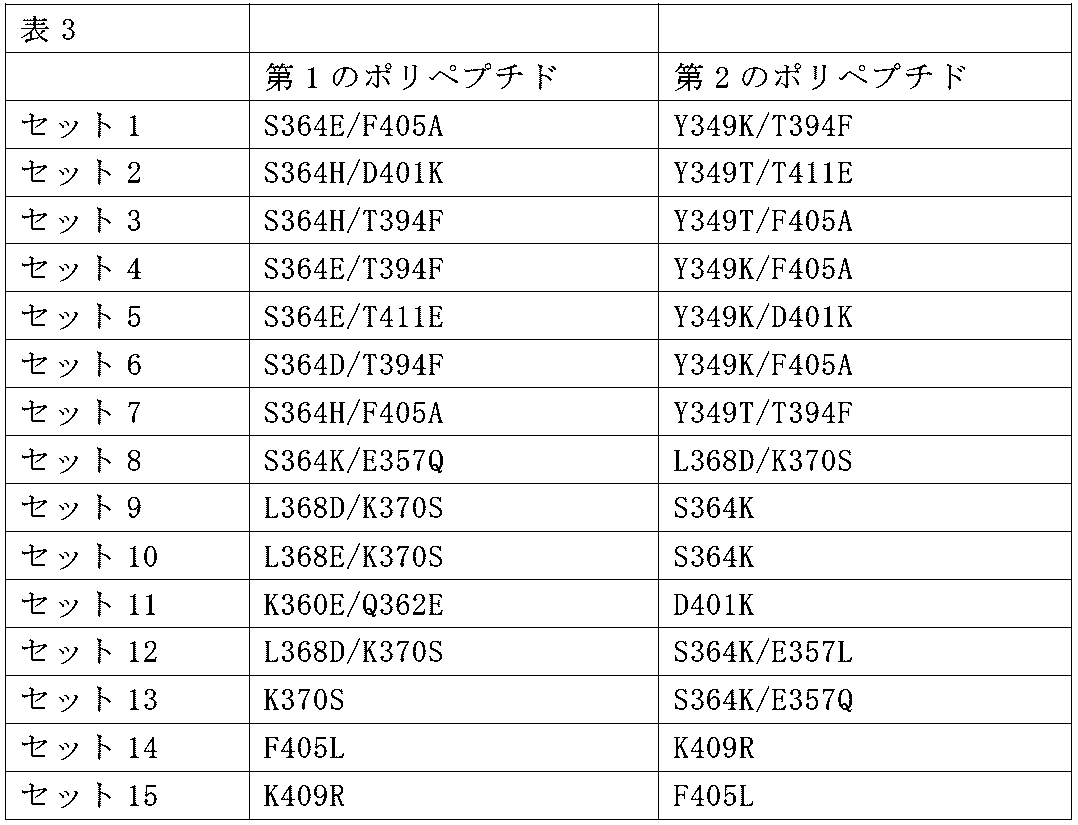
代替的に、アミノ酸置換は、表4中で示される以下の置換のセットから選択され得る。

代替的に、アミノ酸置換は、表5中で示される以下の置換のセットから選択され得る。

代替的に、各々のポリペプチド鎖中の少なくとも1つのアミノ酸置換は、表6から選択され得る。

代替的に、少なくとも1つのアミノ酸置換は、表7中の以下の置換のセットから選択され、そこで、第1のポリペプチドのカラム中で示される位置(複数可)は、任意の既知の負に荷電したアミノ酸によって置き換えられ、第2のポリペプチドのカラム中で示される位置(複数可)は、任意の既知の正に荷電したアミノ酸によって置き換えられる。

代替的に、少なくとも1つのアミノ酸置換は、表8中の以下の置換のセットから選択され、そこで、第1のポリペプチドのカラム中で示される位置(複数可)は、任意の既知の正に荷電したアミノ酸によって置き換えられ、第2のポリペプチドのカラム中で示される位置(複数可)は、任意の既知の負に荷電したアミノ酸によって置き換えられる。

代替的に、アミノ酸置換は、表9中の以下のセットから選択され得る。

代替的にまたは加えて、ヘテロ多量体タンパク質の構造安定性は、第1のポリペプチド鎖または第2のポリペプチド鎖のいずれか上にS354Cを導入し、向かい合うポリペプチド鎖上にY349Cを導入して、それが2つのポリペプチドの界面内で人工的ジスルフィド架橋を形成することによって、増加し得る。 Alternatively or additionally, the structural stability of a heteromultimeric protein can be increased by introducing S354C on either the first or second polypeptide chain and Y349C on the opposing polypeptide chain, which forms an artificial disulfide bridge within the interface of the two polypeptides.
いくつかの実施形態において、抗体定常領域の1つのポリペプチド鎖のアミノ酸配列は、位置T366で、IgG1定常領域のアミノ酸配列とは異なり、抗体定常領域の他方のポリペプチド鎖のアミノ酸配列は、T366、L368、及びY407からなる群から選択される1つまたは複数の位置で、IgG1定常領域のアミノ酸配列とは異なる。 In some embodiments, the amino acid sequence of one polypeptide chain of the antibody constant region differs from the amino acid sequence of the IgG1 constant region at position T366, and the amino acid sequence of the other polypeptide chain of the antibody constant region differs from the amino acid sequence of the IgG1 constant region at one or more positions selected from the group consisting of T366, L368, and Y407.
いくつかの実施形態において、抗体定常領域の1つのポリペプチド鎖のアミノ酸配列は、T366、L368、及びY407からなる群から選択される1つまたは複数の位置で、IgG1定常領域のアミノ酸配列とは異なり、抗体定常領域の他方のポリペプチド鎖のアミノ酸配列は、位置T366で、IgG1定常領域のアミノ酸配列とは異なる。 In some embodiments, the amino acid sequence of one polypeptide chain of the antibody constant region differs from the amino acid sequence of the IgG1 constant region at one or more positions selected from the group consisting of T366, L368, and Y407, and the amino acid sequence of the other polypeptide chain of the antibody constant region differs from the amino acid sequence of the IgG1 constant region at position T366.
いくつかの実施形態において、抗体定常領域の1つのポリペプチド鎖のアミノ酸配列は、E357、K360、Q362、S364、L368、K370、T394、D401、F405、及びT411からなる群から選択される1つまたは複数の位置で、IgG1定常領域のアミノ酸配列とは異なり、抗体定常領域の他方のポリペプチド鎖のアミノ酸配列は、Y349、E357、S364、L368、K370、T394、D401、F405、及びT411からなる群から選択される1つまたは複数の位置で、IgG1定常領域のアミノ酸配列とは異なる。 In some embodiments, the amino acid sequence of one polypeptide chain of the antibody constant region differs from the amino acid sequence of the IgG1 constant region at one or more positions selected from the group consisting of E357, K360, Q362, S364, L368, K370, T394, D401, F405, and T411, and the amino acid sequence of the other polypeptide chain of the antibody constant region differs from the amino acid sequence of the IgG1 constant region at one or more positions selected from the group consisting of Y349, E357, S364, L368, K370, T394, D401, F405, and T411.
いくつかの実施形態において、抗体定常領域の1つのポリペプチド鎖のアミノ酸配列は、Y349、E357、S364、L368、K370、T394、D401、F405、及びT411からなる群から選択される1つまたは複数の位置で、IgG1定常領域のアミノ酸配列とは異なり、抗体定常領域の他方のポリペプチド鎖のアミノ酸配列は、E357、K360、Q362、S364、L368、K370、T394、D401、F405、及びT411からなる群から選択される1つまたは複数の位置で、IgG1定常領域のアミノ酸配列とは異なる。 In some embodiments, the amino acid sequence of one polypeptide chain of the antibody constant region differs from the amino acid sequence of the IgG1 constant region at one or more positions selected from the group consisting of Y349, E357, S364, L368, K370, T394, D401, F405, and T411, and the amino acid sequence of the other polypeptide chain of the antibody constant region differs from the amino acid sequence of the IgG1 constant region at one or more positions selected from the group consisting of E357, K360, Q362, S364, L368, K370, T394, D401, F405, and T411.
いくつかの実施形態において、抗体定常領域の1つのポリペプチド鎖のアミノ酸配列は、L351、D399、S400、及びY407からなる群から選択される1つまたは複数の位置で、IgG1定常領域のアミノ酸配列とは異なり、抗体定常領域の他方のポリペプチド鎖のアミノ酸配列は、T366、N390、K392、K409、及びT411からなる群から選択される1つまたは複数の位置で、IgG1定常領域のアミノ酸配列とは異なる。 In some embodiments, the amino acid sequence of one polypeptide chain of the antibody constant region differs from the amino acid sequence of the IgG1 constant region at one or more positions selected from the group consisting of L351, D399, S400, and Y407, and the amino acid sequence of the other polypeptide chain of the antibody constant region differs from the amino acid sequence of the IgG1 constant region at one or more positions selected from the group consisting of T366, N390, K392, K409, and T411.
いくつかの実施形態において、抗体定常領域の1つのポリペプチド鎖のアミノ酸配列は、T366、N390、K392、K409、及びT411からなる群から選択される1つまたは複数の位置で、IgG1定常領域のアミノ酸配列とは異なり、抗体定常領域の他方のポリペプチド鎖のアミノ酸配列は、L351、D399、S400、及びY407からなる群から選択される1つまたは複数の位置で、IgG1定常領域のアミノ酸配列とは異なる。 In some embodiments, the amino acid sequence of one polypeptide chain of the antibody constant region differs from the amino acid sequence of the IgG1 constant region at one or more positions selected from the group consisting of T366, N390, K392, K409, and T411, and the amino acid sequence of the other polypeptide chain of the antibody constant region differs from the amino acid sequence of the IgG1 constant region at one or more positions selected from the group consisting of L351, D399, S400, and Y407.
いくつかの実施形態において、抗体定常領域の1つのポリペプチド鎖のアミノ酸配列は、Q347、Y349、K360、及びK409からなる群から選択される1つまたは複数の位置で、IgG1定常領域のアミノ酸配列とは異なり、抗体定常領域の他方のポリペプチド鎖のアミノ酸配列は、Q347、E357、D399、及びF405からなる群から選択される1つまたは複数の位置で、IgG1定常領域のアミノ酸配列とは異なる。 In some embodiments, the amino acid sequence of one polypeptide chain of the antibody constant region differs from the amino acid sequence of the IgG1 constant region at one or more positions selected from the group consisting of Q347, Y349, K360, and K409, and the amino acid sequence of the other polypeptide chain of the antibody constant region differs from the amino acid sequence of the IgG1 constant region at one or more positions selected from the group consisting of Q347, E357, D399, and F405.
いくつかの実施形態において、抗体定常領域の1つのポリペプチド鎖のアミノ酸配列は、Q347、E357、D399、及びF405からなる群から選択される1つまたは複数の位置で、IgG1定常領域のアミノ酸配列とは異なり、抗体定常領域の他方のポリペプチド鎖のアミノ酸配列は、Y349、K360、Q347、及びK409からなる群から選択される1つまたは複数の位置で、IgG1定常領域のアミノ酸配列とは異なる。 In some embodiments, the amino acid sequence of one polypeptide chain of the antibody constant region differs from the amino acid sequence of the IgG1 constant region at one or more positions selected from the group consisting of Q347, E357, D399, and F405, and the amino acid sequence of the other polypeptide chain of the antibody constant region differs from the amino acid sequence of the IgG1 constant region at one or more positions selected from the group consisting of Y349, K360, Q347, and K409.
いくつかの実施形態において、抗体定常領域の1つのポリペプチド鎖のアミノ酸配列は、K370、K392、K409、及びK439からなる群から選択される1つまたは複数の位置で、IgG1定常領域のアミノ酸配列とは異なり、抗体定常領域の他方のポリペプチド鎖のアミノ酸配列は、D356、E357、及びD399からなる群から選択される1つまたは複数の位置で、IgG1定常領域のアミノ酸配列とは異なる。 In some embodiments, the amino acid sequence of one polypeptide chain of the antibody constant region differs from the amino acid sequence of the IgG1 constant region at one or more positions selected from the group consisting of K370, K392, K409, and K439, and the amino acid sequence of the other polypeptide chain of the antibody constant region differs from the amino acid sequence of the IgG1 constant region at one or more positions selected from the group consisting of D356, E357, and D399.
いくつかの実施形態において、抗体定常領域の1つのポリペプチド鎖のアミノ酸配列は、D356、E357、及びD399からなる群から選択される1つまたは複数の位置で、IgG1定常領域のアミノ酸配列とは異なり、抗体定常領域の他方のポリペプチド鎖のアミノ酸配列は、K370、K392、K409、及びK439からなる群から選択される1つまたは複数の位置で、IgG1定常領域のアミノ酸配列とは異なる。 In some embodiments, the amino acid sequence of one polypeptide chain of the antibody constant region differs from the amino acid sequence of the IgG1 constant region at one or more positions selected from the group consisting of D356, E357, and D399, and the amino acid sequence of the other polypeptide chain of the antibody constant region differs from the amino acid sequence of the IgG1 constant region at one or more positions selected from the group consisting of K370, K392, K409, and K439.
いくつかの実施形態において、抗体定常領域の1つのポリペプチド鎖のアミノ酸配列は、L351、E356、T366、及びD399からなる群から選択される1つまたは複数の位置で、IgG1定常領域のアミノ酸配列とは異なり、抗体定常領域の他方のポリペプチド鎖のアミノ酸配列は、Y349、L351、L368、K392、及びK409からなる群から選択される1つまたは複数の位置でIgG1定常領域のアミノ酸配列とは異なる。 In some embodiments, the amino acid sequence of one polypeptide chain of the antibody constant region differs from the amino acid sequence of the IgG1 constant region at one or more positions selected from the group consisting of L351, E356, T366, and D399, and the amino acid sequence of the other polypeptide chain of the antibody constant region differs from the amino acid sequence of the IgG1 constant region at one or more positions selected from the group consisting of Y349, L351, L368, K392, and K409.
いくつかの実施形態において、抗体定常領域の1つのポリペプチド鎖のアミノ酸配列は、Y349、L351、L368、K392、及びK409からなる群から選択される1つまたは複数の位置で、IgG1定常領域のアミノ酸配列とは異なり、抗体定常領域の他方のポリペプチド鎖のアミノ酸配列は、L351、E356、T366、及びD399からなる群から選択される1つまたは複数の位置で、IgG1定常領域のアミノ酸配列とは異なる。 In some embodiments, the amino acid sequence of one polypeptide chain of the antibody constant region differs from the amino acid sequence of the IgG1 constant region at one or more positions selected from the group consisting of Y349, L351, L368, K392, and K409, and the amino acid sequence of the other polypeptide chain of the antibody constant region differs from the amino acid sequence of the IgG1 constant region at one or more positions selected from the group consisting of L351, E356, T366, and D399.
いくつかの実施形態において、抗体定常領域の1つのポリペプチド鎖のアミノ酸配列は、S354Cの置換によってIgG1定常領域のアミノ酸配列とは異なり、抗体定常領域の他方のポリペプチド鎖のアミノ酸配列は、Y349Cの置換によってIgG1定常領域のアミノ酸配列とは異なる。 In some embodiments, the amino acid sequence of one polypeptide chain of the antibody constant region differs from the amino acid sequence of the IgG1 constant region by the substitution S354C, and the amino acid sequence of the other polypeptide chain of the antibody constant region differs from the amino acid sequence of the IgG1 constant region by the substitution Y349C.
いくつかの実施形態において、抗体定常領域の1つのポリペプチド鎖のアミノ酸配列は、Y349Cの置換によってIgG1定常領域のアミノ酸配列とは異なり、抗体定常領域の他方のポリペプチド鎖のアミノ酸配列は、S354Cの置換によってIgG1定常領域のアミノ酸配列とは異なる。 In some embodiments, the amino acid sequence of one polypeptide chain of the antibody constant region differs from the amino acid sequence of the IgG1 constant region by a Y349C substitution, and the amino acid sequence of the other polypeptide chain of the antibody constant region differs from the amino acid sequence of the IgG1 constant region by a S354C substitution.
いくつかの実施形態において、抗体定常領域の1つのポリペプチド鎖のアミノ酸配列は、K360E及びK409Wの置換によってIgG1定常領域のアミノ酸配列とは異なり、抗体定常領域の他方のポリペプチド鎖のアミノ酸配列は、Q347R、D399V、及びF405Tの置換によってIgG1定常領域のアミノ酸配列とは異なる。 In some embodiments, the amino acid sequence of one polypeptide chain of the antibody constant region differs from the amino acid sequence of the IgG1 constant region by the substitutions K360E and K409W, and the amino acid sequence of the other polypeptide chain of the antibody constant region differs from the amino acid sequence of the IgG1 constant region by the substitutions Q347R, D399V, and F405T.
いくつかの実施形態において、抗体定常領域の1つのポリペプチド鎖のアミノ酸配列は、Q347R、D399V、及びF405Tの置換によってIgG1定常領域のアミノ酸配列とは異なり、抗体定常領域の他方のポリペプチド鎖のアミノ酸配列は、K360E及びK409Wの置換によってIgG1定常領域のアミノ酸配列とは異なる。 In some embodiments, the amino acid sequence of one polypeptide chain of the antibody constant region differs from the amino acid sequence of the IgG1 constant region by the substitutions Q347R, D399V, and F405T, and the amino acid sequence of the other polypeptide chain of the antibody constant region differs from the amino acid sequence of the IgG1 constant region by the substitutions K360E and K409W.
いくつかの実施形態において、抗体定常領域の1つのポリペプチド鎖のアミノ酸配列は、T366Wの置換によってIgG1定常領域のアミノ酸配列とは異なり、抗体定常領域の他方のポリペプチド鎖のアミノ酸配列は、T366S、T368A、及びY407Vの置換によってIgG1定常領域のアミノ酸配列とは異なる。 In some embodiments, the amino acid sequence of one polypeptide chain of the antibody constant region differs from the amino acid sequence of the IgG1 constant region by the substitutions T366W, and the amino acid sequence of the other polypeptide chain of the antibody constant region differs from the amino acid sequence of the IgG1 constant region by the substitutions T366S, T368A, and Y407V.
いくつかの実施形態において、抗体定常領域の1つのポリペプチド鎖のアミノ酸配列は、T366S、T368A、及びY407Vの置換によってIgG1定常領域のアミノ酸配列とは異なり、抗体定常領域の他方のポリペプチド鎖のアミノ酸配列は、T366Wの置換によってIgG1定常領域のアミノ酸配列とは異なる。 In some embodiments, the amino acid sequence of one polypeptide chain of the antibody constant region differs from the amino acid sequence of the IgG1 constant region by the substitutions T366S, T368A, and Y407V, and the amino acid sequence of the other polypeptide chain of the antibody constant region differs from the amino acid sequence of the IgG1 constant region by the substitution T366W.
いくつかの実施形態において、抗体定常領域の1つのポリペプチド鎖のアミノ酸配列は、T350V、L351Y、F405A、及びY407Vの置換によってIgG1定常領域のアミノ酸配列とは異なり、抗体定常領域の他方のポリペプチド鎖のアミノ酸配列は、T350V、T366L、K392L、及びT394Wの置換によってIgG1定常領域のアミノ酸配列とは異なる。 In some embodiments, the amino acid sequence of one polypeptide chain of the antibody constant region differs from the amino acid sequence of the IgG1 constant region by the substitutions T350V, L351Y, F405A, and Y407V, and the amino acid sequence of the other polypeptide chain of the antibody constant region differs from the amino acid sequence of the IgG1 constant region by the substitutions T350V, T366L, K392L, and T394W.
いくつかの実施形態において、抗体定常領域の1つのポリペプチド鎖のアミノ酸配列は、T350V、T366L、K392L、及びT394Wの置換によってIgG1定常領域のアミノ酸配列とは異なり、抗体定常領域の他方のポリペプチド鎖のアミノ酸配列は、T350V、L351Y、F405A、及びY407Vの置換によってIgG1定常領域のアミノ酸配列とは異なる。 In some embodiments, the amino acid sequence of one polypeptide chain of the antibody constant region differs from the amino acid sequence of the IgG1 constant region by the substitutions T350V, T366L, K392L, and T394W, and the amino acid sequence of the other polypeptide chain of the antibody constant region differs from the amino acid sequence of the IgG1 constant region by the substitutions T350V, L351Y, F405A, and Y407V.
上で記載される多重特異性結合タンパク質は、当業者に周知の組換えDNA技術を使用して作製され得る。例えば、第1の免疫グロブリン重鎖をコードする第1の核酸配列は、第1の発現ベクターの中へクローニングされ得、第2の免疫グロブリン重鎖をコードする第2の核酸配列は、第2の発現ベクターの中へクローニングされ得、免疫グロブリン軽鎖をコードする第3の核酸配列は、第3の発現ベクターの中へクローニングされ得、第1の発現ベクター、第2の発現ベクター、及び第3の発現ベクターは、安定的に宿主細胞の中へ一緒にトランスフェクションされて、多量体タンパク質を産生し得る。 The multispecific binding proteins described above can be made using recombinant DNA techniques well known to those skilled in the art. For example, a first nucleic acid sequence encoding a first immunoglobulin heavy chain can be cloned into a first expression vector, a second nucleic acid sequence encoding a second immunoglobulin heavy chain can be cloned into a second expression vector, and a third nucleic acid sequence encoding an immunoglobulin light chain can be cloned into a third expression vector, and the first expression vector, the second expression vector, and the third expression vector can be stably transfected together into a host cell to produce a multimeric protein.
多重特異性タンパク質の最も高い収率を達成するために、第1の発現ベクター、第2の発現ベクター、及び第3の発現ベクターの異なる比率が探索されて、宿主細胞の中へのトランスフェクションについての最適な比率が決定され得る。トランスフェクション後に、単一クローンは、限界希釈、ELISA、フローサイトメトリー、顕微鏡検査、またはClonepix等の当技術分野において公知の方法を使用して、細胞バンク生成のために単離され得る。 To achieve the highest yield of the multispecific protein, different ratios of the first expression vector, the second expression vector, and the third expression vector can be explored to determine the optimal ratio for transfection into the host cells. After transfection, single clones can be isolated for cell bank generation using methods known in the art, such as limiting dilution, ELISA, flow cytometry, microscopy, or Clonepix.
クローンは、バイオリアクターのスケールアップに好適な条件下で培養され、多重特異性タンパク質の発現を維持し得る。多重特異性結合タンパク質は、遠心分離、深層濾過、細胞溶解、ホモジナイズ、凍結融解、親和性精製、ゲル濾過、イオン交換クロマトグラフィー、疎水性相互作用交換クロマトグラフィー、及び混合モードクロマトグラフィーが含まれる、当技術分野において公知の方法を使用して、単離及び精製され得る。 The clones can be cultured under conditions suitable for bioreactor scale-up to maintain expression of the multispecific proteins. The multispecific binding proteins can be isolated and purified using methods known in the art, including centrifugation, depth filtration, cell lysis, homogenization, freeze-thaw, affinity purification, gel filtration, ion exchange chromatography, hydrophobic interaction exchange chromatography, and mixed-mode chromatography.
II.多重特異性結合タンパク質の特徴
本明細書において記載される多重特異性結合タンパク質は、NKG2D結合部位、CD16結合部位、及びFAPについての結合部位を含む。ある特定の実施形態において、多重特異性結合タンパク質は、NKG2D及び/またはCD16を発現する細胞(NK細胞等)、ならびにFAPを発現する腫瘍細胞に同時に結合する。NK細胞への多重特異性結合タンパク質の結合は、がん細胞の破壊に向けたNK細胞の活性を促進し得る。
II. Features of the Multispecific Binding Proteins The multispecific binding proteins described herein contain a binding site for NKG2D, a binding site for CD16, and a binding site for FAP. In certain embodiments, the multispecific binding proteins simultaneously bind to cells expressing NKG2D and/or CD16 (such as NK cells), and tumor cells expressing FAP. Binding of the multispecific binding proteins to NK cells can promote the activity of NK cells towards the destruction of cancer cells.
ある特定の実施形態において、本明細書において記載される多重特異性結合タンパク質は、同じFAP結合部位を有する対応するモノクローナル抗体の親和性に類似する親和性でFAPへ結合する。ある特定の実施形態において、本明細書において記載される多重特異性結合タンパク質は、腫瘍増殖を低減させること及びFAPを発現する腫瘍細胞を殺傷することに、同じFAP結合部位を有する対応するモノクローナル抗体よりも有効であり得る。 In certain embodiments, the multispecific binding proteins described herein bind to FAP with an affinity similar to that of a corresponding monoclonal antibody having the same FAP binding site. In certain embodiments, the multispecific binding proteins described herein may be more effective at reducing tumor growth and killing tumor cells expressing FAP than a corresponding monoclonal antibody having the same FAP binding site.
ある特定の実施形態において、NKG2D結合部位及びFAP結合部位を含む本明細書において記載される多重特異性結合タンパク質は、FAPを発現する腫瘍細胞と共に共培養された場合に、初代ヒトNK細胞を活性化する。NK細胞活性化は、CD107a発現、脱顆粒、及びIFN-γサイトカイン産生の増加を特徴とする。さらに、本明細書において記載される多重特異性結合タンパク質は、同じFAP結合部位を有する対応するモノクローナル抗体に比較して、FAPを発現する腫瘍細胞の存在下におけるヒトNK細胞の優れた活性化を示し得る。 In certain embodiments, the multispecific binding proteins described herein that contain an NKG2D binding site and an FAP binding site activate primary human NK cells when co-cultured with tumor cells expressing FAP. NK cell activation is characterized by increased CD107a expression, degranulation, and IFN-γ cytokine production. Furthermore, the multispecific binding proteins described herein may exhibit superior activation of human NK cells in the presence of tumor cells expressing FAP compared to corresponding monoclonal antibodies with the same FAP binding site.
ある特定の実施形態において、NKG2D結合部位及びFAPについての結合部位を含む本明細書において記載される多重特異性結合タンパク質は、FAPを発現する腫瘍細胞の存在下における静止したIL-2活性化ヒトNK細胞の活性化を促進し得る。 In certain embodiments, the multispecific binding proteins described herein that contain a binding site for NKG2D and a binding site for FAP can promote activation of quiescent IL-2-activated human NK cells in the presence of tumor cells expressing FAP.
ある特定の実施形態において、本明細書において記載される多重特異性結合タンパク質は、同じFAP結合部位を有する対応するモノクローナル抗体に比較して、FAPを発現する腫瘍細胞に対してより高い細胞傷害性活性を有し得る。 In certain embodiments, the multispecific binding proteins described herein may have greater cytotoxic activity against tumor cells expressing FAP compared to a corresponding monoclonal antibody having the same FAP binding site.
III.治療適用
本発明は、本明細書において記載される多重特異性結合タンパク質及び/または本明細書において記載される医薬組成物を使用して、がんを治療するための方法を提供する。当該方法を使用して、FAPを発現する様々ながんを治療することができる。治療される例示的ながんは、胃癌、結腸直腸癌、膵臓癌、乳癌、子宮内膜癌、肺癌、前立腺癌、膀胱癌、子宮頸癌、頭頸部癌、卵巣癌、食道癌、腎癌、肝臓癌、精巣癌、ならびに口腔癌、多発性骨髄腫、白血病、急性骨髄性白血病、黒色腫、皮膚の基底細胞癌及び有棘細胞癌、神経膠腫、ユーイング肉腫、カポジ肉腫、ならびに中皮腫であり得る。
III. Therapeutic Applications The present invention provides methods for treating cancer using the multispecific binding proteins described herein and/or the pharmaceutical compositions described herein. The methods can be used to treat a variety of cancers that express FAP. Exemplary cancers to be treated can be gastric, colorectal, pancreatic, breast, endometrial, lung, prostate, bladder, cervical, head and neck, ovarian, esophageal, renal, liver, testicular, and oral cancers, multiple myeloma, leukemia, acute myeloid leukemia, melanoma, basal and squamous cell carcinoma of the skin, glioma, Ewing's sarcoma, Kaposi's sarcoma, and mesothelioma.
他のいくつかの実施形態において、治療される例示的ながんは、末端性黒子性黒色腫、光線角化症、急性リンパ芽球性白血病、急性リンパ球性白血病、急性骨髄性白血病、腺癌、腺様嚢胞癌、腺肉腫、腺扁平上皮癌、肛門管癌、未分化大細胞リンパ腫、血管免疫芽球性T細胞リンパ腫、血管肉腫、肛門直腸癌、星状細胞系腫瘍、バルトリン腺癌、基底細胞癌(例えば皮膚)、B細胞リンパ腫、胆道癌、膀胱癌、骨癌、骨髄癌、脳腫瘍、乳癌、気管支癌、気管支腺癌、バーキットリンパ腫、カルチノイド、子宮頸癌、胆管癌、軟骨肉腫、脈絡叢乳頭腫/脈絡叢癌、慢性リンパ性白血病、慢性骨髄性白血病、慢性好中球性白血病、明細胞癌、結腸癌、結腸直腸癌、結合組織癌、皮膚T細胞リンパ腫、嚢胞腺腫、びまん性大細胞型B細胞リンパ腫、消化器系癌、十二指腸癌、内分泌系癌、内胚葉洞腫瘍、子宮内膜癌/子宮内膜増殖症、子宮内膜間質部肉腫、類内膜腺癌、内皮細胞癌、腸症型T細胞リンパ腫、上衣癌、上皮細胞癌、食道癌、ユーイング肉腫、節外性辺縁帯B細胞リンパ腫、節外性のナチュラルキラー細胞リンパ腫/T細胞リンパ腫、眼癌及び眼窩癌、女性生殖器癌、限局性結節性過形成、濾胞性リンパ腫、胆嚢癌、胃前庭部癌、胃癌、胃底部癌、ガストリノーマ、神経膠芽細胞腫、神経膠腫、グルカゴノーマ、有毛細胞白血病、頭頸部癌、心臓癌、血管芽細胞腫、血管内皮腫、血管腫、血液腫瘍、肝腺腫、肝腺腫症、肝細胞癌、肝胆道癌、ホジキン病、回腸癌、インスリノーマ、上皮内新生物、上皮内扁平上皮細胞新生物、肝内胆管癌、浸潤性扁平上皮細胞癌、空腸癌、関節癌、カポジ肉腫、腎臓癌、大細胞癌、大腸癌、平滑筋肉腫、悪性黒子型黒色腫、白血病、肝臓癌、肺癌、リンパ腫、リンパ形質細胞性リンパ腫、男性生殖器癌、悪性黒色腫、悪性中皮腫、マントル細胞リンパ腫、辺縁帯B細胞リンパ腫、髄芽細胞腫、髄様上皮腫、黒色腫、髄膜癌、中皮癌、中皮腫、転移性癌、口内癌、粘液性類表皮癌、多発性骨髄腫、筋肉癌、骨髄異形成新生物、骨髄増殖性新生物、鼻腔癌、神経系癌、神経芽細胞腫、神経上皮腺癌、節性辺縁帯B細胞リンパ腫、結節型黒色腫、非上皮皮膚癌、非ホジキンリンパ腫、燕麦細胞癌、乏突起膠細胞癌、口腔癌、骨肉腫、卵巣癌、膵臓癌、乳頭状漿液性腺癌、耳下腺癌、骨盤癌、陰茎癌、末梢T細胞リンパ腫、咽頭癌、下垂体部腫瘍、形質細胞腫、前駆Tリンパ芽球性リンパ腫、原発性中枢神経系リンパ腫、原発性縦隔B細胞リンパ腫、前立腺癌、偽肉腫、肺芽腫、直腸癌、腎癌、腎細胞癌、呼吸器系癌、網膜芽細胞腫、横紋筋肉腫、肉腫、漿液性癌、副鼻腔癌、皮膚癌、小細胞癌、小腸癌、小リンパ球性リンパ腫、平滑筋癌、軟部組織癌、ソマトスタチン分泌腫瘍、脊椎癌、脾辺縁帯B細胞リンパ腫、有棘細胞癌(例えば皮膚)、横紋筋癌、皮下脂肪織炎様T細胞リンパ腫、中皮下癌(submesothelial cancer)、表在拡大型黒色腫、T細胞白血病、T細胞リンパ腫、精巣癌、甲状腺癌、舌癌、未分化癌腫、尿管癌、尿道癌、膀胱癌、子宮癌、子宮体癌、ブドウ膜黒色腫、膣癌、疣状癌、VIP産生腫瘍、外陰癌、高分化癌、またはウィルムス腫瘍であり得る。 In some other embodiments, exemplary cancers to be treated include acral lentigo melanoma, actinic keratosis, acute lymphoblastic leukemia, acute lymphocytic leukemia, acute myeloid leukemia, adenocarcinoma, adenoid cystic carcinoma, adenosarcoma, adenosquamous carcinoma, anal canal carcinoma, anaplastic large cell lymphoma, angioimmunoblastic T-cell lymphoma, angiosarcoma, anorectal carcinoma, astrocytic tumors, Bartholin's gland carcinoma, basal cell carcinoma (e.g., skin), B-cell lymphoma, biliary tract carcinoma, bladder carcinoma, bone cancer, bone marrow carcinoma, brain tumor, breast cancer, bronchial carcinoma, bronchial adenocarcinoma, Burkitt's lymphoma, carcinoid, cervical cancer, bile duct carcinoma, chondrosarcoma, choroid plexus papilloma/choroid plexus carcinoma, chronic lymphocytic leukemia, chronic myeloid leukemia, chronic neutrophilic leukemia, clear cell carcinoma, colon cancer, colorectal cancer, connective tissue cancer, Tissue cancer, cutaneous T-cell lymphoma, cystadenoma, diffuse large B-cell lymphoma, digestive system cancer, duodenal cancer, endocrine system cancer, endodermal sinus tumor, endometrial cancer/endometrial hyperplasia, endometrial stromal sarcoma, endometrioid adenocarcinoma, endothelial cell carcinoma, enteropathic T-cell lymphoma, ependymal carcinoma, epithelial cell carcinoma, esophageal cancer, Ewing's sarcoma, extranodal marginal zone B-cell lymphoma, extranodal natural killer cell lymphoma/T-cell lymphoma, eye and orbit cancer, female genital tract cancer, focal nodular hyperplasia, follicular lymphoma, gallbladder cancer, gastric antrum cancer, gastric cancer, gastric fundus cancer, gastrinoma, glioblastoma, glioma, glucagonoma, hairy cell leukemia, head and neck cancer, cardiac cancer, hemangioblastoma, hemangioendothelioma, hemangioma, blood tumors, hepatic adenoma, hepatic adenomatosis, hepatocellular Cancer, hepatobiliary cancer, Hodgkin's disease, ileal cancer, insulinoma, intraepithelial neoplasia, intraepithelial squamous cell neoplasia, intrahepatic cholangiocarcinoma, invasive squamous cell carcinoma, jejunal cancer, joint cancer, Kaposi's sarcoma, kidney cancer, large cell carcinoma, colon cancer, leiomyosarcoma, lentigo maligna melanoma, leukemia, liver cancer, lung cancer, lymphoma, lymphoplasmacytic lymphoma, male genital tract cancer, malignant melanoma, malignant mesothelioma, mantle cell lymphoma, marginal zone B-cell lymphoma, medulloblastoma, medulloepithelioma, melanoma, meningeal cancer, mesothelioma, mesothelioma, metastatic cancer, oral cancer, mucoepidermoid carcinoma, multiple myeloma, muscle cancer, myelodysplastic neoplasm, myeloproliferative neoplasm, nasal cancer, nervous system cancer, neuroblastoma, neuroepithelial adenocarcinoma, nodal marginal zone B-cell lymphoma, nodular melanoma, non-epithelial skin cancer, non Hodgkin's lymphoma, oat cell carcinoma, oligodendroglial carcinoma, oral cancer, osteosarcoma, ovarian cancer, pancreatic cancer, papillary serous adenocarcinoma, parotid gland cancer, pelvic cancer, penile cancer, peripheral T-cell lymphoma, pharyngeal cancer, pituitary tumor, plasmacytoma, precursor T-lymphoblastic lymphoma, primary central nervous system lymphoma, primary mediastinal B-cell lymphoma, prostate cancer, pseudosarcoma, pulmonary blastoma, rectal cancer, renal cancer, renal cell The cancer may be cystic cystoma, respiratory cancer, retinoblastoma, rhabdomyosarcoma, sarcoma, serous carcinoma, paranasal sinus cancer, skin cancer, small cell carcinoma, small intestine cancer, small lymphocytic lymphoma, smooth muscle carcinoma, soft tissue cancer, somatostatin-secreting tumor, spinal cancer, splenic marginal zone B-cell lymphoma, squamous cell carcinoma (e.g., skin), rhabdomyocarcinoma, subcutaneous panniculitis-like T-cell lymphoma, submesothelial cancer, superficial spreading melanoma, T-cell leukemia, T-cell lymphoma, testicular cancer, thyroid cancer, tongue cancer, undifferentiated carcinoma, ureteral cancer, urethral cancer, bladder cancer, uterine cancer, uterine body cancer, uveal melanoma, vaginal cancer, verrucous carcinoma, VIP-producing tumor, vulvar cancer, well-differentiated carcinoma, or Wilms' tumor.
ある特定の実施形態において、本発明は、患者における自己免疫疾患を治療する方法を提供する。治療される例示的な自己免疫疾患としては、関節炎、関節リウマチ、若年性関節リウマチ、炎症を伴う破壊性関節炎、アテローム性動脈硬化症、自己免疫性心筋炎、白血球接着不全症、若年型糖尿病、多発性硬化症、骨関節炎、乾癬性関節炎、乾癬、皮膚炎、全身性紅斑性狼瘡(SLE)、多発性筋炎/皮膚筋炎、中毒性表皮剥離症、全身性強皮症及び全身性硬化症、炎症性大腸疾患と関連する応答、クローン病、潰瘍性大腸炎、呼吸窮迫症候群、成人呼吸窮迫症候群(ARDS)、脳膜炎、脳炎、ブドウ膜炎、大腸炎、糸球体腎炎、アレルギー性病態、湿疹、喘息、T細胞の浸潤及び慢性的な炎症応答を伴う病態、アレルギー性脳脊髄炎、サイトカイン及びTリンパ球によって媒介される急性及び遅延性の過敏症と関連する免疫応答、結核、サーコイドーシス、ウェゲナー肉芽腫症が含まれる肉芽腫症、顆粒球減少症、血管炎(ANCAが含まれる)、再生不良性貧血、ダイアモンド・ブラックファン貧血、自己免疫性溶血性貧血(AIHA)が含まれる免疫性溶血性貧血、悪性貧血、赤芽球癆(PRCA)、第VIII因子欠損症、血友病A、自己免液性好中球減少症、汎血球減少症、白血球減少症、白血球漏出を伴う疾患、中枢神経系(CNS)炎症性障害、多臓器損傷症候群、重症筋無力症、抗原抗体複合体媒介性疾患、抗糸球体基底膜疾患、抗リン脂質抗体症候群、アレルギー性神経炎、ベーチェット病、キャッスルマン症候群、グッドパスチャー症候群、ランバート・イートン筋無力症候群、レイノー症候群、シェーグレン症候群、スティーブンス・ジョンソン症候群、固形臓器移植拒絶、移植片対宿主病(GVHD)、水疱性類天疱瘡、天疱瘡、自己免疫性多内分泌症、ライター病、スティッフマン症候群、巨細胞性動脈炎、免疫複合体腎炎、IgA腎症、IgM多発性ニューロパシーまたはIgM媒介性ニューロパシー、特発性血小板減少性紫斑病(ITP)、血栓性血小板減少性紫斑病(TTP)、自己免疫性血小板減少症、自己免疫性精巣炎及び自己免疫性卵巣炎が含まれる精巣及び卵巣の自己免疫疾患、原発性甲状腺機能低下症;自己免疫性甲状腺炎、慢性甲状腺炎(橋本甲状腺炎)、原発性硬化性胆管炎、亜急性甲状腺炎、特発性甲状腺機能低下症、アジソン病、グレーヴス病、多腺性自己免疫症候群(または多腺性内分泌症候群)、1型糖尿病(インスリン依存性糖尿病(IDDM)とも称される)、及びシーハン症候群が含まれる、自己免疫性内分泌疾患;自己免疫性肝炎、リンパ球様間質性肺炎(HIV)、閉塞性細気管支炎(非移植)vs NSIP、ギラン・バレー症候群、大型血管炎(リウマチ性多発性筋痛及び巨細胞性動脈炎(高安動脈炎)が含まれる)、中型血管炎(川崎病及び結節性多発動脈炎が含まれる)、強直性脊椎炎、ベルガー病(IgA腎症)、急性進行性糸球体腎炎、原発性胆汁性肝硬変症、セリアック病(グルテン性腸症)、クリオグロブリン血症、筋萎縮性側索硬化症(ALS)、または冠動脈疾患が挙げられる。 In certain embodiments, the present invention provides a method of treating an autoimmune disease in a patient. Exemplary autoimmune diseases to be treated include arthritis, rheumatoid arthritis, juvenile rheumatoid arthritis, destructive arthritis with inflammation, atherosclerosis, autoimmune myocarditis, leukocyte adhesion deficiency, juvenile diabetes mellitus, multiple sclerosis, osteoarthritis, psoriatic arthritis, psoriasis, dermatitis, systemic lupus erythematosus (SLE), polymyositis/dermatomyositis, toxic epidermolysis, systemic sclerosis and systemic sclerosis, inflammatory bowel disease and associated responses, Crohn's disease, ulcerative colitis, respiratory distress syndrome, adult respiratory distress syndrome (ARDS), meningitis, encephalitis, uveitis, colitis, glomerulonephritis, allergic conditions, eczema, asthma, T cell infiltration and chronic Conditions involving inflammatory responses, allergic encephalomyelitis, immune responses associated with acute and delayed hypersensitivity mediated by cytokines and T lymphocytes, tuberculosis, granulomatous diseases including sarcoidosis, Wegener's granulomatosis, granulocytopenia, vasculitis (including ANCA), aplastic anemia, Diamond-Blackfan anemia, immune hemolytic anemia including autoimmune hemolytic anemia (AIHA), pernicious anemia, pure red cell aplasia (PRCA), factor VIII deficiency, hemophilia A, autoimmune neutropenia, pancytopenia, leukopenia, diseases involving leukocytosis, central nervous system (CNS) inflammatory disorders, multiple organ injury syndrome, severe Myasthenia gravis, antigen-antibody complex-mediated disease, antiglomerular basement membrane disease, antiphospholipid syndrome, allergic neuritis, Behçet's disease, Castleman syndrome, Goodpasture's syndrome, Lambert-Eaton myasthenic syndrome, Raynaud's syndrome, Sjögren's syndrome, Stevens-Johnson syndrome, solid organ transplant rejection, graft-versus-host disease (GVHD), bullous pemphigoid, pemphigus, autoimmune polyendocrinopathy, Reiter's disease, stiff-man syndrome, giant cell arteritis, immune complex nephritis, IgA nephropathy, IgM polyneuropathy or IgM-mediated neuropathy, idiopathic thrombocytopenic purpura (ITP), hematologic malignancies, Autoimmune diseases of the testes and ovaries, including thrombotic thrombocytopenic purpura (TTP), autoimmune thrombocytopenia, autoimmune orchitis and autoimmune oophoritis, primary hypothyroidism; autoimmune endocrine diseases, including autoimmune thyroiditis, chronic thyroiditis (Hashimoto's thyroiditis), primary sclerosing cholangitis, subacute thyroiditis, idiopathic hypothyroidism, Addison's disease, Graves' disease, polyimmune polyglandular syndrome (or polyendocrine syndrome), type 1 diabetes (also called insulin-dependent diabetes mellitus (IDDM)), and Sheehan's syndrome; autoimmune hepatitis, lymphocytic interstitial pneumonia (HIV), bronchiolitis obliterans (non-transplant) vs. These include NSIP, Guillain-Barré syndrome, large-vasculitis (including polymyalgia rheumatica and giant cell arteritis (Takayasu's arteritis)), medium-vasculitis (including Kawasaki disease and polyarteritis nodosa), ankylosing spondylitis, Berger's disease (IgA nephropathy), acute progressive glomerulonephritis, primary biliary cirrhosis, celiac disease (gluten enteropathy), cryoglobulinemia, amyotrophic lateral sclerosis (ALS), or coronary artery disease.
ある特定の実施形態において、本発明は、患者における線維症を治療する方法を提供する。方法は、治療有効量の本明細書において記載される多重特異性結合タンパク質をそれを必要とする患者へ投与することを含む。FAPを標的化する多重特異的結合タンパク質を使用して治療される線維症は、間質性肺炎、肝硬変、腎臓疾患、心疾患、眼疾患、硬皮症、ケロイド瘢痕及び肥厚性瘢痕、アテローム性動脈硬化症及び再狭窄、術後瘢痕、化学療法薬使用、放射線療法、肉体的怪我、または熱傷と関連し得る。例えば、線維症は、特発性肺線維症、腎線維症、肝線維症、または心臓線維症であり得る。 In certain embodiments, the present invention provides a method of treating fibrosis in a patient. The method comprises administering a therapeutically effective amount of a multispecific binding protein described herein to a patient in need thereof. The fibrosis treated using a multispecific binding protein targeting FAP may be associated with interstitial lung disease, liver cirrhosis, kidney disease, cardiac disease, eye disease, scleroderma, keloid and hypertrophic scars, atherosclerosis and restenosis, post-surgical scars, chemotherapy drug use, radiation therapy, physical injury, or burns. For example, the fibrosis may be idiopathic pulmonary fibrosis, renal fibrosis, hepatic fibrosis, or cardiac fibrosis.
IV.併用療法
本発明の別の態様は、併用療法を提供する。本明細書において記載される多重特異性結合タンパク質は、がんを治療するための追加の治療剤と組み合わせて使用され得る。
IV. Combination Therapy Another aspect of the present invention provides combination therapy. The multispecific binding proteins described herein can be used in combination with additional therapeutic agents to treat cancer.
がんの治療における併用療法の一部分として使用され得る例示的な治療剤としては、例えば放射線、マイトマイシン、トレチノイン、リボムスチン、ゲムシタビン、ビンクリスチン、エトポシド、クラドリビン、ミトブロニトール、メトトレキサート、ドキソルビシン、カルボコン、ペントスタチン、ニトラクリン、ジノスタチン、セトロレリクス、レトロゾール、ラルチトレキセド、ダウノルビシン、ファドロゾール、フォテムスチン、チマルファシン、ソブゾキサン、ネダプラチン、シタラビン、ビカルタミド、ビノレルビン、ベスナリノン、アミノグルテチミド、アムサクリン、プログルミド、酢酸エリプチニウム、ケタンセリン、ドキシフルリジン、エトレチナート、イソトレチノイン、ストレプトゾシン、ニムスチン、ビンデシン、フルタミド、ドロゲニル、ブトシン、カルモフール、ラゾキサン、シゾフィラン、カルボプラチン、ミトラクトール、テガフール、イホスファミド、プレドニムスチン、ピシバニール、レバミソール、テニポシド、インプロスルファン、エノシタビン、リスリド、オキシメトロン、タモキシフェン、プロゲステロン、メピチオスタン、エピチオスタノール、フォルメスタン、インターフェロン-α、インターフェロン-2α、インターフェロン-β、インターフェロン-γ、コロニー刺激因子-1、コロニー刺激因子-2、デニロイキン・ディフティトックス、インターロイキン-2、黄体形成ホルモン放出因子、ならびに同族受容体への差異的な結合及び増加または減少した血清半減期を提示し得る前述の薬剤の変形が挙げられる。 Exemplary therapeutic agents that may be used as part of a combination therapy in the treatment of cancer include, for example, radiation, mitomycin, tretinoin, ribomustine, gemcitabine, vincristine, etoposide, cladribine, mitobronitol, methotrexate, doxorubicin, carboquone, pentostatin, nitracrine, zinostatin, cetrorelix, letrozole, raltitrexed, daunorubicin, fadrozole, fotemustine, thymalfasin, sobuzoxane, nedaplatin, cytarabine, bicalutamide, vinorelbine, vesnarinone, aminoglutethimide, amsacrine, proglumide, elliptinium acetate, ketanserin, doxifluridine, etretinate, isotretinoin, streptozocin, nimustine, vindesine, , flutamide, drogenil, butosin, carmofur, razoxane, sizofiran, carboplatin, mitolactol, tegafur, ifosfamide, prednimustine, picibanil, levamisole, teniposide, improsulfan, enocitabine, lisuride, oxymetholone, tamoxifen, progesterone, mepitiostane, epitiostanol, formestane, interferon-α, interferon-2α, interferon-β, interferon-γ, colony-stimulating factor-1, colony-stimulating factor-2, denileukin diftitox, interleukin-2, luteinizing hormone releasing factor, and variants of the aforementioned drugs that may exhibit differential binding to cognate receptors and increased or decreased serum half-lives.
がんの治療における併用療法の一部分として使用され得る追加のクラスの薬剤は、免疫チェックポイント阻害物質である。例示的な免疫チェックポイント阻害物質としては、(i)細胞傷害性Tリンパ球関連抗原4(CTLA4)、(ii)プログラム細胞死タンパク質1(PD1)、(iii)PDL1、(iv)LAG3、(v)B7-H3、(vi)B7-H4、及び(vii)TIM3のうちの1つまたは複数を阻害する薬剤が挙げられる。CTLA4阻害物質イピリムマブは、黒色腫を治療するために米国食品医薬品局によって承認されている。 An additional class of drugs that may be used as part of a combination therapy in the treatment of cancer are immune checkpoint inhibitors. Exemplary immune checkpoint inhibitors include agents that inhibit one or more of: (i) cytotoxic T-lymphocyte-associated antigen 4 (CTLA4), (ii) programmed cell death protein 1 (PD1), (iii) PDL1, (iv) LAG3, (v) B7-H3, (vi) B7-H4, and (vii) TIM3. The CTLA4 inhibitor ipilimumab has been approved by the U.S. Food and Drug Administration to treat melanoma.
がんの治療における併用療法の一部分として使用され得るさらに他の薬剤は、非チェックポイント標的を標的化するモノクローナル抗体剤(例えばハーセプチン)及び非細胞傷害剤(例えばチロシンキナーゼ阻害物質)である。 Still other agents that may be used as part of a combination therapy in the treatment of cancer are monoclonal antibody agents that target non-checkpoint targets (e.g., Herceptin) and non-cytotoxic agents (e.g., tyrosine kinase inhibitors).
さらに他のカテゴリーの抗がん剤としては、例えば(i)ALK阻害物質、ATR阻害物質、A2Aアンタゴニスト、塩基切除修復阻害物質、Bcr-Ablチロシンキナーゼ阻害物質、ブルトン型チロシンキナーゼ阻害物質、CDC7阻害物質、CHK1阻害物質、サイクリン依存性キナーゼ阻害物質、DNA-PK阻害物質、DNA-PK及びmTORの両方の阻害物質、DNMT1阻害物質、DNMT1阻害物質プラス2-クロロ-デオキシアデノシン、HDAC阻害物質、ヘッジホッグシグナル経路阻害物質、IDO阻害物質、JAK阻害物質、mTOR阻害物質、MEK阻害物質、MELK阻害物質、MTH1阻害物質、PARP阻害物質、ホスホイノシチド3-キナーゼ阻害物質、PARP1及びDHODHの両方の阻害物質、プロテアソーム阻害物質、トポイソメラーゼII阻害物質、チロシンキナーゼ阻害物質、VEGFR阻害物質、ならびにWEE1阻害物質から選択される阻害物質;(ii)OX40、CD137、CD40、GITR、CD27、HVEM、TNFRSF25、またはICOSのアゴニスト;ならびに(iii)IL-12、IL-15、GM-CSF、及びG-CSFから選択されるサイトカインが挙げられる。 Further categories of anticancer drugs include, for example, (i) ALK inhibitors, ATR inhibitors, A2A antagonists, base excision repair inhibitors, Bcr-Abl tyrosine kinase inhibitors, Bruton's tyrosine kinase inhibitors, CDC7 inhibitors, CHK1 inhibitors, cyclin-dependent kinase inhibitors, DNA-PK inhibitors, inhibitors of both DNA-PK and mTOR, DNMT1 inhibitors, DNMT1 inhibitors plus 2-chloro-deoxyadenosine, HDAC inhibitors, hedgehog signaling pathway inhibitors, IDO inhibitors, JAK inhibitors, mTOR inhibitors, ME (ii) an inhibitor selected from K inhibitors, MELK inhibitors, MTH1 inhibitors, PARP inhibitors, phosphoinositide 3-kinase inhibitors, inhibitors of both PARP1 and DHODH, proteasome inhibitors, topoisomerase II inhibitors, tyrosine kinase inhibitors, VEGFR inhibitors, and WEE1 inhibitors; (iii) an agonist of OX40, CD137, CD40, GITR, CD27, HVEM, TNFRSF25, or ICOS; and (iii) a cytokine selected from IL-12, IL-15, GM-CSF, and G-CSF.
本発明のタンパク質は、原発巣の外科的除去への補助としても使用され得る。 The proteins of the present invention may also be used as an adjunct to surgical removal of the primary tumor.
多重特異性結合タンパク質及び追加の治療剤の量、ならびに相対的な投与タイミングは、所望の併用療法効果を達成するために選択され得る。例えば、かかる投与を必要とする患者へ併用療法を施す場合に、併用における治療剤、または治療剤を含む医薬組成物(複数可)は、任意の順序(例えば順次に、並列して、一緒に、同時に、及び同種のもの等)で投与され得る。さらに例えば、多重特異性結合タンパク質は、追加の治療剤(複数可)がその予防的効果または治療的効果を発揮する間に投与され得、またはその逆もあり得る。 The amounts of the multispecific binding protein and additional therapeutic agent, as well as the relative timing of administration, may be selected to achieve a desired combination therapeutic effect. For example, when administering combination therapy to a patient in need of such administration, the therapeutic agents in the combination, or the pharmaceutical composition(s) containing the therapeutic agents, may be administered in any order (e.g., sequentially, in parallel, together, simultaneously, homogenously, etc.). Further, for example, the multispecific binding protein may be administered while the additional therapeutic agent(s) exert their prophylactic or therapeutic effect, or vice versa.
V.医薬組成物
本開示は、本明細書において記載されるタンパク質の治療有効量を含有する医薬組成物も特色とする。組成物は、様々な薬物送達系における使用のために製剤化され得る。1つまたは複数の生理学的に許容される賦形剤または担体も、適切な製剤化のために組成物中に含まれ得る。本開示における使用に好適な製剤は、Remington’s Pharmaceutical Sciences,17th Ed.Mack Publishing Company,Easton,PA(1985)中で見出される。薬物送達のための方法の短い総説については、例えばLanger T.,Science;249(4976):1527-1533を参照されたい。
V. Pharmaceutical Compositions The present disclosure also features pharmaceutical compositions containing a therapeutically effective amount of the proteins described herein. The compositions may be formulated for use in a variety of drug delivery systems. One or more physiologically acceptable excipients or carriers may also be included in the composition for appropriate formulation. Suitable formulations for use in the present disclosure are found in Remington's Pharmaceutical Sciences, 17th Ed. Mack Publishing Company, Easton, PA (1985). For a brief review of methods for drug delivery, see, for example, Langer T., Science; 249(4976):1527-1533.
本開示の静脈注射薬送達製剤は、バッグ、ペンまたはシリンジ中に含有され得る。ある特定の実施形態において、バッグは、チューブ及び/または針を含むチャンネルへ接続され得る。ある特定の実施形態において、製剤は、凍結乾燥製剤または液体製剤であり得る。ある特定の実施形態において、製剤は冷凍乾燥(凍結乾燥)され、約12~60のバイアル中に含有され得る。ある特定の実施形態において、製剤は冷凍乾燥され、45mgの冷凍乾燥製剤は、1つのバイアル中に含有され得る。ある特定の実施形態において、約40mg~約100mgの冷凍乾燥製剤は、1つのバイアル中に含有され得る。ある特定の実施形態において、12、27または45のバイアルからの冷凍乾燥製剤を組み合わせて、静脈注射薬製剤中で治療用量のタンパク質を得る。ある特定の実施形態において、製剤は液体製剤であり、約250mg/バイアル~約1000mg/バイアルとして保存され得る。ある特定の実施形態において、製剤は液体製剤であり、約600mg/バイアルとして保存され得る。ある特定の実施形態において、製剤は液体製剤であり、約250mg/バイアルとして保存され得る。 The intravenous drug delivery formulation of the present disclosure may be contained in a bag, pen or syringe. In certain embodiments, the bag may be connected to a channel containing tubing and/or needles. In certain embodiments, the formulation may be a lyophilized formulation or a liquid formulation. In certain embodiments, the formulation is freeze-dried (lyophilized) and may be contained in about 12-60 vials. In certain embodiments, the formulation is freeze-dried and 45 mg of the freeze-dried formulation may be contained in one vial. In certain embodiments, about 40 mg to about 100 mg of the freeze-dried formulation may be contained in one vial. In certain embodiments, the freeze-dried formulation from 12, 27 or 45 vials is combined to obtain a therapeutic dose of protein in the intravenous drug formulation. In certain embodiments, the formulation is a liquid formulation and may be stored at about 250 mg/vial to about 1000 mg/vial. In certain embodiments, the formulation is a liquid formulation and may be stored at about 600 mg/vial. In certain embodiments, the formulation is a liquid formulation and may be stored at about 250 mg/vial.
本開示は、緩衝溶液中に治療有効量の多重特異性タンパク質を含む液体水性医薬製剤で存在し得る。 The present disclosure may be present in a liquid aqueous pharmaceutical formulation comprising a therapeutically effective amount of a multispecific protein in a buffer solution.
本明細書において開示される組成物は、従来の滅菌技法によって滅菌され得るか、またはフィルター滅菌され得る。もたらされた水溶液は、そのままの使用のために包装され得るか、または凍結乾燥され得、その場合は凍結乾燥調製物は、投与の前に滅菌水性担体と組み合わせられる。調製物のpHは、典型的には3~11の間、より好ましくは5~9または6~8の間、最も好ましくは7~8の間(7~7.5等)であるだろう。固体形態においてもたらされた組成物は複数の単回用量単位で包装され得、各々は固定量の前述の薬剤(複数可)を含有する。固体形態における組成物は、融通性のある量のための容器中でも包装され得る。 The compositions disclosed herein may be sterilized by conventional sterilization techniques or may be filter sterilized. The resulting aqueous solutions may be packaged for use as is or may be lyophilized, in which case the lyophilized preparation is combined with a sterile aqueous carrier prior to administration. The pH of the preparation will typically be between 3 and 11, more preferably between 5 and 9 or 6 and 8, and most preferably between 7 and 8 (such as 7 to 7.5). The compositions provided in solid form may be packaged in multiple single dose units, each containing a fixed amount of the aforementioned agent(s). The compositions in solid form may also be packaged in containers for flexible amounts.
ある特定の実施形態において、本開示は、マンニトール、クエン酸一水和物、クエン酸ナトリウム、リン酸二ナトリウム二水和物、リン酸二水素ナトリウム二水和物、塩化ナトリウム、ポリソルベート80、水、及び水酸化ナトリウムと組み合わせて、本開示の多重特異性タンパク質を含む、貯蔵寿命が延長した製剤を提供する。 In certain embodiments, the present disclosure provides an extended shelf life formulation comprising a multispecific protein of the present disclosure in combination with mannitol, citric acid monohydrate, sodium citrate, disodium phosphate dihydrate, sodium dihydrogen phosphate dihydrate, sodium chloride, polysorbate 80, water, and sodium hydroxide.
ある特定の実施形態において、水性製剤は、pH緩衝溶液中で本開示のタンパク質を含んで調製される。本発明の緩衝液は、約4~約8、例えば、約4.5~約6.0、または約4.8~約5.5の範囲のpHを有し得るか、または約5.0~約5.2のpHを有し得る。上で列挙されたpHに対して中間的な範囲も、本開示の一部分であることが意図される。例えば、上で列挙された値のうちの任意のものの組み合わせを上限及び/または下限として使用する値の範囲が含まれることが意図される。この範囲内でpHを制御する緩衝液の例としては、酢酸塩(例えば酢酸ナトリウム)緩衝液、コハク酸塩(例えばコハク酸ナトリウム)緩衝液、グルコン酸塩緩衝液、ヒスチジン緩衝液、クエン酸塩緩衝液、及び他の有機酸緩衝液が挙げられる。 In certain embodiments, aqueous formulations are prepared including the proteins of the present disclosure in a pH buffer solution. The buffers of the present invention may have a pH ranging from about 4 to about 8, e.g., from about 4.5 to about 6.0, or from about 4.8 to about 5.5, or may have a pH of about 5.0 to about 5.2. Ranges intermediate to the pHs listed above are also intended to be part of the present disclosure. For example, ranges of values using combinations of any of the values listed above as upper and/or lower limits are intended to be included. Examples of buffers that control pH within this range include acetate (e.g., sodium acetate) buffers, succinate (e.g., sodium succinate) buffers, gluconate buffers, histidine buffers, citrate buffers, and other organic acid buffers.
ある特定の実施形態において、製剤は、約4~約8の範囲のpHを維持するためにクエン酸塩及びリン酸塩を含有する緩衝系を含む。ある特定の実施形態において、pH範囲は、約4.5~約6.0、または約4.8~約5.5、または約5.0~約5.2のpH範囲であり得る。ある特定の実施形態において、緩衝系は、クエン酸一水和物、クエン酸ナトリウム、リン酸二ナトリウム二水和物、及び/またはリン酸二水素ナトリウム二水和物を含む。ある特定の実施形態において、緩衝液系は、約1.3mg/mLのクエン酸(例えば1.305mg/mL)、約0.3mg/mLのクエン酸ナトリウム(例えば0.305mg/mL)、約1.5mg/mLのリン酸二ナトリウム二水和物(例えば1.53mg/mL)、約0.9mg/mLのリン酸二水素ナトリウム二水和物(例えば0.86)、及び約6.2mg/mLの塩化ナトリウム(例えば6.165mg/mL)を含む。ある特定の実施形態において、緩衝液系は、1~1.5mg/mLのクエン酸、0.25~0.5mg/mLのクエン酸ナトリウム、1.25~1.75mg/mLのリン酸二ナトリウム二水和物、0.7~1.1mg/mLのリン酸二水素ナトリウム二水和物、及び6.0~6.4mg/mLの塩化ナトリウムを含む。ある特定の実施形態において、製剤のpHは、水酸化ナトリウムにより調整される。 In certain embodiments, the formulation includes a buffer system containing citrate and phosphate to maintain a pH in the range of about 4 to about 8. In certain embodiments, the pH range can be a pH range of about 4.5 to about 6.0, or about 4.8 to about 5.5, or about 5.0 to about 5.2. In certain embodiments, the buffer system includes citric acid monohydrate, sodium citrate, disodium phosphate dihydrate, and/or sodium dihydrogen phosphate dihydrate. In certain embodiments, the buffer system includes about 1.3 mg/mL citric acid (e.g., 1.305 mg/mL), about 0.3 mg/mL sodium citrate (e.g., 0.305 mg/mL), about 1.5 mg/mL disodium phosphate dihydrate (e.g., 1.53 mg/mL), about 0.9 mg/mL sodium dihydrogen phosphate dihydrate (e.g., 0.86), and about 6.2 mg/mL sodium chloride (e.g., 6.165 mg/mL). In certain embodiments, the buffer system comprises 1-1.5 mg/mL citric acid, 0.25-0.5 mg/mL sodium citrate, 1.25-1.75 mg/mL disodium phosphate dihydrate, 0.7-1.1 mg/mL sodium dihydrogen phosphate dihydrate, and 6.0-6.4 mg/mL sodium chloride. In certain embodiments, the pH of the formulation is adjusted with sodium hydroxide.
等張化剤として作用し、且つ抗体を安定化させ得るポリオールも、本明細書において記載される製剤中に含まれ得る。ポリオールは、製剤の所望の等張性に応じて変動し得る量で製剤へ添加される。ある特定の実施形態において、水性製剤は等張であり得る。添加されるポリオールの量は、ポリオールの分子量に対しても変更され得る。例えば、単糖(例えばマンニトール)は、二糖(トレハロース等)に比較して、より少ない量で添加され得る。ある特定の実施形態において、等張化剤として製剤中で使用され得るポリオールは、マンニトールである。ある特定の実施形態において、マンニトール濃度は、約5~約20mg/mLであり得る。ある特定の実施形態において、マンニトールの濃度は、約7.5~15mg/mLであり得る。ある特定の実施形態において、マンニトールの濃度は、約10~14mg/mLであり得る。ある特定の実施形態において、マンニトールの濃度は、約12mg/mLであり得る。ある特定の実施形態において、ポリオールソルビトールは、製剤中に含まれ得る。 Polyols, which can act as tonicity agents and stabilize the antibodies, can also be included in the formulations described herein. The polyol is added to the formulation in an amount that can vary depending on the desired isotonicity of the formulation. In certain embodiments, the aqueous formulation can be isotonic. The amount of polyol added can also be altered relative to the molecular weight of the polyol. For example, monosaccharides (e.g., mannitol) can be added in smaller amounts compared to disaccharides (such as trehalose). In certain embodiments, a polyol that can be used in the formulation as a tonicity agent is mannitol. In certain embodiments, the mannitol concentration can be about 5 to about 20 mg/mL. In certain embodiments, the mannitol concentration can be about 7.5 to 15 mg/mL. In certain embodiments, the mannitol concentration can be about 10 to 14 mg/mL. In certain embodiments, the mannitol concentration can be about 12 mg/mL. In certain embodiments, the polyol sorbitol can be included in the formulation.
デタージェントまたは界面活性物質も本発明の製剤へ添加され得る。例示的なデタージェントとしては、ポリソルベート(例えばポリソルベート20及びポリソルベート80など)またはポロキサマー(例えばポロキサマー188)等の非イオン性デタージェントが挙げられる。添加されるデタージェントの量は、それが製剤化された抗体の凝集を低減させる、及び/または製剤中の微粒子の形成を最小限にする、及び/または吸着を低減させるようなものである。ある特定の実施形態において、製剤は、ポリソルベートである界面活性物質を含み得る。ある特定の実施形態において、製剤は、デタージェントのポリソルベート80またはTween 80を含有し得る。Tween 80は、ポリオキシエチレン(20)モノオレイン酸ソルビタンを記載するために使用される用語である(例えばFiedler H.P.,Lexikon der Hifsstoffe fur Pharmazie,Kosmetik und andrenzende Gebiete,4th Ed.,Editio Cantor,Aulendorf,Germany(1996))。ある特定の実施形態において、製剤は、約0.1mg/mL~約10mg/mLの間または約0.5mg/mL~約5mg/mLの間のポリソルベート80を含有し得る。ある特定の実施形態において、約0.1%のポリソルベート80が、製剤中に添加され得る。 Detergents or surfactants may also be added to the formulations of the invention. Exemplary detergents include non-ionic detergents such as polysorbates (e.g., polysorbate 20 and polysorbate 80) or poloxamers (e.g., poloxamer 188). The amount of detergent added is such that it reduces aggregation of the formulated antibody and/or minimizes the formation of particulates in the formulation and/or reduces adsorption. In certain embodiments, the formulation may include a surfactant that is a polysorbate. In certain embodiments, the formulation may contain the detergent polysorbate 80 or Tween 80. Tween 80 is a term used to describe polyoxyethylene (20) sorbitan monooleate (e.g., Fiedler H.P., Lexikon der Hifsstoffe fur Pharmazie, Kosmetik und andrenzende Gebiete, 4th Ed., Editio Cantor, Aulendorf, Germany (1996)). In certain embodiments, the formulation may contain between about 0.1 mg/mL and about 10 mg/mL or between about 0.5 mg/mL and about 5 mg/mL of polysorbate 80. In certain embodiments, about 0.1% polysorbate 80 may be added in the formulation.
ある特定の実施形態において、本開示の多重特異性タンパク質産物は、液体製剤として製剤化される。液体製剤は、ゴム栓により閉鎖され、アルミニウムクリンプシールクロージャによりシールされたUSP/Ph Eur I型50Rバイアルのいずれか中に10mg/mLの濃度で存在し得る。栓は、USP及びPh Eurに準拠したエラストマーで作製され得る。ある特定の実施形態において、バイアルは、60mLの抽出可能な体積を可能にするために、61.2mLの多重特異性タンパク質産物溶液により充填され得る。ある特定の実施形態において、液体製剤は、0.9%の食塩溶液により希釈され得る。 In certain embodiments, the multispecific protein products of the present disclosure are formulated as liquid formulations. The liquid formulations may be present at a concentration of 10 mg/mL in either USP/Ph Eur Type I 50R vials closed with rubber stoppers and sealed with aluminum crimp seal closures. The stoppers may be made of USP and Ph Eur compliant elastomers. In certain embodiments, the vials may be filled with 61.2 mL of the multispecific protein product solution to allow for an extractable volume of 60 mL. In certain embodiments, the liquid formulations may be diluted with 0.9% saline solution.
ある特定の実施形態において、本開示の液体製剤は、安定化レベルで糖と組み合わせて10mg/mLの濃度の溶液として調製され得る。ある特定の実施形態において、液体製剤は、水性担体中で調製され得る。ある特定の実施形態において、安定化物質は、静脈内投与のために所望されないかまたは好適でない粘度をもたらし得る量を超えない量で添加され得る。ある特定の実施形態において、糖は、二糖(例えばスクロース)であり得る。ある特定の実施形態において、液体製剤は、緩衝剤、界面活性物質、及び防腐物質のうちの1つまたは複数も含み得る。 In certain embodiments, the liquid formulations of the present disclosure may be prepared as a solution at a concentration of 10 mg/mL in combination with a sugar at a stabilizing level. In certain embodiments, the liquid formulation may be prepared in an aqueous carrier. In certain embodiments, the stabilizing substance may be added in an amount not exceeding an amount that may result in an undesirable or unsuitable viscosity for intravenous administration. In certain embodiments, the sugar may be a disaccharide (e.g., sucrose). In certain embodiments, the liquid formulation may also include one or more of a buffer, a surfactant, and a preservative.
ある特定の実施形態において、液体製剤のpHは、薬学的に許容される酸及び/または塩基の添加によって設定され得る。ある特定の実施形態において、薬学的に許容される酸は、塩酸であり得る。ある特定の実施形態において、塩基は、水酸化ナトリウムであり得る。 In certain embodiments, the pH of the liquid formulation may be set by the addition of a pharma- ceutically acceptable acid and/or base. In certain embodiments, the pharma-ceutically acceptable acid may be hydrochloric acid. In certain embodiments, the base may be sodium hydroxide.
凝集に加えて、脱アミド化は、発酵、収集/細胞の清澄化、精製、薬物物質/薬物製品の貯蔵、及びサンプル分析の間に起こり得る、ペプチド及びタンパク質の共通の産物変動である。生理学的条件下で、脱アミド化は、タンパク質のアスパラギン残基からのアンモニア(NH3)の損失であり、17ダルトンの質量の減少及びスクシンイミド中間体の形成をもたらす。後続するスクシンイミドの加水分解は、18ダルトンの質量の増加及びアスパラギン酸またはイソアスパラギン酸の形成をもたらす。脱アミド化の速度に影響するパラメーターとしては、pH、温度、溶媒誘電率、イオン強度、一次配列、局所的なポリペプチド立体配座、及び三次構造が挙げられる。ペプチド鎖中のAsnへ隣接するアミノ酸残基も、脱アミド化速度に影響し得る(例えばAsn残基に続くGly及びSerは、脱アミド化へのより高い感受性をもたらす)。 In addition to aggregation, deamidation is a common product variation of peptides and proteins that can occur during fermentation, harvest/cell clarification, purification, drug substance/drug product storage, and sample analysis. Under physiological conditions, deamidation is the loss of ammonia (NH 3 ) from asparagine residues of proteins, resulting in a loss of mass of 17 Daltons and the formation of a succinimide intermediate. Subsequent hydrolysis of succinimide results in an increase in mass of 18 Daltons and the formation of aspartic acid or isoaspartic acid. Parameters that affect the rate of deamidation include pH, temperature, solvent dielectric constant, ionic strength, primary sequence, local polypeptide conformation, and tertiary structure. The amino acid residue adjacent to Asn in the peptide chain can also affect the deamidation rate (e.g., Gly and Ser following an Asn residue result in a higher susceptibility to deamidation).
ある特定の実施形態において、本開示の液体製剤は、タンパク質産物の脱アミド化を防止するためのpH及び湿度の条件下で保存され得る。 In certain embodiments, the liquid formulations of the present disclosure may be stored under conditions of pH and humidity to prevent deamidation of the protein product.
本明細書において関心の水性担体は、薬学的に許容されるものであり(すなわちヒトへの投与のために安全で非毒性であり)且つ液体製剤の調製のために有用なものである。例示的な担体としては、注射用滅菌水(SWFI)、注射用静菌水(BWFI)、pH緩衝溶液(例えばリン酸緩衝生理食塩水)、滅菌生理食塩水、リンゲル溶液、またはデキストロース溶液が挙げられる。 Aqueous carriers of interest herein are those that are pharma- ceutically acceptable (i.e., safe and non-toxic for administration to humans) and useful for the preparation of liquid formulations. Exemplary carriers include sterile water for injection (SWFI), bacteriostatic water for injection (BWFI), a pH buffered solution (e.g., phosphate buffered saline), sterile saline, Ringer's solution, or dextrose solution.
防腐物質は任意選択に本明細書の製剤へ添加されて、微生物作用を低減させ得る。防腐物質の添加は、例えば複数回使用(複数回用量)製剤の製造を容易にし得る。 Preservatives may optionally be added to the formulations herein to reduce microbial action. The addition of a preservative may, for example, facilitate the manufacture of a multi-use (multi-dose) formulation.
静脈内(IV)製剤は、入院患者が移植後にすべての薬物をIV経路で受ける場合等の特定の事例において、好ましい投与経路であり得る。ある特定の実施形態において、液体製剤は、投与の前に0.9%の塩化ナトリウム溶液により希釈される。ある特定の実施形態において、注射用に希釈された薬物製品は、等張であり、静脈内点滴による投与に好適である。 The intravenous (IV) formulation may be the preferred route of administration in certain cases, such as when a hospitalized patient receives all medications via the IV route after transplant. In certain embodiments, the liquid formulation is diluted with 0.9% sodium chloride solution prior to administration. In certain embodiments, the drug product diluted for injection is isotonic and suitable for administration by intravenous infusion.
ある特定の実施形態において、塩または緩衝液の構成要素は、約10mM~約200mMの量で添加され得る。塩及び/または緩衝物質は、薬学的に許容されるものであり、「塩基形成」金属またはアミンと共に様々な既知の酸(無機及び有機)に由来する。ある特定の実施形態において、緩衝液は、リン酸緩衝液であり得る。ある特定の実施形態において、緩衝液は、グリシン酸塩緩衝液、炭酸塩緩衝液、またはクエン酸塩緩衝液であり得、その事例において、ナトリウムイオン、カリウムイオン、またはアンモニウムイオンが、カウンターイオンとして供され得る。 In certain embodiments, salts or buffer components may be added in amounts of about 10 mM to about 200 mM. The salts and/or buffer substances are pharma- ceutically acceptable and are derived from a variety of known acids (inorganic and organic) along with "base-forming" metals or amines. In certain embodiments, the buffer may be a phosphate buffer. In certain embodiments, the buffer may be a glycinate buffer, a carbonate buffer, or a citrate buffer, in which case sodium, potassium, or ammonium ions may serve as counterions.
防腐物質は任意選択に本明細書の製剤へ添加されて、微生物作用を低減させ得る。防腐物質の添加は、例えば複数回使用(すなわち複数回用量)製剤の製造を容易にし得る。 Preservatives may optionally be added to the formulations herein to reduce microbial action. The addition of a preservative may, for example, facilitate the manufacture of a multi-use (i.e., multi-dose) formulation.
本明細書において関心の水性担体は、薬学的に許容されるものであり(すなわちヒトへの投与のために安全で非毒性であり)且つ液体製剤の調製のために有用なものである。例示的な担体としては、SWFI、BWFI、pH緩衝溶液(例えばリン酸緩衝生理食塩水)、滅菌生理食塩水、リンゲル溶液、またはデキストロース溶液が挙げられる。 Aqueous carriers of interest herein are those that are pharma- ceutically acceptable (i.e., safe and non-toxic for administration to humans) and useful for the preparation of liquid formulations. Exemplary carriers include SWFI, BWFI, a pH buffered solution (e.g., phosphate buffered saline), sterile saline, Ringer's solution, or dextrose solution.
本開示は、タンパク質及び凍結保護物質を含む凍結乾燥製剤中に存在し得る。凍結保護物質は、糖(例えば二糖)であり得る。ある特定の実施形態において、凍結保護物質は、スクロースまたはマルトースであり得る。凍結乾燥製剤は、緩衝剤、界面活性物質、増量剤、及び/または防腐物質のうちの1つまたは複数も含み得る。 The present disclosure may be present in a lyophilized formulation comprising a protein and a cryoprotectant. The cryoprotectant may be a sugar (e.g., a disaccharide). In certain embodiments, the cryoprotectant may be sucrose or maltose. The lyophilized formulation may also include one or more of a buffer, a surfactant, a bulking agent, and/or a preservative.
凍結乾燥薬物製品の安定化に有用なスクロースまたはマルトースの量は、少なくとも1:2のタンパク質対スクロースまたはマルトースの重量比であり得る。ある特定の実施形態において、タンパク質対スクロースまたはマルトースの重量比は、1:2~1:5であり得る。 The amount of sucrose or maltose useful for stabilizing a lyophilized drug product can be at least a 1:2 weight ratio of protein to sucrose or maltose. In certain embodiments, the weight ratio of protein to sucrose or maltose can be 1:2 to 1:5.
ある特定の実施形態において、凍結乾燥の前の凍結乾燥製剤のpHは、薬学的に許容される酸及び/または塩基の添加によって設定され得る。ある特定の実施形態において、薬学的に許容される酸は、塩酸であり得る。ある特定の実施形態において、薬学的に許容される塩基は、水酸化ナトリウムであり得る。 In certain embodiments, the pH of the lyophilized formulation prior to lyophilization can be set by the addition of a pharma- ceutically acceptable acid and/or base. In certain embodiments, the pharma-ceutically acceptable acid can be hydrochloric acid. In certain embodiments, the pharma-ceutically acceptable base can be sodium hydroxide.
凍結乾燥の前に、本開示のタンパク質を含有する溶液のpHは、6~8の間で調整され得る。ある特定の実施形態において、凍結乾燥薬物製品のためのpH範囲は、7~8であり得る。 Prior to lyophilization, the pH of the solution containing the protein of the present disclosure may be adjusted to between 6 and 8. In certain embodiments, the pH range for the lyophilized drug product may be 7 to 8.
凍結乾燥製剤のある特定の実施形態において、塩または緩衝液の構成要素は10mM~200mMの量で添加され得る。塩及び/または緩衝物質は、薬学的に許容されるものであり、「塩基形成」金属またはアミンと共に様々な既知の酸(無機及び有機)に由来する。ある特定の実施形態において、緩衝液は、リン酸緩衝液であり得る。ある特定の実施形態において、緩衝液は、グリシン酸塩緩衝液、炭酸塩緩衝液、クエン酸塩緩衝液であり得、その事例において、ナトリウムイオン、カリウムイオン、またはアンモニウムイオンが、カウンターイオンとして供され得る。 In certain embodiments of the lyophilized formulation, salts or buffer components may be added in amounts between 10 mM and 200 mM. The salts and/or buffer substances are pharma- ceutically acceptable and are derived from a variety of known acids (inorganic and organic) along with "base-forming" metals or amines. In certain embodiments, the buffer may be a phosphate buffer. In certain embodiments, the buffer may be a glycinate buffer, a carbonate buffer, a citrate buffer, in which case sodium, potassium, or ammonium ions may serve as counter ions.
ある特定の実施形態において、「増量剤」が凍結乾燥製剤へ添加され得る。「増量剤」は、凍結乾燥混合物へ質量を加え、凍結乾燥ケーキの物理的構造に寄与する(例えば開口孔構造を維持する本質的に均一な凍結乾燥ケーキの産生を容易にする)化合物である。例示的な増量剤としては、マンニトール、グリシン、ポリエチレングリコール、及びソルビトールが挙げられる。本発明の凍結乾燥製剤は、かかる増量剤を含有し得る。 In certain embodiments, a "bulking agent" may be added to the lyophilized formulation. A "bulking agent" is a compound that adds mass to the lyophilized mixture and contributes to the physical structure of the lyophilized cake (e.g., facilitating the production of an essentially uniform lyophilized cake that maintains an open pore structure). Exemplary bulking agents include mannitol, glycine, polyethylene glycol, and sorbitol. The lyophilized formulations of the present invention may contain such bulking agents.
防腐物質は任意選択に本明細書の凍結乾燥製剤へ添加されて、微生物作用を低減させ得る。防腐物質の添加は、例えば複数回使用(すなわち複数回用量)製剤の製造を容易にし得る。 A preservative may optionally be added to the lyophilized formulations herein to reduce microbial action. The addition of a preservative may, for example, facilitate the manufacture of a multi-use (i.e., multi-dose) formulation.
ある特定の実施形態において、凍結乾燥薬物製品は、水性希釈物質により構成され得る。本明細書において関心の水性希釈物質は、薬学的に許容されるものであり(例えばヒトへの投与のために安全で非毒性であり)且つ凍結乾燥後の再構成液体製剤の調製のために有用なものである。例示的な希釈物質としては、SWFI、BWFI、pH緩衝溶液(例えばリン酸緩衝生理食塩水)、滅菌生理食塩水、リンゲル溶液、またはデキストロース溶液が挙げられる。 In certain embodiments, the lyophilized drug product may be comprised of an aqueous diluent. Aqueous diluents of interest herein are those that are pharma- ceutically acceptable (e.g., safe and non-toxic for human administration) and useful for the preparation of a reconstituted liquid formulation after lyophilization. Exemplary diluents include SWFI, BWFI, a pH buffer solution (e.g., phosphate buffered saline), sterile saline, Ringer's solution, or dextrose solution.
ある特定の実施形態において、本開示の凍結乾燥薬物製品は、SWFIまたは注射用の0.9%の塩化ナトリウム(USP)のいずれかにより再構成される。再構成の間に、凍結乾燥粉末は溶液へと溶解する。 In certain embodiments, the lyophilized drug product of the present disclosure is reconstituted with either SWFI or 0.9% Sodium Chloride for Injection, USP. During reconstitution, the lyophilized powder dissolves into solution.
ある特定の実施形態において、本開示の凍結乾燥タンパク質産物は、約4.5mLの注射用水へ構成され、0.9%の生理食塩水(塩化ナトリウム溶液)により希釈される。 In certain embodiments, the lyophilized protein product of the present disclosure is made up to about 4.5 mL of water for injection and diluted with 0.9% saline (sodium chloride solution).
本発明の医薬組成物中の実際の投薬量レベルの活性成分は、患者への毒性無しに、特定の患者、組成物、及び投与モードについて所望の治療応答を達成するのに有効な活性成分の量を得るように変更され得る。 The actual dosage levels of the active ingredients in the pharmaceutical compositions of the present invention may be varied to obtain an amount of the active ingredient effective to achieve the desired therapeutic response for a particular patient, composition, and mode of administration without toxicity to the patient.
具体的な用量は、各々の患者に均一の用量、例えば50~5000mgのタンパク質であり得る。代替的に、患者の用量は、患者のおおよその体重または表面積に対して調整され得る。適切な投薬量を決定する他の因子としては、治療または予防される疾患または病態、疾患の重症度、投与経路、ならびに患者の年齢、性別及び医学的条件が挙げられ得る。治療のための適切な投薬量を決定するのに必要な計算のさらなる微調整は、特に本明細書において開示される投薬量情報及びアッセイに照らして、当業者によってルーチンに行われる。投薬量は、適切な用量-応答データと併用して使用される投薬量の決定のための公知のアッセイの使用を介しても決定され得る。個々の患者の投薬量は、疾患の進行をモニターしながら調整され得る。有効濃度に到達するかまたはそれを維持するように投薬量が調整される必要があるかどうか確かめるために、患者における標的可能なコンストラクトまたは複合体の血中レベルが測定され得る。薬理ゲノミクスを使用して、どの標的可能なコンストラクト及び/または複合体、ならびにそれらの投薬量が、所与の個体に有効である可能性が最も高いかを決定することができる(例えばSchmitz et al.(2001)Clinica Chimica Acta;308:43-53.;Steimer et al.(2001)Clinica Chimica Acta;308:33-41.を参照)。 The specific dose may be a uniform dose for each patient, for example 50-5000 mg of protein. Alternatively, the patient's dose may be adjusted to the patient's approximate body weight or surface area. Other factors that determine the appropriate dosage may include the disease or condition being treated or prevented, the severity of the disease, the route of administration, and the age, sex, and medical condition of the patient. Further refinement of the calculations necessary to determine the appropriate dosage for treatment is routinely performed by those of skill in the art, especially in light of the dosage information and assays disclosed herein. Dosages may also be determined through the use of known assays for determining dosages used in conjunction with appropriate dose-response data. Dosages for individual patients may be adjusted while monitoring disease progression. Blood levels of the targetable construct or complex in the patient may be measured to ascertain whether dosage needs to be adjusted to reach or maintain an effective concentration. Pharmacogenomics can be used to determine which targetable constructs and/or complexes, and their dosages, are most likely to be effective for a given individual (see, e.g., Schmitz et al. (2001) Clinica Chimica Acta; 308:43-53; Steimer et al. (2001) Clinica Chimica Acta; 308:33-41).
概して、体重に基づく投薬量は、約0.01μg~約100mg/kg体重(約0.01μg~約100mg/kg体重、約0.01μg~約50mg/kg体重、約0.01μg~約10mg/kg体重、約0.01μg~約1mg/kg体重、約0.01μg~約100μg/kg体重、約0.01μg~約50μg/kg体重、約0.01μg~約10μg/kg体重、約0.01μg~約1μg/kg体重、約0.01μg~約0.1μg/kg体重、約0.1μg~約100mg/kg体重、約0.1μg~約50mg/kg体重、約0.1μg~約10mg/kg体重、約0.1μg~約1mg/kg体重、約0.1μg~約100μg/kg体重、約0.1μg~約10μg/kg体重、約0.1μg~約1μg/kg体重、約1μg~約100mg/kg体重、約1μg~約50mg/kg体重、約1μg~約10mg/kg体重、約1μg~約1mg/kg体重、約1μg~約100μg/kg体重、約1μg~約50μg/kg体重、約1μg~約10μg/kg体重、約10μg~約100mg/kg体重、約10μg~約50mg/kg体重、約10μg~約10mg/kg体重、約10μg~約1mg/kg体重、約10μg~約100μg/kg体重、約10μg~約50μg/kg体重、約50μg~約100mg/kg体重、約50μg~約50mg/kg体重、約50μg~約10mg/kg体重、約50μg~約1mg/kg体重、約50μg~約100μg/kg体重、約100μg~約100mg/kg体重、約100μg~約50mg/kg体重、約100μg~約10mg/kg体重、約100μg~約1mg/kg体重、約1mg~約100mg/kg体重、約1mg~約50mg/kg体重、約1mg~約10mg/kg体重、約10mg~約100mg/kg体重、約10mg~約50mg/kg体重、または約50mg~約100mg/kg体重等)である。 In general, dosages based on body weight are from about 0.01 μg to about 100 mg/kg body weight (about 0.01 μg to about 100 mg/kg body weight, about 0.01 μg to about 50 mg/kg body weight, about 0.01 μg to about 10 mg/kg body weight, about 0.01 μg to about 1 mg/kg body weight, about 0.01 μg to about 100 μg/kg body weight, about 0.01 μg to about 50 μg/kg body weight, about 0.01 μg to about 10 μg/kg body weight, about 0.01 μg to about 1 μg/kg body weight, about 0.01 μg to about 0.1 μg/kg body weight, about 0.1 μg to about 100 mg/kg body weight, about 0.1 μg to about 50 mg/kg body weight, about 0.1 μg to about 10 mg/kg body weight, about 0.1 μg to about 1 mg/kg body weight, about 0.1 μg to about 100 μg/kg body weight, about 0.1 μg to about 10 μg/kg body weight, about 0.1 μg to about 1 μg/kg body weight, about 1 μg to about 100 mg/kg body weight, about 1 μg to about 50 mg/kg body weight, about 1 μg to about 10 mg/kg body weight, about 1 μg to about 1 mg/kg body weight, about 1 μg to about 100 μg/kg body weight kg body weight, about 1 μg to about 50 μg/kg body weight, about 1 μg to about 10 μg/kg body weight, about 10 μg to about 100 mg/kg body weight, about 10 μg to about 50 mg/kg body weight, about 10 μg to about 10 mg/kg body weight, about 10 μg to about 1 mg/kg body weight, about 10 μg to about 100 μg/kg body weight, about 10 μg to about 50 μg/kg body weight, about 50 μg to about 100 mg/kg body weight, about 50 μg to about 50 mg/kg body weight, about 50 μg to about 10 mg/kg body weight, about 50 μg to about 1 mg/kg body weight g body weight, about 50 μg to about 100 μg/kg body weight, about 100 μg to about 100 mg/kg body weight, about 100 μg to about 50 mg/kg body weight, about 100 μg to about 10 mg/kg body weight, about 100 μg to about 1 mg/kg body weight, about 1 mg to about 100 mg/kg body weight, about 1 mg to about 50 mg/kg body weight, about 1 mg to about 10 mg/kg body weight, about 10 mg to about 100 mg/kg body weight, about 10 mg to about 50 mg/kg body weight, or about 50 mg to about 100 mg/kg body weight, etc.).
用量は、1日1回以上、週1回以上、月1回以上、もしくは年1回以上、または場合によっては2~20年ごとに1回与えられ得る。当業者であれば、体液または組織中の標的可能なコンストラクトまたは複合体の測定された滞留時間及び濃度に基づいて、投薬のための反復率をたやすく推測することができる。本発明の投与は、静脈内、動脈内、腹腔内、筋肉内、皮下、胸膜腔内、髄腔内、腔内、カテーテルを介する灌流による、または直接的病巣内注射によるものであり得る。これは、1日1回以上、週1回以上、月1回以上、または年1回以上投与され得る。 Doses may be given one or more times per day, one or more times per week, one or more times per month, or one or more times per year, or in some cases once every 2-20 years. One of skill in the art can readily estimate repetition rates for dosing based on measured residence times and concentrations of the targetable construct or complex in bodily fluids or tissues. Administration of the present invention may be intravenous, intraarterial, intraperitoneal, intramuscular, subcutaneous, intrapleural, intrathecal, intracavity, by perfusion via a catheter, or by direct intralesional injection. It may be administered one or more times per day, one or more times per week, one or more times per month, or one or more times per year.
上の記載は、本発明の複数の態様及び実施形態を記載する。本特許出願は、これらの態様及び実施形態のすべての組み合わせ及び順列を具体的に企図する。 The above description describes multiple aspects and embodiments of the present invention. This patent application specifically contemplates all combinations and permutations of these aspects and embodiments.
ここで概して記載される本発明は、以下の実施例を参照することによってより容易に理解され、これらは、単に本発明のある特定の態様及び実施形態の例証の目的のために含まれ、本発明を限定するとは意図されない。 The invention generally described herein will be more readily understood by reference to the following examples, which are included merely for purposes of illustrating certain aspects and embodiments of the invention and are not intended to limit the invention.
実施例1 - NKG2D結合ドメインはNKG2Dへ結合する
NKG2D結合ドメインは精製された組換えNKG2Dへ結合する
ヒト、マウス、またはカニクイザルのNKG2Dエクトドメインの核酸配列を、ヒトIgG1 Fcドメインをコードする核酸配列と融合させ、発現させる予定の哺乳動物細胞の中へ導入した。精製後に、NKG2D-Fc融合タンパク質をマイクロプレートのウェルへ吸着させた。非特異的結合を防止するためにウシ血清アルブミンによりウェルをブロッキングした後に、NKG2D結合ドメインを力価測定し、NKG2D-Fc融合タンパク質により前吸着させたウェルへ添加した。一次抗体の結合を、ホースラディシュペルオキシダーゼへコンジュゲートさせ、ヒトκ軽鎖を特異的に認識してFc交差反応性を回避する二次抗体を使用して、検出した。3,3’,5,5’-テトラメチルベンジジン(TMB)(ホースラディシュペルオキシダーゼのための基質)をウェルへ添加して結合シグナルを可視化し、その吸光度を450nMで測定し、540nMで補正した。NKG2D結合ドメインクローン、アイソタイプ対照、または陽性対照(配列番号101~104から選択される重鎖可変ドメイン及び軽鎖可変ドメイン、または抗マウスNKG2DクローンのMI-6及びCX-5(eBioscience、San Diego、CA)を含む)を、各々ウェルへ添加した。
Example 1 - NKG2D binding domain binds to NKG2D NKG2D binding domain binds to purified recombinant NKG2D Human, mouse or cynomolgus NKG2D ectodomain nucleic acid sequences were fused to nucleic acid sequences encoding human IgG1 Fc domain and introduced into mammalian cells for expression. After purification, NKG2D-Fc fusion proteins were adsorbed to wells of a microplate. After blocking the wells with bovine serum albumin to prevent non-specific binding, NKG2D binding domains were titrated and added to wells pre-adsorbed with NKG2D-Fc fusion protein. Binding of the primary antibody was detected using a secondary antibody conjugated to horseradish peroxidase, which specifically recognizes the human kappa light chain and avoids Fc cross-reactivity. Binding signals were visualized by adding 3,3',5,5'-tetramethylbenzidine (TMB), a substrate for horseradish peroxidase, to the wells and the absorbance was measured at 450 nM and corrected at 540 nM. NKG2D binding domain clones, isotype controls, or positive controls, including heavy and light chain variable domains selected from SEQ ID NOs: 101-104, or anti-mouse NKG2D clones MI-6 and CX-5 (eBioscience, San Diego, Calif.), were added to the wells, respectively.
アイソタイプ対照は、組換えNKG2D-Fcタンパク質へ最少の結合を示したが、陽性対照は、組換え抗原へ最も強く結合した。すべてのクローンによって産生されたNKG2D結合ドメインは、クローン間で親和性が変動するが、ヒト、マウス及びカニクイザルの組換えNKG2D-Fcタンパク質にわたって結合することが実証された。概して、各々の抗NKG2Dのクローンは、ヒト(図3)及びカニクイザル(図4)の組換えNKG2D-Fcへ類似の親和性で結合したが、マウス(図5)の組換えNKG2D-Fcへより低い親和性で結合した。 The isotype control showed minimal binding to recombinant NKG2D-Fc protein, while the positive control bound most strongly to the recombinant antigen. The NKG2D binding domains produced by all clones were demonstrated to bind across human, mouse, and cynomolgus recombinant NKG2D-Fc proteins, with affinities varying between clones. In general, each anti-NKG2D clone bound with similar affinity to human (Figure 3) and cynomolgus (Figure 4) recombinant NKG2D-Fc, but with lower affinity to mouse (Figure 5) recombinant NKG2D-Fc.
NKG2D結合ドメインはNKG2Dを発現する細胞へ結合する
EL4マウスリンパ腫細胞株を、ヒトまたはマウスのNKG2D-CD3ζシグナル伝達ドメインキメラ抗原受容体を発現するように操作した。EL4細胞上で発現した細胞外NKG2Dを染色するために、NKG2D結合クローン、アイソタイプ対照または陽性対照を100nMの濃度で使用した。抗体結合を、フルオロフォアコンジュゲート抗ヒトIgG二次抗体を使用して検出した。細胞をフローサイトメトリーによって分析し、バックグラウンドに対する倍率(FOB)を、親EL4細胞に比較したNKG2D発現細胞の平均蛍光強度(MFI)を使用して計算した。
NKG2D-binding domain binds to cells expressing NKG2D The EL4 mouse lymphoma cell line was engineered to express human or mouse NKG2D-CD3ζ signaling domain chimeric antigen receptors. NKG2D-binding clones, isotype controls or positive controls were used at a concentration of 100 nM to stain extracellular NKG2D expressed on EL4 cells. Antibody binding was detected using a fluorophore-conjugated anti-human IgG secondary antibody. Cells were analyzed by flow cytometry and fold over background (FOB) was calculated using the mean fluorescence intensity (MFI) of NKG2D-expressing cells compared to parental EL4 cells.
NKG2D結合ドメインは、ヒト及びマウスのNKG2Dを発現するEL4細胞へ結合したすべてのクローンによって産生された。陽性対照抗体(配列番号101~104から選択される重鎖可変ドメイン及び軽鎖可変ドメイン、または抗マウスNKG2DクローンのMI-6及びCX-5(eBioscience、San Diego、CA)を含む)は、最も良好なFOB結合シグナルを提供した。各々のクローンについてのNKG2D結合親和性は、ヒトNKG2D(図6)及びマウスNKG2D(図7)を発現する細胞の間で類似していた。 NKG2D binding domains were produced by all clones that bound to EL4 cells expressing human and mouse NKG2D. Positive control antibodies (including heavy and light chain variable domains selected from SEQ ID NOs: 101-104, or anti-mouse NKG2D clones MI-6 and CX-5 (eBioscience, San Diego, Calif.)) provided the best FOB binding signals. NKG2D binding affinity for each clone was similar between cells expressing human NKG2D (Figure 6) and mouse NKG2D (Figure 7).
実施例2 - NKG2D結合ドメインは天然リガンドのNKG2Dへの結合をブロックする
ULBP-6との競合
組換えヒトNKG2D-Fcタンパク質をマイクロプレートのウェルへ吸着させ、ウェルをウシ血清アルブミンによりブロッキングして非特異的結合を低減させた。飽和濃度のULBP-6-His-ビオチンをウェルへ添加し、続いて、NKG2D結合ドメインクローンを添加した。2時間のインキュベーション後に、ウェルを洗浄し、NKG2D-Fcコーティングウェルへ結合されたままのULBP-6-His-ビオチンを、ホースラディシュペルオキシダーゼへコンジュゲートしたストレプトアビジン及びTMB基質によって検出した。吸光度を450nMで測定し、540nMで補正した。バックグラウンドを差し引いた後に、NKG2D結合ドメインのNKG2D-Fcタンパク質への特異的結合を、ウェル中のNKG2D-Fcタンパク質への結合がブロックされたULBP-6-His-ビオチンのパーセンテージから計算した。陽性対照抗体(配列番号101~104から選択される重鎖可変ドメイン及び軽鎖可変ドメインを含む)及び様々なNKG2D結合ドメインは、ULBP-6のNKG2Dへの結合をブロックした一方で、アイソタイプ対照は、ULBP-6との競合をほとんど示さなかった(図8)。
Example 2 - NKG2D binding domain blocks binding of natural ligand to NKG2D Competition with ULBP-6 Recombinant human NKG2D-Fc protein was adsorbed to wells of a microplate and the wells were blocked with bovine serum albumin to reduce non-specific binding. A saturating concentration of ULBP-6-His-biotin was added to the wells followed by the addition of the NKG2D binding domain clone. After 2 hours of incubation, the wells were washed and ULBP-6-His-biotin remaining bound to the NKG2D-Fc coated wells was detected with streptavidin conjugated to horseradish peroxidase and TMB substrate. Absorbance was measured at 450 nM and corrected at 540 nM. After background subtraction, specific binding of the NKG2D-binding domain to the NKG2D-Fc protein was calculated from the percentage of ULBP-6-His-biotin in the wells that was blocked from binding to the NKG2D-Fc protein. The positive control antibody (comprising a heavy chain variable domain and a light chain variable domain selected from SEQ ID NOs: 101-104) and various NKG2D-binding domains blocked ULBP-6 binding to NKG2D, while the isotype control showed little competition with ULBP-6 (FIG. 8).
ULBP-6配列は、配列番号150によって表わされる。
MAAAAIPALLLCLPLLFLLFGWSRARRDDPHSLCYDITVIPKFRPGPRWCAVQGQVDEKTFLHYDCGNKTVTPVSPLGKKLNVTMAWKAQNPVLREVVDILTEQLLDIQLENYTPKEPLTLQARMSCEQKAEGHSSGSWQFSIDGQTFLLFDSEKRMWTTVHPGARKMKEKWENDKDVAMSFHYISMGDCIGWLEDFLMGMDSTLEPSAGAPLAMSSGTTQLRATATTLILCCLLIILPCFILPGI(配列番号150)
The ULBP-6 sequence is represented by SEQ ID NO:150.
MAAAAIPALLLCLPLLFLLFGWSRARRDDPHSLCYDITVIPKFRPGPRWCAVQGQVDEKTFLHYDCGNKTVTPVSPLGKKLNVTMAWKAQNPVLREVVDILTEQLLDIQLENYTPKEPLTLQARMSCEQKAEGHSSGSWQFSIDGQTFLLFDSEKRMWTTVHPGARKMKEKWENDKDVAMSFHYISMGDCIGWLEDFLMGMDSTLEPSAGAPLAMSSGTTQLRATATTLILCCLLIILPCFILPGI (SEQ ID NO: 150)
MICAとの競合
組換えヒトMICA-Fcタンパク質をマイクロプレートのウェルへ吸着させ、ウェルをウシ血清アルブミンによりブロッキングして非特異的結合を低減させた。NKG2D-Fcビオチン、続いてNKG2D結合ドメインをウェルへ添加した。インキュベーション及び洗浄後に、MICA-Fcコーティングウェルへ結合されたままのNKG2D-Fc-ビオチンを、ストレプトアビジン-HRP及びTMB基質によって検出した。吸光度を450nMで測定し、540nMで補正した。バックグラウンドを差し引いた後に、NKG2D結合ドメインのNKG2D-Fcタンパク質への特異的結合を、MICA-Fcコーティングウェルへの結合がブロックされたNKG2D-Fc-ビオチンのパーセンテージから計算した。陽性対照抗体(配列番号101~104から選択される重鎖可変ドメイン及び軽鎖可変ドメインを含む)及び様々なNKG2D結合ドメインは、MICAのNKG2Dへの結合をブロックした一方で、アイソタイプ対照は、MICAとの競合をほとんど示さなかった(図9)。
Competition with MICA Recombinant human MICA-Fc protein was adsorbed to the wells of a microplate and the wells were blocked with bovine serum albumin to reduce non-specific binding. NKG2D-Fc-biotin was added to the wells followed by the NKG2D binding domain. After incubation and washing, NKG2D-Fc-biotin remaining bound to the MICA-Fc coated wells was detected by streptavidin-HRP and TMB substrate. Absorbance was measured at 450 nM and corrected at 540 nM. After background subtraction, specific binding of the NKG2D binding domain to the NKG2D-Fc protein was calculated from the percentage of NKG2D-Fc-biotin blocked from binding to the MICA-Fc coated wells. A positive control antibody (comprising a heavy chain variable domain and a light chain variable domain selected from SEQ ID NOs: 101-104) and various NKG2D binding domains blocked binding of MICA to NKG2D, while an isotype control showed little competition with MICA (Figure 9).
Rae-1δとの競合
組換えマウスRae-1δ-Fc(R&D Systems、Minneapolis、MN)をマイクロプレートのウェルへ吸着させ、ウェルをウシ血清アルブミンによりブロッキングして非特異的結合を低減させた。マウスNKG2D-Fcビオチン、続いてNKG2D結合ドメインをウェルへ添加した。インキュベーション及び洗浄後に、Rae-1δ-Fcコーティングウェルへ結合されたままのNKG2D-Fc-ビオチンを、ストレプトアビジン-HRP及びTMB基質によって検出した。吸光度を450nMで測定し、540nMで補正した。バックグラウンドを差し引いた後に、NKG2D結合ドメインのNKG2D-Fcタンパク質への特異的結合を、Rae-1δ-Fcコーティングウェルへの結合がブロックされたNKG2D-Fc-ビオチンのパーセンテージから計算した。陽性対照(配列番号101~104から選択される重鎖可変ドメイン及び軽鎖可変ドメイン、または抗マウスNKG2DクローンのMI-6及びCX-5(eBioscience、San Diego、CA)を含む)及び様々なNKG2D結合ドメインクローンは、Rae-1δのマウスNKG2Dへの結合をブロックした一方で、アイソタイプ対照抗体は、Rae-1δとの競合をほとんど示さなかった(図10)。
Competition with Rae-1 delta Recombinant mouse Rae-1 delta-Fc (R&D Systems, Minneapolis, Minn.) was adsorbed to wells of a microplate and the wells were blocked with bovine serum albumin to reduce non-specific binding. Mouse NKG2D-Fc-biotin was added to the wells followed by the NKG2D binding domain. After incubation and washing, NKG2D-Fc-biotin that remained bound to the Rae-1 delta-Fc coated wells was detected by streptavidin-HRP and TMB substrate. Absorbance was measured at 450 nM and corrected at 540 nM. After background subtraction, specific binding of the NKG2D binding domain to the NKG2D-Fc protein was calculated from the percentage of NKG2D-Fc-biotin that was blocked from binding to the Rae-1 delta-Fc coated wells. Positive controls (including heavy and light chain variable domains selected from SEQ ID NOs: 101-104, or the anti-mouse NKG2D clones MI-6 and CX-5 (eBioscience, San Diego, Calif.)) and various NKG2D binding domain clones blocked binding of Rae-1 delta to mouse NKG2D, while an isotype control antibody showed little competition with Rae-1 delta ( FIG. 10 ).
実施例3 - NKG2D結合ドメインクローンはNKG2Dを活性化する
ヒト及びマウスのNKG2Dの核酸配列をCD3ζシグナリングドメインをコードする核酸配列へ融合して、キメラ抗原受容体(CAR)コンストラクトを得た。次いでNKG2D-CARコンストラクトを、Gibsonアセンブリを使用してレトロウイルスベクターの中へクローニングし、レトロウイルス産生のためにexpi293細胞の中へトランスフェクションした。EL4細胞を、NKG2D-CARを含有するウイルスに8μg/mLのポリブレンと一緒に感染させた。感染の24時間後に、EL4細胞におけるNKG2D-CARの発現レベルをフローサイトメトリーによって分析し、細胞表面上で高レベルのNKG2D-CARを発現するクローンを選択した。
Example 3 - NKG2D binding domain clones activate NKG2D Human and mouse NKG2D nucleic acid sequences were fused to a nucleic acid sequence encoding the CD3ζ signaling domain to obtain chimeric antigen receptor (CAR) constructs. The NKG2D-CAR constructs were then cloned into retroviral vectors using Gibson assembly and transfected into expi293 cells for retroviral production. EL4 cells were infected with the virus containing NKG2D-CAR together with 8 μg/mL polybrene. 24 hours after infection, the expression level of NKG2D-CAR in EL4 cells was analyzed by flow cytometry, and clones expressing high levels of NKG2D-CAR on the cell surface were selected.
NKG2D結合ドメインがNKG2Dを活性化するかどうかを決定するために、それらをマイクロプレートのウェルへ吸着させ、NKG2D-CAR EL4細胞をブレフェルジン-A及びモネンシンの存在下において抗体断片コーティングウェル上で4時間培養した。細胞内のTNF-α産生(NKG2D活性化についての指標)を、フローサイトメトリーによってアッセイした。TNF-α陽性細胞のパーセンテージを、陽性対照により処理した細胞に対して正規化した。すべてのNKG2D結合ドメインは、ヒトNKG2D(図11)及びマウスNKG2D(図12)の両方を活性化した。 To determine whether the NKG2D binding domains activate NKG2D, they were adsorbed to microplate wells and NKG2D-CAR EL4 cells were cultured on the antibody fragment-coated wells in the presence of brefeldin-A and monensin for 4 hours. Intracellular TNF-α production (an indicator for NKG2D activation) was assayed by flow cytometry. The percentage of TNF-α positive cells was normalized to cells treated with a positive control. All NKG2D binding domains activated both human NKG2D (Figure 11) and mouse NKG2D (Figure 12).
実施例4 - NKG2D結合ドメインはNK細胞を活性化する
初代ヒトNK細胞
密度勾配遠心分離を使用してヒト末梢血バフィーコートから末梢血単核細胞(PBMC)を単離した。磁気ビーズによるネガティブ選択を使用してPBMCからNK細胞(CD3-CD56+)を単離し、単離したNK細胞の純度は典型的には>95%であった。次いで単離したNK細胞を、100ng/mLのIL-2を含有している培地中で24~48時間培養し、その後に、それらを、NKG2D結合ドメインを吸着させたマイクロプレートのウェルへ移し、フルオロフォアコンジュゲート抗CD107a抗体、ブレフェルジン-A、及びモネンシンを含有する培地中で培養した。培養に続いて、CD3、CD56、及びIFN-γに対するフルオロフォアコンジュゲート抗体を使用して、フローサイトメトリーによって、NK細胞をアッセイした。CD3-CD56+細胞におけるCD107a染色及びIFN-γ染色を分析して、NK細胞の活性化を査定した。CD107a/IFN-γ二重陽性細胞の増加は、1つの受容体ではなく2つの活性化受容体の係合を介するより良好なNK細胞の活性化を表す。NKG2D結合ドメイン及び陽性対照(例えば配列番号101または配列番号103によって表わされる重鎖可変ドメイン、及び配列番号102または配列番号104によって表わされる軽鎖可変ドメイン)は、アイソタイプ対照よりも高いパーセンテージのNK細胞がCD107a+及びIFN-γ+になることを示した(図13及び図14は2つの独立した実験からのデータを表わし、各々は、NK細胞の調製のために異なるドナーのPBMCを使用した)。
Example 4 - NKG2D binding domain activates NK cells Primary human NK cells Peripheral blood mononuclear cells (PBMCs) were isolated from human peripheral blood buffy coats using density gradient centrifugation. NK cells (CD3 - CD56 + ) were isolated from the PBMCs using negative magnetic bead selection, and the purity of the isolated NK cells was typically >95%. The isolated NK cells were then cultured for 24-48 hours in medium containing 100 ng/mL IL-2, after which they were transferred to wells of a microplate adsorbed with the NKG2D binding domain and cultured in medium containing a fluorophore-conjugated anti-CD107a antibody, brefeldin-A, and monensin. Following culture, the NK cells were assayed by flow cytometry using fluorophore-conjugated antibodies against CD3, CD56, and IFN-γ. CD107a staining and IFN-γ staining in CD3 − CD56 + cells were analyzed to assess NK cell activation. An increase in CD107a/IFN-γ double positive cells represents better NK cell activation through engagement of two activating receptors rather than one. The NKG2D binding domain and positive control (e.g., heavy chain variable domain represented by SEQ ID NO: 101 or SEQ ID NO: 103, and light chain variable domain represented by SEQ ID NO: 102 or SEQ ID NO: 104) showed a higher percentage of NK cells to be CD107a + and IFN-γ + than the isotype control (FIGS. 13 and 14 represent data from two independent experiments, each using PBMCs of a different donor for the preparation of NK cells).
初代マウスNK細胞
C57Bl/6マウスから脾臓を得、70μmのセルストレーナーを介して破砕して単一細胞懸濁液を得た。細胞をペレットにし、ACK溶解緩衝液(Thermo Fisher Scientific#A1049201、Carlsbad、CA;155mMの塩化アンモニウム、10mMの重炭酸カリウム、0.01mMのEDTA)中で再懸濁して、赤血球を除去した。残存する細胞を100ng/mLのhIL-2と共に72時間培養し、その後に、収集し、NK細胞単離のために調製した。次いでNK細胞(CD3-NK1.1+)を、磁気ビーズによるネガティブ涸渇技法を使用して脾臓細胞から単離し、それにより典型的には>90%の純度を有するNK細胞集団を得た。精製したNK細胞を100ng/mLのmIL-15を含有する培地中で48時間培養し、その後に、それらをNKG2D結合ドメインを吸着させたマイクロプレートのウェルへ移し、フルオロフォアをコンジュゲートする抗CD107a抗体、ブレフェルジン-A、及びモネンシンを含有する培地中で培養した。NKG2D結合ドメインコーティングウェル中での培養に続いて、CD3、NK1.1、及びIFN-γに対するフルオロフォアコンジュゲート抗体を使用して、フローサイトメトリーによって、NK細胞をアッセイした。CD3-NK1.1+細胞におけるCD107a染色及びIFN-γ染色を分析して、NK細胞の活性化を査定した。CD107a/IFN-γ二重陽性細胞の増加は、1つの受容体ではなく2つの活性化受容体の係合を介するより良好なNK細胞の活性化を表す。NKG2D結合ドメイン及び陽性対照(抗マウスNKG2DクローンのMI-6及びCX-5、eBioscience、San Diego、CAから選択される)は、アイソタイプ対照よりも高いパーセンテージのNK細胞がCD107a+及びIFN-γ+になることを示した(図15及び図16は2つの独立した実験からのデータを表わし、各々は、NK細胞の調製のために異なるマウスを使用した)。
Primary Mouse NK Cells Spleens were obtained from C57Bl/6 mice and disrupted through a 70 μm cell strainer to obtain a single cell suspension. Cells were pelleted and resuspended in ACK lysis buffer (Thermo Fisher Scientific #A1049201, Carlsbad, CA; 155 mM ammonium chloride, 10 mM potassium bicarbonate, 0.01 mM EDTA) to remove red blood cells. The remaining cells were cultured with 100 ng/mL hIL-2 for 72 hours before being harvested and prepared for NK cell isolation. NK cells (CD3 − NK1.1 + ) were then isolated from spleen cells using a magnetic bead negative depletion technique, which typically yielded NK cell populations with purity >90%. Purified NK cells were cultured for 48 hours in medium containing 100 ng/mL mIL-15, after which they were transferred to wells of microplates adsorbed with NKG2D-binding domain and cultured in medium containing fluorophore-conjugated anti-CD107a antibody, brefeldin-A, and monensin. Following culture in NKG2D-binding domain-coated wells, NK cells were assayed by flow cytometry using fluorophore-conjugated antibodies against CD3, NK1.1, and IFN-γ. CD107a and IFN-γ staining in CD3 − NK1.1 + cells was analyzed to assess NK cell activation. An increase in CD107a/IFN-γ double positive cells represents better NK cell activation through engagement of two activating receptors rather than one. The NKG2D binding domain and positive control (selected from anti-mouse NKG2D clones MI-6 and CX-5, eBioscience, San Diego, Calif.) showed that a higher percentage of NK cells became CD107a + and IFN-γ + than the isotype control (FIGS. 15 and 16 represent data from two independent experiments, each using different mice for the preparation of NK cells).
実施例5 - NKG2D結合ドメインは標的腫瘍細胞に対する細胞傷害性を促進する
ヒト及びマウスの初代NK細胞活性化アッセイは、NKG2D結合ドメインとのインキュベーション後のNK細胞上の細胞傷害性マーカーの増加を実証する。このことが腫瘍細胞溶解の増加へとつながるかどうかを検討するために、各々のNKG2D結合ドメインを単一特異性抗体へと発展させた細胞ベースのアッセイを利用した。Fc領域を1つの標的化アームとして使用する一方で、Fab領域(NKG2D結合ドメイン)を別の標的化アームとして作用させて、NK細胞を活性化した。THP-1細胞(ヒト起源であり、高レベルのFc受容体を発現する)を腫瘍標的として使用し、Perkin Elmer DELFIA(登録商標)Cytotoxicity Kit(Waltham、MA)を使用した。THP-1細胞をBATDA試薬により標識し、105/mLで培養培地中に再懸濁した。次いで標識したTHP-1細胞を、NKG2D抗体及び単離したマウスNK細胞と37℃で3時間マイクロタイタープレートのウェル中で組み合わせた。インキュベーション後に、20μlの培養液上清を除去し、200μlのユウロピウム溶液と混合し、暗所で振盪しながら15分間インキュベーションした。蛍光を、時間分解蛍光モジュール(励起337nm、発光620nm)を装備したPHERAStar(登録商標)プレートリーダーによって経時的に測定し、比溶解(specific lysis)をキットの指示に従って計算した。
Example 5 - NKG2D binding domains promote cytotoxicity against target tumor cells Primary human and mouse NK cell activation assays demonstrate an increase in cytotoxic markers on NK cells after incubation with NKG2D binding domains. To examine whether this translates to increased tumor cell lysis, a cell-based assay was utilized in which each NKG2D binding domain was developed into a monospecific antibody. The Fc region was used as one targeting arm while the Fab region (NKG2D binding domain) acted as another targeting arm to activate NK cells. THP-1 cells (of human origin and expressing high levels of Fc receptors) were used as tumor targets using the Perkin Elmer DELFIA® Cytotoxicity Kit (Waltham, MA). THP-1 cells were labeled with BATDA reagent and resuspended in culture medium at 10 5 /mL. The labeled THP-1 cells were then combined with NKG2D antibody and isolated mouse NK cells in microtiter plate wells for 3 hours at 37° C. After incubation, 20 μl of culture supernatant was removed and mixed with 200 μl of europium solution and incubated for 15 minutes in the dark with shaking. Fluorescence was measured over time by a PHERAStar® plate reader equipped with a time-resolved fluorescence module (excitation 337 nm, emission 620 nm) and specific lysis was calculated according to the kit instructions.
陽性対照(NKG2Dについての天然リガンドであるULBP-6)は、マウスNK細胞によるTHP-1標的細胞の比溶解の増加を示した。NKG2D抗体もTHP-1標的細胞の比溶解を増加させた一方で、アイソタイプ対照抗体は比溶解の低減を示した。点線は、抗体を添加していないマウスNK細胞によるTHP-1細胞の比溶解を示す(図17)。 The positive control (ULBP-6, the natural ligand for NKG2D) showed increased specific lysis of THP-1 target cells by mouse NK cells. The NKG2D antibody also increased the specific lysis of THP-1 target cells, while the isotype control antibody showed a decrease in specific lysis. The dotted line shows the specific lysis of THP-1 cells by mouse NK cells without added antibody (Figure 17).
実施例6 - NKG2D抗体は高い熱安定性を有する
NKG2D結合ドメインの融解温度を、示差走査蛍光定量法を使用してアッセイした。NKG2D結合ドメインの推測された外挿の融解温度は、典型的なIgG1抗体に比べて高かった(図18)。
Example 6 - NKG2D antibodies have high thermal stability The melting temperature of the NKG2D binding domain was assayed using differential scanning fluorimetry. The predicted extrapolated melting temperature of the NKG2D binding domain was higher than that of a typical IgG1 antibody (Figure 18).
実施例7 - NKG2D及びCD16の架橋によるヒトNK細胞の相乗的活性化
初代ヒトNK細胞活性化アッセイ
末梢血中単核細胞(PBMC)を、密度勾配遠心分離を使用して、末梢ヒト血液バフィーコートから単離した。NK細胞を、ネガティブ選択磁気ビーズ(StemCell Technologies、Vancouver、Canada;カタログ番号17955)を使用して、PBMCから精製した。NK細胞は、フローサイトメトリーによって決定されるように、>90%がCD3-CD56+であった。次いで細胞を、100ng/mLのhIL-2(PeproTech,Inc.、Rocky Hill、NJ、カタログ番号200-02)を含有する培地中で48時間増幅させ、その後に、活性化アッセイにおいて使用した。抗体を、100μlの滅菌リン酸緩衝生理食塩水(PBS)中で、2μg/ml(抗CD16、BioLegend、San Diego、CA;カタログ番号302013)及び5μg/mL(抗NKG2D、R&D Systems、Minneapolis、MN;カタログ番号MAB139)の濃度で、96ウェルの平底プレートの上へ4℃で一晩コーティングし、続いて、ウェルを完全に洗浄して過剰な抗体を除去した。脱顆粒の査定のために、IL-2活性化NK細胞を、100ng/mLのhIL2及び1μg/mLのAPCコンジュゲート抗CD107a mAb(BioLegend、San Diego、CA;カタログ番号328619)を補足した培養培地中で5×10⁵細胞/mlで、再懸濁した。次いで1×105細胞/ウェルを、抗体コーティングプレートの上へ添加した。タンパク質輸送阻害物質のブレフェルジンA(BFA、BioLegend、San Diego、CA;カタログ番号420601)及びモネンシン(BioLegend、San Diego、CA;カタログ番号420701)を、1:1000及び1:270の最終希釈でそれぞれ添加した。プレーティングした細胞を、5%のCO2中で37℃で4時間インキュベーションした。IFN-γの細胞内染色のために、NK細胞を、抗CD3(BioLegend、San Diego、CA;カタログ番号300452)及び抗CD56 mAb(BioLegend、San Diego、CA;カタログ番号318328)により標識し、後続して、固定及び透過化を行い、抗IFN-γ mAb(BioLegend、San Diego、CA、カタログ番号506507)により標識した。NK細胞を、生存CD56+CD3-細胞に対してゲーティングした後に、CD107a及びIFN-γの発現についてフローサイトメトリーによって分析した。
Example 7 - Synergistic activation of human NK cells by cross-linking of NKG2D and CD16 Primary human NK cell activation assay Peripheral blood mononuclear cells (PBMCs) were isolated from peripheral human blood buffy coats using density gradient centrifugation. NK cells were purified from PBMCs using negative selection magnetic beads (StemCell Technologies, Vancouver, Canada; Catalog No. 17955). NK cells were >90% CD3 - CD56 + as determined by flow cytometry. Cells were then expanded in medium containing 100 ng/mL hIL-2 (PeproTech, Inc., Rocky Hill, NJ, Catalog No. 200-02) for 48 hours before being used in the activation assay. Antibodies were coated onto 96-well flat-bottom plates overnight at 4° C. at concentrations of 2 μg/ml (anti-CD16, BioLegend, San Diego, CA; Catalog No. 302013) and 5 μg/ml (anti-NKG2D, R&D Systems, Minneapolis, MN; Catalog No. MAB139) in 100 μl of sterile phosphate-buffered saline (PBS), followed by thorough washing of wells to remove excess antibody. For assessment of degranulation, IL-2-activated NK cells were resuspended at 5×10⁵ cells/ml in culture medium supplemented with 100 ng/ml hIL2 and 1 μg/ml APC-conjugated anti-CD107a mAb (BioLegend, San Diego, CA; Catalog No. 328619). 1x10⁵ cells/well were then added onto the antibody-coated plates. Protein transport inhibitors brefeldin A (BFA, BioLegend, San Diego, CA; Catalog No. 420601) and monensin (BioLegend, San Diego, CA; Catalog No. 420701) were added at final dilutions of 1:1000 and 1:270, respectively. Plated cells were incubated at 37°C in 5% CO2 for 4 hours. For intracellular staining of IFN-γ, NK cells were labeled with anti-CD3 (BioLegend, San Diego, CA; Catalog No. 300452) and anti-CD56 mAb (BioLegend, San Diego, CA; Catalog No. 318328) followed by fixation, permeabilization, and labeling with anti-IFN-γ mAb (BioLegend, San Diego, CA, Catalog No. 506507). NK cells were analyzed by flow cytometry for expression of CD107a and IFN-γ after gating on viable CD56 + CD3 − cells.
受容体の組み合わせの相対効力を調査するために、NKG2DまたはCD16の架橋及びプレート結合刺激による両方の受容体の共架橋を行った。 To investigate the relative potency of receptor combinations, we performed crosslinking of NKG2D or CD16 and co-crosslinking of both receptors by plate-bound stimulation.
図19中で示されるように、IL-2活性化NK細胞のCD107a及び細胞内IFN-γの発現を、抗CD16、抗NKG2D、またはそれらの両方のモノクローナル抗体の組み合わせによる4時間のプレート結合刺激後に、分析した。CD16とNKG2Dとの組み合わせ刺激は、CD16またはNKG2Dの単独の個別刺激の相加効果(点線によって示される)よりも大きいパーセンテージのCD107a+細胞(図19A)及びIFN-γ+細胞(図19B)をもたらした。同様に、CD16とNKG2Dとの組み合わせ刺激は、各々の受容体単独の個別の相加効果に比較して、より高いパーセンテージのCD107a+IFN-γ+二重陽性細胞をもたらした(図19C)。棒グラフは平均(n=2)±SDを示し、5名の異なる健康なドナーを使用した5つの独立した実験を代表するものである。 As shown in Figure 19, the expression of CD107a and intracellular IFN-γ of IL-2-activated NK cells was analyzed after 4 hours of plate-bound stimulation with a combination of anti-CD16, anti-NKG2D, or both monoclonal antibodies. Combinatorial stimulation with CD16 and NKG2D resulted in a greater percentage of CD107a + cells (Figure 19A) and IFN-γ + cells (Figure 19B) than the additive effect of individual stimulation of CD16 or NKG2D alone (indicated by the dotted line). Similarly, combined stimulation with CD16 and NKG2D resulted in a higher percentage of CD107a + IFN-γ + double positive cells compared to the additive effect of each receptor alone individually (Figure 19C). Bar graphs show the mean (n=2) ± SD and are representative of five independent experiments using five different healthy donors.
実施例8 - ヒト細胞株上でのFAPの発現
FAP発現を、3つのヒト細胞株:骨原性肉腫を有する患者からの正常な組織に由来したLL86線維芽細胞;COLO829黒色腫癌細胞;及び神経膠芽細胞腫からのU-87 MG上皮癌細胞上で確認した。FAP発現を、フルオロフォアコンジュゲート抗ヒトFAP抗体(R&D Systems、Minneapolis、MN)により細胞を染色することによって、フローサイトメトリー分析を使用して、測定した。
Example 8 - Expression of FAP on Human Cell Lines FAP expression was confirmed on three human cell lines: LL86 fibroblasts derived from normal tissue from a patient with osteogenic sarcoma; COLO829 melanoma cancer cells; and U-87 MG epithelial carcinoma cells from a glioblastoma. FAP expression was measured using flow cytometry analysis by staining cells with a fluorophore-conjugated anti-human FAP antibody (R&D Systems, Minneapolis, Minn.).
図35中で示されるように、抗体アイソタイプ対照に比較して、FAP発現が、LL86(図35A)、COLO 829(図35B)、及びU-87 MG(図35C)細胞上で検出された。 As shown in Figure 35, FAP expression was detected on LL86 (Figure 35A), COLO 829 (Figure 35B), and U-87 MG (Figure 35C) cells compared to the antibody isotype control.
実施例9 - 抗FAP多重特異性結合タンパク質及び抗FAPモノクローナル抗体のFAP発現細胞株への結合
FAP発現ヒト細胞株(LL86、COLO 829及びU-87MG)を使用して、配列番号118に同一の軽鎖可変ドメイン配列とペアになる配列番号114に同一の重鎖可変ドメイン配列(FAP多重特異性BPシブロツズマブ);配列番号135に同一の軽鎖可変ドメイン配列とペアになる配列番号131に同一の重鎖可変ドメイン配列(FAP多重特異性BP 4G8);または配列番号143に同一の軽鎖可変ドメイン配列とペアになる配列番号139に同一の重鎖可変ドメイン配列(FAP多重特異性BP 29B11)を含む、FAP結合部位を有する多重特異性結合タンパク質の腫瘍抗原結合を査定した。同じFAP結合部位を有する多重特異性結合タンパク質または対応するモノクローナル抗体(mAb)を希釈し、細胞とインキュベーションした。結合を、フルオロフォアコンジュゲート抗ヒトIgG二次抗体を使用して検出した。細胞をフローサイトメトリーによって分析し、ヒト組換えIgG1染色対照に対して正規化した平均蛍光強度(MFI)として表現して、バックグラウンドに対する倍率(FOB)値を得た。
Example 9 - Binding of anti-FAP multispecific binding proteins and anti-FAP monoclonal antibodies to FAP-expressing cell lines FAP-expressing human cell lines (LL86, COLO 829 and U-87MG) were used to assess tumor antigen binding of multispecific binding proteins with a FAP binding site comprising a heavy chain variable domain sequence identical to SEQ ID NO: 114 paired with a light chain variable domain sequence identical to SEQ ID NO: 118 (FAP multispecific BP Sibrotuzumab); a heavy chain variable domain sequence identical to SEQ ID NO: 131 paired with a light chain variable domain sequence identical to SEQ ID NO: 135 (FAP multispecific BP 4G8); or a heavy chain variable domain sequence identical to SEQ ID NO: 139 paired with a light chain variable domain sequence identical to SEQ ID NO: 143 (FAP multispecific BP 29B11). Multispecific binding proteins with the same FAP binding site or the corresponding monoclonal antibodies (mAbs) were diluted and incubated with the cells. Binding was detected using a fluorophore-conjugated anti-human IgG secondary antibody. Cells were analyzed by flow cytometry and expressed as mean fluorescence intensity (MFI) normalized to a human recombinant IgG1 stained control to obtain fold over background (FOB) values.
図36A~36C中で示されるように、FAP多重特異性BPシブロツズマブ、FAP多重特異性BP 4G8、FAP多重特異性BP 29B11、及び同じFAP結合部位を有する対応するmABは、FAP発現ヒトLL86細胞(図36A)、COLO829細胞(図36B)、及びU-87 MG細胞(図36C)へ結合する。全体的な結合シグナルは、対応するmAbに比較して、多重特異性結合タンパク質でより高かった。 As shown in Figures 36A-36C, FAP multispecific BP sibrotuzumab, FAP multispecific BP 4G8, FAP multispecific BP 29B11, and corresponding mABs with the same FAP binding site bind to FAP-expressing human LL86 cells (Figure 36A), COLO829 cells (Figure 36B), and U-87 MG cells (Figure 36C). The overall binding signal was higher for the multispecific binding proteins compared to the corresponding mAbs.
実施例10 - 多重特異性結合タンパク質によるFAP発現標的細胞のNK細胞媒介性溶解の促進
密度勾配遠心分離を使用してヒト末梢血バフィーコートからPBMCを単離した。単離したPBMCを洗浄し、NK細胞の単離のために調製した。磁気ビーズを用いたネガティブ選択を使用してNK細胞を単離した。NK細胞は、フローサイトメトリーによって決定されるように、>90%がCD3-CD56+であった。単離したNK細胞をサイトカイン無しの培地中で一晩インキュベーションし、その後に、細胞傷害性アッセイにおいて使用した。
Example 10 - Promotion of NK cell-mediated lysis of FAP-expressing target cells by multispecific binding proteins PBMCs were isolated from human peripheral blood buffy coats using density gradient centrifugation. Isolated PBMCs were washed and prepared for isolation of NK cells. NK cells were isolated using negative selection with magnetic beads. NK cells were >90% CD3 - CD56 + as determined by flow cytometry. Isolated NK cells were incubated overnight in cytokine-free medium and then used in a cytotoxicity assay.
DELFIA細胞傷害性アッセイ:
FAP発現ヒトがん細胞株を培養から収集した。細胞をPBSにより洗浄し、106細胞/mLで増殖培地中で再懸濁して、製造者の指示に従ってBATDA試薬(Perkin Elmer、Waltham、MA、カタログ番号AD0116)により標識した。標識後に、細胞をHEPES緩衝食塩水により3×洗浄し、5×10⁴細胞/mLで培養培地中で再懸濁し、100μlのBATDA標識細胞を96ウェルプレートの各々のウェルへ添加した。指定したウェルを標的細胞からの自然放出のために取っておき、他のすべてのウェルを1%のTriton-Xの添加によって標的細胞の最大溶解のために調製した。
DELFIA Cytotoxicity Assay:
FAP-expressing human cancer cell lines were harvested from culture. Cells were washed with PBS, resuspended in growth medium at 106 cells/mL, and labeled with BATDA reagent (Perkin Elmer, Waltham, MA, Catalog No. AD0116) according to the manufacturer's instructions. After labeling, cells were washed 3x with HEPES-buffered saline, resuspended in culture medium at 5x10⁴ cells/mL, and 100 μl of BATDA-labeled cells were added to each well of a 96-well plate. Designated wells were set aside for spontaneous release from target cells, and all other wells were prepared for maximum lysis of target cells by the addition of 1% Triton-X.
抗FAP多重特異性結合タンパク質、及び同じFAP結合部位を有する対応するmAbを、培養培地中で希釈した。50μlの希釈した抗FAP mAbまたは抗FAP多重特異性結合タンパク質を、指定したウェルへ添加した。精製した初代NK細胞を培養から収集し、洗浄し、1×10⁵~2.0×10⁶細胞/mLの濃度で培養培地中で再懸濁した。50μlの初代NK細胞懸濁物を96ウェルプレートの指定したウェルへ添加して合計で200μlの培養体積にし、10:1のエフェクター細胞対標的細胞の比を達成した。プレートを5%のCO2、37℃で2~4時間インキュベーションし、その後に、アッセイを進めた。 Anti-FAP multispecific binding proteins and corresponding mAbs with the same FAP binding site were diluted in culture medium. 50 μl of diluted anti-FAP mAb or anti-FAP multispecific binding protein was added to the designated wells. Purified primary NK cells were harvested from culture, washed, and resuspended in culture medium at a concentration of 1×10 5 -2.0×10 6 cells/mL. 50 μl of primary NK cell suspension was added to the designated wells of a 96-well plate for a total culture volume of 200 μl to achieve an effector to target cell ratio of 10:1. Plates were incubated at 37° C. with 5% CO 2 for 2-4 hours before proceeding with the assay.
共培養に続いて、細胞を500×Gで5分間遠心分離によってペレットにした。20μlの培養液上清を清浄なマイクロプレートへ移し、200μlの室温のユウロピウム溶液を各々のウェルへ添加した。マイクロプレートを光から保護し、プレート振盪機上で250rpmで15分間インキュベーションした。マイクロプレートを、SpectraMax i3X機器(Molecular Devices、San Jose、CA)により読み取った。%比溶解を以下のように計算した。
%比溶解=[(実験的放出-自然放出)/(最大放出-自然放出)]×100%
Following co-culture, cells were pelleted by centrifugation at 500×G for 5 min. 20 μl of culture supernatant was transferred to a clean microplate and 200 μl of room temperature europium solution was added to each well. The microplate was protected from light and incubated for 15 min at 250 rpm on a plate shaker. The microplate was read on a SpectraMax i3X instrument (Molecular Devices, San Jose, Calif.). % specific lysis was calculated as follows:
% specific lysis = [(experimental release - spontaneous release) / (maximum release - spontaneous release)] x 100%
図37Aは、FAP多重特異性BPシブロツズマブ、FAP多重特異性BP 4G8、及びFAP-多重特異性BP 29B11が、FAP発現LL86細胞に対する、ドナーRR01612から単離した初代ヒトNK細胞の細胞傷害性活性を模倣したことを示す。 Figure 37A shows that FAP-multispecific BP sibrotuzumab, FAP-multispecific BP 4G8, and FAP-multispecific BP 29B11 mimicked the cytotoxic activity of primary human NK cells isolated from donor RR01612 against FAP-expressing LL86 cells.
同様に、図37Dは、FAP多重特異性BPシブロツズマブ、FAP多重特異性BP 4G8、及びFAP-多重特異性BP 29B11が、FAP発現LL86細胞に対する、ドナー55109から単離した初代ヒトNK細胞の細胞傷害性活性を模倣したことを示す。 Similarly, Figure 37D shows that the FAP-multispecific BP sibrotuzumab, the FAP-multispecific BP 4G8, and the FAP-multispecific BP 29B11 mimicked the cytotoxic activity of primary human NK cells isolated from donor 55109 against FAP-expressing LL86 cells.
図37Bは、FAP多重特異性BPシブロツズマブ、FAP多重特異性BP 4G8、及びFAP-多重特異性BP 29B11が、FAP発現COLO829細胞に対する、ドナーRR01612から単離した初代ヒトNK細胞の細胞傷害性活性を模倣したことを示す。 Figure 37B shows that FAP-multispecific BP sibrotuzumab, FAP-multispecific BP 4G8, and FAP-multispecific BP 29B11 mimicked the cytotoxic activity of primary human NK cells isolated from donor RR01612 against FAP-expressing COLO829 cells.
図37Cは、FAP多重特異性BPシブロツズマブ、FAP多重特異性BP 4G8、及びFAP-多重特異性BP 29B11が、FAP発現U-87 MG細胞に対する、ドナーRR01612から単離した初代ヒトNK細胞の細胞傷害性活性を模倣したことを示す。 Figure 37C shows that FAP-multispecific BP sibrotuzumab, FAP-multispecific BP 4G8, and FAP-multispecific BP 29B11 mimicked the cytotoxic activity of primary human NK cells isolated from donor RR01612 against FAP-expressing U-87 MG cells.
すべての抗FAP多重特異性結合タンパク質は、ヒトがん細胞に対する初代NK細胞の細胞傷害性を、同じFAP結合部位を有する対応するmAbよりも有効に刺激した。 All anti-FAP multispecific binding proteins stimulated primary NK cell cytotoxicity against human cancer cells more effectively than the corresponding mAbs with the same FAP binding site.
参照による援用
本明細書において参照される特許文書及び科学論文の各々の開示全体は、すべての目的のために参照することによって援用される。
INCORPORATION BY REFERENCE The entire disclosure of each of the patent documents and scientific articles referenced herein is incorporated by reference for all purposes.
均等物
本発明は、その趣旨または本質的特徴から逸脱せずに、他の具体的な形態で実施され得る。したがって、前述の実施形態は、本明細書において記載される本発明を限定するのではなく、すべての点で例証と見なされるべきである。よって、本発明の範囲は、前述の記載によってではなく、添付の特許請求の範囲によって示され、該特許請求の範囲の均等性の意味及び範囲内に入るすべての変化がその中に包含されることが意図される。
Equivalents The present invention may be embodied in other specific forms without departing from its spirit or essential characteristics. The foregoing embodiments are therefore to be considered in all respects as illustrative rather than limiting the invention described herein. The scope of the present invention is thus indicated by the appended claims, rather than by the foregoing description, and all changes that come within the meaning and range of equivalence of the claims are intended to be embraced therein.
Claims (20)
(a)NKG2Dと特異的に結合する、抗体の重鎖可変ドメイン及び軽鎖可変ドメインを含む第1の抗原結合部位であって、前記重鎖可変ドメインが、
(i)配列番号168の重鎖CDR1アミノ酸配列、配列番号88の重鎖CDR2アミノ酸配列、配列番号170の重鎖CDR3アミノ酸配列を含み、前記軽鎖可変ドメインが、配列番号90の軽鎖CDR1アミノ酸配列、配列番号91の軽鎖CDR2アミノ酸配列、及び配列番号92の軽鎖CDR3アミノ酸配列を含む、または
(ii)配列番号163の重鎖CDR1アミノ酸配列、配列番号88の重鎖CDR2アミノ酸配列、配列番号164の重鎖CDR3アミノ酸配列、配列番号90の軽鎖CDR1アミノ酸配列、配列番号91の軽鎖CDR2アミノ酸配列、及び配列番号92の軽鎖CDR3アミノ酸配列を含む、第1の抗原結合部位と;
(b)線維芽細胞活性化タンパク質(FAP)と特異的に結合する第2の抗原結合部位と;
(c)CD16と特異的に結合するヘテロ二量体を形成する第1の抗体Fcドメインおよび第2の抗体Fcドメインと、
を含む、多重特異性結合タンパク質であって、
前記第1および第2の抗体Fcドメインは、ヘテロ二量体化を促進する異なるアミノ酸変異を含む、多重特異性結合タンパク質。 below:
(a) a first antigen-binding site that specifically binds to NKG2D , the first antigen-binding site comprising a heavy chain variable domain and a light chain variable domain of an antibody , the heavy chain variable domain comprising:
(i) a heavy chain CDR1 amino acid sequence of SEQ ID NO: 168, a heavy chain CDR2 amino acid sequence of SEQ ID NO: 88, a heavy chain CDR3 amino acid sequence of SEQ ID NO: 170, and said light chain variable domain comprises a light chain CDR1 amino acid sequence of SEQ ID NO: 90, a light chain CDR2 amino acid sequence of SEQ ID NO: 91, and a light chain CDR3 amino acid sequence of SEQ ID NO: 92; or
(ii) a first antigen-binding site comprising a heavy chain CDR1 amino acid sequence of SEQ ID NO: 163, a heavy chain CDR2 amino acid sequence of SEQ ID NO: 88, a heavy chain CDR3 amino acid sequence of SEQ ID NO: 164, a light chain CDR1 amino acid sequence of SEQ ID NO: 90, a light chain CDR2 amino acid sequence of SEQ ID NO: 91, and a light chain CDR3 amino acid sequence of SEQ ID NO: 92 ;
(b) a second antigen-binding site that specifically binds fibroblast activation protein (FAP);
(c) a first antibody Fc domain and a second antibody Fc domain that form a heterodimer that specifically binds to CD16;
A multispecific binding protein comprising:
A multispecific binding protein, wherein said first and second antibody Fc domains comprise different amino acid mutations that promote heterodimerization.
(b)前記第2の抗原結合部位の前記重鎖可変ドメインが、配列番号131に少なくとも90%同一のアミノ酸配列を含み、前記第2の抗原結合部位の前記軽鎖可変ドメインが、配列番号135に少なくとも90%同一のアミノ酸配列を含み、前記第2の抗原結合部位の前記重鎖可変ドメインは、配列番号132の重鎖CDR1アミノ酸配列、配列番号133の重鎖CDR2アミノ酸配列及び配列番号134の重鎖CDR3アミノ酸配列を含み、前記第2の抗原結合部位の前記軽鎖可変ドメインは、配列番号136の軽鎖CDR1アミノ酸配列、配列番号137の軽鎖CDR2アミノ酸配列及び配列番号138の軽鎖CDR3アミノ酸配列を含む;
(c)前記第2の抗原結合部位の前記重鎖可変ドメインが、配列番号139に少なくとも90%同一のアミノ酸配列を含み、前記第2の抗原結合部位の前記軽鎖可変ドメインが、配列番号143に少なくとも90%同一のアミノ酸配列を含み、前記第2の抗原結合部位の前記重鎖可変ドメインは、配列番号140の重鎖CDR1アミノ酸配列、配列番号141の重鎖CDR2アミノ酸配列及び配列番号142の重鎖CDR3アミノ酸配列を含み、前記第2の抗原結合部位の前記軽鎖可変ドメインは、配列番号144の軽鎖CDR1アミノ酸配列、配列番号145の軽鎖CDR2アミノ酸配列及び配列番号146の軽鎖CDR3アミノ酸配列を含む;あるいは
(d)前記第2の抗原結合部位の前記重鎖可変ドメインが、配列番号122に少なくとも90%同一のアミノ酸配列を含み、前記第2の抗原結合部位の前記軽鎖可変ドメインが、配列番号126に少なくとも90%同一のアミノ酸配列を含み、前記第2の抗原結合部位の前記重鎖可変ドメインは、配列番号123の重鎖CDR1アミノ酸配列、配列番号124の重鎖CDR2アミノ酸配列及び配列番号125の重鎖CDR3アミノ酸配列を含み、前記第2の抗原結合部位の前記軽鎖可変ドメインは、配列番号127の軽鎖CDR1アミノ酸配列、配列番号128の軽鎖CDR2アミノ酸配列及び配列番号129の軽鎖CDR3アミノ酸配列を含む、
請求項6または7に記載のタンパク質。 (a) the heavy chain variable domain of the second antigen-binding site comprises an amino acid sequence at least 90% identical to SEQ ID NO: 114, and the light chain variable domain of the second antigen-binding site comprises an amino acid sequence at least 90% identical to SEQ ID NO: 118, the heavy chain variable domain of the second antigen-binding site comprises the heavy chain CDR1 amino acid sequence of SEQ ID NO: 147, the heavy chain CDR2 amino acid sequence of SEQ ID NO: 148, and the heavy chain CDR3 amino acid sequence of SEQ ID NO: 117, and the light chain variable domain of the second antigen-binding site comprises the light chain CDR1 amino acid sequence of SEQ ID NO: 149, the light chain CDR2 amino acid sequence of SEQ ID NO: 120, and the light chain CDR3 amino acid sequence of SEQ ID NO: 121;
(b) the heavy chain variable domain of the second antigen-binding site comprises an amino acid sequence at least 90% identical to SEQ ID NO: 131, and the light chain variable domain of the second antigen-binding site comprises an amino acid sequence at least 90% identical to SEQ ID NO: 135, the heavy chain variable domain of the second antigen-binding site comprises the heavy chain CDR1 amino acid sequence of SEQ ID NO: 132, the heavy chain CDR2 amino acid sequence of SEQ ID NO: 133, and the heavy chain CDR3 amino acid sequence of SEQ ID NO: 134, and the light chain variable domain of the second antigen-binding site comprises the light chain CDR1 amino acid sequence of SEQ ID NO: 136, the light chain CDR2 amino acid sequence of SEQ ID NO: 137, and the light chain CDR3 amino acid sequence of SEQ ID NO: 138;
(c) the heavy chain variable domain of the second antigen-binding site comprises an amino acid sequence at least 90% identical to SEQ ID NO: 139, and the light chain variable domain of the second antigen-binding site comprises an amino acid sequence at least 90% identical to SEQ ID NO: 143, the heavy chain variable domain of the second antigen-binding site comprises the heavy chain CDR1 amino acid sequence of SEQ ID NO: 140, the heavy chain CDR2 amino acid sequence of SEQ ID NO: 141, and the heavy chain CDR3 amino acid sequence of SEQ ID NO: 142, and the light chain variable domain of the second antigen-binding site comprises the light chain CDR1 amino acid sequence of SEQ ID NO: 144, the light chain CDR2 amino acid sequence of SEQ ID NO: 145, and the light chain CDR3 amino acid sequence of SEQ ID NO: 146; or (d) the heavy chain variable domain of the second antigen-binding site comprises an amino acid sequence at least 90% identical to SEQ ID NO: 122, and the light chain variable domain of the second antigen-binding site comprises an amino acid sequence at least 90% identical to SEQ ID NO: 126, the heavy chain variable domain of the second antigen-binding site comprises a heavy chain CDR1 amino acid sequence of SEQ ID NO: 123, a heavy chain CDR2 amino acid sequence of SEQ ID NO: 124, and a heavy chain CDR3 amino acid sequence of SEQ ID NO: 125, and the light chain variable domain of the second antigen-binding site comprises a light chain CDR1 amino acid sequence of SEQ ID NO: 127, a light chain CDR2 amino acid sequence of SEQ ID NO: 128, and a light chain CDR3 amino acid sequence of SEQ ID NO: 129;
A protein according to claim 6 or 7 .
(a)それぞれ、配列番号114及び118、131及び135、139及び143、ならびに122及び126からなる群から選択される、重鎖可変ドメイン及び軽鎖可変ドメインのCDR1、CDR2、及びCDR3の配列;
(b)配列番号147の重鎖CDR1アミノ酸配列;
配列番号148の重鎖CDR2アミノ酸配列;
配列番号117の重鎖CDR3アミノ酸配列;
配列番号149の軽鎖CDR1アミノ酸配列;
配列番号120の軽鎖CDR2アミノ酸配列;及び
配列番号121の軽鎖CDR3アミノ酸配列;
(c)配列番号123の重鎖CDR1アミノ酸配列;
配列番号124の重鎖CDR2アミノ酸配列;
配列番号125の重鎖CDR3アミノ酸配列;
配列番号127の軽鎖CDR1アミノ酸配列;
配列番号128の軽鎖CDR2アミノ酸配列;及び
配列番号129の軽鎖CDR3アミノ酸配列;
(d)配列番号132の重鎖CDR1アミノ酸配列;
配列番号133の重鎖CDR2アミノ酸配列;
配列番号134の重鎖CDR3アミノ酸配列;
配列番号136の軽鎖CDR1アミノ酸配列;
配列番号137の軽鎖CDR2アミノ酸配列;及び
配列番号138の軽鎖CDR3アミノ酸配列;あるいは
(e)配列番号140の重鎖CDR1アミノ酸配列;
配列番号141の重鎖CDR2アミノ酸配列;
配列番号142の重鎖CDR3アミノ酸配列;
配列番号144の軽鎖CDR1アミノ酸配列;
配列番号145の軽鎖CDR2アミノ酸配列;及び
配列番号146の軽鎖CDR3アミノ酸配列
を含む、請求項1~8のいずれか1項に記載の多重特異性結合タンパク質。 the second antigen-binding site comprising:
(a) the sequences of CDR1, CDR2, and CDR3 of the heavy and light chain variable domains selected from the group consisting of SEQ ID NOs: 114 and 118, 131 and 135, 139 and 143, and 122 and 126, respectively;
(b) the heavy chain CDR1 amino acid sequence of SEQ ID NO: 147;
The heavy chain CDR2 amino acid sequence of SEQ ID NO: 148;
The heavy chain CDR3 amino acid sequence of SEQ ID NO: 117;
Light chain CDR1 amino acid sequence of SEQ ID NO: 149;
a light chain CDR2 amino acid sequence of SEQ ID NO: 120; and a light chain CDR3 amino acid sequence of SEQ ID NO: 121;
(c) the heavy chain CDR1 amino acid sequence of SEQ ID NO: 123;
The heavy chain CDR2 amino acid sequence of SEQ ID NO: 124;
The heavy chain CDR3 amino acid sequence of SEQ ID NO: 125;
Light chain CDR1 amino acid sequence of SEQ ID NO: 127;
a light chain CDR2 amino acid sequence of SEQ ID NO: 128; and a light chain CDR3 amino acid sequence of SEQ ID NO: 129;
(d) the heavy chain CDR1 amino acid sequence of SEQ ID NO: 132;
The heavy chain CDR2 amino acid sequence of SEQ ID NO: 133;
The heavy chain CDR3 amino acid sequence of SEQ ID NO: 134;
Light chain CDR1 amino acid sequence of SEQ ID NO: 136;
(e) a light chain CDR2 amino acid sequence of SEQ ID NO: 137; and (f) a light chain CDR3 amino acid sequence of SEQ ID NO: 138; or (g) a heavy chain CDR1 amino acid sequence of SEQ ID NO: 140;
The heavy chain CDR2 amino acid sequence of SEQ ID NO: 141;
Heavy chain CDR3 amino acid sequence of SEQ ID NO: 142;
Light chain CDR1 amino acid sequence of SEQ ID NO: 144;
9. The multispecific binding protein of claim 1 , comprising the light chain CDR2 amino acid sequence of SEQ ID NO: 145; and the light chain CDR3 amino acid sequence of SEQ ID NO: 146.
(a)ヒトIgG1抗体のアミノ酸234~332に少なくとも90%同一のアミノ酸配列;ならびに/あるいは
(b)ヒトIgG1の前記Fcドメインに少なくとも90%同一でかつQ347、Y349、L351、S354、E356、E357、K360、Q362、S364、T366、L368、K370、N390、K392、T394、D399、S400、D401、F405、Y407、K409、T411及びK439からなる群から選択される1つまたは複数の位置で異なるアミノ酸配列
を含む、請求項1~9のいずれか1項に記載の多重特異性結合タンパク質。 Each antibody Fc domain is
10. The multispecific binding protein of any one of claims 1 to 9, comprising: (a) an amino acid sequence that is at least 90% identical to amino acids 234-332 of a human IgG1 antibody; and/or (b) an amino acid sequence that is at least 90% identical to said Fc domain of human IgG1 and differs at one or more positions selected from the group consisting of Q347, Y349, L351, S354, E356, E357, K360, Q362, S364 , T366, L368, K370, N390, K392, T394, D399, S400, D401, F405, Y407, K409, T411 and K439.
Priority Applications (1)
| Application Number | Priority Date | Filing Date | Title |
|---|---|---|---|
| JP2023183225A JP7680514B2 (en) | 2018-05-16 | 2023-10-25 | Proteins that bind to NKG2D, CD16, and fibroblast activation protein |
Applications Claiming Priority (3)
| Application Number | Priority Date | Filing Date | Title |
|---|---|---|---|
| US201862672299P | 2018-05-16 | 2018-05-16 | |
| US62/672,299 | 2018-05-16 | ||
| PCT/US2019/032582 WO2019222449A1 (en) | 2018-05-16 | 2019-05-16 | Protein binding nkg2d, cd16 and a fibroblast activation protein |
Related Child Applications (1)
| Application Number | Title | Priority Date | Filing Date |
|---|---|---|---|
| JP2023183225A Division JP7680514B2 (en) | 2018-05-16 | 2023-10-25 | Proteins that bind to NKG2D, CD16, and fibroblast activation protein |
Publications (3)
| Publication Number | Publication Date |
|---|---|
| JP2021523913A JP2021523913A (en) | 2021-09-09 |
| JP2021523913A5 JP2021523913A5 (en) | 2022-05-20 |
| JP7494129B2 true JP7494129B2 (en) | 2024-06-03 |
Family
ID=68540990
Family Applications (2)
| Application Number | Title | Priority Date | Filing Date |
|---|---|---|---|
| JP2020564167A Active JP7494129B2 (en) | 2018-05-16 | 2019-05-16 | Proteins that bind to NKG2D, CD16, and fibroblast activation protein |
| JP2023183225A Active JP7680514B2 (en) | 2018-05-16 | 2023-10-25 | Proteins that bind to NKG2D, CD16, and fibroblast activation protein |
Family Applications After (1)
| Application Number | Title | Priority Date | Filing Date |
|---|---|---|---|
| JP2023183225A Active JP7680514B2 (en) | 2018-05-16 | 2023-10-25 | Proteins that bind to NKG2D, CD16, and fibroblast activation protein |
Country Status (11)
| Country | Link |
|---|---|
| US (1) | US20210363261A1 (en) |
| EP (1) | EP3793605A4 (en) |
| JP (2) | JP7494129B2 (en) |
| KR (1) | KR20210010508A (en) |
| CN (1) | CN112423788A (en) |
| AU (2) | AU2019271263A1 (en) |
| BR (1) | BR112020023299A2 (en) |
| CA (1) | CA3100234A1 (en) |
| MX (1) | MX2020012273A (en) |
| SG (1) | SG11202011139YA (en) |
| WO (1) | WO2019222449A1 (en) |
Families Citing this family (15)
| Publication number | Priority date | Publication date | Assignee | Title |
|---|---|---|---|---|
| AU2018219887B2 (en) | 2017-02-08 | 2024-08-15 | Dragonfly Therapeutics, LLC | Multi-specific binding proteins for activation of natural killer cells and therapeutic uses thereof to treat cancer |
| CN110944661A (en) | 2017-02-20 | 2020-03-31 | 蜻蜓疗法股份有限公司 | HER2, NKG2D and CD16 binding proteins |
| CA3237846A1 (en) | 2018-02-08 | 2019-08-15 | Dragonfly Therapeutics, Inc. | Antibody variable domains targeting the nkg2d receptor |
| BR112020015994A2 (en) | 2018-02-08 | 2020-12-15 | Dragonfly Therapeutics, Inc. | CANCER COMBINATION THERAPY INVOLVING MULTI-SPECIFIC BINDING PROTEINS THAT ACTIVATE NATURAL KILLER CELLS |
| WO2019164930A1 (en) | 2018-02-20 | 2019-08-29 | Dragonfly Therapeutics, Inc. | Multi-specific binding proteins that bind cd33, nkg2d, and cd16, and methods of use |
| EA202091888A1 (en) | 2018-08-08 | 2020-10-23 | Драгонфлай Терапьютикс, Инк. | VARIABLE ANTIBODY DOMAINS TARGETED ON THE NKG2D RECEPTOR |
| EP3833392A4 (en) | 2018-08-08 | 2022-05-18 | Dragonfly Therapeutics, Inc. | MULTI-SPECIFIC BINDING PROTEINS BINDING TO BCMA, NKG2D AND CD16, AND METHODS OF USE |
| KR102835308B1 (en) | 2018-08-08 | 2025-07-21 | 드래곤플라이 쎄라퓨틱스, 인크. | Proteins that bind to NKG2D, CD16, and tumor-associated antigens |
| JP7512394B2 (en) | 2020-05-06 | 2024-07-08 | ドラゴンフライ セラピューティクス, インコーポレイテッド | Proteins that bind to NKG2D, CD16 and CLEC12A |
| EP4284518A4 (en) | 2021-01-27 | 2025-02-19 | Georgetown University | FIBROBLAST ACTIVATION PROTEIN MODULATION TO ALTER IMMUNE CELL MIGRATION AND TUMOR INFILTRATION |
| EP4301774A4 (en) | 2021-03-03 | 2025-08-13 | Dragonfly Therapeutics Inc | Methods for treating cancer with multispecific binding proteins for binding NKG2D, CD16, and a tumor-associated antigen |
| EP4311557A1 (en) * | 2022-07-26 | 2024-01-31 | Oncomatryx Biopharma, S.L. | Fap-targeted antibody-drug conjugates |
| TW202540200A (en) | 2023-12-01 | 2025-10-16 | 美商基利科學股份有限公司 | Anti-fap-light fusion protein and use thereof |
| WO2025244097A1 (en) * | 2024-05-23 | 2025-11-27 | オプティアム・バイオテクノロジーズ株式会社 | Improved anti-fap alpha-chimeric antigen receptor |
| CN119265201A (en) * | 2024-08-23 | 2025-01-07 | 中国人民解放军海军军医大学第一附属医院 | NKG2DL-FAP dual-target CAR-NK cells encoding genes, proteins, and expressing IL-15, and construction methods and uses thereof |
Citations (3)
| Publication number | Priority date | Publication date | Assignee | Title |
|---|---|---|---|---|
| JP2013500721A (en) | 2009-07-29 | 2013-01-10 | アボット・ラボラトリーズ | Dual variable domain immunoglobulins and uses thereof |
| WO2017124002A1 (en) | 2016-01-13 | 2017-07-20 | Compass Therapeutics Llc | Multispecific immunomodulatory antigen-binding constructs |
| WO2017165464A1 (en) | 2016-03-21 | 2017-09-28 | Elstar Therapeutics, Inc. | Multispecific and multifunctional molecules and uses thereof |
Family Cites Families (12)
| Publication number | Priority date | Publication date | Assignee | Title |
|---|---|---|---|---|
| CN101300272B (en) * | 2005-10-14 | 2013-09-18 | 依奈特制药公司 | Compositions and methods for treating proliferative disorders |
| AU2008337517B2 (en) * | 2007-12-14 | 2014-06-26 | Novo Nordisk A/S | Antibodies against human NKG2D and uses thereof |
| WO2010017103A2 (en) * | 2008-08-04 | 2010-02-11 | The United States Of America, As Represented By The Secretary, Department Of Health And Human Servic | Fully human anti-human nkg2d monoclonal antibodies |
| JP5764127B2 (en) * | 2009-08-17 | 2015-08-12 | ロシュ グリクアート アーゲー | Targeted immunoconjugate |
| CA2806021C (en) * | 2010-08-13 | 2019-05-21 | Roche Glycart Ag | Anti-fap antibodies and methods of use |
| HUE033245T2 (en) * | 2011-12-19 | 2017-11-28 | Synimmune Gmbh | Bispecific antibody molecule |
| GB201402006D0 (en) * | 2014-02-06 | 2014-03-26 | Oncomatryx Biopharma S L | Antibody-drug conjugates and immunotoxins |
| CA2973720A1 (en) * | 2015-01-14 | 2016-07-21 | Compass Therapeutics Llc | Multispecific immunomodulatory antigen-binding constructs |
| DK3313876T3 (en) * | 2015-06-23 | 2025-04-22 | Innate Pharma | MULTISPECIFIC ANTIGEN-BINDING PROTEINS |
| JP2018035137A (en) * | 2016-07-13 | 2018-03-08 | マブイミューン ダイアグノスティックス エイジーMabimmune Diagnostics Ag | Novel anti-fibroblast activated protein (FAP) binding agent and use thereof |
| AU2018219887B2 (en) * | 2017-02-08 | 2024-08-15 | Dragonfly Therapeutics, LLC | Multi-specific binding proteins for activation of natural killer cells and therapeutic uses thereof to treat cancer |
| EP3668893A4 (en) * | 2017-08-16 | 2021-08-04 | Dragonfly Therapeutics, Inc. | Proteins binding nkg2d, cd16, and egfr, hla-e ccr4, or pd-l1 |
-
2019
- 2019-05-16 AU AU2019271263A patent/AU2019271263A1/en not_active Abandoned
- 2019-05-16 CA CA3100234A patent/CA3100234A1/en active Pending
- 2019-05-16 CN CN201980047481.2A patent/CN112423788A/en active Pending
- 2019-05-16 US US17/055,792 patent/US20210363261A1/en not_active Abandoned
- 2019-05-16 KR KR1020207035733A patent/KR20210010508A/en not_active Ceased
- 2019-05-16 BR BR112020023299-8A patent/BR112020023299A2/en unknown
- 2019-05-16 MX MX2020012273A patent/MX2020012273A/en unknown
- 2019-05-16 SG SG11202011139YA patent/SG11202011139YA/en unknown
- 2019-05-16 WO PCT/US2019/032582 patent/WO2019222449A1/en not_active Ceased
- 2019-05-16 JP JP2020564167A patent/JP7494129B2/en active Active
- 2019-05-16 EP EP19803947.1A patent/EP3793605A4/en active Pending
-
2023
- 2023-10-25 JP JP2023183225A patent/JP7680514B2/en active Active
-
2026
- 2026-02-26 AU AU2026201454A patent/AU2026201454A1/en active Pending
Patent Citations (3)
| Publication number | Priority date | Publication date | Assignee | Title |
|---|---|---|---|---|
| JP2013500721A (en) | 2009-07-29 | 2013-01-10 | アボット・ラボラトリーズ | Dual variable domain immunoglobulins and uses thereof |
| WO2017124002A1 (en) | 2016-01-13 | 2017-07-20 | Compass Therapeutics Llc | Multispecific immunomodulatory antigen-binding constructs |
| WO2017165464A1 (en) | 2016-03-21 | 2017-09-28 | Elstar Therapeutics, Inc. | Multispecific and multifunctional molecules and uses thereof |
Also Published As
| Publication number | Publication date |
|---|---|
| US20210363261A1 (en) | 2021-11-25 |
| SG11202011139YA (en) | 2020-12-30 |
| EP3793605A1 (en) | 2021-03-24 |
| JP2023182838A (en) | 2023-12-26 |
| JP2021523913A (en) | 2021-09-09 |
| CN112423788A (en) | 2021-02-26 |
| WO2019222449A1 (en) | 2019-11-21 |
| BR112020023299A2 (en) | 2021-02-02 |
| AU2019271263A1 (en) | 2020-12-03 |
| WO2019222449A8 (en) | 2020-12-10 |
| AU2026201454A1 (en) | 2026-03-19 |
| MX2020012273A (en) | 2021-04-28 |
| EP3793605A4 (en) | 2022-03-30 |
| JP7680514B2 (en) | 2025-05-20 |
| CA3100234A1 (en) | 2019-11-21 |
| KR20210010508A (en) | 2021-01-27 |
Similar Documents
| Publication | Publication Date | Title |
|---|---|---|
| JP7680514B2 (en) | Proteins that bind to NKG2D, CD16, and fibroblast activation protein | |
| JP7539956B2 (en) | Multispecific binding proteins targeting CAIX, ANO1, mesothelin, TROP2 or claudin-18.2 | |
| AU2018220734B2 (en) | Proteins binding CD33, NKG2D and CD16 | |
| JP7257323B2 (en) | Proteins that bind BCMA, NKG2D and CD16 | |
| JP2024099539A (en) | Proteins that bind to NKG2D, CD16, and C-type lectin-like molecule-1 (CLL-1) | |
| JP2023030174A (en) | Proteins that bind to nkg2d, cd16 and tumor-associated antigens | |
| JP2025131681A (en) | Proteins that bind to NKG2D, CD16, and FLT3 | |
| KR20240167101A (en) | Proteins binding nkg2d, cd16 and nectin4 | |
| US20210238290A1 (en) | Proteins binding nkg2d, cd16 and p-cadherin | |
| US20200002436A1 (en) | Proteins binding cd123, nkg2d and cd16 |
Legal Events
| Date | Code | Title | Description |
|---|---|---|---|
| A521 | Request for written amendment filed |
Free format text: JAPANESE INTERMEDIATE CODE: A523 Effective date: 20220512 |
|
| A621 | Written request for application examination |
Free format text: JAPANESE INTERMEDIATE CODE: A621 Effective date: 20220512 |
|
| A131 | Notification of reasons for refusal |
Free format text: JAPANESE INTERMEDIATE CODE: A131 Effective date: 20230428 |
|
| A601 | Written request for extension of time |
Free format text: JAPANESE INTERMEDIATE CODE: A601 Effective date: 20230727 |
|
| A601 | Written request for extension of time |
Free format text: JAPANESE INTERMEDIATE CODE: A601 Effective date: 20230928 |
|
| A521 | Request for written amendment filed |
Free format text: JAPANESE INTERMEDIATE CODE: A523 Effective date: 20231025 |
|
| A02 | Decision of refusal |
Free format text: JAPANESE INTERMEDIATE CODE: A02 Effective date: 20231107 |
|
| A521 | Request for written amendment filed |
Free format text: JAPANESE INTERMEDIATE CODE: A523 Effective date: 20240306 |
|
| A911 | Transfer to examiner for re-examination before appeal (zenchi) |
Free format text: JAPANESE INTERMEDIATE CODE: A911 Effective date: 20240311 |
|
| TRDD | Decision of grant or rejection written | ||
| A01 | Written decision to grant a patent or to grant a registration (utility model) |
Free format text: JAPANESE INTERMEDIATE CODE: A01 Effective date: 20240327 |
|
| A601 | Written request for extension of time |
Free format text: JAPANESE INTERMEDIATE CODE: A601 Effective date: 20240426 |
|
| A61 | First payment of annual fees (during grant procedure) |
Free format text: JAPANESE INTERMEDIATE CODE: A61 Effective date: 20240522 |
|
| R150 | Certificate of patent or registration of utility model |
Ref document number: 7494129 Country of ref document: JP Free format text: JAPANESE INTERMEDIATE CODE: R150 |