JP7487256B2 - Anti-TIGIT antibody - Google Patents
Anti-TIGIT antibody Download PDFInfo
- Publication number
- JP7487256B2 JP7487256B2 JP2022073522A JP2022073522A JP7487256B2 JP 7487256 B2 JP7487256 B2 JP 7487256B2 JP 2022073522 A JP2022073522 A JP 2022073522A JP 2022073522 A JP2022073522 A JP 2022073522A JP 7487256 B2 JP7487256 B2 JP 7487256B2
- Authority
- JP
- Japan
- Prior art keywords
- seq
- amino acid
- variable region
- chain variable
- acid sequence
- Prior art date
- Legal status (The legal status is an assumption and is not a legal conclusion. Google has not performed a legal analysis and makes no representation as to the accuracy of the status listed.)
- Active
Links
Images


Classifications
-
- A—HUMAN NECESSITIES
- A61—MEDICAL OR VETERINARY SCIENCE; HYGIENE
- A61K—PREPARATIONS FOR MEDICAL, DENTAL OR TOILETRY PURPOSES
- A61K39/00—Medicinal preparations containing antigens or antibodies
- A61K39/395—Antibodies; Immunoglobulins; Immune serum, e.g. antilymphocytic serum
- A61K39/39533—Antibodies; Immunoglobulins; Immune serum, e.g. antilymphocytic serum against materials from animals
- A61K39/39541—Antibodies; Immunoglobulins; Immune serum, e.g. antilymphocytic serum against materials from animals against normal tissues, cells
-
- C—CHEMISTRY; METALLURGY
- C07—ORGANIC CHEMISTRY
- C07K—PEPTIDES
- C07K16/00—Immunoglobulins [IG], e.g. monoclonal or polyclonal antibodies
- C07K16/18—Immunoglobulins [IG], e.g. monoclonal or polyclonal antibodies against material from animals or humans
- C07K16/28—Immunoglobulins [IG], e.g. monoclonal or polyclonal antibodies against material from animals or humans against receptors, cell surface antigens or cell surface determinants
- C07K16/2803—Immunoglobulins [IG], e.g. monoclonal or polyclonal antibodies against material from animals or humans against receptors, cell surface antigens or cell surface determinants against the immunoglobulin superfamily
- C07K16/2818—Immunoglobulins [IG], e.g. monoclonal or polyclonal antibodies against material from animals or humans against receptors, cell surface antigens or cell surface determinants against the immunoglobulin superfamily against CD28 or CD152
-
- C—CHEMISTRY; METALLURGY
- C07—ORGANIC CHEMISTRY
- C07K—PEPTIDES
- C07K16/00—Immunoglobulins [IG], e.g. monoclonal or polyclonal antibodies
- C07K16/18—Immunoglobulins [IG], e.g. monoclonal or polyclonal antibodies against material from animals or humans
- C07K16/28—Immunoglobulins [IG], e.g. monoclonal or polyclonal antibodies against material from animals or humans against receptors, cell surface antigens or cell surface determinants
- C07K16/2803—Immunoglobulins [IG], e.g. monoclonal or polyclonal antibodies against material from animals or humans against receptors, cell surface antigens or cell surface determinants against the immunoglobulin superfamily
-
- C—CHEMISTRY; METALLURGY
- C07—ORGANIC CHEMISTRY
- C07K—PEPTIDES
- C07K16/00—Immunoglobulins [IG], e.g. monoclonal or polyclonal antibodies
- C07K16/18—Immunoglobulins [IG], e.g. monoclonal or polyclonal antibodies against material from animals or humans
- C07K16/28—Immunoglobulins [IG], e.g. monoclonal or polyclonal antibodies against material from animals or humans against receptors, cell surface antigens or cell surface determinants
-
- A—HUMAN NECESSITIES
- A61—MEDICAL OR VETERINARY SCIENCE; HYGIENE
- A61K—PREPARATIONS FOR MEDICAL, DENTAL OR TOILETRY PURPOSES
- A61K39/00—Medicinal preparations containing antigens or antibodies
- A61K39/395—Antibodies; Immunoglobulins; Immune serum, e.g. antilymphocytic serum
- A61K39/39533—Antibodies; Immunoglobulins; Immune serum, e.g. antilymphocytic serum against materials from animals
- A61K39/3955—Antibodies; Immunoglobulins; Immune serum, e.g. antilymphocytic serum against materials from animals against proteinaceous materials, e.g. enzymes, hormones, lymphokines
-
- A—HUMAN NECESSITIES
- A61—MEDICAL OR VETERINARY SCIENCE; HYGIENE
- A61K—PREPARATIONS FOR MEDICAL, DENTAL OR TOILETRY PURPOSES
- A61K45/00—Medicinal preparations containing active ingredients not provided for in groups A61K31/00 - A61K41/00
- A61K45/06—Mixtures of active ingredients without chemical characterisation, e.g. antiphlogistics and cardiaca
-
- A—HUMAN NECESSITIES
- A61—MEDICAL OR VETERINARY SCIENCE; HYGIENE
- A61P—SPECIFIC THERAPEUTIC ACTIVITY OF CHEMICAL COMPOUNDS OR MEDICINAL PREPARATIONS
- A61P31/00—Antiinfectives, i.e. antibiotics, antiseptics, chemotherapeutics
-
- A—HUMAN NECESSITIES
- A61—MEDICAL OR VETERINARY SCIENCE; HYGIENE
- A61P—SPECIFIC THERAPEUTIC ACTIVITY OF CHEMICAL COMPOUNDS OR MEDICINAL PREPARATIONS
- A61P35/00—Antineoplastic agents
-
- A—HUMAN NECESSITIES
- A61—MEDICAL OR VETERINARY SCIENCE; HYGIENE
- A61P—SPECIFIC THERAPEUTIC ACTIVITY OF CHEMICAL COMPOUNDS OR MEDICINAL PREPARATIONS
- A61P37/00—Drugs for immunological or allergic disorders
- A61P37/02—Immunomodulators
-
- A—HUMAN NECESSITIES
- A61—MEDICAL OR VETERINARY SCIENCE; HYGIENE
- A61P—SPECIFIC THERAPEUTIC ACTIVITY OF CHEMICAL COMPOUNDS OR MEDICINAL PREPARATIONS
- A61P37/00—Drugs for immunological or allergic disorders
- A61P37/02—Immunomodulators
- A61P37/04—Immunostimulants
-
- A—HUMAN NECESSITIES
- A61—MEDICAL OR VETERINARY SCIENCE; HYGIENE
- A61P—SPECIFIC THERAPEUTIC ACTIVITY OF CHEMICAL COMPOUNDS OR MEDICINAL PREPARATIONS
- A61P43/00—Drugs for specific purposes, not provided for in groups A61P1/00-A61P41/00
-
- A—HUMAN NECESSITIES
- A61—MEDICAL OR VETERINARY SCIENCE; HYGIENE
- A61K—PREPARATIONS FOR MEDICAL, DENTAL OR TOILETRY PURPOSES
- A61K39/00—Medicinal preparations containing antigens or antibodies
- A61K2039/505—Medicinal preparations containing antigens or antibodies comprising antibodies
-
- A—HUMAN NECESSITIES
- A61—MEDICAL OR VETERINARY SCIENCE; HYGIENE
- A61K—PREPARATIONS FOR MEDICAL, DENTAL OR TOILETRY PURPOSES
- A61K39/00—Medicinal preparations containing antigens or antibodies
- A61K2039/505—Medicinal preparations containing antigens or antibodies comprising antibodies
- A61K2039/507—Comprising a combination of two or more separate antibodies
-
- C—CHEMISTRY; METALLURGY
- C07—ORGANIC CHEMISTRY
- C07K—PEPTIDES
- C07K2317/00—Immunoglobulins specific features
- C07K2317/20—Immunoglobulins specific features characterized by taxonomic origin
- C07K2317/21—Immunoglobulins specific features characterized by taxonomic origin from primates, e.g. man
-
- C—CHEMISTRY; METALLURGY
- C07—ORGANIC CHEMISTRY
- C07K—PEPTIDES
- C07K2317/00—Immunoglobulins specific features
- C07K2317/20—Immunoglobulins specific features characterized by taxonomic origin
- C07K2317/24—Immunoglobulins specific features characterized by taxonomic origin containing regions, domains or residues from different species, e.g. chimeric, humanized or veneered
-
- C—CHEMISTRY; METALLURGY
- C07—ORGANIC CHEMISTRY
- C07K—PEPTIDES
- C07K2317/00—Immunoglobulins specific features
- C07K2317/30—Immunoglobulins specific features characterized by aspects of specificity or valency
- C07K2317/34—Identification of a linear epitope shorter than 20 amino acid residues or of a conformational epitope defined by amino acid residues
-
- C—CHEMISTRY; METALLURGY
- C07—ORGANIC CHEMISTRY
- C07K—PEPTIDES
- C07K2317/00—Immunoglobulins specific features
- C07K2317/50—Immunoglobulins specific features characterized by immunoglobulin fragments
- C07K2317/52—Constant or Fc region; Isotype
-
- C—CHEMISTRY; METALLURGY
- C07—ORGANIC CHEMISTRY
- C07K—PEPTIDES
- C07K2317/00—Immunoglobulins specific features
- C07K2317/50—Immunoglobulins specific features characterized by immunoglobulin fragments
- C07K2317/56—Immunoglobulins specific features characterized by immunoglobulin fragments variable (Fv) region, i.e. VH and/or VL
-
- C—CHEMISTRY; METALLURGY
- C07—ORGANIC CHEMISTRY
- C07K—PEPTIDES
- C07K2317/00—Immunoglobulins specific features
- C07K2317/50—Immunoglobulins specific features characterized by immunoglobulin fragments
- C07K2317/56—Immunoglobulins specific features characterized by immunoglobulin fragments variable (Fv) region, i.e. VH and/or VL
- C07K2317/565—Complementarity determining region [CDR]
-
- C—CHEMISTRY; METALLURGY
- C07—ORGANIC CHEMISTRY
- C07K—PEPTIDES
- C07K2317/00—Immunoglobulins specific features
- C07K2317/70—Immunoglobulins specific features characterized by effect upon binding to a cell or to an antigen
- C07K2317/73—Inducing cell death, e.g. apoptosis, necrosis or inhibition of cell proliferation
-
- C—CHEMISTRY; METALLURGY
- C07—ORGANIC CHEMISTRY
- C07K—PEPTIDES
- C07K2317/00—Immunoglobulins specific features
- C07K2317/70—Immunoglobulins specific features characterized by effect upon binding to a cell or to an antigen
- C07K2317/74—Inducing cell proliferation
-
- C—CHEMISTRY; METALLURGY
- C07—ORGANIC CHEMISTRY
- C07K—PEPTIDES
- C07K2317/00—Immunoglobulins specific features
- C07K2317/70—Immunoglobulins specific features characterized by effect upon binding to a cell or to an antigen
- C07K2317/76—Antagonist effect on antigen, e.g. neutralization or inhibition of binding
-
- C—CHEMISTRY; METALLURGY
- C07—ORGANIC CHEMISTRY
- C07K—PEPTIDES
- C07K2317/00—Immunoglobulins specific features
- C07K2317/90—Immunoglobulins specific features characterized by (pharmaco)kinetic aspects or by stability of the immunoglobulin
- C07K2317/92—Affinity (KD), association rate (Ka), dissociation rate (Kd) or EC50 value
-
- Y—GENERAL TAGGING OF NEW TECHNOLOGICAL DEVELOPMENTS; GENERAL TAGGING OF CROSS-SECTIONAL TECHNOLOGIES SPANNING OVER SEVERAL SECTIONS OF THE IPC; TECHNICAL SUBJECTS COVERED BY FORMER USPC CROSS-REFERENCE ART COLLECTIONS [XRACs] AND DIGESTS
- Y02—TECHNOLOGIES OR APPLICATIONS FOR MITIGATION OR ADAPTATION AGAINST CLIMATE CHANGE
- Y02A—TECHNOLOGIES FOR ADAPTATION TO CLIMATE CHANGE
- Y02A50/00—TECHNOLOGIES FOR ADAPTATION TO CLIMATE CHANGE in human health protection, e.g. against extreme weather
- Y02A50/30—Against vector-borne diseases, e.g. mosquito-borne, fly-borne, tick-borne or waterborne diseases whose impact is exacerbated by climate change
Landscapes
- Health & Medical Sciences (AREA)
- Chemical & Material Sciences (AREA)
- Immunology (AREA)
- Organic Chemistry (AREA)
- Medicinal Chemistry (AREA)
- Life Sciences & Earth Sciences (AREA)
- General Health & Medical Sciences (AREA)
- Proteomics, Peptides & Aminoacids (AREA)
- Molecular Biology (AREA)
- Genetics & Genomics (AREA)
- Biophysics (AREA)
- Biochemistry (AREA)
- Animal Behavior & Ethology (AREA)
- Veterinary Medicine (AREA)
- Pharmacology & Pharmacy (AREA)
- Public Health (AREA)
- Engineering & Computer Science (AREA)
- Epidemiology (AREA)
- Bioinformatics & Cheminformatics (AREA)
- Nuclear Medicine, Radiotherapy & Molecular Imaging (AREA)
- Chemical Kinetics & Catalysis (AREA)
- General Chemical & Material Sciences (AREA)
- Microbiology (AREA)
- Mycology (AREA)
- Endocrinology (AREA)
- Biomedical Technology (AREA)
- Oncology (AREA)
- Communicable Diseases (AREA)
- Medicines Containing Antibodies Or Antigens For Use As Internal Diagnostic Agents (AREA)
- Peptides Or Proteins (AREA)
- Medicines That Contain Protein Lipid Enzymes And Other Medicines (AREA)
- Micro-Organisms Or Cultivation Processes Thereof (AREA)
- Pharmaceuticals Containing Other Organic And Inorganic Compounds (AREA)
- Preparation Of Compounds By Using Micro-Organisms (AREA)
- Nitrogen Condensed Heterocyclic Rings (AREA)
- Acyclic And Carbocyclic Compounds In Medicinal Compositions (AREA)
- Pyridine Compounds (AREA)
- Heterocyclic Carbon Compounds Containing A Hetero Ring Having Oxygen Or Sulfur (AREA)
- Nitrogen And Oxygen Or Sulfur-Condensed Heterocyclic Ring Systems (AREA)
- Epoxy Compounds (AREA)
Description
配列表
本出願は、ASCII形式で電子的に提出された配列表を含み、その全体を参照により
本明細書に組み入れることとする。2015年7月27日付け作成のこのASCIIコピ
ーは23808-US-PCT SL.txtと称され、136,039バイトのサイズ
である。
SEQUENCE LISTING This application contains a Sequence Listing that has been submitted electronically in ASCII format and is hereby incorporated by reference in its entirety. An ASCII copy of this created on July 27, 2015 is available at 23808-US-PCT It is called SL.txt and is 136,039 bytes in size.
発明の分野
本発明は、抗TIGIT抗体、ならびに癌および感染性疾患のような疾患の治療におけ
るこれらの抗体の使用に関する。
FIELD OF THEINVENTION The present invention relates to anti-TIGIT antibodies and the use of these antibodies in the treatment of diseases such as cancer and infectious diseases.
自己免疫寛容を維持するための免疫チェックポイントとして一般に機能する抑制性免疫
調節受容体(IMR)が、免疫を回避する腫瘍微小環境の能力の中核であるという発見か
ら、腫瘍免疫療法を可能にする極めて重要な要因が明らかになった。抑制性IMRの遮断
は、活性化サイトカインまたは腫瘍ワクチンでの腫瘍免疫の直接刺激よりも効果的に、強
力な腫瘍特異的免疫応答を惹起するようであり、このアプローチはヒトの癌治療を変革す
る可能性がある。腫瘍臨床試験における応答者の比率を増加させ、腫瘍免疫療法が有効な
腫瘍適応症を拡大させるために2以上のIMRに対するアンタゴニスト抗体を組合せる可
能性、および他のIMRに対する新規抗体アンタゴニストを開発する可能性に関する重要
な示唆および機会が今や得られている。
The discovery that inhibitory immunomodulatory receptors (IMRs), which generally function as immune checkpoints to maintain self-tolerance, are central to the ability of the tumor microenvironment to evade immunity has revealed a crucial enabling factor for tumor immunotherapy. Blockade of inhibitory IMRs appears to elicit strong tumor-specific immune responses more effectively than direct stimulation of tumor immunity with activating cytokines or tumor vaccines, and this approach may transform human cancer treatment. There are now important implications and opportunities for the possibility of combining antagonist antibodies against two or more IMRs to increase the proportion of responders in tumor clinical trials and expand the tumor indications for which tumor immunotherapy is effective, as well as the possibility of developing novel antibody antagonists against other IMRs.
重要なことに、細胞性免疫を調節する抑制性IMRおよびリガンドは腫瘍細胞および腫
瘍関連マクロファージ(TAM)上で一般に過剰発現される。特に、腫瘍におけるPD-
L1の過剰発現は腫瘍特異的T細胞の枯渇および不良予後に関連している。臨床試験にお
けるPD-1/PD-L1結合の遮断は相当な割合の患者において持続的な腫瘍退縮応答
をもたらした。最近の報告は、メラノーマ患者由来の腫瘍特異的CD8+ T細胞におけ
るPD-1と別の抑制性IMR(TIM-3)との共発現が、いずれかのIMRのみを発
現する細胞と比較して機能障害性のT細胞枯渇表現型に関連していることを示している。
更に、前臨床腫瘍モデルを用いた幾つかの報告は、PD-1、TIM-3、LAG-3お
よびCTLA-4を含む複数のIMRの遮断が、PD-1のみに拮抗する場合よりも効果
的に抗腫瘍応答を誘導することを示している。これらの結果は、IMR経路を更に研究す
る重要性を明確に示している。
Importantly, inhibitory IMRs and ligands that regulate cellular immunity are commonly overexpressed on tumor cells and tumor-associated macrophages (TAMs).
Overexpression of PD-1/PD-L1 is associated with tumor-specific T cell exhaustion and poor prognosis. Blockade of PD-1/PD-L1 binding in clinical trials has led to durable tumor regression responses in a substantial proportion of patients. A recent report shows that coexpression of PD-1 with another inhibitory IMR (TIM-3) on tumor-specific CD8+ T cells from melanoma patients is associated with a dysfunctional T cell exhaustion phenotype compared to cells expressing either IMR alone.
Furthermore, several reports using preclinical tumor models have shown that blockade of multiple IMRs, including PD-1, TIM-3, LAG-3, and CTLA-4, induces antitumor responses more effectively than antagonizing PD-1 alone. These results underscore the importance of further studying the IMR pathway.
TIGIT(IgおよびITIMドメインを有するT細胞免疫受容体)は、主に活性化
T細胞およびNK細胞上で発現される免疫調節受容体である。TIGITはVSIG9、
VSTM3、WUCAMとしても公知である。その構造は1つの細胞外免疫グロブリンド
メイン、1型膜貫通領域および2つのITIMモチーフを示す。TIGITは、T細胞上
の陽性(CD226)および陰性(TIGIT)免疫調節受容体ならびにAPC上で発現
されるリガンド(CD155およびCD112)からなる共刺激ネットワークの一部を形
成する。
TIGIT (T cell immunoreceptor with Ig and ITIM domains) is an immunoregulatory receptor expressed primarily on activated T cells and NK cells. TIGIT binds VSIG9,
Also known as VSTM3, WUCAM. Its structure displays one extracellular immunoglobulin domain, a
TIGITの構造における重要な特徴は、免疫受容体チロシンに基づく抑制モチーフ(
ITIM)がその細胞質尾部ドメインに存在することである。PD-1およびCTLA-
4の場合と同様に、TIGITの細胞質領域内のITIMドメインは、チロシンホスファ
ターゼ、例えばSHP-1およびSHP-2をリクルートし、ついで、T細胞受容体(T
CR)上のITAM(免疫受容体チロシンに基づく活性化モチーフ)内のチロシン残基を
脱リン酸化すると予想される。したがって、腫瘍細胞またはTAMSにより発現される受
容体-リガンドCD155およびCD112によるTIGITの結合(連結)は、有効な
抗腫瘍免疫を惹起するのに必須であるT細胞活性化およびTCRシグナリングの抑制に寄
与しうる。したがって、TIGITに特異的なアンタゴニスト抗体はT細胞応答のCD1
55およびCD112誘導性抑制を抑制し、抗腫瘍免疫を増強しうるであろう。本発明の
目的は、単独で又は他の薬剤と組合せて癌の治療に使用されうる抗TIGIT抗体を得る
ことである。
An important feature in the structure of TIGIT is the immunoreceptor tyrosine-based inhibitory motif (
The ITIM is present in the cytoplasmic tail domain of PD-1 and CTLA-
As in the case of 4, the ITIM domain in the cytoplasmic region of TIGIT recruits tyrosine phosphatases, such as SHP-1 and SHP-2, which then mediate the activation of the T cell receptor (T
TIGIT is predicted to dephosphorylate tyrosine residues within ITAMs (immunoreceptor tyrosine-based activation motifs) on tumor cells (TAMS). Thus, binding (ligation) of TIGIT by receptor-ligands CD155 and CD112 expressed by tumor cells or TAMS may contribute to the inhibition of T cell activation and TCR signaling, which are essential for eliciting effective antitumor immunity. Thus, antagonistic antibodies specific for TIGIT inhibit the CD1 domain of T cell responses.
55- and CD112-induced suppression and enhance anti-tumor immunity. It is an object of the present invention to obtain an anti-TIGIT antibody that can be used alone or in combination with other agents to treat cancer.
本発明は、以下に特定する構造的および機能的特徴を含む抗TIGIT抗体およびその
抗原結合性フラグメントを提供する。
The present invention provides anti-TIGIT antibodies and antigen-binding fragments thereof that comprise the structural and functional characteristics specified below.
1つの実施形態においては、本発明は、配列番号3、79、80、81、82、83、
59、90、140、153、154、155、156、157、158、159、16
0、161、162、163、164、165、166または167のアミノ酸配列を含
む重鎖可変領域CDR3を含む、ヒトTIGITに結合する抗体またはその抗原結合性フ
ラグメントを提供する。1つの実施形態においては、該抗体またはその抗原結合性フラグ
メントは、所望により、以下の特徴の少なくとも1つを有していてもよい:(i)表面プ
ラズモン共鳴(例えば、BIACORE)または類似技術(例えば、KinExaまたは
OCTET)により測定された場合に約1×10⁻⁹M~約1×10-12MのKD値で
ヒトTIGITに結合する;(ii)カニクイザルおよびアカゲザルTIGITと交差反
応する;(iii)ヒトCD155およびヒトCD112へのヒトTIGITの結合を遮
断する;(iv)T細胞活性化を増強する;(v)IL-2およびIFNγの抗原特異的
T細胞産生を刺激する;(vi)コグネイトリガンドCD155およびCD112とのT
IGIT結合により誘導される活性化のT細胞抑制の誘導を遮断する。
In one embodiment, the present invention provides SEQ ID NOs: 3, 79, 80, 81, 82, 83,
59, 90, 140, 153, 154, 155, 156, 157, 158, 159, 16
The present invention provides an antibody or antigen-binding fragment thereof that binds to human TIGIT, comprising a heavy chain variable region CDR3 comprising the amino acid sequence of 0, 161, 162, 163, 164, 165, 166 or 167. In one embodiment, the antibody or antigen-binding fragment thereof may optionally have at least one of the following characteristics: (i) binds to human TIGIT with a K value of about 1×10 −9 M to about 1×10 −12 M as measured by surface plasmon resonance (e.g., BIACORE) or similar techniques (e.g., KinExa or OCTET); (ii) cross-reacts with cynomolgus and rhesus monkey TIGIT; (iii) blocks binding of human TIGIT to human CD155 and human CD112; (iv) enhances T cell activation; (v) stimulates antigen-specific T cell production of IL-2 and IFNγ; (vi) inhibits T cell activation with the cognate ligands CD155 and CD112.
Blocks induction of activated T cell suppression induced by IGIT binding.
もう1つの実施形態においては、本発明は、配列番号6、62、74、75、76、7
7、78または93のアミノ酸配列を含む軽鎖可変領域CDR3を含む、ヒトTIGIT
に結合する抗体またはその抗原結合性フラグメントを提供する。1つの実施形態において
は、該抗体は、所望により、以下の特徴の少なくとも1つを有していてもよい:(i)表
面プラズモン共鳴(例えば、BIACORE)または類似技術(例えば、KinExaま
たはOCTET)により測定された場合に約1×10⁻⁹M~約1×10-12MのKD
値でヒトTIGITに結合する;(ii)カニクイザルおよびアカゲザルTIGITと交
差反応する;(iii)ヒトCD155およびヒトCD112へのヒトTIGITの結合
を遮断する;(iv)T細胞活性化を増強する;(v)IL-2およびIFNγの抗原特
異的T細胞産生を刺激する;(vi)コグネイトリガンドCD155およびCD112と
のTIGIT結合により誘導される活性化のT細胞抑制の誘導を遮断する。
In another embodiment, the present invention relates to SEQ ID NOs: 6, 62, 74, 75, 76, 7
A human TIGIT comprising a light chain variable region CDR3 comprising an amino acid sequence of 7, 78 or 93.
In one embodiment, the antibody optionally has at least one of the following characteristics: (i) a KD of about 1×10 −9 M to about 1× 10 −12 M as measured by surface plasmon resonance (e.g., BIACORE) or similar technology (e.g., KinExa or OCTET).
(ii) binds to human TIGIT at low levels; (ii) cross-reacts with cynomolgus and rhesus monkey TIGIT; (iii) blocks binding of human TIGIT to human CD155 and human CD112; (iv) enhances T cell activation; (v) stimulates antigen-specific T cell production of IL-2 and IFNγ; and (vi) blocks induction of activated T cell suppression induced by TIGIT binding to its cognate ligands CD155 and CD112.
もう1つの実施形態においては、本発明は、(i)配列番号1のアミノ酸配列を含む重
鎖可変領域CDR1、(ii)配列番号2のアミノ酸配列を含む重鎖可変領域CDR2、
および(iii)配列番号140のアミノ酸配列を含む重鎖可変領域CDR3を含む、ヒ
トTIGITに結合する抗体またはその抗原結合性フラグメントを提供する。1つの実施
形態においては、該抗体または抗原結合性フラグメントは、(i)配列番号1のアミノ酸
配列を含む重鎖可変領域CDR1、(ii)配列番号2のアミノ酸配列を含む重鎖可変領
域CDR2、および(iii)配列番号3、79、80、81、82または83のアミノ
酸配列を含む重鎖可変領域CDR3を含む。1つの実施形態においては、該抗体またはそ
の抗原結合性フラグメントは、(i)配列番号1のアミノ酸配列を含む重鎖可変領域CD
R1、(ii)配列番号2のアミノ酸配列を含む重鎖可変領域CDR2、および(iii
)配列番号3のアミノ酸配列を含む重鎖可変領域CDR3を含む。1つの実施形態におい
ては、該抗体またはその抗原結合性フラグメントは、所望により、以下の特徴の少なくと
も1つを有していてもよい:(i)表面プラズモン共鳴(例えば、BIACORE)また
は類似技術(例えば、KinExaまたはOCTET)により測定された場合に約1×1
0-9M~約1×10-12MのKD値でヒトTIGITに結合する;(ii)カニクイ
ザルおよびアカゲザルTIGITと交差反応する;(iii)ヒトCD155およびヒト
CD112へのヒトTIGITの結合を遮断する;(iv)T細胞活性化を増強する;(
v)IL-2およびIFNγの抗原特異的T細胞産生を刺激する;(vi)コグネイトリ
ガンドCD155およびCD112とのTIGIT結合により誘導される活性化のT細胞
抑制の誘導を遮断する。
In another embodiment, the present invention provides a heavy chain variable region CDR1 comprising the amino acid sequence of SEQ ID NO:1, (ii) a heavy chain variable region CDR2 comprising the amino acid sequence of SEQ ID NO:2,
and (iii) a heavy chain variable region CDR3 comprising the amino acid sequence of SEQ ID NO: 140. In one embodiment, the antibody or antigen-binding fragment thereof comprises (i) a heavy chain variable region CDR1 comprising the amino acid sequence of SEQ ID NO: 1, (ii) a heavy chain variable region CDR2 comprising the amino acid sequence of SEQ ID NO: 2, and (iii) a heavy chain variable region CDR3 comprising the amino acid sequence of SEQ ID NO: 3, 79, 80, 81, 82, or 83 ...
R1, (ii) a heavy chain variable region CDR2 comprising the amino acid sequence of SEQ ID NO:2, and (iii
) a heavy chain variable region CDR3 comprising the amino acid sequence of SEQ ID NO: 3. In one embodiment, the antibody or antigen-binding fragment thereof may optionally have at least one of the following characteristics: (i) a CDR2 of about 1×1 as measured by surface plasmon resonance (e.g., BIACORE) or similar technology (e.g., KinExa or OCTET).
(ii) binds to human TIGIT with a KD value of 0 −9 M to about 1×10 −12 M; (iii) cross-reacts with cynomolgus and rhesus monkey TIGIT; (iv) blocks the binding of human TIGIT to human CD155 and human CD112; (v) enhances T cell activation;
v) stimulates antigen-specific T cell production of IL-2 and IFNγ; (vi) blocks the induction of T cell suppression of activation induced by TIGIT binding to its cognate ligands CD155 and CD112.
もう1つの実施形態においては、本発明は、(i)配列番号57のアミノ酸配列を含む
重鎖可変領域CDR1、(ii)配列番号58のアミノ酸配列を含む重鎖可変領域CDR
2、および(iii)配列番号59のアミノ酸配列を含む重鎖可変領域CDR3を含む、
ヒトTIGITに結合する抗体または抗原結合性フラグメントを提供する。1つの実施形
態においては、該抗体またはその抗原結合性フラグメントは、所望により、以下の特徴の
少なくとも1つを有していてもよい:(i)表面プラズモン共鳴(例えば、BIACOR
E)または類似技術(例えば、KinExaまたはOCTET)により測定された場合に
約1×10⁻⁹M~約1×10-12MのKD値でヒトTIGITに結合する;(ii)
カニクイザルおよびアカゲザルTIGITと交差反応する;(iii)ヒトCD155お
よびヒトCD112へのヒトTIGITの結合を遮断する;(iv)T細胞活性化を増強
する;(v)IL-2およびIFNγの抗原特異的T細胞産生を刺激する;(vi)コグ
ネイトリガンドCD155およびCD112とのTIGIT結合により誘導される活性化
のT細胞抑制の誘導を遮断する。
In another embodiment, the present invention provides a heavy chain variable region CDR1 comprising the amino acid sequence of SEQ ID NO:57, (ii) a heavy chain variable region CDR2 comprising the amino acid sequence of SEQ ID NO:58,
2, and (iii) a heavy chain variable region CDR3 comprising the amino acid sequence of SEQ ID NO:59;
The present invention provides an antibody or antigen-binding fragment that binds to human TIGIT. In one embodiment, the antibody or antigen-binding fragment thereof may optionally have at least one of the following characteristics: (i) surface plasmon resonance (e.g., BIACOR)
E) or similar techniques (e.g., KinExa or OCTET) bind to human TIGIT with a K value of about 1×10 −9 M to about 1×10 −12 M; (ii)
(iii) cross-reacts with cynomolgus and rhesus monkey TIGIT; (iv) blocks binding of human TIGIT to human CD155 and human CD112; (iv) enhances T cell activation; (v) stimulates antigen-specific T cell production of IL-2 and IFNγ; and (vi) blocks induction of activated T cell suppression induced by TIGIT binding to its cognate ligands CD155 and CD112.
もう1つの実施形態においては、本発明は、(i)配列番号88のアミノ酸配列を含む
重鎖可変領域CDR1、(ii)配列番号147のアミノ酸配列を含む重鎖可変領域CD
R2、および(iii)配列番号153のアミノ酸配列を含む重鎖可変領域CDR3を含
む、ヒトTIGITに結合する抗体または抗原結合性フラグメントを提供する。1つの実
施形態においては、該抗体またはその抗原結合性フラグメントは、(i)配列番号88の
アミノ酸配列を含む重鎖可変領域CDR1、(ii)配列番号89、96、97、98、
99、100、101、102、103、104、105、106、107、108、1
09、110、111、134または135のアミノ酸配列を含む重鎖可変領域CDR2
、および(iii)配列番号90、154、155、156、157、158、159、
160、161、162、163、164、165、166または167のアミノ酸配列
を含む重鎖可変領域CDR3を含む。1つの実施形態においては、該抗体またはその抗原
結合性フラグメントは、(i)配列番号88のアミノ酸配列を含む重鎖可変領域CDR1
、(ii)配列番号89、134または135のアミノ酸配列を含む重鎖可変領域CDR
2、および(iii)配列番号90のアミノ酸配列を含む重鎖可変領域CDR3を含む。
1つの実施形態においては、該抗体またはその抗原結合性フラグメントは、(i)配列番
号88のアミノ酸配列を含む重鎖可変領域CDR1、(ii)配列番号134のアミノ酸
配列を含む重鎖可変領域CDR2、および(iii)配列番号90のアミノ酸配列を含む
重鎖可変領域CDR3を含む。1つの実施形態においては、該抗体またはその抗原結合性
フラグメントは、(i)配列番号88のアミノ酸配列を含む重鎖可変領域CDR1、(i
i)配列番号134のアミノ酸配列を含む重鎖可変領域CDR2、および(iii)配列
番号154のアミノ酸配列を含む重鎖可変領域CDR3を含む。1つの実施形態において
は、該抗体またはその抗原結合性フラグメントは、(i)配列番号88のアミノ酸配列を
含む重鎖可変領域CDR1、(ii)配列番号134のアミノ酸配列を含む重鎖可変領域
CDR2、および(iii)配列番号155のアミノ酸配列を含む重鎖可変領域CDR3
を含む。1つの実施形態においては、該抗体またはその抗原結合性フラグメントは、(i
)配列番号88のアミノ酸配列を含む重鎖可変領域CDR1、(ii)配列番号134の
アミノ酸配列を含む重鎖可変領域CDR2、および(iii)配列番号156のアミノ酸
配列を含む重鎖可変領域CDR3を含む。1つの実施形態においては、該抗体またはその
抗原結合性フラグメントは、(i)配列番号88のアミノ酸配列を含む重鎖可変領域CD
R1、(ii)配列番号134のアミノ酸配列を含む重鎖可変領域CDR2、および(i
ii)配列番号157のアミノ酸配列を含む重鎖可変領域CDR3を含む。1つの実施形
態においては、該抗体またはその抗原結合性フラグメントは、(i)配列番号88のアミ
ノ酸配列を含む重鎖可変領域CDR1、(ii)配列番号134のアミノ酸配列を含む重
鎖可変領域CDR2、および(iii)配列番号158のアミノ酸配列を含む重鎖可変領
域CDR3を含む。1つの実施形態においては、該抗体またはその抗原結合性フラグメン
トは、(i)配列番号88のアミノ酸配列を含む重鎖可変領域CDR1、(ii)配列番
号134のアミノ酸配列を含む重鎖可変領域CDR2、および(iii)配列番号159
のアミノ酸配列を含む重鎖可変領域CDR3を含む。1つの実施形態においては、該抗体
またはその抗原結合性フラグメントは、(i)配列番号88のアミノ酸配列を含む重鎖可
変領域CDR1、(ii)配列番号134のアミノ酸配列を含む重鎖可変領域CDR2、
および(iii)配列番号160のアミノ酸配列を含む重鎖可変領域CDR3を含む。1
つの実施形態においては、該抗体またはその抗原結合性フラグメントは、(i)配列番号
88のアミノ酸配列を含む重鎖可変領域CDR1、(ii)配列番号134のアミノ酸配
列を含む重鎖可変領域CDR2、および(iii)配列番号161のアミノ酸配列を含む
重鎖可変領域CDR3を含む。1つの実施形態においては、該抗体またはその抗原結合性
フラグメントは、(i)配列番号88のアミノ酸配列を含む重鎖可変領域CDR1、(i
i)配列番号134のアミノ酸配列を含む重鎖可変領域CDR2、および(iii)配列
番号162のアミノ酸配列を含む重鎖可変領域CDR3を含む。1つの実施形態において
は、該抗体またはその抗原結合性フラグメントは、(i)配列番号88のアミノ酸配列を
含む重鎖可変領域CDR1、(ii)配列番号134のアミノ酸配列を含む重鎖可変領域
CDR2、および(iii)配列番号163のアミノ酸配列を含む重鎖可変領域CDR3
を含む。1つの実施形態においては、該抗体またはその抗原結合性フラグメントは、(i
)配列番号88のアミノ酸配列を含む重鎖可変領域CDR1、(ii)配列番号134の
アミノ酸配列を含む重鎖可変領域CDR2、および(iii)配列番号164のアミノ酸
配列を含む重鎖可変領域CDR3を含む。1つの実施形態においては、該抗体またはその
抗原結合性フラグメントは、(i)配列番号88のアミノ酸配列を含む重鎖可変領域CD
R1、(ii)配列番号134のアミノ酸配列を含む重鎖可変領域CDR2、および(i
ii)配列番号165のアミノ酸配列を含む重鎖可変領域CDR3を含む。1つの実施形
態においては、該抗体またはその抗原結合性フラグメントは、(i)配列番号88のアミ
ノ酸配列を含む重鎖可変領域CDR1、(ii)配列番号134のアミノ酸配列を含む重
鎖可変領域CDR2、および(iii)配列番号166のアミノ酸配列を含む重鎖可変領
域CDR3を含む。1つの実施形態においては、該抗体またはその抗原結合性フラグメン
トは、(i)配列番号88のアミノ酸配列を含む重鎖可変領域CDR1、(ii)配列番
号134のアミノ酸配列を含む重鎖可変領域CDR2、および(iii)配列番号167
のアミノ酸配列を含む重鎖可変領域CDR3を含む。1つの実施形態においては、該抗体
またはその抗原結合性フラグメントは、所望により、以下の特徴の少なくとも1つを有し
ていてもよい:(i)表面プラズモン共鳴(例えば、BIACORE)または類似技術(
例えば、KinExaまたはOCTET)により測定された場合に約1×10⁻⁹M~約
1×10-12MのKD値でヒトTIGITに結合する;(ii)カニクイザルおよびア
カゲザルTIGITと交差反応する;(iii)ヒトCD155およびヒトCD112へ
のヒトTIGITの結合を遮断する;(iv)T細胞活性化を増強する;(v)IL-2
およびIFNγの抗原特異的T細胞産生を刺激する;(vi)コグネイトリガンドCD1
55およびCD112とのTIGIT結合により誘導される活性化のT細胞抑制の誘導を
遮断する。
In another embodiment, the present invention provides a method for the preparation of a medicament ...
The present invention provides an antibody or antigen-binding fragment that binds to human TIGIT, comprising (i) a heavy chain variable region CDR1 comprising the amino acid sequence of SEQ ID NO: 88, (ii) a heavy chain variable region CDR2 comprising the amino acid sequence of SEQ ID NO: 153, and (iii) a heavy chain variable region CDR3 comprising the amino acid sequence of SEQ ID NO: 153. In one embodiment, the antibody or antigen-binding fragment thereof comprises (i) a heavy chain variable region CDR1 comprising the amino acid sequence of SEQ ID NO: 88, (ii) a heavy chain variable region CDR2 comprising the amino acid sequence of SEQ ID NO: 89, 96, 97, 98,
99, 100, 101, 102, 103, 104, 105, 106, 107, 108, 1
A heavy chain variable region CDR2 comprising the amino acid sequence of 09, 110, 111, 134 or 135
and (iii) SEQ ID NOs: 90, 154, 155, 156, 157, 158, 159,
160, 161, 162, 163, 164, 165, 166 or 167. In one embodiment, the antibody or antigen-binding fragment thereof comprises: (i) a heavy chain variable region CDR1 comprising the amino acid sequence of SEQ ID NO: 88;
(ii) a heavy chain variable region CDR comprising the amino acid sequence of SEQ ID NO: 89, 134 or 135;
2, and (iii) a heavy chain variable region CDR3 comprising the amino acid sequence of SEQ ID NO:90.
In one embodiment, the antibody or antigen-binding fragment thereof comprises (i) a heavy chain variable region CDR1 comprising the amino acid sequence of SEQ ID NO: 88, (ii) a heavy chain variable region CDR2 comprising the amino acid sequence of SEQ ID NO: 134, and (iii) a heavy chain variable region CDR3 comprising the amino acid sequence of SEQ ID NO: 90. ...
i) a heavy chain variable region CDR2 comprising the amino acid sequence of SEQ ID NO: 134, and (iii) a heavy chain variable region CDR3 comprising the amino acid sequence of SEQ ID NO: 154. In one embodiment, the antibody or antigen-binding fragment thereof comprises: (i) a heavy chain variable region CDR1 comprising the amino acid sequence of SEQ ID NO: 88, (ii) a heavy chain variable region CDR2 comprising the amino acid sequence of SEQ ID NO: 134, and (iii) a heavy chain variable region CDR3 comprising the amino acid sequence of SEQ ID NO: 155.
In one embodiment, the antibody or antigen-binding fragment thereof comprises
(i) a heavy chain variable region CDR1 comprising the amino acid sequence of SEQ ID NO: 88, (ii) a heavy chain variable region CDR2 comprising the amino acid sequence of SEQ ID NO: 134, and (iii) a heavy chain variable region CDR3 comprising the amino acid sequence of SEQ ID NO: 156. In one embodiment, the antibody or antigen-binding fragment thereof comprises: (i) a heavy chain variable region CDR1 comprising the amino acid sequence of SEQ ID NO: 88,
R1, (ii) a heavy chain variable region CDR2 comprising the amino acid sequence of SEQ ID NO: 134, and
and (iii) a heavy chain variable region CDR3 comprising the amino acid sequence of SEQ ID NO: 157. In one embodiment, the antibody or antigen-binding fragment thereof comprises (i) a heavy chain variable region CDR1 comprising the amino acid sequence of SEQ ID NO: 88, (ii) a heavy chain variable region CDR2 comprising the amino acid sequence of SEQ ID NO: 134, and (iii) a heavy chain variable region CDR3 comprising the amino acid sequence of SEQ ID NO: 158. In one embodiment, the antibody or antigen-binding fragment thereof comprises (i) a heavy chain variable region CDR1 comprising the amino acid sequence of SEQ ID NO: 88, (ii) a heavy chain variable region CDR2 comprising the amino acid sequence of SEQ ID NO: 134, and (iii) a heavy chain variable region CDR3 comprising the amino acid sequence of SEQ ID NO: 159.
In one embodiment, the antibody or antigen-binding fragment thereof comprises: (i) a heavy chain variable region CDR1 comprising the amino acid sequence of SEQ ID NO: 88; (ii) a heavy chain variable region CDR2 comprising the amino acid sequence of SEQ ID NO: 134;
and (iii) a heavy chain variable region CDR3 comprising the amino acid sequence of SEQ ID NO: 160.
In one embodiment, the antibody or antigen-binding fragment thereof comprises (i) a heavy chain variable region CDR1 comprising the amino acid sequence of SEQ ID NO: 88, (ii) a heavy chain variable region CDR2 comprising the amino acid sequence of SEQ ID NO: 134, and (iii) a heavy chain variable region CDR3 comprising the amino acid sequence of SEQ ID NO: 161. ...
i) a heavy chain variable region CDR2 comprising the amino acid sequence of SEQ ID NO: 134, and (iii) a heavy chain variable region CDR3 comprising the amino acid sequence of SEQ ID NO: 162. In one embodiment, the antibody or antigen-binding fragment thereof comprises: (i) a heavy chain variable region CDR1 comprising the amino acid sequence of SEQ ID NO: 88, (ii) a heavy chain variable region CDR2 comprising the amino acid sequence of SEQ ID NO: 134, and (iii) a heavy chain variable region CDR3 comprising the amino acid sequence of SEQ ID NO: 163.
In one embodiment, the antibody or antigen-binding fragment thereof comprises
(i) a heavy chain variable region CDR1 comprising the amino acid sequence of SEQ ID NO: 88, (ii) a heavy chain variable region CDR2 comprising the amino acid sequence of SEQ ID NO: 134, and (iii) a heavy chain variable region CDR3 comprising the amino acid sequence of SEQ ID NO: 164. In one embodiment, the antibody or antigen-binding fragment thereof comprises: (i) a heavy chain variable region CDR1 comprising the amino acid sequence of SEQ ID NO: 88,
R1, (ii) a heavy chain variable region CDR2 comprising the amino acid sequence of SEQ ID NO: 134, and
and (iii) a heavy chain variable region CDR3 comprising the amino acid sequence of SEQ ID NO: 166. In one embodiment, the antibody or antigen-binding fragment thereof comprises (i) a heavy chain variable region CDR1 comprising the amino acid sequence of SEQ ID NO: 88, (ii) a heavy chain variable region CDR2 comprising the amino acid sequence of SEQ ID NO: 134, and (iii) a heavy chain variable region CDR3 comprising the amino acid sequence of SEQ ID NO: 166. In one embodiment, the antibody or antigen-binding fragment thereof comprises (i) a heavy chain variable region CDR1 comprising the amino acid sequence of SEQ ID NO: 88, (ii) a heavy chain variable region CDR2 comprising the amino acid sequence of SEQ ID NO: 134, and (iii) a heavy chain variable region CDR3 comprising the amino acid sequence of SEQ ID NO: 167.
In one embodiment, the antibody or antigen-binding fragment thereof may optionally have at least one of the following characteristics: (i) identification of a specific antigen-binding domain by surface plasmon resonance (e.g., BIACORE) or similar techniques (e.g.,
(ii) bind to human TIGIT with a KD value of about 1×10 −9 M to about 1×10 −12 M as measured by, for example, KinExa or OCTET; (iii) cross-react with cynomolgus monkey and rhesus monkey TIGIT; (iv) block the binding of human TIGIT to human CD155 and human CD112; (v) enhance T cell activation; and (vi) inhibit IL-2
and stimulates antigen-specific T cell production of IFNγ; (vi) the cognate ligand CD1
55 and blocks the induction of activated T cell suppression induced by TIGIT binding to CD112.
もう1つの実施形態においては、本発明は、(i)配列番号4のアミノ酸配列を含む軽
鎖可変領域CDR1、(ii)配列番号141のアミノ酸配列を含む軽鎖可変領域CDR
2、および(iii)配列番号142のアミノ酸配列を含む軽鎖可変領域CDR3を含む
、ヒトTIGITに結合する抗体または抗原結合性フラグメントを提供する。1つの実施
形態においては、該抗体またはその抗原結合性フラグメントは、(i)配列番号4のアミ
ノ酸配列を含む軽鎖可変領域CDR1、(ii)配列番号5、65、66、67、68、
69、70、71、72のアミノ酸配列を含む軽鎖可変領域CDR2、および(iii)
配列番号6、74、75、76、77または78のアミノ酸配列を含む軽鎖可変領域CD
R3を含む。1つの実施形態においては、該抗体またはその抗原結合性フラグメントは、
(i)配列番号4のアミノ酸配列を含む軽鎖可変領域CDR1、(ii)配列番号5のア
ミノ酸配列を含む軽鎖可変領域CDR2、および(iii)配列番号6のアミノ酸配列を
含む軽鎖可変領域CDR3を含む。1つの実施形態においては、該抗体またはその抗原結
合性フラグメントは、所望により、以下の特徴の少なくとも1つを有していてもよい:(
i)表面プラズモン共鳴(例えば、BIACORE)または類似技術(例えば、KinE
xaまたはOCTET)により測定された場合に約1×10⁻⁹M~約1×10-12M
のKD値でヒトTIGITに結合する;(ii)カニクイザルおよびアカゲザルTIGI
Tと交差反応する;(iii)ヒトCD155およびヒトCD112へのヒトTIGIT
の結合を遮断する;(iv)T細胞活性化を増強する;(v)IL-2およびIFNγの
抗原特異的T細胞産生を刺激する;(vi)コグネイトリガンドCD155およびCD1
12とのTIGIT結合により誘導される活性化のT細胞抑制の誘導を遮断する。
In another embodiment, the present invention provides a light chain variable region CDR1 comprising the amino acid sequence of SEQ ID NO: 4, (ii) a light chain variable region CDR2 comprising the amino acid sequence of SEQ ID NO: 141,
In one embodiment, the antibody or antigen-binding fragment thereof comprises (i) a light chain variable region CDR1 comprising the amino acid sequence of SEQ ID NO: 4, (ii) a light chain variable region CDR2 comprising the amino acid sequence of SEQ ID NO: 5, 65, 66, 67, 68, 69, 70, 71, 72, 73, 74, 75, 76, 77, 78, 79, 80, 81, 82, 83, 84, 85, 86, 87, 88, 89, 90, 91, 92, 93, 94, 95, 96, 97, 98, 99, 100, 101, 102, 103, 104, 105, 106, 107, 108, 109, 110, 111, 112, 113, 114, 115, 116, 117, 118, 119, 120, 121, 122, 123, 124, 125, 126, 127, 128, 129, 130, 131, 132, 133, 134, 135, 136, 137, 138, 139, 140, 141, 142, 143, 144, 145, 146, 147, 148, 149, 150, 151, 152, 153, 154, 155, 156, 157, 158, 159, 160, 16
(iii) a light chain variable region CDR2 comprising the amino acid sequence of 69, 70, 71, 72; and
A light chain variable region CD comprising the amino acid sequence of SEQ ID NO: 6, 74, 75, 76, 77 or 78.
In one embodiment, the antibody or antigen-binding fragment thereof comprises:
(i) a light chain variable region CDR1 comprising the amino acid sequence of SEQ ID NO: 4, (ii) a light chain variable region CDR2 comprising the amino acid sequence of SEQ ID NO: 5, and (iii) a light chain variable region CDR3 comprising the amino acid sequence of SEQ ID NO: 6. In one embodiment, the antibody or antigen-binding fragment thereof may optionally have at least one of the following characteristics:
i) Surface plasmon resonance (e.g., BIACORE) or similar techniques (e.g., KinE
xa or OCTET )
(ii) binds to human TIGIT with a K value of
(iii) human TIGIT to human CD155 and human CD112;
(iv) enhances T cell activation; (v) stimulates antigen-specific T cell production of IL-2 and IFNγ; (vi) binds to the cognate ligands CD155 and CD1
12 inhibits the induction of activated T cell suppression induced by TIGIT binding to IL-12.
もう1つの実施形態においては、本発明は、(i)配列番号60のアミノ酸配列を含む
軽鎖可変領域CDR1、(ii)配列番号61のアミノ酸配列を含む軽鎖可変領域CDR
2、および(iii)配列番号62のアミノ酸配列を含む軽鎖可変領域CDR3を含む、
ヒトTIGITに結合する抗体または抗原結合性フラグメントを提供する。1つの実施形
態においては、該抗体またはその抗原結合性フラグメントは、所望により、以下の特徴の
少なくとも1つを有していてもよい:(i)表面プラズモン共鳴(例えば、BIACOR
E)または類似技術(例えば、KinExaまたはOCTET)により測定された場合に
約1×10⁻⁹M~約1×10-12MのKD値でヒトTIGITに結合する;(ii)
カニクイザルおよびアカゲザルTIGITと交差反応する;(iii)ヒトCD155お
よびヒトCD112へのヒトTIGITの結合を遮断する;(iv)T細胞活性化を増強
する;(v)IL-2およびIFNγの抗原特異的T細胞産生を刺激する;(vi)コグ
ネイトリガンドCD155およびCD112とのTIGIT結合により誘導される活性化
のT細胞抑制の誘導を遮断する。
In another embodiment, the present invention provides a light chain variable region CDR1 comprising the amino acid sequence of SEQ ID NO: 60, (ii) a light chain variable region CDR2 comprising the amino acid sequence of SEQ ID NO: 61,
2, and (iii) a light chain variable region CDR3 comprising the amino acid sequence of SEQ ID NO: 62;
The present invention provides an antibody or antigen-binding fragment that binds to human TIGIT. In one embodiment, the antibody or antigen-binding fragment thereof may optionally have at least one of the following characteristics: (i) surface plasmon resonance (e.g., BIACOR)
E) or similar techniques (e.g., KinExa or OCTET) bind to human TIGIT with a K value of about 1×10 −9 M to about 1×10 −12 M; (ii)
(iii) cross-reacts with cynomolgus and rhesus monkey TIGIT; (iv) blocks binding of human TIGIT to human CD155 and human CD112; (iv) enhances T cell activation; (v) stimulates antigen-specific T cell production of IL-2 and IFNγ; and (vi) blocks induction of activated T cell suppression induced by TIGIT binding to its cognate ligands CD155 and CD112.
もう1つの実施形態においては、本発明は、(i)配列番号91のアミノ酸配列を含む
軽鎖可変領域CDR1、(ii)配列番号148のアミノ酸配列を含む軽鎖可変領域CD
R2、および(iii)配列番号93のアミノ酸配列を含む軽鎖可変領域CDR3を含む
、ヒトTIGITに結合する抗体または抗原結合性フラグメントを提供する。1つの実施
形態においては、該抗体またはその抗原結合性フラグメントは、(i)配列番号91のア
ミノ酸配列を含む軽鎖可変領域CDR1、(ii)配列番号92、112、113、11
4、115、116、117、118、119、120、121または122のアミノ酸
配列を含む軽鎖可変領域CDR2、および(iii)配列番号93のアミノ酸配列を含む
軽鎖可変領域CDR3を含む。1つの実施形態においては、該抗体またはその抗原結合性
フラグメントは、(i)配列番号91のアミノ酸配列を含む軽鎖可変領域CDR1、(i
i)配列番号92のアミノ酸配列を含む軽鎖可変領域CDR2、および(iii)配列番
号93のアミノ酸配列を含む軽鎖可変領域CDR3を含む。1つの実施形態においては、
該抗体またはその抗原結合性フラグメントは、所望により、以下の特徴の少なくとも1つ
を有していてもよい:(i)表面プラズモン共鳴(例えば、BIACORE)または類似
技術(例えば、KinExaまたはOCTET)により測定された場合に約1×10⁻⁹
M~約1×10-12MのKD値でヒトTIGITに結合する;(ii)カニクイザルお
よびアカゲザルTIGITと交差反応する;(iii)ヒトCD155およびヒトCD1
12へのヒトTIGITの結合を遮断する;(iv)T細胞活性化を増強する;(v)I
L-2およびIFNγの抗原特異的T細胞産生を刺激する;(vi)コグネイトリガンド
CD155およびCD112とのTIGIT結合により誘導される活性化のT細胞抑制の
誘導を遮断する。
In another embodiment, the present invention provides a light chain variable region CDR1 comprising the amino acid sequence of SEQ ID NO: 91, (ii) a light chain variable region CDR2 comprising the amino acid sequence of SEQ ID NO: 148,
In one embodiment, the antibody or antigen-binding fragment thereof comprises (i) a light chain variable region CDR1 comprising the amino acid sequence of SEQ ID NO: 91, (ii) a light chain variable region CDR2 comprising the amino acid sequence of SEQ ID NO: 93, and (iii) a light chain variable region CDR3 comprising the amino acid sequence of SEQ ID NO: 93. In one embodiment, the antibody or antigen-binding fragment thereof comprises (i) a light chain variable region CDR1 comprising the amino acid sequence of SEQ ID NO: 91, (ii) a light chain variable region CDR3 comprising the amino acid sequence of SEQ ID NO: 92, 112, 113, 114, 115, 116, 117, 118, 119, 120, 121, 122, 123, 124, 125, 126, 127, 128, 129, 130, 13
In one embodiment, the antibody or antigen-binding fragment thereof comprises (i) a light chain variable region CDR1 comprising the amino acid sequence of SEQ ID NO: 91;
i) a light chain variable region CDR2 comprising the amino acid sequence of SEQ ID NO: 92, and (iii) a light chain variable region CDR3 comprising the amino acid sequence of SEQ ID NO: 93.
The antibody or antigen-binding fragment thereof may optionally have at least one of the following characteristics: (i) a molecular weight of about 1×10 −9 as measured by surface plasmon resonance (e.g., BIACORE) or similar techniques (e.g., KinExa or OCTET).
(ii) binds to human TIGIT with a KD value of about 1×10 −12 M; (iii) cross-reacts with cynomolgus and rhesus monkey TIGIT; and (iv) binds to human CD155 and human CD1
(iv) blocks binding of human TIGIT to IL-12; (v) enhances T cell activation;
(vi) stimulates antigen-specific T cell production of L-2 and IFNγ; and (vi) blocks the induction of T cell suppression of activation induced by TIGIT binding to its cognate ligands CD155 and CD112.
もう1つの実施形態においては、本発明は、(i)配列番号1のアミノ酸配列を含む重
鎖可変領域CDR1、(ii)配列番号2のアミノ酸配列を含む重鎖可変領域CDR2、
(iii)配列番号140のアミノ酸配列を含む重鎖可変領域CDR3、(iv)配列番
号4のアミノ酸配列を含む軽鎖可変領域CDR1、(v)配列番号141のアミノ酸配列
を含む軽鎖可変領域CDR2、および(vi)配列番号142のアミノ酸配列を含む軽鎖
可変領域CDR3を含む、ヒトTIGITに結合する抗体または抗原結合性フラグメント
を提供する。1つの実施形態においては、該抗体または抗原結合性フラグメントは、(i
)配列番号1のアミノ酸配列を含む重鎖可変領域CDR1、(ii)配列番号2のアミノ
酸配列を含む重鎖可変領域CDR2、(iii)配列番号3、79、80、81、82ま
たは83のアミノ酸配列を含む重鎖可変領域CDR3、(iv)配列番号4のアミノ酸配
列を含む軽鎖可変領域CDR1、(v)配列番号5、65、66、67、68、69、7
0、71、72または73のアミノ酸配列を含む軽鎖可変領域CDR2、および(vi)
配列番号6、74、75、76、77または78のアミノ酸配列を含む軽鎖可変領域CD
R3を含む。1つの実施形態においては、該抗体またはその抗原結合性フラグメントは、
(i)配列番号1のアミノ酸配列を含む重鎖可変領域CDR1、(ii)配列番号2のア
ミノ酸配列を含む重鎖可変領域CDR2、(iii)配列番号3のアミノ酸配列を含む重
鎖可変領域CDR3、(iv)配列番号4のアミノ酸配列を含む軽鎖可変領域CDR1、
(v)配列番号5のアミノ酸配列を含む軽鎖可変領域CDR2、および(vi)配列番号
6のアミノ酸配列を含む軽鎖可変領域CDR3を含む。1つの実施形態においては、該抗
体またはその抗原結合性フラグメントはヒト化されている。1つの実施形態においては、
該抗体またはその抗原結合性フラグメントは、配列番号9~24、37~47、143お
よび144からなる群から選択される重鎖可変領域と、配列番号25~30、48~52
、146および147からなる群から選択される軽鎖可変領域とを含む。1つの実施形態
においては、該抗体またはその抗原結合性フラグメントは、所望により、以下の特徴の少
なくとも1つを有していてもよい:(i)表面プラズモン共鳴(例えば、BIACORE
)または類似技術(例えば、KinExaまたはOCTET)により測定された場合に約
1×10⁻⁹M~約1×10-12MのKD値でヒトTIGITに結合する;(ii)カ
ニクイザルおよびアカゲザルTIGITと交差反応する;(iii)ヒトCD155およ
びヒトCD112へのヒトTIGITの結合を遮断する;(iv)T細胞活性化を増強す
る;(v)IL-2およびIFNγの抗原特異的T細胞産生を刺激する;(vi)コグネ
イトリガンドCD155およびCD112とのTIGIT結合により誘導される活性化の
T細胞抑制の誘導を遮断する。
In another embodiment, the present invention provides a heavy chain variable region CDR1 comprising the amino acid sequence of SEQ ID NO:1, (ii) a heavy chain variable region CDR2 comprising the amino acid sequence of SEQ ID NO:2,
(iii) a heavy chain variable region CDR3 comprising the amino acid sequence of SEQ ID NO: 140, (iv) a light chain variable region CDR1 comprising the amino acid sequence of SEQ ID NO: 4, (v) a light chain variable region CDR2 comprising the amino acid sequence of SEQ ID NO: 141, and (vi) a light chain variable region CDR3 comprising the amino acid sequence of SEQ ID NO: 142. In one embodiment, the antibody or antigen-binding fragment binds to human TIGIT and comprises:
(ii) a heavy chain variable region CDR1 comprising the amino acid sequence of SEQ ID NO: 1; (ii) a heavy chain variable region CDR2 comprising the amino acid sequence of SEQ ID NO: 2; (iii) a heavy chain variable region CDR3 comprising the amino acid sequence of SEQ ID NO: 3, 79, 80, 81, 82 or 83; (iv) a light chain variable region CDR1 comprising the amino acid sequence of SEQ ID NO: 4; (v) a light chain variable region CDR1 comprising the amino acid sequence of SEQ ID NO: 5, 65, 66, 67, 68, 69, 7
(vi) a light chain variable region CDR2 comprising an amino acid sequence of 0, 71, 72 or 73; and
A light chain variable region CD comprising the amino acid sequence of SEQ ID NO: 6, 74, 75, 76, 77 or 78.
In one embodiment, the antibody or antigen-binding fragment thereof comprises:
(i) a heavy chain variable region CDR1 comprising the amino acid sequence of SEQ ID NO: 1; (ii) a heavy chain variable region CDR2 comprising the amino acid sequence of SEQ ID NO: 2; (iii) a heavy chain variable region CDR3 comprising the amino acid sequence of SEQ ID NO: 3; (iv) a light chain variable region CDR1 comprising the amino acid sequence of SEQ ID NO: 4;
(v) a light chain variable region CDR2 comprising the amino acid sequence of SEQ ID NO:5, and (vi) a light chain variable region CDR3 comprising the amino acid sequence of SEQ ID NO:6. In one embodiment, the antibody or antigen-binding fragment thereof is humanized. In one embodiment,
The antibody or antigen-binding fragment thereof comprises a heavy chain variable region selected from the group consisting of SEQ ID NOs: 9-24, 37-47, 143 and 144, and a polypeptide comprising SEQ ID NOs: 25-30, 48-52,
and a light chain variable region selected from the group consisting of 146, 147, and 148. In one embodiment, the antibody or antigen-binding fragment thereof may optionally have at least one of the following characteristics: (i) surface plasmon resonance (e.g., BIACORE)
(ii) binds to human TIGIT with a KD value of about 1×10 −9 M to about 1×10 −12 M as measured by KinExa or similar techniques (e.g., KinExa or OCTET); (ii) cross-reacts with cynomolgus and rhesus monkey TIGIT; (iii) blocks binding of human TIGIT to human CD155 and human CD112; (iv) enhances T cell activation; (v) stimulates antigen-specific T cell production of IL-2 and IFNγ; and (vi) blocks induction of activated T cell suppression induced by TIGIT binding to its cognate ligands CD155 and CD112.
もう1つの実施形態においては、本発明は、(i)配列番号1のアミノ酸配列を含む重
鎖可変領域CDR1、(ii)配列番号2のアミノ酸配列を含む重鎖可変領域CDR2、
(iii)配列番号3、79、80、81、82または83のアミノ酸配列を含む重鎖可
変領域CDR3、(iv)配列番号4のアミノ酸配列を含む軽鎖可変領域CDR1、(v
)配列番号5、65、66、67、68、69、70、71、72または73のアミノ酸
配列を含む軽鎖可変領域CDR2、および(vi)配列番号6、74、75、76、77
または78のアミノ酸配列を含む軽鎖可変領域CDR3を含む、ヒトTIGITに結合す
る抗体または抗原結合性フラグメントを提供し、ここで、該抗体またはその抗原結合性フ
ラグメントは、配列番号9~24または37~47からなる群から選択される重鎖可変領
域に対して少なくとも90%、95%、96%、97%、98%または99%の同一性を
含む重鎖可変領域と、配列番号25~30または48~52からなる群から選択される重
鎖可変領域に対して少なくとも90%、95%、96%、97%、98%または99%の
同一性を含む軽鎖可変領域とを含む。この前記実施形態においては、フレームワーク領域
内に配列変異が存在する。1つの実施形態においては、該抗体は、表面プラズモン共鳴(
例えば、BIACORE)または類似技術(例えば、KinExaまたはOCTET)に
より測定された場合に約1×10⁻⁹M~約1×10-12MのKD値でヒトTIGIT
に結合する。
In another embodiment, the present invention provides a heavy chain variable region CDR1 comprising the amino acid sequence of SEQ ID NO:1, (ii) a heavy chain variable region CDR2 comprising the amino acid sequence of SEQ ID NO:2,
(iii) a heavy chain variable region CDR3 comprising the amino acid sequence of SEQ ID NO: 3, 79, 80, 81, 82 or 83; (iv) a light chain variable region CDR1 comprising the amino acid sequence of SEQ ID NO: 4;
(vi) a light chain variable region CDR2 comprising the amino acid sequence of SEQ ID NO: 5, 65, 66, 67, 68, 69, 70, 71, 72 or 73, and (vi) a light chain variable region CDR2 comprising the amino acid sequence of SEQ ID NO: 6, 74, 75, 76, 77
or 78 amino acid sequence, wherein the antibody or antigen-binding fragment thereof comprises a heavy chain variable region CDR3 comprising a heavy chain variable region CDR4 comprising a heavy chain variable region CDR5 comprising a heavy chain variable region CDR6 comprising a heavy chain variable region CDR7 comprising a heavy chain variable region CDR8 comprising a heavy chain variable region CDR9 comprising a heavy chain variable region CDR1 comprising a heavy chain variable region CDR1 comprising a heavy chain variable region CDR2 comprising a heavy chain variable region CDR3 ...2 comprising a heavy chain variable region CDR3 comprising a heavy chain variable region CDR3 comprising a heavy chain variable region CDR3 comprising a heavy chain variable region CDR3 comprising a heavy chain variable region CDR4 comprising a heavy chain variable region CDR5 comprising a heavy chain variable region CDR3 comprising a heavy chain variable region CDR2 comprising a heavy chain variable region CDR3 comprising a heavy chain variable region CDR3 comprising a heavy chain variable region CDR3 comprising a heavy chain variable region CDR4 comprising a heavy chain variable region CDR5 comprising a heavy chain variable region CDR3 comprising a
For example, human TIGIT has a K value of about 1×10 −9 M to about 1×10 −12 M as measured by BIACORE or similar techniques (e.g., KinExa or OCTET).
Bind to.
もう1つの実施形態においては、本発明はまた、(i)配列番号1のアミノ酸配列を含
む重鎖可変領域CDR1、(ii)配列番号2のアミノ酸配列を含む重鎖可変領域CDR
2、(iii)配列番号3のアミノ酸配列を含む重鎖可変領域CDR3、(iv)配列番
号4のアミノ酸配列を含む軽鎖可変領域CDR1、(v)配列番号5のアミノ酸配列を含
む軽鎖可変領域CDR2、および(vi)配列番号6のアミノ酸配列を含む軽鎖可変領域
CDR3を含む、ヒトTIGITに結合する抗体またはその抗原結合性フラグメントを提
供する。1つの実施形態においては、該抗体またはその抗原結合性フラグメントは重鎖C
DR(配列番号1~3)内または軽鎖CDR(配列番号3~6)内に1、2または3個の
アミノ酸置換を含む。1つの実施形態においては、該抗体は配列番号3の重鎖CDR内に
1個のアミノ酸置換を含み、ここで、該置換は13W位に施されており、残基13WはF
、Y、I、VまたはLへと置換されている。1つの実施形態においては、該抗体は配列番
号5の軽鎖CDR内に2個のアミノ酸置換を含み、ここで、該置換は3~4位に施されて
おり、残基3Nおよび4SはSN、SS、ST、TT、SY、NQ、GS、SQおよびD
Sへと置換されている。1つの実施形態においては、該抗体は配列番号6の軽鎖CDR内
に1個のアミノ酸置換を含み、ここで、該置換は7位に施されており、残基7WはF、Y
、I、VまたはLへと置換されている。配列番号9~24および37~47のVH配列は
配列番号1~3のCDRを有し、配列番号25~30および48~52のVL配列は配列
番号4~6のCDRを有する。幾つかの実施形態においては、前記のCDR置換は配列番
号9~24および37~37のVH配列の対応CDRにおいて、ならびに配列番号25~
30および48~52のVL配列のCDRにおいて施されうる。1つの実施形態において
は、該抗体は、表面プラズモン共鳴(例えば、BIACORE)または類似技術(例えば
、KinExaまたはOCTET)により測定された場合に約1×10⁻⁹M~約1×1
0-12MのKD値でヒトTIGITに結合する。
In another embodiment, the present invention also provides a heavy chain variable region CDR1 comprising the amino acid sequence of SEQ ID NO:1, (ii) a heavy chain variable region CDR2 comprising the amino acid sequence of SEQ ID NO:2,
The present invention provides an antibody or antigen-binding fragment thereof that binds to human TIGIT, comprising: (iii) a heavy chain variable region CDR3 comprising the amino acid sequence of SEQ ID NO: 3; (iv) a light chain variable region CDR1 comprising the amino acid sequence of SEQ ID NO: 4; (v) a light chain variable region CDR2 comprising the amino acid sequence of SEQ ID NO: 5; and (vi) a light chain variable region CDR3 comprising the amino acid sequence of SEQ ID NO: 6. In one embodiment, the antibody or antigen-binding fragment thereof comprises a heavy chain CDR1 comprising the amino acid sequence of SEQ ID NO: 3;
The antibody comprises one, two or three amino acid substitutions in the DR (SEQ ID NOs: 1-3) or in the light chain CDR (SEQ ID NOs: 3-6). In one embodiment, the antibody comprises one amino acid substitution in the heavy chain CDR of SEQ ID NO: 3, where the substitution is made at position 13W, and residue 13W is F.
In one embodiment, the antibody comprises two amino acid substitutions within the light chain CDR of SEQ ID NO:5, where the substitutions are made at positions 3-4 and residues 3N and 4S are SN, SS, ST, TT, SY, NQ, GS, SQ and D.
In one embodiment, the antibody comprises one amino acid substitution within the light chain CDR of SEQ ID NO:6, where the substitution is made at
, I, V or L. The VH sequences of SEQ ID NOs: 9-24 and 37-47 have the CDRs of SEQ ID NOs: 1-3, and the VL sequences of SEQ ID NOs: 25-30 and 48-52 have the CDRs of SEQ ID NOs: 4-6. In some embodiments, the CDR substitutions are made in the corresponding CDRs of the VH sequences of SEQ ID NOs: 9-24 and 37-37, and in the VL sequences of SEQ ID NOs: 25-
The VL sequences may be modified in the CDRs of 30 and 48 to 52. In one embodiment, the antibody has a molecular weight of about 1×10 −9 M to about 1×10 −9 M as measured by surface plasmon resonance (e.g., BIACORE) or similar techniques (e.g., KinExa or OCTET).
It binds to human TIGIT with a KD value of 0-12M .
もう1つの実施形態においては、本発明は、(i)配列番号57のアミノ酸配列を含む
重鎖可変領域CDR1、(ii)配列番号58のアミノ酸配列を含む重鎖可変領域CDR
2、(iii)配列番号59のアミノ酸配列を含む重鎖可変領域CDR3、(iv)配列
番号60のアミノ酸配列を含む軽鎖可変領域CDR1、(v)配列番号61のアミノ酸配
列を含む軽鎖可変領域CDR2、および(vi)配列番号62のアミノ酸配列を含む軽鎖
可変領域CDR3を含む、ヒトTIGITに結合する抗体または抗原結合性フラグメント
を提供する。1つの実施形態においては、該抗体またはその抗原結合性フラグメントはヒ
ト化されている。1つの実施形態においては、該抗体またはその抗原結合性フラグメント
は重鎖CDR(配列番号57~59)内または軽鎖CDR(配列番号60~62)内に1
、2または3個のアミノ酸置換を含み、その機能的特徴の1以上を保有する。1つの実施
形態においては、該抗体またはその抗原結合性フラグメントは、所望により、以下の特徴
の少なくとも1つを有していてもよい:(i)表面プラズモン共鳴(例えば、BIACO
RE)または類似技術(例えば、KinExaまたはOCTET)により測定された場合
に約1×10⁻⁹M~約1×10-12MのKD値でヒトTIGITに結合する;(ii
)カニクイザルおよびアカゲザルTIGITと交差反応する;(iii)ヒトCD155
およびヒトCD112へのヒトTIGITの結合を遮断する;(iv)T細胞活性化を増
強する;(v)IL-2およびIFNγの抗原特異的T細胞産生を刺激する;(vi)コ
グネイトリガンドCD155およびCD112とのTIGIT結合により誘導される活性
化のT細胞抑制の誘導を遮断する。
In another embodiment, the present invention provides a heavy chain variable region CDR1 comprising the amino acid sequence of SEQ ID NO:57, (ii) a heavy chain variable region CDR2 comprising the amino acid sequence of SEQ ID NO:58,
The present invention provides an antibody or antigen-binding fragment that binds to human TIGIT, comprising: (iii) a heavy chain variable region CDR3 comprising the amino acid sequence of SEQ ID NO:59; (iv) a light chain variable region CDR1 comprising the amino acid sequence of SEQ ID NO:60; (v) a light chain variable region CDR2 comprising the amino acid sequence of SEQ ID NO:61; and (vi) a light chain variable region CDR3 comprising the amino acid sequence of SEQ ID NO:62. In one embodiment, the antibody or antigen-binding fragment is humanized. In one embodiment, the antibody or antigen-binding fragment comprises one or more amino acid residues in the heavy chain CDRs (SEQ ID NOs:57-59) or light chain CDRs (SEQ ID NOs:60-62).
In one embodiment, the antibody or antigen-binding fragment thereof optionally has at least one of the following characteristics: (i) surface plasmon resonance (e.g., BIACO) or surface plasmon resonance (e.g., plasmon acetylation) and (ii) adenosine triphosphate (ATO) binding domain.
(ii) binds to human TIGIT with a KD value of about 1×10 −9 M to about 1×10 −12 M as measured by KinExa or similar techniques (e.g., KinExa or OCTET);
(iii) cross-reacts with cynomolgus and rhesus monkey TIGIT;
and blocks binding of human TIGIT to human CD112; (iv) enhances T cell activation; (v) stimulates antigen-specific T cell production of IL-2 and IFNγ; and (vi) blocks induction of T cell suppression of activation induced by TIGIT binding to its cognate ligands CD155 and CD112.
もう1つの実施形態においては、本発明はまた、(i)配列番号88のアミノ酸配列を
含む重鎖可変領域CDR1、(ii)配列番号147のアミノ酸配列を含む重鎖可変領域
CDR2、(iii)配列番号153のアミノ酸配列を含む重鎖可変領域CDR3、(i
v)配列番号91のアミノ酸配列を含む軽鎖可変領域CDR1、(v)配列番号148の
アミノ酸配列を含む軽鎖可変領域CDR2、および(vi)配列番号93のアミノ酸配列
を含む軽鎖可変領域CDR3を含む、ヒトTIGITに結合する抗体またはその抗原結合
性フラグメントを提供する。1つの実施形態においては、該抗体またはその抗原結合性フ
ラグメントは、(i)配列番号88のアミノ酸配列を含む重鎖可変領域CDR1、(ii
)配列番号89、96、97、98、99、100、101、102、103、104、
105、106、107、108、109、110、111、134または135のアミ
ノ酸配列を含む重鎖可変領域CDR2、(iii)配列番号90、154、155、15
6、157、158、159、160、161、162、163、164、165、16
6または167のアミノ酸配列を含む重鎖可変領域CDR3、(iv)配列番号91のア
ミノ酸配列を含む軽鎖可変領域CDR1、(v)配列番号92、112、113、114
、115、116、117、118、119、120、121または122のアミノ酸配
列を含む軽鎖可変領域CDR2、および(vi)配列番号93のアミノ酸配列を含む軽鎖
可変領域CDR3を含む。1つの実施形態においては、該抗体またはその抗原結合性フラ
グメントは、(i)配列番号88のアミノ酸配列を含む重鎖可変領域CDR1、(ii)
配列番号89、134または135のアミノ酸配列を含む重鎖可変領域CDR2、(ii
i)配列番号90のアミノ酸配列を含む重鎖可変領域CDR3、(iv)配列番号91の
アミノ酸配列を含む軽鎖可変領域CDR1、(v)配列番号92のアミノ酸配列を含む軽
鎖可変領域CDR2、および(vi)配列番号93のアミノ酸配列を含む軽鎖可変領域C
DR3を含む。1つの実施形態においては、該抗体またはその抗原結合性フラグメントは
、(i)配列番号88のアミノ酸配列を含む重鎖可変領域CDR1、(ii)配列番号1
34のアミノ酸配列を含む重鎖可変領域CDR2、(iii)配列番号90のアミノ酸配
列を含む重鎖可変領域CDR3、(iv)配列番号91のアミノ酸配列を含む軽鎖可変領
域CDR1、(v)配列番号92のアミノ酸配列を含む軽鎖可変領域CDR2、および(
vi)配列番号93のアミノ酸配列を含む軽鎖可変領域CDR3を含む。1つの実施形態
においては、該抗体またはその抗原結合性フラグメントはヒト化されている。1つの実施
形態においては、該抗体またはその抗原結合性フラグメントは、(i)配列番号88のア
ミノ酸配列を含む重鎖可変領域CDR1、(ii)配列番号134のアミノ酸配列を含む
重鎖可変領域CDR2、(iii)配列番号154のアミノ酸配列を含む重鎖可変領域C
DR3、(iv)配列番号91のアミノ酸配列を含む軽鎖可変領域CDR1、(v)配列
番号92のアミノ酸配列を含む軽鎖可変領域CDR2、および(vi)配列番号93のア
ミノ酸配列を含む軽鎖可変領域CDR3を含む。1つの実施形態においては、該抗体また
はその抗原結合性フラグメントはヒト化されている。1つの実施形態においては、該抗体
またはその抗原結合性フラグメントは、(i)配列番号88のアミノ酸配列を含む重鎖可
変領域CDR1、(ii)配列番号134のアミノ酸配列を含む重鎖可変領域CDR2、
(iii)配列番号155のアミノ酸配列を含む重鎖可変領域CDR3、(iv)配列番
号91のアミノ酸配列を含む軽鎖可変領域CDR1、(v)配列番号92のアミノ酸配列
を含む軽鎖可変領域CDR2、および(vi)配列番号93のアミノ酸配列を含む軽鎖可
変領域CDR3を含む。1つの実施形態においては、該抗体またはその抗原結合性フラグ
メントはヒト化されている。1つの実施形態においては、該抗体またはその抗原結合性フ
ラグメントは、(i)配列番号88のアミノ酸配列を含む重鎖可変領域CDR1、(ii
)配列番号134のアミノ酸配列を含む重鎖可変領域CDR2、(iii)配列番号15
6のアミノ酸配列を含む重鎖可変領域CDR3、(iv)配列番号91のアミノ酸配列を
含む軽鎖可変領域CDR1、(v)配列番号92のアミノ酸配列を含む軽鎖可変領域CD
R2、および(vi)配列番号93のアミノ酸配列を含む軽鎖可変領域CDR3を含む。
1つの実施形態においては、該抗体またはその抗原結合性フラグメントはヒト化されてい
る。1つの実施形態においては、該抗体またはその抗原結合性フラグメントは、(i)配
列番号88のアミノ酸配列を含む重鎖可変領域CDR1、(ii)配列番号134のアミ
ノ酸配列を含む重鎖可変領域CDR2、(iii)配列番号157のアミノ酸配列を含む
重鎖可変領域CDR3、(iv)配列番号91のアミノ酸配列を含む軽鎖可変領域CDR
1、(v)配列番号92のアミノ酸配列を含む軽鎖可変領域CDR2、および(vi)配
列番号93のアミノ酸配列を含む軽鎖可変領域CDR3を含む。1つの実施形態において
は、該抗体またはその抗原結合性フラグメントはヒト化されている。1つの実施形態にお
いては、該抗体またはその抗原結合性フラグメントは、(i)配列番号88のアミノ酸配
列を含む重鎖可変領域CDR1、(ii)配列番号134のアミノ酸配列を含む重鎖可変
領域CDR2、(iii)配列番号158のアミノ酸配列を含む重鎖可変領域CDR3、
(iv)配列番号91のアミノ酸配列を含む軽鎖可変領域CDR1、(v)配列番号92
のアミノ酸配列を含む軽鎖可変領域CDR2、および(vi)配列番号93のアミノ酸配
列を含む軽鎖可変領域CDR3を含む。1つの実施形態においては、該抗体またはその抗
原結合性フラグメントはヒト化されている。1つの実施形態においては、該抗体またはそ
の抗原結合性フラグメントは、(i)配列番号88のアミノ酸配列を含む重鎖可変領域C
DR1、(ii)配列番号134のアミノ酸配列を含む重鎖可変領域CDR2、(iii
)配列番号159のアミノ酸配列を含む重鎖可変領域CDR3、(iv)配列番号91の
アミノ酸配列を含む軽鎖可変領域CDR1、(v)配列番号92のアミノ酸配列を含む軽
鎖可変領域CDR2、および(vi)配列番号93のアミノ酸配列を含む軽鎖可変領域C
DR3を含む。1つの実施形態においては、該抗体またはその抗原結合性フラグメントは
ヒト化されている。1つの実施形態においては、該抗体またはその抗原結合性フラグメン
トは、(i)配列番号88のアミノ酸配列を含む重鎖可変領域CDR1、(ii)配列番
号134のアミノ酸配列を含む重鎖可変領域CDR2、(iii)配列番号160のアミ
ノ酸配列を含む重鎖可変領域CDR3、(iv)配列番号91のアミノ酸配列を含む軽鎖
可変領域CDR1、(v)配列番号92のアミノ酸配列を含む軽鎖可変領域CDR2、お
よび(vi)配列番号93のアミノ酸配列を含む軽鎖可変領域CDR3を含む。1つの実
施形態においては、該抗体またはその抗原結合性フラグメントはヒト化されている。1つ
の実施形態においては、該抗体またはその抗原結合性フラグメントは、(i)配列番号8
8のアミノ酸配列を含む重鎖可変領域CDR1、(ii)配列番号134のアミノ酸配列
を含む重鎖可変領域CDR2、(iii)配列番号161のアミノ酸配列を含む重鎖可変
領域CDR3、(iv)配列番号91のアミノ酸配列を含む軽鎖可変領域CDR1、(v
)配列番号92のアミノ酸配列を含む軽鎖可変領域CDR2、および(vi)配列番号9
3のアミノ酸配列を含む軽鎖可変領域CDR3を含む。1つの実施形態においては、該抗
体またはその抗原結合性フラグメントはヒト化されている。1つの実施形態においては、
該抗体またはその抗原結合性フラグメントは、(i)配列番号88のアミノ酸配列を含む
重鎖可変領域CDR1、(ii)配列番号134のアミノ酸配列を含む重鎖可変領域CD
R2、(iii)配列番号162のアミノ酸配列を含む重鎖可変領域CDR3、(iv)
配列番号91のアミノ酸配列を含む軽鎖可変領域CDR1、(v)配列番号92のアミノ
酸配列を含む軽鎖可変領域CDR2、および(vi)配列番号93のアミノ酸配列を含む
軽鎖可変領域CDR3を含む。1つの実施形態においては、該抗体またはその抗原結合性
フラグメントはヒト化されている。1つの実施形態においては、該抗体またはその抗原結
合性フラグメントは、(i)配列番号88のアミノ酸配列を含む重鎖可変領域CDR1、
(ii)配列番号134のアミノ酸配列を含む重鎖可変領域CDR2、(iii)配列番
号163のアミノ酸配列を含む重鎖可変領域CDR3、(iv)配列番号91のアミノ酸
配列を含む軽鎖可変領域CDR1、(v)配列番号92のアミノ酸配列を含む軽鎖可変領
域CDR2、および(vi)配列番号93のアミノ酸配列を含む軽鎖可変領域CDR3を
含む。1つの実施形態においては、該抗体またはその抗原結合性フラグメントはヒト化さ
れている。1つの実施形態においては、該抗体またはその抗原結合性フラグメントは、(
i)配列番号88のアミノ酸配列を含む重鎖可変領域CDR1、(ii)配列番号134
のアミノ酸配列を含む重鎖可変領域CDR2、(iii)配列番号164のアミノ酸配列
を含む重鎖可変領域CDR3、(iv)配列番号91のアミノ酸配列を含む軽鎖可変領域
CDR1、(v)配列番号92のアミノ酸配列を含む軽鎖可変領域CDR2、および(v
i)配列番号93のアミノ酸配列を含む軽鎖可変領域CDR3を含む。1つの実施形態に
おいては、該抗体またはその抗原結合性フラグメントはヒト化されている。1つの実施形
態においては、該抗体またはその抗原結合性フラグメントは、(i)配列番号88のアミ
ノ酸配列を含む重鎖可変領域CDR1、(ii)配列番号134のアミノ酸配列を含む重
鎖可変領域CDR2、(iii)配列番号165のアミノ酸配列を含む重鎖可変領域CD
R3、(iv)配列番号91のアミノ酸配列を含む軽鎖可変領域CDR1、(v)配列番
号92のアミノ酸配列を含む軽鎖可変領域CDR2、および(vi)配列番号93のアミ
ノ酸配列を含む軽鎖可変領域CDR3を含む。1つの実施形態においては、該抗体または
その抗原結合性フラグメントはヒト化されている。1つの実施形態においては、該抗体ま
たはその抗原結合性フラグメントは、(i)配列番号88のアミノ酸配列を含む重鎖可変
領域CDR1、(ii)配列番号134のアミノ酸配列を含む重鎖可変領域CDR2、(
iii)配列番号166のアミノ酸配列を含む重鎖可変領域CDR3、(iv)配列番号
91のアミノ酸配列を含む軽鎖可変領域CDR1、(v)配列番号92のアミノ酸配列を
含む軽鎖可変領域CDR2、および(vi)配列番号93のアミノ酸配列を含む軽鎖可変
領域CDR3を含む。1つの実施形態においては、該抗体またはその抗原結合性フラグメ
ントはヒト化されている。1つの実施形態においては、該抗体またはその抗原結合性フラ
グメントは、(i)配列番号88のアミノ酸配列を含む重鎖可変領域CDR1、(ii)
配列番号134のアミノ酸配列を含む重鎖可変領域CDR2、(iii)配列番号167
のアミノ酸配列を含む重鎖可変領域CDR3、(iv)配列番号91のアミノ酸配列を含
む軽鎖可変領域CDR1、(v)配列番号92のアミノ酸配列を含む軽鎖可変領域CDR
2、および(vi)配列番号93のアミノ酸配列を含む軽鎖可変領域CDR3を含む。1
つの実施形態においては、該抗体またはその抗原結合性フラグメントはヒト化されている
。1つの実施形態においては、該抗体またはその抗原結合性フラグメントは、所望により
、以下の特徴の少なくとも1つを有していてもよい:(i)表面プラズモン共鳴(例えば
、BIACORE)または類似技術(例えば、KinExaまたはOCTET)により測
定された場合に約1×10⁻⁹M~約1×10-12MのKD値でヒトTIGITに結合
する;(ii)カニクイザルおよびアカゲザルTIGITと交差反
応する;(iii)ヒトCD155およびヒトCD112へのヒトTIGITの結合を遮
断する;(iv)T細胞活性化を増強する;(v)IL-2およびIFNγの抗原特異的
T細胞産生を刺激する;(vi)コグネイトリガンドCD155およびCD112とのT
IGIT結合により誘導される活性化のT細胞抑制の誘導を遮断する。
In another embodiment, the present invention also provides a heavy chain variable region CDR1 comprising the amino acid sequence of SEQ ID NO: 88, (ii) a heavy chain variable region CDR2 comprising the amino acid sequence of SEQ ID NO: 147, (iii) a heavy chain variable region CDR3 comprising the amino acid sequence of SEQ ID NO: 153, (i) a heavy chain variable region CDR4 comprising the amino acid sequence of SEQ ID NO: 162, (ii) a heavy chain variable region CDR5 comprising the amino acid sequence of SEQ ID NO: 164, (iii) a heavy chain variable region CDR6 comprising the amino acid sequence of SEQ ID NO: 166, (iv) a heavy chain variable region CDR7 comprising the amino acid sequence of SEQ ID NO: 168, (v) a heavy chain variable region CDR8 comprising the amino acid sequence of SEQ ID NO: 169, (vi) a heavy chain variable region CDR9 comprising the amino acid sequence of SEQ ID NO: 170, (vi) a heavy chain variable
The present invention provides an antibody or antigen-binding fragment thereof that binds to human TIGIT, comprising: (i) a heavy chain variable region CDR1 comprising the amino acid sequence of SEQ ID NO: 88; (ii) a light chain variable region CDR2 comprising the amino acid sequence of SEQ ID NO: 148; and (iii) a light chain variable region CDR3 comprising the amino acid sequence of SEQ ID NO: 93. In one embodiment, the antibody or antigen-binding fragment thereof comprises: (i) a heavy chain variable region CDR1 comprising the amino acid sequence of SEQ ID NO: 88; (ii) a light chain variable region CDR3 comprising the amino acid sequence of SEQ ID NO: 93;
) SEQ ID NOs: 89, 96, 97, 98, 99, 100, 101, 102, 103, 104,
105, 106, 107, 108, 109, 110, 111, 134 or 135; (iii) a heavy chain variable region CDR2 comprising the amino acid sequence of SEQ ID NO: 90, 154, 155, 15
6, 157, 158, 159, 160, 161, 162, 163, 164, 165, 16
(iv) a heavy chain variable region CDR3 comprising the amino acid sequence of SEQ ID NO: 6 or 167; (iv) a light chain variable region CDR1 comprising the amino acid sequence of SEQ ID NO: 91; (v) SEQ ID NO: 92, 112, 113, 114
, 115, 116, 117, 118, 119, 120, 121 or 122, and (vi) a light chain variable region CDR3 comprising the amino acid sequence of SEQ ID NO: 93. In one embodiment, the antibody or antigen-binding fragment thereof comprises (i) a heavy chain variable region CDR1 comprising the amino acid sequence of SEQ ID NO: 88; (ii)
A heavy chain variable region CDR2 comprising the amino acid sequence of SEQ ID NO: 89, 134 or 135;
(i) a heavy chain variable region CDR3 comprising the amino acid sequence of SEQ ID NO: 90, (iv) a light chain variable region CDR1 comprising the amino acid sequence of SEQ ID NO: 91, (v) a light chain variable region CDR2 comprising the amino acid sequence of SEQ ID NO: 92, and (vi) a light chain variable region CDR3 comprising the amino acid sequence of SEQ ID NO: 93.
In one embodiment, the antibody or antigen-binding fragment thereof comprises (i) a heavy chain variable region CDR1 comprising the amino acid sequence of SEQ ID NO: 88; (ii) a heavy chain variable region CDR3 comprising the amino acid sequence of SEQ ID NO: 1
(iii) a heavy chain variable region CDR3 comprising the amino acid sequence of SEQ ID NO: 90; (iv) a light chain variable region CDR1 comprising the amino acid sequence of SEQ ID NO: 91; (v) a light chain variable region CDR2 comprising the amino acid sequence of SEQ ID NO: 92; and
and vi) a light chain variable region CDR3 comprising the amino acid sequence of SEQ ID NO: 93. In one embodiment, the antibody or antigen-binding fragment thereof is humanized. In one embodiment, the antibody or antigen-binding fragment thereof comprises (i) a heavy chain variable region CDR1 comprising the amino acid sequence of SEQ ID NO: 88, (ii) a heavy chain variable region CDR2 comprising the amino acid sequence of SEQ ID NO: 134, (iii) a heavy chain variable region CDR3 comprising the amino acid sequence of SEQ ID NO: 154.
In one embodiment, the antibody or antigen-binding fragment thereof comprises: (i) a heavy chain variable region CDR1 comprising the amino acid sequence of SEQ ID NO: 88; (ii) a heavy chain variable region CDR2 comprising the amino acid sequence of SEQ ID NO: 134; (iii) a light chain variable region CDR3 comprising the amino acid sequence of SEQ ID NO: 95; (iv) a light chain variable region CDR1 comprising the amino acid sequence of SEQ ID NO: 91; (v) a light chain variable region CDR2 comprising the amino acid sequence of SEQ ID NO: 92; and (vi) a light chain variable region CDR3 comprising the amino acid sequence of SEQ ID NO: 93. In one embodiment, the antibody or antigen-binding fragment thereof is humanized. In one embodiment, the antibody or antigen-binding fragment thereof comprises: (i) a heavy chain variable region CDR1 comprising the amino acid sequence of SEQ ID NO: 88; (ii) a heavy chain variable region CDR2 comprising the amino acid sequence of SEQ ID NO: 134;
(iii) a heavy chain variable region CDR3 comprising the amino acid sequence of SEQ ID NO: 155, (iv) a light chain variable region CDR1 comprising the amino acid sequence of SEQ ID NO: 91, (v) a light chain variable region CDR2 comprising the amino acid sequence of SEQ ID NO: 92, and (vi) a light chain variable region CDR3 comprising the amino acid sequence of SEQ ID NO: 93. In one embodiment, the antibody or antigen-binding fragment thereof is humanized. In one embodiment, the antibody or antigen-binding fragment thereof comprises: (i) a heavy chain variable region CDR1 comprising the amino acid sequence of SEQ ID NO: 88, (ii) a light chain variable region CDR2 comprising the amino acid sequence of SEQ ID NO: 93.
(iii) a heavy chain variable region CDR2 comprising the amino acid sequence of SEQ ID NO: 15;
(iv) a heavy chain variable region CDR3 comprising the amino acid sequence of SEQ ID NO:6; (iv) a light chain variable region CDR1 comprising the amino acid sequence of SEQ ID NO:91; (v) a light chain variable region CDR2 comprising the amino acid sequence of SEQ ID NO:92;
R2, and (vi) a light chain variable region CDR3 comprising the amino acid sequence of SEQ ID NO:93.
In one embodiment, the antibody or antigen-binding fragment thereof is humanized. In one embodiment, the antibody or antigen-binding fragment thereof comprises: (i) a heavy chain variable region CDR1 comprising the amino acid sequence of SEQ ID NO: 88; (ii) a heavy chain variable region CDR2 comprising the amino acid sequence of SEQ ID NO: 134; (iii) a heavy chain variable region CDR3 comprising the amino acid sequence of SEQ ID NO: 157; (iv) a light chain variable region CDR4 comprising the amino acid sequence of SEQ ID NO: 91;
In one embodiment, the antibody or antigen-binding fragment thereof comprises: (i) a heavy chain variable region CDR1 comprising the amino acid sequence of SEQ ID NO: 88; (ii) a heavy chain variable region CDR2 comprising the amino acid sequence of SEQ ID NO: 134; (iii) a heavy chain variable region CDR3 comprising the amino acid sequence of SEQ ID NO: 158;
(iv) a light chain variable region CDR1 comprising the amino acid sequence of SEQ ID NO: 91; (v) SEQ ID NO: 92;
and (vi) a light chain variable region CDR2 comprising the amino acid sequence of SEQ ID NO: 93. In one embodiment, the antibody or antigen-binding fragment thereof is humanized. In one embodiment, the antibody or antigen-binding fragment thereof comprises (i) a heavy chain variable region CDR3 comprising the amino acid sequence of SEQ ID NO: 88.
(ii) a heavy chain variable region CDR2 comprising the amino acid sequence of SEQ ID NO: 134; (iii)
(iv) a heavy chain variable region CDR3 comprising the amino acid sequence of SEQ ID NO: 159, (iv) a light chain variable region CDR1 comprising the amino acid sequence of SEQ ID NO: 91, (v) a light chain variable region CDR2 comprising the amino acid sequence of SEQ ID NO: 92, and (vi) a light chain variable region CDR3 comprising the amino acid sequence of SEQ ID NO: 93.
In one embodiment, the antibody or antigen-binding fragment thereof is humanized. In one embodiment, the antibody or antigen-binding fragment thereof comprises (i) a heavy chain variable region CDR1 comprising the amino acid sequence of SEQ ID NO: 88, (ii) a heavy chain variable region CDR2 comprising the amino acid sequence of SEQ ID NO: 134, (iii) a heavy chain variable region CDR3 comprising the amino acid sequence of SEQ ID NO: 160, (iv) a light chain variable region CDR1 comprising the amino acid sequence of SEQ ID NO: 91, (v) a light chain variable region CDR2 comprising the amino acid sequence of SEQ ID NO: 92, and (vi) a light chain variable region CDR3 comprising the amino acid sequence of SEQ ID NO: 93. ...
(i) a heavy chain variable region CDR1 comprising the amino acid sequence of SEQ ID NO: 8; (ii) a heavy chain variable region CDR2 comprising the amino acid sequence of SEQ ID NO: 134; (iii) a heavy chain variable region CDR3 comprising the amino acid sequence of SEQ ID NO: 161; (iv) a light chain variable region CDR1 comprising the amino acid sequence of SEQ ID NO: 91;
(vi) a light chain variable region CDR2 comprising the amino acid sequence of SEQ ID NO: 92; and (vi) a light chain variable region CDR3 comprising the amino acid sequence of SEQ ID NO: 9
In one embodiment, the antibody or antigen-binding fragment thereof is humanized. In one embodiment, the antibody or antigen-binding fragment thereof comprises a light chain variable region CDR3 comprising an amino acid sequence of:
The antibody or antigen-binding fragment thereof comprises: (i) a heavy chain variable region CDR1 comprising the amino acid sequence of SEQ ID NO: 88; (ii) a heavy chain variable region CD1 comprising the amino acid sequence of SEQ ID NO: 134;
R2, (iii) a heavy chain variable region CDR3 comprising the amino acid sequence of SEQ ID NO: 162, (iv)
(i) a light chain variable region CDR1 comprising the amino acid sequence of SEQ ID NO: 91, (v) a light chain variable region CDR2 comprising the amino acid sequence of SEQ ID NO: 92, and (vi) a light chain variable region CDR3 comprising the amino acid sequence of SEQ ID NO: 93. In one embodiment, the antibody or antigen-binding fragment thereof is humanized. In one embodiment, the antibody or antigen-binding fragment thereof comprises: (i) a heavy chain variable region CDR1 comprising the amino acid sequence of SEQ ID NO: 88,
(ii) a heavy chain variable region CDR2 comprising the amino acid sequence of SEQ ID NO: 134, (iii) a heavy chain variable region CDR3 comprising the amino acid sequence of SEQ ID NO: 163, (iv) a light chain variable region CDR1 comprising the amino acid sequence of SEQ ID NO: 91, (v) a light chain variable region CDR2 comprising the amino acid sequence of SEQ ID NO: 92, and (vi) a light chain variable region CDR3 comprising the amino acid sequence of SEQ ID NO: 93. In one embodiment, the antibody or antigen-binding fragment thereof is humanized. In one embodiment, the antibody or antigen-binding fragment thereof is humanized.
i) a heavy chain variable region CDR1 comprising the amino acid sequence of SEQ ID NO: 88; and (ii) SEQ ID NO: 134.
(iii) a heavy chain variable region CDR3 comprising the amino acid sequence of SEQ ID NO: 164; (iv) a light chain variable region CDR1 comprising the amino acid sequence of SEQ ID NO: 91; (v) a light chain variable region CDR2 comprising the amino acid sequence of SEQ ID NO: 92; and
i) a light chain variable region CDR3 comprising the amino acid sequence of SEQ ID NO: 93. In one embodiment, the antibody or antigen-binding fragment thereof is humanized. In one embodiment, the antibody or antigen-binding fragment thereof comprises (i) a heavy chain variable region CDR1 comprising the amino acid sequence of SEQ ID NO: 88, (ii) a heavy chain variable region CDR2 comprising the amino acid sequence of SEQ ID NO: 134, (iii) a heavy chain variable region CDR3 comprising the amino acid sequence of SEQ ID NO: 165.
In one embodiment, the antibody or antigen-binding fragment thereof comprises: (i) a heavy chain variable region CDR1 comprising the amino acid sequence of SEQ ID NO: 88; (ii) a heavy chain variable region CDR2 comprising the amino acid sequence of SEQ ID NO: 134; (iii) a light chain variable region CDR3 comprising the amino acid sequence of SEQ ID NO: 95; (iv) a light chain variable region CDR1 comprising the amino acid sequence of SEQ ID NO: 91; (v) a light chain variable region CDR2 comprising the amino acid sequence of SEQ ID NO: 92; and (vi) a light chain variable region CDR3 comprising the amino acid sequence of SEQ ID NO: 93. In one embodiment, the antibody or antigen-binding fragment thereof is humanized. In one embodiment, the antibody or antigen-binding fragment thereof comprises: (i) a heavy chain variable region CDR1 comprising the amino acid sequence of SEQ ID NO: 88; (ii) a heavy chain variable region CDR2 comprising the amino acid sequence of SEQ ID NO: 134;
(iii) a heavy chain variable region CDR3 comprising the amino acid sequence of SEQ ID NO: 166, (iv) a light chain variable region CDR1 comprising the amino acid sequence of SEQ ID NO: 91, (v) a light chain variable region CDR2 comprising the amino acid sequence of SEQ ID NO: 92, and (vi) a light chain variable region CDR3 comprising the amino acid sequence of SEQ ID NO: 93. In one embodiment, the antibody or antigen-binding fragment thereof is humanized. In one embodiment, the antibody or antigen-binding fragment thereof comprises: (i) a heavy chain variable region CDR1 comprising the amino acid sequence of SEQ ID NO: 88, (ii)
(iii) a heavy chain variable region CDR2 comprising the amino acid sequence of SEQ ID NO: 134;
(iv) a heavy chain variable region CDR3 comprising the amino acid sequence of SEQ ID NO: 91; (v) a light chain variable region CDR1 comprising the amino acid sequence of SEQ ID NO: 92;
2, and (vi) a light chain variable region CDR3 comprising the amino acid sequence of SEQ ID NO: 93.
In one embodiment, the antibody or antigen-binding fragment thereof is humanized. In one embodiment, the antibody or antigen-binding fragment thereof may optionally have at least one of the following characteristics: (i) binds to human TIGIT with a K value of about 1×10 −9 M to about 1×10 −12 M as measured by surface plasmon resonance (e.g., BIACORE) or similar techniques (e.g., KinExa or OCTET); (ii) cross-reacts with cynomolgus and rhesus monkey TIGIT; (iii) blocks binding of human TIGIT to human CD155 and human CD112; (iv) enhances T cell activation; (v) stimulates antigen-specific T cell production of IL-2 and IFNγ; (vi) inhibits T cell activation with the cognate ligands CD155 and CD112.
Blocks induction of activated T cell suppression induced by IGIT binding.
1つの実施形態においては、該抗体またはその抗原結合性フラグメントはヒトTIGI
Tに結合し、(i)配列番号88のアミノ酸配列を含む重鎖可変領域CDR1、(ii)
配列番号89のアミノ酸配列を含む重鎖可変領域CDR2、(iii)配列番号90のア
ミノ酸配列を含む重鎖可変領域CDR3、(iv)配列番号91のアミノ酸配列を含む軽
鎖可変領域CDR1、(v)配列番号92のアミノ酸配列を含む軽鎖可変領域CDR2、
および(vi)配列番号93のアミノ酸配列を含む軽鎖可変領域CDR3を含む。1つの
実施形態においては、該抗体は配列番号89の重鎖CDR2内に1個のアミノ酸置換を含
み、ここで、該置換は7位に施されており、ここで、残基DはR、L、K、F、S、Yま
たはVで置換されている。もう1つの実施形態においては、該抗体は配列番号89の重鎖
CDR2内に1個のアミノ酸置換を含み、ここで、該置換は8位に施されており、ここで
、残基GはR、N、Q、E、L、K、S、YまたはVで置換されている。もう1つの実施
形態においては、該抗体は配列番号89の重鎖CDR2内に1個のアミノ酸置換を含み、
ここで、該置換は12位に施されており、ここで、NはAまたはSで置換されている。も
う1つの実施形態においては、該抗体は配列番号89の重鎖CDR2内に1個のアミノ酸
置換を含み、ここで、該置換は13位に施されており、ここで、EはQで置換されている
。もう1つの実施形態においては、該抗体は配列番号89の重鎖CDR2内に1個のアミ
ノ酸置換を含み、ここで、該置換は16位に施されており、ここで、KはQで置換されて
いる。もう1つの実施形態においては、該抗体は配列番号89の重鎖CDR2内に3個の
アミノ酸置換を含み、ここで、アミノ酸残基12はAまたはSで置換されており、アミノ
酸残基13はQで置換されており、アミノ酸残基16はQで置換されている。もう1つの
実施形態においては、該抗体は配列番号90の重鎖CDR3内に1個のアミノ酸置換を含
み、ここで、アミノ酸残基6はA、D、E、F、G、I、K、N、Q、R、S、T、Vま
たはYで置換されている。もう1つの実施形態においては、該抗体は配列番号92の軽鎖
CDR内に1個のアミノ酸置換を含み、ここで、該置換は1位に施されており、ここで、
残基NはA、Y、W、S、T、R、H、G、IまたはVで置換されている。もう1つの実
施形態においては、該抗体は配列番号92の軽鎖CDR内に1個のアミノ酸置換を含み、
ここで、該置換は2位に施されており、ここで、残基AはN、I、L、T、Vで置換され
ている。1つの実施形態においては、該抗体またはその抗原結合性フラグメントはヒト化
されている。1つの実施形態においては、該抗体またはその抗原結合性フラグメントは、
所望により、以下の特徴の少なくとも1つを有していてもよい:(i)表面プラズモン共
鳴(例えば、BIACORE)または類似技術(例えば、KinExaまたはOCTET
)により測定された場合に約1×10⁻⁹M~約1×10-12MのKD値でヒトTIG
ITに結合する;(ii)カニクイザルおよびアカゲザルTIGITと交差反応する;(
iii)ヒトCD155およびヒトCD112へのヒトTIGITの結合を遮断する;(
iv)T細胞活性化を増強する;(v)IL-2およびIFNγの抗原特異的T細胞産生
を刺激する;(vi)コグネイトリガンドCD155およびCD112とのTIGIT結
合により誘導される活性化のT細胞抑制の誘導を遮断する。
In one embodiment, the antibody or antigen-binding fragment thereof is human TIGI.
(i) a heavy chain variable region CDR1 comprising the amino acid sequence of SEQ ID NO: 88; and (ii)
(iii) a heavy chain variable region CDR3 comprising the amino acid sequence of SEQ ID NO: 90; (iv) a light chain variable region CDR1 comprising the amino acid sequence of SEQ ID NO: 91; (v) a light chain variable region CDR2 comprising the amino acid sequence of SEQ ID NO: 92;
and (vi) a light chain variable region CDR3 comprising the amino acid sequence of SEQ ID NO: 93. In one embodiment, the antibody comprises one amino acid substitution in the heavy chain CDR2 of SEQ ID NO: 89, where the substitution is made at
wherein the substitution is at
Residue N is replaced with A, Y, W, S, T, R, H, G, I, or V. In another embodiment, the antibody comprises one amino acid substitution within the light chain CDR of SEQ ID NO:92,
wherein the substitution is made at
Optionally, it may have at least one of the following features: (i) surface plasmon resonance (e.g., BIACORE) or similar technology (e.g., KinExa or OCTET)
) with a KD value of about 1×10 −9 M to about 1×10 −12 M.
(ii) cross-reacts with cynomolgus and rhesus monkey TIGIT;
iii) blocks the binding of human TIGIT to human CD155 and human CD112;
(iv) enhances T cell activation; (v) stimulates antigen-specific T cell production of IL-2 and IFNγ; (vi) blocks the induction of T cell suppression upon activation induced by TIGIT binding to its cognate ligands CD155 and CD112.
もう1つの実施形態においては、本発明はまた、配列番号124~129のいずれかの
CDR1、CDR2およびCDR3を含む重鎖可変領域ならびに/または配列番号130
~133のいずれかのCDR1、CDR2およびCDR3を含む軽鎖可変領域を含む、ヒ
トTIGITに結合する抗体またはその抗原結合性フラグメントを提供する。1つの実施
形態においては、本発明はまた、配列番号124~129からなる群から選択される重鎖
可変領域ならびに/または配列番号130~133からなる群から選択される軽鎖可変領
域を含む、ヒトTIGITに結合する単離された抗体またはその抗原結合性フラグメント
を提供する。1つの実施形態においては、配列番号124~129のいずれかの56位の
D残基はR、L、K、F、S、YまたはVで置換されうる。もう1つの実施形態において
は、配列番号124~129のいずれかの57位のG残基はR、N、Q、E、L、K、S
、YまたはVで置換されうる。1つの実施形態においては、配列番号124~129のい
ずれかの104位のW残基はA、D、E、F、G、I、K、N、Q、R、S、T、Vまた
はYで置換されうる。もう1つの実施形態においては、配列番号130~133のいずれ
かの50位のN残基はA、Y、W、S、T、IまたはVで置換されうる。もう1つの実施
形態においては、配列番号130~133のいずれかの51位のA残基はN、I、L、T
またはVで置換される。1つの実施形態においては、本発明は、配列番号128を含む重
鎖可変領域または配列番号132を含む軽鎖可変領域を含む、ヒトTIGITに結合する
単離された抗体またはその抗原結合性フラグメントを提供する。もう1つの実施形態にお
いては、本発明は、配列番号128を含む重鎖可変領域または配列番号133を含む軽鎖
可変領域を含む、ヒトTIGITに結合する単離された抗体またはその抗原結合性フラグ
メントを提供する。もう1つの実施形態においては、本発明はまた、配列番号127を含
む重鎖可変領域または配列番号130を含む軽鎖可変領域を含む、ヒトTIGITに結合
する単離された抗体またはその抗原結合性フラグメントを提供する。1つの実施形態にお
いては、本発明は、配列番号128を含む重鎖可変領域および配列番号132を含む軽鎖
可変領域を含む、ヒトTIGITに結合する単離された抗体またはその抗原結合性フラグ
メントを提供する。もう1つの実施形態においては、本発明はまた、配列番号128を含
む重鎖可変領域および配列番号133を含む軽鎖可変領域を含む、ヒトTIGITに結合
する単離された抗体またはその抗原結合性フラグメントを提供する。もう1つの実施形態
においては、本発明はまた、配列番号126を含む重鎖可変領域および配列番号131を
含む軽鎖可変領域を含む、ヒトTIGITに結合する単離された抗体またはその抗原結合
性フラグメントを提供する。もう1つの実施形態においては、本発明はまた、配列番号1
28を含む重鎖可変領域および配列番号131を含む軽鎖可変領域を含む、ヒトTIGI
Tに結合する単離された抗体またはその抗原結合性フラグメントを提供する。もう1つの
実施形態においては、本発明はまた、配列番号125を含む重鎖可変領域および配列番号
133を含む軽鎖可変領域を含む、ヒトTIGITに結合する単離された抗体またはその
抗原結合性フラグメントを提供する。もう1つの実施形態においては、本発明はまた、配
列番号126を含む重鎖可変領域および配列番号130を含む軽鎖可変領域を含む、ヒト
TIGITに結合する単離された抗体またはその抗原結合性フラグメントを提供する。も
う1つの実施形態においては、本発明はまた、配列番号125を含む重鎖可変領域および
配列番号132を含む軽鎖可変領域を含む、ヒトTIGITに結合する単離された抗体ま
たはその抗原結合性フラグメントを提供する。もう1つの実施形態においては、本発明は
また、配列番号127を含む重鎖可変領域および配列番号130を含む軽鎖可変領域を含
む、ヒトTIGITに結合する単離された抗体またはその抗原結合性フラグメントを提供
する。幾つかの実施形態においては、該抗体またはその抗原結合性フラグメントは、表面
プラズモン共鳴(例えば、BIACORE)または類似技術(例えば、KinExaまた
はOCTET)により測定された場合に約1×10⁻⁹M~約1×10-12MのKD値
でヒトTIGITに結合する。
In another embodiment, the present invention also provides a heavy chain variable region comprising CDR1, CDR2 and CDR3 of any of SEQ ID NOs: 124-129 and/or SEQ ID NO: 130.
The present invention provides an isolated antibody or antigen-binding fragment thereof that binds to human TIGIT, comprising a heavy chain variable region comprising CDR1, CDR2 and CDR3 of any of SEQ ID NOs: 124-129 to 133. In one embodiment, the present invention also provides an isolated antibody or antigen-binding fragment thereof that binds to human TIGIT, comprising a heavy chain variable region selected from the group consisting of SEQ ID NOs: 124-129 and/or a light chain variable region selected from the group consisting of SEQ ID NOs: 130-133. In one embodiment, the D residue at
, Y or V. In one embodiment, the W residue at position 104 of any of SEQ ID NOs: 124-129 may be substituted with A, D, E, F, G, I, K, N, Q, R, S, T, V or Y. In another embodiment, the N residue at
or V. In one embodiment, the present invention provides an isolated antibody or antigen-binding fragment thereof that binds to human TIGIT, comprising a heavy chain variable region comprising SEQ ID NO: 128 or a light chain variable region comprising SEQ ID NO: 132. In another embodiment, the present invention provides an isolated antibody or antigen-binding fragment thereof that binds to human TIGIT, comprising a heavy chain variable region comprising SEQ ID NO: 128 or a light chain variable region comprising SEQ ID NO: 133. In another embodiment, the present invention also provides an isolated antibody or antigen-binding fragment thereof that binds to human TIGIT, comprising a heavy chain variable region comprising SEQ ID NO: 127 or a light chain variable region comprising SEQ ID NO: 130. In one embodiment, the present invention provides an isolated antibody or antigen-binding fragment thereof that binds to human TIGIT, comprising a heavy chain variable region comprising SEQ ID NO: 128 and a light chain variable region comprising SEQ ID NO: 132. In another embodiment, the present invention also provides an isolated antibody or antigen-binding fragment thereof that binds to human TIGIT, comprising a heavy chain variable region comprising SEQ ID NO: 128 and a light chain variable region comprising SEQ ID NO: 133. In another embodiment, the present invention also provides an isolated antibody or antigen-binding fragment thereof that binds to human TIGIT, comprising a heavy chain variable region comprising SEQ ID NO: 126 and a light chain variable region comprising SEQ ID NO: 131.
28 and a light chain variable region comprising SEQ ID NO: 131.
In another embodiment, the present invention also provides an isolated antibody or antigen-binding fragment thereof that binds to human TIGIT, comprising a heavy chain variable region comprising SEQ ID NO: 125 and a light chain variable region comprising SEQ ID NO: 133. In another embodiment, the present invention also provides an isolated antibody or antigen-binding fragment thereof that binds to human TIGIT, comprising a heavy chain variable region comprising SEQ ID NO: 126 and a light chain variable region comprising SEQ ID NO: 130. In another embodiment, the present invention also provides an isolated antibody or antigen-binding fragment thereof that binds to human TIGIT, comprising a heavy chain variable region comprising SEQ ID NO: 125 and a light chain variable region comprising SEQ ID NO: 132. In another embodiment, the present invention also provides an isolated antibody or antigen-binding fragment thereof that binds to human TIGIT, comprising a heavy chain variable region comprising SEQ ID NO: 127 and a light chain variable region comprising SEQ ID NO: 130. In some embodiments, the antibody or antigen-binding fragment thereof binds to human TIGIT with a KD value of about 1×10 −9 M to about 1×10 −12 M as measured by surface plasmon resonance (e.g., BIACORE) or similar techniques (e.g., KinExa or OCTET).
もう1つの実施形態においては、本発明はまた、(i)配列番号124~129のいず
れかのCDR1、CDR2およびCDR3を含む重鎖可変領域(ここで、該重鎖可変領域
は配列番号124~129のいずれかに対して少なくとも90%、95%、96%、97
%、98%または99%の同一性を含む)、ならびに/または(ii)配列番号130~
133のいずれかのCDR1、CDR2およびCDR3を含む軽鎖可変領域(ここで、該
軽鎖可変領域は配列番号130~133のいずれかに対して少なくとも90%、95%、
96%、97%、98%または99%の同一性を含む)を含む、ヒトTIGITに結合す
る抗体またはその抗原結合性フラグメントを提供する。もう1つの実施形態においては、
本発明はまた、(i)配列番号128のCDR1、CDR2およびCDR3を含む重鎖可
変領域(ここで、該重鎖可変領域は配列番号128に対して少なくとも90%、95%、
96%、97%、98%または99%の同一性を含む)、ならびに/または(ii)配列
番号132のCDR1、CDR2およびCDR3を含む軽鎖可変領域(ここで、該軽鎖可
変領域は配列番号132に対して少なくとも90%、95%、96%、97%、98%ま
たは99%の同一性を含む)を含む、ヒトTIGITに結合する抗体またはその抗原結合
性フラグメントを提供する。もう1つの実施形態においては、本発明はまた、(i)配列
番号128のCDR1、CDR2およびCDR3を含む重鎖可変領域(ここで、該重鎖可
変領域は配列番号128に対して少なくとも90%、95%、96%、97%、98%ま
たは99%の同一性を含む)、ならびに/または(ii)配列番号133のCDR1、C
DR2およびCDR3を含む軽鎖可変領域(ここで、該軽鎖可変領域は配列番号133に
対して少なくとも90%、95%、96%、97%、98%または99%の同一性を含む
)を含む、ヒトTIGITに結合する抗体またはその抗原結合性フラグメントを提供する
。もう1つの実施形態においては、本発明はまた、(i)配列番号127のCDR1、C
DR2およびCDR3を含む重鎖可変領域(ここで、該重鎖可変領域は配列番号127に
対して少なくとも90%、95%、96%、97%、98%または99%の同一性を含む
)、ならびに/または(ii)配列番号130のCDR1、CDR2およびCDR3を含
む軽鎖可変領域(ここで、該軽鎖可変領域は配列番号130に対して少なくとも90%、
95%、96%、97%、98%または99%の同一性を含む)を含む、ヒトTIGIT
に結合する抗体またはその抗原結合性フラグメントを提供する。これらの実施形態におい
ては、許容される配列変異が該可変鎖のフレームワーク領域内に存在する。幾つかの実施
形態においては、該抗体またはその抗原結合性フラグメントは、表面プラズモン共鳴(例
えば、BIACORE)または類似技術(例えば、KinExaまたはOCTET)によ
り測定された場合に約1×10⁻⁹M~約1×10-12MのKD値でヒトTIGITに
結合する。
In another embodiment, the present invention also provides a method for the preparation of a humanized antibody comprising: (i) a heavy chain variable region comprising CDR1, CDR2 and CDR3 of any of SEQ ID NOs: 124-129, wherein the heavy chain variable region is at least 90%, 95%, 96%, 97%, 100%, 110%, 120%, 130%, 140%, 150%, 160%, 170%, 180%, 190%, 200%, 210%, 220%, 230%, 240%, 250%, 260%, 270%, 280%, 290%, 300%, 310%, 320%, 330%, 340%, 350%, 360%, 370%, 380%, 390%, 400%, 410%, 420%, 430%,
%, 98% or 99% identity), and/or (ii) SEQ ID NO:130-
133, wherein the light chain variable region is at least 90%, 95%, or
In another embodiment, the present invention provides an antibody or antigen-binding fragment thereof that binds to human TIGIT, comprising:
The present invention also provides a method for the preparation of a heavy chain variable region comprising: (i) a heavy chain variable region comprising CDR1, CDR2 and CDR3 of SEQ ID NO: 128, wherein the heavy chain variable region has at least 90%, 95%,
In another embodiment, the present invention also provides an antibody or antigen-binding fragment thereof that binds to human TIGIT, comprising (i) a heavy chain variable region comprising CDR1, CDR2 and CDR3 of SEQ ID NO: 128, wherein the heavy chain variable region comprises at least 90%, 95%, 96%, 97%, 98% or 99% identity to SEQ ID NO: 128, and/or (ii) a light chain variable region comprising CDR1, CDR2 and CDR3 of SEQ ID NO: 132, wherein the light chain variable region comprises at least 90%, 95%, 96%, 97%, 98% or 99% identity to SEQ ID NO: 132.
The present invention also provides an antibody or antigen-binding fragment thereof that binds to human TIGIT, comprising a light chain variable region comprising CDR2 and CDR3, wherein the light chain variable region comprises at least 90%, 95%, 96%, 97%, 98% or 99% identity to SEQ ID NO: 133. In another embodiment, the present invention also provides an antibody or antigen-binding fragment thereof that binds to human TIGIT, comprising: (i) CDR1, CDR2 and CDR3 of SEQ ID NO: 127;
and/or (ii) a heavy chain variable region comprising CDR1, CDR2 and CDR3 of SEQ ID NO: 127, wherein the heavy chain variable region comprises at least 90%, 95%, 96%, 97%, 98% or 99% identity to SEQ ID NO: 127; and/or (ii) a light chain variable region comprising CDR1, CDR2 and CDR3 of SEQ ID NO: 130, wherein the light chain variable region comprises at least 90%, 95%, 96%, 97%, 98% or 99% identity to SEQ ID NO: 127.
95%, 96%, 97%, 98% or 99% identity to human TIGIT
In some embodiments, the antibody or antigen-binding fragment thereof binds to human TIGIT with a K value of about 1×10 −9 M to about 1× 10 −12 M as measured by surface plasmon resonance (e.g., BIACORE) or similar technology (e.g., KinExa or OCTET).
もう1つの実施形態においては、本発明は、配列番号7のアミノ酸配列を含む可変重鎖
および/または配列番号8のアミノ酸配列を含む可変軽鎖を含む、ヒトTIGITに結合
する抗体またはその抗原結合性フラグメントを提供する。1つの実施形態においては、該
抗体は、表面プラズモン共鳴(例えば、BIACORE)または類似技術(例えば、Ki
nExaまたはOCTET)により測定された場合に約1×10⁻⁹M~約1×10⁻¹
2MのKD値でヒトTIGITに結合する。
In another embodiment, the present invention provides an antibody or antigen-binding fragment thereof that binds to human TIGIT, comprising a variable heavy chain comprising the amino acid sequence of SEQ ID NO: 7 and/or a variable light chain comprising the amino acid sequence of SEQ ID NO: 8. In one embodiment, the antibody is characterized by surface plasmon resonance (e.g., BIACORE) or similar techniques (e.g., Ki
nExa or OCTET) from about 1×10 −9 M to about 1×10 −1
It binds to human TIGIT with a KD value of 2 M.
もう1つの実施形態においては、本発明は、配列番号143のアミノ酸配列を含む可変
重鎖および/または配列番号145のアミノ酸配列を含む可変軽鎖を含む、ヒトTIGI
Tに結合する抗体またはその抗原結合性フラグメントを提供する。1つの実施形態におい
ては、該抗体は、表面プラズモン共鳴(例えば、BIACORE)または類似技術(例え
ば、KinExaまたはOCTET)により測定された場合に約1×10⁻⁹M~約1×
10-12MのKD値でヒトTIGITに結合する。
In another embodiment, the present invention provides a human TIGI polypeptide comprising a variable heavy chain comprising the amino acid sequence of SEQ ID NO: 143 and/or a variable light chain comprising the amino acid sequence of SEQ ID NO: 145.
The present invention provides an antibody or antigen-binding fragment thereof that binds to T. In one embodiment, the antibody has an affinity of about 1×10 −9 M to about 1×10 −9 M as measured by surface plasmon resonance (e.g., BIACORE) or similar techniques (e.g., KinExa or OCTET).
It binds to human TIGIT with a KD value of 10 −12 M.
もう1つの実施形態においては、本発明は、配列番号144のアミノ酸配列を含む可変
重鎖および/または配列番号146のアミノ酸配列を含む可変軽鎖を含む、ヒトTIGI
Tに結合する抗体またはその抗原結合性フラグメントを提供する。1つの実施形態におい
ては、該抗体は、表面プラズモン共鳴(例えば、BIACORE)または類似技術(例え
ば、KinExaまたはOCTET)により測定された場合に約1×10⁻⁹M~約1×
10-12MのKD値でヒトTIGITに結合する。
In another embodiment, the present invention provides a human TIGI polypeptide comprising a variable heavy chain comprising the amino acid sequence of SEQ ID NO: 144 and/or a variable light chain comprising the amino acid sequence of SEQ ID NO: 146.
The present invention provides an antibody or antigen-binding fragment thereof that binds to T. In one embodiment, the antibody has an affinity of about 1×10 −9 M to about 1×10 −9 M as measured by surface plasmon resonance (e.g., BIACORE) or similar techniques (e.g., KinExa or OCTET).
It binds to human TIGIT with a KD value of 10 −12 M.
もう1つの実施形態においては、本発明は、配列番号63のアミノ酸配列を含む可変重
鎖および/または配列番号64のアミノ酸配列を含む可変軽鎖を含む、ヒトTIGITに
結合する抗体またはその抗原結合性フラグメントを提供する。1つの実施形態においては
、該抗体は、表面プラズモン共鳴(例えば、BIACORE)または類似技術(例えば、
KinExaまたはOCTET)により測定された場合に約1×10⁻⁹M~約1×10
-12MのKD値でヒトTIGITに結合する。
In another embodiment, the present invention provides an antibody or antigen-binding fragment thereof that binds to human TIGIT, comprising a variable heavy chain comprising the amino acid sequence of SEQ ID NO: 63 and/or a variable light chain comprising the amino acid sequence of SEQ ID NO: 64. In one embodiment, the antibody is identified by surface plasmon resonance (e.g., BIACORE) or similar techniques (e.g.,
From about 1×10 −9 M to about 1×10
It binds to human TIGIT with a KD value of −12 M.
もう1つの実施形態においては、本発明は、配列番号94のアミノ酸配列を含む可変重
鎖および/または配列番号95のアミノ酸配列を含む可変軽鎖を含む、ヒトTIGITに
結合する抗体またはその抗原結合性フラグメントを提供する。1つの実施形態においては
、該抗体は、表面プラズモン共鳴(例えば、BIACORE)または類似技術(例えば、
KinExaまたはOCTET)により測定された場合に約1×10⁻⁹M~約1×10
-12MのKD値でヒトTIGITに結合する。
In another embodiment, the present invention provides an antibody or antigen-binding fragment thereof that binds to human TIGIT, comprising a variable heavy chain comprising the amino acid sequence of SEQ ID NO: 94 and/or a variable light chain comprising the amino acid sequence of SEQ ID NO: 95. In one embodiment, the antibody is identified by surface plasmon resonance (e.g., BIACORE) or similar techniques (e.g.,
From about 1×10 −9 M to about 1×10
It binds to human TIGIT with a KD value of −12 M.
1つの実施形態においては、本発明はまた、配列番号149を含む重鎖可変領域および
/または配列番号151を含む軽鎖可変領域を含む、ヒトTIGITに結合する単離され
た抗体またはその抗原結合性フラグメントを提供する。1つの実施形態においては、該抗
体は、表面プラズモン共鳴(例えば、BIACORE)または類似技術(例えば、Kin
ExaまたはOCTET)により測定された場合に約1×10⁻⁹M~約1×10-12
MのKD値でヒトTIGITに結合する。
In one embodiment, the present invention also provides an isolated antibody or antigen-binding fragment thereof that binds to human TIGIT, comprising a heavy chain variable region comprising SEQ ID NO: 149 and/or a light chain variable region comprising SEQ ID NO: 151. In one embodiment, the antibody is identified by surface plasmon resonance (e.g., BIACORE) or similar techniques (e.g., Kinase).
About 1×10 −9 M to about 1×10 −12 M as measured by NMR (Exa or OCTET)
It binds to human TIGIT with a K value of M.
1つの実施形態においては、本発明はまた、配列番号150を含む重鎖可変領域および
/または配列番号152を含む軽鎖可変領域を含む、ヒトTIGITに結合する単離され
た抗体またはその抗原結合性フラグメントを提供する。1つの実施形態においては、該抗
体は、表面プラズモン共鳴(例えば、BIACORE)または類似技術(例えば、Kin
ExaまたはOCTET)により測定された場合に約1×10⁻⁹M~約1×10-12
MのKD値でヒトTIGITに結合する。
In one embodiment, the present invention also provides an isolated antibody or antigen-binding fragment thereof that binds to human TIGIT, comprising a heavy chain variable region comprising SEQ ID NO: 150 and/or a light chain variable region comprising SEQ ID NO: 152. In one embodiment, the antibody is identified by surface plasmon resonance (e.g., BIACORE) or similar techniques (e.g., Kinase).
About 1×10 −9 M to about 1×10 −12 M as measured by NMR (Exa or OCTET)
It binds to human TIGIT with a K value of M.
もう1つの実施形態においては、本発明は、配列番号7の可変重鎖および配列番号8の
可変軽鎖を含む抗体と同じヒトTIGTエピトープに結合する抗体またはその抗原結合性
フラグメントを提供し、ここで、該抗体またはその抗原結合性フラグメントは以下の特徴
の少なくとも1つを有する:(i)表面プラズモン共鳴(例えば、BIACORE)また
は類似技術(例えば、KinExaまたはOCTET)により測定された場合に約1×1
0-9M~約1×10-12MのKD値でヒトTIGITに結合する;(ii)ヒトCD
155およびヒトCD112へのヒトTIGITの結合を遮断する;(iii)T細胞活
性化を増強する;(iv)IL-2およびIFNγの抗原特異的T細胞産生を刺激する;
(v)コグネイトリガンドCD155およびCD112とのTIGIT結合により誘導さ
れる活性化のT細胞抑制の誘導を遮断する。1つの実施形態においては、該抗体は、配列
番号7~30または37~52のいずれかの可変重鎖および/または可変軽鎖に対して少
なくとも80%、85%、90%、95%、96%、97%、98%または99%の配列
同一性を含む。もう1つの実施形態においては、該抗体またはその抗原結合性フラグメン
トは配列番号7、9~24および37~47のいずれかの可変重軽鎖ならびに/または配
列番号8、25~30および48~52のいずれかの可変軽鎖内に1、2、3、4、5、
6、7、8、9、10、11、12、13、14、15、16、17、18、19、20
、21、22、23、24、25、26、27、28、29または30個のアミノ酸置換
を含む。
In another embodiment, the present invention provides an antibody or antigen-binding fragment thereof that binds to the same human TIGT epitope as an antibody comprising a variable heavy chain of SEQ ID NO:7 and a variable light chain of SEQ ID NO:8, wherein the antibody or antigen-binding fragment thereof has at least one of the following characteristics: (i) a chromatin density of about 1×1 as measured by surface plasmon resonance (e.g., BIACORE) or similar techniques (e.g., KinExa or OCTET).
(ii) binds to human TIGIT with a K value of 0 −9 M to about 1×10 −12 M;
(iii) blocks binding of human TIGIT to human CD155 and human CD112; (iv) stimulates antigen-specific T cell production of IL-2 and IFNγ;
(v) blocks induction of T cell suppression of activation induced by TIGIT binding to cognate ligands CD155 and CD112. In one embodiment, the antibody comprises at least 80%, 85%, 90%, 95%, 96%, 97%, 98% or 99% sequence identity to the variable heavy chain and/or variable light chain of any of SEQ ID NOs: 7-30 or 37-52. In another embodiment, the antibody or antigen-binding fragment thereof comprises 1, 2, 3, 4, 5, 6, 7, 8, 9, 10, 11, 12, 13, 14, 15, 16, 17, 18, 19, 20, 21, 22, 23, 24, 25, 26, 27, 28, 29, 30, 31, 32, 33, 34, 35, 36, 37, 38, 39, 40, 41, 42, 43, 44, 45, 46, 47, 48, 50, 48, 51, 49, 52, 53, 54, 55, 56, 57, 58, 59, 60, 61, 62, 63, 64, 65, 66, 67, 68, 69, 70, 71, 72, 73, 74, 75, 76, 77, 78, 79, 80, 81, 82, 83, 84, 85, 86, 87, 88, 89, 90, 95, 96, 97, 98, 99, 109, 104,
6, 7, 8, 9, 10, 11, 12, 13, 14, 15, 16, 17, 18, 19, 20
, 21, 22, 23, 24, 25, 26, 27, 28, 29 or 30 amino acid substitutions.
1つの実施形態においては、本発明は、以下の領域、すなわち、配列番号31の残基5
4~57、配列番号31の残基68~70および配列番号31の残基76~81の少なく
とも1つを含むヒトTIGITのエピトープに結合する抗体またはその抗原結合性フラグ
メントを提供する。1つの実施形態においては、本発明は、配列番号31の残基54~5
7、68~70および76~81を含むヒトTIGITのエピトープに結合する抗体また
はその抗原結合性フラグメントを提供する。
In one embodiment, the present invention relates to the following region:
In one embodiment, the present invention provides an antibody or antigen-binding fragment thereof that binds to an epitope of human TIGIT comprising at least one of residues 54-57 of SEQ ID NO:31, residues 68-70 of SEQ ID NO:31, and residues 76-81 of SEQ ID NO:31.
The present invention provides an antibody or antigen-binding fragment thereof that binds to an epitope of human TIGIT, the epitope comprising: 7, 68-70, and 76-81.
もう1つの実施形態においては、本発明は、配列番号63の可変重鎖および配列番号6
4の可変軽鎖を含む抗体と同じヒトTIGTエピトープに結合する抗体またはその抗原結
合性フラグメントを提供し、ここで、該抗体またはその抗原結合性フラグメントは以下の
特徴の少なくとも1つを有する:(i)表面プラズモン共鳴(例えば、BIACORE)
または類似技術(例えば、KinExaまたはOCTET)により測定された場合に約1
×10-9M~約1×10-12MのKD値でヒトTIGITに結合する;(ii)カニ
クイザルおよびアカゲザルTIGITと交差反応する;(iii)ヒトCD155および
ヒトCD112へのヒトTIGITの結合を遮断する;(iv)T細胞活性化を増強する
;(v)IL-2およびIFNγの抗原特異的T細胞産生を刺激する;(vi)コグネイ
トリガンドCD155およびCD112とのTIGIT結合により誘導される活性化のT
細胞抑制の誘導を遮断する。1つの実施形態においては、該抗体またはその抗原結合性フ
ラグメントは、配列番号63の可変重鎖および/または配列番号64の可変軽鎖に対して
少なくとも80%、85%、90%、95%、96%、97%、98%または99%の配
列同一性を含む。もう1つの実施形態においては、該抗体またはその抗原結合性フラグメ
ントは配列番号63の可変重軽鎖および/または配列番号64の可変軽鎖内に1、2、3
、4、5、6、7、8、9、10、11、12、13、14、15、16、17、18、
19、20、21、22、23、24、25、26、27、28、29または30個のア
ミノ酸置換を含む。もう1つの実施形態においては、該抗体またはその抗原結合性フラグ
メントは重鎖CDR(配列番号57~59)内または軽鎖CDR(配列番号60~62)
内に1、2または3個のアミノ酸置換を含む。
In another embodiment, the present invention provides a variable heavy chain of SEQ ID NO: 63 and a variable heavy chain of SEQ ID NO: 6
The present invention provides an antibody or antigen-binding fragment thereof that binds to the same human TIGT epitope as an antibody comprising a variable light chain of 4, wherein the antibody or antigen-binding fragment thereof has at least one of the following characteristics: (i) surface plasmon resonance (e.g., BIACORE)
or about 1 as measured by similar techniques (e.g., KinExa or OCTET).
(ii) it cross-reacts with cynomolgus and rhesus monkey TIGIT; (iii) it blocks the binding of human TIGIT to human CD155 and human CD112; (iv) it enhances T cell activation; (v) it stimulates antigen-specific T cell production of IL-2 and IFNγ; and (vi) it inhibits the activation of T cells induced by TIGIT binding to its cognate ligands CD155 and CD112.
In one embodiment, the antibody or antigen-binding fragment thereof comprises at least 80%, 85%, 90%, 95%, 96%, 97%, 98% or 99% sequence identity to the variable heavy chain of SEQ ID NO:63 and/or the variable light chain of SEQ ID NO:64. In another embodiment, the antibody or antigen-binding fragment thereof comprises at least 1, 2, 3 or 4 amino acids within the variable heavy/light chain of SEQ ID NO:63 and/or the variable light chain of SEQ ID NO:64.
, 4, 5, 6, 7, 8, 9, 10, 11, 12, 13, 14, 15, 16, 17, 18,
In another embodiment, the antibody or antigen-binding fragment thereof comprises 19, 20, 21, 22, 23, 24, 25, 26, 27, 28, 29 or 30 amino acid substitutions in the heavy chain CDRs (SEQ ID NOs:57-59) or in the light chain CDRs (SEQ ID NOs:60-62).
It contains one, two or three amino acid substitutions in the sequence.
もう1つの実施形態においては、本発明は、配列番号94の可変重鎖および配列番号9
5の可変軽鎖を含む抗体と同じヒトTIGTエピトープに結合する抗体またはその抗原結
合性フラグメントを提供し、ここで、該抗体またはその抗原結合性フラグメントは以下の
特徴の少なくとも1つを有する:(i)表面プラズモン共鳴(例えば、BIACORE)
または類似技術(例えば、KinExaまたはOCTET)により測定された場合に約1
×10-9M~約1×10-12MのKD値でヒトTIGITに結合する;(ii)カニ
クイザルおよびアカゲザルTIGITと交差反応する;(iii)ヒトCD155および
ヒトCD112へのヒトTIGITの結合を遮断する;(iv)T細胞活性化を増強する
;(v)IL-2およびIFNγの抗原特異的T細胞産生を刺激する;(vi)コグネイ
トリガンドCD155およびCD112とのTIGIT結合により誘導される活性化のT
細胞抑制の誘導を遮断する。1つの実施形態においては、該抗体またはその抗原結合性フ
ラグメントは、配列番号94もしくは124~129のいずれかの可変重鎖および/また
は配列番号95もしくは130~133のいずれかの可変軽鎖に対して少なくとも80%
、85%、90%、95%、96%、97%、98%または99%の配列同一性を含む。
もう1つの実施形態においては、該抗体またはその抗原結合性フラグメントは配列番号9
4もしくは124~129のいずれかの可変重軽鎖および/または配列番号95もしくは
130~133のいずれかの可変軽鎖内に1、2、3、4、5、6、7、8、9、10、
11、12、13、14、15、16、17、18、19、20、21、22、23、2
4、25、26、27、28、29または30個のアミノ酸置換を含む。もう1つの実施
形態においては、該抗体またはその抗原結合性フラグメントは重鎖CDR(配列番号88
~90)内および/または軽鎖CDR(配列番号91~93)内に1、2または3個のア
ミノ酸置換を含む。もう1つの実施形態においては、該抗体またはその抗原結合性フラグ
メントは配列番号88、134および90の重鎖CDRならびに/または配列番号91、
92および93の軽鎖CDRを含む。
In another embodiment, the present invention provides a variable heavy chain of SEQ ID NO: 94 and a variable heavy chain of SEQ ID NO: 9
The present invention provides an antibody or antigen-binding fragment thereof that binds to the same human TIGT epitope as an antibody comprising a variable light chain of 5, wherein the antibody or antigen-binding fragment thereof has at least one of the following characteristics: (i) surface plasmon resonance (e.g., BIACORE)
or about 1 as measured by similar techniques (e.g., KinExa or OCTET).
(ii) it cross-reacts with cynomolgus and rhesus monkey TIGIT; (iii) it blocks the binding of human TIGIT to human CD155 and human CD112; (iv) it enhances T cell activation; (v) it stimulates antigen-specific T cell production of IL-2 and IFNγ; and (vi) it inhibits the activation of T cells induced by TIGIT binding to its cognate ligands CD155 and CD112.
In one embodiment, the antibody or antigen-binding fragment thereof binds at least 80% to the variable heavy chain of any of SEQ ID NOs: 94 or 124-129 and/or the variable light chain of any of SEQ ID NOs: 95 or 130-133.
, 85%, 90%, 95%, 96%, 97%, 98% or 99% sequence identity.
In another embodiment, the antibody or antigen-binding fragment thereof is SEQ ID NO:9
4 or 124-129 and/or 1, 2, 3, 4, 5, 6, 7, 8, 9, 10, 11, 12, 13, 14, 15, 16, 17, 18, 19, 20, 21, 22, 23, 24, 25, 26, 27, 28, 29, 30, 31, 32, 33, 34, 35, 36, 37, 38, 39, 40, 41, 42, 43, 44, 45, 46, 47, 48, 49, 50, 51, 52, 53, 54, 55, 56, 57, 58, 59, 60, 61, 62, 6
11, 12, 13, 14, 15, 16, 17, 18, 19, 20, 21, 22, 23, 2
In another embodiment, the antibody or antigen-binding fragment thereof comprises 4, 25, 26, 27, 28, 29 or 30 amino acid substitutions.
In another embodiment, the antibody or antigen-binding fragment thereof comprises one, two or three amino acid substitutions in the heavy chain CDRs of SEQ ID NOs: 88, 134 and 90 and/or in the light chain CDRs of SEQ ID NOs: 91, 92, 93, 94, 95, 96, 97, 98, 99, 100, 101, 102, 103, 104, 105, 106, 107, 108, 109, 110, 111, 112, 113, 114, 115, 116, 117, 118, 119, 120, 121, 122, 123, 124, 125, 126, 127, 128, 129, 130
Contains light chain CDRs 92 and 93.
1つの実施形態においては、本発明は、以下の領域、すなわち、配列番号31の残基5
3~57、残基60~65、残基68~70、残基72~81、残基94~95および残
基109~119の少なくとも1つを含むヒトTIGITのエピトープに結合する抗体ま
たはその抗原結合性フラグメントを提供する。1つの実施形態においては、本発明は、配
列番号31の残基53~57、60~65、68~70、72~81、94~95および
109~119を含むヒトTIGITのエピトープに結合する抗体またはその抗原結合性
フラグメントを提供する。
In one embodiment, the present invention relates to the following region:
The present invention provides an antibody or antigen-binding fragment thereof that binds to an epitope of human TIGIT comprising at least one of residues 3-57, 60-65, 68-70, 72-81, 94-95, and 109-119 of SEQ ID NO:31. In one embodiment, the present invention provides an antibody or antigen-binding fragment thereof that binds to an epitope of human TIGIT comprising at least one of residues 53-57, 60-65, 68-70, 72-81, 94-95, and 109-119 of SEQ ID NO:31.
もう1つの実施形態においては、本発明は、配列番号7の可変重鎖および配列番号8の
可変軽鎖を含む抗体の、ヒトTIGITへの結合を交差遮断する(または該抗体と競合す
る)抗体またはその抗原結合性フラグメントを提供し、ここで、該抗体またはその抗原結
合性フラグメントは以下の特徴の少なくとも1つを有する:(i)表面プラズモン共鳴(
例えば、BIACORE)または類似技術(例えば、KinExaまたはOCTET)に
より測定された場合に約1×10⁻⁹M~約1×10-12MのKD値でヒトTIGIT
に結合する;(ii)カニクイザルおよびアカゲザルTIGITと交差反応する;(ii
i)ヒトCD155およびヒトCD112へのヒトTIGITの結合を遮断する;(iv
)T細胞活性化を増強する;(v)IL-2およびIFNγの抗原特異的T細胞産生を刺
激する;(vi)コグネイトリガンドCD155およびCD112とのTIGIT結合に
より誘導される活性化のT細胞抑制の誘導を遮断する。1つの実施形態においては、該抗
体またはその抗原結合性フラグメントは配列番号7~30または37~52の可変重鎖ま
たは可変軽鎖に対して少なくとも80%、85%、90%、95%、96%、97%、9
8%または99%の配列同一性を含む。もう1つの実施形態においては、該抗体またはそ
の抗原結合性フラグメントは配列番号7、9~24および37~47の可変重軽鎖または
配列番号8、25~30および48~52の可変軽鎖内に1、2、3、4、5、6、7、
8、9、10、11、12、13、14、15、16、17、18、19、20、21、
22、23、24、25、26、27、28、29または30個のアミノ酸置換を含む。
もう1つの実施形態においては、該抗体またはその抗原結合性フラグメントは重鎖CDR
(配列番号1~3)内または軽鎖CDR(配列番号3~6)内に1、2または3個のアミ
ノ酸置換を含む。
In another embodiment, the present invention provides an antibody or antigen-binding fragment thereof that cross-blocks (or competes with) the binding of an antibody comprising a variable heavy chain of SEQ ID NO: 7 and a variable light chain of SEQ ID NO: 8 to human TIGIT, wherein the antibody or antigen-binding fragment thereof has at least one of the following characteristics: (i) surface plasmon resonance (SPR) binding.
For example, human TIGIT has a K value of about 1×10 −9 M to about 1×10 −12 M as measured by BIACORE or similar techniques (e.g., KinExa or OCTET).
(ii) cross-reacts with cynomolgus and rhesus monkey TIGIT;
i) blocks the binding of human TIGIT to human CD155 and human CD112; (iv)
(v) stimulate antigen-specific T cell production of IL-2 and IFNγ; and (vi) block induction of T cell suppression of activation induced by TIGIT binding to its cognate ligands CD155 and CD112. In one embodiment, the antibody or antigen-binding fragment thereof binds at least 80%, 85%, 90%, 95%, 96%, 97%, 98%, 99%, 100%, 101%, 102%, 103%, 104%, 105%, 106%, 107%, 108%, 109%, 200%, 210%, 211%, 212%, 213%, 214%, 215%, 216%, 217%, 218%, 220%, 225%, 226%, 227%, 228%, 229%, 230%, 231%, 232%, 233%, 234%, 235%, 236%, 237%, 238%, 240%, 241%, 242%, 243%, 244%, 245%, 246%, 247%, 248%, 250%, 251%, 252%, 253%, 254%, 255%, 256%, 257%, 258%, 260%, 261%, 262%, 263%, 264%, 265%, 266%, 267%, 268%, 270%, 271%, 272%, 273%, 274%, 275%, 276%, 277%, 278%, 279%, 280%, 281%, 282%, 283%, 284%, 285%, 286%, 287%, 288%,
In another embodiment, the antibody or antigen-binding fragment thereof comprises 1, 2, 3, 4, 5, 6, 7, 8, 9, 10, 11, 12, 13, 14, 15, 16, 17, 18, 19, 20, 21, 22, 23, 24, 25, 26, 27, 28, 29, 30, 31, 32, 33, 34, 35, 36, 37, 40, 41, 42, 43, 44, 45, 46, 47, 48, 50, 51, 52, 53, 54, 55, 56, 57, 58, 59, 60, 61, 62, 63, 64, 65, 66
8, 9, 10, 11, 12, 13, 14, 15, 16, 17, 18, 19, 20, 21,
Contains 22, 23, 24, 25, 26, 27, 28, 29 or 30 amino acid substitutions.
In another embodiment, the antibody or antigen-binding fragment thereof comprises heavy chain CDR
(SEQ ID NOs: 1-3) or within the light chain CDRs (SEQ ID NOs: 3-6).
もう1つの実施形態においては、本発明は、配列番号63の可変重鎖および配列番号6
4の可変軽鎖を含む抗体の、ヒトTIGITへの結合を交差遮断する(または該抗体と競
合する)抗体またはその抗原結合性フラグメントを提供し、ここで、該抗体またはその抗
原結合性フラグメントは以下の特徴の少なくとも1つを有する:(i)表面プラズモン共
鳴(例えば、BIACORE)または類似技術(例えば、KinExaまたはOCTET
)により測定された場合に約1×10⁻⁹M~約1×10-12MのKD値でヒトTIG
ITに結合する;(ii)カニクイザルおよびアカゲザルTIGITと交差反応する;(
iii)ヒトCD155およびヒトCD112へのヒトTIGITの結合を遮断する;(
iv)T細胞活性化を増強する;(v)IL-2およびIFNγの抗原特異的T細胞産生
を刺激する;(vi)コグネイトリガンドCD155およびCD112とのTIGIT結
合により誘導される活性化のT細胞抑制の誘導を遮断する。1つの実施形態においては、
該抗体は配列番号63の可変重鎖または配列番号64の可変軽鎖に対して少なくとも80
%、85%、90%、95%、96%、97%、98%または99%の配列同一性を含む
。もう1つの実施形態においては、該抗体またはその抗原結合性フラグメントは配列番号
63の可変重軽鎖または配列番号64の可変軽鎖内に1、2、3、4、5、6、7、8、
9、10、11、12、13、14、15、16、17、18、19、20、21、22
、23、24、25、26、27、28、29または30個のアミノ酸置換を含む。もう
1つの実施形態においては、該抗体またはその抗原結合性フラグメントは重鎖CDR(配
列番号57~59)内または軽鎖CDR(配列番号60~62)内に1、2または3個の
アミノ酸置換を含む。
In another embodiment, the present invention provides a variable heavy chain of SEQ ID NO: 63 and a variable heavy chain of SEQ ID NO: 6
The present invention provides an antibody or antigen-binding fragment thereof that cross-blocks (or competes with) the binding of an antibody comprising a variable light chain of 1 or 2 to human TIGIT, wherein the antibody or antigen-binding fragment thereof has at least one of the following characteristics: (i) surface plasmon resonance (e.g., BIACORE) or similar technology (e.g., KinExa or OCTET)
) with a KD value of about 1×10 −9 M to about 1×10 −12 M.
(ii) cross-reacts with cynomolgus and rhesus monkey TIGIT;
iii) blocks the binding of human TIGIT to human CD155 and human CD112;
(iv) enhances T cell activation; (v) stimulates antigen-specific T cell production of IL-2 and IFNγ; and (vi) blocks induction of activated T cell suppression induced by TIGIT binding to its cognate ligands CD155 and CD112.
The antibody has at least 80% affinity to the variable heavy chain of SEQ ID NO:63 or the variable light chain of SEQ ID NO:64.
In another embodiment, the antibody or antigen-binding fragment thereof comprises 1, 2, 3, 4, 5, 6, 7, 8, 9, 10, 11, 12, 13, 14, 15, 16, 17, 18, 19, 20, 21, 22, 23, 24, 25, 26, 27, 28, 29, 30, 31, 32, 33, 34, 35, 36, 37, 38, 39, 40, 41, 42, 43, 44, 45, 46, 47, 48, 49, 50, 51, 52, 53, 54, 55, 56, 57, 58, 59, 60, 61, 62, 63
9, 10, 11, 12, 13, 14, 15, 16, 17, 18, 19, 20, 21, 22
In another embodiment, the antibody or antigen-binding fragment thereof comprises one, two or three amino acid substitutions in the heavy chain CDRs (SEQ ID NOs:57-59) or in the light chain CDRs (SEQ ID NOs:60-62).
もう1つの実施形態においては、本発明は、配列番号94の可変重鎖および配列番号9
5の可変軽鎖を含む抗体の、ヒトTIGITへの結合を交差遮断する(または該抗体と競
合する)抗体またはその抗原結合性フラグメントを提供し、ここで、該抗体またはその抗
原結合性フラグメントは以下の特徴の少なくとも1つを有する:(i)表面プラズモン共
鳴(例えば、BIACORE)または類似技術(例えば、KinExaまたはOCTET
)により測定された場合に約1×10⁻⁹M~約1×10-12MのKD値でヒトTIG
ITに結合する;(ii)カニクイザルおよびアカゲザルTIGITと交差反応する;(
iii)ヒトCD155およびヒトCD112へのヒトTIGITの結合を遮断する;(
iv)T細胞活性化を増強する;(v)IL-2およびIFNγの抗原特異的T細胞産生
を刺激する;(vi)コグネイトリガンドCD155およびCD112とのTIGIT結
合により誘導される活性化のT細胞抑制の誘導を遮断する。1つの実施形態においては、
該抗体は配列番号94の可変重鎖または配列番号95の可変軽鎖に対して少なくとも80
%、85%、90%、95%、96%、97%、98%または99%の配列同一性を含む
。もう1つの実施形態においては、該抗体またはその抗原結合性フラグメントは配列番号
94もしくは124~129のいずれかの可変重軽鎖または配列番号95もしくは130
~133のいずれかの可変軽鎖内に1、2、3、4、5、6、7、8、9、10、11、
12、13、14、15、16、17、18、19、20、21、22、23、24、2
5、26、27、28、29または30個のアミノ酸置換を含む。もう1つの実施形態に
おいては、該抗体またはその抗原結合性フラグメントは重鎖CDR(配列番号88~90
)内または軽鎖CDR(配列番号91~93)内に1、2または3個のアミノ酸置換を含
む。1つの実施形態においては、該抗体またはその抗原結合性フラグメントは、配列番号
128を含む重鎖可変領域および配列番号132を含む軽鎖可変領域を含む。もう1つの
実施形態においては、抗体またはその抗原結合性フラグメントは、配列番号127を含む
重鎖可変領域および配列番号130を含む軽鎖可変領域を含む。もう1つの実施形態にお
いては、抗体またはその抗原結合性フラグメントは、配列番号128を含む重鎖可変領域
および配列番号133を含む軽鎖可変領域を含む。
In another embodiment, the present invention provides a variable heavy chain of SEQ ID NO: 94 and a variable heavy chain of SEQ ID NO: 9
The present invention provides an antibody or antigen-binding fragment thereof that cross-blocks (or competes with) the binding of an antibody comprising a variable light chain of 5 to human TIGIT, wherein the antibody or antigen-binding fragment thereof has at least one of the following characteristics: (i) surface plasmon resonance (e.g., BIACORE) or similar technology (e.g., KinExa or OCTET)
) with a KD value of about 1×10 −9 M to about 1×10 −12 M.
(ii) cross-reacts with cynomolgus and rhesus monkey TIGIT;
iii) blocks the binding of human TIGIT to human CD155 and human CD112;
(iv) enhances T cell activation; (v) stimulates antigen-specific T cell production of IL-2 and IFNγ; and (vi) blocks induction of activated T cell suppression induced by TIGIT binding to its cognate ligands CD155 and CD112.
The antibody has at least 80% affinity to the variable heavy chain of SEQ ID NO:94 or the variable light chain of SEQ ID NO:95.
In another embodiment, the antibody or antigen-binding fragment thereof comprises a variable heavy or light chain of any of SEQ ID NOs: 94 or 124-129 or SEQ ID NO: 95 or 130.
1, 2, 3, 4, 5, 6, 7, 8, 9, 10, 11,
12, 13, 14, 15, 16, 17, 18, 19, 20, 21, 22, 23, 24, 2
In another embodiment, the antibody or antigen-binding fragment thereof comprises 5, 26, 27, 28, 29 or 30 amino acid substitutions.
) or in the light chain CDRs (SEQ ID NOs:91-93). In one embodiment, the antibody or antigen-binding fragment thereof comprises a heavy chain variable region comprising SEQ ID NO:128 and a light chain variable region comprising SEQ ID NO:132. In another embodiment, the antibody or antigen-binding fragment thereof comprises a heavy chain variable region comprising SEQ ID NO:127 and a light chain variable region comprising SEQ ID NO:130. In another embodiment, the antibody or antigen-binding fragment thereof comprises a heavy chain variable region comprising SEQ ID NO:128 and a light chain variable region comprising SEQ ID NO:133.
もう1つの実施形態においては、本発明は、配列番号9~24および37~47のいず
れかからなる群から選択される可変重鎖ならびに/または配列番号25~30および48
~52のいずれかからなる群から選択される可変軽鎖を含む、ヒトTIGITに結合する
抗体またはその抗原結合性フラグメントを提供する。1つの実施形態においては、該抗体
は重鎖のFR4内にアミノ酸置換を含み、ここで、該置換は配列番号9~24および37
~47の122位に施されており、ここで、該残基はMからV、L、A、R、N、P、Q
、E、G、I、H、K、F、S、T、WまたはYへと置換されている。1つの実施形態に
おいては、該抗体は重鎖のFR4内に2個のアミノ酸置換を含み、ここで、該置換は配列
番号9~24および37~47の122位および123位に施されており、ここで、該残
基は、それぞれ、MおよびVからTおよびLへと置換されている。
In another embodiment, the present invention provides a variable heavy chain selected from the group consisting of any of SEQ ID NOs: 9-24 and 37-47 and/or SEQ ID NOs: 25-30 and 48
The present invention provides an antibody or antigen-binding fragment thereof that binds to human TIGIT, comprising a variable light chain selected from the group consisting of any of SEQ ID NOs: 9-24 and 37. In one embodiment, the antibody comprises an amino acid substitution within FR4 of the heavy chain, wherein the substitution is selected from the group consisting of SEQ ID NOs: 9-24 and 37.
47, where the residues are M to V, L, A, R, N, P, Q
, E, G, I, H, K, F, S, T, W or Y. In one embodiment, the antibody comprises two amino acid substitutions within FR4 of the heavy chain, where the substitutions are made at positions 122 and 123 of SEQ ID NOs: 9-24 and 37-47, where the residues are replaced from M and V to T and L, respectively.
もう1つの実施形態においては、本発明は、配列番号9~24および37~47のいず
れかからなる群から選択される可変重鎖ならびに/または配列番号25~30および48
~52のいずれかからなる群から選択される可変軽鎖を含む、ヒトTIGITに結合する
抗体またはその抗原結合性フラグメントを提供する。1つの実施形態においては、該抗体
は重鎖のFR4内にアミノ酸置換を含み、ここで、該置換は配列番号9~24および37
~47の122位に施されており、ここで、該残基はMからV、L、A、R、N、P、Q
、E、G、I、H、K、F、S、T、WまたはYへと置換されている。1つの実施形態に
おいては、該抗体は重鎖のFR4内に2個のアミノ酸置換を含み、ここで、該置換は配列
番号9~24および37~47の122位および123位に施されており、ここで、該残
基は、それぞれ、MおよびVからTおよびLへと置換されている。
In another embodiment, the present invention provides a variable heavy chain selected from the group consisting of any of SEQ ID NOs: 9-24 and 37-47 and/or SEQ ID NOs: 25-30 and 48
The present invention provides an antibody or antigen-binding fragment thereof that binds to human TIGIT, comprising a variable light chain selected from the group consisting of any of SEQ ID NOs: 9-24 and 37. In one embodiment, the antibody comprises an amino acid substitution within FR4 of the heavy chain, wherein the substitution is selected from the group consisting of SEQ ID NOs: 9-24 and 37.
47, where the residues are M to V, L, A, R, N, P, Q
, E, G, I, H, K, F, S, T, W or Y. In one embodiment, the antibody comprises two amino acid substitutions within FR4 of the heavy chain, where the substitutions are made at positions 122 and 123 of SEQ ID NOs: 9-24 and 37-47, where the residues are replaced from M and V to T and L, respectively.
1つの実施形態においては、本発明は、配列番号7のアミノ酸配列を含む重鎖もしくは
30個までのアミノ酸置換を含むその変異体および/または12個までのアミノ酸置換を
含む配列番号8のアミノ酸配列を含む軽鎖を含む、ヒトTIGITに結合する単離された
抗体またはその抗原結合性フラグメントに関する。1つの実施形態においては、該重鎖は
、6、9、12、15、16、17、23、25、37、39、40、43、44、45
、48、67、68、70、71、79、81、83、87、88、92、94、119
、122および123からなる群から選択される1以上の位置におけるアミノ酸置換を含
む配列番号7のアミノ酸配列を含む。1つの実施形態においては、該重鎖は、6、9、1
2、15、16、17、23、25、37、39、40、43、44、45、48、67
、68、70、71、79、81、83、87、88、92、94、110、119、1
22および123からなる群から選択される1以上の位置におけるアミノ酸置換を含む配
列番号7のアミノ酸配列を含み、ここで、6位のアミノ酸はEまたはQであることが可能
であり、9位のアミノ酸はPまたはAであることが可能であり、12位のアミノ酸はVま
たはLであることが可能であり、15位のアミノ酸はSまたはPであることが可能であり
、16位のアミノ酸はQまたはEまたはGであることが可能であり、17位のアミノ酸は
SまたはTであることが可能であり、23位のアミノ酸はSまたはTであることが可能で
あり、25位のアミノ酸はTまたはSであることが可能であり、37位のアミノ酸はIま
たはVであることが可能であり、39位のアミノ酸はKまたはQであることが可能であり
、40位のアミノ酸はFまたはPであることが可能であり、43位のアミノ酸はNまたは
Kであることが可能であり、44位のアミノ酸はKまたはGであることが可能であり、4
5位のアミノ酸はMまたはLであることが可能であり、48位のアミノ酸はMまたはIで
あることが可能であり、67位のアミノ酸はIまたはVであることが可能であり、68位
のアミノ酸はSまたはTであることが可能であり、70位のアミノ酸はTまたはSである
ことが可能であり、71位のアミノ酸はRまたはVであることが可能であり、79位のア
ミノ酸はFまたはSであることが可能であり、81位のアミノ酸はQまたはKであること
が可能であり、83位のアミノ酸はHまたはSであることが可能であり、87位のアミノ
酸はTまたはAであることが可能であり、88位のアミノ酸はDまたはAであることが可
能であり、92位のアミノ酸はTまたはVであることが可能であり、94位のアミノ酸は
SまたはYであることが可能であり、110位のアミノ酸はW、F、Y、I、VまたはL
であることが可能であり、119位のアミノ酸はPまたはQであることが可能であり、1
22位のアミノ酸はM、V、L、A、R、N、P、Q、E、G、I、H、K、F、S、T
、WまたはYであることが可能であり、123位のアミノ酸はV、TまたはLであること
が可能である。1つの実施形態においては、該軽鎖は、10、21、22、40、42、
46、52、53、58、77、83、87、95および106からなる群から選択され
る1以上の位置にアミノ酸置換を含む配列番号8のアミノ酸配列を含む。1つの実施形態
においては、該軽鎖は、10、21、22、40、42、46、52、53、58、77
、83、87、95および106からなる群から選択される1以上の位置にアミノ酸置換
を含む配列番号8のアミノ酸配列を含み、ここで、10位のアミノ酸はLまたはSである
ことが可能であり、21位のアミノ酸はLまたはIであることが可能であり、22位のア
ミノ酸はNまたはTであることが可能であり、40位のアミノ酸はLまたはPであること
が可能であり、42位のアミノ酸はEまたはKであることが可能であり、46位のアミノ
酸はFまたはLであることが可能であり、52位のアミノ酸はN、S、T、GまたはDで
あることが可能であり、53位のアミノ酸はS、N、T、YまたはQであることが可能で
あり、58位のアミノ酸はIまたはVであることが可能であり、77位のアミノ酸はGま
たはSであることが可能であり、83位のアミノ酸はVまたはFであることが可能であり
、87位のアミノ酸はFまたはYであることが可能であり、95位のアミノ酸はW、F、
Y、I、VまたはLであることが可能であり、105位のアミノ酸はLまたはIであるこ
とが可能である。
In one embodiment, the present invention relates to an isolated antibody or antigen-binding fragment thereof that binds to human TIGIT, comprising a heavy chain comprising the amino acid sequence of SEQ ID NO: 7 or a variant thereof comprising up to 30 amino acid substitutions and/or a light chain comprising the amino acid sequence of SEQ ID NO: 8 comprising up to 12 amino acid substitutions.
, 48, 67, 68, 70, 71, 79, 81, 83, 87, 88, 92, 94, 119
In one embodiment, the heavy chain comprises the amino acid sequence of SEQ ID NO: 7 comprising an amino acid substitution at one or more positions selected from the group consisting of 6, 9, 122 and 123.
2, 15, 16, 17, 23, 25, 37, 39, 40, 43, 44, 45, 48, 67
, 68, 70, 71, 79, 81, 83, 87, 88, 92, 94, 110, 119, 1
and the amino acid at position 22 and 123, wherein the amino acid at position 6 can be E or Q, the amino acid at position 9 can be P or A, the amino acid at
The amino acid at
and the amino acid at position 119 can be P or Q;
The amino acids at position 22 are M, V, L, A, R, N, P, Q, E, G, I, H, K, F, S, and T.
, W or Y, and the amino acid at position 123 can be V, T or L. In one embodiment, the light chain has 10, 21, 22, 40, 42,
In one embodiment, the light chain comprises the amino acid sequence of SEQ ID NO: 8 comprising an amino acid substitution at one or more positions selected from the group consisting of 46, 52, 53, 58, 77, 83, 87, 95 and 106. In one embodiment, the light chain comprises the amino acid sequence of SEQ ID NO: 8 comprising an amino acid substitution at one or more positions selected from the group consisting of 10, 21, 22, 40, 42, 46, 52, 53, 58, 77,
8 comprising an amino acid substitution at one or more positions selected from the group consisting of 83, 87, 95 and 106, wherein the amino acid at
It can be Y, I, V or L, and the amino acid at
もう1つの実施形態においては、本発明は、配列番号9のアミノ酸配列を含む重鎖およ
び/または配列番号25のアミノ酸配列を含む軽鎖を含む、ヒトTIGITに結合する抗
体または抗原結合性フラグメントに関するものであり、該可変鎖のそれぞれは1、2、3
、4、5、6、7または8個のアミノ酸置換を含みうる。1つの実施形態においては、1
つの実施形態においては、該抗体は配列番号9の27、48、67、71、83、110
、122および123位に突然変異を含みうる。例えば、配列番号9に関して、27位の
アミノ酸はGまたはSであることが可能であり、48位のアミノ酸はIまたはMであるこ
とが可能であり、67位のアミノ酸はVまたはIであることが可能であり、71位のアミ
ノ酸はVまたはRであることが可能であり、83位のアミノ酸はSまたはHであることが
可能であり、110位のアミノ酸はW、F、Y、I、VまたはLであることが可能であり
、122位のアミノ酸はM、V、L、A、R、N、P、Q、E、G、I、H、K、F、S
、T、WまたはYであることが可能であり、123位のアミノ酸はV、TまたはLである
ことが可能である。もう1つの実施形態においては、該抗体は配列番号25の46、52
、53、58および95位に突然変異を含みうる。例えば、配列番号25に関して、46
位のアミノ酸はLまたはFであることが可能であり、52位のアミノ酸はN、S、T、G
またはDであることが可能であり、53位のアミノ酸はS、N、T、YまたはQであるこ
とが可能であり、58位のアミノ酸はIまたはVであることが可能であり、58位のアミ
ノ酸はVまたはIであることが可能であり、95位のアミノ酸はW、F、Y、I、Vまた
はLであることが可能である。
In another embodiment, the present invention relates to an antibody or antigen-binding fragment that binds to human TIGIT, comprising a heavy chain comprising the amino acid sequence of SEQ ID NO:9 and/or a light chain comprising the amino acid sequence of SEQ ID NO:25, wherein each of the variable chains comprises 1, 2, 3
In one embodiment, the amino acid sequence may include 1, 4, 5, 6, 7 or 8 amino acid substitutions.
In one embodiment, the antibody is selected from the group consisting of 27, 48, 67, 71, 83, 110 of SEQ ID NO:9.
, 122 and 123. For example, with respect to SEQ ID NO: 9, the amino acid at position 27 can be G or S, the amino acid at
In another embodiment, the antibody comprises
For example, with respect to SEQ ID NO:25, mutations may be included at
The amino acid at
or D, the amino acid at position 53 can be S, N, T, Y or Q, the amino acid at position 58 can be I or V, the amino acid at position 58 can be V or I, and the amino acid at
1つの実施形態においては、本発明は、配列番号94のアミノ酸配列を含む重鎖または
30個までのアミノ酸置換を含むその変異体と、配列番号95のアミノ酸配列を含む軽鎖
または18個までのアミノ酸置換を含むその変異体とを含む、ヒトTIGITに結合する
抗体または抗原結合性フラグメントに関する。1つの実施形態においては、該重鎖は、5
、9、11、12、16、20、38、40、44、56、57、61、62、65、6
7、68、72、74、76、79、85、87、89、91、92、104および11
1からなる群から選択される1以上の位置にアミノ酸置換を含む、配列番号94のアミノ
酸配列の変異体を含む。1つの実施形態においては、該重鎖は、5、9、11、12、1
6、20、38、40、44、56、57、61、62、65、67、68、72、74
、76、79、85、87、89、91、92、104および111からなる群から選択
される1以上の位置にアミノ酸置換を含む、配列番号94のアミノ酸配列の変異体を含み
、ここで、5位のアミノ酸はQまたはVであることが可能であり、9位のアミノ酸はPま
たはAであることが可能であり、11位のアミノ酸はVまたはLであることが可能であり
、12位のアミノ酸はVまたはKであることが可能であり、16位のアミノ酸はSまたは
Aであることが可能であり、20位のアミノ酸はMまたはVであることが可能であり、3
8位のアミノ酸はKまたはRであることが可能であり、40位のアミノ酸はKまたはAで
あることが可能であり、44位のアミノ酸はGまたはRであることが可能であり、56位
のアミノ酸はD、R、L、K、F、S、YまたはVであることが可能であり、57位のア
ミノ酸はG、R、N、Q、E、L、K、S、YまたはVであることが可能であり、61位
のアミノ酸はN、AまたはSであることが可能であり、62位のアミノ酸はEまたはQで
あることが可能であり、65位のアミノ酸はKまたはQであることが可能であり、67位
のアミノ酸はRまたはKであることが可能であり、68位のアミノ酸はAまたはVである
ことが可能であり、72位のアミノ酸はSまたはRであることが可能であり、74位のア
ミノ酸はKまたはTであることが可能であり、76位のアミノ酸はS、I、AまたはTで
あることが可能であり、79位のアミノ酸はAまたはVであることが可能であり、85位
のアミノ酸はRまたはSであることが可能であり、87位のアミノ酸はTまたはRである
ことが可能であり、89位のアミノ酸はDまたはEであることが可能であり、91位のア
ミノ酸はSまたはTであることが可能であり、92位のアミノ酸はAまたはVであること
が可能であり、104位のアミノ酸はW、A、D、E、F、G、I、K、N、Q、R、S
、T、VまたはYであることが可能であり、111位のアミノ酸はAまたはQであること
が可能である。1つの実施形態においては、該軽鎖は、9、17、18、40、43、4
5、48、50、51、70、72、74、76、83、84、100、103および1
06からなる群から選択される1以上の位置にアミノ酸置換を含む、配列番号95のアミ
ノ酸配列の変異体を含む。1つの実施形態においては、該軽鎖は、9、17、18、40
、43、45、48、50、51、70、72、74、76、83、84、100、10
3および106からなる群から選択される1以上の位置にアミノ酸置換を含む、配列番号
95のアミノ酸配列の変異体を含み、ここで、9位のアミノ酸はAまたはSであることが
可能であり、17位のアミノ酸はEまたはDであることが可能であり、18位のアミノ酸
はTまたはRであることが可能であり、40位のアミノ酸はQまたはPであることが可能
であり、43位のアミノ酸はS、AまたはVであることが可能であり、45位のアミノ酸
はQまたはKであることが可能であり、48位のアミノ酸はVまたはIであることが可能
であり、50位のアミノ酸はN、A、Y、W、S、T、IまたはVであることが可能であ
り、51位のアミノ酸はA、N、I、L、TまたはVであることが可能であり、70位の
アミノ酸はQまたはDであることが可能であり、72位のアミノ酸はSまたはTであるこ
とが可能であり、74位のアミノ酸はKまたはTであることが可能であり、76位のアミ
ノ酸はNまたはSであることが可能であり、83位のアミノ酸はFまたはVであることが
可能であり、84位のアミノ酸はGまたはAであることが可能であり、100位のアミノ
酸はAまたはQであることが可能であり、103位のアミノ酸はTまたはRであることが
可能であり、106位のアミノ酸はLまたはIであることが可能である。
In one embodiment, the present invention relates to an antibody or antigen-binding fragment that binds to human TIGIT, comprising a heavy chain comprising the amino acid sequence of SEQ ID NO: 94 or a variant thereof comprising up to 30 amino acid substitutions, and a light chain comprising the amino acid sequence of SEQ ID NO: 95 or a variant thereof comprising up to 18 amino acid substitutions.
, 9, 11, 12, 16, 20, 38, 40, 44, 56, 57, 61, 62, 65, 6
7, 68, 72, 74, 76, 79, 85, 87, 89, 91, 92, 104 and 11
In one embodiment, the heavy chain comprises a variant of the amino acid sequence of SEQ ID NO: 94 comprising an amino acid substitution at one or more positions selected from the group consisting of 5, 9, 11, 12, 13, 14, 15, 16, 17, 18, 19, 20, 21, 22, 23, 24, 25, 26, 27, 28, 29, 30,
6, 20, 38, 40, 44, 56, 57, 61, 62, 65, 67, 68, 72, 74
94, wherein the amino acid at
The amino acid at position 8 can be K or R, the amino acid at position 40 can be K or A, the amino acid at position 44 can be G or R, the amino acid at position 56 can be D, R, L, K, F, S, Y or V, the amino acid at position 57 can be G, R, N, Q, E, L, K, S, Y or V, the amino acid at position 61 can be N, A or S, the amino acid at position 62 can be E or Q, the amino acid at position 65 can be K or Q, the amino acid at position 67 can be R or K, and the amino acid at position 68 is A or V. the amino acid at position 72 can be S or R, the amino acid at position 74 can be K or T, the amino acid at position 76 can be S, I, A or T, the amino acid at position 79 can be A or V, the amino acid at position 85 can be R or S, the amino acid at position 87 can be T or R, the amino acid at position 89 can be D or E, the amino acid at position 91 can be S or T, the amino acid at position 92 can be A or V, and the amino acid at position 104 can be W, A, D, E, F, G, I, K, N, Q, R, S
, T, V or Y, and the amino acid at position 111 can be A or Q. In one embodiment, the light chain has 9, 17, 18, 40, 43, 4
5, 48, 50, 51, 70, 72, 74, 76, 83, 84, 100, 103 and 1
06. In one embodiment, the light chain comprises a variant of the amino acid sequence of SEQ ID NO: 95 comprising an amino acid substitution at one or more positions selected from the group consisting of 9, 17, 18, 40, 50, 60, 70, 80, 90, 100, 110, 120, 130, 140, 150, 160, 170, 180, 19
, 43, 45, 48, 50, 51, 70, 72, 74, 76, 83, 84, 100, 10
and 106, wherein the amino acid at position 9 can be A or S, the amino acid at
1つの実施形態においては、本発明は、配列番号124のアミノ酸配列を含む重鎖もし
くは10個までのアミノ酸置換を含むその変異体、および/または配列番号130のアミ
ノ酸配列を含む軽鎖もしくは5個までのアミノ酸置換を含むその変異体を含む、ヒトTI
GITに結合する抗体または抗原結合性フラグメントに関する。もう1つの実施形態にお
いては、本発明は、配列番号124の可変重鎖またはその変異体を含む、ヒトTIGIT
に結合する抗体またはその抗原結合性フラグメントを提供し、ここで、該変異体は、16
、44、56、57、61、72、74、76、79、85、89、92および104か
らなる群から選択される1以上の位置に置換を含む。もう1つの実施形態においては、本
発明は、配列番号124の可変重鎖またはその変異体を含む、ヒトTIGITに結合する
抗体またはその抗原結合性フラグメントを提供し、ここで、該変異体は、16、44、5
6、57、61、72、74、76、79、85、89、92および104からなる群か
ら選択される1以上の位置に置換を含み、ここで、16位のアミノ酸はAまたはSである
ことが可能であり、44位のアミノ酸はRまたはGであることが可能であり、56位のア
ミノ酸はD、R、L、K、F、S、YまたはVであることが可能であり、57位のアミノ
酸はG、R、N、Q、E、L、K、S、YまたはVであることが可能であり、61位のア
ミノ酸はSまたはAであることが可能であり、72位のアミノ酸はRまたはSであること
が可能であり、74位のアミノ酸はTまたはKであることが可能であり、76位のアミノ
酸はAまたはTまたはIであることが可能であり、79位のアミノ酸はAまたはVである
ことが可能であり、85位のアミノ酸はSまたはRであることが可能であり、89位のア
ミノ酸はEまたはDであることが可能であり、92位のアミノ酸はAまたはVであること
が可能であり、104位のアミノ酸はW、A、D、E、F、G、I、K、N、Q、R、S
、T、VまたはYであることが可能である。もう1つの実施形態においては、本発明は、
配列番号130の可変軽鎖、または43、50、51、70および83からなる群から選
択される1以上の位置に置換を含むその変異体を含む、ヒトTIGITに結合する抗体ま
たはその抗原結合性フラグメントを提供する。もう1つの実施形態においては、本発明は
、配列番号130の可変軽鎖、または43、50、51、70および83からなる群から
選択される1以上の位置に置換を含むその変異体を含む、ヒトTIGITに結合する抗体
またはその抗原結合性フラグメントを提供し、43位のアミノ酸はS、AまたはVである
ことが可能であり、50位のアミノ酸はN、A、Y、W、S、T、IまたはVであること
が可能であり、51位のアミノ酸はA、N、I、L、TまたはVであることが可能であり
、70位のアミノ酸はQまたはDであることが可能であり、83位のアミノ酸はFまたは
Vであることが可能である。
In one embodiment, the invention provides a human TI comprising a heavy chain comprising the amino acid sequence of SEQ ID NO: 124 or a variant thereof comprising up to 10 amino acid substitutions, and/or a light chain comprising the amino acid sequence of SEQ ID NO: 130 or a variant thereof comprising up to 5 amino acid substitutions.
In another embodiment, the present invention relates to an antibody or antigen-binding fragment that binds to human TIGIT, comprising a variable heavy chain of SEQ ID NO: 124 or a variant thereof.
wherein the variant is selected from the group consisting of 16
In another embodiment, the present invention provides an antibody or antigen-binding fragment thereof that binds to human TIGIT, comprising a variable heavy chain of SEQ ID NO: 124 or a variant thereof, wherein the variant comprises a substitution at one or more positions selected from the group consisting of 16, 44, 56, 57, 61, 72, 74, 76, 79, 85, 89, 92 and 104.
and comprising a substitution at one or more positions selected from the group consisting of 6, 57, 61, 72, 74, 76, 79, 85, 89, 92, and 104, wherein the amino acid at
, T, V or Y. In another embodiment, the present invention provides
The present invention provides an antibody or antigen-binding fragment thereof that binds to human TIGIT, comprising a variable light chain of SEQ ID NO: 130, or a variant thereof comprising a substitution at one or more positions selected from the group consisting of 43, 50, 51, 70, and 83. In another embodiment, the present invention provides an antibody or antigen-binding fragment thereof that binds to human TIGIT, comprising a variable light chain of SEQ ID NO: 130, or a variant thereof comprising a substitution at one or more positions selected from the group consisting of 43, 50, 51, 70, and 83, wherein the amino acid at position 43 can be S, A, or V, the amino acid at
前記実施形態のいずれかにおいては、該抗体またはその抗原結合性フラグメントは単離
されている。
In any of the foregoing embodiments, the antibody or antigen-binding fragment thereof is isolated.
前記実施形態のいずれかにおいては、該抗体またはその抗原結合性フラグメントは組換
え抗体である。
In any of the foregoing embodiments, the antibody or antigen-binding fragment thereof is a recombinant antibody.
前記実施形態のいずれかにおいては、該抗体またはその抗原結合性フラグメントは完全
長抗体である。
In any of the foregoing embodiments, the antibody or antigen-binding fragment thereof is a full-length antibody.
前記実施形態のいずれかにおいては、該抗体またはその抗原結合性フラグメントはヒト
化抗体である。
In any of the foregoing embodiments, the antibody or antigen-binding fragment thereof is a humanized antibody.
前記実施形態のいずれかにおいては、該抗体またはその抗原結合性フラグメントは、2
本の重鎖と2本の軽鎖とを含むヒト化抗体である。1つの実施形態においては、該重鎖は
IgG1アイソタイプのものであり、該軽鎖はκ軽鎖である。
In any of the foregoing embodiments, the antibody or antigen-binding fragment thereof comprises:
In one embodiment, the heavy chain is of the IgG1 isotype and the light chain is a kappa light chain.
前記実施形態のいずれかにおいては、本発明の抗体またはその抗原結合性フラグメント
は、(a)前記の可変重鎖のいずれかと、(b)リーダーペプチド(例えば、配列番号5
3のリーダーペプチド)とからなる可変重鎖領域を含みうる。前記実施形態のいずれかに
おいては、本発明の抗体またはその抗原結合性フラグメントは、(a)前記の軽重鎖のい
ずれかと、(b)リーダーペプチド(例えば、配列番号54のリーダーペプチド)とから
なる軽重鎖領域を含みうる。
In any of the foregoing embodiments, the antibody or antigen-binding fragment thereof of the invention comprises (a) any of the variable heavy chains described above; and (b) a leader peptide (e.g., SEQ ID NO:5).
In any of the above embodiments, the antibody or antigen-binding fragment thereof of the invention may comprise a light and heavy chain region consisting of (a) any of the light and heavy chains described above, and (b) a leader peptide (e.g., the leader peptide of SEQ ID NO: 54).
前記実施形態のいずれかにおいては、本発明の抗体またはその抗原結合性フラグメント
は、前記の可変重鎖のいずれかと任意のヒト重鎖定常ドメインとを含む抗体である。1つ
の実施形態においては、本発明の抗体またはその抗原結合性フラグメントはIgGアイソ
タイプのものであり、ヒトIgG1、IgG2、IgG3またはIgG4ヒト重鎖定常ド
メインを含む。1つの実施形態においては、本発明の抗体またはその抗原結合性フラグメ
ントはヒト重鎖IgG1定常ドメイン(配列番号86)またはその変異体を含み、ここで
、該変異体は20個までの修飾アミノ酸置換を含む。1つの実施形態においては、本発明
の抗体またはその抗原結合性フラグメントは、配列番号86のアミノ酸配列を含むヒト重
鎖IgG1定常ドメインを含む抗体である。1つの実施形態においては、本発明の抗体ま
たはその抗原結合性フラグメントはヒト重鎖IgG1定常ドメインを含み、ここで、該I
gG1定常ドメインはアフコシル化(afucosylated)されている。1つの実
施形態においては、本発明の抗体またはその抗原結合性フラグメントはヒト重鎖IgG4
定常ドメインまたはその変異体を含み、ここで、該変異体は20個までの修飾アミノ酸置
換を含む。もう1つの実施形態においては、本発明の抗体またはその抗原結合性フラグメ
ントはヒト重鎖IgG4定常ドメインを含み、ここで、228位(EU番号付け法を用い
た場合)のアミノ酸はSerからProへと置換されている。1つの実施形態においては
、本発明の抗体またはその抗原結合性フラグメントは、配列番号55のアミノ酸配列を含
むヒト重鎖IgG4定常ドメインを含む。
In any of the above embodiments, the antibody or antigen-binding fragment thereof of the invention is an antibody comprising any of the variable heavy chains described above and any human heavy chain constant domain. In one embodiment, the antibody or antigen-binding fragment thereof of the invention is of the IgG isotype and comprises a human IgG1, IgG2, IgG3 or IgG4 human heavy chain constant domain. In one embodiment, the antibody or antigen-binding fragment thereof of the invention comprises a human heavy chain IgG1 constant domain (SEQ ID NO: 86) or a variant thereof, wherein the variant comprises up to 20 modified amino acid substitutions. In one embodiment, the antibody or antigen-binding fragment thereof of the invention is an antibody comprising a human heavy chain IgG1 constant domain comprising the amino acid sequence of SEQ ID NO: 86. In one embodiment, the antibody or antigen-binding fragment thereof of the invention comprises a human heavy chain IgG1 constant domain, wherein the I
In one embodiment, the antibody or antigen-binding fragment of the present invention comprises a human heavy chain IgG4 constant domain.
In another embodiment, the antibody or antigen-binding fragment thereof comprises a human heavy chain IgG4 constant domain, wherein the amino acid at position 228 (using EU numbering) is substituted from Ser to Pro. In one embodiment, the antibody or antigen-binding fragment thereof comprises a human heavy chain IgG4 constant domain comprising the amino acid sequence of SEQ ID NO:55.
前記実施形態のいずれかにおいては、本発明の抗体またはその抗原結合性フラグメント
は前記の可変軽鎖のいずれかとヒト軽鎖定常ドメインとを含みうる。1つの実施形態にお
いては、本発明の抗体または抗原結合性フラグメントはヒトκ軽鎖定常ドメインまたはそ
の変異体を含み、ここで、該変異体は20個までの修飾アミノ酸置換を含む。もう1つの
実施形態においては、本発明の抗体または抗原結合性フラグメントはヒトλ軽鎖定常ドメ
インまたはその変異体を含み、ここで、該変異体は20個までの修飾アミノ酸置換を含む
。1つの実施形態においては、本発明の抗体または抗原結合性フラグメントは、配列番号
56のアミノ酸配列を含むヒトκ軽鎖定常ドメインを含む。
In any of the above embodiments, an antibody or antigen-binding fragment thereof of the invention may comprise any of the variable light chains described above and a human light chain constant domain. In one embodiment, an antibody or antigen-binding fragment thereof of the invention comprises a human κ light chain constant domain or variant thereof, wherein the variant comprises up to 20 modified amino acid substitutions. In another embodiment, an antibody or antigen-binding fragment thereof of the invention comprises a human λ light chain constant domain or variant thereof, wherein the variant comprises up to 20 modified amino acid substitutions. In one embodiment, an antibody or antigen-binding fragment thereof of the invention comprises a human κ light chain constant domain comprising the amino acid sequence of SEQ ID NO:56.
1つの実施形態においては、本発明の抗TIGIT抗体は、2本の軽鎖と2本の重鎖と
を有する完全四量体構造を含み、ここで、各軽鎖は、配列番号132を含む可変領域およ
びヒトκ軽鎖(配列番号56)を含み、各重鎖は、配列番号128を含む可変領域、ヒト
IgG1定常領域(配列番号86)を含む。
In one embodiment, the anti-TIGIT antibody of the invention comprises a complete tetrameric structure having two light chains and two heavy chains, where each light chain comprises a variable region comprising SEQ ID NO: 132 and a human kappa light chain (SEQ ID NO: 56), and each heavy chain comprises a variable region comprising SEQ ID NO: 128, a human IgG1 constant region (SEQ ID NO: 86).
1つの実施形態においては、本発明の抗TIGIT抗体は、2本の軽鎖と2本の重鎖と
を有する完全四量体構造を含み、ここで、各軽鎖は、配列番号130を含む可変領域およ
びヒトκ軽鎖(配列番号56)を含み、各重鎖は、配列番号127を含む可変領域、ヒト
IgG1定常領域(配列番号86)を含む。
In one embodiment, the anti-TIGIT antibody of the invention comprises a complete tetrameric structure having two light chains and two heavy chains, where each light chain comprises a variable region comprising SEQ ID NO: 130 and a human kappa light chain (SEQ ID NO: 56), and each heavy chain comprises a variable region comprising SEQ ID NO: 127, a human IgG1 constant region (SEQ ID NO: 86).
1つの実施形態においては、本発明の抗TIGIT抗体は、2本の軽鎖と2本の重鎖と
を有する完全四量体構造を含み、ここで、各軽鎖は、配列番号133を含む可変領域およ
びヒトκ軽鎖(配列番号56)を含み、各重鎖は、配列番号128を含む可変領域、ヒト
IgG1定常領域(配列番号86)を含む。
In one embodiment, the anti-TIGIT antibody of the invention comprises a complete tetrameric structure having two light chains and two heavy chains, where each light chain comprises a variable region comprising SEQ ID NO: 133 and a human kappa light chain (SEQ ID NO: 56), and each heavy chain comprises a variable region comprising SEQ ID NO: 128, a human IgG1 constant region (SEQ ID NO: 86).
前記実施形態のいずれかにおいては、本発明の抗TIGIT抗体またはその抗原結合性
フラグメントは少なくとも1つの治療剤にコンジュゲート化(結合)されうる。1つの実
施形態においては、該治療剤は第2抗体またはそのフラグメント、免疫調節剤、ホルモン
、細胞毒性剤、酵素、放射性核種を含み、そして、少なくとも1つの免疫調節剤、酵素、
放射能標識、ホルモン、アンチセンスオリゴヌクレオチドまたは細胞毒性剤にコンジュゲ
ート化された第2抗体、あるいはそれらの組合せを含む。
In any of the above embodiments, the anti-TIGIT antibody or antigen-binding fragment thereof of the present invention may be conjugated (linked) to at least one therapeutic agent. In one embodiment, the therapeutic agent comprises a second antibody or fragment thereof, an immunomodulatory agent, a hormone, a cytotoxic agent, an enzyme, a radionuclide, and at least one immunomodulatory agent, an enzyme,
The second antibody may be conjugated to a radiolabel, a hormone, an antisense oligonucleotide or a cytotoxic agent, or a combination thereof.
本発明はまた、配列番号1~30、37~52、57~83もしくは88~151のい
ずれかのアミノ酸配列または任意の前記配列の断片を含む単離されたポリペプチドを提供
する。
The present invention also provides an isolated polypeptide comprising the amino acid sequence of any of SEQ ID NOs: 1-30, 37-52, 57-83 or 88-151, or a fragment of any of said sequences.
本発明はまた、本発明の抗TIGIT抗体または抗原結合性フラグメントのいずれかを
コードする単離された核酸を提供する。1つの実施形態においては、本発明は、配列番号
1~30、37~52、57~64または88~133のポリペプチドのいずれかをコー
ドする単離された核酸を提供し、ここで、該ポリペプチドは、所望により、リーダー配列
を含んでいてもよい。本発明はまた、配列番号1~30、37~52、57~83または
88~167のポリペプチド(ここで、該ポリペプチドは、所望により、リーダー配列を
含んでいてもよい)のいずれかをコードする核酸を含む発現ベクターを提供する。これら
の単離された核酸およびそれらを含む発現ベクターは、本発明の抗体またはその抗原結合
性フラグメントを組換え宿主細胞内で発現させるために使用されうる。したがって、本発
明はまた、配列番号1~30、37~52、57~83または88~151のポリペプチ
ド(こで、該ポリペプチドは、所望により、リーダー配列を含んでいてもよい)のいずれ
かをコードする単離された核酸を含む宿主細胞を提供する。1つの実施形態においては、
該宿主細胞はチャイニーズハムスター卵巣細胞である。1つの実施形態においては、該宿
主細胞は酵母細胞、例えばピチア(Pichia)細胞またはピチア・パストリス(Pi
chia pastoris)宿主細胞である。
The present invention also provides isolated nucleic acids encoding any of the anti-TIGIT antibodies or antigen-binding fragments of the present invention. In one embodiment, the present invention provides isolated nucleic acids encoding any of the polypeptides of SEQ ID NOs: 1-30, 37-52, 57-64 or 88-133, where the polypeptides may optionally include a leader sequence. The present invention also provides expression vectors comprising nucleic acids encoding any of the polypeptides of SEQ ID NOs: 1-30, 37-52, 57-83 or 88-167, where the polypeptides may optionally include a leader sequence. These isolated nucleic acids and expression vectors comprising them can be used to express the antibodies or antigen-binding fragments of the present invention in recombinant host cells. Thus, the present invention also provides host cells comprising isolated nucleic acids encoding any of the polypeptides of SEQ ID NOs: 1-30, 37-52, 57-83 or 88-151, where the polypeptides may optionally include a leader sequence. In one embodiment,
The host cell is a Chinese hamster ovary cell. In one embodiment, the host cell is a yeast cell, such as a Pichia cell or a Pichia pastoris cell.
chia pastoris host cells.
本発明はまた、本発明の抗体またはその抗原結合性フラグメントと医薬上許容される担
体または希釈剤とを含む医薬組成物を提供する。1つの実施形態においては、該組成物は
もう1つの治療剤を含む。1つの実施形態においては、前記のもう1つの治療剤は、以下
のものからなる群から選択される:抗PD1抗体またはその抗原結合性フラグメント、抗
LAG3抗体またはその抗原結合性フラグメント、抗VISTA抗体またはその抗原結合
性フラグメント、抗BTLA抗体またはその抗原結合性フラグメント、抗TIM3抗体ま
たはその抗原結合性フラグメント、抗CTLA4抗体またはその抗原結合性フラグメント
、抗HVEM抗体またはその抗原結合性フラグメント、抗CD27抗体またはその抗原結
合性フラグメント、抗CD137抗体またはその抗原結合性フラグメント、抗OX40抗
体またはその抗原結合性フラグメント、抗CD28抗体またはその抗原結合性フラグメン
ト、抗PDL1抗体またはその抗原結合性フラグメント、抗PDL2抗体またはその抗原
結合性フラグメント、抗GITR抗体またはその抗原結合性フラグメント、抗ICOS抗
体またはその抗原結合性フラグメント、抗SIRPα抗体またはその抗原結合性フラグメ
ント、抗ILT2抗体またはその抗原結合性フラグメント、抗ILT3抗体またはその抗
原結合性フラグメント、抗ILT4抗体またはその抗原結合性フラグメント、抗ILT5
抗体またはその抗原結合性フラグメント、抗4-1BB抗体またはその抗原結合性フラグ
メント。1つの実施形態においては、抗PD1抗体またはその抗原結合性フラグメントは
、ペンブロリズマブ(pembrolizumab)またはその抗原結合性フラグメント
およびニボルマブ(nivolumab)またはその抗原結合性フラグメントからなる群
から選択される。1つの実施形態においては、本発明の抗TIGIT抗体または抗原結合
性フラグメントは、(i)配列番号1のアミノ酸配列を含む重鎖可変領域CDR1、(i
i)配列番号2のアミノ酸配列を含む重鎖可変領域CDR2、(iii)配列番号3、7
9、80、81、82、83または140のアミノ酸配列を含む重鎖可変領域CDR3、
(iv)配列番号4のアミノ酸配列を含む軽鎖可変領域CDR1、(v)配列番号5、6
5、66、67、68、69、70、71、72、73または141のアミノ酸配列を含
む軽鎖可変領域CDR2、および(vi)配列番号6、74、75、76、77、78ま
たは142のアミノ酸配列を含む軽鎖可変領域CDR3を含む。1つの実施形態において
は、該抗TIGIT抗体またはその抗原結合性フラグメントは、(i)配列番号88のア
ミノ酸配列を含む重鎖可変領域CDR1、(ii)配列番号89、96、97、98、9
9、100、101、102、103、104、105、106、107、108、10
9、110、111、134、135または147のアミノ酸配列を含む重鎖可変領域C
DR2、(iii)配列番号90のアミノ酸配列を含む重鎖可変領域CDR3、(iv)
配列番号91のアミノ酸配列を含む軽鎖可変領域CDR1、(v)配列番号92、112
、113、114、115、116、117、118、119、120、121、122
または148のアミノ酸配列を含む軽鎖可変領域CDR2、および(vi)配列番号93
のアミノ酸配列を含む軽鎖可変領域CDR3を含む。1つの実施形態においては、本発明
の抗TIGIT抗体または抗原結合性フラグメントは、(i)配列番号1のアミノ酸配列
を含む重鎖可変領域CDR1、(ii)配列番号2のアミノ酸配列を含む重鎖可変領域C
DR2、(iii)配列番号3のアミノ酸配列を含む重鎖可変領域CDR3、(iv)配
列番号4のアミノ酸配列を含む軽鎖可変領域CDR1、(v)配列番号5のアミノ酸配列
を含む軽鎖可変領域CDR2、および(vi)配列番号6のアミノ酸配列を含む軽鎖可変
領域CDR3を含む。もう1つの実施形態においては、本発明の抗TIGIT抗体または
抗原結合性フラグメントは、(i)配列番号57のアミノ酸配列を含む重鎖可変領域CD
R1、(ii)配列番号58のアミノ酸配列を含む重鎖可変領域CDR2、(iii)配
列番号59のアミノ酸配列を含む重鎖可変領域CDR3、(iv)配列番号60のアミノ
酸配列を含む軽鎖可変領域CDR1、(v)配列番号61のアミノ酸配列を含む軽鎖可変
領域CDR2、および(vi)配列番号62のアミノ酸配列を含む軽鎖可変領域CDR3
を含む。1つの実施形態においては、該抗TIGIT抗体またはその抗原結合性フラグメ
ントは、(i)配列番号88のアミノ酸配列を含む重鎖可変領域CDR1、(ii)配列
番号89、134または135のアミノ酸配列を含む重鎖可変領域CDR2、(iii)
配列番号90のアミノ酸配列を含む重鎖可変領域CDR3、(iv)配列番号91のアミ
ノ酸配列を含む軽鎖可変領域CDR1、(v)配列番号92のアミノ酸配列を含む軽鎖可
変領域CDR2、および(vi)配列番号93のアミノ酸配列を含む軽鎖可変領域CDR
3を含む。1つの実施形態においては、該抗TIGIT抗体またはその抗原結合性フラグ
メントは、(i)配列番号88のアミノ酸配列を含む重鎖可変領域CDR1、(ii)配
列番号134のアミノ酸配列を含む重鎖可変領域CDR2、(iii)配列番号90のア
ミノ酸配列を含む重鎖可変領域CDR3、(iv)配列番号91のアミノ酸配列を含む軽
鎖可変領域CDR1、(v)配列番号92のアミノ酸配列を含む軽鎖可変領域CDR2、
および(vi)配列番号93のアミノ酸配列を含む軽鎖可変領域CDR3を含む。
The invention also provides a pharmaceutical composition comprising an antibody or antigen-binding fragment thereof of the invention and a pharma- ceutically acceptable carrier or diluent, hi one embodiment, the composition comprises another therapeutic agent. In one embodiment, the additional therapeutic agent is selected from the group consisting of an anti-PD1 antibody or antigen-binding fragment thereof, an anti-LAG3 antibody or antigen-binding fragment thereof, an anti-VISTA antibody or antigen-binding fragment thereof, an anti-BTLA antibody or antigen-binding fragment thereof, an anti-TIM3 antibody or antigen-binding fragment thereof, an anti-CTLA4 antibody or antigen-binding fragment thereof, an anti-HVEM antibody or antigen-binding fragment thereof, an anti-CD27 antibody or antigen-binding fragment thereof, an anti-CD137 antibody or antigen-binding fragment thereof, an anti-OX40 antibody or antigen-binding fragment thereof, an anti-CD28 antibody or antigen-binding fragment thereof, an anti-PDL1 antibody or antigen-binding fragment thereof, an anti-PDL2 antibody or antigen-binding fragment thereof, an anti-GITR antibody or antigen-binding fragment thereof, an anti-ICOS antibody or antigen-binding fragment thereof, an anti-SIRPα antibody or antigen-binding fragment thereof, an anti-ILT2 antibody or antigen-binding fragment thereof, an anti-ILT3 antibody or antigen-binding fragment thereof, an anti-ILT4 antibody or antigen-binding fragment thereof, or an anti-ILT5 antibody or antigen-binding fragment thereof.
Antibody or antigen-binding fragment thereof, anti-4-1BB antibody or antigen-binding fragment thereof. In one embodiment, the anti-PD1 antibody or antigen-binding fragment thereof is selected from the group consisting of pembrolizumab or an antigen-binding fragment thereof and nivolumab or an antigen-binding fragment thereof. In one embodiment, the anti-TIGIT antibody or antigen-binding fragment of the present invention comprises: (i) a heavy chain variable region CDR1 comprising the amino acid sequence of SEQ ID NO: 1;
i) a heavy chain variable region CDR2 comprising the amino acid sequence of SEQ ID NO: 2; (iii) a heavy chain variable region CDR2 comprising the amino acid sequence of SEQ ID NO: 3,
A heavy chain variable region CDR3 comprising an amino acid sequence of 9, 80, 81, 82, 83 or 140,
(iv) a light chain variable region CDR1 comprising the amino acid sequence of SEQ ID NO: 4; (v) SEQ ID NOs: 5 and 6
In one embodiment, the anti-TIGIT antibody or antigen-binding fragment thereof comprises (i) a heavy chain variable region CDR1 comprising the amino acid sequence of SEQ ID NO: 88, (ii) a light chain variable region CDR2 comprising the amino acid sequence of SEQ ID NO: 5, 66, 67, 68, 69, 70, 71, 72, 73 or 141, and (vi) a light chain variable region CDR3 comprising the amino acid sequence of SEQ ID NO: 6, 74, 75, 76, 77, 78 or 142. In one embodiment, the anti-TIGIT antibody or antigen-binding fragment thereof comprises (i) a heavy chain variable region CDR1 comprising the amino acid sequence of SEQ ID NO: 88, (ii) a light chain variable region CDR2 comprising the amino acid sequence of SEQ ID NO: 89, 96, 97, 98, 99, 100, 101, 102, 103, 104, 105, 106, 107, 108, 109, 200, 201, 202, 203, 204, 205, 206, 207, 208, 209, 300, 309, 310, 311, 312, 313, 314, 315, 316, 317, 318, 319, 320, 321, 322, 323, 324, 325, 326, 327, 328, 329, 330, 331, 332, 333, 334, 335, 336, 337, 338, 339, 340, 34
9, 100, 101, 102, 103, 104, 105, 106, 107, 108, 10
A heavy chain variable region C comprising the amino acid sequence of 9, 110, 111, 134, 135 or 147
(iii) a heavy chain variable region CDR3 comprising the amino acid sequence of SEQ ID NO: 90; (iv)
(v) a light chain variable region CDR1 comprising the amino acid sequence of SEQ ID NO: 91;
, 113, 114, 115, 116, 117, 118, 119, 120, 121, 122
or 148 amino acid sequence, and (vi) a light chain variable region CDR2 comprising SEQ ID NO: 93.
In one embodiment, the anti-TIGIT antibody or antigen-binding fragment of the present invention comprises (i) a heavy chain variable region CDR1 comprising the amino acid sequence of SEQ ID NO: 1, (ii) a heavy chain variable region CDR2 comprising the amino acid sequence of SEQ ID NO: 2,
In another embodiment, the anti-TIGIT antibody or antigen-binding fragment of the invention comprises: (i) a heavy chain variable region CDR1 comprising the amino acid sequence of SEQ ID NO:57; (ii) a light chain variable region CDR2 comprising the amino acid sequence of SEQ ID NO:3; (iii) a light chain variable region CDR1 comprising the amino acid sequence of SEQ ID NO:4; (v) a light chain variable region CDR2 comprising the amino acid sequence of SEQ ID NO:5; and (vi) a light chain variable region CDR3 comprising the amino acid sequence of SEQ ID NO:6.
R1, (ii) a heavy chain variable region CDR2 comprising the amino acid sequence of SEQ ID NO:58, (iii) a heavy chain variable region CDR3 comprising the amino acid sequence of SEQ ID NO:59, (iv) a light chain variable region CDR1 comprising the amino acid sequence of SEQ ID NO:60, (v) a light chain variable region CDR2 comprising the amino acid sequence of SEQ ID NO:61, and (vi) a light chain variable region CDR3 comprising the amino acid sequence of SEQ ID NO:62.
In one embodiment, the anti-TIGIT antibody or antigen-binding fragment thereof comprises: (i) a heavy chain variable region CDR1 comprising the amino acid sequence of SEQ ID NO: 88; (ii) a heavy chain variable region CDR2 comprising the amino acid sequence of SEQ ID NO: 89, 134, or 135; (iii)
(iv) a heavy chain variable region CDR3 comprising the amino acid sequence of SEQ ID NO:90, (iv) a light chain variable region CDR1 comprising the amino acid sequence of SEQ ID NO:91, (v) a light chain variable region CDR2 comprising the amino acid sequence of SEQ ID NO:92, and (vi) a light chain variable region CDR comprising the amino acid sequence of SEQ ID NO:93.
In one embodiment, the anti-TIGIT antibody or antigen-binding fragment thereof comprises: (i) a heavy chain variable region CDR1 comprising the amino acid sequence of SEQ ID NO: 88; (ii) a heavy chain variable region CDR2 comprising the amino acid sequence of SEQ ID NO: 134; (iii) a heavy chain variable region CDR3 comprising the amino acid sequence of SEQ ID NO: 90; (iv) a light chain variable region CDR1 comprising the amino acid sequence of SEQ ID NO: 91; (v) a light chain variable region CDR2 comprising the amino acid sequence of SEQ ID NO: 92;
and (vi) a light chain variable region CDR3 comprising the amino acid sequence of SEQ ID NO:93.
1つの実施形態においては、本発明は、(i)本発明の抗TIGIT抗体または抗原結
合性フラグメントと、(ii)配列番号33の重鎖配列および配列番号34の軽鎖可変配
列を含む抗PD1抗体とを含む組成物を提供する。もう1つの実施形態においては、本発
明は、(a)本発明の抗TIGIT抗体または抗原結合性フラグメントと、(b)配列番
号35の重鎖配列および配列番号36の軽鎖可変配列を含む抗PD1抗体とを含む組成物
を提供する。1つの実施形態においては、抗PD-1抗体は抗TIGIT抗体の投与の前
に投与される。1つの実施形態においては、抗PD-1抗体は抗TIGIT抗体の投与の
4~10日前に投与される。1つの実施形態においては、抗PD1抗体での前治療は免疫
細胞をモジュレーションして、抗TIGIT抗体のFc媒介性機能の増強をもたらしうる
。1つの実施形態においては、本発明の抗TIGIT抗体または抗原結合性フラグメント
は、(i)配列番号1のアミノ酸配列を含む重鎖可変領域CDR1、(ii)配列番号2
のアミノ酸配列を含む重鎖可変領域CDR2、(iii)配列番号3、79、80、81
、82、83または140のアミノ酸配列を含む重鎖可変領域CDR3、(iv)配列番
号4のアミノ酸配列を含む軽鎖可変領域CDR1、(v)配列番号5、65、66、67
、68、69、70、71、72、73または141のアミノ酸配列を含む軽鎖可変領域
CDR2、および(vi)配列番号6、74、75、76、77、78または142のア
ミノ酸配列を含む軽鎖可変領域CDR3を含む。1つの実施形態においては、該抗TIG
IT抗体またはその抗原結合性フラグメントは、(i)配列番号88のアミノ酸配列を含
む重鎖可変領域CDR1、(ii)配列番号89、96、97、98、99、100、1
01、102、103、104、105、106、107、108、109、110、1
11、134、135または147のアミノ酸配列を含む重鎖可変領域CDR2、(ii
i)配列番号90のアミノ酸配列を含む重鎖可変領域CDR3、(iv)配列番号91の
アミノ酸配列を含む軽鎖可変領域CDR1、(v)配列番号92、112、113、11
4、115、116、117、118、119、120、121、122または148の
アミノ酸配列を含む軽鎖可変領域CDR2、および(vi)配列番号93のアミノ酸配列
を含む軽鎖可変領域CDR3を含む。1つの実施形態においては、本発明の抗TIGIT
抗体または抗原結合性フラグメントは、(i)配列番号1のアミノ酸配列を含む重鎖可変
領域CDR1、(ii)配列番号2のアミノ酸配列を含む重鎖可変領域CDR2、(ii
i)配列番号3のアミノ酸配列を含む重鎖可変領域CDR3、(iv)配列番号4のアミ
ノ酸配列を含む軽鎖可変領域CDR1、(v)配列番号5のアミノ酸配列を含む軽鎖可変
領域CDR2、および(vi)配列番号6のアミノ酸配列を含む軽鎖可変領域CDR3を
含む。もう1つの実施形態においては、本発明の抗TIGIT抗体または抗原結合性フラ
グメントは、(i)配列番号57のアミノ酸配列を含む重鎖可変領域CDR1、(ii)
配列番号58のアミノ酸配列を含む重鎖可変領域CDR2、(iii)配列番号59のア
ミノ酸配列を含む重鎖可変領域CDR3、(iv)配列番号60のアミノ酸配列を含む軽
鎖可変領域CDR1、(v)配列番号61のアミノ酸配列を含む軽鎖可変領域CDR2、
および(vi)配列番号62のアミノ酸配列を含む軽鎖可変領域CDR3を含む。1つの
実施形態においては、該抗TIGIT抗体またはその抗原結合性フラグメントは、(i)
配列番号88のアミノ酸配列を含む重鎖可変領域CDR1、(ii)配列番号89、13
4または135のアミノ酸配列を含む重鎖可変領域CDR2、(iii)配列番号90の
アミノ酸配列を含む重鎖可変領域CDR3、(iv)配列番号91のアミノ酸配列を含む
軽鎖可変領域CDR1、(v)配列番号92のアミノ酸配列を含む軽鎖可変領域CDR2
、および(vi)配列番号93のアミノ酸配列を含む軽鎖可変領域CDR3を含む。1つ
の実施形態においては、該抗TIGIT抗体またはその抗原結合性フラグメントは、(i
)配列番号88のアミノ酸配列を含む重鎖可変領域CDR1、(ii)配列番号134の
アミノ酸配列を含む重鎖可変領域CDR2、(iii)配列番号90のアミノ酸配列を含
む重鎖可変領域CDR3、(iv)配列番号91のアミノ酸配列を含む軽鎖可変領域CD
R1、(v)配列番号92のアミノ酸配列を含む軽鎖可変領域CDR2、および(vi)
配列番号93のアミノ酸配列を含む軽鎖可変領域CDR3を含む。
In one embodiment, the present invention provides a composition comprising (i) an anti-TIGIT antibody or antigen-binding fragment of the present invention, and (ii) an anti-PD1 antibody comprising a heavy chain sequence of SEQ ID NO: 33 and a light chain variable sequence of SEQ ID NO: 34. In another embodiment, the present invention provides a composition comprising (a) an anti-TIGIT antibody or antigen-binding fragment of the present invention, and (b) an anti-PD1 antibody comprising a heavy chain sequence of SEQ ID NO: 35 and a light chain variable sequence of SEQ ID NO: 36. In one embodiment, the anti-PD-1 antibody is administered prior to administration of the anti-TIGIT antibody. In one embodiment, the anti-PD-1 antibody is administered 4-10 days prior to administration of the anti-TIGIT antibody. In one embodiment, pretreatment with the anti-PD1 antibody may modulate immune cells, resulting in enhanced Fc-mediated function of the anti-TIGIT antibody. In one embodiment, the anti-TIGIT antibody or antigen-binding fragment of the present invention comprises (i) a heavy chain variable region CDR1 comprising the amino acid sequence of SEQ ID NO: 1, (ii) a light chain variable region CDR2 comprising the amino acid sequence of SEQ ID NO: 2, and (iii) a light chain variable region CDR3 comprising the amino acid sequence of SEQ ID NO: 3, and (iv) a light chain variable region CDR4 comprising the amino acid sequence of SEQ ID NO: 3, and (v) a light chain variable region CDR5 comprising the amino acid sequence of SEQ ID NO: 3, and (vi).
(iii) a heavy chain variable region CDR2 comprising the amino acid sequence of SEQ ID NO: 3, 79, 80, 81;
(iv) a heavy chain variable region CDR3 comprising the amino acid sequence of SEQ ID NO: 4; (v) a light chain variable region CDR1 comprising the amino acid sequence of SEQ ID NO: 5, 65, 66, 67
, 68, 69, 70, 71, 72, 73 or 141, and (vi) a light chain variable region CDR3 comprising the amino acid sequence of SEQ ID NO: 6, 74, 75, 76, 77, 78 or 142.
The IT antibody or antigen-binding fragment thereof comprises: (i) a heavy chain variable region CDR1 comprising the amino acid sequence of SEQ ID NO: 88;
01, 102, 103, 104, 105, 106, 107, 108, 109, 110, 1
(ii) a heavy chain variable region CDR2 comprising an amino acid sequence of 11, 134, 135 or 147;
i) a heavy chain variable region CDR3 comprising the amino acid sequence of SEQ ID NO: 90; (iv) a light chain variable region CDR1 comprising the amino acid sequence of SEQ ID NO: 91; (v) a light chain variable region CDR2 comprising the amino acid sequence of SEQ ID NO: 92, 112, 113, 114, 115, 116, 117, 118, 119, 120, 121, 122, 123, 124, 125, 126, 127, 128, 129, 130, 131, 132, 133, 134, 135, 136, 137, 138, 139, 140, 141, 142, 143, 144, 145, 146, 14
In one embodiment, the anti-TIGIT antibody of the present invention comprises (i) a light chain variable region CDR2 comprising the amino acid sequence of SEQ ID NO: 4, 115, 116, 117, 118, 119, 120, 121, 122 or 148, and (ii) a light chain variable region CDR3 comprising the amino acid sequence of SEQ ID NO: 93.
The antibody or antigen-binding fragment comprises: (i) a heavy chain variable region CDR1 comprising the amino acid sequence of SEQ ID NO: 1; (ii) a heavy chain variable region CDR2 comprising the amino acid sequence of SEQ ID NO: 2;
(i) a heavy chain variable region CDR3 comprising the amino acid sequence of SEQ ID NO: 3, (iv) a light chain variable region CDR1 comprising the amino acid sequence of SEQ ID NO: 4, (v) a light chain variable region CDR2 comprising the amino acid sequence of SEQ ID NO: 5, and (vi) a light chain variable region CDR3 comprising the amino acid sequence of SEQ ID NO: 6. In another embodiment, the anti-TIGIT antibody or antigen-binding fragment of the invention comprises: (i) a heavy chain variable region CDR1 comprising the amino acid sequence of SEQ ID NO: 57, (ii)
(iii) a heavy chain variable region CDR3 comprising the amino acid sequence of SEQ ID NO:59; (iv) a light chain variable region CDR1 comprising the amino acid sequence of SEQ ID NO:60; (v) a light chain variable region CDR2 comprising the amino acid sequence of SEQ ID NO:61;
and (vi) a light chain variable region CDR3 comprising the amino acid sequence of SEQ ID NO: 62. In one embodiment, the anti-TIGIT antibody or antigen-binding fragment thereof comprises: (i)
(ii) a heavy chain variable region CDR1 comprising the amino acid sequence of SEQ ID NO: 88;
(iii) a heavy chain variable region CDR3 comprising the amino acid sequence of SEQ ID NO: 90; (iv) a light chain variable region CDR1 comprising the amino acid sequence of SEQ ID NO: 91; and (v) a light chain variable region CDR2 comprising the amino acid sequence of SEQ ID NO: 92.
and (vi) a light chain variable region CDR3 comprising the amino acid sequence of SEQ ID NO: 93. In one embodiment, the anti-TIGIT antibody or antigen-binding fragment thereof comprises
(i) a heavy chain variable region CDR1 comprising the amino acid sequence of SEQ ID NO: 88; (ii) a heavy chain variable region CDR2 comprising the amino acid sequence of SEQ ID NO: 134; (iii) a heavy chain variable region CDR3 comprising the amino acid sequence of SEQ ID NO: 90; (iv) a light chain variable region CDR4 comprising the amino acid sequence of SEQ ID NO: 91.
R1, (v) a light chain variable region CDR2 comprising the amino acid sequence of SEQ ID NO: 92, and (vi)
The light chain variable region CDR3 comprises the amino acid sequence of SEQ ID NO:93.
本発明はまた、本発明の抗TIGIT抗体または抗原結合性フラグメントと1つ、2つ
又はそれ以上の治療剤との組合せを含み、第2の治療剤は、以下のものからなる群から選
択される:抗PD1抗体またはその抗原結合性フラグメント、抗LAG3抗体またはその
抗原結合性フラグメント、抗VISTA抗体またはその抗原結合性フラグメント、抗BT
LA抗体またはその抗原結合性フラグメント、抗TIM3抗体またはその抗原結合性フラ
グメント、抗CTLA4抗体またはその抗原結合性フラグメント、抗HVEM抗体または
その抗原結合性フラグメント、抗CD27抗体またはその抗原結合性フラグメント、抗C
D137抗体またはその抗原結合性フラグメント、抗OX40抗体またはその抗原結合性
フラグメント、抗CD28抗体またはその抗原結合性フラグメント、抗PDL1抗体また
はその抗原結合性フラグメント、抗PDL2抗体またはその抗原結合性フラグメント、抗
GITR抗体またはその抗原結合性フラグメント、抗ICOS抗体またはその抗原結合性
フラグメント、抗SIRPα抗体またはその抗原結合性フラグメント、抗ILT2抗体ま
たはその抗原結合性フラグメント、抗ILT3抗体またはその抗原結合性フラグメント、
抗ILT4抗体またはその抗原結合性フラグメント、抗ILT5抗体またはその抗原結合
性フラグメント、抗4-1BB抗体またはその抗原結合性フラグメント。1つの実施形態
においては、本発明の抗TIGIT抗体または抗原結合性フラグメントは、(i)配列番
号1のアミノ酸配列を含む重鎖可変領域CDR1、(ii)配列番号2のアミノ酸配列を
含む重鎖可変領域CDR2、(iii)配列番号3、79、80、81、82、83また
は140のアミノ酸配列を含む重鎖可変領域CDR3、(iv)配列番号4のアミノ酸配
列を含む軽鎖可変領域CDR1、(v)配列番号5、65、66、67、68、69、7
0、71、72、73または141のアミノ酸配列を含む軽鎖可変領域CDR2、および
(vi)配列番号6、74、75、76、77、78または142のアミノ酸配列を含む
軽鎖可変領域CDR3を含む。1つの実施形態においては、該抗TIGIT抗体またはそ
の抗原結合性フラグメントは、(i)配列番号88のアミノ酸配列を含む重鎖可変領域C
DR1、(ii)配列番号89、96、97、98、99、100、101、102、1
03、104、105、106、107、108、109、110、111、134、1
35または147のアミノ酸配列を含む重鎖可変領域CDR2、(iii)配列番号90
のアミノ酸配列を含む重鎖可変領域CDR3、(iv)配列番号91のアミノ酸配列を含
む軽鎖可変領域CDR1、(v)配列番号92、112、113、114、115、11
6、117、118、119、120、121、122または148のアミノ酸配列を含
む軽鎖可変領域CDR2、および(vi)配列番号93のアミノ酸配列を含む軽鎖可変領
域CDR3を含む。1つの実施形態においては、本発明の抗TIGIT抗体または抗原結
合性フラグメントは、(i)配列番号1のアミノ酸配列を含む重鎖可変領域CDR1、(
ii)配列番号2のアミノ酸配列を含む重鎖可変領域CDR2、(iii)配列番号3の
アミノ酸配列を含む重鎖可変領域CDR3、(iv)配列番号4のアミノ酸配列を含む軽
鎖可変領域CDR1、(v)配列番号5のアミノ酸配列を含む軽鎖可変領域CDR2、お
よび(vi)配列番号6のアミノ酸配列を含む軽鎖可変領域CDR3を含む。もう1つの
実施形態においては、本発明の抗TIGIT抗体または抗原結合性フラグメントは、(i
)配列番号57のアミノ酸配列を含む重鎖可変領域CDR1、(ii)配列番号58のア
ミノ酸配列を含む重鎖可変領域CDR2、(iii)配列番号59のアミノ酸配列を含む
重鎖可変領域CDR3、(iv)配列番号60のアミノ酸配列を含む軽鎖可変領域CDR
1、(v)配列番号61のアミノ酸配列を含む軽鎖可変領域CDR2、および(vi)配
列番号62のアミノ酸配列を含む軽鎖可変領域CDR3を含む。1つの実施形態において
は、該抗TIGIT抗体またはその抗原結合性フラグメントは、(i)配列番号88のア
ミノ酸配列を含む重鎖可変領域CDR1、(ii)配列番号89、134または135の
アミノ酸配列を含む重鎖可変領域CDR2、(iii)配列番号90のアミノ酸配列を含
む重鎖可変領域CDR3、(iv)配列番号91のアミノ酸配列を含む軽鎖可変領域CD
R1、(v)配列番号92のアミノ酸配列を含む軽鎖可変領域CDR2、および(vi)
配列番号93のアミノ酸配列を含む軽鎖可変領域CDR3を含む。1つの実施形態におい
ては、該抗TIGIT抗体またはその抗原結合性フラグメントは、(i)配列番号88の
アミノ酸配列を含む重鎖可変領域CDR1、(ii)配列番号134のアミノ酸配列を含
む重鎖可変領域CDR2、(iii)配列番号90のアミノ酸配列を含む重鎖可変領域C
DR3、(iv)配列番号91のアミノ酸配列を含む軽鎖可変領域CDR1、(v)配列
番号92のアミノ酸配列を含む軽鎖可変領域CDR2、および(vi)配列番号93のア
ミノ酸配列を含む軽鎖可変領域CDR3を含む。
The present invention also includes a combination of an anti-TIGIT antibody or antigen-binding fragment of the present invention with one, two or more therapeutic agents, wherein the second therapeutic agent is selected from the group consisting of an anti-PD1 antibody or antigen-binding fragment thereof, an anti-LAG3 antibody or antigen-binding fragment thereof, an anti-VISTA antibody or antigen-binding fragment thereof, an anti-BT antibody or antigen-binding fragment thereof, an anti-PD1 antibody or antigen-binding fragment thereof, an anti-LAG3 antibody or antigen-binding fragment thereof, an anti-BT ...
LA antibody or antigen-binding fragment thereof, anti-TIM3 antibody or antigen-binding fragment thereof, anti-CTLA4 antibody or antigen-binding fragment thereof, anti-HVEM antibody or antigen-binding fragment thereof, anti-CD27 antibody or antigen-binding fragment thereof, anti-C
D137 antibody or antigen-binding fragment thereof, anti-OX40 antibody or antigen-binding fragment thereof, anti-CD28 antibody or antigen-binding fragment thereof, anti-PDL1 antibody or antigen-binding fragment thereof, anti-PDL2 antibody or antigen-binding fragment thereof, anti-GITR antibody or antigen-binding fragment thereof, anti-ICOS antibody or antigen-binding fragment thereof, anti-SIRPα antibody or antigen-binding fragment thereof, anti-ILT2 antibody or antigen-binding fragment thereof, anti-ILT3 antibody or antigen-binding fragment thereof,
Anti-ILT4 antibody or antigen-binding fragment thereof, anti-ILT5 antibody or antigen-binding fragment thereof, anti-4-1BB antibody or antigen-binding fragment thereof. In one embodiment, the anti-TIGIT antibody or antigen-binding fragment thereof of the present invention comprises (i) a heavy chain variable region CDR1 comprising the amino acid sequence of SEQ ID NO: 1, (ii) a heavy chain variable region CDR2 comprising the amino acid sequence of SEQ ID NO: 2, (iii) a heavy chain variable region CDR3 comprising the amino acid sequence of SEQ ID NO: 3, 79, 80, 81, 82, 83 or 140, (iv) a light chain variable region CDR1 comprising the amino acid sequence of SEQ ID NO: 4, (v) a light chain variable region CDR2 comprising the amino acid sequence of SEQ ID NO: 5, 65, 66, 67, 68, 69, 70, 72, 74, 76, 78, 79, 80, 81, 82, 83 or 140, (vi) a light chain variable region CDR1 comprising the amino acid sequence of SEQ ID NO: 6, (vi) a light chain variable region CDR2 comprising the amino acid sequence of SEQ ID NO: 7, (vi) a light chain variable region CDR3 comprising the amino acid sequence of SEQ ID NO: 8, (vi) a light chain variable region CDR3 comprising the amino acid sequence of SEQ ID NO: 9, (vi) a light chain variable region CDR4 comprising the amino acid sequence of SEQ ID NO: 10, (vi) a light chain variable region CDR4 comprising the amino acid sequence of SEQ ID NO: 11, (vi) a light chain variable region CDR4 comprising the amino acid sequence of SEQ ID NO: 12, (vi) a light chain variable region CDR4 comprising the amino acid sequence of SEQ ID NO: 13, (vi) a light chain variable region CDR4 comprising the amino acid sequence of SEQ ID NO: 14, (vi) a
In one embodiment, the anti-TIGIT antibody or antigen-binding fragment thereof comprises (i) a heavy chain variable region CDR2 comprising the amino acid sequence of SEQ ID NO: 0, 71, 72, 73 or 141, and (vi) a light chain variable region CDR3 comprising the amino acid sequence of SEQ ID NO: 6, 74, 75, 76, 77, 78 or 142. In one embodiment, the anti-TIGIT antibody or antigen-binding fragment thereof comprises (i) a heavy chain variable region CDR3 comprising the amino acid sequence of SEQ ID NO: 88.
DR1, (ii) SEQ ID NOs: 89, 96, 97, 98, 99, 100, 101, 102, 1
03, 104, 105, 106, 107, 108, 109, 110, 111, 134, 1
(iii) a heavy chain variable region CDR2 comprising an amino acid sequence of 35 or 147;
(iv) a heavy chain variable region CDR3 comprising the amino acid sequence of SEQ ID NO: 91; (v) a light chain variable region CDR1 comprising the amino acid sequence of SEQ ID NO: 92, 112, 113, 114, 115, 11
In one embodiment, the anti-TIGIT antibody or antigen-binding fragment of the present invention comprises (i) a heavy chain variable region CDR1 comprising the amino acid sequence of SEQ ID NO: 1, (ii) a light chain variable region CDR2 comprising the amino acid sequence of SEQ ID NO: 1, 2, 3, 4, 5, 6, 7, 8, 9, 10, 11, 12, 13, 14, 15, 16, 17, 118, 119, 120, 121, 122, or 148, and (iii) a light chain variable region CDR3 comprising the amino acid sequence of SEQ ID NO: 93.
(ii) a heavy chain variable region CDR2 comprising the amino acid sequence of SEQ ID NO:2, (iii) a heavy chain variable region CDR3 comprising the amino acid sequence of SEQ ID NO:3, (iv) a light chain variable region CDR1 comprising the amino acid sequence of SEQ ID NO:4, (v) a light chain variable region CDR2 comprising the amino acid sequence of SEQ ID NO:5, and (vi) a light chain variable region CDR3 comprising the amino acid sequence of SEQ ID NO:6. In another embodiment, the anti-TIGIT antibody or antigen-binding fragment of the invention comprises:
(i) a heavy chain variable region CDR1 comprising the amino acid sequence of SEQ ID NO: 57; (ii) a heavy chain variable region CDR2 comprising the amino acid sequence of SEQ ID NO: 58; (iii) a heavy chain variable region CDR3 comprising the amino acid sequence of SEQ ID NO: 59; and (iv) a light chain variable region CDR comprising the amino acid sequence of SEQ ID NO: 60.
(v) a light chain variable region CDR2 comprising the amino acid sequence of SEQ ID NO: 61, and (vi) a light chain variable region CDR3 comprising the amino acid sequence of SEQ ID NO: 62. In one embodiment, the anti-TIGIT antibody or antigen-binding fragment thereof comprises (i) a heavy chain variable region CDR1 comprising the amino acid sequence of SEQ ID NO: 88, (ii) a heavy chain variable region CDR2 comprising the amino acid sequence of SEQ ID NO: 89, 134, or 135, (iii) a heavy chain variable region CDR3 comprising the amino acid sequence of SEQ ID NO: 90, (iv) a light chain variable region CDR4 comprising the amino acid sequence of SEQ ID NO: 91.
R1, (v) a light chain variable region CDR2 comprising the amino acid sequence of SEQ ID NO: 92, and (vi)
In one embodiment, the anti-TIGIT antibody or antigen-binding fragment thereof comprises (i) a heavy chain variable region CDR1 comprising the amino acid sequence of SEQ ID NO: 88, (ii) a heavy chain variable region CDR2 comprising the amino acid sequence of SEQ ID NO: 134, (iii) a heavy chain variable region CDR3 comprising the amino acid sequence of SEQ ID NO: 90.
(iv) a light chain variable region CDR1 comprising the amino acid sequence of SEQ ID NO:91, (v) a light chain variable region CDR2 comprising the amino acid sequence of SEQ ID NO:92, and (vi) a light chain variable region CDR3 comprising the amino acid sequence of SEQ ID NO:93.
本発明はまた、本発明の抗TIGIT抗体または抗原結合性フラグメントのいずれかを
含む容器または注射装置を提供する。1つの実施形態においては、本発明の抗TIGIT
抗体または抗原結合性フラグメントは、(i)配列番号1のアミノ酸配列を含む重鎖可変
領域CDR1、(ii)配列番号2のアミノ酸配列を含む重鎖可変領域CDR2、(ii
i)配列番号3、79、80、81、82、83または140のアミノ酸配列を含む重鎖
可変領域CDR3、(iv)配列番号4のアミノ酸配列を含む軽鎖可変領域CDR1、(
v)配列番号5、65、66、67、68、69、70、71、72、73または141
のアミノ酸配列を含む軽鎖可変領域CDR2、および(vi)配列番号6、74、75、
76、77、78または142のアミノ酸配列を含む軽鎖可変領域CDR3を含む。1つ
の実施形態においては、該抗TIGIT抗体またはその抗原結合性フラグメントは、(i
)配列番号88のアミノ酸配列を含む重鎖可変領域CDR1、(ii)配列番号89、9
6、97、98、99、100、101、102、103、104、105、106、1
07、108、109、110、111、134、135または147のアミノ酸配列を
含む重鎖可変領域CDR2、(iii)配列番号90のアミノ酸配列を含む重鎖可変領域
CDR3、(iv)配列番号91のアミノ酸配列を含む軽鎖可変領域CDR1、(v)配
列番号92、112、113、114、115、116、117、118、119、12
0、121、122または148のアミノ酸配列を含む軽鎖可変領域CDR2、および(
vi)配列番号93のアミノ酸配列を含む軽鎖可変領域CDR3を含む。1つの実施形態
においては、本発明の抗TIGIT抗体または抗原結合性フラグメントは、(i)配列番
号1のアミノ酸配列を含む重鎖可変領域CDR1、(ii)配列番号2のアミノ酸配列を
含む重鎖可変領域CDR2、(iii)配列番号3のアミノ酸配列を含む重鎖可変領域C
DR3、(iv)配列番号4のアミノ酸配列を含む軽鎖可変領域CDR1、(v)配列番
号5のアミノ酸配列を含む軽鎖可変領域CDR2、および(vi)配列番号6のアミノ酸
配列を含む軽鎖可変領域CDR3を含む。もう1つの実施形態においては、本発明の抗T
IGIT抗体または抗原結合性フラグメントは、(i)配列番号57のアミノ酸配列を含
む重鎖可変領域CDR1、(ii)配列番号58のアミノ酸配列を含む重鎖可変領域CD
R2、(iii)配列番号59のアミノ酸配列を含む重鎖可変領域CDR3、(iv)配
列番号60のアミノ酸配列を含む軽鎖可変領域CDR1、(v)配列番号61のアミノ酸
配列を含む軽鎖可変領域CDR2、および(vi)配列番号62のアミノ酸配列を含む軽
鎖可変領域CDR3を含む。1つの実施形態においては、該抗TIGIT抗体またはその
抗原結合性フラグメントは、(i)配列番号88のアミノ酸配列を含む重鎖可変領域CD
R1、(ii)配列番号89、134または135のアミノ酸配列を含む重鎖可変領域C
DR2、(iii)配列番号90のアミノ酸配列を含む重鎖可変領域CDR3、(iv)
配列番号91のアミノ酸配列を含む軽鎖可変領域CDR1、(v)配列番号92のアミノ
酸配列を含む軽鎖可変領域CDR2、および(vi)配列番号93のアミノ酸配列を含む
軽鎖可変領域CDR3を含む。1つの実施形態においては、該抗TIGIT抗体またはそ
の抗原結合性フラグメントは、(i)配列番号88のアミノ酸配列を含む重鎖可変領域C
DR1、(ii)配列番号134のアミノ酸配列を含む重鎖可変領域CDR2、(iii
)配列番号90のアミノ酸配列を含む重鎖可変領域CDR3、(iv)配列番号91のア
ミノ酸配列を含む軽鎖可変領域CDR1、(v)配列番号92のアミノ酸配列を含む軽鎖
可変領域CDR2、および(vi)配列番号93のアミノ酸配列を含む軽鎖可変領域CD
R3を含む。
The present invention also provides a container or injection device comprising any of the anti-TIGIT antibodies or antigen-binding fragments of the present invention.
The antibody or antigen-binding fragment comprises: (i) a heavy chain variable region CDR1 comprising the amino acid sequence of SEQ ID NO: 1; (ii) a heavy chain variable region CDR2 comprising the amino acid sequence of SEQ ID NO: 2;
i) a heavy chain variable region CDR3 comprising the amino acid sequence of SEQ ID NO: 3, 79, 80, 81, 82, 83 or 140; (iv) a light chain variable region CDR1 comprising the amino acid sequence of SEQ ID NO: 4;
v) SEQ ID NO: 5, 65, 66, 67, 68, 69, 70, 71, 72, 73 or 141
and (vi) a light chain variable region CDR2 comprising the amino acid sequence of SEQ ID NO: 6, 74, 75,
In one embodiment, the anti-TIGIT antibody or antigen-binding fragment thereof comprises a light chain variable region CDR3 comprising an amino acid sequence of 76, 77, 78 or 142.
(ii) a heavy chain variable region CDR1 comprising the amino acid sequence of SEQ ID NO: 89,
6, 97, 98, 99, 100, 101, 102, 103, 104, 105, 106, 1
(iii) a heavy chain variable region CDR3 comprising the amino acid sequence of SEQ ID NO: 90; (iv) a light chain variable region CDR1 comprising the amino acid sequence of SEQ ID NO: 91; (v) a light chain variable region CDR2 comprising the amino acid sequence of SEQ ID NO: 92, 112, 113, 114, 115, 116, 117, 118, 119, 120, 121, 122, 123, 124, 125, 126, 127, 128, 129, 130, 131, 132, 133, 134, 135, 136, 137, 138, 139, 140, 141, 142, 143, 144, 145, 146, 1
a light chain variable region CDR2 comprising an amino acid sequence of 0, 121, 122 or 148; and
and vi) a light chain variable region CDR3 comprising the amino acid sequence of SEQ ID NO: 93. In one embodiment, the anti-TIGIT antibody or antigen-binding fragment of the present invention comprises (i) a heavy chain variable region CDR1 comprising the amino acid sequence of SEQ ID NO: 1, (ii) a heavy chain variable region CDR2 comprising the amino acid sequence of SEQ ID NO: 2, (iii) a heavy chain variable region CDR3 comprising the amino acid sequence of SEQ ID NO: 3.
In another embodiment, the anti-T antibody of the present invention comprises a light chain variable region CDR1 comprising the amino acid sequence of SEQ ID NO:4, a light chain variable region CDR2 comprising the amino acid sequence of SEQ ID NO:5, and a light chain variable region CDR3 comprising the amino acid sequence of SEQ ID NO:6.
The IGIT antibody or antigen-binding fragment comprises: (i) a heavy chain variable region CDR1 comprising the amino acid sequence of SEQ ID NO:57; (ii) a heavy chain variable region CD1 comprising the amino acid sequence of SEQ ID NO:58;
(iii) a heavy chain variable region CDR3 comprising the amino acid sequence of SEQ ID NO:59, (iv) a light chain variable region CDR1 comprising the amino acid sequence of SEQ ID NO:60, (v) a light chain variable region CDR2 comprising the amino acid sequence of SEQ ID NO:61, and (vi) a light chain variable region CDR3 comprising the amino acid sequence of SEQ ID NO:62. In one embodiment, the anti-TIGIT antibody or antigen-binding fragment thereof comprises: (i) a heavy chain variable region CDR1 comprising the amino acid sequence of SEQ ID NO:88.
R1, (ii) a heavy chain variable region C comprising the amino acid sequence of SEQ ID NO: 89, 134 or 135
(iii) a heavy chain variable region CDR3 comprising the amino acid sequence of SEQ ID NO: 90; (iv)
(v) a light chain variable region CDR1 comprising the amino acid sequence of SEQ ID NO: 91, (v) a light chain variable region CDR2 comprising the amino acid sequence of SEQ ID NO: 92, and (vi) a light chain variable region CDR3 comprising the amino acid sequence of SEQ ID NO: 93. In one embodiment, the anti-TIGIT antibody or antigen-binding fragment thereof comprises: (i) a heavy chain variable region CDR1 comprising the amino acid sequence of SEQ ID NO: 88.
(ii) a heavy chain variable region CDR2 comprising the amino acid sequence of SEQ ID NO: 134; (iii)
(iv) a heavy chain variable region CDR3 comprising the amino acid sequence of SEQ ID NO: 90, (iv) a light chain variable region CDR1 comprising the amino acid sequence of SEQ ID NO: 91, (v) a light chain variable region CDR2 comprising the amino acid sequence of SEQ ID NO: 92, and (vi) a light chain variable region CDR3 comprising the amino acid sequence of SEQ ID NO: 93.
Includes R3.
本発明はまた、本発明の抗体(またはその抗原結合性フラグメント)の重鎖および/ま
たは軽鎖をコードするポリヌクレオチドを含む宿主細胞を、該ポリヌクレオチドの発現に
好ましい条件下で培養し、所望により、該抗体または抗原結合性フラグメントを該宿主細
胞および/または培地から回収することを含む、本発明の抗TIGIT抗体または抗原結
合性フラグメントの製造方法を提供する。1つの実施形態においては、該重鎖をコードす
るポリヌクレオチドおよび該軽鎖をコードするポリヌクレオチドは単一のベクター内に存
在する。もう1つの実施形態においては、該重鎖をコードするポリヌクレオチドおよび該
軽鎖をコードするポリヌクレオチドは、異なるベクター内に存在する。1つの実施形態に
おいては、該重鎖をコードするポリヌクレオチドおよび該軽鎖をコードするポリヌクレオ
チドは、(i)配列番号1のアミノ酸配列を含む重鎖可変領域CDR1、(ii)配列番
号2のアミノ酸配列を含む重鎖可変領域CDR2、(iii)配列番号3、79、80、
81、82、83または140のアミノ酸配列を含む重鎖可変領域CDR3、(iv)配
列番号4のアミノ酸配列を含む軽鎖可変領域CDR1、(v)配列番号5、65、66、
67、68、69、70、71、72、73または141のアミノ酸配列を含む軽鎖可変
領域CDR2、および(vi)配列番号6、74、75、76、77、78または142
のアミノ酸配列を含む軽鎖可変領域CDR3を含む抗体または抗原結合性フラグメントを
コードしている。もう1つの実施形態においては、該重鎖をコードするポリヌクレオチド
および該軽鎖をコードするポリヌクレオチドは、(i)配列番号88のアミノ酸配列を含
む重鎖可変領域CDR1、(ii)配列番号89、96、97、98、99、100、1
01、102、103、104、105、106、107、108、109、110、1
11、134、135または147のアミノ酸配列を含む重鎖可変領域CDR2、(ii
i)配列番号90のアミノ酸配列を含む重鎖可変領域CDR3、(iv)配列番号91の
アミノ酸配列を含む軽鎖可変領域CDR1、(v)配列番号92、112、113、11
4、115、116、117、118、119、120、121、122または148の
アミノ酸配列を含む軽鎖可変領域CDR2、および(vi)配列番号93のアミノ酸配列
を含む軽鎖可変領域CDR3を含む抗体または抗原結合性フラグメントをコードしている
。もう1つの実施形態においては、該重鎖をコードするポリヌクレオチドおよび該軽鎖を
コードするポリヌクレオチドは、(i)配列番号1のアミノ酸配列を含む重鎖可変領域C
DR1、(ii)配列番号2のアミノ酸配列を含む重鎖可変領域CDR2、(iii)配
列番号3のアミノ酸配列を含む重鎖可変領域CDR3、(iv)配列番号4のアミノ酸配
列を含む軽鎖可変領域CDR1、(v)配列番号5のアミノ酸配列を含む軽鎖可変領域C
DR2、および(vi)配列番号6のアミノ酸配列を含む軽鎖可変領域CDR3を含む抗
体または抗原結合性フラグメントをコードしている。もう1つの実施形態においては、該
重鎖をコードするポリヌクレオチドおよび該軽鎖をコードするポリヌクレオチドは、(i
)配列番号57のアミノ酸配列を含む重鎖可変領域CDR1、(ii)配列番号58のア
ミノ酸配列を含む重鎖可変領域CDR2、(iii)配列番号59のアミノ酸配列を含む
重鎖可変領域CDR3、(iv)配列番号60のアミノ酸配列を含む軽鎖可変領域CDR
1、(v)配列番号61のアミノ酸配列を含む軽鎖可変領域CDR2、および(vi)配
列番号62のアミノ酸配列を含む軽鎖可変領域CDR3を含む抗体または抗原結合性フラ
グメントをコードしている。もう1つの実施形態においては、該重鎖をコードするポリヌ
クレオチドおよび該軽鎖をコードするポリヌクレオチドは、(i)配列番号88のアミノ
酸配列を含む重鎖可変領域CDR1、(ii)配列番号89、134または135のアミ
ノ酸配列を含む重鎖可変領域CDR2、(iii)配列番号90のアミノ酸配列を含む重
鎖可変領域CDR3、(iv)配列番号91のアミノ酸配列を含む軽鎖可変領域CDR1
、(v)配列番号92のアミノ酸配列を含む軽鎖可変領域CDR2、および(vi)配列
番号93のアミノ酸配列を含む軽鎖可変領域CDR3を含む抗体または抗原結合性フラグ
メントをコードしている。もう1つの実施形態においては、該重鎖をコードするポリヌク
レオチドおよび該軽鎖をコードするポリヌクレオチドは、(i)配列番号88のアミノ酸
配列を含む重鎖可変領域CDR1、(ii)配列番号134のアミノ酸配列を含む重鎖可
変領域CDR2、(iii)配列番号90のアミノ酸配列を含む重鎖可変領域CDR3、
(iv)配列番号91のアミノ酸配列を含む軽鎖可変領域CDR1、(v)配列番号92
のアミノ酸配列を含む軽鎖可変領域CDR2、および(vi)配列番号93のアミノ酸配
列を含む軽鎖可変領域CDR3を含む抗体または抗原結合性フラグメントをコードしてい
る。もう1つの実施形態においては、該重鎖をコードするポリヌクレオチドおよび該軽鎖
をコードするポリヌクレオチドは、配列番号128を含む重鎖可変領域および配列番号1
32を含む軽鎖可変領域を含む抗体または抗原結合性フラグメントをコードしている。も
う1つの実施形態においては、該重鎖をコードするポリヌクレオチドおよび該軽鎖をコー
ドするポリヌクレオチドは、配列番号127を含む重鎖可変領域および配列番号130を
含む軽鎖可変領域を含む抗体または抗原結合性フラグメントをコードしている。もう1つ
の実施形態においては、該重鎖をコードするポリヌクレオチドおよび該軽鎖をコードする
ポリヌクレオチドは、配列番号128を含む重鎖可変領域および配列番号133を含む軽
鎖可変領域を含む抗体または抗原結合性フラグメントをコードしている。
The present invention also provides a method for producing an anti-TIGIT antibody or antigen-binding fragment of the present invention, comprising culturing a host cell containing a polynucleotide encoding the heavy and/or light chain of the antibody (or antigen-binding fragment thereof) of the present invention under conditions favorable for expression of the polynucleotide, and optionally recovering the antibody or antigen-binding fragment from the host cell and/or culture medium. In one embodiment, the polynucleotide encoding the heavy chain and the polynucleotide encoding the light chain are present in a single vector. In another embodiment, the polynucleotide encoding the heavy chain and the polynucleotide encoding the light chain are present in different vectors. In one embodiment, the polynucleotide encoding the heavy chain and the polynucleotide encoding the light chain comprise (i) a heavy chain variable region CDR1 comprising the amino acid sequence of SEQ ID NO: 1, (ii) a heavy chain variable region CDR2 comprising the amino acid sequence of SEQ ID NO: 2, (iii) a heavy chain variable region CDR3 comprising the amino acid sequence of SEQ ID NO: 3, 79, 80,
(iv) a heavy chain variable region CDR3 comprising the amino acid sequence of SEQ ID NO: 81, 82, 83 or 140; (v) a light chain variable region CDR1 comprising the amino acid sequence of SEQ ID NO: 4; (v) SEQ ID NO: 5, 65, 66;
and (vi) a light chain variable region CDR2 comprising the amino acid sequence of SEQ ID NO: 6, 74, 75, 76, 77, 78, or 142.
In another embodiment, the polynucleotide encoding the heavy chain and the polynucleotide encoding the light chain encode an antibody or antigen-binding fragment comprising a heavy chain variable region CDR1 comprising the amino acid sequence of SEQ ID NO: 88, (ii) a heavy chain variable region CDR2 comprising the amino acid sequence of SEQ ID NO: 89, 96, 97, 98, 99, 100, 110, 120, 130, 140, 150, 160, 170, 180, 190, 200, 210, 220, 230, 240, 250, 260, 270, 280, 290, 300, 310, 320, 330, 340, 350, 360, 370, 380, 390, 410, 420, 430, 440, 450, 460, 470, 480, 490, 500, 510, 520, 530, 540, 550, 560, 570, 580, 590, 600, 610, 620, 630, 640, 650, 660, 670, 680, 690, 700, 710, 720, 730, 740, 750, 760, 770, 780, 790, 800, 810, 820, 830, 840, 850, 860, 870, 880, 890, 900, 910, 920, 930, 94
01, 102, 103, 104, 105, 106, 107, 108, 109, 110, 1
(ii) a heavy chain variable region CDR2 comprising an amino acid sequence of 11, 134, 135 or 147;
i) a heavy chain variable region CDR3 comprising the amino acid sequence of SEQ ID NO: 90; (iv) a light chain variable region CDR1 comprising the amino acid sequence of SEQ ID NO: 91; (v) a light chain variable region CDR2 comprising the amino acid sequence of SEQ ID NO: 92, 112, 113, 114, 115, 116, 117, 118, 119, 120, 121, 122, 123, 124, 125, 126, 127, 128, 129, 130, 131, 132, 133, 134, 135, 136, 137, 138, 139, 140, 141, 142, 143, 144, 145, 146, 14
In another embodiment, the polynucleotide encoding the heavy chain and the polynucleotide encoding the light chain encode an antibody or antigen-binding fragment comprising (i) a heavy chain variable region CDR2 comprising the amino acid sequence of SEQ ID NO: 1, 2, 3, 4, 5, 6, 7, 8, 9, 10, 11, 12, 13, 14, 15, 16, 17, 18, 119, 120, 121, 122, or 148, and (vi) a light chain variable region CDR3 comprising the amino acid sequence of SEQ ID NO: 93.
(ii) a heavy chain variable region CDR2 comprising the amino acid sequence of SEQ ID NO: 2; (iii) a heavy chain variable region CDR3 comprising the amino acid sequence of SEQ ID NO: 3; (iv) a light chain variable region CDR1 comprising the amino acid sequence of SEQ ID NO: 4; (v) a light chain variable region CDR2 comprising the amino acid sequence of SEQ ID NO: 5;
In another embodiment, the polynucleotide encoding the heavy chain and the polynucleotide encoding the light chain encode an antibody or antigen-binding fragment comprising (i) a heavy chain variable region CDR2 and (ii) a light chain variable region CDR3 comprising the amino acid sequence of SEQ ID NO: 6.
(i) a heavy chain variable region CDR1 comprising the amino acid sequence of SEQ ID NO: 57; (ii) a heavy chain variable region CDR2 comprising the amino acid sequence of SEQ ID NO: 58; (iii) a heavy chain variable region CDR3 comprising the amino acid sequence of SEQ ID NO: 59; and (iv) a light chain variable region CDR comprising the amino acid sequence of SEQ ID NO: 60.
In another embodiment, the polynucleotide encoding the heavy chain and the polynucleotide encoding the light chain encode an antibody or antigen-binding fragment comprising: (i) a heavy chain variable region CDR1 comprising the amino acid sequence of SEQ ID NO: 88; (ii) a heavy chain variable region CDR2 comprising the amino acid sequence of SEQ ID NO: 89, 134 or 135; (iii) a heavy chain variable region CDR3 comprising the amino acid sequence of SEQ ID NO: 90; (iv) a light chain variable region CDR1 comprising the amino acid sequence of SEQ ID NO: 91;
(v) a light chain variable region CDR2 comprising the amino acid sequence of SEQ ID NO: 92, and (vi) a light chain variable region CDR3 comprising the amino acid sequence of SEQ ID NO: 93. In another embodiment, the polynucleotide encoding the heavy chain and the polynucleotide encoding the light chain encodes an antibody or antigen-binding fragment comprising: (i) a heavy chain variable region CDR1 comprising the amino acid sequence of SEQ ID NO: 88, (ii) a heavy chain variable region CDR2 comprising the amino acid sequence of SEQ ID NO: 134, (iii) a heavy chain variable region CDR3 comprising the amino acid sequence of SEQ ID NO: 90,
(iv) a light chain variable region CDR1 comprising the amino acid sequence of SEQ ID NO: 91; (v) SEQ ID NO: 92
and (vi) a light chain variable region CDR2 comprising the amino acid sequence of SEQ ID NO: 93. In another embodiment, the polynucleotide encoding the heavy chain and the polynucleotide encoding the light chain encodes an antibody or antigen-binding fragment comprising a heavy chain variable region comprising SEQ ID NO: 128 and a light chain variable region CDR3 comprising the amino acid sequence of SEQ ID NO: 1.
32. In another embodiment, the polynucleotide encoding the heavy chain and the polynucleotide encoding the light chain encode an antibody or antigen-binding fragment comprising a heavy chain variable region comprising SEQ ID NO: 127 and a light chain variable region comprising SEQ ID NO: 130. In another embodiment, the polynucleotide encoding the heavy chain and the polynucleotide encoding the light chain encode an antibody or antigen-binding fragment comprising a heavy chain variable region comprising SEQ ID NO: 128 and a light chain variable region comprising SEQ ID NO: 133.
本発明はまた、本発明の抗TIGIT抗体または抗原結合性フラグメントの有効量を、
所望によりもう1つの治療剤または治療手技と組合せて、対象に投与することを含む、癌
の治療を要する対象における癌の治療方法を提供する。1つの実施形態においては、治療
される対象はヒト対象である。1つの実施形態においては、前記のもう1つの治療剤は、
以下のものからなる群から選択される:抗PD1抗体またはその抗原結合性フラグメント
、抗LAG3抗体またはその抗原結合性フラグメント、抗VISTA抗体またはその抗原
結合性フラグメント、抗BTLA抗体またはその抗原結合性フラグメント、抗TIM3抗
体またはその抗原結合性フラグメント、抗CTLA4抗体またはその抗原結合性フラグメ
ント、抗HVEM抗体またはその抗原結合性フラグメント、抗CD27抗体またはその抗
原結合性フラグメント、抗CD137抗体またはその抗原結合性フラグメント、抗OX4
0抗体またはその抗原結合性フラグメント、抗CD28抗体またはその抗原結合性フラグ
メント、抗PDL1抗体またはその抗原結合性フラグメント、抗PDL2抗体またはその
抗原結合性フラグメント、抗GITR抗体またはその抗原結合性フラグメント、抗ICO
S抗体またはその抗原結合性フラグメント、抗SIRPα抗体またはその抗原結合性フラ
グメント、抗ILT2抗体またはその抗原結合性フラグメント、抗ILT3抗体またはそ
の抗原結合性フラグメント、抗ILT4抗体またはその抗原結合性フラグメント、抗IL
T5抗体またはその抗原結合性フラグメント、抗4-1BB抗体またはその抗原結合性フ
ラグメント。1つの実施形態においては、抗PD1抗体またはその抗原結合性フラグメン
トは、ペンブロリズマブ(pembrolizumab)またはその抗原結合性フラグメ
ントおよびニボルマブ(nivolumab)またはその抗原結合性フラグメントからな
る群から選択される。1つの実施形態においては、本発明の抗TIGIT抗体または抗原
結合性フラグメントは、(i)配列番号1のアミノ酸配列を含む重鎖可変領域CDR1、
(ii)配列番号2のアミノ酸配列を含む重鎖可変領域CDR2、(iii)配列番号3
、79、80、81、82、83または140のアミノ酸配列を含む重鎖可変領域CDR
3、(iv)配列番号4のアミノ酸配列を含む軽鎖可変領域CDR1、(v)配列番号5
、65、66、67、68、69、70、71、72、73または141のアミノ酸配列
を含む軽鎖可変領域CDR2、および(vi)配列番号6、74、75、76、77、7
8または142のアミノ酸配列を含む軽鎖可変領域CDR3を含む。1つの実施形態にお
いては、該抗TIGIT抗体またはその抗原結合性フラグメントは、(i)配列番号88
のアミノ酸配列を含む重鎖可変領域CDR1、(ii)配列番号89、96、97、98
、99、100、101、102、103、104、105、106、107、108、
109、110、111、134、135または147のアミノ酸配列を含む重鎖可変領
域CDR2、(iii)配列番号90のアミノ酸配列を含む重鎖可変領域CDR3、(i
v)配列番号91のアミノ酸配列を含む軽鎖可変領域CDR1、(v)配列番号92、1
12、113、114、115、116、117、118、119、120、121、1
22または148のアミノ酸配列を含む軽鎖可変領域CDR2、および(vi)配列番号
93のアミノ酸配列を含む軽鎖可変領域CDR3を含む。1つの実施形態においては、本
発明の抗TIGIT抗体または抗原結合性フラグメントは、(i)配列番号1のアミノ酸
配列を含む重鎖可変領域CDR1、(ii)配列番号2のアミノ酸配列を含む重鎖可変領
域CDR2、(iii)配列番号3のアミノ酸配列を含む重鎖可変領域CDR3、(iv
)配列番号4のアミノ酸配列を含む軽鎖可変領域CDR1、(v)配列番号5のアミノ酸
配列を含む軽鎖可変領域CDR2、および(vi)配列番号6のアミノ酸配列を含む軽鎖
可変領域CDR3を含む。もう1つの実施形態においては、本発明の抗TIGIT抗体ま
たは抗原結合性フラグメントは、(i)配列番号57のアミノ酸配列を含む重鎖可変領域
CDR1、(ii)配列番号58のアミノ酸配列を含む重鎖可変領域CDR2、(iii
)配列番号59のアミノ酸配列を含む重鎖可変領域CDR3、(iv)配列番号60のア
ミノ酸配列を含む軽鎖可変領域CDR1、(v)配列番号61のアミノ酸配列を含む軽鎖
可変領域CDR2、および(vi)配列番号62のアミノ酸配列を含む軽鎖可変領域CD
R3を含む。1つの実施形態においては、該抗TIGIT抗体またはその抗原結合性フラ
グメントは、(i)配列番号88のアミノ酸配列を含む重鎖可変領域CDR1、(ii)
配列番号89、134または135のアミノ酸配列を含む重鎖可変領域CDR2、(ii
i)配列番号90のアミノ酸配列を含む重鎖可変領域CDR3、(iv)配列番号91の
アミノ酸配列を含む軽鎖可変領域CDR1、(v)配列番号92のアミノ酸配列を含む軽
鎖可変領域CDR2、および(vi)配列番号93のアミノ酸配列を含む軽鎖可変領域C
DR3を含む。1つの実施形態においては、該抗TIGIT抗体またはその抗原結合性フ
ラグメントは、(i)配列番号88のアミノ酸配列を含む重鎖可変領域CDR1、(ii
)配列番号134のアミノ酸配列を含む重鎖可変領域CDR2、(iii)配列番号90
のアミノ酸配列を含む重鎖可変領域CDR3、(iv)配列番号91のアミノ酸配列を含
む軽鎖可変領域CDR1、(v)配列番号92のアミノ酸配列を含む軽鎖可変領域CDR
2、および(vi)配列番号93のアミノ酸配列を含む軽鎖可変領域CDR3を含む。
The present invention also provides a method for treating a patient suffering from atopic dermatitis, comprising administering to the patient an effective amount of an anti-TIGIT antibody or antigen-binding fragment of the present invention, comprising administering to the patient a therapeutically effective amount of the anti-TIGIT antibody or antigen-binding fragment thereof, the therapeutically effective amount being:
The present invention provides a method for treating cancer in a subject in need thereof, comprising administering to the subject, optionally in combination with another therapeutic agent or procedure. In one embodiment, the subject to be treated is a human subject. In one embodiment, the other therapeutic agent is:
Selected from the group consisting of an anti-PD1 antibody or antigen-binding fragment thereof, an anti-LAG3 antibody or antigen-binding fragment thereof, an anti-VISTA antibody or antigen-binding fragment thereof, an anti-BTLA antibody or antigen-binding fragment thereof, an anti-TIM3 antibody or antigen-binding fragment thereof, an anti-CTLA4 antibody or antigen-binding fragment thereof, an anti-HVEM antibody or antigen-binding fragment thereof, an anti-CD27 antibody or antigen-binding fragment thereof, an anti-CD137 antibody or antigen-binding fragment thereof, or an anti-OX4
0 antibody or antigen-binding fragment thereof, anti-CD28 antibody or antigen-binding fragment thereof, anti-PDL1 antibody or antigen-binding fragment thereof, anti-PDL2 antibody or antigen-binding fragment thereof, anti-GITR antibody or antigen-binding fragment thereof, anti-ICO
S antibody or antigen-binding fragment thereof, anti-SIRPα antibody or antigen-binding fragment thereof, anti-ILT2 antibody or antigen-binding fragment thereof, anti-ILT3 antibody or antigen-binding fragment thereof, anti-ILT4 antibody or antigen-binding fragment thereof, anti-IL
T5 antibody or antigen-binding fragment thereof, anti-4-1BB antibody or antigen-binding fragment thereof. In one embodiment, the anti-PD1 antibody or antigen-binding fragment thereof is selected from the group consisting of pembrolizumab or antigen-binding fragment thereof and nivolumab or antigen-binding fragment thereof. In one embodiment, the anti-TIGIT antibody or antigen-binding fragment of the present invention comprises: (i) a heavy chain variable region CDR1 comprising the amino acid sequence of SEQ ID NO: 1;
(ii) a heavy chain variable region CDR2 comprising the amino acid sequence of SEQ ID NO: 2; (iii) SEQ ID NO: 3
, 79, 80, 81, 82, 83 or 140 amino acid sequences of the heavy chain variable region CDR
3. (iv) a light chain variable region CDR1 comprising the amino acid sequence of SEQ ID NO: 4; (v) SEQ ID NO: 5
6, 74, 75, 76, 77, 78, 79, 80, 81, 82, 83, 84, 85, 86, 87, 88, 89, 90, 91, 92, 93, 94, 95, 96, 97, 98, 99, 100, 101, 102, 103, 104, 105, 106, 107, 108, 109, 200, 201, 202, 203, 210, 211, 212, 213, 214, 215, 216, 217, 218, 220, 221, 222, 223, 224, 225, 22
In one embodiment, the anti-TIGIT antibody or antigen-binding fragment thereof comprises a light chain variable region CDR3 comprising an amino acid sequence of SEQ ID NO: 8 or 142.
(ii) a heavy chain variable region CDR1 comprising the amino acid sequence of SEQ ID NO: 89, 96, 97, 98;
, 99, 100, 101, 102, 103, 104, 105, 106, 107, 108,
(iii) a heavy chain variable region CDR2 comprising the amino acid sequence of SEQ ID NO: 109, 110, 111, 134, 135 or 147; (iii) a heavy chain variable region CDR3 comprising the amino acid sequence of SEQ ID NO: 90;
v) a light chain variable region CDR1 comprising the amino acid sequence of SEQ ID NO: 91;
12, 113, 114, 115, 116, 117, 118, 119, 120, 121, 1
In one embodiment, the anti-TIGIT antibody or antigen-binding fragment of the present invention comprises (i) a heavy chain variable region CDR1 comprising the amino acid sequence of SEQ ID NO: 1, (ii) a heavy chain variable region CDR2 comprising the amino acid sequence of SEQ ID NO: 2, (iii) a heavy chain variable region CDR3 comprising the amino acid sequence of SEQ ID NO: 3, (iv) a light chain variable region CDR4 comprising the amino acid sequence of SEQ ID NO: 4, (v) a light chain variable region CDR5 comprising the amino acid sequence of SEQ ID NO: 5, (vi) a light chain variable region CDR6 comprising the amino acid sequence of SEQ ID NO: 6, (vi) a light chain variable region CDR7 comprising the amino acid sequence of SEQ ID NO: 7, (vi) a light chain variable region CDR8 comprising the amino acid sequence of SEQ ID NO: 8, (vi) a light chain variable region CDR9 comprising the amino acid sequence of SEQ ID NO: 9, (vi) a light chain variable region CDR1 comprising the amino acid sequence of SEQ ID NO: 1, (vi) a light chain variable region CDR1 comprising the amino acid sequence of SEQ ID NO: 2, (vi) a light chain variable region CDR3 comprising the amino acid sequence of SEQ ID NO: 1
(i) a light chain variable region CDR1 comprising the amino acid sequence of SEQ ID NO: 4, (v) a light chain variable region CDR2 comprising the amino acid sequence of SEQ ID NO: 5, and (vi) a light chain variable region CDR3 comprising the amino acid sequence of SEQ ID NO: 6. In another embodiment, the anti-TIGIT antibody or antigen-binding fragment of the invention comprises: (i) a heavy chain variable region CDR1 comprising the amino acid sequence of SEQ ID NO: 57, (ii) a heavy chain variable region CDR2 comprising the amino acid sequence of SEQ ID NO: 58, (iii)
(iv) a heavy chain variable region CDR3 comprising the amino acid sequence of SEQ ID NO:59, (iv) a light chain variable region CDR1 comprising the amino acid sequence of SEQ ID NO:60, (v) a light chain variable region CDR2 comprising the amino acid sequence of SEQ ID NO:61, and (vi) a light chain variable region CDR3 comprising the amino acid sequence of SEQ ID NO:62.
In one embodiment, the anti-TIGIT antibody or antigen-binding fragment thereof comprises: (i) a heavy chain variable region CDR1 comprising the amino acid sequence of SEQ ID NO: 88;
A heavy chain variable region CDR2 comprising the amino acid sequence of SEQ ID NO: 89, 134 or 135;
(i) a heavy chain variable region CDR3 comprising the amino acid sequence of SEQ ID NO: 90, (iv) a light chain variable region CDR1 comprising the amino acid sequence of SEQ ID NO: 91, (v) a light chain variable region CDR2 comprising the amino acid sequence of SEQ ID NO: 92, and (vi) a light chain variable region CDR3 comprising the amino acid sequence of SEQ ID NO: 93.
In one embodiment, the anti-TIGIT antibody or antigen-binding fragment thereof comprises (i) a heavy chain variable region CDR1 comprising the amino acid sequence of SEQ ID NO: 88;
(iii) a heavy chain variable region CDR2 comprising the amino acid sequence of SEQ ID NO: 90;
(iv) a heavy chain variable region CDR3 comprising the amino acid sequence of SEQ ID NO: 91; (v) a light chain variable region CDR1 comprising the amino acid sequence of SEQ ID NO: 92;
2, and (vi) a light chain variable region CDR3 comprising the amino acid sequence of SEQ ID NO:93.
本発明はまた、本発明の抗TIGIT抗体または抗原結合性フラグメントの有効量を対
象に投与し、抗PD-1抗体またはその抗原結合性フラグメントを更に投与することを含
む、癌の治療を要する対象における癌の治療方法を提供する。1つの実施形態においては
、抗PD1抗体またはその抗原結合性フラグメントは、ペンブロリズマブ(pembro
lizumab)またはその抗原結合性フラグメントおよびニボルマブ(nivolum
ab)またはその抗原結合性フラグメントからなる群から選択される。1つの実施形態に
おいては、本発明の抗TIGIT抗体または抗原結合性フラグメントは、(i)配列番号
1のアミノ酸配列を含む重鎖可変領域CDR1、(ii)配列番号2のアミノ酸配列を含
む重鎖可変領域CDR2、(iii)配列番号3、79、80、81、82、83または
140のアミノ酸配列を含む重鎖可変領域CDR3、(iv)配列番号4のアミノ酸配列
を含む軽鎖可変領域CDR1、(v)配列番号5、65、66、67、68、69、70
、71、72、73または141のアミノ酸配列を含む軽鎖可変領域CDR2、および(
vi)配列番号6、74、75、76、77、78または142のアミノ酸配列を含む軽
鎖可変領域CDR3を含む。1つの実施形態においては、該抗TIGIT抗体またはその
抗原結合性フラグメントは、(i)配列番号88のアミノ酸配列を含む重鎖可変領域CD
R1、(ii)配列番号89、96、97、98、99、100、101、102、10
3、104、105、106、107、108、109、110、111、134、13
5または147のアミノ酸配列を含む重鎖可変領域CDR2、(iii)配列番号90の
アミノ酸配列を含む重鎖可変領域CDR3、(iv)配列番号91のアミノ酸配列を含む
軽鎖可変領域CDR1、(v)配列番号92、112、113、114、115、116
、117、118、119、120、121、122または148のアミノ酸配列を含む
軽鎖可変領域CDR2、および(vi)配列番号93のアミノ酸配列を含む軽鎖可変領域
CDR3を含む。1つの実施形態においては、本発明の抗TIGIT抗体または抗原結合
性フラグメントは、(i)配列番号1のアミノ酸配列を含む重鎖可変領域CDR1、(i
i)配列番号2のアミノ酸配列を含む重鎖可変領域CDR2、(iii)配列番号3のア
ミノ酸配列を含む重鎖可変領域CDR3、(iv)配列番号4のアミノ酸配列を含む軽鎖
可変領域CDR1、(v)配列番号5のアミノ酸配列を含む軽鎖可変領域CDR2、およ
び(vi)配列番号6のアミノ酸配列を含む軽鎖可変領域CDR3を含む。もう1つの実
施形態においては、本発明の抗TIGIT抗体または抗原結合性フラグメントは、(i)
配列番号57のアミノ酸配列を含む重鎖可変領域CDR1、(ii)配列番号58のアミ
ノ酸配列を含む重鎖可変領域CDR2、(iii)配列番号59のアミノ酸配列を含む重
鎖可変領域CDR3、(iv)配列番号60のアミノ酸配列を含む軽鎖可変領域CDR1
、(v)配列番号61のアミノ酸配列を含む軽鎖可変領域CDR2、および(vi)配列
番号62のアミノ酸配列を含む軽鎖可変領域CDR3を含む。1つの実施形態においては
、該抗TIGIT抗体またはその抗原結合性フラグメントは、(i)配列番号88のアミ
ノ酸配列を含む重鎖可変領域CDR1、(ii)配列番号89、134または135のア
ミノ酸配列を含む重鎖可変領域CDR2、(iii)配列番号90のアミノ酸配列を含む
重鎖可変領域CDR3、(iv)配列番号91のアミノ酸配列を含む軽鎖可変領域CDR
1、(v)配列番号92のアミノ酸配列を含む軽鎖可変領域CDR2、および(vi)配
列番号93のアミノ酸配列を含む軽鎖可変領域CDR3を含む。1つの実施形態において
は、該抗TIGIT抗体またはその抗原結合性フラグメントは、(i)配列番号88のア
ミノ酸配列を含む重鎖可変領域CDR1、(ii)配列番号134のアミノ酸配列を含む
重鎖可変領域CDR2、(iii)配列番号90のアミノ酸配列を含む重鎖可変領域CD
R3、(iv)配列番号91のアミノ酸配列を含む軽鎖可変領域CDR1、(v)配列番
号92のアミノ酸配列を含む軽鎖可変領域CDR2、および(vi)配列番号93のアミ
ノ酸配列を含む軽鎖可変領域CDR3を含む。
The present invention also provides a method for treating cancer in a subject in need of such treatment, comprising administering to the subject an effective amount of an anti-TIGIT antibody or antigen-binding fragment of the present invention, and further administering an anti-PD-1 antibody or antigen-binding fragment thereof. In one embodiment, the anti-PD1 antibody or antigen-binding fragment thereof is pembrolizumab.
lizumab or an antigen-binding fragment thereof and nivolumab
In one embodiment, the anti-TIGIT antibody or antigen-binding fragment of the present invention is selected from the group consisting of: (i) a heavy chain variable region CDR1 comprising the amino acid sequence of SEQ ID NO: 1; (ii) a heavy chain variable region CDR2 comprising the amino acid sequence of SEQ ID NO: 2; (iii) a heavy chain variable region CDR3 comprising the amino acid sequence of SEQ ID NO: 3, 79, 80, 81, 82, 83, or 140; (iv) a light chain variable region CDR1 comprising the amino acid sequence of SEQ ID NO: 4; (v) a light chain variable region CDR1 comprising the amino acid sequence of SEQ ID NO: 5, 65, 66, 67, 68, 69, 70, 71, 72, 73, 74, 75, 76, 77, 78, 79, 80, 81, 82, 83, or 140;
, 71, 72, 73 or 141 amino acid sequence of a light chain variable region CDR2, and
vi) a light chain variable region CDR3 comprising the amino acid sequence of SEQ ID NO: 6, 74, 75, 76, 77, 78, or 142. In one embodiment, the anti-TIGIT antibody or antigen-binding fragment thereof comprises: (i) a heavy chain variable region CDR4 comprising the amino acid sequence of SEQ ID NO: 88.
R1, (ii) SEQ ID NOs: 89, 96, 97, 98, 99, 100, 101, 102, 10
3, 104, 105, 106, 107, 108, 109, 110, 111, 134, 13
(iii) a heavy chain variable region CDR2 comprising the amino acid sequence of SEQ ID NO: 90; (iv) a light chain variable region CDR1 comprising the amino acid sequence of SEQ ID NO: 91; (v) a light chain variable region CDR2 comprising the amino acid sequence of SEQ ID NO: 92, 112, 113, 114, 115, 116
, 117, 118, 119, 120, 121, 122 or 148, and (vi) a light chain variable region CDR3 comprising the amino acid sequence of SEQ ID NO: 93. In one embodiment, the anti-TIGIT antibody or antigen-binding fragment of the present invention comprises (i) a heavy chain variable region CDR1 comprising the amino acid sequence of SEQ ID NO: 1;
(i) a heavy chain variable region CDR2 comprising the amino acid sequence of SEQ ID NO: 2, (iii) a heavy chain variable region CDR3 comprising the amino acid sequence of SEQ ID NO: 3, (iv) a light chain variable region CDR1 comprising the amino acid sequence of SEQ ID NO: 4, (v) a light chain variable region CDR2 comprising the amino acid sequence of SEQ ID NO: 5, and (vi) a light chain variable region CDR3 comprising the amino acid sequence of SEQ ID NO: 6. In another embodiment, the anti-TIGIT antibody or antigen-binding fragment of the invention comprises: (i)
(i) a heavy chain variable region CDR1 comprising the amino acid sequence of SEQ ID NO: 57; (ii) a heavy chain variable region CDR2 comprising the amino acid sequence of SEQ ID NO: 58; (iii) a heavy chain variable region CDR3 comprising the amino acid sequence of SEQ ID NO: 59; and (iv) a light chain variable region CDR1 comprising the amino acid sequence of SEQ ID NO: 60.
(v) a light chain variable region CDR2 comprising the amino acid sequence of SEQ ID NO: 61, and (vi) a light chain variable region CDR3 comprising the amino acid sequence of SEQ ID NO: 62. In one embodiment, the anti-TIGIT antibody or antigen-binding fragment thereof comprises (i) a heavy chain variable region CDR1 comprising the amino acid sequence of SEQ ID NO: 88, (ii) a heavy chain variable region CDR2 comprising the amino acid sequence of SEQ ID NO: 89, 134, or 135, (iii) a heavy chain variable region CDR3 comprising the amino acid sequence of SEQ ID NO: 90, (iv) a light chain variable region CDR4 comprising the amino acid sequence of SEQ ID NO: 91.
(v) a light chain variable region CDR2 comprising the amino acid sequence of SEQ ID NO: 92, and (vi) a light chain variable region CDR3 comprising the amino acid sequence of SEQ ID NO: 93. In one embodiment, the anti-TIGIT antibody or antigen-binding fragment thereof comprises (i) a heavy chain variable region CDR1 comprising the amino acid sequence of SEQ ID NO: 88, (ii) a heavy chain variable region CDR2 comprising the amino acid sequence of SEQ ID NO: 134, (iii) a heavy chain variable region CDR3 comprising the amino acid sequence of SEQ ID NO: 90.
R3, (iv) a light chain variable region CDR1 comprising the amino acid sequence of SEQ ID NO:91, (v) a light chain variable region CDR2 comprising the amino acid sequence of SEQ ID NO:92, and (vi) a light chain variable region CDR3 comprising the amino acid sequence of SEQ ID NO:93.
本発明はまた、本発明の抗体または抗原結合性フラグメントの有効量を、所望によりも
う1つの治療剤または治療手技と組合せて、対象に投与することを含む、対象における感
染または感染性疾患の治療方法を提供する。1つの実施形態においては、治療される対象
はヒト対象である。1つの実施形態においては、前記のもう1つの治療剤は、以下のもの
からなる群から選択される:抗PD1抗体またはその抗原結合性フラグメント、抗LAG
3抗体またはその抗原結合性フラグメント、抗VISTA抗体またはその抗原結合性フラ
グメント、抗BTLA抗体またはその抗原結合性フラグメント、抗TIM3抗体またはそ
の抗原結合性フラグメント、抗CTLA4抗体またはその抗原結合性フラグメント、抗H
VEM抗体またはその抗原結合性フラグメント、抗CD27抗体またはその抗原結合性フ
ラグメント、抗CD137抗体またはその抗原結合性フラグメント、抗OX40抗体また
はその抗原結合性フラグメント、抗CD28抗体またはその抗原結合性フラグメント、抗
PDL1抗体またはその抗原結合性フラグメント、抗PDL2抗体またはその抗原結合性
フラグメント、抗GITR抗体またはその抗原結合性フラグメント、抗ICOS抗体また
はその抗原結合性フラグメント、抗SIRPα抗体またはその抗原結合性フラグメント、
抗ILT2抗体またはその抗原結合性フラグメント、抗ILT3抗体またはその抗原結合
性フラグメント、抗ILT4抗体またはその抗原結合性フラグメント、抗ILT5抗体ま
たはその抗原結合性フラグメント、抗4-1BB抗体またはその抗原結合性フラグメント
。1つの実施形態においては、抗PD1抗体またはその抗原結合性フラグメントは、ペン
ブロリズマブ(pembrolizumab)またはその抗原結合性フラグメントおよび
ニボルマブ(nivolumab)またはその抗原結合性フラグメントからなる群から選
択される。1つの実施形態においては、本発明の抗TIGIT抗体または抗原結合性フラ
グメントは、(i)配列番号1のアミノ酸配列を含む重鎖可変領域CDR1、(ii)配
列番号2のアミノ酸配列を含む重鎖可変領域CDR2、(iii)配列番号3、79、8
0、81、82、83または140のアミノ酸配列を含む重鎖可変領域CDR3、(iv
)配列番号4のアミノ酸配列を含む軽鎖可変領域CDR1、(v)配列番号5、65、6
6、67、68、69、70、71、72、73または141のアミノ酸配列を含む軽鎖
可変領域CDR2、および(vi)配列番号6、74、75、76、77、78または1
42のアミノ酸配列を含む軽鎖可変領域CDR3を含む。1つの実施形態においては、該
抗TIGIT抗体またはその抗原結合性フラグメントは、(i)配列番号88のアミノ酸
配列を含む重鎖可変領域CDR1、(ii)配列番号89、96、97、98、99、1
00、101、102、103、104、105、106、107、108、109、1
10、111、134、135または147のアミノ酸配列を含む重鎖可変領域CDR2
、(iii)配列番号90のアミノ酸配列を含む重鎖可変領域CDR3、(iv)配列番
号91のアミノ酸配列を含む軽鎖可変領域CDR1、(v)配列番号92、112、11
3、114、115、116、117、118、119、120、121、122または
148のアミノ酸配列を含む軽鎖可変領域CDR2、および(vi)配列番号93のアミ
ノ酸配列を含む軽鎖可変領域CDR3を含む。1つの実施形態においては、本発明の抗T
IGIT抗体または抗原結合性フラグメントは、(i)配列番号1のアミノ酸配列を含む
重鎖可変領域CDR1、(ii)配列番号2のアミノ酸配列を含む重鎖可変領域CDR2
、(iii)配列番号3のアミノ酸配列を含む重鎖可変領域CDR3、(iv)配列番号
4のアミノ酸配列を含む軽鎖可変領域CDR1、(v)配列番号5のアミノ酸配列を含む
軽鎖可変領域CDR2、および(vi)配列番号6のアミノ酸配列を含む軽鎖可変領域C
DR3を含む。もう1つの実施形態においては、本発明の抗TIGIT抗体または抗原結
合性フラグメントは、(i)配列番号57のアミノ酸配列を含む重鎖可変領域CDR1、
(ii)配列番号58のアミノ酸配列を含む重鎖可変領域CDR2、(iii)配列番号
59のアミノ酸配列を含む重鎖可変領域CDR3、(iv)配列番号60のアミノ酸配列
を含む軽鎖可変領域CDR1、(v)配列番号61のアミノ酸配列を含む軽鎖可変領域C
DR2、および(vi)配列番号62のアミノ酸配列を含む軽鎖可変領域CDR3を含む
。1つの実施形態においては、該抗TIGIT抗体またはその抗原結合性フラグメントは
、(i)配列番号88のアミノ酸配列を含む重鎖可変領域CDR1、(ii)配列番号8
9、134または135のアミノ酸配列を含む重鎖可変領域CDR2、(iii)配列番
号90のアミノ酸配列を含む重鎖可変領域CDR3、(iv)配列番号91のアミノ酸配
列を含む軽鎖可変領域CDR1、(v)配列番号92のアミノ酸配列を含む軽鎖可変領域
CDR2、および(vi)配列番号93のアミノ酸配列を含む軽鎖可変領域CDR3を含
む。1つの実施形態においては、該抗TIGIT抗体またはその抗原結合性フラグメント
は、(i)配列番号88のアミノ酸配列を含む重鎖可変領域CDR1、(ii)配列番号
134のアミノ酸配列を含む重鎖可変領域CDR2、(iii)配列番号90のアミノ酸
配列を含む重鎖可変領域CDR3、(iv)配列番号91のアミノ酸配列を含む軽鎖可変
領域CDR1、(v)配列番号92のアミノ酸配列を含む軽鎖可変領域CDR2、および
(vi)配列番号93のアミノ酸配列を含む軽鎖可変領域CDR3を含む。
The present invention also provides a method for treating an infection or infectious disease in a subject, comprising administering to the subject an effective amount of an antibody or antigen-binding fragment of the present invention, optionally in combination with another therapeutic agent or procedure. In one embodiment, the subject to be treated is a human subject. In one embodiment, the other therapeutic agent is selected from the group consisting of: an anti-PD1 antibody or antigen-binding fragment thereof, an anti-LAG antibody or an anti-PD2 antibody or an anti-LAG ...
anti-TIM3 antibody or antigen-binding fragment thereof, anti-VISTA antibody or antigen-binding fragment thereof, anti-BTLA antibody or antigen-binding fragment thereof, anti-TIM3 antibody or antigen-binding fragment thereof, anti-CTLA4 antibody or antigen-binding fragment thereof, anti-H
VEM antibody or antigen-binding fragment thereof, anti-CD27 antibody or antigen-binding fragment thereof, anti-CD137 antibody or antigen-binding fragment thereof, anti-OX40 antibody or antigen-binding fragment thereof, anti-CD28 antibody or antigen-binding fragment thereof, anti-PDL1 antibody or antigen-binding fragment thereof, anti-PDL2 antibody or antigen-binding fragment thereof, anti-GITR antibody or antigen-binding fragment thereof, anti-ICOS antibody or antigen-binding fragment thereof, anti-SIRPα antibody or antigen-binding fragment thereof,
An anti-ILT2 antibody or an antigen-binding fragment thereof, an anti-ILT3 antibody or an antigen-binding fragment thereof, an anti-ILT4 antibody or an antigen-binding fragment thereof, an anti-ILT5 antibody or an antigen-binding fragment thereof, or an anti-4-1BB antibody or an antigen-binding fragment thereof. In one embodiment, the anti-PD1 antibody or an antigen-binding fragment thereof is selected from the group consisting of pembrolizumab or an antigen-binding fragment thereof and nivolumab or an antigen-binding fragment thereof. In one embodiment, the anti-TIGIT antibody or antigen-binding fragment of the present invention is selected from the group consisting of (i) a heavy chain variable region CDR1 comprising the amino acid sequence of SEQ ID NO: 1, (ii) a heavy chain variable region CDR2 comprising the amino acid sequence of SEQ ID NO: 2, (iii) a heavy chain variable region CDR3 comprising the amino acid sequence of SEQ ID NO: 3, 79, 8
A heavy chain variable region CDR3 comprising an amino acid sequence of 0, 81, 82, 83 or 140;
(v) a light chain variable region CDR1 comprising the amino acid sequence of SEQ ID NO: 5, 65, 6
and (vi) a light chain variable region CDR2 comprising the amino acid sequence of SEQ ID NO: 6, 74, 75, 76, 77, 78 or 141.
In one embodiment, the anti-TIGIT antibody or antigen-binding fragment thereof comprises (i) a heavy chain variable region CDR1 comprising the amino acid sequence of SEQ ID NO: 88; (ii) a heavy chain variable region CDR2 comprising the amino acid sequence of SEQ ID NO: 89, 96, 97, 98, 99, 100, 110, 120, 130, 140, 150, 160, 170, 180, 190, 200, 210, 220, 230, 240, 250, 260, 270, 280, 290, 300, 310, 320, 330, 340, 350, 360, 370, 380, 390, 410, 420, 430, 440, 450, 460, 470, 480, 490, 500, 510, 520, 530, 540, 550, 560, 570, 580, 590, 600, 610, 620, 630, 640, 650, 660, 670, 680, 690, 700, 710, 720, 730, 740, 750, 760, 770, 780, 790, 800, 810, 820, 830, 840, 850, 860, 870, 880, 890, 900, 910, 920, 930, 940, 950,
00, 101, 102, 103, 104, 105, 106, 107, 108, 109, 1
Heavy chain variable region CDR2 comprising the amino acid sequence of 10, 111, 134, 135 or 147
(iii) a heavy chain variable region CDR3 comprising the amino acid sequence of SEQ ID NO: 90; (iv) a light chain variable region CDR1 comprising the amino acid sequence of SEQ ID NO: 91; (v) a light chain variable region CDR2 comprising the amino acid sequence of SEQ ID NO: 92, 112, 11
In one embodiment, the anti-T lymphoma antibody of the present invention comprises (i) a light chain variable region CDR2 comprising the amino acid sequence of SEQ ID NO: 3, 114, 115, 116, 117, 118, 119, 120, 121, 122 or 148, and (ii) a light chain variable region CDR3 comprising the amino acid sequence of SEQ ID NO: 93.
The IGIT antibody or antigen-binding fragment comprises: (i) a heavy chain variable region CDR1 comprising the amino acid sequence of SEQ ID NO:1; (ii) a heavy chain variable region CDR2 comprising the amino acid sequence of SEQ ID NO:2;
(iii) a heavy chain variable region CDR3 comprising the amino acid sequence of SEQ ID NO: 3; (iv) a light chain variable region CDR1 comprising the amino acid sequence of SEQ ID NO: 4; (v) a light chain variable region CDR2 comprising the amino acid sequence of SEQ ID NO: 5; and (vi) a light chain variable region CDR3 comprising the amino acid sequence of SEQ ID NO: 6.
In another embodiment, the anti-TIGIT antibody or antigen-binding fragment of the invention comprises (i) a heavy chain variable region CDR1 comprising the amino acid sequence of SEQ ID NO:57;
(ii) a heavy chain variable region CDR2 comprising the amino acid sequence of SEQ ID NO: 58; (iii) a heavy chain variable region CDR3 comprising the amino acid sequence of SEQ ID NO: 59; (iv) a light chain variable region CDR1 comprising the amino acid sequence of SEQ ID NO: 60; (v) a light chain variable region CDR2 comprising the amino acid sequence of SEQ ID NO: 61;
In one embodiment, the anti-TIGIT antibody or antigen-binding fragment thereof comprises (i) a heavy chain variable region CDR1 comprising the amino acid sequence of SEQ ID NO: 88, (ii) a light chain variable region CDR2 comprising the amino acid sequence of SEQ ID NO: 62, and (vi) a light chain variable region CDR3 comprising the amino acid sequence of SEQ ID NO: 62.
(iii) a heavy chain variable region CDR2 comprising the amino acid sequence of SEQ ID NO: 9, 134 or 135, (iii) a heavy chain variable region CDR3 comprising the amino acid sequence of SEQ ID NO: 90, (iv) a light chain variable region CDR1 comprising the amino acid sequence of SEQ ID NO: 91, (v) a light chain variable region CDR2 comprising the amino acid sequence of SEQ ID NO: 92, and (vi) a light chain variable region CDR3 comprising the amino acid sequence of SEQ ID NO: 93. In one embodiment, the anti-TIGIT antibody or antigen-binding fragment thereof comprises (i) a heavy chain variable region CDR1 comprising the amino acid sequence of SEQ ID NO: 88, (ii) a heavy chain variable region CDR2 comprising the amino acid sequence of SEQ ID NO: 134, (iii) a heavy chain variable region CDR3 comprising the amino acid sequence of SEQ ID NO: 90, (iv) a light chain variable region CDR1 comprising the amino acid sequence of SEQ ID NO: 91, (v) a light chain variable region CDR2 comprising the amino acid sequence of SEQ ID NO: 92, and (vi) a light chain variable region CDR3 comprising the amino acid sequence of SEQ ID NO: 93.
本発明はまた、本発明の抗体または抗原結合性フラグメントを含むワクチンを提供する
。1つの実施形態においては、本発明の抗TIGIT抗体または抗原結合性フラグメント
は、(i)配列番号1のアミノ酸配列を含む重鎖可変領域CDR1、(ii)配列番号2
のアミノ酸配列を含む重鎖可変領域CDR2、(iii)配列番号3、79、80、81
、82、83または140のアミノ酸配列を含む重鎖可変領域CDR3、(iv)配列番
号4のアミノ酸配列を含む軽鎖可変領域CDR1、(v)配列番号5、65、66、67
、68、69、70、71、72、73または141のアミノ酸配列を含む軽鎖可変領域
CDR2、および(vi)配列番号6、74、75、76、77、78または142のア
ミノ酸配列を含む軽鎖可変領域CDR3を含む。1つの実施形態においては、該抗TIG
IT抗体またはその抗原結合性フラグメントは、(i)配列番号88のアミノ酸配列を含
む重鎖可変領域CDR1、(ii)配列番号89、96、97、98、99、100、1
01、102、103、104、105、106、107、108、109、110、1
11、134、135または147のアミノ酸配列を含む重鎖可変領域CDR2、(ii
i)配列番号90のアミノ酸配列を含む重鎖可変領域CDR3、(iv)配列番号91の
アミノ酸配列を含む軽鎖可変領域CDR1、(v)配列番号92、112、113、11
4、115、116、117、118、119、120、121、122または148の
アミノ酸配列を含む軽鎖可変領域CDR2、および(vi)配列番号93のアミノ酸配列
を含む軽鎖可変領域CDR3を含む。1つの実施形態においては、本発明の抗TIGIT
抗体または抗原結合性フラグメントは、(i)配列番号1のアミノ酸配列を含む重鎖可変
領域CDR1、(ii)配列番号2のアミノ酸配列を含む重鎖可変領域CDR2、(ii
i)配列番号3のアミノ酸配列を含む重鎖可変領域CDR3、(iv)配列番号4のアミ
ノ酸配列を含む軽鎖可変領域CDR1、(v)配列番号5のアミノ酸配列を含む軽鎖可変
領域CDR2、および(vi)配列番号6のアミノ酸配列を含む軽鎖可変領域CDR3を
含む。もう1つの実施形態においては、本発明の抗TIGIT抗体または抗原結合性フラ
グメントは、(i)配列番号57のアミノ酸配列を含む重鎖可変領域CDR1、(ii)
配列番号58のアミノ酸配列を含む重鎖可変領域CDR2、(iii)配列番号59のア
ミノ酸配列を含む重鎖可変領域CDR3、(iv)配列番号60のアミノ酸配列を含む軽
鎖可変領域CDR1、(v)配列番号61のアミノ酸配列を含む軽鎖可変領域CDR2、
および(vi)配列番号62のアミノ酸配列を含む軽鎖可変領域CDR3を含む。1つの
実施形態においては、該抗TIGIT抗体またはその抗原結合性フラグメントは、(i)
配列番号88のアミノ酸配列を含む重鎖可変領域CDR1、(ii)配列番号89、13
4または135のアミノ酸配列を含む重鎖可変領域CDR2、(iii)配列番号90の
アミノ酸配列を含む重鎖可変領域CDR3、(iv)配列番号91のアミノ酸配列を含む
軽鎖可変領域CDR1、(v)配列番号92のアミノ酸配列を含む軽鎖可変領域CDR2
、および(vi)配列番号93のアミノ酸配列を含む軽鎖可変領域CDR3を含む。1つ
の実施形態においては、該抗TIGIT抗体またはその抗原結合性フラグメントは、(i
)配列番号88のアミノ酸配列を含む重鎖可変領域CDR1、(ii)配列番号134の
アミノ酸配列を含む重鎖可変領域CDR2、(iii)配列番号90のアミノ酸配列を含
む重鎖可変領域CDR3、(iv)配列番号91のアミノ酸配列を含む軽鎖可変領域CD
R1、(v)配列番号92のアミノ酸配列を含む軽鎖可変領域CDR2、および(vi)
配列番号93のアミノ酸配列を含む軽鎖可変領域CDR3を含む。1つの実施形態におい
ては、該ワクチンは抗原を更に含む。
The present invention also provides a vaccine comprising the antibody or antigen-binding fragment of the present invention. In one embodiment, the anti-TIGIT antibody or antigen-binding fragment of the present invention comprises: (i) a heavy chain variable region CDR1 comprising the amino acid sequence of SEQ ID NO: 1; (ii) a heavy chain variable region CDR2 comprising the amino acid sequence of SEQ ID NO: 2;
(iii) a heavy chain variable region CDR2 comprising the amino acid sequence of SEQ ID NO: 3, 79, 80, 81;
(iv) a heavy chain variable region CDR3 comprising the amino acid sequence of SEQ ID NO: 4; (v) a light chain variable region CDR1 comprising the amino acid sequence of SEQ ID NO: 5, 65, 66, 67
, 68, 69, 70, 71, 72, 73 or 141, and (vi) a light chain variable region CDR3 comprising the amino acid sequence of SEQ ID NO: 6, 74, 75, 76, 77, 78 or 142.
The IT antibody or antigen-binding fragment thereof comprises: (i) a heavy chain variable region CDR1 comprising the amino acid sequence of SEQ ID NO: 88;
01, 102, 103, 104, 105, 106, 107, 108, 109, 110, 1
(ii) a heavy chain variable region CDR2 comprising an amino acid sequence of 11, 134, 135 or 147;
i) a heavy chain variable region CDR3 comprising the amino acid sequence of SEQ ID NO: 90; (iv) a light chain variable region CDR1 comprising the amino acid sequence of SEQ ID NO: 91; (v) a light chain variable region CDR2 comprising the amino acid sequence of SEQ ID NO: 92, 112, 113, 114, 115, 116, 117, 118, 119, 120, 121, 122, 123, 124, 125, 126, 127, 128, 129, 130, 131, 132, 133, 134, 135, 136, 137, 138, 139, 140, 141, 142, 143, 144, 145, 146, 14
In one embodiment, the anti-TIGIT antibody of the present invention comprises (i) a light chain variable region CDR2 comprising the amino acid sequence of SEQ ID NO: 4, 115, 116, 117, 118, 119, 120, 121, 122 or 148, and (ii) a light chain variable region CDR3 comprising the amino acid sequence of SEQ ID NO: 93.
The antibody or antigen-binding fragment comprises: (i) a heavy chain variable region CDR1 comprising the amino acid sequence of SEQ ID NO: 1; (ii) a heavy chain variable region CDR2 comprising the amino acid sequence of SEQ ID NO: 2;
(i) a heavy chain variable region CDR3 comprising the amino acid sequence of SEQ ID NO: 3, (iv) a light chain variable region CDR1 comprising the amino acid sequence of SEQ ID NO: 4, (v) a light chain variable region CDR2 comprising the amino acid sequence of SEQ ID NO: 5, and (vi) a light chain variable region CDR3 comprising the amino acid sequence of SEQ ID NO: 6. In another embodiment, the anti-TIGIT antibody or antigen-binding fragment of the invention comprises: (i) a heavy chain variable region CDR1 comprising the amino acid sequence of SEQ ID NO: 57, (ii)
(iii) a heavy chain variable region CDR3 comprising the amino acid sequence of SEQ ID NO:59; (iv) a light chain variable region CDR1 comprising the amino acid sequence of SEQ ID NO:60; (v) a light chain variable region CDR2 comprising the amino acid sequence of SEQ ID NO:61;
and (vi) a light chain variable region CDR3 comprising the amino acid sequence of SEQ ID NO: 62. In one embodiment, the anti-TIGIT antibody or antigen-binding fragment thereof comprises: (i)
(ii) a heavy chain variable region CDR1 comprising the amino acid sequence of SEQ ID NO: 88;
(iii) a heavy chain variable region CDR3 comprising the amino acid sequence of SEQ ID NO: 90; (iv) a light chain variable region CDR1 comprising the amino acid sequence of SEQ ID NO: 91; and (v) a light chain variable region CDR2 comprising the amino acid sequence of SEQ ID NO: 92.
and (vi) a light chain variable region CDR3 comprising the amino acid sequence of SEQ ID NO: 93. In one embodiment, the anti-TIGIT antibody or antigen-binding fragment thereof comprises
(i) a heavy chain variable region CDR1 comprising the amino acid sequence of SEQ ID NO: 88; (ii) a heavy chain variable region CDR2 comprising the amino acid sequence of SEQ ID NO: 134; (iii) a heavy chain variable region CDR3 comprising the amino acid sequence of SEQ ID NO: 90; (iv) a light chain variable region CDR4 comprising the amino acid sequence of SEQ ID NO: 91.
R1, (v) a light chain variable region CDR2 comprising the amino acid sequence of SEQ ID NO: 92, and (vi)
and a light chain variable region CDR3 comprising the amino acid sequence of SEQ ID NO: 93. In one embodiment, the vaccine further comprises an antigen.
本発明はまた、サンプルを本発明の抗体またはその抗原結合性フラグメントと接触させ
、該抗体またはフラグメントと該ペプチドとの複合体の存在を検出することを含む、サン
プルにおけるTIGITペプチドまたはその断片の存在を検出するための方法を提供し、
ここで、該複合体の検出はTIGITペプチドの存在を示す。1つの実施形態においては
、本発明の抗TIGIT抗体または抗原結合性フラグメントは、(i)配列番号1のアミ
ノ酸配列を含む重鎖可変領域CDR1、(ii)配列番号2のアミノ酸配列を含む重鎖可
変領域CDR2、(iii)配列番号3、79、80、81、82、83または140の
アミノ酸配列を含む重鎖可変領域CDR3、(iv)配列番号4のアミノ酸配列を含む軽
鎖可変領域CDR1、(v)配列番号5、65、66、67、68、69、70、71、
72、73または141のアミノ酸配列を含む軽鎖可変領域CDR2、および(vi)配
列番号6、74、75、76、77、78または142のアミノ酸配列を含む軽鎖可変領
域CDR3を含む。1つの実施形態においては、該抗体またはその抗原結合性フラグメン
トは、(i)配列番号88のアミノ酸配列を含む重鎖可変領域CDR1、(ii)配列番
号89、96、97、98、99、100、101、102、103、104、105、
106、107、108、109、110、111、134、135または147のアミ
ノ酸配列を含む重鎖可変領域CDR2、(iii)配列番号153のアミノ酸配列を含む
重鎖可変領域CDR3、(iv)配列番号91のアミノ酸配列を含む軽鎖可変領域CDR
1、(v)配列番号92、112、113、114、115、116、117、118、
119、120、121、122または148のアミノ酸配列を含む軽鎖可変領域CDR
2、および(vi)配列番号93のアミノ酸配列を含む軽鎖可変領域CDR3を含む。1
つの実施形態においては、本発明の抗体または抗原結合性フラグメントは、(i)配列番
号1のアミノ酸配列を含む重鎖可変領域CDR1、(ii)配列番号2のアミノ酸配列を
含む重鎖可変領域CDR2、(iii)配列番号3のアミノ酸配列を含む重鎖可変領域C
DR3、(iv)配列番号4のアミノ酸配列を含む軽鎖可変領域CDR1、(v)配列番
号5のアミノ酸配列を含む軽鎖可変領域CDR2、および(vi)配列番号6のアミノ酸
配列を含む軽鎖可変領域CDR3を含む。もう1つの実施形態においては、本発明の抗体
または抗原結合性フラグメントは、(i)配列番号57のアミノ酸配列を含む重鎖可変領
域CDR1、(ii)配列番号58のアミノ酸配列を含む重鎖可変領域CDR2、(ii
i)配列番号59のアミノ酸配列を含む重鎖可変領域CDR3、(iv)配列番号60の
アミノ酸配列を含む軽鎖可変領域CDR1、(v)配列番号61のアミノ酸配列を含む軽
鎖可変領域CDR2、および(vi)配列番号62のアミノ酸配列を含む軽鎖可変領域C
DR3を含む。1つの実施形態においては、該抗体またはその抗原結合性フラグメントは
、(i)配列番号88のアミノ酸配列を含む重鎖可変領域CDR1、(ii)配列番号8
9、134または135のアミノ酸配列を含む重鎖可変領域CDR2、(iii)配列番
号90のアミノ酸配列を含む重鎖可変領域CDR3、(iv)配列番号91のアミノ酸配
列を含む軽鎖可変領域CDR1、(v)配列番号92のアミノ酸配列を含む軽鎖可変領域
CDR2、および(vi)配列番号93のアミノ酸配列を含む軽鎖可変領域CDR3を含
む。1つの実施形態においては、該抗TIGIT抗体またはその抗原結合性フラグメント
は、(i)配列番号88のアミノ酸配列を含む重鎖可変領域CDR1、(ii)配列番号
134のアミノ酸配列を含む重鎖可変領域CDR2、(iii)配列番号90のアミノ酸
配列を含む重鎖可変領域CDR3、(iv)配列番号91のアミノ酸配列を含む軽鎖可変
領域CDR1、(v)配列番号92のアミノ酸配列を含む軽鎖可変領域CDR2、および
(vi)配列番号93のアミノ酸配列を含む軽鎖可変領域CDR3を含む。
The present invention also provides a method for detecting the presence of a TIGIT peptide or a fragment thereof in a sample, comprising contacting the sample with an antibody or antigen-binding fragment thereof of the present invention and detecting the presence of a complex between the antibody or fragment and the peptide,
wherein detection of the complex indicates the presence of the TIGIT peptide. In one embodiment, the anti-TIGIT antibody or antigen-binding fragment of the present invention comprises: (i) a heavy chain variable region CDR1 comprising the amino acid sequence of SEQ ID NO: 1; (ii) a heavy chain variable region CDR2 comprising the amino acid sequence of SEQ ID NO: 2; (iii) a heavy chain variable region CDR3 comprising the amino acid sequence of SEQ ID NO: 3, 79, 80, 81, 82, 83, or 140; (iv) a light chain variable region CDR1 comprising the amino acid sequence of SEQ ID NO: 4; (v) a light chain variable region CDR1 comprising the amino acid sequence of SEQ ID NO: 5, 65, 66, 67, 68, 69, 70, 71,
In one embodiment, the antibody or antigen-binding fragment thereof comprises (i) a heavy chain variable region CDR1 comprising the amino acid sequence of SEQ ID NO: 88; (ii) a light chain variable region CDR2 comprising the amino acid sequence of SEQ ID NO: 72, 73 or 141; and (iii) a light chain variable region CDR3 comprising the amino acid sequence of SEQ ID NO: 6, 74, 75, 76, 77, 78 or 142. In one embodiment, the antibody or antigen-binding fragment thereof comprises (i) a heavy chain variable region CDR1 comprising the amino acid sequence of SEQ ID NO: 88; (ii) a light chain variable region CDR2 comprising the amino acid sequence of SEQ ID NO: 89, 96, 97, 98, 99, 100, 101, 102, 103, 104, 105,
(iii) a heavy chain variable region CDR2 comprising the amino acid sequence of SEQ ID NO: 106, 107, 108, 109, 110, 111, 134, 135 or 147; (iii) a heavy chain variable region CDR3 comprising the amino acid sequence of SEQ ID NO: 153; and (iv) a light chain variable region CDR comprising the amino acid sequence of SEQ ID NO: 91.
1, (v) SEQ ID NOs: 92, 112, 113, 114, 115, 116, 117, 118,
A light chain variable region CDR comprising the amino acid sequence of 119, 120, 121, 122 or 148
2, and (vi) a light chain variable region CDR3 comprising the amino acid sequence of SEQ ID NO: 93.
In one embodiment, the antibody or antigen-binding fragment of the invention comprises: (i) a heavy chain variable region CDR1 comprising the amino acid sequence of SEQ ID NO:1; (ii) a heavy chain variable region CDR2 comprising the amino acid sequence of SEQ ID NO:2; (iii) a heavy chain variable region CDR3 comprising the amino acid sequence of SEQ ID NO:3;
In another embodiment, the antibody or antigen-binding fragment of the invention comprises (i) a heavy chain variable region CDR1 comprising the amino acid sequence of SEQ ID NO:57, (ii) a heavy chain variable region CDR2 comprising the amino acid sequence of SEQ ID NO:58, (iii) a light chain variable region CDR3 comprising the amino acid sequence of SEQ ID NO:6, (iv) a light chain variable region CDR1 comprising the amino acid sequence of SEQ ID NO:4, (v) a light chain variable region CDR2 comprising the amino acid sequence of SEQ ID NO:5, and (vi) a light chain variable region CDR3 comprising the amino acid sequence of SEQ ID NO:6.
(i) a heavy chain variable region CDR3 comprising the amino acid sequence of SEQ ID NO:59, (iv) a light chain variable region CDR1 comprising the amino acid sequence of SEQ ID NO:60, (v) a light chain variable region CDR2 comprising the amino acid sequence of SEQ ID NO:61, and (vi) a light chain variable region CDR3 comprising the amino acid sequence of SEQ ID NO:62.
In one embodiment, the antibody or antigen-binding fragment thereof comprises (i) a heavy chain variable region CDR1 comprising the amino acid sequence of SEQ ID NO: 88;
(iii) a heavy chain variable region CDR2 comprising the amino acid sequence of SEQ ID NO: 9, 134 or 135, (iii) a heavy chain variable region CDR3 comprising the amino acid sequence of SEQ ID NO: 90, (iv) a light chain variable region CDR1 comprising the amino acid sequence of SEQ ID NO: 91, (v) a light chain variable region CDR2 comprising the amino acid sequence of SEQ ID NO: 92, and (vi) a light chain variable region CDR3 comprising the amino acid sequence of SEQ ID NO: 93. In one embodiment, the anti-TIGIT antibody or antigen-binding fragment thereof comprises (i) a heavy chain variable region CDR1 comprising the amino acid sequence of SEQ ID NO: 88, (ii) a heavy chain variable region CDR2 comprising the amino acid sequence of SEQ ID NO: 134, (iii) a heavy chain variable region CDR3 comprising the amino acid sequence of SEQ ID NO: 90, (iv) a light chain variable region CDR1 comprising the amino acid sequence of SEQ ID NO: 91, (v) a light chain variable region CDR2 comprising the amino acid sequence of SEQ ID NO: 92, and (vi) a light chain variable region CDR3 comprising the amino acid sequence of SEQ ID NO: 93.
本発明はまた、免疫細胞を本発明の抗体または抗原結合性フラグメントのいずれかと接
触させることを含む、免疫細胞の活性を増強する方法を提供する。1つの実施形態におい
ては、本発明は、免疫細胞の活性を増強する必要のある対象に、本発明の抗体または抗原
結合性フラグメントの有効量を投与することを含む、免疫細胞の活性を増強する方法を提
供する。1つの実施形態においては、該方法は、癌の治療、感染または感染性疾患の治療
のために、あるいはワクチンアジュバントとして使用される。1つの実施形態においては
、免疫細胞の活性の増強は、免疫細胞の増殖を測定することにより検出されうる。例えば
、T細胞の活性の増強は、T細胞の増殖を測定することにより検出されうる。1つの実施
形態においては、免疫細胞の活性の増強は、対象由来のサンプルにおいてエクスビボでT
細胞活性化を測定することにより検出されうる。1つの実施形態においては、T細胞活性
の増強は、(i)IL-2、TNFα、IL-17、IFNγ、IL-1β、GM-CS
F、RANTES、IL-6、IL-8、IL-5およびIL-13からなる群から選択
されるサイトカインの産生を誘導するためのT細胞受容体(TCR)シグナリングの直接
抗CD3 mAb刺激または混合リンパ球反応を測定し、(ii)IL-2、TNFα、
IL-17、IFNγ、GM-CSF、RANTES、IL-6、IL-8、IL-5お
よびIL-13からなる群から選択される1以上のサイトカインのSEB誘導性産生を測
定し、あるいは(iii)IL-2、TNFα、IL-17、IFNγ、GM-CSF、
RANTES、IL-6、IL-8、IL-5およびIL-13からなる群から選択され
るサイトカインのTT誘導性産生を測定することにより決定される。1つの実施形態にお
いては、本発明の抗TIGIT抗体または抗原結合性フラグメントは、(i)配列番号1
のアミノ酸配列を含む重鎖可変領域CDR1、(ii)配列番号2のアミノ酸配列を含む
重鎖可変領域CDR2、(iii)配列番号3、79、80、81、82、83または1
40のアミノ酸配列を含む重鎖可変領域CDR3、(iv)配列番号4のアミノ酸配列を
含む軽鎖可変領域CDR1、(v)配列番号5、65、66、67、68、69、70、
71、72、73または141のアミノ酸配列を含む軽鎖可変領域CDR2、および(v
i)配列番号6、74、75、76、77、78または142のアミノ酸配列を含む軽鎖
可変領域CDR3を含む。1つの実施形態においては、該抗TIGIT抗体またはその抗
原結合性フラグメントは、(i)配列番号88のアミノ酸配列を含む重鎖可変領域CDR
1、(ii)配列番号89、96、97、98、99、100、101、102、103
、104、105、106、107、108、109、110、111、134、135
または147のアミノ酸配列を含む重鎖可変領域CDR2、(iii)配列番号90のア
ミノ酸配列を含む重鎖可変領域CDR3、(iv)配列番号91のアミノ酸配列を含む軽
鎖可変領域CDR1、(v)配列番号92、112、113、114、115、116、
117、118、119、120、121、122または148のアミノ酸配列を含む軽
鎖可変領域CDR2、および(vi)配列番号93のアミノ酸配列を含む軽鎖可変領域C
DR3を含む。1つの実施形態においては、本発明の抗TIGIT抗体または抗原結合性
フラグメントは、(i)配列番号1のアミノ酸配列を含む重鎖可変領域CDR1、(ii
)配列番号2のアミノ酸配列を含む重鎖可変領域CDR2、(iii)配列番号3のアミ
ノ酸配列を含む重鎖可変領域CDR3、(iv)配列番号4のアミノ酸配列を含む軽鎖可
変領域CDR1、(v)配列番号5のアミノ酸配列を含む軽鎖可変領域CDR2、および
(vi)配列番号6のアミノ酸配列を含む軽鎖可変領域CDR3を含む。もう1つの実施
形態においては、本発明の抗TIGIT抗体または抗原結合性フラグメントは、(i)配
列番号57のアミノ酸配列を含む重鎖可変領域CDR1、(ii)配列番号58のアミノ
酸配列を含む重鎖可変領域CDR2、(iii)配列番号59のアミノ酸配列を含む重鎖
可変領域CDR3、(iv)配列番号60のアミノ酸配列を含む軽鎖可変領域CDR1、
(v)配列番号61のアミノ酸配列を含む軽鎖可変領域CDR2、および(vi)配列番
号62のアミノ酸配列を含む軽鎖可変領域CDR3を含む。1つの実施形態においては、
該抗TIGIT抗体またはその抗原結合性フラグメントは、(i)配列番号88のアミノ
酸配列を含む重鎖可変領域CDR1、(ii)配列番号89、134または135のアミ
ノ酸配列を含む重鎖可変領域CDR2、(iii)配列番号90のアミノ酸配列を含む重
鎖可変領域CDR3、(iv)配列番号91のアミノ酸配列を含む軽鎖可変領域CDR1
、(v)配列番号92のアミノ酸配列を含む軽鎖可変領域CDR2、および(vi)配列
番号93のアミノ酸配列を含む軽鎖可変領域CDR3を含む。1つの実施形態においては
、該抗TIGIT抗体またはその抗原結合性フラグメントは、(i)配列番号88のアミ
ノ酸配列を含む重鎖可変領域CDR1、(ii)配列番号134のアミノ酸配列を含む重
鎖可変領域CDR2、(iii)配列番号90のアミノ酸配列を含む重鎖可変領域CDR
3、(iv)配列番号91のアミノ酸配列を含む軽鎖可変領域CDR1、(v)配列番号
92のアミノ酸配列を含む軽鎖可変領域CDR2、および(vi)配列番号93のアミノ
酸配列を含む軽鎖可変領域CDR3を含む。
The present invention also provides a method of enhancing immune cell activity comprising contacting an immune cell with any of the antibodies or antigen-binding fragments of the present invention. In one embodiment, the present invention provides a method of enhancing immune cell activity comprising administering an effective amount of the antibody or antigen-binding fragment of the present invention to a subject in need of enhanced immune cell activity. In one embodiment, the method is used for the treatment of cancer, infection or infectious disease, or as a vaccine adjuvant. In one embodiment, enhanced immune cell activity can be detected by measuring immune cell proliferation. For example, enhanced T cell activity can be detected by measuring T cell proliferation. In one embodiment, enhanced immune cell activity can be detected by measuring T cell proliferation ex vivo in a sample from a subject.
In one embodiment, the enhancement of T cell activity can be detected by measuring cell activation. In one embodiment, the enhancement of T cell activity can be detected by measuring the activation of T cells by (i) IL-2, TNFα, IL-17, IFNγ, IL-1β, GM-CS, or the like.
(i) measuring direct anti-CD3 mAb stimulation of T cell receptor (TCR) signaling or a mixed lymphocyte reaction to induce production of cytokines selected from the group consisting of IL-2, TNFα,
(iii) measuring the SEB-induced production of one or more cytokines selected from the group consisting of IL-17, IFNγ, GM-CSF, RANTES, IL-6, IL-8, IL-5 and IL-13; or (iv) measuring the SEB-induced production of one or more cytokines selected from the group consisting of IL-2, TNFα, IL-17, IFNγ, GM-CSF,
In one embodiment, the anti-TIGIT antibody or antigen-binding fragment of the present invention is selected from the group consisting of: (i) SEQ ID NO: 1
(ii) a heavy chain variable region CDR1 comprising the amino acid sequence of SEQ ID NO: 2; (iii) a heavy chain variable region CDR2 comprising the amino acid sequence of SEQ ID NO: 3, 79, 80, 81, 82, 83 or 1
(iv) a heavy chain variable region CDR3 comprising the amino acid sequence of SEQ ID NO: 40; (v) a light chain variable region CDR1 comprising the amino acid sequence of SEQ ID NO: 5, 65, 66, 67, 68, 69, 70;
a light chain variable region CDR2 comprising an amino acid sequence of 71, 72, 73 or 141; and
i) a light chain variable region CDR3 comprising the amino acid sequence of SEQ ID NO: 6, 74, 75, 76, 77, 78, or 142. In one embodiment, the anti-TIGIT antibody or antigen-binding fragment thereof comprises: (i) a heavy chain variable region CDR4 comprising the amino acid sequence of SEQ ID NO: 88.
1, (ii) SEQ ID NOs: 89, 96, 97, 98, 99, 100, 101, 102, 103
, 104, 105, 106, 107, 108, 109, 110, 111, 134, 135
or 147; (iii) a heavy chain variable region CDR3 comprising the amino acid sequence of SEQ ID NO: 90; (iv) a light chain variable region CDR1 comprising the amino acid sequence of SEQ ID NO: 91; (v) SEQ ID NOs: 92, 112, 113, 114, 115, 116;
(vi) a light chain variable region CDR2 comprising the amino acid sequence of SEQ ID NO: 93; and (vi) a light chain variable region CDR3 comprising the amino acid sequence of SEQ ID NO: 94.
In one embodiment, the anti-TIGIT antibody or antigen-binding fragment of the present invention comprises (i) a heavy chain variable region CDR1 comprising the amino acid sequence of SEQ ID NO: 1;
) a heavy chain variable region CDR2 comprising the amino acid sequence of SEQ ID NO: 2, (iii) a heavy chain variable region CDR3 comprising the amino acid sequence of SEQ ID NO: 3, (iv) a light chain variable region CDR1 comprising the amino acid sequence of SEQ ID NO: 4, (v) a light chain variable region CDR2 comprising the amino acid sequence of SEQ ID NO: 5, and (vi) a light chain variable region CDR3 comprising the amino acid sequence of SEQ ID NO: 6. In another embodiment, the anti-TIGIT antibody or antigen-binding fragment of the invention comprises: (i) a heavy chain variable region CDR1 comprising the amino acid sequence of SEQ ID NO: 57, (ii) a heavy chain variable region CDR2 comprising the amino acid sequence of SEQ ID NO: 58, (iii) a heavy chain variable region CDR3 comprising the amino acid sequence of SEQ ID NO: 59, (iv) a light chain variable region CDR1 comprising the amino acid sequence of SEQ ID NO: 60,
(v) a light chain variable region CDR2 comprising the amino acid sequence of SEQ ID NO: 61, and (vi) a light chain variable region CDR3 comprising the amino acid sequence of SEQ ID NO: 62.
The anti-TIGIT antibody or antigen-binding fragment thereof comprises: (i) a heavy chain variable region CDR1 comprising the amino acid sequence of SEQ ID NO: 88; (ii) a heavy chain variable region CDR2 comprising the amino acid sequence of SEQ ID NO: 89, 134, or 135; (iii) a heavy chain variable region CDR3 comprising the amino acid sequence of SEQ ID NO: 90; and (iv) a light chain variable region CDR1 comprising the amino acid sequence of SEQ ID NO: 91.
(v) a light chain variable region CDR2 comprising the amino acid sequence of SEQ ID NO: 92, and (vi) a light chain variable region CDR3 comprising the amino acid sequence of SEQ ID NO: 93. In one embodiment, the anti-TIGIT antibody or antigen-binding fragment thereof comprises (i) a heavy chain variable region CDR1 comprising the amino acid sequence of SEQ ID NO: 88, (ii) a heavy chain variable region CDR2 comprising the amino acid sequence of SEQ ID NO: 134, (iii) a heavy chain variable region CDR3 comprising the amino acid sequence of SEQ ID NO: 90.
3, (iv) a light chain variable region CDR1 comprising the amino acid sequence of SEQ ID NO:91, (v) a light chain variable region CDR2 comprising the amino acid sequence of SEQ ID NO:92, and (vi) a light chain variable region CDR3 comprising the amino acid sequence of SEQ ID NO:93.
本発明はまた、アンタゴニスト抗TIGIT抗体およびアンタゴニスト抗PD1抗体の
有効量を対象に投与することを含む、対象における癌または感染性疾患の治療方法を含み
、ここで、該抗TIGIT抗体は、親抗体と比較して増強したエフェクター機能を有する
。本明細書中で用いる「親抗体」は、野生型Fc領域および/または野生型グリコシル化
(すなわち、未操作哺乳類宿主細胞におけるポリペプチドの発現から生じるグリコシル化
パターン)を有する抗体を意味する。親抗体のエフェクター機能は、そのFc領域を突然
変異させることにより、またはそのグリコシル化を改変すること(後記で更に詳細に説明
される)により増強されうる。1つの実施形態においては、抗PD1抗体は親抗体の投与
の前に投与される。1つの実施形態においては、抗PD-1抗体は抗TIGIT抗体の投
与の4~10日前に投与される。1つの実施形態においては、抗PD1抗体での前治療は
免疫細胞をモジュレーションして、抗TIGIT抗体のFc媒介性機能の増強をもたらし
うる。1つの実施形態においては、抗TIGIT抗体はヒトIgG1定常ドメインを含む
。1つの実施形態においては、抗TIGITおよび抗PD1抗体での治療はTregの枯
渇をもたらさない。1つの実施形態においては、抗PD1抗体またはその抗原結合性フラ
グメントは、ペンブロリズマブ(pembrolizumab)およびニボルマブ(ni
volumab)からなる群から選択される。1つの実施形態においては、本発明の抗T
IGIT抗体または抗原結合性フラグメントは、(i)配列番号1のアミノ酸配列を含む
重鎖可変領域CDR1、(ii)配列番号2のアミノ酸配列を含む重鎖可変領域CDR2
、(iii)配列番号3のアミノ酸配列を含む重鎖可変領域CDR3、(iv)配列番号
4のアミノ酸配列を含む軽鎖可変領域CDR1、(v)配列番号5のアミノ酸配列を含む
軽鎖可変領域CDR2、および(vi)配列番号6のアミノ酸配列を含む軽鎖可変領域C
DR3を含む。1つの実施形態においては、該抗TIGIT抗体またはその抗原結合性フ
ラグメントは、(i)配列番号88のアミノ酸配列を含む重鎖可変領域CDR1、(ii
)配列番号89、134または135のアミノ酸配列を含む重鎖可変領域CDR2、(i
ii)配列番号90のアミノ酸配列を含む重鎖可変領域CDR3、(iv)配列番号91
のアミノ酸配列を含む軽鎖可変領域CDR1、(v)配列番号92のアミノ酸配列を含む
軽鎖可変領域CDR2、および(vi)配列番号93のアミノ酸配列を含む軽鎖可変領域
CDR3を含む。1つの実施形態においては、該抗TIGIT抗体またはその抗原結合性
フラグメントは、(i)配列番号88のアミノ酸配列を含む重鎖可変領域CDR1、(i
i)配列番号134のアミノ酸配列を含む重鎖可変領域CDR2、(iii)配列番号9
0のアミノ酸配列を含む重鎖可変領域CDR3、(iv)配列番号91のアミノ酸配列を
含む軽鎖可変領域CDR1、(v)配列番号92のアミノ酸配列を含む軽鎖可変領域CD
R2、および(vi)配列番号93のアミノ酸配列を含む軽鎖可変領域CDR3を含む。
The present invention also includes a method of treating cancer or infectious disease in a subject comprising administering to the subject an effective amount of an antagonist anti-TIGIT antibody and an antagonist anti-PD1 antibody, wherein the anti-TIGIT antibody has enhanced effector function compared to a parent antibody. As used herein, "parent antibody" refers to an antibody having a wild-type Fc region and/or wild-type glycosylation (i.e., a glycosylation pattern resulting from expression of the polypeptide in an unengineered mammalian host cell). The effector function of the parent antibody may be enhanced by mutating its Fc region or modifying its glycosylation (described in more detail below). In one embodiment, the anti-PD1 antibody is administered prior to administration of the parent antibody. In one embodiment, the anti-PD-1 antibody is administered 4-10 days prior to administration of the anti-TIGIT antibody. In one embodiment, pretreatment with an anti-PD1 antibody may modulate immune cells, resulting in enhanced Fc-mediated function of the anti-TIGIT antibody. In one embodiment, the anti-TIGIT antibody comprises a human IgG1 constant domain. In one embodiment, treatment with anti-TIGIT and anti-PD1 antibodies does not result in depletion of Tregs. In one embodiment, the anti-PD1 antibody or antigen-binding fragment thereof is selected from the group consisting of pembrolizumab and nivolumab.
In one embodiment, the anti-T
The IGIT antibody or antigen-binding fragment comprises: (i) a heavy chain variable region CDR1 comprising the amino acid sequence of SEQ ID NO:1; (ii) a heavy chain variable region CDR2 comprising the amino acid sequence of SEQ ID NO:2;
(iii) a heavy chain variable region CDR3 comprising the amino acid sequence of SEQ ID NO: 3; (iv) a light chain variable region CDR1 comprising the amino acid sequence of SEQ ID NO: 4; (v) a light chain variable region CDR2 comprising the amino acid sequence of SEQ ID NO: 5; and (vi) a light chain variable region CDR3 comprising the amino acid sequence of SEQ ID NO: 6.
In one embodiment, the anti-TIGIT antibody or antigen-binding fragment thereof comprises (i) a heavy chain variable region CDR1 comprising the amino acid sequence of SEQ ID NO: 88;
) a heavy chain variable region CDR2 comprising the amino acid sequence of SEQ ID NO: 89, 134 or 135;
ii) a heavy chain variable region CDR3 comprising the amino acid sequence of SEQ ID NO: 90; (iv) SEQ ID NO: 91
(v) a light chain variable region CDR2 comprising the amino acid sequence of SEQ ID NO: 92, and (vi) a light chain variable region CDR3 comprising the amino acid sequence of SEQ ID NO: 93. In one embodiment, the anti-TIGIT antibody or antigen-binding fragment thereof comprises: (i) a heavy chain variable region CDR1 comprising the amino acid sequence of SEQ ID NO: 88;
i) a heavy chain variable region CDR2 comprising the amino acid sequence of SEQ ID NO: 134; and (iii) SEQ ID NO: 9.
(iv) a heavy chain variable region CDR3 comprising the amino acid sequence of SEQ ID NO: 90; (v) a light chain variable region CDR1 comprising the amino acid sequence of SEQ ID NO: 91; (v) a light chain variable region CDR2 comprising the amino acid sequence of SEQ ID NO: 92;
R2, and (vi) a light chain variable region CDR3 comprising the amino acid sequence of SEQ ID NO:93.
本発明はまた、アンタゴニスト抗TIGIT抗体およびアンタゴニスト抗PD1抗体の
有効量を対象に投与することを含む、対象における癌または感染性疾患の治療方法を含み
、ここで、抗TIGIT抗体はアフコシル化(afucosylated)されている。
1つの実施形態においては、本発明の抗TIGIT抗体または抗原結合性フラグメントは
、(i)配列番号1のアミノ酸配列を含む重鎖可変領域CDR1、(ii)配列番号2の
アミノ酸配列を含む重鎖可変領域CDR2、(iii)配列番号3のアミノ酸配列を含む
重鎖可変領域CDR3、(iv)配列番号4のアミノ酸配列を含む軽鎖可変領域CDR1
、(v)配列番号5のアミノ酸配列を含む軽鎖可変領域CDR2、および(vi)配列番
号6のアミノ酸配列を含む軽鎖可変領域CDR3を含む。1つの実施形態においては、該
抗TIGIT抗体またはその抗原結合性フラグメントは、(i)配列番号88のアミノ酸
配列を含む重鎖可変領域CDR1、(ii)配列番号89、134または135のアミノ
酸配列を含む重鎖可変領域CDR2、(iii)配列番号90のアミノ酸配列を含む重鎖
可変領域CDR3、(iv)配列番号91のアミノ酸配列を含む軽鎖可変領域CDR1、
(v)配列番号92のアミノ酸配列を含む軽鎖可変領域CDR2、および(vi)配列番
号93のアミノ酸配列を含む軽鎖可変領域CDR3を含む。1つの実施形態においては、
該抗TIGIT抗体またはその抗原結合性フラグメントは、(i)配列番号88のアミノ
酸配列を含む重鎖可変領域CDR1、(ii)配列番号134のアミノ酸配列を含む重鎖
可変領域CDR2、(iii)配列番号90のアミノ酸配列を含む重鎖可変領域CDR3
、(iv)配列番号91のアミノ酸配列を含む軽鎖可変領域CDR1、(v)配列番号9
2のアミノ酸配列を含む軽鎖可変領域CDR2、および(vi)配列番号93のアミノ酸
配列を含む軽鎖可変領域CDR3を含む。
The present invention also includes a method for treating cancer or an infectious disease in a subject, comprising administering to the subject an effective amount of an antagonistic anti-TIGIT antibody and an antagonistic anti-PD1 antibody, wherein the anti-TIGIT antibody is afucosylated.
In one embodiment, the anti-TIGIT antibody or antigen-binding fragment of the present invention comprises: (i) a heavy chain variable region CDR1 comprising the amino acid sequence of SEQ ID NO:1; (ii) a heavy chain variable region CDR2 comprising the amino acid sequence of SEQ ID NO:2; (iii) a heavy chain variable region CDR3 comprising the amino acid sequence of SEQ ID NO:3; and (iv) a light chain variable region CDR1 comprising the amino acid sequence of SEQ ID NO:4.
(v) a light chain variable region CDR2 comprising the amino acid sequence of SEQ ID NO: 5, and (vi) a light chain variable region CDR3 comprising the amino acid sequence of SEQ ID NO: 6. In one embodiment, the anti-TIGIT antibody or antigen-binding fragment thereof comprises (i) a heavy chain variable region CDR1 comprising the amino acid sequence of SEQ ID NO: 88, (ii) a heavy chain variable region CDR2 comprising the amino acid sequence of SEQ ID NO: 89, 134, or 135, (iii) a heavy chain variable region CDR3 comprising the amino acid sequence of SEQ ID NO: 90, (iv) a light chain variable region CDR1 comprising the amino acid sequence of SEQ ID NO: 91,
(v) a light chain variable region CDR2 comprising the amino acid sequence of SEQ ID NO: 92, and (vi) a light chain variable region CDR3 comprising the amino acid sequence of SEQ ID NO: 93.
The anti-TIGIT antibody or antigen-binding fragment thereof comprises: (i) a heavy chain variable region CDR1 comprising the amino acid sequence of SEQ ID NO: 88; (ii) a heavy chain variable region CDR2 comprising the amino acid sequence of SEQ ID NO: 134; and (iii) a heavy chain variable region CDR3 comprising the amino acid sequence of SEQ ID NO: 90.
(iv) a light chain variable region CDR1 comprising the amino acid sequence of SEQ ID NO: 91; (v) SEQ ID NO: 9
and (vi) a light chain variable region CDR2 comprising the amino acid sequence of SEQ ID NO: 93.
本発明はまた、親抗TIGIT抗体を得、該親抗TIGIT抗体のエフェクター機能を
増強することを含む、抗TIGIT抗体の抗腫瘍活性を増強する方法を提供し、ここで、
得られる抗TIGIT抗体の活性は、親抗TIGIT抗体と比較して増強する。本明細書
中で用いる「親抗-抗体」は、野生型Fc領域および/または野生型グリコシル化(すな
わち、未操作哺乳類宿主細胞におけるポリペプチドの発現から生じるグリコシル化パター
ン)を有する抗体を意味する。親抗体のエフェクター機能は、そのFc領域を突然変異さ
せることにより、またはそのグリコシル化を改変することにより、例えば、該抗体をアフ
コシル化すること(後記で更に詳細に説明される)により増強されうる。1つの実施形態
においては、親抗TIGIT抗体のエフェクター機能はは、親抗TIGIT抗体のFc領
域内に突然変異を施すことにより増強される。もう1つの実施形態においては、親抗TI
GIT抗体のエフェクター機能は、該抗体からフコース残基を除去することにより、また
は糖タンパク質にフコースを付加する酵素の活性を除去するために遺伝的に操作された宿
主細胞において抗体を発現させることにより増強される。
The present invention also provides a method for enhancing the anti-tumor activity of an anti-TIGIT antibody, comprising obtaining a parent anti-TIGIT antibody and enhancing the effector function of the parent anti-TIGIT antibody, wherein:
The activity of the resulting anti-TIGIT antibody is enhanced compared to the parent anti-TIGIT antibody. As used herein, "parent anti-antibody" refers to an antibody having a wild-type Fc region and/or wild-type glycosylation (i.e., the glycosylation pattern resulting from expression of the polypeptide in an unengineered mammalian host cell). The effector function of the parent antibody may be enhanced by mutating its Fc region or by modifying its glycosylation, for example, by afucosylating the antibody (described in more detail below). In one embodiment, the effector function of the parent anti-TIGIT antibody is enhanced by making mutations in the Fc region of the parent anti-TIGIT antibody. In another embodiment, the effector function of the parent anti-TIGIT antibody is enhanced by making mutations in the Fc region of the parent anti-TIGIT antibody.
The effector function of the GIT antibody is enhanced by removing fucose residues from the antibody or by expressing the antibody in a host cell that has been genetically engineered to remove the activity of the enzyme that adds fucose to glycoproteins.
詳細な説明
略語
本発明の詳細な説明および実施例の全体にわたって、以下の略語を用いる。
DETAILED DESCRIPTION Abbreviations The following abbreviations are used throughout the detailed description and examples of the present invention.
ADCC 抗体依存性細胞傷害;
CDC 補体依存性細胞傷害;
CDR Kabat(カバト)番号付け系を用いて定められた、免疫グロブリン可変領
域内の相補性決定領域;
CHO チャイニーズハムスター卵巣;
ELISA 酵素結合イムノソルベントアッセイ;
FR 抗体フレームワーク領域:CDR領域を除く免疫グロブリン可変領域;
HRP ホースラディッシュペルオキシダーゼ;
IFN インターフェロン;
IC50 50%の抑制をもたらす濃度;
IgG 免疫グロブリンG;
Kabat Elvin A.Kabat((1991)Sequences of
Proteins of Immunological Interest,5th E
d.Public Health Service,National Institu
tes of Health,Bethesda,Md.)により開発された免疫グロブ
リンアライメントおよび番号付け系;
mAbまたはMabまたはMAb モノクローナル抗体;
SEB スタヒロコッカスエンテロトキシンB;
TT 破傷風トキソイド;
V領域 異なる抗体間で配列が可変性であるIgG鎖のセグメント。それは軽鎖内のK
abat残基109および重鎖内の113まで伸長する;
VH 免疫グロブリン重鎖可変領域;
VK 免疫グロブリンκ軽鎖可変領域。
ADCC antibody-dependent cellular cytotoxicity;
CDC complement-dependent cytotoxicity;
CDR Complementarity determining region within an immunoglobulin variable region, as defined using the Kabat numbering system;
CHO Chinese hamster ovary;
ELISA enzyme-linked immunosorbent assay;
FR antibody framework region: immunoglobulin variable region excluding the CDR regions;
HRP horseradish peroxidase;
IFN interferon;
IC50: concentration that produces 50% inhibition;
IgG immunoglobulin G;
Kabat Elvin A. Kabat (1991) Sequences of
Proteins of Immunological Interest, 5th E
d. Public Health Service, National Institute
the immunoglobulin alignment and numbering system developed by the American College of Health, Bethesda, Md.;
mAb or Mab or MAb monoclonal antibody;
SEB Staphylococcus enterotoxin B;
TT tetanus toxoid;
V region The segment of an IgG chain that is variable in sequence among different antibodies. It is the K region in the light chain.
abat residues 109 and extend to 113 in the heavy chain;
VH immunoglobulin heavy chain variable region;
VK immunoglobulin kappa light chain variable region.
定義
本発明がより容易に理解されうるように、幾つかの科学技術用語を以下に具体的に定義
する。本明細書中の他の箇所で特に定義されていない限り、本明細書中で用いる他の全て
の科学技術用語は、本発明が属する技術分野の当業者に一般に理解される意味を有する。
DEFINITIONS So that the present invention may be more readily understood, certain technical and scientific terms are specifically defined below. Unless specifically defined elsewhere herein, all other technical and scientific terms used herein have the meaning commonly understood by one of ordinary skill in the art to which this invention belongs.
添付の特許請求の範囲を含む本明細書において用いる単数形の語は、文脈に明らかに矛
盾しない限り、その対応複数対象物を含む。
As used in this specification, including the appended claims, the singular terms "a,""an," and "the" include their plural counterparts unless the context clearly indicates otherwise.
「投与」および「治療(処理)」は、それが動物、ヒト、実験対象、細胞、組織、器官
または生物学的流体に適用される場合には、該動物、ヒト、対象、細胞、組織、器官また
は生物学的流体との外因性医薬、治療剤、診断剤または組成物の接触を意味する。細胞の
処理は、該細胞との試薬の接触、および該細胞に接触している流体との試薬の接触を含む
。「投与」および「処理(治療)」は、試薬、診断剤、結合性化合物または別の細胞によ
る、例えば細胞の、インビトロおよびエクスビボ(ex vivo)処理をも意味する。
"Administration" and "treatment", as applied to an animal, human, experimental subject, cell, tissue, organ, or biological fluid, refer to the contact of an exogenous pharmaceutical, therapeutic, diagnostic, or composition with the animal, human, subject, cell, tissue, organ, or biological fluid. Treatment of a cell includes contact of a reagent with the cell, and contact of a reagent with a fluid in contact with the cell. "Administration" and "treatment" also refer to in vitro and ex vivo treatments, e.g., of a cell, with a reagent, diagnostic, binding compound, or another cell.
「治療する」または「治療」は、本発明の抗体または抗原結合性フラグメントのいずれ
かを含有する組成物のような治療剤を、該治療剤が治療活性を示す疾患の症状の1以上を
有する又は該疾患を有する疑いのある対象または患者に内的または外的に投与することを
意味する。典型的には、該治療剤は、いずれかの臨床的に測定可能な度合によるそのよう
な症状の退縮もしくは消失の誘導またはそのような症状の進行の抑制により、治療対象ま
たは集団における1以上の疾患症状を軽減するのに有効な量で投与される。いずれかの特
定の疾患症状を軽減するのに有効な治療剤の量は患者の病態、年齢および体重、ならびに
対象において所望の応答を惹起する薬物の能力のような要因によって変動しうる。疾患症
状が軽減したかどうかは、その症状の重症度または進行状態を評価するために医師または
他の熟練した医療提供者によって典型的に用いられるいずれかの臨床的尺度により評価さ
れうる。
"Treating" or "treatment" refers to administering a therapeutic agent, such as a composition containing any of the antibodies or antigen-binding fragments of the present invention, internally or externally to a subject or patient having or suspected of having one or more symptoms of a disease for which the therapeutic agent exhibits therapeutic activity. Typically, the therapeutic agent is administered in an amount effective to reduce one or more symptoms of the disease in a subject or population to be treated, by inducing regression or disappearance of such symptoms or inhibiting the progression of such symptoms by any clinically measurable degree. The amount of therapeutic agent effective to reduce any particular disease symptom may vary depending on factors such as the condition, age, and weight of the patient, and the ability of the drug to elicit a desired response in the subject. Whether a disease symptom has been reduced may be assessed by any clinical scale typically used by a physician or other skilled medical provider to assess the severity or progression of the condition.
TIGIT
TIGITなる語はヒトTIGIT、カニクイザルTIGITおよびアカゲザルTIG
IT、ならびにそれらの断片、例えば、シグナルペプチドを欠くそれらの成熟断片を含む
。本発明の1つの実施形態においては、ヒトTIGITのアミノ酸配列は、Genban
kアクセッション番号NP 776160.2(配列番号31)のアミノ酸残基25~2
44において開示されているアミノ酸配列を含む(配列番号31のアミノ酸残基1~24
はリーダーペプチドに対応する)。
TIGIT
The term TIGIT refers to human TIGIT, cynomolgus monkey TIGIT and rhesus monkey TIGIT.
In one embodiment of the present invention, the amino acid sequence of human TIGIT is selected from the group consisting of TIGIT, TIGIT, and fragments thereof, such as mature fragments thereof lacking a signal peptide.
k Accession number NP Amino acid residues 25-2 of 776160.2 (SEQ ID NO:31)
44 (amino acid residues 1-24 of SEQ ID NO:31).
corresponds to the leader peptide).
本発明の1つの実施形態においては、カニクイザル、例えばマカカ・ファシクラリス(
Macaca fascicularis)TIGITのアミノ酸配列は、配列番号32
に開示されているアミノ酸配列を含む。Genbankアクセッション番号XP 005
548157を参照されたい。アカゲザルTIGITのアミノ酸配列はカニクイザルTI
GITのアミノ酸配列と同一である(配列番号32のアミノ酸残基1~24はリーダーペ
プチドに対応する)。
In one embodiment of the invention, cynomolgus monkeys, such as Macaca fascicularis (
The amino acid sequence of Macaca fascicularis TIGIT is SEQ ID NO:32.
The amino acid sequence disclosed in Genbank Accession No. XP 005
The amino acid sequence of rhesus monkey TIGIT is
It has the same amino acid sequence as that of GIT (
抗TIGIT抗体およびその抗原結合性フラグメント
本発明は、ヒトTIGITに結合する抗体またはその抗原結合性フラグメント、および
そのような抗体またはフラグメントの用途を提供する。幾つかの実施形態においては、抗
TIGIT抗体は単離されている。
Anti-TIGIT Antibodies and Antigen-Binding Fragments Thereof The present invention provides antibodies or antigen-binding fragments thereof that bind to human TIGIT, and uses of such antibodies or fragments. In some embodiments, the anti-TIGIT antibodies are isolated.
本明細書中で用いる抗TIGIT抗体またはその抗原結合性フラグメントは、ヒトTI
GITに特異的に結合する抗体またはその抗原結合性フラグメントを意味する。「ヒトT
IGITに特異的に結合する」抗体またはその抗原結合性フラグメントは、ヒトTIGI
Tには約1nMのKDまたはより高いアフィニティ(例えば、1nM~2pM、1nM、
100pM、10pMまたは2pM)で結合するが、この配列を欠く他のタンパク質には
結合しない抗体またはその抗原結合性フラグメントである。例えば、ヒトTIGITに「
特異的に結合する」抗体はヒトCD226、ヒトCD155およびヒトCD112には結
合しない。もう1つの例としては、ヒトTIGITに特異的に結合する抗体または抗原結
合性フラグメントはヒトTIGITのFLAG(登録商標)タグ付き形態には結合しうる
が、ヒトTIGITエピトープを欠く他のFLAG(登録商標)タグ付きタンパク質には
結合しない。1つの実施形態においては、ヒトTIGITに特異的に結合する本発明の抗
体はカニクイザルおよびアカゲザルTIGITに対しても交差反応性である。本明細書中
で用いる「交差反応性」は、抗体が他の種由来の相同タンパク質と反応する能力を意味す
る。抗体がヒトTIGITに特異的に結合するかどうかは、当技術分野で公知のいずれか
のアッセイを用いて判定されうる。結合アフィニティを決定するための当技術分野で公知
のアッセイの例には、表面プラズモン共鳴(例えば、BIACORE)または類似技術(
例えば、KinExaまたはOCTET)が含まれる。
As used herein, an anti-TIGIT antibody or antigen-binding fragment thereof is an antibody that binds to human TIGIT.
"Human T" refers to an antibody or an antigen-binding fragment thereof that specifically binds to the GIT.
The antibody or antigen-binding fragment thereof that specifically binds to human TIGI
T has a K of about 1 nM or a higher affinity (e.g., 1 nM-2 pM, 1 nM,
For example, an antibody or antigen-binding fragment thereof that binds to human TIGIT at a concentration of 100 pM, 10 pM, or 2 pM, but does not bind to other proteins lacking this sequence,
An antibody that "specifically binds" does not bind to human CD226, human CD155, and human CD112. As another example, an antibody or antigen-binding fragment that specifically binds to human TIGIT may bind to a FLAG®-tagged form of human TIGIT, but does not bind to other FLAG®-tagged proteins that lack the human TIGIT epitope. In one embodiment, an antibody of the present invention that specifically binds to human TIGIT is also cross-reactive to cynomolgus and rhesus monkey TIGIT. As used herein, "cross-reactivity" refers to the ability of an antibody to react with homologous proteins from other species. Whether an antibody specifically binds to human TIGIT can be determined using any assay known in the art. Examples of assays known in the art for determining binding affinity include surface plasmon resonance (e.g., BIACORE) or similar techniques (
For example, KinExa or OCTET.
本発明は抗TIGIT抗体およびその使用方法を含む。本明細書中で用いる「抗体」な
る語は、所望の生物活性を示す任意の形態の抗体を意味する。したがって、それは最も広
い意味で用いられ、特に、所望の生物活性を示すモノクローナル抗体(2本の軽鎖と2本
の重鎖とを含む完全長モノクローナル抗体を含む)、ポリクローナル抗体、多重特異性抗
体(例えば、二重特異性抗体)、ヒト化抗体、完全ヒト抗体、キメラ抗体およびラクダ化
単一ドメイン抗体を含むが、これらに限定されるものではない。
The present invention includes anti-TIGIT antibodies and methods of using the same. As used herein, the term "antibody" refers to any form of antibody that exhibits the desired biological activity. It is therefore used in the broadest sense and specifically includes, but is not limited to, monoclonal antibodies (including full-length monoclonal antibodies comprising two light chains and two heavy chains), polyclonal antibodies, multispecific antibodies (e.g., bispecific antibodies), humanized antibodies, fully human antibodies, chimeric antibodies, and camelized single domain antibodies that exhibit the desired biological activity.
本発明は非ヒト親(例えば、マウスおよびげっ歯類)抗TIGIT抗体およびその抗原
結合性フラグメントならびにそれらの使用方法を含む。これらの抗体は、ヒト治療用抗体
またはフラグメントとしての使用のための抗体のヒト化のように、意図される使用のため
に修飾されうる。
The present invention includes non-human parent (e.g., murine and rodent) anti-TIGIT antibodies and antigen-binding fragments thereof and methods of their use. These antibodies may be modified for their intended use, such as humanizing the antibodies for use as human therapeutic antibodies or fragments.
本発明は抗TIGIT抗原結合性フラグメントおよびその使用方法を含む。本明細書中
で用いる「抗体フラグメント」または「抗原結合性フラグメント」は、特に示されていな
い限り、抗体の抗原結合性フラグメント、すなわち、完全長抗体により結合される抗原に
特異的に結合する能力を保有する抗体フラグメント、例えば、1以上のCDR領域を保有
するフラグメントを意味する。抗原結合性フラグメントの例には、Fab、Fab’、F
(ab’)2およびFvフラグメント;ジアボディ;直鎖状抗体、一本鎖抗体分子、例え
ばscFv;ならびに抗体フラグメントから形成される多重特異性抗体およびナノボディ
が含まれるが、これらに限定されるものではない。
The present invention includes anti-TIGIT antigen-binding fragments and methods of use thereof. As used herein, unless otherwise indicated, "antibody fragment" or "antigen-binding fragment" refers to an antigen-binding fragment of an antibody, i.e., an antibody fragment that retains the ability to specifically bind to the antigen bound by the full-length antibody, e.g., a fragment that retains one or more CDR regions. Examples of antigen-binding fragments include Fab, Fab', F
(ab') 2 and Fv fragments; diabodies; linear antibodies, single chain antibody molecules, such as scFv; and multispecific antibodies and nanobodies formed from antibody fragments.
本発明は抗TIGIT Fabフラグメントおよびその使用方法を含む。「Fabフラ
グメント」は1個の軽鎖ならびに1個の重鎖の可変領域およびCH1から構成される。F
ab分子の重鎖は別の重鎖分子とはジスルフィド結合を形成し得ない。「Fabフラグメ
ント」は抗体のパパイン切断の産物でありうる。
The present invention includes anti-TIGIT Fab fragments and methods of using same. A "Fab fragment" is composed of one light chain and one heavy chain variable region and
The heavy chain of an ab molecule cannot form disulfide bonds with another heavy chain molecule. A "Fab fragment" can be the product of papain cleavage of an antibody.
本発明は、抗TIGIT抗体およびその抗原結合性フラグメント(Fc領域を含む)な
らびにそれらの使用方法を含む。「Fc」領域は、抗体のCH1およびCH2ドメインを
含む2個の重鎖フラグメントを含有する。それらの2個の重鎖フラグメントは2以上のジ
スルフィド結合により、およびCH3ドメインの疎水性相互作用により結合している。
The present invention includes anti-TIGIT antibodies and antigen-binding fragments thereof (including the Fc region) and methods of their use. The "Fc" region contains two heavy chain fragments comprising the
本発明は抗TIGIT Fab’フラグメントおよびその使用方法を含む。「Fab’
フラグメント」は1個の軽鎖、ならびにVHドメインおよびCH1ドメインを含有する1
個の重鎖の部分またはフラグメント、ならびにCH1およびCH2ドメイン間の領域を含
有し、その結果、2個のFab’フラグメントの、2個の重鎖間で鎖間ジスルフィド結合
が形成されてF(ab’)2分子を形成しうる。
The present invention includes anti-TIGIT Fab' fragments and methods of use thereof.
A "fragment" is a fragment of one light chain containing one VH domain and one C H1 domain.
The antibody comprises a portion or fragment of one heavy chain and the region between the
本発明は抗TIGIT F(ab’)2フラグメントおよびその使用方法を含む。「F
(ab’)2フラグメント」は、2個の軽鎖、ならびにCH1およびCH2ドメイン間の
定常領域の部分を含有する2個の重鎖を含有し、その結果、それらの2個の重鎖の間で鎖
間ジスルフィド結合が形成される。したがって、F(ab’)2フラグメントは、それら
の2個の重鎖の間のジスルフィド結合により連結された2個のFab’フラグメントから
構成される。「F(ab’)2フラグメント」は抗体のペプシン切断の産物でありうる。
The present invention includes anti-TIGIT F(ab') 2 fragments and methods of use thereof.
An "F(ab') 2 fragment" contains two light chains and two heavy chains that contain a portion of the constant region between the
本発明は抗TIGIT Fvフラグメントおよびその使用方法を含む。「Fv領域」は
重鎖および軽鎖の両方からの可変領域を含むが、定常領域を欠いている。
The present invention includes anti-TIGIT Fv fragments and methods of use thereof. The "Fv region" comprises the variable regions from both the heavy and light chains, but lacks the constant regions.
本発明は抗TIGIT scFvフラグメントおよびその使用方法を含む。「一本鎖F
v」または「scFv」抗体なる語は、抗体のVHおよびVLドメインを含む抗体フラグ
メントであって、これらのドメインが単一ポリペプチド鎖内に存在するものを意味する。
一般に、Fvポリペプチドは更に、抗原結合のための所望の構造をscFvが形成するこ
とを可能にする、VHおよびVLドメイン間のポリペプチドリンカーを含む。scFvの
総説としては、Pluckthun(1994)THE PHARMACOLOGY O
F MONOCLONAL ANTIBODIES,vol.113,Rosenbur
gおよびMoore編,Springer-Verlag,New York,pp.2
69-315を参照されたい。また、国際特許出願公開番号WO 88/01649なら
びに米国特許第4,946,778号および第5,260,203号を参照されたい。
The present invention includes anti-TIGIT scFv fragments and methods of using same.
The terms "scFv" or "scFv" antibody refer to an antibody fragment comprising the VH and VL domains of an antibody, wherein these domains are present in a single polypeptide chain.
Generally, the Fv polypeptide further comprises a polypeptide linker between the VH and VL domains which enables the scFv to form the desired structure for antigen binding. For a review of scFvs, see Pluckthun (1994) THE PHARMACOLOGY O.
F MONOCLONAL ANTIBODIES, vol. 113. Rosenburg
, Eds., Springer-Verlag, New York, pp. 2
See also International Patent Application Publication No. WO 88/01649 and U.S. Patent Nos. 4,946,778 and 5,260,203.
本発明は抗TIGITドメイン抗体およびその使用方法を含む。「ドメイン抗体」は、
重鎖の可変領域または軽鎖の可変領域のみを含有する免疫学的に機能性の免疫グロブリン
フラグメントである。幾つかの場合には、2以上のVH領域がペプチドリンカーにより共
有結合されて2価ドメイン抗体を形成する。2価ドメイン抗体の、2個のVH領域は、同
じまたは異なる抗原を標的化しうる。
The present invention includes anti-TIGIT domain antibodies and methods of using same.
It is an immunologically functional immunoglobulin fragment that contains only the variable region of the heavy chain or the variable region of the light chain. In some cases, two or more VH regions are covalently linked by a peptide linker to form a bivalent domain antibody. The two VH regions of a bivalent domain antibody can target the same or different antigens.
本発明は抗TIGIT二価抗体およびその使用方法を含む。「二価抗体」は2個の抗原
結合部位を含む。幾つかの場合には、それらの2個の結合部位は同じ抗原特異性を有する
。しかし、二価抗体は二重特異性でありうる(後記を参照されたい)。
The present invention includes anti-TIGIT bivalent antibodies and methods of use thereof. A "bivalent antibody" contains two antigen binding sites. In some cases, the two binding sites have the same antigen specificity. However, a bivalent antibody can be bispecific (see below).
本発明は抗TIGITラクダ化単一ドメイン抗体およびその使用方法を含む。ある実施
形態においては、本明細書における抗体はラクダ化単一ドメイン抗体をも含む。例えば、
Muyldermansら(2001)Trends Biochem.Sci.26:
230;Reichmannら(1999)J.Immunol.Meth.231:2
5;WO 94/04678;WO 94/25591;米国特許第6,005,079
号を参照されたい。1つの実施形態においては、本発明は、単一ドメイン抗体が形成され
るように修飾を有する2個のVHドメインを含む単一ドメイン抗体を提供する。
The present invention includes camelized anti-TIGIT single domain antibodies and methods of use thereof. In certain embodiments, the antibodies herein also include camelized single domain antibodies. For example,
Muyldermans et al. (2001) Trends Biochem. Sci. 26:
230; Reichmann et al. (1999) J. Immunol. Meth. 231:2
5; WO 94/04678; WO 94/25591; U.S. Pat. No. 6,005,079
In one embodiment, the invention provides a single domain antibody comprising two VH domains with modifications such that a single domain antibody is formed.
本発明は抗TIGITジアボディおよびその使用方法を含む。本明細書中で用いる「ジ
アボディ」なる語は、2個の抗原結合部位を有する小さな抗体フラグメントを意味し、該
フラグメントは、同一ポリペプチド鎖内で軽鎖可変ドメイン(VL)に連結された重鎖可
変ドメイン(VH)(VH-VLまたはVL-VH)を含む。同一鎖上で2個のドメイン
間のペア形成を可能にするには短すぎるリンカーを使用することにより、それらのドメイ
ンは別の鎖の相補的ドメインとペア形成することを強要され、2個の抗原結合部位を生成
する。ジアボディは、例えばEP 404,097;WO 93/11161;およびH
ollingerら(1993)Proc.Natl.Acad Sci.USA 90
:6444-6448に、より詳細に記載されている。操作された抗体変異体の総説とし
ては、全般的には、HolligerおよびHudson(2005)Nat.Biot
echnol.23:1126-1136を参照されたい。
The present invention includes anti-TIGIT diabodies and methods of their use. As used herein, the term "diabody" refers to a small antibody fragment having two antigen-binding sites, which comprises a heavy chain variable domain (VH) linked to a light chain variable domain ( VL ) in the same polypeptide chain ( VH - VL or VL - VH ). By using a linker that is too short to allow pairing between the two domains on the same chain, the domains are forced to pair with the complementary domains of another chain, creating two antigen-binding sites. Diabodies are described, for example, in EP 404,097; WO 93/11161; and H.
Ollinger et al. (1993) Proc. Natl.
For a review of engineered antibody variants generally, see Holliger and Hudson (2005) Nat. Biol.
See Echnol. 23:1126-1136.
典型的には、何らかの方法で修飾された本発明の抗体または抗原結合性フラグメントは
、活性がモル基準で表された場合、(親抗体と比較した場合に)その結合活性の少なくと
も10%を保有する。好ましくは、本発明の抗体または抗原結合性フラグメントは親抗体
としてのTIGIT結合アフィニティの少なくとも20%、50%、70%、80%、9
0%、95%または100%またはそれ以上を保有する。また、本発明の抗体または抗原
結合性フラグメントは、その生物活性を実質的に改変しない保存的または非保存的アミノ
酸置換(抗体の「保存的変異体」または「機能保存変異体」と称される)を含みうると意
図される。
Typically, an antibody or antigen-binding fragment of the invention, modified in any way, will retain at least 10% of its binding activity (when compared to the parent antibody) when activity is expressed on a molar basis. Preferably, an antibody or antigen-binding fragment of the invention will retain at least 20%, 50%, 70%, 80%, 90%, or 100% of the TIGIT binding affinity of the parent antibody.
It is also contemplated that the antibodies or antigen-binding fragments of the present invention may include conservative or non-conservative amino acid substitutions (referred to as "conservative variants" or "function-conservative variants" of the antibody) that do not substantially alter its biological activity.
本発明は、単離された抗TIGIT抗体およびその抗原結合性フラグメントならびにそ
れらの使用方法を含む。「単離(された)」抗体またはその抗原結合性フラグメントは、
それらが産生された細胞または細胞培養からの他の生物学的分子を少なくとも部分的に含
有しない。そのような生物学的分子には、核酸、タンパク質、脂質、炭水化物、または細
胞残渣および増殖培地のような他の物質が含まれる。単離された抗体または抗原結合性フ
ラグメントは更に、宿主細胞からの又はその増殖培地の生物学的分子のような発現系成分
を少なくとも部分的に含有しない。一般に、「単離(された)」なる語は、そのような生
物学的分子の完全な非存在、または水、バッファーもしくは塩の非存在、または該抗体も
しくはフラグメントを含む医薬製剤の成分に関するものを意図したものではない。
The present invention includes isolated anti-TIGIT antibodies and antigen-binding fragments thereof and methods of their use. An "isolated" antibody or antigen-binding fragment thereof is
Isolated antibodies or antigen-binding fragments are at least partially free from other biological molecules from the cell or cell culture in which they were produced. Such biological molecules include nucleic acids, proteins, lipids, carbohydrates, or other substances such as cell debris and growth medium. Isolated antibodies or antigen-binding fragments are further at least partially free from expression system components such as biological molecules from the host cell or its growth medium. In general, the term "isolated" is not intended to refer to the complete absence of such biological molecules, or the absence of water, buffers or salts, or components of pharmaceutical formulations that include the antibodies or fragments.
本発明はモノクローナル抗TIGIT抗体およびその抗原結合性フラグメントを含む。
また、本発明は、多くの(plurality)単離されたモノクローナル抗体を含むモ
ノクローナル組成物を含む。本明細書中で用いる「モノクローナル抗体」なる語は実質的
に均一な抗体の集団を意味し、すなわち、該集団を構成する抗体分子は、僅かな量で存在
しうる可能な自然突然変異以外は、アミノ酸配列において同一である。これとは対照的に
、通常の(ポリクローナル)抗体調製物は、典型的には、異なるエピトープに対して特異
的であることが多い可変ドメイン、特にCDR内に異なるアミノ酸配列を有する多数の異
なる抗体を含む。修飾語「モノクローナル」は、実質的に均一な抗体集団から得られると
いう該抗体の特性を示しており、いずれかの特定の方法による該抗体の製造を要するとは
解釈されない。例えば、本発明に従い使用されるモノクローナル抗体は、Kohlerら
(1975)Nature 256,495により最初に記載されたハイブリドーマ法に
より製造可能であり、あるいは組換えDNA法(例えば、米国特許第4,816,567
号を参照されたい)により製造可能である。また、「モノクローナル抗体」は、例えば、
Clacksonら(1991)Nature 352:624-628およびMark
sら(1991)J.Mol.Biol 222:581-597に記載されている技術
を用いて、ファージ抗体ライブラリーから単離されうる。Presta(2005)J.
Allergy Clin.Immunol.116:731も参照されたい。
The present invention includes monoclonal anti-TIGIT antibodies and antigen-binding fragments thereof.
The invention also includes monoclonal compositions comprising a plurality of isolated monoclonal antibodies. As used herein, the term "monoclonal antibody" refers to a population of substantially homogeneous antibodies, i.e., the antibody molecules comprising the population are identical in amino acid sequence, except for possible natural mutations that may be present in minor amounts. In contrast, conventional (polyclonal) antibody preparations typically contain a large number of different antibodies having different amino acid sequences within the variable domains, particularly the CDRs, which are often specific for different epitopes. The modifier "monoclonal" indicates the character of the antibody as being obtained from a substantially homogeneous population of antibodies, and is not to be construed as requiring production of the antibody by any particular method. For example, monoclonal antibodies to be used in accordance with the present invention may be produced by the hybridoma method first described by Kohler et al. (1975) Nature 256,495, or may be produced by recombinant DNA methods (e.g., U.S. Pat. No. 4,816,567).
In addition, a "monoclonal antibody" can be produced by, for example,
Clackson et al. (1991) Nature 352:624-628 and Mark
Antibody antibodies can be isolated from phage antibody libraries using the techniques described in Presta (2005) J. Mol. Biol 222:581-597.
See also Allergy Clin. Immunol. 116:731.
本発明は抗TIGITキメラ抗体(例えば、ヒト定常ドメイン/マウス可変ドメイン)
およびその使用方法を含む。本明細書中で用いる「キメラ抗体」は、第1抗体からの可変
ドメインと第2抗体からの定常ドメインとを有する抗体であり、ここで、第1抗体および
第2抗体は異なる種からのものである(米国特許第4,816,567号およびMorr
isonら,(1984)Proc.Natl.Acad.Sci.USA 81:68
51-6855)。典型的には、可変ドメインはげっ歯類のような実験動物からの抗体(
「親抗体」)から得られ、定常ドメイン配列はヒト抗体から得られ、その結果、生じるキ
メラ抗体は、ヒト対象において有害な免疫応答を惹起する可能性が、親(例えば、マウス
)抗体より低いであろう。
The present invention relates to chimeric anti-TIGIT antibodies (e.g., human constant domain/mouse variable domain).
As used herein, a "chimeric antibody" is an antibody having variable domains from a first antibody and constant domains from a second antibody, where the first and second antibodies are from different species (see U.S. Pat. No. 4,816,567 and Morr.
Ison et al., (1984) Proc. Natl. Acad. Sci. USA 81:68
Typically, the variable domains are derived from antibodies from laboratory animals such as rodents (
The constant domain sequences are derived from a human antibody (e.g., a "parent antibody") and the constant domain sequences are derived from a human antibody, such that the resulting chimeric antibody will be less likely to provoke a harmful immune response in a human subject than the parent (e.g., murine) antibody.
本発明は抗TIGITヒト化抗体およびその抗原結合性フラグメント(例えば、ヒト化
されたラットまたはマウス抗体)ならびにそれらの使用方法を含む。本発明は、14A6
抗体(配列番号7および8を含む)、28H5抗体(配列番号63および64を含む)お
よび31C6抗体(配列番号94~95を含む)の任意のヒト化形態を含む。本明細書中
で用いる「ヒト化抗体」なる語は、ヒト抗体および非ヒト(例えば、マウスまたはラット
)抗体の両方からの配列を含有する抗体の形態を意味する。一般に、ヒト化抗体は、少な
くとも1つ、典型的には2つの可変ドメインの実質的に全部を含み、ここで、超可変ルー
プの全部または実質的に全部は非ヒト免疫グロブリンのものに対応し、フレームワーク(
FR)領域の全部または実質的に全部はヒト免疫グロブリン配列のものである。ヒト化抗
体は、所望により、ヒト免疫グロブリン定常領域(Fc)の少なくとも一部を含みうる。
The present invention includes anti-TIGIT humanized antibodies and antigen-binding fragments thereof (e.g., humanized rat or mouse antibodies) and methods of using them.
The term "humanized antibody" as used herein refers to forms of antibodies that contain sequences from both human and non-human (e.g., mouse or rat) antibodies. In general, humanized antibodies will comprise substantially all of at least one, and typically two, variable domains, in which all or substantially all of the hypervariable loops correspond to those of a non-human immunoglobulin, and the framework (
The humanized antibody optionally also can comprise at least a portion of a human immunoglobulin constant region (Fc).
一般に、基本的な抗体構造単位は四量体を含む。各四量体は、ポリペプチド鎖の、2つ
の同一ペアを含み、各ペアは1つの「軽」鎖(約25kDa)および1つの「重」鎖(約
50~70kDa)を有する。各鎖のアミノ末端部分は、主に抗原認識をもたらす約10
0~110個またはそれ以上のアミノ酸の可変領域を含む。重鎖のカルボキシ末端部分は
、エフェクター機能を主にもたらす定常領域を定めうる。典型的には、ヒト軽鎖はκおよ
びλ軽鎖として分類される。更に、ヒト重鎖は、典型的には、ミュー、デルタ、ガンマ、
アルファまたはイプシロンとして分類され、それぞれIgM、IgD、IgG、IgAお
よびIgEとしての、抗体のアイソタイプを定める。軽鎖および重鎖においては、可変領
域および定常領域は約12個以上のアミノ酸の「J」領域により連結されており、重鎖は
約10個以上のアミノ酸の「D」領域をも含む。全般的には、Fundamental
Immunology Ch.7(Paul,W.編,2nd ed.Raven Pr
ess,N.Y.(1989))を参照されたい。
Generally, the basic antibody structural unit comprises a tetramer. Each tetramer contains two identical pairs of polypeptide chains, each pair having one "light" chain (about 25 kDa) and one "heavy" chain (about 50-70 kDa). The amino-terminal portion of each chain comprises approximately 10 ribozymes that are primarily responsible for antigen recognition.
The heavy chain may define a variable region of 0 to 110 or more amino acids. The carboxy-terminal portion of the heavy chain may define a constant region primarily responsible for effector function. Typically, human light chains are classified as kappa and lambda light chains. Human heavy chains are further typically classified as mu, delta, gamma,
They are classified as alpha or epsilon, which defines the antibody's isotype as IgM, IgD, IgG, IgA, and IgE, respectively. In the light and heavy chains, the variable and constant regions are joined by a "J" region of about 12 or more amino acids, with the heavy chain also including a "D" region of about 10 more amino acids .
Immunology Ch. 7 (Paul, W., ed., 2nd ed. Raven Press,
See Ess, N.Y. (1989).
各軽/重鎖ペアの可変領域は抗体結合部位を形成する。したがって、一般に、無傷抗体
は2つの結合部位を有する。二官能性または二重特異性抗体の場合を除き、それらの2つ
の結合部位は一般に同じである。
The variable regions of each light/heavy chain pair form the antibody binding site. Thus, in general, an intact antibody has two binding sites. Except in the case of bifunctional or bispecific antibodies, the two binding sites are generally the same.
典型的には、重鎖および軽鎖の両方の可変ドメインは、比較的保存されたフレームワー
ク領域(FR)内に位置する、相補性決定領域(CDR)とも称される3つの超可変領域
を含む。CDRは、通常、特定のエピトープへの結合が可能になるように、フレームワー
ク領域により整列されている。一般に、N末端からC末端方向に、軽鎖および重鎖可変ド
メインの両方はFR1、CDR1、FR2、CDR2、FR3、CDR3およびFR4を
含む。各ドメインへのアミノ酸の帰属は、一般に、Sequences of Prot
eins of Immunological Interest,Kabatら;Na
tional Institutes of Health,Bethesda,Md.
;5th ed.;NIH Publ.No.91-3242(1991);Kabat
(1978)Adv.Prot.Chem.32:1-75;Kabatら(1977)
J.Biol.Chem.252:6609-6616;Chothiaら(1987)
J Mol.Biol.196:901-917またはChothiaら(1989)N
ature 342:878-883の定義に基づいている。
Typically, both heavy and light chain variable domains contain three hypervariable regions, also called complementarity determining regions (CDRs), located within relatively conserved framework regions (FRs). The CDRs are usually aligned by the framework regions to allow binding to a specific epitope. Generally, from N-terminus to C-terminus, both light and heavy chain variable domains contain FR1, CDR1, FR2, CDR2, FR3, CDR3 and FR4. The assignment of amino acids to each domain is generally based on the Sequences of Protease Activity (SPAR) of the National Institute of Integrative Medicine (NII).
Eins of Immunological Interest , Kabat et al.
National Institutes of Health, Bethesda, Md.
; 5th ed. ;NIH Publ. No. 91-3242 (1991); Kabat
(1978) Adv. Prot. Chem. 32:1-75; Kabat et al. (1977)
J. Biol. Chem. 252:6609-6616; Chothia et al. (1987)
J Mol. Biol. 196:901-917 or Chothia et al. (1989) N
Based on the definition in Table 342:878-883.
本明細書中で用いる「超可変領域」なる語は、抗原結合をもたらす、抗体またはその抗
原結合性フラグメントのアミノ酸残基を意味する。超可変領域は「相補性決定領域」また
は「CDR」(すなわち、軽鎖可変ドメイン内のCDRL1、CDRL2およびCDRL
3ならびに重鎖可変ドメイン内のCDRH1、CDRH2およびCDRH3)からのアミ
ノ酸残基を含む。Kabatら(1991)Sequences of Protein
s of Immunological Interest,5th Ed.Publi
c Health Service,National Institutes of
Health,Bethesda,Md.(配列により抗体のCDR領域を定めている)
を参照されたい。また、ChothiaおよびLesk(1987)J.Mol.Bio
l.196:901-917(構造により抗体のCDR領域を定めている)も参照された
い。本明細書中で用いる「フレームワーク」または「FR」残基なる語は、CDR残基と
して本明細書中で定義されている超可変領域残基以外の可変ドメイン残基を意味する。
The term "hypervariable region" as used herein refers to the amino acid residues of an antibody or antigen-binding fragment thereof which are responsible for antigen binding. A hypervariable region is a "complementarity determining region" or "CDR" (i.e., CDRL1, CDRL2 and CDRL3 in the light chain variable domain).
The sequence includes amino acid residues from the heavy chain variable domain (CDRH1, CDRH2 and CDRH3 in the heavy chain variable domain).
of Immunological Interest, 5th Ed. Public
c Health Service, National Institutes of Health
Health, Bethesda, Md. (sequences define antibody CDR regions)
See also Chothia and Lesk (1987) J. Mol. Biol.
196:901-917 (defining antibody CDR regions by structure). As used herein, the term "framework" or "FR" residues refers to variable domain residues other than the hypervariable region residues defined herein as CDR residues.
「単離された核酸分子」または「単離されたポリヌクレオチド」は、該単離ポリヌクレ
オチドが天然で見出される場合のポリヌクレオチドの全部または一部を伴っておらず、あ
るいはそれが天然で連結していないポリヌクレオチドに連結している、ゲノム、mRNA
、cDNAまたは合成由来のDNAまたはRNAあるいはそれらの何らかの組合せを意味
する。本開示の目的においては、特定のヌクレオチド配列を「含む核酸分子」は無傷染色
体を含まない、と理解されるべきである。特定されている核酸配列を「含む」単離された
核酸分子は、特定されている配列に加えて、10個まで又は更には20個まで又はそれ以
上の他のタンパク質またはその一部もしくは断片のコード配列を含むことが可能であり、
あるいは、挙げられている核酸配列のコード領域の発現を制御する機能的に連結された調
節配列を含むことが可能であり、および/あるいは、ベクター配列を含むことが可能であ
る。
An "isolated nucleic acid molecule" or "isolated polynucleotide" refers to a molecule that is not associated with all or a portion of a polynucleotide as it is found in nature, or is linked to a polynucleotide with which it is not naturally linked, such as a genomic, mRNA, or other polypeptide.
By "isolated nucleic acid molecule" is meant DNA or RNA of cDNA or synthetic origin or any combination thereof. For the purposes of this disclosure, it should be understood that a "nucleic acid molecule comprising" a particular nucleotide sequence does not include intact chromosomes. An isolated nucleic acid molecule "comprising" a specified nucleic acid sequence can include, in addition to the specified sequence, coding sequences for up to 10 or even up to 20 or more other proteins or portions or fragments thereof,
Alternatively, it may include operably linked regulatory sequences that control expression of the coding region of the recited nucleic acid sequence and/or it may include vector sequences.
本明細書中で用いる「制御配列」なる語は、特定の宿主生物における機能的に連結され
たコード配列の発現に必要なDNA配列を意味する。原核生物に適した制御配列には、例
えば、プロモーター、所望により、オペレーター配列、およびリボソーム結合部位が含ま
れる。真核細胞はプロモーター、ポリアデニル化シグナルおよびエンハンサーを用いるこ
とが公知である。
As used herein, the term "control sequences" refers to DNA sequences necessary for the expression of an operably linked coding sequence in a particular host organism. Control sequences suitable for prokaryotes include, for example, a promoter, optionally an operator sequence, and a ribosome binding site. Eukaryotic cells are known to use promoters, polyadenylation signals, and enhancers.
核酸またはポリヌクレオチドが「機能的に連結」されていると言えるのは、それが別の
核酸配列に対して機能的な関係で配置されている場合である。例えば、プレ配列または分
泌リーダーのDNAがポリペプチドのDNAに機能的に連結されていると言えるのは、そ
れが、該ポリペプチドの分泌に関与するプレタンパク質として発現される場合であり、プ
ロモーターまたはエンハンサーがコード配列に機能的に連結されていると言えるのは、そ
れが該配列の転写に影響を及ぼす場合であり、あるいはリボソーム結合部位がコード配列
に機能的に連結されていると言えるのは、翻訳を促進するようにそれが位置している場合
である。一般に(しかし常にそうである必要はないが)、「機能的に連結(されている)
」は、連結されているそれらのDNA配列が連続的であり、分泌リーダーの場合には、連
続的であり、かつ、リーディングフレームが一致していることを意味する。しかし、エン
ハンサーは連続的である必要はない。連結は簡便な制限部位における連結により達成され
る。そのような部位が存在しない場合には、通常の慣例に従って合成オリゴヌクレオチド
アダプターまたはリンカーが使用される。
A nucleic acid or polynucleotide is "operably linked" when it is placed in a functional relationship with another nucleic acid sequence. For example, DNA for a presequence or secretory leader is operably linked to DNA for a polypeptide if it is expressed as a preprotein that participates in the secretion of the polypeptide, a promoter or enhancer is operably linked to a coding sequence if it affects the transcription of the sequence, or a ribosome binding site is operably linked to a coding sequence if it is positioned so as to facilitate translation. Generally, but not necessarily, "operably linked" refers to a sequence that is "operably linked" to another nucleic acid sequence.
" means that the DNA sequences being linked are contiguous, and, in the case of a secretory leader, contiguous and in reading frame. Enhancers, however, do not have to be contiguous. Linking is accomplished by ligation at convenient restriction sites. If such sites do not exist, synthetic oligonucleotide adaptors or linkers are used in accord with conventional practice.
本明細書中で用いる「細胞」、「細胞系」および「細胞培養」なる表現は互換的に用い
られ、全てのそのような表示は後代を含む。したがって、「形質転換体」および「形質転
換細胞」なる語は、導入(トランスファー)の数には無関係に、初代対象細胞、およびそ
れに由来する培養を含む。また、意図的な又は故意でない突然変異のため、全ての後代は
厳密に同一のDNA含量を有するわけではないと理解される。元の形質転換細胞において
スクリーニングされたものと同じ機能または生物活性を有する突然変異体後代も含まれる
。異なる名称が意図される場合、それは文脈から明らかであろう。
As used herein, the expressions "cell,""cellline," and "cell culture" are used interchangeably, and all such designations include progeny. Thus, the words "transformant" and "transformed cell" include the primary subject cell and cultures derived therefrom, regardless of the number of transfers. It is also understood that not all progeny have precisely identical DNA content, due to deliberate or unintentional mutations. Mutant progeny that have the same function or biological activity as screened for in the originally transformed cell are also included. Where a different designation is intended, it will be clear from the context.
本明細書中で用いる「生殖系列配列」は未再構成免疫グロブリンDNA配列の配列を意
味する。いずれかの適当な未再構成免疫グロブリン配列源が用いられうる。ヒト生殖系列
配列は、例えば、National Institute of Arthritis
and Musculoskeletal and Skin Diseases of
the United States National Institutes o
f Healthのウェブサイト上でJOINSOLVER生殖系列データベースから得
られうる。マウス生殖系列配列は、例えば、Giudicelliら,(2005)Nu
cleic Acids Res.33:D256-D261に記載されているとおりに
得られうる。
As used herein, "germline sequence" refers to a sequence of unrearranged immunoglobulin DNA sequences. Any suitable source of unrearranged immunoglobulin sequences may be used. Human germline sequences are available, for example, from the National Institute of Arthritis,
and Musculoskeletal and Skin Diseases of
the United States National Institutes of
Mouse germline sequences can be obtained from the JOINSOLVER germline database on the website of the National Institute of Health. Mouse germline sequences can be obtained, for example, from Giudicelli et al. (2005) Nu
Cleic Acids Res. 33:D256-D261.
典型的な抗TIGIT抗体の物理的および機能的特性
本発明は、特定されている構造的および機能的特徴を有する抗TIGIT抗体およびそ
の抗原結合性フラグメント、ならびに疾患(例えば、癌または感染性疾患)の治療または
予防における該抗体またはその抗原結合性フラグメントの使用方法を提供する。
Physical and Functional Properties of Exemplary Anti-TIGIT Antibodies The present invention provides anti-TIGIT antibodies and antigen-binding fragments thereof having defined structural and functional characteristics, as well as methods of using the antibodies or antigen-binding fragments thereof in the treatment or prevention of disease (e.g., cancer or infectious disease).
「本発明の抗TIGIT抗体またはその抗原結合性フラグメント」は、本明細書に記載
されている任意の抗体もしくはその抗原結合性フラグメント(例えば、14A6、28H
5、31C6、または表4に開示されているこれらの抗体のヒト化形態)またはそれらの
変異体(例えば、配列変異体または機能的変異体);表4に記載されているCDRの任意
の1以上を含む任意の抗体または抗原結合性フラグメント;本明細書に記載されている抗
体(例えば、14A6、28H5または31C6)と同じ、ヒトTIGITにおけるエピ
トープに結合する任意の抗体または抗原結合性フラグメント;およびTIGIT結合に関
して、本明細書に記載されている抗体(例えば、14A6、28H5または31C6)を
交差遮断(部分的または完全)する又は該抗体により交差遮断(部分的または完全)され
る任意の抗体または抗原結合性フラグメントを含む。
The "anti-TIGIT antibody or antigen-binding fragment thereof of the present invention" refers to any antibody or antigen-binding fragment thereof described herein (e.g., 14A6, 28H
any antibody or antigen-binding fragment that comprises any one or more of the CDRs set forth in Table 4; any antibody or antigen-binding fragment that binds to the same epitope on human TIGIT as an antibody described herein (e.g., 14A6, 28H5 or 31C6); and any antibody or antigen-binding fragment that cross-blocks (partially or completely) or is cross-blocked (partially or completely) by an antibody described herein (e.g., 14A6, 28H5 or 31C6) with respect to TIGIT binding.
交差遮断性抗体およびその抗原結合性フラグメントは、標準的な結合アッセイ(例えば
、BIACore、ELISA、フローサイトメトリー)において本発明の抗体と交差競
合するそれらの能力に基づいて特定されうる。例えば、標準的なELISAアッセイが使
用可能であり、該アッセイにおいては、組換えTIGIT(例えば、ヒトTIGIT)タ
ンパク質をプレート上に固定化し、該抗体の1つを蛍光標識し、該標識抗体の結合に関し
て競合する非標識抗体の能力を評価する。追加的または代替的に、交差競合する該抗体の
能力を評価するために、BIAcore分析が用いられうる。TIGIT(例えば、ヒト
TIGIT)への別の抗体(例えば、抗体14A6または28H5または31C6)の結
合を試験抗体が抑制しうることは、該試験抗体がTIGIT(例えば、ヒトTIGIT)
への結合に関して別の抗体(例えば、14A6または28H5または31C6)と競合可
能であり、したがって幾つかの場合には、抗体14A6または28H5または31C6と
同じTIGIT(例えば、ヒトTIGIT)上のエピトープあるいは重複エピトープに結
合しうることを示している。
Cross-blocking antibodies and antigen-binding fragments thereof can be identified based on their ability to cross-compete with the antibodies of the present invention in standard binding assays (e.g., BIACore, ELISA, flow cytometry). For example, a standard ELISA assay can be used in which recombinant TIGIT (e.g., human TIGIT) protein is immobilized on a plate, one of the antibodies is fluorescently labeled, and the ability of an unlabeled antibody to compete for binding with the labeled antibody is evaluated. Additionally or alternatively, BIAcore analysis can be used to evaluate the ability of the antibody to cross-compete. The ability of a test antibody to inhibit the binding of another antibody (e.g., antibody 14A6 or 28H5 or 31C6) to TIGIT (e.g., human TIGIT) indicates that the test antibody is capable of inhibiting the binding of TIGIT (e.g., human TIGIT).
These results indicate that the antibodies can compete with another antibody (e.g., 14A6 or 28H5 or 31C6) for binding to TIGIT, and thus in some cases can bind to the same epitope on TIGIT (e.g., human TIGIT) as antibody 14A6 or 28H5 or 31C6, or to an overlapping epitope.
前記のとおり、本発明の抗TIGIT抗体またはその抗原結合性フラグメントのいずれ
かと同じエピトープに結合する抗体およびフラグメントも本発明の一部を構成する。更に
、本発明の抗TIGIT抗体のいずれかにより結合されるエピトープと重複するエピトー
プに結合する抗体も本発明の一部を構成する。標的抗原上の抗体エピトープを位置決定(
マッピング)するための幾つかの方法が利用可能であり、それらには、H/D-Ex、質
量分析、X線結晶解析、ペプスキャン(pepscan)分析および部位特異的突然変異
誘発が含まれる。例えば、タンパク質分解および質量分析と組合されたHDX(水素重水
素交換)が、特異的抗原Y上の抗体のエピトープを決定するために用いられうる。HDX
-MSは、D2O中で自然に又はその抗体の存在下で種々の時間間隔でインキュベートし
た場合の、抗原による重水素取り込みの度合の正確な測定および比較に基づいている。重
水素は露出領域内のタンパク質のアミドバックボーン上の水素と交換されるが、抗体に結
合した抗原の領域は保護され、タンパク質分解断片のLC-MS/MSによる分析の後で
僅かな交換しか又は交換を全く示さないであろう。実施例9は、抗体14A6により結合
されたエピトープを位置決定するためのHDXの使用を例示している。
As mentioned above, antibodies and fragments that bind to the same epitope as any of the anti-TIGIT antibodies or antigen-binding fragments of the present invention also form part of the present invention. In addition, antibodies that bind to an epitope that overlaps with the epitope bound by any of the anti-TIGIT antibodies of the present invention also form part of the present invention.
Several methods are available for determining the epitope of an antibody on a specific antigen Y, including HDX (hydrogen deuterium exchange), mass spectrometry, X-ray crystallography, pepscan analysis and site-directed mutagenesis. For example, HDX (hydrogen deuterium exchange) combined with proteolysis and mass spectrometry can be used to determine the epitope of an antibody on a specific antigen Y.
HDX-MS is based on the precise measurement and comparison of the degree of deuterium incorporation by an antigen when incubated in D 2 O naturally or in the presence of its antibody for various time intervals. Deuterium is exchanged with hydrogens on the amide backbone of the protein in exposed regions, whereas regions of the antigen bound to the antibody are protected and will show little or no exchange after analysis by LC-MS/MS of proteolytic fragments. Example 9 illustrates the use of HDX to localize the epitope bound by antibody 14A6.
本発明の抗TIGIT抗体の免疫グロブリン鎖およびそのCDRの例には、表4に開示
されているもの(配列番号1~30、37~52、57~83または88~167)が含
まれるが、これらに限定されるものではない。本発明は、配列番号1~30、37~52
、57~83または88~167のアミノ酸配列を含む又はそれらからなる任意のポリペ
プチド、およびそのようなポリペプチドをコードする組換えヌクレオチドを含む。
Examples of immunoglobulin chains and their CDRs of the anti-TIGIT antibodies of the present invention include, but are not limited to, those disclosed in Table 4 (SEQ ID NOs: 1-30, 37-52, 57-83, or 88-167).
, 57-83 or 88-167 amino acid sequence, and recombinant nucleotides encoding such polypeptides.
本発明の範囲は、本明細書に記載されている免疫グロブリン鎖の変異体(例えば、配列
番号7~30、37~52、63~64、94~95または124~133のいずれか)
を含む単離された抗TIGIT抗体およびその抗原結合性フラグメント(例えば、ヒト化
抗体)を含み、ここで、該変異体は以下の特徴の1以上を示す:(i)ヒトTIGITに
結合する;(ii)カニクイザルおよびアカゲザルTIGITと交差反応する;(iii
)ヒトCD155およびヒトCD112へのヒトTIGITの結合を遮断する;(iv)
T細胞活性化を増強する;(v)IL-2およびIFNγの抗原特異的T細胞産生を刺激
する;(vi)コグネイトリガンドCD155およびCD112とのTIGIT結合によ
り誘導される活性化のT細胞抑制の誘導を遮断する。
The scope of the invention includes variants of the immunoglobulin chains described herein (e.g., any of SEQ ID NOs: 7-30, 37-52, 63-64, 94-95, or 124-133).
and antigen-binding fragments thereof (e.g., humanized antibodies) comprising the following variants: (i) bind to human TIGIT; (ii) cross-react with cynomolgus and rhesus monkey TIGIT; (iii)
(iv) blocks the binding of human TIGIT to human CD155 and human CD112;
(v) stimulates antigen-specific T cell production of IL-2 and IFNγ; and (vi) blocks the induction of suppressive T cell activation induced by TIGIT binding to its cognate ligands CD155 and CD112.
他の実施形態においては、本発明は、配列番号7~30、37~52、63~64、9
4~95または124~133に対して少なくとも80%、85%、90%、95%、9
6%、97%、98%または99%の配列同一性を有するVLドメインおよびVHドメイ
ンを有する、ヒトTIGITに結合する抗体またはその抗原結合性フラグメント(例えば
、ヒト化抗体)を提供し、ここで、該変異体は所望の結合および特性、例えば以下のもの
を示す:(i)表面プラズモン共鳴(例えば、BIACORE)または類似技術(例えば
、KinExaまたはOCTET)により測定された場合に約1×10⁻⁹M~約1×1
0-12MのKD値でヒトTIGITに結合する;(ii)カニクイザルおよびアカゲザ
ルTIGITと交差反応する;(iii)ヒトCD155およびヒトCD112へのヒト
TIGITの結合を遮断する;(iv)T細胞活性化を増強する;(v)IL-2および
IFNγの抗原特異的T細胞産生を刺激する;(vi)コグネイトリガンドCD155お
よびCD112とのTIGIT結合により誘導される活性化のT細胞抑制の誘導を遮断す
る。
In other embodiments, the present invention relates to SEQ ID NOs: 7-30, 37-52, 63-64, 9
At least 80%, 85%, 90%, 95%, or 9% for 4-95 or 124-133
The present invention provides an antibody or antigen-binding fragment thereof (e.g., a humanized antibody) that binds to human TIGIT, having a VL domain and a VH domain with 6%, 97%, 98% or 99% sequence identity, wherein the variant exhibits desirable binding and properties, such as: (i) a specific affinity of about 1×10 −9 M to about 1×10 −9 M as measured by surface plasmon resonance (e.g., BIACORE) or similar techniques (e.g., KinExa or OCTET).
(ii) binds to human TIGIT with a KD value of 0-12 M; (iii) cross-reacts with cynomolgus and rhesus monkey TIGIT; (iv) blocks binding of human TIGIT to human CD155 and human CD112; (iv) enhances T cell activation; (v) stimulates antigen-specific T cell production of IL-2 and IFNγ; and (vi) blocks induction of activated T cell suppression induced by TIGIT binding to its cognate ligands CD155 and CD112.
「保存的に修飾された変異体」または「保存的置換」は、タンパク質におけるアミノ酸
が、類似特性(例えば、電荷、側鎖サイズ、疎水性/親水性、バックボーンコンホメーシ
ョンおよび剛性など)を有する他のアミノ酸で置換されることを意味し、この場合、その
ような変化は、しばしば、該タンパク質の生物活性を変化させることなく施されうる。一
般に、ポリペプチドの非必須領域における単一アミノ酸置換は生物活性を実質的に変化さ
せない、と当業者は認識している(例えば、Watsonら(1987)Molecul
ar Biology of the Gene,The Benjamin/Cumm
ings Pub.Co.,p.224(4th Ed.)を参照されたい)。また、構
造的または機能的に類似したアミノ酸の置換は、生物活性を損なう可能性が低い。典型的
な保存的置換を表1に示す。

Biology of the Gene, The Benjamin/Cumm
(See, e.g., 1999, 1999 Pub. Co., p. 224 (4th Ed.)). In addition, substitutions of structurally or functionally similar amino acids are unlikely to impair biological activity. Exemplary conservative substitutions are shown in Table 1.
本発明の抗体の機能保存的変異体も本発明に含まれる。本明細書中で用いる「機能保存
的変異体」は、所望の特性、例えば抗原アフィニティおよび/または特異性を改変するこ
となく1以上のアミノ酸残基が変化している、抗体またはフラグメントを意味する。その
ような変異体は、類似特性を有するアミノ酸でのアミノ酸の置換、例えば、表1の保存的
アミノ酸置換を含むが、これらに限定されるものではない。また、0、1、2、3、4、
5、6、7、8、9、10、11、12、13、14、15、16、17、18、19、
20、21、22、23、24、25、26、27、28、29、30個まで又はそれ以
上のアミノ酸置換を有する、本発明の抗TIGIT抗体のVLドメインを含む単離された
ポリペプチド(例えば、配列番号8、25~30および48~52)、および本発明の抗
TIGIT抗体のVHドメインを含む単離されたポリペプチド(例えば、配列番号7、9
~24および37~47)を提供する。また、0、1、2、3、4、5、6、7、8、9
、10、11、12、13、14、15、16、17、18、19、20、21、22、
23、24、25、26、27、28、29、30個まで又はそれ以上のアミノ酸置換を
有する、本発明の抗TIGIT抗体のVLドメインを含む単離されたポリペプチド(例え
ば、配列番号64)、および本発明の抗TIGIT抗体のVHドメインを含む単離された
ポリペプチド(例えば、配列番号63)を提供する。また、0、1、2、3、4、5、6
、7、8、9、10、11、12、13、14、15、16、17、18、19、20、
21、22、23、24、25、26、27、28、29、30個まで又はそれ以上のア
ミノ酸置換を有する、本発明の抗TIGIT抗体のVLドメインを含む単離されたポリペ
プチド(例えば、配列番号95および130~133)、および本発明の抗TIGIT抗
体のVHドメインを含む単離されたポリペプチド(例えば、配列番号94および124~
129)を提供する。
Function-conservative variants of the antibodies of the present invention are also included in the present invention. As used herein, "function-conservative variant" refers to an antibody or fragment in which one or more amino acid residues have been altered without altering the desired properties, such as antigen affinity and/or specificity. Such variants include, but are not limited to, substitutions of amino acids with amino acids having similar properties, such as conservative amino acid substitutions in Table 1. Also, 0, 1, 2, 3, 4, 5, 6, 7, 8, 9, 10, 11, 12, 13, 14, 15, 16, 17, 18, 19, 20, 21, 22, 23, 24, 25, 26, 27, 28, 29, 30, 31, 32, 33, 34, 35, 36, 37, 38, 3
5, 6, 7, 8, 9, 10, 11, 12, 13, 14, 15, 16, 17, 18, 19,
Isolated polypeptides comprising the VL domain of an anti-TIGIT antibody of the invention (e.g., SEQ ID NOs: 8, 25-30 and 48-52) having up to 20, 21, 22, 23, 24, 25, 26, 27, 28, 29, 30 or more amino acid substitutions, and isolated polypeptides comprising the VH domain of an anti-TIGIT antibody of the invention (e.g., SEQ ID NOs: 7, 9
0, 1, 2, 3, 4, 5, 6, 7, 8, 9
, 10, 11, 12, 13, 14, 15, 16, 17, 18, 19, 20, 21, 22,
The present invention provides an isolated polypeptide comprising the VL domain of an anti-TIGIT antibody of the present invention (e.g., SEQ ID NO: 64) and an isolated polypeptide comprising the VH domain of an anti-TIGIT antibody of the present invention (e.g., SEQ ID NO: 63) having 0, 1, 2, 3, 4, 5, 6, 7, 8, 9, 10, 11, 12, 13, 14, 15, 16, 17, 18, 19, 20, 21, 22, 23, 24, 25, 26, 27, 28, 29, 30 or more amino acid substitutions.
, 7, 8, 9, 10, 11, 12, 13, 14, 15, 16, 17, 18, 19, 20,
Isolated polypeptides comprising the VL domain of an anti-TIGIT antibody of the invention (e.g., SEQ ID NOs: 95 and 130-133) and isolated polypeptides comprising the VH domain of an anti-TIGIT antibody of the invention (e.g., SEQ ID NOs: 94 and 124-128) having up to 21, 22, 23, 24, 25, 26, 27, 28, 29, 30 or more amino acid substitutions.
129).
もう1つの実施形態においては、本明細書に記載されているVLドメインまたはVHド
メインの1以上に対して少なくとも99%、98%、97%、96%、95%、90%、
85%、80%または75%の配列同一性を有するVLドメインおよびVHドメインを有
し、TIGITへの特異的結合を示し、ヒトTIGITに結合する抗体またはその抗原結
合性フラグメントを提供する。もう1つの実施形態においては、本発明の結合性抗体また
はその抗原結合性フラグメントは、0、1、2、3、4、5、6、7、8、9、10、1
1、12、13、14、15、16、17、18、19、20、21、22、23、24
、25、26、27、28、29、30個まで又はそれ以上のアミノ酸置換を有するVL
およびVHドメイン(シグナル配列を有する及び有さない)を含み、TIGITへの特異
的結合を示す。
In another embodiment, the nucleic acid sequence of at least 99%, 98%, 97%, 96%, 95%, 90%, 100%, 150%, 100% or more of the VL domains or VH domains described herein.
In another embodiment, the binding antibody or antigen-binding fragment thereof of the present invention has a VL domain and a VH domain having 85%, 80% or 75% sequence identity, exhibits specific binding to TIGIT, and binds to human TIGIT.
1, 12, 13, 14, 15, 16, 17, 18, 19, 20, 21, 22, 23, 24
, 25, 26, 27, 28, 29 , up to 30 or more amino acid substitutions
and VH domains (with and without the signal sequence) and exhibit specific binding to TIGIT.
ポリヌクレオチドおよびポリペプチド
本発明は更に、本発明の抗TIGIT抗体およびその抗原結合性フラグメントのポリペ
プチドまたは免疫グロブリン鎖のいずれかをコードするポリヌクレオチドを含む。例えば
、本発明は、配列番号1~30、37~52、57~83および88~167に記載され
ているアミノ酸をコードするポリヌクレオチド、ならびにそれらにハイブリダイズするポ
リヌクレオチド、そしてまた、そのようなハイブリダイズするポリヌクレオチドによりコ
ードされる任意のポリペプチドを含む。1つの実施形態においては、本発明は、配列番号
84または配列番号85を含む又はそれらからなる核酸配列を含む。
Polynucleotides and Polypeptides The present invention further includes polynucleotides encoding any of the polypeptides or immunoglobulin chains of the anti-TIGIT antibodies and antigen-binding fragments thereof of the present invention. For example, the present invention includes polynucleotides encoding the amino acids set forth in SEQ ID NOs: 1-30, 37-52, 57-83, and 88-167, as well as polynucleotides that hybridize thereto, and also any polypeptides encoded by such hybridizing polynucleotides. In one embodiment, the present invention includes a nucleic acid sequence comprising or consisting of SEQ ID NO:84 or SEQ ID NO:85.
一般に、該ポリヌクレオチドは低度、中等度または高度なストリンジェンシーの条件下
でハイブリダイズし、TIGIT(ヒト、アカゲザルおよび/またはカニクイザル、例え
ばマカカ・ファシクラリス(Macaca fascicularis))に結合する能
力を維持する抗体またはその抗原結合性フラグメントをコードしている。第1ポリヌクレ
オチド分子が第2ポリヌクレオチド分子に「ハイブリダイズ可能」と言えるのは、温度お
よび溶液イオン強度の適当な条件下(Sambrookら,前掲を参照されたい)、第1
ポリヌクレオチド分子の一本鎖形態が第2ポリヌクレオチド分子にアニーリングしうる場
合である。温度およびイオン強度の条件はハイブリダイゼーションの「ストリンジェンシ
ー」を決定する。典型的な低度ストリンジェンシーのハイブリダイゼーション条件は55
℃、5×SSC、0.1% SDSおよびホルムアミドの非存在;または30% ホルム
アミド、5×SSC、0.5% SDS、42℃を含む。典型的な中等度ストリンジェン
シーのハイブリダイゼーション条件は5×または6×SSCの存在下の40% ホルムア
ミド、および0.1% SDS、42℃である。高度ストリンジェンシーのハイブリダイ
ゼーション条件は50% ホルムアミド、5×または6×SSC、42℃、または所望に
より、より高い温度(例えば、57℃、59℃、60℃、62℃、63℃、65℃または
68℃)である。一般に、SSCは0.15M NaClおよび0.015M クエン酸
Naである。ハイブリダイゼーションは、それらの2つのポリヌクレオチドが相補的配列
を含有することを要する。尤も、ハイブリダイゼーションのストリンジェンシーに応じて
、塩基間のミスマッチが可能である。ポリヌクレオチドのハイブリダイゼーションのため
の適当なストリンジェンシーはポリヌクレオチドの長さ、および相補性の度合、当技術分
野でよく知られた変数に左右される。2つのヌクレオチド配列間の類似性または相同性の
度合が大きければ大きいほど、それらの核酸がハイブリダイズしうるストリンジェンシー
は高くなる。100ヌクレオチドを超える長さのハイブリッドの場合、融解温度を計算す
るための式が導き出されている(Sambrookら,前掲,9.50-9.51を参照
されたい)。より短いポリヌクレオチド、例えばオリゴヌクレオチドでのハイブリダイゼ
ーションの場合、ミスマッチの位置がより重要となり、オリゴヌクレオチドの長さがその
特異性を決定する(Sambrookら,前掲,11.7-11.8を参照されたい)。
Generally, the polynucleotide encodes an antibody or antigen-binding fragment thereof that hybridizes under low, moderate or high stringency conditions and maintains the ability to bind to TIGIT (human, rhesus monkey and/or cynomolgus monkey, e.g., Macaca fascicularis). A first polynucleotide molecule is "capable of hybridizing" to a second polynucleotide molecule if, under appropriate conditions of temperature and solution ionic strength (see Sambrook et al., supra), it is capable of hybridizing to the first polynucleotide molecule.
A polynucleotide molecule is capable of annealing in a single-stranded form to a second polynucleotide molecule. The conditions of temperature and ionic strength determine the "stringency" of hybridization. Typical low stringency hybridization conditions are 55
Typical hybridization conditions include 40% formamide in the presence of 5x or 6x SSC, and 0.1% SDS at 42°C, 5x SSC, 0.5% SDS, or 30% formamide, 5x SSC, 0.5% SDS, at 42°C. Typical moderate stringency hybridization conditions are 40% formamide in the presence of 5x or 6x SSC, and 0.1% SDS, at 42°C. Typical high stringency hybridization conditions are 50% formamide, 5x or 6x SSC, at 42°C, or at higher temperatures (e.g., 57°C, 59°C, 60°C, 62°C, 63°C, 65°C, or 68°C) if desired. Typically, SSC is 0.15M NaCl and 0.015M Na citrate. Hybridization requires that the two polynucleotides contain complementary sequences. Although, depending on the stringency of the hybridization, mismatches between bases are possible. Appropriate stringency for hybridization of polynucleotides depends on the length of the polynucleotide and the degree of complementarity, variables well known in the art. The greater the degree of similarity or homology between two nucleotide sequences, the higher the stringency under which the nucleic acids can hybridize. For hybrids greater than 100 nucleotides in length, formulas have been derived for calculating melting temperatures (see Sambrook et al., supra, 9.50-9.51). For hybridization with shorter polynucleotides, such as oligonucleotides, the position of mismatches becomes more important, and the length of the oligonucleotide determines its specificity (see Sambrook et al., supra, 11.7-11.8).
もう1つの実施形態においては、本明細書に記載されている単離された抗体または抗原
結合性フラグメントのポリペプチド鎖をコードする単離されたポリヌクレオチド、例えば
DNAを提供する。1つの実施形態においては、単離されたポリヌクレオチドは、本発明
の少なくとも1つの成熟免疫グロブリン軽鎖可変(VL)ドメインおよび/または本発明
の少なくとも1つの成熟免疫グロブリン重鎖可変(VH)ドメインを含む抗体またはその
抗原結合性フラグメントをコードしている。幾つかの実施形態においては、単離されたポ
リヌクレオチドは単一ポリヌクレオチド分子上で軽鎖および重鎖の両方をコードしており
、他の実施形態においては、該軽鎖および重鎖は別々のポリヌクレオチド分子上でコード
される。もう1つの実施形態においては、該ポリヌクレオチドは更に、シグナル配列をコ
ードしている。
In another embodiment, an isolated polynucleotide, e.g., DNA, is provided that encodes a polypeptide chain of an isolated antibody or antigen-binding fragment described herein. In one embodiment, the isolated polynucleotide encodes an antibody or antigen-binding fragment thereof comprising at least one mature immunoglobulin light chain variable ( VL ) domain of the invention and/or at least one mature immunoglobulin heavy chain variable ( VH ) domain of the invention. In some embodiments, the isolated polynucleotide encodes both the light and heavy chains on a single polynucleotide molecule, while in other embodiments, the light and heavy chains are encoded on separate polynucleotide molecules. In another embodiment, the polynucleotide further encodes a signal sequence.
1つの実施形態においては、本発明は、CDR-H1(配列番号1)、CDR-H2(
配列番号2)およびCDR-H3(配列番号3または79または80または81または8
2、83または140)を含む抗体重鎖可変(VH)ドメインまたはその抗原結合性フラ
グメントをコードする単離されたポリヌクレオチドを含む。
In one embodiment, the present invention provides a method for the preparation of a nucleotide sequence comprising the steps of: CDR-H1 (SEQ ID NO: 1); CDR-H2 (
SEQ ID NO: 2) and CDR-H3 (SEQ ID NO: 3 or 79 or 80 or 81 or 8
The present invention also includes an isolated polynucleotide encoding an antibody heavy chain variable (V H ) domain comprising the amino acid sequence of SEQ ID NO:2, 83 or 140, or an antigen-binding fragment thereof.
1つの実施形態においては、本発明は、CDR-L1(配列番号4)、CDR-L2(
配列番号5または65または66または67または68または69または70または71
または72または73または141)およびCDR-L3(配列番号6または74または
75または76または77または78)を含む抗体軽鎖可変(VL)ドメインまたはその
抗原結合性フラグメントをコードする単離されたポリヌクレオチドを含む。
In one embodiment, the present invention provides a method for the preparation of a nucleotide sequence comprising the steps of: CDR-L1 (SEQ ID NO: 4), CDR-L2 (
SEQ ID NO: 5 or 65 or 66 or 67 or 68 or 69 or 70 or 71
or 72 or 73 or 141) and CDR-L3 (SEQ ID NO: 6 or 74 or 75 or 76 or 77 or 78), or an antigen-binding fragment thereof.
1つの実施形態においては、本発明は、配列番号7の免疫グロブリン重鎖可変(VH)
ドメインをコードする単離されたポリヌクレオチドを含む。
In one embodiment, the present invention provides an immunoglobulin heavy chain variable ( VH ) domain of SEQ ID NO:7.
The invention includes isolated polynucleotides encoding the domains.
1つの実施形態においては、本発明は、配列番号8の免疫グロブリン重鎖可変(VL)
ドメインをコードする単離されたポリヌクレオチドを含む。
In one embodiment, the present invention provides an immunoglobulin heavy chain variable (V L ) sequence of SEQ ID NO:8.
The invention includes isolated polynucleotides encoding the domains.
1つの実施形態においては、本発明は、配列番号9~24または37~47のいずれか
の免疫グロブリン重鎖可変(VH)ドメインをコードする単離されたポリヌクレオチドを
含む。
In one embodiment, the invention includes an isolated polynucleotide encoding an immunoglobulin heavy chain variable (V H ) domain of any of SEQ ID NOs: 9-24 or 37-47.
1つの実施形態においては、本発明は、配列番号25~30または48~52のいずれ
かの免疫グロブリン重鎖可変(VL)ドメインをコードする単離されたポリヌクレオチド
を含む。
In one embodiment, the invention includes an isolated polynucleotide encoding an immunoglobulin heavy chain variable (V L ) domain of any of SEQ ID NOs:25-30 or 48-52.
1つの実施形態においては、本発明は、CDR-H1(配列番号57)、CDR-H2
(配列番号58)およびCDR-H3(配列番号59)を含む抗体重鎖可変(VH)ドメ
インまたはその抗原結合性フラグメントをコードする単離されたポリヌクレオチドを含む
。
In one embodiment, the present invention provides CDR-H1 (SEQ ID NO:57), CDR-H2
(SEQ ID NO:58) and CDR-H3 (SEQ ID NO: 59 ), or an antigen-binding fragment thereof.
1つの実施形態においては、本発明は、CDR-L1(配列番号60)、CDR-L2
(配列番号61)およびCDR-L3(配列番号62)を含む抗体軽鎖可変(VL)ドメ
インまたはその抗原結合性フラグメントをコードする単離されたポリヌクレオチドを含む
。
In one embodiment, the present invention provides CDR-L1 (SEQ ID NO: 60), CDR-L2
(SEQ ID NO:61) and CDR-L3 (SEQ ID NO: 62 ), or an antigen-binding fragment thereof.
1つの実施形態においては、本発明は、配列番号63の免疫グロブリン重鎖可変(VH
)ドメインをコードする単離されたポリヌクレオチドを含む。
In one embodiment, the present invention provides an immunoglobulin heavy chain variable ( VH) polypeptide of SEQ ID NO: 63.
) domain.
1つの実施形態においては、本発明は、配列番号64の免疫グロブリン重鎖可変(VL
)ドメインをコードする単離されたポリヌクレオチドを含む。
In one embodiment, the present invention provides an immunoglobulin heavy chain variable (VL ) of SEQ ID NO: 64.
) domain.
1つの実施形態においては、本発明は、CDR-H1(配列番号88)、CDR-H2
(配列番号89、96、97、98、99、100、101、102、103、104、
105、106、107、108、109、110,111、134または135)およ
びCDR-H3(配列番号90)を含む抗体重鎖可変(VH)ドメインまたはその抗原結
合性フラグメントをコードする単離されたポリヌクレオチドを含む。
In one embodiment, the present invention provides CDR-H1 (SEQ ID NO: 88), CDR-H2
(SEQ ID NOs: 89, 96, 97, 98, 99, 100, 101, 102, 103, 104,
105, 106, 107, 108, 109, 110, 111, 134 or 135) and CDR-H3 (SEQ ID NO: 90), or an isolated polynucleotide encoding an antibody heavy chain variable (V H ) domain or an antigen-binding fragment thereof.
1つの実施形態においては、本発明は、CDR-L1(配列番号91)、CDR-L2
(配列番号92、112、113、114、115、116、117、118、119、
120、121、122または123)およびCDR-L3(配列番号93)を含む抗体
軽鎖可変(VL)ドメインまたはその抗原結合性フラグメントをコードする単離されたポ
リヌクレオチドを含む。
In one embodiment, the present invention provides a method for the preparation of a nucleotide sequence comprising the steps of: CDR-L1 (SEQ ID NO: 91), CDR-L2
(SEQ ID NOs: 92, 112, 113, 114, 115, 116, 117, 118, 119,
The present invention also includes an isolated polynucleotide encoding an antibody light chain variable (V L ) domain or an antigen-binding fragment thereof comprising the CDR-L3 (SEQ ID NO: 93) and CDR-L4 (SEQ ID NO: 94).
1つの実施形態においては、本発明は、配列番号94の免疫グロブリン重鎖可変(VH
)ドメインをコードする単離されたポリヌクレオチドを含む。
In one embodiment, the present invention provides an immunoglobulin heavy chain variable ( VH) polypeptide of SEQ ID NO: 94.
) domain.
1つの実施形態においては、本発明は、配列番号95の免疫グロブリン重鎖可変(VL
)ドメインをコードする単離されたポリヌクレオチドを含む。
In one embodiment, the present invention provides an immunoglobulin heavy chain variable (VL ) of SEQ ID NO: 95.
) domain.
1つの実施形態においては、本発明は、配列番号124~129のいずれかの免疫グロ
ブリン重鎖可変(VH)ドメインをコードする単離されたポリヌクレオチドを含む。
In one embodiment, the invention includes an isolated polynucleotide encoding an immunoglobulin heavy chain variable (V H ) domain of any of SEQ ID NOs:124-129.
1つの実施形態においては、本発明は、配列番号130~133のいずれかの免疫グロ
ブリン重鎖可変(VL)ドメインをコードする単離されたポリヌクレオチドを含む。
In one embodiment, the invention includes an isolated polynucleotide encoding an immunoglobulin heavy chain variable (V L ) domain of any of SEQ ID NOs:130-133.
1つの実施形態においては、本発明は、配列番号127の免疫グロブリン重鎖可変(V
H)ドメインをコードする単離されたポリヌクレオチドを含む。
In one embodiment, the present invention provides an immunoglobulin heavy chain variable (V
The present invention includes an isolated polynucleotide encoding the H domain.
1つの実施形態においては、本発明は、配列番号128の免疫グロブリン重鎖可変(V
H)ドメインをコードする単離されたポリヌクレオチドを含む。
In one embodiment, the present invention provides an immunoglobulin heavy chain variable (V
The present invention includes an isolated polynucleotide encoding the H domain.
1つの実施形態においては、本発明は、配列番号130の免疫グロブリン重鎖可変(V
L)ドメインをコードする単離されたポリヌクレオチドを含む。
In one embodiment, the present invention provides an immunoglobulin heavy chain variable (V
The present invention includes an isolated polynucleotide encoding the L domain.
1つの実施形態においては、本発明は、配列番号132の免疫グロブリン重鎖可変(V
L)ドメインをコードする単離されたポリヌクレオチドを含む。
In one embodiment, the present invention provides an immunoglobulin heavy chain variable (V
The present invention includes an isolated polynucleotide encoding the L domain.
1つの実施形態においては、本発明は、配列番号133の免疫グロブリン重鎖可変(V
L)ドメインをコードする単離されたポリヌクレオチドを含む。
In one embodiment, the present invention provides an immunoglobulin heavy chain variable (V
The present invention includes an isolated polynucleotide encoding the L domain.
本発明はまた、本発明の単離されたポリヌクレオチドを含むベクター、例えば発現ベク
ター、例えばプラスミドを提供し、ここで、該ポリヌクレオチドは、宿主細胞が該ベクタ
ーでトランスフェクトされた場合に宿主細胞により認識される制御配列に機能的に連結さ
れている。また、本発明のベクターを含む宿主細胞も提供する。また、該抗体またはその
抗原結合性フラグメントの免疫グロブリン鎖をコードする発現ベクターまたは核酸を含有
する宿主細胞を培地内で培養し、該宿主細胞または培地から該抗原またはその抗原結合性
フラグメントを単離することを含む、本明細書に開示されている抗体またはその抗原結合
性フラグメントまたはポリペプチドの製造方法も提供する。
The present invention also provides a vector, e.g., an expression vector, e.g., a plasmid, comprising an isolated polynucleotide of the present invention, wherein the polynucleotide is operably linked to a control sequence that is recognized by a host cell when the host cell is transfected with the vector. Also provided is a host cell comprising a vector of the present invention. Also provided is a method for producing the antibody or antigen-binding fragment thereof or polypeptide disclosed herein, comprising culturing in a medium a host cell containing an expression vector or a nucleic acid encoding an immunoglobulin chain of the antibody or antigen-binding fragment thereof, and isolating the antigen or antigen-binding fragment thereof from the host cell or medium.
同様に本発明に含まれるものは、BLASTアルゴリズム[ここで、該アルゴリズムの
パラメータは、それぞれの参照配列の全長にわたってそれぞれの配列の間で最大マッチを
与えるように選択される(例えば、予想閾値:10;ワードサイズ:3;クエリ範囲内の
最大マッチ:0;BLOSUM62マトリックス;ギャップコスト:存在11、伸長1;
条件付き組成スコアマトリックス補正(conditional compositio
nal score matrix adjustment))]により比較を行った場
合、本発明で提供される抗体のアミノ酸配列に対して少なくとも約75%同一である、8
0%同一である、より好ましくは、少なくとも約90%同一である、最も好ましくは、少
なくとも約95%(例えば、95%、96%、97%、98%、99%、100%)同一
であるアミノ酸配列を含むポリペプチド、例えば免疫グロブリンポリペプチドである。
Also included in the present invention is the use of the BLAST algorithm, where the parameters of the algorithm are selected to give the largest match between the respective sequences over the entire length of each reference sequence (e.g., expectation threshold: 10; word size: 3; maximum match within query: 0; BLOSUM62 matrix; gap costs: existence 11,
Conditional Composition Score Matrix Correction
8. The amino acid sequence of the antibody of the present invention is at least about 75% identical when compared by standard deviation (standard deviation score matrix adjustment).
0% identical, more preferably at least about 90% identical, and most preferably at least about 95% (e.g., 95%, 96%, 97%, 98%, 99%, 100%) identical, such as an immunoglobulin polypeptide.
配列同一性は、2つの配列が最適にアライメントされた場合に2つのポリペプチドのア
ミノ酸が同等位置において同一である度合を意味する。
Sequence identity refers to the degree to which the amino acids of two polypeptides are identical in equivalent positions when the two sequences are optimally aligned.
以下の参考文献は、配列分析にしばしば使用されるBLASTアルゴリズムに関するも
のである:BLASTアルゴリズム:Altschulら(2005)FEBS J.2
72(20):5101-5109;Altschul,S.F.ら(1990)J.M
ol.Biol.215:403-410;Gish,W.ら(1993)Nature
Genet.3:266-272;Madden,T.L.ら(1996)Meth.
Enzymol.266:131-141;Altschul,S.F.ら(1997)
Nucleic Acids Res.25:3389-3402;Zhang,J.ら
(1997)Genome Res.7:649-656;Wootton,J.C.ら
(1993)Comput.Chem.17:149-163;Hancock,J.M
.ら(1994)Comput.Appi.Biosci.10:67-70;アライメ
ント・スコアリング・システム:Dayhoff,M.O.ら,“A model of
evolutionary change in proteins”,Atlas
of Protein Sequence and Structure.(1978)
vol.5,suppl.3.M.O.Dayhoff(編),pp.345-352,
Natl.Biomed.Res.Found.,Washington,DC;Sch
wartz,R.M.ら,“Matrices for detecting dist
ant relationships”,Atlas of Protein Sequ
ence and Structure.(1978)vol.5,suppl.3.“
M.O.Dayhoff(編),pp.353-358,Natl.Biomed.Re
s.Found.,Washington,DC;Altschul,S.F.(199
1)J.Mol.Biol.219:555-565;States,D.J.ら(19
91)Methods3:66-70;Henikoff,S.ら(1992)Proc
.Natl.Acad.Sci.USA 89:10915-10919;Altsch
ul,S.F.ら(1993)J.Mol.Evol.36:290-300;アライメ
ント統計学:Karlin,S.ら(1990)Proc.Natl.Acad.Sci
.USA 87:2264-2268;Karlin,S.ら(1993)Proc.N
atl.Acad.Sci.USA 90:5873-5877;Dembo,A.ら(
1994)Ann.Prob.22:2022-2039;およびAltschul,S
.F.“Evaluating the statistical significa
nce of multiple distinct local alignment
s”.Theoretical and Computational Methods
in Genome Research(S.Suhai編),(1997)pp.1
-14,Plenum,New York。
The following references concern the BLAST algorithm, which is often used for sequence analysis: BLAST Algorithm: Altschul et al. (2005) FEBS J. 2
72(20):5101-5109; Altschul, S. F. et al. (1990) J. M.
ol. Biol. 215:403-410; Gish, W. et al. (1993) Nature.
Genet. 3:266-272; Madden, T. L. (1996) Meth.
Enzymol. 266:131-141; Altschul, S. F. et al. (1997)
Nucleic Acids Res. 25:3389-3402; Zhang, J. et al. (1997) Genome Res. 7:649-656; Wootton, J. C. et al. (1993) Comput. Chem. 17:149-163; Hancock, J. M.
(1994) Comput. Appi. Biosci. 10:67-70; alignment scoring system: Dayhoff, M. O. et al., "A model of
"Evolutionary change in proteins", Atlas
of Protein Sequence and Structure. (1978)
Vol. 5, suppl. 3. M. O. Dayhoff (ed.), pp. 345-352,
Natl. Biomed. Res. Found. , Washington, DC; Sch
Wartz, R. M. "Matrices for detecting distance
"Atlas of Protein Sequencing"
ence and Structure. (1978) vol. 5, suppl. 3. “
M. O. Dayhoff (Ed.), pp. 353-358, Natl. Biomed. Re.
s. Found. , Washington, DC; Altschul, S. F. (199
1) J. Mol. Biol. 219:555-565; States, D. J. et al. (19
91) Methods 3: 66-70; Henikoff, S. et al. (1992) Proc.
Natl. Acad. Sci. USA 89:10915-10919; Altsch
Alignment statistics: Karlin, S. et al. (1990) Proc. Natl. Acad. Sci.
USA 87:2264-2268; Karlin, S. et al. (1993) Proc.
atl. Acad. Sci. USA 90:5873-5877; Dembo, A. and others(
1994) Ann. Prob. 22:2022-2039; and Altschul, S.
. F. "Evaluating the statistical significance
inequality of multiple distinct local alignment
s". Theoretical and Computational Methods
in Genome Research (S. Suhai, ed.), (1997) pp. 1
-14, Plenum, New York.
結合アフィニティ
限定的なものではなく一例に過ぎないが、本明細書に開示されている抗体およびその抗
原結合性フラグメントは、表面プラズモン共鳴(例えば、BIACORE)または類似技
術(例えば、KinExaまたはOCTET)により測定された場合に少なくとも約1×
10-9MのKD値(すなわち、1×10⁻⁹M以下のKD値)でヒトTIGITに結合
しうる。1つの実施形態においては、本明細書に開示されている抗体および抗原結合性フ
ラグメントは、表面プラズモン共鳴(例えば、BIACORE)または類似技術(例えば
、KinExaまたはOCTET)により測定された場合に少なくとも約1×10⁻⁹M
~約1×10-12MのKD値でヒトTIGITに結合しうる。1つの実施形態において
は、本明細書に開示されている抗体および抗原結合性フラグメントは、表面プラズモン共
鳴(例えば、BIACORE)または類似技術(例えば、KinExaまたはOCTET
)により測定された場合に約1×10⁻⁹M~約1×10-12MのKD値でヒトTIG
ITに結合しうる。1つの実施形態においては、本明細書に開示されている抗体および抗
原結合性フラグメントは、BIACOREまたは類似技術により測定された場合に少なく
とも約50pMのKD値(すなわち、約50pM以下のKD値)でヒトTIGITに結合
しうる。1つの実施形態においては、本明細書に開示されている抗体および抗原結合性フ
ラグメントは、BIACOREまたは類似技術により測定された場合に少なくとも約10
pMのKD値(すなわち、約10pm以下のKD値)でヒトTIGITに結合しうる。1
つの実施形態においては、本発明の抗体および抗原結合性フラグメントは、BIACOR
Eまたは類似技術により測定された場合に約50pM~約1pMのKD値でヒトTIGI
Tに結合しうる。
Binding Affinity By way of example and not limitation, the antibodies and antigen-binding fragments thereof disclosed herein have a binding affinity of at least about 1x as measured by surface plasmon resonance (e.g., BIACORE) or similar techniques (e.g., KinExa or OCTET).
10 −9 M (i.e., a K value of 1×10 −9 M or less). In one embodiment, the antibodies and antigen-binding fragments disclosed herein can bind to human TIGIT with a K value of at least about 1×10 −9 M as measured by surface plasmon resonance (e.g., BIACORE) or similar techniques (e.g., KinExa or OCTET).
Binds to human TIGIT with a K D value of about 1×10 −12 M. In one embodiment, the antibodies and antigen-binding fragments disclosed herein are capable of binding to human TIGIT with a K D value of about 1×10 −12 M. In one embodiment, the antibodies and antigen-binding fragments disclosed herein are capable of binding to human TIGIT with a K D value of about 1×10 −12 M. In one embodiment, the antibodies and antigen-binding fragments disclosed herein are capable of binding to human TIGIT with a K D value of about 1×10 −12 M.
) with a K D value of about 1×10 −9 M to about 1×10 −12 M.
In one embodiment, the antibodies and antigen-binding fragments disclosed herein can bind to human TIGIT with a K value of at least about 50 pM (i.e., a K value of about 50 pM or less) as measured by BIACORE or similar techniques. In one embodiment, the antibodies and antigen-binding fragments disclosed herein can bind to human TIGIT with a K value of at least about 10 pM (i.e., a K value of about 50 pM or less) as measured by BIACORE or similar techniques.
It can bind to human TIGIT with a K value of about 10 pM (i.e., a K value of about 10 pm or less).
In one embodiment, the antibodies and antigen-binding fragments of the invention are
Human TIGI with a K value of about 50 pM to about 1 pM as measured by E or similar techniques.
It can bind to T.
免疫細胞活性化
幾つかの実施形態においては、本発明の抗体または抗原結合性フラグメントは免疫細胞
の活性を増強する。免疫細胞の活性の増強は、当技術分野で公知のいずれかの方法を用い
て検出されうる。1つの実施形態においては、免疫細胞の活性の増強は、免疫細胞の増殖
を測定することにより検出されうる。例えば、T細胞の活性の増強は、シグナル伝達事象
、例えば、転写調節因子にシグナルを伝達する免疫受容体もしくは下流キナーゼのチロシ
ンリン酸化、またはT細胞の増殖を測定することにより検出されうる。他の実施形態にお
いては、免疫細胞の活性の増強は、特定の標的細胞に対するCTLもしくはNK細胞の細
胞傷害機能、またはIFNγサイトカイン応答(これは抗腫瘍免疫の刺激に関連している
)を測定することにより検出されうる。更に他の実施形態においては、免疫細胞の活性の
増強は、対象由来のサンプルにおいてエクスビボでT細胞活性化を測定することにより検
出されうる。1つの実施形態においては、T細胞活性の増強は、(i)IL-2、TNF
α、IL-17、IFNγ、IL-1β、GM-CSF、RANTES、IL-6、IL
-8、IL-5およびIL-13からなる群から選択される1以上の炎症性サイトカイン
のSEB(スタヒロコッカスエンテロトキシンB)誘導性産生を測定し、あるいは(ii
)IL-2、TNFα、IL-17、IFNγ、IL-1β、GM-CSF、RANTE
S、IL-6、IL-8、IL-5およびIL-13からなる群から選択されるサイトカ
インの産生を誘導するためのT細胞受容体(TCR)シグナリングの直接抗CD3 mA
b刺激または混合リンパ球反応を測定することにより決定される。ある実施形態において
は、本発明の抗TIGIT抗体またはその抗原結合性フラグメントはIL-2および/ま
たはIFNγの抗原特異的T細胞産生を少なくとも1.5倍刺激する。
Immune Cell Activation In some embodiments, the antibodies or antigen-binding fragments of the invention enhance immune cell activity. Enhanced immune cell activity may be detected using any method known in the art. In one embodiment, enhanced immune cell activity may be detected by measuring immune cell proliferation. For example, enhanced T cell activity may be detected by measuring signaling events, e.g., tyrosine phosphorylation of immune receptors or downstream kinases that signal to transcriptional regulators, or T cell proliferation. In other embodiments, enhanced immune cell activity may be detected by measuring cytotoxic function of CTL or NK cells against specific target cells, or IFNγ cytokine response, which is associated with stimulating anti-tumor immunity. In yet other embodiments, enhanced immune cell activity may be detected by measuring T cell activation ex vivo in a sample from a subject. In one embodiment, enhanced T cell activity may be detected by measuring (i) increased levels of IL-2, TNF
α, IL-17, IFNγ, IL-1β, GM-CSF, RANTES, IL-6, IL
(ii) measuring the SEB (Staphylococcal enterotoxin B)-induced production of one or more inflammatory cytokines selected from the group consisting of IL-8, IL-5 and IL-13; or
) IL-2, TNFα, IL-17, IFNγ, IL-1β, GM-CSF, RANTE
Anti-CD3 mAb directing T cell receptor (TCR) signaling to induce production of cytokines selected from the group consisting of IL-6, IL-8, IL-5 and IL-13 - Patent application
In certain embodiments, the anti-TIGIT antibody or antigen-binding fragment thereof of the present invention stimulates antigen-specific T cell production of IL-2 and/or IFNγ by at least 1.5 fold.
本発明は、アンタゴニスト抗TIGIT抗体およびその抗原結合性フラグメント、例え
ばヒト化アンタゴニスト抗TIGIT抗体およびフラグメント、ならびにそれらの使用方
法を含む。アンタゴニスト抗TIGIT抗体またはその抗原結合性フラグメントは、例え
ば、CD155およびCD112へのTIGIT結合を抑制すること、ならびにCD15
5およびCD112への結合の際のTIGITによる機能的ITIMシグナル伝達を抑制
することにより、ヒトTIGITの活性に拮抗する。抗TIGITアンタゴニスト活性の
測定は、コグネイトリガンドCD155およびCD112とのTIGIT結合により誘導
されるTCR活性化の後のT細胞抑制の遮断を実証することにより評価されうる。したが
って、応答の増強の実施形態の1つにおいては、アンタゴニスト抗TIGIT抗体での治
療(処理)は、TIGITのCD155またはCD112誘導によっては抑制されないT
細胞において観察されるレベルへとIL-2応答をレスキューしうる。より好ましいレベ
ルの活性化においては、抗TIGITアンタゴニスト抗体での治療の後の応答は、CD1
55またはCD112によっては抑制されないT細胞応答より高いレベルへと応答を増強
しうる。
The present invention includes antagonistic anti-TIGIT antibodies and antigen-binding fragments thereof, e.g., humanized antagonistic anti-TIGIT antibodies and fragments, and methods of using them. Antagonistic anti-TIGIT antibodies or antigen-binding fragments thereof can be used to inhibit TIGIT binding to, for example, CD155 and CD112, and to inhibit TIGIT binding to, for example, CD155.
Anti-TIGIT antagonists antagonize the activity of human TIGIT by inhibiting functional ITIM signaling by TIGIT upon binding to CD155 and CD112. Measurement of anti-TIGIT antagonist activity can be assessed by demonstrating blockade of T cell inhibition following TCR activation induced by TIGIT binding to the cognate ligands CD155 and CD112. Thus, in one embodiment of enhancing responses, treatment with an antagonist anti-TIGIT antibody inhibits T cell inhibition following TCR activation that is not inhibited by CD155 or CD112 induction of TIGIT.
At a more favorable level of activation, the response following treatment with an anti-TIGIT antagonist antibody is able to rescue the IL-2 response to levels observed in CD1
55 or CD112 may enhance T cell responses to levels higher than those not suppressed by CD112.
hCD155およびhCD112への結合を遮断する抗hTIGIT抗体の能力
幾つかの実施形態においては、本発明の抗TIGIT抗体または抗原結合性フラグメン
トはヒトCD155およびヒトCD112へのヒトTIGITの結合を遮断しうる。ヒト
CD155およびヒトCD112へのヒトTIGITの結合を遮断する能力は、当技術分
野で公知のいずれかの方法を用いて測定されうる。1つの実施形態においては、ヒトCD
155およびヒトCD112へのヒトTIGITの結合を遮断する能力は、実施例2に記
載されているとおり、ELISAアッセイを用いて測定される。
Ability of anti-hTIGIT antibodies to block binding to hCD155 and hCD112 In some embodiments, the anti-TIGIT antibodies or antigen-binding fragments of the present invention may block binding of human TIGIT to human CD155 and human CD112. The ability to block binding of human TIGIT to human CD155 and human CD112 may be measured using any method known in the art. In one embodiment, the ability to block binding of human TIGIT to human CD155 and human CD112 may be measured using any method known in the art.
The ability to block binding of human TIGIT to 155 and human CD112 is measured using an ELISA assay as described in Example 2.
抗体およびその抗原結合性フラグメントの製造方法
本明細書に記載されている親(例えば、ラットまたはマウス)モノクローナル抗TIG
IT抗体またはその抗原結合性フラグメントを産生するハイブリドーマ細胞は当技術分野
で一般に公知の方法により製造されうる。そのような単離されたハイブリドーマは本発明
の一部である。これらの方法には、Kohlerら(1975)(Nature 256
:495-497)により最初に開発されたハイブリドーマ技術およびトリオーマ技術(
Heringら(1988)Biomed.Biochim.Acta.47:211-
216およびHagiwaraら(1993)Hum.Antibod.Hybrido
mas 4:15)、ヒトB細胞ハイブリドーマ技術(Kozborら(1983)Im
munology Today 4:72およびCoteら(1983)Proc.Na
tl.Acad.Sci.U.S.A 80:2026-2030)、EBV-ハイブリ
ドーマ技術(Coleら,Monoclonal Antibodies and Ca
ncer Therapy,Alan R.Liss,Inc.,pp.77-96,1
985)およびサイトパルス大チャンバ細胞融合エレクトロポレーター(Cyto Pu
lse large chamber cull fusion electropor
ator)(Cyto Pulse Sciences,Inc.,Glen Burn
ie,MD)を使用する電場に基づく電気融合が含まれるが、これらに限定されるもので
はない。好ましくは、マウス脾細胞を単離し、標準的なプロトコールに従い、PEGで又
は電気融合によりマウス骨髄腫細胞系と融合させる。ついで、生じたハイブリドーマを抗
原特異的抗体の産生に関してスクリーニングすることが可能である。例えば、免疫化マウ
スからの脾臓リンパ球の単細胞浮遊液を、50% PEGを使用して、P3X63-Ag
8.653非分泌マウス骨髄腫細胞(ATCC,CRL 1580)の数の6分の1と融
合させることが可能である。細胞を平底マイクロタイタープレート内で約2×10⁵細胞
/mLでプレーティングし、ついで、20% 胎児クローン血清、18%「653」馴ら
し培地、5% オリジン(origen)(IGEN)、4mM L-グルタミン、1m
M L-グルタミン、1mM ピルビン酸ナトリウム、5mM HEPES、0.055
mM 2-メルカプトエタノール、50単位/ml ペニシリン、50mg/ml スト
レプトマイシン、50mg/ml ゲンタマイシンおよび1×HAT(Sigma;該融
合の24時間後にHATを加える)を含有する選択培地内で2週間のインキュベーション
を行うことが可能である。2週間後、該HATがHTで置換された培地内で細胞を培養す
ることが可能である。ついで個々のウェルを抗TIGITモノクローナルIgG抗体に関
してELISAによりスクリーニングすることが可能である。十分なハイブリドーマ増殖
が生じたら、培地を通常10~14日後に観察することが可能である。該抗体分泌ハイブ
リドーマを再プレーティングし、再びスクリーニングし、ヒトIgGに関して尚も陽性で
ある場合には、抗TIGITモノクローナル抗体を限界希釈により少なくとも2回サブク
ローニングすることが可能である。ついで、特徴づけのために組織培養培地内で少量の抗
体を産生させるために安定サブクローンをインビトロで培養することが可能である。
Methods for Producing Antibodies and Antigen-Binding Fragments Thereof The parent (e.g., rat or mouse) monoclonal anti-TIG antibodies described herein
Hybridoma cells producing IT antibodies or antigen-binding fragments thereof can be prepared by methods generally known in the art. Such isolated hybridomas are part of the present invention. These methods include those described by Kohler et al. (1975) (Nature 256
The hybridoma and trioma techniques first developed by
Hering et al. (1988) Biomed. Biochim. Acta. 47:211-
216 and Hagiwara et al. (1993) Hum. Antibod. Hybrido
mas 4:15), human B cell hybridoma technology (Kozbor et al. (1983) Immunol.
munology Today 4:72 and Cote et al. (1983) Proc. Na
tl. Acad. Sci. U.S.A 80:2026-2030), EBV-hybridoma technique (Cole et al., Monoclonal Antibodies and Ca
Cancer Therapy , Alan R. Liss, Inc., pp. 77-96, 1
985) and CytoPulse large chamber cell fusion electroporator (Cyto Pu
lse large chamber cull fusion electropor
Cyto Pulse Sciences, Inc., Glen Burns
Methods for immunizing mice include, but are not limited to, electric field-based electrofusion using PEG or electrofusion (D.I.E., MD). Preferably, mouse splenocytes are isolated and fused with a mouse myeloma cell line using standard protocols, either with PEG or by electrofusion. The resulting hybridomas can then be screened for the production of antigen-specific antibodies. For example, single cell suspensions of splenic lymphocytes from immunized mice can be fused with P3X63-Ag using 50% PEG.
8. It is possible to fuse with one-sixth the number of 653 non-secreting mouse myeloma cells (ATCC, CRL 1580). Cells were plated at approximately 2 x 10⁵ cells/mL in flat-bottom microtiter plates and then resuspended in 20% fetal clonal serum, 18% "653" conditioned medium, 5% Origin (IGEN), 4 mM L-glutamine, 1 mM
M L-glutamine, 1 mM sodium pyruvate, 5 mM HEPES, 0.055
Incubation for 2 weeks can be carried out in selection medium containing mM 2-mercaptoethanol, 50 units/ml penicillin, 50 mg/ml streptomycin, 50 mg/ml gentamicin and 1×HAT (Sigma; HAT is added 24 hours after the fusion). After 2 weeks, cells can be cultured in medium in which the HAT is replaced with HT. Individual wells can then be screened by ELISA for anti-TIGIT monoclonal IgG antibodies. Once sufficient hybridoma growth has occurred, medium can be observed usually after 10-14 days. The antibody-secreting hybridomas are replated, screened again, and if still positive for human IgG, anti-TIGIT monoclonal antibodies can be subcloned at least twice by limiting dilution. Stable subclones can then be cultured in vitro to generate small amounts of antibody in tissue culture medium for characterization.
したがって、本発明は、抗体またはフラグメントを発現するハイブリドーマ細胞をその
ような発現に好ましい条件下で培養し、所望により、該抗体またはフラグメントを該ハイ
ブリドーマおよび/または増殖培地(例えば、細胞培養培地)から単離することを含む、
本発明の抗TIGIT抗体またはその抗原結合性フラグメントの製造方法を含む。
Thus, the invention provides a method for the production of a hybridoma comprising culturing a hybridoma cell expressing an antibody or fragment under conditions favorable for such expression, and, optionally, isolating the antibody or fragment from the hybridoma and/or the growth medium (e.g., cell culture medium);
The present invention includes a method for producing an anti-TIGIT antibody or an antigen-binding fragment thereof.
本明細書に開示されている抗TIGIT抗体は組換え法によって(例えば、大腸菌(E
.coli)/T7発現系、哺乳類細胞発現系または下等真核生物発現系において)も製
造されうる。この実施形態においては、本発明の抗体免疫グロブリン分子(例えば、VH
またはVL)をコードする核酸をpET系プラスミド内に挿入し、大腸菌(E.coli
)/T7系内で発現させることが可能である。例えば、本発明は、抗体またはその抗原結
合性フラグメントまたはその免疫グロブリン鎖を宿主細胞(例えば、細菌宿主細胞、例え
ば、大腸菌(E.coli)、例えば、BL21またはBL21DE3)内で発現させる
ための方法を含み、該方法は、T7プロモーターに機能的に連結された免疫グロブリン鎖
をコードするポリヌクレオチドをも含む細胞内でT7 RNAポリメラーゼを発現させる
ことを含む。例えば、本発明の1つの実施形態においては、細菌宿主細胞、例えば大腸菌
(E.coli)は、lacプロモーターに機能的に連結されたT7 RNAポリメラー
ゼ遺伝子をコードするポリヌクレオチドを含み、IPTG(イソプロピル-ベータ-D-
チオガラクトピラノシド)の存在下の該宿主細胞のインキュベーションにより該ポリメラ
ーゼおよび該鎖の発現が誘導される。
The anti-TIGIT antibodies disclosed herein can be produced recombinantly (e.g., in Escherichia coli (E
In this embodiment, the antibody immunoglobulin molecule of the invention (e.g., VH ) may also be produced in an E. coli/T7 expression system, a mammalian cell expression system, or a lower eukaryotic expression system.
or V L ) into a pET-based plasmid and transformed into E. coli
For example, the invention includes a method for expressing an antibody or antigen-binding fragment thereof or an immunoglobulin chain thereof in a host cell (e.g., a bacterial host cell, e.g., E. coli, e.g., BL21 or BL21DE3), the method comprising expressing T7 RNA polymerase in a cell that also contains a polynucleotide encoding an immunoglobulin chain operably linked to a T7 promoter. For example, in one embodiment of the invention, a bacterial host cell, e.g., E. coli, contains a polynucleotide encoding a T7 RNA polymerase gene operably linked to a lac promoter and is stimulated with IPTG (isopropyl-beta-D-glucose).
Incubation of the host cells in the presence of thiogalactopyranoside induces expression of the polymerase and the chains.
当技術分野で公知である組換え抗体を製造するための幾つかの方法が存在する。抗体の
組換え製造のための方法の一例は米国特許第4,816,567号に開示されている。
There are several methods for producing recombinant antibodies known in the art. One example of a method for the recombinant production of antibodies is disclosed in U.S. Patent No. 4,816,567.
形質転換は、ポリヌクレオチドを宿主細胞内に導入するためのいずれかの公知方法によ
り行われうる。哺乳類細胞内に異種ポリヌクレオチドを導入するための方法は当技術分野
でよく知られており、デキストラン媒介性トランスフェクション、リン酸カルシウム沈降
、ポリブレン媒介性トランスフェクション、プロトプラスト融合、エレクトロポレーショ
ン、リポソーム内へのポリヌクレオチドの封入、遺伝子銃注入および核内へのDNAの直
接マイクロインジェクションを包含する。また、ウイルスベクターにより哺乳類細胞内に
核酸分子を導入することが可能である。細胞を形質転換する方法は当技術分野でよく知ら
れている。例えば、米国特許第4,399,216号、第4,912,040号、第4,
740,461号および第4,959,455号を参照されたい。
Transformation can be performed by any known method for introducing polynucleotides into host cells. Methods for introducing heterologous polynucleotides into mammalian cells are well known in the art and include dextran-mediated transfection, calcium phosphate precipitation, polybrene-mediated transfection, protoplast fusion, electroporation, encapsulation of polynucleotides in liposomes, gene gun injection, and direct microinjection of DNA into the nucleus. Nucleic acid molecules can also be introduced into mammalian cells by viral vectors. Methods for transforming cells are well known in the art. See, for example, U.S. Pat. Nos. 4,399,216, 4,912,040, 4,399,216, 4,491,216, 4,512 ...
See Nos. 740,461 and 4,959,455.
したがって、本発明は、本発明の抗TIGIT抗体またはその抗原結合性フラグメント
またはその免疫グロブリン鎖の組換え製造方法であって、該抗体またはフラグメントの免
疫グロブリン鎖(例えば、重鎖および/または軽鎖免疫グロブリン)の1以上をコードす
るポリヌクレオチドを導入し、そのような発現に好ましい条件下で宿主細胞(例えば、C
HOまたはピチア(Pichia)またはピチア・パストリス(Pichia past
oris))を培養し、所望により、該宿主細胞から、および/または該宿主細胞を増殖
させた培地から、該抗体またはフラグメントまたは鎖を単離することを含む製造方法を含
む。
The present invention therefore provides a method for recombinantly producing an anti-TIGIT antibody or antigen-binding fragment thereof of the invention, or an immunoglobulin chain thereof, by introducing a polynucleotide encoding one or more of the immunoglobulin chains (e.g., heavy and/or light immunoglobulin chains) of the antibody or fragment and incubating the antibody or fragment in a host cell (e.g., C
HO or Pichia or Pichia pastoris
oris) and optionally isolating said antibody or fragment or chain from said host cells and/or from the medium in which said host cells are grown.
抗TIGIT抗体は、米国特許第6,331,415号に記載されている方法のいずれ
かによっても合成されうる。
Anti-TIGIT antibodies may also be synthesized by any of the methods described in US Pat. No. 6,331,415.
本明細書に開示されている抗体またはフラグメントまたは免疫グロブリン鎖の発現のた
めの宿主としての、哺乳類細胞を含む真核宿主細胞および原核宿主細胞は当技術分野でよ
く知られており、American Type Culture Collection
(ATCC)から入手可能な多数の不死化細胞系を包含する。これらは、とりわけ、チャ
イニーズハムスター卵巣(CHO)細胞、NSO、SP2細胞、HeLa細胞、ベビーハ
ムスター腎臓(BHK)細胞、サル腎細胞(COS)、ヒト肝細胞癌細胞(例えば、He
p G2)、A549細胞、3T3細胞、HEK-293細胞および多数の他の細胞系を
包含する。哺乳類宿主細胞はヒト、マウス、ラット、イヌ、サル、ブタ、ヤギ、ウシ、ウ
マおよびハムスター細胞を包含する。特に好ましい細胞系は、どの細胞系が高い発現レベ
ルを有するのかを決定することにより選択される。使用されうる他の細胞系としては、昆
虫細胞系、例えばSf9細胞、両生類細胞、細菌細胞、植物細胞および真菌細胞が挙げら
れる。真菌細胞には、例えば以下のものを含む酵母および糸状菌細胞が含まれる:ピチア
・パストリス(Pichia pastoris)、ピチア・フィンランディカ(Pic
hia finlandica)、ピチア・トレハロフィラ(Pichia treha
lophila)、ピチア・コクラメ(Pichia koclamae)、ピチア・メ
ンブラネファシエンス(Pichia membranaefaciens)、ピチア・
ミヌタ(Pichia minuta)(オガタエア・ミヌタ(Ogataea min
uta)、ピチア・リンドネリ(Pichia lindneri))、ピチア・オプン
チエ(Pichia opuntiae)、ピチア・テルモトレランス(Pichia
thermotolerans)、ピチア・サリクタリア(Pichia salict
aria)、ピチア・グエルクウム(Pichia guercuum)、ピチア・ピエ
ペリ(Pichia pijperi)、ピチア・スチプティス(Pichia sti
ptis)、ピチア・メタノリカ(Pichia methanolica)、ピチア属
種(Pichia sp.)、サッカロミセス・セレビシエ(Saccharomyce
s cerevisiae)、サッカロミセス属種(Saccharomyces sp
.)、ハンゼヌラ・ポリモルファ(Hansenula polymorpha)、クラ
イベロミセス属種(Kluyveromyces sp.)、クライベロミセス・ラクチ
ス(Kluyveromyces lactis)、カンジダ・アルビカンス(Cand
ida albicans)、アスペルギルス・ニデュランス(Aspergillus
nidulans)、アスペルギルス・ニガー(Aspergillus niger
)、アスペルギルス・オリゼ(Aspergillus oryzae)、トリコデルマ
・レーゼイ(Trichoderma reesei)、クリソスポリウム・ルックノウ
エンス(Chrysosporium lucknowense)、フザリウム属種(F
usarium sp.)、フザリウム・グラミネウム(Fusarium grami
neum)、フザリウム・ベネナツム(Fusarium venenatum)、フィ
スコミトレラ・パテンス(Physcomitrella patens)およびニュー
ロスポラ・クラッサ(Neurospora crassa)。ピチア属種(Pichi
a sp.)、任意のサッカロミセス属種(Saccharomyces sp.)、ハ
ンゼヌラ・ポリモルファ(Hansenula polymorpha)、任意のクライ
ベロミセス属種(Kluyveromyces sp.)、カンジダ・アルビカンス(C
andida albicans)、任意のアスペルギルス属種(Aspergillu
s sp.)、トリコデルマ・レーゼイ(Trichoderma reesei)、ク
リソスポリウム・ルックノウエンス(Chrysosporium lucknowen
se)、任意のフザリウム属種(Fusarium sp.)、ヤロウィア・リポリティ
カ(Yarrowia lipolytica)、およびニューロスポラ・クラッサ(N
eurospora crassa)。重鎖またはその抗原結合性部分もしくはフラグメ
ント、軽鎖および/またはその抗原結合性フラグメントをコードする組換え発現ベクター
を哺乳類宿主細胞内に導入する場合、該宿主細胞における該抗体もしくはフラグメントも
しくは鎖の発現、または該宿主細胞が培養される培地内への分泌を可能にするのに十分な
時間にわたって該宿主細胞を培養することにより、該抗体を製造する。
Eukaryotic and prokaryotic host cells, including mammalian cells, as hosts for expression of the antibodies or fragments or immunoglobulin chains disclosed herein are well known in the art and can be found in the American Type Culture Collection, ...
These include the numerous immortalized cell lines available from the American College of Cardiology (ATCC). These include, among others, Chinese hamster ovary (CHO) cells, NSO, SP2 cells, HeLa cells, baby hamster kidney (BHK) cells, monkey kidney cells (COS), human hepatocellular carcinoma cells (e.g., HeLa cells), human ovarian cancer cells (HCC ...HCC), human hepatocellular carcinoma cells (HCC), human hepatocellular carcinoma cells (HCC), human hepatocellular carcinoma cells (HCC), human hepatocellular carcinoma cells (HCC), human he
pG2), A549 cells, 3T3 cells, HEK-293 cells and many other cell lines. Mammalian host cells include human, mouse, rat, dog, monkey, pig, goat, cow, horse and hamster cells. A particularly preferred cell line is selected by determining which cell line has high expression levels. Other cell lines that may be used include insect cell lines, e.g., Sf9 cells, amphibian cells, bacterial cells, plant cells and fungal cells. Fungal cells include, for example, yeast and filamentous fungal cells, including: Pichia pastoris, Pichia finlandica, and the like.
hia finlandica, Pichia trehalophila
lophila), Pichia kocrame (Pichia kocramae), Pichia membranaefaciens (Pichia membranaefaciens), Pichia
Pichia minuta (Ogataea minuta)
uta), Pichia lindneri, Pichia opuntiae, Pichia thermotolerans
thermotolerans, Pichia salictaria
aria, Pichia guercuum, Pichia pijperi, Pichia stiputis
ptis, Pichia methanolica, Pichia sp., Saccharomyces cerevisiae
cerevisiae, Saccharomyces sp.
. ), Hansenula polymorpha, Kluyveromyces sp., Kluyveromyces lactis, Candida albicans
Ida albicans, Aspergillus nidulans
nidulans, Aspergillus niger
), Aspergillus oryzae, Trichoderma reesei, Chrysosporium lucknowense, Fusarium spp.
usarium sp., Fusarium gramineum
neum, Fusarium venenatum, Physcomitrella patens and Neurospora crassa.
a sp.), any Saccharomyces sp., Hansenula polymorpha, any Kluyveromyces sp., Candida albicans (C
andida albicans, any Aspergillus species
s sp.), Trichoderma reesei, Chrysosporium lucknowen
se), any Fusarium sp., Yarrowia lipolytica, and Neurospora crassa
When a recombinant expression vector encoding the heavy chain or antigen-binding portion or fragment thereof, the light chain and/or antigen-binding fragment thereof is introduced into a mammalian host cell, the antibody is produced by culturing the host cell for a period of time sufficient to allow for expression of the antibody or fragment or chain in the host cell, or secretion into the medium in which the host cell is cultured.
抗体およびその抗原結合性フラグメントおよび免疫グロブリン鎖は、標準的なタンパク
質精製方法を用いて培地から回収されうる。更に、生産細胞系からの本発明の抗体および
その抗原結合性フラグメントおよび免疫グロブリン鎖(またはそれからの他の部分)の発
現は、幾つかの公知技術を用いて増強されうる。例えば、グルタミンシンテターゼ遺伝子
発現系(GS系)は、一定条件下で発現を増強するための一般的アプローチである。GS
系は欧州特許第0 216 846号、第0 256 055号および第0 323 9
97号ならびに欧州特許出願第89303964.4号において全体的または部分的に考
察されている。したがって、本発明の1つの実施形態においては、哺乳類宿主細胞(例え
ば、CHO)はグルタミンシンテターゼ遺伝子を欠いており、グルタミンの非存在下の培
地内で増殖されるが、この場合、該免疫グロブリン鎖をコードするポリヌクレオチドは、
宿主細胞における該遺伝子の欠如を相補するグルタミンシンテターゼ遺伝子を含む。
The antibodies and antigen-binding fragments thereof and immunoglobulin chains may be recovered from the culture medium using standard protein purification methods. Furthermore, expression of the antibodies and antigen-binding fragments thereof and immunoglobulin chains of the present invention (or other moieties therefrom) from production cell lines may be enhanced using several known techniques. For example, the glutamine synthetase gene expression system (GS system) is a common approach for enhancing expression under certain conditions. The GS system
The system is described in European Patent Nos. 0 216 846, 0 256 055 and 0 323 9
97, as well as in European Patent Application No. 89303964.4. Thus, in one embodiment of the invention, a mammalian host cell (e.g., CHO) lacks a glutamine synthetase gene and is grown in medium in the absence of glutamine, where the polynucleotides encoding the immunoglobulin chains are
It contains a glutamine synthetase gene which complements the absence of said gene in the host cell.
本発明は、本発明の抗TIGIT抗体またはその抗原結合性フラグメントを精製するた
めの方法を含み、該方法は、該抗体またはフラグメントを含むサンプルを精製媒体(例え
ば、カチオン交換媒体、アニオン交換媒体、疎水性交換媒体、アフィニティ精製媒体(例
えば、プロテインA、プロテインG、プロテインA/G、プロテインL))に導入し、該
媒体に結合しない該サンプルのフロースルー画分からの精製抗体またはフラグメントを集
め、あるいは該フロースルー画分を廃棄し、結合抗体またはフラグメントを該媒体から溶
出し、溶出液を集めることを含む。本発明の1つの実施形態においては、媒体は、サンプ
ルが適用されるカラム内に存在する。本発明の1つの実施形態においては、宿主細胞にお
ける該抗体またはフラグメントの組換え発現の後で該精製方法を行い、例えば、この場合
、まず、宿主細胞を細胞溶解し、所望により、ライセートを不溶物から精製した後、媒体
上の精製を行う。
The invention includes a method for purifying an anti-TIGIT antibody or antigen-binding fragment thereof of the invention, comprising introducing a sample containing the antibody or fragment to a purification medium (e.g., a cation exchange medium, an anion exchange medium, a hydrophobic exchange medium, an affinity purification medium (e.g., Protein A, Protein G, Protein A/G, Protein L)), collecting the purified antibody or fragment from the flow-through fraction of the sample that does not bind to the medium, or discarding the flow-through fraction, eluting the bound antibody or fragment from the medium, and collecting the eluate. In one embodiment of the invention, the medium is present in a column to which the sample is applied. In one embodiment of the invention, the purification method is performed after recombinant expression of the antibody or fragment in a host cell, for example, where the host cell is first lysed and the lysate is optionally purified from insoluble matter, followed by purification on the medium.
一般に、個々の細胞系またはトランスジェニック動物において産生される糖タンパク質
は、該細胞系またはトランスジェニック動物において産生される糖タンパク質に特徴的な
グリコシル化パターンを有するであろう。したがって、抗体の個々のグリコシル化パター
ンは、該抗体を製造するために使用される個々の細胞系またはトランスジェニック動物に
左右されるであろう。しかし、本発明で提供される核酸分子によりコードされる、または
本発明で提供されるアミノ酸を含む全ての抗体は、該抗体が有しうるグリコシル化パター
ンには無関係に、本発明を構成する。同様に、特定の実施形態においては、非フコシル化
N-グリカンのみを含むグリコシル化パターンを有する抗体が有利でありうる。なぜなら
、これらの抗体は、インビトロおよびインビボの両方において、それらのフコシル化対応
物より高い効力を典型的に示すことが示されているからである(例えば、Shinkaw
aら,J.Biol.Chem.278:3466-3473(2003);米国特許第
6,946,292号および第7,214,775号を参照されたい)。非フコシル化N
-グリカンを有するこれらの抗体が免疫原性である可能性は低い。なぜなら、それらの炭
水化物構造は、ヒト血清IgGにおいて存在する集団の正常成分であるからである。
Generally, glycoproteins produced in a particular cell line or transgenic animal will have a glycosylation pattern characteristic of the glycoprotein produced in that cell line or transgenic animal. Thus, the particular glycosylation pattern of an antibody will depend on the particular cell line or transgenic animal used to produce the antibody. However, all antibodies encoded by the nucleic acid molecules provided herein or containing the amino acids provided herein constitute the invention, regardless of the glycosylation pattern that the antibody may have. Similarly, in certain embodiments, antibodies having a glycosylation pattern that includes only nonfucosylated N-glycans may be advantageous, as these antibodies have been shown to typically exhibit higher potency both in vitro and in vivo than their fucosylated counterparts (see, e.g., Shinkawa et al., J. Immunol. 1999, 143:1311-1323, 2001).
a et al., J. Biol. Chem. 278:3466-3473 (2003); U.S. Patent Nos. 6,946,292 and 7,214,775.
These antibodies bearing -glycans are unlikely to be immunogenic because those carbohydrate structures are normal components of the population present in human serum IgG.
本発明は、本発明の抗TIGIT抗体またはその抗原結合性フラグメントの1以上を含
むポリクローナル抗TIGIT抗体およびその抗原結合性フラグメント(例えば、複数の
抗TIGIT抗体およびフラグメントを含む組成物)、ならびにその使用方法を含む。ポ
リクローナル抗体は、1以上の他の非同一抗体のなかで又は存在下で産生された抗体であ
る。一般に、ポリクローナル抗体は、例えば、関心のある免疫原(これは、全てが該免疫
原に対するものである異なる抗体の集団を産生する)で処理された動物のB-リンパ球の
ような異なるB-リンパ球の集合体から産生される。通常、ポリクローナル抗体は、免疫
化動物、例えば脾臓、血清または腹水から直接得られる。
The present invention includes polyclonal anti-TIGIT antibodies and antigen-binding fragments thereof (e.g., compositions comprising multiple anti-TIGIT antibodies and fragments) comprising one or more of the anti-TIGIT antibodies or antigen-binding fragments thereof of the present invention, and methods of use thereof. Polyclonal antibodies are antibodies produced among or in the presence of one or more other non-identical antibodies. Generally, polyclonal antibodies are produced from a collection of different B-lymphocytes, such as B-lymphocytes of an animal that has been treated with an immunogen of interest (which will produce a population of different antibodies all directed against the immunogen). Usually, polyclonal antibodies are obtained directly from the immunized animal, e.g., from the spleen, serum, or ascites fluid.
本発明は、TIGITおよび別の抗原、例えばPD-1またはPD-L1またはLAG
-3に対する結合特異性を有する二重特異性および二官能性抗体ならびに抗原結合性フラ
グメント、ならびにそれらの使用方法を含む。本発明のもう1つの実施形態においては、
抗TIGIT鎖は、表4に記載されているVH/VL配列のいずれかを含み、PD1鎖は
配列番号33および34のアミノ酸配列または配列番号35および36のアミノ酸配列(
または該配列のいずれかの抗原結合性フラグメント)を含む。二重特異性または二官能性
抗体は、2つの異なる重鎖/軽鎖ペアおよび2つの異なる結合部位を有する人工ハイブリ
ッド抗体である。二重特異性抗体は、ハイブリドーマの融合またはFab’フラグメント
の連結を含む種々の方法により製造されうる。例えば、Songsivilaiら(19
90)Clin.Exp.Immunol.79:315-321;Kostelnyら
(1992)J.Immunol.148,1547-1553を参照されたい。また、
二重特異性抗体は「ジアボディ」(Holligerら(1993)PNAS USA
90:6444-6448)または「ジャヌシン(Janusin)」(Traunec
kerら(1991)EMBO J.10:3655-3659およびTrauneck
erら(1992)Int.J.Cancer Suppl.7:51-52)として形
成されうる。
The present invention relates to a method for the preparation of a compound comprising administering to a subject an antigen selected from the group consisting of TIGIT and another antigen, such as PD-1 or PD-L1 or LAG.
In another embodiment of the present invention, the present invention provides bispecific and bifunctional antibodies and antigen-binding fragments having binding specificity for IgG1-3 and methods of use thereof.
The anti-TIGIT chain comprises any of the VH/VL sequences set forth in Table 4, and the PD1 chain comprises the amino acid sequences of SEQ ID NOs: 33 and 34 or the amino acid sequences of SEQ ID NOs: 35 and 36 (
or an antigen-binding fragment of any of said sequences). Bispecific or bifunctional antibodies are artificial hybrid antibodies having two different heavy/light chain pairs and two different binding sites. Bispecific antibodies can be produced by a variety of methods including fusion of hybridomas or linking of Fab' fragments. See, for example, Songsivilai et al.
90) Clin. Exp. Immunol. 79:315-321; Kostelny et al. (1992) J. Immunol. 148, 1547-1553. Also see
Bispecific antibodies are known as "diabodies" (Holliger et al. (1993) PNAS USA
90:6444-6448) or "Janusin" (Traunec
(1991) EMBO J. 10:3655-3659 and Trauneck et al.
(1992) Int. J. Cancer Suppl. 7:51-52).
本発明は更に、本明細書に開示されている抗TIGIT抗体の抗TIGIT抗原結合性
フラグメントを含む。該抗体フラグメントにはF(ab)2フラグメントが含まれ、これ
は例えばペプシンによるIgGの酵素的切断により製造されうる。Fabフラグメントは
、例えば、ジチオトレイトールまたはメルカプトエチルアミンでのF(ab)2の還元に
より製造されうる。
The present invention further includes anti-TIGIT antigen-binding fragments of the anti-TIGIT antibodies disclosed herein. Such antibody fragments include F(ab) 2 fragments, which can be produced, for example, by enzymatic cleavage of IgG with pepsin. Fab fragments can be produced, for example, by reduction of F(ab) 2 with dithiothreitol or mercaptoethylamine.
免疫グロブリンは、それらの重鎖の定常ドメインのアミノ酸配列に応じて、種々のクラ
スに帰属されうる。免疫グロブリンの、少なくとも5つの主要クラス、すなわち、IgA
、IgD、IgE、IgGおよびIgMが存在し、これらの幾つかは更に、サブクラス(
アイソタイプ)、例えばIgG1、IgG2、IgG3およびIgG4;IgA1および
IgA2に分類されうる。本発明は抗体のこれらのクラスまたはサブクラスのいずれかの
抗体および抗原結合性フラグメントを含む。
Immunoglobulins can be assigned to different classes depending on the amino acid sequence of the constant domain of their heavy chains. There are at least five major classes of immunoglobulins: IgA, IgB, IgC, IgD, IgE ...
There are IgA, IgD, IgE, IgG and IgM, some of which are further subdivided into subclasses (
IgA1 and IgA2. The present invention includes antibodies and antigen-binding fragments of any of these classes or subclasses of antibodies.
1つの実施形態においては、該抗体または抗原結合性フラグメントは重鎖定常領域、例
えばヒト定常領域、例えばγ1、γ2、γ3もしくはγ4ヒト重鎖定常領域またはそれら
の変異体を含む。もう1つの実施形態においては、該抗体または抗原結合性フラグメント
は、軽鎖定常領域、例えばヒト軽鎖定常領域、例えばλもしくはκヒト軽鎖領域またはそ
れらの変異体を含む。例えば、限定的なものではないが、ヒト重鎖定常領域はγ4である
ことが可能であり、ヒト軽鎖定常領域はκであることが可能である。もう1つの実施形態
においては、該抗体のFc領域は、Ser228Pro突然変異を有するγ4である(S
chuurman,Jら,Mol.Immunol.38:1-8,2001)。
In one embodiment, the antibody or antigen-binding fragment comprises a heavy chain constant region, e.g., a human constant region, e.g., a γ1, γ2, γ3 or γ4 human heavy chain constant region or a variant thereof. In another embodiment, the antibody or antigen-binding fragment comprises a light chain constant region, e.g., a human light chain constant region, e.g., a λ or κ human light chain region or a variant thereof. For example, but not limited to, the human heavy chain constant region can be γ4 and the human light chain constant region can be κ. In another embodiment, the Fc region of the antibody is γ4 with a Ser228Pro mutation (S
Churman, J. et al., Mol. Immunol. 38:1-8, 2001).
1つの実施形態においては、該抗体または抗原結合性フラグメントはIgG1サブタイ
プの重鎖定常領域を含む。
In one embodiment, the antibody or antigen-binding fragment comprises a heavy chain constant region of the IgG1 subtype.
幾つかの実施形態においては、種々の定常ドメインが、本発明で提供されるCDRに由
来するヒト化VLおよびVH領域に連結されうる。例えば、本発明の抗体(またはフラグ
メント)の個々の意図される使用がエフェクター機能の改変を求めるものである場合には
、ヒトIgG1以外の重鎖定常ドメインが使用可能であり、あるいはハイブリッドIgG
1/IgG4が使用可能である。
In some embodiments, various constant domains may be linked to the humanized VL and VH regions derived from the CDRs provided herein. For example, heavy chain constant domains other than human IgG1 may be used, or hybrid IgG1 may be used, if a particular intended use of the antibody (or fragment) of the invention calls for altered effector functions.
1/IgG4 can be used.
ヒトIgG1抗体は長い半減期およびエフェクター機能、例えば補体活性化および抗体
依存性細胞傷害性をもたらすが、そのような活性は該抗体の全ての用途に望ましいとは限
らない可能性がある。そのような場合、例えばヒトIgG4定常ドメインが使用されうる
。本発明は、IgG定常ドメインを含む抗TIGIT抗体およびその抗原結合性フラグメ
ント、例えば、アンタゴニストヒト化抗TIGIT抗体およびフラグメント、ならびにそ
れらの使用方法を含む。1つの実施形態においては、該IgG4定常ドメインはEU系に
おける228位およびKABAT系における241位に対応する位置において天然ヒトI
gG4定常ドメイン(Swiss-Protアクセッション番号P01861.1)とは
異なることが可能であり、この場合、適切な鎖内ジスルフィド結合形成を妨げうるCys
106およびCys109(EU系におけるCys226およびCys229位ならびに
KABAT系におけるCys239およびCys242位に対応する)間の潜在的鎖間ジ
スルフィド結合を妨げるために天然Ser108はProで置換される。Angalら(
1993)Mol.Imunol.30:105を参照されたい。他の場合においては、
半減期を増加させるために又はエフェクター機能を低減するために修飾された修飾IgG
1定常ドメインが使用されうる。
Although human IgG1 antibodies provide long half-life and effector functions, such as complement activation and antibody-dependent cellular cytotoxicity, such activities may not be desirable for all applications of the antibody. In such cases, for example, a human IgG4 constant domain may be used. The present invention includes anti-TIGIT antibodies and antigen-binding fragments thereof, including antagonistic humanized anti-TIGIT antibodies and fragments, and methods of using the same, that include an IgG constant domain. In one embodiment, the IgG4 constant domain contains the natural human IgA constant domain at positions corresponding to positions 228 in the EU system and 241 in the KABAT system.
The gG4 constant domain (Swiss-Prot accession number P01861.1) may be different from that of the gG4 constant domain, in which case there may be an additional Cys residue that may prevent proper intrachain disulfide bond formation.
The native Ser108 is substituted with Pro to prevent a potential interchain disulfide bond between Ser106 and Cys109 (corresponding to positions Cys226 and Cys229 in the EU system and Cys239 and Cys242 in the KABAT system).
1993) Mol. Immunol. 30:105.
Modified IgGs modified to increase half-life or reduce effector function
One constant domain may be used.
抗体の改変
親(例えば、マウスまたはラット)モノクローナル抗体の可変ドメイン内のフレームワ
ーク残基に対する修飾を含むように、例えば、該抗体またはフラグメントの特性を改善す
るために、該抗TIGIT抗体およびその抗原結合性タンパク質が、改変(操作)された
抗体である実施形態が更に含まれる。典型的には、そのようなフレームワーク修飾は、該
抗体またはフラグメントの免疫原性を低下させるために行われる。これは通常、親(例え
ば、げっ歯類)抗体またはフラグメントにおける可変ドメイン内の非CDR残基(すなわ
ち、フレームワーク残基)を、該抗体が使用されることになる種の免疫レパトワからの類
似残基(例えば、ヒト用治療剤の場合にはヒト残基)で置換することにより達成される。
そのような抗体またはフラグメントは「ヒト化」抗体またはフラグメントと称される。幾
つかの場合には、改変(例えば、ヒト化)抗体の特異性を変化させ、またはアフィニティ
を増強することが望ましい。1つのアプローチは1以上のフレームワーク残基を対応生殖
系列配列へと「復帰突然変異(backmutate)」させることである。より詳しく
は、体細胞突然変異を受けた抗体またはフラグメントは、該抗体が由来する生殖系列配列
とは異なるフレームワーク残基を含有しうる。そのような残基は、該抗体またはフラグメ
ントが由来する生殖系列配列と該抗体またはフラグメントのフレームワーク配列を比較す
ることにより特定されうる。もう1つのアプローチは、該改変(例えば、ヒト化)抗体の
位置の1以上において元の親(例えば、げっ歯類)残基へと復帰突然変異させること、例
えば、フレームワーク残基の置換の過程において喪失した可能がある結合アフィニティを
回復させることである(例えば、米国特許第5,693,762号、米国特許第5,58
5,089号および米国特許第5,530,101号を参照されたい)。
Further included are embodiments in which the anti-TIGIT antibodies and their antigen-binding proteins are modified (engineered) antibodies, e.g., to include modifications to framework residues in the variable domains of a parent (e.g., mouse or rat) monoclonal antibody, e.g., to improve the properties of the antibody or fragment. Typically, such framework modifications are made to reduce the immunogenicity of the antibody or fragment. This is usually accomplished by replacing non-CDR residues (i.e., framework residues) in the variable domains of the parent (e.g., rodent) antibody or fragment with similar residues from the immune repertoire of the species in which the antibody will be used (e.g., human residues in the case of a human therapeutic).
Such antibodies or fragments are referred to as "humanized" antibodies or fragments. In some cases, it is desirable to alter the specificity or enhance the affinity of an engineered (e.g., humanized) antibody. One approach is to "backmutate" one or more framework residues to the corresponding germline sequence. More specifically, an antibody or fragment that has undergone somatic mutation may contain framework residues that differ from the germline sequence from which the antibody is derived. Such residues can be identified by comparing the framework sequence of the antibody or fragment to the germline sequence from which the antibody or fragment is derived. Another approach is to backmutate one or more of the positions of the engineered (e.g., humanized) antibody to the original parent (e.g., rodent) residue, e.g., to restore binding affinity that may have been lost in the process of replacing framework residues (see, e.g., U.S. Pat. No. 5,693,762; U.S. Pat. No. 5,582,631).
(See U.S. Patent Nos. 5,089 and 5,530,101).
ある実施形態においては、抗TIGIT抗体およびその抗原結合性フラグメントを、そ
れらの特性を改善するためにフレームワークおよび/またはCDRに対する修飾を含むよ
うに、操作する。そのような操作された変化は分子モデリングに基づくことが可能である
。該抗体の構造的特徴を理解するために、親(非ヒト)抗体配列の可変領域に関する分子
モデルを構築し、それを使用して、抗原と相互作用しうる抗体上の潜在的領域を特定する
ことが可能である。通常のCDRは免疫グロブリン配列のアライメントおよび可変領域の
特定に基づく。Kabatら,(1991)Sequences of Protein
s of Immunological Interest,Kabatら,;Nati
onal Institutes of Health,Bethesda,Md.;5
th ed.;NIH Publ.No.91-3242;Kabat(1978)Ad
v.Prot.Chem.32:1-75;Kabatら,(1977)J.Biol.
Chem.252:6609-6616。Chothiaらは抗体の結晶構造におけるル
ープのコンホメーションを注意深く調べ、超可変ループを提示した。Chothiaら,
(1987)J Mol.Biol.196:901-917またはChothiaら,
(1989)Nature 342:878-883。「CDR」および「超可変ループ
」として分類されている領域の間には変異が存在する。後の研究(Raghunatha
nら,(2012)J.Mol Recog.25,3,103-113)は幾つかの抗
体-抗原結晶複合体を分析し、抗体内の抗原結合性領域が「CDR」残基または「超可変
」ループに必ずしも厳密には合致しないことを観察した。抗原に潜在的に結合しうる領域
の選択を導くために、非ヒト抗体の可変領域に関する分子モデルが使用されうる。実際、
モデルに基づく潜在的抗原結合領域は通常の「CDR」または「超可変」ループとは異な
る。市販の科学用ソフトウェア、例えばMOE(Chemical Computing
Group)が分子モデリングに使用されうる。フレームワーク内およびCDR内の両
方の非ヒト配列との最良マッチに基づいて、ヒトフレームワークが選択されうる。VH内
のFR4(フレームワーク4)に関しては、ヒト生殖系列におけるVJ領域を対応非ヒト
領域と比較する。VLにおけるFR4(フレームワーク4)の場合、ヒト生殖系列配列の
J-κおよびJ-λ領域を対応非ヒト領域と比較する。適当なヒトフレームワークが特定
されたら、選択されたヒトフレームワーク内にCDRをグラフティングする。幾つかの場
合には、VL-VH境界における或る残基が非ヒト(親)配列の場合と同様に保持されう
る。CDRのコンホメーション、ひいては抗原への結合を潜在的に改変しうる残基を特定
するためにも、分子モデルが使用されうる。幾つかの場合には、これらの残基は非ヒト(
親)配列の場合と同様に保持される。望ましくない効果、例えばグリコシル化、脱アミド
化および酸化をもたらしうる溶媒露出アミノ酸を特定するためにも、分子モデルが使用さ
れうる。これらの潜在的問題を排除/最小化するために、設計段階の初期に、デベロパビ
リティフィルターが導入されうる。
In certain embodiments, anti-TIGIT antibodies and antigen-binding fragments thereof are engineered to include modifications to the framework and/or CDRs to improve their properties. Such engineered changes can be based on molecular modeling. To understand the structural features of the antibody, a molecular model can be constructed of the variable regions of the parent (non-human) antibody sequence and used to identify potential regions on the antibody that may interact with the antigen. Conventional CDRs are based on alignment of immunoglobulin sequences and identification of the variable regions. Kabat et al., (1991) Sequences of Proteins, vol. 14, no. 1, pp. 1171-1175, 1997.
s of Immunological Interest , Kabat et al.;
National Institutes of Health, Bethesda, Md. ;5
th ed. ;NIH Publ. No. 91-3242; Kabat (1978) Ad
v. Prot. Chem. 32:1-75; Kabat et al., (1977) J. Biol.
Chem. 252:6609-6616. Chothia et al. carefully examined the conformation of the loops in the crystal structure of the antibody and demonstrated the hypervariable loops.
(1987) J Mol. Biol. 196:901-917 or Chothia et al.
(1989) Nature 342:878-883. There is variation between the regions classified as "CDRs" and "hypervariable loops". Later studies (Raghunatha
(2012) J. Mol Recog. 25,3,103-113) analyzed several antibody-antigen crystal complexes and observed that the antigen-binding regions within an antibody do not necessarily correspond exactly to the "CDR" residues or "hypervariable" loops. Molecular models of the variable regions of non-human antibodies can be used to guide the selection of regions that can potentially bind to antigen. Indeed,
The potential antigen-binding regions based on the model are distinct from the conventional "CDR" or "hypervariable" loops.
The human framework may be selected based on the best match with the non-human sequence both within the framework and within the CDRs. For FR4 in VH (framework 4), the VJ region in the human germline is compared to the corresponding non-human region. For FR4 in VL (framework 4), the J-κ and J-λ regions of the human germline sequence are compared to the corresponding non-human region. Once a suitable human framework is identified, the CDRs are grafted into the selected human framework. In some cases, certain residues at the VL-VH interface may be retained as in the non-human (parent) sequence. Molecular models may also be used to identify residues that may potentially alter the conformation of the CDRs and therefore binding to the antigen. In some cases, these residues may be selected based on the best match with the non-human sequence in the non-human (parent) sequence.
The amino acids that are most likely to be present in the target sequence are retained as in the parent (parent) sequence. Molecular models can also be used to identify solvent-exposed amino acids that may result in undesirable effects such as glycosylation, deamidation and oxidation. To eliminate/minimize these potential problems, developability filters can be introduced early in the design phase.
もう1つのタイプのフレームワーク修飾は、フレームワーク領域内または更には1以上
のCDR領域内の1以上の残基を突然変異させて、T細胞エピトープを除去し、それによ
り該抗体の潜在的免疫原性を低下させることを含む。このアプローチは「脱免疫化(de
immunization)」とも称され、米国特許第7,125,689号に更に詳細
に記載されている。
Another type of framework modification involves mutating one or more residues within the framework regions or even one or more CDR regions to remove T-cell epitopes, thereby reducing the potential immunogenicity of the antibody. This approach is known as "deimmunization."
This is also referred to as "immunization" and is described in further detail in U.S. Pat. No. 7,125,689.
特定の実施形態においては、脱アミド化または異性化を避けるために、最終的な抗体の
、より高い化学的安定性を得るために、露出側鎖を含有する或るアミノ酸を別のアミノ酸
残基へと変化させることが望ましいであろう。アスパラギンの脱アミド化はNG、DG、
NG、NS、NA、NT、QGまたはQS配列上で生じ、イソアスパラギン酸残基の生成
をもたらす可能性があり、該残基はポリペプチド鎖内にねじれ(キンク)を導入し、その
安定性を低下させる(イソアスパラギン酸効果)。DG、DS、DAまたはDT配列にお
いて異性化が生じうる。ある実施形態においては、本開示の抗体はアスパラギン異性部位
上に脱アミド化を含有しない。
In certain embodiments, it may be desirable to change certain amino acids containing exposed side chains to another amino acid residue to avoid deamidation or isomerization and to obtain greater chemical stability of the final antibody. Deamidation of asparagine results in NG, DG,
Deamidation can occur at NG, NS, NA, NT, QG or QS sequences, resulting in the generation of isoaspartic acid residues, which introduce kinks into the polypeptide chain and reduce its stability (isoaspartic acid effect). Isomerization can occur at DG, DS, DA or DT sequences. In certain embodiments, the antibodies of the present disclosure do not contain deamidation at asparagine isomerization sites.
例えば、特にCDR内の、いずれかのAsn-Gly配列におけるイソアスパルタート
の形成の可能性を低減するために、アスパラギン(Asn)残基はGlnまたはAlaへ
と改変されうる。同様の問題はAsp-Gly配列においても生じうる。Reissne
rおよびAswad(2003)Cell.Mol.Life Sci.60:1281
。イソアスパルタート形成は抗体のその標的抗原への結合を減弱し、または完全に阻止し
うる。Presta(2005)J.Allergy Clin.Immunol.11
6:731,p.734を参照されたい。1つの実施形態においては、該アスパラギンは
グルタミン(Gln)へと改変される。小さなアミノ酸がアスパラギンまたはグルタミン
に隣接して存在する場合にはより高い率で生じる脱アミド化の可能性を低減するために、
アスパラギン(Asn)またはグルタミン(Gln)残基に隣接したアミノ酸を改変する
ことも望ましいかもしれない。Bischoff & Kolbe(1994)J.Ch
romatog.662:261を参照されたい。また、抗原結合アフィニティを低減し
、そしてまた、最終抗体調製物における分子不均一性に寄与しうるメチオニン硫黄の酸化
の可能性を低減するために、CDR内のいずれかのメチオニン残基(典型的には溶媒露出
Met)がLys、Leu、AlaまたはPheまたは他のアミノ酸へと改変されうる(
同誌)。また、Asn-Proペプチド結合の潜在的な切断を妨げ又は最小にするために
、CDRにおいて見出されるいずれかのAsn-Proの組合せをGln-Pro、Al
a-ProまたはAsn-Alaへと改変することが望ましいかもしれない。ついで、そ
のような置換を有する抗体をスクリーニングして、該置換がTIGITに対する抗体のア
フィニティもしくは特異性または他の所望の生物活性を、許容し得ないレベルに低減しな
いことを確認する。

R and Aswad (2003) Cell. Mol. Life Sci. 60:1281
Isoaspartate formation can attenuate or completely prevent the binding of an antibody to its target antigen. Presta (2005) J. Allergy Clin. Immunol. 11
6:731, p. 734. In one embodiment, the asparagine is modified to a glutamine (Gln) to reduce the likelihood of deamidation, which occurs at a higher rate when small amino acids are present adjacent to an asparagine or glutamine.
It may also be desirable to modify the amino acid adjacent to the asparagine (Asn) or glutamine (Gln) residue. Bischoff & Kolbe (1994) J. Ch.
romatog. 662:261. Also, any methionine residues in the CDRs (typically solvent-exposed Met) can be altered to Lys, Leu, Ala, or Phe, or other amino acids, to reduce antigen binding affinity and also reduce the potential for oxidation of the methionine sulfur, which can contribute to molecular heterogeneity in the final antibody preparation (see, for example, US Pat. No. 5,333,351, and US Pat. No. 5,333,351, and US Pat. No. 5,333,351).
Id.) In addition, to prevent or minimize potential cleavage of the Asn-Pro peptide bond, any Asn-Pro combination found in the CDRs may be replaced with Gln-Pro, Al
It may be desirable to modify the amino acid sequence of the amino acid sequence of the antibody to a-Pro or Asn-Ala, and then screen the antibodies having such substitutions to ensure that the substitutions do not reduce the affinity or specificity of the antibody for TIGIT or other desired biological activity to an unacceptable level.
本発明の幾つかの実施形態においては、潜在的な酸化を低減または排除するために、配
列番号3のCDR3は110W位において修飾されうる(この場合、番号付けはKaba
tに基づく)。したがって、例えば、配列番号3(MPSFITLASLSTWEGYF
DF)は以下の配列のいずれかへと修飾されうる:MPSFITLASLSTFEGYF
DF(配列番号79)、MPSFITLASLSTYEGYFDF(配列番号80)、M
PSFITLASLSTIEGYFDF(配列番号81)、MPSFITLASLSTV
EGYFDF(配列番号82)またはMPSFITLASLSTLEGYFDF(配列番
号83)。したがって、本発明の幾つかの実施形態においては、本発明の抗TIGIT抗
体は、配列番号1のCDR1、配列番号2のCDR2および配列番号3、79、80、8
1、82または83のCDR3を含む重鎖可変領域を含む。
In some embodiments of the invention, the CDR3 of SEQ ID NO:3 may be modified at position 110W (where the numbering is according to Kaba et al.) to reduce or eliminate potential oxidation.
Thus, for example, SEQ ID NO: 3 (MPSFITLASLSTWEGYF
DF) may be modified to any of the following sequences: MPSFITLASLSTFEGYF
DF (SEQ ID NO: 79), MPSFITLASLSTYEGYFDF (SEQ ID NO: 80), M
PSFITLASLSTIEGYFDF (SEQ ID NO: 81), MPSFITLASLSTV
EGYFDF (SEQ ID NO: 82) or MPSFITLASLSTLEGYFDF (SEQ ID NO: 83). Thus, in some embodiments of the invention, the anti-TIGIT antibody of the invention comprises a CDR1 of SEQ ID NO: 1, a CDR2 of SEQ ID NO: 2, and a CDR3 of SEQ ID NO: 3, 79, 80, 81, 82, 83, 84, 85, 86, 87, 88, 89, 90, 91, 92, 93, 94, 95, 96, 97, 98, 99, 100, 101, 102, 103, 104, 105, 106, 107, 108, 109, 110, 111, 120, 121, 122
1, 82 or 83.
本発明の幾つかの実施形態においては、潜在的な脱アミド化部位を低減または排除する
ために、配列番号5のCDR2は52Nおよび53S位において修飾されうる(この場合
、番号付けはKabatに基づく)。したがって、例えば、配列番号5(
YANSLQT)は以下の配列のいずれかへと修飾されうる:YASNLQT(配列番号
65)、YASSLQT(配列番号66)、YASTLQT(配列番号67)、YATT
LQT(配列番号68)、YASYLQT(配列番号69)、YANQLQT(配列番号
70)、YAGSLQT(配列番号71)、YASQLQT(配列番号72)、YADS
LQT(配列番号73)。したがって、本発明の幾つかの実施形態においては、本発明の
抗TIGIT抗体は、配列番号4のCDR1、配列番号5、配列番号66、配列番号67
、配列番号68、配列番号69、配列番号70、配列番号72、配列番号72または配列
番号73のCDR2、および配列番号6のCDR3を含む軽鎖可変領域を含む。
In some embodiments of the invention, CDR2 of SEQ ID NO:5 may be modified at positions 52N and 53S (where numbering is according to Kabat) to reduce or eliminate potential deamidation sites. Thus, for example, SEQ ID NO:5 (
YANSLQT) may be modified to any of the following sequences: YASNLQT (SEQ ID NO:65), YASSLQT (SEQ ID NO:66), YASTLQT (SEQ ID NO:67), YATT
LQT (SEQ ID NO: 68), YASYLQT (SEQ ID NO: 69), YANQLQT (SEQ ID NO: 70), YAGSLQT (SEQ ID NO: 71), YASQLQT (SEQ ID NO: 72), YADS
LQT (SEQ ID NO: 73). Thus, in some embodiments of the invention, the anti-TIGIT antibody of the invention has a CDR1 of SEQ ID NO: 4, SEQ ID NO: 5, SEQ ID NO: 66, SEQ ID NO: 67
, SEQ ID NO:68, SEQ ID NO:69, SEQ ID NO:70, SEQ ID NO:72, SEQ ID NO:72 or SEQ ID NO:73, and a light chain variable region comprising a CDR2 of SEQ ID NO:6.
本発明の幾つかの実施形態においては、潜在的な酸化を低減または排除するために、配
列番号6のCDR3は95W位において修飾されうる(この場合、番号付けはKabat
に基づく)。したがって、例えば、配列番号6(QQYYSGWT)は以下の配列のいず
れかへと修飾されうる:QQYYSGFT(配列番号74)、QQYYSGYT(配列番
号75)、QQYYSGIT(配列番号76)、QQYYSGVT(配列番号77)、Q
QYYSGLT(配列番号78)。したがって、本発明の幾つかの実施形態においては、
本発明の抗TIGIT抗体は、配列番号4のCDR1、配列番号5のCDR2および配列
番号6、配列番号74、配列番号75、配列番号76、配列番号77または配列番号78
のCDR3を含む軽鎖可変領域を含む。
In some embodiments of the invention, the CDR3 of SEQ ID NO:6 may be modified at position 95W (where the numbering is according to Kabat
Thus, for example, SEQ ID NO:6 (QQYYSGWT) can be modified to any of the following sequences: QQYYSGFT (SEQ ID NO:74), QQYYSGYT (SEQ ID NO:75), QQYYSGIT (SEQ ID NO:76), QQYYSGVT (SEQ ID NO:77), QQYYSGWT (SEQ ID NO:78), QQYYSGWT (SEQ ID NO:79), QQYYSGWT (SEQ ID NO:80), QQYYSGWT (SEQ ID NO:81), QQYYSGWT (SEQ ID NO:82), QQYYSGWT (SEQ ID NO:83), QQYYSGWT (SEQ ID NO:84), QQYYSGWT (SEQ ID NO:85), QQYYSGWT (SEQ ID NO:86), QQYYSGWT (SEQ ID NO:87), QQYYSGWT (SEQ ID NO:88),
QYYSGLT (SEQ ID NO: 78). Thus, in some embodiments of the invention,
The anti-TIGIT antibody of the present invention has a CDR1 of SEQ ID NO:4, a CDR2 of SEQ ID NO:5, and a CDR3 of SEQ ID NO:6, SEQ ID NO:74, SEQ ID NO:75, SEQ ID NO:76, SEQ ID NO:77, or SEQ ID NO:78.
The light chain variable region comprises a CDR3 of
本発明の幾つかの実施形態においては、本発明の抗TIGIT抗体は、配列番号4のC
DR1、配列番号5、配列番号66、配列番号67、配列番号68、配列番号69、配列
番号70、配列番号72、配列番号72または配列番号73のCDR2、および配列番号
6、配列番号74、配列番号75、配列番号76、配列番号77または配列番号78のC
DR3を含む軽鎖可変領域を含む。
In some embodiments of the invention, the anti-TIGIT antibody of the invention comprises the C of SEQ ID NO:4
DR1, CDR2 of SEQ ID NO:5, SEQ ID NO:66, SEQ ID NO:67, SEQ ID NO:68, SEQ ID NO:69, SEQ ID NO:70, SEQ ID NO:72, SEQ ID NO:72 or SEQ ID NO:73, and CDR3 of SEQ ID NO:6, SEQ ID NO:74, SEQ ID NO:75, SEQ ID NO:76, SEQ ID NO:77 or SEQ ID NO:78
It comprises a light chain variable region that includes DR3.
本発明のもう1つの実施形態においては、本発明の抗TIGIT抗体は、配列番号7、
9~24または38~47のいずれかのアミノ酸配列を含む重鎖FR4領域を含み、ここ
で、潜在的酸化を避けるために、122位のMはV、L、A、R、N、P、Q、E、G、
I、H、K、F、S、T、WまたはLで置換されている。
In another embodiment of the invention, the anti-TIGIT antibody of the invention has the sequence represented by SEQ ID NO: 7,
and a heavy chain FR4 region comprising either an amino acid sequence of 9-24 or 38-47, where M at position 122 is selected from the group consisting of V, L, A, R, N, P, Q, E, G,
Substituted with I, H, K, F, S, T, W or L.
本発明のもう1つの実施形態においては、本発明の抗TIGIT抗体は、配列番号7、
9~24または38~47のいずれかのアミノ酸配列を含む重鎖FR4領域を含み、ここ
で、潜在的酸化を避けるために、122位のMおよび123位のVは、それぞれ、Tおよ
びLで置換されている。
In another embodiment of the invention, the anti-TIGIT antibody of the invention has the sequence represented by SEQ ID NO: 7,
The heavy chain FR4 region comprises either an amino acid sequence of 9-24 or 38-47, in which M at position 122 and V at position 123 are replaced with T and L, respectively, to avoid potential oxidation.
本発明の幾つかの実施形態においては、潜在的な酸化を低減または排除するために、配
列番号90のCDR3は6位において修飾されうる。したがって、例えば、配列番号90
(GGPYGWYFDV)は、以下の配列、すなわち、配列番号154~167のいずれ
かへと修飾されうる。
In some embodiments of the invention, the CDR3 of SEQ ID NO:90 may be modified at position 6 to reduce or eliminate potential oxidation.
(GGPYGWYFDV) may be modified to any of the following sequences: SEQ ID NOs: 154-167.
Fc領域の抗体改変
本明細書に開示されている抗体(例えば、ヒト化抗体)およびその抗原結合性フラグメ
ント(例えば、14A6、28H5、31C6およびそれらのヒト化形態)はまた、Fc
領域内の修飾を含むように、典型的には、該抗体の特性、例えば血清半減期、補体固定、
Fc受容体結合および/またはエフェクター機能(例えば、抗原依存性細胞傷害性)の1
以上を変化させるために改変(操作)されうる。更に、本明細書に開示されている抗体お
よびその抗原結合性フラグメント(例えば、14A6、28H5、31C6およびそれら
のヒト化形態)は化学的に修飾可能であり(例えば、1以上の化学的部分が該抗体に結合
可能である)、あるいは、再び該抗体またはフラグメントの特性の1以上を改変するため
に、そのグリコシル化を改変するように修飾されうる。これらの実施形態のそれぞれは後
記に更に詳細に記載されている。Fc領域内の残基の番号付けはKabatのEUインデ
ックスのものである。
Antibody Modifications of the Fc Region The antibodies (e.g., humanized antibodies) and antigen-binding fragments thereof (e.g., 14A6, 28H5, 31C6 and humanized forms thereof) disclosed herein may also be modified with modifications of the Fc region.
To include modifications within a region, typically the properties of the antibody, e.g., serum half-life, complement fixation,
One of Fc receptor binding and/or effector function (e.g., antigen-dependent cytotoxicity)
The antibodies and antigen-binding fragments thereof disclosed herein (e.g., 14A6, 28H5, 31C6 and humanized forms thereof) can be modified (engineered) to change any of the above. Additionally, the antibodies and antigen-binding fragments thereof disclosed herein (e.g., 14A6, 28H5, 31C6 and humanized forms thereof) can be chemically modified (e.g., one or more chemical moieties can be attached to the antibody) or modified to alter its glycosylation, again to alter one or more of the properties of the antibody or fragment. Each of these embodiments is described in more detail below. The numbering of residues in the Fc region is that of the EU index of Kabat.
本明細書に開示されている抗体およびその抗原結合性フラグメント(例えば、14A6
、28H5、31C6およびそれらのヒト化形態)はまた、改変されたエフェクター機能
をもたらすための、修飾(または遮断)されたFc領域を有する抗体およびフラグメント
をも含む。例えば、米国特許第5,624,821号;WO2003/086310;W
O2005/120571;WO2006/0057702を参照されたい。そのような
修飾は、診断および療法における可能な有益な効果を伴って、免疫系の種々の反応を増強
または抑制するために用いられうる。Fc領域の改変には、アミノ酸変化(置換、欠失お
よび挿入)、グリコシル化または脱グリコシル化および複数のFcの付加が含まれる。F
cに対する変化はまた、治療用抗体における抗体の半減期を改変することが可能であり、
それほど頻繁でない投与ならびにそれによる便利さの向上および物資の使用の減少を可能
にする。Presta(2005)J.Allergy Clin.Immunol.1
16:731,p.734-35を参照されたい。
The antibodies and antigen-binding fragments thereof disclosed herein (e.g., 14A6
, 28H5, 31C6 and humanized forms thereof) also include antibodies and fragments with modified (or blocked) Fc regions to provide altered effector functions. See, e.g., U.S. Pat. No. 5,624,821; WO 2003/086310; WO 2003/086310;
See WO2005/120571; WO2006/0057702. Such modifications can be used to enhance or suppress various reactions of the immune system, with possible beneficial effects in diagnosis and therapy. Modifications of the Fc region include amino acid changes (substitutions, deletions and insertions), glycosylation or deglycosylation, and the addition of multiple Fc's.
Changes to c can also modify the half-life of the antibody in therapeutic antibodies;
This allows for less frequent dosing and therefore increased convenience and reduced use of supplies. Presta (2005) J. Allergy Clin. Immunol. 1
16:731, pp. 734-35.
1つの実施形態においては、本発明の抗体および抗原結合性フラグメント(例えば、1
4A6、28H5、31C6またはそれらのヒト化形態)は、重鎖定常領域のヒンジ領域
内の228位に対応する位置におけるセリンからプロリンへの突然変異(S228P;E
Uインデックス)を含むIgG4アイソタイプ抗体またはフラグメントである。この突然
変異はヒンジ領域内の重鎖間ジスルフィド架橋の不均一性を排除することが報告されてい
る(Angalら,前掲;241位はKabat番号付け系に基づく)。
In one embodiment, the antibodies and antigen-binding fragments of the invention (e.g.,
4A6, 28H5, 31C6 or humanized forms thereof) have a serine to proline mutation at the position corresponding to position 228 in the hinge region of the heavy chain constant region (S228P; E
U index), which has been reported to eliminate heterogeneity of the inter-heavy chain disulfide bridge in the hinge region (Angal et al., supra; position 241 is based on the Kabat numbering system).
本発明の1つの実施形態においては、CH1のヒンジ領域は、該ヒンジ領域内のシステ
イン残基の数が増加または減少するように修飾される。このアプローチは米国特許第5,
677,425号に更に詳細に記載されている。CH1のヒンジ領域内のシステイン残基
の数は、例えば、軽鎖および重鎖の集合を促進させるために、または抗体の安定性を増強
もしくは低減するために改変される。
In one embodiment of the invention, the hinge region of CH1 is modified to increase or decrease the number of cysteine residues in the hinge region. This approach is described in U.S. Patent No. 5,333,635 and U.S. Patent No. 5,333,635.
677,425. The number of cysteine residues in the hinge region of CH1 is altered, for example, to facilitate assembly of the light and heavy chains or to increase or decrease the stability of the antibody.
もう1つの実施形態においては、本発明の抗体または抗原結合性フラグメント(例えば
、14A6、28H5、31C6またはそれらのヒト化形態)のFcヒンジ領域は、該抗
体またはフラグメントの生物学的半減期を減少させるために突然変異される。より詳細に
は、該抗体またはフラグメントが、天然FcヒンジドメインSpA結合と比べて低減した
スタヒロコッカスプロテインA(SpA)結合を示すように、Fc-ヒンジフラグメント
のCH2-CH3ドメイン境界領域内に1以上のアミノ酸突然変異が導入される。このア
プローチは米国特許第6,165,745号に更に詳細に記載されている。
In another embodiment, the Fc-hinge region of an antibody or antigen-binding fragment of the invention (e.g., 14A6, 28H5, 31C6 or humanized forms thereof) is mutated to decrease the biological half-life of the antibody or fragment. More specifically, one or more amino acid mutations are introduced within the CH2-CH3 domain interface of the Fc-hinge fragment such that the antibody or fragment exhibits reduced Staphylococcus protein A (SpA) binding compared to native Fc-hinge domain SpA binding. This approach is described in further detail in U.S. Patent No. 6,165,745.
もう1つの実施形態においては、本発明の抗体または抗原結合性フラグメント(例えば
、14A6、28H5、31C6またはそれらのヒト化形態)は、その生物学的半減期を
増加させるために修飾される。種々のアプローチが可能である。例えば、米国特許6,2
77,375号に記載されているとおり、以下の突然変異の1以上が導入されうる:T2
52L、T254S、T256F。あるいは、米国特許第5,869,046号および第
6,121,022号に記載されているとおり、生物学的半減期を増加させるために、該
抗体は、IgGのFc領域のCH2ドメインの2つのループから取られたサルベージ(s
alvage)受容体結合性エピトープを含有するようにCH1またはCL領域内で改変
されうる。
In another embodiment, the antibody or antigen-binding fragment of the invention (e.g., 14A6, 28H5, 31C6 or humanized forms thereof) is modified to increase its biological half-life. A variety of approaches are possible. See, for example, U.S. Pat.
As described in US Pat. No. 77,375, one or more of the following mutations can be introduced:
Alternatively, as described in U.S. Patents 5,869,046 and 6,121,022, the antibody may contain salvage residues taken from two loops of the CH2 domain of the Fc region of IgG to increase the biological half-life.
alvage) may be engineered within the CH1 or CL region to contain a receptor-binding epitope.
更に他の実施形態においては、該抗体または抗原結合性フラグメントのエフェクター機
能を改変するために、少なくとも1つのアミノ酸残基を異なるアミノ酸残基で置換するこ
とにより、Fc領域を改変する。例えば、該抗体がエフェクターリガンドに対する改変さ
れたアフィニティを有し、親抗体の抗原結合能を保有するように、アミノ酸残基234、
235、236、237、297、318、320および322から選択される1以上の
アミノ酸が異なるアミノ酸残基で置換されうる。アフィニティが改変されるエフェクター
リガンドは、例えば、Fc受容体または補体のC1成分でありうる。このアプローチは米
国特許第5,624,821号および第5,648,260号に更に詳細に記載されてい
る。
In yet other embodiments, the Fc region is modified to alter the effector function of the antibody or antigen-binding fragment by replacing at least one amino acid residue with a different amino acid residue, for example, amino acid residue 234, such that the antibody has altered affinity for effector ligands and retains the antigen-binding ability of the parent antibody.
One or more amino acids selected from 235, 236, 237, 297, 318, 320 and 322 may be replaced with a different amino acid residue. The effector ligand to which affinity is altered may be, for example, an Fc receptor or the C1 component of complement. This approach is described in further detail in U.S. Patent Nos. 5,624,821 and 5,648,260.
もう1つの例においては、該抗体がC1q結合の変化および/または補体依存性細胞傷
害性(CDC)の低減もしくは消失を示すように、アミノ酸残基329、331および3
32から選択される1以上のアミノ酸が別のアミノ酸残基で置換されうる。このアプロー
チは米国特許第6,194,551号に詳細に記載されている。
In another example, amino acid residues 329, 331 and 336 are modified such that the antibody exhibits altered C1q binding and/or reduced or abolished complement dependent cytotoxicity (CDC).
One or more amino acids selected from the group consisting of 32 may be substituted with another amino acid residue. This approach is described in detail in U.S. Patent No. 6,194,551.
もう1つの例においては、アミノ酸231位および239位における1以上のアミノ酸
残基を改変して、それにより、補体を固定する該抗体の能力を改変する。このアプローチ
はPCT公開WO94/29351に更に詳細に記載されている。
In another example, one or more amino acid residues at amino acid positions 231 and 239 are altered to thereby alter the ability of the antibody to fix complement. This approach is described in further detail in PCT Publication WO 94/29351.
更にもう1つの例においては、本発明の抗体または抗原結合性フラグメント(例えば、
14A6もしくは28H5またはそれらのヒト化形態)が抗体依存性細胞傷害性(ADC
C)をもたらす能力を低減するために、および/またはFcγ受容体に対する該抗体また
はフラグメントのアフィニティを低減するために、以下の位置:238、239、243
、248、249、252、254、255、256、258、264、265、267
、268、269、270、272、276、278、280、283、285、286
、289、290、292、293、294、295、296、298、301、303
、305、307、309、312、315、320、322、324、326、327
、329、330、331、333、334、335、337、338、340、360
、373、376、378、382、388、389、398、414、416、419
、430、434、435、437、438または439位における1以上のアミノ酸を
修飾することにより、Fc領域を修飾する。このアプローチはPCT公開WO 00/4
2072に更に詳細に記載されている。更に、FcγRI、FcγRII、FcγRII
IおよびFcRnに対するヒトIgG1上の結合部位が位置決定されており、改善した結
合を示す変異体が記載されている(Shieldsら(2001)J.Biol.Che
m.276:6591-6604を参照されたい)。
In yet another example, an antibody or antigen-binding fragment of the invention (e.g.,
14A6 or 28H5 or their humanized forms) in antibody-dependent cellular cytotoxicity (ADC
C) and/or to reduce the affinity of the antibody or fragment thereof for Fcγ receptors, the following positions: 238, 239, 243
, 248, 249, 252, 254, 255, 256, 258, 264, 265, 267
, 268, 269, 270, 272, 276, 278, 280, 283, 285, 286
, 289, 290, 292, 293, 294, 295, 296, 298, 301, 303
, 305, 307, 309, 312, 315, 320, 322, 324, 326, 327
, 329, 330, 331, 333, 334, 335, 337, 338, 340, 360
, 373, 376, 378, 382, 388, 389, 398, 414, 416, 419
The Fc region is modified by modifying one or more amino acids at positions 430, 434, 435, 437, 438, or 439. This approach is described in PCT Publication WO 00/4
Further details of FcγRI, FcγRII, FcγRII are described in more detail in US Pat.
The binding sites on human IgG1 for I and FcRn have been localized and mutants that show improved binding have been described (Shields et al. (2001) J. Biol. Chem. 1999, 11:1311-1323).
m. 276 :6591-6604).
本発明の1つの実施形態においては、本発明の抗体(例えば、14A6、28H5、3
1C6またはそれらのヒト化形態)がエフェクター機能をもたらす能力を低減するために
、および/または抗炎症特性を増強するために、残基243および264を修飾すること
により、Fc領域を修飾する。1つの実施形態においては、243位および264位にお
ける残基をアラニンへと変化させることにより、該抗体またはフラグメントのFc領域を
修飾する。1つの実施形態においては、該抗体またはフラグメントがエフェクター機能を
もたらす能力を低減するために、および/または抗炎症特性を増強するために、残基24
3、264、267および328を修飾することにより、Fc領域を修飾する。
In one embodiment of the invention, the antibodies of the invention (e.g., 14A6, 28H5, 3
1C6 or a humanized form thereof) to provide effector function and/or to enhance anti-inflammatory properties, the Fc region is modified by modifying residues 243 and 264. In one embodiment, the Fc region of the antibody or fragment is modified by changing residues 243 and 264 to alanine. In one embodiment, residues 243 and 264 are modified to reduce the ability of the antibody or fragment to provide effector function and/or to enhance anti-inflammatory properties.
The Fc region is modified by modifying
エフェクター機能の増強
幾つかの実施形態においては、抗TIGIT抗体のFc領域は、エフェクター機能をも
たらす該抗体もしくは抗原結合性フラグメントの能力を増強するために、および/または
Fcガンマ受容体(FcγR)へのそれらの結合を増強するために、修飾される。
Enhanced Effector Function In some embodiments, the Fc region of an anti-TIGIT antibody is modified to enhance the ability of the antibody or antigen-binding fragment to confer effector function and/or to enhance their binding to Fc gamma receptors (FcγR).
本明細書中で用いる「エフェクター機能」なる語は、抗体依存性細胞傷害活性(ADC
C)、補体依存性細胞傷害活性(CDC)媒介性応答、Fc媒介性食作用または抗体依存
性細胞食作用(ADCP)、およびFcRn受容体を介した抗体リサイクリンのグ1以上
を意味すると意図される。
As used herein, the term "effector function" refers to an antibody-dependent cellular cytotoxicity (ADC) activity.
C), complement-dependent cytotoxicity (CDC)-mediated responses, Fc-mediated phagocytosis or antibody-dependent cellular phagocytosis (ADCP), and antibody recyclin via the FcRn receptor.
抗体結合性タンパク質の定常領域と種々のFc受容体(FcR)[FcガンマR1(C
D64)、FcγRII(CD32)およびFcガンマRIII(CD16)を含む]と
の間の相互作用が抗原結合性タンパク質のエフェクター機能、例えばADCCおよびCD
Cをもたらすと考えられている。Fc受容体は抗体架橋にも重要であり、これは抗腫瘍免
疫に重要でありうる。
The constant regions of antibody-binding proteins and various Fc receptors (FcR) [Fc gamma R1 (C
Interactions between FcγRII (CD32) and FcgammaRIII (CD16) mediate effector functions of antigen binding proteins, such as ADCC and CD
Fc receptors are also important in antibody cross-linking, which may be important in anti-tumor immunity.
エフェクター機能は、例えば、ADCCエフェクター機能を測定するための、ナチュラ
ルキラー細胞へのFcガンマRIIIの結合または単球/マクロファージへのFcガンマ
RIの結合による方法を含む幾つかの方法で測定されうる。例えば、本発明の抗原結合性
タンパク質はナチュラルキラー細胞アッセイにおいてADCCエフェクター機能に関して
評価されうる。そのようなアッセイの例はShieldsら,2001 J.Biol.
Chem.,Vol.276,p 6591-6604;Chappelら,1993
J.Biol.Chem.,Vol 268,p 25124-25131;Lazar
ら,2006 PNAS,103;4005-4010において見出されうる。
Effector function can be measured in several ways, including, for example, by binding of Fc gamma RIII to natural killer cells or Fc gamma RI to monocytes/macrophages to measure ADCC effector function. For example, antigen binding proteins of the invention can be assessed for ADCC effector function in a natural killer cell assay. Examples of such assays are described in Shields et al., 2001 J. Biol.
Chem., Vol. 276, p 6591-6604; Chappel et al., 1993
J. Biol. Chem., Vol. 268, p. 25124-25131;
et al., 2006 PNAS, 103;4005-4010.
本発明の抗体のADCCもしくはCDCの特性またはそれらの架橋特性は幾つかの方法
で増強されうる。
The ADCC or CDC properties of the antibodies of the invention or their cross-linking properties can be enhanced in several ways.
残基Asn297におけるグリコシル化の改変または特異的突然変異を含有するヒトI
gG1定常領域はFc受容体への結合を増強することが示されている。幾つかの場合にお
いては、これらの突然変異はADCCおよびCDCを増強することも示されている(La
zarら,PNAS 2006,103;4005-4010;Shieldsら,J
Biol Chem 2001,276;6591-6604;Nechanskyら,
Mol Immunol,2007,44;1815-1817)。
Human I containing modified glycosylation or specific mutation at residue Asn297
The gG1 constant region has been shown to enhance binding to Fc receptors. In some cases, these mutations have also been shown to enhance ADCC and CDC (La
Zar et al., PNAS 2006, 103; 4005-4010; Shields et al., J
Biol Chem 2001, 276; 6591-6604; Nechansky et al.
Mol Immunol, 2007, 44;1815-1817).
本発明の1つの実施形態においては、そのような突然変異は、239、332および3
30位(IgG1)または他のIgGアイソタイプにおける同等位置から選択される位置
の1以上に存在する。適当な突然変異の例としては、S239DおよびI332Eおよび
A330Lが挙げられる。1つの実施形態においては、本明細書に記載されている本発明
の抗原結合性タンパク質は239および332位において突然変異しており(例えば、S
239DおよびI332E)、またはもう1つの実施形態においては、それは、239お
よび332および330から選択される3以上の位置において突然変異している(例えば
、S239DおよびI332EおよびA330L(EUインデックスの番号付け))。
In one embodiment of the invention, such mutations are 239, 332 and 3
The mutations are present in one or more positions selected from position 30 (IgG1) or equivalent positions in other IgG isotypes. Examples of suitable mutations include S239D, I332E, and A330L. In one embodiment, the antigen binding proteins of the invention described herein are mutated at positions 239 and 332 (e.g., S
239D and I332E), or in another embodiment it is mutated at three or more positions selected from 239 and 332 and 330 (eg, S239D and I332E and A330L (EU index numbering)).
本発明のもう1つの実施形態においては、抗原結合性タンパク質がエフェクター機能の
増強を示すようにグリコシル化プロファイルの改変を有する重鎖定常領域を含む抗体を提
供する。例えば、この場合、該抗体はADCCの増強またはCDCの増強を示し、あるい
はそれはADCCおよびCDCエフェクター機能の両方の増強を示す。グリコシル化プロ
ファイルの改変を有する抗原結合性タンパク質を製造するための適当な方法の例はWO2
003011878、WO2006014679およびEP1229125に記載されて
いる。
In another embodiment of the present invention, an antibody is provided that comprises a heavy chain constant region with a modified glycosylation profile such that the antigen binding protein exhibits enhanced effector function. For example, in this case, the antibody exhibits enhanced ADCC or enhanced CDC, or it exhibits both enhanced ADCC and CDC effector function. Examples of suitable methods for producing antigen binding proteins with modified glycosylation profiles are described in WO2002, US Pat. No. 5,333,136 and US Pat. No. 5,333,136.
No. 003011878, WO2006014679 and EP1229125.
もう1つの態様においては、本発明は「非フコシル化」または「アフコシル化(afu
cosylated)」抗体を提供する。非フコシル化抗体は、フコース残基を有さない
Fcの複合型N-グリカンのトリ-マンノシルコア構造を含有する。Fc N-グリカン
からのコアフコース残基を欠くこれらの糖操作抗体は、FcガンマRIIIa結合能の増
強により、フコシル化等価体より強力なADCCを示しうる。
In another embodiment, the present invention provides "non-fucosylated" or "afucosylated"
The present invention provides "glycoengineered" antibodies that are "fucosylated" antibodies. Nonfucosylated antibodies contain the tri-mannosyl core structure of the complex N-glycan of Fc that lacks the fucose residue. These glycoengineered antibodies, which lack the core fucose residue from the Fc N-glycan, may exhibit stronger ADCC than their fucosylated counterparts due to enhanced Fc gamma RIIIa binding ability.
本発明はまた、a)本明細書に記載されている単離された核酸を含む発現ベクターを含
み、アルファ-1,6-フコシルトランスフェラーゼを含まない組換え宿主細胞を培養し
、b)抗原結合性タンパク質を回収する工程を含む本発明の抗体の製造方法を提供する。
該組換え宿主細胞は、通常、アルファ-1,6-フコシルトランスフェラーゼをコードす
る遺伝子を含有していなくてもよく(例えば、酵母宿主細胞、例えば、ピチア属種(Pi
chia sp.))、あるいはアルファ-1,6-フコシルトランスフェラーゼを不活
性化するように遺伝的に修飾されていてもよい。アルファ-1,6-フコシルトランスフ
ェラーゼをコードするFUT8遺伝子を不活性化するように遺伝的に修飾された組換え宿
主細胞が入手可能である。例えば、BioWa,Inc.(Princeton,N.J
.)から入手可能なPOTELLIGENT(商標)技術システムを参照されたい。それ
においては、FUT8遺伝子の機能的コピーを欠くCHOK1SV細胞が、機能的FUT
8遺伝子を含有する細胞において産生される同一モノクローナル抗体と比べて増強した抗
体依存性細胞傷害(ADCC)活性を示すモノクローナル抗体を産生する。POTELL
IGENT(商標)技術システムの種々の態様がUS7214775、US694629
2、WO0061739およびWO0231240に記載されている。他の適当なシステ
ムも当業者に認識されるであろう。
The invention also provides a method for producing an antibody of the invention comprising the steps of: a) culturing a recombinant host cell that contains an expression vector comprising an isolated nucleic acid described herein and that is free of alpha-1,6-fucosyltransferase; and b) recovering the antigen binding protein.
The recombinant host cell may not typically contain a gene encoding an alpha-1,6-fucosyltransferase (e.g., a yeast host cell, such as a Pichia sp.
chia sp.) or may be genetically modified to inactivate alpha-1,6-fucosyltransferase. Recombinant host cells genetically modified to inactivate the FUT8 gene encoding alpha-1,6-fucosyltransferase are available. See, for example, BioWa, Inc. (Princeton, N.J.).
See the POTELLIGENT™ technology system available from Eppendorf, Inc., in which CHOK1SV cells lacking a functional copy of the FUT8 gene are transformed with functional FUT
The present invention produces monoclonal antibodies that exhibit enhanced antibody-dependent cellular cytotoxicity (ADCC) activity compared to the same monoclonal antibodies produced in cells containing the POTELL.
Various aspects of the IGENT™ technology system are disclosed in US Pat. No. 7,214,775 and US Pat. No. 6,946,229.
2, WO0061739 and WO0231240. Other suitable systems will be recognized by those skilled in the art.
そのような修飾は単独で用いられうるだけでなく、エフェクター機能を更に増強するた
めに互いに組合せて用いることも可能であることが当業者に明らかであろう。
It will be apparent to one of skill in the art that such modifications can be used alone, but also in combination with each other to further enhance effector function.
修飾グリコシル化を有する抗体の製造
更にもう1つの実施形態においては、本発明の抗体または抗原結合性フラグメント(例
えば、14A6、28H5、31C6およびそれらのヒト化形態)は特定のグリコシル化
パターンを含む。例えば、アフコシル化または非グリコシル化(アグリコシル化)(ag
lycosylated)抗体またはフラグメント(すなわち、該抗体は、それぞれ、フ
コースまたはグリコシル化を欠く)が製造されうる。抗体またはフラグメントのグリコシ
ル化パターンは、例えば、TIGIT抗原に対する該抗体またはフラグメントのアフィニ
ティまたはアビディティを増強するために改変されうる。そのような修飾は、例えば、該
抗体またはフラグメント配列内のグリコシル化部位の1以上を改変することにより達成さ
れうる。例えば、可変領域フレームワークグリコシル化部位の1以上の除去をもたらし、
それによりその部位におけるグリコシル化を排除する1以上のアミノ酸置換が施されうる
。そのような非グリコシル化は抗原に対する該抗体またはフラグメントのアフィニティま
たはアビディティを増強しうる。例えば、米国特許第5,714,350号および第6,
350,861号を参照されたい。
Production of Antibodies with Modified Glycosylation In yet another embodiment, the antibodies or antigen-binding fragments of the invention (e.g., 14A6, 28H5, 31C6 and humanized forms thereof) contain a particular glycosylation pattern. For example, afucosylated or non-glycosylated (aglycosylated) (ag
(lycosylated) antibodies or fragments (i.e., the antibodies lack fucose or glycosylation, respectively) may be produced. The glycosylation pattern of the antibody or fragment may be altered, for example, to enhance the affinity or avidity of the antibody or fragment for the TIGIT antigen. Such modifications may be accomplished, for example, by altering one or more of the glycosylation sites within the antibody or fragment sequence, for example, by removing one or more of the variable region framework glycosylation sites,
One or more amino acid substitutions can be made thereby eliminating glycosylation at that site. Such aglycosylation can enhance the affinity or avidity of the antibody or fragment for an antigen. See, e.g., U.S. Pat. Nos. 5,714,350 and 6,
See US Pat. No. 350,861.
本明細書に開示されている抗体および抗原結合性フラグメント(例えば、14A6、2
8H5、31C6およびそれらのヒト化形態)は更に、哺乳類またはヒト様グリコシル化
パターンを有する糖タンパク質を産生するように遺伝的に操作された下等真核宿主細胞、
特に真菌宿主細胞、例えば酵母および糸状菌において産生されるものを含む(例えば、C
hoiら(2003)Proc.Natl.Acad.Sci.100:5022-50
27;Hamiltonら(2003)Science 301:1244-1246;
Hamiltonら(2006)Science 313:1441-1443;Net
tら,Yeast 28(3):237-52(2011);Hamiltonら,Cu
rr Opin Biotechnol.Oct;18(5):387-92(2007
)を参照されたい)。現在使用されている哺乳類細胞系と比較した場合の、これらの遺伝
的に修飾された宿主細胞の格別の利点は、該細胞内で産生される糖タンパク質のグリコシ
ル化プロファイルの制御が可能なことであり、その結果、特定のN-グリカン構造が優勢
な糖タンパク質の組成物が製造されうる(例えば、米国特許第7,029,872号およ
び米国特許第7,449,308号を参照されたい)。これらの遺伝的に修飾された宿主
細胞は、特定のN-グリカン構造を主に有する抗体を製造するために使用されている(例
えば、Liら(2006)Nat.Biotechnol.24:210-215を参照
されたい)。
The antibodies and antigen-binding fragments disclosed herein (e.g., 14A6, 2
The present invention further relates to a method for producing glycoproteins having mammalian or human-like glycosylation patterns in lower eukaryotic host cells,
In particular, these include those produced in fungal host cells, such as yeast and filamentous fungi (e.g., C.
Hoi et al. (2003) Proc. Natl. Acad. Sci. 100:5022-50
27; Hamilton et al. (2003) Science 301:1244-1246;
Hamilton et al. (2006) Science 313:1441-1443;
t et al., Yeast 28(3):237-52 (2011); Hamilton et al., Cu
rr Opin Biotechnol. Oct;18(5):387-92(2007
). A particular advantage of these genetically modified host cells compared to currently used mammalian cell systems is the ability to control the glycosylation profile of glycoproteins produced in the cells, such that compositions of glycoproteins having a predominance of specific N-glycan structures can be produced (see, e.g., U.S. Pat. Nos. 7,029,872 and 7,449,308). These genetically modified host cells have been used to produce antibodies having predominantly specific N-glycan structures (see, e.g., Li et al. (2006) Nat. Biotechnol. 24:210-215).
特定の実施形態においては、本明細書に開示されている抗体およびその抗原結合性フラ
グメント(例えば、14A6、28H5、31C6およびそれらのヒト化形態)は更に、
二分岐および多アンテナ(multiantennary)種を含むフコシル化および非
フコシル化ハイブリッドおよび複合N-グリカン(例えば、GlcNAc(1-4)Ma
n3GlcNAc2;Gal(1-4)GlcNAc(1-4)Man3GlcNAc2
;NANA(1-4)Gal(1-4)GlcNAc(1-4)Man3GlcNAc2
のようなN-グリカンを含むが、これらに限定されるものではない)を含む、下等真核宿
主細胞において産生されるものを含む。
In certain embodiments, the antibodies and antigen-binding fragments thereof disclosed herein (e.g., 14A6, 28H5, 31C6 and humanized forms thereof) further comprise:
Fucosylated and nonfucosylated hybrid and complex N-glycans, including biantennary and multiantennary species (e.g., GlcNAc (1-4) Ma,
n3GlcNAc2 ; Gal (1-4) GlcNAc ( 1-4) Man3GlcNAc2
; NANA (1-4) Gal (1-4) GlcNAc (1-4) Man 3 GlcNAc 2
These include those produced in lower eukaryotic host cells that contain N-glycans such as, but not limited to,
特定の実施形態においては、本発明において提供する抗体およびその抗原結合性フラグ
メント(例えば、14A6、28H5、31C6およびそれらのヒト化形態)は、Glc
NAcMan5GlcNAc2;GalGlcNAcMan5GlcNAc2;およびN
ANAGalGlcNAcMan5GlcNAc2からなる群から選択される少なくとも
1つのハイブリッドN-グリカンを有する抗体またはフラグメントを含む。特定の態様に
おいては、該ハイブリッドN-グリカンは該組成物中の主要N-グリカン種である。
In certain embodiments, the antibodies and antigen-binding fragments thereof provided herein (e.g., 14A6, 28H5, 31C6 and humanized forms thereof) are
GalGlcNAcMan5GlcNAc2 ; GalGlcNAcMan5GlcNAc2 ; and N
The composition comprises an antibody or fragment having at least one hybrid N-glycan selected from the group consisting of: ANAGalGlcNAcMan 5 GlcNAc 2. In a particular embodiment, the hybrid N-glycan is the predominant N-glycan species in the composition.
特定の実施形態においては、本発明において提供する抗体およびその抗原結合性フラグ
メント(例えば、14A6、28H5、31C6およびそれらのヒト化形態)は、Glc
NAcMan3GlcNAc2;GalGlcNAcMan3GlcNAc2;NANA
GalGlcNAcMan3GlcNAc2;GlcNAc2Man3GlcNAc2;
GalGlcNAc2Man3GlcNAc2;Gal2GlcNAc2Man3Glc
NAc2;NANAGal2GlcNAc2Man3GlcNAc2;およびNANA2
Gal2GlcNAc2Man3GlcNAc2からなる群から選択される少なくとも1
つの複合N-グリカンを有する抗体およびフラグメントを含む。特定の態様においては、
該複合N-グリカンは該組成物中の主要N-グリカン種である。更に詳細な態様において
は、該複合N-グリカンは、該組成物中の複合N-グリカンの約30%、40%、50%
、60%、70%、80%、90%、95%、97%、98%、99%または100%を
構成する特定のN-グリカン種である。1つの実施形態においては、本発明において提供
する抗体およびその抗原結合性フラグメントは複合N-グリカンを含み、ここで、複合N
-グリカンの少なくとも50%、60%、70%、80%、90%、95%、97%、9
8%、99%または100%が構造NANA2Gal2GlcNAc2Man3GlcN
Ac2を含み、ここで、そのような構造はアフコシル化されている。そのような構造は、
例えば、操作されたピチア・パストリス(Pichia pastoris)宿主細胞に
おいて製造されうる。
In certain embodiments, the antibodies and antigen-binding fragments thereof provided herein (e.g., 14A6, 28H5, 31C6 and humanized forms thereof) are
NAcMan3GlcNAc2 ; GalGlcNAcMan3GlcNAc2 ; NANA
GalGlcNAcMan3GlcNAc2 ; GlcNAc2Man3GlcNAc2 ;
GalGlcNAc2Man3GlcNAc2 ; Gal2GlcNAc2Man3Glc
NAc2 ; NANAGal2GlcNAc2Man3GlcNAc2 ; and NANA2
At least one selected from the group consisting of Gal 2 GlcNAc 2 Man 3 GlcNAc 2
In particular embodiments, the antibodies and fragments have one or more complex N-glycans.
The complex N-glycans are the predominant N-glycan species in the composition. In more particular embodiments, the complex N-glycans are about 30%, 40%, 50% of the complex N-glycans in the composition.
, 60%, 70%, 80%, 90%, 95%, 97%, 98%, 99% or 100% of a particular N-glycan species. In one embodiment, the antibodies and antigen-binding fragments thereof provided herein comprise complex N-glycans, wherein complex N
- At least 50%, 60%, 70%, 80%, 90%, 95%, 97%, 9
8%, 99 % or 100 % of the structure NANA2Gal2GlcNAc2Man3GlcN
Ac 2 , where such structures are afucosylated.
For example, it may be produced in an engineered Pichia pastoris host cell.
特定の実施形態においては、該N-グリカンはフコシル化されている。一般に、該フコ
ースは、該N-グリカンの還元末端におけるGlcNAcとのα1,3-結合、該N-グ
リカンの還元末端におけるGlcNAcとのα1,6-結合、該N-グリカンの非還元末
端におけるGalとのα1,2-結合、該N-グリカンの非還元末端におけるGlcNA
cとのα1,3-結合、または該N-グリカンの非還元末端におけるGlcNAcとのα
1,4-結合で存在する。
In certain embodiments, the N-glycan is fucosylated. Generally, the fucose is linked to an α1,3-linkage with GlcNAc at the reducing end of the N-glycan, an α1,6-linkage with GlcNAc at the reducing end of the N-glycan, an α1,2-linkage with Gal at the non-reducing ... or an α1,6-linkage with GlcNAc at the reducing end of the N-glycan.
c or α1,3-linkage with GlcNAc at the non-reducing end of the N-glycan
It exists in 1,4 bonds.
したがって、前記の糖タンパク質組成物の特定の態様においては、該グリコフォーム(
glycoform)は、Man5GlcNAc2(Fuc)、GlcNAcMan5G
lcNAc2(Fuc)、Man3GlcNAc2(Fuc)、GlcNAcMan3G
lcNAc2(Fuc)、GlcNAc2Man3GlcNAc2(Fuc)、GalG
lcNAc2Man3GlcNAc2(Fuc)、Gal2GlcNAc2Man3Gl
cNAc2(Fuc)、NANAGal2GlcNAc2Man3GlcNAc2(Fu
c)およびNANA2Gal2GlcNAc2Man3GlcNAc2(Fuc)からな
る群から選択されるグリコフォームを与えるα1,3-結合またはα1,6-結合フコー
ス;GlcNAc(Fuc)Man5GlcNAc2、GlcNAc(Fuc)Man3
GlcNAc2、GlcNAc2(Fuc1-2)Man3GlcNAc2、GalGl
cNAc2(Fuc1-2)Man3GlcNAc2、Gal2GlcNAc2(Fuc
1-2)Man3GlcNAc2、NANAGal2GlcNAc2(Fuc1-2)M
an3GlcNAc2およびNANA2Gal2GlcNAc2(Fuc1-2)Man
3GlcNAc2からなる群から選択されるグリコフォームを与えるα1,3-結合また
はα1,4-結合フコース;あるいはGal(Fuc)GlcNAc2Man3GlcN
Ac2、Gal2(Fuc1-2)GlcNAc2Man3GlcNAc2、NANAG
al2(Fuc1-2)GlcNAc2Man3GlcNAc2およびNANA2Gal
2(Fuc1-2)GlcNAc2Man3GlcNAc2からなる群から選択されるグ
リコフォームを与えるα1,2-結合フコースで存在する。
Thus, in certain embodiments of the glycoprotein composition, the glycoform (
Glycoforms include Man 5 GlcNAc 2 (Fuc), GlcNAcMan 5 G
lcNAc2 (Fuc), Man3GlcNAc2 (Fuc) , GlcNAcMan3G
lcNAc2 (Fuc ) , GlcNAc2Man3GlcNAc2 ( Fuc ), GalG
lcNAc2Man3GlcNAc2 ( Fuc ) , Gal2GlcNAc2Man3Gl
NANAGal2GlcNAc2Man3GlcNAc2 ( Fuc )
c) and NANA 2 Gal 2 GlcNAc 2 Man 3 GlcNAc 2 (Fuc); α1,3-linked or α1,6-linked fucose resulting in glycoforms selected from the group consisting of GlcNAc(Fuc)Man 5 GlcNAc 2 , GlcNAc(Fuc)Man 3
GlcNAc2 , GlcNAc2 ( Fuc1-2 ) Man3GlcNAc2 , GalGl
cNAc2 ( Fuc1-2 ) Man3GlcNAc2 , Gal2GlcNAc2 ( Fuc
1-2) Man3GlcNAc2 , NANAGal2GlcNAc2( Fuc1-2 )M
an 3 GlcNAc 2 and NANA 2 Gal 2 GlcNAc 2 (Fuc 1-2 ) Man
α1,3-linked or α1,4-linked fucose giving a glycoform selected from the group consisting of Gal(Fuc)GlcNAc 2Man 3 GlcNAc 2 ;
Ac2 , Gal2 ( Fuc1-2 ) GlcNAc2Man3GlcNAc2 , NANAG
al 2 (Fuc 1-2 ) GlcNAc 2 Man 3 GlcNAc 2 and NANA 2 Gal
2 (Fuc 1-2 )GlcNAc 2 Man 3 GlcNAc 2.
更に詳細な態様においては、該抗体(例えば、ヒト化抗体)またはその抗原結合性フラ
グメントは、Man8GlcNAc2、Man7GlcNAc2、Man6GlcNAc
2、Man5GlcNAc2、Man4GlcNAc2、またはMan3GlcNAc2
N-グリカン構造からなるN-グリカン(これらに限定されるものではない)を含む高
マンノースN-グリカンを含む。
In further particular embodiments , the antibody (e.g., a humanized antibody) or antigen-binding fragment thereof comprises Man8GlcNAc2 , Man7GlcNAc2 , Man6GlcNAc
2 , Man5GlcNAc2 , Man4GlcNAc2 , or Man3GlcNAc2
This includes high mannose N-glycans, including but not limited to N-glycans consisting of the N-glycan structure.
前記の更に詳細な態様においては、該複合N-グリカンは更に、フコシル化および非フ
コシル化二分岐および多アンテナ種を含む。
In more particular embodiments of the above, the complex N-glycans further comprise fucosylated and non-fucosylated biantennary and multiantennary species.
本明細書中で用いる「N-グリカン」および「グリコフォーム(糖形態)」なる語は互
換的に用いられ、N-結合オリゴ糖を意味し、例えば、ポリペプチドのアスパラギン残基
にアスパラギン-N-アセチルグルコサミン結合により結合しているN-結合オリゴ糖を
意味する。N-結合糖タンパク質は、タンパク質中のアスパラギン残基のアミド窒素に結
合したN-アセチルグルコサミン残基を含有する。糖タンパク質上で見出される主な糖と
しては、グルコース、ガラクトース、マンノース、フコース、N-アセチルガラクトサミ
ン(GalNAc)、N-アセチルグルコサミン(GlcNAc)およびシアル酸(例え
ば、N-アセチル-ノイラミン酸(NANA))が挙げられる。糖基のプロセシングは翻
訳と同時にERの内腔において生じ、翻訳後はN-結合糖タンパク質のためにゴルジ装置
において継続する。
As used herein, the terms "N-glycan" and "glycoform" are used interchangeably and refer to N-linked oligosaccharides, e.g., N-linked oligosaccharides that are attached to asparagine residues of a polypeptide via an asparagine-N-acetylglucosamine linkage. N-linked glycoproteins contain N-acetylglucosamine residues attached to the amide nitrogen of an asparagine residue in the protein. The predominant sugars found on glycoproteins include glucose, galactose, mannose, fucose, N-acetylgalactosamine (GalNAc), N-acetylglucosamine (GlcNAc), and sialic acid (e.g., N-acetyl-neuraminic acid (NANA)). Processing of the sugar groups occurs cotranslationally in the lumen of the ER and continues posttranslationally in the Golgi apparatus for N-linked glycoproteins.
N-グリカンはMan3GlcNAc2の共通の五糖コアを有する(「Man」はマン
ノースを意味し、「Glc」はグルコースを意味し、「NAc」はN-アセチルを意味し
、GlcNAcはN-アセチルグルコサミンを意味する)。通常、N-グリカン構造は、
非還元末端を左側に、そして還元末端を右側にして表される。N-グリカンの還元末端は
、該タンパク質上のグリコシル化部位を含むAsn残基が結合している末端である。N-
グリカンは、「トリマンノースコア」、「五糖コア」または「少(pauci)マンノー
スコア」とも称されるMan3GlcNAc2(「Man3」)コア構造に付加される周
辺糖(例えば、GlcNAc、ガラクトース、フコースおよびシアル酸)を含む分岐(ア
ンテナ)の数において異なる。N-グリカンは、その分岐(分枝)構成成分に従い分類さ
れる(例えば、高マンノース、複合またはハイブリッド)。「高マンノース」型N-グリ
カンは5個以上のマンノース残基を有する。「複合」型N-グリカンは、典型的には、「
トリマンノース」コアの1,6マンノースアームに結合した少なくとも1つのGlcNA
cと、1,3マンノースアームに結合した少なくとも1つのGlcNAcとを有する。複
合N-グリカンは、シアル酸または誘導体(例えば、「NANA」または「NeuAc」
が挙げられ、ここで、「Neu」はノイラミン酸を意味し、「Ac」はアセチルを意味す
る)で修飾されていてもよいガラクトース(「Gal」)またはN-アセチルガラクトサ
ミン(「GalNAc」)残基をも有しうる。複合N-グリカンは、コアフコース(「F
uc」)および「二分岐(bisecting)」GlcNAcを含む鎖内置換をも有し
うる。複合N-グリカンはまた、「トリマンノース・コア」上に複数のアンテナを有する
ことが可能であり、これは、しばしば、「多アンテナグリカン」と称される。「ハイブリ
ッド」N-グリカンは、トリマンノースコアの1,3マンノースアームの末端における少
なくとも1つのGlcNAcと、トリマンノースコアの1,6マンノースアーム上の0個
以上のマンノースとを有する。前記の種々のN-グリカンは「グリコフォーム(糖形態)
」とも称される。
N-glycans have a common pentasaccharide core of Man3GlcNAc2 ( where "Man" means mannose, "Glc" means glucose, "NAc" means N-acetyl, and GlcNAc means N-acetylglucosamine). Typically, the N-glycan structure is:
The non-reducing end is represented on the left and the reducing end on the right. The reducing end of an N-glycan is the end to which is attached an Asn residue that contains the glycosylation site on the protein.
Glycans differ in the number of branches (antennae) containing peripheral sugars (e.g., GlcNAc, galactose , fucose, and sialic acid) that are added to a Man3GlcNAc2 (" Man3 ") core structure, also referred to as the "trimannose core,""pentasaccharidecore," or "paucimannose core." N-glycans are classified according to their branching components (e.g., high mannose, complex, or hybrid). "High mannose" type N-glycans have five or more mannose residues. "Complex" type N-glycans are typically ...
At least one GlcNA bonded to the 1,6 mannose arm of the trimannose core.
c and at least one GlcNAc attached to the 1,3 mannose arm. Complex N-glycans are sialic acid or derivatives (e.g., "NANA" or "NeuAc"
Complex N-glycans include the following:
Complex N-glycans can also have intrachain substitutions including "bisecting" GlcNAc and "glycans with multiple antennae on the "trimannose core", which are often referred to as "multiantennary glycans". "Hybrid" N-glycans have at least one GlcNAc at the terminal of the 1,3 mannose arm of the trimannose core and zero or more mannoses on the 1,6 mannose arm of the trimannose core. The various N-glycans are referred to as "glycoforms".
"It is also called.
複合N-グリカンに関しては、「G-2」、「G-1」、「G0」、「G1」、「G2
」、「A1」および「A2」なる語は以下を意味する。「G-2」は、Man3GlcN
Ac2として特徴づけられうるN-グリカン構造を意味し、「G-1」なる語は、Glc
NAcMan3GlcNAc2として特徴づけられうるN-グリカン構造を意味し、「G
0」なる語は、GlcNAc2Man3GlcNAc2として特徴づけられるN-グリカ
ン構造を意味し、「G1」なる語は、GalGlcNAc2Man3GlcNAc2とし
て特徴づけられるN-グリカン構造を意味し、「G2」なる語は、Gal2GlcNAc
2Man3GlcNAc2として特徴づけられるN-グリカン構造を意味し、「A1」な
る語は、NANAGal2GlcNAc2Man3GlcNAc2として特徴づけられる
N-グリカン構造を意味し、「A2」なる語は、NANA2Gal2GlcNAc2Ma
n3GlcNAc2として特徴づけられるN-グリカン構造を意味する。特に示されてい
ない限り、「G-2」、「G-1」、「G0」、「G1」、「G2」、「A1」および「
A2」なる語は、N-グリカンの還元末端においてGlcNAc残基に結合したフコース
を欠くN-グリカン種を意味する。該用語が「F」を含む場合、「F」は、該N-グリカ
ン種が該N-グリカンの還元末端においてGlcNAc残基上にフコース残基を含有する
ことを示す。例えば、G0F、G1F、G2F、A1FおよびA2Fは全て、N-グリカ
ンが、該N-グリカンの還元末端においてGlcNAc残基に結合したフコース残基を更
に含むことを示す。酵母および糸状菌のような下等真核生物は、通常、フコースを示すN
-グリカンを産生しない。
For complex N-glycans, “G-2”, “G-1”, “G0”, “G1”, “G2”
The terms "A1" and "A2" have the following meanings: "G-2" is Man 3 GlcN
The term "G-1" refers to an N-glycan structure that can be characterized as GlcAc 2 .
3GlcNAcNAcMan 3 GlcNAc 2 ,
The term "G1" refers to an N-glycan structure characterized as GalGlcNAc 2 Man 3 GlcNAc 2 , the term "G2" refers to an N-glycan structure characterized as GalGlcNAc 2 Man 3 GlcNAc 2 , and the term "G3" refers to an N-glycan structure characterized as
The term "A1" means an N-glycan structure characterized as
n 3 GlcNAc 2. Unless otherwise indicated, the terms "G-2", "G-1", "G0", "G1", "G2", "A1" and "
The term "A2" refers to an N-glycan species that lacks a fucose residue attached to the GlcNAc residue at the reducing end of the N-glycan. When the term includes "F", "F" indicates that the N-glycan species contains a fucose residue on the GlcNAc residue at the reducing end of the N-glycan. For example, G0F, G1F, G2F, A1F and A2F all indicate that the N-glycan further comprises a fucose residue attached to the GlcNAc residue at the reducing end of the N-glycan. Lower eukaryotes, such as yeast and filamentous fungi, typically use N-glycan species that exhibit fucose.
-Does not produce glycans.
多アンテナN-グリカンに関しては、「多アンテナN-グリカン」なる語は、該N-グ
リカンの1,6アームもしくは1,3アームの非還元末端を含むマンノース残基上のGl
cNAc残基、または該N-グリカンの1,6アームおよび1,3アームの非還元末端を
含むマンノース残基のそれぞれにおいてGlcNAc残基を更に含むN-グリカンを意味
する。したがって、多アンテナN-グリカンは、式GlcNAc(2-4)Man3Gl
cNAc2、Gal(1-4)GlcNAc(2-4)Man3GlcNAc2、または
NANA(1-4)Gal(1-4)GlcNAc(2-4)Man3GlcNAc2に
より特徴づけられうる。「1-4」なる語は1、2、3または4個の残基を意味する。
With respect to a multiantennary N-glycan, the term "multiantennary N-glycan" refers to a multiantennary N-glycan that is a glycan having a GI on a mannose residue comprising the non-reducing end of the 1,6 arm or the 1,3 arm of the N-glycan.
A multiantennary N-glycan refers to an N-glycan that further comprises a GlcNAc residue, or a GlcNAc residue at each of the mannose residues that comprise the non-reducing ends of the 1,6 and 1,3 arms of the N-glycan. Thus, a multiantennary N-glycan refers to an N-glycan having the formula GlcNAc (2-4) Man 3 GlcNAc
The amino acid sequence may be characterized by Gal (1-4) GlcNAc (2-4) Man3GlcNAc2 , Gal(1-4)GlcNAc(2-4) Man3GlcNAc2 , or NANA (1-4) Gal (1-4) GlcNAc (2-4) Man3GlcNAc2 . The term "1-4" refers to 1, 2, 3 or 4 residues.
二分岐N-グリカンに関しては、「二分岐N-グリカン」なる語は、GlcNAc残基
が該N-グリカンの還元末端においてマンノース残基に結合している、N-グリカンを意
味する。二分岐N-グリカンは式GlcNAc3Man3GlcNAc2により特徴づけ
られることが可能であり、ここで、各マンノース残基はその非還元末端においてGlcN
Ac残基に結合している。これに対して、多アンテナN-グリカンがGlcNAc3Ma
n3GlcNAc2として特徴づけられる場合、該式は、2つのGlcNAc残基が、N
-グリカンの、2つのアームの一方の非還元末端において、マンノース残基に結合してお
り、1つのGlcNAc残基が、該N-グリカンの他方のアームの非還元末端において、
マンノース残基に結合していることを示す。
With respect to biantennary N-glycans, the term "biantennary N-glycan" refers to an N-glycan in which a GlcNAc residue is attached to a mannose residue at the reducing end of the N-glycan. A biantennary N-glycan can be characterized by the formula GlcNAc 3 Man 3 GlcNAc 2 , where each mannose residue is attached to a GlcNAc residue at its non-reducing end.
In contrast, multiantennary N-glycans are linked to GlcNAc 3 Ma residues.
n 3 GlcNAc 2 , the formula represents a 2 GlcNAc residue in
- glycan at the non-reducing end of one of the two arms is bound to a mannose residue, and one GlcNAc residue is bound to the non-reducing end of the other arm of the N-glycan
This indicates that it is bound to a mannose residue.
抗体の物理特性
本明細書に開示されている抗体およびその抗原結合性フラグメント(例えば、14A6
、28H5、31C6およびそれらのヒト化形態)は更に、軽鎖または重鎖免疫グロブリ
ン可変領域内に1以上のグリコシル化部位を含有しうる。そのようなグリコシル化部位は
抗原結合の変化による該抗体のpKの変化または該抗体もしくはフラグメントの免疫原性
の増強をもたらしうる(Marshallら(1972)Annu Rev Bioch
em 41:673-702;GalaおよびMorrison(2004)J Imm
unol 172:5489-94;Wallickら(1988)J Exp Med
168:1099-109;Spiro(2002)Glycobiology 12
:43R-56R;Parekhら(1985)Nature 316:452-7;M
imuraら(2000)Mol Immunol 37:697-706)。グリコシ
ル化は、N-X-S/T配列を含有するモチーフにおいて生じることが公知である。
Physical Properties of Antibodies The antibodies and antigen-binding fragments thereof disclosed herein (e.g., 14A6
, 28H5, 31C6 and their humanized forms) may further contain one or more glycosylation sites within the light or heavy chain immunoglobulin variable region. Such glycosylation sites may result in alteration of the pK of the antibody by altering antigen binding or enhancing the immunogenicity of the antibody or fragment (Marshall et al. (1972) Annu Rev Bioch.
em 41:673-702; Gala and Morrison (2004) J Immunol.
unol 172:5489-94; Wallick et al. (1988) J Exp Med
168:1099-109; Spiro (2002)
:43R-56R; Parekh et al. (1985) Nature 316:452-7; M
(Imura et al. (2000) Mol Immunol 37:697-706). Glycosylation is known to occur at motifs containing the sequence NXS/T.
各抗体または抗原結合性フラグメント(例えば、14A6、28H5、31C6または
それらのヒト化形態)は、一般には6~9.5のpH範囲内である特有の等電点(pI)
を有する。IgG1抗体のpIは典型的には7~9.5のpH範囲内であり、IgG4抗
体のpIは典型的には6~8のpH範囲内である。
Each antibody or antigen-binding fragment (e.g., 14A6, 28H5, 31C6 or humanized forms thereof) has a unique isoelectric point (pI) that is generally within the pH range of 6-9.5.
The pI of an IgG1 antibody is typically in the pH range of 7-9.5, and the pI of an IgG4 antibody is typically in the pH range of 6-8.
各抗体または抗原結合性フラグメント(例えば、14A6、28H5、31C6または
それらのヒト化形態)は特徴的な融解温度を有し、より高い融解温度は、より大きなイン
ビボ総安定性を示す(Krishnamurthy RおよびManning MC(2
002)Curr Pharm Biotechnol 3:361-71)。一般に、
TM1(初期アンフォールディングの温度)は60℃より高い、65℃より高い、または
70℃より高いことが可能である。抗体またはフラグメントの融点は、示差走査熱量測定
(Chenら(2003)Pharm Res 20:1952-60;Ghirlan
doら(1999)Immunol Lett 68:47-52)または円二色性(M
urrayら(2002)J.Chromatogr Sci 40:343-9)を用
いて測定されうる。
Each antibody or antigen-binding fragment (e.g., 14A6, 28H5, 31C6, or their humanized forms) has a characteristic melting temperature, and a higher melting temperature indicates greater overall stability in vivo (Krishnamurthy R and Manning MC (2002)).
002) Curr Pharm Biotechnol 3:361-71. In general,
The T M1 (temperature of initial unfolding) can be greater than 60° C., greater than 65° C., or greater than 70° C. The melting point of the antibody or fragment can be determined by differential scanning calorimetry (Chen et al. (2003) Pharm Res 20 :1952-60; Ghirlan
(1999) Immunol Lett 68 :47-52) or circular dichroism (M
(2002) J. Chromatogr Sci 40 :343-9).
もう1つの実施形態においては、急速に分解しない抗体およびその抗原結合性フラグメ
ント(例えば、14A6、28H5、31C6およびそれらのヒト化形態)を選択する。
抗体またはフラグメントの分解は、キャピラリー電気泳動(CE)およびMALDI-M
S(Alexander AJおよびHughes DE(1995)Anal Che
m 67:3626-32)を用いて測定されうる。
In another embodiment, antibodies and antigen-binding fragments thereof that are not rapidly degraded (eg, 14A6, 28H5, 31C6 and their humanized forms) are selected.
Resolving the antibodies or fragments can be performed using capillary electrophoresis (CE) and MALDI-M.
Alexander AJ and Hughes DE (1995) Anal Chem.
m 67 :3626-32).
もう1つの実施形態においては、望ましくない免疫応答の誘発および/または変化した
若しくは好ましくない薬物動態特性を招きうる凝集作用が最小である抗体(例えば、14
A6、28H5、31C6およびそれらのヒト化形態)およびその抗原結合性フラグメン
トを選択する。一般に、25%以下、20%以下、15%以下、10%以下または5%以
下の凝集を示す抗体およびフラグメントが許容される。凝集は、サイズ排除カラム(SE
C)、高速液体クロマトグラフィー(HPLC)および光散乱を含む幾つかの技術により
測定されうる。
In another embodiment, antibodies that have minimal aggregation properties (e.g., 14
Antibodies and fragments that exhibit less than 25%, less than 20%, less than 15%, less than 10% or less than 5% aggregation are generally acceptable. Aggregation can be determined by size exclusion column (SE).
C) can be measured by several techniques, including high performance liquid chromatography (HPLC) and light scattering.
抗体コンジュゲート
本明細書に開示されている抗TIGIT抗体およびその抗原結合性フラグメント(例え
ば、14A6、28H5、31C6およびそれらのヒト化形態)は化学的部分にコンジュ
ゲート化(結合)されることも可能である。該化学的部分は、とりわけ、重合体、放射性
核種、細胞毒性因子でありうる。特定の実施形態においては、該化学的部分は、対象の体
内の該抗体またはフラグメントの半減期を増加させる重合体である。適当な重合体には、
ポリエチレングリコール(PEG)(例えば、2kDa、5kDa、10kDa、12k
Da、20kDa、30kDaまたは40kDaの分子量を有するPEG)、デキストラ
ンおよびモノメトキシポリエチレングリコール(mPEG)(これらに限定されるもので
はない)を包含する親水性重合体が含まれるが、これらに限定されるものではない。Le
eら(1999)(Bioconj.Chem.10:973-981)はPEGコンジ
ュゲート化一本鎖抗体を開示している。Wenら,(2001)(Bioconj.Ch
em.12:545-553)は、放射性金属キレーター(ジエチレントリアミン五酢酸
(DTPA))に結合したPEGに対して抗体をコンジュゲート化することを開示してい
る。
Antibody Conjugates The anti-TIGIT antibodies and antigen-binding fragments thereof disclosed herein (e.g., 14A6, 28H5, 31C6 and their humanized forms) can also be conjugated (attached) to a chemical moiety. The chemical moiety can be, among others, a polymer, a radionuclide, a cytotoxic agent. In certain embodiments, the chemical moiety is a polymer that increases the half-life of the antibody or fragment in the subject's body. Suitable polymers include:
Polyethylene glycol (PEG) (e.g., 2 kDa, 5 kDa, 10 kDa, 12 kDa,
Hydrophilic polymers include, but are not limited to, PEG having a molecular weight of 100 kDa, 20 kDa, 30 kDa, or 40 kDa, dextran, and monomethoxypolyethylene glycol (mPEG).
(1999) (Bioconj. Chem. 10:973-981) disclose PEG-conjugated single chain antibodies.
em. 12:545-553) disclose conjugating antibodies to PEG linked to a radiometal chelator, diethylenetriaminepentaacetic acid (DTPA).
本明細書に開示されている抗体およびその抗原結合性フラグメント(例えば、14A6
、28H5、31C6およびそれらのヒト化形態)はまた、例えば99Tc、90Y、1
11In、32P、14C、125I、3H、131I、11C、15O、13N、18
F、35S、51Cr、57To、226Ra、60Co、59Fe、57Se、152
Eu、67CU、217Ci、211At、212Pb、47Sc、109Pd、234
Thおよび40K、157Gd、55Mn、52Trおよび56Feのような標識に対し
てコンジュゲート化されうる。
The antibodies and antigen-binding fragments thereof disclosed herein (e.g., 14A6
, 28H5, 31C6 and their humanized forms) can also be used, e.g., 99 Tc, 90 Y, 1
11 In, 32 P, 14 C, 125 I, 3 H, 131 I, 11 C, 15 O, 13 N, 18
F, 35 S, 51 Cr, 57 To, 226 Ra, 60 Co, 59 Fe, 57 Se, 152
Eu, 67 Cu, 217 Ci, 211 At, 212 Pb, 47 Sc, 109 Pd, 234
It may be conjugated to labels such as Th and 40 K, 157 Gd, 55 Mn, 52 Tr and 56 Fe.
本明細書に開示されている抗体および抗原結合性フラグメント(例えば、14A6、2
8H5、31C6およびそれらのヒト化形態)は、例えば、その生物学的(例えば、血清
)半減期を増加させるために、ペグ化(PEGylate)されることも可能である。抗
体またはフラグメントをペグ化するためには、典型的には、1以上のPEG基が該抗体ま
たは抗体フラグメントに結合する条件下、該抗体またはフラグメントを、反応性形態のポ
リエチレングリコール(PEG)、例えば、PEGの反応性エステルまたはアルデヒド誘
導体と反応させる。特定の実施形態においては、ペグ化は、反応性PEG分子(または類
似反応性水溶性高分子)でのアルキル化反応またはアシル化反応により行われる。本明細
書中で用いる「ポリエチレングリコール」なる語は、他のタンパク質を誘導体化するため
に使用されているPEGの形態のいずれか、例えばモノ(C1-C10)アルコキシ-ま
たはアリールオキシ-ポリエチレングリコールまたはポリエチレングリコール-マレイミ
ドを含むと意図される。ある実施形態においては、ペグ化されるべき抗体またはフラグメ
ントは非グリコシル化抗体またはフラグメントである。タンパク質をペグ化するための方
法は当技術分野で公知であり、本発明の抗体に適用されうる。例えば、EP 0 154
316およびEP 0 401 384を参照されたい。
The antibodies and antigen-binding fragments disclosed herein (e.g., 14A6, 2
8H5, 31C6 and their humanized forms) can also be PEGylated, for example to increase their biological (e.g., serum) half-life. To PEGylate an antibody or fragment, the antibody or fragment is typically reacted with a reactive form of polyethylene glycol (PEG), such as a reactive ester or aldehyde derivative of PEG, under conditions whereby one or more PEG groups are attached to the antibody or antibody fragment. In certain embodiments, PEGylation is carried out by an alkylation or acylation reaction with a reactive PEG molecule (or an analogous reactive water-soluble polymer). The term "polyethylene glycol" as used herein is intended to include any of the forms of PEG that have been used to derivatize other proteins, such as mono (C1-C10) alkoxy- or aryloxy-polyethylene glycol or polyethylene glycol-maleimide. In certain embodiments, the antibody or fragment to be PEGylated is a non-glycosylated antibody or fragment. Methods for PEGylating proteins are known in the art and can be applied to the antibodies of the present invention. See, for example,
316 and
本明細書に開示されている抗体および抗原結合性フラグメント(例えば、14A6、2
8H5、31C6およびそれらのヒト化形態)は、蛍光または化学発光標識、例えば発蛍
光団、例えば希土類キレート、フルオレセインおよびその誘導体、ローダミンおよびその
誘導体、イソチオシアナート、フィコエリトリン、フィコシアニン、アロフィコシアニン
、o-フタルアルデヒド、フルオレスカミン、152Eu、ダンシル、ウンベリフェロン
、ルシフェリン、ルミナール標識、イソルミナール標識、芳香族アクリジニウムエステル
標識、イミダゾール標識、アクリジミウム塩標識、シュウ酸エステル標識、エクオリン標
識、2,3-ジヒドロフタラジンジオン、ビオチン/アビジン、スピン標識および安定フ
リーラジカルに対してコンジュゲート化されることも可能である。
The antibodies and antigen-binding fragments disclosed herein (e.g., 14A6, 2
The fluorophores (8H5, 31C6 and their humanized forms) can also be conjugated to fluorescent or chemiluminescent labels, such as fluorophores such as rare earth chelates, fluorescein and its derivatives, rhodamine and its derivatives, isothiocyanates, phycoerythrin, phycocyanin, allophycocyanin, o-phthalaldehyde, fluorescamine, 152 Eu, dansyl, umbelliferone, luciferin, luminal labels, isoluminal labels, aromatic acridinium ester labels, imidazole labels, acridinium salt labels, oxalate ester labels, aequorin labels, 2,3-dihydrophthalazinedione, biotin/avidin, spin labels and stable free radicals.
本発明の抗体およびその抗原結合性フラグメント(例えば、14A6、28H5、31
C6およびそれらのヒト化形態)は、細胞毒性因子、例えばジフテリア毒素、シュードモ
ナス・エルジノーサ(Pseudomonas aeruginosa)外毒素A鎖、リ
シンA鎖、アブリンA鎖、モデシンA鎖、アルファ-サルシン、アレウリテス・フォルデ
ィ(Aleurites fordii)タンパク質および化合物(例えば、脂肪酸)、
ジアンシン(dianthin)タンパク質、フィトイアッカ・アメリカナ(Phyto
iacca americana)タンパク質PAPI、PAPIIおよびPAP-S、
モモルディカ・カランチア(momordica charantia)インヒビター、
クルシン、クロチン、サポナリア・オフィシナリス(saponaria offici
nalis)インヒビター、ミトゲリン、レストリクトシン、フェノマイシンおよびエノ
マイシンにコンジュゲート化されることも可能である。
The antibodies and antigen-binding fragments thereof of the present invention (e.g., 14A6, 28H5, 31
C6 and their humanized forms) inhibit cytotoxic factors such as diphtheria toxin, Pseudomonas aeruginosa exotoxin A chain, ricin A chain, abrin A chain, modeccin A chain, alpha-sarcin, Aleurites fordii proteins and compounds (e.g. fatty acids),
Dianthin Protein, Phytoiaca americana
iacca americana) proteins PAPI, PAPII and PAP-S,
momordica charantia inhibitors,
Curcin, Kurotin, Saponaria officinalis
nalis inhibitors, mitogenin, restrictocin, phenomycin, and enomycin.
本発明の抗体およびその抗原結合性フラグメント(例えば、14A6、28H5、31
C6およびそれらのヒト化形態)を種々の部分にコンジュゲート化するための当技術分野
で公知のいずれかの方法が利用可能であり、該方法は、Hunterら(1962)Na
ture 144:945;Davidら(1974)Biochemistry 13
:1014;Painら(1981)J.Immunol.Meth.40:219;お
よびNygren,J.(1982)Histochem.and Cytochem.
30:407に記載されている方法を包含する。抗体およびフラグメントのコンジュゲー
ト化方法は常套手段であり、当技術分野において非常によく知られている。
The antibodies and antigen-binding fragments thereof of the present invention (e.g., 14A6, 28H5, 31
Any method known in the art for conjugating NaCl, ...
ture 144:945; David et al. (1974) Biochemistry 13
:1014; Pain et al. (1981) J. Immunol. Meth. 40:219; and Nygren, J. (1982) Histochem. and Cytochem.
30:407. Methods for conjugating antibodies and fragments are conventional and very well known in the art.
抗TIGIT抗体の治療用途
更に、本明細書に開示されている単離された抗体またはその抗原結合性フラグメント(
例えば、14A6、28H5、31C6およびそれらのヒト化形態)での治療を要する対
象(例えば、ヒト対象)の治療方法を提供する。本発明の1つの実施形態においては、そ
のような対象は感染または感染性疾患に罹患している。本発明のもう1つの実施形態にお
いては、そのような対象は癌に罹患している。1つの実施形態においては、該癌は、TI
GITを発現する腫瘍浸潤性リンパ球により浸潤する固形腫瘍である。1つの実施形態に
おいては、該癌としては、例えば以下のものが挙げられる:骨肉腫、横紋筋肉腫、神経芽
細胞腫、腎臓癌、白血病、腎移行細胞癌、膀胱癌、ウィルムス癌、卵巣癌、膵臓癌、乳癌
、前立腺癌、骨癌、肺癌(例えば、非小細胞肺癌)、胃癌、結腸直腸癌、子宮頸癌、滑膜
肉腫、頭頸部癌、扁平上皮癌、多発性骨髄腫、腎細胞癌、網膜芽細胞腫、肝芽腫、肝細胞
癌、黒色腫、腎臓のラブドイド腫瘍、ユーイング肉腫、軟骨肉腫、脳腫瘍、神経膠芽腫、
髄膜腫、下垂体腺腫、前庭神経鞘腫、原始神経外胚葉性腫瘍、髄芽腫、星細胞腫、退形成
性星細胞腫、乏突起膠腫、上衣腫、脈絡叢乳頭腫、真性多血症、血小板血症、特発性筋線
維症、軟部組織肉腫、甲状腺癌、子宮内膜癌、カルチノイド癌または肝臓癌、乳癌または
胃癌。本発明の1つの実施形態においては、該癌は、例えば前記の種々のものの、転移癌
である。
Therapeutic Uses of Anti-TIGIT Antibodies Further, the isolated antibodies or antigen-binding fragments thereof disclosed herein (e.g.,
The present invention provides a method of treating a subject (e.g., a human subject) in need of treatment with a TI, such as 14A6, 28H5, 31C6, and humanized forms thereof. In one embodiment of the invention, such a subject is suffering from an infection or infectious disease. In another embodiment of the invention, such a subject is suffering from cancer. In one embodiment, the cancer is a TI.
Solid tumors infiltrated by tumor-infiltrating lymphocytes expressing GIT. In one embodiment, the cancers include, for example, osteosarcoma, rhabdomyosarcoma, neuroblastoma, kidney cancer, leukemia, renal transitional cell carcinoma, bladder cancer, Wilms' carcinoma, ovarian cancer, pancreatic cancer, breast cancer, prostate cancer, bone cancer, lung cancer (e.g., non-small cell lung cancer), gastric cancer, colorectal cancer, cervical cancer, synovial sarcoma, head and neck cancer, squamous cell carcinoma, multiple myeloma, renal cell carcinoma, retinoblastoma, hepatoblastoma, hepatocellular carcinoma, melanoma, rhabdoid tumor of the kidney, Ewing's sarcoma, chondrosarcoma, brain tumor, glioblastoma,
Meningioma, pituitary adenoma, vestibular schwannoma, primitive neuroectodermal tumor, medulloblastoma, astrocytoma, anaplastic astrocytoma, oligodendroglioma, ependymoma, choroid plexus papilloma, polycythemia vera, thrombocythemia, idiopathic myofibrosis, soft tissue sarcoma, thyroid cancer, endometrial cancer, carcinoid cancer or liver cancer, breast cancer or gastric cancer. In one embodiment of the invention, the cancer is a metastatic cancer, e.g., of any of the above.
1つの実施形態においては、本発明は、本発明の抗TIGIT抗体またはその抗原結合
性フラグメント(例えば、14A6、28H5、31C6およびそれらのヒト化形態)を
使用する対象の治療方法を提供し、ここで、該対象はウイルス感染に罹患している。1つ
の実施形態においては、ウイルス感染は、ヒト免疫不全ウイルス(HIV)、エボラウイ
ルス、肝炎ウイルス(A、BまたはC)、ヘルペスウイルス(例えば、VZV、HSV-
1、HAV-6、HSV-IIおよびCMV、エプスタインバーウイルス)、アデノウイ
ルス、インフルエンザウイルス、フラビウイルス、エコーウイルス、ライノウイルス、コ
クサッキーウイルス、コロナウイルス、呼吸器合胞体ウイルス、ムンプスウイルス、ロタ
ウイルス、麻疹ウイルス、風疹ウイルス、パルボウイルス、ワクシニアウイルス、HTL
Vウイルス、デングウイルス、パピローマウイルス、軟属腫ウイルス、ポリオウイルス、
狂犬病ウイルス、JCウイルスまたはアルボウイルス性脳炎ウイルスからなる群から選択
されるウイルスによる感染である。
In one embodiment, the present invention provides a method of treating a subject using an anti-TIGIT antibody or antigen-binding fragment thereof (e.g., 14A6, 28H5, 31C6 and humanized forms thereof) of the present invention, wherein the subject is suffering from a viral infection. In one embodiment, the viral infection is selected from the group consisting of human immunodeficiency virus (HIV), Ebola virus, hepatitis virus (A, B or C), herpes virus (e.g., VZV, HSV-
1. HAV-6, HSV-II and CMV, Epstein-Barr virus), adenovirus, influenza virus, flavivirus, echovirus, rhinovirus, coxsackievirus, coronavirus, respiratory syncytial virus, mumps virus, rotavirus, measles virus, rubella virus, parvovirus, vaccinia virus, HTL
V virus, dengue virus, papilloma virus, molluscum contagiosum virus, polio virus,
The infection is caused by a virus selected from the group consisting of rabies virus, JC virus, or arboviral encephalitis virus.
1つの実施形態においては、本発明は、本発明の抗TIGIT抗体またはその抗原結合
性フラグメントを使用する対象の治療方法を提供し、ここで、該対象は細菌感染に罹患し
ている。1つの実施形態においては、細菌感染は、クラミジア(Chlamydia)、
リケッチア細菌、マイコバクテリア、ブドウ球菌、連鎖球菌、肺炎球菌、髄膜炎菌および
淋菌、クレブシエラ、プロテウス、セラチア、シュードモナス、レジオネラ(Legio
nella)、コリネバクテリウム・ジフテリエ(Corynebacterium d
iphtheriae)、サルモネラ(Salmonella)、桿菌、ビブリオ・コレ
レ(Vibrio cholerae)、クロストリジウム・テタン(Clostrid
ium tetan)、クロストリジウム・ボツリヌム(Clostridium bo
tulinum)、バシラス・アンスリシス(Bacillus anthricis)
、エルシニア・ペスチス(Yersinia pestis)、マイコバクテリウム・レ
プレ(Mycobacterium leprae)、マイコバクテリウム・レプロマト
シス(Mycobacterium lepromatosis)およびボリエラ(Bo
rriella)からなる群から選択される細菌による感染である。
In one embodiment, the present invention provides a method of treating a subject using an anti-TIGIT antibody or antigen-binding fragment thereof of the present invention, wherein the subject is suffering from a bacterial infection. In one embodiment, the bacterial infection is Chlamydia,
Rickettsia, Mycobacteria, Staphylococcus, Streptococcus, Pneumococcus, Meningococcus and Gonococcus, Klebsiella, Proteus, Serratia, Pseudomonas, Legionella
nella), Corynebacterium diphtheriae
iphtheriae, Salmonella, Bacillus, Vibrio cholerae, Clostridium tetanus
Clostridium tetan, Clostridium botulinum
tulinum, Bacillus anthricis
, Yersinia pestis, Mycobacterium leprae, Mycobacterium lepromatosis and Borrela
The infection is caused by a bacterium selected from the group consisting of: Bacillus subtilis, Bacillus anguinea pig, Bacillus riella, and Bacillus subtilis.
1つの実施形態においては、本発明は、本発明の抗TIGIT抗体またはその抗原結合
性フラグメントを使用する対象の治療方法を提供し、ここで、該対象は真菌感染に罹患し
ている。1つの実施形態においては、真菌感染は、カンジダ(Candida)(アルビ
カンス(albicans)、クルセイ(krusei)、グラブラタ(glabrat
a)、トロピカリス(tropicalis)など)、クリプトコッカス・ネオフォルマ
ンス(Cryptococcus neoformans)、アスペルギルス(Aspe
rgillus)(フミガタス(fumigatus)、ニガー(niger)など)、
ムコラーレス(Mucorales)属(ムコール(mucor)、アブシジア(abs
idia)、リゾプス(rhizopus)属)、スポロスリクス・シェンキイ(Spo
rothrix schenkii)、ブラストマイセス・デルマチチディス(Blas
tomyces dermatitidis)、パラコクシジオイデス・ブラシリエンシ
ス(Paracoccidioides brasiliensis)、コクシジオイデ
ス・イミティス(Coccidioides immitis)およびヒストプラスマ・
カプスラツム(Histoplasma capsulatum)からなる群から選択さ
れる真菌による感染である。
In one embodiment, the present invention provides a method of treating a subject using an anti-TIGIT antibody or antigen-binding fragment thereof of the present invention, wherein the subject is suffering from a fungal infection. In one embodiment, the fungal infection is caused by Candida (albicans, krusei, glabrata, etc.).
a), tropicalis, etc.), Cryptococcus neoformans, Aspergillus
rgillus) (fumigatus, niger, etc.),
Mucorales genus (mucor, abscisicidae)
idia), Rhizopus spp., Sporothrix schenckii (Spo
rothrix schenkii, Blastomyces dermatitidis (Blas
tomyces dermatitidis, Paracoccidioides brasiliensis, Coccidioides immitis and Histoplasma
The infection is caused by a fungus selected from the group consisting of Histoplasma capsulatum.
1つの実施形態においては、本発明は、本発明の抗TIGIT抗体またはその抗原結合
性フラグメントを使用する対象の治療方法を提供し、ここで、該対象は寄生虫感染に罹患
している。1つの実施形態においては、寄生虫感染は、エンタモエバ・ヒストリティカ(
Entamoeba histolytica)、バランチジウム・コリ(Balant
idium coli)、ネグレリア・フォウレリ(Naegleria fowler
i)、アカンタモエバ(Acanthamoeba)、ジアルジア・ランビア(Giar
dia lambia)、クリプトスポリジウム(Cryptosporidium)、
ニューモシスチス・カリニ(Pneumocystis carinii)、プラスモジ
ウム・ビバックス(Plasmodium vivax)、バベシア・ミクロッティ(B
abesia microti)、トリパノソーマ・ブルセイ(Trypanosoma
brucei)、トリパノソーマ・クルジ(Trypanosoma cruzi)、
リーシュマニア・ドノバニ(Leishmania donovani)、トキソプラス
マ・ゴンディ(Toxoplasma gondii)およびニッポストロンジルス・ブ
ラシリエンシス(Nippostrongylus brasiliensis)からな
る群から選択される寄生虫による感染である。
In one embodiment, the present invention provides a method of treating a subject using an anti-TIGIT antibody or antigen-binding fragment thereof of the present invention, wherein the subject is suffering from a parasitic infection. In one embodiment, the parasitic infection is caused by Entamoeba histolytica (
Entamoeba histolytica, Balantidium coli
idium coli, Naegleria fowleri
i), Acanthamoeba, Giardia lamblia
dia lambia), Cryptosporidium,
Pneumocystis carinii, Plasmodium vivax, Babesia microtti
Abesia microti, Trypanosoma brucei
brucei), Trypanosoma cruzi,
The infection is caused by a parasite selected from the group consisting of Leishmania donovani, Toxoplasma gondii and Nippostrongylus brasiliensis.
また、本発明は、対象(例えば、ヒト)におけるMHCクラスIIへのTIGIT結合
の予防もしくは抑制、抗原特異的T細胞活性化の増強、またはインターロイキン2のT細
胞産生の刺激のための方法を提供し、例えば、ここで、該対象は癌または感染性疾患(例
えば、本明細書に記載されているとおり)に罹患しており、該方法は、抗TIGIT抗体
またはその抗原結合性フラグメント(例えば、14A6、28A5、31C6およびそれ
らのヒト化形態)の有効量を、もう1つの化学療法剤と所望により組合せて投与すること
を含む。
The present invention also provides methods for preventing or inhibiting TIGIT binding to MHC class II, enhancing antigen-specific T cell activation, or stimulating T cell production of
「対象」は哺乳動物、例えばヒト、イヌ、ネコ、ウマ、ウシ、マウス、ラット、サル[
例えば、カニクイザル、例えば、マカカ・ファシクラリス(Macaca fascic
ularis)]またはウサギである。本発明の好ましい実施形態においては、対象はヒ
ト対象である。
A "subject" is a mammal, such as a human, dog, cat, horse, cow, mouse, rat, monkey,
For example, cynomolgus monkeys, e.g., Macaca fascicularis
ularis)] or rabbit. In a preferred embodiment of the invention, the subject is a human subject.
特定の実施形態においては、本明細書に開示されている抗体およびその抗原結合性フラ
グメント(例えば、14A6、28H5、31C6およびそれらのヒト化形態)は、いず
れかの疾患、例えば癌(例えば、本明細書に記載されているもの)を治療または予防する
ために、そのような治療または予防を要する対象において、単独で、あるいは他の治療剤
および/または治療手技と組合せて使用されうる。そのような抗体およびフラグメントを
他の治療剤と共に含む組成物、例えば、医薬上許容される担体を含む医薬組成物も本発明
の一部である。
In certain embodiments, the antibodies and antigen-binding fragments thereof disclosed herein (e.g., 14A6, 28H5, 31C6 and humanized forms thereof) may be used alone or in combination with other therapeutic agents and/or procedures to treat or prevent any disease, such as cancer (e.g., those described herein), in a subject in need of such treatment or prevention. Compositions comprising such antibodies and fragments together with other therapeutic agents, such as pharmaceutical compositions comprising a pharma- ceutically acceptable carrier, are also part of the invention.
特定の実施形態においては、本明細書に開示されている抗体またはその抗原結合性フラ
グメント(例えば、14A6、28H5、31C6およびそれらのヒト化形態)は単独で
、または腫瘍ワクチンと組合せて使用されうる。
In certain embodiments, the antibodies or antigen-binding fragments thereof disclosed herein (eg, 14A6, 28H5, 31C6 and humanized forms thereof) may be used alone or in combination with a tumor vaccine.
特定の実施形態においては、本明細書に開示されている抗体またはその抗原結合性フラ
グメント(例えば、14A6、28H5、31C6およびそれらのヒト化形態)は単独で
、または化学療法剤と組合せて使用されうる。
In certain embodiments, the antibodies or antigen-binding fragments thereof disclosed herein (eg, 14A6, 28H5, 31C6 and humanized forms thereof) may be used alone or in combination with chemotherapeutic agents.
特定の実施形態においては、本明細書に開示されている抗体またはその抗原結合性フラ
グメント(例えば、14A6、28H5、31C6およびそれらのヒト化形態)は単独で
、または放射線療法と組合せて使用されうる。
In certain embodiments, the antibodies or antigen-binding fragments thereof disclosed herein (eg, 14A6, 28H5, 31C6 and humanized forms thereof) may be used alone or in combination with radiation therapy.
特定の実施形態においては、本明細書に開示されている抗体またはその抗原結合性フラ
グメント(例えば、14A6、28H5、31C6およびそれらのヒト化形態)は単独で
、または標的化療法と組合せて使用されうる。標的化療法の例には以下のものが含まれる
:ホルモン療法、シグナル伝達インヒビター(例えば、EGFRインヒビター、例えば、
セツキィマブ(cetuximab)(Erbitux)およびエルロチニブ(erlo
tinib)(Tarceva));HER2インヒビター(例えば、トラスツズマブ(
trastuzumab)(Herceptin)およびペルツズマブ(pertuzu
mab)(Perjeta));BCR-ABLインヒビター(例えば、イマチニブ(i
matinib)(Gleevec)およびダサチニブ(dasatinib)(Spr
ycel));ALKインヒビター(例えば、クリゾチニブ(crizotinib)(
Xalkori)およびセリチニブ(ceritinib)(Zykadia));BR
AFインヒビター(例えば、ベムラフェニブ(vemurafenib)(Zelbor
af)およびダブラフェニブ(dabrafenib)(Tafinlar))、遺伝子
発現モジュレーター、アポトーシス誘導物質(例えば、ボルテゾミブ(bortezom
ib)(Velcade)およびカルフィルゾミブ(carfilzomib)(Kyp
rolis))、血管新生インヒビター(例えば、ベバシズマブ(bevacizuma
b)(Avastin)およびラムシルマブ(ramucirumab)(Cyramz
a)、毒素に結合したモノクローナル抗体(例えば、ブレンツキシマブ・ベドチン(br
entuximab vedotin)(Adcetris)およびアド-トラスツズマ
ブ・エムタンシン(ado-trastuzumab emtansine)(Kadc
yla))。
In certain embodiments, the antibodies or antigen-binding fragments thereof disclosed herein (e.g., 14A6, 28H5, 31C6 and humanized forms thereof) may be used alone or in combination with targeted therapy. Examples of targeted therapy include: hormone therapy, signal transduction inhibitors (e.g., EGFR inhibitors, e.g.,
Cetuximab (Erbitux) and erlotinib (erlotinib)
HER2 inhibitors (e.g., trastuzumab (
trastuzumab (Herceptin) and pertuzumab
mab (Perjeta); BCR-ABL inhibitors (e.g., imatinib (imatinib
matinib (Gleevec) and dasatinib (Spr
ALK inhibitors (e.g., crizotinib (
Xalkori) and ceritinib (Zykadia); BR
AF inhibitors (e.g., vemurafenib (Zelbor
af and dabrafenib (Tafinlar), gene expression modulators, apoptosis inducers (e.g., bortezomib
ib) (Velcade) and carfilzomib (Kyp
rolis), angiogenesis inhibitors (e.g., bevacizumab
b) (Avastin) and ramucirumab (Cyramz)
a), monoclonal antibodies conjugated to toxins (e.g., brentuximab vedotin (br
entuximab vedotin (Adcetris) and ado-trastuzumab emtansine (Kadc
yla).
特定の実施形態においては、本発明の抗TIGIT抗体またはその抗原結合性フラグメ
ント(例えば、14A6、28H5、31C6およびそれらのヒト化形態)は、抗癌治療
剤または免疫調節薬、例えば免疫調節受容体インヒビター、例えば、該受容体に特異的に
結合する抗体またはその抗原結合性フラグメントと組合せて使用されうる。
In certain embodiments, the anti-TIGIT antibodies or antigen-binding fragments thereof of the present invention (e.g., 14A6, 28H5, 31C6 and humanized forms thereof) may be used in combination with anti-cancer therapeutics or immunomodulatory agents, such as immunomodulatory receptor inhibitors, e.g., antibodies or antigen-binding fragments thereof that specifically bind to the receptor.
したがって、本発明は、ペンブロリズマブ(pembrolizumab)と組合され
た本発明の抗TIGIT抗体またはその抗原結合性フラグメント(例えば、14A6、2
8H5、31C6およびそれらのヒト化形態)を含む組成物を含む。また、本発明は、有
効量の抗TIGIT抗体またはその抗原結合性フラグメントおよびペンブロリズマブを対
象に投与することを含む、対象における癌の治療または予防方法を含む。所望により、対
象にはもう1つの治療剤も投与される。
Thus, the present invention relates to an anti-TIGIT antibody or antigen-binding fragment thereof (e.g., 14A6, 2A7, 2B6, 2C7, 2D7, 2E7, 2F7, 2H ...
The present invention also includes a composition comprising an anti-TIGIT antibody or an antigen-binding fragment thereof and pembrolizumab. Optionally, the subject is also administered another therapeutic agent.
本発明の1つの実施形態においては、本発明の抗TIGIT抗体またはその抗原結合性
フラグメント(例えば、14A6、28H5、31C6およびそれらのヒト化形態)は、
配列番号33のアミノ酸配列を含む免疫グロブリン重鎖と配列番号34のアミノ酸配列を
含む免疫グロブリン軽鎖とを含む単離された抗体と組合される。配列番号33および34
をペンブロリズマブの重鎖および軽鎖をコードしている。
In one embodiment of the invention, the anti-TIGIT antibodies or antigen-binding fragments thereof (e.g., 14A6, 28H5, 31C6 and humanized forms thereof) of the invention have the following properties:
In combination with an isolated antibody comprising an immunoglobulin heavy chain comprising the amino acid sequence of SEQ ID NO: 33 and an immunoglobulin light chain comprising the amino acid sequence of SEQ ID NO: 34.
encodes the heavy and light chains of pembrolizumab.
本発明の1つの実施形態においては、本発明の抗TIGIT抗体またはその抗原結合性
フラグメント(例えば、14A6、28H5、31C6およびそれらのヒト化形態)は、
配列番号35のアミノ酸配列を含む免疫グロブリン重鎖と配列番号36のアミノ酸配列を
含む免疫グロブリン軽鎖とを含む単離された抗体と組合される。配列番号35および36
をペンブロリズマブの重鎖および軽鎖をコードしている。
In one embodiment of the invention, the anti-TIGIT antibodies or antigen-binding fragments thereof (e.g., 14A6, 28H5, 31C6 and humanized forms thereof) of the invention have the following properties:
In combination with an isolated antibody comprising an immunoglobulin heavy chain comprising the amino acid sequence of SEQ ID NO: 35 and an immunoglobulin light chain comprising the amino acid sequence of SEQ ID NO: 36.
encodes the heavy and light chains of pembrolizumab.
本発明の1つの実施形態においては、本発明の抗TIGIT抗体またはその抗原結合性
フラグメント(例えば、14A6、28H5、31C6およびそれらのヒト化形態)は以
下のものの1以上と組合される:抗PD1抗体(例えば、ペンブロリズマブ(pembr
olizumab)、ニボルマブ(nivolumab)、ピジリズマブ(pidili
zumab)(CT-011))、抗PDL1抗体、抗CTLA4抗体、抗CS1抗体(
例えば、エロツズマブ(elotuzumab))、抗KIR2DL1/2/3抗体(例
えば、リリルマブ(lirilumab))、抗CD137抗体(例えば、ウレルマブ(
urelumab))、抗GITR抗体(例えば、TRX518)、抗PD-L1抗体(
例えば、BMS-936559、MSB0010718CまたはMPDL3280A)、
抗PD-L2抗体、抗ILT1抗体、抗ILT2抗体、抗ILT3抗体、抗ILT4抗体
、抗ILT5抗体、抗ILT6抗体、抗ILT7抗体、抗ILT8抗体、抗CD40抗体
、抗OX40抗体、抗ICOS、抗SIRPα、抗KIR2DL1抗体、抗KIR2DL
2/3抗体、抗KIR2DL4抗体、抗KIR2DL5A抗体、抗KIR2DL5B抗体
、抗KIR3DL1抗体、抗KIR3DL2抗体、抗KIR3DL3抗体、抗NKG2A
抗体、抗NKG2C抗体、抗NKG2E抗体、抗4-1BB抗体(例えば、PF-050
82566)、抗TSLP抗体、抗IL-10抗体、IL-10またはペグ化(PEGy
lated)IL-10、あるいはそのような標的の任意の小さな有機分子インヒビター
。
In one embodiment of the invention, the anti-TIGIT antibody or antigen-binding fragment thereof (e.g., 14A6, 28H5, 31C6 and humanized forms thereof) of the invention is combined with one or more of the following: an anti-PD1 antibody (e.g., pembrolizumab,
olizumab, nivolumab, pidilizumab
zumab) (CT-011)), anti-PDL1 antibody, anti-CTLA4 antibody, anti-CS1 antibody (
For example, elotuzumab), anti-KIR2DL1/2/3 antibodies (for example, lirilumab), anti-CD137 antibodies (for example, urelumab),
urelumab), anti-GITR antibodies (e.g., TRX518), anti-PD-L1 antibodies (
For example, BMS-936559, MSB0010718C or MPDL3280A),
Anti-PD-L2 antibody, anti-ILT1 antibody, anti-ILT2 antibody, anti-ILT3 antibody, anti-ILT4 antibody, anti-ILT5 antibody, anti-ILT6 antibody, anti-ILT7 antibody, anti-ILT8 antibody, anti-CD40 antibody, anti-OX40 antibody, anti-ICOS, anti-SIRPα, anti-KIR2DL1 antibody, anti-KIR2DL
2/3 antibody, anti-KIR2DL4 antibody, anti-KIR2DL5A antibody, anti-KIR2DL5B antibody, anti-KIR3DL1 antibody, anti-KIR3DL2 antibody, anti-KIR3DL3 antibody, anti-NKG2A
Antibody, anti-NKG2C antibody, anti-NKG2E antibody, anti-4-1BB antibody (e.g., PF-050
82566), anti-TSLP antibody, anti-IL-10 antibody, IL-10 or PEGylated (PEGylated
late) IL-10, or any small organic molecule inhibitor of such targets.
本発明の1つの実施形態においては、本発明の抗TIGIT抗体またはその抗原結合性
フラグメント(例えば、14A6、28H5、31C6またはそれらのヒト化形態)は抗
PD1抗体と組合される。
In one embodiment of the invention, an anti-TIGIT antibody or antigen-binding fragment thereof of the invention (e.g., 14A6, 28H5, 31C6 or humanized forms thereof) is combined with an anti-PD1 antibody.
本発明の1つの実施形態においては、本発明の抗TIGIT抗体またはその抗原結合性
フラグメント(例えば、14A6、28H5、31C6またはそれらのヒト化形態)は抗
PDL1抗体(BMS-936559、MSB0010718CまたはMPDL3280
A)と組合される。
In one embodiment of the invention, the anti-TIGIT antibody or antigen-binding fragment thereof (e.g., 14A6, 28H5, 31C6 or humanized forms thereof) of the invention is an anti-PDL1 antibody (BMS-936559, MSB0010718C or MPDL3280
A).
本発明の1つの実施形態においては、本発明の抗TIGIT抗体またはその抗原結合性
フラグメント(例えば、14A6、28H5、31C6またはそれらのヒト化形態)は抗
CTLA4抗体と組合される。
In one embodiment of the invention, an anti-TIGIT antibody or antigen-binding fragment thereof of the invention (eg, 14A6, 28H5, 31C6 or humanized forms thereof) is combined with an anti-CTLA4 antibody.
本発明の1つの実施形態においては、本発明の抗TIGIT抗体またはその抗原結合性
フラグメント(例えば、14A6、28H5、31C6またはそれらのヒト化形態)は抗
CS1抗体と組合される。
In one embodiment of the invention, an anti-TIGIT antibody or antigen-binding fragment thereof of the invention (eg, 14A6, 28H5, 31C6 or humanized forms thereof) is combined with an anti-CS1 antibody.
本発明の1つの実施形態においては、本発明の抗TIGIT抗体またはその抗原結合性
フラグメント(例えば、14A6、28H5、31C6またはそれらのヒト化形態)は抗
KIR2DL1/2/3抗体と組合される。
In one embodiment of the invention, an anti-TIGIT antibody or antigen-binding fragment thereof of the invention (eg, 14A6, 28H5, 31C6 or humanized forms thereof) is combined with an anti-KIR2DL1/2/3 antibody.
本発明の1つの実施形態においては、本発明の抗TIGIT抗体またはその抗原結合性
フラグメント(例えば、14A6、28H5、31C6またはそれらのヒト化形態)は抗
CD137(例えば、ウレルマブ(urelumab))抗体と組合される。
In one embodiment of the invention, an anti-TIGIT antibody or antigen-binding fragment thereof of the invention (eg, 14A6, 28H5, 31C6 or humanized forms thereof) is combined with an anti-CD137 (eg, urelumab) antibody.
本発明の1つの実施形態においては、本発明の抗TIGIT抗体またはその抗原結合性
フラグメント(例えば、14A6、28H5、31C6またはそれらのヒト化形態)は抗
GITR(例えば、TRX518)抗体と組合される。
In one embodiment of the invention, an anti-TIGIT antibody or antigen-binding fragment thereof (eg, 14A6, 28H5, 31C6 or humanized forms thereof) of the invention is combined with an anti-GITR (eg, TRX518) antibody.
本発明の1つの実施形態においては、本発明の抗TIGIT抗体またはその抗原結合性
フラグメント(例えば、14A6、28H5、31C6またはそれらのヒト化形態)は抗
PD-L2抗体と組合される。
In one embodiment of the invention, an anti-TIGIT antibody or antigen-binding fragment thereof of the invention (eg, 14A6, 28H5, 31C6 or humanized forms thereof) is combined with an anti-PD-L2 antibody.
本発明の1つの実施形態においては、本発明の抗TIGIT抗体またはその抗原結合性
フラグメント(例えば、14A6、28H5、31C6またはそれらのヒト化形態)は抗
ITL1抗体と組合される。
In one embodiment of the invention, an anti-TIGIT antibody or antigen-binding fragment thereof of the invention (eg, 14A6, 28H5, 31C6 or humanized forms thereof) is combined with an anti-ITL1 antibody.
本発明の1つの実施形態においては、本発明の抗TIGIT抗体またはその抗原結合性
フラグメント(例えば、14A6、28H5、31C6またはそれらのヒト化形態)は抗
ITL2抗体と組合される。
In one embodiment of the invention, an anti-TIGIT antibody or antigen-binding fragment thereof of the invention (eg, 14A6, 28H5, 31C6 or humanized forms thereof) is combined with an anti-ITL2 antibody.
本発明の1つの実施形態においては、本発明の抗TIGIT抗体またはその抗原結合性
フラグメント(例えば、14A6、28H5、31C6またはそれらのヒト化形態)は抗
ITL3抗体と組合される。
In one embodiment of the invention, an anti-TIGIT antibody or antigen-binding fragment thereof of the invention (eg, 14A6, 28H5, 31C6 or humanized forms thereof) is combined with an anti-ITL3 antibody.
本発明の1つの実施形態においては、本発明の抗TIGIT抗体またはその抗原結合性
フラグメント(例えば、14A6、28H5、31C6またはそれらのヒト化形態)は抗
ITL4抗体と組合される。
In one embodiment of the invention, an anti-TIGIT antibody or antigen-binding fragment thereof of the invention (eg, 14A6, 28H5, 31C6 or humanized forms thereof) is combined with an anti-ITL4 antibody.
本発明の1つの実施形態においては、本発明の抗TIGIT抗体またはその抗原結合性
フラグメント(例えば、14A6、28H5、31C6またはそれらのヒト化形態)は抗
ITL5抗体と組合される。
In one embodiment of the invention, an anti-TIGIT antibody or antigen-binding fragment thereof of the invention (eg, 14A6, 28H5, 31C6 or humanized forms thereof) is combined with an anti-ITL5 antibody.
本発明の1つの実施形態においては、本発明の抗TIGIT抗体またはその抗原結合性
フラグメント(例えば、14A6、28H5、31C6またはそれらのヒト化形態)は抗
ITL6抗体と組合される。
In one embodiment of the invention, an anti-TIGIT antibody or antigen-binding fragment thereof of the invention (eg, 14A6, 28H5, 31C6 or humanized forms thereof) is combined with an anti-ITL6 antibody.
本発明の1つの実施形態においては、本発明の抗TIGIT抗体またはその抗原結合性
フラグメント(例えば、14A6、28H5、31C6またはそれらのヒト化形態)は抗
ITL7抗体と組合される。
In one embodiment of the invention, an anti-TIGIT antibody or antigen-binding fragment thereof of the invention (eg, 14A6, 28H5, 31C6 or humanized forms thereof) is combined with an anti-ITL7 antibody.
本発明の1つの実施形態においては、本発明の抗TIGIT抗体またはその抗原結合性
フラグメント(例えば、14A6、28H5、31C6またはそれらのヒト化形態)は抗
ITL8抗体と組合される。
In one embodiment of the invention, an anti-TIGIT antibody or antigen-binding fragment thereof of the invention (eg, 14A6, 28H5, 31C6 or humanized forms thereof) is combined with an anti-ITL8 antibody.
本発明の1つの実施形態においては、本発明の抗TIGIT抗体またはその抗原結合性
フラグメント(例えば、14A6、28H5、31C6またはそれらのヒト化形態)は抗
CD40抗体と組合される。
In one embodiment of the invention, an anti-TIGIT antibody or antigen-binding fragment thereof of the invention (eg, 14A6, 28H5, 31C6 or humanized forms thereof) is combined with an anti-CD40 antibody.
本発明の1つの実施形態においては、本発明の抗TIGIT抗体またはその抗原結合性
フラグメント(例えば、14A6、28H5、31C6またはそれらのヒト化形態)は抗
OX40抗体と組合される。
In one embodiment of the invention, an anti-TIGIT antibody or antigen-binding fragment thereof of the invention (eg, 14A6, 28H5, 31C6 or humanized forms thereof) is combined with an anti-OX40 antibody.
本発明の1つの実施形態においては、本発明の抗TIGIT抗体またはその抗原結合性
フラグメント(例えば、14A6、28H5、31C6またはそれらのヒト化形態)は抗
KIR2DL1抗体と組合される。
In one embodiment of the invention, an anti-TIGIT antibody or antigen-binding fragment thereof of the invention (eg, 14A6, 28H5, 31C6 or humanized forms thereof) is combined with an anti-KIR2DL1 antibody.
本発明の1つの実施形態においては、本発明の抗TIGIT抗体またはその抗原結合性
フラグメント(例えば、14A6、28H5、31C6またはそれらのヒト化形態)は抗
KIR2DL2/3抗体と組合される。
In one embodiment of the invention, an anti-TIGIT antibody or antigen-binding fragment thereof of the invention (eg, 14A6, 28H5, 31C6 or humanized forms thereof) is combined with an anti-KIR2DL2/3 antibody.
本発明の1つの実施形態においては、本発明の抗TIGIT抗体またはその抗原結合性
フラグメント(例えば、14A6、28H5、31C6またはそれらのヒト化形態)は抗
KIR2DL4抗体と組合される。
In one embodiment of the invention, an anti-TIGIT antibody or antigen-binding fragment thereof of the invention (eg, 14A6, 28H5, 31C6 or humanized forms thereof) is combined with an anti-KIR2DL4 antibody.
本発明の1つの実施形態においては、本発明の抗TIGIT抗体またはその抗原結合性
フラグメント(例えば、14A6、28H5、31C6またはそれらのヒト化形態)は抗
KIR2DL5A抗体と組合される。
In one embodiment of the invention, an anti-TIGIT antibody or antigen-binding fragment thereof of the invention (eg, 14A6, 28H5, 31C6 or humanized forms thereof) is combined with an anti-KIR2DL5A antibody.
本発明の1つの実施形態においては、本発明の抗TIGIT抗体またはその抗原結合性
フラグメント(例えば、14A6、28H5、31C6またはそれらのヒト化形態)は抗
KIR2DL5B抗体と組合される。
In one embodiment of the invention, an anti-TIGIT antibody or antigen-binding fragment thereof of the invention (eg, 14A6, 28H5, 31C6 or humanized forms thereof) is combined with an anti-KIR2DL5B antibody.
本発明の1つの実施形態においては、本発明の抗TIGIT抗体またはその抗原結合性
フラグメント(例えば、14A6、28H5、31C6またはそれらのヒト化形態)は抗
KIR3DL1抗体と組合される。
In one embodiment of the invention, an anti-TIGIT antibody or antigen-binding fragment thereof of the invention (eg, 14A6, 28H5, 31C6 or humanized forms thereof) is combined with an anti-KIR3DL1 antibody.
本発明の1つの実施形態においては、本発明の抗TIGIT抗体またはその抗原結合性
フラグメント(例えば、14A6、28H5、31C6またはそれらのヒト化形態)は抗
KIR3DL2抗体と組合される。
In one embodiment of the invention, an anti-TIGIT antibody or antigen-binding fragment thereof of the invention (eg, 14A6, 28H5, 31C6 or humanized forms thereof) is combined with an anti-KIR3DL2 antibody.
本発明の1つの実施形態においては、本発明の抗TIGIT抗体またはその抗原結合性
フラグメント(例えば、14A6、28H5、31C6またはそれらのヒト化形態)は抗
KIR3DL3抗体と組合される。
In one embodiment of the invention, an anti-TIGIT antibody or antigen-binding fragment thereof of the invention (eg, 14A6, 28H5, 31C6 or humanized forms thereof) is combined with an anti-KIR3DL3 antibody.
本発明の1つの実施形態においては、本発明の抗TIGIT抗体またはその抗原結合性
フラグメント(例えば、14A6、28H5、31C6またはそれらのヒト化形態)は抗
NKG2A抗体と組合される。
In one embodiment of the invention, an anti-TIGIT antibody or antigen-binding fragment thereof of the invention (eg, 14A6, 28H5, 31C6 or humanized forms thereof) is combined with an anti-NKG2A antibody.
本発明の1つの実施形態においては、本発明の抗TIGIT抗体またはその抗原結合性
フラグメント(例えば、14A6、28H5、31C6またはそれらのヒト化形態)は抗
NKG2C抗体と組合される。
In one embodiment of the invention, an anti-TIGIT antibody or antigen-binding fragment thereof of the invention (eg, 14A6, 28H5, 31C6 or humanized forms thereof) is combined with an anti-NKG2C antibody.
本発明の1つの実施形態においては、本発明の抗TIGIT抗体またはその抗原結合性
フラグメント(例えば、14A6、28H5、31C6またはそれらのヒト化形態)は抗
ICOS抗体と組合される。
In one embodiment of the invention, an anti-TIGIT antibody or antigen-binding fragment thereof of the invention (eg, 14A6, 28H5, 31C6 or humanized forms thereof) is combined with an anti-ICOS antibody.
本発明の1つの実施形態においては、本発明の抗TIGIT抗体またはその抗原結合性
フラグメント(例えば、14A6、28H5、31C6またはそれらのヒト化形態)は抗
SIRPα抗体と組合される。
In one embodiment of the invention, an anti-TIGIT antibody or antigen-binding fragment thereof of the invention (eg, 14A6, 28H5, 31C6 or humanized forms thereof) is combined with an anti-SIRPα antibody.
本発明の1つの実施形態においては、本発明の抗TIGIT抗体またはその抗原結合性
フラグメント(例えば、14A6、28H5、31C6またはそれらのヒト化形態)は抗
4-1BB抗体と組合される。
In one embodiment of the invention, an anti-TIGIT antibody or antigen-binding fragment thereof of the invention (eg, 14A6, 28H5, 31C6 or humanized forms thereof) is combined with an anti-4-1BB antibody.
本発明の1つの実施形態においては、本発明の抗TIGIT抗体またはその抗原結合性
フラグメント(例えば、14A6、28H5、31C6またはそれらのヒト化形態)は抗
IL-10抗体と組合される。
In one embodiment of the invention, an anti-TIGIT antibody or antigen-binding fragment thereof of the invention (eg, 14A6, 28H5, 31C6 or humanized forms thereof) is combined with an anti-IL-10 antibody.
本発明の1つの実施形態においては、本発明の抗TIGIT抗体またはその抗原結合性
フラグメント(例えば、14A6、28H5、31C6またはそれらのヒト化形態)は抗
TSLP抗体と組合される。
In one embodiment of the invention, an anti-TIGIT antibody or antigen-binding fragment thereof of the invention (eg, 14A6, 28H5, 31C6 or humanized forms thereof) is combined with an anti-TSLP antibody.
本発明の1つの実施形態においては、本発明の抗TIGIT抗体またはその抗原結合性
フラグメント(例えば、14A6、28H5、31C6またはそれらのヒト化形態)はI
L-10またはペグ化IL-10と組合される。
In one embodiment of the present invention, the anti-TIGIT antibody or antigen-binding fragment thereof (e.g., 14A6, 28H5, 31C6, or a humanized form thereof) of the present invention is I
It is combined with IL-10 or pegylated IL-10.
本発明の1つの実施形態においては、本発明の抗TIGIT抗体またはその抗原結合性
フラグメント(例えば、14A6、28H5、31C6またはそれらのヒト化形態)は、
1以上のインヒビター(例えば、小さな有機分子または抗体もしくはその抗原結合性フラ
グメント)、例えばMTOR(ラパマイシンの哺乳類標的)インヒビター、細胞毒性物質
、白金物質、EGFRインヒビター、VEGFインヒビター、微小管安定化剤、タキサン
、CD20インヒビター、CD52インヒビター、CD30インヒビター、RANK(核
因子κBの受容体アクチベーター)インヒビター、RANKL(核因子κBリガンドの受
容体アクチベーター)インヒビター、ERKインヒビター、MAPキナーゼインヒビター
、AKTインヒビター、MEKインヒビター、PI3Kインヒビター、HER1インヒビ
ター、HER2インヒビター、HER3インヒビター、HER4インヒビター、Bcl2
インヒビター、CD22インヒビター、CD79bインヒビター、ErbB2インヒビタ
ーまたはファルネシルタンパク質トランスフェラーゼインヒビターと組合される。
In one embodiment of the invention, the anti-TIGIT antibody or antigen-binding fragment thereof (e.g., 14A6, 28H5, 31C6 or humanized forms thereof) of the invention has
one or more inhibitors (e.g., small organic molecules or antibodies or antigen-binding fragments thereof), such as MTOR (mammalian target of rapamycin) inhibitors, cytotoxic agents, platinum agents, EGFR inhibitors, VEGF inhibitors, microtubule stabilizers, taxanes, CD20 inhibitors, CD52 inhibitors, CD30 inhibitors, RANK (receptor activator of nuclear factor kappa B) inhibitors, RANKL (receptor activator of nuclear factor kappa B ligand) inhibitors, ERK inhibitors, MAP kinase inhibitors, AKT inhibitors, MEK inhibitors, PI3K inhibitors, HER1 inhibitors, HER2 inhibitors, HER3 inhibitors, HER4 inhibitors, Bcl2
inhibitor, CD22 inhibitor, CD79b inhibitor, ErbB2 inhibitor or farnesyl protein transferase inhibitor.
本発明の1つの実施形態においては、本発明の抗TIGIT抗体またはその抗原結合性
フラグメント(例えば、14A6、28H5、31C6またはそれらのヒト化形態)は以
下のものの任意の1以上と組合される:13-シス-レチノイン酸、3-[5-(メチル
スルホニルピペラジンメチル)-インドリル]-キノロン、4-ヒドロキシタモキシフェ
ン、5-デオキシウリジン、5’-デオキシ-5-フルオロウリジン、5-フルオロウラ
シル、6-メルカプトプリン、7-ヒドロキシスタウロスポリン、A-443654、ア
ビラテロンアセタート(abirateroneacetate)、アブラキサン(ab
raxane)、ABT-578、アコルビフェン(acolbifene)、ADS-
100380、ALT-110、アルトレタミン(altretamine)、アミホス
チン(amifostine)、アミノグルテチミド(aminoglutethimi
de)、アムルビシン(amrubicin)、アムサクリン(Amsacrine)、
アナグレリド(anagrelide)、アナストロゾール(anastrozole)
、アンジオスタチン(angiostatin)、AP-23573、ARQ-197、
アルゾキシフェン(arzoxifene)、AS-252424、AS-605240
、アスパラギナーゼ、AT-9263、アトラセンタン(atrasentan)、アキ
シチニブ(axitinib)、AZD1115、カルメットゲラン桿菌(Bacill
us Calmette-Guerin)(BCG)ワクチン、バタブリン(batab
ulin)、BC-210、ベソデュトクス(besodutox)、ベバシズマブ(b
evacizumab)、ビカルタミド(bicalutamide)、Bio111、
BIO140、ブレオマイシン、BMS-214662、BMS-247550、BMS
-275291、BMS-310705、ボルテジミブ(bortezimib)、ブセ
レリン(buserelin)、ブスルファン(busulfan)、カルシトリオール
(calcitriol)、カンプトテシン(camptothecin)、カネルチニ
ブ(canertinib)、カペシタビン(capecitabine)、カルボプラ
チン(carboplatin)、カルムスチン(carmustine)、CC849
0、セジラニブ(Cediranib)、CG-1521、CG-781、クラミドシン
(chlamydocin)、クロラムブシル(chlorambucil)、クロロト
キシン(chlorotoxin)、シレンジチド(cilengitide)、シミチ
ジン(cimitidine)、シスプラチン、クラドリビン(cladribine)
、クロドロナート(clodronate)、COL-3、CP-724714、シクロ
ホスファミド、シプロテロン(cyproterone)、シプロテロンアセタート、シ
タラビン、シトシンアラビノシド、ダカルバジン(dacarbazine)、ダシノス
タット(dacinostat)、ダクチノマイシン(dactinomycin)、ダ
ロツズマブ(dalotuzumab)、ダヌセルチブ(danusertib)、ダサ
タニブ(dasatanib)、ダウノルビシン(daunorubicin)、デカタ
ニブ(decatanib)、デグエリン(deguelin)、デニロイキン(den
ileukin)、デオキシコホルマイシン(deoxycoformycin)、デプ
シペプチド(depsipeptide)、ジアリールプロピオニトリル、ジエチルスチ
ルベストロール(diethylstilbestrol)、ジフチトックス(dift
itox)、ドセタキセル(docetaxel)、ドビチニブ(dovitinib)
、ドキソルビシン(doxorubicin)、ドロロキシフェン(droloxife
ne)、エドテカリン(edotecarin)、イットリウム-90標識化エドトレオ
チド(edotreotide)、エドトレオチド、EKB-569、EMD12197
4、エンドスタチン(endostatin)、エンザルタミド(enzalutami
de)、エンザスタウリン(enzastaurin)、エピルビシン(epirubi
cin)、エピチロン(epithilone)B、ERA-923、エルビツクス(E
rbitux)、エルロチニブ(erlotinib)、エストラジオール(estra
diol)、エストラムスチン(estramustine)、エトポシド(etopo
side)、エベロリムス(everolimus)、エキセメスタン(exemest
ane)、フィクラツズマブ(ficlatuzumab)、フィナステリド(fina
steride)、フラボピリドール(flavopiridol)、フロクスウリジン
(floxuridine)、フルダラビン(fludarabine)、フルドロコル
チゾン(fludrocortisone)、フルオキシメステロン(fluoxyme
sterone)、フルタミド(flutamide)、FOLFOXレジメン、フルベ
ストラント(fulvestrant)、ガレテロン(galeterone)、ゲフィ
チニブ(gefitinib)、ゲムシタビン(gemcitabine)、ギマテカン
(gimatecan)、ゴセレリン(goserelin)、酢酸ゴセレリン、ゴシポ
ール(gossypol)、GSK461364、GSK690693、HMR-333
9、ヒドロキシプロゲステロンカプロアート、ヒドロキシウレア、IC87114、イダ
ルビシン(idarubicin)、イドキシフェン(idoxyfene)、イホスフ
ァミド(ifosfamide)、IM862、イマチニブ(imatinib)、IM
C-1C11、INCB24360、INO1001、インターフェロン、インターロイ
キン12、イピリムマブ(ipilimumab)、イリノテカン(irinoteca
n)、JNJ-16241199、ケトコナゾール、KRX-0402、ラパチニブ(l
apatinib)、ラソホキシフェン(lasofoxifene)、レトロゾール(
letrozole)、ロイコボリン(leucovorin)、ロイプロリド(leu
prolide)、酢酸ロイプロリド、レバミゾール(levamisole)、リポソ
ーム封入パクリタキセル(paclitaxel)、ロムスチン(lomustine)
、ロナファルニブ(lonafarnib)、ルカントン(lucanthone)、L
Y292223、LY292696、LY293646、LY293684、LY294
002、LY317615、マリマスタット(marimastat)、メクロレタミン
(mechlorethamine)、メドロキシプロゲステロンアセタート(medr
oxyprogesteroneacetate)、メゲストロールアセタート(meg
estrolacetate)、メルファラン(melphalan)、メルカプトプリ
ン(mercaptopurine)、メスナ(mesna)、メトトレキセート(me
thotrexate)、ミトラマイシン(mithramycin)、マイトマイシン
(mitomycin)、ミトタン(mitotane)、ミトキサントロン(mito
xantrone)、トザセルチブ(tozasertib)、MLN8054、ネオバ
スタット(neovastat)、ネラチニブ(Neratinib)、ニューラジアブ
(neuradiab)、ニロチニブ(nilotinib)、ニルチミド(nilut
imide)、ノラトレキセド(nolatrexed)、NVP-BEZ235、オブ
リメルセン(oblimersen)、オクトレオチド(octreotide)、オフ
ァツムマブ(ofatumumab)、オレゴボマブ(oregovomab)、オルテ
ロネル(orteronel)、オキサリプラチン(oxaliplatin)、パクリ
タキセル(paclitaxel)、パルボシクリブ(palbociclib)、パミ
ドロナート(pamidronate)、パニツムマブ(panitumumab)、パ
ゾパニブ(pazopanib)、PD0325901、PD184352、PEG-イ
ンターフェロン、ペメトレキセド(pemetrexed)、ペントスタチン(pent
ostatin)、ペリホシン(perifosine)、フェニルアラニンマスタード
(phenylalaninemustard)、PI-103、ピクチリシブ(pic
tilisib)、PIK-75、ピペンドキシフェン(pipendoxifene)
、PKI-166、プリカマイシン(plicamycin)、ポルフィマー(porf
imer)、プレドニゾン(prednisone)、プロカルバジン(procarb
azine)、プロゲスチン(progestin)、PX-866、R-763、ラロ
キシフェン(raloxifene)、ラルチトレキセド(raltitrexed)、
ラゾキシン(razoxin)、リダホロリムス(ridaforolimus)、リツ
キシマブ(rituximab)、ロミデプシン(romidepsin)、RTA74
4、ルビテカン(rubitecan)、スクリプタイド(scriptaid)、Sd
x102、セリシクリブ(seliciclib)、セルメチニブ(selumetin
ib)、セマキサニブ(semaxanib)、SF1126、シロリムス(sirol
imus)、SN36093、ソラフェニブ(sorafenib)、スピロノラクトン
(spironolactone)、スクアラミン(squalamine)、SR13
668、ストレプトゾシン(streptozocin)、SU6668、スベロイルア
ナリド(suberoylanalide)ヒドロキサム酸、スニチニブ(suniti
nib)、合成エストロゲン、タランパネル(talampanel)、タリモゲン ラ
ヘルパレプベック(talimogene laherparepvec)、タモキシフ
ェン(tamoxifen)、テモゾロミド(temozolomide)、テムシロリ
ムス(temsirolimus)、テニポシド(teniposide)、テスミリフ
ェン(tesmilifene)、テストステロン、テトランドリン(tetrandr
ine)、TGX-221、サリドマイド、チオグアニン、チオテパ、チシリムマブ(t
icilimumab)、チピファルニブ(tipifarnib)、チボザニブ(ti
vozanib)、TKI-258、TLK286、トポテカン(topotecan)
、クエン酸トレミフェン(toremifene)、トラベクテジン(trabecte
din)、トラスツズマブ(trastuzumab)、トレチノイン(tretino
in)、トリコスタチン(trichostatin)A、トリシリビンホスファート(
triciribinephosphate)一水和物、トリプトレリン(tripto
relin)パモアート、TSE-424、ウラシルマスタード、バルプロ酸、バルルビ
シン(valrubicin)、バンデタニブ(vandetanib)、バタラニブ(
vatalanib)、VEGFトラップ、ビンブラスチン(vinblastine)
、ビンクリスチン(vincristine)、ビンデシン(vindesine)、ビ
ノレルビン(vinorelbine)、ビタキシン(vitaxin)、ビテスパン(
vitespan)、ボリノスタット(vorinostat)、VX-745、ウォー
トマンニン(wortmannin)、Xr311、ザノリムマブ(zanolimum
ab)、ZK186619、ZK-304709、ZM336372、ZSTK474。
In one embodiment of the invention, the anti-TIGIT antibody or antigen-binding fragment thereof of the invention (e.g., 14A6, 28H5, 31C6 or humanized forms thereof) is combined with any one or more of the following: 13-cis-retinoic acid, 3-[5-(methylsulfonylpiperazinemethyl)-indolyl]-quinolone, 4-hydroxytamoxifen, 5-deoxyuridine, 5'-deoxy-5-fluorouridine, 5-fluorouracil, 6-mercaptopurine, 7-hydroxystaurosporine, A-443654, abiraterone acetate, abraxane (abram), ...
raxane), ABT-578, acolbifene, ADS-
100380, ALT-110, altretamine, amifostine, aminoglutethimide
de), amrubicin, amsacrine,
Anagrelide, anastrozole
, angiostatin, AP-23573, ARQ-197,
Arzoxifene, AS-252424, AS-605240
, asparaginase, AT-9263, atrasentan, axitinib, AZD1115, Bacillus Calmette-Guerin
BCG vaccine, batab
ulin), BC-210, besodutox, bevacizumab
evacizumab), bicalutamide, Bio111,
BIO140, bleomycin, BMS-214662, BMS-247550, BMS
-275291, BMS-310705, bortezimib, buserelin, busulfan, calcitriol, camptothecin, canertinib, capecitabine, carboplatin, carmustine, CC849
0, cediranib, CG-1521, CG-781, chlamydocin, chlorambucil, chlorotoxin, cilengitide, cimitidine, cisplatin, cladribine
, clodronate, COL-3, CP-724714, cyclophosphamide, cyproterone, cyproterone acetate, cytarabine, cytosine arabinoside, dacarbazine, dacinostat, dactinomycin, dalotuzumab, danusertib, dasatanib, daunorubicin, decatanib, deguelin, denileukin
ileukin, deoxycoformycin, depsipeptide, diarylpropionitrile, diethylstilbestrol, diftitox
itox), docetaxel, dovitinib
, doxorubicin, droloxifene
ne), edotecarin, yttrium-90 labeled edotreotide, edotreotide, EKB-569, EMD12197
4. Endostatin, Enzalutamide
de), enzastaurin, epirubicin
cin), epithilone B, ERA-923, Erbitux (E
rbitux, erlotinib, estradiol
diol), estramustine, etoposide
side), everolimus, exemestane
ane), ficlatuzumab, finasteride
steride, flavopiridol, floxuridine, fludarabine, fludrocortisone, fluoxymesterone
sterone), flutamide, FOLFOX regimen, fulvestrant, galeterone, gefitinib, gemcitabine, gimatecan, goserelin, goserelin acetate, gossypol, GSK461364, GSK690693, HMR-333
9. Hydroxyprogesterone caproate, hydroxyurea, IC87114, idarubicin, idoxifene, ifosfamide, IM862, imatinib, IM
C-1C11, INCB24360, INO1001, interferon,
n), JNJ-16241199, ketoconazole, KRX-0402, lapatinib (l
apatinib), lasofoxifene, letrozole
Leucovorin, Leuprolide
prolide), leuprolide acetate, levamisole, liposome-encapsulated paclitaxel, lomustine
, lonafarnib, lucanthone, L
Y292223, LY292696, LY293646, LY293684, LY294
002, LY317615, marimastat, mechlorethamine, medroxyprogesterone acetate
oxyprogesterone acetate, megestrol acetate (meg
estrolacetate, melphalan, mercaptopurine, mesna, methotrexate
thotrexate, mithramycin, mitomycin, mitotane, mitoxantrone
xantrone), tozasertib, MLN8054, neovastat, neratinib, neuradiab, nilotinib, nilutimide
imide), nolatrexed, NVP-BEZ235, oblimersen, octreotide, ofatumumab, oregovomab, orteronel, oxaliplatin, paclitaxel, palbociclib, pamidronate, panitumumab, pazopanib, PD0325901, PD184352, PEG-interferon, pemetrexed, pentostatin
ostatin, perifosine, phenylalanine mustard, PI-103, pictilisib
Tilisib, PIK-75, pipendoxifene
, PKI-166, plicamycin, porfimer
imer, prednisone, procarbazine
azine), progestin, PX-866, R-763, raloxifene, raltitrexed,
Razoxin, ridaforolimus, rituximab, romidepsin, RTA74
4. Rubitecan, Scriptaid, Sd
x102, seliciclib, selumetinib
ib), semaxanib, SF1126, sirolimus
imus), SN36093, sorafenib, spironolactone, squalamine, SR13
668, streptozocin, SU6668, suberoylanalide hydroxamic acid, sunitinib
nib), synthetic estrogen, talampanel, talimogene laherparepvec, tamoxifen, temozolomide, temsirolimus, teniposide, tesmilifene, testosterone, tetrandrine
ine), TGX-221, thalidomide, thioguanine, thiotepa, ticilimumab (t
icilimumab, tipifarnib, tivozanib
vozanib), TKI-258, TLK286, topotecan
, toremifene citrate, trabectedin
din), trastuzumab, tretinoin
in), trichostatin A, triciribine phosphate (
Tricilibinephosphate monohydrate, Triptorelin
relin pamoate, TSE-424, uracil mustard, valproic acid, valrubicin, vandetanib, vatalanib
vatalanib), VEGF trap, vinblastine
, vincristine, vindesine, vinorelbine, vitaxin, vitespan
vitespam, vorinostat, VX-745, wortmannin, Xr311, zanolimumab
ab), ZK186619, ZK-304709, ZM336372, ZSTK474.
本発明の1つの実施形態においては、本発明の抗TIGIT抗体またはその抗原結合性
フラグメント(例えば、14A6、28H5、31C6およびそれらのヒト化形態)は、
以下のもの(それらに限定されるものではない)を含む1以上の抗嘔吐物質と組合される
:カソピタント(casopitant)(Glaxo SmithKline)、ネツ
ピタント(Netupitant)(MGI-Helsinn)および他のNK-1受容
体アンタゴニスト、パロノセトロン(palonosetron)(MGI Pharm
aによりAloxiとして販売されている)、アプレピタント(aprepitant)
(Merck and Co.;Rahway,NJによりEmendとして販売されて
いる)、ジフェンヒドラミン(Pfizer;New York,NYによりBenad
ryl(登録商標)として販売されている)、ヒドロキシジン(Pfizer;New
York,NYによりAtarax(登録商標)として販売されている)、メトクロプラ
ミド(metoclopramide)(AH Robins Co,;Richmon
d,VAによりReglan(登録商標)として販売されている)、ロラゼパム(lor
azepam)(Wyeth;Madison,NJによりAtivan(登録商標)と
して販売されている)、アルプラゾラム(alprazolam)(Pfizer;Ne
w York,NYによりXanax(登録商標)として販売されている)、ハロペリド
ール(Ortho-McNeil;Raritan,NJによりHaldol(登録商標
)として販売されている)、ドロペリドール(droperidol)(Inapsin
e(登録商標))、ドロナビノール(dronabinol)(Solvay Phar
maceuticals,Inc.;Marietta,GAによりMarinol(登
録商標)として販売されている)、デキサメタゾン(Merck and Co.;Ra
hway,NJによりDecadron(登録商標)として販売されている)、メチルプ
レドニゾロン(Pfizer;New York,NYによりMedrol(登録商標)
として販売されている)、プロクロルペラジン(Glaxosmithkline;Re
search Triangle Park,NCによりCompazine(登録商標
)として販売されている)、グラニセトロン(granisetron)(Hoffma
nn-La Roche Inc.;Nutley,NJによりKytril(登録商標
)として販売されている)、オンダンセトロン(ondansetron)(Glaxo
smithkline;Research Triangle Park,NCによりZ
ofran(登録商標)として販売されている)、ドラセトロン(dolasetron
)(Sanofi-Aventis;New York,NYによりAnzemet(登
録商標)として販売されている)、トロピセトロン(tropisetron)(Nov
artis;East Hanover,NJによりNavoban(登録商標)として
販売されている)。
In one embodiment of the invention, the anti-TIGIT antibodies or antigen-binding fragments thereof (e.g., 14A6, 28H5, 31C6 and humanized forms thereof) of the invention have the following properties:
Combined with one or more antiemetic agents, including but not limited to: casopitant (Glaxo SmithKline), netupitant (MGI-Helsinn) and other NK-1 receptor antagonists, palonosetron (MGI Pharm).
(sold as Aloxi by Pharma) aprepitant
(sold as Emend by Merck and Co.; Rahway, NJ), diphenhydramine (sold as Benad by Pfizer; New York, NY),
hydroxyzine (Pfizer; sold as New York-based
metoclopramide (AH Robins Co.; Richmond, NY)
d, sold as Reglan® by VA), lorazepam (lorazepam
azepam (sold as Ativan® by Wyeth; Madison, NJ), alprazolam (sold as Pfizer; New Jersey),
haloperidol (sold as Haldol by Ortho-McNeil; Raritan, NJ), droperidol (Inapsin
e®), dronabinol (Solvay Phar
, sold as Marinol® by Merck and Co., Inc., Marietta, GA; dexamethasone (Merck and Co., Raleigh, GA);
methylprednisolone (sold as Medrol® by Pfizer; New York, NY)
prochlorperazine (sold as Glaxosmithkline; Re
(sold as Compazine® by Search Triangle Park, NC), granisetron (Hoffma
nn-La Roche Inc.; Nutley, NJ as Kytril®), ondansetron (Glaxo
Smithkline; Research Triangle Park, NC
dolasetron (sold under the trademark of Ofran®)
) (sold as Anzemet® by Sanofi-Aventis; New York, NY), tropisetron (sold as Anzemet® by Novartis;
(sold as Navoban® by artis; East Hanover, NJ).
癌治療の他の副作用には、赤血球および白血球の欠乏症が含まれる。したがって、本発
明の1つの実施形態においては、本発明の抗TIGIT抗体またはその抗原結合性フラグ
メント(例えば、14A6、28H5、31C6またはそれらのヒト化形態)は、そのよ
うな欠乏症を治療または予防する物質、例えばフィルグラスチム(filgrastim
)、PEG-フィルグラスチム、エリスロポエチン、エポエチンアルファまたはダルベポ
エチンアルファと組合される。
Other side effects of cancer treatment include red and white blood cell deficiencies. Thus, in one embodiment of the present invention, the anti-TIGIT antibody or antigen-binding fragment thereof (e.g., 14A6, 28H5, 31C6 or humanized forms thereof) of the present invention is administered in combination with an agent that treats or prevents such deficiencies, such as filgrastim.
), in combination with PEG-filgrastim, erythropoietin, epoetin alfa, or darbepoetin alfa.
本発明の1つの実施形態においては、本発明の抗TIGIT抗体またはその抗原結合性
フラグメント(例えば、14A6、28H5、31C6およびそれらのヒト化形態)は抗
癌放射線療法と組合せて投与される。例えば、本発明の1つの実施形態においては、放射
線療法は外部照射療法(EBT)であり、これは、腫瘍の位置に高エネルギーX線のビー
ムを放出するための方法である。該ビームは患者の外部で(例えば、線形加速装置により
)生成され、腫瘍部位を標的化する。これらのX線は癌細胞を破壊することが可能であり
、注意深い治療計画は周辺の正常組織が救われることを可能にする。患者の体内には放射
能源は配置されない。本発明の1つの実施形態においては、放射線療法は、X線ではなく
陽子を罹患組織に照射する原体(conformal)治療の一種である陽子線治療であ
る。本発明の1つの実施形態においては、放射線療法は原体外部ビーム放射線療法であり
、これは、放射線療法を個々の身体構造に適合させる先進的技術を用いる方法である。本
発明の1つの実施形態においては、放射線療法は密封小線源治療であり、この場合、放射
線の余分の線量、つまりブーストを或る領域に与えるために通常使用される放射性物質が
体内に一時的に配置される。
In one embodiment of the present invention, the anti-TIGIT antibody or antigen-binding fragment thereof (e.g., 14A6, 28H5, 31C6 and their humanized forms) of the present invention is administered in combination with anti-cancer radiation therapy. For example, in one embodiment of the present invention, radiation therapy is external beam radiation therapy (EBT), which is a method for delivering a beam of high-energy X-rays to the location of the tumor. The beam is generated outside the patient (e.g., by a linear accelerator) and targets the tumor site. These X-rays can destroy cancer cells, and careful treatment planning allows surrounding normal tissue to be spared. No radioactive source is placed inside the patient's body. In one embodiment of the present invention, radiation therapy is proton therapy, a type of conformal therapy that irradiates diseased tissue with protons rather than X-rays. In one embodiment of the present invention, radiation therapy is conformal external beam radiation therapy, which is a method that uses advanced technology to adapt radiation therapy to individual body structures. In one embodiment of the invention, the radiation therapy is brachytherapy, where radioactive substances are temporarily placed in the body, typically used to give an extra dose, or boost, of radiation to an area.
本発明の1つの実施形態においては、抗TIGIT抗体またはその抗原結合性フラグメ
ント(例えば、14A6、28H5、31C6またはそれらのヒト化形態)と組合せて適
用される外科的手技は外科的腫瘍摘出術である。
In one embodiment of the invention, the surgical procedure applied in combination with an anti-TIGIT antibody or antigen-binding fragment thereof (eg, 14A6, 28H5, 31C6 or humanized forms thereof) is a surgical tumor resection.
「組合される」なる語は、本発明の方法において投与される成分(例えば、抗TIGI
T抗体(例えば、ヒト化抗体)またはその抗原結合性フラグメント(例えば、14A6、
28H5、31C6またはそれらのヒト化形態)およびペンブロリズマブ)が、同時運搬
のために単一組成物へと製剤化されることが可能であり、あるいは2以上の組成物(例え
ば、キット)に別々に製剤化されることが可能であることを示す。各成分は、その他の成
分が投与される時点とは異なる時点で対象に投与されうる。例えば、各投与は、ある時間
にわたって、幾つかの間隔をあけて非同時(例えば、別々または連続的)に行われうる。
更に、そのような別々の成分は、同じ経路または異なる経路によって対象に投与されうる
。
The term "combined" refers to the components (e.g., anti-TIGI
T antibodies (e.g., humanized antibodies) or antigen-binding fragments thereof (e.g., 14A6,
It is shown that the medicaments (Ala-28H5, 31C6 or humanized forms thereof) and pembrolizumab) can be formulated into a single composition for simultaneous delivery or can be formulated separately into two or more compositions (e.g., a kit). Each component can be administered to a subject at a time different from the time the other components are administered. For example, each administration can be non-simultaneous (e.g., separate or sequential) over a period of time with some interval between them.
Moreover, such separate components may be administered to a subject by the same route or by different routes.
実験的および診断的用途
本明細書に開示されている抗TIGIT抗体およびその抗原結合性フラグメント(例え
ば、14A6、28H5、31C6およびそれらのヒト化形態)はアフィニティ精製剤と
して使用されうる。このプロセスにおいては、当技術分野でよく知られた方法を用いて、
該抗TIGIT抗体およびその抗原結合性フラグメントを固相、例えばセファデックス、
ガラスもしくはアガロース樹脂または濾紙上に固定化する。該固定化抗体またはフラグメ
ントを、精製すべきTIGITタンパク質(またはその断片)を含有するサンプルと接触
させ、ついで、該固定化抗体またはフラグメントに結合したTIGITタンパク質以外の
サンプル中の実質的に全ての物質を除去する適当な溶媒で支持体を洗浄する。最後に、該
結合TIGIT(例えば、プロテインA)を溶出する溶媒で該支持体を洗浄する。そのよ
うな固定化抗体およびフラグメントは本発明の一部を形成する。
Experimental and Diagnostic Uses The anti-TIGIT antibodies and antigen-binding fragments thereof disclosed herein (e.g., 14A6, 28H5, 31C6 and their humanized forms) can be used as affinity purification agents. In this process, the antibodies can be purified by purification using methods well known in the art.
The anti-TIGIT antibodies and antigen-binding fragments thereof are attached to a solid phase, e.g., Sephadex,
The antibody or fragment is immobilized on a glass or agarose resin or filter paper. The immobilized antibody or fragment is contacted with a sample containing the TIGIT protein (or fragment thereof) to be purified, and the support is then washed with a suitable solvent that removes substantially all material in the sample other than the TIGIT protein bound to the immobilized antibody or fragment. Finally, the support is washed with a solvent that elutes the bound TIGIT (e.g., Protein A). Such immobilized antibodies and fragments form part of the present invention.
更に、例えば、ウエスタンブロットおよび本明細書に記載されている他のイムノアッセ
イを行うのに有用である二次抗体を産生させるための抗原を提供する。特に、本明細書に
開示されている治療用抗体(例えば、14A6、28H5または31C6)の可変領域お
よび/またはCDR配列を含み、例えば治療場面において該抗体の存在を特異的に検出す
るために使用される抗イディオタイプ抗体を産生させるために使用されうるポリペプチド
を開示する。
Additionally, antigens are provided for generating secondary antibodies that are useful, for example, for performing Western blots and other immunoassays described herein. In particular, disclosed are polypeptides that contain the variable region and/or CDR sequences of the therapeutic antibodies disclosed herein (e.g., 14A6, 28H5, or 31C6) and can be used to generate anti-idiotypic antibodies that can be used, for example, to specifically detect the presence of the antibody in a therapeutic setting.
抗TIGIT抗体(例えば、ヒト化抗体)およびその抗原結合性フラグメントはまた、
TIGITタンパク質に関する検出アッセイにおいて、例えば、特定の細胞、組織または
血清、例えば腫瘍細胞、例えば黒色腫細胞におけるその発現を検出するのに有用でありう
る。そのような診断方法は種々の疾患診断において有用でありうる。
Anti-TIGIT antibodies (e.g., humanized antibodies) and antigen-binding fragments thereof also include
Detection assays for the TIGIT protein may be useful, for example, to detect its expression in specific cells, tissues or serum, such as tumor cells, e.g., melanoma cells. Such diagnostic methods may be useful in various disease diagnoses.
本発明は、本明細書に開示されている抗TIGIT抗体またはその抗原結合性フラグメ
ント(例えば、14A6またはそのヒト化形態)の使用を含むELISAアッセイ(酵素
結合イムノソルベントアッセイ)を含む。
The present invention includes ELISA assays (enzyme-linked immunosorbent assays) that include the use of the anti-TIGIT antibodies or antigen-binding fragments thereof disclosed herein (eg, 14A6 or its humanized forms).
例えば、そのような方法は以下の工程を含む:
(a)抗TIGIT抗体またはその抗原結合性フラグメントで基体(例えば、マイクロ
タイタープレートウェル、例えばプラスチックプレートの表面)をコーティングすること
;
(b)TIGITの存在に関して試験されるべきサンプルを該基体に適用すること;
(c)該プレートを洗浄して、該サンプル中の未結合物質を除去すること;
(d)TIGIT抗原に同様に特異的である検出可能な様態で標識された抗体(例えば
、酵素結合抗体)を適用すること;
(e)該基体を洗浄して、未結合標識抗体を除去すること;
(f)標識抗体が酵素結合体である場合には、酵素により蛍光シグナルに変換される化
学物質を適用すること;および
(g)標識抗体の存在を検出すること。
For example, such a method may include the steps of:
(a) coating a substrate (e.g., a microtiter plate well, e.g., the surface of a plastic plate) with an anti-TIGIT antibody or an antigen-binding fragment thereof;
(b) applying to said substrate a sample to be tested for the presence of TIGIT;
(c) washing the plate to remove unbound material in the sample;
(d) applying a detectably labeled antibody (e.g., an enzyme-linked antibody) that is also specific for the TIGIT antigen;
(e) washing the substrate to remove unbound labeled antibody;
(f) if the labeled antibody is enzyme-conjugated, applying a chemical that is converted by the enzyme into a fluorescent signal; and (g) detecting the presence of the labeled antibody.
該基体に結合した標識の検出はTIGITタンパク質の存在を示す。 Detection of the label bound to the substrate indicates the presence of TIGIT protein.
もう1つの実施形態においては、該標識抗体またはその抗原結合性フラグメントはペル
オキシダーゼで標識され、これはABTS(例えば、2,2’-アジノ-ビス(3-エチ
ルベンゾチアゾリン-6-スルホン酸))または3,3’,5,5’-テトラメチルベン
ジジンと反応して、検出可能な変色をもたらす。あるいは、該標識抗体またはフラグメン
トは、検出可能な放射性同位体(例えば、3H)で標識され、これは、シンチラントの存
在下、シンチレーションカウンターにより検出されうる。
In another embodiment, the labeled antibody or antigen-binding fragment thereof is labeled with peroxidase, which reacts with ABTS (e.g., 2,2'-azino-bis(3-ethylbenzothiazoline-6-sulfonic acid)) or 3,3',5,5'-tetramethylbenzidine to produce a detectable color change. Alternatively, the labeled antibody or fragment is labeled with a detectable radioisotope (e.g., 3H ), which can be detected by a scintillation counter in the presence of a scintillant.
本発明の抗TIGIT抗体またはその抗原結合性フラグメント(例えば、14A6、2
8H5、31C6またはそれらのヒト化形態)はウエスタンブロットまたは免疫-タンパ
ク質ブロット法において使用されうる。そのような方法は本発明の一部を構成し、例えば
以下のことを含む。(1)当技術分野で公知の方法(例えば、半乾燥ブロッティングまた
はタンクブロッティング)を用いて、TIGITの存在に関して試験すべきサンプル由来
の(例えば、サンプル中のタンパク質のPAGEまたはSDS-PAGE電気泳動分離由
からの)タンパク質を膜または他の固体基体上へ所望により移し、結合TIGITまたは
その断片の存在に関して試験すべき膜または他の固体基体を本発明の抗TIGIT抗体ま
たはその抗原結合性フラグメントと接触させること。
The anti-TIGIT antibody or antigen-binding fragment thereof of the present invention (e.g., 14A6, 2
Antibody antibodies (anti-TIGIT antibody or antigen-binding fragment thereof) of the present invention may be used in Western blot or immuno-protein blot procedures. Such procedures form part of the present invention and include, for example: (1) optionally transferring proteins from a sample to be tested for the presence of TIGIT (e.g., from PAGE or SDS-PAGE electrophoretic separation of proteins in the sample) onto a membrane or other solid substrate using methods known in the art (e.g., semi-dry blotting or tank blotting) and contacting the membrane or other solid substrate to be tested for the presence of bound TIGIT or fragment thereof with an anti-TIGIT antibody or antigen-binding fragment thereof of the present invention.
そのような膜は、例えば、非変性PAGE(ポリアクリルアミドゲル電気泳動)ゲルま
たはSDS-PAGE(ドデシル硫酸ナトリウムポリアクリルアミドゲル電気泳動)ゲル
においてTIGITの存在に関して試験すべきタンパク質が(例えば、該ゲルにおける電
気泳動分離の後で)トランスファー(転移)されたニトロセルロースまたはビニル系(例
えば、ポリビニリデンフルオリド(PVDF))膜の形態をとりうる。該膜を該抗TIG
IT抗体またはフラグメントと接触させる前に、所望により、該膜上の非特異的タンパク
質結合部位に結合するように、該膜を例えば脱脂乾燥乳などでブロッキングしてもよい。
(2)該膜を1回以上洗浄して、未結合抗TIGIT抗体またはフラグメントおよび他の
未結合物質を除去すること;ならびに(3)結合した抗TIGIT抗体またはフラグメン
トを検出すること。
Such membranes may take the form of, for example, nitrocellulose or vinyl-based (e.g., polyvinylidene fluoride (PVDF)) membranes onto which proteins to be tested for the presence of TIGIT have been transferred (e.g., after electrophoretic separation in the gel) in a non-denaturing PAGE (polyacrylamide gel electrophoresis) gel or an SDS-PAGE (sodium dodecyl sulfate polyacrylamide gel electrophoresis) gel.
Prior to contact with the IT antibody or fragment, the membrane may optionally be blocked with, for example, non-fat dry milk, to bind non-specific protein binding sites on the membrane.
(2) washing the membrane one or more times to remove unbound anti-TIGIT antibody or fragment and other unbound substances; and (3) detecting bound anti-TIGIT antibody or fragment.
結合抗体またはフラグメントの検出は、該膜または基体上および該サンプル中にTIG
ITタンパク質が存在することを示す。該結合抗体またはフラグメントの検出は、検出可
能な様態で標識された二次抗体(抗免疫グロブリン抗体)に該抗体またはフラグメントを
結合させ、該二次抗体の存在を検出することによるものでありうる。
Detection of bound antibodies or fragments is achieved by the addition of TIG to the membrane or substrate and to the sample.
This indicates the presence of IT protein. Detection of the bound antibody or fragment may be by binding the antibody or fragment to a detectably labeled secondary antibody (anti-immunoglobulin antibody) and detecting the presence of the secondary antibody.
本明細書に開示されている抗TIGIT抗体およびその抗原結合性フラグメント(例え
ば、14A6、28H5、31C6およびそれらのヒト化形態)は免疫組織化学的方法に
も使用されうる。そのような方法は本発明の一部を構成し、例えば、(1)TIGITタ
ンパク質の存在に関して試験すべき細胞(例えば、腫瘍細胞、例えば、黒色腫細胞)を本
発明の抗TIGIT抗体またはその抗原結合性フラグメントと接触させ、(2)該細胞上
または細胞内の該抗体またはフラグメントを検出することを含む。
The anti-TIGIT antibodies and antigen-binding fragments thereof disclosed herein (e.g., 14A6, 28H5, 31C6 and humanized forms thereof) can also be used in immunohistochemical methods. Such methods form part of the present invention and include, for example, (1) contacting cells (e.g., tumor cells, e.g., melanoma cells) to be tested for the presence of TIGIT protein with an anti-TIGIT antibody or antigen-binding fragment thereof of the present invention, and (2) detecting the antibody or fragment on or within the cell.
該抗体またはフラグメント自体が検出可能な様態で標識されている場合、それは直接的
に検出されうる。あるいは、検出可能な様態で標識された二次抗体に該抗体またはフラグ
メントを結合させ、該標識を検出することが可能である。
If the antibody or fragment itself is detectably labeled, it can be detected directly, or the antibody or fragment can be bound to a detectably labeled secondary antibody and the label detected.
本明細書に開示されている或る抗TIGIT抗体およびその抗原結合性フラグメント(
例えば、14A6、28H5、31C6およびそれらのヒト化形態)はインビボ腫瘍イメ
ージングにも使用されうる。そのような方法は、放射能標識された抗TIGIT抗体また
はその抗原結合性フラグメントを、TIGIT発現に関連した(例えば、TIGITを、
例えば腫瘍細胞表面上で発現する)腫瘍の存在に関して試験すべき患者の体内に注射し、
ついで該患者の身体の核イメージングを行って、例えば、該腫瘍に結合した高濃度の該抗
体またはフラグメントを含む部位において、該標識抗体またはフラグメントの存在を検出
することを含みうる。該部位の検出はTIGIT+ 腫瘍および腫瘍細胞の存在を示す。
Certain anti-TIGIT antibodies and antigen-binding fragments thereof disclosed herein are
For example, 14A6, 28H5, 31C6 and their humanized forms) can also be used for in vivo tumor imaging. Such methods involve attaching a radiolabeled anti-TIGIT antibody or an antigen-binding fragment thereof to a tumor associated with TIGIT expression (e.g., TIGIT is detected by
into the body of a patient to be tested for the presence of a tumor (e.g., expressed on the surface of tumor cells);
Nuclear imaging of the patient's body can then be performed to detect the presence of the labeled antibody or fragment, for example, at sites containing high concentrations of the antibody or fragment bound to the tumor, detection of the sites indicating the presence of TIGIT + tumors and tumor cells.
イメージング技術には、SPECTイメージング(単一光子放出型コンピュータ断層撮
影)またはPET(陽電子放出断層撮影)が含まれる。標識には、例えばヨウ素-123
(123I)およびテクネチウム-99m(99mTc)(例えば、SPECTイメージ
ングと組合されるもの)、または11C、13N、15Oまたは18F(例えば、PET
イメージングと組合されるもの)、またはインジウム-111が含まれる(例えば、Go
rdonら(2005)International Rev.Neurobiol.6
7:385-440を参照されたい)。
Imaging techniques include SPECT imaging (single photon emission computed tomography) or PET (positron emission tomography). Labels include, for example, iodine-123
( 123 I) and technetium-99m ( 99m Tc) (eg, in combination with SPECT imaging), or 11 C, 13 N, 15 O or 18 F (eg, in combination with PET imaging).
imaging), or indium-111 (e.g., Go
rdon et al. (2005) International Rev. Neurobiol. 6
7:385-440).
医薬組成物および投与
本発明の抗TIGIT抗体および抗原結合性フラグメント(例えば、14A6、28H
5、31C6およびそれらのヒト化形態)の医薬組成物または無菌組成物を製造するため
には、該抗体またはその抗原結合性フラグメントを医薬上許容される担体または賦形剤と
混合する。例えば、Remington’s Pharmaceutical Scie
ncesおよびU.S. Pharmacopeia:National Formul
ary,Mack Publishing Company,Easton,PA(19
84)を参照されたい。
Pharmaceutical Compositions and Administration Anti-TIGIT antibodies and antigen-binding fragments of the present invention (e.g., 14A6, 28H
To prepare pharmaceutical or sterile compositions of the antibody or antigen-binding fragment thereof (e.g., 31C6, 31C7, 31C8, 31C9, 31C10, 31C11, 31C12, 31C20, 31C30, 31C40, 31C50, 31C6, 31C6A, 31C6B, 31C6C ...
nces and U.S. Pharmacopeia: National Formula
ary, Mack Publishing Company, Easton, PA (19
See (84).
治療用および診断用物質の製剤は、例えば凍結乾燥粉末、スラリー、水性溶液または懸
濁液の形態で、生理的に許容される担体、賦形剤または安定剤と混合することにより製造
されうる(例えば、Hardmanら(2001)Goodman and Gilma
n’s The Pharmacological Basis of Therape
utics,McGraw-Hill,New York,NY;Gennaro(20
00)Remington:The Science and Practice of
Pharmacy,Lippincott,WilliamsおよびWilkins,
New York,NY;Avisら(編)(1993)Pharmaceutical
Dosage Forms:Parenteral Medications,Mar
cel Dekker,NY;Liebermanら(編)(1990)Pharmac
eutical Dosage Forms:Tablets,Marcel Dekk
er,NY;Liebermanら(編)(1990)Pharmaceutical
Dosage Forms:Disperse Systems,Marcel Dek
ker,NY;WeinerおよびKotkoskie(2000)Excipient
Toxicity and Safety,Marcel Dekker,Inc.,
New York,NYを参照されたい)。
Formulations of therapeutic and diagnostic substances can be prepared, for example, in the form of lyophilized powders, slurries, aqueous solutions or suspensions, by mixing with physiologically acceptable carriers, excipients or stabilizers (see, for example, Hardman et al. (2001) Goodman and Gilma, J. Med. Soc. 1999, 143:131-132, 2002).
n's The Pharmacological Basis of Therapy
utics, McGraw-Hill, New York, NY; Gennaro (20
00) Remington: The Science and Practice of
Pharmacy, Lippincott, Williams and Wilkins,
New York, NY; Avis et al. (eds.) (1993) Pharmaceutical
Dosage Forms: Parenteral Medication, Mar
Pharmacology, 1990, pp. 111-115.
Eutical Dosage Forms: Tablets, Marcel Dekk
er, NY; Lieberman et al. (eds.) (1990) Pharmaceutical
Dosage Forms: Disperse Systems, Marcel Dec
ker, NY; Weiner and Kotkoskie (2000) Excipient
Toxicity and Safety, Marcel Dekker, Inc. ,
(See, New York, NY).
単独で又は別の治療剤と組合せて投与される本発明の抗体の毒性および治療効力は、例
えばLD50(集団の50%に致死的である用量)およびED50(集団の50%におい
て治療的に有効である用量)を決定するための、細胞培養または実験動物における標準的
な薬学的手法により決定されうる。毒性効果と治療効果との用量比は治療係数(LD50
/ED50)である。これらの細胞培養アッセイおよび動物研究から得られたデータは、
ヒトにおける使用のための投与量の範囲の決定において使用されうる。そのような化合物
の投与量は、好ましくは、毒性をほとんど又は全く伴わないED50を含む循環濃度の範
囲内である。該投与量は、使用される剤形および投与経路に応じて、この範囲内で変動し
うる。
Toxicity and therapeutic efficacy of the antibodies of the invention administered alone or in combination with another therapeutic agent can be determined by standard pharmaceutical procedures in cell cultures or experimental animals, e.g., to determine the LD50 (the dose lethal to 50% of the population) and the ED50 (the dose therapeutically effective in 50% of the population). The dose ratio between toxic and therapeutic effects is known as the therapeutic index ( LD50) .
/ED 50 ). The data obtained from these cell culture assays and animal studies are
can be used in determining a range of dosages for use in humans. The dosage of such compounds is preferably within a range of circulating concentrations that include the ED50 with little or no toxicity. The dosage can vary within this range depending on the dosage form and route of administration used.
もう1つの実施形態においては、本発明の抗TIGIT抗体またはその抗原結合性フラ
グメント(例えば、14A6、28H5、31C6)と組合せて対象に投与されるもう1
つの治療剤は、Physicians’Desk Reference 2003(Th
omson Healthcare;57th edition(2002年11月1日
))に従い、対象に投与される。
In another embodiment, another antibody or antigen-binding fragment thereof administered to a subject in combination with the anti-TIGIT antibody or antigen-binding fragment thereof (e.g., 14A6, 28H5, 31C6) of the present invention is
The three therapeutic agents are listed in the Physicians' Desk Reference 2003 (
The subject is administered the drug in accordance with the instructions in the Medical Newspapers of the United States, ed., Johns Hopkins Healthcare; 57th edition (November 1, 2002).
投与様式は様々でありうる。投与経路には、経口、直腸、経粘膜、腸、非経口;筋肉内
、皮下、皮内、髄内、鞘内、直接心室内、静脈内、腹腔内、鼻腔内、眼内、吸入、吹送、
局所、皮膚、経皮または動脈内が含まれる。
The mode of administration can be varied. Routes of administration include oral, rectal, transmucosal, intestinal, parenteral; intramuscular, subcutaneous, intradermal, intramedullary, intrathecal, direct intraventricular, intravenous, intraperitoneal, intranasal, intraocular, inhalation, insufflation,
Including topical, dermal, transdermal or intra-arterial.
特定の実施形態においては、本発明の抗TIGIT抗体またはその抗原結合性フラグメ
ント(例えば、14A6、28H5、31C6およびそれらのヒト化形態)は、侵襲的経
路、例えば注射により投与されうる。本発明の更に詳細な実施形態においては、本発明の
抗TIGIT抗体もしくはその抗原結合性フラグメントまたはその医薬組成物は静脈内、
皮下、筋肉内、動脈内、腫瘍内に、または吸入、エアゾール運搬により投与される。非侵
襲性経路(例えば、経口的、例えば、丸剤、カプセル剤または錠剤)による投与も本発明
の範囲内である。
In certain embodiments, the anti-TIGIT antibodies or antigen-binding fragments thereof of the present invention (e.g., 14A6, 28H5, 31C6 and humanized forms thereof) can be administered by an invasive route, such as by injection. In more specific embodiments of the present invention, the anti-TIGIT antibodies or antigen-binding fragments thereof or pharmaceutical compositions thereof can be administered intravenously,
Administration may be subcutaneous, intramuscular, intraarterial, intratumoral, or by inhalation, aerosol delivery. Administration by non-invasive routes (e.g., orally, e.g., pills, capsules, or tablets) is also within the scope of the invention.
本発明は、本発明の抗体もしくは抗原結合性フラグメント(例えば、14A6、28H
5、31C6およびそれらのヒト化形態)またはその医薬組成物のいずれかを含む容器(
例えば、プラスチックまたはガラスバイアル、例えば、キャップまたはクロマトグラフィ
ーカラム、中空穿孔針またはシリンジシリンダーを有するもの)を提供する。本発明はま
た、本発明の抗体もしくは抗原結合性フラグメント(例えば、14A6、28H5、31
C6およびそれらのヒト化形態)またはその医薬組成物のいずれかを含む注射装置を提供
する。注射装置は、非経口経路、例えば筋肉内、皮下または静脈内経路により患者の体内
に物質を導入する装置である。例えば、注射装置はシリンジ(例えば、医薬組成物が予め
充填されたもの、例えば、自動注入装置)であることが可能であり、これは、例えば、注
射すべき流体(例えば、抗体もしくはフラグメントまたはその医薬組成物)を保持するた
めのシリンダーまたは筒状物、該流体の注射のために皮膚および/または血管を穿刺する
ための針、ならびに該シリンダーから及び針穿孔を介して該流体を押出すプランジャーを
含む。本発明の1つの実施形態においては、本発明の抗体もしくはその抗原結合性フラグ
メントまたはその医薬組成物を含む注射装置は静脈内(IV)注射装置である。そのよう
な装置は、カニューレまたはトロカール/針を介して患者の体内に導入される流体(例え
ば、生理食塩水;またはNaCl、乳酸ナトリウム、KCl、CaCl2を含み、所望に
よりグルコースを含む乳酸リンゲル液)を保持するためのバッグ(袋)またはリザーバ(
貯蔵容器)に接続されうるチューブに接続されうるカニューレまたはトロカール/針の中
に該抗体もしくはフラグメントまたはその医薬組成物を含む。本発明の1つの実施形態に
おいては、トロカールおよびカニューレが対象の静脈内に挿入され、挿入カニューレから
トロカールが取り外されたら、該抗体もしくはフラグメントまたはその医薬組成物が装置
内に導入されうる。IV装置は、例えば、(例えば、手または腕における)末梢静脈内;
上大静脈または下大静脈、または心臓の右心房(例えば、中央IV)内;あるいは鎖骨下
、内頚、または大腿静脈に挿入されることが可能であり、例えば、それが上大静脈または
右心房(例えば、中心静脈線)に達するまで、心臓に向けて進入可能である。本発明の1
つの実施形態においては、注射装置は自動注入装置、ジェットインジェクターまたは外部
注入ポンプである。ジェットインジェクターは、該抗体もしくはフラグメントまたはその
医薬組成物を患者の体内へ導入するために、表皮に浸透する液体の高圧ナロー(narr
ow)ジェットを使用する。外部注入ポンプは、制御された量の該抗体もしくはフラグメ
ントまたはその医薬組成物を患者の体内に運搬する医療装置である。外部注入ポンプは電
気的または機械的に駆動されうる。ポンプは、ポンプによって異なる様態で作動する。例
えば、シリンジポンプはシリンジのリザーバ内に流体を保持し、可動式ピストンが流体運
搬を制御し、弾性(elastomeric)ポンプは伸縮性バルーンリザーバ内に流体
を保持し、バルーンの弾性壁からの圧力が流体運搬を駆動する。蠕動ポンプにおいては、
1組のローラーが可撓性チューブの或る長さを絞り込んで、流体を前方へ押出す。マルチ
チャネルポンプにおいては、流体は複数のリザーバから複数の速度で運搬されうる。
The present invention relates to an antibody or antigen-binding fragment of the present invention (e.g., 14A6, 28H
5, 31C6 and their humanized forms) or a pharmaceutical composition thereof (
For example, plastic or glass vials, e.g., with caps or chromatography columns, hollow bore needles or syringe cylinders. The invention also provides antibodies or antigen-binding fragments of the invention (e.g., 14A6, 28H5, 31
The present invention provides an injection device comprising either the antibody or antigen-binding fragment thereof or a pharmaceutical composition thereof. The injection device is a device for introducing a substance into a patient's body by a parenteral route, e.g., intramuscular, subcutaneous or intravenous route. For example, the injection device can be a syringe (e.g., pre-filled with a pharmaceutical composition, e.g., an autoinjector), which includes, for example, a cylinder or tubing for holding the fluid to be injected (e.g., an antibody or fragment thereof or a pharmaceutical composition thereof), a needle for puncturing the skin and/or blood vessel for injection of the fluid, and a plunger for pushing the fluid out of the cylinder and through the needle puncture. In one embodiment of the invention, the injection device comprising the antibody or antigen-binding fragment thereof or a pharmaceutical composition thereof of the present invention is an intravenous (IV) injection device. Such a device may include a bag (pouch) or reservoir ( sack) for holding a fluid (e.g., saline; or lactated Ringer's solution containing NaCl, sodium lactate, KCl, CaCl2 , and optionally glucose) to be introduced into the patient's body via a cannula or trocar/needle.
The antibody or fragment or pharmaceutical composition thereof is contained in a cannula or trocar/needle which may be connected to tubing which may be connected to a reservoir (storage vessel). In one embodiment of the invention, the trocar and cannula are inserted into a subject's vein, and once the trocar is removed from the insertion cannula, the antibody or fragment or pharmaceutical composition thereof may be introduced into the device. IV devices can be, for example, administered into a peripheral vein (e.g., in the hand or arm);
It can be inserted into the superior or inferior vena cava, or into the right atrium of the heart (e.g., central IV); or into the subclavian, internal jugular, or femoral vein and advanced toward the heart, for example, until it reaches the superior vena cava or right atrium (e.g., central IV line).
In one embodiment, the injection device is an automatic injection device, a jet injector, or an external infusion pump. A jet injector uses a high pressure narrow jet of liquid that penetrates the epidermis to introduce the antibody or fragment or pharmaceutical composition thereof into the patient's body.
External infusion pumps use a jet of a gyroscope. An external infusion pump is a medical device that delivers a controlled amount of the antibody or fragment or pharmaceutical composition thereof into the patient's body. External infusion pumps can be electrically or mechanically driven. Different pumps work in different ways. For example, syringe pumps hold the fluid in a reservoir in a syringe, where a movable piston controls the fluid delivery, and elastomeric pumps hold the fluid in a stretchable balloon reservoir, where pressure from the elastic walls of the balloon drives the fluid delivery. In peristaltic pumps:
A set of rollers squeezes a length of flexible tubing, forcing the fluid forward. In a multi-channel pump, fluid can be delivered from multiple reservoirs at multiple velocities.
本明細書に開示されている医薬組成物は、例えば米国特許第6,620,135号、第
6,096,002号、第5,399,163号、第5,383,851号、第5,31
2,335号、第5,064,413号、第4,941,880号、第4,790,82
4号または第4,596,556号に開示されている装置のような無針(needlel
ess)皮下注射装置によっても投与されうる。該医薬組成物を含むそのような無針装置
も本発明の一部である。本明細書に開示されている医薬組成物は注入によっても投与され
うる。医薬組成物を投与するための良く知られたインプラントおよびモジュールの例には
、米国特許第4,487,603号(これは、制御された速度で医薬を分注するための移
植可能な微量注入ポンプを開示している)、米国特許第4,447,233号(これは、
正確な注入速度で医薬を運搬するための医薬注入ポンプを開示している)、米国特許第4
,447,224号(これは、連続的薬物運搬のための可変流量移植可能注入装置を開示
している)、米国特許第4,439,196号(これは、マルチチャンバ・コンパートメ
ントを有する浸透性薬物運搬系を開示している)に開示されているものが含まれる。多数
の他のそのようなインプラント、運搬系およびモジュールは当業者によく知られており、
本発明の医薬組成物を含むものは本発明の範囲内である。
The pharmaceutical compositions disclosed herein may be used in a variety of applications, including, for example, those described in U.S. Pat. Nos. 6,620,135, 6,096,002, 5,399,163, 5,383,851, 5,31
Nos. 2,335, 5,064,413, 4,941,880, and 4,790,82
4 or 4,596,556.
The pharmaceutical compositions may also be administered by a needleless (needle-free) subcutaneous injection device. Such needleless devices containing the pharmaceutical compositions are also part of the present invention. The pharmaceutical compositions disclosed herein may also be administered by injection. Examples of well-known implants and modules for administering pharmaceutical compositions include U.S. Pat. No. 4,487,603, which discloses an implantable microinjection pump for dispensing medicine at a controlled rate; U.S. Pat. No. 4,447,233, which discloses an implantable microinjection pump for dispensing medicine at a controlled rate;
(discloses a drug infusion pump for delivering drugs at precise infusion rates), U.S. Pat.
No. 4,447,224, which discloses a variable flow rate implantable infusion device for continuous drug delivery, and U.S. Pat. No. 4,439,196, which discloses an osmotic drug delivery system having a multi-chamber compartment. Many other such implants, delivery systems and modules are well known to those skilled in the art,
Anything that includes a pharmaceutical composition of the present invention is within the scope of the present invention.
あるいは、該抗TIGIT抗体またはその抗原結合性フラグメント(例えば、14A6
、28H5、31C6またはそれらのヒト化形態)を全身的ではなく局所的に、例えば、
腫瘍(例えば、TIGIT+ 腫瘍)内に該抗体またはフラグメントを直接注射すること
により投与することが可能である。更に、標的化薬物運搬系により、例えば、組織特異的
抗体(例えば、免疫病理学的に特徴づけられる腫瘍、例えば、TIGIT+ 腫瘍を標的
化するもの)で被覆されたリポソーム中に含有させて、該抗体またはフラグメントを投与
することが可能である。該リポソームは罹患組織に標的化され、罹患組織により選択的に
取り込まれるであろう。そのような方法およびリポソームは本発明の一部である。
Alternatively, the anti-TIGIT antibody or antigen-binding fragment thereof (e.g., 14A6
, 28H5, 31C6 or humanized forms thereof) in a local rather than systemic manner, e.g.
The antibody or fragment can be administered by direct injection into a tumor (e.g., a TIGIT + tumor). Additionally, the antibody or fragment can be administered by a targeted drug delivery system, for example, contained in a liposome coated with a tissue-specific antibody (e.g., one that targets immunopathologically characterized tumors, e.g., TIGIT + tumors). The liposome will be targeted to and taken up selectively by the diseased tissue. Such methods and liposomes are part of the present invention.
投与レジメンは、該治療用抗体または抗原結合性フラグメントの血清または組織代謝回
転速度、症状の程度、該治療用抗体の免疫原性、および生物学的マトリックスにおける標
的細胞の接近可能性を含む幾つかの要因に左右される。好ましくは、投与レジメンは、望
ましくない副作用を最小にすると同時に標的罹患状態の改善をもたらす十分な治療用抗体
またはフラグメントを運搬する。したがって、運搬される生物学的物質の量は、部分的に
は、個々の治療用抗体および治療される状態の重症度に左右される。治療量抗体またはフ
ラグメントの適当な用量を選択する際の指針が入手可能である(例えば、Wawrzyn
czak(1996)Antibody Therapy,Bios Scientif
ic Pub.Ltd,Oxfordshire,UK;Kresina(編)(199
1)Monoclonal Antibodies,Cytokines and Ar
thritis,Marcel Dekker,New York,NY;Bach(編
)(1993)Monoclonal Antibodies and Peptide
Therapy in Autoimmune Diseases,Marcel D
ekker,New York,NY;Baertら(2003)New Engl.J
.Med.348:601-608;Milgromら(1999)New Engl.
J.Med.341:1966-1973;Slamonら(2001)New Eng
l.J.Med.344:783-792;Beniaminovitzら(2000)
New Engl.J.Med.342:613-619;Ghoshら(2003)N
ew Engl.J.Med.348:24-32;Lipskyら(2000)New
Engl.J.Med.343:1594-1602を参照されたい)。
The dosing regimen will depend on several factors, including the serum or tissue turnover rate of the therapeutic antibody or antigen-binding fragment, the severity of symptoms, the immunogenicity of the therapeutic antibody, and the accessibility of target cells in the biological matrix. Preferably, the dosing regimen will deliver sufficient therapeutic antibody or fragment to result in amelioration of the target disease state while minimizing undesirable side effects. Thus, the amount of biological material delivered will depend, in part, on the particular therapeutic antibody and the severity of the condition being treated. Guidance on selecting an appropriate dose of therapeutic antibody or fragment is available (e.g., Wawrzyn et al., J. Immunol. 1999, 143:1311-1323, 1999).
Czak (1996) Antibody Therapy, Bioscientif
ic Pub. Ltd, Oxfordshire, UK; Kresina (Ed.) (199
1) Monoclonal Antibodies, Cytokines and Ar
thritis, Marcel Dekker, New York, NY; Bach (ed.) (1993) Monoclonal Antibodies and Peptides
Therapy in Autoimmune Diseases, Marcel D
Ekker, New York, NY; Baert et al. (2003) New Engl. J.
Med. 348:601-608; Milgrom et al. (1999) New Engl.
J. Med. 341:1966-1973; Slamon et al. (2001) New Eng.
l. J. Med. 344:783-792; Beniaminovitz et al. (2000)
New Engl. J. Med. 342:613-619; Ghosh et al. (2003) N
Engl. J. Med. 348:24-32; Lipsky et al. (2000) New
(See Engl. J. Med. 343:1594-1602).
適当な用量の決定は、例えば、治療に影響を及ぼすことが当技術分野で知られている又
は疑われているパラメータまたは因子を用いて、臨床家によりなされる。一般に、用量は
、最適用量より幾分少ない量から開始し、ついで、負の副作用と比較して所望または最適
効果が得られるまで、少しずつ増量する。重要な診断尺度には、例えば炎症の症状の尺度
、または産生される炎症性サイトカインのレベルが含まれる。一般に、使用される生物学
的物質を、治療のために標的化される動物と同じ種から誘導し、それにより該薬剤に対す
る免疫応答を最小にすることが望ましい。例えば、ヒト対象の場合には、ヒト化抗体およ
び完全ヒト抗体が望ましいかもしれない。
The determination of the appropriate dose is made by the clinician, for example, using parameters or factors known or suspected in the art to affect treatment. Generally, the dose is started at a somewhat lower amount than the optimal dose, and then increased in small increments until the desired or optimal effect is obtained, relative to negative side effects. Important diagnostic measures include, for example, measures of symptoms of inflammation, or the level of inflammatory cytokines produced. In general, it is desirable to derive the biological material used from the same species as the animal targeted for treatment, thereby minimizing the immune response to the agent. For example, in the case of human subjects, humanized and fully human antibodies may be desirable.
本明細書に開示されている抗体またはその抗原結合性フラグメント(例えば、14A6
、28H5、31C6およびそれらのヒト化形態)は、連続的注入により、または例えば
、毎日、週1~7回、毎週、隔週、毎月、隔月、年4回、年2回、毎年などで投与される
用量で投与される。投与は、例えば、静脈内、皮下、局所、経口、鼻腔内、直腸内、筋肉
内、大脳内、髄腔内投与または吸入により行われうる。毎週の全用量は、一般には、少な
くとも0.05μg/kg体重、より一般には少なくとも0.2μg/kg、0.5μg
/kg、1μg/kg、10μg/kg、100μg/kg、0.25mg/kg、1.
0mg/kg、2.0mg/kg、5.0mg/ml、10mg/kg、25mg/kg
、50mg/kg以上である(例えば、Yangら(2003)New Engl.J.
Med.349:427-434;Heroldら(2002)New Engl.J.
Med.346:1692-1698;Liuら(1999)J.Neurol.Neu
rosurg.Psych.67:451-456;Portieljiら(20003
)Cancer Immunol.Immunother.52:133-144を参照
されたい)。また、用量は、対象の血清中の抗TIGIT抗体の所定の目標濃度、例えば
、0.1、0.3、1、3、10、30、100、300μg/mlまたはそれ以上を達
成するように投与されうる。他の実施形態においては、本発明の抗TIGIT抗体は、例
えば、皮下または静脈内に、毎週、隔週、「4週間ごと」、毎月、隔月または年4回、1
0、20、50、80、100、200、500、1000または2500mg/対象で
投与される。
The antibodies or antigen-binding fragments thereof disclosed herein (e.g., 14A6
, 28H5, 31C6 and humanized forms thereof) are administered by continuous infusion or in a dose administered, for example, daily, 1-7 times per week, weekly, biweekly, monthly, bimonthly, quarterly, twice yearly, annually, etc. Administration may be, for example, intravenous, subcutaneous, topical, oral, intranasal, rectal, intramuscular, intracerebral, intrathecal or by inhalation. The total weekly dose will generally be at least 0.05 μg/kg body weight, more usually at least 0.2 μg/kg, 0.5 μg/kg or more.
/kg, 1 μg/kg, 10 μg/kg, 100 μg/kg, 0.25 mg/kg, 1.
0 mg/kg, 2.0 mg/kg, 5.0 mg/ml, 10 mg/kg, 25 mg/kg
, 50 mg/kg or more (see, for example, Yang et al. (2003) New Engl. J.
Med. 349:427-434; Herold et al. (2002) New Engl. J.
Med. 346:1692-1698; Liu et al. (1999) J. Neurol. Neu
Rosurg. Psych. 67:451-456; Portielji et al. (2003
) Cancer Immunol. Immunother. 52:133-144.) Doses can also be administered to achieve a predetermined target concentration of anti-TIGIT antibody in the subject's serum, e.g., 0.1, 0.3, 1, 3, 10, 30, 100, 300 μg/ml or more. In other embodiments, the anti-TIGIT antibodies of the invention can be administered, e.g., subcutaneously or intravenously, weekly, biweekly, "every four weeks," monthly, bimonthly, or quarterly, once a year.
Administered at 0, 20, 50, 80, 100, 200, 500, 1000 or 2500 mg/subject.
本明細書中で用いる「有効量」なる語は、単独で又は追加的な治療剤と共に細胞、組織
または対象に投与された場合に、疾患、例えば癌の症状の1以上または癌の進行における
測定可能な改善を引き起こすのに有効である、本発明の抗TIGIT抗体およびその抗原
結合性フラグメント(例えば、ヒト化14A6またはヒト化28H5)の量を意味する。
有効量は更に、症状の少なくとも部分的な改善、例えば腫瘍の退縮または排除、腫瘍成長
の欠如、生存期間の延長における増加をもたらすのに十分な該抗体またはフラグメントの
量を意味する。有効量は、単独で投与される個々の有効成分に適用される場合には、その
成分のみに関するものである。有効量は、組合せ体に適用される場合には、連続投与また
は同時投与のいずれで組合せ投与されるかにかかわらず、治療効果をもたらす、有効成分
の組合された量を意味する。治療用物質の有効量は、少なくとも10%、通常は少なくと
も20%、好ましくは少なくとも約30%、より好ましくは少なくとも40%、最も好ま
しくは少なくとも50%の、診断尺度またはパラメータの改善をもたらす。有効量はまた
、疾患の重症度を評価するために主観的尺度が用いられる場合には、主観的尺度における
改善をもたらしうる。
As used herein, the term "effective amount" refers to an amount of the anti-TIGIT antibodies and antigen-binding fragments thereof of the present invention (e.g., humanized 14A6 or humanized 28H5) that, when administered alone or together with an additional therapeutic agent to a cell, tissue or subject, is effective to cause a measurable improvement in one or more symptoms of a disease, e.g., cancer, or the progression of cancer.
An effective amount further refers to the amount of said antibody or fragment sufficient to cause at least partial improvement of symptoms, such as tumor regression or elimination, lack of tumor growth, increase in prolonged survival. When applied to an individual active ingredient administered alone, the effective amount refers to that ingredient alone. When applied to a combination, the effective amount refers to the combined amount of active ingredients that results in a therapeutic effect, whether administered in combination sequentially or simultaneously. An effective amount of a therapeutic agent will cause an improvement in a diagnostic measure or parameter of at least 10%, usually at least 20%, preferably at least about 30%, more preferably at least 40%, and most preferably at least 50%. An effective amount may also cause an improvement in a subjective measure, when a subjective measure is used to assess the severity of the disease.
キット
更に、本明細書に記載されている医薬上許容される担体および/またはもう1つの治療
剤(これらに限定されるものではない)を含む1以上の追加的成分と共に、本明細書に開
示されている抗TIGIT抗体または抗原結合性フラグメント(例えば、ヒト化14A6
またはヒト化28H5またはヒト化31C6)(これらに限定されるものではない)を含
む1以上の成分を含むキットを提供する。該抗体もしくはフラグメントおよび/または該
治療剤は、純粋な組成物として、または医薬組成物において医薬上許容される担体と組合
せて製剤化されうる。
Kits may further comprise an anti-TIGIT antibody or antigen-binding fragment disclosed herein (e.g., humanized 14A6, humanized 14A7, humanized 14A9, humanized 14B6, humanized 14B7, humanized 14B8, humanized 14B9 ...
or humanized 28H5 or humanized 31C6). The antibody or fragment and/or the therapeutic agent may be formulated as a pure composition or in combination with a pharma- ceutical carrier in a pharmaceutical composition.
1つの実施形態においては、該キットは、本発明の抗TIGIT抗体もしくはその抗原
結合性フラグメント(例えば、ヒト化14A6またはヒト化28H5またはヒト化31C
6)またはその医薬組成物を1つの容器(例えば、無菌ガラスまたはプラスチックバイア
ル)内に、そしてその医薬組成物および/またはもう1つの治療剤をもう1つの容器(例
えば、無菌ガラスまたはプラスチックバイアル)内に含む。
In one embodiment, the kit includes an anti-TIGIT antibody or an antigen-binding fragment thereof of the present invention (e.g., humanized 14A6, humanized 28H5, or humanized 31C).
6) or a pharmaceutical composition in one container (e.g., a sterile glass or plastic vial) and the pharmaceutical composition and/or another therapeutic agent in another container (e.g., a sterile glass or plastic vial).
もう1つの実施形態においては、該キットは、単一の共通の容器内に、所望により医薬
組成物において、一緒に製剤化された1以上の治療剤と所望により組合されていてもよい
、本発明の抗TIGIT抗体もしくはその抗原結合性フラグメント(例えば、ヒト化14
A6またはヒト化28H5またはヒト化31C6)と医薬上許容される担体とを含む、本
発明の組合せを含む。
In another embodiment, the kit comprises an anti-TIGIT antibody or antigen-binding fragment thereof of the present invention (e.g., humanized 14-amino-2-phenylindole (H1N1) or humanized 14-amino-2-phenylindole (H1N1) antibody or antigen-binding fragment thereof, optionally combined with one or more therapeutic agents, optionally formulated together in a pharmaceutical composition, in a single common container.
The present invention also includes a combination of the present invention, comprising a humanized IgG1A antibody (humanized IgG1A antibody or humanized IgG2A antibody), humanized IgG1A antibody or humanized IgG2A antibody (humanized IgG1A antibody or humanized IgG2A antibody) and a pharma- ceutically acceptable carrier.
該キットが対象への非経口投与のための医薬組成物を含む場合、該キットは、そのよう
な投与を行うための装置を含みうる。例えば、該キットは前記の1以上の皮下針または他
の注射装置を含みうる。
Where the kit includes a pharmaceutical composition for parenteral administration to a subject, the kit can include a device for performing such administration, for example, the kit can include one or more hypodermic needles or other injection devices as described above.
該キットは、該キットにおける医薬組成物および剤形に関する情報を含む添付文書を含
みうる。一般に、そのような情報は、封入されている医薬組成物および剤形を有効かつ安
全に使用することにおいて患者および医師を補助する。例えば、本発明の組合せに関する
以下の情報が添付文書(インサート)において供給されうる:薬物動態、薬力学、臨床試
験、有効性パラメータ、適応症および用法、禁忌、警告、予防策、有害反応、過剰投薬、
適切な投与量および投与、供給方法、適切な保存条件、参考資料、製造業者/流通業者情
報ならびに特許情報。
The kit may include a package insert containing information about the pharmaceutical composition and dosage form in the kit.In general, such information assists patients and physicians in effectively and safely using the pharmaceutical composition and dosage form contained therein.For example, the following information about the combination of the present invention may be provided in the package insert: pharmacokinetics, pharmacodynamics, clinical trials, efficacy parameters, indications and usage, contraindications, warnings, precautions, adverse reactions, overdosage,
Proper dosage and administration, method of delivery, proper storage conditions, reference materials, manufacturer/distributor information and patent information.
検出用キットおよび治療用キット
便宜上、本発明の抗TIGIT抗体またはその抗原結合性フラグメント(例えば、14
A6、28H5、31C6またはそれらのヒト化形態)は、キットとして、すなわち、診
断用または検出用アッセイを行うための説明を伴う所定量の試薬のパッケージ化された組
合せとして提供されうる。該抗体またはフラグメントが酵素で標識されている場合には、
該キットは、該酵素により要求される基質および補因子(例えば、検出可能な発色団また
は発蛍光団を与える基質前駆体)を含む。また、他の添加物、例えば安定剤、バッファー
(例えば、ブロッキングバッファーまたは細胞溶解バッファー)などが含まれうる。種々
の試薬の相対量は、アッセイの感度を実質的に最適化する試薬の溶液中濃度をもたらすよ
うに大きく変動しうる。特に、該試薬は、適当な濃度を有する試薬溶液を溶解時に与える
賦形剤を含む乾燥粉末、通常は凍結乾燥粉末として提供されうる。
Detection kits and treatment kits Conveniently, the anti-TIGIT antibody or antigen-binding fragment thereof of the present invention (e.g., 14
The antibody or fragment thereof (A6, 28H5, 31C6 or humanized forms thereof) can be provided as a kit, i.e., a packaged combination of reagents in predetermined amounts with instructions for performing a diagnostic or detection assay. When the antibody or fragment is labeled with an enzyme,
The kit includes substrates and cofactors required by the enzyme (e.g., substrate precursors that provide detectable chromophores or fluorophores). Other additives may also be included, such as stabilizers, buffers (e.g., blocking buffers or cell lysis buffers), and the like. The relative amounts of the various reagents may be varied widely to provide concentrations in solution of the reagents that substantially optimize the sensitivity of the assay. In particular, the reagents may be provided as dry powders, usually lyophilized powders, with excipients that upon dissolution provide a reagent solution having the appropriate concentrations.
また、例えばELISA(サンドイッチ型または競合形態)のようなイムノアッセイを
含む種々の検出アッセイにおいて使用される1以上のそのような試薬を含む診断用または
検出用試薬およびキットを提供する。キットの成分は固体支持体に予め結合していること
が可能であり、あるいはキットが使用される際に固体支持体の表面に適用されることが可
能である。本発明の幾つかの実施形態においては、シグナル生成手段は、本発明の抗体ま
たはフラグメントが予め結合した状態で提供されることが可能であり、あるいは使用前に
1以上の成分、例えばバッファー、抗体-酵素コンジュゲート、酵素基質などと一緒にす
ることを要しうる。キットはまた、追加的な試薬、例えば、固相表面への非特異的結合を
低減するためのブロッキング試薬、洗浄試薬、酵素基質などを含みうる。該固相表面はチ
ューブ、ビーズ、マイクロタイタープレート、ミクロスフェア、またはタンパク質、ペプ
チドもしくはポリペプチドを固定化するのに適した他の材料の形態でありうる。特定の態
様においては、化学発光性もしくは発色性産物の形成または化学発光性もしくは発色性基
質の還元を触媒する酵素がシグナル生成手段の成分の1つである。そのような酵素は当技
術分野でよく知られている。キットは、本明細書に記載されている捕捉剤および検出試薬
のいずれかを含みうる。所望により、キットは、本発明の方法を実施するための説明をも
含みうる。
Also provided are diagnostic or detection reagents and kits that include one or more such reagents for use in various detection assays, including immunoassays such as ELISA (sandwich or competitive format). The components of the kit can be pre-bound to the solid support or can be applied to the surface of the solid support when the kit is used. In some embodiments of the invention, the signal generating means can be provided with the antibody or fragment of the invention pre-bound or may require combination with one or more components, such as buffers, antibody-enzyme conjugates, enzyme substrates, etc., prior to use. The kits can also include additional reagents, such as blocking reagents to reduce non-specific binding to the solid surface, washing reagents, enzyme substrates, etc. The solid surface can be in the form of tubes, beads, microtiter plates, microspheres, or other materials suitable for immobilizing proteins, peptides, or polypeptides. In certain embodiments, an enzyme that catalyzes the formation of a chemiluminescent or chromogenic product or the reduction of a chemiluminescent or chromogenic substrate is one of the components of the signal generating means. Such enzymes are well known in the art. The kits can include any of the capture agents and detection reagents described herein. Optionally, the kit can also contain instructions for practicing the methods of the invention.
また、容器、例えばバイアルまたはボトル内にパッケージングされた抗TIGIT抗体
(例えば、ヒト化抗体)またはその抗原結合性フラグメントを含み、更に、該容器に貼付
またはパッケージングされたラベルを含むキットを提供し、該ラベルは該容器の内容物を
記載し、本明細書に記載されている1以上の病態を治療するための該容器の内容物の使用
に関する指示および/または説明を提供する。
Also provided is a kit comprising an anti-TIGIT antibody (e.g., a humanized antibody) or antigen-binding fragment thereof packaged in a container, e.g., a vial or bottle, and further comprising a label affixed to or packaged in the container, the label describing the contents of the container and providing directions and/or instructions for using the contents of the container to treat one or more of the conditions described herein.
1つの態様においては、該キットは、癌を治療するためのものであり、抗TIGIT抗
体(例えば、ヒト化抗体)またはその抗原結合性フラグメントおよびもう1つの治療剤ま
たはワクチンを含む。該キットは、所望により、更に、非経口投与用、例えば静脈内投与
用のシリンジを含みうる。もう1つの態様においては、該キットは、該ワクチンまたはも
う1つの治療剤と共に、該抗体またはフラグメントを使用することを示す、容器に貼付ま
たはパッケージングされたラベル、および抗TIGIT抗体(例えば、ヒト化抗体)また
はその抗原結合性フラグメントを含む。更にもう1つの態様においては、該キットは、該
抗TIGIT抗体またはフラグメントと共に、該ワクチンまたはもう1つの治療剤を使用
することを示す、容器に貼付またはパッケージングされたラベル、および該ワクチンまた
はもう1つの治療剤を含む。ある実施形態においては、抗TIGIT抗体およびワクチン
またはもう1つの治療剤は別個のバイアル内に存在し、あるいは同じ医薬組成物中で一緒
になっている。
In one embodiment, the kit is for treating cancer and includes an anti-TIGIT antibody (e.g., a humanized antibody) or an antigen-binding fragment thereof and another therapeutic agent or vaccine. The kit may optionally further include a syringe for parenteral administration, e.g., intravenous administration. In another embodiment, the kit includes a label attached to or packaged with a container indicating the use of the antibody or fragment together with the vaccine or another therapeutic agent, and an anti-TIGIT antibody (e.g., a humanized antibody) or an antigen-binding fragment thereof. In yet another embodiment, the kit includes a label attached to or packaged with a container indicating the use of the vaccine or another therapeutic agent together with the anti-TIGIT antibody or fragment, and the vaccine or another therapeutic agent. In some embodiments, the anti-TIGIT antibody and the vaccine or another therapeutic agent are in separate vials or together in the same pharmaceutical composition.
併用療法の節において前記したとおり、2つの治療剤の同時投与は、それらの治療剤が
それらの治療効果を奏する期間の重複が存在する限り、それらの治療剤が同時に又は同じ
経路によって投与されることを要しない。異なる日または週の投与と同様に、同時または
連続投与が想定される。
As discussed above in the combination therapy section, co-administration of two therapeutic agents does not require that they be administered at the same time or by the same route, so long as there is an overlap in the period during which the agents exert their therapeutic effect. Simultaneous or sequential administration is envisioned, as is administration on different days or weeks.
本明細書に開示されている抗体、ペプチド、抗原結合性フラグメントまたはポリヌクレ
オチドの少なくとも1つと、検出試薬または治療剤として該組成物を使用するための説明
とを含む、本明細書に開示されている治療用キットおよび検出用キットも調製されうる。
そのようなキットにおいて使用される容器は、典型的には、該検出用および/または治療
用組成物の1以上が配置されうる、そして好ましくは、適切にアリコート化されうる、少
なくとも1つのバイアル、試験管、フラスコ、ボトル、シリンジまたは他の適当な容器を
含みうる。第2の治療剤も提供される場合には、該キットは、この第2の検出用および/
または治療用組成物が配置されうる第2の異なる容器をも含有しうる。あるいは複数の化
合物が単一医薬組成物において調製可能であり、単一収容手段、例えばバイアル、フラス
コ、シリンジ、ボトルまたは他の適当な単一容器内にパッケージングされうる。本明細書
に開示されているキットはまた、典型的には、商業的販売のために密封された、該バイア
ルを収容するための手段、例えば、所望のバイアルが保持される射出成形またはブロー成
形プラスチック容器を含む。放射能標識、発色性、蛍光性または他のタイプの検出可能な
標識または検出手段が該キット内に含まれる場合、標識剤は検出用または治療用組成物自
体と同じ容器において提供されることが可能であり、あるいは、第2の組成物が配置され
うる、そして適切にはアリコート化されうる第2の異なる収容手段内に配置されうる。あ
るいは検出試薬および標識は単一収容手段において調製されることが可能であり、ほとん
どの場合、該キットは、典型的には、商業的販売および/または簡便な包装および運搬の
ために密封して該バイアルを収容するための手段をも含む。
Therapeutic and detection kits as disclosed herein may also be prepared that include at least one of the antibodies, peptides, antigen-binding fragments, or polynucleotides disclosed herein and instructions for using the composition as a detection reagent or therapeutic agent.
Containers used in such kits will typically include at least one vial, test tube, flask, bottle, syringe or other suitable container into which one or more of the detection and/or therapeutic compositions may be placed, and preferably, suitably aliquoted. If a second therapeutic agent is also provided, the kit will also include a second detection and/or therapeutic agent.
Alternatively, multiple compounds may be prepared in a single pharmaceutical composition and packaged in a single container, such as a vial, flask, syringe, bottle, or other suitable single container. The kits disclosed herein also typically include a means for containing the vials, sealed for commercial sale, such as an injection or blow molded plastic container in which the desired vials are held. If a radiolabel, chromogenic, fluorescent or other type of detectable label or detection means is included in the kit, the labeling agent can be provided in the same container as the detection or therapeutic composition itself, or can be placed in a second, different container, in which the second composition can be placed, and suitably aliquoted. Alternatively, the detection reagent and label can be prepared in a single container, and in most cases the kit will typically also include a means for containing the vials in a sealed container for commercial sale and/or convenient packaging and transportation.
本明細書に記載されている検出またはモニタリング方法を実施するための装置または器
具をも提供する。そのような装置は、サンプルが入れられうるチャンバーまたはチューブ
、サンプルの流れを装置に通すためのバルブまたはポンプを所望により含んでいてもよい
流体処理系、血液から血漿または血清を分離するための所望により含まれていてもよいフ
ィルター、捕捉剤または検出試薬の添加のための混合チャンバー、および捕捉剤免疫複合
体に結合した検出可能な標識の量を検出するための所望により含まれていてもよい検出装
置を含みうる。サンプルの流れは受動的(例えば、サンプルが適用されたら該装置の更な
る操作を要しない毛管力、流体静力または他の力)または能動的(例えば、機械ポンプ、
電気浸透ポンプ、遠心力または空気圧の増加により生じる力の適用によるもの)でありう
る。
Also provided are devices or instruments for carrying out the detection or monitoring methods described herein. Such devices may include a chamber or tube into which the sample may be placed, a fluid handling system that may optionally include valves or pumps for flowing the sample through the device, an optional filter for separating plasma or serum from blood, a mixing chamber for addition of a capture agent or detection reagent, and an optional detection device for detecting the amount of detectable label bound to the capture agent-immunocomplex. Sample flow may be passive (e.g., capillary, hydrostatic or other forces that do not require further manipulation of the device once the sample has been applied) or active (e.g., mechanical pumps,
The pump may be pumped by a variety of techniques, including by application of force produced by electroosmotic pumps, centrifugal force, or increased air pressure.
他の実施形態においては、プロセッサ、コンピュータ可読メモリおよびルーチンをも提
供し、これは、該コンピュータ可読メモリ上で保存され、本明細書に記載されている方法
のいずれかを実施するために該プロセッサ上で実行されるように適合化される。適当なコ
ンピューティングシステム、環境および/または設定の例には、パーソナルコンピュータ
、サーバコンピュータ、ハンドヘルドまたはラップトップデバイス、マルチプロセッサシ
ステム、マイクロプロセッサベースシステム、セットトップボックス、プログラマブルコ
ンシューマエレクトロニクス、ネットワークPC、ミニコンピュータ、メインフレームコ
ンピュータ、前記のシステムまたはデバイスのいずれかを含む分散コンピューティング環
境、あるいは当技術分野で公知のいずれかの他のシステムが含まれる。
In other embodiments, a processor, computer readable memory, and routines adapted to be stored on the computer readable memory and executed on the processor to perform any of the methods described herein are also provided. Examples of suitable computing systems, environments, and/or settings include personal computers, server computers, handheld or laptop devices, multiprocessor systems, microprocessor-based systems, set-top boxes, programmable consumer electronics, network PCs, minicomputers, mainframe computers, distributed computing environments that include any of the above systems or devices, or any other system known in the art.
一般的方法
分子生物学における標準的な方法は、Sambrook,FritschおよびMan
iatis(1982 & 1989 2nd Edition,2001 3rd E
dition)Molecular Cloning,A Laboratory Ma
nual,Cold Spring Harbor Laboratory Press
,Cold Spring Harbor,NY;SambrookおよびRussel
l(2001)Molecular Cloning,3rded,Cold Spri
ng Harbor Laboratory Press,Cold Spring H
arbor,NY;Wu(1993)Recombinant DNA,Vol.217
,Academic Press,San Diego,CA.に記載されている。標準
的な方法は、Ausbelら(2001)Current Protocols in
Molecular Biology,VoIs.1-4,John Wiley an
d Sons,Inc.New York,NYにも記載されており、これは、細菌細胞
におけるクローニングおよびDNA突然変異誘発(Vol.1)、哺乳類細胞および酵母
におけるクローニング(Vol.2)、複合糖質およびタンパク質発現(Vol.3)、
ならびにバイオインフォマティクス(Vol.4)を記載している。
General Methods Standard methods in molecular biology are described in Sambrook, Fritsch and Man.
iatis (1982 & 1989 2nd Edition, 2001 3rd Edition
dition) Molecular Cloning, A Laboratory Ma
nual, Cold Spring Harbor Laboratory Press
, Cold Spring Harbor, NY; Sambrook and Russell
(2001) Molecular Cloning, 3rd ed., Cold Spring
ng Harbor Laboratory Press, Cold Spring H
Arbor, NY; Wu (1993) Recombinant DNA, Vol. 217
, Academic Press, San Diego, Calif. Standard methods are described in Ausbel et al. (2001) Current Protocols in
Molecular Biology, Vol. 1-4, John Wiley and
d Sons, Inc. New York, NY, which includes cloning and DNA mutagenesis in bacterial cells (Vol. 1), cloning in mammalian cells and yeast (Vol. 2), glycoconjugates and protein expression (Vol. 3),
and Bioinformatics (Vol. 4).
免疫沈降、クロマトグラフィー、電気泳動、遠心分離および結晶化を含むタンパク質精
製のための方法が記載されている(Coliganら(2000)Current Pr
otocols in Protein Science,Vol.1,John Wi
ley and Sons,Inc.,New York)。化学分析、化学修飾、翻訳
後修飾、融合タンパク質の製造、タンパク質のグリコシル化が記載されている(例えば、
Coliganら(2000)Current Protocols in Prote
in Science,Vol.2,John Wiley and Sons,Inc
.,New York;Ausubelら(2001)Current Protoco
ls in Molecular Biology,Vol.3,John Wiley
and Sons,Inc.,NY,NY,pp.16.0.5-16.22.17;
Sigma-Aldrich,Co.(2001)Products for Life
Science Research,St.Louis,MO;pp.45-89;A
mersham Pharmacia Biotech(2001)BioDirect
ory,Piscataway,N.J.,pp.384-391を参照されたい)。ポ
リクローナルおよびモノクローナル抗体の製造、精製およびフラグメント化が記載されて
いる(Coliganら(2001)Current Protcols in Imm
unology,Vol.1,John Wiley and Sons,Inc.,N
ew York;HarlowおよびLane(1999)Using Antibod
ies,Cold Spring Harbor Laboratory Press,
Cold Spring Harbor,NY;HarlowおよびLane,前掲)。
リガンド/受容体相互作用を特徴づけるための標準的な技術が利用可能である(例えば、
Coliganら(2001)Current Protcols in Immuno
logy,Vol.4,John Wiley,Inc.,New Yorkを参照され
たい)。
Methods for protein purification, including immunoprecipitation, chromatography, electrophoresis, centrifugation and crystallization, have been described (Coligan et al. (2000) Current Proc.
Autocols in Protein Science, Vol. 1. John Wi
, New York. Chemical analysis, chemical modification, post-translational modification, production of fusion proteins, and glycosylation of proteins are described (see, e.g.,
Coligan et al. (2000) Current Protocols in Protein
in Science, Vol. 2. John Wiley and Sons, Inc.
., New York; Ausubel et al. (2001) Current Protocols
ls in Molecular Biology, Vol. 3. John Wiley
and Sons, Inc. , N.Y., N.Y., pp. 16.0.5-16.22.17;
Sigma-Aldrich, Co. (2001) Products for Life
Science Research,St. Louis, M.O.;pp. 45-89;A
Mersham Pharmacia Biotech (2001) BioDirect
(See, for example, John Wiley & Sons, Piscataway, N.J., pp. 384-391.) The production, purification and fragmentation of polyclonal and monoclonal antibodies has been described (Coligan et al. (2001) Current Protocols in Immunology, vol. 13, no. 10, pp. 384-391).
unology, Vol. 1, John Wiley and Sons, Inc. , N
Harlow and Lane (1999) Using Antibodies
ies, Cold Spring Harbor Laboratory Press,
Cold Spring Harbor, NY; Harlow and Lane, supra).
Standard techniques are available for characterizing ligand/receptor interactions (e.g.,
Coligan et al. (2001) Current Protocols in Immuno
(See, for example, Phys. 1999, Vol. 4, John Wiley, Inc., New York).
モノクローナル抗体、ポリクローナル抗体およびヒト化抗体は製造可能である(例えば
、SheperdおよびDean(編)(2000)Monoclonal Antib
odies,Oxford Univ.Press,New York,NY;Kont
ermannおよびDubel(編)(2001)Antibody Engineer
ing,Springer-Verlag,New York;HarlowおよびLa
ne(1988)Antibodies A Laboratory Manual,C
old Spring Harbor Laboratory Press,Cold
Spring Harbor,NY,pp.139-243;Carpenterら(2
000)J.Immunol.165:6205;Heら(1998)J.Immuno
l.160:1029;Tangら(1999)J.Biol.Chem.274:27
371-27378;Bacaら(1997)J.Biol.Chem.272:106
78-10684;Chothiaら(1989)Nature 342:877-88
3;FooteおよびWinter(1992)J.Mol.Biol.224:487
-499;米国特許第6,329,511号を参照されたい)。
Monoclonal, polyclonal and humanized antibodies can be produced (see, e.g., Sheperd and Dean (eds.) (2000) Monoclonal Antibodies.
Press, New York, NY; Kont
ermann and Dubel (eds.) (2001) Antibody Engineer
ing, Springer-Verlag, New York; Harlow and La
ne (1988) Antibodies A Laboratory Manual, C
Old Spring Harbor Laboratory Press, Cold
Spring Harbor, NY, pp. 139-243; Carpenter et al. (2
000) J. Immunol. 165:6205; He et al. (1998) J. Immunol.
l. 160:1029; Tang et al. (1999) J. Biol. Chem. 274:27
371-27378; Baca et al. (1997) J. Biol. Chem. 272:106
78-10684; Chothia et al. (1989) Nature 342:877-88
3; Foote and Winter (1992) J. Mol. Biol. 224:487
-499; see U.S. Patent No. 6,329,511).
ヒト化に代わる手段は、ファージ上で提示されるヒト抗体ライブラリー、またはトラン
スジェニックマウスにおけるヒト抗体ライブラリーを使用することである(Vaugha
nら(1996)Nature Biotechnol.14:309-314;Bar
bas(1995)Nature Medicine 1:837-839;Mende
zら(1997)Nature Genetics 15:146-156;Hooge
nboomおよびChames(2000)Immunol.Today 21:371
-377;Barbasら(2001)Phage Display:A Labora
tory Manual,Cold Spring Harbor Laborator
y Press,Cold Spring Harbor,New York;Kayら
(1996)Phage Display of Peptides and Prot
eins:A Laboratory Manual,Academic Press,
San Diego,CA;de Bruinら(1999)Nature Biote
chnol.17:397-399)。
An alternative to humanization is to use human antibody libraries displayed on phage or in transgenic mice (Vaughan et al., 2003).
(1996) Nature Biotechnol. 14:309-314;
Bas (1995) Nature Medicine 1:837-839;
(1997) Nature Genetics 15:146-156;
nboom and Chames (2000) Immunol. Today 21:371
-377; Barbas et al. (2001) Phage Display: A Labora
Toy Manual, Cold Spring Harbor Laboratory
Press, Cold Spring Harbor, New York; Kay et al. (1996) Phage Display of Peptides and Proteins.
eins: A Laboratory Manual, Academic Press,
San Diego, CA; de Bruin et al. (1999) Nature Biol.
Chnol. 17:397-399).
一本鎖抗体およびジアボディが記載されている(例えば、Maleckiら(2002
)Proc.Natl.Acad.Sci.USA 99:213-218;Conra
thら(2001)J.Biol.Chem.276:7346-7350;Desmy
terら(2001)J.Biol.Chem.276:26285-26290;Hu
dsonおよびKortt(1999)J.Immunol.Methods 231:
177-189;ならびに米国特許第4,946,778号を参照されたい)。二官能性
抗体が提供される(例えば、Mackら(1995)Proc.Natl.Acad.S
ci.USA 92:7021-7025;Carter(2001)J.Immuno
l.Methods 248:7-15;Volkelら(2001)Protein
Engineering 14:815-823;Segalら(2001)J.Imm
unol.Methods 248:1-6;Brennanら(1985)Scien
ce 229:81-83;Rasoら(1997)J.Biol.Chem.272:
27623;Morrison(1985)Science 229:1202-120
7;Trauneckerら(1991)EMBO J.10:3655-3659;な
らびに米国特許第5,932,448号、第5,532,210号および第6,129,
914号を参照されたい)。
Single chain antibodies and diabodies have been described (e.g., Malecki et al., 2002
) Proc. Natl. Acad. Sci. USA 99:213-218; Conra
(2001) J. Biol. Chem. 276:7346-7350;
Huter et al. (2001) J. Biol. Chem. 276:26285-26290;
Dson and Kortt (1999) J. Immunol. Methods 231:
177-189; and U.S. Patent No. 4,946,778. Bifunctional antibodies are provided (see, e.g., Mack et al. (1995) Proc. Natl. Acad. Sci. 1999, 143:177-189; and U.S. Patent No. 4,946,778).
ci. USA 92:7021-7025; Carter (2001) J. Immunol.
l. Methods 248:7-15; Volkel et al. (2001) Protein
Engineering 14:815-823; Segal et al. (2001) J. Imm.
unol. Methods 248:1-6; Brennan et al. (1985) Science
ce 229:81-83; Raso et al. (1997) J. Biol. Chem. 272:
27623; Morrison (1985) Science 229:1202-120
7; Traunecker et al. (1991) EMBO J. 10:3655-3659; and U.S. Pat. Nos. 5,932,448, 5,532,210 and 6,129,
(See US Pat. No. 914).
二重特異性抗体も提供される(例えば、Azzoniら(1998)J.Immuno
l.161:3493;Kitaら(1999)J.Immunol.162:6901
;Merchantら(2000)J.Biol.Chem.74:9115;Pand
eyら(2000)J.Biol.Chem.275:38633;Zhengら(20
01)J.Biol Chem.276:12999;Propstら(2000)J.
Immunol.165:2214;Long(1999)Ann.Rev.Immun
ol.17:875を参照されたい)。
Bispecific antibodies are also provided (see, e.g., Azzoni et al. (1998) J. Immuno.
Kita et al. (1999) J. Immunol. 162:6901
(2000) J. Biol. Chem. 74:9115;
(2000) J. Biol. Chem. 275:38633; Zheng et al. (20
01) J. Biol Chem. 276:12999; Propst et al. (2000) J.
Immunol. 165:2214; Long (1999) Ann. Rev. Immun
ol. 17:875).
抗原の精製は抗体の製造に必要ではない。関心のある抗原を含有する細胞で動物を免疫
化することが可能である。ついで該免疫化動物から脾細胞を単離し、該脾細胞を骨髄腫細
胞系と融合させてハイブリドーマを得ることが可能である(例えば、Meyaardら(
1997)Immunity 7:283-290;Wrightら(2000)Imm
unity 13:233-242;Prestonら,前掲;Kaithamanaら
(1999)J.Immunol.163:5157-5164を参照されたい)。
Purification of the antigen is not necessary for the production of antibodies. It is possible to immunize an animal with cells containing the antigen of interest. Splenocytes can then be isolated from the immunized animal and fused with a myeloma cell line to obtain a hybridoma (see, e.g., Meyaard et al. (2003)).
1997) Immunity 7:283-290; Wright et al. (2000) Immunity
unity 13:233-242; Preston et al., supra; Kaithamana et al. (1999) J. Immunol. 163:5157-5164).
抗体は例えば小薬物分子、酵素、リポソーム、ポリエチレングリコール(PEG)にコ
ンジュゲート化されうる。抗体は治療、診断、キットまたは他の目的に有用であり、例え
ば色素、放射性同位体、酵素または金属、例えばコロイド金に結合した抗体を包含する(
例えば、Le Doussalら(1991)J.Immunol.146:169-1
75;Gibelliniら(1998)J.Immunol.160:3891-38
98;HsingおよびBishop(1999)J.Immunol.162:280
4-2811;Evertsら(2002)J.Immunol.168:883-88
9を参照されたい)。
Antibodies may be conjugated, for example, to small drug molecules, enzymes, liposomes, polyethylene glycol (PEG). Antibodies are useful for therapeutic, diagnostic, kits or other purposes, including, for example, antibodies conjugated to dyes, radioisotopes, enzymes or metals, such as colloidal gold (
See, e.g., Le Doussal et al. (1991) J. Immunol. 146:169-1
75; Gibellini et al. (1998) J. Immunol. 160:3891-38
98; Hsing and Bishop (1999) J. Immunol. 162:280
4-2811; Everts et al. (2002) J. Immunol. 168:883-88
9).
蛍光標識細胞分取検出系(FACS)を含むフローサイトメトリーのための方法が利用
可能である(例えば、Owensら(1994)Flow Cytometry Pri
nciples for Clinical Laboratory Practice
,John Wiley and Sons,Hoboken,NJ;Givan(20
01)Flow Cytometry,2nd ed.;Wiley-Liss,Hob
oken,NJ;Shapiro(2003)Practical Flow Cyto
metry,John Wiley and Sons,Hoboken,NJを参照さ
れたい)。例えば診断試薬としての使用のための、核酸プライマーおよびプローブを含む
核酸、ポリペプチドおよび抗体を修飾するのに適した蛍光試薬が利用可能である(Mol
ecular Probesy(2003)Catalogue,Molecular
Probes,Inc.,Eugene,OR;Sigma-Aldrich(2003
)Catalogue,St.Louis,MO)。
Methods for flow cytometry, including fluorescence activated cell sorting detection systems (FACS), are available (see, e.g., Owens et al. (1994) Flow Cytometry Primitives, vol. 13, no. 1, pp. 111-115, 2003).
Included for Clinical Laboratory Practice
, John Wiley and Sons, Hoboken, NJ; Givan (20
01) Flow Cytometry, 2nd ed. Wiley-Liss, Hob
oken, NJ; Shapiro (2003) Practical Flow Cytometry
(See, e.g., Mol. Phys. 2003, 144: 1311-1315, 2003, John Wiley and Sons, Hoboken, NJ). Fluorescent reagents suitable for modifying nucleic acids, including nucleic acid primers and probes, polypeptides and antibodies, for use as, for example, diagnostic reagents, are available (Mol. Phys. 2003, 144: 1311-1315, 2003).
Ecular Probesy (2003) Catalogue, Molecular
Probes, Inc. Sigma-Aldrich (2003
) Catalogue, St. Louis, MO).
免疫系の標準的な組織学的方法が記載されている(例えば、Muller-Harme
link(編)(1986)Human Thymus:Histopathology
and Pathology,Springer Verlag,New York,
NY;Hiattら(2000)Color Atlas of Histology,
Lippincott,Williams,and Wilkins,Phila,PA
;Louisら(2002)Basic Histology:Text and At
las,McGraw-Hill,New York,NYを参照されたい)。
Standard histological methods for the immune system have been described (e.g., Muller-Harme et al., 2003).
Link (ed.) (1986) Human Thymus: Histopathology
and Pathology, Springer Verlag, New York,
NY; Hiatt et al. (2000) Color Atlas of Histology,
Lippincott, Williams, and Wilkins, Phila, PA
Louis et al. (2002) Basic Histology: Text and At
(See, e.g., Las, McGraw-Hill, New York, NY).
例えば抗原フラグメント、リーダー配列、タンパク質フォールディング、機能的ドメイン、グリコシル化部位および配列アライメントを決定するためのソフトウェアパッケージおよびデータベースが利用可能である(例えば、GenBank,Vector NTI(登録商標)Suite(Informax,Inc,Bethesda,MD);GCG Wisconsin Package(Accelrys,Inc.,San Diego,CA);DeCypher(登録商標)(TimeLogic Corp.,Crystal Bay,Nevada);Menneら(2000)Bioinformatics 16:741-742;Menneら(2000)Bioinformatics Applications Note 16:741-742;Wrenら(2002)Comput.Methods Programs Biomed.68:177-181;von Heijne(1983)Eur.J.Biochem.133:17-21;von Heijne(1986)Nucleic Acids Res.14:4683-4690を参照されたい)。
本発明は一態様において、以下を提供する。
[項目1]
a.配列番号1のアミノ酸配列を含む重鎖可変領域CDR1、配列番号2のアミノ酸配列を含む重鎖可変領域CDR2、配列番号3、79、80、81、82、83または140のアミノ酸配列を含む重鎖可変領域CDR3、配列番号4のアミノ酸配列を含む軽鎖可変領域CDR1、配列番号5、65、66、67、68、69、70、71、72、73または41のアミノ酸配列を含む軽鎖可変領域CDR2、および配列番号6、74、75、76、77、78または142のアミノ酸配列を含む軽鎖可変領域CDR3を含む抗体または抗原結合性フラグメント;
b.配列番号57のアミノ酸配列を含む重鎖可変領域CDR1、配列番号58のアミノ酸配列を含む重鎖可変領域CDR2、配列番号59のアミノ酸配列を含む重鎖可変領域CDR3、配列番号60のアミノ酸配列を含む軽鎖可変領域CDR1、配列番号61のアミノ酸配列を含む軽鎖可変領域CDR2、および配列番号62のアミノ酸配列を含む軽鎖可変領域CDR3を含む抗体または抗原結合性フラグメント;ならびに
c.配列番号88のアミノ酸配列を含む重鎖可変領域CDR1、配列番号89、96、97、98、99、100、101、102、103、104、105、106、107、108、109、110、111、134、135または147のアミノ酸配列を含む重鎖可変領域CDR2、配列番号90、153、154、155、156、157、158、159、160、161、162、163、164、165、166または167のアミノ酸配列を含む重鎖可変領域CDR3、配列番号91のアミノ酸配列を含む軽鎖可変領域CDR1、配列番号92、112、113、114、115、116、117、118、119、120、121、122または148のアミノ酸配列を含む軽鎖可変領域CDR2、および配列番号93のアミノ酸配列を含む軽鎖可変領域CDR3を含む抗体または抗原結合性フラグメント
からなる群から選択される、ヒトTIGITに結合する抗体またはその抗原結合性フラグメント。
[項目2]
該抗体が、配列番号1のアミノ酸配列を含む重鎖可変領域CDR1、配列番号2のアミノ酸配列を含む重鎖可変領域CDR2、配列番号3のアミノ酸配列を含む重鎖可変領域CDR3、配列番号4のアミノ酸配列を含む軽鎖可変領域CDR1、配列番号5のアミノ酸配列を含む軽鎖可変領域CDR2、および配列番号6のアミノ酸配列を含む軽鎖可変領域CDR3を含む、項目1記載の抗体または抗原結合性フラグメント。
[項目3]
該抗体が、配列番号88のアミノ酸配列を含む重鎖可変領域CDR1、配列番号89、134または135のアミノ酸配列を含む重鎖可変領域CDR2、配列番号90のアミノ酸配列を含む重鎖可変領域CDR3、配列番号91のアミノ酸配列を含む軽鎖可変領域CDR1、配列番号92のアミノ酸配列を含む軽鎖可変領域CDR2、および配列番号93のアミノ酸配列を含む軽鎖可変領域CDR3を含む、項目1記載の抗体または抗原結合性フラグメント。
[項目4]
該抗体が、配列番号88のアミノ酸配列を含む重鎖可変領域CDR1、配列番号134のアミノ酸配列を含む重鎖可変領域CDR2、配列番号90のアミノ酸配列を含む重鎖可変領域CDR3、配列番号91のアミノ酸配列を含む軽鎖可変領域CDR1、配列番号92のアミノ酸配列を含む軽鎖可変領域CDR2、および配列番号93のアミノ酸配列を含む軽鎖可変領域CDR3を含む、項目1記載の抗体または抗原結合性フラグメント。
[項目5]
a.配列番号7のアミノ酸配列を含む可変重鎖および/または配列番号8のアミノ酸配列を含む可変軽鎖を含む抗体またはその抗原結合性フラグメント、
b.配列番号63のアミノ酸配列を含む可変重鎖および/または配列番号64のアミノ酸配列を含む可変軽鎖を含む抗体またはその抗原結合性フラグメント、
c.配列番号94のアミノ酸配列を含む可変重鎖および/または配列番号95のアミノ酸配列を含む可変軽鎖を含む抗体またはその抗原結合性フラグメント、
d.配列番号9~24、37~47および63からなる群から選択される可変重鎖ならびに/または配列番号25~30、48~52および64のいずれかからなる群から選択される可変軽鎖を含む抗体またはその抗原結合性フラグメント、
e.配列番号124~129からなる群から選択される可変重鎖ならびに/または配列番号130~133のいずれかからなる群から選択される可変軽鎖を含む抗体またはその抗原結合性フラグメント、
f.配列番号128のアミノ酸配列を含む可変重鎖および/または配列番号132のアミノ酸配列を含む可変軽鎖を含む抗体またはその抗原結合性フラグメント、
g.配列番号127のアミノ酸配列を含む可変重鎖および/または配列番号130のアミノ酸配列を含む可変軽鎖を含む抗体またはその抗原結合性フラグメント、
h.配列番号128のアミノ酸配列を含む可変重鎖および/または配列番号133のアミノ酸配列を含む可変軽鎖を含む抗体またはその抗原結合性フラグメント、
i.配列番号126のアミノ酸配列を含む可変重鎖および/または配列番号131のアミノ酸配列を含む可変軽鎖を含む抗体またはその抗原結合性フラグメント、
j.配列番号128のアミノ酸配列を含む可変重鎖および/または配列番号131のアミノ酸配列を含む可変軽鎖を含む抗体またはその抗原結合性フラグメント、
k.配列番号125のアミノ酸配列を含む可変重鎖および/または配列番号133のアミノ酸配列を含む可変軽鎖を含む抗体またはその抗原結合性フラグメント、
l.配列番号126のアミノ酸配列を含む可変重鎖および/または配列番号130のアミノ酸配列を含む可変軽鎖を含む抗体またはその抗原結合性フラグメント、
m.配列番号125のアミノ酸配列を含む可変重鎖および/または配列番号132のアミノ酸配列を含む可変軽鎖を含む抗体またはその抗原結合性フラグメント、
n.配列番号143のアミノ酸配列を含む可変重鎖および/または配列番号145のアミノ酸配列を含む可変軽鎖を含む抗体またはその抗原結合性フラグメント、
o.配列番号149のアミノ酸配列を含む可変重鎖および/または配列番号151のアミノ酸配列を含む可変軽鎖を含む抗体またはその抗原結合性フラグメント、
p.配列番号144のアミノ酸配列を含む可変重鎖および/または配列番号146のアミノ酸配列を含む可変軽鎖を含む抗体またはその抗原結合性フラグメント、
q.配列番号150のアミノ酸配列を含む可変重鎖および/または配列番号152のアミノ酸配列を含む可変軽鎖を含む抗体またはその抗原結合性フラグメント、
r.配列番号7、9~24、37~47および63のいずれかに対して少なくとも90%、95%、96%、97%、98%もしくは99%の同一性を含む可変重鎖ならびに/または配列番号8、25~30、48~52および64のいずれかに対して少なくとも90%、95%、96%、97%、98%もしくは99%の同一性を含む可変軽鎖を含む抗体またはその抗原結合性フラグメント、
s.配列番号7、9~24、37~47および63のいずれかに対して少なくとも90%、95%、96%、97%、98%もしくは99%の同一性を含む可変重鎖ならびに/または配列番号8、25~30、48~52および64のいずれかに対して少なくとも90%、95%、95%、96%、97%、98%もしくは99%の同一性を含む可変軽鎖を含む抗体またはその抗原結合性フラグメント(ここで、該抗体のフレームワーク領域内にいずれかの配列変異が存在する)、
t.配列番号124~129のいずれかに対して少なくとも90%、95%、96%、97%、98%もしくは99%の同一性を含む可変重鎖ならびに/または配列番号130~133のいずれかに対して少なくとも90%、95%、96%、97%、98%もしくは99%の同一性を含む可変軽鎖を含む抗体またはその抗原結合性フラグメント、
u.配列番号124~129のいずれかに対して少なくとも90%、95%、95%、96%、97%、98%もしくは99%の同一性を含む可変重鎖ならびに/または配列番号130~133のいずれかに対して少なくとも90%、95%、96%、97%、98%もしくは99%の同一性を含む可変軽鎖を含む抗体またはその抗原結合性フラグメント(ここで、該抗体のフレームワーク領域内にいずれかの配列変異が存在する)、
v.配列番号128に対して少なくとも90%、95%、96%、97%、98%もしくは99%の同一性を含む可変重鎖ならびに/または配列番号132のいずれかに対して少なくとも90%、95%、96%、97%、98%もしくは99%の同一性を含む可変軽鎖を含む抗体またはその抗原結合性フラグメント、
w.配列番号128に対して少なくとも90%、95%、96%、97%、98%もしくは99%の同一性を含む可変重鎖ならびに/または配列番号132のいずれかに対して少なくとも90%、95%、96%、97%、98%もしくは99%の同一性を含む可変軽鎖を含む抗体またはその抗原結合性フラグメント(ここで、該抗体のフレームワーク領域内にいずれかの配列変異が存在する)、
x.配列番号127に対して少なくとも90%、95%、96%、97%、98%もしくは99%の同一性を含む可変重鎖ならびに/または配列番号130のいずれかに対して少なくとも90%、95%、96%、97%、98%もしくは99%の同一性を含む可変軽鎖を含む抗体またはその抗原結合性フラグメント、
y.配列番号127に対して少なくとも90%、95%、96%、97%、98%もしくは99%の同一性を含む可変重鎖ならびに/または配列番号130のいずれかに対して少なくとも90%、95%、96%、97%、98%もしくは99%の同一性を含む可変軽鎖を含む抗体またはその抗原結合性フラグメント(ここで、該抗体のフレームワーク領域内にいずれかの配列変異が存在する)、
z.配列番号128に対して少なくとも90%、95%、96%、97%、98%もしくは99%の同一性を含む可変重鎖ならびに/または配列番号133のいずれかに対して少なくとも90%、95%、96%、97%、98%もしくは99%の同一性を含む可変軽鎖を含む抗体またはその抗原結合性フラグメント、ならびに
aa.配列番号128に対して少なくとも90%、95%、96%、97%、98%もしくは99%の同一性を含む可変重鎖ならびに/または配列番号133のいずれかに対して少なくとも90%、95%、96%、97%、98%もしくは99%の同一性を含む可変軽鎖を含む抗体またはその抗原結合性フラグメント(ここで、該抗体のフレームワーク領域内にいずれかの配列変異が存在する)
からなる群から選択される軽鎖免疫グロブリン、重鎖免疫グロブリンまたは軽鎖免疫グロブリンと重鎖免疫グロブリンとの両方を含む、ヒトTIGITに結合する抗体またはその抗原結合性フラグメント。
[項目6]
該抗体が、表面プラズモン共鳴(例えば、BIACORE)または類似技術(例えば、KinExaまたはOCTET)により測定された場合に約1×10⁻⁹M~約1×10-12MのKD値でヒトTIGITに結合する、項目1~5のいずれか1項記載の抗体または抗原結合性フラグメント。
[項目7]
a.配列番号7の可変重鎖および配列番号8の可変軽鎖を含む抗体、
b.配列番号63の可変重鎖および配列番号64の可変軽鎖を含む抗体、ならびに
c.配列番号94の可変重鎖および配列番号95の可変軽鎖を含む抗体
からなる群から選択される抗体と同じヒトTIGITエピトープに結合する抗体またはその抗原結合性フラグメントであって、
該抗体またはそのフラグメントが、以下の特徴、すなわち、
i.表面プラズモン共鳴(例えば、BIACORE)または類似技術(例えば、KinExaまたはOCTET)により測定された場合に約1×10⁻⁹M~約1×10-12MのKD値でヒトTIGITに結合すること、
ii.カニクイザルおよびアカゲザルTIGITと交差反応すること、
iii.ヒトCD155およびヒトCD112へのヒトTIGITの結合を遮断すること、
iv.T細胞活性化を増強すること、
v.IL-2およびIFNγの抗原特異的T細胞産生を刺激すること、
vi.コグネイトリガンドCD155およびCD112とのTIGIT結合により誘導される活性化のT細胞抑制の誘導を遮断すること
の少なくとも1つを有する、抗体または抗原結合性フラグメント。
[項目8]
該エピトープが、ヒトTIGIT(配列番号31)の以下の領域、すなわち、残基54~57、68~70および76~81を含む、項目7記載の抗体または抗原結合性フラグメント。
[項目9]
該エピトープが、ヒトTIGIT(配列番号31)の以下の領域、すなわち、残基53~57、60~65、68~70、72~81、94~95および109~119を含む、項目7記載の抗体または抗原結合性フラグメント。
[項目10]
2本の重鎖と2本の軽鎖とを含むヒト化抗体である、項目1~9のいずれか1項記載の抗体または抗原結合性フラグメント。
[項目11]
ヒトIgG1定常ドメインとヒトκ定常ドメインとを含むヒト化抗体である、項目1~10のいずれか1項記載の抗体または抗原結合性フラグメント。
[項目12]
CHO細胞において産生される抗体である、項目1~11のいずれか1項記載の抗体または抗原結合性フラグメント。
[項目13]
配列番号7~30、37~52、63~64、94~95または124~133、136~139、143~146、149~151のいずれかのアミノ酸配列を含む単離されたポリペプチド。
[項目14]
項目1~12のいずれか1項記載の抗体もしくは抗原結合性フラグメントのいずれか又は項目13記載のポリペプチドのいずれかをコードする単離された核酸。
[項目15]
項目14記載の単離された核酸を含む発現ベクター。
[項目16]
項目1~15のいずれか1項記載の抗体、結合性フラグメント、ポリペプチド、ポリヌクレオチドまたは発現ベクターを含む宿主細胞。
[項目17]
ピチア(Pichia)細胞またはチャイニーズハムスター卵巣細胞である、項目16記載の宿主細胞。
[項目18]
項目1~14のいずれか1項記載の抗体または抗原結合性フラグメントと医薬上許容される担体または希釈剤とを含む組成物。
[項目19]
a.抗PD1抗体またはその抗原結合性フラグメント、
b.抗LAG3抗体またはその抗原結合性フラグメント、
c.抗VISTA抗体またはその抗原結合性フラグメント、
d.抗BTLA抗体またはその抗原結合性フラグメント、
e.抗TIM3抗体またはその抗原結合性フラグメント、
f.抗CTLA4抗体またはその抗原結合性フラグメント、
g.抗HVEM抗体またはその抗原結合性フラグメント、
h.抗CD27抗体またはその抗原結合性フラグメント、
i.抗CD137抗体またはその抗原結合性フラグメント、
j.抗OX40抗体またはその抗原結合性フラグメント、
k.抗CD28抗体またはその抗原結合性フラグメント、
l.抗PDL1抗体またはその抗原結合性フラグメント、
m.抗PDL2抗体またはその抗原結合性フラグメント、
n.抗GITR抗体またはその抗原結合性フラグメント、
o.抗ICOS抗体またはその抗原結合性フラグメント、
p.抗SIRPα抗体またはその抗原結合性フラグメント、
q.抗ILT2抗体またはその抗原結合性フラグメント、
r.抗ILT3抗体またはその抗原結合性フラグメント、
s.抗ILT4抗体またはその抗原結合性フラグメント、および
t.抗ILT5抗体またはその抗原結合性フラグメント
からなる群から選択される物質を更に含む、項目18記載の組成物。
[項目20]
該抗PD1抗体またはその抗原結合性フラグメントは、ペンブロリズマブまたはその抗原結合性フラグメントおよびニボルマブまたはその抗原結合性フラグメントからなる群から選択される、項目19記載の組成物。
[項目21]
a.項目1~12のいずれか1項記載の抗体または抗原結合性フラグメントのいずれかの重鎖および/または軽鎖をコードするポリヌクレオチドを含む宿主細胞を、該ポリヌクレオチドの発現に好ましい条件下で培養し、
b.所望により、該抗体または抗原結合性フラグメントを該宿主細胞および/または培地から回収することを含む、抗体または抗原結合性フラグメントの製造方法。
[項目22]
項目1~12のいずれか1項記載の抗体または抗原結合性フラグメントの有効量を、所望によりもう1つの治療剤または治療手技を伴って対象に投与することを含む、ヒト対象における癌の治療方法。
[項目23]
項目1~12のいずれか1項記載の抗体または抗原結合性フラグメントの有効量を、所望によりもう1つの治療剤または治療手技を伴って対象に投与することを含む、ヒト対象における感染または感染性疾患の治療方法。
[項目24]
項目1~12のいずれか1項記載の抗体または抗原結合性フラグメントと抗原とを含むワクチン。
[項目25]
サンプルにおけるTIGITペプチドまたはその断片の存在を検出するための方法であって、該方法が、サンプルを項目1~12のいずれか1項記載の抗体またはフラグメントと接触させ、該抗体またはフラグメントと該ペプチドとの複合体の存在を検出することを含み、該複合体の検出がTIGITペプチドの存在を示す、方法。
[項目26]
免疫細胞を項目1~12のいずれか1項記載の抗体または抗原結合性フラグメントのいずれかと接触させることを含む、免疫細胞の活性を増強する方法。
[項目27]
項目1~12のいずれか1項記載の抗体または抗原結合性フラグメントの有効量を、免疫細胞の活性の増強を要する対象に投与することを含む、免疫細胞の活性を増強する方法。
[項目28]
該方法が、
a.癌の治療のためのもの、
b.感染もしくは感染性疾患の治療のためのもの、または
c.ワクチンアジュバントとしてのものである、項目27記載の方法。
[項目29]
a.免疫細胞活性化を増強する、
b.癌を治療する、または
c.感染もしくは感染性疾患を治療するための医薬の製造における使用のための、項目1~12のいずれか1項記載の抗体または抗原結合性フラグメント。
[項目30]
免疫細胞活性化の増強、癌の治療、または感染もしくは感染性疾患の治療のための癌治療用医薬の製造のための、項目1~12のいずれか1項記載の抗体または抗原結合性フラグメントの使用。
[項目31]
有効量のアンタゴニスト抗TIGIT抗体およびアンタゴニスト抗PD1抗体を対象に投与することを含む、対象における癌または感染性疾患の治療方法であって、該抗TIGIT抗体が、親抗体と比較して増強したエフェクター機能を有する、方法。
[項目32]
有効量のアンタゴニスト抗TIGIT抗体およびアンタゴニスト抗PD1抗体を対象に投与することを含む、対象における癌または感染性疾患の治療方法であって、該抗TIGIT抗体がアフコシル化されている、方法。
[項目33]
該抗TIGIT抗体が項目1~12のいずれか1項記載のものである、項目31または項目32記載の方法。
[項目34]
a.親抗TIGIT抗体を得、
b.該親抗TIGIT抗体のエフェクター機能を増強すること
を含む、抗TIGIT抗体の抗腫瘍活性を増強する方法であって、得られた抗TIGIT抗体のエフェクター活性が、該親抗TIGIT抗体と比較して増強している、方法。
Software packages and databases are available for determining, e.g., antigen fragments, leader sequences, protein folding, functional domains, glycosylation sites, and sequence alignments (e.g., GenBank, Vector NTI® Suite (Informax, Inc, Bethesda, MD); GCG Wisconsin Package (Accelrys, Inc., San Diego, CA); DeCypher® (TimeLogic Corp., Crystal Bay, Nevada); Menne et al. (2000) Bioinformatics 16:741-742; Menne et al. (2000) Bioinformatics Applications Note 10:111-112; 16:741-742; Wren et al. (2002) Comput. Methods Programs Biomed. 68:177-181; von Heijne (1983) Eur. J. Biochem. 133:17-21; von Heijne (1986) Nucleic Acids Res. 14:4683-4690).
In one aspect, the present invention provides the following:
[Item 1]
an antibody or antigen-binding fragment comprising a heavy chain variable region CDR1 comprising the amino acid sequence of SEQ ID NO: 1, a heavy chain variable region CDR2 comprising the amino acid sequence of SEQ ID NO: 2, a heavy chain variable region CDR3 comprising the amino acid sequence of SEQ ID NO: 3, 79, 80, 81, 82, 83, or 140, a light chain variable region CDR1 comprising the amino acid sequence of SEQ ID NO: 4, a light chain variable region CDR2 comprising the amino acid sequence of SEQ ID NO: 5, 65, 66, 67, 68, 69, 70, 71, 72, 73, or 41, and a light chain variable region CDR3 comprising the amino acid sequence of SEQ ID NO: 6, 74, 75, 76, 77, 78, or 142;
b. an antibody or antigen-binding fragment comprising a heavy chain variable region CDR1 comprising the amino acid sequence of SEQ ID NO:57, a heavy chain variable region CDR2 comprising the amino acid sequence of SEQ ID NO:58, a heavy chain variable region CDR3 comprising the amino acid sequence of SEQ ID NO:59, a light chain variable region CDR1 comprising the amino acid sequence of SEQ ID NO:60, a light chain variable region CDR2 comprising the amino acid sequence of SEQ ID NO:61, and a light chain variable region CDR3 comprising the amino acid sequence of SEQ ID NO:62; and
c. A heavy chain variable region CDR1 comprising the amino acid sequence of SEQ ID NO: 88, a heavy chain variable region CDR2 comprising the amino acid sequence of SEQ ID NO: 89, 96, 97, 98, 99, 100, 101, 102, 103, 104, 105, 106, 107, 108, 109, 110, 111, 134, 135 or 147, a heavy chain variable region CDR3 comprising the amino acid sequence of SEQ ID NO: 90, 153, 154, 155, 156, 157, 158, 159, 160, 161, 162, 163, 164, 165, 166, 167, 168, 169, 170, 171, 172, 173, 174, 175, 176, 177, 178, 179, 180, 181, 182, 183, 184, 185, 186, 187, 188, 189, 190, 191, 192, 193, 194, 195, 196, 197, 198, 199, 100, 101, 102, 103, 104, 105, 106, 107, 108, 109, 110, 111, 134, 135 or 147, an antibody or antigen-binding fragment comprising a heavy chain variable region CDR3 comprising the amino acid sequence of SEQ ID NO: 65, 166 or 167, a light chain variable region CDR1 comprising the amino acid sequence of SEQ ID NO: 91, a light chain variable region CDR2 comprising the amino acid sequence of SEQ ID NO: 92, 112, 113, 114, 115, 116, 117, 118, 119, 120, 121, 122 or 148, and a light chain variable region CDR3 comprising the amino acid sequence of SEQ ID NO: 93
An antibody or antigen-binding fragment thereof that binds to human TIGIT, selected from the group consisting of:
[Item 2]
The antibody or antigen-binding fragment of
[Item 3]
The antibody or antigen-binding fragment of
[Item 4]
2. The antibody or antigen-binding fragment of
[Item 5]
a. an antibody or antigen-binding fragment thereof comprising a variable heavy chain comprising the amino acid sequence of SEQ ID NO:7 and/or a variable light chain comprising the amino acid sequence of SEQ ID NO:8;
b. An antibody or antigen-binding fragment thereof comprising a variable heavy chain comprising the amino acid sequence of SEQ ID NO:63 and/or a variable light chain comprising the amino acid sequence of SEQ ID NO:64;
c. An antibody or antigen-binding fragment thereof comprising a variable heavy chain comprising the amino acid sequence of SEQ ID NO: 94 and/or a variable light chain comprising the amino acid sequence of SEQ ID NO: 95;
d. An antibody or antigen-binding fragment thereof comprising a variable heavy chain selected from the group consisting of SEQ ID NOs: 9-24, 37-47 and 63 and/or a variable light chain selected from the group consisting of any of SEQ ID NOs: 25-30, 48-52 and 64;
e. An antibody or antigen-binding fragment thereof comprising a variable heavy chain selected from the group consisting of SEQ ID NOs: 124-129 and/or a variable light chain selected from the group consisting of any of SEQ ID NOs: 130-133;
f. An antibody or antigen-binding fragment thereof comprising a variable heavy chain comprising the amino acid sequence of SEQ ID NO: 128 and/or a variable light chain comprising the amino acid sequence of SEQ ID NO: 132;
g. An antibody or antigen-binding fragment thereof comprising a variable heavy chain comprising the amino acid sequence of SEQ ID NO: 127 and/or a variable light chain comprising the amino acid sequence of SEQ ID NO: 130;
h. An antibody or antigen-binding fragment thereof comprising a variable heavy chain comprising the amino acid sequence of SEQ ID NO: 128 and/or a variable light chain comprising the amino acid sequence of SEQ ID NO: 133;
i. an antibody or antigen-binding fragment thereof comprising a variable heavy chain comprising the amino acid sequence of SEQ ID NO: 126 and/or a variable light chain comprising the amino acid sequence of SEQ ID NO: 131;
j. An antibody or antigen-binding fragment thereof comprising a variable heavy chain comprising the amino acid sequence of SEQ ID NO: 128 and/or a variable light chain comprising the amino acid sequence of SEQ ID NO: 131;
k. An antibody or antigen-binding fragment thereof comprising a variable heavy chain comprising the amino acid sequence of SEQ ID NO: 125 and/or a variable light chain comprising the amino acid sequence of SEQ ID NO: 133;
l. An antibody or antigen-binding fragment thereof comprising a variable heavy chain comprising the amino acid sequence of SEQ ID NO: 126 and/or a variable light chain comprising the amino acid sequence of SEQ ID NO: 130;
m. an antibody or antigen-binding fragment thereof comprising a variable heavy chain comprising the amino acid sequence of SEQ ID NO: 125 and/or a variable light chain comprising the amino acid sequence of SEQ ID NO: 132;
n. An antibody or antigen-binding fragment thereof comprising a variable heavy chain comprising the amino acid sequence of SEQ ID NO: 143 and/or a variable light chain comprising the amino acid sequence of SEQ ID NO: 145;
o. An antibody or antigen-binding fragment thereof comprising a variable heavy chain comprising the amino acid sequence of SEQ ID NO: 149 and/or a variable light chain comprising the amino acid sequence of SEQ ID NO: 151;
p. an antibody or antigen-binding fragment thereof comprising a variable heavy chain comprising the amino acid sequence of SEQ ID NO: 144 and/or a variable light chain comprising the amino acid sequence of SEQ ID NO: 146;
q. an antibody or antigen-binding fragment thereof comprising a variable heavy chain comprising the amino acid sequence of SEQ ID NO: 150 and/or a variable light chain comprising the amino acid sequence of SEQ ID NO: 152;
r. An antibody or antigen-binding fragment thereof comprising a variable heavy chain comprising at least 90%, 95%, 96%, 97%, 98% or 99% identity to any of SEQ ID NOs: 7, 9-24, 37-47 and 63 and/or a variable light chain comprising at least 90%, 95%, 96%, 97%, 98% or 99% identity to any of SEQ ID NOs: 8, 25-30, 48-52 and 64;
s. An antibody or antigen-binding fragment thereof comprising a variable heavy chain comprising at least 90%, 95%, 96%, 97%, 98% or 99% identity to any of SEQ ID NOs: 7, 9-24, 37-47 and 63 and/or a variable light chain comprising at least 90%, 95%, 95%, 96%, 97%, 98% or 99% identity to any of SEQ ID NOs: 8, 25-30, 48-52 and 64, wherein any sequence variations exist within the framework regions of the antibody;
t. an antibody or antigen-binding fragment thereof comprising a variable heavy chain comprising at least 90%, 95%, 96%, 97%, 98% or 99% identity to any of SEQ ID NOs: 124-129 and/or a variable light chain comprising at least 90%, 95%, 96%, 97%, 98% or 99% identity to any of SEQ ID NOs: 130-133;
u. An antibody or antigen-binding fragment thereof comprising a variable heavy chain comprising at least 90%, 95%, 95%, 96%, 97%, 98% or 99% identity to any of SEQ ID NOs: 124-129 and/or a variable light chain comprising at least 90%, 95%, 96%, 97%, 98% or 99% identity to any of SEQ ID NOs: 130-133, wherein any sequence variations within the framework regions of the antibody are present;
v. An antibody or antigen-binding fragment thereof comprising a variable heavy chain comprising at least 90%, 95%, 96%, 97%, 98% or 99% identity to SEQ ID NO: 128 and/or a variable light chain comprising at least 90%, 95%, 96%, 97%, 98% or 99% identity to any of SEQ ID NOs: 132;
w. An antibody or antigen-binding fragment thereof comprising a variable heavy chain comprising at least 90%, 95%, 96%, 97%, 98% or 99% identity to SEQ ID NO: 128 and/or a variable light chain comprising at least 90%, 95%, 96%, 97%, 98% or 99% identity to any of SEQ ID NOs: 132, wherein any sequence variation within the framework regions of the antibody is present;
x. An antibody or antigen-binding fragment thereof comprising a variable heavy chain comprising at least 90%, 95%, 96%, 97%, 98% or 99% identity to SEQ ID NO: 127 and/or a variable light chain comprising at least 90%, 95%, 96%, 97%, 98% or 99% identity to any of SEQ ID NOs: 130;
y. An antibody or antigen-binding fragment thereof comprising a variable heavy chain comprising at least 90%, 95%, 96%, 97%, 98% or 99% identity to SEQ ID NO: 127 and/or a variable light chain comprising at least 90%, 95%, 96%, 97%, 98% or 99% identity to any of SEQ ID NOs: 130, wherein any sequence variation within the framework regions of the antibody is present;
z. An antibody or antigen-binding fragment thereof comprising a variable heavy chain comprising at least 90%, 95%, 96%, 97%, 98% or 99% identity to SEQ ID NO: 128 and/or a variable light chain comprising at least 90%, 95%, 96%, 97%, 98% or 99% identity to any of SEQ ID NOs: 133, and
aa. An antibody or antigen-binding fragment thereof comprising a variable heavy chain comprising at least 90%, 95%, 96%, 97%, 98% or 99% identity to SEQ ID NO: 128 and/or a variable light chain comprising at least 90%, 95%, 96%, 97%, 98% or 99% identity to any of SEQ ID NOs: 133, wherein any sequence variation within the framework regions of the antibody is present.
An antibody or an antigen-binding fragment thereof which binds to human TIGIT, comprising a light chain immunoglobulin, a heavy chain immunoglobulin, or both a light chain immunoglobulin and a heavy chain immunoglobulin selected from the group consisting of:
[Item 6]
6. The antibody or antigen-binding fragment of any one of
[Item 7]
a. an antibody comprising a variable heavy chain of SEQ ID NO:7 and a variable light chain of SEQ ID NO:8;
b. An antibody comprising a variable heavy chain of SEQ ID NO:63 and a variable light chain of SEQ ID NO:64, and
c. An antibody comprising a variable heavy chain of SEQ ID NO:94 and a variable light chain of SEQ ID NO:95.
An antibody or antigen-binding fragment thereof that binds to the same human TIGIT epitope as an antibody selected from the group consisting of:
The antibody or fragment thereof has the following characteristics:
i. binds to human TIGIT with a K value of about 1×10 M to about 1×10 M as measured by surface plasmon resonance (e.g., BIACORE) or similar technology (e.g., KinExa or OCTET);
ii. cross-reacts with cynomolgus and rhesus TIGIT;
iii. blocking the binding of human TIGIT to human CD155 and human CD112;
iv. enhancing T cell activation;
v. stimulating antigen-specific T cell production of IL-2 and IFNγ;
vi. Blocking the induction of suppressive T cell activation induced by TIGIT binding to its cognate ligands CD155 and CD112
An antibody or antigen-binding fragment having at least one of the following:
[Item 8]
8. The antibody or antigen-binding fragment according to
[Item 9]
8. The antibody or antigen-binding fragment of
[Item 10]
10. The antibody or antigen-binding fragment of any one of
[Item 11]
11. The antibody or antigen-binding fragment of any one of
[Item 12]
12. The antibody or antigen-binding fragment of any one of
[Item 13]
An isolated polypeptide comprising any of the amino acid sequences of SEQ ID NOs: 7-30, 37-52, 63-64, 94-95, 124-133, 136-139, 143-146, and 149-151.
[Item 14]
14. An isolated nucleic acid encoding any of the antibodies or antigen-binding fragments of any one of
[Item 15]
15. An expression vector comprising the isolated nucleic acid of item 14.
[Item 16]
16. A host cell comprising the antibody, binding fragment, polypeptide, polynucleotide or expression vector of any one of
[Item 17]
17. The host cell of
[Item 18]
15. A composition comprising the antibody or antigen-binding fragment of any one of
[Item 19]
a. an anti-PD1 antibody or antigen-binding fragment thereof;
b. an anti-LAG3 antibody or an antigen-binding fragment thereof;
c. an anti-VISTA antibody or an antigen-binding fragment thereof;
d. an anti-BTLA antibody or antigen-binding fragment thereof;
e. an anti-TIM3 antibody or antigen-binding fragment thereof;
f. an anti-CTLA4 antibody or an antigen-binding fragment thereof;
g. an anti-HVEM antibody or an antigen-binding fragment thereof;
h. an anti-CD27 antibody or antigen-binding fragment thereof;
i. an anti-CD137 antibody or an antigen-binding fragment thereof;
j. an anti-OX40 antibody or an antigen-binding fragment thereof;
k. an anti-CD28 antibody or an antigen-binding fragment thereof;
l. An anti-PDL1 antibody or an antigen-binding fragment thereof;
m. an anti-PDL2 antibody or an antigen-binding fragment thereof;
n. an anti-GITR antibody or an antigen-binding fragment thereof;
o. an anti-ICOS antibody or antigen-binding fragment thereof;
p. an anti-SIRPα antibody or an antigen-binding fragment thereof;
q. an anti-ILT2 antibody or an antigen-binding fragment thereof;
r. an anti-ILT3 antibody or an antigen-binding fragment thereof;
s. an anti-ILT4 antibody or an antigen-binding fragment thereof, and
t. Anti-ILT5 antibody or antigen-binding fragment thereof
19. The composition of claim 18, further comprising a material selected from the group consisting of:
[Item 20]
20. The composition of claim 19, wherein the anti-PD1 antibody or antigen-binding fragment thereof is selected from the group consisting of pembrolizumab or an antigen-binding fragment thereof and nivolumab or an antigen-binding fragment thereof.
[Item 21]
a. culturing a host cell comprising a polynucleotide encoding the heavy and/or light chain of any of the antibodies or antigen-binding fragments of any of
b. Optionally, a method for producing an antibody or antigen-binding fragment, comprising recovering said antibody or antigen-binding fragment from said host cell and/or culture medium.
[Item 22]
13. A method for treating cancer in a human subject, comprising administering to the subject an effective amount of the antibody or antigen-binding fragment of any one of
[Item 23]
13. A method for treating an infection or infectious disease in a human subject, comprising administering to the subject an effective amount of the antibody or antigen-binding fragment of any one of
[Item 24]
13. A vaccine comprising the antibody or antigen-binding fragment according to any one of
[Item 25]
13. A method for detecting the presence of a TIGIT peptide or a fragment thereof in a sample, the method comprising contacting the sample with the antibody or fragment according to any one of
[Item 26]
13. A method of enhancing the activity of an immune cell comprising contacting the immune cell with any of the antibodies or antigen-binding fragments of any one of
[Item 27]
13. A method for enhancing immune cell activity, comprising administering to a subject in need of enhancing immune cell activity an effective amount of the antibody or antigen-binding fragment according to any one of
[Item 28]
The method comprises:
a. for the treatment of cancer;
b. For the treatment of an infection or infectious disease; or
c) The method of claim 27, as a vaccine adjuvant.
[Item 29]
a. Enhances immune cell activation;
b. Treating cancer; or
c) The antibody or antigen-binding fragment of any one of
[Item 30]
13. Use of the antibody or antigen-binding fragment according to any one of
[Item 31]
A method for treating cancer or an infectious disease in a subject, comprising administering to the subject effective amounts of an antagonistic anti-TIGIT antibody and an antagonistic anti-PD1 antibody, wherein the anti-TIGIT antibody has enhanced effector function compared to the parent antibody.
[Item 32]
A method for treating cancer or an infectious disease in a subject, comprising administering to the subject effective amounts of an antagonistic anti-TIGIT antibody and an antagonistic anti-PD1 antibody, wherein the anti-TIGIT antibody is afucosylated.
[Item 33]
The method of
[Item 34]
a. Obtaining a parent anti-TIGIT antibody;
b. enhancing the effector function of the parent anti-TIGIT antibody
4. A method for enhancing the anti-tumor activity of an anti-TIGIT antibody, comprising:
実施例1
ラットおよびマウス抗hTIGIT抗体の作製
ヒトTIGITに対する抗体を作製するために、RIBIアジュバントおよび足蹠注射
を隔週のスケジュールで用いて、Lewisラットをhisタグ付きヒトTIGIT組換
えタンパク質(Sino Biologicals Cat#10917-H08H)で
免疫化した。あるいは、RIBIアジュバントおよび足蹠注射を隔週のスケジュールで用
いて、Balb/CマウスをヒトFcタグ付きヒトTIGIT組換えタンパク質で免疫化
した。免疫化動物を採血し、細胞に基づくELISA(後記)を用いてヒトTIGITト
ランスフェクト化CHOK1細胞への結合に関して血清力価を決定した。最高力価を有す
る動物に組換えタンパク質で最終ブーストを行い、4日後、流入領域膝窩リンパ節を単離
した。Cytopulse Hybrimmune電気融合系を使用して、単離リンパ球
を骨髄腫融合相手P3X63-AG8.653と電気融合させることにより、ハイブリド
ーマを作製した。融合した細胞をDMEM/F12、15% BCS、HAT、IL-6
、OPIサプリメントおよびゲンタマイシン中で96ウェルプレートにおいてプレーティ
ングした。
Example 1
Generation of rat and mouse anti-hTIGIT antibodies To generate antibodies against human TIGIT, Lewis rats were immunized with his-tagged human TIGIT recombinant protein (Sino Biologicals Cat#10917-H08H) using RIBI adjuvant and footpad injections on a biweekly schedule. Alternatively, Balb/C mice were immunized with human Fc-tagged human TIGIT recombinant protein using RIBI adjuvant and footpad injections on a biweekly schedule. Immunized animals were bled and serum titers were determined for binding to human TIGIT-transfected CHOK1 cells using a cell-based ELISA (described below). The animal with the highest titer was given a final boost with recombinant protein, and 4 days later, the draining popliteal lymph nodes were isolated. Hybridomas were generated by electrofusion of isolated lymphocytes with the myeloma fusion partner P3X63-AG8.653 using the Cytopulse Hybridmune electrofusion system. Fused cells were cultured in DMEM/F12, 15% BCS, HAT, IL-6.
, OPI supplement and gentamicin in 96-well plates.
細胞ベースELISA法を用いて、ヒトTIGIT発現CHOK1細胞への結合および
アカゲザルTIGIT発現CHO細胞に対する交差反応性に関して、ハイブリドーマ上清
をアッセイした。ヒトTIGITおよびアカゲザルTIGITを発現するCHO-K1細
胞を、50μlのDMEM/F12、10% BCSおよびゲンタマイシン(CHO-K
1培地)中で96ウェル組織培養プレートにおいてプレーティングした。アッセイの2日
前に2×10⁴細胞/ウェルで、またはアッセイの前日に4×104細胞/ウェルのいず
れかで、細胞をプレーティングした。アッセイ前にウェルから培地を除去し、50μlの
ハイブリドーマ上清を加えた。ハイブリドーマ上清を室温で30~60分間インキュベー
トし、細胞ELISA洗浄プロトコールを用い、Biotek EL405x Sele
ct CWプレート洗浄機を使用して、PBS/0.05% Tween20で3回洗浄
した。50マイクロリットルの検出抗体(HRP結合ヤギ抗ラットIgG(Southe
rn Biotech cat#3030-05)またはHRP結合ヤギ抗マウスIgG
(Southern Biotech cat#1043-05))をCHO-K1培地
内に1:2000希釈で加え、室温で30~60分間インキュベートした。アッセイプレ
ートを前記のとおりに洗浄し、TMBで現像し、TMB停止溶液(KPL cat#50
-85-06)または0.1N リン酸で反応停止させた。450nm~620nmにお
ける吸光度を測定した。陽性クローンは、ヒトTIGITおよびアカゲザルTIGITの
両方のトランスフェクト化CHO-K1細胞に対して反応性であった。これらのアッセイ
においては、抗体が親(未トランスフェクト化)CHO-K1細胞への結合を示した場合
には、TIGITに特異的ではないものとしてスクリーニングにおいてその抗体を廃棄し
た。
Hybridoma supernatants were assayed for binding to human TIGIT-expressing CHOK1 cells and cross-reactivity to rhesus TIGIT-expressing CHO cells using a cell-based ELISA. CHO-K1 cells expressing human TIGIT and rhesus TIGIT were incubated in 50 μl of DMEM/F12, 10% BCS and gentamicin (CHO-K1 cells).
Cells were plated in 96-well tissue culture plates in 100% PBS (10% PBS medium). Cells were plated either at 2x10⁴ cells/well 2 days prior to the assay or at 4x10⁴ cells/well the day prior to the assay. Prior to the assay, medium was removed from the wells and 50 μl of hybridoma supernatant was added. Hybridoma supernatants were incubated at room temperature for 30-60 minutes and washed using a Biotek EL405x Select Cell ELISA wash protocol.
The plates were washed three times with PBS/0.05
rn Biotech cat#3030-05) or HRP-conjugated goat anti-mouse IgG
(Southern Biotech cat#1043-05)) was added at a 1:2000 dilution in CHO-K1 medium and incubated at room temperature for 30-60 minutes. The assay plate was washed as above, developed with TMB, and resuspended in TMB stop solution (
The reaction was stopped with 0.1 N phosphoric acid (pH 7.0-85.0-06) or 0.1 N phosphoric acid. The absorbance was measured at 450-620 nm. Positive clones were reactive to both human TIGIT and rhesus TIGIT transfected CHO-K1 cells. In these assays, if an antibody showed binding to parental (untransfected) CHO-K1 cells, it was discarded in the screening as not specific for TIGIT.
陽性ハイブリドーマを限界希釈によりサブクローニングし、または半固体培地内でのハ
イブリドーマのプレーティングによりサブクローニングし、ClonePix(登録商標
)(Genetix)でクローンを採取した。2ラウンドのサブクローニングを該親ハイ
ブリドーマに関して行った。最終サブクローンを小規模培養において無血清ハイブリドー
マ産生培地内で増殖させ、精製して、更なる特徴づけのために精製抗体を得た。
Positive hybridomas were subcloned by limiting dilution or by plating the hybridomas in semi-solid medium and clonal picking with ClonePix® (Genetix). Two rounds of subcloning were performed on the parent hybridomas. Final subclones were expanded in serum-free hybridoma production medium in small scale culture and purified to obtain purified antibodies for further characterization.
これらの方法を用いて、約819個のハイブリドーマを作製した。 Using these methods, approximately 819 hybridomas were produced.
実施例2
抗hTIGIT抗体の特徴づけ
陽性クローンからの上清を、hTIGIT COK1細胞への組換えヒトCD155-
huFcタンパク質の結合を遮断するそれらの能力に関して、細胞ベースELISA法で
試験した。ヒトTIGIT-CHO-K1細胞を前記のとおりに96ウェルプレート内で
プレーティングした。該プレートから培地を除去し、50μlのハイブリドーマ上清をヒ
トTIGIT CHO-K1細胞と共に4℃で30分間インキュベートした。50マイク
ロリットルのヒトCD155-huFcを、ヒトCD155-huFcの最終濃度が0.
5μg/mlになるように該プレートに加え、それを4℃で30分間インキュベートした
。前記のとおりにアッセイプレートをPBS/0.05% Tween20で3回洗浄し
た。HRP結合F(ab)’2ヤギ抗ヒトIgG二次抗体(Jackson 109-0
36-098)をCHO-K1培地内の1:2000希釈で使用して、hTIGIT-C
HOK1細胞へのヒトCD155-huFcの結合を検出した。TMBを使用してプレー
トを現像し、前記のとおりにTMB停止溶液を使用して、それを停止させ、A450~6
20nmを測定した。
Example 2
Characterization of anti-hTIGIT antibodies. Supernatants from positive clones were transfected with recombinant human CD155-
Hybridomas were tested for their ability to block binding of huFc protein in a cell-based ELISA. Human TIGIT-CHO-K1 cells were plated in 96-well plates as described above. Media was removed from the plates and 50 μl of hybridoma supernatant was incubated with human TIGIT CHO-K1 cells for 30 minutes at 4° C. Fifty microliters of human CD155-huFc was added to the plates at a final concentration of 0.
5 μg/ml was added to the plate and incubated for 30 minutes at 4° C. The assay plate was washed three times with PBS/0.05
36-098) at a 1:2000 dilution in CHO-K1 medium to
Binding of human CD155-huFc to HOK1 cells was detected. Plates were developed using TMB and stopped using TMB stop solution as described above, with A450-6
20 nm was measured.
前記方法に従い作製されたラット抗体は14A6と称され、クローンLB155.14
A6.G2.A8から誘導された。このラット抗体(14A6)はIgG2/κアイソタ
イプのものであり、配列番号7の重鎖可変領域および配列番号8の軽鎖可変領域を含む。
前記方法を用いるヒトTIGITおよびアカゲザルTIGIT-CHOK1細胞への細胞
ベースELISA結合による測定によると(図1)、精製14A6抗体はヒトTIGIT
およびアカゲザルTIGITに結合する。アイソタイプ対照抗体は結合を全く示さなかっ
た(データ非表示)。前記方法を用いて細胞ベースELISA遮断アッセイを用いた場合
(図3)、精製14A6抗体はまた、hTIGITおよびhCD155相互作用を遮断し
うる。
The rat antibody produced according to the above method is designated 14A6 and is clone LB155.14.
This rat antibody (14A6) is of the IgG2/kappa isotype and contains the heavy chain variable region of SEQ ID NO:7 and the light chain variable region of SEQ ID NO:8.
Purified 14A6 antibody binds to human TIGIT and rhesus monkey TIGIT-CHOK1 cells as measured by cell-based ELISA binding using the methods described above (Figure 1).
and rhesus TIGIT. An isotype control antibody showed no binding (data not shown). Purified 14A6 antibody can also block hTIGIT and hCD155 interactions using a cell-based ELISA blocking assay using the methods described above (Figure 3).
前記方法に従い作製されたマウス抗体は28H5と称され、クローンTC167.28
H5.H5から誘導された。このマウス抗体(28H5)はIgG1/κアイソタイプの
ものであり、配列番号63の重鎖可変領域および配列番号64の軽鎖可変領域を含む。前
記方法を用いるヒトTIGITおよびアカゲザルTIGIT-CHOK1細胞への細胞ベ
ースELISA結合による測定によると(図2)、精製28H5抗体はまた、ヒトTIG
ITおよびアカゲザルTIGITに結合する。前記方法を用いて細胞ベースELISA遮
断アッセイを用いた場合(図3)、精製28H5抗体はまた、hTIGITおよびhCD
155相互作用を遮断する。
The mouse antibody produced according to the above method is designated 28H5 and is clone TC167.28.
H5. This murine antibody (28H5) is of the IgG1/κ isotype and contains the heavy chain variable region of SEQ ID NO: 63 and the light chain variable region of SEQ ID NO: 64. The purified 28H5 antibody also binds to human TIGIT and rhesus TIGIT-CHOK1 cells as measured by cell-based ELISA binding using the methods described above ( FIG. 2 ).
Purified 28H5 antibody also binds to hTIGIT and hCDIT using a cell-based ELISA blocking assay (Figure 3).
155 interactions.
前記方法に従い作製されたもう1つのマウス抗体は31C6と称され、クローンMEB
125.31C6.A1.205から誘導された。このマウス抗体(31C6)はIgG
1/κアイソタイプのものであり、配列番号94の重鎖可変領域および配列番号95の軽
鎖可変領域を含む。前記方法を用いるヒトTIGITおよびアカゲザルTIGIT-CH
OK1細胞への細胞ベースELISA結合による測定によると(図4)、精製31C6抗
体はまた、ヒトTIGITおよびアカゲザルTIGITに結合する。前記方法を用いて細
胞ベースELISA遮断アッセイを用いた場合(図4)、精製31C6抗体はまた、hT
IGITおよびhCD155相互作用を遮断する。
Another mouse antibody produced according to the above method is designated 31C6 and is clone MEB
125.31C6. This murine antibody (31C6) was derived from IgG
1/κ isotype and comprises a heavy chain variable region of SEQ ID NO: 94 and a light chain variable region of SEQ ID NO: 95.
Purified 31C6 antibody also binds to human TIGIT and rhesus TIGIT as measured by cell-based ELISA binding to OK1 cells (Figure 4). Purified 31C6 antibody also binds to hT TIGIT using a cell-based ELISA blocking assay using the methods described above (Figure 4).
Blocks IGIT and hCD155 interaction.
ヒトTIGIT組換えタンパク質への親(非ヒト)抗TIGIT抗体の結合に関するア
フィニティの決定
Biacore T200システム(Biacore,GE Healthcare,
Piscataway,NJ)を使用する表面プラズモン共鳴により、抗ヒトTIGIT
抗体14A6および31C6(実施例1に記載されているとおりに製造されたもの)なら
びに市販抗体MBSA43の動力学的結合活性を測定した。約5000 RUの抗マウス
IgG(GE Healthcareカタログ番号BR-1008-38)または13,
000 RUのヤギ抗ラットIgG Fcガンマ、フラグメント特異的(Jackson
ImmunoResearchカタログ番号112-006-071)を、アミンカッ
プリング化学法により、シリーズ(Series)S CM5センサーチップ(カタログ
番号BR-1005-30)上に固定化した。マウス抗ヒトTIGITクローン31C6
およびMBSA43のそれぞれを40RUの捕捉レベルのための1μg/mLで該固定化
抗マウス表面上に注入した。ラット抗ヒトTIGITクローン14A6を40RUの捕捉
レベルのための1μg/mLで該固定化抗ラット表面上に注入した。HBS-EP+バッ
ファー(BR-1006-69)を30μL/分の流速でランニングバッファーとして使
用した。0.29nM~40nMの範囲の種々の濃度のヒトTIGIT-Hisタンパク
質またはTIGIT-Fcタンパク質を45μL/分の流速で抗体表面上に注入した。ク
ローン31C6およびMBSA43に関するそれぞれのマウス抗ヒトTIGIT注入サイ
クルの後、10μL/分の流速での10mM グリシン(pH1.7)溶液の3分間の1
回の注入により、シリーズS CM5チップ表面を再生させた。それぞれのラット抗ヒト
TIGIT注入サイクルの後、10μL/分の流速での10mM グリシン(pH1.5
)溶液の20秒間の1回の注入、およびそれに続く、60μL/分の流速での12.5m
M NaOH溶液の10秒間の2回の注入により、シリーズS CM5チップ表面を再生
させた。
Determination of the affinity of parent (non-human) anti-TIGIT antibodies for binding to human TIGIT recombinant protein.
Anti-human TIGIT was detected by surface plasmon resonance using a ELISA kit (Piscataway, NJ).
The kinetic binding activity of antibodies 14A6 and 31C6 (prepared as described in Example 1) and the commercial antibody MBSA43 was measured.
000 RU of goat anti-rat IgG Fc gamma, fragment specific (Jackson
ImmunoResearch Catalog No. 112-006-071) was immobilized onto a Series S CM5 sensor chip (Cat. No. BR-1005-30) by amine coupling chemistry. Mouse anti-human TIGIT clone 31C6
and MBSA43 were each injected over the immobilized anti-mouse surface at 1 μg/mL for a capture level of 40 RU. Rat anti-human TIGIT clone 14A6 was injected over the immobilized anti-rat surface at 1 μg/mL for a capture level of 40 RU. HBS-EP+ buffer (BR-1006-69) was used as the running buffer at a flow rate of 30 μL/min. Various concentrations of human TIGIT-His or TIGIT-Fc proteins ranging from 0.29 nM to 40 nM were injected over the antibody surface at a flow rate of 45 μL/min. After each mouse anti-human TIGIT injection cycle for clones 31C6 and MBSA43, a 3
The Series S CM5 chip surface was regenerated by injections. After each rat anti-human TIGIT injection cycle, the chip was regenerated with 10 mM glycine (pH 1.5) at a flow rate of 10 μL/min.
) solution for 20 seconds, followed by 12.5 ml of PBS at a flow rate of 60 μL/min.
The Series S CM5 chip surface was regenerated with two 10 second injections of 3M NaOH solution.
会合(ka)および解離(kd)の速度定数ならびに平衡解離定数KDを分析するため
に、バックグラウンド減算結合センサーグラムを使用した。得られたデータセットを、B
iacore T200評価ソフトウェア(バージョン2.0)を使用して、1:1ラン
グミュア結合モデルでフィットさせた。表3はヒトTIGIT-Hisタンパク質および
TIGIT-Fcタンパク質に対する抗ヒトTIGIT抗体のアフィニティを要約する。

The iacore T200 evaluation software (version 2.0) was used to fit a 1:1 Langmuir binding model. Table 3 summarizes the affinity of anti-human TIGIT antibodies to human TIGIT-His and TIGIT-Fc proteins.
実施例3
アンタゴニスト抗hTIGIT抗体のインビトロT細胞活性アッセイ
試験した抗体のうち、hTIGITを発現するCHO細胞へのCD155-Fcの結合
を遮断することが示された約352個のモノクローナル抗体を、細胞ベース機能アッセイ
を用いて、インビトロでT細胞活性を増強するそれらの能力に関してスクリーニングした
。
Example 3
In Vitro T Cell Activity Assay of Antagonist Anti-hTIGIT Antibodies Among the antibodies tested, approximately 352 monoclonal antibodies that were shown to block binding of CD155-Fc to CHO cells expressing hTIGIT were screened for their ability to enhance T cell activity in vitro using a cell-based functional assay.
遮断性ヒトTIGIT受容体の機能的結果を特徴づけるために本発明者らが開発した1
つのアッセイは、ヒトTIGITを過剰発現するように操作されたヒトTリンパ球細胞(
クローン,E6-1;ATCC TIB-152)の不死化系であるJurkat細胞(
hTIGIT-Jurkat)を使用するものであった。該細胞を、ヒト単球細胞系であ
るTHP-1細胞と共に、TIGITリガンドCD155およびCD112の1つの存在
下または非存在下で共培養した。THP-1細胞と共に共培養されプレート結合抗CD3
mAbで刺激されたhTIGIT-Jurkat細胞はIL-2を産生するが、TIG
ITリガンド(CD155またはCD112)を該共培養に加えた場合には、IL-2レ
ベルがリガンド依存的に低下した。CD155-またはCD112-TIGIT相互作用
を遮断した抗体[例えば、商業的に入手可能なhTIGIT Ab,クローンMBSA4
3(eBioscience Cat# 12-9500-42)]での処理はこのアッ
セイにおけるIL-2産生を用量依存的にレスキューする(図5)。
The present inventors developed a novel 1-aminobutyric acid (1A1A1B1) antibody to characterize the functional consequences of blocking the human TIGIT receptor.
One assay was performed using human T lymphocyte cells engineered to overexpress human TIGIT (
The immortalized Jurkat cell line (
The cells were co-cultured with THP-1 cells, a human monocytic cell line, in the presence or absence of one of the TIGIT ligands CD155 and CD112.
hTIGIT-Jurkat cells stimulated with mAb produced IL-2, whereas TIG
When TIGIT ligands (CD155 or CD112) were added to the co-culture, IL-2 levels were reduced in a ligand-dependent manner. Antibodies that blocked CD155- or CD112-TIGIT interactions [e.g., commercially available hTIGIT Ab, clone MBSA4
Treatment with 3 (eBioscience Cat# 12-9500-42)] dose-dependently rescues IL-2 production in this assay (Figure 5).
96ウェル平底プレートをマウス抗ヒトCD3抗体(PBS中の1μg/ml;Clo
ne HIT3a;BD Pharmingen Cat# 555336)で4℃で一
晩コーティングした。翌日、hTIGIT-Jurkat細胞(50,000個)を、前
記の予めコーティングされたプレート内でプレーティングし、種々の濃度のmAbと共に
30~60分間プレインキュベートした。THP-1細胞(50,000個)を該培養に
加え、ついでCD155-Fc(ヒトFcに融合したヒトCD155のECD;1.0μ
g/ml)またはCD112-Fc(ヒトFcに融合したヒトCD112のECD;0.
5μg/ml)のいずれかを加えた。37℃および5.0% CO2で18~24時間の
インキュベーションの後、Meso Scale(Human IL-2 Tissue
Culture MESO Kit:Cat#K151AHB-2)により、培養上清
においてIL-2レベルを評価した。MBSA43(10μg/ml)での処理は、活性
化hTIGIT Jurkat細胞をCD155またはCD112の非存在下でTHP-
1と共に培養した場合と等しいレベルまで、IL-2をレスキューする。
A 96-well flat-bottom plate was filled with mouse anti-human CD3 antibody (1 μg/ml in PBS; Clo
hTIGIT-Jurkat cells (50,000 cells) were plated in the precoated plates and preincubated with various concentrations of mAb for 30-60 min. THP-1 cells (50,000 cells) were added to the cultures and then CD155-Fc (ECD of human CD155 fused to human Fc; 1.0 μg/mL) was added to the cultures.
g/ml) or CD112-Fc (ECD of human CD112 fused to human Fc; 0.
After incubation at 37° C. and 5.0% CO 2 for 18 to 24 hours, Meso Scale (Human IL-2 Tissue
IL-2 levels were evaluated in the culture supernatants using the IL-2 Culture MESO Kit (Cat# K151AHB-2). Treatment with MBSA43 (10 μg/ml) inhibited the activation of hTIGIT Jurkat cells by THP-
IL-2 is rescued to levels equivalent to those obtained when cultured with 1.
図5に示されているとおり、30μg/mlから0.04μg/mlまでの抗hTIG
ITクローン146の滴定は0.190μg/mlのEC50を示し、一方、このアッセ
イを用いたMBSA43の場合には0.24μ/mlを示した。
As shown in FIG. 5, anti-hTIG from 30 μg/ml to 0.04 μg/ml
Titration of IT clone 146 gave an EC50 of 0.190 μg/ml compared to 0.24 μg/ml for MBSA43 using this assay.
また、図5に示されているとおり、30μg/mlから0.04μg/mlまでの抗h
TIGITクローン28H5の滴定は0.24μg/mlのEC50を示し、一方、この
アッセイを用いたMBSA43の場合には0.24μ/mlを示した。
As shown in FIG. 5, the concentration of the anti-h
Titration of TIGIT clone 28H5 gave an EC50 of 0.24 μg/ml compared to 0.24 μg/ml for MBSA43 using this assay.
また、図6に示されているとおり、30μg/mlから0.04μg/mlまでの抗h
TIGITクローン31C6の滴定は0.14μg/mlのEC50を示し、一方、この
アッセイを用いたMBSA43の場合には0.24μ/mlを示した。クローン31C6
(30μg/ml)はIL-2を118%のMBSA43(10μg/ml)へとレスキ
ューした。
As shown in FIG. 6, the concentration of the anti-h
Titration of TIGIT clone 31C6 showed an EC50 of 0.14 μg/ml, compared to 0.24 μg/ml for MBSA43 using this assay. Clone 31C6
(30 μg/ml) rescued IL-2 to 118% of that of MBSA43 (10 μg/ml).
試験した352個のモノクローナル抗体のうち、細胞ベース機能アッセイを用いた場合
、約113個がT細胞活性をインビトロで増強することが可能であった。
Of the 352 monoclonal antibodies tested, approximately 113 were able to enhance T cell activity in vitro using a cell-based functional assay.
実施例4
アンタゴニスト抗hTIGIT抗体のインビトロT細胞活性アッセイ
本発明者らは更に、T細胞受容体(TCR)活性化に際して内因性TIGITを発現す
る初代ヒトT細胞系を使用して、TIGITの相対的機能的拮抗性ならびにT細胞活性化
およびエフェクター機能のレスキューを分析した。BC4-クローン49ヒトT細胞系は
、EBV形質転換細胞系JY(HLA-DR1,4)上で発現されるHLA-クラスII
MHC分子に特異的なTCRを発現するアロ抗原特異的ヒトCD4+ T細胞クローン
である。BC4-クローン49ヒトT細胞系は、照射(5000ラド)JY刺激細胞、2
つのバフィーコートから単離された照射PBMC(4000ラド)およびPHA-P(2
.5μg/ml;Sigma)を使用するアロ抗原での2週間ごとの再刺激、ついで、再
刺激および増殖の後、10ng/ml ヒトIL-2(R&D)の3~4日ごとの補足を
要する。多数のT細胞クローン(BC1-6、BC4-27、BC4-49)をPCRに
より分析し、ついで、再刺激後のTIGITの相対的発現に関してフローサイトメトリー
により分析し、BC4-クローン49を選択した。なぜなら、それは、他のクローンと比
較して、TIGITの最高発現を示したからである。照射(5000ラド)JY刺激細胞
、照射PBMCおよびPHA-Pでの再刺激の後、TIGIT、CD226、CD96お
よびCD155の相対的発現および動力学をモニタリングして、相対的TIGIT-アン
タゴニスト活性に関してアンタゴニストmAbをアッセイするのに最良の時点を評価した
。TIGITのピーク発現は再刺激の3~4日後に観察され、一方、CD226およびC
D96の発現は同じ時期にわたって低下した。ついでTIGITの発現は低下したが、C
D226およびCD96の発現は再刺激の6日後までに再び上昇した(図7)。したがっ
て、再刺激の3~4日後に候補TIGITアンタゴニストmAbを評価した。初代T細胞
バイオアッセイにおけるBC4-クローン47T細胞応答を抑制するための、ならびにT
IGITのCD155活性化に拮抗し3日後にT細胞増殖およびIFNγをレスキューす
る抗TIGIT mAbの相対的能力を評価するための手段として、pMX->huTI
GITレトロウイルスベクターを使用して、ヒトCD155を過剰発現するトランスフェ
クタントJYを作製した。
Example 4
In vitro T cell activity assay of antagonistic anti-hTIGIT antibodies We further analyzed the relative functional antagonism of TIGIT and the rescue of T cell activation and effector function using primary human T cell lines expressing endogenous TIGIT upon T cell receptor (TCR) activation. The BC4-clone 49 human T cell line binds to HLA-class II expressed on the EBV-transformed cell line JY (HLA-DR1,4).
The BC4-clone 49 human T cell line is an alloantigen-specific human CD4+ T cell clone expressing TCR specific for MHC molecules.
Irradiated PBMC (4000 rad) and PHA-P (2
The cells required restimulation every 2 weeks with alloantigen using 1000 ng/ml human IL-2 (Sigma) followed by supplementation with 10 ng/ml human IL-2 (R&D) every 3-4 days after restimulation and expansion. Multiple T cell clones (BC1-6, BC4-27, BC4-49) were analyzed by PCR and then flow cytometry for relative expression of TIGIT after restimulation, and BC4-clone 49 was selected because it showed the highest expression of TIGIT compared to the other clones. Following restimulation with irradiated (5000 rad) JY stimulator cells, irradiated PBMC and PHA-P, the relative expression and kinetics of TIGIT, CD226, CD96 and CD155 were monitored to assess the best time point to assay antagonist mAbs for relative TIGIT-antagonist activity. Peak expression of TIGIT was observed 3-4 days after restimulation, whereas CD226 and C
The expression of D96 decreased over the same period. The expression of TIGIT then decreased, but not C
Expression of D226 and CD96 was elevated again by 6 days after restimulation (Figure 7). Therefore, candidate TIGIT antagonist mAbs were evaluated 3-4 days after restimulation.
As a means to assess the relative ability of anti-TIGIT mAbs to antagonize CD155 activation of TIGIT and rescue T cell proliferation and IFNγ after 3 days, pMX->huTI
The GIT retroviral vector was used to generate transfectants JY that overexpress human CD155.
相対的抗hTIGITアンタゴニストmAbのための初代T細胞アッセイを以下のとお
りに構築した。ヒトCD4+ T細胞系BC4-クローン49を、種々の濃度(33、1
1、3.7、1.2、0.4および0.1μg/ml)のhTIGITに特異的なCD1
55-Fc遮断性mAbと共に30分間、共培養し、ついで丸底96ウェルプレート内で
プレーティングした(2×10⁴ c/ウェル)。アロ抗原および高レベルのhCD15
5を発現するJY-hCD155トランスフェクタントを照射(5000ラド)し、洗浄
し、ついで、抗TIGIT mAbで処理されたBC4-クローン49T細胞を含有する
該ウェルに、200μl/ウェルの総体積中の1×104(2:1 T細胞:標的細胞比
)または5×10³(1:4 T細胞:標的細胞比)の最終濃度まで加えた。対照は、m
Ab処理を伴わないもの、アイソタイプmAb処理T細胞との共培養、T細胞のみ、およ
びJY-CD155細胞のみを含んでいた。3~4日間の共培養の後、インターフェロン
ガンマ(IFNγ)サイトカインの定量のために上清を集め、トリチウム標識チミジンで
T細胞を6時間パルスして相対的増殖を評価した。
A primary T cell assay for relative anti-hTIGIT antagonist mAbs was established as follows. The human CD4 + T cell line BC4-clone 49 was incubated with various concentrations (33, 1
hTIGIT-specific CD1
The cells were co-cultured with 55-Fc blocking mAb for 30 min and then plated in round-bottom 96-well plates ( 2x10⁴ c/well). Alloantigens and high levels of hCD15
JY-hCD155 transfectants expressing mTOR were irradiated (5000 rad), washed, and then added to the wells containing anti-TIGIT mAb-treated BC4-clone 49 T cells to a final concentration of 1x10⁴ (2:1 T cell:target cell ratio) or 5x10³ (1:4 T cell:target cell ratio) in a total volume of 200 μl/well.
These included no Ab treatment, coculture with isotype mAb-treated T cells, T cells alone, and JY-CD155 cells alone. After 3-4 days of coculture, supernatants were collected for quantification of interferon gamma (IFNγ) cytokines, and T cells were pulsed with tritiated thymidine for 6 hours to assess relative proliferation.
図8Aおよび8Bに示されているとおり、BC4-クローン49T細胞の抗hTIGI
T mAb 14A6、28H5および31C6での処理は、アイソタイプおよび未処理
T細胞と比較して増強した応答により評価された場合に、IFNγおよび増殖応答のレス
キューをもたらした。市販抗体MBSA43ならびに抗体37D10および25G10(
実施例1に記載されているとおりに産生された抗TIGIT抗体)もこのアッセイにおい
て活性を示す。14A6、28H5および31C6での処理の後のIFNγ産生の増加は
平均で約2倍であった。
As shown in Figures 8A and 8B, anti-hTIGI antibodies from BC4-clone 49 T cells
Treatment with T mAbs 14A6, 28H5 and 31C6 resulted in rescue of IFNγ and proliferative responses as assessed by enhanced responses compared to isotype and untreated T cells.
Anti-TIGIT antibodies (produced as described in Example 1) also show activity in this assay. The increase in IFNγ production following treatment with 14A6, 28H5 and 31C6 was approximately 2-fold on average.
実施例5
動物腫瘍モデルにおける抗TIGITおよび抗PD1抗体の抗腫瘍活性
マウス:20グラムの平均体重を有する約7~8週齢の雌BALB/cAnNマウスを
Taconic Laboratory(Germantown,NY)から入手した。
通常の動物飼料および水を自由に摂取させた。
Example 5
Anti-Timor Activity of Anti-TIGIT and Anti-PD1 Antibodies in Animal Tumor Models Mice: Female BALB/cAnN mice, approximately 7-8 weeks old with an average body weight of 20 grams, were obtained from Taconic Laboratory (Germantown, NY).
Normal animal feed and water were available ad libitum.
抗体試薬:マウスPD-1およびアイソタイプ対照に対するマウスアイソタイプIgG
1のモノクローナル抗体を凍結(-80℃)ストックとして内部の入手源から得た。ラッ
ト抗マウスTIGIT(GIGD7)抗体を4℃のストックとしてeBioscienc
eから入手した。IgG1アイソタイプ対照はアデノウイルスヘキソン25に特異的なマ
ウスモノクローナル抗体であった。IgG2aアイソタイプ対照はベータ-ガラクトシダ
ーゼに特異的なラットモノクローナル抗体であった。マウスアイソタイプIgG1はヒト
アイソタイプIgG4に対するマウス対応アイソタイプである。
Antibody reagent: mouse isotype IgG against mouse PD-1 and isotype control
Monoclonal antibody No. 1 was obtained from an internal source as a frozen (-80°C) stock. Rat anti-mouse TIGIT (GIGD7) antibody was obtained from eBioscience as a 4°C stock.
The antibodies were obtained from Biosciences, Inc. The IgG1 isotype control was a mouse monoclonal antibody specific for
動物試薬の処方:製剤化バッファーは、タンパク質を安定化し沈殿を防ぐために、各抗
体に特異的であった。該処方(製剤)は以下のとおりであった:mIgG1:75mM
NaCl,10mM リン酸ナトリウム,3% スクロース,pH7.3;抗PD-1:
20mM 酢酸ナトリウム,7% スクロース,pH5.5;ラットIgG2a:20m
M 酢酸ナトリウム,9% スクロース pH5.5;および抗TIGIT(GIGD7
):PBS pH7.0。
Formulation of animal reagents: Formulation buffers were specific for each antibody to stabilize the protein and prevent precipitation. The formulations were as follows: mIgG1: 75 mM
NaCl, 10 mM sodium phosphate, 3% sucrose, pH 7.3; Anti-PD-1:
20 mM sodium acetate, 7% sucrose, pH 5.5; rat IgG2a: 20 mM
M sodium acetate, 9% sucrose pH 5.5; and anti-TIGIT (GIGD7
): PBS pH 7.0.
腫瘍細胞系の調製および移植:CT26結腸癌細胞を、10% 熱不活性化ウシ胎児血
清で補足されたRPMI培地内で培養した。3×10⁵個の対数期の及びサブコンフルエ
ントなCT26細胞を100μLの体積の無血清RPMI中で各マウスの右下背側脇腹に
皮下(SC)注射した。まず、移植に用いる領域においてマウスを電子バリカンで剃毛し
た。
Tumor cell line preparation and implantation: CT26 colon cancer cells were cultured in RPMI medium supplemented with 10% heat-inactivated fetal bovine serum. 3x10⁵ log-phase and subconfluent CT26 cells were injected subcutaneously (SC) into the right lower dorsal flank of each mouse in a volume of 100 μL of serum-free RPMI. Mice were first shaved with electric clippers in the area to be used for implantation.
CT-26はBALB/cマウス系統と同系のマウス結腸直腸腺癌細胞系である。CT
-26は、抗PD-1療法後のこの腫瘍の移植可能な分子的プロファイルゆえに、抗PD
-1抗体の作用メカニズムを評価するための適切なモデル系である。
CT-26 is a murine colorectal adenocarcinoma cell line syngeneic to the BALB/c mouse strain.
-26 is a promising candidate for anti-PD-1 therapy due to the reversible molecular profile of this tumor after anti-PD-1 therapy.
This is a suitable model system for evaluating the mechanism of action of the -1 antibody.
腫瘍測定および体重:最初の投与の前日に腫瘍を測定し、その後は週2回測定した。電
子カリパスを使用して腫瘍の長さおよび幅を測定し、式:体積(mm3)=0.5×長さ
×幅2(ここで、長さは、長いほうの寸法である)を用いて、腫瘍体積を決定した。全身
健康状態をモニタリングし、そしてまた、必要に応じてマウス当たりの実際の運搬用量(
mg/kg)を評価するために、マウスを定期的に秤量した。治療前、マウスを秤量し、
個々のマウスからの腫瘍を測定した。バイアスを避けるために、体重または腫瘍体積の異
常値を有する場合にはそれを除外し、残りのマウスを、同等の平均腫瘍サイズを有する種
々の治療群に無作為化した。移植の約7日後、CT26腫瘍担持マウスにおける平均腫瘍
体積が~100mm3に達したら、1群10匹のマウスの処理群にマウスを無作為化し、
投与を開始した。後記の用量濃度で動物に投与した。
Tumor measurements and body weights: Tumors were measured the day before the first dose and twice weekly thereafter. Tumor length and width were measured using electronic calipers to determine tumor volume using the formula: Volume ( mm3 ) = 0.5 x Length x Width 2 , where length is the longer dimension. General health was monitored and the actual delivered dose (mm3) per mouse was also determined as needed.
Mice were weighed periodically to assess the immunization response (mg/kg). Before treatment, mice were weighed and
Tumors from individual mice were measured. To avoid bias, outliers in body weight or tumor volume were excluded, and the remaining mice were randomized into different treatment groups with comparable mean tumor size. Approximately 7 days after implantation, when the mean tumor volume in CT26 tumor-bearing mice reached ∼100 mm3, the mice were randomized into treatment groups of 10 mice per group.
Dosing was initiated. Animals were dosed at the dose concentrations listed below.
投与溶液の調製、投与および分析:動物モデルにおいて試験する抗体の凍結ストックを
融解し、氷水に移した。凍結融解の反復を避けるために、ストックの各バイアルを1回融
解し、1回の使用に十分な体積のアリコートを調製した。ポリプロピレン低密着性チュー
ブをこの目的に使用した。該アリコートをドライアイス中で凍結させ、-80℃で保存し
た。各投与前に、1個のアリコートを融解し、適当な希釈剤中で名目濃度に溶解し、直ち
に投与した。投与溶液のアリコートをドライアイス中で凍結させ、分析まで-80℃で保
存した。マルチアレイ技術(電気化学発光検出とパターン化アレイとの組合せ)に基づく
Meso Scale Discovery(MSD(登録商標),Rockville
,MD)プラットフォームを使用して、投与溶液を評価した。
Preparation of dosing solutions, administration and analysis: Frozen stocks of antibodies to be tested in animal models were thawed and transferred to ice water. To avoid repeated freeze-thawing, each vial of stock was thawed once and aliquots of sufficient volume for one use were prepared. Polypropylene low-tight tubes were used for this purpose. The aliquots were frozen in dry ice and stored at -80°C. Before each dose, one aliquot was thawed, dissolved to the nominal concentration in an appropriate diluent and administered immediately. Aliquots of dosing solutions were frozen in dry ice and stored at -80°C until analysis. Meso Scale Discovery (MSD®, Rockville, CA), based on multiarray technology (combination of electrochemiluminescence detection and patterned arrays), was used to measure the concentration of the antibody.
The dosing solutions were evaluated using the ALKER 2000 (Md.) platform.
抗TIGIT/抗PD1の投与治療の結果:CT26腫瘍担持BALB/cAnNマウ
スにラット抗マウスTIGIT(GIGD7)を20mg/kgの用量で5サイクルのそ
れぞれについて4日ごとに投与(IP)した。抗マウスPD-1(前記)を10mg/k
gの用量で5サイクルのそれぞれについて4日ごとに投与(IP)した。投与後、動物の
モニターを継続し、36日まで腫瘍体積を測定した。腫瘍サイズの平均が100mm3(
75mm3~115mm3)に達したら、治療を開始した。腫瘍を週2回測定した。図9
に示す結果が示しているとおり、PD-1アンタゴニストおよびTIGITアンタゴニス
トを使用する併用療法の平均抗腫瘍応答は、抗PD1の単剤(p<0.05)または抗T
IGITの単剤(p<0.005)で観察される抗腫瘍応答より大きかった。抗TIGI
Tの単剤での治療の場合、21%の腫瘍成長抑制(TGI)が第14日に観察された。抗
PD1の単剤での治療の場合、52%のTGIが第14日に観察された。併用療法は85
%のTGIを第14日にもたらし、第36日までに測定可能腫瘍が10匹中4匹において
残存しない、40%の完全退縮(CR)を示した。単独療法として投与されたいずれかの
抗体の抗腫瘍効力は0~10% CRであった。
Anti-TIGIT/anti-PD1 treatment results: CT26 tumor-bearing BALB/cAnN mice were administered rat anti-mouse TIGIT (GIGD7) at a dose of 20 mg/kg IP every 4 days for each of 5 cycles. Anti-mouse PD-1 (described above) was administered at 10 mg/kg IP.
The animals were administered (IP) at a dose of 100 g every 4 days for each of 5 cycles. After administration, the animals continued to be monitored and tumor volumes were measured for up to 36 days. The mean tumor size was 100 mm3 (
Treatment was initiated when tumors reached a mass of 75-115 mm. Tumors were measured twice weekly.
As the results shown in Figure 1 demonstrate, the mean antitumor response of the combination therapy using a PD-1 antagonist and a TIGIT antagonist was significantly greater than that of single-agent anti-PD1 (p<0.05) or anti-T
This was greater than the antitumor response observed with single agent IGIT (p<0.005).
For T monotherapy, a tumor growth inhibition (TGI) of 21% was observed at day 14. For anti-PD1 monotherapy, a TGI of 52% was observed at day 14. The combination therapy
% TGI by day 14 and no measurable tumor remained in 4 of 10 mice by
実施例6
抗体のヒト化
本明細書に記載されている方法を用いて、ラット14A6およびマウス31C6抗体を
ヒト化した。ラット抗体14A6から、ヒト化可変重鎖、すなわち、配列番号9~24お
よび配列番号37~47を構築し、ヒト化可変軽鎖、すなわち、配列番号25~30およ
び配列番号48~52を構築した。マウス抗体31C6から、ヒト化可変重鎖、すなわち
、配列番号124~129を構築し、ヒト化可変軽鎖、すなわち、配列番号130~13
3を構築した。
Example 6
Antibody Humanization Using the methods described herein, the rat 14A6 and mouse 31C6 antibodies were humanized. From the rat antibody 14A6, a humanized variable heavy chain was constructed, i.e., SEQ ID NOs: 9-24 and SEQ ID NOs: 37-47, and a humanized variable light chain was constructed, i.e., SEQ ID NOs: 25-30 and SEQ ID NOs: 48-52. From the mouse antibody 31C6, a humanized variable heavy chain was constructed, i.e., SEQ ID NOs: 124-129, and a humanized variable light chain was constructed, i.e., SEQ ID NOs: 130-133.
3 was constructed.
実施例7
動物腫瘍モデルにおける抗TIGIT抗体の抗腫瘍活性に対するFcアイソタイプの効
果
マウス:20グラムの平均体重を有する約7~8週齢の雌BALB/cAnNマウスを
Taconic Laboratory(Germantown,NY)から入手した。
通常の動物飼料および水を自由に摂取させた。
Example 7
Effect of Fc isotype on anti-tumor activity of anti-TIGIT antibodies in animal tumor models Mice: Female BALB/cAnN mice, approximately 7-8 weeks old with an average body weight of 20 grams, were obtained from Taconic Laboratory (Germantown, NY).
Normal animal feed and water were available ad libitum.
抗体試薬:
・マウス抗マウスPD1抗体-IgG1サブタイプ。
Antibody reagents:
Mouse anti-mouse PD1 antibody - IgG1 subtype.
・ラット抗マウスTIGIT抗体(18G10)-ラットIgG1サブタイプ。この抗
体は18G10親として図面に記載されている。18G10抗体は配列番号136のVH
配列および配列番号137のVL配列を有する。
Rat anti-mouse TIGIT antibody (18G10) - Rat IgG1 subtype. This antibody is depicted in the figures as the 18G10 parent. The 18G10 antibody has the VH of SEQ ID NO: 136.
and the VL sequence of SEQ ID NO:137.
・キメララット抗マウスTIGIT抗体(18G10)-mIgG1サブタイプのマウ
スFc領域を含む。この抗体は18G10-G2aとして図面に記載されている(マウス
アイソタイプIgG1はヒトアイソタイプIgG4に対するマウス対応アイソタイプであ
る)。
Chimeric rat anti-mouse TIGIT antibody (18G10) - contains a mouse Fc region of mIgG1 subtype. This antibody is designated in the figures as 18G10-G2a (mouse isotype IgG1 is the mouse counterpart to the human isotype IgG4).
・キメララット抗マウス18G10 TIGIT抗体-mIgG2aサブタイプのマウ
スFc領域を含む。この抗体は18G10-G2aとして図面に記載されている(マウス
アイソタイプIgG2aではヒトアイソタイプIgG1に対するマウス対応アイソタイプ
である)。
Chimeric rat anti-mouse 18G10 TIGIT antibody - contains a mouse Fc region of the mIgG2a subtype. This antibody is designated in the figures as 18G10-G2a (mouse isotype IgG2a, the mouse counterpart to the human isotype IgG1).
・アイソタイプ対照マウスIgG1抗体(アデノウイルスヘキソン25に特異的なマウ
スIgG1アイソタイプ適合対照モノクローナル抗体)。
- Isotype control mouse IgG1 antibody (mouse IgG1 isotype-matched control monoclonal antibody specific for adenovirus hexon 25).
・アイソタイプ対照ラットIgG1抗体(ヒトIL-4に特異的なラットIgG1アイ
ソタイプ適合対照モノクローナル抗体)。
Isotype control rat IgG1 antibody (rat IgG1 isotype-matched control monoclonal antibody specific for human IL-4).
・アイソタイプ対照マウスIgG2a抗体(アデノウイルスヘキソン25に特異的なマ
ウスIgG2aアイソタイプ適合対照モノクローナル抗体)。
- Isotype control mouse IgG2a antibody (mouse IgG2a isotype-matched control monoclonal antibody specific for adenovirus hexon 25).
抗体試薬の処方:処方(製剤)は以下のとおりであった。 Antibody reagent formulation: The formulation (formulation) was as follows:
・mIgG1:75mM NaCl,10mM リン酸ナトリウム,3% スクロース
,pH7.4;
・抗PD-1:20mM 酢酸ナトリウム,9% スクロース,pH5.5;mIgG
2a:75mM NaCl,10mM リン酸ナトリウム,3% スクロース,pH7.
3;
・ラットIgG1:20mM 酢酸ナトリウム,7% スクロース pH5.5;20
mM NaAc,100mM NaCl,3% スクロース;18G10-G1:20m
M NaAc,9% スクロース,pH5.5;18G10-G2a:20mM NaA
c,9% ショ糖,pHは5.5。
mIgG1: 75 mM NaCl, 10 mM sodium phosphate, 3% sucrose, pH 7.4;
Anti-PD-1: 20 mM sodium acetate, 9% sucrose, pH 5.5; mIgG
2a: 75 mM NaCl, 10 mM sodium phosphate, 3% sucrose,
3.
Rat IgG1: 20 mM sodium acetate, 7% sucrose pH 5.5;
18G10-G1: 20 mM NaAc, 100 mM NaCl, 3% sucrose;
M NaAc, 9% sucrose, pH 5.5; 18G10-G2a: 20 mM NaA
c, 9% sucrose, pH 5.5.
腫瘍細胞系の調製および移植:CT26結腸癌細胞を、10% 熱不活性化ウシ胎児血
清で補足されたRPMI培地内で培養した。3×10⁵個の対数期の及びサブコンフルエ
ントなCT26細胞を100μLの体積の無血清RPMI中で各マウスの右下背側脇腹に
皮下(SC)注射した。まず、移植に用いる領域においてマウスを電子バリカンで剃毛し
た。
Tumor cell line preparation and implantation: CT26 colon cancer cells were cultured in RPMI medium supplemented with 10% heat-inactivated fetal bovine serum. 3x10⁵ log-phase and subconfluent CT26 cells were injected subcutaneously (SC) into the right lower dorsal flank of each mouse in a volume of 100 μL of serum-free RPMI. Mice were first shaved with electric clippers in the area to be used for implantation.
CT-26はBALB/cマウス系統と同系のマウス結腸直腸腺癌細胞系である。CT
-26は、抗PD-1療法後のこの腫瘍の移植可能な分子的プロファイルゆえに、抗PD
-1抗体の作用メカニズムを評価するための適切なモデル系である。
CT-26 is a murine colorectal adenocarcinoma cell line syngeneic to the BALB/c mouse strain.
-26 is a promising candidate for anti-PD-1 therapy due to the reversible molecular profile of this tumor after anti-PD-1 therapy.
This is a suitable model system for evaluating the mechanism of action of the -1 antibody.
腫瘍測定および体重:最初の投与の前日に腫瘍を測定し、その後は週2回測定した。電
子カリパスを使用して腫瘍の長さおよび幅を測定し、式:体積(mm3)=0.5×長さ
×幅2(ここで、長さは、長いほうの寸法である)を用いて、腫瘍体積を決定した。全身
健康状態をモニタリングし、そしてまた、必要に応じてマウス当たりの実際の運搬用量(
mg/kg)を評価するために、マウスを定期的に秤量した。治療前、マウスを秤量し、
個々のマウスからの腫瘍を測定した。バイアスを避けるために、体重または腫瘍体積の異
常値を有する場合にはそれを除外し、残りのマウスを、同等の平均腫瘍サイズを有する種
々の治療群に無作為化した。
Tumor measurements and body weights: Tumors were measured the day before the first dose and twice weekly thereafter. Tumor length and width were measured using electronic calipers to determine tumor volume using the formula: Volume ( mm3 ) = 0.5 x Length x Width 2 , where length is the longer dimension. General health was monitored and the actual delivered dose (mm3) per mouse was also determined as needed.
Mice were weighed periodically to assess the immunization response (mg/kg). Before treatment, mice were weighed and
Tumors from individual mice were measured, and to avoid bias, mice with outliers in body weight or tumor volume were excluded, and the remaining mice were randomized into different treatment groups with comparable mean tumor sizes.
投与溶液の調製、投与および分析:動物モデルにおいて試験する抗体の凍結ストックを
融解し、氷水に移した。凍結融解の反復を避けるために、ストックの各バイアルを1回融
解し、1回の使用に十分な体積のアリコートを調製した。ポリプロピレン低密着性チュー
ブをこの目的に使用した。該アリコートをドライアイス中で凍結させ、-80℃で保存し
た。各投与前に、1個のアリコートを融解し、適当な希釈剤中で名目濃度に溶解し、直ち
に投与した。投与溶液のアリコートをドライアイス中で凍結させ、分析まで-80℃で保
存した。マルチアレイ技術(電気化学発光検出とパターン化アレイとの組合せ)に基づく
Meso Scale Discovery(MSD(登録商標),Rockville
,MD)プラットフォームを使用して、投与溶液を評価した。
Preparation of dosing solutions, administration and analysis: Frozen stocks of antibodies to be tested in animal models were thawed and transferred to ice water. To avoid repeated freeze-thawing, each vial of stock was thawed once and aliquots of sufficient volume for one use were prepared. Polypropylene low-tight tubes were used for this purpose. The aliquots were frozen in dry ice and stored at -80°C. Before each dose, one aliquot was thawed, dissolved to the nominal concentration in an appropriate diluent and administered immediately. Aliquots of dosing solutions were frozen in dry ice and stored at -80°C until analysis. Meso Scale Discovery (MSD®, Rockville, CA), based on multiarray technology (combination of electrochemiluminescence detection and patterned arrays), was used to measure the concentration of the antibody.
The dosing solutions were evaluated using the ALKER 2000 (Med.) platform.
抗TIGIT/抗PD1の投与治療の結果:CT26腫瘍担持マウスを、これらのマウ
スの平均腫瘍体積が100mm3(80mm3~119mm3)の腫瘍サイズ平均に達し
たら、以下の10個の治療群に無作為化した:(1)muIgG1アイソタイプ対照+ラ
ットIgG1アイソタイプ対照;(2)muIgG1アイソタイプ対照+muIgG2a
アイソタイプ対照;(3)muDX400+ラットIgG1アイソタイプ対照;(4)m
uDX400+muIgG2aアイソタイプ対照;(5)muIgG1アイソタイプ対照
+18G10;(6)muIgG1アイソタイプ対照+18G10-G1;(7)muI
gG1アイソタイプ対照+18G10-G2a;(8)muDX400+18G10;(
9)muDX400+18G10 G1;(10)muDX400+18G10 G2a
。ラット抗マウスTIGIT(18G10)またはキメラ抗TIGIT抗体18G10-
G1または18G10-G2a(前記)を18mg/kgの用量で6サイクルのそれぞれ
について4日ごとに動物に投与(IP)した。抗マウスPD-1(前記)を10mg/k
gの用量で6サイクルのそれぞれについて4日ごとに投与(IP)した。投与後、動物の
モニターを継続し、幾つかの群に関しては76日まで腫瘍体積を測定した。腫瘍を週2回
測定した。結果を図10および11に示す。18G10-G2aを使用する単剤抗TIG
IT治療は第13日に44%の腫瘍成長抑制(TGI)を示し、一方、18G10親抗体
は38%を示し、18G10-G1抗体は36%を示した。アイソタイプ対照rIgG1
と組合された単剤抗PD1治療の場合、51%のTGIが第13日に観察された。PD-
1をアイソタイプ対照muIgG2aと組合せた場合、50%のTGIおよび10%の完
全退縮(CR)が第18日に観察され、その結果、10匹の動物のうちの1つの完全応答
が観察された。抗PD1と親18G10との組合せ(併用)は80%のTGIを第13日
に示し、第39日までに300%のCRを示した。抗PD1と18G10-G2aとの組
合せは88%のTGIを第13日に示し、第63日までに60%のCRを示した。抗PD
1と18G10-G2aとの組合せは、抗PD1と18G10親または18G10-G1
との組合せより大きな抗腫瘍活性およびより完全な退縮を示した。単剤または併用療法の
投与に関連した有意な体重減少は認められなかった。このことは、治療が十分に許容され
たことを示している。
Anti-TIGIT/Anti-PD1 Administration Treatment Results: CT26 tumor-bearing mice were randomized into 10 treatment groups once the mean tumor volume in these mice reached a mean tumor size of 100 mm 3 (range: 80 mm 3 -119 mm 3 ): (1) muIgG1 isotype control + rat IgG1 isotype control; (2) muIgG1 isotype control + muIgG2a
(3) muDX400 + rat IgG1 isotype control; (4) muDX400 + rat IgG1 isotype control;
uDX400 + muIgG2a isotype control; (5) muIgG1 isotype control + 18G10; (6) muIgG1 isotype control + 18G10-G1; (7) muI
gG1 isotype control + 18G10-G2a; (8) muDX400 + 18G10;
9) muDX400+18G10 G1; (10) muDX400+18G10 G2a
Rat anti-mouse TIGIT (18G10) or chimeric anti-TIGIT antibody 18G10-
Animals were administered 18G10-G2a or 18G10-G2a (previously described) at a dose of 18 mg/kg IP every 4 days for each of 6 cycles. Anti-mouse PD-1 (previously described) was administered at 10 mg/kg IP.
18G10-G2a was administered IP every 4 days for each of 6 cycles at a dose of 18G10-G2a/kg. After dosing, animals continued to be monitored and tumor volumes were measured for up to 76 days for some groups. Tumors were measured twice weekly. Results are shown in Figures 10 and 11.
IT treatment showed a tumor growth inhibition (TGI) of 44% on day 13, whereas the 18G10 parent antibody showed 38% and the 18G10-G1 antibody showed 36%.
In the case of single-agent anti-PD1 therapy combined with PD-
When anti-PD1 was combined with isotype control muIgG2a, 50% TGI and 10% complete regressions (CR) were observed on day 18, resulting in one complete response in 10 animals. The combination of anti-PD1 with parental 18G10 (combined) showed 80% TGI on
The combination of 1 and 18G10-G2a is anti-PD1 plus 18G10 parent or 18G10-G1
The combination of 100 mg/kg/day and 100 mg/kg/day demonstrated greater antitumor activity and more complete regression than the combination with 100 mg/kg/day. There was no significant weight loss associated with administration of either the single agent or the combination therapy, indicating that the treatment was well tolerated.
実施例8
動物腫瘍モデルにおける抗TIGIT抗体の抗腫瘍活性に対するFcアイソタイプの効
果
ラット18G10抗体の代わりにラット抗体11A11を使用したこと以外は、実施例
7に記載されている実験を繰返した。
Example 8
Effect of Fc Isotype on Antitumor Activity of Anti-TIGIT Antibodies in Animal Tumor Models The experiment described in Example 7 was repeated, except that rat antibody 11A11 was used instead of rat 18G10 antibody.
マウス:20グラムの平均体重を有する約7~8週齢の雌BALB/cAnNマウスを
Taconic Laboratory(Germantown,NY)から入手した。
通常の動物飼料および水を自由に摂取させた。
Mice: Female BALB/cAnN mice, approximately 7-8 weeks old with an average body weight of 20 grams, were obtained from Taconic Laboratory (Germantown, NY).
Normal animal feed and water were available ad libitum.
抗体試薬:
・マウス抗マウスPD1抗体-IgG1サブタイプ。
Antibody reagents:
Mouse anti-mouse PD1 antibody - IgG1 subtype.
・ラット抗マウスTIGIT抗体(11A11)-ラットIgG1サブタイプ。この抗
体は11A11親として図面に記載されている。11A11抗体は配列番号138のVH
配列および配列番号139のVL配列を有する。
Rat anti-mouse TIGIT antibody (11A11) - Rat IgG1 subtype. This antibody is depicted in the figures as the 11A11 parent. The 11A11 antibody has the VH of SEQ ID NO: 138.
and the VL sequence of SEQ ID NO:139.
・キメララット抗マウスTIGIT抗体(11A11)-mIgG1サブタイプのマウ
スFc領域を含む。この抗体は11A11-G2aとして図面に記載されている(マウス
アイソタイプIgG1はヒトアイソタイプIgG4に対するマウス対応アイソタイプであ
る)。
Chimeric rat anti-mouse TIGIT antibody (11A11) - contains a mouse Fc region of mIgG1 subtype. This antibody is designated in the figures as 11A11-G2a (mouse isotype IgG1 is the mouse counterpart to the human isotype IgG4).
・キメララット抗マウス11A11 TIGIT抗体-mIgG2aサブタイプのマウ
スFc領域を含む。この抗体は11A11-G2aとして図面に記載されている(マウス
アイソタイプIgG2aではヒトアイソタイプIgG1に対するマウス対応アイソタイプ
である)。
Chimeric rat anti-mouse 11A11 TIGIT antibody - contains a mouse Fc region of the mIgG2a subtype. This antibody is designated in the figures as 11A11-G2a (mouse isotype IgG2a, the mouse counterpart to the human isotype IgG1).
・アイソタイプ対照マウスIgG1抗体(アデノウイルスヘキソン25に特異的なマウ
スIgG1アイソタイプ適合対照モノクローナル抗体)。
- Isotype control mouse IgG1 antibody (mouse IgG1 isotype-matched control monoclonal antibody specific for adenovirus hexon 25).
・アイソタイプ対照ラットIgG1抗体(ヒトIL-4に特異的なラットIgG1アイ
ソタイプ適合対照モノクローナル抗体)。
Isotype control rat IgG1 antibody (rat IgG1 isotype-matched control monoclonal antibody specific for human IL-4).
・アイソタイプ対照マウスIgG2a抗体(アデノウイルスヘキソン25に特異的なマ
ウスIgG2aアイソタイプ適合対照モノクローナル抗体)。
- Isotype control mouse IgG2a antibody (mouse IgG2a isotype-matched control monoclonal antibody specific for adenovirus hexon 25).
抗体試薬の処方:処方(製剤)は以下のとおりであった。 Antibody reagent formulation: The formulation (formulation) was as follows:
・mIgG1:75mM NaCl,10mM リン酸ナトリウム,3% スクロース
,pH7.4;
・抗PD-1:20mM 酢酸ナトリウム,9% スクロース,pH5.5;mIgG
2a:75mM NaCl,10mM リン酸ナトリウム,3% スクロース,pH7.
3;
・ラットIgG1:20mM 酢酸ナトリウム,7% スクロース pH5.5;11
A11:20mM NaAc,100mM NaCl,3% スクロース pH5.5;
11A11-G1:20mM NaAc,9% スクロース,pH5.5;11A11-
G2a:20mM NaAc,9% ショ糖,pHは5.5。
mIgG1: 75 mM NaCl, 10 mM sodium phosphate, 3% sucrose, pH 7.4;
Anti-PD-1: 20 mM sodium acetate, 9% sucrose, pH 5.5; mIgG
2a: 75 mM NaCl, 10 mM sodium phosphate, 3% sucrose,
3.
Rat IgG1: 20 mM sodium acetate, 7% sucrose pH 5.5; 11
A11: 20 mM NaAc, 100 mM NaCl, 3% sucrose pH 5.5;
11A11-G1: 20 mM NaAc, 9% sucrose, pH 5.5;
G2a: 20 mM NaAc, 9% sucrose, pH 5.5.
腫瘍細胞系の調製および移植:CT26結腸癌細胞を、10% 熱不活性化ウシ胎児血
清で補足されたRPMI培地内で培養した。3×10⁵個の対数期の及びサブコンフルエ
ントなCT26細胞を100μLの体積の無血清RPMI中で各マウスの右下背側脇腹に
皮下(SC)注射した。まず、移植に用いる領域においてマウスを電子バリカンで剃毛し
た。
Tumor cell line preparation and implantation: CT26 colon cancer cells were cultured in RPMI medium supplemented with 10% heat-inactivated fetal bovine serum. 3x10⁵ log-phase and subconfluent CT26 cells were injected subcutaneously (SC) into the right lower dorsal flank of each mouse in a volume of 100 μL of serum-free RPMI. Mice were first shaved with electric clippers in the area to be used for implantation.
CT-26はBALB/cマウス系統と同系のマウス結腸直腸腺癌細胞系である。CT
-26は、抗PD-1療法後のこの腫瘍の移植可能な分子的プロファイルゆえに、抗PD
-1抗体の作用メカニズムを評価するための適切なモデル系である。
CT-26 is a murine colorectal adenocarcinoma cell line syngeneic to the BALB/c mouse strain.
-26 is a promising candidate for anti-PD-1 therapy due to the reversible molecular profile of this tumor after anti-PD-1 therapy.
This is a suitable model system for evaluating the mechanism of action of the -1 antibody.
腫瘍測定および体重:最初の投与の前日に腫瘍を測定し、その後は週2回測定した。電
子カリパスを使用して腫瘍の長さおよび幅を測定し、式:体積(mm3)=0.5×長さ
×幅2(ここで、長さは、長いほうの寸法である)を用いて、腫瘍体積を決定した。全身
健康状態をモニタリングし、そしてまた、必要に応じてマウス当たりの実際の運搬用量(
mg/kg)を評価するために、マウスを定期的に秤量した。治療前、マウスを秤量し、
個々のマウスからの腫瘍を測定した。バイアスを避けるために、体重または腫瘍体積の異
常値を有する場合にはそれを除外し、残りのマウスを、同等の平均腫瘍サイズを有する種
々の治療群に無作為化した。移植の約7日後、CT26腫瘍担持マウスにおける平均腫瘍
体積が~100mm3に達したら、1群10匹のマウスの処理群に動物を無作為化し、投
与を開始した。後記の用量濃度で動物に投与した。
Tumor measurements and body weights: Tumors were measured the day before the first dose and twice weekly thereafter. Tumor length and width were measured using electronic calipers to determine tumor volume using the formula: Volume ( mm3 ) = 0.5 x Length x Width 2 , where length is the longer dimension. General health was monitored and the actual delivered dose (mm3) per mouse was also determined as needed.
Mice were weighed periodically to assess the immunization response (mg/kg). Before treatment, mice were weighed and
Tumors from individual mice were measured. To avoid bias, outliers in body weight or tumor volume were excluded, and the remaining mice were randomized into different treatment groups with comparable mean tumor size. Approximately 7 days after implantation, when the mean tumor volume in CT26 tumor-bearing mice reached ∼100 mm3, animals were randomized into treatment groups of 10 mice per group and dosing began. Animals were dosed at the dose concentrations listed below.
投与溶液の調製、投与および分析:動物モデルにおいて試験する抗体の凍結ストックを
融解し、氷水に移した。凍結融解の反復を避けるために、ストックの各バイアルを1回融
解し、1回の使用に十分な体積のアリコートを調製した。ポリプロピレン低密着性チュー
ブをこの目的に使用した。該アリコートをドライアイス中で凍結させ、-80℃で保存し
た。各投与前に、1個のアリコートを融解し、適当な希釈剤中で名目濃度に溶解し、直ち
に投与した。投与溶液のアリコートをドライアイス中で凍結させ、分析まで-80℃で保
存した。マルチアレイ技術(電気化学発光検出とパターン化アレイとの組合せ)に基づく
Meso Scale Discovery(MSD(登録商標),Rockville
,MD)プラットフォームを使用して、投与溶液を評価した。
Preparation of dosing solutions, administration and analysis: Frozen stocks of antibodies to be tested in animal models were thawed and transferred to ice water. To avoid repeated freeze-thawing, each vial of stock was thawed once and aliquots of sufficient volume for one use were prepared. Polypropylene low-tight tubes were used for this purpose. The aliquots were frozen in dry ice and stored at -80°C. Before each dose, one aliquot was thawed, dissolved to the nominal concentration in an appropriate diluent and administered immediately. Aliquots of dosing solutions were frozen in dry ice and stored at -80°C until analysis. Meso Scale Discovery (MSD®, Rockville, CA), based on multiarray technology (combination of electrochemiluminescence detection and patterned arrays), was used to measure the concentration of the antibody.
The dosing solutions were evaluated using the ALKER 2000 (Med.) platform.
抗TIGIT/抗PD1の投与治療の結果:CT26腫瘍担持マウスを、これらのマウ
スの平均腫瘍体積が100mm3(75mm3~115mm3)の腫瘍サイズ平均に達し
たら、以下の10個の治療群に無作為化した:(1)muIgG1アイソタイプ対照+ラ
ットIgG1アイソタイプ対照;(2)muIgG1アイソタイプ対照+muIgG2a
アイソタイプ対照;(3)muDX400+ラットIgG1アイソタイプ対照;(4)m
uDX400+muIgG2aアイソタイプ対照;(5)muIgG1アイソタイプ対照
+11A11;(6)muIgG1アイソタイプ対照+11A11-G1;(7)muI
gG1アイソタイプ対照+11A11-G2a;(8)muDX400+11A11;(
9)muDX400+11A11 G1;(10)muDX400+11A11 G2a
。ラット抗マウスTIGIT(11A11)またはキメラ抗TIGIT抗体11A11-
G1または11A11-G2a(前記)を20mg/kgの用量で6サイクルのそれぞれ
について4日ごとに動物に投与(IP)した。抗マウスPD-1(前記)を10mg/k
gの用量で6サイクルのそれぞれについて4日ごとに投与(IP)した。投与後、動物の
モニターを継続し、幾つかの群に関しては54日まで腫瘍体積を測定した。腫瘍を週2回
測定した。結果を図12および13に示す。11A11-G2aを使用する単剤抗TIG
IT治療は第14日に52%の腫瘍成長抑制(TGI)を示し、一方、11A11親抗体
または11A11-G1抗体を使用した場合には活性はほとんど又は全く観察されなかっ
た。単剤抗PD1治療の場合、50~50%のTGIが第14日に観察された。アイソタ
イプ対照ラットIgG1と組合された場合、抗PD-1は10%の完全退縮(CR)を2
8日までに示し、その結果、10匹の動物のうちの1つの完全応答が観察された。抗PD
1と親11A11との組合せ(併用)は60%のTGIを第14日に示し、第54日まで
に30%のCRを示した。抗PD1と11A11-G1との組合せは56%のTGIを第
14日に示し、第25日までに30%のCRを示した。抗PD1と11A11-G2aと
の組合せは94%のTGIを第14日に示し、70%のCRを第42日に示した。抗PD
1と11A11-G2aとの組合せは、抗PD1と11A11親または11A11-G1
との組合せより大きな抗腫瘍活性およびより完全な退縮を示した。単剤または併用療法の
投与に関連した有意な体重減少は認められなかった。このことは、治療が十分に許容され
たことを示している。
Anti-TIGIT/Anti-PD1 Administration Treatment Results: CT26 tumor-bearing mice were randomized into 10 treatment groups once the mean tumor volume in these mice reached a mean tumor size of 100 mm 3 (range: 75 mm 3 -115 mm 3 ): (1) muIgG1 isotype control + rat IgG1 isotype control; (2) muIgG1 isotype control + muIgG2a
(3) muDX400 + rat IgG1 isotype control; (4) muDX400 + rat IgG1 isotype control;
uDX400 + muIgG2a isotype control; (5) muIgG1 isotype control + 11A11; (6) muIgG1 isotype control + 11A11-G1; (7) muI
gG1 isotype control + 11A11-G2a; (8) muDX400 + 11A11;
9) muDX400+11A11 G1; (10) muDX400+11A11 G2a
Rat anti-mouse TIGIT (11A11) or chimeric anti-TIGIT antibody 11A11-
G1 or 11A11-G2a (supra) were administered (IP) to animals every 4 days for each of 6 cycles at a dose of 20 mg/kg. Anti-mouse PD-1 (supra) was administered (IP) at 10 mg/kg.
11A11-G2a was administered IP every 4 days for each of 6 cycles at a dose of 11A11-G2a/g. After dosing, animals continued to be monitored and tumor volumes were measured for some groups up to day 54. Tumors were measured twice weekly. Results are shown in Figures 12 and 13.
IT treatment demonstrated 52% tumor growth inhibition (TGI) at day 14, whereas little or no activity was observed with the 11A11 parental antibody or the 11A11-G1 antibody. With single agent anti-PD1 treatment, a 50-50% TGI was observed at day 14. When combined with isotype control rat IgG1, anti-PD-1 demonstrated 10% complete regressions (CRs) at 2 days.
By
The combination of anti-PD1 and parental 11A11 (combination) showed 60% TGI on
The combination of 1 and 11A11-G2a is anti-PD1 plus 11A11 parent or 11A11-G1
The combination of 100 mg/kg/day and 100 mg/kg/day demonstrated greater antitumor activity and more complete regression than the combination with 100 mg/kg/day. There was no significant weight loss associated with administration of either the single agent or the combination therapy, indicating that the treatment was well tolerated.
実施例9
水素重水素交換質量分析によるhTIGIT 14A6抗体のエピトープマッピング
抗TIGIT抗体14A6とヒトTIGITとの接触領域を、水素重水素交換質量分析
(HDX-MS)分析を用いて決定した。HDX-MSはタンパク質のアミドバックボー
ン内への水素との重水素の交換を測定する。交換速度は溶媒への水素の曝露によって影響
される。抗体が結合する際の抗原における交換レベルの比較は、抗体が結合するタンパク
質の領域を特定しうる。
Example 9
Epitope Mapping of hTIGIT 14A6 Antibody by Hydrogen-Deuterium Exchange Mass Spectrometry The contact regions of anti-TIGIT antibody 14A6 and human TIGIT were determined using hydrogen-deuterium exchange mass spectrometry (HDX-MS) analysis. HDX-MS measures the exchange of deuterium with hydrogen into the amide backbone of a protein. The exchange rate is affected by the exposure of hydrogen to the solvent. Comparison of the level of exchange in the antigen upon antibody binding can identify the region of the protein to which the antibody binds.
材料
・ヒトTIGIT-His - hTIGIT(配列番号31の残基25~150)の
細胞外ドメインおよびヒスチジンタグ(配列番号87)を含む。
Materials : Human TIGIT-His - Contains the extracellular domain of hTIGIT (residues 25-150 of SEQ ID NO:31) and a histidine tag (SEQ ID NO:87).
・ラット抗hTIGIT 14A6抗体(配列番号7/8のVH/VL配列(ロット#
78AGU)およびラットIgG2a Fc領域を含む)(ラットx[TIGIT H]
mAb(LB155.14A6.G2.A8)IgG2a/κ(HY))。
Rat anti-hTIGIT 14A6 antibody (VH/VL sequence of SEQ ID NO: 7/8 (Lot #
78 AGU) and rat IgG2a Fc region) (rat x [TIGIT H]
mAb (LB155.14A6.G2.A8) IgG2a/κ (HY)).
液体クロマトグラフィー-質量分析
質量分析計はThermo Scientific Orbitrap-Velosで
あった。重水素標識サンプルの測定のために、60,000の分解能、1E6の標的イオ
ン数、500ミリ秒の最大イオン注入時間および2マイクロスキャンで、オービトラップ
(orbitrap)において1つのフルスキャンMSデータを取得するように、質量分
析計を設定した。ペプチド同定のためのMS/MSデータの取得のために、60,000
の分解能で1つのフルスキャンスペクトルを取得するように、ついでイオントラップにお
いて10個のデータ依存性MS/MSスペクトルを取得するように、質量分析計を設定し
た。
The liquid chromatography-mass spectrometry mass spectrometer was a Thermo Scientific Orbitrap-Velos. For the measurement of deuterium-labeled samples, the mass spectrometer was set to acquire one full scan MS data in the orbitrap with a resolution of 60,000, a target ion number of 1E6, a maximum ion injection time of 500 ms, and 2 microscans. For the acquisition of MS/MS data for peptide identification, a resolution of 60,000 was used.
The mass spectrometer was set to acquire one full scan spectrum at 100 .mu.m resolution followed by 10 data-dependent MS/MS spectra in the ion trap.
液体クロマトグラフィー系は分析カラム勾配にはWaters(登録商標)nanoA
CQUITYであり、サンプルの消化およびローディングにはWaters(登録商標)
515アイソクラティックポンプであった。サンプルの消化およびローディングに使用し
たバッファーは流速80μl/分の2% アセトニトリルおよび0.05% トリフルオ
ロ酢酸であった。分析勾配のためのバッファーは、バッファーA):水中の0.1% 蟻
酸、およびバッファーB):アセトニトリル中の0.1% 蟻酸であった。
The liquid chromatography system used was Waters® nanoA for analytical column gradients.
CQUITY and Waters® for sample digestion and loading.
The pump was a 515 isocratic pump. The buffer used for sample digestion and loading was 2% acetonitrile and 0.05% trifluoroacetic acid at a flow rate of 80 μl/min. The buffers for the analytical gradient were Buffer A): 0.1% formic acid in water, and Buffer B): 0.1% formic acid in acetonitrile.
勾配は、40μl/分で2% Bから36% Bまでの10分間であり、ついで80%
Bでの2分間の洗浄および2% Bで3分間の再平衡化を行った。ついで、2%~80
% Bの3回(各工程は1分間)の勾配の循環によりカラムを洗浄し、ついで2% Bで
5分間の最終平衡化を行った。トラップカラムはWaters(登録商標)Vangua
rd C18 BEH 1.7μm Guard Columnであり、分析カラムはW
aters(登録商標)C18 BEH300,1.7μm 1×50mmカラムであっ
た。
The gradient was 2% B to 36% B in 10 min at 40 μl/min, then 80%
A 2 min wash with 2% B and 3 min re-equilibration with 2% B were then performed.
The column was washed by cycling a gradient of 3x 0.5% B (1 min each step) followed by a final equilibration of 5 min at 2% B. The trap column was a Waters® Vangua
The analytical column was a 1.7 μm Guard Column, and the analytical column was a W
The column was a Athers® C18 BEH300, 1.7
重水素標識のためのサンプル処理をLeaptec H/DX PALシステムにより
行った。標識サンプルトレイを25℃の温度に設定し、クエンチングトレイを1.5℃に
設定し、トラップおよび分析カラムチャンバーを1.5℃に設定した。固定化ペプシンカ
ラム(Porosyme Immobilized Pepsin 2.1×30mmm
,Life Technologies)を該カラムチャンバーの外に室温で維持した。
Sample processing for deuterium labeling was performed on a Leaptec H/DX PAL system. The labeling sample tray was set at a temperature of 25° C., the quenching tray was set at 1.5° C., and the trap and analytical column chambers were set at 1.5° C. An immobilized pepsin column (Porosyme Immobilized Pepsin 2.1×30 mm
, Life Technologies) was kept outside the column chamber at room temperature.
重水素標識
hTIGIT-His(30pmol/μl)を等体積の該抗体(14pmol/μl
)または非結合対照としてのPBS(pH7.6)と混合した。該抗体結合サンプルおよ
び該非結合対照を室温で1時間インキュベートした後、標識実験を開始した。
Deuterium-labeled hTIGIT-His (30 pmol/μl) was mixed with an equal volume of the antibody (14 pmol/μl
) or PBS (pH 7.6) as a non-binding control. The antibody-bound samples and the non-binding control were incubated at room temperature for 1 hour before starting the labeling experiment.
サンプルを重水素標識するために、2μlのサンプルを重水(pD7.6)中の25μ
lのPBSと混合した。標識の時点は30、300、1500、4500または9000
秒であった。設定時間の後、25μlの標識混合物を35μlの冷クエンチバッファー(
8M 尿素,100mM TCEP)に加えた。クエンチしたサンプルを1.5℃で1分
間インキュベートした。ついで55μlをカラム冷却チャンバ内に注入し、ここでサンプ
ルをペプシンカラムに通し、得られたペプチドをトラップカラムにローディングした。3
分後、バルブスイッチによりペプシンカラムをラインから外し、トラップを更に1分間洗
浄した。その後、トラップを分析カラムに対してインラインに切り換え、分析勾配および
質量分析計を起動した。
To deuterium label the samples, 2 μl of the samples were diluted with 25 μl of deuterium oxide (pD 7.6) and diluted with 10 μl of deuterium oxide (pD 7.6).
The time points for labeling were 30, 300, 1500, 4500 or 9000.
After the set time, 25 μl of the labeling mixture was mixed with 35 μl of cold quench buffer (
The quenched sample was incubated at 1.5° C. for 1 min. 55 μl was then injected into the column cooling chamber where the sample was passed through the pepsin column and the resulting peptides were loaded onto the trap column.
After 1 min, a valve switch took the pepsin column out of line and the trap was washed for an additional minute, after which the trap was switched in-line to the analytical column and the analytical gradient and mass spectrometer were started.
2μlのhTIGITを108μlの重水素化変性バッファー(4M 尿素,100m
M TCEP,0.01% DDM(99.5% 重水素中))と共にインキュベートす
ることにより、完全に重水素化されたサンプルを得た。該サンプルを室温で一晩インキュ
ベートした。ついで55μlをカラムチャンバー内に直接注入し、前記のとおりにデータ
を取得した。
2 μl of hTIGIT was dissolved in 108 μl of deuterated denaturation buffer (4 M urea, 100 mM
Fully deuterated samples were obtained by incubation with M TCEP, 0.01% DDM (99.5% in deuterium). The samples were incubated overnight at room temperature. 55 μl was then injected directly into the column chamber and data were acquired as above.
データ分析
タンパク質の消化が成功したことを確認するために、そしてペプチド消化からペプチド
の一覧を作製するために、重水素標識の前に、未標識サンプルのLC-MS/MSデータ
を取得し、検索した。Proteome Discoverer 1.4およびSEQU
EST HT検索アルゴリズム(ThermoFisher Scientific)を
使用して、データをデータベース検索した。使用したタンパク質データベースは、酵母サ
ッカロミセス・セレビシエ(Saccharomyces cerevisiae)ユニ
プロット(uniprot)(5/20/13)データベースに連結されたヒトTIGI
T-Hisおよび抗hTIGIT抗体配列であった。
Data Analysis: To confirm successful protein digestion and to generate peptide inventories from the peptide digests, LC-MS/MS data of unlabeled samples was acquired and searched prior to deuterium labeling.
Data were database searched using the EST HT search algorithm (ThermoFisher Scientific). The protein database used was the human TIGI protein linked to the yeast Saccharomyces cerevisiae uniprot (5/20/13) database.
T-His and the anti-hTIGIT antibody sequence.
重水素標識実験からのMSデータをHD Examiner(バージョン1.3,Si
erra Analytics)により処理した。各ペプチドに関して該ソフトウェアに
より選択された質量および保持時間を手動で検証した。
MS data from deuterium labeling experiments were analyzed using HD Examiner (version 1.3, Si
The masses and retention times selected by the software for each peptide were manually verified.
結果
結合14A6抗体により保護されたヒトTIGITペプチドは図14のヒートマップに
示されており、配列番号31のアミノ酸残基54~57、68~70および76~81に
対応する(これらの同じアミノ酸は配列番号87の残基30~33、44~46および5
2~57として示されている)。
Results The human TIGIT peptides protected by the bound 14A6 antibody are shown in the heat map in FIG. 14 and correspond to amino acid residues 54-57, 68-70, and 76-81 of SEQ ID NO:31 (these same amino acids correspond to residues 30-33, 44-46, and 56-81 of SEQ ID NO:87).
2-57).
実施例10
水素重水素交換質量分析によるhTIGIT 31C6抗体のエピトープマッピング
抗TIGIT抗体31C6とヒトTIGITとの接触領域を、水素重水素交換質量分析
(HDX-MS)分析を用いて決定した。HDX-MSはタンパク質のアミドバックボー
ン内への水素との重水素の交換を測定する。交換速度に影響を及ぼす1つの要因は溶媒へ
の水素の曝露である。抗体が結合する際の抗原における交換レベルの比較は、抗体が結合
するタンパク質の領域を特定しうる。
Example 10
Epitope Mapping of hTIGIT 31C6 Antibody by Hydrogen-Deuterium Exchange Mass Spectroscopy The contact regions of anti-TIGIT antibody 31C6 and human TIGIT were determined using hydrogen-deuterium exchange mass spectrometry (HDX-MS) analysis. HDX-MS measures the exchange of deuterium with hydrogen into the amide backbone of a protein. One factor that influences the rate of exchange is the exposure of hydrogen to the solvent. Comparison of the level of exchange in the antigen upon antibody binding can identify the region of the protein to which the antibody binds.
材料
・ヒトTIGIT-His - hTIGIT(配列番号31の残基25~145)の
細胞外ドメインおよびヒスチジンタグ(配列番号87)を含む。
Materials : Human TIGIT-His - Contains the extracellular domain of hTIGIT (residues 25-145 of SEQ ID NO:31) and a histidine tag (SEQ ID NO:87).
・マウス抗hTIGIT 31C6抗体(ロット#41AHK)(マウスx[TIGI
T H]mAb(MEB125.31C6.A1.205)IgG1/κ(HY))。
Mouse anti-hTIGIT 31C6 antibody (Lot #41AHK) (Mouse x [TIGIT
T H]mAb (MEB125.31C6.A1.205) IgG1/κ(HY)).
液体クロマトグラフィー-質量分析
質量分析計はThermo Scientific Orbitrap-Eliteで
あった。重水素標識サンプルの測定のために、120,000の分解能、1E6の標的イ
オン数、500ミリ秒の最大イオン注入時間および2マイクロスキャンで、オービトラッ
プ(orbitrap)において1つのフルスキャンMSデータを取得するように、質量
分析計を設定した。ペプチド同定のためのMS/MSデータの取得のために、120,0
00の分解能で1つのフルスキャンスペクトルを取得するように、ついでイオントラップ
において10個のデータ依存性MS/MSスペクトルを取得するように、質量分析計を設
定した。
The liquid chromatography-mass spectrometry mass spectrometer was a Thermo Scientific Orbitrap-Elite. For the measurement of deuterium-labeled samples, the mass spectrometer was set to acquire one full scan MS data in the orbitrap with a resolution of 120,000, a target ion number of 1E6, a maximum ion injection time of 500 ms, and 2 microscans. For the acquisition of MS/MS data for peptide identification, a resolution of 120,0
The mass spectrometer was set to acquire one full scan spectrum at 0.00 resolution, followed by ten data-dependent MS/MS spectra in the ion trap.
液体クロマトグラフィー系は分析カラム勾配にはWaters nanoAcquit
yであり、サンプルの消化およびローディングにはWaters 515アイソクラティ
ックポンプであった。サンプルの消化およびローディングに使用したバッファーは流速8
0μl/分の2% アセトニトリルおよび0.05% トリフルオロ酢酸であった。分析
勾配のためのバッファーは、バッファーA):水中の0.1% 蟻酸、およびバッファー
B):アセトニトリル中の0.1% 蟻酸であった。
The liquid chromatography system used was a Waters nanoAcquit column for analytical gradients.
The buffer used for sample digestion and loading was a Waters 515 isocratic pump at a flow rate of 8.
0 μl/
勾配は、40μl/分で2% Bから36% Bまでの10分間であり、ついで80%
Bでの2分間の洗浄および2% Bで3分間の再平衡化を行った。ついで、2%~80
% Bの3回(各工程は1分間)の勾配の循環によりカラムを洗浄し、ついで2% Bで
5分間の最終平衡化を行った。トラップカラムはWaters Vanguard CS
H C18 1.7μm Guard Columnであり、分析カラムはWaters
CSH C18,1.7μm 1×50mmカラムであった。
The gradient was 2% B to 36% B in 10 min at 40 μl/min, then 80%
A 2 min wash with 2% B and 3 min re-equilibration with 2% B were then performed.
The column was washed by cycling a gradient of 3x 0.5% B (1 min each step) followed by a final equilibration of 5 min at 2% B. The trap column was a Waters Vanguard CS.
H C18 1.7 μm Guard Column, and the analytical column was Waters
CSH C18, 1.7
重水素標識のためのサンプル処理をLeaptec H/DX PALシステムにより
行った。標識サンプルトレイを25℃の温度に設定し、クエンチングトレイを1.5℃に
設定し、トラップおよび分析カラムチャンバーを1.5℃に設定した。固定化ペプシンカ
ラム(Enzymate BEH Pepsin,Waters corporatio
n)を該カラムチャンバーの外に室温で維持した。
Sample processing for deuterium labeling was performed with a Leaptec H/DX PAL system. The labeling sample tray was set at a temperature of 25° C., the quenching tray was set at 1.5° C., and the trap and analytical column chambers were set at 1.5° C. An immobilized pepsin column (Enzymate BEH Pepsin, Waters Corporation) was used.
n) was kept outside the column chamber at room temperature.
重水素標識
hTIGIT-His(63pmol/μl)を等体積の該抗体(32pmol/μl
)または非結合対照としてのPBS(pH7.6)と混合した。該抗体結合サンプルおよ
び該非結合対照を室温で1時間インキュベートした後、標識実験を開始した。
Deuterium-labeled hTIGIT-His (63 pmol/μl) was mixed with an equal volume of the antibody (32 pmol/μl
) or PBS (pH 7.6) as a non-binding control. The antibody-bound samples and the non-binding control were incubated at room temperature for 1 hour before starting the labeling experiment.
サンプルを重水素標識するために、2μlのサンプルを重水(pH7.6)中の25μ
lのPBSと混合した。標識の時点は30、300、1500、4500、9000およ
び13500秒であった。設定時間の後、25μlの標識混合物を35μlの冷クエンチ
バッファー(8M 尿素,100mM TCEP)に加えた。クエンチしたサンプルを1
.5℃で1分間インキュベートした。ついで55μlをカラム冷却チャンバ内に注入し、
ここでサンプルをペプシンカラムに通し、得られたペプチドをトラップカラムにローディ
ングした。3分後、バルブスイッチによりペプシンカラムをラインから外し、トラップを
更に1分間洗浄した。ついでトラップを分析カラムに対してインラインに切り換え、分析
勾配および質量分析計データ取得を起動した。各時点を無作為な順序で3回重複して取得
した。
To deuterium label the samples, 2 μl of the samples were diluted with 25 μl of deuterium oxide (pH 7.6) and diluted with 10 μl of deuterium oxide (pH 7.6).
The samples were mixed with 1 μl of PBS. The labeling time points were 30, 300, 1500, 4500, 9000 and 13500 seconds. After the set time, 25 μl of the labeling mixture was added to 35 μl of cold quench buffer (8 M urea, 100 mM TCEP). The quenched samples were
The mixture was incubated at 5° C. for 1 minute. Then, 55 μl was injected into the column cooling chamber.
The sample was now passed through a pepsin column and the resulting peptides were loaded onto the trap column. After 3 minutes, a valve switch took the pepsin column out of line and the trap was washed for an additional minute. The trap was then switched in-line to the analytical column and the analytical gradient and mass spectrometer data acquisition were initiated. Each time point was acquired in triplicate in random order.
2μlのhTIGIT(63pmol/μl)を108μlの重水素化変性バッファー
(4M 尿素,100mM TCEP,0.01% DDM(99.5% 重水素中))
と共にインキュベートすることにより、完全に重水素化されたサンプルを得た。該サンプ
ルを室温で一晩インキュベートした。ついで55μlをカラムチャンバー内に直接注入し
、前記のとおりにデータを取得した。
2 μl of hTIGIT (63 pmol/μl) was dissolved in 108 μl of deuterated denaturation buffer (4 M urea, 100 mM TCEP, 0.01% DDM (in 99.5% deuterium)).
A fully deuterated sample was obtained by incubation with 100% ethanol. The sample was incubated overnight at room temperature. 55 μl was then injected directly into the column chamber and data was acquired as above.
データ分析
タンパク質の消化が成功したことを確認するために、そしてペプチド消化からペプチド
の一覧を作製するために、未標識サンプルのLC-MS/MSデータを取得し、データベ
ースを検索した。Proteome Discoverer 1.4およびSEQUES
T HT検索アルゴリズム(ThermoFisher Scientific)を使用
してデータベース検索した。使用したタンパク質データベースは、酵母サッカロミセス・
セレビシエ(Saccharomyces cerevisiae)ユニプロット(un
iprot)(5/20/13)データベースに連結されたヒトTIGIT-Hisおよ
び抗hTIGIT抗体配列であった。
Data Analysis: To confirm successful protein digestion and to generate peptide inventories from peptide digests, LC-MS/MS data of unlabeled samples were acquired and database searched using Proteome Discoverer 1.4 and SEQUES.
Database searches were performed using the THT search algorithm (ThermoFisher Scientific). The protein database used was the yeast Saccharomyces cerevisiae.
Saccharomyces cerevisiae Uniprot
The human TIGIT-His and anti-hTIGIT antibody sequences were linked to the iprot (5/20/13) database.
重水素標識実験からのMSデータをHD Examiner(バージョン1.3,Si
erra Analytics)により処理した。各ペプチドに関して該ソフトウェアに
より選択された質量および保持時間を手動で検証した。
MS data from deuterium labeling experiments were analyzed using HD Examiner (version 1.3, Si
The masses and retention times selected by the software for each peptide were manually verified.
結果
結合31C6抗体により保護されたヒトTIGITペプチドは図15のヒートマップに
示されており、配列番号31のアミノ酸残基53~57、60~65、68~70、72
~81、94~95、109~119に対応する(これらの同じアミノ酸は配列番号87
の残基29~33、36~41、44~46、48~57、70~71、85~95とし
て示されている)。
Results: The human TIGIT peptides protected by the bound 31C6 antibody are shown in the heat map of FIG. 15 and include amino acid residues 53-57, 60-65, 68-70, and 72 of SEQ ID NO:31.
81, 94, 95, 109, 119, 120, 130, 140, 150, 160, 170, 180, 190, 200, 210, 220, 230, 240, 250, 260, 270, 280, 290, 300, 310, 320,
(shown as residues 29-33, 36-41, 44-46, 48-57, 70-71, 85-95 of the sequence).
実施例11
ヒト化抗hTIGIT抗体のインビトロT細胞活性アッセイ
本発明者らは更に、本発明の抗体の1つ(31C6)の種々のヒト化変異体の活性を分
析した。1つのアッセイにおいては、hTIGIT-Jurkat細胞を使用して、遮断
性ヒトTIGIT受容体の機能的結果を特徴づけした。このアッセイにおいては、hTI
GIT-Jurkatを、ヒトCD155を発現するように操作されたJY細胞(hCD
155-JY)と共に共培養した。使用したJY細胞系はエプスタインバーウイルス(E
BV)不死化B細胞リンパ芽球様細胞系である。前記実施例3に記載されているアッセイ
の場合と同様に、hTIGIT Jurkat細胞をプレート結合α-CD3で刺激し、
親JY細胞(ヒトCD155を発現しない)と共に共培養した場合には、それらはIL-
2を産生した。しかし、hTIGIT-JurkatをhCD155-JYと共に共培養
した場合には、IL-2レベルはリガンド依存的に低下した。本発明の抗hTIGIT抗
体での処理はこのアッセイにおけるIL-2産生を用量依存的にレスキューする。
Example 11
In Vitro T Cell Activity Assay of Humanized Anti-hTIGIT Antibodies We further analyzed the activity of various humanized variants of one of the antibodies of the present invention (31C6). In one assay, hTIGIT-Jurkat cells were used to characterize the functional consequences of blocking human TIGIT receptor. In this assay, hTIGIT-Jurkat cells were used to characterize the functional consequences of blocking human TIGIT receptor.
GIT-Jurkat cells were cultured with JY cells engineered to express human CD155 (hCD
The JY cell line used was co-cultured with Epstein-Barr virus (E
BV) an immortalized B cell lymphoblastoid cell line. hTIGIT Jurkat cells were stimulated with plate-bound α-CD3 as in the assay described in Example 3 above.
When co-cultured with parental JY cells (which do not express human CD155), they
hTIGIT-Jurkat cells produced IL-2 in a ligand-dependent manner. However, when hTIGIT-Jurkat cells were co-cultured with hCD155-JY, IL-2 levels were reduced in a ligand-dependent manner. Treatment with the anti-hTIGIT antibody of the present invention rescued IL-2 production in this assay in a dose-dependent manner.
このアッセイにおいては、96ウェル平底プレートをマウス抗ヒトCD3抗体(PBS
中の1μg/ml;Clone HIT3a;BD Pharmingen Cat#
555336)で4℃で一晩コーティングした。翌日、hTIGITを発現するJurk
at細胞(50,000個)を、前記の予めコーティングされたプレート内でプレーティ
ングし、種々の濃度のmAbと共に30~60分間プレインキュベートした。ヒトCD1
55を発現するJY細胞(50,000個)を該培養に加えた。37℃および5.0%
CO2での18~24時間のインキュベーションの後、IL-2レベルをメソスケール(
mesoscale)(ヒトIL-2組織培養MESOキット:Cat#K151AHB
-2)により培養上清において評価した。結果を図16に示す。30μg/mlから0.
04μg/mlまでの親マウス抗hTIGITクローン31C6(MEB125.31C
6.A1.205 mIgG1)の滴定は0.730μg/mlのEC50を示し、マウ
スヒト31C6キメラ(マウスヒトキメラMEB125.31C6.A1.205 Ig
G1)の同じ滴定は0.910μg/mlのEC50を示す(マウスヒト31C6キメラ
は親31C6クローンの可変領域(配列番号94および95)およびヒトIgG1領域を
含んでいた)。同様に、30μg/mlから0.04μg/mlまでの31C6ヒト化変
異体の滴定は以下のEC50を示す。

Clone HIT3a; BD Pharmingen Cat#
The cells were coated with 500 mM NaCl (555336) at 4° C. overnight. The next day, Jurkat cells expressing hTIGIT were
Human CD1 at cells (50,000 cells) were plated in the pre-coated plates and pre-incubated with various concentrations of mAb for 30-60 min.
JY cells (50,000 cells) expressing 55 were added to the culture.
After 18-24 hours of incubation with CO2, IL-2 levels were measured on a mesoscale
mesoscale) (Human IL-2 tissue culture MESO kit: Cat# K151AHB
The results are shown in Figure 16.
Parental mouse anti-hTIGIT clone 31C6 (MEB125.31C
6. Titration of mouse-human 31C6 chimera (MEB125.31C6.A1.205 mIgG1) showed an EC50 of 0.730 μg/ml, and mouse-human chimera MEB125.31C6.A1.205 Ig
The same titration of 31C6 humanized variants (G1) gives an EC50 of 0.910 μg/ml (the mouse-human 31C6 chimera contained the variable regions of the parent 31C6 clone (SEQ ID NOs: 94 and 95) and a human IgG1 region). Similarly, titration of the 31C6 humanized variants from 30 μg/ml to 0.04 μg/ml gives the following EC50s :
本発明者らはまた、ヒト化抗hTIGIT抗体が初代細胞において活性を示すことを実
証するために、初代細胞ベースアッセイを用いた。幾つかのロットのヒト末梢血単核細胞
(PBMC)を刺激(混合リンパ球反応刺激およびα-CD3刺激)後にTIGIT発現
に関してスクリーニングした。ついで、刺激後のTIGIT発現に基づく初代細胞ベース
アッセイのために、PBMCを選択した。HuCD155-Fcを組織培養プレート上に
コーティングし、PBMCを抗CD3で刺激した。
We also used primary cell-based assays to demonstrate that the humanized anti-hTIGIT antibody exhibits activity in primary cells. Several lots of human peripheral blood mononuclear cells (PBMCs) were screened for TIGIT expression after stimulation (mixed lymphocyte reaction stimulation and α-CD3 stimulation). PBMCs were then selected for primary cell-based assays based on TIGIT expression after stimulation. HuCD155-Fc was coated on tissue culture plates and PBMCs were stimulated with anti-CD3.
このアッセイにおいては、96ウェル高結合性プレート(Corning 3361)
をヒトCD155-Fc(社内製造物,PBS中の1μg/ml)で4℃で一晩コーティ
ングした。翌日、50,000個のヒトPBMC(RPMI+10% ヒト血清Bio-
world cat#30611043-1,ロット#V15022401中のPrec
ision Bioservice Cat#83000C-1.0,ロット#1292
0;BD Pharmlyse BD cat#555899によりRBCを取り出した
)を、予めコーティングされたプレート内でプレーティングし、種々の濃度の抗TIGI
T mAbと共に30~60分間プレインキュベートした。ついで最終濃度1μg/ml
の抗CD3抗体(eBioscience 16-0037-85)を加えた。37℃お
よび5.0% CO2で48時間のインキュベーションの後、炎症性サイトカイン(IF
Nγ、IL1β、IL6およびTNFα)をメソスケール(mesoscale)アッセ
イ(Human Proinflammaatory-4 I 組織培養MESOキット
:Cat#K15009B-4)により培養上清において評価した。図17に示されてい
るとおり、31C6のヒト化変異体はマウスヒト31C6キメラ抗体と同様に用量依存的
にIL-6、TNFαおよびIFNγを刺激することが可能であった。図17における標
識は以下の抗体に対応する。
In this assay, 96-well high binding plates (Corning 3361)
were coated with human CD155-Fc (in-house production, 1 μg/ml in PBS) overnight at 4° C. The next day, 50,000 human PBMCs (RPMI + 10% human serum Bio-
Prec in world cat #30611043-1, lot #V15022401
Ision Bioservice Cat#83000C-1.0, Lot#1292
RBCs were harvested using BD Pharmlyse BD cat#555899) were plated in pre-coated plates and incubated with various concentrations of anti-TIGI.
Preincubated with T mAb for 30-60 min. Then at a final concentration of 1 μg/ml
Anti-CD3 antibody (eBioscience 16-0037-85) was added. After 48 hours of incubation at 37°C and 5.0% CO2, inflammatory cytokines (IFN-γ) were detected.
The levels of IL-6, TNFα, IL1β, IL6 and IFNγ were assessed in the culture supernatants by mesoscale assay (Human Proinflammatory-4 I Tissue Culture MESO Kit: Cat# K15009B-4). As shown in Figure 17, the humanized variants of 31C6 were able to stimulate IL-6, TNFα and IFNγ in a dose-dependent manner similar to the mouse-human 31C6 chimeric antibody. The labels in Figure 17 correspond to the following antibodies:
・マウスヒトキメラMEB125.31C6.A1.205 IgG1は、親31C6
クローンの可変領域(配列番号94および95)およびヒトIgG1領域を含む抗体に対
応する。
Mouse-human chimera MEB125.31C6.A1.205 IgG1 is the parental 31C6
It corresponds to an antibody comprising the variable regions of the clone (SEQ ID NOs: 94 and 95) and a human IgG1 region.
・MEB125.31C6.A1.205 VH4/VL1は、配列番号127のVH
および配列番号130のVLおよびヒトIgG1 Fc領域を含む抗体に対応する。
MEB125.31C6.A1.205 VH4/VL1 is the VH of SEQ ID NO: 127
and an antibody comprising the VL of SEQ ID NO: 130 and a human IgG1 Fc region.
・MEB125.31C6.A1.205 VH5/VL4は、配列番号128のVH
および配列番号133のVLおよびヒトIgG1 Fc領域を含む抗体に対応する。
MEB125.31C6.A1.205 VH5/VL4 is the VH of SEQ ID NO: 128
and an antibody comprising the VL of SEQ ID NO: 133 and a human IgG1 Fc region.
・MEB125.31C6.A1.205 VH5/VL3は、配列番号128のVH
および配列番号133のVLおよびヒトIgG1 Fc領域を含む抗体に対応する。
MEB125.31C6.A1.205 VH5/VL3 is the VH of SEQ ID NO: 128
and an antibody comprising the VL of SEQ ID NO: 133 and a human IgG1 Fc region.
本明細書中に引用されている全ての参考文献を、各個の刊行物、データベースエントリ
ー(例えば、GenBank配列またはGeneIDエントリー)、特許出願または特許
が参照により本明細書に組み入れられると具体的かつ個別に示されている場合と同様に、
参照により本明細書に組み入れることとする。参照により組み入れるというこの陳述は、
そのような引用が、参照により組み入れるという宣誓陳述の直前直後にない場合であって
も、37 C.F.R.§1.57(b)(1)に従い、各個の刊行物、データベースエ
ントリー(例えば、Genbank配列またはGeneIDエントリー)、特許出願また
は特許[それらのそれぞれは37 C.F.R.§1.57(b)(2)に従い明らかに
特定されるものである]に関連づけることを出願人が意図しているものである。参照によ
り組み入れるという宣誓陳述が明細書中に含まれている場合、それは、参照により組み入
れるというこの一般的(general)陳述を何ら弱めるものではない。本明細書にお
ける参考文献の引用は、該参考文献が関連先行技術であると自認するものではなく、また
、それは、これらの刊行物または文書の内容または日付に関して何ら自認するものでもな
い。
All references cited in this specification are herein incorporated by reference to the same extent as if each individual publication, database entry (e.g., GenBank sequence or GeneID entry), patent application or patent was specifically and individually indicated to be incorporated by reference herein.
This statement of incorporation by reference is hereby incorporated by reference.
It is the intention of the applicants to link, in accordance with 37 C.F.R. §1.57(b)(1), to each individual publication, database entry (e.g., Genbank sequence or GeneID entry), patent application or patent, each of which is clearly identified in accordance with 37 C.F.R. §1.57(b)(2), even if such citation is not immediately preceding or following a sworn statement of incorporation by reference. If a sworn statement of incorporation by reference is included in the specification, it does not in any way weaken this general statement of incorporation by reference. The citation of a reference herein is not an admission that the reference is relevant prior art, nor is it an admission as to the contents or dates of these publications or documents.
本発明は、本明細書に記載されている特定の実施形態により範囲において限定されるも
のではない。実際、本明細書に記載されているものに加えて、本発明の種々の修飾が前記
説明および添付図面から当業者に明らかとなるであろう。そのような修飾は添付の特許請
求の範囲の範囲に含まれると意図される。
The present invention is not to be limited in scope by the specific embodiments described herein. Indeed, various modifications of the invention in addition to those described herein will become apparent to those skilled in the art from the foregoing description and accompanying drawings. Such modifications are intended to be included within the scope of the appended claims.
前記の明細書は、当業者が本発明を実施することを可能にするのに十分なものであると
みなされる。本明細書に示され記載されているものに加えて、本発明の種々の修飾が前記
説明から当業者に明らかとなり、添付の特許請求の範囲の範囲内に含まれる。


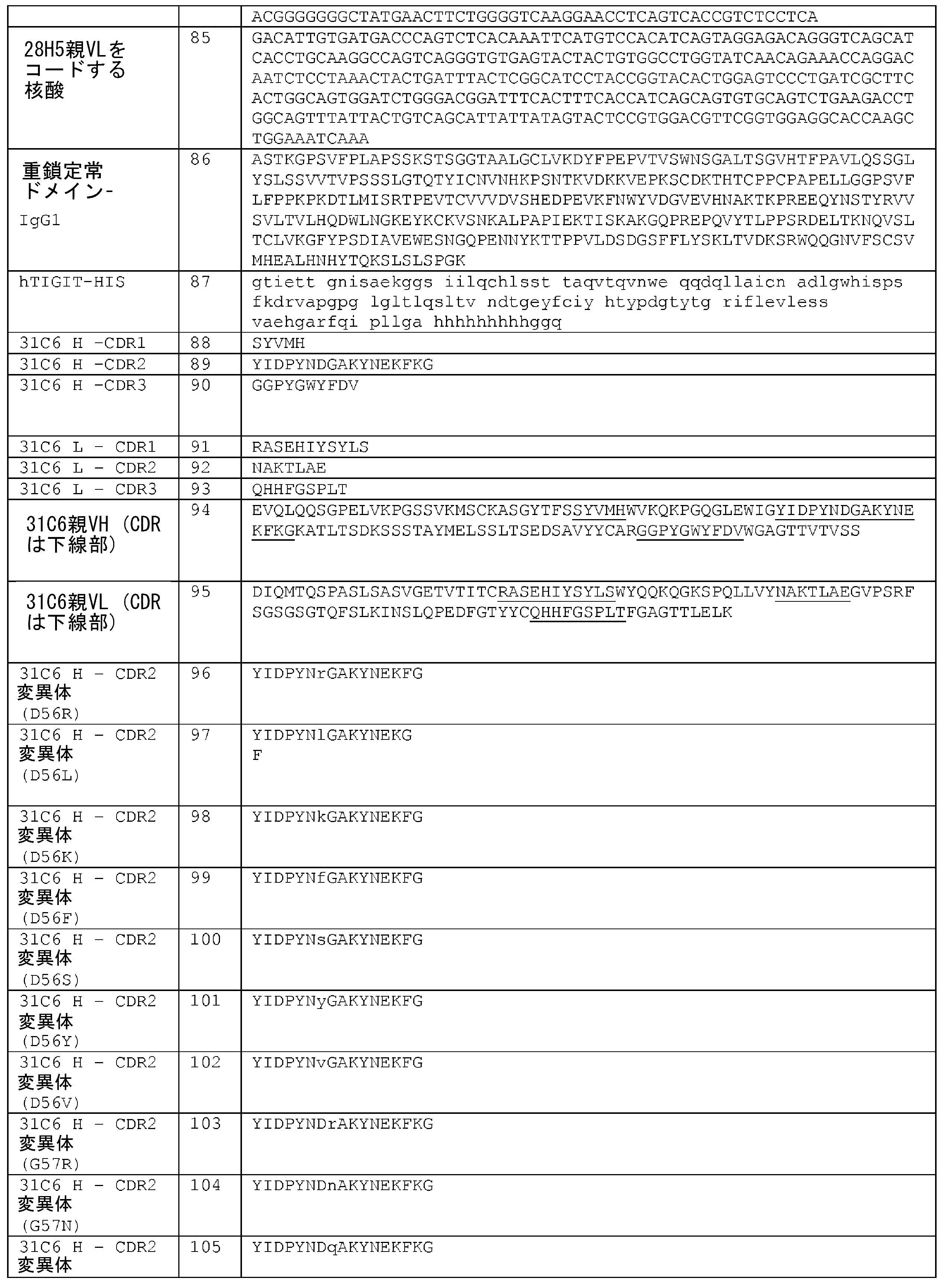


Claims (17)
前記抗体が配列番号128のアミノ酸配列を含む重鎖可変領域、および配列番号132のアミノ酸配列を含む軽鎖可変領域を含み、
該組成物は癌の治療に用いられ、
該組成物に付随する添付文書は、癌の治療における該組成物の使用方法を記載する、前記注射用組成物。 An injectable composition comprising an anti-TIGIT antibody and a pharma- ceutically acceptable carrier or diluent,
the antibody comprises a heavy chain variable region comprising the amino acid sequence of SEQ ID NO: 128, and a light chain variable region comprising the amino acid sequence of SEQ ID NO: 132;
The composition is used to treat cancer,
The injectable composition, wherein the package insert accompanying the composition describes a method of using the composition in the treatment of cancer.
(b)前記宿主細胞および/または培地から、前記抗体または抗原結合性フラグメントを回収すること;および
(c)前記回収された抗体または抗原結合性フラグメントを、医薬上許容される担体または希釈剤と混合して組成物を得ることを含む、請求項1または3のいずれか1項に記載の組成物の製造方法。 (a) culturing a host cell containing a polynucleotide encoding the heavy chain variable region and/or the light chain variable region of an anti-TIGIT antibody under conditions favorable for expression of the polynucleotide;
4. A method for producing the composition of claim 1, comprising: (b) recovering the antibody or antigen-binding fragment from the host cell and/or culture medium; and (c) mixing the recovered antibody or antigen-binding fragment with a pharma- ceutically acceptable carrier or diluent to obtain a composition.
Applications Claiming Priority (5)
| Application Number | Priority Date | Filing Date | Title |
|---|---|---|---|
| US201462038912P | 2014-08-19 | 2014-08-19 | |
| US62/038,912 | 2014-08-19 | ||
| US201562126733P | 2015-03-02 | 2015-03-02 | |
| US62/126,733 | 2015-03-02 | ||
| JP2020101881A JP7066777B2 (en) | 2014-08-19 | 2020-06-11 | Anti-TIGIT antibody |
Related Parent Applications (1)
| Application Number | Title | Priority Date | Filing Date |
|---|---|---|---|
| JP2020101881A Division JP7066777B2 (en) | 2014-08-19 | 2020-06-11 | Anti-TIGIT antibody |
Publications (3)
| Publication Number | Publication Date |
|---|---|
| JP2022105108A JP2022105108A (en) | 2022-07-12 |
| JP2022105108A5 JP2022105108A5 (en) | 2022-11-10 |
| JP7487256B2 true JP7487256B2 (en) | 2024-05-20 |
Family
ID=53938463
Family Applications (3)
| Application Number | Title | Priority Date | Filing Date |
|---|---|---|---|
| JP2017509009A Active JP6920194B2 (en) | 2014-08-19 | 2015-08-17 | Anti-TIGIT antibody |
| JP2020101881A Active JP7066777B2 (en) | 2014-08-19 | 2020-06-11 | Anti-TIGIT antibody |
| JP2022073522A Active JP7487256B2 (en) | 2014-08-19 | 2022-04-27 | Anti-TIGIT antibody |
Family Applications Before (2)
| Application Number | Title | Priority Date | Filing Date |
|---|---|---|---|
| JP2017509009A Active JP6920194B2 (en) | 2014-08-19 | 2015-08-17 | Anti-TIGIT antibody |
| JP2020101881A Active JP7066777B2 (en) | 2014-08-19 | 2020-06-11 | Anti-TIGIT antibody |
Country Status (30)
| Country | Link |
|---|---|
| US (5) | US20160355589A1 (en) |
| EP (1) | EP3183267A1 (en) |
| JP (3) | JP6920194B2 (en) |
| KR (2) | KR102050082B1 (en) |
| CN (2) | CN107148430B (en) |
| AP (1) | AP2017009765A0 (en) |
| AU (3) | AU2015305754B2 (en) |
| CA (1) | CA2957722C (en) |
| CL (2) | CL2017000310A1 (en) |
| CO (1) | CO2017001561A2 (en) |
| CR (1) | CR20170060A (en) |
| DO (1) | DOP2017000046A (en) |
| EA (1) | EA036311B1 (en) |
| GE (2) | GEP20217331B (en) |
| GT (1) | GT201700033A (en) |
| IL (1) | IL250583B (en) |
| JO (2) | JO3664B1 (en) |
| MA (1) | MA40475A (en) |
| MD (1) | MD4733C1 (en) |
| MX (2) | MX389684B (en) |
| MY (2) | MY198017A (en) |
| NI (1) | NI201700019A (en) |
| PE (1) | PE20170289A1 (en) |
| PH (1) | PH12017500296A1 (en) |
| SG (1) | SG11201701161QA (en) |
| TN (1) | TN2017000024A1 (en) |
| TW (2) | TWI724997B (en) |
| UA (1) | UA122395C2 (en) |
| WO (1) | WO2016028656A1 (en) |
| ZA (1) | ZA201700955B (en) |
Cited By (1)
| Publication number | Priority date | Publication date | Assignee | Title |
|---|---|---|---|---|
| WO2026013616A1 (en) | 2024-07-10 | 2026-01-15 | Takeda Pharmaceutical Company Limited | Compositions and methods for treating cancer |
Families Citing this family (187)
| Publication number | Priority date | Publication date | Assignee | Title |
|---|---|---|---|---|
| HRP20131167T1 (en) | 2007-06-18 | 2014-01-03 | Merck Sharp & Dohme B.V. | Antibodies to human programmed death receptor pd-1 |
| EP3208612B1 (en) | 2008-04-09 | 2019-09-18 | Genentech, Inc. | Compositions and methods for the treatment of immune related diseases |
| LT3485903T (en) | 2011-09-23 | 2023-02-27 | Mereo Biopharma 5, Inc. | Vegf/dll4 binding agents and uses thereof |
| UA117466C2 (en) | 2012-12-13 | 2018-08-10 | Мерк Шарп Енд Доме Корп. | STABLE COMPOSITION IN THE VIEW OF AN ANTIBODY ANTIBODY TO IL-23p19 |
| MY184154A (en) | 2013-12-12 | 2021-03-23 | Shanghai hengrui pharmaceutical co ltd | Pd-1 antibody, antigen-binding fragment thereof, and medical application thereof |
| GB201403775D0 (en) | 2014-03-04 | 2014-04-16 | Kymab Ltd | Antibodies, uses & methods |
| SG10201912986PA (en) | 2014-05-28 | 2020-02-27 | Agenus Inc | Anti-gitr antibodies and methods of use thereof |
| AU2015305754B2 (en) * | 2014-08-19 | 2018-10-25 | Merck Sharp & Dohme Llc | Anti-tigit antibodies |
| CN107207594B (en) | 2014-12-23 | 2019-05-07 | 百时美施贵宝公司 | Antibodies against TIGIT |
| US10227408B2 (en) | 2015-02-19 | 2019-03-12 | Compugen Ltd. | Anti-PVRIG antibodies and methods of use |
| EP3978929A1 (en) | 2015-02-19 | 2022-04-06 | Compugen Ltd. | Pvrig polypeptides and methods of treatment |
| CA2984794A1 (en) | 2015-05-07 | 2016-11-10 | Agenus Inc. | Anti-ox40 antibodies and methods of use thereof |
| TWI715587B (en) | 2015-05-28 | 2021-01-11 | 美商安可美德藥物股份有限公司 | Tigit-binding agents and uses thereof |
| EP3334757A4 (en) | 2015-08-14 | 2019-04-03 | Merck Sharp & Dohme Corp. | ANTI-TIGIT ANTIBODIES |
| CN114605548A (en) | 2015-09-01 | 2022-06-10 | 艾吉纳斯公司 | anti-PD-1 antibodies and methods of use thereof |
| CN108137691B (en) | 2015-09-02 | 2021-10-19 | 耶路撒冷希伯来大学伊萨姆研究发展有限公司 | Antibodies specific for human T-cell immunoglobulin and ITIM domain (TIGIT) |
| EP3353204B1 (en) | 2015-09-23 | 2023-10-18 | Mereo BioPharma 5, Inc. | Bi-specific anti-vegf/dll4 antibody for use in treating platinum-resistant ovarian cancer |
| PL3356413T3 (en) | 2015-10-01 | 2022-04-19 | Potenza Therapeutics, Inc. | Anti-tigit antigen-binding proteins and methods of use thereof |
| MA43260A (en) | 2015-11-18 | 2018-09-26 | Merck Sharp & Dohme | BINDERS PD1 AND / OR LAG3 |
| IL299072A (en) | 2015-12-02 | 2023-02-01 | Memorial Sloan Kettering Cancer Center | Antibodies and methods of use thereof |
| WO2017152088A1 (en) * | 2016-03-04 | 2017-09-08 | JN Biosciences, LLC | Antibodies to tigit |
| CN109069638B (en) | 2016-03-24 | 2022-03-29 | 璟尚生物制药公司 | Trispecific inhibitors for cancer therapy |
| CN109789201B (en) * | 2016-04-15 | 2023-06-16 | 伊穆奈克斯特股份有限公司 | Anti-human VISTA antibodies and uses thereof |
| TWI781934B (en) | 2016-05-27 | 2022-11-01 | 美商艾吉納斯公司 | Anti-tim-3 antibodies and methods of use thereof |
| KR102379464B1 (en) | 2016-06-20 | 2022-03-29 | 키맵 리미티드 | anti-PD-L1 antibody |
| US9567399B1 (en) | 2016-06-20 | 2017-02-14 | Kymab Limited | Antibodies and immunocytokines |
| KR20260030924A (en) | 2016-08-09 | 2026-03-06 | 키맵 리미티드 | Anti-icos antibodies |
| CN110088132B (en) | 2016-08-17 | 2020-10-27 | 康姆普根有限公司 | anti-TIGIT antibodies, anti-PVRIG antibodies, and combinations thereof |
| WO2018041120A1 (en) | 2016-08-31 | 2018-03-08 | Beijing Biocytogen Co., Ltd | Genetically modified non-human animal with human or chimeric tigit |
| CN107815467B (en) | 2016-08-31 | 2021-03-16 | 百奥赛图(北京)医药科技股份有限公司 | Preparation method and application of humanized gene modified animal model |
| SG10201912663YA (en) | 2016-10-11 | 2020-03-30 | Agenus Inc | Anti-lag-3 antibodies and methods of use thereof |
| EP3534947A1 (en) | 2016-11-03 | 2019-09-11 | Kymab Limited | Antibodies, combinations comprising antibodies, biomarkers, uses & methods |
| AU2017355512B2 (en) | 2016-11-04 | 2025-04-03 | Aximmune, Inc. | Beta-alethine, immune modulators, and uses thereof |
| MA46770A (en) | 2016-11-09 | 2019-09-18 | Agenus Inc | ANTI-OX40 ANTIBODIES, ANTI-GITR ANTIBODIES, AND PROCESSES FOR USE |
| CN110662552A (en) * | 2016-11-30 | 2020-01-07 | 昂科梅德制药有限公司 | Cancer Treatment Methods Containing TIGIT Binders |
| US10759855B2 (en) | 2016-12-02 | 2020-09-01 | Rigel Pharmaceuticals, Inc. | Antigen binding molecules to TIGIT |
| JP7106538B2 (en) | 2016-12-07 | 2022-07-26 | アジェナス インコーポレイテッド | Antibodies and methods of their use |
| US10232053B2 (en) | 2016-12-30 | 2019-03-19 | Trieza Therapeutics, Inc. | Immunomodulatory oncolytic adenoviral vectors, and methods of production and use thereof for treatment of cancer |
| CN109071656B (en) * | 2017-01-05 | 2021-05-18 | 璟尚生物制药公司 | Checkpoint modulator antagonists |
| RU2019127550A (en) * | 2017-03-03 | 2021-04-05 | Ринат Ньюросайенс Корп. | ANTI-GITR ANTIBODIES AND METHODS OF THEIR USE |
| JOP20190203A1 (en) * | 2017-03-30 | 2019-09-03 | Potenza Therapeutics Inc | Anti-tigit antigen-binding proteins and methods of use thereof |
| US20200024351A1 (en) | 2017-04-03 | 2020-01-23 | Jounce Therapeutics, Inc. | Compositions and Methods for the Treatment of Cancer |
| KR20240132482A (en) | 2017-04-21 | 2024-09-03 | 신라젠(주) | Oncolytic vaccinia virus and checkpoint inhibitor combination therapy |
| EP3615070A1 (en) | 2017-04-26 | 2020-03-04 | Bristol-Myers Squibb Company | Methods of antibody production that minimize disulfide bond reduction |
| RS64576B1 (en) | 2017-05-01 | 2023-10-31 | Agenus Inc | Anti-tigit antibodies and methods of use thereof |
| JOP20190260A1 (en) | 2017-05-02 | 2019-10-31 | Merck Sharp & Dohme | Stable formulations of programmed death receptor 1 (pd-1) antibodies and methods of use thereof |
| AU2018263868A1 (en) | 2017-05-02 | 2019-12-12 | Merck Sharp & Dohme Llc | Formulations of anti-LAG3 antibodies and co-formulations of anti-LAG3 antibodies and anti-PD-1 antibodies |
| JP7402693B2 (en) * | 2017-05-02 | 2023-12-21 | メルク・シャープ・アンド・ドーム・エルエルシー | Stable formulations of anti-TIGIT antibodies alone and in combination with programmed death receptor 1 (PD-1) antibodies, and methods of use thereof |
| CN110799213A (en) | 2017-06-01 | 2020-02-14 | 康姆普根有限公司 | Triple combination antibody therapy |
| WO2018229163A1 (en) | 2017-06-14 | 2018-12-20 | King's College London | Methods of activating v delta 2 negative gamma delta t cells |
| GB201709808D0 (en) | 2017-06-20 | 2017-08-02 | Kymab Ltd | Antibodies |
| WO2019023504A1 (en) | 2017-07-27 | 2019-01-31 | Iteos Therapeutics Sa | Anti-tigit antibodies |
| IL272227B2 (en) * | 2017-07-27 | 2025-09-01 | iTeos Belgium SA | Anti-tigit antibodies |
| BE1025333B1 (en) * | 2017-07-27 | 2019-01-23 | Iteos Therapeutics S.A. | ANTI-TIGIT ANTIBODIES |
| US11512129B2 (en) | 2017-09-29 | 2022-11-29 | Jiangsu Hengrui Medicine Co., Ltd. | TIGIT antibody, antigen-binding fragment thereof, and medical use thereof |
| EP3728314A1 (en) | 2017-12-19 | 2020-10-28 | Kymab Limited | Bispecific antibody for icos and pd-l1 |
| GB201721338D0 (en) | 2017-12-19 | 2018-01-31 | Kymab Ltd | Anti-icos Antibodies |
| TW201930358A (en) * | 2017-12-28 | 2019-08-01 | 大陸商南京傳奇生物科技有限公司 | Single-domain antibodies and variants thereof against TIGIT |
| TWI816729B (en) | 2017-12-30 | 2023-10-01 | 英屬開曼群島商百濟神州有限公司 | Anti-tigit antibodies and their use as therapeutics and diagnostics |
| KR20200109313A (en) * | 2018-01-15 | 2020-09-22 | 난징 레전드 바이오테크 씨오., 엘티디. | Antibodies to TIGIT and variants thereof |
| WO2019152574A1 (en) * | 2018-02-01 | 2019-08-08 | Merck Sharp & Dohme Corp. | Methods for treating cancer or infection using a combination of an anti-pd-1 antibody, an anti-lag3 antibody, and an anti-tigit antibody |
| CA3086936C (en) | 2018-02-06 | 2022-11-29 | I-Mab Biopharma Us Limited | Antibodies to t cell immunoreceptor with ig and itim domains (tigit) and uses thereof |
| MX2020008795A (en) * | 2018-02-28 | 2020-10-08 | Yuhan Corp | Anti-tigit antibodies and uses thereof. |
| US20210024873A1 (en) | 2018-03-27 | 2021-01-28 | Bristol-Myers Squibb Company | Real-time monitoring of protein concentration using ultraviolet signal |
| US20190300610A1 (en) * | 2018-03-29 | 2019-10-03 | Hummingbird Bioscience Pte. Ltd. | Vista antigen-binding molecules |
| AR114789A1 (en) * | 2018-04-18 | 2020-10-14 | Hoffmann La Roche | ANTI-HLA-G ANTIBODIES AND THE USE OF THEM |
| KR102892725B1 (en) | 2018-05-09 | 2025-12-01 | 이슘 리서치 디벨롭먼트 컴퍼니 오브 더 히브루 유니버시티 오브 예루살렘 엘티디. | Antibody specific for human nectin 4 |
| CA3101019A1 (en) | 2018-06-01 | 2019-12-05 | Compugen Ltd | Anti-pvrig/anti-tigit bispecific antibodies and methods of use |
| CN112739717B (en) | 2018-06-29 | 2025-02-11 | 璟尚生物制药公司 | Trispecific antagonist |
| KR20210040827A (en) | 2018-07-25 | 2021-04-14 | 이노벤트 바이오로직스 (쑤저우) 컴퍼니, 리미티드 | Anti TIGIT antibody and its use |
| JP2021534196A (en) | 2018-08-23 | 2021-12-09 | シージェン インコーポレイテッド | Anti-TIGIT antibody |
| US11401324B2 (en) | 2018-08-30 | 2022-08-02 | HCW Biologics, Inc. | Single-chain chimeric polypeptides and uses thereof |
| CA3109361A1 (en) | 2018-08-30 | 2020-03-05 | HCW Biologics, Inc. | Single-chain and multi-chain chimeric polypeptides and uses thereof |
| US11518792B2 (en) | 2018-08-30 | 2022-12-06 | HCW Biologics, Inc. | Multi-chain chimeric polypeptides and uses thereof |
| CN110511912B (en) * | 2018-08-30 | 2024-03-22 | 浙江煦顼技术有限公司 | Functional modulation of immune cells |
| KR102885113B1 (en) | 2018-10-18 | 2025-11-13 | 머크 샤프 앤드 돔 엘엘씨 | Preparations of anti-RSV antibodies and methods of use thereof |
| CN120842406A (en) | 2018-10-31 | 2025-10-28 | 默沙东有限责任公司 | Anti-human PD-1 antibody crystals and methods of use thereof |
| MX2021005236A (en) * | 2018-11-05 | 2021-06-18 | Merck Sharp & Dohme Llc | Dosing regimen of anti-tigit antibody for treatment of cancer. |
| CN113316458B (en) | 2018-11-07 | 2024-08-02 | 默沙东有限责任公司 | Co-formulations of anti-LAG 3 antibodies and anti-PD-1 antibodies |
| CN113614109A (en) | 2018-12-21 | 2021-11-05 | Ose免疫疗法公司 | Bifunctional anti-PD-1/IL-7 molecules |
| SG11202107474RA (en) * | 2019-01-07 | 2021-08-30 | iTeos Belgium SA | Anti-tigit antibodies |
| WO2020165374A1 (en) | 2019-02-14 | 2020-08-20 | Ose Immunotherapeutics | Bifunctional molecule comprising il-15ra |
| WO2020172658A1 (en) | 2019-02-24 | 2020-08-27 | Bristol-Myers Squibb Company | Methods of isolating a protein |
| EP3938396A1 (en) | 2019-03-11 | 2022-01-19 | Jounce Therapeutics, Inc. | Anti-icos antibodies for the treatment of cancer |
| CN111744013B (en) * | 2019-03-29 | 2022-07-26 | 江苏恒瑞医药股份有限公司 | Methods and pharmaceutical combinations for treating diseases using anti-TIGIT antibodies in combination with PD-1 inhibitors |
| CN111744007B (en) * | 2019-03-29 | 2023-05-12 | 江苏恒瑞医药股份有限公司 | anti-TIGIT antibody pharmaceutical composition and application thereof |
| JP7645198B2 (en) | 2019-05-23 | 2025-03-13 | ブリストル-マイヤーズ スクイブ カンパニー | Methods for monitoring cell culture media |
| TWI760751B (en) * | 2019-05-29 | 2022-04-11 | 美商美國禮來大藥廠 | Tigit and pd-1/tigit-binding molecules |
| KR102332847B1 (en) * | 2019-06-13 | 2021-12-01 | 주식회사 녹십자 | Antibodies Against T cell Immunoreceptor with Ig and Tyrosine-Based Inhibitory Motif Domains and Uses Thereof |
| CN120924491A (en) | 2019-06-21 | 2025-11-11 | 免疫生物公司 | Multichain chimeric polypeptides and uses thereof |
| US10851157B2 (en) | 2019-07-01 | 2020-12-01 | Gensun Biopharma, Inc. | Antagonists targeting the TGF-β pathway |
| CN114269782B (en) * | 2019-07-15 | 2023-12-29 | 上海君实生物医药科技股份有限公司 | Anti-TIGIT antibodies and their applications |
| JP2022546922A (en) * | 2019-07-30 | 2022-11-10 | メルク・シャープ・アンド・ドーム・エルエルシー | Anti-PD-1/LAG3/TIGIT trispecific antibody and anti-PD-1/LAG3 bispecific antibody |
| CN112625130B (en) * | 2019-09-24 | 2023-08-29 | 财团法人工业技术研究院 | Anti-TIGIT antibodies and methods of use |
| JP7280387B2 (en) * | 2019-09-27 | 2023-05-23 | グラクソスミスクライン、インテレクチュアル、プロパティー、ディベロップメント、リミテッド | antigen binding protein |
| US20220340660A1 (en) * | 2019-10-01 | 2022-10-27 | Merck Sharp & Dohme Corp. | Biomarkers for anti-tigit antibody treatment |
| EP4055052A1 (en) | 2019-11-05 | 2022-09-14 | Jounce Therapeutics, Inc. | Methods of treating cancer with anti-pd-1 antibodies |
| AU2020378335A1 (en) * | 2019-11-05 | 2022-04-07 | Merck Patent Gmbh | Anti-TIGIT antibodies and uses thereof |
| CN114641502B (en) * | 2019-11-14 | 2023-11-14 | 上海药明生物技术有限公司 | New anti-TIGIT antibody |
| WO2021113831A1 (en) | 2019-12-05 | 2021-06-10 | Compugen Ltd. | Anti-pvrig and anti-tigit antibodies for enhanced nk-cell based tumor killing |
| AU2020406083A1 (en) | 2019-12-17 | 2022-06-16 | Boehringer Ingelheim International Gmbh | Bifunctional molecules comprising an IL-7 variant |
| WO2021141977A1 (en) | 2020-01-07 | 2021-07-15 | Board Of Regents, The University Of Texas System | Improved human methyl thioadenosine/adenosine depleting enzyme variants for cancer therapy |
| US20230112470A1 (en) | 2020-01-29 | 2023-04-13 | Board Of Regents, The University Of Texas System | Use of egfr/her2 tyrosine kinase inhibitors and/or her2/her3 antibodies for the treatment of cancers with nrg1 fusions |
| KR20220133238A (en) | 2020-01-29 | 2022-10-04 | 더 보드 오브 리젠츠 오브 더 유니버시티 오브 텍사스 시스템 | Use of posiotinib for the treatment of cancers with NRG1 fusions |
| WO2021163299A1 (en) | 2020-02-11 | 2021-08-19 | HCW Biologics, Inc. | Chromatography resin and uses thereof |
| AU2021220870A1 (en) | 2020-02-11 | 2022-08-04 | Immunitybio, Inc. | Methods of treating age-related and inflammatory diseases |
| CA3169243A1 (en) | 2020-02-11 | 2021-08-19 | HCW Biologics, Inc. | Methods of activating regulatory t cells |
| KR20220154140A (en) | 2020-03-13 | 2022-11-21 | 지앙수 헨그루이 파마슈티컬스 컴퍼니 리미티드 | PVRIG binding proteins and their medical uses |
| CN115916247B (en) * | 2020-04-19 | 2025-04-01 | 奥美药业有限公司 | Human TIGIT-specific single domain antibody and its application |
| CA3172627A1 (en) * | 2020-04-22 | 2021-10-28 | Adi Mor | Method of treatment using anti-ccl24 antibody |
| CN115836087A (en) | 2020-04-29 | 2023-03-21 | Hcw生物科技公司 | Anti-CD26 protein and use thereof |
| CN113563470B (en) | 2020-04-29 | 2023-02-10 | 广州昂科免疫生物技术有限公司 | Antibody combined with TIGIT antigen and preparation method and application thereof |
| CA3176497A1 (en) | 2020-05-07 | 2021-11-11 | Fatima MECHTA-GRIGORIOU | Antxr1 as a biomarker of immunosuppressive fibroblast populations and its use for predicting response to immunotherapy |
| CN111995681B (en) * | 2020-05-09 | 2022-03-08 | 华博生物医药技术(上海)有限公司 | anti-TIGIT antibody, preparation method and application thereof |
| WO2021247003A1 (en) | 2020-06-01 | 2021-12-09 | HCW Biologics, Inc. | Methods of treating aging-related disorders |
| US12024545B2 (en) | 2020-06-01 | 2024-07-02 | HCW Biologics, Inc. | Methods of treating aging-related disorders |
| JP2023527869A (en) | 2020-06-01 | 2023-06-30 | エイチシーダブリュー バイオロジックス インコーポレイテッド | Treatments for age-related disorders |
| BR112022024221A2 (en) * | 2020-06-02 | 2022-12-20 | Arcus Biosciences Inc | ANTIBODIES TO TIGIT |
| CN115916348A (en) | 2020-06-18 | 2023-04-04 | 基因泰克公司 | Treatment with Anti-TIGIT Antibodies and PD-1 Axis Binding Antagonists |
| WO2021258337A1 (en) * | 2020-06-24 | 2021-12-30 | Huahui Health Ltd. | Human monoclonal antibodies against tigit for immune related diseases |
| CN111718415B (en) * | 2020-07-03 | 2021-02-23 | 上海洛启生物医药技术有限公司 | anti-TIGIT nano antibody and application thereof |
| TW202216778A (en) | 2020-07-15 | 2022-05-01 | 美商安進公司 | Tigit and cd112r blockade |
| EP4192883A4 (en) * | 2020-08-05 | 2024-12-04 | Crystal Bioscience Inc. | ANTI-TIGIT ANTIBODY AND METHODS OF USE THEREOF |
| WO2022044010A1 (en) | 2020-08-26 | 2022-03-03 | Yissum Research Development Company Of The Hebrew University Of Jerusalem Ltd. | Anti-t-cell immunoglobulin and itim domain (tigit) antibodies for the treatment of fungal infections |
| US20230374064A1 (en) | 2020-10-05 | 2023-11-23 | Bristol-Myers Squibb Company | Methods for concentrating proteins |
| EP4226943A4 (en) * | 2020-10-09 | 2024-11-20 | Keio University | THERAPEUTIC AGENT FOR IMMUNE/INFLAMMATORY DISEASE |
| EP4232087A4 (en) * | 2020-10-21 | 2024-10-09 | Immune-ONC Therapeutics, Inc. | NEW ANTI-LILRB2 ANTIBODIES AND DERIVATIVE PRODUCTS |
| IL302402A (en) | 2020-11-08 | 2023-06-01 | Seagen Inc | Combination therapy |
| US11028172B1 (en) * | 2020-11-10 | 2021-06-08 | Lepu Biopharma Co., Ltd. | Anti-TIGIT antibodies and uses thereof |
| WO2022112198A1 (en) | 2020-11-24 | 2022-06-02 | Worldwide Innovative Network | Method to select the optimal immune checkpoint therapies |
| TW202222345A (en) * | 2020-11-26 | 2022-06-16 | 大陸商信達生物製藥(蘇州)有限公司 | Formulations containing anti-tigit/pd-1 bispecific antibody as well as preparation method and use thereof |
| WO2022117572A2 (en) | 2020-12-02 | 2022-06-09 | Oncurious Nv | An ltbr agonist in combination therapy against cancer |
| KR20220082776A (en) * | 2020-12-10 | 2022-06-17 | 주식회사 유틸렉스 | Anti-TIGIT Antibody and Use Thereof |
| AR124414A1 (en) | 2020-12-18 | 2023-03-22 | Century Therapeutics Inc | CHIMERIC ANTIGEN RECEPTOR SYSTEM WITH ADAPTABLE RECEPTOR SPECIFICITY |
| US11806507B2 (en) * | 2020-12-22 | 2023-11-07 | Regina E. HERZLINGER | Methods, systems, and apparatus for administering an antibody treatment via infusion |
| US12133966B2 (en) * | 2020-12-22 | 2024-11-05 | Regina E. HERZLINGER | Methods, systems, and apparatus for administering an antibody treatment via infusion |
| CA3202742A1 (en) * | 2020-12-22 | 2022-06-30 | Regina E. HERZLINGER | Methods, systems, and apparatus for administering a monoclonal and/or polyclonal antibody treatment via rapid infusion |
| WO2022148781A1 (en) | 2021-01-05 | 2022-07-14 | Institut Curie | Combination of mcoln activators and immune checkpoint inhibitors |
| AU2022207020A1 (en) | 2021-01-14 | 2023-08-31 | Shanghai Junshi Biosciences Co., Ltd. | Anti-tigit antibody pharmaceutical composition and application thereof |
| CN114989300A (en) * | 2021-03-02 | 2022-09-02 | 百奥泰生物制药股份有限公司 | Application of anti-TIGIT antibody in the treatment of tumor or cancer |
| CN114984227A (en) * | 2021-03-02 | 2022-09-02 | 百奥泰生物制药股份有限公司 | Application of anti-TIGIT antibody in drug combination |
| EP4314074A4 (en) * | 2021-03-24 | 2025-09-03 | Twist Bioscience Corp | VARIANTS OF NUCLEIC ACID LIBRARIES FOR TIGIT |
| AU2022253351A1 (en) | 2021-04-09 | 2023-10-12 | Boehringer Ingelheim International Gmbh | New scaffold for bifunctional molecules with improved properties |
| EP4320156A1 (en) | 2021-04-09 | 2024-02-14 | Ose Immunotherapeutics | Scaffold for bifunctioanl molecules comprising pd-1 or cd28 and sirp binding domains |
| MX2023011796A (en) | 2021-04-09 | 2024-01-08 | Seagen Inc | Methods of treating cancer with anti-tigit antibodies. |
| AR125753A1 (en) | 2021-05-04 | 2023-08-09 | Agenus Inc | ANTI-TIGIT ANTIBODIES, ANTI-CD96 ANTIBODIES AND METHODS OF USE OF THESE |
| CN117916263B (en) * | 2021-05-10 | 2025-04-25 | 美帝马布生物公司 | Anti-TIGIT antibodies and uses thereof |
| EP4341287A4 (en) * | 2021-05-18 | 2024-12-04 | Suzhou Kanova Biopharmaceutical Co., Ltd. | ANTI-TIGIT ANTIBODIES AND THEIR USE |
| CN115466327B (en) * | 2021-06-10 | 2025-07-08 | 北京天广实生物技术股份有限公司 | Antibodies that bind to TIGIT and uses thereof |
| CN118871463A (en) | 2021-07-28 | 2024-10-29 | 基因泰克公司 | Methods and compositions for treating cancer |
| WO2023036340A1 (en) * | 2021-09-13 | 2023-03-16 | Biocytogen Pharmaceuticals (Beijing) Co., Ltd. | Protein complexes targeting il21 pathway |
| JP2024535793A (en) | 2021-09-15 | 2024-10-02 | 江▲蘇▼恒瑞医▲薬▼股▲フン▼有限公司 | Proteins that specifically bind to PD-1 and their medical uses |
| CN117858903A (en) | 2021-09-15 | 2024-04-09 | 江苏恒瑞医药股份有限公司 | A pharmaceutical composition containing anti-PVRIG/TIGIT bispecific antibody |
| CN115838424A (en) * | 2021-09-22 | 2023-03-24 | 上海康岱生物医药技术股份有限公司 | Monoclonal antibody targeting TIGIT |
| JP2024536133A (en) | 2021-09-29 | 2024-10-04 | ボード オブ リージェンツ,ザ ユニバーシティ オブ テキサス システム | Anti-HSP70 Antibodies and Therapeutic Uses Thereof |
| TW202321308A (en) | 2021-09-30 | 2023-06-01 | 美商建南德克公司 | Methods for treatment of hematologic cancers using anti-tigit antibodies, anti-cd38 antibodies, and pd-1 axis binding antagonists |
| WO2023108609A1 (en) * | 2021-12-17 | 2023-06-22 | Shanghai Nigene Biological Science And Technology Co., Ltd. | Tigit antibodies and uses thereof |
| CN114181310B (en) * | 2022-02-14 | 2022-07-05 | 中山康方生物医药有限公司 | Anti-TIGIT antibody, its pharmaceutical composition and use |
| JP2025508939A (en) | 2022-03-02 | 2025-04-10 | イミュニティーバイオ インコーポレイテッド | Pancreatic cancer treatment methods |
| CN119156403A (en) | 2022-03-08 | 2024-12-17 | 阿伦蒂斯治疗股份公司 | Use of anti-claudin-1 antibodies to increase T cell availability |
| JP2025509274A (en) | 2022-03-09 | 2025-04-11 | ブリストル-マイヤーズ スクイブ カンパニー | Transient expression of therapeutic proteins |
| PE20251671A1 (en) | 2022-03-15 | 2025-06-30 | Compugen Ltd | IL-18BP ANTAGONIST ANTIBODIES AND THEIR USE IN MONOTHERAPY AND COMBINATION THERAPY IN CANCER TREATMENT |
| KR20240161968A (en) | 2022-03-16 | 2024-11-13 | 다이이찌 산쿄 가부시키가이샤 | Combination of multi-specific molecules and immune checkpoint inhibitors |
| WO2023201311A1 (en) | 2022-04-13 | 2023-10-19 | HCW Biologics, Inc. | Multi-chain chimeric polypeptide for use in the treatment of treating neuroinflammatory disorder |
| CA3256561A1 (en) | 2022-05-02 | 2023-11-09 | Arcus Biosciences, Inc. | Anti-tigit antibodies and uses of the same |
| EP4537107A2 (en) | 2022-06-07 | 2025-04-16 | Genentech, Inc. | Method for determining the efficacy of a lung cancer treatment comprising an anti-pd-l1 antagonist and an anti-tigit antagonist antibody |
| US20260015417A1 (en) * | 2022-06-10 | 2026-01-15 | Medimabbio Inc. | Fusion protein comprising antibody binding specifically to tigit and interleukin-15, and use thereof |
| KR102769148B1 (en) * | 2022-06-10 | 2025-02-20 | 메디맵바이오 주식회사 | Fusion protein comprising anti-TIGIT antibody, interleukin-15, and interleukin-15 receptor alpha sushi domain, and uses thereof |
| WO2024003360A1 (en) | 2022-07-01 | 2024-01-04 | Institut Curie | Biomarkers and uses thereof for the treatment of neuroblastoma |
| WO2024028386A1 (en) | 2022-08-02 | 2024-02-08 | Ose Immunotherapeutics | Multifunctional molecule directed against cd28 |
| EP4606385A1 (en) | 2022-10-18 | 2025-08-27 | Meiji Seika Pharma Co., Ltd. | Therapeutic agent for t cell tumor |
| WO2024191807A1 (en) | 2023-03-10 | 2024-09-19 | Seagen Inc. | Methods of treating cancer with anti-tigit antibodies |
| CN120693178A (en) | 2023-03-15 | 2025-09-23 | 上海迈晋生物医药科技有限公司 | A pharmaceutical composition containing PD-1/PVRIG/TIGIT binding protein and its medical use |
| CN121358499A (en) | 2023-03-30 | 2026-01-16 | Ose免疫疗法 | Lipid-based nanoparticles targeting activated immune cells to express immune cell-enhancing molecules and their applications |
| AU2024254671A1 (en) | 2023-03-30 | 2025-10-02 | Ose Immunotherapeutics | Method of synthesis of targeted lipid nanoparticle and uses thereof |
| WO2024251140A1 (en) * | 2023-06-06 | 2024-12-12 | Wuxi Biologics (Shanghai) Co., Ltd. | Anti-tigit antibodies and uses thereof |
| TW202515608A (en) | 2023-06-26 | 2025-04-16 | 以色列商坎布根有限公司 | Il-18bp antagonist antibodies and their use in monotherapy and combination therapy in the treatment of cancer |
| WO2025068461A1 (en) | 2023-09-29 | 2025-04-03 | Negio Therapeutics | Guanfacine derivatives and their use in treating cancer |
| WO2025068452A1 (en) | 2023-09-29 | 2025-04-03 | Negio Therapeutics | Guanfacine derivatives and their use in treating cancer |
| WO2025132831A1 (en) | 2023-12-19 | 2025-06-26 | Universite D'aix-Marseille | N-heteroaryl derivatives and uses thereof for treating cancer |
| WO2025159595A1 (en) * | 2024-01-24 | 2025-07-31 | 메디맵바이오 주식회사 | Anti-tigit antibody specifically binding to tigit, fusion protein comprising same and interleukin-10, and uses thereof |
| WO2025242835A1 (en) | 2024-05-22 | 2025-11-27 | Ose Immunotherapeutics | Molecules comprising masking linkers and uses thereof for the treatment of cancer |
| WO2025242836A1 (en) | 2024-05-22 | 2025-11-27 | Ose Immunotherapeutics | Molecules comprising masking linkers and uses thereof for the treatment of auto-immune or inflammatory diseases and disorders |
| WO2025262250A1 (en) | 2024-06-20 | 2025-12-26 | Negio Therapeutics | Guanfacine derivatives and their uses |
| US20260049118A1 (en) | 2024-08-19 | 2026-02-19 | HCW Biologics, Inc. | Single-chain chimeric polypeptides and uses thereof |
| WO2026043906A1 (en) | 2024-08-19 | 2026-02-26 | HCW Biologics, Inc. | Multi-chain chimeric polypeptides and uses thereof |
| WO2026068705A1 (en) | 2024-09-26 | 2026-04-02 | Ose Immunotherapeutics | Lipid-based nanoparticles comprising non-glycosylated fc domains and uses thereof |
Citations (1)
| Publication number | Priority date | Publication date | Assignee | Title |
|---|---|---|---|---|
| JP6920194B2 (en) | 2014-08-19 | 2021-08-18 | メルク・シャープ・アンド・ドーム・コーポレーションMerck Sharp & Dohme Corp. | Anti-TIGIT antibody |
Family Cites Families (102)
| Publication number | Priority date | Publication date | Assignee | Title |
|---|---|---|---|---|
| US4399216A (en) | 1980-02-25 | 1983-08-16 | The Trustees Of Columbia University | Processes for inserting DNA into eucaryotic cells and for producing proteinaceous materials |
| US4447233A (en) | 1981-04-10 | 1984-05-08 | Parker-Hannifin Corporation | Medication infusion pump |
| US4439196A (en) | 1982-03-18 | 1984-03-27 | Merck & Co., Inc. | Osmotic drug delivery system |
| US4447224A (en) | 1982-09-20 | 1984-05-08 | Infusaid Corporation | Variable flow implantable infusion apparatus |
| US4487603A (en) | 1982-11-26 | 1984-12-11 | Cordis Corporation | Implantable microinfusion pump system |
| US4816567A (en) | 1983-04-08 | 1989-03-28 | Genentech, Inc. | Recombinant immunoglobin preparations |
| US4740461A (en) | 1983-12-27 | 1988-04-26 | Genetics Institute, Inc. | Vectors and methods for transformation of eucaryotic cells |
| EP0154316B1 (en) | 1984-03-06 | 1989-09-13 | Takeda Chemical Industries, Ltd. | Chemically modified lymphokine and production thereof |
| US4596556A (en) | 1985-03-25 | 1986-06-24 | Bioject, Inc. | Hypodermic injection apparatus |
| AU584417B2 (en) | 1985-04-01 | 1989-05-25 | Lonza Group Ag | Transformed myeloma cell-line and a process for the expression of a gene coding for a eukaryotic polypeptide employing same |
| GB8601597D0 (en) | 1986-01-23 | 1986-02-26 | Wilson R H | Nucleotide sequences |
| US4959455A (en) | 1986-07-14 | 1990-09-25 | Genetics Institute, Inc. | Primate hematopoietic growth factors IL-3 and pharmaceutical compositions |
| ATE87659T1 (en) | 1986-09-02 | 1993-04-15 | Enzon Lab Inc | BINDING MOLECULES WITH SINGLE POLYPEPTIDE CHAIN. |
| US4946778A (en) | 1987-09-21 | 1990-08-07 | Genex Corporation | Single polypeptide chain binding molecules |
| US5260203A (en) | 1986-09-02 | 1993-11-09 | Enzon, Inc. | Single polypeptide chain binding molecules |
| US4912040A (en) | 1986-11-14 | 1990-03-27 | Genetics Institute, Inc. | Eucaryotic expression system |
| WO1988007089A1 (en) | 1987-03-18 | 1988-09-22 | Medical Research Council | Altered antibodies |
| US4941880A (en) | 1987-06-19 | 1990-07-17 | Bioject, Inc. | Pre-filled ampule and non-invasive hypodermic injection device assembly |
| US4790824A (en) | 1987-06-19 | 1988-12-13 | Bioject, Inc. | Non-invasive hypodermic injection device |
| GB8717430D0 (en) | 1987-07-23 | 1987-08-26 | Celltech Ltd | Recombinant dna product |
| US5677425A (en) | 1987-09-04 | 1997-10-14 | Celltech Therapeutics Limited | Recombinant antibody |
| EP0401384B1 (en) | 1988-12-22 | 1996-03-13 | Kirin-Amgen, Inc. | Chemically modified granulocyte colony stimulating factor |
| US5530101A (en) | 1988-12-28 | 1996-06-25 | Protein Design Labs, Inc. | Humanized immunoglobulins |
| DE3920358A1 (en) | 1989-06-22 | 1991-01-17 | Behringwerke Ag | BISPECIFIC AND OLIGO-SPECIFIC, MONO- AND OLIGOVALENT ANTI-BODY CONSTRUCTS, THEIR PRODUCTION AND USE |
| US5064413A (en) | 1989-11-09 | 1991-11-12 | Bioject, Inc. | Needleless hypodermic injection device |
| US5312335A (en) | 1989-11-09 | 1994-05-17 | Bioject Inc. | Needleless hypodermic injection device |
| DE69232137T2 (en) | 1991-11-25 | 2002-05-29 | Enzon Inc | MULTIVALENT ANTI-BINDING PROTEINS |
| US5932448A (en) | 1991-11-29 | 1999-08-03 | Protein Design Labs., Inc. | Bispecific antibody heterodimers |
| US5714350A (en) | 1992-03-09 | 1998-02-03 | Protein Design Labs, Inc. | Increasing antibody affinity by altering glycosylation in the immunoglobulin variable region |
| US6129914A (en) | 1992-03-27 | 2000-10-10 | Protein Design Labs, Inc. | Bispecific antibody effective to treat B-cell lymphoma and cell line |
| WO1993022332A2 (en) | 1992-04-24 | 1993-11-11 | Board Of Regents, The University Of Texas System | Recombinant production of immunoglobulin-like domains in prokaryotic cells |
| US5383851A (en) | 1992-07-24 | 1995-01-24 | Bioject Inc. | Needleless hypodermic injection device |
| AU701578B2 (en) | 1992-08-21 | 1999-02-04 | Vrije Universiteit Brussel | Immunoglobulins devoid of light chains |
| US6005079A (en) | 1992-08-21 | 1999-12-21 | Vrije Universiteit Brussels | Immunoglobulins devoid of light chains |
| WO1994025591A1 (en) | 1993-04-29 | 1994-11-10 | Unilever N.V. | PRODUCTION OF ANTIBODIES OR (FUNCTIONALIZED) FRAGMENTS THEREOF DERIVED FROM HEAVY CHAIN IMMUNOGLOBULINS OF $i(CAMELIDAE) |
| AU691811B2 (en) | 1993-06-16 | 1998-05-28 | Celltech Therapeutics Limited | Antibodies |
| US5532210A (en) | 1994-06-08 | 1996-07-02 | E. I. Du Pont De Nemours And Company | High temperature superconductor dielectric slow wave structures for accelerators and traveling wave tubes |
| US5869046A (en) | 1995-04-14 | 1999-02-09 | Genentech, Inc. | Altered polypeptides with increased half-life |
| US6121022A (en) | 1995-04-14 | 2000-09-19 | Genentech, Inc. | Altered polypeptides with increased half-life |
| US6277375B1 (en) | 1997-03-03 | 2001-08-21 | Board Of Regents, The University Of Texas System | Immunoglobulin-like domains with increased half-lives |
| WO1998052976A1 (en) | 1997-05-21 | 1998-11-26 | Biovation Limited | Method for the production of non-immunogenic proteins |
| US6194551B1 (en) | 1998-04-02 | 2001-02-27 | Genentech, Inc. | Polypeptide variants |
| GB9818110D0 (en) | 1998-08-19 | 1998-10-14 | Weston Medical Ltd | Needleless injectors and other devices |
| US6096002A (en) | 1998-11-18 | 2000-08-01 | Bioject, Inc. | NGAS powered self-resetting needle-less hypodermic jet injection apparatus and method |
| JP2002531466A (en) | 1998-12-01 | 2002-09-24 | プロテイン デザイン ラブス, インコーポレイテッド | Humanized antibodies to gamma interferon |
| HU230769B1 (en) | 1999-01-15 | 2018-03-28 | Genentech Inc. | Polypeptide variants with altred effector function |
| US7368527B2 (en) | 1999-03-12 | 2008-05-06 | Human Genome Sciences, Inc. | HADDE71 polypeptides |
| WO2000058334A1 (en) | 1999-03-26 | 2000-10-05 | Human Genome Sciences, Inc. | 50 human secreted proteins |
| EP1176195B1 (en) | 1999-04-09 | 2013-05-22 | Kyowa Hakko Kirin Co., Ltd. | Method for controlling the activity of immunologically functional molecule |
| CA2388245C (en) | 1999-10-19 | 2012-01-10 | Kyowa Kirin Co., Ltd. | The use of serum-free adapted rat cells for producing heterologous polypeptides |
| US7449308B2 (en) | 2000-06-28 | 2008-11-11 | Glycofi, Inc. | Combinatorial DNA library for producing modified N-glycans in lower eukaryotes |
| EP2322644A1 (en) | 2000-06-28 | 2011-05-18 | GlycoFi, Inc. | Methods for producing modified glycoproteins |
| US6374470B1 (en) | 2000-10-06 | 2002-04-23 | Milliken & Company | Face plate for spun-like textured yarn |
| US6946292B2 (en) | 2000-10-06 | 2005-09-20 | Kyowa Hakko Kogyo Co., Ltd. | Cells producing antibody compositions with increased antibody dependent cytotoxic activity |
| US7408041B2 (en) | 2000-12-08 | 2008-08-05 | Alexion Pharmaceuticals, Inc. | Polypeptides and antibodies derived from chronic lymphocytic leukemia cells and uses thereof |
| EP2180044A1 (en) | 2001-08-03 | 2010-04-28 | GlycArt Biotechnology AG | Antibody glycosylation variants having increased anti-body-dependent cellular cytotoxicity |
| EP2388265A1 (en) | 2002-02-22 | 2011-11-23 | Genentech, Inc. | Compositions and methods for the treatment of immune related diseases |
| US7193069B2 (en) | 2002-03-22 | 2007-03-20 | Research Association For Biotechnology | Full-length cDNA |
| AU2003226356A1 (en) | 2002-04-12 | 2003-10-27 | Ramot At Tel Aviv University Ltd. | Prevention of brain inflammation as a result of induced autoimmune response |
| AU2003267097B2 (en) | 2002-09-11 | 2009-09-17 | Genentech, Inc. | Novel composition and methods for the treatment of psoriasis |
| US20040121370A1 (en) | 2002-09-11 | 2004-06-24 | Genentech, Inc. | Novel composition and methods for the treatment of immune related diseases |
| SI2301965T1 (en) | 2002-10-16 | 2015-07-31 | Purdue Pharma L.P. | Antibodies that bind cell-associated CA 125/O722P and methods of use thereof |
| US20090047213A1 (en) * | 2003-04-14 | 2009-02-19 | Young David S F | Cytotoxicity mediation of cells evidencing surface expression of CD59 |
| US7410483B2 (en) | 2003-05-23 | 2008-08-12 | Novare Surgical Systems, Inc. | Hand-actuated device for remote manipulation of a grasping tool |
| US7312320B2 (en) | 2003-12-10 | 2007-12-25 | Novimmune Sa | Neutralizing antibodies and methods of use thereof |
| DE602005022871D1 (en) | 2004-06-07 | 2010-09-23 | Univ Ramot | METHOD FOR THE PASSIVE IMMUNIZATION AGAINST A DISEASE OR DISEASE DETERIENTED BY AMYLOID AGGREGATION WITH REDUCED NERVE IGNITION RISK |
| JP2008512353A (en) | 2004-07-21 | 2008-04-24 | グライコフィ, インコーポレイテッド | Immunoglobulins mainly containing GlcNAc2Man3GlcNAc2 glycoforms |
| CN101023102B (en) * | 2004-09-17 | 2013-05-29 | 霍夫曼-拉罗奇有限公司 | anti-OX40L antibody |
| EP3214095B1 (en) | 2005-05-12 | 2019-12-11 | ZymoGenetics, Inc. | Compositions and methods for modulating immune responses |
| SI1904104T1 (en) | 2005-07-08 | 2013-12-31 | Biogen Idec Ma Inc. | Sp35 antibodies and uses thereof |
| WO2008047914A1 (en) * | 2006-10-20 | 2008-04-24 | Forerunner Pharma Research Co., Ltd. | Cancer therapeutic agent comprising anti-hb-egf antibody as active ingredient |
| KR20090088891A (en) * | 2006-11-15 | 2009-08-20 | 메다렉스, 인코포레이티드 | Human monoclonal antibodies to btla and methods of use |
| KR20090114430A (en) | 2007-02-02 | 2009-11-03 | 베일러 리서치 인스티튜트 | Vaccines based on antigen targeting to DCIRs expressed on antigen-presenting cells |
| AR065420A1 (en) * | 2007-02-23 | 2009-06-03 | Schering Corp | ANTI-IL-23 P19 ENGINEERING ANTIBODIES |
| WO2008119565A2 (en) | 2007-04-03 | 2008-10-09 | Micromet Ag | Cross-species-specific binding domain |
| AU2015202123B2 (en) | 2008-04-09 | 2017-06-15 | Genentech, Inc. | Novel compositions and methods for the treatment of immune related diseases |
| EP3208612B1 (en) * | 2008-04-09 | 2019-09-18 | Genentech, Inc. | Compositions and methods for the treatment of immune related diseases |
| ES2624835T3 (en) | 2009-08-06 | 2017-07-17 | Immunas Pharma, Inc. | Antibodies that specifically bind to the A beta oligomers and use thereof |
| JP2013507378A (en) | 2009-10-09 | 2013-03-04 | メルク・シャープ・エンド・ドーム・コーポレイション | Production, characterization and use of anti-HER3 antibodies |
| CA2783107C (en) | 2009-12-05 | 2018-08-07 | Ann-Kristin Mueller | Malaria vaccines based on apicomplexan ferlins, ferlin-like proteins and other c2-domain containing proteins |
| EP3165540A1 (en) | 2010-04-13 | 2017-05-10 | Celldex Therapeutics, Inc. | Antibodies that bind human cd27 and uses thereof |
| US8822642B2 (en) | 2010-06-09 | 2014-09-02 | Zymogenetics, Inc. | Dimeric fusion proteins and related compositions and methods |
| SMT201700185T1 (en) | 2010-08-23 | 2017-05-08 | Univ Texas | Anti-ox40 antibodies and methods of using the same |
| UA112434C2 (en) | 2011-05-27 | 2016-09-12 | Ґлаксо Ґруп Лімітед | ANTIGENCY BINDING SPECIFICALLY Binds to ALL |
| US9205144B2 (en) | 2011-06-03 | 2015-12-08 | Dana-Farber Cancer Institute, Inc. | Identification of conserved peptide blocks in homologous polypeptides |
| KR20130062168A (en) | 2011-12-02 | 2013-06-12 | 고려대학교 산학협력단 | Recombinant fluorescent nanoparticles |
| NZ629178A (en) | 2012-02-29 | 2016-09-30 | Gilead Biologics Inc | Antibodies to matrix metalloproteinase 9 |
| HK1208470A1 (en) | 2012-03-29 | 2016-03-04 | Biogen Ma Inc. | Biomarkers for use in integrin therapy applications |
| WO2013151999A1 (en) | 2012-04-02 | 2013-10-10 | President And Fellows Of Harvard College | Cancer treatment and immune system regulation through fat10 pathway inhibition |
| MX2014014951A (en) | 2012-06-06 | 2015-03-13 | Oncomed Pharm Inc | Binding agents that modulate the hippo pathway and uses thereof. |
| CN104968364A (en) | 2012-12-03 | 2015-10-07 | 百时美施贵宝公司 | Enhanced anticancer activity of immunomodulatory Fc fusion proteins |
| HK1210964A1 (en) * | 2012-12-04 | 2016-05-13 | Oncomed Pharmaceuticals, Inc. | Immunotherapy with binding agents |
| CN103073644B (en) * | 2012-12-31 | 2014-03-12 | 中国科学技术大学 | Specific anti-mouse TIGIT monoclonal antibody and preparation method, identification and application thereof |
| US20140314741A1 (en) | 2013-04-18 | 2014-10-23 | Developmen Center For Biotechnology | Human Antibody against Interleukin-20 and Treatment for Inflammatory Diseases |
| CA2916681A1 (en) | 2013-07-16 | 2015-01-22 | Genentech, Inc. | Methods of treating cancer using pd-1 axis binding antagonists and tigit inhibitors |
| EP3107937A4 (en) | 2014-02-21 | 2017-11-15 | MedImmune, LLC | Anti-pcsk9~glp-1 fusions and methods for use |
| SG11201700258VA (en) | 2014-07-16 | 2017-02-27 | Genentech Inc | Methods of treating cancer using tigit inhibitors and anti-cancer agents |
| KR20170072343A (en) | 2014-11-06 | 2017-06-26 | 제넨테크, 인크. | Combination therapy comprising ox40 binding agonists and tigit inhibitors |
| JP6668345B2 (en) | 2014-11-21 | 2020-03-18 | ブリストル−マイヤーズ スクイブ カンパニーBristol−Myers Squibb Company | Antibodies containing modified heavy chain constant regions |
| CN107207594B (en) | 2014-12-23 | 2019-05-07 | 百时美施贵宝公司 | Antibodies against TIGIT |
| TWI715587B (en) | 2015-05-28 | 2021-01-11 | 美商安可美德藥物股份有限公司 | Tigit-binding agents and uses thereof |
| CA2994858C (en) | 2015-09-25 | 2024-01-23 | Genentech, Inc. | Anti-tigit antibodies and methods of use |
-
2015
- 2015-08-17 AU AU2015305754A patent/AU2015305754B2/en active Active
- 2015-08-17 TN TN2017000024A patent/TN2017000024A1/en unknown
- 2015-08-17 KR KR1020177007124A patent/KR102050082B1/en active Active
- 2015-08-17 EP EP15753872.9A patent/EP3183267A1/en active Pending
- 2015-08-17 GE GEAP201514450A patent/GEP20217331B/en unknown
- 2015-08-17 TW TW104126739A patent/TWI724997B/en active
- 2015-08-17 MA MA040475A patent/MA40475A/en unknown
- 2015-08-17 IL IL250583A patent/IL250583B/en unknown
- 2015-08-17 MX MX2017002229A patent/MX389684B/en unknown
- 2015-08-17 SG SG11201701161QA patent/SG11201701161QA/en unknown
- 2015-08-17 CN CN201580056517.5A patent/CN107148430B/en active Active
- 2015-08-17 CR CR20170060A patent/CR20170060A/en unknown
- 2015-08-17 CN CN202110901846.2A patent/CN113583131B/en active Active
- 2015-08-17 US US15/121,624 patent/US20160355589A1/en not_active Abandoned
- 2015-08-17 MY MYPI2020006588A patent/MY198017A/en unknown
- 2015-08-17 EA EA201790413A patent/EA036311B1/en not_active IP Right Cessation
- 2015-08-17 KR KR1020197034657A patent/KR102321168B1/en active Active
- 2015-08-17 AP AP2017009765A patent/AP2017009765A0/en unknown
- 2015-08-17 WO PCT/US2015/045447 patent/WO2016028656A1/en not_active Ceased
- 2015-08-17 MY MYPI2017000221A patent/MY184288A/en unknown
- 2015-08-17 GE GEAP202114450A patent/GEAP202114450A/en unknown
- 2015-08-17 UA UAA201702456A patent/UA122395C2/en unknown
- 2015-08-17 PE PE2017000229A patent/PE20170289A1/en unknown
- 2015-08-17 TW TW110113123A patent/TWI790593B/en active
- 2015-08-17 JP JP2017509009A patent/JP6920194B2/en active Active
- 2015-08-17 JO JOP/2015/0195A patent/JO3664B1/en active
- 2015-08-17 MD MDA20170032A patent/MD4733C1/en active IP Right Grant
- 2015-08-17 CA CA2957722A patent/CA2957722C/en active Active
-
2017
- 2017-02-07 ZA ZA2017/00955A patent/ZA201700955B/en unknown
- 2017-02-07 CL CL2017000310A patent/CL2017000310A1/en unknown
- 2017-02-16 PH PH12017500296A patent/PH12017500296A1/en unknown
- 2017-02-17 GT GT201700033A patent/GT201700033A/en unknown
- 2017-02-17 CO CONC2017/0001561A patent/CO2017001561A2/en unknown
- 2017-02-17 NI NI201700019A patent/NI201700019A/en unknown
- 2017-02-17 MX MX2022001105A patent/MX2022001105A/en unknown
- 2017-02-17 DO DO2017000046A patent/DOP2017000046A/en unknown
- 2017-03-22 US US15/466,113 patent/US20170198042A1/en not_active Abandoned
- 2017-11-20 US US15/817,691 patent/US10618958B2/en active Active
-
2019
- 2019-01-22 AU AU2019200426A patent/AU2019200426B2/en active Active
- 2019-07-10 CL CL2019001926A patent/CL2019001926A1/en unknown
-
2020
- 2020-05-15 US US16/806,658 patent/US12102680B2/en active Active
- 2020-06-11 JP JP2020101881A patent/JP7066777B2/en active Active
- 2020-08-05 JO JOP/2020/0192A patent/JOP20200192A1/en unknown
-
2021
- 2021-04-19 AU AU2021202360A patent/AU2021202360B2/en active Active
-
2022
- 2022-04-27 JP JP2022073522A patent/JP7487256B2/en active Active
-
2024
- 2024-08-05 US US18/794,138 patent/US20250064924A1/en active Pending
Patent Citations (2)
| Publication number | Priority date | Publication date | Assignee | Title |
|---|---|---|---|---|
| JP6920194B2 (en) | 2014-08-19 | 2021-08-18 | メルク・シャープ・アンド・ドーム・コーポレーションMerck Sharp & Dohme Corp. | Anti-TIGIT antibody |
| JP7066777B2 (en) | 2014-08-19 | 2022-05-13 | メルク・シャープ・アンド・ドーム・コーポレーション | Anti-TIGIT antibody |
Non-Patent Citations (9)
| Title |
|---|
| FOURCADE, J. et al.,J. Exp. Med.,2010年,Vol.207,pp.2175-2186 |
| GODING, S.R. et al.,J. Immunol.,2013年,Vol.190,pp.4899-4909 |
| GU, X. et al.,Ann. Biomed. Eng.,Vol.38, No.2,2010年,pp.537-549 |
| HUSTON, J.S. et al.,Meth. Enzymol.,1991年,Vol.203,pp.46-88 |
| JHONSTON, R.J. et al.,Cancer Cell,2014年12月08日,Vol.26,pp.923-937 |
| SAKUISHI, K. et al.,J. Exp. Med.,2010年,Vol.207,pp.2187-2194 |
| STANIETSKY, N. et al.,Proc. Natl. Acad. Sci. USA,2009年,Vol.106, No.42,pp.17858-17863 |
| TOPALIAN, S.L. et al.,N. Engl. J. Med.,2012年,Vol.366,pp.2443-2454 |
| YU, X. et al.,Nat. Immunol.,2009年,Vol.10,pp.48-57 |
Cited By (1)
| Publication number | Priority date | Publication date | Assignee | Title |
|---|---|---|---|---|
| WO2026013616A1 (en) | 2024-07-10 | 2026-01-15 | Takeda Pharmaceutical Company Limited | Compositions and methods for treating cancer |
Also Published As
Similar Documents
| Publication | Publication Date | Title |
|---|---|---|
| JP7487256B2 (en) | Anti-TIGIT antibody | |
| US11958902B2 (en) | Anti-TIGIT antibodies | |
| US11278620B2 (en) | Anti-LAG3 antibodies and antigen-binding fragments | |
| EA051240B1 (en) | Antibodies against TIGIT | |
| BR112017003108B1 (en) | ANTIBODY OR ANTIGEN-BINDING FRAGMENT THEREOF, ISOLATED NUCLEIC ACID MOLECULE, EXPRESSION VECTOR, TRANSGENIC MICROORGANISM, COMPOSITION, AND METHOD FOR PRODUCING AN ANTIBODY OR ANTIGEN-BINDING FRAGMENT THEREOF |
Legal Events
| Date | Code | Title | Description |
|---|---|---|---|
| A521 | Request for written amendment filed |
Free format text: JAPANESE INTERMEDIATE CODE: A523 Effective date: 20220427 |
|
| A621 | Written request for application examination |
Free format text: JAPANESE INTERMEDIATE CODE: A621 Effective date: 20220427 |
|
| A711 | Notification of change in applicant |
Free format text: JAPANESE INTERMEDIATE CODE: A712 Effective date: 20220916 |
|
| A521 | Request for written amendment filed |
Free format text: JAPANESE INTERMEDIATE CODE: A523 Effective date: 20221031 |
|
| A131 | Notification of reasons for refusal |
Free format text: JAPANESE INTERMEDIATE CODE: A131 Effective date: 20230404 |
|
| A601 | Written request for extension of time |
Free format text: JAPANESE INTERMEDIATE CODE: A601 Effective date: 20230628 |
|
| A521 | Request for written amendment filed |
Free format text: JAPANESE INTERMEDIATE CODE: A523 Effective date: 20231004 |
|
| A131 | Notification of reasons for refusal |
Free format text: JAPANESE INTERMEDIATE CODE: A131 Effective date: 20231226 |
|
| A521 | Request for written amendment filed |
Free format text: JAPANESE INTERMEDIATE CODE: A523 Effective date: 20240219 |
|
| TRDD | Decision of grant or rejection written | ||
| A01 | Written decision to grant a patent or to grant a registration (utility model) |
Free format text: JAPANESE INTERMEDIATE CODE: A01 Effective date: 20240409 |
|
| A61 | First payment of annual fees (during grant procedure) |
Free format text: JAPANESE INTERMEDIATE CODE: A61 Effective date: 20240508 |
|
| R150 | Certificate of patent or registration of utility model |
Ref document number: 7487256 Country of ref document: JP Free format text: JAPANESE INTERMEDIATE CODE: R150 |